Note
That all sorts of soils are not equally adapted to all
productions, is a remark of Virgil’s, the truth of which
becomes obvious, when we consider many facts ascertained
in Agriculture and Forestry. If, therefore, as the poet
advises, our object be to determine what each particular
region can produce, and what it cannot, our attention
ought in the first place to be directed to the physical circumstances
which exert their influence over vegetation.
All plants that are the subject of cultivation are fixed
in the ground. By one of their parts, through which
they derive their principal nourishment, they penetrate
into the soil, which serves them as a basis, and affords
them the means of procuring subsistence; by the other
part they raise themselves into the atmosphere, which is
not only necessary in itself for their existence, but is also
the medium through which they derive the warming and
vivifying influence of the solar rays. Hence we can understand
how much the existence of plants must be influenced
by differences in the condition of the soil and
air.
The superficial crust of the globe is formed of soil capable
of producing vegetables. This productive soil,
however, is not everywhere continuous, being interrupted
on the one hand by the watery covering of
the earth, and on the other by perennial snow and bare
rock. Where soil does occur, it separates the solid
mass of the earth from the atmosphere, and is the porous
medium through which the gaseous and watery
parts of the latter may act in a greater or less degree
upon the former. It is very seldom that strata of vegetable
soil lie beneath strata of other matters; and where
they occur in this position, the overlying strata are either
of volcanic or of alluvial origin. Of the former case, a
very remarkable example occurs in the Isle of Bourbon,
in which large tracts covered with vegetables and even
trees, have been laid waste and overwhelmed by streams
of lava; and large rivers in their overflowings occasionally
leave deposits of various characters, over the productive
soil containing remains of formerly existing plants.
Productive soil, as well in regard to its situation as to
its constitution, depends upon the nature and condition
of the rocks which form the solid mass of the
earth. It is always of secondary formation, compared
with the rock on which it rests, its principal parts usually
originating from the decomposition of this rock. While
the forms of the surface of the solid mass of the earth,
have much influence upon the action of the atmosphere,
they also in some degree modify that of climate. From
these circumstances it would appear that the solid substrata
of productive soil exert an influence in various
ways upon vegetables; whence it follows that, in order
to obtain a more intimate knowledge of the conditions
which operate upon their existence, it is necessary to call
in geology to our assistance.
Although the scientific study of agriculture has made
great progress in our times, the relations which exist between
the constitution of the solid crust of the earth,
and the formation and nature of vegetable soil, present a
wide field for investigation. Geologists have hitherto
too much neglected the examination of the productive
covering of the earth, and those who have treated scientifically
of agriculture and forestry have usually looked
upon the vegetable soil in its own simple capacity, without
regard to its foundation and origin. To point out
the way by which we are to proceed in our investigation
of the relations which exist between the solid crust of
the earth and the productive soil which covers it, is the
principal object of the following observations.
Bare rocks cannot be made subservient to the purposes
of agriculture. Lichens indeed, cover the surface of
rocks, deriving their chief nutriment from the atmosphere;
mosses draw the water necessary for their subsistence
from the fissures of stones; the roots of grasses
seek in the chinks of rocks for particles of earth sufficient
for their sustenance; various shrubs and trees penetrate
here and there into rocky masses by their roots (having
the powerful and continued action of living wedges),
where the cohesion of the parts is smallest, in order to
prepare a fixed seat for themselves, and be secure from
the pernicious effects of the atmosphere. The surface
of the earth is always sterile, however, when it shows a
continuity of naked rock, uncovered by vegetable mould.
The cultivation of fields and woods, and even the rearing
of cattle, cannot therefore find scope in regions which
are entirely rocky. Abrupt and precipitous mountains
being generally in this condition are usually barren; but
in plains and on declivities, a bare rocky surface is much
less frequently the cause of sterility than an unfavourable
proportion of mould. Some rocky and moderately elevated
regions also occur, more or less destitute of vegetable
mould, whose sterility depends upon volcanic causes.
Iceland, for example, affords cases of this description.
In many parts of Sweden, as in Westrogothia, in
Scotland, &c., there occur many elevated regions, in
which gneiss and granite predominating, exclude to a
great extent all kinds of vegetation excepting lichens.
In the same districts we sometimes meet with pastures
and corn-fields interrupted here and there by bare rocks
rising but little above the surface, by which the value of
the ground is much diminished, and great impediments
opposed to its cultivation.
As bare rocks are incapable of all cultivation, their distance
from the under surface of vegetable mould must
also be of great importance. In the plains of the north of
Germany, for example, this distance is often so great
that a rocky surface is never found, while, on the contrary,
in other countries, especially such as are mountainous,
the roots of plants not unfrequently touch the subjacent
rock; the variation between these extremes being of all
degrees. The effect of the distance of the surface of the
solid rock from the under surface of productive soil may
be both direct and indirect, and may vary much, not
only with reference to the species of rock, but also to
the vegetables.
The surface of the solid strata of the earth has a direct
influence upon the cultivation of plants, because it
terminates the extension of their roots, and limits the
volume of the soil necessary for their sustenance. As the
length and direction of the roots vary exceedingly in different
species, the difference of effect with regard to their
growth, and the approximation of the rock to the under
surface of the soil, must in general be so much the less
prejudicial in proportion as the roots decline from the
perpendicular; whence it follows, that certain grasses, and
some small pasture plants, may grow in very thin layers
of soil, where the larger grasses and pasture plants with
longer roots, could not find subsistence; and that shrubs
and trees, with long perpendicular roots, cannot survive in
many places, where others with more horizontal roots
may thrive. These inferences are proved to be correct
by observations in agriculture and forestry generally
known.
Mountainous regions, which are not so elevated but
that corn might grow sufficiently well in them, in so far
as depends upon the conditions of the air or climate, are
yet frequently not adapted for its cultivation, on account
of the too near approach of the rock to the surface, or
shallowness of the soil, and produce nothing but grasses,
and some other pasture plants, among which, however,
there is the greatest difference in this respect. Trifolium
montanum, for example, can support itself on rocky
mountains, where T. pratense could not grow. Hedysarum
onobrychis grows luxuriantly on the sunny declivities
of calcareous mountains, where Medicago sativa
(Lucern) does not find a suitable station. The cultivation
of this excellent pasture plant in some mountainous
regions, especially where the rocks are calcareous,
has not proved so advantageous as might have been expected,
because the plants have died out in the course of
a few years; whereas, in proper places, where its very
long roots find a sufficient depth of soil, they usually
last for a great length of time.
The vicinity of the rock to the under surface of the vegetable
mould, or the shallowness of the soil, seems to be
the principal cause why the Beech grows better on many
calcareous mountains than the Oak, which, on the other
hand, finds a fitter station on mountains in which sandstone
predominates, where the soil is usually deeper.
It would seem to be for a similar reason that the Beech
grows in many rocky districts, for example, on the
Hartz Mountains, at pretty considerable heights, especially
on the sides of valleys which run to the south,
while these places do not admit the Oak, which is found
in the middle provinces of Sweden and Norway; while
the Beech, on the other hand, grows only in the southern
parts. From the deficiency of soil, the Upper Hartz can
produce neither the Pinus pinea, nor P. sylvestris; the
horizontal roots, however, of the Abies, or Norway Spruce,
are content with the small portion of earth which covers
the greywacke and slate, although they cannot find
sufficient hold to protect its lofty trunks from being
thrown down by the tempest. In some parts of the Forest
of Thuringia, where the covering of loose earth is deeper
than in the Hartz, the Pinus picea, or pitch pine,
grows luxuriantly. The common fir, Pinus sylvestris,
which attains a great height in proper soil, on the contrary,
is stunted and distorted on rocky mountains,
where the roots soon come in contact with the rock. It
there loses the character of a tree, and assumes that of a
shrub, as in place of a single upright stem, several
branches shoot out, and these, not unfrequently, are
creeping or bent.
The different conditions of rocks, especially their structure
and their state of cohesion, are of some importance in
producing these effects; for the surface of rocks must be
detrimental or impervious to the roots of plants, in proportion
to the compactness of their structure, and the cohesion
of their parts. Schistose rocks, for example, afford
a more easy passage to roots, than granular crystalline
ones; pure quartz resists the roots of plants in the
highest degree; sandstone much less; and pure limestone,
on account of its comparatively small number of fissures,
is much less favourable to vegetation than marl, chalk,
or slightly cohering calcareous rocks, the masses of which
are usually split in all directions.
The direction and inclination of the strata have also
some influence in this matter; for, in proportion as the
principal fissures of the strata are, from their direction
or inclination, more readily presented to the roots of vegetables,
the less prejudicial will their surface be to vegetation.
Horizontal strata, therefore, are the least favourable
to vegetation, perpendicular ones the most.
In the inclination of strata intermediate in some degree
between these positions, the roots of vegetables will find
a greater obstacle on the side of a hill in which the surface
of a stratum is opposed to them, than on the other,
in which the principal fissures of the strata are open.
The effects of this circumstance may frequently be observed
in mountainous tracts having two principal inclinations,
the state of vegetation, and especially the growth
of wood, being more prosperous on the one of these declivities
than on the other.
The surface of the solid strata of the earth may also
have an indirect influence upon the cultivation of vegetables.
The various inclinations of this surface deserve
first to be considered, being of the greatest effect with
regard to fixing the fertile soil. The horizontal position
of a rocky surface is in the highest degree favourable to
the stability of vegetable earth; and the greater its angle
of inclination, the greater is the danger of its losing
the soil upon it. In a highly inclined plane, the imperfect
support of the centre of gravity is the sole cause of the
loss of earth; in a less inclined plane the diminution of
soil is usually caused by water, which produces this effect
in a greater or less degree, according to the difference
of inclination. In both these modes, by which a removal
of soil is produced, the effect may be modified by
a difference in the condition of the loose earth, as not
only its stability as to situation, but also its resistance
to the power of water, vary according to the size, figure,
and cohesion of the parts, as well as their adhesion
to the surface of the rock. Sandy loose soils, for example,
are more liable to transposition than marly or
loamy ones; and these, again, are more easily moved
than such as are clayey and adhesive.
Whatever be the nature of the soil, a small degree of
inclination in the solid rock is sufficient to favour its denudation
by the removal of the former; and the inclinations
of the surfaces of rocks having a covering of earth
and vegetation, are in reality much less considerable
than we usually suppose them to be, judging merely by
the eye. The celebrated Humboldt has published observations
on this subject. According to his measurements,
a slope of even fifteen degrees appears steep, and
a declivity of thirty-seven degrees is so abrupt, that if it
be covered with a dense sward, it can scarcely be climbed.
The inclination of the pastures of the Alps seldom exceeds
an angle of ten or fifteen degrees, and a slope
of twenty degrees is pretty steep. At an inclination of
forty degrees, the surface of the rock is sometimes covered
with earth bearing a sward, but at a greater inclination
the rocks are usually destitute of soil and vegetation.
In the Upper Hartz, the most common inclination of
the declivities of the mountains is twenty-five degrees;
nor does it usually exceed thirty-three, at which inclination
the beech and spruce grow. The greatest declivities
at which ground can be advantageously cultivated
have an inclination of thirty degrees.
The roots of vegetables, especially of grasses, shrubs,
and trees, are of much importance in supporting the
earth upon the declivities of rocks. Care must therefore
be taken that the declivities of mountains which are covered
with turf or wood, be not altogether deprived of
these coverings, as sometimes happens in consequence of
loosening the turf for agricultural purposes, or of incautiously
extirpating the wood. In Norway, near Roraas,
there occur mountains, destitute of all vegetation, that
had formerly been covered with woods, but where now,
from the deficiency of soil, no seeds could take root.
The same is the case in many parts of the Alps, where,
from the irregular long-continued removal of the timber,
the sides of mountains which were formerly covered
with thick woods, now show nothing but naked rocks.
For this reason, in mountainous countries with very steep
declivities, the breeding of cattle and planting of woods
are often more advantageous than agriculture. In France
the greatest inclination of the public roads is limited by
law to an angle of four degrees and forty-six minutes:
a similar restriction with regard to agriculture might
not be without benefit in certain mountainous countries.
The inclinations of the surface of the solid crust of
the earth vary much, according to the different qualities
of the rocks; some having a tendency to form abrupt
precipices, others, again, to produce gentle declivities.
For this reason, mountains consisting of quartz or porphyry,
for example, very frequently present surfaces destitute
of vegetation; while, on the other hand, those of
granite, slate or sandstone, are more frequently adapted
for agriculture and planting. In the northern parts of
Scotland, quartz rocks, destitute of all vegetation, rise
in the midst of mountains covered with gramineous plants,
and sometimes wood. In the most fertile part of the
south of Norway porphyritic mountains rise from a calcareous
and schistose base, with lofty, rugged, and bare
cliffs. In the southern parts of the Tyrol the rocky sterility
of the abrupt and lofty porphyritic mountains presents
a striking contrast to the fertility of the neighbouring
limestone mountains, which are covered with vines,
walnuts and chesnuts.
The surface of the solid strata of the earth has also an
indirect influence upon the cultivation of plants, in so
far as the water which the vegetable mould acquires
from the atmosphere, is retained in the soil, or is drawn
off by the subjacent rock. Different rocks produce very
different effects in this respect, depending as well upon
their constitution as their structure. The component
parts of rocks imbibe water in different modes and degrees;
and different sorts of rocks not only attract water
with different celerity, but also imbibe different quantities
of it. The latter difference depends chiefly upon
the various substances of which rocks are composed,
partly, also, upon their porosity. Siliceous rocks attract
water in the lowest degree, argillaceous ones in the highest,
and calcareous rocks appear to have an intermediate
action in this respect. Compact and granular crystalline
rocks attract water in a smaller degree, and more
slowly; friable or crumbled rocks imbibe it in greater
quantity, and with more celerity than those which are
not disintegrated. The condition of rocks with regard
to the attraction of water, affects, in a different manner,
the humidity of soil; for, by this attraction, moisture
may as well be abstracted from, as imparted to, the loose
earth or soil by which rocks are covered. Part of the
moisture which vegetable earth or soil derives from the
atmosphere passes into the subjacent mass of rock, but
this may again be compensated by evaporation; on which
account the soil of such rocks as have but a small attraction
for water usually dries up more readily than soils
whose solid substratum attracts and retains the moisture
in a greater degree.
It is probable that the structure of rocks has also a
greater, and not less, diversified influence upon the humidity
of productive soil. Solid rocks, which are not
traversed by numerous perpendicular fissures penetrating
to a considerable depth, allow the water to remain
in the soil; but columnar and schistose rocks, with perpendicular
fissures, and strata declined from the horizontal
position, draw off the water from the soil covering
their surface, into lower places, where it often
re-appears under the form of springs. In these circumstances,
we find a partial explanation of the great difference
between the humidity of soil covering a surface of
solid granite, and that lying upon limestone, which is
intersected by numerous fissures. Granitic mountains
are often furnished with marshes, whereas, on the other
hand, the dryness of the soil upon calcareous mountains
is generally excessive[411], the cause of which phenomenon
is, in a great measure, to be attributed to the circumstances
above mentioned. Columella observes, that silex
having a moderate covering of earth, preserves to the
latter its humidity; and Palladius repeats the remark.
In districts which consist of quartzose rocks, not less
than of granitic ones, the surface is often covered with
marshes. Porphyritic rocks, on the contrary, which
have a remarkable segregation of parts, as well as columnar
basalt, let off the water to lower places. Springs
are very frequently found at the bottom of basaltic mountains;
for the atmospheric waters penetrate by the perpendicular
fissures to the strata on which the basalt rests,
and appear at the place where the two rocks meet.
The effect of different rocks upon the preservation and
diminution of the moisture of fertile soil, influences vegetation
in various degrees. The retentive power of the
surface of rocks is of the greatest importance, where the
soil consists chiefly of sand, through which the water
percolates, and passes off entirely, unless it meets with a
stratum of such a nature, as to obstruct its passage, or
comes upon a surface of solid rock. The cause of the
sterility of sandy plains is not merely their sandy nature,
but also the great depth of the mass or rock capable of retaining
the water. The same sand, when covering mountains
consisting of sandstone, has a much less degree of
sterility than in those plains, because the surface of the
subjacent rock impedes the progress of the water, and
consequently retains it in the soil[412]. It has been sufficiently
proved by experiments, that plants can grow in
pure sand, when furnished with the necessary quantity of
water. A subjacent rocky surface has an entirely different
effect upon soil which is very retentive of moisture, upon
a clay soil for example, as, in that case, the humidity is
increased to a prejudicial degree. In land of this nature,
a substratum of rock having the property of drawing off
the water would be useful.
The different conditions of rocks with regard to caloric,
may have some indirect influence upon the vigour of
plants. Heat, whether imparted to the vegetable soil by
the sun’s rays, or generated by various chemical processes
in the earth itself, penetrates to the surface of the subjacent
rocks, and is more or less drawn from it in a longer
or shorter time. Columella observes, that rocks in
the upper part of the soil are prejudicial to vines and
trees, but in the lower part cool them. The heat of
soil will be more or less drawn from it, according to
the greater or less conducting power of the subjacent
rock. Compact crystalline rocks are probably better
conductors of caloric than those which are of looser texture;
siliceous rocks than argillaceous and calcareous
ones. The influence of the subjacent rock must be
greater in this respect, in proportion to the thinness of
the superincumbent soil. The effect of the abduction
of caloric is more particularly sensible, where the roots
of cultivated plants touch the rock, a circumstance
which we often see in vineyards. The vine frequently
thrives remarkably on the declivities of mountains, in
which it sends its roots among fragments of stones. Experience
shows, that the quality of wine is influenced by
the different conditions of the stones, among which vines
are planted. Albertus Magnus has observed, that the
vine thrives well in earth which is mixed with fragments
of black roofing slate; and Humboldt remarks, that the
vines which grow upon the mountains of the valley of
the Rhine, consisting of black clay-slate, afford an excellent
wine. At the Cape of Good Hope, also, the vine
thrives well in a soil produced by the decomposition of
clay-slate, and mixed with fragments of it[413]. It is probable,
that the adaptation of this sort of soil to the cultivation
of the vine, depends upon its slow conducting
power, and upon its rapidly imbibing the rays of the sun,
on account of its dark colour, and thus increasing the
heat of the ground.
Hitherto we have only spoken of the proximate influence
of rocks upon plants; but it cannot be denied,
that the remote effects which they produce, (inasmuch as
vegetable soil is derived from them, and, therefore, the
qualities of this soil depend in a great measure upon their
nature,) are of greater importance.
It is from the rocks which constitute the crust of the
earth, that the principal portion of productive soil is derived.
Although other substances belonging to the animal
and vegetable kingdoms, are necessary for the
nourishment of plants, a soil consisting chiefly of inorganic
particles is still more necessary, both for sustaining
their roots, and for receiving, retaining, and partly also
preparing nutrition for them; for, according to accurate
observations, some inorganic substances exert an influence
upon the decomposition of animal and vegetable remains.
These effects vary much according to differences
in the aggregation and chemical nature of the inorganic
parts; of which circumstances, however, the different qualities
of rocks are the ultimate cause.
Two kinds of productive soil may be distinguished
with regard to their origin. The soil has either originated
in the place in which it now is from the subjacent rock,
or it has been transported to the places in which it is now
found by some power, especially by that of water. The
first kind may be named untransported, the second transported
soil. To the first kind of soil is to be referred a
great part of the soil which covers the summits and declivities
of mountains, and to the other, the soil which
fills the bottoms of valleys, as well as a great part of the
loose soil of extensive strata in hilly countries and plains.
Untransported soil is generally thinner than the transported;
and of the two the latter is that which most frequently
occurs in low land. The first kind of soil, the
untransported, is found to be more or less similar, in
its principal constituent parts, to the rocks from which
it has originated; in the other kind, the transported
soil, on the contrary, the parts which were originally in
connection, have been variously separated and mixed, by
the agency of the powers by which its transportation was
effected.
The quantity and quality of the soil derived from
the disintegration of rocks, must depend upon the nature
of these rocks; its quality being determined by
the constituent parts of the rock from which it originated,
and its quantity being proportioned to the greater
or less degree in which the rock may resist decomposition.
The disintegration of rocks, and their conversion into
loose earth, are partly mechanical, and partly chemical.
The principal mechanical powers, by which disintegration
is effected, are, 1st, The weight of the loosened
parts; 2d, Water, not merely in its liquid and mobile
state, but also, and that chiefly, in the state of ice; 3d,
The roots of vegetables in general, and especially of trees.
These powers usually act more or less in conjunction,
and the effects produced by this union are in many
cases almost incredible.
The disintegration of rocks commences in those parts
where the power of cohesion is least energetic. Rents
take place owing to the unequal attraction of parts, and
also in the direction of planes, in which heterogeneous
parts are in contact; and in this manner the original
structure of rocks determines the first steps of their disintegration.
Water, which enters into the minute fissures
of rocks, by the power of capillary attraction, is expanded
by congelation, and thus overcomes the cohesion
of parts, and produces rents. The roots of trees acting
as wedges, produce the same effect in a wonderful degree,
a phenomenon which has been so well illustrated
by Annæus Seneca, in his Natural Questions. “Let us
consider,” says he, “how great a power is exerted by the
most minute seeds, which, although at first small as they
are, can scarcely find a place in the crevices of rocks, yet
at length grow to such a size as to rend asunder vast
rocks, overturning crags and cliffs, by the power of their
very minute and delicate roots.” The parts of rocks
loosened by these powers, are entirely separated, and are
carried to a great or less distance, by streams of water,
and in the higher regions, by the power of winds. In
cliffs and precipices which have been formed by the splitting
of masses of rock, effected in the manner above
described, the loosened parts often lose their stability;
and, following the direction of gravity, fall to the
ground, an effect which has also been described by Seneca
in another place. “Nor is it alone probable,”
says he, “that rocks are split asunder by their mere
weight, but also when streams of water are carried over
them, the continual moisture works into the joinings of
the rock, and daily takes away a portion of the connecting
matter, and, if I may so speak, abrades the skin by
which it is contained. At length, in the course of ages,
this gradual detrition so much diminishes the supporting
parts, that they can no longer sustain the weight. Then
masses of vast size fall down, and the rock tumbling
from its ancient seat, overwhelms whatever lies below.”
The cohesion of some rocks, especially argillaceous ones,
is so slight, and their porosity so great, that their smallest
parts imbibe water, and are sensibly softened by it,
an effect which is much assisted by the freezing of the
water. This mechanical change is experienced by the different
varieties of common clay, slate-clay, and some
other rocks.
Chemical powers often act in conjunction with mechanical
ones, in breaking down rocks, the former, the chemical,
frequently finishing what had been begun by the
latter. Mechanical powers only changing the aggregation
of rocks, may break down their parts to a certain
size, according to their different nature; chemical powers,
again, which change the nature of substances, destroy
the connection of the minute parts of rocks. When chemical
is preceded by mechanical action, it is much assisted
by it. The latter has a much more general effect,
as all rocks are subjected to its influence; chemical decomposition,
on the other hand, acts only upon some
rocks, and in these only upon certain parts. The chemical
decomposition of rocks is chiefly effected by the
oxygen of atmospheric air and of water; but we are also
persuaded, that certain cryptogamic plants, intimately
attached to the surface of stones, Lichens namely, assist
in their destruction.
The oxygen of air and water can only affect the constituent
parts of rocks, which have a great affinity to
it, such as the iron and sulphur forming pyrites, oxydulous
iron, oxydulous manganese, or the same substances
mixed with earth or carbonic acid, charcoal and bitumen.
Very solid and compact masses of rock, such as greenstone,
which are not easily affected by other means, are
sometimes corroded by the chemical change of the pyrites
contained in them, by which it is converted into a hydrate
of iron[414]. In certain other rocks, which are also
readily broken down by mechanical agents, clay-slate for
instance, the disintegration is much accelerated by the
decomposition of the pyrites. The oxydulous iron of
felspar is commonly converted by decomposition into a
hydrate or ochre. The carbonate of iron, as well as of
manganese, which sometimes occur in rocks, in limestone
rock for example, are deprived of carbonic acid by the
oxidation of their bases. Charcoal and bitumen, which
are sometimes contained in rocks, limestone and argillaceous
ones for example, are dissipated by the contact
of air, so that rocks which were originally of a dark
colour, lose it, and become whitish. Water, as a chemical
agent, contributes so much to the decomposition of
certain rocks, that, either in a pure state, or in combination
with carbonic acid, it dissolves their parts, of which
gypsum and limestone afford examples. In certain other
minerals, in felspar for instance, a separation of the constituent
parts, produced by the contact of air and water, is
observed, the proximate cause of which has not hitherto
been discovered. The mass is decomposed, its lamellar
structure is converted into an earthy nature, the alkali
contained in the felspar is extracted by the water, a mineral
is produced, to which the Chinese have given the name
of Kaolin, and which is adapted for the manufacture of
porcelain. Granite and gneiss occur in some districts,
the felspar of which is decomposed in this manner
through the whole mass,—a circumstance which must be
of great importance in regard to the formation of productive
soil.
Cryptogamic plants covering the surface of rocks, and
thriving well in this situation, where more perfect vegetables
could not grow, seem also destined to promote the
chemical decomposition of rocks, an effect which they
produce both directly and indirectly. As they imbibe
the water of the atmosphere, and retain it like a sponge,
they keep up a constant application of this substance to
the rock, and in this manner contribute indirectly to its
decomposition. There are some cryptogamic plants also,
which consume certain portions of the rocks with which
they are in contact, corrode their surface, and destroy
the cohesion of its parts, effects which may chiefly be
seen in certain cryptogamic plants attached to calcareous
rocks. In this manner one sort of vegetation prepares a
place for another, and the most imperfect vegetables are
subservient to the growth of the more perfect.
After premising thus much, we shall now proceed to
the examination of the principal rocks, in so far as regards
their connection with the formation of productive
soil, beginning with those which resist decomposition in
the highest degree, and ending with those which are
the most conducive to the formation of loose earth and
soil.
In the first class, we place those rocks which experience
no chemical decomposition, in so far as regards their principal
mass, and whose cohesion of parts is so great that
mechanical powers can only open their natural fissures
to a greater extent, and thus break them down into fragments.
Of this kind are vitreous lava, pure quartz, compact
quartz, flinty slate, and porphyry with a siliceous
basis. On mountains consisting of these rocks, scarcely
any productive soil is found, and frequently none at all.
They are usually characterized by sterile rocks and cliffs,
the bases of which are covered with innumerable rough
fragments of stones, retaining their sharp edges for a
great length of time, the heaps of which seldom produce
any thing else than mosses, which frequently cover the
interstices of fragments, occasionally a few grasses, and
sometimes a solitary shrub or tree. Examples, Bennevis,
Paps of Jura, and Morven Hills. Of all rocks, vitreous
volcanic productions are the least capable of contributing
to the formation of productive soil. Their dark coloured
tracts descend from volcanic mountains to the valleys in
frightful sterility, the chinks of their rugged masses
scarcely affording sufficient water for the roots of mosses[415].
To the second class we refer compact limestone, a rock
which contributes extensively to the formation of the
solid crust of the globe. In so far as regards its principal
constituent parts, it is not affected by atmospheric
water or air; but, as its parts have but comparatively
little cohesion, and are usually separated in a considerable
degree by minute fissures, they are more liable to
be broken down and crumbled by mechanical powers,
than those of the rocks belonging to the first class. In
districts where the fundamental rock is limestone, the
layers of loose original soil or subsoil are thin, and filled
with numerous fragments. As the soil arising from the
disintegration of limestone contains a great proportion of
calcareous matter, it is neither favourable to the growth
of plants in general, nor to that of the greater number of
vegetables which are the object of cultivation. Soil of
this kind is too hot, dry and stony; hence the reason
why districts, in which pure limestone rocks predominate,
are often sterile. The case is different, however, where
a portion of clay enters as an ingredient into the composition
of calcareous rocks, for here the soil is usually very
productive; or, where rocks of a different nature alternate
with masses of pure limestone, having a greater
capability than
it of contributing to the formation of productive
soil. When water, containing carbonic acid,
passes through limestone rocks, it dissolves portions of
it, and deposits them in other places, by which the
decomposition of the limestone and the formation of loose
earth may be in some measure accelerated.
To the third class belong chalk and gypsum; which,
in so far as regards their decomposition by chemical
means, are of a similar nature with compact limestone;
but possessing a much slighter cohesion of parts, are more
liable to be broken down by mechanical means. Water
also dissolves gypsum, and thus assists in its disintegration.
The soil arising from these rocks resembles that
produced by compact limestone, which explains the want
of fertility, observable in certain gypseous tracts of the
North of Germany, and in the chalk districts of France.
The fertility which we see in certain places where chalk
is the fundamental rock, as in the Isle of Wight, Island
of Rugen, &c. is to be attributed as well to argillaceous
and marly strata alternating with the chalk, as to the
greater humidity of the atmosphere, by which the dryness
and heat of the soil are diminished.
In the fourth class we place certain rocks, composed
of different minerals, but compact in appearance, which,
although they resist mechanical disintegration, are yet
subject to chemical action, and are, by means of it, converted
into a loose, compound productive soil. Of this
kind are basalt, and some other rocks very nearly allied
to it.
To the fifth class we refer those rocks which have
a crystalline, granular, or slaty texture. The mutual
adhesion of the heterogeneous parts, of which they consist,
being, in general, inconsiderable, they are easily
broken down by mechanical means, and thus contribute in
a high degree to the formation of productive soil. The
felspar contained in these rocks, on account of the chemical
decomposition which it readily undergoes, has a great
effect not only upon the quantity, but also the fertility
of the soil produced. The quartz, on the contrary, as
well as the mica and hornblende, long resist chemical decomposition;
they are, however, useful in this respect, that
the argillaceous soil arising from the felspar, has its tenacity
diminished; and is consequently rendered better
adapted for vegetation, by being intermixed with them.
Granite and gneiss, of all truly granular crystalline rocks,
afford the deepest and most fertile soil, aptly compounded
of different substances, sufficiently loose in its aggregation,
and capable of retaining the necessary moisture.
Soil arising from the disintegration of granite is unfavourable
to vegetation only, where the rock abounds much
in quartz, and where the superfluous water cannot run
off, and so gives rise to marshes, which produce only vegetables
of inferior quality; of which we have examples
in the granite districts of Aberdeen. In such places as
these, peat is easily generated, which, although of great
use, is yet much less advantageous than wood. Syenite,
which abounds much in hornblende, is inferior to granite,
with respect to the production of fertile soil; and
primitive greenstone, which resists disintegration and decomposition
in the highest degree, occupies the last place
in this class. In the series of slaty crystalline rocks, mica-slate
is next to gneiss: but on account of the small proportion
of felspar which enters into its composition, it
does not afford so productive a soil.
In the sixth class may be placed the slaty rocks, whether
simple, or intimately compounded, which do not
readily undergo chemical decomposition, but which easily
separate at their natural fissures, and are mechanically
resolved into an earthy mass, forming a paste with water,
circumstances which are observed chiefly in clay-slate,
a rock of much importance in the formation of
productive soil, usually passing into a clayey sort of
earth.
To the seventh class belong the conglomerated rocks,
whose parts indeed undergo very little, if any, chemical
change, but are easily separated by mechanical means,
and are thus converted into a gravelly, sandy, or earthy
mass. Of this kind are greywacke, old red sandstone,
and sandstones of various kinds. Much diversity is exhibited
by these rocks, with regard to the facility with
which they undergo disintegration, as well as the nature
of the soil arising from them; circumstances which
chiefly depend upon the nature of the cement, and its
relation to the parts cemented. The disintegration of
these rocks is the more easily effected that the cement is
abundant, and less intimately connected with the other
parts, that is, the more they depart from a crystalline
nature; on which account greywacke is less easily converted
into soil, than the common varieties of sandstone.
By the decomposition of greywacke, a loose and fertile
soil is formed, containing particles of quartz and clay in
due proportion; on the other hand, by the decomposition
of red sandstone, a soil is frequently produced, abounding
in argillaceous particles impregnated with iron,
and therefore stiff and cold. The variegated sandstone,
with a marly cement, not unfrequently affords a
pretty fertile soil; the quadersandstein, on the contrary,
commonly presents a sandy and arid soil.
Lastly, in the eighth class we shall place those rocks,
whether simple or intimately compounded, whose nature
is so loose, or whose parts are so separated, that they
fall with great facility into an earthy mass, and are also
in part mechanically reduced by water. To this class
belong the different varieties of marl, slate-clay, basaltic
and volcanic tuffa. These rocks, many of which are extensively
diffused, are of much importance in the formation
of productive soil, although the quality of the earth
produced by them varies much, according to their different
natures. Slate-clay affords an argillaceous soil; in
earth produced by the decomposition of marl, the clay is
diminished in proportion to the greater abundance of the
calcareous or sandy parts; while a mixed and very fertile
soil is usually generated from basaltic and volcanic
tufas.
The various relations which exist in the stratification
and position of rocks, have much influence in producing
a diversity in the soil formed immediately from their decomposition.
This diversity cannot be so great when
different rocks of various ages occur in a determinate order
in horizontal strata; in which case, the uppermost
bed may exhibit a great extent of surface of the same
nature. When, on the other hand, strata of rocks of different
natures, forms, and dimensions, placed at different
angles of inclination, and in different directions, appear
at the surface, it will easily be understood how it may
happen that the soil produced by their decomposition
may occur of very different qualities, in places not very
distant from each other. The manner in which the soil
is influenced by a difference in the arrangement and position
of the strata, will become evident, on comparing
districts in which one particular sort of rock lies beneath
the surface in horizontal strata, with others in which the
solid substratum is composed of various rocks differing
in their inclination towards the horizon. In districts of
the former kind, the qualities of the soil vary in general
but little; in such as are of the latter kind, on the
contrary, they are often found extremely different. The
great diversity of soil seen in England, as well as in
Germany, may, in fact, be partly explained by the circumstance,
that, in those countries, the nature and position
of the strata vary every where. On the other
hand, the great similarity which pervades the soil of
Southern Russia, is without doubt produced by a uniformity
in the position and inclination of the limestone
which lies immediately under the soil.
The nature of the principal mass of the strata usually
exerts a great degree of influence over the qualities of
the soil. When the solid substratum is sandstone, its
effect upon the soil is, in general, as evidently seen,
though not perhaps in an equal degree, as when it is
marl. Exceptions, however, to this rule sometimes occur;
as, for instance, when the principal mass of a rock
which resists disintegration in a high degree contains
beds that are easily reduced to earth. This is the case
with the shell-limestone (muschelkalkstein) of Germany,
the mountains of which are not unfrequently covered
with a clayey soil, which has not been produced
by the decomposition of the principal strata themselves,
but by that of the slate-clay and argillaceous marl alternating
with them.
Hitherto we have considered untransported soil, or that
produced from the disintegration or decomposition of the
subjacent rocks in the places where it occurs; we have
now to examine the relations which exist between the
subjacent rock, and the transported soil lying upon it.
The nature of the rock does not indeed influence, excepting
in a more remote degree, the transported soil, which
has been carried to a greater or less distance from the
places of its production, by the agency of moving
powers, and again deposited of various forms and
compositions. However, it may often be plainly seen,
that the materials of this soil have been derived from
particular rocks, and that these rocks have exerted some
degree of influence over the formation and distribution
of the transported soil. The examination of these relations
is of great importance, because it is with secondary
or transported soil that agriculture is principally concerned.
The varieties of transported soil depend chiefly
upon three circumstances: 1st, The nature of the rocks
from which they are derived; 2dly, The quality and effect
of the moving powers; 3dly, The changes which they
may have undergone after their formation.
The origin of the materials which enter into the composition
of transported soil, has been already considered.
From their difference may be easily explained why soil
generated from the debris of primitive crystalline rocks
has different qualities from soil which has been derived
from strata of sandstone or marl.
The principal powers which contribute to the transportation
of soil, are, The weight of loose masses, ice,
and water. The weight of loose masses is a cause of
transportation which we frequently see in operation. By
it the huge cones of debris at the base and upon the declivities
of precipices and mountains, are gradually carried
off toward the bottom of the valleys; a phenomenon
which can scarcely any where be better seen than in the
valleys of the Alps, where mountains sometimes occur
evidently consisting of debris, and clothed with trees and
shrubs, or covered with pastures, the masses of which
are gradually moved, as upon inclined planes, by the action
of the water which percolates through them.
Ice effects the transportation of rocks and debris, with
a power which nothing can resist. This is no where
more conspicuous than among the glaciers of the Alps,
by the falling of which great heaps of stones and rubbish
are produced. The transportation of large stones by
means of ice may also be seen in our mountain torrents
in winter. Huge masses of stone, scattered over the
plains of the north of Germany and the islands of Denmark,
and often very prejudicial to agriculture, whose
northern origin appears to be established, may have been
carried by the same powerful agent from Finland, Sweden
and Norway, into those countries, at a time when
the plains of northern Germany, with the other flat districts
along the shores of the Baltic, were still covered
by the waves of the ocean.
In the formation of transported soil, water usually
exerts a great degree of power. By means of it, not
only are vast masses transported to the greatest distances,
but their parts are at the same time crumbled
down and mingled together. To these operations are
to be attributed the various terminations of different
soils at horizontal distances, as well as the different alternations
of their strata at vertical ones. The power of
water in the formation of transported soil varies, not
only according to the different inclinations of its channel,
but also in regard to the form, size, and weight of the
parts carried off by it; for which reason, in the formation
of such soils, the same phenomena take place on a
large scale, that we see on a smaller, in performing the
operations of breaking and washing the ores of metals.
For the same reason that, in these processes, the larger
particles subside, while the smaller are propelled, from
which again the heavier particles of ore are sooner deposited
than the lighter; in plains in the vicinity of a
mountain, covered with transported soil, stones and debris
are usually seen first, then earth, clay, and sand mixed
together, and farther on, finer sand, with strata of clay.
Transported or secondary soil, produced by water,
according to the mode of its formation, is divided into
four classes, viz.—1. Soil of Valleys; 2. River Soil;
3. Lake Soil; 4. Marine Soil.
1. Soil of Valleys.—It is washed down by rain and snow
water, and partly also produced by rivulets, which carry
off the loose parts from the declivities of mountains to
the plains. The nature of this soil in general clearly
shews the nearness of its origin. Its depth is always
greatest in the bottom of the valley, and gradually diminishes
toward the declivities of the mountains. The
curvature of the different strata is usually accommodated
to the irregularity of its external form, so that when a
section is made of them, they exhibit a series of parallel
curved lines.
2. River Soil, or the soil found in the beds and banks
of rivers, and which is produced by the continual propelling
power of large rivers. To this class belong two
different kinds; 1st, Soil containing pebbles of various
sizes, produced by the power of torrents in the vicinity
of mountains; and, 2d, Earth or mud, deposited in the
beds of rivers, in places at a distance from mountains.
A peculiarity of river soil in general is, that it is much
extended in length, while its breadth is comparatively
but small. The different layers have neither so much
irregularity as in the preceding kind, nor are they so
precise in arrangement as in the following.
3. Lake Soil, deposited at the bottom of still water.
To this class is to be referred the soil in the bottoms of
valleys, which had formerly been lakes, either separate
or connected with rivers. The horizontal dimensions of
this kind of soil are often more or less equal. Sometimes,
indeed, the length is greater than the breadth; not,
however, in the same degree as in soil deposited in the
bed of rivers. The surface is usually plane, and the different
strata alternate in a parallel manner.
4. Marine Soil, that is to say, the mud of the ancient
ocean. It is the greatest of all in its extent, both
in a horizontal and a vertical direction. Its surface is
more or less undulated, very seldom even. Its masses
are both very thick and very uniform in composition.
Different and alternating strata, however, do occur,
whose forms and dimensions are usually more or less
regular, and which are not unfrequently undulated.
Soil, after being formed, is acted upon by natural
powers in various ways. The atmosphere is perpetually
modifying it; rivers, waves, and winds, act here and
there upon its surface, and alter its external form; water
introduces into it the substances which it holds in solution.
The different constituent parts of soil act upon
each other chemically, and in this manner new decompositions
and mixtures are produced; and this chemical
change is increased by the action of vegetables, as well
as of bodies deriving their origin from both organic
kingdoms.
From what has been said of the relations existing between
the masses of which the solid crust of the globe is
composed, and the loose earth or soil by which it is covered,
it appears evident enough (Hausmann concludes)
that they have great influence over its formation and nature,
and therefore upon the more perfect vegetables,
and especially those which are the objects of cultivation;
and that although the fertility of the soil is much
increased by these vegetables themselves, yet the first
foundation of their vigour is derived from the disintegration
and decomposition of rocks. If this be correct,
the constitution of the solid crust of the earth has a
much more extended influence. For, by preparing a
habitation for the greater and most important parts of
plants, it also exerts a high degree of influence upon the
animals which derive their sustenance from them, and, at
the same time, affords the means of subsistence to man[416].
NOTE.
As the Irish Elk, the Fossil Elephant or Mammoth,
and the Mastodon, are among the most remarkable of the
fossil and extinct species of quadrupeds mentioned in the
preceding pages of this work, we, with the view of farther
gratifying the curiosity of our readers, now lay before
them the following additional details from the writings
of Cuvier, Goldfuss, and others.
(Noticed at p. 286.)
One of the most magnificent of the bisulcated animals
met with in a fossil state in the British Islands is the
Elk of Ireland, the Cervus megaceros. Bones and
horns of vast size of this species are almost daily dug out
of the bogs and marl pits of Ireland. Similar remains
have been met with in alluvial strata in Britain,
and also in the Isle of Man.
“So frequently do these remains,” Mr Hart remarks,
“occur in most parts of Ireland, that there are very few
of the peasantry who are not, either from personal observation
or report, acquainted with them by the familiar
name of the horns of the ‘old deer.’ Indeed in some
parts of the country they have been found so often, that
far from being regarded as objects of any extraordinary
interest, they have been either thrown aside as lumber,
or applied to the commonest economical uses[418].
“I have made diligent but fruitless search for an account
of the particular time when any of these remains
were first discovered. As they generally occur in marl,
it is most likely that they did not begin to attract attention
until the advanced state of agriculture had created
an increased demand for that mineral as a manure. We
can very easily imagine the astonishment which the appearance
of horns so large, and of such strange form,
must have excited in the minds of those who discovered
them for the first time, and how readily they obtained a
place in the hall of some adjoining mansion, where they
were deposited as an ornament of great curiosity, from
the contrast which they formed with the horns of the
species of deer known at present. In this way we may
account for the preservation of so many specimens as are
found in the possession of the gentry in different parts
of this country.
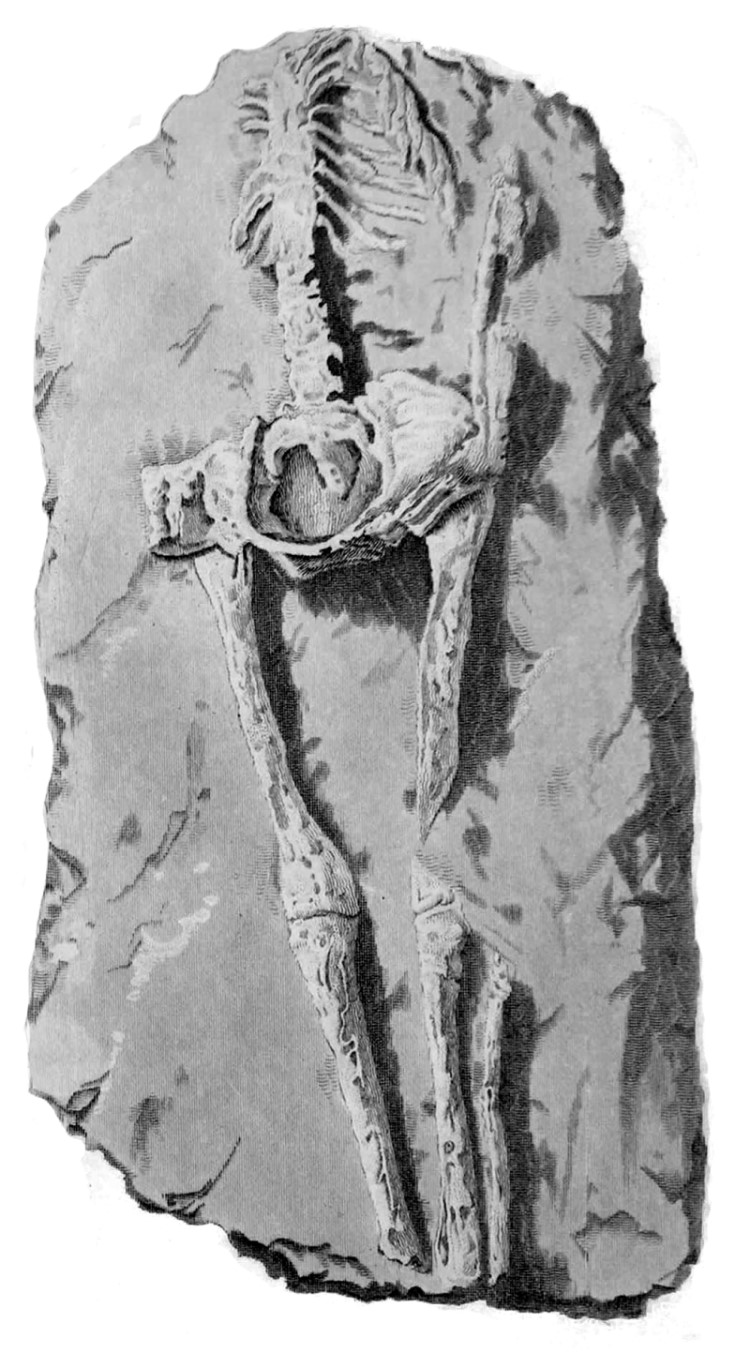
“Very lately an entire skeleton of the Irish Elk was
dug up in that country. The following statement of the circumstances
under which the bones were found, with their
geological position, was laid before the Dublin Society,
in a letter from Archdean Maunsell to the Right Hon.
George Knox.
“Middleton Lodge, March 8. 1825.
“MY DEAR SIR,
“I deferred replying to your letter of the 1st, as it
was my intention to proceed to Limerick in a few days,
and I was anxious to look over some notes I had taken,
and which I left there, of the circumstances connected
with the discovery of the fossil remains which the Royal
Dublin Society have received. As I have, however,
been obliged to postpone my departure for several days,
I can no longer defer offering my best thanks for the
kind manner in which you have received the conjectures
which I formed upon a subject to which my attention was
directed, by having fortunately been present before the
bones were disturbed from the situation in which they
had lain during a period which I apprehend it would
not be easy to define. I am sensible that any consideration
which may have been attached to my observations
should be attributed to the interest which the subject
itself is calculated to excite, rather than to any ability
of mine to do it justice. The opinion which I took the
liberty of communicating to you was formed after some
consideration, and although I had not the most remote
idea of its being worthy of any attention, I can have no
objection to your making any use of it which you may
conceive expedient. There is, I conceive, much interesting
material for speculation, resulting from the discovery
of these fossil remains, and the first that naturally
occurs is the manner in which the animals were destroyed,
and the bones so singularly preserved. I stated,
in the hasty sketch which I gave you of my theory
upon this point, that I apprehended they must have
been destroyed by some overwhelming deluge, that they
were probably drowned upon the hills where they had
taken refuge, as the waters rose, and that, as they subsided,
they were drawn from thence into the valley in
which they were found; that the agitation of the waters
had occasioned such a dispersion of the bones, when
the ligaments dissolved, as would account for their having
been scattered in the way in which they were
found, and that the deposite of shell marl, with which I
supposed the water to have been turbid, had so completely
protected them from atmospheric influence as to
prevent their subsequent decomposition. To enable
you to form some estimate of the reasonableness of this
supposition, it is necessary that I should endeavour to
explain the situation, &c. of the valley and the adjoining
hills. The valley in which the remains were found contains
about twenty plantation acres, and the soil consists
of a stratum of peat about a foot thick, immediately
under this a stratum of shell-marl, varying from 1½ to
2½ feet in thickness; in this many of the shells retain
their original colour and figure, and are not marine;
under the marl there is a bed of light blue clay; through
this one of my workmen drove an iron rod, in several
places, twelve feet deep, without meeting opposition.
Most of the bones and heads, eight in number, were
found in the marl; many of them, however, appeared
to rest on the clay, and to be merely covered by the
marl. The remains were disposed in such a manner
as to prevent the possibility of ascertaining the exact
component parts of each skeleton; in some places portions
were found removed many yards from others, and
in no instance were two bones found lying close to each
other. Their position also was singular; in one place
two heads were found, with the antlers entwined in each
other, and immediately under them a large blade-bone;
in another, a very large head was discovered, and although
a most diligent search was made, no part of the
skeleton found; within some hundred yards, in another,
the jaw-bones were found, and not the head. The
conclusion which, I conceive, may fairly be deduced
from such a position of the various parts of the animals
is, that there must have been some powerful agent employed
in dispersing them after their death; and as I
consider it impossible that their own gravity could have
been sufficient to sink them through the various strata,
I conceive these must have originated subsequently to
the dispersion of the bones. I also think, that, if they
had been exposed for any time to atmospheric influence,
they never could have been preserved in their present
extraordinary perfection.
“The hills immediately adjoining this valley are
composed of limestone, with a covering of rich mould
of various degrees of thickness. One of them, whose
base is about thirty acres, rises directly from the edge
of the valley, with sides very precipitous, and in one
place perfectly perpendicular, of naked limestone. In
every part of this hill the superficies comprises as much
stone as mould; on the side nearly opposite, the hill is
equally high, but the sides not so steep, and the covering
of mould thicker; on the other sides the ground only
rises in some degree (twenty or thirty feet perhaps),
and consists of a thin mould, and immediately under a
very hard limestone gravel. Indeed, except where
limestone forms the substratum, this is the character of
all the soil in the vicinity except the Corkasses, which
are evidently alluvial. I am fully aware, that, assuming
the destruction of the animals to have been occasioned
by a flood, they would naturally have retreated from
the water to the hills, and that, as they probably met
their fate there, their remains should have been discovered
on the summit of the hills, and not in the valley,
particularly as one of them is perfectly flat on the top,
which contains six or seven acres. I apprehend that
the remains of many of them were deposited on the
tops of the hills; but as they have now only a slight
covering of mould, not sufficient to cover a small dog,
they were formerly perfectly bare; and as they were
thus devoid of the means of protecting the remains
from the atmosphere, whatever was left there soon became
decomposed, and resolved into portions of the
mould, which is now to be found on the hills. This remark
I conceive also to be applicable to the soil with
the substratum of limestone gravel, which affords quite
as little material for preserving the bones as the hills
do.
“It is material that I should observe, that of eight
heads which we found, none were without antlers; the
variety in character also was such as to induce me to
imagine, that possibly the females were not devoid of
these appendages. Unfortunately, however, from the
difficulty of raising them, being saturated with water,
and as soft as wet brown paper, only three were at all
perfect.
“Having now disposed of these antediluvians, a question
naturally arises, how it happens that the fossil remains
of no other animals were found, when the same
fate probably overwhelmed every existing creature?
Could deer have been the only living beings at that
period? Was Ireland part of a great continent when
this catastrophe occurred, and were these unfortunates
the first emigrants to our Isle from that great centre
from whence the globe was supplied with occupants,
and did they perish before other animals less influenced
by enterprise, and less endowed with physical strength,
could have followed their example? These problems
I confess myself unable to solve, and shall not presume
to obtrude my many reveries upon this and other points,
which have originated in the discovery of a few bones,
upon those who I know are so much better competent
to form a sound opinion. I shall, I hope, be able to
send the antlers, which are very fine, on the 15th of this
month.
“If you have a desire to make any use of this letter,
I can only say I have no objection. I remain, dear Sir,
with feelings of great respect,
“Yours most truly,
“William W. Maunsell.”
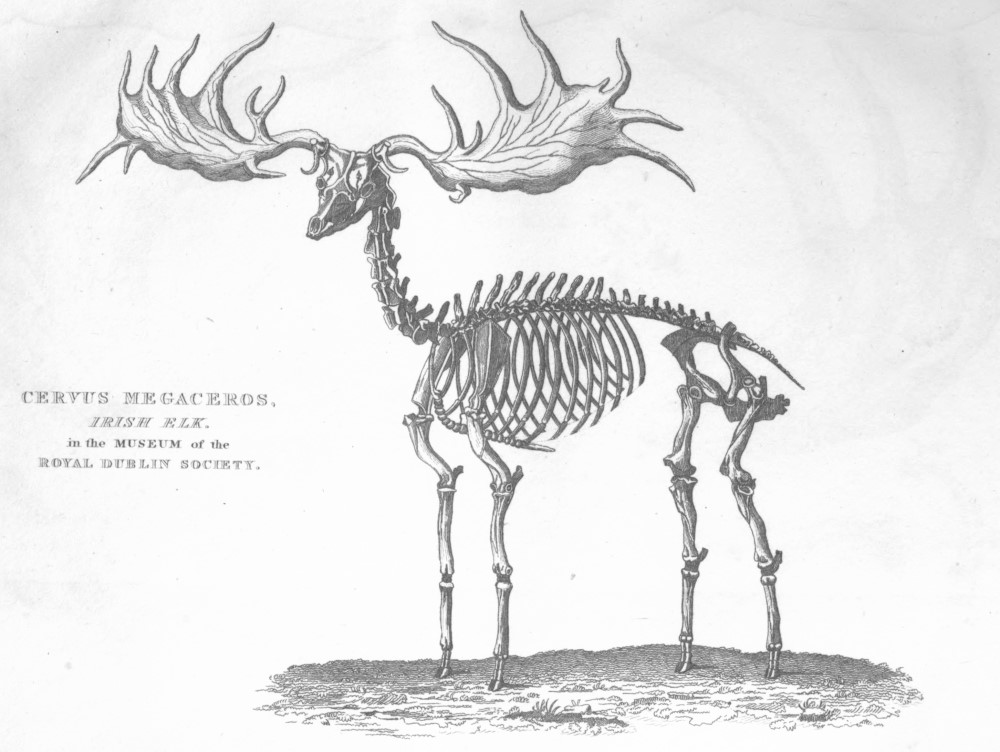
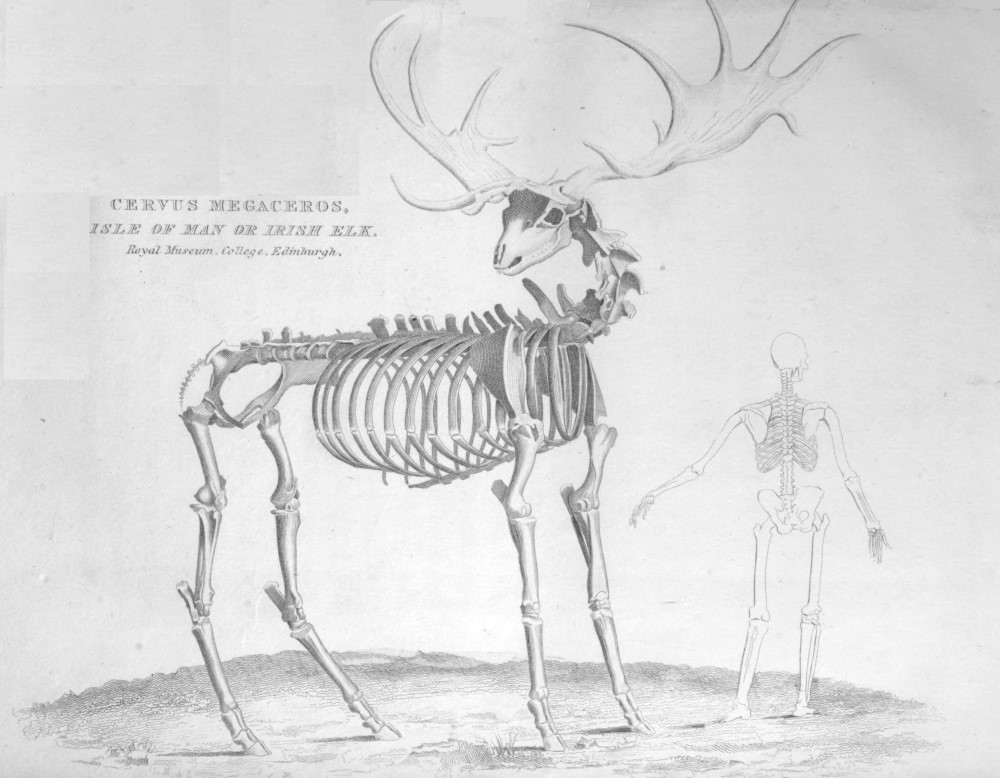
Of this skeleton, the most perfect hitherto found, the
following interesting description is given by Mr Hart,
in his memoir.
“This magnificent skeleton is perfect in every single
bone of the framework which contributes to form a part
of its general outline: the spine, the chest, the pelvis,
and the extremities, are all complete in this respect; and,
when surmounted by the head, and beautifully expanded
antlers, which extend out to a distance of nearly six
feet on either side, forms a splendid display of the reliques
of the former grandeur of the animal kingdom,
and carries back the imagination to a period when whole
herds of this noble animal wandered at large over the
face of the country.
To proceed with a description of the several parts
of this specimen in detail, I shall commence with the
horns, which give the animal its chief characteristic feature.
The horns.—That the description of these may be the
more intelligible, I will first explain the terms which I
mean to apply to their several parts. Each horn consists
of the socket or root, the burr or coronary circle,
the beam or shaft, the palm and the antlers.
The socket or root is the part of the horn which
grows out of the frontal bone, and which is never shed;
it is smooth, of a brown colour, an inch and half in
length, and eleven inches three quarters in circumference;
in the animal’s lifetime it was covered by the
skin. The coronary or bead-like circle, or burr, is a
ring of small, hard, whitish prominences, resembling a
string of pearls, which encircles the junction of the socket
with the part of the horn which falls annually from
the heads of all deer.
The beam or shaft extends outwards, with a curvature
whose concavity looks downwards, and backwards.
This part is nearly cylindrical at its root, and its length
equals about one-fourth of that of the whole horn; its
outer end is spread out and flattened on its upper surface,
and is continuous
with the palm, which expands outwards in a fan-like form, the
outer extremity of which measures two feet ten inches
across, being its broadest part. Where the beam joins
the palm the horn undergoes a kind of twist, the effect
of which on the palm is, to place its edges above and below,
and its surfaces anterior and posterior; the anterior
surface is convex, and looks outwards; the posterior is
concave, and its surface looks towards that of the opposite
palm. Such is the position of the horns, when the
head is so placed that the zygomatic arch is parallel to
the horizon, as it would be during progression, or whilst
the animal stands in an easy posture.
The antlers are the long pointed processes which project
from the horns, two of which grow from the beam
anteriorly; the first comes off immediately from the root,
and is directed downwards, overhanging the orbit; this
is called the brow antler, which, in this specimen, is divided
into two points at its extremity[419].
The other antler, which comes off from the beam, we
may call the sur-antler: in this specimen it consists of a
broad plate or palm, concave on its upper surface, horizontal
in its direction, and forked into two points anteriorly,—an
appearance which I have not observed in any
other specimen of upwards of forty which I have seen,
nor do I find it marked in any of the plates of those
bones extant.
There is one antler given off posteriorly from the junction
of the beam with the palm: it runs directly backwards
parallel to the corresponding one of the opposite
horn. The inferior edge of the palm beyond this runs
outwards and backwards: it is obtuse and thick, and its
length is two feet six inches. From the anterior and external
borders of each palm there come off six long pointed
antlers. None of these are designated by any particular
name. The number of the antlers of both sides
taken together is twenty-two.
The surface of the horns is of a lightish colour, resembling
that of the marl in which they were found;
they are rough, and marked with several arborescent
grooves, where the ramifications of the arteries by which
they had been nourished during their growing state were
lodged. The horns, with the head attached, weighed
eighty-seven pounds avoirdupois. The distance between
their extreme tips in a right line is nine feet two
inches.
Head.—The forehead is marked by a raised ridge
extended between the roots of the horns; anterior to
this, between the orbits and the root of the nose, the
skull is flat; there is a depression on each side in front
of the root of the horn and over the orbit, capable of
lodging the last joint of the thumb, at the bottom of
which is the superciliary hole, large enough to give passage
to an artery proportioned to the size of the horns.
Inferior to the orbit we have the lachrymatory fossa,
and the opening left by the deficiency of bone common
to all deer, and remarkable for being smaller in this than
in any other species.
Below the orbits the skull grows suddenly narrower,
and the upper parts of the nasal bones become contracted
by a depression on either side, at the lower part of
which is the infra-orbitar hole. The opening of the
nares is oval, being five inches long by three broad, the
greatest breadth being in the centre. From the roots
of the horns to the occipital spine measures three inches
and an half; the occiput descends at a right angle with
this, being three inches deep to the foramen magnum:
the greatest breadth of the occiput is eight inches. The
temporal fossæ approach to within two inches of each
other behind the horns.
Teeth.—They do not differ from those of animals of
the ruminating class. The incisors were not found, having
dropped out; there is no mark of canine teeth; the
molares are not much worn down, and are twenty-four
in number.
The skeleton measures, from the end of the nose to
the tip of the tail, ten feet ten inches. The spine consists
of twenty-six vertebræ, viz. seven cervical, thirteen
dorsal, and six lumbar. The size of the cervical vertebræ
greatly exceeds that of the other classes, and the
spines of the dorsal rise to a foot in height. The necessity
of these bones being so marked is obvious, considering
the strong cervical ligament, and powerful muscles,
required for supporting and moving a head which,
at a moderate calculation, must have sustained a weight
of three quarters of a hundred of solid bony matter.
The extremities are in proportion to the different parts
of the trunk, and present a conformation favourable to a
combination of great strength with fleetness.
It is not the least remarkable circumstance connected
with these bones, that they are in such a high state of
preservation as to present all the lines and impressions
of the parts which had been attached to them in the recent
state. Indeed, if we examine them as compared
with the bones of an animal from which all the softer
parts have been separated by maceration, the only perceptible
differences in their physical properties are, that
they are a little heavier, a degree harder, that their surface
is brown, and that they all, with the exception of
the horns, present a polished appearance, which is owing
to the periosteum having been preserved, and still remaining
to cover them, as was discovered when they were
chemically examined.
The existence of fat or adipocire in the shaft of one
of the bones mentioned by Archdeacon Maunsell, and
which I saw in his possession, is a thing for which it is
extremely difficult to account, as it occurred but in one
solitary instance, and it did not appear that this bone
was at all differently circumstanced from the rest. Those
which I had an opportunity of examining, by boring
holes in them, were hollow, and contained, for the most
part, only a small quantity of black animal earth.
Mr Stokes found, in a rib of this animal,
| Animal matter, |
42.87 |
| Phosphates with some Fluates, |
43.45 |
| Carb., Lime |
9.14 |
| Oxides, |
1.02 |
| Silica, |
1.14 |
| Water and loss, |
2.38 |
|
——— |
|
100.00 |
Dr Apjohn of Dublin made the following observations
with regard to the animal matter in the bones:
‘The bone was subjected for two days to the action
of dilute muriatic acid. When examined at the end
of this period, it had become as flexible as a recent bone
submitted to the action of the same solvent. The periosteum
was in some parts puffed out by carbonic acid
gas, disengaged from the bone, and appeared to be in a
state of perfect soundness.
‘To a portion of the solution of the bone in the muriatic
acid some infusion of galls was added, which caused
a copious precipitate of a dun colour. This proved
to be tannate of gelatine, mixed with a small portion of
the tannate and gallate of iron.
‘The cartilage and gelatine, therefore, so far from
being destroyed, had not been perceptibly altered by
time.’”
Until Baron Cuvier published his account of these
remains[420], they were generally believed to have belonged
to the same species as the moose deer or elk of North
America, an opinion which appears to have been first
advanced by Dr Thomas Molyneux in 1697[421], and
which depends principally on the exaggerated description
of that animal given by Josselyn in his account of
two voyages to New England, published in 1674, in
which he states that it is sometimes twelve feet high,
with horns of two fathoms wide! This was the more
readily believed by the learned Doctor, as it tended to
confirm him in a favourite theory which he seems to
have entertained, that Ireland had once been joined to
the New Continent.
But the assertions of Josselyn regarding the size of
the American moose have not been confirmed by the
testimony of later travellers, from whose observations it
is now clearly ascertained that the only large species of
deer inhabiting the northern parts of America are the
wapiti or Canadian stag (Cervus canadensis), the rein-deer
(C. Tarandus), and the moose or elk (C. Alces).
The peculiar branching of the brow antlers of the
rein-deer, and the rounded horns of the wapiti[422], are
characters sufficient to prevent us confounding either of
these animals with the fossil species.
The palmate form of the horns of the elk gave greater
probability to the opinion of its specific identity with the
fossil animal.
A little attention, however, to a few circumstances,
will shew a most marked difference between them.
First, as to size, the difference is very remarkable, it
not being uncommon to find the fossil horns ten feet
between the extreme tips[423], while the largest elk’s horns
never measure four feet. This measurement in a pair
in the Museum of the Royal Dublin Society, is three
feet seven inches: the largest pair seen by Pennant in
the house of the Hudson’s Bay Company, measured
thirty-four inches[424].
The horn of the elk has two palms, a lesser one which
grows forward from the front of the beam, where the
principal palm begins to expand. This is called brow
antler by Cuvier, but it corresponds in situation rather
to the sur-antler, there being, properly speaking, no
brow antler attached to the root of the beam. The elk
has no posterior antler similar to that of the fossil animal,
nor does its beam take a similar arched direction,
but runs more directly outwards.
Cuvier remarks, that the palm of the fossil horn increases
in breadth as it extends outwardly, while that
of the elk is broadest next the beam.
The palm of the elk’s horn is directed more backwards,
while the fossil one extends more in the lateral
direction. The antlers of the elk are shorter and more
numerous than those of the fossil animals.
As the horns of the fossil animal exceed in size those
of the elk, so, on the contrary, does the skull of the latter
exceed in size that of the former; the largest heads of
the fossil species not exceeding one foot nine inches in
length, while the head of the elk is frequently two feet.
The fossil head is broader in proportion; its length
being to its breadth as two to one; in the elk they are
as three to one, according to Parkinson.[425] The breadth
of the skull between the roots of the horns is but four
inches in the fossil skulls; in that of the elk in the Society’s
Museum it is 6½ inches.
Cuvier thinks it probable that the females of the fossil
species had horns[426], an opinion to which I am very much
disposed to subscribe, from having observed that these
parts present differences in size and strength, which appear
not to be dependent on differences of age. For instance,
the teeth of the specimen in Trinity College are
much more worn down, and the sutures of the skull are
more effaced than in the specimen described in this
paper; yet the horns of the latter are much more concave,
and more expanded, than those of the former; and
on comparing a single horn of each of these specimens
together, that belonging to the Society exceeds the other
by nearly a sixth in the length, and little less than a
third in the breadth; it is not, therefore, unlikely that the
animal whose horns were larger and more curved was a
male. Something similar to this is observed in the
rein-deer, both sexes of which have horns, but with this
difference, that they are smaller and less branched in
the female. Hence we find that this animal possessed
characters of its own sufficient to prove it of a species
as distinct from the moose or elk as this latter species is
from the rein-deer or any other. Therefore, it is improper
to retain the name of elk or moose deer any longer:
perhaps it might be better called the Cervus megaceros,
a name merely expressive of the great size of its
horns.
That this animal shed its head furniture periodically,
is proved by the occasional occurrence of detached horns
having the smooth convex surface below the burr, similar
to what is observed on the cast horns of all deer.
Specimens of this are to be seen in the Museum of Trinity
College, and I possess one myself, of which I have
had a drawing made. As every other species of deer
shed their horns annually, there is no reason for supposing
that that process occurred at longer intervals in
this.
It is a popular opinion with the Indians that the elk
is subject to epilepsy, with which he is frequently seized
when pursued, and thus rendered an easy prey to the
hunters. Many naturalists affect to disbelieve this account,
without, however, assigning any sufficient reason.
But if it be considered, that, during the growth
of the horns, there must be a great increased determination
of blood to those parts, which are supplied by the
frontal artery, a branch from the internal carotid, it is
quite conformable to well established pathological principles,
to suppose, that, after the horns are perfected, and
have ceased to receive any more blood, that fluid may
be determined to those internal branches of the carotid
which supply the brain, and establish a predisposition
to such derangements of its circulation as would produce
epilepsy, or even apoplexy: if such an effect were produced
in consequence of the size of the horns in the
elk, it is reasonable to suppose that it prevailed in a
greater degree in the fossil animal whose horns were so
much larger.
What could have been the use of these immense
horns? It is quite evident that they would prevent the
animal making any progress through a thickly wooded
country, and that the long, tapering, pointed antlers
were totally unfit for lopping off the branches of trees,
a use to which the elk sometimes applies his horns[427], and
for which they seem well calculated, by having their
antlers short and strong, and set along the edge of the
palm, somewhat resembling the teeth of a saw in their
arrangement. It would rather appear, then, that they
were given the animal as weapons for its protection, a
purpose for which they seem to have been admirably designed;
for their lateral expansion is such, that should
occasion require the animal to use them in his defence,
their extreme tips would easily reach beyond the remotest
parts of his body; and if we consider the powerful
muscles for moving the head, whose attachments occupied
the extensive surfaces of the cervical vertebræ,
with the length of the lever afforded by the horns themselves,
we can easily conceive how he could wield them
with a force and velocity which would deal destruction
to any enemy having the hardihood to venture within
their range.
From the formidable appearance of these horns, then,
we must suppose that their possessor was obnoxious to
the aggressions of some carnivorous animals of ferocious
habits; and such we know to have abounded in
Ireland, as the wolf, and the celebrated Irish wolf
dog. Nor would it be surprising if limestone caves
should be discovered in this country, containing the
remains of beasts of prey and their victims, similar to
the hyænas’ dens of Kirkdale, and other places, respecting
which such interesting researches have been lately
laid before the public by the geologists of this country and
the Continent.
The absence of all record, or even tradition, respecting
this animal[428], naturally leads one to inquire whether
man inhabited this country during its existence?
I think there is presumptive evidence in the affirmative
of this question, afforded by the following circumstances.
A head of this animal described by Professor Goldfuss
of Bonn, was discovered in Germany in the same drain
with several urns and stone hatchets; and in the 7th
volume of the Archæologia Britannica, is a letter of
the Countess of Moira, giving an account of a human
body found in gravel, under eleven feet of peat soaked
in the bog water: it was in good preservation, and
completely clothed in antique garments of hair, which
her ladyship thinks might have been that of our fossil
animal. But more conclusive evidence on this question
is derived from the appearance exhibited by a rib,
presented by Archdeacon Maunsell to the Royal Dublin
Society, in which I discovered an oval opening
near its lower edge, the long diameter of which is
parallel to the length of the rib, its margin is depressed
on the outer, and raised on the inner surface, round
which there is an irregular effusion of callus. This
opening had been evidently produced by a sharp pointed
instrument, which did not penetrate so deep as to cause
the animal’s death, but which remained fixed in the
opening for some length of time afterward; in fact
it was such an effect as would be produced by the head of
an arrow remaining in a wound after the shaft was broken
off[429].
It is not improbable, therefore, that the chace of this
gigantic animal once supplied the inhabitants of this country
with food and clothing.
As to the causes which led to the extinction of this
animal, whether it was suddenly destroyed by the deluge,
or by some other great catastrophe of nature, or
whether it was ultimately exterminated by the continued
and successful persecution of its pursuers, as
has nearly been the case with the red deer within the
recollection of many of the present generation, I profess
myself unable to form any decided opinion, owing
to the limited number of facts as yet collected on the
subject. On some future occasion I may, perhaps, be
induced to revert to so interesting a topic, should I have
opportunities of discovering any thing worthy of communication.
The following Table exhibits a comparative view of
the measurements of different parts of the skeletons of
the Cervus Megaceros in the Museum of the Royal
Dublin Society, and in the Royal Museum of the University
of Edinburgh, with some parts of the Moose. The
measurements of the Edinburgh specimen are taken from
Professor Jameson’s memoir on organic remains, in the
Supplement to the Encyclopedia Britannica.
|
HEAD. |
R. D. Soc. |
U. of Edin. |
Moose |
| Ft. In. |
Ft. In. |
Ft. In. |
| Length of the head, |
1 |
8½ |
1 |
8¼ |
| Breadth of the skull between the orbits. |
0 |
10½ |
0 |
9 |
| Do. of skull at the occiput, |
0 |
8 |
|
|
| Diameter of the orbit, |
0 |
2⅜ |
0 |
2½ |
| Distance between infra orbitar holes across the skull, |
0 |
7 |
|
|
| Length of alveolar processes of the upper jaw, |
0 |
6 |
0 |
6 |
| Length of lower jaw, |
1 |
5½ |
0 |
3½ |
| Diam. of foramen magnum, |
0 |
2 |
|
|
| HORNS. |
|
|
|
|
| Distance between the extreme tips, measured by the skull, |
11 |
10 |
|
|
| Ditto, in a straight line across, |
9 |
2 |
6 |
8 |
3 |
7 |
| Length of each horn, |
5 |
9 |
5 |
1 |
| Greatest breadth of the palm, |
2 |
10 |
|
|
| Length of the beam, |
1 |
9 |
|
|
0 |
6½ |
| Ditto of brow antler, |
0 |
8¾ |
|
|
| Ditto of sur-antler, |
1 |
4 |
|
|
| Circumference of the beam at root of brow antler, |
1 |
0¾ |
|
|
0 |
7½ |
| BODY. |
|
|
|
|
| Length of spine, |
10 |
10 |
9 |
8 |
| Ditto of sternum, |
2 |
4 |
|
|
| Height to the upper extremity of the dorsal spines, |
6 |
6 |
|
|
| Ditto to the highest point of the tip of the horn, |
10 |
4 |
|
|
| EXTREMITIES. |
|
|
|
|
| Greatest length of the scapula, |
1 |
6½ |
|
|
| Ditto breadth at the base, |
0 |
10¾ |
|
|
| Ditto depth of its spine, |
0 |
2¾ |
|
|
| Length of the humerus, |
1 |
4 |
1 |
3½ |
| Ditto of ulna and radius, |
1 |
8 |
1 |
6 |
| Ditto of carpus, |
0 |
2¾ |
0 |
2 |
| Circumference of do., |
0 |
9½ |
|
|
| Length of metacarpus, |
1 |
0½ |
1 |
0½ |
| Length of phalanges, |
0 |
7 |
0 |
6½ |
| From anterior superior spine of one ileum to that of the other, |
1 |
4½ |
1 |
6½ |
| From anterior superior spine to the tuber ischii, |
1 |
8 |
1 |
9½ |
| Greatest diameter of foramen ovale, |
0 |
4 |
0 |
3 |
| Least do. of do., |
0 |
2¾ |
0 |
2¼ |
| Length of the femur, |
1 |
6½ |
1 |
5½ |
| Ditto of tibia, |
1 |
6 |
1 |
6 |
| Length of the tarsus, including the os calcis, |
0 |
8 |
|
|
| Ditto of the metatarsus, |
1 |
1¾ |
1 |
1¾ |
1. Elephas africanus.—The Elephant with rounded
skull, large ears, grinders, having rhomboidal-shaped
marks on their crown, which we call the African Elephant
(Elephas Africanus), is a quadruped which has
hitherto been found only inhabiting Africa. There can
be no doubt that it is this species which lives at the
Cape, at Senegal, and in Guinea; there is reason to believe
that it also occurs at Mosambique; but it is not
certain that individuals of the following species do not
occur in this part of Africa. A sufficient number of
individuals have not been figured or compared, to know
if this species presents remarkable varieties. It is it that
produces the largest tusks. Both sexes are equally furnished
with tusks, at least at Senegal. The natural number
of the hoofs is four before, and three behind. The
ear is very large, and covers the shoulder. The skin is
of a deep and uniform brown. This species has not
been domesticated in modern times. It appears, however,
to have been tamed by the ancients, who attributed
to it less power and courage in that state than to the following
species; but their observations do not appear to
have been confirmed, at least in so far as refers to magnitude.
Its natural manners are not perfectly known;
yet judging of them by the notices of travellers, they
appear to resemble in every thing essential those of the
following species.
2. Elephas indicus.—The Elephant with elongated
skull, concave forehead, small ears, grinders marked
with undulating bands, which we call the Indian Elephant
(Elephas Indicus), is a quadruped which has only
been observed with certainty beyond the Indus. It extends
from both sides of the Ganges to the Eastern Sea
and the south of China. They are also found in the
Islands of the Indian Sea, in Ceylon, Java, Borneo, Sumatra,
&c. There is still no authentic proof that it
exists in any part of Africa, although neither is the contrary
absolutely proved. The inhabitants of India
having from time immemorial been in the habit of taking
this species and taming it, it has been much better observed
than the other. Varieties have been remarked as
to size, lightness of form, the length and direction of the
tusks, and the colours of the skin. The females and
some of the males have tusks which are always small and
straight. The tusks of the other males never attain so
great a length as in the African species[430]. The natural
number of the hoofs is five before and four behind. The
ear is small, frequently angular. The skin is commonly
grey, spotted with brown. There are individuals entirely
white. The height varies from fifteen to sixteen feet.
Its manners, the mode of taking it, and of treating it,
have been carefully described by many travellers and naturalists,
from Aristotle down to Mr Corse Scott.
3. Elephas primigenius, Blum, or Mammoth.—The
Elephant with elongated skull, concave forehead,
very long alveolæ for the tusks, the lower jaw obtuse,
the grinders broader, parallel, marked with closer bands,
which we name the Fossil Elephant (Elephas primigenius,
Blum.), is the Mammoth of the Russians. Its
bones are only found in the fossil state. No person has
seen in a fresh state bones resembling those by which
this species is peculiarly distinguished, nor have the
bones of the two preceding species been seen in the fossil
state.[431] Its bones are found in great number in many
countries, but in better preservation in the north than
elsewhere. It resembles the Indian more than the African
species. It differs, however, from the former in the
grinders, in the form of the lower jaw, and many other
bones, but especially in the length of the alveolæ and
tusks. This last character must have singularly modified
the figure and organisation of its proboscis, and
given it a physiognomy much more different from that
of the Indian species, than might have been expected
from the similarity of the rest of their bones. It appears
that its tusks were generally large, frequently more or
less spirally arcuate, and directed outwards. There is
no proof that they differ much according to differences
of sex or race. The size was not much greater than
that to which the Indian species may attain; it appears
to have been still clumsier in its proportions. It is already
manifest from its osseous remains, that it was a
species differing more from the Indian, than the ass from
the horse, and the jackal and isatis from the wolf and
fox. It is not known what had been the size of its ears,
or the colour of its skin; but it is certain that, at least,
some individuals bore two sorts of hair, namely, a red,
coarse, tufted wool, and stiff black hairs, which, upon
the neck and along the dorsal spine, became long enough
to form a sort of mane. Thus, not only is there nothing
impossible in its having been able to support a climate
which would destroy the Indian species, but it is even
probable that it was so constituted as to prefer cold climates.
Its bones are generally found in the alluvial
and superficial strata of the earth, and most commonly
in the deposits which fill up the bottom of valleys, or
which border the beds of rivers. They scarcely ever occur
by themselves, but are confusedly mingled with
bones of other quadrupeds of known genera, such as
rhinoceroses, oxen, antelopes, horses, and frequently
with remains of marine animals, particularly conchiferous
species, some of which have even been found
adhering to them. The positive testimony of Pallas,
Fortis, and many others, does not allow us to doubt that
this latter circumstance has frequently taken place, although
it is not always observed. We ourselves have at
this moment under our eyes a portion of a jaw covered
with millepores and small oysters.
The strata which cover the bones of elephants are
not of very great thickness, and they are scarcely ever
of a rocky nature. They are seldom petrified, and
there are only one or two cases recorded in which they
were found imbedded in a shelly or other rock. Frequently
they are simply accompanied with our common
fresh water shells. The resemblance, in this latter respect,
as well as with regard to the nature of the soil, between
the three places, of which we have the most detailed
accounts, viz. Tonna, Cantstadt, and the Forest
of Bondi, is very remarkable. Every thing, therefore,
seems to announce that the cause which has buried
them, is one of the most recent of those that have contributed
to change the surface of the globe. It is nevertheless
a physical and general cause; the bones of fossil
elephants are so numerous, and have been found
in places so desert and even uninhabitable, that we
cannot suppose that they had been conducted there
by man. The strata which contain them and those
which are above them, shew, that this cause was aqueous,
or that it was water that covered them; and in
many places these waters were nearly the same as those
of our present sea, since they supported animals nearly
the same. But, it was not by these waters that they
were transported to the places where they now are.
Bones of this description have been found in almost
every country that has been examined by naturalists.
An irruption of the sea that might have brought them
from places which the Indian elephant now inhabits,
could not have scattered them so far, nor dispersed
them so equably. Besides, the inundation which buried
them has not risen above the great chains of mountains,
since the strata which it has deposited, and which cover
the bones, are only found in plains of little elevation.
It is not, therefore, seen how the carcases of elephants
could have been transported into the north, across the
mountains of Thibet, and the Altaic and Uralian
chains.
Further, these bones are not rolled; they retain their
ridges and apophyses; they have not been worn by friction.
Very frequently the epiphyses of those which had
not yet attained their full growth, are still attached to
them, although the slightest effort would suffice to detach
them. The only alterations that are remarked,
arise from the decomposition which they have undergone
during their abode in the earth. Nor can it with more
reason be represented that the entire carcases had been
violently transported. In this case, the bones would indeed
have remained entire; but they would also have
remained together, and would not have been scattered.
The shells, millepores, and other marine productions
which are attached to some of these bones, prove besides
that they had remained at least some time stripped
and separated at the bottom of the fluid which covered
them. The elephants’ bones had therefore already been
in the places in which they are found, when the fluid
covered them. They were scattered about in the same
manner as in our own country the bones of horses and
other animals that inhabit it may be, and as the dead bodies
are spread in the fields.
Every circumstance, therefore, renders it extremely
probable, that the elephants which have furnished the
fossil bones, dwelt and lived in the countries where their
bones are at present found. They could only, therefore,
have disappeared by a revolution, which had destroyed
all the individuals then living, or by a change of climate,
which prevented them from propagating. But whatever
this cause may have been, it must have been sudden.
The bones and ivory which are found in so perfect a
state of preservation in the plains of Siberia, are only so
preserved by the cold which congeals them there, or which,
in general, arrests the action of the elements upon them.
If this cold had come on by degrees and slowly, these
bones, and still more the soft parts with which they are
still sometimes invested, would have had time to decompose,
like those which occur in warm and temperate countries.
It would especially have been impossible that an
entire carcase, like that discovered by Mr Adams, could
have retained its flesh and skin without corruption, if it
had not been immediately enveloped by the ice which
preserved it. Thus, all the hypotheses of a gradual
cooling of the earth, or of a slow variation, whether in
the inclination or in the position of the axis of the globe,
fall to be rejected.
If the present elephants of India were the descendants
of these ancient elephants, which have been preserved
in that climate to the present day, from their being
there placed beyond the reach of the catastrophe
which destroyed them in the others, it would be impossible
to explain why their species has been destroyed in
America, where remains are still found, which prove
that they had formerly existed there. The vast empire
of Mexico presented to them heights enough to escape
from an inundation so little elevated as that which we
must suppose to have taken place, and the climate there
is warmer than is requisite for their temperament.
The various mastodons, the hippopotamus and the fossil
rhinoceros lived in the same countries, and in the same
districts, as the elephants, since their bones are found in
the same strata and in the same state. Yet these animals
very assuredly no longer exist. Every thing therefore,
Cuvier maintains, concurs to induce a belief that
the fossil elephant is, like them, an extinct species, although
it resembles more than they one of the species at
present existing, and that its extinction has been produced
by a sudden cause, by the same great catastrophe
which destroyed the species of the same epoch.
It appears that the Great Mastodon or Animal of the
Ohio, was very like the elephant in its tusks and whole
skeleton, the grinders excepted; that it very probably had
a proboscis; that its height did not exceed that of the elephant,
but that it was a little more elongated, and had
limbs somewhat thicker, with a more slender belly. Notwithstanding
all these points of resemblance, the peculiar
structure of its grinders is sufficient to constitute it of a
different genus from the elephant. It further appears,
that it fed much in the same manner as the hippopotamus
and boar, choosing by preference the roots and other fleshy
parts of vegetables; that this sort of food must have
drawn it towards the soft and marshy places; that, nevertheless,
it was not formed for swimming, and living often
in the water like the hippopotamus, but that it was a true
land animal. Its bones are much more common in North
America than any where else. They are even perhaps
exclusively confined to that country. They are better preserved,
and fresher, than any other fossil bones known;
and, nevertheless, there is not the slightest proof, the smallest
authentic testimony, calculated to impress a belief that
either in America, or any where else, there is still any
living individual, for the various accounts which we have
from time to time read in the journals respecting living
mastodons, which had been observed in the forests or
plains of that vast continent, have never been confirmed,
and can only pass for fables.
Note
The extraordinary accumulations of fossil bones in
caves and caverns in different districts, especially in those
composed of limestone, have for many years engaged
the attention of inquirers; and, of late, have afforded
many interesting facts to the geologist and zoologist. In
England, as will appear from the following details, many
different fossil animals have been discovered in limestone
caves; but hitherto the caves in Scotland, which will
probably be found to contain interesting documents of an
ancient population, have not been examined. As the
subject is a curious and interesting one, we shall, in the
following pages, principally from Cuvier’s great work,
lay before our readers a pretty full account of the different
caves, especially those that afford bones of carnivorous
animals.
Numerous caves, brilliantly decorated with stalactites
of every form, succeeding each other to a great depth in
the interior of mountains, communicating together by
openings so narrow as scarcely to allow a man to enter
them crawling, and which are yet found strewed with an
enormous quantity of bones of large and small animals,
are without dispute among the most remarkable phenomena
which the history of fossil remains could present to
the contemplation of the geologist, especially when we reflect
that this phenomenon recurs in a great number of
places, and over a very extended space of country.
These caves have been the object of research of several
naturalists, some of whom have well described and
figured the bones which they contain; and even before
they were explored by the naturalist, they were celebrated
among the common people, who, according to their
custom, added many imaginary prodigies to the natural
wonders which are really observed in them. The bones
which they contain were long, under the name of fossil
unicorn, an important article of commerce and materia
medica, on account of the powerful virtues which were
attributed to them; and it is probable that the desire of
finding these bones contributed much to the more accurate
knowledge of these caves, and even to the discovery
of several of them.
The most anciently celebrated is the cave of Bauman,
situated in the country of Blankenburg, which belongs
to the Duke of Brunswick, to the south of the city of that
name, to the east of Elbingerode, and to the north of the
village of Rubeland, the nearest inhabited place, in a hill
which forms one of the last declivities of the Hartz toward
the east. It has been described by many authors,
among whom we shall particularly mention the great
Leibnitz, in his Protogæa, pl. i. p. 97, where he gives a
map of it, borrowed from the Acta Eruditorum 1702,
p. 305.
Its general direction is east and west, but the entrance
faces the north. It is very narrow, although it is under
a pretty large natural vault. The first cave is the
largest. From this to the second, one must descend by
another narrow passage, at first by creeping, and afterwards
by a ladder. The difference of level is 30 feet.
The second cave is the richest in stalactite of all forms.
The passage to the third cave is at first the most difficult
of all, and we have to climb with hands and feet; but it
afterwards enlarges, and the stalactites of its walls are
those in which the imagination of the curious has pretended
to see the best characterized figures. It has two
lateral dilatations, of which the map of the Acta Eruditorum
makes the third and fourth caves. At its extremity,
we have still to ascend, in order to arrive at the real
third cave, which forms a sort of portal. Behrens says,
in his Hercynia curiosa, that it cannot be reached, because
it would be necessary to descend more than 60 feet;
but the above mentioned map, and the description of Von
der Hardt, which accompanies it, describe this third cave
under the name of the Fifth, and place beyond it a
narrow passage, terminated by two small grottoes. Lastly,
Silberschlag, in his Geogony, adds, that one of these
grottoes leads to a narrow passage, which, descending
much, leads under the other caves, and terminates in
a place filled with water. There are still many bones in
these remote and little frequented parts. Most of those
bones which are in collections from this cave, or which
have been described, are of the bear genus.
A second cave, nearly as celebrated as the former, and
very near, is that which is named, after the unicorn,
Enihornshæle, at the foot of the chateau of Scharzfels,
in a part of the Electorate of Hanover which is named
the Dutchy of Grubenhagen, and nearly upon the last
southern declivity of the Hartz. It has also been described
by Leibnitz, as well as by M. Deluc, in his Letters
to the Queen of England. The entrance is 10 feet high,
and 7 broad. We descend vertically 15 feet into a sort
of vestibule, the roof of which lowers to such a degree,
that, at the end of 60 feet, we are obliged to creep.
After a long passage, we come to two other caves, according
to Leibnitz; but Behrens adds three or four,
and says, that, according to the country people, we
might penetrate nearly two leagues.
Bruckmann, who gives a map of this cavern (Epistol.
Itin. p. 34.), represents only five caves, arranged nearly
in a straight line, and connected by extremely narrow
passages. The second is the richest in bones; the third,
which is the most irregular, has two small lateral caves;
the fifth is the smallest, and contains a fountain. Of the
bones which have been taken from it, some are in the
possession of M. Blumenbach and other naturalists; and
others have been figured by Leibnitz and Mylius. They
belong to the bear, hyena, and tiger or lion genera.
The chain of the Hartz also presents some other caves
of less celebrity, although of the same nature mentioned
by Behrens in his Hercynia curiosa, namely,
The cave of Hartzburg, under the castle of the
same name, above Goslar to the south. We do not know
why Büsching disputes its existence. It is true that
Behrens cites J. D. Horstius erroneously, for having seen
bones of various animals taken from it; for Horstius
speaks only (Obs. Anat. dec. p. 10.) of the cave of Scharzfels.
The cave of Ufftrungen, in the county of Stollberg,
to the south of the castle of that name. It is named in
the country Heim-knohle, or Hiding-hole. Behrens
thinks that fossil bones might be found in it.
Another cave of the same neighbourhood, is named
Diebsloch, Thieves’ Hole. Skulls have been found in it,
which were supposed to be human.
We shall not speak here of those caves of the Hartz in
which bones have not been discovered. And even those
in which they have been found, are, at the present day,
almost exhausted, it being only by breaking the stalactite
that any can be obtained, so much of them had been
taken away for selling as medicines.
The caves of Hungary come after those of the Hartz,
with reference to the remoteness of the time at which
they have been known. The first notice of them is due
to Paterson Hayn, (Ephem. Nat. Cur. 1672, Obs.
cxxxix. and cxciv.) Bruckmann, a physician of Wolfenbüttel,
afterwards described them at length. (Epistola Itineraria,
77, and Breslauer Sammlung, 1725, First Trim.
p. 628.) They are situated in the county of Liptow,
on the southern declivities of the Carpathian mountains.
They are known in the country by the name of Dragons’
Caves, because the people of the neighbourhood
attribute to those animals the bones which occur in them,
and with which they have been acquainted from time
immemorial; but all those which have been figured by
authors belong to the Bear family, and to the species
which is named the Great Cave Bear (Grand Ours des
cavernes).
The caves of Germany the richest in bones are those
of Franconia, of which J. F. Esper, a clergyman of the
country of Bayreuth, has given a very detailed description
in a work, printed in French and German, entitled,
Description des Zoolithes nouvellement decouvertes,
&c. Nuremberg Knorr. 1774, folio, with 14 coloured
plates, and in a memoir inserted among those of the
Berlin Society of Naturalists, vol. ix. 1784, p. 56.
Another description was afterwards given, under the
title of Objets dignes de remarque des environs de Muggendorf,
by J. C. Rosenmüller, folio, with coloured
views, Berlin, 1804. And more lately, M. Goldfuss, at
present Professor of Natural History at Bonn, and Secretary
of the Academia Naturæ Curiosorum, has made
them the subject of a particular work printed in 1810
in German, under the title of Environs of Muggendorf,
in which he describes them with the greatest care, as
well as the surrounding country, of which he gives a
very correct topographical chart. A great part of these
caves is situated in a small bailiwick, named Streitberg,
which was formerly a dependence upon the country of
Bayreuth, but was inclosed in that of Bamberg, and
now forms part of the kingdom of Bavaria. The greatest
number occur in a small peninsula, formed by the
river of Wiesent, which falls into the Pegnetz, and belongs
to the basin of the Main.
However, the chief of all these astonishing caves, those
of Gaylenreuth, are beyond the limits of this peninsula,
being on the left bank of the Wiesent, to the north-west
of the village from which it derives its name. The entrance
is perforated in a vertical rock; it is 7½ feet high, and
faces the east. The first cave turns to the right, and is
upwards of 80 feet long. The unequal heights of the vault
divide it into four parts; the first three are from 15 to
20 feet high, the fourth is only 4 or 5. At the bottom of
this latter, on the level of the floor, there is a hole 2 feet
high, which affords a passage to the second cave: it has
first a direction to the south, over a length of 60 feet by
40 in breadth, and 18 in height; it then turns to the west
for 70 feet, becoming lower and lower until at length
the height is only 5 feet. The passage which leads to
the third cave is very inconvenient, and one has to turn
through
various corridors: it is 30 feet across, and from
5 to 6 in height. The ground in it is kneaded with
teeth and jaws. Near the entrance is a pit of from 15
to 20 feet, to which one descends by a ladder. After
having descended, we come to a vault of 15 feet diameter
by 30 in height; and towards the side at which the
descent is made there is a cave strewed with bones. On
still descending a little, a new arcade is met with, which
leads to a cave 40 feet long, and a new pit of from
18 to 20 feet deep. After descending this, we reach
a cavern about 40 feet high, all strewed with bones.
A passage, of 5 feet by 7, leads to a grotto of 25 feet in
length by 12 in breadth. Canals, 20 feet in length, conduct
to another grotto of 20 feet in height. Lastly,
there is another cave, 83 feet broad and 24 high, in
which more bones are found than in any of the others.
The sixth cave, which is the last, has a northerly direction,
so that the whole series of caves and passages
nearly describes a semicircle.
A fissure in the third cave led to the discovery, in
1784, of a new cave, 15 feet long and 4 broad, in which
the greatest quantities of hyena and lions’ bones were
found. The aperture was much too small for these animals
to have passed through it. A particular canal
which ended in this small cave has afforded an incredible
number of bones and large skulls entire.
In the Philosophical Transactions of 1822, pl. xxvi.
there may be seen a profile of this cave, taken on the
spot in 1816, by Professor Buckland, in which is to be
especially remarked an enormous mass, entirely composed
of bones enveloped in the stalactite, and thus forming
an osseous breccia, but of quite a different nature
from those which occur at Gibraltar and other places[432].
The cave of Gaylenreuth is one of those the bones of
which are most completely known, by the researches
which have been made or caused to be made in it for a
long time back by distinguished naturalists, such as
MM. Esper, de Humboldt, Ebel of Bremen, Rosenmüller,
Sœmmering, Goldfuss, &c., and by the numerous
and rich collections which these researches have produced.
According to the examination which Cuvier has
made of the principal of these collections, three-fourths
of the bones found there belong to the Bear genus, and
to two or three species of that genus. The others belong
to the hyena, tiger, wolf, fox, glutton, and polecat,
or some nearly allied species. There are also found, although
in much smaller number, bones of herbivorous
quadrupeds, and, in particular, deer, of which fragments
are in the possession of M. Ebel. It would even appear
from a passage of M. Sœmmering’s, that a parcel
of bones had been got in it belonging to an elephant’s
skull[433]. According to Rosenmüller, there were
found in it bones of men, horses, oxen, sheep, deer,
roes, mules, badgers, dogs, and foxes, but which from
the researches made by him in the cave itself, and from
their state of preservation, must have been deposited at
periods much later than those of the bear, tigers and
hyenas[434].
The small peninsula situate nearly opposite to this cave,
presents several other caves, as the Schœnstein, or Beautiful
Rock, which contains seven contiguous caverns. The
Brunnenstein, or Fountain Rock, in which, according to
Esper, there are only found bones of known species,
such as badgers, dogs, foxes, hogs, and deer; but Esper
had too little anatomical knowledge for his testimony to
be entirely relied on with respect to this. These bones
are sometimes encrusted with stalactite. It contains also
the Holeberg, or Hollow Mountain, in which eight or
ten caves form a series of 200 feet in length, with two
entrances. Bones of the same bears as at Gaylenreuth,
are found here in various lateral depressions; and there
are also deer and hogs.—The Wizerloch, so named from
an ancient Sclavonic deity formerly worshipped there,
the most dismal cavern of the whole country, situate in
its most elevated part, and in which some vertebræ have
been found. It is more than 200 feet long. The
Wunderhœhle, which takes its name from its discoverer,
has been known since 1773: its extent is 160 feet.—Lastly,
the Cave of Klaustein, consisting of four grottoes,
and upwards of 200 feet deep. Bones have been found
in the third grotto, and most abundantly towards its extremity.
It might be supposed that the name Klaustein
signified Claw-rock, and it would thus accord very well
with a place where, without doubt, as at Gaylenreuth,
a multitude of ungual phalanges of bears and animals of
the tiger kind have been found. But M. Goldfuss asserts,
that it was called Klaustein, or St Nicholas’s
Rock, after a chapel of this name, which formerly stood
upon it.—There are still the Geiss-knok, or Goat Cave,
and a cave discovered in 1793. M. Rosenmüller found
in them two human skeletons already covered with stalactite.
The country which surrounds this small peninsula
has itself several caves, independently of that of Gaylenreuth,
as those of Mockas, Rabenstein, and Kirch-ahorn,
three villages, situate, the first to the south, and the
other two to the north-east of Gaylenreuth. Bones were
formerly found in the first. The last bears in the country
the expressive name of Zahn-loch, or Tooth Cave;
it also bears the name of Hohen-mirschfeld, a village on
whose ground it is situate; and the country people
have long been in the habit of seeking in it those bones,
which they imagined to be medicinal. MM. Rosenmüller
and Goldfuss have in fact found bear and tiger bones.
There are two others in the territory of the same village,
of which the one named Schneider-loch (Tailor’s Hole),
is said to have furnished the vertebræ of an elephant.
That of Zewig, close upon Waschenfeld, at the very
edge of the Wiesent, is nearly 80 feet deep; and it is said
that skeletons of men and wolves were found in it.
All these hills, containing caves in their interior, and
situate so near each other, seem to form a small chain,
interrupted only by brooks, and which joins the more
elevated chain of the Fichtelberg, in which are the
highest mountains of Franconia, and from which flow
the Main, the Saale, the Eger, the Naab, and many
small rivers. M. Rosenmüller, and after him, others
assert, that those which are in the hills to the north of
the Wiesent, contain not a single fragment of bone, while
those to the south are filled with them.
In 1799, a cave, remarkable for its situation, was discovered,
which connects in some measure those of the
Hartz with those of Franconia. It is the Cave of
Glücksbrun, in the bailiwick of Altenstein, in the territory
of Meinungen, on the south-western declivity of
the chain of the Thuringerwald (Blumenb. Archæol.
Telluris, p. 15. Zach. Monate. Corresp. 1800, January,
p. 30.) It is the same which M. Rosenmüller names
Libenstein, on account of its being on the road from Altenstein
to this latter, which is a bathing place. There
is a description of it by M. Kocher, in the Magazin für
Mineralogie, by M. C. E. A. De Hof, 1st band. heft. iv.
p. 427. The limestone in which it is situate rests upon
bituminous schist, and, rising much upwards, comes to
rest upon primitive rocks. The limestone varies in
hardness and in the nature of its fracture, and contains
marine petrifactions, such as pectinites, echinites, &c.
In making a road, there was discovered an opening,
from which a very cold air issued, which determined the
Duke of Saxe-Meinungen to have it farther examined.
A narrow passage, of twenty feet in length, was found,
which led to a cave of thirty-five feet, having a breadth
of from three to twelve, and a height of from six to
twelve, according to the places, and terminated by a
large piece of rock, which was removed. The labour of
two years discovered and cleared a series of caves connected
together, and of which the bottom rose and fell
alternately. They terminate in a place where water
flows; but various lateral fissures make it probable that
there are still several caves which have not been opened,
and that they perhaps form a sort of labyrinth.
The bottom and walls of this cave are furnished with
the same mud as the others, but blacker. The bones
were pretty numerous, and tinged with the same colour,
but only two tolerably entire skulls were obtained.
That of which M. Kocher gives a figure, is the species
of bear named Ursus spelæus. There are also caves of
this kind in Westphalia. J. Es Silberschlag, in the Mem.
des Naturalistes of Berlin (Schriften, vol. vi. p. 132),
describes the one called Kluter-hœhle, near the village of
Oldenforde, in the county of Mark, on the edge of the
Milspe and Ennepe, two streams which fall into the
Ruhr, and with it into the Rhine. Its entrance is about
half-way up a hill called Kluterberg, is only three feet
three inches high, and faces the south. The cave itself
forms a true labyrinth in the interior of the mountain.
Not far from this, in the same county, at Sundwich,
two leagues from Iserlohn, is another cave, which, for
about twenty-five years back, has furnished a very large
quantity of bones, part of which has been carried to
Berlin, and the rest has remained in the country in the
hands of various individuals[435].
If we cast a glance upon a general map, it is not difficult
to perceive a certain continuity in the mountains
in which these singular caves occur. The Carpathians
join with the mountains of Moravia and those of Bohemia
called Bœhmerwald, to separate the basin of the
Danube, from those of the Vistula, Oder and Elbe.
The Fichtelgebirge separates the basin of the Elbe from
that of the Rhine. The Thuringerwald and the Hartz
continue to limit the basin of the Elbe, by separating it
from that of the Weser.
These different chains have but slight intervals between
them. The caves of Westphalia alone are not
connected in so evident a manner with the others.
Very lately, bones have been discovered in a cavern,
which extends more towards the south, and is even
situate on the other or Italian side of the Alps. It
is that of Adelsberg in Carniola, a place situate on
the great road from Laybach to Trieste, and about
half way between these two cities. The whole of this
country is full of caverns and grottoes, which have given
rise to numerous sinkings of the surface, thus giving
a very singular appearance to the country. Several of
these caverns have long been celebrated among naturalists.
That of Adelsberg is generally visited by travellers,
on account of its being near the highway, and because
a river called the Piuka or Poike is lost there,
forming a subterranean lake, and emerging again on the
north side, under the name of Unz. A hole which the
Chevalier de Lowengreif discovered in 1816, in one of
its walls, at the height of 14 fathoms, conducted him to
a series of new caves of vast extent, and of incomparable
beauty, from the lustre and variety of their stalactites.
A part of these caves was, however, known, and must
be, or have been accessible, by some other place, for inscriptions
were found in them with dates, from 1393 to
1676, together with human bones, and entire carcases,
that had been buried there. A German pamphlet was
published at Trieste, in which are described all the windings
of these subterranean passages, their different halls,
their domes, their columns, and all the other appearances
produced by their stalactites. We shall not follow the
author (M. de Volpi, Director of the School of Commerce
and Navigation at Trieste) through this immense
labyrinth. Let it suffice to say, that this zealous naturalist
asserts his having proceeded more than three leagues,
almost in a straight line, and that he was only stopped
by a lake which rendered it impossible to go on. It was
about two leagues from the entrance that he discovered
bones of animals, of which he gives figures, and which
he describes under the name of Palæotheria. He had
the politeness to communicate to me, says Cuvier, his
drawings the year before, but it appears my reply did
not reach him, for he makes no mention of it in his book.
Be this as it may, his figures clearly shewed that the
bones in question belonged to the great cave-bear. In
fact, several of these bones having been presented to the
Congress of Laybach, Prince Metternich, whose enlightened
taste for the advancement of knowledge has already
been of so much service, had the goodness to address
them to Cuvier, who disposed them in the Royal Cabinet,
where any one may satisfy himself as to their species.
There are, without doubt, caves in many other chains,
and several are known in France. Caves occur in Suabia,
but no bones have been found in them; and, in general,
it appears, that, before the last discoveries, and
especially that which has been made in Yorkshire, none
were known but those of Germany and Hungary that were
rich in bones of carnivora. In truth, the rock of Fouvent,
and which contains in one of its cavities bones of hyenas,
and at the same time those of elephants, rhinoceroses and
horses, might be considered as belonging to this order of
phenomena; but as it was not explored to any depth, it
cannot be certain that it is so.
The case is different with the Kirkdale Cavern. It having
been visited immediately after its discovery by several
well informed persons, and especially by Mr Buckland,
every thing has been made known with respect to it. It
is situated in the East Riding of the county of York,
twenty-five miles NNE. of the city of York, and at about
the same distance to the west from the sea and the town
of Scarborough. The small river of Hodgebeck is lost under
ground in the neighbourhood, much in the same way
as the Piuka, near Adelsberg. It is placed in one of the
limestone hills which form the northern boundary of the
vale of Pickering, the waters of which fall into the Derwent.
Mr Buckland compares the stone to that of the
last strata of the Alpine limestone, such as are seen near
Aigle and Meillene.
It was in the course of the year 1821, that some labourers
working at a quarry, discovered by chance the
opening, which was closed by rubbish, covered over
with earth and turf. It is about 100 feet above the
neighbouring brook. It can be entered to the distance
of 150 or 200 feet, but we can only walk erect in some
places, on account of the stalactites. On its sides there
are seen spines of sea-urchins and other marine remains,
incrusted in the mass of the rock; but it is on the bottom,
and there only, that there is found the stratum of mud,
of about a foot thick, stuck full of bones, as at Gaylenreuth.
This mud, and the bones which it contains,
are, in various places, covered or penetrated with stalactite,
especially near places where the rock has lateral
fissures.
The discovery having acquired much celebrity, a great
number of people procured bones from it, and placed
them in various public depots. Specimens have been deposited
in the York Institution, that of Whitby and
Bristol, the British Museum, the Museum of Oxford and
Cambridge, and by Mr Young of Whitby, in the College
Museum of Edinburgh; but the finest collection of the
bones of Kirkdale was presented to Cuvier, and by him deposited
in the Royal Cabinet in Paris. The greatest number
of these bones without comparison, belong to hyenas
of the same species as those of the caverns of Germany;
but there are also many of other large and small animals,
which Mr Buckland supposes to form twenty-one species.
From the pieces which I have under my eye, says
Cuvier, there indisputably occur bones of the elephant,
hippopotamus, horse, an ox of the size of the common
deer, rabbits, field-rats; also bones of some other carnivora,
namely, of the tiger, wolf, fox, and weasel. All
these bones and teeth are accumulated on the ground,
broken and gnawed, and there are even seen marks of the
teeth which have fractured them. There are even intermixed
with them excrements which have been recognized
as perfectly similar to those of the hyena[436].
The hills in which these caverns occur resemble each
other in their composition: they are all of limestone, and
all produce abundance of stalactites. These stalactites
line the walls, narrow the passages, and assume a thousand
various forms. The bones are nearly in the same
state in all these caverns: detached, scattered, partly broken,
but never rolled, and consequently not brought from
a distance by water; a little lighter and less solid than
recent bones, but still in their true animal nature, very
little decomposed, containing much gelatine, and not at
all petrified. A hardened, but still easily frangible or
pulverisable earth, also containing animal parts, and
sometimes blackish, forms their natural envelope. It is
often impregnated and covered with a crust of stalactite.
A covering of the same nature invests the bones in various
places, penetrates their natural cavities, and sometimes
attaches them to the walls of the cavern. This
stalactite is often coloured reddish by the animal earth
which is mixed with it. At other times its surface is
stained black; but it is easy to see that these appearances
are caused by modern occurrences, and have no immediate
connection with the cause which brought the bones
into these cavities. We even daily see the stalactite increasing
and enveloping here and there groups of bones
which it had formerly respected.
This mass of earth, penetrated by animal matter, indiscriminately
envelopes the bones of all the species; and,
if we except some found at the surface of the ground,
and which had been transported there at much later periods,
which may also be distinguished by their being
much less decomposed, they must all have been interred
in the same manner, and by the same causes. In this
mass of earth there are found, confusedly mingled with
the bones (at least in the cave of Gaylenreuth), pieces
of a bluish marble, of which all the corners are rounded
and blunted, and which appear to have been rolled.
They singularly resemble those which form part of the
osseous brecciæ of Gibraltar and Dalmatia.
Lastly, what further conspires to render this phenomenon
very striking, is, that the most remarkable of these
bones are the same in these caverns, over an extent of
more than two hundred leagues. Three-fourths and upwards
belong to species of bears, which are now extinct.
A half, or two-thirds of the remaining fourth, belong to
a species of hyena, which is equally unknown at the present
day. A smaller number belong to a species of the
tiger or lion kind, and to another of the wolf or dog genus;
lastly, the most diminutive have belonged to various
small carnivora, as the fox, the polecat, or at least
species very nearly allied to them, &c.
The Kirkdale Cavern, however, forms a notable exception,
inasmuch as none, or very few, bones of bears
are found in it, and in its being the hyena that appears
to predominate among the carnivora.
The species so common in the alluvial formations, the
elephants, rhinoceroses, horses, oxen or aurochs, and
tapirs, are of very rare occurrence in the caves of Germany.
There are even some in which no one is said to
have found them, and the only bones of herbivora mentioned
are remains of deer. In this point also, however,
the Kirkdale cave differs much from the others, inasmuch
as it abounds almost as much in bones of large
and small herbivora, as in bones of carnivora. All the
great pachydermata of the alluvial formations are seen
in it: the elephants, rhinoceroses and hippopotami. There
are also seen in it bones of oxen, deer, and even small
bones of mice and birds. But there are no bones of marine
animals of any species, either at Kirkdale or in Germany.
Those who have pretended that they saw bones
of seals, morses, or other similar species, have been led
into error by the hypothesis which they had previously
adopted.
These bones of carnivora, so numerous in the caves, are
rare in the great alluvial strata; the hyena alone has
been seen in any quantity at Canstadt, near Aichstedt,
and in some other places. There have also been found
some traces of bears in Tuscany and Austria, but their
relative proportion is always infinitely less than in the
caves; and it is always sufficiently proved by these circumstances,
that these various animals have lived together
in the same countries, and have belonged to the
same epoch.
Cuvier concludes, there can only be imagined three general
causes which might have placed these bones in such
quantity in these vast subterranean cavities. Either they
are the remains of animals which inhabited these abodes,
and which died peaceably there; or inundations and other
violent causes have carried them into these cavities; or,
lastly, they had been enveloped in rocky strata, the dissolution
of which produced these caverns, and they have
not been dissolved by the agent which carried off the matter
of the strata.
This last cause is refuted by the fact, that the strata
in which the caves occur contain no bones; and the second
by the entireness of the smallest prominences of the
bones, which does not permit us to think that they had
been rolled; for if some bones are worn, as Mr Buckland
has remarked, they are only so on one side, which would
only prove that some current has passed over them, and
in the deposit in which they are. We are, therefore, obliged
to have recourse to the first supposition, whatever
difficulties it presents on its part, and to say that these
caves served as a retreat to carnivorous animals, and that
these carried there, for the purpose of devouring them,
the animals which formed their prey, or the parts of these
animals.
Mr Buckland has observed, that the hyena bones are
not less broken and splintered than those of the herbivorous
animals; from which he concludes, that the hyenas
had devoured the dead bodies of their own species, as
those of the present day still do.
These animals attack each other during their life; for
the fossil head of a hyena is preserved, which had evidently
been wounded and afterwards healed[437].
This supposition is moreover confirmed by the animal
nature of the earth in which these bones are found[438].
This much is certain, that the establishment of these
animals in the caves has taken place at a much later
epoch than that at which the great rocky strata have been
formed, not only those which compose the mountains in
which the caves are situated, but the strata of much
newer origin. No permanent inundation has penetrated
into the subterranean dens, and formed a regular rocky
deposit. The mud arising from the proper decomposition
of these animals, and the stalactites that have been
filtered through the wall of the caves, are the only matters
which cover these remains, and these stalactites increase
so rapidly, that M. Goldfuss already found a layer
of them covering the names of MM. Esper and Rosenmüller,
whose visits did not date thirty years before his
own. The rolled stones that are met with, and the marks
of detrition observed on some bones, announce, at the
very utmost, but passing currents.
But how have so many ferocious animals which peopled
our forests been extirpated? All the reply we can
make is, that they must have been destroyed at the same
time, and by the same cause, as the large herbivora,
which, like them, also peopled these forests, and of which
no traces remain at the present day any more than of
them.
The following interesting account of the cave, slightly
noticed at pages 524 and 525, is extracted from a memoir
by M. Bertrand Geslin, Member of the Natural
History Society of Paris, published in the number of the
Annales des Sciences Naturelles for April 1826.
M. Cuvier, says Gesler, speaking of the Adelsberg
Cave, from the account published by M. Volpi of Trieste,
says, that it was nearly two leagues from the entrance
where he discovered bones of animals.
Having visited this cave myself, I am obliged to say
that M. Volpi’s assertion as to this matter is not very
correct. On my way to Trieste, in July 1823, before
going to Adelsberg, I had the advantage of seeing M.
Volpi. In shewing me the bones collected by him at
Adelsberg, he also assured me that they were found two
leagues from the entrance of the cave, and only in a very
compact block of several cubic feet, from which it was
not possible to procure more, as he had taken all that he
could easily remove.
Notwithstanding this discouraging account, I betook
myself to Adelsberg, in order to see a sample of those
immense caverns of secondary limestone. The entrance
of the cave is situated in a white compact secondary
limestone, lying in great beds inclined to the south-west,
at an angle of from 30 to 35 degrees. At fifty paces from
the entrance, we find ourselves as in a large apartment,
which
crosses the torrent of the Pinka. After passing to
the left bank of this torrent, we enter a rather low and
not long passage, which leads to a second apartment of
an elongated form. It is here that the line of chambers
truly commences. They are of large but variable dimensions,
and are situated nearly upon a horizontal plane.
On entering this second chamber, I saw that the
ground was formed of a yellow and reddish clayey
mud, from one to two feet thick, and more or less
impregnated and covered with crusts of yellow stalagmites.
In the places where it offered little resistance, I
dug it up with the point of my hammer, and was fortunate
enough to disunite some fragments of bone, although,
from what had been said to me, I ought not to
have expected to find them. From this I was convinced,
that if M. Volpi had only found bones at a distance of
two leagues from the entrance, it was because he had
not been at the trouble to search for them nearer. I
fell to work with more ardour, and succeeded in digging
up some in good preservation, such as radii, cubiti, femora,
humeri, fragments of jaws, calcarea, toes, vertebræ,
&c., belonging to bears of different sizes, of the
species termed Ursus spelæus. It would appear that
the hyena tribe is rather rare here, for I only procured
a single bone belonging to it. It was particularly in
two small lateral chambers, near the narrow passage,
that I obtained a great quantity of these bones, the clay
there having been dug up by the guides, in order to
make the floor of the great apartment even with it.
I continued to dig as I advanced, and everywhere
found bones more or less broken and enveloped in the
clayey mud. After proceeding for half an hour, I fell
in with a mass, in an apartment of considerable dimensions,
which was of a conical form, and composed of
blocks of compact white limestone, of all sizes, mixed
with yellowish clayey mud. These blocks had their
edges as sharp as if they had only been lately broken.
The mass, which reached to the right wall of the cave,
might be fifteen feet in height, and twenty in diameter
at its base: it was covered with stalactite in several
places. It was in this mass, at about ten feet above the
floor of the cave, in the clayey mud that filled up the
interstices between the blocks, that I found the entire
skeleton of a young bear, in a space of two square feet
at most. The bones which I dug out were the frontal
part of the head, the lower jaw of the left side, the
seventh cervical and eighth dorsal vertebræ; the eighth
and fourteenth ribs of the right side; two tibia, femora,
and cubiti, and two large canine teeth of another bear.
If I could have raised up the limestone blocks, between
which these bones lay, I might without doubt have procured
a great part of this skeleton. There are still
found here and there in the cave some small heaps of
clayey mud, with fragments of white secondary limestone,
as well as large isolated limestone blocks, which
the guides are daily destroying, to make the floor even
for the convenience of visitors.
I had only advanced an hour and a quarter’s progress
into the cave, always finding bones, when the oil of my
lamps beginning to fail, I was obliged to return without
reaching the block in which M. Volpi had found the
first bones. This block is without doubt owing to the
same causes as the heap of which I have spoken above.
The manner in which these heaps exist, being composed
of blocks of compact white secondary limestone, similar
to that which forms the walls of the cave, with
sharp edges, and piled upon each other, made me imagine
that they might have fallen from the roof. As I
returned, I examined the ceiling of the vaults with attention.
As it was all covered over with stalactites, I
could not discover any fissure.
From this short excursion in the Adelsberg cave, I
am induced to believe, that the bones exist along the
whole extent of the cave, and that they occur in two different
ways; 1st, scattered in the clayey mud which forms
the floor of the chambers; and, 2dly, buried in heaps
formed of blocks of white secondary compact limestone,
and yellow clayey mud.
The hypothesis which M. Cuvier admits as the most
probable for explaining the presence of these bones in
the caves, is that which would make these caves to have
served as a retreat to carnivorous animals.
The presence of bones in the clayey mud of the floor
of the Adelsberg cave accords well with this hypothesis;
but the case is different with those which I found in the
heaps of limestone blocks and clayey mud. The bones
are not at the surface of the heap, but rather towards its
middle part, buried among the blocks, and crushed by
them. From this position, and the height at which the
skeleton mentioned above occurs from the floor of the
cave, it cannot be supposed that it formed part of the
bones with which the bottom of the cave is strewed, nor
that the blocks had fallen upon it. The bones contained
in the heap in question must have been brought into
their present position at the same time, and by the same
cause as the limestone blocks. They could not, therefore,
have belonged to animals which inhabited these
caves, and died there peaceably.
If it be remarked, that these blocks, which are sometimes
very large, heaped up above one another, and mixed
with clayey mud, have their angles perfectly fresh, and
are of the same nature as the limestone of the walls of
the cave, it cannot be admitted that they have been
brought from a distance. This mode of arrangement
could only have been produced by their falling from the
roof of the cave.
The following facts also give support to this opinion.
In the cave of Gaylenreuth, a fissure of the third grotto,
was the means, in 1784, of disclosing a new one, fifteen
feet long and four broad, where the greatest quantity of
hyena or lion bones were found. The aperture was
much too small for these animals to have passed through
it.
In a cave discovered in 1824, in the district of Lanark
in Upper Canada, Mr Bigsby observed, that the
floor was covered with debris of brown granular limestone,
similar to that of the walls, and that the bones
especially formed a heap there. He thinks that the animal,
whose bones have been found in this cave, was
much too large to have got into it alive or entire.—Silliman’s
Journal, June 1825, p. 354.
It must therefore be also admitted here, either that
the bones could only have got into the cave in the same
manner as the heaps of blocks found in the Adelsberg
cave; that is to say, by falling from the roof, or that the
apertures have been closed since the period at which the
animals were buried.
If it be now considered, 1st, That the surface of the
secondary limestone mountains of Carniola is covered
with a layer of reddish clay; and, 2dly, That the clayey
mud of the heap in the Adelsberg cave is mineralogically
the same as that which forms the floor of the cave;
may it not be supposed, that the same catastrophe which
produced the heaps in the cave may have, at the same
time, introduced into it the reddish clayey mud of the
surface, which, by extending itself over the floor of the
cave, would have contributed to cover the bones that
were lying there?
Moreover, may it not have been the case, that, after
the caves had been inhabited by the carnivorous animals,
the substances falling from above, and coming from the
surface of the soil, may have carried along with the clayey
mud and the bones of bears, the spoils of large herbivorous
animals, which they may have met with, and
which cannot be supposed to have sought refuge in these
caves during life.
There will, no doubt, be objected to me, that opinion
which maintains, that the bones of herbivora have been
dragged into the caves by the carnivorous animals. This
might certainly have been the case with regard to small
species, but it is not probable that the bones of large species
could have been introduced in the same manner.
Admitting as certain, at least with regard to the Adelsberg
cave, that the limestone blocks and the bear bones
which accompany them, have fallen from the ceiling, the
phenomenon of caves containing bones would connect itself
pretty well with that of osseous brecciæ in a geological
point of view. As M. Cuvier observes, “The nature
of the rocks which contains the one and the other is
not very different; and, besides, the fissures of caves
being generally pretty wide, the bones would not have
stuck, but would have fallen to the bottom, while those
of the osseous brecciæ being much narrower, and not so
deep, would have retained the bones at no great distance
from the surface of the soil.”
Thus, from the facts observed in the caves of Germany
and England, and from that of the Adelsberg cave,
which I have described above, we may conclude, 1st,
That the presence of bones in caves has been produced
at two different periods, which, without doubt, have not
been very distant from each other; the first, that when
the animals inhabited these caves; the other, that when
they had been transported there by a somewhat general
catastrophe; 2dly, That the second epoch was contemporaneous
with the osseous brecciæ, and was produced,
like them, by a phenomenon or process of filling up.