From pioneer habit he awoke before dawn,
and for a moment the softness where he lay
puzzled him. There was no sound of anybody
stirring and he thought he must have
waked up in the middle of the night, but he
could smell the dawn and he started to spring
up. But there was nothing to be done, nothing
that he could do. He felt hot and stuffy,
though Harry had put up his windows, and
he could not lie there wide awake. He could
not go out in the heavy dew in the gay clothes
and fragile shoes he had taken off, so he slid
into his own buckskin clothes and moccasins
and out the still open front door and down
the path toward the river. Instinctively he
had picked up his rifle, bullet-pouch, and
powder-horn. Up the river to the right he
could faintly see dark woods, and he made
toward and plunged into them with his eyes
on the ground for signs of game, but he saw
tracks only of coon and skunk and fox, and
he grunted his disgust and loped ahead for
60
half an hour farther into the heart of the
woods. An hour later he loped back on his
own tracks. The cabins were awake now,
and every pickaninny who saw him showed
the whites of his eyes in terror and fled back
into his house. He came noiselessly behind a
negro woman at the kitchen-door and threw
three squirrels on the steps before her. She
turned, saw him, and gave a shriek, but recovered
herself and picked them up. Her
amazement grew as she looked them over,
for there was no sign of a bullet-wound, and
she went in to tell how the Injun boy must
naturally just “charm ’em right out o’ de
trees.”
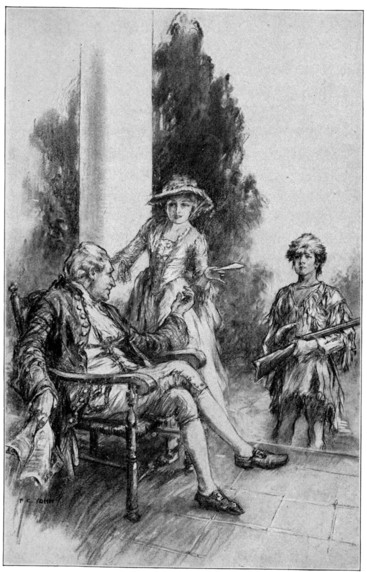
At the front door Harry hailed him and
Barbara came running out.
“I forgot to get you another suit of clothes
last night,” he said, “and we were scared
this morning. We thought you had left us,
and Barbara there nearly cried.” Barbara
blushed now and did not deny.
“Come to breakfast!” she cried.
“Did you find anything to shoot?” Harry
asked.
“Nothin’ but some squirrels,” said the lad.
61
Colonel Dale soon came in.
“You’ve got the servants mystified,” he
said laughingly. “They think you’re a witch.
How did you kill those squirrels?”
“I couldn’t see their heads—so I barked
’em.”
“Barked?”
“I shot between the bark and the limb
right under the squirrel, an’ the shock kills
’em. Uncle Dan’l Boone showed me how to
do that.”
“Daniel Boone!” breathed Harry. “Do
you know Daniel Boone?”
“Shucks, Dave can beat him shootin’.”
And then Hugh came in, pale of face and
looking rather ashamed. He went straight
to the Kentuckian.
“I was rude to you last night and I owe
you an apology.”
He thrust out his hand and awkwardly the
boy rose and took it.
“And you’ll forgive me, too, Barbara?”
“Of course I will,” she said happily, but
holding up one finger of warning—should he
ever do it again. The rest of the guests
trooped in now, and some were going out on
62
horseback, some for a sail, and some visiting
up the river in a barge, and all were paired
off, even Harry.
“I’m going to drive Cousin Erskine over
the place with my ponies,” said Barbara,
“and——”
“I’m going back to bed,” interrupted Hugh,
“or read a little Latin and Greek with Mr.
Brockton.” There was impudence as well
as humor in this, for the tutor had given up
Hugh in despair long ago.
Barbara shook her head.
“You are going with us,” she said.
“I want Hugh to ride with me,” said
Colonel Dale, “and give Firefly a little exercise.
Nobody else can ride him.”
The Kentucky boy turned a challenging
eye, as did every young man at the table,
and Hugh felt very comfortable. While every
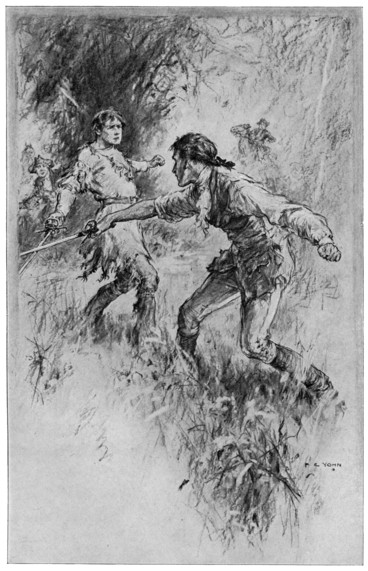
one was getting ready, Harry brought out two
foils and two masks on the porch a little later.
“We fight with those,” he said, pointing
to the crossed rapiers on the wall, “but we
practise with these. Hugh, there, is the
champion fencer,” he said, “and he’ll show
you.”
63
Harry helped the Kentucky boy to mask
and they crossed foils—Hugh giving instructions
all the time and nodding approval.
“You’ll learn—you’ll learn fast,” he said.
And over his shoulder to Harry:
“Why, his wrist is as strong as mine now,
and he’s got an eye like a weasel.”
With a twist he wrenched the foil from his
antagonist’s hand and clattered it on the
steps. The Kentuckian was bewildered and
his face flushed. He ran for the weapon.
“You can’t do that again.”
“I don’t believe I can,” laughed Hugh.
“Will you learn me some more?” asked the
boy eagerly.
“I surely will.”
A little later Barbara and her cousin were
trotting smartly along a sandy road through
the fields with the colonel and Hugh loping
in front of them. Firefly was a black mettlesome
gelding. He had reared and plunged
when Hugh mounted, and even now he was
champing his bit and leaping playfully at
times, but the lad sat him with an unconcern
of his capers that held the Kentucky boy’s
eyes.
64
“Gosh,” he said, “but Hugh can ride!
I wonder if he could stay on him bareback.”
“I suppose so,” Barbara said; “Hugh can
do anything.”
The summer fields of corn and grain waved
away on each side under the wind, innumerable
negroes were at work and song on either
side, great barns and whitewashed cabins
dotted the rich landscape which beyond the
plantation broke against woods of sombre
pines. For an hour they drove, the boy’s
bewildered eye missing few details and understanding
few, so foreign to him were all the
changes wrought by the hand, and he could
hardly have believed that this country was
once as wild as his own—that this was to be
impoverished and his own become even a
richer land. Many questions the little girl
asked—and some of his answers made her
shudder.
“Papa said last night that several of our
kinsfolk spoke of going to your country in a
party, and Harry and Hugh are crazy to go
with them. Papa said people would be
swarming over the Cumberland Mountains
before long.”
65
“I wish you’d come along.”
Barbara laughed.
“I wouldn’t like to lose my hair.”
“I’ll watch out for that,” said the boy
with such confident gravity that Barbara
turned to look at him.
“I believe you would,” she murmured.
And presently:
“What did the Indians call you?”
“White Arrow.”
“White Arrow. That’s lovely. Why?”
“I could outrun all the other boys.”
“Then you’ll have to run to-morrow when
we go to the fair at Williamsburg.”
“The fair?”
Barbara explained.
For an hour or more they had driven and
there was no end to the fields of tobacco and
grain.
“Are we still on your land?”
Barbara laughed. “Yes, we can’t drive
around the plantation and get back for dinner.
I think we’d better turn now.”
“Plan-ta-tion,” said the lad. “What’s
that?”
Barbara waved her whip.
66
“Why, all this—the land—the farm.”
“Oh!”
“It’s called Red Oaks—from those big
trees back of the house.”
“Oh. I know oaks—all of ’em.”
She wheeled the ponies and with fresh
zest they scampered for home. She even
let them run for a while, laughing and chatting
meanwhile, though the light wagon
swayed from side to side perilously as the boy
thought, and when, in his ignorance of the
discourtesy involved, he was on the point of
reaching for the reins, she spoke to them and
pulled them gently into a swift trot. Everybody
had gathered for the noonday dinner
when they swung around the great trees and
up to the back porch. The clamor of the
great bell gave its summons and the guests
began straggling in by couples from the garden.
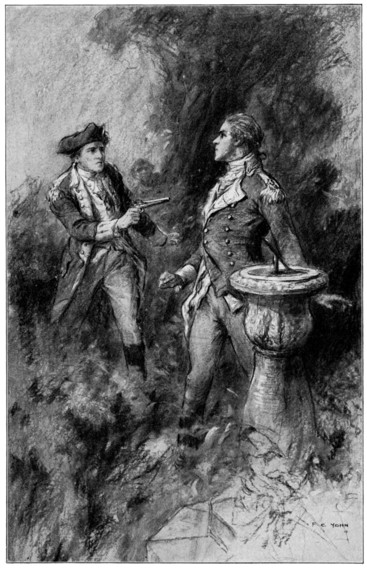
Just as they were starting in the
Kentucky boy gave a cry and darted down the
path. A towering figure in coonskin cap and
hunter’s garb was halted at the sun-dial and
looking toward them.
“Now, I wonder who that is,” said Colonel
Dale. “Jupiter, but that boy can run!”
67
They saw the tall stranger stare wonderingly
at the boy and throw back his head and
laugh. Then the two came on together. The
boy was still flushed but the hunter’s face
was grave.
“This is Dave,” said the boy simply.
“Dave Yandell,” added the stranger, smiling
and taking off his cap. “I’ve been at
Williamsburg to register some lands and I
thought I’d come and see how this young man
is getting along.”
Colonel Dale went quickly to meet him with
outstretched hand.
“I’m glad you did,” he said heartily.
“Erskine has already told us about you.
You are just in time for dinner.”
“That’s mighty kind,” said Dave. And
the ladies, after he was presented, still looked
at him with much curiosity and great interest.
Truly, strange visitors were coming to Red
Oaks these days.
That night the subject of Hugh and Harry
going back home with the two Kentuckians
was broached to Colonel Dale, and to the wondering
delight of the two boys both fathers
seemed to consider it favorably. Mr. Brockton was
68
going to England for a visit, the
summer was coming on, and both fathers
thought it would be a great benefit to their
sons. Even Mrs. Dale, on whom the hunter
had made a most agreeable impression, smiled
and said she would already be willing to trust
her son with their new guest anywhere.
“I shall take good care of him, madam,”
said Dave with a bow.
Colonel Dale, too, was greatly taken with
the stranger, and he asked many questions
of the new land beyond the mountains.
There was dancing again that night, and the
hunter, towering a head above them all,
looked on with smiling interest. He even took
part in a square dance with Miss Jane Willoughby,
handling his great bulk with astonishing
grace and lightness of foot. Then
the elder gentlemen went into the drawing-room
to their port and pipes, and the boy
Erskine slipped after them and listened enthralled
to the talk of the coming war.
Colonel Dale had been in Hanover ten
years before, when one Patrick Henry voiced
the first intimation of independence in Virginia;
Henry, a country storekeeper—bankrupt; farmer—bankrupt;
69
storekeeper again,
and bankrupt again; an idler, hunter, fisher,
and story-teller—even a “barkeeper,” as Mr.
Jefferson once dubbed him, because Henry
had once helped his father-in-law to keep
tavern. That far back Colonel Dale had
heard Henry denounce the clergy, stigmatize
the king as a tyrant who had forfeited all
claim to obedience, and had seen the orator
caught up on the shoulders of the crowd and
amidst shouts of applause borne around the
court-house green. He had seen the same
Henry ride into Richmond two years later
on a lean horse: with papers in his saddle-pockets,
his expression grim, his tall figure
stooping, a peculiar twinkle in his small blue
eyes, his brown wig without powder, his coat
peach-blossom in color, his knee-breeches of
leather, and his stockings of yarn. The
speaker of the Burgesses was on a dais under
a red canopy supported by gilded rods, and
the clerk sat beneath with a mace on the
table before him, but Henry cried for liberty
or death, and the shouts of treason failed
then and there to save Virginia for the king.
The lad’s brain whirled. What did all this
70
mean? Who was this king and what had he
done? He had known but the one from whom
he had run away. And this talk of taxes
and Stamp Acts; and where was that strange
land, New England, whose people had made
tea of the salt water in Boston harbor?
Until a few days before he had never known
what tea was, and he didn’t like it. When he
got Dave alone he would learn and learn and
learn—everything. And then the young people
came quietly in and sat down quietly,
and Colonel Dale, divining what they wanted,
got Dave started on stories of the wild wilderness
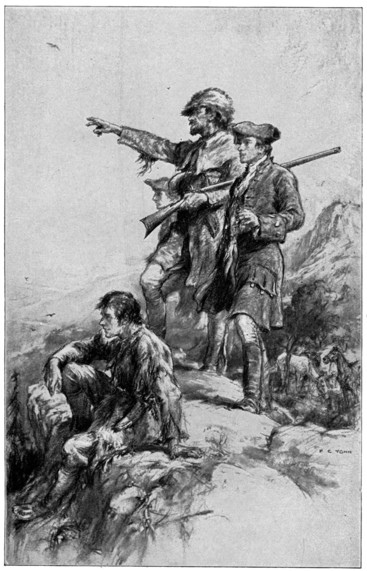
that was his home—the first chapter in
the Iliad of Kentucky—the land of dark
forests and cane thickets that separated
Catawbas, Creeks, and Cherokees on the
south from Delawares, Wyandottes, and
Shawnees on the north, who fought one another,
and all of whom the whites must fight.
How Boone came and stayed two years in
the wilderness alone, and when found by his
brother was lying on his back in the woods
lustily singing hymns. How hunters and
surveyors followed; how the first fort was
built, and the first women stood on the banks
of the Kentucky River. He told of the perils
71
and hardships of the first journeys thither—fights
with wild beasts and wild men, chases,
hand-to-hand combats, escapes, and massacres—and
only the breathing of his listeners
could be heard, save the sound of his own
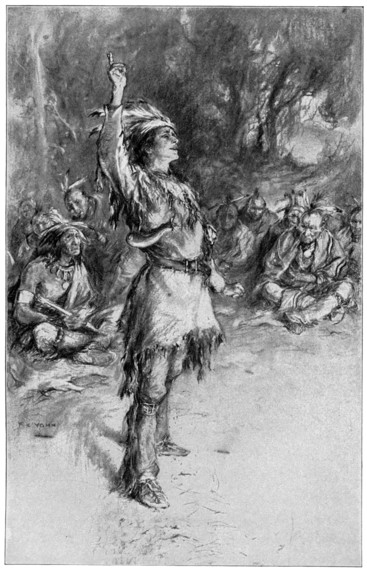
voice. And he came finally to the story of
the attack on the fort, the raising of a small
hand above the cane, palm outward, and the
swift dash of a slender brown body into the
fort, and then, seeing the boy’s face turn scarlet,
he did not tell how that same lad had
slipped back into the woods even while the
fight was going on, and slipped back with the
bloody scalp of his enemy, but ended with
the timely coming of the Virginians, led by
the lad’s father, who got his death-wound
at the very gate. The tense breathing of his
listeners culminated now in one general deep
breath.
Colonel Dale rose and turned to General
Willoughby.
“And that’s where he wants to take our
boys.”
“Oh, it’s much safer now,” said the hunter.
“We have had no trouble for some time, and
there’s no danger inside the fort.”
“I can imagine you keeping those boys
72
inside the fort when there’s so much going
on outside. Still—” Colonel Dale stopped
and the two boys took heart again. The
ladies rose to go to bed, and Mrs. Dale was
shaking her head very doubtfully, but she
smiled up at the tall hunter when she bade
him good night.
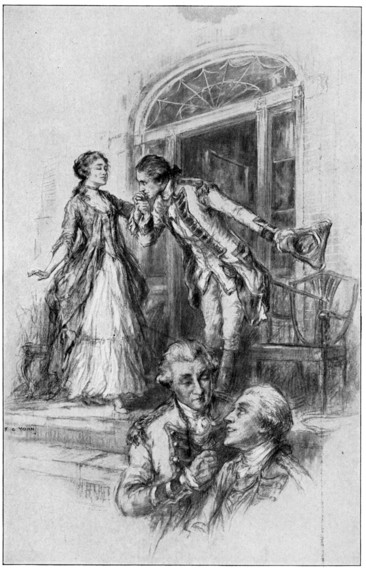
“I shall not take back what I said.”
“Thank you, madam,” said Dave, and he
bent his lips to her absurdly little white hand.
Colonel Dale escorted the boy and Dave to
their room. Mr. Yandell must go with them
to the fair at Williamsburg next morning,
and Mr. Yandell would go gladly. They
would spend the night there and go to the
Governor’s Ball. The next day there was a
county fair, and perhaps Mr. Henry would
speak again. Then Mr. Yandell must come
back with them to Red Oaks and pay them a
visit—no, the colonel would accept no excuse
whatever.
The boy plied Dave with questions about
the people in the wilderness and passed to
sleep. Dave lay awake a long time thinking
that war was sure to come. They were Americans
now, said Colonel Dale—not Virginians,
73
just as nearly a century later the same people
were to say:
“We are not Americans now—we are
Virginians.”