Enquire Within Upon Everything
![[Illustration]](https://openoldbooks.sgp1.digitaloceanspaces.com/books/enquire-within-upon-everything/images/EI1.gif)
the great Victorian-era domestic standby
with hyperlinked index
to Study the Rules of Etiquette;
to Serve a Relish for Breakfast or Supper;
to Plan a Dinner for a Large Party or a Small One;
to Cure a Headache;
to Make a Will;
to Get Married;
to Bury a Relative;
Whatever You May Wish to Do, Make, or to Enjoy,
Provided Your Desire has Relation to the Necessities of Domestic Life,
I Hope You will not Fail to 'Enquire Within.'"—Editor.
1894
Table of Contents
- Adulterations of Food, Tests for
- Beverages, Preparation of, and Receipts for
- Bird-Keeping, Bee-Keeping, and Poultry-Keeping
- Carving, Arrangements of the Dinner-Table, etc.
- Children, Rearing and Management of
- Choice of Food, Marketing, etc.
- Confectionery: Cakes, Jellies, Sweetmeats
- Commercial and Monetary Hints, Maxims
- Correct Speaking, Hints on Writing
- Decoration, Painting, Staining, Gilding etc.
- Destruction of Vermin, Noxious Animals
- Dress, Choice, Arrangement, and Care of
- Dyeing, Scouring, Cleaning, Laundry Operations
- Emergencies and Accidents, Drowning, Fire, etc.
- Etiquette, Forms and Ceremonies of
- Food of Various Kinds, When in Season
- Fancy Needlework
- Fuel, Lighting, etc., Economy and Management of
- Furniture, Selection and Arrangement of
- Gardening Operations Throughout the Year
- Household Carpentry, Mending, Repairing
- Indoor Games and Amusements
- Ladies' Employments: Leather-Work, Diaphanie etc.
- Legal Information and Advice
- Medical and Surgical Advice
- Minor Complaints, Cough, Cramp etc.
- Miscellaneous Preparations: Ink, Gum, Cement, etc.
- Outdoor Sports and Pastimes, Lawn Tennis
- Poisoning, Treatment in Cases of
- Preparation of Food, Cooking Operations
- Preserving and Pickling, Hints on
- Modelling, Preparing Botanical Specimens, etc.
- Rules of Conduct: Counsels, Hints, Advice
- Sanitary Precautions and Regulations
- Sauces, Relishes, Zests, How to Prepare
- Tables of Percentages, Interest, Marketing, Wages
- Toilet Requisites, Receipts for, etc.
Companion Works to Enquire Within
| title | price |
|---|---|
| Daily Wants, Dictionary of | 7s. 6d. |
| Useful Knowledge, Dictionary of | 10s. |
| Medical and Surgical Knowledge, Dictionary of | 5s. |
| Reason Why. Christian Denominations | 3s. 6d. |
| Reason Why. Physical Geography and Geology | 3s. 6d. |
| Reason Why. General Science | 2s. 6d. |
| Reason Why. Natural History | 2s. 6d. |
| Historical Reason Why. English History | 2s. 6d. |
| Reason Why. Gardener's and Farmer's | 2s. 6d. |
| Reason Why. Domestic Science for Housewives | 2s. 6d. |
| Biblical Reason Why. Sacred History | 2s. 6d. |
| Family Save-All; or, Secondary Cookery, etc. | 2s. 6d. |
| Journey of Discovery, or, The Interview | 2s. 6d. |
| Practical Housewife and Family Medical Guide | 2s. 6d. |
| Notices to Correspondents | 2s. 6d. |
| Corner Cupboard. A Family Repository | 2s. 6d. |
| How a Penny Became a Thousand Pounds Life Doubled by the Economy of Time Either of these two Works separately |
2s. 6d. 1s. 6d. cloth |
| Wonderful Things of All Nations, Two Series | each 2s. 6d. |
| The Historical Finger-Post | 2s. 6d. |
By the Same Editor
| title | price |
|---|---|
| History of Progress in Great Britain. Two Series | each 6s. |
| That's It; or, Plain Teaching. Cloth, gilt edges | 3s. 6d. |
| Walks Abroad and Evenings at Home. Cloth, gilt edges | 3s. 6d. |
| Elegant Work for Delicate Fingers | 1s. |
| Philosophy and Mirth United by Pen and Pencil | 1s. |
| Handy Book of Shopkeeping, or, Shopkeeper's Guide | 1s. |
| Shilling Kitchiner, or, Oracle of Cookery for the Million | 1s. |
Editor's Preface
If there be any among my Readers who, having turned over the pages of "Enquire Within," have hastily pronounced them to be confused and ill-arranged, let them at once refer to The Index, at page 389, and for ever hold their peace.
The Index is, to the vast congregation of useful hints and receipts that fill the pages of this volume, what the Directory is to the great aggregation of houses and people in London.
No one, being a stranger to London, would run about asking for "Mr. Smith." But, remembering the Christian name and the profession of the individual wanted, he would turn to the Directory, and trace him out.
Like a house, every paragraph in "Enquire Within" has its number,—and the Index is the Directory which will explain what Facts, Hints, and Instructions inhabit that number.
For, if it be not a misnomer, we are prompted to say that "Enquire Within" is peopled with hundreds of ladies and gentlemen, who have approved of the plan of the work, and contributed something to its store of useful information. There they are, waiting to be questioned, and ready to reply. Within each page some one lives to answer for the correctness of the information imparted, just as certainly as where, in the window of a dwelling, you see a paper directing you to "Enquire Within," some one is there to answer you.
Housekeepers of experience live at Nos. 1, 30, 438, 1251 and 2091; old Dr. Kitchiner lives at 44; Captain Crawley is to be found at 46 and 2568; the well-known Mrs. Warren lives at 1809; Miss Acton at 1310; Dr. Franklin at 1398; Mrs. Hitching at 215; Mr. Banting at 1768; Dr. Wilson Philip at 1762; Mr. Withering at 2338; Mr. Mechi at 997; Dr. Stenhouse at 1776; Dr. Erasmus Wilson at 1700; Dr. Southwood Smith at 1743; Dr. Blair at 2180; M. Soyer at 1130; Dr. Babington at 2407; Miss Gifford at 2337; and Dr. Clark at 2384. In addition to these and many more, a Doctor lives at 475; a Gardener at 249; a Schoolmaster at 161; a Butcher at 27; a Dancing-Master at 139; an Artist at 2548; a Naturalist at 2330; a Dyer at 2682; a Modeller at 2346; a Professed Cook at 1032; a Philanthropist at 1368; a Lawyer at 1440; a Surgeon at 796; a Chess Player at 71; a Whist Player, almost next door, at 73; a Chemist at 650; a Brewer at 2267; a Lawn Tennis Player at 2765; a homœopathic Practitioner at 925; a Wood-stainer at 1413; two Confectioners at 1628 and 2024; a Poultry-Keeper at 1642; a Meteorologist at 962; Philosophers at 973 and 1783; a Practical Economist at 985; a Baker at 1002; a Master of the Ceremonies at 1924 and 2613; a Bird Fancier at 2155: a Washerwoman at 2729; an Analytical Chemist at 2747; an Accountant at 2769; and so on.
Well! there they live—always at home. Knock at their doors—Enquire Within. No Fees to Pay!!
Much care has been taken in selecting the information that is given, and, as is amply shown by the above list, so many kind and competent friends have lent a hand in the production of this volume that is impossible to turn to any page without at once being reminded of the Generous Friend who abides there.
To some extent, though in a far less degree, assistance has been rendered by the authors of many useful and popular works, for which due acknowledgment must be made. Chief among these works are Dr. Kitchiner's "Cooks' Oracle"; "The Cook," in Houlston and Sons' Industrial Library; "The Shopkeeper's Guide;" "The Wife's Own Cookery," "The Practical Housewife," and many of the volumes of the "Reason Why" series.
Lastly, as in everyday life it is found necessary at times to make a thorough inspection of house and home, and to carry out requisite repairs, alterations, and additions, this has been done in the recent editions of "Enquire Within," to which some hundreds of paragraphs have been added, while others have been remodelled and revised in accordance with the progress of the times in which we live. Care, however, has been taken to alter nothing that needed no alteration, so that, practically, this Popular Favourite is still the old "Enquire Within;" improved, it is true, but in no way so changed as to place it beyond the recognition of those to whom it has been a Book Of Constant Reference since its first appearance.
Publisher's Preface
| volume | title | details |
|---|---|---|
| 1-3 | Daily Wants, the Dictionary of | containing nearly 1,200 pages of Information upon all matters of Practical and Domestic Utility. Above 118,000 copies have been sold. |
| 4-7 | Useful Knowledge, the Dictionary of | a Book of Reference upon History, Geography, Science, Statistics, &c A Companion Work to the Dictionary of Daily Wants. |
| 8 & 9 | Medical and Surgical Knowledge, the Dictionary of | a Complete Practical Guide on Health and Disease, for Families, Emigrants, and Colonists. |
| 10 | Enquire Within Upon Everything | |
| 11 | The Reason Why, Christian Denominations | giving the Origin, History, and Tenets of the Christian Sects, with the Reasons assigned by themselves for their Specialities of Faith and forms of Worship. |
| 12 | The Reason Why, Physical Geography and Geology | containing upwards of 1,200 Reasons, explanatory of the Physical Phenomena of Earth and Sea, their Geological History, and the Geographical distribution of Plants, Animals, and the Human Race. |
| 13 | The Reason Why, Biblical and Sacred History | a Family Guide to Scripture Readings, and a Handbook for Biblical Students. |
| 14 | The Reason Why, General Science | giving Hundreds of Reasons for things which, though generally received, are imperfectly understood. This Volume has reached a sale of 53,000. |
| 15 | The Reason Why, Historical | designed to simplify the study of English History. |
| 16 | The Reason Why, Natural History | giving Reasons for very numerous interesting Facts in connection with the Habits and Instincts of the various Orders of the Animal Kingdom. |
| 17 | The Reason Why, Gardening and Farming | giving some Thousands of Reasons for various Facts and Phenomena in reference to the Cultivation and Tillage of the Soil. |
| 18 | The Reason Why, Houswife's Science | affording to the Manager of Domestic Affairs intelligible Reasons for the various duties she has to superintend or to perform. |
| 19 | Journey of Discovery All Round Our House, or, The Interview | with copious Information upon Domestic Matters. |
| 20 | The Practical Housewife and Family Medical Guide | a Series of Instructive Papers on Cookery, Food, Treatment of the Sick, &c, &c |
| 21 | The Family Save-All | a System of Secondary Cookery with Hints for Economy in the use of Articles of Household Consumption. |
| 22 | Notices to Correspondents | a Work full of curious Information on all Subjects, gathered from actual Answers to Correspondents of various Magazines and Newspapers. |
| 23 | The Corner Cupboard | containing Domestic Information, Needlework Designs, and Instructions for the Aquarium, &c |
| 24 | Life Doubled by the Economy of Time and How a Penny Became a Thousand Pounds | The first of these teaches the Value of Moments, and shows how Life may be abridged by a careless indifference to trifles of time; the second pursues a similar argument with reference to Money. |
| 25 & 26 | Wonderful Things | affording interesting descriptions of the Wonders of all Nations, with Illustrations. |
| 27 | The Historical Finger-Post | giving briefly, but clearly, the meaning and origin of hundreds of Terms, Phrases, Epithets, Cognomens, Allusions, &c, in connection with History, Politics, Theology, Law, Commerce, Literature, Army and Navy, Arts and Sciences, Geography, Tradition, National, Social, and Personal Characteristics. &c |
The Miser Fasts with Greedy Mind to Spare.
| iii. Lamb | ||
| is cut into | fore quarter | |
| hind quarter | ||
| saddle | ||
| loin | ||
| neck | ||
| breast | ||
| leg | ||
| and shoulder |
'House lamb' from Christmas to Lady-day.
| iv. Pork | ||
| is cut into | leg | |
| hand or shoulder | ||
| hind loin | ||
| fore loin | ||
| belly-part | ||
| spare-rib, or neck | ||
| and head |
| vi. Venison | ||
| is cut into | haunch | |
| neck | ||
| shoulder | ||
| and breast |
| the hough | or hind leg |
| the nineholes | or English buttock |
| the large and small runner | taken from the rib and chuck pieces of the English plan |
| the shoulder-lyer | the English shoulder, but cut differently |
| the spare-rib or fore-sye | the sticking piece, &c |
Barbel, brill, carp, cod, crabs, cray-fish, dabs, dace, eels, flounders, haddocks, herrings, lampreys, ling, lobsters, mussels, oysters, perch, pike, plaice, prawns, salmon-trout, shrimps, skate, smelts, soles, sprats, sturgeon, tench, thornback, turbot, whiting.
Beef, house-lamb, mutton, pork, veal, and doe venison.
Capons, chickens, ducks, wild-ducks, fowls, geese, grouse, hares, larks, moor-game, partridges, pheasants, pigeons (tame), pullets, rabbits, snipes, turkeys (hen), widgeons, woodcocks.
Beet, broccoli (white and purple), Brussels sprouts, cabbage, cardoons, carrots, celery, chervil, colewort, cresses, endive, garlic, herbs (dry), Jerusalem artichokes, kale (Scotch), leeks, lettuces, mint (dry), mustard, onions, parsley, parsnips, potatoes, rape, rosemary, sage, salsify, Savoy cabbages, scorzonera, shalots, skirrets, sorrel, spinach (winter), tarragon, thyme, turnips.
Asparagus, cucumbers, mushrooms, sea-kale.
Almonds. Apples: Golden pippin, golden russet, Kentish pippin, nonpareil, winter pearmain. Pears: Bergamot d'Hollande, Bon Chrétien, Chaumontel, Colmar, winter beurré. Grapes: English and foreign. Chestnuts, medlars, oranges, walnuts, filbert nuts.
The Hypocrite Will Fast Seem More Holy.
Barbel, brill, carp, cockles, cod, crabs, cray-fish, dabs, dace, eels, flounders, haddocks, herrings, lampreys, ling, lobsters, mussels, oysters, perch, pike, plaice, prawns, salmon, shrimps, skate, smelts, soles, sturgeon, tench, thornback, turbot, whiting.
Beef, house-lamb, mutton, pork, veal.
Capons, chickens, ducklings, geese, hares, partridges, pheasants, pigeons (tame and wild), rabbits (tame), snipes, turkeys, turkey poults, wild-ducks, woodcocks.
Beet, broccoli (white and purple), Brussels sprouts, cabbage, cardoons, carrots, celery, chervil, colewort, cresses, endive, garlic, herbs (dry), Jerusalem artichokes, leeks, lettuces, mint (dry), mushrooms, onions, parsnips, parsley, potatoes, radish, rape, rosemary, sage, salsify, Savoys, scorzonera, shalots, skirrets, sorrel, spinach, sprouts, tarragon, thyme, turnips, winter savoury.
Asparagus, cucumbers, mushrooms, sea-kale, &c
Apples: Golden pippin, golden russet, Holland pippin, Kentish pippin, nonpareil, Wheeler's russet, winter pearmain. Chestnuts, oranges. Pears: Bergamot, winter Bon Chrétien, winter Russelet.
Brill, carp, cockles, cod, conger-eels, crabs, dabs, dory, eels, flounders, ling, lobsters, mackerel, mullets, mussels, oysters, perch, pike, plaice, prawns, salmon, salmon-trout, shrimps, skate, smelts, soles, sturgeon, turbot, tench, and whiting.
Beef, house-lamb, mutton, pork, veal.
Capons, chickens, ducklings, fowls, geese, grouse, leverets, pigeons, rabbits, snipes, turkeys, woodcocks.
Artichokes (Jerusalem), beet, broccoli (white and purple), Brussels sprouts, cabbage, cardoons, carrots, celery, chervil, colewort, cresses, endive, garlic, herbs (dry), kale (sea and Scotch), lettuces, mint, mushrooms, mustard, onions, parsley, parsnips, potatoes, rape, rosemary, sage, Savoys, shalots, sorrel, spinach, tarragon, thyme, turnips, turnip-tops.
Asparagus, French beans, cucumbers, and rhubarb.
Apples: Golden russet, Holland pippin, Kentish pippin, nonpareil, Norfolk beefing, Wheeler's russet. Chestnuts, oranges. Pears: Bergamot, Chaumontel, winter Bon Chrétien. Forced: Strawberries.
Brill, carp, chub, cockles, cod, conger-eels, crabs, dabs, dory, eels, floandeis, halibut, herrings, ling, lobsters, mackerel, mullets, mussels, oysters, perch, pike, prawns, plaice, salmon, shrimps, skate, smelts, soles, sturgeon, tench, trout, turbot, whiting.
Beef, grass-lamb, house-lamb, mutton, pork, veal.
Chickens, ducklings, fowls, geese, leverets, pigeons, pullets, rabbits, turkey poults, wood-pigeons.
Asparagus, broccoli, chervil, colewort, cucumbers, endive, fennel, herbs of all sorts, lettuce, onions, parsley, parsnips, peas, radishes, sea-kale, sorrel, spinach, small salad, tarragon, turnip-radishes, turnip-tops, and rhubarb.
Apples: Golden russet, nonpareil, Wheeler's russet. Nuts, oranges. Pears: Bergamot, Bon Chrétien, Carmelite. Forced: Apricots, cherries, strawberries.
Brill, carp, chub, cod, conger-eels, crab, cray-fish, dabs, dace, dory, eels, flounders, gurnets, haddock, halibut, herring, ling, lobsters, mackerel, mullet, perch, pike, plaice, prawns, salmon, shrimps, skate, smelts, soles, sturgeon, tench, trout, turbot, whiting.
Beef, grass-lamb, house-lamb, mutton, pork, veal.
Chickens, ducklings, fowls, geese, leverets, pigeons, pullets, rabbits; wood-pigeons.
Angelica, artichokes, asparagus, balm, kidney-beans, cabbage, carrots, cauliflowers, chervil, cucumbers, fennel, herbs of all sorts, lettuce, mint, onions, parsley, peas, new potatoes, radishes, rhubarb, salad of all sorts, sea-kale, sorrel, spinach, turnips.
Apples: Golden russet, winter russet. May-duke cherries; currants; gooseberries; melons. Pears: L'amozette, winter-green. Forced: Apricots, peaches, strawberries.
Carp, cod, conger-eels, crabs, cray-fish, dabs, dace, dory, eels, flounders, gurnets, haddocks, herrings, ling, lobsters, mackerel, mullet, perch, pike, plaice, prawns, salmon, salmon-trout, skate, smelts, soles, sturgeon, tench, trout, turbot, whitebait, whiting.
Beef, grass-lamb, house-lamb, mutton, pork, veal, buck venison.
Chickens, ducklings, fowls, geese, leverets, pigeons, plovers, pullets, rabbits, turkey poults, wheat-ears, wood-pigeons.
Angelica, artichokes, asparagus, beans (French, kidney, and Windsor), white beet, cabbage, carrots, cauliflowers, chervil, cucumbers, endive, herbs of all sorts, leeks, lettuce, onions, peas, potatoes, radishes, salad of all sorts, spinach, turnips, vegetable marrow.
Burnet, mint, tarragon, lemon thyme.
Apples: Quarrenden, stone pippin, golden russet. Apricots. Cherries: May-duke, bigaroon, white-heart. Currants; gooseberries; melons. Pears: Winter-green. Strawberries. Forced: Grapes, nectarines, peaches, pines.
Barbel, brill, carp, cod, conger-eels, crabs, cray-fish, dabs, dace, dory, eels, flounders, gurnets, haddocks, herrings, ling, lobsters, mackerel, mullet, perch, pike, plaice, prawns, salmon, skate, soles, tench, thornback, trout.
Beef, grass-lamb, mutton, veal, buck venison.
Chickens, ducks, fowls, green geese, leverets, pigeons, plovers, rabbits, turkey poults, wheat-ears, wild pigeons, wild rabbits.
Artichokes, asparagus, balm, beans (French, kidney, scarlet, and Windsor), carrots, cauliflowers, celery, chervil, cucumbers, endive, herbs of all sorts, lettuces, mushrooms, peas, potatoes, radishes, salads of all sorts, salsify, scorzonera, sorrel, spinach, turnips.
Knotted marjoram, mushrooms, winter savoury.
French beans, red cabbage, cauliflowers, garlic, gherkins, nasturtiums, onions.
Apples: Codlin, jennetting, Margaret, summer pearmain, summer pippin, quarrenden. Apricots, cherries (black-heart), currants, plums, greengages, gooseberries, melons, nectarines, peaches. Pears: Catherine, green-chisel, jargonelle. Pineapples, raspberries, strawberries.
Barbel, brill, carp, cod, conger-eels, crabs, cray-fish, dabs, dace, eels, flounders, gurnets, haddocks, herrings, lobsters, mackerel, mullet, oysters, perch, pike, plaice, prawns, salmon, skate, tench, thornback, turbot, whiting.
Beef, grass-lamb, mutton, veal, buck venison.
Chickens, ducks, fowls, green geese, grouse (from 12th), leverets, pigeons, plovers, rabbits, turkeys, turkey poults, wheat-ears, wild ducks, wild pigeons, wild rabbits.
Artichokes, beans (French, kidney, scarlet and Windsor), white beet, carrots, cauliflowers, celery, cucumbers, endive, pot-herbs of all sorts, leeks, lettuces, mushrooms, onions, peas, potatoes, radishes, salad of all sorts, salsify, scorzonera, shalots, spinach, turnips.
Basil, sage, thyme.
Red cabbage, capsicums, chilies, tomatoes, walnuts.
Apples: Codlin, summer pearmain, summer pippin. Cherries, currants, figs, filberts, gooseberries, grapes, melons, mulberries, nectarines, peaches. Pears: Jargonelle, summer, Bon Chrétien, Windsor. Plums, greengages, raspberries, Alpine strawberries.
Without Economy None can be Rich.
Barbel, brill, carp, cockles, cod, conger-eels, crab, dace, eels, flounders, gurnets, haddocks, hake, herrings, lobsters, mullet, mussels, oysters, perch, pike, plaice, prawns, shrimps, soles, tench, thornback, turbot, whiting.
Beef, mutton, pork, veal, buck venison.
Chickens, ducks, fowls, green geese, grouse, hares, larks, leverets, partridges, pigeons, plovers, rabbits, teal, turkeys, turkey poults, wheat-ears, wild ducks, wild pigeons, wild rabbits.
Artichokes, Jerusalem artichokes, beans (French and scarlet), cabbages, carrots, cauliflowers, celery, cucumbers, endive, herbs of all sorts, leeks, lettuces, mushrooms, onions, parsnips, peas, potatoes, radishes, salad of all sorts, shalots, turnips.
Apples: Golden nob, pearmain, golden rennet. Cherries (Morella), damsons, figs, filberts. Grapes: Muscadine, Frontignac, red and black Hamburgh, Malmsey. Hazel nuts, walnuts, medlars, peaches. Pears: Bergamot, brown beurré. Pineapples, plums, quinces, strawberries, walnuts.
Barbel, brill, turbot, carp, cockles, cod, conger-eels, crabs, dace, dory, eels, gudgeon, haddocks, hake, halibut, herrings, lobsters, mussels, oysters, perch, pike, prawns, salmon-trout, shrimps, smelts, soles, tench, thornback, whiting.
Beef, mutton, pork, veal, doe venison.
Chickens, dotterel, ducks, fowls, green geese, grouse, hares, larks, moor-game, partridges, pheasants, pigeons, rabbits, snipes, teal, turkey, wheat-ears, widgeon, wild ducks, wild pigeons, wild rabbits, woodcocks.
Artichokes, Jerusalem artichokes, broccoli, cabbages, cauliflowers, celery, coleworts, endive, herbs of all sorts, leeks, onions, parsnips, peas, potatoes, radishes, salad, Savoys, scorzonera, skirrets, shalots, spinach (winter), tomatoes, truffles, turnips.
Apples: Pearmain, golden pippin, golden rennet, royal russet. Black and white bullace, damsons, late figs, almonds, filberts, hazel nuts, walnuts, filberts. Grapes, medlars. Peaches: Old Newington, October. Pears: Bergamot, beurré, Chaumontel, Bon Chrétien, swan's-egg. Quinces, services, walnuts.
Barbel, brill, turbot, carp, cockles, cod, crabs, dace, dory, eels, gudgeons, gurnets, haddocks, hake, halibut, herrings, ling, lobsters, mussels, oysters, perch, pike, plaice, prawns, salmon, shrimps, skate, smelts, soles, sprats, tench, thornback, turbot, whiting.
Beef, house-lamb, mutton, pork, veal, doe venison.
Chickens, dotterel, ducks, fowls, geese, grouse, hares, larks, partridges, pheasants, pigeons, rabbits, snipes, teal, turkey, wheat-ears, widgeon, wild ducks, wood-cocks.
Jerusalem artichokes, beet root, borecole, broccoli, cabbages, cardoons, carrots, celery, chervil, coleworts, endive, herbs of all sorts, leeks, lettuces, onions, parsnips, potatoes, salad, Savoys, scorzonera, skirrets, shalots, spinach, tomatoes, turnips.
Almonds. Apples: Holland pippin, golden pippin, Kentish pippin, nonpareil, winter pearmain, Wheeler's russets. Bullace, chestnuts, hazel nuts, walnuts, filberts, grapes, medlars. Pears: Bergamot, Chaumontel, Bon Chrétien.
With Economy, Few Need be Poor.
Barbel, brill, turbot, carp, cockles, cod, crabs, dab, dory, eels, gudgeon, gurnets, haddocks, bake, halibut, herrings, ling, lobsters, mackerel, mussels, oysters, perch, pike, plaice, ruffe, salmon, shrimps, skate, smelts, soles, sprats, sturgeon, tench, whitings.
Beef, house-lamb, mutton, pork, veal, doe venison.
Capons, chickens, ducks, fowls, geese, grouse, guinea-fowl, hares, larks, partridges, pea-fowl, pheasants, pigeons, rabbits, snipes, teal, turkeys, wheat-ears, widgeon, wild ducks, woodcocks.
Jerusalem artichokes, beet root, borecole, white and purple broccoli, cabbages, cardoons, carrots, celery, endive, herbs of all sorts, leeks, lettuces, onions, parsnips, potatoes, salad, Savoys, scorzonera, skirrets, shalots, spinach, truffles, turnips, forced asparagus.
Almonds. Apples: Golden pippin, nonpareil, winter pearmain, golden russet. Chestnuts, hazel nuts, walnuts, filberts, Almeria grapes, medlars, oranges. Pears: Bergamot, beurré d'hiver.
| Basil | is in a fit state for drying about the middle of August |
| Burnet | in June, July, and August |
| Chervil | in May, June, and July |
| Elder Flowers | in May, June, and July |
| Knotted Marjoram | during July |
| Lemon Thyme | end of July and through August |
| Mint | end of June and July |
| Orange Flowers | May, June, and July |
| Parsley | May, June, and July |
| Sage | August and September |
| Summer Savoury | end of July and August |
| Tarragon | June, July, and August |
| Thyme | end of July and August |
| Winter Savoury | end of July and August |
Do Good to your Enemy, that he may become Your Friend.
| Sunday | Roast beef and pudding. |
| Monday | Fowl, what was left of pudding fried, or warmed in the Dutch oven. |
| Tuesday | Calf's head, apple pie. |
| Wednesday | Leg of mutton. |
| Thursday | Ditto broiled or hashed, and pancakes. |
| Friday | Fish, pudding. |
| Saturday | Fish, or eggs and bacon. |
Will you do me the favour of meeting here, as a guest, on —— next, at seven precisely, a few friends who have kindly joined in an attempt to commence occasional pleasant and social parties, of which the spirit and intent will be better understood by the perusal of the few annexed remarks and rules from
Yours sincerely, ——
"They manage it better in France," is a remark to be often applied with reference to social life in England, and the writer fancies that the prevalence here of a few bad customs, easily changed, causes the disadvantageous difference between ourselves and our more courteous and agreeable neighbours.
- Worldly appearance; the phantom leading many to suppose that wealth is the standard of worth—in the minds of friends, a notion equally degrading to both parties.
- Overdress; causing unnecessary expense and waste of time.
- Expensive entertainments, as regards refreshments.
The following brief rules are suggested, in a hope to show the way to a more constant, easy, and friendly intercourse amongst friends, the writer feeling convinced that society is equally beneficial and requisite—in fact, that mankind in seclusion, like the sword in the scabbard, often loses polish, and gradually rusts.
- Late hours.
- That meetings be held in rotation at each member's house, for the enjoyment of conversation; music, grave and gay; dancing, gay only; and card-playing at limited stakes.
- That such meetings commence at seven and end about or after twelve, and that members and guests be requested to remember that punctuality has been called the politeness of kings.
- That as gentlemen are allowed for the whole season to appear, like the raven, in one suit, ladies are to have the like privilege; and that no lady be allowed to quiz or notice the habits of another lady; and that demi-toilette in dress be considered the better taste in the family circle; not that the writer wishes to raise or lower the proper standard of ladies' dress, which ought to be neither too high nor too low, but at a happy medium.
- That any lady infringing the last rule be liable to reproof by the oldest lady present at the meeting, if the oldest lady, like the oldest inhabitant, can be discovered.
- That every member or guest, be requested to bring with them their own vocal, instrumental, or dance music, and take it away with them, if possible, to avoid loss and confusion.
- That no member or guest, able to sing, play, or dance, refuse, unless excused by medical certificate; and that no cold or sore throat be allowed to last more than a week.
- That as every member or guest known to be able to sing, play, or dance, is bound to do so if requested, the performer (especially if timid) is to be kindly criticized and encouraged; it being a fact well known, that the greatest masters of an art are always the most lenient critics, from their deep knowledge of the feeling, intelligence, and perseverance required to at all approach perfection.
- That gentlemen present do pay every attention to ladies, especially visitors; but such attention is to be general, and not particular—for instance, no gentleman is to dance more than three times with one lady during the evening, except in the case of lovers, privileged to do odd things during their temporary lunacy, and also married couples, who are expected to dance together at least once during the evening, and oftener if they please.
- That to avoid unnecessary expense, the refreshments be limited to cold meat, sandwiches, bread, cheese, butter, vegetables, fruits, tea, coffee, negus, punch, malt liquors, &c, &c
- That all personal or face-to-face laudatory speeches (commonly called toasts, or, as may be, roasts) be for the future forbidden, without permission or inquiry, for reasons following:—That as the family circle includes bachelors and spinsters, and he, she, or they may be secretly engaged, it will be therefore cruel to excite hopes that may be disappointed; and that as some well-informed Benedick of long experience may after supper advise the bachelor to find the way to woman's heart—vice versa, some deep-feeling wife or widow, by "pity moven," may, perhaps, after supper advise the spinster the other way, which, in public, is an impropriety manifestly to be avoided.
- (suggested by a lady). That any lady, after supper, may (if she please) ask any gentleman apparently diffident, or requiring encouragement, to dance with her, and that no gentleman can of course refuse so kind a request.
Rule the Last: That as the foregoing remarks and rules are intended, in perfect good faith and spirit, to be considered general and not personal, no umbrage is to be taken, and the reader is to bear in mind the common and homely saying,—
- That no gentleman be expected to escort any lady home on foot beyond a distance of three miles, unless the gentleman be positive and the lady agreeable.
P.S.—To save trouble to both parties, this invitation be deemed accepted, without the necessity to reply, unless refused within twenty-four hours."Always at trifles scorn to take offence,
It shows great pride and very little sense."
As a Man Lives, so shall he Die.
A Party to charm the young and erratic—
But likely to frighten the old and rheumatic.The answer is Picnic.
- The carriage in which the fair visitants came:
- A very old tribe with a very old name;
- A brave Prince of Wales free from scandal or shame.
1. P Phaeton N 2. I Iceni I 3. C Caradoc C
A Briton supports his wig, his grand-mother, his comfort, and his country-women.
The answer is, Beef—Beer:
Bob, Eve, Ease, Fair.
| Words | Transpositions |
|---|---|
| Astronomers | No more stars |
| Catalogues | Got as a clue |
| Elegant | Neat leg |
| Impatient | Tim in a pet |
| Immediately | I met my Delia |
| Masquerade | Queer as mad |
| Matrimony | Into my arm |
| Melodrama | Made moral |
| Midshipman | Mind his map |
| Old England | Golden land |
| Parishioners | I hire parsons |
| Parliament | Partial men |
| Penitentiary | Nay I repeat it |
| Presbyterian | Best in prayer |
| Radical Reform | Rare mad frolic |
| Revolution | To love ruin |
| Sir Robert Peel | Terrible poser |
| Sweetheart | There we sat |
| Telegraphs | Great help |
| H | 51 | and | a tub | —— | a fine large fish |
| A | 100 | and | gore | —— | a sprightly movement in music |
| R | 5 | and | be | —— | a part of speech |
| U | 551 | and | as and | —— | a Spanish province |
| To | 201 | and | ran | —— | a stupefying drug |
| R | 102 | and | nt | —— | an acid |
| OU | 250 | and | pap | —— | a Mexican town |
The breath of the morning is sweet;
The earth is bespangled with flowers,
And buds in a countless array
Have ope'd at the touch of the showers.
The birds, whose glad voices are ever
A music delightful to hear,
Seem to welcome the joy of the morning,
As the hour of the bridal draws near.
What is that which now steals on my first,
Like a sound from the dreamland of love,
And seems wand'ring the valleys among,
That they may the nuptials approve?
'Tis a sound which my second explains,
And it comes from a sacred abode,
And it merrily trills as the villagers throng
To greet the fair bride on her road.
How meek is her dress, how befitting a bride
So beautiful, spotless, and pure!
When she weareth my second, oh, long may it be
Ere her heart shall a sorrow endure.
See the glittering gem that shines forth from her hair—
'Tis my whole, which a good father gave;
Twas worn by her mother with honour before—
But she sleeps in peace in her grave.
Twas her earnest request, as she bade them adieu,
That when her dear daughter the altar drew near,
She should wear the same gem that her mother had worn
When she as a bride full of promise stood there.
A Fool's Bolt Is Soon Shot.
| A | B | C | D | E | F | G | H | I | J |
|---|---|---|---|---|---|---|---|---|---|
| Aid-less | Ba-boon | Cab-in | Dark-some | Ear-ring | False-hood | Gain-say | Had-dock | Ill-nature | Jac(k)o-bite |
| Air-pump | Back-bite | Can-did | Day-break | Earth-quake | Fan-atic | Gang-way | Hail-stone | Ill-usage | Joy-ful |
| Ale-house | Back-slide | Can-ton | Death-watch | Ear-wig | Fare-well | Glow-worm | Hail-storm | In-action | Joy-less |
| Ann-ounce | Bag-gage | Care-ful | Dog-ma | Far-thing | Glut-ton | Half-penny | In-born | Justice-ship | |
| Arch-angel | Bag-pipe | Car-pet | Don-key | K | Fear-less | God-child | Ham-let | In-crease | |
| Arm-let | Bag-dad | Car-rot | Drink-able | Key-stone | Fee-ling | God-daughter | Ham-mock | In-justice | L |
| Art-less | Bail-able | Cart-ridge | Drug-get | Kid-nap | Field-farm | God-father | Hand-cuff | Ink-ling | Lace-man |
| Ass-ail | Bale-ful | Chair-man | Duck-ling | King-craft | Fire-lock | God-like | Hang-man | In-land | Lady-bird |
| Band-age | Chamber-maid | King-fisher | Fire-man | God-mother | Hap-pen | In-mate | Lady-ship | ||
| M | Band-box | Cheer-ful | N | Kins-man | Fire-pan | God-son | Hard-ship | In-no-cent | Lamp-black |
| Ma-caw | Bane-ful | Cheer-less | Name-sake | Kit-ten | Fire-ship | Gold-finch | Hard-ware | In-sane | Land-lady |
| Mad-cap | Bar-bed | Christ-mas | Nan-keen | Knight-hood | Fire-work | Gold-smith | Harts-horn | In-spirit | Land-lord |
| Mad-house | Bar-gain | Church-yard | Nap-kin | Know-ledge | Fir-kin | Goose-berry | Head-land | In-tent | Land-mark |
| Mad-man | Bar-rack | Clans-men | Neck-cloth | Fish-hook | Grand-father | Hard-ship | Inter-meddle | Land-scape | |
| Mag-pie | Bar-row | Clerk-ship | Neck-lace | O | Flag-rant | Grate-ful | Hard-ware | Inter-sect | Land-tax |
| Main-mast | Bat-ten | Cob-web | Nest-ling | Oak-apple | Flip-pant | Grave-stone | Harts-horn | Inter-view | Lap-dog |
| Main-sail | Beard-less | Cock-pit | News-paper | Oat-cake | Flood-gate | Green-finch | Head-land | In-valid | Lap-pet |
| Main-spring | Bid-den | Cod-ling | Nick-name | Oat-meal | Fond-ling | Grey-hound | Head-less | In-vent | Laud-able |
| Mam-moth | Bird-lime | Coin-age | Night-cap | Off-end | Foot-ball | Grim-ace | Head-long | In-vest | Law-giver |
| Man-age | Birth-right | Con-fined | Night-gown | Oil-man | Foot-man | Grind-stone | Head-stone | In-ward | Law-suit |
| Man-date | Black-guard | Con-firm | Night-mare | O-men | Foot-pad | Ground-plot | Head-strong | Ire-ful | Lay-man |
| Marks-man | Blame-less | Con-form | Night-watch | On-set | Foot-step | Ground-sell | Hear-say | Iron-mould | Leap-frog |
| Mar-row | Block-head | Con-tent | Nine-fold | O-pen | Foot-stool | Guard-ship | Heart-less | I-sing-lass | Leap-year |
| Mass-acre | Boat-man | Con-test | Noon-tide | O-pinion | For-age | Gun-powder | Heart-sick | Lee-ward | |
| Match-less | Boot-jack | Con-tract | North-star | Our-selves | For-bear | Heart-string | P | Life-guard | |
| May-game | Book-worm | Con-verse | North-ward | Out-act | For-bid | Q | Hedge-hog | Pack-age | Like-wise |
| Meat-man | Bound-less | Cork-screw | Not-able | Out-bid | Found-ling | Quad-rant | Heir-less | Pack-cloth | Live-long |
| Mis-chance | Bow-ling | Count-less | Not-ice | Out-brave | Fox-glove | Quench-less | Heir-loom | Pad-dock | Load-stone |
| Mis-chief | Brace-let | Court-ship | No-where | Out-brazen | Free-hold | Quick-lime | Hell-hound | Pad-lock | Log-book |
| Mis-count | Brain-less | Crab-bed | Nut-gall | Out-cast | Free-stone | Quick-sand | Hell-kite | Pain-ful | Log-wood |
| Mis-deed | Break-fast | Cross-bow | Nut-meg | Out-cry | Fret-work | Quick-set | Hence-forth | Pain-less | Loop-hole |
| Mis-judge | Breath-less | Cur-tail | Out-do | Fri-day | Quick-silver | Hen-roost | Pal-ace | Lord-ship | |
| Mis-quote | Brick-bat | Cur-tail | R | Out-grow | Friend-ship | Herb-age | Pal-ate | Love-sick | |
| Monks-hood | Brick-dust | Rain-bow | Out-law | Frost-bite | S | Herds-man | Pal-let | Low-land | |
| Moon-beam | Bride-cake | T | Ram-part | Out-line | Fur-long | Safe-guard | Her-self | Pan-cake | Luck-less |
| Moon-light | Bride-groom | Tar-get | Ran-sack | Out-live | Sal-low | Hid-den | Pan-tiler | Luke-warm | |
| Muf-fin | Broad-cloth | Tar-tar | Rap-a-city | Out-march | U | Sand-stone | High-land | Pa-pa | |
| Broad-side | Taw-dry | Rasp-berry | Out-rage | Up-braid | Sat-in | High-way | Pa-pal | V | |
| W | Broad-sword | Tax-able | Rattle-snake | Out-ride | Up-hill | Sat-ire | Hind-most | Par-able | Vain-glory |
| Wag-on | Brow-beat | Tea-cup | Red-breast | Out-run | Up-hold | Sauce-box | Hoar-frost | Pa-rent | Van-guard |
| Wag-tail | Brown-stone | Teem-ful | Red-den | Out-sail | Up-land | Sauce-pan | Hob-goblin | Pa-ring | Vault-age |
| Wain-scot | Bug-bear | Teem-less | Rid-dance | Out-sell | Up-ride | Saw-dust | Hogs-head | Par-snip | |
| Waist-coat | Bull-dog | Tell-tale | Ring-leader | Out-shine | Up-right | Saw-pit | Home-bred | Par-son | Y |
| Wake-ful | Bump-kin | Ten-able | Ring-let | Out-side | Up-roar | Scare-crow | Honey-bag | Par-took | Year-ling |
| Wal-nut | Buoy-ant | Ten-a-city | Ring-tail | Out-sit | Up-shot | Scarf-skin | Honey-comb | Part-ridge | Youth-ful |
| Wan-ton | But-ton | Ten-ant | Ring-worm | Out-sleep | Up-start | Scar-let | Honey-moon | Pass-able | |
| Ward-mate | Ten-dance | Rolling-pin | Out-spread | Up-ward | School-fellow | Honey-suckle | Pass-over | S continued | |
| Ward-robe | O continued | Ten-don | Rose-water | Out-stare | Use-less | School-master | Hood-wink | Pas-time | Ship-wreck |
| Ward-ship | Over-plus | Ten-dril | Rot-ten | Out-stretch | School-mistress | Horse-back | Patch-work | Shirt-less | |
| Ware-house | Over-poise | Ten-or | Round-about | Out-talk | P continued | Scot-free | Horse-shoe | Pa-tent | Shoe-string |
| War-fare | Over-power | Thank-ful | Round-house | Out-vie | Port-hole | Screech-owl | Host-age | Path-way | Shoe-waker |
| War-like | Over-press | Thank-less | Run-a-gate | Out-ward | Post-age | Scul-lion | Hot-bed | Pat-ten | Shop-board |
| War-rant | Over-rack | Them-selves | Rush-light | Out-weigh | Post-chaise | Sea-born | Hot-house | Peace-able | Shop-keeper |
| Wash-ball | Over-rate | Thence-forth | Out-wit | Post-date | Sea-calf | Hot-spur | Pea-cock | Shop-man | |
| Waste-ful | Over-reach | There-after | W continued | Out-work | Post-house | Sea-coal | Hounds-ditch | Pear-led | Shore-less |
| Watch-ful | Over-right | There-at | Whit-low | Out-worn | Post-man | Sea-faring | Hour-glass | Peer-age | Short-hand |
| Watch-man | Over-ripen | There-by | Whit-sun-tide | Over-act | Post-office | Sea-girt | House-hold | Peer-less | Short-lived |
| Watch-word | Over-roast | There-fore | Who-ever | Over-awe | Pot-ash | Sea-gull | House-maid | Pen-knife | Short-sighted |
| Water-course | Over-rule | There-from | Whole-sale | Over-bear | Pot-hook | Sea-maid | House-wife | Pen-man | Shot-free |
| Water-fall | Over-run | There-in | Whole-some | Over-board | Pound-age | Sea-man | Hum-drum | Pen-man-ship | Shoulder-belt |
| Water-fowl | Over-see | There-on | Wild-fire | Over-boil | Prim-rose | Seam-less | Hump-back | Penny-worth | Shrove-tide |
| Water-man | Over-seer | There-to | Wil-low | Over-burden | Prior-ship | Seam-stress | Hurri-cane | Per-jury | Side-board |
| Water-mark | Over-set | There-with | Wind-lass | Over-cast | Prop-a-gate | Sea-nymph | Pert-in-a-city | Side-long | |
| Water-mill | Over-shade | Thick-set | Wind-mill | Over-charge | Punch-bowl | Sea-piece | S continued | Pick-lock | Side-saddle |
| Water-work | Over-shadow | Thought-ful | Wind-pipe | Over-cloud | Sea-port | Sod-den | Pick-pocket | Side-ways | |
| Way-lay | Over-shoe | Thought-less | Win-now | Over-come | S continued | Sea-sick | Sol-ace | Pie-bald | Sight-less |
| Way-ward | Over-shoot | Thread-bare | Win-some | Over-court | Star-board | Sea-son | So-lo | Pike-staff | Silk-weaver |
| Weather-cock | Over-sight | Three-fold | Wise-acre | Over-do | Star-gazer | Sea-ward | Sol-vent | Pill-age | Silk-worm |
| Weather-glass | Over-size | Three-score | Wit-less | Over-due | Star-less | Second-hand | Some-body | Pin-cushion | Silver-smith |
| Weather-wise | Over-sleep | Thresh-old | Wolf-dog | Over-eye | Star-light | Seed-cake | Some-how | Pine-apple | Sin-less |
| Web-bed | Over-spread | Through-out | Wood-cock | Over-feed | Star-like | Seed-ling | Some-time | Pip-kin | Six-fold |
| Web-foot | Over-stock | Thunder-bolt | Wood-land | Over-flow | Star-ling | Seed-pearl | Some-what | Pitch-fork | Skim-milk |
| Wed-lock | Over-strain | Thunder-struck | Wood-lark | Over-grown | States-man | Seed-time | Some-where | Pit-men | Skip-jack |
| Week-day | Over-sway | Till-age | Wood-man | Over-head | Stead-fast | Seers-man | Song-stress | Plain-tiff | Sky-lark |
| Wel-come | Over-swell | Tip-pet | Wood-note | Over-hear | Steel-yard | Sex-tile | Son-net | Play-fellow | Sky-light |
| Wel-fare | Over-take | Tip-staff | Wood-nymph | Over-heard | Steer-age | Sex-ton | Southern-wood | Play-house | Slap-dash |
| Well-born | Over-throw | Tire-some | Work-house | Over-joy | Step-dame | Shame-less | Span-king | Play-mate | Sleeve-less |
| Well-bred | Over-took | Title-page | Work-man | Over-lade | Step-daughter | Sham-rock | Spare-rib | Play-wright | Slip-board |
| Wheel-wright | Over-value | Toad-stool | Work-shop | Over-lay | Step-father | Shape-less | Spar-row | Plough-man | Slip-shod |
| Where-at | Over-work | Toil-some | Worm-wood | Over-leap | Step-mother | Sharp-set | Speak-able | Plough-share | Slip-slop |
| Where-by | Ox-gall | Tom-boy | Wrath-ful | Over-load | Steward-ship | Sheep-cot | Speech-less | Pole-cat | Slope-wise |
| Whet-stone | Ox-lip | Tooth-ache | Wrath-less | Over-look | Stiff-neck | Sheep-shearing | Spite-ful | Pol-lute | Slow-worm |
| Whip-cord | Top-knot | Wrist-band | Over-mast | Still-born | Sheep-walk | Sports-man | Pop-gun | Snip-pet | |
| Whip-hand | S cont. | Top-most | Writ-ten | Over-match | Stock-jobber | Sheet-anchor | Spot-less | Pop-in-jay | Snip-snap |
| Whirl-pool | Stow-age | Top-sail | Over-pass | Stone-fruit | Shell-fish | Spring-halt | Port-age | Snow-ball | |
| Whirl-wind | Strata-gem | Touch-stone | S cont. | Over-pay | Store-fruit | Shift-less | Spruce-beer | Port-hole | Snow-drop |
| White-wash | Straw-berry | Touch-wood | Stream-let | Over-peer | Store-house | Ship-board | Stair-case | Post-age | Snuff-box |
| Sun-dry | Towns-man | Strip-ling | Sup-position | seven | Sweet-william | ||||
| Sun-flower | Toy-shop | Sum-mary | T cont. | Sup-press | T cont. | Sweet-willow | |||
| Sun-less | Track-less | Summer-house | Trod-den | Swans-down | Twelfth-night | Swine-herd | |||
| Sup-plant | Trap-door | Summer-set | Turn-pike | Sweep-stake | Twelfth-tide | Swords-man | |||
| Sup-pliant | Tre-foil | Sun-beam | Turn-spit | Sweet-bread | Two-fold | ||||
| Sup-port | Trip-let | Sun-burnt | Turn-stile | Sweet-briar | Two-pence | ||||
| Sup-port-able | Trip-thong | Sun-day | Tutor-age | Sweet-heart |
A Liar Should Have a Good Memory.
My Day Closed Is In Immortality.
A poet who in blindness wrote; another lived in Charles's reign; a third called the father of English verse; a Spanish dramatist; the scolding wife of Socrates; and the Prince of Latin poets,—their initials give the year of the Great Plague—MDCLXV.—1665: Milton, Dryden, Chaucer, Lope-de-Vega, Xantippe, Virgil.
Begin Well and End Better.
Where did Charles the First's executioner dine, and what did he
take?
He took a chop at the King's Head.
When is a plant to be dreaded more than a mad dog?
When it's madder.
What is majesty stripped of its externals?
It is a jest.
[The m and the y, externals, are taken away.]
Why is hot bread like a caterpillar?
Because it's the grub that makes the butter fly.
Why did the accession of Victoria throw a greater damp over England than the death of King William?
Because the King was missed (mist) while the Queen was
reigning (raining).
Why should a gouty man make his will?
To have his legatees (leg at ease).
Why are bankrupts more to be pitied than idiots?
Because bankrupts are broken, while idiots are only cracked.
Why is the treadmill like a true convert?
Because it's turning is the result of conviction.
When may a nobleman's property be said to be all feathers?
When his estates are all entails (hen-tails).
Every Man Knows Where His Own Shoe Pinches.
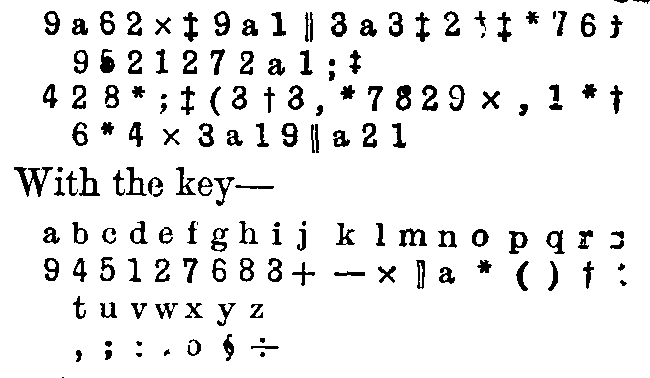
Ohs ya h sych, oayarsa rr loucys syms
Osrh srore rrhmu h smsmsmah emshyr snms.
a b c d e f g h i j k l m n o p q r s t u v w x y z
h u s h m o n e y b y c h a r l e s h r o s s e s q
"Far in a wild, unknown to public view,
From youth to age a reverend hermit grew."
Charge, Chester, Charge: on, Stanley, on!
Were the last words of Marmion.
Had I but been in Stanley's place,
When Marmion urged him to the chase,
A tear might come on every face."
Mock Not a Cobbler for His Black Thumb.
"Though you set me on foot,
I shall be on my head."
"'Twas whispered in heaven, 'twas muttered in hell,
And echo caught faintly the sound as it fell;"
Thprffthpddngsthtng,
The proof of the pudding is in the eating.
Whnhnorslst ts—rlftd,
Dths bt—sr rtrt fm nfmy.
"When honour's lost 'tis a relief to die,
Death's but a sure retreat from infamy."
"Fear's the white feather all cowards wear."
——s' th wht fthr ll cwrds——
"Cut off my head, how singular I act:
Cut off my tail, and plural I appear.
Cut off my head and tail—most curious fact,
Although my middle's left, there's nothing there!
What is my head cut off?—a sounding sea!
What is my tail cut off?—a flowing river!
Amid their mingling deaths I fearless play
Parent of softest sounds, though mute for ever!
I cover your head; change my head, and I set you to sleep; change it again and again, and with every change comes a new idea.—Cap, Nap, Gap, Sap, Hap, Map, Lap, Pap, Rap, Tap. This kind of riddle is also known as word-capping.
Gunpowder Made By a Monk at Cologne A.D.1330.
"Able was I ere I saw Elba."
Take away half of thirteen and let eight remain.
Write XIII on a slate, or on a piece of paper—rub out the lower half of the figures, and VIII will remain.
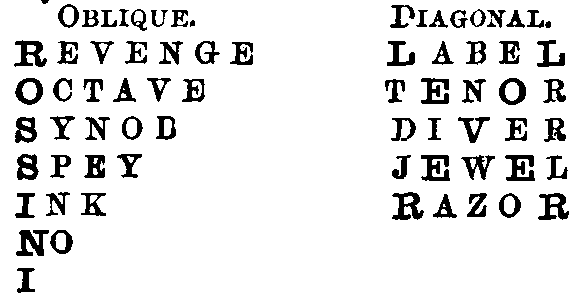
Malice, eight, a polemical meeting, a Scottish river, what I write with, a decided negative, the capital of Ireland. The initials downward name a celebrated musician.
A direction, a singer, a little bird, a lady's ring, a sharp shaver.
Read from left to right and right to left, the centrals show two famous novelists.
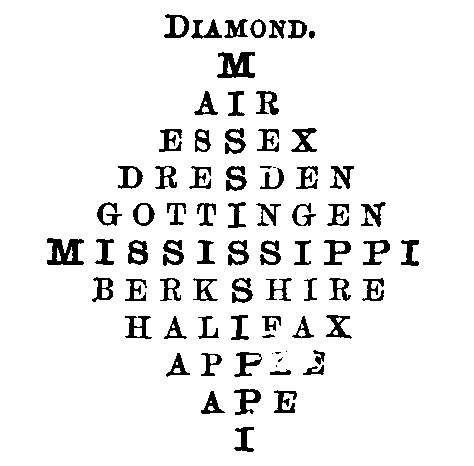
The head of a mouse, what the mouse lives in, the county of calves, the city of porcelain, a German town, a Transatlantic stream, a royal county, a Yorkshire borough, Eve's temptation, our poor relation, myself. Centrals down and across, show a wide, wide, long river.
The father of the Grecian Jove;
A little boy who's blind;
The foremost land in all the world;
The mother of mankind;
A poet whose love-sonnets are
Still very much admired;—
The initial letters will declare
A blessing to the tired.
Glass First Brought to England A.D. 668.
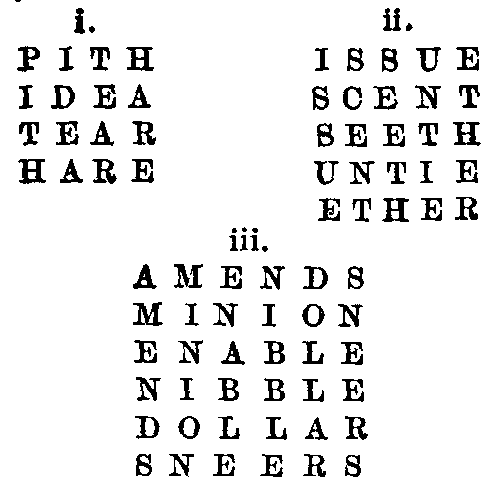
- Inside, a thought, a liquid gem, a timid creature.
- To run out, odour, to boil, to loosen, unseen essence.
- Compensations, a court favourite, to assist, to bite slightly, Spanish money, sarcasms.
- The board is to be so placed as to leave a white square at the right hand of the player.
- Any mistake in placing the board or the men may be rectified before the fourth move is completed, but not after.
- The players draw lots for the first move, and take the move alternately.
[When odds are given, the player giving them moves first. White generally moves first; therefore, if black win the move, the board is turned. It is usual to play with the white and black men alternately.]
- The piece touched must be moved. When the fingers of the player have once left the man, it cannot be again removed from the square it occupies.
[Except the move be illegal, when the opponent can insist on the piece being moved in the proper manner, or for the opposing King to be moved.]
- In touching a piece simply to adjust it, the player must notify to his adversary that such is his intention.
[It is usual, in such a case, to say J'adoube (I adjust); but he may not touch a piece with the intention of moving it, and then, when he discover his mistake, say, J'adoube. The phrase is simply intended to be used when a piece is displaced or overturned by accident.]
- If a player take one of his own men by mistake, or touch a wrong man, or one of his opponent's men, or make an illegal move, his adversary may compel him to take the man, make the right move, move his King, or replace the piece, and make a legal move.
- A pawn may be played either one or two squares at a time when first moved.
[In the latter case it is liable to be taken en passant, with a pawn that could have taken it had it been played only one square.]
- A player cannot castle under any of the following circumstances:
-
- If he has moved either King or Rook.
- If the King be in check.
- If there be any piece between the King and the Rook.
- If the King, in moving, pass over any square commanded by any one of his adversary's forces.
[You cannot castle to get out of check.]
- If a player give a check without crying "check," the adversary need not take notice of the check. But if two moves only are made before the discovery of the mistake, the pieces may be replaced, and the game properly played.
- If a player say check without actually attacking the King, and his adversary move his King or take the piece, the latter may elect either to let the move stand or have the pieces replaced and another move made.
- If, at the end of a game, the players remain, one with a superior to an inferior force, or even if they have equal forces, the defending player may call upon his adversary to mate in fifty moves on each side, or draw the game.
[If one player persist in giving perpetual check, or repeating the same move, his opponent may count the moves for the draw; in which case touching a piece if reckoned a move.]
- Stalemate, or perpetual check is a drawn game.
- Directly a pawn reaches its eighth square it must be exchanged for a piece.
[It is usual to change the pawn for a Queen, but it may be replaced by a Rook, Bishop, or Knight, without reference to the pieces already on the board. In practice it would be changed for a Queen or a Knight, seeing that the Queen's moves include those of the Rook and Bishop. Thus you may have two or more Queens, three or more Rooks, Bishops, or Knights on the board at the end of the game.]
- Should any dispute arise, the question must be submitted to a bystander, whose decision is to be considered final.
- The board is to be so placed as to have the white or black double corners at the right hand of the player.
- The first move is taken by chance or agreement, and in all the subsequent games of the same sitting, the first move is taken alternately. Black generally moves first.
- Any action which prevents your adversary from having a full view of the board is not allowed, and if persisted in, loses the game to the offending player.
- The man touched must be moved, but the men may be properly adjusted during any part of the game. After they are so placed, if either player, when it is his turn to play, touch a man, he must move it. If a man be so moved as to be visible on the angle separating the squares, the player so touching the man must move it to the square indicated.
[By this it is meant that a player may not move first to one square and then to another. Once moved on to a square, the man must remain there.]
- It is optional with the player either to allow his opponent to stand the huff, or to compel him to take the offered piece.
["Standing the huff" is when a player refuses to take an offered piece, but either intentionally or accidentally makes another move. His adversary then removes the man that should have taken the piece, and makes his own move—huff and move, as it is called.]
- Ten minutes is the longest time allowed to consider a move, which if not made within that time, forfeits the game.
- It is compulsory upon the player to take all the pieces he can legally take by the same series of moves. On making a King, however, the latter remains on his square till a move has been made on the other side.
- All disputes are to be decided by the majority of the bystanders present, or by an umpire.
- No player may leave the room without the consent of his adversary, or he forfeits the game.
- A false move must be remedied as soon as it is discovered, or the maker of such move loses the game.
- When only a small number of men remain toward the end of the game, the possessor of the lesser number may call on his opponent to win in at least fifty moves, or declare the game drawn. With two Kings to one, the game must be won in at most twenty moves on each side.
- The player who refuses to abide by the rules loses the game. In the losing game a player must take all the men he can by his move.
- Shuffling—-Each person has a right to shuffle the cards before the deal; but it is usual for the elder hand only; and the dealer after.
- Cutting.—The pack is then cut by the right hand adversary; and the dealer distributes the cards, one by one, to each of the players, beginning with the player on his left, until he comes to the last card, which he turns up for trump, and leaves on the table till the first trick be played.
- First Play.—The elder hand, the player on the left of the dealer, plays first. The winner of the trick plays again; and so on, till all the cards are played out.
- Mistakes.—No intimations, or signs are permitted between the partners. The mistake of one party is the profit of the adversary.
- Collecting Tricks.—The tricks belonging to each player should be turned and collected by one of the partners only. All above six tricks reckon towards game.
- Honours.—The ace, king, queen, and knave of trumps are called honours; and when either of the partners hold three separately, or between them, they count two points towards the game; and in case they have four honours, they count four points.
- Game.—Long Whist game consists of ten points, Short Whist of five points.
- Finessing, is the attempt to gain an advantage; thus:—If you have the best and third best card of the suit led you put on the third best, and run the risk of your adversary having the second best; if he has it not, which is two to one against him, you are then certain of gaining a trick.
- Forcing, is playing the suit of which your partner or adversary has not any, and which in order to win he must trump.
- Long Trump, the one or more trumps in your hand when all the rest are out.
- Loose Card, a card of no value, and the most proper to throw away.
- Points,—Ten make the game; as many as are gained by tricks or honours, so many points are set up to the score of the game.
- Quarte, four successive cards in suit.
- Quarte Major, a sequence of ace, king, queen, and knave.
- Quinte, five successive cards in suit.
- Quinte Major, is a sequence of ace, king, queen, knave, and ten.
- See-saw, is when each partner trumps a suit, and when they play those suits to each other for that purpose.
- Score, is the number of points set up. The following is a good method of scoring with coins or counters:
For Short Whist there are regular markers.

- Slam, is when either side win every trick.
- Tenance, is possessing the first last and third best cards, and being the player; you consequently catch the adversary when that suit is played: as, for instance, in case you have ace and queen of any suit, and your adversary leads that suit, you must win two tricks, by having the best and third best of the suit played, and being the last player.
- Tierce, three successive cards in suit.
- xv. Tierce Major, a sequence of ace, king, and queen.
Children and Chickens Must Always be Picking.
- Lead from your strong suit, be cautious how you change suits, and keep a commanding card to bring it in again.
- Lead through the strong suit and up to the weak; but not in trumps; unless very strong in them.
- Lead the highest of a sequence; but if you have a quarte or cinque to a king, lead the lowest.
- Lead through an honour, particularly if the game is against you.
- Lead your best trump, if the adversaries be eight, and you have no honour; but not if you have four trumps, unless you have a sequence.
- Lead a trump if you have four or five, or a strong hand; but not if weak.
- Having ace, king, and two or three small cards, lead ace and king if weak in trumps, but a small one if strong in them.
- If you have the last trump, with some winning cards, and one losing card only, lead the losing card.
- Return your partner's lead, not the adversaries'; and if you hold only three originally, play the best; but you need not return it immediately, when you win with a king, queen, or knave, and have only small ones, or when you hold a good sequence, a strong suit, or five trumps.
- Do not lead from ace queen, or ace knave.
- Do not—as a rule—lead an ace, unless you have a king.
- Do not lead a thirteenth card, unless trumps be out.
- Do not trump a thirteenth card, unless you be last player, or want the lead.
- Keep a small card to return your partner's lead.
- Be cautious in trumping a card when strong in trumps, particularly if you have a strong suit.
- Having only a few small trumps, make them when you can.
- If your partner refuse to trump a suit, of which he knows you have not the best, lead your best trump.
- When you hold all the remaining trumps, play one, and then try to put the lead in your partner's hand.
- Remember how many of each suit are out, and what is the best card left in each hand.
- Never force your partner if you are weak in trumps, unless you have a renounce, or want the odd trick.
- When playing for the odd trick, be cautious of trumping out, especially if your partner be likely to trump a suit. Make all the tricks you can early, and avoid finessing.
- If you take a trick, and have a sequence, win it with the lowest.
There are None So Wicked as Represented.
- The deal is determined by cutting-in. Cutting-in and cutting-out must be by pairs.
[Less than three cards, above or below, is not a cut. Ace is lowest. Ties cut again. Lowest deals. Each player may shuffle, the dealer last. The right-hand adversary cuts to dealer.]
- iIf a card be exposed, a fresh deal may be demanded.
- Dealer must not look at bottom card; and the trump-card must be left, face upwards, on the table till the first trick be turned, or opponents may call a fresh deal.
- Too many or too few cards is a misdeal—an exposed or face card. In either case, a fresh deal may be demanded.
[In cases of a misdeal, the deal passes to the next player.]
- After the first round has been played, no fresh deal can be called.
[If the first player hold fewer than thirteen cards, the other hands being right, the deal stands.]
- If two cards be dealt to the same player, the dealer may rectify his error before dealing another card.
[The dealer must not touch the cards after they have left his hands; but he may count those remaining in the pack if he suspect a misdeal, or he may ask the players to count their cards. One partner may not deal for another without the consent of opponents.]
- If the trump-card be not taken into the dealer's hand at the expiration of the first round, it may be treated as an exposed card, and called.
[After this, no one has a right to ask what was the trump-card, but he may ask "What are Trumps?"]
- If the third hand play before the second, the fourth has a right to play before his partner; or if the fourth hand play before the second or third, the cards so played must stand, and the second be compelled to win the trick if he can.
- If a player lead out of his turn, or otherwise expose a card, that card may be called, if the playing of it does not cause a revoke.
[Calling a card is the insisting of its being played when the suit comes round, or when it may be played.]
- If a player trump by mistake, he may recall his card, and play to the suit, if the card be not covered; but he may be compelled to play the highest or lowest of the suit led, and to play the exposed trump when it is called by his adversaries.
- If, before a trick be turned, a player discover that he has not followed suit, he may recall his card; but the card played in error can be called when the suit is played.
- Before a trick is turned, the player who made it may see the preceding trick.
[Only one trick is to be shown; not more, as is sometimes erroneously believed.]
- Before he plays, a player may require his partner to "draw his card," or he may have each card in the trick claimed before the trick be turned.
- When a player does not follow suit his partner is allowed to ask him whether he has any card of the suit led.
- The penalty for a revoke—either by wrongfully trumping the suit led, or by playing a card of another suit—is the loss of three tricks; but no revoke can be claimed till the cards are abandoned, and the trick turned.
[Revokes forfeit three tricks from the hand or score: or opponents may add three to their score; partner may ask and correct a trick if not turned; the revoking side cannot score out in that deal.]
- No revoke can be claimed after the tricks are gathered up, or after the cards are cut for the next deal.
[The wilful mixing up of the cards in such case loses the game.]
- The proof of a revoke lies with the claimants, who may examine each trick on the completion of the round.
- If a revoke occur on both sides, there must be a new deal.
- Honours cannot be counted unless they are claimed previous to the next deal.
[No omission to score honours can be rectified after the cards are packed; but an overscore, if proved, must be deducted.]
- Honours can only be called at eight points (in Long Whist), and at nine they do not count.
[In some Clubs, eight, with the deal, cannot call against nine.]
None are so Good as they Should Be.
- Count, and arrange your cards into suits; but do not always place your trumps in one particular part of your hand, or your opponents will discover how many you have.
- Attend to the game, and play as though your hand consisted of twenty-six instead of thirteen cards.
- In the second round of a suit, win the trick when you can, and lead out for your partner's high cards as soon as possible.
- Touch only the card you intend to play.
- Retain a high trump as long as you can, to bring back your strong suit.
- With a weak hand, always try to secure the seventh or odd trick to save the game.
- Attend to the score, and play as if the whole fortune of the game depended on yourself.
- Remember the number of trumps out at every stage of the game. Note, also, the fall of every court-card in the other suits, so that you are never in doubt as to the card that will win the trick.
- Hold the turn-up as long as you can, as by that means you keep your adversaries from knowing your strength in trumps.
- Do not force your partner unnecessarily, as by that means you sometimes become his adversary instead of his friend.
- When in doubt, play a trump. Play the game in its integrity, and recollect that Whist is full of inferences as well as facts.
Night is not Dark to the Good.
- Crib.—The crib is composed of the cards thrown out by each player, and the dealer is entitled to score whatever points are made by them.
- Pairs are two similar cards, as two aces or two kings. Whether in hand or play they reckon for two points.
- Pairs-Royal are three similar cards, and reckon for six points, whether in hand or play.
- Double Pairs-Royal are four similar cards and reckon for twelve points, whether in hand or play. The points gained by pairs, pairs-royal, and double pairs-royal, in playing, are thus effected:—Your adversary having played a seven and you another, constitutes a pair, and entitles you to score two points; your antagonist then playing a third seven, makes a pair-royal, and he marks six; and your playing a fourth is a double pair-royal, and entitles you to twelve points.
- Fifteens.—Every fifteen reckons for two points, whether in hand or play. In hand they are formed either by two cards—as a five and any tenth card, a six and a nine, a seven and an eight, or by three cards, as a two, a five, and an eight, two sixes and a three. If in play, such cards as together make fifteen are played, the player whose card completes that number, scores two points.
- Sequences are three or four more successive cards, and reckon for an equal number of points, either in hand or play. In playing a sequence, it is of no consequence which card is thrown down first; as thus:—your adversary playing an ace, you a five, he a three, you a two, then he a four—he counts five for the sequence.
- Flush.—When, the cards are all of one suit, they reckon for as many points as there are cards. For a flush in the crib, the turned-up card must be of the same suit as those put out.
- Nob.—The knave of the suit turned up reckons for one point; if a knave be turned up, the dealer marks two.
- End Hole.—The point scored by the last player, if he make under thirty-one; if he make thirty-one exactly, he marks two.
- Last.—Three points taken at the commencement of the game of five-card cribbage by the non-dealer.
Nor is Day Bright to the Wicked.
- The players cut for deal. The ace is lowest in cutting. In case of a tie, they cut again. The holder of the lowest card deals.
- Not fewer than four cards is a cut; nor must the non-dealer touch the pack after he has cut it.
- Too many or too few cards dealt constitutes a misdeal, the penalty for which is the taking of two points by the non-dealer.
- A faced card, or a card exposed during the act of dealing necessitates a new deal, without penalty.
- The dealer shuffles the cards and the non-dealer cuts them for the "start."
- If the non-dealer touch the cards (except to cut them for the turn-up) after they have been cut for the start, he forfeits two points.
- In cutting for the start, not fewer than three cards must be lifted from the pack or left on the table.
- The non-dealer throws out for the crib before the dealer. A card once laid out cannot be recalled, nor must either party touch the crib till the hand is played out. Either player confusing the crib cards with his hand, is liable to a penalty of three points.
[In three and four-hand cribbage the left-hand player throws out first for the crib, then the next; the dealer last. The usual and best way is for the non-dealer to throw his crib over to the dealer's side of the board; on these two cards the dealer places his own, and hands the pack over to be cut. The pack is then at the right side of the board for the next deal.]
- The player who takes more points than those to which he is entitled, either in play or in reckoning hand or crib, is liable to be "pegged;" that is, to be put back as many points as he has over-scored, and have the points added to his opponent's side.
[In pegging you must not remove your opponent's front peg till you have given him another. In order "to take him down,'' you remove your own back peg and place it where his front peg ought to be, you then take his wrongly placed peg and put it in front of your own front, as many holes as he has forfeited by wrongly scoring.]
- No penalty attaches to the taking of too few points in play, hand, or crib.
- When a player has once taken his hand or crib, he cannot amend his score.
- When a knave is turned up, "two for his heels" must be scored before the dealer's own card be played, or they cannot be taken.
- A player cannot demand the assistance of his adversary in reckoning hand and crib.
- A player may not, except to "peg him," touch his adversary's pegs, under a penalty of two points. If the foremost peg has been displaced by accident, it must be placed in the hole behind the peg standing on the board.
- The peg once holed cannot be removed by either player till another point or points be gained.
- The player who scores a game as won when, in fact, it is not won, loses it.
- A lurch—scoring the whole sixty-one before your adversary has scored thirty-one—is equivalent to a double game, if agreed to previous to the commencement of the game.
- A card that may be legally played cannot be withdrawn after it has been once thrown face upwards on the table.
- If a player neglect to score his hand, crib, or any point or points of the game, he cannot score them after the cards are packed or the next card played.
- The player who throws up his cards and refuses to score, forfeits the game.
- If a player neglect to play when he can play a card within the prescribed thirty-one, he forfeits two holes.
- Each player's hand and crib must be plainly thrown down on the table and not mixed with the pack, under penalty of the forfeiture of the game.
The player who refuses to abide by the rules, loses the game. Bystanders must not interfere unless requested to decide any disputed point.
| cards | points |
|---|---|
| For every fifteen | 2 |
| Pair, or two of a sort | 2 |
| Pair-royal, or three of a sort | 6 |
| Double pair-royal, or four ditto | 12 |
| Knave of the turned-up suit | 1 |
| Sequences and flushes | whatever their number. |
| cards | count |
|---|---|
| Two sevens, two eights, and a nine | 24 |
| Two eights, a seven, and two nines | 20 |
| Two nines, a six, seven, and eight | 16 |
| Two sixes, two fives, and a four | 24 |
| Two sixes, two fours, and a five | 24 |
| Two fives, two fours, and a six | 24 |
| Two threes, two twos, and an ace | 16 |
| Two aces, two twos, and a three | 16 |
| Three fives and a tenth card | 14 |
| Three fours and a seven | 12 |
| Three twos and a nine | 8 |
| Six, seven, eight, and two aces | the ragged 13 |
| 6 + 1 and 8 | 15-2 |
| 6 + 1 and 8 | 16-4 |
| 6 + 1 + 1 + 7 | 15-6 |
| 7 + 8 | 15-8 |
| the pair of aces and the sequence 5 |
13 |
| Three sixes and a nine | 12 |
| Three sevens and an eight | 12 |
| Three eights and a seven | 12 |
| Three nines and a six | 12 |
| Three threes and a nine | 12 |
| Three sixes and a three | 12 |
| Three sevens and an ace | 12 |
| Two tens (pair) and two fives | 12 |
| Two tenth cards (not a pair) and two fives |
10 |
| Two nines and two sixes | 12 |
| Two eights and two sevens | 12 |
| Two sixes and two threes | 8 |
| Two fives, a four, and a six | 12 |
| Two fours, a five, and a six | 12 |
| Two sixes, a four, and a five | 12 |
| Two threes and two nines | 8 |
| Two nines, a seven, and an eight | 10 |
| Two eights, a seven, and a nine | 12 |
| Two sevens, an eight, and a nine | 12 |
| Two sixes, a seven, and an eight | 10 |
| Two sixes, a three, and a nine | 8 |
| A seven, eight, nine, ten, and knave | 7 |
| A six, seven, eight, nine, and ten | 9 |
| A six, seven, eight, and nine | 8 |
| A six, five, and two sevens | 8 |
| Any double sequence of three cards
and a pair (as knave, queen, and two kings). |
6 |
| Any sequence of three cards and a fifteen | 5 |
| Any sequence of four cards and a
fifteen (as seven, eight, nine and ten) |
6 |
| Any sequence of six cards | 6 |
| Any sequence of four cards and a flush | 8 |
| Any flush of four cards and a fifteen | 6 |
| Any flush of four cards and a pair | 6 |
Rustle is not Industry.
- A new deal can be demanded for an exposed card, too few or too many cards dealt; in the latter case, a new deal is optional, provided it be done before a card has been played, but not after, to draw from the opposing hand the extra card.
- iNo person can beg more than once in each hand, except by mutual agreement.
- Each player must trump or follow suit on penalty of the adversary scoring one point.
- If either player score wrongly it must be taken down, and the adversary either scores four points or one, as may have previously been agreed.
- When a trump is played, it is allowable to ask your adversary if it be either high or low.
- One card may count all-fours; for example, the eldest hand holds the knave and stands his game, the dealer has neither trump, ten, ace, nor court-card; it will follow that the knave will be both high, low, Jack, and game, as explained by:
- High.—For the highest trump out, the holder scores one point.
- Low.—For the lowest trump out, the original holder scores one point, even if it be taken by the adversary.
- Jack.—For the knave of trumps the holder scores one. If it be won by the adversary, the winner scores the point.
- Game.—The greatest number that, in the tricks gained, are shown by either player, reckoning:
| Four | for an ace |
| Three | for a king |
| Two | for a queen |
| One | for a knave |
| Ten | for a ten |
The other cards do not count: thus it may happen that a deal may be played without having any to reckon for game.
- Begging is when the eldest hand, disliking his cards, uses his privilege, and says, "I beg;" in which case the dealer either suffers his adversary to score one point, saying, "Take one," or gives each player three cards more from the pack, and then turns up the next card, the seventh for trumps. If, however, the trump turned up to be of the same suit as the first, the dealer must go on, giving each three cards more, and turning up the seventh, until a change of suit for trumps shall take place.
- Make your knave as soon as you can.
- Secure your tens by playing any small cards, by which you may throw the lead into you adversary's hand.
- Win your adversary's best cards when you can, either by trumping or with superior cards.
- If, being eldest hand, you hold either ace, king, or queen of trumps, without the knave or ten, play them immediately, as, by this means, you may chance to win the knave or ten.
- This game is played by any number of persons, from three, but five or seven make the best game.
- The cards are cut for deal, the holder of the lowest card being dealer; after which the deal goes round, from left to right. In case of a tie, the players cut again. Ace is lowest, and the court-cards and tens are reckoned of the same value,—namely, ten.
- The left-hand adversary shuffles or makes the pack, and the player to the right of the dealer cuts previous to the deal.
- The cards take their usual value, ace highest; then king, queen, knave, ten, and so on, down to deuce. The dealer then gives three cards, one at a time, face downwards, to each player; and also dealing an extra hand, or "miss," which may be thrown on the table either as the first or last card of each round.
- A card too many or too few is a misdeal.
- The stakes being settled beforehand, the dealer puts into the pool his three halfpence, pence, or sixpences, and the game proceeds:
- The first player on the left of the dealer looks at his hand, and declares whether he will play or take the miss. If he decide to play, he says, "I play," or "I take the miss;" but he may elect to do neither; in which case he places his cards on the pack, and has nothing further to do with that round. The next player looks at his hand, and says whether he will play or not; and so on, till the turn comes to the dealer, who, if only one player stand the chance of the loo, may either play or give up the stakes.
- In the first round it is usual either to deal a single; that is, a round without a miss, when all the players must play; or each player puts into the pool a sum equal to that staked by the dealer in which latter case a miss is dealt.
Never Open the Door to a Little Vice.
- For a misdeal the dealer is looed.
- For playing out of turn or looking at the miss without taking it, the player is looed.
- If the first player possess two or three trumps, he must play the highest, or be looed.
- With ace of trumps only, the first player must lead it, or be looed.
- The player who looks at his own cards, or the miss out of his turn, is looed.
- The player who looks at his neighbour's hand, either during the play or when they lie on the table, is looed.
- The player who informs another what cards he possesses, or gives any intimation that he knows such or such cards to be in the hand or the miss, is looed.
- The player who throws up his cards after the leading card is played, is looed.
- Each player who follows the elder hand must head the trick if he can, or be looed.
- Each player must follow suit if he can, or be looed.
The player who is looed pays into the pool the sum agreed.
- When it is seen how many players stand in the round, the elder hand plays a card—his highest trump if he has two or more; if not, any card he chooses. The next plays, and, if he can, follows suit or heads the trick with a trump. If he can do neither, he throws away any card.
- And so the round goes on; the highest card of the suit, or the highest trump, winning the trick. The winner of the trick then leads another card.
- The game consists of three tricks, and the pool is divided equally among the players possessing them. Thus, if there be three pence, shillings, or half-crowns, in the pool, the tricks are a penny, sixpence, or half-a-crown each. The three tricks may of course be won by a single player, or they may be divided between two or three. Each player who fails to win a trick is looed, and pays into the next pool the amount determined on as the loo.
- When played for a determinate stake, as a penny for the deal and three pence for the loo, the game is called Limited Loo. When each player is looed for the sum in the pool, it is Unlimited Loo.
- Caution is necessary in playing this game to win. As a general rule, the first player should not take the miss, as the dealer's stake is necessarily to be added to the loo. Nor the miss be taken after two players have "struck in" (declared to play), for the chances are that they possess good leading cards.
- In principle it is the same as the other game Loo, only instead of three, the dealer (having paid his own stake into the pool) gives five cards to each player, one by one, face downwards.
- After five cards have been dealt to each player, another is turned up for trump; the knave of clubs generally, or sometimes the knave of the trump suit, as agreed upon, is the highest card, and is styled Pam; the ace of trumps is next in value, and the rest on succession, as at Whist. Each player can change all or any of the five cards dealt, or throw up his hand, and escape being looed. Those who play their cards, either with or without changing, and do not gain a trick, are looed. This is also the case with all who have stood the game, when a flush or flushes occur; and each, except a player holding pam, of an inferior flush, must pay a stake, to be given to him who sweeps the board, or divided among the winners at the ensuing deal, according to the tricks made. For instance, if every one at dealing stakes half-a-crown, the tricks are entitled to sixpence a-piece, and whoever is looed must put down half-a-crown, exclusive of the deal; sometimes it is settled that each person looed shall pay a sum equal to what happens to be on the table at the time. Five cards of a suit, or four with pam, make a flush which sweeps the board, and yields only to a superior flush, or the elder hand. When the ace of trumps is led, it is usual to say, "Pam be civil;" the holder of which last-mentioned card must then let the ace pass.
- Any player with five cards of a suit (a flush) looes all the players who stand in the game.
- The rules in this game are the same as in Three Card Loo.
- When the dealer accidentally discovers any of his adversary's cards, the adversary may demand a new deal.
- When the dealer discovers any of his own cards in dealing, he must abide by the deal.
- When a faced card is discovered during the deal, the cards must be reshuffled, and dealt again.
- If the dealer give his adversary more cards than are necessary, the adversary may call a fresh deal, or suffer the dealer to draw the extra cards from his hand.
- If the dealer give himself more cards than are his due, the adversary may add a point to his game, and call a fresh deal, or draw the extra cards from the dealer's hand.
- No bystander must interfere, under penalty of paying the stakes.
- Either party saying, "I put"—that is, "I play"—cannot retract, but must abide the event of the game, or pay the stakes.
Knowledge Makes Humble.
- By the two black aces.
- The ace of spades and king of hearts.
- The ace of clubs and king of hearts.
| Best The Ace of Diamonds turned up. |
||
| Confederacy King and Knave |
INTRIGUE; OR QUEEN AND KNAVE |
Matrimony King and Queen. |
| Pairs The Highest. |
Ignorance Makes Proud.
Knowledge Talks Lowly.
- Great Cassino, the ten of diamonds, which reckons for two points.
- Little Cassino, the two of spades, which reckons for one point.
- The Cards is when you have a greater share than your adversary, and reckons for three points.
- The Spades is when you have the majority of that suit, and reckons for one point.
- The Aces: each of which reckons for one point.
- Lurched is when your adversary has won the game before you have gained six points.
In some deals at this game it may so happen that neither party win anything, as the points are not set up according to the tricks, &c, obtained, but the smaller number is constantly subtracted from the larger, both in cards and points; and if they both prove equal, the game commences again, and the deal goes on in rotation. When three persons play at this game, the two lowest add their points together, and subtract from the highest; but when their two numbers together either amount to or exceed the highest, then neither party scores.
- The deal and partners are determined by cutting, as at whist, and the dealer gives four cards, one at a time, to each player, and either regularly as he deals, or by one, two, three, or four at a time, lays four more, face upwards, upon the board, and, after the first cards are played, four others are dealt to each person, until the pack be concluded; but it is only in the first deal that any cards are to be turned up.
- The deal is not lost when a card is faced by the dealer, unless in the first round, before any of the four cards are turned up upon the table; but if a card happen to be faced in the pack, before any of the said four be turned up, then the deal begins again.
- Any person playing with less than four cards must abide by the loss; and should a card be found under the table, the player whose number is deficient takes the same.
- Each person plays one card at a time, with which he may not only take at once every card of the same denomination upon the table, but likewise all that will combine therewith; as, for instance, a ten takes not only every ten, but also nine and ace, eight and deuce, seven and three, six and four, or two fives; and if he clear the board before the conclusion of the game, he is to score a point; and whenever any player cannot pair or combine, then he is to put down a card.
- The tricks are not to be counted before all the cards are played; nor may any trick but that last won be looked at, as every mistake must be challenged immediately.
- After all the pack is dealt out, the player who obtains the last trick sweeps all the cards then remaining unmatched upon the table and wins the game.
Ignorance Talks Loud.
Knowledge is Modest, Cautious, and Pure.
- Each player has right to shuffle the cards above the table.
- The cut must not be fewer than two cards off the pack, and at least two cards must be left on the table.
- When more than one card is exposed in cutting, there must be a new deal.
- The highest ecarté card cut secures the deal, which holds good even though the pack be imperfect.
- The dealer must give five cards to each by three and two, or by two and three, at a time, which plan must not be changed, during the game.
- An incorrect deal, playing out of turn, or a faced card, necessitates a new deal.
- The eleventh card must be turned up for trumps; and the remaining cards placed, face downwards, on the table.
- The king turned up must be marked by the dealer before the trump of the next deal is turned up.
- A king of trumps held in hand must be announced and marked before the player lays down his first card, or he loses his right to mark it. If played in the first trick, it must be announced before it is played to.
- A proposal or acceptance cannot be retracted or altered.
- Before taking cards, the player must place his discarded cards, face downwards, on the table, and neither look at or touch them till the round be over.
- The player holding king marks one point; making three tricks, one point; five tricks, two points.
- The non-dealer playing without proposing and failing to win the point, gives two tricks to his opponent.
- The dealer who refuses the first proposal and fails to win the point (three tricks), gives his opponent two points.
- An admitted overscore or underscore may be amended without penalty before the cards are dealt for the following round.
Ignorance Boastful, Conceited, and Sure.
- The players cut for deal; the higher card cut dealing.
- The cards are dealt by twos and threes, each player having five.
- The eleventh card is turned up for trumps.
- Five points constitute game.
- The player winning three or four tricks marks one point; winning five tricks, two points.
- When the first player considers his hand strong enough to score, he can order it up—that is, he can oblige the dealer to discard one of his cards and take up the trump in its stead.
- When the first player does not find his hand strong enough, he may pass—" I pass;" with the view of changing the suit.
- In case of the first player "ordering it up," the game begins by his playing a card, to which the dealer must follow suit or trump, or throw away. The winner of the trick then leads: and so on till all the five cards in each hand are played.
- If the player order up the trump and fail to make three tricks, he is euchred, and his opponent marks two points.
- If the player, not being strong enough, passes, the dealer can say, "I play," and take the trump into his own hand; but, as before, if he fail to score, he is euchred.
- If both players pass, the first has the privilege of altering the trump, and the dealer is compelled to play. Should the first player fail to score, he is euchred.
- If he pass for the second time, the dealer can alter the trump, with the same penalty if he fail to score.
- When trumps are led and you cannot follow suit, you must play the left bower if you have it, to win the trick.
The score is marked as in Ecarté, by each side with a two and three.
Be Not the First by Whom the New is Tried.
- Immediately after taking a trick, and then only, a player can make a Declaration; but he must do so before drawing another card. Only one Declaration can be made after each trick.
- If, in making a declaration, a player put down a wrong card or cards, either in addition to or in the place of any card or cards of that declaration, he is not allowed to score until he has taken another trick. Moreover, he must resume the cards, subject to their being called for as "faced" cards.
- The seven of trumps may be exchanged for the trump card, and for this exchange ten is scored. This exchange is made immediately after he has taken a trick, but he may make a declaration at the same time, the card exchanged not being used in such declaration.
- Whenever the seven of trumps is played, except in the last eight tricks, the player scores ten for it, no matter whether he wins the trick or not.
- When all the cards are drawn from the pack, the players take up their eight cards. No more declarations can he made, and the play proceeds as at Whist, the ten ranking higher than the king, and the ace highest.
- In the last eight tricks the player is obliged to follow suit, and he must win the trick if possible, either by playing a higher card, or, if he has not a card of the same suit, by playing a trump.
- A player who revokes in the last eight tricks, or omits to take when he can, forfeits the eight tricks to his opponent.
- The last trick is the thirty-second, for which the winner scores ten. The game may be varied by making the last trick the twenty-fourth—the next before the last eight tricks. It is an unimportant point, but one that should be agreed upon before the game is commenced.
- After the last eight tricks are played, each player examines his cards, and for each ace and ten that he holds he scores ten.
- The non-dealer scores aces and tens first; and in case of a tie, the player scoring the highest number of points, less the aces and tens in the last deal, wins the game. If still a tie, the taker of the last trick wins.
- All cards played in error are liable to be called for as "faced" cards at any period of the game, except during the last eight tricks.
- In counting forfeits a player may either add the points to his own score or deduct them from the score of his opponent.
- A Declaration is the exhibition on the table of any cards or combination of, cards, as follows:
- Bezique is the queen of spades and knave of diamonds, for which the holder scores 40 points. A variation provides that when the trump is either spades or diamonds, Bezique may be queen of clubs and knave of hearts. Bézique having been declared, may be again used to form Double Bezique—two queens of spades and two knaves of diamonds. All four cards must be visible on the table together—500 points.
- Sequence is ace, ten, king, queen, and knave of trumps—250 points.
- Royal Marriage is the king and queen of trumps—40 points.
- Common Marriage is the king and queen of any suit, except trumps—20 points.
- Four aces are the aces of any suits —100 points.
- Four kings are the kings of any suits—80 points.
- Four Queens are the queens of any suits—60 points.
- Four knaves are the knaves of any suits—40 points.
Nor Yet the Last to Cast the Old Aside.
- The cards forming the declarations are placed on the table to show that they are properly scored, and the cards may thence be played into tricks as if in your hand.
- Kings and queens once married cannot be re-married, but can be used, while they remain on the table, to make up four kings, four queens, or a sequence.
- The king and queen used in a sequence cannot afterwards be declared as a royal marriage.
- If four knaves have been declared, the knave of diamonds may be used again for a bézique, or to complete a sequence.
- If four aces have been declared, the ace of trumps may he again used to perfect a sequence.
- If the queen of spades has been married, she may he again used to form a bézique, and vice versâ, and again for four queens.
- Playing the seven of trumps—except in last eight tricks—10; exchanging the seven of trumps for the trump card—10; the last trick—10; each ace and ten in the tricks—at the end of each deal—10.
- The game is 1,000, 2,000, or 4,000 up. Markers are sold with the cards.
| i. | For drawing out of turn | 10 |
| ii. | For playing out of turn | 10 |
| iii. | For playing without drawing | 10 |
| iv. | For overdrawing | 100 |
| v. | For a revoke in the last eight tricks | all the eight tricks. |
- The above rules hold good in the case of three-handed games—treble bézique counting 1,500. An extra pack of cards is required for the third other player; so that, in the case of three, the trump card is the twenty-fifth.
- The game is always played from left to right, the first player on the left of the dealer commencing. Three-handed bézique is sometimes played with two packs of cards, suppressing an eight, thus rendering them divisible by three.
- Four-handed Bezique may be played by partners decided either by choice or cutting. Partners sit opposite each other, one collecting the tricks of both, and the other keeping the score, or each may keep his own score, which is preferable.
- A player may make a declaration immediately after his partner has taken a trick, and may inquire of his partner if he has anything to declare, before drawing.
- Declarations must be made by each player separately, as in two-handed bézique.
- The above descriptions will serve to sufficiently acquaint the reader with the rules and modes of play adopted in this excellent game. Bézique is said to be of Swedish origin, and to have been introduced to English players through the medium of some Indian officers who had learned it of a Scandinavian comrade. Variations in the play occur in different companies. These, however, having been indicated above, need not be more particularly noted.
A Lady in America Made a Quilt in 55,555 Pieces.
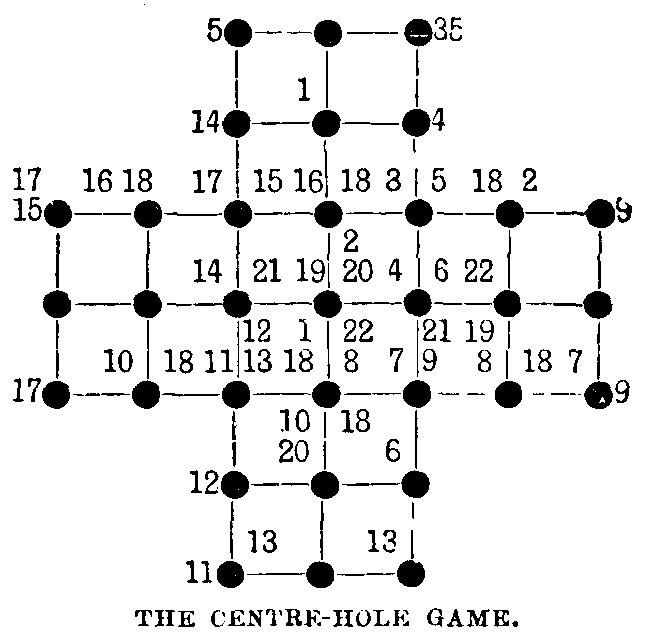
| Figure | Name | Actions | Repeat |
|---|---|---|---|
| First Figure | Le Pantalon | Right and left. Balancez to partners; turn partners. Ladies' chain. Half promenade; half right and left. | four times |
| Second Figure | L'Été | Leading lady and opposite gentleman advance and retire; chassez to right and left; cross over to each other's places; chassez to right and left. Balancez and turn partners. | four times |
| or | Double L'Été | Both couples advance and retire at the same time; cross over; advance and retire again; cross to places. Balancez and turn partners. | four times |
| Third Figure | La Poule | Leading lady and opposite gentleman cross over, giving right hands; recross, giving left hands, and fall in a line. Set four in a line; half promenade. Advance two, and retire (twice). Advance four, and retire; half right and left. | four times |
| Fourth Figure | Trenise | The first couple advance and retire twice, the lady remaining on the opposite side; the two ladies go round the first gentleman, who advances up the centre; balancez and turn hands. | four times |
| Fifth Figure | La Pastorale | The leading couple advance twice, leaving the lady opposite the second time. The three advance and retire twice. The leading gentleman advance and set. Hands four half round; half right and left1. | four times |
| Sixth Figure | Galop Finale | Top and bottom couples galopade quite round each other. Advance and retire; four advance again, and change the gentlemen. Ladies' chain. Advance and retire four, and regain your partners in your places. The fourth time all galopade for an unlimited period. | four times |
| or | All galopade or promenade, eight bars. Advance four en galopade oblique, and retire, then half promenade, eight bars. Advance four, retire, and return to places with the half promenade, eight bars. Ladies' chain, eight bars. Repeated by the side couples, then by the top and bottom, and lastly by the side couples, finishing with grand promenade. |
- La Rose.—First gentleman and opposite lady advance and set—turn with both hands, retiring to places—return, leading outside—set and turn at corners.
- La Lodoiska.—First couple advance twice, leaving the lady in the centre—set in the centre—turn to places—all advance in two lines—all turn partners.
- La Dorset.—First lady advance and stop, then the opposite gentleman—both retire, turning round—ladies' hands across half round, and turn the opposite gentlemen with left hands—repeat back to places, and turn partners with left hands.
- L'Étoile.—First couple set to couple at right—set to couple at left—change places with partners, and set, and pirouette to places—right and left with opposite couple,
- Les Lanciers.—The grand chain. The first couple advance and turn facing the top; then the couple at right advance behind the top couple; then the couple at left and the opposite couple do the same, forming two lines. All change places with partners and back again. The ladies turn in a line on the right, the gentlemen in a line on the left. Each couple meet up the centre. Set in two lines, the ladies in one line, the gentlemen in the other. Turn partners to places. Finish with the grand chain.
| Figure | Actions | Repeat |
|---|---|---|
| First Figure | The first and opposite couples hands across round the centre and back to places—set and turn partners. Ladies' chain. Half promenade—half right and left. | by the side couples |
| Second Figure | The first gentleman advance and retire twice. All set at corners, each lady passing into the next lady's place on the right. Promenade by all. | by the other couples |
| Third Figure | The first lady and opposite gentleman advance and retire, bending to each other. First lady and opposite gentleman pass round each other to places. First couple cross over, having hold of hands, while the opposite couple cross on the outside of them—the same reversed. All set at corners, turn, and resume partners. All advance and retire twice, in a circle with hands joined—turn partners. | |
| Fourth Figure | The first lady and opposite gentleman advance and stop; then their partners advance; turn partners to places. The four ladies move to right, each taking the next lady's place, and stop—the four gentlemen move to left, each taking the next gentleman's place, and stop—the ladies repeat the same to the right—then the gentlemen to the left. All join hands and promenade round to places, and turn partners. | by the other couples |
| Fifth Figure | The first couple promenade or waltz round inside the figure. The four ladies advance, join hands round, and retire—then the gentlemen perform the same—all set and turn partners. Chain figure of eight half round, and set. All promenade to places and turn partners. All change sides, join right hands at corners, and set—back again to places. Finish with grand promenade. |
Coffee was First Brought to England in 1641.
| 1st. | Galopade. |
| 2nd. | Right and left, sides the same. |
| 3rd. | Set and turn, hands all eight. |
| 4th. | Galopade. |
| 5th. | Ladies' chain, sides the same. |
| 6th. | Set and turn partners all eight. |
| 7th. | Galopade. |
| 8th. | Tirois, sides the same. |
| 9th. | Set and turn partners all eight. |
| 10th. | Galopade. |
| 11th | Top lady and bottom gentleman advance and retire, the other six do the same. |
| 12th. | Set and turn partners all eight. |
| 13th. | Galopade. |
| 14th. | Four ladies advance and retire, gentlemen the same. |
| 15th. | Double ladies' chain. |
| 16th. | Set and turn partners all eight. |
| 17th. | Galopade. |
| 18th. | Poussette, sides the same. |
| 19th. | Set and turn. |
| 20th. | Galopade waltz. |
Phosphorus was Discovered in 1677.
Average Weight of Man's Brain, 3-1/2lbs, Woman's 2lbs. 11oz.
| First step. | The gentleman raises the left foot slightly behind the right, the right foot is then hopped with, and the left brought forward with a glissade. The lady commences with the right, jumps on the left, and glissades with the right. The gentleman during his step has hold of the lady's left hand with his right. |
| Second step. | The gentleman lightly hops the left foot forward on the heel, then hops on the toe, bringing the left foot slightly behind the right. He then glissades with the left foot forward; the same is then done, commencing with the right foot. The lady dances the same step, only beginning with the right foot. |
| First Figure. | Four or eight bars are devoted to setting forwards and backwards, turning from and towards your partner, making a slight hop at the commencement of each set, and holding your partner's left hand; you then perform the same step (forwards) all round the room. |
| Second Figure. | The gentleman faces his partner, and does the same step backwards all round the room, the lady following with the opposite foot, and doing the step forwards. |
| Third Figure. | The same as the second figure, only reversed, the lady stepping backwards, and the gentleman forwards, always going the same way round the room. |
| Fourth Figure. | The same step as figures two and three, but turning as in a waltz. |
Man's Heart Beats 92,160 Times in a Day.
| Figure | Top lady and second gentleman heel and toe (polka step) across to each other's place—second lady and top gentleman the same. Top lady and second gentleman retire back to places—second lady and top gentleman the same. Two couples polka step down the middle and back again—two first couples polka waltz. First couple repeat with the third couple, then with fourth, and so on to the end of dance. |
| Balancez | Set to partners. |
| Chaine Anglaise | The top and bottom couples right and left. |
| Chaine Anglaise double | The right and left double. |
| Chaine des Dames | The ladies' chain. |
| Chaine des Dames double | The ladies' chain double, which is performed by all the ladies commencing at the same time. |
| Chassez | Move to the right and left. |
| Chassez croisez | Gentlemen change places with partners, and back again. |
| Demie Chaine Anglaise | The four opposite persons half right and left. |
| Demie Promenade | All eight half promenade. |
| Dos-à-dos | The two opposite persons pass round each other. |
| Demie Moulinet | The ladies all advance to the centre, giving hands, and return to places. |
| La Grande Chaine | All eight chassez quite round, giving alternately right and left hands to partners, beginning with the right. |
| Le Grand Rond | All join hands and advance and retire twice. |
| Pas d'Allemande | The gentlemen turn the partners under their arms. |
| Traversez | The two opposite persons change places. |
| Vis-à-vis | The opposite partner. |
The Human Body has 240 Bones.
Should envious tongues some malice frame,
To soil and tarnish your good name,
Live it down!
Grow not disheartened; 'tis the lot
Of all men, whether good or not:
Live it down!
Him not in answer, but be calm;
For silence yields a rapid balm:
Live it down!
Go not among your friends and say,
Evil hath fallen on my way:
Live it down!
Far better thus yourself alone
To suffer, than with friends bemoan
The trouble that is all your own:
Live it down!
What though men evil call your good!
So Christ Himself, misunderstood,
Was nailed unto a cross of wood!
And now shall you for lesser pain,
Your inmost soul for ever stain,
By rendering evil back again?
Live it down!
The Musical Scale was Invented in 1022.
A Salmon has been Known to Produce 10,000,000 Eggs.
- Who and whom are used in relation to persons, and which in relation to things. But it was once common to say, "the man which." This should now be avoided. It is now usual to say, "Our Father who art in heaven," instead of "which art in heaven."
- Whose is, however, sometimes applied to things as well as to persons. We may therefore say, "The country whose inhabitants are free." Grammarians differ in opinion upon this subject, but general usage justifies the rule.
- Thou is employed in solemn discourse, and you in common language. Ye (plural) is also used in serious addresses, and you in familiar language.
- The uses of the word It are various, and very perplexing to the uneducated. It is not only used to imply persons, but things, and even, ideas, and therefore, in speaking or writing, its assistance is constantly required. The perplexity respecting this word arises from the fact that in using it in the construction of a long sentence, sufficient care is not taken to ensure that when it is employed it really points out or refers to the object intended. For instance, "It was raining when John set out in his cart to go to the market, and he was delayed so long that it was over before he arrived." Now what is to be understood by this sentence? Was the rain over? or the market? Either or both might be inferred from the construction of the sentence, which, therefore, should be written thus:— "It was raining when John set out in his cart to go to the market, and he was delayed so long that the market was over before he arrived."
- Rule.—After writing a sentence always look through it, and see that wherever the word It is employed, it refers to or carries the mind back to the object which it is intended to point out.
- The general distinction between This and That may be thus defined: this denotes an object present or near, in time or place, that something which is absent.
- These refers, in the same manner, to present objects, while those refers to things that are remote.
- Who changes, under certain conditions, into whose and whom. But that and which always remain the same.
- That may be applied to nouns or subjects of all sorts; as, the girl that went to school, the dog that bit me, the ship that went to London, the opinion that he entertains.
- The misuse of these pronouns gives rise to more errors in speaking and writing than any other cause.
- When you wish to distinguish between two or more persons, say, "Which is the happy man?"—not who—"Which of those ladies do you admire?"
- Instead of "Who do you think him to be?"—say, "Whom do you think him to be?"
- Whom should I see?
- To whom do you speak?
- Who said so?
- Who gave it to you?
- Of whom did you procure them?
- Who was he?
- Who do men say that I am?
- In many instances in which who is used as an interrogative, it does not become whom; as "Who do you speak to?" "Who do you expect?" "Who is she married to?" "Who is this reserved for?" "Who was it made by?" Such sentences are found in the writings of our best authors, and it would be presumptuous to consider them as ungrammatical. If the word whom should be preferred, then it would be best to say, "For whom is this reserved?" &c
- Instead of "After which hour," say "After that hour."
- Self should never be added to his, their, mine, or thine.
- Each is used to denote every individual of a number.
- Every denotes all the individuals of a number.
- Either and or denote an alternative: "I will take either road, at your pleasure;" "I will take this or that."
- Neither means not either; and nor means not the other.
- Either is sometimes used for each—"Two thieves were crucified, on either side one."
- "Let each esteem others as good as themselves," should be, "Let each esteem others as good as himself."
- "There are bodies each of which are so small," should be, "each of which is so small."
- Do not use double superlatives, such as most straightest, most highest, most finest.
- The term worser has gone out of use; but lesser is still retained.
- The use of such words as chiefest, extremest, &c, has become obsolete, because they do not give any superior force to the meanings of the primary words, chief, extreme, &c
- Such expressions as more impossible, more indispensable, more universal, more uncontrollable, more unlimited, &c, are objectionable, as they really enfeeble the meaning which it is the object of the speaker or writer to strengthen. For instance, impossible gains no strength by rendering it more impossible. This class of error is common with persons who say, "A great large house," "A great big animal," "A little small foot," "A tiny little hand."
- Here, there, and where, originally denoting place, may now, by common consent, he used to denote other meanings; such as, "There I agree with you," "Where we differ," "We find pain where we expected pleasure," "Here you mistake me."
- Hence, whence, and thence, denoting departure, &c, may be used without the word from. The idea of from is included in the word whence—therefore it is unnecessary to say "From whence."
- Hither, thither, and whither, denoting to a place, have generally been superseded by here, there, and where. But there is no good reason why they should not be employed. If, however, they are used, it is unnecessary to add the word to, because that is implied—"Whither are you going?" "Where are you going?" Each of these sentences is complete. To say, "Where are you going to?" is redundant.
- Two negatives destroy each other, and produce an affirmative. "Nor did he not observe them," conveys the idea that he did observe them.
- But negative assertions are allowable. "His manners are not unpolite," which implies that his manners are, in some degree, marked by politeness.
- Instead of "I had rather walk," say "I would rather walk."
- Instead of "I had better go," say "It were better that I should go."
- Instead of "I doubt not but I shall be able to go," say "I doubt not that I shall be able to go."
- Instead of "Let you and I," say "Let you and me."
- Instead of "I am not so tall as him," say "I am not so tall as he."
- When asked "Who is there?" do not answer "Me," but "I."
- Instead of "For you and I," say "For you and me."
- Instead of "Says I," say "I said."
- Instead of "You are taller than me," say "You are taller than I."
- Instead of "I ain't," or "I arn't," say "I am not."
- Instead of "Whether I be present or no," say "Whether I be present or not."
- For "Not that I know on," say "Not that I know."
- Instead of "Was I to do so," say "Were I to do so."
- Instead of "I would do the same if I was him," say "I would do the same if I were he."
- Instead of "I had as lief go myself," say "I would as soon go myself," or "I would rather."
- It is better to say "Bred and born," than "Born and bred."
- It is better to say "Six weeks ago," than "Six weeks back."
- It is better to say "Since which time," than "Since when."
- It is better to say "I repeated it," than "I said so over again."
- It is better to say "A physician," or "A surgeon," than "A medical man."
- Instead of "He was too young to have suffered much," say "He was too young to suffer much."
- Instead of "Less friends," say "Fewer friends." Less refers to quantity.
- Instead of "A quantity of people," say "A number of people."
- Instead of "He and they we know," say "Him and them."
- Instead of "As far as I can see," say "So far as I can see."
- Instead of "If I am not mistaken," say "If I mistake not."
- Instead of "You are mistaken," say "You mistake."
- Instead of "What beautiful tea!" say "What good tea!"
- Instead of "What a nice prospect!" say "What a beautiful prospect!"
- Instead of "A new pair of gloves," say "A pair of new gloves."
- Instead of saying "He belongs to the house," say "The house belongs to him."
- Instead of saying "Not no such thing," say " Not any such thing."
- Instead of "I hope you'll think nothing on it," say "I hope you'll think nothing of it."
- Instead of "Restore it back to me," say "Restore it to me."
- Instead of "I suspect the veracity of his story," say "I doubt the truth of his story."
- Instead of "I seldom or ever see him," say " I seldom see him."
- Instead of "Rather warmish" or "A little warmish," say "Rather warm."
- Instead of "I expected to have found him," say "I expected to find him."
- Instead of "Shay," say "Chaise."
- Instead of "He is a very rising person," say "He is rising rapidly."
- Instead of "Who learns you music?" say "Who teaches you music?"
- Instead of "I never sing whenever I can help it," say "I never sing when I can help it."
- Instead of "Before I do that I must first ask leave," say "Before I do that I must ask leave."
- Instead of "To get over the difficulty," say "To overcome the difficulty."
- The phrase "get over" is in many cases misapplied, as, to "get over a person," to "get over a week," to "get over an opposition."
- Instead of saying "The observation of the rule," say "The observance of the rule."
- Instead of "A man of eighty years of age," say "A man eighty years old."
- Instead of "Here lays his honoured head," say "Here lies his honoured head."
- Instead of "He died from negligence," say " He died through neglect," or "in consequence of neglect."
- Instead of "Apples are plenty," say "Apples are plentiful."
- Instead of "The latter end of the year," say "The end, or the close of the year."
- Instead of "The then government," say "The government of that age, or century, or year, or time."
- Instead of "For ought I know," say "For aught I know."
- Instead of "A couple of chairs," say "Two chairs."
- Instead of "Two couples," say "Four persons."
- But you may say "A married couple," or, "A married pair," or, "A couple of fowls," &c, in any case where one of each sex is to be understood.
- Instead of "They are united together in the bonds of matrimony," say "They are united in matrimony," or, "They are married."
- Instead of "We travel slow," say "We travel slowly."
- Instead of "He plunged down into the river," say "He plunged into the river."
- Instead of "He jumped from off of the scaffolding," say "He jumped off from the scaffolding."
- Instead of "He came the last of all," say "He came the last."
- Instead of "universal," with reference to things that have any limit, say "general;" "generally approved," instead of "universally approved;" "generally beloved," instead of "universally beloved."
- Instead of "They ruined one another," say "They ruined each other."
- Instead of "If in case I succeed," say "If I succeed."
- Instead of "A large enough room," say "A room large enough."
- Instead of "This villa to let," say "This villa to be let."
- Instead of "I am slight in comparison to you," say "I am slight in comparison with you."
- Instead of "I went for to see him," say "I went to see him."
- Instead of "The cake is all eat up," say "The cake is all eaten."
- Instead of "It is bad at the best," say "It is very bad."
- Instead of "Handsome is as handsome does," say "Handsome is who handsome does."
- Instead of "As I take it," say "As I see," or, "As I under stand it."
- Instead of "The book fell on the floor," say "The book fell to the floor."
- Instead of "His opinions are approved of by all," say "His opinions are approved by all."
- Instead of "I will add one more argument," say "I will add one argument more," or "another argument."
- Instead of "Captain Reilly was killed by a bullet," say "Captain Reilly was killed with a bullet."
- Instead of "A sad curse is war," say "War is a sad curse."
- Instead of "He stands six foot high," say "He measures six feet," or "His height is six feet."
- Instead of "I go every now and then," say "I go often, or frequently."
- Instead of "Who finds him in clothes," say "Who provides him with clothes."
- Say "The first two," and "the last two," instead of "the two first," "the two last;" leave out all expletives, such as "of all," "first of all," "last of all," "best of all," &c, &c
- Instead of "His health was drank with enthusiasm," say "His health was drunk enthusiastically."
- Instead of "Except I am prevented," say "Unless I am prevented."
- Instead of "In its primary sense," say "In its primitive sense."
- Instead of "It grieves me to see you," say "I am grieved to see you."
- Instead of "Give me them papers," say "Give me those papers."
- Instead of "Those papers I hold in my hand," say "These papers I hold in my hand."
- Instead of "I could scarcely imagine but what," say "I could scarcely imagine but that."
- Instead of "He was a man notorious for his benevolence," say "He was noted for his benevolence."
- Instead of "She was a woman celebrated for her crimes," say "She was notorious on account of her crimes."
- Instead of "What may your name be?" say "What is your name?"
- Instead of "Bills are requested not to be stuck here," say "Billstickers are requested not to stick bills here."
- Instead of "By smoking it often becomes habitual," say "By smoking often it becomes habitual."
- Instead of "I lifted it up," say "I lifted it."
- Instead of "It is equally of the same value," say "It is of the same value," or "equal value."
- Instead of "I knew it previous to your telling me," say "I knew it previously to your telling me."
- Instead of "You was out when I called," say "You were out when I called."
- Instead of "I thought I should have won this game," say "I thought I should win this game."
- Instead of "This much is certain," say "Thus much is certain," or, "So much is certain."
- Instead of "He went away as it may be yesterday week," say "He went away yesterday week."
- Instead of "He came the Saturday as it may be before the Monday," specify the Monday on which he came.
- Instead of "Put your watch in your pocket," say "Put your watch into your pocket."
- Instead of "He has got riches," say "He has riches."
- Instead of "Will you set down?" say "Will you sit down?"
- Instead of "The hen is setting," say "The hen is sitting."
- Instead of "It is raining very hard," say "It is raining very fast."
- Instead of "No thankee," say "No thank you."
- Instead of "I cannot do it without farther means," say "I cannot do it without further means."
- Instead of "No sooner but," or "No other but," say "than."
- Instead of "Nobody else but her," say "Nobody but her."
- Instead of "He fell down from the balloon," say "He fell from the balloon."
- Instead of "He rose up from the ground," say "He rose from the ground."
- Instead of "These kind of oranges are not good," say "This kind of oranges is not good."
- Instead of "Somehow or another," say "Somehow or other."
- Instead of "Undeniable references required," say "Unexceptionable references required."
- Instead of "I cannot rise sufficient funds," say "I cannot raise sufficient funds."
- Instead of "I cannot raise so early in the morning," say "I cannot rise so early in the morning."
- Instead of "Well, I don't know," say "I don't know."
- Instead of "Will I give you some more tea?" say "Shall I give you some more tea?"
- Instead of "Oh dear, what will I do?" say "Oh dear, what shall I do?"
- Instead of "I think indifferent of it," say "I think indifferently of it."
- Instead of "I will send it conformable to your orders," say "I will send it conformably to your orders."
- Instead of "Give me a few broth," say "Give me some broth."
- Instead of "Her said it was hers," say "She said it was hers."
- Instead of "To be given away gratis," say "To be given away."
- Instead of "Will you enter in?" say "Will you enter?"
- Instead of "This three days or more," say "These three days or more."
- Instead of "He is a bad grammarian," say " He is not a grammarian."
- Instead of "We accuse him for," say "We accuse him of."
- Instead of "We acquit him from," say "We acquit him of."
- Instead of "I am averse from that," say "I am averse to that."
- Instead of "I confide on you," say "I confide in you."
- Instead of "I differ with you," say "I differ from you."
- Instead of "As soon as ever," say "As soon as."
- Instead of "The very best" or "The very worst," say "The best or the worst."
- Instead of "A winter's morning," say "A winter morning," or "A wintry morning."
- Instead of "Fine morning, this morning," say "This is a fine morning."
- Instead of "How do you do?" say "How are you?"
- Instead of "Not so well as I could wish," say "Not quite well."
- Avoid such phrases as "No great shakes," "Nothing to boast of," "Down in my boots," "Suffering from the blues." All such sentences indicate vulgarity.
- Instead of "No one cannot prevail upon him," say "No one can prevail upon him."
- Instead of "No one hasn't called," say "No one has called."
- Avoid such phrases as "If I was you," or even, "If I were you." Better say, "I advise you how to act."
- Instead of "You have a right to pay me," say "It is right that you should pay me."
- Instead of "I am going on a tour," say "I am about to take a tour," or "going."
- Instead of "I am going over the bridge," say "I am going across the bridge."
- Instead of "He is coming here," say "He is coming hither."
- Instead of "He lives opposite the square," say "He lives opposite to the square."
- Instead of "He belongs to the Reform Club," say "He is a member of the Reform Club."
- Avoid such phrases as "I am up to you," "I'll be down upon you," "Cut," or "Mizzle."
- Instead of "I should just think I could," say "I think I can."
- Instead of "There has been a good deal," say "There has been much."
- Instead of "Following up a principle," say "Guided by a principle."
- Instead of "Your obedient, humble servant," say "Your obedient," or, "Your humble servant."
- Instead of saying "The effort you are making for meeting the bill," say "The effort you are making to meet the bill."
- Instead of saying "It shall be submitted to investigation and inquiry," say "It shall be submitted to investigation," or "to inquiry."
- Dispense with the phrase "Conceal from themselves the fact;" it suggests a gross anomaly.
- Never say "Pure and unadulterated," because the phrase embodies a repetition.
- Instead of saying "Adequate for," say "Adequate to."
- Instead of saying "A surplus over and above," say "A surplus."
- Instead of saying "A lasting and permanent peace," say "A permanent peace."
- Instead of saying "I left you behind at London," say "I left you behind me at London."
- Instead of saying "Has been followed by immediate dismissal," say "Was followed by immediate dismissal."
- Instead of saying "Charlotte was met with Thomas," say "Charlotte was met by Thomas." But if Charlotte and Thomas were walking together, "Charlotte and Thomas were met by," &c
- Instead of "It is strange that no author should never have written," say "It is strange that no author should ever have written."
- Instead of "I won't never write," say "I will never write."
- To say "Do not give him no more of your money," is equivalent to saying "Give him some of your money." Say "Do not give him any of your money."
- Instead of saying "They are not what nature designed them," say "They are not what nature designed them to be."
- Instead of "By this means," say "By these means."
- Instead of saying "A beautiful seat and gardens," say "A beautiful seat and its gardens."
- Instead of "All that was wanting," say "All that was wanted."
- Instead of saying "I had not the pleasure of hearing his sentiments when I wrote that letter," say "I had not the pleasure of having heard," &c
- Instead of "The quality of the apples were good," say "The quality of the apples was good."
- Instead of "The want of learning, courage, and energy are more visible," say "Is more visible."
- Instead of "We are conversant about it," say "We are conversant with it."
- Instead of "We called at William," say "We called on William."
- Instead of "We die for want," say "We die of want."
- Instead of "He died by fever," say "He died of fever."
- Instead of "I enjoy bad health," say "My health is not good."
- Instead of "Either of the three," say "Any one of the three."
- Instead of "Better nor that," say "Better than that."
- Instead of "We often think on you," say "We often think of you."
- Instead of "Though he came, I did not see him," say "Though he came, yet I did not see him."
- Instead of "Mine is so good as yours," say "Mine is as good as yours."
- Instead of "He was remarkable handsome," say "He was remarkably handsome."
- Instead of "Smoke ascends up the chimney,'I say "Smoke ascends the chimney."
- Instead of "You will some day be convinced," say "You will one day be convinced."
- Instead of saying "Because I don't choose to," say "Because I would father not."
- Instead of "Because why?" say "Why?"
- Instead of "That there boy," say "That boy."
- Instead of "Direct your letter to me," say "Address your letter to me."
- Instead of "The horse is not much worth," say "The horse is not worth much."
- Instead of "The subject-matter of debate," say "The subject of debate."
- Instead of saying "When he was come back," say "When he had come back."
- Instead of saying "His health has been shook," say "His health has been shaken."
- Instead of "It was spoke in my presence," say "It was spoken in my presence."
- Instead of "Very right," or "Very wrong," say "Right," or "Wrong."
- Instead of "The mortgager paid him the money," say "The mortgagee paid him the money." The mortgagee lends; the mortgager borrows.
- Instead of "This town is not as large as we thought," say "This town is not so large as we thought."
- Instead of "I took you to be another person," say "I mistook you for another person."
- Instead of "On either side of the river," say "On each side of the river."
- Instead of "There's fifty," say "There are fifty."
- Instead of "The best of the two," say "The better of the two."
- Instead of "My clothes have become too small for me," say "I have grown too stout for my clothes."
- Instead of "Is Lord Lytton in?" say "Is Lord Lytton within?"
- Instead of "Two spoonsful of physic," say "Two spoonfuls of physic."
- Instead of "He must not do it." say "He need not do it."
- Instead of "She said, says she," say "She said."
- Avoid such phrases as "I said, says I," "Thinks I to myself, thinks I," &c
- Instead of "I don't think so," say "I think not."
- Instead of "He was in eminent danger," say "He was in imminent danger."
- Instead of "The weather is hot," say "The weather is very warm."
- Instead of "I sweat," say "I perspire."
- Instead of "I only want two shillings," say "I want only two shillings."
- Instead of "Whatsomever," always take care to say "Whatever," or "Whatsoever."
- Avoid such exclamations as "God bless me!" "God deliver me!" "By God!" "By Gor'!" "My Lor'!" "Upon my soul," &c, which are vulgar on the one hand, and savour of impiety on the other, for:
- "Thou shalt not take the name of the Lord thy God in vain."
Some Female Spiders Produce 2,000 Eggs.
There are 9,000 Cells in a Square Foot of Honeycomb.
A Cow Consumes 100 lbs. of Green Food Daily.
2,300 Silkworms Produce 1lb of Silk.
A Queen Bee Produces 100,000 Eggs in a Season.
A Cow Yields 168 lbs. of Butter per Annum.
It would Take 27,600 Spiders to Produce 1 lb. of Web
| noun | verb | noun | verb | noun | verb |
|---|---|---|---|---|---|
| abject | abject | contrast | contrast | inlay | inlay |
| absent | absent | converse | converse | inlay | inlay |
| abstract | abstract | convert | convert | object | object |
| accent | accent | convict | convict | outleap | outleap |
| afsix | affix | convoy | convoy | perfect | perfect |
| aspect | aspect | decrease | decrease | perfume | perfume |
| attribute | attribute | descant | descant | permit | permit |
| augment | augment | desert | desert | prefix | prefix |
| august | august | detail | detail | premise | premise |
| bombard | bombard | digest | digest | presage | presage |
| colleague | colleague | discord | discord | present | present |
| collect | collect | discount | discount | produce | produce |
| comment | comment | efflux | efflux | project | project |
| compact | compact | escort | escort | protest | protest |
| complot | complot | essay | essay | rebel | rebel |
| comport | comport | exile | exile | record | record |
| compound | compound | export | export | refuse | refuse |
| compresss | compress | extract | extract | retail | retail |
| concert | concert | ferment | ferment | subject | subject |
| concrete | concrete | forecast | forecast | supine | supine |
| conduct | conduct | foretaste | foretaste | survey | survey |
| confine | confine | frequent | frequent | torment | torment |
| conflict | conflict | impart | impart | traject | traject |
| conserve | conserve | import | import | transfer | transfer |
| consort | consort | impress | impress | transport | transport |
| contest | contest | imprint | imprint | undress | undress |
| context | context | incense | incense | upcast | upcast |
| contract | contract | increase | increase | upstart | upstart |
- Low Cockney.—"Seen that party lately?" "What! the party with the wooden leg, as come with—" "No, no—not that party. The party, you know, as—" "Oh! ah! I know the party you mean, now." "Well, a party told me as he can't agree with that other party, and he says that if another party can't be found to make it all square, he shall look out for a party as will."—(And so on for half an hour.)
- Police.—"Lor, Soosan, how's a feller to eat meat such weather as this! Now, a bit o' pickled salmon and cowcumber, or a lobster salid, might do."
- Cockney Yachtsman.—(Example of affectation.) Scene: the Regatta Ball.—"I say, Tom, what's that little craft with the black velvet flying at the fore, close under the lee scuppers of the man-of-war?" "Why, from her fore-and-aft rig, and the cut of her mainsail, I should say she's down from the port of London; but I'll signal the commodore to come and introduce us!"
- Omnibus Driver.—Old acquaintance. "'Ave a drop, Bill?" Driver. "Why, yer see, Jim, this 'ere young hoss has only been in 'arness once afore, and he's such a beggar to bolt, ten to one if I leave 'im he'll be a-runnin' hoff, and a smashin' into suthun. Howsoever—here—(handing reins to a timid passenger)—lay hold, sir, I'll Chance It!"
- Costermonger (to extremely genteel person).—"I say, guv'ner, give us a hist with this 'ere bilin' o' greens!' (A large hamper of market stuff.)
- Genteel Cockney (by the seaside).—Blanche. "How grand, how solemn, dear Frederick, this is! I really think the ocean is more beautiful under this aspect than under any other!" Frederick.—"H'm—ah! Per-waps. By the way, Blanche, there's a fella shwimping. S'pose we ask him if he can get us some pwawns for breakfast to-mowaw mawning?"
- Stuck-up Cockney.—(Small Swell enters a tailor's shop.) "A—Brown, A—want some more coats!" Snip. "Yes, sir. Thank you, sir. How many would you please to want?" Small Swell. "A—let me see; A—ll have eight. A—no, I'll have nine; and look here! A—shall want some trousers." Snip. "Yes, sir, thank you, sir. How many would you like?" Small Swell.—"A— don't know exactly. S'pose we say twenty-four pairs; and look here! Show me some patterns that won't be worn by any snobs!"
- Cockney Flunkey,—(Country Footman meekly inquires of London Footman)—"Pray, sir, what do you think of our town? A nice place, ain't it" London Footman (condescendingly). "Vell, Joseph, I likes your town well enough. It's clean: your streets are hairy; and you have lots of rewins. But I don't like your champagne, it's all gewsberry!"
- Cockney Cabby (with politeness). — "Beg pardon, sir; please don't smoke in the keb. sir; ladies do complain o' the 'bacca uncommon. Better let me smoke it for yer outside, sir!"
- Military Cockney.—Lieutenant Blazer (of the Plungers).—"Gwood wacious! Here's a howible go! The ifan [?word illegible] v's going to gwow a moustache! Cornet Huffey (whose face is whiskerless). "Yaw don't mean that! Wall! there's only one alternative for us. We must shave!"
- Juvenile Low Cockney.—"Jack; Whereabouts is Amstid-am?" Jack. "Well, I can't say exackerley, but I know it's somewhere near "Ampstid-'eath!"
- Cockney Domestic.—Servant girl—" Well, mam—Heverythink considered, I'm afraid you won't suit me. I've always bin brought up genteel: and I couldn't go nowheres where there ain't no footman kep'."
- Another.—Lady. "Wish to leave! why, I thought, Thompson, you were very comfortable with me!" Thompson (who is extremely refined). "Ho yes, mum! I don't find no fault with you, mum—nor yet with master—but the truth his, mum—the hother servants is so orrid vulgar and hignorant, and speaks so hungrammaticai, that I reely cannot live in the same 'ouse with 'em—and I should like to go this day month, if so be has it won't illconvenience you!"
- Cockney Waiter.—"'Am, sir? Yessir? Don't take anything with your 'am, do you, sir?" Gentleman. "Yes, I do; I take the letter H!"
- Cockney Hairdresser.—"They say, sir, the cholera is in the Hair, sir!" Gent (very uneasy). "Indeed! Ahem! Then I hope you're very particular about the brushes you use." Hairdresser. "Oh, I see you don't nunderstand me, sir; I don't mean the 'air of the 'ed, but the hair hof the hatmosphere?"
- Cockney Sweep (seated upon a donkey).—"Fitch us out another penn'orth o' strawberry hice, with a dollop o' lemon water in it."
- Feminine Cookney (by the sea-side.)—"Oh, Harriet, dear, put on your hat and let us thee the stheamboat come in. The thea is tho rough!—and the people will be tho abthurdly thick!"
Alum First Discovered A.D. 1300.
Tea First Used In England A. D. 1698.
- C before a, o, and u, and in some other situations, is a close articulation, like k. Before e, i, and y, c is precisely equivalent to s in same, this; as in cedar, civil, cypress, capacity.
- E final indicates that the preceding vowel is long; as in hate, mete, sire, robe, lyre, abate, recede, invite, remote, intrude.
- E final indicates that c preceding has the sound of s; as in lace, lance; and that g preceding has the sound of j, as in charge, page, challenge.
- E final, in proper English words, never forms a syllable, and in the most-used words, in the terminating unaccented syllable it is silent. Thus, motive, genuine, examine, granite, are pronounced motiv, genuin, examin, granit.
- E final, in a few words of foreign origin, forms a syllable; as syncope, simile.
- E final is silent after l in the following terminations,—ble, cle, dle, fle, gle, kle, ple, tle, zle; as in able, manacle, cradle, ruffle, mangle, wrinkle, supple, rattle, puzzle, which are pronounced a'bl, mana'cl, cra'dl, ruf'fl man'gl, wrin'kl, sup'pl, puz'zl.
- E is usually silent in the termination en; as in token, broken; pronounced tokn, brokn.
- ous, in the termination of adjectives and their derivatives, is pronounced us; as in gracious, pious, pompously.
- ce, ci, ti before a vowel, have the sound of sh; as in cetaceous, gracious, motion, partial, ingratiate; pronounced cetashus, grashus, moshun, parshal, ingrashiate.
- si, after an accented vowel, is pronounced like zh; as in Ephesian, confusion; pronounced Ephezhan, confuzhon
- When ci or ti precede similar combinations, as in pronunciation, negotiation, they should be pronounced ze instead of she, to prevent a repetition of the latter syllable; as pronunceashon instead of pronunsheashon.
- gh, both in the middle and at the end of words ia silent; as in caught, bought, fright, nigh, sigh; pronounced caut, baut, frite, ni, si. In the following exceptions, however, gh are pronounced as f:—cough, chough, clough, enough, laugh, rough, slough, tough, trough.
- When wh begins a word, the aspirate h precedes w in pronunciation; as in what, whiff, whale; pronounced hwat, hwiff, hwale, w having precisely the sound of oo, French ou. In the following words w is silent:—who, whom, whose, whoop, whole.
- h after r has no sound or use; as in rheum, rhyme; pronounced reum, ryme.
- h should be sounded in the middle of words; as in forehead, abhor, behold, exhaust, inhabit, unhorse.
- H should always be sounded except in the following words:—heir, herb, honest, honour, hospital, hostler, hour, humour, and humble, and all their derivatives,—such as humorously, derived from humour.
- k and g are silent before n; as know, gnaw; pronounced no, naw.
- w before r is silent; as in wring, wreath; pronounced ring, reath.
- b after m is silent; as in dumb, numb; pronounced dum, num.
- L before k is silent; as in balk, walk, talk; pronounced bauk, wauk, tauk.
- ph has the sound of f; as in philosophy; pronounced filosofy.
- ng has two sounds, one as in anger, the other as in fin-ger.
- nafter m, and closing a syllable, is silent; as in hymn, condemn.
- pbefore s and t is mute; as in psalm, pseudo, ptarmigan; pronounced sarm, sudo, tarmigan.
- r has two sounds, one strong and vibrating, as at the beginning of words and syllables, such as robber, reckon, error; the other as at the terminations of words, or when succeeded by a consonant, as farmer, morn.
- Before the letter r, there is a slight sound of e between the vowel and the consonant. Thus, bare, parent, apparent, mere, mire, more, pure, pyre, are pronounced nearly baer, paerent, appaerent, me-er,mier, moer,puer, pyer. This pronunciation proceeds from the peculiar articulation of r, and it occasions a slight change of the sound of a, which can only be learned by the ear.
- There are other rules of pronunciation affecting the combinations of vowels, &c; but as they are more difficult to describe, and as they do not relate to errors which are commonly prevalent, we shall content ourselves with giving examples of them in the following list of words. When, a syllable in any word in this list is printed in bold, the accent or stress of voice should be laid on that syllable.
Auctions Commenced in Britain in A.D. 1779.
| Again | usually pronounced a-gen, not as spelled. |
| Alien | á-li-en not ale-yen. |
| Antipodes | an-tip-o-dees. |
| Apostle | as a-pos'l, without the t. |
| Arch- | artch in compounds of our own language, as in archbishop, archduke; but ark in words derived from the Greek, as archaic, ar-ka-ik; archaeology, ar-ke-ol-o-gy; archangel, ark-ain-gel; archetype, ar-ke-type; archiepiscopal, ar-ke-e-pis-co-pal; archipelago, ar-ke-pel-a-go; ar-chives, ar-kivz, &c |
| Asia | a-sha. |
| Asparagus | as spelled, not asparagrass. |
| Aunt | ant, not aunt. |
| Awkward | awk-wurd, not awk-urd. |
| Bade | bad |
| Because | be-cawz, not ba-cos |
| Been | bin |
| Beloved | as a verb, be-luvd; as an adjective, be-luv-ed. Blessed, cursed, &c, are subject to the same rule. |
| Beneath | with the th in breath, not with the th in breathe. |
| Bio'graphy | as spelled, not beography. |
| Buoy | boy, not bwoy. |
| Canal' | as spelled, not ca-nel. |
| Caprice | capreece |
| Catch | as spelled, not ketch. |
| Chaos | ka-oss. |
| Charlatan | shar-latan. |
| Chasm | kazm |
| Chasten | chasn |
| Chivalry | shiv-alry. |
| Chemistry | kem'-is-tre, not kim-is-tre. |
| Choir | kwire |
| Clerk | klark |
| Combat | kum-bat. |
| Conduit | kun-dit. |
| Corps | kor: the plural corps is pronounced korz. |
| Covetous | cuv-e-tus, not cov-e-tus. |
| Courteous | curt-yus. |
| Courtesy | 1. (politeness), cur-te-sey. 2. (a lowering of the body), curt-sey. |
| Cresses | as spelled, not cree-ses. |
| Cu'riosity | cu-re-os-e-ty, not curosity. |
| Cushion | coosh-un, not coosh-in. |
| Daunt | dawnt, not dant or darnt, as some erroneously pronounce it. |
| Design and Desist | have the sound of s, not of z. |
| Desire | should have the sound of z. |
| Despatch | de-spatch, not dis-patch. |
| Dew | due, not doo. |
| Diamond | as spelled, not dimond. |
| Diploma | de-plo-ma, not dip-lo-ma. |
| Diplomacy | de-plo-ma-cy, not dip-lo-ma-cy. |
| Direct | de-reckt, not di-rect. |
| Divers | (several), di-verz; but diverse (different), di-verse. |
| Dome | as spelled, not doom. |
| Drought | drowt, not drawt. |
| Duke | as spelled, not dook. |
| Dynasty | dyn-as-te, not dy-nas-ty. |
| Edict | e-dickt, not ed-ickt. |
| E'en and e'er | een and air. |
| Egotism | eg-o-tizm, not e-go-tism. |
| Either | e-ther or i-ther. |
| Engine | en-jin, not in-jin. |
| Ensign | en-sign; ensigncy, en-sin-se. |
| Epistle | without the t. |
| Epitome | e-pit-o-me |
| Epoch | e-pock, not ep-ock. |
| Equinox | e-qui-nox, not eck-wi-nox. |
| Europe | U-rope, not U-rup. Euro-pean not Eu-ro-pean. |
| Every | ev-er-y, not ev-ry. |
| Executor | egz-ec-utor, not with the sound of x. |
| Extraordinary | as spelled, not ex-tror—di-ner-i, or ex-traordinary, nor extrornarey |
| February | as spelled, not Febuary. |
| Finance | fe-nance, not finance. |
| Foundling | as spelled, not fond-ling. |
| Garden | gar-dn, not gar-den, nor gard-ing. |
| Gauntlet | gawnt-let, not gant-let. |
| Geography | as spelled, not jography, or gehography. |
| Geometry | as spelled, not jom-etry. |
| Haunt | hawnt, not hant. |
| Height | hite, not highth. |
| Heinous | hay-nuss, not hee-nus. |
| Highland | hi-land, not hee-land. |
| Horizon | ho-ri-zn, not hor-i-zon. |
| Housewife | pronounced in the ordinary way when it means the mistress of a house who is a good manager, but huz-wif, when it means a small case for needles. |
| Hymeneal | hy-men-e-al, not hy-menal. |
| Instead | in-sted, not instid. |
| Isolate | i-so-late; not iz-o-late, nor is-olate. |
| Jalap | jal-ap, not jolup. |
| January | as spelled, not Jenuary nor Janewary. |
| Leave | as spelled, not leaf. |
| Legend | lej-end, not le-gend. |
| Lieutenant | lef-ten-ant, not leu-ten-ant. |
| Many | men-ney, not man-ny. |
| Marchioness | mar-shun-ess, not as spelled. |
| Massacre | mas-sa-ker, not mas-sa-cre. |
| Mattress | as spelled, not mat-trass. |
| Matron | ma-trun, not mat-ron. |
| Medicine | med-e-cin, not med-cin. |
| Minute | 1. (sixty seconds), min-it. 2. (small), mi-nute. |
| Miscellany | mis-cel-lany, not mis-cellany. |
| Mischievous | mis-chiv-us, not mis-cheev-us. |
| Ne'er | for never, nare. |
| Neighbourhood | nay-bur-hood, not nay-burwood. |
| Nephew | nev-u, not nefu. |
| New | nu, not noo. |
| Notable | (worthy of notice), no-tu-bl. |
| Obilge | as spelled, not obleege. |
| Oblique | ob-leek, not o-blike. |
| Odorous | o-der-us, not od-ur-us. |
| Of | ov, except when compounded with the here, and where, which should be pronounced here-of, there-of, and where-of. |
| Off | as spelt, not awf. |
| Organization | or-gan-i-za-shun, not or-ga-ne-za-shun. |
| Ostrich | os-tr'ch, not os-tridge. |
| Pageant | paj-ent, not pa-jant. |
| Parent | pare-ent, not par-ent. |
| Partisan | par-te-zan, not par-te-zan, nor par—ti-zan. |
| Patent | pa-tent, not pat-ent. |
| Physiognomy | as fiz-i-ognomy, not phy-sionnomy. |
| Pincers | pin-cerz, not pinch-erz. |
| Plaintiff | as spelled, not plan-tiff. |
| Pour | pore, not so as to rhyme with our. |
| Precedent | (an example), pres-e-dent; pre-ce-dent (going before in point of time, previous, former), is the pronunciation of the adjective. |
| Prologue | pro-log, not prol-og. |
| Quadrille | ka-dril, not quod-ril. |
| Quay | key, not as spelled. |
| Radish | as spelled, not red-ish. |
| Raillery | rail'-er-y, or ral-er y, not as spelled. |
| Rather | rar-ther, not ray-ther. |
| Resort | re-sort. |
| Resound | re-zound. |
| Respite | res-pit, not as spelled. |
| Rout | (a party; and to rout), should be pronounced
rowt. Route (a road), root. |
| Saunter | saun-ter, not sarn-ter or san-ter. |
| Sausage | saw-sage not sos-sidge, nor sassage. |
| Schedule | shed-ule, not shed-dle. |
| Seamstress | is pronounced seem-stress, but semp-stress, as the word is now commonly spelt, is pronounced sem-stress. |
| Sewer | soo-er or su-er, not shore, nor shure. |
| Shire | as spelled, when uttered as a single word, but shortened into shir in composition. |
| Shone | shon, not shun, nor as spelled. |
| Soldier | sole-jer. |
| Solecism | sol-e-cizm, not sole-cizm. |
| Soot | as spelled, not sut. |
| Sovereign | sov-er-in, not suv-er-in. |
| Specious | spe-shus, not spesh-us. |
| Stomacher | stum-a-cher. |
| Stone | (weight), as spelled, not stun. |
| Synod | sin-od, not sy-nod. |
| Tenure | ten-ure, not te-nure. |
| Tenet | ten-et, not te-net. |
| Than | as spelled, not thun. |
| Tremor | trem-ur, not tre-mor. |
| Twelfth | should have the th sounded. |
| Umbrella | as spelled, not um-ber-el-la. |
| Vase | vaiz or varz, not vawze. |
| Was | woz, not wuz. |
| Weary | weer-i, not wary. |
| Were | wer, not ware. |
| Wont | wunt, not as spelled. |
| Wrath | rawth, not rath: as an adjective it is spelled wroth, and pronounced with the vowel sound shorter, as wrath-ful, &c |
| Yacht | yot, not yat. |
| Yeast | as spelled, not yest. |
| Zenith | zen-ith, not ze-nith. |
| Zodiac | zo-de-ak. |
| Zoology | should have both o's sounded,as zo-ol-o-gy, not zoo-lo-gy. |
| ace | not iss, as furnace, not furniss. |
| age | not idge, as cabbage, courage, postage, village. |
| ain, ane | not in, as certain, certane, not certin. |
| ate | not it, as moderate, not moderit. |
| ect | not ec, as aspect, not aspec; subject, not subjec. |
| ed | not id, or ud, as wicked, not wickid, or wickud. |
| el | not l, model, not modl; novel,not novl. |
| en | not n, as sudden, not suddn.—Burden, burthen, garden, lengthen, seven, strengthen, often, and a few others,have the e silent. |
| ence | not unce, as influence, not influ-unce. |
| es | not is, as pleases, not pleasis. |
| ile | should be pronounced il, as fertil, not fertile, in all words except chamomile (cam), exile, gentile, infantile, reconcile and senile, which should be pronounce ile. |
| in | not n, as Latin, not Latn. |
| nd | not n, as husband, not husban, thousand, not thousan. |
| ness | not niss, as carefulness, not carefulniss. |
| ng | not n, as singing, not singin; speaking, not speakin. |
| ngth | not nth, as strength, not strenth. |
| son | the o should be silent; as in treason; tre-zn, not tre-son. |
| tal | not tle, as capital, not capitle; metal, not mettle; mortal, not mortle; periodical; not periodicle. |
| xt | not x, as next, not nex. |
Publication of Banns of Marriage Commenced A.D.1210.
Silk First Brought From India A.D. 274.
Wines were First Made in Britain A.D. 276.
| comma | , |
| semi-colon | ; |
| colon | : |
| Period, or Full Point | . |
| Apostrophe | ' |
| Hyphen | - |
| Note of Interrogation | ? |
| Note of Exclamation | ! |
| Parenthesis | ( ) |
| Asterisk, or Star | * |
| the paragraph | ¶ |
| the section | § |
| the dagger | † |
| the double dagger | ‡ |
| the parallel | || |
| the bracket | [ ] |
| The comma | , | denotes the shortest pause |
| the semi-colon | ; | a little longer pause than the comma |
| the colon | : | a little longer pause than the semicolon |
| The period | . | or full point, the longest pause. |
| Comma | while you count | One |
| Semicolon | while you count | Two |
| Colon | while you count | Three |
| Period | while you count | Four |
"The lamps at present are about 4,050, and have in general two spouts each, composed of not less than twenty threads of cotton."
Death waits not for storm nor sunshine within a dwelling in one of the upper streets respectable in appearance and furnished with such conveniences as distinguish the habitations of those who rank among the higher clashes of society a man of middle age lay on his last bed momently awaiting the final summons all that the most skillful medical attendance all that love warm as the glow that even an angel's bosom could do had been done by day and night for many long weeks had ministering spirits such as a devoted wife and loving children are done all within their power to ward off the blow but there he lay his raven hair smoothed off from his noble brow his dark eyes lighted with unnatural brightness and contrasting strongly with the pallid hue which marked him as an expectant of the dread messenger.
Coals First Brought to London A.D. 1357.
Death waits not for storm nor sunshine. Within a dwelling in one of the upper streets, respectable in appearance, and furnished with such conveniences as distinguish the habitations of those who rank among the higher classes of society, a man of middle age lay on his last bed, momently awaiting the final summons. All that the most skilful medical attendance—all that love, warm as the glow that fires an angel's bosom, could do, had been done; by day and night, for many long weeks, had ministering spirits, such as a devoted wife; and loving children are, done all within their power to ward off the blow. But there he lay, his raven hair smoothed off from his noble brow, his dark eyes lighted with unnatural brightness, and contrasting strongly with the pallid hue which marked him as an expectant of the dread messenger.
Paper Made of Cotton Rags A.D. 1000.
- All words of one syllable ending in l, with a single vowel before it, have double l at the close; as, mill, sell.
- All words of one syllable ending in l, with a double vowel before it, have one l only at the close: as, mail, sail.
- Words of one syllable ending in l, when compounded, retain but one l each; as, fulfil, skilful.
- Words of more than one syllable ending in l have one l only at the close; as, delightful, faithful; except befall, downfall, recall, unwell, &c.
- All derivatives from words ending in l have one l only; as, equality, from equal; fulness, from full; except they end in er or ly; as, mill, miller; full, fully.
- All participles in ing from verbs ending in e lose the e final; as have, having; amuse, amusing; unless they come from verbs ending in double e, and then they retain, both; as, see, seeing; agree, agreeing.
- All adverbs in ly and nouns in ment retain the e final of the primitives; as, brave, bravely; refine, refinement; except acknowledgment, judgment, &c.
- All derivatives from words ending in er retain the e before the r; as, refer, reference; except hindrance, from hinder; remembrance from remember; disastrous from disaster; monstrous from monster; wondrous from wonder; cumbrous from cumber, &c.
- Compound words, if both end not in i, retain their primitive parts entire; as, millstone, changeable, graceless; except always, also, deplorable, although, almost, admirable, &c.
- All words of one syllable ending in a consonant, with a single vowel before it, double that consonant in derivatives; as, sin, sinner; ship, shipping; big, bigger; glad, gladder, &c.
- Words of one syllable ending in a consonant, with a double vowel before it, do not double the consonant in derivatives: as, sleep, sleepy; troop, troopers.
- All words of more than one syllable ending in a single consonant, preceded by a single vowel, and accented on the last syllable, double that consonant in derivatives; as, commit, committee; compel, compelled; appal, appalling; distil, distiller.
- Nouns of one syllable ending in y preceded by a consonant, change y into ies in the plural; and verbs ending in y, preceded by a consonant, change y into ies in the third person singular of the present tense, and into ied in the past tense and past participle, as, fly, flies; I apply, he applies; we reply, we replied, or have replied. If the y be preceded by a vowel, this rule is not applicable; as key, keys; I play, he plays; we have enjoyed ourselves.
- Compound words whose primitives end in y change y into i; as, beauty, Beautiful; lovely, loveliness.
The Vide Vorld you may search, and my fellow not find;
I dwells in a Wacuum, deficient in Vind;
In the Wisage I'm seen—in the Woice I am heard,
And yet I'm inwisible, gives went to no Vurd.
I'm not much of a Vag, for I'm vanting in Vit;
But distinguished in Werse for the Wollums I've writ.
I'm the head of all Willains, yet far from the Vurst—
I'm the foremost in Wice, though in Wirtue the first.
I'm not used to Veapons, and ne'er goes to Vor;
Though in Walour inwincible—in Wictory sure;
The first of all Wiands and Wictuals is mine—
Rich in Wen'son and Weal, but deficient in Vine.
To Wanity given, I in Welwets abound;
But in Voman, in Vife, and in Vidow ain't found:
Yet conspicuous in Wirgins, and I'll tell you, between us,
To persons of taste I'm a bit of a Wenus;
Yet none take me for Veal—or for Voe in its stead,
For I ranks not among the sweet Voo'd, Vun, and Ved!
I dwells in the Herth, and I breathes in the Hair;
If you searches the Hocean, you'll find that I'm there.
The first of all Hangels, in Holympus am Hi,
Yet I'm banished from 'Eaven, expelled from on 'Igh.
But though on this Horb I am destined to grovel,
I'm ne'er seen in an 'Ouse, in an 'Ut, nor an 'Ovel;
Not an 'Oss nor an 'Unter e'er bears me, alas!
But often I'm found on the top of a Hass.
I resides in a Hattic, and loves not to roam,
And yet I'm invariably absent from 'Ome.
Though 'ushed in the 'Urricane, of the Hatmosphere part,
I enters no 'Ed, I creeps into no 'Art.
Only look, and you'll see in the Heye I appear,
Only 'ark, and you'll 'ear me just breathe in the Hear;
Though in sex not an 'E, I am (strange paradox!)
Not a bit of an 'Eifer, but partly a Hox.
Of Heternity Hi'm the beginning! And, mark,
Though I goes not with Noah, I am first in the Hark.
I'm never in 'Ealth—have with Fysic no power;
I dies in a Month, but comes back In a Hour!
'Twas whispered in heaven, 'twas muttered in hell,
And echo caught faintly the sound as it fell;
On the confines of earth 'twas permitted to rest,
And the depths of the ocean its presence confessed.
'Twill be found in the sphere when 'tis riven asunder,
Be seen in the lightning, and heard in the thunder.
'Twas allotted to man with his earliest breath,
Attends at his birth, and awaits him in death;
It presides o'er his happiness, honour, and health,
Is the prop of his house, and the end of his wealth.
In the heaps of the miser 'tis hoarded with care,
But is sure to be lost on his prodigal heir.
It begins every hope, every wish it must bound,
With the husbandman toils, with the monarch is crowned.
Without it the soldier and seaman may roam,
But woe to the wretch who expels it from home.
In the whispers of conscience its voice will be found,
Nor e'en in the whirlwind of passion be drowned.
'Twill not soften the heart, and though deaf to the ear,
'Twill make it acutely and instantly hear.
But in shade let it rest, like a delicate flower—
Oh, breathe on it softly—it dies in an hour.
Memorandum on the Use of the Letter H.
Pronounce Herb 'Erb Pronounce Heir 'Eir Pronounce Honesty 'Onesty Pronounce Honour Onour Pronounce Hospital Ospital Pronounce Hostler 'Ostler Pronounce Hour 'Our Pronounce Humour 'Umour Pronounce Humble 'Umble Pronounce Humility 'Umility
In all other cases the H is to be sounded when it begins a word.
Mem.—Be careful to sound the H slightly in such words as where, when, what, why—don't say were, wen, wat, wy.
Glass Manufacturing in England A.D. 1457.
Tabacco Brought to England from Virginia A.D. 1588.
Telescopes Invented in Germany A.D. 1590.
- When writing several letters, place each in its envelope, and address it as soon as it is written. Otherwise awkward mistakes may occur, your correspondents receiving letters not intended for them. If there be a town of the same name as that to which you are writing existing in another county, specify the county which you mean or, the address. Thus, Richmond, Yorkshire.
- When the person to whom you are writing is visiting or residing at the house of another person, it is considered vulgar to put "at Mr. So-and-So's," but simply "Mr. So-and-So's," at being understood.
- It is more respectful to write the word "Esquire" in full. The —— substituted for initials is vulgar, and pardonable only in extreme cases; if the Christian name or initials of your correspondent do not occur to you at the moment, endeavour to ascertain them by inquiry.
- When addressing a gentleman with the prefix "Mr.," the Christian name or initials should always follow, being more polite, as well as avoiding confusion where persons of the same surname may reside in one house.
- In addressing a letter to two or more unmarried ladies, write "The Misses Johnson," and not "The Miss Johnsons;" and, lastly, always write an address clearly and legibly, so that it may not be delayed in delivery, nor be missent.
- The Sons and Daughters, Brothers and Sisters, Uncles and Aunts of the Sovereign.—Sup.—To His (Her) Royal Highness the Prince of Wales (Princess Beatrice).
Comm.—Your Royal Highness.
Con.—I remain, with the greatest respect (I have the honour to be), your Royal Highness's most obedient servant.
- Other branches of the Royal Family.—Sup.—To His Royal Highness the Duke of Cambridge.
Comm.—Your Royal Highness.
Con.—I remain, with the greatest respect, your Royal Highness's most humble and obedient servant.
- Duke or Duchess.—Sup.—To His Grace the Duke (Her Grace the Duchess) of Northumberland.
Comm.—My Lord Duke (Madam).
Con.—I have the honour to be, My Lord Duke (Madam), Your Grace's most devoted and obedient servant.
- Marquis or Marchioness.—Sup.—To the Most Honourable the Marquis (Marchioness) of Salisbury.
Comm.—My Lord Marquis (Madam).
Con.—I have the honour to be, My Lord Marquis, Your Lordship's (Madam, Your Ladyship's) most obedient and most humble servant.
- Earl or Countess.—Sup.—To the Right Honourable the Earl (Countess) of Aberdeen.
Comm.—My Lord (Madam).
Con.—I have the honour to be, My Lord, Your Lordship's (Madam, Your Ladyship's) most obedient and very, humble servant.
- Viscount or Viscountess.—Sup.—To the Right Honourable Lord Viscount (Lady Viscountess) Gough.
Comm. and Con. same as Earl's.
- Baron or Baroness.—Sup.—To the Right Honourable Lord (Lady) Rowton.
Comm. and Con. same as Earl's.
- Younger Sons of Earls, and all the Sons of Viscounts and Barons.—Sup.—To the Honourable Arthur Hamilton Gordon.
Comm.—Honoured Sir.
Con.—I have the honour to be, Honoured Sir, Your most obedient and very humble servant.
- Baronet and His Wife.—Sup.—To Sir Stafford Northcote, Bart. (Lady Northcote).
Comm.—Sir (Madam). Con.—I have the honour to be, Sir, Your most humble and obedient (Madam, Your Ladyship's most obedient and very humble) servant.
- Knight and his Wife.—Sup.—To Sir Francis Wyatt Truscott (Lady Truscott).
Comm. and Con. as preceding.
- Esquire.—This title is now accorded to every man of position and respectability, but persons entitled to superior consideration are distinguished by "&c., &c., &c.," added to their superscription.
The wives of Gentlemen, when several of the same name are married, are distinguished by the Christian name of their husbands, as Mrs. John Harvey, Mrs. William Temple.
- Privy Councillors.—These have the title of Right Honourable, which is prefixed to their name thus:
Sup.—To the Right Honourable William Ewart Gladstone, M. P.
Comm.—Sir.
Con.—I have the honour to be, Sir, Your most obedient very humble servant.
- Archbishop.—Sup.—To His Grace the Archbishop of Canterbury.
Comm.—Your Grace.
Con.—I remain, Your Grace's most devoted obedient servant.
- Bishop.—Sup.—To the Right Reverend the Bishop of Winchester.
Comm.—Right Reverend Sir.
Con.—I remain, Right Reverend Sir, Your most obedient humble servant.
- Doctor of Divinity.—Sup.—To the Reverend James William Vivian, D.D., or, To the Reverend Dr. Vivian.
Comm.—Reverend Sir.
Con.—I have the honour to be, Reverend Sir, Your most obedient servant.
- Dean.—Sup.—To the Very Reverend The Dean of St. Paul's; or, To the Very Reverend Richard William Church, M.A., D.C.L., D.D., Dean of St. Paul's.
Comm.—Mr. Dean; or, Reverend Sir.
Con.—I have the honour to be, Mr. Dean (or Reverend Sir), Your most obedient servant.
- Archdeacon.—Sup.—To the Venerable Archdeacon Hessey, D.C.L.
Comm.—Reverend Sir.
Con.—I have the honour to remain, Reverend Sir, Your most obedient servant.
- Clergymen.—Sup.—To the Reverend Thomas Dale.
Com. and Con. same as the preceding.
- Clergymen with Titles.—When a Bishop or other Clergyman possesses the title of Right Honourable or Honourable, it is prefixed to his Clerical title, but Baronets and Knights have their clerical title placed first, as in the following examples:
Sup.—To the Right Honourable and Rigt Reverend the Lord Bishop of Bath and Wells.
Sup.—To the Honourable and Right Reverend the Lord Bishop of Norwich.
Sup.—To the Right Honourable and Reverend Lord Wriothesley Russell, M.A.
Sup.—To the Honourable and Reverend Baptist Wriothesley Noel, M.A.
Sup.—To the Reverend Sir Henry R. Dukinfield, Bart, M.A.
No clerical dignity confers a title or rank on the wife of the dignitary, who is simply addressed Mistress, unless possessing a title in her own right, or through her husband, independently of his clerical rank.
- Lord Chancellor. —Sup.—To the Right Honourable Roundell Palmer, Lord Selborne, Lord High Chancellor of Great Britain.
- Master of the Rolls.—Sup.—To the Right Honourable the Master of the Rolls.
- Chief Justice.—Sup.—To the Right Honourable the Lord Chief Justice; or, the Right Honourable Lord Coleridge, Lord Chief Justice of England.
The Chief Justice of the Court of Common Pleas is addressed in the same form, and are all styled My Lord.
- Lords Justices of Appeal.—The Lords Justices of Appeal are Knights, and should be addressed thus:
Sup.—To the Right Honourable Sir W. Milbourne James, Knt.
- Judge of County Courts.—Sup.—To His Honour John James Jeffreys, Judge of County Courts.
A Dirty Grate Makes Dinner Late.
- Naval Officers.—Admirals have the rank of their flag added to their own name and title thus:
Sup.—To the Honourable Sir Richard Saunders Dundas, Admiral of the White.
If untitled, they are simply styled Sir.
Commodores are addressed in the same way as admirals.
Captains are addressed either to "Captain William Smith, R.N.;" or if on service, "To William Smith, Esquire, Commander of H.M.S.—"
Lieutenants are addressed in the same way.
- Military Officers.—All officers in the army above Lieutenants, Cornets, and Ensigns, have their military rank prefixed to their name and title.
Sup.—To General Sir Frederick Roberts.
Subalterns are addressed as Esquire, with the regiment to which they belong, if on service.
- Lord Mayor.—Sup.—To the Right Honourable the Lord Mayor (The Lady Mayoress) of London, York, Dublin; The Lord Provost (The Lady Provost) of Edinburgh.
Comm.—My Lord (Madam).
Con.—I have the honour to be, my Lord, Your Lordship's (Madam, Your Ladyship's) most obedient humble servant.
- The Mayors of all Corporations, with the Sheriffs, Aldermen, and Recorder of London, are styled Right Worshipful; and the Aldermen and Recorder of other Corporations, as well as Justices of the Peace, Worshipful.
- Queen in Council.—All applications to the Queen in Council, the Houses of Lords and Commons, &c., are by Petition, as follows, varying only the title:
To the Queen's most Excellent Majesty in Council, The humble Petition of M.N., &c., showeth That your Petitioner.... Wherefore Your Petitioner humbly prays that Your Majesty will be graciously pleased to.... And Your Petitioner, as in duty bound, will ever pray.
- Lords and Commons.—To the Right Honourable the Lords Spiritual and Temporal (To the Honourable the Commons) of the United Kingdom of Great Britain and Ireland, in Parliament assembled.
The humble Petitioner &c. And your Petitioner [or Petitioners] will ever pray, &c.
- write with black ink, on white paper, wide ruled.
- Make the pages or folios small, one-fourth of a foolscap sheet is large enough.
- Leave the second page of each leaf blank; or, in other words, write on one side of the paper only.
- Give to the written page an ample margin all round; or fold down the left hand side to the extent of one-fourth the width of the entire paper so as to leave a broad margin on the left side of the paper.
- Number the pages; in the order of their succession.
- Write in a plain, bold, legible hand, without regard to beauty of appearance.
- Use no abbreviations which are not to appear in print.
Punctuate the manuscript as it should be printed.
For italics underscore one line; for small capitals, two; capitals, three.
Never interline without the caret (^) to show its place.
Take special pains with every letter in proper names.
Review every word, to be sure that none is illegible.
Put directions to the printer at the head of the first page.
- Never write a private letter to the editor on the printer's copy, but always on a separate sheet.
- Damp is very injurious to a pianoforte; it ought therefore to be placed in a dry place, and not exposed to draughts.
- Keep your piano free from dust, and do not allow needles, pins, or bread to be placed upon it, especially if the key-board is exposed, as such articles are apt to get inside and produce a jarring or whizzing sound.
- Do not load the top of a piano with books, music, &c., as the tone is thereby deadened, and the disagreeable noise alluded to in the last paragraph is often produced likewise.
- Have your piano tuned about every two months; whether it is used or not, the strain is always upon it, and if it is not kept up to concert pitch it will not stand in tune when required, which it will do if it be attended to regularly.
- An upright instrument sounds better if placed about two inches from the wall.
- When not in use keep the piano locked.
- To make the polish look nice, rub it with an old silk handkerchief, being careful first of all to dust off any small particles, which otherwise are apt to scratch the surface.
- Should any of the notes keep down when struck, it is a sure sign that there is damp somewhere, which has caused the small note upon which the key works to swell.
A Waiting Appetite Kindles Many a Spite.
Some Hours We Should Find for the Pleasures of the Mind.
"Take an orange, and having cut a hole in the peel about the size of a shilling, take out the juice and pulp. Fill the skin thus emptied with some cocoa-nut fibre, fine moss, and charcoal, just stiffened with a little loam, and then put an acorn or a date stone, or the seed or kernel of any tree that it is proposed to obtain in a dwarfed form in this mixture, just about the centre of the hollow orange peel. Place the orange peel in a tumbler or vase in a window, and occasionally moisten the contents with a little water through the hole in the peel, and sprinkle the surface apparent through the hole with some fine woodashes. In due time the tree will push up its stem through the compost and the roots will push through the orange peel. The roots must then be cut off flush with the peel, and this process must be repeated at frequent intervals for about two years and a half. The stem of the tree will attain the height of four or five inches and then assume a stunted gnarled appearance, giving it the appearance of an old tree. When the ends of the roots are cut for the last time, the orange peel, which, curiously enough, does not rot, must be painted black and varnished."
Let the Ticking Clock Guide the Boiling Crock.
I had a little spot of ground,
Where blade nor blossom grew,
Though the bright sunshine all around
Life-giving radiance threw.
I mourned to see a spot so bare
Of leaves of healthful green,
And thought of bowers, and blossoms fair,
I frequently had seen.
Some seeds of various kinds lay by—
I knew not what they were—
But, rudely turning o'er the soil,
I strewed them thickly there;
And day by day I watched them spring
From out the fertile earth,
And hoped for many a lovely thing
Of beauty and of worth.
But as I marked their leaves unfold
As weeds before my view,
And saw how stubbornly and bold
The thorns and nettles grew—
I sighed to think that I had done,
Unwittingly, a thing
That, where a beauteous bower should thrive,
But worthless weeds did spring.
And thus I mused; the things we do,
With little heed or ken,
May prove of worthless growth, and strew
With thorns the paths of men;
For little deeds, like little seeds,
May flowers prove, or noxious weeds!
A Blunt Knife Shows a Dull Wife.
A Bad Broom Leaves a Dirty Room.
A Husband's Wrath Spoils the Best Broth.
A Wife's Art is Displayed in a Table Well Laid.
Who Never Tries Cannot Win the Prize.
The Best Physicians are Dr. Diet, Dr. Quiet and Dr. Merryman.
Eat Not to Dulness — Drink Not To Elevation.
Disease is Soon Shaken by Physic Soon Taken.
Disease is the Punishment of Neglect.
Keep the Blood Pure and Spare the Leech.
Loose Habits Lead to Tight Bandages.
Bottles of Brandy are Followed by Bottles of Physic.
- Do everything in its proper time.
- Keep everything to its proper use.
- Put everything in its proper place.
Be Temperate in All Things.
Keep the Head Cool and the Feet Warm.
- Eat slowly and you will not overeat.
- Keeping the feet warm will prevent headaches.
- Late at breakfast—hurried for dinner—cross at tea.
- A short needle makes the most expedition in plain sewing.
- Between husband and wife little attentions beget much love.
- Always lay your table neatly, whether you have company or not.
- Put your balls or reels of cotton into little bags, leaving the ends out.
- Whatever you may choose to give away, always be sure to keep your temper.
- Dirty windows speak to the passer-by of the negligence of the inmates.
- In cold weather a leg of mutton improves by being hung three, four, or five weeks.
- When meat is hanging, change its position frequently, to equally distribute the juices.
- There is much more injury done by admitting visitors to invalids than is generally supposed.
- Matches, out of the reach of children, should be kept in every bedroom. They are cheap enough.
- Apple and suet dumplings are lighter when boiled in a net than a cloth. Skim the pot well.
- When sheets or chamber towels get thin in the middle, cut them in two, sew the selvedges together, and hem the sides.
- When you are particular in wishing to have precisely what you want from a butcher, go and buy it yourself.
- A flannel petticoat will wear as nearly as long again, if turned hind part before, when the front begins to wear thin.
- People in general are not aware how very essential to the health of the inmates is the free admission of light into their houses.
- When you dry salt for the table, do not place it in the salt cellars until it is cold, otherwise it will harden into a lump.
- Never put away plate, knives and forks, &c., uncleaned, or great inconvenience will arise when the articles are wanted.
- Feather beds should be opened every third year, the ticking well dusted, soaped, and waxed, the feathers dressed and returned.
- Persons of defective sight, when threading a needle, should hold it over something white, by which the sight will be assisted.
- In mending sheets and shirts, put in pieces sufficiently large, or in the first washing the thin parts give way, and the work done is of no avail.
- When reading by candle-light, place the candle behind you, that the rays may pass over your shoulder on to the book. This will relieve the eyes.
- A wire fire-guard, for each fire-place in a house, costs little, and greatly diminishes the risk to life and property. Fix them before going to bed.
- In winter, get the work forward by daylight, to prevent running about at night with candles. Thus you escape grease spots, and risks of fire.
- Be at much pains to keep your children's feet dry and warm. Don't bury their bodies in heavy flannels and wools, and leave their arms and legs naked.
- Apples and pears, cut into quarters and stripped of the rind, baked with a little water and sugar, and eaten with boiled rice, are capital food for children.
- A leather strap, with a buckle to fasten, is much more commodious than a cord for a box in general use for short distances; cording and uncording is a tedious job.
- After washing, overlook linen, and stitch on buttons, hooks and eyes, &c.; for this purpose keep a "house-wife's friend," full of miscellaneous threads, cottons, buttons: hooks, &c.
- For ventilation open your windows both at top and bottom. The fresh air rushed in one way, while the foul escapes the other. This is letting in your friend and expelling your enemy.
- There is not any real economy in purchasing cheap calico for night-shirts. Cheap calico soon wears into holes, and becomes discoloured in washing.
- Sitting to sew by candle-light at a table with a dark cloth on it is injurious to the eyesight. When no other remedy presents itself, put a sheet of white paper before you.
- Persons very commonly complain of indigestion; how can it be wondered at, when they seem, by their habit of swallowing their food wholesale, to forget for what purpose they are provided with teeth.
- Never allow your servants to put wiped knives on your table, for, generally speaking, you may see that that have been wiped with a dirty cloth. If a knife is brightly cleaned, they are compelled to use a clean cloth.
- There is not anything gained in economy by having very young and inexperienced servants at low wages; the cost of what they break, waste, and destroy, is more than an equivalent for higher wages, setting aside comfort and respectability.
- No article in dress tarnishes so readily as black crape trimmings, and few things injure it more than damp; therefore, to preserve its beauty on bonnets, a lady in nice mourning should in her evening walks, at all seasons of the year, take as her companion an old parasol to shade her crape.
Guard the Foot, and the Head will Seldom Harm.
Better Pay the Cook than the Doctor.
Violent Passions Lead to Great Depressions.
A Fool or a Physician at Forty.
Despise School and Remain a Fool.
- Take of powdered aloes, nine grains; extract of colocynth, compound, eighteen grains; calomel, nine grains; tartrate of antimony, two grains; mucilage, sufficient to make a mass, which is to be divided into six pills; two to be taken every twenty-four hours, till they act thoroughly on the bowels: in cases of inflammation, apoplexy, &c.
- Powdered rhubarb, Socotrine aloes, and gum mastic, each one scruple; make into twelve pills: one before and one after dinner.
- Compound extract of colocynth, extract of jalap, and Castile soap, of each one scruple; make into twelve pills.
- James's powder, five grains; calomel, three grains: in fevers, for adults. For children, the following:—Powdered camphor, one scruple; calomel and powdered scammony, of each nine grains; James's powder, six grains; mix, and divide into six powders. Half of one powder twice a day for an infant a year old; a whole powder for two years: and for four years, the same three times a day.
- James's powder, six grains; powdered jalap, ten grains; mix, and divide into three or four powders, according to the child's age: in one powder if for an adult.
- Powdered rhubarb, four grains; mercury and chalk, three grains; ginger in powder, one grain: an alterative aperient for children.
- Dried sulphate of magnesia, six drachms; sulphate of soda, three drachms; infusion of senna, seven ounces; tincture of jalap, and compound tincture of cardamoms, each half an ounce: in acute diseases generally; take two tablespoonfuls every four hours till it operates freely.
- Nitrate of potass, one drachm and a half; spirits of nitric ether, half an ounce; camphor mixture, and the spirit of mindererus, each four ounces: in fevers, &c.; two tablespoonfuls, three times a day, and for children a dessertspoonful every four hours.
- Spirit of nitric ether, three drachms; dilute nitric acid, two drachms; syrup, three drachms; camphor mixture, seven ounces; in fevers, &c., with debility; dose as in preceding prescription.
- Decoction of broom, half a pint; cream of tartar, one ounce, tincture of squills, two drachms: in dropsies; a third part three times a day.
- Pills of soap and opium, five grains for a dose, as directed.
- Ammoniated tincture of valerian, six drachms; camphor mixture, seven ounces; a fourth part three times a day; in spasmodic and hysterical disorders.
- Disulphate of quina, half a drachm; dilute sulphuric acid, twenty drops; compound infusion of roses, eight ounces: two tablespoonfuls every four hours, in intermittent and other fevers, during the absence of the paroxysm.
- Almond mixture seven ounces and a half; wine of antimony and ipecacuanha, of each one drachm and a half: a tablespoonful every four hours; in cough with fever, &c.
- Calomel, one grain; powdered white sugar, two grains; to make a powder to be placed on the tongue every two or three hours. Should the calomel act on the bowels, powdered kino is to be substituted for the sugar.
- Antimony and ipecacuanha wines, of each an ounce; a teaspoonful every ten minutes for a child till vomiting is produced; but for an adult a large tablespoonful should be taken.
- Compound infusion of roses, seven ounces; tincture of myrrh, one ounce.
- Infusion of orange peel, seven ounces; tincture of hops, half an ounce; and a drachm of carbonate of soda: two tablespoonfuls twice a day. Or, infusion of valerian, seven ounces; carbonate of ammonia, two scruples; compound tincture of bark, six drachms; spirits of ether, two drachms: one tablespoonful every twenty-four hours.
- Blue pill, four grains; opium, half a grain: to be taken three times a day.
- For a Clyster.—A pint and a half of gruel or fat broth, a tablespoonful of castor oil, one of common salt, and a lump of butter; mix, to be injected slowly. A third of this quantity is enough for an infant.
- Chalk mixture, seven ounces; aromatic and opiate confection, of each one drachm; tincture of catechu, six drachms: two tablespoonfuls every two hours.
- Carbonate of soda, powdered rhubarb, and Castile soap, each one drachm; make thirty-six pills; three twice a day.
- Lotion.—Common salt, one ounce, distilled water, seven ounces; spirit of wine, one ounce: mix.
- Dried sulphate of magnesia, six drachms; heavy carbonate of magnesia, two drachms; wine of colchicum, two drachms; water, eight ounces: take two tablespoonfuls every four hours.
- Compound powder of ipecacuanha, ten grains; powdered guaiacum, four grains: in a powder at bedtime.
- Disulphate of quina, half a drachm; dilute sulphuric acid, ten drops; compound infusion of roses, eight ounces: two tablespoonfuls every four hours, and as a tonic in the stage of weakness succeeding fever.
- Flowers of sulphur, two ounces; hog's lard, four ounces; white hellebore powder, half an ounce: oil of lavender, sixty drops.
- Hydriodate of potass, two drachms; distilled water, eight ounces.
- Flowers of sulphur, half a drachm; carbonate of soda, a scruple; tartarized antimony, one-eighth of a grain: one powder, night and morning, in eruptions of the skin or face.
- Milk of bitter almonds, seven ounces; bichloride of mercury, four grains; spirits of rosemary, one ounce: bathe the eruption with this lotion three times a day.
- Sulphate of zinc, two scruples; sugar of lead, fifteen grains; distilled water, six ounces: the parts to be washed with the lotion two or three times a day.
- Carbonate of iron, six grains; powdered rhubarb, four grains: one powder night and morning.
- Elecampane powder, two ounces; sweet fennel-seed powder, three ounces; black pepper powder, one ounce; purified honey, and brown sugar, of each two ounces; the size of a nutmeg, two or three times a day.
- Sulphate of zinc, twelve grains; wine of opium, one drachm; rose water, six ounces.
- Sulphate of magnesia, six drachms; sulphate of iron, ten grains; diluted sulphuric acid, forty drops; tincture of cardamoms (compound), half an ounce; water, seven ounces: a fourth part night and morning.
- Decoction of oak bark, a pint; dried alum, half an ounce: for an injection, a syringeful to be used night and morning.
- Compound gamboge pill, and a pill of assafœtida and aloes, of each half a drachm: make twelve pills; two twice or three times a week.
- Griffiths' mixture—one tablespoonful three times a day.
- Ergot of rye, five grains; in a powder, to be taken every four hours. This should only be taken under medical advice and sanction.
- Powdered opium, half a grain; camphor, two grains in a pill; to be taken every three or four hours whilst in pain.
- Syrup of balsam of tolu, two ounces; the muriate of morphia, two grains; muriatic acid, twenty drops: a teaspoonful twice a day.
- Salts of tartar, two scruples, twenty grains of powdered cochineal; 1/4 lb. of honey; water, half a pint; boil, and give a tablespoonful three times a day.
- Calomel, ten grains; Castile soap, extract of jalap, extract of colocynth, of each one scruple; oil of juniper, five drops: make into fifteen pills; one three times a day.
- Infusion of orange peel, eight ounces; carbonate of soda, one drachm; and compound tincture of cardamoms, half an ounce: take a tablespoonful three times a day, succeeding the pills.
- Carbonate of iron, three ounces; syrup of ginger, sufficient to make an electuary: a teaspoonful three times a day.
- Take of Castile soap, compound extract of colocynth, compound rhubarb pill, and the extract of jalap, each one scruple; oil of caraway, ten drops; make into twenty pills, and take one after dinner every day whilst necessary.
- Spirit of rosemary, five parts; spirit of wine, or spirit of turpentine, one part.
- Take of thick mucilage, one ounce; castor oil, twelve drachms; make into an emulsion: add mint water, four ounces; spirit of nitre, three drachms; laudanum, one drachm; mixture of squills, one drachm; and syrup, seven drachms; mix; two tablespoonfuls every six hours.
- Brimstone and treacle, prepared by mixing an ounce and a half of sulphur, and half an ounce of cream of tartar, with eight ounces of treacle; and, according to the age of the child, giving from a small teaspoonful to a dessertspoonful, early in the morning, two or three times a week.
- Take of powdered Rochelle salts one drachm and a half, powdered jalap and powdered rhubarb each fifteen grains, ginger two grains, mix. Dose, for a child above five years, one small teaspoonful; above ten years, a large teaspoonful; above fifteen, half the whole, or two teaspoonfuls: and for a person above twenty, three teaspoonfuls, or the whole, as may be required by the habit of the person.
- Take of compound rhubarb pill a drachm and one scruple, of powdered ipecacuanha ten grains, and of extract of hyoscyamus one scruple; mix, and beat into a mass, and divide into twenty-four pills; take one or two, or if of a very costive habit, three at bedtime.
- For persons requiring a more powerful aperient, the same formula, with twenty grains of compound extract of colocynth, will form a good purgative pill. The mass receiving this addition must be divided into thirty, instead of twenty-four pills.
- Take of senna leaves six drachms, bruised ginger half a drachm, sliced liquorice root four drachms, Epsom salts two and a half ounces, boiling water half an imperial pint. Keep this standing on the hob or near the fire for three hours, then strain, and after allowing it to grow cool, add of sal volatile one drachm and a half, of tincture of senna, and of tincture of cardamoms, each half an ounce. This mixture will keep a long time in a cool place. Dose, a wineglassful for an adult; and two tablespoonfuls for young persons about fifteen years of age. It is not a suitable medicine for children.
- Take of Epsom salts one ounce, diluted sulphuric acid one drachm, infusion of quassia chips half an imperial pint, compound tincture of rhubarb two drachms. Dose, half a wineglassful twice a day.
- Take of rhubarb five grains, magnesia three grains, white sugar a scruple, grey powder five grains; mix. Dose, for an infant from twelve to eighteen months of age, from one-third to one-half of the whole.
- A useful laxative for children is composed of calomel five grains, and sugar a scruple, made into five powders. Dose, half of one of these for a child from birth to one year, and a whole one from that age to three years.
A Spark may Raise an Awful Blaze.
- Three glass measures, one to measure ounces, another to measure drachms, and a measure for minims, drops, or small doses.
- A pestle and mortar, both of glass and Wedgwood-ware.
- A glass funnel.
- Glass stirring rods.
- A spatula, or flexible knife, for spreading ointments, making pills, &c.
- A set of scales and weights.
- A small slab of marble, or porcelain, for making pills upon, mixing ointments, &c.


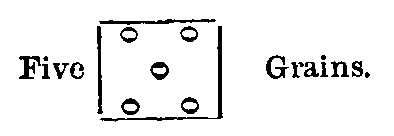
| 60 minims | are contained in | 1 fluid drachm |
| 8 fluid drachms | are contained in | 1 fluid ounce |
| 20 fluid ounces | are contained in | a pint |
| 8 pints | are contained in | 1 gallon |
| c | a gallon |
| o | a pint |
| fl. |
a fluid ounce |
| fl. |
a fluid drachm |
| m | a minim, or drop |
| A tumbler | usually contains about | 10 ounces |
| A cup | usually contains about | 6 ounces |
| A wineglass | usually contains about | 2 ounces |
| A tablespoon | usually contains about | 4 drachms |
| A dessertspoon | usually contains about | 2 drachms |
| A teaspoon | usually contains about | 1 drachm |
To-day, Man Lives in Pleasure, Wealth and Pride.
To-morrow, Poor—or Life Itself Denied.
To-day, Lays Plans for Many Years to Come.
| Age | Proportion | Proportionate Dose |
|---|---|---|
| 7 weeks | one-fifteenth | or grains 4 |
| 7 months | one-twelfth | or grains 5 |
| under 2 years | one-eighth | or grains 7.5 |
| under 3 years | one-sixth | or grains 10 |
| under 4 years | one-fourth | or grains 15 |
| under 7 years | one-third | or scruple 1 |
| under 14 years | one-half | or drachm 1/2 |
| under 20 years | two-fifths | or scruples 2 |
| above 21 years | the full dose | |
| above 65 years | the inverse gradation |
- General stimulants;
- Local stimulants;
- Chemical remedies;
- Mechanical remedies.
To-morrow, Sinks into the Silent Tomb.
To-day, His Food is Dressed in Dainty Forms.
To-morrow, is Himself a Feast for Worms.
To-day He's Clad in Gaudy, Rich Array
To-morrow, Shrouded for a Bed of Clay.
To-day, Enjoys his Halls, Built to his Mind.
To-morrow, in a Coffin is Confined.
To-day, He Floats on Honour's Lofty Wave.
To-morrow, Leaves his Title for a Grave.
To-day, his Beauteous Visage we Extol.
To-morrow, Loathsome in the Sight of All.
To-morrow, Cries Too Late to be Forgiven.
- Always prepare the new dressing before removing the old one.
- Always have hot and cold water at hand, and a vessel to place the foul dressings in.
- Have one or more persons at hand ready to assist, and, to prevent confusion, tell each person what they are to do before you commence; thus, one is to wash out and hand the sponges, another to heat the adhesive plaster, or hand the bandages and dressings, and, if requisite, a third to support the limb, &c.
- Always stand on the outside of a limb to dress it.
- Place the patient in as easy a position as possible, so as not to fatigue him.
- Arrange the bed after changing the dressings; but in some cases you will have to do so before the patient is placed on it.
- Never be in a hurry when applying dressings, do it quietly.
- When a patient requires moving from one bed to another, the best way is for one person to stand on each side of the patient, and each to place an arm behind his back, while he passes his arms over their necks, then let their other arms be passed under his thighs, and by holding each other's hands, the patient can be raised with ease, and removed to another bed. If the leg is injured, a third person should steady it; and if the arm, the same precaution should be adopted. Sometimes a stout sheet is passed under the patient, and by several people holding the sides, thy patient is lifted without any fatigue or much disturbance.
To-morrow, Dies in Anguish and Despair.
Little Deeds are Like Little Seeds.
They Grow to Flowers, or to Weeds.
Good-Nature Collects Honey from Every Herb.
Ill-Nature Sucks Poison from the Sweetest Flower.]
One Watch Set Right will Do to Set Many by.
One that Goes Wrong may Mislead a Whole Neighbourhood.
- It is impossible to urge too strongly the necessity, in all cases of cholera, of instant recourse to medical aid, and also in every form and variety of indisposition; for all disorders are found to merge in the dominant disease.
- Let immediate Relief be sought under disorder of the bowels especially, however slight. The invasion of cholera may thus be readily prevented.
- Let every Impurity, animal and vegetable, be quickly removed to a distance from the habitation, such as slaughterhouses, pig-sties, cesspools, necessaries, and all other domestic nuisances.
- Let all Uncovered Drains be carefully and frequently cleansed.
- Let the Grounds in and around the habitation be drained, so as effectually to carry off moisture of every kind.
- Let all Partitions he removed from within and without habitations, which unnecessarily impede ventilation.
- Let every Room be daily thrown open for the admission of fresh air; this should be done about noon, when the atmosphere is most likely to be dry.
- Let Dry Scrubbing be used in domestic cleansing in place of water cleansing.
- Let excessive Fatigue, and exposure to damp and cold, especially during the night, be avoided.
- Let the Use of Cold Drinks and acid liquors, especially under fatigue, be avoided, or when the body is heated.
- Let the Use of Cold Acid Fruits and vegetables be avoided.
- Let Excess in the use of ardent and fermented liquors and tobacco be avoided.
- Let a Poor Diet, and the use of impure water in cooking, or for drinking, be avoided.
- Let the Wearing of wet and insufficient clothes be avoided.
- Let a Flannel or woollen belt be worn round the belly.
- Let Personal Cleanliness be carefully observed.
- Let every cause tending to depress the moral and physical energies be carefully avoided. Let exposure to extremes of heat and cold be avoided.
- Let Crowding of persons within houses and apartments be avoided.
- Let Sleeping in low or damp rooms be avoided.
- Let Fires be kept up during the night in sleeping or adjoining apartments, the night being the period of most danger from attack, especially under exposure to cold or damp.
- Let all Bedding and clothing be daily exposed during winter and spring to the fire, and in summer to the heat of the sun.
- Let the Dead be buried in places remote from the habitations of the living. By the timely adoption of simple means such as these, cholera, or other epidemic, will be made to lose its venom.
The Loveliest Bird has No Song.
So the Loveliest Woman may Lack Virtue.
Deep Rivers Flow with Silent Majesty.
Shallow Brooks are Noisy.
- Bilious or English cholera.
Symptoms. Nausea, proceeding to vomiting, griping of the bowels, watery and offensive evacuations, in which much bile is present, accompanied with weakness and depression.
Medicines. Bryonia, with ipecacuanha at commencement of attack.
- Malignant or Asiatic cholera.
Symptoms as in English cholera, but in a more aggravated form, followed by what is called the "cold stage," marked by great severity of griping pain in the stomach, accompanied with frequent and copious watery evacuations, and presently with cramps in all parts of the body; after which the extremities become chilled, the pulse scarcely discernible, the result of which is stupor and ultimately death.
Medicines. Camphor, in the form of tincture, in frequent doses, until the sufferer begins to feel warmth returning to the body, and perspiration ensues. In the later stages, Cuprum and Veratrum.
And Faith be Our Staff.
Part 2
| name | origin | meaning |
|---|---|---|
| Aaron | Hebrew | a mountain, or lofty |
| Abel | Hebrew | vanity |
| Abraham | Hebrew | the father of many |
| Absalom | Hebrew | the father of peace |
| Adam | Hebrew | red earth |
| Adolphus | Saxon | happiness and help |
| Adrian | Latin | one who helps |
| Alan | Celtic | harmony; or Slavonic, a hound |
| Albert | Saxon | all bright |
| Alexander | Greek | a helper of men |
| Alfred | Saxon | all peace |
| Alonzo | form of Alphonso, q. v. | |
| Alphonso | German | ready or willing |
| Ambrose | Greek | immortal |
| Amos | Hebrew | a burden |
| Andrew | Greek | courageous |
| Anthony | Latin | flourishing |
| Archibald | German | a bold observer |
| Arnold | German | a maintainer of honour |
| Arthur | British | a strong man |
| Augustus / Augustin | Latin | venerable, grand |
| Baldwin | German | a bold winner |
| Bardulph | German | a famous helper |
| Barnaby | Hebrew | a prophet's son |
| Bartholemew | Hebrew | the son of him who made the waters to rise |
| Beaumont | French | a pretty mount |
| Bede | Saxon | prayer |
| Benjamin | Hebrew | the son of a right hand |
| Bennet | Latin | blessed |
| Bernard | German | bear's heart. |
| Bertram | German | fair, illustrious |
| Bertrand | German | bright raven |
| Boniface | Latin | a well-doer |
| Brian | French | having a thundering voice |
| Cadwallader | British | valiant in war |
| Cæsar | Latin | adorned with hair |
| Caleb | Hebrew | a dog |
| Cecil | Latin | dim-sighted |
| Charles | German | noble-spirited |
| Christopher | Greek | bearing Christ |
| Clement | Latin | mild-tempered |
| Conrad | German | able counsel |
| Constantine | Latin | resolute |
| Cornelius | Latin | meaning uncertain |
| Crispin | Latin | having curled locks |
| Cuthbert | Saxon | known famously |
| Dan | Hebrew | judgment |
| Daniel | Hebrew | God is judge |
| David | Hebrew | well-beloved |
| Denis | Greek | belonging to the god of wine. |
| Douglas | Gaelic | dark grey |
| Duncan | Saxon | brown chief |
| Dunstant | Saxon | most high |
| Edgar | Saxon | happy honour |
| Edmund | Saxon | happy peace |
| Edward | Saxon | happy keeper |
| Edwin | Saxon | happy conqueror |
| Egbert | Saxon | ever bright |
| Elijah | Hebrew | God the Lord |
| Elisha | Hebrew | the salvation of God |
| Emmanuel | Hebrew | God with us. |
| Enoch | Hebrew | dedicated |
| Ephraim | Hebrew | fruitful |
| Erasmus | Greek | lovely, worthy to be loved |
| Ernest | Greek | earnest, serious |
| Esau | Hebrew | hairy |
| Eugene | Greek | nobly descended |
| Eustace | Greek | standing firm. |
| Evan or Ivan | British | he same as John |
| Everard | German | well reported |
| Ezekiel | Hebrew | the strength of God. |
| Felix | Latin | happy |
| Ferdinand | German | pure peace |
| Fergus | Saxon | manly strength |
| Francis | German | free |
| Frederic | German | rich peace |
| Gabriel | Hebrew | the strength of God |
| Geoffrey | German | joyful |
| George | Greek | a husbandman |
| Gerard | Saxon | all towardliness. |
| Gideon | Hebrew | a breaker |
| Gilbert | Saxon | bright as gold |
| Giles | Greek | a little goat |
| Godard | German | a godly disposition |
| Godfrey | German | God's peace |
| Godwin | German | victorious in God |
| Griffith | British | having great faith |
| Guy | French | a leader |
| Hannibal | Punic | a gracious lord |
| Harold | Saxon | a champion |
| Hector | Greek | a stout defender |
| Henry | German | a rich lord |
| Herbert | German | a bright lord |
| Hercules | Greek | the glory of Hera, or Juno |
| Hezekiah | Hebrew | cleaving to the Lord |
| Horace / Horatio | Latin / Italian | worthy to be beheld |
| Howel | British | sound or whole |
| Hubert | German | a bright colour |
| Hugh | Dutch | high, lofty |
| Humphrey | German | domestic peace |
| Ignatius | Latin | fiery |
| Ingram | German | of angelic purity |
| Isaac | Hebrew | laughter |
| Jabez | Hebrew | one who causes pain |
| Jacob | Hebrew | a supplanter |
| James / Jacques | Hebrew / French | beguiling |
| Joab | Hebrew | fatherhood |
| Job | Hebrew | sorrowing |
| Joel | Hebrew | acquiescing |
| John | Hebrew | the grace of the Lord. |
| Jonah | Hebrew | a dove |
| Jonathon | Hebrew | the gift of the Lord |
| Joscelin | German | just |
| Joseph | Hebrew | addition |
| Joshua | Hebrew | a Saviour |
| Josiah / Josais | Hebrew | the fire of the Lord |
| Julius | Latin | soft-haired |
| Lambert | Saxon | a fair lamb |
| Lancelot | Spanish | a little lance |
| Laurence | Latin | crowned with laurels |
| Lazarus | Hebrew | destitute of help |
| Leonard | German | like a lion |
| Leopold | German | defending the people |
| Lewis / Louis | French | the defender of the people |
| Lionel | Latin | a little lion |
| Llewellin | British | like a lion |
| Llewellyn | Celtic | lightning |
| Lucius | Latin | shining |
| Luke | Greek | a wood or grove |
| Manfred | German | great peace |
| Mark | Latin | a hammer |
| Martin | Latin | martial |
| Matthew | Hebrew | a gift or present. |
| Maurice | Latin | sprung of a Moor |
| Meredith | British | the roaring of the sea |
| Michael | Hebrew | who is like God? |
| Morgan | British | a mariner |
| Moses | Hebrew | drawn out |
| Nathaniel | Hebrew | the gift of God |
| Neal | French | somewhat black |
| Nicholas | Greek | victorious over the people |
| Noel | French | belonging to one's nativity |
| Norman | French | one born in Normandy |
| Obadiah | Hebrew | the servant of the Lord |
| Oliver | Latin | an olive |
| Orlando | Italian | counsel for the land |
| Orson | Latin | a bear |
| Osmund | Saxon | house peace |
| Oswald | Saxon | ruler of a house |
| Owen | British | well-descended |
| Patrick | Latin | a nobleman |
| Paul | Latin | small, little |
| Paulinus | Latin | little Paul |
| Percival | French | a place in France |
| Percy | English | adaptation of "pierce eye" |
| Peregrine | Latin | outlandish |
| Peter | Greek | a rock or stone |
| Philip | Greek | a lover of horses |
| Ralph, contracted from Randolph, or Randal, or Ranulph |
Saxon | pure help |
| Raymond | German | quiet peace |
| Reuben | Hebrew | the son of vision |
| Reynold | German | a lover of purity |
| Richard | Saxon | powerful |
| Robert | German | famous in counsel |
| Roderick | German | rich in fame |
| Roger | German | strong counsel |
| Roland / Rowland / Rollo |
German | counsel for the land |
| Rufus | Latin | reddish |
| Samson | Hebrew | a little son |
| Samuel | Hebrew | heard by God |
| Saul | Hebrew | desired |
| Sebastian | Greek | to be reverenced |
| Seth | Hebrew | appointed |
| Silas | Latin | sylvan or living in the woods |
| Simeon | Hebrew | hearing |
| Simon | Hebrew | obedient |
| Solomon | Hebrew | peaceable |
| Stephen | Greek | a crown or garland |
| Swithin | Saxon | very high |
| Theobold | Saxon | bold over the people |
| Theodore | Greek | the gift of God |
| Theodosius | Greek | given of God |
| Theophilus | Greek | a lover of God |
| Thomas | Hebrew | a twin |
| Timothy | Greek | a fearer of God |
| Titus | Greek | meaning uncertain |
| Toby / Tobias | Hebrew | the goodness of the Lord |
| Valentine | Latin | powerful |
| Victor | Latin | conqueror |
| Vincent | Latin | conquering |
| Vivian | Latin | living |
| Walter | German | a conqueror |
| Walwin | German | a conqueror |
| Wilfred | Saxon | bold and peaceful |
| William | German | defending many |
| Zaccheus | Syriac | innocent |
| Zachary | Hebrew | remembering the Lord |
| Zebedee | Syriac | having an inheritance |
| Zechariah | Hebrew | remembered of the Lord |
| Zedekiah | Hebrew | the justice of the Lord |
| name | origin | meaning |
|---|---|---|
| Ada | German | same as Edith |
| Adela | German | same as Adeline |
| Adelaide | German | same as Adeline |
| Adeline | German | a princess |
| Agatha | Greek | good |
| Agnes | German | chaste |
| Alethea | Greek | the truth |
| Althea | Greek | hunting |
| Alice / Alicia | German | noble |
| Alma | Latin | benignant |
| Amabel | Latin | loveable |
| Amy / Amelia | French | a beloved |
| Angelina | Greek | lovely, angelic |
| Anna / Anne | Hebrew | gracious |
| Arabella | Latin | a fair altar |
| Aureola | Latin | like gold |
| Aurora | Latin | morning brightness |
| Barbara | Latin | foreign or strange |
| Beatrice | Latin | making happy |
| Bella | Latin | beautiful |
| Benedicta | Latin | blessed |
| Bernice | Greek | bringing victory |
| Bertha | Greek | bright or famous |
| Bessie | short form of Elizabeth | |
| Blanche | French | fair |
| Bona | Latin | good |
| Bridget | Irish | shining bright |
| Camilla | Latin | attendant at a sacrifice |
| Carlotta | Italian | same as Charlotte |
| Caroline | Latin | feminine of Carolus (Charles): noble-spirited |
| Cassandra | Greek | a reformer of men |
| Catherine | Greek | pure or clean. |
| Cecilia | Latin | from Cecil |
| Charity | Greek | love, bounty |
| Charlotte | French | all noble |
| Chloe | Greek | a green herb |
| Christiana | Greek | belonging to Christ |
| Cicely | a corruption of Cecilia | |
| Clara | Latin | clear or bright |
| Clarissa | Latin | clear or bright |
| Constance | Latin | constant |
| Dagmar | German | joy of the Danes |
| Deborah | Hebrew | a bee |
| Diana | Greek | Jupiter's daughter |
| Dorcas | Greek | a wild roe |
| Dorothy / Dorothea | Greek | the gift of God |
| Edith | Saxon | happiness |
| Eleanor | Saxon | all fruitful |
| Eliza / Elizabeth | Hebrew | the oath of God |
| Ellen | another form of Helen | |
| Emily | corrupted from Amelia | |
| Emma | German | a nurse |
| Esther / Hesther | Hebrew | secret |
| Eudoia | Greek | prospering in the way |
| Eudora | Greek | good gift |
| Eudosia | Greek | good gift or well-given |
| Eugenia | French | well-born |
| Eunice | Greek | fair victory |
| Eva / Eve | Hebrew | causing life |
| Fanny | diminutive of Frances | |
| Fenella | Greek | bright to look on |
| Flora | Latin | flowers |
| Florence | Latin | blooming, flourishing |
| Frances | German | free |
| Gertrude | German | all truth |
| Grace | Latin | favour |
| Hagar | Hebrew | a stranger |
| Hadassah | Hebrew | form of Esther |
| Hannah | Hebrew | gracious |
| Harriet | German | head of the house |
| Helen / Helena | Greek | alluring |
| Henrietta | fem. and dim. of Henry | |
| Hepzibah | Hebrew | my delight is in her |
| Hilda | German | warrior maiden |
| Honora | Latin | honourable |
| Huldah | Hebrew | a weazel |
| Isabella | Spanish | fair Eliza |
| Jane / Jeanne | feminine of John | |
| Janet / Jeannette | little Jane | |
| Jemima | Hebrew | a dove |
| Joan | Hebrew | fem. of John |
| Joanna / Johanna | form of Joan | |
| Joyce | French | pleasant |
| Judith | Hebrew | praising |
| Julia / Juliana | feminine of Julian | |
| Katherine | form of Catherine | |
| Keturah | Hebrew | incense |
| Keziah | Hebrew | cassia |
| Laura | Latin | a laurel |
| Lavinia | Latin | of Latium |
| Letitia | Latin | joy of gladness |
| Lilian / Lily | Latin | a lily |
| Lois | Greek | better |
| Louisa | German | fem. of Louis |
| Lucretia | Latin | a chaste Roman lady |
| Lucy | Latin | feminine of Lucius |
| Lydia | Greek | descended from Lud |
| Mabel | Latin | lovely or loveable |
| Madeline | form of Magdalen | |
| Magdalen | Syriac | magnificent |
| Margaret | Greek | a pearl |
| Maria / Marie | forms of Mary | |
| Martha | Hebrew | bitterness |
| Mary | Hebrew | bitter |
| Matilda | German | a lady of honour |
| Maud | German | form of Matilda |
| May | Latin | month of May, or dim. of Mary |
| Mercy | English | compassion |
| Mildred | Saxon | speaking mild |
| Minnie | dim. of Margaret | |
| Naomi | Hebrew | alluring |
| Nest | British | the same as Agnes |
| Nicola | Greek | feminine of Nicholas |
| Olive / Olivia | Latin | an olive |
| Olympic | Greek | heavenly |
| Ophelia | Greek | a serpent |
| Parnell / Petronilla | little Peter | |
| Patience | Latin | bearing patiently |
| Paulina | Latin | feminine of Paulinus |
| Penelope | Greek | a weaver |
| Persis | Greek | destroying |
| Philadelphia | Greek | brotherly love |
| Philippa | Greek | feminine of Philip |
| Phœbe | Greek | the light of life. |
| Phyllis | Greek | a green bough |
| Polly | variation of Molly, dim. of Mary | |
| Priscilla | Latin | somewhat old |
| Prudence | Latin | discretion |
| Psyche | Greek | the soul |
| Rachel | Hebrew | a lamb |
| Rebecca | Hebrew | fat or plump |
| Rhoda | Greek | a rose |
| Rosa / Rose | Latin | a rose |
| Rosalie / Rosaline | Latin | little rose |
| Rosalind | Latin | beautiful as a rose |
| Rosabella | Italian | a fair rose |
| Rosamund | Saxon | rose of peace |
| Roxana | Persian | dawn of day |
| Ruth | Hebrew | trembling, or beauty |
| Sabina | Latin | sprung from the Sabines |
| Salome | Hebrew | perfect |
| Sapphira | Greek | like a sapphire stone |
| Sarah | Hebrew | a princess |
| Selina | Greek | the moon |
| Sybilla | Greek | the counsel of God |
| Sophia | Greek | wisdom |
| Sophronia | Greek | of a sound mind |
| Susan / Susanna | Hebrew | a lily |
| Tabitha | Syriac | a roe |
| Temperance | Latin | moderation |
| Theodosia | Greek | given by God |
| Tryphena | Greek | delicate |
| Tryphosa | Greek | delicious |
| Victoria | Latin | victory |
| Vida | Erse | feminine of David |
| Ursula | Latin | a she bear |
| Walburga | Saxon | gracious |
| Winifred | Saxon | winning peace |
| Zenobia | Greek | the life of Jupiter |
Nor break the ties of friendship needlessly.
"The tested gain by the use of this grate is an increase of 15 degrees of temperature, with a saving of one-third in fuel. I believe that there are several millions of grates on the wrong principle, hurrying the heat up the chimney instead of into the room, and thus causing an in-draught of cold air. This is especially the case with strong drawing registers. No part of a grate should be of iron, except the thin front bars; for iron is a conductor away of heat, but fire-bricks are not so."
"If any of your readers are troubled with smoky fires and cold rooms, allow me to recommend them to follow Mr. Mechi's plan, as I have done. Remove the front and bottom bars from any ordinary grate; then lay on the hearth, under where the bars were, a large fire tile, three inches thick, cut to fit properly, and projecting about an inch further out than the old upright bars. Then get made by the blacksmith a straight hurdle, twelve inches deep, having ten bars, to fit into the slots which held the old bars, and allow it to take its bearing upon the projecting fire-brick. The bars should be round, of five-eighth inch rod, excepting the top and bottom, which are better flat, about 1-1/4 in. broad. My dining-room grate was thus altered at a total cost of eighteen shillings two years ago, the result being that a smoky chimney is cured, and that the room is always at a really comfortable temperature, with a smaller consumption of coal than before. The whole of the radiation is into the room, with perfect slow combustion."
Never spend your money before you have it.
| English Fine Wheaten Flour |
Indian Corn Flour |
|
|---|---|---|
| water | 16 | 12 |
| gluten | 10 | 12 |
| Fat | 2 | 8 |
| Starch, etc. | 72 | 66 |
| Total | 100 | 100 |
Never trouble another for what you can do yourself.
Never Put Off Till To-morrow What You Can Do To-day.
All Things have a Beginning, God Excepted.
God is the First of All.
Virtue is the Fairest of All.
"In the hands of an expert cook," says Majendie, "alimentary substances are made almost entirely to change their nature, their form, consistence, odour, savour, colour, chemical composition, &c.; everything is so modified, that it is often impossible for the most exquisite sense of taste to recognise the substance which makes up the basis of certain dishes. The greatest utility of the kitchen consists in making the food agreeable to the senses, and rendering it easy of digestion."
Vice is the Most Hurtful of All.
Thought is the Most Swift of All.
Hope is the Most Common of All.
| H. | M. | |
|---|---|---|
| A small capon, fowl, or chicken requires | 0 | 26 |
| A large fowl | 0 | 45 |
| A capon, full size | 0 | 35 |
| A goose | 1 | 0 |
| Wild ducks, and grouse | 0 | 15 |
| Pheasants, and turkey poults | 0 | 20 |
| A moderate sized turkey, stuffed | 1 | 15 |
| Partridges | 0 | 25 |
| Quail | 0 | 10 |
| A hare, or rabbit, about | 1 | 0 |
| Leg of pork, 1/4 hour for each pound, and above that allowance | 0 | 20 |
| Chine of pork, as for leg, and | 0 | 20 |
| A neck of mutton | 1 | 30 |
| A haunch of venison, about | 3 | 30 |
"If a vessel containing water be placed over a steady fire, the water will grow continually hotter, till it reaches the limit of boiling; after which, the regular accessions of heat are wholly spent in converting it into steam: the water remains at the same pitch of temperature, however fiercely it boils. The only difference is, that with a strong fire it sooner comes to boil, and more quickly boils away, and is converted into steam."
A Scraper at the Door Keeps Dirt from the Floor.
A Letter-box Saves Many Knocks.
| H. | M. | |
|---|---|---|
| A ham, 20 lbs. weight, requires | 6 | 30 |
| A tongue (if dry), after soaking | 4 | 0 |
| A tongue out of pickle to |
2 3 |
30 0 |
| A neck of mutton | 1 | 30 |
| A chicken | 0 | 20 |
| A large fowl | 0 | 45 |
| A capon | 0 | 35 |
| A pigeon | 0 | 15 |
A Bell Hung Well its Tale will Tell.
- Fresh butter.
- Clarified suet.
- Minced sweet herbs, butter, and claret, especially for mutton and lamb.
- Water and salt.
- Cream and melted butter, especially for a flayed pig.
- Yolks of eggs, grated biscuit and juice of oranges.
- Flour mixed with grated bread.
- Sweet herbs dried and powdered, and mixed with grated bread.
- Lemon-peel dried and pounded, or orange-peel, mixed with flour.
- Sugar finely powdered, and mixed with pounded cinnamon, and flour or grated bread.
- Fennel seeds, corianders, cinnamon, and sugar, finely beaten and mixed with grated bread or flour.
- For young pigs, grated bread or flour, mixed with beaten nutmeg, ginger, pepper, sugar, and yolks of eggs.
- Sugar, bread, and salt mixed.
An Ill-Fixed Blind No One Can Wind.
Keep Your Keys and Be at Ease.
A Chair Unsound Soon Finds the Ground.
Every Receipt is the Basis of Many Others.
A Good Suggestion is Often Invaluable.
- Sprinkle a little salt on the spongy part or gills of the sample to be tried. If they turn yellow, they are poisonous,—if black, they are wholesome. Allow the salt to act, before you decide on the question.
- False mushrooms have a warty cap, or else fragments of membrane, adhering to the upper surface, are heavy, and emerge from a vulva or bag; they grow in tufts or clusters in woods, on the stumps of trees, &c., whereas the true mushrooms grow in pastures.
- False mushrooms have an astringent, styptic, and disagreeable taste. When cut they turn blue. They are moist on the surface, and generally of a rose or orange colour.
- The gills of the true mushroom are of a pinky red, changing to a liver colour. The flesh is white. The stem is white, solid, and cylindrical.
A Good Beginning Makes a Good Ending.
Try All Things, Hold Fast That Which is Good.
We Learn Something, Even by Our Failures.
When we Think we Fail, we are Often Near Success.
Second Trials Often Succeed.
Second Thoughts are Often Best.
Read Frequently the Medical Hints.
And Study All the Precautions.
Study the Precautions Respecting Fire.
Read the Hints to Husbands and Wives.
"The boiling of bacon is a very simple subject to comment upon; but our main object is to teach common cooks the art of dressing common food in the best manner. Cover a pound of nice streaked bacon with cold water, let it boil gently for three quarters of an hour; take it up, scrape the under side well, and cut off the rind: grate a crust of bread not only on the top, but all over it, as you would ham, put it before the fire for a few minutes, not too long, or it will dry and spoil it. Bacon is sometimes as salt as salt can make it, therefore before it is boiled it must be soaked in warm water for an hour or two, changing the water once; then pare off the rusty and smoked part, trim it nicely on the under side, and scrape the rind as clean as possible."
Fire Is A Good Servant But A Bad Master.
"This is a most frugal, agreeable, and nutritive meal. It will neither lighten the purse nor lie heavy on the stomach. It will furnish you with a pleasant soup, and meat for eight persons.
Wash three-quarters of a pound of Scotch barley in a little cold water; put it in a soup-pot with a shin or leg of beef, of about ten pounds weight, sawn into four pieces (tell the butcher to do this for you); cover it well with cold water; set it on the fire; when it boils, skim it very clean, and put in two onions, of about three ounces weight each; set it by the side of the fire to simmer very gently for about two hours; then skim all the fat clean off, and put in two heads of celery and a large turnip cut into small squares; season it with salt, and let it boil for an hour and a half longer, and it will be ready: take out the meat carefully with a slice (and cover it up, and set it by the fire to keep warm), and skim the broth well before you put it in the tureen.
Put a quart of the soup into a basin, and about an ounce of flour into a stewpan, and pour the broth to it by degrees, stirring it well together; set it on the fire, and stir it till it boils, then let it boil up, and it is ready. Put the meat in a ragoût dish, and strain the sauce through a sieve over the meat; you may put to it some capers, or minced gherkins, or walnuts, &c. If the beef has been stewed with proper care, in a very gentle manner, and taken up at 'the critical moment when it is just tender,' you will obtain an excellent and savoury meal."
There is No Balm for Every Wound.
Books and Thought;—They Should Not Supersede It.
There is Something to be Learned from the Merest Trifle.
Strive to Learn from All Things.
Observation is the Best Teacher.
Small Beginnings may Lead to Large Ends.
"Rub the scaly cuticle off the legs with a cloth; trim away the claws and spurs; cut off the neck close up to the back, leaving the skin of the breast entire; wipe the pheasant clean and truss it in the following manner, viz.:—Place the pheasant upon its breast, run a trussing needle and string through the left pinion (the wings being removed); then turn the bird over on its back, and place the thumb and forefinger of the left hand across the breast, holding the legs erect; thrust the needle through the middle joint of both thighs, draw it out and then pass it through the other pinion, and fasten the strings at the back; next pass the needle through the hollow of the back, just below the thighs, thrust it again through the legs and body and tie the strings tightly; this will give it an appearance of plumpness."
If None Endeavour, there would be an End to Discovery.
The Steam Engine is a Mighty Agent of Good.
The Steam from a Kettle Suggested the Steam Engine.
Be Bold Enough to Experiment.
Two large potatoes, passed through kitchen sieve,
Unwonted softness to the salad give;
Of mordant mustard add a single spoon—
Distrust the condiment which bites so soon;
But deem it not, thou man of herbs, a fault
To add a double quantity of salt;
Three times the spoon with oil of Lucca crown,
And once with vinegar procured from town.
True flavour needs it, and your poet begs
The pounded yellow of two well-boiled eggs;
Let onion atoms lurk within the bowl,
And, scarce suspected, animate the whole;
And lastly, on the favoured compound toss
A magic teaspoon of anchovy sauce;
Then, though green turtle fail, though venison's tough,
And ham and turkey be not boiled enough
Serenely full, the epicure may say,—
"Fate cannot harm me—I have dined today."
He is Unfortunate who Cannot Bear Misfortune.
Falsehood, Like a Nettle, Stings Those who Meddle with It.
Let Truth be our Guide.
The Fall of the Leaf is a Whisper to the Living.
The hope is sure which has its foundation in virtue.
If you want a good pudding, to teach you I'm willing:
Take two pennyworth of eggs, when twelve for a shilling;
And of the same fruit that Eve had once chosen,
Well pared and well chopped, at least half a dozen;
Six ounces of bread (let your maid eat the crust),
The crumbs must be grated as small as the dust;
Six ounces of currants from the stones you must sort,
Lest they break out your teeth, and spoil all your sport;
Six ounces of sugar won't make it too sweet;
Some salt and some nutmeg will make it complete;
Three hours let it boil, without hurry or flutter,
And then serve it up, without sugar or butter.
An Evil Conscience is the Greatest Plague.
Sleep Falls Sweetly upon the Virtuous.
Morning is Welcome to the Industrious.
- Lose no time.
- Handle the body gently.
- Carry the body face downwards, with the head gently raised, and never hold it up by the feet.
- Send for medical assistance immediately, and in the meantime act as follows:
- Strip the body, rub it dry: then wrap it in hot blankets, and place it in a warm bed in a warm room.
- Cleanse away the froth and mucus from the nose and mouth.
- Apply warm bricks, bottles, bags of sand, &c., to the armpits, between the thighs, and to the soles of the feet.
- Rub the surface of the body with the hands enclosed in warm dry worsted socks.
- If possible, put the body into a warm bath.
- To restore breathing, put the pipe of a common bellows into one nostril, carefully closing the other, and the mouth; at the same time drawing downwards, and pushing gently backwards, the upper part of the windpipe, to allow a more free admission of air; blow the bellows gently, in order to inflate the lungs, till the breast be raised a little; then set the mouth and nostrils free, and press gently on the chest: repeat this until signs of life appear. The body should be covered the moment it is placed on the table, except the face, and all the rubbing carried on under the sheet or blanket. When they can be obtained, a number of tiles or bricks should be made tolerably hot in the fire, laid in a row on the table, covered with a blanket, and the body placed in such a manner on them, that their heat may enter the spine. When the patient revives, apply smelling-salts to the nose, give warm wine or brandy and water.
- Never rub the body with salt or spirits.
- Never roll the body on casks.
- Continue the remedies for twelve hours without ceasing.
Pure Water is Better than Foul Wine.
| E | effects or symptoms |
| T | treatment |
| A | antidotes or counter poisons |
| DA | dangerous antidotes. |
- Those causing local symptoms.
- Those producing spasmodic symptoms.
- Narcotic or sleepy symptoms; and
- Paralytic symptoms.
- Always send immediately for a Medical Man.
- Save all fluids vomited, and articles of food, cups, glasses, &c., used by the patient before being taken ill, and lock them up.
- Examine the cups to guide you in your treatment; that is, smell them, and look at them.
| E | Little or no taste. Within an hour, heat and pain in the stomach, followed by vomiting of green, yellow, and bloody matter, burning, and violent thirst; purging, and twisting about the navel; pulse small, quick, and irregular, breathing laboured, voice hoarse, speaking painful; skin cold and clammy. Sometimes there are cramps and convulsions, followed by death. |
| T | Give plenty of warm water, _new milk_ in large quantities, lime water, white of egg, mixed with gruel or honey, gruel, linseed tea; apply leeches to the bowels, foment, and give starch or gruel enemas. Scrape the iron rust off anything you can get at, mix it with plenty of water, and give in large draughts frequently, and give an emetic of mustard or ipecacuanha. The chief dependence, however, must be placed on the use of the stomach-pump. |
| Caution | Never give large draughts of fluid until those given before have been vomited, because the stomach will not contract properly if filled with fluid, and the object is to get rid of the poison as speedily as possible. |
| E | An acid, rough, disagreeable taste in the mouth; a dry, parched tongue, with sense of strangling in the throat; coppery eructations; frequent spitting; nausea; frequent desire and effort to vomit, or copious vomiting; severe darting pains in the stomach; griping; frequent purging; belly swollen and painful; skin hot, and violent burning thirst; breathing difficult; intense headache and giddiness, followed by cold sweats, cramps in the legs, convulsions, and death. |
| A | White of eggs mixed with water (twelve to one pint), to be given in wineglassfuls every two minutes; iron filings mixed with water, or very strong coffee, accompanied by small and repeated doses of castor oil. |
| DA | Vinegar, bark, alkalies, gall nuts. |
| T | If there is much pain in the belly or stomach, apply leeches. Give large draughts of milk and water, to encourage vomiting |
| E | Acid metallic taste; tightness and burning in the throat; pain in the back part of the mouth, stomach, and bowels; anxiety of countenance; nausea; and vomiting of bloody and bilious fluids; profuse purging, and difficulty of making water; pulse small, hard, and quick; skin clammy, icy coldness of the hands and feet; and death in 24 or 36 hours. |
| A | White of eggs mixed with water, given as above; milk; flour and water, mixed pretty thick; linseed tea; and barley water. |
| T | Give large draughts of warm water, if you cannot get anything else; strong emetic of ipecacuanha, the stomach-pump, a dose of castor oil and laudanum. Apply poppy-head fomentations to bowels, and leeches if the belly is very tender. |
| E | A rough metallic taste in the mouth, nausea, copious vomitings, sudden hiccough, purging, pains resembling those caused by colic, frequent and violent cramps, sense of choking, severe heartburn, pain at the pit of the stomach, difficult breathing, wildness of speech, cramp in the legs, and death. |
| A | Decoction or tincture of galls; strong tea; decoction or powder of Peruvian bark. |
| DA | White vitriol, ipecacuanha, as emetics. |
| T | Give large draughts of water, or sugar and water, to promote vomiting; apply leeches to the throat and stomach if painful; and give one grain of extract of opium dissolved in a wineglassful of sugar and water, as soon as the vomiting ceases, and repeat three times at intervals of a quarter of an hour; and finally, one grain, in a little castor oil emulsion, every six hours. |
| E | Colic and purging. |
| A | Milk |
| T | Give warm or cold water to promote vomiting, or tickle the throat with a feather. |
| E | An astringent taste, sensation of choking, nausea, vomiting, purging, pain and burning in the throat and stomach, difficult breathing, pallor and coldness of the surface, pinched face, cramps of the extremities, but, with the exception of the chloride, seldom death. |
| A | For the two first give copious draughts of milk, and white of eggs and water, mucilage, and olive oil; for the third, carbonate of soda, and warm water in frequent draughts, with the same as for the other compounds. |
| T | Relieve urgent symptoms by leeching and fomentations, and after the vomiting give castor oil. For the chloride, use friction and warmth. |
Breath may Blow out a Candle, an Extinguisher Prevent Fire.
| E | Burning pain in the throat, mouth, accompanied with the usual symptoms of corrosive poisons. |
| A | For silver, common salt and water; for gold and bismuth, no antidotes are known. |
| T | Give milk and mucilaginous fluids, and castor oil. |
| E | Acid burning taste, acute pain in the gullet and throat, vomiting of bloody fluid, which effervesces when chalk is added to it; hiccough, tenderness of the belly, cold sweats, pinched face, convulsions, and death. |
| A | Give calcined magnesia, chalk, soap and water. Administer frequent draughts of water to weaken the acid with carbonate of soda, potass, or magnesia, to neutralize it; thick soap-suds made with common soap; chalk, or in default of the alkalies and chalk, break down the plaster of the wall or ceiling, mix in water, and give the sufferer. Excite vomiting, and repeat the remedies till all the acid is neutralized. |
| E | Violent coughing, tightness of the chest, debility, inability to stand. |
| A | The vapour of caustic ammonia to be inhaled, or ten drops of liquid ammonia to one ounce of water to be taken. |
| T | Dash cold water over the face, and relieve urgent symptoms. |
| E | Sugary astringent metallic taste, tightness of the throat, pains as if caused by colic, violent vomiting, hiccough, convulsions, and death. |
| A | Epsom or Glauber's salt; plaster of Paris; or phosphate of soda. |
| T | An emetic of sulphate of zinc (twenty-four grains to half a pint of water); leeches to belly; fomentations if necessary; and a dose of castor oil mixed with laudanum. |
| E | Intense burning and pain in the throat and stomach. |
| A | Magnesia and carbonate of soda. |
| T | Large draughts of cold water, and tickle the throat with a feather. |
| Caution | Do not give oil or milk. |
| E | Burning in the throat and stomach, cramps in the belly, hiccough, vomiting, and paralysis of limbs. |
| A | Vinegar or lemon juice. |
| T | Thin starch water to be drunk frequently. |
| E | Acrid, hot, disagreeable taste; burning in the throat, nausea, and vomiting bloody matter; profuse purging, pain in the stomach, colic, convulsions, and death. |
| A | Vinegar and vegetable acids |
| T | Give linseed tea, milk, almond or olive oil, and excite vomiting. |
| E | Heartburn, nausea, violent vomiting, purging, convulsions, difficult breathing, violent pain in the bowels, kidneys, and bladder, with bloody urine. |
| T | Emetics, frequent draughts of barley water, with castor oil and laudanum. |
| E | Giddiness, faintness, nausea, vomiting, stupor, delirium, and death. |
| T | Give emetics, large draughts of fluids, tickle the throat, apply smelling salts to the nose, dash cold water over the face and chest, apply mustard poultices, and, above all, endeavour to rouse the patient by walking between two persons; and, if possible, by electricity; and give forty drops of sal-volatile in strong coffee every half-hour. |
| E | Acrid, biting, bitter taste, choking sensation, dryness of the throat, retching, vomiting, purging, pains in the stomach and bowels, breathing difficult, and death. |
| T | Give emetics of camomile, mustard, or sulphate of zinc; large draughts of warm milk, or other bland fluids; foment and leech the belly if necessary, and give strong infusion of coffee. |
Take Care of Pence, Pounds will Take Care of Themselves.
| E | Vomiting and acute pain in the stomach, general debility, cramps, and death. |
| A | Chalk |
| T | Give large draughts of lime water or magnesia. |
| E | Acrid taste, burning heat in the throat, stomach, and belly, bloody vomitings, colic, purging, retention of urine, convulsions, death. |
| T | Large draughts of olive oil; thin gruel, milk, starch enemas, linseed tea, laudanum, and camphorated water. |
| E | Intense pain in the stomach after swallowing the fish, vomiting, purging, and sometimes cramps. |
| T | Give an emetic; excite vomiting by tickling the throat, and plenty of warm water. Follow emetics by active purgatives, particularly of castor oil and laudanum, or opium and calomel, and abate inflammation by the usual remedies. |
| E | Violent and quick inflammation of the part, extending towards the body, soon becoming livid; nausea, vomiting, convulsions, difficult breathing, mortification, cold sweats, and death. |
| T | Suppose that the wrist has been bitten: immediately tie a tape between the wound and the heart, scarify the parts with a penknife, razor, or lancet, and apply a cupping-glass over the bite, frequently removing it and bathing the wound with volatile alkali, or heat a poker and burn the wound well, or drop some of Sir Wm. Burnett's Disinfecting Fluid into the wound, or cauterize the bite freely with lunar caustic, but not till the part has been well sucked with the mouth, or frequently washed and cupped. The strength is to be supported by brandy, ammonia, ether, and opium. Give plenty of warm drinks, and cover up in bed. |
| E | Hydrophobia, or a fear of fluids. |
| T | Tie a string tightly over the part, cut out the bite, and cauterize the wound with a red-hot poker, lunar caustic, or Sir Wm. Burnett's Disinfecting Fluid. Then apply a piece of "spongio-piline," give a purgative, and plenty of warm drink. Whenever chloroform can be procured, sprinkle a few drops upon a handkerchief, and apply to the nose and mouth of the patient before cauterizing the wound. When the breathing appears difficult, cease the application of the chloroform. A physician, writing in the Times, strongly urged this course, and stated, many years ago, that there is no danger, with ordinary care, in the application of the chloroform, while the cauterization may be more effectively performed. |
| E | Swelling, nausea, and fever. |
| T | Press the barrel of a watch-key over the part, so as to expose the sting, which must be removed. Give fifteen drops of hartshorn or sal-volatile in half a wine-glassful of camomile tea, and cover the part stung with a piece of lint soaked in extract of lead. |
- As many sudden deaths come by water, particular caution is therefore necessary in its vicinity.
- Do not stand near a tree, or any leaden spout, iron gate, or palisade, in times of lightning.
- Lay loaded guns in safe places, and never imitate firing a gun in jest.
- Never sleep near charcoal; if drowsy at any work where charcoal fires are used, take the fresh air.
- Carefully rope trees before they are cut down, that when they fall they may do no injury.
- When benumbed with cold beware of sleeping out of doors; rub yourself, if you have it in your power, with snow, and do not hastily approach the fire.
- Beware of damp.
- Air vaults, by letting them remain open some time before you enter, or scattering powdered lime in them. Where a lighted candle will not burn, animal life cannot exist; it will be an excellent caution, therefore, before entering damp and confined places, to try this simple experiment.
- Never leave saddle or draught horses, while in use, by themselves; nor go immediately behind a led horse, as he is apt to kick. When crossing a roadway always go behind a cart or carriage, never in front of it.
- Do not ride on footways.
- Look closely after children, whether they are up or in bed; and particularly when they are near the fire, an element with which they are very apt to amuse themselves.
- Leave nothing poisonous open or accessible; and never omit to write the word "POISON" in large letters upon it, wherever it may be placed.
- In walking the streets keep out of the line of the cellars, and never look one way and walk another.
- Never throw pieces of orange peel, or broken glass bottles, into the streets.
- Never meddle with gunpowder by candle-light.
- In trimming a lamp with naphtha, never fill it. Leave space for the spirit to expand with warmth.
- Never quit a room leaving the poker in the fire.
- When the brass rod of the stair-carpet becomes loose, fasten it immediately.
- In opening effervescing drinks, such as soda water, hold the cork in your hand.
- Quit your house with care on a frosty morning.
- Have your horses' shoes roughed directly there are indications of frost.
- Keep lucifer matches in their cases, and never let them be strewed about.
- Kick into the gutter any piece of orange peel that you may see on the pavement or the roadway. By so doing you may save many from meeting with dangerous accidents.
- Never allow your servants to leave brooms, brushes, slop-pails, water cans, &c. in outside doorways, or at the head of a flight of stairs when engaged in house-work.
If You are in Debt, Somebody Owns Part of You.
Economy is the Easy Chair of Old Age.
Little Sticks Kindle the Fire, but Great Ones Put it Out.
What Thou Canst Do Thyself, Commit Not to Another.
A Child is the Brightest Ray in the Sunshire of the Parent's Heart.
A Laughing Child is the Best Portrait of Happiness.
- Lay the article for several hours in a strong solution of nitrate of silver, and expose to the light.
- Boil the article for some time in a strained decoction of logwood, and then steep it in a solution of persulphate or acetate of iron.
- Immerse frequently in ink, until of sufficient depth of colour.
- Immerse for some time in a dilute solution of sulphate of indigo—partly saturated with potash—and it will be fully stained.
- Steep in a strong solution of sulphate of copper.
- Dip blue-stained articles for a short time in nitro-hydrochlorate of tin, and then in a hot decoction of fustic.
- Boil in a solution of verdigris in vinegar until the desired colour is obtained.
- Dip the articles first in the tin mordant used in dyeing, and then plunge into a hot decoction of Brazil wood—half a pound to a gallon of water—or cochineal.
- Steep in red ink until sufficiently stained.
- Impregnate with nitro-hydrochlorate of tin, and then digest with heat in a strained decoction of fustic.
- Steep for twenty-four hours in a strong solution of the neutral chromate of potash, and then plunge for some time in a boiling solution of acetate of lead.
- Boil the articles in a solution of alum—a pound to half a gallon—and then immerse for half an hour in the following mixture:—Take half a pound of turmeric, and a quarter of a pound of pearl-ash; boil in a gallon of water. When taken from this, the bone must be again dipped in the alum solution.
Avoid Yourself What You Think Wrong in Your Neighbour.
- Stain the material green with the verdigris stain given in No. 1433, and brush over with a solution of pearlash—two ounces to the pint—till it becomes blue.
- Use the blue stain for wood.
- Brush over with the expressed juice of ripe privet berries.
- The same as for wood.
- Brush over with tincture of turmeric.
- Add anatto or dragon's-blood to the tincture of turmeric, and brush over as usual.
- Drop a little sulphuric acid into a small quantity of water, brush over the wood and hold to the fire; it will turn a fine black, and take a good polish.
- Take half a gallon of vinegar, an ounce of bruised nut galls, of logwood chips and copperas each half a pound—boil well; add half an ounce of the tincture of sesquichloride of iron, formerly called the muriated tincture and brush on hot.
- Use the stain given for ships' guns.
- Take half a gallon of vinegar, half a pound of dry lampblack, and three pounds of iron rust, sifted. Mix, and let stand for a week. Lay three coats of this on hot, and then rub with linseed oil, and you will have a fine deep black.
- Add to the above stain an ounce of nut galls, half a pound of log-wood chips, and a quarter of a pound of copperas; lay on three coats, oil well, and you will have a black stain that will stand any kind of weather, and one that is well suited for ships' combings, &c.
- Take a pound of logwood chips, a quarter of a pound of Brazil wood, and boil for an hour and a half in a gallon of water. Brush the wood several times with this decoction while hot. Make a decoction of nut galls by simmering gently, for three or four days, a quarter of a pound of the galls in two quarts of water; give the wood three coats of this, and, while wet, lay on a solution of sulphate of iron (two ounces to a quart), and when dry, oil or varnish.
- Give three coats with a solution of copper filings in aquafortis, and repeatedly brush over with the logwood decoction, until the greenness of the copper is destroyed.
- Boil half a pound of logwood chips in two quarts of water, add an ounce of pearlash, and apply hot with a brush. Then take two quarts of the logwood decoction, and half an ounce of verdigris, and the same of copperas; strain, and throw in half a pound of iron rust. Brush the work well with this, and oil.
The Highest Happiness is to be Good and to Do Good.
- Dissolve copper filings in aquafortis, brush the wood with it, and then go over the work with a hot solution of pearlash (two ounces to a pint of water) till it assumes a perfectly blue colour.
- Boil a pound of indigo, two pounds of woad, and three ounces of alum, in a gallon of water; brush well over until thoroughly stained.
- Boil half a pound of madder and two ounces of logwood chips in a gallon of water, and brush well over while hot; when dry, go over the whole with pearlash solution, two drachms to the quart.
- Put two ounces of dragon's-blood, bruised, into a quart of oil of turpentine; let the bottle stand in a warm place, shake frequently, and, when dissolved, steep the work in the mixture.
- Boil half a pound of madder and a quarter of a pound of fustic in a gallon of water; brush over the work when boiling hot, until properly stained.
- The surface of the work being quite smooth, brush over with a weak solution of aquafortis, half an ounce to the pint, and then finish with the following:— Put four ounces and a half of dragon's blood and an ounce of soda, both well bruised, to three pints of spirits of wine; let it stand in a warm place, shake frequently, strain, and lay on with a soft brush, repeating till of a proper colour; polish with linseed oil or varnish.
- Boil a pound of Brazil wood and an ounce of pearlash in a gallon of water, and while hot brush over the work until of a proper colour. Dissolve two ounces of alum in a quart of water, and brush the solution over the work before it dries.
- Take a gallon of the above stain, add two more ounces of pearlash; use hot, and brush often with the alum solution.
- Use a cold infusion of archil, and brush over with the pearlash solution used for No. 1434.
- Boil half a pound of logwood in three pints of water till it is of a very dark red, add half an ounce of salt of tartar; stain the work with the liquor while boiling hot, giving three coats; then, with a painter's graining brush, form streaks with No. viii. black stain (see par. 1430); let the work dry, and varnish.
- Brush over with the logwood decoction used for No. vi. black, three or four times; put half a pound of iron filings into two quarts of vinegar; then with a graining brush, or cane bruised at the end, apply the iron filing solution in the form required, and polish with bees'-wax and turpentine when dry, or varnish.
- Brush over with the tincture of turmeric.
- Warm the work and brush over with weak aquafortis, then hold to the fire. Varnish or oil as usual.
Saving Affords the Means of Giving.
Memorandum of Agreement, entered into this —— day of ——-18——, between R.A., of ——, and L.O., of of ——, as follows:
The said R.A. doth hereby let unto the said L.O. a dwelling-house, situate in ——, in the parish of ——-, for the term of one year certain, and so on from year to year, until half a year's notice to quit be given by or to either party, at the yearly rent of —— pounds, payable quarterly; the tenancy to commence at —— day next.
And the said R.A. doth undertake to pay the land-tax, the property-tax, and the sewer-rate, and to keep the said house in all necessary repairs, so long as the said L.O. shall continue therein. And the said L.O. doth undertake to take the said house of R.A. for the before-mentioned term and rent, and pay all rates and taxes, except as aforesaid. The said R.A. to be at liberty to re-enter if any rent shall be in arrear for 21 days, whether such rent has been demanded or not.
Witness our hands, the day and year aforesaid.
Witness, G.C.
R.A.
L.O.
And the said R.A. doth undertake to pay all rates and taxes, of whatever nature or kind, chargeable on the said house and premises, and to keep the said house in all necessary repairs, so long as the said L.O. shall continue therein.
I, R.A., landlord of a certain house and premises now about to be taken and occupied by L.O., do hereby agree to indemnify the said L.O. from the payment of any rent, taxes, or rates in arrear, prior to the date of the day at which his said tenancy commences. As witness my hand this —— day of —— 18——
R.A., Landlord of the above premises.
Witness, G.C.
The said R.A. doth let unto the said L.O. a house (and garden, if any) with appurtenances, situate in ——, in the parish of ——, for three years certain. The rent to commence from —— day next, at and under the yearly rent of ——, payable quarterly, the first payment to be at —— day next.
The said L.O. doth agree to take the said house (and garden) of the said R.A. for the term and rent payable in manner aforesaid; and that he will, at the expiration of the term, leave the house in as good repair as he found it [reasonable wear and tear excepted]. The said R.A. to be at liberty to re-enter, if any rent shall be in arrear for 21 days, whether such rent has been demanded or not. Witness our hands.
R.A.
L.O.
Witness, G.C.
Received of Mr. L.O. the sum of ten pounds ten shillings, for a quarter's rent due at Lady-day last, for the house, No. ,— — street.
£10 10s. [Stamp] R. A. ———
G. C.,
Agent for R.A., landlord of the above premises.
Sir,—I hereby give you notice, that on or before the ——day of ——next, I shall quit and deliver up possession of the house and premises I now hold of you, situate at ——, in the parish of ——, in the county of ——.
Dated the ——day of ——, 18
Witness, G.C.
L.O.
To Mr. R. A.
—Sir,—I hereby give you notice to quit and deliver up possession to me of the house and appurtenances, situate No ——, which you now hold of me, on or before ——next.
Dated ——, 18 .
(Signed) R.A. (landlord).
To Mr. L. O.
To Mr. R. A.—Sir,—I hereby give you notice to deliver up possession, and quit on or before ———, the [_here state the house or apartment_] and appurtenances which you now hold of me in [_insert the name of street, &c._], and in default of your compliance therewith, I do and will insist on your paying me for the same, the [_annual or monthly_] rent of ——, being an additional rental of —— pounds per annum [_over and above the present annual rental_] rent, for such time as you shall detain the key and keep possession over the said notice.
Witness my hand, this —— day of ——, 18.
Witness, G.C.
L.O.
A Hungry Man Sees Far.
He that Plays with Fire may be Burnt.
Memorandum of an agreement made and entered into this —— day of ——, 18 , between R.A., of ——, of the one part, and L.O., of ——, of the other part, as follows:—That the said R.A. agrees to let, and the said L.O. to take, all that messuage or tenement (with the garden and appurtenances thereto) situate at, &c. [or if an apartment be the subject of demise, all the entire first floor, particularly describing the other appurtenances], together with all the furniture, fixtures, and other things mentioned and comprised in the schedule hereunder written, for the space of —— months, to be computed from the —— day of ——, at the rent of —— pounds per quarter, payable quarterly, the first quarterly payment to be made on the —— day of —— next ensuing the date hereof. And it is further agreed, by and between the said parties, that each party shall be at liberty to determine the said tenancy, on giving to the other a quarter's notice in writing. And the said L.O. agrees, that in the determination of the tenancy, he will deliver up the said dwelling-house (or the entire first floor, &c.), together with all the fixtures and furniture as aforesaid, in as good a condition as the same now are, reasonable wear and tear thereof excepted, and shall and will replace any of the crockery and china or other utensils that shall be broken or otherwise damaged. In witness, &c.—[Here is to follow the Inventory, or List of Articles referred to above.]
Play Not with Edged Tools.
| £ | s. | d. | |
|---|---|---|---|
| Levying a distress (under £20) [Over £20 and under £50, 3 p.c. on the amount; £50 to £200, 2-1/2 p.c.; above £200, 1 p.c.] |
0 | 3 | 0 |
| Man in possession, per day, if rent due be under £20. |
0 | 4 | 6 |
| Ditto, over £20 (Man to provide his own board in all cases.) |
0 | 5 | 0 |
"To the Commissioners of Inland Revenue,
Somerset House,
London.—Middlesbro',
Aug. 18th, 1855.
Sirs,—The sea-port town of Middlesbro', in the county of York, contains about 14,000 inhabitants, and many dwelling-houses and shops are let from quarter to quarter, and from year to year, upon written memorandums of agreement, where the rents are under £20 a year; and as some difference of opinion exists respecting the proper stamp duties to be paid on such agreements, your opinion is requested, whether the common lease stamp for such an agreement will be sufficient, or what other stamps (if any) will such memorandums require?
Your most obedient servant,
Wm. Myers, Solicitor."
"Inland Revenue Office,
Somerset House,
London,
27th August, 1855.
Sir,—The Board having had before them your letter of the 18th inst., I am directed, in reply, to state that the documents therein referred to will be chargeable with stamp duty as leases whether the tenancy be from quarter to quarter, or from year to year. I am, sir, your obedient servant,
Thomas Fingle.
W. Myers, Esq."
A Swallow Makes not Summer or Spring-time.
What is Done Well Enough, is Done Quickly Enough.
Too Many Cooks Spoil the Broth.
"A man who was paying particular attentions to a young girl, was asked by the father of the latter, after one of his visits, what his intentions were, and he replied, 'I have pledged my honour to marry the girl in a month after Christmas'; and it was held that this declaration to the father, who had a right to make the inquiry, and to receive a true and correct answer, taken in connection with the visits to the house, and the conduct of the young people towards each other, was sufficient evidence of a promise of marriage."
This indenture, made the —— day of ——, in the year of our Lord 1864, between Charles B——, of ——, of the first part, Anna R—— B—— (the wife of the said Charles B——), of the second part, and G—— R—— B—— of the third part: Whereas the said Charles B—— and Anna R——, his wife, have, for good reasons, determined to live separate and apart from each other, and on that consideration the said Charles B—— hath consented to allow unto the said Anna R—— B—— a clear weekly payment or sum of ——s., for her maintenance and support during her life, in manner hereinafter contained: And whereas the said G—— R—— B—— hath agreed to become a party to these presents, and to enter into the covenant hereinafter contained on his part:
Now this indenture witnesseth, that in pursuance of the said agreement, he, the said Charles B—, for himself, his heirs, executors, and administrators, doth covenant, promise, and agree, to and with the said G—R—B—, his executors, administrators, and assigns in manner following, that is to say, that he, the said Charles B—, shall and will, from time to time, and at all times hereafter, permit and suffer the said Anna R—B—to live separate and apart from him, the said Charles B—, as if she were sole and unmarried, and in such place and places as to her from time to time shall seem meet; and that he, the said Charles B—, shall not nor will molest or disturb the said Anna R—B—in her person or manner of living, nor shall, at any time or times, hereafter require, or by any means whatever, either by ecclesiastical censures, or by taking out citation, or other process, or by commencing or instituting any suit whatsoever, seek or endeavour to compel any restitution of conjugal rights, nor shall not nor will commence or prosecute proceedings of any description against the said Anna R—B—in any ecclesiastical court or elsewhere; nor shall nor will use any force, violence, or restraint to the person of the said Anna R—B—; nor shall nor will, at any time during the said separation, sue, or cause to be sued, any person or persons whomsoever for receiving, harbouring, lodging, protecting, or entertaining her, the said Anna R—B—, but that she, the said Anna R—B—, may in all things live as if she were a feme sole and unmarried, without the restraint and coercion of the said Charles B—, or any person or person by his means, consent, or procurement; and also that all the clothes, furniture, and other the personal estate and effects, of what nature or kind soever, now belonging or at any time hereafter to belong to, or be in the actual possession of her, the said Anna R—B—; and all such sums of money and personal estate as she, the said Anna R—B—, or the said Charles B—in her right, shall or may at any time or times during the said separation acquire or be entitled to at law or in equity, by purchase, gift, will, intestacy, or otherwise, shall be the sole and separate property of the said Anna R—B—, to manage, order, sell, dispose of, and use the same in such manner, to all intents and purposes, as if she were a feme sole and unmarried:
And further, that he, the said Charles B—, his executors or administrators, or some or one of them, shall and will well and truly pay, or cause to be paid, unto the said G—R—B, his executors, administrators, or assigns, a clear weekly payment or sum of —s., on Monday in each and every week during the life of the said Anna R—B—, but in trust for her, the said Anna R—B—, for her separate maintenance and support: And the said G—R—B—, for himself, his heirs, executors, and administrators, doth hereby covenant and agree to and with the said Charles B—, his executors, administrators, and assigns, that she, the said Anna R—B—, shall not nor will not, at any time or times hereafter, in any wise molest or disturb him the said Charles B—, or apply for any restitution of conjugal rights, or for alimony, or for any further or other allowance or separate maintenance than the said weekly sum of —s; and that he, the said G—R— his heirs, executors, or administrators, shall and will, from time to time, at all times hereafter, save, defend, and keep harmless and indemnify the said Charles B—, his heirs, executors, and administrators, and his and their lands and tenements, goods and chattels, of, from, and against all and all manner of action and actions, suit and suits, and all other proceedings whatsoever which shall or may at any time hereafter be brought, commenced, or prosecuted against him the said Charles B—, his heirs, executors, or administrators, or any of them, and also of, from, and against all and every sum and sums of money, costs, damages, and expenses which he, the said Charles B—, his executors, administrators, and assigns, shall or may be obliged to pay, or shall or may suffer, sustain, or be put unto, for, or by reason, or on account of any debt or debts which shall, at any time hereafter, during such separation as aforesaid, be contracted by the said; Anna R— B—, or by reason, or means, or on account of any act, matter, cause, or thing whatsoever relating thereto. In witness whereof, the said parties to these presents have hereunto set their hands and seals, the day and year first above written.
At Open Doors Dogs Come In.
Idle Folks Take the Most Pains.
Home is Home, be it Ever So Homely.
Every Man's House is His Castle.
- Children, grandchildren, great-grandchildren, &c. The next inheritors, in the absence of these, are,
- Father;—if none, mother, and brothers and sisters, and their children (but not their grandchildren);
- His grandfathers and grandmothers;—if none,
- His uncles and aunts;—if none,
- His cousins, and great-nephews and nieces.
Half a Loaf is Better than No Bread.
This is the last will and testament of J—— B——, of No. 3, King's Road, Chelsea. I hereby give, devise, and bequeath to my wife, Mary B——, her heirs, executors, and administrators, for her and their own use and benefit, absolutely and for ever, all my estate and effects, both real and personal, whatsoever and wheresoever, and of what nature and quality soever; and I hereby appoint her, the said Mary B——, sole executrix of this my will. In witness whereof I have hereunto set my hand this —— day of ——, one thousand eight hundred and ——.
John B——.
Signed by the said John B—— in the presence of us, present at the same time, who, in his presence, and in the presence of each other, attest and subscribe our names as witnesses hereto.
John Williams, 15, Oxford Street, Westminster.
Henry Jones, 19, Regent Street, Westminster.
Wilful Waste Makes Woeful Want.
- A defect in the way, works, machinery, or plant used in the employer's business, and which defect the employer negligently allows to remain unremedied.
- The negligence of some superintendent or overlooker in the service of the employer.
- The negligence of the foreman or other person in the service of the employer, whose orders or directions the workman was bound to obey and did obey.
- The act or omission of any person in the service of the employer done or made in obedience to the rules, bye-laws, or instructions of the employer.
- The negligence of any person in the service of the employer who has the charge or control of any signal, points, locomotive engine, or train upon a railway.
Wise People are the Most Modest.
Fools Have an Abundance of Vanity.
Vice Cheats its Votaries.
- Oil of almonds, one pound; white wax, four ounces. Melt together gently in an earthen vessel, and when nearly cold stir in gradually twelve ounces of rose-water.
- White wax and spermaceti, of each half an ounce; oil of almonds, four ounces; orange-flower water, two ounces Mix as directed for No. i.
Thrive by Honesty, or Remain Poor.
- Mucilage of clean picked Irish moss, made by boiling a quarter of an ounce of the moss in one quart of water until sufficiently thick, rectified spirit in the proportion of a teaspoonful to each bottle, to prevent its being mildewed. The quantity of spirit varies according to the time it requires to be kept.
- Gum tragacanth, one drachm and a half; water, half a pint; proof spirit (made by mixing equal parts of rectified spirit and water), three ounces; otto of roses, ten drops; soak for twenty-four hours and strain. Bergamot may be substituted for the otto of roses.
"Substances are sold by the perfumers called depilatories, which are represented as having the power of removing hair. But the hair is not destroyed by these means, the root and that part of the shaft implanted within the skin still remain, and are ready to shoot up with increased vigour as soon as the depilatory is withdrawn. The effect of the depilatory is the same, in this respect, as that of a razor, and the latter is, unquestionably, the better remedy. It must not, however, be imagined that depilatories are negative remedies, and that, if they do no permanent good, they are, at least, harmless; that is not the fact; they are violent irritants, and require to be used with the utmost caution."
- Self-Knowledge—The Enchanted Mirror.
This curious glass will bring your faults to light,
And make your virtues shine both strong and bright.
- Contentment—Wash to Smooth Wrinkles.
A daily portion of this essence use,
'Twill smooth the brow, and tranquillity infuse.
- Truth—Fine Lip-salve.
Use daily for your lips this precious dye.
They'll redden, and breathe sweet melody.
- Prayer—Mixture, giving Sweetness to the Voice.
At morning, noon, and night this mixture take,
Your tones, improved, will richer music make.
- Compassion—Best Eye-water.
These drops will add great lustre to the eye;
When more you need, the poor will you supply.
- Wisdom—Solution to prevent Eruptions.
It calms the temper, beautifies the face,
And gives to woman dignity and grace.
- Attention and Obedience—Matchless Pair of Ear-rings.
With these clear drops appended to the ear,
Attentive lessons you will gladly hear.
- Neatness and Industry—Indispensable Pair of Bracelets.
Clasp them on carefully each day you live,
To good designs they efficacy give.
- Patience—An Elastic Girdle.
The more you use the brighter it will grow,
Though its least merit is external show.
- Principle—Ring of Tried Gold.
Yield not this golden bracelet while you live,
'Twill sin restrain, and peace of conscience give.
- Resignation—Necklace of Purest Pearl.
This ornament embellishes the fair,
And teaches all the ills of life to bear.
- Love—Diamond Breast-pin.
Adorn your bosom with this precious pin,
It shines without, and warms the heart within.
- Politeness—A Graceful Bandeau.
The forehead neatly circled with this band,
Will admiration and respect command.
- Piety—A Precious Diadem.
Whoe'er this precious diadem shall own,
Secures herself an everlasting crown.
- Good Temper—Universal Beautifier.
With this choice liquid gently touch the mouth,
It spreads o'er all the face the charms of youth.
Every Day of Your Life is a Page in Your History.
- The kind of exercise.
- The proper time for exercise,
- The duration of it.
"The Germans are seldom afflicted with consumption; and this, I believe, is in part occasioned by the strength which their lungs acquire by exercising them in vocal music, for this constitutes an essential branch of their education. The music master of an academy has furnished me with a remark still more in favour of this opinion. He informed me that he had known several instances of persons who were strongly disposed to consumption, who were restored to health by the exercise of their lungs in singing."
"Although it is of consequence to the debilitated to go early to bed, there are few things more hurtful to them than remaining in it too long. Getting up an hour or two earlier often gives a degree of vigour which nothing else can procure. For those who are not much debilitated, and sleep well, the best rule is to get out of bed soon after waking in the morning. This at first may appear too early, for the debilitated require more sleep than the healthy; but rising early will gradually prolong the sleep on the succeeding night, till the quantity the patient enjoys is equal to his demand for it. Lying late is not only hurtful, by the relaxation it occasions, but also by occupying that part of the day at which exercise is most beneficial."
"If," observes a writer, "men lived uniformly in a healthy climate, were possessed of strong and vigorous frames, were descended from healthy parents, were educated in a hardy and active manner, were possessed of excellent natural dispositions, were placed in comfortable situations in life, were engaged only in healthy occupations, were happily connected in marriage, and kept their passions in due subjection, there would be little occasion for medical rules."
"Keep your head cool by temperance, your feet warm by exercise; rise early, and go soon to bed; and if you are inclined to get fat, keep your eyes open and your mouth shut,"
- Medicine.—None, save a morning cordial, as a corrective.
- Dietary.
Breakfast.—Four or five ounces of beef, mutton, kidneys, broiled fish, bacon, or any kind of cold meat except pork, a large cup (or two) of tea without milk or sugar, a little biscuit or dry toast.
Dinner.—Five or six ounces of any fish except salmon, any meat except pork, any vegetables except potatoes; one ounce of dry toast; fruit out of a pudding; any kind of poultry or game, and two or three glasses of claret or sherry. Port, champagne, and beer forbidden.
Tea.—Two or three ounces of fruit; a rusk or two, and a cup or two of tea, without milk or sugar.
Supper.—Three or four ounces of meat or fish as at dinner, with a glass or two of claret.
Nightcap (if required).—A glass or two of grog,—whisky, gin, or brandy,—without sugar; or a glass or two of sherry.
"Dietary is the principal point in the treatment of corpulence (also in rheumatic diseases, and even in incipient paralysis). If properly regulated, it becomes in a certain sense a medicine. It purifies the blood, strengthens the muscles and viscera, and sweetens life if it does not prolong it."
"I beseech all persons who shall read this work not to degrade themselves to a level with the brutes, or the rabble, by gratifying their sloth, or by eating and drinking promiscuously whatever pleases their palates, or by indulging their appetites of every kind. But whether they understand physic or not, let them consult their reason, and observe what agrees, and what does not agree with them, that, like wise men, they may adhere to the use of such things as conduce to their health, and forbear everything which, by their own experience, they find to do them hurt; and let them be assured that, by a diligent observation and practice of this rule, they may enjoy a good share of health, and seldom stand in need of physic or physicians."
Part 3
| ch | chain stitch |
| s | single crochet |
| dc | double crochet |
| L | long stitch |
| double and treble long |
One Kind Word may Turn Aside a Torrent of Anger.
- Do one plain row. First pattern row. Insert the needle in the first stitch, and, without working it, draw through it the second stitch, through the loop of which draw the first, and work it in the ordinary way. This forms a twisted stitch, and the next is a very small loop formed of a part of the second stitch. Repeat this throughout the row.
- The second row is done plain.
- The third like the first; but the first and last stitches are to be done in the usual manner, but begin the twisting with the second and third loops.
- The fourth is plain. Repeat these four rows as often as required.
- Use No. 20 mesh for the fancy rows, and No. 14 for the plain.
| K | knit |
| P | purl |
| D | decrease |
| K 2 t | knit 2 together |
| P 2 t | purl 2 together |
| M 1 | make 1 |
Be A Friend to Virtue—a Stranger to Vice.
Every One Basteth the Fat Hog, while the Lean One Burneth.
Time and Tide Tarry for No Man.
Punctuality Begets Confidence.
- Friendly calls should be made in the forenoon, and require neatness, without costliness of dress.
- Calls to give invitations to dinner-parties, or balls, should be very short, and should be paid in the afternoon.
- Visits of condolence require a grave style of dress.
- A formal visit should never be made before noon. If a second visitor is announced, it will be proper for you to retire, unless you are very intimate both with the host and the visitor announced; unless, indeed, the host expresses a wish for you to remain.
- Visits after balls or parties should be made within a month.
- In the latter, it is customary to enclose your card in an envelope, bearing the address outside. This may be sent by post, if you reside at a distance.
- But, if living in the neighbourhood, it is polite to send your servant, or to call in person. In the latter case a corner should be turned down.
- Scrape your shoes and use the mat. Never appear in a drawing-room with mud on your boots.
- When a new visitor enters a drawing-room, if it be a gentleman, the ladies bow slightly, if a lady, the guests rise.
- Hold your hat in your hand, unless requested to put it down. Then lay it beside you.
- The last arrival in a drawing-room takes a seat left vacant near the mistress of the house.
- A lady is not required to rise to receive a gentleman, nor to accompany him to the door.
- When your visitor retires, ring the bell for the servant. You may then accompany your guest as far towards the door as the circumstances of your friendship seem to demand.
- Request the servant, during the visits of guests, to attend to the door the moment the bell rings.
- When you introduce a person, pronounce the name distinctly, and say whatever you can to make the introduction agreeable. Such as "an old and valued friend," a "schoolfellow of mine," "an old acquaintance of our family."
- Never stare about you in a room as if you were taking stock of those who are present.
- The gloves should not be removed during a visit.
- Be hearty in your reception of guests; and where you see much diffidence, assist the stranger to throw it off.
- A lady does not put her address on her visiting card.
- An invitation to a ball should be given at least a week beforehand.
- Upon entering, first address the lady of the house; and after her, the nearest acquaintances you may recognise in the room.
- If you introduce a friend, make him acquainted with the names of the chief persons present. But first present him to the lady of the house, and to the host.
- Appear in full dress.
- Always wear gloves.
- Do not wear rings on the outside of your gloves.
- Avoid an excess of jewellery.
- Do not select the same partner frequently.
- Distribute your attentions as much as possible.
- Pay respectful attention to elderly persons.
- Be cordial when serving refreshments, but not importunate.
- If there are more dancers than the room will accommodate, do not join in every dance.
- In leaving a large party it is unnecessary to bid farewell, and improper to do so before the guests.
- In balls and large parties there should be a table for cards, and two packs of cards placed upon each table.
- Chess and all unsociable games should be avoided.
- Although many persons do not like to play at cards except for a stake, the stakes agreed to at parties should be very trifling, so as not to create excitement or discussion.
- The host and hostess should look after their guests, and not confine their attentions. They should, in fact, attend chiefly to those who are the least known in the room.
- Avoid political and religious discussions. If you have a hobby, keep it to yourself.
- After dancing, conduct your partner to a seat.
- Resign her as soon as her next partner advances.
One To-day is Worth Two To-morrow.
An Hour in the Morning is Worth Two at Night.
Morning for Work, Evening for Contemplation.
- Date when born.
- Name of the child.
- Boy or girl.
- Name of the father.
- Name and maiden name of the mother.
- Rank or profession of the father.
- Signature, description, and residence of the person giving the information.
- Date of the registration.
Frugality Proves an Easy Chair for Old Age.
- Date of Death.
- Name in full.
- Sex and age.
- Rank or profession.
- Cause of death.
- Signature, description, and residence of the person giving the information.
- Date of the registration.
"We have remarked on the vulgar error which supposes that an artery runs from the fourth finger of the left hand to the heart. It is said by Swinburn and others, that therefore it became the wedding finger. The priesthood kept up this idea by still retaining it as the wedding finger, but the custom is really associated with the doctrine of the Trinity; for, in the ancient ritual of English marriages, the ring was placed by the husband on the top of the thumb of the left hand, with the words, 'In the name of the father;' he then removed it to the forefinger, saying, 'In the name of the Son;' then to the middle finger, adding, 'And of the Holy Ghost;' finally, he left it as now, on the fourth finger, with the closing word, 'Amen.' "
Better Go to Bed Supperless than Rise in Debt.
- To be wise in his disputes.
- To be a lamb in his home.
- To be brave in battle and great in moral courage.
- To be discreet in public.
- To be a bard in his chair.
- To be a teacher in his household.
- To be a council in his nation.
- To be an arbitrator in his vicinity.
- To be a hermit in his church.
- To be a legislator in his country.
- To be conscientious in his actions.
- To be happy in his life.
- To be diligent in his calling.
- To be just in his dealing.
- To do whatever he doeth as being done unto God, and not unto men.
"If anything will sicken and disgust a man, it is the affected, mincing way in which some people choose to talk. It is perfectly nauseous. If these young jackanapes, who screw their words into all manner of diabolical shapes, could only feel how perfectly disgusting they were, it might induce them to drop it. With many, it soon becomes such a confirmed habit that they cannot again be taught to talk in a plain, straightforward, manly way. In the lower order of ladies' boarding-schools, and indeed, too much everywhere, the same sickening, mincing tone is too often found. Do, pray, good people, do talk in your natural tone, if you don't wish to be utterly ridiculous and contemptible."
How happy is he born or taught,
That serveth not another's will,
Whose armour is his honest thought,
And simple truth his only skill:
Whose passions not his masters are.
Whose soul is still prepared for death
Not tied unto the world with care
Of prince's ear, or vulgar breath:
Who hath his life from rumours freed,
Whose conscience is his strong retreat
Whose state can neither flatterers feed.
Nor ruin make oppressors great,
Who God doth late and early pray
More of His grace than gifts to lend;
And entertains the harmless day
With a well-chosen book or friend;
This man is freed from servile bands,
Of hope to rise or fear to fall;
Lord of himself, though not of lands,
And having nothing, yet hath all.
Riches are but the Baggage of Fortune.
Haste Makes Waste.
Do a Little Well, and You Do Much.
Honest Loss is Preferable to Shameful Gain.
Care in Summer, Comfort in Winter.
They Must Hunger in Frost who will Not Work in Heat.
An Honest Word is Better than a Careless Oath.
Plain Words Make the Most Ornamental Sentences.
A Duel is Folly Playing at Murder.
Revenge is the Only Debt which is Wrong to Pay.
Pride Costs More than Hunger, Thirst, or Cold.
Fair And Softly Go Sure And Far.
All is Not Gold that Glitters.
Short Reckonings Make Long Friends.
First be Just, then you may be Generous.
"We should ever have it fixed in our memories, that by the character of those whom we choose for our friends our own character is likely to be formed, and will certainly be judged of by the world. We ought, therefore, to be slow and cautious in contracting intimacy; but when a virtuous friendship is once established, we must ever consider it as a sacred engagement."
- Never lose any time,—I do not think that time lost which is spent in amusement or recreation some part of each day; but always be in the habit of being employed.
- Never err the least in truth.
- Never say an ill thing of a person when thou canst say a good thing of him; not only speak charitably, but feel so.
- Never be irritable or unkind to anybody.
- Never indulge thyself in luxuries that are not necessary.
- Do all things with consideration; and when thy path to act right is most difficult, feel confidence in that Power alone which is able to assist thee, and exert thy own powers as far as they go.
- Never be cast down by trifles. If a spider break his thread twenty times, he will mend it again as often.
- Make up your mind to do a thing, and you will do it.
- Fear not if a trouble comes upon you; keep up your spirits, though the day be a dark one. If the sun is going down, look up to the stars. If the earth is dark, keep your eye on heaven. With God's promises, a man or a child may be cheerful.
- Mind what you run after. Never be content with a bubble that will burst—firewood that will end in smoke and darkness. Get that which you can keep, and which is worth keeping.
- Fight hard against a hasty temper. Anger will come, but resist it strongly. A fit of passion may give you cause to mourn all the days of your life.
- Never revenge an injury. If you have an enemy, act kindly to him, and make him your friend. You may not win him over at once, but try again. Let one kindness be followed by another, till you have compassed your end. By little and little, great things are completed; and repeated kindness will soften the heart of stone.
- Whatever you do, do it willingly. A boy that is whipped to school never learns his lessons well. A man who is compelled to work cares not how badly it is performed. He that pulls off his coat cheerfully, turns up his sleeves in earnest, and sings while he works, is the man of action.
- If you have blue eyes you need not languish: if black eyes, you need not stare.
- If you have pretty feet there is no occasion to wear short petticoats: if you are doubtful as to that point, there can be no harm in letting the petticoats be long.
- If you have good teeth, do not laugh in order to show them: if bad teeth do not laugh less than the occasion may warrant.
- If you have pretty hands and arms, you may play on the harp if you play well: if they are disposed to be clumsy, work tapestry.
- If you have a bad voice, speak in a subdued tone: if you have the finest voice in the world, never speak in a high tone.
- If you dance well, dance but seldom; if ill, never dance at all.
- If you sing well, make no previous excuses: if indifferently, do not hesitate when you are asked, for few people are judges of singing, but every one is sensible of a desire to please.
- To preserve beauty, rise early.
- To preserve esteem, be gentle.
- To obtain power, be condescending.
- To live happily, try to promote the happiness of others.
Truth is a Rock Large Enough for All to Stand Upon.
Knowledge is the Wing whereby we Fly To Heaven.
Little Boats Must Keep Near the Shore.
"We advise all who are fond of cayenne not to think it too much trouble to make it of English chilis,—there is no other way of being sure it is genuine,—and they will obtain a pepper of much finer flavour, without half the heat of the foreign. A hundred large chilis, costing only two shillings, will produce you about two ounces of cayenne,—so it is as cheap as the commonest cayenne. Four hundred chilis, when the stems were taken off, weighed half a pound; and when dried produced a quarter of a pound of cayenne pepper. The following is the way to make it:—Take away the stalks, and put the pods into a cullender; set them before the fire,—they will take full twelve hours to dry;—then put them into a mortar, with one-fourth their weight of salt, and pound them and rub them till they are as fine as possible, and put them into a well-stoppered bottle."
One Story is Good until Another is Told.
- Parsley is the most universal garnish for all kinds of cold meat, poultry, fish, butter, cheese, and so forth. Horseradish is the garnish for roast beef, and for fish in general; for the latter, slices of lemon are sometimes laid alternately with the horseradish.
- Slices of lemon for boiled fowl, turkey, and fish, and for roast veal and calf's head.
- Carrot in slices for boiled beef, hot or cold.
- Barberries, fresh or preserved, for game.
- Red beetroot sliced for cold meat, boiled beef, and salt fish.
- Fried smelts as garnish for turbot.
- Fried sausages or forcemeat balls are placed round turkey, capon, or fowl.
- Lobster coral and parsley round boiled fish.
- Fennel for mackerel and salmon, either fresh or pickled.
- Currant jelly for game, also for custard or bread pudding.
- Seville orange or lemon in slices for wild ducks, widgeons, teal, and so forth.
- Mint, either with or without parsley, for roast lamb, either hot or cold.
- Pickled gherkins, capers, or onions, for some kinds of boiled meat and stews.
The Sea is the Heaving Bosom of the World.
- Should you get caught in a shower, always remember to brush your hat well while wet. When dry, brush the glaze out, and gently iron it over with a smooth flat iron.
- If your hat is very wet, or stained with sea water, get a basin of clean cold water, and a good stiff brush; wash it well all over, but be careful to keep the nap straight; brush it as dry as you can, then put it on a peg to dry. When dry, brush the glaze out, and gently iron it over as above.
- Should you get a spot of grease on your hat, just drop one drop of benzine or sapine on the place, and then rub it briskly with a piece of cloth until out.
- Should you be travelling, always tie your hat up in a handkerchief before putting it into your case; this will save it from getting rubbed or damaged through the friction of the rail or steamboat.
- Never put your hat flat on the brim, as it will spoil its shape; but always hung it up on a peg.
- Never put your hat, wet or dry, in front of the fire, as it will soften it, and throw it all out of shape.
- Before putting your hat down, be careful to see if the place is free from spots of grease, beer, sugar, &c., as these things often spoil a good hat more than a twelvemonths' wear, and are often very difficult to remove.
Music is Soul Embodied in Sound.
- Naphtha Polish.—Shell-lac, three pounds; wood naphtha, three quarts. Put the shell-lac in the naphtha and let it dissolve.
- Spirit Polish.—Shell-lac, two pounds; powdered mastic and sandarac, of each one ounce; copal varnish, half a pint; spirits of wine, one gallon. Digest in the cold till dissolved.
Out of Debt, Out of Danger.
A Gambler and a Swindler are Near Neighbours.
One Doubt may Lead to Disbelief.
When in Motion, to Push on is Easy.
A Word Before is Worth Two Behind.
Man Doubles his Evils by Brooding upon them.
Think of Ease but Work on.
Perseverance is the Bridge by which Difficulty is Overcome.
Solitude is the Nurse of Wisdom.
Judgement is the Throne of Prudence.
'After well cleaning and pressing, brush the coarser kinds of algae over with spirits of turpentine, in which two or three small lumps of gum mastic have been dissolved, by shaking in a warm place; two-thirds of a small phial is the proper proportion, and this will make the specimens retain a fresh appearance.'"
"Take two ounces of sulphate of copper, or blue vitriol, and reduce it to powder; pour upon it a pint of boiling water; and when cold, add half a pint of spirits of wine; cork it well, and call it 'the pickle.' To eight pints of water, add one pint and a half of spirits of wine, and call it 'the liquor.' Be provided with a number of wide-mouthed bottles of different sizes, all well fitted with corks. The fungi should be left on the table as long as possible, to allow the moisture to evaporate; they should then he placed in the pickle for three hours, or longer, if necessary; then place them in the bottles intended for their reception, and fill with the liquor. They should then be well corked and sealed, and arranged in order, with their names in front of the bottles."
Trust not the Man who Promises with an Oath.
Never Walk One Way and Look Another.
Better Go Round than Fall into the Ditch.
Examples do not Authorize Sins.
- Reduce paper to a smooth paste by boiling it in water; then add an equal weight each of sifted whiting and good size; boil to a proper consistence, and use.
- Take equal parts of paper, paste, and size, sufficient finely-powdered plaster of Paris to make into a good paste, and use as soon as possible after it is mixed. This composition may be used to cast architectural ornaments, busts, statues, &c., being very light, and susceptible of a good polish, but it will not stand weather.
One is not so Soon Healed as Hurt.
Hide thy Domestic Wounds.
An Act is Better than a Word.
Never Quit Certainty for Hope.
"Noticing in your paper an account of the death of a man from the bite of a cat, I beg to trouble you with the following case, which occurred to myself about three weeks ago:—I took a strange dog home, which produced consternation among the cats. One of them I took up, to effect a reconciliation between her and the dog. In her terror, she bit me so severely on the first finger of the left hand, as not only to cause four of the teeth of her lower jaw to enter the flesh, but so agonizing was her bite that the pressure of her palate caused the finger to swell at the joint on the opposite side to where the lower teeth entered the finger. In a minute or two the pain was about as excruciating as anything I ever felt—certainly greater than I have suffered from a wound. I got some tincture of arnica, diluted with about twelve times the quantity of water, and proceeded to bathe the finger well with it. In about half a minute the blood began to flow freely, the pain ceased, and the swelling abated, and up to this moment I have had no further inconvenience or pain, not even soreness."
Contentment will Both Clothe and Feed.
- Oil of almonds, three ounces; alkanet, half an ounce. Let them stand together in a warm place, then strain. Melt one ounce and a half of white wax and half an ounce of spermaceti with the oil; stir it till it begins to thicken, and add twelve drops of otto of roses.
- White wax, one ounce; almond oil, two ounces; alkanet, one drachm; digest in a warm place, stir till sufficiently coloured, strain and stir in six drops of otto of roses.
The Quiet Mind Enjoys the Sweetest Rest.
Little Comforts Beget Much Happiness.
"The methods by which I have preserved my own health are—temperance, early rising, and sponging the body every morning with cold water, immediately after getting out of bed,—a practice which I have adopted for thirty years without ever catching cold."
A Cup must be Bitter that a Smile will not Sweeten.
- Place a few lumps of unslaked lime where they frequent.
- Set a dish or trap containing a little beer or syrup at the bottom, and place a few sticks slanting against its sides, so as to form a sort of gangway for the beetles to climb up it, when they will go headlong into the bait set for them.
- Mix equal weights of red lead, sugar, and flour, and place it nightly near their haunts. This mixture, made into sheets, forms the beetle wafers sold at the oil shops.
Where Reason Rules Appetite Obeys.
- Procure shavings of cedar wood, and enclose in muslin bags, which can be distributed freely among the clothes.
- Procure shavings of camphor wood, and enclose in bags.
- Sprinkle pimento (allspice) berries among the clothes.
- Sprinkle the clothes with the seeds of the musk plant.
- To destroy the eggs—when deposited in woollen cloths, &c., use a solution of acetate of potash in spirits of rosemary, fifteen grains to the pint.
"I have been for a long time troubled with bugs, and never could get rid of them by any clean and expeditious method, until a friend told me to suspend a small bag of camphor to the bed, just in the centre, overhead. I did so, and the enemy was most effectually repulsed, and has not made his appearance since—not even for a reconnaissance!"
When Appetite Commands, the Pocket Pays.
Every Pea Helps to Fill the Peck.
Economy is the Household Mint.
At Night Nature is in Mourning for the Loss of the Sun.
Go to Bed with the Lamb and Rise with the Lark.
Eating and Drinking Shouldn't Keep Us from Thinking.
We Seldom Repent of Having Eaten Too Little.
He who Serves Well Need not be Afraid to Ask his Wages.
Father and Mother are Kind, but God is Kinder.
He Doeth Well Who Doeth Good.
- A bottle of transfer varnish for fixing the drawings.
- A bottle of light varnish to pass over the drawings when fixed.
- A bottle of spirit to clean the brushes, and to remove those pictures which may not be successful.
- A piece of beaver cloth about nine inches square.
- A paper-knife and roller.
- Two or three camel-hair brushes.
- A basin of water.
- A bottle of opaque varnish.
The Stranger in his Wretchedness...
- There shall be no restriction to the number, weight, size, shape, or material of the mallets: nor as to the attitude or position of the striker.
- The players shall toss for choice of lead and of balls: and a succession of games shall take the lead alternately and keep the same balls.
- In commencing, each ball shall be placed at one foot from the first hoop in a direct line between the pegs; and a ball having been struck is at once in play, and croquetable whether it shall have made the first hoop or not.
- A stroke is considered to have been taken if a ball is moved perceptibly; but should the player have struck it accidentally, and the umpire be satisfied that the stroke was accidental, the ball is replaced and the stroke taken again.
- If the player make a foul stroke he loses his turn and all the points made therein, and the balls remain where they lie, at the option of the adversary. The following are considered foul strokes:
- To strike with the mallet another ball instead of or besides one's own in making the stroke.
- To spoon, that is, to push a ball without an audible knock.
- To strike a ball twice in the same stroke.
- To stop a ball with the foot in taking a loose Croquet.
- To allow a ball to touch the mallet in rebounding from the turning peg.
- To fail to stir the passive ball in taking Croquet.
- If a player, in striking at a ball which lies against a peg or wire, should move it from its position by striking a peg or wire, the ball must be replaced, and the stroke taken again.
- A player continues to play so long as he makes a point or hits a ball. A point consists in making a hoop or hitting the turning peg in order.
- The ball has made its hoop when, having passed through from the playing side and ceased to roll, it cannot be touched by a straight-edge placed across the wires on the side from which it was played.
- A player who hits a ball must take Croquet: that is, must strike his own ball while in contact with the other, so as perceptibly to stir both. In doing this he is _not_ allowed to place his foot on his ball. A player, when his turn comes round, may hit and Croquet each ball in succession, and can do this again after each point made, but between the points can only take Croquet once off each ball.
- A playing ball which hits another after making a point is in hand, and the striker can score no point till he has taken Croquet. After hitting another, a ball may be stopped by any player; but should it, in rolling, displace any of the other balls, such balls must remain where they are driven.
- When, at the commencement of a turn, two balls are found touching, Croquet must be taken at once, without repeating the hit.
- When a player, in his stroke, hits one or more balls, he must take Croquet off the ball that is struck first; but if he has hit two simultaneously, he may choose from which of them he will take it, and in both cases a second hit is required before he can take it from the other ball.
- Should the ball in making its hoop strike another that lies beyond the hoop and then pass through it, the hoop and the hit both count; but, should any part of the ball that is hit have been lying beneath the hoop, the Croquet must be taken, but the hoop does not count.
- A rover which strikes or is driven by another ball against the winning peg is out of the game, and must be removed from the ground.
- A player who pegs out a rover by a first hit cannot take Croquet from it, as the ball is out of the game, and he is not entitled to another stroke.
- Should a player play out of his turn, or with a wrong ball, and this be discovered by his antagonist before a second stroke in error has been made, the turn is lost, and all points made after the mistake, and the balls shall remain as they lay at the time the mistake was discovered, or be replaced to the satisfaction of the antagonist. But if he has made a second stroke before the error is discovered, he continues his break, and the next player follows with the ball that is next in rotation to the one with which he has played, and is liable to lose his turn, and all points made therein, if he plays with that which would have been the right ball if no mistake had been made.
- Should a player make the wrong hoop by mistake, or Croquet a ball that he is not entitled to Croquet, and the mistake be discovered before he has made a second stroke, he loses his turn, and any point so made in error; but if he has made a second stroke before the discovery, he shall be allowed to continue his break.
- In order to prevent the occurrence of the errors noticed in the above rules (Nos. xv. and xvi), a player is bound, upon being appealed to, to declare truly what is his next hoop or point in order, and is entitled to demand of his antagonist what he his played last, and to insist upon his clip being properly placed.
- When clips are used they should be moved by the umpire, or with his cognisance, at the end of each turn, and their position shall he conclusive as to the position of the balls in the game.
- Should a ball in play be accidentally stopped by the umpire, he places it where he considers that it would have rolled to. Should it be stopped by a player, it will rest with the side opposed to that player to say whether the ball shall remain where it stopped, or be placed by the umpire, or the stroke be taken again.
- If a ball lies within a mallet's length of the boundary, and is not the playing ball, it must at once be put out three feet at right angles from the boundary; but if it is the playing ball, it may, at the discretion of the player, either be put out or played from where it lies.
- If it is found that the height of the boundary interferes with the stroke, the player may, at the umpire's discretion, bring out the ball so far as to allow of the free swing of the mallet, and in taking a Croquet both the balls.
- Should a player, in trying to make his hoop, knock a wire out of the ground with his ball or mallet, the stroke shall be taken again.
- Any player may set upright a peg or hoop except the one next in order; and that, however loose, awry, or slanting it may be, must not be altered except by the umpire.
- No ball may be moved because of its lying in a hole or on bad ground, except by the umpire or with his permission.
- Where there is no umpire present, permission to move a ball, or to set up a hoop or peg or other indulgence for which an umpire would have been appealed to, must be asked of the other side.
- The decision of the umpire shall in all cases be final. His duties are:
- To move the clips, or see that they are properly moved;
- to decide on the application of the laws;
- to satisfy any player as to the point that is next to be made, or the right ball to play;
- to keep the score. But he shall not give his opinion, or notice any error that may be made, unless appealed to by one of the players.
- It was also decided that the mallet should be held within twelve inches of its head.
- If a ball be driven partly through its hoop from the non-playing side, and remain so that a straight-edge placed in contact with the hoop on the non-playing side touches the ball, the ball cannot run its hoop at its next stroke.
- If in taking Croquet the striker's ball go off the ground, the striker loses the remainder of his turn; but if by the same stroke the striker make a point or a Croquet, he continues his turn.
- If, after a Croquet, the striker's ball, while rolling, be touched by the striker or his partner, the stroke is foul.
- Roquet.—To strike another ball with your own.
- Croquet.—When two balls are in contact, the player strikes the other away, either with or without putting the foot on your own ball, as may be previously arranged.
- A loose Croquet is made by striking your opponent's ball without putting your foot on your own ball. In taking "two off" it is, however, necessary that the ball should be seen to move.
- Wired.—A ball is in contact with a hoop, so as to prevent it going through.
- Bridge Ball.—One that has passed the first arch.
- Dead Ball.—One in hand after having roqueted another.
- To Peg.—To play for either of the pegs in regular order.
- The Tour.—The run given to each player till he fails to strike through a hoop.
- To Dismiss a ball is to Croquet it to a distance.
- Rover.—You become a Rover when you have completed the hoops from point to point, and instead of hitting the starting-peg and retiring, you prefer to strike your ball to any part of the ground, croqueting friends or foes.
- The terms side stroke, straight stroke, following ball, over-running a bridge, running a bridge, &c., explain themselves.
| 5 | ||||
| 3 | 2 | |||
| 8 | 9 | 7 | ||
| 4 | 6 | |||
| 1 |
- Any number of persons may play, whether singly or on sides.
- Each player strings for lead, and he whose ball falls into the highest hole begins.
- The winner of the lead plays the nine balls successively up the table from baulk, first striking at the red ball on the spot.
- The red ball counts double when holed, and each white ball scores towards game a number corresponding to that marked in the hole (when two coloured balls are used, each counts double).
- The red ball must be first struck; and the rest of the balls are played up to the holes, the sum total of all the holes filled being the striker's score.
- Any number of rounds agreed on may be played, and the highest aggregate total by a player or by partners wins the game.
- A ball rebounding beyond the baulk line, or forced off the table, is put aside and not re-used in that round.
| 0 | 0 | 0 | 0 | 0 | ||||
| 0 | 0 | 0 | 0 | |||||
| 0 | 0 | 0 | ||||||
| 0 | 0 | |||||||
| 0 |
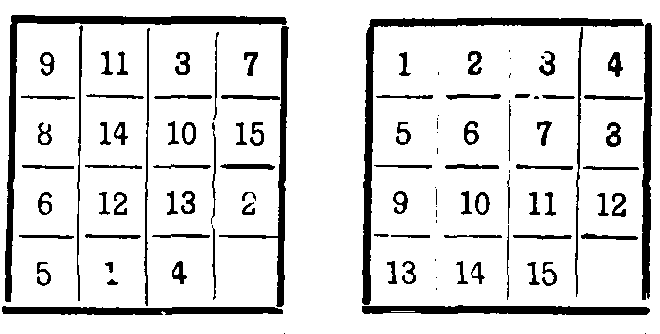
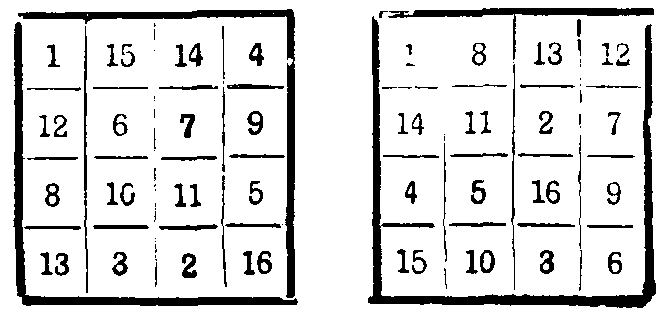
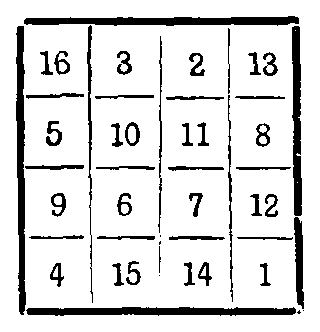
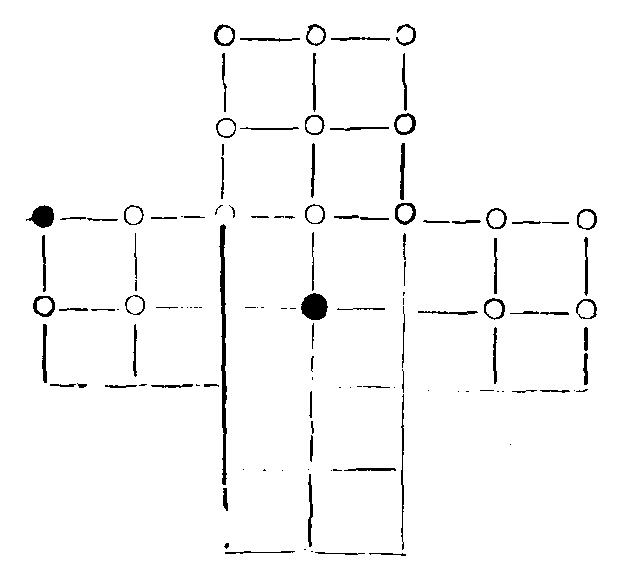
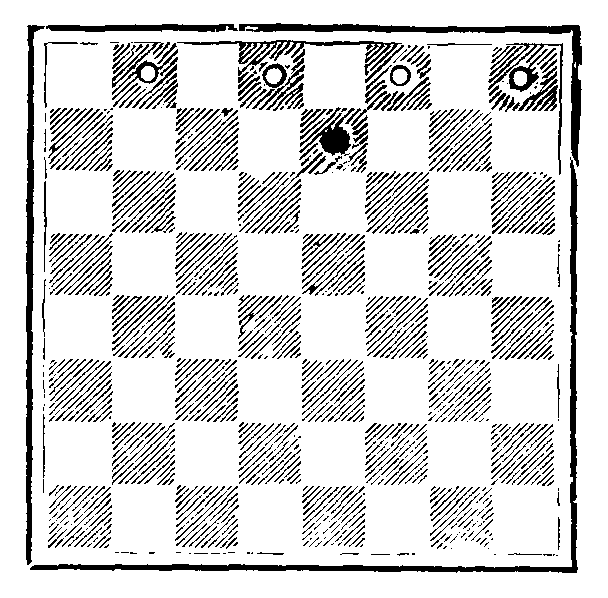
- Troco may be played by two or more persons, each of whom is provided with a ball and a cue. When more than two play, sides are chosen, and the side which first makes the requisite number of points wins the game.
- The players stand in a circle, in the centre of which is set up the pivot-ring.
- Each player starts from any portion of the circle distant not less than four yards from the ring. The first player lifts his ball with the spoon-cue, and throws it towards the ring; each of the others taking his turn alternately—the balls remaining on the ground where they stop rolling.
- If the first player fail to "make his ring," the next goes on, who may either throw at the ring or at the ball in the circle.
- Partners may assist each other in getting near the ring; but no player, at starting, may step within four yards of the ring.
- Two points are counted for every canon, and three for every fairly-made ring; and successive points are reckoned for any number of rings or canons.
- Each player goes on till he fails to canon or ring his ball; when the next plays; and so on, till the required number of points are made.
- One point is taken off the player's score for every foul stroke. Foul strokes are made by touching a ball with hand or person while it is in play; by playing with a wrong ball; by playing out of turn; by overturning the ring; and by making two or more steps while throwing the ball.
- Each player, after the start, must go on from the place at which his ball was left after the previous stroke.
- All disputed points must be settled by the umpire, whose decision is final.
- No ball in-play must be removed from its position except by a stroke from another ball, and every ball is considered to be in-play while it is within the circle, which may be of any dimensions chosen by the players previous to the commencement of the game.
- Any player leaving a game before it is finished, loses it.
- He is strict in keeping his engagements.
- He does nothing carelessly or in a hurry.
- He employs nobody to do what he can easily do himself.
- He keeps everything in its proper place.
- He leaves nothing undone that ought to be done, and which circumstances permit him to do.
- He keeps his designs and business from the view of others.
- He is prompt and decisive with his customers, and does not over-trade his capital.
- He prefers short credits to long ones; and cash to credit at all times, either in buying or selling; and small profits in credit cases with little risk, to the chance of better gains with more hazard.
- He is clear and explicit in all his bargains.
- He leaves nothing of consequence to memory which he can and ought to commit to writing.
- He keeps copies of all his important letters which he sends away, and has every letter, invoice, &c., belonging to his business, titled, classed, and put away.
- He never suffers his desk to be confused by many papers lying upon it.
- He is always at the head of his business, well knowing that if he leaves it, it will leave him.
- He holds it as a maxim that he whose credit is suspected is not one to be trusted.
- He is constantly examining his books, and sees through all his affairs as far as care and attention will enable him.
- He balances regularly at stated times, and then makes out and transmits all his accounts current to his customers, both at home and abroad.
- He avoids as much as possible all sorts of accommodation in money matters, and lawsuits where there is the least hazard.
- He is economical in his expenditure, always living within his income.
- He keeps a memorandum-book in his pocket, in which he notes every particular relative to appointments, addresses, and petty cash matters.
- He is cautious how he becomes security for any person; and is generous when urged by motives of humanity.
- The great philosopher, Dr. Franklin, inspired the mouthpiece of his own eloquence, "Poor Richard," with "many a gem of purest ray serene," encased in the homely garb of proverbial truisms. On the subject of frugality we cannot do better than take the worthy Mentor for our text, and from it address our remarks. A man may, if he knows not how to save as he gets, "keep his nose all his life to the grindstone, and die not worth a groat at last. A fat kitchen makes a lean will."
"Many estates are spent in getting,
Since women for tea forsook spinning and knitting,
And men for punch forsook hewing and splitting."
- If you would be wealthy, think of saving as well as of getting. The Indies have not made Spain rich, because her out-goes are greater than her in-comes.
- Away with your expensive follies, and you will not have so much cause to complain of hard times, heavy taxes, and chargeable families.
- "What maintains one vice would bring up two children."
- You may think, perhaps, that a little tea, or superfluities now and then, diet a little more costly, clothes a little finer, and a little entertainment now and then, can be no great matter; but remember, "Many a little makes a mickle."
- Beware of little expenses: "A small leak will sink a great ship," as Poor Richard says; and again, "Who dainties love, shall beggars prove;" and moreover, "Fools make feasts and wise men eat them."
- Here you are all got together to this sale of fineries and nick-nacks. You call them goods; but if you do not take care they will prove evils to some of you. You expect they will be sold cheap, and perhaps they may, for less than they cost; but if you have no occasion for them they must be dear to you.
- Remember what Poor Richard says, "Buy what thou hast no need of, and ere long thou shalt sell thy necessaries."
- "At a great pennyworth, pause awhile." He means, perhaps, that the cheapness is apparent only, and not real; or the bargain, by straightening thee in thy business, may do thee more harm than good; for in another place he says, "Many have been ruined by buying good pennyworths."
- "It is foolish to lay out money in the purchase of repentance;" and yet this folly is practised every day at auctions for want of minding the Almanack.
Death does not Blow a Trumpet.
"Let me see: I gave you 10s. on Saturday, and 9d. the day before. Was it 9d.? No, it must have been 11d., for I gave you 1s., and you gave me 1d. out for the beggar; then there was 6s. 6d. on Monday, and 8d. you owed me from last money; and then the 1s. 6d. your master gave you for a parcel—you brought him 2d. back, and 3d-1/2. out of the butcher's bill; no—you had to give 3-1/2d. to the butcher, but you came to me for the 1/2d., and I had no coppers, so we still owe him the 1/2d.; by the way, don't forget to pay him the next time you go. Then there's the baker—no, I paid the baker myself, and I think the housemaid paid the butter-man; but you got in the cheese the day before, and I have a sort of recollection that I may possibly owe you for that, all but a few pence you must have had left of mine, that I told you to take from off the chimney-piece. Well, cook, I think that's nearly all! Now how do your accounts stand?"
| s. | d. | |
| Bread | 1 | 9 |
| Beer | 0 | 6 |
| Vegetables and fruit | 0 | 10 |
| Milk | 0 | 4 |
| Matches | 0 | 1 |
| Parcel | 1 | 0 |
| Total | 4 | 6 |
Time Brings Everything to Those who can Wait.
"Don't run in debt;"—never mind, never mind
If your clothes are faded and torn:
Mend them up, make them do; it is better by far
Than to have the heart weary and worn.
Who'll love you the more for the shape of your hat,
Or your ruff, or the tie of your shoe,
The cut of your vest, or your boots, or cravat,
If they know you're in debt for the new?
There's no comfort, I tell you, in walking the street
In fine clothes, if you know you're in debt,
And feel that, perchance, you some tradesman may meet,
Who will sneer—"They're not paid for yet."
Good friends, let me beg of you, don't run in debt;
If the chairs and the sofas are old,
They will fit your back better than any new set,
Unless they are paid for—with gold;
If the house is too small, draw the closer together,
Keep it warm with a hearty good-will;
A big one unpaid for, in all kinds of weather,
Will send to your warm heart a chill.
Don't run in debt—now, dear girls, take a hint,
if the fashions have changed since last season,
Old Nature is out in the very same tint,
And old Nature, we think, has some reason;
But just say to your friend, that you cannot afford
To spend time to keep up with the fashion;
That your purse is too light and your honour too bright,
To be tarnished with such silly passion.
Men, don't run in debt—let your friends, if they can.
Have fine houses, and feathers, and flowers:
But, unless they are paid for, be more of a man
Than to envy their sunshiny hours.
If you've money to spare, I have nothing to say—
Spend your silver and gold as you please;
But mind you, the man who his bill has to pay
Is the man who is never at ease.
Kind husbands, don't run into debt any more;
'Twill fill your wives' cup full of sorrow
To know that a neighbour may call at your door,
With a claim you must settle to-morrow
Oh! take my advice—it is good, it is true!
But, lest you may some of you doubt it,
I'll whisper a secret now, seeing 'tis you—
I have tried it, and know all about it,
The chain of a debtor is heavy and cold.
Its links all corrosion and rust;
Gild it o'er as you will, it is never of gold,
Then spurn it aside with disgust.
As the Virtue is in the Tree, Such is the Fruit.
Travel North, or South, or East, or West...
A Man's Own Hose is Still the Best.
| 1. | Blue | |
| 2. | Red | Simple |
| 3. | Yellow |
| 4. | Violets | |
| 5. | Orange colours | Binary |
| 6. | Green |
| 7. | Compound colours | Ternary |
| 8. | Black |
- They should possess an equal affinity for the fibre of the material and the colouring matter.
- They should be incapable of injuring or destroying either by prolonged action.
- They should form, with the colour, a compound capable of resisting the action of air and water.
- They should be capable of readily conforming to the various operations of the dyer.
Cunning Men's Cloaks Sometimes Fall.
- Cut potato tops when in flower, and express the juice; steep articles in this for forty-eight hours.
- Dip in a strong solution of weld after boiling in an aluminous mordant. Turmeric, fustic, anatto, &c., will answer the same as weld.
The Fat Man Knoweth not what the Lean Think.
- Wash quite clean, rinse well, and then dip in a hot solution of sulphate of iron: after a short time take it out and rinse again. Have ready in another vessel a hot solution of prussiate of potash, to which a small quantity of sulphuric acid has been added. Dip the silk in this liquid; on removal rinse in clean water, and expose to the air to dry.
- Wash well, rinse, wring out, and then dip in the following:—Boil a pound of indigo, two pounds of woad, and three ounces of alum, in a gallon of water. When the silk is of a proper colour, remove, rinse, and dry.
No Lock will Hold gainst Keys of Gold.
- Mix sifted stale bread-crumbs with powder blue, and rub it thoroughly all over the article; then shake it well, and dust it with clean soft cloths. Afterwards, where there are any gold or silver flowers, take a piece of crimson ingrain velvet, rub the flowers with it, which will restore them to their original lustre.
- Pass them through a solution of fine hard soap of a moderate heat, drawing them through the hand; rinse in lukewarm water, dry, and finish by pinning out. Brush the flossy or bright side with a clean clothes-brush, the way of the nap. Finish them by dipping a sponge into a size, made by boiling isinglass in water, and rub the wrong side. Rinse out a second time, and brush, and dry near a fire in a warm room.
Gold is no Balm to a Wounded Spirit.
O Heart! But Try it Once;— 'Tis Easy to Be...
...But to Appear so, what a Strain and Misery!
Life's but a Means to an End...
"No person shall mix, colour, stain, or powder any article of food with any ingredient or material, so as to render the article injurious to health, with the intent that the same may be sold in that state, and no person shall sell such article under a penalty not exceeding £50."
"No person shall sell to the prejudice of the purchaser any article of food, or any drug which is not of the nature, substance, and quality of the article demanded under a penalty not exceeding £20."
...Beginning, Mean and End to All Things—God.
Good Ware Makes a Quick Market.
Of All Smells, Bread; of All Tastes, Salt.
- The Court, for a single-handed game, should be 78 ft. long and 27 ft. wide, and for a double-handed game the same length, but 36 ft. wide, divided across the centre by a net attached to two upright posts. The net should be 3 ft. 6 in. high at the posts, and 3 ft. at the centre. At each end of the court, parallel with the net, are the base lines, whose extremities are connected by the side lines. The half-court line is halfway between the side lines and parallel with them. The service lines are 21 ft. from the net and parallel with it.
- The balls should be 2-1/2 in. in diameter and 2 oz. in weight.
- The players stand on opposite sides of the net. The player who first delivers the ball is called the server, the other the striker-out.
- At the end of each game the striker-out becomes server, and the server striker-out.
- The server stands with one foot beyond the base line, and delivers the service from the right and left courts alternately.
- The balls served must, without touching the net, drop within the court nearest to the net, diagonally opposite to that from which the striker serves it.
- If the service be delivered from the wrong court it is a fault. It is also a fault if the server does not stand in the manner as stated above, or if the ball served drop in the net or beyond the service line, or if it drop out of court, or go in the wrong court.
- A fault must not be taken, that is, played back to the server.
- The striker-out may not volley the service. Volleying is striking the ball back before it has touched the ground.
- The ball, having been returned, must be kept in play either by volleying it, or striking it back after the first bounce. A ball bouncing twice is out of play.
- If, in serving, the ball touch the net and go over into the proper court, it counts to neither server nor striker-out.
- The server scores if the striker-out volley the service, or fail to return the service in such a way that the ball would fall within the opponents' court.
- Two consecutive faults count a stroke against the server.
- If the ball when in play touch either player it scores a stroke for his opponent.
- The first stroke won by either player scores 15 to that player; the second, won by the same player, raises his score to 30, his third stroke to 40, and his fourth counts game. If, however, the players have both scored 40, it is called deuce, and the next stroke won by either is called advantage to the winner of it, and if he also win the following stroke he scorea game. Should he lose it the score returns to deuce. The player winning two consecutive strokes directly following a deuce scores game.
- Whichever player first scores six games is considered to win the set.
- The laws as given above apply equally to these games. The difference in the width of the court has been stated.
- In Four-handed Tennis the players deliver the service in turns: thus supposing A and B are partners opposed to C and D; A serves in the first game, C in the second, B serves in the third, and D in the fourth, and so on.
- In Three-handed Tennis the single player serves in each alternate game.
- No player may return a service that has been delivered to his partner.
That Thou mayest Injure No Man, Dove-like be.
| Duty | ||||||
| £ | s. | d. | ||||
| Not above | ...... | ...... | £5 | 0 | 0 | 1 |
| above | £5 | and not above | £10 | 0 | 0 | 2 |
| above | £10 | and not above | £25 | 0 | 0 | 3 |
| above | £25 | and not above | £50 | 0 | 0 | 6 |
| above | £50 | and not above | £75 | 0 | 0 | 9 |
| above | £75 | and not above | £100 | 0 | 1 | 0 |
| above | £100 | and not above | £200 | 0 | 2 | 0 |
| above | £200 | and not above | £300 | 0 | 3 | 0 |
| above | £300 | and not above | £400 | 0 | 4 | 0 |
| above | £400 | and not above | £500 | 0 | 5 | 0 |
| above | £500 | and not above | £600 | 0 | 6 | 0 |
| above | £600 | and not above | £700 | 0 | 7 | 0 |
| above | £700 | and not above | £800 | 0 | 8 | 0 |
| above | £800 | and not above | £900 | 0 | 9 | 0 |
| above | £900 | and not above | £1000 | 0 | 10 | 0 |
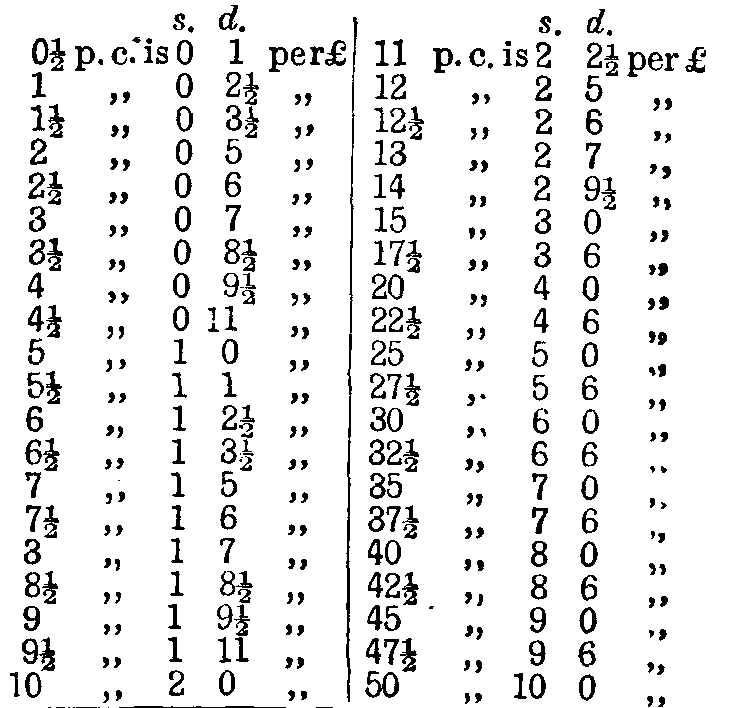
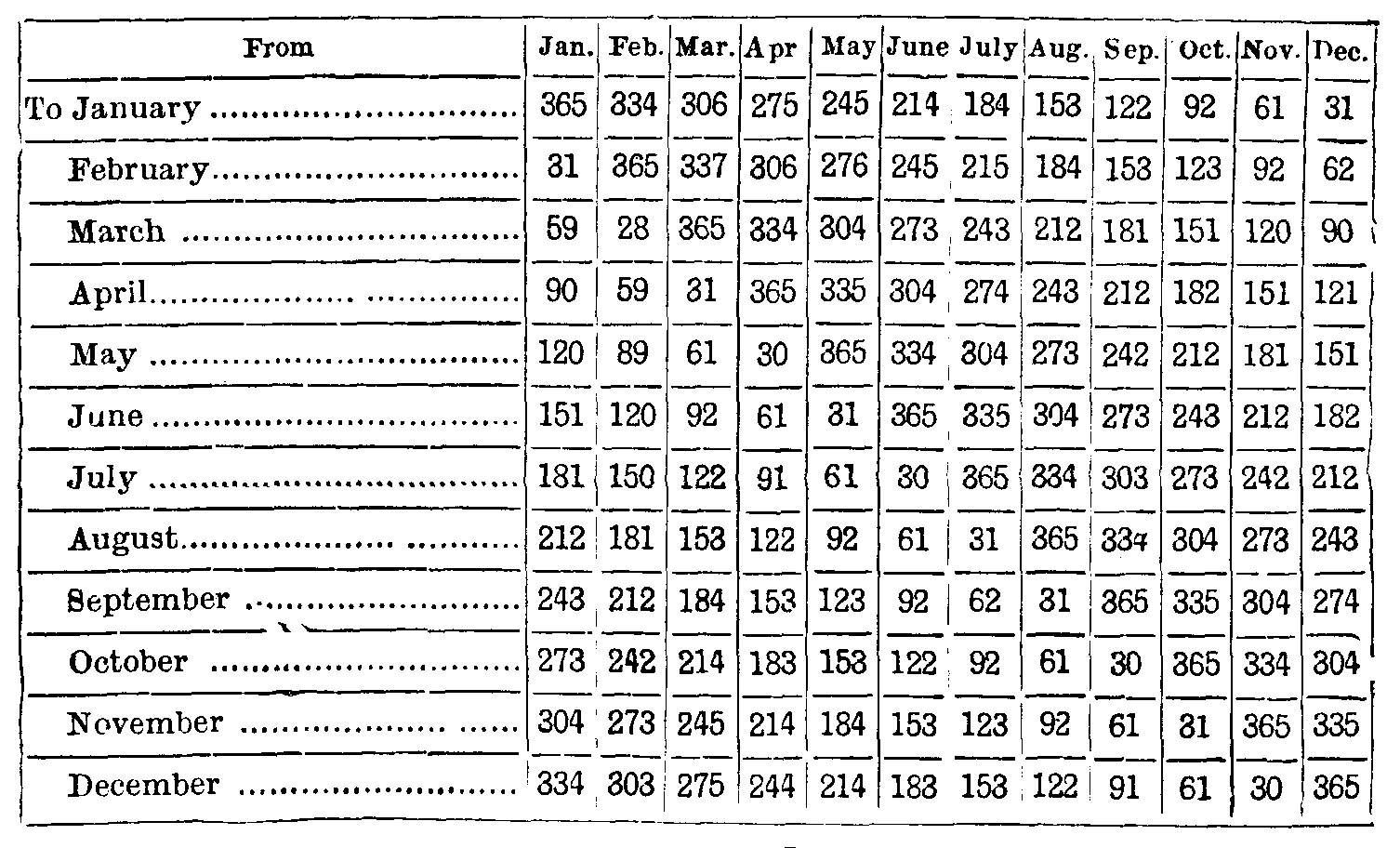
| Under February, and opposite to August, is | 181 days |
| From which subtract the difference between 14 and 16: | 2 days |
| The exact number of days required is: | 179 days. |
...and Serpent-like, that None may Injure Thee.
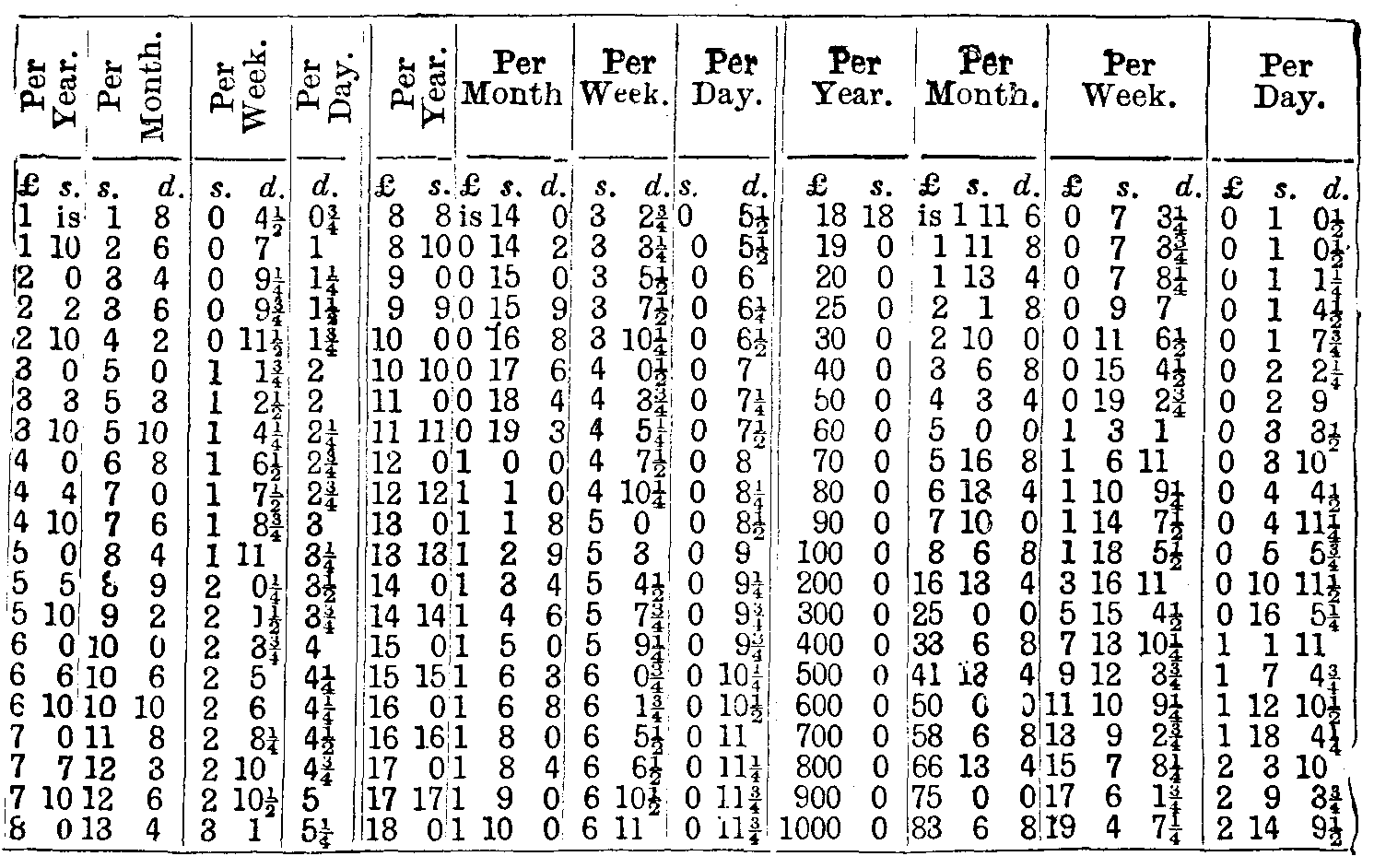
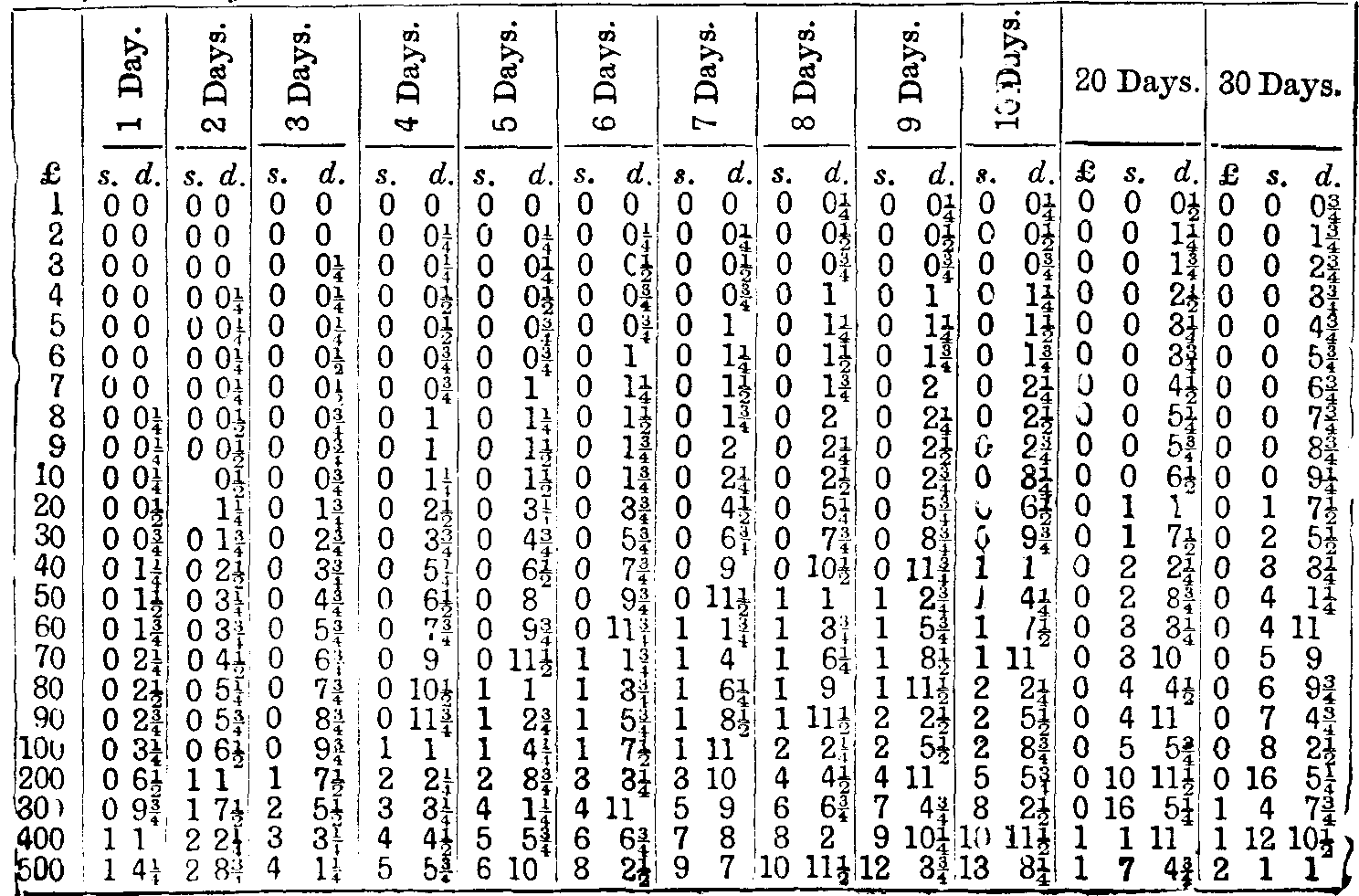
The Groat is Ill Saved Which Shames its Master.
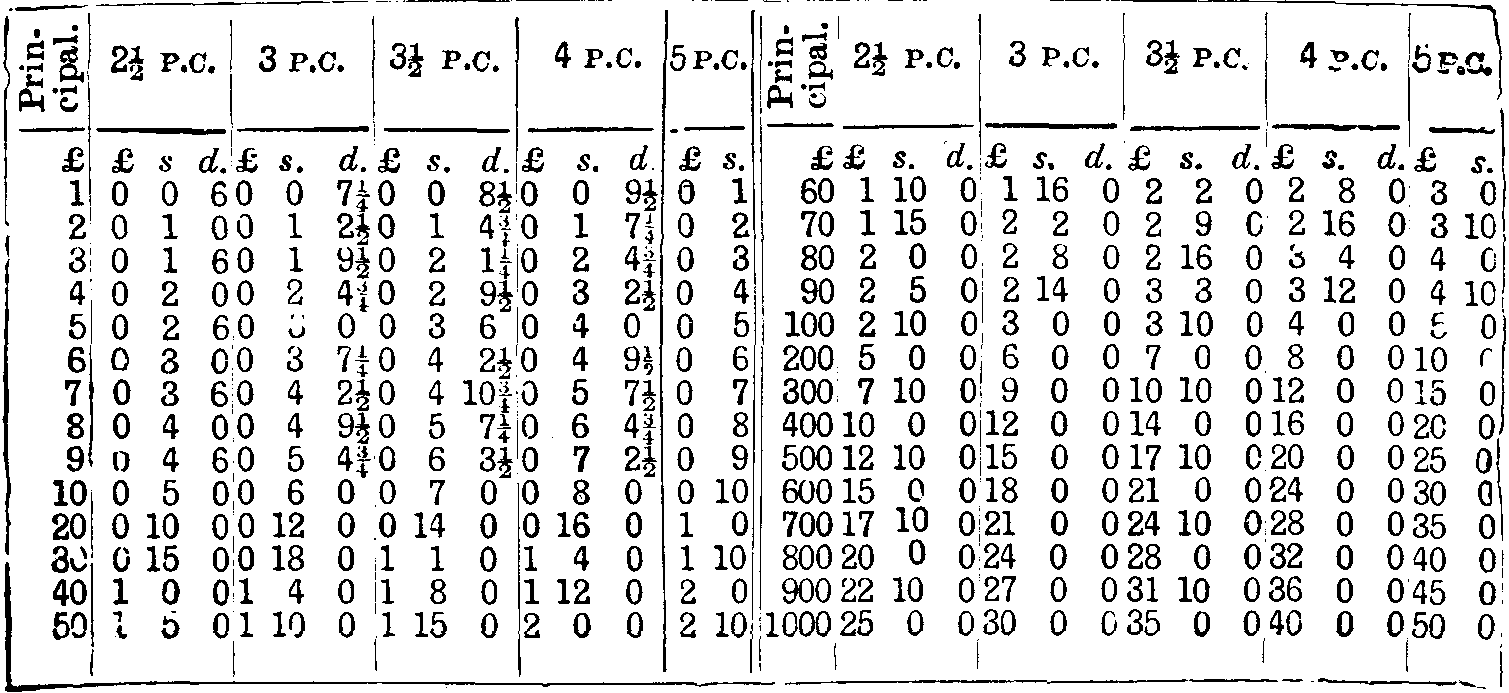
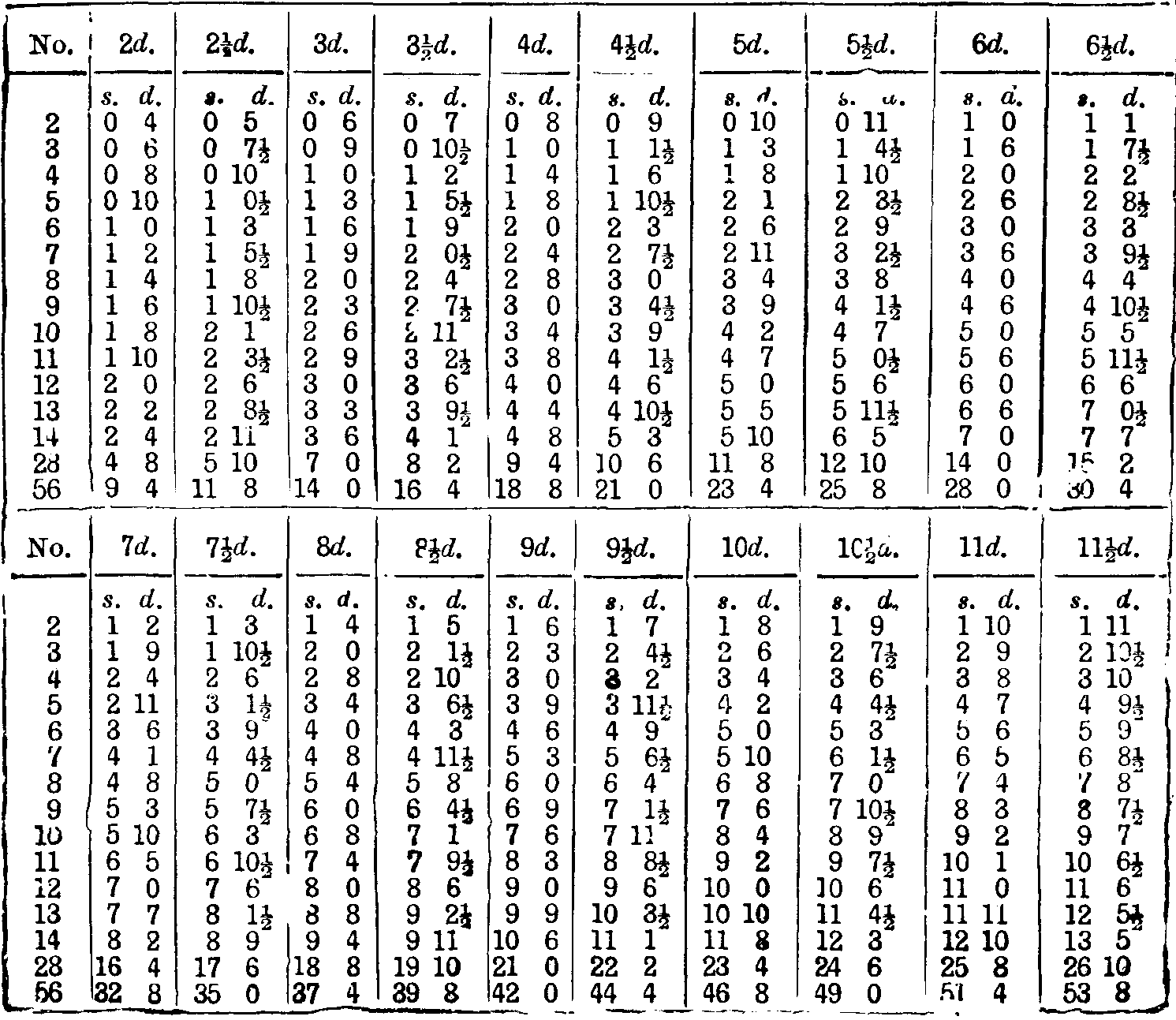
the hyperlinked index
A - B - C - D - E - F - G - H - I - J - K - L - M - N - O - P - Q - R - S - T - U - V - W - Y - Z
- Definition of
- Differences of
- Varieties of (1)-(2)
- Words Influenced by
- of Ammonium Solution, Uses of
- of Lead with Opium Lotion
- of Potassa, Properties and Uses of
- of Zinc Eye-wash
- of Letters (1)-(2) (3) (4)
- of Petitions
- Ambassadors, etc
- Clergymen
- Judges
- Members of Parliament (1) (2)
- Municipal Officers
- Nobility and Gentry
- Officers of Army and Navy
- Officers of State
- Persons of Rank
- Royal Family (1) (2)
- Several Letters at Same Time
- Unmarried Ladies
- Evils besides
- Various (1)-(2)
- between Employers and Employed, Mutuality of
- between Employers and Employed, Terms of
- for Furnished House or Apartments
- for House on Annual Tenancy
- for House on Three Years' Tenancy
- Stamped, between Landlord and Tenant (1)-(2)
- When Necessary to Stamp
- Game of (1)-(2)
- Laws of
- Maxims for
- Terms Used in
- Alterative, for Children
- Gingerbread for Children
- in Acute Diseases
- Infant's
- Medicines (1)-(2)
- Pills (1) (2) (3) (4)
- Tonic
- Bread, to Make
- Cake, for Children
- Pie
- Puddings (1)-(2)
- Sauce
- Sauce, why Eaten with Pork and Goose
- Tart, Cold, to Re-dress
- Water
- Dried
- for Children
- in Syrup (1) (2)
- to Store
- with Custard
- to Boil
- to Choose
- to Cure
- to Economise
- Minced, with Fried Eggs
- Rashers of, Relisching
- Slices of, to Dress
- Cord
- Cravat
- for the Belly
- for the Chest
- for the Foot
- for the Hand
- for the Head
- for Inflamed Breast
- for the Leg and Foot
- Handkerchiefs as Substitute for
- Long Square
- Oblique
- Recurrent
- Single-Headed
- Sling
- Spiral
- Two or more Handkerchiefs
- Best Substitutes for
- Circular
- Ends of, to Confine
- Surgical, Employment of
- Triangular Handkerchief
- Various (1)-(2)
- Acts of Bankruptcy
- Adjudication when Composition not Accepted
- Arrest, Powers of
- Bankrupt to render every assistance
- Maintenance Allowance of
- Closing Bankruptcy
- Committee of Inspection
- Composition or Arrangement
- Default of Payment under
- Debtor, Duties of
- Debtors, all kinds of, subject to Laws of Bankruptcy
- Discharge, Order of
- Dividend Final
- Fraud, in Cases of
- Landlord, Power of, to Distrain
- Liquidation by Private Arrangement
- Official Receiver
- Petition, all Proceedings to commence with
- Conditions of Presentment
- Priority of certain Debts
- Public Examination
- Receiving Order
- Settlement on Wife or Children
- Trustee, Appointment of
- Duties of (1)-(2)
- Chemical
- Hints on (1)-(2)
- Leech
- When highest, and why (1)-(2)
- When lowest, and why (1)-(2)
- Why called "Weather Glass"
- Why Hand on Dial changes Position
- Why Pressure of Atmosphere Denoted by
- Why Tapping Face of, causes Hands to Move
- for Children (1) (2)
- Ventilation of
- Aitchbone, Economy of / to Boil
- à la mode
- Bones, Grilled
- Brisket, Economy of / to Bake / to Carve / to Stew
- Broth
- Bubble and Squeak
- Curried (Madras Fashion)
- Extract (Liebig's Method)
- Fore-quarter, Joints of
- Fresh to Stew
- Glaze, to Prepare
- Gravy Sauce
- Hashed
- Leg and Shin, Economy of
- Hind-quarter, Joints of
- Hints on Choosing
- Lobscous
- Loss of, in Roasting / in Boiling
- Minced
- Potted
- Ribs, Boned and Rolled, to Roast / Economy of / to Carve / to Roast
- Rissoles
- Round, to Carve / Economy of
- Rump, Economy of / to Carve
- Rump Steak, and Onion Sauce
- Salted, Plain Boiled / Round of, to Boil / Stewed with Pork
- Sausages
- Shin, Economy of
- Silver side of
- Sirloin, to Carve / Economy of
- Soup, French
- Top side of Round
- Various Joints of, Described
- Veiny Piece, Economy of
- When in Season
- With Mashed Potatoes
- Game of (1)-(2)
- Terms Used in
- Eggs of, to Preserve, for Cabinets
- to Keep from Fruit-buds
- to Stuff (1)-(2)
- Why are some limbs of more Tender than Others
- Cloth Clothes, to Clean
- Cloth, Reviver for
- Draught
- Lace, to Revive
- Paper Patterns
- Pepper Confection
- Pool (Billiards)
- Pudding
- Wash Lotion
- how Performed
- from the Nose, to Stop (1) (2)
- Effects of, on Meat
- Loss Resulting from (1)-(2)
- Meat, Length of Time Required
- Meats, &c., Time Required for
- Rationale of
- to Stain (1)-(2)
- in Throat, How to Act
- French Polish for
- to Clean
- Waterproofing for (1)-(2)
- Adulterated, to Detect
- Apple, to Make
- Baking and Egg Powders in (1)-(2)
- Cheap and Excellent, to Make
- Cheap and Pure
- for Children
- for Dinner, to Cut
- Economical and Nourishing, to Make
- Economy of
- French, to Make
- German Yeast, to Make with
- Home-made
- Home-made, to Increase
- of Indian Corn Flour and Wheat
- Nutritious Properties of
- Potatoes in
- Pudding (1) (2)
- Pulled, to Make
- Rice, to Make
- Rye and Wheat Flour, to Make
- Unfermented
- Use of Lime Water in
- Barley (Scotch)
- Beef
- of Boiled Meats for Soup (1)-(2)
- for Infants
- Best Articles for, in New Neighbourhoods
- Hints for Entering upon (1) (2)
- Man, Habits of
Let All Things have their Places.
- Almond Sponge
- Banbury, Meat for
- Belvidere
- Drop
- Fish
- Ginger (1) (2)
- Gingerbread (1) (2)
- Luncheon
- Meat
- Mixed Fruit
- Nice and Cheap
- Plum (1) (2)
- Sally Lunn
- Soda
- Sponge (1)-(2)
- Unfermented (1) (2)
- Yule
- Cheap, No Economy in
- to Dye (1)-(2)
- Work (1)-(2)
- Cross Stitch in
- Designs on Cloth for
- Framing in
- Materials Used in
- Mode of Doing
- Stitches in
- Stretching in
- Varieties of Canvas for (1)-(2)
- Beating
- Choosing
- Cleaning
- Elegant Kind of
- Few Colours Desirable
- Light Coloured
- Middle Tint in
- Securing
- Shaking
- Stair, to Sweep
- Taste in Selection
- Worn, to Repair
- Art of, Ceremonies of the Table, &c. (1)-(2)
- Remarks on
- Game of (1)-(2)
- Laws of
- Terms Used in
- for Broken China, &c.
- Cheese
- Diamond
- for Leather and Cloth
- Lime and Egg
- Mastic
- Paper
- Preparation of
- Red
- Rice Flour
- Soft, for Corks
- White Lead as
- Applied to Sores
- as an Antiseptic
- as a Disinfectant (1) (2) (3) (4)
- for Cooking, Caution Respecting
- Poultice
- Powder for Polishing Knives
- Respirators
- Suffocation from Fumes of, to Treat
- Broken, Ointment for
- homœopathic Treatment of
- Remedy for (1) (2)
- Symptoms
- Apple Cake for
- Bedsteads for, How to be Placed
- Blackberry Jam for
- Born at Sea,Directions for Registration of
- Bread as Food for
- Bringing up of (1) (2)-(3)
- Choice of Names for
- Cookery for
- Crying, Cause of (1)-(2)
- Cutlery, Dangers of
- Discipline of
- Drink for (1)-(2)
- Fruit for
- Fruits for, most Wholesome (1) (2)
- Indulging, Pernicious Effect of
- Keep Dry and Warm
- Luncheon for
- Meats for
- Medicines for (1)-(2) (3)
- Milk for
- Milk Porridge for
- Potatoes and Peas for
- Proper Food for (1)-(2)
- Proper Time for Feeding (1)-(2)
- Puddings and Pancakes for
- Rice and Apples for
- Rice Pudding with Fruit for
- Sleep of, Duration (1)-(2)
- Talking, to Check
- Vegetables for (1)-(2)
- Fire in, to Put out (1) (2)-(3)
- Smoky, to Guard Against
- Asiatic or Malignant
- Bilious or English, Remedies for (1) (2)
- homœopathic Treatment of
- Special Rules for Prevention of
- Symptoms of
- among the Brute Creation
- Conducive to Comfort
- Desirability of, in Towns (1)-(2)
- in Eastern Countries
- Essential among Sick Persons
- Estimable Quality of
- in Hospitals, etc.
- Importance of
- Indispensable
- Moral Influence of
- Situation of English Towns Favourable to
- Want of, a Cause of Fevers (1)-(2)
- Black, Reviver for
- Cement for
- to Dye (1)-(2)
- Grease from, to Remove
- Balls for Cleaning
- Black Cloth, to Clean
- on Fire, How to Act
- Loose, Why Warmer than Tight Garments
- Mending
- to Preserve from Moths, &c.
- with Smooth Surfaces, Why Best for Hot Weather
- Woollen, to Wash
- Best Mode of Purchasing
- How to Put on the Fire (1) (2)
- to Avoid Catching
- Cream, to Make
- Evaporating Lotion
- Fowl, Nice Way of Dressing
- in the Head, homœopathic Treatment of
- Meat, Broiled with Poached Eggs
- Meat, Economy of
- Mixture for
- Symptoms of
- Dark, Various Colours affecting
- to Improve
- Pale Blonde, Green Favourable to
- Ruddy, Why Green is Unfavourable to
- Why Blue Veils Preserve
- Why Violet is Unfavourable to
- Balls or Reels, Place for
- Carded, Surgical Uses of
- Bad, Pills for
- Common, Remedy for (1) (2)
- homœopathic Treatment of
- Mixture for (1) (2)
- Mixture for Children
- Pills
- Remedies for (1) (2)-(3)
- Pancakes
- Substitute for
- of Tartar, Confection / Properties and Uses of
- Game of (1) (2)
- Counting for Game
- Eight-card
- Examples of Hands
- Five-card
- Laws of
- Maxims for Laying out Crib Cards
- Six-card
- Terms Used in
- Three-hand (1)-(2)
- Instructions in
- Oriental
- Popularity of
- Square
- Stitches in (1)-(2)
- Tricotee
- to Use several Colours in
- to Work Cord Over
- Difference between Old and New Laws of
- Game of, to Play (1)-(2)
- Implements for
- Laws of
- Supplementary Laws of
- Technical Terms Used in
- Beef, Madras Fashion
- Eggs
- Oysters
- of any Kind, to Prepare
- Powder (1)-(2)
- Powder, True Indian
- Rice, to Boil for
- Choosing
- on Fire, to Extinguish
- Thick, for Beds, Injurious
- Treatment of
- Ordinary, to Dress
- Recovery of by Workmen from Employers
- Actions, where to Bring
- Amounts Recoverable
- Notice to Employer
- Linen, Advice respecting
- Situations, Remedy for
- Walls, to Remedy (1)-(2)
- Described (1)-(2)
- Terms used to Describe the Movements of
- Apparent, from Drink, Treatment for
- Certificate of
- Observance of
- Registration of (1)-(2)
- at Sea, Registration of
- How Served
- Ices, Recipes for (1) (2)
- Napkins
- Pills, Prescription for
- Table, Appointments of (1)-(2)
- Ceremonies of
- Laying Out of
- People to be Avoided
- Windows, What a Sign of
- to what Attributable
- Various Remedies for (1)-(2)
- Borax as a
- Carbolic Acid as a
- Charcoal as a (1) (2)-(3)
- Chloride of Lime as a
- Coffee as a (1) (2)
- Fluid, Sir William Burnett's (1) (2)
- Fumigation
- Liquid
- a Mensâ et Thoro, Meaning of
- Absolute
- and Other Matrimonial Causes (1)-(2)
- Grounds of
- Care of (1)-(2)
- Distemper in
- Hydrophobia in
- Mange in
- Hints (1)-(2)
- Pharmacopœia
- Rules, Mrs. Hamilton's
- Surgery
- Etiquette of (1)-(2)
- Faded, to Bleach
- Female, Hints on
- on Fire, How to Act
- Precaution
- Mourning, to Remove Stains from
- Officers', Etiquette of
- Simplicity of, Becoming
- to Preserve the Colour of
- Visiting, Etiquette of
- Preparation of, (1)-(2)
- Their Properties and Doses
- Apparent Death from, Treatment for
- Avoidance of
- Bonnets
- Calico, Linen and Muslin (1)-(2)
- Cloth (1)-(2)
- Feathers (1)-(2) (3)-(4)
- Gloves (1)-(2)
- Hair (1)-(2) (3)
- Leather
- Silk (1)-(2)
- Wool (1)-(2)
- Culinary, Practice of (1) (2)
- of Fat
- of Fuel (1)-(2)
- of Liquor from Boiled Meats (1)-(2)
- of Ready-Money Purchases (1)-(2) (3)
- of Soapsuds
- of Tea
- in What it Consists
- Curried
- Fried with Minced Ham or Bacon
- of Birds to Preserve for Cabinets
- to Pickle
- to Preserve (1)-(2)
- Application in
- Braiding in
- Braid Stitches in
- Couching in
- Distinction in
- Elaborate
- Frame for
- Instructions in
- Materials for (1) (2)
- Netting Silk in
- Silk Described
- Stitches, Fancy, in
- Stitches, Various, in (1)-(2)
- What it Includes
- Bankrupt, Law Respecting Wages Due
- Nature of Contract entered into
- Purchases made for, by Servant
- Responsibility of, for Servant
- Uses of
- Nitric, Uses of
- Sulphuric, Nature and Uses of (1) (2)
- Sulphuric, Compound Spirit of, Nature and Uses of
- Books on, Use of (1)-(2)
- Hints upon
- Active, Results of
- After Meals
- Before Meals (1)-(2)
- Beneficial in the Forenoon
- Best Kind of
- Best Mode of Taking
- Duration of
- Excessive, Hurtful
- How to Commence and Finish
- Importance of (1) (2) (3)
- Open Air, Superior Advantages of
- Passive, Results of
- Points to be Observed in
- Time for Taking
Little Strokes Fell Great Oaks.
- to Cleanse of Animal Oil
- to Dye (1) (2) (3) (4) (5)
- White Ostrich, to Clean
- Blistered, Remedy for
- Importance of Keeping Warm (1) (2)
- Warm Bathing of, Healthy
- Washing of, Conducive to Health
- Dress, Hints on
- Temper, Management of
- Common Continued, Remedy for
- Homeopathic Remedy for
- How Frequently Caused (1) (2)
- Intermittent, Remedies for (1) (2)
- Mixture, Prescription for
- Mixture (Simple)
- Powders, Prescription for (1)-(2)
- Scarlet, Remedy for
- Typhus, Remedy for
- With Debility, Prescription for
- Breaking out, First thing to be done
- Buckets, &c., to be kept at Hand
- in Chimney, to Extinguish (1) (2)-(3)
- to Diminish Risk from
- Effect of on Air
- to Escape from
- Precautions in Case of (1)-(2)
- Prevention of
- Solution to Extinguish
- Cake
- to Choose (1)-(2)
- Flat, to Carve
- Freshwater, to Choose
- Fried, to Carve
- How to Send to Table
- Gold, Care of
- Poisonous, Remedy for
- Preserved as Specimens
- Remarks on Carving
- Sauces (1) (2)
- When in Season (1) (2)
- Amount of Heat for (1)-(2)
- Artificial, Excess of
- Feather, to Make (1)-(2)
- Leaves for
- of the Months:
- Unfit for Bedrooms
- Waxen, to Make (1)-(2)
- When to Gather
- Articles of, to Choose
- and Exercise, Rationale of (1)-(2)
- for Children, Proper Time of Giving
- Infants', to Prepare
- Seasons for Various Kinds of (1)-(2)
- to Clean
- Uncleaned, Don't put by
- to Carve
- to Choose
- Cold, to Dress (1) (2)
- to Fatten in a Short Time
- to Grill
- Pulled, to Prepare
- Gilt, to Preserve
- Mahogany, to Clean
- Sal-Ammoniac (1)-(2)
- Nitrate of Ammonium
- Washing Soda
- Without Ice or Acids (1)-(2)
- Bottling
- Buds of, to Prevent Birds Destroying
- for Children
- for Children, Most Wholesome Kinds
- Mixed, Cake of
- to Preserve (1)-(2)
- Skeletons
- Stains of, to Remove from Linen
- Use of, as Food
- Waxen, to Make (1) (2)-(3)
- When in Season (1)-(2)
- Apartment, Agreement for Letting
- House, Agreement for Letting
- Lodgings
- to Clean (1)-(2)
- Made in Winter, Liable to Crack
- Mahogany, to Take Stains out of (1)-(2)
- New, Caution Respecting
- to Remove White Spots from
- Removed, Liable to be Seized for Rent
- Rosewood, to Polish
- Borax in the
- Labels, Ink for
- Stands, Paint for
- Beer
- Beer Powders
- Biscuits
- Cakes (1) (2)
- Properties and Uses of
- to Preserve
- to Anneal
- Bottles, to Clean
- to Clean (1) (2) (3)
- Easy Mode of Breaking
- Ground, to Imitate
- Powdered, Use of in Modelling
- Stoppers, to Loosen
- Vessels, to Clean
- Broiled
- to Carve (1) (2)
- Cold, to Dress
- to Hash
- Marbled
- Mock
- to Roast
- Royal Game of
- Stuffing
- Stuffing Sauce
- Mixture
- Pills for
- Remedy for
- Rheumatic, Mixture for
- Oil, to Remove
- to Remove from Cloth or Velvet
- Scouring Drops to Remove
- Spots, to Extract from Books and Papers
- Spots, to Remove from Silk
- Casts
- Soles, to Put on
- Tooth Stopping
- Becoming Arrangement of
- Brushes, to Clean
- Compounds to Promote Growth of (1)-(2)
- Dyes (1)-(2) (3) (4)
- Oils, Rose (1)-(2)
- to Restore
- Superfluous, to Remove
- to Test Dye for
- Wash for, Excellent
- Meat (1)-(2)
- Treatment for
- Pot, for Drying, When in Season (1)-(2)
- Time for Drying
- on Barometer (1)-(2)
- to Capitalists (1)-(2)
- to Cockney Speakers
- Domestic (1)-(2)
- upon Etiquette
- for Home Comfort
- on Household Management
- for Husbands (1) (2) (3)
- on Making Preserves
- on Money Matters
- on Pianofortes
- on Spelling
- for Wives (1) (2) (3) (4)
- Homœopathic Treatment of
- Powders for
- Remedies for (1) (2)
- Water, Efficacy of / not Good for China or Glass
- Weather, Beverage for
- Advice about taking
- Agreement for Annual Tenancy
- Agreement for Taking for Three Years
- Details to be Considered before Taking
- Healthfulness of Situation
- Hints for Furnishing
- Rent to be Considered
- for Desserts, Recipes for (1) (2)
- Materials for, to be Cool
- Caution respecting
- Homœopathic Treatment of (1) (2)
- Mixture for
- Remedy for
- Symptoms of (1) (2)
- Aperient for
- Food, to Prepare
- How to Feed (1)-(2)
- Milk for, to Prepare (1) (2)
- Prescription for
- of Bladder (1) (2) (3) (4)
- of the Bowels
- of the Brain
- of the Eyes
- of the Kidneys
- of the Liver
- of the Stomach
- of the Throat
- to Remove from Boards
- from Mahogany
- from Silver
- from Table Covers (1)-(2)
- Bites of, Remedy for
- to Rid Bird-cages, &c., of
- Stings of, Treatment for
- Brogue, Hints for the Correction of
- Dialect, Importance of Correcting
- Stew, to Prepare
- Black Staining for Ship's Guns, &c.
- New, Treatment of
- Polished, to Preserve (1)-(2)
- Rust on, to Prevent / to Remedy
- Spiculæ in the Eye
- Wipers, to Make
- Apricot
- Arrowroot
- Black Currant
- Calf's Feet
- Excellent for the Sick Room
- Ox-Heel
- Red Currant
- White Currant (1)-(2)
- English Method of Division
- Names and Situation of
- Relative Economy of
- Scottish Division of
- Various, to Carve
- to Keep Clean
- Brass, to Clean
- to Broil
- Inflammation of, Remedy for
- Chimney, to put out Fire in
- Floor, Best Covering for
- Garden, Operations in
- Utility of the
- Abbreviations in
- Casting Off
- Casting On
- Decreasing
- Instructions in
- Improvements in
- Implements for
- Needles, Size of
- Plain
- Purling in
- Round, to Join a
- Stitches, Mode of Making
- to Clean (1) (2)
- Caution when Cleaning
- to Polish
- Uncleaned, not to be put by
- Excessive, Injurious
- Proper Order of
- Black, to Revive
- Blond,to Revive
- Excess of, to be Avoided
- Veil, White, to Wash
- Deference to be Paid to
- Dress, Etiquette of
- Treatment of, at Table
- to Choose
- Chops, or Cutlets, to Dress
- to Dress, before Carving
- Fore-Quarter, to Roast / Dressing for
- Grass, When in Season
- Hind-Quarter of, to Roast
- House, When in Season
- Leg of, to Roast
- Loin of, to Roast
- Quarter of, to Carve
- Ribs of, to Roast
- Shoulder of, to Roast
- Stove or Stew
- Various Joints of Described
- When in Season (1) (2)
- Bronze, to Clean
- Oil for, the Best
- to Prevent the Smoking of
- Laws Relating to (1)-(2)
- Stamped Agreements Between
- Duty of, to Repair Premises
- Notice to Quit by (1) (2)
- Right of, to Enter Premises
- What Taxes he has to Pay
- of Employer and Employed
- of Landlord and Tenant (1)-(2)
- Facsimile of, on Copper
- Impressions, Directions for Taking
- Printing
- Skeletons
- Agreement Respecting Rent and Taxes
- Copyholder's
- Covenant for Repairs
- Covenants Usual in
- How Assignable
- Precautions in Taking
- Special Power of Married Women to Grant and Take
- Termination of
- Cement for
- to Dye
- Enamelled, to Polish
- Ornamental
- Seats, Blacking for
- Strap, Convenience of
- Impressions of
- Skeleton, to Form
- Barometer
- Bites, Treatment of (1)-(2)
- Swallowed, Remedy for
- Amount of Blood Drawn by
- to Apply
- to Apply to Gums
- Changing the Water of
- Description of
- Treatment of, after Using
- Uses of
- Whole, Preserved for Dessert
- Addresses on (1)-(2) (3) (4)
- Crossing of
- Old, to Preserve
- Signature to
- and Egg Cement
- and Oil Embrocation
- in the Eye, to Remove
- Poisoning by, Treatment for
- Washing with (1)-(2)
- Care of
- Damp, Caution
- to Dye (1)-(2)
- Mending
- Mildewed, to Restore (1) (2)
- to Overlook
- Rags, Economy of
- to Remove Marking Ink / Fruit Stains / Wine Stains from
- to Render Incombustible
- Repairing
- Sweet Bags for
- Attentions
- Things, Kindness in
- Laws Relating to (1)-(2)
- Apartments, Landlord Using
- Application to Magistrate for Restoration of Goods
- Broker Entering Apartments of
- Distraint on Furniture of
- Goods, not Liable for Distress for Rent due to Superior Landlord
- Laws by which they are Bound
- Leaving Apartments Without Notice
- Weekly Rent Payable by
- Furnished, Laws Relating to
- Let to Immodest Women, Law Respecting
- Liability for Rent
- Quitted, Rent Recoverable
- Removing Goods from
- Renting of, for Specific Term
- Verbal Agreements for Taking
- Yearly, of Whom to be Taken
- in Cooking
- Per Cent., in Cooking (1)-(2) (3)-(4)
- Inflammation of, Remedy for
- State of, to Ascertain
A Sooty Chimney Costs Many a Beefsteak.
- Artificial
- Personal, Hints upon (1)-(2)
- Banns of, How Published
- Breach of Promise of (1)-(2)
- of Dissenters
- Etiquette of
- License, Cost of (1)-(2)
- by Registration
- Baking
- Basting
- Boiled, Liquor from, Use of (1)-(2)
- Boiling, Effect of, on
- Broiling
- Cakes
- for Children
- Cold, Broiled with Poached Eggs / Economy of
- Cookery
- Dredging
- Fat of, What it Indicates
- Flesh of, Why sometimes Red and sometimes White
- Fresh Killed, Length of Time Required for Boiling
- Frying
- Hook, How to Use
- How to Cook Properly
- Hung, Treatment of (1)-(2)
- Joints of, Names and Situations / Relative Economy of
- Marbled, Why Best
- Method of Cutting up
- Pie, Paste for
- Potted (Strasburg Mode)
- to Preserve (1) (2)
- to be Purchased in Person
- Time Required for Boiling
- Underdone
- When in Season (1)-(2)
- Administering, Cautions
- Aperients, Various (1)-(2)
- Articles Required in Mixing
- Classification of
- Climate
- Decoction
- Digestion
- Directions for Preparation
- Doses, According to Age
- Extracts
- Filtering
- Forms best suited for
- General Health
- Habits
- Homœopathic, How Given
- How to Administer
- Idiosyncrasy
- Infusion
- Maceration
- Measuring Accurately
- Miscellaneous Recipes (1)-(2)
- Mixtures, Various (1)-(2)
- Pounding (1)-(2)
- Preparation of
- Process of Making
- Sex
- Sifting
- Signs for Measures
- Substitutes for
- Signs for Weights
- Stains of, to Remove
- Stimulants and Narcotics
- Taste of, to Prevent (1)-(2)
- Temperament
- Terms Used to Express Properties of
- Weights and Measures
- Excessive, Remedy for
- Painful
- Scanty
- from Linen, to Remove (1) (2)
- on Trees, to Prevent
- Adulteration of
- for Children
- for Infants, to Prepare
- Lemonade
- Porridge for Children
- to Preserve
- of Roses, Recipe for
- When Purest
- Why it Turns Sour during Thunderstorms
- Ancient Cities, in Cork
- Cathedrals, Churches, &c. (1)-(2)
- Caves, in Cinders / in Cork, to Represent Water Issuing from
- Cities and Temples, to Construct
- Cork, Small
- Countries
- Finishing Various Parts
- Houses (1) (2)
- Living Objects (1)-(2)
- Materials Required in
- Modern Cities, in Cork
- Monuments
- Mountains
- Paper Cement for
- Public Buildings
- Ruins
- Scale for
- Stalactites
- Starch Paste
- Temples
- Tools Required in
- Topographical
- in Various Materials
- Wax to Make
- Wooden (1)-(2)
- Borrowed when Under Age, Repayments of
- for Daily Expenses
- Matters, Hints upon
- Garden, to Destroy
- to Exterminate from Clothes Closets
- to Preserve Clothes from
- to Preserve Furs from
- to Prevent (1) (2)-(3)
- Dresses, to Remove Stains from
- Economy in
- Etiquette of
- Families in, Correspondence with
- Artificial Beds for
- Essence of
- to Distinguish from Fungi
- to Pickle
- to Stew
- Wholesome, to distinguish
- Advantages of Hanging (1) (2)
- Breast of, to Roast
- Chine of, to Roast
- Choice of
- Fed near Sea, Nutritious
- Hashed (1)-(2)
- Haunch of, to Carve / to Roast
- Leg of, to Carve
- Lobscous
- Loin of, to Carve / to Roast
- Loss of, in Roasting and Boiling
- Neck of, to Roast
- Pie
- Saddle of, to Carve / to Roast
- Sausages, to Make
- Shanks for Stock
- Shoulder of, to Carve / to Roast
- Soup, to Prepare
- Stew
- Various Joints of, Described
- Venison Fashion, to Roast
- When in Season
- Darning on
- Diamond
- Grecian
- Implements Used in
- Regularity Necessary in
- Round
- Square
- Stiches in, How Counted
- Waste, Care of
- Unfit for Wrappers
- Poisoning by, Treatment for
- Uses of
- Form of, from Landlord to Tenant / from Tenant to Landlord
- Given by Landlord or Tenant
- Legal Term of
- or Pay Increase of Rent
- Burning, Best Mode of Keeping
- Clocks, Best for
- Enema
- Lamp, Best for
- Paint, Smell of, to Remove
- Paintings, Cautions Respecting
- To Remove from Hearths
- of Roses, for Hair
- of Turpentine, Properties and Uses of
- and Cerates, Various (1)-(2)
- Proper Employment of
- Brass, to Clean (1) (2)
- Personal, Appropriateness of
- for Garden Stands
- Smell of, to Remove (1)-(2)
- Cement
- for Children
- Hangings, to Choose
- to Clean
- Patterns, Black
- Printed, Unfit for Wrapping
- to Remove Writing Ink from
- to Stain (1)-(2)
- Wrapping
- Baked
- for Children, to Prepare
- Chattels, Meaning of Term / Important Provision respecting
- Manners, Hints upon (1)-(2)
- Property of Married Women
- Apple
- Calf's Head
- Fruit or Meat, Paste for
- Mutton
- Oyster
- Partridge, Cold
- Raised
- Rump Steak
- Savoury, Paste for
- Sea
- Veal
- Adhesive, to Prepare
- of Paris, to Harden Objects in
- Described (1)-(2)
- Importance of Properly Placing
- Relative Duration of (1)-(2)
- Sentence Properly Punctuated
- Sentence without, Illustrated
- by Acids
- by Alkalies
- by Antimony
- by Arsenic
- by Bites of Reptiles or Animals (1)-(2)
- by Baryta
- by Bismuth
- by Chlorine
- by Copper
- by Fish
- by Gold
- by Insect Stings
- by Lead
- by Lime
- by Mad Animals, Bites of
- by Mercury
- by Narcotics
- by Nitre
- by Oxalic Acid
- by Phosphorus
- by Reptiles, Bites of
- by Silver
- by Spanish Flies
- by Stings of Insects
- by Tin
- by Vegetable Irritant Poisons
- by Zinc
- Castor Oil, to Make
- to Remedy Baldness
- and Beef, Salted, to Stew
- to Choose
- Fresh, to Stew
- Leg of, to Carve
- Loin of, to Carve
- Slices of, to Dress
- Spare Rib of, to Carve / to Roast
- Various Joints of, Described
- Boiled
- in Bread
- for Children
- Cold, to Dress
- Escalloped
- Fried in Slices
- Fried Whole
- Fried with Fish
- Mashed with Onions / with Spinach and Cabbage
- New, when Best Fit for Eating
- to Peel
- to Preserve
- Roasted under Meat
- to Steam
- in Beginning Business
- in Case of Fire (1)-(2)
- in Giving Medicines
- for Government of Personal Conduct
- Personal, Avowal of
- Brogues, Hints for Correction of (1)-(2)
- Dialects, Examples of
- Almond, Sauce for
- Apple, Boston
- Barley
- Batter, Baked or Boiled
- Black Hog
- Bread (1) (2)
- Cabinet
- Carrot
- Economical Family
- Fig
- Half Pay
- Mother Eve's
- Peas
- Plain Suet
- Plum / Cold, to Re-dress / Cossack's
- Potato
- Rice, Cold, to Re-dress / with Fruit for Children / without Eggs
- Yorkshire
- Definition of
- Importance of
- Marks Used in (1)-(2)
- Money Purchases, Benefit of (1)-(2) (3)
- Reckoner for Marketing
- of Damages by Workmen from Employer (1)-(2)
- of Land or Real Estate, Limitation of
- Cabbage, to Pickle
- Cement
- Currant Jelly
- Care of Receipts for
- Distraining for, Expenses / Broker's Charges, Delivery of / Legal and Illegal
- Due from Bankrupts
- Form of Receipt (1)-(2)
- Goods Seized for, Valuation and Sale of
- Illegal Charges on Distraining for
- Legal Tender of
- Mode of Recovering
- Payment of, Imperative
- Receipt for, Legal Form of
- the Proper Person to Demand it
- When Legally Payable
- by Tenant
- of Household Property, Landlord's Neglect of
- and Apples for Children (1) (2)
- to Boil, for Curry
- Bread, to Make
- to Dress, Black Man's Recipe
- Dumplings
- Lemon
- Pancakes
- Pudding, Cold, to Re-dress
- with Fruit for Children
- without Eggs
- Yellow, to Dress
- Loss Occasioned by (1)-(2)
- Rationale of
- Remarks on (1)-(2)
- and Hints for Correct Speaking
- of Conduct
- Domestic, Mrs. Hamilton's
- for Marketing, Dr. Kitchiner's
- for Preservation of Health
- of Pronunciation
- Special, for Prevention of Cholera
- Beef and Pork, Stew of
- Drying for Table, Hint on
- Liquor of Boiled Meat, How to Use
- Meat, Treatment of, before Boiling
- Bedrooms, Hints about
- Boards, Directions for
- Drops for Removing Grease
- and Manna, to Render Palatable
- Confections (1)-(2)
- Properties and Uses of
- Deceased, Who may Claim Wages due to
- Incapacitated from Work, Law Relating to
- Leaving Without Due Notice
- Liability of, for Breakages
- Medical Attendance for, Liability of Employer
- Purchases Made by, for Employer
- Reservation of Special Privileges by
- Seduced from Employment, Employer's Recovery
- When he may Refuse to perform Certain Duties
- Woman, Married, Entitled to Receive her Wages
- Character, Law Respecting
- Disabled by Sickness, Law Relating to
- Dismissal of
- Dismissed, Wages Claimed by
- Hired by the Year, Law Relating to (1)-(2)
- Hiring of
- Ill-paid and Young, Caution as to
- Livery, Special Law Concerning
- Menial, Agreements with
- Responsibility of Employers for
- should not Sleep with Children
- Special Hirings
- Treatment of
- by Candlelight, Hint on
- When best done
- Blacking for
- to Clean
- Waterproofing for (1)-(2)
- Black, to Revive
- to Clean
- to Dye (1)-(2)
- Embroidery, Stitches in
- Flowered, to Clean
- to Remove Grease Spots from
- to Renovate
- to Restore Colour of
- Thread, How Made
- Various Kinds of (1)-(2)
- to Clean
- Nitrate of, Uses of
- Poisoning by, Treatment of
- to Remove Ink Stains from
- Diseases of, How generally Caused
- Necessity of Keeping it Clean
- to Soften
- How to Obtain
- of Children, Duration (1)-(2)
- to Prevent (1)-(2) (3)
- Remedy for
- Conduct in
- Introduction to, Etiquette of
- Cake
- Carbonate of, Properties and Uses of
- Powders, Compound
- Nipples, Ointment for
- Throat, Gargle for
- Inflammatory, Remedy for
- Asparagus
- Carrot
- Clear Gravy
- French Beef, to Prepare
- Mutton
- Pea
- Portable
- Vegetable
- Vermicelli
- Correctly, Rules and Hints for
- Errors in (1)-(2)
- Correction of
- Homœopathic Treatment of
- Remedy for (1)-(2)
- Books, to Extract
- Floors, to Remove
- the Hands, to Remove
- Agreements between Landlord and Tenant, Correspondence respecting
- Documents, Importance of
- Stamps for Bills of Exchange, &c.
- Gum Arabic
- Mucilage of
- Paste Models, to Form
- Irish, to Prepare
- Palatable, to Prepare
- Brown (1)-(2)
- from Shanks of Mutton
- Blacking for, to Make
- Brunswick Black for
- Dumplings, Hint on Boiling
- Pudding, Plain
- from Charcoal Fumes, to Treat
- from Noxious Gases, Treatment for
- of Copper, Uses of
- of Potash, Properties and Uses of
- of Zinc , Eye-wash
- Compound Spirit, Uses of
- Nature and Uses of
- Dressings, Instruments for / Materials for
- Operations, Minor
- Bags for Linen
- Dishes, Cold, to Redress (1)-(2)
- of Days from One Month to Another
- of Expenses, Income, and Wages
- of Interest for Savings, Investments, &c.
- of Percentages
- Adulteration of
- Economy of
- to Make (1)-(2)
- Parties, My Wife's
- Standing in Tin
- Why Made with Boiling Water
- Why its First Infusion has the most Aroma
- Why it often Cures Headache
- Sally Lunn, to Make
- Female, Management of
- Keep Your (1) (2)
- Notices Relating to
- Yearly, Terms of
- and Landlord, Law of (1)-(2)
- Indemnity to Incoming Tenant
- Notice to Quit
- Stamped Agreements
- Bone in, Treatment for
- Inflamed, Gargle for
- Inflammatory Sore, Remedy for
- Sore, Gargle for
- of Allspice
- of Camphor, its Uses
- of Lemon Peel
- Aperient, Prescription for
- Gargle
- Pills
- Powders
- and Stimulant, Mixture
- Family Chests and Closets of, to Furnish (1)-(2)
- How to Find When Wanted
- How to Keep in Place (1)-(2)
- Injured if Kept in Box
- Necessary for Household Use
- Suspension of, against Walls
- Visible when Hung against Wall
- to Carve (1) (2)
- to Choose
- Cold, to Dress
- Pulled, to Prepare
- for Damp Walls
- for Cabinet Work (1)-(2)
- à la mode
- Breast of, to Carve
- to Choose
- Cold, Ragoût of
- Fillet of, to Carve / to Roast
- and Ham Patties
- Knuckle of, to Carve
- Loin of, to Carve / to Roast
- Minced
- Neck of, to Roast
- Pie
- Rissoles
- to Roast
- Sausages, to Make
- Shoulder of, to Roast
- to Stew
- Sweetbread, to Roast
- Various Joints of, Described
- When in Season
- with White Sauce
- to Boil (1) (2)-(3)
- for Children
- to Choose
- to Choose Fresh
- to Cleanse from Insects
- to Cut or Gather
- for Dinner, Where to set them
- for Drying (1)-(2)
- Forced, When in Season (1) (2)
- for Pickling (1) (2)
- to Prepare for Cooking
- Preservation of
- Quality of
- Soup
- Unripe
- to Wash and Clean
- When in Season (1)-(2)
- When Indigestible
- Grease from, to Remove
- to Renovate
- to Choose
- Haunch of, to Carve
- Various Joints of, Described
- When in Season
- Best Mode of
- in Houses, Necessity of
- Simple Method of
- Game of (1)-(2)
- Method of Playing
- Natural in (1)-(2)
- Dress, Etiquette of
- Etiquette of
- the Sick, Cautions as to (1) (2)
- Dry, to the Body, Best Mode of Applying
- for the Body, Desirability of
- Exercise Best for Producing
- Economy of Various Processes
- Frequent, Good Effects of
- Lime, Use of in (1)-(2)
- Machinery for
- Muslins and Chintzes
- to Prepare Hard Water for
- Preventive of Infection (1)-(2)
- Saving of Soap and Labour in
- Supremacy of Soapsuds
- to Destroy
- Stings of, Cure for (1) (2)
- Adulteration of
- as a Beverage, Excellence of
- on the Brain, Remedy for
- Effect of, on Meat, if Left in, when Cooked
- Encrustation of Certain Vessels by
- Erect Position in (1)-(2)
- Hard, to Prepare for Washing / to Soften
- Hot, Efficacy of
- in Holland and England
- Soft, to Prepare
- Effects of, on the Blood
- Hot, Beverage for
- Precautions against
- Signs of (1)-(2)
- Breakfast, Etiquette of
- Bridegroom's Position in Church
- Cake, Almond Icing for / Sugar Icing for / Recipe for
- Cards, Etiquette of
- Ceremony, Formularies after
- Dress, Choice of
- Fees, Amount of
- Order of Going to and Coming from Church (1)-(2)
- Position of Bridesmaids
- Reception after, Etiquette of
- Ring, Why Worn on Fourth Finger / Origin of Wearing
- Signature of Register in Vestry
- Tour, Best Places for
- Advice to Players at
- Laws of
- Maxims for
- Principles of (1)-(2)
- Short (1)-(2)
- Terms Used in
- and Husband, Hints to
- Debts of, before Marriage, Liability of Husband for
- Power of
- Property of, Order for Protection of (1)-(2)
- Wearing Apparel, &c., of, cannot be Willed Away
- How to Make (1)-(2)
- Legal Alteration in
- Revoking (1)-(2) (3)
- to Search for
- Simple Form of
- Special, should be Drawn by Legal Adviser
- Validity of (1)-(2)
- What to be Written on
- Dirty
- Open at Night, Bad Effect of
- Art of Making
- Biscuits
- Blackberry
- Elderberry
- Home-made, Varieties of, to Make (1)-(2)
- Parsnip
- to Serve at Dinner
- Stains from Linen to Remove
- Turnip
- to Carve
- to Choose
- Scotch, to Prepare
- to Dye (1)-(2)
- German or Berlin
- Other Kinds of
- Mischoice of
- Mispronunciation of
- often Wrongly Pronounced, Proper Pronunciation of
- Whose Meaning is not Varied by Accent
- Whose Meaning is Varied by Accent
- Homœopathic Remedies for
- in the Intestines, Remedy for
- Remedies for (1)-(2)
- and Cuts, Treatment of
- Homœopathic Treatment of
- for the Press, Directions for
- Ink, to Remove from Paper
- Materials, Advice Respecting
- Paper and Books, Economy of
- Paper and Envelopes should be Clean (1)-(2)
- Dialect, Errors of / Example of
- Pudding
- Counsels for the
- Ladies, Advice to
- Lady's Toilette (Poetry)
- Chloride of, Solution
- and Camphor Eyewash
- Eyewash
- and Lead Eyewash
- Oxide of, Uses of
- Poisoning by, Treatment for
- Sulphate of, Nature and Uses of
Only a few short years have sped
Since I this work of love begun;
By thousands sought, by millions read,
All their approving smiles I've won.
Now, while reflecting on the past,
My day of life seems closing in,
Let me, while powers of reason last,
"Enquire Within,"
Oh, ye—who gentle are and fair—
Who to these modest pages turn,
To raise a smile, to soothe a care,
Or some moot point of duty learn,—
Forget not this: that whilst you live,
Your hearts may yield to pride or sin,
Take, then, the warning here I give,—
"Enquire Within."
Would you acquire the greatest peace—
The sweetest joy—this world can give?
Bid hatred, pride, and envy cease,
And learn a Christian's life to live;
Each eve, before your eyelids close,
And slumbers of the night begin,
That your own heart may find repose,
"Enquire Within."