THE history of art in America is in reality the record only of the dying
away of the last echoes of movements which had their origin in Europe.
Although the western continent has given birth to new political ideas
and new forms of government, not one of its States, not even the
greatest of them all, the United States of North America, to which this
chapter will be confined, has thus far brought forth a national art, or
has exercised any perceptible influence, except in a single instance, on
the shaping of the art of the world. Nor is this to be wondered at. The
newness of the country, the mixture of races from the beginning, and the
ever-continuing influx of foreigners, together with the lack of
educational facilities, and the consequent necessity of seeking
instruction in Europe, are causes sufficient to explain the apparent
anomaly. Even those of the native painters of the United States who kept
away from the Old World altogether, or visited it too late in life to be
powerfully influenced, show but few traces of decided originality in
either conception or execution. They also were under the spell, despite
the fact that it could not work upon them directly. The attempt has been
made to explain this state of things by assuming an incapacity for art
on the part of the people of the country, and an atmosphere hostile to
its growth, resulting from surrounding circumstances. These conclusions,
however, are false. So far as technical skill goes, Americans—native as
well as adopted—have always shown a remarkable facility of acquisition,
and the rapidity with which carpenters, coach-painters, and
sign-painters, especially in the earlier period of the country's
history, developed into respectable portrait-painters, almost without
instruction, will always remain cause for astonishment. Of those who
went abroad at that time, England readopted four men who became famous
(West, Copley, Newton, Leslie), and she still points to them with
satisfaction as among the more conspicuous on her roll of artists. Nor
has this quality been lost with the advance of time. It has, on the
contrary, been aided by diligent application; and the successes which
have been achieved by American students are recorded in the annals of
the French Salon. There is one curious trait, however, which will become
more and more apparent as we trace the history of art in America, and
that is the absence of a national element in the subjects treated. If we
except a short flickering of patriotic spirit in the art of what may be
called the Revolutionary Period, and the decided preference given to
American scenes by the landscape painters of about the middle of the
present century, it may be said that the artists of the country, as a
rule, have imported with the technical processes also the subjects of
the Old World; that they have preferred the mountains of Italy and the
quiet hamlets of France to the hills of New England and the Rocky
Mountains of the West, the Arab to the Indian, and the history of the
Old World to the records of their own ancestors. Even the struggle for
the destruction of the last vestiges of slavery which was the great work
entrusted to this generation, has called forth so few manifestations in
art (and these few falling without the limits of the present chapter),
that it would not be very far from wrong to speak of it as having left
behind it no trace whatever. All this, however, is not the fault of the
artists, except in so far as they are themselves part of the nation. The
blame attaches to the people as a whole, whose innermost thoughts and
highest aspirations the artists will always be called upon to embody in
visible form. There is no doubt, from the evidence already given by the
painters of America, that they will be equal to the task, should they
ever be called upon to exert their skill in the execution of works of
monumental art.
The history of painting in America may be divided into four periods:—1.
The Colonial Period, up to the time of the Revolution; 2. The
Revolutionary Period, comprising the painters who were eye-witnesses of
and participators in the War of Independence; 3. The Period of Inner
Development, from about the beginning of the century to the civil war;
4. The Period of the Present. It will be seen that the designations of
these divisions are taken from the political rather than the artistic
history of the country. And, indeed, it would be difficult to find other
distinguishing marks which would allow of a concise nomenclature. As to
the influences at work in the several periods, it may be said that the
Colonial and Revolutionary were entirely under the domination of
England. In the earlier part of the third period the influence of
England continued, but was supplemented by that of Italy. Later on a
number of American artists studied in Paris, without, however, coming
under the influence of the Romantic school, and towards the middle of
the century many of them were attracted by Düsseldorf. A slight
influence was exercised also by the English pre-Raphaelites, but it
found expression in a literary way rather than in actual artistic
performance. In the fourth or present period, finally, the leadership
has passed to the Colouristic schools of Paris and Munich, to which
nearly all the younger artists have sworn allegiance.
The paintings which have come down to the present day from the Colonial
Period, so far as they relate to America, are almost without exception
portraits. Many of these were, as a matter of course, brought over from
England and Holland; but that there were resident painters in the
Colonies as early as 1667, is shown by a passage in Cotton Mather's
"Magnalia," cited by Tuckerman. It is very natural that these "limners,"
to use a favourite designation then applied to artists, were not of the
best. The masters of repute did not feel a call to dwell in the
wilderness, and hence the works belonging to the beginning of this
period are for the most part rude and stiff. Several of these early
portraits may be seen in the Memorial Hall of Harvard University, at
Cambridge, Mass.
The first painters whose names have been preserved to us were not born
to the soil. The honour of standing at the head of the roll belongs to
JOHN WATSON (1685—1768), a Scotchman, who established himself at Perth
Amboy, N.J., in 1715. Of his portraits none are at present known, but at
the Chronological Exhibition of American Art, held in Brooklyn, N.Y., in
1872, there was shown an India ink drawing by him, Venus and Cupid,
executed on vellum. A better fate was vouchsafed to the works of John
Smybert, another Scotchman, who came to Rhode Island in 1728 with Dean,
afterwards Bishop, Berkeley, in whose proposed college he was to be an
instructor—probably the first movement towards art education made in
the Colonies. Smybert settled and married in Boston, where he died in
1751 or 1752. He was not an artist of note, although his most important
work, The Family of Bishop Berkeley, a large group, in which he has
introduced his own likeness, now in the possession of Yale College, at
New Haven, Conn., shows him to have been courageous and not without
talent. Not all the pictures, however, which are attributed to him, come
up to this standard. A very bad example to which his name is attached
may be seen in the portrait of John Lovell, in the Memorial Hall of
Harvard University. The influence exercised by Smybert on the
development of art in America is due to an accident rather than to
actual teaching. He brought with him a copy of the head of Cardinal
Bentivoglio, by Van Dyck, which he had made in Italy, and which is still
preserved in the Hall just named. It was this copy which first inspired
Trumbull and Allston with a love of art, and gave them an idea of
colour. Of the other foreigners who visited the Colonies during this
period, the more prominent are BLACKBURN, an Englishman, who was
Smybert's contemporary or immediate successor, and is by some held to
have been Copley's teacher; WILLIAMS, another Englishman, who painted
about the same time in Philadelphia, and from whose intercourse young
West is said to have derived considerable benefit; and COSMO ALEXANDER,
a Scotchman, who came to America in 1770, and was Stuart's first
instructor.
The earliest native painter who has left any lasting record is Robert
Feke, whose life is enveloped by the mystery of romance. Sprung from
Quaker stock, and separated from his people by difference of religious
opinion, he left home, and was in some way taken a prisoner to Spain,
where he is said to have executed rude paintings, with the proceeds of
which he managed to return home. Feke painted in Philadelphia and
elsewhere about the middle of the last century, and his portraits,
according to Tuckerman, are considered the best colonial family
portraits next to West's. Specimens of his work may be seen in the
collections of Bowdoin College, Brunswick, Me.; the Redwood Athenæum,
Newport, R.I.; and the R. I. Historical Society, Providence, R.I.
Nearest to Feke in date—although his later contemporaries, West and
Copley, were earlier known as artists, and the first named even became
his teacher in England—is MATTHEW PRATT (1734—1805), who started in
life as a sign-painter in Philadelphia. Pratt's work is often spoken of
slightingly, and does not generally receive the commendation it
deserves. His full-length portrait of Lieutenant-Governor Cadwallader
Colden, painted for the New York Chamber of Commerce in 1772, and still
to be seen at its rooms, shows him to have been quite a respectable
artist, with a feeling for colour in advance of that exhibited by Copley
in his earlier work. Still another native artist of this period, Henry
Bembridge, is chiefly of interest from the fact that he is said to have
studied with Mengs and Battoni, which would make him one of the first
American painters who visited Italy. He seems to have painted chiefly in
Charleston, S.C., and his portraits are described as of singularly
formal aspect.
The most celebrated painters of this period, however, and the only ones
whose fame is more than local, are John Singleton Copley and Benjamin
West. But as both of them left their country at an early age, never to
return, they belong to England rather than to America.
COPLEY (1737—1815) was a native of Boston, and did not go to Europe
until 1774, when his reputation was already established. In 1760 he gave
his income in Boston at three hundred guineas. He first went to Italy
and thence to London, where he settled. Some speculation has been
indulged in as to Copley's possible teachers. He must have received some
aid from his stepfather, Peter Pelham, a schoolmaster and very inferior
mezzotint engraver; and it has also been supposed that he may have had
the benefit of Blackburn's instruction. This does not seem likely,
however, judging either from the facts or from tradition. Copley was
undoubtedly essentially self-taught, and the models upon which he
probably formed his style are still to be seen. Several of them are
included in the collection in the Memorial Hall of Harvard University.
One of these portraits, that of Thomas Hollis, a benefactor of the
university, who died when Copley was only six years of age, is so like
the latter's work, not only in conception but even in the paleness of
the flesh tints and the cold grey of the shadows, as to be readily taken
for one of his earlier productions. In England Copley became the painter
of the aristocracy, and executed a considerable number of large historic
pictures, mostly of modern incidents. He is elegant rather than
powerful, and quite successful in the rendering of stuffs. His colour,
at first cold and rather inharmonious, improved with experience,
although he has been pronounced deficient in this respect even in later
years. Copley's most celebrated picture is The Death of the Earl of
Chatham. Many specimens of his skill as a portrait-painter can be seen
in the Museum of Fine Arts in Boston, and in the Memorial Hall of
Harvard University, the latter collection including the fine portrait of
Mrs. Thomas Boylston. The Public Library of Boston owns one of his
large historic paintings, Charles I. demanding the Five Members from
Parliament.
BENJAMIN WEST (1738—1820) was born of Quaker parentage at Springfield,
Pa., and was successfully engaged, at the age of eighteen, as a
portrait-painter in Philadelphia. In 1760 he went to Rome, and it is
believed that he was the first American artist who ever appeared there.
Three years later he removed to London, where he became the leading
historic painter, the favourite of the King, and President of the Royal
Academy. His great scriptural and historic compositions, of which
comparatively few are to be seen in his native country (King Lear, in
the Museum of Fine Arts in Boston; Death on the Pale Horse and Christ
Rejected, at the Pennsylvania Academy, Philadelphia), show him in the
light of an ambitious and calculating rather than inspired painter, with
a decided feeling for colour. His influence on art in general made
itself felt in the refusal to paint the actors in his Death of Wolfe
in classic costume, according to usage. By clothing them in their
actual dress, he led art forward a step in the realistic direction, the
only instance to be noted of a directing motive imparted to art by an
American, but one which is quite in accordance with the spirit of the
New World. West's influence upon the art of his own country was
henceforth limited to the warm interest he took in the many students of
the succeeding generation who flocked to England to study under his
guidance.
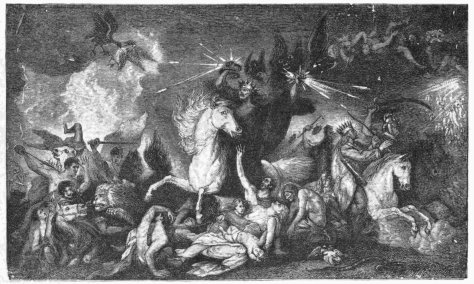
Death on the Pale Horse. By WEST. A.D 1817.
In the Pennsylvania Academy, Philadelphia.
[Copyright, 1879, by Harper and Brothers.]
The Revolutionary Period is, in many respects, the most interesting
division, not only in the political, but also in the artistic history of
the United States. It is so, not merely because it has left us the
pictorial records of the men and the events of a most important epoch in
the development of mankind, but also because it brought forth two
painters who, while they were thoroughly American in their aspirations,
were at the same time endowed with artistic qualities of a very high
order. Gilbert Stuart and John Trumbull, the two painters alluded to,
have a right to be considered the best of the American painters of the
past, and will always continue to hold a prominent place in the history
of their art, even if it were possible to forget the stirring scenes
with which they were connected.
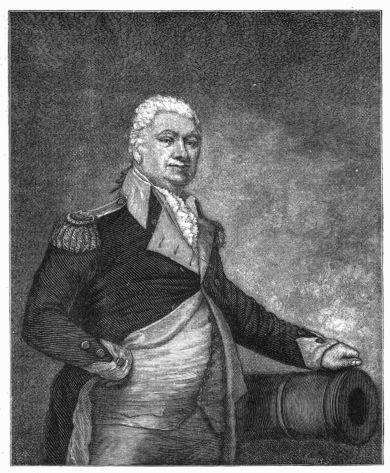
General Knox. By GILBERT STUART
[Copyright, 1879, by Harper and Brothers.]
GILBERT STUART was born in Narragansett, R.I., in 1755, and died in
Boston in 1828. He was of Scotch descent, and it has already been
mentioned that Cosmo Alexander, a Scotchman, was his first teacher.
After several visits to Europe, during the second of which he studied
under West, Stuart finally returned in 1793, and began the painting of
the series of national portraits which will for ever endear him to the
patriotic American. Among these his several renderings of Washington, of
which there are many copies by his own hand, are the most celebrated.
The greatest popularity is perhaps enjoyed by the so-called Athenæum
head, which, with its pendant, the portrait of Mrs. Washington, is the
property of the Athenæum of Boston, and by that institution has been
deposited in the Museum of Fine Arts of the same city. The claim to
superiority is, however, contested by the Gibbs Washington, at present
also to be seen in the museum alluded to. It was painted before the
other, and gives the impression of more realistic truthfulness, while
the Athenæum head seems to be somewhat idealized. Stuart's work is quite
unequal, as he was not a strict economist, and often painted for money
only. But in his best productions there is a truly admirable purity and
wealth of colour, added to a power of characterization, which lifts
portraiture into the highest sphere of art. It must be said, however,
that he concentrated his attention almost entirely upon the head, often
slighting the arms and hands, especially of his female sitters, to an
unpleasant degree. Many excellent specimens of his work, besides the
Washington portraits, are to be found in the Museum of Fine Arts at
Boston and in the collection of the New York Historical Society, the
latter including the fine portrait of Egbert Benson, painted in 1807.
His chef-d'œuvre is the portrait of Judge Stephen Jones, owned by
Mr. F. G. Richards, of Boston, a remarkably vigorous head of an old man,
warm and glowing in colour, which, it is said, the artist painted for
his own satisfaction. Stuart's most celebrated work in England is Mr.
Grant skating. When this portrait was exhibited as a work by
Gainsborough, at the "Old Masters," in 1878, its pedigree having been
forgotten, it was in turn attributed to all the great English
portrait-painters, until it was finally restored to its true author.
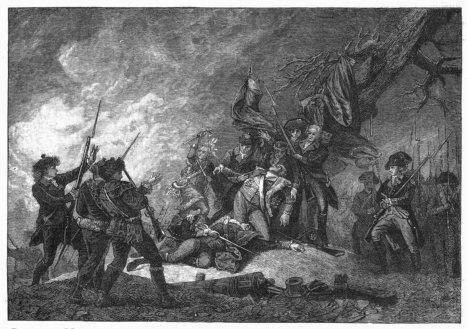
Death of Montgomery in the Attack of Quebec. By J.
Trumbull. At Yale College.
Copyright, 1879, by Harper and Brothers.]
Still more national importance attaches to JOHN TRUMBULL (1756—1843),
since he was an historic as well as a portrait-painter, took part in
person as an officer in the American army in many of the events of the
Revolution, and was intimately acquainted with most of the heroes of his
battle scenes. America enjoys in this respect an advantage of which no
other country can boast—that of having possessed an artist
contemporaneous with the most important epoch in its history, and
capable and willing to depict the scenes enacted around him. Colonel
Trumbull, the son of Jonathan Trumbull, the Colonial Governor of
Connecticut, studied at Harvard, and gave early evidences of a taste for
art. At the age of nineteen he joined the American army, but in 1780,
aggrieved at a fancied slight, he threw up his commission and went to
France, and thence to London, where he studied under West. Trumbull must
not be judged as an artist by his large paintings in the Capitol at
Washington, the commission for which he did not receive until 1817. To
know him one must study him in his smaller works and sketches, now
gathered in the gallery of Yale College, where may be seen his Death of
Montgomery, Battle of Bunker Hill, Declaration of Independence, and
other revolutionary scenes, together with a series of admirable
miniature portraits in oil, painted from life, as materials for his
historic works, and a number of larger portraits, including a
full-length of Washington. As a portrait-painter, Trumbull is also
represented at his best by the full-length of Alexander Hamilton, at
the rooms of the New York Chamber of Commerce. The most successful of
his large historic pieces, The Sortie from Gibraltar, painted in
London, is at the Museum of Fine Arts in Boston. Goethe, who saw the
small painting of The Battle of Bunker Hill while it was in the hands
of Müller, the engraver, commended it, but criticized its colour and the
smallness of the heads. It is true that Trumbull's drawing is somewhat
conventional, and that he had a liking for long figures. But his colour,
as seen to-day in his good earlier pictures, is quite brilliant and
harmonious, although thoroughly realistic. In his later work, however,
as shown by the Scripture pieces likewise preserved in the Yale Gallery,
there is a marked decadence in vigour of drawing as well as of colour.
Owing to an unfortunate concatenation of circumstances, Trumbull has
not received the full appreciation which is his due, even from his own
countrymen. Thackeray readily recognised his merit, and cautioned the
Americans never to despise or neglect Trumbull—a piece of advice which
is only now beginning to attract the attention it deserves.
Among the portrait-painters of this period, CHARLES WILSON PEALE
(1741—1827) takes the lead by reason of quantity rather than quality.
Peale was typical of a certain phase of American character, representing
the restlessness and superficiality which prevail upon men to turn
lightly from one occupation to another. He was a dentist, a worker in
materials of all sorts, an ornithologist and taxidermist, rose to the
rank of colonel in the American army, and started a museum of natural
history and art in Philadelphia. But his strongest love seems, after
all, to have been for the fine arts. Among the fourteen portraits of
Washington which Peale painted, according to Tuckerman, is the only
full-length ever done of the father of his country: it shows him
before the Revolution, attired as an officer in the colonial force of
Great Britain. A large number of Peale's portraits may be seen in the
Pennsylvania Academy and in Independence Hall, Philadelphia. The New
York Historical Society owns, among other works by his hand, a
Washington portrait and a group of the Peale family comprising ten
figures. Much of Peale's work is crude, but all of his heads have the
appearance of being good likenesses.
Among a number of other painters of this period we can select only a
few, whose names receive an additional lustre from their connection with
Washington.
JOSEPH WRIGHT (1756—1793) was the son of Patience Wright, who modelled
heads in wax at Bordentown, N.J., before the Revolution. While in
England he painted a portrait of the Prince of Wales. In the year 1783
Washington sat to him, after having submitted to the preliminary ordeal
of a plaster mask. Tuckerman speaks of this portrait as inelegant and
unflattering, and characterizes the artist as unideal, but
conscientious. Wright's portrait of John Jay, at the rooms of the New
York Historical Society, authorizes a more favourable judgment. It is,
indeed, somewhat austere, but lifelike, well posed, and cool in colour.
E. Savage (1761—1817) seems to have been nearly as versatile as Peale,
emulating him also in the establishment of a museum, at first in New
York, then in Boston. His portrait of General Washington, in the
Memorial Hall of Harvard University, is carefully painted and bright in
colour, but rather lifeless. His Washington Family, in the Boston
Museum (a place of amusement not to be confounded with the Museum of
Fine Arts), which he engraved himself, has similar qualities. A little
picture by him, also in the Boston Museum, representing The Signers of
the Declaration of Independence in Carpenters' Hall, is interesting on
account of its subject, but does not possess much artistic merit. The
portrait of Dr. Handy, on the contrary, which is assigned to him, at
the New York Historical Society, is a very creditable work, good in
colour, luminous in the flesh, and simple in the modelling.
WILLIAM DUNLAP (1766—1839), finally, may also be mentioned here on
account of his portrait of Washington—painted when the artist was
only seventeen years old—although he belongs more properly to the next
period, and is of more importance as a writer than a painter. He
published, in 1834, a "History of the Arts of Design in the United
States," a book now quite scarce and much sought after. A group of
himself and his parents, painted in 1788, is in the collection of the
New York Historical Society.
The example of Trumbull found no followers. The only other American
painter who made a specialty of his country's history seems to have
been JOHN BLAKE WHITE (1782—1859), a native of Charleston, S.C., who
painted such subjects as Mrs. Motte presenting the Arrows, Marion
inviting the British Officer to Dinner, and the Battles of New
Orleans and Eutaw, placed in the State House of South Carolina.
White's fame is quite local, however, and it is impossible, therefore,
to judge of his qualities accurately. Had there been more painters of
similar subjects, a national school might have resulted; but neither the
people nor the Government took any interest in Colonel Trumbull's plans.
It was necessary to employ all sorts of manœuvring to induce Congress
to give a commission to the artist, and the result was disappointment to
all concerned; and when, later, the further decoration of the Capitol at
Washington, the seat of government, was resolved upon, the artist
selected for the work was CARLO BRUMIDI (1811—1880), an Italian artist
of the old school. The healthy impetus towards realistic historic
painting given by Trumbull thus died out, and what there is of historic
and figure painting in the period now under consideration is mainly
dominated by a false idealism, of which Washington Allston is the
leading representative. To rival the old masters, to do what had been
done before, to flee from the actual and the near to the unreal and the
distant, to look upon monks and knights and robbers and Venetian
senators as the embodiment of the poetic, in spite of the poet's warning
to the contrary, was now the order of the day; and hence it was but
natural that quite a number of the artists who then went to Europe
turned to Italy. It was in this period, also, that the first attempts
were made to establish Academies of Art in Philadelphia and New
York—attempts which, while they were laudable enough in themselves,
inasmuch as these institutions were intended to provide instruction at
home for the rising generation, still pointed in the same direction of
simple imitation of the expiring phases of European Art.
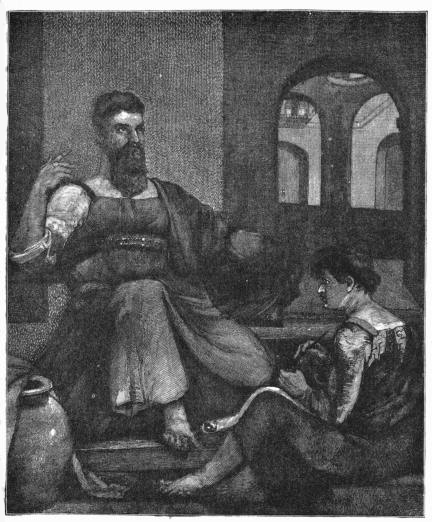
Jeremiah and the Scribe. By WASHINGTON ALLSTON. At
Yale College.
[Copyright, 1879, by Harper and Brothers.]
WASHINGTON ALLSTON (1779—1843) was a native of South Carolina, but
was sent to New England at an early age, and graduated from Harvard
College in 1800. The year following he went to England, to study under
West, and thence to Italy, where he stayed four years, until his return
to Boston in 1809. After a second absence in Europe of seven years'
duration, he finally settled in Cambridge, near Boston. Allston's art
covered a wide range, including Scripture history, portraiture, ideal
heads, genre, landscape, and marine. It is difficult to understand
to-day the enthusiasm which his works aroused, if not among the great
public, at least within a limited circle of admiring friends. He was
lauded for his poetic imagination, and called "the American Titian," on
account of his colour; and this reputation has lasted down to our own
time. The Allston Exhibition, however, which was held two years ago at
the Museum of Fine Arts in Boston, has somewhat modified the opinions of
calm observers. Allston was neither deep nor very original in his
conceptions, nor was he a great colourist. One of his most pleasing
pictures, The Two Sisters, is full of reminiscences of Titian, and it
is well known that he painted it while engaged in the study of that
master. In the case of an artist upon whose merits opinions are so
widely divided, it may be well to cite the words of an acknowledged
admirer, in speaking of what has been claimed to be his greatest work,
the Jeremiah and the Scribe, in the Gallery of Yale College. Mrs. E.
D. Cheney, in describing the impression made upon her by this picture
after a lapse of forty years, says:—"I was forced to confess that
either I had lost my sensibility to its expression, or I had overrated
its value.... The figure of the Prophet is large and imposing, but I
cannot find in it the spiritual grandeur and commanding nobility of
Michel Angelo. He is conscious of his own presence, rather than lost in
the revelation which is given through him. But the Scribe is a very
beautiful figure, simple in action and expression, and entirely absorbed
in his humble but important work. It reminds me of the young brother in
Domenichino's Martyrdom of St. Jerome." The same lack of psychological
power, here hinted at, is still more apparent in the artist's attempts
to express the more violent manifestations of the soul. In The Dead Man
revived by touching Elisha's Bones—for which he received a premium of
200 guineas from the British Institution, and which is now in the
Pennsylvania Academy—the faces of the terrified spectators are so
distorted as to have become caricatures. This is true, in a still higher
degree, of the heads of the priests in the great unfinished
Belshazzar's Feast, in the Museum of Fine Arts, Boston. The unnatural
expression of these heads is generally explained by the condition in
which the picture was left; but the black-and-white sketches, which may
be examined in the same museum, show precisely the same character. The
unhealthy direction of the artist's mind is apparent, furthermore, in
his love of the terrible—shown in his early pictures of banditti, and
in such later works as Saul and the Witch of Endor and Spalatro's
Vision of the Bloody Hand; while, on the contrary, it will be found,
upon closer analysis, that the ideality and spirituality claimed for his
female heads, such as Rosalie and Amy Robsart, resolve themselves
into something very near akin to sweetness and lack of strength. In
accordance with this absence of intellectual robustness, Allston's
execution is hesitating and wanting in decision.
A somewhat similar spirit manifested itself in the works of John
Vanderlyn (1776—1852), Rembrandt Peale (1787—1860), Samuel F. B. Morse
(1791—1872), and Cornelius Ver Bryck (1813—1844).
JOHN VANDERLYN is best known by his Marius on the Ruins of Carthage,
for which he received a medal at the Paris Salon of 1808, and his
Ariadne, which forms part of the collection of the Pennsylvania
Academy. Vanderlyn, as the choice of his subjects, coupled with his
success in France, shows, was a very good classic painter, trained in
the routine of the Academy. The Ariadne is a careful study of the
nude, although somewhat red in the flesh, placed in a conventional
landscape of high order. A large historic composition by him, The
Landing of Columbus, finished in 1846, fills one of the panels in the
Rotunda of the Capitol at Washington. As a portrait painter Vanderlyn
was most unequal.
REMBRANDT PEALE—the son of Charles Wilson Peale, best known through his
portraits—deserves mention here on account of his Court of Death, in
the Crowe Art Museum of St. Louis, and The Roman Daughter, in the
Boston Museum. Technically he stands considerably below his leading
contemporaries.
S. F. B. Morse, whose fame as an artist has been eclipsed by his
connection with the electric telegraph, was a painter of undoubted
talent, but given somewhat to ostentation both in drawing and colour.
Good specimens of his style are found in his Dying Hercules, Yale
College, New Haven, and the rather theatrical portrait of Lafayette in
the Governor's Room of the City Hall of New York. Morse essayed to paint
national subjects, and selected for a theme the interior of the House of
Representatives, with portraits of the members; but the public took no
interest in the picture, although it is said to have been very clever,
and the artist did not even cover his expenses by exhibiting it.
CORNELIUS VER BRYCK painted Bacchantes and Cavaliers, and a few historic
pictures, with a decided feeling for colour, as evidenced by his
Venetian Senator, owned by the New York Historical Society. He stands
upon the borderland between an older and a newer generation, both of
which, however, belong to the same period. Thus far the influence of
Italy had been paramount; in the years immediately following Düsseldorf
claims a share in shaping the historical art of the United States. The
only names that can be mentioned here in accordance with the plan of
this book, which excludes living artists, are Emmanuel Leutze
(1816—1868), Edwin White (1817—1877), Henry Peters Gray (1819—1877),
W. H. Powell (died 1879), Thomas Buchanan Read (1822—1872), and J. B.
Irving (1826—1877).
LEUTZE was a German by birth, and his natural sympathies, although he
had been brought to America as an infant, carried him to Düsseldorf. The
eminence to which he rose in this school may be inferred from the fact
that he was chosen Director of the Academy after he had returned to
America, and almost at the moment of his death. Although of foreign
parentage, he showed more love for American subjects than most of the
native artists, but the trammels of the school in which he was taught
made it impossible for him to become a thoroughly national painter. His
most important works are Washington crossing the Delaware, Washington
at the Battle of Monmouth, and Washington at Valley Forge; the two
last named are at present in the possession of Mrs. Mark Hopkins of
California. In the Capitol at Washington may be seen his Westward the
Star of Empire takes its Way; The Landing of the Norsemen is in the
Pennsylvania Academy; The Storming of a Teocalle, in the Museum of
Fine Arts, Boston.
EDWIN WHITE, an extraordinarily prolific artist, who studied both at
Paris and Düsseldorf, also painted a number of American historic
pictures, among them Washington resigning his Commission, for the
State of Maryland. The bulk of his work, however, weakly sentimental,
deals with the past of Europe.
H. P. Gray's allegiance was given, almost undividedly, to the masters of
Italy, and his subjects were mostly taken from antiquity. In his best
works, such as The Wages of War, he appears in the light of an
academic painter of respectable attainments; but there is so little of a
national flavour in his productions, that the label "American School" on
the frame of the picture just named is apt to provoke a smile. Gray's
Judgment of Paris is in the Corcoran Gallery at Washington.
W. H. Powell is best known by his De Soto discovering the
Mississippi, in the Rotunda at Washington, a work which is on a level
with the average of official monumental painting done in Europe, in
which truth is invariably sacrificed to so-called artistic
considerations. As a portrait-painter he does not stand very high. T. B.
READ, the "painter-poet," enjoyed one of those fictitious reputations
which are unfortunately none too rare in America. Without any real
feeling for colour, and with a style of drawing which made up in
so-called grace for what it lacked in decision, he attained a certain
popularity by a class of subjects such as The Lost Pleiad, The Spirit
of the Waterfall, &c., which captivate the unthinking by their very
superficiality. Several of his productions, among them his Sheridan's
Ride, may be seen at the Pennsylvania Academy. J. B. Irving, a student
at Düsseldorf under Leutze, was a careful and intelligent painter of
subjects which might be classed as historic genre, including some
scenes from the past history of the United States.
Among the foreign artists who came to America during this period must be
named CHRISTIAN SCHÜSSELE (1824—1879), a native of Alsace, who has
exercised some influence through his position as Director of the Schools
of the Pennsylvania Academy, in Philadelphia. His Esther denouncing
Haman, in the collection of the institution just named, shows him to
have been an adherent of the modern French classic school, in which
elegance is the first consideration.
A place all by himself must finally be assigned to WILLIAM RIMMER
(1816—1879), of English parentage, who spent much of his life in the
vicinity of Boston. Dr. Rimmer, as he is commonly called, since he began
life as a physician, is of greater importance as a sculptor than as a
painter. He, nevertheless, must be mentioned here on account of the many
drawings he executed. To an overweening interest in anatomy he added a
somewhat weird fancy, so that his conceptions sometimes remind one of
Blake. His most important work is a set of drawings for an anatomical
atlas, in which special stress is laid upon the anatomy of expression.
His oil-paintings, such as Cupid and Venus, &c., are marred by violent
contrasts of light and dark, and an unnatural, morbid scheme of colour,
which justifies the assumption that his colour-vision was defective. But
Rimmer will always remain interesting as a brilliant phenomenon,
strangely out of place in space as well as in time.
The same absence, in general, of a national spirit is to be noticed in
the works of the genre painters. Among the earliest of these are to be
named CHARLES ROBERT LESLIE (1794—1859), many of whose works may be
seen in the Lenox Gallery, New York, and at the Pennsylvania Academy,
Philadelphia; and GILBERT STUART NEWTON (1794—1835), a nephew of
Stuart, the portrait-painter, who is represented at the New York
Historical Society and in the Museum of Fine Arts in Boston. These two
artists are, however, so closely identified with the English school, and
draw their inspiration so exclusively from European sources, that they
can hardly claim a place in a history of painting in America.
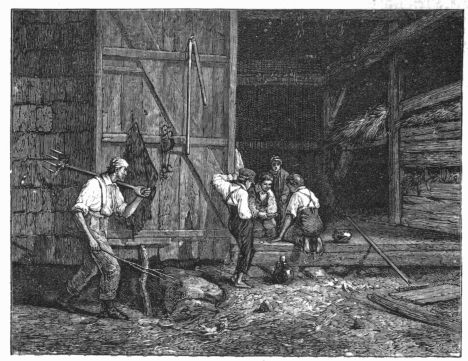
The one American genre painter par excellence is William Sydney
Mount (1807—1868), the son of a farmer on Long Island, and originally a
sign-painter. No other artist has rivalled Mount in the delineation of
the life of the American farmer and his negro field hands, always looked
at from the humorous side. As a colourist, Mount is quite artless, but
in the rendition of character and expression, and the unbiassed
reproduction of reality, he stands very high. His Fortune Teller,
Bargaining for a Horse, and The Truant Gamblers, the last named one
of his best works also as regards colour, are in the collection of the
New York Historical Society; The Painter's Triumph is in the gallery
of the Pennsylvania Academy; the Corcoran Gallery, Washington, has The
Long Story. Several inferior artists have shown, by their
representations of scenes taken from the political and social life of
the United States, how rich a harvest this field would offer the brush
of a modern Teniers. But in spite of the popularity which the
reproductions of their works and those of some of Mount's pictures
enjoyed, the field remained comparatively untilled.
A Surprise. By MOUNT.
[Copyright, 1879, by Harper and Brothers.]
Of other painters of the past, HENRY INMAN (1801—1846), better known as
a most excellent portrait-painter, executed a few genre pictures based
on American subjects, such as Mumble the Peg in the Pennsylvania
Academy; and RICHARD CATON WOODVILLE (about 1825—1855), who studied at
Düsseldorf, became favourably known, during his short career, by his
Mexican News, Sailor's Wedding, Bar-Room Politicians, &c.; while
among the mass of work by F. W. Edmonds (1806—1863) there are also
several of specifically American character; but the majority of artists
preferred to repeat the well-worn themes of their European predecessors,
as shown by W. E. West's (died 1857) The Confessional, at the New York
Historical Society's Rooms, or the paintings of James W. Glass (died
1855), whose Royal Standard, Free Companion, and Puritan and
Cavalier, are drawn from the annals of England.
The Indian tribes found delineators in GEORGE CATLIN (1796—1872) and C.
F. Wimar (1829—1863), while William H. Ranney (died 1857) essayed the
life of the trappers and frontiersmen. None of these artists, however,
approached their subjects from the genuinely artistic side. As an
ornithological painter, scientifically considered, JOHN JAMES AUDUBON
(1780—1851), the celebrated naturalist, occupied a high rank. The
animal world of the prairies and the great West in general was the
chosen field of William J. Hays (1830—1875). A large picture by him of
an American bison, in the American Museum of Natural History at New
York, shows at once his careful workmanship, his ambition, and the
limitation of his powers, which was too great to allow him to occupy a
prominent place among the animal painters of the world.
The skill in realistic portraiture, eminently shown by the American
painters of the preceding century, was fully upheld by their successors
of the third period. Most of the historic painters named above were well
known also as portraitists, and their claims to reputation are shared
with more or less success by J. W. Jarvis (1780—1851), THOMAS SULLY
(1783—1872), SAMUEL WALDO (1783—1861), CHESTER HARDING (1792—1866),
WILLIAM JEWETT (born 1795), EZRA AMES (flourished about 1812—1830),
Charles C. Ingham (1796—1863), J. Neagle (1799—1865), Charles L.
Elliott (1812—1868), JOSEPH AMES (1816—1872), T. P. Rossiter
(1818—1871), G. A. Baker (1821—1880), and W. H. Furness (1827—1867).
Specimens of the work of most of these artists, several of whom were of
foreign parentage, will be found in the collections of the New York
Historical Society, the Governor's Room in the City Hall of New York,
the Pennsylvania Academy, and the Museum of Fine Arts at Boston. The
most prominent among the later names is Charles Loring Elliott, who was
born and educated in America, but whose work, when he is at his best,
nevertheless shows the hand of a master. E. G. Malbone (1777—1807),
whose only ideal work, The Hours, is in the Athenæum, at Providence,
R.I., is justly celebrated for his delicate miniatures, a department in
which R. M. Staigg (1817—1881) likewise excelled. As a crayon artist,
famous more especially for his female heads, Seth W. Cheney (1810—1856)
must be named.
The most interesting, however, because the most original, manifestation
of the art instinct in this period is found in landscape. In this
department also it seemed for a time as if the influence of the old
Italian masters would gain the upper hand. But the influence of
Düsseldorf, aided by that of England, although not through its best
representatives, such as Constable, gave a different turn to the course
of affairs, and in a measure freed the artists from the thraldom of an
antiquated school. Although, naturally and justly enough, the landscape
painters of America did not disdain to depict the scenery of foreign
lands, they nevertheless showed a decided preference for the beauties of
their own country, and diligently plied their brushes in the delineation
of the favourite haunts of the Catskills, the Hudson, the White
Mountains, Lake George, &c., and, at a later period, of the wonders of
the Rocky Mountains and the valley of the Yosemite. It has become the
fashion in certain circles to speak rather derisively of these painters
as "the Hudson River School," a nickname supposed to imply the charge
that they preferred the subject to artistic rendering and technical
skill. There is no denying that there is some truth in this charge, but
later experience has taught, also, that a more insinuating style is apt
to lead the artists to ignore subject altogether. It is precisely the
comparative unattractiveness of the methods employed which enabled these
painters to create what may be called an American school, while, had
they been as much absorbed in technical processes, or in the solving of
problems of colour, as some of their successors, they would probably
have rivalled them also in the neglect of the national element. It is
worthy of note that the rise of this school of painters of nature is
nearly contemporaneous with the appearance of William Cullen Bryant,
whose "Thanatopsis" was first published in 1817, and who is eminently
entitled to be called the poet of nature.
The first specialist in landscape of whom any record is to be found is
JOSHUA SHAW (1776—1860), an Englishman, who came to America about 1817.
The specimens of his work preserved in the Pennsylvania Academy show him
to have been a painter of some refinement, who preferred delicate
silvery tones to strength. In the same institution may also be found
numerous examples by THOMAS DOUGHTY (1793—1856), of Philadelphia, who
abandoned mercantile pursuits for art in 1820, and who may claim to be
the first native landscape-painter. His early work is hard and dry and
monotonous in colour, but nevertheless with a feeling for light. As he
advanced, his colour improved somewhat. ALVAN FISHER (1792—1863), of
Boston, also ranks among the pioneers in this department, but he was
more active as a portrait-painter.
Desolation. From the "Course of Empire." By Thomas
Cole.
In the possession of the New York Historical Society.
[Copyright, 1879, by Harper and Brothers.]
The greatest name, however, in the early history of landscape art in the
United States is that of THOMAS COLE (1801—1848), who came over from
England with his parents in 1819, but received his first training, such
as it was, in America. Cole spent several years in Italy, and remained
for the rest of his life under the spell of Claude, Salvator Rosa, and
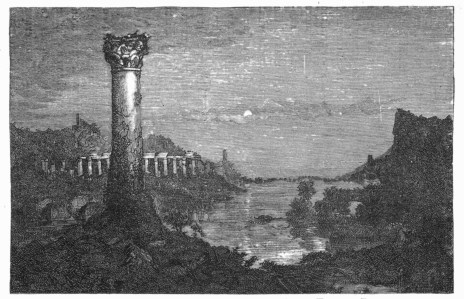
Poussin. He aspired to be a painter of large historic, or rather
allegoric landscapes, and some of his productions in this line, as, for
instance, The Course of Empire (New York Historical Society), a series
of five canvases, showing the career of a nation from savage life
through the splendours of power to the desolation of decay, will always
secure for him a respectable place among the followers of the old
school. He therefore shared, with most of his American colleagues, the
fatal defect that his work contained no germ of advancement, but was
content to be measured by standards which were beginning to be false,
because men had outlived the time in which they were set up. Cole did
not, however, confine himself to such allegoric landscapes. He was a
great lover of the Catskills, and often chose his subjects there, or in
the White Mountains. But in the specimens of this kind to be seen at the
New York Historical Society's rooms, he shows himself curiously
defective in colour, and mars the tone by undue contrasts between light
and dark. He is at his best in the representation of storm effects, such
as The Tornado, in the Corcoran Gallery at Washington.
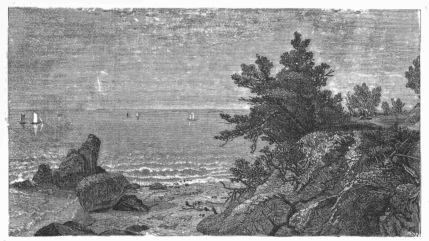
Among the ablest representatives of the "Hudson River School" were J. F.
Kensett (1818—1873), and Sanford R. Gifford (1823—1880). For Kensett,
it may indeed be claimed that he was the best technician of his time,
bolder in treatment than most of his colleagues, and with a true
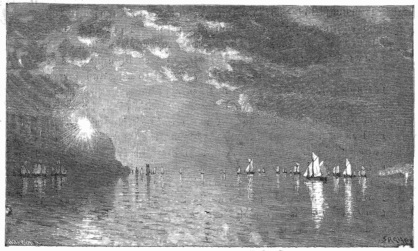
feeling for the poetry of colour. Gifford, who divided his allegiance
about equally between America, Italy, and the Orient, loved to paint
phenomenal effects of light, which often suggest the studio rather than
nature. One of the principal works of this very successful and greatly
esteemed artist, The Ruins of the Parthenon, is the property of the
Corcoran Gallery, which also owns several pictures by Kensett.
Noon by the Sea-shore: Beverly Beach. By J. F. Kensett.
[Copyright, 1879, by Harper and Brothers.]
As one of the leading lights of the little cluster of American
pre-Raphaelites, we may note John W. Hill (died 1879), who painted
landscapes chiefly in water-colour.
The United States being a maritime power, it would be quite natural to
look for a development of marine painting among her artists. Until
lately, however, very little has been done in this branch of art, and
that little mostly by foreigners. THOMAS BIRCH, an Englishman (died
1851), painted the battles between English and American vessels in an
old-fashioned way in Philadelphia, while Boston possessed an early
marine painter of slender merit in Salmon. A. Van Beest, a Dutch marine
painter, who died in New York in 1860, is chiefly of interest as the
first teacher of several well-known American painters of to-day. John E.
C. Petersen (1839—1874), a Dane, who came to America in 1865, enjoyed
an excellent reputation in Boston. The leading name, however, among the
artists of the past in this department is that of JAMES HAMILTON
(1819—1878), who was brought to Philadelphia from Ireland in infancy,
and went to England for purposes of study in 1854. In many of his
phantastic productions, in which blood-red skies are contrasted with
dark, bluish-gray clouds and masses of shadow, as in Solitude, and an
Oriental landscape in the Pennsylvania Academy, the study of Turner is
quite apparent. But he loved also to paint the storm-tossed sea, under a
leaden sky, when it seems to be almost monochrome. One of his finest
efforts, The Ship of the Ancient Mariner, is in private possession in
Philadelphia. His Destruction of Pompeii is in the Memorial Hall,
Fairmount Park, in the same city. Hamilton, whose somewhat unsteady mode
of living is reflected in the widely varying quality of his work, very
properly closes our review of this epoch, as he might not
inappropriately be classed with the artists of the period next to be
considered.
It has been remarked already that the American students who went to
England up to the middle of the present century were not influenced by
those painters who, like Constable, are credited with having given the
first impulse towards the development of modern art. This is true also
of those who went to France.
They fell in with the old-established Classic school, and were not
affected by the rising Romantic and Colouristic school until long after
its triumphant establishment. Within the last ten or fifteen years,
however, the tendency in this direction has been very marked, and the
main points of attraction for the young American artist in Europe have
been Paris and Munich. One of the results of this movement, consequent
upon the preponderating attention given to colour and technique, has
been an almost entire neglect of subject. What the art of America has
gained, therefore, in outward attractiveness and in increase of skill,
it has had to purchase at the expense of a still greater
de-Americanisation than before. The movement is, however, only in its
inception, and its final results cannot be predicated. Nor will it be
possible to mention here more than a very few of its adherents, as,
self-evidently, the greater part of them belong to the living
generation.
Sunset on the Hudson. By S. R. Gifford.
[Copyright, 1879, by Harper and Brothers.]
One of the first to preach the new gospel of individualism and colour in
America was WILLIAM MORRIS HUNT (1824—1879), who, after his return from
Europe, made his home in Boston. In 1846 he went to Düsseldorf, which he
soon exchanged for Paris, where he studied with Couture, and later with
Millet. Hunt was in a certain sense a martyr to his artistic
convictions, and his road was not smoothed by his eccentricities. Had he
found a readier response on the part of the public, he might have
accomplished great things. As it was, those to whom he was compelled to
appeal could not understand the importance of the purely pictorial
qualities which he valued above all else, and instead of sympathy he
found antagonism. As a fact indicating the difficulties which stood in
his way, it is interesting to know that the first idea for the mural
paintings, The Flight of Night and The Discoverer, which he executed
in the new Capitol at Albany, shortly before his death, was conceived
over thirty years ago. It is not to be wondered at, therefore, that his
mind was embittered, and his work even more unequal than that of so many
of his older colleagues. But even so he has left a number of works, as
for instance the original sketch for the Flight of Night, several
portraits, and a View of Gloucester Harbour, which will always be
counted among the triumphs of American art.
Prominent among the American students in the French school was Robert
Wylie, a native of the Isle of Man, who was brought to the United States
when a child, and died in Brittany at the age of about forty years in
1877. His Death of a Breton Chieftain, in the Metropolitan Museum of
New York, and Breton Story-Teller, in the Pennsylvania Academy, two
very fine pictures, although somewhat heavy in colour, show him to have
been a careful observer, with a power of characterisation hardly
approached by any other American painter.
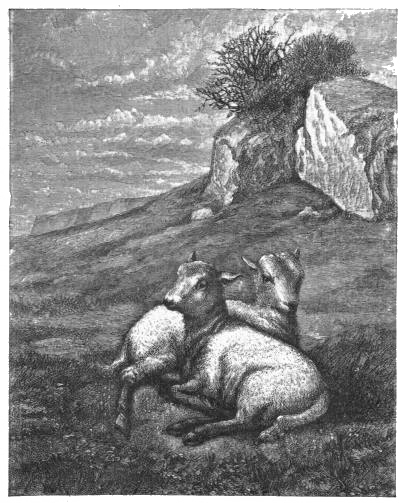
Lambs on the Mountain-side. By WILLIAM MORRIS HUNT.
As a remarkable artist, belonging also to the French-American school,
although he never left his native land, we must mention R. H. Fuller, of
Boston, who died comparatively young in 1871. Fuller had a most
extraordinary career and displayed extraordinary talent. Originally a
cigar-maker, and later a night watchman, he was almost entirely
self-taught, his study consisting in carefully looking at the French
landscapes on exhibition at the stores, and then attempting to reproduce
them at home. The knowledge thus gained he applied to the rendering of
American landscapes, and he had so assimilated the methods of his French
exemplars, that his creations, while they often clearly betrayed by what
master they had been inspired, were yet thoroughly American.
This sketch of the history of painting in America is necessarily very
fragmentary, by reason of its shortness, as well as by the limitation
imposed by the plan of this book, which excludes all living artists.
Many prominent representatives of the various tendencies to which the
reader's attention has been called, have, therefore, had to be omitted.
It is believed, nevertheless, that, while the mention of additional
names would have made the record fuller, the general proportions of the
outline would not have been materially changed thereby. Nor is the
apparently critical tone, the repeated dwelling on the lack of
originality in subject as well as method, to be taken as an expression
of disparagement. A fact has simply been stated which admits of a ready
explanation, hinted at in the introductory remarks, but which must be
kept steadily in view if American Art is ever to assume a more
distinctive character. The painters of America, considering the
circumstances by which they have been surrounded, have no reason to be
ashamed of their past record. They have shown considerable aptitude in
the acquisition of technical attainments, and the diligence and
enthusiasm in the pursuit of their studies on the part of the younger
artists, promise well for the future. It rests altogether with the
nation itself whether this promise shall be fulfilled.


