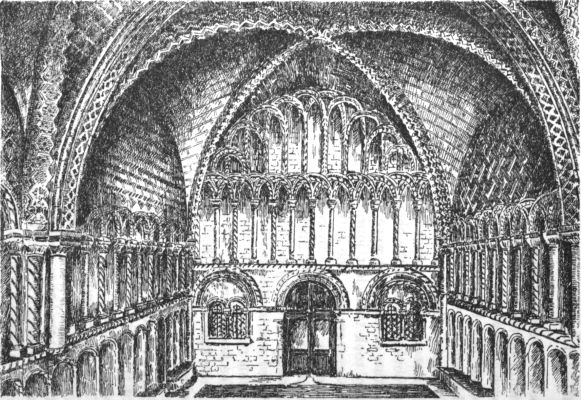
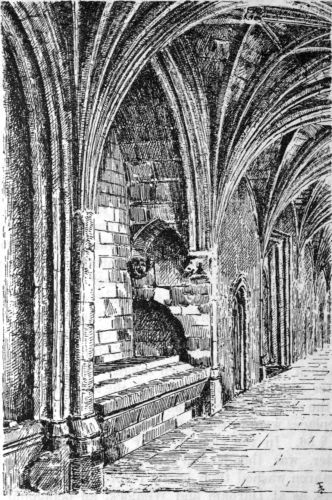
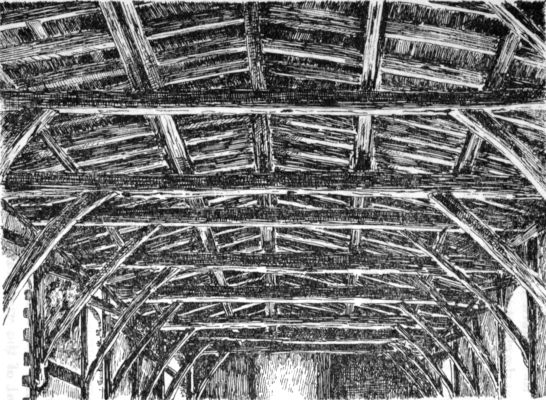
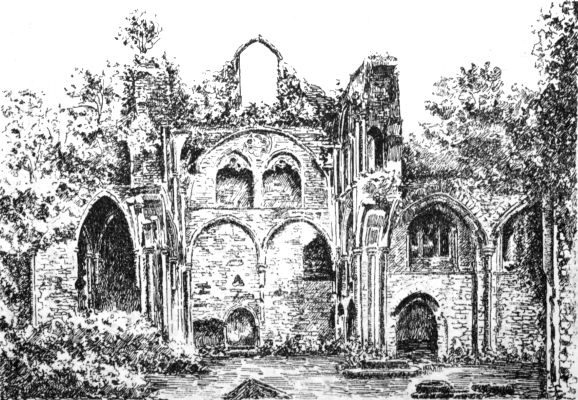
ENGLISH MONASTERIES — PREFACE — CONTENTS — LIST OF ILLUSTRATIONS — CHAPTER I THE RELIGIOUS ORDERS — § 1. — § 2. — § 3. — § 4. — § 5. — § 6. — § 7. — § 8. — § 9. — § 10. — § 11. — § 12. — § 13. — § 14. — § 15. — § 16. — § 17. — § 18. — § 19. — § 20. — § 21. — § 22. — § 23. — § 24. — § 25. — § 26. — § 27.
The Cambridge Manuals of Science and
Literature
CAMBRIDGE UNIVERSITY PRESS
London: FETTER LANE, E.C.
C. F. CLAY, Manager
Edinburgh: 100, PRINCES STREET
Berlin: A. ASHER AND CO.
Leipzig: F. A. BROCKHAUS
New York: G. P. PUTNAM'S SONS
Bombay and Calcutta: MACMILLAN AND CO., Ltd.
All rights reserved
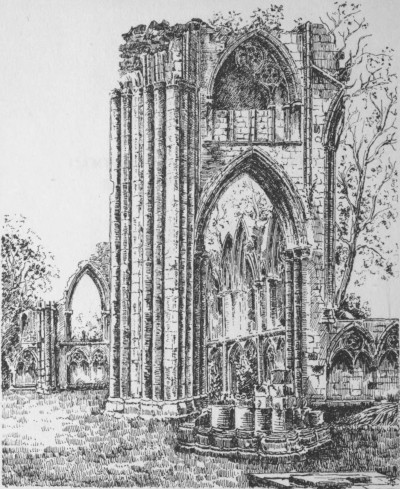
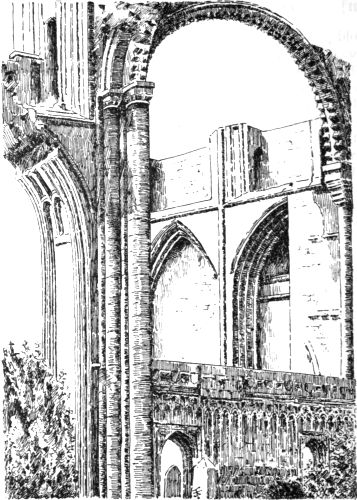
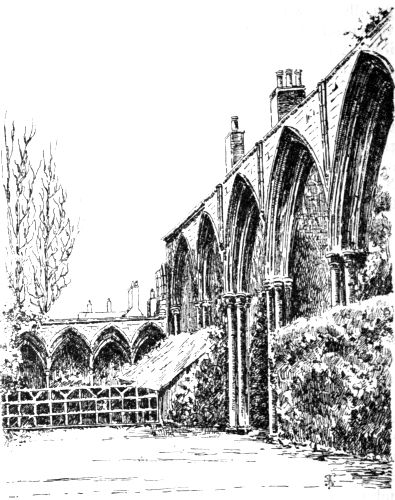
ST MARY'S ABBEY, YORK.
Crossing, north transept, and north aisle of nave.
Cambridge:
PRINTED BY JOHN CLAY, M.A.
AT THE UNIVERSITY PRESS
With the exception of the coat of arms at
the foot, the design on the title page is a
reproduction of one used by the earliest known
Cambridge printer, John Siberch, 1521
In view of the growth of interest in medieval
history and art, so conspicuous of late years, it
is thought that this small volume may meet the
needs of those who desire to know something about
one of the most interesting sides of the life of the
middle ages. There is no dearth of literature relating
to monasteries, and the general facts of monastic
history are accessible to the ordinary student in
various handbooks. Monographs, however, which
describe the plans of monasteries and the position
and use of the principal buildings, exist for the most
part in forms which are more difficult of access.
Special attention has therefore been paid in the
present case to the question of plan, and it is hoped
that visitors to the remains of our English religious
houses, who wish to gain some co-ordinate idea of
their various parts, may find some help from this
manual.
The writer desires to acknowledge gratefully the
assistance of his wife, who is responsible for the
plans and illustrations. The master of Emmanuel,
the general editor of the series, has kindly read
through the proofs and furnished valuable suggestions.
The book has also had the great advantage of perusal
and criticism by Mr W. H. St John Hope, Litt.D.,
D.C.L., to whose kindness and learning the writer is
deeply indebted. Some idea of what students of
English monastic life owe to Mr Hope may be gained
from the bibliography at the end of this volume.
Thanks are also due to the editors of the Archaeological
Journal for permission to found the plan
of Haughmond abbey (p. 114) on that by Mr H.
Brakspear, F.S.A., in Archaeol. Journal, vol. LXVI.
A. H. T.
Gretton, Northants.
12 April, 1913.
| CHAPTER I |
| THE RELIGIOUS ORDERS |
| § 1. The medieval monastery. 2. Growth of monachism in the
east. 3. Beginnings of western monachism: Italy, Gaul and
Ireland. 4. The rule of St Benedict. 5. The Benedictine order
in England: early Saxon monasteries. 6. The Danish invasions
and the monastic revival. 7. Monasticism after the Norman
conquest. 8. Benedictine abbeys and priories. 9. Priories of
alien houses. 10. The Cluniac order. 11. The Carthusian order.
12. The orders of Thiron, Savigny and Grandmont. 13. Foundation
and growth of the Cistercian order. 14. Cistercian monasteries.
15. Monks and conversi. 16. Orders of canons: secular chapters.
17. Augustinian canons. 18. Premonstratensian canons. 19. The
order of Sempringham. 20. Nunneries. 21. Decline of the regular
orders. The friars. 22. Monastic property: parish churches.
23. Monasteries as land-owners: financial depression. 24. Moral
condition of the monasteries. 25. Numbers of inmates of monasteries.
26. The suppression of the monasteries. 27. Remains
and ruins of monastic buildings |
1 - 39 |
| CHAPTER II |
| THE CONVENTUAL CHURCH |
| § 28. Divisions of the monastery precinct: varieties of plan.
29. The plan of church and cloister: necessities governing the
church-plan. 30. General arrangement of the church. 31. Eastern
arm of the church: Anglo-Norman Benedictine and Cluniac plans.
32. The presbytery and quire. 33. Transept-chapels. 34. Aisled
enlargements of the eastern arm. 35. The nave: processional
doorways, altars and screens. 36. Parochial use of the nave.
37. The normal Cistercian plan: presbytery and transepts. 38. Cistercian
aisled presbyteries. 39. Cistercian transepts. 40. Arrangement
of the Cistercian nave. 41. Cistercian influence on the plan
of canons' churches. 42. Aisled quires and presbyteries in canons'
churches. 43. Naves with single aisles in canons' churches.
44. Aisleless naves. 45. Aisleless plans: churches of nuns, Carthusian
monks, friars and Gilbertine canons | 39 - 71 |
| CHAPTER III |
| THE CLOISTER AND ITS BUILDINGS |
| § 46. Plan and position of the cloister. 47. The cloister-walk
next the church. 48. The eastern range: the parlour. 49. The
chapter-house: its uses. 50. Varieties of the chapter-house plan.
51. Sub-vault of the dorter: treasury and common-house. 52. The
dorter stairs. 53. The dorter and rere-dorter. 54. Buildings
opposite the church: the frater. 55. The kitchen. 56. The
cloister lavatory. 57. The western range: the cellarer's building
and its upper floor. 58. Exceptional uses of the western range:
Worcester, Durham and Easby | 72 - 95 |
| CHAPTER IV |
| THE CISTERCIAN CLOISTER, ETC. |
| § 59. Plan of the eastern range: the vestry and library. 60. The
Cistercian chapter-house. 61. Parlour, infirmary passage and sub-dorter.
62. Dorter, rere-dorter and day-stair. 63. The range
opposite the church: plan of the frater. 64. Arrangements of the
warming-house and frater. 65. The kitchen: convenience of its
place in the plan. 66. The western range: cellarer's building and
house of the lay brothers. 67. Later changes in the Cistercian
plan: misericords in cloister. 68. Plans of houses of canons,
friars, etc.: their kinship to the normal Benedictine plan. 69. Carthusian
houses: the plan of Mount Grace | 95 - 113 |
| CHAPTER V |
| THE INFIRMARY AND THE OUTER COURT |
| § 70. Objects of the infirmary. 71. Buildings and position of
the infirmary. 72. Plan and arrangement of the infirmary hall.
73. The infirmary kitchen and the misericord. 74. The abbot's
lodging: Cistercian usages. 75. Abbots' and priors' lodgings in
other orders. 76. The guest-houses: division of hospitality.
77. The outer court or curia: Cistercian entrance-courts. 78. The
gatehouse. 79. The almonry and its uses | 113 - 132 |
| CHAPTER VI |
| DISCIPLINE AND THE DAILY LIFE |
| § 80. Officers of the monastery: the obedientiaries. 81. The
monastic day and its divisions: the night-office. 82. Services and
work of the morning in summer. 83. The day from sext to compline.
84. Arrangement of the day in winter: variations of daily custom.
85. The Carthusian day | 133 - 142 |
| Bibliography | 143 |
| Index | 149 |
| FIG. | PAGE |
|
St Mary's abbey, York. Crossing, north transept, and north aisle of nave |
Frontispiece |
| 1. |
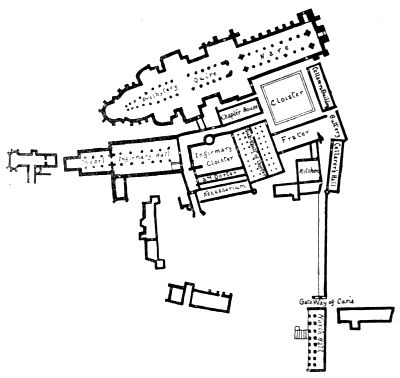
Plan of the cathedral priory, Canterbury (after Professor Willis) |
40 |
| 2. |
Croyland abbey: rood-screen and nave from S.E. |
50 |
| 3. |
Plan of typical Cistercian church, shewing original form and later eastern enlargement |
56 |
| 4. |
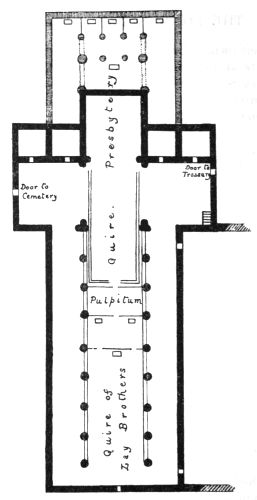
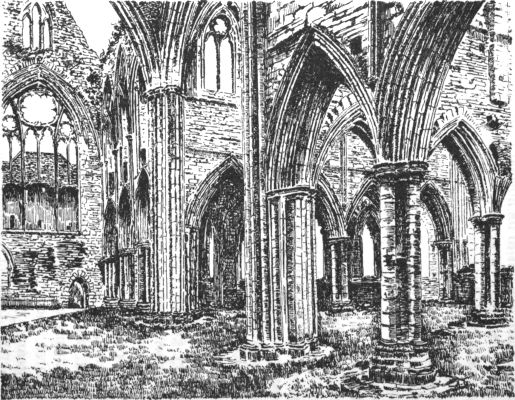
Tintern abbey: north transept and presbytery, shewing doorways to dorter and sacristy |
60 |
| 5. |
Mount Grace priory: tower-arches and nave from N.E. |
69 |
| 6. |
Gloucester: south walk of cloister with monks' carrels |
74 |
| 7. |
Bristol: chapter-house, looking W. |
78 |
| 8. |
Worcester: lavatory in west walk of cloister |
88 |
| 9. |
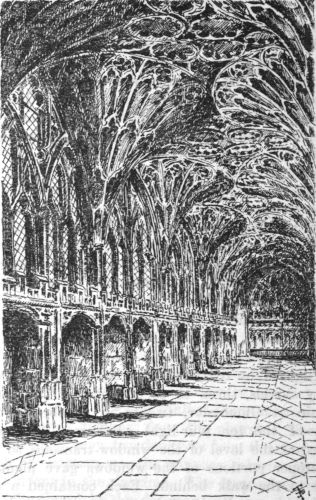
Durham: ceiling of dorter (now the chapter library) |
93 |
| 10. |
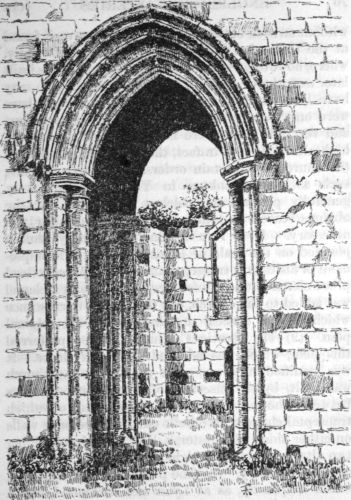
Netley abbey: south transept and south aisle of nave, shewing doorways to sacristy and dorter, and eastern processional doorway |
96 |
| 11. |
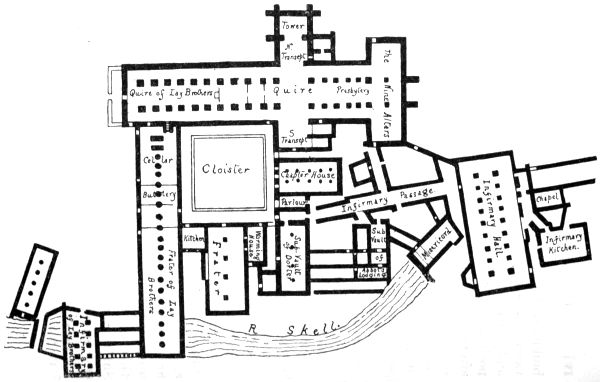
Fountains abbey: plan |
102 |
| 12. |
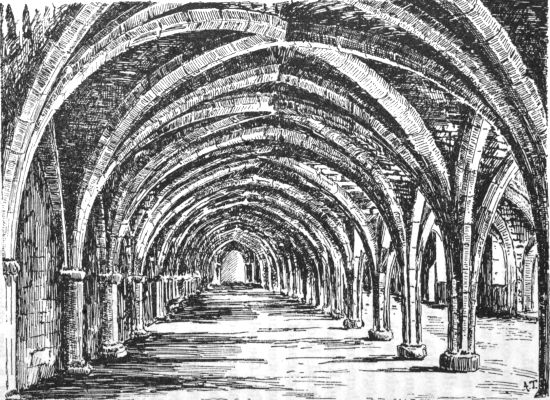
" " cellarium, looking north |
106 |
| 13. |
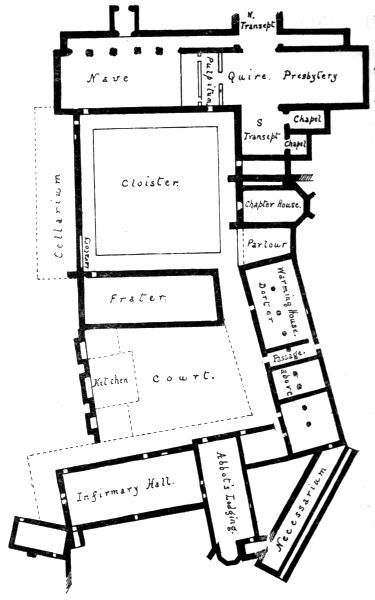
Haughmond abbey: plan |
114 |
| 14. |
Peterborough: infirmary, looking west |
118 |
| 15. |
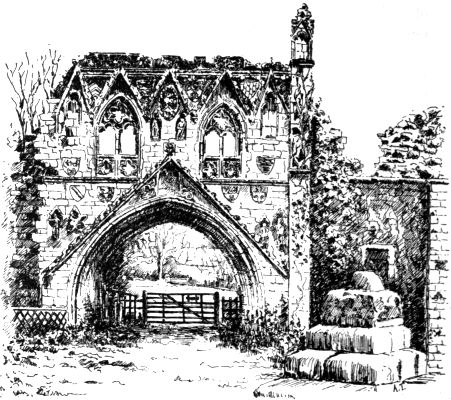
Kirkham priory: gatehouse |
130 |
A monastery is a community of men or
women, devoted to the service of God and obeying
a fixed rule. Monastic rules of life varied in strictness
and in detail; while each community supplemented
the rule of its order by its own code of
observances. The object, however, of these different
rules and codes was one. The general term for the
monastic life was 'religion' (religio): the 'religious'
(religiosus) was bound by three vows, to poverty
against the deceits of the world, to chastity against
the lusts of the flesh, to obedience against the snares
of the devil. His chief duty was to take part with
his brethren in the recitation of the canonical hours,
and in the celebration of daily masses. A portion of
his day was set apart for meditation in the cloister;
but his surplus time was devoted to labour. The
business affairs of a monastery brought some religious
into touch with the practical side of life. Others
found their vocation in manual labour in the fields or
workshops; while a certain number devoted themselves
to literary work in the cloister.
The rule of St Benedict, on which western
monachism was founded, distinguishes between four
classes of religious. Of these the two principal were
cenobites, monks living in a community (coenobium)
under rule, and the anchorites, who have departed
(ἀναχωρεῖν) from the world to live a solitary life of
prayer. These were the sources of the two main
streams of Christian monachism. Naturally, the
anchorite came first into existence. The cenobite
followed, by the combination of anchorites in monasteries.
The development of the coenobium was
gradual. About 305 A.D., St Anthony inaugurated
the 'lauras' (λαῦραι) of northern Egypt, monasteries
in which each anchorite lived in his separate cell and
met for common services only on Saturday and
Sunday. A few years later St Pachomius founded
his first coenobium at Tabennisi in southern Egypt.
Here the social principle was more fully organised:
common services in church were more frequent and
labour was recognised as a factor in the monastic
life; but the monks still lived separately. A further
step was taken by St Basil, who about 360 founded
a coenobium near Neocaesarea. His rule introduced
the idea of common life under one roof. It became
the basis of the monastic system of the eastern
Church, and its principles had a lasting effect on the
monastic life of western Europe.
The influence of the monachism of the east
naturally spread westward. No general rule of life
was followed at first. Each collection of monks was
governed by its own special observances, aiming
generally at the ascetic ideal of separation from the
world pursued by the early anchorites. Monachism,
however, was a powerful agent in the Christianising of
the west. Each monastery under its abbot or father
became a training-ground for monk-bishops who
ruled dioceses in new monastic centres of missionary
effort. The beginnings of organised monachism in
Ireland may be traced to the monastery of Lerins, on
an island near Cannes, where St Patrick received his
training. The success of Irish monasticism soon reacted
upon Gaul and Italy, when St Columban founded
the monasteries of Luxeuil and Bobbio upon a rule
derived from Irish practice. About the same time
St Columba at Iona established the vogue of the
Irish system in northern Britain.
Meanwhile, a new development of the
principle arose. St Benedict, a native of Norcia near
Spoleto, retired about the beginning of the sixth
century to a hermitage at Subiaco. Here he attracted
a number of followers, and several monasteries arose
in the neighbourhood under his direction. It was for
the monastery of Monte Cassino, which he ruled for
some thirty years, that he composed the rule which
became the law of the monastic life of western
Europe. The success and the general adoption of
the rule of Monte Cassino in the west were due to
the statesmanship with which its injunctions were
adapted to climate and physical capacity. The Benedictine
monk entered upon a life of work and prayer,
which needed the habitual exercise of self-control;
but his bodily health ran no risk of being ruined by
pious excess. Isolated devotion was superseded by
religious life in a common church and cloister. This
was the end to which Pachomius and Basil had contributed;
but the mystical temperament of the east
fostered a contemplative and ascetic tendency which
modified the conception of a common life of uniform
duty. The early monasteries of Gaul, such as that of
St Martin at Tours, followed the model of the laura
rather than the coenobium; and the separate cell
and the practice of self-imposed austerities seem to
have been general in early Celtic monasteries. The
voluntary hardships of St Cuthbert in his cell on
the Farne islands, the prayers and visions of the
Saxon Guthlac at Croyland, were western survivals
of the ideals of St Anthony and St Simeon Stylites.
St Benedict, on the contrary, while casting no reflexions
on a life which he himself had at first
adopted, recommended to the aspirant for salvation
no heroic tasks of prayer and fasting. His aim was
the growth in grace of a brotherhood, living under
a common rule in obedience to an abbot to whom
considerable discretion was given. The natural
tendency of the solitary life was to produce an
emulation in religious endeavour; and monasteries
which were little more than collections of anchorites
were liable to the decay consequent upon the rivalry
of their inmates. St Benedict enjoined emulation in
good works among his monks; but their emulation
had its root in humility and obedience, and its
outward sign was a mutual deference far removed
from spiritual pride. There can be little wonder
that a rule, difficult but possible to follow, and
allowing for individual weakness, spread far outside
the community for which it was made, and that the
Benedictine order by the end of the seventh century
supplanted all other forms of monasticism in western
Europe.
The rule of St Benedict was introduced into
England by St Augustine, prior of the monastery on
the Coelian hill in Rome. At this time the chief
strength of Celtic monachism was naturally in the
north, although it had penetrated southwards to such
isolated outposts as Glastonbury. Gradually Roman
customs gained ground in the strongholds of Celtic
Christianity. The grant of the monastery of Ripon
to Wilfrid was followed by the departure of the
Scottish monks. Little is definitely known of English
monastic life at this period, but it is clear that it
began to approximate more closely to the Benedictine
model. Thus the nuns of Hackness, an offshoot of
the monastery of Whitby, had a common dormitory;
while the monasteries of Monkwearmouth and Jarrow
differed in many respects from the local pattern, and
were certainly established upon a principle of common
life. In certain features a compromise seems to have
been arrived at, as in the survival of the custom,
which had probably been introduced by Irish missionaries,
of grouping monks and nuns in one monastery
under the presidency of an abbess. The most famous
instance of this was the abbey of Whitby, but other
examples are known in various parts of England
remote from each other. For a few of these models
may have been found in Gaul, where the Benedictine
rule was not introduced until a period later than
the coming of Augustine. Another feature was the
establishment of bishops' sees in monasteries. In
European countries where the traditions of the Roman
occupation were more or less continuous, the cathedral
within the city was a distinct foundation from the
monasteries which, as at Paris or Rouen, rose at a
later date outside the walls. But the Celtic missionaries
in England broke new ground in a country from
which the traces of Roman Christianity had almost
disappeared, and their sees were founded in monasteries.
This custom was followed in the natural order
of things by Augustine at Canterbury. In the reorganisation
of dioceses after the Norman conquest
it was still continued. In eight of the seventeen
medieval dioceses of England the cathedral, and in
two others one of the two cathedrals, was a monastic
church.
The Danish invasions brought extinction to
the monastic life in the greater part of England. It
was not until about a hundred years later that it was
revived. Odo, archbishop of Canterbury 942-59,
prepared the way for the movement. Its success was
achieved under his successor, St Dunstan, with the
co-operation of Edgar the peaceful. Ethelwold,
bishop of Winchester, and Oswald, archbishop of
York, were its most active promoters. Both were
disciples of the reformed Benedictine rule which,
early in the tenth century, had begun to spread from
the abbey of Cluny. The abbey of Fleury or Saint-Benoît-sur-Loire,
which, after the sack of Monte
Cassino by the Lombards in 660, had become the
resting-place of the body of St Benedict, was reformed
under Cluniac influence. Oswald studied
the Benedictine rule at Fleury. Made bishop of
Worcester in 961, he was active in replacing the
secular clergy of the churches of his diocese by
monks. At Evesham, Pershore, Winchcombe, Worcester
and elsewhere, Benedictine monks were introduced.
In 971 Oswald aided Aelfwine, an East
Anglian nobleman, to found the monastery of Ramsey
in Huntingdonshire, and a few years later he and
Ethelwold persuaded Abbo of Fleury to visit England
and help them in extending the religious life. Ethelwold
was equally active at Winchester, and, under
a charter from king Edgar, restored destroyed
monasteries throughout the country, including Ely
and Peterborough. Dunstan, the reformer of Glastonbury,
gave active sympathy to the movement, but
was more cautious in his attitude to the secular
clergy; and it is noteworthy that the reform did not
at once extend to his cathedral church at Canterbury.
This glorious period in the history of English
monasticism closed with the disasters of the early
part of the eleventh century. Canute and Edward
the Confessor favoured and enriched many religious
houses, and Edward, by his foundation of the abbey of
Westminster, takes a foremost place among benefactors
of the religious life in England. But, during this
disturbed epoch, few new monasteries were founded,
and the tendency to slackness in observance of the
rule again appeared. The permanent triumph of
monasticism was achieved after the Norman conquest.
The Conqueror and his followers sought the salvation
of their souls by the foundation of abbeys and priories
on their new estates. The victory of Hastings was
marked by the foundation of the abbey of Battle,
the first of the long series of Norman monasteries in
England. In the work of organisation ecclesiastics
from the great abbeys of Normandy took, as was
natural, the chief part. Two successive archbishops
of Canterbury, Lanfranc, formerly a monk of Bec
and abbot of St Stephen's at Caen, and Anselm,
formerly abbot of Bec, were instrumental in giving
the Benedictine order in England its pre-eminence
under the early Norman kings.
The Benedictine monasteries in England were
colonised, or, where they were older than the conquest,
received new blood from the monasteries of
Normandy and France. We have seen that the rule
of St Benedict was made for a special monastery:
the order was a collection of independent houses
which found the rule suitable to their needs. Thus
each of the larger English Benedictine monasteries
was a separate community, under the jurisdiction of
the diocesan bishop, from whose visitations some
powerful abbeys, such as St Albans, Evesham and
Westminster, eventually obtained exemption. It was
also subject to the visitation of two abbots, chosen
annually by a general chapter of heads of English
houses. The ruler of the monastery was the abbot:
under him was his deputy, the prior, on whom a large
part of the direct oversight of the house devolved.
Where, as at Durham, the church of the monastery
was also the cathedral of the diocese, the bishop was
nominally abbot, but the actual ruler of the house
was the prior; and to such houses the name of cathedral
priory was given. The larger houses, however,
frequently founded off-shoots on distant portions of
their property, which were governed by priors appointed
by the mother house, and were known as
priories or cells. Although some of them became
important houses, they were at first part and parcel
of the mother house, and many continued to be so
throughout the middle ages. Thus St Martin's at
Dover was a priory of Christ Church, Canterbury,
and Tynemouth in Northumberland was a priory of
St Albans.
There were also certain priories founded in
subordination to foreign houses. Thus Bec had a
priory at St Neots in Huntingdonshire; the abbey
of Mont-Ste-Cathérine at Rouen had one at Blyth
in Nottinghamshire. Both these houses contained
several monks: in the thirteenth century there
were fourteen at Blyth, all probably foreigners,
and many of them sent from the parent house
for a change of air. But there were also a large
number of monastic possessions known as priories,
which were not strictly conventual, but were simply
manors in the possession of alien monasteries, on
which a prior or custos, sent from the mother
abbey with another monk as his socius, resided for
a portion of the year, practically as estate agent.
Sometimes he was allowed, as at Ecclesfield in Yorkshire,
a priory of Saint-Wandrille, to serve the cure
of the parish church; but this was not common.
Where these small 'alien priories' are known to have
existed, we need not expect to find any trace of
monastic arrangements in the parish church. Still
less need we look for traces of a cloister. During the
hundred years' war with France, the alien priories
were repeatedly confiscated by the Crown, and before
their final confiscation in 1414 many had been granted
to English charterhouses, chantry colleges, and similar
foundations. Conventual priories, such as Blyth and
St Neots, were continued as independent monasteries
under English priors.
The popularity and wealth of the Benedictine
order naturally led in many monasteries to
relaxation of the rule. From time to time monks
who felt the necessity of closer communion with God
and a stricter life sought their need in the foundation
of new houses under a more severe form of their rule.
The first important move in this direction was made
in the abbey of Cluny, from which, founded in 910,
proceeded the monastic reform of the tenth century.
St Berno, the first abbot, died in 927. One essential
point distinguished Cluniac monasteries from Benedictine.
Each Benedictine abbot was the president
of his own republic. The Cluniac houses, on the other
hand, were priories directly under the supervision of
the abbot of Cluny, the autocrat of the order. They
were exempt from episcopal visitation, and the abbot,
holding his general chapters at Cluny, was responsible
to the pope alone. In England their chief house was
the priory of St Pancras at Lewes, founded in 1077
by William de Warenne for a prior and twelve monks:
the prior of Lewes took second rank among Cluniac
priors. Of some thirty-two English houses of the
order several were cells of the larger priories, and at
the general chapter would be represented by the
priors of their parent monasteries. Owing to the
dependence of the order upon Cluny, its English
priories shared confiscation with the other alien
foundations. They were allowed to continue, however,
as 'denizen' houses with English priors, and the priory
of St Saviour at Bermondsey was raised to the dignity
of an abbey. Of ruins of Cluniac priories in England,
the most complete are at Wenlock in Shropshire and
Castle Acre in Norfolk. The plans of Lewes and
Thetford priories have been recovered from foundations
and fragments, and there are substantial remains
at Bromholm in Norfolk.
The Carthusian order was founded by
St Bruno at the Grande-Chartreuse near Grenoble in
1086. Its members were vowed to fasting and the
solitary life. Each had his separate cell, the monastery
being composed of one or more courts, round which
these dwellings were arranged. The brethren met in
church for the night-office, mass, and vespers: the
lesser hours were said, and meals, save on certain
days, were taken by each monk separately. The order
thus was a revolt against the common life, and a
return to the anchoritic ideal. In England only two
houses, Witham (c. 1179-81) and Hinton (c. 1227),
both in Somerset, were founded before the middle of
the fourteenth century. The remaining seven were
all founded after 1340. The royal foundation of
Shene priory in Surrey (1414) was the latest and
wealthiest of all. In England the word Chartreuse
(Certosa in Italian) took the form Charterhouse.
Considerable remains of charterhouses exist at
Beauvale in Nottinghamshire (founded 1343), in
London (founded 1371) and at Hinton; but the
most complete idea of a Carthusian priory may be
gained from the ruins of Mount Grace in Yorkshire
(founded 1396).
One of the many off-shoots of the Benedictine
order was a congregation of monks and lay brothers
founded in 1114 in the diocese of Chartres. The name
of Thiron (Tiro) was given to the abbey from the
tirones or apprentices whom the founder united there,
to pursue their trades in the service of God. Closely
akin to this was the abbey of Savigny in the diocese of
Avranches, founded in 1112, which between that date
and 1147 planted some thirteen houses in England
and Wales. When the order of Savigny was merged
about 1147 in that of Cîteaux, its monasteries were
said to belong to the Tironensian order. This, however,
was not because of any definite affiliation to
Thiron, but on account of similarity of observances
between the two congregations. English Tironensian
houses, such as Humberston abbey in Lincolnshire,
became identical with the ordinary Benedictine
monasteries, although a nominal distinction was
recognised. Important remains of a Tironensian
house exist at Caldey, a priory of St Dogmaels, on
an island near Tenby. Such Savigniac houses as
Buildwas and Furness became famous as Cistercian
monasteries. Neither of these congregations possessed
the organising capacity which the founders of
the Cistercian order brought to their work. The
same may be said of the Grandimontine order,
founded in 1046 at Grandmont in the diocese of
Limoges, which during the twelfth century founded
three small priories in England.
The Cistercian order took its name from
the abbey of Cîteaux in Burgundy, which was founded
in 1098 by Robert, abbot of the Benedictine house of
Molesme. His monks aimed at a literal observance
of the rule of St Benedict on the most austere lines.
Meat was banished from their meals: their buildings
followed simple laws of construction and were free
from ornament. The real founders of the order were
Stephen Harding, an Englishman, who became abbot
of Cîteaux in 1109, and his disciple St Bernard, who
in 1115 became abbot of the first daughter house,
Clairvaux. Largely owing to the energy of St Bernard,
the order spread with extraordinary rapidity. When
Waverley abbey, its first English house, was founded
in 1128, it possessed more than thirty houses. In
1152 an order forbade the foundation of new abbeys;
there were then fifty houses in England and Wales
out of 339. In spite of this prohibition, the number
in the thirteenth century exceeded 600. In all, the
houses of the order in England and Wales numbered
75, some of which possessed cells.
Cîteaux, like Cluny, stood at the head of
a federation of religious houses exempt from episcopal
authority. These houses, however, were ruled by their
own abbots, not by priors dependent on the abbot
of Cîteaux; and thus the Cistercian abbeys were
saved from the difficulties which befell the Cluniac
in common with other alien houses. The Charter of
Charity, drawn up in 1119, regulated the growth of
the order and the relations between its monasteries.
When the numbers of any house grew too large,
it might, with the consent of the annual chapter at
Cîteaux, send out at least twelve brethren, with
a thirteenth as abbot, to found a new monastery.
Thus Waverley was colonised from the abbey of
L'Aumône in Normandy. Fountains, founded in 1132
and augmented from Clairvaux in 1134 or 1135, sent
out colonies to Newminster in Northumberland (1138),
Louth Park in Lincolnshire (1139), Woburn in Bedfordshire
(1145) and Lysa in Norway (1146). The
right of visitation of Cistercian houses belonged to
the abbots of their parent monasteries: the abbot
of Cîteaux was visitor of Clairvaux, the abbot of
Clairvaux visitor of Fountains, and so on; while
Cîteaux itself was visited by the abbots of Clairvaux
and its three other eldest daughters. Monasteries
thus founded were to be in places remote from the
conversation of men. Such names as Vaudey (Vallis
Dei) and Valle Crucis mark the favourite site of
such abbeys in secluded valleys: it was seldom that
the rule was transgressed, as in the case of St Mary
Graces near the tower of London. The churches
were dedicated in honour of our Lady: stone bell-towers
were forbidden as well as wooden towers of
excessive height, the windows were filled with plain
glass, all paintings were prohibited save painted
wooden crucifixes, and vestments and other ornaments
were of the plainest kind compatible with
dignity. All workshops, stables, etc. were within
the abbey precincts, and precautions were taken
against the growth of any colony of lay-folk near
the monastery by the order that any house built
outside the precinct wall was to be pulled down.
A similar precaution regulated the establishment of
the abbey farms or granges at a specified minimum
distance from each other. Temporary guests were
admitted under special conditions; but, after the
dedication of the church and its octave were over, the
presence of women within the precinct was forbidden.
One point in the Cistercian rule, which
arose from this self-contained ideal and had an
important influence upon the planning of Cistercian
buildings, was the division of the brethren of each
abbey into monks (
monachi) and lay brothers (
conversi)
[1].
The Cistercian monk was a clerk who could
read and write. Like a Benedictine monk, he was
not necessarily a priest, although it became very
general for monks to proceed to priest's orders. His
duties lay in the church and cloister, and, unless
he held an office such as that of cellarer or kitchener,
he was not immediately concerned with the business
affairs of his convent. These, which in Benedictine
houses were largely transacted by tenants or hired
labourers and servants, were performed in Cistercian
houses by the
conversi. A
conversus was a layman
who had turned from the service of the world to that
of God. He entered the convent as a novice and in
due course made his profession. He was precluded
from learning to read or write and from taking holy
orders. He was taught a few prayers and psalms by
heart, but his business was manual labour in the
convent workshops, or in its fields and granges. On
ordinary work-days he had to attend part of the
night-office and, if he was not stationed in a grange,
had to come to compline. He observed the other
hours by the recitation of special prayers at his work.
His life was regulated by statutes which in respect
of abstinence, silence and other similar essentials
resembled those of the monks. The
conversi had
their own separate common rooms in the cloister
buildings, their own quire in the church and their
own infirmary. They rose at an hour which was
specially calculated to allow them enough sleep before
their day's work: their chapter was held by the
abbot only on Sundays and certain feast-days. Thus
the convent was provided with all the workmen
whom it needed. Some
conversi were deputed to
live upon the convent granges, each of which had a
conversus as prior. The white frocks and cowls of the
monks gave the Cistercians their distinctive name of
white monks as opposed to the Benedictines or black
monks: the dress of the
conversus was a cloak
(
cappa), tunic, stockings (
caligae), boots (
pedules)
and a hood (
capucium) covering only the shoulders
and breast
[2].
The monastic movement was not in the
first instance a clerical movement, nor can the earliest
founders have contemplated that their convents would
include more than a few priests for the ministration
of the Sacraments. But the ideal of the regular life
as pursued in the monasteries attracted clergy as well
as laymen. As early as 391, St Augustine established
communities of regular clergy in Africa. In the later
years of the eighth century, Chrodegand, bishop of
Metz, introduced a rule of life, founded upon that of
St Benedict, among the clergy of his cathedral, which
was copied by other similar congregations of clergy.
From this adoption of a rule (canon, κάνων) the
members of such bodies became known as canons,
and the bodies themselves, meeting in chapter-houses,
where, as in monasteries, a chapter (capitulum) of
the rule was read daily, took the name of chapters
(capitula). The main object of the movement was
the daily recitation of the canonical hours: the
canons had their meals in common, and in some cases
had a common dorter or dormitory. The tendency
during the ninth and tenth centuries seems to have
been for canons to establish their separate households
in the neighbourhood of the church which they served.
A marked distinction arose between the monks of
cathedral priories such as Canterbury and the secular
canons who served such churches as the cathedral of
York. In the secular chapters the recitation of the
hours was maintained and certain common funds
were administered; but each canon had his own
separate estate, a church or manor known as a
prebend (prebenda), and the richer prebends became
the perquisites of clerks in constant attendance upon
the king or upon some bishop or nobleman. The
number of resident canons was very small, and the
duties of absentees were taken by their vicars (vicarii)
or deputies. Colleges of chantry-priests, usually of
late foundation, were organised as similar associations
of secular clergy, who were bound, however, from the
nature of their duties to continual residence. The
colleges of Oxford and Cambridge had a similar basis.
They were associations of clergy for teaching and
study, with a common hall and church, and are therefore
derived from a source distinct from the monastic
movement.
Bodies of canons regular, however, came
into existence, distinct from the chapters of canons
secular, living in monasteries, reciting the canonical
hours, and leading the common life of monks. Their
rule was modelled on an adaptation of a letter from
St Augustine of Hippo to a congregation of religious
women. It was shorter and couched in more general
terms than the rule of St Benedict; but its aim
was similar. Its followers became known as Augustinian
or Austin canons. From their hooded black
cloaks with white surplices and black cassocks
beneath, they were often called black canons. The
order did not appear in England until about 1106,
when the priory of St Botolph at Colchester was
founded by a Benedictine monk named Ernulf;
nor did the papacy definitely recognise the order
until 1139, when its houses were already numerous.
The number of English Augustinian houses at
its highest point reached 218, and of these 138
were founded before 1175. At the suppression of
the monasteries there were about 170 Augustinian
houses, while of Benedictine houses there were from
130 to 140. Augustinian houses varied greatly in
size and wealth, and at no time did their wealthier
abbeys approach the immense revenues of the greater
Benedictine houses; while their average income was
very moderate. Each house was governed by a 'prelate,'
generally known as the prior, but in some 24
cases as the abbot. Most of their abbeys were in
the midland districts: in Yorkshire, Nottinghamshire
and Norfolk, where their houses were numerous,
the title of prior was universal. In 1133 one of
their convents, Carlisle, was raised to the dignity
of a cathedral priory. Their growth was analogous
to that of the Benedictines: each house with its
cells was an independent community: their visitor
was the diocesan bishop, and very few of their
houses became permanently exempt from visitation.
The order also held its general chapters, at which
two visitors were appointed yearly for each of the
provinces into which its houses were divided.
The order of Premonstratensians, known
from their white habit as white canons, was founded
by St Norbert at Prémontré, to the west of Laon,
about 1120. The canons followed the Augustinian
rule in the main, but their constitution shewed a
tendency to follow Cistercian models. The order was
centralised under the abbot of Prémontré, where the
general chapters were held, and was extended by the
Cistercian process of colonisation, each house sending
out its body of canons as the nucleus of a new abbey.
Lisques, a daughter of Prémontré, colonised Newhouse
abbey in north Lincolnshire in 1143. In 1147 Newhouse
founded a daughter house at Alnwick, and
between that time and 1212 founded ten other
abbeys. Of these Welbeck (1153) was responsible
for seven more between 1175 and 1218. In all there
were thirty-one abbeys of the order in England, not
counting two cells. Cistercian influence can be seen
in the constitution of each new house as an abbey, in
the choice of secluded sites for the houses of the
order, and in the principal dedication of most of its
churches to our Lady. Like other centralised orders,
the Premonstratensians were exempt from the jurisdiction
of the diocesan bishop; but the allegiance of
the English canons to Prémontré gradually slackened,
and the administration of their order in England
was delegated in course of time to a commissary.
In 1512 Julius
II exempted the English houses from
obedience to Prémontré and placed them under the
control of the abbot of Welbeck.
The order of Prémontré originally made
some provision for houses of nuns side by side with
those of canons. The experiment languished, and
although a body of nuns or canonesses followed the
Premonstratensian rule, they had few houses. Only
two are known in England, and neither of these was
connected with any house of canons. But in the
second quarter of the twelfth century Gilbert, rector
of Sempringham in Lincolnshire, with the advice of
the abbot of Rievaulx, founded a house of seven
nuns following the Cistercian rule. The Cistercian
order refused to take charge of the community, and
Gilbert, possibly following the example of Prémontré,
provided for its spiritual needs by associating with the
nuns a body of canons under the rule of St Augustine.
Gilbertine houses were thus at first regarded as
nunneries in which the Sacraments were administered
by an auxiliary community of at least seven canons.
Minutely composed statutes provided for the seclusion
of the two bodies from each other in two adjacent
cloisters. In such double houses the maximum
number of nuns ordained by statute was generally
double that of canons: thus at Watton in Yorkshire,
the largest house of the order, nominal provision
was made for 140 nuns and 70 canons. The order,
which was exempt from episcopal control, was placed
under a general, known as the master of Sempringham.
Sempringham was the mother house of a number of
priories: new houses were founded on the Cistercian
plan of the migration of twelve canons and a prior
from one of the existing houses. Conversi and conversae
formed a part of each establishment. The
total number of Gilbertine houses was some 27, of
which eleven were in Lincolnshire: with the exception
of two houses in Wiltshire, one in Devonshire and
one in Durham, the monasteries of the order were
all within the four eastern dioceses of Lincoln,
York, Ely and Norwich. The order never spread
beyond England.
Houses of Benedictine nuns were numerous
in England. The most important of these lay within
the dioceses of Salisbury and Winchester. In the
midlands, the east and north, where they were
numerous, they were with a few exceptions small
foundations of which scanty traces are left. A few
priories of nuns, chiefly in the dioceses of York and
Lincoln, followed the Cistercian rule. In the sixteenth
century the wealthiest of the Cistercian nunneries,
which as a rule were small and poor, was at Tarrant
in Dorset; and it was for the three nuns who originally
settled here in the thirteenth century that the
famous
Ancren Riwle or
Regulae inclusarum were
composed. Cistercian nunneries were not subject to
Cîteaux, but were visited by their diocesan bishop.
Houses of nuns or canonesses following the rule of
St Augustine were few; but of their two abbeys,
Burnham and Lacock, there are substantial remains.
The richest nunnery at the suppression was Sion
abbey in Middlesex, founded by Henry
V in 1414 for
Bridgetine nuns, whose rule was modelled on that of
St Augustine. The Bridgetine order, as well as that
of Fontevrault, to which Nuneaton priory in Warwickshire
originally belonged, attempted to provide regular
chaplains for its members by uniting a convent of
men to one of women. In connexion with some of
the older Benedictine nunneries there were from an
early date secular chaplains who had their own
prebends in the monastic estates and their stalls in
quire. In process of time such prebendal stalls in
the churches of Romsey, Shaftesbury, Wilton, Wherwell
and St Mary's, Winchester, became perquisites of
clerks in the royal service, whose duties in the
nunneries were performed by vicars.
After the beginning of the fourteenth
century the foundation of monasteries practically
ceased, although the Carthusian order at a later date
enjoyed some popularity, which was enhanced by
royal patronage. Religious houses no longer afforded
the only career possible to those who were unfitted
for the limited professions open to the medieval
layman. With the growth of a well-to-do middle class
came the tendency to devote benefactions which at
an earlier date would have been given to monasteries
to parish churches. From the reign of Edward
II
onwards chantries and colleges of chantry-priests in
parish churches were founded in great numbers. In
one respect, however, the regular life kept in touch
with national progress. The orders of friars found
their way to England in the thirteenth century. In
1221 Dominicans (Friars preachers or black friars)
settled at Oxford: about 1224 houses of Franciscans
(Friars minor or grey friars) were established at
Canterbury and London: Hulne priory in Northumberland
and Aylesford priory in Kent were founded
for Carmelites (white friars) about 1240: Clare
priory in Suffolk was founded for the order known
later as Austin friars in 1248. Of the lesser orders
the most important was the Trinitarian, whose most
famous house was St Robert's at Knaresborough.
Although the general plan of a friary was similar to
that of a monastery, the lives of monks and friars were
totally different. The friar was a wanderer who lived
on alms: his circuit was bounded by a special province,
and he was not confined to the limits of a single house.
The favourite places for friaries were thus the larger
towns. No less than seven houses of friars were
founded in Cambridge: there were six each in
London and Oxford: Bristol, Lincoln, Lynn, Newcastle,
Northampton, Norwich, Stamford, Winchester and
York contained houses of all the four chief orders. An
order of nuns, known as the Poor Clares from their
foundress St Clare, was an off-shoot of the Franciscan
order, and had five houses in England. The influence
gained by these new bodies served to turn popular
attention from the older orders. Not merely were
the friars the revivalist preachers of the age, in
antagonism to the conservative spirit of the monks
and secular clergy
[3]; but the great learning of many of
their leading members earned them distinction and
no little weight in the universities of Europe. The
moral dangers of their life, their independence of
episcopal control and their unchecked influence
among the common people brought about an early
decline from the ideals of their founders; but their
achievements during the first century of their existence
are one of the most remarkable episodes in
religious history.
Although monks and canons were bound to
individual poverty and all who attempted to accumulate
a private store of money were liable to punishment,
the greater monasteries were large landowning corporations.
Their early benefactors bestowed gifts of
manors and churches upon them for which they were
bound in return to the sole service of praying for the
souls of the donors. Such alienations were regulated
by the statute of mortmain (1279). Benefactions
continued under the procedure established by this
act, and the monasteries thus became owners of a
very large number of parish churches. The custom
of appropriation and its effects on the fabrics of parish
churches has been stated in another volume of this
series
[4]. The constant plea for appropriation was
founded on the insufficiency of the funds of a monastery
to fulfil its duty of hospitality to wayfarers and
of relief to the poor. In churches of which monks
were proprietors, the vicar was a resident secular
priest. Monks were not allowed, save in very exceptional
cases, to serve the cures of parishes, which
would have interfered with their duties in quire and
cloister. Wherever we find it stated in print that an
incumbent of a parish church or chantry was a monk,
we should hesitate to believe it without consulting
the original record of his institution. Canons, on the
other hand, whose orders began in the association of
secular priests under a rule, were given more licence
in this respect. Premonstratensian canons were
generally allowed to serve the parish churches belonging
to their houses; and bishops granted similar
licences, though not without demur, to Austin canons.
It is sometimes stated that the object of the Augustinian
order was to supply parochial clergy to
churches on their estates. If this was so, the custom
was severely checked in the thirteenth century; and,
when in the later middle ages the number of appropriated
churches served by Austin canons considerably
increased, the quire services in their monastic
churches suffered to an extent which was never
contemplated by their founders.
The position of monasteries as landowners
naturally led to some slackening of the rule. Abbots
and priors of the larger houses took their place among
the spiritual barons of the realm. From the fourteenth
century to the suppression twenty-four Benedictine
and three Augustinian abbots, with the prior of
Coventry and the English prior of the knights hospitallers,
had a prescriptive right to seats in parliament.
These are sometimes confounded with 'mitred'
abbots: the right, however, of an abbot or prior to
wear episcopal insignia depended, not upon a parliamentary
summons, but upon a privilege granted by the
pope. In addition to the extra-monastic duties thus
incumbent upon certain heads of houses, the care of
large estates took many of the brethren away from
constant attendance in their house. When bishop
Alnwick of Lincoln visited Peterborough abbey in
1437, he found that out of 44 monks there were seldom
on ordinary days more than ten or twelve at any
service in church. The obedientiaries or officers who
looked after the chief departments of the convent
came to church only on great festivals: some monks
lived upon the abbey granges: every week at least
seven were on furlough for blood-letting: two were
at their studies at Oxford: several were old and infirm
and could not attend service regularly. The somewhat
trite remark of the cellarer at Leicester in 1440
that 'abundance of money is the cause of many evils' is
justified over and over again in the records of episcopal
visitations. In spite, however, of their wealth, even
the richest houses, as a rule, were beset by money
difficulties. Their expenses were great: hospitality
and the daily alms were a serious drain on income:
pensions and corrodies or shares in the common
revenue were too liberally granted to outsiders: there
was much necessary outlay on property: young monks
had sometimes to be maintained in hostels belonging
to monasteries at the universities: an ambitious
abbot might run his house into extravagant expense
on buildings: episcopal visitations meant a large fee
to the bishop and expense upon his entertainment.
The improvidence of officers, joined with the damage
caused to property by pestilence and storm, constantly
reduced monasteries to a state of bankruptcy. The
heavy debts of monasteries, their insufficient assets,
the irregularity with which accounts were rendered,
and the consequent decay of discipline are abundantly
illustrated in the registers of fourteenth and
fifteenth-century bishops and in the patent rolls of
the reigns of Henry
V and Henry
VI.
'
Decem sunt abusiones claustralium,' runs
an inscription upon the quire-stalls of St Agatha's
abbey, now in Richmond church, 'The abuses of those
in cloister are ten: costly living, choice food, noise in
cloister, strife in chapter, disorder in quire, a neglectful
disciple, a disobedient youth, a lazy old man, a
headstrong monk, a worldly religious.' The actual
evidence of documents, when compared with the
counsels of perfection in the rules of orders and the
custom-books of monasteries, supplies a commentary
on this text which applies to every century from the
thirteenth to the sixteenth. It must also be owned
that grave moral offences were not uncommon.
Where slackness of rule was prevalent, temptations
of this kind must have abounded, and convents which
had the misfortune to possess an unworthy or lazy
head were liable to succumb to them. Such weaknesses,
however, are just those on which satirists lay
excessive emphasis and to which scandal lends a too
ready ear. The evidence of episcopal visitations,
while it discloses much that is repellent to our ideal of
the religious life, seldom proves that moral corruption
was general in any given monastery, or that individual
backslidings went without punishment. Cases of
immorality, though not few, are generally treated
with an individual prominence which would be impossible,
if a whole monastery were implicated in
them. This fact must be laid against the credence
which is still sometimes given to the so-called
comperta
of Henry
VIII's commissioners, the trustworthiness
of which is now rightly discredited. Bishops
like Alnwick would spend months of hard work in
visitations and several days, if necessary, on the impartial
examination of the evidence for a single crime,
while such commissioners as Dr Layton rushed at full
speed through the monasteries committed to their
inquiry, with prejudices already formed and with the
most casual examination of witnesses, enforcing
resignations of abbots and extorting confessions and
bribes from frightened monks and nuns, with the
closely allied objects of bringing the revenues of
the houses to the royal exchequer and of earning
grants of prebends and deaneries for themselves.
There can be no doubt, however, that during
the fourteenth and fifteenth centuries the life of
monks and canons regular became generally more lax
and easy, while the numbers of those who embraced
the monastic life decreased. In the twelfth century
the monasteries had been full to overflowing: each
newly-founded house was a sign that the parent
monastery had no more room. In the middle of the
thirteenth century the numbers were still large but
not unwieldy. Such numbers as we have indicate
that the monasteries were kept up to the complement
of inmates required by their statutes, but that there
was no general increase. In Cistercian abbeys the
number of
conversi swelled the total of inmates: at
Louth Park during the same period there were 66
monks, while the
conversi numbered 150
[5]. Such
numbers, however, decreased greatly within the next
hundred years. In 1349, the year of the great
pestilence, there were 42 monks at Meaux, but only
seven
conversi: 32 monks and all the
conversi died.
The pestilence worked similar havoc in other houses.
In the small nunnery of Wothorpe, near Stamford,
only one nun was left: Greenfield priory in Lincolnshire
remained without a head for three months.
There can be little doubt that the religious houses as
a whole never recovered from the pestilence: there
were not enough recruits from outside to compensate
for the sudden decrease in numbers. Alnwick's visitations
in the middle of the fifteenth century shew that
the monasteries of his diocese were far from full.
Later visitations in the diocese of Norwich strengthen
the conclusion that even in important houses like the
cathedral priory of Norwich a number of from 40 to
50 monks was exceptionally large. In 1492 there were
only 17 canons in the wealthy priory of Walsingham.
In the largest Premonstratensian houses, during the
last quarter of the fifteenth century the numbers
seldom exceeded 25. The distinction between the
various orders was no longer clearly marked. After
1349
conversi ceased to form a part of most Cistercian
monasteries. Within the next fifty years they disappeared
altogether, and the monks, like the Benedictines,
administered their estates by hired labour.
At the suppression of the monasteries the number of
monks at Furness, where the accommodation was
unusually large, was only 30. In Bury St Edmunds,
one of the largest Benedictine abbeys, there were
about 60.
The decline in numbers after 1349 would
inevitably tend to the extinction of small and poor
houses. A few nunneries, such as Wothorpe, were
amalgamated with larger foundations. Various causes
also led to the suppression of small monasteries. An
example had been set as early as 1312 by the extermination
of the military order of knights Templars,
whose rule was founded upon the Cistercian Carta
Caritatis. Their lands in great part went to enrich
the order of knights of St John of Jerusalem, whose
property at the general suppression was very large.
During the French wars, as we have seen, the smaller
possessions of foreign abbeys were gradually appropriated
to other religious foundations. Alien priories
also formed a large portion of the possessions of
Eton and King's college, Cambridge. For the purposes
of later colleges at Oxford and Cambridge, this
example was followed in the suppression of small
English houses: Jesus college at Cambridge in 1497
entered upon the buildings and possessions of the
nunnery of St Radegund. Wolsey founded Christ
Church at Oxford in place of the priory of St Frideswide,
and obtained the suppression of several small
monasteries for the endowment of his colleges at
Oxford and Ipswich. To Wolsey indeed the beginning
of the general suppression may be fairly attributed.
His measures, however, had reform for their end.
Later acts of suppression were prompted by far
different causes. Yet not even the financial advantages
of the step could lead to the destruction of the
monasteries at one blow. The act of 1536 put in the
king's hands only those houses whose revenues were
under £200 a year, and of these thirty-two, against
which even the commissioners could find no evidence,
were refounded. Such an act naturally produced
serious economic changes: the ringleaders of the
subsequent northern rebellion complained of the
damage incurred by the poor from the loss of convent
alms. The Pilgrimage of Grace brought disaster to
the abbeys which had lent it support. Other houses
made terms with the king by surrendering their
possessions: the rest fell in consequence of the act
of 1539, which extended the provisions of 1536 to all
the surviving foundations. It may be granted that
the dissolution of the monasteries was inevitable.
But for their arbitrary seizure by the state there was
only the shadow of a legitimate reason, and the
motives of the suppression are exposed by the traffic
in their property which followed. Pensions were
granted to monks and canons from the exchequer;
but the bulk of monastic property went to enrich
private owners for the temporary relief of the extravagance
of the Crown.
Many monasteries were entirely ruined
after the suppression, and of about a third of the
number no vestige is left. Of rather less than a third
there are substantial remains. In many cases, these
are confined to the church, which, if it served the
needs of a parish, was granted to the parishioners
and partially used by them, the monastic quire being
generally allowed to go into decay. More rarely, as
at Christchurch priory, the whole church was retained.
Secular chapters were founded in the cathedral priories,
and six abbey and priory churches, including Westminster,
were raised to the rank of cathedrals. Thus,
allowing for the inevitable change of use to which
the monastic buildings were put, at Canterbury,
Chester, Durham, Ely, Gloucester, Norwich, Peterborough,
Rochester, Westminster, Winchester and
Worcester, the arrangements of a Benedictine monastery
can be studied more or less satisfactorily, and
at Bristol, Carlisle and Christ Church, Oxford, those
of a house of Austin canons may be fairly well seen.
Of ruined houses by far the most complete series of
remains are those of the Cistercian abbeys, which,
generally in remote situations, have been allowed to
go to decay with little removal of material. Benedictine,
Cluniac and Augustinian houses have suffered
more: the remains of Benedictine houses like Reading
or St Mary's, York, are not complete; while of Cluniac
houses Wenlock, and of Augustinian, Haughmond and
Lilleshall are some of the few exceptions to the
general rule of destruction. Only three Cistercian
churches remain partly in use as parish churches,
viz. Dore, Holme Cultram and Margam: they were
converted to this use at periods later than the
suppression. On the other hand, the remains of
nearly half the monasteries enable us to reconstruct
the life which was led in them with great completeness.
Pre-eminent among these is the magnificent ruin of
Fountains. Kirkstall and Tintern are hardly less
complete. Beaulieu, Buildwas, Cleeve, Croxden, Ford,
Furness, Jervaulx, Neath, Netley, Valle Crucis and
Rievaulx have singularly perfect remains of large
portions of the cloister buildings, and to these may
be added several other instances where churches
or other buildings remain or may be traced by
foundations. Traces of most of the Premonstratensian
houses are left. The most perfect is the
splendid abbey of St Agatha at Easby near Richmond.
Part of one Premonstratensian church, that of Blanchland
in Northumberland, has been converted into
a parish church. Of Carthusian plans, as already
said, much is known, and for completeness Mount
Grace priory is not far behind Fountains. One
Gilbertine plan, that of Watton in Yorkshire, has
been recovered by excavation. Of houses of nuns the
remains are somewhat scanty, but of Benedictine
foundations St Radegund's priory at Cambridge, and
of Augustinian houses Lacock abbey in Wiltshire
deserve special mention; while the great Benedictine
church of Romsey abbey remains entire. Fragments
of friaries are left in many of our large towns: of
their general arrangements much can be seen at the
Dominican friary in Bristol and in the ruins of the
Austin friary at Clare and the Carmelite friary at
Hulne. The church of the Austin friars in London
is still a place of worship: the quire of the Dominican
friary at Brecon is the chapel of Christ college. Fragments
of churches may be seen at Lynn (black friars)
and Richmond (grey friars), while the church of the
Dominicans at Norwich and that of the Franciscans
at Chichester have been converted to secular uses.
At Cambridge the colleges of Emmanuel and Sidney
Sussex were founded on the sites of Dominican
and Franciscan friaries. The Dominican buildings
at Emmanuel were cleverly adapted to the plan of
the new college, the hall of which, in spite of transformation,
is substantially the church of the friary.