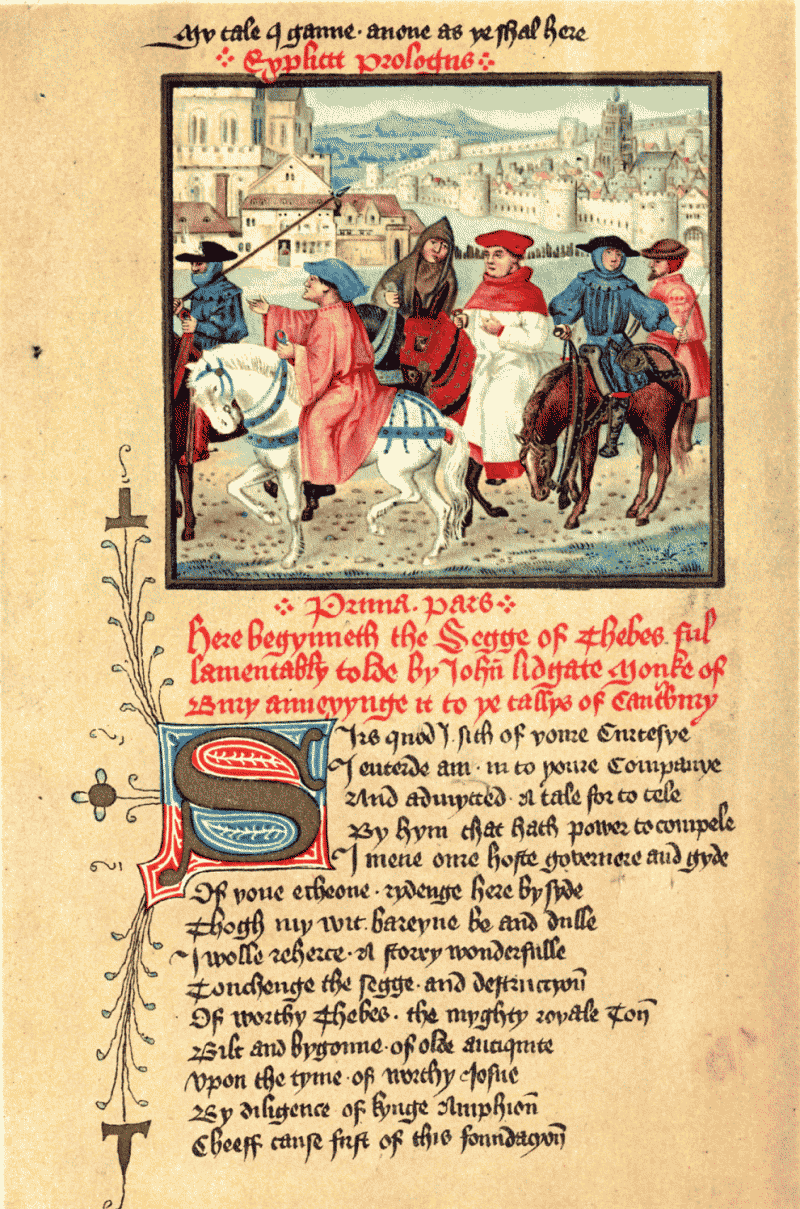
CANTERBURY PILGRIMS From Royal MS., 18 D.ii, in the
British Museum
LITERARY MAP OF ENGLAND
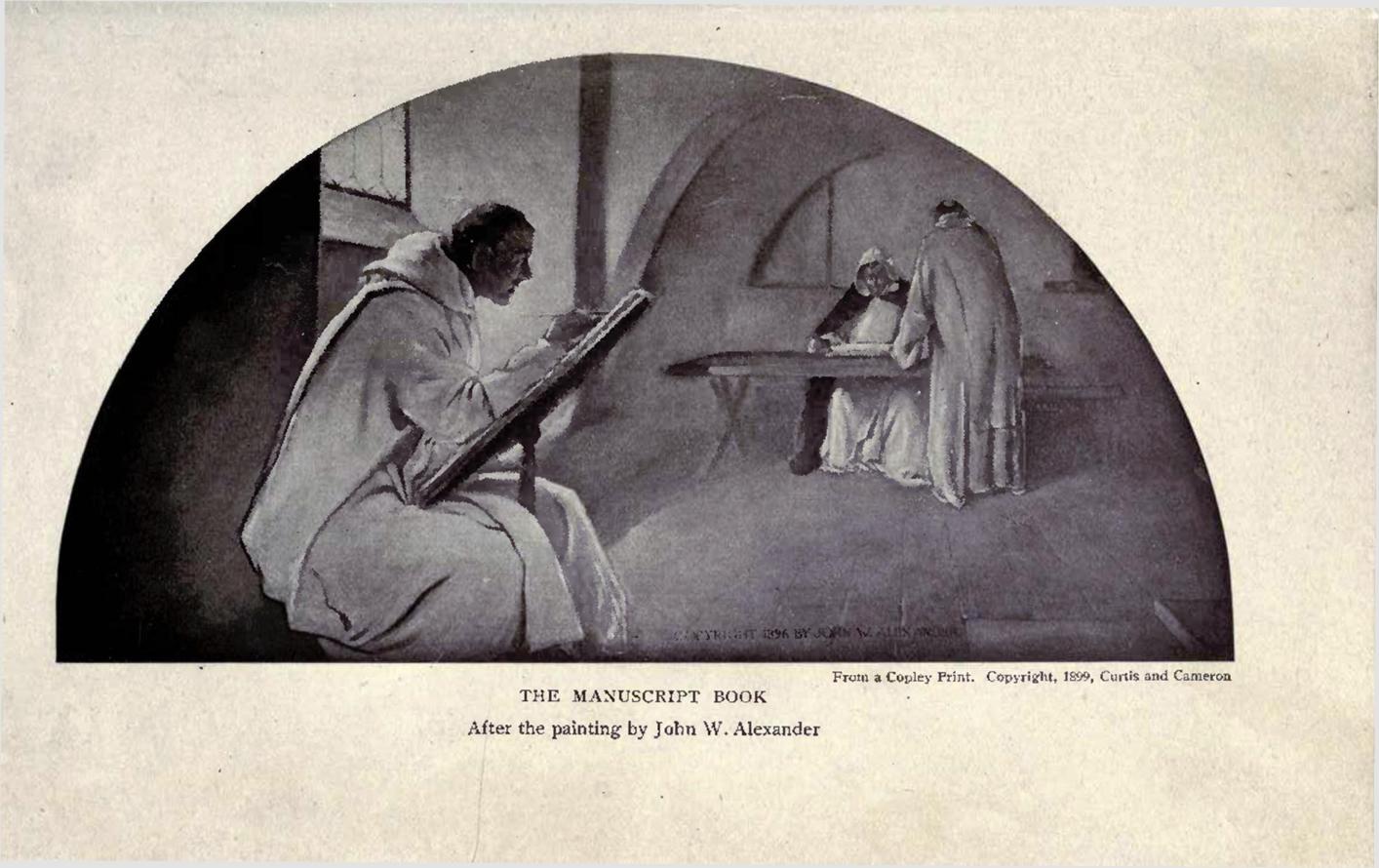
THE MANUSCRIPT BOOK After the painting in the
Congressional Library, by John W. Alexander
GEOFFREY CHAUCER After the Rawlinson Pastel Portrait
in the Bodleian Library, Oxford
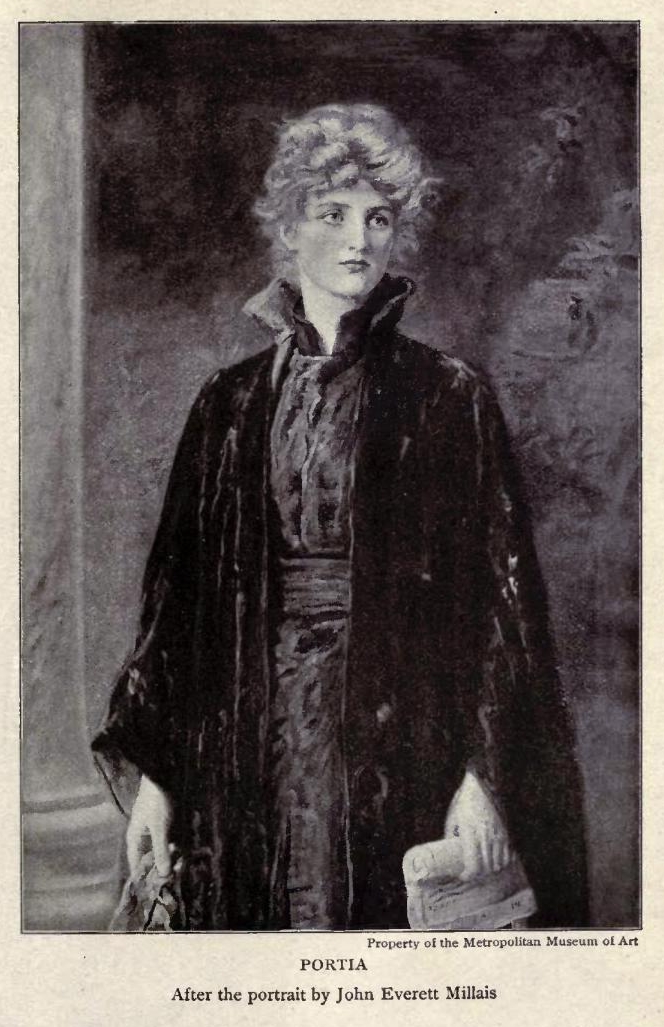
PORTIA After the portrait by John Everett Millais.
Property of the Metropolitan Museum of Art
AMERICAN MEMORIAL WINDOW, STRATFORD
EDMUND BURKE From an old print
ALFRED TENNYSON After the portrait by George Frederic
Watts
SIR GALAHAD After the painting by George Frederic
Watts
CHARLES DICKENS After the portrait by Daniel Maclise
THOMAS CARLYLE After the portrait by James McNeill
Whistler
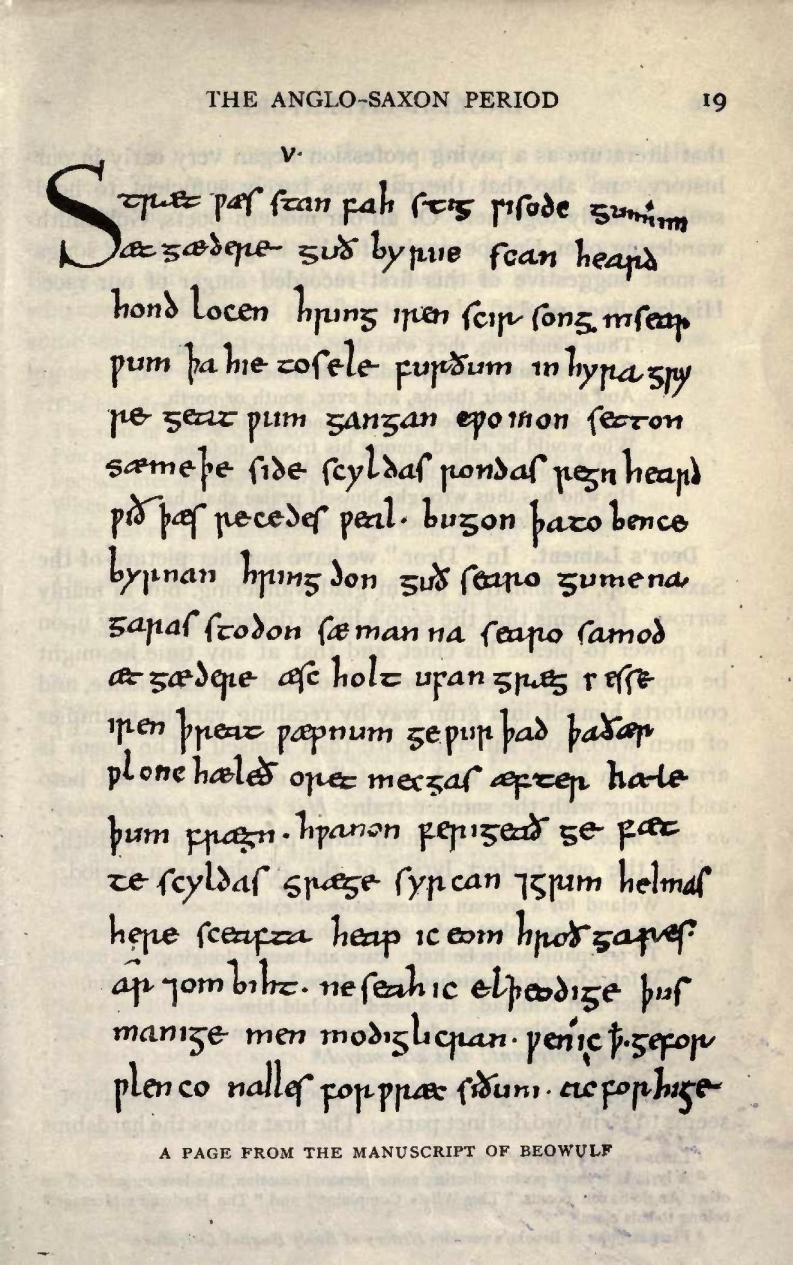
A PAGE FROM THE MANUSCRIPT OF BEOWULF
STONEHENGE, ON SALISBURY PLAIN
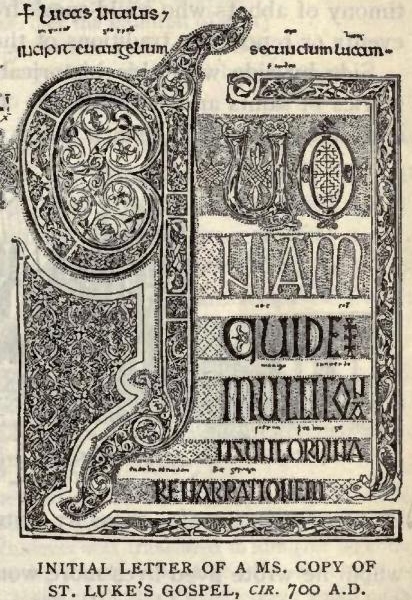
INITIAL LETTER OF A MS. COPY OF ST. LUKE'S GOSPEL
RUINS AT WHITBY
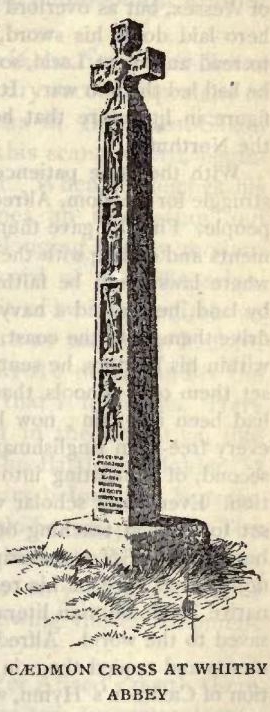
CÆDMON CROSS AT WHITBY ABBEY
LEIF ERICSON'S VESSEL
CANTERBURY CATHEDRAL AS IT WAS COMPLETED LONG AFTER THE
CONQUEST
REMAINS OF THE SCRIPTORIUM OF FOUNTAINS ABBEY
TABARD INN
JOHN WYCLIF
SPECIMEN OF CAXTON'S PRINTING IN THE YEAR 1486
EDMUND SPENSER
WILLIAM SHAKESPEARE
ANNE HATHAWAY COTTAGE
BIRTHPLACE OF SHAKESPEARE
TRINITY CHURCH, STRATFORD-ON-AVON
BEN JONSON
JOHN MILTON
JOHN BUNYAN
LIBRARY AT TRINITY COLLEGE, CAMBRIDGE
WESTMINSTER
JONATHAN SWIFT
TRINITY COLLEGE, DUBLIN
JOSEPH ADDISON
SAMUEL JOHNSON
THOMAS GRAY
CHURCH AT STOKE POGES
OLIVER GOLDSMITH
WILLIAM COWPER
ROBERT BURNS
BIRTHPLACE OF BURNS
THE AULD BRIG, AYR (AYR BRIDGE)
DANIEL DEFOE
WILLIAM WORDSWORTH
WORDSWORTH'S HOME AT RYDAL MOUNT
SAMUEL TAYLOR COLERIDGE
ROBERT SOUTHEY
WALTER SCOTT
ABBOTSFORD
GEORGE GORDON, LORD BYRON
PERCY BYSSHE SHELLEY
CHARLES LAMB
CHRIST'S HOSPITAL, LONDON
THOMAS DE QUINCEY
ROBERT BROWNING
MRS. BROWNING
WILLIAM MAKEPEACE THACKERAY
GEORGE ELIOT
THOMAS BABINGTON MACAULAY
UNIVERSITY OF EDINBURGH
JOHN RUSKIN
QUADRANGLE OF ORIEL COLLEGE, OXFORD
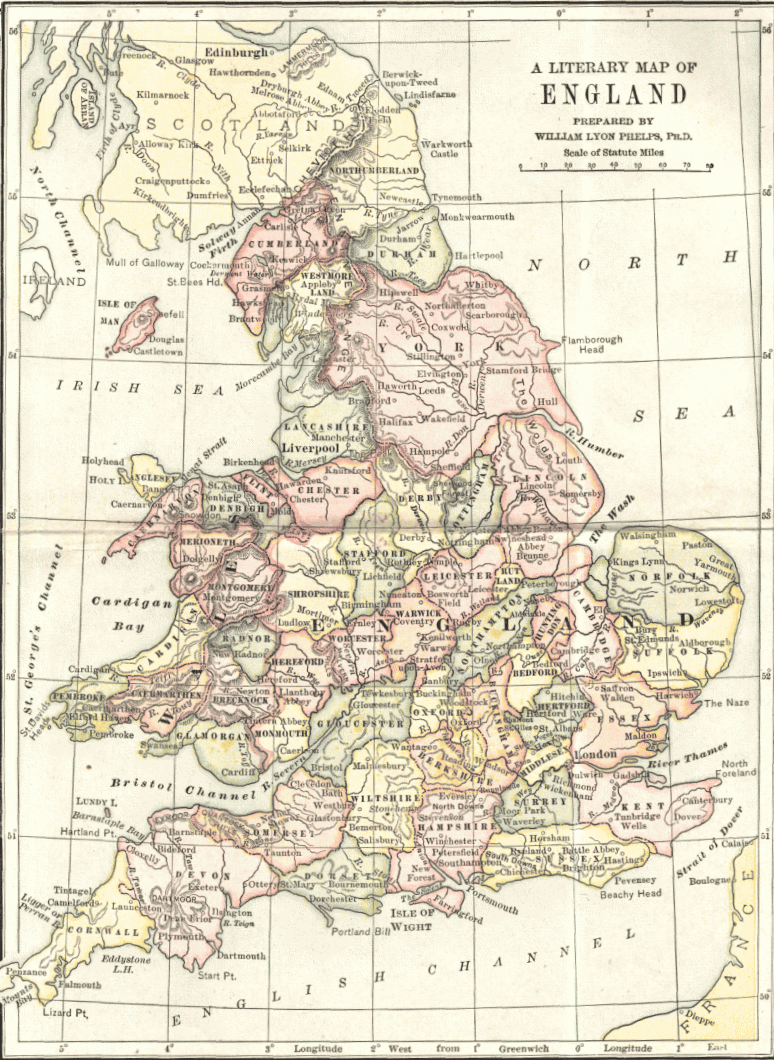
A LITERARY MAP OF ENGLAND
Hold the hye wey, and lat thy gost thee lede.
Chaucer's
Truth
On, on, you noblest English,
...
Follow your spirit.
Shakespeare's
Henry V
The Shell and the Book. A child
and a man were one day walking on the seashore when the child found a
little shell and held it to his ear. Suddenly he heard sounds,--strange,
low, melodious sounds, as if the shell were remembering and repeating to
itself the murmurs of its ocean home. The child's face filled with wonder
as he listened. Here in the little shell, apparently, was a voice from
another world, and he listened with delight to its mystery and music. Then
came the man, explaining that the child heard nothing strange; that the
pearly curves of the shell simply caught a multitude of sounds too faint
for human ears, and filled the glimmering hollows with the murmur of
innumerable echoes. It was not a new world, but only the unnoticed harmony
of the old that had aroused the child's wonder.
Some such experience as this awaits us when we begin the study of
literature, which has always two aspects, one of simple enjoyment and
appreciation, the other of analysis and exact description. Let a little
song appeal to the ear, or a noble book to the heart, and for the moment,
at least, we discover a new world, a world so different from our own that
it seems a place of dreams and magic. To enter and enjoy this new world,
to love good books for their own sake, is the chief thing; to analyze and
explain them is a less joyous but still an important matter. Behind every
book is a man; behind the man is the race; and behind the race are the
natural and social environments whose influence is unconsciously
reflected. These also we must know, if the book is to speak its whole
message. In a word, we have now reached a point where we wish to
understand as well as to enjoy literature; and the first step, since exact
definition is impossible, is to determine some of its essential qualities.
ArtisticQualities
of Literature. The first significant thing is the essentially
artistic quality of all literature. All art is the expression of life in
forms of truth and beauty; or rather, it is the reflection of some truth
and beauty which are in the world, but which remain unnoticed until
brought to our attention by some sensitive human soul, just as the
delicate curves of the shell reflect sounds and harmonies too faint to be
otherwise noticed. A hundred men may pass a hayfield and see only the
sweaty toil and the windrows of dried grass; but here is one who pauses by
a Roumanian meadow, where girls are making hay and singing as they work.
He looks deeper, sees truth and beauty where we see only dead grass, and
he reflects what he sees in a little poem in which the hay tells its own
story:
Yesterday's flowers am I,
And I have drunk
my last sweet draught of dew.
Young maidens came and sang me to my
death;
The moon looks down and sees me in my shroud,
The
shroud of my last dew.
Yesterday's flowers that are yet in me
Must needs make way for all to-morrow's flowers.
The maidens, too,
that sang me to my death
Must even so make way for all the maids
That are to come.
And as my soul, so too
their soul will be
Laden with fragrance of the days gone by.
The maidens that to-morrow come this way
Will not remember that I
once did bloom,
For they will only see the new-born flowers.
Yet will my perfume-laden soul bring back,
As a sweet memory, to
women's hearts
Their
days of maidenhood.
And then they will be sorry that they came
To sing me to my death;
And all the butterflies will mourn for me.
I
bear away with me
The sunshine's dear remembrance, and the low
Soft murmurs of the
spring.
My breath is sweet as children's prattle is;
I drank
in all the whole earth's fruitfulness,
To make of it the fragrance
of my soul
That shall outlive my death.
[1]
One who reads only that first exquisite line, "Yesterday's flowers am I,"
can never again see hay without recalling the beauty that was hidden from
his eyes until the poet found it.
In the same pleasing, surprising way, all artistic work must be a kind of
revelation. Thus architecture is probably the oldest of the arts; yet we
still have many builders but few architects, that is, men whose work in
wood or stone suggests some hidden truth and beauty to the human senses.
So in literature, which is the art that expresses life in words that
appeal to our own sense of the beautiful, we have many writers but few
artists. In the broadest sense, perhaps, literature means simply the
written records of the race, including all its history and sciences, as
well as its poems and novels; in the narrower sense literature is the
artistic record of life, and most of our writing is excluded from it, just
as the mass of our buildings, mere shelters from storm and from cold, are
excluded from architecture. A history or a work of science may be and
sometimes is literature, but only as we forget the subject-matter and the
presentation of facts in the simple beauty of its expression.
SuggestiveThe second quality of literature
is its suggestiveness, its appeal to our emotions and imagination rather
than to our intellect. It is not so much what it says as what it awakens
in us that constitutes its charm. When Milton makes Satan say, "Myself am
Hell," he does not state any fact, but rather opens up in these three
tremendous words a whole world of speculation and imagination. When
Faustus in the presence of Helen asks, "Was this the face that launched a
thousand ships?" he does not state a fact or expect an answer. He opens a
door through which our imagination enters a new world, a world of music,
love, beauty, heroism,--the whole splendid world of Greek literature. Such
magic is in words. When Shakespeare describes the young Biron as speaking
In such apt and gracious
words
That aged ears play truant at his tales,
he has unconsciously given not only an excellent description of himself,
but the measure of all literature, which makes us play truant with the
present world and run away to live awhile in the pleasant realm of fancy.
The province of all art is not to instruct but to delight; and only as
literature delights us, causing each reader to build in his own soul that
"lordly pleasure house" of which Tennyson dreamed in his "Palace of Art,"
is it worthy of its name.
PermanentThe third characteristic of
literature, arising directly from the other two, is its permanence. The
world does not live by bread alone. Notwithstanding its hurry and bustle
and apparent absorption in material things, it does not willingly let any
beautiful thing perish. This is even more true of its songs than of its
painting and sculpture; though permanence is a quality we should hardly
expect in the present deluge of books and magazines pouring day and night
from our presses in the name of literature. But this problem of too many
books is not modern, as we suppose. It has been a problem ever since
Caxton brought the first printing press from Flanders, four hundred years
ago, and in the shadow of Westminster Abbey opened his little shop and
advertised his wares as "good and chepe." Even earlier, a thousand years
before Caxton and his printing press, the busy scholars of the great
library of Alexandria found that the number of parchments was much too
great for them to handle; and now, when we print more in a week than all
the Alexandrian scholars could copy in a century, it would seem impossible
that any production could be permanent; that any song or story could live
to give delight in future ages. But literature is like a river in flood,
which gradually purifies itself in two ways,--the mud settles to the
bottom, and the scum rises to the top. When we examine the writings that
by common consent constitute our literature, the clear stream purified of
its dross, we find at least two more qualities, which we call the tests of
literature, and which determine its permanence.
Tests of Literature. The first of
these is universality, that is, the appeal to the widest human interests
and the simplest human emotions. Though we speak of national and race
literatures, like the Greek or Teutonic, and though each has certain
superficial marks arising out of the peculiarities of its own people, it
is nevertheless true that good literature knows no nationality, nor any
bounds save those of humanity. It is occupied chiefly with elementary
passions and emotions,--love and hate, joy and sorrow, fear and
faith,--which are an essential part of our human nature; and the more it
reflects these emotions the more surely does it awaken a response in men
of every race. Every father must respond to the parable of the prodigal
son; wherever men are heroic, they will acknowledge the mastery of Homer;
wherever a man thinks on the strange phenomenon of evil in the world, he
will find his own thoughts in the Book of Job; in whatever place men love
their children, their hearts must be stirred by the tragic sorrow of
_Oedipus_ and _King Lear_. All these are but shining examples of the law
that only as a book or a little song appeals to universal human interest
does it become permanent.
The second test is a purely personal one, and may be expressed in the
indefinite word "style." It is only in a mechanical sense that style is
"the adequate expression of thought," or "the peculiar manner of
expressing thought," or any other of the definitions that are found in the
rhetorics. In a deeper sense, style is the man, that is, the unconscious
expression of the writer's own personality. It is the very soul of one man
reflecting, as in a glass, the thoughts and feelings of humanity. As no
glass is colorless, but tinges more or less deeply the reflections from
its surface, so no author can interpret human life without unconsciously
giving to it the native hue of his own soul. It is this intensely personal
element that constitutes style. Every permanent book has more or less of
these two elements, the objective and the subjective, the universal and
the personal, the deep thought and feeling of the race reflected and
colored by the writer's own life and experience.
The Object in Studying Literature..
Aside from the pleasure of reading, of entering into a new world and
having our imagination quickened, the study of literature has one definite
object, and that is to know men. Now man is ever a dual creature; he has
an outward and an inner nature; he is not only a doer of deeds, but a
dreamer of dreams; and to know him, the man of any age, we must search
deeper than his history. History records his deeds, his outward acts
largely; but every great act springs from an ideal, and to understand this
we must read his literature, where we find his ideals recorded. When we
read a history of the Anglo-Saxons, for instance, we learn that they were
sea rovers, pirates, explorers, great eaters and drinkers; and we know
something of their hovels and habits, and the lands which they harried and
plundered. All that is interesting; but it does not tell us what most we
want to know about these old ancestors of ours,--not only what they did,
but what they thought and felt; how they looked on life and death; what
they loved, what they feared, and what they reverenced in God and man.
Then we turn from history to the literature which they themselves
produced, and instantly we become acquainted. These hardy people were not
simply fighters and freebooters; they were men like ourselves; their
emotions awaken instant response in the souls of their descendants. At the
words of their gleemen we thrill again to their wild love of freedom and
the open sea; we grow tender at their love of home, and patriotic at their
deathless loyalty to their chief, whom they chose for themselves and
hoisted on their shields in symbol of his leadership. Once more we grow
respectful in the presence of pure womanhood, or melancholy before the
sorrows and problems of life, or humbly confident, looking up to the God
whom they dared to call the Allfather. All these and many more intensely
real emotions pass through our souls as we read the few shining fragments
of verses that the jealous ages have left us.
It is so with any age or people. To understand them we must read not
simply their history, which records their deeds, but their literature,
which records the dreams that made their deeds possible. So Aristotle was
profoundly right when he said that "poetry is more serious and
philosophical than history"; and Goethe, when he explained literature as
"the humanization of the whole world."
Importance of Literature. It is a
curious and prevalent opinion that literature, like all art, is a mere
play of imagination, pleasing enough, like a new novel, but without any
serious or practical importance. Nothing could be farther from the truth.
Literature preserves the ideals of a people; and ideals--love, faith,
duty, friendship, freedom, reverence--are the part of human life most
worthy of preservation. The Greeks were a marvelous people; yet of all
their mighty works we cherish only a few ideals,--ideals of beauty in
perishable stone, and ideals of truth in imperishable prose and poetry. It
was simply the ideals of the Greeks and Hebrews and Romans, preserved in
their literature, which made them what they were, and which determined
their value to future generations. Our democracy, the boast of all
English-speaking nations, is a dream; not the doubtful and sometimes
disheartening spectacle presented in our legislative halls, but the lovely
and immortal ideal of a free and equal manhood, preserved as a most
precious heritage in every great literature from the Greeks to the
Anglo-Saxons. All our arts, our sciences, even our inventions are founded
squarely upon ideals; for under every invention is still the dream of Beowulf,
that man may overcome the forces of nature; and the foundation of all our
sciences and discoveries is the immortal dream that men "shall be as gods,
knowing good and evil."
In a word, our whole civilization, our freedom, our progress, our homes,
our religion, rest solidly upon ideals for their foundation. Nothing but
an ideal ever endures upon earth. It is therefore impossible to
overestimate the practical importance of literature, which preserves these
ideals from fathers to sons, while men, cities, governments,
civilizations, vanish from the face of the earth. It is only when we
remember this that we appreciate the action of the devout Mussulman, who
picks up and carefully preserves every scrap of paper on which words are
written, because the scrap may perchance contain the name of Allah, and
the ideal is too enormously important to be neglected or lost.
Summary of the Subject. We are now
ready, if not to define, at least to understand a little more clearly the
object of our present study. Literature is the expression of life in words
of truth and beauty; it is the written record of man's spirit, of his
thoughts, emotions, aspirations; it is the history, and the only history,
of the human soul. It is characterized by its artistic, its suggestive,
its permanent qualities. Its two tests are its universal interest and its
personal style. Its object, aside from the delight it gives us, is to know
man, that is, the soul of man rather than his actions; and since it
preserves to the race the ideals upon which all our civilization is
founded, it is one of the most important and delightful subjects that can
occupy the human mind.
Bibliography. (NOTE. Each chapter
in this book includes a special bibliography of historical and literary
works, selections for reading, chronology, etc.; and a general
bibliography of texts, helps, and reference books will be found at the
end. The following books, which are among the best of their kind, are
intended to help the student to a better appreciation of literature and to
a better knowledge of literary criticism.)
General Works. Woodberry's Appreciation of Literature (Baker
& Taylor Co.); Gates's Studies in Appreciation (Macmillan); Bates's
Talks on the Study of Literature (Houghton, Mifflin); Worsfold's On the
Exercise of Judgment in Literature (Dent); Harrison's The Choice of Books
(Macmillan); Ruskin's Sesame and Lilies, Part I; Matthew Arnold's Essays
in Criticism.
Essays. Emerson's Books, in Society and Solitude; Dowden's
The Interpretation of Literature, in Transcripts and Studies (Kegan Paul
& Co.), and The Teaching of English Literature, in New Studies in
Literature (Houghton, Mifflin); The Study of Literature, Essays by Morley,
Nicolls, and L. Stephen, edited by A.F. Blaisdell (Willard Small).
Criticism. Gayley and Scott's An Introduction to the Methods
and Materials of Literary Criticism (Ginn and Company); Winchester's
Principles of Literary Criticism (Macmillan); Worsfold's Principles of
Criticism (Longmans); Johnson's Elements of Literary Criticism (American
Book Company); Saintsbury's History of Criticism (Dodd, Mead).
Poetry. Gummere's Handbook of Poetics (Ginn and Company);
Stedman's The Nature and Elements of Poetry (Houghton, Mifflin); Johnson's
The Forms of English Poetry (American Book Company); Alden's Specimens of
English Verse (Holt); Gummere's The Beginnings of Poetry (Macmillan);
Saintsbury's History of English Prosody (Macmillan).
The Drama. Caffin's Appreciation of the Drama (Baker &
Taylor Co.).
The Novel. Raleigh's The English Novel (Scribner);
Hamilton's The Materials and Methods of Fiction (Baker & Taylor Co.).
I. OUR FIRST POETRY
Beowulf. Here is the story of
Beowulf, the earliest and the greatest epic, or heroic poem, in our
literature. It begins with a prologue, which is not an essential part of
the story, but which we review gladly for the sake of the splendid
poetical conception that produced Scyld, king of the Spear Danes. [2]
At a time when the Spear Danes were without a king, a ship came sailing
into their harbor. It was filled with treasures and weapons of war; and in
the midst of these warlike things was a baby sleeping. No man sailed the
ship; it came of itself, bringing the child, whose name was Scyld.
Now Scyld grew and became a mighty warrior, and led the Spear Danes for
many years, and was their king. When his son Beowulf [3] had become strong and wise enough to
rule, then Wyrd (Fate), who speaks but once to any man, came and stood at
hand; and it was time for Scyld to go. This is how they buried him:
Then Scyld departed, at word of Wyrd spoken,
The hero to go to the
home of the gods.
Sadly they bore him to brink of the ocean,
Comrades, still heeding his word of command.
There rode in the
harbor the prince's ship, ready,
With prow curving proudly and
shining sails set.
Shipward they bore him, their hero beloved;
The mighty they laid at the foot of the mast.
Treasures were there
from far and near gathered,
Byrnies of battle, armor and swords;
Never a keel sailed out of a harbor
So splendidly tricked with the
trappings of war.
They heaped on his bosom a hoard of bright jewels
To fare with him forth on the flood's great breast.
No less gift
they gave than the Unknown provided,
When alone, as a child, he
came in from the mere.
High o'er his head waved a bright golden
standard--
Now let the waves bear their wealth to the holm.
Sad-souled they gave back its gift to the ocean,
Mournful their
mood as he sailed out to sea. [4]
"And no man," says the poet, "neither counselor nor hero, can tell who
received that lading."
One of Scyld's descendants was Hrothgar, king of the Danes; and with him
the story of our Beowulf begins. Hrothgar in his old age had built near
the sea a mead hall called Heorot, the most splendid hall in the whole
world, where the king and his thanes gathered nightly to feast and to
listen to the songs of his gleemen. One night, as they were all sleeping,
a frightful monster, Grendel, broke into the hall, killed thirty of the
sleeping warriors, and carried off their bodies to devour them in his lair
under the sea. The appalling visit was speedily repeated, and fear and
death reigned in the great hall. The warriors fought at first; but fled
when they discovered that no weapon could harm the monster. Heorot was
left deserted and silent. For twelve winters Grendel's horrible raids
continued, and joy was changed to mourning among the Spear Danes.
At last the rumor of Grendel crossed over the sea to the land of the
Geats, where a young hero dwelt in the house of his uncle, King Hygelac.
Beowulf was his name, a man of immense strength and courage, and a mighty
swimmer who had developed his powers fighting the "nickers," whales,
walruses and seals, in the icebound northern ocean. When he heard the
story, Beowulf was stirred to go and fight the monster and free the Danes,
who were his father's friends.
With fourteen companions he crosses the sea. There is an excellent bit of
ocean poetry here (ll. 210-224), and we get a vivid idea of the
hospitality of a brave people by following the poet's description of
Beowulf's meeting with King Hrothgar and Queen Wealhtheow, and of the joy
and feasting and story-telling in Heorot. The picture of Wealhtheow
passing the mead cup to the warriors with her own hand is a noble one, and
plainly indicates the reverence paid by these strong men to their wives
and mothers. Night comes on; the fear of Grendel is again upon the Danes,
and all withdraw after the king has warned Beowulf of the frightful danger
of sleeping in the hall. But Beowulf lies down with his warriors, saying
proudly that, since weapons will not avail against the monster, he will
grapple with him bare handed and trust to a warrior's strength.
Forth from the fens, from the misty moorlands,
Grendel came
gliding--God's wrath [5]
he bore--
Came under clouds, until he saw clearly,
Glittering
with gold plates, the mead hall of men.
Down fell the door, though
fastened with fire bands;
Open it sprang at the stroke of his paw.
Swollen with rage burst in the bale-bringer;
Flamed in his eyes a
fierce light, likest fire. [6]
At the sight of men again sleeping in the hall, Grendel laughs in his
heart, thinking of his feast. He seizes the nearest sleeper, crushes his
"bone case" with a bite, tears him limb from limb, and swallows him. Then
he creeps to the couch of Beowulf and stretches out a claw, only to find
it clutched in a grip of steel. A sudden terror strikes the monster's
heart. He roars, struggles, tries to jerk his arm free; but Beowulf leaps
to his feet and grapples his enemy bare handed. To and fro they surge.
Tables are overturned; golden benches ripped from their fastenings; the
whole building quakes, and only its iron bands keep it from falling to
pieces. Beowulf's companions are on their feet now, hacking vainly at the
monster with swords and battle-axes, adding their shouts to the crashing
of furniture and the howling "war song" of Grendel. Outside in the town
the Danes stand shivering at the uproar. Slowly the monster struggles to
the door, dragging Beowulf, whose fingers crack with the strain, but who
never relaxes his first grip. Suddenly a wide wound opens in the monster's
side; the sinews snap; the whole arm is wrenched off at the shoulder; and
Grendel escapes shrieking across the moor, and plunges into the sea to
die.
Beowulf first exults in his night's work; then he hangs the huge arm with
its terrible claws from a cross-beam over the king's seat, as one would
hang up a bear's skin after a hunt. At daylight came the Danes; and all
day long, in the intervals of singing, story-telling, speech making, and
gift giving, they return to wonder at the mighty "grip of Grendel" and to
rejoice in Beowulf's victory.
When night falls a great feast is spread in Heorot, and the Danes sleep
once more in the great hall. At midnight comes another monster, a
horrible, half-human creature,[7]
mother of Grendel, raging to avenge her offspring. She thunders at the
door; the Danes leap up and grasp their weapons; but the monster enters,
seizes Aeschere, who is friend and adviser of the king, and rushes away
with him over the fens.
The old scenes of sorrow are reviewed in the morning; but Beowulf says
simply:
Sorrow not, wise man. It is better for each
That his friend he
avenge than that he mourn much.
Each of us shall the end await
Of worldly life: let him who may gain
Honor ere death. That is for
a warrior,
When he is dead, afterwards best.
Arise, kingdom's
guardian! Let us quickly go
To view the track of Grendel's kinsman.
I promise it thee: he will not escape,
Nor in earth's bosom, nor in
mountain-wood,
Nor in ocean's depths, go where he will. [8]
Then he girds himself for the new fight and follows the track of the
second enemy across the fens. Here is Hrothgar's description of the place
where live the monsters, "spirits of elsewhere," as he calls them:
They
inhabit
The dim land that gives shelter to the wolf,
The windy
headlands, perilous fen paths,
Where, under mountain mist, the
stream flows down
And floods the ground. Not far hence, but a mile,
The mere stands, over which hang death-chill groves,
A wood
fast-rooted overshades the flood;
There every night a ghastly
miracle
Is seen, fire in the water. No man knows,
Not the most
wise, the bottom of that mere.
The firm-horned heath-stalker, the
hart, when pressed,
Wearied by hounds, and hunted from afar,
Will rather die of thirst upon its bank
Than bend his head to it.
It is unholy.
Dark to the clouds its yeasty waves mount up
When wind stirs hateful tempest, till the air
Grows dreary, and the
heavens pour down tears. [9]
Beowulf plunges into the horrible place, while his companions wait for him
oh the shore. For a long time he sinks through the flood; then, as he
reaches bottom, Grendel's mother rushes out upon him and drags him into a
cave, where sea monsters swarm at him from behind and gnash his armor with
their tusks. The edge of his sword is turned with the mighty blow he deals
the merewif; but it harms not the monster. Casting the weapon
aside, he grips her and tries to hurl her down, while her claws and teeth
clash upon his corslet but cannot penetrate the steel rings. She throws
her bulk upon him, crushes him down, draws a short sword and plunges it at
him; but again his splendid byrnie saves him. He is wearied now, and
oppressed. Suddenly, as his eye sweeps the cave, he catches sight of a
magic sword, made by the giants long ago, too heavy for warriors to wield.
Struggling up he seizes the weapon, whirls it and brings down a crashing
blow upon the monster's neck. It smashes through the ring bones; the merewif
falls, and the fight is won.
The cave is full of treasures; but Beowulf heeds them not, for near him
lies Grendel, dead from the wound received the previous night. Again
Beowulf swings the great sword and strikes off his enemy's head; and lo,
as the venomous blood touches the sword blade, the steel melts like ice
before the fire, and only the hilt is left in Beowulf's hand. Taking the
hilt and the head, the hero enters the ocean and mounts up to the shore.
Only his own faithful band were waiting there; for the Danes, seeing the
ocean bubble with fresh blood, thought it was all over with the hero and
had gone home. And there they were, mourning in Heorot, when Beowulf
returned with the monstrous head of Grendel carried on a spear shaft by
four of his stoutest followers.
In the last part of the poem there is another great fight. Beowulf is now
an old man; he has reigned for fifty years, beloved by all his people. He
has overcome every enemy but one, a fire dragon keeping watch over an
enormous treasure hidden among the mountains. One day a wanderer stumbles
upon the enchanted cave and, entering, takes a jeweled cup while the
firedrake sleeps heavily. That same night the dragon, in a frightful rage,
belching forth fire and smoke, rushes down upon the nearest villages,
leaving a trail of death and terror behind him.
Again Beowulf goes forth to champion his people. As he approaches the
dragon's cave, he has a presentiment that death lurks within:
Sat on the headland there the warrior king;
Farewell he said to
hearth-companions true,
The gold-friend of the Geats; his mind was
sad,
Death-ready, restless. And Wyrd was drawing nigh,
Who now
must meet and touch the aged man,
To seek the treasure that his
soul had saved
And separate his body from his life. [10]
There is a flash of illumination, like that which comes to a dying man, in
which his mind runs back over his long life and sees something of profound
meaning in the elemental sorrow moving side by side with magnificent
courage. Then follows the fight with the firedrake, in which Beowulf,
wrapped in fire and smoke, is helped by the heroism of Wiglaf, one of his
companions. The dragon is slain, but the fire has entered Beowulf's lungs
and he knows that Wyrd is at hand. This is his thought, while Wiglaf
removes his battered armor:
"One deep regret I have: that to a son
I may not give the armor I
have worn,
To bear it after me. For fifty years
I ruled these
people well, and not a king
Of those who dwell around me, dared
oppress
Or meet me with his hosts. At home I waited
For the
time that Wyrd controls. Mine own I kept,
Nor quarrels sought, nor
ever falsely swore.
Now, wounded sore, I wait for joy to come."
[11]
He sends Wiglaf into the firedrake's cave, who finds it filled with rare
treasures and, most wonderful of all, a golden banner from which light
proceeds and illumines all the darkness. But Wiglaf cares little for the
treasures; his mind is full of his dying chief. He fills his hands with
costly ornaments and hurries to throw them at his hero's feet. The old man
looks with sorrow at the gold, thanks the "Lord of all" that by death he
has gained more riches for his people, and tells his faithful thane how
his body shall be burned on the Whale ness, or headland:
"My life is well paid for this hoard; and now
Care for the people's
needs. I may no more
Be with them. Bid the warriors raise a barrow
After the burning, on the ness by the sea,
On Hronesness, which
shall rise high and be
For a remembrance to my people. Seafarers
Who from afar over the mists of waters
Drive foamy keels may call
it Beowulf's Mount
Hereafter." Then the hero from his neck
Put
off a golden collar; to his thane,
To the young warrior, gave it
with his helm,
Armlet and corslet; bade him use them well.
"Thou art the last Waegmunding of our race,
For fate has swept my
kinsmen all away.
Earls in their strength are to their Maker gone,
And I must follow them."[12]
Beowulf was still living when Wiglaf sent a messenger hurriedly to his
people; when they came they found him dead, and the huge dragon dead on
the sand beside him.
Then the Goth's people reared a mighty pile
With shields and armour
hung, as he had asked,
And in the midst the warriors laid their
lord,
Lamenting. Then the warriors on the mount
Kindled a
mighty bale fire; the smoke rose
Black from the Swedish pine, the
sound of flame
Mingled with sound of weeping; ... while smoke
Spread over heaven. Then upon the hill
The people of the Weders
wrought a mound,
High, broad, and to be seen far out at sea.
In ten days they had built and walled it in
As the wise thought
most worthy; placed in it
Rings, jewels, other treasures from the
hoard.
They left the riches, golden joy of earls,
In dust, for
earth to hold; where yet it lies,
Useless as ever. Then about the
mound
The warriors rode, and raised a mournful song
For their
dead king; exalted his brave deeds,
Holding it fit men honour their
liege lord,
Praise him and love him when his soul is fled.
Thus the [Geat's] people, sharers of his hearth,
Mourned their
chief's fall, praised him, of kings, of men
The mildest and the
kindest, and to all
His people gentlest, yearning for their praise.
[13]
One is tempted to linger over the details of the magnificent ending: the
unselfish heroism of Beowulf, the great prototype of King Alfred; the
generous grief of his people, ignoring gold and jewels in the thought of
the greater treasure they had lost; the memorial mound on the low cliff,
which would cause every returning mariner to steer a straight course to
harbor in the remembrance of his dead hero; and the pure poetry which
marks every noble line. But the epic is great enough and simple enough to
speak for itself. Search the literatures of the world, and you will find
no other such picture of a brave man's death.
History and Meaning of BeowulfConcerning
the history of Beowulf a whole library has been written, and
scholars still differ too radically for us to express a positive judgment.
This much, however, is clear,--that there existed, at the time the poem
was composed, various northern legends of Beowa, a half-divine hero, and
the monster Grendel. The latter has been interpreted in various
ways,--sometimes as a bear, and again as the malaria of the marsh lands.
For those interested in symbols the simplest interpretation of these myths
is to regard Beowulf's successive fights with the three dragons as the
overcoming, first, of the overwhelming danger of the sea, which was beaten
back by the dykes; second, the conquering of the sea itself, when men
learned to sail upon it; and third, the conflict with the hostile forces
of nature, which are overcome at last by man's indomitable will and
perseverance.
All this is purely mythical; but there are historical incidents to reckon
with. About the year 520 a certain northern chief, called by the
chronicler Chochilaicus (who is generally identified with the Hygelac of
the epic), led a huge plundering expedition up the Rhine. After a
succession of battles he was overcome by the Franks, but--and now we enter
a legendary region once more--not until a gigantic nephew of Hygelac had
performed heroic feats of valor, and had saved the remnants of the host by
a marvelous feat of swimming. The majority of scholars now hold that these
historical events and personages were celebrated in the epic; but some
still assert that the events which gave a foundation for Beowulf
occurred wholly on English soil, where the poem itself was undoubtedly
written.
Poetical FormThe rhythm of Beowulf
and indeed of all our earliest poetry depended upon accent and
alliteration; that is, the beginning of two or more words in the same line
with the same sound or letter. The lines were made up of two short halves,
separated by a pause. No rime was used; but a musical effect was produced
by giving each half line two strongly accented syllables. Each full line,
therefore, had four accents, three of which (i.e. two in the first half,
and one in the second) usually began with the same sound or letter. The
musical effect was heightened by the harp with which the gleeman
accompanied his singing.. The poetical form will be seen clearly in the
following selection from the wonderfully realistic description of the fens
haunted by Grendel. It will need only one or two readings aloud to show
that many of these strange-looking words are practically the same as those
we still use, though many of the vowel sounds were pronounced differently
by our ancestors.
...
Hie dygel lond
Warigeath, wulf-hleothu, windige næssas,
Frecne fen-gelad, thær fyrgen-stream
Under næssa genipu nither gewiteth,
Flod under foldan. Nis thæt
feor heonon,
Mil-gemearces, thaet se mere standeth,
Ofer thæm
hongiath hrinde bearwas
...
They (a) darksome land
Ward (inhabit), wolf cliffs, windy nesses,
Frightful fen paths where mountain stream
Under nesses' mists
nether (downward) wanders,
A flood under earth. It is not far
hence,
By mile measure, that the mere stands,
Over which hang
rimy groves.
Widsith. The poem "Widsith," the
wide goer or wanderer, is in part, at least, probably the oldest in our
language. The author and the date of its composition are unknown; but the
personal account of the minstrel's life belongs to the time before the
Saxons first came to England.[14]
It expresses the wandering life of the gleeman, who goes forth into the
world to abide here or there, according as he is rewarded for his singing.
From the numerous references to rings and rewards, and from the praise
given to generous givers, it would seem that literature as a paying
profession began very early in our history, and also that the pay was
barely sufficient to hold soul and body together. Of all our modern poets,
Goldsmith wandering over Europe paying for his lodging with his songs is
most suggestive of this first recorded singer of our race. His last lines
read:
Thus wandering, they who shape songs for men
Pass over many lands,
and tell their need,
And speak their thanks, and ever, south or
north,
Meet someone skilled in songs and free in gifts,
Who
would be raised among his friends to fame
And do brave deeds till
light and life are gone.
He who has thus wrought himself praise
shall have
A settled glory underneath the stars. [15]
Deor's Lament. In "Deor" we have
another picture of the Saxon scop, or minstrel, not in glad wandering, but
in manly sorrow. It seems that the scop's living depended entirely upon
his power to please his chief, and that at any time he might be supplanted
by a better poet. Deor had this experience, and comforts himself in a grim
way by recalling various examples of men who have suffered more than
himself. The poem is arranged in strophes, each one telling of some
afflicted hero and ending with the same refrain: His sorrow passed
away; so will mine. "Deor" is much more poetic than "Widsith," and is
the one perfect lyric[16]
of the Anglo-Saxon period.
Weland for a woman knew too well exile.
Strong of soul that earl,
sorrow sharp he bore;
To companionship he had care and weary
longing,
Winter-freezing wretchedness. Woe he found again, again,
After that Nithhad in a need had laid him--
Staggering
sinew-wounds--sorrow-smitten man!
That he overwent; this also
may I. [17]
The Seafarer. The wonderful poem
of "The Seafarer" seems to be in two distinct parts. The first shows the
hardships of ocean life; but stronger than hardships is the subtle call of
the sea. The second part is an allegory, in which the troubles of the
seaman are symbols of the troubles of this life, and the call of the ocean
is the call in the soul to be up and away to its true home with God.
Whether the last was added by some monk who saw the allegorical
possibilities of the first part, or whether some sea-loving Christian scop
wrote both, is uncertain. Following are a few selected lines to show the
spirit of the poem:
The hail flew in showers about me; and there I heard only
The roar
of the sea, ice-cold waves, and the song of the swan;
For pastime
the gannets' cry served me; the kittiwakes' chatter
For laughter of
men; and for mead drink the call of the sea mews.
When storms on
the rocky cliffs beat, then the terns, icy-feathered,
Made answer;
full oft the sea eagle forebodingly screamed,
The eagle with
pinions wave-wet....
The shadows of night became darker, it snowed
from the north;
The world was enchained by the frost; hail fell
upon earth;
'T was the coldest of grain. Yet the thoughts of my
heart now are throbbing
To test the high streams, the salt waves in
tumultuous play.
Desire in my heart ever urges my spirit to wander,
To seek out the home of the stranger in lands afar off.
There
is no one that dwells upon earth, so exalted in mind,
But that he
has always a longing, a sea-faring passion
For what the Lord God
shall bestow, be it honor or death.
No heart for the harp has he,
nor for acceptance of treasure,
No pleasure has he in a wife, no
delight in the world,
Nor in aught save the roll of the billows;
but always a longing,
A yearning uneasiness, hastens him on to the
sea.
The woodlands are captured by
blossoms, the hamlets grow fair,
Broad meadows are beautiful, earth
again bursts into life,
And all stir the heart of the wanderer
eager to journey,
So he meditates going afar on the pathway of
tides.
The cuckoo, moreover, gives warning with sorrowful note,
Summer's harbinger sings, and forebodes to the heart bitter sorrow.
Now my spirit uneasily turns in the heart's
narrow chamber,
Now wanders forth over the tide, o'er the home of
the whale,
To the ends of the earth--and comes back to me.
Eager and greedy,
The lone wanderer
screams, and resistlessly drives my soul onward,
Over the
whale-path, over the tracts of the sea. [18]
The Fight at Finnsburgh and Waldere.
Two other of our oldest poems well deserve mention. The "Fight at
Finnsburgh" is a fragment of fifty lines, discovered on the inside of a
piece of parchment drawn over the wooden covers of a book of homilies. It
is a magnificent war song, describing with Homeric power the defense of a
hall by Hnæf[19]
with sixty warriors, against the attack of Finn and his army. At midnight,
when Hnæf and his men are sleeping, they are surrounded by an army
rushing in with fire and sword. Hnæf springs to his feet at the
first alarm and wakens his warriors with a call to action that rings like
a bugle blast:
This no eastward dawning is, nor is here a dragon flying,
Nor of
this high hall are the horns a burning;
But they rush upon us
here--now the ravens sing,
Growling is the gray wolf, grim the
war-wood rattles,
Shield to shaft is answering. [20]
The fight lasts five days, but the fragment ends before we learn the
outcome: The same fight is celebrated by Hrothgar's gleeman at the feast
in Heorot, after the slaying of Grendel.
"Waldere" is a fragment of two leaves,
from which we get only a glimpse of the story of Waldere (Walter of
Aquitaine) and his betrothed bride Hildgund, who were hostages at the
court of Attila. They escaped with a great treasure, and in crossing the
mountains were attacked by Gunther and his warriors, among whom was
Walter's former comrade, Hagen. Walter fights them all and escapes. The
same story was written in Latin in the tenth century, and is also part of
the old German Nibelungenlied. Though the saga did not originate
with the Anglo-Saxons, their version of it is the oldest that has come
down to us. The chief significance of these "Waldere" fragments lies in
the evidence they afford that our ancestors were familiar with the legends
and poetry of other Germanic peoples.
II. ANGLO-SAXON LIFE
We have now read some of our earliest records, and have been surprised,
perhaps, that men who are generally described in the histories as savage
fighters and freebooters could produce such excellent poetry. It is the
object of the study of all literature to make us better acquainted with
men,--not simply with their deeds, which is the function of history, but
with the dreams and ideals which underlie all their actions. So a reading
of this early Anglo-Saxon poetry not only makes us acquainted, but also
leads to a profound respect for the men who were our ancestors. Before we
study more of their literature it is well to glance briefly at their life
and language.

The Name Originally the name Anglo-Saxon denotes two of the three
Germanic tribes,--Jutes, Angles, and Saxons,--who in the middle of the
fifth century left their homes on the shores of the North Sea and the
Baltic to conquer and colonize distant Britain. Angeln was the home of one
tribe, and the name still clings to the spot whence some of our
forefathers sailed on their momentous voyage. The old Saxon word angul
or ongul means a hook, and the English verb angle is used
invariably by Walton and older writers in the sense of fishing. We may
still think, therefore, of the first Angles as hook-men, possibly because
of their fishing, more probably because the shore where they lived, at the
foot of the peninsula of Jutland, was bent in the shape of a fishhook. The
name Saxon from seax, sax, a short sword, means the sword-man, and
from the name we may judge something of the temper of the hardy fighters
who preceded the Angles into Britain. The Angles were the most numerous of
the conquering tribes, and from them the new home was called Anglalond. By
gradual changes this became first Englelond and then England.
More than five hundred years after the landing of these tribes, and while
they called themselves Englishmen, we find the Latin writers of the Middle
Ages speaking of the inhabitants of Britain as Anglisaxones,--that
is, Saxons of England,--to distinguish them from the Saxons of the
Continent. In the Latin charters of King Alfred the same name appears; but
it is never seen or heard in his native speech. There he always speaks of
his beloved "Englelond" and of his brave "Englisc" people. In the
sixteenth century, when the old name of Englishmen clung to the new people
resulting from the union of Saxon and Norman, the name Anglo-Saxon was
first used in the national sense by the scholar Camden [21] in his History of Britain;
and since then it has been in general use among English writers. In recent
years the name has gained a wider significance, until it is now used to
denote a spirit rather than a nation, the brave, vigorous, enlarging
spirit that characterizes the English-speaking races everywhere, and that
has already put a broad belt of English law and English liberty around the
whole world.
The Life. If the literature of a people springs directly out of its
life, then the stern, barbarous life of our Saxon forefathers would seem,
at first glance, to promise little of good literature. Outwardly their
life was a constant hardship, a perpetual struggle against savage nature
and savage men. Behind them were gloomy forests inhabited by wild beasts
and still wilder men, and peopled in their imagination with dragons and
evil shapes. In front of them, thundering at the very dikes for entrance,
was the treacherous North Sea, with its fogs and storms and ice, but with
that indefinable call of the deep that all men hear who live long beneath
its influence. Here they lived, a big, blond, powerful race, and hunted
and fought and sailed, and drank and feasted when their labor was done.
Almost the first thing we notice about these big, fearless, childish men
is that they love the sea; and because they love it they hear and answer
its call:
... No delight has he in the world,
Nor in aught save the roll of
the billows; but always a longing,
A yearning uneasiness, hastens
him on to the sea. [22]
As might be expected, this love of the ocean finds expression in all their
poetry. In Beowulf alone there are fifteen names for the sea, from
the holm, that is, the horizon sea, the "upmounding," to the brim,
which is the ocean flinging its welter of sand and creamy foam upon the
beach at your feet. And the figures used to describe or glorify it--"the
swan road, the whale path, the heaving battle plain"--are almost as
numerous. In all their poetry there is a magnificent sense of lordship
over the wild sea even in its hour of tempest and fury:
Often it befalls us, on the ocean's highways,
In the boats our
boatmen, when the storm is roaring,
Leap the billows over, on our
stallions of the foam. [23]
The Inner Life. A man's life is more than his work; his dream is
ever greater than his achievement; and literature reflects not so much
man's deed as the spirit which animates him; not the poor thing that he
does, but rather the splendid thing that he ever hopes to do. In no place
is this more evident than in the age we are now studying. Those early sea
kings were a marvelous mixture of savagery and sentiment, of rough living
and of deep feeling, of splendid courage and the deep melancholy of men
who know their limitations and have faced the unanswered problem of death.
They were not simply fearless freebooters who harried every coast in their
war galleys. If that were all, they would have no more history or
literature than the Barbary pirates, of whom the same thing could be said.
These strong fathers of ours were men of profound emotions. In all their
fighting the love of an untarnished glory was uppermost; and under the
warrior's savage exterior was hidden a great love of home and homely
virtues, and a reverence for the one woman to whom he would presently
return in triumph. So when the wolf hunt was over, or the desperate fight
was won, these mighty men would gather in the banquet hall, and lay their
weapons aside where the open fire would flash upon them, and there listen
to the songs of Scop and Gleeman,--men who could put into adequate words
the emotions and aspirations that all men feel but that only a few can
ever express:
Music and song where the heroes sat--
The glee-wood rang, a song
uprose
When Hrothgar's scop gave the hall good cheer. [24]
It is this great and hidden life of the Anglo-Saxons that finds expression
in all their literature. Briefly, it is summed up in five great
principles,--their love of personal freedom, their responsiveness to
nature, their religion, their reverence for womanhood, and their struggle
for glory as a ruling motive in every noble life.
Springs of Anglo-Saxon Poetry In reading
Anglo-Saxon poetry it is well to remember these five principles, for they
are like the little springs at the head of a great river,--clear, pure
springs of poetry, and out of them the best of our literature has always
flowed. Thus when we read,
Blast of the tempest--it aids our oars;
Rolling of thunder--it
hurts us not;
Rush of the hurricane--bending its neck
To speed
us whither our wills are bent,
we realize that these sea rovers had the spirit of kinship with the mighty
life of nature; and kinship with nature invariably expresses itself in
poetry. Again, when we read,
Now hath the man
O'ercome his troubles. No pleasure does he lack,
Nor steeds, nor jewels, nor the joys of mead,
Nor any treasure that
the earth can give,
O royal woman, if he have but thee, [25]
we know we are dealing with an essentially noble man, not a savage; we are
face to face with that profound reverence for womanhood which inspires the
greater part of all good poetry, and we begin to honor as well as
understand our ancestors. So in the matter of glory or honor; it was,
apparently, not the love of fighting, but rather the love of honor
resulting from fighting well, which animated our forefathers in every
campaign. "He was a man deserving of remembrance" was the highest thing
that could be said of a dead warrior; and "He is a man deserving of
praise" was the highest tribute to the living. The whole secret of
Beowulf's mighty life is summed up in the last line, "Ever yearning for
his people's praise." So every tribe had its scop, or poet, more important
than any warrior, who put the deeds of its heroes into the expressive
words that constitute literature; and every banquet hall had its gleeman,
who sang the scop's poetry in order that the deed and the man might be
remembered. Oriental peoples built monuments to perpetuate the memory of
their dead; but our ancestors made poems, which should live and stir men's
souls long after monuments of brick and stone had crumbled away. It is to
this intense love of glory and the desire to be remembered that we are
indebted for Anglo-Saxon literature.
Our First Speech. Our first
recorded speech begins with the songs of Widsith and Deor, which the
Anglo-Saxons may have brought with them when they first conquered Britain.
At first glance these songs in their native dress look strange as a
foreign tongue; but when we examine them carefully we find many words that
have been familiar since childhood. We have seen this in Beowulf;
but in prose the resemblance of this old speech to our own is even more
striking. Here, for instance, is a fragment of the simple story of the
conquest of Britain by our Anglo-Saxon ancestors:
Her Hengest and Æsc his sunu gefuhton with Bryttas, on thaere
stowe the is gecweden Creccanford, and thær ofslogon feower
thusenda wera. And tha Bryttas tha forleton Cent-lond, and mid myclum
ege flugon to Lundenbyrig. (At this time Hengest and Aesc, his son,
fought against the Britons at the place which is called Crayford and
there slew four thousand men. And then the Britons forsook Kentland, and
with much fear fled to London town.) [26]
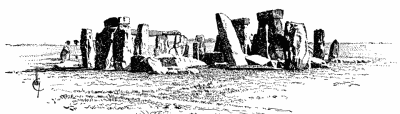
STONEHENGE, ON SALISBURY PLAIN Probably
the ruins of a temple of the native Britons
The reader who utters these words aloud a few times will speedily
recognize his own tongue, not simply in the words but also in the whole
structure of the sentences.
From such records we see that our speech is Teutonic in its origin; and
when we examine any Teutonic language we learn that it is only a branch of
the great Aryan or Indo-European family of languages. In life and
language, therefore, we are related first to the Teutonic races, and
through them to all the nations of this Indo-European family, which,
starting with enormous vigor from their original home (probably in central
Europe) [27] spread
southward and westward, driving out the native tribes and slowly
developing the mighty civilizations of India, Persia, Greece, Rome, and
the wilder but more vigorous life of the Celts and Teutons. In all these
languages--Sanskrit, Iranian, Greek, Latin, Celtic, Teutonic--we recognize
the same root words for father and mother, for God and man, for the common
needs and the common relations of life; and since words are windows
through which we see the soul of this old people, we find certain ideals
of love, home, faith, heroism, liberty, which seem to have been the very
life of our forefathers, and which were inherited by them from their old
heroic and conquering ancestors. It was on the borders of the North Sea
that our fathers halted for unnumbered centuries on their westward
journey, and slowly developed the national life and language which we now
call Anglo-Saxon.
Dual Character of our LanguageIt is this
old vigorous Anglo-Saxon language which forms the basis of our modern
English. If we read a paragraph from any good English book, and then
analyze it, as we would a flower, to see what it contains, we find two
distinct classes of words. The first class, containing simple words
expressing the common things of life, makes up the strong framework of our
language. These words are like the stem and bare branches of a mighty oak,
and if we look them up in the dictionary we find that almost invariably
they come to us from our Anglo-Saxon ancestors. The second and larger
class of words is made up of those that give grace, variety, ornament, to
our speech. They are like the leaves and blossoms of the same tree, and
when we examine their history we find that they come to us from the Celts,
Romans, Normans, and other peoples with whom we have been in contact in
the long years of our development. The most prominent characteristic of
our present language, therefore, is its dual character. Its best
qualities--strength, simplicity, directness--come from Anglo-Saxon
sources; its enormous added wealth of expression, its comprehensiveness,
its plastic adaptability to new conditions and ideas, are largely the
result of additions from other languages, and especially of its gradual
absorption of the French language after the Norman Conquest. It is this
dual character, this combination of native and foreign, of innate and
exotic elements, which accounts for the wealth of our English language and
literature. To see it in concrete form, we should read in succession Beowulf
and Paradise Lost, the two great epics which show the root and the
flower of our literary development.
III. CHRISTIAN WRITERS OF THE ANGLO-SAXON
PERIOD
The literature of this period falls naturally into two divisions,--pagan
and Christian. The former represents the poetry which the Anglo-Saxons
probably brought with them in the form of oral sagas,--the crude material
out of which literature was slowly developed on English soil; the latter
represents the writings developed under teaching of the monks, after the
old pagan religion had vanished, but while it still retained its hold on
the life and language of the people. In reading our earliest poetry it is
well to remember that all of it was copied by the monks, and seems to have
been more or less altered to give it a religious coloring.
The coming of Christianity meant not simply a new life and leader for
England; it meant also the wealth of a new language. The scop is now
replaced by the literary monk; and that monk, though he lives among common
people and speaks with the English tongue, has behind him all the culture
and literary resources of the Latin language. The effect is seen instantly
in our early prose and poetry.
Northumbrian Literature. In
general, two great schools of Christian influence came into England, and
speedily put an end to the frightful wars that had waged continually among
the various petty kingdoms of the Anglo-Saxons. The first of these, under
the leadership of Augustine, came from Rome. It spread in the south and
center of England, especially in the kingdom of Essex. It founded schools
and partially educated the rough people, but it produced no lasting
literature. The other, under the leadership of the saintly Aidan, came
from Ireland, which country had been for centuries a center of religion
and education for all western Europe. The monks of this school labored
chiefly in Northumbria, and to their influence we owe all that is best in
Anglo-Saxon literature. It is called the Northumbrian School; its center
was the monasteries and abbeys, such as Jarrow and Whitby, and its three
greatest names are Bede, Cædmon, and Cynewulf.
BEDE (673-735)
The Venerable Bede, as he is generally called, our first great scholar and
"the father of our English learning," wrote almost exclusively in Latin,
his last work, the translation of the Gospel of John into Anglo-Saxon,
having been unfortunately lost. Much to our regret, therefore, his books
and the story of his gentle, heroic life must be excluded from this
history of our literature. His works, over forty in number, covered the
whole field of human knowledge in his day, and were so admirably written
that they were widely copied as text-books, or rather manuscripts, in
nearly all the monastery schools of Europe.
The First History of EnglandThe work most
important to us is the Ecclesiastical History of the English People.
It is a fascinating history to read even now, with its curious combination
of accurate scholarship and immense credulity. In all strictly historical
matters Bede is a model. Every known authority on the subject, from Pliny
to Gildas, was carefully considered; every learned pilgrim to Rome was
commissioned by Bede to ransack the archives and to make copies of papal
decrees and royal letters; and to these were added the testimony of abbots
who could speak from personal knowledge of events or repeat the traditions
of their several monasteries.
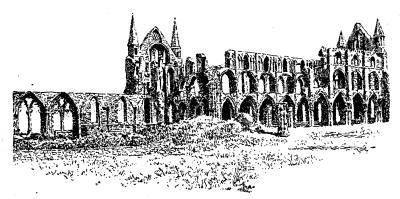
RUINS AT WHITBY
Side by side with this historical exactness are marvelous stories of
saints and missionaries. It was an age of credulity, and miracles were in
men's minds continually. The men of whom he wrote lived lives more
wonderful than any romance, and their courage and gentleness made a
tremendous impression on the rough, warlike people to whom they came with
open hands and hearts. It is the natural way of all primitive peoples to
magnify the works of their heroes, and so deeds of heroism and kindness,
which were part of the daily life of the Irish missionaries, were soon
transformed into the miracles of the saints. Bede believed these things,
as all other men did, and records them with charming simplicity, just as
he received them from bishop or abbot. Notwithstanding its errors, we owe
to this work nearly all our knowledge of the eight centuries of our
history following the landing of Cæsar in Britain.
CÆDMON (Seventh Century)
Now must we hymn the Master of heaven,
The might of the Maker, the
deeds of the Father,
The thought of His heart. He, Lord
everlasting,
Established of old the source of all wonders:
Creator all-holy, He hung the bright heaven,
A roof high upreared,
o'er the children of men;
The King of mankind then created for
mortals
The world in its beauty, the earth spread beneath them,
He, Lord everlasting, omnipotent God. [28]
If Beowulf and the fragments of our earliest poetry were brought
into England, then the hymn given above is the first verse of all native
English song that has come down to us, and Cædmon is the first poet
to whom we can give a definite name and date. The words were written about
665 A.D. and are found copied at the end of a manuscript of Bede's Ecclesiastical
History.
Life of Cædmon. What little we know of Cædmon, the
Anglo-Saxon Milton, as he is properly called, is taken from Bede's account[29] of the Abbess Hilda
and of her monastery at Whitby. Here is a free and condensed translation
of Bede's story:
There was, in the monastery of the Abbess Hilda, a brother distinguished
by the grace of God, for that he could make poems treating of goodness and
religion. Whatever was translated to him (for he could not read) of Sacred
Scripture he shortly reproduced in poetic form of great sweetness and
beauty. None of all the English poets could equal him, for he learned not
the art of song from men, nor sang by the arts of men. Rather did he
receive all his poetry as a free gift from God, and for this reason he did
never compose poetry of a vain or worldly kind.
Until of mature age he lived as a layman and had never learned any poetry.
Indeed, so ignorant of singing was he that sometimes, at a feast, where it
was the custom that for the pleasure of all each guest should sing in
turn, he would rise from the table when he saw the harp coming to him and
go home ashamed. Now it happened once that he did this thing at a certain
festivity, and went out to the stall to care for the horses, this duty
being assigned to him for that night. As he slept at the usual time, one
stood by him saying: "Cædmon, sing me something." "I cannot sing,"
he answered, "and that is why I came hither from the feast." But he who
spake unto him said again, "Cædmon, sing to me." And he said, "What
shall I sing?" and he said, "Sing the beginning of created things."
Thereupon Cædmon began to sing verses that he had never heard
before, of this import: "Now should we praise the power and wisdom of the
Creator, the works of the Father." This is the sense but not the form of
the hymn that he sang while sleeping.
When he awakened, Cædmon remembered the words of the hymn and added
to them many more. In the morning he went to the steward of the monastery
lands and showed him the gift he had received in sleep. The steward
brought him to Hilda, who made him repeat to the monks the hymn he had
composed, and all agreed that the grace of God was upon Cædmon. To
test him they expounded to him a bit of Scripture from the Latin and bade
him, if he could, to turn it into poetry. He went away humbly and returned
in the morning with an excellent poem. Thereupon Hilda received him and
his family into the monastery, made him one of the brethren, and commanded
that the whole course of Bible history be expounded to him. He in turn,
reflecting upon what he had heard, transformed it into most delightful
poetry, and by echoing it back to the monks in more melodious sounds made
his teachers his listeners. In all this his aim was to turn men from
wickedness and to help them to the love and practice of well doing.
[Then follows a brief record of Cædmon's life and an exquisite
picture of his death amidst the brethren.] And so it came to pass [says
the simple record] that as he served God while living in purity of mind
and serenity of spirit, so by a peaceful death he left the world and went
to look upon His face.
Cædmon's Works. The greatest work attributed to Cædmon
is the so-called Paraphrase. It is the story of Genesis, Exodus,
and a part of Daniel, told in glowing, poetic language, with a power of
insight and imagination which often raises it from paraphrase into the
realm of true poetry. Though we have Bede's assurance that Cædmon
"transformed the whole course of Bible history into most delightful
poetry," no work known certainly to have been composed by him has come
down to us. In the seventeenth century this Anglo-Saxon Paraphrase
was discovered and attributed to Cædmon, and his name is still
associated with it, though it is now almost certain that the Paraphrase
is the work of more than one writer.
Aside from the doubtful question of authorship, even a casual reading of
the poem brings us into the presence of a poet rude indeed, but with a
genius strongly suggestive at times of the matchless Milton. The book
opens with a hymn of praise, and then tells of the fall of Satan and his
rebel angels from heaven, which is familiar to us in Milton's Paradise
Lost. Then follows the creation of the world, and the Paraphrase
begins to thrill with the old Anglo-Saxon love of nature.
Here first the Eternal Father, guard of all,
Of heaven and earth,
raisèd up the firmament,
The Almighty Lord set firm by His
strong power
This roomy land; grass greened not yet the plain,
Ocean far spread hid the wan ways in gloom.
Then was the Spirit
gloriously bright
Of Heaven's Keeper borne over the deep
Swiftly. The Life-giver, the Angel's Lord,
Over the ample ground
bade come forth Light.
Quickly the High King's bidding was obeyed,
Over the waste there shone light's holy ray.
Then parted He, Lord
of triumphant might,
Shadow from shining, darkness from the light.
Light, by the Word of God, was first named day. [30]
After recounting the story of Paradise, the Fall, and the Deluge, the Paraphrase
is continued in the Exodus, of which the poet makes a noble epic, rushing
on with the sweep of a Saxon army to battle. A single selection is given
here to show how the poet adapted the story to his hearers:
Then
they saw,
Forth and forward faring, Pharaoh's war array
Gliding on, a grove of spears;--glittering the hosts!
Fluttered
there the banners, there the folk the march trod.
Onwards surged
the war, strode the spears along,
Blickered the broad shields; blew
aloud the trumpets....
Wheeling round in gyres, yelled the fowls of
war,
Of the battle greedy; hoarsely barked the raven,
Dew upon
his feathers, o'er the fallen corpses--
Swart that chooser of the
slain! Sang aloud the wolves
At eve their horrid song, hoping for
the carrion. [31]
Besides the Paraphrase we have a few fragments of the same general
character which are attributed to the school of Cædmon. The longest
of these is Judith, in which the story of an apocryphal book of the
Old Testament is done into vigorous poetry. Holofernes is represented as a
savage and cruel Viking, reveling in his mead hall; and when the heroic
Judith cuts off his head with his own sword and throws it down before the
warriors of her people, rousing them to battle and victory, we reach
perhaps the most dramatic and brilliant point of Anglo-Saxon literature.
CYNEWULF (Eighth Century)
Of Cynewulf, greatest of the Anglo-Saxon poets, excepting only the unknown
author of Beowulf, we know very little. Indeed, it was not till
1840, more than a thousand years after his death, that even his name
became known. Though he is the only one of our early poets who signed his
works, the name was never plainly written, but woven into the verses in
the form of secret runes,[32]
suggesting a modern charade, but more difficult of interpretation until
one has found the key to the poet's signature.
Works of Cynewulf. The only signed poems of Cynewulf are The
Christ, Juliana, The Fates of the Apostles, and Elene. Unsigned
poems attributed to him or his school are Andreas, the Phoenix,
the Dream of the Rood, the Descent into Hell, Guthlac,
the Wanderer, and some of the Riddles. The last are simply literary
conundrums in which some well-known object, like the bow or drinking horn,
is described in poetic language, and the hearer must guess the name. Some
of them, like "The Swan" [33]
and "The Storm Spirit," are unusually beautiful.
The ChristOf all these works the most
characteristic is undoubtedly The Christ, a didactic poem in three
parts: the first celebrating the Nativity; the second, the Ascension; and
the third, "Doomsday," telling the torments of the wicked and the unending
joy of the redeemed. Cynewulf takes his subject-matter partly from the
Church liturgy, but more largely from the homilies of Gregory the Great.
The whole is well woven together, and contains some hymns of great beauty
and many passages of intense dramatic force. Throughout the poem a deep
love for Christ and a reverence for the Virgin Mary are manifest. More
than any other poem in any language, The Christ reflects the spirit
of early Latin Christianity.
Here is a fragment comparing life to a sea voyage,--a comparison which
occurs sooner or later to every thoughtful person, and which finds perfect
expression in Tennyson's "Crossing the Bar."
Now 'tis most like as if we fare in ships
On the ocean flood, over
the water cold,
Driving our vessels through the spacious seas
With horses of the deep. A perilous way is this
Of boundless waves,
and there are stormy seas
On which we toss here in this (reeling)
world
O'er the deep paths. Ours was a sorry plight
Until at
last we sailed unto the land,
Over the troubled main. Help came to
us
That brought us to the haven of salvation,
God's
Spirit-Son, and granted grace to us
That we might know e'en from
the vessel's deck
Where we must bind with anchorage secure
Our
ocean steeds, old stallions of the waves.
Andreas and EleneIn the two epic poems of
Andreas and Elene Cynewulf (if he be the author) reaches the
very summit of his poetical art. Andreas, an unsigned poem, records
the story of St. Andrew, who crosses the sea to rescue his comrade St.
Matthew from the cannibals. A young ship-master who sails the boat turns
out to be Christ in disguise, Matthew is set free, and the savages are
converted by a miracle.[34]
It is a spirited poem, full of rush and incident, and the descriptions of
the sea are the best in Anglo-Saxon poetry.
Elene has for its subject-matter the finding of the true cross. It
tells of Constantine's vision of the Rood, on the eve of battle. After his
victory under the new emblem he sends his mother Helena (Elene) to
Jerusalem in search of the original cross and the nails. The poem, which
is of very uneven quality, might properly be put at the end of Cynewulf's
works. He adds to the poem a personal note, signing his name in runes;
and, if we accept the wonderful "Vision of the Rood" as Cynewulf's work,
we learn how he found the cross at last in his own heart. There is a
suggestion here of the future Sir Launfal and the search for the Holy
Grail.
Decline of Northumbrian Literature.
The same northern energy which had built up learning and literature so
rapidly in Northumbria was instrumental in pulling it down again. Toward
the end of the century in which Cynewulf lived, the Danes swept down on
the English coasts and overwhelmed Northumbria. Monasteries and schools
were destroyed; scholars and teachers alike were put to the sword, and
libraries that had been gathered leaf by leaf with the toil of centuries
were scattered to the four winds. So all true Northumbrian literature
perished, with the exception of a few fragments, and that which we now
possess [35] is
largely a translation in the dialect of the West Saxons. This translation
was made by Alfred's scholars, after he had driven back the Danes in an
effort to preserve the ideals and the civilization that had been so hardly
won. With the conquest of Northumbria ends the poetic period of
Anglo-Saxon literature. With Alfred the Great of Wessex our prose
literature makes a beginning.
ALFRED (848-901)
"Every craft and every power soon grows
old and is passed over and
forgotten, if it
be without wisdom.... This is now to be
said,
that whilst I live I wish to live nobly,
and after life to leave to
the men who come
after me a memory of good works." [36]
So wrote the great Alfred, looking back over his heroic life. That he
lived nobly none can doubt who reads the history of the greatest of
Anglo-Saxon kings; and his good works include, among others, the education
of half a country, the salvage of a noble native literature, and the
creation of the first English prose.
Life and Times of Alfred. For the history of Alfred's times, and
details of the terrific struggle with the Northmen, the reader must be
referred to the histories. The struggle ended with the Treaty of Wedmore,
in 878, with the establishment of Alfred not only as king of Wessex, but
as overlord of the whole northern country. Then the hero laid down his
sword, and set himself as a little child to learn to read and write Latin,
so that he might lead his people in peace as he had led them in war. It is
then that Alfred began to be the heroic figure in literature that he had
formerly been in the wars against the Northmen.
With the same patience and heroism that had marked the long struggle for
freedom, Alfred set himself to the task of educating his people. First he
gave them laws, beginning with the Ten Commandments and ending with the
Golden Rule, and then established courts where laws could be faithfully
administered. Safe from the Danes by land, he created a navy, almost the
first of the English fleets, to drive them from the coast. Then, with
peace and justice established within his borders, he sent to Europe for
scholars and teachers, and set them over schools that he established.
Hitherto all education had been in Latin; now he set himself the task,
first, of teaching every free-born Englishman to read and write his own
language, and second, of translating into English the best books for their
instruction. Every poor scholar was honored at his court and was speedily
set to work at teaching or translating; every wanderer bringing a book or
a leaf of manuscript from the pillaged monasteries of Northumbria was sure
of his reward. In this way the few fragments of native Northumbrian
literature, which we have been studying, were saved to the world. Alfred
and his scholars treasured the rare fragments and copied them in the
West-Saxon dialect. With the exception of Cædmon's Hymn, we have
hardly a single leaf from the great literature of Northumbria in the
dialect in which it was first written.
Works of Alfred. Aside from his educational work, Alfred is known
chiefly as a translator. After fighting his country's battles, and at a
time when most men were content with military honor, he began to learn
Latin, that he might translate the works that would be most helpful to his
people. His important translations are four in number: Orosius's Universal
History and Geography, the leading work in general history for several
centuries; Bede's History, [37] the first great historical work written on
English soil; Pope Gregory's Shepherds' Book, intended especially
for the clergy; and Boethius's Consolations of Philosophy, the
favorite philosophical work of the Middle Ages.
The Saxon Chronicle.More important than
any translation is the English or Saxon Chronicle. This was
probably at first a dry record, especially of important births and deaths
in the West-Saxon kingdom. Alfred enlarged this scant record, beginning
the story with Cæsar's conquest. When it touches his own reign the
dry chronicle becomes an interesting and connected story, the oldest
history belonging to any modern nation in its own language. The record of
Alfred's reign, probably by himself, is a splendid bit of writing and
shows clearly his claim to a place in literature as well as in history.
The Chronicle was continued after Alfred's death, and is the best
monument of early English prose that is left to us. Here and there
stirring songs are included in the narrative, like "The Battle of
Brunanburh" and "The Battle of Maldon."[38] The last, entered 991, seventy-five years before
the Norman Conquest, is the swan song of Anglo-Saxon poetry. The Chronicle
was continued for a century after the Norman Conquest, and is extremely
valuable not only as a record of events but as a literary monument showing
the development of our language.
Close of the Anglo-Saxon Period. After Alfred's death there is
little to record, except the loss of the two supreme objects of his heroic
struggle, namely, a national life and a national literature. It was at
once the strength and the weakness of the Saxon that he lived apart as a
free man and never joined efforts willingly with any large body of his
fellows. The tribe was his largest idea of nationality, and, with all our
admiration, we must confess as we first meet him that he has not enough
sense of unity to make a great nation, nor enough culture to produce a
great literature. A few noble political ideals repeated in a score of
petty kingdoms, and a few literary ideals copied but never
increased,--that is the summary of his literary history. For a full
century after Alfred literature was practically at a standstill, having
produced the best of which it was capable, and England waited for the
national impulse and for the culture necessary for a new and greater art.
Both of these came speedily, by way of the sea, in the Norman Conquest.
Summary of Anglo-Saxon Period. Our
literature begins with songs and stories of a time when our Teutonic
ancestors were living on the borders of the North Sea. Three tribes of
these ancestors, the Jutes, Angles, and Saxons, conquered Britain in the
latter half of the fifth century, and laid the foundation of the English
nation. The first landing was probably by a tribe of Jutes, under chiefs
called by the chronicle Hengist and Horsa. The date is doubtful; but the
year 449 is accepted by most historians.
These old ancestors were hardy warriors and sea rovers, yet were capable
of profound and noble emotions. Their poetry reflects this double nature.
Its subjects were chiefly the sea and the plunging boats, battles,
adventure, brave deeds, the glory of warriors, and the love of home.
Accent, alliteration, and an abrupt break in the middle of each line gave
their poetry a kind of martial rhythm. In general the poetry is earnest
and somber, and pervaded by fatalism and religious feeling. A careful
reading of the few remaining fragments of Anglo-Saxon literature reveals
five striking characteristics: the love of freedom; responsiveness to
nature, especially in her sterner moods; strong religious convictions, and
a belief in Wyrd, or Fate; reverence for womanhood; and a devotion to
glory as the ruling motive in every warrior's life.
In our study we have noted: (1) the great epic or heroic poem Beowulf,
and a few fragments of our first poetry, such as "Widsith," "Deor's
Lament," and "The Seafarer." (2) Characteristics of Anglo-Saxon life; the
form of our first speech. (3) The Northumbrian school of writers. Bede,
our first historian, belongs to this school; but all his extant works are
in Latin. The two great poets are Cædmon and Cynewulf. Northumbrian
literature flourished between 650 and 850. In the year 867 Northumbria was
conquered by the Danes, who destroyed the monasteries and the libraries
containing our earliest literature. (4) The beginnings of English prose
writing under Alfred (848-901). Our most important prose work of this age
is the Anglo-Saxon Chronicle, which was revised and enlarged by Alfred,
and which was continued for more than two centuries. It is the oldest
historical record known to any European nation in its own tongue.
Selections for Reading. Miscellaneous Poetry. The Seafarer,
Love Letter (Husband's Message), Battle of Brunanburh, Deor's Lament,
Riddles, Exodus, The Christ, Andreas, Dream of the Rood, extracts in Cook
and Tinker's Translations from Old English Poetry [39] (Ginn and Company); Judith,
translation by A.S. Cook. Good selections are found also in Brooke's
History of Early English Literature, and Morley's English Writers, vols. 1
and 2.
Beowulf. J.R.C. Hall's prose translation; Child's Beowulf
(Riverside Literature Series); Morris and Wyatt's The Tale of Beowulf;
Earle's The Deeds of Beowulf; Metrical versions by Garnett, J.L. Hall,
Lumsden, etc.
Prose. A few paragraphs of the Anglo-Saxon Chronicle in Manly's
English Prose; translations in Cook and Tinker's Old English Prose.
Bibliography. [40]
History. For the facts of the Anglo-Saxon conquest of
England consult first a good text-book: Montgomery, pp. 31--57, or
Cheyney, pp. 36-84. For fuller treatment see Green, ch. 1; Traill, vol. 1;
Ramsey's Foundations of England; Turner's History of the Anglo-Saxons;
Freeman's Old English History; Allen's Anglo-Saxon England; Cook's Life of
Alfred; Asser's Life of King Alfred, edited by W.H. Stevenson; C.
Plummer's Life and Times of Alfred the Great; E. Dale's National Life and
Character in the Mirror of Early English Literature; Rhys's Celtic
Britain.
Literature. Anglo-Saxon Texts. Library of Anglo-Saxon
Poetry, and Albion Series of Anglo-Saxon and Middle English Poetry (Ginn
and Company); Belles Lettres Series of English Classics, sec. 1 (Heath
& Co.); J.W. Bright's Anglo-Saxon Reader; Sweet's Anglo-Saxon Primer,
and Anglo-Saxon Reader.
General Works. Jusserand, Ten Brink, Cambridge History, Morley
(full titles and publishers in General Bibliography).
Special Works. Brooke's History of Early English Literature;
Earle's Anglo-Saxon Literature; Lewis's Beginnings of English Literature;
Arnold's Celtic Literature (for relations of Saxon and Celt); Longfellow's
Poets and Poetry of Europe; Hall's Old English Idyls; Gayley's Classic
Myths, or Guerber's Myths of the Northlands (for Norse Mythology); Brother
Azarias's Development of Old English Thought.
Beowulf, prose translations by Tinker, Hall, Earle, Morris and Wyatt;
metrical versions by Garnett, J.L. Hall, Lumsden, etc. The Exeter Book (a
collection of Anglo-Saxon texts), edited and translated by Gollancz. The
Christ of Cynewulf, prose translation by Whitman; the same poem, text and
translation, by Gollancz; text by Cook. Cædmon's Paraphrase, text
and translation, by Thorpe. Garnett's Elene, Judith, and other Anglo-Saxon
Poems. Translations of Andreas and the Phoenix, in Gollancz's Exeter Book.
Bede's History, in Temple Classics; the same with the Anglo-Saxon
Chronicle (one volume) in Bohn's Antiquarian Library.
Suggestive Questions. [41]
1. What is the relation of history and literature? Why should both
subjects be studied together? Explain the qualities that characterize all
great literature. Has any text-book in history ever appealed to you as a
work of literature? What literary qualities have you noticed in standard
historical works, such as those of Macaulay, Prescott, Gibbon, Green,
Motley, Parkman, and John Fiske?
2. Why did the Anglo-Saxons come to England? What induced them to remain?
Did any change occur in their ideals, or in their manner of life? Do you
know any social or political institutions which they brought, and which,
we still cherish?
3. From the literature you have read, what do you know about our
Anglo-Saxon ancestors? What virtues did they admire in men? How was woman
regarded? Can you compare the Anglo-Saxon ideal of woman with that of
other nations, the Romans for instance?
4. Tell in your own words the general qualities of Anglo-Saxon poetry. How
did it differ in its metrical form from modern poetry? What passages seem
to you worth learning and remembering? Can you explain why poetry is more
abundant and more interesting than prose in the earliest literature of all
nations?
5. Tell the story of Beowulf. What appeals to you most in the poem?
Why is it a work for all time, or, as the Anglo-Saxons would say, why is
it worthy to be remembered? Note the permanent quality of literature, and
the ideals and emotions which are emphasized in Beowulf. Describe
the burials of Scyld and of Beowulf. Does the poem teach any moral lesson?
Explain the Christian elements in this pagan epic.
6. Name some other of our earliest poems, and describe the one you like
best. How does the sea figure in our first poetry? How is nature regarded?
What poem reveals the life of the scop or poet? How do you account for the
serious character of Anglo-Saxon poetry? Compare the Saxon and the Celt
with regard to the gladsomeness of life as shown in their literature.
7. What useful purpose did poetry serve among our ancestors? What purpose
did the harp serve in reciting their poems? Would the harp add anything to
our modern poetry?
8. What is meant by Northumbrian literature? Who are the great
Northumbrian writers? What besides the Danish conquest caused the decline
of Northumbrian literature?
9. For what is Bede worthy to be remembered? Tell the story of Cædmon,
as recorded in Bede's History. What new element is introduced in Cædmon's
poems? What effect did Christianity have upon Anglo-Saxon literature? Can
you quote any passages from Cædmon to show that Anglo-Saxon
character was not changed but given a new direction? If you have read
Milton's Paradise Lost, what resemblances are there between that
poem and Cædmon's Paraphrase?
10. What are the Cynewulf poems? Describe any that you have read. How do
they compare in spirit and in expression with Beowulf? with Cædmon?
Read The Phoenix (which is a translation from the Latin) in
Brooke's History of Early English Literature, or in Gollancz's Exeter
Book, or in Cook's Translations from Old English Poetry, and tell what
elements you find to show that the poem is not of Anglo-Saxon origin.
Compare the views of nature in Beowulf and in the Cynewulf poems.
11. Describe the Anglo-Saxon Chronicle. What is its value in our language,
literature, and history? Give an account of Alfred's life and of his work
for literature. How does Anglo-Saxon prose compare in interest with the
poetry?
|
CHRONOLOGY
|
|
HISTORY
|
LITERATURE
|
|
449(?).
|
Landing of Hengist and
|
|
Horsa in Britain
|
|
477.
|
Landing of South Saxons
|
|
547.
|
Angles settle Northumbria
|
547.
|
Gildas's History
|
|
597.
|
Landing of Augustine and his
|
|
monks. Conversion of Kent
|
|
617.
|
Eadwine, king of Northumbria
|
|
635-665.
|
Coming of St. Aidan.
|
|
Conversion of Northumbria
|
664.
|
Cædmon at Whitby
|
|
|
673-735.
|
Bede
|
|
|
750
|
(cir.). Cynewulf
|
|
|
|
poems
|
|
867.
|
Danes conquer Northumbria
|
|
871.
|
Alfred, king of Wessex
|
860.
|
Anglo-Saxon Chronicle begun
|
|
878.
|
Defeat of Danes. Peace of
|
|
Wedmore
|
|
901.
|
Death of Alfred
|
991.
|
Last known poem of the
|
|
|
|
Anglo-Saxon
|
|
|
|
period, The Battle of
|
|
|
|
Maldon, otherwise called
|
|
|
|
Byrhtnoth's Death
|
|
1013-1042.
|
Danish period
|
|
1016.
|
Cnut, king
|
|
1042.
|
Edward the Confessor. Saxon
|
|
period restored
|
|
1049.
|
Westminster Abbey begun
|
|
1066.
|
Harold, last of Saxon kings.
|
|
Norman Conquest
|
I. HISTORICAL INTRODUCTION
The Normans. The name Norman,
which is a softened form of Northman, tells its own story. The men who
bore the name came originally from Scandinavia,--bands of big, blond,
fearless men cruising after plunder and adventure in their Viking ships,
and bringing terror wherever they appeared. It was these same "Children of
Woden" who, under the Danes' raven flag, had blotted out Northumbrian
civilization in the ninth century. Later the same race of men came
plundering along the French coast and conquered the whole northern
country; but here the results were altogether different. Instead of
blotting out a superior civilization, as the Danes had done, they promptly
abandoned their own. Their name of Normandy still clings to the new home;
but all else that was Norse disappeared as the conquerors intermarried
with the native Franks and accepted French ideals and spoke the French
language. So rapidly did they adopt and improve the Roman civilization of
the natives that, from a rude tribe of heathen Vikings, they had developed
within a single century into the most polished and intellectual people in
all Europe. The union of Norse and French (i.e. Roman-Gallic) blood had
here produced a race having the best qualities of both,--the will power
and energy of the one, the eager curiosity and vivid imagination of the
other. When these Norman-French people appeared in Anglo-Saxon England
they brought with them three noteworthy things: a lively Celtic
disposition, a vigorous and progressive Latin civilization, and a Romance
language. [42] We
are to think of the conquerors, therefore, as they thought and spoke of
themselves in the Domesday Book and all their contemporary literature, not
as Normans but as Franci, that is, Frenchmen.
The Conquest. At the battle of
Hastings (1066) the power of Harold, last of the Saxon kings, was broken,
and William, duke of Normandy, became master of England. Of the completion
of that stupendous Conquest which began at Hastings, and which changed the
civilization of a whole nation, this is not the place to speak. We simply
point out three great results of the Conquest which have a direct bearing
on our literature. First, notwithstanding Cæsar's legions and
Augustine's monks, the Normans were the first to bring the culture and the
practical ideals of Roman civilization home to the English people; and
this at a critical time, when England had produced her best, and her own
literature and civilization had already begun to decay. Second, they
forced upon England the national idea, that is, a strong, centralized
government to replace the loose authority of a Saxon chief over his
tribesmen. And the world's history shows that without a great nationality
a great literature is impossible. Third, they brought to England the
wealth of a new language and literature, and our English gradually
absorbed both. For three centuries after Hastings French was the language
of the upper classes, of courts and schools and literature; yet so
tenaciously did the common people cling to their own strong speech that in
the end English absorbed almost the whole body of French words and became
the language of the land. It was the welding of Saxon and French into one
speech that produced the wealth of our modern English.
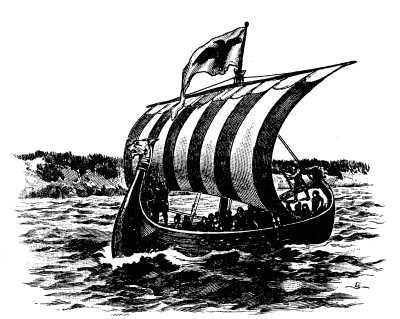
LEIF ERICSON'S VESSEL
Naturally such momentous changes in a nation were not brought about
suddenly. At first Normans and Saxons lived apart in the relation of
masters and servants, with more or less contempt on one side and hatred on
the other; but in an astonishingly short time these two races were drawn
powerfully together, like two men of different dispositions who are often
led into a steadfast friendship by the attraction of opposite qualities,
each supplying what the other lacks. The Anglo-Saxon Chronicle,
which was continued for a century after Hastings, finds much to praise in
the conquerors; on the other hand the Normans, even before the Conquest,
had no great love for the French nation. After conquering England they
began to regard it as home and speedily developed a new sense of
nationality. Geoffrey's popular History, [43] written less than a century after
the Conquest, made conquerors and conquered alike proud of their country
by its stories of heroes who, curiously enough, were neither Norman nor
Saxon, but creations of the native Celts. Thus does literature, whether in
a battle song or a history, often play the chief role in the development
of nationality.[44]
Once the mutual distrust was overcome the two races gradually united, and
out of this union of Saxons and Normans came the new English life and
literature.
Literary Ideals of the Normans.
The change in the life of the conquerors from Norsemen to Normans, from
Vikings to Frenchmen, is shown most clearly in the literature which they
brought with them to England. The old Norse strength and grandeur, the
magnificent sagas telling of the tragic struggles of men and gods, which
still stir us profoundly,--these have all disappeared. In their place is a
bright, varied, talkative literature, which runs to endless verses, and
which makes a wonderful romance out of every subject it touches. The theme
may be religion or love or chivalry or history, the deeds of Alexander or
the misdeeds of a monk; but the author's purpose never varies. He must
tell a romantic story and amuse his audience; and the more wonders and
impossibilities he relates, the more surely is he believed. We are
reminded, in reading, of the native Gauls, who would stop every traveler
and compel him to tell a story ere he passed on. There was more of the
Gaul than of the Norseman in the conquerors, and far more of fancy than of
thought or feeling in their literature. If you would see this in concrete
form, read the Chanson de Roland, the French national epic (which
the Normans first put into literary form), in contrast with Beowulf,
which voices the Saxon's thought and feeling before the profound mystery
of human life. It is not our purpose to discuss the evident merits or the
serious defects of Norman-French literature, but only to point out two
facts which impress the student, namely, that Anglo-Saxon literature was
at one time enormously superior to the French, and that the latter, with
its evident inferiority, absolutely replaced the former. "The fact is too
often ignored," says Professor Schofield, [45] "that before 1066 the Anglo-Saxons had a body of
native literature distinctly superior to any which the Normans or French
could boast at that time; their prose especially was unparalleled for
extent and power in any European vernacular." Why, then, does this
superior literature disappear and for nearly three centuries French remain
supreme, so much so that writers on English soil, even when they do not
use the French language, still slavishly copy the French models?
To understand this curious phenomenon it is necessary only to remember the
relative conditions of the two races who lived side by side in England. On
the one hand the Anglo-Saxons were a conquered people, and without liberty
a great literature is impossible. The inroads of the Danes and their own
tribal wars had already destroyed much of their writings, and in their new
condition of servitude they could hardly preserve what remained. The
conquering Normans, on the other hand, represented the civilization of
France, which country, during the early Middle Ages, was the literary and
educational center of all Europe. They came to England at a time when the
idea of nationality was dead, when culture had almost vanished, when
Englishmen lived apart in narrow isolation; and they brought with them
law, culture, the prestige of success, and above all the strong impulse to
share in the great world's work and to join in the moving currents of the
world's history. Small wonder, then, that the young Anglo-Saxons felt the
quickening of this new life and turned naturally to the cultured and
progressive Normans as their literary models.
II. LITERATURE OF THE NORMAN PERIOD
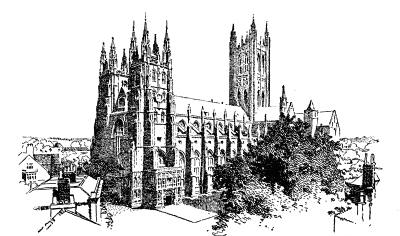
CANTERBURY CATHEDRAL AS IT WAS COMPLETED
LONG AFTER THE CONQUEST
In the Advocates' Library at Edinburgh there is a beautifully illuminated
manuscript, written about 1330, which gives us an excellent picture of the
literature of the Norman period. In examining it we are to remember that
literature was in the hands of the clergy and nobles; that the common
people could not read, and had only a few songs and ballads for their
literary portion. We are to remember also that parchments were scarce and
very expensive, and that a single manuscript often contained all the
reading matter of a castle or a village. Hence this old manuscript is as
suggestive as a modern library. It contains over forty distinct works, the
great bulk of them being romances. There are metrical or verse romances of
French and Celtic and English heroes, like Roland, Arthur and Tristram,
and Bevis of Hampton. There are stories of Alexander, the Greek romance of
"Flores and Blanchefleur," and a collection of Oriental tales called "The
Seven Wise Masters." There are legends of the Virgin and the saints, a
paraphrase of Scripture, a treatise on the seven deadly sins, some Bible
history, a dispute among birds concerning women, a love song or two, a
vision of Purgatory, a vulgar story with a Gallic flavor, a chronicle of
English kings and Norman barons, and a political satire. There are a few
other works, similarly incongruous, crowded together in this typical
manuscript, which now gives mute testimony to the literary taste of the
times.
Obviously it is impossible to classify such a variety. We note simply that
it is mediæval in spirit, and French in style and expression; and
that sums up the age. All the scholarly works of the period, like William
of Malmesbury's History, and Anselm's[46] Cur Deus Homo, and Roger
Bacon's Opus Majus, the beginning of modern experimental science,
were written in Latin; while nearly all other works were written in
French, or else were English copies or translations of French originals.
Except for the advanced student, therefore, they hardly belong to the
story of English literature. We shall note here only one or two marked
literary types, like the Riming Chronicle (or verse history) and the
Metrical Romance, and a few writers whose work has especial significance.
Geoffrey of Monmouth. (d. 1154).
Geoffrey's Historia Regum Britanniae is noteworthy, not as
literature, but rather as a source book from which many later writers drew
their literary materials. Among the native Celtic tribes an immense number
of legends, many of them of exquisite beauty, had been preserved through
four successive conquests of Britain. Geoffrey, a Welsh monk, collected
some of these legends and, aided chiefly by his imagination, wrote a
complete history of the Britons. His alleged authority was an ancient
manuscript in the native Welsh tongue containing the lives and deeds of
all their kings, from Brutus, the alleged founder of Britain, down to the
coming of Julius Cæsar.[47]
From this Geoffrey wrote his history, down to the death of Cadwalader in
689.
The "History" is a curious medley of pagan and Christian legends, of
chronicle, comment, and pure invention,--all recorded in minute detail and
with a gravity which makes it clear that Geoffrey had no conscience, or
else was a great joker. As history the whole thing is rubbish; but it was
extraordinarily successful at the time and made all who heard it, whether
Normans or Saxons, proud of their own country. It is interesting to us
because it gave a new direction to the literature of England by showing
the wealth of poetry and romance that lay in its own traditions of Arthur
and his knights. Shakespeare's King Lear, Malory's Morte
d'Arthur, and Tennyson's Idylls of the King were founded on the
work of this monk, who had the genius to put unwritten Celtic tradition in
the enduring form of Latin prose.
Work of the French Writers. The
French literature of the Norman period is interesting chiefly because of
the avidity with which foreign writers seized upon the native legends and
made them popular in England. Until Geoffrey's preposterous chronicle
appeared, these legends had not been used to any extent as literary
material. Indeed, they were scarcely known in England, though familiar to
French and Italian minstrels. Legends of Arthur and his court were
probably first taken to Brittany by Welsh emigrants in the fifth and sixth
centuries. They became immensely popular wherever they were told, and they
were slowly carried by minstrels and story-tellers all over Europe. That
they had never received literary form or recognition was due to a
peculiarity of mediæval literature, which required that every tale
should have some ancient authority behind it. Geoffrey met this demand by
creating an historical manuscript of Welsh history. That was enough for
the age. With Geoffrey and his alleged manuscript to rest upon, the
Norman-French writers were free to use the fascinating stories which had
been-for centuries in the possession of their wandering minstrels.
Geoffrey's Latin history was put into French verse by Gaimar (c.
1150) and by Wace (c. 1155), and from these French versions the
work was first translated into English. From about 1200 onward Arthur and
Guinevere and the matchless band of Celtic heroes that we meet later
(1470) in Malory's Morte d' Arthur became the permanent possession
of our literature.
Layamon's Brut (c. 1200).
This is the most important of the English riming chronicles, that is,
history related in the form of doggerel verse, probably because poetry is
more easily memorized than prose. We give here a free rendering of
selected lines at the beginning of the poem, which tell us all we know of
Layamon, the first who ever wrote as an Englishman for Englishmen,
including in the term all who loved England and called it home, no matter
where their ancestors were born.
Now there was a priest in the land named Layamon. He was son of
Leovenath--may God be gracious unto him. He dwelt at Ernley, at a noble
church on Severn's bank. He read many books, and it came to his mind to
tell the noble deeds of the English. Then he began to journey far and wide
over the land to procure noble books for authority. He took the English
book that Saint Bede made, another in Latin that Saint Albin made,[48] and a third book that
a French clerk made, named Wace.[49] Layamon laid these works before him and turned
the leaves; lovingly he beheld them. Pen he took, and wrote on book-skin,
and made the three books into one.
The poem begins with the destruction of Troy and the flight of "Æneas
the duke" into Italy. Brutus, a great-grandson of Æneas, gathers his
people and sets out to find a new land in the West. Then follows the
founding of the Briton kingdom, and the last third of the poem, which is
over thirty thousand lines in length, is taken up with the history of
Arthur and his knights. If the Brut had no merits of its own, it
would still interest us, for it marks the first appearance of the
Arthurian legends in our own tongue. A single selection is given here from
Arthur's dying speech, familiar to us in Tennyson's Morte d'Arthur.
The reader will notice here two things: first, that though the poem is
almost pure Anglo-Saxon,[50]
our first speech has already dropped many inflections and is more easily
read than Beowulf; second, that French influence is already at work
in Layamon's rimes and assonances, that is, the harmony resulting from
using the same vowel sound in several successive lines:
And ich wulle varen to Avalun: And I will fare to Avalun,
To
vairest alre maidene, To fairest of all maidens,
To Argante there
quene, To Argante the queen,
Alven swithe sceone. An elf very
beautiful.
And heo seal mine wunden And she shall my wounds
Makien alle isunde, Make all sound;
Al hal me makien All whole me
make
Mid haleweiye drenchen. With healing drinks.
And seothe
ich cumen wulle And again will I come
To mine kiueriche To my
kingdom
And wunien mid Brutten And dwell with Britons
Mid
muchelere wunne. With mickle joy.
Aefne than worden Even (with)
these words
Ther com of se wenden There came from the sea
That
wes an sceort bat lithen, A short little boat gliding,
Sceoven mid
uthen, Shoved by the waves;
And twa wimmen ther inne, And two women
therein,
Wunderliche idihte. Wondrously attired.
And heo nomen
Arthur anan And they took Arthur anon
And an eovste hine vereden
And bore him hurriedly,
And softe hine adun leiden, And softly laid
him down,
And forth gunnen lithen. And forth gan glide.
Metrical Romances. Love, chivalry,
and religion, all pervaded by the spirit of romance,--these are the three
great literary ideals which find expression in the metrical romances. Read
these romances now, with their knights and fair ladies, their perilous
adventures and tender love-making, their minstrelsy and tournaments and
gorgeous cavalcades,--as if humanity were on parade, and life itself were
one tumultuous holiday in the open air,--and you have an epitome of the
whole childish, credulous soul of the Middle Ages. The Normans first
brought this type of romance into England, and so popular did it become,
so thoroughly did it express the romantic spirit of the time, that it
speedily overshadowed all other forms of literary expression.
FormThough the metrical romances varied
much in form and subject-matter, the general type remains the same,--a
long rambling poem or series of poems treating of love or knightly
adventure or both. Its hero is a knight; its characters are fair ladies in
distress, warriors in armor, giants, dragons, enchanters, and various
enemies of Church and State; and its emphasis is almost invariably on
love, religion, and duty as defined by chivalry. In the French originals
of these romances the lines were a definite length, the meter exact, and
rimes and assonances were both used to give melody. In England this
metrical system came in contact with the uneven lines, the strong accent
and alliteration of the native songs; and it is due to the gradual union
of the two systems, French and Saxon, that our English became capable of
the melody and amazing variety of verse forms which first find expression
in Chaucer's poetry.
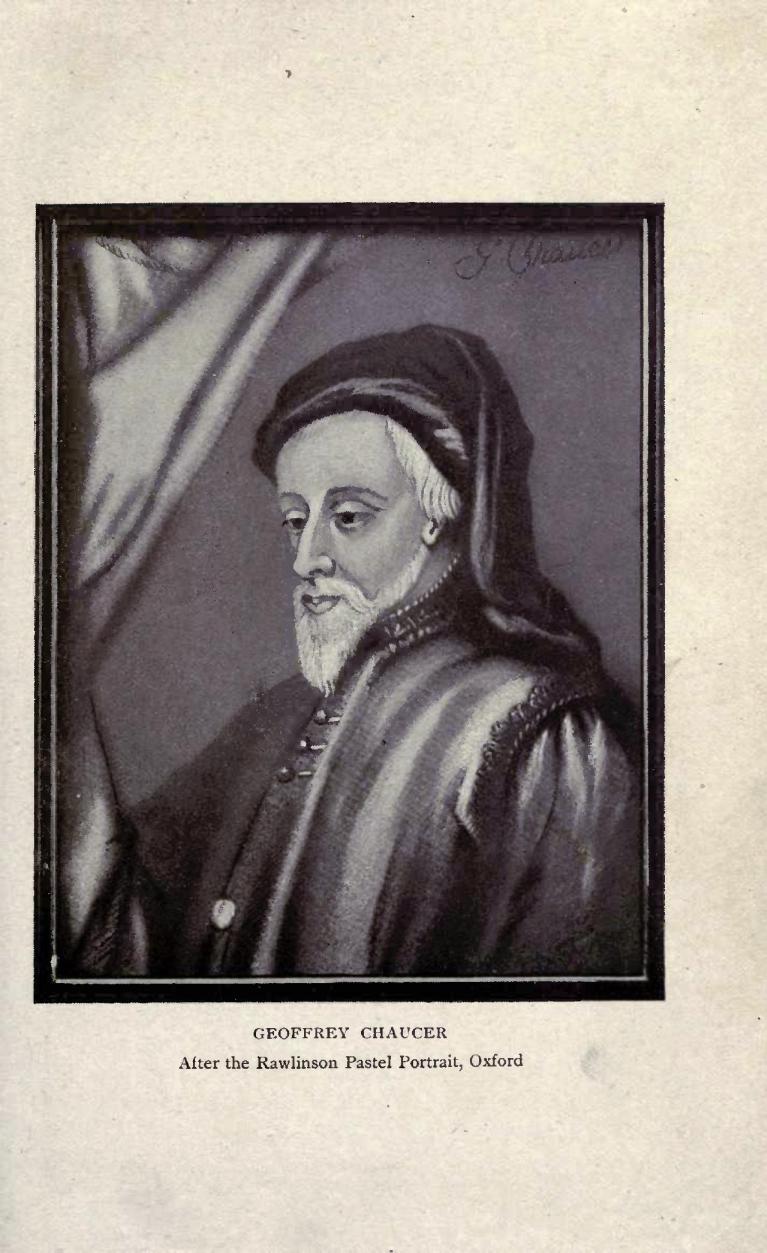
Cycles of romancesIn the enormous number
of these verse romances we note three main divisions, according to
subject, into the romances (or the so-called matter) of France, Rome, and
Britain.[51] The
matter of France deals largely with the exploits of Charlemagne and his
peers, and the chief of these Carlovingian cycles is the Chanson de
Roland, the national epic, which celebrates the heroism of Roland in
his last fight against the Saracens at Ronceval. Originally these romances
were called Chansons de Geste; and the name is significant as
indicating that the poems were originally short songs[52] celebrating the deeds (gesta)
of well-known heroes. Later the various songs concerning one hero were
gathered together and the Geste became an epic, like the Chanson
de Roland, or a kind of continued ballad story, hardly deserving the
name of epic, like the Geste of Robin Hood.[53]
The matter of Rome consisted largely of tales from Greek and Roman
sources; and the two great cycles of these romances deal with the deeds of
Alexander, a favorite hero, and the siege of Troy, with which the Britons
thought they had some historic connection. To these were added a large
number of tales from Oriental sources; and in the exuberant imagination of
the latter we see the influence which the Saracens--those nimble wits who
gave us our first modern sciences and who still reveled in the Arabian
Nights--had begun to exercise on the literature of Europe.
The Matter of BritainTo the English
reader, at least, the most interesting of the romances are those which
deal with the exploits of Arthur and his Knights of the Round Table,--the
richest storehouse of romance which our literature has ever found. There
were many cycles of Arthurian romances, chief of which are those of
Gawain, Launcelot, Merlin, the Quest of the Holy Grail, and the Death of
Arthur. In preceding sections we have seen how these fascinating romances
were used by Geoffrey and the French writers, and how, through the French,
they found their way into English, appearing first in our speech in
Layamon's Brut. The point to remember is that, while the legends
are Celtic in origin, their literary form is due to French poets, who
originated the metrical romance. All our early English romances are either
copies or translations of the French; and this is true not only of the
matter of France and Rome, but of Celtic heroes like Arthur, and English
heroes like Guy of Warwick and Robin Hood.
Sir Gawain and the Green KnightThe most
interesting of all Arthurian romances are those of the Gawain cycle,[54] and of these the story
of Sir Gawain and the Green Knight is best worth reading, for many
reasons. First, though the material is taken from French sources,[55] the English
workmanship is the finest of our early romances. Second, the unknown
author of this romance probably wrote also "The Pearl," and is the
greatest English poet of the Norman period. Third, the poem itself with
its dramatic interest, its vivid descriptions, and its moral purity, is
one of the most delightful old romances in any language.
In form Sir Gawain is an interesting combination of French and
Saxon elements. It is written in an elaborate stanza combining meter and
alliteration. At the end of each stanza is a rimed refrain, called by the
French a "tail rime." We give here a brief outline of the story; but if
the reader desires the poem itself, he is advised to begin with a modern
version, as the original is in the West Midland dialect and is exceedingly
difficult to follow.
On New Year's day, while Arthur and his knights are keeping the Yuletide
feast at Camelot, a gigantic knight in green enters the banquet hall on
horseback and challenges the bravest knight present to an exchange of
blows; that is, he will expose his neck to a blow of his own big
battle-ax, if any knight will agree to abide a blow in return. After some
natural consternation and a fine speech by Arthur, Gawain accepts the
challenge, takes the battle-ax, and with one blow sends the giant's head
rolling through the hall. The Green Knight, who is evidently a terrible
magician, picks up his head and mounts his horse. He holds out his head
and the ghastly lips speak, warning Gawain to be faithful to his promise
and to seek through the world till he finds the Green Chapel. There, on
next New Year's day, the Green Knight will meet him and return the blow.
The second canto of the poem describes Gawain's long journey through the
wilderness on his steed Gringolet, and his adventures with storm and cold,
with, wild beasts and monsters, as he seeks in vain for the Green Chapel.
On Christmas eve, in the midst of a vast forest, he offers a prayer to
"Mary, mildest mother so dear," and is rewarded by sight of a great
castle. He enters and is royally entertained by the host, an aged hero,
and by his wife, who is the most beautiful woman the knight ever beheld.
Gawain learns that he is at last near the Green Chapel, and settles down
for a little comfort after his long quest.
The next canto shows the life in the castle, and describes a curious
compact between the host, who goes hunting daily, and the knight, who
remains in the castle to entertain the young wife. The compact is that at
night each man shall give the other whatever good thing he obtains during
the day. While the host is hunting, the young woman tries in vain to
induce Gawain to make love to her, and ends by giving him a kiss. When the
host returns and gives his guest the game he has killed Gawain returns the
kiss. On the third day, her temptations having twice failed, the lady
offers Gawain a ring, which he refuses; but when she offers a magic green
girdle that will preserve the wearer from death, Gawain, who remembers the
giant's ax so soon to fall on his neck, accepts the girdle as a "jewel for
the jeopardy" and promises the lady to keep the gift secret. Here, then,
are two conflicting compacts. When the host returns and offers his game,
Gawain returns the kiss but says nothing of the green girdle.
The last canto brings our knight to the Green Chapel, after he is
repeatedly warned to turn back in the face of certain death. The Chapel is
a terrible place in the midst of desolation; and as Gawain approaches he
hears a terrifying sound, the grating of steel on stone, where the giant
is sharpening a new battle-ax. The Green Knight appears, and Gawain, true
to his compact, offers his neck for the blow. Twice the ax swings
harmlessly; the third time it falls on his shoulder and wounds him.
Whereupon Gawain jumps for his armor, draws his sword, and warns the giant
that the compact calls for only one blow, and that, if another is offered,
he will defend himself.
Then the Green Knight explains things. He is lord of the castle where
Gawain has been entertained for days past. The first two swings of the ax
were harmless because Gawain had been true to his compact and twice
returned the kiss. The last blow had wounded him because he concealed the
gift of the green girdle, which belongs to the Green Knight and was woven
by his wife. Moreover, the whole thing has been arranged by Morgain the
fay-woman (an enemy of Queen Guinevere, who appears often in the Arthurian
romances). Full of shame, Gawain throws back the gift and is ready to
atone for his deception; but the Green Knight thinks he has already
atoned, and presents the green girdle as a free gift. Gawain returns to
Arthur's court, tells the whole story frankly, and ever after that the
knights of the Round Table wear a green girdle in his honor.[56]
The Pearl. In the same manuscript
with "Sir Gawain" are found three other remarkable poems, written about
1350, and known to us, in order, as "The Pearl," "Cleanness," and
"Patience." The first is the most beautiful, and received its name from
the translator and editor, Richard Morris, in 1864. "Patience" is a
paraphrase of the book of Jonah; "Cleanness" moralizes on the basis of
Bible stories; but "The Pearl" is an intensely human and realistic picture
of a father's grief for his little daughter Margaret, "My precious perle
wythouten spot." It is the saddest of all our early poems.
On the grave of his little one, covered over with flowers, the father
pours out his love and grief till, in the summer stillness, he falls
asleep, while we hear in the sunshine the drowsy hum of insects and the
faraway sound of the reapers' sickles. He dreams there, and the dream
grows into a vision beautiful. His body lies still upon the grave while
his spirit goes to a land, exquisite beyond all words, where he comes
suddenly upon a stream that he cannot cross. As he wanders along the bank,
seeking in vain for a ford, a marvel rises before his eyes, a crystal
cliff, and seated beneath it a little maiden who raises a happy, shining
face,--the face of his little Margaret.
More then me lyste my drede aros,
I stod full stylle and dorste not
calle;
Wyth yghen open and mouth ful clos,
I stod as hende as
hawk in halle.
He dares not speak for fear of breaking the spell; but sweet as a lily she
comes down the crystal stream's bank to meet and speak with him, and tell
him of the happy life of heaven and how to live to be worthy of it. In his
joy he listens, forgetting all his grief; then the heart of the man cries
out for its own, and he struggles to cross the stream to join her. In the
struggle the dream vanishes; he wakens to find his eyes wet and his head
on the little mound that marks the spot where his heart is buried.
From the ideals of these three poems, and from peculiarities of style and
meter, it is probable that their author wrote also Sir Gawain and the
Green Knight. If so, the unknown author is the one genius of the age
whose poetry of itself has power to interest us, and who stands between
Cynewulf and Chaucer as a worthy follower of the one and forerunner of the
other.
Miscellaneous Literature of the Norman
Period. It is well-nigh impossible to classify the remaining
literature of this period, and very little of it is now read, except by
advanced students. Those interested in the development of "transition"
English will find in the Ancren Riwle, i.e. "Rule of the
Anchoresses" (c. 1225), the most beautiful bit of old English prose
ever written. It is a book of excellent religious advice and comfort,
written for three ladies who wished to live a religious life, without,
however, becoming nuns or entering any religious orders. The author was
Bishop Poore of Salisbury, according to Morton, who first edited this old
classic in 1853. Orm's Ormulum, written soon after the Brut,
is a paraphrase of the gospel lessons for the year, somewhat after the
manner of Cædmon's Paraphrase, but without any of Cædmon's
poetic fire and originality. Cursor Mundi (c. 1320) is a
very long poem which makes a kind of metrical romance out of Bible history
and shows the whole dealing of God with man from Creation to Domesday. It
is interesting as showing a parallel to the cycles of miracle plays, which
attempt to cover the same vast ground. They were forming in this age; but
we will study them later, when we try to understand the rise of the drama
in England.
Besides these greater works, an enormous number of fables and satires
appeared in this age, copied or translated from the French, like the
metrical romances. The most famous of these are "The Owl and the
Nightingale,"--a long debate between the two birds, one representing the
gay side of life, the other the sterner side of law and morals,--and "Land
of Cockaygne," i.e. "Luxury Land," a keen satire on monks and monastic
religion.[57]
BalladsWhile most of the literature of the
time was a copy of the French and was intended only for the upper classes,
here and there were singers who made ballads for the common people; and
these, next to the metrical romances, are the most interesting and
significant of all the works of the Norman period. On account of its
obscure origin and its oral transmission, the ballad is always the most
difficult of literary subjects.[58]
We make here only three suggestions, which may well be borne in mind: that
ballads were produced continually in England from Anglo-Saxon times until
the seventeenth century; that for centuries they were the only really
popular literature; and that in the ballads alone one is able to
understand the common people. Read, for instance, the ballads of the
"merrie greenwood men," which gradually collected into the Geste of
Robin Hood, and you will understand better, perhaps, than from reading
many histories what the common people of England felt and thought while
their lords and masters were busy with impossible metrical romances.
In these songs speaks the heart of the English folk. There is lawlessness
indeed; but this seems justified by the oppression of the times and by the
barbarous severity of the game laws. An intense hatred of shams and
injustice lurks in every song; but the hatred is saved from bitterness by
the humor with which captives, especially rich churchmen, are solemnly
lectured by the bandits, while they squirm at sight of devilish tortures
prepared before their eyes in order to make them give up their golden
purses; and the scene generally ends in a bit of wild horse-play. There is
fighting enough, and ambush and sudden death lurk at every turn of the
lonely roads; but there is also a rough, honest chivalry for women, and a
generous sharing of plunder with the poor and needy. All literature is but
a dream expressed, and "Robin Hood" is the dream of an ignorant and
oppressed but essentially noble people, struggling and determined to be
free.
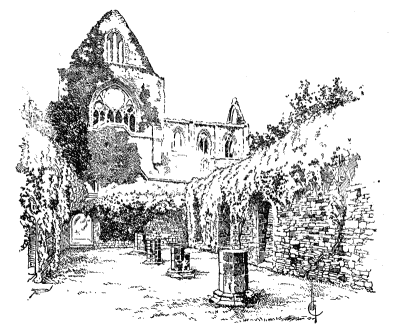
REMAINS OF THE SCRIPTORIUM OF FOUNTAINS
ABBEY (Fourteenth century)
LyricsFar more poetical than the ballads,
and more interesting even than the romances, are the little lyrics of the
period,--those tears and smiles of long ago that crystallized into poems,
to tell us that the hearts of men are alike in all ages. Of these, the
best known are the "Luve Ron" (love rune or letter) of Thomas de Hales (c.
1250); "Springtime" (c. 1300), beginning "Lenten (spring) ys come
with luve to toune"; and the melodious love song "Alysoun," written at the
end of the thirteenth century by some unknown poet who heralds the coming
of Chaucer:
Bytuene Mersh and Averil,
When spray biginneth to springe
The
lutel foul[59]
hath hire wyl
On hyre lud[60] to synge.
Ich libbe[61] in love longinge
For
semlokest[62] of
all thinge.
She may me blisse bringe;
Icham[63] in hire baundoun.[64]
An
hendy hap ichabbe yhent,[65]
Ichot[66] from hevene it is me sent,
From alle wymmen mi love
is lent[67]
And lyht[68] on Alysoun.
Summary of the Norman Period. The
Normans were originally a hardy race of sea rovers inhabiting Scandinavia.
In the tenth century they conquered a part of northern France, which is
still called Normandy, and rapidly adopted French civilization and the
French language. Their conquest of Anglo-Saxon England under William, Duke
of Normandy, began with the battle of Hastings in 1066. The literature
which they brought to England is remarkable for its bright, romantic tales
of love and adventure, in marked contrast with the strength and somberness
of Anglo-Saxon poetry. During the three centuries following Hastings,
Normans and Saxons gradually united. The Anglo-Saxon speech simplified
itself by dropping most of its Teutonic inflections, absorbed eventually a
large part of the French vocabulary, and became our English language.
English literature is also a combination of French and Saxon elements. The
three chief effects of the conquest were (1) the bringing of Roman
civilization to England; (2) the growth of nationality, i.e. a
strong centralized government, instead of the loose union of Saxon tribes;
(3) the new language and literature, which were proclaimed in
Chaucer.
At first the new literature was remarkably varied, but of small intrinsic
worth; and very little of it is now read. In our study we have noted: (1)
Geoffrey's History, which is valuable as a source book of literature,
since it contains the native Celtic legends of Arthur. (2) The work of the
French writers, who made the Arthurian legends popular. (3) Riming
Chronicles, i.e. history in doggerel verse, like Layamon's Brut.
(4) Metrical Romances, or tales in verse. These were numerous, and of four
classes: (a) the Matter of France, tales centering about Charlemagne and
his peers, chief of which is the Chanson de Roland; (b) Matter of Greece
and Rome, an endless series of fabulous tales about Alexander, and about
the Fall of Troy; (c) Matter of England, stories of Bevis of Hampton, Guy
of Warwick, Robin Hood, etc.; (d) Matter of Britain, tales having for
their heroes Arthur and his knights of the Round Table. The best of these
romances is Sir Gawain and the Green Knight. (5) Miscellaneous
literature,--the Ancren Riwle, our best piece of early English prose;
Orm's Ormulum; Cursor Mundi, with its suggestive parallel to the Miracle
plays; and ballads, like King Horn and the Robin Hood songs, which were
the only poetry of the common people.
Selections for Reading. For advanced students, and as a study of
language, a few selections as given in Manly's English Poetry and in
Manly's English Prose; or selections from the Ormulum, Brut, Ancren Riwle,
and King Horn, etc., in Morris and Skeat's Specimens of Early English. The
ordinary student will get a better idea of the literature of the period by
using the following: Sir Gawain, modernized by J. L. Weston, in Arthurian
Romances Series (Nutt); The Nun's Rule (Ancren Riwle), modern version by
J. Morton, in King's Classics; Aucassin and Nicolete, translated by A.
Lang (Crowell & Co.); Tristan and Iseult, in Arthurian Romances;
Evans's The High History of the Holy Grail, in Temple Classics; The Pearl,
various modern versions in prose and verse; one of the best is Jewett's
metrical version (Crowell & Co.); The Song of Roland, in King's
Classics, and in Riverside Literature Series; Evans's translation of
Geoffrey's History, in Temple Classics; Guest's The Mabinogion, in
Everyman's Library, or S. Lanier's Boy's Mabinogion (i.e. Welsh fairy
tales and romances); Selected Ballads, in Athenæum Press Series, and
in Pocket Classics; Gayley and Flaherty's Poetry of the People; Bates's A
Ballad Book.
Bibliography.[69]
History. Text-book, Montgomery, pp. 58-86, or Cheyney, pp.
88-144. For fuller treatment, Green, ch. 2; Traill; Gardiner, etc.
Jewett's Story of the Normans (Stories of the Nations Series); Freeman's
Short History of the Norman Conquest; Hutton's King and Baronage (Oxford
Manuals of English History).
Literature. General Works. Jusserand; Ten Brink; Mitchell,
vol. I, From Celt to Tudor; The Cambridge History of English Literature.
Special Works. Schofield's English Literature from the Norman
Conquest to Chaucer; Lewis's Beginnings of English Literature; Ker's Epic
and Romance; Saintsbury's The Flourishing of Romance and the Rise of
Allegory; Newell's King Arthur and the Round Table; Maynadier, The Arthur
of the English Poets; Rhys's Studies in the Arthurian Legends.
Ballads. Child's English and Scottish Popular Ballads; Gummere's
Old English Ballads (one volume); Hazlitt's Early Popular Poetry of
England; Gayley and Flaherty's Poetry of the People; Percy's Reliques of
Ancient English Poetry, in Everyman's Library.
Texts, Translations, etc. Morris and Skeat's Specimens of Early
English; Morris's Sir Gawain and the Green Knight, in Early English Text
Series; Madden's Layamon's Brut, text and translation (a standard work,
but rare); The Pearl, text and translation, by Gollancz; the same poem,
prose version, by Osgood, metrical versions by Jewett, Weir Mitchell, and
Mead; Geoffrey's History, translation, in Giles's Six Old English
Chronicles (Bohn's Antiquarian Library); Morley's Early English Prose
Romances; Joyce's Old Celtic Romances; Guest's The Mabinogion; Lanier's
Boy's Mabinogion; Arthurian Romances Series (translations). The Belles
Lettres Series, sec. 2 (announced), will contain the texts of a large
number of works of this period, with notes and introductions.
Language. Marsh's Lectures on the English Language; Bradley's
Making of English; Lounsbury's History of the English Language; Emerson's
Brief History of the English Language; Greenough and Kittredge's Words and
their Ways in English Speech; Welsh's Development of English Literature
and Language.
Suggestive Questions. 1. What did
the Northmen originally have in common with the Anglo-Saxons and the
Danes? What brought about the remarkable change from Northmen to Normans?
Tell briefly the story of the Norman Conquest. How did the Conquest affect
the life and literature of England?
2. What types of literature were produced after the Conquest? How do they
compare with Anglo-Saxon literature? What works of this period are
considered worthy of a permanent place in our literature?
3. What is meant by the Riming Chronicles? What part did they play in
developing the idea of nationality? What led historians of this period to
write in verse? Describe Geoffrey's History. What was its most valuable
element from the view point of literature?
4. What is Layamon's Brut? Why did Layamon choose this name for his
Chronicle? What special literary interest attaches to the poem?
5. What were the Metrical Romances? What reasons led to the great interest
in three classes of romances, i.e. Matters of France, Rome, and Britain?
What new and important element enters our literature in this type? Read
one of the Metrical Romances in English and comment freely upon it, as to
interest, structure, ideas, and literary quality.
6. Tell the story of Sir Gawain and the Green Knight. What French
and what Saxon elements are found in the poem? Compare it with Beowulf
to show the points of inferiority and superiority. Compare Beowulf's fight
with Grendel or the Fire Drake and Sir Gawain's encounter with the Green
Knight, having in mind (1) the virtues of the hero, (2) the qualities of
the enemy, (3) the methods of warfare, (4) the purpose of the struggle.
Read selections from The Pearl and compare with Dear's Lament.
What are the personal and the universal interests in each poem?
7. Tell some typical story from the Mabinogion. Where did the Arthurian
legends originate, and how did they become known to English readers? What
modern writers have used these legends? What fine elements do you find in
them that are not found in Anglo-Saxon poetry?
8. What part did Arthur play in the early history of Britain? How long did
the struggle between Britons and Saxons last? What Celtic names and
elements entered into English language and literature?
9. What is a ballad, and what distinguishes it from other forms of poetry?
Describe the ballad which you like best. Why did the ballad, more than any
other form of literature, appeal to the common people? What modern poems
suggest the old popular ballad? How do these compare in form and subject
matter with the Robin Hood ballads?
|
CHRONOLOGY
|
|
HISTORY
|
LITERATURE
|
|
912.
|
Northmen settle in Normandy
|
|
1066.
|
Battle of Hastings. William,
|
|
king of England
|
|
|
1086.
|
Domesday Book completed
|
|
1087.
|
William Rufus
|
|
1093.
|
Anselm, archbishop of Canterbury
|
|
|
1094(cir.).
|
Anselem's Cur Deus Homo
|
|
1096.
|
First Crusade
|
|
1100.
|
Henry I
|
|
|
1110.
|
First recorded Miracle play in
|
|
|
|
England (see chapter on the
|
|
|
|
Drama)
|
|
1135.
|
Stephen
|
|
|
1137(cir.).
|
Geoffrey's History
|
|
1147.
|
Second Crusade
|
|
1154.
|
Henry II
|
|
1189.
|
Richard I. Third Crusade
|
|
1199.
|
John
|
|
|
1200 (cir.).
|
Layamon's Brut
|
|
1215.
|
Magna Charta
|
|
1216.
|
Henry III
|
|
|
1225 (cir.).
|
Ancren Riwle
|
|
1230 (cir.).
|
University of Cambridge
|
|
|
|
chartered
|
|
1265.
|
Beginning of House of Commons.
|
|
|
|
Simon de Montfort
|
|
|
1267.
|
Roger Bacon's Opus Majus
|
|
1272.
|
Edward I
|
|
1295.
|
First complete Parliament
|
|
|
1300-1400.
|
York and Wakefield.
|
|
|
|
Miracle plays
|
|
1307.
|
Edward II
|
|
|
1320 (cir.).
|
Cursor Mundi
|
|
1327.
|
Edward III
|
|
1338.
|
Beginning of Hundred Years' War
|
|
with France
|
|
|
1340 (?).
|
Birth of Chaucer
|
|
|
1350 (cir.).
|
Sir Gawain. The Pearl
|
THE NEW NATIONAL LIFE AND LITERATURE
History of the Period. Two great
movements may be noted in the complex life of England during the
fourteenth century. The first is political, and culminates in the reign of
Edward III. It shows the growth of the English national spirit following
the victories of Edward and the Black Prince on French soil, during the
Hundred Years' War. In the rush of this great national movement,
separating England from the political ties of France and, to a less
degree, from ecclesiastical bondage to Rome, the mutual distrust and
jealousy which had divided nobles and commons were momentarily swept aside
by a wave of patriotic enthusiasm. The French language lost its official
prestige, and English became the speech not only of the common people but
of courts and Parliament as well.
The second movement is social; it falls largely within the reign of
Edward's successor, Richard II, and marks the growing discontent with the
contrast between luxury and poverty, between the idle wealthy classes and
the overtaxed peasants. Sometimes this movement is quiet and strong, as
when Wyclif arouses the conscience of England; again it has the portentous
rumble of an approaching tempest, as when John Ball harangues a multitude
of discontented peasants on Black Heath commons, using the famous text:
When Adam delved and Eve span
Who was then the gentleman?
and again it breaks out into the violent rebellion of Wat Tyler. All these
things show the same Saxon spirit that had won its freedom in a thousand
years' struggle against foreign enemies, and that now felt itself
oppressed by a social and industrial tyranny in its own midst.
Aside from these two movements, the age was one of unusual stir and
progress. Chivalry, that mediæval institution of mixed good and
evil, was in its Indian summer,--a sentiment rather than a practical
system. Trade, and its resultant wealth and luxury, were increasing
enormously. Following trade, as the Vikings had followed glory, the
English began to be a conquering and colonizing people, like the
Anglo-Saxons. The native shed something of his insularity and became a
traveler, going first to view the places where trade had opened the way,
and returning with wider interests and a larger horizon. Above all, the
first dawn of the Renaissance is heralded in England, as in Spain and
Italy, by the appearance of a national literature.
Five Writers of the Age. The
literary movement of the age clearly reflects the stirring life of the
times. There is Langland, voicing the social discontent, preaching the
equality of men and the dignity of labor; Wyclif, greatest of English
religious reformers, giving the Gospel to the people in their own tongue,
and the freedom of the Gospel in unnumbered tracts and addresses; Gower,
the scholar and literary man, criticising this vigorous life and plainly
afraid of its consequences; and Mandeville, the traveler, romancing about
the wonders to be seen abroad. Above all there is Chaucer,--scholar,
traveler, business man, courtier, sharing in all the stirring life of his
times, and reflecting it in literature as no other but Shakespeare has
ever done. Outside of England the greatest literary influence of the age
was that of Dante, Petrarch, and Boccaccio, whose works, then at the
summit of their influence in Italy, profoundly affected the literature of
all Europe.
CHAUCER (1340?-1400)
'What
man artow?' quod he;
'Thou lokest as thou woldest finde an hare,
For ever upon the ground I see thee stare.
Approchë neer, and loke
up merily....
He semeth elvish by his contenaunce.'
(The
Host's description of Chaucer,
Prologue,
Sir Thopas)
On reading Chaucer. The difficulties of reading Chaucer are more
apparent than real, being due largely to obsolete spelling, and there is
small necessity for using any modern versions of the poet's work, which
seem to miss the quiet charm and dry humor of the original. If the reader
will observe the following general rules (which of necessity ignore many
differences in pronunciation of fourteenth-century English), he may, in an
hour or two, learn to read Chaucer almost as easily as Shakespeare: (1)
Get the lilt of the lines, and let the meter itself decide how final
syllables are to be pronounced. Remember that Chaucer is among the most
musical of poets, and that there is melody in nearly every line. If the
verse seems rough, it is because we do not read it correctly. (2) Vowels
in Chaucer have much the same value as in modern German; consonants are
practically the same as in modern English. (3) Pronounce aloud any
strange-looking words. Where the eye fails, the ear will often recognize
the meaning. If eye and ear both fail, then consult the glossary found in
every good edition of the poet's works. (4) Final e is usually
sounded (like a in Virginia) except where the following word begins
with a vowel or with h. In the latter case the final syllable of
one word and the first of the word following are run together, as in
reading Virgil. At the end of a line the e, if lightly pronounced,
adds melody to the verse.[70]
In dealing with Chaucer's masterpiece, the reader is urged to read widely
at first, for the simple pleasure of the stories, and to remember that
poetry and romance are more interesting and important than Middle English.
When we like and appreciate Chaucer--his poetry, his humor, his good
stories, his kind heart---it will be time enough to study his language.
Life of Chaucer. For our convenience the life of Chaucer is divided
into three periods. The first, of thirty years, includes his youth and
early manhood, in which time he was influenced almost exclusively by
French literary models. The second period, of fifteen years, covers
Chaucer's active life as diplomat and man of affairs; and in this the
Italian influence seems stronger than the French. The third, of fifteen
years, generally known as the English period, is the time of Chaucer's
richest development. He lives at home, observes life closely but kindly,
and while the French influence is still strong, as shown in the Canterbury
Tales, he seems to grow more independent of foreign models and is
dominated chiefly by the vigorous life of his own English people.
First periodChaucer's boyhood was spent in
London, on Thames Street near the river, where the world's commerce was
continually coming and going. There he saw daily the shipman of the Canterbury
Tales just home in his good ship Maudelayne, with the fascination of
unknown lands in his clothes and conversation. Of his education we know
nothing, except that he was a great reader. His father was a wine
merchant, purveyor to the royal household, and from this accidental
relation between trade and royalty may have arisen the fact that at
seventeen years Chaucer was made page to the Princess Elizabeth. This was
the beginning of his connection with the brilliant court, which in the
next forty years, under three kings, he was to know so intimately.
At nineteen he went with the king on one of the many expeditions of the
Hundred Years' War, and here he saw chivalry and all the pageantry of mediæval
war at the height of their outward splendor. Taken prisoner at the
unsuccessful siege of Rheims, he is said to have been ransomed by money
out of the royal purse. Returning to England, he became after a few years
squire of the royal household, the personal attendant and confidant of the
king. It was during this first period that he married a maid of honor to
the queen. This was probably Philippa Roet, sister to the wife of John of
Gaunt, the famous Duke of Lancaster. From numerous whimsical references in
his early poems, it has been thought that this marriage into a noble
family was not a happy one; but this is purely a matter of supposition or
of doubtful inference.
Second PeriodIn 1370 Chaucer was sent
abroad on the first of those diplomatic missions that were to occupy the
greater part of the next fifteen years. Two years later he made his first
official visit to Italy, to arrange a commercial treaty with Genoa, and
from this time is noticeable a rapid development in his literary powers
and the prominence of Italian literary influences. During the intervals
between his different missions he filled various offices at home, chief of
which was Comptroller of Customs at the port of London. An enormous amount
of personal labor was involved; but Chaucer seems to have found time to
follow his spirit into the new fields of Italian literature:
For whan thy labour doon al is,
And hast y-maad thy rekeninges,
In stede of reste and newe thinges,
Thou gost hoom to thy hous
anoon,
And, also domb as any stoon,
Thou sittest at another
boke
Til fully daswed is thy loke,
And livest thus as an
hermyte.[71]
Third PeriodIn 1386 Chaucer was elected
member of Parliament from Kent, and the distinctly English period of his
life and work begins. Though exceedingly busy in public affairs and as
receiver of customs, his heart was still with his books, from which only
nature could win him:
And as for me, though that my wit be lyte,
On bokes for to rede I
me delyte,
And to hem yeve I feyth and ful credence,
And in
myn herte have hem in reverence
So hertely, that ther is game noon
That fro my bokes maketh me to goon,
But hit be seldom, on the
holyday;
Save, certeynly, whan that the month of May
Is comen,
and that I here the foules singe,
And that the floures ginnen for
to springe--
Farwel my book and my devocioun![72]
In the fourteenth century politics seems to have been, for honest men, a
very uncertain business. Chaucer naturally adhered to the party of John of
Gaunt, and his fortunes rose or fell with those of his leader. From this
time until his death he is up and down on the political ladder; to-day
with money and good prospects, to-morrow in poverty and neglect, writing
his "Complaint to His Empty Purs," which he humorously calls his "saveour
doun in this werlde here." This poem called the king's attention to the
poet's need and increased his pension; but he had but few months to enjoy
the effect of this unusual "Complaint." For he died the next year, 1400,
and was buried with honor in Westminster Abbey. The last period of his
life, though outwardly most troubled, was the most fruitful of all. His
"Truth," or "Good Counsel," reveals the quiet, beautiful spirit of his
life, unspoiled either by the greed of trade or the trickery of politics:
Flee fro the prees, and dwelle with sothfastnesse,
Suffyce unto thy
good, though hit be smal;
For hord[73] hath hate, and climbing tikelnesse,
Prees[74] hath envye, and wele[75] blent[76] overal;
Savour
no more than thee bihovë shal;
Werk[77] wel thyself, that other folk canst rede;
And trouthe shal delivere, hit is no drede.
Tempest[78] thee noght al croked
to redresse,
In trust of hir[79] that turneth as a bal:
Gret reste stant
in litel besinesse;
And eek be war to sporne[80] ageyn an al[81];
Stryve noght, as doth the
crokke with the wal.
Daunte[82] thyself, that dauntest otheres dede;
And
trouthe shal delivere, hit is no drede.
That thee is sent, receyve
in buxumnesse,
The wrastling for this worlde axeth a fal.
Her
nis non hoom, her nis but wildernesse:
Forth, pilgrim, forth!
Forth, beste, out of thy stall,
Know thy contree, look up, thank
God of al;
Hold the hye wey, and lat thy gost thee lede:
And
trouthe shal delivere, hit is no drede.
Works of Chaucer, First Period. The works of Chaucer are roughly
divided into three classes, corresponding to the three periods of his
life. It should be remembered, however, that it is impossible to fix exact
dates for most of his works. Some of his Canterbury Tales were
written earlier than the English period, and were only grouped with the
others in his final arrangement.
The best known, though not the best, poem of the first period is the Romaunt
of the Rose,[83]
a translation from the French Roman de la Rose, the most popular
poem of the Middle Ages,--a graceful but exceedingly tiresome allegory of
the whole course of love. The Rose growing in its mystic garden is typical
of the lady Beauty. Gathering the Rose represents the lover's attempt to
win his lady's favor; and the different feelings aroused--Love, Hate,
Envy, Jealousy, Idleness, Sweet Looks--are the allegorical persons of the
poet's drama. Chaucer translated this universal favorite, putting in some
original English touches; but of the present Romaunt only the first
seventeen hundred lines are believed to be Chaucer's own work.
Perhaps the best poem of this period is the "Dethe of Blanche the
Duchesse," better known, as the "Boke of the Duchesse," a poem of
considerable dramatic and emotional power, written after the death of
Blanche, wife of Chaucer's patron, John of Gaunt. Additional poems are the
"Compleynte to Pite," a graceful love poem; the "A B C," a prayer to the
Virgin, translated from the French of a Cistercian monk, its verses
beginning with the successive letters of the alphabet; and a number of
what Chaucer calls "ballads, roundels, and virelays," with which, says his
friend Gower, "the land was filled." The latter were imitations of the
prevailing French love ditties.
Second Period. The chief work of the second or Italian period is Troilus
and Criseyde, a poem of eight thousand lines. The original story was a
favorite of many authors during the Middle Ages, and Shakespeare makes use
of it in his Troilus and Cressida. The immediate source of
Chaucer's poem is Boccaccio's Il Filostrato, "the love-smitten
one"; but he uses his material very freely, to reflect the ideals of his
own age and society, and so gives to the whole story a dramatic force and
beauty which it had never known before.
The "Hous of Fame" is one of Chaucer's unfinished poems, having the rare
combination of lofty thought and simple, homely language, showing the
influence of the great Italian master. In the poem the author is carried
away in a dream by a great eagle from the brittle temple of Venus, in a
sandy wilderness, up to the hall of fame. To this house come all rumors of
earth, as the sparks fly upward. The house stands on a rock of ice
writen
ful of names
Of folk that hadden grete fames.
Many of these have disappeared as the ice melted; but the older names are
clear as when first written. For many of his ideas Chaucer is indebted to
Dante, Ovid, and Virgil; but the unusual conception and the splendid
workmanship are all his own.
The third great poem of the period is the Legende of Goode Wimmen.
As he is resting in the fields among the daisies, he falls asleep and a
gay procession draws near. First comes the love god, leading by the hand
Alcestis, model of all wifely virtues, whose emblem is the daisy; and
behind them follow a troup of glorious women, all of whom have been
faithful in love. They gather about the poet; the god upbraids him for
having translated the Romance of the Rose, and for his early poems
reflecting on the vanity and fickleness of women. Alcestis intercedes for
him, and offers pardon if he will atone for his errors by writing a
"glorious legend of good women." Chaucer promises, and as soon as he
awakes sets himself to the task. Nine legends were written, of which
"Thisbe" is perhaps the best. It is probable that Chaucer intended to make
this his masterpiece, devoting many years to stories of famous women who
were true to love; but either because he wearied of his theme, or because
the plan of the Canterbury Tales was growing in his mind, he
abandoned the task in the middle of his ninth legend,--fortunately,
perhaps, for the reader will find the Prologue more interesting than any
of the legends.
Third Period. Chaucer's masterpiece, the Canterbury Tales,
one of the most famous works in all literature, fills the third or English
period of his life. The plan of the work is magnificent: to represent the
wide sweep of English life by gathering a motley company together and
letting each class of society tell its own favorite stories. Though the
great work was never finished, Chaucer succeeded in his purpose so well
that in the Canterbury Tales he has given us a picture of
contemporary English life, its work and play, its deeds and dreams, its
fun and sympathy and hearty joy of living, such as no other single work of
literature has ever equaled.
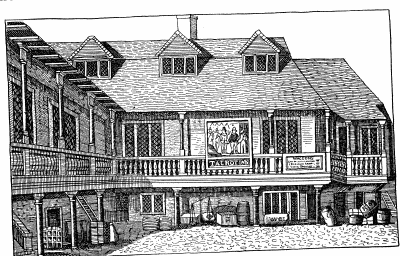
TABARD INN
Plan of the Canterbury Tales. Opposite old London, at the southern
end of London Bridge, once stood the Tabard Inn of Southwark, a quarter
made famous not only by the Canterbury Tales, but also by the first
playhouses where Shakespeare had his training. This Southwark was the
point of departure of all travel to the south of England, especially of
those mediæval pilgrimages to the shrine of Thomas a Becket in
Canterbury. On a spring evening, at the inspiring time of the year when
"longen folk to goon on pilgrimages," Chaucer alights at the Tabard Inn,
and finds it occupied by a various company of people bent on a pilgrimage.
Chance alone had brought them together; for it was the custom of pilgrims
to wait at some friendly inn until a sufficient company were gathered to
make the journey pleasant and safe from robbers that might be encountered
on the way. Chaucer joins this company, which includes all classes of
English society, from the Oxford scholar to the drunken miller, and
accepts gladly their invitation to go with them on the morrow.
At supper the jovial host of the Tabard Inn suggests that, to enliven the
journey, each of the company shall tell four tales, two going and two
coming, on whatever subject shall suit him best. The host will travel with
them as master of ceremonies, and whoever tells the best story shall be
given a fine supper at the general expense when they all come back
again,--a shrewd bit of business and a fine idea, as the pilgrims all
agree.
When they draw lots for the first story the chance falls to the Knight,
who tells one of the best of the Canterbury Tales, the chivalric
story of "Palamon and Arcite." Then the tales follow rapidly, each with
its prologue and epilogue, telling how the story came about, and its
effects on the merry company. Interruptions are numerous; the narrative is
full of life and movement, as when the miller gets drunk and insists on
telling his tale out of season, or when they stop at a friendly inn for
the night, or when the poet with sly humor starts his story of "Sir
Thopas," in dreary imitation of the metrical romances of the day, and is
roared at by the host for his "drasty ryming." With Chaucer we laugh at
his own expense, and are ready for the next tale.
From the number of persons in the company, thirty-two in all, it is
evident that Chaucer meditated an immense work of one hundred and
twenty-eight tales, which should cover the whole life of England. Only
twenty-four were written; some of these are incomplete, and others are
taken from his earlier work to fill out the general plan of the Canterbury
Tales. Incomplete as they are, they cover a wide range, including
stories of love and chivalry, of saints and legends, travels, adventures,
animal fables, allegory, satires, and the coarse humor of the common
people. Though all but two are written in verse and abound in exquisite
poetical touches, they are stories as well as poems, and Chaucer is to be
regarded as our first short-story teller as well as our first modern poet.
The work ends with a kindly farewell from the poet to his reader, and so
"here taketh the makere of this book his leve."
Prologue to the Canterbury Tales. In the famous "Prologue" the poet
makes us acquainted with the various characters of his drama. Until
Chaucer's day popular literature had been busy chiefly with the gods and
heroes of a golden age; it had been essentially romantic, and so had never
attempted to study men and women as they are, or to describe them so that
the reader recognizes them, not as ideal heroes, but as his own neighbors.
Chaucer not only attempted this new realistic task, but accomplished it so
well that his characters were instantly recognized as true to life, and
they have since become the permanent possession of our literature. Beowulf
and Roland are ideal heroes, essentially creatures of the imagination; but
the merry host of the Tabard Inn, Madame Eglantyne, the fat monk, the
parish priest, the kindly plowman, the poor scholar with his "bookës black
and red,"--all seem more like personal acquaintances than characters in a
book. Says Dryden: "I see all the pilgrims, their humours, their features
and their very dress, as distinctly as if I had supped with them at the
Tabard in Southwark." Chaucer is the first English writer to bring the
atmosphere of romantic interest about the men and women and the daily work
of one's own world,--which is the aim of nearly all modern literature.
The historian of our literature is tempted to linger over this "Prologue"
and to quote from it passage after passage to show how keenly and yet
kindly our first modern poet observed his fellow-men. The characters, too,
attract one like a good play: the "verray parfit gentil knight" and his
manly son, the modest prioress, model of sweet piety and society manners,
the sporting monk and the fat friar, the discreet man of law, the well-fed
country squire, the sailor just home from sea, the canny doctor, the
lovable parish priest who taught true religion to his flock, but "first he
folwed it himselve"; the coarse but good-hearted Wyf of Bath, the thieving
miller leading the pilgrims to the music of his bagpipe,--all these and
many others from every walk of English life, and all described with a
quiet, kindly humor which seeks instinctively the best in human nature,
and which has an ample garment of charity to cover even its faults and
failings. "Here," indeed, as Dryden says, "is God's plenty." Probably no
keener or kinder critic ever described his fellows; and in this immortal
"Prologue" Chaucer is a model for all those who would put our human life
into writing. The student should read it entire, as an introduction not
only to the poet but to all our modern literature.
The Knight's Tale. As a story, "Palamon and Arcite" is, in many
respects, the best of the Canterbury Tales, reflecting as it does
the ideals of the time in regard to romantic love and knightly duty.
Though its dialogues and descriptions are somewhat too long and interrupt
the story, yet it shows Chaucer at his best in his dramatic power, his
exquisite appreciation of nature, and his tender yet profound philosophy
of living, which could overlook much of human frailty in the thought that
Infinite been the sorwes and the teres
Of oldë folk, and folk of
tendre yeres.
The idea of the story was borrowed from Boccaccio; but parts of the
original tale were much older and belonged to the common literary stock of
the Middle Ages. Like Shakespeare, Chaucer took the material for his poems
wherever he found it, and his originality consists in giving to an old
story some present human interest, making it express the life and ideals
of his own age. In this respect the "Knight's Tale" is remarkable. Its
names are those of an ancient civilization, but its characters are men and
women of the English nobility as Chaucer knew them. In consequence the
story has many anachronisms, such as the mediæval tournament before
the temple of Mars; but the reader scarcely notices these things, being
absorbed in the dramatic interest of the narrative.
Briefly, the "Knight's Tale" is the story of two young men, fast friends,
who are found wounded on the battlefield and taken prisoners to Athens.
There from their dungeon window they behold the fair maid Emily; both fall
desperately in love with her, and their friendship turns to strenuous
rivalry. One is pardoned; the other escapes; and then knights, empires,
nature,--the whole universe follows their desperate efforts to win one
small maiden, who prays meanwhile to be delivered from both her bothersome
suitors. As the best of the Canterbury Tales are now easily
accessible, we omit here all quotations. The story must be read entire,
with the Prioress' tale of Hugh of Lincoln, the Clerk's tale of Patient
Griselda, and the Nun's Priest's merry tale of Chanticleer and the Fox, if
the reader would appreciate the variety and charm of our first modern poet
and story-teller.
Form of Chaucer's Poetry. There are three principal meters to be
found in Chaucer's verse. In the Canterbury Tales he uses lines of
ten syllables and five accents each, and the lines run in couplets:
His eyen twinkled in his heed aright
As doon the sterres in the
frosty night.
The same musical measure, arranged in seven-line stanzas, but with a
different rime, called the Rime Royal, is found in its most perfect form
in Troilus.
O blisful light, of whiche the bemes clere
Adorneth al the thridde
hevene faire!
O sonnes leef, O Joves doughter dere,
Plesaunce
of love, O goodly debonaire,
In gentil hertes ay redy to repaire!
O verray cause of hele and of gladnesse,
Y-heried be thy might and
thy goodnesse!
In hevene and helle, in erthe and salte see
Is
felt thy might, if that I wel descerne;
As man, brid, best, fish,
herbe and grene tree
Thee fele in tymes with vapour eterne.
God loveth, and to love wol nought werne;
And in this world no
lyves creature,
With-outen love, is worth, or may endure.[84]
The third meter is the eight-syllable line with four accents, the lines
riming in couplets, as in the "Boke of the Duchesse":
Thereto she coude so wel pleye,
Whan that hir liste, that I dar
seye
That she was lyk to torche bright,
That every man may
take-of light
Ynough, and hit hath never the lesse.
Besides these principal meters, Chaucer in his short poems used many other
poetical forms modeled after the French, who in the fourteenth century
were cunning workers in every form of verse. Chief among these are the
difficult but exquisite rondel, "Now welcom Somer with thy sonne softe,"
which closes the "Parliament of Fowls," and the ballad, "Flee fro the
prees," which has been already quoted. In the "Monk's Tale" there is a
melodious measure which may have furnished the model for Spenser's famous
stanza.[85]
Chaucer's poetry is extremely musical and must be judged by the ear rather
than by the eye. To the modern reader the lines appear broken and uneven;
but if one reads them over a few times, he soon catches the perfect swing
of the measure, and finds that he is in the hands of a master whose ear is
delicately sensitive to the smallest accent. There is a lilt in all his
lines which is marvelous when we consider that he is the first to show us
the poetic possibilities of the language. His claim upon our gratitude is
twofold:[86] first,
for discovering the music that is in our English speech; and second, for
his influence in fixing the Midland dialect as the literary language of
England.
CHAUCER'S CONTEMPORARIES
WILLIAM LANGLAND (1332? ....?)
Life. Very little is known of Langland. He was born probably near
Malvern, in Worcestershire, the son of a poor freeman, and in his early
life lived in the fields as a shepherd. Later he went to London with his
wife and children, getting a hungry living as clerk in the church. His
real life meanwhile was that of a seer, a prophet after Isaiah's own
heart, if we may judge by the prophecy which soon found a voice in Piers
Plowman. In 1399, after the success of his great work, he was possibly
writing another poem called Richard the Redeless, a protest against
Richard II; but we are not certain of the authorship of this poem, which
was left unfinished by the assassination of the king. After 1399 Langland
disappears utterly, and the date of his death is unknown.
Piers Plowman. "The voice of him
that crieth in the wilderness, Prepare ye the way of the Lord," might well
be written at the beginning of this remarkable poem. Truth, sincerity, a
direct and practical appeal to conscience, and a vision of right
triumphant over wrong,--these are the elements of all prophecy; and it was
undoubtedly these elements in Piers Plowman that produced such an
impression on the people of England. For centuries literature had been
busy in pleasing the upper classes chiefly; but here at last was a great
poem which appealed directly to the common people, and its success was
enormous. The whole poem is traditionally attributed to Langland; but it
is now known to be the work of several different writers. It first
appeared in 1362 as a poem of eighteen hundred lines, and this may have
been Langland's work. In the next thirty years, during the desperate
social conditions which led to Tyler's Rebellion, it was repeatedly
revised and enlarged by different hands till it reached its final form of
about fifteen thousand lines.
The poem as we read it now is in two distinct parts, the first containing
the vision of Piers, the second a series of visions called "The Search for
Dowel, Dobet, Dobest" (do well, better, best). The entire poem is in
strongly accented, alliterative lines, something like Beowulf, and
its immense popularity shows that the common people still cherished this
easily memorized form of Saxon poetry. Its tremendous appeal to justice
and common honesty, its clarion call to every man, whether king, priest,
noble, or laborer, to do his Christian duty, takes from it any trace of
prejudice or bigotry with which such works usually abound. Its loyalty to
the Church, while denouncing abuses that had crept into it in that period,
was one of the great influences which led to the Reformation in England.
Its two great principles, the equality of men before God and the dignity
of honest labor, roused a whole nation of freemen. Altogether it is one of
the world's great works, partly because of its national influence, partly
because it is the very best picture we possess of the social life of the
fourteenth century:
Briefly, Piers Plowman is an allegory of life. In the first vision,
that of the "Field Full of Folk," the poet lies down on the Malvern Hills
on a May morning, and a vision comes to him in sleep. On the plain beneath
him gather a multitude of folk, a vast crowd expressing the varied life of
the world. All classes and conditions are there; workingmen are toiling
that others may seize all the first fruits of their labor and live high on
the proceeds; and the genius of the throng is Lady Bribery, a powerfully
drawn figure, expressing the corrupt social life of the times.
The next visions are those of the Seven Deadly Sins, allegorical figures,
but powerful as those of Pilgrim's Progress, making the allegories
of the Romaunt of the Rose seem like shadows in comparison. These
all came to Piers asking the way to Truth; but Piers is plowing his half
acre and refuses to leave his work and lead them. He sets them all to
honest toil as the best possible remedy for their vices, and preaches the
gospel of work as a preparation for salvation. Throughout the poem Piers
bears strong resemblance to John Baptist preaching to the crowds in the
wilderness. The later visions are proclamations of the moral and spiritual
life of man. The poem grows dramatic in its intensity, rising to its
highest power in Piers's triumph over Death. And then the poet wakes from
his vision with the sound of Easter bells ringing in his ears.
Here are a few lines to illustrate the style and language; but the whole
poem must be read if one is to understand its crude strength and prophetic
spirit:
In a somer sesun, whon softe was the sonne,
I schop[87] me into a shroud, as
I a scheep were,
In habite as an heremite, unholy of werkes,
Went wyde in this world, wondres to here.
Bote in a Mayes mornynge,
on Malverne hulles,
Me byfel a ferly,[88] of fairie me thoughte.
I was
wery, forwandred, and went me to reste
Undur a brod banke, bi a
bourne[89] side;
And as I lay and lened, and loked on the watres,
I slumbred in a
slepyng---hit swyed[90]
so murie....
JOHN WYCLIF (1324?-1384)
Wyclif, as a man, is by far the most powerful English figure of the
fourteenth century. The immense influence of his preaching in the native
tongue, and the power of his Lollards to stir the souls of the common
folk, are too well known historically to need repetition. Though a
university man and a profound scholar, he sides with Langland, and his
interests are with the people rather than with the privileged classes, for
whom Chaucer writes. His great work, which earned him his title of "father
of English prose," is the translation of the Bible. Wyclif himself
translated the gospels, and much more of the New Testament; the rest was
finished by his followers, especially by Nicholas of Hereford. These
translations were made from the Latin Vulgate, not from the original Greek
and Hebrew, and the whole work was revised in 1388 by John Purvey, a
disciple of Wyclif. It is impossible to overestimate the influence of this
work, both on our English prose and on the lives of the English people.
Though Wyclif's works are now unread, except by occasional scholars, he
still occupies a very high place in our literature. His translation of the
Bible was slowly copied all over England, and so fixed a national standard
of English prose to replace the various dialects. Portions of this
translation, in the form of favorite passages from Scripture, were copied
by thousands, and for the first time in our history a standard of pure
English was established in the homes of the common people.
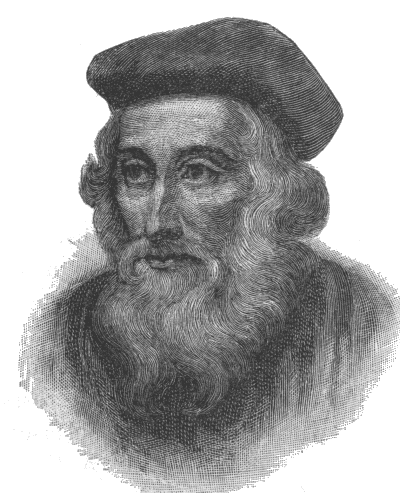
JOHN WYCLIF
As a suggestion of the language of that day, we quote a few familiar
sentences from the Sermon on the Mount, as given in the later version of
Wyclif's Gospel:
And he openyde his mouth, and taughte hem, and seide, Blessid ben pore men
in spirit, for the kyngdom of hevenes is herne.[91] Blessid ben mylde men, for thei
schulen welde[92]
the erthe. Blessid ben thei that mornen, for thei schulen be coumfortid.
Blessid ben thei that hungren and thristen rightwisnesse,[93] for thei schulen be
fulfillid. Blessid ben merciful men, for thei schulen gete merci. Blessid
ben thei that ben of clene herte, for thei schulen se God. Blessid ben
pesible men, for thei schulen be clepid[94] Goddis children. Blessid ben thei that suffren
persecusioun for rightfulnesse, for the kyngdom of hevenes is herne.[95] ...
Eftsoone ye han herd, that it was seid to elde men, Thou schalt not
forswere, but thou schalt yelde[96]
thin othis to the Lord. But Y seie[97] to you, that ye swere not for ony thing;... but
be youre worde, yhe, yhe; nay, nay; and that that is more than these, is
of yvel....
Ye han herd that it was seid, Thou schalt love thi neighbore, and hate
thin enemye. But Y seie to you, love ye youre enemyes, do ye wel to hem[98] that hatiden[99] you, and preye ye for
hem that pursuen[100]
and sclaundren[101]
you; that ye be the sones of youre Fadir that is in hevenes, that makith
his sunne to rise upon goode and yvele men, and reyneth[102] on just men and
unjuste.... Therefore be ye parfit, as youre hevenli Fadir is parfit.
JOHN MANDEVILLE
Mandeville's TravelsAbout the year 1356
there appeared in England an extraordinary book called the Voyage and
Travail of Sir John Maundeville, written in excellent style in the
Midland dialect, which was then becoming the literary language of England.
For years this interesting work and its unknown author were subjects of
endless dispute; but it is now fairly certain that this collection of
travelers' tales is simply a compilation from Odoric, Marco Polo, and
various other sources. The original work was probably in French, which was
speedily translated into Latin, then into English and other languages; and
wherever it appeared it became extremely popular, its marvelous stories of
foreign lands being exactly suited to the credulous spirit of the age.[103] At the present
time there are said to be three hundred copied manuscripts of "Mandeville"
in various languages,--more, probably, than of any other work save the
gospels. In the prologue of the English version the author calls himself
John Maundeville and gives an outline of his wide travels during thirty
years; but the name is probably a "blind," the prologue more or less
spurious, and the real compiler is still to be discovered.
The modern reader may spend an hour or two very pleasantly in this old
wonderland. On its literary side the book is remarkable, though a
translation, as being the first prose work in modern English having a
distinctly literary style and flavor. Otherwise it is a most interesting
commentary on the general culture and credulity of the fourteenth century.
Summary of the Age of Chaucer. The
fourteenth century is remarkable historically for the decline of feudalism
(organized by the Normans), for the growth of the English national spirit
during the wars with France, for the prominence of the House of Commons,
and for the growing power of the laboring classes, who had heretofore been
in a condition hardly above that of slavery.
The age produced five writers of note, one of whom, Geoffrey Chaucer, is
one of the greatest of English writers. His poetry is remarkable for its
variety, its story interest, and its wonderful melody. Chaucer's work and
Wyclif's translation of the Bible developed the Midland dialect into the
national language of England.
In our study we have noted: (1) Chaucer, his life and work; his early or
French period, in which he translated "The Romance of the Rose" and wrote
many minor poems; his middle or Italian period, of which the chief poems
are "Troilus and Cressida" and "The Legend of Good Women"; his late or
English period, in which he worked at his masterpiece, the famous Canterbury
Tales. (2) Langland, the poet and prophet of social reforms. His chief
work is Piers Plowman. (3) Wyclif, the religious reformer, who
first translated the gospels into English, and by his translation fixed a
common standard of English speech. (4) Mandeville, the alleged traveler,
who represents the new English interest in distant lands following the
development of foreign trade. He is famous for Mandeville's Travels,
a book which romances about the wonders to be seen abroad. The fifth
writer of the age is Gower, who wrote in three languages, French, Latin,
and English. His chief English work is the Confessio Amantis, a
long poem containing one hundred and twelve tales. Of these only the
"Knight Florent" and two or three others are interesting to a modern
reader.
Selections for Reading. Chaucer's Prologue, the Knight's Tale,
Nun's Priest's Tale, Prioress' Tale, Clerk's Tale. These are found, more
or less complete, in Standard English Classics, King's Classics, Riverside
Literature Series, etc. Skeat's school edition of the Prologue, Knight's
Tale, etc., is especially good, and includes a study of fourteenth-century
English. Miscellaneous poems of Chaucer in Manly's English Poetry or
Ward's English Poets. Piers Plowman, in King's Classics. Mandeville's
Travels, modernized, in English Classics, and in Cassell's National
Library.
For the advanced student, and as a study of language, compare selections
from Wyclif, Chaucer's prose work, Mandeville, etc., in Manly's English
Prose, or Morris and Skeat's Specimens of Early English, or Craik's
English Prose Selections. Selections from Wyclif's Bible in English
Classics Series.
Bibliography.[104]
History. Text-book, Montgomery, pp. 115-149, or Cheyney, pp.
186-263. For fuller treatment, Green, ch. 5; Traill; Gardiner.
Special Works. Hutton's King and Baronage (Oxford Manuals);
Jusserand's Wayfaring Life in the Fourteenth Century; Coulton's Chaucer
and his England; Pauli's Pictures from Old England; Wright's History of
Domestic Manners and Sentiments in England during the Middle Ages;
Trevelyan's England in the Age of Wyclif; Jenks's In the Days of Chaucer;
Froissart's Chronicle, in Everyman's Library; the same, new edition, 1895
(Macmillan); Lanier's Boys' Froissart (i.e. Froissart's Chronicle of
Historical Events, 1325-1400); Newbolt's Stories from Froissart;
Bulfinch's Age of Chivalry may be read in connection with this and the
preceding periods.
Literature. General Works. Jusserand; Ten Brink; Mitchell;
Minto's Characteristics of English Poets; Courthope's History of English
Poetry.
Chaucer, (1) Life: by Lounsbury, in Studies in Chaucer, vol. I; by
Ward, in English Men of Letters Series; Pollard's Chaucer Primer. (2) Aids
to study: F.J. Snell's The Age of Chaucer; Lounsbury's Studies in Chaucer
(3 vols.); Root's The Poetry of Chaucer; Lowell's Essay, in My Study
Windows; Hammond's Chaucer: a Biographical Manual; Hempl's Chaucer's
Pronunciation; Introductions to school editions of Chaucer, by Skeat,
Liddell, and Mather. (3) Texts and selections: The Oxford Chaucer, 6
vols., edited by Skeat, is the standard; Skeat's Student's Chaucer; The
Globe Chaucer (Macmillan); Works of Chaucer, edited by Lounsbury
(Crowell); Pollard's The Canterbury Tales, Eversley edition; Skeat's
Selections from Chaucer (Clarendon Press); Chaucer's Prologue, and various
tales, in Standard English Classics (Ginn and Company), and in other
school series.
Minor Writers. Morris and Skeat's Specimens of Early English Prose.
Jusserand's Piers Plowman; Skeat's Piers Plowman (text, glossary and
notes); Warren's Piers Plowman in Modern Prose. Arnold's Wyclif's Select
English Works; Sergeant's Wyclif (Heroes of the Nation Series); Le Bas's
Life of John Wyclif. Travels of Sir John Mandeville (modern spelling), in
Library of English Classics; Macaulay's Gower's English Works.
Suggestive Questions. 1. What are
the chief historical events of the fourteenth century? What social
movement is noticeable? What writers reflect political and social
conditions?
2. Tell briefly the story of Chaucer's life. What foreign influences are
noticeable? Name a few poems illustrating his three periods of work. What
qualities have you noticed in his poetry? Why is he called our first
national poet?
3. Give the plan of the Canterbury Tales. For what is the Prologue
remarkable? What light does it throw upon English life of the fourteenth
century? Quote or read some passages that have impressed you. Which
character do you like best? Are any of the characters like certain men and
women whom you know? What classes of society are introduced? Is Chaucer's
attitude sympathetic or merely critical?
4. Tell in your own words the tale you like best. Which tale seems truest
to life as you know it? Mention any other poets who tell stories in verse.
5. Quote or read passages which show Chaucer's keenness of observation,
his humor, his kindness in judgment, his delight in nature. What side of
human nature does he emphasize? Make a little comparison between Chaucer
and Shakespeare, having in mind (1) the characters described by both
poets, (2) their knowledge of human nature, (3) the sources of their
plots, (4) the interest of their works.
6. Describe briefly Piers Plowman and its author. Why is the poem
called "the gospel of the poor"? What message does it contain for daily
labor? Does it apply to any modern conditions? Note any resemblance in
ideas between Piers Plowman and such modern works as Carlyle's Past
and Present, Kingsley's Alton Locke, Morris's Dream of John
Ball, etc.
7. For what is Wyclif remarkable in literature? How did his work affect
our language? Note resemblances and differences between Wyclif and the
Puritans.
8. What is Mandeville's Travels? What light does it throw on the
mental condition of the age? What essential difference do you note between
this book and Gulliver's Travels?
|
CHRONOLOGY, FOURTEENTH CENTURY
|
|
HISTORY
|
LITERATURE
|
|
1327.
|
Edward III
|
|
1338.
|
Beginning of Hundred Years'
|
|
War with France
|
1340(?).
|
Birth of Chaucer
|
|
1347.
|
Capture of Calais
|
|
1348-1349.
|
Black Death
|
1356.
|
Mandeville's Travels
|
|
|
|
1359. Chaucer in French War
|
|
|
1360-1370.
|
|
|
|
Chaucer's early
|
|
|
|
or French period
|
|
1373.
|
Winchester College, first
|
|
great public school
|
1370-1385.
|
Chaucer's Middle or
|
|
|
|
Italian period
|
|
1377.
|
Richard II. Wyclif and the
|
|
Lollards begin Reformation
|
1362-1395.
|
Piers Plowman
|
|
in England
|
|
1381.
|
Peasant Rebellion. Wat Tyler
|
1385-1400.
|
Canterbury Tales
|
|
|
1382.
|
First complete Bible in
|
|
|
|
English
|
|
1399.
|
Deposition of Richard II.
|
1400.
|
Death of Chaucer
|
|
Henry IV chosen by Parliament
|
|
(Dante's Divina Commedia,
|
|
|
|
c. 1310;
|
Petrarch's
|
|
|
|
sonnets and poems, 1325-1374;
|
|
|
|
Boccaccio's tales, c.
|
|
|
|
1350.)
|
I. HISTORY OF THE PERIOD
Political Changes. The century and
a half following the death of Chaucer (1400-1550) is the most volcanic
period of English history. The land is swept by vast changes, inseparable
from the rapid accumulation of national power; but since power is the most
dangerous of gifts until men have learned to control it, these changes
seem at first to have no specific aim or direction. Henry V--whose erratic
yet vigorous life, as depicted by Shakespeare, was typical of the life of
his times--first let Europe feel the might of the new national spirit. To
divert that growing and unruly spirit from rebellion at home, Henry led
his army abroad, in the apparently impossible attempt to gain for himself
three things: a French wife, a French revenue, and the French crown
itself. The battle of Agincourt was fought in 1415, and five years later,
by the Treaty of Troyes, France acknowledged his right to all his
outrageous demands.
The uselessness of the terrific struggle on French soil is shown by the
rapidity with which all its results were swept away. When Henry died in
1422, leaving his son heir to the crowns of France and England, a
magnificent recumbent statue with head of pure silver was placed in
Westminster Abbey to commemorate his victories. The silver head was
presently stolen, and the loss is typical of all that he had struggled
for. His son, Henry VI, was but the shadow of a king, a puppet in the
hands of powerful nobles, who seized the power of England and turned it to
self-destruction. Meanwhile all his foreign possessions were won back by
the French under the magic leadership of Joan of Arc. Cade's Rebellion
(1450) and the bloody Wars of the Roses (1455-1485) are names to show how
the energy of England was violently destroying itself, like a great engine
that has lost its balance wheel. The frightful reign of Richard III
followed, which had, however, this redeeming quality, that it marked the
end of civil wars and the self-destruction of feudalism, and made possible
a new growth of English national sentiment under the popular Tudors.
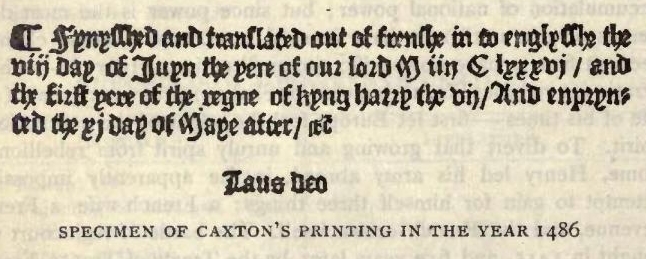
In the long reign of Henry VIII the changes are less violent, but have
more purpose and significance. His age is marked by a steady increase in
the national power at home and abroad, by the entrance of the Reformation
"by a side door," and by the final separation of England from all
ecclesiastical bondage in Parliament's famous Act of Supremacy. In
previous reigns chivalry and the old feudal system had practically been
banished; now monasticism, the third mediæval institution with its
mixed evil and good, received its death-blow in the wholesale suppression
of the monasteries and the removal of abbots from the House of Lords.
Notwithstanding the evil character of the king and the hypocrisy of
proclaiming such a creature the head of any church or the defender of any
faith, we acquiesce silently in Stubb's declaration[105] that "the world owes some of its
greatest debts to men from whose memory the world recoils."
While England during this period was in constant political strife, yet
rising slowly, like the spiral flight of an eagle, to heights of national
greatness, intellectually it moved forward with bewildering rapidity.
Printing was brought to England by Caxton (c. 1476), and for the
first time in history it was possible for a book or an idea to reach the
whole nation. Schools and universities were established in place of the
old monasteries; Greek ideas and Greek culture came to England in the
Renaissance, and man's spiritual freedom was proclaimed in the
Reformation. The great names of the period are numerous and significant,
but literature is strangely silent. Probably the very turmoil of the age
prevented any literary development, for literature is one of the arts of
peace; it requires quiet and meditation rather than activity, and the
stirring life of the Renaissance had first to be lived before it could
express itself in the new literature of the Elizabethan period.
The Revival of Learning. The Revival of Learning denotes, in its
broadest sense, that gradual enlightenment of the human mind after the
darkness of the Middle Ages. The names Renaissance and Humanism, which are
often applied to the same movement, have properly a narrower significance.
The term Renaissance, though used by many writers "to denote the whole
transition from the Middle Ages to the modern world,"[106] is more correctly applied to the
revival of art resulting from the discovery and imitation of classic
models in the fourteenth and fifteenth centuries. Humanism applies to the
revival of classic literature, and was so called by its leaders, following
the example of Petrarch, because they held that the study of the classics,
literae humaniores,--i.e. the "more human writings," rather than
the old theology,--was the best means of promoting the largest human
interests. We use the term Revival of Learning to cover the whole
movement, whose essence was, according to Lamartine, that "man discovered
himself and the universe," and, according to Taine, that man, so long
blinded, "had suddenly opened his eyes and seen."
The WorldWe shall understand this better
if we remember that in the Middle Ages man's whole world consisted of the
narrow Mediterranean and the nations that clustered about it; and that
this little world seemed bounded by impassable barriers, as if God had
said to their sailors, "Hitherto shalt thou come, but no farther." Man's
mind also was bounded by the same narrow lines. His culture as measured by
the great deductive system of Scholasticism consisted not in discovery,
but rather in accepting certain principles and traditions established by
divine and ecclesiastical authority as the basis of all truth. These were
his Pillars of Hercules, his mental and spiritual bounds that he must not
pass, and within these, like a child playing with lettered blocks, he
proceeded to build his intellectual system. Only as we remember their
limitations can we appreciate the heroism of these toilers of the Middle
Ages, giants in intellect, yet playing with children's toys; ignorant of
the laws and forces of the universe, while debating the essence and
locomotion of angels; eager to learn, yet forbidden to enter fresh fields
in the right of free exploration and the joy of individual discovery.
The Revival stirred these men as the voyages of Da Gama and Columbus
stirred the mariners of the Mediterranean. First came the sciences and
inventions of the Arabs, making their way slowly against the prejudice of
the authorities, and opening men's eyes to the unexplored realms of
nature. Then came the flood of Greek literature which the new art of
printing carried swiftly to every school in Europe, revealing a new world
of poetry and philosophy. Scholars flocked to the universities, as
adventurers to the new world of America, and there the old authority
received a deathblow. Truth only was authority; to search for truth
everywhere, as men sought for new lands and gold and the fountain of
youth,--that was the new spirit which awoke in Europe with the Revival of
Learning.
II. LITERATURE OF THE REVIVAL
The hundred and fifty years of the Revival period are singularly destitute
of good literature. Men's minds were too much occupied with religious and
political changes and with the rapid enlargement of the mental horizon to
find time for that peace and leisure which are essential for literary
results. Perhaps, also, the floods of newly discovered classics, which
occupied scholars and the new printing presses alike, were by their very
power and abundance a discouragement of native talent. Roger Ascham
(1515-1568), a famous classical scholar, who published a book called Toxophilus
(School of Shooting) in 1545, expresses in his preface, or "apology," a
very widespread dissatisfaction over the neglect of native literature when
he says, "And as for ye Latin or greke tongue, every thing is so
excellently done in them, that none can do better: In the Englysh tonge
contrary, every thinge in a maner so meanly, both for the matter and
handelynge, that no man can do worse."
On the Continent, also, this new interest in the classics served to check
the growth of native literatures. In Italy especially, for a full century
after the brilliant age of Dante and Petrarch, no great literature was
produced, and the Italian language itself seemed to go backward.[107] The truth is that
these great writers were, like Chaucer, far in advance of their age, and
that the mediæval mind was too narrow, too scantily furnished with
ideas to produce a varied literature. The fifteenth century was an age of
preparation, of learning the beginnings of science, and of getting
acquainted with the great ideals,--the stern law, the profound philosophy,
the suggestive mythology, and the noble poetry of the Greeks and Romans.
So the mind was furnished with ideas for a new literature.
With the exception of Malory's Morte d'Arthur (which is still mediæval
in spirit) the student will find little of interest in the literature of
this period. We give here a brief summary of the men and the books most
"worthy of remembrance"; but for the real literature of the Renaissance
one must go forward a century and a half to the age of Elizabeth.
Praise of FollyThe two greatest books
which appeared in England during this period are undoubtedly Erasmus's[108] Praise of Folly
(Encomium Moriae) and More's Utopia, the famous "Kingdom of
Nowhere." Both were written in Latin, but were speedily translated into
all European languages. The Praise of Folly is like a song of
victory for the New Learning, which had driven away vice, ignorance, and
superstition, the three foes of humanity. It was published in 1511 after
the accession of Henry VIII. Folly is represented as donning cap and bells
and mounting a pulpit, where the vice and cruelty of kings, the
selfishness and ignorance of the clergy, and the foolish standards of
education are satirized without mercy.
UtopiaMore's Utopia, published in
1516, is a powerful and original study of social conditions, unlike
anything which had ever appeared in any literature.[109] In our own day we have seen its
influence in Bellamy's Looking Backward, an enormously successful
book, which recently set people to thinking of the unnecessary cruelty of
modern social conditions. More learns from a sailor, one of Amerigo
Vespucci's companions, of a wonderful Kingdom of Nowhere, in which all
questions of labor, government, society, and religion have been easily
settled by simple justice and common sense. In this Utopia we find
for the first time, as the foundations of civilized society, the three
great words, Liberty, Fraternity, Equality, which retained their
inspiration through all the violence of the French Revolution and which
are still the unrealized ideal of every free government. As he hears of
this wonderful country More wonders why, after fifteen centuries of
Christianity, his own land is so little civilized; and as we read the book
to-day we ask ourselves the same question. The splendid dream is still far
from being realized; yet it seems as if any nation could become Utopia in
a single generation, so simple and just are the requirements.
Tyndale's New TestamentGreater than either
of these books, in its influence upon the common people, is Tyndale's
translation of the New Testament (1525), which fixed a standard of good
English, and at the same time brought that standard not only to scholars
but to the homes of the common people. Tyndale made his translation from
the original Greek, and later translated parts of the Old Testament from
the Hebrew. Much of Tyndale's work was included in Cranmer's Bible, known
also as the Great Bible, in 1539, and was read in every parish church in
England. It was the foundation for the Authorized Version, which appeared
nearly a century later and became the standard for the whole
English-speaking race.
Wyatt and Surrey. In 1557 appeared
probably the first printed collection of miscellaneous English poems,
known as Tottel's Miscellany. It contained the work of the
so-called courtly makers, or poets, which had hitherto circulated in
manuscript form for the benefit of the court. About half of these poems
were the work of Sir Thomas Wyatt (1503?-1542) and of Henry Howard, Earl
of Surrey (1517?-1547). Both together wrote amorous sonnets modeled after
the Italians, introducing a new verse form which, although very difficult,
has been a favorite ever since with our English poets.[110] Surrey is noted, not for any
especial worth or originality of his own poems, but rather for his
translation of two books of Virgil "in strange meter." The strange meter
was the blank verse, which had never before appeared in English. The chief
literary work of these two men, therefore, is to introduce the sonnet and
the blank verse,--one the most dainty, the other the most flexible and
characteristic form of English poetry,--which in the hands of Shakespeare
and Milton were used to make the world's masterpieces.
Malory's Morte d'Arthur. The
greatest English work of this period, measured by its effect on subsequent
literature, is undoubtedly the Morte d'Arthur, a collection of the
Arthurian romances told in simple and vivid prose. Of Sir Thomas Malory,
the author, Caxton[111]
in his introduction says that he was a knight, and completed his work in
1470, fifteen years before Caxton printed it. The record adds that "he was
the servant of Jesu both by day and night." Beyond that we know little[112] except what may be
inferred from the splendid work itself.
Malory groups the legends about the central idea of the search for the
Holy Grail. Though many of the stories, like Tristram and Isolde, are
purely pagan, Malory treats them all in such a way as to preserve the
whole spirit of mediæval Christianity as it has been preserved in no
other work. It was to Malory rather than to Layamon or to the early French
writers that Shakespeare and his contemporaries turned for their material;
and in our own age he has supplied Tennyson and Matthew Arnold and
Swinburne and Morris with the inspiration for the "Idylls of the King" and
the "Death of Tristram" and the other exquisite poems which center about
Arthur and the knights of his Round Table.
In subject-matter the book belongs to the mediæval age; but Malory
himself, with his desire to preserve the literary monuments of the past,
belongs to the Renaissance; and he deserves our lasting gratitude for
attempting to preserve the legends and poetry of Britain at a time when
scholars were chiefly busy with the classics of Greece and Rome. As the
Arthurian legends are one of the great recurring motives of English
literature, Malory's work should be better known. His stories may be and
should be told to every child as part of his literary inheritance. Then
Malory may be read for his style and his English prose and his expression
of the mediæval spirit. And then the stories may be read again, in
Tennyson's "Idylls," to show how those exquisite old fancies appeal to the
minds of our modern poets.
Summary of the Revival of Learning Period.
This transition period is at first one of decline from the Age of Chaucer,
and then of intellectual preparation for the Age of Elizabeth. For a
century and a half after Chaucer not a single great English work appeared,
and the general standard of literature was very low. There are three chief
causes to account for this: (1) the long war with France and the civil
Wars of the Roses distracted attention from books and poetry, and
destroyed of ruined many noble English families who had been friends and
patrons of literature; (2) the Reformation in the latter part of the
period filled men's minds with religious questions; (3) the Revival of
Learning set scholars and literary men to an eager study of the classics,
rather than to the creation of native literature. Historically the age is
noticeable for its intellectual progress, for the introduction of
printing, for the discovery of America, for the beginning of the
Reformation, and for the growth of political power among the common
people.
In our study we have noted: (1) the Revival of Learning, what it was, and
the significance of the terms Humanism and Renaissance; (2) three
influential literary works,--Erasmus's Praise of Folly, More's Utopia,
and Tyndale's translation of the New Testament; (3) Wyatt and Surrey, and
the so-called courtly makers or poets; (4) Malory's Morte d'Arthur,
a collection of the Arthurian legends in English prose. The Miracle and
Mystery Plays were the most popular form of entertainment in this age; but
we have reserved them for special study in connection with the Rise of the
Drama, in the following chapter.
Selections for Reading. Malory's Morte d'Arthur, selections, in
Athenaeum Press Series, etc. (It is interesting to read Tennyson's Passing
of Arthur in connection with Malory's account.) Utopia, in Arber's
Reprints, Temple Classics, King's Classics, etc. Selections from Wyatt,
Surrey, etc., in Manly's English Poetry or Ward's English Poets; Tottel's
Miscellany, in Arber's Reprints. Morris and Skeat's Specimens of Early
English, vol. 3, has good selections from this period.
Bibliography.[113]
History. Text-book, Montgomery, pp. 150-208, or Cheyney, pp.
264-328. Greene, ch. 6; Traill; Gardiner; Froude; etc.
Special Works. Denton's England in the Fifteenth Century; Flower's
The Century of Sir Thomas More; The Household of Sir Thomas More, in
King's Classics; Green's Town Life in the Fifteenth Century; Field's
Introduction to the Study of the Renaissance; Einstein's The Italian
Renaissance in England; Seebohm's The Oxford Reformers (Erasmus, More,
etc.).
Literature. General Works. Jusserand; Ten Brink; Minto's
Characteristics of English Poets.
Special Works. Saintsbury's Elizabethan Literature; Malory's Morte
d'Arthur, edited by Sommer; the same by Gollancz (Temple Classics);
Lanier's The Boy's King Arthur; More's Utopia, in Temple Classics, King's
Classics, etc.; Roper's Life of Sir Thomas More, in King's Classics,
Temple Classics, etc.; Ascham's Schoolmaster, in Arber's English Reprints;
Poems of Wyatt and Surrey, in English Reprints and Bell's Aldine Poets;
Simonds's Sir Thomas Wyatt and His Poems; Allen's Selections from Erasmus;
Jusserand's Romance of a King's Life (James I of Scotland) contains
extracts and an admirable criticism of the King's Quair.
Suggestive Questions. 1. The
fifteenth century in English literature is sometimes called "the age of
arrest." Can you explain why? What causes account for the lack of great
literature in this period? Why should the ruin of noble families at this
time seriously affect our literature? Can you recall anything from the
Anglo-Saxon period to justify your opinion?
2. What is meant by Humanism? What was the first effect of the study of
Greek and Latin classics upon our literature? What excellent literary
purposes did the classics serve in later periods?
3. What are the chief benefits to literature of the discovery of printing?
What effect on civilization has the multiplication of books?
4. Describe More's Utopia. Do you know any modern books like it?
Why should any impractical scheme of progress be still called Utopian?
5. What work of this period had the greatest effect on the English
language? Explain why.
6. What was the chief literary influence exerted by Wyatt and Surrey? Do
you know any later poets who made use of the verse forms which they
introduced?
7. Which of Malory's stories do you like best? Where did these stories
originate? Have they any historical foundation? What two great elements
did Malory combine in his work? What is the importance of his book to
later English literature? Compare Tennyson's "Idylls of the King" and
Malory's stories with regard to material, expression, and interest. Note
the marked resemblances and differences between the Morte d'Arthur
and the Nibelungen Lied.
|
CHRONOLOGY
|
|
HISTORY
|
LITERATURE
|
|
1413.
|
Henry V
|
|
1415.
|
Battle of Agincourt
|
|
1422.
|
Henry VI
|
1470.
|
Malory's Morte d' Arthur
|
|
1428.
|
Siege of Orleans. Joan of Arc
|
1474(c).
|
Caxton, at Bruges,
|
|
1453.
|
End of Hundred Year's War
|
|
prints the first book in
|
|
1455-1485.
|
War of Roses
|
|
English, the Recuyell of the
|
|
1461.
|
Edward IV
|
|
Histories of Troye
|
|
1483.
|
Richard III
|
1477.
|
First book printed in
|
|
|
|
England
|
|
1485.
|
Henry VII
|
1485.
|
Morte d'Arthur printed
|
|
|
|
by Caxton
|
|
1492.
|
Columbus discovers America
|
1499.
|
Colet, Erasmus, and More
|
|
1509.
|
Henry VIII
|
|
bring the New Learning to
|
|
|
|
Oxford
|
|
|
1509.
|
Erasmus's Praise of
|
|
|
|
Folly
|
|
|
1516.
|
More's Utopia
|
|
|
1525.
|
Tydale's New Testament
|
|
1534.
|
Act of Supremacy. The
|
1530(c).
|
Introduction of the
|
|
Reformation accomplished
|
|
sonnet and blank verse by
|
|
|
|
Wyatt and Surrey
|
|
|
1539.
|
The Great Bible
|
|
1547.
|
Edward VI
|
|
1553.
|
Mary
|
1557.
|
Tottel's Miscellany
|
|
1558.
|
Elizabeth
|
I. HISTORY OF THE PERIOD
Political Summary. In the Age of
Elizabeth all doubt seems to vanish from English history. After the reigns
of Edward and Mary, with defeat and humiliation abroad and persecutions
and rebellion at home, the accession of a popular sovereign was like the
sunrise after a long night, and, in Milton's words, we suddenly see
England, "a noble and puissant nation, rousing herself, like a strong man
after sleep, and shaking her invincible locks." With the queen's
character, a strange mingling of frivolity and strength which reminds one
of that iron image with feet of clay, we have nothing whatever to do. It
is the national life that concerns the literary student, since even a
beginner must notice that any great development of the national life is
invariably associated with a development of the national literature. It is
enough for our purpose, therefore, to point out two facts: that Elizabeth,
with all her vanity and inconsistency, steadily loved England and
England's greatness; and that she inspired all her people with the
unbounded patriotism which exults in Shakespeare, and with the personal
devotion which finds a voice in the Faery Queen. Under her
administration the English national life progressed by gigantic leaps
rather than by slow historical process, and English literature reached the
very highest point of its development. It is possible to indicate only a
few general characteristics of this great age which had a direct bearing
upon its literature.
Religious TolerationCharacteristics of the Elizabethan Age. The most
characteristic feature of the age was the comparative religious tolerance,
which was due largely to the queen's influence. The frightful excesses of
the religious war known as the Thirty Years' War on the Continent found no
parallel in England. Upon her accession Elizabeth found the whole kingdom
divided against itself; the North was largely Catholic, while the southern
counties were as strongly Protestant. Scotland had followed the
Reformation in its own intense way, while Ireland remained true to its old
religious traditions, and both countries were openly rebellious. The
court, made up of both parties, witnessed the rival intrigues of those who
sought to gain the royal favor. It was due partly to the intense
absorption of men's minds in religious questions that the preceding
century, though an age of advancing learning, produced scarcely any
literature worthy of the name. Elizabeth favored both religious parties,
and presently the world saw with amazement Catholics and Protestants
acting together as trusted counselors of a great sovereign. The defeat of
the Spanish Armada established the Reformation as a fact in England, and
at the same time united all Englishmen in a magnificent national
enthusiasm. For the first time since the Reformation began, the
fundamental question of religious toleration seemed to be settled, and the
mind of man, freed from religious fears and persecutions, turned with a
great creative impulse to other forms of activity. It is partly from this
new freedom of the mind that the Age of Elizabeth received its great
literary stimulus.
Social contentment2. It was an age of
comparative social contentment, in strong contrast with the days of
Langland. The rapid increase of manufacturing towns gave employment to
thousands who had before been idle and discontented. Increasing trade
brought enormous wealth to England, and this wealth was shared to this
extent, at least, that for the first time some systematic care for the
needy was attempted. Parishes were made responsible for their own poor,
and the wealthy were taxed to support them or give them employment. The
increase of wealth, the improvement in living, the opportunities for
labor, the new social content--these also are factors which help to
account for the new literary activity.
Enthusiasm3. It is an age of dreams, of
adventure, of unbounded enthusiasm springing from the new lands of
fabulous riches revealed by English explorers. Drake sails around the
world, shaping the mighty course which English colonizers shall follow
through the centuries; and presently the young philosopher Bacon is saying
confidently, "I have taken all knowledge for my province." The mind must
search farther than the eye; with new, rich lands opened to the sight, the
imagination must create new forms to people the new worlds. Hakluyt's
famous Collection of Voyages, and Purchas, His Pilgrimage,
were even more stimulating to the English imagination than to the English
acquisitiveness. While her explorers search the new world for the Fountain
of Youth, her poets are creating literary works that are young forever.
Marston writes:[114]
"Why, man, all their dripping pans are pure gold. The prisoners they take
are fettered in gold; and as for rubies and diamonds, they goe forth on
holydayes and gather 'hem by the seashore to hang on their children's
coates." This comes nearer to being a description of Shakespeare's poetry
than of the Indians in Virginia. Prospero, in The Tempest, with his
control over the mighty powers and harmonies of nature, is only the
literary dream of that science which had just begun to grapple with the
forces of the universe. Cabot, Drake, Frobisher, Gilbert, Raleigh,
Willoughby, Hawkins,--a score of explorers reveal a new earth to men's
eyes, and instantly literature creates a new heaven to match it. So dreams
and deeds increase side by side, and the dream is ever greater than the
deed. That is the meaning of literature.
The Drama4. To sum up, the Age of
Elizabeth was a time of intellectual liberty, of growing intelligence and
comfort among all classes, of unbounded patriotism, and of peace at home
and abroad. For a parallel we must go back to the Age of Pericles in
Athens, or of Augustus in Rome, or go forward a little to the magnificent
court of Louis XIV, when Corneille, Racine, and Molière brought the
drama in France to the point where Marlowe, Shakespeare, and Jonson had
left it in England half a century earlier. Such an age of great thought
and great action, appealing to the eyes as well as to the imagination and
intellect, finds but one adequate literary expression; neither poetry nor
the story can express the whole man,--his thought, feeling, action, and
the resulting character; hence in the Age of Elizabeth literature turned
instinctively to the drama and brought it rapidly to the highest stage of
its development.
II. THE NON-DRAMATIC POETS OF THE ELIZABETHAN
AGE
EDMUND SPENSER (1552-1599)
(Cuddie)
"Piers,
I have pipéd erst so long with pain
That
all mine oaten reeds been rent and wore,
And
my poor Muse hath spent her sparéd store,
Yet
little good hath got, and much less gain.
Such
pleasaunce makes the grasshopper so poor,
And
ligge so layd[115]
when winter doth her strain.
The
dapper ditties that I wont devise,
To
feed youth's fancy, and the flocking fry
Delghten
much--what I the bet forthy?
They
han the pleasure, I a slender prize:
I
beat the bush, the birds to them do fly:
What
good thereof to Cuddie can arise?
(Piers)
Cuddie,
the praise is better than the price,
The
glory eke much greater than the gain:..."
Shepherd's
Calendar, October
In these words, with their sorrowful suggestion of Deor, Spenser reveals
his own heart, unconsciously perhaps, as no biographer could possibly do.
His life and work seem to center about three great influences, summed up
in three names: Cambridge, where he grew acquainted with the classics and
the Italian poets; London, where he experienced the glamour and the
disappointment of court life; and Ireland, which steeped him in the beauty
and imagery of old Celtic poetry and first gave him leisure to write his
masterpiece.
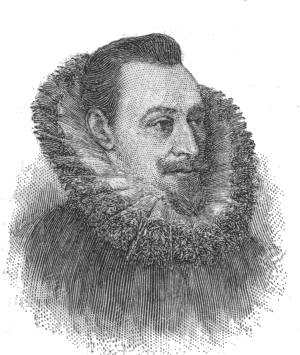
EDMUND SPENSER
Life. Of Spenser's early life and parentage we know little, except
that he was born in East Smithfield, near the Tower of London, and was
poor. His education began at the Merchant Tailors' School in London and
was continued in Cambridge, where as a poor sizar and fag for wealthy
students he earned a scant living. Here in the glorious world that only a
poor scholar knows how to create for himself he read the classics, made
acquaintance with the great Italian poets, and wrote numberless little
poems of his own. Though Chaucer was his beloved master, his ambition was
not to rival the Canterbury Tales, but rather to express the dream
of English chivalry, much as Ariosto had done for Italy in Orlando
Furioso.
After leaving Cambridge (1576) Spenser went to the north of England, on
some unknown work or quest. Here his chief occupation was to fall in love
and to record his melancholy over the lost Rosalind in the Shepherd's
Calendar. Upon his friend Harvey's advice he came to London, bringing
his poems; and here he met Leicester, then at the height of royal favor,
and the latter took him to live at Leicester House. Here he finished the
Shepherd's Calendar, and here he met Sidney and all the queen's
favorites. The court was full of intrigues, lying and flattery, and
Spenser's opinion of his own uncomfortable position is best expressed in a
few lines from "Mother Hubbard's Tale":
Full little knowest thou, that has not tried,
What hell it is, in
suing long to bide:
To lose good days, that might be better spent;
To waste long nights in pensive discontent;
To fret thy soul with crosses and with cares;
To eat thy heart
through comfortless despairs;
To fawn, to crouch, to wait, to ride,
to run,
To spend, to give, to want, to be undone.
In 1580, through Leicester's influence, Spenser, who was utterly weary of
his dependent position, was made secretary to Lord Grey, the queen's
deputy in Ireland, and the third period of his life began. He accompanied
his chief through one campaign of savage brutality in putting down an
Irish rebellion, and was given an immense estate with the castle of
Kilcolman, in Munster, which had been confiscated from Earl Desmond, one
of the Irish leaders. His life here, where according to the terms of his
grant he must reside as an English settler, he regarded as lonely exile:
My luckless lot,
That banished had myself, like wight forlore,
Into that waste, where I was quite forgot.
It is interesting to note here a gentle poet's view of the "unhappy
island." After nearly sixteen years' residence he wrote his View of the
State of Ireland (1596),[116]
his only prose work, in which he submits a plan for "pacifying the
oppressed and rebellious people." This was to bring a huge force of
cavalry and infantry into the country, give the Irish a brief time to
submit, and after that to hunt them down like wild beasts. He calculated
that cold, famine, and sickness would help the work of the sword, and that
after the rebels had been well hounded for two winters the following
summer would find the country peaceful. This plan, from the poet of
harmony and beauty, was somewhat milder than the usual treatment of a
brave people whose offense was that they loved liberty and religion.
Strange as it may seem, the View was considered most statesmanlike,
and was excellently well received in England.
In Kilcolman, surrounded by great natural beauty, Spenser finished the
first three books of the Faery Queen. In 1589 Raleigh visited him,
heard the poem with enthusiasm, hurried the poet off to London, and
presented him to Elizabeth. The first three books met with instant success
when published and were acclaimed as the greatest work in the English
language. A yearly pension of fifty pounds was conferred by Elizabeth, but
rarely paid, and the poet turned back to exile, that is, to Ireland again.
Soon after his return, Spenser fell in love with his beautiful Elizabeth,
an Irish girl; wrote his Amoretti, or sonnets, in her honor; and
afterwards represented her, in the Faery Queen, as the beautiful
woman dancing among the Graces. In 1594 he married Elizabeth, celebrating
his wedding with his "Epithalamion," one of the most beautiful wedding
hymns in any language.
Spenser's next visit to London was in 1595, when he published "Astrophel,"
an elegy on the death of his friend Sidney, and three more books of the Faery
Queen. On this visit he lived again at Leicester House, now occupied
by the new favorite Essex, where he probably met Shakespeare and the other
literary lights of the Elizabethan Age. Soon after his return to Ireland,
Spenser was appointed Sheriff of Cork, a queer office for a poet, which
probably brought about his undoing. The same year Tyrone's Rebellion broke
out in Munster. Kilcolman, the ancient house of Desmond, was one of the
first places attacked by the rebels, and Spenser barely escaped with his
wife and two children. It is supposed that some unfinished parts of the Faery
Queen were burned in the castle.
From the shock of this frightful experience Spenser never recovered. He
returned to England heartbroken, and in the following year (1599) he died
in an inn at Westminster. According to Ben Jonson he died "for want of
bread"; but whether that is a poetic way of saying that he had lost his
property or that he actually died of destitution, will probably never be
known. He was buried beside his master Chaucer in Westminster Abbey, the
poets of that age thronging to his funeral and, according to Camden,
"casting their elegies and the pens that had written them into his tomb."
Spenser's Works. The Faery Queen is the great work upon
which the poet's fame chiefly rests. The original plan of the poem
included twenty-four books, each of which was to recount the adventure and
triumph of a knight who represented a moral virtue. Spenser's purpose, as
indicated in a letter to Raleigh which introduces the poem, is as follows:
To pourtraict in Arthure, before he was king, the image of a brave Knight,
perfected in the twelve private Morall Vertues, as Aristotle hath devised;
which is the purpose of these first twelve bookes: which if I finde to be
well accepted, I may be perhaps encoraged to frame the other part of
Polliticke Vertues in his person, after that hee came to be king.
Each of the Virtues appears as a knight, fighting his opposing Vice, and
the poem tells the story of the conflicts. It is therefore purely
allegorical, not only in its personified virtues but also in its
representation of life as a struggle between good and evil. In its strong
moral element the poem differs radically from Orlando Furioso, upon
which it was modeled. Spenser completed only six books, celebrating
Holiness, Temperance, Chastity, Friendship, Justice, and Courtesy. We have
also a fragment of the seventh, treating of Constancy; but the rest of
this book was not written, or else was lost in the fire at Kilcolman. The
first three books are by far the best; and judging by the way the interest
lags and the allegory grows incomprehensible, it is perhaps as well for
Spenser's reputation that the other eighteen books remained a dream.
Argument of the Faery Queen. From the introductory letter we learn
that the hero visits the queen's court in Fairy Land, while she is holding
a twelve-days festival. On each day some distressed person appears
unexpectedly, tells a woful story of dragons, of enchantresses, or of
distressed beauty or virtue, and asks for a champion to right the wrong
and to let the oppressed go free. Sometimes a knight volunteers or begs
for the dangerous mission; again the duty is assigned by the queen; and
the journeys and adventures of these knights are the subjects of the
several books. The first recounts the adventures of the Redcross Knight,
representing Holiness, and the lady Una, representing Religion. Their
contests are symbolical of the world-wide struggle between virtue and
faith on the one hand, and sin and heresy on the other. The second book
tells the story of Sir Guyon, or Temperance; the third, of Britomartis,
representing Chastity; the fourth, fifth, and sixth, of Cambel and
Triamond (Friendship), Artegall (Justice), and Sir Calidore (Courtesy).
Spenser's plan was a very elastic one and he filled up the measure of his
narrative with everything that caught his fancy,--historical events and
personages under allegorical masks, beautiful ladies, chivalrous knights,
giants, monsters, dragons, sirens, enchanters, and adventures enough to
stock a library of fiction. If you read Homer or Virgil, you know his
subject in the first strong line; if you read Cædmon's Paraphrase
or Milton's epic, the introduction gives you the theme; but Spenser's
great poem--with the exception of a single line in the prologue, "Fierce
warres and faithfull loves shall moralize my song"--gives hardly a hint of
what is coming.
As to the meaning of the allegorical figures, one is generally in doubt.
In the first three books the shadowy Faery Queen sometimes represents the
glory of God and sometimes Elizabeth, who was naturally flattered by the
parallel. Britomartis is also Elizabeth. The Redcross Knight is Sidney,
the model Englishman. Arthur, who always appears to rescue the oppressed,
is Leicester, which is another outrageous flattery. Una is sometimes
religion and sometimes the Protestant Church; while Duessa represents Mary
Queen of Scots, or general Catholicism. In the last three books Elizabeth
appears again as Mercilla; Henry IV of France as Bourbon; the war in the
Netherlands as the story of Lady Belge; Raleigh as Timias; the earls of
Northumberland and Westmoreland (lovers of Mary or Duessa) as Blandamour
and Paridell; and so on through the wide range of contemporary characters
and events, till the allegory becomes as difficult to follow as the second
part of Goethe's Faust.
Poetical Form. For the Faery Queen Spenser invented a new
verse form, which has been called since his day the Spenserian stanza.
Because of its rare beauty it has been much used by nearly all our poets
in their best work. The new stanza was an improved form of Ariosto's ottava
rima (i.e. eight-line stanza) and bears a close resemblance to one of
Chaucer's most musical verse forms in the "Monk's Tale." Spenser's stanza
is in nine lines, eight of five feet each and the last of six feet, riming
ababbcbcc. A few selections from the first book, which is best
worth reading, are reproduced here to show the style and melody of the
verse.
A Gentle Knight was pricking on the plaine,
Ycladd[117] in mightie armes and silver shielde,
Wherein old dints of deepe woundes did remaine
The cruell markes of many a bloody fielde;
Yet armes till that time did he never wield:
His angry steede did chide his foming bitt,
As much disdayning to the curbe to yield:
Full iolly[118] knight he seemd, and faire did sitt,
As
one for knightly giusts[119]
and fierce encounters fitt.
And on his
brest a bloodie crosse he bore,
The deare
remembrance of his dying Lord,
For whose
sweete sake that glorious badge he wore,
And
dead, as living ever, him ador'd:
Upon his
shield the like was also scor'd,
For
soveraine hope, which in his helpe he had,
Right
faithfull true he was in deede and word;
But
of his cheere[120]
did seeme too solemne sad;
Yet nothing did he dread, but ever was
ydrad.[121]
This sleepy bit, from the dwelling of Morpheus, invites us to linger:
And, more to lulle him in his slumber soft,
A trickling streame from high rock tumbling
downe,
And ever-drizling raine upon the
loft,
Mixt with a murmuring winde, much
like the sowne
Of swarming bees, did cast
him in a swowne.
No other noyse, nor
peoples troublous cryes,
As still are wont
t'annoy the walled towne,
Might there be
heard: but carelesse Quiet lyes,
Wrapt in
eternal silence farre from enimyes.
The description of Una shows the poet's sense of ideal beauty:
One day, nigh wearie of the yrkesome way,
From her unhastie beast she did alight;
And on the grasse her dainty limbs did lay
In secrete shadow, far from all mens sight;
From her fayre head her fillet she undight,[122]
And
layd her stole aside; Her angels face,
As
the great eye of heaven, shynéd bright,
And
made a sunshine in the shady place;
Did never mortall eye behold
such heavenly grace.
It fortunéd,
out of the thickest wood
A ramping lyon
rushéd suddeinly,
Hunting full
greedy after salvage blood:
Soone as the
royall Virgin he did spy,
With gaping mouth
at her ran greedily,
To have at once
devourd her tender corse:
But to the pray
whenas he drew more ny,
His bloody rage
aswaged with remorse,[123]
And, with the sight amazd, forgat his furious forse.
Instead
thereof he kist her wearie feet,
And lickt
her lilly hands with fawning tong;
As he
her wrongéd innocence did weet.[124]
O how can
beautie maister the most strong,
And simple
truth subdue avenging wrong!
Minor Poems. Next to his masterpiece, the Shepherd's Calendar
(1579) is the best known of Spenser's poems; though, as his first work, it
is below many others in melody. It consists of twelve pastoral poems, or
eclogues, one for each month of the year. The themes are generally rural
life, nature, love in the fields; and the speakers are shepherds and
shepherdesses. To increase the rustic effect Spenser uses strange forms of
speech and obsolete words, to such an extent that Jonson complained his
works are not English or any other language. Some are melancholy poems on
his lost Rosalind; some are satires on the clergy; one, "The Briar and the
Oak," is an allegory; one flatters Elizabeth, and others are pure fables
touched with the Puritan spirit. They are written in various styles and
meters, and show plainly that Spenser was practicing and preparing himself
for greater work.
Other noteworthy poems are "Mother Hubbard's Tale," a satire on society;
"Astrophel," an elegy on the death of Sidney; Amoretti, or sonnets,
to his Elizabeth; the marriage hymn, "Epithalamion," and four "Hymns," on
Love, Beauty, Heavenly Love, and Heavenly Beauty. There are numerous other
poems and collections of poems, but these show the scope of his work and
are best worth reading.
Importance of the Shepherd's Calendar. The publication of this
work, in 1579, by an unknown writer who signed himself modestly
"Immerito," marks an important epoch in our literature. We shall
appreciate this better if we remember the long years during which England
had been without a great poet. Chaucer and Spenser are often studied
together as poets of the Renaissance period, and the idea prevails that
they were almost contemporary. In fact, nearly two centuries passed after
Chaucer's death,--years of enormous political and intellectual
development,--and not only did Chaucer have no successor but our language
had changed so rapidly that Englishmen had lost the ability to read his
lines correctly.[125]
This first published work of Spenser is noteworthy in at least four
respects: first, it marks the appearance of the first national poet in two
centuries; second, it shows again the variety and melody of English verse,
which had been largely a tradition since Chaucer; third, it was our first
pastoral, the beginning of a long series of English pastoral compositions
modeled on Spenser, and as such exerted a strong influence on subsequent
literature; and fourth, it marks the real beginning of the outburst of
great Elizabethan poetry.
Characteristics of Spenser's Poetry. The five main qualities of
Spenser's poetry are (1) a perfect melody; (2) a rare sense of beauty; (3)
a splendid imagination, which could gather into one poem heroes, knights,
ladies, dwarfs, demons and dragons, classic mythology, stories of
chivalry, and the thronging ideals of the Renaissance,--all passing in
gorgeous procession across an ever-changing and ever-beautiful landscape;
(4) a lofty moral purity and seriousness; (5) a delicate idealism, which
could make all nature and every common thing beautiful. In contrast with
these excellent qualities the reader will probably note the strange
appearance of his lines due to his fondness for obsolete words, like eyne
(eyes) and shend (shame), and his tendency to coin others, like mercify,
to suit his own purposes.
It is Spenser's idealism, his love of beauty, and his exquisite melody
which have caused him to be known as "the poets' poet." Nearly all our
subsequent singers acknowledge their delight in him and their
indebtedness. Macaulay alone among critics voices a fault which all who
are not poets quickly feel, namely that, with all Spenser's excellences,
he is difficult to read. The modern man loses himself in the confused
allegory of the Faery Queen, skips all but the marked passages, and
softly closes the book in gentle weariness. Even the best of his longer
poems, while of exquisite workmanship and delightfully melodious,
generally fail to hold the reader's attention. The movement is languid;
there is little dramatic interest, and only a suggestion of humor. The
very melody of his verses sometimes grows monotonous, like a Strauss waltz
too long continued. We shall best appreciate Spenser by reading at first
only a few well-chosen selections from the Faery Queen and the Shepherd's
Calendar, and a few of the minor poems which exemplify his wonderful
melody.
Comparison between Chaucer and Spenser. At the outset it is well to
remember that, though Spenser regarded Chaucer as his master, two
centuries intervene between them, and that their writings have almost
nothing in common. We shall appreciate this better by a brief comparison
between our first two modern poets.
Chaucer was a combined poet and man of affairs, with the latter
predominating. Though dealing largely with ancient or mediæval
material, he has a curiously modern way of looking at life. Indeed, he is
our only author preceding Shakespeare with whom we feel thoroughly at
home. He threw aside the outgrown metrical romance, which was practically
the only form of narrative in his day, invented the art of story-telling
in verse, and brought it to a degree of perfection which has probably
never since been equaled. Though a student of the classics, he lived
wholly in the present, studied the men and women of his own time, painted
them as they were, but added always a touch of kindly humor or romance to
make them more interesting. So his mission appears to be simply to amuse
himself and his readers. His mastery of various and melodious verse was
marvelous and has never been surpassed in our language; but the English of
his day was changing rapidly, and in a very few years men were unable to
appreciate his art, so that even to Spenser and Dryden, for example, he
seemed deficient in metrical skill. On this account his influence on our
literature has been much less than we should expect from the quality of
his work and from his position as one of the greatest of English poets.
Like Chaucer, Spenser was a busy man of affairs, but in him the poet and
the scholar always predominates. He writes as the idealist, describing men
not as they are but as he thinks they should be; he has no humor, and his
mission is not to amuse but to reform. Like Chaucer he studies the
classics and contemporary French and Italian writers; but instead of
adapting his material to present-day conditions, he makes poetry, as in
his Eclogues for instance, more artificial even than his foreign models.
Where Chaucer looks about him and describes life as he sees it, Spenser
always looks backward for his inspiration; he lives dreamily in the past,
in a realm of purely imaginary emotions and adventures. His first quality
is imagination, not observation, and he is the first of our poets to
create a world of dreams, fancies, and illusions. His second quality is a
wonderful sensitiveness to beauty, which shows itself not only in his
subject-matter but also in the manner of his poetry. Like Chaucer, he is
an almost perfect workman; but in reading Chaucer we think chiefly of his
natural characters or his ideas, while in reading Spenser we think of the
beauty of expression. The exquisite Spenserian stanza and the rich melody
of Spenser's verse have made him the model of all our modern poets.
MINOR POETS
Though Spenser is the one great non-dramatic poet of the Elizabethan Age,
a multitude of minor poets demand attention of the student who would
understand the tremendous literary activity of the period. One needs only
to read The Paradyse of Daynty Devises (1576), or A Gorgeous
Gallery of Gallant Inventions (1578), or any other of the
miscellaneous collections to find hundreds of songs, many of them of
exquisite workmanship, by poets whose names now awaken no response. A
glance is enough to assure one that over all England "the sweet spirit of
song had arisen, like the first chirping of birds after a storm." Nearly
two hundred poets are recorded in the short period from 1558 to 1625, and
many of them were prolific writers. In a work like this, we can hardly do
more than mention a few of the best known writers, and spend a moment at
least with the works that suggest Marlowe's description of "infinite
riches in a little room." The reader will note for himself the interesting
union of action and thought in these men, so characteristic of the
Elizabethan Age; for most of them were engaged chiefly in business or war
or politics, and literature was to them a pleasant recreation rather than
an absorbing profession.
Thomas Sackville (1536-1608). Sir
Thomas Sackville, Earl of Dorset and Lord High Treasurer of England, is
generally classed with Wyatt and Surrey among the predecessors of the
Elizabethan Age. In imitation of Dante's Inferno, Sackville formed
the design of a great poem called The Mirror for Magistrates. Under
guidance of an allegorical personage called Sorrow, he meets the spirits
of all the important actors in English history. The idea was to follow
Lydgate's Fall of Princes and let each character tell his own
story; so that the poem would be a mirror in which present rulers might
see themselves and read this warning: "Who reckless rules right soon may
hope to rue." Sackville finished only the "Induction" and the "Complaint
of the Duke of Buckingham." These are written in the rime royal, and are
marked by strong poetic feeling and expression. Unfortunately Sackville
turned from poetry to politics, and the poem was carried on by two
inferior poets, William Baldwin and George Ferrers.
Sackville wrote also, in connection with Thomas Norton, the first English
tragedy, Ferrex and Porrex, called also Gorboduc, which will
be considered in the following section on the Rise of the Drama.
Philip Sidney (1554-1586). Sidney,
the ideal gentleman, the Sir Calidore of Spenser's "Legend of Courtesy,"
is vastly more interesting as a man than as a writer, and the student is
recommended to read his biography rather than his books. His life
expresses, better than any single literary work, the two ideals of the
age,--personal honor and national greatness.
As a writer he is known by three principal works, all published after his
death, showing how little importance he attached to his own writing, even
while he was encouraging Spenser. The Arcadia is a pastoral
romance, interspersed with eclogues, in which shepherds and shepherdesses
sing of the delights of rural life. Though the work was taken up idly as a
summer's pastime, it became immensely popular and was imitated by a
hundred poets. The Apologie for Poetrie (1595), generally called
the Defense of Poesie, appeared in answer to a pamphlet by Stephen
Gosson called The School of Abuse (1579), in which the poetry of
the age and its unbridled pleasure were denounced with Puritan
thoroughness and conviction. The Apologie is one of the first
critical essays in English; and though its style now seems labored and
unnatural,--the pernicious result of Euphues and his school,--it is still
one of the best expressions of the place and meaning of poetry in any
language. Astrophel and Stella is a collection of songs and sonnets
addressed to Lady Penelope Devereux, to whom Sidney had once been
betrothed. They abound in exquisite lines and passages, containing more
poetic feeling and expression than the songs of any other minor writer of
the age.
George Chapman (1559?-1634).
Chapman spent his long, quiet life among the dramatists, and wrote chiefly
for the stage. His plays, which were for the most part merely poems in
dialogue, fell far below the high dramatic standard of his time and are
now almost unread. His most famous work is the metrical translation of the
Iliad (1611) and of the Odyssey (1614). Chapman's Homer,
though lacking the simplicity and dignity of the original, has a force and
rapidity of movement which makes it superior in many respects to Pope's
more familiar translation. Chapman is remembered also as the finisher of
Marlowe's Hero and Leander, in which, apart from the drama, the
Renaissance movement is seen at perhaps its highest point in English
poetry. Out of scores of long poems of the period, Hero and Leander
and the Faery Queen are the only two which are even slightly known
to modern readers.
Michael Drayton (1563-1631).
Drayton is the most voluminous and, to antiquarians at least, the most
interesting of the minor poets. He is the Layamon of the Elizabethan Age,
and vastly more scholarly than his predecessor. His chief work is Polyolbion,
an enormous poem of many thousand couplets, describing the towns,
mountains, and rivers of Britain, with the interesting legends connected
with each. It is an extremely valuable work and represents a lifetime of
study and research. Two other long works are the Barons' Wars and
the Heroic Epistle of England; and besides these were many minor
poems. One of the best of these is the "Battle of Agincourt," a ballad
written in the lively meter which Tennyson used with some variations in
the "Charge of the Light Brigade," and which shows the old English love of
brave deeds and of the songs that stir a people's heart in memory of noble
ancestors.
III. THE FIRST ENGLISH DRAMATISTS
The Origin of the Drama. First the
deed, then the story, then the play; that seems to be the natural
development of the drama in its simplest form. The great deeds of a people
are treasured in its literature, and later generations represent in play
or pantomime certain parts of the story which appeal most powerfully to
the imagination. Among primitive races the deeds of their gods and heroes
are often represented at the yearly festivals; and among children, whose
instincts are not yet blunted by artificial habits, one sees the story
that was heard at bedtime repeated next day in vigorous action, when our
boys turn scouts and our girls princesses, precisely as our first
dramatists turned to the old legends and heroes of Britain for their first
stage productions. To act a part seems as natural to humanity as to tell a
story; and originally the drama is but an old story retold to the eye, a
story put into action by living performers, who for the moment "make
believe" or imagine themselves to be the old heroes.
To illustrate the matter simply, there was a great life lived by him who
was called the Christ. Inevitably the life found its way into literature,
and we have the Gospels. Around the life and literature sprang up a great
religion. Its worship was at first simple,--the common prayer, the evening
meal together, the remembered words of the Master, and the closing hymn.
Gradually a ritual was established, which grew more elaborate and
impressive as the centuries went by. Scenes from the Master's life began
to be represented in the churches, especially at Christmas time, when the
story of Christ's birth was made more effective, to the eyes of a people
who could not read, by a babe in a manger surrounded by magi and
shepherds, with a choir of angels chanting the Gloria in Excelsis.[126] Other impressive
scenes from the Gospel followed; then the Old Testament was called upon,
until a complete cycle of plays from the Creation to the Final Judgment
was established, and we have the Mysteries and Miracle plays of the Middle
Ages. Out of these came directly the drama of the Elizabethan Age.
PERIODS IN THE DEVELOPMENT OF THE DRAMA
1. The Religious Period. In
Europe, as in Greece, the drama had a distinctly religious origin.[127] The first
characters were drawn from the New Testament, and the object of the first
plays was to make the church service more impressive, or to emphasize
moral lessons by showing the reward of the good and the punishment of the
evil doer. In the latter days of the Roman Empire the Church found the
stage possessed by frightful plays, which debased the morals of a people
already fallen too low. Reform seemed impossible; the corrupt drama was
driven from the stage, and plays of every kind were forbidden. But mankind
loves a spectacle, and soon the Church itself provided a substitute for
the forbidden plays in the famous Mysteries and Miracles.
Miracle and Mystery Plays. In
France the name miracle was given to any play representing the
lives of the saints, while the mystère represented scenes
from the life of Christ or stories from the Old Testament associated with
the coming of Messiah. In England this distinction was almost unknown; the
name Miracle was used indiscriminately for all plays having their origin
in the Bible or in the lives of the saints; and the name Mystery, to
distinguish a certain class of plays, was not used until long after the
religious drama had passed away.
The earliest Miracle of which we have any record in England is the Ludus
de Sancta Katharina, which was performed in Dunstable about the year
1110.[128] It is
not known who wrote the original play of St. Catherine, but our first
version was prepared by Geoffrey of St. Albans, a French school-teacher of
Dunstable. Whether or not the play was given in English is not known, but
it was customary in the earliest plays for the chief actors to speak in
Latin or French, to show their importance, while minor and comic parts of
the same play were given in English.
For four centuries after this first recorded play the Miracles increased
steadily in number and popularity in England. They were given first very
simply and impressively in the churches; then, as the actors increased in
number and the plays in liveliness, they overflowed to the churchyards;
but when fun and hilarity began to predominate even in the most sacred
representations, the scandalized priests forbade plays altogether on
church grounds. By the year 1300 the Miracles were out of ecclesiastical
hands and adopted eagerly by the town guilds; and in the following two
centuries we find the Church preaching against the abuse of the religious
drama which it had itself introduced, and which at first had served a
purely religious purpose.[129]
But by this time the Miracles had taken strong hold upon the English
people, and they continued to be immensely popular until, in the sixteenth
century, they were replaced by the Elizabethan drama.
Cycles of PlaysThe early Miracle plays of
England were divided into two classes: the first, given at Christmas,
included all plays connected with the birth of Christ; the second, at
Easter, included the plays relating to his death and triumph. By the
beginning of the fourteenth century all these plays were, in various
localities, united in single cycles beginning with the Creation and ending
with the Final Judgment. The complete cycle was presented every spring,
beginning on Corpus Christi day; and as the presentation of so many plays
meant a continuous outdoor festival of a week or more, this day was looked
forward to as the happiest of the whole year.
Probably every important town in England had its own cycle of plays for
its own guilds to perform, but nearly all have been lost. At the present
day only four cycles exist (except in the most fragmentary condition), and
these, though they furnish an interesting commentary on the times, add
very little to our literature. The four cycles are the Chester and York
plays, so called from the towns in which they were given; the Towneley or
Wakefield plays, named for the Towneley family, which for a long time
owned the manuscript; and the Coventry plays, which on doubtful evidence
have been associated with the Grey Friars (Franciscans) of Coventry. The
Chester cycle has 25 plays, the Wakefield 30, the Coventry 42, and the
York 48. It is impossible to fix either the date or the authorship of any
of these plays; we only know certainly that they were in great favor from
the twelfth to the sixteenth century. The York plays are generally
considered to be the best; but those of Wakefield show more humor and
variety, and better workmanship. The former cycle especially shows a
certain unity resulting from its aim to represent the whole of man's life
from birth to death. The same thing is noticeable in Cursor Mundi,
which, with the York and Wakefield cycles, belongs to the fourteenth
century.
The Stage and the ActorsAt first the
actors as well as the authors of the Miracles were the priests and their
chosen assistants. Later, when The town guilds took up the plays and each
guild became responsible for one or more of the series, the actors were
carefully selected and trained. By four o'clock on the morning of Corpus
Christi all the players had to be in their places in the movable theaters,
which were scattered throughout the town in the squares and open places.
Each of these theaters consisted of a two-story platform, set on wheels.
The lower story was a dressing room for the actors; the upper story was
the stage proper, and was reached by a trapdoor from below. When the play
was over the platform was dragged away, and the next play in the cycle
took its place. So in a single square several plays would be presented in
rapid sequence to the same audience. Meanwhile the first play moved on to
another square, where another audience was waiting to hear it.
Though the plays were distinctly religious in character, there is hardly
one without its humorous element. In the play of Noah, for instance,
Noah's shrewish wife makes fun for the audience by wrangling with her
husband. In the Crucifixion play Herod is a prankish kind of tyrant who
leaves the stage to rant among the audience; so that to "out-herod Herod"
became a common proverb. In all the plays the devil is a favorite
character and the butt of every joke. He also leaves the stage to play
pranks or frighten the wondering children. On the side of the stage was
often seen a huge dragon's head with gaping red jaws, belching forth fire
and smoke, out of which poured a tumultuous troop of devils with clubs and
pitchforks and gridirons to punish the wicked characters and to drag them
away at last, howling and shrieking, into hell-mouth, as the dragon's head
was called. So the fear of hell was ingrained into an ignorant people for
four centuries. Alternating with these horrors were bits of rough
horse-play and domestic scenes of peace and kindliness, representing the
life of the English fields and homes. With these were songs and carols,
like that of the Nativity, for instance:
As I out rode this enderes (last) night,
Of three jolly shepherds I
saw a sight,
And all about their fold a star shone bright;
They sang terli
terlow,
So merryly the shepherds their pipes can blow.
Down from heaven, from heaven so high,
Of angels there came a great
companye
With mirth, and joy, and great solemnitye;
They
sang terli terlow,
So merryly the shepherds their pipes can
blow.
Such songs were taken home by the audience and sung for a season, as a
popular tune is now caught from the stage and sung on the streets; and at
times the whole audience would very likely join in the chorus.
After these plays were written according to the general outline of the
Bible stories, no change was tolerated, the audience insisting, like
children at "Punch and Judy," upon seeing the same things year after year.
No originality in plot or treatment was possible, therefore; the only
variety was in new songs and jokes, and in the pranks of the devil.
Childish as such plays seem to us, they are part of the religious
development of all uneducated people. Even now the Persian play of the
"Martyrdom of Ali" is celebrated yearly, and the famous "Passion Play," a
true Miracle, is given every ten years at Oberammergau.
2. The Moral Period of the Drama.[130] The second or
moral period of the drama is shown by the increasing prevalence of the
Morality plays. In these the characters were allegorical
personages,--Life, Death, Repentance, Goodness, Love, Greed, and other
virtues and vices. The Moralities may be regarded, therefore, as the
dramatic counterpart of the once popular allegorical poetry exemplified by
the Romance of the Rose. It did not occur to our first, unknown
dramatists to portray men and women as they are until they had first made
characters of abstract human qualities. Nevertheless, the Morality marks a
distinct advance over the Miracle in that it gave free scope to the
imagination for new plots and incidents. In Spain and Portugal these
plays, under the name auto, were wonderfully developed by the
genius of Calderon and Gil Vicente; but in England the Morality was a
dreary kind of performance, like the allegorical poetry which preceded it.
To enliven the audience the devil of the Miracle plays was introduced; and
another lively personage called the Vice was the predecessor of our modern
clown and jester. His business was to torment the "virtues" by mischievous
pranks, and especially to make the devil's life a burden by beating him
with a bladder or a wooden sword at every opportunity. The Morality
generally ended in the triumph of virtue, the devil leaping into
hell-mouth with Vice on his back.
The best known of the Moralities is "Everyman," which has recently been
revived in England and America. The subject of the play is the summoning
of every man by Death; and the moral is that nothing can take away the
terror of the inevitable summons but an honest life and the comforts of
religion. In its dramatic unity it suggests the pure Greek drama; there is
no change of time or scene, and the stage is never empty from the
beginning to the end of the performance. Other well-known Moralities are
the "Pride of Life," "Hyckescorner," and "Castell of Perseverance." In the
latter, man is represented as shut up in a castle garrisoned by the
virtues and besieged by the vices.
Like the Miracle plays, most of the old Moralities are of unknown date and
origin. Of the known authors of Moralities, two of the best are John
Skelton, who wrote "Magnificence," and probably also "The Necromancer";
and Sir David Lindsay (1490-1555), "the poet of the Scotch Reformation,"
whose religious business it was to make rulers uncomfortable by telling
them unpleasant truths in the form of poetry. With these men a new element
enters into the Moralities. They satirize or denounce abuses of Church and
State, and introduce living personages thinly disguised as allegories; so
that the stage first becomes a power in shaping events and correcting
abuses.
The Interludes. It is impossible
to draw any accurate line of distinction between the Moralities and
Interludes. In general we may think of the latter as dramatic scenes,
sometimes given by themselves (usually with music and singing) at banquets
and entertainments where a little fun was wanted; and again slipped into a
Miracle play to enliven the audience after a solemn scene. Thus on the
margin of a page of one of the old Chester plays we read, "The boye and
pigge when the kinges are gone." Certainly this was no part of the
original scene between Herod and the three kings. So also the quarrel
between Noah and his wife is probably a late addition to an old play. The
Interludes originated, undoubtedly, in a sense of humor; and to John
Heywood (1497?-1580?), a favorite retainer and jester at the court of
Mary, is due the credit for raising the Interlude to the distinct dramatic
form known as comedy.
Heywood's Interludes were written between 1520 and 1540. His most famous
is "The Four P's," a contest of wit between a "Pardoner, a Palmer, a
Pedlar and a Poticary." The characters here strongly suggest those of
Chaucer.[131]
Another interesting Interlude is called "The Play of the Weather." In this
Jupiter and the gods assemble to listen to complaints about the weather
and to reform abuses. Naturally everybody wants his own kind of weather.
The climax is reached by a boy who announces that a boy's pleasure
consists in two things, catching birds and throwing snowballs, and begs
for the weather to be such that he can always do both. Jupiter decides
that he will do just as he pleases about the weather, and everybody goes
home satisfied.
All these early plays were written, for the most part, in a mingling of
prose and wretched doggerel, and add nothing to our literature. Their
great work was to train actors, to keep alive the dramatic spirit, and to
prepare the way for the true drama.
3. The Artistic Period of the Drama.
The artistic is the final stage in the development of the English drama.
It differs radically from the other two in that its chief purpose is not
to point a moral but to represent human life as it is. The artistic drama
may have purpose, no less than the Miracle play, but the motive is always
subordinate to the chief end of representing life itself.
The First Comedy The first true play in
English, with a regular plot, divided into acts and scenes, is probably
the comedy, "Ralph Royster Doyster." It was written by Nicholas Udall,
master of Eton, and later of Westminster school, and was first acted by
his schoolboys some time before 1556. The story is that of a conceited fop
in love with a widow, who is already engaged to another man. The play is
an adaptation of the Miles Gloriosus, a classic comedy by Plautus,
and the English characters are more or less artificial; but as furnishing
a model of a clear plot and natural dialogue, the influence of this first
comedy, with its mixture of classic and English elements, can hardly be
overestimated.
The next play, "Gammer Gurton's Needle" (cir. 1562), is a domestic
comedy, a true bit of English realism, representing the life of the
peasant class.
Gammer Gurton is patching the leather breeches of her man Hodge, when Gib,
the cat, gets into the milk pan. While Gammer chases the cat the family
needle is lost, a veritable calamity in those days. The whole household is
turned upside down, and the neighbors are dragged into the affair. Various
comical situations are brought about by Diccon, a thieving vagabond, who
tells Gammer that her neighbor, Dame Chatte, has taken her needle, and who
then hurries to tell Dame Chatte that she is accused by Gammer of stealing
a favorite rooster. Naturally there is a terrible row when the two irate
old women meet and misunderstand each other. Diccon also drags Doctor Rat,
the curate, into the quarrel by telling him that, if he will but creep
into Dame Chatte's cottage by a hidden way, he will find her using the
stolen needle. Then Diccon secretly warns Dame Chatte that Gammer Gurton's
man Hodge is coming to steal her chickens; and the old woman hides in the
dark passage and cudgels the curate soundly with the door bar. All the
parties are finally brought before the justice, when Hodge suddenly and
painfully finds the lost needle--which is all the while stuck in his
leather breeches--and the scene ends uproariously for both audience and
actors.
This first wholly English comedy is full of fun and coarse humor, and is
wonderfully true to the life it represents. It was long attributed to John
Still, afterwards bishop of Bath; but the authorship is now definitely
assigned to William Stevenson.[132] Our earliest edition of the play was printed
in 1575; but a similar play called "Dyccon of Bedlam" was licensed in
1552, twelve years before Shakespeare's birth.
To show the spirit and the metrical form of the play we give a fragment of
the boy's description of the dullard Hodge trying to light a fire on the
hearth from the cat's eyes, and another fragment of the old drinking song
at the beginning of the second act.
At last in a dark corner two sparkes he thought he sees
Which were,
indede, nought els but Gyb our cat's two eyes.
"Puffe!" quod Hodge,
thinking therby to have fyre without doubt;
With that Gyb shut her
two eyes, and so the fyre was out.
And by-and-by them opened, even
as they were before;
With that the sparkes appeared, even as they
had done of yore.
And, even as Hodge blew the fire, as he did
thincke,
Gyb, as she felt the blast, strayght-way began to wyncke,
Tyll Hodge fell of swering, as came best to his turne,
The fier was
sure bewicht, and therfore wold not burne.
At last Gyb up the
stayers, among the old postes and pinnes,
And Hodge he hied him
after till broke were both his shinnes,
Cursynge and swering othes,
were never of his makyng,
That Gyb wold fyre the house if that shee
were not taken.
Fyrste a Songe:
Backe and syde, go bare, go bare;
Booth
foote and hande, go colde;
But, bellye, God sende thee good ale
ynoughe,
Whether it be newe or olde!
I can not eate but lytle meate,
My stomacke
is not good;
But sure I thinke that I can dryncke
With
him that weares a hood.
Thoughe I go bare, take ye no care,
I am nothinge a-colde,
I stuffe my skyn so
full within
Of ioly good ale and olde.
Backe and syde, go bare, etc.
The First TragedyOur first tragedy,
"Gorboduc," was written by Thomas Sackville and Thomas Norton, and was
acted in 1562, only two years before the birth of Shakespeare. It is
remarkable not only as our first tragedy, but as the first play to be
written in blank verse, the latter being most significant, since it
started the drama into the style of verse best suited to the genius of
English playwrights.
The story of "Gorboduc" is taken from the early annals of Britain and
recalls the story used by Shakespeare in King Lear. Gorboduc, king
of Britain, divides his kingdom between his sons Ferrex and Porrex. The
sons quarrel, and Porrex, the younger, slays his brother, who is the
queen's favorite. Videna, the queen, slays Porrex in revenge; the people
rebel and slay Videna and Gorboduc; then the nobles kill the rebels, and
in turn fall to fighting each other. The line of Brutus being extinct with
the death of Gorboduc, the country falls into anarchy, with rebels,
nobles, and a Scottish invader all fighting for the right of succession.
The curtain falls upon a scene of bloodshed and utter confusion.
The artistic finish of this first tragedy is marred by the authors'
evident purpose to persuade Elizabeth to marry. It aims to show the danger
to which England is exposed by the uncertainty of succession. Otherwise
the plan of the play follows the classical rule of Seneca. There is very
little action on the stage; bloodshed and battle are announced by a
messenger; and the chorus, of four old men of Britain, sums up the
situation with a few moral observations at the end of each of the first
four acts.
Classical Influence upon the Drama.
The revival of Latin literature had a decided influence upon the English
drama as it developed from the Miracle plays. In the fifteenth century
English teachers, in order to increase the interest in Latin, began to let
their boys act the plays which they had read as literature, precisely as
our colleges now present Greek or German plays at the yearly festivals.
Seneca was the favorite Latin author, and all his tragedies were
translated into English between 1559 and 1581. This was the exact period
in which the first English playwrights were shaping their own ideas; but
the severe simplicity of the classical drama seemed at first only to
hamper the exuberant English spirit. To understand this, one has only to
compare a tragedy of Seneca or of Euripides with one of Shakespeare, and
see how widely the two masters differ in methods.
Dramatic Unities In the classic play the
so-called dramatic unities of time, place, and action were strictly
observed. Time and place must remain the same; the play could represent a
period of only a few hours, and whatever action was introduced must take
place at the spot where the play began. The characters, therefore, must
remain unchanged throughout; there was no possibility of the child
becoming a man, or of the man's growth with changing circumstances. As the
play was within doors, all vigorous action was deemed out of place on the
stage, and battles and important events were simply announced by a
messenger. The classic drama also drew a sharp line between tragedy and
comedy, all fun being rigorously excluded from serious representations.
The English drama, on the other hand, strove to represent the whole sweep
of life in a single play. The scene changed rapidly; the same actors
appeared now at home, now at court, now on the battlefield; and vigorous
action filled the stage before the eyes of the spectators. The child of
one act appeared as the man of the next, and the imagination of the
spectator was called upon to bridge the gaps from place to place and from
year to year. So the dramatist had free scope to present all life in a
single place and a single hour. Moreover, since the world is always
laughing and always crying at the same moment, tragedy and comedy were
presented side by side, as they are in life itself. As Hamlet sings, after
the play that amused the court but struck the king with deadly fear:
Why, let the stricken deer go weep,
The hart ungalled play;
For some must watch, while some must sleep:
So runs the world away.
Two Schools of DramaNaturally, with these
two ideals struggling to master the English drama, two schools of writers
arose. The University Two Schools Wits, as men of learning were called,
generally of Drama upheld the classical ideal, and ridiculed the
crude-ness of the new English plays. Sackville and Norton were of this
class, and "Gorboduc" was classic in its construction. In the "Defense of
Poesie" Sidney upholds the classics and ridicules the too ambitious scope
of the English drama. Against these were the popular playwrights, Lyly,
Peele, Greene, Marlowe, and many others, who recognized the English love
of action and disregarded the dramatic unities in their endeavor to
present life as it is. In the end the native drama prevailed, aided by the
popular taste which had been trained by four centuries of Miracles. Our
first plays, especially of the romantic type, were extremely crude and
often led to ridiculously extravagant scenes; and here is where the
classic drama exercised an immense influence for good, by insisting upon
beauty of form and definiteness of structure at a time when the tendency
was to satisfy a taste for stage spectacles without regard to either.
The TheaterIn the year 1574 a royal permit
to Lord Leicester's actors allowed them "to give plays anywhere throughout
our realm of England," and this must be regarded as the beginning of the
regular drama. Two years later the first playhouse, known as "The
Theater," was built for these actors by James Burbage in Finsbury Fields,
just north of London. It was in this theater that Shakespeare probably
found employment when he first came to the city. The success of this
venture was immediate, and the next thirty years saw a score of theatrical
companies, at least seven regular theaters, and a dozen or more inn yards
permanently fitted for the giving of plays,--all established in the city
and its immediate suburbs. The growth seems all the more remarkable when
we remember that the London of those days would now be considered a small
city, having (in 1600) only about a hundred thousand inhabitants.
A Dutch traveler, Johannes de Witt, who visited London in 1596, has given
us the only contemporary drawing we possess of the interior of one of
these theaters. They were built of stone and wood, round or octagonal in
shape, and without a roof, being simply an inclosed courtyard. At one side
was the stage, and before it on the bare ground, or pit, stood that large
part of the audience who could afford to pay only an admission fee. The
players and these groundlings were exposed to the weather; those that paid
for seats were in galleries sheltered by a narrow porch-roof projecting
inwards from the encircling walls; while the young nobles and gallants,
who came to be seen and who could afford the extra fee, took seats on the
stage itself, and smoked and chaffed the actors and threw nuts at the
groundlings.[133]
The whole idea of these first theaters, according to De Witt, was like
that of the Roman amphitheater; and the resemblance was heightened by the
fact that, when no play was on the boards, the stage might be taken away
and the pit given over to bull and bear baiting.
The StageIn all these theaters, probably,
the stage consisted of a bare platform, with a curtain or "traverse"
across the middle, separating the front from the rear stage. On the latter
unexpected scenes or characters were "discovered" by simply drawing the
curtain aside. At first little or no scenery was used, a gilded sign being
the only announcement of a change of scene; and this very lack of scenery
led to better acting, since the actors must be realistic enough to make
the audience forget its shabby surroundings.[134] By Shakespeare's day, however,
painted scenery had appeared, first at university plays, and then in the
regular theaters.[135]
In all our first plays female parts were taken by boy actors, who
evidently were more distressing than the crude scenery, for contemporary
literature has many satirical references to their acting,[136] and even the
tolerant Shakespeare writes:
Some squeaking Cleopatra boy my greatness.
However that may be, the stage was deemed unfit for women, and actresses
were unknown in England until after the Restoration.
Shakespeare's Predecessors in the Drama.
The English drama as it developed from the Miracle plays has an
interesting history. It began with schoolmasters, like Udall, who
translated and adapted Latin plays for their boys to act, and who were
naturally governed by classic ideals. It was continued by the choir
masters of St. Paul and the Royal and the Queen's Chapel, whose companies
of choir-boy actors were famous in London and rivaled the players of the
regular theaters.[137]
These choir masters were our first stage managers. They began with masques
and interludes and the dramatic presentation of classic myths modeled
after the Italians; but some of them, like Richard Edwards (choir master
of the Queen's Chapel in 1561), soon added farces from English country
life and dramatized some of Chaucer's stories. Finally, the regular
playwrights, Kyd, Nash, Lyly, Peele, Greene, and Marlowe, brought the
English drama to the point where Shakespeare began to experiment upon it.
Each of these playwrights added or emphasized some essential element in
the drama, which appeared later in the work of Shakespeare. Thus John Lyly
(1554?-1606), who is now known chiefly as having developed the pernicious
literary style called euphuism,[138] is one of the most influential of the early
dramatists. His court comedies are remarkable for their witty dialogue and
for being our first plays to aim definitely at unity and artistic finish.
Thomas Kyd's Spanish Tragedy (c. 1585) first gives us the
drama, or rather the melodrama, of passion, copied by Marlowe and
Shakespeare. This was the most popular of the early Elizabethan plays; it
was revised again and again, and Ben Jonson is said to have written one
version and to have acted the chief part of Hieronimo.[139] And Robert Greene (1558?-1592)
plays the chief part in the early development of romantic comedy, and
gives us some excellent scenes of English country life in plays like Friar
Bacon and Friar Bungay.
Methods of the Early DramatistsEven a
brief glance at the life and work of these first playwrights shows three
noteworthy things which have a bearing on Shakespeare's career: (1) These
men were usually actors as well as dramatists. They knew the stage and the
audience, and in writing their plays they remembered not only the actor's
part but also the audience's love for stories and brave spectacles. "Will
it act well, and will it please our audience," were the questions of chief
concern to our early dramatists. (2) Their training began as actors; then
they revised old plays, and finally became independent writers. In this
their work shows an exact parallel with that of Shakespeare. (3) They
often worked together, probably as Shakespeare worked with Marlowe and
Fletcher, either in revising old plays or in creating new ones. They had a
common store of material from which they derived their stories and
characters, hence their frequent repetition of names; and they often
produced two or more plays on the same subject. Much of Shakespeare's work
depends, as we shall see, on previous plays; and even his Hamlet
uses the material of an earlier play of the same name, probably by Kyd,
which was well known to the London stage in 1589, some twelve years before
Shakespeare's great work was written.
All these things are significant, if we are to understand the Elizabethan
drama and the man who brought it to perfection. Shakespeare was not simply
a great genius; he was also a great worker, and he developed in exactly
the same way as did all his fellow craftsmen. And, contrary to the
prevalent opinion, the Elizabethan drama is not a Minerva-like creation,
springing full grown from the head of one man; it is rather an orderly
though rapid development, in which many men bore a part. All our early
dramatists are worthy of study for the part they played in the development
of the drama; but we can here consider only one, the most typical of all,
whose best work is often ranked with that of Shakespeare.
CHRISTOPHER MARLOWE (1564-1593)
Marlowe is one of the most suggestive figures of the English Renaissance,
and the greatest of Shakespeare's predecessors. The glory of the
Elizabethan drama dates from his Tamburlaine (1587), wherein the
whole restless temper of the age finds expression:
Nature, that framed us of four elements
Warring within our breasts
for regiment,
Doth teach us all to have aspiring minds:
Our
souls--whose faculties can comprehend
The wondrous architecture of
the world,
And measure every wandering planet's course,
Still
climbing after knowledge infinite,
And always moving as the
restless spheres--
Will us to wear ourselves and never rest.
Tamburlaine, Pt. I, II, vii.
Life. Marlowe was born in Canterbury, only a few months before
Shakespeare. He was the son of a poor shoemaker, but through the kindness
of a patron was educated at the town grammar school and then at Cambridge.
When he came to London (c. 1584), his soul was surging with the
ideals of the Renaissance, which later found expression in Faustus, the
scholar longing for unlimited knowledge and for power to grasp the
universe. Unfortunately, Marlowe had also the unbridled passions which
mark the early, or Pagan Renaissance, as Taine calls it, and the conceit
of a young man just entering the realms of knowledge. He became an actor
and lived in a low-tavern atmosphere of excess and wretchedness. In 1587,
when but twenty-three years old, he produced Tamburlaine, which
brought him instant recognition. Thereafter, notwithstanding his wretched
life, he holds steadily to a high literary purpose. Though all his plays
abound in violence, no doubt reflecting many of the violent scenes in
which he lived, he develops his "mighty line" and depicts great scenes in
magnificent bursts of poetry, such as the stage had never heard before. In
five years, while Shakespeare was serving his apprenticeship, Marlowe
produced all his great work. Then he was stabbed in a drunken brawl and
died wretchedly, as he had lived. The Epilogue of Faustus might be
written across his tombstone:
Cut is the branch that might have grown full straight,
And burned
is Apollo's laurel bough
That sometime grew within this learnéd
man.
Marlowe's Works. In addition to the poem "Hero and Leander," to
which we have referred,[140]
Marlowe is famous for four dramas, now known as the Marlowesque or one-man
type of tragedy, each revolving about one central personality who is
consumed by the lust of power. The first of these is Tamburlaine,
the story of Timur the Tartar. Timur begins as a shepherd chief, who first
rebels and then triumphs over the Persian king. Intoxicated by his
success, Timur rushes like a tempest over the whole East. Seated on his
chariot drawn by captive kings, with a caged emperor before him, he boasts
of his power which overrides all things. Then, afflicted with disease, he
raves against the gods and would overthrow them as he has overthrown
earthly rulers. Tamburlaine is an epic rather than a drama; but one
can understand its instant success with a people only half civilized, fond
of military glory, and the instant adoption of its "mighty line" as the
instrument of all dramatic expression.
FaustusFaustus, the second play, is
one of the best of Marlowe's works.[141] The story is that of a scholar who longs for
infinite knowledge, and who turns from Theology, Philosophy, Medicine, and
Law, the four sciences of the time, to the study of magic, much as a child
might turn from jewels to tinsel and colored paper. In order to learn
magic he sells himself to the devil, on condition that he shall have
twenty-four years of absolute power and knowledge. The play is the story
of those twenty-four years. Like Tamburlaine, it is lacking in
dramatic construction,[142]
but has an unusual number of passages of rare poetic beauty. Milton's
Satan suggests strongly that the author of Paradise Lost had access
to Faustus and used it, as he may also have used Tamburlaine,
for the magnificent panorama displayed by Satan in Paradise Regained.
For instance, more than fifty years before Milton's hero says, "Which way
I turn is hell, myself am hell," Marlowe had written:
Faust. How comes it then that thou art out of hell?
Mephisto.
Why this is hell, nor am I out of it.
Hell hath no limits, nor
is circumscribed
In
one self place; for where we are is hell,
And
where hell is there must we ever be.
Marlowe's third play is The Jew of Malta, a study of the lust for
wealth, which centers about Barabas, a terrible old money lender, strongly
suggestive of Shylock in The Merchant of Venice. The first part of
the play is well constructed, showing a decided advance, but the last part
is an accumulation of melodramatic horrors. Barabas is checked in his
murderous career by falling into a boiling caldron which he had prepared
for another, and dies blaspheming, his only regret being that he has not
done more evil in his life.
Marlowe's last play is Edward II, a tragic study of a king's
weakness and misery. In point of style and dramatic construction, it is by
far the best of Marlowe's plays, and is a worthy predecessor of
Shakespeare's historical drama.
Marlowe and ShakespeareMarlowe is the only
dramatist of the time who is ever compared with Shakespeare.[143] When we remember
that he died at twenty-nine, probably before Shakespeare had produced a
single great play, we must wonder what he might have done had he outlived
his wretched youth and become a man. Here and there his work is remarkable
for its splendid imagination, for the stateliness of its verse, and for
its rare bits of poetic beauty; but in dramatic instinct, in wide
knowledge of human life, in humor, in delineation of woman's character, in
the delicate fancy which presents an Ariel as perfectly as a Macbeth,--in
a word, in all that makes a dramatic genius, Shakespeare stands alone.
Marlowe simply prepared the way for the master who was to follow.
Variety of the Early Drama. The thirty years between our first
regular English plays and Shakespeare's first comedy[144] witnessed a development of the
drama which astonishes us both by its rapidity and variety. We shall
better appreciate Shakespeare's work if we glance for a moment at the
plays that preceded him, and note how he covers the whole field and writes
almost every form and variety of the drama known to his age.
Types of DramaFirst in importance, or at
least in popular interest, are the new Chronicle plays, founded upon
historical events and characters. They show the strong national spirit of
the Elizabethan Age, and their popularity was due largely to the fact that
audiences came to the theaters partly to gratify their awakened national
spirit and to get their first knowledge of national history. Some of the
Moralities, like Bayle's King Johan (1538), are crude Chronicle
plays, and the early Robin Hood plays and the first tragedy, Gorboduc,
show the same awakened popular interest in English history. During the
reign of Elizabeth the popular Chronicle plays increased till we have the
record of over two hundred and twenty, half of which are still extant,
dealing with almost every important character, real or legendary, in
English history. Of Shakespeare's thirty-seven dramas, ten are true
Chronicle plays of English kings; three are from the legendary annals of
Britain; and three more are from the history of other nations.
Other types of the early drama are less clearly defined, but we may sum
them up under a few general heads: (1) The Domestic Drama began with crude
home scenes introduced into the Miracles and developed in a score of
different ways, from the coarse humor of Gammer Gurton's Needle to
the Comedy of Manners of Jonson and the later dramatists. Shakespeare's Taming
of the Shrew and Merry Wives of Windsor belong to this class.
(2) The so-called Court Comedy is the opposite of the former in that it
represented a different kind of life and was intended for a different
audience. It was marked by elaborate dialogue, by jests, retorts, and
endless plays on words, rather than by action. It was made popular by
Lyly's success, and was imitated in Shakespeare's first or "Lylian"
comedies, such as Love's Labour's Lost, and the complicated Two
Gentlemen of Verona. (3) Romantic Comedy and Romantic Tragedy suggest
the most artistic and finished types of the drama, which were experimented
upon by Peele, Greene, and Marlowe, and were brought to perfection in The
Merchant of Venice, Romeo and Juliet, and The Tempest. (4) In
addition to the above types were several others,--the Classical Plays,
modeled upon Seneca and favored by cultivated audiences; the Melodrama,
favorite of the groundlings, which depended not on plot or characters but
upon a variety of striking scenes and incidents; and the Tragedy of Blood,
always more or less melodramatic, like Kyd's Spanish Tragedy, which
grew more blood-and-thundery in Marlowe and reached a climax of horrors in
Shakespeare's Titus Andronicus. It is noteworthy that Hamlet,
Lear, and Macbeth all belong to this class, but the developed
genius of the author raised them to a height such as the Tragedy of Blood
had never known before.
These varied types are quite enough to show with what doubtful and
unguided experiments our first dramatists were engaged, like men first
setting out in rafts and dugouts on an unknown sea. They are the more
interesting when we remember that Shakespeare tried them all; that he is
the only dramatist whose plays cover the whole range of the drama from its
beginning to its decline. From the stage spectacle he developed the drama
of human life; and instead of the doggerel and bombast of our first plays
he gives us the poetry of Romeo and Juliet and Midsummer Night's
Dream. In a word, Shakespeare brought order out of dramatic chaos. In
a few short years he raised the drama from a blundering experiment to a
perfection of form and expression which has never since been rivaled.
IV. SHAKESPEARE
The Wonder of ShakespeareOne who reads a
few of Shakespeare's great plays and then the meager story of his life is
generally filled with a vague wonder. Here is an unknown country boy, poor
and poorly educated according to the standards of his age, who arrives at
the great city of London and goes to work at odd jobs in a theater. In a
year or two he is associated with scholars and dramatists, the masters of
their age, writing plays of kings and clowns, of gentlemen and heroes and
noble women, all of whose lives he seems to know by intimate association.
In a few years more he leads all that brilliant group of poets and
dramatists who have given undying glory to the Age of Elizabeth. Play
after play runs from his pen, mighty dramas of human life and character
following one another so rapidly that good work seems impossible; yet they
stand the test of time, and their poetry is still unrivaled in any
language. For all this great work the author apparently cares little,
since he makes no attempt to collect or preserve his writings. A thousand
scholars have ever since been busy collecting, identifying, classifying
the works which this magnificent workman tossed aside so carelessly when
he abandoned the drama and retired to his native village. He has a
marvelously imaginative and creative mind; but he invents few, if any, new
plots or stories. He simply takes an old play or an old poem, makes it
over quickly, and lo! this old familiar material glows with the deepest
thoughts and the tenderest feelings that ennoble our humanity; and each
new generation of men finds it more wonderful than the last. How did he do
it? That is still an unanswered question and the source of our wonder.
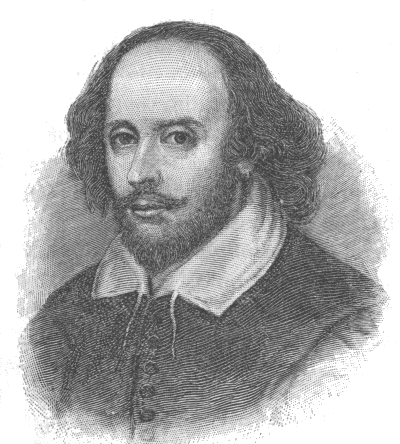
WILLIAM SHAKESPEARE
Genius or TrainingThere are, in general,
two theories to account for Shakespeare. The romantic school of writers
have always held that in him "all came from within"; that his genius was
his sufficient guide; and that to the overmastering power of his genius
alone we owe all his great works. Practical, unimaginative men, on the
other hand, assert that in Shakespeare "all came from without," and that
we must study his environment rather than his genius, if we are to
understand him. He lived in a play-loving age; he studied the crowds, gave
them what they wanted, and simply reflected their own thoughts and
feelings. In reflecting the English crowd about him he unconsciously
reflected all crowds, which are alike in all ages; hence his continued
popularity. And in being guided by public sentiment he was not singular,
but followed the plain path that every good dramatist has always followed
to success.
Probably the truth of the matter is to be found somewhere between these
two extremes. Of his great genius there can be no question; but there are
other things to consider. As we have already noticed, Shakespeare was
trained, like his fellow workmen, first as an actor, second as a reviser
of old plays, and last as an independent dramatist. He worked with other
playwrights and learned their secret. Like them, he studied and followed
the public taste, and his work indicates at least three stages, from his
first somewhat crude experiments to his finished masterpieces. So it would
seem that in Shakespeare we have the result of hard work and of orderly
human development, quite as much as of transcendent genius.
Life (1564-1616). Two outward influences were powerful in
developing the genius of Shakespeare,--the little village of Stratford,
center of the most beautiful and romantic district in rural England, and
the great city of London, the center of the world's political activity. In
one he learned to know the natural man in his natural environment; in the
other, the social, the artificial man in the most unnatural of
surroundings.
From the register of the little parish church at Stratford-on-Avon we
learn that William Shakespeare was baptized there on the twenty-sixth of
April, 1564 (old style). As it was customary to baptize children on the
third day after birth, the twenty-third of April (May 3, according to our
present calendar) is generally accepted as the poet's birthday.
His father, John Shakespeare, was a farmer's son from the neighboring
village of Snitterfield, who came to Stratford about 1551, and began to
prosper as a trader in corn, meat, leather, and other agricultural
products. His mother, Mary Arden, was the daughter of a prosperous farmer,
descended from an old Warwickshire family of mixed Anglo-Saxon and Norman
blood. In 1559 this married couple sold a piece of land, and the document
is signed, "The marke + of John Shacksper. The marke + of Mary Shacksper";
and from this it has been generally inferred that, like the vast majority
of their countrymen, neither of the poet's parents could read or write.
This was probably true of his mother; but the evidence from Stratford
documents now indicates that his father could write, and that he also
audited the town accounts; though in attesting documents he sometimes made
a mark, leaving his name to be filled in by the one who drew up the
document.
Of Shakespeare's education we know little, except that for a few years he
probably attended the endowed grammar school at Stratford, where he picked
up the "small Latin and less Greek" to which his learned friend Ben Jonson
refers. His real teachers, meanwhile, were the men and women and the
natural influences which surrounded him. Stratford is a charming little
village in beautiful Warwickshire, and near at hand were the Forest of
Arden, the old castles of Warwick and Kenilworth, and the old Roman camps
and military roads, to appeal powerfully to the boy's lively imagination.
Every phase of the natural beauty of this exquisite region is reflected in
Shakespeare's poetry; just as his characters reflect the nobility and the
littleness, the gossip, vices, emotions, prejudices, and traditions of the
people about him.
I saw a smith stand with his hammer, thus,
The whilst his iron did
on the anvil cool,
With open mouth swallowing a tailor's news;
Who, with his shears and measure in his hand,
Standing on slippers,
which his nimble haste
Had falsely thrust upon contrary feet,
Told of a many thousand warlike French
That were embattailed and
ranked in Kent.[145]
Such passages suggest not only genius but also a keen, sympathetic
observer, whose eyes see every significant detail. So with the nurse in Romeo
and Juliet, whose endless gossip and vulgarity cannot quite hide a
kind heart. She is simply the reflection of some forgotten nurse with whom
Shakespeare had talked by the wayside.
Not only the gossip but also the dreams, the unconscious poetry that
sleeps in the heart of the common people, appeal tremendously to
Shakespeare's imagination and are reflected in his greatest plays. Othello
tries to tell a curt soldier's story of his love; but the account is like
a bit of Mandeville's famous travels, teeming with the fancies that filled
men's heads when the great round world was first brought to their
attention by daring explorers. Here is a bit of folklore, touched by
Shakespeare's exquisite fancy, which shows what one boy listened to before
the fire at Halloween:
She
comes
In shape no bigger than an agate-stone
On the
fore-finger of an alderman,
Drawn with a team of little atomies
Athwart men's noses as they lie asleep;
Her waggon-spokes made of
long spinners' legs,
The cover of the wings of grasshoppers,
The traces of the smallest spider's web,
The collars of the
moonshine's watery beams,
Her whip of cricket's bone, the lash of
film,
Her waggoner a small grey-coated gnat,
Her chariot is an empty hazel nut
Made by the joiner squirrel, or
old grub,
Time out o' mind the fairies' coachmakers.
And in
this state she gallops night by night
Through lovers' brains, and
then they dream of love;
O'er lawyers' fingers, who straight dream on fees,
O'er ladies'
lips, who straight on kisses dream.[146]
So with Shakespeare's education at the hands of Nature, which came from
keeping his heart as well as his eyes wide open to the beauty of the
world. He speaks of a horse, and we know the fine points of a
thoroughbred; he mentions the duke's hounds, and we hear them clamoring on
a fox trail, their voices matched like bells in the frosty air; he stops
for an instant in the sweep of a tragedy to note a flower, a star, a
moonlit bank, a hilltop touched by the sunrise, and instantly we know what
our own hearts felt but could not quite express when we saw the same
thing. Because he notes and remembers every significant thing in the
changing panorama of earth and sky, no other writer has ever approached
him in the perfect natural setting of his characters.
When Shakespeare was about fourteen years old his father lost his little
property and fell into debt, and the boy probably left school to help
support the family of younger children. What occupation he followed for
the next eight years is a matter of conjecture. From evidence found in his
plays, it is alleged with some show of authority that he was a country
schoolmaster and a lawyer's clerk, the character of Holofernes, in Love's
Labour's Lost, being the warrant for one, and Shakespeare's knowledge
of law terms for the other. But if we take such evidence, then Shakespeare
must have been a botanist, because of his knowledge of wild flowers; a
sailor, because he knows the ropes; a courtier, because of his
extraordinary facility in quips and compliments and courtly language; a
clown, because none other is so dull and foolish; a king, because Richard
and Henry are true to life; a woman, because he has sounded the depths of
a woman's feelings; and surely a Roman, because in Coriolanus and
Julius Cæsar he has shown us the Roman spirit better than
have the Roman writers themselves. He was everything, in his imagination,
and it is impossible from a study of his scenes and characters to form a
definite opinion as to his early occupation.
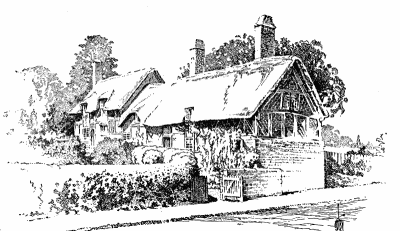
ANNE HATHAWAY COTTAGE
In 1582 Shakespeare was married to Anne Hathaway, the daughter of a
peasant family of Shottery, who was eight years older than her boy
husband. From numerous sarcastic references to marriage made by the
characters in his plays, and from the fact that he soon left his wife and
family and went to London, it is generally alleged that the marriage was a
hasty and unhappy one; but here again the evidence is entirely
untrustworthy. In many Miracles as well as in later plays it was customary
to depict the seamy side of domestic life for the amusement of the crowd;
and Shakespeare may have followed the public taste in this as he did in
other things. The references to love and home and quiet joys in
Shakespeare's plays are enough, if we take such evidence, to establish
firmly the opposite supposition, that his love was a very happy one. And
the fact that, after his enormous success in London, he retired to
Stratford to live quietly with his wife and daughters, tends to the same
conclusion.
About the year 1587 Shakespeare left his family and went to London and
joined himself to Burbage's company of players. A persistent tradition
says that he had incurred the anger of Sir Thomas Lucy, first by poaching
deer in that nobleman's park, and then, when haled before a magistrate, by
writing a scurrilous ballad about Sir Thomas, which so aroused the old
gentleman's ire that Shakespeare was obliged to flee the country. An old
record[147] says
that the poet "was much given to all unluckiness in stealing venison and
rabbits," the unluckiness probably consisting in getting caught himself,
and not in any lack of luck in catching the rabbits. The ridicule heaped
upon the Lucy family in Henry IV and the Merry Wives of Windsor
gives some weight to this tradition. Nicholas Rowe, who published the
first life of Shakespeare,[148]
is the authority for this story; but there is some reason to doubt
whether, at the time when Shakespeare is said to have poached in the deer
park of Sir Thomas Lucy at Charlescote, there were any deer or park at the
place referred to. The subject is worthy of some scant attention, if only
to show how worthless is the attempt to construct out of rumor the story
of a great life which, fortunately perhaps, had no contemporary
biographer.
Of his life in London from 1587 to 1611, the period of his greatest
literary activity, we know nothing definitely. We can judge only from his
plays, and from these it is evident that he entered into the stirring life
of England's capital with the same perfect sympathy and understanding that
marked him among the plain people of his native Warwickshire. The first
authentic reference to him is in 1592, when Greene's[149] bitter attack appeared, showing
plainly that Shakespeare had in five years assumed an important position
among playwrights. Then appeared the apology of the publishers of Greene's
pamphlet, with their tribute to the poet's sterling character, and
occasional literary references which show that he was known among his
fellows as "the gentle Shakespeare." Ben Jonson says of him: "I loved the
man and do honor his memory, on this side idolatry, as much as any. He was
indeed honest, and of an open and free nature." To judge from only three
of his earliest plays[150]
it would seem reasonably evident that in the first five years of his
London life he had gained entrance to the society of gentlemen and
scholars, had caught their characteristic mannerisms and expressions, and
so was ready by knowledge and observation as well as by genius to weave
into his dramas the whole stirring life of the English people. The plays
themselves, with the testimony of contemporaries and his business success,
are strong evidence against the tradition that his life in London was wild
and dissolute, like that of the typical actor and playwright of his time.
Shakespeare's first work may well have been that of a general helper, an
odd-job man, about the theater; but he soon became an actor, and the
records of the old London theaters show that in the next ten years he
gained a prominent place, though there is little reason to believe that he
was counted among the "stars." Within two years he was at work on plays,
and his course here was exactly like that of other playwrights of his
time. He worked with other men, and he revised old plays before writing
his own, and so gained a practical knowledge of his art. Henry VI (c.
1590-1591) is an example of this tinkering work, in which, however, his
native power is unmistakably manifest. The three parts of Henry VI
(and Richard III, which belongs with them) are a succession of
scenes from English Chronicle history strung together very loosely; and
only in the last is there any definite attempt at unity. That he soon fell
under Marlowe's influence is evident from the atrocities and bombast of Titus
Andronicus and Richard III. The former may have been written by
both playwrights in collaboration, or may be one of Marlowe's horrors left
unfinished by his early death and brought to an end by Shakespeare. He
soon broke away from this apprentice work, and then appeared in rapid
succession Love's Labour's Lost, Comedy of Errors, Two Gentlemen of
Verona, the first English Chronicle plays,[151] A Midsummer Night's Dream,
and Romeo and Juliet. This order is more or less conjectural; but
the wide variety of these plays, as well as their unevenness and frequent
crudities, marks the first or experimental stage of Shakespeare's work. It
is as if the author were trying his power, or more likely trying the
temper of his audience. For it must be remembered that to please his
audience was probably the ruling motive of Shakespeare, as of the other
early dramatists, during the most vigorous and prolific period of his
career.
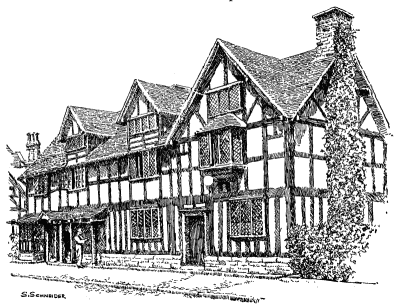
BIRTHPLACE OF SHAKESPEARE
Shakespeare's poems, rather than his dramatic work, mark the beginning of
his success. "Venus and Adonis" became immensely popular in London, and
its dedication to the Earl of Southampton brought, according to tradition,
a substantial money gift, which may have laid the foundation for
Shakespeare's business success. He appears to have shrewdly invested his
money, and soon became part owner of the Globe and Blackfriars theaters,
in which his plays were presented by his own companies. His success and
popularity grew amazingly. Within a decade of his unnoticed arrival in
London he was one of the most famous actors and literary men in England.
Following his experimental work there came a succession of wonderful
plays,--Merchant of Venice, As You Like It, Twelfth Night, Julius Cæsar,
Hamlet, Macbeth, Othello, King Lear, Antony and Cleopatra. The great
tragedies of this period are associated with a period of gloom and sorrow
in the poet's life; but of its cause we have no knowledge. It may have
been this unknown sorrow which turned his thoughts back to Stratford and
caused, apparently, a dissatisfaction with his work and profession; but
the latter is generally attributed to other causes. Actors and playwrights
were in his day generally looked upon with suspicion or contempt; and
Shakespeare, even in the midst of success, seems to have looked forward to
the time when he could retire to Stratford to live the life of a farmer
and country gentleman. His own and his father's families were first
released from debt; then, in 1597, he bought New Place, the finest house
in Stratford, and soon added a tract of farming land to complete his
estate. His profession may have prevented his acquiring the title of
"gentleman," or he may have only followed a custom of the time[152] when he applied
for and obtained a coat of arms for his father, and so indirectly secured
the title by inheritance. His home visits grew more and more frequent
till, about the year 1611, he left London and retired permanently to
Stratford.
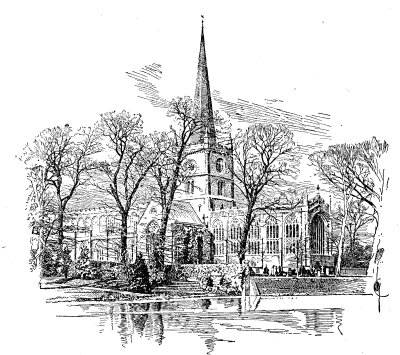
TRINITY CHURCH, STRATFORD-ON-AVON
Though still in the prime of life, Shakespeare soon abandoned his dramatic
work for the comfortable life of a country gentleman. Of his later plays,
Coriolanus, Cymbeline, Winter's Tale, and Pericles show a
decided falling off from his previous work, and indicate another period of
experimentation; this time not to test his own powers but to catch the
fickle humor of the public. As is usually the case with a theater-going
people, they soon turned from serious drama to sentimental or more
questionable spectacles; and with Fletcher, who worked with Shakespeare
and succeeded him as the first playwright of London, the decline of the
drama had already begun. In 1609, however, occurred an event which gave
Shakespeare his chance for a farewell to the public. An English ship
disappeared, and all on board were given up for lost. A year later the
sailors returned home, and their arrival created intense excitement. They
had been wrecked on the unknown Bermudas, and had lived there for ten
months, terrified by mysterious noises which they thought came from
spirits and devils. Five different accounts of this fascinating shipwreck
were published, and the Bermudas became known as the "Ile of Divels."
Shakespeare took this story--which caused as much popular interest as that
later shipwreck which gave us Robinson Crusoe--and wove it into The
Tempest. In the same year (1611) he probably sold his interest in the
Globe and Blackfriars theaters, and his dramatic work was ended. A few
plays were probably left unfinished[153] and were turned over to Fletcher and other
dramatists.
That Shakespeare thought little of his success and had no idea that his
dramas were the greatest that the world ever produced seems evident from
the fact that he made no attempt to collect or publish his works, or even
to save his manuscripts, which were carelessly left to stage managers of
the theaters, and so found their way ultimately to the ragman. After a few
years of quiet life, of which we have less record than of hundreds of
simple country gentlemen of the time, Shakespeare died on the probable
anniversary of his birth, April 23, 1616. He was given a tomb in the
chancel of the parish church, not because of his preëminence in
literature, but because of his interest in the affairs of a country
village. And in the sad irony of fate, the broad stone that covered his
tomb--now an object of veneration to the thousands that yearly visit the
little church--was inscribed as follows:
Good friend, for Jesus' sake forbeare
To dig the dust enclosed
heare;
Bleste be the man that spares these stones,
And curst
be he that moves my bones.
This wretched doggerel, over the world's greatest poet, was intended, no
doubt, as a warning to some stupid sexton, lest he should empty the grave
and give the honored place to some amiable gentleman who had given more
tithes to the parish.
Works of Shakespeare. At the time of Shakespeare's death twenty-one
plays existed in manuscripts in the various theaters. A few others had
already been printed in quarto form, and the latter are the only
publications that could possibly have met with the poet's own approval.
More probably they were taken down in shorthand by some listener at the
play and then "pirated" by some publisher for his own profit. The first
printed collection of his plays, now called the First Folio (1623), was
made by two actors, Heming and Condell, who asserted that they had access
to the papers of the poet and had made a perfect edition, "in order to
keep the memory of so worthy a friend and fellow alive." This contains
thirty-six of the thirty-seven plays generally attributed to Shakespeare,
Pericles being omitted. This celebrated First Folio was printed
from playhouse manuscripts and from printed quartos containing many notes
and changes by individual actors and stage managers. Moreover, it was full
of typographical errors, though the editors alleged great care and
accuracy; and so, though it is the only authoritative edition we have, it
is of little value in determining the dates, or the classification of the
plays as they existed in Shakespeare's mind.
Four PeriodsNotwithstanding this
uncertainty, a careful reading of the plays and poems leaves us with an
impression of four different periods of work, probably corresponding with
the growth and experience of the poet's life. These are: (1) a period of
early experimentation. It is marked by youthfulness and exuberance of
imagination, by extravagance of language, and by the frequent use of rimed
couplets with his blank verse. The period dates from his arrival in London
to 1595. Typical works of this first period are his early poems, Love's
Labour's Lost, Two Gentlemen of Verona, and Richard III. (2) A
period of rapid growth and development, from 1595 to 1600. Such plays as
The Merchant of Venice, Midsummer Night's Dream, As You Like It,
and Henry IV, all written in this period, show more careful and
artistic work, better plots, and a marked increase in knowledge of human
nature. (3) A period of gloom and depression, from 1600 to 1607, which
marks the full maturity of his powers. What caused this evident sadness is
unknown; but it is generally attributed to some personal experience,
coupled with the political misfortunes of his friends, Essex and
Southampton. The Sonnets with their note of personal
disappointment, Twelfth Night, which is Shakespeare's "farewell to
mirth," and his great tragedies, Hamlet, Lear, Macbeth, Othello,
and Julius Cæsar, belong to this period. (4) A period of
restored serenity, of calm after storm, which marked the last years of the
poet's literary work. The Winter's Tale and The Tempest are
the best of his later plays; but they all show a falling off from his
previous work, and indicate a second period of experimentation with the
taste of a fickle public.
To read in succession four plays, taking a typical work from each of the
above periods, is one of the very best ways of getting quickly at the real
life and mind of Shakespeare. Following is a complete list with the
approximate dates of his works, classified according to the above four
periods.
First Period, Early Experiment. Venus and Adonis, Rape of Lucrece,
1594; Titus Andronicus, Henry VI (three parts), 1590-1591; Love's
Labour's Lost, 1590; Comedy of Errors, Two Gentlemen of Verona,
1591-1592; Richard-III, 1593; Richard II, King John,
1594-1595.
Second Period, Development. Romeo and Juliet, Midsummer Night's Dream,
1595; Merchant of Venice, Henry IV (first part), 1596; Henry IV
(second part), Merry Wives of Windsor, 1597; Much Ado About
Nothing, 1598; As You Like It, Henry V, 1599.
Third Period, Maturity and Gloom. Sonnets (1600-?), Twelfth
Night, 1600; Taming of the Shrew, Julius Cæsar, Hamlet,
Troilus and Cressida, 1601-1602; All's Well That Ends Well, Measure
for Measure, 1603; Othello, 1604; King Lear, 1605; Macbeth,
1606; Antony and Cleopatra, Timon of Athens, 1607.
Fourth Period, Late Experiment. Coriolanus, Pericles, 1608; Cymbeline,
1609; Winter's Tale, 1610-1611; The Tempest, 1611; Henry
VIII (unfinished).
Classification according to Source. In history, legend, and story,
Shakespeare found the material for nearly all his dramas; and so they are
often divided into three classes, called historical plays, like Richard
III and Henry V; legendary or partly historical plays, like Macbeth,
King Lear, and Julius Cæsar; and fictional plays, like Romeo
and Juliet and The Merchant of Venice. Shakespeare invented
few, if any, of the plots or stories upon which his dramas are founded,
but borrowed them freely, after the custom of his age, wherever he found
them. For his legendary and historical material he depended, largely on Holinshed's
Chronicles of England, Scotland, and Ireland, and on North's
translation of Plutarch's famous Lives.
A full half of his plays are fictional, and in these he used the most
popular romances of the day, seeming to depend most on the Italian
story-tellers. Only two or three of his plots, as in Love's Labour's
Lost and Merry Wives of Windsor, are said to be original, and
even these are doubtful. Occasionally Shakespeare made over an older play,
as in Henry VI, Comedy of Errors, and Hamlet; and in one
instance at least he seized upon an incident of shipwreck in which London
was greatly interested, and made out of it the original and fascinating
play of The Tempest, in much the same spirit which leads our modern
playwrights when they dramatize a popular novel or a war story to catch
the public fancy.
Classification according to Dramatic Type. Shakespeare's dramas are
usually divided into three classes, called tragedies, comedies, and
historical plays. Strictly speaking the drama has but two divisions,
tragedy and comedy, in which are included the many subordinate forms of
tragi-comedy, melodrama, lyric drama (opera), farce, etc. A tragedy is a
drama in which the principal characters are involved in desperate
circumstances or led by overwhelming passions. It is invariably serious
and dignified. The movement is always stately, but grows more and more
rapid as it approaches the climax; and the end is always calamitous,
resulting in death or dire misfortune to the principals. As Chaucer's monk
says, before he begins to "biwayle in maner of tragedie":
Tragedie is to seyn a certeyn storie
Of him that stood in great
prosperitee,
And is y-fallen out of heigh degree
Into miserie,
and endeth wrecchedly.
A comedy, on the other hand, is a drama in which the characters are placed
in more or less humorous situations. The movement is light and often
mirthful, and the play ends in general good will and happiness. The
historical drama aims to present some historical age or character, and may
be either a comedy or a tragedy. The following list includes the best of
Shakespeare's plays in each of the three classes; but the order indicates
merely the author's personal opinion of the relative merits of the plays
in each class. Thus Merchant of Venice would be the first of the
comedies for the beginner to read, and Julius Cæsar is an
excellent introduction to the historical plays and the tragedies.
Comedies. Merchant of Venice, Midsummer Night's Dream, As You Like It,
Winter's Tale, The Tempest, Twelfth Night.
Tragedies. Romeo and Juliet, Macbeth, Hamlet, King Lear, Othello.
Historical Plays. Julius Cæsar, Richard III, Henry IV, Henry V,
Coriolanus, Antony and Cleopatra.
Doubtful Plays. It is reasonably certain that some of the plays
generally attributed to Shakespeare are partly the work of other
dramatists. The first of these doubtful plays, often called the
Pre-Shakespearian Group, are Titus Andronicus and the first part of
Henry VI. Shakespeare probably worked with Marlowe in the two last
parts of Henry VI and in Richard III. The three plays, Taming
of the Shrew, Timon, and Pericles are only partly Shakespeare's
work, but the other authors are unknown. Henry VIII is the work of
Fletcher and Shakespeare, opinion being divided as to whether Shakespeare
helped Fletcher, or whether it was an unfinished work of Shakespeare which
was put into Fletcher's hands for completion. Two Noble Kinsmen is
a play not ordinarily found in editions of Shakespeare, but it is often
placed among his doubtful works. The greater part of the play is
undoubtedly by Fletcher. Edward III is one of several crude plays
published at first anonymously and later attributed to Shakespeare by
publishers who desired to sell their wares. It contains a few passages
that strongly suggest Shakespeare; but the external evidence is all
against his authorship.
Shakespeare's Poems. It is generally asserted that, if Shakespeare
had written no plays, his poems alone would have given him a commanding
place in the Elizabethan Age. Nevertheless, in the various histories of
our literature there is apparent a desire to praise and pass over all but
the Sonnets as rapidly as possible; and the reason may be stated
frankly. His two long poems, "Venus and Adonis" and "The Rape of Lucrece,"
contain much poetic fancy; but it must be said of both that the subjects
are unpleasant, and that they are dragged out to unnecessary length in
order to show the play of youthful imagination. They were extremely
popular in Shakespeare's day, but in comparison with his great dramatic
works these poems are now of minor importance.
Shakespeare's Sonnets, one hundred and fifty-four in number, are
the only direct expression of the poet's own feelings that we possess; for
his plays are the most impersonal in all literature. They were published
together in 1609; but if they had any unity in Shakespeare's mind, their
plan and purpose are hard to discover. By some critics they are regarded
as mere literary exercises; by others as the expression of some personal
grief during the third period of the poet's literary career. Still others,
taking a hint from the sonnet beginning "Two loves I have, of comfort and
despair," divide them all into two classes, addressed to a man who was
Shakespeare's friend, and to a woman who disdained his love. The reader
may well avoid such classifications and read a few sonnets, like the
twenty-ninth, for instance, and let them speak their own message. A few
are trivial and artificial enough, suggesting the elaborate exercises of a
piano player; but the majority are remarkable for their subtle thought and
exquisite expression. Here and there is one, like that beginning
When to the sessions of sweet silent thought
I summon up
remembrance of things past,
which will haunt the reader long afterwards, like the remembrance of an
old German melody.
Shakespeare's Place and Influence. Shakespeare holds, by general
acclamation, the foremost place in the world's literature, and his
overwhelming greatness renders it difficult to criticise or even to praise
him. Two poets only, Homer and Dante, have been named with him; but each
of these wrote within narrow limits, while Shakespeare's genius included
all the world of nature and of men. In a word, he is the universal poet.
To study nature in his works is like exploring a new and beautiful
country; to study man in his works is like going into a great city,
viewing the motley crowd as one views a great masquerade in which past and
present mingle freely and familiarly, as if the dead were all living
again. And the marvelous thing, in this masquerade of all sorts and
conditions of men, is that Shakespeare lifts the mask from every face,
lets us see the man as he is in his own soul, and shows us in each one
some germ of good, some "soul of goodness" even in things evil. For
Shakespeare strikes no uncertain note, and raises no doubts to add to the
burden of your own. Good always overcomes evil in the long run; and love,
faith, work, and duty are the four elements that in all ages make the
world right. To criticise or praise the genius that creates these men and
women is to criticise or praise humanity itself.
Of his influence in literature it is equally difficult to speak. Goethe
expresses the common literary judgment when he says, "I do not remember
that any book or person or event in my life ever made so great an
impression upon me as the plays of Shakespeare." His influence upon our
own language and thought is beyond calculation. Shakespeare and the King
James Bible are the two great conservators of the English speech; and one
who habitually reads them finds himself possessed of a style and
vocabulary that are beyond criticism. Even those who read no Shakespeare
are still unconsciously guided by him, for his thought and expression have
so pervaded our life and literature that it is impossible, so long as one
speaks the English language, to escape his influence.
His life was gentle, and the elements
So mixed in him, that Nature
might stand up
And say to all the world, "This was a man!"
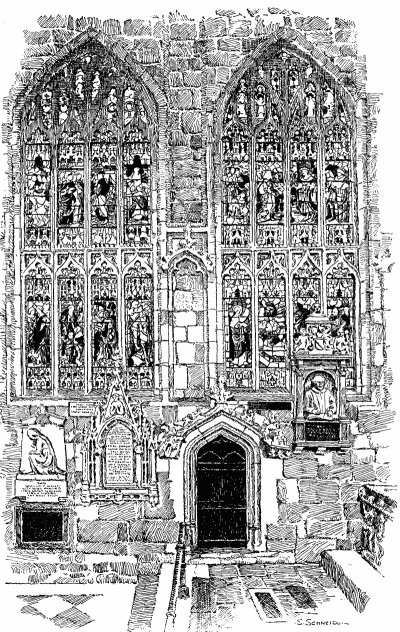
AMERICAN MEMORIAL WINDOW IN THE CHURCH
OF THE HOLY TRINITY, STRATFORD-ON-AVON
V. SHAKESPEARE'S CONTEMPORARIES AND
SUCCESSORS IN THE DRAMA
Decline of the Drama. It was
inevitable that the drama should decline after Shakespeare, for the simple
reason that there was no other great enough to fill his place. Aside from
this, other causes were at work, and the chief of these was at the very
source of the Elizabethan dramas. It must be remembered that our first
playwrights wrote to please their audiences; that the drama rose in
England because of the desire of a patriotic people to see something of
the stirring life of the times reflected on the stage. For there were no
papers or magazines in those days, and people came to the theaters not
only to be amused but to be informed. Like children, they wanted to see a
story acted; and like men, they wanted to know what it meant. Shakespeare
fulfilled their desire. He gave them their story, and his genius was great
enough to show in every play not only their own life and passions but
something of the meaning of all life, and of that eternal justice which
uses the war of human passions for its own great ends. Thus good and evil
mingle freely in his dramas; but the evil is never attractive, and the
good triumphs as inevitably as fate. Though his language is sometimes
coarse, we are to remember that it was the custom of his age to speak
somewhat coarsely, and that in language, as in thought and feeling,
Shakespeare is far above most of his contemporaries.
With his successors all this was changed. The audience itself had
gradually changed, and in place of plain people eager for a story and for
information, we see a larger and larger proportion of those who went to
the play because they had nothing else to do. They wanted amusement only,
and since they had blunted by idleness the desire for simple and wholesome
amusement, they called for something more sensational. Shakespeare's
successors catered to the depraved tastes of this new audience. They
lacked not only Shakespeare's genius, but his broad charity, his moral
insight into life. With the exception of Ben Jonson, they neglected the
simple fact that man in his deepest nature is a moral being, and that only
a play which satisfies the whole nature of man by showing the triumph of
the moral law can ever wholly satisfy an audience or a people. Beaumont
and Fletcher, forgetting the deep meaning of life, strove for effect by
increasing the sensationalism of their plays; Webster reveled in tragedies
of blood and thunder; Massinger and Ford made another step downward,
producing evil and licentious scenes for their own sake, making characters
and situations more immoral till, notwithstanding these dramatists'
ability, the stage had become insincere, frivolous, and bad. Ben Jonson's
ode, "Come Leave the Loathed Stage," is the judgment of a large and honest
nature grown weary of the plays and the players of the time. We read with
a sense of relief that in 1642, only twenty-six years after Shakespeare's
death, both houses of Parliament voted to close the theaters as breeders
of lies and immorality.
BEN JONSON (1573?-1637)
Personally Jonson is the most commanding literary figure among the
Elizabethans. For twenty-five years he was the literary dictator of
London, the chief of all the wits that gathered nightly at the old Devil
Tavern. With his great learning, his ability, and his commanding position
as poet laureate, he set himself squarely against his contemporaries and
the romantic tendency of the age. For two things he fought bravely,--to
restore the classic form of the drama, and to keep the stage from its
downward course. Apparently he failed; the romantic school fixed its hold
more strongly than ever; the stage went swiftly to an end as sad as that
of the early dramatists. Nevertheless his influence lived and grew more
powerful till, aided largely by French influence, it resulted in the
so-called classicism of the eighteenth century.
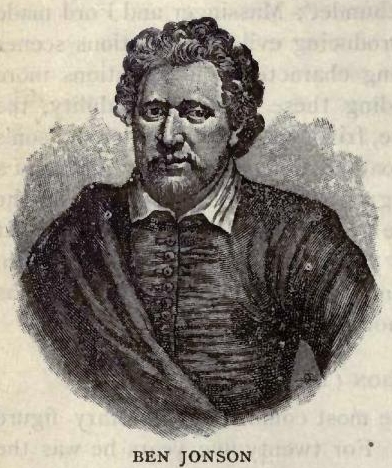
Life. Jonson was born at Westminster about the year 1573. His
father, an educated gentleman, had his property confiscated and was
himself thrown into prison by Queen Mary; so we infer the family was of
some prominence. From his mother he received certain strong
characteristics, and by a single short reference in Jonson's works we are
led to see the kind of woman she was. It is while Jonson is telling
Drummond of the occasion when he was thrown into prison, because some
passages in the comedy of Eastward Ho! gave offense to King James,
and he was in danger of a horrible death, after having his ears and nose
cut off. He tells us how, after his pardon, he was banqueting with his
friends, when his "old mother" came in and showed a paper full of "lusty
strong poison," which she intended to mix with his drink just before the
execution. And to show that she "was no churl," she intended first to
drink of the poison herself. The incident is all the more suggestive from
the fact that Chapman and Marston, one his friend and the other his enemy,
were first cast into prison as the authors of Eastward Ho! and
rough Ben Jonson at once declared that he too had had a small hand in the
writing and went to join them in prison.
Jonson's father came out of prison, having given up his estate, and became
a minister. He died just before the son's birth, and two years later the
mother married a bricklayer of London. The boy was sent to a private
school, and later made his own way to Westminster School, where the
submaster, Camden, struck by the boy's ability, taught and largely
supported him. For a short time he may have studied at the university in
Cambridge; but his stepfather soon set him to learning the bricklayer's
trade. He ran away from this, and went with the English army to fight
Spaniards in the Low Countries. His best known exploit there was to fight
a duel between the lines with one of the enemy's soldiers, while both
armies looked on. Jonson killed his man, and took his arms, and made his
way back to his own lines in a way to delight the old Norman troubadours.
He soon returned to England, and married precipitately when only nineteen
or twenty years old. Five years later we find him employed, like
Shakespeare, as actor and reviser of old plays in the theater. Thereafter
his life is a varied and stormy one. He killed an actor in a duel, and
only escaped hanging by pleading "benefit of clergy";[154] but he lost all his poor goods
and was branded for life on his left thumb. In his first great play, Every
Man in His Humour (1598), Shakespeare acted one of the parts; and that
may have been the beginning of their long friendship. Other plays followed
rapidly. Upon the accession of James, Jonson's masques won him royal
favor, and he was made poet laureate. He now became undoubted leader of
the literary men of his time, though his rough honesty and his hatred of
the literary tendencies of the age made him quarrel with nearly all of
them. In 1616, soon after Shakespeare's retirement, he stopped writing for
the stage and gave himself up to study and serious work. In 1618 he
traveled on foot to Scotland, where he visited Drummond, from whom we have
the scant records of his varied life. His impressions of this journey,
called Foot Pilgrimage, were lost in a fire before publication.
Thereafter he produced less, and his work declined in vigor; but spite of
growing poverty and infirmity we notice in his later work, especially in
the unfinished Sad Shepherd, a certain mellowness and tender human
sympathy which were lacking in his earlier productions. He died poverty
stricken in 1637. Unlike Shakespeare's, his death was mourned as a
national calamity, and he was buried with all honor in Westminster Abbey.
On his grave was laid a marble slab, on which the words "O rare Ben
Jonson" were his sufficient epitaph.
Works of Ben Jonson. Jonson's work is in strong contrast with that
of Shakespeare and of the later Elizabethan dramatists. Alone he fought
against the romantic tendency of the age, and to restore the classic
standards. Thus the whole action of his drama usually covers only a few
hours, or a single day. He never takes liberties with historical facts, as
Shakespeare does, but is accurate to the smallest detail. His dramas
abound in classical learning, are carefully and logically constructed, and
comedy and tragedy are kept apart, instead of crowding each other as they
do in Shakespeare and in life. In one respect his comedies are worthy of
careful reading,--they are intensely realistic, presenting men and women
of the time exactly as they were. From a few of Jonson's scenes we can
understand--better than from all the plays of Shakespeare--how men talked
and acted during the Age of Elizabeth.
Every Man in His HumourJonson's first
comedy, Every Man in His Humour, is a key to all his dramas. The
word "humour" in his age stood for some characteristic whim or quality of
society. Jonson gives to his leading character some prominent humor,
exaggerates it, as the cartoonist enlarges the most characteristic feature
of a face, and so holds it before our attention that all other qualities
are lost sight of; which is the method that Dickens used later in many of
his novels. Every Man in His Humour was the first of three satires.
Its special aim was to ridicule the humors of the city. The second, Cynthia's
Revels, satirizes the humors of the court; while the third, The
Poetaster, the result of a quarrel with his contemporaries, was
leveled at the false standards of the poets of the age.
The three best known of Jonson's comedies are Volpone, or the Fox, The
Alchemist, and Epicoene, or the Silent Woman. Volpone is a keen
and merciless analysis of a man governed by an overwhelming love of money
for its own sake. The first words in the first scene are a key to the
whole comedy:
(Volpone)
Good
morning to the day; and next, my gold!
Open
the shrine that I may see my saint.
(Mosca
withdraws a curtain and discovers piles of
gold,
plate, jewels, etc.)
Hail
the world's soul, and mine!
Volpone's method of increasing his wealth is to play upon the avarice of
men. He pretends to be at the point of death, and his "suitors," who know
his love of gain and that he has no heirs, endeavor hypocritically to
sweeten his last moments by giving him rich presents, so that he will
leave them all his wealth. The intrigues of these suitors furnish the
story of the play, and show to what infamous depths avarice will lead a
man.
The Alchemist is a study of quackery on one side and of gullibility
on the other, founded on the mediæval idea of the philosopher's
stone,[155] and
applies as well to the patent medicines and get-rich-quick schemes of our
day as to the peculiar forms of quackery with which Jonson was more
familiar. In plot and artistic construction The Alchemist is an
almost perfect specimen of the best English drama. It has some remarkably
good passages, and is the most readable of Jonson's plays.
Epicoene, or the Silent Woman, is a prose comedy exceedingly well
constructed, full of life, abounding in fun and unexpected situations.
Here is a brief outline from which the reader may see of what materials
Jonson made up his comedies.
The Silent Woman The chief character is
Morose, a rich old codger whose humor is a horror of noise. He lives in a
street so narrow that it will admit no carriages; he pads the doors; plugs
the keyhole; puts mattresses on the stairs. He dismisses a servant who
wears squeaky boots; makes all the rest go about in thick stockings; and
they must answer him by signs, since he cannot bear to hear anybody but
himself talk. He disinherits his poor nephew Eugenie, and, to make sure
that the latter will not get any money out of him, resolves to marry. His
confidant in this delicate matter is Cutbeard the barber, who, unlike his
kind, never speaks unless spoken to, and does not even knick his scissors
as he works. Cutbeard (who is secretly in league with the nephew) tells
him of Epicoene, a rare, silent woman, and Morose is so delighted with her
silence that he resolves to marry her on the spot. Cutbeard produces a
parson with a bad cold, who can speak only in a whisper, to marry them;
and when the parson coughs after the ceremony Morose demands back five
shillings of the fee. To save it the parson coughs more, and is hurriedly
bundled out of the house. The silent woman finds her voice immediately
after the marriage, begins to talk loudly and to make reforms in the
household, driving Morose to distraction. A noisy dinner party from a
neighboring house, with drums and trumpets and a quarreling man and wife,
is skillfully guided in at this moment to celebrate the wedding. Morose
flees for his life, and is found perched like a monkey on a crossbeam in
the attic, with all his nightcaps tied over his ears. He seeks a divorce,
but is driven frantic by the loud arguments of a lawyer and a divine, who
are no other than Cutbeard and a sea captain disguised. When Morose is
past all hope the nephew offers to release him from his wife and her noisy
friends if he will allow him five hundred pounds a year. Morose offers him
anything, everything, to escape his torment, and signs a deed to that
effect. Then comes the surprise of the play when Eugenie whips the wig
from Epicoene and shows a boy in disguise.
It will be seen that the Silent Woman, with its rapid action and
its unexpected situations, offers an excellent opportunity for the actors;
but the reading of the play, as of most of Jonson's comedies, is marred by
low intrigues showing a sad state of morals among the upper classes.
Besides these, and many other less known comedies, Jonson wrote two great
tragedies, Sejanus (1603) and Catiline (1611), upon severe
classical lines. After ceasing his work for the stage, Jonson wrote many
masques in honor of James I and of Queen Anne, to be played amid elaborate
scenery by the gentlemen of the court. The best of these are "The Satyr,"
"The Penates," "Masque of Blackness," "Masque of Beauty," "Hue and Cry
after Cupid," and "The Masque of Queens." In all his plays Jonson showed a
strong lyric gift, and some of his little poems and songs, like "The
Triumph of Charis," "Drink to Me Only with Thine Eyes," and "To the Memory
of my Beloved Mother," are now better known than his great dramatic works.
A single volume of prose, called Timber, or Discoveries made upon Men
and Matter, is an interesting collection of short essays which are
more like Bacon's than any other work of the age.
Beaumont and Fletcher. The work of
these two men is so closely interwoven that, though Fletcher outlived
Beaumont by nine years and the latter had no hand in some forty of the
plays that bear their joint names, we still class them together, and only
scholars attempt to separate their works so as to give each writer his due
share. Unlike most of the Elizabethan dramatists, they both came from
noble and cultured families and were university trained. Their work, in
strong contrast with Jonson's, is intensely romantic, and in it all,
however coarse or brutal the scene, there is still, as Emerson pointed
out, the subtle "recognition of gentility."
Beaumont (1584-1616) was the brother of Sir John Beaumont of
Leicestershire. From Oxford he came to London to study law, but soon gave
it up to write for the stage. Fletcher (1579-1625) was the son of the
bishop of London, and shows in all his work the influence of his high
social position and of his Cambridge education. The two dramatists met at
the Mermaid tavern under Ben Jonson's leadership and soon became
inseparable friends, living and working together. Tradition has it that
Beaumont supplied the judgment and the solid work of the play, while
Fletcher furnished the high-colored sentiment and the lyric poetry,
without which an Elizabethan play would have been incomplete. Of their
joint plays, the two best known are Philaster, whose old theme,
like that of Cymbeline and Griselda, is the jealousy of a
lover and the faithfulness of a girl, and The Maid's Tragedy.
Concerning Fletcher's work the most interesting literary question is how
much did he write of Shakespeare's Henry VIII, and how much did
Shakespeare help him in The Two Noble Kinsmen.
John Webster. Of Webster's
personal history we know nothing except that he was well known as a
dramatist under James I. His extraordinary powers of expression rank him
with Shakespeare; but his talent seems to have been largely devoted to the
blood-and-thunder play begun by Marlowe. His two best known plays are The
White Devil (pub. 1612) and The Duchess of Malfi (pub. 1623).
The latter, spite of its horrors, ranks him as one of the greatest masters
of English tragedy. It must be remembered that he sought in this play to
reproduce the Italian life of the sixteenth century, and for this no
imaginary horrors are needed. The history of any Italian court or city in
this period furnishes more vice and violence and dishonor than even the
gloomy imagination of Webster could conceive. All the so-called blood
tragedies of the Elizabethan period, from Thomas Kyd's Spanish Tragedy
down, however much they may condemn the brutal taste of the English
audiences, are still only so many search lights thrown upon a history of
horrible darkness.
Thomas Middleton (1570?-1627).
Middleton is best known by two great plays, The Changeling[156] and Women
Beware Women. In poetry and diction they are almost worthy at times to
rank with Shakespeare's plays; otherwise, in their sensationalism and
unnaturalness they do violence to the moral sense and are repulsive to the
modern reader. Two earlier plays, A Trick to catch the Old One, his
best comedy, and A Fair Quarrel, his earliest tragedy, are less
mature in thought and expression, but more readable, because they seem to
express Middleton's own idea of the drama rather than that of the corrupt
court and playwrights of his later age.
Thomas Heywood (1580?-1650?).
Heywood's life, of which we know little in detail, covers the whole period
of the Elizabethan drama. To the glory of that drama he contributed,
according to his own statement, the greater part, at least, of nearly two
hundred and twenty plays. It was an enormous amount of work; but he seems
to have been animated by the modern literary spirit of following the best
market and striking while the financial iron is hot. Naturally good work
was impossible, even to genius, under such circumstances, and few of his
plays are now known. The two best, if the reader would obtain his own idea
of Heywood's undoubted ability, are A Woman killed with Kindness, a
pathetic story of domestic life, and The Fair Maid of the West, a
melodrama with plenty of fighting of the popular kind.
Thomas Dekker (1570-?). Dekker
is in pleasing contrast with most of the dramatists of the time. All we
know of him must be inferred from his works, which show a happy and sunny
nature, pleasant and good to meet. The reader will find the best
expression of Dekker's personality and erratic genius in The
Shoemakers' Holiday, a humorous study of plain working people, and Old
Fortunatus, a fairy drama of the wishing hat and no end of money.
Whether intended for children or not, it had the effect of charming the
elders far more than the young people, and the play became immensely
popular.
Massinger, Ford, Shirley. These
three men mark the end of the Elizabethan drama. Their work, done largely
while the struggle was on between the actors and the corrupt court, on one
side, and the Puritans on the other, shows a deliberate turning away not
only from Puritan standards but from the high ideals of their own art to
pander to the corrupt taste of the upper classes.
Philip Massinger (1584-1640) was a dramatic poet of great natural ability;
but his plots and situations are usually so strained and artificial that
the modern reader finds no interest in them. In his best comedy, A New
Way to Pay Old Debts, he achieved great popularity and gave us one
figure, Sir Giles Overreach, which is one of the typical characters of the
English stage. His best plays are The Great Duke of Florence, The
Virgin Martyr, and The Maid of Honour.
John Ford (1586-1642?) and James Shirley (1596-1666) have left us little
of permanent literary value, and their works are read only by those who
wish to understand the whole rise and fall of the drama. An occasional
scene in Ford's plays is as strong as anything that the Elizabethan Age
produced; but as a whole the plays are unnatural and tiresome. Probably
his best play is The Broken Heart (1633). Shirley was given to
imitation of his predecessors, and his very imitation is characteristic of
an age which had lost its inspiration. A single play, Hyde Park,
with its frivolous, realistic dialogue, is sometimes read for its
reflection of the fashionable gossipy talk of the day. Long before
Shirley's death the actors said, "Farewell! Othello's occupation's gone."
Parliament voted to close the theaters, thereby saving the drama from a
more inglorious death by dissipation.[157]
VI. THE PROSE WRITERS
Francis Bacon (1561-1626)
In Bacon we see one of those complex and contradictory natures which are
the despair of the biographer. If the writer be an admirer of Bacon, he
finds too much that he must excuse or pass over in silence; and if he
takes his stand on the law to condemn the avarice and dishonesty of his
subject, he finds enough moral courage and nobility to make him question
the justice of his own judgment. On the one hand is rugged Ben Jonson's
tribute to his power and ability, and on the other Hallam's summary that
he was "a man who, being intrusted with the highest gifts of Heaven,
habitually abused them for the poorest purposes of earth--hired them out
for guineas, places, and titles in the service of injustice, covetousness,
and oppression."
Laying aside the opinions of others, and relying only upon the facts of
Bacon's life, we find on the one side the politician, cold, calculating,
selfish, and on the other the literary and scientific man with an
impressive devotion to truth for its own great sake; here a man using
questionable means to advance his own interests, and there a man seeking
with zeal and endless labor to penetrate the secret ways of Nature, with
no other object than to advance the interests of his fellow-men. So, in
our ignorance of the secret motives and springs of the man's life,
judgment is necessarily suspended. Bacon was apparently one of those
double natures that only God is competent to judge, because of the strange
mixture of intellectual strength and moral weakness that is in them.
Life. Bacon was the son of Sir Nicholas Bacon, Lord Keeper of the
Seal, and of the learned Ann Cook, sister-in-law to Lord Burleigh,
greatest of the queen's statesmen. From these connections, as well as from
native gifts, he was attracted to the court, and as a child was called by
Elizabeth her "Little Lord Keeper." At twelve he went to Cambridge, but
left the university after two years, declaring the whole plan of education
to be radically wrong, and the system of Aristotle, which was the basis of
all philosophy in those days, to be a childish delusion, since in the
course of centuries it had "produced no fruit, but only a jungle of dry
and useless branches." Strange, even for a sophomore of fourteen, thus to
condemn the whole system of the universities; but such was the boy, and
the system! Next year, in order to continue his education, he accompanied
the English ambassador to France, where he is said to have busied himself
chiefly with the practical studies of statistics and diplomacy.
Two years later he was recalled to London by the death of his father.
Without money, and naturally with expensive tastes, he applied to his
Uncle Burleigh for a lucrative position. It was in this application that
he used the expression, so characteristic of the Elizabethan Age, that he
"had taken all knowledge for his province." Burleigh, who misjudged him as
a dreamer and self-seeker, not only refused to help him at the court but
successfully opposed his advancement by Elizabeth. Bacon then took up the
study of law, and was admitted to the bar in 1582. That he had not lost
his philosophy in the mazes of the law is shown by his tract, written
about this time, "On the Greatest Birth of Time," which was a plea for his
inductive system of philosophy, reasoning from many facts to one law,
rather than from an assumed law to particular facts, which was the
deductive method that had been in use for centuries. In his famous plea
for progress Bacon demanded three things: the free investigation of
nature, the discovery of facts instead of theories, and the verification
of results by experiment rather than by argument. In our day these are the
A, B, C of science, but in Bacon's time they seemed revolutionary.
As a lawyer he became immediately successful; his knowledge and power of
pleading became widely known, and it was almost at the beginning of his
career that Jonson wrote, "The fear of every one that heard him speak was
that he should make an end." The publication of his Essays added
greatly to his fame; but Bacon was not content. His head was buzzing with
huge schemes,--the pacification of unhappy Ireland, the simplification of
English law, the reform of the church, the study of nature, the
establishment of a new philosophy. Meanwhile, sad to say, he played the
game of politics for his personal advantage. He devoted himself to Essex,
the young and dangerous favorite of the queen, won his friendship, and
then used him skillfully to better his own position. When the earl was
tried for treason it was partly, at least, through Bacon's efforts that he
was convicted and beheaded; and though Bacon claims to have been actuated
by a high sense of justice, we are not convinced that he understood either
justice or friendship in appearing as queen's counsel against the man who
had befriended him. His coldbloodedness and lack of moral sensitiveness
appear even in his essays on "Love" and "Friendship." Indeed, we can
understand his life only upon the theory that his intellectuality left him
cold and dead to the higher sentiments of our humanity.
During Elizabeth's reign Bacon had sought repeatedly for high office, but
had been blocked by Burleigh and perhaps also by the queen's own
shrewdness in judging men. With the advent of James I (1603) Bacon devoted
himself to the new ruler and rose rapidly in favor. He was knighted, and
soon afterwards attained another object of his ambition in marrying a rich
wife. The appearance of his great work, the Advancement of Learning,
in 1605, was largely the result of the mental stimulus produced by his
change in fortune. In 1613 he was made attorney-general, and speedily made
enemies by using the office to increase his personal ends. He justified
himself in his course by his devotion to the king's cause, and by the
belief that the higher his position and the more ample his means the more
he could do for science. It was in this year that Bacon wrote his series
of State Papers, which show a marvelous grasp of the political
tendencies of his age. Had his advice been followed, it would have
certainly averted the struggle between king and parliament that followed
speedily. In 1617 he was appointed to his father's office, Lord Keeper of
the Seal, and the next year to the high office of Lord Chancellor. With
this office he received the title of Baron Verulam, and later of Viscount
St. Alban, which he affixed with some vanity to his literary work. Two
years later appeared his greatest work, the Novum Organum, called
after Aristotle's famous Organon.
Bacon did not long enjoy his political honors. The storm which had been
long gathering against James's government broke suddenly upon Bacon's
head. When Parliament assembled in 1621 it vented its distrust of James
and his favorite Villiers by striking unexpectedly at their chief adviser.
Bacon was sternly accused of accepting bribes, and the evidence was so
great that he confessed that there was much political corruption abroad in
the land, that he was personally guilty of some of it, and he threw
himself upon the mercy of his judges. Parliament at that time was in no
mood for mercy. Bacon was deprived of his office and was sentenced to pay
the enormous fine of 40,000 pounds, to be imprisoned during the king's
pleasure, and thereafter to be banished forever from Parliament and court.
Though the imprisonment lasted only a few days and the fine was largely
remitted, Bacon's hopes and schemes for political honors were ended; and
it is at this point of appalling adversity that the nobility in the man's
nature asserts itself strongly. If the reader be interested to apply a
great man's philosophy to his own life, he will find the essay, "Of Great
Place," most interesting in this connection.
Bacon now withdrew permanently from public life, and devoted his splendid
ability to literary and scientific work. He completed the Essays,
experimented largely, wrote history, scientific articles, and one
scientific novel, and made additions to his Instauratio Magna, the
great philosophical work which was never finished. In the spring of 1626,
while driving in a snowstorm, it occurred to him that snow might be used
as a preservative instead of salt. True to his own method of arriving at
truth, he stopped at the first house, bought a fowl, and proceeded to test
his theory. The experiment chilled him, and he died soon after from the
effects of his exposure. As Macaulay wrote, "the great apostle of
experimental philosophy was destined to be its martyr."
Works of Bacon. Bacon's philosophic works, The Advancement of
Learning and the Novum Organum, will be best understood in
connection with the Instauratio Magna, or The Great Institution
of True Philosophy, of which they were parts. The Instauratio
was never completed, but the very idea of the work was magnificent,--to
sweep away the involved philosophy of the schoolmen and the educational
systems of the universities, and to substitute a single great work which
should be a complete education, "a rich storehouse for the glory of the
Creator and for the relief of man's estate." The object of this education
was to bring practical results to all the people, instead of a little
selfish culture and much useless speculation, which, he conceived, were
the only products of the universities.
The Instauratio Magna. This was the most ambitious, though it is
not the best known, of Bacon's works. For the insight it gives us into the
author's mind, we note here a brief outline of his subject. It was divided
into six parts, as follows:
1. Partitiones Scientiarum. This was to be a classification and
summary of all human knowledge. Philosophy and all speculation must be
cast out and the natural sciences established as the basis of all
education. The only part completed was The Advancement of Learning,
which served as an introduction.
2. Novum Organum, or the "new instrument," that is, the use of
reason and experiment instead of the old Aristotelian logic. To find truth
one must do two things: (a) get rid of all prejudices or idols, as
Bacon called them. These "idols" are four: "idols of the tribe," that is,
prejudices due to common methods of thought among all races; "idols of the
cave or den," that is, personal peculiarities and prejudices; "idols of
the market place," due to errors of language; and "idols of the theater,"
which are the unreliable traditions of men. (b) After discarding
the above "idols" we must interrogate nature; must collect facts by means
of numerous experiments, arrange them in order, and then determine the law
that underlies them.
It will be seen at a glance that the above is the most important of
Bacon's works. The Organum was to be in several books, only two of
which he completed, and these he wrote and rewrote twelve times until they
satisfied him.
3. Historic Naturalis et Experimentalis, the study of all the
phenomena of nature. Of four parts of this work which he completed, one of
them at least, the Sylva Sylvarum, is decidedly at variance with
his own idea of fact and experiment. It abounds in fanciful explanations,
more worthy of the poetic than of the scientific mind. Nature is seen to
be full of desires and instincts; the air "thirsts" for light and
fragrance; bodies rise or sink because they have an "appetite" for height
or depth; the qualities of bodies are the result of an "essence," so that
when we discover the essences of gold and silver and diamonds it will be a
simple matter to create as much of them as we may need.
4. Scala Intellectus, or "Ladder of the Mind," is the rational
application of the Organum to all problems. By it the mind should
ascend step by step from particular facts and instances to general laws
and abstract principles.
5. Prodromi, "Prophecies or Anticipations," is a list of
discoveries that men shall make when they have applied Bacon's methods of
study and experimentation.
6. Philosophia Secunda, which was to be a record of practical
results of the new philosophy when the succeeding ages should have applied
it faithfully.
It is impossible to regard even the outline of such a vast work without an
involuntary thrill of admiration for the bold and original mind which
conceived it. "We may," said Bacon, "make no despicable beginnings. The
destinies of the human race must complete the work ... for upon this will
depend not only a speculative good but all the fortunes of mankind and all
their power." There is the unconscious expression of one of the great
minds of the world. Bacon was like one of the architects of the Middle
Ages, who drew his plans for a mighty cathedral, perfect in every detail
from the deep foundation stone to the cross on the highest spire, and who
gave over his plans to the builders, knowing that, in his own lifetime,
only one tiny chapel would be completed; but knowing also that the very
beauty of his plans would appeal to others, and that succeeding ages would
finish the work which he dared to begin.
The Essays. Bacon's famous Essays is the one work which will
interest all students of our literature. His Instauratio was in
Latin, written mostly by paid helpers from short English abstracts. He
regarded Latin as the only language worthy of a great work; but the world
neglected his Latin to seize upon his English,--marvelous English, terse,
pithy, packed with thought, in an age that used endless circumlocutions.
The first ten essays, published in 1597, were brief notebook jottings of
Bacon's observations. Their success astonished the author, but not till
fifteen years later were they republished and enlarged. Their charm grew
upon Bacon himself, and during his retirement he gave more thought to the
wonderful language which he had at first despised as much as Aristotle's
philosophy. In 1612 appeared a second edition containing thirty-eight
essays, and in 1625, the year before his death, he republished the Essays
in their present form, polishing and enlarging the original ten to
fifty-eight, covering a wide variety of subjects suggested by the life of
men around him.
Concerning the best of these essays there are as many opinions as there
are readers, and what one gets out of them depends largely upon his own
thought and intelligence. In this respect they are like that Nature to
which Bacon directed men's thoughts. The whole volume may be read through
in an evening; but after one has read them a dozen times he still finds as
many places to pause and reflect as at the first reading. If one must
choose out of such a storehouse, we would suggest "Studies," "Goodness,"
"Riches," "Atheism," "Unity in Religion," "Adversity," "Friendship," and
"Great Place" as an introduction to Bacon's worldly-wise philosophy.
Miscellaneous Works. Other works of Bacon are interesting as a
revelation of the Elizabethan mind, rather than because of any literary
value. The New Atlantis is a kind of scientific novel describing
another Utopia as seen by Bacon. The inhabitants of Atlantis have banished
Philosophy and applied Bacon's method of investigating Nature, using the
results to better their own condition. They have a wonderful civilization,
in which many of our later discoveries--academies of the sciences,
observatories, balloons, submarines, the modification of species, and
several others--were foreshadowed with a strange mixture of cold reason
and poetic intuition. De Sapientia Veterum is a fanciful attempt to
show the deep meaning underlying ancient myths,--a meaning which would
have astonished the myth makers themselves. The History of Henry VII
is a calm, dispassionate, and remarkably accurate history, which makes us
regret that Bacon did not do more historical work. Besides these are
metrical versions of certain Psalms--which are valuable, in view of the
controversy anent Shakespeare's plays, for showing Bacon's utter inability
to write poetry--and a large number of letters and state papers showing
the range and power of his intellect.
Bacon's Place and Work. Although Bacon was for the greater part of
his life a busy man of affairs, one cannot read his work without becoming
conscious of two things,--a perennial freshness, which the world insists
upon in all literature that is to endure, and an intellectual power which
marks him as one of the great minds of the world.
Of late the general tendency is to give less and less prominence to his
work in science and philosophy; but criticism of his Instauratio,
in view of his lofty aim, is of small consequence. It is true that his
"science" to-day seems woefully inadequate; true also that, though he
sought to discover truth, he thought perhaps to monopolize it, and so
looked with the same suspicion upon Copernicus as upon the philosophers.
The practical man who despises philosophy has simply misunderstood the
thing he despises. In being practical and experimental in a romantic age
he was not unique, as is often alleged, but only expressed the tendency of
the English mind in all ages. Three centuries earlier the monk Roger Bacon
did more practical experimenting than the Elizabethan sage; and the
latter's famous "idols" are strongly suggestive of the former's "Four
Sources of Human Ignorance." Although Bacon did not make any of the
scientific discoveries at which he aimed, yet the whole spirit of his
work, especially of the Organum, has strongly influenced science in
the direction of accurate observation and of carefully testing every
theory by practical experiment. "He that regardeth the clouds shall not
sow," said a wise writer of old; and Bacon turned men's thoughts from the
heavens above, with which they had been too busy, to the earth beneath,
which they had too much neglected. In an age when men were busy with
romance and philosophy, he insisted that the first object of education is
to make a man familiar with his natural environment; from books he turned
to men, from theory to fact, from philosophy to nature,--and that is
perhaps his greatest contribution to life and literature. Like Moses upon
Pisgah, he stood high enough above his fellows to look out over a promised
land, which his people would inherit, but into which he himself might
never enter.
Richard Hooker (1554?-1600) In
strong contrast with Bacon is Richard Hooker, one of the greatest prose
writers of the Elizabethan Age. One must read the story of his life, an
obscure and lowly life animated by a great spirit, as told by Izaak
Walton, to appreciate the full force of this contrast. Bacon took all
knowledge for his province, but mastered no single part of it. Hooker,
taking a single theme, the law and practice of the English Church, so
handled it that no scholar even of the present day would dream of
superseding it or of building upon any other foundation than that which
Hooker laid down. His one great work is The Laws of Ecclesiastical
Polity,[158]
a theological and argumentative book; but, entirely apart from its
subject, it will be read wherever men desire to hear the power and
stateliness of the English language. Here is a single sentence, remarkable
not only for its perfect form but also for its expression of the reverence
for law which lies at the heart of Anglo-Saxon civilization:
Of law there can be no less acknowledged than that her seat is the bosom
of God, her voice the harmony of the world; all things in heaven and earth
do her homage; the very least as feeling her care, and the greatest as not
exempted from her power; both angels and men, and creatures of what
condition soever, though each in different sort and manner, yet all with
uniform consent admiring her as the mother of their peace and joy.
Sidney and Raleigh. Among the
prose writers of this wonderful literary age there are many others that
deserve passing notice, though they fall far below the standard of Bacon
and Hooker. Sir Philip Sidney (1554-1586), who has already been considered
as a poet, is quite as well known by his prose works, Arcadia, a
pastoral romance, and the Defense of Poesie, one of our earliest
literary essays. Sidney, whom the poet Shelley has eulogized, represents
the whole romantic tendency of his age; while Sir Walter Raleigh
(1552?-1618) represents its adventurous spirit and activity. The life of
Raleigh is an almost incomprehensible mixture of the poet, scholar, and
adventurer; now helping the Huguenots or the struggling Dutch in Europe,
and now leading an expedition into the unmapped wilds of the New World;
busy here with court intrigues, and there with piratical attempts to
capture the gold-laden Spanish galleons; one moment sailing the high seas
in utter freedom, and the next writing history and poetry to solace his
imprisonment. Such a life in itself is a volume far more interesting than
anything that he wrote. He is the restless spirit of the Elizabethan Age
personified.
Raleigh's chief prose works are the Discoverie of Guiana, a work
which would certainly have been interesting enough had he told simply what
he saw, but which was filled with colonization schemes and visions of an
El Dorado to fill the eyes and ears of the credulous; and the History
of the World, written to occupy his prison hours. The history is a
wholly untrustworthy account of events from creation to the downfall of
the Macedonian Empire. It is interesting chiefly for its style, which is
simple and dignified, and for the flashes of wit and poetry that break
into the fantastic combination of miracles, traditions, hearsay, and state
records which he called history. In the conclusion is the famous
apostrophe to Death, which suggests what Raleigh might have done had he
lived less strenuously and written more carefully.
O eloquent, just, and mighty Death! whom none could advise thou hast
persuaded; what none hath dared thou hast done; and whom all the world
hath flattered thou only hast cast out of the world and despised; thou
hast drawn together all the star-stretched greatness, all the pride,
cruelty, and ambition of man, and covered it all over with these two
narrow words, Hic jacet!
John Foxe (1516-1587). Foxe will
be remembered always for his famous Book of Martyrs, a book that
our elders gave to us on Sundays when we were young, thinking it good
discipline for us to afflict our souls when we wanted to be roaming the
sunlit fields, or when in our enforced idleness we would, if our own taste
in the matter had been consulted, have made good shift to be quiet and
happy with Robinson Crusoe. So we have a gloomy memory of Foxe, and
something of a grievance, which prevent a just appreciation of his worth.
Foxe had been driven out of England by the Marian persecutions, and in a
wandering but diligent life on the Continent he conceived the idea of
writing a history of the persecutions of the church from the earliest days
to his own. The part relating to England and Scotland was published, in
Latin, in 1559 under a title as sonorous and impressive as the Roman
office for the dead,--Rerum in Ecclesia Gestarum Maximarumque per
Europam Persecutionum Commentarii. On his return to England Foxe
translated this work, calling it the Acts and Monuments; but it
soon became known as the Book of Martyrs, and so it will always be
called. Foxe's own bitter experience causes him to write with more heat
and indignation than his saintly theme would warrant, and the "holy tone"
sometimes spoils a narrative that would be impressive in its bare
simplicity. Nevertheless the book has made for itself a secure place in
our literature. It is strongest in its record of humble men, like Rowland
Taylor and Thomas Hawkes, whose sublime heroism, but for this narrative,
would have been lost amid the great names and the great events that fill
the Elizabethan Age.
Camden and Knox. Two historians,
William Camden and John Knox, stand out prominently among the numerous
historical writers of the age. Camden's Britannia (1586) is a
monumental work, which marks the beginning of true antiquarian research in
the field of history; and his Annals of Queen Elizabeth is worthy
of a far higher place than has thus far been given it. John Knox, the
reformer, in his History of the Reformation in Scotland, has some
very vivid portraits of his helpers and enemies. The personal and
aggressive elements enter too strongly for a work of history; but the
autobiographical parts show rare literary power. His account of his famous
interview with Mary Queen of Scots is clear-cut as a cameo, and shows the
man's extraordinary power better than a whole volume of biography. Such
scenes make one wish that more of his time had been given to literary
work, rather than to the disputes and troubles of his own Scotch kirk.
Hakluyt and Purchas. Two editors
of this age have made for themselves an enviable place in our literature.
They are Richard Hakluyt (1552?-1616) and Samuel Purchas (1575?-1626).
Hakluyt was a clergyman who in the midst of his little parish set himself
to achieve two great patriotic ends,--to promote the wealth and commerce
of his country, and to preserve the memory of all his countrymen who added
to the glory of the realm by their travels and explorations. To further
the first object he concerned himself deeply with the commercial interests
of the East India Company, with Raleigh's colonizing plans in Virginia,
and with a translation of De Soto's travels in America. To further the
second he made himself familiar with books of voyages in all foreign
languages and with the brief reports of explorations of his own
countrymen. His Principal Navigations, Voyages, and Discoveries of the
English Nation, in three volumes, appeared first in 1589, and a second
edition followed in 1598-1600. The first volume tells of voyages to the
north; the second to India and the East; the third, which is as large as
the other two, to the New World. With the exception of the very first
voyage, that of King Arthur to Iceland in 517, which is founded on a myth,
all the voyages are authentic accounts of the explorers themselves, and
are immensely interesting reading even at the present day. No other book
of travels has so well expressed the spirit and energy of the English
race, or better deserves a place in our literature.
Samuel Purchas, who was also a clergyman, continued the work of Hakluyt,
using many of the latter's unpublished manuscripts and condensing the
records of numerous other voyages. His first famous book, Purchas, His
Pilgrimage, appeared in 1613, and was followed by Hakluytus
Posthumus, or Purchas His Pilgrimes, in 1625. The very name inclines
one to open the book with pleasure, and when one follows his
inclination--which is, after all, one of the best guides in literature--he
is rarely disappointed. Though it falls far below the standard of Hakluyt,
both in accuracy and literary finish, there is still plenty to make one
glad that the book was written and that he can now comfortably follow
Purchas on his pilgrimage.
Thomas North. Among the
translators of the Elizabethan Age Sir Thomas North (1535?-1601?) is most
deserving of notice because of his version of Plutarch's Lives
(1579) from which Shakespeare took the characters and many of the
incidents for three great Roman plays. Thus in North we read:
Cæsar also had Cassius in great jealousy and suspected him much:
whereupon he said on a time to his friends: "What will Cassius do, think
ye? I like not his pale looks." Another time when Cæsar's friends
warned him of Antonius and Dolabella, he answered them again, "I never
reckon of them; but these pale-visaged and carrion lean people, I fear
them most," meaning Brutus and Cassius.
Shakespeare merely touches such a scene with the magic of his genius, and
his Cæsar speaks:
Let me have men about me that are fat:
Sleek-headed men, and such
as sleep o' nights.
Yond Cassius has a lean and hungry look:
He thinks too much: such men are dangerous.
A careful reading of North's Plutarch and then of the famous Roman
plays shows to how great an extent Shakespeare was dependent upon his
obscure contemporary.
North's translation, to which we owe so many heroic models in our
literature, was probably made not from Plutarch but from Amyot's excellent
French translation. Nevertheless he reproduces the spirit of the original,
and notwithstanding our modern and more accurate translations, he remains
the most inspiring interpreter of the great biographer whom Emerson calls
"the historian of heroism."
Summary of the Age of Elizabeth.
This period is generally regarded as the greatest in the history of our
literature. Historically, we note in this age the tremendous impetus
received from the Renaissance, from the Reformation, and from the
exploration of the New World. It was marked by a strong national spirit,
by patriotism, by religious tolerance, by social content, by intellectual
progress, and by unbounded enthusiasm.
Such an age, of thought, feeling, and vigorous action, finds its best
expression in the drama; and the wonderful development of the drama,
culminating in Shakespeare, is the most significant characteristic of the
Elizabethan period. Though the age produced some excellent prose works, it
is essentially an age of poetry; and the poetry is remarkable for its
variety, its freshness, its youthful and romantic feeling. Both the poetry
and the drama were permeated by Italian influence, which was dominant in
English literature from Chaucer to the Restoration. The literature of this
age is often called the literature of the Renaissance, though, as we have
seen, the Renaissance itself began much earlier, and for a century and a
half added very little to our literary possessions.
In our study of this great age we have noted (1) the Non-dramatic Poets,
that is, poets who did not write for the stage. The center of this group
is Edmund Spenser, whose Shepherd's Calendar (1579) marked the
appearance of the first national poet since Chaucer's death in 1400. His
most famous work is The Faery Queen. Associated with Spenser are
the minor poets, Thomas Sackville, Michael Drayton, George Chapman, and
Philip Sidney. Chapman is noted for his completion of Marlowe's poem, Hero
and Leander, and for his translation of Homer's Iliad and Odyssey.
Sidney, besides his poetry, wrote his prose romance Arcadia, and The
Defense of Poesie, one of our earliest critical essays.
(2) The Rise of the Drama in England; the Miracle plays, Moralities, and
Interludes; our first play, "Ralph Royster Doyster"; the first true
English comedy, "Gammer Gurton's Needle," and the first tragedy,
"Gorboduc"; the conflict between classic and native ideals in the English
drama.
(3) Shakespeare's Predecessors, Lyly, Kyd, Nash, Peele, Greene, Marlowe;
the types of drama with which they experimented,--the Marlowesque, one-man
type, or tragedy of passion, the popular Chronicle plays, the Domestic
drama, the Court or Lylian comedy, Romantic comedy and tragedy, Classical
plays, and the Melodrama. Marlowe is the greatest of Shakespeare's
predecessors. His four plays are "Tamburlaine," "Faustus," "The Jew of
Malta," and "Edward II."
(4) Shakespeare, his life, work, and influence.
(5) Shakespeare's Successors, Ben Jonson, Beaumont and Fletcher, Webster,
Middleton, Heywood, Dekker; and the rapid decline of the drama. Ben Jonson
is the greatest of this group. His chief comedies are "Every Man in His
Humour," "The Silent Woman," and "The Alchemist"; his two extant tragedies
are "Sejanus" and "Catiline."
(6) The Prose Writers, of whom Bacon is the most notable. His chief
philosophical work is the Instauratio Magna (incomplete), which
includes "The Advancement of Learning" and the "Novum Organum"; but he is
known to literary readers by his famous Essays. Minor prose writers
are Richard Hooker, John Foxe, the historians Camden and Knox, the editors
Hakluyt and Purchas, who gave us the stirring records of exploration, and
Thomas North, the translator of Plutarch's Lives.
Selections for Reading. Spenser. Faery Queen, selections in
Standard English Classics; Bk. I, in Riverside Literature Series, etc.;
Shepherd's Calendar, in Cassell's National Library; Selected Poems, in
Canterbury Poets Series; Minor Poems, in Temple Classics; Selections in
Manly's English Poetry, or Ward's English Poets.
Minor Poets. Drayton, Sackville, Sidney, Chapman, Selections in
Manly or Ward; Elizabethan songs, in Schelling's Elizabethan Lyrics, and
in Palgrave's Golden Treasury; Chapman's Homer, in Temple Classics.
The Early Drama. Play of Noah's Flood, in Manly's Specimens of the
Pre-Shaksperean Drama, or in Pollard's English Miracle Plays, Moralities
and Interludes, or in Belles Lettres Series, sec. 2; L.T. Smith's The York
Miracle Plays.
Lyly. Endymion, in Holt's English Readings.
Marlowe. Faustus, in Temple Dramatists, or Mermaid Series, or
Morley's Universal Library, or Lamb's Specimens of English Dramatic Poets;
Selections in Manly's English Poetry, or Ward's English Poets; Edward II,
in Temple Dramatists, and in Holt's English Readings.
Shakespeare. Merchant of Venice, Julius Cæsar, Macbeth, etc.,
in Standard English Classics (edited, with notes, with special reference
to college-entrance requirements). Good editions of single plays are
numerous and cheap. Hudson's and Rolfe's and the Arden Shakespeare are
suggested as satisfactory. The Sonnets, edited by Beeching, in Athenæum
Press Series.
Ben Jonson. The Alchemist, in Canterbury Poets Series, or Morley's
Universal Library; Selections in Manly's English Poetry, or Ward's English
Poets, or Canterbury Poets Series; Selections from Jonson's Masques, in
Evans's English Masques; Timber, edited by Schelling, in Athenæum
Press Series.
Bacon. Essays, school edition (Ginn and Company); Northup's
edition, in Riverside Literature Series (various other inexpensive
editions, in the Pitt Press, Golden Treasury Series, etc.); Advancement of
Learning, Bk. I, edited by Cook (Ginn and Company). Compare selections
from Bacon, Hooker, Lyly, and Sidney, in Manly's English Prose.
Bibliography.[159] History.
Text-book, Montgomery, pp. 208-238; Cheyney, pp. 330-410; Green, ch.
7; Traill, Macaulay, Froude.
Special works. Creighton's The Age of Elizabeth; Hall's Society in
the Elizabethan Age; Winter's Shakespeare's England; Goadby's The England
of Shakespeare; Lee's Stratford on Avon; Harrison's Elizabethan England.
Literature. Saintsbury's History of Elizabethan Literature;
Whipple's Literature of the Age of Elizabeth; S. Lee's Great Englishmen of
the Sixteenth Century; Schilling's Elizabethan Lyrics, in Athenæum
Press Series; Vernon Lee's Euphorion.
Spenser. Texts, Cambridge, Globe, and Aldine editions; Noel's
Selected Poems of Spenser, in Canterbury Poets; Minor Poems, in Temple
Classics; Arber's Spenser Anthology; Church's Life of Spenser, in English
Men of Letters Series; Lowell's Essay, in Among My Books, or in Literary
Essays, vol. 4; Hazlitt's Chaucer and Spenser, in Lectures on the English
Poets; Dowden's Essay, in Transcripts and Studies.
The Drama. Texts, Manly's Specimens of the Pre-Shakesperean Drama,
2 vols., in Athenæum Press Series; Pollard's English Miracle Plays,
Moralities and Interludes; the Temple Dramatists; Morley's Universal
Library; Arber's English Reprints; Mermaid Series, etc.; Thayer's The Best
Elizabethan Plays.
Gayley's Plays of Our Forefathers (Miracles, Moralities, etc.); Bates's
The English Religious Drama; Schelling's The English Chronicle Play;
Lowell's Old English Dramatists; Boas's Shakespeare and his Predecessors;
Symonds's Shakespeare's Predecessors in the English Drama; Schelling's
Elizabethan Drama; Lamb's Specimens of English Dramatic Poets;
Introduction to Hudson's Shakespeare: His Life, Art, and Characters;
Ward's History of English Dramatic Literature; Dekker's The Gull's
Hornbook, in King's Classics.
Marlowe. Works, edited by Bullen; chief plays in Temple Dramatists,
Mermaid Series of English Dramatists, Morley's Universal Library, etc.;
Lowell's Old English Dramatists; Symonds's introduction, in Mermaid
Series; Dowden's Essay, in Transcripts and Studies.
Shakespeare. Good texts are numerous. Furness's Variorum edition is
at present most useful for advanced work. Hudson's revised edition, each
play in a single volume, with notes and introductions, will, when
complete, be one of the very best for students' use.
Raleigh's Shakespeare, in English Men of Letters Series; Lee's Life of
Shakespeare; Hudson's Shakespeare: his Life, Art, and Characters;
Halliwell-Phillipps's Outlines of the Life of Shakespeare; Fleay's
Chronicle History of the Life and Work of Shakespeare; Dowden's
Shakespeare, a Critical Study of his Mind and Art; Shakespeare Primer
(same author); Baker's The Development of Shakespeare as a Dramatist;
Lounsbury's Shakespeare as a Dramatic Artist; The Text of Shakespeare
(same author); Wendell's William Shakespeare; Bradley's Shakesperian
Tragedy; Hazlitt's Shakespeare and Milton, in Lectures on the English
Poets; Emerson's Essay, Shakespeare or the Poet; Lowell's Essay, in Among
My Books; Lamb's Tales from Shakespeare; Mrs. Jameson's Shakespeare's
Female Characters (called also Characteristics of Women); Rolfe's
Shakespeare the Boy; Brandes's William Shakespeare; Moulton's Shakespeare
as a Dramatic Artist; Mabie's William Shakespeare, Poet, Dramatist, and
Man; The Shakespeare Apocrypha, edited by C. F. T. Brooke; Shakespeare's
Holinshed, edited by Stone; Shakespeare Lexicon, by Schmidt; Concordance,
by Bartlett; Grammar, by Abbott, or by Franz.
Ben Jonson. Texts in Mermaid Series, Temple Dramatists, Morley's
Universal Library, etc.; Masques and Entertainments of Ben Jonson, edited
by Morley, in Carisbrooke Library; Timber, edited by Schelling, in Athenæum
Press Series.
Beaumont, Fletcher, etc. Plays in Mermaid Series, Temple
Dramatists, etc.; Schelling's Elizabethan Drama; Lowell's Old English
Dramatists; Lamb's Specimens of English Dramatic Poets; Fleay's
Biographical Chronicle of the English Drama; Swinburne's Essays, in Essays
in Prose and Poetry, and in Essays and Studies.
Bacon. Texts, Essays in Everyman's Library, etc.; Advancement of
Learning in Clarendon Press Series, Library of English Classics, etc.;
Church's Life of Bacon, in English Men of Letters Series; Nichol's Bacon's
Life and Philosophy; Francis Bacon, translated from the German of K.
Fischer (excellent, but rare); Macaulay's Essay on Bacon.
Minor Prose Writers. Sidney's Arcadia, edited by Somers; Defense of
Poesy, edited by Cook, in Athenæum Press Series; Arber's Reprints,
etc.; Selections from Sidney's prose and poetry in the Elizabethan
Library; Symonds's Life of Sidney, in English Men of Letters; Bourne's
Life of Sidney, in Heroes of the Nations; Lamb's Essay on Sidney's
Sonnets, in Essays of Elia.
Raleigh's works, published by the Oxford Press; Selections by Grosart, in
Elizabethan Library; Raleigh's Last Fight of the Revenge, in
Arber's Reprints; Life of Raleigh, by Edwards and by Gosse. Richard
Hooker's works, edited by Keble, Oxford Press; Laws of Ecclesiastical
Polity, in Everyman's Library, and in Morley's Universal Library; Life, in
Walton's Lives, in Morley's Universal Library; Dowden's Essay, in Puritan
and Anglican.
Lyly's Euphues, in Arber's Reprints; Endymion, edited by Baker; Campaspe,
in Manly's Pre-Shaksperean Drama.
North's Plutarch's Lives, edited by Wyndham, in Tudor Library; school
edition, by Ginn and Company. Hakluyt's Voyages, in Everyman's Library;
Jones's introduction to Hakluyt's Diverse Voyages; Payne's Voyages of
Elizabethan Seamen; Froude's Essay, in Short Studies on Great Subjects.
Suggestive Questions. 1. What
historical conditions help to account for the great literature of the
Elizabethan age? What are the general characteristics of Elizabethan
literature? What type of literature prevailed, and why? What work seems to
you to express most perfectly the Elizabethan spirit?
2. Tell briefly the story of Spenser's life. What is the story or argument
of the Faery Queen? What is meant by the Spenserian stanza? Read
and comment upon Spenser's "Epithalamion." Why does the "Shepherd's
Calendar" mark a literary epoch? What are the main qualities of Spenser's
poetry? Can you quote or refer to any passages which illustrate these
qualities? Why is he called the poets' poet?
3. For what is Sackville noted? What is the most significant thing about
his "Gorboduc"? Name other minor poets and tell what they wrote.
4. Give an outline of the origin and rise of the drama in England. What is
meant by Miracle and Mystery plays? What purposes did they serve among the
common people? How did they help the drama? What is meant by cycles of
Miracle plays? How did the Moralities differ from the Miracles? What was
the chief purpose of the Interludes? What type of drama did they develop?
Read a typical play, like "Noah's Flood" or "Everyman," and write a brief
analysis of it.
5. What were our first plays in the modern sense? What influence did the
classics exert on the English drama? What is meant by the dramatic
unities? In what important respect did the English differ from the classic
drama?
6. Name some of Shakespeare's predecessors in the drama? What types of
drama did they develop? Name some plays of each type. Are any of these
plays still presented on the stage?
7. What are Marlowe's chief plays? What is the central motive in each? Why
are they called one-man plays? What is meant by Marlowe's "mighty line"?
What is the story of "Faustus"? Compare "Faustus" and Goethe's "Faust,"
having in mind the story, the dramatic interest, and the literary value of
each play.
8. Tell briefly the story of Shakespeare's life. What fact in his life
most impressed you? How does Shakespeare sum up the work of all his
predecessors? What are the four periods of his work, and the chief plays
of each? Where did he find his plots? What are his romantic plays? his
chronicle or historical plays? What is the difference between a tragedy
and a comedy? Name some of Shakespeare's best tragedies, comedies, and
historical plays. Which play of Shakespeare's seems to you to give the
best picture of human life? Why is he called the myriad-minded
Shakespeare? For what reasons is he considered the greatest of writers?
Can you explain why Shakespeare's plays are still acted, while other plays
of his age are rarely seen? If you have seen any of Shakespeare's plays on
the stage, how do they compare in interest with a modern play?
9. What are Ben Jonson's chief plays? In what important respects did they
differ from those of Shakespeare? Tell the story of "The Alchemist" or
"The Silent Woman." Name other contemporaries and successors of
Shakespeare. Give some reasons for the preëminence of the Elizabethan
drama. What causes led to its decline?
10. Tell briefly the story of Bacon's life. What is his chief literary
work? his chief educational work? Why is he called a pioneer of modern
science? Can you explain what is meant by the inductive method of
learning? What subjects are considered in Bacon's Essays? What is
the central idea of the essay you like best? What are the literary
qualities of these essays? Do they appeal to the intellect or the
emotions? What is meant by the word "essay," and how does Bacon illustrate
the definition? Make a comparison between Bacon's essays and those of some
more recent writer, such as Addison, Lamb, Carlyle, Emerson, or Stevenson,
having in mind the subjects, style, and interest of both essayists.
11. Who are the minor prose writers of the Elizabethan Age? What did they
write? Comment upon any work of theirs which you have read. What is the
literary value of North's Plutarch? What is the chief defect in
Elizabethan prose as a whole? What is meant by euphuism? Explain why
Elizabethan poetry is superior to the prose.
|
CHRONOLOGY
|
|
Last Half of the Sixteenth and First Half of the Seventeenth Centuries
|
|
HISTORY
|
LITERATURE
|
|
1558.
|
Elizabeth (_d_. 1603)
|
1559.
|
John Knox in Edinburgh
|
|
|
1562(?).
|
Gammer Gurton's Needle.
|
|
|
|
Gorboduc
|
|
|
1564.
|
Birth of Shakespeare
|
|
1571.
|
Rise of English Puritans
|
1576.
|
First Theater
|
|
1577.
|
Drake's Voyage around the
|
1579.
|
Spenser's Shepherd's Calendar.
|
|
World
|
|
Lyly's Euphues. North's Plutarch.
|
|
|
1587.
|
Shakespeare in London. Marlowe's
|
|
|
|
Tamburlaine
|
|
1588.
|
Defeat of the Armada
|
|
|
1590.
|
Spenser's Faery Queen. Sidney's
|
|
|
|
Arcadia
|
|
|
1590-1595.
|
Shakespeare's Early Plays
|
|
|
1597-1625.
|
Bacon's Essays
|
|
|
1598-1614.
|
Chapman's Homer
|
|
|
1598.
|
Ben Jonson's Every Man in His
|
|
|
|
Humour
|
|
|
1600-1607.
|
Shakespeare's Tragedies
|
|
1603.
|
James I (d. 1625)
|
|
1604.
|
Divine Right of Kings
|
1605.
|
Bacon's Advancement of Learning
|
|
proclaimed
|
|
1607.
|
Settlement at Jamestown,
|
1608.
|
Birth of Milton
|
|
Virginia
|
|
|
1611.
|
Translation (King James Version)
|
|
|
|
of Bible
|
|
|
1614.
|
Raleigh's History
|
|
|
1616.
|
Death of Shakespeare
|
|
1620.
|
Pilgrim Fathers at
|
1620-1642.
|
Shakespeare's successors.
|
|
Plymouth
|
|
End of drama
|
|
|
1620.
|
Bacon's Novum Organum
|
|
|
1622.
|
First regular newspaper, The
|
|
|
|
Weekly News
|
|
1625.
|
Charles I
|
1626.
|
Death of Bacon
|
I. HISTORICAL SUMMARY
The Puritan Movement. In its
broadest sense the Puritan movement may be regarded as a second and
greater Renaissance, a rebirth of the moral nature of man following the
intellectual awakening of Europe in the fifteenth and sixteenth centuries.
In Italy, whose influence had been uppermost in Elizabethan literature,
the Renaissance had been essentially pagan and sensuous. It had hardly
touched the moral nature of man, and it brought little relief from the
despotism of rulers. One can hardly read the horrible records of the
Medici or the Borgias, or the political observations of Machiavelli,
without marveling at the moral and political degradation of a cultured
nation. In the North, especially among the German and English peoples, the
Renaissance was accompanied by a moral awakening, and it is precisely that
awakening in England, "that greatest moral and political reform which ever
swept over a nation in the short space of half a century," which is meant
by the Puritan movement. We shall understand it better if we remember that
it had two chief objects: the first was personal righteousness; the second
was civil and religious liberty. In other words, it aimed to make men
honest and to make them free.
Wrong Ideas of the Puritans.Such a
movement should be cleared of all the misconceptions which have clung to
it since the Restoration, when the very name of Puritan was made
ridiculous by the jeers of the gay courtiers of Charles II. Though the
spirit of the movement was profoundly religious, the Puritans were not a
religious sect; neither was the Puritan a narrow-minded and gloomy
dogmatist, as he is still pictured even in the histories. Pym and Hampden
and Eliot and Milton were Puritans; and in the long struggle for human
liberty there are few names more honored by freemen everywhere. Cromwell
and Thomas Hooker were Puritans; yet Cromwell stood like a rock for
religious tolerance; and Thomas Hooker, in Connecticut, gave to the world
the first written constitution, in which freemen, before electing their
officers, laid down the strict limits of the offices to which they were
elected. That is a Puritan document, and it marks one of the greatest
achievements in the history of government.
From a religious view point Puritanism included all shades of belief. The
name was first given to those who advocated certain changes in the form of
worship of the reformed English Church under Elizabeth; but as the ideal
of liberty rose in men's minds, and opposed to it were the king and his
evil counselors and the band of intolerant churchmen of whom Laud is the
great example, then Puritanism became a great national movement. It
included English churchmen as well as extreme Separatists, Calvinists,
Covenanters, Catholic noblemen,--all bound together in resistance to
despotism in Church and State, and with a passion for liberty and
righteousness such as the world has never since seen. Naturally such a
movement had its extremes and excesses, and it is from a few zealots and
fanatics that most of our misconceptions about the Puritans arise. Life
was stern in those days, too stern perhaps, and the intensity of the
struggle against despotism made men narrow and hard. In the triumph of
Puritanism under Cromwell severe laws were passed, many simple pleasures
were forbidden, and an austere standard of living was forced upon an
unwilling people. So the criticism is made that the wild outbreak of
immorality which followed the restoration of Charles was partly due to the
unnatural restrictions of the Puritan era. The criticism is just; but we
must not forget the whole spirit of the movement. That the Puritan
prohibited Maypole dancing and horse racing is of small consequence beside
the fact that he fought for liberty and justice, that he overthrew
despotism and made a man's life and property safe from the tyranny of
rulers. A great river is not judged by the foam on its surface, and
certain austere laws and doctrines which we have ridiculed are but froth
on the surface of the mighty Puritan current that has flowed steadily,
like a river of life, through English and American history since the Age
of Elizabeth.
Changing Ideals. The political
upheaval of the period is summed up in the terrible struggle between the
king and Parliament, which resulted in the death of Charles at the block
and the establishment of the Commonwealth under Cromwell. For centuries
the English people had been wonderfully loyal to their sovereigns; but
deeper than their loyalty to kings was the old Saxon love for personal
liberty. At times, as in the days of Alfred and Elizabeth, the two ideals
went hand in hand; but more often they were in open strife, and a final
struggle for supremacy was inevitable. The crisis came when James I, who
had received the right of royalty from an act of Parliament, began, by the
assumption of "divine right," to ignore the Parliament which had created
him. Of the civil war which followed in the reign of Charles I, and of the
triumph of English freedom, it is unnecessary to write here. The blasphemy
of a man's divine right to rule his fellow-men was ended. Modern England
began with the charge of Cromwell's brigade of Puritans at Naseby.
Religious Ideals.Religiously the age was
one of even greater ferment than that which marked the beginning of the
Reformation. A great ideal, the ideal of a national church, was pounding
to pieces, like a ship in the breakers, and in the confusion of such an
hour the action of the various sects was like that of frantic passengers,
each striving to save his possessions from the wreck. The Catholic church,
as its name implies, has always held true to the ideal of a united church,
a church which, like the great Roman government of the early centuries,
can bring the splendor and authority of Rome to bear upon the humblest
village church to the farthest ends of the earth. For a time that mighty
ideal dazzled the German and English reformers; but the possibility of a
united Protestant church perished with Elizabeth. Then, instead of the
world-wide church which was the ideal of Catholicism, came the ideal of a
purely national Protestantism. This was the ideal of Laud and the
reactionary bishops, no less than of the scholarly Richard Hooker, of the
rugged Scotch Covenanters, and of the Puritans of Massachusetts Bay. It is
intensely interesting to note that Charles called Irish rebels and Scotch
Highlanders to his aid by promising to restore their national religions;
and that the English Puritans, turning to Scotland for help, entered into
the solemn Covenant of 1643, establishing a national Presbyterianism,
whose object was:
To bring the churches of God in the three kingdoms to uniformity in
religion and government, to preserve the rights of Parliament and the
liberties of the Kingdom; ... that we and our posterity may as brethren
live in faith and love, and the Lord may delight to live in the midst of
us.
In this famous Covenant we see the national, the ecclesiastical, and the
personal dream of Puritanism, side by side, in all their grandeur and
simplicity.
Years passed, years of bitter struggle and heartache, before the
impossibility of uniting the various Protestant sects was generally
recognized. The ideal of a national church died hard, and to its death is
due all the religious unrest of the period. Only as we remember the
national ideal, and the struggle which it caused, can we understand the
amazing life and work of Bunyan, or appreciate the heroic spirit of the
American colonists who left home for a wilderness in order to give the new
ideal of a free church in a free state its practical demonstration.
Literary Characteristics. In
literature also the Puritan Age was one of confusion, due to the breaking
up of old ideals. Mediaeval standards of chivalry, the impossible loves
and romances of which Spenser furnished the types, perished no less surely
than the ideal of a national church; and in the absence of any fixed
standard of literary criticism there was nothing to prevent the
exaggeration of the "metaphysical" poets, who are the literary parallels
to religious sects like the Anabaptists. Poetry took new and startling
forms in Donne and Herbert, and prose became as somber as Burton's Anatomy
of Melancholy. The spiritual gloom which sooner or later fastens upon
all the writers of this age, and which is unjustly attributed to Puritan
influence, is due to the breaking up of accepted standards in government
and religion. No people, from the Greeks to those of our own day, have
suffered the loss of old ideals without causing its writers to cry,
"Ichabod! the glory has departed." That is the unconscious tendency of
literary men in all times, who look backward for their golden age; and it
need not concern the student of literature, who, even in the break-up of
cherished institutions, looks for some foregleams of a better light which
is to break upon the world. This so-called gloomy age produced some minor
poems of exquisite workmanship, and one great master of verse whose work
would glorify any age or people,--John Milton, in whom the indomitable
Puritan spirit finds its noblest expression.
Puritan and Elizabethan Literature There
are three main characteristics in which Puritan literature differs from
that of the preceding age: (1) Elizabethan literature, with all its
diversity, had a marked unity in spirit, resulting from the patriotism of
all classes and their devotion to a queen who, with all her faults, sought
first the nation's welfare. Under the Stuarts all this was changed. The
kings were the open enemies of the people; the country was divided by the
struggle for political and religious liberty; and the literature was as
divided in spirit as were the struggling parties. (2) Elizabethan
literature is generally inspiring; it throbs with youth and hope and
vitality. That which follows speaks of age and sadness; even its brightest
hours are followed by gloom, and by the pessimism inseparable from the
passing of old standards. (3) Elizabethan literature is intensely
romantic; the romance springs from the heart of youth, and believes all
things, even the impossible. The great schoolman's credo, "I
believe because it is impossible," is a better expression of Elizabethan
literature than of mediæval theology. In the literature of the
Puritan period one looks in vain for romantic ardor. Even in the lyrics
and love poems a critical, intellectual spirit takes its place, and
whatever romance asserts itself is in form rather than in feeling, a
fantastic and artificial adornment of speech rather than the natural
utterance of a heart in which sentiment is so strong and true that poetry
is its only expression.
II. LITERATURE OF THE PURITAN PERIOD
The Transition Poets. When one
attempts to classify the literature of the first half of the seventeenth
century, from the death of Elizabeth (1603) to the Restoration (1660), he
realizes the impossibility of grouping poets by any accurate standard. The
classifications attempted here have small dependence upon dates or
sovereigns, and are suggestive rather than accurate. Thus Shakespeare and
Bacon wrote largely in the reign of James I, but their work is Elizabethan
in spirit; and Bunyan is no less a Puritan because he happened to write
after the Restoration. The name Metaphysical poets, given by Dr. Johnson,
is somewhat suggestive but not descriptive of the followers of Donne; the
name Caroline or Cavalier poets brings to mind the careless temper of the
Royalists who followed King Charles with a devotion of which he was
unworthy; and the name Spenserian poets recalls the little band of
dreamers who clung to Spenser's ideal, even while his romantic mediæval
castle was battered down by Science at the one gate and Puritanism at the
other. At the beginning of this bewildering confusion of ideals expressed
in literature, we note a few writers who are generally known as Jacobean
poets, but whom we have called the Transition poets because, with the
later dramatists, they show clearly the changing standards of the age.
Samuel Daniel (1562-1619). Daniel,
who is often classed with the first Metaphysical poets, is interesting to
us for two reasons,--for his use of the artificial sonnet, and for his
literary desertion of Spenser as a model for poets. His Delia, a
cycle of sonnets modeled, perhaps, after Sidney's Astrophel and Stella,
helped to fix the custom of celebrating love or friendship by a series of
sonnets, to which some pastoral pseudonym was affixed. In his sonnets,
many of which rank with Shakespeare's, and in his later poetry, especially
the beautiful "Complaint of Rosamond" and his "Civil Wars," he aimed
solely at grace of expression, and became influential in giving to English
poetry a greater individuality and independence than it had ever known. In
matter he set himself squarely against the mediæval tendency:
Let others sing of kings and paladines
In aged accents and untimely
words,
Paint shadows in imaginary lines.
This fling at Spenser and his followers marks the beginning of the modern
and realistic school, which sees in life as it is enough poetic material,
without the invention of allegories and impossible heroines. Daniel's
poetry, which was forgotten soon after his death, has received probably
more homage than it deserves in the praises of Wordsworth, Southey, Lamb,
and Coleridge. The latter says: "Read Daniel, the admirable Daniel. The
style and language are just such as any pure and manly writer of the
present day would use. It seems quite modern in comparison with the style
of Shakespeare."
The Song Writers. In strong
contrast with the above are two distinct groups, the Song Writers and the
Spenserian poets. The close of the reign of Elizabeth was marked by an
outburst of English songs, as remarkable in its sudden development as the
rise of the drama. Two causes contributed to this result,--the increasing
influence of French instead of Italian verse, and the rapid development of
music as an art at the close of the sixteenth century. The two song
writers best worth studying are Thomas Campion (1567?-1619) and Nicholas
Breton (1545?-1626?). Like all the lyric poets of the age, they are a
curious mixture of the Elizabethan and the Puritan standards. They sing of
sacred and profane love with the same zest, and a careless love song is
often found on the same page with a plea for divine grace.
The Spenserian Poets. Of the
Spenserian poets Giles Fletcher and Wither are best worth studying. Giles
Fletcher (1588?-1623) has at times a strong suggestion of Milton (who was
also a follower of Spenser in his early years) in the noble simplicity and
majesty of his lines. His best known work, "Christ's Victory and Triumph"
(1610), was the greatest religious poem that had appeared in England since
"Piers Plowman," and is not an unworthy predecessor of Paradise Lost.
The life of George Wither (1588-1667) covers the whole period of English
history from Elizabeth to the Restoration, and the enormous volume of his
work covers every phase of the literature of two great ages. His life was
a varied one; now as a Royalist leader against the Covenanters, and again
announcing his Puritan convictions, and suffering in prison for his faith.
At his best Wither is a lyric poet of great originality, rising at times
to positive genius; but the bulk of his poetry is intolerably dull.
Students of this period find him interesting as an epitome of the whole
age in which he lived; but the average reader is more inclined to note
with interest that he published in 1623 Hymns and Songs of the Church,
the first hymn book that ever appeared in the English language.
The Metaphysical Poets. This
name--which was given by Dr. Johnson in derision, because of the fantastic
form of Donne's poetry--is often applied to all minor poets of the Puritan
Age. We use the term here in a narrower sense, excluding the followers of
Daniel and that later group known as the Cavalier poets. It includes
Donne, Herbert, Waller, Denham, Cowley, Vaughan, Davenant, Marvell, and
Crashaw. The advanced student finds them all worthy of study, not only for
their occasional excellent poetry, but because of their influence on later
literature. Thus Richard Crashaw (1613?-1649), the Catholic mystic, is
interesting because his troubled life is singularly like Donne's, and his
poetry is at times like Herbert's set on fire.[160] Abraham Cowley (1618-1667), who
blossomed young and who, at twenty-five, was proclaimed the greatest poet
in England, is now scarcely known even by name, but his "Pindaric Odes"[161] set an example
which influenced English poetry throughout the eighteenth century. Henry
Vaughan (1622-1695) is worthy of study because he is in some respects the
forerunner of Wordsworth;[162]
and Andrew Marvell (1621-1678), because of his loyal friendship with
Milton, and because his poetry shows the conflict between the two schools
of Spenser and Donne. Edmund Waller (1606-1687) stands between the Puritan
Age and the Restoration. He was the first to use consistently the "closed"
couplet which dominated our poetry for the next century. By this, and
especially by his influence over Dryden, the greatest figure of the
Restoration, he occupies a larger place in our literature than a reading
of his rather tiresome poetry would seem to warrant.
Of all these poets, each of whom has his special claim, we can consider
here only Donne and Herbert, who in different ways are the types of revolt
against earlier forms and standards of poetry. In feeling and imagery both
are poets of a high order, but in style and expression they are the
leaders of the fantastic school whose influence largely dominated poetry
during the half century of the Puritan period.
JOHN DONNE (1573-1631)
Life. The briefest outline of Donne's life shows its intense human
interest. He was born in London, the son of a rich iron merchant, at the
time when the merchants of England were creating a new and higher kind of
princes. On his father's side he came from an old Welsh family, and on his
mother's side from the Heywoods and Sir Thomas More's family. Both
families were Catholic, and in his early life persecution was brought
near; for his brother died in prison for harboring a proscribed priest,
and his own education could not be continued in Oxford and Cambridge
because of his religion. Such an experience generally sets a man's
religious standards for life; but presently Donne, as he studied law at
Lincoln's Inn, was investigating the philosophic grounds of all faith.
Gradually he left the church in which he was born, renounced all
denominations, and called himself simply Christian. Meanwhile he wrote
poetry and shared his wealth with needy Catholic relatives. He joined the
expedition of Essex for Cadiz in 1596, and for the Azores in 1597, and on
sea and in camp found time to write poetry. Two of his best poems, "The
Storm" and "The Calm," belong to this period. Next he traveled in Europe
for three years, but occupied himself with study and poetry. Returning
home, he became secretary to Lord Egerton, fell in love with the latter's
young niece, Anne More, and married her; for which cause Donne was cast
into prison. Strangely enough his poetical work at this time is not a song
of youthful romance, but "The Progress of the Soul," a study of
transmigration. Years of wandering and poverty followed, until Sir George
More forgave the young lovers and made an allowance to his daughter.
Instead of enjoying his new comforts, Donne grew more ascetic and
intellectual in his tastes. He refused also the nattering offer of
entering the Church of England and of receiving a comfortable "living." By
his "Pseudo Martyr" he attracted the favor of James I, who persuaded him
to be ordained, yet left him without any place or employment. When his
wife died her allowance ceased, and Donne was left with seven children in
extreme poverty. Then he became a preacher, rose rapidly by sheer
intellectual force and genius, and in four years was the greatest of
English preachers and Dean of St. Paul's Cathedral in London. There he
"carried some to heaven in holy raptures and led others to amend their
lives," and as he leans over the pulpit with intense earnestness is
likened by Izaak Walton to "an angel leaning from a cloud."
Here is variety enough to epitomize his age, and yet in all his life,
stronger than any impression of outward weal or woe, is the sense of
mystery that surrounds Donne. In all his work one finds a mystery, a
hiding of some deep thing which the world would gladly know and share, and
which is suggested in his haunting little poem, "The Undertaking":
I have done one braver thing
Than all the worthies did;
And
yet a braver thence doth spring,
Which is, to keep that hid.
Donne's Poetry. Donne's poetry is so uneven, at times so startling
and fantastic, that few critics would care to recommend it to others. Only
a few will read his works, and they must be left to their own browsing, to
find what pleases them, like deer which, in the midst of plenty, take a
bite here and there and wander on, tasting twenty varieties of food in an
hour's feeding. One who reads much will probably bewail Donne's lack of
any consistent style or literary standard. For instance, Chaucer and
Milton are as different as two poets could well be; yet the work of each
is marked by a distinct and consistent style, and it is the style as much
as the matter which makes the Tales or the Paradise Lost a
work for all time. Donne threw style and all literary standards to the
winds; and precisely for this reason he is forgotten, though his great
intellect and his genius had marked him as one of those who should do
things "worthy to be remembered." While the tendency of literature is to
exalt style at the expense of thought, the world has many men and women
who exalt feeling and thought above expression; and to these Donne is good
reading. Browning is of the same school, and compels attention. While
Donne played havoc with Elizabethan style, he nevertheless influenced our
literature in the way of boldness and originality; and the present
tendency is to give him a larger place, nearer to the few great poets,
than he has occupied since Ben Jonson declared that he was "the first poet
of the world in some things," but likely to perish "for not being
understood." For to much of his poetry we must apply his own satiric
verses on another's crudities:
Infinite work! which doth so far extend
That none can study it to
any end.
GEORGE HERBERT (1593-1633)
"O day most calm, most bright," sang George Herbert, and we may safely
take that single line as expressive of the whole spirit of his writings.
Professor Palmer, whose scholarly edition of this poet's works is a model
for critics and editors, calls Herbert the first in English poetry who
spoke face to face with God. That may be true; but it is interesting to
note that not a poet of the first half of the seventeenth century, not
even the gayest of the Cavaliers, but has written some noble verse of
prayer or aspiration, which expresses the underlying Puritan spirit of his
age. Herbert is the greatest, the most consistent of them all. In all the
others the Puritan struggles against the Cavalier, or the Cavalier breaks
loose from the restraining Puritan; but in Herbert the struggle is past
and peace has come. That his life was not all calm, that the Puritan in
him had struggled desperately before it subdued the pride and idleness of
the Cavalier, is evident to one who reads between his lines:
I struck the board and cry'd, No more!
I
will abroad.
What? Shall I ever sigh and pine?
My lines and
life are free, free as the road,
Loose as the wind.
There speaks the Cavalier of the university and the court; and as one
reads to the end of the little poem, which he calls by the suggestive name
of "The Collar," he may know that he is reading condensed biography.
Those who seek for faults, for strained imagery and fantastic verse forms
in Herbert's poetry, will find them in abundance; but it will better repay
the reader to look for the deep thought and fine feeling that are hidden
in these wonderful religious lyrics, even in those that appear most
artificial. The fact that Herbert's reputation was greater, at times, than
Milton's, and that his poems when published after his death had a large
sale and influence, shows certainly that he appealed to the men of his
age; and his poems will probably be read and appreciated, if only by the
few, just so long as men are strong enough to understand the Puritan's
spiritual convictions.
Life. Herbert's life is so quiet and uneventful that to relate a
few biographical facts can be of little advantage. Only as one reads the
whole story by Izaak Walton can he share the gentle spirit of Herbert's
poetry. He was born at Montgomery Castle,[163] Wales, 1593, of a noble Welsh
family. His university course was brilliant, and after graduation he
waited long years in the vain hope of preferment at court. All his life he
had to battle against disease, and this is undoubtedly the cause of the
long delay before each new step in his course. Not till he was
thirty-seven was he ordained and placed over the little church of
Bemerton. How he lived here among plain people, in "this happy corner of
the Lord's field, hoping all things and blessing all people, asking his
own way to Sion and showing others the way," should be read in Walton. It
is a brief life, less than three years of work before being cut off by
consumption, but remarkable for the single great purpose and the glorious
spiritual strength that shine through physical weakness. Just before his
death he gave some manuscripts to a friend, and his message is worthy of
John Bunyan:
Deliver this little book to my dear brother Ferrar, and tell him he shall
find in it a picture of the many spiritual conflicts that have passed
betwixt God and my soul before I could subject mine to the will of Jesus
my master, in whose service I have now found perfect freedom. Desire him
to read it; and then, if he can think it may turn to the advantage of any
dejected poor soul, let it be made public; if not, let him burn it, for I
and it are less than the least of God's mercies.
Herbert's Poems. Herbert's chief work, The Temple, consists
of over one hundred and fifty short poems suggested by the Church, her
holidays and ceremonials, and the experiences of the Christian life. The
first poem, "The Church Porch," is the longest and, though polished with a
care that foreshadows the classic school, the least poetical. It is a
wonderful collection of condensed sermons, wise precepts, and moral
lessons, suggesting Chaucer's "Good Counsel," Pope's "Essay on Man," and
Polonius's advice to Laertes, in Hamlet; only it is more packed
with thought than any of these. Of truth-speaking he says:
Dare to be true. Nothing can need a lie;
A fault which needs it
most grows two thereby.
and of calmness in argument:
Calmness is great advantage: he that lets
Another chafe may warm
him at his fire.
Among the remaining poems of The Temple one of the most suggestive
is "The Pilgrimage." Here in six short stanzas, every line close-packed
with thought, we have the whole of Bunyan's Pilgrim's Progress. The
poem was written probably before Bunyan was born, but remembering the wide
influence of Herbert's poetry, it is an interesting question whether
Bunyan received the idea of his immortal work from this "Pilgrimage."
Probably the best known of all his poems is the one called "The Pulley,"
which generally appears, however under the name "Rest," or "The Gifts of
God."
When God at first made man,
Having a glass of blessings
standing by,
Let us, said he, pour on him all we can:
Let the
world's riches, which dispersed lie,
Contract
into a span.
So strength first made a way;
Then
beauty flowed; then wisdom, honor, pleasure.
When almost all was
out, God made a stay,
Perceiving that, alone of all his treasure,
Rest in the bottom lay.
For, if
I should, said he,
Bestow this jewel also on my creature,
He
would adore my gifts instead of me,
And rest in Nature, not the God
of Nature:
So both should losers be.
Yet let him keep the rest,
But keep them with repining
restlessness:
Let him be rich and weary, that at least,
If
goodness lead him not, yet weariness
May
toss him to my breast.
Among the poems which may be read as curiosities of versification, and
which arouse the wrath of the critics against the whole metaphysical
school, are those like "Easter Wings" and "The Altar," which suggest in
the printed form of the poem the thing of which the poet sings. More
ingenious is the poem in which rime is made by cutting off the first
letter of a preceding word, as in the five stanzas of "Paradise ":
I bless thee, Lord, because I grow
Among thy trees, which in a row
To thee both fruit and order ow.
And more ingenious still are odd conceits like the poem "Heaven," in which
Echo, by repeating the last syllable of each line, gives an answer to the
poet's questions.
The Cavalier Poets. In the
literature of any age there are generally found two distinct tendencies.
The first expresses the dominant spirit of the times; the second, a secret
or an open rebellion. So in this age, side by side with the serious and
rational Puritan, lives the gallant and trivial Cavalier. The Puritan
finds expression in the best poetry of the period, from Donne to Milton,
and in the prose of Baxter and Bunyan; the Cavalier in a small group of
poets,--Herrick, Lovelace, Suckling, and Carew,--who write songs generally
in lighter vein, gay, trivial, often licentious, but who cannot altogether
escape the tremendous seriousness of Puritanism.
Thomas Carew (1598?-1639?). Carew
may be called the inventor of Cavalier love poetry, and to him, more than
to any other, is due the peculiar combination of the sensual and the
religious which marked most of the minor poets of the seventeenth century.
His poetry is the Spenserian pastoral stripped of its refinement of
feeling and made direct, coarse, vigorous. His poems, published in 1640,
are generally, like his life, trivial or sensual; but here and there is
found one, like the following, which indicates that with the Metaphysical
and Cavalier poets a new and stimulating force had entered English
literature:
Ask me no more where Jove bestows,
When June is past, the fading
rose,
For in your beauty's orient deep
These flowers, as in
their causes, sleep.
Ask me no more where those stars light
That downwards fall in dead of night,
For in your eyes they sit,
and there
Fixèd become as in their sphere.
Ask me no
more if east or west
The phoenix builds her spicy nest,
For
unto you at last she flies,
And in your fragrant bosom dies.
Robert Herrick (1591-1674).
Herrick is the true Cavalier, gay, devil-may-care in disposition, but by
some freak of fate a clergyman of Dean Prior, in South Devon, a county
made famous by him and Blackmore. Here, in a country parish, he lived
discontentedly, longing for the joys of London and the Mermaid Tavern, his
bachelor establishment consisting of an old housekeeper, a cat, a dog, a
goose, a tame lamb, one hen,--for which he thanked God in poetry because
she laid an egg every day,--and a pet pig that drank beer with Herrick out
of a tankard. With admirable good nature, Herrick made the best of these
uncongenial surroundings. He watched with sympathy the country life about
him and caught its spirit in many lyrics, a few of which, like "Corinna's
Maying," "Gather ye rosebuds while ye may," and "To Daffodils," are among
the best known in our language. His poems cover a wide range, from trivial
love songs, pagan in spirit, to hymns of deep religious feeling. Only the
best of his poems should be read; and these are remarkable for their
exquisite sentiment and their graceful, melodious expression. The rest,
since they reflect something of the coarseness of his audience, may be
passed over in silence.
Late in life Herrick published his one book, Hesperides and Noble
Numbers (1648). The latter half contains his religious poems, and one
has only to read there the remarkable "Litany" to see how the religious
terror that finds expression in Bunyan's Grace Abounding could
master even the most careless of Cavalier singers.
Suckling and Lovelace. Sir John
Suckling (1609-1642) was one of the most brilliant wits of the court of
Charles I, who wrote poetry as he exercised a horse or fought a duel,
because it was considered a gentleman's accomplishment in those days. His
poems, "struck from his wild life like sparks from his rapier," are
utterly trivial, and, even in his best known "Ballad Upon a Wedding,"
rarely rise above mere doggerel. It is only the romance of his life--his
rich, brilliant, careless youth, and his poverty and suicide in Paris,
whither he fled because of his devotion to the Stuarts--that keeps his
name alive in our literature.
In his life and poetry Sir Richard Lovelace (1618-1658) offers a
remarkable parallel to Suckling, and the two are often classed together as
perfect representatives of the followers of King Charles. Lovelace's Lucasta,
a volume of love lyrics, is generally on a higher plane than Suckling's
work; and a few of the poems like "To Lucasta," and "To Althea, from
Prison," deserve the secure place they have won. In the latter occur the
oft-quoted lines:
Stone walls do not a prison make,
Nor iron
bars a cage;
Minds innocent and quiet take
That
for an hermitage.
If I have freedom in my love,
And
in my soul am free,
Angels alone that soar above
Enjoy
such liberty.
JOHN MILTON (1608-1674)
Thy soul was like a star and dwelt apart;
Thou hadst a voice whose
sound was like the sea--
Pure as the naked heavens, majestic, free;
So didst thou travel on life's common way
In cheerful godliness:
and yet thy heart
The lowliest duties on herself did lay.
(From Wordsworth's
"Sonnet on Milton")
Shakespeare and Milton are the two figures that tower conspicuously above
the goodly fellowship of men who have made our literature famous. Each is
representative of the age that produced him, and together they form a
suggestive commentary upon the two forces that rule our humanity,--the
force of impulse and the force of a fixed purpose. Shakespeare is the poet
of impulse, of the loves, hates, fears, jealousies, and ambitions that
swayed the men of his age. Milton is the poet of steadfast will and
purpose, who moves like a god amid the fears and hopes and changing
impulses of the world, regarding them as trivial and momentary things that
can never swerve a great soul from its course.
It is well to have some such comparison in mind while studying the
literature of the Elizabethan and the Puritan Age. While Shakespeare and
Ben Jonson and their unequaled company of wits make merry at the Mermaid
Tavern, there is already growing up on the same London street a poet who
shall bring a new force into literature, who shall add to the Renaissance
culture and love of beauty the tremendous moral earnestness of the
Puritan. Such a poet must begin, as the Puritan always began, with his own
soul, to discipline and enlighten it, before expressing its beauty in
literature. "He that would hope to write well hereafter in laudable
things," says Milton, "ought himself to be a true poem; that is, a
composition and pattern of the best and most honorable things." Here is a
new proposition in art which suggests the lofty ideal of Fra Angelico,
that before one can write literature, which is the expression of the
ideal, he must first develop in himself the ideal man. Because Milton is
human he must know the best in humanity; therefore he studies, giving his
days to music, art, and literature, his nights to profound research and
meditation. But because he knows that man is more than mortal he also
prays, depending, as he tells us, on "devout prayer to that Eternal Spirit
who can enrich with all utterance and knowledge." Such a poet is already
in spirit far beyond the Renaissance, though he lives in the autumn of its
glory and associates with its literary masters. "There is a spirit in
man," says the old Hebrew poet, "and the inspiration of the Almighty
giveth him understanding." Here, in a word, is the secret of Milton's life
and writing. Hence his long silences, years passing without a word; and
when he speaks it is like the voice of a prophet who begins with the
sublime announcement, "The Spirit of the Lord is upon me." Hence his
style, producing an impression of sublimity, which has been marked for
wonder by every historian of our literature. His style was unconsciously
sublime because he lived and thought consciously in a sublime atmosphere.
Life of Milton. Milton is like an ideal in the soul, like a lofty
mountain on the horizon. We never attain the ideal; we never climb the
mountain; but life would be inexpressibly poorer were either to be taken
away.
From childhood Milton's parents set him apart for the attainment of noble
ends, and so left nothing to chance in the matter of training. His father,
John Milton, is said to have turned Puritan while a student at Oxford and
to have been disinherited by his family; whereupon he settled in London
and prospered greatly as a scrivener, that is, a kind of notary. In
character the elder Milton was a rare combination of scholar and business
man, a radical Puritan in politics and religion, yet a musician, whose
hymn tunes are still sung, and a lover of art and literature. The poet's
mother was a woman of refinement and social grace, with a deep interest in
religion and in local charities. So the boy grew up in a home which
combined the culture of the Renaissance with the piety and moral strength
of early Puritanism. He begins, therefore, as the heir of one great age
and the prophet of another.
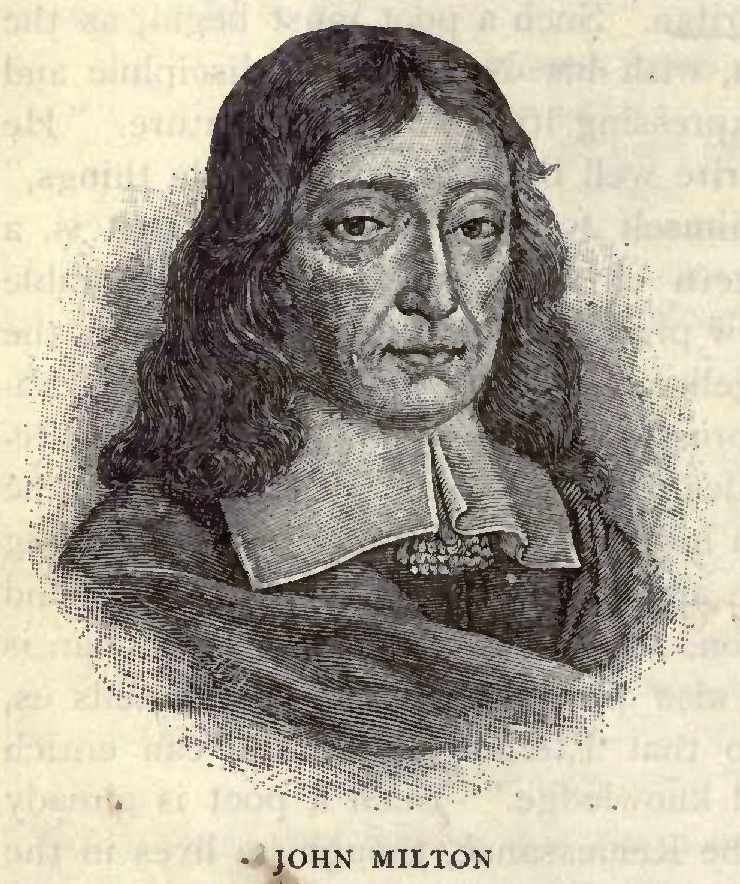
JOHN MILTON
Apparently the elder Milton shared Bacon's dislike for the educational
methods of the time and so took charge of his son's training, encouraging
his natural tastes, teaching him music, and seeking out a tutor who helped
the boy to what he sought most eagerly, not the grammar and mechanism of
Greek and Latin but rather the stories, the ideals, the poetry that hide
in their incomparable literatures. At twelve years we find the boy already
a scholar in spirit, unable to rest till after midnight because of the joy
with which his study was rewarded. From boyhood two great principles seem
to govern Milton's career: one, the love of beauty, of music, art,
literature, and indeed of every form of human culture; the other, a
steadfast devotion to duty as the highest object in human life.
A brief course at the famous St. Paul's school in London was the prelude
to Milton's entrance to Christ's College, Cambridge. Here again he
followed his natural bent and, like Bacon, found himself often in
opposition to the authorities. Aside from some Latin poems, the most
noteworthy song of this period of Milton's life is his splendid ode, '"On
the Morning of Christ's Nativity," which was begun on Christmas day, 1629.
Milton, while deep in the classics, had yet a greater love for his native
literature. Spenser was for years his master; in his verse we find every
evidence of his "loving study" of Shakespeare, and his last great poems
show clearly how he had been influenced by Fletcher's Christ's Victory
and Triumph. But it is significant that this first ode rises higher
than anything of the kind produced in the famous Age of Elizabeth.
While at Cambridge it was the desire of his parents that Milton should
take orders in the Church of England; but the intense love of mental
liberty which stamped the Puritan was too strong within him, and he
refused to consider the "oath of servitude," as he called it, which would
mark his ordination. Throughout his life Milton, though profoundly
religious, held aloof from the strife of sects. In belief, he belonged to
the extreme Puritans, called Separatists, Independents,
Congregationalists, of which our Pilgrim Fathers are the great examples;
but he refused to be bound by any creed or church discipline:
As ever in my great Task-Master's eye.
In this last line of one of his sonnets[164] is found Milton's rejection of every form of
outward religious authority in face of the supreme Puritan principle, the
liberty of the individual soul before God.
A long period of retirement followed Milton's withdrawal from the
university in 1632. At his father's country home in Horton he gave himself
up for six years to solitary reading and study, roaming over the wide
fields of Greek, Latin, Hebrew, Spanish, French, Italian, and English
literatures, and studying hard at mathematics, science, theology, and
music,--a curious combination. To his love of music we owe the melody of
all his poetry, and we note it in the rhythm and balance which make even
his mighty prose arguments harmonious. In "Lycidas," "L'Allegro," "Il
Penseroso," "Arcades," "Comus," and a few "Sonnets," we have the poetic
results of this retirement at Horton,--few, indeed, but the most perfect
of their kind that our literature has recorded.
Out of solitude, where his talent was perfected, Milton entered the busy
world where his character was to be proved to the utmost. From Horton he
traveled abroad, through France, Switzerland, and Italy, everywhere
received with admiration for his learning and courtesy, winning the
friendship of the exiled Dutch scholar Grotius, in Paris, and of Galileo
in his sad imprisonment in Florence.[165] He was on his way to Greece when news reached
him of the break between king and parliament. With the practical insight
which never deserted him Milton saw clearly the meaning of the news. His
cordial reception in Italy, so chary of praise to anything not Italian,
had reawakened in Milton the old desire to write an epic which England
would "not willingly let die"; but at thought of the conflict for human
freedom all his dreams were flung to the winds. He gave up his travels and
literary ambitions and hurried to England. "For I thought it base," he
says, "to be traveling at my ease for intellectual culture while my
fellow-countrymen at home were fighting for liberty."
Then for nearly twenty years the poet of great achievement and still
greater promise disappears. We hear no more songs, but only the prose
denunciations and arguments which are as remarkable as his poetry. In all
our literature there is nothing more worthy of the Puritan spirit than
this laying aside of personal ambitions in order to join in the struggle
for human liberty. In his best known sonnet, "On His Blindness," which
reflects his grief, not at darkness, but at his abandoned dreams, we catch
the sublime spirit of this renunciation.
Milton's opportunity to serve came in the crisis of 1649. The king had
been sent to the scaffold, paying the penalty of his own treachery, and
England sat shivering at its own deed, like a child or a Russian peasant
who in sudden passion resists unbearable brutality and then is afraid of
the consequences. Two weeks of anxiety, of terror and silence followed;
then appeared Milton's Tenure of Kings and Magistrates. To England
it was like the coming of a strong man, not only to protect the child, but
to justify his blow for liberty. Kings no less than people are subject to
the eternal principle of law; the divine right of a people to defend and
protect themselves,--that was the mighty argument which calmed a people's
dread and proclaimed that a new man and a new principle had arisen in
England. Milton was called to be Secretary for Foreign Tongues in the new
government; and for the next few years, until the end of the Commonwealth,
there were two leaders in England, Cromwell the man of action, Milton the
man of thought. It is doubtful to which of the two humanity owes most for
its emancipation from the tyranny of kings and prelates.
Two things of personal interest deserve mention in this period of Milton's
life, his marriage and his blindness. In 1643 he married Mary Powell, a
shallow, pleasure-loving girl, the daughter of a Royalist; and that was
the beginning of sorrows. After a month, tiring of the austere life of a
Puritan household, she abandoned her husband, who, with the same radical
reasoning with which he dealt with affairs of state, promptly repudiated
the marriage. His Doctrine and Discipline of Divorce and his Tetrachordon
are the arguments to justify his position; but they aroused a storm of
protest in England, and they suggest to a modern reader that Milton was
perhaps as much to blame as his wife, and that he had scant understanding
of a woman's nature. When his wife, fearing for her position, appeared
before him in tears, all his ponderous arguments were swept aside by a
generous impulse; and though the marriage was never a happy one, Milton
never again mentioned his wife's desertion. The scene in Paradise Lost,
where Eve comes weeping to Adam, seeking peace and pardon, is probably a
reflection of a scene in Milton's own household. His wife died in 1653,
and a few years later he married another, whom we remember for the sonnet,
"Methought I saw my late espoused saint," in which she is celebrated. She
died after fifteen months, and in 1663 he married a third wife, who helped
the blind old man to manage his poor household.
From boyhood the strain on the poet's eyes had grown more and more severe;
but even when his sight was threatened he held steadily to his purpose of
using his pen in the service of his country. During the king's
imprisonment a book appeared called Eikon Basilike (Royal Image),
giving a rosy picture of the king's piety, and condemning the Puritans.
The book speedily became famous and was the source of all Royalist
arguments against the Commonwealth. In 1649 appeared Milton's Eikonoklastes
(Image Breaker), which demolished the flimsy arguments of the Eikon
Basilike as a charge of Cromwell's Ironsides had overwhelmed the
king's followers. After the execution of the king appeared another famous
attack upon the Puritans, Defensio Regia pro Carlo I, instigated by
Charles II, who was then living in exile. It was written in Latin by
Salmasius, a Dutch professor at Leyden, and was hailed by the Royalists as
an invincible argument. By order of the Council of State Milton prepared a
reply. His eyesight had sadly failed, and he was warned that any further
strain would be disastrous. His reply was characteristic of the man and
the Puritan. As he had once sacrificed his poetry, so he was now ready, he
said, to sacrifice his eyes also on the altar of English liberty. His
magnificent Defensio pro Populo Anglicano is one of the most
masterly controversial works in literature. The power of the press was
already strongly felt in England, and the new Commonwealth owed its
standing partly to Milton's prose, and partly to Cromwell's policy. The Defensio
was the last work that Milton saw. Blindness fell upon him ere it was
finished, and from 1652 until his death he labored in total darkness.
The last part of Milton's life is a picture of solitary grandeur unequaled
in literary history. With the Restoration all his labors and sacrifices
for humanity were apparently wasted. From his retirement he could hear the
bells and the shouts that welcomed back a vicious monarch, whose first act
was to set his foot upon his people's neck. Milton was immediately marked
for persecution; he remained for months in hiding; he was reduced to
poverty, and his books were burned by the public hangman. His daughters,
upon whom he depended in his blindness, rebelled at the task of reading to
him and recording his thoughts. In the midst of all these sorrows we
understand, in Samson, the cry of the blind champion of Israel:
Now blind, disheartened, shamed, dishonored, quelled,
To what can I
be useful? wherein serve
My nation, and the work from Heaven
imposed?
But to sit idle on the household hearth,
A burdenous
drone; to visitants a gaze,
Or pitied object.
Milton's answer is worthy of his own great life. Without envy or
bitterness he goes back to the early dream of an immortal poem and begins
with superb consciousness of power to dictate his great epic.
Paradise Lost was finished in 1665, after seven years' labor in
darkness. With great difficulty he found a publisher, and for the great
work, now the most honored poem in our literature, he received less than
certain verse makers of our day receive for a little song in one of our
popular magazines. Its success was immediate, though, like all his work,
it met with venomous criticism. Dryden summed up the impression made on
thoughtful minds of his time when he said, "This man cuts us all out, and
the ancients too." Thereafter a bit of sunshine came into his darkened
home, for the work stamped him as one of the world's great writers, and
from England and the Continent pilgrims came in increasing numbers to
speak their gratitude.
The next year Milton began his Paradise Regained. In 1671 appeared
his last important work, Samson Agonistes, the most powerful
dramatic poem on the Greek model which our language possesses. The picture
of Israel's mighty champion, blind, alone, afflicted by thoughtless
enemies but preserving a noble ideal to the end, is a fitting close to the
life work of the poet himself. For years he was silent, dreaming who shall
say what dreams in his darkness, and saying cheerfully to his friends,
"Still guides the heavenly vision." He died peacefully in 1674, the most
sublime and the most lonely figure in our literature.
Milton's Early Poetry.[166] In his early work Milton appears as the
inheritor of all that was best in Elizabethan literature, and his first
work, the ode "On the Morning of Christ's Nativity," approaches the
high-water mark of lyric poetry in England. In the next six years, from
1631 to 1637, he wrote but little, scarcely more than two thousand lines,
but these are among the most exquisite and the most perfectly finished in
our language.
L'Allegro"L'Allegro" and "II Penseroso"
are twin poems, containing many lines and short descriptive passages which
linger in the mind like strains of music, and which are known and loved
wherever English is spoken. "L'Allegro" (the joyous or happy man) is like
an excursion into the English fields at sunrise. The air is sweet; birds
are singing; a multitude of sights, sounds, fragrances, fill all the
senses; and to this appeal of nature the soul of man responds by being
happy, seeing in every flower and hearing in every harmony some exquisite
symbol of human life. "Il Penseroso" takes us over the same ground at
twilight and at moonrise. The air is still fresh and fragrant; the
symbolism is, if possible, more tenderly beautiful than before; but the
gay mood is gone, though its memory lingers in the afterglow of the
sunset. A quiet thoughtfulness takes the place of the pure, joyous
sensation of the morning, a thoughtfulness which is not sad, though like
all quiet moods it is akin to sadness, and which sounds the deeps of human
emotion in the presence of nature. To quote scattered lines of either poem
is to do injustice to both. They should be read in their entirety the same
day, one at morning, the other at eventide, if one is to appreciate their
beauty and suggestiveness.
ComusThe "Masque of Comus" is in many
respects the most perfect of Milton's poems. It was written in 1634 to be
performed at Ludlow Castle before the earl of Bridgewater and his friends.
There is a tradition that the earl's three children had been lost in the
woods, and, whether true or not, Milton takes the simple theme of a person
lost, calls in an Attendant Spirit to protect the wanderer, and out of
this, with its natural action and melodious songs, makes the most
exquisite pastoral drama that we possess. In form it is a masque, like
those gorgeous products of the Elizabethan age of which Ben Jonson was the
master. England had borrowed the idea of the masque from Italy and had
used it as the chief entertainment at all festivals, until it had become
to the nobles of England what the miracle play had been to the common
people of a previous generation. Milton, with his strong Puritan spirit,
could not be content with the mere entertainment of an idle hour. "Comus"
has the gorgeous scenic effects, the music and dancing of other masques;
but its moral purpose and its ideal teachings are unmistakable. "The
Triumph of Virtue" would be a better name for this perfect little masque,
for its theme is that virtue and innocence can walk through any peril of
this world without permanent harm. This eternal triumph of good over evil
is proclaimed by the Attendant Spirit who has protected the innocent in
this life and who now disappears from mortal sight to resume its life of
joy:
Mortals, that would follow me,
Love Virtue; she alone is free.
She can teach ye how to climb
Higher than the sphery chime;
Or
if Virtue feeble were,
Heaven itself would stoop to her.
While there are undoubted traces of Jonson and John Fletcher in Milton's
"Comus," the poem far surpasses its predecessors in the airy beauty and
melody of its verses.
LycidasIn the next poem, "Lycidas," a
pastoral elegy written in 1637, and the last of his Horton poems, Milton
is no longer the inheritor of the old age, but the prophet of a new. A
college friend, Edward King, had been drowned in the Irish Sea, and Milton
follows the poetic custom of his age by representing both his friend and
himself in the guise of shepherds leading the pastoral life. Milton also
uses all the symbolism of his predecessors, introducing fauns, satyrs, and
sea nymphs; but again the Puritan is not content with heathen symbolism,
and so introduces a new symbol of the Christian shepherd responsible for
the souls of men, whom he likens to hungry sheep that look up and are not
fed. The Puritans and Royalists at this time were drifting rapidly apart,
and Milton uses his new symbolism to denounce the abuses that had crept
into the Church. In any other poet this moral teaching would hinder the
free use of the imagination; but Milton seems equal to the task of
combining high moral purpose with the noblest poetry. In its exquisite
finish and exhaustless imagery "Lycidas" surpasses most of the poetry of
what is often called the pagan Renaissance.
SonnetsBesides these well-known poems,
Milton wrote in this early period a fragmentary masque called "Arcades";
several Latin poems which, like his English, are exquisitely finished; and
his famous "Sonnets," which brought this Italian form of verse nearly to
the point of perfection. In them he seldom wrote of love, the usual
subject with his predecessors, but of patriotism, duty, music, and
subjects of political interest suggested by the struggle into which
England was drifting. Among these sonnets each reader must find his own
favorites. Those best known and most frequently quoted are "On His
Deceased Wife," "To the Nightingale," "On Reaching the Age of
Twenty-three," "The Massacre in Piedmont," and the two "On His Blindness."
Milton's Prose. Of Milton's prose works there are many divergent
opinions, ranging from Macaulay's unbounded praise to the condemnation of
some of our modern critics. From a literary view point Milton's prose
would be stronger if less violent, and a modern writer would hardly be
excused for using his language or his methods; but we must remember the
times and the methods of his opponents. In his fiery zeal against
injustice the poet is suddenly dominated by the soldier's spirit. He first
musters his facts in battalions, and charges upon the enemy to crush and
overpower without mercy. For Milton hates injustice and, because it is an
enemy of his people, he cannot and will not spare it. When the victory is
won, he exults in a paean of victory as soul-stirring as the Song of
Deborah. He is the poet again, spite of himself, and his mind fills with
magnificent images. Even with a subject so dull, so barren of the bare
possibilities of poetry, as his "Animadversions upon the Remonstrants'
Defense," he breaks out into an invocation, "Oh, Thou that sittest in
light and glory unapproachable, parent of angels and men," which is like a
chapter from the Apocalypse. In such passages Milton's prose is, as Taine
suggests, "an outpouring of splendors," which suggests the noblest poetry.
AreopagiticaOn account of their
controversial character these prose works are seldom read, and it is
probable that Milton never thought of them as worthy of a place in
literature. Of them all Areopagitica has perhaps the most permanent
interest and is best worth reading. In Milton's time there was a law
forbidding the publication of books until they were indorsed by the
official censor. Needless to say, the censor, holding his office and
salary by favor, was naturally more concerned with the divine right of
kings and bishops than with the delights of literature, and many books
were suppressed for no better reason than that they were displeasing to
the authorities. Milton protested against this, as against every other
form of tyranny, and his Areopagitica--so called from the Areopagus
or Forum of Athens, the place of public appeal, and the Mars Hill of St.
Paul's address--is the most famous plea in English for the freedom of the
press.
Milton's Later Poetry. Undoubtedly the noblest of Milton's works,
written when he was blind and suffering, are Paradise Lost, Paradise
Regained, and Samson Agonistes. The first is the greatest,
indeed the only generally acknowledged epic in our literature since Beowulf;
the last is the most perfect specimen of a drama after the Greek method in
our language.
Paradise LostOf the history of the great
epic we have some interesting glimpses. In Cambridge there is preserved a
notebook of Milton's containing a list of nearly one hundred subjects[167] for a great poem,
selected while he was a boy at the university. King Arthur attracted him
at first; but his choice finally settled upon the Fall of Man, and we have
four separate outlines showing Milton's proposed treatment of the subject.
These outlines indicate that he contemplated a mighty drama or miracle
play; but whether because of Puritan antipathy to plays and players, or
because of the wretched dramatic treatment of religious subjects which
Milton had witnessed in Italy, he abandoned the idea of a play and settled
on the form of an epic poem; most fortunately, it must be conceded, for
Milton had not the knowledge of men necessary for a drama. As a study of
character Paradise Lost would be a grievous failure. Adam, the
central character, is something of a prig; while Satan looms up a
magnificent figure, entirely different from the devil of the miracle plays
and completely overshadowing the hero both in interest and in manliness.
The other characters, the Almighty, the Son, Raphael, Michael, the angels
and fallen spirits, are merely mouthpieces for Milton's declamations,
without any personal or human interest. Regarded as a drama, therefore, Paradise
Lost could never have been a success; but as poetry, with its sublime
imagery, its harmonious verse, its titanic background of heaven, hell, and
the illimitable void that lies between, it is unsurpassed in any
literature.
In 1658 Milton in his darkness sat down to dictate the work which he had
planned thirty years before. In order to understand the mighty sweep of
the poem it is necessary to sum up the argument of the twelve books, as
follows:
Argument of Paradise LostBook I opens with
a statement of the subject, the Fall of Man, and a noble invocation for
light and divine guidance. Then begins the account of Satan and the rebel
angels, their banishment from heaven, and their plot to oppose the design
of the Almighty by dragging down his children, our first parents, from
their state of innocence. The book closes with a description of the land
of fire and endless pain where the fallen spirits abide, and the erection
of Pandemonium, the palace of Satan. Book II is a description of the
council of evil spirits, of Satan's consent to undertake the temptation of
Adam and Eve, and his journey to the gates of hell, which are guarded by
Sin and Death. Book III transports us to heaven again. God, foreseeing the
fall, sends Raphael to warn Adam and Eve, so that their disobedience shall
be upon their own heads. Then the Son offers himself a sacrifice, to take
away the sin of the coming disobedience of man. At the end of this book
Satan appears in a different scene, meets Uriel, the Angel of the Sun,
inquires from him the way to earth, and takes his journey thither
disguised as an angel of light. Book IV shows us Paradise and the innocent
state of man. An angel guard is set over Eden, and Satan is arrested while
tempting Eve in a dream, but is curiously allowed to go free again. Book V
shows us Eve relating her dream to Adam, and then the morning prayer and
the daily employment of our first parents. Raphael visits them, is
entertained by a banquet (which Eve proposes in order to show him that all
God's gifts are not kept in heaven), and tells them of the revolt of the
fallen spirits. His story is continued in Book VI. In Book VII we read the
story of the creation of the world as Raphael tells it to Adam and Eve. In
Book VIII Adam tells Raphael the story of his own life and of his meeting
with Eve. Book IX is the story of the temptation by Satan, following the
account in Genesis. Book X records the divine judgment upon Adam and Eve;
shows the construction by Sin and Death of a highway through chaos to the
earth, and Satan's return to Pandemonium. Adam and Eve repent of their
disobedience and Satan and his angels are turned into serpents. In Book XI
the Almighty accepts Adam's repentance, but condemns him to be banished
from Paradise, and the archangel Michael is sent to execute the sentence.
At the end of the book, after Eve's feminine grief at the loss of
Paradise, Michael begins a prophetic vision of the destiny of man. Book
XII continues Michael's vision. Adam and Eve are comforted by hearing of
the future redemption of their race. The poem ends as they wander forth
out of Paradise and the door closes behind them.
It will be seen that this is a colossal epic, not of a man or a hero, but
of the whole race of men; and that Milton's characters are such as no
human hand could adequately portray. But the scenes, the splendors of
heaven, the horrors of hell, the serene beauty of Paradise, the sun and
planets suspended between celestial light and gross darkness, are pictured
with an imagination that is almost superhuman. The abiding interest of the
poem is in these colossal pictures, and in the lofty thought and the
marvelous melody with which they are impressed on our minds. The poem is
in blank verse, and not until Milton used it did we learn the infinite
variety and harmony of which it is capable. He played with it, changing
its melody and movement on every page, "as an organist out of a single
theme develops an unending variety of harmony."
Lamartine has described Paradise Lost as the dream of a Puritan
fallen asleep over his Bible, and this suggestive description leads us to
the curious fact that it is the dream, not the theology or the
descriptions of Bible scenes, that chiefly interests us. Thus Milton
describes the separation of earth and water, and there is little or
nothing added to the simplicity and strength of Genesis; but the
sunset which follows is Milton's own dream, and instantly we are
transported to a land of beauty and poetry:
Now came still Evening on, and Twilight gray
Had in her sober
livery all things clad;
Silence accompanied; for beast and bird,
They to their grassy couch, these to their nests
Were slunk, all
but the wakeful nightingale.
She all night long her amorous descant
sung:
Silence was pleased. Now glowed the firmament
With
living sapphires; Hesperus, that led
The starry host, rode
brightest, till the Moon,
Rising in clouded majesty, at length
Apparent queen, unveiled her peerless light,
And o'er the dark her
silver mantle threw.
So also Milton's Almighty, considered purely as a literary character, is
unfortunately tinged with the narrow and literal theology of the time. He
is a being enormously egotistic, the despot rather than the servant of the
universe, seated upon a throne with a chorus of angels about him eternally
singing his praises and ministering to a kind of divine vanity. It is not
necessary to search heaven for such a character; the type is too common
upon earth. But in Satan Milton breaks away from crude mediæval
conceptions; he follows the dream again, and gives us a character to
admire and understand:
"Is this the region, this the soil, the clime,"
Said then the lost
Archangel, "this the seat
That we must change for Heaven?--this
mournful gloom
For that celestial light? Be it so, since He
Who now is sovran can dispose and bid
What shall be right: farthest
from Him is best,
Whom reason hath equalled, force hath made
supreme
Above his equals. Farewell, happy fields,
Where joy
forever dwells! Hail, horrors! hail,
Infernal World! and thou,
profoundest Hell,
Receive thy new possessor--one who brings
A
mind not to be changed by place or time.
The mind is its own place,
and in itself
Can make a Heaven of Hell, a Hell of Heaven.
What matter where, if I be still the same,
And what I should be,
all but less than he
Whom thunder hath made greater? Here at least
We shall be free; the Almighty hath not built
Here for his envy,
will not drive us hence:
Here we may reign secure; and, in my
choice,
To reign is worth ambition, though in Hell:
Better to
reign in Hell than serve in Heaven."
In this magnificent heroism Milton has unconsciously immortalized the
Puritan spirit, the same unconquerable spirit that set men to writing
poems and allegories when in prison for the faith, and that sent them over
the stormy sea in a cockleshell to found a free commonwealth in the wilds
of America.
For a modern reader the understanding of Paradise Lost presupposes
two things,--a knowledge of the first chapters of the Scriptures, and of
the general principles of Calvinistic theology; but it is a pity to use
the poem, as has so often been done, to teach a literal acceptance of one
or the other. Of the theology of Paradise Lost the least said the
better; but to the splendor of the Puritan dream and the glorious melody
of its expression no words can do justice. Even a slight acquaintance will
make the reader understand why it ranks with the Divina Commedia of
Dante, and why it is generally accepted by critics as the greatest single
poem in our literature.
Paradise RegainedSoon after the completion
of Paradise Lost, Thomas Ellwood, a friend of Milton, asked one day
after reading the Paradise manuscript, "But what hast thou to say of
Paradise Found?" It was in response to this suggestion that Milton wrote
the second part of the great epic, known to us as Paradise Regained.
The first tells how mankind, in the person of Adam, fell at the first
temptation by Satan and became an outcast from Paradise and from divine
grace; the second shows how mankind, in the person of Christ, withstands
the tempter and is established once more in the divine favor. Christ's
temptation in the wilderness is the theme, and Milton follows the account
in the fourth chapter of Matthew's gospel. Though Paradise Regained
was Milton's favorite, and though it has many passages of noble thought
and splendid imagery equal to the best of Paradise Lost, the poem
as a whole falls below the level of the first, and is less interesting to
read.
SamsonIn Samson Agonistes Milton
turns to a more vital and personal theme, and his genius transfigures the
story of Samson, the mighty champion of Israel, now blind and scorned,
working as a slave among the Philistines. The poet's aim was to present in
English a pure tragedy, with all the passion and restraint which marked
the old Greek dramas. That he succeeded where others failed is due to two
causes: first, Milton himself suggests the hero of one of the Greek
tragedies,--his sorrow and affliction give to his noble nature that touch
of melancholy and calm dignity which is in perfect keeping with his
subject. Second, Milton is telling his own story. Like Samson he had
struggled mightily against the enemies of his race; he had taken a wife
from the Philistines and had paid the penalty; he was blind, alone,
scorned by his vain and thoughtless masters. To the essential action of
the tragedy Milton could add, therefore, that touch of intense yet
restrained personal feeling which carries more conviction than any
argument. Samson is in many respects the most convincing of his
works. Entirely apart from the interest of its subject and treatment, one
may obtain from it a better idea of what great tragedy was among the
Greeks than from any other work in our language.
Nothing is here for tears, nothing to wail
Or knock the breast, no
weakness, no contempt,
Dispraise or blame,--nothing but well and
fair,
And what may quiet us in a death so noble.
III. PROSE WRITERS OF THE PURITAN PERIOD
JOHN BUNYAN (1628-1688)
As there is but one poet great enough to express the Puritan spirit, so
there is but one commanding prose writer, John Bunyan. Milton was the
child of the Renaissance, inheritor of all its culture, and the most
profoundly educated man of his age. Bunyan was a poor, uneducated tinker.
From the Renaissance he inherited nothing; but from the Reformation he
received an excess of that spiritual independence which had caused the
Puritan struggle for liberty. These two men, representing the extremes of
English life in the seventeenth century, wrote the two works that stand
to-day for the mighty Puritan spirit. One gave us the only epic since Beowulf;
the other gave us our only great allegory, which has been read more than
any other book in our language save the Bible.
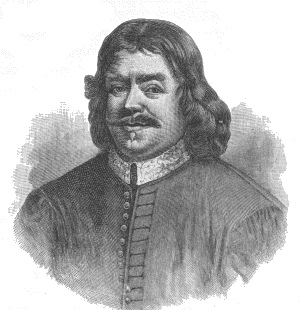
JOHN
BUNYAN
Life of Bunyan. Bunyan is an extraordinary figure; we must study
him, as well as his books. Fortunately we have his life story in his own
words, written with the same lovable modesty and sincerity that marked all
his work. Reading that story now, in Grace Abounding, we see two
great influences at work in his life. One, from within, was his own vivid
imagination, which saw visions, allegories, parables, revelations, in
every common event. The other, from without, was the spiritual ferment of
the age, the multiplication of strange sects,--Quakers, Free-Willers,
Ranters, Anabaptists, Millenarians,--and the untempered zeal of all
classes, like an engine without a balance wheel, when men were breaking
away from authority and setting up their own religious standards. Bunyan's
life is an epitome of that astonishing religious individualism which
marked the close of the English Reformation.
He was born in the little village of Elstow, near Bedford, in 1628, the
son of a poor tinker. For a little while the boy was sent to school, where
he learned to read and write after a fashion; but he was soon busy in his
father's shop, where, amid the glowing pots and the fire and smoke of his
little forge, he saw vivid pictures of hell and the devils which haunted
him all his life. When he was sixteen years old his father married the
second time, whereupon Bunyan ran away and became a soldier in the
Parliamentary army.
The religious ferment of the age made a tremendous impression on Bunyan's
sensitive imagination. He went to church occasionally, only to find
himself wrapped in terrors and torments by some fiery itinerant preacher;
and he would rush violently away from church to forget his fears by
joining in Sunday sports on the village green. As night came on the sports
were forgotten, but the terrors returned, multiplied like the evil spirits
of the parable. Visions of hell and the demons swarmed in his brain. He
would groan aloud in his remorse, and even years afterwards he bemoans the
sins of his early life. When we look for them fearfully, expecting some
shocking crimes and misdemeanors, we find that they consisted of playing
ball on Sunday and swearing. The latter sin, sad to say, was begun by
listening to his father cursing some obstinate kettle which refused to be
tinkered, and it was perfected in the Parliamentary army. One day his
terrible swearing scared a woman, "a very loose and ungodly wretch," as he
tells us, who reprimanded him for his profanity. The reproach of the poor
woman went straight home, like the voice of a prophet. All his profanity
left him; he hung down his head with shame. "I wished with all my heart,"
he says, "that I might be a little child again, that my father might learn
me to speak without this wicked way of swearing." With characteristic
vehemence Bunyan hurls himself upon a promise of Scripture, and instantly
the reformation begins to work in his soul. He casts out the habit, root
and branch, and finds to his astonishment that he can speak more freely
and vigorously than before. Nothing is more characteristic of the man than
this sudden seizing upon a text, which he had doubtless heard many times
before, and being suddenly raised up or cast down by its influence.
With Bunyan's marriage to a good woman the real reformation in his life
began. While still in his teens he married a girl as poor as himself. "We
came together," he says, "as poor as might be, having not so much
household stuff as a dish or spoon between us both." The only dowry which
the girl brought to her new home was two old, threadbare books, The
Plain Man's Pathway to Heaven, and The Practice of Piety[168] Bunyan read these
books, which instantly gave fire to his imagination. He saw new visions
and dreamed terrible new dreams of lost souls; his attendance at church
grew exemplary; he began slowly and painfully to read the Bible for
himself, but because of his own ignorance and the contradictory
interpretations of Scripture which he heard on every side, he was tossed
about like a feather by all the winds of doctrine.
The record of the next few years is like a nightmare, so terrible is
Bunyan's spiritual struggle. One day he feels himself an outcast; the next
the companion of angels; the third he tries experiments with the Almighty
in order to put his salvation to the proof. As he goes along the road to
Bedford he thinks he will work a miracle, like Gideon with his fleece. He
will say to the little puddles of water in the horses' tracks, "Be ye
dry"; and to all the dry tracks he will say, "Be ye puddles." As he is
about to perform the miracle a thought occurs to him: "But go first under
yonder hedge and pray that the Lord will make you able to perform a
miracle." He goes promptly and prays. Then he is afraid of the test, and
goes on his way more troubled than before.
After years of such struggle, chased about between heaven and hell, Bunyan
at last emerges into a saner atmosphere, even as Pilgrim came out of the
horrible Valley of the Shadow. Soon, led by his intense feelings, he
becomes an open-air preacher, and crowds of laborers gather about him on
the village green. They listen in silence to his words; they end in groans
and tears; scores of them amend their sinful lives. For the Anglo-Saxon
people are remarkable for this, that however deeply they are engaged in
business or pleasure, they are still sensitive as barometers to any true
spiritual influence, whether of priest or peasant; they recognize what
Emerson calls the "accent of the Holy Ghost," and in this recognition of
spiritual leadership lies the secret of their democracy. So this village
tinker, with his strength and sincerity, is presently the acknowledged
leader of an immense congregation, and his influence is felt throughout
England. It is a tribute to his power that, after the return of Charles
II, Bunyan was the first to be prohibited from holding public meetings.
Concerning Bunyan's imprisonment in Bedford jail, which followed his
refusal to obey the law prohibiting religious meetings without the
authority of the Established Church, there is a difference of opinion.
That the law was unjust goes without saying; but there was no religious
persecution, as we understand the term. Bunyan was allowed to worship when
and how he pleased; he was simply forbidden to hold public meetings, which
frequently became fierce denunciations of the Established Church and
government. His judges pleaded with Bunyan to conform with the law. He
refused, saying that when the Spirit was upon him he must go up and down
the land, calling on men everywhere to repent. In his refusal we see much
heroism, a little obstinacy, and perhaps something of that desire for
martyrdom which tempts every spiritual leader. That his final sentence to
indefinite imprisonment was a hard blow to Bunyan is beyond question. He
groaned aloud at the thought of his poor family, and especially at the
thought of leaving his little blind daughter:
I found myself a man encompassed with infirmities; the parting was like
pulling the flesh from my bones.... Oh, the thoughts of the hardship I
thought my poor blind one might go under would break my heart to pieces.
Poor child, thought I, what sorrow thou art like to have for thy portion
in this world; thou must be beaten, must beg, suffer hunger, cold,
nakedness, and a thousand calamities, though I cannot now endure that the
wind should blow upon thee.[169]
And then, because he thinks always in parables and seeks out most curious
texts of Scripture, he speaks of "the two milch kine that were to carry
the ark of God into another country and leave their calves behind them."
Poor cows, poor Bunyan! Such is the mind of this extraordinary man.
With characteristic diligence Bunyan set to work in prison making shoe
laces, and so earned a living for his family. His imprisonment lasted for
nearly twelve years; but he saw his family frequently, and was for some
time a regular preacher in the Baptist church in Bedford. Occasionally he
even went about late at night, holding the proscribed meetings and
increasing his hold upon the common people. The best result of this
imprisonment was that it gave Bunyan long hours for the working of his
peculiar mind and for study of his two only books, the King James Bible
and Foxe's Book of Martyrs. The result of his study and meditation
was The Pilgrim's Progress, which was probably written in prison,
but which for some reason he did not publish till long after his release.
The years which followed are the most interesting part of Bunyan's strange
career. The publication of Pilgrim's Progress in 1678 made him the
most popular writer, as he was already the most popular preacher, in
England. Books, tracts, sermons, nearly sixty works in all, came from his
pen; and when one remembers his ignorance, his painfully slow writing, and
his activity as an itinerant preacher, one can only marvel. His
evangelistic journeys carried him often as far as London, and wherever he
went crowds thronged to hear him. Scholars, bishops, statesmen went in
secret to listen among the laborers, and came away wondering and silent.
At Southwark the largest building could not contain the multitude of his
hearers; and when he preached in London, thousands would gather in the
cold dusk of the winter morning, before work began, and listen until he
had made an end of speaking. "Bishop Bunyan" he was soon called on account
of his missionary journeys and his enormous influence.
What we most admire in the midst of all this activity is his perfect
mental balance, his charity and humor in the strife of many sects. He was
badgered for years by petty enemies, and he arouses our enthusiasm by his
tolerance, his self-control, and especially by his sincerity. To the very
end he retained that simple modesty which no success could spoil. Once
when he had preached with unusual power some of his friends waited after
the service to congratulate him, telling him what a "sweet sermon" he had
delivered. "Aye," said Bunyan, "you need not remind me; the devil told me
that before I was out of the pulpit."
For sixteen years this wonderful activity continued without interruption.
Then, one day when riding through a cold storm on a labor of love, to
reconcile a stubborn man with his own stubborn son, he caught a severe
cold and appeared, ill and suffering but rejoicing in his success, at the
house of a friend in Reading. He died there a few days later, and was laid
away in Bunhill Fields burial ground, London, which has been ever since a
campo santo to the faithful.
Works of Bunyan. The world's literature has three great
allegories,--Spenser's Faery Queen, Dante's Divina Commedia,
and Bunyan's Pilgrim's Progress. The first appeals to poets, the
second to scholars, the third to people of every age and condition. Here
is a brief outline of the famous work:
Argument of Pilgrim's Progress"As I walked
through the wilderness of this world I lighted on a certain place where
was a den [Bedford jail] and laid me down in that place to sleep; and, as
I slept, I dreamed a dream." So the story begins. He sees a man called
Christian setting out with a book in his hand and a great load on his back
from the city of Destruction. Christian has two objects,--to get rid of
his burden, which holds the sins and fears of his life, and to make his
way to the Holy City. At the outset Evangelist finds him weeping because
he knows not where to go, and points him to a wicket gate on a hill far
away. As Christian goes forward his neighbors, friends, wife and children
call to him to come back; but he puts his fingers in his ears, crying out,
"Life, life, eternal life," and so rushes across the plain.
Then begins a journey in ten stages, which is a vivid picture of the
difficulties and triumphs of the Christian life. Every trial, every
difficulty, every experience of joy or sorrow, of peace or temptation, is
put into the form and discourse of a living character. Other allegorists
write in poetry and their characters are shadowy and unreal; but Bunyan
speaks in terse, idiomatic prose, and his characters are living men and
women. There are Mr. Worldly Wiseman, a self-satisfied and dogmatic kind
of man, youthful Ignorance, sweet Piety, courteous Demas, garrulous
Talkative, honest Faithful, and a score of others, who are not at all the
bloodless creatures of the Romance of the Rose, but men real enough
to stop you on the road and to hold your attention. Scene after scene
follows, in which are pictured many of our own spiritual experiences.
There is the Slough of Despond, into which we all have fallen, out of
which Pliable scrambles on the hither side and goes back grumbling, but
through which Christian struggles mightily till Helpful stretches him a
hand and drags him out on solid ground and bids him go on his way. Then
come Interpreter's house, the Palace Beautiful, the Lions in the way, the
Valley of Humiliation, the hard fight with the demon Apollyon, the more
terrible Valley of the Shadow, Vanity Fair, and the trial of Faithful. The
latter is condemned to death by a jury made up of Mr. Blindman, Mr.
Nogood, Mr. Heady, Mr. Liveloose, Mr. Hatelight, and others of their kind
to whom questions of justice are committed by the jury system. Most famous
is Doubting Castle, where Christian and Hopeful are thrown into a dungeon
by Giant Despair. And then at last the Delectable Mountains of Youth, the
deep river that Christian must cross, and the city of All Delight and the
glorious company of angels that come singing down the streets. At the very
end, when in sight of the city and while he can hear the welcome with
which Christian is greeted, Ignorance is snatched away to go to his own
place; and Bunyan quaintly observes, "Then I saw that there was a way to
hell even from the gates of heaven as well as from the city of
Destruction. So I awoke, and behold it was a dream!"
Such, in brief, is the story, the great epic of a Puritan's individual
experience in a rough world, just as Paradise Lost was the epic of
mankind as dreamed by the great Puritan who had "fallen asleep over his
Bible."
Success of Pilgrim's ProgressThe chief
fact which confronts the student of literature as he pauses before this
great allegory is that it has been translated into seventy-five languages
and dialects, and has been read more than any other book save one in the
English language.
As for the secret of its popularity, Taine says, "Next to the Bible, the
book most widely read in England is the Pilgrim's Progress....
Protestantism is the doctrine of salvation by grace, and no writer has
equaled Bunyan in making this doctrine understood." And this opinion is
echoed by the majority of our literary historians. It is perhaps
sufficient answer to quote the simple fact that Pilgrim's Progress
is not exclusively a Protestant study; it appeals to Christians of every
name, and to Mohammedans and Buddhists in precisely the same way that it
appeals to Christians. When it was translated into the languages of
Catholic countries, like France and Portugal, only one or two incidents
were omitted, and the story was almost as popular there as with English
readers. The secret of its success is probably simple. It is, first of
all, not a procession of shadows repeating the author's declamations, but
a real story, the first extended story in our language. Our Puritan
fathers may have read the story for religious instruction; but all classes
of men have read it because they found in it a true personal experience
told with strength, interest, humor,--in a word, with all the qualities
that such a story should possess. Young people have read it, first, for
its intrinsic worth, because the dramatic interest of the story lured them
on to the very end; and second, because it was their introduction to true
allegory. The child with his imaginative mind--the man also, who has
preserved his simplicity--naturally personifies objects, and takes
pleasure in giving them powers of thinking and speaking like himself.
Bunyan was the first writer to appeal to this pleasant and natural
inclination in a way that all could understand. Add to this the fact that
Pilgrim's Progress was the only book having any story interest in
the great majority of English and American homes for a full century, and
we have found the real reason for its wide reading.
Other Works of BunyanThe Holy War,
published in 1665, is the first important work of Bunyan. It is a prose Paradise
Lost, and would undoubtedly be known as a remarkable allegory were it
not overshadowed by its great rival. Grace Abounding to the Chief of
Sinners, published in 1666, twelve years before Pilgrim's Progress,
is the work from which we obtain the clearest insight into Bunyan's
remarkable life, and to a man with historical or antiquarian tastes it is
still excellent reading. In 1682 appeared The Life and Death of Mr.
Badman, a realistic character study which is a precursor of the modern
novel; and in 1684 the second part of Pilgrim's Progress, showing
the journey of Christiana and her children to the city of All Delight.
Besides these Bunyan published a multitude of treatises and sermons, all
in the same style,--direct, simple, convincing, expressing every thought
and emotion perfectly in words that even a child can understand. Many of
these are masterpieces, admired by workingmen and scholars alike for their
thought and expression. Take, for instance, "The Heavenly Footman," put it
side by side with the best work of Latimer, and the resemblance in style
is startling. It is difficult to realize that one work came from an
ignorant tinker and the other from a great scholar, both engaged in the
same general work. As Bunyan's one book was the Bible, we have here a
suggestion of its influence in all our prose literature.
MINOR PROSE WRITERS
The Puritan Period is generally regarded as one destitute of literary
interest; but that was certainly not the result of any lack of books or
writers. Says Burton in his Anatomy of Melancholy:
I have ... new books every day, pamphlets, currantoes, stories, whole
catalogues of volumes of all sorts, new paradoxes, opinions, schisms,
heresies, controversies in philosophy and religion. Now come tidings of
weddings, maskings, entertainments, jubilees, embassies, sports, plays;
then again, as in a new-shipped scene, treasons, cheatings, tricks,
robberies, enormous villainies in all kinds, funerals, deaths, new
discoveries, expeditions; now comical, then tragical matters.....
So the record continues, till one rubs his eyes and thinks he must have
picked up by mistake the last literary magazine. And for all these
kaleidoscopic events there were waiting a multitude of writers, ready to
seize the abundant material and turn it to literary account for a tract,
an article, a volume, or an encyclopedia.
Three Good BooksIf one were to recommend
certain of these books as expressive of this age of outward storm and
inward calm, there are three that deserve more than a passing notice,
namely, the Religio Medici, Holy Living, and The Compleat
Angler. The first was written by a busy physician, a supposedly
scientific man at that time; the second by the most learned of English
churchmen; and the third by a simple merchant and fisherman. Strangely
enough, these three great books--the reflections of nature, science, and
revelation--all interpret human life alike and tell the same story of
gentleness, charity, and noble living. If the age had produced only these
three books, we could still be profoundly grateful to it for its inspiring
message.
Robert Burton (1577-1640). Burton
is famous chiefly as the author of the Anatomy of Melancholy, one
of the most astonishing books in all literature, which appeared in 1621.
Burton was a clergyman of the Established Church, an incomprehensible
genius, given to broodings and melancholy and to reading of every
conceivable kind of literature. Thanks to his wonderful memory, everything
he read was stored up for use or ornament, till his mind resembled a huge
curiosity shop. All his life he suffered from hypochondria, but curiously
traced his malady to the stars rather than to his own liver. It is related
of him that he used to suffer so from despondency that no help was to be
found in medicine or theology; his only relief was to go down to the river
and hear the bargemen swear at one another.
Burton's Anatomy was begun as a medical treatise on morbidness,
arranged and divided with all the exactness of the schoolmen's
demonstration of doctrines; but it turned out to be an enormous hodgepodge
of quotations and references to authors, known and unknown, living and
dead, which seemed to prove chiefly that "much study is a weariness to the
flesh." By some freak of taste it became instantly popular, and was
proclaimed one of the greatest books in literature. A few scholars still
explore it with delight, as a mine of classic wealth; but the style is
hopelessly involved, and to the ordinary reader most of his numerous
references are now as unmeaning as a hyper-jacobian surface.
Sir Thomas Browne (1605-1682).
Browne was a physician who, after much study and travel, settled down to
his profession in Norwich; but even then he gave far more time to the
investigation of natural phenomena than to the barbarous practices which
largely constituted the "art" of medicine in his day. He was known far and
wide as a learned doctor and an honest man, whose scientific studies had
placed him in advance of his age, and whose religious views were liberal
to the point of heresy. With this in mind, it is interesting to note, as a
sign of the times, that this most scientific doctor was once called to
give "expert" testimony in the case of two old women who were being tried
for the capital crime of witchcraft. He testified under oath that "the
fits were natural, but heightened by the devil's coöperating with the
witches, at whose instance he [the alleged devil] did the villainies."
Religio MediciBrowne's great work is the
Religio Medici, i.e. The Religion of a Physician (1642), which met
with most unusual success. "Hardly ever was a book published in Britain,"
says Oldys, a chronicler who wrote nearly a century later, "that made more
noise than the Religio Medici." Its success may be due largely to
the fact that, among thousands of religious works, it was one of the few
which saw in nature a profound revelation, and which treated purely
religious subjects in a reverent, kindly, tolerant way, without
ecclesiastical bias. It is still, therefore, excellent reading; but it is
not so much the matter as the manner--the charm, the gentleness, the
remarkable prose style--which has established the book as one of the
classics of our literature.
Two other works of Browne are Vulgar Errors (1646), a curious
combination of scientific and credulous research in the matter of popular
superstition, and Urn Burial, a treatise suggested by the discovery
of Roman burial urns at Walsingham. It began as an inquiry into the
various methods of burial, but ended in a dissertation on the vanity of
earthly hope and ambitions. From a literary point of view it is Browne's
best work, but is less read than the Religio Medici.
Thomas Fuller (1608-1661). Fuller
was a clergyman and royalist whose lively style and witty observations
would naturally place him with the gay Caroline poets. His best known
works are The Holy War, The Holy State and the Profane State, Church
History of Britain, and the History of the Worthies of England. The
Holy and Profane State is chiefly a biographical record, the first
part consisting of numerous historical examples to be imitated, the second
of examples to be avoided. The Church History is not a scholarly
work, notwithstanding its author's undoubted learning, but is a lively and
gossipy account which has at least one virtue, that it entertains the
reader. The Worthies, the most widely read of his works, is a racy
account of the important men of England. Fuller traveled constantly for
years, collecting information from out-of-the-way sources and gaining a
minute knowledge of his own country. This, with his overflowing humor and
numerous anecdotes and illustrations, makes lively and interesting
reading. Indeed, we hardly find a dull page in any of his numerous books.
Jeremy Taylor (1613-1667). Taylor
was the greatest of the clergymen who made this period famous, a man who,
like Milton, upheld a noble ideal in storm and calm, and himself lived it
nobly. He has been called "the Shakespeare of divines," and "a kind of
Spenser in a cassock," and both descriptions apply to him very well. His
writings, with their exuberant fancy and their noble diction, belong
rather to the Elizabethan than to the Puritan age.
From the large number of his works two stand out as representative of the
man himself: The Liberty of Prophesying (1646), which Hallam calls
the first plea for tolerance in religion, on a comprehensive basis and on
deep-seated foundations; and The Rules and Exercises of Holy Living
(1650). To the latter might be added its companion volume, Holy Dying,
published in the following year. The Holy Living and Dying, as a
single volume, was for many years read in almost every English cottage.
With Baxter's Saints' Rest, Pilgrim's Progress, and the King
James Bible, it often constituted the entire library of multitudes of
Puritan homes; and as we read its noble words and breathe its gentle
spirit, we cannot help wishing that our modern libraries were gathered
together on the same thoughtful foundations.
Richard Baxter (1615-1691). This
"busiest man of his age" strongly suggests Bunyan in his life and
writings. Like Bunyan, he was poor and uneducated, a nonconformist
minister, exposed continually to insult and persecution; and, like Bunyan,
he threw himself heart and soul into the conflicts of his age, and became
by his public speech a mighty power among the common people. Unlike Jeremy
Taylor, who wrote for the learned, and whose involved sentences and
classical allusions are sometimes hard to follow, Baxter went straight to
his mark, appealing directly to the judgment and feeling of his readers.
The number of his works is almost incredible when one thinks of his busy
life as a preacher and the slowness of manual writing. In all, he left
nearly one hundred and seventy different works, which if collected would
make fifty or sixty volumes. As he wrote chiefly to influence men on the
immediate questions of the day, most of this work has fallen into
oblivion. His two most famous books are The Saints' Everlasting Rest
and A Call to the Unconverted, both of which were exceedingly
popular, running through scores of successive editions, and have been
widely read in our own generation.
Izaak Walton (1593-1683). Walton
was a small tradesman of London, who preferred trout brooks and good
reading to the profits of business and the doubtful joys of a city life;
so at fifty years, when he had saved a little money, he left the city and
followed his heart out into the country. He began his literary work, or
rather his recreation, by writing his famous Lives,--kindly and
readable appreciations of Donne, Wotton, Hooker, Herbert, and Sanderson,
which stand at the beginning of modern biographical writing.
The Compleat AnglerIn 1653 appeared The
Compleat Angler, which has grown steadily in appreciation, and which
is probably more widely read than any other book on the subject of
fishing. It begins with a conversation between a falconer, a hunter, and
an angler; but the angler soon does most of the talking, as fishermen
sometimes do; the hunter becomes a disciple, and learns by the easy method
of hearing the fisherman discourse about his art. The conversations, it
must be confessed, are often diffuse and pedantic; but they only make us
feel most comfortably sleepy, as one invariably feels after a good day's
fishing. So kindly is the spirit of the angler, so exquisite his
appreciation of the beauty of the earth and sky, that one returns to the
book, as to a favorite trout stream, with the undying expectation of
catching something. Among a thousand books on angling it stands almost
alone in possessing a charming style, and so it will probably be read as
long as men go fishing. Best of all, it leads to a better appreciation of
nature, and it drops little moral lessons into the reader's mind as gently
as one casts a fly to a wary trout; so that one never suspects his better
nature is being angled for. Though we have sometimes seen anglers catch
more than they need, or sneak ahead of brother fishermen to the best
pools, we are glad, for Walton's sake, to overlook such unaccountable
exceptions, and agree with the milkmaid that "we love all anglers, they be
such honest, civil, quiet men."
Summary of the Puritan Period. The
half century between 1625 and 1675 is called the Puritan period for two
reasons: first, because Puritan standards prevailed for a time in England;
and second, because the greatest literary figure during all these years
was the Puritan, John Milton. Historically the age was one of tremendous
conflict. The Puritan struggled for righteousness and liberty, and because
he prevailed, the age is one of moral and political revolution. In his
struggle for liberty the Puritan overthrew the corrupt monarchy, beheaded
Charles I, and established the Commonwealth under Cromwell. The
Commonwealth lasted but a few years, and the restoration of Charles II in
1660 is often put as the end of the Puritan period. The age has no
distinct limits, but overlaps the Elizabethan period on one side, and the
Restoration period on the other.
The age produced many writers, a few immortal books, and one of the
world's great literary leaders. The literature of the age is extremely
diverse in character, and the diversity is due to the breaking up of the
ideals of political and religious unity. This literature differs from that
of the preceding age in three marked ways: (1) It has no unity of spirit,
as in the days of Elizabeth, resulting from the patriotic enthusiasm of
all classes. (2) In contrast with the hopefulness and vigor of Elizabethan
writings, much of the literature of this period is somber in character; it
saddens rather than inspires us. (3) It has lost the romantic impulse of
youth, and become critical and intellectual; it makes us think, rather
than feel deeply.
In our study we have noted (1) the Transition Poets, of whom Daniel is
chief; (2) the Song Writers, Campion and Breton; (3) the Spenserian Poets,
Wither and Giles Fletcher; (4) the Metaphysical Poets, Donne and Herbert;
(5) the Cavalier Poets, Herrick, Carew, Lovelace, and Suckling; (6) John
Milton, his life, his early or Horton poems, his militant prose, and his
last great poetical works; (7) John Bunyan, his extraordinary life, and
his chief work, The Pilgrim's Progress; (8) the Minor Prose
Writers, Burton, Browne, Fuller, Taylor, Baxter, and Walton. Three books
selected from this group are Browne's Religio Medici, Taylor's Holy
Living and Dying, and Walton's Complete Angler.
Selections for Reading. Milton. Paradise Lost, books 1-2,
L'Allegro, Il Penseroso, Comus, Lycidas, and selected Sonnets,--all in
Standard English Classics; same poems, more or less complete, in various
other series; Areopagitica and Treatise on Education, selections, in
Manly's English Prose, or Areopagitica in Arber's English Reprints,
Clarendon Press Series, Morley's Universal Library, etc.
Minor Poets. Selections from Herrick, edited by Hale, in Athenaeum
Press Series; selections from Herrick, Lovelace, Donne, Herbert, etc., in
Manly's English Poetry, Golden Treasury, Oxford Book of English Verse,
etc.; Vaughan's Silex Scintillans, in Temple Classics, also in the Aldine
Series; Herbert's The Temple, in Everyman's Library, Temple Classics, etc.
Bunyan. The Pilgrim's Progress, in Standard English Classics,
Pocket Classics, etc.; Grace Abounding, in Cassell's National Library.
Minor Prose Writers. Wentworth's Selections from Jeremy Taylor;
Browne's Religio Medici, Walton's Complete Angler, both in Everyman's
Library, Temple Classics, etc.; selections from Taylor, Browne, and Walton
in Manly's English Prose, also in Garnett's English Prose.
Bibliography.[170]
History. Text-book, Montgomery, pp. 238-257; Cheyney,
pp. 431-464; Green, ch. 8; Traill; Gardiner.
Special Works. Wakeling's King and Parliament (Oxford Manuals);
Gardiner's The First Two Stuarts and the Puritan Revolution; Tulloch's
English Puritanism and its Leaders; Lives of Cromwell by Harrison, by
Church, and by Morley; Carlyle's Oliver Cromwell's Letters and Speeches.
Literature. Saintsbury's Elizabethan Literature (extends to
1660); Masterman's The Age of Milton; Dowden's Puritan and Anglican.
Milton. Texts, Poetical Works, Globe edition, edited by Masson;
Cambridge Poets edition, edited by Moody; English Prose Writings, edited
by Morley, in Carisbrooke Library; also in Bohn's Standard Library.
Masson's Life of John Milton (8 vols.); Life, by Garnett, by Pattison
(English Men of Letters). Raleigh's Milton; Trent's John Milton; Corson's
Introduction to Milton; Brooke's Milton, in Student's Library; Macaulay's
Milton; Lowell's Essays, in Among My Books, and in Latest Literary Essays;
M. Arnold's Essay, in Essays in Criticism; Dowden's Essay, in Puritan and
Anglican.
Cavalier Poets. Schelling's Seventeenth Century Lyrics, in
Athenaeum Press Series; Cavalier and Courtier Lyrists, in Canterbury Poets
Series; Gosse's Jacobean Poets; Lovelace, etc., in Library of Old Authors.
Donne. Poems, in Muses' Library; Life, in Walton's Lives, in Temple
Classics, and in Morley's Universal Library; Life, by Gosse; Jessup's John
Donne; Dowden's Essay, in New Studies; Stephen's Studies of a Biographer,
vol. 3.
Herbert. Palmer's George Herbert; Poems and Prose Selections,
edited by Rhys, in Canterbury Poets; Dowden's Essay, in Puritan and
Anglican.
Bunyan. Brown's John Bunyan, His Life, Times, and Works; Life, by
Venables, and by Froude (English Men of Letters); Essays by Macaulay, by
Dowden, supra, and by Woodberry, in Makers of Literature.
Jeremy Taylor. Holy Living, Holy Dying, in Temple Classics, and in
Bohn's Standard Library; Selections, edited by Wentworth; Life, by Heber,
and by Gosse (English Men of Letters); Dowden's Essay, supra.
Thomas Browne. Works, edited by Wilkin; the same, in Temple
Classics, and in Bohn's Library; Religio Medici, in Everyman's Library;
essay by Pater, in Appreciations; by Dowden, supra; and by L.
Stephen, in Hours in a Library; Life, by Gosse (English Men of Letters).
Izaak Walton. Works, in Temple Classics, Cassell's Library, and
Morley's Library; Introduction, in A. Lang's Walton's Complete Angler;
Lowell's Essay, in Latest Literary Essays.
Suggestive Questions. 1. What is
meant by the Puritan period? What were the objects and the results of the
Puritan movement in English history?
2. What are the main characteristics of the literature of this period?
Compare it with Elizabethan literature. How did religion and politics
affect Puritan literature? Can you quote any passages or name any works
which justify your opinion?
3. What is meant by the terms Cavalier poets, Spenserian poets,
Metaphysical poets? Name the chief writers of each group. To whom are we
indebted for our first English hymn book? Would you call this a work of
literature? Why?
4. What are the qualities of Herrick's poetry? What marked contrasts are
found in Herrick and in nearly all the poets of this period?
5. Who was George Herbert? For what purpose did he write? What qualities
are found in his poetry?
6. Tell briefly the story of Milton's life. What are the three periods of
his literary work? What is meant by the Horton poems? Compare "L'Allegro"
and "Il Penseroso." Are there any Puritan ideals in "Comus"? Why is
"Lycidas" often put at the summit of English lyrical poetry? Give the main
idea or argument of Paradise Lost. What are the chief qualities of
the poem? Describe in outline Paradise Regained and Samson
Agonistes. What personal element entered into the latter? What quality
strikes you most forcibly in Milton's poetry? What occasioned Milton's
prose works? Do they properly belong to literature? Why? Compare Milton
and Shakespsare with regard to (1) knowledge of men, (2) ideals of life,
(3) purpose in writing.
7. Tell the story of Bunyan's life. What unusual elements are found in his
life and writings? Give the main argument of The Pilgrim's Progress.
If you read the story before studying literature, tell why you liked or
disliked it. Why is it a work for all ages and for all races? What are the
chief qualities of Bunyan's style?
8. Who are the minor prose writers of this age? Name the chief works of
Jeremy Taylor, Thomas Browne, and Izaak Walton. Can you describe from your
own reading any of these works? How does the prose of this age compare in
interest with the poetry? (Milton is, of course, excepted in this
comparison.)
|
CHRONOLOGY
|
|
Seventeenth Century
|
|
HISTORY
|
LITERATURE
|
|
|
1621.
|
Burton's Anatomy of Melancholy
|
|
|
1623.
|
Wither's Hymn Book
|
|
1625.
|
Charles I
|
|
Parliament dissolved
|
|
1628.
|
Petition of Right
|
1629.
|
Milton's Ode on the Nativity
|
|
1630-1640.
|
King rules without
|
|
Parliament. Puritan migration
|
|
to New England
|
1630-1633.
|
Herbert's poems
|
|
|
1632-1637.
|
Milton's Horton poems
|
|
1640.
|
Long Parliament
|
|
1642.
|
Civil War begins
|
1642.
|
Browne's Religio Medici
|
|
1643.
|
Scotch Covenant
|
|
1643.
|
Press censorship
|
1644.
|
Milton's Areopagitica
|
|
1645.
|
Battle of Naseby;
|
|
triumph of Puritans
|
|
1649.
|
Execution of Charles I.
|
|
Cavalier migration to Virginia
|
|
1649-1660.
|
Commonwealth
|
1649.
|
Milton's Tenure of Kings
|
|
|
1650.
|
Baxter's Saints' Rest.
|
|
|
|
Jeremy Taylor's Holy Living
|
|
|
1651.
|
Hobbes's Leviathan
|
|
1653-1658.
|
Cromwell, Protector
|
1653.
|
Walton's Complete Angler
|
|
1658-1660.
|
Richard Cromwell
|
|
1660.
|
Restoration of Charles II
|
1663-1694.
|
Dryden's dramas
|
|
|
|
(next chapter)
|
|
|
1666.
|
Bunyan's Grace Abounding
|
|
|
1667.
|
Paradise Lost
|
|
|
1674.
|
Death of Milton
|
|
|
1678.
|
Pilgrim's Progress published
|
|
|
|
(written earlier)
|
THE AGE OF FRENCH INFLUENCE
History of the Period. It seems a
curious contradiction, at first glance, to place the return of Charles II
at the beginning of modern England, as our historians are wont to do; for
there was never a time when the progress of liberty, which history
records, was more plainly turned backwards. The Puritan régime had
been too severe; it had repressed too many natural pleasures. Now,
released from restraint, society abandoned the decencies of life and the
reverence for law itself, and plunged into excesses more unnatural than
had been the restraints of Puritanism. The inevitable effect of excess is
disease, and for almost an entire generation following the Restoration, in
1660, England lay sick of a fever. Socially, politically, morally, London
suggests an Italian city in the days of the Medici; and its literature,
especially its drama, often seems more like the delirium of illness than
the expression of a healthy mind. But even a fever has its advantages.
Whatever impurity is in the blood "is burnt and purged away," and a man
rises from fever with a new strength and a new idea of the value of life,
like King Hezekiah, who after his sickness and fear of death resolved to
"go softly" all his days. The Restoration was the great crisis in English
history; and that England lived through it was due solely to the strength
and excellence of that Puritanism which she thought she had flung to the
winds when she welcomed back a vicious monarch at Dover. The chief lesson
of the Restoration was this,--that it showed by awful contrast the
necessity of truth and honesty, and of a strong government of free men,
for which the Puritan had stood like a rock in every hour of his rugged
history. Through fever, England came slowly back to health; through gross
corruption in society and in the state England learned that her people
were at heart sober, sincere, religious folk, and that their character was
naturally too strong to follow after pleasure and be satisfied. So
Puritanism suddenly gained all that it had struggled for, and gained it
even in the hour when all seemed lost, when Milton in his sorrow
unconsciously portrayed the government of Charles and his Cabal in that
tremendous scene of the council of the infernal peers in Pandemonium,
plotting the ruin of the world.
The King and his FollowersOf the king and
his followers it is difficult to write temperately. Most of the dramatic
literature of the time is atrocious, and we can understand it only as we
remember the character of the court and society for which it was written.
Unspeakably vile in his private life, the king had no redeeming
patriotism, no sense of responsibility to his country for even his public
acts. He gave high offices to blackguards, stole from the exchequer like a
common thief, played off Catholics and Protestants against each other,
disregarding his pledges to both alike, broke his solemn treaty with the
Dutch and with his own ministers, and betrayed his country for French
money to spend on his own pleasures. It is useless to paint the dishonor
of a court which followed gayly after such a leader. The first Parliament,
while it contained some noble and patriotic members, was dominated by
young men who remembered the excess of Puritan zeal, but forgot the
despotism and injustice which had compelled Puritanism to stand up and
assert the manhood of England. These young politicians vied with the king
in passing laws for the subjugation of Church and State, and in their
thirst for revenge upon all who had been connected with Cromwell's iron
government. Once more a wretched formalism--that perpetual danger to the
English Church--came to the front and exercised authority over the free
churches. The House of Lords was largely increased by the creation of
hereditary titles and estates for ignoble men and shameless women who had
flattered the king's vanity. Even the Bench, that last strong refuge of
English justice, was corrupted by the appointment of judges, like the
brutal Jeffreys, whose aim, like that of their royal master, was to get
money and to exercise power without personal responsibility. Amid all this
dishonor the foreign influence and authority of Cromwell's strong
government vanished like smoke. The valiant little Dutch navy swept the
English fleet from the sea, and only the thunder of Dutch guns in the
Thames, under the very windows of London, awoke the nation to the
realization of how low it had fallen.
Revolution of 1688 Two considerations must
modify our judgment of this disheartening spectacle. First, the king and
his court are not England. Though our histories are largely filled with
the records of kings and soldiers, of intrigues and fighting, these no
more express the real life of a people than fever and delirium express a
normal manhood. Though king and court and high society arouse our disgust
or pity, records are not wanting to show that private life in England
remained honest and pure even in the worst days of the Restoration. While
London society might be entertained by the degenerate poetry of Rochester
and the dramas of Dryden and Wycherley, English scholars hailed Milton
with delight; and the common people followed Bunyan and Baxter with their
tremendous appeal to righteousness and liberty. Second, the king, with all
his pretensions to divine right, remained only a figurehead; and the
Anglo-Saxon people, when they tire of one figurehead, have always the will
and the power to throw it overboard and choose a better one. The country
was divided into two political parties: the Whigs, who sought to limit the
royal power in the interests of Parliament and the people; and the Tories,
who strove to check the growing power of the people in the interests of
their hereditary rulers. Both parties, however, were largely devoted to
the Anglican Church; and when James II, after four years of misrule,
attempted to establish a national Catholicism by intrigues which aroused
the protest of the Pope[171]
as well as of Parliament, then Whigs and Tories, Catholics and
Protestants, united in England's last great revolution.
The complete and bloodless Revolution of 1688, which called William of
Orange to the throne, was simply the indication of England's restored
health and sanity. It proclaimed that she had not long forgotten, and
could never again forget, the lesson taught her by Puritanism in its
hundred years of struggle and sacrifice. Modern England was firmly
established by the Revolution, which was brought about by the excesses of
the Restoration.
French InfluenceLiterary Characteristics. In the literature of the
Restoration we note a sudden breaking away from old standards, just as
society broke away from the restraints of Puritanism. Many of the literary
men had been driven out of England with Charles and his court, or else had
followed their patrons into exile in the days of the Commonwealth. On
their return they renounced old ideals and demanded that English poetry
and drama should follow the style to which they had become accustomed in
the gayety of Paris. We read with astonishment in Pepys's Diary
(1660-1669) that he has been to see a play called Midsummer Night's
Dream, but that he will never go again to hear Shakespeare, "for it is
the most insipid, ridiculous play that ever I saw in my life." And again
we read in the diary of Evelyn,--another writer who reflects with
wonderful accuracy the life and spirit of the Restoration,--"I saw Hamlet
played; but now the old plays begin to disgust this refined age, since his
Majesty's being so long abroad." Since Shakespeare and the Elizabethans
were no longer interesting, literary men began to imitate the French
writers, with whose works they had just grown familiar; and here begins
the so-called period of French influence, which shows itself in English
literature for the next century, instead of the Italian influence which
had been dominant since Spenser and the Elizabethans.
One has only to consider for a moment the French writers of this period,
Pascal, Bossuet, Fénelon, Malherbe, Corneille, Racine, Molière,--all
that brilliant company which makes the reign of Louis XIV the Elizabethan
Age of French literature,--to see how far astray the early writers of the
Restoration went in their wretched imitation. When a man takes another for
his model, he should copy virtues not vices; but unfortunately many
English writers reversed the rule, copying the vices of French comedy
without any of its wit or delicacy or abundant ideas. The poems of
Rochester, the plays of Dryden, Wycherley, Congreve, Vanbrugh, and
Farquhar, all popular in their day, are mostly unreadable. Milton's "sons
of Belial, flown with insolence and wine," is a good expression of the
vile character of the court writers and of the London theaters for thirty
years following the Restoration. Such work can never satisfy a people, and
when Jeremy Collier,[172]
in 1698, published a vigorous attack upon the evil plays and the
playwrights of the day, all London, tired of the coarseness and excesses
of the Restoration, joined the literary revolution, and the corrupt drama
was driven from the stage.
New TendenciesWith the final rejection of
the Restoration drama we reach a crisis in the history of our literature.
The old Elizabethan spirit, with its patriotism, its creative vigor, its
love of romance, and the Puritan spirit with its moral earnestness and
individualism, were both things of the past; and at first there was
nothing to take their places. Dryden, the greatest writer of the age,
voiced a general complaint when he said that in his prose and poetry he
was "drawing the outlines" of a new art, but had no teacher to instruct
him. But literature is a progressive art, and soon the writers of the age
developed two marked tendencies of their own,--the tendency to realism,
and the tendency to that preciseness and elegance of expression which
marks our literature for the next hundred years.
RealismIn realism--that is, the
representation of men exactly as they are, the expression of the plain,
unvarnished truth without regard to ideals or romance--the tendency was at
first thoroughly bad. The early Restoration writers sought to paint
realistic pictures of a corrupt court and society, and, as we have
suggested, they emphasized vices rather than virtues, and gave us coarse,
low plays without interest or moral significance. Like Hobbes, they saw
only the externals of man, his body and appetites, not his soul and its
ideals; and so, like most realists, they resemble a man lost in the woods,
who wanders aimlessly around in circles, seeing the confusing trees but
never the whole forest, and who seldom thinks of climbing the nearest high
hill to get his bearings. Later, however, this tendency to realism became
more wholesome. While it neglected romantic poetry, in which youth is
eternally interested, it led to a keener study of the practical motives
which govern human action.
FormalismThe second tendency of the age
was toward directness and simplicity of expression, and to this excellent
tendency our literature is greatly indebted. In both the Elizabethan and
the Puritan ages the general tendency of writers was towards extravagance
of thought and language. Sentences were often involved, and loaded with
Latin quotations and classical allusions. The Restoration writers opposed
this vigorously. From France they brought back the tendency to regard
established rules for writing, to emphasize close reasoning rather than
romantic fancy, and to use short, clean-cut sentences without an
unnecessary word. We see this French influence in the Royal Society,[173] which had for one
of its objects the reform of English prose by getting rid of its
"swellings of style," and which bound all its members to use "a close,
naked, natural way of speaking ... as near to mathematical plainness as
they can." Dryden accepted this excellent rule for his prose, and adopted
the heroic couplet, as the next best thing, for the greater part of his
poetry. As he tells us himself:
And this unpolished rugged verse I chose
As fittest for discourse,
and nearest prose.
It is largely due to him that writers developed that formalism of style,
that precise, almost mathematical elegance, miscalled classicism, which
ruled English literature for the next century.[174]
The CoupletAnother thing which the reader
will note with interest in Restoration literature is the adoption of the
heroic couplet; that is, two iambic pentameter lines which rime together,
as the most suitable form of poetry. Waller,[175] who began to use it in 1623, is
generally regarded as the father of the couplet, for he is the first poet
to use it consistently in the bulk of his poetry. Chaucer had used the
rimed couplet wonderfully well in his Canterbury Tales, but in
Chaucer it is the poetical thought more than the expression which delights
us. With the Restoration writers, form counts for everything. Waller and
Dryden made the couplet the prevailing literary fashion, and in their
hands the couplet becomes "closed"; that is, each pair of lines must
contain a complete thought, stated as precisely as possible. Thus Waller
writes:
The soul's dark cottage, battered and decayed,
Lets in new light
through chinks that time has made.[176]
That is a kind of aphorism such as Pope made in large quantities in the
following age. It contains a thought, is catchy, quotable, easy to
remember; and the Restoration writers delighted in it. Soon this
mechanical closed couplet, in which the second line was often made first,[177] almost excluded
all other forms of poetry. It was dominant in England for a full century,
and we have grown familiar with it, and somewhat weary of its monotony, in
such famous poems as Pope's "Essay on Man" and Goldsmith's "Deserted
Village." These, however, are essays rather than poems. That even the
couplet is capable of melody and variety is shown in Chaucer's Tales
and in Keats's exquisite Endymion.
These four things, the tendency to vulgar realism in the drama, a general
formalism which came from following set rules, the development of a
simpler and more direct prose style, and the prevalence of the heroic
couplet in poetry are the main characteristics of Restoration literature.
They are all exemplified in the work of one man, John Dryden.
JOHN DRYDEN (1631-1700)
Dryden is the greatest literary figure of the Restoration, and in his work
we have an excellent reflection of both the good and the evil tendencies
of the age in which he lived. If we can think for a moment of literature
as a canal of water, we may appreciate the figure that Dryden is the "lock
by which the waters of English poetry were let down from the mountains of
Shakespeare and Milton to the plain of Pope"; that is, he stands between
two very different ages, and serves as a transition from one to the other.
Life. Dryden's life contains so many conflicting elements of
greatness and littleness that the biographer is continually taken away
from the facts, which are his chief concern, to judge motives, which are
manifestly outside his knowledge and business. Judged by his own opinion
of himself, as expressed in the numerous prefaces to his works, Dryden was
the soul of candor, writing with no other master than literature, and with
no other object than to advance the welfare of his age and nation. Judged
by his acts, he was apparently a timeserver, catering to a depraved
audience in his dramas, and dedicating his work with much flattery to
those who were easily cajoled by their vanity into sharing their purse and
patronage. In this, however, he only followed the general custom of the
time, and is above many of his contemporaries.
Dryden was born in the village of Aldwinkle, Northamptonshire, in 1631.
His family were prosperous people, who brought him up in the strict
Puritan faith, and sent him first to the famous Westminster school and
then to Cambridge. He made excellent use of his opportunities and studied
eagerly, becoming one of the best educated men of his age, especially in
the classics. Though of remarkable literary taste, he showed little
evidence of literary ability up to the age of thirty. By his training and
family connections he was allied to the Puritan party, and his only
well-known work of this period, the "Heroic Stanzas," was written on the
death of Cromwell:
His grandeur he derived from Heaven alone,
For
he was great ere Fortune made him so;
And wars, like mists that
rise against the sun,
Made him but greater
seem, not greater grow.
In these four lines, taken almost at random from the "Heroic Stanzas," we
have an epitome of the thought, the preciseness, and the polish that mark
all his literary work.
This poem made Dryden well known, and he was in a fair way to become the
new poet of Puritanism when the Restoration made a complete change in his
methods. He had come to London for a literary life, and when the Royalists
were again in power he placed himself promptly on the winning side. His
"Astraea Redux," a poem of welcome to Charles II, and his "Panegyric to
his Sacred Majesty," breathe more devotion to "the old goat," as the king
was known to his courtiers, than had his earlier poems to Puritanism.
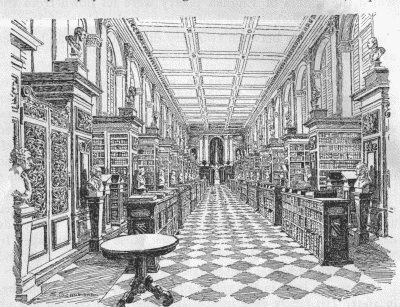
LIBRARY AT TRINITY COLLEGE, CAMBRIDGE
In 1667 he became more widely known and popular by his "Annus Mirabilis,"
a narrative poem describing the terrors of the great fire in London and
some events of the disgraceful war with Holland; but with the theaters
reopened and nightly filled, the drama offered the most attractive field
to one who made his living by literature; so Dryden turned to the stage
and agreed to furnish three plays yearly for the actors of the King's
Theater. For nearly twenty years, the best of his life, Dryden gave
himself up to this unfortunate work. Both by nature and habit he seems to
have been clean in his personal life; but the stage demanded unclean
plays, and Dryden followed his audience. That he deplored this is evident
from some of his later work, and we have his statement that he wrote only
one play, his best, to please himself. This was All for Love, which
was written in blank verse, most of the others being in rimed couplets.
During this time Dryden had become the best known literary man of London,
and was almost as much a dictator to the literary set which gathered in
the taverns and coffeehouses as Ben Jonson had been before him. His work,
meanwhile, was rewarded by large financial returns, and by his being
appointed poet laureate and collector of the port of London. The latter
office, it may be remembered, had once been held by Chaucer.
At fifty years of age, and before Jeremy Collier had driven his dramas
from the stage, Dryden turned from dramatic work to throw himself into the
strife of religion and politics, writing at this period his numerous prose
and poetical treatises. In 1682 appeared his Religio Laici
(Religion of a Layman), defending the Anglican Church against all other
sects, especially the Catholics and Presbyterians; but three years later,
when James II came to the throne with schemes to establish the Roman
faith, Dryden turned Catholic and wrote his most famous religious poem,
"The Hind and the Panther," beginning:
A milk-white Hind, immortal and unchanged,
Fed on the lawns and in
the forest ranged;
Without unspotted, innocent within,
She
feared no danger, for she knew no sin.
This hind is a symbol for the Roman Church; and the Anglicans, as a
panther, are represented as persecuting the faithful. Numerous other
sects--Calvinists, Anabaptists, Quakers--were represented by the wolf,
boar, hare, and other animals, which gave the poet an excellent chance for
exercising his satire. Dryden's enemies made the accusation, often since
repeated, of hypocrisy in thus changing his church; but that he was
sincere in the matter can now hardly be questioned, for he knew how to
"suffer for the faith" and to be true to his religion, even when it meant
misjudgment and loss of fortune. At the Revolution of 1688 he refused
allegiance to William of Orange; he was deprived of all his offices and
pensions, and as an old man was again thrown back on literature as his
only means of livelihood. He went to work with extraordinary courage and
energy, writing plays, poems, prefaces for other men, eulogies for funeral
occasions,--every kind of literary work that men would pay for. His most
successful work at this time was his translations, which resulted in the
complete Aeneid and many selections from Homer, Ovid, and Juvenal,
appearing in English rimed couplets. His most enduring poem, the splendid
ode called "Alexander's Feast," was written in 1697. Three years later he
published his last work, Fables, containing poetical paraphrases of
the tales of Boccaccio and Chaucer, and the miscellaneous poems of his
last years. Long prefaces were the fashion in Dryden's day, and his best
critical work is found in his introductions. The preface to the Fables
is generally admired as an example of the new prose style developed by
Dryden and his followers.
From the literary view point these last troubled years were the best of
Dryden's life, though they were made bitter by obscurity and by the
criticism of his numerous enemies. He died in 1700 and was buried near
Chaucer in Westminster Abbey.
Works of Dryden. The numerous dramatic works of Dryden are best
left in that obscurity into which they have fallen. Now and then they
contain a bit of excellent lyric poetry, and in All for Love,
another version of Antony and Cleopatra, where he leaves his
cherished heroic couplet for the blank verse of Marlowe and Shakespeare,
he shows what he might have done had he not sold his talents to a depraved
audience. On the whole, reading his plays is like nibbling at a rotting
apple; even the good spots are affected by the decay, and one ends by
throwing the whole thing into the garbage can, where most of the dramatic
works of this period belong.
PoemsThe controversial and satirical poems
are on a higher plane; though, it must be confessed, Dryden's satire often
strikes us as cutting and revengeful, rather than witty. The best known of
these, and a masterpiece of its kind, is "Absalom and Achitophel," which
is undoubtedly the most powerful political satire in our language. Taking
the Bible story of David and Absalom, he uses it to ridicule the Whig
party and also to revenge himself upon his enemies. Charles II appeared as
King David; his natural son, the Duke of Monmouth, who was mixed up in the
Rye House Plot, paraded as Absalom; Shaftesbury was Achitophel, the evil
Counselor; and the Duke of Buckingham was satirized as Zimri. The poem had
enormous political influence, and raised Dryden, in the opinion of his
contemporaries, to the front rank of English poets. Two extracts from the
powerful characterizations of Achitophel and Zimri are given here to show
the style and spirit of the whole work.
(SHAFTESBURY)
Of these the false Achitophel was first;
A name to all succeeding
ages cursed:
For close designs and crooked counsels fit;
Sagacious, bold, and turbulent of wit;
Restless, unfixed in
principles and place;
In power unpleased, impatient of disgrace:
A fiery soul, which, working out its way,
Fretted the pygmy body to
decay....
A daring pilot in extremity,
Pleased with the
danger, when the waves went high
He sought the storms: but for a
calm unfit,
Would steer too nigh the sands to boast his wit.
Great wits are sure to madness near allied,
And thin partitions do
their bounds divide;
Else why should he, with wealth and honor
blest,
Refuse his age the needful hours of rest?
Punish a body
which he could not please;
Bankrupt of life, yet prodigal of ease?
And all to leave what with his toil he won,
To that unfeathered
two-legged thing, a son....
In friendship false, implacable in
hate;
Resolved to ruin or to rule the state;...
Then seized
with fear, yet still affecting fame,
Usurped a patriot's
all-atoning name.
So easy still it proves in factious times
With public zeal to cancel private crimes.
(THE
DUKE OF BUCKINGHAM)
Some of their chiefs were princes of the land;
In the first rank of these did Zimri stand,
A man so various, that
he seemed to be
Not one, but all mankind's epitome:
Stiff in
opinions, always in the wrong,
Was everything by starts and nothing
long;
But, in the course of one revolving moon,
Was chymist,
fiddler, statesman, and buffoon;
Then all for women, painting,
rhyming, drinking,
Besides ten thousand freaks that died in
thinking.
Blest madman, who could every hour employ
With
something new to wish or to enjoy!
Railing and praising were his
usual themes,
And both, to show his judgment, in extremes:
So
over-violent, or over-civil,
That every man with him was God or
devil.
Of the many miscellaneous poems of Dryden, the curious reader will get an
idea of his sustained narrative power from the Annus Mirabilis. The
best expression of Dryden's literary genius, however, is found in
"Alexander's Feast," which is his most enduring ode, and one of the best
in our language.
Prose and CriticismAs a prose writer
Dryden had a very marked influence on our literature in shortening his
sentences, and especially in writing naturally, without depending on
literary ornamentation to give effect to what he is saying. If we compare
his prose with that of Milton, or Browne, or Jeremy Taylor, we note that
Dryden cares less for style than any of the others, but takes more pains
to state his thought clearly and concisely, as men speak when they wish to
be understood. The classical school, which followed the Restoration,
looked to Dryden as a leader, and to him we owe largely that tendency to
exactness of expression which marks our subsequent prose writing. With his
prose, Dryden rapidly developed his critical ability, and became the
foremost critic[178]
of his age. His criticisms, instead of being published as independent
works, were generally used as prefaces or introductions to his poetry. The
best known of these criticisms are the preface to the Fables, "Of
Heroic Plays," "Discourse on Satire," and especially the "Essay of
Dramatic Poesy" (1668), which attempts to lay a foundation for all
literary criticism.
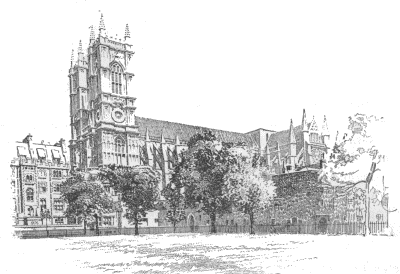
WESTMINSTER
Dryden's Influence on Literature. Dryden's place among authors is
due partly to his great influence on the succeeding age of classicism.
Briefly, this influence may be summed up by noting the three new elements
which he brought into our literature. These are: (1) the establishment of
the heroic couplet as the fashion for satiric, didactic, and descriptive
poetry; (2) his development of a direct, serviceable prose style such as
we still cultivate; and (3) his development of the art of literary
criticism in his essays and in the numerous prefaces to his poems. This is
certainly a large work for one man to accomplish, and Dryden is worthy of
honor, though comparatively little of what he wrote is now found on our
bookshelves.
Samuel Butler (1612-1680). In
marked contrast with Dryden, who devoted his life to literature and won
his success by hard work, is Samuel Butler, who jumped into fame by a
single, careless work, which represents not any serious intent or effort,
but the pastime of an idle hour. We are to remember that, though the
Royalists had triumphed in the Restoration, the Puritan spirit was not
dead, nor even sleeping, and that the Puritan held steadfastly to his own
principles. Against these principles of justice, truth, and liberty there
was no argument, since they expressed the manhood of England; but many of
the Puritan practices were open to ridicule, and the Royalists, in revenge
for their defeat, began to use ridicule without mercy. During the early
years of the Restoration doggerel verses ridiculing Puritanism, and
burlesque,--that is, a ridiculous representation of serious subjects, or a
serious representation of ridiculous subjects,--were the most popular form
of literature with London society. Of all this burlesque and doggerel the
most famous is Butler's Hudibras, a work to which we can trace many
of the prejudices that still prevail against Puritanism.
Of Butler himself we know little; he is one of the most obscure figures in
our literature. During the days of Cromwell's Protectorate he was in the
employ of Sir Samuel Luke, a crabbed and extreme type of Puritan nobleman,
and here he collected his material and probably wrote the first part of
his burlesque, which, of course, he did not dare to publish until after
the Restoration.
HudibrasHudibras is plainly modeled
upon the Don Quixote of Cervantes. It describes the adventures of a
fanatical justice of the peace, Sir Hudibras, and of his squire, Ralpho,
in their endeavor to put down all innocent pleasures. In Hudibras and
Ralpho the two extreme types of the Puritan party, Presbyterians and
Independents, are mercilessly ridiculed. When the poem first appeared in
public, in 1663, after circulating secretly for years in manuscript, it
became at once enormously popular. The king carried a copy in his pocket,
and courtiers vied with each other in quoting its most scurrilous
passages. A second and a third part, continuing the adventures of
Hudibras, were published in 1664 and 1668. At best the work is a wretched
doggerel, but it was clever enough and strikingly original; and since it
expressed the Royalist spirit towards the Puritans, it speedily found its
place in a literature which reflects every phase of human life. A few odd
lines are given here to show the character of the work, and to introduce
the reader to the best known burlesque in our language:
He was in logic a great critic,
Profoundly
skilled in analytic;
He could distinguish, and divide
A hair
'twixt south and southwest side;
On either which he would dispute,
Confute, change hands, and still confute;
He'd undertake to prove,
by force
Of argument, a man's no horse;
He'd run in debt by
disputation,
And pay with ratiocination.
For he was of that
stubborn crew
Of errant saints, whom all men grant
To be the
true Church Militant;
Such as do build their faith upon
The
holy text of pike and gun;
Decide all controversies by
Infallible artillery;
And prove their doctrine orthodox
By
apostolic blows and knocks;
Compound for sins they are inclined to,
By damning those they have no mind to.
Hobbes and Locke. Thomas Hobbes
(1588-1679) is one of the writers that puzzle the historian with a doubt
as to whether or not he should be included in the story of literature. The
one book for which he is famous is called Leviathan, or the Matter,
Form, and Power of a Commonwealth (1651). It is partly political,
partly a philosophical book, combining two central ideas which challenge
and startle the attention, namely, that self-interest is the only guiding
power of humanity, and that blind submission to rulers is the only true
basis of government.[179]
In a word, Hobbes reduced human nature to its purely animal aspects, and
then asserted confidently that there was nothing more to study. Certainly,
therefore, as a reflection of the underlying spirit of Charles and his
followers it has no equal in any purely literary work of the time.
John Locke (1632-1704) is famous as the author of a single great
philosophical work, the Essay concerning Human Understanding
(1690). This is a study of the nature of the human mind and of the origin
of ideas, which, far more than the work of Bacon and Hobbes, is the basis
upon which English philosophy has since been built. Aside from their
subjects, both works are models of the new prose, direct, simple,
convincing, for which Dryden and the Royal Society labored. They are known
to every student of philosophy, but are seldom included in a work of
literature.[180]
Evelyn and Pepys. These two men,
John Evelyn (1620-1706) and Samuel Pepys (1633-1703), are famous as the
writers of diaries, in which they jotted down the daily occurrences of
their own lives, without any thought that the world would ever see or be
interested in what they had written.
Evelyn was the author of Sylva, the first book on trees and
forestry in English, and Terra, which is the first attempt at a
scientific study of agriculture; but the world has lost sight of these two
good books, while it cherishes his diary, which extends over the greater
part of his life and gives us vivid pictures of society in his time, and
especially of the frightful corruption of the royal court.
Pepys's DiaryPepys began life in a small
way as a clerk in a government office, but soon rose by his diligence and
industry to be Secretary of the Admiralty. Here he was brought into
contact with every grade of society, from the king's ministers to the poor
sailors of the fleet. Being inquisitive as a blue jay, he investigated the
rumors and gossip of the court, as well as the small affairs of his
neighbors, and wrote them all down in his diary with evident interest. But
because he chattered most freely, and told his little book a great many
secrets which it were not well for the world to know, he concealed
everything in shorthand,--and here again he was like the blue jay, which
carries off and hides every bright trinket it discovers. The Diary
covers the years from 1660 to 1669, and gossips about everything, from his
own position and duties at the office, his dress and kitchen and cook and
children, to the great political intrigues of office and the scandals of
high society. No other such minute-picture of the daily life of an age has
been written. Yet for a century and a half it remained entirely unknown,
and not until 1825 was Pepys's shorthand deciphered and published. Since
then it has been widely read, and is still one of the most interesting
examples of diary writing that we possess. Following are a few extracts,[181] covering only a
few days in April, 1663, from which one may infer the minute and
interesting character of the work that this clerk, politician, president
of the Royal Society, and general busybody wrote to please himself:
April 1st. I went to the Temple to my Cozen Roger Pepys, to see and talk
with him a little: who tells me that, with much ado, the Parliament do
agree to throw down Popery; but he says it is with so much spite and
passion, and an endeavor of bringing all Nonconformists into the same
condition, that he is afeard matters will not go so well as he could
wish.... To my office all the afternoon; Lord! how Sir J. Minnes, like a
mad coxcomb, did swear and stamp, swearing that Commissioner Pett hath
still the old heart against the King that ever he had, ... and all the
damnable reproaches in the world, at which I was ashamed, but said little;
but, upon the whole, I find him still a foole, led by the nose with
stories told by Sir W. Batten, whether with or without reason. So, vexed
in my mind to see things ordered so unlike gentlemen, or men of reason, I
went home and to bed.
3d. To White Hall and to Chappell, which being most monstrous full, I
could not go into my pew, but sat among the quire. Dr. Creeton, the
Scotchman, preached a most admirable, good, learned, honest, and most
severe sermon, yet comicall.... He railed bitterly ever and anon against
John Calvin and his brood, the Presbyterians, and against the present
terme, now in use, of "tender consciences." He ripped up Hugh Peters
(calling him the execrable skellum), his preaching and stirring up the
mayds of the city to bring in their bodkins and thimbles. Thence going out
of White Hall, I met Captain Grove, who did give me a letter directed to
myself from himself. I discerned money to be in it, and took it, knowing,
as I found it to be, the proceed of the place I have got him, the taking
up of vessels for Tangier. But I did not open it till I came home to my
office, and there I broke it open, not looking into it till all the money
was out, that I might say I saw no money in the paper, if ever I should be
questioned about it. There was a piece of gold and 4£ in silver.
4th. To my office. Home to dinner, whither by and by comes Roger Pepys,
etc. Very merry at, before, and after dinner, and the more for that my
dinner was great, and most neatly dressed by our owne only mayde. We had a
fricasee of rabbits and chickens, a leg of mutton boiled, three carps in a
dish, a great dish of a side of lambe, a dish of roasted pigeons, a dish
of four lobsters, three tarts, a lamprey pie (a most rare pie), a dish of
anchovies, good wine of several sorts, and all things mighty noble and to
my great content.
5th (Lord's day). Up and spent the morning, till the Barber came, in
reading in my chamber part of Osborne's Advice to his Son, which I shall
not never enough admire for sense and language, and being by and by
trimmed, to Church, myself, wife, Ashwell, etc. Home and, while dinner was
prepared, to my office to read over my vows with great affection and to
very good purpose. Then to church again, where a simple bawling young Scot
preached.
19th (Easter day). Up and this day put on my close-kneed coloured suit,
which, with new stockings of the colour, with belt and new gilt-handled
sword, is very handsome. To church alone, and after dinner to church
again, where the young Scotchman preaching, I slept all the while. After
supper, fell in discourse of dancing, and I find that Ashwell hath a very
fine carriage, which makes my wife almost ashamed of herself to see
herself so outdone, but to-morrow she begins to learn to dance for a month
or two. So to prayers and to bed. Will being gone, with my leave, to his
father's this day for a day or two, to take physique these holydays.
23d. St. George's day and Coronacion, the King and Court being at Windsor,
at the installing of the King of Denmarke by proxy and the Duke of
Monmouth.... Spent the evening with my father. At cards till late, and
being at supper, my boy being sent for some mustard to a neat's tongue,
the rogue staid half an houre in the streets, it seems at a bonfire, at
which I was very angry, and resolve to beat him to-morrow.
24th. Up betimes, and with my salt eele went down into the parler and
there got my boy and did beat him till I was fain to take breath two or
three times, yet for all I am afeard it will make the boy never the
better, he is grown so hardened in his tricks, which I am sorry for, he
being capable of making a brave man, and is a boy that I and my wife love
very well.
Summary of the Restoration Period.
The chief thing to note in England during the Restoration is the
tremendous social reaction from the restraints of Puritanism, which
suggests the wide swing of a pendulum from one extreme to the other. For a
generation many natural pleasures had been suppressed; now the theaters
were reopened, bull and bear baiting revived, and sports, music,
dancing,--a wild delight in the pleasures and vanities of this world
replaced that absorption in "other-worldliness" which characterized the
extreme of Puritanism.
In literature the change is no less marked. From the Elizabethan drama
playwrights turned to coarse, evil scenes, which presently disgusted the
people and were driven from the stage. From romance, writers turned to
realism; from Italian influence with its exuberance of imagination they
turned to France, and learned to repress the emotions, to follow the head
rather than the heart, and to write in a clear, concise, formal style,
according to set rules. Poets turned from the noble blank verse of
Shakespeare and Milton, from the variety and melody which had
characterized English poetry since Chaucer's day, to the monotonous heroic
couplet with its mechanical perfection.
The greatest writer of the age is John Dryden, who established the heroic
couplet as the prevailing verse form in English poetry, and who developed
a new and serviceable prose style suited to the practical needs of the
age. The popular ridicule of Puritanism in burlesque and doggerel is best
exemplified in Butler's Hudibras. The realistic tendency, the study
of facts and of men as they are, is shown in the work of the Royal
Society, in the philosophy of Hobbes and Locke, and in the diaries of
Evelyn and Pepys, with their minute pictures of social life. The age was
one of transition from the exuberance and vigor of Renaissance literature
to the formality and polish of the Augustan Age. In strong contrast with
the preceding ages, comparatively little of Restoration literature is
familiar to modern readers.
Selections for Reading. Dryden. Alexander's Feast, Song for
St. Cecilia's Day, selections from Absalom and Achitophel, Religio Laici,
Hind and Panther, Annus Mirabilis,--in Manly's English Poetry, or Ward's
English Poets, or Cassell's National Library; Palamon and Arcite (Dryden's
version of Chaucer's tale), in Standard English Classics, Riverside
Literature, etc.; Dryden's An Essay of Dramatic Poesy, in Manly's, or
Garnett's, English Prose.
Butler. Selections from Hudibras, in Manly's English Poetry, Ward's
English Poets, or Morley's Universal Library.
Pepys. Selections in Manly's English Prose; the Diary in Everyman's
Library.
Bibliography. History. Text-book,
Montgomery, pp. 257-280; Cheyney, pp. 466-514; Green, ch. 9; Traill;
Gardiner; Macaulay.
Special Works. Sydney's Social Life in England from the Restoration
to the Revolution; Airy's The English Restoration and Louis XIV; Hale's
The Fall of the Stuarts.
Literature. Garnett's The Age of Dryden; Dowden's Puritan
and Anglican.
Dryden. Poetical Works, with Life, edited by Christie; the same,
edited by Noyes, in Cambridge Poets Series; Life and Works (18 vols.), by
Walter Scott, revised (1893) by Saintsbury; Essays, edited by Ker; Life,
by Saintsbury (English Men of Letters); Macaulay's Essay; Lowell's Essay,
in Among My Books (or in Literary Essays, vol. 3); Dowden's Essay, supra.
Butler. Hudibras, in Morley's Universal Library; Poetical Works,
edited by Johnson; Dowden's Essay, supra.
Pepys. Diary in Everyman's Library; the same, edited by Wheatley (8
vols.); Wheatley's Samuel Pepys and the World He Lived In; Stevenson's
Essay, in Familiar Studies of Men and Books.
The Restoration Drama. Plays in the Mermaid Series; Hazlitt's
Lectures on the English Comic Writers; Meredith's Essay on Comedy and the
Comic Spirit; Lamb's Essay on the Artificial Comedy; Thackeray's Essay on
Congreve, in English Humorists.
Suggestive Questions. 1. What
marked change in social conditions followed the Restoration? How are these
changes reflected in literature?
2. What are the chief characteristics of Restoration literature? Why is
this period called the Age of French influence? What new tendencies were
introduced? What effect did the Royal Society and the study of science
have upon English prose? What is meant by realism? by formalism?
3. What is meant by the heroic couplet? Explain why it became the
prevailing form of English poetry. What are its good qualities and its
defects? Name some well-known poems which are written in couplets. How do
Dryden's couplets compare with Chaucer's? Can you explain the difference?
4. Give a brief account of Dryden's life. What are his chief poetical
works? For what new object did he use poetry? Is satire a poetical
subject? Why is a poetical satire more effective than a satire in prose?
What was Dryden's contribution to English prose? What influence did he
exert on our literature?
5. What is Butler's Hudibras? Explain its popularity. Read a
passage and comment upon it, first, as satire; second, as a description of
the Puritans. Is Hudibras poetry? Why?
6. Name the philosophers and political economists of this period. Can you
explain why Hobbes should call his work Leviathan? What important
American documents show the influence of Locke?
7. Tell briefly the story of Pepys and his Diary. What light does
the latter throw on the life of the age? Is the Diary a work of
literature? Why?
|
CHRONOLOGY
|
|
Last Half of the Seventeenth Century
|
|
HISTORY
|
LITERATURE
|
|
1649.
|
Execution of Charles I
|
|
1649-1660.
|
Commonwealth
|
1651.
|
Hobbes's Leviathan
|
|
1660.
|
Restoration of Charles II
|
1660-1669.
|
Pepys's Diary
|
|
|
1662.
|
Royal Society founded
|
|
|
1663.
|
Butler's Hudibras
|
|
1665-1666.
|
Plague and Fire of London
|
|
War with Holland
|
|
1667.
|
Dutch fleet in the Thames
|
1667.
|
Milton's Paradise Lost.
|
|
|
|
Dryden's Annus Mirabilis
|
|
|
1663-1694.
|
Dryden's dramas
|
|
|
1671.
|
Paradise Regained
|
|
|
1678.
|
Pilgrim's Progress
|
|
|
|
published
|
|
1680.
|
Rise of Whigs and Tories
|
|
|
1681.
|
Dryden's Absalom and
|
|
|
|
Achitophel
|
|
1685.
|
James II
|
|
Monmouth's Rebellion
|
|
|
1687.
|
Newton's Principia
|
|
|
|
proves the law of
|
|
|
|
gravitation
|
|
1688.
|
English Revolution, William of
|
|
Orange called to throne
|
|
1689.
|
Bill of Rights. Toleration Act
|
|
|
1690.
|
Locke's Human
|
|
|
|
Understanding
|
|
|
1698.
|
Jeremy Collier attacks
|
|
|
|
stage
|
|
|
1700.
|
Death of Dryden
|
I. AUGUSTAN OR CLASSIC AGE
History of the Period. The
Revolution of 1688, which banished the last of the Stuart kings and called
William of Orange to the throne, marks the end of the long struggle for
political freedom in England. Thereafter the Englishman spent his
tremendous energy, which his forbears had largely spent in fighting for
freedom, in endless political discussions and in efforts to improve his
government. In order to bring about reforms, votes were now necessary; and
to get votes the people of England must be approached with ideas, facts,
arguments, information. So the newspaper was born,[182] and literature in its widest
sense, including the book, the newspaper, and the magazine, became the
chief instrument of a nation's progress.
Social DevelopmentThe first half of the
eighteenth century is remarkable for the rapid social development in
England. Hitherto men had been more or less governed by the narrow,
isolated standards of the Middle Ages, and when they differed they fell
speedily to blows. Now for the first time they set themselves to the task
of learning the art of living together, while still holding different
opinions. In a single generation nearly two thousand public coffeehouses,
each a center of sociability, sprang up in London alone, and the number of
private clubs is quite as astonishing.[183] This new social life had a marked effect in
polishing men's words and manners. The typical Londoner of Queen Anne's
day was still rude, and a little vulgar in his tastes; the city was still
very filthy, the streets unlighted and infested at night by bands of
rowdies and "Mohawks"; but outwardly men sought to refine their manners
according to prevailing standards; and to be elegant, to have "good form,"
was a man's first duty, whether he entered society or wrote literature.
One can hardly read a book or poem of the age without feeling this
superficial elegance. Government still had its opposing Tory and Whig
parties, and the Church was divided into Catholics, Anglicans, and
Dissenters; but the growing social life offset many antagonisms, producing
at least the outward impression of peace and unity. Nearly every writer of
the age busied himself with religion as well as with party politics, the
scientist Newton as sincerely as the churchman Barrow, the philosophical
Locke no less earnestly than the evangelical Wesley; but nearly all
tempered their zeal with moderation, and argued from reason and Scripture,
or used delicate satire upon their opponents, instead of denouncing them
as followers of Satan. There were exceptions, of course; but the
general tendency of the age was toward toleration. Man had found himself
in the long struggle for personal liberty; now he turned to the task of
discovering his neighbor, of finding in Whig and Tory, in Catholic and
Protestant, in Anglican and Dissenter, the same general human
characteristics that he found in himself. This good work was helped,
moreover, by the spread of education and by the growth of the national
spfrit, following the victories of Marlborough on the Continent. In the
midst of heated argument it needed only a word--Gibraltar, Blenheim,
Ramillies, Malplaquet--or a poem of victory written in a garret[184] to tell a
patriotic people that under their many differences they were all alike
Englishmen.
In the latter half of the century the political and social progress is
almost bewildering. The modern form of cabinet government responsible to
Parliament and the people had been established under George I; and in 1757
the cynical and corrupt practices of Walpole, premier of the first Tory
cabinet, were replaced by the more enlightened policies of Pitt. Schools
were established; clubs and coffeehouses increased; books and magazines
multiplied until the press was the greatest visible power in England; the
modern great dailies, the Chronicle, Post, and Times, began
their career of public education. Religiously, all the churches of England
felt the quickening power of that tremendous spiritual revival known as
Methodism, under the preaching of Wesley and Whitefield. Outside her own
borders three great men--Clive in India, Wolfe on the Plains of Abraham,
Cook in Australia and the islands of the Pacific--were unfurling the
banner of St. George over the untold wealth of new lands, and spreading
the world-wide empire of the Anglo-Saxons.
An Age of ProseLiterary Characteristics. In every preceding age we
have noted especially the poetical works, which constitute, according to
Matthew Arnold, the glory of English literature. Now for the first time we
must chronicle the triumph of English prose. A multitude of practical
interests arising from the new social and political conditions demanded
expression, not simply in books, but more especially in pamphlets,
magazines, and newspapers. Poetry was inadequate for such a task; hence
the development of prose, of the "unfettered word," as Dante calls it,--a
development which astonishes us by its rapidity and excellence. The
graceful elegance of Addison's essays, the terse vigor of Swift's satires,
the artistic finish of Fielding's novels, the sonorous eloquence of
Gibbon's history and of Burke's orations,--these have no parallel in the
poetry of the age. Indeed, poetry itself became prosaic in this respect,
that it was used not for creative works of imagination, but for essays,
for satire, for criticism,--for exactly the same practical ends as was
prose. The poetry of the first half of the century, as typified in the
work of Pope, is polished and witty enough, but artificial; it lacks fire,
fine feeling, enthusiasm, the glow of the Elizabethan Age and the moral
earnestness of Puritanism. In a word, it interests us as a study of life,
rather than delights or inspires us by its appeal to the imagination. The
variety and excellence of prose works, and the development of a
serviceable prose style, which had been begun by Dryden, until it served
to express clearly every human interest and emotion,--these are the chief
literary glories of the eighteenth century.
SatireIn the literature of the preceding
age we noted two marked tendencies,--the tendency to realism in
subject-matter, and the tendency to polish and refinement of expression.
Both these tendencies were continued in the Augustan Age, and are seen
clearly in the poetry of Pope, who brought the couplet to perfection, and
in the prose of Addison. A third tendency is shown in the prevalence of
satire, resulting from the unfortunate union of politics with literature.
We have already noted the power of the press in this age, and the
perpetual strife of political parties. Nearly every writer of the first
half of the century was used and rewarded by Whigs or Tories for
satirizing their enemies and for advancing their special political
interests. Pope was a marked exception, but he nevertheless followed the
prose writers in using satire too largely in his poetry. Now satire--that
is, a literary work which searches out the faults of men or institutions
in order to hold them up to ridicule--is at best a destructive kind of
criticism. A satirist is like a laborer who clears away the ruins and
rubbish of an old house before the architect and builders begin on a new
and beautiful structure. The work may sometimes be necessary, but it
rarely arouses our enthusiasm. While the satires of Pope, Swift, and
Addison are doubtless the best in our language, we hardly place them with
our great literature, which is always constructive in spirit; and we have
the feeling that all these men were capable of better things than they
ever wrote.
The Classic Age. The period we are
studying is known to us by various names. It is often called the Age of
Queen Anne; but, unlike Elizabeth, this "meekly stupid" queen had
practically no influence upon our literature. The name Classic Age is more
often heard; but in using it we should remember clearly these three
different ways in which the word "classic" is applied to literature: (1)
the term "classic" refers, in general, to writers of the highest rank in
any nation. As used in our literature, it was first applied to the works
of the great Greek and Roman writers, like Homer and Virgil; and any
English book which followed the simple and noble method of these writers
was said to have a classic style. Later the term was enlarged to cover the
great literary works of other ancient nations; so that the Bible and the
Avestas, as well as the Iliad and the Aeneid, are called classics. (2)
Every national literature has at least one period in which an unusual
number of great writers are producing books, and this is called the
classic period of a nation's literature. Thus the reign of Augustus is the
classic or golden age of Rome; the generation of Dante is the classic age
of Italian literature; the age of Louis XIV is the French classic age; and
the age of Queen Anne is often called the classic age of England. (3) The
word "classic" acquired an entirely different meaning in the period we are
studying; and we shall better understand this by reference to the
preceding ages. The Elizabethan writers were led by patriotism, by
enthusiasm, and, in general, by romantic emotions. They wrote in a natural
style, without regard to rules; and though they exaggerated and used too
many words, their works are delightful because of their vigor and
freshness and fine feeling. In the following age patriotism had largely
disappeared from politics and enthusiasm from literature. Poets no longer
wrote naturally, but artificially, with strange and fantastic verse forms
to give effect, since fine feeling was wanting. And this is the general
character of the poetry of the Puritan Age.[185] Gradually our writers rebelled
against the exaggerations of both the natural and the fantastic style.
They demanded that poetry should follow exact rules; and in this they were
influenced by French writers, especially by Boileau and Rapin, who
insisted on precise methods of writing poetry, and who professed to have
discovered their rules in the classics of Horace and Aristotle. In our
study of the Elizabethan drama we noted the good influence of the classic
movement in insisting upon that beauty of form and definiteness of
expression which characterize the dramas of Greece and Rome; and in the
work of Dryden and his followers we see a revival of classicism in the
effort to make English literature conform to rules established by the
great writers of other nations. At first the results were excellent,
especially in prose; but as the creative vigor of the Elizabethans was
lacking in this age, writing by rule soon developed a kind of elegant
formalism, which suggests the elaborate social code of the time. Just as a
gentleman might not act naturally, but must follow exact rules in doffing
his hat, or addressing a lady, or entering a room, or wearing a wig, or
offering his snuffbox to a friend, so our writers lost individuality and
became formal and artificial. The general tendency of literature was to
look at life critically, to emphasize intellect rather than imagination,
the form rather than the content of a sentence. Writers strove to repress
all emotion and enthusiasm, and to use only precise and elegant methods of
expression. This is what is often meant by the "classicism" of the ages of
Pope and Johnson. It refers to the critical, intellectual spirit of many
writers, to the fine polish of their heroic couplets or the elegance of
their prose, and not to any resemblance which their work bears to true
classic literature. In a word, the classic movement had become
pseudo-classic, i.e. a false or sham classicism; and the latter term is
now often used to designate a considerable part of eighteenth-century
literature.[186]
To avoid this critical difficulty we have adopted the term Augustan Age, a
name chosen by the writers themselves, who saw in Pope, Addison, Swift,
Johnson, and Burke the modern parallels to Horace, Virgil, Cicero, and all
that brilliant company who made Roman literature famous in the days of
Augustus.
ALEXANDER POPE (1688-1744)
Pope is in many respects a unique figure. In the first place, he was for a
generation "the poet" of a great nation. To be sure, poetry was limited in
the early eighteenth century; there were few lyrics, little or no love
poetry, no epics, no dramas or songs of nature worth considering; but in
the narrow field of satiric and didactic verse Pope was the undisputed
master. His influence completely dominated the poetry of his age, and many
foreign writers, as well as the majority of English poets, looked to him
as their model. Second, he was a remarkably clear and adequate reflection
of the spirit of the age in which he lived. There is hardly an ideal, a
belief, a doubt, a fashion, a whim of Queen Anne's time, that is not
neatly expressed in his poetry. Third, he was the only important writer of
that age who gave his whole life to letters. Swift was a clergyman and
politician; Addison was secretary of state; other writers depended on
patrons or politics or pensions for fame and a livelihood; but Pope was
independent, and had no profession but literature. And fourth, by the
sheer force of his ambition he won his place, and held it, in spite of
religious prejudice, and in the face of physical and temperamental
obstacles that would have discouraged a stronger man. For Pope was
deformed and sickly, dwarfish in soul and body. He knew little of the
world of nature or of the world of the human heart. He was lacking,
apparently, in noble feeling, and instinctively chose a lie when the truth
had manifestly more advantages. Yet this jealous, peevish, waspish little
man became the most famous poet of his age and the acknowledged leader of
English literature. We record the fact with wonder and admiration; but we
do not attempt to explain it.
Life. Pope was born in London in 1688, the year of the Revolution.
His parents were both Catholics, who presently removed from London and
settled in Binfield, near Windsor, where the poet's childhood was passed.
Partly because of an unfortunate prejudice against Catholics in the public
schools, partly because of his own weakness and deformity, Pope received
very little school education, but browsed for himself among English books
and picked up a smattering of the classics. Very early he began to write
poetry, and records the fact with his usual vanity:
As yet a child, nor yet a fool to fame,
I lisped in numbers, for
the numbers came.
Being debarred by his religion from many desirable employments, he
resolved to make literature his life work; and in this he resembled
Dryden, who, he tells us, was his only master, though much of his work
seems to depend on Boileau, the French poet and critic.[187] When only sixteen
years old he had written his "Pastorals"; a few years later appeared his
"Essay on Criticism," which made him famous. With the publication of the
Rape of the Lock, in 1712, Pope's name was known and honored all
over England, and this dwarf of twenty-four years, by the sheer force of
his own ambition, had jumped to the foremost place in English letters. It
was soon after this that Voltaire called him "the best poet of England
and, at present, of all the world,"--which is about as near the truth as
Voltaire generally gets in his numerous universal judgments. For the next
twelve years Pope was busy with poetry, especially with his translations
of Homer; and his work was so successful financially that he bought a
villa at Twickenham, on the Thames, and remained happily independent of
wealthy patrons for a livelihood.
Led by his success, Pope returned to London and for a time endeavored to
live the gay and dissolute life which was supposed to be suitable for a
literary genius; but he was utterly unfitted for it, mentally and
physically, and soon retired to Twickenham. There he gave himself up to
poetry, manufactured a little garden more artificial than his verses, and
cultivated his friendship with Martha Blount, with whom for many years he
spent a good part of each day, and who remained faithful to him to the end
of his life. At Twickenham he wrote his Moral Epistles (poetical
satires modeled after Horace) and revenged himself upon all his critics in
the bitter abuse of the Dunciad. He died in 1744 and was buried at
Twickenham, his religion preventing him from the honor, which was
certainly his due, of a resting place in Westminster Abbey.
Works of Pope. For convenience we may separate Pope's work into
three groups, corresponding to the early, middle, and later period of his
life. In the first he wrote his "Pastorals," "Windsor Forest," "Messiah,"
"Essay on Criticism," "Eloise to Abelard," and the Rape of the Lock;
in the second, his translations of Homer; in the third the Dunciad
and the Epistles, the latter containing the famous "Essay on Man"
and the "Epistle to Dr. Arbuthnot," which is in truth his "Apologia," and
in which alone we see Pope's life from his own view point.
Essay on CriticismThe "Essay on Criticism"
sums up the art of poetry as taught first by Horace, then by Boileau and
the eighteenth-century classicists. Though written in heroic couplets, we
hardly consider this as a poem but rather as a storehouse of critical
maxims. "For fools rush in where angels fear to tread"; "To err is human,
to forgive divine"; "A little learning is a dangerous thing,"--these
lines, and many more like them from the same source, have found their way
into our common speech, and are used, without thinking of the author,
whenever we need an apt quotation.
Rape of the LockThe Rape of the Lock
is a masterpiece of its kind, and comes nearer to being a "creation" than
anything else that Pope has written. The occasion of the famous poem was
trivial enough. A fop at the court of Queen Anne, one Lord Petre, snipped
a lock of hair from the abundant curls of a pretty maid of honor named
Arabella Fermor. The young lady resented it, and the two families were
plunged into a quarrel which was the talk of London. Pope, being appealed
to, seized the occasion to construct, not a ballad, as the Cavaliers would
have done, nor an epigram, as French poets love to do, but a long poem in
which all the mannerisms of society are pictured in minutest detail and
satirized with the most delicate wit. The first edition, consisting of two
cantos, was published in 1712; and it is amazing now to read of the
trivial character of London court life at the time when English soldiers
were battling for a great continent in the French and Indian wars. Its
instant success caused Pope to lengthen the poem by three more cantos; and
in order to make a more perfect burlesque of an epic poem, he introduces
gnomes, sprites, sylphs, and salamanders,[188] instead of the gods of the great
epics, with which his readers were familiar. The poem is modeled after two
foreign satires: Boileau's Le Lutrin (reading desk), a satire on
the French clergy, who raised a huge quarrel over the location of a
lectern; and La Secchia Rapita (stolen bucket), a famous Italian
satire on the petty causes of the endless Italian wars. Pope, however,
went far ahead of his masters in style and in delicacy of handling a
mock-heroic theme, and during his lifetime the Rape of the Lock was
considered as the greatest poem of its kind in all literature. The poem is
still well worth reading; for as an expression of the artificial life of
the age--of its cards, parties, toilettes, lapdogs, tea-drinking,
snuff-taking, and idle vanities--it is as perfect in its way as Tamburlaine,
which reflects the boundless ambition of the Elizabethans.
Pope's TranslationsThe fame of Pope's Iliad,
which was financially the most successful of his books, was due to the
fact that he interpreted Homer in the elegant, artificial language of his
own age. Not only do his words follow literary fashions but even the
Homeric characters lose their strength and become fashionable men of the
court. So the criticism of the scholar Bentley was most appropriate when
he said, "It is a pretty poem, Mr. Pope, but you must not call it Homer."
Pope translated the entire Iliad and half of the Odyssey;
and the latter work was finished by two Cambridge scholars, Elijah Fenton
and William Broome, who imitated the mechanical couplets so perfectly that
it is difficult to distinguish their work from that of the greatest poet
of the age. A single selection is given to show how, in the nobler
passages, even Pope may faintly suggest the elemental grandeur of Homer:
The troops exulting sat in order round,
And beaming fires illumined
all the ground.
As when the moon, refulgent lamp of night,
O'er Heaven's clear azure spreads her sacred light,
When not a
breath disturbs the deep serene,
And not a cloud o'ercasts the
solemn scene;
Around her throne the vivid planets roll,
And
stars unnumbered gild the glowing pole,
O'er the dark trees a
yellower verdure shed,
And tip with silver every mountain's head.
Essay on ManThe "Essay" is the best known
and the most quoted of all Pope's works. Except in form it is not poetry,
and when one considers it as an essay and reduces it to plain prose, it is
found to consist of numerous literary ornaments without any very solid
structure of thought to rest upon. The purpose of the essay is, in Pope's
words, to "vindicate the ways of God to Man"; and as there are no
unanswered problems in Pope's philosophy, the vindication is perfectly
accomplished in four poetical epistles, concerning man's relations to the
universe, to himself, to society, and to happiness. The final result is
summed up in a few well-known lines:
All nature is but art, unknown to thee;
All chance, direction which
thou canst not see;
All discord, harmony not understood;
All
partial evil, universal good:
And, spite of pride, in erring
reason's spite,
One truth is clear, whatever is, is right.
Like the "Essay on Criticism," the poem abounds in quotable lines, such as
the following, which make the entire work well worth reading:
Hope springs eternal in the human breast:
Man never is, but always
to be blest.
Know then thyself, presume not God to scan;
The
proper study of Mankind is Man.
The same ambition can destroy or
save,
And makes a patriot as it makes a knave.
Honor and shame
from no condition rise;
Act well your part, there all the honor
lies.
Vice is a monster of so frightful
mien,
As, to be hated, needs but to be seen;
Yet seen too oft,
familiar with her face,
We first endure, then pity, then embrace.
Behold the child, by Nature's kindly law,
Pleased with a rattle, tickled with a straw:
Some livelier
plaything gives his youth delight,
A little louder, but as empty
quite:
Scarfs, garters, gold, amuse his riper stage,
And beads
and prayer books are the toys of age:
Pleased with this bauble
still, as that before;
Till tired he sleeps, and Life's poor play
is o'er.[189]
Miscellaneous WorksThe Dunciad
(i.e. the "Iliad of the Dunces") began originally as a controversy
concerning Shakespeare, but turned out to be a coarse and revengeful
satire upon all the literary men of the age who had aroused Pope's anger
by their criticism or lack of appreciation of his genius. Though
brilliantly written and immensely popular at one time, its present effect
on the reader is to arouse a sense of pity that a man of such acknowledged
power and position should abuse both by devoting his talents to personal
spite and petty quarrels. Among the rest of his numerous works the reader
will find Pope's estimate of himself best set forth in his "Epistle to Dr.
Arbuthnot," and it will be well to close our study of this strange mixture
of vanity and greatness with "The Universal Prayer," which shows at least
that Pope had considered, and judged himself, and that all further
judgment is consequently superfluous.
JONATHAN SWIFT (1667-1745)
In each of Marlowe's tragedies we have the picture of a man dominated by a
single passion, the lust of power for its own sake. In each we see that a
powerful man without self-control is like a dangerous instrument in the
hands of a child; and the tragedy ends in the destruction of the man by
the ungoverned power which he possesses. The life of Swift is just such a
living tragedy. He had the power of gaining wealth, like the hero of the
Jew of Malta; yet he used it scornfully, and in sad irony left what
remained to him of a large property to found a hospital for lunatics. By
hard work he won enormous literary power, and used it to satirize our
common humanity. He wrested political power from the hands of the Tories,
and used it to insult the very men who had helped him, and who held his
fate in their hands. By his dominant personality he exercised a curious
power over women, and used it brutally to make them feel their
inferiority. Being loved supremely by two good women, he brought sorrow
and death to both, and endless misery to himself. So his power brought
always tragedy in its wake. It is only when we remember his life of
struggle and disappointment and bitterness that we can appreciate the
personal quality in his satire, and perhaps find some sympathy for this
greatest genius of all the Augustan writers.
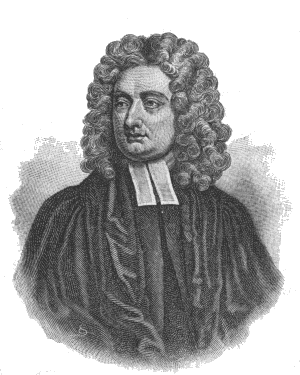
JONATHAN SWIFT
Life. Swift was born in Dublin, of English parents, in 1667. His
father died before he was born; his mother was poor, and Swift, though
proud as Lucifer, was compelled to accept aid from relatives, who gave it
grudgingly. At the Kilkenny school, and especially at Dublin University,
he detested the curriculum, reading only what appealed to his own nature;
but, since a degree was necessary to his success, he was compelled to
accept it as a favor from the examiners, whom he despised in his heart.
After graduation the only position open to him was with a distant
relative, Sir William Temple, who gave him the position of private
secretary largely on account of the unwelcome relationship.
Temple was a statesman and an excellent diplomatist; but he thought
himself to be a great writer as well, and he entered into a literary
controversy concerning the relative merits of the classics and modern
literature. Swift's first notable work, The Battle of the Books,
written at this time but not published, is a keen satire upon both parties
in the controversy. The first touch of bitterness shows itself here; for
Swift was in a galling position for a man of his pride, knowing his
intellectual superiority to the man who employed him, and yet being looked
upon as a servant and eating at the servants' table. Thus he spent ten of
the best years of his life in the pretty Moor Park, Surrey, growing more
bitter each year and steadily cursing his fate. Nevertheless he read and
studied widely, and, after his position with Temple grew unbearable,
quarreled with his patron, took orders, and entered the Church of England.
Some years later we find him settled in the little church of Laracor,
Ireland,--a country which he disliked intensely, but whither he went
because no other "living" was open to him.
In Ireland, faithful to his church duties, Swift labored to better the
condition of the unhappy people around him. Never before had the poor of
his parishes been so well cared for; but Swift chafed under his yoke,
growing more and more irritated as he saw small men advanced to large
positions, while he remained unnoticed in a little country
church,--largely because he was too proud and too blunt with those who
might have advanced him. While at Laracor he finished his Tale of a Tub,
a satire on the various churches of the day, which was published in London
with the Battle of the Books in 1704. The work brought him into
notice as the most powerful satirist of the age, and he soon gave up his
church to enter the strife of party politics. The cheap pamphlet was then
the most powerful political weapon known; and as Swift had no equal at
pamphlet writing, he soon became a veritable dictator. For several years,
especially from 1710 to 1713, Swift was one of the most important figures
in London. The Whigs feared the lash of his satire; the Tories feared to
lose his support. He was courted, flattered, cajoled on every side; but
the use he made of his new power is sad to contemplate. An unbearable
arrogance took possession of him. Lords, statesmen, even ladies were
compelled to sue for his favor and to apologize for every fancied slight
to his egoism. It is at this time that he writes in his Journal to
Stella:
Mr. Secretary told me the Duke of Buckingham had been talking much about
me and desired my acquaintance. I answered it could not be, for he had not
yet made sufficient advances; then Shrewsbury said he thought the Duke was
not used to make advances. I said I could not help that, for I always
expected advances in proportion to men's quality, and more from a Duke
than any other man.
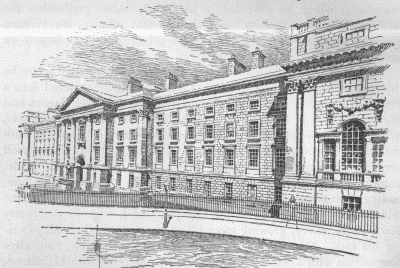
TRINITY COLLEGE, DUBLIN
Writing to the Duchess of Queensberry he says:
I am glad you know your duty; for it has been a known and established rule
above twenty years in England that the first advances have been constantly
made me by all ladies who aspire to my acquaintance, and the greater their
quality the greater were their advances.
When the Tories went out of power Swift's position became uncertain. He
expected and had probably been promised a bishopric in England, with a
seat among the peers of the realm; but the Tories offered him instead the
place of dean of St. Patrick's Cathedral in Dublin. It was galling to a
man of his proud spirit; but after his merciless satire on religion, in The
Tale of a Tub, any ecclesiastical position in England was rendered
impossible. Dublin was the best he could get, and he accepted it bitterly,
once more cursing the fate which he had brought upon himself.
With his return to Ireland begins the last act in the tragedy of his life.
His best known literary work, Gulliver's Travels, was done here;
but the bitterness of life grew slowly to insanity, and a frightful
personal sorrow, of which he never spoke, reached its climax in the death
of Esther Johnson, a beautiful young woman, who had loved Swift ever since
the two had met in Temple's household, and to whom he had written his Journal
to Stella. During the last years of his life a brain disease, of which
he had shown frequent symptoms, fastened its terrible hold upon Swift, and
he became by turns an idiot and a madman. He died in 1745, and when his
will was opened it was found that he had left all his property to found
St. Patrick's Asylum for lunatics and incurables. It stands to-day as the
most suggestive monument of his peculiar genius.
The Works of Swift. From Swift's life one can readily foresee the
kind of literature he will produce. Taken together his works are a
monstrous satire on humanity; and the spirit of that satire is shown
clearly in a little incident of his first days in London. There was in the
city at that time a certain astrologer named Partridge, who duped the
public by calculating nativities from the stars, and by selling a yearly
almanac predicting future events. Swift, who hated all shams, wrote, with
a great show of learning, his famous Bickerstaff Almanac,
containing "Predictions for the Year 1708, as Determined by the Unerring
Stars." As Swift rarely signed his name to any literary work, letting it
stand or fall on its own merits, his burlesque appeared over the pseudonym
of Isaac Bickerstaff, a name afterwards made famous by Steele in The
Tatler. Among the predictions was the following:
My first prediction is but a trifle; yet I will mention it to show how
ignorant those sottish pretenders to astrology are in their own concerns:
it relates to Partridge the almanack maker; I have consulted the star of
his nativity by my own rules, and find he will infallibly die upon the
29th of March next, about eleven at night, of a raging fever; therefore I
advise him to consider of it, and settle his affairs in time.
On March 30, the day after the prediction was to be fulfilled, there
appeared in the newspapers a letter from a revenue officer giving the
details of Partridge's death, with the doings of the bailiff and the
coffin maker; and on the following morning appeared an elaborate "Elegy of
Mr. Partridge." When poor Partridge, who suddenly found himself without
customers, published a denial of the burial, Swift answered with an
elaborate "Vindication of Isaac Bickerstaff," in which he proved by
astrological rules that Partridge was dead, and that the man now in his
place was an impostor trying to cheat the heirs out of their inheritance.
Character of Swift's SatireThis ferocious
joke is suggestive of all Swift's satires. Against any case of hypocrisy
or injustice he sets up a remedy of precisely the same kind, only more
atrocious, and defends his plan with such seriousness that the satire
overwhelms the reader with a sense of monstrous falsity. Thus his solemn
"Argument to prove that the Abolishing of Christianity may be attended
with Some Inconveniences" is such a frightful satire upon the abuses of
Christianity by its professed followers that it is impossible for us to
say whether Swift intended to point out needed reforms, or to satisfy his
conscience,[190]
or to perpetrate a joke on the Church, as he had done on poor Partridge.
So also with his "Modest Proposal," concerning the children of Ireland,
which sets up the proposition that poor Irish farmers ought to raise
children as dainties, to be eaten, like roast pigs, on the tables of
prosperous Englishmen. In this most characteristic work it is impossible
to find Swift or his motive. The injustice under which Ireland suffered,
her perversity in raising large families to certain poverty, and the
indifference of English politicians to her suffering and protests are all
mercilessly portrayed; but why? That is still the unanswered problem of
Swift's life and writings.
Tale of a TubSwift's two greatest satires
are his Tale of a Tub and Gulliver's Travels. The Tale
began as a grim exposure of the alleged weaknesses of three principal
forms of religious belief, Catholic, Lutheran, and Calvinist, as opposed
to the Anglican; but it ended in a satire upon all science and philosophy.
Swift explains his whimsical title by the custom of mariners in throwing
out a tub to a whale, in order to occupy the monster's attention and
divert it from an attack upon the ship,--which only proves how little
Swift knew of whales or sailors. But let that pass. His book is a tub
thrown out to the enemies of Church and State to keep them occupied from
further attacks or criticism; and the substance of the argument is that
all churches, and indeed all religion and science and statesmanship, are
arrant hypocrisy. The best known part of the book is the allegory of the
old man who died and left a coat (which is Christian Truth) to each of his
three sons, Peter, Martin, and Jack, with minute directions for its care
and use. These three names stand for Catholics, Lutherans, and Calvinists;
and the way in which the sons evade their father's will and change the
fashion of their garment is part of the bitter satire upon all religious
sects. Though it professes to defend the Anglican Church, that institution
fares perhaps worse than the others; for nothing is left to her but a thin
cloak of custom under which to hide her alleged hypocrisy.
Gulliver's TravelsIn Gulliver's Travels
the satire grows more unbearable. Strangely enough, this book, upon which
Swift's literary fame generally rests, was not written from any literary
motive, but rather as an outlet for the author's own bitterness against
fate and human society. It is still read with pleasure, as Robinson
Crusoe is read, for the interesting adventures of the hero; and
fortunately those who read it generally overlook its degrading influence
and motive.
Gulliver's Travels records the pretended four voyages of one Lemuel
Gulliver, and his adventures in four astounding countries. The first book
tells of his voyage and shipwreck in Lilliput, where the inhabitants are
about as tall as one's thumb, and all their acts and motives are on the
same dwarfish scale. In the petty quarrels of these dwarfs we are supposed
to see the littleness of humanity. The statesmen who obtain place and
favor by cutting monkey capers on the tight rope before their sovereign,
and the two great parties, the Littleendians and Bigendians, who plunge
the country into civil war over the momentous question of whether an egg
should be broken on its big or on its little end, are satires on the
politics of Swift's own day and generation. The style is simple and
convincing; the surprising situations and adventures are as absorbing as
those of Defoe's masterpiece; and altogether it is the most interesting of
Swift's satires.
On the second voyage Gulliver is abandoned in Brobdingnag, where the
inhabitants are giants, and everything is done upon an enormous scale. The
meanness of humanity seems all the more detestable in view of the
greatness of these superior beings. When Gulliver tells about his own
people, their ambitions and wars and conquests, the giants can only wonder
that such great venom could exist in such little insects.
In the third voyage Gulliver continues his adventures in Laputa, and this
is a satire upon all the scientists and philosophers. Laputa is a flying
island, held up in the air by a loadstone; and all the professors of the
famous academy at Lagado are of the same airy constitution. The
philosopher who worked eight years to extract sunshine from cucumbers is
typical of Swift's satiric treatment of all scientific problems. It is in
this voyage that we hear of the Struldbrugs, a ghastly race of men who are
doomed to live upon earth after losing hope and the desire for life. The
picture is all the more terrible in view of the last years of Swift's own
life, in which he was compelled to live on, a burden to himself and his
friends.
In these three voyages the evident purpose is to strip off the veil of
habit and custom, with which men deceive themselves, and show the crude
vices of humanity as Swift fancies he sees them. In the fourth voyage the
merciless satire is carried out to its logical conclusion. This brings us
to the land of the Houyhnhnms, in which horses, superior and intelligent
creatures, are the ruling animals. All our interest, however, is centered
on the Yahoos, a frightful race, having the form and appearance of men,
but living in unspeakable degradation.
Miscellaneous WorksThe Journal to
Stella, written chiefly in the years 1710-1713 for the benefit of
Esther Johnson, is interesting to us for two reasons. It is, first, an
excellent commentary on contemporary characters and political events, by
one of the most powerful and original minds of the age; and second, in its
love passages and purely personal descriptions it gives us the best
picture we possess of Swift himself at the summit of his power and
influence. As we read now its words of tenderness for the woman who loved
him, and who brought almost the only ray of sunlight into his life, we can
only wonder and be silent. Entirely different are his Drapier's Letters,
a model of political harangue and of popular argument, which roused an
unthinking English public and did much benefit to Ireland by preventing
the politicians' plan of debasing the Irish coinage. Swift's poems, though
vigorous and original (like Defoe's, of the same period), are generally
satirical, often coarse, and seldom rise above doggerel. Unlike his friend
Addison, Swift saw, in the growing polish and decency of society, only a
mask for hypocrisy; and he often used his verse to shock the new-born
modesty by pointing out some native ugliness which his diseased mind
discovered under every beautiful exterior.
Character of Swift's ProseThat Swift is
the most original writer of his time, and one of the greatest masters of
English prose, is undeniable. Directness, vigor, simplicity, mark every
page. Among writers of that age he stands almost alone in his disdain of
literary effects. Keeping his object steadily before him, he drives
straight on to the end, with a convincing power that has never been
surpassed in our language. Even in his most grotesque creations, the
reader never loses the sense of reality, of being present as an eyewitness
of the most impossible events, so powerful and convincing is Swift's
prose. Defoe had the same power; but in writing Robinson Crusoe,
for instance, his task was comparatively easy, since his hero and his
adventures were both natural; while Swift gives reality to pygmies,
giants, and the most impossible situations, as easily as if he were
writing of facts. Notwithstanding these excellent qualities, the ordinary
reader will do well to confine himself to Gulliver's Travels and a
book of well-chosen selections. For, it must be confessed, the bulk of
Swift's work is not wholesome reading. It is too terribly satiric and
destructive; it emphasizes the faults and failings of humanity; and so
runs counter to the general course of our literature, which from Cynewulf
to Tennyson follows the Ideal, as Merlin followed the Gleam,[191] and is not
satisfied till the hidden beauty of man's soul and the divine purpose of
his struggle are manifest.
JOSEPH ADDISON (1672-1719)
In the pleasant art of living with one's fellows, Addison is easily a
master. It is due to his perfect expression of that art, of that new
social life which, as we have noted, was characteristic of the Age of
Anne, that Addison occupies such a large place in the history of
literature. Of less power and originality than Swift, he nevertheless
wields, and deserves to wield, a more lasting influence. Swift is the
storm, roaring against the ice and frost of the late spring of English
life. Addison is the sunshine, which melts the ice and dries the mud and
makes the earth thrill with light and hope. Like Swift, he despised shams,
but unlike him, he never lost faith in humanity; and in all his satires
there is a gentle kindliness which makes one think better of his
fellow-men, even while he laughs at their little vanities.
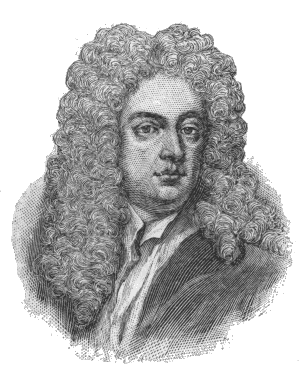
JOSEPH ADDISON
Addison's InfluenceTwo things Addison did
for our literature which are of inestimable value. First, he overcame a
certain corrupt tendency bequeathed by Restoration literature. It was the
apparent aim of the low drama, and even of much of the poetry of that age,
to make virtue ridiculous and vice attractive. Addison set himself
squarely against this unworthy tendency. To strip off the mask of vice, to
show its ugliness and deformity, but to reveal virtue in its own native
loveliness,--that was Addison's purpose; and he succeeded so well that
never, since his day, has our English literature seriously followed after
false gods. As Macaulay says, "So effectually did he retort on vice the
mockery which had recently been directed against virtue, that since his
time the open violation of decency has always been considered amongst us a
sure mark of a fool." And second, prompted and aided by the more original
genius of his friend Steele, Addison seized upon the new social life of
the clubs and made it the subject of endless pleasant essays upon types of
men and manners. The Tatler and The Spectator are the
beginning of the modern essay; and their studies of human character, as
exemplified in Sir Roger de Coverley, are a preparation for the modern
novel.
Life. Addison's life, like his writings, is in marked contrast to
that of Swift. He was born in Milston, Wiltshire, in 1672. His father was
a scholarly English clergyman, and all his life Addison followed naturally
the quiet and cultured ways to which he was early accustomed. At the
famous Charterhouse School, in London, and in his university life at
Oxford, he excelled in character and scholarship and became known as a
writer of graceful verses. He had some intention, at one time, of entering
the Church, but was easily persuaded by his friends to take up the
government service instead. Unlike Swift, who abused his political
superiors, Addison took the more tactful way of winning the friendship of
men in large places. His lines to Dryden won that literary leader's
instant favor, and one of his Latin poems, "The Peace of Ryswick" (1697),
with its kindly appreciation of King William's statesmen, brought him into
favorable political notice. It brought him also a pension of three hundred
pounds a year, with a suggestion that he travel abroad and cultivate the
art of diplomacy; which he promptly did to his own great advantage.
From a literary view point the most interesting work of Addison's early
life is his Account of the Greatest English Poets (1693), written
while he was a fellow of Oxford University. One rubs his eyes to find
Dryden lavishly praised, Spenser excused or patronized, while Shakespeare
is not even mentioned. But Addison was writing under Boileau's "classic"
rules; and the poet, like the age, was perhaps too artificial to
appreciate natural genius.
While he was traveling abroad, the death of William and the loss of power
by the Whigs suddenly stopped Addison's pension; necessity brought him
home, and for a time he lived in poverty and obscurity. Then occurred the
battle of Blenheim, and in the effort to find a poet to celebrate the
event, Addison was brought to the Tories' attention. His poem, "The
Campaign," celebrating the victory, took the country by storm. Instead of
making the hero slay his thousands and ten thousands, like the old epic
heroes, Addison had some sense of what is required in a modern general,
and so made Marlborough direct the battle from the outside, comparing him
to an angel riding on the whirlwind:
'T was then great Marlbro's mighty soul was proved,
That, in the
shock of charging hosts unmoved,
Amidst confusion, horror, and
despair,
Examined all the dreadful scenes of war;
In peaceful
thought the field of death surveyed,
To fainting squadrons sent the
timely aid,
Inspired repulsed battalions to engage,
And taught
the doubtful battle where to rage.
So when an angel by divine
command
With rising tempests shakes a guilty land,
(Such as of
late o'er pale Britannia past,)
Calm and serene he drives the
furious blast;
And, pleased th' Almighty's orders to perform,
Rides in the whirlwind, and directs the storm.
That one doubtful simile made Addison's fortune. Never before or since was
a poet's mechanical work so well rewarded. It was called the finest thing
ever written, and from that day Addison rose steadily in political favor
and office. He became in turn Undersecretary, member of Parliament,
Secretary for Ireland, and finally Secretary of State. Probably no other
literary man, aided by his pen alone, ever rose so rapidly and so high in
office.
The rest of Addison's life was divided between political duties and
literature. His essays for the Tatler and Spectator, which
we still cherish, were written between 1709 and 1714; but he won more
literary fame by his classic tragedy Cato, which we have almost
forgotten. In 1716 he married a widow, the Countess of Warwick, and went
to live at her home, the famous Holland House. His married life lasted
only three years, and was probably not a happy one. Certainly he never
wrote of women except with gentle satire, and he became more and more a
clubman, spending most of his time in the clubs and coffeehouses of
London. Up to this time his life had been singularly peaceful; but his
last years were shadowed by quarrels, first with Pope, then with Swift,
and finally with his lifelong friend Steele. The first quarrel was on
literary grounds, and was largely the result of Pope's jealousy. The
latter's venomous caricature of Addison as Atticus shows how he took his
petty revenge on a great and good man who had been his friend. The other
quarrels with Swift, and especially with his old friend Steele, were the
unfortunate result of political differences, and show how impossible it is
to mingle literary ideals with party politics. He died serenely in 1719. A
brief description from Thackeray's English Humorists is his best
epitaph:
A life prosperous and beautiful, a calm death; an immense fame and
affection afterwards for his happy and spotless name.
The EssaysWorks of Addison. The
most enduring of Addison's works are his famous Essays, collected
from the Tatler and Spectator. We have spoken of him as a
master of the art of gentle living, and these essays are a perpetual
inducement to others to know and to practice the same fine art. To an age
of fundamental coarseness and artificiality he came with a wholesome
message of refinement and simplicity, much as Ruskin and Arnold spoke to a
later age of materialism; only Addison's success was greater than theirs
because of his greater knowledge of life and his greater faith in men. He
attacks all the little vanities and all the big vices of his time, not in
Swift's terrible way, which makes us feel hopeless of humanity, but with a
kindly ridicule and gentle humor which takes speedy improvement for
granted. To read Swift's brutal "Letters to a Young Lady," and then to
read Addison's "Dissection of a Beau's Head" and his "Dissection of a
Coquette's Heart," is to know at once the secret of the latter's more
enduring influence.
Three other results of these delightful essays are worthy of attention:
first, they are the best picture we possess of the new social life of
England, with its many new interests; second, they advanced the art of
literary criticism to a much higher stage than it had ever before reached,
and however much we differ from their judgment and their interpretation of
such a man as Milton, they certainly led Englishmen to a better knowledge
and appreciation of their own literature; and finally, in Ned Softly the
literary dabbler, Will Wimble the poor relation, Sir Andrew Freeport the
merchant, Will Honeycomb the fop, and Sir Roger the country gentleman,
they give us characters that live forever as part of that goodly company
which extends from Chaucer's country parson to Kipling's Mulvaney. Addison
and Steele not only introduced the modern essay, but in such characters as
these they herald the dawn of the modern novel. Of all his essays the best
known and loved are those which introduce us to Sir Roger de Coverley, the
genial dictator of life and manners in the quiet English country.
Addison's StyleIn style these essays are
remarkable as showing the growing perfection of the English language.
Johnson says, "Whoever wishes to attain an English style, familiar but not
coarse, and elegant but not ostentatious, must give his days and nights to
the volumes of Addison." And again he says, "Give nights and days, sir, to
the study of Addison if you mean to be a good writer, or, what is more
worth, an honest man." That was good criticism for its day, and even at
the present time critics are agreed that Addison's Essays are well
worth reading once for their own sake, and many times for their influence
in shaping a clear and graceful style of writing.
PoemsAddison's poems, which were
enormously popular in his day, are now seldom read. His Cato, with
its classic unities and lack of dramatic power, must be regarded as a
failure, if we study it as tragedy; but it offers an excellent example of
the rhetoric and fine sentiment which were then considered the essentials
of good writing. The best scene from this tragedy is in the fifth act,
where Cato soliloquizes, with Plato's Immortality of the Soul open
in his hand, and a drawn sword on the table before him:
It must be so--Plato, thou reason'st well!--
Else whence this
pleasing hope, this fond desire,
This longing after immortality?
Or whence this secret dread, and inward horror,
Of falling into
nought? why shrinks the soul
Back on herself, and startles at
destruction?
'Tis the divinity that stirs within us;
'Tis
heaven itself, that points out an hereafter,
And intimates eternity
to man.
Many readers make frequent use of one portion of Addison's poetry without
knowing to whom they are indebted. His devout nature found expression in
many hymns, a few of which are still used and loved in our churches. Many
a congregation thrills, as Thackeray did, to the splendid sweep of his
"God in Nature," beginning, "The spacious firmament on high." Almost as
well known and loved are his "Traveler's Hymn," and his "Continued Help,"
beginning, "When all thy mercies, O my God." The latter hymn--written in a
storm at sea off the Italian coast, when the captain and crew were
demoralized by terror--shows that poetry, especially a good hymn that one
can sing in the same spirit as one would say his prayers, is sometimes the
most practical and helpful thing in the world.
Richard Steele (1672-1729). Steele was in almost every respect the
antithesis of his friend and fellow-worker,--a rollicking, good-hearted,
emotional, lovable Irishman. At the Charterhouse School and at Oxford he
shared everything with Addison, asking nothing but love in return. Unlike
Addison, he studied but little, and left the university to enter the Horse
Guards. He was in turn soldier, captain, poet, playwright, essayist,
member of Parliament, manager of a theater, publisher of a newspaper, and
twenty other things,--all of which he began joyously and then abandoned,
sometimes against his will, as when he was expelled from Parliament, and
again because some other interest of the moment had more attraction. His
poems and plays are now little known; but the reader who searches them out
will find one or two suggestive things about Steele himself. For instance,
he loves children; and he is one of the few writers of his time who show a
sincere and unswerving respect for womanhood. Even more than Addison he
ridicules vice and makes virtue lovely. He is the originator of the Tatler,
and joins with Addison in creating the Spectator,--the two
periodicals which, in the short space of less than four years, did more to
influence subsequent literature than all other magazines of the century
combined. Moreover, he is the original genius of Sir Roger, and of many
other characters and essays for which Addison usually receives the whole
credit. It is often impossible in the Tatler essays to separate the
work of the two men; but the majority of critics hold that the more
original parts, the characters, the thought, the overflowing kindliness,
are largely Steele's creation; while to Addison fell the work of polishing
and perfecting the essays, and of adding that touch of humor which made
them the most welcome literary visitors that England had ever received.
The Tatler and The Spectator. On
account of his talent in writing political pamphlets, Steele was awarded
the position of official gazetteer. While in this position, and writing
for several small newspapers, the idea occurred to Steele to publish a
paper which should contain not only the political news, but also the
gossip of the clubs and coffeehouses, with some light essays on the life
and manners of the age. The immediate result--for Steele never let an idea
remain idle--was the famous Tatler, the first number of which
appeared April 12, 1709. It was a small folio sheet, appearing on post
days, three times a week, and it sold for a penny a copy. That it had a
serious purpose is evident from this dedication to the first volume of
collected Tatler essays:
The general purpose of this paper is to expose the false arts of life, to
pull off the disguises of cunning, vanity, and affectation, and to
recommend a general simplicity in our dress, our discourse, and our
behavior.
The success of this unheard-of combination of news, gossip, and essay was
instantaneous. Not a club or a coffeehouse in London could afford to be
without it, and over it's pages began the first general interest in
contemporary English life as expressed in literature. Steele at first
wrote the entire paper and signed his essays with the name of Isaac
Bickerstaff, which had been made famous by Swift a few years before.
Addison is said to have soon recognized one of his own remarks to Steele,
and the secret of the Authorship was out. From that time Addison was a
regular contributor, and occasionally other writers added essays on the
new social life of England.[192]
Steele lost his position as gazetteer, and the Tatler was
discontinued after less than two years' life, but not till it won an
astonishing popularity and made ready the way for its successor. Two
months later, on March 1, 1711, appeared the first number of the Spectator.
In the new magazine politics and news, as such, were ignored; it was a
literary magazine, pure and simple, and its entire contents consisted of a
single light essay. It was considered a crazy venture at the time, but its
instant success proved that men were eager for some literary expression of
the new social ideals. The following whimsical letter to the editor may
serve to indicate the part played by the Spectator in the daily
life of London:
Mr. Spectator,--Your paper is a part of my tea equipage; and my servant
knows my humor so well, that in calling for my breakfast this morning (it
being past my usual hour) she answered, the Spectator was not yet
come in, but the teakettle boiled, and she expected it every moment.
It is in the incomparable Spectator papers that Addison shows
himself most "worthy to be remembered." He contributed the majority of its
essays, and in its first number appears this description of the Spectator,
by which name Addison is now generally known:
There is no place of general resort wherein I do not often make my
appearance; sometimes I am seen thrusting my head into a round of
politicians at Will's [Coffeehouse] and listening with great attention to
the narratives that are made in those little circular audiences. Sometimes
I smoke a pipe at Child's, and, whilst I seem attentive to nothing but The
Postman, overhear the conversation of every table in the room. I
appear on Sunday nights at St. James's, and sometimes join the little
committee of politics in the inner room, as one who comes to hear and
improve. My face is likewise very well known at the Grecian, the Cocoa
Tree, and in the theaters both of Drury Lane and the Haymarket. I have
been taken for a merchant upon the Exchange for above these ten years; and
sometimes pass for a Jew in the assembly of stock jobbers at
Jonathan's.... Thus I live in the world rather as a spectator of mankind
than as one of the species,... which is the character I intend to preserve
in this paper.
The large place which these two little magazines hold in our literature
seems most disproportionate to their short span of days. In the short
space of four years in which Addison and Steele worked together the light
essay was established as one of the most important forms of modern
literature, and the literary magazine won its place as the expression of
the social life of a nation.
SAMUEL JOHNSON (1709-1784)
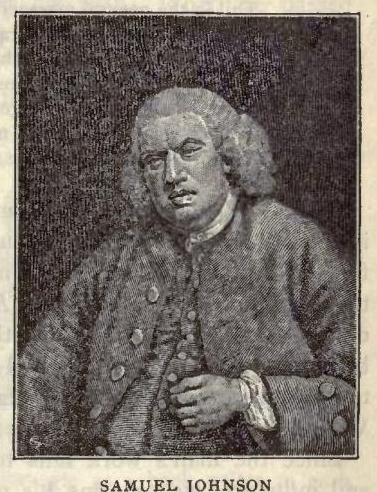
The reader of Boswell's Johnson, after listening to endless
grumblings and watching the clumsy actions of the hero, often finds
himself wondering why he should end his reading with a profound respect
for this "old bear" who is the object of Boswell's groveling attention.
Here is a man who was certainly not the greatest writer of his age,
perhaps not even a great writer at all, but who was nevertheless the
dictator of English letters, and who still looms across the centuries of a
magnificent literature as its most striking and original figure. Here,
moreover, is a huge, fat, awkward man, of vulgar manners and appearance,
who monopolizes conversation, argues violently, abuses everybody, clubs
down opposition,--"Madam" (speaking to his cultivated hostess at table),
"talk no more nonsense"; "Sir" (turning to a distinguished guest), "I
perceive you are a vile Whig." While talking he makes curious animal
sounds, "sometimes giving a half whistle, sometimes clucking like a hen";
and when he has concluded a violent dispute and laid his opponents low by
dogmatism or ridicule, he leans back to "blow out his breath like a whale"
and gulp down numberless cups of hot tea. Yet this curious dictator of an
elegant age was a veritable lion, much sought after by society; and around
him in his own poor house gathered the foremost artists, scholars, actors,
and literary men of London,--all honoring the man, loving him, and
listening to his dogmatism as the Greeks listened to the voice of their
oracle.
What is the secret of this astounding spectacle? If the reader turns
naturally to Johnson's works for an explanation, he will be disappointed.
Reading his verses, we find nothing to delight or inspire us, but rather
gloom and pessimism, with a few moral observations in rimed couplets:
But, scarce observed, the knowing and the bold
Fall in the general
massacre of gold;
Wide-wasting pest! that rages unconfined,
And crowds with crimes the records of mankind;
For gold his sword
the hireling ruffian draws,
For gold the hireling judge distorts
the laws;
Wealth heaped on wealth nor truth nor safety buys;
The dangers gather as the treasures rise.[193]
That is excellent common sense, but it is not poetry; and it is not
necessary to hunt through Johnson's bulky volumes for the information,
since any moralist can give us offhand the same doctrine. As for his Rambler
essays, once so successful, though we marvel at the big words, the
carefully balanced sentences, the classical allusions, one might as well
try to get interested in an old-fashioned, three-hour sermon. We read a
few pages listlessly, yawn, and go to bed.
Since the man's work fails to account for his leadership and influence, we
examine his personality; and here everything is interesting. Because of a
few oft-quoted passages from Boswell's biography, Johnson appears to us as
an eccentric bear, who amuses us by his growlings and clumsy antics. But
there is another Johnson, a brave, patient, kindly, religious soul, who,
as Goldsmith said, had "nothing of the bear but his skin"; a man who
battled like a hero against poverty and pain and melancholy and the awful
fear of death, and who overcame them manfully. "That trouble passed
away; so will this," sang the sorrowing Deor in the first old
Anglo-Saxon lyric; and that expresses the great and suffering spirit of
Johnson, who in the face of enormous obstacles never lost faith in God or
in himself. Though he was a reactionary in politics, upholding the
arbitrary power of kings and opposing the growing liberty of the people,
yet his political theories, like his manners, were no deeper than his
skin; for in all London there was none more kind to the wretched, and none
more ready to extend an open hand to every struggling man and woman who
crossed his path. When he passed poor homeless Arabs sleeping in the
streets he would slip a coin into their hands, in order that they might
have a happy awakening; for he himself knew well what it meant to be
hungry. Such was Johnson,--a "mass of genuine manhood," as Carlyle called
him, and as such, men loved and honored him.[194]
Life of Johnson. Johnson was born in Lichfield, Staffordshire, in 1709. He
was the son of a small bookseller, a poor man, but intelligent and fond of
literature, as booksellers invariably were in the good days when every
town had its bookshop. From his childhood Johnson had to struggle against
physical deformity and disease and the consequent disinclination to hard
work. He prepared for the university, partly in the schools, but largely
by omnivorous reading in his father's shop, and when he entered Oxford he
had read more classical authors than had most of the graduates. Before
finishing his course he had to leave the university on account of his
poverty, and at once he began his long struggle as a hack writer to earn
his living.
At twenty-five years he married a woman old enough to be his mother,--a
genuine love match, he called it,--and with her dowry of £800 they started
a private school together, which was a dismal failure. Then, without money
or influential friends, he left his home and wife in Lichfield and tramped
to London, accompanied only by David Garrick, afterwards the famous actor,
who had been one of his pupils. Here, led by old associations, Johnson
made himself known to the booksellers, and now and then earned a penny by
writing prefaces, reviews, and translations.
It was a dog's life, indeed, that he led there with his literary brethren.
Many of the writers of the day, who are ridiculed in Pope's heartless Dunciad,
having no wealthy patrons to support them, lived largely in the streets
and taverns, sleeping on an ash heap or under a wharf, like rats; glad of
a crust, and happy over a single meal which enabled them to work for a
while without the reminder of hunger. A few favored ones lived in wretched
lodgings in Grub Street, which has since become a synonym for the fortunes
of struggling writers.[195]
Often, Johnson tells us, he walked the streets all night long, in dreary
weather, when it was too cold to sleep, without food or shelter. But he
wrote steadily for the booksellers and for the Gentleman's Magazine,
and presently he became known in London and received enough work to earn a
bare living.
The works which occasioned this small success were his poem, "London," and
his Life of the Poet Savage, a wretched life, at best, which were
perhaps better left without a biographer. But his success was genuine,
though small, and presently the booksellers of London are coming to him to
ask him to write a dictionary of the English language. It was an enormous
work, taking nearly eight years of his time, and long before he had
finished it he had eaten up the money which he received for his labor. In
the leisure intervals of this work he wrote "The Vanity of Human Wishes"
and other poems, and finished his classic tragedy of Irene.
Led by the great success of the Spectator, Johnson started two
magazines, The Rambler (1750--1752) and The Idler
(1758--1760). Later the Rambler essays were published in book form
and ran rapidly through ten editions; but the financial returns were
small, and Johnson spent a large part of his earnings in charity. When his
mother died, in 1759, Johnson, although one of the best known men in
London, had no money, and hurriedly finished Rasselas, his only
romance, in order, it is said, to pay for his mother's burial.
It was not till 1762, when Johnson was fifty-three years old, that his
literary labors were rewarded in the usual way by royalty, and he received
from George III a yearly pension of three hundred pounds. Then began a
little sunshine in his life. With Joshua Reynolds, the artist, he founded
the famous Literary Club, of which Burke, Pitt, Fox, Gibbon, Goldsmith,
and indeed all the great literary men and politicians of the time, were
members. This is the period of Johnson's famous conversations, which were
caught in minutest detail by Boswell and given to the world. His idea of
conversation, as shown in a hundred places in Boswell, is to overcome your
adversary at any cost; to knock him down by arguments, or, when these
fail, by personal ridicule; to dogmatize on every possible question,
pronounce a few oracles, and then desist with the air of victory.
Concerning the philosopher Hume's view of death he says: "Sir, if he
really thinks so, his perceptions are disturbed, he is mad. If he does not
think so, he lies." Exit opposition. There is nothing more to be said.
Curiously enough, it is often the palpable blunders of these monologues
that now attract us, as if we were enjoying a good joke at the dictator's
expense. Once a lady asked him, "Dr. Johnson, why did you define pastern
as the knee of a horse?" "Ignorance, madame, pure ignorance," thundered
the great authority.
When seventy years of age, Johnson was visited by several booksellers of
the city, who were about to bring out a new edition of the English poets,
and who wanted Johnson, as the leading literary man of London, to write
the prefaces to the several volumes. The result was his Lives of the
Poets, as it is now known, and this is his last literary work. He died
in his poor Fleet Street house, in 1784, and was buried among England's
honored poets in Westminster Abbey.
The English DictionaryJohnson's Works.
"A book," says Dr. Johnson, "should help us either to enjoy life or to
endure it." Judged by this standard, one is puzzled what to recommend
among Johnson's numerous books. The two things which belong among the
things "worthy to be remembered" are his Dictionary and his Lives
of the Poets, though both these are valuable, not as literature, but
rather as a study of literature. The Dictionary, as the first
ambitious attempt at an English lexicon, is extremely valuable,
notwithstanding the fact that his derivations are often faulty, and that
he frequently exercises his humor or prejudice in his curious definitions.
In defining "oats," for example, as a grain given in England to horses and
in Scotland to the people, he indulges his prejudice against the Scotch,
whom he never understood, just as, in his definition of "pension," he
takes occasion to rap the writers who had flattered their patrons since
the days of Elizabeth; though he afterwards accepted a comfortable pension
for himself. With characteristic honesty he refused to alter his
definition in subsequent editions of the Dictionary.
Lives of the PoetsThe Lives of the
Poets are the simplest and most readable of his literary works. For
ten years before beginning these biographies he had given himself up to
conversation, and the ponderous style of his Rambler essays here
gives way to a lighter and more natural expression. As criticisms they are
often misleading, giving praise to artificial poets, like Cowley and Pope,
and doing scant justice or abundant injustice to nobler poets like Gray
and Milton; and they are not to be compared with those found in Thomas
Warton's History of English Poetry, which was published in the same
generation. As biographies, however, they are excellent reading, and we
owe to them some of our best known pictures of the early English poets.
Poems and EssaysOf Johnson's poems the
reader will have enough if he glance over "The Vanity of Human Wishes."
His only story, Rasselas, Prince of Abyssinia, is a matter of
rhetoric rather than of romance, but is interesting still to the reader
who wants to hear Johnson's personal views of society, philosophy, and
religion. Any one of his Essays, like that on "Reading," or "The
Pernicious Effects of Revery," will be enough to acquaint the reader with
the Johnsonese style, which was once much admired and copied by orators,
but which happily has been replaced by a more natural way of speaking.
Most of his works, it must be confessed, are rather tiresome. It is not to
his books, but rather to the picture of the man himself, as given by
Boswell, that Johnson owes his great place in our literature.
BOSWELL'S "LIFE OF JOHNSON"
In James Boswell (1740-1795) we have another extraordinary figure,--a
shallow little Scotch barrister, who trots about like a dog at the heels
of his big master, frantic at a caress and groveling at a cuff, and
abundantly contented if only he can be near him and record his oracles.
All his life long Boswell's one ambition seems to have been to shine in
the reflected glory of great men, and his chief task to record their
sayings and doings. When he came to London, at twenty-two years of age,
Johnson, then at the beginning of his great fame, was to this insatiable
little glory-seeker like a Silver Doctor to a hungry trout. He sought an
introduction as a man seeks gold, haunted every place where Johnson
declaimed, until in Davies's bookstore the supreme opportunity came. This
is his record of the great event:
I was much agitated [says Boswell] and recollecting his prejudice against
the Scotch, of which I had heard much, I said to Davies, "Don't tell him
where I come from." "From Scotland," cried Davies roguishly. "Mr.
Johnson," said I, "I do indeed come from Scotland, but I cannot help
it."... "That, sir" [cried Johnson], "I find is what a very great many of
your countrymen cannot help." This stroke stunned me a good deal; and when
we had sat down I felt myself not a little embarrassed, and apprehensive
of what might come next.
Then for several years, with a persistency that no rebuffs could abate,
and with a thick skin that no amount of ridicule could render sensitive,
he follows Johnson; forces his way into the Literary Club, where he is not
welcome, in order to be near his idol; carries him off on a visit to the
Hebrides; talks with him on every possible occasion; and, when he is not
invited to a feast, waits outside the house or tavern in order to walk
home with his master in the thick fog of the early morning. And the moment
the oracle is out of sight and in bed, Boswell patters home to record in
detail all that he has seen and heard. It is to his minute record that we
owe our only perfect picture of a great man; all his vanity as well as his
greatness, his prejudices, superstitions, and even the details of his
personal appearance:
There is the gigantic body, the huge face seamed with the scars of
disease, the brown coat, the black worsted stockings, the gray wig with
the scorched foretop, the dirty hands, the nails bitten and pared to the
quick. We see the eyes and mouth moving with convulsive twitches; we see
the heavy form rolling; we hear it puffing; and then comes the "Why, sir!"
and the "What then, sir?" and the "No, sir!" and the "You don't see your
way through the question, sir!"[196]
To Boswell's record we are indebted also for our knowledge of those famous
conversations, those wordy, knockdown battles, which made Johnson famous
in his time and which still move us to wonder. Here is a specimen
conversation, taken almost at random from a hundred such in Boswell's
incomparable biography. After listening to Johnson's prejudice against
Scotland, and his dogmatic utterances on Voltaire, Robertson, and twenty
others, an unfortunate theorist brings up a recent essay on the possible
future life of brutes, quoting some possible authority from the sacred
scriptures:
Johnson, who did not like to hear anything concerning a future state which
was not authorized by the regular canons of orthodoxy, discouraged this
talk; and being offended at its continuation, he watched an opportunity to
give the gentleman a blow of reprehension. So when the poor speculatist,
with a serious, metaphysical, pensive face, addressed him, "But really,
sir, when we see a very sensible dog, we don't know what to think of him";
Johnson, rolling with joy at the thought which beamed in his eye, turned
quickly round and replied, "True, sir; and when we see a very foolish
fellow, we don't know what to think of him." He then rose up,
strided to the fire, and stood for some time laughing and exulting.
Then the oracle proceeds to talk of scorpions and natural history, denying
facts, and demanding proofs which nobody could possibly furnish:
He seemed pleased to talk of natural philosophy. "That woodcocks," said
he, "fly over the northern countries is proved, because they have been
observed at sea. Swallows certainly sleep all the winter. A number of them
conglobulate together by flying round and round, and then all in a heap
throw themselves under water and lie in the bed of a river." He told us
one of his first essays was a Latin poem upon the glowworm: I am sorry I
did not ask where it was to be found.
Then follows an astonishing array of subjects and opinions. He catalogues
libraries, settles affairs in China, pronounces judgment on men who marry
women superior to themselves, flouts popular liberty, hammers Swift
unmercifully, and adds a few miscellaneous oracles, most of which are
about as reliable as his knowledge of the hibernation of swallows.
When I called upon Dr. Johnson next morning I found him highly satisfied
with his colloquial prowess the preceding evening. "Well," said he, "we
had good talk." "Yes, sir" [says I], "you tossed and gored several
persons."
Far from resenting this curious mental dictatorship, his auditors never
seem to weary. They hang upon his words, praise him, flatter him, repeat
his judgments all over London the next day, and return in the evening
hungry for more. Whenever the conversation begins to flag, Boswell is like
a woman with a parrot, or like a man with a dancing bear. He must excite
the creature, make him talk or dance for the edification of the company.
He sidles obsequiously towards his hero and, with utter irrelevancy,
propounds a question of theology, a social theory, a fashion of dress or
marriage, a philosophical conundrum: "Do you think, sir, that natural
affections are born with us?" or, "Sir, if you were shut up in a castle
and a newborn babe with you, what would you do?" Then follow more
Johnsonian laws, judgments, oracles; the insatiable audience clusters
around him and applauds; while Boswell listens, with shining face, and
presently goes home to write the wonder down. It is an astonishing
spectacle; one does not know whether to laugh or grieve over it. But we
know the man, and the audience, almost as well as if we had been there;
and that, unconsciously, is the superb art of this matchless biographer.
When Johnson died the opportunity came for which Boswell had been watching
and waiting some twenty years. He would shine in the world now, not by
reflection, but by his own luminosity. He gathered together his endless
notes and records, and began to write his biography; but he did not hurry.
Several biographies of Johnson appeared, in the four years after his
death, without disturbing Boswell's perfect complacency. After seven
years' labor he gave the world his Life of Johnson. It is an
immortal work; praise is superfluous; it must be read to be appreciated.
Like the Greek sculptors, the little slave produced a more enduring work
than the great master. The man who reads it will know Johnson as he knows
no other man who dwells across the border; and he will lack sensitiveness,
indeed, if he lay down the work without a greater love and appreciation of
all good literature.
Later Augustan Writers. With
Johnson, who succeeded Dryden and Pope in the chief place of English
letters, the classic movement had largely spent its force; and the latter
half of the eighteenth century gives us an imposing array of writers who
differ so widely that it is almost impossible to classify them. In
general, three schools of writers are noticeable: first, the classicists,
who, under Johnson's lead, insisted upon elegance and regularity of style;
second, the romantic poets, like Collins, Gray, Thomson, and Burns, who
revolted from Pope's artificial couplets and wrote of nature and the human
heart[197];
third, the early novelists, like Defoe and Fielding, who introduced a new
type of literature. The romantic poets and the novelists are reserved for
special chapters; and of the other writers--Berkeley and Hume in
philosophy; Robertson, Hume, and Gibbon in history; Chesterfield and Lady
Montagu in letter writing; Adam Smith in economics; Pitt, Burke, Fox, and
a score of lesser writers in politics--we select only two, Burke and
Gibbon, whose works are most typical of the Augustan, i.e. the elegant,
classic style of prose writing.
EDMUND BURKE (1729--1797)
To read all of Burke's collected works, and so to understand him
thoroughly, is something of a task. Few are equal to it. On the other
hand, to read selections here and there, as most of us do, is to get a
wrong idea of the man and to join either in fulsome praise of his
brilliant oratory, or in honest confession that his periods are ponderous
and his ideas often buried under Johnsonian verbiage. Such are the
contrasts to be found on successive pages of Burke's twelve volumes, which
cover the enormous range of the political and economic thought of the age,
and which mingle fact and fancy, philosophy, statistics, and brilliant
flights of the imagination, to a degree never before seen in English
literature. For Burke belongs in spirit to the new romantic school, while
in style he is a model for the formal classicists. We can only glance at
the life of this marvelous Irishman, and then consider his place in our
literature.
Life. Burke was born in Dublin, the son of an Irish barrister, in
1729. After his university course in Trinity College he came to London to
study law, but soon gave up the idea to follow literature, which in turn
led him to politics. He had the soul, the imagination of a poet, and the
law was only a clog to his progress. His two first works, A Vindication
of Natural Society and The Origin of our Ideas of the Sublime and
the Beautiful, brought him political as well as literary recognition,
and several small offices were in turn given to him. When thirty-six years
old he was elected to Parliament as member from Wendover; and for the next
thirty years he was the foremost figure in the House of Commons and the
most eloquent orator which that body has ever known. Pure and
incorruptible in his politics as in his personal life, no more learned or
devoted servant of the Commonwealth ever pleaded for justice and human
liberty. He was at the summit of his influence at the time when the
colonies were struggling for independence; and the fact that he championed
their cause in one of his greatest speeches, "On Conciliation with
America," gives him an added interest in the eyes of American readers. His
championship of America is all the more remarkable from the fact that, in
other matters, Burke was far from liberal. He set himself squarely against
the teachings of the romantic writers, who were enthusiastic over the
French Revolution; he denounced the principles of the Revolutionists,
broke with the liberal Whig party to join the Tories, and was largely
instrumental in bringing on the terrible war with France, which resulted
in the downfall of Napoleon.
It is good to remember that, in all the strife and bitterness of party
politics, Burke held steadily to the noblest personal ideals of truth and
honesty; and that in all his work, whether opposing the slave trade, or
pleading for justice for America, or protecting the poor natives of India
from the greed of corporations, or setting himself against the popular
sympathy for France in her desperate struggle, he aimed solely at the
welfare of humanity. When he retired on a pension in 1794, he had won, and
he deserved, the gratitude and affection of the whole nation.
Works. There are three distinctly marked periods in Burke's career,
and these correspond closely to the years in which he was busied with the
affairs of America, India, and France successively. The first period was
one of prophecy. He had studied the history and temper of the American
colonies, and he warned England of the disaster which must follow her
persistence in ignoring the American demands, and especially the American
spirit. His great speeches, "On American Taxation" and "On Conciliation
with America," were delivered in 1774 and 1775, preceding the Declaration
of Independence. In this period Burke's labor seemed all in vain; he lost
his cause, and England her greatest colony.
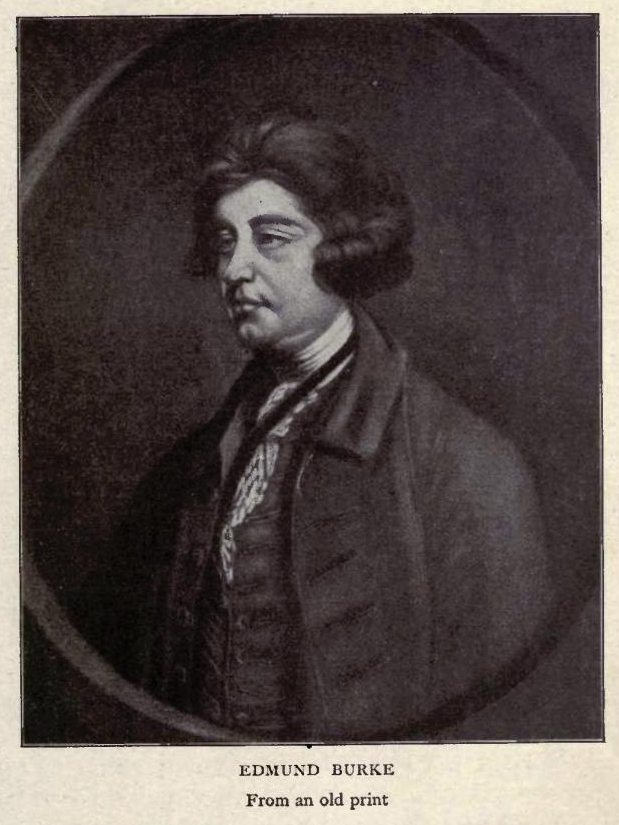
The second period is one of denunciation rather than of prophecy. England
had won India; but when Burke studied the methods of her victory and
understood the soulless way in which millions of poor natives were made to
serve the interests of an English monopoly, his soul rose in revolt, and
again he was the champion of an oppressed people. His two greatest
speeches of this period are "The Nabob of Arcot's Debts" and his
tremendous "Impeachment of Warren Hastings." Again he apparently lost his
cause, though he was still fighting on the side of right. Hastings was
acquitted, and the spoliation of India went on; but the seeds of reform
were sown, and grew and bore fruit long after Burke's labors were ended.
The third period is, curiously enough, one of reaction. Whether because
the horrors of the French Revolution had frightened him with the danger of
popular liberty, or because his own advance in office and power had made
him side unconsciously with the upper classes, is unknown. That he was as
sincere and noble now as in all his previous life is not questioned. He
broke with the liberal Whigs and joined forces with the reactionary
Tories. He opposed the romantic writers, who were on fire with enthusiasm
over the French Revolution, and thundered against the dangers which the
revolutionary spirit must breed, forgetting that it was a revolution which
had made modern England possible. Here, where we must judge him to have
been mistaken in his cause, he succeeded for the first time. It was due
largely to Burke's influence that the growing sympathy for the French
people was checked in England, and war was declared, which ended in the
frightful victories of Trafalgar and Waterloo.
Burke's best known work of this period is his Reflections on the French
Revolution, which he polished and revised again Essay on and again
before it was finally printed. This ambitious literary essay, though it
met with remarkable success, is a disappointment to the reader. Though of
Celtic blood, Burke did not understand the French, or the principles for
which the common people were fighting in their own way[198]; and his denunciations and
apostrophes to France suggest a preacher without humor, hammering away at
sinners who are not present in his congregation. The essay has few
illuminating ideas, but a great deal of Johnsonian rhetoric, which make
its periods tiresome, notwithstanding our admiration for the brilliancy of
its author. More significant is one of Burke's first essays, A
Philosophical Inquiry Into the Origin of Our Ideas of the Sublime and
Beautiful, which is sometimes read in order to show the contrast in
style with Addison's Spectator essays on the "Pleasures of the
Imagination."
Burke's OrationsBurke's best known
speeches, "On Conciliation with America," "American Taxation," and the
"Impeachment of Warren Hastings," are still much studied in our schools as
models of English prose; and this fact tends to give them an exaggerated
literary importance. Viewed purely as literature, they have faults enough;
and the first of these, so characteristic of the Classic Age, is that they
abound in fine rhetoric but lack simplicity.[199] In a strict sense, these
eloquent speeches are not literature, to delight the reader and to suggest
ideas, but studies in rhetoric and in mental concentration. All this,
however, is on the surface. A careful study of any of these three famous
speeches reveals certain admirable qualities which account for the
important place they are given in the study of English. First, as showing
the stateliness and the rhetorical power of our language, these speeches
are almost unrivaled. Second, though Burke speaks in prose, he is
essentially a poet, whose imagery, like that of Milton's prose works, is
more remarkable than that of many of our writers of verse. He speaks in
figures, images, symbols; and the musical cadence of his sentences
reflects the influence of his wide reading of poetry. Not only in
figurative expression, but much more in spirit, he belongs with the poets
of the revival. At times his language is pseudo-classic, reflecting the
influence of Johnson and his school; but his thought is always romantic;
he is governed by ideal rather than by practical interests, and a profound
sympathy for humanity is perhaps his most marked characteristic.
Third, the supreme object of these orations, so different from the
majority of political speeches, is not to win approval or to gain votes,
but to establish the truth. Like our own Lincoln, Burke had a superb faith
in the compelling power of the truth, a faith in men also, who, if the
history of our race means anything, will not willingly follow a lie. The
methods of these two great leaders are strikingly similar in this respect,
that each repeats his idea in many ways, presenting the truth from
different view points, so that it will appeal to men of widely different
experiences. Otherwise the two men are in marked contrast. The uneducated
Lincoln speaks in simple, homely words, draws his illustrations from the
farm, and often adds a humorous story, so apt and "telling" that his
hearers can never forget the point of his argument. The scholarly Burke
speaks in ornate, majestic periods, and searches all history and all
literature for his illustrations. His wealth of imagery and allusions,
together with his rare combination of poetic and logical reasoning, make
these orations remarkable, entirely apart from their subject and purpose.
Fourth (and perhaps most significant of the man and his work), Burke takes
his stand squarely upon the principle of justice. He has studied history,
and he finds that to establish justice, between man and man and between
nation and nation, has been the supreme object of every reformer since the
world began. No small or merely temporary success attracts him; only the
truth will suffice for an argument; and nothing less than justice will
ever settle a question permanently. Such is his platform, simple as the
Golden Rule, unshakable as the moral law. Hence, though he apparently
fails of his immediate desire in each of these three orations, the
principle for which he contends cannot fail. As a modern writer says of
Lincoln, "The full, rich flood of his life through the nation's pulse is
yet beating"; and his words are still potent in shaping the course of
English politics in the way of justice.
EDWARD GIBBON (1737-1794)
To understand Burke or Johnson, one must read a multitude of books and be
wary in his judgment; but with Gibbon the task is comparatively easy, for
one has only to consider two books, his Memoirs and the first
volume of his History, to understand the author. In his Memoirs
we have an interesting reflection of Gibbon's own personality,--a man who
looks with satisfaction on the material side of things, who seeks always
the easiest path for himself, and avoids life's difficulties and
responsibilities. "I sighed as a lover; but I obeyed as a son," he says,
when, to save his inheritance, he gave up the woman he loved and came home
to enjoy the paternal loaves and fishes. That is suggestive of the man's
whole life. His History, on the other hand, is a remarkable work.
It was the first in our language to be written on scientific principles,
and with a solid basis of fact; and the style is the very climax of that
classicism which had ruled England for an entire century. Its combination
of historical fact and literary style makes The Decline and Fall of the
Roman Empire the one thing of Gibbon's life that is "worthy to be
remembered."
Gibbon's History. For many years Gibbon had meditated, like Milton,
upon an immortal work, and had tried several historical subjects, only to
give them up idly. In his Journal he tells us how his vague
resolutions were brought to a focus:
It was at Rome, on the fifteenth of October, 1764, as I sat musing amidst
the ruins of the Capitol, while the barefooted friars were singing vespers
in the Temple of Jupiter, that the idea of writing the decline and fall of
the city first started to my mind.
Twelve years later, in 1776, Gibbon published the first volume of The
Decline and Fall of the Roman Empire; and the enormous success of the
work encouraged him to go on with the other five volumes, which were
published at intervals during the next twelve years. The History begins
with the reign of Trajan, in A.D. 98, and "builds a straight Roman road"
through the confused histories of thirteen centuries, ending with the fall
of the Byzantine Empire in 1453. The scope of the History is enormous. It
includes not only the decline of the Roman Empire, but such movements as
the descent of the northern barbarians, the spread of Christianity, the
reorganization of the European nations, the establishment of the great
Eastern Empire, the rise of Mohammedanism, and the splendor of the
Crusades. On the one hand it lacks philosophical insight, being satisfied
with facts without comprehending the causes; and, as Gibbon seems lacking
in ability to understand spiritual and religious movements, it is utterly
inadequate in its treatment of the tremendous influence of Christianity.
On the other hand, Gibbon's scholarship leaves little to criticise; he
read enormously, sifted his facts out of multitudes of books and records,
and then marshaled them in the imposing array with which we have grown
familiar. Moreover, he is singularly just and discriminating in the use of
all documents and authorities at his command. Hence he has given us the
first history in English that has borne successfully the test of modern
research and scholarship.
The style of the work is as imposing as his great subject. Indeed, with
almost any other subject the sonorous roll of his majestic sentences would
be out of place. While it deserves all the adjectives that have been
applied to it by enthusiastic admirers,--finished, elegant, splendid,
rounded, massive, sonorous, copious, elaborate, ornate, exhaustive,--it
must be confessed, though one whispers the confession, that the style
sometimes obscures our interest in the narrative. As he sifted his facts
from a multitude of sources, so he often hides them again in endless
periods, and one must often sift them out again in order to be quite sure
of even the simple facts. Another drawback is that Gibbon is hopelessly
worldly in his point of view; he loves pageants and crowds rather than
individuals, and he is lacking in enthusiasm and in spiritual insight. The
result is so frankly material at times that one wonders if he is not
reading of forces or machines, rather than of human beings. A little
reading of his History here and there is an excellent thing, leaving one
impressed with the elegant classical style and the scholarship; but a
continued reading is very apt to leave us longing for simplicity, for
naturalness, and, above all, for the glow of enthusiasm which makes the
dead heroes live once more in the written pages.
This judgment, however, must not obscure the fact that the book had a
remarkably large sale; and that this, of itself, is an evidence that
multitudes of readers found it not only erudite, but readable and
interesting.
II. THE REVIVAL OF ROMANTIC POETRY
The old order changeth, yielding place to new;
And God fulfills Himself in many ways,
Lest one good custom should corrupt the world.
Tennyson's
"The Passing of Arthur."
The Meaning of Romanticism. While Dryden, Pope, and Johnson were
successively the dictators of English letters, and while, under their
leadership, the heroic couplet became the fashion of poetry, and
literature in general became satiric or critical in spirit, and formal in
expression, a new romantic movement quietly made its appearance. Thomson's
The Seasons (1730) was the first noteworthy poem of the romantic
revival; and the poems and the poets increased steadily in number and
importance till, in the age of Wordsworth and Scott, the spirit of
Romanticism dominated our literature more completely than Classicism had
ever done. This romantic movement--which Victor Hugo calls "liberalism in
literature"--is simply the expression of life as seen by imagination,
rather than by prosaic "common sense," which was the central doctrine of
English philosophy in the eighteenth century. It has six prominent
characteristics which distinguish it from the so-called classic literature
which we have just studied:
1. The romantic movement was marked, and is always marked, by a strong
reaction and protest against the bondage of rule and custom, which, in
science and theology, as well as in literature, generally tend to fetter
the free human spirit.
2. Romanticism returned to nature and to plain humanity for its material,
and so is in marked contrast to Classicism, which had confined itself
largely to the clubs and drawing-rooms, and to the social and political
life of London. Thomson's Seasons, whatever its defects, was a
revelation of the natural wealth and beauty which, for nearly a century,
had been hardly noticed by the great writers of England.
3. It brought again the dream of a golden age[200] in which the stern realities of
life were forgotten and the ideals of youth were established as the only
permanent realities. "For the dreamer lives forever, but the toiler dies
in a day," expresses, perhaps, only the wild fancy of a modern poet; but,
when we think of it seriously, the dreams and ideals of a people are
cherished possessions long after their stone monuments have crumbled away
and their battles are forgotten. The romantic movement emphasized these
eternal ideals of youth, and appealed to the human heart as the classic
elegance of Dryden and Pope could never do.
4. Romanticism was marked by intense human sympathy, and by a consequent
understanding of the human heart. Not to intellect or to science does the
heart unlock its treasures, but rather to the touch of a sympathetic
nature; and things that are hidden from the wise and prudent are revealed
unto children. Pope had no appreciable humanity; Swift's work is a
frightful satire; Addison delighted polite society, but had no message for
plain people; while even Johnson, with all his kindness, had no feeling
for men in the mass, but supported Sir Robert Walpole in his policy of
letting evils alone until forced by a revolution to take notice of
humanity's appeal. With the romantic revival all this was changed. While
Howard was working heroically for prison reform, and Wilberforce for the
liberation of the slaves, Gray wrote his "short and simple annals of the
poor," and Goldsmith his Deserted Village, and Cowper sang,
My
ear is pained,
My soul is sick with every day's report
Of
wrong and outrage with which earth is filled.
There is no flesh in
man's obdurate heart,
It does not feel for man.[201]
This sympathy for the poor, and this cry against oppression, grew stronger
and stronger till it culminated in "Bobby" Burns, who, more than any other
writer in any language, is the poet of the unlettered human heart.
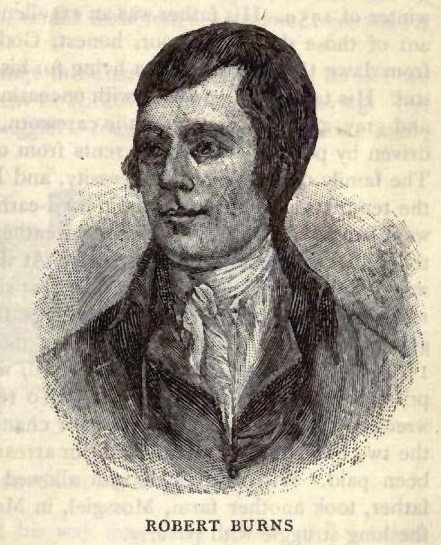
5. The romantic movement was the expression of individual genius rather
than of established rules. In consequence, the literature of the revival
is as varied as the characters and moods of the different writers. When we
read Pope, for instance, we have a general impression of sameness, as if
all his polished poems were made in the same machine; but in the work of
the best romanticists there is endless variety. To read them is like
passing through a new village, meeting a score of different human types,
and finding in each one something to love or to remember. Nature and the
heart of man are as new as if we had never studied them. Hence, in reading
the romanticists, who went to these sources for their material, we are
seldom wearied but often surprised; and the surprise is like that of the
sunrise, or the sea, which always offers some new beauty and stirs us
deeply, as if we had never seen it before.
6. The romantic movement, while it followed its own genius, was not
altogether unguided. Strictly speaking, there is no new movement either in
history or in literature; each grows out of some good thing which has
preceded it, and looks back with reverence to past masters. Spenser,
Shakespeare, and Milton were the inspiration of the romantic revival; and
we can hardly read a poem of the early romanticists without finding a
suggestion of the influence of one of these great leaders.[202]
There are various other characteristics of Romanticism, but these six--the
protest against the bondage of rules, the return to nature and the human
heart, the interest in old sagas and mediæval romances as suggestive
of a heroic age, the sympathy for the toilers of the world, the emphasis
upon individual genius, and the return to Milton and the Elizabethans,
instead of to Pope and Dryden, for literary models--are the most
noticeable and the most interesting. Remembering them, we shall better
appreciate the work of the following writers who, in varying degree,
illustrate the revival of romantic poetry in the eighteenth century.
THOMAS GRAY (1716-1771)
The curfew tolls the knell of parting day;
The lowing herd wind
slowly o'er the lea;
The plowman homeward plods his weary way,
And leaves the world to darkness and to me.
Now fades the
glimmering landscape on the sight,
And all the air a solemn
stillness holds,
Save where the beetle wheels his droning flight,
And drowsy tinklings lull the distant folds.
So begins "the best known poem in the English language," a poem full of
the gentle melancholy which marks all early romantic poetry. It should be
read entire, as a perfect model of its kind. Not even Milton's "Il
Penseroso," which it strongly suggests, excels it in beauty and
suggestiveness.
Life of Gray. The author of the famous "Elegy" is the most
scholarly and well-balanced of all the early romantic poets. In his youth
he was a weakling, the only one of twelve children who survived infancy;
and his unhappy childhood, the tyranny of his father, and the separation
from his loved mother, gave to his whole life the stamp of melancholy
which is noticeable in all his poems. At the famous Eton school and again
at Cambridge, he seems to have followed his own scholarly tastes rather
than the curriculum, and was shocked, like Gibbon, at the general idleness
and aimlessness of university life. One happy result of his school life
was his friendship for Horace Walpole, who took him abroad for a three
years' tour of the Continent.
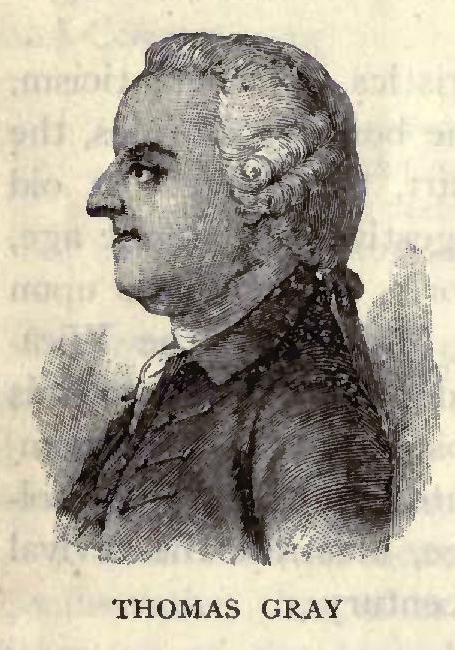
THOMAS GRAY
No better index of the essential difference between the classical and the
new romantic school can be imagined than that which is revealed in the
letters of Gray and Addison, as they record their impressions of foreign
travel. Thus, when Addison crossed the Alps, some twenty-five years
before, in good weather, he wrote: "A very troublesome journey.... You
cannot imagine how I am pleased with the sight of a plain." Gray crossed
the Alps in the beginning of winter, "wrapped in muffs, hoods and masks of
beaver, fur boots, and bearskins," but wrote ecstatically, "Not a
precipice, not a torrent, not a cliff but is pregnant with religion and
poetry."
On his return to England, Gray lived for a short time at Stoke Poges,
where he wrote his "Ode on Eton," and probably sketched his "Elegy,"
which, however, was not finished till 1750, eight years later. During the
latter years of his shy and scholarly life he was Professor of Modern
History and Languages at Cambridge, without any troublesome work of
lecturing to students. Here he gave himself up to study and to poetry,
varying his work by "prowlings" among the manuscripts of the new British
Museum, and by his "Lilliputian" travels in England and Scotland. He died
in his rooms at Pembroke College in 1771, and was buried in the little
churchyard of Stoke Poges.
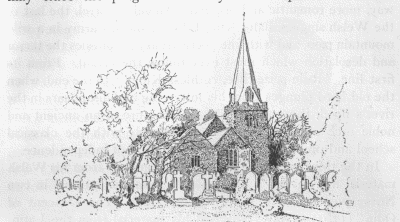
CHURCH AT STOKE POGES
Works of Gray. Gray's Letters, published in 1775, are
excellent reading, and his Journal is still a model of natural
description; but it is to a single small volume of poems that he owes his
fame and his place in literature. These poems divide themselves naturally
into three periods, in which we may trace the progress of Gray's
emancipation from the classic rules which had so long governed English
literature. In the first period he wrote several minor poems, of which the
best are his "Hymn to Adversity" and the odes "To Spring" and "On a
Distant Prospect of Eton College." These early poems reveal two suggestive
things: first, the appearance of that melancholy which characterizes all
the poetry of the period; and second, the study of nature, not for its own
beauty or truth, but rather as a suitable background for the play of human
emotions.
The second period shows the same tendencies more strongly developed. The
"Elegy Written in a Country Churchyard" (1750), the most perfect poem of
the age, belongs to this period. To read Milton's "Il Penseroso" and
Gray's "Elegy" is to see the beginning and the perfection of that
"literature of melancholy" which largely occupied English poets for more
than a century. Two other well-known poems of this second period are the
Pindaric odes, "The Progress of Poesy" and "The Bard." The first is
strongly suggestive of Dryden's "Alexander's Feast," but shows Milton's
influence in a greater melody and variety of expression. "The Bard" is, in
every way, more romantic and original. An old minstrel, the last of the
Welsh singers, halts King Edward and his army in a wild mountain pass, and
with fine poetic frenzy prophesies the terror and desolation which must
ever follow the tyrant. From its first line, "Ruin seize thee, ruthless
King!" to the end, when the old bard plunges from his lofty crag and
disappears in the river's flood, the poem thrills with the fire of an
ancient and noble race of men. It breaks absolutely with the classical
school and proclaims a literary declaration of independence.
In the third period Gray turns momentarily from his Welsh material and
reveals a new field of romantic interest in two Norse poems, "The Fatal
Sisters" and "The Descent of Odin" (1761). Gray translated his material
from the Latin, and though these two poems lack much of the elemental
strength and grandeur of the Norse sagas, they are remarkable for calling
attention to the unused wealth of literary material that was hidden in
Northern mythologv. To Gray and to Percy (who published his Northern
Antiquities in 1770) is due in large measure the profound interest in
the old Norse sagas which has continued to our own day.
Taken together, Gray's works form a most interesting commentary on the
varied life of the eighteenth century. He was a scholar, familiar with all
the intellectual interests of his age, and his work has much of the
precision and polish of the classical school; but he shares also the
reawakened interest in nature, in common man, and in mediæval
culture, and his work is generally romantic both in style and in spirit.
The same conflict between the classic and romantic schools, and the
triumph of Romanticism, is shown clearly in the most versatile of Gray's
contemporaries, Oliver Goldsmith.
OLIVER GOLDSMITH (1728-1774)
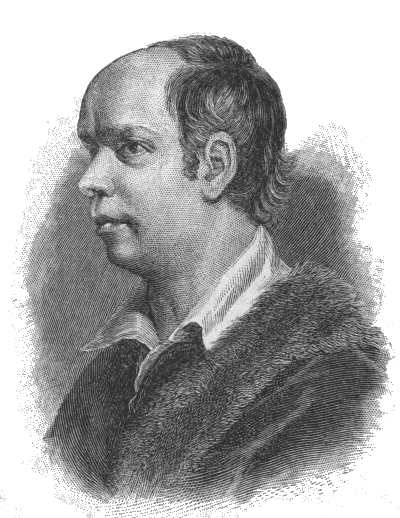
OLIVER GOLDSMITH
Because The Deserted Village is one of the most familiar poems in
our language, Goldsmith is generally given a high place among the poets of
the romantic dawn. But the Village, when we read it carefully,
turns out to be a rimed essay in the style of Pope's famous Essay on
Man; it owes its popularity to the sympathetic memories which it
awakens, rather than to its poetic excellence. It is as a prose writer
that Goldsmith excels. He is an essayist, with Addison's fine polish but
with more sympathy for human life; he is a dramatist, one of the very few
who have ever written a comedy that can keep its popularity unchanged
while a century rolls over its head; but greater, perhaps, than the poet
and essayist and dramatist is Goldsmith the novelist, who set himself to
the important work of purifying the early novel of its brutal and indecent
tendencies, and who has given us, in The Vicar of Wakefield, one of
the most enduring characters in English fiction. In his manner, especially
in his poetry, Goldsmith was too much influenced by his friend Johnson and
the classicists; but in his matter, in his sympathy for nature and human
life, he belongs unmistakably to the new romantic school. Altogether he is
the most versatile, the most charming, the most inconsistent, and the most
lovable genius of all the literary men who made famous the age of Johnson.
Life. Goldsmith's career is that of an irresponsible, unbalanced
genius, which would make one despair if the man himself did not remain so
lovable in all his inconsistencies. He was born in the village of Pallas,
Ireland, the son of a poor Irish curate whose noble character is portrayed
in Dr. Primrose, of The Vicar of Wakefield, and in the country
parson of The Deserted Village. After an unsatisfactory course in
various schools, where he was regarded as hopelessly stupid, Goldsmith
entered Trinity College, Dublin, as a sizar, i.e. a student who pays with
labor for his tuition. By his escapades he was brought into disfavor with
the authorities, but that troubled him little. He was also wretchedly
poor, which troubled him less; for when he earned a few shillings by
writing ballads for street singers, his money went oftener to idle beggars
than to the paying of his honest debts. After three years of university
life he ran away, in dime-novel fashion, and nearly starved to death
before he was found and brought back in disgrace. Then he worked a little,
and obtained his degree in 1749.
Strange that such an idle and irresponsible youth should have been urged
by his family to take holy orders; but such was the fact. For two years
more Goldsmith labored with theology, only to be rejected when he
presented himself as a candidate for the ministry. He tried teaching, and
failed. Then his fancy turned to America, and, provided with money and a
good horse, he started off for Cork, where he was to embark for the New
World. He loafed along the pleasant Irish ways, missed his ship, and
presently turned up cheerfully amongst his relatives, minus all his money,
and riding a sorry nag called Fiddleback, for which he had traded his own
on the way.[203]
He borrowed fifty pounds more, and started for London to study law, but
speedily lost his money at cards, and again appeared, amiable and
irresponsible as ever, among his despairing relatives. The next year they
sent him to Edinburgh to study medicine. Here for a couple of years he
became popular as a singer of songs and a teller of tales, to whom
medicine was only a troublesome affliction. Suddenly the Wanderlust
seized him and he started abroad, ostensibly to complete his medical
education, but in reality to wander like a cheerful beggar over Europe,
singing and playing his flute for food and lodging. He may have studied a
little at Leyden and at Padua, but that was only incidental. After a year
or more of vagabondage he returned to London with an alleged medical
degree, said to have been obtained at Louvain or Padua.
The next few years are a pitiful struggle to make a living as tutor,
apothecary's assistant, comedian, usher in a country school, and finally
as a physician in Southwark. Gradually he drifted into literature, and
lived from hand to mouth by doing hack work for the London booksellers.
Some of his essays and his Citizen of the World (1760-1761) brought
him to the attention of Johnson, who looked him up, was attracted first by
his poverty and then by his genius, and presently declared him to be "one
of the first men we now have as an author." Johnson's friendship proved
invaluable, and presently Goldsmith found himself a member of the
exclusive Literary Club. He promptly justified Johnson's confidence by
publishing The Traveller (1764), which was hailed as one of the
finest poems of the century. Money now came to him liberally, with orders
from the booksellers; he took new quarters in Fleet Street and furnished
them gorgeously; but he had an inordinate vanity for bright-colored
clothes, and faster than he earned money he spent it on velvet cloaks and
in indiscriminate charity. For a time he resumed his practice as a
physician, but his fine clothes did not bring patients, as he expected;
and presently he turned to writing again, to pay his debts to the
booksellers. He produced several superficial and grossly inaccurate
schoolbooks,--like his Animated Nature and his histories of
England, Greece, and Rome,--which brought him bread and more fine clothes,
and his Vicar of Wakefield, The Deserted Village, and She Stoops
to Conquer, which brought him undying fame.
After meeting with Johnson, Goldsmith became the object of Boswell's
magpie curiosity; and to Boswell's Life of Johnson we are indebted
for many of the details of Goldsmith's life,--his homeliness, his awkward
ways, his drolleries and absurdities, which made him alternately the butt
and the wit of the famous Literary Club. Boswell disliked Goldsmith, and
so draws an unflattering Portrait, but even this does not disguise the
contagious good humor which made men love him. When in his forty-seventh
year, he fell sick of a fever, and with childish confidence turned to a
quack medicine to cure himself. He died in 1774, and Johnson placed a
tablet, with a sonorous Latin epitaph, in Westminster Abbey, though
Goldsmith was buried elsewhere. "Let not his frailties be remembered; he
was a very great man," said Johnson; and the literary world--which, like
that old dictator, is kind enough at heart, though often rough in its
methods--is glad to accept and record the verdict.
Works of Goldsmith. Of Goldsmith's early essays and his later
school histories little need be said. They have settled into their own
place, far out of sight of the ordinary reader. Perhaps the most
interesting of these is a series of letters for the Public Ledger
(afterwards published as The Citizen of the World), written from
the view point of an alleged Chinese traveler, and giving the latter's
comments on English civilization.[204] The following five works are those upon which
Goldsmith's fame chiefly rests:
The Traveller (1764) made Goldsmith's reputation among his
contemporaries, but is now seldom read, except by students who would
understand how Goldsmith was, at one time, dominated by Johnson and his
pseudo-classic ideals. It is a long poem, in rimed couplets, giving a
survey and criticism of the social life of various countries in Europe,
and reflects many of Goldsmith's own wanderings and impressions.
The Deserted VillageThe Deserted
Village (1770), though written in the same mechanical style, is so
permeated with honest human sympathy, and voices so perfectly the revolt
of the individual man against institutions, that a multitude of common
people heard it gladly, without consulting the critics as to whether they
should call it good poetry. Notwithstanding its faults, to which Matthew
Arnold has called sufficient attention, it has become one of our best
known poems, though we cannot help wishing that the monotony of its
couplets had been broken by some of the Irish folk songs and ballads that
charmed street audiences in Dublin, and that brought Goldsmith a welcome
from the French peasants wherever he stopped to sing. In the village
parson and the schoolmaster, Goldsmith has increased Chaucer's list by two
lovable characters that will endure as long as the English language. The
criticism that the picture of prosperous "Sweet Auburn" never applied to
any village in Ireland is just, no doubt, but it is outside the question.
Goldsmith was a hopeless dreamer, bound to see everything, as he saw his
debts and his gay clothes, in a purely idealistic way.
The Good-Natured Man and She Stoops to Conquer are
Goldsmith's two comedies. The former, a comedy of character, though it has
some laughable scenes and one laughable character, Croaker, met with
failure on the stage, and has never been revived with any success. The
latter, a comedy of intrigue, is one of the few plays that has never lost
its popularity. Its lively, bustling scenes, and its pleasantly absurd
characters, Marlowe, the Hardcastles, and Tony Lumpkin, still hold the
attention of modern theater goers; and nearly every amateur dramatic club
sooner or later places She Stoops to Conquer on its list of
attractions.
The Vicar of WakefieldThe Vicar of
Wakefield is Goldsmith's only novel, and the first in any language
that gives to home life an enduring romantic interest. However much we
admire the beginnings of the English novel, to which we shall presently
refer, we are nevertheless shocked by its frequent brutalities and
indecencies. Goldsmith like Steele, had the Irish reverence for pure
womanhood, and this reverence made him shun as a pest the vulgarity and
coarseness in which contemporary novelists, like Smollett and Sterne,
seemed to delight. So he did for the novel what Addison and Steele had
done for the satire and the essay; he refined and elevated it, making it
worthy of the old Anglo-Saxon ideals which are our best literary heritage.
Briefly, The Vicar of Wakefield is the story of a simple English
clergyman, Dr. Primrose, and his family, who pass from happiness through
great tribulation. Misfortunes, which are said never to come singly,
appear in this case in flocks; but through poverty, sorrow, imprisonment,
and the unspeakable loss of his daughters, the Vicar's faith in God and
man emerges triumphant. To the very end he is like one of the old martyrs,
who sings Alleluia while the lions roar about him and his children
in the arena. Goldsmith's optimism, it must be confessed, is here
stretched to the breaking point. The reader is sometimes offered fine
Johnsonian phrases where he would naturally expect homely and vigorous
language; and he is continually haunted by the suspicion that, even in
this best of all possible worlds, the Vicar's clouds of affliction were
somewhat too easily converted into showers of blessing; yet he is forced
to read on, and at the end he confesses gladly that Goldsmith has
succeeded in making a most interesting story out of material that, in
other hands, would have developed either a burlesque or a brutal tragedy.
Laying aside all romantic passion, intrigue, and adventure, upon which
other novelists depended, Goldsmith, in this simple story of common life,
has accomplished three noteworthy results: he has made human fatherhood
almost a divine thing; he has glorified the moral sentiments which cluster
about the family life as the center of civilization; and he has given us,
in Dr. Primrose, a striking and enduring figure, which seems more like a
personal acquaintance than a character in a book.
WILLIAM COWPER (1731--1800)
In Cowper we have another interesting poet, who, like Gray and Goldsmith,
shows the struggle between romantic and classic ideals. In his first
volume of poems, Cowper is more hampered by literary fashions than was
Goldsmith in his Traveller and his Deserted Village. In his
second period, however, Cowper uses blank verse freely; and his delight in
nature and in homely characters, like the teamster and the mail carrier of
The Task, shows that his classicism is being rapidly thawed out by
romantic feeling. In his later work, especially his immortal "John
Gilpin," Cowper flings fashions aside, gives Pegasus the reins, takes to
the open road, and so proves himself a worthy predecessor of Burns, who is
the most spontaneous and the most interesting of all the early
romanticists.
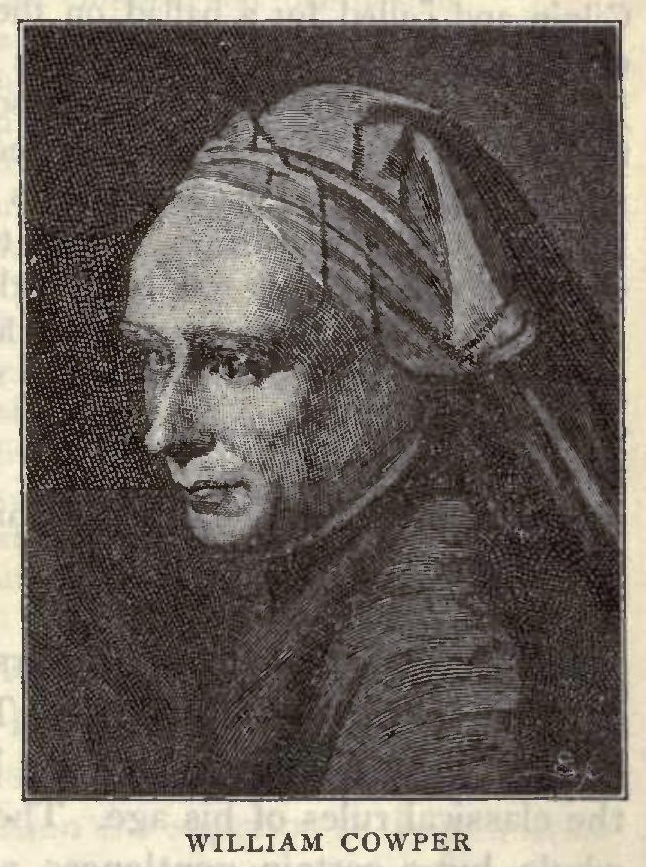
WILLIAM COWPER
Life. Cowper's life is a pathetic story of a shy and timid genius,
who found the world of men too rough, and who withdrew to nature like a
wounded animal. He was born at Great Berkhamstead, Hertfordshire, in 1731,
the son of an English clergyman. He was a delicate, sensitive child, whose
early life was saddened by the death of his mother and by his neglect at
home. At six years he was sent away to a boys' school, where he was
terrified by young barbarians who made his life miserable. There was one
atrocious bully into whose face Cowper could never look; he recognized his
enemy by his shoe buckles, and shivered at his approach. The fierce
invectives of his "Tirocinium, or a Review of Schools" (1784), shows how
these school experiences had affected his mind and health. For twelve
years he studied law, but at the approach of a public examination for an
office he was so terrified that he attempted suicide. The experience
unsettled his reason, and the next twelve months were spent in an asylum
at St. Alban's. The death of his father, in 1756, had brought the poet a
small patrimony, which placed him above the necessity of struggling, like
Goldsmith, for his daily bread. Upon his recovery he boarded for years at
the house of the Unwins, cultured people who recognized the genius hidden
in this shy and melancholy yet quaintly humorous man. Mrs. Unwin, in
particular, cared for him as a son; and whatever happiness he experienced
in his poor life was the result of the devotion of this good woman, who is
the "Mary" of all his poems.
A second attack of insanity was brought on by Cowper's morbid interest in
religion, influenced, perhaps, by the untempered zeal of one John Newton,
a curate, with whom Cowper worked in the small parish of Olney, and with
whom he compiled the famous Olney Hymns. The rest of his life, between
intervals of melancholia or insanity, was spent in gardening, in the care
of his numerous pets, and in writing his poems, his translation of Homer,
and his charming letters. His two best known poems were suggested by a
lively and cultivated widow, Lady Austen, who told him the story of John
Gilpin and called for a ballad on the subject. She also urged him to write
a long poem in blank verse; and when he demanded a subject, she
whimsically suggested the sofa, which was a new article of furniture at
that time. Cowper immediately wrote "The Sofa," and, influenced by the
poetic possibilities that lie in unexpected places, he added to this poem
from time to time, and called his completed work The Task. This was
published in 1785, and the author was instantly recognized as one of the
chief poets of his age. The last years of his life were a long battle with
insanity, until death mercifully ended the struggle in 1800. His last
poem, "The Castaway," is a cry of despair, in which, under guise of a man
washed overboard in a storm, he describes himself perishing in the sight
of friends who are powerless to help.
Cowper's Works. Cowper's first volume of poems, containing "The
Progress of Error," "Truth," "Table Talk," etc., is interesting chiefly as
showing how the poet was bound by the classical rules of his age. These
poems are dreary, on the whole, but a certain gentleness, and especially a
vein of pure humor, occasionally rewards the reader. For Cowper was a
humorist, and only the constant shadow of insanity kept him from becoming
famous in that line alone.
The TaskThe Task, written in blank
verse, and published in 1785, is Cowper's longest poem. Used as we are to
the natural poetry of Wordsworth and Tennyson, it is hard for us to
appreciate the striking originality of this work. Much of it is
conventional and "wooden," to be sure, like much of Wordsworth's poetry;
but when, after reading the rimed essays and the artificial couplets of
Johnson's age, we turn suddenly to Cowper's description of homely scenes,
of woods and brooks, of plowmen and teamsters and the letter carrier on
his rounds, we realize that we are at the dawn of a better day in poetry:
He comes, the herald of a noisy world,
With spatter'd boots,
strapp'd waist, and frozen locks:
News from all nations lumbering
at his back.
True to his charge, the close-packed load behind,
Yet careless what he brings, his one concern
Is to conduct it to
the destined inn,
And, having dropped the expected bag, pass on.
He whistles as he goes, light-hearted wretch,
Cold and yet
cheerful: messenger of grief
Perhaps to thousands, and of joy to
some;
To him indifferent whether grief or joy.
Houses in
ashes, and the fall of stocks,
Births, deaths, and marriages,
epistles wet
With tears that trickled down the writer's cheeks
Fast as the periods from his fluent quill,
Or charged with amorous
sighs of absent swains,
Or nymphs responsive, equally affect
His horse and him, unconscious of them all.
Miscellaneous WorksCowper's most laborious
work, the translation of Homer in blank verse, was published in 1791. Its
stately, Milton-like movement, and its better rendering of the Greek, make
this translation far superior to Pope's artificial couplets. It is also
better, in many respects, than Chapman's more famous and more fanciful
rendering; but for some reason it was not successful, and has never
received the recognition which it deserves. Entirely different in spirit
are the poet's numerous hymns, which were published in the Olney
Collection in 1779 and which are still used in our churches. It is only
necessary to mention a few first lines--"God moves in a mysterious way,"
"Oh, for a closer walk with God," "Sometimes a light surprises"--to show
how his gentle and devout spirit has left its impress upon thousands who
now hardly know his name. With Cowper's charming Letters, published
in 1803, we reach the end of his important works, and the student who
enjoys reading letters will find that these rank among the best of their
kind. It is not, however, for his ambitious works that Cowper is
remembered, but rather for his minor poems, which have found their own way
into so many homes. Among these, the one that brings quickest response
from hearts that understand is his little poem, "On the Receipt of My
Mother's Picture." beginning with the striking line, "Oh, that those lips
had language." Another, called "Alexander Selkirk," beginning, "I am
monarch of all I survey," suggests how Selkirk's experiences as a castaway
(which gave Defoe his inspiration for Robinson Crusoe) affected the
poet's timid nature and imagination. Last and most famous of all is his
immortal "John Gilpin." Cowper was in a terrible fit of melancholy when
Lady Austen told him the story, which proved to be better than medicine,
for all night long chuckles and suppressed laughter were heard in the
poet's bedroom. Next morning at breakfast he recited the ballad that had
afforded its author so much delight in the making. The student should read
it, even if he reads nothing else by Cowper; and he will be lacking in
humor or appreciation if he is not ready to echo heartily the last stanza:
Now let us sing, Long live the King,
And Gilpin, long live he!
And when he next doth ride abroad
May I be there to see.
ROBERT BURNS (1759-1796)
After a century and more of Classicism, we noted with interest the work of
three men, Gray, Goldsmith, and Cowper, whose poetry, like the chorus of
awakening birds, suggests the dawn of another day. Two other poets of the
same age suggest the sunrise. The first is the plowman Burns, who speaks
straight from the heart to the primitive emotions of the race; the second
is the mystic Blake, who only half understands his own thoughts, and whose
words stir a sensitive nature as music does, or the moon in midheaven,
rousing in the soul those vague desires and aspirations which ordinarily
sleep, and which can never be expressed because they have no names. Blake
lived his shy, mystic, spiritual life in the crowded city, and his message
is to the few who can understand. Burns lived his sad, toilsome, erring
life in the open air, with the sun and the rain, and his songs touch all
the world. The latter's poetry, so far as it has a philosophy, rests upon
two principles which the classic school never understood,--that common
people are at heart romantic and lovers of the ideal, and that simple
human emotions furnish the elements of true poetry. Largely because he
follows these two principles, Burns is probably the greatest song writer
of the world. His poetic creed may be summed up in one of his own stanzas:
Give me ae spark o' Nature's fire,
That's a' the learning I desire;
Then, though I trudge thro' dub an' mire
At
pleugh or cart,
My Muse, though hamely in attire,
May
touch the heart.
ROBERT BURNS
Life.[205]
Burns's life is "a life of fragments," as Carlyle called it; and the
different fragments are as unlike as the noble "Cotter's Saturday Night"
and the rant and riot of "The Jolly Beggars." The details of this sad and
disjointed life were better, perhaps, forgotten. We call attention only to
the facts which help us to understand the man and his poetry.
Burns was born in a clay cottage at Alloway, Scotland, in the bleak winter
of 1759. His father was an excellent type of the Scotch peasant of those
days,--a poor, honest, God-fearing man, who toiled from dawn till dark to
wrest a living for his family from the stubborn soil. His tall figure was
bent with unceasing labor; his hair was thin and gray, and in his eyes was
the careworn, hunted look of a peasant driven by poverty and unpaid rents
from one poor farm to another. The family often fasted of necessity, and
lived in solitude to avoid the temptation of spending their hard-earned
money. The children went barefoot and bareheaded in all weathers, and
shared the parents' toil and their anxiety over the rents. At thirteen
Bobby, the eldest, was doing a peasant's full day's labor; at sixteen he
was chief laborer on his father's farm; and he describes the life as "the
cheerless gloom of a hermit, and the unceasing moil of a galley slave." In
1784 the father, after a lifetime of toil, was saved from a debtor's
prison by consumption and death. To rescue something from the wreck of the
home, and to win a poor chance of bread for the family, the two older boys
set up a claim for arrears of wages that had never been paid. With the
small sum allowed them, they buried their father, took another farm,
Mossgiel, in Mauchline, and began again the long struggle with poverty.
Such, in outline, is Burns's own story of his early life, taken mostly
from his letters. There is another and more pleasing side to the picture,
of which we have glimpses in his poems and in his Common-place Book. Here
we see the boy at school; for like most Scotch peasants, the father gave
his boys the best education he possibly could. We see him following the
plow, not like a slave, but like a free man, crooning over an old Scotch
song and making a better one to match the melody. We see him stop the plow
to listen to what the wind is saying, or turn aside lest he disturb the
birds at their singing and nest making. At supper we see the family about
the table, happy notwithstanding their scant fare, each child with a spoon
in one hand and a book in the other. We hear Betty Davidson reciting, from
her great store, some heroic ballad that fired the young hearts to
enthusiasm and made them forget the day's toil. And in "The Cotter's
Saturday Night" we have a glimpse of Scotch peasant life that makes us
almost reverence these heroic men and women, who kept their faith and
their self-respect in the face of poverty, and whose hearts, under their
rough exteriors, were tender and true as steel.
A most unfortunate change in Burns's life began when he left the farm, at
seventeen, and went to Kirkoswald to study surveying. The town was the
haunt of smugglers, rough-living, hard-drinking men; and Burns speedily
found his way into those scenes of "riot and roaring dissipation" which
were his bane ever afterwards. For a little while he studied diligently,
but one day, while taking the altitude of the sun, he saw a pretty girl in
the neighboring garden, and love put trigonometry to flight. Soon he gave
up his work and wandered back to the farm and poverty again.
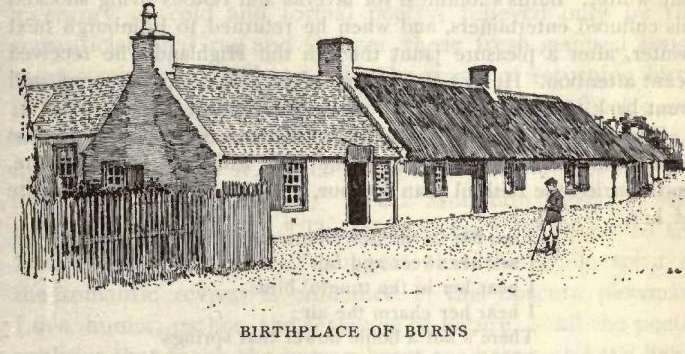
When twenty-seven years of age Burns first attracted literary attention,
and in the same moment sprang to the first place in Scottish letters. In
despair over his poverty and personal habits, he resolved to emigrate to
Jamaica, and gathered together a few of his early poems, hoping to sell
them for enough to pay the expenses of his journey. The result was the
famous Kilmarnock edition of Burns, published in 1786, for which he was
offered twenty pounds. It is said that he even bought his ticket, and on
the night before the ship sailed wrote his "Farewell to Scotland,"
beginning, "The gloomy night is gathering fast," which he intended to be
his last song on Scottish soil.
In the morning he changed his mind, led partly by some dim foreshadowing
of the result of his literary adventure; for the little book took all
Scotland by storm. Not only scholars and literary men, but "even plowboys
and maid servants," says a contemporary, eagerly spent their hard-earned
shillings for the new book. Instead of going to Jamaica, the young poet
hurried to Edinburgh to arrange for another edition of his work. His
journey was a constant ovation, and in the capital he was welcomed and
feasted by the best of Scottish society. This inexpected triumph lasted
only one winter. Burns's fondness for taverns and riotous living shocked
his cultured entertainers, and when he returned to Edinburgh next winter,
after a pleasure jaunt through the Highlands, he received scant attention.
He left the city in anger and disappointment, and went back to the soil
where he was more at home.
The last few years of Burns's life are a sad tragedy, and we pass over
them hurriedly. He bought the farm Ellisland, Dumfriesshire, and married
the faithful Jean Armour, in 1788, That he could write of her,
I see her in the dewy flowers,
I see her sweet and fair;
I
hear her in the tunefu' birds,
I hear her charm the air:
There's not a bonie flower that springs
By fountain, shaw, or
green;
There's not a bonie bird that sings,
But minds me o' my
Jean,
is enough for us to remember. The next year he was appointed exciseman,
i.e. collector of liquor revenues, and the small salary, with the return
from his poems, would have been sufficient to keep his family in modest
comfort, had he but kept away from taverns. For a few years his life of
alternate toil and dissipation was occasionally illumined by his splendid
lyric genius, and he produced many songs--"Bonnie Doon," "My Love's like a
Red, Red Rose," "Auld Lang Syne," "Highland Mary," and the soul-stirring
"Scots wha hae," composed while galloping over the moor in a storm--which
have made the name of Burns known wherever the English language is spoken,
and honored wherever Scotchmen gather together. He died miserably in 1796,
when only thirty-seven years old. His last letter was an appeal to a
friend for money to stave off the bailiff, and one of his last poems a
tribute to Jessie Lewars, a kind lassie who helped to care for him in his
illness. This last exquisite lyric, "O wert thou in the cauld blast," set
to Mendelssohn's music, is one of our best known songs, though its history
is seldom suspected by those who sing it.
The Poetry of Burns. The publication of the Kilmarnock Burns, with
the title Poems Chiefly in the Scottish Dialect (1786), marks an
epoch in the history of English Literature, like the publication of
Spenser's Shepherd's Calendar. After a century of cold and formal
poetry, relieved only by the romanticism of Gray and Cowper, these fresh
inspired songs went straight to the heart, like the music of returning
birds in springtime. It was a little volume, but a great book; and we
think of Marlowe's line, "Infinite riches in a little room," in connection
with it. Such poems as "The Cotter's Saturday Night," "To a Mouse," "To
Mountain Daisy," "Man was Made To Mourn," "The Twa Dogs," "Address to the
Deil," and "Halloween," suggest that the whole spirit of the romantic
revival is embodied in this obscure plowman. Love, humor, pathos, the
response to nature,--all the poetic qualities that touch the human heart
are here; and the heart was touched as it had not been since the days of
Elizabeth. If the reader will note again the six characteristics of the
romantic movement, and then read six poems of Burns, he will see at once
how perfectly this one man expresses the new idea. Or take a single
suggestion,--
Ae fond kiss, and then we sever!
Ae farewell, and then forever!
Deep in heart-wrung tears I'll pledge thee,
Warring sighs and
groans I'll wage thee.
Who shall say that Fortune grieves him
While the star of hope she leaves him?
Me, nae cheerfu' twinkle
lights me;
Dark despair around benights me.
I'll ne'er blame
my partial fancy,
Naething could resist my Nancy;
But to see
her was to love her;
Love but her, and love forever.
Had we
never lov'd sae kindly,
Had we never lov'd sae blindly,
Never
met--or never parted--
We had ne'er been broken-hearted.
The "essence of a thousand love tales" is in that one little song. Because
he embodies the new spirit of romanticism, critics give him a high place
in the history of our literature; and because his songs go straight to the
heart, he is the poet of common men.
Songs for MusicOf Burns's many songs for
music little need be said. They have found their way into the hearts of a
whole people, and there they speak for themselves. They range from the
exquisite "O wert thou in the cauld blast," to the tremendous appeal to
Scottish patriotism in "Scots wha hae wi' Wallace bled," which, Carlyle
said, should be sung with the throat of the whirlwind. Many of these songs
were composed in his best days, when following the plow or resting after
his work, while the music of some old Scotch song was ringing in his head.
It is largely because he thought of music while he composed that so many
of his poems have the singing quality, suggesting a melody as we read
them.
Among his poems of nature, "To a Mouse" and "To a Mountain Daisy" are
unquestionably the best, suggesting the poetical possibilities that daily
pass unnoticed under our feet. These two poems are as near as Burns ever
comes to appreciating nature for its own sake. The majority of his poems,
like "Winter" and "Ye banks and braes o' bonie Doon," regard nature in the
same way that Gray regarded it, as a background for the play of human
emotions.
Of his poems of emotion there is an immense number. It is a curious fact
that the world is always laughing and crying at the same moment; and we
can hardly read a page of Burns without finding this natural juxtaposition
of smiles and tears. It is noteworthy also that all strong emotions, when
expressed naturally, lend themselves to poetry; and Burns, more than any
other writer, has an astonishing faculty of describing his own emotions
with vividness and simplicity, so that they appeal instantly to our own.
One cannot read, "I love my Jean," for instance, without being in love
with some idealized woman; or "To Mary in Heaven," without sharing the
personal grief of one who has loved and lost.
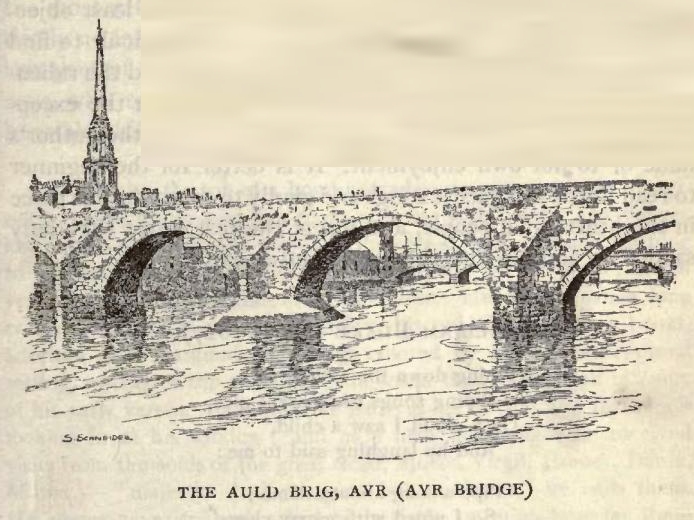
Miscellaneous PoemsBesides the songs of
nature and of human emotion, Burns has given us a large number of poems
for which no general title can be given. Noteworthy among these are "A
man's a man for a' that," which voices the new romantic estimate of
humanity; "The Vision," from which we get a strong impression of Burns's
early ideals; the "Epistle to a Young Friend," from which, rather than
from his satires, we learn Burns's personal views of religion and honor;
the "Address to the Unco Guid," which is the poet's plea for mercy in
judgment; and "A Bard's Epitaph," which, as a summary of his own life,
might well be written at the end of his poems. "Halloween," a picture of
rustic merrymaking, and "The Twa Dogs" a contrast between the rich and
poor, are generally classed among the poet's best works; but one
unfamiliar with the Scotch dialect will find them rather difficult.
Of Burns's longer poems the two best worth reading are "The Cotter's
Saturday Night" and "Tam o' Shanter,"--the one giving the most perfect
picture we possess of a noble poverty; the other being the most lively and
the least objectionable of his humorous works. It would be difficult to
find elsewhere such a combination of the grewsome and the ridiculous as is
packed up in "Tam o' Shanter." With the exception of these two, the longer
poems add little to the author's fame or to our own enjoyment. It is
better for the beginner to read Burns's exquisite songs and gladly to
recognize his place in the hearts of a people, and forget the rest, since
they only sadden us and obscure the poet's better nature.
WILLIAM BLAKE (1757-1827)
Piping down the valleys wild,
Piping songs
of pleasant glee,
On a cloud I saw a child,
And
he laughing said to me:
"Pipe a song about a lamb;"
So
I piped with merry cheer.
"Piper, pipe that song again;"
So I piped:, he wept to hear.
"Piper, sit
thee down and write
In a book, that all may
read;"
So he vanished from my sight,
And
I plucked a hollow reed,
And I made a rural pen,
And
I stained the water clear,
And I wrote my happy songs
Every
child may joy to hear.[206]
Of all the romantic poets of the eighteenth century, Blake is the most
independent and the most original. In his earliest work, written when he
was scarcely more than a child, he seems to go back to the Elizabethan
song writers for his models; but for the greater part of his life he was
the poet of inspiration alone, following no man's lead, and obeying no
voice but that which he heard in his own mystic soul. Though the most
extraordinary literary genius of his age, he had practically no influence
upon it. Indeed, we hardly yet understand this poet of pure fancy, this
mystic this transcendental madman, who remained to the end of his busy
life an incomprehensible child.
Life. Blake, the son of a London tradesman, was a strange,
imaginative child, whose soul was more at home with brooks and flowers and
fairies than with the crowd of the city streets. Beyond learning to read
and write, he received education; but he began, at ten years, to copy
prints and to write verses. He also began a long course of art study,
which resulted in his publishing his own books, adorned with marginal
engravings colored by hand,--an unusual setting, worthy of the strong
artistic sense that shows itself in many of his early verses. As a child
he had visions of God and the angels looking in at his window; and as a
man he thought he received visits from the souls of the great dead, Moses,
Virgil, Homer, Dante, Milton,--"majestic shadows, gray but luminous," he
calls them. He seems never to have asked himself the question how far
these visions were pure illusions, but believed and trusted them
implicitly. To him all nature was a vast spiritual symbolism, wherein he
saw elves, fairies, devils, angels,--all looking at him in friendship or
enmity through the eyes of flowers and stars:
With the blue sky spread over with wings,
And
the mild sun that mounts and sings;
With trees and fields full of
fairy elves,
And little devils who fight
for themselves;
With angels planted in hawthorne bowers,
And God himself in the passing hours.
And this curious, pantheistic conception of nature was not a matter of
creed, but the very essence of Blake's life. Strangely enough, he made no
attempt to found a new religious cult, but followed his own way, singing
cheerfully, working patiently, in the face of discouragement and failure.
That writers of far less genius were exalted to favor, while he remained
poor and obscure, does not seem to have troubled him in the least. For
over forty years he labored diligently at book engraving, guided in his
art by Michael Angelo. but inventing his own curious designs, at which we
still wonder. The illustrations for Young's "Night Thoughts," for Blair's
"Grave," and the "Inventions to the Book of Job," show the peculiarity of
Blake's mind quite as clearly as his poems. While he worked at his trade
he flung off--for he never seemed to compose--disjointed visions and
incomprehensible rhapsodies, with an occasional little gem that still sets
our hearts to singing:
Ah, sunflower, weary of time,
Who countest
the steps of the sun;
Seeking after that sweet golden clime
Where the traveller's journey is done;
Where the youth pined away with desire,
And
the pale virgin shrouded in snow,
Rise from their graves, and
aspire
Where my sunflower wishes to go!
That is a curious flower to find growing in the London street; but it
suggests Blake's own life, which was outwardly busy and quiet, but
inwardly full of adventure and excitement. His last huge prophetic works,
like Jerusalem and Milton (1804), were dictated to him, he
declares, by supernatural means, and even against his own will. They are
only half intelligible, but here and there one sees flashes of the same
poetic beauty that marks his little poems. Critics generally dismiss Blake
with the word "madman"; but that is only an evasion. At best, he is the
writer of exquisite lyrics; at worst, he is mad only "north-northwest,"
like Hamlet; and the puzzle is to find the method in his madness. The most
amazing thing about him is the perfectly sane and cheerful way in which he
moved through poverty and obscurity, flinging out exquisite poems or
senseless rhapsodies, as a child might play with gems or straws or
sunbeams indifferently. He was a gentle, kindly, most unworldly little
man, with extraordinary eyes, which seem even in the lifeless portraits to
reflect some unusual hypnotic power. He died obscurely, smiling at a
vision of Paradise, in 1827. That was nearly a century ago, yet he still
remains one of the most incomprehensible figures in our literature.
Works of Blake. The Poetical Sketches, published in 1783, is
a collection of Blake's earliest poetry, much of it written in boyhood. It
contains much crude and incoherent work, but also a few lyrics of striking
originality. Two later and better known volumes are Songs of Innocence
and Songs of Experience, reflecting two widely different views of
the human soul. As in all his works, there is an abundance of apparently
worthless stuff in these songs; but, in the language of miners, it is all
"pay dirt"; it shows gleams of golden grains that await our sifting, and
now and then we find a nugget unexpectedly:
My lord was like a flower upon the brows
Of lusty May; ah life as
frail as flower!
My lord was like a star in highest heaven
Drawn down to earth by spells and wickedness;
My lord was like the
opening eye of day;
But he is darkened; like the summer moon
Clouded; fall'n like the stately tree, cut down;
The breath of
heaven dwelt among his leaves.
On account of the chaotic character of most of Blake's work, it is well to
begin our reading with a short book of selections, containing the best
songs of these three little volumes. Swinburne calls Blake the only poet
of "supreme and simple poetic genius" of the eighteenth century, the one
man of that age fit, on all accounts, to rank with the old great masters.[207] The praise is
doubtless extravagant, and the criticism somewhat intemperate; but when we
have read "The Evening Star," "Memory," "Night," "Love," "To the Muses,"
"Spring," "Summer," "The Tiger," "The Lamb," "The Clod and the Pebble," we
may possibly share Swinburne's enthusiasm. Certainly, in these three
volumes we have some of the most perfect and the most original songs in
our language.
Of Blake's longer poems, his titanic prophecies and apocalyptic splendors,
it is impossible to write justly in such a brief work as this. Outwardly
they suggest a huge chaff pile, and the scattered grains of wheat hardly
warrant the labor of winnowing. The curious reader will get an idea of
Blake's amazing mysticism by dipping into any of the works of his middle
life,--Urizen, Gates of Paradise, Marriage of Heaven and Hell, America,
The French Revolution, or The Vision of the Daughters of Albion.
His latest works, like Jerusalem and Milton, are too obscure
to have any literary value. To read any of these works casually is to call
the author a madman; to study them, remembering Blake's songs and his
genius, is to quote softly his own answer to the child who asked about the
land of dreams:
"O what land is the land of dreams,
What are its mountains and what
are its streams?
--O father, I saw my mother there,
Among the
lilies by waters fair."
"Dear child, I also by pleasant streams
Have wandered all night in the land of dreams;
But though calm and
warm the waters wide,
I could not get to the other side."
MINOR POETS OF THE REVIVAL
We have chosen the five preceding poets, Gray, Goldsmith, Cowper, Burns,
and Blake, as the most typical and the most interesting of the writers who
proclaimed the dawn of Romanticism in the eighteenth century. With them we
associate a group of minor writers, whose works were immensely popular in
their own day. The ordinary reader will pass them by, but to the student
they are all significant as expressions of very different phases of the
romantic revival.
James Thomson (1700-1748). Thomson
belongs among the pioneers of Romanticism. Like Gray and Goldsmith, he
wavered between Pseudo-classic and the new romantic ideals, and for this
reason, if for no other, his early work is interesting, like the
uncertainty of a child who hesitates whether to creep safely on all fours
or risk a fall by walking. He is "worthy to be remembered" for three
poems,--"Rule Britannia," which is still one of the national songs of
England The Castle of Indolence, and The Seasons. The dreamy
and romantic Castle (1748), occupied by enchanter Indolence and his
willing captives in the land of Drowsyhed, is purely Spenserian in its
imagery, and is written in the Spenserian stanza. The Seasons
(1726-1730), written in blank verse, describes the sights and sounds of
the changing year and the poet's own feelings in the presence of nature.
These two poems, though rather dull to a modern reader, were significant
of the early romantic revival in three ways: they abandoned the prevailing
heroic couplet; they went back to the Elizabethans, instead of to Pope,
for their models; and they called attention to the long-neglected life of
nature as a subject for poetry.
William Collins (1721-1759).
Collins, the friend and disciple of Thomson, was of a delicate, nervous
temperament, like Cowper; and over him also brooded the awful shadow of
insanity. His first work, Oriental Eclogues (1742), is romantic in
feeling, but is written in the prevailing mechanical couplets. All his
later work is romantic in both thought and expression. His "Ode on the
Popular Superstitions of the Highlands" (1750) is an interesting event in
the romantic revival, for it introduced a new world, of witches, pygmies,
fairies, and mediæval kings, for the imagination to play in.
Collins's best known poems are the odes "To Simplicity," "To Fear," "To
the Passions," the little unnamed lyric beginning "How sleep the brave,"
and the exquisite "Ode to Evening." In reading the latter, one is scarcely
aware that the lines are so delicately balanced that they have no need of
rime to accentuate their melody.
George Crabbe (1754-1832). Crabbe
is an interesting combination of realism and romanticism, his work of
depicting common life being, at times, vaguely suggestive of Fielding's
novels. The Village (1783), a poem without a rival as a picture of
the workingmen of his age, is sometimes like Fielding in its coarse vigor,
and again like Dryden in its precise versification. The poem was not
successful at first, and Crabbe abandoned his literary dreams. For over
twenty years he settled down as a clergyman in a country parish, observing
keenly the common life about him. Then he published more poems, exactly
like The Village, which immediately brought him fame and money.
They brought him also the friendship of Walter Scott, who, like others,
regarded Crabbe as one of the first poets of the age. These later poems,
The Parish Register (1807), The Borough (1810), Tales in
Verse (1812), and Tales of the Hall (1819), are in the same
strain. They are written in couplets; they are reflections of nature and
of country life; they contain much that is sordid and dull, but are
nevertheless real pictures of real men and women, just as Crabbe saw them,
and as such they are still interesting. Goldsmith and Burns had idealized
the poor, and we admire them for their sympathy and insight. It remained
for Crabbe to show that in wretched fishing villages, in the lives of
hardworking men and women, children, laborers, smugglers, paupers,--all
sorts and conditions of common men,--there is abundant romantic without
exaggerating or idealizing their vices and virtues.
James Macpherson (1736-1796). In
Macpherson we have an unusual figure, who catered to the new romantic
interest in the old epic heroes, and won immense though momentary fame, by
a series of literary forgeries. Macpherson was a Scotch schoolmaster, an
educated man, but evidently not over-tender of conscience, whose
imagination had been stirred by certain old poems which he may have heard
in Gaelic among the Highlanders. In 1760 he published his Fragments of
Ancient Poetry collected in the Highlands, and alleged that his work
was but a translation of Gaelic manuscripts. Whether the work of itself
would have attracted attention is doubtful; but the fact that an abundance
of literary material might be awaiting discovery led to an interest such
as now attends the opening of an Egyptian tomb, and a subscription was
promptly raised in Edinburgh to send Macpherson through the Highlands to
collect more "manuscripts." The result was the epic Fingal (1762),
"that lank and lamentable counterfeit of poetry," as Swinburne calls it,
which the author professed to have translated from the Gaelic of the poet
Ossian. Its success was astonishing, and Macpherson followed it up with Temora
(1763), another epic in the same strain. In both these works Macpherson
succeeds in giving an air of primal grandeur to his heroes; the characters
are big and shadowy; the imagery is at times magnificent; the language is
a kind of chanting, bombastic prose:
Now Fingal arose in his might and thrice he reared his voice. Cromla
answered around, and the sons of the desert stood still. They bent their
red faces to earth, ashamed at the presence of Fingal. He came like a
cloud of rain in the days of the sun, when slow it rolls on the hill, and
fields expect the shower. Swaran beheld the terrible king of Morven, and
stopped in the midst of his course. Dark he leaned on his spear rolling
his red eyes around. Silent and tall he seemed as an oak on the banks of
Lubar, which had its branches blasted of old by the lightning of heaven.
His thousands pour around the hero, and the darkness of battle gathers on
the hill.[208]
The publication of this gloomy, imaginative work produced a literary
storm. A few critics, led by Dr. Johnson, demanded to see the original
manuscripts, and when Macpherson refused to produce them,[209] the Ossianic poems
were branded as a forgery; nevertheless they had enormous success.
Macpherson was honored as a literary explorer; he was given an official
position, carrying a salary for life; and at his death, in 1796, he was
buried in Westminster Abbey. Blake, Burns, and indeed most of the poets of
the age were influenced by this sham poetry. Even the scholarly Gray was
deceived and delighted with "Ossian"; and men as far apart as Goethe and
Napoleon praised it immoderately.
Thomas Chatterton (1752-1770).
This "marvelous boy," to whom Keats dedicated his "Endymion," and who is
celebrated in Shelley's "Adonais," is one of the saddest and most
interesting figures of the romantic revival. During his childhood he
haunted the old church of St. Mary Redcliffe, in Bristol, where he was
fascinated by the mediæval air of the place, and especially by one
old chest, known as Canynge's coffer, containing musty documents which had
been preserved for three hundred years. With strange, uncanny intentness
the child pored over these relics of the past, copying them instead of his
writing book, until he could imitate not only the spelling and language
but even the handwriting of the original. Soon after the "Ossian"
forgeries appeared, Chatterton began to produce documents, apparently very
old, containing mediæval poems, legends, and family histories,
centering around two characters,--Thomas Rowley, priest and poet, and
William Canynge, merchant of Bristol in the days of Henry VI. It seems
incredible that the whole design of these mediæval romances should
have been worked out by a child of eleven, and that he could reproduce the
style and the writing of Caxton's day so well that the printers were
deceived; but such is the fact. More and more Rowley Papers, as
they were called, were produced by Chatterton,--apparently from the
archives of the old church; in reality from his own
imagination,--delighting a large circle of readers, and deceiving all but
Gray and a few scholars who recognized the occasional misuse of
fifteenth-century English words. All this work was carefully finished, and
bore the unmistakable stamp of literary genius. Reading now his "Ælla,"
or the "Ballad of Charite," or the long poem in ballad style called
"Bristowe Tragedie," it is hard to realize that it is a boy's work. At
seventeen years of age Chatterton went for a literary career to London,
where he soon afterwards took poison and killed himself in a fit of
childish despondency, brought on by poverty and hunger.
Thomas Percy (1729-1811). To
Percy, bishop of the Irish church, in Dromore, we are indebted for the
first attempt at a systematic collection of the folk songs and ballads
which are counted among the treasures of a nation's literature.[210] In 1765 he
published, in three volumes, his famous Reliques of Ancient English
Poetry. The most valuable part of this work is the remarkable
collection of old English and Scottish Ballads, such as "Chevy Chase," the
"Nut Brown Mayde," "Children of the Wood," "Battle of Otterburn," and many
more, which but for his labor might easily have perished. We have now much
better and more reliable editions of these same ballads; for Percy garbled
his materials, adding and subtracting freely, and even inventing a few
ballads of his own. Two motives probably influenced him in this. First,
the different versions of the same ballad varied greatly; and Percy, in
changing them to suit himself, took the same liberty as had many other
writers in dealing with the same material. Second; Percy was under the
influence of Johnson and his school, and thought it necessary to add a few
elegant ballads "to atone for the rudeness of the more obsolete poems."
That sounds queer now, used as we are to exactness in dealing with
historical and literary material; but it expresses the general spirit of
the age in which he lived.
Notwithstanding these drawbacks, Percy's Reliques marks an epoch in
the history of Romanticism, and it is difficult to measure its influence
on the whole romantic movement. Scott says of it, "The first time I could
scrape a few shillings together, I bought myself a copy of these beloved
volumes; nor do I believe I ever read a book half so frequently, or with
half the enthusiasm." Scott's own poetry is strongly modeled upon these
early ballads, and his Minstrelsy of the Scottish Border is due
chiefly to the influence of Percy's work.
Besides the Reliques, Percy has given us another good work in his
Northern Antiquities (1770) translated from the French of Mallet's
History of Denmark. This also was of immense influence, since it
introduced to English readers a new and fascinating mythology, more rugged
and primitive than that of the Greeks; and we are still, in music as in
letters, under the spell of Thor and Odin, of Frea and the Valkyr maidens,
and of that stupendous drama of passion and tragedy which ended in the
"Twilight of the Gods." The literary world owes a debt of gratitude to
Percy, who wrote nothing of importance himself, but who, by collecting and
translating the works of other men, did much to hasten the triumph of
Romanticism in the nineteenth century.
III. THE FIRST ENGLISH NOVELISTS
The chief literary phenomena of the complex eighteenth century are the
reign of so-called Classicism, the revival of romantic poetry, and the
discovery of the modern novel. Of these three, the last is probably the
most important. Aside from the fact that the novel is the most modern, and
at present the most widely read and influential type of literature, we
have a certain pride in regarding it as England's original contribution to
the world of letters. Other great types of literature, like the epic, the
romance, and the drama, were first produced by other nations; but the idea
of the modern novel seems to have been worked out largely on English soil;[211] and in the number
and the fine quality of her novelists, England has hardly been rivaled by
any other nation. Before we study the writers who developed this new type
of literature, it is well to consider briefly its meaning and history.
The Story ElementMeaning of the Novel. Probably the most significant
remark made by the ordinary reader concerning a work of fiction takes the
form of a question: Is it a good story? For the reader of to-day is much
like the child and the primitive man in this respect, that he must be
attracted and held by the story element of a narrative before he learns to
appreciate its style or moral significance. The story element is therefore
essential to the novel; but where the story originates is impossible to
say. As well might we seek for the origin of the race; for wherever
primitive men are found, there we see them gathering eagerly about the
story-teller. In the halls of our Saxon ancestors the scop and the
tale-bringer were ever the most welcome guests; and in the bark wigwams of
the American Indians the man who told the legends of Hiawatha had an
audience quite as attentive as that which gathered at the Greek festivals
to hear the story of Ulysses's wanderings. To man's instinct or innate
love for a story we are indebted for all our literature; and the novel
must in some degree satisfy this instinct, or fail of appreciation.
The RomanceThe second question which we
ask concerning a work of fiction is, How far does the element of
imagination enter into it? For upon the element of imagination depends,
largely, our classification of works of fiction into novels, romances, and
mere adventure stories. The divisions here are as indefinite as the border
land between childhood and youth, between instinct and reason; but there
are certain principles to guide us. We note, in the development of any
normal child, that there comes a time when for his stories he desires
knights, giants, elves, fairies, witches, magic, and marvelous adventures
which have no basis in experience. He tells extraordinary tales about
himself, which may be only the vague remembrances of a dream or the
creations of a dawning imagination,--both of which are as real to him as
any other part of life. When we say that such a child "romances," we give
exactly the right name to it; for this sudden interest in extraordinary
beings and events marks the development of the human imagination,--running
riot at first, because it is not guided by reason, which is a later
development,--and to satisfy this new interest the romance[212] was invented. The
romance is, originally, a work of fiction in which the imagination is
given full play without being limited by facts or probabilities. It deals
with extraordinary events, with heroes whose powers are exaggerated, and
often adds the element of superhuman or supernatural characters. It is
impossible to draw the line where romance ends; but this element of
excessive imagination and of impossible heroes and incidents is its
distinguishing mark in every literature.
The NovelWhere the novel begins it is
likewise impossible to say; but again we have a suggestion in the
experience of every reader. There comes a time, naturally and inevitably,
in the life of every youth when the romance no longer enthralls him. He
lives in a world of facts; gets acquainted with men and women, some good,
some bad, but all human; and he demands that literature shall express life
as he knows it by experience. This is the stage of the awakened intellect,
and in our stories the intellect as well as the imagination must now be
satisfied. At the beginning of this stage we delight in Robinson
Crusoe; we read eagerly a multitude of adventure narratives and a few
so-called historical novels; but in each case we must be lured by a story,
must find heroes and "moving accidents by flood and field" to appeal to
our imagination; and though the hero and the adventure may be exaggerated,
they must both be natural and within the bounds of probability. Gradually
the element of adventure or surprising incident grows less and less
important, as we learn that true life is not adventurous, but a plain,
heroic matter of work and duty, and the daily choice between good and
evil. Life is the most real thing in the world now,--not the life of
kings, or heroes, or superhuman creatures, but the individual life with
its struggles and temptations and triumphs or failures, like our own; and
any work that faithfully represents life becomes interesting. So we drop
the adventure story and turn to the novel. For the novel is a work of
fiction in which the imagination and the intellect combine to express life
in the form of a story and the imagination is always directed and
controlled by the intellect. It is interested chiefly, not in romance or
adventure, but in men and women as they are; it aims to show the motives
and influences which govern human life, and the effects of personal choice
upon character and destiny. Such is the true novel,[213] and as such it opens a wider and
more interesting field than any other type of literature.
Precursors of the Novel. Before
the novel could reach its modern stage, of a more or less sincere attempt
to express human life and character, it had to pass through several
centuries of almost imperceptible development. Among the early precursors
of the novel we must place a collection of tales known as the Greek
Romances, dating from the second to the sixth centuries. These are
imaginative and delightful stories of ideal love and marvelous adventure,[214] which profoundly
affected romance writing for the next thousand years. A second group of
predecessors is found in the Italian and Spanish pastoral romances, which
were inspired by the Eclogues of Virgil. These were extremely
popular in the fourteenth and fifteenth centuries, and their influence is
seen later in Sidney's Arcadia, which is the best of this type in
English.
The third and most influential group of predecessors of the novel is made
up of the romances of chivalry, such as are found in Malory's Morte
d'Arthur. It is noticeable, in reading these beautiful old romances in
different languages, that each nation changes them somewhat, so as to make
them more expressive of national traits and ideals. In a word, the old
romance tends inevitably towards realism, especially in England, where the
excessive imagination is curbed and the heroes become more human. In
Malory, in the unknown author of Sir Gawain and the Green Knight,
and especially in Chaucer, we see the effect of the practical English mind
in giving these old romances a more natural setting, and in making the
heroes suggest, though faintly, the men and women of their own day. The Canterbury
Tales, with their story interest and their characters delightfully
true to nature, have in them the suggestion, at least, of a connected
story whose chief aim is to reflect life as it is.
In the Elizabethan Age the idea of the novel grows more definite. In
Sidney's Arcadia (1580), a romance of chivalry, the pastoral
setting at least is generally true to nature; our credulity is not taxed,
as in the old romances, by the continual appearance of magic or miracles;
and the characters, though idealized till they become tiresome,
occasionally give the impression of being real men and women. In Bacon's
The New Atlantis (1627) we have the story of the discovery by
mariners of an unknown country, inhabited by a superior race of men, more
civilized than ourselves,--an idea which had been used by More in his Utopia
in 1516. These two books are neither romances nor novels, in the strict
sense, but studies of social institutions. They use the connected story as
a means of teaching moral lessons, and of bringing about needed reforms;
and this valuable suggestion has been adopted by many of our modern
writers in the so-called problem novels and novels of purpose.
Nearer to the true novel is Lodge's romantic story of Rosalynde,
which was used by Shakespeare in As You Like It. This was modeled
upon the Italian novella, or short story, which became very popular in
England during the Elizabethan Age. In the same age we have introduced
into England the Spanish picaresque novel (from picaro, a knave or
rascal), which at first was a kind of burlesque on the mediæval
romance, and which took for its hero some low scoundrel or outcast,
instead of a knight, and followed him through a long career of scandals
and villainies. One of the earliest types of this picaresque novel in
English is Nash's The Unfortunate Traveller, or the Life of Jack
Wilton (1594), which is also a forerunner of the historical novel,
since its action takes place during that gorgeous interview between Henry
VIII and the king of France on the Field of the Cloth of Gold. In all
these short stories and picaresque novels the emphasis was laid not so
much on life and character as on the adventures of the hero; and the
interest consisted largely in wondering what would happen next, and how
the plot would end. The same method is employed in all trashy novels and
it is especially the bane of many modern story-writers. This excessive
interest in adventures or incidents for their own sake, and not for their
effect on character, is what distinguishes the modern adventure story from
the true novel.
In the Puritan Age we approach still nearer to the modern novel,
especially in the work of Bunyan; and as the Puritan always laid emphasis
on character, stories appeared having a definite moral purpose. Bunyan's
The Pilgrim's Progress (1678) differs from the Faery Queen,
and from all other mediæval allegories, in this important
respect,--that the characters, far from being bloodless abstractions, are
but thinly disguised men and women. Indeed, many a modern man, reading the
story of the Christian;--has found in it the reflection of his own life
and experience. In The Life and Death of Mr. Badman (1682) we have
another and even more realistic study of a man as he was in Bunyan's day.
These two striking figures, Christian and Mr. Badman, belong among the
great characters of English fiction. Bunyan's good work,--his keen
insight, his delineation of character, and his emphasis upon the moral
effects of individual action,--was carried on by Addison and Steele some
thirty years later. The character of Sir Roger de Coverley is a real
reflection of English country life in the eighteenth century; and with
Steele's domestic sketches in The Tatler, The Spectator, and The
Guardian (1709-1713), we definitely cross the border land that lies
outside of romance, and enter the region of character study where the
novel has its beginning.
The Discovery of the Modern Novel.
Notwithstanding this long history of fiction, to which we have called
attention, it is safe to say that, until the publication of Richardson's
Pamela in 1740, no true novel had appeared in any literature. By a
true novel we mean simply a work of fiction which relates the story of a
plain human life, under stress of emotion, which depends for its interest
not on incident or adventure, but on its truth to nature. A number of
English novelists--Goldsmith, Richardson, Fielding, Smollett, Sterne--all
seem to have seized upon the idea of reflecting life as it is, in the form
of a story, and to have developed it simultaneously. The result was an
extraordinary awakening of interest, especially among people who had never
before been greatly concerned with literature. We are to remember that, in
previous periods, the number of readers was comparatively small; and that,
with the exception of a few writers like Langland and Bunyan, authors
wrote largely for the upper classes. In the eighteenth century the spread
of education and the appearance of newspapers and magazines led to an
immense increase in the number of readers; and at the same time the
middle-class people assumed a foremost place in English life and history.
These new readers and this new, powerful middle class had no classic
tradition to hamper them. They cared little for the opinions of Dr.
Johnson and the famous Literary Club; and, so far as they read fiction at
all, they apparently took little interest in the exaggerated romances, of
impossible heroes and the picaresque stories of intrigue and villainy
which had interested the upper classes. Some new type of literature was
demanded, this new type must express the new ideal of the eighteenth
century, namely, the value and the importance of the individual life. So
the novel was born, expressing, though in a different way, exactly the
same ideals of personality and of the dignity of common life which were
later proclaimed in the American and in the French Revolution, and were
welcomed with rejoicing by the poets of the romantic revival. To tell men,
not about knights or kings or types of heroes, but about themselves in the
guise of plain men and women, about their own thoughts and motives and
struggles, and the results of actions upon their own characters,--this was
the purpose of our first novelists. The eagerness with which their
chapters were read in England, and the rapidity with which their work was
copied abroad, show how powerfully the new discovery appealed to readers
everywhere.
Before we consider the work of these writers who first developed the
modern novel, we must glance at the work of a pioneer, Daniel Defoe, whom
we place among the early novelists for the simple reason that we do not
know how else to classify him.
DANIEL DEFOE (1661(?)-1731)
To Defoe is often given the credit for the discovery of the modern novel;
but whether or not he deserves that honor is an open question. Even a
casual reading of Robinson Crusoe (1719), which generally heads the
list of modern fiction, shows that this exciting tale is largely an
adventure story, rather than the study of human character which Defoe
probably intended it to be. Young people still read it as they might a
dime novel, skipping its moralizing passages and hurrying on to more
adventures; but they seldom appreciate the excellent mature reasons which
banish the dime novel to a secret place in the haymow, while Crusoe
hangs proudly on the Christmas tree or holds an honored place on the
family bookshelf. Defoe's Apparition of Mrs. Veal, Memoirs of a
Cavalier, and Journal of the Plague Year are such mixtures of
fact, fiction, and credulity that they defy classification; while other
so-called "novels," like Captain Singleton, Moll Flanders, and Roxana,
are but, little better than picaresque stories, with a deal of unnatural
moralizing and repentance added for puritanical effect. In Crusoe,
Defoe brought the realistic adventure story to a very high stage of its
development; but his works hardly deserve, to be classed as true novels,
which must subordinate incident to the faithful portrayal of human life
and character.
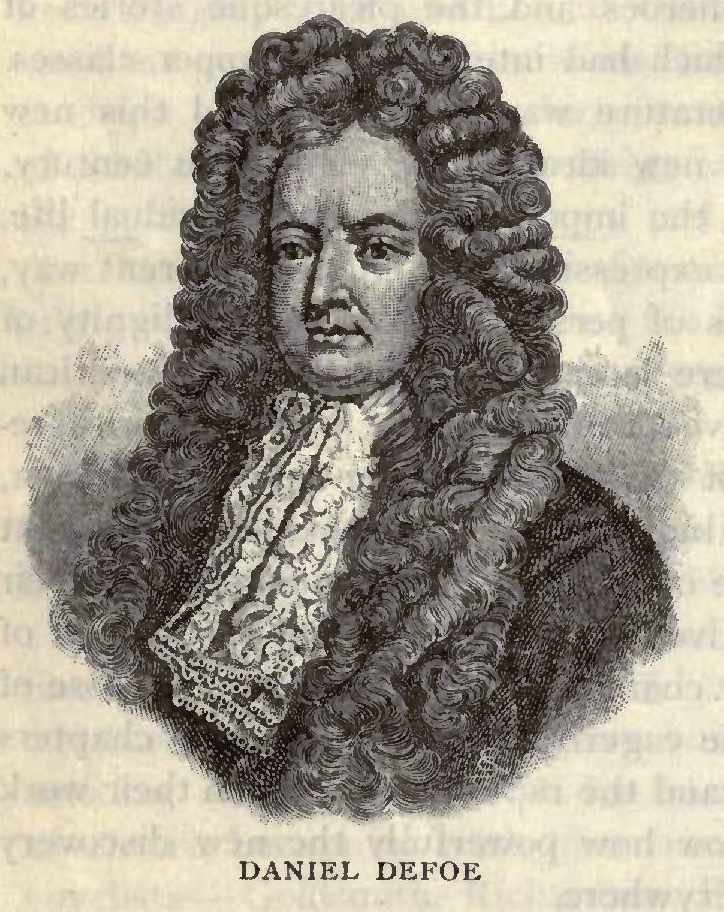
DANIEL
DEFOE
Life. Defoe was the son of a London butcher named Foe, and kept his
family name until he was forty years of age, when he added the
aristocratic prefix with which we have grown familiar. The events of his
busy seventy years of life, in which he passed through all extremes, from
poverty to wealth, from prosperous brickmaker to starveling journalist,
from Newgate prison to immense popularity and royal favor, are obscure
enough in details; but four facts stand out clearly, which help the reader
to understand the character of his work. First, Defoe was a
jack-at-all-trades, as well as a writer; his interest was largely with the
working classes, and notwithstanding many questionable practices, he seems
to have had some continued purpose of educating and uplifting the common
people. This partially accounts for the enormous popularity of his works,
and for the fact that they were criticised by literary men as being "fit
only for the kitchen." Second, he was a radical Nonconformist in religion,
and was intended by his father for the independent ministry. The Puritan
zeal for reform possessed him, and he tried to do by his pen what Wesley
was doing by his preaching, without, however, having any great measure of
the latter's sincerity or singleness of purpose. This zeal for reform
marks all his numerous works, and accounts for the moralizing to be found
everywhere. Third, Defoe was a journalist and pamphleteer, with a
reporter's eye for the picturesque and a newspaper man's instinct for
making a "good story." He wrote an immense number of pamphlets, poems, and
magazine articles; conducted several papers,--one of the most popular, the
Review, being issued from prison,--and the fact that they often
blew hot and cold upon the same question was hardly noticed. Indeed, so
extraordinarily interesting and plausible were Defoe's articles that he
generally managed to keep employed by the party in power, whether Whig or
Tory. This long journalistic career, lasting half a century, accounts for
his direct, simple, narrative style, which holds us even now by its
intense reality. To Defoe's genius we are also indebted for two
discoveries, the "interview" and the leading editorial, both of which are
still in daily use in our best newspapers.
The fourth fact to remember is that Defoe knew prison life; and thereby
hangs a tale. In 1702 Defoe published a remarkable pamphlet called "The
Shortest Way with the Dissenters," supporting the claims of the free
churches against the "High Fliers," i.e. Tories and Anglicans. In a vein
of grim humor which recalls Swift's "Modest Proposal," Defoe advocated
hanging all dissenting ministers, and sending all members of the free
churches into exile; and so ferociously realistic was the satire that both
Dissenters and Tories took the author literally. Defoe was tried, found
guilty of seditious libel, and sentenced to be fined, to stand three days
in the pillory, and to be imprisoned. Hardly had the sentence been
pronounced when Defoe wrote his "Hymn to the Pillory,"--
Hail hieroglyphic state machine,
Contrived to punish fancy in,--
a set of doggerel verses ridiculing his prosecutors, which Defoe, with a
keen eye for advertising, scattered all over London. Crowds flocked to
cheer him in the pillory; and seeing that Defoe was making popularity out
of persecution, his enemies bundled him off to Newgate prison. He turned
this experience also to account by publishing a popular newspaper, and by
getting acquainted with rogues, pirates, smugglers, and miscellaneous
outcasts, each one with a "good story" to be used later. After his release
from prison, in 1704, he turned his knowledge of criminals to further
account, and entered the government employ as a kind of spy or
secret-service agent. His prison experience, and the further knowledge of
criminals gained in over twenty years as a spy, accounts for his numerous
stories of thieves and pirates, Jonathan Wild and Captain Avery,
and also for his later novels, which deal almost exclusively with villains
and outcasts.
When Defoe was nearly sixty years of age he turned to fiction and wrote
the great work by which he is remembered. Robinson Crusoe was an
instant success, and the author became famous all over Europe. Other
stories followed rapidly, and Defoe earned money enough to retire to
Newington and live in comfort; but not idly, for his activity in producing
fiction is rivaled only by that of Walter Scott. Thus, in 1720 appeared Captain
Singleton, Duncan Campbell, and Memoirs of a Cavalier; in 1722,
Colonel Jack, Moll Flanders, and the amazingly realistic Journal
of the Plague Year. So the list grows with astonishing rapidity,
ending with the History of the Devil in 1726.
In the latter year Defoe's secret connection with the government became
known, and a great howl of indignation rose against him in the public
print, destroying in an hour the popularity which he had gained by a
lifetime of intrigue and labor. He fled from his home to London, where he
died obscurely, in 1731, while hiding from real or imaginary enemies.
Works of Defoe. At the head of the list stands Robinson Crusoe
(1719-1720), one of the few books in any literature which has held its
popularity undiminished for nearly two centuries. The story is based upon
the experiences of Alexander Selkirk, or Selcraig, who had been marooned
in the island of Juan Fernandez, off the coast of Chile, and who had lived
there in solitude for five years. On his return to England in 1709,
Selkirk's experiences became known, and Steele published an account of
them in The Englishman, without, however, attracting any wide
attention. That Defoe used Selkirk's story is practically certain; but
with his usual duplicity he claimed to have written Crusoe in 1708,
a year before Selkirk's return. However that may be, the story itself is
real enough to have come straight from a sailor's logbook. Defoe, as shown
in his Journal of the Plague Year and his Memoirs of a Cavalier,
had the art of describing things he had never seen with the accuracy of an
eyewitness.
Robinson CrusoeThe charm of the story is
its intense reality, in the succession of thoughts, feelings, incidents,
which every reader recognizes to be absolutely true to life. At first
glance it would seem that one man on a desert island could not possibly
furnish the material for a long story; but as we read we realize with
amazement that every slightest thought and action--the saving of the cargo
of the shipwrecked vessel, the preparation for defense against imaginary
foes, the intense agitation over the discovery of a footprint in the
sand--is a record of what the reader himself would do and feel if he were
alone in such a place. Defoe's long and varied experience now stood him in
good stead; in fact, he "was the only man of letters in his time who might
have been thrown on a desert island without finding himself at a loss what
to do;"[215] and
he puts himself so perfectly in his hero's place that he repeats his
blunders as well as his triumphs. Thus, what reader ever followed Defoe's
hero through weary, feverish months of building a huge boat, which was too
big to be launched by one man, without recalling some boy who spent many
stormy days in shed or cellar building a boat or dog house, and who, when
the thing was painted and finished, found it a foot wider than the door,
and had to knock it to pieces? This absolute naturalness characterizes the
whole story. It is a study of the human will also,--of patience,
fortitude, and the indomitable Saxon spirit overcoming all obstacles; and
it was this element which made Rousseau recommend Robinson Crusoe
as a better treatise on education than anything which Aristotle or the
moderns had ever written. And this suggests the most significant thing
about Defoe's masterpiece, namely, that the hero represents the whole of
human society, doing with his own hands all the things which, by the
division of labor and the demands of modern civilization, are now done by
many different workers. He is therefore the type of the whole civilized
race of men.
In the remaining works of Defoe, more than two hundred in number, there is
an astonishing variety; but all are marked by the same simple, narrative
style, and the same intense realism. The best known of these are the Journal
of the Plague Year, in which the horrors of a frightful plague are
minutely recorded; the Memoirs of a Cavalier, so realistic that
Chatham quoted it as history in Parliament; and several picaresque novels,
like Captain Singleton, Colonel Jack, Moll Flanders, and Roxana.
The last work is by some critics given a very high place in realistic
fiction, but like the other three, and like Defoe's minor narratives of
Jack Sheppard and Cartouche, it is a disagreeable study of vice, ending
with a forced and unnatural repentance.
SAMUEL RICHARDSON (1689-1761)
To Richardson belongs the credit of writing the first modern novel. He was
the son of a London joiner, who, for economy's sake, resided in some
unknown town in Derbyshire, where Samuel was born in 1689. The boy
received very little education, but he had a natural talent for writing
letters, and even as a boy we find him frequently employed by working
girls to write their love letters for them. This early experience,
together with his fondness for the society of "his dearest ladies" rather
than of men, gave him that intimate knowledge of the hearts of sentimental
and uneducated women which is manifest in all his work. Moreover, he was a
keen observer of manners, and his surprisingly accurate descriptions often
compel us to listen, even when he is most tedious. At seventeen years of
age he went to London and learned the printer's trade, which he followed
to the end of his life. When fifty years of age he had a small reputation
as a writer of elegant epistles, and this reputation led certain
publishers to approach him with a proposal that he write a series of Familiar
Letters, which could be used as models by people unused to writing.
Richardson gladly accepted the proposal, and had the happy inspiration to
make these letters tell the connected story of a girl's life. Defoe had
told an adventure story of human life on a desert island, but Richardson
would tell the story of a girl's inner life in the midst of English
neighbors. That sounds simple enough now, but it marked an epoch in the
history of literature. Like every other great and simple discovery, it
makes us wonder why some one had not thought of it before.
Richardson's Novels. The result of Richardson's inspiration was Pamela,
or Virtue Rewarded, an endless series of letters[216] telling of the trials,
tribulations, and the final happy marriage of a too sweet young maiden,
published in four volumes extending over the years 1740 and 1741. Its
chief fame lies in the fact that it is our first novel in the modern
sense. Aside from this important fact, and viewed solely as a novel, it is
sentimental, grandiloquent, and wearisome. Its success at the time was
enormous, and Richardson began another series of letters (he could tell a
story in no other way) which occupied his leisure hours for the next six
years. The result was Clarissa, or The History of a Young Lady,
published in eight volumes in 1747-1748. This was another, and somewhat
better, sentimental novel; and it was received with immense enthusiasm. Of
all Richardson's heroines Clarissa is the most human. In her doubts and
scruples of conscience, and especially in her bitter grief and
humiliation, she is a real woman, in marked contrast with the mechanical
hero, Lovelace, who simply illustrates the author's inability to portray a
man's character. The dramatic element in this novel is strong, and is
increased by means of the letters, which enable the reader to keep close
to the characters of the story and to see life from their different view
points. Macaulay, who was deeply impressed by Clarissa, is said to
have made the remark that, were the novel lost, he could restore almost
the whole of it from memory.
Richardson now turned from his middle-class heroines, and in five or six
years completed another series of letters, in which he attempted to tell
the story of a man and an aristocrat. The result was Sir Charles
Grandison (1754), a novel in seven volumes, whose hero was intended to
be a model of aristocratic manners and virtues for the middle-class
people, who largely constituted the novelist's readers. For Richardson,
who began in Pamela with the purpose of teaching his hearers how to
write, ended with the deliberate purpose of teaching them how to live; and
in most of his work his chief object was, in his own words, to inculcate
virtue and good deportment. His novels, therefore, suffer as much from his
purpose as from his own limitations. Notwithstanding his tedious
moralizing and his other defects, Richardson in these three books gave
something entirely new to the literary world, and the world appreciated
the gift. This was the story of human life, told from within, and
depending for its interest not on incident or adventure, but on its truth
to human nature. Reading his work is, on the whole, like examining the
antiquated model of a stern-wheel steamer; it is interesting for its
undeveloped possibilities rather than for its achievement.
HENRY FIELDING (1707-1754)
Life. Judged by his ability alone, Fielding was the greatest of
this new group of novel writers, and one of the most artistic that our
literature has produced. He was born in East Stour, Dorsetshire, in 1707.
In contrast with Richardson, he was well educated, having spent several
years at the famous Eton school, and taken a degree in letters at the
University of Leyden in 1728. Moreover, he had a deeper knowledge of life,
gained from his own varied and sometimes riotous experience. For several
years after returning from Leyden he gained a precarious living by writing
plays, farces, and buffoneries for the stage. In 1735 he married an
admirable woman, of whom we have glimpses in two of his characters,
Amelia, and Sophia Western, and lived extravagantly on her little fortune
at East Stour. Having used up all his money, he returned to London and
studied law, gaining his living by occasional plays and by newspaper work.
For ten years, or more, little is definitely known of him, save that he
published his first novel, Joseph Andrews, in 1742, and that he was
made justice of the peace for Westminster in 1748. The remaining years of
his life, in which his best novels were written, were not given to
literature, but rather to his duties as magistrate, and especially to
breaking up the gangs of thieves and cutthroats which infested the streets
of London after nightfall. He died in Lisbon, whither he had gone for his
health, in 1754, and lies buried there in the English cemetery. The
pathetic account of this last journey, together with an inkling of the
generosity and kind-heartedness of the man, notwithstanding the scandals
and irregularities of his life, are found in his last work, the Journal
of a Voyage to Lisbon.
Fielding's Work. Fielding's first novel, Joseph Andrews
(1742), was inspired by the success of Pamela, and began as a
burlesque of the false sentimentality and the conventional virtues of
Richardson's heroine. He took for his hero the alleged brother of Pamela,
who was exposed to the same kind of temptations, but who, instead of being
rewarded for his virtue, was unceremoniously turned out of doors by his
mistress. There the burlesque ends; the hero takes to the open road, and
Fielding forgets all about Pamela in telling the adventures of Joseph and
his companion, Parson Adams. Unlike Richardson, who has no humor, who
minces words, and moralizes, and dotes on the sentimental woes of his
heroines, Fielding is direct, vigorous, hilarious, and coarse to the point
of vulgarity. He is full of animal spirits, and he tells the story of a
vagabond life, not for the sake of moralizing, like Richardson, or for
emphasizing a forced repentance, like Defoe, but simply because it
interests him, and his only concern is "to laugh men out of their
follies." So his story, though it abounds in unpleasant incidents,
generally leaves the reader with the strong impression of reality.
Fielding's later novels are Jonathan Wild, the story of a rogue,
which suggests Defoe's narrative; The History of Tom Jones, a Foundling
(1749), his best work; and Amelia (1751), the story of a good wife
in contrast with an unworthy husband. His strength in all these works is
in the vigorous but coarse figures, like those of Jan Steen's pictures,
which fill most of his pages; his weakness is in lack of taste, and in
barrenness of imagination or invention, which leads him to repeat his
plots and incidents with slight variations. In all his work sincerity is
perhaps the most marked characteristic. Fielding likes virile men, just as
they are, good and bad, but detests shams of every sort. His satire has
none of Swift's bitterness, but is subtle as that of Chaucer, and
good-natured as that of Steele. He never moralizes, though some of his
powerfully drawn scenes suggest a deeper moral lesson than anything in
Defoe or Richardson; and he never judges even the worst of his characters
without remembering his own frailty and tempering justice with mercy. On
the whole, though much of his work is perhaps in bad taste and is too
coarse for pleasant or profitable reading, Fielding must be regarded as an
artist, a very great artist, in realistic fiction; and the advanced
student who reads him will probably concur in the judgment of a modern
critic that, by giving us genuine pictures of men and women of his own
age, without moralizing over their vices and virtues, he became the real
founder of the modern novel.
SMOLLETT AND STERNE
Tobias Smollett (1721-1771) apparently tried to carry on Fielding's work;
but he lacked Fielding's genius, as well as his humor and inherent
kindness, and so crowded his pages with the horrors and brutalities which
are sometimes mistaken for realism. Smollett was a physician, of eccentric
manners and ferocious instincts, who developed his unnatural peculiarities
by going as a surgeon on a battleship, where he seems to have picked up
all the evils of the navy and of the medical profession to use later in
his novels.
Smollett's NovelsHis three best known
works are Roderick Random (1748), a series of adventures related by
the hero; Peregrine Pickle (1751) in which he reflects with brutal
directness the worst of his experiences at sea; and Humphrey Clinker
(1771), his last work, recounting the mild adventures of a Welsh family in
a journey through England and Scotland. This last alone can be generally
read without arousing the readers profound disgust. Without any particular
ability, he models his novels on Don Quixote, and the result is
simply a series of coarse adventures which are characteristic of the
picaresque novel of his age. Were it not for the fact that he
unconsciously imitates Jonson's Every Man in His Humour, he would
hardly be named among our writers of fiction; but in seizing upon some
grotesque habit or peculiarity and making a character out of it--such as
Commodore Trunnion in Peregrine Pickle, Matthew Bramble in Humphrey
Clinker, and Bowling in Roderick Random--he laid the foundation
for that exaggeration in portraying human eccentricities which finds a
climax in Dickens's caricatures.
Lawrence Sterne (1713-1768) has been compared to a "little bronze satyr of
antiquity in whose hollow body exquisite odors were stored." That is true,
so far as the satyr is concerned; for a more weazened, unlovely
personality would be hard to find. The only question in the comparison is
in regard to the character of the odors, and that is a matter of taste. In
his work he is the reverse of Smollett, the latter being given over to
coarse vulgarities, which are often mistaken for realism; the former to
whims and vagaries and sentimental tears, which frequently only disguise a
sneer at human grief and pity.
Sterne's WorkThe two books by which Sterne
is remembered are Tristram Shandy and A Sentimental Journey
through France and Italy. These are termed novels for the simple
reason that we know not what else to call them. The former was begun, in
his own words, "with no real idea of how it was to turn out"; its nine
volumes, published at intervals from 1760 to 1767, proceeded in the most
aimless way, recording the experiences of the eccentric Shandy family; and
the book was never finished. Its strength lies chiefly in its brilliant
style, the most remarkable of the age, and in its odd characters, like
Uncle Toby and Corporal Trim, which, with all their eccentricities, are so
humanized by the author's genius that they belong among the great
"creations" of our literature. The Sentimental Journey is a curious
combination of fiction, sketches of travel, miscellaneous essays on odd
subjects,--all marked by the same brilliancy of style, and all stamped
with Sterne's false attitude towards everything in life. Many of its best
passages were either adapted or taken bodily from Burton, Rabelais, and a
score of other writers; so that, in reading Sterne, one is never quite
sure how much is his own work, though the mark of his grotesque genius is
on every page.
The First Novelists and their Work. With the publication of
Goldsmith's Vicar of Wakefield in 1766 the first series of English
novels came to a suitable close. Of this work, with its abundance of
homely sentiment clustering about the family life as the most sacred of
Anglo-Saxon institutions, we have already spoken[217] If we except Robinson Crusoe,
as an adventure story, the Vicar of Wakefield is the only novel of
the period which can be freely recommended to all readers, as giving an
excellent idea of the new literary type, which was perhaps more remarkable
for its promise than for its achievement. In the short space of
twenty-five years there suddenly appeared and flourished a new form of
literature, which influenced all Europe for nearly a century, and which
still furnishes the largest part of our literary enjoyment. Each
successive novelist brought some new element to the work, as when Fielding
supplied animal vigor and humor to Richardson's analysis of a human heart,
and Sterne added brilliancy, and Goldsmith emphasized purity and the
honest domestic sentiments which are still the greatest ruling force among
men. So these early workers were like men engaged in carving a perfect
cameo from the reverse side. One works the profile, another the eyes, a
third the mouth and the fine lines of character; and not till the work is
finished, and the cameo turned, do we see the complete human face and read
its meaning. Such, in a parable, is the story of the English novel.
Summary of the Eighteenth Century.
The period we are studying is included between the English Revolution of
1688 and the beginning of the French Revolution of 1789. Historically, the
period begins in a remarkable way by the adoption of the Bill of Rights in
1689. This famous bill was the third and final step in the establishment
of constitutional government, the first step being the Great Charter
(1215), and the second the Petition of Right (1628). The modern form of
cabinet government was established in the reign of George I (1714-1727).
The foreign prestige of England was strengthened by the victories of
Marlborough on the Continent, in the War of the Spanish Succession; and
the bounds of empire were enormously increased by Clive in India, by Cook
in Australia and the islands of the Pacific, and by English victories over
the French in Canada and the Mississippi Valley, during the Seven Years',
or French and Indian, Wars. Politically, the country was divided into
Whigs and Tories: the former seeking greater liberty for the people; the
latter upholding the king against popular government. The continued strife
between these two political parties had a direct (and generally a harmful)
influence on literature, as many of the great writers were used by the
Whig or Tory party to advance its own interests and to satirize its
enemies. Notwithstanding this perpetual strife of parties, the age is
remarkable for the rapid social development, which soon expressed itself
in literature. Clubs and coffeehouses multiplied, and the social life of
these clubs resulted in better manners, in a general feeling of
toleration, and especially in a kind of superficial elegance which shows
itself in most of the prose and poetry of the period. On the other hand,
the moral standard of the nation was very low; bands of rowdies infested
the city streets after nightfall; bribery and corruption were the rule in
politics; and drunkenness was frightfully prevalent among all classes.
Swift's degraded race of Yahoos is a reflection of the degradation to be
seen in multitudes of London saloons. This low standard of morals
emphasizes the importance of the great Methodist revival under Whitefield
and Wesley, which began in the second quarter of the eighteenth century.
The literature of the century is remarkably complex, but we may classify
it all under three general heads,--the Reign of so-called Classicism, the
Revival of Romantic Poetry, and the Beginning of the Modern Novel. The
first half of the century, especially, is an age of prose, owing largely
to the fact that the practical and social interests of the age demanded
expression. Modern newspapers, like the Chronicle, Post, and Times,
and literary magazines, like the Tatler and Spectator, which
began in this age, greatly influenced the development of a serviceable
prose style. The poetry of the first half of the century, as typified in
Pope, was polished, unimaginative, formal; and the closed couplet was in
general use, supplanting all other forms of verse. Both prose and poetry
were too frequently satiric, and satire does not tend to produce a high
type of literature. These tendencies in poetry were modified, in the
latter part of the century, by the revival of romantic poetry.
In our study we have noted: (1) the Augustan or Classic Age; the meaning
of Classicism; the life and work of Alexander Pope, the greatest poet of
the age; of Jonathan Swift, the satirist; of Joseph Addison, the essayist;
of Richard Steele, who was the original genius of the Tatler and
the Spectator; of Samuel Johnson, who for nearly half a century was
the dictator of English letters; of James Boswell, who gave us the
immortal Life of Johnson; of Edmund Burke, the greatest of English
orators; and of Edward Gibbon, the historian, famous for his Decline
and Fall of the Roman Empire.
(2) The Revival of Romantic Poetry; the meaning of Romanticism; the life
and work of Thomas Gray; of Oliver Goldsmith, famous as poet, dramatist,
and novelist; of William Cowper; of Robert Burns, the greatest of Scottish
poets; of William Blake, the mystic; and the minor poets of the early
romantic movement,--James Thomson, William Collins, George Crabbe, James
Macpherson, author of the Ossian poems, Thomas Chatterton, the boy who
originated the Rowley Papers, and Thomas Percy, whose work for literature
was to collect the old ballads, which he called the Reliques of Ancient
English Poetry, and to translate the stories of Norse mythology in his
Northern Antiquities.
(3) The First English Novelists; the meaning and history of the modern
novel; the life and work of Daniel Defoe, author of Robinson Crusoe,
who is hardly to be called a novelist, but whom we placed among the
pioneers; and the novels of Richardson, Fielding, Smollett, Sterne, and
Goldsmith.
Selections for Reading. Manly's English Poetry and Manly's English
Prose (Ginn and Company) are two excellent volumes containing selections
from all authors studied. Ward's English Poets (4 vols.), Craik's English
Prose Selections (5 vols.), and Garnett's English Prose from Elizabeth to
Victoria are useful for supplementary reading. All important works should
be read entire, in one of the following inexpensive editions, published
for school use. (For titles and publishers, see General Bibliography at
end of this book.)
Pope. Rape of the Lock and Other Poems, edited by Parrott, in
Standard English Classics. Various other school editions of the Essay on
Man, and Rape of the Lock, in Riverside Literature Series, Pocket
Classics, etc.; Pope's Iliad, I, VI, XXII, XXIV, in Standard English
Classics, etc. Selections from Pope, edited by Reed, in Holt's English
Readings.
Swift. Gulliver's Travels, school edition by Ginn and Company; also
in Temple Classics, etc. Selections from Swift, edited by Winchester, in
Athenaeum Press (announced); the same, edited by Craik, in Clarendon
Press; the same, edited by Prescott, in Holt's English Readings. Battle of
the Books, in King's Classics, Bohn's Library, etc.
Addison and Steele. Sir Roger de Coverley Papers, in Standard
English Classics, Riverside Literature, etc.; Selections from Addison,
edited by Wendell and Greenough, and Selections from Steele, edited by
Carpenter, both in Athenaeum Press; various other selections, in Golden
Treasury Series, Camelot Series, Holt's English Readings, etc.
Johnson. Lives of the Poets, in Cassell's National Library;
Selected Essays, edited by G.B. Hill (Dent); Selections, in Little
Masterpieces Series; Rasselas, in Holt's English Readings, and in Morley's
Universal Library.
Boswell. Life of Johnson (2 vols.), in Everyman's Library; the same
(3 vols.), in Library of English Classics; also in Temple Classics, and
Bohn's Library.
Burke. American Taxation, Conciliation with America, Letter to a
Noble Lord, in Standard English Classics; various speeches, in Pocket
Classics, Riverside Literature Series, etc.; Selections, edited by B.
Perry (Holt); Speeches on America (Heath, etc.).
Gibbon. The Student's Gibbon, abridged (Murray); Memoirs, edited by
Emerson, in Athenaeum Press.
Gray. Selections, edited by W.L. Phelps, in Athenaeum Press;
Selections from Gray and Cowper, in Canterbury Poets, Riverside
Literature, etc.; Gray's Elegy, in Selections from Five English Poets
(Ginn and Company).
Goldsmith. Deserted Village, in Standard English Classics, etc.;
Vicar of Wakefield, in Standard English Classics, Everyman's Library,
King's Classics, etc.; She Stoops to Conquer, in Pocket Classics, Belles
Lettres Series, etc.
Cowper. Selections, edited by Murray, in Athenaeum Press;
Selections, in Cassell's National Library, Canterbury Poets, etc.; The
Task, in Temple Classics.
Burns. Representative Poems, with Carlyle's Essay on Burns, edited
by C.L. Hanson, in Standard English Classics; Selections, in Pocket
Classics, Riverside Literature, etc.
Blake. Poems, edited by W.B. Yeats, in Muses' Library; Selections,
in Canterbury Poets, etc.
Minor Poets. Thomson, Collins, Crabbe, etc. Selections, in Manly's
English Poetry. Thomson's The Seasons, and Castle of Indolence, in Modern
Classics; the same poems in Clarendon Press, and in Temple Classics;
Selections from Thomson, in Cassell's National Library. Chatterton's
poems, in Canterbury Poets. Macpherson's Ossian, in Canterbury Poets.
Percy's Reliques, in Everyman's Library, Chandos Classics, Bohn's Library,
etc. More recent and reliable collections of popular ballads, for school
use, are Gummere's Old English Ballads, in Athenaeum Press; The Ballad
Book, edited by Allingham, in Goldern Treasury Series; Gayley and
Flaherty's Poetry of the People (Ginn and Company), etc. See Bibliography
on p. 64.
Defoe. Robinson Crusoe, school edition, by Ginn and Company; the
same in Pocket Classics, etc.; Journal of the Plague Year, edited by
Hurlbut (Ginn and Company); the same, in Everyman's Library, etc.; Essay
on Projects, in Cassell's National Library.
The Novelists. Manly's English Prose; Craik's English Prose
Selections, vol. 4; Goldsmith's Vicar of Wakefield (see above); Selected
Essays of Fielding, edited by Gerould, in Athenæum Press.
Bibliography.[218]
History. Text-book, Montgomery, pp. 280-322; Cheyney,
pp. 516-574. General Works, Greene, ch. 9, sec. 7, to ch. 10, sec.
4; Traill, Gardiner, Macaulay, etc. Special Works, Lecky's History
of England in the Eighteenth Century, vols. 1-3; Morris's The Age of Queen
Anne and the Early Hanoverians (Epochs of Modern History); Seeley's The
Expansion of England; Macaulay's Clive, and Chatham; Thackeray's The Four
Georges, and the English Humorists; Ashton's Social Life in the Reign of
Queen Anne; Susan Hale's Men and Manners of the Eighteenth Century;
Sydney's England and the English in the Eighteenth Century.
Literature. General Works. The Cambridge Literature, Taine,
Saintsbury, etc. Special Works. Perry's English Literature in the
Eighteenth Century; L. Stephen's English Literature in the Eighteenth
Century; Seccombe's The Age of Johnson; Dennis's The Age of Pope; Gosse's
History of English Literature in the Eighteenth Century; Whitwell's Some
Eighteenth Century Men of Letters (Cowper, Sterne, Fielding, Goldsmith,
Gray, Johnson, and Boswell); Johnson's Eighteenth Century Letters and
Letter Writers; Williams's English Letters and Letter Writers of the
Eighteenth Century; Minto's Manual of English Prose Writers; Clark's Study
of English Prose Writers; Bourne's English Newspapers; J.B. Williams's A
History of English Journalism; L. Stephen's History of English Thought in
the Eighteenth Century.
The Romantic Revival. W.L. Phelps's The Beginnings of the English
Romantic Movement; Beers's English Romanticism in the Eighteenth Century.
The Novel. Raleigh's The English Novel; Simonds's An Introduction
to the Study of English Fiction; Cross's The Development of the English
Novel; Jusserand's The English Novel in the Time of Shakespeare;
Stoddard's The Evolution of the English Novel; Warren's The History of the
English Novel previous to the Seventeenth Century; Masson's British
Novelists and their Styles; S. Lanier's The English Novel; Hamilton's the
Materials and Methods of Fiction; Perry's A Study of Prose Fiction.
Pope. Texts: Works in Globe Edition, edited by A.W. Ward; in
Cambridge Poets, edited by H.W. Boynton; Satires and Epistles, in
Clarendon Press; Letters, in English Letters and Letter Writers of the
Eighteenth Century, edited by H. Williams (Bell). Life: by Courthope; by
L. Stephen (English Men of Letters Series); by Ward, in Globe Edition; by
Johnson, in Lives of the Poets (Cassell's National Library, etc.).
Criticism: Essays, by L. Stephen, in Hours in a Library; by Lowell, in My
Study Windows; by De Quincey, in Biographical Essays, and in Essays on the
Poets; by Thackeray, in English Humorists; by Sainte-Beuve, in English
Portraits. Warton's Genius and Writings of Pope (interesting chiefly from
the historical view point, as the first definite and extended attack on
Pope's writings).
Swift. Texts: Works, 19 vols., ed. by Walter Scott (Edinburgh,
1814-1824); best edition of prose works is edited by T. Scott, with
introduction by Lecky, 12 vols. (Bonn's Library); Selections, edited by
Winchester (Ginn and Company); also in Camelot Series, Carisbrooke
Library, etc., Journal to Stella, (Dutton, also Putnam); Letters, in
Eighteenth Century Letters and Letter Writers, ed. by T.B. Johnson. Life:
by L. Stephen (English Men of Letters); by Collins; by Craik; by J.
Forster; by Macaulay; by Walter Scott; by Johnson, in Lives of the Poets.
Criticism: Essays, by Thackeray, in English Humorists; by A. Dobson, in
Eighteenth Century Vignettes; by Masson, in the Three Devils and Other
Essays.
Addison. Texts: Works, in Bohn's British Classics; Selections, in
Athenaeum Press, etc. Life: by Lucy Aiken; by Courthope (English Men of
Letters); by Johnson, in Lives of the Poets. Criticism: Essays, by
Macaulay; by Thackeray.
Steele. Texts: Selections, edited by Carpenter in Athenaeum Press
(Ginn and Company); various other Selections published by Putnam, Bangs,
in Camelot Series, etc.; Plays, edited by Aitken, in Mermaid Series. Life:
by Aitken; by A. Dobson (English Worthies Series). Criticism: Essays by
Thackeray; by Dobson, in Eighteenth Century Vignettes.
Johnson. Texts: Works, edited by Walesby, 11 vols. (Oxford, 1825);
the same, edited by G.B. Hill, in Clarendon Press. Essays, edited by G.B.
Hill (Dent); the same, in Camelot series; Rasselas, various school
editions, by Ginn and Company, Holt, etc.; Selections from Lives of the
Poets, with Macaulay's Life of Johnson, edited by Matthew Arnold
(Macmillan). Life: Boswell's Life of Johnson, in Everyman's Library,
Temple Classics, Library of English Classics, etc.; by L. Stephen (English
Men of Letters); by Grant. Criticism: G.B. Hill's Dr. Johnson, his Friends
and Critics; Essays, by L. Stephen, in Hours in a Library; by Macaulay,
Birrell, etc.
Boswell. Texts: Life of Johnson, edited by G.B. Hill (London,
1874); various other editions (see above). Life: by Fitzgerald (London,
1891); Roger's Boswelliana (London, 1874). Whitfield's Some Eighteenth
Century Men of Letters.
Burke. Texts: Works, 12 vols. (Boston, 1871); reprinted, 6 vols.,
in Bohn's Library; Selected Works, edited by Payne, in Clarendon Press; On
the Sublime and Beautiful, in Temple Classics. For various speeches, see
Selections for Reading, above. Life: by Prior; by Morley (English Men of
Letters). Criticism: Essay, by Birrell, in Obiter Dicta. See also Dowden's
French Revolution and English Literature, and Woodrow Wilson's Mere
Literature.
Gibbon. Texts: Decline and Fall of the Roman Empire, edited by
Bury, 7 vols. (London, 1896-1900); various other editions; The Student's
Gibbon, abridged (Murray); Memoirs, edited by Emerson, in Athenaeum Press
(Ginn and Company). Life: by Morison (English Men of Letters). Criticism:
Essays, by Birrell, in Collected Essays and Res Judicatae; by Stephen, in
Studies of a Biographer; by Robertson, in Pioneer Humanists; by Frederick
Harrison, in Ruskin and Other Literary Estimates; by Bagehot, in Literary
Studies; by Sainte-Beuve, in English Portraits. See also Anton's Masters
in History.
Sheridan. Texts: Speeches, 5 vols. (London, 1816); Plays, edited by
W.F. Rae (London, 1902); the same, edited by R. Dircks, in Camelot Series;
Major Dramas, in Athenaeum Press; Plays also in Morley's Universal
Library, Macmillan's English Classics, etc. Life: by Rae; by M. Oliphant
(English Men of Letters); by L. Sanders (Great Writers).
Gray. Texts: Works, edited by Gosse (Macmillan); Poems, in
Routledge's Pocket Library, Chandos Classics, etc.; Selections, in
Athenaeum Press, etc.; Letters, edited by D.C. Tovey (Bohn). Life: by
Gosse (English Men of Letters). Criticism: Essays, by Lowell, in Latest
Literary Essays; by M. Arnold, in Essays in Criticism; by L. Stephen, in
Hours in a Library; by A. Dobson, in Eighteenth Century Vignettes.
Goldsmith. Texts: edited by Masson, Globe edition; Works, edited by
Aiken and Tuckerman (Crowell); the same, edited by A. Dobson (Dent);
Morley's Universal Library; Arber's The Goldsmith Anthology (Frowde). See
also Selections for Reading, above. Life: by Washington Irving; by A.
Dobson (Great Writer's Series); by Black (English Men of Letters); by J.
Forster; by Prior. Criticism: Essays, by Macaulay; by Thackeray; by De
Quincey; by A. Dobson, in Miscellanies.
Cowper. Texts: Works, Globe and Aldine editions; also in Chandos
Classics; Selections, in Athenasum Press, Canterbury Poets, etc. The
Correspondence of William Cowper, edited by T. Wright, 4 vols. (Dodd, Mead
& Company). Life: by Goldwin Smith (English Men of Letters); by
Wright; by Southey. Criticism: Essays, by L. Stephen; by Bagehot; by
Sainte-Beuve; by Birrell; by Stopford Brooke; by A. Dobson (see above).
See also Woodberry's Makers of Literature.
Burns. Texts: Works, Cambridge Poets Edition (containing Henley's
Study of Burns), Globe and Aldine editions, Clarendon Press, Canterbury
Poets, etc.; Selections, in Athenaeum Press, etc.; Letters, in Camelot
Series. Life: by Cunningham; by Henley; by Setoun; by Blackie (Great
Writers); by Shairp (English Men of Letters). Criticism: Essays, by
Carlyle; by R.L. Stevenson, in Familiar Studies; by Hazlitt, in Lectures
on the English Poets; by Stopford Brooke, in Theology in the English
Poets; by J. Forster, in Great Teachers.
Blake. Texts: Poems, Aldine edition; also in Canterbury Poets;
Complete Works, edited by Ellis and Yeats (London, 1893); Selections,
edited by W.B. Yeats, in the Muses' Library (Dutton); Letters, with Life
by F. Tatham, edited by A.G.B. Russell (Scribner's, 1896). Life: by
Gilchrist; by Story; by Symons. Criticism: Swinburne's William Blake, a
Critical Study; Ellis's The Real Blake (McClure, 1907); Elizabeth Cary's
The Art of William Blake (Moffat, Yard & Company, 1907). Essay, by
A.C. Benson, in Essays.
Thomson. Texts: Works, Aldine edition; The Seasons, and Castle of
Indolence, in Clarendon Press, etc. Life: by Bayne; by G.B. Macaulay
(English Men of Letters). Essay, by Hazlitt, in Lectures on the English
Poets.
Collins. Works, edited by Bronson, in Athenaeum Press; also in
Aldine edition. Life: by Johnson, in Lives of the Poets. Essay, by
Swinburne, in Miscellanies. See also Beers's English Romanticism in the
Eighteenth Century.
Crabbe. Works, with memoir by his son, G. Crabbe, 8 vols. (London,
1834-1835); Poems, edited by A.W. Ward, 3 vols., in Cambridge English
Classics (Cambridge, 1905); Selections, in Temple Classics, Canterbury
Poets, etc. Life: by Kebbel (Great Writers); by Ainger (English Men of
Letters). Essays, by L. Stephen, in Hours in a Library; by Woodberry, in
Makers of Literature; by Saintsbury, in Essays in English Literature; by
Courthope, in Ward's English Poets; by Edward Fitzgerald, in Miscellanies;
by Hazlitt, in Spirit of the Age.
Macpherson. Texts: Ossian, in Canterbury Poets; Poems, translated
by Macpherson, edited by Todd (London, 1888). Life and Letters, edited by
Saunders (London, 1894). Criticism: J.S. Smart's James Macpherson (Nutt,
1905). See also Beers's English Romanticism. For relation of Macpherson's
work to the original Ossian, see Dean of Lismore's Book, edited by
MacLauchlan (Edinburgh, 1862); also Poems of Ossian, translated by Clerk
(Edinburgh, 1870).
Chatterton. Works, edited by Skeat (London, 1875); Poems, in
Canterbury Poets. Life: by Russell; by Wilson; Masson's Chatterton, a
Biography. Criticism: C.E. Russell's Thomas Chatterton (Moffatt, Yard
& Company); Essays, by Watts-Dunton, in Ward's English Poets; by
Masson, in Essays Biographical and Critical. See also Beers's English
Romanticism.
Percy. Reliques, edited by Wheatley (London, 1891); the same, in
Everyman's Library, Chandos Classics, etc. Essay, by J.W. Hales, Revival
of Ballad Poetry, in Folia Literaria. See also Beers's English
Romanticism, etc. (Special works, above.)
Defoe. Texts: Romances and Narratives, edited by Aitken (Dent);
Poems and Pamphlets, in Arber's English Garner, vol. 8; school editions of
Robinson Crusoe, and Journal of the Plague Year (Ginn and Company, etc.);
Captain Singleton, and Memoirs of a Cavalier, in Everyman's Library; Early
Writings, in Carisbrooke Library (Routledge). Life: by W. Lee; by Minto
(English Men of Letters); by Wright; also in Westminster Biographies
(Small, Maynard). Essay, by L. Stephen, in Hours in a Library.
Richardson. Works: edited by L. Stephen (London, 1883); edited by
Philips, with life (New York, 1901); Correspondence, edited by A.
Barbauld, 6 vols. (London, 1804). Life: by Thomson; by A. Dobson. Essays,
by L. Stephen, in Hours in a Library; by A. Dobson, in Eighteenth Century
Vignettes.
Fielding. Works: Temple Edition, edited by Saintsbury (Dent);
Selected Essays, in Athenaeum Press; Journal of a Voyage to Lisbon, in
Cassell's National Library. Life: by Dobson (English Men of Letters);
Lawrence's Life and Times of Fielding. Essays, by Lowell; by Thackeray; by
L. Stephen; by A. Dobson (see above); by G.B. Smith, in Poets and
Novelists.
Smollett. Works, edited by Saintsbury (London, 1895); Works, edited
by Henley (Scribner). Life: by Hannah (Great Writers); by Smeaton; by
Chambers. Essays, by Thackeray; by Henley; by Dobson, in Eighteenth
Century Vignettes.
Sterne. Works: edited by Saintsbury (Dent); Tristram Shandy, and A
Sentimental Journey, in Temple Classics, Morley's Universal Library, etc.
Life: by Fitzgerald; by Traill (English Men of Letters); Life and Times,
by W.L. Cross (Macmillan). Essays, by Thackeray; by Bagehot, in Literary
Studies.
Horace Walpole. Texts: Castle of Otranto, in King's Classics,
Cassell's National Library, etc. Letters, edited by C.D. Yonge. Morley's
Walpole, in Twelve English Statesmen (Macmillan). Essay, by L. Stephen, in
Hours in a Library. See also Beers's English Romanticism.
Frances Burney (Madame d'Arblay). Texts: Evelina, in Temple
Classics, 2 vols. (Macmillan). Diary and Letters, edited by S.C. Woolsey.
Seeley's Fanny Burney and her Friends. Essay, by Macaulay.
Suggestive Questions. 1.
Describe briefly the social development of the eighteenth century. What
effect did this have on literature? What accounts for the prevalence of
prose? What influence did the first newspapers exert on life and
literature? How do the readers of this age compare with those of the Age
of Elizabeth?
2. How do you explain the fact that satire was largely used in both prose
and poetry? Name the principal satires of the age. What is the chief
object of satire? of literature? How do the two objects conflict?
3. What is the meaning of the term "classicism," as applied to the
literature of this age? Did the classicism of Johnson, for instance, have
any relation to classic literature in its true sense? Why is this period
called the Augustan Age? Why was Shakespeare not regarded by this age as a
classical writer?
4. Pope. In what respect is Pope a unique writer? Tell briefly the
story of his life. What are his principal works? How does he reflect the
critical spirit of his age? What are the chief characteristics of his
poetry? What do you find to copy in his style? What is lacking in his
poetry? Compare his subjects with those of Burns of Tennyson or Milton,
for instance. How would Chaucer or Burns tell the story of the Rape of the
Lock? What similarity do you find between Pope's poetry and Addison's
prose?
5. Swift. What is the general character of Swift's work? Name his
chief satires. What is there to copy in his style? Does he ever strive for
ornament or effect in writing? Compare Swift's Gulliver's Travels
with Defoe's Robinson Crusoe, in style, purpose of writing, and
interest. What resemblances do you find in these two contemporary writers?
Can you explain the continued popularity of Gulliver's Travels?
6. Addison and Steele. What great work did Addison and Steele do
for literature? Make a brief comparison between these two men, having in
mind their purpose, humor, knowledge of life, and human sympathy, as
shown, for instance, in No. 112 and No. 2 of the Spectator Essays. Compare
their humor with that of Swift. How is their work a preparation for the
novel?
7. Johnson. For what is Dr. Johnson famous in literature? Can you
explain his great influence? Compare his style with that of Swift or
Defoe. What are the remarkable elements in Boswell's Life of Johnson?
Write a description of an imaginary meeting of Johnson, Goldsmith, and
Boswell in a coffeehouse.
8. Burke. For what is Burke remarkable? What great objects
influenced him in the three periods of his life? Why has he been called a
romantic poet who speaks in prose? Compare his use of imagery with that of
other writers of the period. What is there to copy and what is there to
avoid in his style? Can you trace the influence of Burke's American
speeches on later English politics? What similarities do you find between
Burke and Milton, as revealed in their prose works?
9. Gibbon. For what is Gibbon "worthy to be remembered"? Why does
he mark an epoch in historical writing? What is meant by the scientific
method of writing history? Compare Gibbon's style with that of Johnson.
Contrast it with that of Swift, and also with that of some modern
historian, Parkman, for example.
10. What is meant by the term "romanticism?" What are its chief
characteristics? How does it differ from classicism? Illustrate the
meaning from the work of Gray, Cowper, or Burns. Can you explain the
prevalence of melancholy in romanticism?
11. Gray. What are the chief works of Gray? Can you explain the
continued popularity of his "Elegy"? What romantic elements are found in
his poetry? What resemblances and what differences do you find in the
works of Gray and of Goldsmith?
12. Goldsmith. Tell the story of Goldsmith's life. What are his
chief works? Show from The Deserted Village the romantic and the
so-called classic elements in his work. What great work did he do for the
early novel, in The Vicar of Wakefield? Can you explain the
popularity of She Stoops to Conquer? Name some of Goldsmith's
characters who have found a permanent place in our literature. What
personal reminiscences have you noted in The Traveller, The
Deserted Village, and She Stoops to Conquer?
13. Cowper. Describe Cowper's The Task. How does it show the
romantic spirit? Give passages from "John Gilpin" to illustrate Cowper's
humor.
14. Burns. Tell the story of Burns's life. Some one has said, "The
measure of a man's sin is the difference between what he is and what he
might be." Comment upon this, with reference to Burns. What is the general
character of his poetry? Why is he called the poet of common men? What
subjects does he choose for his poetry? Compare him, in this respect, with
Pope. What elements in the poet's character are revealed in such poems as
"To a Mouse" and "To a Mountain Daisy"? How do Burns and Gray regard
nature? What poems show his sympathy with the French Revolution, and with
democracy? Read "The Cotter's Saturday Night," and explain its enduring
interest. Can you explain the secret of Burns's great popularity?
15. Blake. What are the characteristics of Blake's poetry? Can you
explain why Blake, though the greatest poetic genius of the age, is so
little appreciated?
16. Percy. In what respect did Percy's Reliques influence
the romantic movement? What are the defects in his collection of ballads?
Can you explain why such a crude poem as "Chevy Chase" should be popular
with an age that delighted in Pope's "Essay on Man"?
17. Macpherson. What is meant by Macpherson's "Ossian"? Can you
account for the remarkable success of the Ossianic forgeries?
18. Chatterton. Tell the story of Chatterton and the Rowley Poems.
Read Chatterton's "Bristowe Tragedie," and compare it, in style and
interest, with the old ballads, like "The Battle of Otterburn" or "The
Hunting of the Cheviot" (all in Manly's English Poetry).
19. The First Novelists. What is meant by the modern novel? How
does it differ from the early romance and from the adventure story? What
are some of the precursors of the novel? What was the purpose of stories
modeled after Don Quixote? What is the significance of Pamela?
What elements did Fielding add to the novel? What good work did
Goldsmith's Vicar of Wakefield accomplish? Compare Goldsmith, in
this respect, with Steele and Addison.
|
CHRONOLOGY
|
|
End of Seventeenth and the Eighteenth Century
|
|
HISTORY
|
LITERATURE
|
|
1689.
|
William and Mary
|
1683-1719.
|
Defoe's early writings
|
|
|
|
Bill of Rights.
|
|
|
|
Toleration Act
|
|
|
1695.
|
Press made free
|
|
1700(?)
|
Beginning of London clubs
|
|
1702.
|
Anne (d. 1714)
|
|
|
|
War of Spanish Succession
|
|
|
1702.
|
First daily newspaper
|
|
1704.
|
Battle of Blenheim
|
1704.
|
Addison's The Campaign
|
|
|
|
Swift's Tale of a Tub
|
|
1707.
|
Union of England and Scotland
|
|
|
1709.
|
The Tatler
|
|
|
|
Johnson born (d. 1784)
|
|
|
1710-1713.
|
Swift in London. Journal
|
|
|
|
to Stella
|
|
|
1711.
|
The Spectator
|
|
|
1712.
|
Pope's Rape of the Lock
|
|
1714.
|
George I (d. 1727)
|
|
|
1719.
|
Robinson Crusoe
|
|
1721.
|
Cabinet government, Walpole
|
|
first prime minister
|
|
|
1726.
|
Gulliver's Travels
|
|
|
1726-1730.
|
Thomson's The Seasons
|
|
1727.
|
George II (d. 1760)
|
|
|
1732-1734.
|
Essay on Man
|
|
1738.
|
Rise of Methodism
|
|
|
1740.
|
Richardson's Pamela
|
|
1740.
|
War of Austrian Succession
|
|
|
1742.
|
Fielding's Joesph Andrews
|
|
1746.
|
Jacobite Rebellion
|
|
|
1749.
|
Fielding's Tom Jones
|
|
|
1750-1752.
|
Johnson's The Rambler
|
|
1750-1757.
|
Conquest of India
|
1751.
|
Gray's Elegy
|
|
|
1755.
|
Johnson's Dictionary
|
|
1756.
|
War with France
|
|
1759.
|
Wolf at Quebec
|
|
1760.
|
George III (d. 1820)
|
1760-1767.
|
Sterne's Tristram Shandy
|
|
|
1764.
|
Johnson's Literary Club
|
|
1765.
|
Stamp Act
|
1765.
|
Percy's Reliques
|
|
|
1766.
|
Goldsmith's Vicar of
|
|
|
|
Wakefield
|
|
|
1770.
|
Goldsmith's Deserted Village
|
|
|
1771.
|
Beginning of great newspapers
|
|
1773.
|
Boston Tea Party
|
|
1774.
|
Howard's prison reforms
|
1774-1775.
|
Burke's American speeches
|
|
1775.
|
American Revolution
|
1776-1788.
|
Gibbon's Rome
|
|
1776.
|
Declaration of Independence
|
1779.
|
Cowper's Olney Hymns
|
|
|
1779-81.
|
Johnson's Lives of the Poets
|
|
1783.
|
Treaty of Paris
|
1783.
|
Blake's Poetical Sketches
|
|
|
1785.
|
Cowper's The Task
|
|
|
|
The London Times
|
|
1786.
|
Trial of Warren Hastings
|
|
|
1786.
|
Burns's first poems (the
|
|
|
|
Kilmarnock Burns)
|
|
|
|
Burke's Warren Hastings
|
|
1789-1799.
|
French Revolution
|
|
|
1790.
|
Burke's French Revolution
|
|
|
1791.
|
Boswell's Life of Johnson
|
|
1793.
|
War with France
|
THE SECOND CREATIVE PERIOD OF ENGLISH LITERATURE
The first half of the nineteenth century records the triumph of
Romanticism in literature and of democracy in government; and the two
movements are so closely associated, in so many nations and in so many
periods of history, that one must wonder if there be not some relation of
cause and effect between them. Just as we understand the tremendous
energizing influence of Puritanism in the matter of English liberty by
remembering that the common people had begun to read, and that their book
was the Bible, so we may understand this age of popular government by
remembering that the chief subject of romantic literature was the
essential nobleness of common men and the value of the individual. As we
read now that brief portion of history which lies between the Declaration
of Independence (1776) and the English Reform Bill of 1832, we are in the
presence of such mighty political upheavals that "the age of revolution"
is the only name by which we can adequately characterize it. Its great
historic movements become intelligible only when we read what was written
in this period; for the French Revolution and the American commonwealth,
as well as the establishment of a true democracy in England by the Reform
Bill, were the inevitable results of ideas which literature had spread
rapidly through the civilized world. Liberty is fundamentally an ideal;
and that ideal--beautiful, inspiring, compelling, as a loved banner in the
wind--was kept steadily before men's minds by a multitude of books and
pamphlets as far apart as Burns's Poems and Thomas Paine's Rights
of Man,--all read eagerly by the common people, all proclaiming the
dignity of common life, and all uttering the same passionate cry against
every form of class or caste oppression.
First the dream, the ideal in some human soul; then the written word which
proclaims it, and impresses other minds with its truth and beauty; then
the united and determined effort of men to make the dream a reality,--that
seems to be a fair estimate of the part that literature plays, even in our
political progress.
Historical Summary. The period
we are considering begins in the latter half of the reign of George III
and ends with the accession of Victoria in 1837. When on a foggy morning
in November, 1783, King George entered the House of Lords and in a
trembling voice recognized the independence of the United States of
America, he unconsciously proclaimed the triumph of that free government
by free men which had been the ideal of English literature for more than a
thousand years; though it was not till 1832, when the Reform Bill became
the law of the land, that England herself learned the lesson taught her by
America, and became the democracy of which her writers had always dreamed.
The French RevolutionThe half century
between these two events is one of great turmoil, yet of steady advance in
every department of English life. The storm center of the political unrest
was the French Revolution, that frightful uprising which proclaimed the
natural rights of man and the abolition of class distinctions. Its effect
on the whole civilized world is beyond computation. Patriotic clubs and
societies multiplied in England, all asserting the doctrine of Liberty,
Equality, Fraternity, the watchwords of the Revolution. Young England, led
by Pitt the younger, hailed the new French republic and offered it
friendship; old England, which pardons no revolutions but her own, looked
with horror on the turmoil in France and, misled by Burke and the nobles
of the realm, forced the two nations into war. Even Pitt saw a blessing in
this at first; because the sudden zeal for fighting a foreign
nation--which by some horrible perversion is generally called
patriotism--might turn men's thoughts from their own to their neighbors'
affairs, and so prevent a threatened revolution at home.
Economic ConditionsThe causes of this
threatened revolution were not political but economic. By her invention in
steel and machinery, and by her monopoly of the carrying trade, England
had become the workshop of the world. Her wealth had increased beyond her
wildest dreams; but the unequal distribution of that wealth was a
spectacle to make angels weep. The invention of machinery at first threw
thousands of skilled hand workers out of employment; in order to protect a
few agriculturists, heavy duties were imposed on corn and wheat, and bread
rose to famine prices just when laboring men had the least money to pay
for it. There followed a curious spectacle. While England increased in
wealth, and spent vast sums to support her army and subsidize her allies
in Europe, and while nobles, landowners, manufacturers, and merchants
lived in increasing luxury, a multitude of skilled laborers were clamoring
for work. Fathers sent their wives and little children into the mines and
factories, where sixteen hours' labor would hardly pay for the daily
bread; and in every large city were riotous mobs made up chiefly of hungry
men and women. It was this unbearable economic condition, and not any
political theory, as Burke supposed, which occasioned the danger of
another English revolution.
It is only when we remember these conditions that we can understand two
books, Adam Smith's Wealth of Nations and Thomas Paine's Rights
of Man, which can hardly be considered as literature, but which
exercised an enormous influence in England. Smith was a Scottish thinker,
who wrote to uphold the doctrine that labor is the only source of a
nation's wealth, and that any attempt to force labor into unnatural
channels, or to prevent it by protective duties from freely obtaining the
raw materials for its industry, is unjust and destructive. Paine was a
curious combination of Jekyll and Hyde, shallow and untrustworthy
personally, but with a passionate devotion to popular liberty. His Rights
of Man published in London in 1791, was like one of Burns's lyric
outcries against institutions which oppressed humanity. Coming so soon
after the destruction of the Bastille, it added fuel to the flames kindled
in England by the French Revolution. The author was driven out of the
country, on the curious ground that he endangered the English
constitution, but not until his book had gained a wide sale and influence.
ReformsAll these dangers, real and
imaginary, passed away when England turned from the affairs of France to
remedy her own economic conditions. The long Continental war came to an
end with Napoleon's overthrow at Waterloo, in 1815; and England, having
gained enormously in prestige abroad, now turned to the work of reform at
home. The destruction of the African slave trade; the mitigation of
horribly unjust laws, which included poor debtors and petty criminals in
the same class; the prevention of child labor; the freedom of the press;
the extension of manhood suffrage; the abolition of restrictions against
Catholics in Parliament; the establishment of hundreds of popular schools,
under the leadership of Andrew Bell and Joseph Lancaster,--these are but a
few of the reforms which mark the progress of civilization in a single
half century. When England, in 1833, proclaimed the emancipation of all
slaves in all her colonies, she unconsciously proclaimed her final
emancipation from barbarism.
Romantic EnthusiasmLiterary Characteristics of the Age. It is intensely
interesting to note how literature at first reflected the political
turmoil of the age; and then, when the turmoil was over and England began
her mighty work of reform, how literature suddenly developed a new
creative spirit, which shows itself in the poetry of Wordsworth,
Coleridge, Byron, Shelley, Keats, and in the prose of Scott, Jane Austen,
Lamb, and De Quincey,--a wonderful group of writers, whose patriotic
enthusiasm suggests the Elizabethan days, and whose genius has caused
their age to be known as the second creative period of our literature.
Thus in the early days, when old institutions seemed crumbling with the
Bastille, Coleridge and Southey formed their youthful scheme of a
"Pantisocracy on the banks of the Susquehanna,"--an ideal commonwealth, in
which the principles of More's Utopia should be put in practice.
Even Wordsworth, fired with political enthusiasm, could write,
Bliss was it in that dawn to be alive,
But to be young was very
heaven.
The essence of Romanticism was, it must be remembered, that literature
must reflect all that is spontaneous and unaffected in nature and in man,
and be free to follow its own fancy in its own way. We have already noted
this characteristic in the work of the Elizabethan dramatists, who
followed their own genius in opposition to all the laws of the critics. In
Coleridge we see this independence expressed in "Kubla Khan" and "The
Ancient Mariner," two dream pictures, one of the populous Orient, the
other of the lonely sea. In Wordsworth this literary independence led him
inward to the heart of common things. Following his own instinct, as
Shakespeare does, he too
Finds tongues in trees, books in the running brooks,
Sermons in
stones, and good in everything.
And so, more than any other writer of the age, he invests the common life
of nature, and the souls of common men and women, with glorious
significance. These two poets, Coleridge and Wordsworth, best represent
the romantic genius of the age in which they lived, though Scott had a
greater literary reputation, and Byron and Shelley had larger audiences.
An Age of PoetryThe second characteristic
of this age is that it is emphatically an age of poetry. The previous
century, with its practical outlook on life, was largely one of prose; but
now, as in the Elizabethan Age, the young enthusiasts turned as naturally
to poetry as a happy man to singing. The glory of the age is in the poetry
of Scott, Wordsworth, Coleridge, Byron, Shelley, Keats, Moore, and
Southey. Of its prose works, those of Scott alone have attained a very
wide reading, though the essays of Charles Lamb and the novels of Jane
Austen have slowly won for their authors a secure place in the history of
our literature. Coleridge and Southey (who with Wordsworth form the trio
of so-called Lake Poets) wrote far more prose than poetry; and Southey's
prose is much better than his verse. It was characteristic of the spirit
of this age, so different from our own, that Southey could say that, in
order to earn money, he wrote in verse "what would otherwise have been
better written in prose."
Women as NovelistsIt was during this
period that woman assumed, for the first time, an important place in our
literature. Probably the chief reason for this interesting phenomenon lies
in the fact that woman was for the first time given some slight chance of
education, of entering into the intellectual life of the race; and as is
always the case when woman is given anything like a fair opportunity she
responded magnificently. A secondary reason may be found in the nature of
the age itself, which was intensely emotional. The French Revolution
stirred all Europe to its depths, and during the following half century
every great movement in literature, as in politics and religion, was
characterized by strong emotion; which is all the more noticeable by
contrast with the cold, formal, satiric spirit of the early eighteenth
century. As woman is naturally more emotional than man, it may well be
that the spirit of this emotional age attracted her, and gave her the
opportunity to express herself in literature.
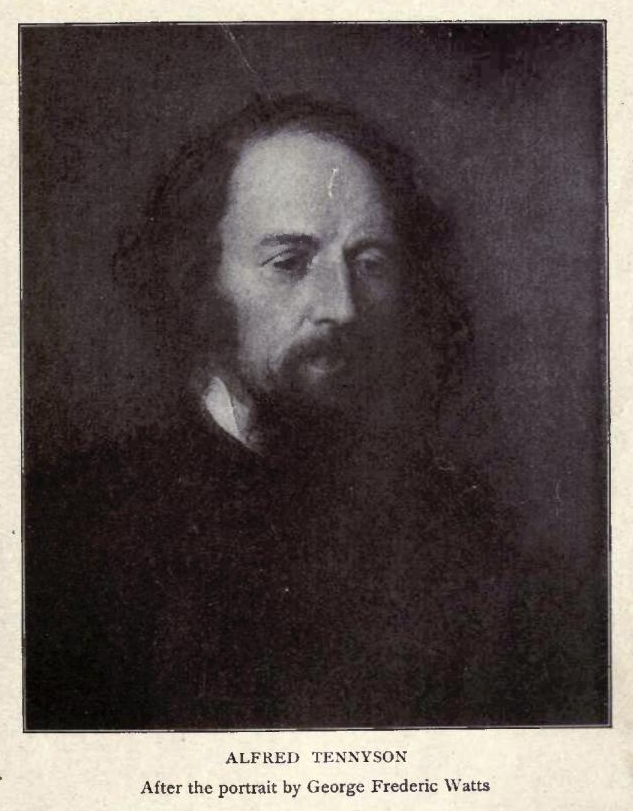
As all strong emotions tend to extremes, the age produced a new type of
novel which seems rather hysterical now, but which in its own day
delighted multitudes of readers whose nerves were somewhat excited, and
who reveled in "bogey" stories of supernatural terror. Mrs. Anne Radcliffe
(1764-1823) was one of the most successful writers of this school of
exaggerated romance. Her novels, with their azure-eyed heroines, haunted
castles, trapdoors, bandits, abductions, rescues in the nick of time, and
a general medley of overwrought joys and horrors,[219] were immensely popular, not only
with the crowd of novel readers, but also with men of unquestioned
literary genius, like Scott and Byron.
In marked contrast to these extravagant stories is the enduring work of
Jane Austen, with her charming descriptions of everyday life, and of Maria
Edgeworth, whose wonderful pictures of Irish life suggested to Walter
Scott the idea of writing his Scottish romances. Two other women who
attained a more or less lasting fame were Hannah More, poet, dramatist,
and novelist, and Jane Porter, whose Scottish Chiefs and Thaddeus
of Warsaw are still in demand in our libraries. Beside these were
Fanny Burney (Madame D'Arblay) and several other writers whose works, in
the early part of the nineteenth century, raised woman to the high place
in literature which she has ever since maintained.
The Modern MagazinesIn this age literary
criticism became firmly established by the appearance of such magazines as
the Edinburgh Review (18O2), The Quarterly Review (1808), Blackwood's
Magazine (1817), the Westminster Review (1824), The
Spectator (1828), The Athenæum (1828), and Fraser's
Magazine (1830). These magazines, edited by such men as Francis
Jeffrey, John Wilson (who is known to us as Christopher North), and John
Gibson Lockhart, who gave us the Life of Scott, exercised an
immense influence on all subsequent literature. At first their criticisms
were largely destructive, as when Jeffrey hammered Scott, Wordsworth, and
Byron most unmercifully; and Lockhart could find no good in either Keats
or Tennyson; but with added wisdom, criticism assumed its true function of
construction. And when these magazines began to seek and to publish the
works of unknown writers, like Hazlitt, Lamb, and Leigh Hunt, they
discovered the chief mission of the modern magazine, which is to give
every writer of ability the opportunity to make his work known to the
world.
I. THE POETS OF ROMANTICISM
WILLIAM WORDSWORTH (1770-1850)
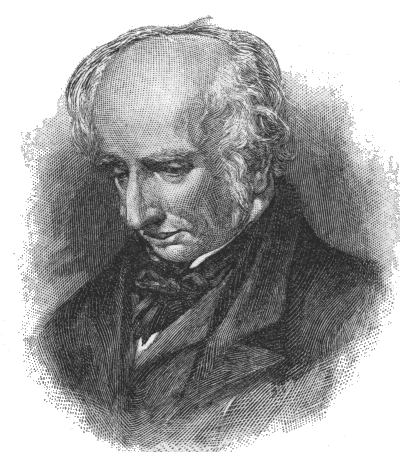
WILLIAM WORDSWORTH
It was in 1797 that the new romantic movement in our literature assumed
definite form. Wordsworth and Coleridge retired to the Quantock Hills,
Somerset, and there formed the deliberate purpose to make literature
"adapted to interest mankind permanently," which, they declared, classic
poetry could never do. Helping the two poets was Wordsworth's sister
Dorothy, with a woman's love for flowers and all beautiful things; and a
woman's divine sympathy for human life even in its lowliest forms. Though
a silent partner, she furnished perhaps the largest share of the
inspiration which resulted in the famous Lyrical Ballads of 1798.
In their partnership Coleridge was to take up the "supernatural, or at
least romantic"; while Wordsworth was "to give the charm of novelty to
things of everyday ... by awakening the mind's attention from the lethargy
of custom and directing it to the loveliness and the wonders of the world
before us." The whole spirit of their work is reflected in two poems of
this remarkable little volume, "The Rime of the Ancient Mariner," which is
Coleridge's masterpiece, and "Lines Written a Few Miles above Tintern
Abbey," which expresses Wordsworth's poetical creed, and which is one of
the noblest and most significant of our poems. That the Lyrical Ballads
attracted no attention,[220]
and was practically ignored by a public that would soon go into raptures
over Byron's Childe Harold and Don Juan, is of small
consequence. Many men will hurry a mile to see skyrockets, who never
notice Orion and the Pleiades from their own doorstep. Had Wordsworth and
Coleridge written only this one little book, they would still be among the
representative writers of an age that proclaimed the final triumph of
Romanticism.
Life of Wordsworth. To understand the life of him who, in
Tennyson's words, "uttered nothing base," it is well to read first The
Prelude, which records the impressions made upon Wordsworth's mind
from his earliest recollection until his full manhood, in 1805, when the
poem was completed.[221]
Outwardly his long and uneventful life divides itself naturally into four
periods: (1) his childhood and youth, in the Cumberland Hills, from 1770
to 1787; (2) a period of uncertainty, of storm and stress, including his
university life at Cambridge, his travels abroad, and his revolutionary
experience, from 1787 to 1797; (3) a short but significant period of
finding himself and his work, from 1797 to 1799; (4) a long period of
retirement in the northern lake region, where he was born, and where for a
full half century he lived so close to nature that her influence is
reflected in all his poetry. When one has outlined these four periods he
has told almost all that can be told of a life which is marked, not by
events, but largely by spiritual experiences.
Wordsworth was born in 1770 at Cockermouth, Cumberland, where the Derwent,
Fairest
of all rivers, loved
To blend his murmurs with my nurse's song,
And from his alder shades and rocky falls,
And from his fords and
shallows, sent a voice
That flowed along my dreams.
It is almost a shock to one who knows Wordsworth only by his calm and
noble poetry to read that he was of a moody and violent temper, and that
his mother despaired of him alone among her five children. She died when
he was but eight years old, but not till she had exerted an influence
which lasted all his life, so that he could remember her as "the heart of
all our learnings and our loves." The father died some six years later,
and the orphan was taken in charge by relatives, who sent him to school at
Hawkshead, in the beautiful lake region. Here, apparently, the unroofed
school of nature attracted him more than the discipline of the classics,
and he learned more eagerly from the flowers and hills and stars than from
his books; but one must read Wordsworth's own record, in The Prelude,
to appreciate this. Three things in this poem must impress even the casual
reader: first, Wordsworth loves to be alone, and is never lonely, with
nature; second, like every other child who spends much time alone in the
woods and fields, he feels the presence of some living spirit, real though
unseen, and companionable though silent; third, his impressions are
exactly like our own, and delightfully familiar. When he tells of the long
summer day spent in swimming, basking in the sun, and questing over the
hills; or of the winter night when, on his skates, he chased the
reflection of a star in the black ice; or of his exploring the lake in a
boat, and getting suddenly frightened when the world grew big and
strange,--in all this he is simply recalling a multitude of our own vague,
happy memories of childhood. He goes out into the woods at night to tend
his woodcock snares; he runs across another boy's snares, follows them,
finds a woodcock caught, takes it, hurries away through the night. And
then,
I heard among the solitary hills
Low breathings coming after me,
and sounds
Of undistinguishable motion.
That is like a mental photograph. Any boy who has come home through the
woods at night will recognize it instantly. Again he tells as of going
bird's-nesting on the cliffs:
Oh,
when I have hung
Above the raven's nest, by knots of grass
And
half-inch fissures in the slippery rock
But ill-sustained, and
almost (so it seemed)
Suspended by the blast that blew amain,
Shouldering the naked crag,--oh, at that time,
While on the
perilous ridge I hung alone,
With what strange utterance did the
loud dry wind
Blow through my ear! The sky seemed not a sky
Of
earth,--and with what motion moved the clouds!
No man can read such records without finding his own boyhood again, and
his own abounding joy of life, in the poet's early impressions.
The second period of Wordsworth's life begins with his university course
at Cambridge, in 1787. In the third book of The Prelude we find a
dispassionate account of student life, with its trivial occupations, its
pleasures and general aimlessness. Wordsworth proved to be a very ordinary
scholar, following his own genius rather than the curriculum, and looking
forward more eagerly to his vacation among the hills than to his
examinations. Perhaps the most interesting thing in his life at Cambridge
was his fellowship with the young political enthusiasts, whose spirit is
expressed in his remarkable poem on the French Revolution,--a poem which
is better than a volume of history to show the hopes and ambitions that
stirred all Europe in the first days of that mighty upheaval. Wordsworth
made two trips to France, in 1790 and 1791, seeing things chiefly through
the rosy spectacles of the young Oxford Republicans. On his second visit
he joined the Girondists, or the moderate Republicans, and only the
decision of his relatives, who cut off his allowance and hurried him back
to England, prevented his going headlong to the guillotine with the
leaders of his party. Two things rapidly cooled Wordsworth's revolutionary
enthusiasm, and ended the only dramatic interest of his placid life. One
was the excesses of the Revolution itself, and especially the execution of
Louis XVI; the other was the rise of Napoleon, and the slavish adulation
accorded by France to this most vulgar and dangerous of tyrants. His
coolness soon grew to disgust and opposition, as shown by his subsequent
poems; and this brought upon him the censure of Shelley, Byron, and other
extremists, though it gained the friendship of Scott, who from the first
had no sympathy with the Revolution or with the young English enthusiasts.
Of the decisive period of Wordsworth's life, when he was living with his
sister Dorothy and with Coleridge at Alfoxden, we have already spoken. The
importance of this decision to give himself to poetry is evident when we
remember that, at thirty years of age, he was without money or any
definite aim or occupation in life. He considered the law, but confessed
he had no sympathy for its contradictory precepts and practices; he
considered the ministry, but though strongly inclined to the Church, he
felt himself not good enough for the sacred office; once he had wanted to
be a soldier and serve his country, but had wavered at the prospect of
dying of disease in a foreign land and throwing away his life without
glory or profit to anybody. An apparent accident, which looks more to us
like a special Providence, determined his course. He had taken care of a
young friend, Raisley Calvert, who died of consumption and left Wordsworth
heir to a few hundred pounds, and to the request that he should give his
life to poetry. It was this unexpected gift which enabled Wordsworth to
retire from the world and follow his genius. All his life he was poor, and
lived in an atmosphere of plain living and high thinking. His poetry
brought him almost nothing in the way of money rewards, and it was only by
a series of happy accidents that he was enabled to continue his work. One
of these accidents was that he became a Tory, and soon accepted the office
of a distributor of stamps, and was later appointed poet laureate by the
government,--which occasioned Browning's famous but ill-considered poem of
"The Lost Leader":
Just for a handful of silver he left us,
Just for a riband to stick
in his coat.
The last half century of Wordsworth's life, in which he retired to his
beloved lake district and lived successively at Grasmere and Rydal Mount,
remind one strongly of Browning's long struggle for literary recognition.
It was marked by the same steadfast purpose, the same trusted ideal, the
same continuous work, and the same tardy recognition by the public. His
poetry was mercilessly ridiculed by nearly all the magazine critics, who
seized upon the worst of his work as a standard of judgment; and book
after book of poems appeared without meeting any success save the approval
of a few loyal friends. Without doubt or impatience he continued his work,
trusting to the future to recognize and approve it. His attitude here
reminds one strongly of the poor old soldier whom he met in the hills,[222] who refused to beg
or to mention his long service or the neglect of his country, saying with
noble simplicity,
My trust is in the God of Heaven
And in the
eye of him who passes me.
Such work and patience are certain of their reward, and long before
Wordsworth's death he felt the warm sunshine of general approval. The wave
of popular enthusiasm for Scott and Byron passed by, as their limitations
were recognized; and Wordsworth was hailed by critics as the first living
poet, and one of the greatest that England had ever produced. On the death
of Southey (1843) he was made poet laureate, against his own inclination.
The late excessive praise left him quite as unmoved as the first excessive
neglect. The steady decline in the quality of his work is due not, as
might be expected, to self-satisfaction at success, but rather to his
intense conservatism, to his living too much alone and failing to test his
work by the standards and judgment of other literary men. He died
tranquilly in 1850, at the age of eighty years, and was buried in the
churchyard at Grasmere.
Such is the brief outward record of the world's greatest interpreter of
nature's message; and only one who is acquainted with both nature and the
poet can realize how inadequate is any biography; for the best thing about
Wordsworth must always remain unsaid. It is a comfort to know that his
life, noble, sincere, "heroically happy," never contradicted his message.
Poetry was his life; his soul was in all his work; and only by reading
what he has written can we understand the man.
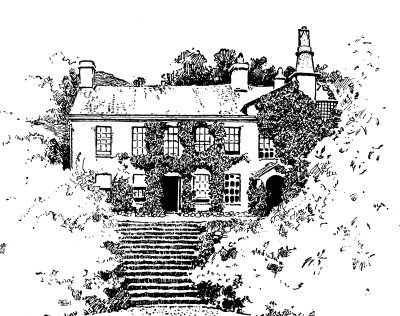
WORDSWORTH'S HOME AT RYDAL MOUNT
The Poetry of Wordsworth. There is often a sense of disappointment
when one reads Wordsworth for the first time; and this leads us to speak
first of two difficulties which may easily prevent a just appreciation of
the poet's worth. The first difficulty is in the reader, who is often
puzzled by Wordsworth's absolute simplicity. We are so used to stage
effects in poetry, that beauty unadorned is apt to escape our
notice,--like Wordsworth's "Lucy":
A violet by a mossy stone,
Half hidden from
the eye;
Fair as a star, when only one
Is
shining in the sky.
Wordsworth set himself to the task of freeing poetry from all its
"conceits," of speaking the language of simple truth, and of portraying
man and nature as they are; and in this good work we are apt to miss the
beauty, the passion, the intensity, that hide themselves under his
simplest lines. The second difficulty is in the poet, not in the reader.
It must be confessed that Wordsworth is not always melodious; that he is
seldom graceful, and only occasionally inspired. When he is inspired, few
poets can be compared with him; at other times the bulk of his verse is so
wooden and prosy that we wonder how a poet could have written it. Moreover
he is absolutely without humor, and so he often fails to see the small
step that separates the sublime from the ridiculous. In no other way can
we explain "The Idiot Boy," or pardon the serious absurdity of "Peter
Bell" and his grieving jackass.
Poems of NatureOn account of these
difficulties it is well to avoid at first the longer works and begin with
a good book of selections.[223]
When we read these exquisite shorter poems, with their noble lines that
live forever in our memory, we realize that Wordsworth is the greatest
poet of nature that our literature has produced. If we go further, and
study the poems that impress us, we shall find four remarkable
characteristics: (1) Wordsworth is sensitive as a barometer to every
subtle change in the world about him. In The Prelude he compares
himself to an æolian harp, which answers with harmony to every touch
of the wind; and the figure is strikingly accurate, as well as
interesting, for there is hardly a sight or a sound, from a violet to a
mountain and from a bird note to the thunder of the cataract, that is not
reflected in some beautiful way in Wordsworth's poetry.
(2) Of all the poets who have written of nature there is none that
compares with him in the truthfulness of his representation. Burns, like
Gray, is apt to read his own emotions into natural objects, so that there
is more of the poet than of nature even in his mouse and mountain daisy;
but Wordsworth gives you the bird and the flower, the wind and the tree
and the river, just as they are, and is content to let them speak their
own message.
(3) No other poet ever found such abundant beauty in the common world. He
had not only sight, but insight, that is, he not only sees clearly and
describes accurately, but penetrates to the heart of things and always
finds some exquisite meaning that is not written on the surface. It is
idle to specify or to quote lines on flowers or stars, on snow or vapor.
Nothing is ugly or commonplace in his world; on the contrary, there is
hardly one natural phenomenon which he has not glorified by pointing out
some beauty that was hidden from our eyes.
(4) It is the life of nature which is everywhere recognized; not
mere growth and cell changes, but sentient, personal life; and the
recognition of this personality in nature characterizes all the world's
great poetry. In his childhood Wordsworth regarded natural objects, the
streams, the hills, the flowers, even the winds, as his companions; and
with his mature belief that all nature is the reflection of the living
God, it was inevitable that his poetry should thrill with the sense of a
Spirit that "rolls through all things." Cowper, Burns, Keats,
Tennyson,--all these poets give you the outward aspects of nature in
varying degrees; but Wordsworth gives you her very life, and the
impression of some personal living spirit that meets and accompanies the
man who goes alone through the woods and fields. We shall hardly find,
even in the philosophy of Leibnitz, or in the nature myths of our Indians,
any such impression of living nature as this poet awakens in us. And that
suggests another delightful characteristic of Wordsworth's poetry, namely,
that he seems to awaken rather than create an impression; he stirs our
memory deeply, so that in reading him we live once more in the vague,
beautiful wonderland of our own childhood.
Poems of Human LifeSuch is the philosophy
of Wordsworth's nature poetry. If we search now for his philosophy of
human life, we shall find four more doctrines, which rest upon his basal
conception that man is not apart from nature, but is the very "life of her
life." (1) In childhood man is sensitive as a wind harp to all natural
influences; he is an epitome of the gladness and beauty of the world.
Wordsworth explains this gladness and this sensitiveness to nature by the
doctrine that the child comes straight from the Creator of nature:
Our birth is but a sleep and a forgetting:
The Soul that rises with
us, our life's Star,
Hath had elsewhere its
setting,
And cometh
from afar:
Not in entire forgetfulness
And not in utter nakedness,
But trailing
clouds of glory do we come
From God, who is
our home.
In this exquisite ode, which he calls "Intimations of Immortality from
Recollections of Early Childhood" (1807), Wordsworth sums up his
philosophy of childhood; and he may possibly be indebted here to the poet
Vaughan, who, more than a century before, had proclaimed in "The Retreat"
the same doctrine. This kinship with nature and with God, which glorifies
childhood, ought to extend through a man's whole life and ennoble it. This
is the teaching of "Tintern Abbey," in which the best part of our life is
shown to be the result of natural influences. According to Wordsworth,
society and the crowded unnatural life of cities tend to weaken and
pervert humanity; and a return to natural and simple living is the only
remedy for human wretchedness.
(2) The natural instincts and pleasures of childhood are the true
standards of a man's happiness in this life. All artificial pleasures soon
grow tiresome. The natural pleasures, which a man so easily neglects in
his work, are the chief means by which we may expect permanent and
increasing joy. In "Tintern Abbey," "The Rainbow," "Ode to Duty," and
"Intimations of Immortality" we see this plain teaching; but we can hardly
read one of Wordsworth's pages without finding it slipped in
unobtrusively, like the fragrance of a wild flower.
(3) The truth of humanity, that is, the common life which labors
and loves and shares the general heritage of smiles and tears, is the only
subject of permanent literary interest. Burns and the early poets of the
Revival began the good work of showing the romantic interest of common
life; and Wordsworth continued it in "Michael," "The Solitary Reaper," "To
a Highland Girl," "Stepping Westward," The Excursion, and a score
of lesser poems. Joy and sorrow, not of princes or heroes, but "in widest
commonalty spread," are his themes; and the hidden purpose of many of his
poems is to show that the keynote of all life is happiness,--not an
occasional thing, the result of chance or circumstance, but a heroic
thing, to be won, as one would win any other success, by work and
patience.
(4) To this natural philosophy of man Wordsworth adds a mystic element,
the result of his own belief that in every natural object there is a
reflection of the living God. Nature is everywhere transfused and
illumined by Spirit; man also is a reflection of the divine Spirit; and we
shall never understand the emotions roused by a flower or a sunset until
we learn that nature appeals through the eye of man to his inner spirit.
In a word, nature must be "spiritually discerned." In "Tintern Abbey" the
spiritual appeal of nature is expressed in almost every line; but the
mystic conception of man is seen more clearly in "Intimations of
Immortality," which Emerson calls "the high-water mark of poetry in the
nineteenth century." In this last splendid ode Wordsworth adds to his
spiritual interpretation of nature and man the alluring doctrine of
preëxistence, which has appealed so powerfully to Hindoo and Greek in
turn, and which makes of human life a continuous, immortal thing, without
end or beginning.
The RecluseWordsworth's longer poems,
since they contain much that is prosy and uninteresting, may well be left
till after we have read the odes, sonnets, and short descriptive poems
that have made him famous. As showing a certain heroic cast of
Wordsworth's mind, it is interesting to learn that the greater part of his
work, including The Prelude and The Excursion, was intended
for a place in a single great poem, to be called The Recluse, which
should treat of nature, man, and society. The Prelude, treating of
the growth of a poet's mind, was to introduce the work. The Home at
Grasmere, which is the first book of The Recluse, was not
published till 1888, long after the poet's death. The Excursion
(1814) is the second book of The Recluse; and the third was never
completed, though Wordsworth intended to include most of his shorter poems
in this third part, and so make an immense personal epic of a poet's life
and work. It is perhaps just as well that the work remained unfinished.
The best of his work appeared in the Lyrical Ballads (1798) and in
the sonnets, odes, and lyrics of the next ten years; though "The Duddon
Sonnets" (1820), "To a Skylark" (1825), and "Yarrow Revisited" (1831) show
that he retained till past sixty much of his youthful enthusiasm. In his
later years, however, he perhaps wrote too much; his poetry, like his
prose, becomes dull and unimaginative; and we miss the flashes of insight,
the tender memories of childhood, and the recurrence of noble lines--each
one a poem--that constitutes the surprise and the delight of reading
Wordsworth.
The outward shows of sky and earth,
Of hill
and valley, he has viewed;
And impulses of deeper birth
Have
come to him in solitude.
In common things that round us lie
Some random truths he can impart--
The
harvest of a quiet eye
That broods and
sleeps on his own heart.
SAMUEL TAYLOR COLERIDGE (1772-1834)
A grief without a pang, void, dark and drear,
A
stifled, drowsy, unimpassioned grief,
Which finds no natural
outlet, no relief,
In word, or sigh, or
tear.
In the wonderful "Ode to Dejection," from which the above fragment is
taken, we have a single strong impression of Coleridge's whole life,--a
sad, broken, tragic life, in marked contrast with the peaceful existence
of his friend Wordsworth. For himself, during the greater part of his
life, the poet had only grief and remorse as his portion; but for
everybody else, for the audiences that were charmed by the brilliancy of
his literary lectures, for the friends who gathered about him to be
inspired by his ideals and conversation, and for all his readers who found
unending delight in the little volume which holds his poetry, he had and
still has a cheering message, full of beauty and hope and inspiration.
Such is Coleridge, a man of grief who makes the world glad.
Life. In 1772 there lived in Ottery St. Mary, Devonshire, a queer
little man, the Rev. John Coleridge, vicar of the parish church and master
of the local grammar school. In the former capacity he preached profound
sermons, quoting to open-mouthed rustics long passages from the Hebrew,
which he told them was the very tongue of the Holy Ghost. In the latter
capacity he wrote for his boys a new Latin grammar, to mitigate some of
the difficulties of traversing that terrible jungle by means of ingenious
bypaths and short cuts. For instance, when his boys found the ablative a
somewhat difficult case to understand, he told them to think of it as the
quale-quare-quidditive case, which of course makes its meaning
perfectly clear. In both these capacities the elder Coleridge was a
sincere man, gentle and kindly, whose memory was "like a religion" to his
sons and daughters. In that same year was born Samuel Taylor Coleridge,
the youngest of thirteen children. He was an extraordinarily precocious
child, who could read at three years of age, and who, before he was five,
had read the Bible and the Arabian Nights, and could remember an
astonishing amount from both books. From three to six he attended a "dame"
school; and from six till nine (when his father died and left the family
destitute) he was in his father's school, learning the classics, reading
an enormous quantity of English books, avoiding novels, and delighting in
cumbrous theological and metaphysical treatises. At ten he was sent to the
Charity School of Christ's Hospital, London, where he met Charles Lamb,
who records his impression of the place and of Coleridge in one of his
famous essays.[224]
Coleridge seems to have remained in this school for seven or eight years
without visiting his home,--a poor, neglected boy, whose comforts and
entertainments were all within himself. Just as, when a little child, he
used to wander over the fields with a stick in his hand, slashing the tops
from weeds and thistles, and thinking himself to be the mighty champion of
Christendom against the infidels, so now he would lie on the roof of the
school, forgetting the play of his fellows and the roar of the London
streets, watching the white clouds drifting over and following them in
spirit into all sorts of romantic adventures.
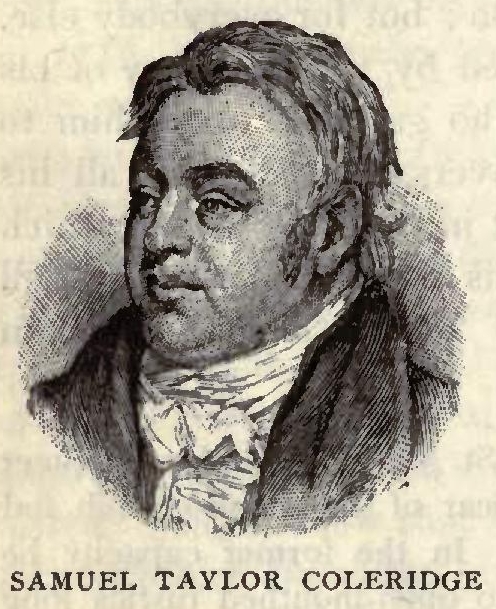
SAMUEL TAYLOR COLERIDGE
At nineteen this hopeless dreamer, who had read more books than an old
professor, entered Cambridge as a charity student. He remained for nearly
three years, then ran away because of a trifling debt and enlisted in the
Dragoons, where he served several months before he was discovered and
brought back to the university. He left in 1794 without taking his degree;
and presently we find him with the youthful Southey,--a kindred spirit,
who had been fired to wild enthusiasm by the French Revolution,--founding
his famous Pantisocracy for the regeneration of human society. "The Fall
of Robespierre," a poem composed by the two enthusiasts, is full of the
new revolutionary spirit. The Pantisocracy, on the banks of the
Susquehanna, was to be an ideal community, in which the citizens combined
farming and literature; and work was to be limited to two hours each day.
Moreover, each member of the community was to marry a good woman, and take
her with him. The two poets obeyed the latter injunction first, marrying
two sisters, and then found that they had no money to pay even their
traveling expenses to the new Utopia.
During all the rest of his career a tragic weakness of will takes
possession of Coleridge, making it impossible for him, with all his genius
and learning, to hold himself steadily to any one work or purpose. He
studied in Germany; worked as a private secretary, till the drudgery wore
upon his free spirit; then he went to Rome and remained for two years,
lost in study. Later he started The Friend, a paper devoted to
truth and liberty; lectured on poetry and the fine arts to enraptured
audiences in London, until his frequent failures to meet his engagements
scattered his hearers; was offered an excellent position and a half
interest (amounting to some £2000) in the Morning Post and The
Courier, but declined it, saying "that I would not give up the country
and the lazy reading of old folios for two thousand times two thousand
pounds,--in short, that beyond £350 a year I considered money a real
evil." His family, meanwhile, was almost entirely neglected; he lived
apart, following his own way, and the wife and children were left in
charge of his friend Southey. Needing money, he was on the point of
becoming a Unitarian minister, when a small pension from two friends
enabled him to live for a few years without regular employment.
A terrible shadow in Coleridge's life was the apparent cause of most of
his dejection. In early life he suffered from neuralgia, and to ease the
pain began to use opiates. The result on such a temperament was almost
inevitable. He became a slave to the drug habit; his naturally weak will
lost all its directing and sustaining force, until, after fifteen years of
pain and struggle and despair, he gave up and put himself in charge of a
physician, one Mr. Gillman, of Highgate. Carlyle, who visited him at this
time, calls him "a king of men," but records that "he gave you the idea of
a life that had been full of sufferings, a life heavy-laden,
half-vanquished, still swimming painfully in seas of manifold physical and
other bewilderment."
The shadow is dark indeed; but there are gleams of sunshine that
occasionally break through the clouds. One of these is his association
with Wordsworth and his sister Dorothy, in the Quantock hills, out of
which came the famous Lyrical Ballads of 1798. Another was his
loyal devotion to poetry for its own sake. With the exception of his
tragedy Remorse, which through Byron's influence was accepted at
Drury Lane Theater, and for which he was paid £400, he received almost
nothing for his poetry. Indeed, he seems not to have desired it; for he
says: "Poetry has been to me its own exceeding great reward; it has
soothed my afflictions; it has multiplied and refined my enjoyments; it
has endeared solitude, and it has given me the habit of wishing to
discover the good and the beautiful in all that meets and surrounds me."
One can better understand his exquisite verse after such a declaration. A
third ray of sunlight came from the admiration of his contemporaries; for
though he wrote comparatively little, he was by his talents and learning a
leader among literary men, and his conversations were as eagerly listened
to as were those of Dr. Johnson. Wordsworth says of him that, though other
men of the age had done some wonderful things, Coleridge was the only
wonderful man he had ever known. Of his lectures on literature a
contemporary says: "His words seem to flow as from a person repeating with
grace and energy some delightful poem." And of his conversation it is
recorded: "Throughout a long-drawn summer's day would this man talk to you
in low, equable but clear and musical tones, concerning things human and
divine; marshalling all history, harmonizing all experiment, probing the
depths of your consciousness, and revealing visions of glory and terror to
the imagination."
The last bright ray of sunlight comes from Coleridge's own soul, from the
gentle, kindly nature which made men love and respect him in spite of his
weaknesses, and which caused Lamb to speak of him humorously as "an
archangel a little damaged." The universal law of suffering seems to be
that it refines and softens humanity; and Coleridge was no exception to
the law. In his poetry we find a note of human sympathy, more tender and
profound than can be found in Wordsworth or, indeed, in any other of the
great English poets. Even in his later poems, when he has lost his first
inspiration and something of the splendid imaginative power that makes his
work equal to the best of Blake's, we find a soul tender, triumphant,
quiet, "in the stillness of a great peace." He died in 1834, and was
buried in Highgate Church. The last stanza of the boatman's song, in Remorse,
serves better to express the world's judgment than any epitaph:
Hark! the cadence dies away
On the quiet moon-lit sea;
The
boatmen rest their oars and say,
Miserere
Domini!
Works of Coleridge. The works of Coleridge naturally divide
themselves into three classes,--the poetic, the critical, and the
philosophical, corresponding to the early, the middle, and the later
periods of his career. Of his poetry Stopford Brooke well says: "All that
he did excellently might be bound up in twenty pages, but it should be
bound in pure gold." His early poems show the influence of Gray and Blake,
especially of the latter. When Coleridge begins his "Day Dream" with the
line, "My eyes make pictures when they're shut," we recall instantly
Blake's haunting Songs of Innocence. But there is this difference
between the two poets,--in Blake we have only a dreamer; in Coleridge we
have the rare combination of the dreamer and the profound scholar. The
quality of this early poetry, with its strong suggestion of Blake, may be
seen in such poems as "A Day Dream," "The Devil's Thoughts," "The
Suicide's Argument," and "The Wanderings of Cain." His later poems,
wherein we see his imagination bridled by thought and study, but still
running very freely, may best be appreciated in "Kubla Khan,"
"Christabel," and "The Rime of the Ancient Mariner." It is difficult to
criticise such poems; one can only read them and wonder at their melody,
and at the vague suggestions which they conjure up in the mind. "Kubla
Khan" is a fragment, painting a gorgeous Oriental dream picture, such as
one might see in an October sunset. The whole poem came to Coleridge one
morning when he had fallen asleep over Purchas, and upon awakening he
began to write hastily,
In Xanadu did Kubla Khan
A stately pleasure-dome decree:
Where
Alph, the sacred river, ran
Through caverns measureless to man
Down to a sunless sea.
He was interrupted after fifty-four lines were written, and he never
finished the poem.
"Christabel" is also a fragment, which seems to have been planned as the
story of a pure young girl who fell under the spell of a sorcerer, in the
shape of the woman Geraldine. It is full of a strange melody, and contains
many passages of exquisite poetry; but it trembles with a strange, unknown
horror, and so suggests the supernatural terrors of the popular hysterical
novels, to which we have referred. On this account it is not wholesome
reading; though one flies in the face of Swinburne and of other critics by
venturing to suggest such a thing.
The Rime of the Ancient Mariner"The Rime
of the Ancient Mariner" is Coleridge's chief contribution to the Lyrical
Ballads of 1798, and is one of the world's masterpieces. Though it
introduces the reader to a supernatural realm, with a phantom ship, a crew
of dead men, the overhanging curse of the albatross, the polar spirit, and
the magic breeze, it nevertheless manages to create a sense of absolute
reality concerning these manifest absurdities. All the mechanisms of the
poem, its meter, rime, and melody are perfect; and some of its
descriptions of the lonely sea have never been equaled. Perhaps we should
say suggestions, rather than descriptions; for Coleridge never describes
things, but makes a suggestion, always brief and always exactly right, and
our own imagination instantly supplies the details. It is useless to quote
fragments; one must read the entire poem, if he reads nothing else of the
romantic school of poetry.
Among Coleridge's shorter poems there is a wide variety, and each reader
must be left largely to follow his own taste. The beginner will do well to
read a few of the early poems, to which we have referred, and then try the
"Ode to France," "Youth and Age," "Dejection," "Love Poems," "Fears in
Solitude," "Religious Musings," "Work Without Hope," and the glorious
"Hymn Before Sunrise in the Vale of Chamouni." One exquisite little poem
from the Latin, "The Virgin's Cradle Hymn," and his version of Schiller's
Wallenstein, show Coleridge's remarkable power as a translator. The
latter is one of the best poetical translations in our literature.
Prose Works Of Coleridge's prose works,
the Biographia, Literaria, or Sketches of My Literary Life and Opinions
(1817), his collected Lectures on Shakespeare (1849), and Aids
to Reflection (1825) are the most interesting from a literary view
point. The first is an explanation and criticism of Wordsworth's theory of
poetry, and contains more sound sense and illuminating ideas on the
general subject of poetry than any other book in our language. The Lectures,
as refreshing as a west wind in midsummer, are remarkable for their
attempt to sweep away the arbitrary rules which for two centuries had
stood in the way of literary criticism of Shakespeare, in order to study
the works themselves. No finer analysis and appreciation of the master's
genius has ever been written. In his philosophical work Coleridge
introduced the idealistic philosophy of Germany into England. He set
himself in line with Berkeley, and squarely against Bentham, Malthus,
Mill, and all the materialistic tendencies which were and still are the
bane of English philosophy. The Aids to Reflection is Coleridge's
most profound work, but is more interesting to the student of religion and
philosophy than to the readers of literature.
ROBERT SOUTHEY (1774-1843)
Closely associated with Wordsworth and Coleridge is Robert Southey; and
the three, on account of their residence in the northern lake district,
were referred to contemptuously as the "Lakers" by the Scottish magazine
reviewers. Southey holds his place in this group more by personal
association than by his literary gifts. He was born at Bristol, in 1774;
studied at Westminster School, and at Oxford, where he found himself in
perpetual conflict with the authorities on account of his independent
views. He finally left the university and joined Coleridge in his scheme
of a Pantisocracy. For more than fifty years he labored steadily at
literature, refusing to consider any other occupation. He considered
himself seriously as one of the greatest writers of the day, and a reading
of his ballads--which connected him at once with the romantic
school--leads us to think that, had he written less, he might possibly
have justified his own opinion of himself. Unfortunately he could not wait
for inspiration, being obliged to support not only his own family but
also, in large measure, that of his friend Coleridge.
Works of SoutheySouthey gradually
surrounded himself with one of the most extensive libraries in England,
and set himself to the task of of writing something every working day. The
results of his industry were one hundred and nine volumes, besides some
hundred and fifty articles for the magazines, most of which are now
utterly forgotten. His most ambitious poems are Thalaba, a tale of
Arabian enchantment; The Curse of Kehama, a medley of Hindoo
mythology; Madoc, a legend of a Welsh prince who discovered the
western world; and Roderick, a tale of the last of the Goths. All
these, and many more, although containing some excellent passages, are on
the whole exaggerated and unreal, both in manner and in matter. Southey
wrote far better prose than poetry, and his admirable Life of Nelson
is still often read. Besides these are his Lives of British Admirals,
his lives of Cowper and Wesley, and his histories of Brazil and of the
Peninsular War.
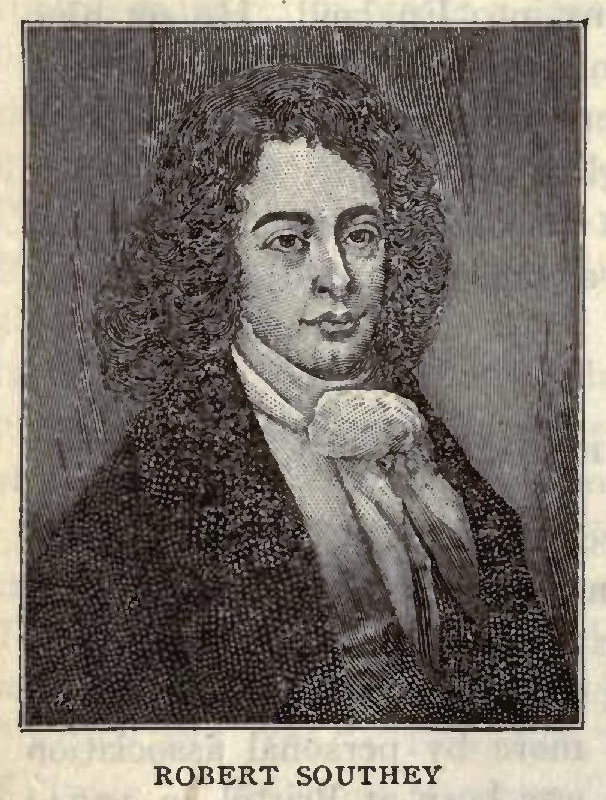
ROBERT SOUTHEY
Southey was made Poet Laureate in 1813, and was the first to raise that
office from the low estate into which it had fallen since the death of
Dryden. The opening lines of Thalaba, beginning,
How beautiful is night!
A dewy freshness fills the silent air,
are still sometimes quoted; and a few of his best known short poems, like
"The Scholar," "Auld Cloots," "The Well of St. Keyne," "The Inchcape
Rock," and "Lodore," will repay the curious reader. The beauty of
Southey's character, his patience and helpfulness, make him a worthy
associate of the two greater poets with whom he is generally named.
WALTER SCOTT (1771-1832)
We have already called attention to two significant movements of the
eighteenth century, which we must for a moment recall if we are to
appreciate Scott, not simply as a delightful teller of tales, but as a
tremendous force in modern literature. The first is the triumph of
romantic poetry in Wordsworth and Coleridge; the second is the success of
our first English novelists, and the popularization of literature by
taking it from the control of a few patrons and critics and putting it
into the hands of the people as one of the forces which mold our modern
life. Scott is an epitome of both these movements. The poetry of
Wordsworth and Coleridge was read by a select few, but Scott's Marmion
and Lady of the Lake aroused a whole nation to enthusiasm, and for
the first time romantic poetry became really popular. So also the novel
had been content to paint men and women of the present, until the
wonderful series of Waverley novels appeared, when suddenly, by the magic
of this "Wizard of the North," all history seemed changed. The past, which
had hitherto appeared as a dreary region of dead heroes, became alive
again, and filled with a multitude of men and women who had the surprising
charm of reality. It is of small consequence that Scott's poetry and prose
are both faulty; that his poems are read chiefly for the story, rather
than for their poetic excellence; and that much of the evident crudity and
barbarism of the Middle Ages is ignored or forgotten in Scott's writings.
By their vigor, their freshness, their rapid action, and their breezy,
out-of-door atmosphere, Scott's novels attracted thousands of readers who
else had known nothing of the delights of literature. He is, therefore,
the greatest known factor in establishing and in popularizing that
romantic element in prose and poetry which has been for a hundred years
the chief characteristic of our literature.
Life. Scott was born in Edinburgh, on August 15, 1771. On both his
mother's and father's side he was descended from old Border families,
distinguished more for their feuds and fighting than for their
intellectual attainments. His father was a barrister, a just man, who
often lost clients by advising them to be, first of all, honest in their
lawsuits. His mother was a woman of character and education, strongly
imaginative, a teller of tales which stirred young Walter's enthusiasm by
revealing the past as a world of living heroes.
As a child, Scott was lame and delicate, and was therefore sent away from
the city to be with his grandmother in the open country at Sandy Knowe, in
Roxburghshire, near the Tweed. This grandmother was a perfect
treasure-house of legends concerning the old Border feuds. From her
wonderful tales Scott developed that intense love of Scottish history and
tradition which characterizes all his work.
By the time he was eight years old, when he returned to Edinburgh, Scott's
tastes were fixed for life. At the high school he was a fair scholar, but
without enthusiasm, being more interested in Border stories than in the
text-books. He remained at school only six or seven years, and then
entered his father's office to study law, at the same time attending
lectures at the university. He kept this up for some six years without
developing any interest in his profession, not even when he passed his
examinations and was admitted to the Bar, in 1792. After nineteen years of
desultory work, in which he showed far more zeal in gathering Highland
legends than in gaining clients, he had won two small legal offices which
gave him enough income to support him comfortably. His home, meanwhile,
was at Ashestiel on the Tweed, where all his best poetry was written.
Scott's literary work began with the translation from the German of
Bürger's romantic ballad of Lenore (1796) and of Goethe's Götz
von Berlichingen (1799); but there was romance enough in his own loved
Highlands, and in 1802-1803 appeared three volumes of his Minstrelsy of
the Scottish Border, which he had been collecting for many years. In
1805, when Scott was 34 years old, appeared his first original work, The
Lay of the Last Minstrel. Its success was immediate, and when Marmion
(1808) and The Lady of the Lake (1810) aroused Scotland and England
to intense enthusiasm, and brought unexpected fame to the author,--without
in the least spoiling his honest and lovable nature,--Scott gladly
resolved to abandon the law, in which he had won scant success, and give
himself wholly to literature. Unfortunately, however, in order to increase
his earnings, he entered secretly into partnership with the firms of
Constable and the brothers Ballantyne, as printer-publishers,--a sad
mistake, indeed, and the cause of that tragedy which closed the life of
Scotland's greatest writer.
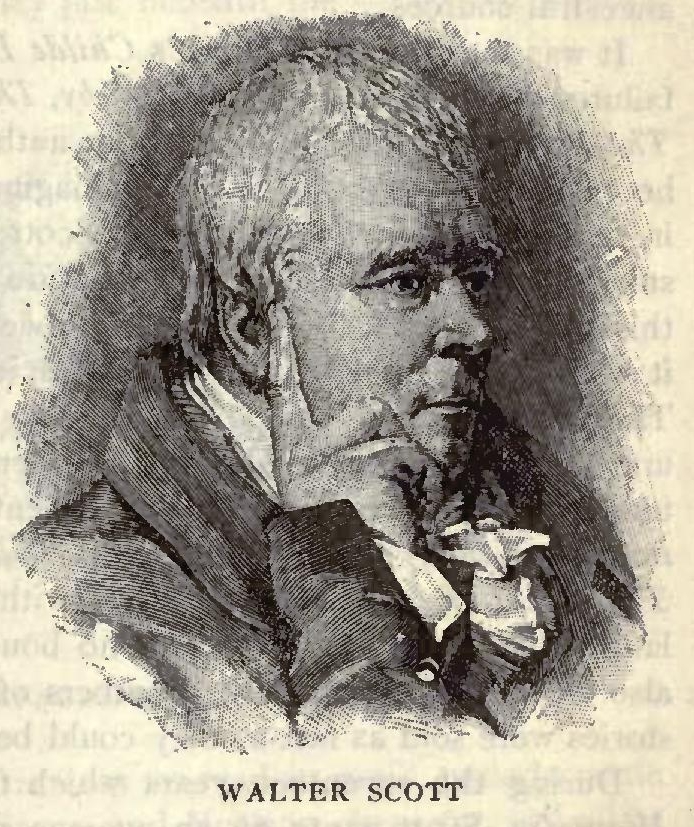
WALTER
SCOTT
The year 1811 is remarkable for two things in Scott's life. In this year
he seems to have realized that, notwithstanding the success of his poems,
he had not yet "found himself"; that he was not a poetic genius, like
Burns; that in his first three poems he had practically exhausted his
material, though he still continued to write verse; and that, if he was to
keep his popularity, he must find some other work. The fact that, only a
year later, Byron suddenly became the popular favorite, shows how
correctly Scott had judged himself and the reading public, which was even
more fickle than usual in this emotional age. In that same year, 1811,
Scott bought the estate of Abbotsford, on the Tweed, with which place his
name is forever associated. Here he began to spend large sums, and to
dispense the generous hospitality of a Scotch laird, of which he had been
dreaming for years. In 1820 he was made a baronet; and his new title of
Sir Walter came nearer to turning his honest head than had all his
literary success. His business partnership was kept secret, and during all
the years when the Waverley novels were the most popular books in the
world, their authorship remained unknown; for Scott deemed it beneath the
dignity of his title to earn money by business or literature, and sought
to give the impression that the enormous sums spent at Abbotsford in
improving the estate and in entertaining lavishly were part of the dignity
of the position and came from ancestral sources.
It was the success of Byron's Childe Harold, and the comparative
failure of Scott's later poems, Rokeby, The Bridal of Triermain,
and The Lord of the Isles, which led our author into the new field,
where he was to be without a rival. Rummaging through a cabinet one day in
search of some fishing tackle, Scott found the manuscript of a story which
he had begun and laid aside nine years before. He read this old story
eagerly, as if it had been another's work; finished it within three weeks,
and published it without signing his name. The success of this first
novel, Waverley (1814), was immediate and unexpected. Its great
sales and the general chorus of praise for its unknown author were without
precedent; and when Guy Mannering, The Antiquary, Black Dwarf, Old
Mortality, Rob Roy, and The Heart of Midlothian appeared within
the next four years, England's delight and wonder knew no bounds. Not only
at home, but also on the Continent, large numbers of these fresh and
fascinating stories were sold as fast as they could be printed.
During the seventeen years which followed the appearance of Waverley,
Scott wrote on an average nearly two novels per year, creating an unusual
number of characters and illustrating many periods of Scotch, English, and
French history, from the time of the Crusades to the fall of the Stuarts.
In addition to these historical novels, he wrote Tales of a
Grandfather, Demonology and Witchcraft, biographies of Dryden and of
Swift, the Life of Napoleon, in nine volumes, and a large number of
articles for the reviews and magazines. It was an extraordinary amount of
literary work, but it was not quite so rapid and spontaneous as it seemed.
He had been very diligent in looking up old records, and we must remember
that, in nearly all his poems and novels, Scott was drawing upon a fund of
legend, tradition, history, and poetry, which he had been gathering for
forty years, and which his memory enabled him to produce at will with
almost the accuracy of an encyclopedia.
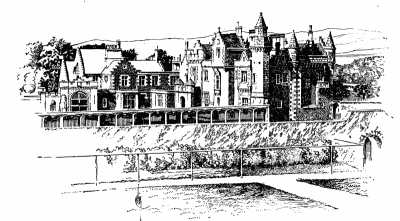
ABBOTSFORD
For the first six years Scott held himself to Scottish history, giving us
in nine remarkable novels the whole of Scotland, its heroism, its superb
faith and enthusiasm, and especially its clannish loyalty to its
hereditary chiefs; giving us also all parties and characters, from
Covenanters to Royalists, and from kings to beggars. After reading these
nine volumes we know Scotland and Scotchmen as we can know them in no
other way. In 1819 he turned abruptly from Scotland, and in Ivanhoe,
the most popular of his works, showed what a mine of neglected wealth lay
just beneath the surface of English history. It is hard to realize now, as
we read its rapid, melodramatic action, its vivid portrayal of Saxon and
Norman character, and all its picturesque details, that it was written
rapidly, at a time when the author was suffering from disease and could
hardly repress an occasional groan from finding its way into the rapid
dictation. It stands to-day as the best example of the author's own theory
that the will of a man is enough to hold him steadily, against all
obstacles, to the task of "doing what he has a mind to do." Kenilworth,
Nigel, Peveril, and Woodstock, all written in the next few
years, show his grasp of the romantic side of English annals; Count
Robert and The Talisman show his enthusiasm for the heroic side
of the Crusaders' nature; and Quentin Durwardand Anne of
Geierstein suggest another mine of romance which he discovered in
French history.
For twenty years Scott labored steadily at literature, with the double
object of giving what was in him, and of earning large sums to support the
lavish display which he deemed essential to a laird of Scotland. In 1826,
while he was blithely at work on Woodstock, the crash came. Not
even the vast earnings of all these popular novels could longer keep the
wretched business of Ballantyne on its feet, and the firm failed, after
years of mismanagement. Though a silent partner, Scott assumed full
responsibility, and at fifty-five years of age, sick, suffering, and with
all his best work behind him, he found himself facing a debt of over half
a million dollars. The firm could easily have compromised with its
creditors; but Scott refused to hear of bankruptcy laws under which he
could have taken refuge. He assumed the entire debt as a personal one, and
set resolutely to work to pay every penny. Times were indeed changed in
England when, instead of a literary genius starving until some wealthy
patron gave him a pension, this man, aided by his pen alone, could
confidently begin to earn that enormous amount of money. And this is one
of the unnoticed results of the popularization of literature. Without a
doubt Scott would have accomplished the task, had he been granted only a
few years of health. He still lived at Abbotsford, which he had offered to
his creditors, but which they generously refused to accept; and in two
years, by miscellaneous work, had paid some two hundred thousand dollars
of his debt, nearly half of this sum coming from his Life of Napoleon.
A new edition of the Waverley novels appeared, which was very successful
financially, and Scott had every reason to hope that he would soon face
the world owing no man a penny, when he suddenly broke under the strain.
In 1830 occurred a stroke of paralysis from which he never fully
recovered; though after a little time he was again at work, dictating with
splendid patience and resolution. He writes in his diary at this time:
"The blow is a stunning one, I suppose, for I scarcely feel it. It is
singular, but it comes with as little surprise as if I had a remedy ready,
yet God knows I am at sea in the dark, and the vessel leaky."
It is good to remember that governments are not always ungrateful, and to
record that, when it became known that a voyage to Italy might improve
Scott's health, the British government promptly placed a naval vessel at
the disposal of a man who had led no armies to the slaughter, but had only
given pleasure to multitudes of peaceable men and women by his stories. He
visited Malta, Naples, and Rome; but in his heart he longed for Scotland,
and turned homeward after a few months of exile. The river Tweed, the
Scotch hills, the trees of Abbotsford, the joyous clamor of his dogs,
brought forth the first exclamation of delight which had passed Scott's
lips since he sailed away. He died in September of the same year, 1832,
and was buried with his ancestors in the old Dryburgh Abbey.
Works of Scott. Scott's work is of a kind which the critic gladly
passes over, leaving each reader to his own joyous and uninstructed
opinion. From a literary view point the works are faulty enough, if one is
looking for faults; but it is well to remember that they were intended to
give delight, and that they rarely fail of their object. When one has read
the stirring Marmion or the more enduring Lady of the Lake,
felt the heroism of the Crusaders in The Talisman, the
picturesqueness of chivalry in Ivanhoe, the nobleness of soul of a
Scotch peasant girl in The Heart of Midlothian, and the quality of
Scotch faith in Old Mortality, then his own opinion of Scott's
genius will be of more value than all the criticisms that have ever been
written.
Scott's PoetryAt the outset we must
confess frankly that Scott's poetry is not artistic, in the highest sense,
and that it lacks the deeply imaginative and suggestive qualities which
make a poem the noblest and most enduring work of humanity. We read it
now, not for its poetic excellence, but for its absorbing story interest.
Even so, it serves an admirable purpose. Marmion and The Lady of
the Lake, which are often the first long poems read by the beginner in
literature, almost invariably lead to a deeper interest in the subject;
and many readers owe to these poems an introduction to the delights of
poetry. They are an excellent beginning, therefore, for young readers,
since they are almost certain to hold the attention, and to lead
indirectly to an interest in other and better poems. Aside from this,
Scott's poetry is marked by vigor and youthful abandon; its interest lies
in its vivid pictures, its heroic characters, and especially in its rapid
action and succession of adventures, which hold and delight us still, as
they held and delighted the first wondering readers. And one finds here
and there terse descriptions, or snatches of song and ballad, like the
"Boat Song" and "Lochinvar," which are among the best known in our
literature.
Scott's NovelsIn his novels Scott plainly
wrote too rapidly and too much. While a genius of the first magnitude, the
definition of genius as "the infinite capacity for taking pains" hardly
belongs to him. For details of life and history, for finely drawn
characters, and for tracing the logical consequences of human action, he
has usually no inclination. He sketches a character roughly, plunges him
into the midst of stirring incidents, and the action of the story carries
us on breathlessly to the end. So his stories are largely adventure
stories, at the best; and it is this element of adventure and glorious
action, rather than the study of character, which makes Scott a perennial
favorite of the young. The same element of excitement is what causes
mature readers to turn from Scott to better novelists, who have more power
to delineate human character, and to create, or discover, a romantic
interest in the incidents of everyday life rather than in stirring
adventure.[225]
Scott's Work for LiteratureNotwithstanding
these limitations, it is well--especially in these days, when we hear that
Scott is outgrown--to emphasize four noteworthy things that he
accomplished.
(1) He created the historical novel[226]; and all novelists of the last century who
draw upon history for their characters and events are followers of Scott
and acknowledge his mastery.
(2) His novels are on a vast scale, covering a very wide range of action,
and are concerned with public rather than with private interests. So, with
the exception of The Bride of Lammermoor, the love story in his
novels is generally pale and feeble; but the strife and passions of big
parties are magnificently portrayed. A glance over even the titles of his
novels shows how the heroic side of history for over six hundred years
finds expression in his pages; and all the parties of these six
centuries--Crusaders, Covenanters, Cavaliers, Roundheads, Papists, Jews,
Gypsies, Rebels--start into life again, and fight or give a reason for the
faith that is in them. No other novelist in England, and only Balzac in
France, approaches Scott in the scope of his narratives.
(3) Scott was the first novelist in any language to make the scene an
essential element in the action. He knew Scotland, and loved it; and there
is hardly an event in any of his Scottish novels in which we do not
breathe the very atmosphere of the place, and feel the presence of its
moors and mountains. The place, morever, is usually so well chosen and
described that the action seems almost to be the result of natural
environment. Perhaps the most striking illustration of this harmony
between scene and incident is found in Old Mortality, where Morton
approaches the cave of the old Covenanter, and where the spiritual terror
inspired by the fanatic's struggle with imaginary fiends is paralleled by
the physical terror of a gulf and a roaring flood spanned by a slippery
tree trunk. A second illustration of the same harmony of scene and
incident is found in the meeting of the arms and ideals of the East and
West, when the two champions fight in the burning desert, and then eat
bread together in the cool shade of the oasis, as described in the opening
chapter of The Talisman. A third illustration is found in that
fascinating love scene, where Ivanhoe lies wounded, raging at his
helplessness, while the gentle Rebecca alternately hides and reveals her
love as she describes the terrific assault on the castle, which goes on
beneath her window. His thoughts are all on the fight; hers on the man she
loves; and both are natural, and both are exactly what we expect under the
circumstances. These are but striking examples of the fact that, in all
his work, Scott tries to preserve perfect harmony between the scene and
the action.
(4) Scott's chief claim to greatness lies in the fact that he was the
first novelist to recreate the past; that he changed our whole conception
of history by making it to be, not a record of dry facts, but a stage on
which living men and women played their parts. Carlyle's criticism is here
most pertinent: "These historical novels have taught this truth ...
unknown to writers of history: that the bygone ages of the world were
actually filled by living men, not by protocols, state papers,
controversies, and abstractions of men." Not only the pages of history,
but all the hills and vales of his beloved Scotland are filled with living
characters,--lords and ladies, soldiers, pirates, gypsies, preachers,
schoolmasters, clansmen, bailiffs, dependents,--all Scotland is here
before our eyes, in the reality of life itself. It is astonishing, with
his large numbers of characters, that Scott never repeats himself.
Naturally he is most at home in Scotland, and with humble people. Scott's
own romantic interest in feudalism caused him to make his lords altogether
too lordly; his aristocratic maidens are usually bloodless, conventional,
exasperating creatures, who talk like books and pose like figures in an
old tapestry. But when he describes characters like Jeanie Deans, in The
Heart of Midlothian, and the old clansman, Evan Dhu, in Waverley,
we know the very soul of Scotch womanhood and manhood.
Perhaps one thing more should be said, or rather repeated, of Scott's
enduring work. He is always sane, wholesome, manly, inspiring. We know the
essential nobility of human life better, and we are better men and women
ourselves, because of what he has written.
GEORGE GORDON, LORD BYRON (1788-1824)
There are two distinct sides to Byron and his poetry, one good, the other
bad; and those who write about him generally describe one side or the
other in superlatives. Thus one critic speaks of his "splendid and
imperishable excellence of sincerity and strength"; another of his "gaudy
charlatanry, blare of brass, and big bow-wowishness." As both critics are
fundamentally right, we shall not here attempt to reconcile their
differences, which arise from viewing one side of the man's nature and
poetry to the exclusion of the other. Before his exile from England, in
1816, the general impression made by Byron is that of a man who leads an
irregular life, poses as a romantic hero, makes himself out much worse
than he really is, and takes delight in shocking not only the conventions
but the ideals of English society. His poetry of this first period is
generally, though not always, shallow and insincere in thought, and
declamatory or bombastic in expression. After his exile, and his meeting
with Shelley in Italy, we note a gradual improvement, due partly to
Shelley's influence and partly to his own mature thought and experience.
We have the impression now of a disillusioned man who recognizes his true
character, and who, though cynical and pessimistic, is at least honest in
his unhappy outlook on society. His poetry of this period is generally
less shallow and rhetorical, and though he still parades his feelings in
public, he often surprises us by being manly and sincere. Thus in the
third canto of Childe Harold, written just after his exile, he
says:
In my youth's summer I did sing of one,
The wandering outlaw of his
own dark mind;
and as we read on to the end of the splendid fourth canto--with its poetic
feeling for nature, and its stirring rhythm that grips and holds the
reader like martial music--we lay down the book with profound regret that
this gifted man should have devoted so much of his talent to describing
trivial or unwholesome intrigues and posing as the hero of his own verses.
The real tragedy of Byron's life is that he died just as he was beginning
to find himself.
Life. Byron was born in London in 1788, the year preceding the
French Revolution. We shall understand him better, and judge him more
charitably, if we remember the tainted stock from which he sprang. His
father was a dissipated spendthrift of unspeakable morals; his mother was
a Scotch heiress, passionate and unbalanced. The father deserted his wife
after squandering her fortune; and the boy was brought up by the mother
who "alternately petted and abused" him. In his eleventh year the death of
a granduncle left him heir to Newstead Abbey and to the baronial title of
one of the oldest houses in England. He was singularly handsome; and a
lameness resulting from a deformed foot lent a suggestion of pathos to his
make-up. All this, with his social position, his pseudo-heroic poetry, and
his dissipated life,--over which he contrived to throw a veil of romantic
secrecy,--made him a magnet of attraction to many thoughtless young men
and foolish women, who made the downhill path both easy and rapid to one
whose inclinations led him in that direction. Naturally he was generous,
and easily led by affection. He is, therefore, largely a victim of his own
weakness and of unfortunate surroundings.
At school at Harrow, and in the university at Cambridge, Byron led an
unbalanced life, and was more given to certain sports from which he was
not debarred by lameness, than to books and study. His school life, like
his infancy, is sadly marked by vanity, violence, and rebellion against
every form of authority; yet it was not without its hours of nobility and
generosity. Scott describes him as "a man of real goodness of heart, and
the kindest and best feelings, miserably thrown away by his foolish
contempt of public opinion." While at Cambridge, Byron published his first
volume of poems, Hours of Idleness, in 1807. A severe criticism of
the volume in the Edinburgh Review wounded Byron's vanity, and
threw him into a violent passion, the result of which was the now famous
satire called English Bards and Scotch Reviewers, in which not only
his enemies, but also Scott, Wordsworth, and nearly all the literary men
of his day, were satirized in heroic couplets after the manner of Pope's
Dunciad. It is only just to say that he afterwards made friends
with Scott and with others whom he had abused without provocation; and it
is interesting to note, in view of his own romantic poetry, that he
denounced all masters of romance and accepted the artificial standards of
Pope and Dryden. His two favorite books were the Old Testament and a
volume of Pope's poetry. Of the latter he says, "His is the greatest name
in poetry ... all the rest are barbarians."
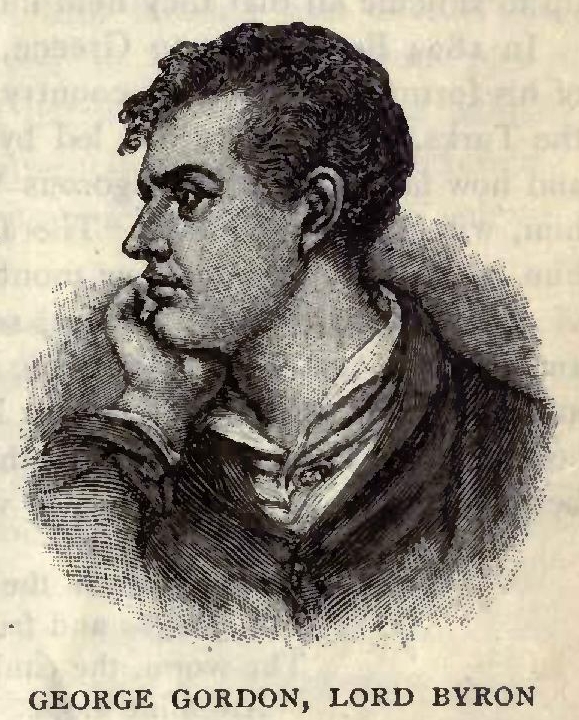
GEORGE GORDON, LORD BYRON
In 1809 Byron, when only twenty-one years of age, started on a tour of
Europe and the Orient. The poetic results of this trip were the first two
cantos of Childe Harold's Pilgrimage, with their famous
descriptions of romantic scenery. The work made him instantly popular, and
his fame overshadowed Scott's completely. As he says himself, "I awoke one
morning to find myself famous," and presently he styles himself "the grand
Napoleon of the realms of rhyme." The worst element in Byron at this time
was his insincerity, his continual posing as the hero of his poetry. His
best works were translated, and his fame spread almost as rapidly on the
Continent as in England. Even Goethe was deceived, and declared that a man
so wonderful in character had never before appeared in literature, and
would never appear again. Now that the tinsel has worn off, and we can
judge the man and his work dispassionately, we see how easily even the
critics of the age were governed by romantic impulses.
The adulation of Byron lasted only a few years in England. In 1815 he
married Miss Milbanke, an English heiress, who abruptly left him a year
later. With womanly reserve she kept silence; but the public was not slow
to imagine plenty of reasons for the separation. This, together with the
fact that men had begun to penetrate the veil of romantic secrecy with
which Byron surrounded himself and found a rather brassy idol beneath,
turned the tide of public opinion against him. He left England under a
cloud of distrust and disappointment, in 1816, and never returned. Eight
years were spent abroad, largely in Italy, where he was associated with
Shelley until the latter's tragic death in 1822. His house was ever the
meeting place for Revolutionists and malcontents calling themselves
patriots, whom he trusted too greatly, and with whom he shared his money
most generously. Curiously enough, while he trusted men too easily, he had
no faith in human society or government, and wrote in 1817: "I have
simplified my politics to an utter detestation of all existing
governments." During his exile he finished Childe Harold, The Prisoner
of Chillon, his dramas Cain and Manfred, and numerous
other works, in some of which, as in Don Juan, he delighted in
revenging himself upon his countrymen by holding up to ridicule all that
they held most sacred.
In 1824 Byron went to Greece to give himself and a large part of his
fortune to help that country in its struggle for liberty against the
Turks. How far he was led by his desire for posing as a hero, and how far
by a certain vigorous Viking spirit that was certainly in him, will never
be known. The Greeks welcomed him and made him a leader, and for a few
months he found himself in the midst of a wretched squabble of lies,
selfishness, insincerity, cowardice, and intrigue, instead of the heroic
struggle for liberty which he had anticipated. He died of fever, in
Missolonghi, in 1824. One of his last poems, written there on his
thirty-sixth birthday, a few months before he died, expresses his own view
of his disappointing life:
My days are in the yellow leaf,
The flowers and fruits of love are
gone:
The worm, the canker, and the grief
Are
mine alone.
Works of Byron. In reading Byron it is well to remember that he was
a disappointed and embittered man, not only in his personal life, but also
in his expectation of a general transformation of human society. As he
pours out his own feelings, chiefly, in his poetry, he is the most
expressive writer of his age in voicing the discontent of a multitude of
Europeans who were disappointed at the failure of the French Revolution to
produce an entirely new form of government and society.
Hours of IdlenessOne who wishes to
understand the whole scope of Byron's genius and poetry will do well to
begin with his first work, Hours of Idleness, written when he was a
young man at the university. There is very little poetry in the volume,
only a striking facility in rime, brightened by the devil-may-care spirit
of the Cavalier poets; but as a revelation of the man himself it is
remarkable. In a vain and sophomoric preface he declares that poetry is to
him an idle experiment, and that this is his first and last attempt to
amuse himself in that line. Curiously enough, as he starts for Greece on
his last, fatal journey, he again ridicules literature, and says that the
poet is a "mere babbler." It is this despising of the art which alone
makes him famous that occasions our deepest disappointment. Even in his
magnificent passages, in a glowing description of nature or of a Hindoo
woman's exquisite love, his work is frequently marred by a wretched pun,
or by some cheap buffoonery, which ruins our first splendid impression of
his poetry.
Longer PoemsByron's later volumes, Manfred
and Cain, the one a curious, and perhaps unconscious, parody of Faust,
the other of Paradise Lost, are his two best known dramatic works.
Aside from the question of their poetic value, they are interesting as
voicing Byron's excessive individualism and his rebellion against society.
The best known and the most readable of Byron's works Mazeppa, The
Prisoner of Chillon, and Childe Harold's Pilgrimage. The first
two cantos of Childe Harold (1812) are perhaps more frequently read
than any other work of the same author, partly because of their melodious
verse, partly because of their descriptions of places along the lines of
European travel; but the last two cantos (1816-1818) written after his
exile from England, have more sincerity, and are in every way better
expressions of Byron's mature genius. Scattered through all his works one
finds magnificent descriptions of natural scenery, and exquisite lyrics of
love and despair; but they are mixed with such a deal of bombast and
rhetoric, together with much that is unwholesome, that the beginner will
do well to confine himself to a small volume of well-chosen selections.[227]
Byron is often compared with Scott, as having given to us Europe and the
Orient, just as Scott gave us Scotland and its people; but while there is
a certain resemblance in the swing and dash of the verses, the resemblance
is all on the surface, and the underlying difference between the two poets
is as great as that between Thackeray and Bulwer-Lytton. Scott knew his
country well,--its hills and valleys which are interesting as the abode of
living and lovable men and women. Byron pretended to know the secret,
unwholesome side of Europe, which generally hides itself in the dark; but
instead of giving us a variety of living men, he never gets away from his
own unbalanced and egotistical self. All his characters, in Cain,
Manfred, The Corsair, The Giaour, Childe Harold, Don Juan, are
tiresome repetitions of himself,--a vain, disappointed, cynical man, who
finds no good in life or love or anything. Naturally, with such a
disposition, he is entirely incapable of portraying a true woman. To
nature alone, especially in her magnificent moods, Byron remains faithful;
and his portrayal of the night and the storm and the ocean in Childe
Harold are unsurpassed in our language.
PERCY BYSSHE SHELLEY (1792-1822)
Make me thy lyre, even as the forest is:
What
if my leaves are falling like its own!
The tumult of thy mighty
harmonies
Will take from both a deep,
autumnal tone,
Sweet though in sadness. Be thou, spirit fierce,
My spirit! Be thou me, impetuous one!
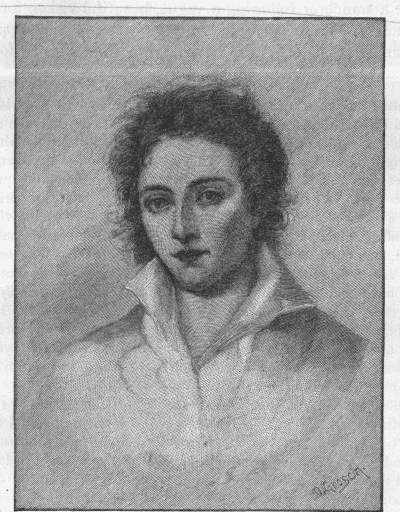
PERCY BYSSHE SHELLEY
In this fragment, from the "Ode to the West Wind," we have a suggestion of
Shelley's own spirit, as reflected in all his poetry. The very spirit of
nature, which appeals to us in the wind and the cloud, the sunset and the
moonrise, seems to have possessed him, at times, and made him a chosen
instrument of melody. At such times he is a true poet, and his work is
unrivaled. At other times, unfortunately, Shelley joins with Byron in
voicing a vain rebellion against society. His poetry, like his life,
divides itself into two distinct moods. In one he is the violent reformer,
seeking to overthrow our present institutions and to hurry the millennium
out of its slow walk into a gallop. Out of this mood come most of his
longer poems, like Queen Mab, Revolt of Islam, Hellas, and The
Witch of Atlas, which are somewhat violent diatribes against
government, priests, marriage, religion, even God as men supposed him to
be. In a different mood, which finds expression Alastor, Adonais,
and his wonderful lyrics, Shelley is like a wanderer following a vague,
beautiful vision, forever sad and forever unsatisfied. In the latter mood
he appeals profoundly to all men who have known what it is to follow after
an unattainable ideal.
Shelley's Life. There are three classes of men who see visions, and
all three are represented in our literature. The first is the mere
dreamer, like Blake, who stumbles through a world of reality without
noticing it, and is happy in his visions. The second is the seer, the
prophet, like Langland, or Wyclif, who sees a vision and quietly goes to
work, in ways that men understand, to make the present world a little more
like the ideal one which he sees in his vision. The third, who appears in
many forms,--as visionary, enthusiast, radical, anarchist, revolutionary,
call him what you will,--sees a vision and straightway begins to tear down
all human institutions, which have been built up by the slow toil of
centuries, simply because they seem to stand in the way of his dream. To
the latter class belongs Shelley, a man perpetually at war with the
present world, a martyr and exile, simply because of his inability to
sympathize with men and society as they are, and because of his own
mistaken judgment as to the value and purpose of a vision.
Shelley was born in Field Place, near Horsham, Sussex, in 1792. On both
his father's and his mother's side he was descended from noble old
families, famous in the political and literary history of England. From
childhood he lived, like Blake, in a world of fancy, so real that certain
imaginary dragons and headless creatures of the neighboring wood kept him
and his sisters in a state of fearful expectancy. He learned rapidly,
absorbed the classics as if by intuition, and, dissatisfied with ordinary
processes of learning, seems to have sought, like Faustus, the
acquaintance of spirits, as shown in his "Hymn to Intellectual Beauty":
While yet a boy, I sought for ghosts, and sped
Through
many a listening chamber, cave and ruin,
And
starlight wood, with fearful steps pursuing
Hopes of high talk with
the departed dead.
Shelley's first public school, kept by a hard-headed Scotch master, with
its floggings and its general brutality, seemed to him like a combination
of hell and prison; and his active rebellion against existing institutions
was well under way when, at twelve years of age, he entered the famous
preparatory school at Eton. He was a delicate, nervous, marvelously
sensitive boy, of great physical beauty; and, like Cowper, he suffered
torments at the hands of his rough schoolfellows. Unlike Cowper, he was
positive, resentful, and brave to the point of rashness; soul and body
rose up against tyranny; and he promptly organized a rebellion against the
brutal fagging system. "Mad Shelley" the boys called him, and they chivied
him like dogs around a little coon that fights and cries defiance to the
end. One finds what he seeks in this world, and it is not strange that
Shelley, after his Eton experiences, found causes for rebellion in all
existing forms of human society, and that he left school "to war among
mankind," as he says of himself in the Revolt of Islam. His
university days are but a repetition of his earlier experiences. While a
student at Oxford he read some scraps of Hume's philosophy, and
immediately published a pamphlet called "The Necessity of Atheism." It was
a crude, foolish piece of work, and Shelley distributed it by post to
every one to whom it might give offense. Naturally this brought on a
conflict with the authorities, but Shelley would not listen to reason or
make any explanation, and was expelled from the university in 1811.
Shelley's marriage was even more unfortunate. While living in London, on a
generous sister's pocket money, a certain young schoolgirl, Harriet
Westbrook, was attracted by Shelley's crude revolutionary doctrines. She
promptly left school, as her own personal part in the general rebellion,
and refused to return or even to listen to her parents upon the subject.
Having been taught by Shelley, she threw herself upon his protection; and
this unbalanced couple were presently married, as they said, "in deference
to anarch custom." The two infants had already proclaimed a rebellion
against the institution of marriage, for which they proposed to substitute
the doctrine of elective affinity. For two years they wandered about
England, Ireland, and Wales, living on a small allowance from Shelley's
father, who had disinherited his son because of his ill-considered
marriage. The pair soon separated, and two years later Shelley, having
formed a strong friendship with one Godwin,--a leader of young enthusiasts
and a preacher of anarchy,--presently showed his belief in Godwin's
theories by eloping with his daughter Mary. It is a sad story, and the
details were perhaps better forgotten. We should remember that in Shelley
we are dealing with a tragic blend of high-mindedness and
light-headedness. Byron wrote of him, "The most gentle, the most amiable,
and the least worldly-minded person I ever met!"
Led partly by the general hostility against him, and partly by his own
delicate health, Shelley went to Italy in 1818, and never returned to
England. After wandering over Italy he finally settled in Pisa, beloved of
so many English poets,--beautiful, sleepy Pisa, where one looks out of his
window on the main street at the busiest hour of the day, and the only
living thing in sight is a donkey, dozing lazily, with his head in the
shade and his body in the sunshine. Here his best poetry was written, and
here he found comfort in the friendship of Byron, Hunt, and Trelawney, who
are forever associated with Shelley's Italian life. He still remained
hostile to English social institutions; but life is a good teacher, and
that Shelley dimly recognized the error of his rebellion is shown in the
increasing sadness of his later poems:
O world, O life, O time!
On whose last steps I climb,
Trembling
at that where I had stood before;
When will return the glory of
your prime?
No more--oh, never more!
Out of the day and night
A joy has taken flight;
Fresh
spring, and summer, and winter hoar,
Move my faint heart with
grief, but with delight
No more--oh, never
more!
In 1822, when only thirty years of age, Shelley was drowned while sailing
in a small boat off the Italian coast. His body was washed ashore several
days later, and was cremated, near Viareggio, by his friends, Byron, Hunt,
and Trelawney. His ashes might, with all reverence, have been given to the
winds that he loved and that were a symbol of his restless spirit;
instead, they found a resting place near the grave of Keats, in the
English cemetery at Rome. One rarely visits the spot now without finding
English and American visitors standing in silence before the significant
inscription, Cor Cordium.
Works of Shelley. As a lyric poet, Shelley is one of the supreme
geniuses of our literature; and the reader will do well to begin with the
poems which show him at his very best. "The Cloud," "To a Skylark," "Ode
to the West Wind," "To Night,"--poems like these must surely set the
reader to searching among Shelley's miscellaneous works, to find for
himself the things "worthy to be remembered."
AlastorIn reading Shelley's longer poems
one must remember that there are in this poet two distinct men: one, the
wanderer, seeking ideal beauty and forever unsatisfied; the other, the
unbalanced reformer, seeking the overthrow of present institutions and the
establishment of universal happiness. Alastor, or the Spirit of
Solitude (1816) is by far the best expression of Shelley's greater
mood. Here we see him wandering restlessly through the vast silences of
nature, in search of a loved dream-maiden who shall satisfy his love of
beauty. Here Shelley is the poet of the moonrise, and of the tender
exquisite fancies that can never be expressed. The charm of the poem lies
in its succession of dreamlike pictures; but it gives absolutely no
impressions of reality. It was written when Shelley, after his long
struggle, had begun to realize that the world was too strong for him. Alastor
is therefore the poet's confession, not simply of failure, but of undying
hope in some better thing that is to come.
PrometheusPrometheus Unbound
(1818-1820), a lyrical drama, is the best work of Shelley's revolutionary
enthusiasm, and the most characteristic of all his poems. Shelley's
philosophy (if one may dignify a hopeless dream by such a name) was a
curious aftergrowth of the French Revolution, namely, that it is only the
existing tyranny of State, Church, and society which keeps man from growth
into perfect happiness. Naturally Shelley forgot, like many other
enthusiasts, that Church and State and social laws were not imposed upon
man from without, but were created by himself to minister to his
necessities. In Shelley's poem the hero, Prometheus, represents mankind
itself,--a just and noble humanity, chained and tortured by Jove, who is
here the personification of human institutions.[228] In due time Demogorgon (which is
Shelley's name for Necessity) overthrows the tyrant Jove and releases
Prometheus (Mankind), who is presently united to Asia, the spirit of love
and goodness in nature, while the earth and the moon join in a wedding
song, and everything gives promise that they shall live together happy
ever afterwards.
Shelley here looks forward, not back, to the Golden Age, and is the
prophet of science and evolution. If we compare his Titan with similar
characters in Faust and Cain, we shall find this interesting
difference,--that while Goethe's Titan is cultured and self-reliant, and
Byron's stoic and hopeless, Shelley's hero is patient under torture,
seeing help and hope beyond his suffering. And he marries Love that the
earth may be peopled with superior beings who shall substitute brotherly
love for the present laws and conventions of society. Such is his
philosophy; but the beginner will read this poem, not chiefly for its
thought, but for its youthful enthusiasm, for its marvelous imagery, and
especially for its ethereal music. Perhaps we should add here that Prometheus
is, and probably always will be, a poem for the chosen few who can
appreciate its peculiar spiritlike beauty. In its purely pagan conception
of the world, it suggests, by contrast, Milton's Christian philosophy in
Paradise Regained.
Shelley's revolutionary works, Queen Mab (1813), The Revolt of
Islam (1818), Hellas (1821), and The Witch of Atlas
(1820), are to be judged in much the same way as is Prometheus Unbound.
They are largely invectives against religion, marriage, kingcraft, and
priestcraft, most impractical when considered as schemes for reform, but
abounding in passages of exquisite beauty, for which alone they are worth
reading. In the drama called The Cenci (1819), which is founded
upon a morbid Italian story, Shelley for the first and only time descends
to reality. The heroine, Beatrice, driven to desperation by the monstrous
wickedness of her father, kills him and suffers the death penalty in
consequence. She is the only one of Shelley's characters who seems to us
entirely human.
Adonais Far different in character is Epipsychidion
(1821), a rhapsody celebrating Platonic love, the most impalpable, and so
one of the most characteristic, of all Shelley's works. It was inspired by
a beautiful Italian girl, Emilia Viviani, who was put into a cloister
against her will, and in whom Shelley imagined he found his long-sought
ideal of womanhood. With this should be read Adonais (1821), the
best known of all Shelley's longer poems. Adonais is a wonderful
threnody, or a song of grief, over the death of the poet Keats. Even in
his grief Shelley still preserves a sense of unreality, and calls in many
shadowy allegorical figures,--Sad Spring, Weeping Hours, Glooms,
Splendors, Destinies,--all uniting in bewailing the loss of a loved one.
The whole poem is a succession of dream pictures, exquisitely beautiful,
such as only Shelley could imagine; and it holds its place with Milton's
Lycidas and Tennyson's In Memoriam as one of the three
greatest elegies in our language.
Shelley and Wordsworth In his
interpretation of nature Shelley suggests Wordsworth, both by resemblance
and by contrast. To both poets all natural objects are symbols of truth;
both regard nature as permeated by the great spiritual life which animates
all things; but while Wordsworth finds a spirit of thought, and so of
communion between nature and the soul of man, Shelley finds a spirit of
love, which exists chiefly for its own delight; and so "The Cloud," "The
Skylark," and "The West Wind," three of the most beautiful poems in our
language, have no definite message for humanity. In his "Hymn to
Intellectual Beauty" Shelley is most like Wordsworth; but in his
"Sensitive Plant," with its fine symbolism and imagery, he is like nobody
in the world but himself. Comparison is sometimes an excellent thing; and
if we compare Shelley's exquisite "Lament," beginning "O world, O life, O
time," with Wordsworth's "Intimations of Immortality," we shall perhaps
understand both poets better. Both poems recall many happy memories of
youth; both express a very real mood of a moment; but while the beauty of
one merely saddens and disheartens us, the beauty of the other inspires us
with something of the poet's own faith and hopefulness. In a word,
Wordsworth found and Shelley lost himself in nature.
JOHN KEATS (1795-1821)
Keats was not only the last but also the most perfect of the Romanticists.
While Scott was merely telling stories, and Wordsworth reforming poetry or
upholding the moral law, and Shelley advocating impossible reforms, and
Byron voicing his own egoism and the political discontent of the times,
Keats lived apart from men and from all political measures, worshiping
beauty like a devotee, perfectly content to write what was in his own
heart, or to reflect some splendor of the natural world as he saw or
dreamed it to be. He had, moreover, the novel idea that poetry exists for
its own sake, and suffers loss by being devoted to philosophy or politics
or, indeed, to any cause, however great or small. As he says in "Lamia":
...
Do not all charms fly
At the mere touch of cold philosophy?
There was an awful rainbow once in heaven:
We know her woof, her
texture; she is given
In the dull catalogue of common things.
Philosophy will clip an Angel's wings,
Conquer all mysteries by
rule and line,
Empty the haunted air, and gnomed mine--
Unweave a rainbow, as it erewhile made
The tender-person'd Lamia
melt into a shade.
Partly because of this high ideal of poetry, partly because he studied and
unconsciously imitated the Greek classics and the best works of the
Elizabethans, Keats's last little volume of poetry is unequaled by the
work of any of his contemporaries. When we remember that all his work was
published in three short years, from 1817 to 1820, and that he died when
only twenty-five years old, we must judge him to be the most promising
figure of the early nineteenth century, and one of the most remarkable in
the history of literature.
Life. Keats's life of devotion to beauty and to poetry is all the
more remarkable in view of his lowly origin. He was the son of a hostler
and stable keeper, and was born in the stable of the Swan and Hoop Inn,
London, in 1795. One has only to read the rough stable scenes from our
first novelists, or even from Dickens, to understand how little there was
in such an atmosphere to develop poetic gifts. Before Keats was fifteen
years old both parents died, and he was placed with his brothers and
sisters in charge of guardians. Their first act seems to have been to take
Keats from school at Enfield, and to bind him as an apprentice to a
surgeon at Edmonton. For five years he served his apprenticeship, and for
two years more he was surgeon's helper in the hospitals; but though
skillful enough to win approval, he disliked his work, and his thoughts
were on other things. "The other day, during a lecture," he said to a
friend, "there came a sunbeam into the room, and with it a whole troop of
creatures floating in the ray; and I was off with them to Oberon and
fairyland." A copy of Spenser's Faery Queen, which had been given
him by Charles Cowden Clark, was the prime cause of his abstraction. He
abandoned his profession in 1817, and early in the same year published his
first volume of Poems. It was modest enough in spirit, as was also
his second volume, Endymion (1818); but that did not prevent brutal
attacks upon the author and his work by the self-constituted critics of Blackwood's
Magazine and the Quarterly. It is often alleged that the poet's
spirit and ambition were broken by these attacks;[229] but Keats was a man of strong
character, and instead of quarreling with his reviewers, or being crushed
by their criticism, he went quietly to work with the idea of producing
poetry that should live forever. As Matthew Arnold says, Keats "had flint
and iron in him"; and in his next volume he accomplished his own purpose
and silenced unfriendly criticism.
For the three years during which Keats wrote his poetry he lived chiefly
in London and in Hampstead, but wandered at times over England and
Scotland, living for brief spaces in the Isle of Wight, in Devonshire, and
in the Lake district, seeking to recover his own health, and especially to
restore that of his brother. His illness began with a severe cold, but
soon developed into consumption; and added to this sorrow was
another,--his love for Fannie Brawne, to whom he was engaged, but whom he
could not marry on account of his poverty and growing illness. When we
remember all this personal grief and the harsh criticism of literary men,
the last small volume, Lamia, Isabella, The Eve of St. Agnes, and Other
Poems (1820), is most significant, as showing not only Keats's
wonderful poetic gifts, but also his beautiful and indomitable spirit.
Shelley, struck by the beauty and promise of "Hyperion," sent a generous
invitation to the author to come to Pisa and live with him; but Keats
refused, having little sympathy with Shelley's revolt against society. The
invitation had this effect, however, that it turned Keats's thoughts to
Italy, whither he soon went in the effort to save his life. He settled in
Rome with his friend Severn, the artist, but died soon after his arrival,
in February, 1821. His grave, in the Protestant cemetery at Rome, is still
an object of pilgrimage to thousands of tourists; for among all our poets
there is hardly another whose heroic life and tragic death have so
appealed to the hearts of poets and young enthusiasts.
The Work of Keats. "None but the master shall praise us; and none
but the master shall blame" might well be written on the fly leaf of every
volume of Keats's poetry; for never was there a poet more devoted to his
ideal, entirely independent of success or failure. In strong contrast with
his contemporary, Byron, who professed to despise the art that made him
famous, Keats lived for poetry alone, and, as Lowell pointed out, a virtue
went out of him into everything he wrote. In all his work we have the
impression of this intense loyalty to his art; we have the impression also
of a profound dissatisfaction that the deed falls so far short of the
splendid dream. Thus after reading Chapman's translation of Homer he
writes:
Much have I travelled in the realms of gold,
And many goodly states
and kingdoms seen;
Round many western islands have I been
Which bards in fealty to Apollo hold.
Oft of one wide expanse had I
been told
That deep-browed Homer ruled as his demesne;
Yet did
I never breathe its pure serene
Till I heard Chapman speak out loud
and bold:
Then felt I like some watcher of the skies
When a
new planet swims into his ken;
Or like stout Cortez when with eagle
eyes
He stared at the Pacific--and all his men
Looked at each
other with a wild surmise--
Silent, upon a peak in Darien.
In this striking sonnet we have a suggestion of Keats's high ideal, and of
his sadness because of his own ignorance, when he published his first
little volume of poems in 1817. He knew no Greek; yet Greek literature
absorbed and fascinated him, as he saw its broken and imperfect reflection
in an English translation. Like Shakespeare, who also was but poorly
educated in the schools, he had a marvelous faculty of discerning the real
spirit of the classics,--a faculty denied to many great scholars, and to
most of the "classic" writers of the preceding century,--and so he set
himself to the task of reflecting in modern English the spirit of the old
Greeks.
The imperfect results of this attempt are seen in his next volume, Endymion,
which is the story of a young shepherd beloved by a moon goddess. The poem
begins with the striking lines:
A thing of beauty is a joy forever;
Its loveliness increases; it
will never
Pass into nothingness; but still will keep
A bower
quiet for us; and a sleep
Full of sweet dreams, and health, and
quiet breathing,
which well illustrate the spirit of Keats's later work, with its perfect
finish and melody. It has many quotable lines and passages, and its "Hymn
to Pan" should be read in connection with Wordsworth's famous sonnet
beginning, "The world is too much with us." The poem gives splendid
promise, but as a whole it is rather chaotic, with too much ornament and
too little design, like a modern house. That Keats felt this defect
strongly is evident from his modest preface, wherein he speaks of Endymion,
not as a deed accomplished, but only as an unsuccessful attempt to suggest
the underlying beauty of Greek mythology.
Lamia and Other Poems Keats's third and
last volume, Lamia, Isabella, The Eve of St. Agnes, and Other Poems
(1820), is the one with which the reader should begin his acquaintance
with this master of English verse. It has only two subjects, Greek
mythology and mediæval romance. "Hyperion" is a magnificent
fragment, suggesting the first arch of a cathedral that was never
finished. Its theme is the overthrow of the Titans by the young sun-god
Apollo. Realizing his own immaturity and lack of knowledge, Keats laid
aside this work, and only the pleadings of his publisher induced him to
print the fragment with his completed poems.
Throughout this last volume, and especially in "Hyperion," the influence
of Milton is apparent, while Spenser is more frequently suggested in
reading Endymion.
Of the longer poems in the volume, "Lamia" is the most suggestive. It is
the story of a beautiful enchantress, who turns from a serpent into a
glorious woman and fills every human sense with delight, until, as a
result of the foolish philosophy of old Apollonius, she vanishes forever
from her lover's sight. "The Eve of St. Agnes," the most perfect of
Keats's mediæval poems, is not a story after the manner of the
metrical romances, but rather a vivid painting of a romantic mood, such as
comes to all men, at times, to glorify a workaday world. Like all the work
of Keats and Shelley, it has an element of unreality; and when we read at
the end,
And they are gone; aye, ages long ago
These lovers fled away into
the storm,
it is as if we were waking from a dream,--which is the only possible
ending to all of Keats's Greek and mediæval fancies. We are to
remember, however, that no beautiful thing, though it be intangible as a
dream, can enter a man's life and leave him quite the same afterwards.
Keats's own word is here suggestive. "The imagination," he said, "may be
likened to Adam's dream; he awoke and found it true."
It is by his short poems that Keats is known to the majority of
present-day readers. Among these exquisite shorter poems we mention only
the four odes, "On a Grecian Urn," "To a Nightingale," "To Autumn," and
"To Psyche." These are like an invitation to a feast; one who reads them
will hardly be satisfied until he knows more of such delightful poetry.
Those who study only the "Ode to a Nightingale" may find four things,--a
love of account, when he paused in the crowded street tears would spring
to his eyes,--tears of pure pleasure at the abundance of so much good
life; and when he wrote, he simply interpreted that crowded human life of
joy and sorrow, as Wordsworth interpreted the woods and waters, without
any desire to change or to reform them. He has given us the best pictures
we possess of Coleridge, Hazlitt, Landor, Hood, Cowden Clarke, and many
more of the interesting men and women of his age; and it is due to his
insight and sympathy that the life of those far-off days seems almost as
real to us as if we ourselves remembered it. Of all our English essayists
he is the most lovable; partly because of his delicate, old-fashioned
style and humor, but more because of that cheery and heroic struggle
against misfortune which shines like a subdued light in all his writings.
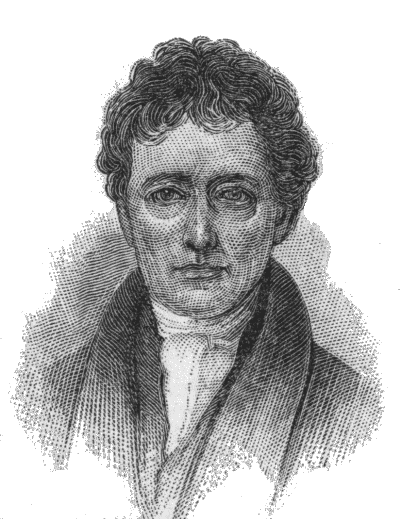
CHARLES
LAMB
Life. In the very heart of London there is a curious, old-fashioned
place known as the Temple,--an enormous, rambling, apparently forgotten
structure, dusty and still, in the midst of the endless roar of the city
streets. Originally it was a chapter house of the Knights Templars, and so
suggests to us the spirit of the Crusades and of the Middle Ages; but now
the building is given over almost entirely to the offices and lodgings of
London lawyers. It is this queer old place which, more than all others, is
associated with the name of Charles Lamb. "I was born," he says, "and
passed the first seven years of my life in the Temple. Its gardens, its
halls, its fountain, its river... these are my oldest recollections." He
was the son of a poor clerk, or rather servant, of one of the barristers,
and was the youngest of seven children, only three of whom survived
infancy. Of these three, John, the elder, was apparently a selfish
creature, who took no part in the heroic struggle of his brother and
sister. At seven years, Charles was sent to the famous "Bluecoat" charity
school of Christ's Hospital. Here he remained seven years; and here he
formed his lifelong friendship for another poor, neglected boy, whom the
world remembers as Coleridge.[230]
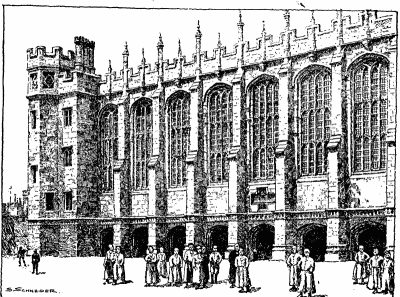
CHRIST'S HOSPITAL, LONDON
When only fourteen years old, Lamb left the charity school and was soon at
work as a clerk in the South Sea House. Two years later he became a clerk
in the famous India House, where he worked steadily for thirty-three
years, with the exception of six weeks, in the winter of 1795-1796, spent
within the walls of an asylum. In 1796 Lamb's sister Mary, who was as
talented and remarkable as Lamb himself, went violently insane and killed
her own mother. For a long time after this appalling tragedy she was in an
asylum at Hoxton; then Lamb, in 1797, brought her to his own little house,
and for the remainder of his life cared for her with a tenderness and
devotion which furnishes one of the most beautiful pages in our literary
history. At times the malady would return to Mary, giving sure warning of
its terrible approach; and then brother and sister might be seen walking
silently, hand in hand, to the gates of the asylum, their cheeks wet with
tears. One must remember this, as well as Lamb's humble lodgings and the
drudgery of his daily work in the-big commercial house, if he would
appreciate the pathos of "The Old Familiar Faces," or the heroism which
shines through the most human and the most delightful essays in our
language.
When Lamb was fifty years of age the East India Company, led partly by his
literary fame following his first Essays of Elia, and partly by his
thirty-three years of faithful service, granted him a comfortable pension;
and happy as a boy turned loose from school he left India House forever to
give himself up to literary work.[231] He wrote to Wordsworth, in April, 1825, "I
came home forever on Tuesday of last week--it was like passing from
life into eternity." Curiously enough Lamb seems to lose power after his
release from drudgery, and his last essays, published in 1833, lack
something of the grace and charm of his earlier work. He died at Edmonton
in 1834; and his gifted sister Mary sank rapidly into the gulf from which
his strength and gentleness had so long held her back. No literary man was
ever more loved and honored by a rare circle of friends; and all who knew
him bear witness to the simplicity and goodness which any reader may find
for himself between the lines of his essays.
Works. The works of Lamb divide themselves naturally into three
periods. First, there are his early literary efforts, including the poems
signed "C. L." in Coleridge's Poems on Various Subjects (1796); his
romance Rosamund Gray (1798); his poetical drama John Woodvil
(1802); and various other immature works in prose and poetry. This period
comes to an end in 1803, when he gave up his newspaper work, especially
the contribution of six jokes, puns, and squibs daily to the Morning
Post at sixpence apiece. The second period was given largely to
literary criticism; and the Tales from Shakespeare (1807)--written
by Charles and Mary Lamb, the former reproducing the tragedies, and the
latter the comedies--may be regarded as his first successful literary
venture. The book was written primarily for children; but so thoroughly
had brother and sister steeped themselves in the literature of the
Elizabethan period that young and old alike were delighted with this new
version of Shakespeare's stories, and the Tales are still regarded
as the best of their kind in our literature. In 1808 appeared his Specimens
of English Dramatic Poets Contemporary with Shakespeare. This carried
out the splendid critical work of Coleridge, and was the most noticeable
influence in developing the poetic qualities of Keats, as shown in his
last volume.
Essays of EliaThe third period includes
Lamb's criticisms of life, which are gathered together in his Essays of
Elia (1823), and his Last Essays of Elia, which were published
ten years later. These famous essays began in 1820 with the appearance of
the new London Magazine[232] and were continued for many years, such
subjects as the "Dissertation on Roast Pig," "Old China," "Praise of
Chimney Sweepers," "Imperfect Sympathies," "A Chapter on Ears," "Mrs.
Battle's Opinions on Whist," "Mackery End," "Grace Before Meat," "Dream
Children," and many others being chosen apparently at random, but all
leading to a delightful interpretation of the life of London, as it
appeared to a quiet little man who walked unnoticed through its crowded
streets. In the first and last essays which we have mentioned,
"Dissertation on Roast Pig" and "Dream Children," we have the extremes of
Lamb's humor and pathos.
Lamb's styleThe style of all these essays
is gentle, old-fashioned, irresistibly attractive. Lamb was especially
fond of old writers and borrowed unconsciously from the style of Burton's
Anatomy of Melancholy and from Browne's Religio Medici and
from the early English dramatists. But this style had become a part of
Lamb by long reading, and he was apparently unable to express his new
thought without using their old quaint expressions. Though these essays
are all criticisms or appreciations of the life of his age, they are all
intensely personal. In other words, they are an excellent picture of Lamb
and of humanity. Without a trace of vanity or self-assertion, Lamb begins
with himself, with some purely personal mood or experience, and from this
he leads the reader to see life and literature as he saw it. It is this
wonderful combination of personal and universal interests, together with
Lamb's rare old style and quaint humor, which make the essays remarkable.
They continue the best tradition of Addison and Steele, our first great
essayists; but their sympathies are broader and deeper, and their humor
more delicious than any which preceded them.
THOMAS DE QUINCY (1785-1859)
In De Quincey the romantic element is even more strongly developed than in
Lamb, not only in his critical work, but also in his erratic and
imaginative life. He was profoundly educated, even more so than Coleridge,
and was one of the keenest intellects of the age; yet his wonderful
intellect seems always subordinate to his passion for dreaming. Like Lamb,
he was a friend and associate of the Lake poets, making his headquarters
in Wordsworth's old cottage at Grasmere for nearly twenty years. Here the
resemblance ceases, and a marked contrast begins. As a man, Lamb is the
most human and lovable of all our essayists; while De Quincey is the most
uncanny and incomprehensible. Lamb's modest works breathe the two
essential qualities of sympathy and humor; the greater number of De
Quincey's essays, while possessing more or less of both these qualities,
are characterized chiefly by their brilliant style. Life, as seen through
De Quincey's eyes, is nebulous and chaotic, and there is a suspicion of
the fabulous in all that he wrote. Even in The Revolt of the Tartars
the romantic element is uppermost, and in much of De Quincey's prose the
element of unreality is more noticeable than in Shelley's poetry. Of his
subject-matter, his facts, ideas, and criticisms, we are generally
suspicious; but of his style, sometimes stately and sometimes headlong,
now gorgeous as an Oriental dream, now musical as Keats's Endymion,
and always, even in the most violent contrasts, showing a harmony between
the idea and the expression such as no other English writer, with the
possible exception of Newman, has ever rivaled,--say what you will of the
marvelous brilliancy of De Quincey's style, you have still only half
expressed the truth. It is the style alone which makes these essays
immortal.
Life. De Quincey was born in Manchester in 1785. In neither his
father, who was a prosperous merchant, nor his mother, who was a quiet,
unsympathetic woman, do we see any suggestion of the son's almost uncanny
genius. As a child he was given to dreams, more vivid and intense but less
beautiful than those of the young Blake to whom he bears a strong
resemblance. In the grammar school at Bath he displayed astonishing
ability, and acquired Greek and Latin with a rapidity that frightened his
slow tutors. At fifteen he not only read Greek, but spoke it fluently; and
one of his astounded teachers remarked, "That boy could harangue an
Athenian mob better than you or I could address an English one." From the
grammar school at Manchester, whither he was sent in 1800, he soon ran
away, finding the instruction far below his abilities, and the rough life
absolutely intolerable to his sensitive nature. An uncle, just home from
India, interceded for the boy lest he be sent back to the school, which he
hated; and with an allowance of a guinea a week he started a career of
vagrancy, much like that of Goldsmith, living on the open hills, in the
huts of shepherds and charcoal burners, in the tents of gypsies, wherever
fancy led him. His fear of the Manchester school finally led him to run
away to London, where, without money or friends, his life was even more
extraordinary than his gypsy wanderings. The details of this vagrancy are
best learned in his Confessions of an English Opium-Eater, where we
meet not simply the facts of his life, but also the confusion of dreams
and fancies in the midst of which he wandered like a man lost on the
mountains, with storm clouds under his feet hiding the familiar earth.
After a year of vagrancy and starvation he was found by his family and
allowed to go to Oxford, where his career was marked by the most brilliant
and erratic scholarship. When ready for a degree, in 1807, he passed his
written tests successfully, but felt a sudden terror at the thought of the
oral examination and disappeared from the university, never to return.
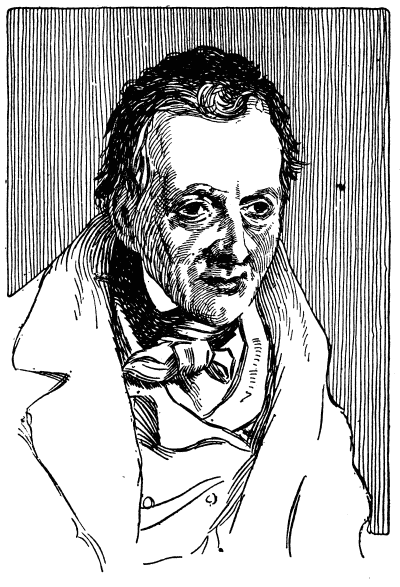
THOMAS DE QUINCEY
It was in Oxford that De Quincey began the use of opium; to relieve the
pains of neuralgia, and the habit increased until he was an almost
hopeless slave to the drug. Only his extraordinary will power enabled him
to break away from the habit, after some thirty years of misery. Some
peculiarity of his delicate constitution enabled De Quincey to take
enormous quantities of opium, enough to kill several ordinary men; and it
was largely opium, working upon a sensitive imagination, which produced
his gorgeous dreams, broken by intervals of weakness and profound
depression. For twenty years he resided at Grasmere in the companionship
of the Lake poets; and here, led by the loss of his small fortune, he
began to write, with the idea of supporting his family. In 1821 he
published his first famous work, the Confessions of an English
Opium-Eater, and for nearly forty years afterwards he wrote
industriously, contributing to various magazines an astonishing number of
essays on a great variety of subjects. Without thought of literary fame,
he contributed these articles anonymously; but fortunately, in 1853, he
began to collect his own works, and the last of fourteen volumes was
published just after his death.
In 1830, led by his connection with Blackwood's Magazine, to which
he was the chief contributor, De Quincey removed with his family to
Edinburgh, where his erratic genius and his singularly childlike ways
produced enough amusing anecdotes to fill a volume. He would take a room
in some place unknown to his friends and family; would live in it for a
few years, until he had filled it, even to the bath tub, with books and
with his own chaotic manuscripts, allowing no one to enter or disturb his
den; and then, when the place became too crowded, he would lock the door
and go away and take another lodging, where he repeated the same
extraordinary performance. He died in Edinburgh in 1859. Like Lamb, he was
a small, boyish figure, gentle, and elaborately courteous. Though
excessively shy, and escaping as often as possible to solitude, he was
nevertheless fond of society, and his wide knowledge and vivid imagination
made his conversations almost as prized as those of his friend Coleridge.
Works. De Quincey's works may be divided into two general classes.
The first includes his numerous critical articles, and the second his
autobiographical sketches. All his works, it must be remembered, were
contributed to various magazines, and were hastily collected just before
his death. Hence the general impression of chaos which we get from reading
them.
Critical essaysFrom a literary view point
the most illuminating of De Quincey's critical works is his. Literary
Reminiscences. This contains brilliant appreciations of Wordsworth,
Coleridge, Lamb, Shelley, Keats, Hazlitt, and Landor, as well as some
interesting studies of the literary figures of the age preceding. Among
the best of his brilliant critical essays are On the Knocking at the
Gate in Macbeth (1823), which is admirably suited to show the man's
critical genius, and Murder Considered as One of the Fine Arts
(1827), which reveals his grotesque humor Other suggestive critical works,
if one must choose among such a multitude, are his Letters to a Young
Man (1823), Joan of Arc (1847), The Revolt of the Tartars
(1840), and The English Mail-Coach (1849). In the last-named essay
the "Dream Fugue" is one of the most imaginative of all his curious works.
Confessions of an Opium-Eater, etc.Of De
Quincey's autobiographical sketches the best known is his Confessions
of an English Opium-Eater (1821). This is only partly a record of
opium dreams, and its chief interest lies in glimpses it gives us of De
Quincey's own life and wanderings. This should be followed by Suspiria
de Profundis (1845), which is chiefly a record of gloomy and terrible
dreams produced by opiates. The most interesting parts of his Suspiria,
showing De Quincey's marvelous insight into dreams, are those in which we
are brought face to face with the strange feminine creations "Levana,"
"Madonna," "Our Lady of Sighs," and "Our Lady of Darkness." A series of
nearly thirty articles which he collected in 1853, called Autobiographic
Sketches, completes the revelation of the author's own life. Among his
miscellaneous works may be mentioned, in order to show his wide range of
subjects, Klosterheim, a novel, Logic of Political Economy,
the Essays on Style and Rhetoric, Philosophy of Herodotus, and his
articles on Goethe, Pope, Schiller, and Shakespeare which he contributed
to the Encyclopedia Britannica.
The style of De QuinceyDe Quincey's style
is a revelation of the beauty of the English language, and it profoundly
influenced Ruskin and other prose writers of the Victorian Age. It has two
chief faults,--diffuseness, which continually leads De Quincey away from
his object, and triviality, which often makes him halt in the midst of a
marvelous paragraph to make some light jest or witticism that has some
humor but no mirth in it. Notwithstanding these faults, De Quincey's prose
is still among the few supreme examples of style in our language. Though
he was profoundly influenced by the seventeenth-century writers, he
attempted definitely to create a new style which should combine the best
elements of prose and poetry. In consequence, his prose works are often,
like those of Milton, more imaginative and melodious than much of our
poetry. He has been well called "the psychologist of style," and as such
his works will never be popular; but to the few who can appreciate him he
will always be an inspiration to better writing. One has a deeper respect
for our English language and literature after reading him.
Secondary Writers of Romanticism. One has only to glance back over
the authors we have been studying--Wordsworth, Coleridge, Southey, Byron,
Shelley, Keats, Scott, Lamb, De Quincey--to realize the great change which
swept over the life and literature of England in a single half century,
under two influences which we now know as the French Revolution in history
and the Romantic Movement in literature. In life men had rebelled against
the too strict authority of state and society; in literature they rebelled
even more vigorously against the bonds of classicism, which had sternly
repressed a writer's ambition to follow his own ideals and to express them
in his own way. Naturally such an age of revolution was essentially
poetic,--only the Elizabethan Age surpasses it in this respect,--and it
produced a large number of minor writers, who followed more or less
closely the example of its great leaders. Among novelists we have Jane
Austen, Frances Burney, Maria Edgeworth, Jane Porter, and Susan
Ferrier,--all women, be it noted; among the poets, Campbell, Moore, Hogg
("the Ettrick Shepherd"), Mrs. Hemans, Heber, Keble, Hood, and "Ingoldsby"
(Richard Barham); and among miscellaneous writers, Sidney Smith,
"Christopher North" (John Wilson), Chalmers, Lockhart, Leigh Hunt,
Hazlitt, Hallam, and Landor. Here is an astonishing variety of writers,
and to consider all their claims to remembrance would of itself require a
volume. Though these are generally classed as secondary writers, much of
their work has claims to popularity, and some of it to permanence. Moore's
Irish Melodies, Campbell's lyrics, Keble's Christian Year,
and Jane Porter's Thaddeus of Warsaw and Scottish Chiefs
have still a multitude of readers, where Keats, Lamb, and De Quincey are
prized only by the cultured few; and Hallam's historical and critical
works are perhaps better known than those of Gibbon, who nevertheless
occupies a larger place in our literature. Among all these writers we
choose only two, Jane Austen and Walter Savage Landor, whose works
indicate a period of transition from the Romantic to the Victorian Age.
JANE AUSTEN (1775-1817)
We have so lately rediscovered the charm and genius of this gifted young
woman that she seems to be a novelist of yesterday, rather than the
contemporary of Wordsworth and Coleridge; and few even of her readers
realize that she did for the English novel precisely what the Lake poets
did for English poetry,--she refined and simplified it, making it a true
reflection of English life. Like the Lake poets, she met with scanty
encouragement in her own generation. Her greatest novel, Pride and
Prejudice, was finished in 1797, a year before the appearance of the
famous Lyrical Ballads of Wordsworth and Coleridge; but while the
latter book was published and found a few appreciative readers, the
manuscript of this wonderful novel went begging for sixteen years before
it found a publisher. As Wordsworth began with the deliberate purpose of
making poetry natural and truthful, so Miss Austen appears to have begun
writing with the idea of presenting the life of English country society
exactly as it was, in opposition to the romantic extravagance of Mrs.
Radcliffe and her school. But there was this difference,--that Miss Austen
had in large measure the saving gift of humor, which Wordsworth sadly
lacked. Maria Edgeworth, at the same time, set a sane and excellent
example in her tales of Irish life, The Absentee and Castle
Rackrent; and Miss Austen followed up the advantage with at least six
works, which have grown steadily in value until we place them gladly in
the first rank of our novels of common life. It is not simply for her
exquisite charm, therefore, that we admire her, but also for her influence
in bringing our novels back to their true place as an expression of human
life. It is due partly, at least, to her influence that a multitude of
readers were ready to appreciate Mrs. Gaskell's Cranford, and the
powerful and enduring work of George Eliot.
Life. Jane Austen's life gives little opportunity for the
biographer, unless, perchance, he has something of her own power to show
the beauty and charm of commonplace things. She was the seventh child of
Rev. George Austen, rector of Steventon, and was born in the parsonage of
the village in 1775. With her sisters she was educated at home, and passed
her life very quietly, cheerfully, in the doing of small domestic duties,
to which love lent the magic lamp that makes all things beautiful. She
began to write at an early age, and seems to have done her work on a
little table in the family sitting room, in the midst of the family life.
When a visitor entered, she would throw a paper or a piece of sewing over
her work, and she modestly refused to be known as the author of novels
which we now count among our treasured possessions. With the publishers
she had little success. Pride and Prejudice went begging, as we
have said, for sixteen years; and Northanger Abbey (1798) was sold
for a trivial sum to a publisher, who laid it aside and forgot it, until
the appearance and moderate success of Sense and Sensibility in
1811. Then, after keeping the manuscript some fifteen years, he sold it
back to the family, who found another publisher.
An anonymous article in the Quarterly Review, following the
appearance of Emma in 1815, full of generous appreciation of the
charm of the new writer, was the beginning of Jane Austen's fame; and it
is only within a few years that we have learned that the friendly and
discerning critic was Walter Scott. He continued to be her admirer until
her early death; but these two, the greatest writers of fiction in their
age, were never brought together. Both were home-loving people, and Miss
Austen especially was averse to publicity and popularity. She died,
quietly as she had lived, at Winchester, in 1817, and was buried in the
cathedral. She was a bright, attractive little woman, whose sunny
qualities are unconsciously reflected in all her books.
Works. Very few English writers ever had so narrow a field of work
as Jane Austen. Like the French novelists, whose success seems to lie in
choosing the tiny field that they know best, her works have an exquisite
perfection that is lacking in most of our writers of fiction. With the
exception of an occasional visit to the watering place of Bath, her whole
life was spent in small country parishes, whose simple country people
became the characters of her novels. Her brothers were in the navy, and so
naval officers furnish the only exciting elements in her stories; but even
these alleged heroes lay aside their imposing martial ways and act like
themselves and other people. Such was her literary field, in which the
chief duties were of the household, the chief pleasures in country
gatherings, and the chief interests in matrimony. Life, with its mighty
interests, its passions, ambitions, and tragic struggles, swept by like a
great river; while the secluded interests of a country parish went round
and round quietly, like an eddy behind a sheltering rock. We can easily
understand, therefore, the limitations of Jane Austen; but within her own
field she is unequaled. Her characters are absolutely true to life, and
all her work has the perfection of a delicate miniature painting. The most
widely read of her novels is Pride and Prejudice; but three others,
Sense and Sensibility, Emma, and Mansfield Park, have slowly
won their way to the front rank of fiction. From a literary view point Northanger
Abbey is perhaps the best; for in it we find that touch of humor and
delicate satire with which this gentle little woman combated the grotesque
popular novels of the Udolpho type. Reading any of these works, one
is inclined to accept the hearty indorsement of Sir Walter Scott: "That
young lady has a talent for describing the involvements and feelings and
characters of ordinary life which is to me the most wonderful I ever met
with. The big bowwow strain I can do myself, like any now going; but the
exquisite touch which renders ordinary commonplace things and characters
interesting from the truth of the description and the sentiment, is denied
to me. What a pity such a gifted creature died so early!"
WALTER SAVAGE LANDOR (1775-1864)
While Hazlitt, Lamb, De Quincey, and other romantic critics went back to
early English literature for their inspiration, Landor shows a reaction
from the prevailing Romanticism by his imitation of the ancient classic
writers. His life was an extraordinary one and, like his work, abounded in
sharp contrasts. On the one hand, there are his egoism, his
unncontrollable anger, his perpetual lawsuits, and the last sad tragedy
with his children, which suggests King Lear and his daughters; on
the other hand there is his steady devotion to the classics and to the
cultivation of the deep wisdom of the ancients, which suggests Pindar and
Cicero. In his works we find the wild extravagance of Gebir,
followed by the superb classic style and charm of Pericles and Aspasia.
Such was Landor, a man of high ideals, perpetually at war with himself and
the world.
Life. Lander's stormy life covers the whole period from
Wordsworth's childhood to the middle of the Victorian Era. He was the son
of a physician, and was born at Warwick, in 1775. From his mother he
inherited a fortune; but it was soon scattered by large expenditures and
law quarrels; and in his old age, refused help by his own children, only
Browning's generosity kept Landor from actual want. At Rugby, and at
Oxford, his extreme Republicanism brought him into constant trouble; and
his fitting out a band of volunteers to assist the Spaniards against
Napoleon, in 1808, allies him with Byron and his Quixotic followers. The
resemblance to Byron is even more strikingly shown in the poem Gebir,
published in 1798, a year made famous by the Lyrical Ballads of
Wordsworth and Coleridge.
A remarkable change in Lander's life is noticeable in 1821, when, at
forty-six years of age, after having lost his magnificent estate of
Llanthony Abbey, in Glamorganshire, and after a stormy experience in Como,
he settled down for a time at Fiesole near Florence. To this period of
calm after storm we owe the classical prose works for which he is famous.
The calm, like that at the center of a whirlwind, lasted but a short time,
and Landor, leaving his family in great anger, returned to Bath, where he
lived alone for more than twenty years. Then, in order to escape a libel
suit, the choleric old man fled back to Italy. He died at Florence, in
1864. The spirit of his whole life may be inferred from the defiant
farewell which he flung to it:
I strove with none, for none was worth my strife;
Nature
I loved, and next to Nature Art;
I warmed both hands before the
fire of life;
It sinks, and I
am ready to depart.
Works. Landor's reaction from Romanticism is all the more
remarkable in view of his early efforts, such as Gebir, a wildly
romantic poem, which rivals any work of Byron or Shelley in its
extravagance. Notwithstanding its occasional beautiful and suggestive
lines, the work was not and never has been successful; and the same may be
said of all his poetical works. His first collection of poems was
published in 1795, his last a full half century later, in 1846. In the
latter volume, The Hellenics,--which included some translations of
his earlier Latin poems, called Idyllia Heroica,--one has only to
read "The Hamadryad," and compare it with the lyrics of the first volume,
in order to realize the astonishing literary vigor of a man who published
two volumes, a half century apart, without any appreciable diminution of
poetical feeling. In all these poems one is impressed by the striking and
original figures of speech which Landor uses to emphasize his meaning.
It is by his prose works, largely, that Landor has won a place in our
literature; partly because of their intrinsic worth, their penetrating
thought, and severe classic style; and partly because of their profound
influence upon the writers of the present age. The most noted of his prose
works are his six volumes of Imaginary Conversations (1824-1846).
For these conversations Landor brings together, sometimes in groups,
sometimes in couples, well-known characters, or rather shadows, from the
four corners of the earth and from the remotest ages of recorded history.
Thus Diogenes talks with Plato, Æsop with a young slave girl in
Egypt, Henry VIII with Anne Boleyn in prison, Dante with Beatrice, Leofric
with Lady Godiva,--all these and many others, from Epictetus to Cromwell,
are brought together and speak of life and love and death, each from his
own view point. Occasionally, as in the meeting of Henry and Anne Boleyn,
the situation is tense and dramatic; but as a rule the characters simply
meet and converse in the same quiet strain, which becomes, after much
reading, somewhat monotonous. On the other hand, one who reads the Imaginary
Conversations is lifted at once into a calm and noble atmosphere which
braces and inspires him, making him forget petty things, like a view from
a hilltop. By its combination of lofty thought and severely classic style
the book has won, and deserves, a very high place among our literary
records.
The same criticism applies to Pericles and Aspasia, which is a
series of imaginary letters, telling the experiences of Aspasia, a young
lady from Asia Minor, who visits Athens at the summit of its fame and
glory, in the great age of Pericles. This is, in our judgment, the best
worth reading of all Landor's works. One gets from it not only Landor's
classic style, but--what is well worth while--a better picture of Greece
in the days of its greatness than can be obtained from many historical
volumes.
Summary of the Age of Romanticism.
This period extends from the war with the colonies, following the
Declaration of Independence, in 1776, to the accession of Victoria in
1837, both limits being very indefinite, as will be seen by a glance at
the Chronology following. During the first part of the period especially,
England was in a continual turmoil, produced by political and economic
agitation at home, and by the long wars that covered two continents and
the wide sea between them. The mighty changes resulting from these two
causes have given this period the name of the Age of Revolution. The storm
center of all the turmoil at home and abroad was the French Revolution,
which had a profound influence on the life and literature of all Europe.
On the Continent the overthrow of Napoleon at Waterloo (1815) apparently
checked the progress of liberty, which had started with the French
Revolution,[233]
but in England the case was reversed. The agitation for popular liberty,
which at one time threatened a revolution, went steadily forward till it
resulted in the final triumph of democracy, in the Reform Bill of 1832,
and in a number of exceedingly important reforms, such as the extension of
manhood suffrage, the removal of the last unjust restrictions against
Catholics, the establishment of a national system of schools, followed by
a rapid increase in popular education, and the abolition of slavery in all
English colonies (1833). To this we must add the changes produced by the
discovery of steam and the invention of machinery, which rapidly changed
England from an agricultural to a manufacturing nation, introduced the
factory system, and caused this period to be known as the Age of
Industrial Revolution.
The literature of the age is largely poetical in form, and almost entirely
romantic in spirit. For, as we have noted, the triumph of democracy in
government is generally accompanied by the triumph of romanticism in
literature. At first the literature, as shown especially in the early work
of Wordsworth, Byron, and Shelley, reflected the turmoil of the age and
the wild hopes of an ideal democracy occasioned by the French Revolution.
Later the extravagant enthusiasm subsided, and English writers produced so
much excellent literature that the age is often called the Second Creative
period, the first being the Age of Elizabeth. The six chief
characteristics of the age are: the prevalence of romantic poetry; the
creation of the historical novel by Scott; the first appearance of women
novelists, such as Mrs. Anne Radcliffe, Jane Porter, Maria Edgeworth, and
Jane Austen; the development of literary criticism, in the work of Lamb,
De Quincey, Coleridge, and Hazlitt; the practical and economic bent of
philosophy, as shown in the work of Malthus, James Mill, and Adam Smith;
and the establishment of great literary magazines, like the Edinburgh
Review, the Quarterly, Blackwood's, and the Athenaeum.
In our study we have noted (1) the Poets of Romanticism: the importance of
the Lyrical Ballads of 1798; the life and work of Wordsworth,
Coleridge, Scott, Byron, Shelley, and Keats; (2) the Prose Writers: the
novels of Scott; the development of literary criticism; the life and work
of the essayists, Lamb, De Quincey, Landor, and of the novelist Jane
Austen.
Selections for Reading. Manly's English Poetry and Manly's English
Prose (each one vol.) contain good selections from all authors studied.
Ward's English Poets (4 vols.), Craik's English Prose Selections (5
vols.), Braithwaite's The Book of Georgian Verse, Page's British Poets of
the Nineteenth Century, and Garnett's English Prose from Elizabeth to
Victoria, may also be used to advantage. Important works, however, should
be read entire in one of the inexpensive school editions given below.
(Full titles and publishers may be found in the General Bibliography at
the end of this book.)
Wordsworth. Intimations of Immortality, Tintern Abbey, best lyrics
and sonnets, in Selections, edited by Dowden (Athenaeum Press Series);
selections and short poems, edited by M. Arnold, in Golden Treasury
Series; Selections, also in Everyman's Library, Riverside Literature
Series, Cassell's National Library, etc.
Coleridge. Ancient Mariner, edited by L. R. Gibbs, in Standard
English Classics; same poem, in Pocket Classics, Eclectic English
Classics, etc.; Poems, edited by J. M. Hart, in Athenæum Press
(announced, 1909); Selections, Golden Book of Coleridge, in Everyman's
Library; Selections from Coleridge and Campbell, in Riverside Literature;
Prose Selections (Ginn and Company, also Holt); Lectures on Shakespeare,
in Everyman's Library, Bohn's Standard Library, etc.
Scott. Lady of the Lake, Marmion, Ivanhoe, The Talisman, Guy
Mannering, Quentin Durward. Numerous inexpensive editions of Scott's best
poems and novels in Standard English Classics, Pocket Classics, Cassell's
National Library, Eclectic English Classics, Everyman's Library, etc.;
thus, Lady of the Lake, edited by Edwin Ginn, and Ivanhoe, edited by W. D.
Lewis, both in Standard English Classics; Marmion, edited by G. B. Acton,
and The Talisman, edited by F. Treudly, in Pocket Classics, etc.
Byron. Mazeppa and The Prisoner of Chillon, edited by S. M. Tucker,
in Standard English Classics; short poems, Selections from Childe Harold,
etc., in Canterbury Poets, Riverside Literature, Holt's English Readings,
Pocket Classics, etc.
Shelley. To a Cloud, To a Skylark, West Wind, Sensitive Plant,
Adonais, etc., all in Selections from Shelley, edited by Alexander, in
Athenæum Press Series; Selections, edited by Woodberry, in Belles
Lettres Series; Selections, also in Pocket Classics, Heath's English
Classics, Golden Treasury Series, etc.
Keats. Ode on a Grecian Urn, Eve of St. Agnes, Hyperion, Lamia, To
a Nightingale, etc., in Selections from Keats, in Athenæum Press;
Selections also in Muses' Library, Riverside Literature, Golden Treasury
Series, etc.
Lamb. Essays: Dream Children, Old China, Dissertation on Roast Pig,
etc., edited by Wauchope, in Standard English Classics; various essays
also in Camelot Series, Temple Classics, Everyman's Library, etc. Tales
from Shakespeare, in Home and School Library (Ginn and Company); also in
Riverside Literature, Pocket Classics, Golden Treasury, etc.
De Quincey. The English Mail-Coach and Joan of Arc, in Standard
English Classics, etc.; Confessions of an English Opium-Eater, in Temple
Classics, Morley's Universal Library, Everyman's Library, Pocket Classics,
etc.; Selections, edited by M. H. Turk, in Athenæum Press;
Selections, edited by B. Perry (Holt).
Landor. Selections, edited by W. Clymer, in Athenæum Press;
Pericles and Aspasia, in Camelot Series; Imaginary Conversations, selected
(Ginn and Company); the same, 2 vols., in Dutton's Universal Library;
selected poems, in Canterbury Poets; selections, prose and verse, in
Golden Treasury Series.
Jane Austen. Pride and Prejudice, in Everyman's Library, Pocket
Classics, etc.
Bibliography.[234]
History. Text-book, Montgomery, pp. 323-357; Cheyney,
576-632. General Works. Green, X, 2-4, Traill, Gardiner, Macaulay,
etc. Special Works. Cheyney's Industrial and Social History of
England; Warner's Landmarks of English Industrial History; Hassall's
Making of the British Empire; Macaulay's William Pitt; Trevelyan's Early
Life of Charles James Fox; Morley's Edmund Burke; Morris's Age of Queen
Anne and the Early Hanoverians.
Literature. General Works. Mitchell, Courthope, Garnett and
Gosse, Taine (see General Bibliography). Special Works. Beers's
English Romanticism in the Nineteenth Century; A. Symons's The Romantic
Movement in English Poetry; Dowden's The French Revolution and English
Literature, also Studies in Literature, 1789-1877; Hancock's The French
Revolution and the English Poets; Herford's The Age of Wordsworth
(Handbooks of English Literature); Mrs. Oliphant's Literary History of
England in the End of the Eighteenth and Beginning of the Nineteenth
Centuries; Saintsbury's History of Nineteenth Century Literature; Masson's
Wordsworth, Shelley, Keats, and Other Essays; Poets and Poetry of the
Nineteenth Century, vols. 1-3; Gates's Studies and Appreciations; S.
Brooke's Studies in Poetry; Rawnsley's Literary Associations of the
English Lakes (2 vols.).
Wordsworth. Texts: Globe, Aldine, Cambridge editions, etc.;
Poetical and Prose Works, with Dorothy Wordsworth's Journal, edited by
Knight, Eversley Edition (London and New York, 1896); Letters of the
Wordsworth Family, edited by Knight, 3 vols. (Ginn and Company); Poetical
Selections, edited by Dowden, in Athenaeum Press; various other
selections, in Golden Treasury, etc.; Prose Selections, edited by Gayley
(Ginn and Company). Life: Memoirs, 2 vols., by Christopher Wordsworth; by
Knight, 3 vols.; by Myers (English Men of Letters); by Elizabeth
Wordsworth; Early Life (a Study of the Prelude) by E. Legouis, translated
by J. Matthews; Raleigh's Wordsworth; N.C. Smith's Wordsworth's Literary
Criticism; Rannie's Wordsworth and His Circle. Criticism: Herford's The
Age of Wordsworth; Masson's Wordsworth, Shelley, and Keats; Magnus's
Primer of Wordsworth; Wilson's Helps to the Study of Arnold's Wordsworth;
Essays, by Lowell, in Among My Books; by M. Arnold, in Essays in
Criticism; by Hutton, in Literary Essays; by L. Stephen, in Hours in a
Library, and in Studies of a Biographer; by Bagehot, in Literary Studies;
by Hazlitt, in The Spirit of the Age; by Pater, in Appreciations; by De
Quincey, in Essays on the Poets; by Fields, in Yesterdays with Authors; by
Shairp, in Studies in Poetry and Philosophy. See also Knight's Through the
Wordsworth Country, and Rawnsley's Literary Associations of the English
Lakes.
Coleridge. Texts: Complete Works, edited by Shedd, 7 vols. (New
York 1884); Poems, Globe, Aldine, and Cambridge editions, in Athenaeum
Press (announced, 1909), Muses' Library, Canterbury Poets, etc.;
Biographia Literaria, in Everyman's Library; the same, in Clarendon Press;
Prose Selections, Lectures on Shakespeare, etc. (see Selections for
Reading, above); Letters, edited by E.H. Coleridge (London, 1895). Life:
by J.D. Campbell; by Traill (English Men of Letters); by Dykes; by Hall
Caine (Great Writers Series); see also Coleridge's Biographia Literaria,
and Lamb's essay, Christ's Hospital, in Essays of Elia. Criticism:
Brandl's Coleridge and the English Romantic Movement. Essays, by Shairp,
in Studies in Poetry and Philosophy; by Woodberry, in Makers of
Literature; by J. Forster, in Great Teachers; by Dowden, in New Studies;
by Swinburne, in Essays and Studies; by Brooke, in Theology in the English
Poets; by Saintsbury, in Essays in English Literature; by Lowell in
Democracy and Other Essays; by Hazlitt, and by Pater (see Wordsworth,
above). See also Beers's English Romanticism; Carlyle's chapter on
Coleridge, in Life of John Sterling.
Southey. Texts: Poems, edited by Dowden (Macmillan); Poetical Works
(Crowell); Selections in Canterbury Poets; Life of Nelson, in Everyman's
Library, Temple Classics, Morley's Universal Library, etc. Life: by Dowden
(English Men of Letters). Essays, by L. Stephen, in Studies of a
Biographer; by Hazlitt and Saintsbury (see above).
Scott. Texts: Numerous good editions of novels and poems. For
single works, see Selections for Reading, above. Life: by Lockhart, 5
vols. (several editions; best by Pollard, 1900); by Hutton (English Men of
Letters); by A. Lang, in Literary Lives; by C. D. Yonge (Great Writers);
by Hudson; by Saintsbury (Famous Scots Series). Criticism: Essays, by
Stevenson, Gossip on Romance, in Memories and Portraits; by Shairp, in
Aspects of Poetry; by Swinburne, in Studies in Prose and Poetry; by
Carlyle, in Miscellaneous Essays; by Hazlitt, Bagehot, L. Stephen, Brooke,
and Saintsbury (see Coleridge and Wordsworth, above).
Byron. Texts: Complete Works, Globe, Cambridge Poets, and Oxford
editions; Selections, edited by M. Arnold, in Golden Treasury (see also
Selections for Reading, above); Letters and Journals of Byron, edited by
Moore (unreliable). Life: by Noel (Great Writers); by Nichol (English Men
of Letters); The Real Lord Byron, by J. C. Jeaffreson; Trelawny's
Recollections of Shelley and Byron. Criticism: Hunt's Lord Byron and His
Contemporaries; Essays, by Morley, Macaulay, Hazlitt, Swinburne, and M.
Arnold.
Shelley. Texts: Centenary Edition, edited by Woodberry, 4 vols.;
Globe and Cambridge Poets editions; Essays and Letters, in Camelot Series
(see Selections for Reading, above). Life: by Symonds (English Men of
Letters); by Dowden, 2 vols.; by Sharp (Great Writers); by T. J. Hogg, 2
vols.; by W. M. Rossetti. Criticism: Salt's A Shelley Primer; Essays, by
Dowden, in Transcripts and Studies; by M. Arnold, Woodberry, Bagehot,
Forster, L. Stephen, Brooke, De Quincey, and Hutton (see Coleridge and
Wordsworth, above).
Keats. Texts: Complete Works, edited by Forman, 4 vols. (London,
1883); Cambridge Poets Edition, with Letters, edited by H. E. Scudder
(Houghton, Mifflin); Aldine Edition, with Life, edited by Lord Houghton
(Macmillan); Selected Poems, with introduction and notes by Arlo Bates
(Ginn and Company); Poems, also in Everyman's Library, Muses' Library,
Golden Treasury, etc.; Letters, edited by S. Colvin, in Eversley Edition.
Life: by Forman, in Complete Works; by Colvin (English Men of Letters); by
W. M. Rossetti (Great Writers); by A. E. Hancock. Criticism: H. C.
Shelley's Keats and His Circle; Masson's Wordsworth, Shelley, Keats, and
Other Essays; Essays, by M. Arnold, in Essays in Criticism, also in Ward's
English Poets, vol. 4; by Hudson, in Studies in Interpretation; by Lowell,
in Among My Books, or Literary Essays, vol. 2; by Brooke, De Quincey, and
Swinburne (above).
Lamb. Texts: Complete Works and Letters, edited by E. V. Lucas, 7
vols. (Putnam); the same, edited by Ainger, 6 vols. (London, 1883-1888);
Essays of Elia, in Standard English Classics, etc. (see Selections for
Reading); Dramatic Essays, edited by B. Matthews (Dodd, Mead); Specimens
of English Dramatic Poets, in Bohn's Library. Life: by E. V. Lucas, 2
vols.; by Ainger (English Men of Letters); by Barry Cornwall; Talfourd's
Memoirs of Charles Lamb. Criticism: Essays, by De Quincey, in Biographical
Essays; by F. Harrison, in Tennyson, Ruskin, Mill, and Other Literary
Estimates; by Pater, and Woodberry (see Wordsworth and Coleridge, above).
See also Fitzgerald's Charles Lamb, his Friends, his Haunts, and his
Books.
De Quincey. Texts: Collected Writings, edited by Masson, 14 vols.
(London, 1889-1891); Confessions of an Opium-Eater, etc. (see Selections
for Reading). Life: by Masson (English Men of Letters); Life and Writings,
by H. A. Page, 2 vols.; Hogg's De Quincey and his Friends; Findlay's
Personal Recollections of De Quincey; see also De Quincey's
Autobiographical Sketches, and Confessions. Criticism: Essays, by
Saintsbury, in Essays in English Literature; by Masson, in Wordsworth,
Shelley, Keats, and Other Essays; by L. Stephen, in Hours in a Library.
See also Minto's Manual of English Prose Literature.
Landor. Texts: Works, with Life by Forster, 8 vols. (London, 1876);
Works, edited by Crump (London, 1897); Letters, etc., edited by Wheeler
(London, 1897 and 1899); Imaginary Conversations, etc. (see Selections for
Reading). Life: by Colvin (English Men of Letters); by Forster. Criticism:
Essays, by De Quincey, Woodberry, L. Stephen, Saintsbury, Swinburne,
Dow-den (see above). See also Stedman's Victorian Poets.
Jane Austen. Texts: Works, edited by R. B. Johnson (Dent); various
other editions of novels; Letters, edited by Woolsey (Roberts). Life:
Austen-Leigh's Memoir of Jane Austen; Hill's Jane Austen, her Home and her
Friends; Mitton's Jane Austen and her Times. Life, by Goldwin Smith; by
Maiden (Famous Women Series); by O. F. Adams. Criticism: Pollock's Jane
Austen; Pellew's Jane Austen's Novels; A. A. Jack's Essay on the Novel as
Illustrated by Scott and Miss Austen; H. H. Bonnell's Charlotte Brontë,
George Eliot, and Jane Austen; Essay, by Howells, in Heroines of Fiction.
Maria Edgeworth. Texts: Tales and Novels, New Langford Edition, 10
vols. (London, 1893) various editions of novels (Dent, etc.); The
Absentee, and Castle Rackrent, in Morley's Universal Library. Life: by
Helen Zimmerman; Memoir, by Hare.
Mrs. Anne Radclife. Romances, with introduction by Scott, in
Ballantynes' Novelists Library (London, 1824); various editions of
Udolpho, etc.; Saintsbury's Tales of Mystery, vol. i. See Beers's English
Romanticism.
Moore. Poetical Works, in Canterbury Poets, Chandos Classics, etc.;
Selected poems, in Golden Treasury; Gunning's Thomas Moore, Poet and
Patriot; Symington's Life and Works of Moore. Essay, by Saintsbury.
Campbell. Poems, Aldine edition; Selections, in Golden Treasury.
Life, by Hadden.
Hazlitt. Texts: Works, edited by Henley, 12 vols. (London, 1902);
Selected Essays, in Temple Classics, Camelot Series, etc. Life: by Birrell
(English Men of Letters); Memoirs, by W. C. Hazlitt. Essays, by
Saintsbury; by L. Stephen.
Leigh Hunt. Texts: Selected essays, in Camelot Series, also in
Cavendish Library (Warne); Stories from the Italian Poets (Putnam). Life:
by Monkhouse (Great Writers). Essays, by Macaulay; by Saintsbury; by
Hazlitt. See also Mrs. Field's A Shelf of Old Books.
Suggestive Questions. (NOTE.
In a period like the Age of Romanticism, the poems and essays chosen for
special study vary so widely that only a few general questions on the
selections for reading are attempted.)
1. Why is this period of Romanticism (1789-1837) called the Age of
Revolution? Give some reasons for the influence of the French Revolution
on English literature, and illustrate from poems or essays which you have
read. Explain the difference between Classicism and Romanticism. Which of
these two types of literature do you prefer?
2. What are the general characteristics of the literature of this period?
What two opposing tendencies are illustrated in the novels of Scott and
Jane Austen? in the poetry of Byron and Wordsworth?
3. Wordsworth. Tell briefly the story of Wordsworth's life, and
name some of his best poems. Why do the Lyrical Ballads (1798) mark
an important literary epoch? Read carefully, and make an analysis of the
"Intimations of Immortality"; of "Tintern Abbey." Can you explain what
political conditions are referred to in Wordsworth's "Sonnet on Milton"?
in his "French Revolution"? Does he attempt to paint a picture in his
sonnet on Westminster Bridge, or has he some other object in view? What is
the central teaching of the "Ode to Duty"? Compare Wordsworth's two
Skylark poems with Shelley's. Make a brief comparison between Wordsworth's
sonnets and those of Shakespeare and of Milton, having in mind the
thought, the melody, the view of nature, and the imagery of the three
poets. Quote from Wordsworth's poems to show his belief that nature is
conscious; to show the influence of nature on man; to show his interest in
children; his sensitiveness to sounds; to illustrate the chastening
influence of sorrow. Make a brief comparison between the characters of
Wordsworth's "Michael" and of Burns's "The Cotter's Saturday Night."
Compare Wordsworth's point of view and method, in the three poems "To a
Daisy," with Burns's view, as expressed in his famous lines on the same
subject.
4. Coleridge. What are the general characteristics of Coleridge's
life? What explains the profound sympathy for humanity that is reflected
in his poems? For what, beside his poems, is he remarkable? Can you quote
any passages from his poetry which show, the influence of Wordsworth? What
are the characters in "The Ancient Mariner"? In what respect is this poem
romantic? Give your own reasons for its popularity. Does the thought or
the style of this poem impress you? If you have read any of the Lectures
on Shakespeare, explain why Coleridge's work is called romantic
criticism.
5. Scott. Tell the story of Scott's life, and name his chief poems
and novels. Do you recall any passage from his poetry which suggests his
own heroism? Why was he called "the wizard of the North"? What is the
general character of his poetry? Compare Marmion with one of the
old ballads, having in mind the characters, the dramatic interest of the
story, and the style of writing. In what sense is he the creator of the
historical novel? Upon what does he depend to hold the reader's attention?
Compare him, in this respect, with Jane Austen. Which of his characters
impress you as being the most lifelike? Name any novels of the present day
which copy Scott or show his influence. Read Ivanhoe and the Lady
of the Lake; make a brief analysis of each work, having in mind the
style, the plot, the dramatic interest, the use of adventure, and the
truth to nature of the different characters.
6. Byron. Why is Byron called the revolutionary poet? (Illustrate,
if possible, from his poetry.) What is the general character of his work?
In what kind of poetry does he excel? (Quote from Childe Harold to
illustrate your opinion.) Describe the typical Byronic hero. Can you
explain his great popularity at first, and his subsequent loss of
influence? Why is he still popular on the Continent? Do you find more of
thought or of emotion in his poetry? Compare him, in this respect, with
Shelley; with Wordsworth. Which is the more brilliant writer, Byron or
Wordsworth? Which has the more humor? Which has the healthier mind? Which
has the higher ideal of poetry? Which is the more inspiring and helpful?
Is it fair to say that Byron's quality is power, not charm?
7. Shelley. What are the chief characteristics of Shelley's poetry?
Is it most remarkable for its thought, form, or imagery? What poems show
the influence of the French Revolution? What subjects are considered in
"Lines written among the Euganean Hills"? What does Shelley try to teach
in "The Sensitive Plant"? Compare Shelley's view of nature, as reflected
in "The Cloud" or "The West Wind," with Wordsworth's view, as reflected in
"The Prelude," "Tintern Abbey," "Daffodils," etc. To what class of poems
does "Adonais" belong? What is the subject of the poem? Name others of the
same class. How does Shelley describe himself in this poem? Compare
Shelley's "Adonais" and Milton's "Lycidas" with regard to the view of life
after death as expressed in the poems. What kinds of scenes does Shelley
like best to describe? Compare his characters with those of Wordsworth; of
Byron. Do you recall any poems in which he writes of ordinary people or of
ordinary experiences?
8. Keats. What is the essence of Keats's poetical creed, as
expressed in the "Ode on a Grecian Urn"? What are the remarkable elements
in his life and work? What striking difference do you find between his
early poems and those of Shelley and Byron? What are the chief subjects of
his verse? What poems show the influence of the classics? of Elizabethan
literature? Can you explain why his work has been called literary poetry?
Keats and Shelley are generally classed together. What similarities do you
find in their poems? Give some reasons why Keats introduces the old
Bedesman in "The Eve of Saint Agnes." Name some of the literary friends
mentioned in Keats's poetry.
Compare Keats's characters with those of Wordsworth; of Byron. Does Keats
ever remind you of Spenser? In what respects? Is your personal preference
for Wordsworth, Byron, Shelley, or Keats? Why?
9. Lamb. Tell briefly the story of Lamb's life and name his
principal works. Why is he called the most human of essayists? His friends
called him "the last of the Elizabethans." Why? What is the general
character of the Essays of Elia? How is the personality of Lamb
shown in all these essays? Cite any passages showing Lamb's skill in
portraying people. Make a brief comparison between Lamb and Addison,
having in mind the subjects treated, the style, the humor, and the
interest of both essayists. Which do you prefer, and why?
10. De Quincey. What are the general characteristics of De
Quincey's essays? Explain why he is called the psychologist of style. What
accounts for a certain unreal element in all his work. Read a passage from
The English Mail-Coach, or from Joan of Arc, or from Levana,
Our Lady of Sorrows, and comment freely upon it, with regard to style,
ideas, interest, and the impression of reality or unreality which it
leaves.
11. Landor. In what respect does Landor show a reaction from
Romanticism? What qualities make Landor's poems stand out so clearly in
the memory? Why, for instance, do you think Lamb was so haunted by "Rose
Aylmer"? Quote from Landor's poems to illustrate his tenderness, his
sensitiveness to beauty, his power of awakening emotion, his delicacy of
characterization. Do you find the same qualities in his prose? Can you
explain why much of his prose seems like a translation from the Greek?
Compare a passage from the Imaginary Conversations with a passage
from Gibbon or Johnson, to show the difference between the classic and the
pseudo-classic style. Compare one of Landor's characters, in Imaginary
Conversations, with the same character in history.
12. Jane Austen. How does Jane Austen show a reaction from
Romanticism? What important work did she do for the novel? To what kind of
fiction was her work opposed? In what does the charm of her novels
consist? Make a brief comparison between Jane Austen and Scott (as
illustrated in Pride and Prejudice and Ivanhoe), having in
mind the subject, the characters, the manner of treatment, and the
interest of both narratives. Do Jane Austen's characters have to be
explained by the author, or do they explain themselves? Which method calls
for the greater literary skill? What does Jane Austen say about Mrs.
Radcliffe, in Northanger Abbey? Does she make any other
observations on eighteenth-century novelists?
|
CHRONOLOGY
|
|
End of the Eighteenth and Beginning of the Nineteenth Century
|
|
HISTORY
|
LITERATURE
|
|
1760-1820.
|
George III
|
|
|
1770-1850.
|
Wordsworth
|
|
|
1771-1832.
|
Scott
|
|
1789-1799.
|
French Revolution
|
|
|
1796-1816.
|
Jane Austen's novels
|
|
|
1798.
|
Lyrical Balads of Wordsworth
|
|
|
|
and Coleridge
|
|
1800.
|
Union of Great Britain and
|
|
Ireland
|
|
1802.
|
Colonization of Australia
|
1802.
|
Scotts Minstrelsy of the Scottish
|
|
|
|
Border
|
|
1805.
|
Battle of Trafalgar
|
1805-1817.
|
Scotts poems
|
|
|
1807.
|
Wordsworth's Intimations of
|
|
1807.
|
Abolition of slave trade
|
|
Immortality. Lamb's Tales
|
|
|
|
from Shakespeare
|
|
1808-1814.
|
Peninsular War
|
|
|
1809-1818.
|
Byron's Childe Harold
|
|
1812.
|
Second war with United States
|
1810-1813.
|
Coleridge's Lectures on
|
|
|
|
Shakespeare
|
|
1814.
|
Congress of Vienna
|
1814-1831.
|
Waverley Novels
|
|
1815.
|
Battle of Waterloo
|
|
|
1816.
|
Shelley's Alastor
|
|
|
1817.
|
Coleridge's Biographia Literaria
|
|
|
1817-1820.
|
Keats's poems
|
|
|
1818-1820.
|
Shelley's Prometheus
|
|
1819.
|
First Atlantic steamship
|
|
1820.
|
George IV (d. 1830)
|
1820.
|
Wordsworth's Duddon Sonnets
|
|
|
1820-1833.
|
Lamb's Essays of Elia
|
|
|
1821.
|
De Quincey's Confessions
|
|
|
1824-1846.
|
Landor's Imaginary Conversations.
|
|
1826.
|
First Temperance Society
|
|
1829.
|
Catholic Emancipation Bill
|
|
1830.
|
William IV (d. 1837)
|
1830.
|
Tennyson's first poems
|
|
First railway
|
|
|
1831.
|
Scott's last novel
|
|
1832.
|
Reform Bill
|
|
1833.
|
Emancipation of slaves
|
1833.
|
Carlyle's Sartor Resartus
|
|
|
|
Browning's Pauline
|
|
1834.
|
System of national education
|
|
1837.
|
Victoria (d. 1901)
|
|
|
1853-1861.
|
De Quincey's Collected
|
|
|
|
Essays
|
THE MODERN PERIOD OF PROGRESS AND UNREST
When Victoria became queen, in 1837, English literature seemed to have
entered upon a period of lean years, in marked contrast with the poetic
fruitfulness of the romantic age which we have just studied. Coleridge,
Shelley, Keats, Byron, and Scott had passed away, and it seemed as if
there were no writers in England to fill their places. Wordsworth had
written, in 1835,
Like clouds that rake, the mountain summits,
Or
waves that own no curbing hand,
How fast has brother followed
brother,
From sunshine to the sunless land!
In these lines is reflected the sorrowful spirit of a literary man of the
early nineteenth century who remembered the glory that had passed away
from the earth. But the leanness of these first years is more apparent
than real. Keats and Shelley were dead, it is true, but already there had
appeared three disciples of these poets who were destined to be far more
widely, read than were their masters. Tennyson had been publishing poetry
since 1827, his first poems appearing almost simultaneously with the last
work of Byron, Shelley, and Keats; but it was not until 1842, with the
publication of his collected poems, in two volumes, that England
recognized in him one of her great literary leaders. So also Elizabeth
Barrett had been writing since 1820, but not till twenty years later did
her poems become deservedly popular; and Browning had published his Pauline
in 1833, but it was not until 1846, when he published the last of the
series called Bells and Pomegranates, that the reading public began
to appreciate his power and originality. Moreover, even as romanticism
seemed passing away, a group of great prose writers--Dickens, Thackeray,
Carlyle, and Ruskin--had already begun to proclaim the literary glory of a
new age, which now seems to rank only just below the Elizabethan and the
Romantic periods.
DemocracyHistorical
Summary. Amid the multitude of social and political forces of this
great age, four things stand out clearly. First, the long struggle of the
Anglo-Saxons for personal liberty is definitely settled, and democracy
becomes the established order of the day. The king, who appeared in an age
of popular weakness and ignorance, and the peers, who came with the
Normans in triumph, are both stripped of their power and left as
figureheads of a past civilization. The last vestige of personal
government and of the divine right of rulers disappears; the House of
Commons becomes the ruling power in England; and a series of new reform
bills rapidly extend the suffrage, until the whole body of English people
choose for themselves the men who shall represent them.
Social UnrestSecond, because it is an age
of democracy, it is an age of popular education, of religious tolerance,
of growing brotherhood, and of profound social unrest. The slaves had been
freed in 1833; but in the middle of the century England awoke to the fact
that slaves are not necessarily negroes, stolen in Africa to be sold like
cattle in the market place, but that multitudes of men, women, and little
children in the mines and factories were victims of a more terrible
industrial and social slavery. To free these slaves also, the unwilling
victims of our unnatural competitive methods, has been the growing purpose
of the Victorian Age until the present day.
The Ideal of PeaceThird, because it is an
age of democracy and education, it is an age of comparative peace. England
begins to think less of the pomp and false glitter of fighting, and more
of its moral evils, as the nation realizes that it is the common people
who bear the burden and the sorrow and the poverty of war, while the
privileged classes reap most of the financial and political rewards.
Moreover, with the growth of trade and of friendly foreign relations, it
becomes evident that the social equality for which England was contending
at home belongs to the whole race of men; that brotherhood is universal,
not insular; that a question of justice is never settled by fighting; and
that war is generally unmitigated horror and barbarism. Tennyson, who came
of age when the great Reform Bill occupied attention, expresses the ideals
of the Liberals of his day who proposed to spread the gospel of peace,
Till the war-drum throbb'd no longer, and the battle-flags were furled
In the Parliament of Man, the Federation of the world.
Arts and Sciences Fourth, the Victorian
Age is especially remarkable because of its rapid progress in all the arts
and sciences and in mechanical inventions. A glance at any record of the
industrial achievements of the nineteenth century will show how vast they
are, and it is unnecessary to repeat here the list of the inventions, from
spinning looms to steamboats, and from matches to electric lights. All
these material things, as well as the growth of education, have their
influence upon the life of a people, and it is inevitable that they should
react upon its prose and poetry; though as yet we are too much absorbed in
our sciences and mechanics to determine accurately their influence upon
literature. When these new things shall by long use have became familiar
as country roads, or have been replaced by newer and better things, then
they also will have their associations and memories, and a poem on the
railroads may be as suggestive as Wordsworth's sonnet on Westminster
Bridge; and the busy, practical workingmen who to-day throng our streets
and factories may seem, to a future and greater age, as quaint and
poetical as to us seem the slow toilers of the Middle Ages.
An Age of Prose Literary Characteristics. When one is interested
enough to trace the genealogy of Victoria he finds, to his surprise, that
in her veins flowed the blood both of William the Conqueror and of Cerdic,
the first Saxon king of England; and this seems to be symbolic of the
literature of her age, which embraces the whole realm of Saxon and Norman
life,--the strength and ideals of the one, and the culture and refinement
of the other. The romantic revival had done its work, and England entered
upon a new free period, in which every form of literature, from pure
romance to gross realism, struggled for expression. At this day it is
obviously impossible to judge the age as a whole; but we are getting far
enough away from the early half of it to notice certain definite
characteristics. First, though the age produced many poets, and two who
deserve to rank among the greatest, nevertheless this is emphatically an
age of prose. And since the number of readers has increased a thousandfold
with the spread of popular education, it is the age of the newspaper, the
magazine, and the modern novel,--the first two being the story of the
world's daily life, and the last our pleasantest form of literary
entertainment, as well as our most successful method of presenting modern
problems and modern ideals. The novel in this age fills a place which the
drama held in the days of Elizabeth; and never before, in any age or
language, has the novel appeared in such numbers and in such perfection.
[Moral Purpose] The second marked characteristic of the age is that
literature, both in prose and in poetry, seems to depart from the purely
artistic standard, of art for art's sake, and to be actuated by a definite
moral purpose Tennyson, Browning, Carlyle, Ruskin,--who and what were
these men if not the teachers of England, not vaguely but definitely, with
superb faith in their message, and with the conscious moral purpose to
uplift and to instruct? Even the novel breaks away from Scott's romantic
influence, and first studies life as it is, and then points out what life
may and ought to be. Whether we read the fun and sentiment of Dickens, the
social miniatures of Thackeray, or the psychological studies of George
Eliot, we find in almost every case a definite purpose to sweep away error
and to reveal the underlying truth of human life. So the novel sought to
do for society in this age precisely what Lyell and Darwin sought to do
for science, that is, to find the truth, and to show how it might be used
to uplift humanity. Perhaps for this reason the Victorian Age is
emphatically an age of realism rather than of romance,--not the realism of
Zola and Ibsen, but a deeper realism which strives to tell the whole
truth, showing moral and physical diseases as they are, but holding up
health and hope as the normal conditions of humanity.
IdealismIt is somewhat customary to speak
of this age as an age of doubt and pessimism, following the new conception
of man and of the universe which was formulated by science under the name
of involution. It is spoken of also as a prosaic age, lacking in great
ideals. Both these criticisms seem to be the result of judging a large
thing when we are too close to it to get its true proportions, just as
Cologne Cathedral, one of the world's most perfect structures, seems to be
a shapeless pile of stone when we stand too close beneath its mighty walls
and buttresses. Tennyson's immature work, like that of the minor poets, is
sometimes in a doubtful or despairing strain; but his In Memoriam
is like the rainbow after storm; and Browning seems better to express the
spirit of his age in the strong, manly faith of "Rabbi Ben Ezra," and in
the courageous optimism of all his poetry. Stedman's Victorian
Anthology is, on the whole, a most inspiring book of poetry. It would
be hard to collect more varied cheer from any age. And the great
essayists, like Macaulay, Carlyle, Ruskin, and the great novelists, like
Dickens, Thackeray, George Eliot, generally leave us with a larger charity
and with a deeper faith in our humanity.
So also the judgment that this age is too practical for great ideals may
be only a description of the husk that hides a very full ear of corn. It
is well to remember that Spenser and Sidney judged their own age (which we
now consider to be the greatest in our literary history) to be altogether
given over to materialism, and to be incapable of literary greatness. Just
as time has made us smile at their blindness, so the next century may
correct our judgment of this as a material age, and looking upon the
enormous growth of charity and brotherhood among us, and at the literature
which expresses our faith in men, may judge the Victorian Age to be, on
the whole, the noblest and most inspiring in the history of the world.
I. THE POETS OF THE VICTORIAN AGE
ALFRED TENNYSON (1809-1892)
O young Mariner,
You from the haven
Under the sea-cliff,
You that are watching
The gray Magician
With eyes of wonder,
I am Merlin,
And I am dying,
I am Merlin
Who follow The Gleam.
. . . . . . .
O
young Mariner,
Down to the haven
Call your companions,
Launch your vessel,
And crowd your canvas,
And, ere it
vanishes
Over the margin,
After it, follow it,
Follow The
Gleam.
One who reads this haunting poem of "Merlin and The Gleam" finds in it a
suggestion of the spirit of the poet's whole life,--his devotion to the
ideal as expressed in poetry, his early romantic impressions, his
struggles, doubts, triumphs, and his thrilling message to his race.
Throughout the entire Victorian period Tennyson stood at the summit of
poetry in England. Not in vain was he appointed laureate at the death of
Wordsworth, in 1850; for, almost alone among those who have held the
office, he felt the importance of his place, and filled and honored it.
For nearly half a century Tennyson was not only a man and a poet; he was a
voice, the voice of a whole people, expressing in exquisite melody their
doubts and their faith, their griefs and their triumphs. In the wonderful
variety of his verse he suggests all the qualities of England's greatest
poets. The dreaminess of Spenser, the majesty of Milton, the natural
simplicity of Wordsworth, the fantasy of Blake and Coleridge, the melody
of Keats and Shelley, the narrative vigor of Scott and Byron,--all these
striking qualities are evident on successive pages of Tennyson's poetry.
The only thing lacking is the dramatic power of the Elizabethans. In
reflecting the restless spirit of this progressive age Tennyson is as
remarkable as Pope was in voicing the artificiality of the early
eighteenth century. As a poet, therefore, who expresses not so much a
personal as a national spirit, he is probably the most representative
literary man of the Victorian era.
Life. Tennyson's life is a remarkable one in this respect, that
from beginning to end he seems to have been dominated by a single impulse,
the impulse of poetry. He had no large or remarkable experiences, no wild
oats to sow, no great successes or reverses, no business cares or public
offices. For sixty-six years, from the appearance of the Poems by Two
Brothers, in 1827, until his death in 1892, he studied and practiced
his art continually and exclusively. Only Browning, his fellow-worker,
resembles him in this; but the differences in the two men are world-wide.
Tennyson was naturally shy, retiring, indifferent to men, hating noise and
publicity, loving to be alone with nature, like Wordsworth. Browning was
sociable, delighting in applause, in society, in travel, in the noise and
bustle of the big world.
Tennyson was born in the rectory of Somersby, Lincolnshire, in 1809. The
sweet influences of his early natural surroundings can be better
understood from his early poems than from any biography. He was one of the
twelve children of the Rev. George Clayton Tennyson, a scholarly
clergyman, and his wife Elizabeth Fytche, a gentle, lovable woman, "not
learned, save in gracious household ways," to whom the poet pays a son's
loyal tribute near the close of The Princess. It is interesting to
note that most of these children were poetically inclined, and that two of
the brothers, Charles and Frederick, gave far greater promise than did
Alfred.
When seven years old the boy went to his grandmother's house at Louth, in
order to attend a famous grammar school at that place. Not even a man's
memory, which generally makes light of hardship and glorifies early
experiences, could ever soften Tennyson's hatred of school life. His
complaint was not so much at the roughness of the boys, which had so
frightened Cowper, as at the brutality of the teachers, who put over the
school door a wretched Latin inscription translating Solomon's barbarous
advice about the rod and the child. In these psychologic days, when the
child is more important than the curriculum, and when we teach girls and
boys rather than Latin and arithmetic, we read with wonder Carlyle's
description of his own schoolmaster, evidently a type of his kind, who
"knew of the human soul thus much, that it had a faculty called memory,
and could be acted on through the muscular integument by appliance of
birch rods." After four years of most unsatisfactory school life, Tennyson
returned home, and was fitted for the university by his scholarly father.
With his brothers he wrote many verses, and his first efforts appeared in
a little volume called Poems by Two Brothers, in 1827. The next
year he entered Trinity College, Cambridge, where he became the center of
a brilliant circle of friends, chief of whom was the young poet Arthur
Henry Hallam.
At the university Tennyson soon became known for his poetical ability, and
two years after his entrance he gained the prize of the Chancellor's Medal
for a poem called "Timbuctoo," the subject, needless to say, being chosen
by the chancellor. Soon after winning this honor Tennyson published his
first signed work, called Poems Chiefly Lyrical (1830), which,
though it seems somewhat crude and disappointing to us now, nevertheless
contained the germ of all his later poetry. One of the most noticeable
things in this volume is the influence which Byron evidently exerted over
the poet in his early days; and it was perhaps due largely to the same
romantic influence that Tennyson and his friend Hallam presently sailed
away to Spain, with the idea of joining the army of insurgents against
King Ferdinand. Considered purely as a revolutionary venture, this was
something of a fiasco, suggesting the noble Duke of York and his ten
thousand men,--"he marched them up a hill, one day; and he marched them
down again." From a literary view point, however, the experience was not
without its value. The deep impression which the wild beauty of the
Pyrenees made upon the young poet's mind is reflected clearly in the poem
"Oenone."
In 1831 Tennyson left the university without taking his degree. The
reasons for this step are not clear; but the family was poor, and poverty
may have played a large part in his determination. His father died a few
months later; but, by a generous arrangement with the new rector, the
family retained the rectory at Somersby, and here, for nearly six years,
Tennyson lived in a retirement which strongly suggests Milton at Horton.
He read and studied widely, cultivated an intimate acquaintance with
nature, thought deeply on the problems suggested by the Reform Bill which
was then agitating England, and during his leisure hours wrote poetry. The
first fruits of this retirement appeared, late in 1832, in a wonderful
little volume bearing the simple name Poems. As the work of a youth
only twenty-three, this book is remarkable for the variety and melody of
its verse. Among its treasures we still read with delight "The Lotos
Eaters," "Palace of Art," "A Dream of Fair Women," "The Miller's
Daughter," "Oenone," and "The Lady of Shalott"; but the critics of the Quarterly,
who had brutally condemned his earlier work, were again unmercifully
severe. The effect of this harsh criticism upon a sensitive nature was
most unfortunate; and when his friend Hallam died, in 1833, Tennyson was
plunged into a period of gloom and sorrow. The sorrow may be read in the
exquisite little poem beginning, "Break, break, break, On thy cold gray
stones, O Sea!" which was his first published elegy for his friend; and
the depressing influence of the harsh and unjust criticism is suggested in
"Merlin and The Gleam," which the reader will understand only after he has
read Tennyson's biography.
For nearly ten years after Hallam's death Tennyson published nothing, and
his movements are hard to trace as the family went here and there, seeking
peace and a home in various parts of England. But though silent, he
continued to write poetry, and it was in these sad wandering days that he
began his immortal In Memoriam and his Idylls of the King.
In 1842 his friends persuaded him to give his work to the world, and with
some hesitation he published his Poems. The success of this work
was almost instantaneous, and we can appreciate the favor with which it
was received when we read the noble blank verse of "Ulysses" and "Morte
d'Arthur," the perfect little song of grief for Hallam which we have
already mentioned, and the exquisite idyls like "Dora" and "The Gardener's
Daughter," which aroused even Wordsworth's enthusiasm and brought from him
a letter saying that he had been trying all his life to write such an
English pastoral as "Dora" and had failed. From this time forward
Tennyson, with increasing confidence in himself and his message, steadily
maintained his place as the best known and best loved poet in England.
The year 1850 was a happy one for Tennyson. He was appointed poet
laureate, to succeed Wordsworth; and he married Emily Sellwood,
Her whose gentle will has changed my fate
And
made my life a perfumed altar flame,
whom he had loved for thirteen years, but whom his poverty had prevented
him from marrying. The year is made further remarkable by the publication
of In Memoriam, probably the most enduring of his poems, upon which
he had worked at intervals for sixteen years. Three years later, with the
money that his work now brought him, he leased the house Farringford, in
the Isle of Wight, and settled in the first permanent home he had known
since he left the rectory at Somersby.
For the remaining forty years of his life he lived, like Wordsworth, "in
the stillness of a great peace," writing steadily, and enjoying the
friendship of a large number of people, some distinguished, some obscure,
from the kindly and sympathetic Victoria to the servants on his own farm.
All of these he called with equal sincerity his friends, and to each one
he was the same man, simple, strong, kindly, and noble. Carlyle describes
him as "a fine, large-featured, dim-eyed, bronze-colored, shaggy-headed
man, ... most restful, brotherly, solid-hearted." Loving solitude and
hating publicity as he did, the numerous tourists from both sides of the
ocean, who sought him out in his retreat and insisted upon seeing him,
made his life at times intolerable. Influenced partly by the desire to
escape such popularity, he bought land and built for himself a new house,
Aldworth, in Surrey, though he made his home in Farringford for the
greater part of the year.
His labor during these years and his marvelous freshness and youthfulness
of feeling are best understood by a glance at the contents of his complete
works. Inferior poems, like The Princess, which was written in the
first flush of his success, and his dramas, which were written against the
advice of his best friends, may easily be criticised; but the bulk of his
verse shows an astonishing originality and vigor to the very end. He died
very quietly at Aldworth, with his family about him in the moonlight, and
beside him a volume of Shakespeare, open at the dirge in Cymbeline:
Fear no more the heat o' the sun,
Nor the
furious winter's rages;
Thou thy worldly task hast done,
Home art gone, and ta'en thy wages.
The strong and noble spirit of his life is reflected in one of his best
known poems, "Crossing the Bar," which was written in his eighty-first
year, and which he desired should be placed at the end of his collected
works:
Sunset and evening star,
And one clear call
for me!
And may there be no moaning of the bar,
When
I put out to sea,
But such a tide as, moving, seems asleep,
Too full for sound and foam,
When that
which drew from out the boundless deep
Turns
again home.
Twilight and evening bell,
And
after that the dark!
And may there be no sadness of farewell,
When I embark;
For tho' from out our bourne
of Time and Place
The flood may bear me
far,
I hope to see my Pilot face to face
When
I have crost the bar.
Works. At the outset of our study of Tennyson's works it may be
well to record two things, by way of suggestion. First, Tennyson's poetry
is not so much to be studied as to be read and appreciated; he is a poet
to have open on one's table, and to enjoy as one enjoys his daily
exercise. And second, we should by all means begin to get acquainted with
Tennyson in the days of our youth. Unlike Browning, who is generally
appreciated by more mature minds, Tennyson is for enjoyment, for
inspiration, rather than for instruction. Only youth can fully appreciate
him; and youth, unfortunately, except in a few rare, beautiful cases, is
something which does not dwell with us long after our school days. The
secret of poetry, especially of Tennyson's poetry, is to be eternally
young, and, like Adam in Paradise, to find every morning a new world,
fresh, wonderful, inspiring, as if just from the hands of God.
Early Poems and DramasExcept by the
student, eager to understand the whoje range of poetry in this age,
Tennyson's earlier poems and his later dramas may well be omitted.
Opinions vary about both; but the general judgment seems to be that the
earlier poems show too much of Byron's influence, and their crudeness
suffers by comparison with the exquisitely finished work of Tennyson's
middle life. Of dramatic works he wrote seven, his great ambition being to
present a large part of the history of England in a series of dramas. Becket
was one of the best of these works and met with considerable favor on the
stage; but, like all the others, it indicates that Tennyson lacked the
dramatic power and the humor necessary for a successful playwright.
The Princess and MaudAmong the remaining
poems there is such a wide variety that every reader must be left largely
to follow his own delightful choice.[235] Of the Poems of 1842 we have already
mentioned those best worth reading. The Princess, a Medley (1847),
a long poem of over three thousand lines of blank verse, is Tennyson's
answer to the question of woman's rights and woman's sphere, which was
then, as in our own day, strongly agitating the public mind. In this poem
a baby finally solves the problem which philosophers have pondered ever
since men began to think connectedly about human society. A few exquisite
songs, like "Tears, Idle Tears," "Bugle Song," and "Sweet and Low," form
the most delightful part of this poem, which in general is hardly up to
the standard of the poet's later work. Maud (1855) is what is
called in literature a monodrama, telling the story of a lover who passes
from morbidness to ecstasy, then to anger and murder, followed by insanity
and recovery. This was Tennyson's favorite, and among his friends he read
aloud from it more than from any other poem. Perhaps if we could hear
Tennyson read it, we should appreciate it better; but, on the whole, it
seems overwrought and melodramatic. Even its lyrics, like "Come into the
Garden, Maud," which make this work a favorite with young lovers, are
characterized by "prettiness" rather than by beauty or strength.
In MemoriamPerhaps the most loved of all
Tennyson's works is In Memoriam, which, on account of both its
theme and its exquisite workmanship, is "one of the few immortal names
that were not born to die." The immediate occasion of this remarkable poem
was Tennyson's profound personal grief at the death of his friend Hallam.
As he wrote lyric after lyric, inspired by this sad subject, the poet's
grief became less personal, and the greater grief of humanity mourning for
its dead and questioning its immortality took possession of him. Gradually
the poem became an expression, first, of universal doubt, and then of
universal faith, a faith which rests ultimately not on reason or
philosophy but on the soul's instinct for immortality. The immortality of
human love is the theme of the poem, which is made up of over one hundred
different lyrics. The movement takes us through three years, rising slowly
from poignant sorrow and doubt to a calm peace and hope, and ending with a
noble hymn of courage and faith,--a modest courage and a humble faith,
love-inspired,--which will be a favorite as long as saddened men turn to
literature for consolation. Though Darwin's greatest books had not yet
been written, science had already overturned many old conceptions of life;
and Tennyson, who lived apart and thought deeply on all the problems of
his day, gave this poem to the world as his own answer to the doubts and
questionings of men. This universal human interest, together with its
exquisite form and melody, makes the poem, in popular favor at least, the
supreme threnody, or elegiac poem, of our literature; though Milton's Lycidas
is, from the critical view point, undoubtedly a more artistic work.
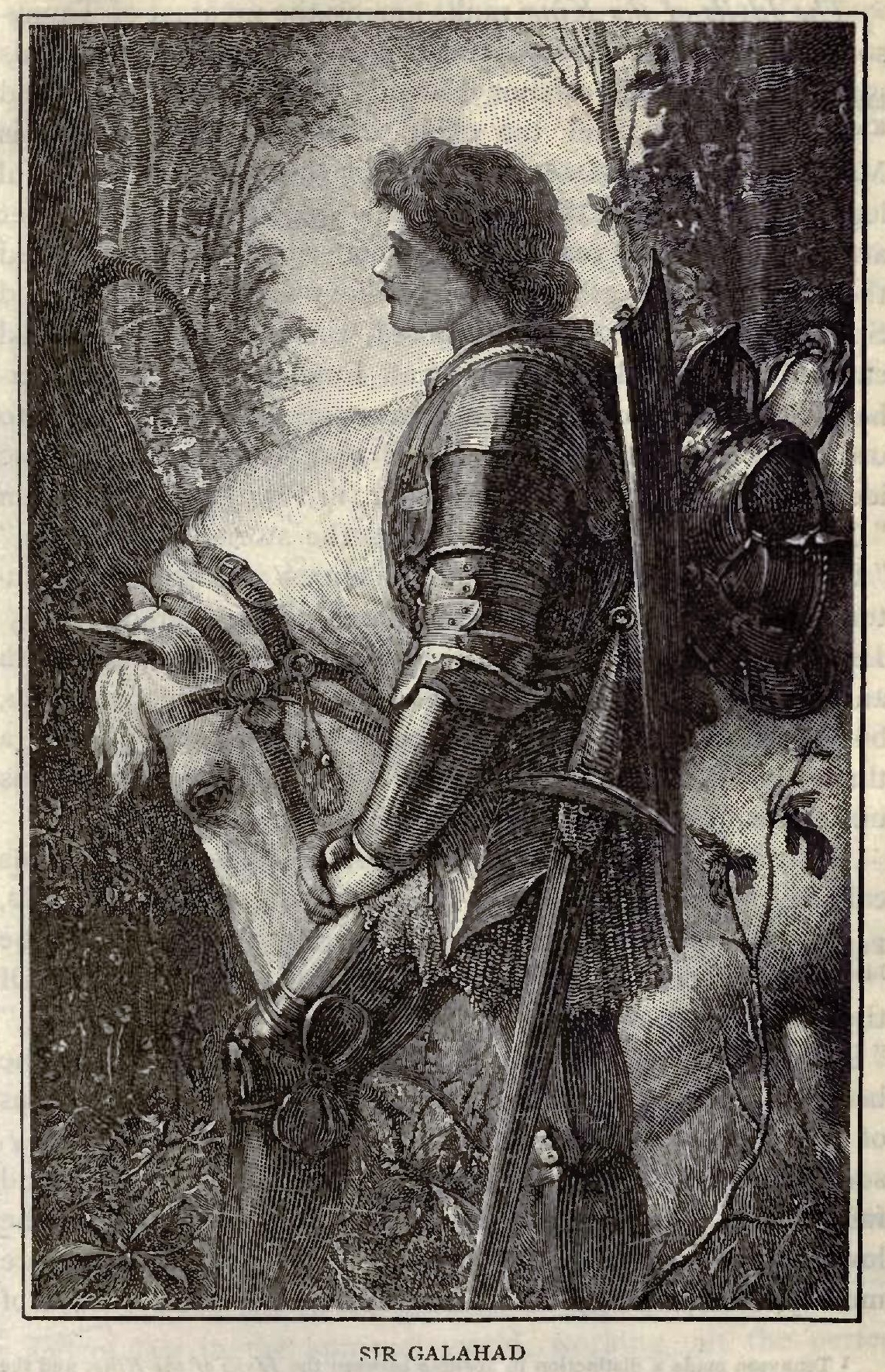
Sir Galahad
Idylls of the KingThe Idylls of the
King ranks among the greatest of Tennyson's later works. Its general
subject is the Celtic legends of King Arthur and his knights of the Round
Table, and the chief source of its material is Malory's Morte d'Arthur.
Here, in this mass of beautiful legends, is certainly the subject of a
great national epic; yet after four hundred years, during which many poets
have used the material, the great epic is still unwritten. Milton and
Spenser, as we have already noted, considered this material carefully; and
Milton alone, of all English writers, had perhaps the power to use it in a
great epic. Tennyson began to use these legends in his Morte d'Arthur
(1842); but the epic idea probably occurred to him later, in 1856, when he
began "Geraint and Enid," and he added the stories of "Vivien," "Elaine,"
"Guinevere," and other heroes and heroines at intervals, until "Balin,"
the last of the Idylls, appeared in 1885. Later these works were
gathered together and arranged with an attempt at unity. The result is in
no sense an epic poem, but rather a series of single poems loosely
connected by a thread of interest in Arthur, the central personage, and in
his unsuccessful attempt to found an ideal kingdom.
English IdylsEntirely different in spirit
is another collection of poems called English Idyls,[236] which began in the
Poems of 1842, and which Tennyson intended should reflect the
ideals of widely different types of English life. Of these varied poems,
"Dora," "The Gardener's Daughter," "Ulysses," "Locksley Hall" and "Sir
Galahad" are the best; but all are worthy of study. One of the most famous
of this series is "Enoch Arden" (1864), in which Tennyson turns from mediæval
knights, from lords, heroes, and fair ladies, to find the material for
true poetry among the lowly people that make up the bulk of English life.
Its rare melody, its sympathy for common life, and its revelation of the
beauty and heroism which hide in humble men and women everywhere, made
this work an instant favorite. Judged by its sales alone, it was the most
popular of his works during the poet's lifetime.
Tennyson's later volumes, like the Ballads (1880) and Demeter
(1889), should not be overlooked, since they contain some of his best
work. The former contains stirring war songs, like "The Defence of
Lucknow," and pictures of wild passionate grief, like "Rizpah"; the latter
is notable for "Romney's Remorse," a wonderful piece of work; "Merlin and
The Gleam," which expresses the poet's lifelong ideal; and several
exquisite little songs, like "The Throstle," and "The Oak," which show how
marvelously the aged poet retained his youthful freshness and inspiration.
Here certainly is variety enough to give us long years of literary
enjoyment; and we need hardly mention miscellaneous poems, like "The
Brook" and "The Charge of the Light Brigade," which are known to every
schoolboy; and "Wages" and "The Higher Pantheism," which should be read by
every man who thinks about the old, old problem of life and death.
Characteristics of Tennyson's Poetry. If we attempt to sum up the
quality of Tennyson, as shown in all these works, the task is a difficult
one; but three things stand out more or less plainly. First, Tennyson is
essentially the artist. No other in his age studied the art of poetry so
constantly or with such singleness of purpose; and only Swinburne rivals
him in melody and the perfect finish of his verse. Second, like all the
great writers of his age, he is emphatically a teacher, often a leader. In
the preceding age, as the result of the turmoil produced by the French
Revolution, lawlessness was more or less common, and individuality was the
rule in literature. Tennyson's theme, so characteristic of his age, is the
reign of order,--of law in the physical world, producing evolution, and of
law in the spiritual world, working out the perfect man. In Memoriam,
Idylls of the King, The Princess,-here are three widely different
poems; yet the theme of each, so far as poetry is a kind of spiritual
philosophy and weighs its words before it utters them, is the orderly
development of law in the natural and in the spiritual world.
Tennyson's MessageThis certainly is a new
doctrine in poetry, but the message does not end here. Law implies a
source, a method, an object. Tennyson, after facing his doubts honestly
and manfully, finds law even in the sorrows and losses of humanity. He
gives this law an infinite and personal source, and finds the supreme
purpose of all law to be a revelation of divine love. All earthly love,
therefore, becomes an image of the heavenly. What first perhaps attracted
readers to Tennyson, as to Shakespeare, was the character of his
women,--pure, gentle, refined beings, whom we must revere as our
Anglo-Saxon forefathers revered the women they loved. Like Browning, the
poet had loved one good woman supremely, and her love made clear the
meaning of all life. The message goes one step farther. Because law and
love are in the world, faith is the only reasonable attitude toward life
and death, even though we understand them not. Such, in a few words, seems
to be Tennyson's whole message and philosophy.
If we attempt now to fix Tennyson's permanent place in literature, as the
result of his life and work, we must apply to him the same test that we
applied to Milton and Wordsworth, and, indeed, to all our great poets, and
ask with the German critics, "What new thing has he said to the world or
even to his own country?" The answer is, frankly, that we do not yet know
surely; that we are still too near Tennyson to judge him impersonally.
This much, however, is clear. In a marvelously complex age, and amid a
hundred great men, he was regarded as a leader. For a full half century he
was the voice of England, loved and honored as a man and a poet, not
simply by a few discerning critics, but by a whole people that do not
easily give their allegiance to any one man. And that, for the present, is
Tennyson's sufficient eulogy.
ROBERT BROWNING (1812-1889)
How good is man's life, the mere living! how fit to employ
All the
heart and the soul and the senses for ever in joy!
In this new song of David, from Browning's Saul, we have a
suggestion of the astonishing vigor and hope that characterize all the
works of Browning, the one poet of the age who, after thirty years of
continuous work, was finally recognized and placed beside Tennyson, and
whom future ages may judge to be a greater poet,--perhaps, even, the
greatest in our literature since Shakespeare.
The chief difficulty in reading Browning is the obscurity of his style,
which the critics of half a century ago held up to ridicule. Their
attitude towards the poet's early work may be inferred from Tennyson's
humorous criticism of Sordello. It may be remembered that the first
line of this obscure poem is, "Who will may hear Sordello's story told";
and that the last line is, "Who would has heard Sordello's story told."
Tennyson remarked that these were the only lines in the whole poem that he
understood, and that they were evidently both lies. If we attempt to
explain this obscurity, which puzzled Tennyson and many less friendly
critics, we find that it has many sources. First, the poet's thought is
often obscure, or else so extremely subtle that language expresses it
imperfectly,--
Thoughts hardly to be packed
Into a narrow act,
Fancies that
broke through language and escaped.
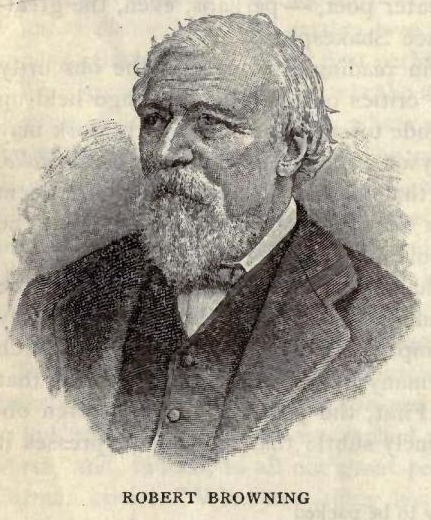
Browning's ObscuritySecond, Browning is
led from one thing to another by his own mental associations, and forgets
that the reader's associations may be of an entirely different kind.
Third, Browning is careless in his English, and frequently clips his
speech, giving us a series of ejaculations. As we do not quite understand
his processes of thought, we must stop between the ejaculations to trace
out the connections. Fourth, Browning's, allusions are often far-fetched,
referring to some odd scrap of information which he has picked up in his
wide reading, and the ordinary reader finds it difficult to trace and
understand them. Finally, Browning wrote too much and revised too Little.
The time which he should have given to making one thought clear was used
in expressing other thoughts that flitted through his head like a flock of
swallows. His field was the individual soul, never exactly alike in any
two men, and he sought to express the hidden motives and principles which
govern individual action. In this field he is like a miner delving
underground, sending up masses of mingled earth and ore; and the reader
must sift all this material to separate the gold from the dross.
Here, certainly, are sufficient reasons for Browning's obscurity; and we
must add the word that the fault seems unpardonable, for the simple reason
that Browning shows himself capable, at times, of writing directly,
melodiously, and with noble simplicity.
Browning as a teacherSo much for the
faults, which must be faced and overlooked before one finds the treasure
that is hidden in Browning's poetry. Of all the poets in our literature,
no other is so completely, so consciously, so magnificently a teacher of
men. He feels his mission of faith and courage in a world of doubt and
timidity. For thirty years he faced indifference or ridicule, working
bravely and cheerfully the while, until he made the world recognize and
follow him. The spirit of his whole life is well expressed in his Paracelsus,
written when he was only twenty-two years old:
I see my way as birds their trackless way.
I shall arrive,--what
time, what circuit first,
I ask not; but unless God send his hail
Or blinding fire-balls, sleet or stifling snow,
In some time, his
good time, I shall arrive;
He guides me and the bird. In his good
time.
He is not, like so many others, an entertaining poet. One cannot read him
after dinner, or when settled in a comfortable easy-chair. One must sit
up, and think, and be alert when he reads Browning. If we accept these
conditions, we shall probably find that Browning is the most stimulating
poet in our language. His influence upon our life is positive and
tremendous. His strength, his joy of life, his robust faith, and his
invincible optimism enter into us, making us different and better men
after reading him. And perhaps the best thing he can say of Browning is
that his thought is slowly but surely taking possession of all
well-educated men and women.
Life. Browning's father was outwardly a business man, a clerk for
fifty years in the Bank of England; inwardly he was an interesting
combination of the scholar and the artist, with the best tastes of both.
His mother was a sensitive, musical woman, evidently very lovely in
character, the daughter of a German shipowner and merchant who had settled
in Scotland. She was of Celtic descent, and Carlyle describes her as the
true type of a Scottish gentlewoman. From his neck down, Browning was the
typical Briton,--short, stocky, large-chested, robust; but even in the
lifeless portrait his face changes as we view it from different angles.
Now it is like an English business man, now like a German scientist, and
now it has a curious suggestion of Uncle Remus,--these being, no doubt, so
many different reflections of his mixed and unremembered ancestors.
He was born in Camberwell, on the outskirts of London, in 1812. From his
home and from his first school, at Peckham, he could see London; and the
city lights by night and the smoky chimneys by day had the same powerful
fascination for the child that the woods and fields and the beautiful
country had for his friend Tennyson. His schooling was short and
desultory, his education being attended to by private tutors and by his
father, who left the boy largely to follow his own inclination. Like the
young Milton, Browning was fond of music, and in many of his poems,
especially in "Abt Vogler" and "A Toccata of Galuppi's," he interprets the
musical temperament better, perhaps, than any other writer in our
literature. But unlike Milton, through whose poetry there runs a great
melody, music seems to have had no consistent effect upon his verse, which
is often so jarring that one must wonder how a musical ear could have
endured it.
Like Tennyson, this boy found his work very early, and for fifty years
hardly a week passed that he did not write poetry. He began at six to
produce verses, in imitation of Byron; but fortunately this early work has
been lost. Then he fell under the influence of Shelley, and his first
known work, Pauline (1833), must be considered as a tribute to
Shelley and his poetry. Tennyson's earliest work, Poems by Two Brothers,
had been published and well paid for, five years before; but Browning
could find no publisher who would even consider Pauline, and the
work was published by means of money furnished by an indulgent relative.
This poem received scant notice from the reviewers, who had pounced like
hawks on a dovecote upon Tennyson's first two modest volumes. Two years
later appeared Paracelsus, and then his tragedy Strafford
was put upon the stage; but not till Sordello was published, in
1840, did he attract attention enough to be denounced for the obscurity
and vagaries of his style. Six years later, in 1846, he suddenly became
famous, not because he finished in that year his Bells and Pomegranates
(which is Browning's symbolic name for "poetry and thought" or "singing
and sermonizing"), but because he eloped with the best known literary
woman in England, Elizabeth Barrett, whose fame was for many years, both
before and after her marriage, much greater than Browning's, and who was
at first considered superior to Tennyson. Thereafter, until his own work
compelled attention, he was known chiefly as the man who married Elizabeth
Barrett. For years this lady had been an almost helpless invalid, and it
seemed a quixotic thing when Browning, having failed to gain her family's
consent to the marriage, carried her off romantically. Love and Italy
proved better than her physicians, and for fifteen years Browning and his
wife lived an ideally happy life in Pisa and in Florence. The exquisite
romance of their love is preserved in Mrs. Browning's Sonnets from the
Portuguese, and in the volume of Letters recently
published,--wonderful letters, but so tender and intimate that it seems
almost a sacrilege for inquisitive eyes to read them.
Mrs. Browning died in Florence in 1861. The loss seemed at first too much
to bear, and Browning fled with his son to England. For the remainder of
his life he lived alternately in London and in various parts of Italy,
especially at the Palazzo Rezzonico, in Venice, which is now an object of
pilgrimage to almost every tourist who visits the beautiful city. Wherever
he went he mingled with men and women, sociable, well dressed, courteous,
loving crowds and popular applause, the very reverse of his friend
Tennyson. His earlier work had been much better appreciated in America
than in England; but with the publication of The Ring and the Book,
in 1868, he was at last recognized by his countrymen as one of the
greatest of English poets. He died in Venice, on December 12, 1889, the
same day that saw the publication of his last work, Asolando.
Though Italy offered him an honored resting place, England claimed him for
her own, and he lies buried beside Tennyson in Westminster Abbey. The
spirit of his whole life is magnificently expressed in his own lines, in
the Epilogue of his last book:
One who never turned his back, but marched breast forward,
Never
doubted clouds would break,
Never dreamed, tho' right were worsted,
wrong would triumph,
Held
we fall to rise, are baffled to fight better,
Sleep
to wake.
Works. A glance at even the titles which Browning gave to his best
known volumes--Dramatic Lyrics (1842), Dramatic Romances and
Lyrics (1845), Men and Women (1853), Dramatis Persona
(1864)--will suggest how strong the dramatic element is in all his work.
Indeed, all his poems may be divided into three classes,--pure dramas,
like Strafford and A Blot in the 'Scutcheon; dramatic
narratives, like Pippa Passes, which are dramatic in form, but were
not meant to be acted; and dramatic lyrics, like The Last Ride Together,
which are short poems expressing some strong personal emotion, or
describing some dramatic episode in human life, and in which the hero
himself generally tells the story.
Browning and ShakespeareThough Browning is
often compared with Shakespeare, the reader will understand that he has
very little of Shakespeare's dramatic talent. He cannot bring a group of
people together and let the actions and words of his characters show us
the comedy and tragedy of human life. Neither can the author be
disinterested, satisfied, as Shakespeare was, with life itself, without
drawing any moral conclusions. Browning has always a moral ready, and
insists upon giving us his own views of life, which Shakespeare never
does. His dramatic power lies in depicting what he himself calls the
history of a soul. Sometimes, as in Paracelsus, he endeavors to
trace the progress of the human spirit. More often he takes some dramatic
moment in life, some crisis in the ceaseless struggle between good and
evil, and describes with wonderful insight the hero's own thoughts and
feelings; but he almost invariably tells us how, at such and such a point,
the good or the evil in his hero must inevitably have triumphed. And
generally, as in "My Last Duchess," the speaker adds a word here and
there, aside from the story, which unconsciously shows the kind of man he
is. It is this power of revealing the soul from within that causes
Browning to fascinate those who study him long enough. His range is
enormous, and brings all sorts and conditions of men under analysis. The
musician in "Abt Vogler," the artist in "Andrea del Sarto," the early
Christian in "A Death in the Desert," the Arab horseman in "Muteykeh," the
sailor in "Herve Kiel," the mediæval knight in "Childe Roland," the
Hebrew in "Saul," the Greek in "Balaustion's Adventure," the monster in
"Caliban," the immortal dead in "Karshish,"--all these and a hundred more
histories of the soul show Browning's marvelous versatility. It is this
great range of sympathy with many different types of life that constitutes
Browning's chief likeness to Shakespeare, though otherwise there is no
comparison between the two men.
First Period of WorkIf we separate all
these dramatic poems into three main periods,--the early, from 1833 to
1841; the middle, from 1841 to 1868; and the late, from 1868 to 1889,--the
work of the beginner will be much more easily designated. Of his early
soul studies, Pauline (1833), Paracelsus (1835), and Sordello
(1840), little need be said here, except perhaps this: that if we begin
with these works, we shall probably never read anything else by Browning.
And that were a pity. It is better to leave these obscure works until his
better poems have so attracted us to Browning that we will cheerfully
endure his worst faults for the sake of his undoubted virtues. The same
criticism applies, though in less degree, to his first drama, Strafford
(1837), which belongs to the early period of his work.
Second period The merciless criticism
which greeted Sordello had a wholesome effect on Browning, as is
shown in the better work of his second period. Moreover, his new power was
developing rapidly, as may be seen by comparing the eight numbers of his
famous Bells and Pomegranates series (1841-1846) with his earlier
work. Thus, the first number of this wonderful series, published in 1841,
contains Pippa Passes, which is, on the whole, the most perfect of
his longer poems; and another number contains A Blot in the 'Scutcheon,
which is the most readable of his dramas. Even a beginner must be thrilled
by the beauty and the power of these two works. Two other noteworthy
dramas of the period are Colombe's Birthday (1844) and In a
Balcony (1855), which, however, met with scant appreciation on the
stage, having too much subtle analysis and too little action to satisfy
the public. Nearly all his best lyrics, dramas, and dramatic poems belong
to this middle period of labor; and when The Ring and the Book
appeared, in 1868, he had given to the world the noblest expression of his
poetic genius.
Third PeriodIn the third period, beginning
when Browning was nearly sixty years old, he wrote even more industriously
than before, and published on an average nearly a volume of poetry a year.
Such volumes as Fifine at the Fair, Red Cotton Night-Cap Country, The
Inn Album, Jocoseria, and many others, show how Browning gains
steadily in the power of revealing the hidden springs of human action; but
he often rambles most tiresomely, and in general his work loses in
sustained interest. It is perhaps significant that most of his best work
was done under Mrs. Browning's influence.
What to Read. Of the short miscellaneous poems there is such an
unusual variety that one must hesitate a little in suggesting this or that
to the beginner's attention. "My Star," "Evelyn Hope," "Wanting is--What?"
"Home Thoughts from Abroad," "Meeting at Night," "One Word More" (an
exquisite tribute to his dead wife), "Prospice" (Look Forward); songs from
Pippa Passes; various love poems like "By the Fireside" and "The
Last Ride Together"; the inimitable "Pied Piper," and the ballads like
"Hervé Riel" and "How They Brought the Good News,"--these are a
mere suggestion, expressing only the writer's personal preference; but a
glance at the contents of Browning's volumes will reveal scores of other
poems, which another writer might recommend as being better in themselves
or more characteristic of Browning.[237]
Soul StudiesAmong Browning's dramatic soul
studies there is also a very wide choice. "Andrea del Sarto" is one of the
best, revealing as it does the strength and the weakness of "the perfect
painter," whose love for a soulless woman with a pretty face saddens his
life and hampers his best work. Next in importance to "Andrea" stands "An
Epistle," reciting the experiences of Karshish, an Arab physician, which
is one of the best examples of Browning's peculiar method of presenting
the truth. The half-scoffing, half-earnest, and wholly bewildered state of
this Oriental scientist's mind is clearly indicated between the lines of
his letter to his old master. His description of Lazarus, whom he meets by
chance, and of the state of mind of one who, having seen the glories of
immortality, must live again in the midst of the jumble of trivial and
stupendous things which constitute our life, forms one of the most
original and suggestive poems in our literature. "My Last Duchess" is a
short but very keen analysis of the soul of a selfish man, who reveals his
character unconsciously by his words of praise concerning his dead wife's
picture. In "The Bishop Orders his Tomb" we have another extraordinarily
interesting revelation of the mind of a vain and worldly man, this time a
churchman, whose words tell you far more than he dreams about his own
character. "Abt Vogler," undoubtedly one of Browning's finest poems, is
the study of a musician's soul. "Muléykeh" gives us the soul of an
Arab, vain and proud of his fast horse, which was never beaten in a race.
A rival steals the horse and rides away upon her back; but, used as she is
to her master's touch, she will not show her best pace to the stranger.
Muléykeh rides up furiously; but instead of striking the thief from
his saddle, he boasts about his peerless mare, saying that if a certain
spot on her neck were touched with the rein, she could never be overtaken.
Instantly the robber touches the spot, and the mare answers with a burst
of speed that makes pursuit hopeless. Muléykeh has lost his mare;
but he has kept his pride in the unbeaten one, and is satisfied. "Rabbi
Ben Ezra," which refuses analysis, and which must be read entire to be
appreciated, is perhaps the most quoted of all Browning's works, and
contains the best expression of his own faith in life, both here and
hereafter. All these wonderful poems are, again, merely a suggestion. They
indicate simply the works to which one reader turns when he feels mentally
vigorous enough to pick up Browning. Another list of soul studies, citing
"A Toccata of Galuppi's," "A Grammarian's Funeral," "Fra Lippo Lippi,"
"Saul," "Cleon," "A Death in the Desert," and "Soliloquy of the Spanish
Cloister," might, in another's judgment, be more interesting and
suggestive.
[Pippa Passes] Among Browning's longer poems there are two, at least, that
well deserve our study. Pippa Passes, aside from its rare poetical
qualities, is a study of unconscious influence. The idea of the poem was
suggested to Browning while listening to a gypsy girl singing in the woods
near his home; but he transfers the scene of the action to the little
mountain town of Asolo, in Italy. Pippa is a little silk weaver, who goes
out in the morning to enjoy her one holiday of the whole year. As she
thinks of her own happiness she is vaguely wishing that she might share
it, and do some good. Then, with her childish imagination, she begins to
weave a little romance in which she shares in the happiness of the four
greatest and happiest people in Asolo. It never occurs to her that perhaps
there is more of misery than of happiness in the four great ones of whom
she dreams; and so she goes on her way singing,
The year's at the spring
And day's at the morn;
Morning's at
seven;
The hillside's dew-pearled;
The lark's on the wing;
The snail's on the thorn:
God's in his heaven--
All's right
with the world!
Fate wills it that the words and music of her little songs should come to
the ears of four different groups of people at the moment when they are
facing the greatest crises of their lives, and turn the scale from evil to
good. But Pippa knows nothing of this. She enjoys her holiday, and goes to
bed still singing, entirely ignorant of the good she has done in the
world. With one exception, it is the most perfect of all Browning's works.
At best it is not easy, nor merely entertaining reading; but it richly
repays whatever hours we spend in studying it.
The Ring and the BookThe Ring and the
Book is Browning's masterpiece. It is an immense poem, twice as long
as Paradise Lost, and longer by some two thousand lines than the Iliad;
and before we begin the undoubted task of reading it, we must understand
that there is no interesting story or dramatic development to carry us
along. In the beginning we have an outline of the story, such as it is--a
horrible story of Count Guido's murder of his beautiful young wife; and
Browning tells us in detail just when and how he found a book containing
the record of the crime and the trial. There the story element ends, and
the symbolism of the book begins. The title of the poem is explained by
the habit of the old Etruscan goldsmiths who, in making one of their
elaborately chased rings, would mix the pure gold with an alloy, in order
to harden it. When the ring was finished, acid was poured upon it; and the
acid ate out the alloy, leaving the beautiful design in pure gold.
Browning purposes to follow the same plan with his literary material,
which consists simply of the evidence given at the trial of Guido in Rome,
in 1698. He intends to mix a poet's fancy with the crude facts, and create
a beautiful and artistic work.
The result of Browning's purpose is a series of monologues, in which the
same story is retold nine different times by the different actors in the
drama. The count, the young wife, the suspected priest, the lawyers, the
Pope who presides at the trial,--each tells the story, and each
unconsciously reveals the depths of his own nature in the recital. The
most interesting of the characters are Guido, the husband, who changes
from bold defiance to abject fear; Caponsacchi, the young priest, who aids
the wife in her flight from her brutal husband, and is unjustly accused of
false motives; Pompilia, the young wife, one of the noblest characters in
literature, fit in all respects to rank with Shakespeare's great heroines;
and the Pope, a splendid figure, the strongest of all Browning's masculine
characters. When we have read the story, as told by these four different
actors, we have the best of the poet's work, and of the most original poem
in our language.
Browning and TennysonBrowning's Place
and Message. Browning's place in our literature will be better
appreciated by comparison with his friend Tennyson, whom we have just
studied. In one respect, at least, these poets are in perfect accord. Each
finds in love the supreme purpose and meaning of life. In other respects,
especially in their methods of approaching the truth, the two men are the
exact opposites. Tennyson is first the artist and then the teacher; but
with Browning the message is always the important thing, and he is
careless, too careless, of the form in which it is expressed. Again,
Tennyson is under the influence of the romantic revival, and chooses his
subjects daintily; but "all's fish" that comes to Browning's net. He takes
comely and ugly subjects with equal pleasure, and aims to show that truth
lies hidden in both the evil and the good. This contrast is all the more
striking when we remember that Browning's essentially scientific attitude
was taken by a man who refused to study science. Tennyson, whose work is
always artistic, never studied art, but was devoted to the sciences; while
Browning, whose work is seldom artistic in form, thought that art was the
most suitable subject for a man's study.
Browning's MessageThe two poets differ
even more widely in their respective messages. Tennyson's message reflects
the growing order of the age, and is summed up in the word "law." in his
view, the individual will must be suppressed; the self must always be
subordinate. His resignation is at times almost Oriental in its fatalism,
and occasionally it suggests Schopenhauer in its mixture of fate and
pessimism. Browning's message, on the other hand, is the triumph of the
individual will over all obstacles; the self is not subordinate but
supreme. There is nothing Oriental, nothing doubtful, nothing pessimistic
in the whole range of his poetry. His is the voice of the Anglo-Saxon,
standing up in the face of all obstacles and saying, "I can and I will."
He is, therefore, far more radically English than is Tennyson; and it may
be for this reason that he is the more studied, and that, while youth
delights in Tennyson, manhood is better satisfied with Browning. Because
of his invincible will and optimism, Browning is at present regarded as
the poet who has spoken the strongest word of faith to an age of doubt.
His energy, his cheerful courage, his faith in life and in the development
that awaits us beyond the portals of death, are like a bugle-call to good
living. This sums up his present influence upon the minds of those who
have learned to appreciate him. Of the future we can only say that, both
at home and abroad, he seems to be gaining steadily in appreciation as the
years go by.
MINOR POETS OF THE VISTORIAN AGE
Elizabeth Barrett. Among the
minor poets of the past century Elizabeth Barrett (Mrs. Browning) occupies
perhaps the highest place in popular favor. She was born at Coxhoe Hall,
near Durham, in 1806; but her childhood and early youth were spent in
Herefordshire, among the Malvern Hills made famous by Piers Plowman.
In 1835 the Barrett family moved to London, where Elizabeth gained a
literary reputation by the publication of The Seraphim and Other Poems
(1838). Then illness and the shock caused by the tragic death of her
brother, in 1840, placed her frail life in danger, and for six years she
was confined to her own room. The innate strength and beauty of her spirit
here showed itself strongly in her daily study, her poetry, and especially
in her interest in the social problems which sooner or later occupied all
the Victorian writers. "My mind to me a kingdom is" might well have been
written over the door of the room where this delicate invalid worked and
suffered in loneliness and in silence.
In 1844 Miss Barrett published her Poems, which, though somewhat
impulsive and overwrought, met with remarkable public favor. Such poems as
"The Cry of the Children," which voices the protest of humanity against
child labor, appealed tremendously to the readers of the age, and this
young woman's fame as a poet temporarily overshadowed that of Tennyson and
Browning. Indeed, as late as 1850, when Wordsworth died, she was seriously
considered for the position of poet laureate, which was finally given to
Tennyson. A reference to Browning, in "Lady Geraldine's Courtship," is
supposed to have first led the poet to write to Miss Barrett in 1845. Soon
afterwards he visited the invalid; they fell in love almost at first
sight, and the following year, against the wishes of her father,--who was
evidently a selfish old tyrant,--Browning carried her off and married her.
The exquisite romance of their love is reflected in Mrs. Browning's Sonnets
from the Portuguese (1850). This is a noble and inspiring book of love
poems; and Stedman regards the opening sonnet, "I thought once how
Theocritus had sung," as equal to any in our language.
For fifteen years the Brownings lived an ideally happy life at Pisa, and
at Casa Guidi, Florence, sharing the same poetical ambitions. And love was
the greatest thing in the world,--
How do I love thee? Let me count the ways.
I love thee to the depth
and breadth and height
My soul can reach, when feeling out of sight
For the ends of Being and ideal Grace.
I love thee to the level of
everyday's
Most quiet need, by sun and candlelight.
I love
thee freely, as men strive for Right;
I love thee purely, as they
turn from Praise;
I love thee with the passion put to use
In
my old griefs, and with my childhood's faith;
I love thee with a
love I seemed to lose
With my lost saints--I love thee with the
breath,
Smiles, tears, of all my life!--and, if God choose,
I
shall but love thee better after death.
Mrs. Browning entered with whole-souled enthusiasm into the aspirations of
Italy in its struggle against the tyranny of Austria; and her Casa
Guidi Windows (1851) is a combination of poetry and politics, both, it
must be confessed, a little too emotional. In 1856 she published Aurora
Leigh, a novel in verse, having for its hero a young social reformer,
and for its heroine a young woman, poetical and enthusiastic, who strongly
suggests Elizabeth Barrett herself. It emphasizes in verse precisely the
same moral and social ideals which Dickens and George Eliot were
proclaiming in all their novels. Her last two volumes were Poems before
Congress (1860), and Last Poems, published after her death. She
died suddenly in 1861 and was buried in Florence. Browning's famous line,
"O lyric love, half angel and half bird," may well apply to her frail life
and aerial spirit.
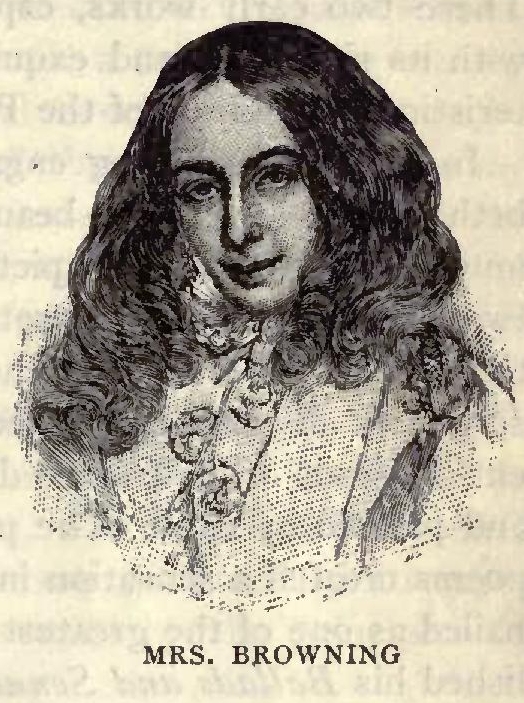
MRS.
BROWNING
Rossetti. Dante Gabriel Rossetti
(1828-1882), the son of an exiled Italian painter and scholar, was
distinguished both as a painter and as a poet. He was a leader in the
Pre-Raphaelite movement[238]
and published in the first numbers of The Germ his "Hand and Soul,"
a delicate prose study, and his famous "The Blessed Damozel," beginning,
The blessed damozel leaned out
From the
gold bar of Heaven;
Her eyes were deeper than the depth
Of
waters stilled at even;
She had three lilies in her hand,
And the stars in her hair were seven.
These two early works, especially "The Blessed Damozel," with its
simplicity and exquisite spiritual quality, are characteristic of the
ideals of the Pre-Raphaelites.
In 1860, after a long engagement, Rossetti married Elizabeth Siddal, a
delicate, beautiful English girl, whom he has immortalized both in his
pictures and in his poetry. She died two years later, and Rossetti never
entirely recovered from the shock. At her burial he placed in her coffin
the manuscripts of all his unpublished poems, and only at the persistent
demands of his friends did he allow them to be exhumed and printed in
1870. The publication of this volume of love poems created a sensation in
literary circles, and Rossetti was hailed as one of the greatest of living
poets. In 1881 he published his Ballads and Sonnets, a remarkable
volume containing, among other poems, "The Confession," modeled after
Browning; "The Ballad of Sister Helen," founded on a mediæval
superstition; "The King's Tragedy," a masterpiece of dramatic narrative;
and "The House of Life," a collection of one hundred and one sonnets
reflecting the poet's love and loss. This last collection deserves to rank
with Mrs. Browning's Sonnets from the Portuguese and with
Shakespeare's Sonnets, as one of the three great cycles of love
poems in our language. It has been well said that both Rossetti and Morris
paint pictures as well in their poems as on their canvases, and this
pictorial quality of their verse is its chief characteristic.
Morris. William Morris
(1834-1896) is a most interesting combination of literary man and artist.
In the latter capacity, as architect, designer, and manufacturer of
furniture, carpets, and wall paper, and as founder of the Kelmscott Press
for artistic printing and bookbinding, he has laid us all under an immense
debt of gratitude. From boyhood he had steeped himself in the legends and
ideals of the Middle Ages, and his best literary work is wholly mediæval
in spirit. The Earthly Paradise (1868-1870) is generally regarded
as his masterpiece. This delightful collection of stories in verse tells
of a roving band of Vikings, who are wrecked on the fabled island of
Atlantis, and who discover there a superior race of men having the
characteristics of ideal Greeks. The Vikings remain for a year, telling
stories of their own Northland, and listening to the classic and Oriental
tales of their hosts. Morris's interest in Icelandic literature is further
shown by his Sigurd the Volsung, an epic founded upon one of the
old sagas, and by his prose romances, The House of the Wolfings, The
Story of the Glittering Plain, and The Roots of the Mountains.
Later in life he became deeply interested in socialism, and two other
romances, The Dream of John Ball and News from Nowhere, are
interesting as modern attempts at depicting an ideal society governed by
the principles of More's Utopia.
Swinburne. Algernon Charles
Swinburne (1837-1909) is, chronologically, the last of the Victorian
poets. As an artist in technique--having perfect command of all old
English verse forms and a remarkable faculty for inventing new--he seems
at the present time to rank among the best in our literature. Indeed, as
Stedman says, "before his advent we did not realize the full scope of
English verse." This refers to the melodious and constantly changing form
rather than to the content of Swinburne's poetry. At the death of
Tennyson, in 1892, he was undoubtedly the greatest living poet, and only
his liberal opinions, his scorn of royalty and of conventions, and the
prejudice aroused by the pagan spirit of his early work prevented his
appointment as poet laureate. He has written a very large number of poems,
dramas, and essays in literary criticism; but we are still too near to
judge of the permanence of his work or of his place in literature. Those
who would read and estimate his work for themselves will do well to begin
with a volume of selected poems, especially those which show his love of
the sea and his exquisite appreciation of child life. His Atalanta in
Calydon (1864), a beautiful lyric drama modeled on the Greek tragedy,
is generally regarded as his masterpiece. In all his work Swinburne
carries Tennyson's love of melody to an extreme, and often sacrifices
sense to sound. His poetry is always musical, and, like music, appeals
almost exclusively to the emotions.
We have chosen, somewhat arbitrarily, these four writers--Mrs. Browning,
D. G. Rossetti, Morris, and Swinburne--as representative of the minor
poets of the age; but there are many others who are worthy of
study,--Arthur Hugh Clough and Matthew Arnold,[239] who are often called the poets
of skepticism, but who in reality represent a reverent seeking for truth
through reason and human experience; Frederick William Faber, the Catholic
mystic, author of some exquisite hymns; and the scholarly John Keble,
author of The Christian Year, our best known book of devotional
verse; and among the women poets, Adelaide Procter, Jean Ingelow, and
Christina Rossetti, each of whom had a large, admiring circle of readers.
It would be a hopeless task at the present time to inquire into the
relative merits of all these minor poets. We note only their careful
workmanship and exquisite melody, their wide range of thought and feeling,
their eager search for truth, each in his own way, and especially the note
of freshness and vitality which they have given to English poetry.
II. THE NOVELISTS OF THE VICTORIAN AGE
CHARLES DICKENS (1812-1870)
When we consider Dickens's life and work, in comparison with that of the
two great poets we have been studying, the contrast is startling. While
Tennyson and Browning were being educated for the life of literature, and
shielded most tenderly from the hardships of the world, Dickens, a poor,
obscure, and suffering child, was helping to support a shiftless family by
pasting labels on blacking bottles, sleeping under a counter like a
homeless cat, and once a week timidly approaching the big prison where his
father was confined for debt. In 1836 his Pickwick was published,
and life was changed as if a magician had waved his wand over him. While
the two great poets were slowly struggling for recognition, Dickens, with
plenty of money and too much fame, was the acknowledged literary hero of
England, the idol of immense audiences which gathered to applaud him
wherever he appeared. And there is also this striking contrast between the
novelist and the poets,--that while the whole tendency of the age was
toward realism, away from the extremes of the romanticists and from the
oddities and absurdities of the early novel writers, it was precisely by
emphasizing oddities and absurdities, by making caricatures rather than
characters, that Dickens first achieved his popularity.
Life. In Dickens's early life we see a stern but unrecognized
preparation for the work that he was to do. Never was there a better
illustration of the fact that a boy's early hardship and suffering are
sometimes only divine messengers disguised, and that circumstances which
seem only evil are often the source of a man's strength and of the
influence which he is to wield in the world. He was the second of eight
poor children, and was born at Landport in 1812. His father, who is
supposed to be the original of Mr. Micawber, was a clerk in a navy office.
He could never make both ends meet, and after struggling with debts in his
native town for many years, moved to London when Dickens was nine years
old. The debts still pursued him, and after two years of grandiloquent
misfortune he was thrown into the poor-debtors' prison. His wife, the
original of Mrs. Micawber, then set up the famous Boarding Establishment
for Young Ladies; but, in Dickens's words, no young ladies ever came. The
only visitors were creditors, and they were quite ferocious. In the
picture of the Micawber family, with its tears and smiles and general
shiftlessness, we have a suggestion of Dickens's own family life.
At eleven years of age the boy was taken out of school and went to work in
the cellar of a blacking factory. At this time he was, in his own words, a
"queer small boy," who suffered as he worked; and we can appreciate the
boy and the suffering more when we find both reflected in the character of
David Copperfield. It is a heart-rending picture, this sensitive child
working from dawn till dark for a few pennies, and associating with toughs
and waifs in his brief intervals of labor; but we can see in it the
sources of that intimate knowledge of the hearts of the poor and outcast
which was soon to be reflected in literature and to startle all England by
its appeal for sympathy. A small legacy ended this wretchedness, bringing
the father from the prison and sending the boy to Wellington House
Academy,--a worthless and brutal school, evidently, whose head master was,
in Dickens's words, a most ignorant fellow and a tyrant. He learned little
at this place, being interested chiefly in stories, and in acting out the
heroic parts which appealed to his imagination; but again his personal
experience was of immense value, and resulted in his famous picture of
Dotheboys Hall, in Nicholas Nickleby, which helped largely to
mitigate the evils of private schools in England. Wherever he went,
Dickens was a marvelously keen observer, with an active imagination which
made stories out of incidents and characters that ordinary men would have
hardly noticed. Moreover he was a born actor, and was at one time the
leading spirit of a band of amateurs who gave entertainments for charity
all over England. These three things, his keen observation, his active
imagination, and the actor's spirit which animated him, furnish a key to
his life and writings.
When only fifteen years old, he left the school and again went to work,
this time as clerk in a lawyer's office. By night he studied shorthand, in
order to fit himself to be a reporter,--this in imitation of his father,
who was now engaged by a newspaper to report the speeches in Parliament.
Everything that Dickens attempted seems to have been done with vigor and
intensity, and within two years we find him reporting important speeches,
and writing out his notes as the heavy coach lurched and rolled through
the mud of country roads on its dark way to London town. It was largely
during this period that he gained his extraordinary knowledge of inns and
stables and "horsey" persons, which is reflected in his novels. He also
grew ambitious, and began to write on his own account. At the age of
twenty-one he dropped his first little sketch "stealthily, with fear and
trembling, into a dark letter-box, in a dark office up a dark court in
Fleet Street." The name of this first sketch was "Mr. Minns and his
Cousin," and it appeared with other stories in his first book, Sketches
by Boz, in 1835. One who reads these sketches now, with their intimate
knowledge of the hidden life of London, can understand Dickens's first
newspaper success perfectly. His best known work, Pickwick, was
published serially in 1836-1837, and Dickens's fame and fortune were made.
Never before had a novel appeared so full of vitality and merriment.
Though crude in design, a mere jumble of exaggerated characters and
incidents, it fairly bubbled over with the kind of humor in which the
British public delights, and it still remains, after three quarters of a
century, one of our most care-dispelling books.
The remainder of Dickens's life is largely a record of personal triumphs.
Pickwick was followed rapidly by Oliver Twist, Nicholas
Nickleby, Old Curiosity Shop, and by many other works which seemed to
indicate that there was no limit to the new author's invention of odd,
grotesque, uproarious, and sentimental characters. In the intervals of his
novel writing he attempted several times to edit a weekly paper; but his
power lay in other directions, and with the exception of Household
Words, his journalistic ventures were not a marked success. Again the
actor came to the surface, and after managing a company of amateur actors
successfully, Dickens began to give dramatic readings from his own works.
As he was already the most popular writer in the English language, these
readings were very successful. Crowds thronged to hear him, and his
journeys became a continuous ovation. Money poured into his pockets from
his novels and from his readings, and he bought for himself a home,
Gadshill Place, which he had always desired, and which is forever
associated with his memory. Though he spent the greater part of his time
and strength in travel at this period, nothing is more characteristic of
the man than the intense energy with which he turned from his lecturing to
his novels, and then, for relaxation, gave himself up to what he called
the magic lantern of the London streets.
In 1842, while still a young man, Dickens was invited to visit the United
States and Canada, where his works were even better known than in England,
and where he was received as the guest of the nation and treated with
every mark of honor and appreciation. At this time America was, to most
Europeans, a kind of huge fairyland, where money sprang out of the earth,
and life was happy as a long holiday. Dickens evidently shared this rosy
view, and his romantic expectations were naturally disappointed. The
crude, unfinished look of the big country seems to have roused a strong
prejudice in his mind, which was not overcome at the time of his second
visit, twenty-five years later, and which brought forth the harsh
criticism of his American Notes (1842) and of Martin Chuzzlewit
(1843-1844). These two unkind books struck a false note, and Dickens began
to lose something of his great popularity. In addition he had spent money
beyond his income. His domestic life, which had been at first very happy,
became more and more irritating, until he separated from his wife in 1858.
To get inspiration, which seemed for a time to have failed, he journeyed
to Italy, but was disappointed. Then he turned back to the London streets,
and in the five years from 1848 to 1853 appeared Dombey and Son, David
Copperfield, and Bleak House,--three remarkable novels, which
indicate that he had rediscovered his own power and genius. Later he
resumed the public readings, with their public triumph and applause, which
soon came to be a necessity to one who craved popularity as a hungry man
craves bread. These excitements exhausted Dickens, physically and
spiritually, and death was the inevitable result. He died in 1870, over
his unfinished Edwin Drood, and was buried in Westminster Abbey.
Dickens's Work in View of his Life. A glance through even this
unsatisfactory biography gives us certain illuminating suggestions in
regard to all of Dickens's work. First, as a child, poor and lonely,
longing for love and for society, he laid the foundation for those
heartrending pictures of children, which have moved so many readers to
unaccustomed tears. Second, as clerk in a lawyer's office and in the
courts, he gained his knowledge of an entirely different side of human
life. Here he learned to understand both the enemies and the victims of
society, between whom the harsh laws of that day frequently made no
distinction. Third, as a reporter, and afterwards as manager of various
newspapers, he learned the trick of racy writing, and of knowing to a
nicety what would suit the popular taste. Fourth, as an actor, always an
actor in spirit, he seized upon every dramatic possibility, every tense
situation, every peculiarity of voice and gesture in the people whom he
met, and reproduced these things in his novels, exaggerating them in the
way that most pleased his audience.
When we turn from his outward training to his inner disposition we find
two strongly marked elements. The first is his excessive imagination,
which made good stories out of incidents that ordinarily pass unnoticed,
and which described the commonest things--a street, a shop, a fog, a
lamp-post, a stagecoach--with a wealth of detail and of romantic
suggestion that makes many of his descriptions like lyric poems. The
second element is his extreme sensibility, which finds relief only in
laughter and tears. Like shadow and sunshine these follow one another
closely throughout all his books.
Dickens and his PublicRemembering these
two things, his training and disposition, we can easily foresee the kind
of novel he must produce. He will be sentimental, especially over children
and outcasts; he will excuse the individual in view of the faults of
society; he will be dramatic or melodramatic; and his sensibility will
keep him always close to the public, studying its tastes and playing with
its smiles and tears. If pleasing the public be in itself an art, then
Dickens is one of our greatest artists. And it is well to remember that in
pleasing his public there was nothing of the hypocrite or demagogue in his
make-up. He was essentially a part of the great drifting panoramic crowd
that he loved. His sympathetic soul made all their joys and griefs his
own. He fought against injustice; he championed the weak against the
strong; he gave courage to the faint, and hope to the weary in heart; and
in the love which the public gave him in return he found his best reward.
Here is the secret of Dickens's unprecedented popular success, and we may
note here a very significant parallel with Shakespeare. The great
different in the genius and work of the two men does not change the fact
that each won success largely because he studied and pleased his public.
General Plan of Dickens's Novels. An interesting suggestion comes
to us from a study of the conditions which led to Dickens's first three
novels. Pickwick was written, at the suggestion of an editor, for
serial publication. Each chapter was to be accompanied by a cartoon by
Seymor (a comic artist of the day), and the object was to amuse the
public, and, incidentally, to sell the paper. The result was a series of
characters and scenes and incidents which for vigor and boundless fun have
never been equaled in our language. Thereafter, no matter what he wrote,
Dickins was lbeled a humorist. Like a certain American writer of our own
generation, everything he said, whether for a feast or a funeral, was
spposed to contain a laugh. In a word, he was the victim of his own book.
Dickens was keen enough to understand his danger, and his next novel, Oliver
Twist, had the serious purpose of mitigating the evils under which the
poor were suffering. Its hero was a poor child, the unfortunate victim of
society; and, in order to draw attention to the real need, Dickens
exaggerated the woeful condition of the poor, and filled his pages with
sentiment which easily slipped over into sentimentality. This also was a
popular success, and in his third novel, Nicholas Nickleby, and
indeed in most of his remaining works, Dickens combined the principles of
his first two books, giving us mirth on the one hand, injustice and
suffering on the other; mingling humor and pathos, tears and laughter, as
we find them in life itself. And in order to increase the lights and
shadows in his scenes, and to give greater dramatic effect to his
narrative, he introduced odious and lothsome characters, and made vice
more hateful by contrasting it with innocence and virtue.
His charactersWe find, therefore, in most
of Dickens's novels three or four widely different types of character:
first, the innocent little child, like Oliver, Joe, Paul, Tiny Tim, and
Little Nell, appealing powerfully to the child love in every human heart;
scond, the horrible or grotesque foil, like Sqeers, Fagin, Quilp, Uriah
Heep, and Bill Sykes; third, the grandiloquent or broadly humorous fellow,
the fun maker, like Micawber and Sam Weller; and fourth, a tenderly or
powerfully drawn figure, like Lady Deadlock of Bleak House, and
Sydney Carton of A Tale of Two Cities, which rise to the dignity of
true characters. We note also that most of Dickens's novels belong
decidely to the class of purpose or problem novels. Thus Bleak House
attacks "the law's delays"; Little Dorrit, the injustice which
persecutes poor debtors; Nicholas Nickleby, the abuses of charity
schools and brutal schoolmasters; and Oliver Twist, the unnecessary
degradation and suffering of the poor in English workhouses. Dickens's
serious purpose was to make the novel the instrument of morality and
justice, and whatver we may think of the exaggeration of his characters,
it is certain that his stories did more to correct the general selfishness
and injustice of society toward the poor than all the works of other
literary men of his age combined.
The Limitations of Dickens. Any severe criticism of Dickens as a
novelist must seem, at first glance, unkind an unnecessary. In almost
every house he is a welcome guest, a personal friend who has beguiled many
an hour with his stories, and who has furnished us much good laughter and
a few good tears. Moreover, he has always a cheery message. He emphasizes
the fact that this is an excellant world; that some errors have crept into
it, due largely to thoughtlessness, but that they can be easily remedied
by a little human sympathy. That is a most welcome creed to an age
overburdened with social problems; and to criticise our cheery companion
seems as discourteous as to speak unkindly of a guest who has just left
our home. But we must consider Dickens not merely as a friend, but as a
novelist, and apply to his work the same standards of art which we apply
to other writers; and when we do this we are sometimes a little
disappointed. We must confess that his novels, while they contain many
realistic details, seldom give the impression of reality. His characters,
though we laugh or weep or shudder at them, are sometimes only
caricatures, each one an exaggeration of some peculiarity, which suggest
Ben Jonson's Every Man in His Humour. It is Dickens's art to give
his heroes sufficient reality to make them suggest certain types of men
and women whom we know; but in reading him we find ourselves often in the
mental state of a man who is watching through a microscope the swarming
life of a water drop. Here are lively, bustling, extraordinary creatures,
some beautiful, some grotesque, but all far apart from the life that we
know in daily experience. It is certainly not the reality of these
characters, but rather the genius of the author in managing them, which
interests us and holds our attention. Notwithstanding this criticism,
which we would gladly have omitted, Dickens is excellent reading, and his
novels will continue to be popular just so long as men enjoy a wholesome
and absorbing story.
What to Read. Aside from the reforms in schools and prisons and
workhouses which Dickens accomplished, he has laid us all, rich and poor
alike, under a debt of gratitude. After the year 1843 the one literary
work which he never neglected was to furnish a Christmas story for his
readers; and it is due in some measure to the help of these stories,
brimming over with good cheer, that Christmas has become in all
English-speaking countries a season of gladness, of gift giving at home,
and of remembering those less fortunate than ourselves, who are still
members of a common brotherhood. If we read nothing else of Dickens, once
a year, at Christmas time, we should remember him and renew our youth by
reading one of his holiday stories,--The Cricket on the Hearth, The
Chimes, and above all the unrivaled Christmas Carol. The latter
especially will be read and loved as long as men are moved by the spirit
of Christmas.
Tale of Two CitiesOf the novels, David
Copperfield is regarded by many as Dickens's masterpiece. It is well
to begin with this novel, not simply for the unusual interest of the
story, but also for the glimpse it gives us of the author's own boyhood
and family. For pure fun and hilarity Pickwick will always be a
favorite; but for artistic finish, and for the portrayal of one great
character, Sydney Carton, nothing else that Dickens wrote is comparable to
A Tale of Two Cities. Here is an absorbing story, with a carefully
constructed plot, and the action moves swiftly to its thrilling,
inevitable conclusion. Usually Dickens introduces several pathetic or
grotesque or laughable characters besides the main actors, and records
various unnecessary dramatic episodes for their own sake; but in A Tale
of Two Cities everything has its place in the development of the main
story. There are, as usual, many characters,--Sydney Carton, the outcast,
who lays down his life for the happiness of one whom he loves; Charles
Darnay, an exiled young French noble; Dr. Manette, who has been "recalled
to life" from a frightful imprisonment, and his gentle daughter Lucie, the
heroine; Jarvis Lorry, a lovable, old-fashioned clerk in the big banking
house; the terrible Madame Defarge, knitting calmly at the door of her
wine shop and recording, with the ferocity of a tiger licking its chops,
the names of all those who are marked for vengeance; and a dozen others,
each well drawn, who play minor parts in the tragedy. The scene is laid in
London and Paris, at the time of the French Revolution; and, though
careless of historical details, Dickens reproduces the spirit of the Reign
of Terror so well that A Tale of Two Cities is an excellent
supplement to the history of the period. It is written in Dickens's usual
picturesque style, and reveals his usual imaginative outlook on life and
his fondness for fine sentiments and dramatic episodes. Indeed, all his
qualities are here shown, not brilliantly or garishly, as in other novels,
but subdued and softened, like a shaded light, for artistic effect.
Those who are interested in Dickens's growth and methods can hardly do
better than to read in succession his first three novels, Pickwick,
Oliver Twist, and Nicholas Nickleby, which, as we have
indicated, show clearly how he passed from fun to serious purpose, and
which furnish in combination the general plan of all his later works. For
the rest, we can only indicate those which, in our personal judgment, seem
best worth reading,--Bleak House, Dombey and Son, Our Mutual Friend,
and Old Curiosity Shop,--but we are not yet far enough away from
the first popular success of these works to determine their permanent
value and influence.
WILLIAM MAKEPEACE THACKERAY (1811-1863)
As the two most successful novelists of their day, it is natural for us,
as it was for their personal friends and admirers, to compare Dickens and
Thackeray with respect to their life and work, and their attitude toward
the world in which they lived. Dickens, after a desperately hard struggle
in his boyhood, without friends or higher education, comes into manhood
cheery, self-confident, energetic, filled with the joy of his work; and in
the world, which had at first treated him so harshly, he finds good
everywhere, even in the jails and in the slums, simply because he is
looking for it. Thackeray, after a boyhood spent in the best of English
schools, with money, friends, and comforts of every kind, faces life
timidly, distrustfully, and dislikes the literary work which makes him
famous. He has a gracious and lovable personality, is kind of heart, and
reveres all that is pure and good in life; yet he is almost cynical toward
the world which uses him so well, and finds shams, deceptions, vanities
everywhere, because he looks for them. One finds what one seeks in this
world, but it is perhaps significant that Dickens sought his golden fleece
among plain people, and Thackeray in high society. The chief difference
between the two novelists, however, is not one of environment but of
temperament. Put Thackeray in a workhouse, and he will still find material
for another Book of Snobs; put Dickens in society, and he cannot
help finding undreamed-of possibilities among bewigged and bepowdered high
lords and ladies. For Dickens is romantic and emotional, and interprets
the world largely through his imagination; Thackeray is the realist and
moralist, who judges solely by observation and reflection. He aims to give
us a true picture of the society of his day, and as he finds it pervaded
by intrigues and snobbery he proceeds to satirize it and point out its
moral evils. In his novels he is influenced by Swift and Fielding, but he
is entirely free from the bitterness of the one and the coarseness of the
other, and his satire is generally softened by a noble tenderness. Taken
together, the novels of Dickens and Thackeray give us a remarkable picture
of all classes of English society in the middle of the nineteenth century.
Life. Thackeray was born in 1811, in Calcutta, where his father
held a civil position under the Indian government. When the boy was five
years old his father died, and the mother returned with her child to
England. Presently she married again, and Thackeray was sent to the famous
Charterhouse school, of which he has given us a vivid picture in The
Newcomes. Such a school would have been a veritable heaven to Dickens,
who at this time was tossed about between poverty and ambition; but
Thackeray detested it for its rude manners, and occasionally referred to
it as the "Slaughterhouse." Writing to his mother he says: "There are
three hundred and seventy boys in the school. I wish, there were only
three hundred and sixty-nine."
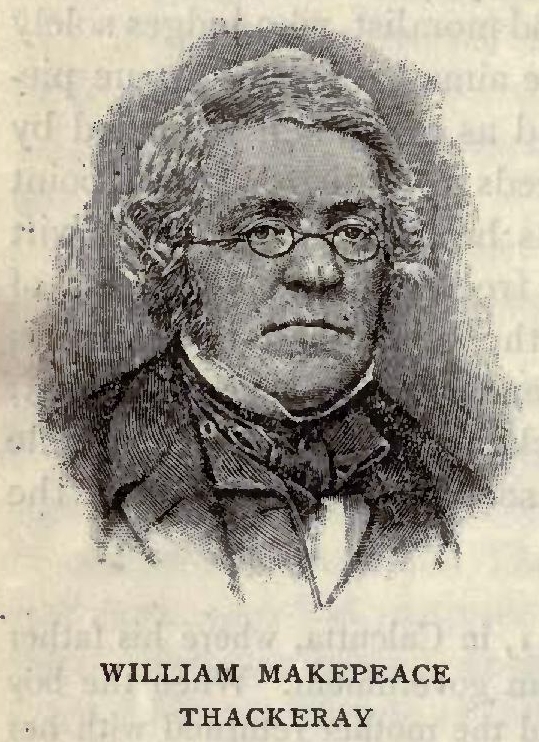
WILLIAM MAKEPEACE THACKERAY
In 1829 Thackeray entered Trinity College, Cambridge, but left after less
than two years, without taking a degree, and went to Germany and France
where he studied with the idea of becoming an artist. When he became of
age, in 1832, he came into possession of a comfortable fortune, returned
to England, and settled down in the Temple to study law. Soon he began to
dislike the profession intensely, and we have in Pendennis a
reflection of his mental attitude toward the law and the young men who
studied it. He soon lost his fortune, partly by gambling and speculation,
partly by unsuccessful attempts at running a newspaper, and at twenty-two
began for the first time to earn his own living, as an artist and
illustrator. An interesting meeting between Thackeray and Dickens at this
time (1836) suggests the relative importance of the two writers. Seymour,
who was illustrating the Pickwick Papers, had just died, and
Thackeray called upon Dickens with a few drawings and asked to be allowed
to continue the illustrations. Dickens was at this time at the beginning
of his great popularity. The better literary artist, whose drawings were
refused, was almost unknown, and had to work hard for more than ten years
before he received recognition. Disappointed by his failure as an
illustrator, he began his literary career by writing satires on society
for Fraser's Magazine. This was the beginning of his success; but
though the Yellowplush Papers, The Great Hoggarty Diamond, Catherine,
The Fitz Boodlers, The Book of Snobs, Barry Lyndon, and various other
immature works made him known to a few readers of Punch and of Fraser's
Magazine, it was not till the publication of Vanity Fair
(1847-1848) that he began to be recognized as one of the great novelists
of his day. All his earlier works are satires, some upon society, others
upon the popular novelists,--Bulwer, Disraeli, and especially
Dickens,--with whose sentimental heroes and heroines he had no patience
whatever. He had married, meanwhile, in 1836, and for a few years was very
happy in his home. Then disease and insanity fastened upon his young wife,
and she was placed in an asylum. The whole after life of our novelist was
darkened by this loss worse than death. He became a man of the clubs,
rather than of his own home, and though his wit and kindness made him the
most welcome of clubmen, there was an undercurrent of sadness in all that
he wrote. Long afterwards he said that, though his marriage ended in
shipwreck, he "would do it over again; for behold Love is the crown and
completion of all earthly good."
After the moderate success of Vanity Fair, Thackeray wrote the
three novels of his middle life upon which his fame chiefly rests,--Pendennis
in 1850, Henry Esmond in 1852, and The Newcomes in 1855.
Dickens's great popular success as a lecturer and dramatic reader had led
to a general desire on the part of the public to see and to hear literary
men, and Thackeray, to increase his income, gave two remarkable courses of
lectures, the first being English Humorists of the Eighteenth Century,
and the second The Four Georges,--both courses being delivered with
gratifying success in England and especially in America. Dickens, as we
have seen, was disappointed in America and vented his displeasure in
outrageous criticism; but Thackeray, with his usual good breeding, saw
only the best side of his generous entertainers, and in both his public
and private utterances emphasized the virtues of the new land, whose
restless energy seemed to fascinate him. Unlike Dickens, he had no
confidence in himself when he faced an audience, and like most literary
men he disliked lecturing, and soon gave it up. In 1860 he became editor
of the Cornhill Magazine, which prospered in his hands, and with a
comfortable income he seemed just ready to do his best work for the world
(which has always believed that he was capable of even better things than
he ever wrote) when he died suddenly in 1863. His body lies buried in
Kensal Green, and only a bust does honor to his memory in Westminster
Abbey.
Henry Esmond Works of Thackeray.
The beginner will do well to omit the earlier satires of Thackeray,
written while he was struggling to earn a living from the magazines, and
open Henry Esmond (1852), his most perfect novel, though not the
most widely known and read. The fine historical and literary, flavor of
this story is one of its most marked characteristics, and only one who
knows something of the history and literature of the eighteenth century
can appreciate its value. The hero, Colonel Esmond; relates his own story,
carrying the reader through the courts and camps of Queen Anne's reign,
and giving the most complete and accurate picture of a past age that has
ever appeared in a novel. Thackeray is, as we have said, a realist, and he
begins his story by adopting the style and manner of a scholarly gentleman
of the period he is describing. He has an extraordinary knowledge of
eighteenth-century literature, and he reproduces its style in detail,
going so far as to insert in his narrative an alleged essay from the Tatler.
And so perfectly is it done that it is impossible to say wherein it
differs from the style of Addison and Steele.
Realism of EsmondIn his matter also
Thackeray is realistic, reflecting not the pride and pomp of war, which
are largely delusions, but its brutality and barbarism, which are all too
real; painting generals and leaders, not as the newspaper heroes to whom
we are accustomed, but as moved by intrigues, petty jealousies, and
selfish ambitions; showing us the great Duke of Marlborough not as the
military hero, the idol of war-crazed multitudes, but as without personal
honor, and governed by despicable avarice. In a word, Thackeray gives us
the "back stairs" view of war, which is, as a rule, totally neglected in
our histories. When he deals with the literary men of the period, he uses
the same frank realism, showing us Steele and Addison and other leaders,
not with halos about their heads, as popular authors, but in slippers and
dressing gowns, smoking a pipe in their own rooms, or else growing tipsy
and hilarious in the taverns,--just as they appeared in daily life. Both
in style and in matter, therefore, Esmond deserves to rank as
probably the best historical novel in our language.
The Plot of EsmondThe plot of the story
is, like most of Thackeray's plots, very slight, but perfectly suited to
the novelist's purpose. The plans of his characters fail; their ideals
grow dim; there is a general disappearance of youthful ambitions. There is
a love story at the center; but the element of romance, which furnishes
the light and music and fragrance of love, is inconspicuous. The hero,
after ten years of devotion to a young woman, a paragon of beauty, finally
marries her mother, and ends with a few pious observations concerning
Heaven's mercy and his own happy lot. Such an ending seems disappointing,
almost bizarre, in view of the romantic novels to which we are accustomed;
but we must remember that Thackeray's purpose was to paint life as he saw
it, and that in life men and things often take a different way from that
described in romances. As we grow acquainted with Thackeray's characters,
we realize that no other ending was possible to his story, and conclude
that his plot, like his style, is perhaps as near perfection as a
realistic novelist can ever come.
Vanity FairVanity Fair (1847--1848)
is the best known of Thackeray's novels. It was his first great work, and
was intended to express his own views of the social life about him, and to
protest against the overdrawn heroes of popular novels. He takes for his
subject that Vanity Fair to which Christian and Faithful were conducted on
their way to the Heavenly City, as recorded in Pilgrim's Progress.
In this fair there are many different booths, given over to the sale of
"all sorts of vanities," and as we go from one to another we come in
contact with "juggling, cheats, games, plays, fools, apes, knaves, rogues,
and that of every kind." Evidently this is a picture of one side of social
life; but the difference between Bunyan and Thackeray is simply
this,--that Bunyan made Vanity Fair a small incident in a long journey, a
place through which most of us pass on our way to better things; while
Thackeray, describing high society in his own day, makes it a place of
long sojourn, wherein his characters spend the greater part of their
lives. Thackeray styles this work "a novel without a hero." The whole
action of the story, which is without plot or development, revolves about
two women,--Amelia, a meek creature of the milk-and-water type, and Becky
Sharp, a keen, unprincipled intriguer, who lets nothing stand in the way
of her selfish desire to get the most out of the fools who largely
constitute society. On the whole, it is the most powerful but not the most
wholesome of Thackeray's works.
PendennisIn his second important novel, Pendennis
(1849-1850), we have a continuation of the satire on society begun in Vanity
Fair. This novel, which the beginner should read after Esmond,
is interesting to us for two reasons,--because it reflects more of the
details of Thackeray's life than all his other writings, and because it
contains one powerfully drawn character who is a perpetual reminder of the
danger of selfishness. The hero is "neither angel nor imp," in Thackeray's
words, but the typical young man of society, whom he knows thoroughly, and
whom he paints exactly as he is,--a careless, good-natured but essentially
selfish person, who goes through life intent on his own interests. Pendennis
is a profound moral study, and the most powerful arraignment of
well-meaning selfishness in our literature, not even excepting George
Eliot's Romola, which it suggests.
The NewcomesTwo other novels, The
Newcomes (1855) and The Virginians (1859), complete the list of
Thackeray's great works of fiction. The former is a sequel to Pendennis,
and the latter to Henry Esmond; and both share the general fate of
sequels in not being quite equal in power or interest to their
predecessors. The Newcomes, however, deserves a very high
place,--some critics, indeed, placing it at the head of the author's
works. Like all Thackeray's novels, it is a story of human frailty; but
here the author's innate gentleness and kindness are seen at their best,
and the hero is perhaps the most genuine and lovable of all his
characters.
Thackeray's EssaysThackeray is known in
English literature as an essayist as well as a novelist. His English
Humorists and The Four Georges are among the finest essays of
the nineteenth century. In the former especially, Thackeray shows not only
a wide knowledge but an extraordinary understanding of his subject.
Apparently this nineteenth-century writer knows Addison, Fielding, Swift,
Smollett, and other great writers of the past century almost as intimately
as one knows his nearest friend; and he gives us the fine flavor of their
humor in a way which no other writer, save perhaps Larnb, has ever
rivaled.[240] The
Four Georges is in a vein of delicate satire, and presents a rather
unflattering picture of four of England's rulers and of the courts in
which they moved. Both these works are remarkable for their exquisite
style, their gentle humor, their keen literary criticisms, and for the
intimate knowledge and sympathy which makes the' people of a past age live
once more in the written pages.
General Characteristics. In treating of Thackeray's view of life,
as reflected in his novels, critics vary greatly, and the following
summary must be taken not as a positive judgment but only as an attempt to
express the general impression of his works on an uncritical reader. He is
first of a realist, who paints life as he sees it. As he says himself, "I
have no brains above my eyes; I describe what I see.". His pictures of
certain types, notably the weak and vicious elements of society, are
accurate and true to life, but they seem to play too large a part in his
books, and have perhaps too greatly influenced his general judgment of
humanity. An excessive sensibility, or the capacity for fine feelings and
emotions, is a marked characteristic of Thackeray, as it is of Dickens and
Carlyle. He is easily offended, as they are, by the shams of society; but
he cannot find an outlet, as Dickens does, in laughter and tears, and he
is too gentle to follow Carlyle in violent denunciations and prophecies.
He turns to satire,--influenced, doubtless, by eighteenth-century
literature which he knew so well, and in which satire played too large a
part.[241] His
satire is never personal, like Pope's, or brutal, like Swift's, and is
tempered by kindness and humor; but it is used too freely, and generally
lays too much emphasis on faults and foibles to be considered a true
picture of any large class of English society.
Thackeray as a Moralist Besides being a
realist and satirist, Thackeray is essentially a moralist, like Addison,
aiming definitely in all his work at producing a moral impression. So much
does he revere goodness, and so determined is he that his Pendennis or his
Becky Sharp shall be judged at their true value, that he is not content,
like Shakespeare, to be simply an artist, to tell an artistic tale and let
it speak its own message; he must explain and emphasize the moral
significance of his work. There is no need to consult our own conscience
over the actions of Thackeray's characters; the beauty of virtue and the
ugliness of vice are evident on every page.
His Style Whatever we may think of
Thackeray's matter, there is one point in which critics are agreed,--that
he is master of a pure and simple English style. Whether his thought be
sad or humorous, commonplace or profound, he expresses it perfectly,
without effort or affectation. In all his work there is a subtle charm,
impossible to describe, which gives the impression that we are listening
to a gentleman. And it is the ease, the refinement, the exquisite
naturalness of Thackeray's style that furnishes a large part of our
pleasure in reading him.
MARY ANN EVANS, GEORGE ELIOT
(1819-1880)
In nearly all the writers of the Victorian Age we note, on the one hand, a
strong intellectual tendency to analyze the problems of life, and on the
other a tendency to teach, that is, to explain to men the method by which
these problems may be solved. The novels especially seem to lose sight of
the purely artistic ideal of writing, and to aim definitely at moral
instruction. In George Eliot both these tendencies reach a climax. She is
more obviously, more consciously a preacher and moralizer than any of her
great contemporaries. Though profoundly religious at heart, she was
largely occupied by the scientific spirit of the age; and finding no
religious creed or political system satisfactory, she fell back upon duty
as the supreme law of life. All her novels aim, first, to show in
individuals the play of universal moral forces, and second, to establish
the moral law as the basis of human society. Aside from this moral
teaching, we look to George Eliot for the reflection of country life in
England, just as we look to Dickens for pictures of the city streets, and
to Thackeray for the vanities of society. Of all the women writer's who
have helped and are still helping to place our English novels at the head
of the world's fiction, she holds at present unquestionably the highest
rank.
Life. Mary Ann (or Marian) Evans, known to us by her pen name of
George Eliot, began to write late in life, when nearly forty years of age,
and attained the leading position among living English novelists in the
ten years between 1870 and 1880, after Thackeray and Dickens had passed
away. She was born at Arbury Farm, Warwickshire, some twenty miles from
Stratford-on-Avon, in 1819. Her parents were plain, honest folk, of the
farmer class, who brought her up in the somewhat strict religious manner
of those days. Her father seems to have been a man of sterling integrity
and of practical English sense,--one of those essentially noble characters
who do the world's work silently and well, and who by their solid worth
obtain a position of influence among their fellow-men.
A few months after George Eliot's birth the family moved to another home,
in the parish of Griff, where her childhood was largely passed. The
scenery of the Midland counties and many details of her own family life
are reflected in her earlier novels. Thus we find her and her brother, as
Maggie and Tom Tulliver, in The Mill on the Floss; her aunt, as
Dinah Morris, and her mother, as Mrs. Poyser, in Adam Bede. We have
a suggestion of her father in the hero of the latter novel, but the
picture is more fully drawn as Caleb Garth, in Middlemarch. For a
few years she studied at two private schools for young ladies, at Nuneaton
and Coventry; but the death of her mother called her, at seventeen years
of age, to take entire charge of the household. Thereafter her education
was gained wholly by miscellaneous reading. We have a suggestion of her
method in one of her early letters, in which she says: "My mind presents
an assemblage of disjointed specimens of history, ancient and modern;
scraps of poetry picked up from Shakespeare, Cowper, Wordsworth, and
Milton; newspaper topics, morsels of Addison and Bacon, Latin verbs,
geometry, entomology, and chemistry; reviews and metaphysics, all arrested
and petrified and smothered by the fast-thickening everyday accession of
actual events, relative anxieties, and household cares and vexations."
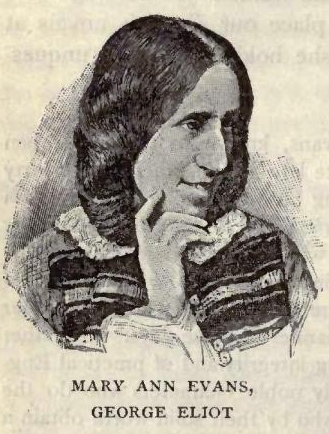
When Mary was twenty-one years old the family again moved, this time to
Foleshill Road, near Coventry. Here she became acquainted with the family
of Charles Bray, a prosperous ribbon manufacturer, whose house was a
gathering place for the freethinkers of the neighborhood. The effect of
this liberal atmosphere upon Miss Evans, brought up in a narrow way, with
no knowledge of the world, was to unsettle many of her youthful
convictions. From a narrow, intense dogmatism, she went to the other
extreme of radicalism; then (about 1860) she lost all sympathy with the
freethinkers, and, being instinctively religious, seemed to be groping
after a definite faith while following the ideal of duty. This spiritual
struggle, which suggests that of Carlyle, is undoubtedly the cause of that
gloom and depression which hang, like an English fog, over much of her
work; though her biographer, Cross, tells us that she was not by any means
a sad or gloomy woman.
In 1849 Miss Evans's father died, and the Brays took her abroad for a tour
of the continent. On her return to England she wrote several liberal
articles for the Westminster Review, and presently was made
assistant editor of that magazine. Her residence in London at this time
marks a turning point in her career and the real beginning of her literary
life. She made strong friendships with Spencer, Mill, and other scientists
of the day, and through Spencer met George Henry Lewes, a miscellaneous
writer, whom she afterwards married.
Under his sympathetic influence she began to write fiction for the
magazines, her first story being "Amos Barton" (1857), which was later
included in the Scenes of Clerical Life (1858). Her first long
novel, Adam Bede, appeared early in 1859 and met with such popular
favor that to the end of her life she despaired of ever again repeating
her triumph. But the unexpected success proved to be an inspiration, and
she completed The Mill on the Floss and began Silas Marner
during the following year. Not until the great success of these works led
to an insistent demand to know the author did the English public learn
that it was a woman, and not an English clergyman, as they supposed, who
had suddenly jumped to the front rank of living writers.
Up to this point George Eliot had confined herself to English country
life, but now she suddenly abandoned the scenes and the people with whom
she was most familiar in order to write an historical novel. It was in
1860, while traveling in Italy, that she formed "the great project" of Romola,--a
mingling of fiction and moral philosophy, against the background of the
mighty Renaissance movement. In this she was writing of things of which
she had no personal knowledge, and the book cost her many months of hard
and depressing labor. She said herself that she was a young woman when she
began the work, and an old woman when she finished it. Romola
(1862--1863) was not successful with the public, and the same may be said
of Felix Holt the Radical (1866) and The Spanish Gypsy
(1868). The last-named work was the result of the author's ambition to
write a dramatic poem which should duplicate the lesson of Romola;
and for the purpose of gathering material she visited Spain, which she had
decided upon as the scene of her poetical effort. With the publication of
Middlemarch (1871-1872) George Eliot came back again into popular
favor, though this work is less spontaneous, and more labored and
pedantic, than her earlier novels. The fault of too much analysis and
moralizing was even more conspicuous in Daniei Deronda (1876),
which she regarded as her greatest book. Her life during all this time was
singularly uneventful, and the chief milestones along the road mark the
publication of her successive novels.
During all the years of her literary success her husband Lewes had been a
most sympathetic friend and critic, and when he died, in 1878, the loss
seemed to be more than she could bear. Her letters of this period are
touching in their loneliness and their craving for sympathy. Later she
astonished everybody by marrying John Walter Cross, much younger than
herself, who is known as her biographer. "Deep down below there is a river
of sadness, but ... I am able to enjoy my newly re-opened life," writes
this woman of sixty, who, ever since she was the girl whom we know as
Maggie Tulliver, must always have some one to love and to depend upon. Her
new interest in life lasted but a few months, for she died in December of
the same year (1880). One of the best indications of her strength and her
limitations is her portrait, with its strong masculine features,
suggesting both by resemblance and by contrast that wonderful portrait of
Savonarola which hangs over his old desk in the monastery at Florence.
Works of George Eliot. These are conveniently divided into three
groups, corresponding to the three periods of her life. The first group
includes all her early essays and miscellaneous work, from her translation
of Strauss's Leben Jesu, in 1846, to her union with Lewes in 1854.
The second group includes Scenes of Clerical Life, Adam Bede, Mill on
the Floss, and Silas Marner, all published between 1858 and
1861. These four novels of the middle period are founded on the author's
own life and experience; their scenes are laid in the country, and their
characters are taken from the stolid people of the Midlands, with whom
George Eliot had been familiar since childhood. They are probably the
author's most enduring works. They have a naturalness, a spontaneity, at
times a flash of real humor, which are lacking in her later novels; and
they show a rapid development of literary power which reaches a climax in
Silas Marner.
The novel of Italian life, Romola (1862-1863), marks a transition
to the third group, which includes three more novels,--Felix Holt
(1866), Middlemarch (1871-1872), Daniel Deronda (1876), the
ambitious dramatic poem The Spanish Gypsy (1868), and a collection
of miscellaneous essays called The Impressions of Theophrastus Such
(1879). The general impression, of these works is not so favorable as that
produced by the novels of the middle period. They are more labored and
less interesting; they contain much deep reflection and analysis of
character, but less observation, less delight in picturing country life as
it is, and very little of what we call inspiration. We must add, however,
that this does not express a unanimous literary judgment, for critics are
not wanting who assert that Daniel Deronda is the highest
expression of the author's genius.
General CharacterThe general character of
all these novels may be described, in the author's own term, as
psychologic realism. This means that George Eliot sought to do in her
novels what Browning attempted in his poetry; that is, to represent the
inner struggle of a soul, and to reveal the motives, impulses, and
hereditary influences which govern human action. Browning generally stops
when he tells his story, and either lets you draw your own conclusion or
else gives you his in a few striking lines. But George Eliot is not
content until she has minutely explained the motives of her characters and
the moral lesson to be learned from them. Moreover, it is the development
of a soul, the slow growth or decline of moral power, which chiefly
interests her. Her heroes and heroines differ radically from those of
Dickens and Thackeray in this respect,--that when we meet the men and
women of the latter novelists, their characters are already formed, and we
are reasonably sure what they will do under given circumstances. In George
Eliot's novels the characters develop gradually as we come to know them.
They go from weakness to strength, or from strength to weakness, according
to the works that they do and the thoughts that they cherish. In Romola,
for instance, Tito, as we first meet him, may be either good or bad, and
we know not whether he will finally turn to the right hand or to the left.
As time passes, we see him degenerate steadily because he follows his
selfish impulses, while Romola, whose character is at first only faintly
indicated, grows into beauty and strength with every act of
self-renunciation.
Moral TeachingIn these two characters,
Tito and Romola, we have an epitome of our author's moral teaching. The
principle of law was in the air during the Victorian era, and we have
already noted how deeply Tennyson was influenced by it. With George Eliot
law is like fate; it overwhelms personal freedom and inclination. Moral
law was to her as inevitable, as automatic, as gravitation. Tito's
degeneration, and the sad failure of Dorothea and Lydgate in Middlemarch,
may be explained as simply as the fall of an apple, or as a bruised knee
when a man loses his balance. A certain act produces a definite moral
effect on the individual; and character is the added sum of all, the acts
of a man's; life,--just as the weight of a body is the sum of the weights
of many different atoms which constitute it. The matter of rewards and
punishments, therefore, needs no final judge or judgment, since these
things take care of themselves automatically in a world of inviolable
moral law.
Perhaps one thing more should be added to the general characteristics of
George Eliot's novels,--they are all rather depressing. The gladsomeness
of life, the sunshine of smiles and laughter, is denied her. It is said
that once, when her husband remarked that her novels were all essentially
sad, she wept, and answered that she must describe life as she had found
it.
What to Read. George Eliot's first stories are in some respects her
best, though her literary power increases during her second period,
culminating in Silas Marner, and her psychological analysis is more
evident in Daniel Deronda. On the whole, it is an excellent way to
begin with the freshness and inspiration of the Scenes of Clerical Life
and read her books in the order in which they were written. In the first
group of novels Adam Bede is the most natural, and probably
interests more readers than all the others combined. The Mill on the
Floss has a larger personal interest, because it reflects much of
George Eliot's history and the scenes and the friends of her early life.
The lack of proportion in this story, which gives rather too much space to
the girl-and-boy experiences, is naturally explained by the tendency in
every man and woman to linger over early memories.
Silas MarnerSilas Marner is
artistically the most perfect of George Eliot's novels, and we venture to
analyze it as typical of her ideals and methods. We note first the style,
which is heavy and a little self-conscious, lacking the vigor and
picturesqueness of Dickens, and the grace and naturalness of Thackeray.
The characters are the common people of the Midlands, the hero being a
linen weaver, a lonely outcast who hoards and gloats over his hard-earned
money, is robbed, thrown into utter despair, and brought back to life and
happiness by the coming of an abandoned child to his fire. In the
development of her story the author shows herself, first, a realist, by
the naturalness of her characters and the minute accuracy with which she
reproduces their ways and even the accents of their speech; second, a
psychologist, by the continual analysis and explanation of motives; third,
a moralist, by showing in each individual the action and reaction of
universal moral forces, and especially by making every evil act bring
inevitable punishment to the man who does it. Tragedy, therefore, plays a
large part in the story; for, according to George Eliot, tragedy and
suffering walk close behind us, or lurk at every turn in the road of life.
Like all her novels, Silas Marner is depressing. We turn away from
even the wedding of Eppie--which is just as it should be--with a sense of
sadness and incompleteness. Finally, as we close the book, we are
conscious of a powerful and enduring impression of reality. Silas, the
poor weaver; Godfrey Cass, the well-meaning, selfish man; Mr. Macey, the
garrulous, and observant parish clerk; Dolly Winthrop, the kind-hearted
countrywoman who cannot understand the mysteries of religion and so
interprets God in terms of human love,--these are real people, whom having
once met we can never forget.
RomolaRomola has the same general
moral theme as the English novels; but the scenes are entirely different,
and opinion is divided as to the comparative merit of the work. It is a
study, a very profound study of moral development in one character and of
moral degeneracy in another. Its characters and its scenes are both
Italian, and the action takes place during a critical period of the
Renaissance movement, when Savonarola was at the height of his power in
Florence. Here is a magnificent theme and a superb background for a great
novel, and George Eliot read and studied till she felt sure that she
understood the place, the time, and the people of her story. Romola
is therefore interesting reading, in many respects the most interesting of
her works. It has been called one of our greatest historical novels; but
as such it has one grievous fault. It is not quite true to the people or
even to the locality which it endeavors to represent. One who reads it
here, in a new and different land, thinks only of the story and of the
novelist's power; but one who reads it on the spot which it describes, and
amidst the life which it pictures, is continually haunted by the
suggestion that George Eliot understood neither Italy nor the Italians. It
is this lack of harmony with Italian life itself which caused Morris and
Rossetti and even Browning, with all his admiration for the author, to lay
aside the book, unable to read it with pleasure or profit. In a word, Romola
is a great moral study and a very interesting book; but the characters are
not Italian, and the novel as a whole lacks the strong reality which marks
George Eliot's English studies.
MINOR NOVELISTS OF THE VICTORIAN AGE
In the three great novelists just considered we have an epitome of the
fiction of the age, Dickens using the novel to solve social problems,
Thackeray to paint the life of society as he saw it, and George Eliot to
teach the fundamental principles of morality. The influence of these three
writers is reflected in all the minor novelists of the Victorian Age.
Thus, Dickens is reflected in Charles Reade, Thackeray in Anthony Trollope
and the Brontë sisters, and George Eliot's psychology finds artistic
expression in George Meredith. To these social and moral and realistic
studies we should add the element of romance, from which few of our modern
novelist's can long escape. The nineteenth century, which began with the
romanticism of Walter Scott, returns to its first love, like a man glad to
be home, in its delight over Blackmore's Lorna Doone and the
romances of Robert Louis Stevenson.
Charles Reade. In his fondness
for stage effects, for picturing the romantic side of common life, and for
using the novel as the instrument of social reform, there is a strong
suggestion of Dickens in the work of Charles Reade (1814-1884). Thus his
Peg Woffington is a study of stage life from behind the scenes; A
Terrible Temptation is a study of social reforms and reformers; and Put
yourself in his Place is the picture of a workingman who struggles
against the injustice of the trades unions. His masterpiece, The
Cloister and the Hearth (1861), one of our best historical novels, is
a somewhat laborious study of student and vagabond life in Europe in the
days of the German Renaissance. It has small resemblance to George Eliot's
Romola, whose scene is laid in Italy during the same period; but
the two works may well be read in succession, as the efforts of two very
different novelists of the same period to restore the life of an age long
past.
Anthony Trollope. In his
realism, and especially in his conception of the novel as the
entertainment of an idle hour, Trollope (1815-1882) is a reflection of
Thackeray. It would be hard to find a better duplicate of Becky Sharp, the
heroine of Vanity Fair, for instance, than is found in Lizzie
Eustace, the heroine of The Eustace Diamonds. Trollope was the most
industrious and systematic of modern novelists, writing a definite amount
each day, and the wide range of his characters suggests the Human
Comedy of Balzac. His masterpiece is Barchester Towers (1857).
This is a study of life in a cathedral town, and is remarkable for its
minute pictures of bishops and clergymen, with their families and
dependents. It would be well to read this novel in connection with The
Warden (1855), The Last Chronicle of Barset (1867), and other
novels of the same series, since the scenes and characters are the same in
all these books, and they are undoubtedly the best expression of the
author's genius. Hawthorne says of his novels: "They precisely suit my
taste,--solid and substantial, and ... just as real as if some giant had
hewn a great lump out of the earth and put it under a glass case, with all
the inhabitants going about their daily business and not suspecting that
they were being made a show of."
Charlotte Brontë. We have
another suggestion of Thackeray in the work of Charlotte Brontë
(1816-1855). She aimed to make her novels a realistic picture of society,
but she added to Thackeray's realism the element of passionate and
somewhat unbalanced romanticism. The latter element was partly the
expression of Miss Brontë's own nature, and partly the result of her
lonely and grief-stricken life, which was darkened by a succession of
family tragedies. It will help us to understand her work if we remember
that both Charlotte Brontë and her sister Emily[242] turned to literature because
they found their work as governess and teacher unendurable, and sought to
relieve the loneliness and sadness of their own lot by creating a new
world of the imagination. In this new world, however, the sadness of the
old remains, and all the Brontë novels have behind them an aching heart.
Charlotte Brontë's best known work is Jane Eyre (1847), which, with
all its faults, is a powerful and fascinating study of elemental love and
hate, reminding us vaguely of one of Marlowe's tragedies. This work won
instant favor with the public, and the author was placed in the front rank
of living novelists. Aside from its value as a novel, it is interesting,
in many of its early passages, as the reflection of the author's own life
and experience. Shirley (1849) and Villette (1853) make up
the trio of novels by which this gifted woman is generally remembered.
Bulwer Lytton. Edward Bulwer
Lytton (1803-1873) was an extremely versatile writer, who tried almost
every kind of novel known to the nineteenth century. In his early life he
wrote poems and dramas, under the influence of Byron; but his first
notable work, Pelham (1828), one of the best of his novels, was a
kind of burlesque on the Byronic type of gentleman. As a study of
contemporary manners in high society, Pelham has a suggestion of
Thackeray, and the resemblance is more noticeable in other novels of the
same type, such as Ernest Maltravers (1837), The Caxtons
(1848-1849), My Novel (1853), and Kenelm Chillingly (1873).
We have a suggestion of Dickens in at least two of Lytton's novels, Paul
Clifford and Eugene Aram, the heroes of which are criminals,
pictured as the victims rather than as the oppressors of society. Lytton
essayed also, with considerable popular success, the romantic novel in The
Pilgrims of the Rhine and Zanoni, and tried the ghost story in
The Haunted and the Haunters. His fame at the present day rests
largely upon his historical novels, in imitation of Walter Scott, The
Last Days of Pompeii (1834), Riettza (1835), and Harold
(1848), the last being his most ambitious attempt to make the novel the
supplement of history. In all his novels Lytton is inclined to
sentimentalism and sensationalism, and his works, though generally
interesting, seem hardly worthy of a high place in the history of fiction.
Kingsley. Entirely different in
spirit are the novels of the scholarly clergyman, Charles Kingsley
(1819-1875). His works naturally divide themselves into three classes. In
the first are his social studies and problem novels, such as Alton
Locke (1850), having for its hero a London tailor and poet, and Yeast
(1848), which deals with the problem of the agricultural laborer. In the
second class are his historical novels, Hereward the Wake, Hypatia,
and Westward Ho! Hypatia is a dramatic story of Christianity in
contact with paganism, having its scene laid in Alexandria at the
beginning of the fifth century. Westward Ho! (1855), his best known
work, is a stirring tale of English conquest by land and sea in the days
of Elizabeth. In the third class are his various miscellaneous works, not
the least of which is Water-Babies, a fascinating story of a
chimney sweep, which mothers read to their children at bedtime,--to the
great delight of the round-eyed little listeners under the counterpane.
Mrs. Gaskell. Mrs. Elizabeth
Gaskell (1810-1865) began, like Kingsley, with the idea of making the
novel the instrument of social reform. As the wife of a clergyman in
Manchester, she had come in close contact with the struggles and ideals of
the industrial poor of a great city, and she reflected her sympathy as
well as her observation in Mary Barton (1848) and in North and
South (1855). Between these two problem novels she published her
masterpiece, Cranford, in 1853. The original of this country
village, which is given over to spinsters, is undoubtedly Knutsford, in
Cheshire, where Mrs. Gaskell had spent her childhood. The sympathy, the
keen observation, and the gentle humor with which the small affairs of a
country village are described make Cranford one of the most
delightful stories in the English language. We are indebted to Mrs.
Gaskell also for the Life of Charlotte Brontë, which is one of our
best biographies.
Blackmore. Richard Doddridge
Blackrhore (1825--1900) was a prolific writer, but he owes his fame almost
entirely to one splendid novel, Lorna Doone, which was published in
1869. The scene of this fascinating romance is laid in Exmoor in the
seventeenth century. The story abounds in romantic scenes and incidents;
its descriptions of natural scenery are unsurpassed; the rhythmic language
is at times almost equal to poetry; and the whole tone of the book is
wholesome and refreshing. Altogether it would be hard to find a more
delightful romance in any language, and it well deserves the place it has
won as one of the classics of our literature. Other works of Blackmore
which will repay the reader are Clara Vaughan (1864), his first
novel, The Maid of Sker (1872), Springhaven (1887), Perlycross
(1894), and Tales from the Telling House (1896); but none of these,
though he counted them his best work, has met with the same favor as Lorna
Doone.
Meredith. So much does George
Meredith (1828-1909) belong to our own day that it is difficult to think
of him as one of the Victorian novelists. His first notable work, The
Ordeal of Richard Feverel, was published in 1859, the same year as
George Eliot's Adam Bede; but it was not till the publication of Diana
of the Crossways in 1885, that his power as a novelist was widely
recognized. He resembles Browning not only in his condensed style, packed
with thought, but also in this respect,--that he labored for years in
obscurity, and after much of his best work was published and apparently
forgotten he slowly won the leading place in English fiction. We are still
too near him to speak of the permanence of his work, but a casual reading
of any of his novels suggests a comparison and a contrast with George
Eliot. Like her, he is a realist and a psychologist; but while George
Eliot uses tragedy to teach a moral lesson, Meredith depends more upon
comedy, making vice not terrible but ridiculous. For the hero or heroine
of her novel George Eliot invariably takes an individual, and shows in
each one the play of universal moral forces. Meredith constructs a
type-man as a hero, and makes this type express his purpose and meaning.
So his characters seldom speak naturally, as George Eliot's do; they are
more like Browning's characters in packing a whole paragraph into a single
sentence or an exclamation. On account of his enigmatic style and his
psychology, Meredith will never be popular; but by thoughtful men and
women he will probably be ranked among our greatest writers of fiction.
The simplest and easiest of his novels for a beginner is The Adventures
of Henry Richmond (1871). Among the best of his works, besides the two
mentioned above, are Beauchamp's Career (1876) and The Egoist
(1879). The latter is, in our personal judgment, one of the strongest and
most convincing novels of the Victorian Age.
Hardy. Thomas Hardy (1840-)
seems, like Meredith, to belong to the present rather than to a past age,
and an interesting comparison may be drawn between these two novelists. In
style, Meredith is obscure and difficult, while Hardy is direct and
simple, aiming at realism in all things. Meredith makes man the most
important phenomenon in the universe; and the struggles of men are
brightened by the hope of victory. Hardy makes man an insignificant part
of the world, struggling against powers greater than himself,--sometimes
against systems which he cannot reach or influence, sometimes against a
kind of grim world-spirit who delights in making human affairs go wrong.
He is, therefore, hardly a realist, but rather a man blinded by pessimism;
and his novels, though generally powerful and sometimes fascinating, are
not pleasant or wholesome reading. From the reader's view point some of
his earlier works, like the idyllic love story Under the Greenwood Tree
(1872) and A Pair of Blue Eyes (1873), are the most interesting.
Hardy became noted, however, when he published Far from the Madding
Crowd, a book which, when it appeared anonymously in the Cornhill
Magazine (1874), was generally attributed to George Eliot, for the
simple reason that no other novelist was supposed to be capable of writing
it. The Return of the Native (1878) and The Woodlanders are
generally regarded as Hardy's masterpieces; but two novels of our own day,
Tess of the D'Ubervilles (1891) and Jude the Obscure (1895),
are better expressions of Hardy's literary art and of his gloomy
philosophy.
Stevenson. In pleasing
contrast with Hardy is Robert Louis Stevenson (1850-1894), a brave,
cheery, wholesome spirit, who has made us all braver and cheerier by what
he has written. Aside from their intrinsic value, Stevenson's novels are
interesting in this respect,--that they mark a return to the pure
romanticism of Walter Scott. The novel of the nineteenth century had, as
we have shown, a very definite purpose. It aimed not only to represent
life but to correct it, and to offer a solution to pressing moral and
social problems. At the end of the century Hardy's gloom in the face of
modern social conditions became oppressive, and Stevenson broke away from
it into that land of delightful romance in which youth finds an answer to
all its questions. Problems differ, but youth is ever the same, and
therefore Stevenson will probably be regarded by future generations as one
of our most enduring writers. To his life, with its "heroically happy"
struggle, first against poverty, then against physical illness, it is
impossible to do justice in a short article. Even a longer biography is
inadequate, for Stevenson's spirit, not the incidents of his life, is the
important thing; and the spirit has no biographer. Though he had written
much better work earlier, he first gained fame by his Treasure Island
(1883), an absorbing story of pirates and of a hunt for buried gold. Dr.
Jekyll and Mr. Hyde (1886) is a profound ethical parable, in which,
however, Stevenson leaves the psychology and the minute analysis of
character to his readers, and makes the story the chief thing in his
novel. Kidnapped (1886), The Master of Ballantrae (1889),
and David Balfour (1893) are novels of adventure, giving us vivid
pictures of Scotch life. Two romances left unfinished by his early death
in Samoa are The Weir of Hermiston and St. Ives. The latter
was finished by Quiller-Couch in 1897; the former is happily just as
Stevenson left it, and though unfinished is generally regarded as his
masterpiece. In addition to these novels, Stevenson wrote a large number
of essays, the best of which are collected in Virginibus Puerisque,
Familiar Studies of Men and Books, and Memories and Portraits.
Delightful sketches of his travels are found in An Inland Voyage
(1878), Travels with a Donkey (1879), Across the Plains
(1892), and The Amateur Emigrant (1894). Underwoods (1887)
is an exquisite little volume of poetry, and A Child's Garden of Verses
is one of the books that mothers will always keep to read to their
children.
In all his books Stevenson gives the impression of a man at play rather
than at work, and the reader soon shares in the happy spirit of the
author. Because of his beautiful personality, and because of the love and
admiration he awakened for himself in multitudes of readers, we are
naturally inclined to exaggerate his importance as a writer. However that
may be, a study of his works shows him to be a consummate literary artist.
His style is always simple, often perfect, and both in his manner and in
his matter he exercises a profound influence, on the writers of the
present generation.
III. ESSAYISTS OF THE VICTORIAN AGE
THOMAS BABINGTON MACAULAY (1800-1859)
Macaulay is one of the most typical figures of the nineteenth century.
Though not a great writer, if we compare him with Browning or Thackeray,
he was more closely associated than any of his literary contemporaries
with the social and political struggles of the age. While Carlyle was
proclaiming the gospel of labor, and Dickens writing novels to better the
condition of the poor, Macaulay went vigorously to work on what he thought
to be the most important task of the hour, and by his brilliant speeches
did perhaps more than any other single man to force the passage of the
famous Reform Bill. Like many of the Elizabethans, he was a practical man
of affairs rather than a literary man, and though we miss in his writings
the imagination and the spiritual insight which stamp the literary genius,
we have the impression always of a keen, practical, honest mind, which
looks at present problems in the light of past experience. Moreover, the
man himself, with his marvelous mind, his happy spirit, and his absolute
integrity of character, is an inspiration to better living.
Life. Macaulay was born at Rothley Temple, Leicestershire, in 1800.
His father, of Scotch descent, was at one time governor of the Sierra
Leone colony for liberated negroes, and devoted a large part of his life
to the abolition of the slave trade. His mother, of Quaker parentage, was
a brilliant, sensitive woman, whose character is reflected in that of her
son. The influence of these two, and the son's loyal devotion to his
family, can best be read in Trevelyan's interesting biography.
As a child, Macaulay is strongly suggestive of Coleridge. At three years
of age he began to read eagerly; at five he "talked like a book"; at ten
he had written a compendium of universal history, besides various hymns,
verse romances, arguments for Christianity, and one ambitious epic poem.
The habit of rapid reading, begun in childhood, continued throughout his
life, and the number and vari ety of books which he read is almost
incredible. His memory was phenomenal. He could repeat long poems and
essays after a single reading; he could quote not only passages but the
greater part of many books, including Pilgrim's Progress, Paradise Lost,
and various novels like Clarissa. Once, to test his memory, he
recited two newspaper poems which he had read in a coffeehouse forty years
before, and which he had never thought of in the interval.
At twelve years of age this remarkable boy was sent to a private school at
Little Shelford, and at eighteen he eqgered Trinity College, Cambridge.
Here he made a reputation as a classical scholar and a brilliant talker,
but made a failure of his mathematics. In a letter to his mother he wrote:
"Oh for words to express my abomination of that science.... Discipline of
the mind! Say rather starvation, confinement, torture, annihilation!" We
quote this as a commentary on Macaulay's later writings, which are
frequently lacking in the exactness and the logical sequence of the
science which he detested.
After his college course Macaulay studied law, was admitted to the bar,
devoted himself largely to politics, entered Parliament in 1830, and
almost immediately won a reputation as the best debater and the most
eloquent speaker, of the Liberal or Whig party. Gladstone says of him:
"Whenever he arose to speak it was a summons like a trumpet call to fill
the benches." At the time of his election he was poor, and the loss of his
father's property threw upon him the support of his brothers and sisters;
but he took up the burden with cheerful courage, and by his own efforts
soon placed himself and his family in comfort. His political progress was
rapid, and was due not to favoritism or intrigue, but to his ability, his
hard work, and his sterling character. He was several times elected to
Parliament, was legal adviser to the Supreme Council of India, was a
member of the cabinet, and declined many offices for which other men labor
a lifetime. In 1857 his great ability and services to his country were
recognized by his being raised to the peerage with the title of Baron
Macaulay of Rothley.
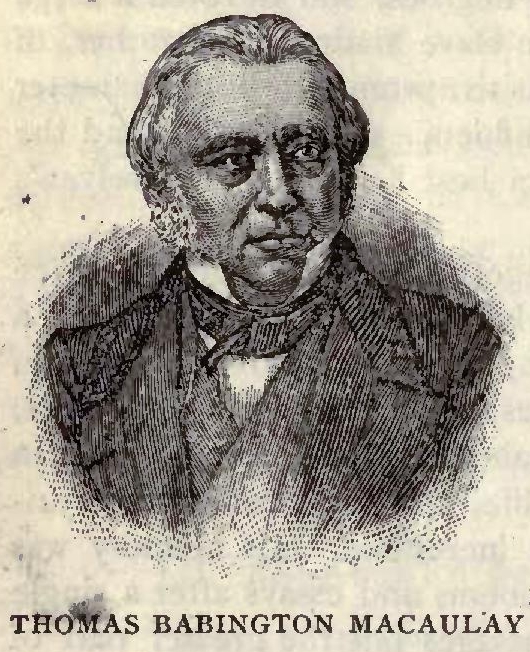
THOMAS BABINGTON MACAULAY
Macaulay's literary work began in college with the contribution of various
ballads and essays to the magazines. In his later life practical affairs
claimed the greater part of his time, and his brilliant essays were
written in the early morning or late at night. His famous Essay on
Milton appeared in the Edinburgh Review in 1825. It created a
sensation, and Macaulay, having gained the ear of the public, never once
lost it during the twenty years in which he was a contributor to the
magazines. His Lays of Ancient Rome appeared in 1842, and in the
following year three volumes of his collected Essays. In 1847 he
lost his seat in Parliament, temporarily, through his zealous efforts in
behalf of religious toleration; and the loss was most fortunate, since it
gave him opportunity to begin his History of England,--a monumental
work which he had been planning for many years. The first two volumes
appeared in 1848, and their success can be compared only to that of the
most popular novels. The third and fourth volumes of the History
(1855) were even more successful, and Macaulay was hard at work on the
remaining volumes when he died, quite suddenly, in 1859. He was buried,
near Addison, in the Poets' Corner of Westminster Abbey. A paragraph from
one of his letters, written at the height of his fame and influence, may
give us an insight into his life and work:
I can truly say that I have not, for many years, been so happy as I am at
present.... I am free. I am independent. I am in Parliament, as honorably
seated as man can be. My family is comfortably off. I have leisure for
literature, yet I am not reduced to the necessity of writing for money. If
I had to choose a lot from all that there are in human life, I am not sure
that I should prefer any to that which has fallen to me. I am sincerely
and thoroughly contented.
Essay on MiltonWorks of Macaulay.
Macaulay is famous in literature for his essays, for his martial ballads,
and for his History of England. His first important work, the Essay
on Milton (1825), is worthy of study not only for itself, as a
critical estimate of the Puritan poet, but as a key to all Macaulay's
writings. Here, first of all, is an interesting work, which, however much
we differ from the author's opinion, holds our attention and generally
makes us regret that the end comes so soon. The second thing to note is
the historical flavor of the essay. We study not only Milton, but also the
times in which he lived, and the great movements of which he was a part.
History and literature properly belong together, and Macaulay was one of
the first writers to explain the historical conditions which partly
account for a writer's work and influence. The third thing to note is
Macaulay's enthusiasm for his subject,--an enthusiasm which is often
partisan, but which we gladly share for the moment as we follow the
breathless narrative. Macaulay generally makes a hero of his man, shows
him battling against odds, and the heroic side of our own nature awakens
and responds to the author's plea. The fourth, and perhaps most
characteristic thing in the essay is the style, which is remarkably clear,
forceful, and convincing. Jeffrey, the editor of the Edinburgh Review,
wrote enthusiastically when he received the manuscript, "The more I think,
the less I can conceive where you picked up that style." We still share in
the editor's wonder; but the more we think, the less we conceive that such
a style could be picked up. It was partly the result of a well-stored
mind, partly of unconscious imitation of other writers, and partly of that
natural talent for clear speaking and writing which is manifest in all
Macaulay's work.
Other EssaysIn the remaining essays we
find the same general qualities which characterize Macaulay's first
attempt. They cover a wide range of subjects, but they may be divided into
two general classes, the literary or critical, and the historical. Of the
literary essays the best are those on Milton, Addison, Goldsmith, Byron,
Dryden, Leigh Hunt, Bunyan, Bacon, and Johnson. Among the best known of
the historical essays are those on Lord Clive, Chatham, Warren Hastings,
Hallam's Constitutional History, Von Ranke's History of the Papacy,
Frederick the Great, Horace Walpole, William Pitt, Sir William Temple,
Machiavelli, and Mirabeau. Most of these were produced in the vigor of
young manhood, between 1825 and 1845, while the writer was busy with
practical affairs of state. They are often one-sided and inaccurate, but
always interesting, and from them a large number of busy people have
derived their first knowledge of history and literature.
Lays of Ancient RomeThe best of Macaulay's
poetical work is found in the Lays of Ancient Rome (1842), a
collection of ballads in the style of Scott, which sing of the old heroic
days of the Rome Roman republic. The ballad does not require much thought
or emotion. It demands clearness, vigor, enthusiasm, action; and it suited
Macaulay's genius perfectly. He was, however, much more careful than other
ballad writers in making his narrative true to tradition. The stirring
martial spirit of these ballads, their fine workmanship, and their appeal
to courage and patriotism made them instantly popular. Even to-day, after
more than fifty years, such ballads as those on Virginius and Horatius at
the Bridge are favorite pieces in many school readers.
History of EnglandThe History of
England, Macaulay's masterpiece, is still one of the most popular
historical works in the English language. Originally it was intended to
cover the period from the accession of James II, in 1685, to the death of
George IV, in 1830. Only five volumes of the work were finished, and so
thoroughly did Macaulay go into details that these five volumes cover only
sixteen years. It has been estimated that to complete the work on the same
scale would require some fifty volumes and the labor of one man for over a
century.
In his historical method Macaulay suggests Gibbon. His own knowledge of
history was very great, but before writing he read numberless pages,
consulted original documents, and visited the scenes which he intended to
describe. Thackeray's remark, that "Macaulay reads twenty books to write a
sentence and travels one hundred miles to make a line of description," is,
in view of his industry, a well-warranted exaggeration.
As in his literary essays, he is fond of making heroes, and he throws
himself so heartily into the spirit of the scene he is describing that his
word pictures almost startle us by their vivid reality. The story of
Monmouth's rebellion, for instance, or the trial of the seven bishops, is
as fascinating as the best chapters of Scott's historical novels.
While Macaulay's search for original sources of information suggests the
scientific historian, his use of his material is much more like that of a
novelist or playwright. In his essay on Machiavelli he writes: "The best
portraits are perhaps those in which there is a slight mixture of
caricature, and we are not certain that the best histories are not those
in which a little of the exaggeration of fictitious narrative is
judiciously employed. Something is lost in accuracy, but much is gained in
effect."[243]
Whether this estimate of historical writing be true or false, Macaulay
employed it in his own work and made his narrative as absorbing as a
novel. To all his characters he gives the reality of flesh and blood, and
in his own words he "shows us over their houses and seats us at their
tables." All that is excellent, but it has its disadvantages. In his
admiration for heroism, Macaulay makes some of his characters too good and
others too bad. In his zeal for details he misses the importance of great
movements, and of great leaders who are accustomed to ignore details; and
in his joy of describing events he often loses sight of underlying causes.
In a word, he is without historical insight, and his work, though
fascinating, is seldom placed among the reliable histories of England.
General Characteristics. To the reader who studies Macaulay's
brilliant essays and a few chosen chapters of his History, three
things soon become manifest. First, Macaulay's art is that of a public
speaker rather than that of a literary man. He has a wonderful command of
language, and he makes his meaning clear by striking phrases, vigorous
antitheses, anecdotes, and illustrations. His style is so clear that "he
who runs may read," and from beginning to end he never loses the attention
of his readers. Second, Macaulay's good spirits and enthusiasm are
contagious. As he said himself, he wrote "out of a full head," chiefly for
his own pleasure or recreation; and one who writes joyously generally
awakens a sense of pleasure in his readers. Third, Macaulay has "the
defect of his qualities." He reads and remembers so much that he has no
time to think or to form settled opinions. As Gladstone said, Macaulay is
"always conversing or recollecting or reading or composing, but reflecting
never." So he wrote his brilliant Essay on Milton, which took all
England by storm, and said of it afterward that it contained "scarcely a
paragraph which his mature judgment approved." Whether he speaks or
writes, he has always before him an eager audience, and he feels within
him the born orator's power to hold and fascinate. So he gives loose rein
to his enthusiasm, quotes from a hundred books, and in his delight at
entertaining us forgets that the first quality of a critical or historical
work is to be accurate, and the second to be interesting.
THOMAS CARLYLE (1795-1881)
In marked contrast with Macaulay, the brilliant and cheerful essayist, is
Thomas Carlyle, the prophet and censor of the nineteenth century. Macaulay
is the practical man of affairs, helping and rejoicing in the progress of
his beloved England. Carlyle lives apart from all practical interests,
looks with distrust on the progress of his age, and tells men that truth,
justice, and immortality are the only worthy objects of human endeavor.
Macaulay is delighted with material comforts; he is most at home in
brilliant and fashionable company; and he writes, even when ill and
suffering, with unfailing hopefulness and good nature. Carlyle is like a
Hebrew prophet just in from the desert, and the burden of his message is,
"Woe to them that are at ease in Zion!" Both men are, in different ways,
typical of the century, and somewhere between the two extremes--the
practical, helpful activity of Macaulay and the spiritual agony and
conflict of Carlyle--we shall find the measure of an age which has left
the deepest impress upon our own.
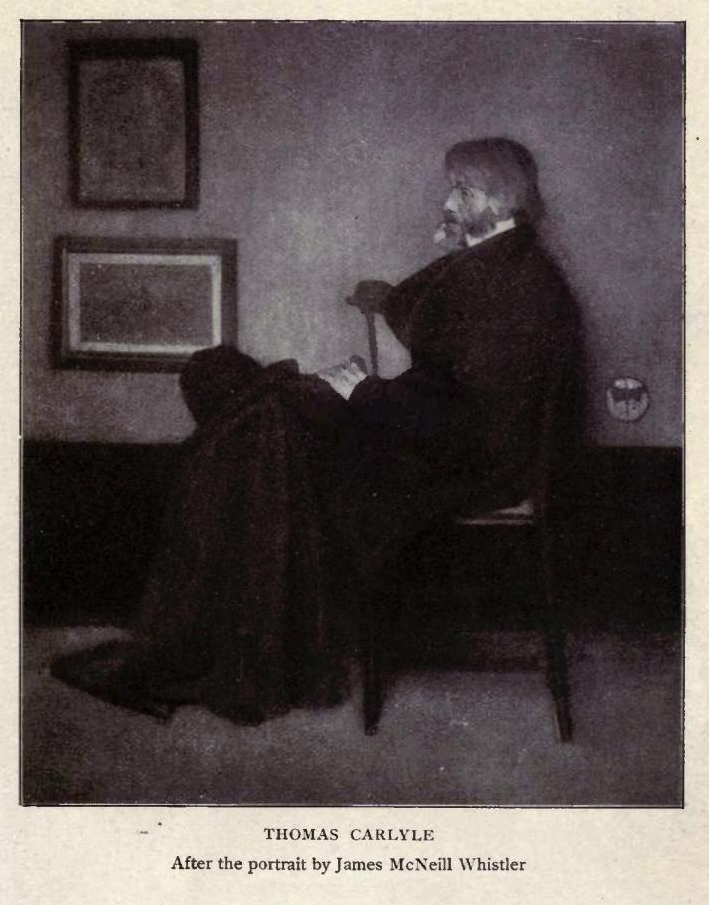
Life of Carlyle. Carlyle was born at Ecclefechan, Dumfriesshire, in
1795, a few months before Burns's death, and before Scott had published
his first work. Like Burns, he came of peasant stock,--strong, simple,
God-fearing folk, whose influence in Carlyle's later life is beyond
calculation. Of his mother he says, "She was too mild and peaceful for the
planet she lived in"; and of his father, a stone mason, he writes, "Could
I write my books as he built his houses, walk my way so manfully through
this shadow world, and leave it with so little blame, it were more than
all my hopes."
Of Carlyle's early school life we have some interesting glimpses in Sartor
Resartus. At nine years he entered the Annan grammar school, where he
was bullied by the older boys, who nicknamed him Tom the Tearful. For the
teachers of those days he has only ridicule, calling them "hide-bound
pedants," and he calls the school by the suggestive German name of Hinterschlag
Gymnasium. At the wish of his parents, who intended Carlyle for the
ministry, he endured this hateful school life till 1809, when he entered
Edinburgh University. There he spent five miserable years, of which his
own record is: "I was without friends, experience, or connection in the
sphere of human business, was of sly humor, proud enough and to spare, and
had begun my long curriculum of dyspepsia." This nagging illness was the
cause of much of that irritability of temper which frequently led him to
scold the public, and for which he has been harshly handled by unfriendly
critics.
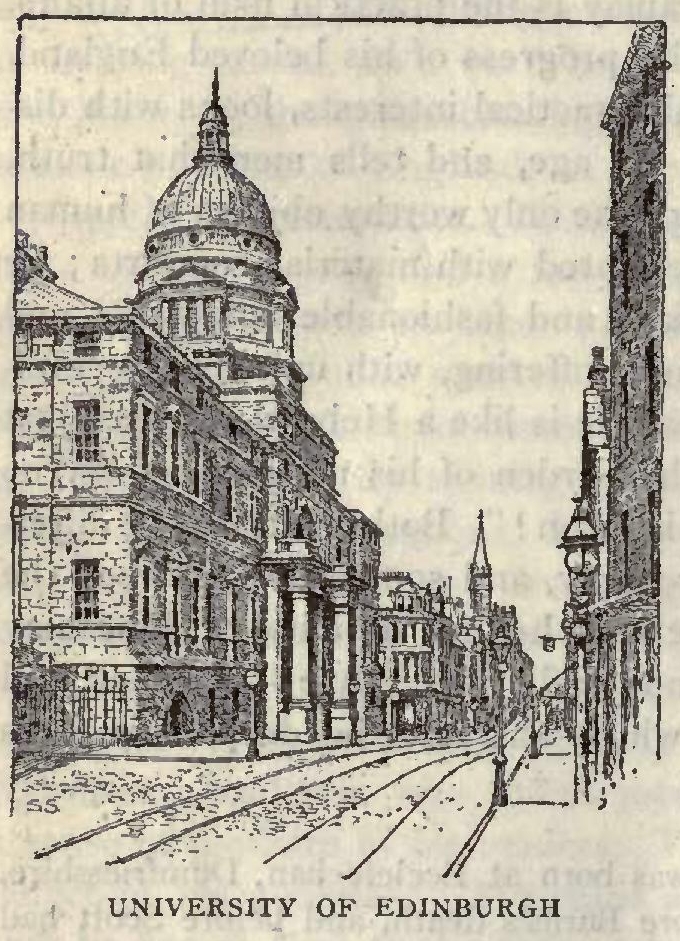
UNIVERSITY OF EDINBURGH
The period following his university course was one of storm and stress for
Carlyle. Much to the grief of the father whom he loved, he had given up
the idea of entering the ministry. Wherever he turned, doubts like a thick
fog surrounded him,--doubts of God, of his fellow-men, of human progress,
of himself. He was poor, and to earn an honest living was his first
problem. He tried successively teaching school, tutoring, the study of
law, and writing miscellaneous articles for the Edinburgh Encyclopedia.
All the while he was fighting his doubts, living, as he says, "in a
continual, indefinite, pining fear." After six or seven years of mental
agony, which has at times a suggestion of Bunyan's spiritual struggle, the
crisis came in 1821, when Carlyle suddenly shook off his doubts and found
himself. "All at once," he says in Sartor, "there arose a thought
in me, and I asked myself: 'What Art thou afraid of? Wherefore like
a coward dost thou forever pip and whimper, and go cowering and trembling?
Despicable biped! What is the sum total of the worst that lies before
thee? Death? Well, Death; and say the pangs of Tophet too, and all that
the Devil and Man may, will, or can do against thee! Hast thou not a
heart; canst thou not suffer whatsoever it be; and, as a Child of Freedom,
though outcast, trample Tophet itself under thy feet, while it consumes
thee? Let it come then; I will meet it and defy it!' And as I so thought,
there rushed like a stream of fire over my whole soul; and I shook base
Fear away from me forever." This struggle between fear and faith, and the
triumph of the latter, is recorded in two remarkable chapters, "The
Everlasting No" and "The Everlasting Yea," of Sartor Resartus.
Carlyle now definitely resolved on a literary life, and began with any
work that offered a bare livelihood. He translated Legendre's Geometry
from the French, wrote numerous essays for the magazines, and continued
his study of German while making translations from that language. His
translation of Goethe's Wilhelm Meister Appeared in 1824, his Life
of Schiller in 1825, and his Specimens of German Romance in
1827. He began at this time a correspondence with Goethe, his literary
hero, which lasted till the German poet's death in 1832. While still busy
with "hack work," Carlyle, in 1826, married Jane Welsh, a brilliant and
beautiful woman, whose literary genius almost equaled that of her husband.
Soon afterwards, influenced chiefly by poverty, the Carlyles retired to a
farm, at Craigen-puttoch (Hawks' Hill), a dreary and lonely spot, far from
friends and even neighbors. They remained here six years, during which
time Carlyle wrote many of his best essays, and Sartor Resartus,
his most original work. The latter went begging among publishers for two
years, and was finally published serially in Fraser's Magazine, in
1833-1834. By this time Carlyle had begun to attract attention as a
writer, and, thinking that one who made his living by the magazines should
be in close touch with the editors, took his wife's advice and moved to
London "to seek work and bread." He settled in Cheyne Row, Chelsea,--a
place made famous by More, Erasmus, Bolingbroke, Smollett, Leigh Hunt, and
many lesser lights of literature,--and began to enjoy the first real peace
he had known since childhood. In 1837 appeared The French Revolution,
which first made Carlyle famous; and in the same year, led by the
necessity of earning money, he began the series of lectures--German.
Literature (1837), Periods of European Culture (1838), Revolutions
of Modern Europe (1839), Heroes and Hero Worship (1841)--which
created a sensation in London. "It was," says Leigh Hunt, "as if some
Puritan had come to life again, liberalized by German philosophy and his
own intense reflection and experience."
Though Carlyle set himself against the spirit of his age, calling the
famous Reform Bill a "progress into darkness," and democracy "the rule of
the worst rather than the best," his rough sincerity was unquestioned, and
his remarks were more quoted than those of any other living man. He was
supported, moreover, by a rare circle of friends,--Edward Irving, Southey,
Sterling, Landor, Leigh Hunt, Dickens, Mill, Tennyson, Browning, and, most
helpful of all, Emerson, who had visited Carlyle at Craigenputtoch in
1833. It was due largely to Emerson's influence that Carlyle's works were
better appreciated, and brought better financial rewards, in America than
in England.
Carlyle's fame reached its climax in the monumental History of
Frederick the Great (1858-1865), published after thirteen years of
solitary toil, which, in his own words, "made entire devastation of home
life and happiness." The proudest moment of his life was when he was
elected to succeed Gladstone as lord rector of Edinburgh University, in
1865, the year in which Frederick the Great was finished. In the
midst of his triumph, and while he was in Scotland to deliver his
inaugural address, his happiness was suddenly destroyed by the death of
his wife,--a terrible blow, from which he never recovered. He lived on for
fifteen years, shorn of his strength and interest in life; and his closing
hours were like the dull sunset of a November day. Only as we remember his
grief and remorse at the death of the companion who had shared his toil
but not his triumph, can we understand the sorrow that pervades the pages
of his Reminiscences. He died in 1881, and at his own wish was
buried, not in Westminster Abbey, but among his humble kinsfolk in
Ecclefechan. However much we may differ from his philosophy or regret the
harshness of his minor works, we shall probably all agree in this
sentiment from one of his own letters,--that the object of all his
struggle and writing was "that men should find out and believe the truth,
and match their lives to it."
Works of Carlyle. There are two widely different judgments of
Carlyle as a man and a writer. The first, which is founded largely on his
minor writings, like Chartism, Latter-Day Pamphlets, and Shooting
Niagara, declares that he is a misanthrope and dyspeptic with a
barbarous style of writing; that he denounces progress, democracy,
science, America, Darwin,--everybody and everything that he does not
understand; that his literary opinions are largely prejudices; that he
began as a prophet and ended as a scold; and that in denouncing shams of
every sort he was something of a sham himself, since his practice was not
in accord with his own preaching. The second judgment, which is founded
upon Heroes and Hero Worship, Cromwell, and Sartor Resartus,
declares that these works are the supreme manifestation of genius; that
their rugged, picturesque style makes others look feeble or colorless by
comparison; and that the author is the greatest teacher, leader, and
prophet of the nineteenth century.
Somewhere between these two extremes will be found the truth about
Carlyle. We only note here that, while there are some grounds for the
first unfavorable criticism, we are to judge an author by his best rather
than by his worst work; and that a man's aims as well as his
accomplishments must be taken into consideration. As it is written,
"Whereas it was in thine heart to build an house unto my name, thou didst
well that it was in thine heart." Whatever the defects of Carlyle and his
work, in his heart he was always planning a house or temple to the God of
truth and justice.
Carlyle's important works may be divided into three general
classes,--critical and literary essays, historical works, and Sartor
Resartus, the last being in a class by itself, since there is nothing
like it in literature. To these should be added a biography, the admirable
Life of John Sterling, and Carlyle's Letters and Reminiscences,
which are more interesting and suggestive than some of his better known
works. We omit here all consideration of translations, and his intemperate
denunciations of men and institutions in Chartism, Latter-Day Pamphlets,
and other essays, which add nothing to the author's fame or influence.
Essay on BurnsOf the essays, which are all
characterized by Carlyle's zeal to get at the heart of things, and to
reveal the soul rather than the works of a writer, the best are those on
"Burns," "Scott," "Novalis," "Goethe," "Characteristics," "Signs of the
Times," and "Boswell's Life of Johnson."[244] In the famous Essay on Burns, which is
generally selected for special study, we note four significant things: (1)
Carlyle is peculiarly well fitted for his task, having many points in
common with his hero. (2) In most of his work Carlyle, by his style and
mannerisms and positive opinions, generally attracts our attention away
from his subject; but in this essay he shows himself capable of forgetting
himself for a moment. To an unusual extent he sticks to his subject, and
makes us think of Burns rather than of Carlyle. The style, though
unpolished, is fairly simple and readable, and is free from the breaks,
crudities, ejaculations, and general "nodulosities" which disfigure much
of his work. (3) Carlyle has an original and interesting theory of
biography and criticism. The object of criticism is to show the man
himself, his aims, ideals, and outlook on the universe; the object of
biography is "to show what and how produced was the effect of society upon
him; what and how produced was his effect on society." (4) Carlyle is
often severe, even harsh, in his estimates of other men, but in this case
the tragedy of Burns's "life of fragments" attracts and softens him. He
grows enthusiastic and--a rare thing for Carlyle--apologizes for his
enthusiasm in the striking sentence, "We love Burns, and we pity him; and
love and pity are prone to magnify." So he gives us the most tender and
appreciative of his essays, and one of the most illuminating criticisms of
Burns that has appeared in our language.
Heroes and Hero WorshipThe central idea of
Carlyle's historical works is found in his Heroes and Hero Worship
(1841), his most widely read book. "Universal history," he says, "is at
bottom the history of the great men who have worked here." To get at the
truth of history we must study not movements but men, and read not state
papers but the biographies of heroes. His summary of history as presented
in this work has six divisions: (1) The Hero as Divinity, having for its
general subject Odin, the "type Norseman," who, Carlyle thinks, was some
old heroic chief, afterwards deified by his countrymen; (2) The Hero as
Prophet, treating of Mahomet and the rise of Islam; (3) The Hero as Poet,
in which Dante and Shakespeare are taken as types; (4) The Hero as Priest,
or religious leader, in which Luther appears as the hero of the
Reformation, and Knox as the hero of Puritanism; (5) The Hero as Man of
Letters, in which we have the curious choice of Johnson, Rousseau, and
Burns; (6) The Hero as King, in which Cromwell and Napoleon appear as the
heroes of reform by revolution.
It is needless to say that Heroes is not a book of history; neither
is it scientifically written in the manner of Gibbon. With science in any
form Carlyle had no patience; and he miscalculated the value of that
patient search for facts and evidence which science undertakes before
building any theories, either of kings or cabbages. The book, therefore,
abounds in errors; but they are the errors of carelessness and are perhaps
of small consequence. His misconception of history, however, is more
serious. With the modern idea of history, as the growth of freedom among
all classes, he has no sympathy. The progress of democracy was to him an
evil thing, a "turning of the face towards darkness and anarchy." At
certain periods, according to Carlyle, God sends us geniuses, sometimes as
priests or poets, sometimes as soldiers or statesmen; but in whatever
guise they appear, these are our real rulers. He shows, moreover, that
whenever such men appear, multitudes follow them, and that a man's
following is a sure index of his heroism and kingship.
Whether we agree with Carlyle or not, we must accept for the moment his
peculiar view of history, else Heroes can never open its treasures
to us. The book abounds in startling ideas, expressed with originality and
power, and is pervaded throughout by an atmosphere of intense moral
earnestness. The more we read it, the more we find to admire and to
remember.
French RevolutionCarlyle's French
Revolution (1837) is to be taken more seriously as a historical work;
but here again his hero worship comes to the front, and his book is a
series of flashlights thrown upon men in dramatic situations, rather than
a tracing of causes to their consequences. The very titles of his
chapters--"Astraea Redux," "Windbags," "Broglie the War God"--do violence
to our conception of history, and are more suggestive of Carlyle's
individualism than of French history. He is here the preacher rather than
the historian; his text is the eternal justice; and his message is that
all wrongdoing is inevitably followed by vengeance. His method is
intensely dramatic. From a mass of historical details he selects a few
picturesque incidents and striking figures, and his vivid pictures of the
storming of the Bastille, the rush of the mob to Versailles, the death of
Louis XVI, and the Reign of Terror, seem like the work of an eyewitness
describing some terrible catastrophe. At times, as it portrays Danton,
Robespierre, and the great characters of the tragedy, Carlyle's work is
suggestive of an historical play of Shakespeare; and again, as it
describes the rush and riot of men led by elemental passion, it is more
like a great prose epic. Though not a reliable history in any sense, it is
one of the most dramatic and stirring narratives in our language.
Oliver CromwellTwo other historical works
deserve at least a passing notice. The History of Frederick the Great
(1858-1865), in six volumes, is a colossal picture of the life and times
of the hero of the Prussian Empire. Oliver Cromwell's Letters and
Speeches is, in our personal judgment, Carlyle's best historical work.
His idea is to present the very soul of the great Puritan leader. He gives
us, as of first importance, Cromwell's own words, and connects them by a
commentary in which other men and events are described with vigor and
vividness. Cromwell was one of Carlyle's greatest heroes, and in this case
he is most careful to present the facts which occasion his own enthusiasm.
The result is, on the whole, the most lifelike picture of a great
historical character that we possess. Other historians had heaped calumny
upon Cromwell till the English public regarded him with prejudice and
horror; and it is an indication of Carlyle's power that by a single book
he revolutionized England's opinion of one of her greatest men.
Sartor ResartusCarlyle's Sartor
Resartus (1834), his only creative work, is a mixture of philosophy
and romance, of wisdom and nonsense,--a chaotic jumble of the author's
thoughts, feelings, and experiences during the first thirty-five years of
his life. The title, which means "The Tailor Patched-up," is taken from an
old Scotch song. The hero is Diogenes Teufelsdroeckh, a German professor
at the University of Weissnichtwo (don't know where); the narrative
concerns this queer professor's life and opinions; and the central thought
of the book is the philosophy of clothes, which are considered
symbolically as the outward expression of spirit. Thus, man's body is the
outward garment of his soul, and the universe is the visible garment of
the invisible God. The arrangement of Sartor is clumsy and hard to
follow. In order to leave himself free to bring in everything he thought
about, Carlyle assumed the position of one who was translating and editing
the old professor's manuscripts, which are supposed to consist of numerous
sheets stuffed into twelve paper bags, each labeled with a sign of the
zodiac. The editor pretends to make order out of this chaos; but he is
free to jump from one subject to another and to state the most startling
opinion by simply using quotation marks and adding a note that he is not
responsible for Teufelsdroeckh's crazy notions,--which are in reality
Carlyle's own dreams and ideals. Partly because of the matter, which is
sometimes incoherent, partly because of the style, which, though
picturesque, is sometimes confused and ungrammatical, Sartor is not
easy reading; but it amply repays whatever time and study we give to it.
Many of its passages are more like poetry than prose; and one cannot read
such chapters as "The Everlasting No," "The Everlasting Yea,"
"Reminiscences," and "Natural Supernaturalism," and be quite the same man
afterwards; for Carlyle's thought has entered into him, and he walks
henceforth more gently, more reverently through the world, as in the
presence of the Eternal.
Carlyle's StyleGeneral Characteristics.
Concerning Carlyle's style there are almost as many opinions as there are
readers. This is partly because he impresses different people in widely
different ways, and partly because his expression varies greatly. At times
he is calm, persuasive, grimly humorous, as if conversing; at other times,
wildly exclamatory, as if he were shouting and waving his arms at the
reader. We have spoken of Macaulay's style as that of the finished orator,
and we might reasonably speak of Carlyle's as that of the exhorter, who
cares little for methods so long as he makes a strong impression on his
hearers. "Every sentence is alive to its finger tips," writes a modern
critic; and though Carlyle often violates the rules of grammar and
rhetoric, we can well afford to let an original genius express his own
intense conviction in his own vivid and picturesque way.
His MessageCarlyle's message may be summed
up in two imperatives,--labor, and be sincere. He lectured and wrote
chiefly for the upper classes who had begun to think, somewhat
sentimentally, of the conditions of the laboring men of the world; and he
demanded for the latter, not charity or pity, but justice and honor. All
labor, whether of head or hand, is divine; and labor alone justifies a man
as a son of earth and heaven. To society, which Carlyle thought to be
occupied wholly with conventional affairs, he came with the stamp of
sincerity, calling upon men to lay aside hypocrisy and to think and speak
and live the truth. He had none of Addison's delicate satire and humor,
and in his fury at what he thought was false he was generally
unsympathetic and often harsh; but we must not forget that Thackeray--who
knew society much better than did Carlyle--gave a very unflattering
picture of it in Vanity Fair and The Book of Snobs.
Apparently the age needed plain speaking, and Carlyle furnished it in
scripture measure. Harriet Martineau, who knew the world for which Carlyle
wrote, summed up his influence when she said that he had "infused into the
mind of the English nation ... sincerity, earnestness, healthfulness, and
courage." If we add to the above message Carlyle's conceptions of the
world as governed by a God of justice who never forgets, and of human
history as "an inarticulate Bible," slowly revealing the divine purpose,
we shall understand better the force of his ethical appeal and the
profound influence he exercised on the moral and intellectual life of the
past century.
JOHN RUSKIN (1819-1900)
In approaching the study of Ruskin we are to remember, first of all, that
we are dealing with a great and good man, who is himself more inspiring
than any of his books. In some respects he is like his friend Carlyle,
whose disciple he acknowledged himself to be; but he is broader in his
sympathies, and in every way more hopeful, helpful, and humane. Thus, in
the face of the drudgery and poverty of the competitive system, Carlyle
proposed, with the grim satire of Swift's "Modest Proposal," to organize
an annual hunt in which successful people should shoot the unfortunate,
and to use the game for the support of the army and navy. Ruskin, facing
the same problem, wrote: "I will endure it no longer quietly; but
henceforward, with any few or many who will help, do my best to abate this
misery." Then, leaving the field of art criticism, where he was the
acknowledged leader, he begins to write of labor and justice; gives his
fortune in charity, in establishing schools and libraries; and founds his
St. George's Guild of workingmen, to put in practice the principles of
brotherhood and cooperation for which he and Carlyle contended. Though his
style marks him as one of the masters of English prose, he is generally
studied not as a literary man but as an ethical teacher, and we shall
hardly appreciate his works unless we see behind every book the figure of
the heroically sincere man who wrote it.
Life. Ruskin was born in London, in 1819. His father was a
prosperous wine merchant who gained a fortune in trade, and who spent his
leisure hours in the company of good books and pictures. On his tombstone
one may still read this inscription written by Ruskin: "He was an entirely
honest merchant and his memory is to all who keep it dear and helpful. His
son, whom he loved to the uttermost and taught to speak truth, says this
of him." Ruskin's mother, a devout and somewhat austere woman, brought her
son up with Puritanical strictness, not forgetting Solomon's injunction
that "the rod and reproof give wisdom."
Of Ruskin's early years at Herne Hill, on the outskirts of London, it is
better to read his own interesting record in Praeterita. It was in
some respects a cramped and lonely childhood, but certain things which
strongly molded his character are worthy of mention. First, he was taught
by word and example in all things to speak the truth, and he never forgot
the lesson. Second, he had few toys, and spent much time in studying the
leaves, the flowers, the grass, the clouds, even the figures and colors of
the carpet, and so laid the foundation for that minute and accurate
observation which is manifest in all his writings. Third, he was educated
first by his mother, then by private tutors, and so missed the discipline
of the public schools. The influence of this lonely training is evident in
all his work. Like Carlyle, he is often too positive and dogmatic,--the
result of failing to test his work by the standards of other men of his
age. Fourth, he was obliged to read the Bible every day and to learn long
passages verbatim. The result of this training was, he says, "to make
every word of the Scriptures familiar to my ear in habitual music." We can
hardly read a page of his later work without finding some reflection of
the noble simplicity or vivid imagery of the sacred records. Fifth, he
traveled much with his father and mother, and his innate love of nature
was intensified by what he saw on his leisurely journeys through the most
beautiful parts of England and the Continent.
Ruskin entered Christ Church College, Oxford, in 1836, when only seventeen
years old. He was at this time a shy, sensitive boy, a lover of nature and
of every art which reflects nature, but almost entirely ignorant of the
ways of boys and men. An attack of consumption, with which he had long
been threatened, caused him to leave Oxford in 1840, and for nearly two
years he wandered over Italy searching for health and cheerfulness, and
gathering materials for the first volume of Modern Painters, the
book that made him famous.
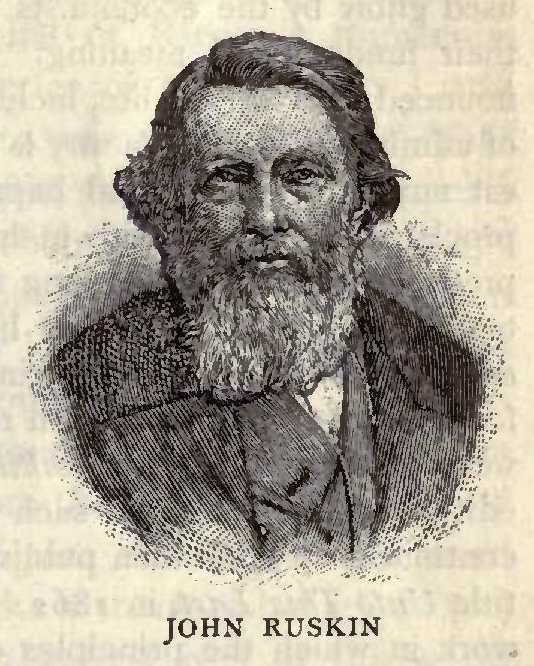
JOHN RUSKIN
Ruskin's literary work began in childhood, when he was encouraged to write
freely in prose and poetry. A volume of poems illustrated by his own
drawings was published in 1859, after he had won fame as a prose writer,
but, save for the drawings, it is of small importance. The first volume of
Modern Painters (1843) was begun as a heated defense of the artist
Turner, but it developed into an essay on art as a true picture of nature,
"not only in her outward aspect but in her inward spirit." The work, which
was signed simply "Oxford Graduate," aroused a storm of mingled approval
and protest; but however much critics warred over its theories of art, all
were agreed that the unknown author was a master of descriptive prose.
Ruskin now made frequent trips to the art galleries of the Continent, and
produced four more volumes of Modern Painters during the next
seventeen years. Meanwhile he wrote other books,--Seven Lamps of
Architecture (1849), Stones of Venice (1851-1853), Pre-Raphaelitism,
and numerous lectures and essays, which gave him a place in the world of
art similar to that held by Matthew Arnold in the world of letters. In
1869 he was appointed professor of art at Oxford, a position which greatly
increased his prestige and influence, not only among students but among a
great variety of people who heard his lectures and read his published
works. Lectures on Art, Aratra Pentelici (lectures on sculpture),
Ariadne Florentina (lectures on engraving), Michael Angela and
Tintoret, The Art of England, Val d'Arno (lectures on Tuscan art), St.
Mark's Rest (a history of Venice), Mornings in Florence
(studies in Christian art, now much used as a guidebook to the picture
galleries of Florence), The Laws of Fiesole (a treatise on drawing
and painting for schools), Academy of Fine Arts in Venice, Pleasures of
England,--all these works on art show Ruskin's literary industry. And
we must also record Love's Meinie (a study of birds), Proserpina
(a study of flowers), Deucalion (a study of waves and stones),
besides various essays on political economy which indicate that Ruskin,
like Arnold, had begun to consider the practical problems of his age.
At the height of his fame, in 1860, Ruskin turned for a time from art, to
consider questions of wealth and labor,--terms which were used glibly by
the economists of the age without much thought for their fundamental
meaning. "There is no wealth but life," announced Ruskin,--"life,
including all its powers of love, of joy, and of admiration. That country
is the richest which nourishes the greatest number of noble and happy
human beings." Such a doctrine, proclaimed by Goldsmith in his Deserted
Village, was regarded as a pretty sentiment, but coming from one of
the greatest leaders and teachers of England it was like a bombshell.
Ruskin wrote four essays establishing this doctrine and pleading for a
more socialistic form of government in which reform might be possible. The
essays were published in the Cornhill Magazine, of which Thackeray
was editor, and they aroused such a storm that the publication was
discontinued. Ruskin then published the essays in book form, with the
title Unto This Last, in 1862. Munera Pulveris (1862) was
another work in which the principles of capital and labor and the evils of
the competitive system were discussed in such a way that the author was
denounced as a visionary or a madman. Other works of this practical period
are Time and Tide, Fors Clavigera, Sesame and Lilies, and the Crown
of Wild Olive.
The latter part of Ruskin's life was a time of increasing sadness, due
partly to the failure of his plans, and partly to public attacks upon his
motives or upon his sanity. He grew bitter at first, as his critics
ridiculed or denounced his principles, and at times his voice is as
querulous as that of Carlyle. We are to remember, however, the conditions
under which he struggled. His health had been shattered by successive
attacks of disease; he had been disappointed in love; his marriage was
unhappy; and his work seemed a failure. He had given nearly all his
fortune in charity, and the poor were more numerous than ever before. His
famous St. George's Guild was not successful, and the tyranny of the
competitive system seemed too deeply rooted to be overthrown. On the death
of his mother he left London and, in 1879, retired to Brantwood, on
Coniston Lake, in the beautiful region beloved of Wordsworth. Here he
passed the last quiet years of his life under the care of his cousin, Mrs.
Severn, the "angel of the house," and wrote, at Professor Norton's
suggestion, Praeterita, one of his most interesting books, in which
he describes the events of his youth from his own view point. He died
quietly in 1900, and was buried, as he wished, without funeral pomp or
public ceremony, in the little churchyard at Coniston.
Works of Ruskin. There are three little books which, in popular
favor, stand first on the list of Ruskin's numerous works,--Ethics-of-the-Dust,
a series of Lectures to Little Housewives, which appeals most to women; Crown
of Wild Olive, three lectures on Work, Traffic, and War, which appeals
to thoughtful men facing the problems of work and duty; and Sesame and
Lilies, which appeals to men and women alike. The last is the most
widely known of Ruskin's works and the best with which to begin our
reading.
Sesame and LiliesThe first thing we notice
in Sesame and Lilies is the symbolical title. "Sesame," taken from
the story of the robbers' cave in the Arabian Nights, means a
secret word or talisman which unlocks a treasure house. It was intended,
no doubt, to introduce the first part of the work, called "Of Kings'
Treasuries," which treats of books and reading. "Lilies," taken from
Isaiah as a symbol of beauty, purity, and peace, introduces the second
lecture, "Of Queens' Gardens," which is an exquisite study of woman's life
and education. These two lectures properly constitute the book, but a
third is added, on "The Mystery of Life." The last begins in a monologue
upon his own failures in life, and is pervaded by an atmosphere of
sadness, sometimes of pessimism, quite different from the spirit of the
other two lectures.
Kings' TreasuriesThough the theme of the
first lecture is books, Ruskin manages to present to his audience his
whole philosophy of life. He gives us, with a wealth of detail, a
description of what constitutes a real book; he looks into the meaning of
words, and teaches us how to read, using a selection from Milton's Lycidas
as an illustration. This study of words gives us the key with which we are
to unlock "Kings' Treasuries," that is, the books which contain the
precious thoughts of the kingly minds of all ages. He shows the real
meaning and end of education, the value of labor and of a purpose in life;
he treats of nature, science, art, literature, religion; he defines the
purpose of government, showing that soul-life, not money or trade, is the
measure of national greatness; and he criticises the general injustice of
his age, quoting a heartrending story of toil and suffering from the
newspapers to show how close his theory is to daily needs. Here is an
astonishing variety in a small compass; but there is no confusion.
Ruskin's mind was wonderfully analytical, and one subject develops
naturally from the other.
Of Queens' GardensIn the second lecture,
"Of Queens' Gardens," he considers the question of woman's place and
education, which Tennyson had attempted to answer in The Princess.
Ruskin's theory is that the purpose of all education is to acquire power
to bless and to redeem human society; and that in this noble work woman
must always play the leading part. He searches all literature for
illustrations, and his description of literary heroines, especially of
Shakespeare's perfect women, is unrivaled. Ruskin is always at his best in
writing of women or for women, and the lofty idealism of this essay,
together with its rare beauty of expression, makes it, on the whole, the
most delightful and inspiring of his works.
Unto This LastAmong Ruskin's practical
works the reader will find in Fors Clavigera, a series of letters
to workingmen, and Unto This Last, four essays on the principles of
political economy, the substance of his economic teachings. In the latter
work, starting with the proposition that our present competitive system
centers about the idea of wealth, Ruskin tries to find out what wealth is;
and the pith of his teaching is this,--that men are of more account than
money; that a man's real wealth is found in his soul; not in his pocket;
and that the prime object of life and labor is "the producing of as many
as possible full-breathed, bright-eyed, and happy-hearted human
creatures." To make this ideal practical, Ruskin makes four suggestions:
(1) that training schools be established to teach young men and women
three things,--the laws and practice of health, habits of gentleness and
justice, and the trade or calling by which they are to live; (2) that the
government establish farms and workshops for the production of all the
necessaries of life, where only good and honest work shall be tolerated
and where a standard of work and wages shall be maintained; (3) that any
person out of employment shall be received at the nearest government
school: if ignorant he shall be educated, and if competent to do any work
he shall have the opportunity to do it; (4) that comfortable homes be
provided for the sick and for the aged, and that this be done in justice,
not in charity. A laborer serves his country as truly as does a soldier or
a statesman, and a pension should be no more disgraceful in one case than
in the other.
Works on ArtAmong Ruskin's numerous books
treating of art, we recommend the Seven Lamps of Architecture
(1849), Stones of Venice (1851-1853), and the first two volumes of
Modern Painters (1843-1846). With Ruskin's art theories, which, as
Sydney Smith prophesied, "worked a complete revolution in the world of
taste," we need not concern ourselves here. We simply point out four
principles that are manifest in all his work: (1) that the object of art,
as of every other human endeavor, is to find and to express the truth; (2)
that art, in order to be true, must break away from conventionalities and
copy nature; (3) that morality is closely allied with art, and that a
careful study of any art reveals the moral strength or weakness of the
people that produced it; (4) that the main purpose of art is not to
delight a few cultured people but to serve the daily uses of common life.
"The giving brightness to pictures is much," he says, "but the giving
brightness to life is more." In this attempt to make art serve the
practical ends of life, Ruskin is allied with all the great writers of the
period, who use literature as the instrument of human progress.
General Characteristics. One who reads Ruskin is in a state of mind
analogous to that of a man who goes through a picture gallery, pausing now
to admire a face or a landscape for its own sake, and again to marvel at
the technical skill of the artist, without regard to his subject. For
Ruskin is a great literary artist and a great ethical teacher, and we
admire one page for its style, and the next for its message to humanity.
The best of his prose, which one may find in the descriptive passages of
Præterita and Modern Painters, is written in a richly
ornate style, with a wealth of figures and allusions, and at times a
rhythmic, melodious quality which makes it almost equal to poetry. Ruskin
had a rare sensitiveness to beauty in every form, and more, perhaps, than
any other writer in our language, he has helped us to see and appreciate
the beauty of the world around us.
Ethical TeachingAs for Ruskin's ethical
teaching, it appears in so many forms and in so many different works that
any summary must appear inadequate. For a full half century he was "the
apostle of beauty" in England, and the beauty for which he pleaded was
never sensuous or pagan, as in the Renaissance, but always spiritual,
appealing to the soul of man rather than to his eyes, leading to better
work and better living. In his economic essays Ruskin is even more
directly and positively ethical. To mitigate the evils of the unreasonable
competitive system under which we labor and sorrow; to bring master and
man together in mutual trust and helpfulness; to seek beauty, truth,
goodness as the chief ends of life, and, having found them, to make our
characters correspond; to share the best treasures of art and literature
with rich and poor alike; to labor always, and, whether we work with hand
or head, to do our work in praise of something that we love,--this sums up
Ruskin's purpose and message. And the best of it is that, like Chaucer's
country parson, he practiced his doctrine before he preached it.
MATTHEW ARNOLD (1822-1888)
In the world of literature Arnold has occupied for many years an
authoritative position as critic and teacher, similar to that held by
Ruskin in the world of art. In his literary work two very different moods
are manifest. In his poetry he reflects the doubt of an age which
witnessed the conflict between science and revealed religion. Apparently
he never passed through any such decisive personal struggle as is recorded
in Sartor Resartus, and he has no positive conviction such as is
voiced in "The Everlasting Yea." He is beset by doubts which he never
settles, and his poems generally express sorrow or regret or resignation.
In his prose he shows the cavalier spirit,--aggressive, light-hearted,
self-confident. Like Carlyle, he dislikes shams, and protests against what
he calls the barbarisms of society; but he writes with a light touch,
using satire and banter as the better part of his argument. Carlyle
denounces with the zeal of a Hebrew prophet, and lets you know that you
are hopelessly lost if you reject his message. Arnold is more like the
cultivated Greek; his voice is soft, his speech suave, but he leaves the
impression, if you happen to differ with him, that you must be deficient
in culture. Both these men, so different in spirit and methods, confronted
the same problems, sought the same ends, and were dominated by the same
moral sincerity.
Life. Arnold was born in Laleham, in the valley of the Thames, in
1822. His father was Dr. Thomas Arnold, head master of Rugby, with whom
many of us have grown familiar by reading Tom Brown's School Days.
After fitting for the university at Winchester and at Rugby, Arnold
entered Balliol College, Oxford, where he was distinguished by winning
prizes in poetry and by general excellence in the classics. More than any
other poet Arnold reflects the spirit of his university. "The
Scholar-Gipsy" and "Thyrsis" contain many references to Oxford and the
surrounding country, but they are more noticeable for their spirit of
aloofness,--as if Oxford men were too much occupied with classic dreams
and ideals to concern themselves with the practical affairs of life.
After leaving the university Arnold first taught the classics at Rugby;
then, in 1847, he became private secretary to Lord Lansdowne, who
appointed the young poet to the position of inspector of schools under the
government. In this position Arnold worked patiently for the next
thirty-five years, traveling about the country, examining teachers, and
correcting endless examination papers. For ten years (1857-1867) he was
professor of poetry at Oxford, where his famous lectures On Translating
Homer were given. He made numerous reports on English and foreign
schools, and was three times sent abroad to study educational methods on
the Continent. From this it will be seen that Arnold led a busy, often a
laborious life, and we can appreciate his statement that all his best
literary work was done late at night, after a day of drudgery. It is well
to remember that, while Carlyle was preaching about labor, Arnold labored
daily; that his work was cheerfully and patiently done; and that after the
day's work he hurried away, like Lamb, to the Elysian fields of
literature. He was happily married, loved his home, and especially loved
children, was free from all bitterness and envy, and, notwithstanding his
cold manner, was at heart sincere, generous, and true. We shall appreciate
his work better if we can see the man himself behind all that he has
written.
Arnold's literary work divides itself into three periods, which we may
call the poetical, the critical, and the practical. He had written poetry
since his school days, and his first volume, The Strayed Reveller and
Other Poems, appeared anonymously in 1849. Three years later he
published Empedocles on Etna and other Poems; but only a few copies
of these volumes were sold, and presently both were withdrawn from
circulation. In 1853-1855 he published his signed Poems, and twelve
years later appeared his last volume of poetry. Compared with the early
work of Tennyson, these works met with little favor, and Arnold
practically abandoned poetry in favor of critical writing.
The chief works of his critical period are the lectures On Translating
Homer (1861) and the two volumes of Essays in Criticism
(1865-1888), which made Arnold one of the best known literary men in
England. Then, like Ruskin, he turned to practical questions, and his Friendship's
Garland (1871) was intended to satirize and perhaps reform the great
middle class of England, whom he called the Philistines. Culture and
Anarchy, the most characteristic work of his practical period,
appeared in 1869. These were followed by four books on religious
subjects,--St. Paul and Protestantism (1870), Literature and
Dogma (1873), God and the Bible (1875), and Last Essays on
Church and Religion (1877). The Discourses in America (1885)
completes the list of his important works. At the height of his fame and
influence he died suddenly, in 1888, and was buried in the churchyard at
Laleham. The spirit of his whole life is well expressed in a few lines of
one of his own early sonnets:
One lesson, Nature, let me learn of thee,
One lesson which in every
wind is blown,
One lesson of two duties kept at one
Though the
loud world proclaim their enmity--
Of toil unsever'd from
tranquillity;
Of labour, that in lasting fruit outgrows
Far
noisier schemes, accomplish'd in repose,
Too great for haste, too
high for rivalry.
His Poetry.Works of Matthew Arnold.
We shall better appreciate Arnold's poetry if we remember two things:
First, he had been taught in his home a simple and devout faith in
revealed religion, and in college he was thrown into a world of doubt and
questioning. He faced these doubts honestly, reverently,--in his heart
longing to accept the faith of his fathers, but in his head demanding
proof and scientific exactness. The same struggle between head and heart,
between reason and intuition, goes on to-day, and that is one reason why
Arnold's poetry, which wavers on the borderland between doubt and faith,
is a favorite with many readers. Second, Arnold, as shown in his essay on
The Study of Poetry, regarded poetry as "a criticism of life under
the conditions fixed for such criticism by the laws of poetic truth and
poetic beauty." Naturally, one who regards poetry as a "criticism" will
write very differently from one who regards poetry as the natural language
of the soul. He will write for the head rather than for the heart, and
will be cold and critical rather than enthusiastic. According to Arnold,
each poem should be a unit, and he protested against the tendency of
English poets to use brilliant phrases and figures of speech which only
detract attention from the poem as a whole. For his models he went to
Greek poetry, which he regarded as "the only sure guidance to what is
sound and true in poetical art." Arnold is, however, more indebted than he
thinks to English masters, especially to Wordsworth and Milton, whose
influence is noticeable in a large part of his poetry.
Of Arnold's narrative poems the two best known are Balder Dead
(1855), an incursion into the field of Norse mythology which is suggestive
of Gray, and Sohrab and Rustum (1853), which takes us into the
field of legendary Persian history. The theme of the latter poem is taken
from the Shah-Namah (Book of Kings) of the Persian poet Firdausi,
who lived and wrote in the eleventh century.
Sohrab and RustrumBriefly, the story is of
one Rustem or Rustum, a Persian Achilles, who fell asleep one day when he
had grown weary of hunting. While he slept a band of robbers stole his
favorite horse, Ruksh. In trailing the robbers Rustum came to the palace
of the king of Samengan, where he was royally welcomed, and where he fell
in love with the king's daughter, Temineh, and married her. But he was of
a roving, adventurous disposition, and soon went back to fight among his
own people, the Persians. While he was gone his son Sohrab was born, grew
to manhood, and became the hero of the Turan army. War arose between the
two peoples, and two hostile armies were encamped by the Oxus. Each army
chose a champion, and Rustum and Sohrab found themselves matched in mortal
combat between the lines. At this point Sohrab, whose chief interest in
life was to find his father, demanded to know if his enemy were not
Rustum; but the latter was disguised and denied his identity. On the first
day of the fight Rustum was overcome, but his life was spared by a trick
and by the generosity of Sohrab. On the second day Rustum prevailed, and
mortally wounded his antagonist. Then he recognized his own son by a gold
bracelet which he had long ago given to his wife Temineh. The two armies,
rushing into battle, were stopped by the sight of father and son weeping
in each other's arms. Sohrab died, the war ceased, and Rustum went home to
a life of sorrow and remorse.
Using this interesting material, Arnold produced a poem which has the rare
and difficult combination of classic reserve and romantic feeling. It is
written in blank verse, and one has only to read the first few lines to
see that the poet is not a master of his instrument. The lines are seldom
harmonious, and we must frequently change the accent of common words, or
lay stress on unimportant particles, to show the rhythm. Arnold frequently
copies Milton, especially in his repetition of ideas and phrases; but the
poem as a whole is lacking in Milton's wonderful melody.
The classic influence on Sohrab and Rustum is especially noticeable
in Arnold's use of materials. Fights are short; grief is long; therefore
the poet gives few lines to the combat, but lingers over the son's joy at
finding his father, and the father's quenchless sorrow at the death of his
son. The last lines especially, with their "passionate grief set to solemn
music," make this poem one of the best, on the whole, that Arnold has
written. And the exquisite ending, where the Oxus, unmindful of the
trivial strifes of men, flows on sedately to join "his luminous home of
waters" is most suggestive of the poet's conception of the orderly life of
nature, in contrast with the doubt and restlessness of human life.
Miscellaneous PoemsNext in importance to
the narrative poems are the elegies, "Thyrsis," "The Scholar-Gipsy,"
"Memorial Verses," "A Southern Night," "Obermann," "Stanzas from the
Grande Chartreuse," and "Rugby Chapel." All these are worthy of careful
reading, but the best is "Thyrsis," a lament for the poet Clough, which is
sometimes classed with Milton's Lycidas and Shelley's Adonais.
Among the minor poems the reader will find the best expression of Arnold's
ideals and methods in "Dover Beach," the love lyrics entitled
"Switzerland," "Requiescat," "Shakespeare," "The Future," "Kensington
Gardens," "Philomela," "Human Life," "Callicles's Song," "Morality," and
"Geist's Grave."--the last being an exquisite tribute to a little dog
which, like all his kind, had repaid our scant crumbs of affection with a
whole life's devotion.
Essays in CriticismThe first place among
Arnold's prose works must be given to the Essays in Criticism,
which raised the author to the front rank of living critics. His
fundamental idea of criticism appeals to us strongly. The business of
criticism, he says, is neither to find fault nor to display the critic's
own learning or influence; it is to know "the best which has been thought
and said in the world," and by using this knowledge to create a current of
fresh and free thought. If a choice must be made among these essays, which
are all worthy of study, we would suggest "The Study of Poetry,"
"Wordsworth," "Byron," and "Emerson." The last-named essay, which is found
in the Discourses in America, is hardly a satisfactory estimate of
Emerson, but its singular charm of manner and its atmosphere of
intellectual culture make it perhaps the most characteristic of Arnold's
prose writings.
Among the works of Arnold's practical period there are two which may be
taken as typical of all the rest. Literature and Dogma (1873) is,
in general, a plea for liberality in religion. Arnold would have us read
the Bible, for instance, as we would read any other great work, and apply
to it the ordinary standards of literary criticism.
Culture and AnarchyCulture and Anarchy
(1869) contains most of the terms--culture, sweetness and light,
Barbarian, Philistine, Hebraism, and many others--which are now associated
with Arnold's work and influence. The term "Barbarian" refers to the
aristocratic classes, whom Arnold thought to be essentially crude in soul,
notwithstanding their good clothes and superficial graces. "Philistine"
refers to the middle classes,--narrow-minded and self-satisfied people,
according to Arnold, whom he satirizes with the idea of opening their
minds to new ideas. "Hebraism" is Arnold's term for moral education.
Carlyle had emphasized the Hebraic or moral element in life, and Arnold
undertook to preach the Hellenic or intellectual element, which welcomes
new ideas, and delights in the arts that reflect the beauty of the world.
"The uppermost idea with. Hellenism," he says, "is to see things as they
are; the uppermost idea with Hebraism is conduct and obedience." With
great clearness, sometimes with great force, and always with a play of
humor and raillery aimed at the "Philistines," Arnold pleads for both
these elements in life which together aim at "Culture," that is, at moral
and intellectual perfection.
General Characteristics. Arnold's influence in our literature may
be summed up, in a word, as intellectual rather than inspirational. One
cannot be enthusiastic over his poetry, for the simple reason that he
himself lacked enthusiasm. He is, however, a true reflection of a very
real mood of the past century, the mood of doubt and sorrow; and a future
generation may give him a higher place than he now holds as a poet. Though
marked by "the elemental note of sadness," all Arnold's poems are
distinguished by clearness, simplicity, and the restrained emotion of his
classic models.
As a prose writer the cold intellectual quality, which mars his poetry by
restraining romantic feeling, is of first importance, since it leads him
to approach literature with an open mind and with the single desire to
find "the best which has been thought and said in the world." We cannot
yet speak with confidence of his rank in literature; but by his
crystal-clear style, his scientific spirit of inquiry and comparison,
illumined here and there by the play of humor, and especially by his broad
sympathy and intellectual culture, he seems destined to occupy a very high
place among the masters of literary criticism.
JOHN HENRY NEWMAN (1801-1890)
Any record of the prose literature of the Victorian era, which includes
the historical essays of Macaulay and the art criticism of Ruskin, should
contain also some notice of its spiritual leaders. For there was never a
time when the religious ideals that inspire the race were kept more
constantly before men's minds through the medium of literature.
Among the religious writers of the age the first place belongs
unquestionably to Cardinal Newman. Whether we consider him as a man, with
his powerful yet gracious personality, or as a religious reformer, who did
much to break down old religious prejudices by showing the underlying
beauty and consistency of the Roman church, or as a prose writer whose
style is as near perfection as we have ever reached, Newman is one of the
most interesting figures of the whole nineteenth century.
Life. Three things stand out clearly in Newman's life: first, his
unshaken faith in the divine companionship and guidance; second, his
desire to find and to teach the truth of revealed religion; third, his
quest of an authoritative standard of faith, which should remain steadfast
through the changing centuries and amid all sorts and conditions of men.
The first led to that rare and beautiful spiritual quality which shines in
all his work; the second to his frequent doctrinal and controversial
essays; the third to his conversion to the Catholic church, which he
served as priest and teacher for the last forty-five years of his life.
Perhaps we should add one more characteristic,--the practical bent of his
religion; for he was never so busy with study or controversy that he
neglected to give a large part of his time to gentle ministration among
the poor and needy.
He was born in London, in 1801. His father was an English banker; his
mother, a member of a French Huguenot family, was a thoughtful, devout
woman, who brought up her son in a way which suggests the mother of
Ruskin. Of his early training, his reading of doctrinal and argumentative
works, and of his isolation from material things in the thought that there
were "two and only two absolute and luminously self-evident beings in the
world," himself and his Creator, it is better to read his own record in
the Apologia, which is a kind of spiritual biography.
At the age of fifteen Newman had begun his profound study of theological
subjects. For science, literature, art, nature,--all the broad interests
which attracted other literary men of his age,--he cared little, his mind
being wholly occupied with the history and doctrines of the Christian
church, to which he had already devoted his life. He was educated first at
the school in Ealing, then at Oxford, taking his degree in the latter
place in 1820. Though his college career was not more brilliant than that
of many unknown men, his unusual ability was recognized and he was made a
fellow of Oriel College, retaining the fellowship, and leading a scholarly
life for over twenty years. In 1824 he was ordained in the Anglican
church, and four years later was chosen vicar of St. Mary's, at Oxford,
where his sermons made a deep impression on the cultivated audiences that
gathered from far and near to hear him.
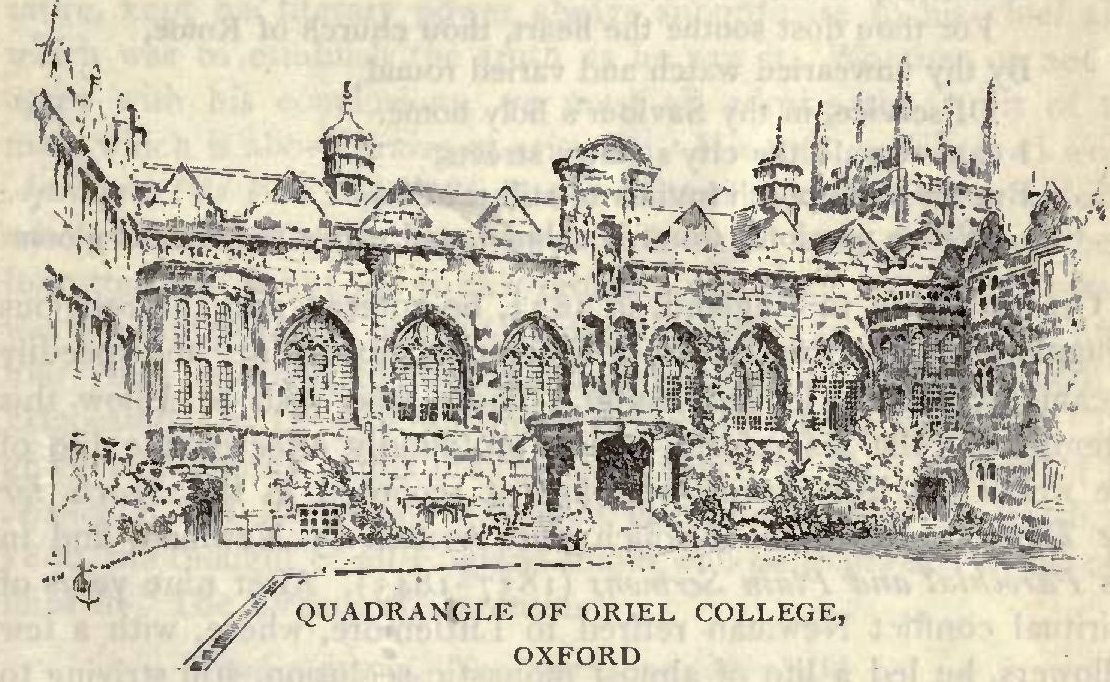
QUADRANGLE OF ORIEL COLLEGE, OXFORD
A change is noticeable in Newman's life after his trip to the
Mediterranean in 1832. He had begun his life as a Calvinist, but while in
Oxford, then the center of religious unrest, he described himself as
"drifting in the direction of Liberalism." Then study and bereavement and
an innate mysticism led him to a profound sympathy with the mediæval
Church. He had from the beginning opposed Catholicism; but during his
visit to Italy, where he saw the Roman church at the center of Its power
and splendor, many of his prejudices were overcome. In this enlargement of
his spiritual horizon Newman was greatly influenced by his friend Hurrell
Froude, with whom he made the first part of the journey. His poems of this
period (afterwards collected in the Lyra Apostolica), among which
is the famous "Lead, Kindly Light," are noticeable for their radiant
spirituality; but one who reads them carefully sees the beginning of that
mental struggle which ended in his leaving the church in which he was
born. Thus he writes of the Catholic church, whose services he had
attended as "one who in a foreign land receives the gifts of a good
Samaritan":
O that thy creed were sound!
For thou dost
soothe the heart, thou church of Rome,
By thy unwearied watch and
varied round
Of service, in thy Saviour's
holy home.
I cannot walk the city's sultry streets,
But the
wide porch invites to still retreats,
Where
passion's thirst is calmed, and care's unthankful gloom.
On his return to England, in 1833, he entered into the religious struggle
known as the Oxford or Tractarian Movement,[245] and speedily became its
acknowledged leader. Those who wish to follow this attempt at religious
reform, which profoundly affected the life of the whole English church,
will find it recorded in the Tracts for the Times, twenty-nine of
which were written by Newman, and in his Parochial and Plain Sermons
(1837-1843). After nine years of spiritual conflict Newman retired to
Littlemore, where, with a few followers, he led a life of almost monastic
seclusion, still striving to reconcile his changing belief with the
doctrines of his own church. Two years later he resigned his charge at St.
Mary's and left the Anglican communion,--not bitterly, but with a deep and
tender regret. His last sermon at Littlemore on "The Parting of Friends"
still moves us profoundly, like the cry of a prophet torn by personal
anguish in the face of duty. In 1845 he was received into the Catholic
church, and the following year, at Rome, he joined the community of St.
Philip Neri, "the saint of gentleness and kindness," as Newman describes
him, and was ordained to the Roman priesthood.
By his preaching and writing Newman had exercised a strong influence over
his cultivated English hearers, and the effect of his conversion was
tremendous. Into the theological controversy of the next twenty years we
have no mind to enter. Through it all Newman retained his serenity, and,
though a master of irony and satire, kept his literary power always
subordinate to his chief aim, which was to establish the truth as he saw
it. Whether or not we agree with his conclusions, we must all admire the
spirit of the man, which is above praise or criticism. His most widely
read work, Apologia Pro Vita Sua (1864), was written in answer to
an unfortunate attack by Charles Kingsley, which would long since have
been forgotten had it not led to this remarkable book. In 1854 Newman was
appointed rector of the Catholic University in Dublin, but after four
years returned to England and founded a Catholic school at Edgbaston. In
1879 he was made cardinal by Pope Leo XIII. The grace and dignity of his
life, quite as much as the sincerity of his Apologia, had long
since disarmed criticism, and at his death, in 1890, the thought of all
England might well be expressed by his own lines in "The Dream of
Gerontius":
I had a dream. Yes, some one softly said,
"He's
gone," and then a sigh went round the room;
And then I surely heard
a priestly voice
Cry
Subvenite; and they knelt in prayer.
Apologia Pro Vita SuaWorks of Newman.
Readers approach Newman from so many different motives, some for doctrine,
some for argument, some for a pure prose style, that it is difficult to
recommend the best works for the beginner's use. As an expression of
Newman's spiritual struggle the Apologia Pro Vita Sua is perhaps
the most significant. This book is not light reading and one who opens it
should understand clearly the reasons for which it was written. Newman had
been accused of insincerity, not only by Kingsley but by many other men,
in the public press. His retirement to solitude and meditation at
Littlemore had been outrageously misunderstood, and it was openly charged
that his conversion was a cunningly devised plot to win a large number of
his followers to the Catholic church. This charge involved others, and it
was to defend them, as well as to vindicate himself, that Newman wrote the
Apologia. The perfect sincerity with which he traced his religious
history, showing that his conversion was only the final step in a course
he had been following since boyhood, silenced his critics and
revolutionized public opinion concerning himself and the church which he
had joined. As the revelation of a soul's history, and as a model of pure,
simple, unaffected English, this book, entirely apart from its doctrinal
teaching, deserves a high place in our prose literature.
CallistaIn Newman's doctrinal works, the
Via Media, the Grammar of Assent, and in numerous
controversial essays the student of literature will have little interest.
Much more significant are his sermons, the unconscious reflection of a
rare spiritual nature, of which Professor Shairp said: "His power shows
itself clearly in the new and unlooked-for way in which he touched into
life old truths, moral or spiritual.... And as he spoke, how the old truth
became new! and how it came home with a meaning never felt before! He laid
his finger how gently yet how powerfully on some inner place in the
hearer's heart, and told him things about himself he had never known till
then. Subtlest truths, which would have taken philosophers pages of
circumlocution and big words to state, were dropped out by the way in a
sentence or two of the most transparent Saxon." Of greater interest to the
general reader are The Idea of a University, discourses delivered
at Dublin, and his two works of fiction, Loss and Gain, treating of
a man's conversion to Catholicism, and Callista, which is, in his
own words, "an attempt to express the feelings and mutual relations of
Christians and heathens in the middle of the third century." The latter
is, in our judgment, the most readable and interesting of Newman's works.
The character of Callista, a beautiful Greek sculptor of idols, is
powerfully delineated; the style is clear and transparent as air, and the
story of the heroine's conversion and death makes one of the most
fascinating chapters in fiction, though it is not the story so much as the
author's unconscious revelation of himself that charms us. It would be
well to read this novel in connection with Kingsley's Hypatia,
which attempts to reconstruct the life and ideals of the same period.
PoemsNewman's poems are not so well known
as his prose, but the reader who examines the Lyra Apostolica and
Verses on Various Occasions will find many short poems that stir a
religious nature profoundly by their pure and lofty imagination; and
future generations may pronounce one of these poems, "The Dream of
Gerontius," to be Newman's most enduring work. This poem aims to reproduce
the thoughts and feelings of a man whose soul is just quitting the body,
and who is just beginning a new and greater life. Both in style and in
thought "The Dream" is a powerful and original poem and is worthy of
attention not only for itself but, as a modern critic suggests, "as a
revelation of that high spiritual purpose which animated Newman's life
from beginning to end."
Newman's styleOf Newman's style it is as
difficult to write as it would be to describe the dress of a gentleman we
had met, who was so perfectly dressed that we paid no attention to his
clothes. His style is called transparent, because at first we are not
conscious of his manner; and unobtrusive, because we never think of Newman
himself, but only of the subject he is discussing. He is like the best
French prose writers in expressing his thought with such naturalness and
apparent ease that, without thinking of style, we receive exactly the
impression which he means to convey. In his sermons and essays he is
wonderfully simple and direct; in his controversial writings, gently
ironical and satiric, and the satire is pervaded by a delicate humor; but
when his feelings are aroused he speaks with poetic images and symbols,
and his eloquence is like that of the Old Testament prophets. Like
Ruskin's, his style is modeled largely on that of the Bible, but not even
Ruskin equals him in the poetic beauty and melody of his sentences. On the
whole he comes nearer than any other of his age to our ideal of a perfect
prose writer.
Critical WritersOther Essayists of the
Victorian Age. We have selected the above five essayists, Macaulay,
Carlyle, Arnold, Newman, and Ruskin, as representative writers of the
Victorian Age; but there are many others who well repay our study. Notable
among these are John Addington Symonds, author of The Renaissance in
Italy, undoubtedly his greatest work, and of many critical essays;
Walter Pater, whose Appreciations and numerous other works mark him
as one of our best literary critics; and Leslie Stephen, famous for his
work on the monumental Dictionary of National Biography, and for
his Hours in a Library, a series of impartial and excellent
criticisms, brightened by the play of an original and delightful humor.
The ScientistsAmong the most famous
writers of the age are the scientists, Lyell, Darwin, Huxley, Spencer,
Tyndall, and Wallace,--a wonderful group of men whose works, though they
hardly belong to our present study, have exercised an incalculable
influence on our life and literature. Darwin's Origin of Species
(1859), which apparently established the theory of evolution, was an
epoch-making book. It revolutionized not only our conceptions of natural
history, but also our methods of thinking on all the problems of human
society. Those who would read a summary of the greatest scientific
discovery of the age will find it in Wallace's Darwinism,--a most
interesting book, written by the man who claims, with Darwin, the honor of
first announcing the principle of evolution. And, from a multitude of
scientific works, we recommend also to the general reader Huxley's Autobiography
and his Lay Sermons, Addresses, and Reviews, partly because they
are excellent expressions of the spirit and methods of science, and partly
because Huxley as a writer is perhaps the clearest and the most readable
of the scientists.
The Spirit of Modern Literature.
As we reflect on the varied work of the Victorian writers, three marked
characteristics invite our attention. First, our great literary men, no
less than our great scientists, have made truth the supreme object of
human endeavor. All these eager poets, novelists, and essayists, questing
over so many different ways, are equally intent on discovering the truth
of life. Men as far apart as Darwin and Newman are strangely alike in
spirit, one seeking truth in the natural, the other in the spiritual
history of the race. Second, literature has become the mirror of truth;
and the first requirement of every serious novel or essay is to be true to
the life or the facts which it represents. Third, literature has become
animated by a definite moral purpose. It is not enough for the Victorian
writers to create or attempt an artistic work for its own sake; the work
must have a definite lesson for humanity. The poets are not only singers,
but leaders; they hold up an ideal, and they compel men to recognize and
follow it. The novelists tell a story which pictures human life, and at
the same time call us to the work Of social reform, or drive home a moral
lesson. The essayists are nearly all prophets or teachers, and use
literature as the chief instrument of progress and education. Among them
all we find comparatively little of the exuberant fancy, the romantic
ardor, and the boyish gladness of the Elizabethans. They write books not
primarily to delight the artistic sense, but to give bread to the hungry
and water to the thirsty in soul. Milton's famous sentence, "A good book
is the precious life-blood of a master spirit," might be written across
the whole Victorian era. We are still too near these writers to judge how
far their work suffers artistically from their practical purpose; but this
much is certain,--that whether or not they created immortal works, their
books have made the present world a better and a happier place to live in.
And that is perhaps the best that can be said of the work of any artist or
artisan.
Summary of the Victorian Age.
The year 1830 is generally placed at the beginning of this period, but its
limits are very indefinite. In general we may think of it as covering the
reign of Victoria (1837-1901). Historically the age is remarkable for the
growth of democracy following the Reform Bill of 1832; for the spread of
education among all classes; for the rapid development of the arts and
sciences; for important mechanical inventions; and for the enormous
extension of the bounds of human knowledge by the discoveries of science.
At the accession of Victoria the romantic movement had spent its force;
Wordsworth had written his best work; the other romantic poets, Coleridge,
Shelley, Keats, and Byron, had passed away; and for a time no new
development was apparent in English poetry. Though the Victorian Age
produced two great poets, Tennyson and Browning, the age, as a whole, is
remarkable for the variety and excellence of its prose. A study of all the
great writers of the period reveals four general characteristics: (1)
Literature in this Age has come very close to daily life, reflecting its
practical problems and interests, and is a powerful instrument of human
progress. (2) The tendency of literature is strongly ethical; all the
great poets, novelists, and essayists of the age are moral teachers. (3)
Science in this age exercises an incalculable influence. On the one hand
it emphasizes truth as the sole object of human endeavor; it has
established the principle of law throughout the universe; and it has given
us an entirely new view of life, as summed up in the word "evolution,"
that is, the principle of growth or development from simple to complex
forms. On the other hand, its first effect seems to be to discourage works
of the imagination. Though the age produced an incredible number of books,
very few of them belong among the great creative works of literature. (4)
Though the age is generally characterized as practical and materialistic,
it is significant that nearly all the writers whom the nation delights to
honor vigorously attack materialism, and exalt a purely ideal conception
of life. On the whole, we are inclined to call this an idealistic age
fundamentally, since love, truth, justice, brotherhood--all great
ideals--are emphasized as the chief ends of life, not only by its poets
but also by its novelists and essayists.
In our study we have considered: (1) The Poets; the life and works of
Tennyson and Browning; and the chief characteristics of the minor poets,
Elizabeth Barrett (Mrs. Browning), Rossetti, Morris, and Swinburne. (2)
The Novelists; the life and works of Dickens, Thackeray, and George Eliot;
and the chief works of Charles Reade, Anthony Trollope, Charlotte Brontë,
Bulwer-Lytton, Kingsley, Mrs. Gaskell, Blackmore, George Meredith, Hardy,
and Stevenson. (3) The Essayists; the life and works of Macaulay, Matthew
Arnold, Carlyle, Newman, and Ruskin. These were selected, from among many
essayists and miscellaneous writers, as most typical of the Victorian Age.
The great scientists, like Lyell, Darwin, Huxley, Wallace, Tyndall, and
Spencer, hardly belong to our study of literature, though their works are
of vast importance; and we omit the works of living writers who belong to
the present rather than to the past century.
Selections for Reading. Manly's English Poetry and Manly's English
Prose (Ginn and Company) contain excellent selections from all authors of
this period. Many other collections, like Ward's English Poets, Garnett's
English Prose from Elizabeth to Victoria, Page's British Poets of the
Nineteenth Century, and Stedman's A Victorian Anthology, may be used to
advantage. All important works may be found in the convenient and
inexpensive school editions given below. (For full titles and publishers
see the General Bibliography.)
Tennyson. Short poems, and selections from Idylls of the King, In
Memoriam, Enoch Arden, and The Princess. These are found in various school
editions, Standard English Classics, Pocket Classics, Riverside Literature
Series, etc. Poems by Tennyson, selected and edited with notes by Henry
Van Dyke (Athenaeum Press Series), is an excellent little volume for
beginners.
Browning. Selections, edited by R.M. Lovett, in Standard English
Classics. Other school editions in Everyman's Library, Belles Lettres
Series, etc.
Elizabeth Barrett Browning. Selections, edited by Elizabeth Lee, in
Standard English Classics. Selections also in Pocket Classics, etc.
Matthew Arnold. Sohrab and Rustum, edited by Trent and Brewster, in
Standard English Classics. The same poem in Riverside Literature Series,
etc. Selections in Golden Treasury Series, etc. Poems, students' edition
(Crowell). Essays in Everyman's Library, etc. Prose selections (Holt,
Allyn & Bacon, etc.).
Dickens. Tale of Two Cities, edited by J.W. Linn, in Standard
English Classics. A Christmas Carol, David Copperfield, and Pickwick
Papers. Various good school editions of these novels in Everyman's
Library, etc.
Thackeray. Henry Esmond, edited by H.B. Moore, in Standard English
Classics. The same novel, in Everyman's Library, Pocket Classics, etc.
George Eliot. Silas Marner, edited by R. Adelaide Witham, in
Standard English Classics. The same novel, in Pocket Classics, etc.
Carlyle. Essay on Burns, edited by C.L. Hanson, in Standard English
Classics, and Heroes and Hero Worship, edited by A. MacMechan, in
Athenaeum Press Series. Selections, edited by H.W. Boynton (Allyn &
Bacon). Various other inexpensive editions, in Pocket Classics, Eclectic
English Classics, etc.
Ruskin. Sesame and Lilies, edited by Lois G. Hufford, in Standard
English Classics. Other editions in Riverside Literature, Everyman's
Library, etc. Selected Essays and Letters, edited by Hufford, in Standard
English Classics. Selections, edited by Vida D. Scudder (Sibley); edited
by C.B. Tinker, in Riverside Literature.
Macaulay. Essays on Addison and Milton, edited by H.A. Smith, in
Standard English Classics. Same essays, in Cassell's National Library,
Riverside Literature, etc. Lays of Ancient Rome, in Standard English
Classics, Pocket Classics, etc.
Newman. Selections, with introduction by L.E. Gates (Holt);
Selections from prose and poetry, in Riverside Literature. The Idea of a
University, in Manly's English Prose.
Bibliography. (note. For full
titles and publishers of general reference books, see General
Bibliography.) History. Text-book, Montgomery, pp. 357-383;
Cheyney, pp. 632-643. General Works. Gardiner, and Traill. Special
Works. McCarthy's History of Our Own Times; Bright's History of
England, vols. 4-5; Lee's Queen Victoria; Bryce's Studies in Contemporary
Biography.
Literature. General Works. Garnett and Gosse, Taine. Special
Works. Harrison's Early Victorian Literature; Saintsbury's A History
of Nineteenth Century Literature; Walker's The Age of Tennyson; same
author's The Greater Victorian Poets; Morley's Literature of the Age of
Victoria; Stedman's Victorian Poets; Mrs. Oliphant's Literary History of
England in the Nineteenth Century; Beers's English Romanticism in the
Nineteenth Century; Dowden's Victorian Literature, in Transcripts and
Studies; Brownell's Victorian Prose Masters.
Tennyson. Texts: Cabinet edition (London, 1897) is the standard.
Various good editions, Globe, Cambridge Poets, etc. Selections in
Athenaeum Press (Ginn and Company).
Life: Alfred Lord Tennyson, a Memoir by his son, is the standard; by Lyall
(in English Men of Letters); by Horton; by Waugh. See also Anne T.
Ritchie's Tennyson and His Friends; Napier's The Homes and Haunts of
Tennyson; Rawnsley's Memories of the Tennysons.
Criticism: Brooke's Tennyson, his Art and his Relation to Modern Life; A.
Lang's Alfred Tennyson; Van Dyke's The Poetry of Tennyson; Sneath's The
Mind of Tennyson; Gwynn's A Critical Study of Tennyson's Works; Luce's
Handbook to Tennyson's Works; Dixon's A Tennyson Primer; Masterman's
Tennyson as a Religious Teacher; Collins's The Early Poems of Tennyson;
Macallum's Tennyson's Idylls of the King and the Arthurian Story;
Bradley's Commentary on In Memoriam; Bagehot's Literary Studies, vol. 2;
Brightwell's Concordance; Shepherd's Bibliography.
Essays: By F. Harrison, in Tennyson, Ruskin, Mill, and Other Literary
Estimates; by Stedman, in Victorian Poets; by Hutton, in Literary Essays;
by Dowden, in Studies in Literature; by Gates, in Studies and
Appreciations; by Forster, in Great Teachers; by Forman, in Our Living
Poets. See also Myers's Science and a Future Life.
Browning. Texts: Cambridge and Globe editions, etc. Various
editions of selections. (See Selections for Reading, above.)
Life: by W. Sharp (Great Writers); by Chesterton (English Men of Letters);
Life and Letters, by Mrs. Sutherland Orr; by Waugh, in Westminster
Biographies (Small & Maynard).
Criticism: Symons's An Introduction to the Study of Browning; same title,
by Corson; Mrs. Orr's Handbook to the Works of Browning; Nettleship's
Robert Browning; Brooke's The Poetry of Robert Browning; Cooke's Browning
Guide Book; Revell's Browning's Criticism of Life; Berdoe's Browning's
Message to his Times; Berdoe's Browning Cyclopedia.
Essays: by Hutton, Stedman, Dowden, Forster (for titles, see Tennyson,
above); by Jacobs, in Literary Studies; by Chapman, in Emerson and Other
Essays; by Cooke, in Poets and Problems; by Birrell, in Obiter Dicta.
Elizabeth Barrett Browning. Texts: Globe and Cambridge editions,
etc.; various editions of selections. Life: by J. H. Ingram; see also
Bayne's Two Great Englishmen. Kenyon's Letters of E. B. Browning.
Criticism: Essays, by Stedman, in Victorian Poets; by Benson, in Essays.
Matthew Arnold. Texts: Poems, Globe edition, etc. See Selections
for Reading, above. Life: by Russell; by Saintsbury; by Paul (English Men
of Letters); Letters, by Russell.
Criticism: Essays by Woodberry, in Makers of Literature; by Gates, in
Three Studies in Literature; by Hutton, in Modern Guides of English
Thought; by Brownell, in Victorian Prose Masters; by F. Harrison (see
Tennyson, above).
Dickens. Texts: numerous good editions of novels. Life: by J.
Forster; by Marzials (Great Writers); by Ward (English Men of Letters);
Langton's The Childhood and Youth of Dickens.
Criticism: Gissing's Charles Dickens; Chesterton's Charles Dickens;
Kitten's The Novels of Charles Dickens; Fitzgerald's The History of
Pickwick. Essays: by F. Harrison (see above); by Bagehot, in Literary
Studies; by Lilly, in Four English Humorists; by A. Lang, in Gadshill
edition of Dickens's works.
Thackeray. Texts: numerous good editions of novels and essays.
Life: by Melville; by Merivale and Marzials (Great Writers); by A.
Trollope (English Men of Letters); by L. Stephen, in Dictionary of
National Biography. See also Crowe's Homes and Haunts of Thackeray;
Wilson's Thackeray in the United States.
Criticism: Essays, by Lilly, in Four English Humorists; by Harrison, in
Studies in Early Victorian Literature; by Scudder, in Social Ideals in
English Letters; by Brownell, in Victorian Prose Masters.
George Eliot. Texts: numerous editions. Life: by L. Stephen
(English Men of Letters); by O. Browning (Great Writers); by her husband,
J.W. Cross.
Criticism: Cooke's George Eliot, a Critical Study of her Life and
Writings. Essays: by J. Jacobs, in Literary Studies; by H. James, in
Partial Portraits; by Dowden, in Studies in Literature; by Hutton,
Harrison, Brownell, Lilly (see above). See also Parkinson's Scenes from
the George Eliot Country.
Carlyle. Texts: various editions of works. Heroes, and Sartor
Resartus, in Athenaeum Press (Ginn and Company); Sartor, and Past and
Present, 1 vol. (Harper); Critical and Miscellaneous Essays, 1 vol.
(Appleton); Letters and Reminiscences, edited by C. E. Norton, 6 vols.
(Macmillan).
Life: by Garnett (Great Writers); by Nichol (English Men of Letters); by
Froude, 2 vols. (very full, but not trustworthy). See also Carlyle's
Reminiscences and Correspondence, and Craig's The Making of Carlyle.
Criticism: Masson's Carlyle Personally and in his Writings. Essays: by
Lowell, in My Study Windows; by Harrison, Brownell, Hutton, Lilly (see
above).
Ruskin. Texts: Brantwood edition, edited by C.E. Norton; various
editions of separate works. Life: by Harrison (English Men of Letters); by
Collingwood, 2 vols.; see also Ruskin's Praeterita.
Criticism: Mather's Ruskin, his Life and Teaching; Cooke's Studies in
Ruskin; Waldstein's The Work of John Ruskin; Hobson's John Ruskin, Social
Reformer; Mrs. Meynell's John Ruskin; Sizeranne's Ruskin and the Religion
of Beauty, translated from the French; White's Principles of Art; W. M.
Rossetti's Ruskin, Rossetti, and Pre-Raphaelitism.
Essays: by Robertson, in Modern Humanists; by Saintsbury, in Corrected
Impressions; by Brownell, Harrison, Forster (see above).
Macaulay. Texts: Complete works, edited by his sister, Lady
Trevelyan (London, 1866); various editions of separate works (see
Selections for Reading, above). Life: Life and Letters, by Trevelyan, 2
vols.; by Morrison (English Men of Letters).
Criticism: Essays, by Bagehot, in Literary Studies; by L. Stephen, in
Hours in a Library; by Saintsbury, in Corrected Impressions; by Harrison,
in Studies in Early Victorian Literature; by Matthew Arnold.
Newman. Texts: Uniform edition of important works (London,
1868-1881); Apologia (Longmans); Selections (Holt, Riverside Literature,
etc.). Life: Jennings's Cardinal Newman; Button's Cardinal Newman; Early
Life, by F. Newman; by Waller and Barrow, in Westminster Biographies. See
also Church's The Oxford Movement; Fitzgerald's Fifty Years of Catholic
Life and Progress.
Criticism: Essays, by Donaldson, in Five Great Oxford Leaders; by Church,
in Occasional Papers, vol. 2; by Gates, in Three Studies in Literature; by
Jacobs, in Literary Studies; by Hutton, in Modern Guides of English
Thought; by Lilly, in Essays and Speeches; by Shairp, in Studies in Poetry
and Philosophy. See also Button's Cardinal Newman.
Rossetti. Works, 2 vols. (London, 1901). Selections, in Golden
Treasury Series. Life: by Knight (Great Writers); by Sharp; Hall Caine's
Recollections of Dante Gabriel Rossetti; Gary's The Rossettis; Marillier's
Rossetti; Wood's Rossetti and the Pre-Raphaelite Movement; W.M. Hunt's
Pre-Raphaelitism and the Pre-Raphaelite Brotherhood.
Criticism: Tirebuck's Rossetti, his Work and Influence. Essays: by
Swinburne, in Essays and Studies; by Forman, in Our Living Poets; by
Pater, in Ward's English Poets; by F.W.H. Myers, in Essays Modern.
Morris. Texts: Story of the Glittering Plain, House of the
Wolfings, etc. (Reeves & Turner); Early Romances, in Everyman's
Library; Sigurd the Volsung, in Camelot Series; Socialistic writings
(Humboldt Publishing Co.). Life: by Mackail; by Cary; by Vallance.
Criticism: Essays, by Symons, in Studies in Two Literatures; by Dawson, in
Makers of Modern English; by Saintsbury, in Corrected Impressions. See
also Nordby's Influence of Old Norse Literature.
Swinburne. Texts: Complete works (Chatto and Windus); Poems and
Ballads (Lovell); Selections (Rivington, Belles Lettres Series, etc.).
Life: Wratislaw's Algernon Charles Swinburne, a Study.
Criticism: Essays, by Forman, Saintsbury (see above); by Lowell, in My
Study Windows; see also Stedman's Victorian Poets.
Charles Keade. Texts: Cloister and the Hearth, in Everyman's
Library; various editions of separate novels. Life: by C. Reade.
Criticism: Essay, by Swinburne, in Miscellanies.
Anthony Trollope. Texts: Royal edition of principal novels
(Philadelphia, 1900); Barchester Towers, etc., in Everyman's Library.
Life: Autobiography (Harper, 1883).
Criticism: H.T. Peck's Introduction to Royal edition, vol. 1. Essays: by
H. James, in Partial Portraits; by Harrison, in Early Victorian
Literature. See also Cross, The Development of the English Novel.
Charlotte and Emily Brontë. Texts: Works, Haworth edition, edited
by Mrs. H. Ward (Harper); Complete works (Dent, 1893); Jane Eyre, Shirley,
and Wuthering Heights, in Everyman's Library. Life of Charlotte Brontë: by
Mrs. Gaskell; by Shorter; by Birrell (Great Writers). Life of Emily
Brontë: by Robinson. See also Leyland's The Brontë Family.
Criticism: Essays, by L. Stephen, in Hours in a Library; by Gates, in
Studies and Appreciations; by Harrison, in Early Victorian Literature; by
G.B. Smith, in Poets and Novelists. See also Swinburne's A Note on
Charlotte Brontë.
Bulwer-Lytton. Texts: Works, Knebsworth edition (Routledge);
various editions of separate works; Last Days of Pompeii, etc., in
Everyman's Library. Life: by his son, the Earl of Lytton; by Cooper; by
Ten Brink.
Criticism: Essay, by W. Senior, in Essays in Fiction.
Mrs. Gaskell. Various editions of separate works; Cranford, in
Standard English Classics, etc. Life: see Dictionary of National
Biography. Criticism: see Saintsbury's Nineteenth-Century Literature.
Kingsley. Texts: Works, Chester edition; Hypatia, Westward Ho!
etc., in Everyman's Library. Life: Letters and Memories, by his wife; by
Kaufmann.
Criticism: Essays, by Harrison, in Early Victorian Literature; by L.
Stephen, in Hours in a Library.
Stevenson. Texts: Works (Scribner); Treasure Island, in Everyman's
Library; Master of Ballantrae, in Pocket Classics; Letters, edited by
Colvin (Scribner). Life: by Balfour; by Baildon; by Black; by Cornford.
See also Simpson's Edinburgh Days; Eraser's In Stevenson's Samoa; Osborne
and Strong's Memories of Vailima.
Criticism: Raleigh's Stevenson; Alice Brown's Stevenson. Essays: by H.
James, in Partial Portraits; by Chapman, in Emerson and Other Essays.
Hardy. Texts: Works (Harper). Criticism: Macdonnell's Thomas Hardy;
Johnson's The Art of Thomas Hardy. See also Windle's The Wessex of Thomas
Hardy; and Dawson's Makers of English Fiction.
George Meredith. Texts: Novels and Selected Poems (Scribner).
Criticism: Le Gallienne's George Meredith; Hannah Lynch's George Meredith.
Essays: by Henley, in Views and Reviews; by Brownell, in Victorian Prose
Masters; by Monkhouse, in Books and Plays. See also Bailey's The Novels of
George Meredith; Curie's Aspects of George Meredith; and Cross's The
Development of the English Novel.
Suggestive Questions. (NOTE.
The best questions are those which are based upon the books, essays, and
poems read by the pupil. As the works chosen for special study vary
greatly with different teachers and classes, we insert here only a few
questions of general interest.) 1. What are the chief characteristics of
Victorian literature? Name the chief writers of the period in prose and
poetry. What books of this period are, in your judgment, worthy to be
placed among the great works of literature? What effect did the
discoveries of science have upon the literature of the age? What poet
reflects the new conception of law and evolution? What historical
conditions account for the fact that most of the Victorian writers are
ethical teachers?
2. Tennyson. Give a brief sketch of Tennyson's life, and name his
chief works. Why is he, like Chaucer, a national poet? Is your pleasure in
reading Tennyson due chiefly to the thought or the melody of expression?
Note this figure in "The Lotos Eaters":
Music that gentlier on the spirit lies
Than tired eyelids upon
tired eyes.
What does this suggest concerning Tennyson's figures of speech in general?
Compare "Locksley Hall" with "Locksley Hall Sixty Years After." What
differences do you find in thought, in workmanship, and in poetic
enthusiasm? What is Tennyson's idea of faith and immortality as expressed
in In Memoriam?
3. Browning. In what respects is Browning like Shakespeare? What is
meant by the optimism of his poetry? Can you explain why many thoughtful
persons prefer him to Tennyson? What is Browning's creed as expressed in
"Rabbi Ben Ezra"? Read "Fra Lippo Lippi" or "Andrea del Sarto," and tell
what is meant by a dramatic monologue. In "Andrea" what is meant by the
lines,
Ah, but a man's reach should exceed his grasp,
Or what's a heaven
for?
4. Dickens. What experiences in Dickens's life are reflected in his
novels? What are his favorite types of character? What is meant by the
exaggeration of Dickens? What was the serious purpose of his novels? Make
a brief analysis of the Tale of Two Cities, having in mind the
plot, the characters, and the style, as compared with Dickens's other
novels.
5. Thackeray. Read Henry Esmond and explain Thackeray's
realism. What is there remarkable in the style of this novel? Compare it
with Ivanhoe as a historical novel. What is the general character
of Thackeray's satire? What are the chief characteristics of his novels?
Describe briefly the works which show his great skill as a critical
writer.
6. George Eliot. Read Silas Marner and make a brief
analysis, having in mind the plot, the characters, the style, and the
ethical teaching of the novel. Is the moral teaching of George Eliot
convincing; that is, does it suggest itself from the story, or is it added
for effect? What is the general impression left by her books? How do her
characters compare with those of Dickens and Thackeray?
7. Carlyle. Why is Carlyle called a prophet, and why a censor? Read
the Essay on Burns and make an analysis, having in mind the style,
the idea of criticism, and the picture which this essay presents of the
Scotch poet. Is Carlyle chiefly interested in Burns or in his poetry? Does
he show any marked appreciation of Burns's power as a lyric poet? What is
Carlyle's idea of history as shown in Heroes and Hero Worship? What
experiences of his own life are reflected in Sartor Resartus? What
was Carlyle's message to his age? What is meant by a "Carlylese" style?
8. Macaulay. In what respects is Macaulay typical of his age?
Compare his view of life with that of Carlyle. Read one of the essays, on
Milton or Addison, and make an analysis, having in mind the style, the
interest, and the accuracy of the essay. What useful purpose does
Macaulay's historical knowledge serve in writing his literary essays? What
is the general character of Macaulay's History of England? Rqad a
chapter from Macaulay's History, another from Carlyle's French
Revolution, and compare the two. How does each writer regard history
and historical writing? What differences do you note in their methods?
What are the best qualities of each work? Why are both unreliable?
9. Arnold. What elements of Victorian life are reflected in
Arnold's poetry? How do you account for the coldness and sadness of his
verses? Read Sohrab and Rustum and write an account of it, having
in mind the story, Arnold's use of his material, the style, and the
classic elements in the poem. How does it compare in melody with the blank
verse of Milton or Tennyson? What marked contrasts do you find between the
poetry and the prose of Arnold?
10. Ruskin. In what respects is Ruskin "the prophet of modern
society"? Read the first two lectures in Sesame and Lilies and then
give Ruskin's views of labor, wealth, books, education, woman's sphere,
and human society. How does he regard the commercialism of his age? What
elements of style do you find in these lectures? Give the chief
resemblances and differences between Carlyle and Ruskin.
11. Read Mrs. Gaskell's Cranford and describe it, having in mind
the style, the interest, and the characters of the story. How does it
compare, as a picture of country life, with George Eliot's novels?
12. Read Blackmore's Lorna Doone and describe it (as in the
question above). What are the romantic elements in the story? How does it
compare with Scott's romances in style, in plot, in interest, and in
truthfulness to life?
|
CHRONOLOGY
|
|
Nineteenth Century
|
|
HISTORY
|
LITERATURE
|
|
|
1825.
|
Macaulay's Essay on Milton
|
|
|
1826.
|
Mrs. Browning's early poems
|
|
1830.
|
William IV
|
1830.
|
Tennyson's Poems, Chiefly Lyrical
|
|
1832.
|
Reform Bill
|
|
|
1833.
|
Browning's Pauline
|
|
|
1833-1834.
|
Carlyle's Sartor Resartus
|
|
|
1836-1865.
|
Dickens's novels
|
|
1837.
|
Victoria (d. 1901)
|
1837.
|
Carlyle's French Revolution
|
|
|
1843.
|
Macaulay's essays
|
|
1844.
|
Morse's Telegraph
|
1843-1860.
|
Ruskin's Modern Painters
|
|
1846.
|
Repeal of Corn Laws
|
|
|
1847-1859.
|
Thackeray's important novels
|
|
|
1847-1857.
|
Charlotte Brontë's novels
|
|
|
1848-1861.
|
Macaulay's History
|
|
|
1853.
|
Kingsley's Hypatia
|
|
|
|
Mrs. Gaskell's Cranford
|
|
1854.
|
Crimean War
|
|
|
1853-1855.
|
Matthew Arnold's poems
|
|
|
1856.
|
Mrs. Browning's Aurora Leigh
|
|
1857.
|
Indian Mutiny
|
|
|
1858-1876.
|
George Eliot's novels
|
|
|
1859-1888.
|
Tennyson's Idylls of the King
|
|
|
1859.
|
Darwin's Origin of Species
|
|
|
1864.
|
Newman's Apologia
|
|
|
|
Tennyson's Enoch Arden
|
|
|
1865-1888.
|
Arnold's Essays in Criticism
|
|
1867.
|
Dominion of Canada
|
|
established
|
1868.
|
Browning's Ring and the Book
|
|
|
1869.
|
Blackmore's Lorna Doone
|
|
1870.
|
Government schools
|
|
established
|
|
|
1879.
|
Meredith's The Egoist
|
|
1880.
|
Gladstone prime minister
|
|
|
1883.
|
Stevenson's Treasure Island
|
|
|
1885.
|
Ruskin's Praeterita begun
|
|
1887.
|
Queen's jubilee
|
|
|
1889.
|
Browning's last work, Asolando
|
|
|
1892.
|
Death of Tennyson
|
|
1901.
|
Edward VII
|
Every chapter in this book includes two lists, one of selected readings,
the other of special works treating of the history and literature of the
period under consideration. The following lists include the books most
useful for general reference work and for supplementary reading.
A knowledge of history is of great advantage in the study of literature.
In each of the preceding chapters we have given a brief summary of
historical events and social conditions, but the student should do more
than simply read these summaries. He should review rapidly the whole
history of each period by means of a good textbook. Montgomery's English
History and Cheyney's Short History of England are recommended,
but any other reliable text-book will serve the purpose.
For literary texts and selections for reading a few general collections,
such as are given below, are useful; but the important works of each
author may now be obtained in excellent and inexpensive school editions.
At the beginning of the course the teacher, or the home student, should
write for the latest catalogue of such publications as the Standard
English Classics, Everyman's Library, etc., which offer a very wide range
of reading at small cost. Nearly every publishing house issues a series of
good English books for school use, and the list is constantly increasing.
History
Text-books: Montgomery's English History; Cheyney's Short History
of England (Ginn and Company).
General Works: Green's Short History of the English People, 1 vol.,
or A History of the English People, 4 vols. (American Book Co.).
Traill's Social England, 6 vols. (Putnam).
Bright's History, of England, 5 vols., and Gardiner's Students' History of
England (Longmans).
Gibbins's Industrial History of England, and Mitchell's English Lands,
Letters, and Kings, 5 vols. (Scribner).
Oxford Manuals of English History, Handbooks of English History, and
Kendall's Source Book of English History (Macmillan).
Lingard's History of England until 1688 (revised, 10 vols., 1855) is the
standard Catholic history.
Other histories of England are by Knight, Froude, Macaulay, etc. Special
works on the history of each period are recommended in the preceding
chapters.
History of Literature
Jusserand's Literary History of the English People, 2 vols. (Putnam).
Ten Brink's Early English Literature, 3 vols. (Holt).
Courthope's History of English Poetry (Macmillan).
The Cambridge History of English Literature, many vols., incomplete
(Putnam).
Handbooks of English Literature, 9 vols. (Macmillan).
Garnett and Gosse's Illustrated History of English Literature, 4 vols.
(Macmillan).
Morley's English Writers, 11 vols. (Cassell), extends through Elizabethan
literature. It is rather complex and not up to date, but has many
quotations from authors studied.
Taine's English Literature (many editions), is brilliant and interesting,
but unreliable.
Literary Criticism
Lowell's Literary Essays.
Hazlitt's Lectures on the English Poets.
Mackail's The Springs of Helicon (a study of English poetry from Chaucer
to Milton).
Dowden's Studies in Literature, and Dowden's Transcripts and Studies.
Minto's Characteristics of English Poets.
Matthew Arnold's Essays in Criticism.
Stevenson's Familiar Studies in Men and Books.
Leslie Stephen's Hours in a Library.
Birrell's Obiter Dicta.
Hales's Folia Litteraria.
Pater's Appreciations.
NOTE. Special works on criticism, the drama, the novel, etc., will be
found in the Bibliographies on pp. 9, 181, etc.
Texts and Helps (inexpensive school editions).
Standard English Classics, and Athenaeum Press Series (Ginn and Company).
Everyman's Library (Dutton).
Pocket Classics, Golden Treasury Series, etc. (Macmillan).
Belles Lettres Series (Heath).
English Readings Series (Holt).
Riverside Literature Series (Houghton, Mifflin).
Canterbury Classics (Rand, McNally).
Academy Classics (Allyn & Bacon).
Cambridge Literature Series (Sanborn).
Silver Series (Silver, Burdett).
Student's Series (Sibley).
Lakeside Classics (Ainsworth).
Lake English Classics (Scott, Foresman).
Maynard's English Classics (Merrill).
Eclectic English Classics (American Book Co.).
Caxton Classics (Scribner).
The King's Classics (Luce).
The World's Classics (Clarendon Press).
Little Masterpieces Series (Doubleday, Page).
Arber's English Reprints (Macmillan).
New Mediaeval Library (Duffield).
Arthurian Romances Series (Nutt).
Morley's Universal Library (Routledge).
Cassell's National Library (Cassell).
Bohn Libraries (Macmillan).
Temple Dramatists (Macmillan).
Mermaid Series of English Dramatists (Scribner).
NOTE. We have included in the above list all the editions of which we have
any personal knowledge, but there are doubtless others that have escaped
attention.
Dictionary of National Biography, 63 vols. (Macmillan), is the standard.
English Men of Letters Series (Macmillan).
Great Writers Series (Scribner).
Beacon Biographies (Houghton, Mifflin).
Westminster Biographies (Small, Maynard).
Hinchman and Gummere's Lives of Great English Writers (Houghton, Mifflin)
is a good single volume, containing thirty-eight biographies.
NOTE. For the best biographies of individual writers, see the
Bibliographies at the ends of the preceding chapters.
Selections
Manly's English Poetry and Manly's English Prose (Ginn and Company) are
the best single-volume collections, covering the whole field of English
literature.
Pancoast's Standard English Poetry, and Pancoast's Standard English Prose
(Holt).
Oxford Book of English Verse, and Oxford Treasury of English Literature, 3
vols. (Clarendon Press).
Page's British Poets of the Nineteenth Century (Sanborn).
Stedman's Victorian Anthology (Houghton, Mifflin).
Ward's English Poets, 4 vols.; Craik's English Prose Selections, 5 vols.;
Chambers's Encyclopedia of English Literature, etc.
Miscellaneous
The Classic Myths in English Literature (Ginn and Company).
Adams's Dictionary of English Literature.
Ryland's Chronological Outlines of English Literature.
Brewer's Reader's Handbook.
Botta's Handbook of Universal Literature.
Ploetz's Epitome of Universal History.
Hutton's Literary Landmarks of London.
Heydrick's How to Study Literature.
For works on the English language see Bibliography of the Norman period,
p. 65.
KEY TO PRONUNCIATION
[=a], as in fate; [)a], as in fat; ä, as in arm; [a:], as in all;
[a.], as in what; â, as in care
[=e], as in mete; [)e], as in met; ê, as in there
[=i], as in ice; [)i], as in it; ï, as in machine
[=o], as in old; [)o], as in not; [o:], as in move; [.o], as in son; ô, as
in horse; [=oo] as in food; [)oo], as in foot
[=u], as in use; [)u], as in up; û, as in fur; [:u], as in rule; [.u], as
in pull
[=y], as in fly; [)y], as in baby
c, as in call; ç, as in mice; ch, as in child; [-c]h, as in school
g, as in go; [.g], as in cage
s, as in saw; [s=], as in is
th, as in thin; th, as in then
x, as in vex; [x=], as in exact.
NOTE. Titles of books, poems, essays, etc., are in italics.
Absalom and Achitophel ([=a]-chit'o-fel)
Abt Vogler (äpt
v[=o]g'ler)
Actors, in early plays;
Elizabethan
Addison;
life;
works;
hymns;
influence;
style
Adonais (ad-[=o]-n[=a]'is)
Aesc (esk)
Aidan, St. ([=i]'dan)
Aids to Reflection
Alastor ([)a]-l[)a]s-tôr)
Alchemist, The
Alexander's
Feast
Alfred, King;
life and
times;
works
All for Love
Alysoun, or Alisoun (äl'[)y]-sown or äl'[)y]-zoon), old
form of Alice
Amelia
American Taxation, Burke's
speech on
An Epistle
Anatomy of Melancholy
Ancren Riwle (angk'ren rol)
Andrea del Sarto (än-dr[=a]'yä
del sär't[=o])
Andreas
Angeln
Angles, the
Anglo-Norman Period;
literature;
ballads;
lyrics;
summary;
selections
for reading;
bibliography;
questions
on;
chronology
Anglo-Saxon
Chronicle
Anglo-Saxon Period;
early
poetry;
springs of poetry;
language;
Christian writers;
source
books;
summary;
selections
for reading;
bibliography;
questions
on;
chronology
Anglo-Saxons;
the name;
life;
language;
literature,
see Anglo-Saxon Period.
Annus Mirabilis
Anselm
Apologia, Newman's
Apologie for Poetrie
Arcadia
Areopagitica ([)a]r'=[=e]-[)o]p-[)a]-j[)i]t'[)i]-cä)
Arnold, Matthew;
life;
poetry;
prose works;
characteristics
Art, definition of
Arthurian romances
Artistic period of drama
Artistic quality of literature
Ascham, Roger
Assonance
Astraea
Redux ([)a]s-tr[=e]'ä r[=e]'duks)
Astrophel and Stella
([)a]s'tr[=o]-fel)
Atalanta in Calydon ([)a]t-[)a]-l[)a]n'tä,
k[)a]l'[)i]-d[)o]n)
Augustan Age, meaning. See
Eighteenth-century
literature
Aurora Leigh ([a:]-r[=o]'rä l[=e])
Austen, Jane; life;
novels; Scott's
criticism of
Bacon, Francis; life; works;
place
and influence
Bacon, Roger
Ballad, the
Ballads and
Sonnets
Barchester Towers
Bard, The
Bard
of the Dimbovitza (dim-bo-vitz'ä),
Roumanian
folk songs
Battle of Agincourt (English, [)a]j'in-k[=o]rt)
Battle of Brunanburh
Battle of the Books
Baxter,
Richard
Beaumont, Francis (b[=o]'mont)
Becket
Bede; his history; his account
of Cædmon
Bells and Pomegranates
Benefit of clergy
Beowulf
(b[=a]'[=o]-wulf), the poem;
history;
poetical form;
manuscript of
Beowulf's
Mount
Bibliographies, study of literature;
Anglo-Saxon
Period; Norman;
Chaucer; Revival of
Learning;
Elizabethan; Puritan;
Restoration;
Eighteenth
century; Romanticism;
Victorian; general
Bickerstaff Almanac
Biographia Literaria
Blackmore, Richard
Blake, William;
life; works
Blank verse
Blessed Damozel
Blot in
the 'Scutcheon, A
Boethius (b[=o]-[=e]'thi-us)
Boileau
(bwa-l[=o]'), French critic
Boke of the Duchesse
Book
of Martyrs
Borough, The
Boswell, James. See also
Johnson
Boy actors
Breton, Nicholas
Brontë, Charlotte and
Emily
Browne, Thomas; works
Browning, Mrs. Elizabeth Barrett
Browning, Robert; life;
works; obscurity
of; as
a teacher; compared with
Shakespeare;
with Tennyson;
periods of work; soul
studies; place and message
Brut,
Layamon's; quotation from
Brutus, alleged founder of Britain
Bulwer Lytton
Bunyan, John; life; works;
his
style
Burke, Edmund; life; works;
analysis
of his orations
Burney, Fanny (Madame D'Arblay)
Burns, Robert;
life; poetry;
Carlyle's essay on
Burton, Robert
Butler, Samuel
Byron; life; works;
compared
with Scott
Cædmon (k[)a]d'mon), life; works;
his
Paraphrase; school of
Cain
Callista
Calvert, Raisley
Camden, William
Campaign, The
Campion, Thomas
Canterbury Tales; plan of;
prologue;
Dryden's criticism
of
Canynge's coffer
Carew, Thomas
Carlyle; life; works;
style
and message
Carols, in early plays
Casa Guidi Windows
(kä'sä gw[=e]'d[=e])
Castell of Perseverance
Castle of Indolence
Cata
Cavalier poets
Caxton; specimen of printing
Celtic legends
Chanson de
Gestes
Chanson de Roland
Chapman, George; his Homer;
Keats's sonnet on
Chatterton, Thomas
Chaucer, how to read; life;
works; form of
his poetry;
melody; compared with Spenser
Chaucer, Age of: history; writers;
summary;
selections for reading;
bibliography;
questions on; chronology
Chester plays
Cheyne Row
Childe
Harold
Child's Garden of Verses
Chocilaicus
(k[=o]-kil-[=a]'[=i]-cus)
Christ, The, of Cynewulf
Christabel
Christian Year
Christmas Carol, A
Christ's
Hospital, London
Chronicle, The Anglo-Saxon
Chronicle
plays
Chronicles, riming
Chronology: Anglo-Saxon Period;
Norman-French; Age of Chaucer;
Revival
of Learning; Elizabethan;
Puritan;
Restoration; Eighteenth Century;
Romanticism;
Victorian
Citizen of the World
Clarissa
Classic and classicism
Classic influence on the drama
Cloister
and the Hearth
Clough, Arthur Hugh
Cockaygne, Land of
(k[=o]-k[=a]n')
Coleridge; life; works; critiqal writings
Collier, Jeremy
Collins, William
Comedy, definition; first
English; of the court
Complete Angler, The
Comus,
Masque of
Conciliation with America, Burke's speech
Confessions of an English Opium-Eater
Consolations of
Philosophy
Cotter's Saturday Night
Couplet, the
Court comedies
Covenant of 1643
Coventry plays
Cowley,
Abraham
Cowper, William; life; works
Crabbe, George
Cranford
Crashaw, Richard
Critic, meaning of
Critical writing, Dryden;
Coleridge;
in Age of Romanticism;
in Victorian Age
Criticism, Arnold's
definition
Cross, John Walter
Crown of Wild Olive
Culture and Anarchy
Curse of Jfehama (k[=e]-hä'mä)
Cursor Mundi
Cycles, of plays; of romances
Cynewulf
(kin'[)e]-wulf), 36-38
Cynthia's Revels (sin'thi-ä)
Daniel, Samuel
Daniel Deronda
D'Arblay, Madame (Fanny
Burney)
Darwin and Darwinism
Death, Raleigh's
apostrophe to
Decline and Fall of the Roman Empire
Defense
of Poesie
Defensio pro Populo Anglicano
Defoe;
life; works
Dekker, Thomas
Delia
Democracy and
Romanticism;
in Victorian Age
Dear's
Lament
De Quincey; life; works; style
De Sapientia
Veterum
Deserted Village, The
Dethe of Blanche
the Duchesse
Diary, Evelyn's; Pepys's; selections from
Dickens;
life;
works;
general plan of novels;
his
characters;
his public;
limitations
Dictionary,
Johnson's
Discoverie of Guiana (g[=e]-ä'nä)
Divina Commedia (d[=e]-v[=e]'nä kom-m[=a]'d[=e]-ä)
Dr. Jekyll and Mr. Hyde
Domestic drama
Donne, John
his poetry
Dotheboys Hall (do-the-boys)
Drama, in Elizabethan Age
origin,
periods of,
miracle
and mystery plays,
interludes,
classical
influence on,
unities,
the
English,
types of,
decline
of.
See also Elizabethan Age,
Shakespeare,
Jonson, Marlowe, etc.
Dramatic unities
Dramatists, methods of See
Shakespeare,
Marlowe, etc.
Drapier's Letters
Drayton, Michael
Dream of Gerontius, The (j[)e]-r[)o]n'sh[)i]-us)
Dryden
life,
works,
influence,
criticism
of Canterbury Tales
Duchess of Malfi (mäl'f[=e])
Dunciad, The (dun's[)i]-ad)
Ealhild, queen ([=e]-äl'hild)
Earthly Paradise
Eastward Ho!
Economic
conditions, in Age of Romanticism
Edgeworth, Maria
Edward
II
Egoist, The
Eighteenth-Century Literature:
history of the period,
literary
characteristics,
the Classic Age,
Augustan writers,
romantic
revival,
the first novelists,
summary,
selections for reading,
bibliography,
questions,
chronology,
Eikon Basilike ([=i]'kon b[)a]-sil'[)i]-k[=e])
Eikonoklastes
([=i]-kon-[=o]-klas't[=e]z)
Elegy, Gray's
Elene
Elizabethan Age
history,
non-dramatic
poets,
first dramatists,
Shakespeare's
predecessors,
Shakespeare,
Shakespeare's
contemporaries and successors,
prose
writers,
summary,
selections,
bibliography,
questions,
chronology
Endymion
English
Bards and Scotch Reviewers
English Humorists
English
Idyls
Eormanric ([=e]-or'man-ric)
Epicaene
([)e]p'[=i]-sen), or The Silent Woman
Epithalamium
([)e]p-[)i]-th[=a]-l[=a]'m[)i]-um)
Erasmus
Essay concerning
Human Understanding
Essay of Dramatic Poesy
Essay
on Burns
Essay on Criticism
Essay on Man
Essay on Milton
Essays,
Addison's,
Bacon's
Essays in Criticism
Essays
of Elia ([=e]'l[)i]-ä)
Ethics of the Dust
Euphues
and euphuism ([=u]'f[=u]-[=e]z)
Evans, Mary Ann. See George
Eliot
Evelyn, John
Everlasting No, and Yea, The
Every Man in His Humour
Everyman
Excursion,
The
Exeter Book
Faber, Frederick
Fables,
Dryden's
Faery Queen
Fall of Princes
Faust
(foust), Faustus (fas'tus)
Ferrex and Porrex
Fielding,
novels,
characteristics
Fight at Finnsburgh
Fingal (fing'gal)
First-folio Shakespeare
Fletcher, Giles
Fletcher, John
Ford, John
Formalism
Four Georges, The
Foxe, John
Fragments of Ancient Poetry
French influence in Restoration
literature
French language in England
French Revolution,
influence of
French Revolution, Carlyle's
Fuller,
Thomas
Gammer Gurton's Needle
Gaskell, Mrs. Elizabeth
Gawain and the Green Knight (gä'-w[=a]n)
Gawain cycle
of romances, 57
Gebir (g[=a]-b[=e]r')
Geoffrey of
Monmouth (jef'r[)i])
George Eliot;
life;
works;
characteristics;
as a moralist
Gest (or jest) books
Geste of Robin Hood
Gibbon,
his
history
Gifts of God, The
Girondists (j[)i]-ron'dists)
Gleemen, or minstrels
Goldsmith;
life;
works
Good Counsel
Gorboduc
(gôr'b[=o]-duk)
Gorgeous Gallery
Gower
Grace
Abounding
Gray, Thomas;
life;
works
Greatest English Poets
Greene, Robert
Gregory, Pope
Grendel; story of;
mother
of
Grubb Street
Gulliver's Travels
Gull's
Hornbook
Hakluyt, Richard (h[)a]k'loot)
Hallam,
his criticism of Bacon
Hardy, Thomas
Hastings, battle of
Hathaway, Anne
Hazlitt, William
Hengist (h[)e]ng'gist)
Henry Esmond
Herbert, George;
life;
poetry of
Hero and Leander
Heroes and Hero Worship
Heroic
couplet
Heroic Stanzas
Herrick, Robert
Hesperides
and Noble Numbers (h[)e]s-p[)e]r'[)i]-d[=e]z)
Heywood, John
Heywood, Thomas
Hilda, abbess
Hildgund (hild'gund)
Historical novel
History, of England, Macaulay's;
of Frederick the Great, Carlyle's;
of Henry VIII, Bacon's;
of
the Reformation in Scotland, Knox's;
of
the Wortd, Raleigh's
Hnæf (n[e=]f)
Hobbes, Thomas
Holofernes (hol-[=o]-fer'n[=e]z) in Judith
Holy and
Profane State
Holy Living
Holy War
Homer,
Chapman's;
Dryden's;
Pope's;
Cowper's
Hooker, Richard
Hooker,
Thomas
Hours in a Library
Hours of Idleness
House of Fame
House of Life
Hrothgar
(r[)o]th'gar)
Hudibras (h[=u]'d[)i]-bras)
Humanism
Humphrey Clinker
Hunt, Leigh
Husband's Message
Huxley,
Hygelac (h[=i]-j[=e]'lak)
Hymn book, first English
Hymn to Intellectual Beauty
Hymns, Addison's;
Cowper's
Hypatia (h[=i]-p[=a]'shia)
Hyperion (h[=i]-p[=e]'r[)i]-on)
Idealism of Victorian Age
Ideals
Idols, of Bacon
Idylls of the King
Il
Penseroso (il pen-s[)e]-r[=o]'s[=o])
Iliad, Pope's
translation;
Chapman's;
Dryden's
Imaginary Conversations
Impeachment of Warren Hastings
In Memoriam
Instauratio Magna (in-sta-r[=a]'shi-o)
Interludes
Intimations of Immortality
Jacobean poets
Jane Eyre (âr)
Jeffrey, Francis
Jest (or gest)
books
Jew of Malta
John Gilpin
Johnson,
Samuel; life;
works; his conversations;
Boswell's Life of Johnson
Jonathan
Wild
Jonson, Ben; life; works
Joseph Andrews
Journal of the Plague Year
Journal to Stella
Judith
Juliana
Keats; life; works;
place
in literature
Kilmarnock Burns, the
Kings' Treasuries
Kingsley, Charles
Knight's Tale, The
Knox, John
Kubla
Khan (kob'lä kän)
Kyd, Thomas
L'Allegro
(läl-[=a]'gr[=o])
Lady of the Lake
Lake poets, the
Lamb, Charles; life; works;
style
Lamb, Mary
Lamia (l[=a]'mi-ä)
Land of Cockaygne
(k[)o]-kän')
Land of Dreams
Landor, Walter Savage;
life;
works
Langland, William
Language, our first speech; dual
character
of; Teutonic origin
Last Days of Pompeii (pom-p[=a]'y[=e])
Law, Hooker's idea of
Laws of Ecclesiastical Polity,
Lay
Sermons
Layamon
Lays of Ancient Rome
Lead,
Kindly Light
Lectures on Shakespeare
Legends of
Goode Wimmen
Leviathan
Lewes, George Henry
Liberty
of Prophesying
Life, compared to a sea voyage
Life of
Johnson
Life of Savage
Lindsay, David
Literary
Club, the
Literary criticism. See also
Critical
writing.
Literary Reminiscences
Literature, definition;
qualities;
tests; object in studying;
importance;
Goethe's definition;
spirit of modern
Literature and Dogma
Lives, Plutarch's; Walton's
Lives of the Poets
Locke, John
Lockhart, John
Lorna Doone
Lost
Leader, The
Lovelace, Richard
Lycidas
(lis'[)i]-das)
Lydgate, John
Lyly, John (lil'[)i])
Lyra
Apostolica
Lyrical Ballads
Lytton, Edward Bulwer
Macaulay; life; works;
characteristics
Macpherson, James (mak-fer'son)
Magazines, the modern
Maldon,
The Battle of
Malory
Mandeville's Travels
Manfred
Marlowe; life; works;
and Milton; and
Shakespeare
Marmion
Marvell, Andrew
Massinger,
Philip
Matter of France, Rome, and Britain
Melodrama
Memoirs
of a Cavalier
Meredith, George
Merlin and the Gleam
Metaphysical poets
Metrical romances
Middleton, Thomas
Miles
Gloriosus (m[=e]'les gl[=o]-r[)i]-[=o]'s[u:]s)
Mill on the
Floss
Milton; life; early or Horton
poems;
prose works;
later poetry; and Shakespeare;
Wordsworth's sonnet on
Minstrelsy of the
Scottish Border
Miracle plays
Mirror for Magistrates
Mr. Badman, Life and Death of
Modern literature, spirit of
Modern Painters
Modest Proposal, A
Moral
Epistles
Moral period of the drama
Moral purpose in
Victorian literature
Morality plays
More, Hannah
More,
Thomas
Morris, William
Morte d'Arthur (mort där'ther)
Mother Hubbard's Tale
Mulèykeh
(m[=u]-l[=a]'k[)a])
My Last Duchess
Mysteries of
Udolpho, The ([=u]-dol'f[=o])
Mystery plays
New
Atalantis
Newcomes, The
Newman, Cardinal; life;
prose works; poems;
style
Newspapers, the first
Nibelungenlied
(n[=e]'b[)e]-lung-en-l[=e]d)
Noah, Play of
Norman
Conquest
Norman pageantry
Norman period. See
Anglo-Norman
Normans;
union with
Saxons;
literature of
North,
Christopher (John Wilson)
North, Thomas
Northanger Abbey
(north'[=a]n-jer)
Northern Antiquities
Northumbrian
literature; decline
of; how saved
Novel, meaning and history;
precursors of;
discovery of
modern
Novelists, the
first English.
See Scott, Dickens,
etc.
Novum Organum (or'g[)a]-num)
Ode on the Morning
of Christ's Nativity
Ode to Dejection
Ode to the
West Wind
Odes, Pindaric
Odyssey, Pope's;
Chapman's;
Dryden's
Old Fortunatus
(for-t[=u]-n[=a]'tus)
Oliver Cromwell, Carlyle's
Oliver
Twist
Origin of Species
Orlando Furioso
(or-lan'd[=o] foo-r[=e]-[=o]'s[=o])
Orm, or Orme; his Ormulum
Orosius ([=o]-r[=o]'si-us), his history
Ossian (osh'ian) and
Ossianic poems
Owl and Nightingale, The
Oxford movement
P's, The Four
Palamon and Arcite (pal'a-mon, är'-s[=i]te)
Pamela (pam'e-lä)
Pantisocracy
(pan-t[=i]-sok'r[=a]-se), of Coleridge,
Southey,
etc.
Paradise Lost
Paradise Regained
Paradyse
of Daynty Devises
Paraphrase, of Cædmon
Parish
Register, The
Pauline
Pearl, The
Pelham
Pendennis
Pepys, Samuel (pep'is, peeps, pips)
Percy,
Thomas
Peregrine Pickle (per'e-grin)
Pericles and
Aspasia (per'i-kl[=e]z, as-p[=a]'shi-ä)
Philistines, the
Phoenix (f[=e]'nix)
Pickwick Papers
Piers
Plowman (peers)
Pilgrim's Progress
Pindaric odes
(pin-där'ic)
Pippa Passes
Plain Man's Pathway
to Heaven
Plutarch's Lives
Poems by Two Brothers
Poetaster, The
Polyolbion (pol-[)i]-ol'b[)i]-on)
Pope, Alexander; life;
works
Porter,
Jane
Practice of Piety
Praeterita
(pr[=e]-ter'[)i]-tä)
Praise of Folly
Prelude,
The
Pre-Raphaelites (rä'f[=a]-el-ites)
Pride
and Prejudice
Princess, The
Prometheus Unbound
(pr[=o]-m[=e]'th[=u]s)
Prose development in eighteenth century
Pseudo-classicism (s[=u]'d[=o])
Purchas, Samuel; Purchas His
Pilgrimes
Puritan Age: history;
literary
characteristics; poets;
prose writers; compared with
Elizabethan;
summary;
selections for reading;
bibliography,
questions;
chronology
Puritan movement
Puritans, wrong ideas of
Queen Mab, in Romeo
and Juliet
Queen's Gardens
Rabbi Ben Ezra
Radcliffe, Mrs. Anne
Raleigh, Walter
Ralph Royster Doyster
Rambler essays
Rape of the Lock
Reade, Charles
Realism
Recluse, The
Reflections on the French
Revolution
Religio Laici
Religio Medici
Religious period of the drama
Reliques of Ancient English Poetry
Reminiscences, Carlyle's
Remorse
Renaissance,
the (re-n[=a]'säns, r[=e]'n[=a]s-sans, etc.)
Restoration
Period: history; literary
characteristics;
writers;
summary; selections for
reading; bibliography;
questions;
chronology
Revival of Learning Period: history;
literature;
summary;
selections for reading;
bibliography;
questions; chronology
Revolt
of Islam
Revolution, French; of
1688;
age of
Richardson, Samuel; novels of
Rights of Man
Rime of the Ancient Alariner
Rime Royal
Ring and the
Book, The
Robin Hood
Robinson Crusoe
Roderick
Roderick Random
Romance; Greek Romances
Romance
languages
Romance of the Rose
Romantic comedy and
tragedy
Romantic enthusiasm
Romantic poetry
Romanticism,
Age of; history;
literary characteristics;
poets; prose writers; summary;
selections
for reading;
bibliography; questions;
chronology
Romanticism, meaning
Romola
Rosalynde
Rossetti, Christina (ros-set't[=e])
Rossetti,
Dante Gabriel
Rowley Papers
Royal Society
Runes
Ruskin; life; works;
characteristics;
message
Sackville, Thomas
St. Catherine, Play of
St. George's Guild
Saints' Everlasting Rest
Samson
Agonistes (ag-o-nis't[=e]z)
Sartor Resartus (sar'tor
re-sar'tus)
Satire; of Swift; of Thackeray
Saxon. See Anglo-Saxon
School of Shooting
Science, in Victorian Age
Scop, or poet (skop)
Scott,
Walter; life; poetry;
novels; criticism of
Jane
Austen
Scottish Chiefs
Scyld (skild), story of
Sea, names of, in Anglo-Saxon, 25
Seafarer,
The
Seasons, The
Selections for reading:
Anglo-Saxon period;
Norman;
Chaucer;
Revival of
Learning;
Elizabethan;
Puritan;
Restoration;
Eighteenth
Century;
Romanticism;
Victorian
Sentimental Journey
Sesame and Lilies (ses'a-m[=e])
Shakespeare;
life;
works;
four periods;
sources
of plays;
classification of plays;
doubtful plays;
poems;
place and influence
She Stoops to
Conquer
Shelley;
life;
works;
compared with Wordsworth
Shepherds' Book
Shepherd's Calendar
Shirley, James
Shoemaker's
Holiday, The
Short View of the English Stage
Sidney, Philip
Sigurd the Volsung
Silas Marner
Silent Woman, The
Sir Charles Grandison
Skelton,
John
Sketches by Boz
Smollett, Tobias
Social
development in eighteenth century
Sohrab and Rustum
(soo'rhab, or s[=o]'hrab)
Songs of Innocence, and Songs
of Experience
Sonnet, introduction of
Sonnets,
of Shakespeare;
of
Milton
Sonnets from the Portuguese
Southey;
works
Spanish Gypsy
Spanish Tragedy
Specimens of
English Dramatic Poets
Spectator, The
Spenser;
life;
works;
characteristics;
compared
with Chaucer
Spenserian poets
Spenserian stanza
Stage, in
early plays;
Elizabethan
Steele,
Richard
Stephen, Leslie
Sterne, Lawrence
Stevenson,
Robert Louis
Style, a test of literature
Suckling, John
Surrey, Henry Howard, Earl of
Swan, The
Swift;
life;
works;
satire;
characteristics
Swinburne
Sylva
Symonds, John Addington
Tabard Inn
Tale of a Tub
Tale of Two Cities
Tales from
Shakespeare
Tales in Verse
Tales of the Hall
Tam o' Shanter
Tamburlaine (tam'bur-lane)
Task,
The
Tatler, The
Taylor, Jeremy
Temora
(te-m[=o]'rä)
Tempest, The
Temple, The
Tennyson;
life;
works;
characteristics;
message
Tenure of Kings and Magistrates
Terra
Tests of
literature
Teufelsdroeckh (toy'felz-droek)
Thackeray;
life;
works;
characteristics;
style;
and Dickens
Thaddeus of Warsaw
Thalaba (täl-ä'bä)
Theater, the first
Thomson, James
Thyrsis (ther'sis)
Timber
Tintern
Abbey
Tirocinium (t[=i]-r[=o]-sin'[)i]-um), or A
Review of Schools
Tom Jones
Tories and Whigs
Tottel's Miscellany
Townley plays
Toxophilus
(tok-sof'[)i]-lus)
Tractarian movement
Tracts for the Times
Tragedy, definition,
of blood
Transition poets
Traveler, The
Treasure Island
Treatises on Government
Tristram Shandy
Troilus
and Cressida (tr[=o]'[)i]-lus, kres'-[)i]-dä)
Trollope,
Anthony
Troyes, Treaty of
Truth, or Good Counsel
Tyndale, William (tin'dal)
Udall, Nicholas ([=u]'dal)
Udolpho
([=u]-dol'f[=o])
Unfortunate Traveller, The
Universality, a test of literature
University wits
Unto
This Last
Utopia
Vanity Fair
Vanity
of Human Wishes
Vaughan, Henry
Vercelli Book
Vicar of Wakefield
Vice, the, in old plays
Victorian
Age,
history,
literary
characteristics,
poets,
novelists,
essayists, etc.,
spirit
of,
summary,
selections
for reading,
bibliography,
questions,
chronology
View of the State of Ireland
Village, The
Vision of the Rood
Volpone
(vol-p[=o]'ne)
Voyages, Hakluyt's
Wakefield plays
Waldere (väl-d[=a]'re, or väl'dare)
Waller,
Edmund
Walton, Izaak
Waverley
Wealth of Nations
Weather, The, play of
Webster, John
Wedmore, Treaty of
Westward Ho
Whigs and Tories
Whitby (hwit'b[)i])
Widsith (vid'sith)
Wiglaf (vig'läf)
Wilson, John
(Christopher North),
Wither, George
Women, in literature
Wordsworth,
life,
poetry,
poems of nature,
poems
of life,
last works
Wordsworth,
Dorothy
Worthies of England
Wuthering Heights
(wuth'er-ing)
Wyatt (w[=i]'at), Thomas
Wyclif (wik'lif)
Wyrd (vird), or fate
York plays
1. From The Bard of the
Dimbovitza, First Series, p. 73.
2. There is a mystery about this
old hero which stirs our imagination, but which is never explained. It
refers, probably, to some legend of the Anglo-Saxons which we have
supplied from other sources, aided by some vague suggestions and glimpses
of the past in the poem itself.
3. This is not the Beowulf who is
hero of the poem.
4. Beowulf, ll. 26-50, a
free rendering to suggest the alliteration of the original.
5. Grendel, of the Eoten (giant)
race, the death shadow, the mark stalker, the shadow ganger, is also
variously called god's foe, fiend of hell, Cain's brood, etc. It need
hardly be explained that the latter terms are additions to the original
poem, made, probably, by monks who copied the manuscript. A belief in
Wyrd, the mighty power controlling the destinies of men, is the chief
religious motive of the epic. In line 1056 we find a curious blending of
pagan and Christian belief, where Wyrd is withstood by the "wise God."
6. Summary of ll. 710-727. We have
not indicated in our translation (or in quotations from Garnett, Morley,
Brooke, etc.) where parts of the text are omitted.
7. Grendel's mother belongs also
to the Eoten (giant) race. She is called brimwylf (sea wolf), merewif
(sea woman), grundwyrgen (bottom master), etc.
8. From Garnett's Beowulf,
ll. 1384-1394.
9. From Morley's version, ll.
1357-1376.
10. Beowulf, ll.
2417-2423, a free rendering.
11. Lines 2729-2740, a free
rendering.
12. Morley's version, ll.
2799-2816.
13. Lines 3156-3182 (Morley's
version).
14. Probably to the fourth
century, though some parts of the poem must have been added later. Thus
the poet says (II. 88-102) that he visited Eormanric, who died cir.
375, and Queen Ealhhild whose father, Eadwin, died cir. 561. The
difficulty of fixing a date to the poem is apparent. It contains several
references to scenes and characters in Beowulf.
15. Lines 135-143 (Morley's
version).
16. A lyric is a short poem
reflecting some personal emotion, like love or grief. Two other
Anglo-Saxon poems, "The Wife's Complaint" and "The Husband's Message,"
belong to this class.
17. First strophe of Brooke's
version, History of Early English Literature
18. Seafarer, Part I,
Iddings' version, in Translations from Old English Poetry.
19. It is an open question
whether this poem celebrates the fight at which Hnæf, the Danish
leader, fell, or a later fight led by Hengist, to avenge Hnæf's
death.
20. Brooke's translation, History
of Early English Literature, For another early battle-song see
Tennyson's "Battle of Brunanburh."
21. William Camden (1551-1623),
one of England's earliest and greatest antiquarians. His first work, Britannia,
a Latin history of England, has been called "the common sun whereat our
modern writers have all kindled their little torches."
22. From Iddings' version of The
Seafarer.
23. From Andreas, ll.
511 ff., a free translation. The whole poem thrills with the Old Saxon
love of the sea and of ships.
24. From Beowulf, ll.
1063 ff., a free translation.
25. Translated from The
Husband's Message, written on a piece of bark. With wonderful poetic
insight the bark itself is represented as telling its story to the wife,
from the time when the birch tree grew beside the sea until the exiled man
found it and stripped the bark and carved on its surface a message to the
woman he loved. This first of all English love songs deserves to rank with
Valentine's description of Silvia:
Why,
man, she is mine own,
And I as rich in having such a jewel
As
twenty seas, if all their sand were pearl,
The water nectar and the
rocks pure gold.
Two Gentlemen of Verona, II, 4.
26. From the Anglo-Saxon
Chronicle, record of the year 457.
27. According to Sweet the
original home of the Aryans is placed in central or northern Europe,
rather than in Asia, as was once assumed. See The History of Language,
p. 103.
28. "Cædmon's Hymn,"
Cook's version, in Translations from Old English Poetry.
29. Ecclesiastical History,
IV, xxiv.
30. Genesis, 112-131 (Morley).
31. Exodus, 155 ff. (Brooke).
32. Runes were primitive
letters of the old northern alphabet. In a few passages Cynewulf uses each
rune to represent not only a letter but a word beginning with that letter.
Thus the rune-equivalent of C stands for cene (keen, courageous), Y
for yfel (evil, in the sense of wretched), N for nyd (need),
W for ivyn (joy), U for ur (our), L for lagu (lake),
F for feoh (fee, wealth). Using the runes equivalent to these seven
letters, Cynewulf hides and at the same time reveals his name in certain
verses of The Christ, for instance:
Then the Courage-hearted quakes, when the King (Lord) he hears
Speak to those who once on earth but obeyed Him weakly,
While as
yet their Yearning fain and their Need
most easily
Comfort might discover.... Gone is then the Winsomeness
Of
the earth's adornments! What to Us as men belonged
Of the
joys of life was locked, long ago, in Lake-flood.
All the Fee
on earth.
See Brooke's History of Early English Literature, pp. 377-379, or
The Christ of Cynewulf, ed. by Cook, also by Gollancz.
33.
My robe is noiseless while I tread the earth,
Or tarry 'neath the
banks, or stir the shallows;
But when these shining wings, this
depth of air,
Bear me aloft above the bending shores
Where men
abide, and far the welkin's strength
Over the multitudes conveys
me, then
With rushing whir and clear melodious sound
My
raiment sings. And like a wandering spirit
I float unweariedly o'er
flood and field.
(Brougham's version, in Transl. from Old Eng. Poetry.)
34. The source of Andreas
is an early Greek legend of St. Andrew that found its way to England and
was probably known to Cynewulf in some brief Latin form, now lost.
35. Our two chief sources are
the famous Exeter Book, in Exeter Cathedral, a collection of Anglo-Saxon
poems presented by Bishop Leofric (c. 1050), and the Vercelli Book,
discovered in the monastery of Vercelli, Italy, in 1822. The only known
manuscript of Beowulf was discovered c. 1600, and is now in
the Cotton Library of the British Museum. All these are fragmentary
copies, and show the marks of fire and of hard usage. The Exeter Book
contains the Christ, Guthlac, the Phoenix, Juliana, Widsith, The
Seafarer, Deor's Lament, The Wife's Complaint, The Lover's Message,
ninety-five Riddles, and many short hymns and fragments,--an astonishing
variety for a single manuscript.
36. From Alfred's Boethius.
37. It is not certain that the
translation of Bede is the work of Alfred.
38. See Translations from
Old English Poetry. Only a brief account of the fight is given in the
Chronicle. The song known as "The Battle of Maldon," or
"Byrhtnoth's Death," is recorded in another manuscript.
39. This is an admirable little
book, containing the cream of Anglo-Saxon poetry, in free translations,
with notes. Translations from Old English Prose is a companion
volume.
40. For full titles and
publishers of general reference books, and for a list of inexpensive texts
and helps, see General Bibliography at the end of this book.
41. The chief object of these
questions is not to serve as a review, or to prepare for examination, but
rather to set the student thinking for himself about what he has read. A
few questions of an advanced nature are inserted which call for special
study and research in interesting fields.
42. A Romance language is one
whose basis is Latin,--not the classic language of literature, but a
vulgar or popular Latin spoken in the military camps and provinces. Thus
Italian, Spanish, and French were originally different dialects of the
vulgar Latin, slightly modified by the mingling of the Roman soldiers with
the natives of the conquered provinces.
43. See p. 51.
44. It is interesting to note
that all the chroniclers of the period, whether of English or Norman
birth, unite in admiration of the great figures of English history, as it
was then understood. Brutus, Arthur, Hengist, Horsa, Edward the Confessor,
and William of Normandy are all alike set down as English heroes. In a
French poem of the thirteenth century, for instance, we read that "there
is no land in the world where so many good kings and saints have lived as
in the isle of the English ... such as the strong and brave Arthur,
Edmund, and Cnut." This national poem, celebrating the English Edward, was
written in French by a Norman monk of Westminster Abbey, and its first
heroes are a Celt, a Saxon, and a Dane. (See Jusserand, Literary
History of the English People, I, 112 ff.)
45. English Literature from
the Norman Conquest to Chaucer.
46. Anselm was an Italian by
birth, but wrote his famous work while holding the see of Canterbury.
47. During the Roman occupancy
of Britain occurred a curious mingling of Celtic and Roman traditions. The
Welsh began to associate their national hero Arthur with Roman ancestors;
hence the story of Brutus, great-grandson of Aeneas, the first king of
Britain, as related by Geoffrey and Layamon.
48. Probably a Latin copy of
Bede.
49. Wace's translation of
Geoffrey.
50. Only one word in about
three hundred and fifty is of French origin. A century later Robert
Mannyng uses one French word in eighty, while Chaucer has one in six or
seven. This includes repetitions, and is a fair estimate rather than an
exact computation.
51. The matter of Britain
refers strictly to the Arthurian, i.e. the Welsh romances; and so another
division, the matter of England, may be noted. This includes tales of
popular English heroes, like Bevis of Hampton, Guy of Warwick, Horn Child,
etc.
52. According to mediæval
literary custom these songs were rarely signed. Later, when many songs
were made over into a long poem, the author signed his name to the entire
work, without indicating what he had borrowed
53. An English book in which
such romances were written was called a Gest or Jest Book. So also at the
beginning of Cursor Mundi (c. 1320) we read:
Men yernen jestis for to here
And romaunce rede in diverse manere,
and then follows a summary of the great cycles of romance, which we are
considering.
54. Tennyson goes farther than
Malory in making Gawain false and irreverent. That seems to be a mistake;
for in all the earliest romances Gawain is, next to Arthur, the noblest of
knights, the most loved and honored of all the heroes of the Round Table.
55. There were various French
versions of the story; but it came originally from the Irish, where the
hero was called Cuchulinn.
56. It is often alleged that in
this romance we have a very poetical foundation for the Order of the
Garter, which was instituted by Edward III, in 1349; but the history of
the order makes this extremely doubtful. The reader will be chiefly
interested in comparing this romance with Beowulf, for instance, to
see what new ideals have taken root in England.
57. Originally Cockaygne
(variously spelled) was intended to ridicule the mythical country of
Avalon, somewhat as Cervantes' Don Quixote later ridicules the
romances of chivalry. In Luxury Land everything was good to eat; houses
were built of dainties and shingled with cakes; buttered larks fell
instead of rain; the streams ran with good wine; and roast geese passed
slowly down the streets, turning themselves as they went.
58. Child's English and
Scottish Popular Ballads is the most scholarly and complete collection
in our language. Gummere's Old English Ballads is a good short
work. Professor Kittredge's Introduction to the Cambridge edition of
Child's Ballads is the best summary of a very difficult subject.
For an extended discussion of the literary character of the ballad, see
Gummere's The Popular Ballad.
59. little bird.
60. in her language.
61. I live
62. fairest
63. I am
64. power, bondage.
65. a pleasant fate I have
attained.
66. I know
67. gone
68. lit, alighted
69. For titles and publishers
of reference books see General Bibliography at the end of this book.
70. The reader may perhaps be
more interested in these final letters, which are sometimes sounded and
again silent, if he remembers that they represent the decaying inflections
of our old Anglo-Saxon speech.
71. House of Fame, II,
652 ff. The passage is more or less autobiographical.
72. Legend of Good Women,
Prologue, ll. 29 ff.
73. wealth.
74. the crowd.
75. success.
76. blinds.
77. act.
78. trouble.
79. i.e. the goddess Fortune.
80. kick.
81. awl.
82. judge.
83. For the typography of
titles the author has adopted the plan of putting the titles of all books,
and of all important works generally regarded as single books, in italics.
Individual poems, essays, etc., are in Roman letters with quotation marks.
Thus we have the "Knight's Tale," or the story of "Palamon and Arcite," in
the Canterbury Tales. This system seems on the whole the best,
though it may result in some inconsistencies.
84. Troilus and Criseyde,
III.
85. See p. 107.
86. For a summary of Chaucer's
work and place in our literature, see the Comparison with Spenser, p. 111.
87. clad.
88. wonder.
89. brook.
90. sounded.
91. theirs
92. rule
93. righteousness
94. called
95. theirs
96. yield
97. say
98. them
99. hate
100. persecute
101. slander
102. rains
103. In its English form the
alleged Mandeville describes the lands and customs he has seen, and brings
in all the wonders he has heard about. Many things he has seen himself, he
tells us, and these are certainly true; but others he has heard in his
travels, and of these the reader must judge for himself. Then he
incidentally mentions a desert where he saw devils as thick as
grasshoppers. As for things that he has been told by devout travelers,
here are the dog-faced men, and birds that carry off elephants, and giants
twenty-eight feet tall, and dangerous women who have bright jewels in
their heads instead of eyes, "and if they behold any man in wrath, they
slay him with a look, as doth the basilisk." Here also are the folk of
Ethiopia, who have only one leg, but who hop about with extraordinary
rapidity. Their one foot is so big that, when they lie in the sun, they
raise it to shade their bodies; in rainy weather it is as good as an
umbrella. At the close of this interesting book of travel, which is a
guide for pilgrims, the author promises to all those who say a prayer for
him a share in whatever heavenly grace he may himself obtain for all his
holy pilgrimages.
104. For titles and
publishers of reference works see General Bibliography at the end of this
book.
105. Constitutional
History of England.
106. Symonds, Revival of
Learning.
107. Sismondi attributes
this to two causes: first, the lack of general culture; and second, the
absorption of the schools in the new study of antiquity. See Literature
of the South of Europe, II, 400 ff.
108. Erasmus, the greatest
scholar of the Renaissance, was not an Englishman, but seems to belong to
every nation. He was born at Rotterdam (c. 1466), but lived the
greater part of his life in France, Switzerland, England, and Italy. His
Encomium Moriae was sketched on a journey from Italy (1509) and
written while he was the guest of Sir Thomas More in London.
109. Unless, perchance, the
reader finds some points of resemblance in Plato's "Republic."
110. See Wordsworth's
sonnet, On the Sonnet. For a detailed study of this most perfect
verse form, see Tomlinson's The Sonnet, Its Origin, Structure, and
Place in Poetry.
111. William Caxton (c.
1422-1491) was the first English printer. He learned the art abroad,
probably at Cologne or Bruges, and about the year 1476 set up the first
wooden printing press in England. His influence in fixing a national
language to supersede the various dialects, and in preparing the way for
the literary renaissance of the Elizabethan age, is beyond calculation.
112. Malory has, in our own
day, been identified with an English country gentleman and soldier, who
was member of Parliament for Warwickshire in 1445.
113. For titles and
publishers of general works see General Bibliography at the end of this
book.
114. Eastward Ho! a
play given in Blackfriars Theater about 1603. The play was written by
Marston and two collaborators.
115. Lie so faint.
116. The View was not
published till 1633.
117. clad.
118. handsome.
119. jousts, tournaments.
120. countenance.
121. dreaded.
122. took off.
123. pity.
124. know.
125. In the nineteenth
century men learned again to appreciate Chaucer.
126. The most dramatic part
of the early ritual centered about Christ's death and resurrection, on
Good Fridays and Easter days. An exquisite account of this most impressive
service is preserved in St. Ethelwold's Latin manual of church services,
written about 965. The Latin and English versions are found in Chambers's
Mediaeval Stage, Vol. II. For a brief, interesting description, see
Gayley, Plays of Our Forefathers, pp. 14 ff.
127. How much we are
indebted to the Norman love of pageantry for the development of the drama
in England is an unanswered question. During the Middle Ages it was
customary, in welcoming a monarch or in celebrating a royal wedding, to
represent allegorical and mythological scenes, like the combat of St.
George and the dragon, for instance, on a stage constructed for the
purpose. These pageants were popular all over Europe and developed during
the Renaissance into the dramatic form known as the Masque. Though the
drama was of religious origin, we must not overlook these secular pageants
as an important factor in the development of dramatic art.
128. Miracles were acted on
the Continent earlier than this. The Normans undoubtedly brought religious
plays with them, but it is probable that they began in England before the
Conquest (1066). See Manly, Specimens of the Pre-Shaksperean Drama,
I, xix.
129. See Jusserand, A
Literary History of the English People, I, iii, vi. For our earliest
plays and their authors see Gayley, Plays of Our Forefathers.
130. These three periods are
not historically accurate. The author uses them to emphasize three
different views of our earliest plays rather than to suggest that there
was any orderly or chronological development from Miracle to Morality and
thence to the Interludes. The latter is a prevalent opinion, but it seems
hardly warranted by the facts. Thus, though the Miracles precede the
Moralities by two centuries (the first known Morality, "The Play of the
Lord's Prayer," mentioned by Wyclif, was given probably about 1375), some
of the best known Moralities, like "Pride of Life," precede many of the
later York Miracles. And the term Interlude, which is often used as
symbolical of the transition from the moral to the artistic period of the
drama, was occasionally used in England (fourteenth century) as synonymous
with Miracle and again (sixteenth century) as synonymous with Comedy. That
the drama had these three stages seems reasonably certain; but it is
impossible to fix the limits of any one of them, and all three are
sometimes seen together in one of the later Miracles of the Wakefield
cycle.
131. In fact, Heywood
"cribbed" from Chaucer's Tales in another Interlude called "The
Pardoner and the Frere."
132. Schelling, Elizabethan
Drama, I, 86.
133. That these gallants
were an unmitigated nuisance, and had frequently to be silenced by the
common people who came to enjoy the play, seems certain. Dekker's Gull's
Hornbook (1609) has an interesting chapter on "How a Gallant should
behave Himself in a Playhouse."
134. The first actors were
classed with thieves and vagabonds; but they speedily raised their
profession to an art and won a reputation which extended far abroad. Thus
a contemporary, Fynes Moryson, writes in his Itinerary: "So I
remember that when some of our cast despised stage players came ... into
Germany and played at Franckford ... having nether a complete number of
actors, nor any good aparell, nor any ornament of the stage, yet the
Germans, not understanding a worde they sayde, both men and wemen, flocked
wonderfully to see their gesture and action."
135. Schelling, Elizabethan
Drama.
136. Baker, in his Development
of Shakespeare as a Dramatist, pp. 57-62, takes a different view, and
shows how carefully many of the boy actors were trained. It would require,
however, a vigorous use of the imagination to be satisfied with a boy's
presentation of Portia, Juliet, Cordelia, Rosalind, or any other of
Shakespeare's wonderful women.
137. These choir masters had
royal permits to take boys of good voice, wherever found, and train them
as singers and actors. The boys were taken from their parents and were
often half starved and most brutally treated. The abuse of this unnatural
privilege led to the final withdrawal of all such permits.
138. So called from Euphues,
the hero of Lyly's two prose works, Euphues, the Anatomy of Wit
(1579), and Euphues and his England (1580). The style is affected
and over-elegant, abounds in odd conceits, and uses hopelessly involved
sentences. It is found in nearly all Elizabethan prose writers, and
partially accounts for their general tendency to artificiality.
Shakespeare satirizes euphuism in the character of Don Adriano of Love's
Labour's Lost, but is himself tiresomely euphuistic at times,
especially in his early or "Lylian" comedies. Lyly, by the way, did not
invent the style, but did more than any other to diffuse it.
139. See Schelling, I, 211.
140. See p. 114.
141. In 1587 the first
history of Johann Faust, a half-legendary German necromancer, appeared in
Frankfort. Where Marlowe found the story is unknown; but he used it, as
Goethe did two centuries later, for the basis of his great tragedy.
142. We must remember,
however, that our present version of Faustus is very much
mutilated, and does not preserve the play as Marlowe wrote it.
143. The two dramatists may
have worked together in such doubtful plays as Richard III, the
hero of which is like Timur in an English dress, and Titus Andronicus,
with its violence and horror. In many strong scenes in Shakespeare's works
Marlowe's influence is manifest.
144. Gammer Gurton's
Needle appeared c. 1562; Love's Labour's Lost, c. 1591.
145. King John, IV,
2.
146. Queen Mab, in Romeo
and Juliet.
147. By Archdeacon Davies,
in the seventeenth century.
148. In 1709, nearly a
century after the poet's death.
149. Robert Greene, one of
the popular playwrights of the time, who attacked Shakespeare in a
pamphlet called "A Groat's Worth of Wit Bought with a Million of
Repentance." The pamphlet, aside from its jealousy of Shakespeare, is a
sad picture of a man of genius dying of dissipation, and contains a
warning to other playwrights of the time, whose lives were apparently
almost as bad as that of Greene.
150. Love's Labour's
Lost, Comedy of Errors, Two Gentlemen of Verona.
151. Henry VI, Richard
III, Richard II, King John. Prior to 1588 only three true Chronicle
plays are known to have been acted. The defeat of the Armada in that year
led to an outburst of national feeling which found one outlet in the
theaters, and in the next ten years over eighty Chronicle plays appeared.
Of these Shakespeare furnished nine or ten. It was the great popular
success of Henry VI, a revision of an old play, in 1592 that
probably led to Greene's jealous attack.
152. See Lee's Life of
William Shakespeare, pp. 188-196.
153. Like Henry VIII,
and possibly the lost Cardenio.
154. A name given to the
privilege--claimed by the mediæval Church for its clergy--of being
exempt from trial by the regular law courts. After the Reformation the
custom survived for a long time, and special privileges were allowed to
ministers and their families. Jonson claimed the privilege as a minister's
son.
155. A similar story of
quackery is found in Chaucer, "The Canon's Yeoman's Tale."
156. In this and in A
Fair Quarrel Middleton collaborated with William Rowley, of whom
little is known except that he was an actor from c. 1607-1627.
157. The reader will find
wholesome criticism of these writers, and selections from their works, in
Charles Lamb's Specimens of English Dramatic Poets, an excellent
book, which helps us to a better knowledge and appreciation of the lesser
Elizabethan dramatists.
158. The first five books
were published 1594-1597, and are as Hooker wrote them. The last three
books, published after his death, are of doubtful authorship, but they are
thought to have been completed from Hooker's notes.
159. For titles and
publishers of reference works see General Bibliography at the end of this
book.
160. See, for instance, the
"Hymn to St. Theresa" and "The Flaming Heart."
161. So called from Pindar,
the greatest lyric poet of Greece.
162. See, for instance,
"Childhood," "The Retreat," "Corruption," "The Bird," "The Hidden Flower,"
for Vaughan's mystic interpretation of childhood and nature.
163. There is some doubt as
to whether he was born at the Castle, or at Black Hall. Recent opinion
inclines to the latter view.
164. "On his being arrived
to the Age of Twenty-three."
165. "It is remarkable,"
says Lamartine, "how often in the libraries of Italian princes and in the
correspondence of great Italian writers of this period you find mentioned
the name and fame of this young Englishman."
166. In Milton's work we see
plainly the progressive influence of the Puritan Age. Thus his Horton
poems are joyous, almost Elizabethan in character; his prose is stern,
militant, unyielding, like the Puritan in his struggle for liberty; his
later poetry, following the apparent failure of Puritanism in the
Restoration, has a note of sadness, yet proclaims the eternal principles
of liberty and justice for which he had lived.
167. Of these sixty were
taken from the Bible, thirty-three from English and five from Scotch
history.
168. The latter was by Lewis
Bayly, bishop of Bangor. It is interesting to note that this book, whose
very title is unfamiliar to us, was speedily translated into five
different languages. It had an enormous sale, and ran through fifty
editions soon after publication.
169. Abridged from Grace
Abounding, Part 3; Works (ed. 1873), p. 71.
170. For titles and
publishers of reference works, see General Bibliography at the end of this
book.
171. Guizot's History of
the Revolution in England.
172. Jeremy Collier
(1650-1726), a clergyman and author, noted for his scholarly Ecclesiastical
History of Great Britain (1708-1714) and his Short View of the
Immorality and Profaneness of the English Stage (1698). The latter was
largely instrumental in correcting the low tendency of the Restoration
drama.
173. The Royal Society, for
the investigation and discussion of scientific questions, was founded in
1662, and soon included practically all of the literary and scientific men
of the age. It encouraged the work of Isaac Newton, who was one of its
members; and its influence for truth--at a time when men were still trying
to compound the philosopher's stone, calculating men's actions from the
stars, and hanging harmless old women for witches--can hardly be
overestimated.
174. If the reader would see
this in concrete form, let him read a paragraph of Milton's prose, or a
stanza of his poetry, and compare its exuberant, melodious diction with
Dryden's concise method of writing.
175. Edmund Waller
(1606-1687), the most noted poet of the Restoration period until his pupil
Dryden appeared. His works are now seldom read.
176. From Divine Poems,
"Old Age and Death."
177. Following the advice of
Boileau (1676-1711), a noted French critic, whom Voltaire called "the
lawgiver of Parnassus."
178. By a critic we mean
simply one who examines the literary works of various ages, separates the
good from the bad, and gives the reasons for his classification. It is
noticeable that critical writings increase in an age, like that of the
Restoration, when great creative works are wanting.
179. Two other principles of
this book should be noted: (1) that all power originates in the people;
and (2) that the object of all government is the common good. Here
evidently is a democratic doctrine, which abolishes the divine right of
kings; but Hobbes immediately destroys democracy by another
doctrine,--that the power given by the people to the ruler could not be
taken away. Hence the Royalists could use the book to justify the
despotism of the Stuarts on the ground that the people had chosen them.
This part of the book is in direct opposition to Milton's Defense of
the English People.
180. Locke's Treatises on
Government should also be mentioned, for they are of profound interest
to American students of history and political science. It was from Locke
that the framers of the Declaration of Independence and of the
Constitution drew many of their ideas, and even some of their most
striking phrases. "All men are endowed with certain inalienable rights";
"life, liberty, and the pursuit of happiness"; "the origin and basis of
government is in the consent of the governed,"--these and many more
familiar and striking expressions are from Locke. It is interesting to
note that he was appointed to draft a constitution for the new province of
Carolina; but his work was rejected,--probably because it was too
democratic for the age in which he lived.
181. A few slight changes
and omissions from the original text, as given in Wheatley's edition of
Pepys (London, 1892, 9 vols.), are not indicated in these brief
quotations.
182. The first daily
newspaper, The Daily Courant, appeared in London in 1702.
183. See Lecky, England
in the Eighteenth Century.
184. Addison's "Campaign"
(1704), written to celebrate the battle of Blenheim.
185. Great writers in every
age, men like Shakespeare and Milton, make their own style. They are
therefore not included in this summary. Among the minor writers also there
are exceptions to the rule; and fine feeling is often manifest in the
poetry of Donne, Herbert, Vaughan, and Herrick.
186. We have endeavored here
simply to show the meaning of terms in general use in our literature; but
it must be remembered that it is impossible to classify or to give a
descriptive name to the writers of any period or century. While "classic"
or "pseudo-classic" may apply to a part of eighteenth-century literature,
every age has both its romantic and its classic movements. In this period
the revolt against classicism is shown in the revival of romantic poetry
under Gray, Collins, Burns, and Thomson, and in the beginning of the
English novel under Defoe, Richardson, and Fielding. These poets and
novelists, who have little or no connection with classicism, belong
chronologically to the period we are studying. They are reserved for
special treatment in the sections following.
187. Pope's satires, for
instance, are strongly suggested in Boileau; his Rape of the Lock
is much like the mock-heroic Le Lutrin; and the "Essay on
Criticism," which made him famous, is an English edition and improvement
of L'Art Poétique. The last was, in turn, a combination of
the Ars Poetica of Horace and of many well-known rules of the
classicists.
188. These are the four
kinds of spirits inhabiting the four elements, according to the
Rosicrucians,--a fantastic sect of spiritualists of that age. In the
dedication of the poem Pope says he took the idea from a French book
called Le Comte de Gabalis.
189. Compare this with
Shakespeare's "All the world's a stage," in As You Like it, II, 7.
190. It is only fair to
point out that Swift wrote this and two other pamphlets on religion at a
time when he knew that they would damage, if not destroy, his own
prospects of political advancement.
191. See Tennyson's "Merlin
and the Gleam."
192. Of the Tatler
essays Addison contributed forty-two; thirty-six others were written in
collaboration with Steele; while at least a hundred and eighty are the
work of Steele alone.
193. From "The Vanity of
Human Wishes"
194. A very lovable side of
Johnson's nature is shown by his doing penance in the public market place
for his unfilial conduct as a boy. (See, in Hawthorne's Our Old Home,
the article on "Lichfield and Johnson.") His sterling manhood is recalled
in his famous letter to Lord Chesterfield, refusing the latter's patronage
for the Dictionary. The student should read this incident entire,
in Boswell's Life of Johnson.
195. In Johnson's Dictionary
we find this definition: "Grub-street, the name of a street in London much
inhabited by writers of small histories, dictionaries, and
temporary poems; whence any mean production is called Grub-street."
196. From Macaulay's review
of Boswell's Life of Johnson.
197. Many of the writers
show a mingling of the classic and the romantic tendencies. Thus Goldsmith
followed Johnson and opposed the romanticists; but his Deserted Village
is romantic in spirit, though its classic couplets are almost as
mechanical as Pope's. So Burke's orations are "elegantly classic" in
style, but are illumined by bursts of emotion and romantic feeling.
198. A much more interesting
work is Thomas Paine's Rights of Man, which was written in answer
to Burke's essay, and which had enormous influence in England and America.
199. In the same year, 1775,
in which Burke's magnificent "Conciliation" oration was delivered, Patrick
Henry made a remarkable little speech before a gathering of delegates in
Virginia. Both men were pleading the same cause of justice, and were
actuated by the same high ideals. A very interesting contrast, however,
may be drawn between the methods and the effects of Henry's speech and of
Burke's more brilliant oration. Burke makes us wonder at his learning, his
brilliancy, his eloquence; but he does not move us to action. Patrick
Henry calls us, and we spring to follow him. That suggests the essential
difference between the two orators.
200. The romantic revival is
marked by renewed interest in mediæval ideals and literature; and to
this interest is due the success of Walpole's romance, The Castle of
Otranto, and of Chatterton's forgeries known as the Rowley Papers.
201. From The Task,
Book II.
202. See, for instance,
Phelps, Beginnings of the Romantic Movement, for a list of
Spenserian imitators from 1700 to 1775.
203. Such is Goldsmith's
version of a somewhat suspicious adventure, whose details are unknown.
204. Goldsmith's idea, which
was borrowed from Walpole, reappears in the pseudo Letters from a
Chinese Official, which recently attracted considerable attention.
205. Fitz-Greene Halleck's
poem "To a Rose from near Alloway Kirk" (1822) is a good appreciation of
Burns and his poetry. It might be well to read this poem before the sad
story of Burns's life.
206. Introduction, Songs
of Innocence.
207. Swinburne's William
Blake.
208. There are several
omissions from the text in this fragment from Fingal.
209. Several fragments of
Gaelic poetry, attributed to Ossian or Oisin, are now known to have
existed at that time in the Highlands. Macpherson used these as a basis
for his epic, but most of the details were furnished by his own
imagination. The alleged text of "Ossian" was published in 1807, some
eleven years after Macpherson's death. It only added another mystery to
the forgery; for, while it embodied a few old and probably genuine
fragments, the bulk of it seems to be Macpherson's work translated back
into Gaelic.
210. For various other
collections of songs and ballads, antedating Percy's, see Phelps's Beginnings
of the English Romantic Movement, ch. vii.
211. The first books to
which the term "novel," in the modern sense, may be applied, appeared
almost simultaneously in England, France, and Germany. The rapid
development of the English novel had an immense influence in all European
nations.
212. The name "romance" was
given at first to any story in one of the Romance languages, like the
French metrical romances, which we have considered. Because these stories
were brought to England at a time when the childish mind of the Middle
Ages delighted in the most impossible stories, the name "romance" was
retained to cover any work of the unbridled imagination.
213. This division of works
of fiction into romances and novels is a somewhat arbitrary one, but it
seems, on the whole, the most natural and the most satisfactory. Many
writers use the generic term "novel" to include all prose fiction. They
divide novels into two classes, stories and romances; the story being a
form of the novel which relates certain incidents of life with as little
complexity as possible; and the romance being a form of novel which
describes life as led by strong emotions into complex and unusual
circumstances. Novels are otherwise divided into novels of personality,
like Vicar of Wakefield and Silas Marner; historical novels,
Ivanhoe; novels of romance, like Lorna Doone and novels of
purpose, like Oliver Twist and Uncle Tom's Cabin. All such
classifications are imperfect, and the best of them is open to objections.
214. One of these tales was
called The Wonderful Things beyond Thule. It is the story of a
youth, Dinias, who for love of a girl, Dercyllis, did heroic things and
undertook many adventures, including a journey to the frozen north, and
another to the moon. A second tale, Ephesiaca, is the story of a
man and a maid, each of whom scoffs at love. They meet and fall
desperately in love; but the course of true love does not run smooth, and
they separate, and suffer, and go through many perils, before they "live
happily ever after." This tale is the source of the mediæval story,
Apollonius of Tyre, which is used in Gower's Confessio Amantis
and in Shakespeare's Pericles. A third tale is the pastoral love
story, Daphnis and Chloe, which reappeared in many forms in
subsequent literature.
215. Minto's Life of
Defoe, p. 139.
216. These were not what the
booksellers expected. They wanted a "handy letter writer," something like
a book of etiquette; and it was published in 1741, a few months after Pamela.
217. See p. 315.
218. For titles and
publishers of general reference works, and of inexpensive texts, see
General Bibliography at end of this book.
219. Mrs. Radcliffe's best
work is the Mysteries of Udolpho. This is the story of a tender
heroine shut up in a gloomy castle. Over her broods the terrible shadow of
an ancestor's crime. There are the usual "goose-flesh" accompaniments of
haunted rooms, secret doors, sliding panels, mysterious figures behind old
pictures, and a subterranean passage leading to a vault, dark and creepy
as a tomb. Here the heroine finds a chest with blood-stained papers. By
the light of a flickering candle she reads, with chills and shivering, the
record of long-buried crimes. At the psychologic moment the little candle
suddenly goes out. Then out of the darkness a cold, clammy hand--ugh!
Foolish as such stories seem to us now, they show, first, a wild reaction
from the skepticism of the preceding age; and second, a development of the
mediæval romance of adventure; only the adventure is here inward
rather than outward. It faces a ghost instead of a dragon; and for this
work a nun with her beads is better than a knight in armor. So heroines
abound, instead of heroes. The age was too educated for medieval monsters
and magic, but not educated enough to reject ghosts and other bogeys.
220. The Lyrical Ballads
were better appreciated in America than in England. The first edition was
printed here in 1802.
221. The Prelude was
not published till after Wordsworth's death, nearly half a century later.
222. The Prelude,
Book IV.
223. Dowden's Selections
from Wordsworth is the best of many such collections. See Selections
for Reading, and Bibliography, at the end of this chapter.
224. See "Christ's Hospital
Five and Thirty Years Ago," in Essays of Elia.
225. See Scott's criticism
of his own work, in comparison with Jane Austen's, p. 439.
226. Scott's novels were not
the first to have an historical basis. For thirty years preceding the
appearance of Waverley, historical romances were popular; but it
was due to Scott's genius that the historical novel became a permanent
type of literature. See Cross, The Development of the English Novel.
227. See Selections for
Reading, and Bibliography, at the end of this chapter.
228. Shelley undoubtedly
took his idea from a lost drama of Aeschylus, a sequel to Prometheus
Bound, in which the great friend of mankind was unchained from a
precipice, where he had been placed by the tyrant Zeus.
229. This idea is suppported
by Shelley's poem Adonais, and by Byron's parody against the
reviewers, beginning, "Who killed John Keats? I, says the Quarterly."
230. See "Christ's Hospital
Five and Thirty Years Ago," in Essays of Elia.
231. See Essays of Elia,
"The Superannuated Man."
232. In the first essay,
"The South Sea House," Lamb assumed as a joke the name of a former clerk,
Elia. Other essays followed, and the name was retained when several
successful essays were published in book form, in 1823. In these essays
"Elia" is Lamb himself, and "Cousin Bridget" is his sister Mary.
233. See histories for the
Congress of Vienna (1814) and the Holy Alliance (1815).
234. For full titles and
publishers of general reference books, see General Bibliography at end of
this book.
235. An excellent little
volume for the beginner is Van Dyke's "Poems by Tennyson," which shows the
entire range of the poet's work from his earliest to his latest years.
(See Selections for Reading, at the end of this chapter.)
236. Tennyson made a
distinction in spelling between the Idylls of the King, and the English
Idyls, like "Dora."
237. An excellent little
book for the beginner is Lovett's Selections from Browning. (See
Selections for Reading, at the end of this chapter.)
238. This term, which means
simply Italian painters before Raphael, is generally applied to an
artistic movement in the middle of the nineteenth century. The term was
first used by a brotherhood of German artists who worked together in the
convent of San Isodoro, in Rome, with the idea of restoring art to its
mediæval purity and simplicity. The term now generally refers to a
company of seven young men,--Dante Gabriel Rossetti and his brother
William, William Holman Hunt, John Everett Millais, James Collinson,
Frederick George Stevens, and Thomas Woolner,--who formed the
Pre-Raphaelite brotherhood in England in 1848. Their official literary
organ was called The Germ, in which much of the early work of
Morris and Rossetti appeared. They took for their models the early Italian
painters who, they declared, were "simple, sincere, and religious." Their
purpose was to encourage simplicity and naturalness in art and literature;
and one of their chief objects, in the face of doubt and materialism, was
to express the "wonder, reverence, and awe" which characterizes mediæval
art. In its return to the mysticism and symbolism of the mediæval
age, this Pre-Raphaelitism suggests the contemporary Oxford or Tractarian
movement in religion. (See footnote, p. 554).
239. Arnold was one of the
best known poets of the age, but because he has exerted a deeper influence
on our literature as a critic, we have reserved him for special study
among the essayists. (See p. xxx)
240. It should be pointed
out that the English Humorists is somewhat too highly colored to be
strictly accurate. In certain cases also, notably that of Steele, the
reader may well object to Thackeray's patronizing attitude toward his
subject.
241. See pp. 260-261.
242. Emily Brontë
(1818-1848) was only a little less gifted than her famous sister. Her best
known work is Wuthering Heights (1847), a strong but morbid novel
of love and suffering. Matthew Arnold said of her that, "for the portrayal
of passion, vehemence, and grief," Emily Brontë had no equal save Byron.
An exquisite picture of Emily is given in Charlotte Brontë's novel Shirley.
243. Essays,
Riverside edition, I, 318.
244. The student should
remember that Carlyle's literary opinions, though very positive, are to be
received with caution. Sometimes, indeed, they are so one-sided and
prejudiced that they are more valuable as a revelation of Carlyle himself
than as a study of the author he is considering.
245. The Oxford movement in
religion has many points of resemblance to the Pre-Raphaelite movement in
art. Both protested against the materialism of the age, and both went back
for their models to the Middle Ages. Originally the movement was intended
to bring new life to the Anglican church by a revival of the doctrine and
practices of an earlier period. Recognizing the power of the press, the
leaders chose literature for their instrument of reform, and by their Tracts
for the Times they became known as Tractarians. To oppose liberalism
and to restore the doctrine and authority of the early Church was the
center of their teaching. Their belief might be summed up in one great
article of the Creed, with all that it implies,--"I believe in one
Catholic and Apostolic Church." The movement began at Oxford with Keble's
famous sermon on "National Apostasy," in 1833; but Newman was the real
leader of the movement, which practically ended when he entered the
Catholic church in 1845.