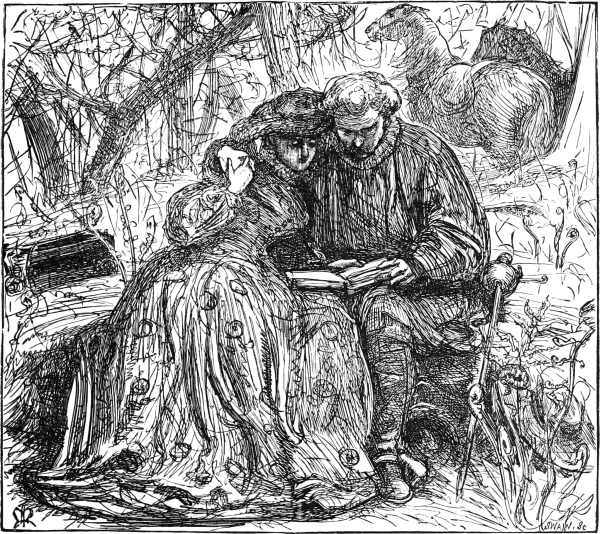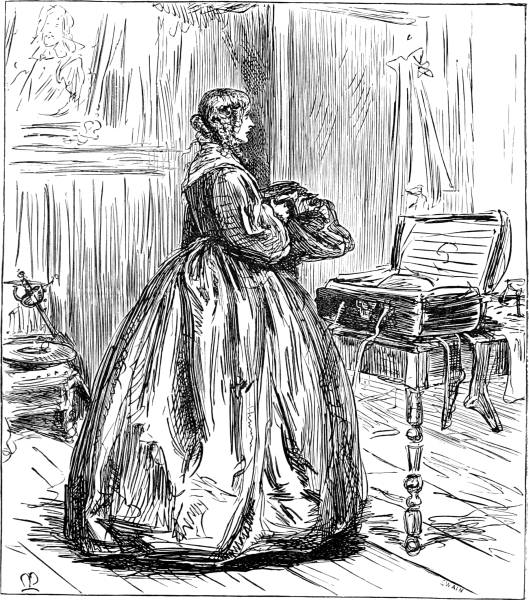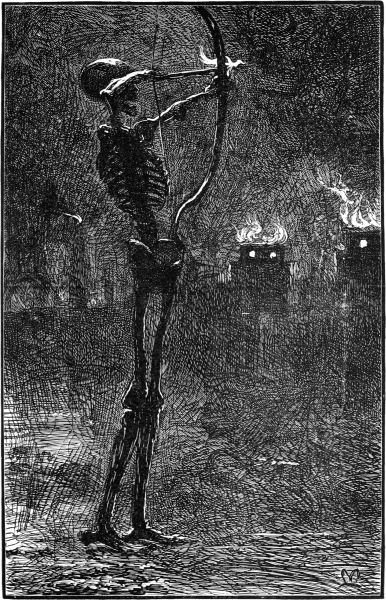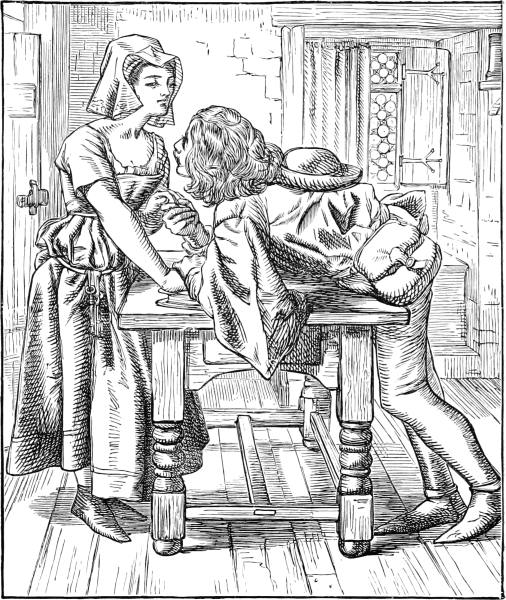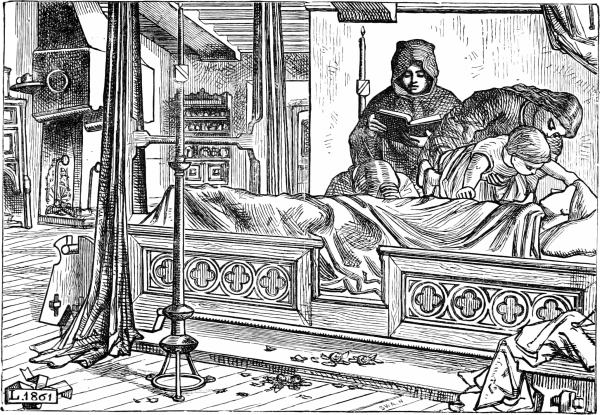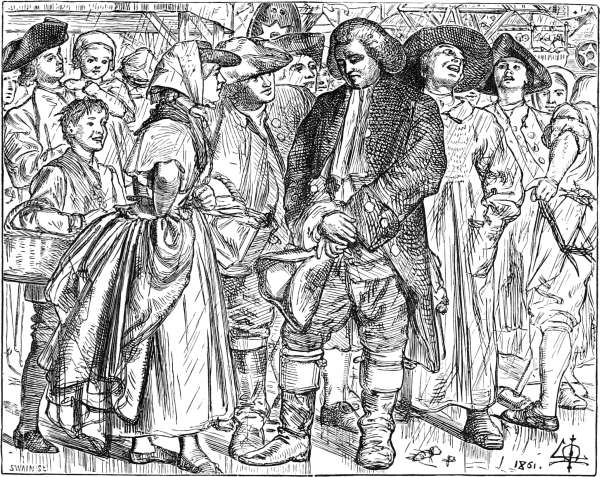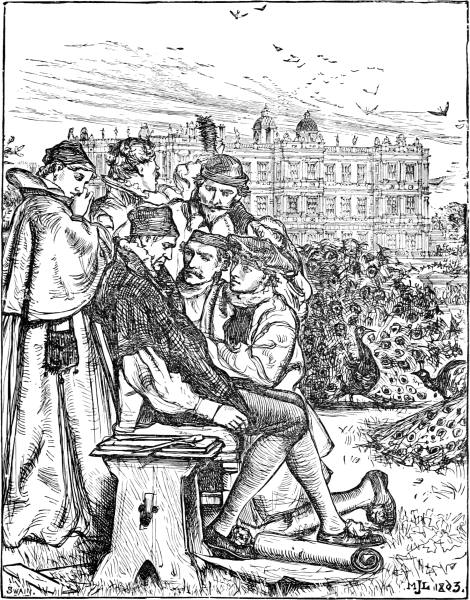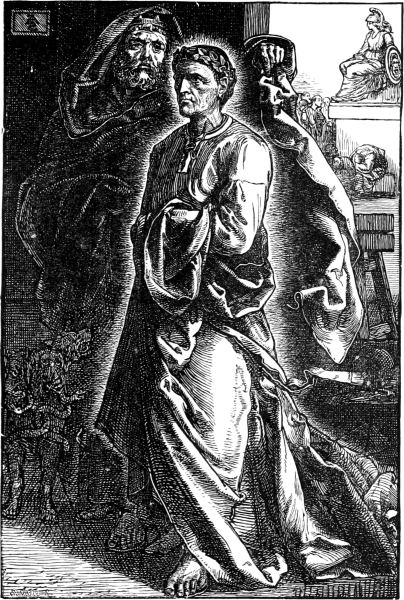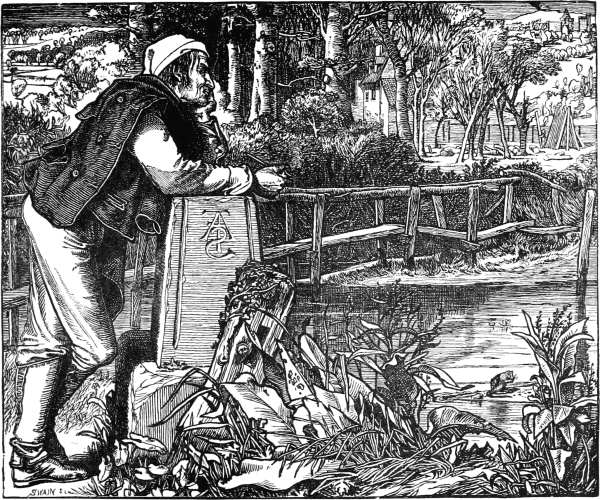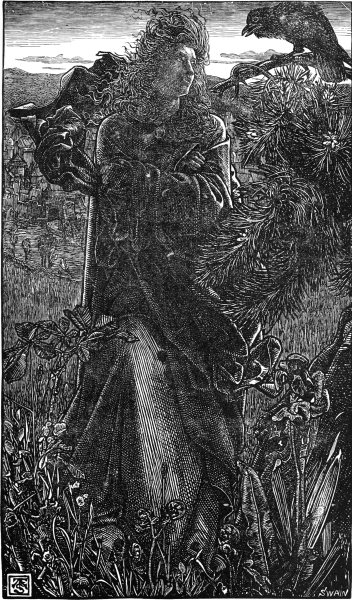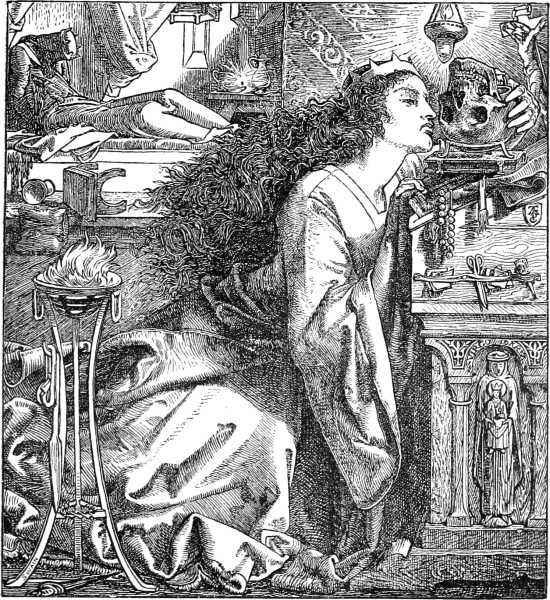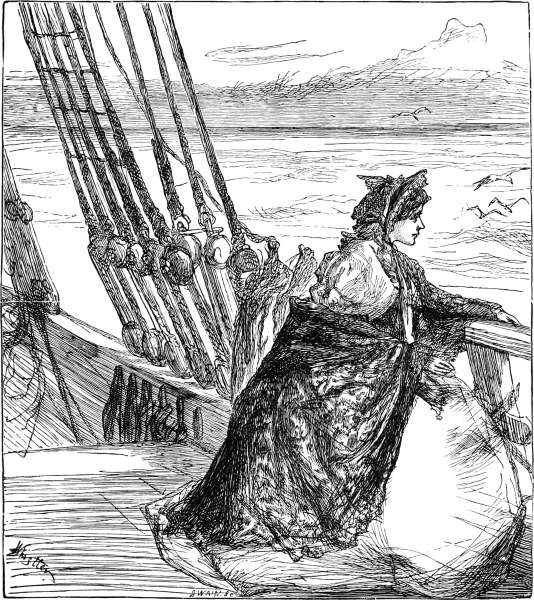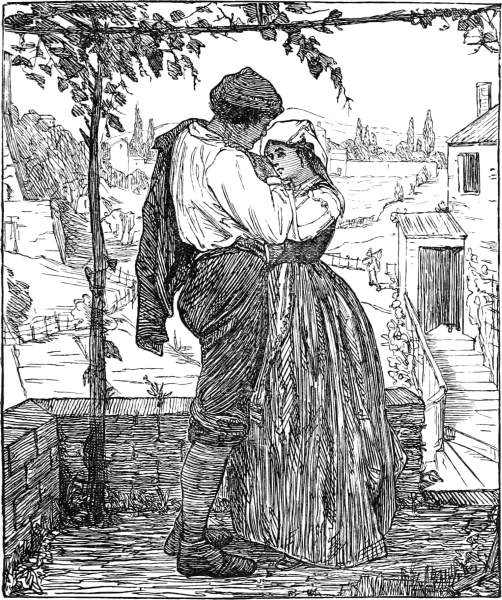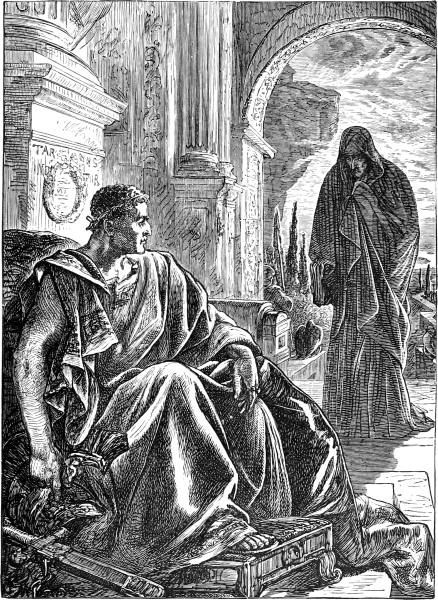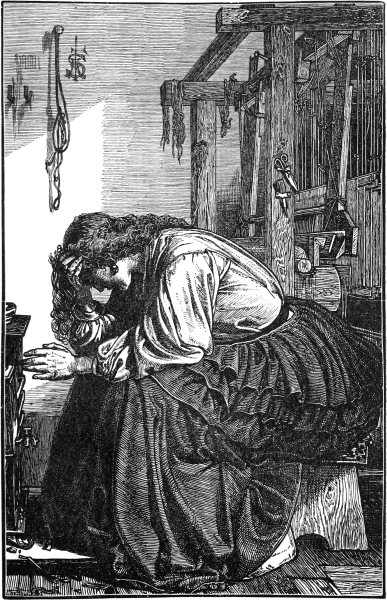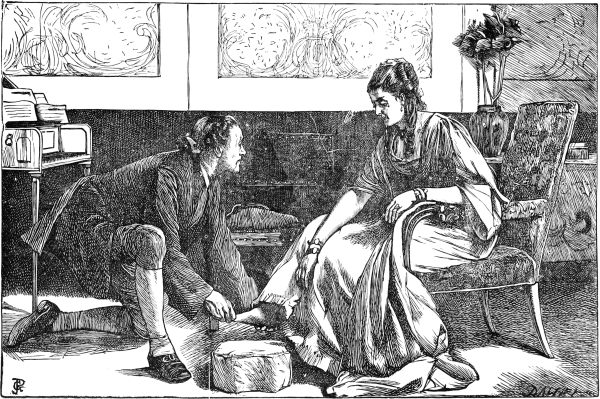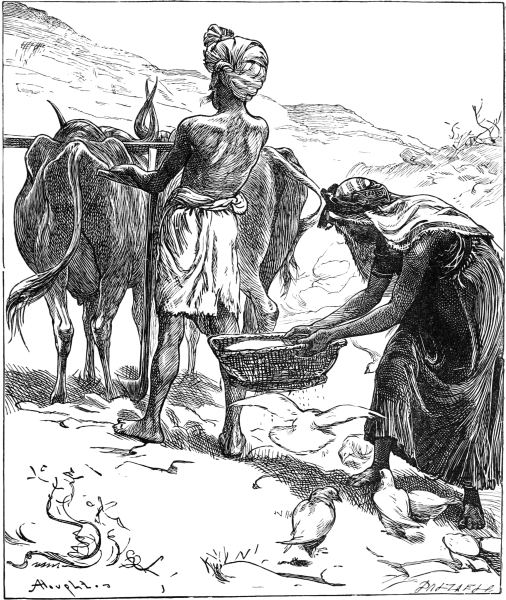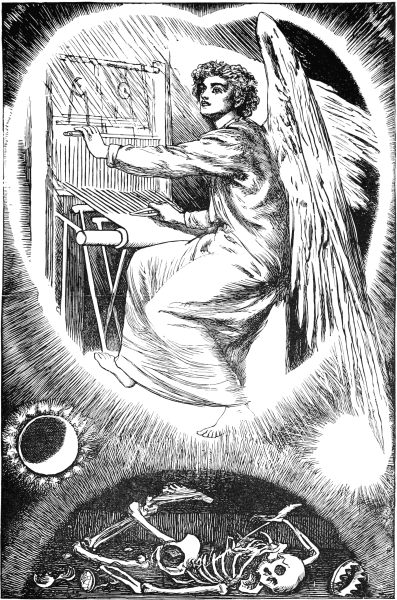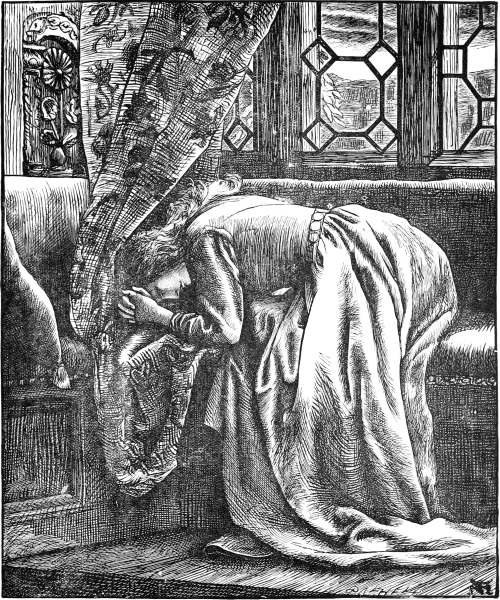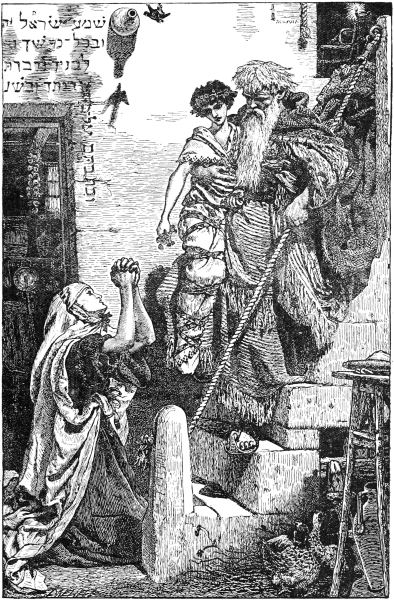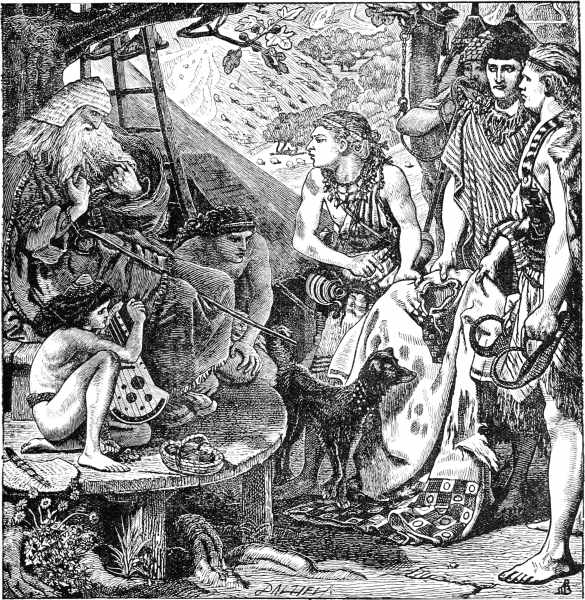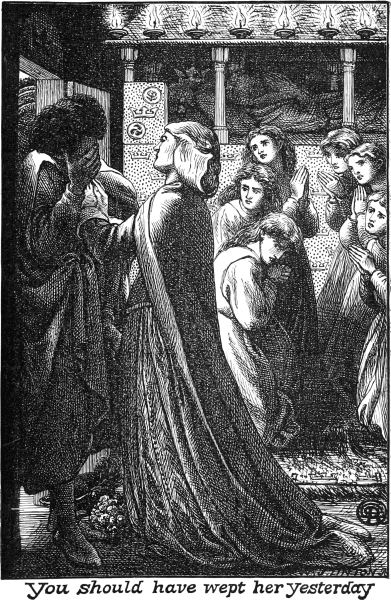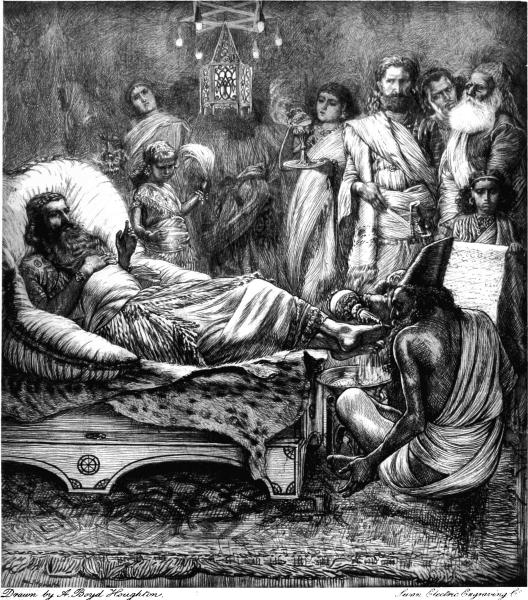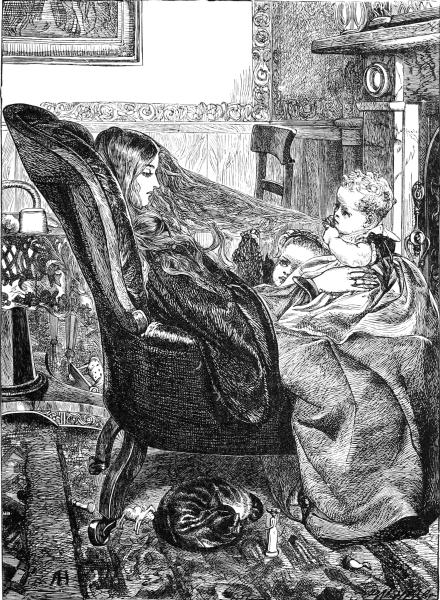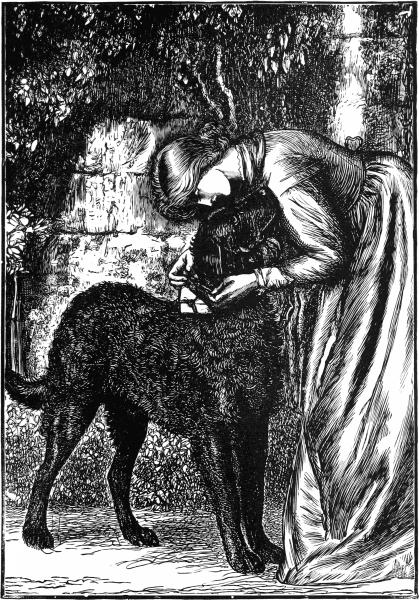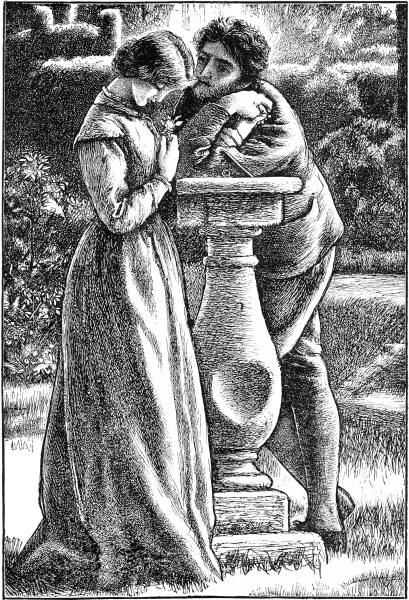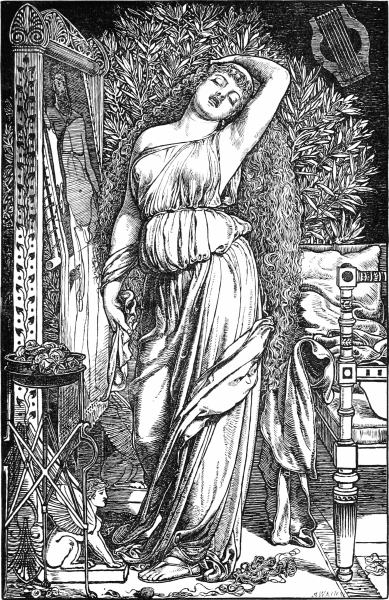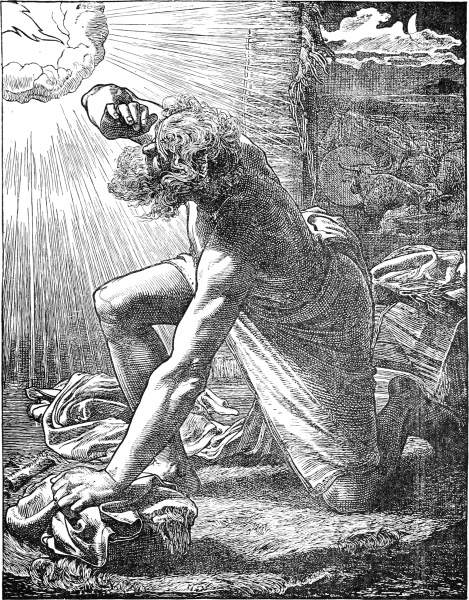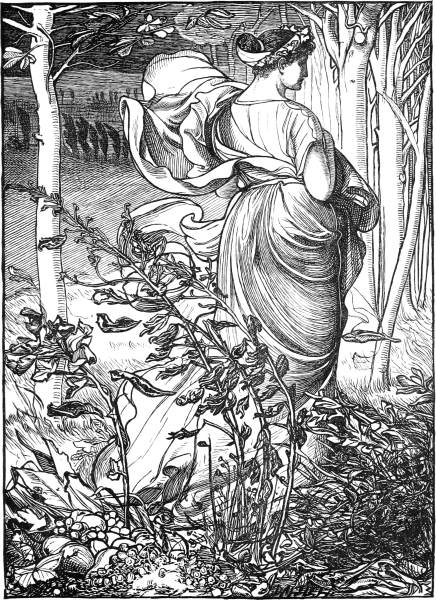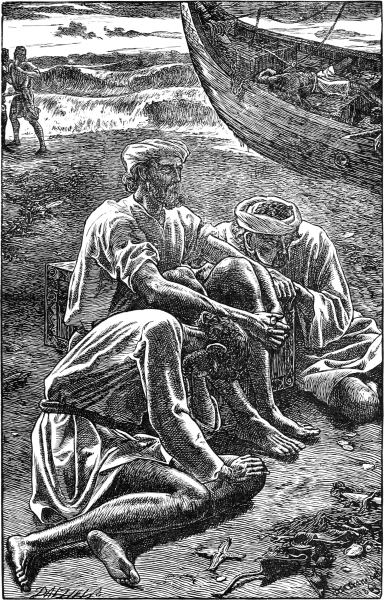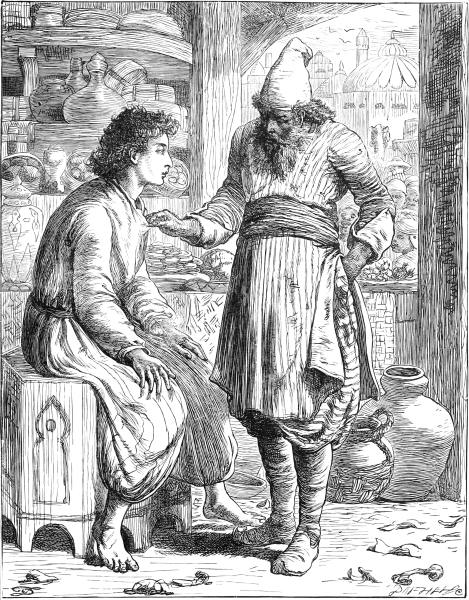
THE CORNHILL MAGAZINE, which
began in 1860 with Thackeray as editor,
showed from the very first that the aim of
the Magazine was to keep the level of its
pictures equal to that of its text. In looking
through the forty-seven volumes of the
first series it is gratifying to find that this
purpose was never forgotten. Many a rival magazine has been
started since under the happiest auspices, with the most loyal
intention to have the best and only the very best illustrations;
but in a few years the effort has been too exacting, and the
average commonplace of its padding in prose and verse has
been equalled by the dull mediocrity of its pictures. Only
those who have experienced the difficulty which faces an
editor firmly resolved to exclude the commonplace of any
sort can realise fully what a strain a successful effort, lasting
over twenty years, must needs impose on the responsible
conductors. Thackeray, as we know, soon found the labour
too great; but his successors kept nobly to their purpose,
and few magazines show more honourable fulfilment of their
projected scheme than the classic Cornhill, which has introduced
so many masterpieces in art and literature to the
public.
Curiously enough, the weakest illustrations under the
régime he inaugurated so happily are those by the editor
himself. Thackeray's designs to Lovel the Widower, and the
one example by G. A. Sala in the first volume, link the new
periodical with the past. They belong to the caricature type
of illustrations which had been accepted by the British public
as character-drawing. Like the 'Phiz' plates for Dickens's
works, and many of John Leech's sketches, they have undoubtedly
merit of a sort, but not if you consider them as
pictures pure and simple. Later experience shows that an
illustration to a story, which catches the spirit of the writer,
and realises in another medium the characters he had imagined,
may also be fine art—art as self-sufficient and as wholly beautiful
as that of a Dürer wood-cut or a Rembrandt etching. The
masterpieces of modern illustrations to fiction which the Cornhill
Magazine contains would by themselves suffice to prove this
argument up to the hilt. The collection of drawings chiefly by
Millais, Walker, and Leighton, in a volume of carefully-printed
impressions, from one hundred of the original wood-blocks,
issued under the title of the Cornhill Gallery in 1864, may
in time to come be prized as highly as Bible Wood-cuts, The
Dance of Death, or the Liber Studiorum. It is true that the
pictures aimed only to fulfil their actual purpose, and it may
be argued, reasonably enough, that a picture which illustrates a
story is for that very reason on a different level to a self-contained
work—inspired solely by the delight of the artist in
his subject. But, in their own way, they touched high-water
mark. Upon one of Dürer's blocks he is said to have written
in Latin, 'Better work did no man than this,' and on many
a Cornhill design the same legend might have been truly inscribed.
It is true that most of the etchings and wood-cuts beside
which they deserve to be ranked are untrammelled autograph
work throughout, and that here the drawing done direct on
the block was paraphrased by an engraver. Not always spoilt,
sometimes (as even the draughtsman himself admitted), improved
in part, but still with the impress of another personality
added. And this argument might be extended to prove
that an engraving by another craftsman can never be so
interesting as an etching from a master's hand, or a block cut
by its designer. Yet, without forcing such comparison, we
may claim that the engravings in Once a Week, Good Words,
and the Cornhill enriched English art to lasting purpose.
Although sets of the Cornhill Magazine are not difficult
to procure, and a large number of people prize them in their
libraries, yet by way of bringing together those scattered facts
of interest which pertain to our subject, it may be as well to
indicate briefly the principal contents of the first thirty-two
volumes which cover the period to which this book is limited.
In 1860 we find six full-page illustrations to Lovel the
Widower, three to The Four Georges, two to Roundabout
Papers, all by Thackeray, to whom they are all formally
attributed in the Cornhill Gallery. Possibly one, entirely
unlike the style of the rest to The Four Georges, is from
another hand—the fact that it is not included in the reprint
seems to confirm this suspicion. Millais' first contributions
included Unspoken Dialogue, 'Last Words,' and the beginning
of the illustrations to Framley Parsonage, which he equalled
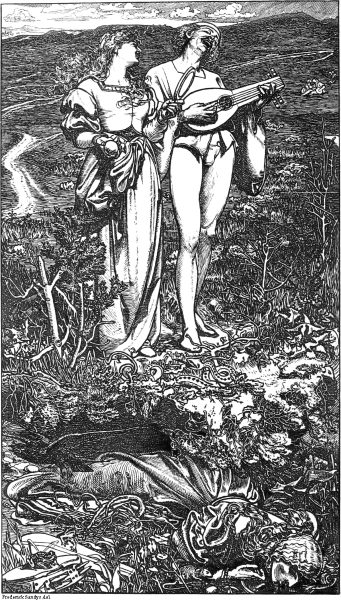
often but never excelled. F. Sandys is represented by
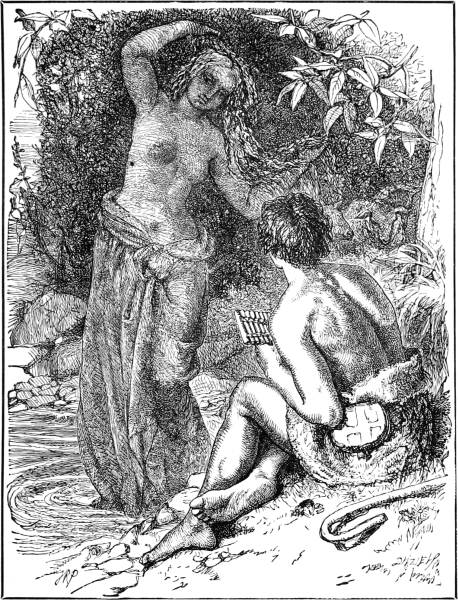
Legends of the Portent (i. p. 617), and Frederick Leighton by
The Great God Pan (ii. p. 84) to Mrs. Browning's poem.
Ariadne in Naxos, an outline-drawing in a decorative frame,
is unsigned, and so strangely unlike the style of the magazine
that it provokes curiosity.
In 1861 Thackeray started illustrating his serial story,
The Adventures of Philip, but, after four full-page drawings,
relinquished the task to Fred Walker, who at first re-drew
Thackeray's compositions, but afterwards signed his work
with the familiar 'F. W.' We may safely attribute eight
solely to him. Millais continued his series of drawings to
illustrate Framley Parsonage, and has besides one other,
entitled Temptation (iii. p. 229). A series of studies of
character, The Excursion Train, by C. H. Bennett, is a
notable exception to the practice of the magazine, which
printed all its 'pictures' on plate-paper apart from the text,
the blocks in the text (always excepting the initial letters)
being elsewhere limited to diagrams elucidating the matter
and obviously removed from consideration as pictures. This
year Doyle began those outline pictures of Society which
attained so wide a popularity.
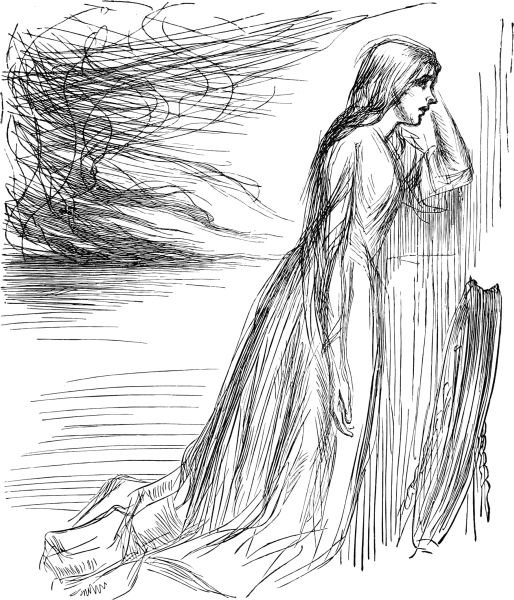
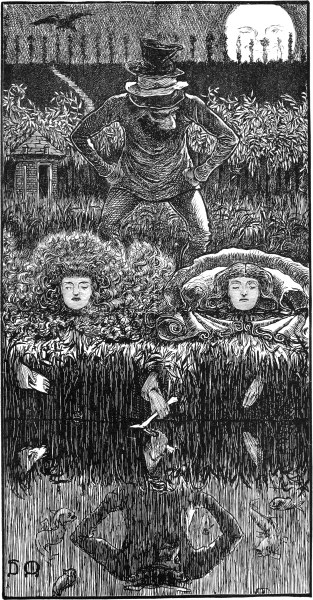
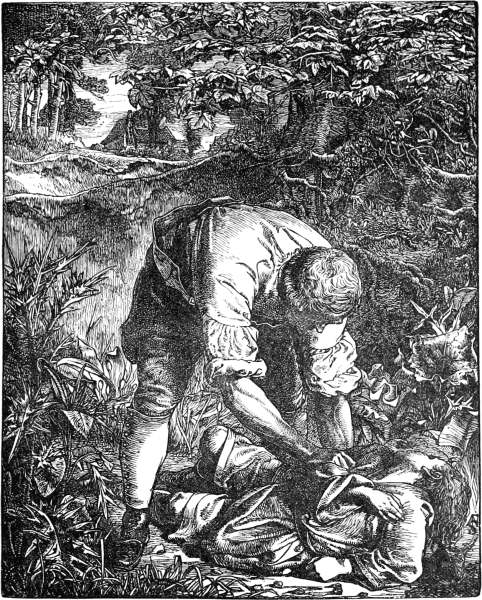
FREDERICK SANDYS
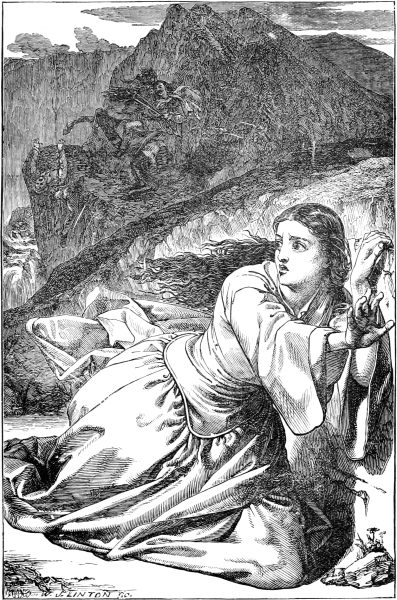
'CORNHILL MAGAZINE'
VOL. I. p. 62
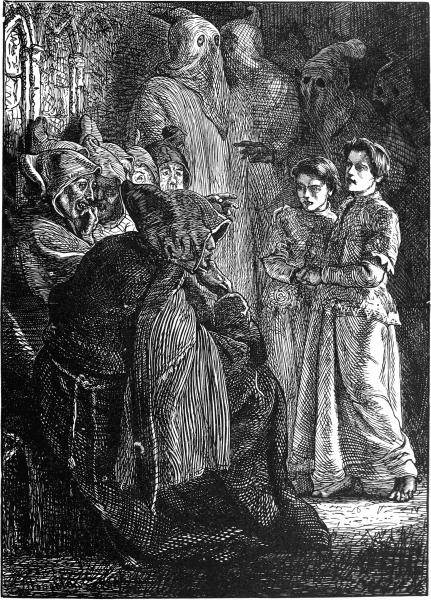
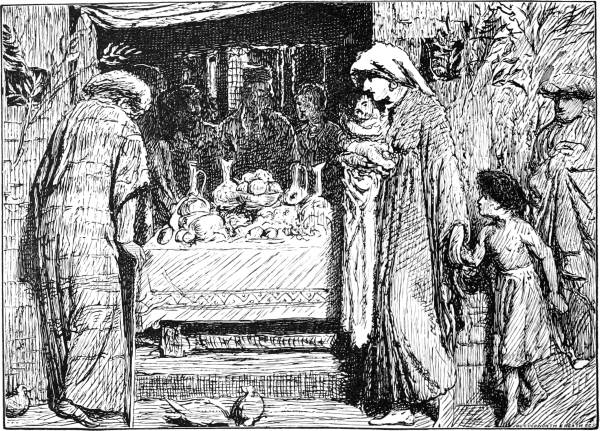
LEGEND OF
THE PORTENT
FREDERICK SANDYS
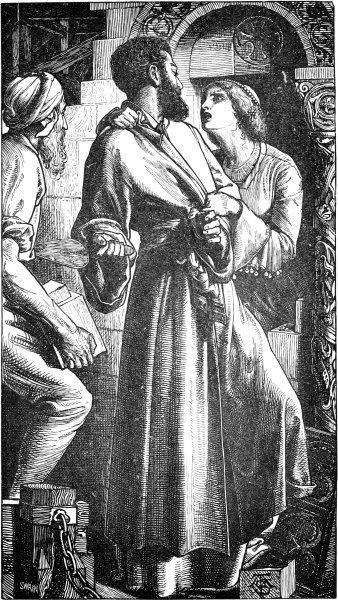
'CORNHILL MAGAZINE'
VOL. VI. p. 346
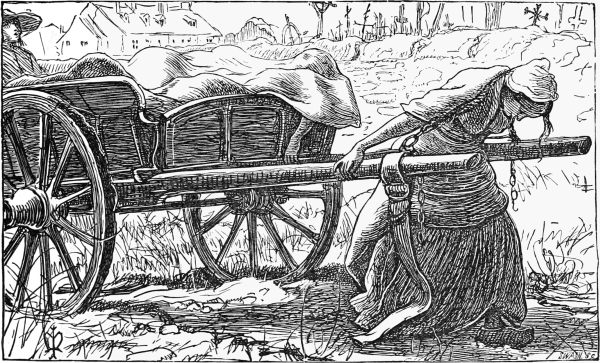
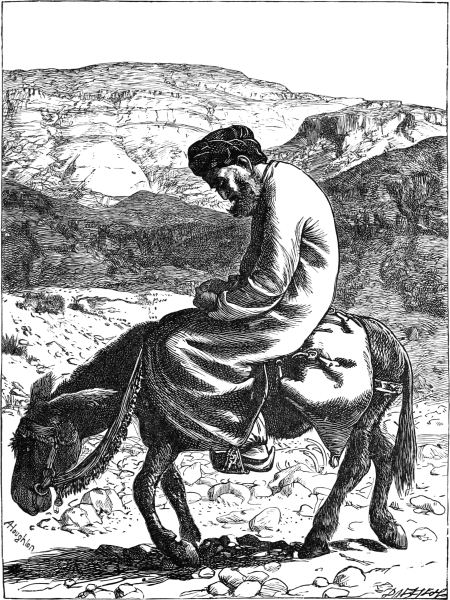
MANOLI
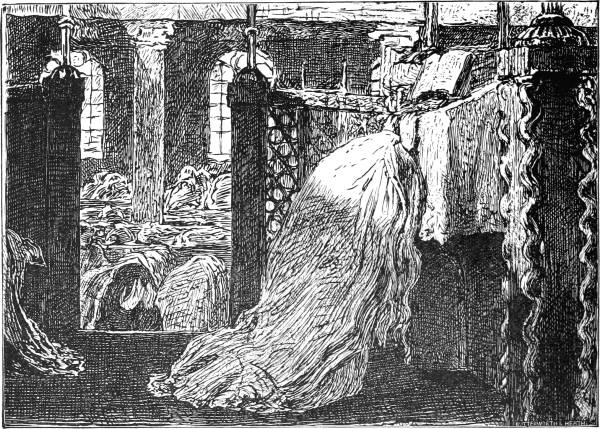
In 1862 Walker concludes his Philip series with eight
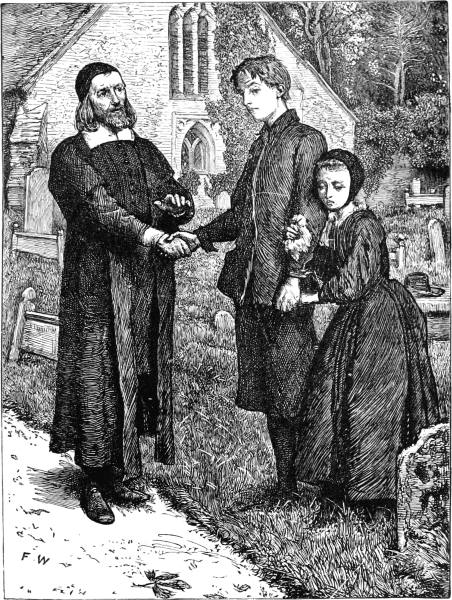
full-page drawings, including the superb Philip in Church, of
which he made a version in water-colours that still ranks
among his most notable work. The first two illustrations to
Miss Thackeray's Story of Elizabeth are also from his hand.
Millais is represented by Irené, a kneeling figure (v. p. 478),
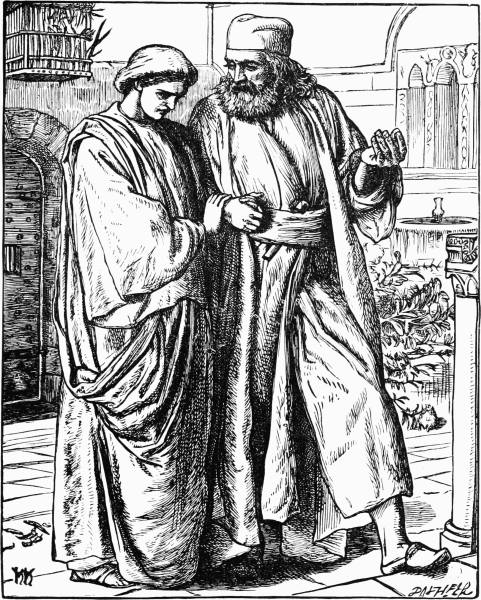
and by the powerfully conceived Bishop and the Knight
(vi. p. 100), and the first four illustrations to Trollope's Small
House at Allington. Richard Doyle continues the series of
Pictures of English Society; but now that their actuality no
longer impresses, we fail to discover the special charm which
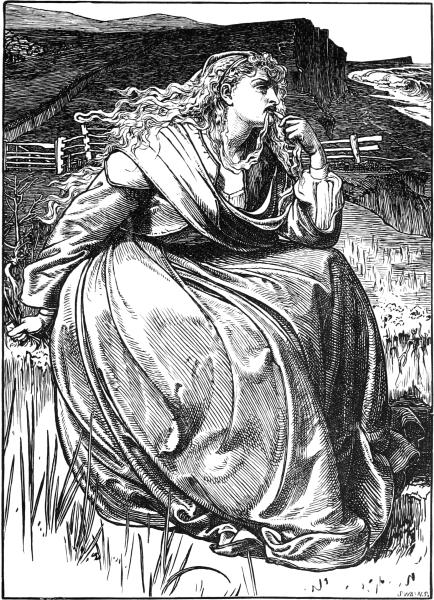
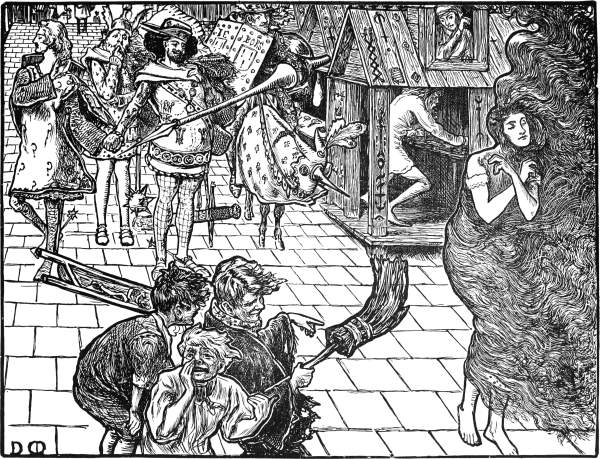
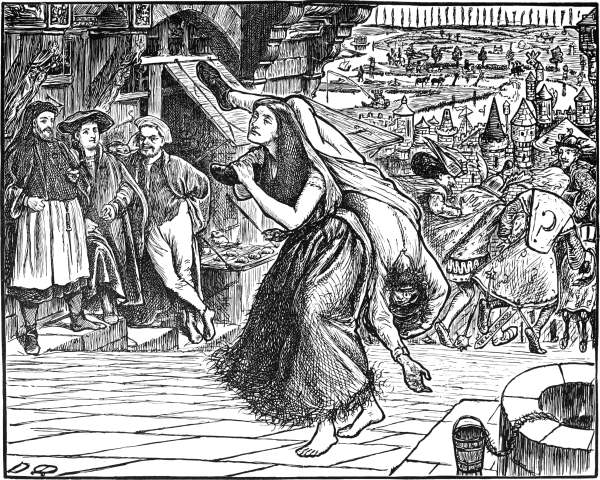
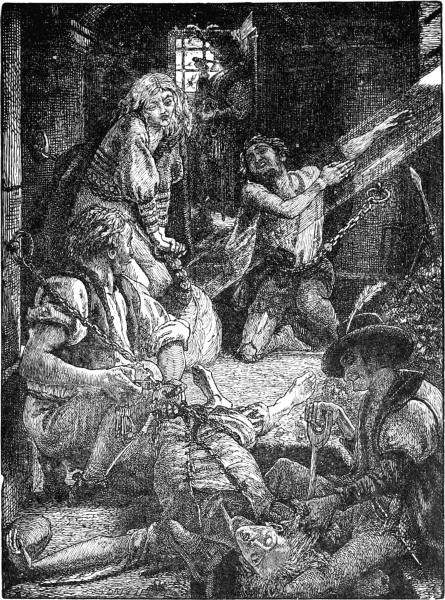
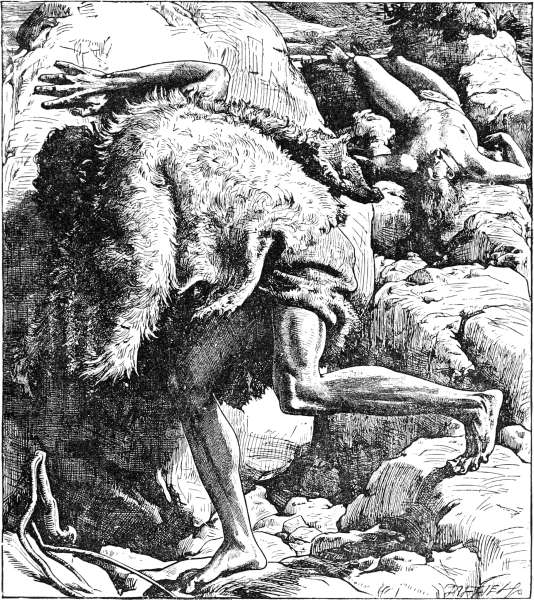
endeared them to contemporaries. F. Sandys is represented
by Manoli (vi. p. 346), the second of his three contributions,
which deepens the regret that work by this fine artist appeared
so seldom in this magazine. But the most notable feature
this year is found in the drawings contributed by Frederick
Leighton, then not even an Associate of the Royal Academy,
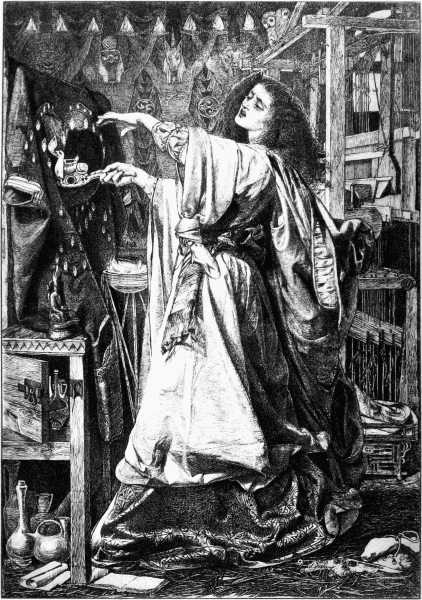
which illustrate George Eliot's Romola. With these the
Cornhill departed from its ordinary custom, and gave two
full-page illustrations to each section of the serial month by
month. Consequently in the volumes in 1862 and 1863 the
usual two-dozen plates are considerably augmented.
In 1863 twelve more of the Romola series complete
Leighton's contributions to the magazine. Millais has twelve
more to The Small House at Allington, Walker is represented
by one drawing, Maladetta, another to Mrs. Archie, two to
Out of the World, and one more to The Story of Elizabeth.
Du Maurier, destined to occupy the most prominent position in
later volumes, appears for the first time with The Cilician
Pirates, Sibyl's Disappointment, The Night before the Morrow,
and Cousin Phillis. Possibly a drawing entitled 'The
First Meeting' to a story, The ... in her Closet, is from his
hand; but the style is not clearly evident, nor is it included in
the Cornhill Gallery which, published in the next year, drew
its illustrations from the few volumes already noticed, with
the addition of five others from the early numbers of 1864.
Another drawing, signed A. H., to Margaret Denzil, is by
Arthur Hughes.
In 1864 two other illustrations complete The Small House
at Allington, and Millais has also two others for Madame de
Monferrat. Sir Noel Paton appears for the only time with
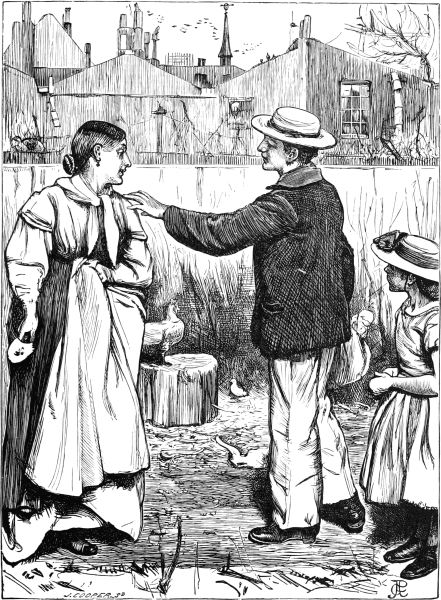
a fine composition, Ulysses (IX. p. 66). Margaret Denzil has
its three illustrations signed R. B., probably the initials of
Robert Barnes, who did much work in later volumes. Charles
Keene, a very infrequent contributor, illustrated Brother
Jacob, a little-known story by George Eliot. Du Maurier
supplies the first four illustrations to Mrs. Gaskell's unfinished
Wives and Daughters, and Fred Walker contributes five to
the other serial, also interrupted by its author's death, the
delightful Denis Duval. Here we see the artist employed
on costume-work, and hampered somewhat by historical
details, yet infusing into his designs the charm which characterises
his idyllic work. G. J. Pinwell is represented by The
Lovers of Ballyvookan. G. H. Thomas starts Wilkie Collins's
Armadale with two pictures that do not accord with the rest
of the Cornhill work, but belong to a differently considered
method, popular enough elsewhere, but rarely employed in this
magazine. The volume contains also a portrait of Thackeray
engraved on steel, by J. C. Armytage, after Laurence.
In 1865 the Armadale illustrations take up twelve full
pages, and Du Maurier supplies the remaining twelve stories
to Wives and Daughters.
In 1866 six Armadale and one Wives and Daughters
are reinforced by eleven illustrations to The Claverings by
M. Ellen Edwards. Fred Walker is again a contributor with
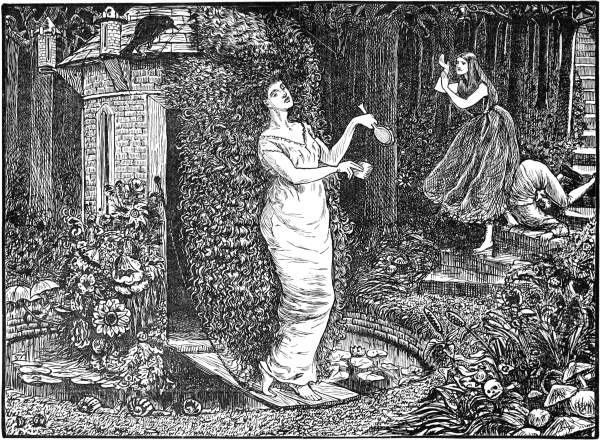
five drawings for Miss Thackeray's Village on the Cliff, and
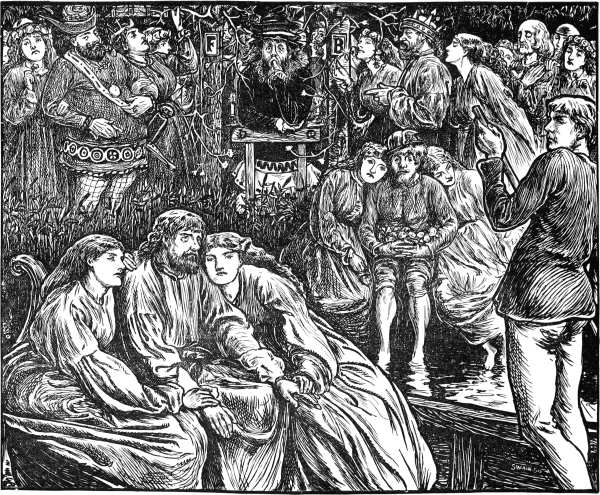
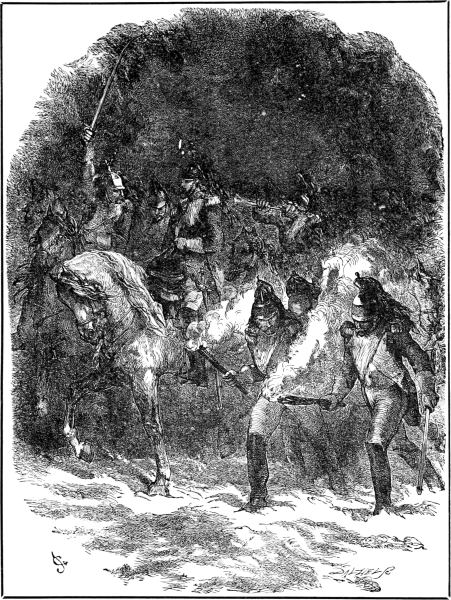
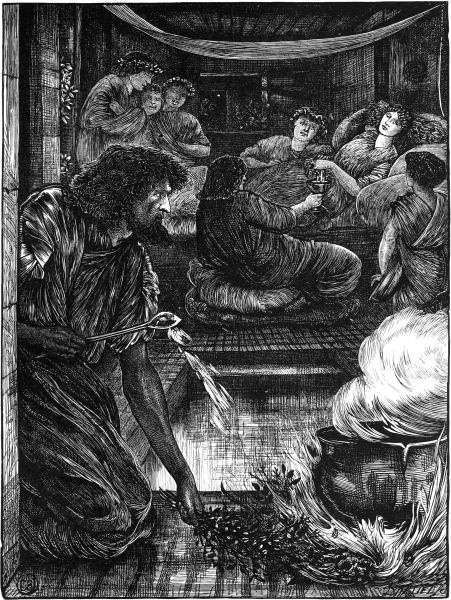
Frederick Sandys, with a fine composition illustrating Swinburne's
Cleopatra (xiv. p. 331), makes his last appearance in
the magazine.
In 1867 M. E. Edwards signs five of The Claverings and
seven to The Bramleighs of Bishop's Folly. The Satrap,
an admirable composition, is signed F. W. B., but for whom
these initials stand is not clear. Fred Walker completes his
illustrations to the Village on the Cliff, and adds one other
to Beauty and the Beast, and two to A Week in a French
Country House and one to Red Riding Hood. F. W. Lawson
makes his entrée with the four drawings to Stone Edge, and
Du Maurier has a curiously massive Joan of Arc.
In 1868 Walker has three illustrations to Jack the Giant
Killer, 'I do not love you,' and From an Island respectively.
M. Ellen Edwards is responsible for ten to The Bramleighs,
one to a story, The Stockbroker, and the first two to That
Boy of Norcott's. F. W. Lawson has four to Avonhoe, and
two to Lettice Lisle, and Du Maurier two to My Neighbour
Nelly, and one to Lady Denzil.
In 1869 That Boy of Norcott's supplies the subjects for
three others by M. E. Edwards, and Lettice Lisle for four by
F. W. Lawson. The first chapters of Put yourself in his place,
Charles Reade's trades-union novel, are illustrated by ten
drawings by Robert Barnes, F. Walker has one to Sola, for
which tale Du Maurier supplies another, as well as one to the
Courtyard of the Ours d'Or, and the three for Against Time.
In 1870 Robert Barnes continues illustrating Charles
Reade's novel with seven full pages. Du Maurier contributes
ten to Against Time, and four to George Meredith's Adventures
of Harry Richmond, and S. L. Fildes (more familiar
to-day as Luke Fildes) comes in with three admirable compositions
to Charles Lever's Lord Kilgobbin.
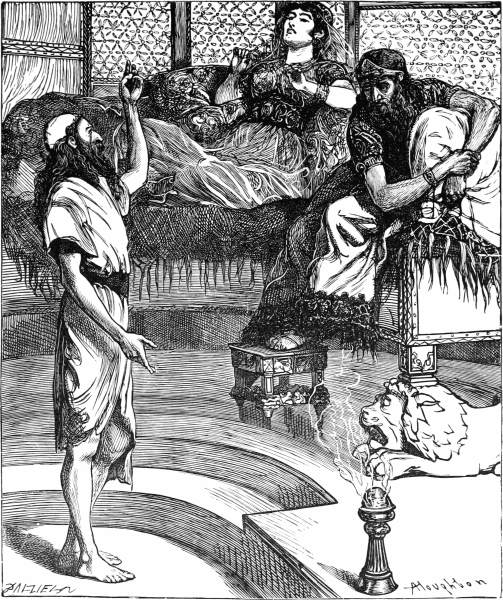
FREDERICK SANDYS
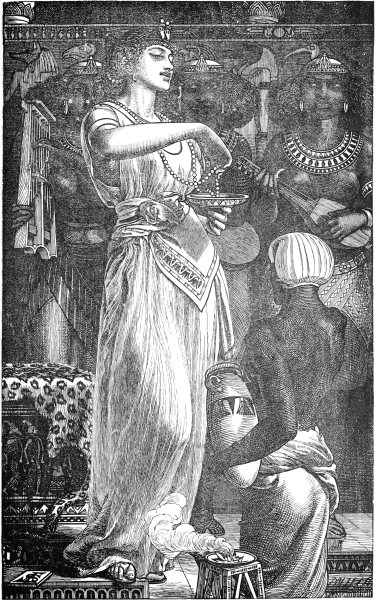
'CORNHILL MAGAZINE'
VOL. XIV. p. 331
CLEOPATRA
In 1871 the latter story engages twelve full pages, and
Harry Richmond and eleven others, Du Maurier has the
first to a Story of the Plébiscite.
In 1872 Du Maurier continues The Plébiscite with one full
page (the others to the same story are signed 'H. H.'), and
has four others to Francillon's Pearl and Emerald, and ten
to The Scientific Gentleman. Fildes concludes his embellishment
of Lord Kilgobbin with three full pages. Hubert
Herkomer (the 'H. H.' of The Plébiscite probably) appears as
a recruit with two most satisfactory designs to The Last
Master of the Old Manor-House, and G. D. Leslie, also a
fresh arrival, finds, in Miss Thackeray's Old Kensington, the
themes for nine graceful compositions.
In 1873 to Du Maurier are devoted twelve subjects illustrating
Zelda's Fortune. G. D. Leslie has four others concluding
Old Kensington. S. L. Fildes illustrates Willows with
two, and Marcus Stone is represented by half-a-dozen idyllic
and charming, if somewhat slight, designs for Young Brown.
In 1874 H. Paterson, W. Small, and Du Maurier contribute
all the pictures excepting one by Marcus Stone. Far
from the Madding Crowd by Thomas Hardy, illustrated by
the first artist, and A Rose in June, and Black's Three
Feathers by the second.
In 1875 H. Allingham supplies most graceful pictures to
Miss Angel. Du Maurier is the artist chosen for another
Hardy novel, The Hand of Ethelberta. A. Hopkins illustrates
Mr. Henley's wonderful achievement, Hospital Outlines,
as the poems were called when they appeared in July 1875.
From this date to the last number of the shilling series, June
1883, the artists are limited to Small and Du Maurier for
the most part, and as this record has already exceeded its
limits, no more need be said, except that until the last, the
high standard of technical excellence was never abandoned.
Although the rare mastery of Millais and the charm of
Walker were hardly approached by their successors, yet the
magazine was always representative of the best work of those
of its contemporaries who devoted themselves to black and
white, and not infrequently, as this notice shows, attracted
men who have made few, if any other, attempts to draw for
publication. It is curious to find that, notwithstanding the
evident importance it attached to its pictorial department,
no artist's name is ever mentioned in the index or elsewhere.
In a graceful and discriminative essay 'S. C.' speaks feelingly
and appreciatively of Fred Walker just after his death; but
that seems to be the only time when the anonymity imposed
on the artists was divulged in the magazine itself. It is but
fair to add that the literary contents were never signed, or
attributed in the index, except that a few articles bear the now
familiar initials, 'L. S.', 'W. E. H.', 'R. L. S.', 'G. A.', and others.
This popular, semi-religious, sixpenny magazine, established
in 1860, achieved quickly a circulation that was record-breaking
in its time. Edited by Dr. Norman Macleod,
it was printed by Thomas Constable, and published (at
first) in Edinburgh by Alexander Strahan and Co. Although,
viewed in the light of its later issues, one cannot
help feeling disappointed with the first volume, yet even
there the pictures are distinctly interesting as a forecast,
even if they do not call for any detailed notice by reason
of their intrinsic merit. They rarely exceed a half page in
size, and were engraved none too well by various craftsmen.
Indeed, judging from the names of the artists, then
as afterwards, given fully in the index of illustrations, it
might not be unfair to blame the engravers still more
strongly. The very fact that the illustrations are duly
ascribed in a separate list is proof that, from the first, the
editor recognised their importance. Such honourable recognition
of the personality of an illustrator is by no means
the rule, even in periodicals that have equal right to be proud
of their collaborators. Where the artists' names are recorded
it is rare to find them acknowledged so fully and thoroughly
as in Good Words. In other magazines they are usually
referred to under the title of the article they illustrate and
nowhere else; or their name is printed (as in Once a Week)
with a bare list of numerals showing the pages containing
their pictures; but in Good Words the subject, titles, and
artists' names have always been accorded a special index.
G. DU MAURIER
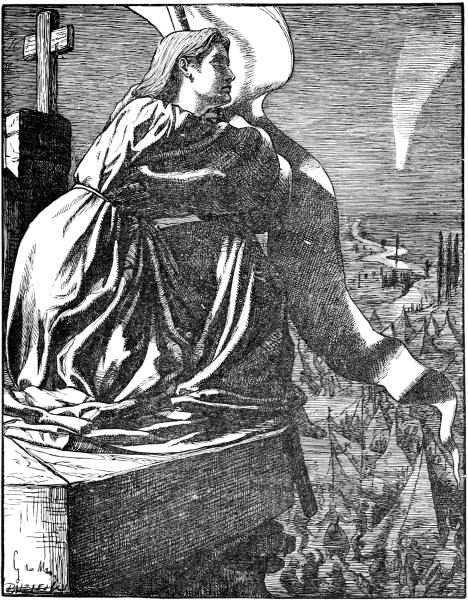
'GOOD WORDS'
1861, p. 579
A TIME TO
DANCE
In the first volume, for 1860, W. Q. Orchardson—not
then even an Associate of the Royal Academy—supplies nine
drawings, engraved by F. Borders. Admirable in their own
way, one cannot but feel that the signature leads one to
expect something much more interesting; and, knowing the
quality of Mr. Orchardson's later work, it is impossible to
avoid throwing the blame on the engraver. Keeley Halswelle
contributes six; in these you find (badly drawn or spoilt by
the engraver) those water-lilies in blossom, which in after years
became a mannerism in his landscape foregrounds. J. W.
M'Whirter has four—one a group of Autumn Flowers (p. 664),
cut by R. Paterson, that deserves especial notice as a much
more elaborate piece of engraving than any other in the
volume. Erskine Nicol supplies two genre pieces, the full-page,
Mary Macdonell and her friends (p. 216), being, most
probably, a thoroughly good sketch, but here again the
translator has produced hard scratchy lines that fail to suggest
the freer play of pencil or pen, whichever it was that produced
the original. Others by 'J. B.,' J. O. Brown, C. A. Doyle,
Clarence Dobell, Jas. Drummond, Clark Stanton, Gourlay
Steell, and Hughes Taylor, call for no particular comment.
From 1861 the chief full-page illustrations were printed
separately on toned paper. A series of animal subjects by
'J. B.,' twelve 'Illustrations of Scripture,' engraved by Dalziel
Brothers, were announced in the prospectus as a special feature.
Somewhat pre-Raphaelite in handling they are distinctly
interesting, but hardly masterly. But the volume will be
always memorable for its early work by Frederick Walker
and G. Du Maurier. A Time to Dance, by the latter, shows
a certain decorative element, which in various ways has
influenced his work at different periods, although no one
could have deduced from it the future career of its brilliant
author as a satirist of society, a draughtsman who imparted
into his work, to a degree no English artist has surpassed,
and very few equalled, that 'good form' so prized by well-bred
people. The drawing unsigned The Blind School (p. 505),
attributed to Fred Walker in the index, suggests some clerical
error. Like one attributed to Sandys in a later volume, you
hesitate before accepting evidence of the compiler of the list
of engravings, which the picture itself contradicts flatly. Only
a Sweep (p. 609) is signed, and, although by no means a good
example, is unquestionably attributed rightly. John Pettie has
two designs, Cain's Brand (pp. 376, 422); J. M'Whirter and W.
Q. Orchardson, one each; H. H. Armstead, a pre-Raphaelite
composition, A Song which none but the Redeemed ever sing,
which is amongst the most interesting of the comparatively
few illustrations by the Royal Academician, who is better
known as a sculptor, as his Music, Poetry, and Painting in
the Albert Memorial, the panels beneath Dyce's frescoes at
Westminster Palace, and a long series of works shown at the
Academy exhibitions suffice to prove. T. Morten, a draughtsman
who has missed so far his due share of appreciation, is
represented by The Waker, Dreamer, and Sleeper (p. 634), a
powerful composition of a group of men praying at night by
the side of a breaking dyke. John Pettie has two drawings;
and J. D. Watson, six subjects—the first, The Toad, being
singularly unlike his later style, and suggesting a closer
discipleship with the pre-Raphaelites than he maintained
afterwards. Two by Clarence Dobell, and three by T.
Graham—one, The Young Mother, a charming arrangement
in lines; with others by J. Wolf, Zwecker, W. M'Taggart,
J. L. Porter, A. W. Cooper, A. Bushnell, W. Fyfe, W. Linney,
and C. H. Bennett, are also included. Altogether the second
volume shows marked advance upon the first, although this
admirable periodical had not yet reached its high-water mark.
In 1862 we find added to its list of artists, Millais, Keene,
Sandys, Whistler, Holman Hunt, E. Burne-Jones, A. Boyd
Houghton, Tenniel, S. Solomon, and Lawless, a notable
group, even in that year when so many magazines show
a marvellous 'galaxy of stars.' To Millais fell the twelve
illustrations to Mistress and Maid, by the author of John
Halifax, and two others, Olaf (p. 25) and Highland Flora
(p. 393). That these maintain fully the reputation of the
great illustrator, whose later achievements in oil have in
popular estimation eclipsed his importance as a black-and-white
artist, goes without saying. If not equal to the superb
Parables of the following year, they are worthy of their
author. Indeed, no matter when you come across a Millais,
it is with a fresh surprise each time that one finds it rarely
falls below a singularly high level, and is apt to seem, for the
moment, the best he ever did.
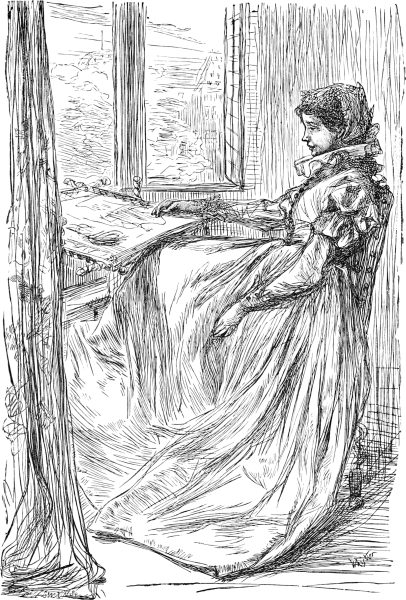
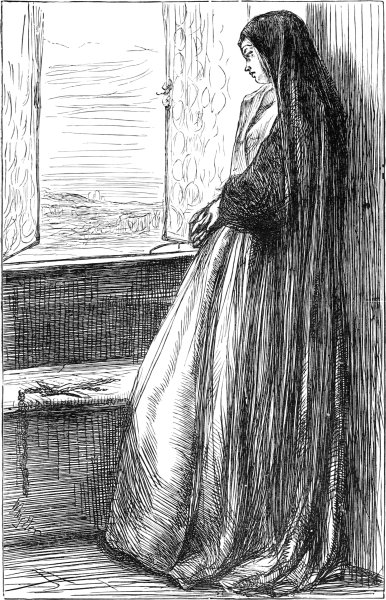
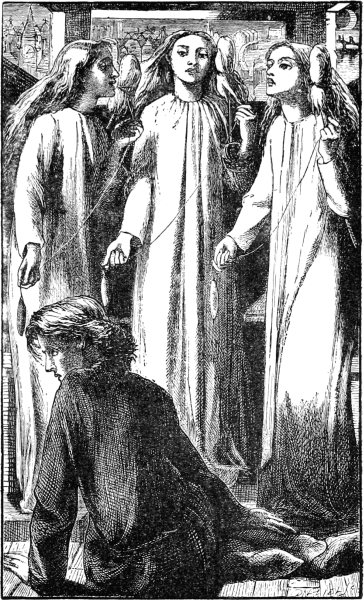
SIMEON SOLOMON
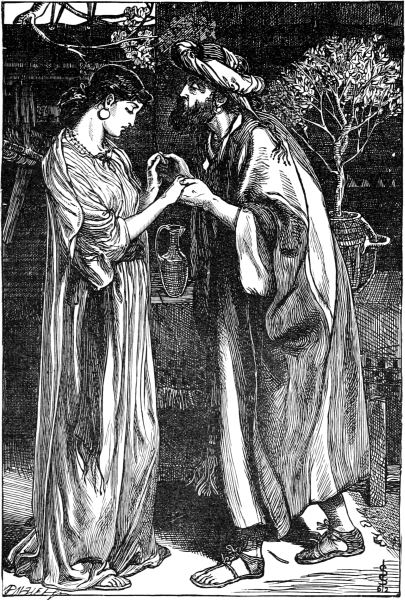
'GOOD WORDS'
1862, p. 592
THE VEILED
BRIDE
FREDERICK WALKER
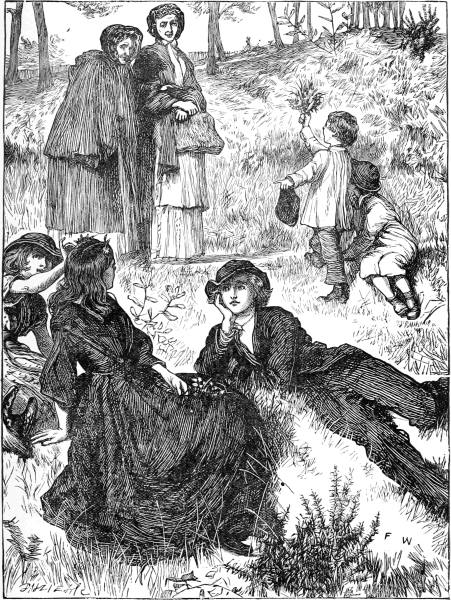
'GOOD WORDS'
1862, p. 657
OUT AMONG THE
WILD-FLOWERS
The two illustrations by J. M'Neill Whistler seem to be
very little known. Those to Once a Week, possibly from the
fact of their being reprinted in Thornbury's Legendary Ballads,
have been often referred to and reproduced several times;
but no notice (so far as I recollect) of these, to The First
Sermon, has found its way into print. The one (p. 585) shows
a girl crouching by a fire, with a man, whose head is turned
towards her, seated at a table with his hand on a lute. The
other (p. 649) is a seated girl in meditation before a writing-table.
Not a little of the beauty of line, which distinguishes
the work of the famous etcher, is evident in these blocks,
which were both engraved by Dalziel, and as whatever the
original lost cannot now be estimated, as they stand they are
nevertheless most admirable works, preserving the rapid
touch of the pen-line in a remarkable degree.
The Charles Keene drawing to Nanneri the Washerwoman
is another Dalziel block which merits praise in no slight
measure; as here again one fancies that the attempt has
been to preserve a facsimile of each touch of the artist,
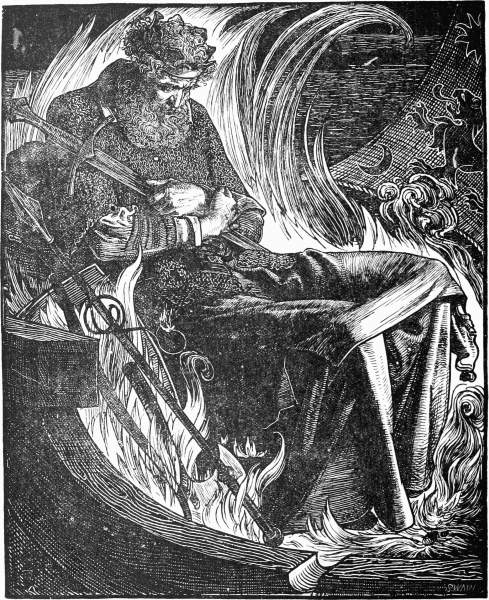
and not to translate wash into line. The King Sigurd of
Burne-Jones has certainly lost a great deal; in fact, judging
by drawings of the same period still extant, it conveys
an effect quite different from that its author intended.
Certainly, at the present time, he regards it as entirely unrepresentative;
but no doubt then as now he disliked drawing
upon wood. To-day it has been said that his Chaucer drawings
in pencil were practically translated by another hand in
the course of their being engraved on wood. Certainly technique
of lead pencil is hardly suggested, much less reproduced
in facsimile in the entirely admirable engravings by the veteran
Mr. W. H. Hooper. But if the designs were photographed
on the block such translation as they have undergone is no
doubt due to the engraver.
A drawing by Simeon Solomon, The Veiled Bride (p. 592),
seems also much less dainty than his pencil studies of the same
period. Many artists, when they attempt to draw upon wood,
find the material peculiarly unsympathetic. Rossetti has left
his opinion on record, and it is quite possible that in both
the Burne-Jones and Solomon, as in the Tennyson drawings,
although the engravers may have accomplished miracles, what
the artist had put down was untranslatable. For the delicacies
of pencil may easily produce something beyond the power of
even the most skilful engraver to reproduce. The Sandys,
Until her Death (p. 312), illustrating a poem, loses much
as it appeared in the magazine; you have but to compare
a proof from the block itself, in a reprinted collection of
Messrs. Strahan's engravings, to realise how different a
result was secured upon good paper with careful printing.
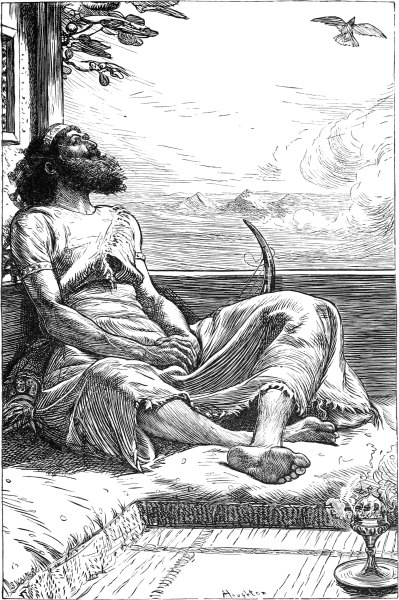
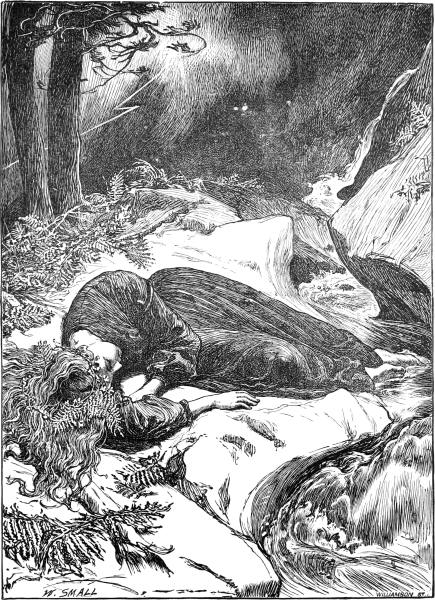
A. Boyd Houghton is represented by four subjects: My
Treasure (p. 504), On the Cliff (p. 624), True or False
(p. 721), and About Toys (p. 753); they all belong to the
manner of his Home Scenes, rather than to his oriental illustrations.
The Battle of Gilboa (p. 89), by Tenniel, is typical.
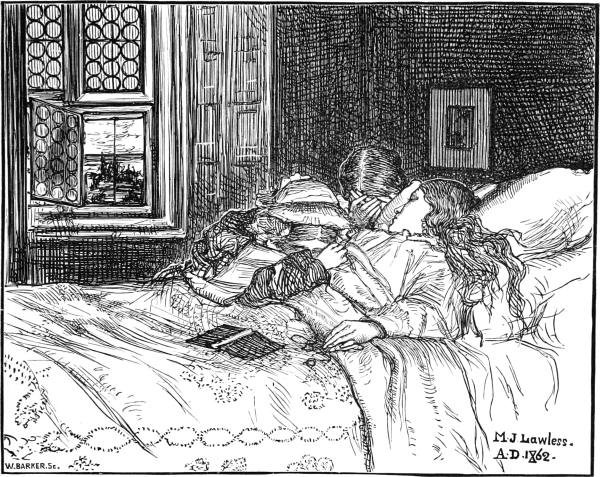
M. J. Lawless is at his best in Rung into Heaven (p. 135),
and in the Bands of Love (p. 632) shows more grace than he
sometimes secured when confronted by modern costume.
T. Morten has a finely-engraved night-piece, Pictures in
the Fire (p. 200), besides The Christmas Child (p. 56) and
The Carrier Pigeon (p. 121). The Holman Hunt, Go and
Come (p. 32), a weeping figure, is not particularly interesting.
Honesty (p. 736), by T. Graham, gives evidence of the power of
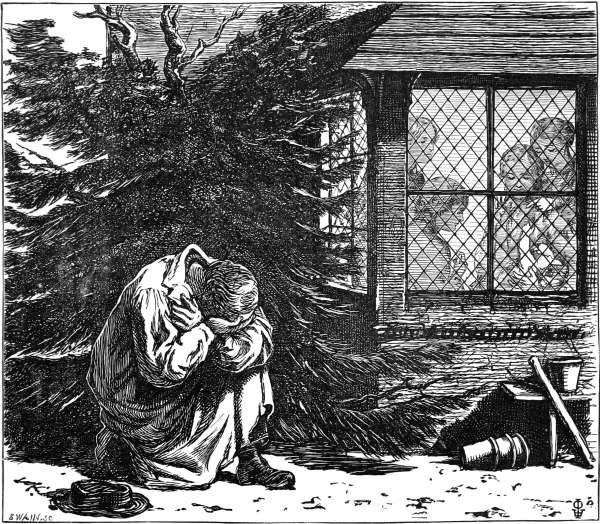
an artist who has yet to be 'discovered' so far as his illustrations
are concerned. H. H. Armstead's Seaweeds (p. 568),
and eight by J. D. Watson (pp. 9, 81, 144, 201, 209, 302, 400,
433) need no special comment, nor do the ten by J. Pettie
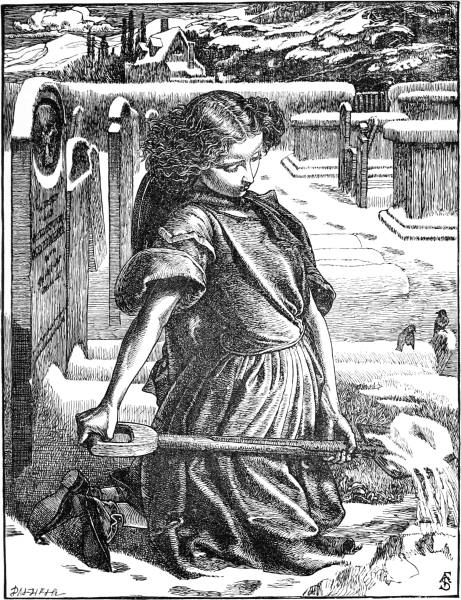
(pp. 264–713). Fred Walker is represented by The Summer
Woods, a typical pastoral (p. 368), Love in Death, a careworn
woman in the snow (p. 185), and Out among the wild flowers
(p. 657), the latter an excellent example of the grace he
imparted to rustic figures. These, with a few diagrams and
engravings from photographs, complete the record of a
memorable, if not the most memorable, year of the magazine.
T. GRAHAM
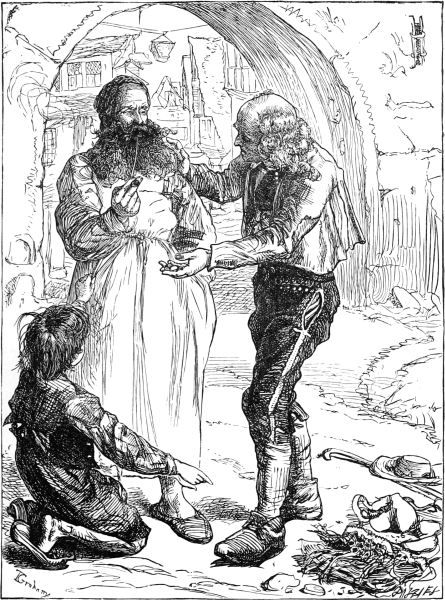
'GOOD WORDS'
1862, p. 736
HONESTY
M. J. LAWLESS
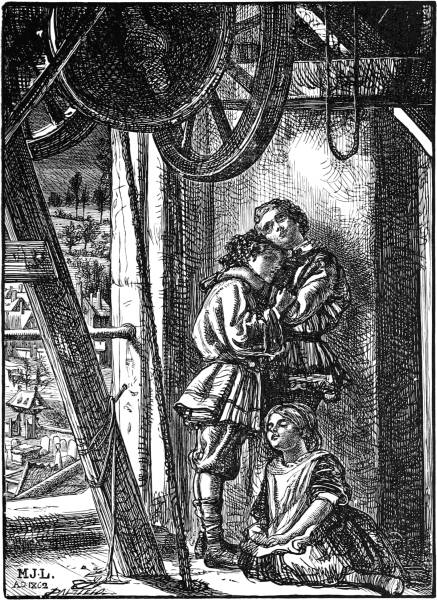
'GOOD WORDS'
1862, p. 153
RUNG INTO HEAVEN
M. J. LAWLESS
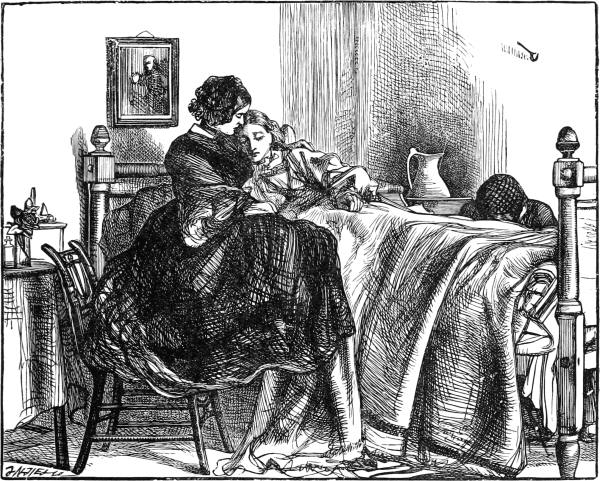
'GOOD WORDS'
1862, p. 632
THE BANDS
OF LOVE
J. PETTIE
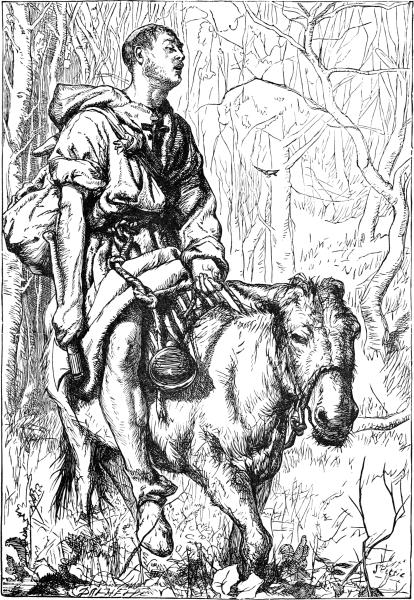
'GOOD WORDS'
1863, p. 14
THE MONKS AND
THE HEATHEN
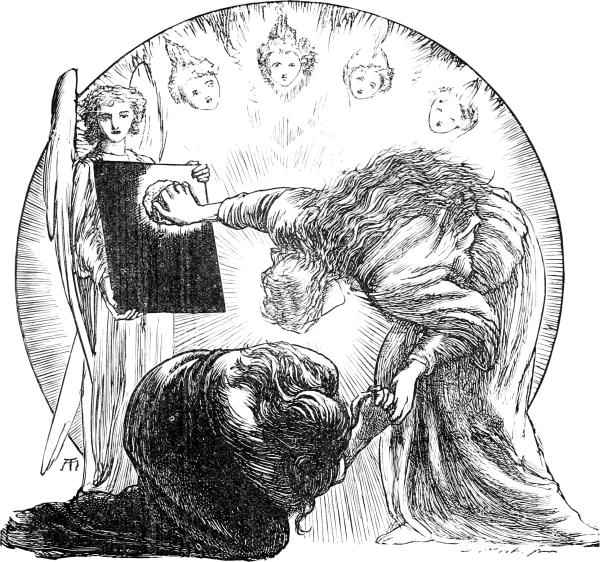
FREDERICK SANDYS
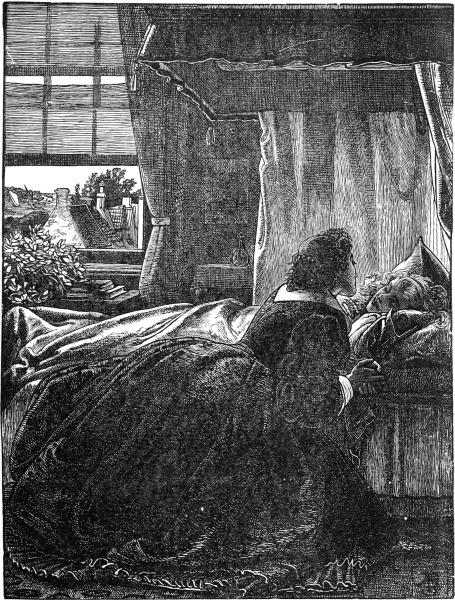
'GOOD WORDS'
1863, p. 589
SLEEP
FREDERICK SANDYS
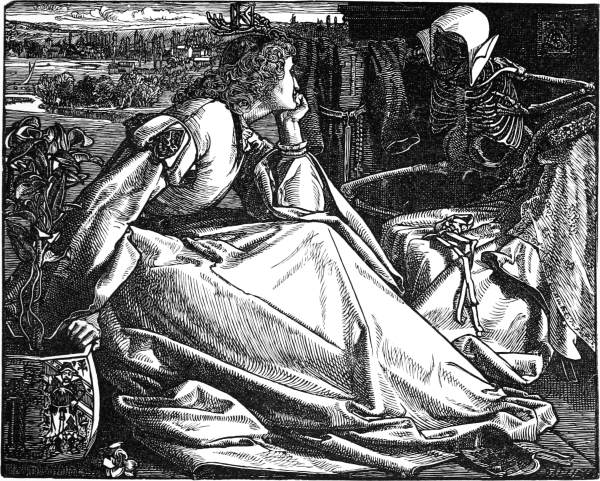
'GOOD WORDS'
1862, p. 312
UNTIL HER
DEATH
JOHN TENNIEL
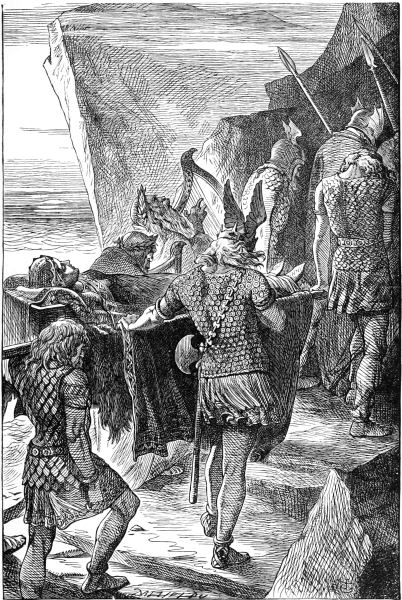
'GOOD WORDS'
1863, p. 201
THE NORSE
PRINCESS
In 1863 we find less variety in the artists and subjects,
which is due to the presence of the superb series of drawings
by Millais, The Parables, wherein the great illustrator
touched his highest level. To call these twelve pictures masterpieces
is for once to apply consistently a term often misused.
For, though one ransacked the portfolios of Europe, not many
sets of drawings could be found to equal, and very few to excel
them. The twelve subjects appeared in the following order:
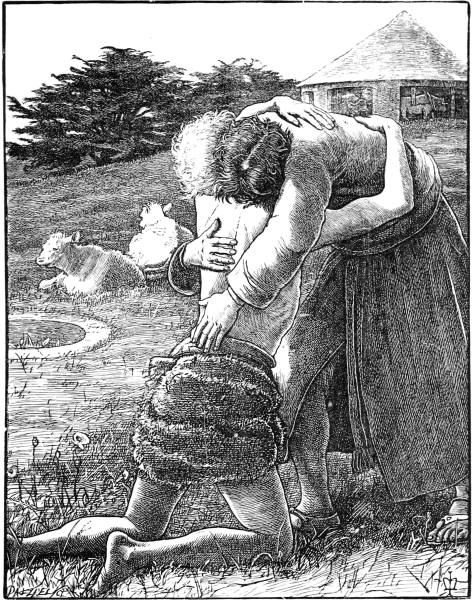
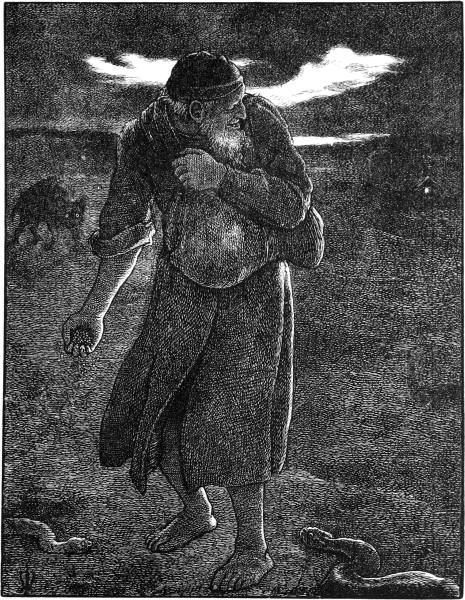
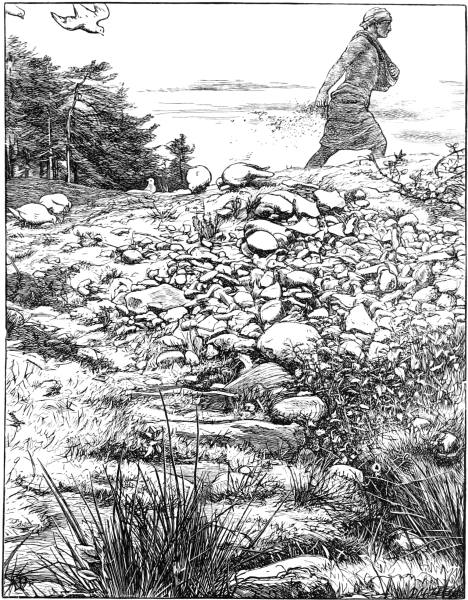
The Leaven (p. 1), The Ten Virgins (p. 81), The Prodigal
Son (p. 161), The Good Samaritan (p. 241), The Unjust
Judge (p. 313), The Pharisee and Publican (p. 385), The Hid
Treasure (p. 461), The Pearl of Great Price (p. 533), The
Lost Piece of Money1 (p. 605), The Sower (p. 677), The
Unmerciful Servant (p. 749), and The Labourers in the Vineyard
(p. 821). To F. Sandys two drawings are attributed; one
is obviously from another hand, but Sleep (p. 589) undoubtedly
marks his final appearance in this magazine. T. Morten
is represented by Cousin Winnie (p. 257), Hester Durham
(p. 492), The Spirit of Eld (p. 629, unsigned), a powerful
composition that at first glance might almost be taken for a
Sandys, and An Orphan Family's Christmas (p. 844). In
Autumn Thoughts (p. 743) we have an example of J. W.
North, more akin to those he contributed to the Dalziel table-books,
a landscape, with a fine sense of space, despite the fact
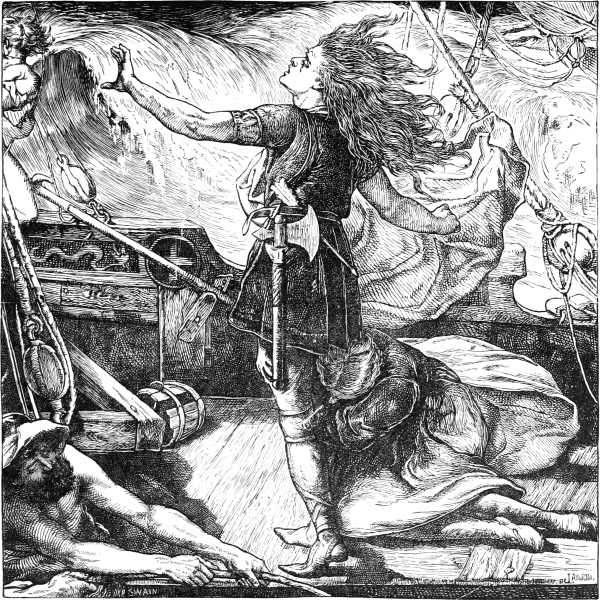
that it is enclosed by trees. John Tenniel, in The Norse
Princess (p. 201) and Queen Dagmar (p. 344), finds subjects
that suit him peculiarly well. The Summer Snow (p. 380), attributed
to 'Christopher' Jones, is by Sir Edward Burne-Jones
of course, and the final contribution of the artist to these pages.
H. J. Lucas, a name rarely encountered, has one drawing,
The Sangreal (p. 454). A. Boyd Houghton, in St. Elmo
(p. 64), A Missionary Cheer (p. 547), and Childhood (p. 636),
is showing the more mature style of his best period. G. J.
Pinwell has but a single drawing, Martin Ware's Temptation
(p. 573), and that not peculiarly individual; John Pettie
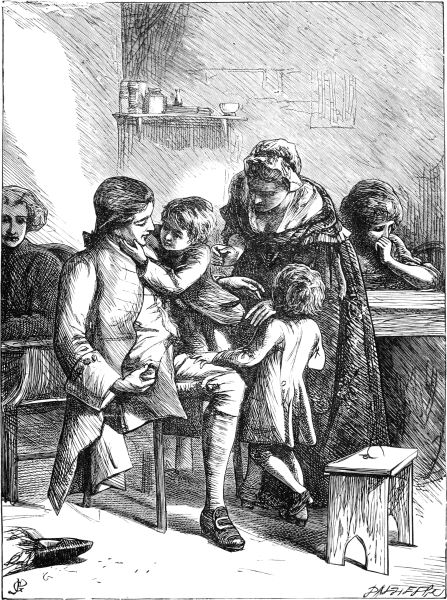
appears with six, The Monks and the Heathen (p. 14),
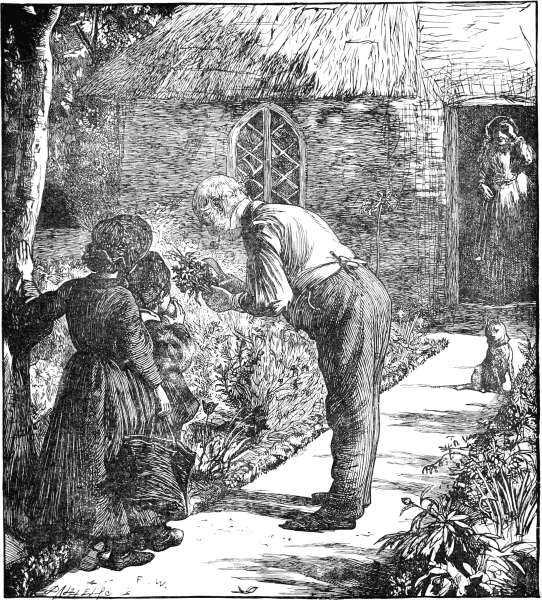
The Passion Flowers of Life (p. 141), a study of an old
man seated in a creeper-covered porch with a child on
his lap, The Night Walk over the Mill Stream (p. 185),
and Not above his Business (p. 272), A Touch of Nature
(p. 417), and The Negro (p. 476). To a later generation,
who only know the pictures of the Royal Academician, these
come as a surprise, and prove the versatility of an artist
whose painting was somewhat mannered. Walter Crane's—a
fine group of oriental sailors—Treasure-trove (p. 795), and
J. D. Watson's six drawings are all capable and accomplished;
A Pastoral (p. 32), a very elaborate composition which looks
like a copy of an oil-painting, Fallen in the Night (p. 97),
The Curate of Suverdsio (p. 333), The Aspen (p. 401),
Rhoda (p. 520), and Olive Shand's Partner (p. 774), with the
not very important Sheep and Goats wrongly attributed to
Sandys, two decorated pages by John Leighton, one drawing
by E. W. Cooke and five by T. Graham, complete the
year's record.
The volume for 1864 is distinctly less interesting. Nevertheless
it holds some fine things. Notably five Millais', including
Oh! the Lark (p. 65), A Scene for a Study (p. 161),
Polly (p. 248), (a baby-figure kneeling by a bed, which has
been republished elsewhere more than once), The Bridal of
Dandelot (p. 304), and Prince Philibert (p. 481), another
very popular childish subject, a small girl with a small boy
holding a toy-boat. Frederick Walker, in his illustrations
to Mrs. Henry Wood's novel, Oswald Cray (pp. 32–129, 202,
286, 371, 453, 532, and 604), shows great dramatic insight,
and a certain domestic charm, which has caused the otherwise
not very entrancing story to linger in one's memory in
a way quite disproportionate to its merits. The remaining
illustrations to Oswald Cray are by R. Barnes (pp. 691, 761,
827), the same artist contributing also Grandmother's Snuff,
(p. 411), A Burn Case (p. 568), A Lancashire Doxology,
(p. 585), Blessed to Give (p. 641), and The Organ Fiend
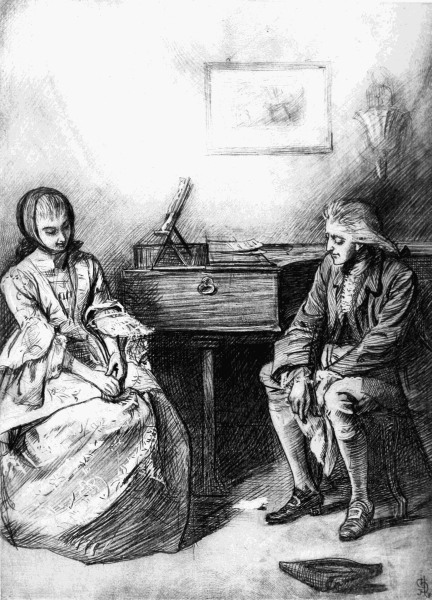
(p. 697). M. J. Lawless is responsible for only one subject,
a study of a man and a harpsichord, The Player and the
Listeners; in this case, as, on turning over the pages, you
re-read a not very noteworthy poem, you find it has lingered
in memory merely from its association with a picture. Arthur
Hughes has a graceful design, At the Sepulchre (p. 728), which
seems to have lost much in the engraving; John Tenniel is
also represented by a solitary example, The Way in the Wood
(p. 552); G. J. Pinwell, in five full-page drawings, A Christmas
Carol (p. 30), The Cottage in the Highlands (p. 427),
M'Diarmid explained (p. 504), Malachi's Cove (p. 729), and
Mourning (p. 760), sustains his high level. Other subjects,
animal pictures by J. Wolf, and figures and landscapes by
R. P. Leitch, Florence Claxton, F. Eltze, J. W. Ehrenger,
R. T. Pritchett, and W. Colomb, call for no special mention.
To John Pettie is attributed a tail-piece of no importance.
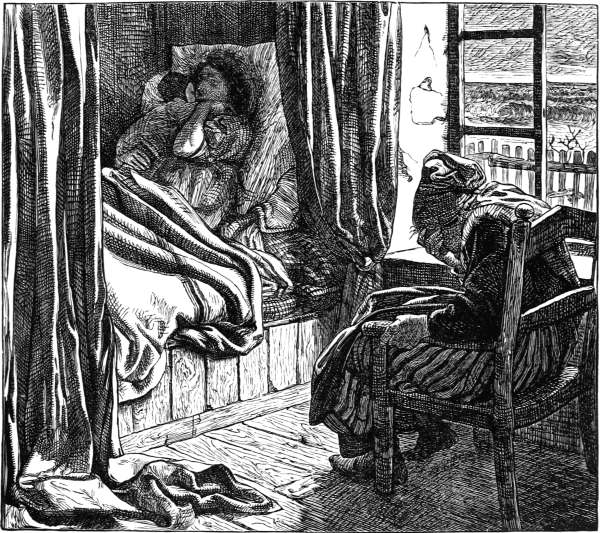
M. J. LAWLESS
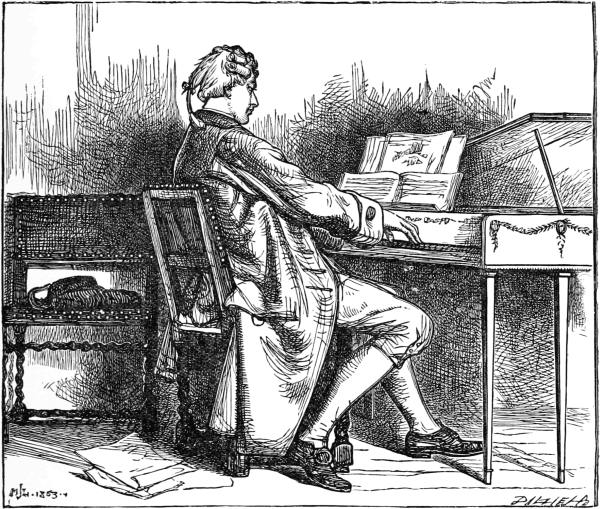
'GOOD WORDS'
1864, p. 168
THE PLAYER AND
THE LISTENERS
With 1865 comes a sudden cessation of interest, as
seventy of the illustrations are engraved 'from photographs
of oriental scenes to illustrate the editor's series of travel
papers,' Eastward. This leaves room merely for pictures
to the two serials. Paul Gray contributed those to Charles
Kingsley's novel, Hereward, the Last of the English; but
the twelve drawings are unequal, and in few show the promise
which elsewhere he exhibited so fully. Robert Barnes
supplies nine for the story, Alfred Hagart's Household, by
Alexander Smith of City Poems fame. These, like all the
artist's work, are singularly good of their kind, and show at
once his great facility and his comparatively limited range of
types.
In 1866, although engravings after photographs do not
usurp the space to the extent they did in the previous year,
they are present, and the volume, in spite of many excellent
drawings, cannot compare in interest with those for 1862–64.
The frontispiece, Lilies, is a most charming figure-subject
by W. Small, who contributes also three others: The Old
Yeomanry Weeks (p. 127), Deliverance (p. 663), a typical example
of a landscape with figures in the foreground, which,
in the hands of this artist, becomes something entirely distinct
from the 'figure with a landscape beyond' of most others; and
Carissimo (p. 736), a pair of lovers on an old stone bench, 'just
beyond the Julian gate,' which seems as carefully studied as
if it were intended for a painting in oils. To compare the
average picture to a poem to-day, with the work of Mr.
Small and many of his fellows, is not encouraging. Thirty
years ago it seemed as if the draughtsman did his best to
evolve a perfect representation of the subject of the verses;
now one feels doubtful whether the artist does not keep on
hand, to be supplied to order, a series of lovers in attitudes
warranted to fit, more or less accurately, any verses by any
poet. Of course for one picture issued then, a score, perhaps
a hundred, are published to-day, and it might be that numerically
as many really good drawings appear in the course of a
year now, as then; but, while our average rarely descends to
the feeblest depths of the sixties, it still more rarely comes
near such work as Mr. Small's, whose method is still followed
and has influenced more decidedly a larger number of draughtsmen
than has that of Millais, Walker, Pinwell, or Houghton.
Studying his work at this date, you realise how very strongly
he influenced the so-called 'Graphic School' which supplanted
the movement we are considering in the next decade. Despite
the appreciation, contemporary and retrospective, already
bestowed upon his work, despite the influence—not always
for good—upon the younger men, it is yet open to doubt if
the genius of this remarkable artist has received adequate
recognition. In a running commentary upon work of all
degrees of excellence, one is struck anew with its admirably
sustained power and its constantly fresh manner.
This digression, provoked by the four delightful 'Small'
drawings, must not lead one to overlook the rest of the
pictures in Good Words for 1866. They include The Island
Church, by J. W. North (p. 393), The Life-Boat, by J. W.
Lawson (p. 248), Between the Showers, by W. J. Linton,
(p. 424), six illustrations to Ruth Thornbury, by M. E.
Edwards, and one by G. J. Pinwell, Bridget Dally's Change.
Perhaps the most notable of the year are the five still to be
named: A. Boyd Houghton's The Voyage, and a set of four
half-page drawings, Reaping, Binding, Carrying, Gleaning,
entitled The Harvest (pp. 600, 601). These have a decorative
arrangement not always present in the work of this clever
artist, and a peculiarly large method of treatment, so much so
that if the text informed you that they were pen-sketches
from life-size paintings, you would not be surprised. Whether
by accident or design, it is curious to discover that the landscapes
in each pair, set as they are on pages facing one another,
have a look of being carried across the book in Japanese
fashion.
1867 might be called the Pinwell year, as a dozen of his
illustrations to Dr. George Mac Donald's Guild Court, and
one each to A Bird in the Hand and The Cabin Boy, account
for nearly half the original drawings in the volume. W.
Small is seen in five characteristic designs to Dr. Macleod's
The Starling, and one each to Beside the Stile (p. 645) and
The Highland Student (p. 663). Arthur Boyd Houghton
contributes Omar and the Persian (p. 104) and Making Poetry
(p. 248); the first a typical example of his oriental manner,
the latter one of his home scenes. S. L. Fildes appears
with In the Choir (p. 537), a church interior showing the
influence of William Small. F. W. Lawson illustrates Grace's
Fortune with three drawings, also redolent of Small, and Fred
Walker has Waiting in the Dusk, a picture of a girl in a
passage, which does not illustrate the accompanying verses,
and has the air of being a picture prepared for a serial some
time before, that, having been delayed for some reason, has
been served up with a poem that chanced to be in type.
In 1868 Pinwell and Houghton between them are
responsible for quite half the separate plates, and Small
contributes no less than thirty-four which illustrate delightfully
The Woman's Kingdom, a novel by the author of John
Halifax, together with a large number of vignetted initials, a
feature not before introduced into this magazine. Without
forgetting the many admirable examples of Mr. Small's power
to sustain the interest of the reader throughout a whole set of
illustrations to a work of fiction, one doubts if he has ever
surpassed the excellence of these. The little sketches of
figures and landscapes in the initials show that he did not
consider it beneath his dignity to study the text thoroughly,
so as to interpret it with dramatic insight. Your modern
chic draughtsman, who reads hastily the few lines underscored
in blue pencil by his editor, must laugh at the pains
taken by the older men. Indeed, a very up-to-date illustrator
will not merely refuse to carry out the author's idea, but
prefer his own conception of the character, and say so. That
neither course in itself produces great work may be granted,
but one cannot avoid the conclusion that if it be best to
illustrate a novel (which is by no means certain) that artist is
most worthy of praise who does his utmost to present the
characters invented by the author. True, that character-drawing
with pen and pencil is out of date,—subtle emotion
has taken its place,—it is not easy to make a picture of a
person smiling outwardly, but inwardly convulsed with conflicting
desires; the smile you may get, but the conflicting
desires are hard to work in at the same time. Appreciation
of Mr. Small's design need not imply censure of the work of
others; but, all the same, the cheap half-tone from a wash-drawing,
in the current sixpenny magazine, looks a very feeble
thing after an hour devoted to the illustrations to Guy Waterman's
Maze, The Woman's Kingdom, Griffith Gaunt, and the
rest of the serials he illustrated. In this volume two others,
The Harvest Home (p. 489) and A Love Letter (p. 618), are
also from the same facile hand.
The first of the Boyd Houghtons is a striking design to
Tennyson's poem of The Victim (p. 18); neither picture nor
poem shows its author at his best. Others signed A. B. H.
are: The Church in the Cevennes (pp. 56, 57), Discipleship
(p. 112), The Pope and the Cardinals (p. 305), The Gold Bridge
(p. 321), The Two Coats (p. 432), How it all happened (seven
illustrations), Dance my Children (p. 568), a typical example
of the peculiar mannerism of its author, and a Russian Farmyard
(p. 760); also a number of small designs to Russian
Fables, some of which were illustrated also by Zwecker. G. J.
Pinwell illustrates Notes on the Fire (pp. 47, 49), Much work
for Little Pay (p. 89), A Paris Pawn-shop (p. 233), Mrs.
Dubosq's Daughter (four pictures), Una and the Lion (p. 361),
Lovely, yet unloved (pp. 376, 377), Hop Gathering (p. 424),
The Quakers in Norway (p. 504). S. L. Fildes has The
Captain's Story, a good study of fire-light reflected on three
seated figures. Other numbers worth noting are an excellent
example of J. Mahoney, Yesterday and To-day (p. 672),
Briton Rivière's At the Window (p. 630), R. Buckman's The
White Umbrella (p. 473), and seven by Francis Walker to
Hero Harold, and one each to Glenalla (p. 384), The Bracelet
(p. 753), and Thieves' Quarter (p. 553).
With 1869 we lose sight of many of the men who did so
much to sustain the artistic reputation of this magazine. W.
Small has but one drawing, The Old Manor-House (p. 849).
Hubert Herkomer is represented by The Way to Machaerus
(pp. 353, 497). J. Mahoney by five designs to The Staffordshire
Potter, Francis Walker by nine to The Connaught Potters and
A Burial at Machaerus and Holyhead Breakwater. Arthur
Hughes, an infrequent contributor so far, contributes two
illustrations to Carmina Nuptialia. F. Barnard has two
to House-hunting; F. A. Fraser has no less than seventy-five:
thirty-five to Debenham's Vow, and thirty-three to Noblesse
Oblige, with seven others, none of them worth reconsideration,
although they served their purpose no doubt at the time.
With 1870 we reach the limit of the present chronicle, to
which Francis Walker and F. A. Fraser contribute most of
the pictures. The most interesting are: Arthur Hughes's
Fancy (p. 777) and The Mariner's Cave (p. 865); J. D.
Linton, Married Lovers (p. 601); J. Mahoney, The Dorsetshire
Hind (p. 21), Ascent of Snowdon (p. 201); and Dame
Martha's Well (p. 680), and G. J. Pinwell's three very representative
drawings, Rajah playing Chess (p. 211), Margaret in
the Xebec (p. 280), and A Winter Song (p. 321).
ARTHUR HUGHES
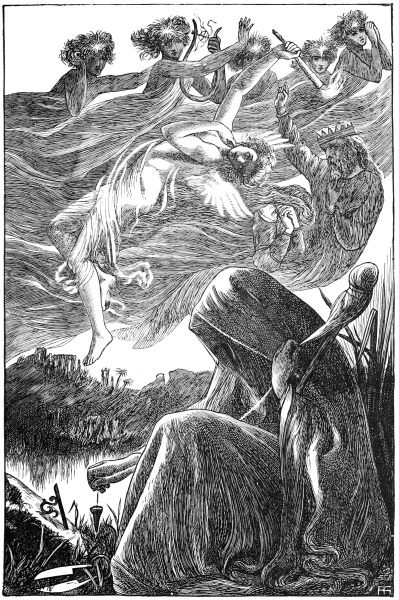
'GOOD WORDS'
1870, p. 777
FANCY
1871 is memorable for three of Arthur Hughes's designs,
made for a projected illustrated edition of Tennyson's Loves
of the Wrens, a scheme abandoned at the author's wish; the
three drawings cut down from their original size, Fly Little
Letter (p. 33), The Mist and the Rain (p. 113), and Sun Comes,
Moon Comes (p. 183), are especially dear to collectors of Mr.
Hughes's work, which appeared here with the lyrics set to Sir
Arthur Sullivan's music; another by the same artist, The Mother
and the Angel (p. 648), is also worth noting. One Boyd
Houghton, Baraduree Justice (p. 464), twenty-one drawings
by W. Small to Katharine Saunders, The High Mills, and
one by the same artist to An Unfinished Song (p. 641) are
in this volume, besides four by Pinwell, Aid to the Sick (p. 40),
The Devil's Boots (p. 217), Toddy's Legacy (p. 336), and Shall
we ever meet again? (p. 817).
Without discussing the remaining years of this still
flourishing monthly one can hardly omit mention of the
volume for 1878, in which William Black's Macleod of Dare
is illustrated by G. H. Boughton, R.A., J. Pettie, R.A.,
P. Graham, R.A., W. Q. Orchardson, R.A., and John Everett
Millais, R.A., a group which recalls the glories of its early
issues.
This popular illustrated shilling magazine, started in
February 1862 under the editorship of Mr. James Hogg, has
not received so far its due share of appreciation from the few
who have studied the publications of the sixties. Yet its
comparative neglect is easily accounted for. It contains, no
doubt, much good work—some, indeed, worthy to be placed
in the first rank. But it also includes a good deal that, if
tolerable when the momentary fashions it depicted were not
ludicrous, appears now merely commonplace and absurd.
A great artist—Millais especially—could introduce the crinoline
and the Dundreary whiskers, so that even to-day their
ugliness does not repel you. But less accomplished draughtsmen,
who followed slavishly the inelegant mode of the sixties,
now stand revealed as merely journalists. Journalism, useful
and honourable as its work may be, rarely has lasting qualities
which bear revival. Aiming as it did to be a 'smart' and
topical magazine, with the mood of the hour reflected in its
pages, it remains a document not without interest to the social
historian. Amid its purely ephemeral contents there are
quite enough excellent drawings to ensure its preservation in
any representative collection of English illustrations.
M. J. LAWLESS
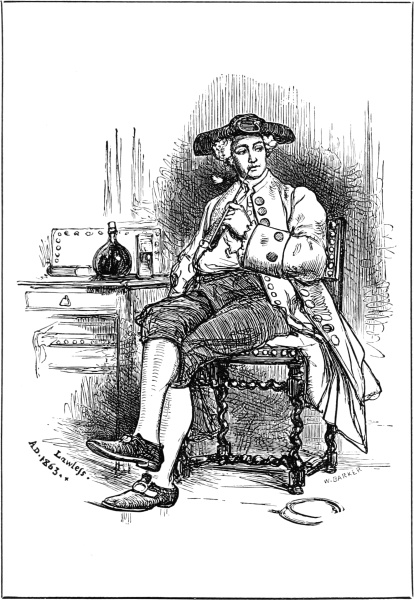
'LONDON SOCIETY'
VOL. IV. p. 554
HONEYDEW
J. D. WATSON
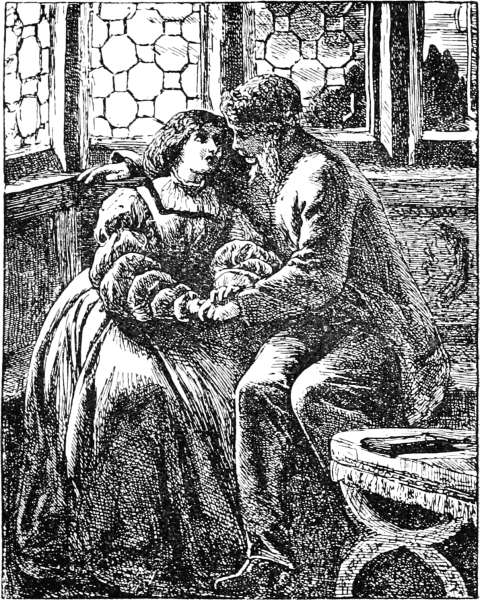
'LONDON SOCIETY'
1866, p. 35
TOO LATE
J. D. WATSON
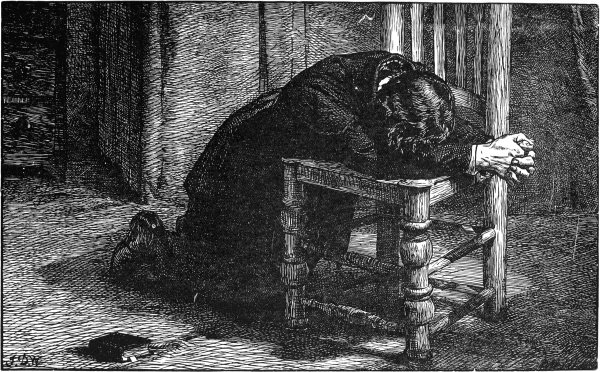
'LONDON SOCIETY,' VOL. I. p. 150
ASH WEDNESDAY
In the first volume for 1862 we find a beautiful Lawless,
Beauty's Toilet (p. 265), spoilt by its engraving, the texture
of the flesh being singularly coarse and ineffectual. Fred
Walker, in The Drawing-room, 'Paris' (i. p. 401), is seen in the
unusual and not very captivating mood of a 'society' draughtsman.
Ash Wednesday (p. 150), by J. D. Watson, is a singularly
fine example of an artist whose work, the more you come
across it, surprises you by its sustained power. The frontispiece
Spring Days and A Romance and A Curacy (p. 386),
are his also. Other illustrations by T. Morten, H. Sanderson,
C. H. Bennett, Adelaide Claxton, Julian Portch, and F. R.
Pickersgill, R.A., call for no special comment. In the second
volume there are two drawings by Lawless, First Night at the
Seaside (p. 220) and A Box on the Ear (p. 382); several by Du
Maurier, one A Kettledrum (p. 203), peculiarly typical of his
society manner; others, Refrezzment (p. 110), Snowdon (p. 481),
Oh sing again (p. 433), Jewels (p. 105), and a Mirror Scene
(p. 107), which reveal the cosmopolitan student of nature
outside the artificial, if admirable, restrictions of 'good form.'
The Border Witch (p. 181), by J. E. Millais, A.R.A., is
one of the very few examples by the great illustrator in
this periodical. J. D. Watson, in Moonlight on the Beach
(p. 333), Married2 (p. 449), A Summer Eve (p. 162), On
the Coast (p. 321), Holiday Life (p. 339), and How I
gained a Wife (p. 551), again surprises you, with regret
his admirable work has yet not received fuller appreciation
by the public. Walter Crane contributes some society
pictures which reveal the admirable decorator in an unusual,
and, to be candid, unattractive aspect. Kensington Gardens
(p. 172), A London Carnival (p. 79), and Which is Fairest?
(p. 242), are interesting as the work of a youth, but betray
little evidence of his future power. Robert Barnes, in Dreaming
Love and Waiting Duty (p. 564), shows how early in
his career he reached the level which he maintained so
admirably. A. Boyd Houghton's Finding a Relic (p. 89) is a
good if not typical specimen of his work. The designs by
E. J. Poynter, Tip Cat (p. 321), I can't thmoke a pipe (p. 318),
and Lord Dundreary (pp. 308, 472), are singularly unlike the
usual work of the accomplished author of Israel in Egypt.
To these one must add the names of C. H. Bennett (Beadles,
three), W. M'Connell, C. A. Doyle, George H. Thomas,
E. K. Johnson, F. J. Skill, F. Claxton, H. Sanderson, and
A. W. Cooper. So that 1862 offers, at least, a goodly list of
artists, and quite enough first-rate work to make the volumes
worth preserving.
In vol. iii. 1863 there is a drawing, The Confession (p. 37),
engraved by Dalziel, that is possibly by Pinwell. Three by
T. Morten, After the Opera (p. 39), A Struggle in the Clouds
(p. 287), and Ruth Grey's Trial (p. 59), are good, if not the
best of this artist's work. Two by George Du Maurier (pp. 209,
216) employ, after the manner of the time, a sort of pictured
parable entitled On the Bridge and Under the Bridge. Our
Honeymoon, by Marcus Stone, is interesting. Struck Down
(p. 106) and The Heiress of Elkington (p. 345), both by J. D.
Watson, are as good as his work is usually. A May Morning
(p. 428), by George H. Thomas, is also worthy of mention, but
the rest, by E. K. Johnson, E. H. Corbould, W. Brunton, W.
Cave Thomas, Louis Huard, etc., are not peculiarly attractive.
The concluding volume for 1863 has a very dainty figure,
Honey-Dew, by M. J. Lawless (p. 554). The three Du
Mauriers are A Little Hop in Harley St. (p. 469), Lords:
University Cricket Match (p. 161), and the Worship of Bacchus
(p. 192) at first sight so curiously like a Charles Keene that,
were it not for the signature, one would distrust the index.
Nine drawings by T. Morten to The First Time are good,
especially those on p. 180, and A First Attempt, Charles
Green (p. 205), is also worth notice. Two drawings by G. J.
Pinwell, Wolsey (p. 311) and another (p. 319), are characteristic.
For the rest, C. H. Bennett, Louis Huard, Felix
Darley, W. M'Connell, W. Brunton, Matt Morgan, Florence
Claxton, T. Godwin, Waldo Sargent, George Thomas, and
C. A. Doyle, provide entrées and sweets a little flavourless
to-day, although palatable enough, no doubt, at the time.
In 1864, M. J. Lawless's Not for You (p. 85); a fine J. D.
Watson, The Duet (p. 268); Charley Blake, by G. Du Maurier
(p. 385); At Swindon (p. 41), M. E. Edwards, and Little Golden
Hair, by R. Barnes, are the only others above the average.
Adelaide Claxton, W. M'Connell, H. Sanderson, and J. B.
Zwecker provide most of the rest. The second half of the
year (vol. vi.) is far better, contains some good work by the
'talented young lady,' M. E. E. (to quote contemporary praise);
that her work was talented all students of the 'sixties' will agree.
A Holocaust (p. 433), Dangerous (p. 353), Gone (p. 185),
Magdalen (p. 553), Milly's Success (p. 269), and Unto this Last
(p. 252) are all by Miss Edwards. A fine Millais, Knightly
Worth (p. 247), and a good J. D. Watson, Blankton Weir
(p. 416), would alone make the volume memorable. C. A.
Doyle has some of his best drawings to A Shy Man, and
G. H. Thomas and others maintain a good average. Rebecca
Solomon has a good full page (p. 541). In the extra Christmas
number you will find E. J. Poynter's A Sprig of Holly
(p. 28), J. D. Watson's Story of a Christmas Fairy (p. 24),
a notable design, besides capital illustrations by Du Maurier,
R. Dudley (The Blue Boy), R. Barnes, and Marcus Stone.
1865 is a Du Maurier year. In vol. vii. eleven drawings
by this fecund artist on pp. 38, 193, 202, 289, 296, 428, 430,
481, 488, and 697, all excellent examples of his early manner.
Arthur Hughes, with The Farewell Valentine (p. 188), makes
his first appearance within the pages of London Society. A. W.
Cooper, J. Pasquier, T. R. Lamont, and A. Claxton are to
the fore, and C. H. Bennett has a series of typical members
of various learned societies, which, characteristic as they are,
might have their titles transposed without any one being the
wiser. In vol. viii. 1865, Paul Gray appears with My Darling
(p. 253). T. Morten has three capital drawings: Two Loves
and a Life (p. 400), A Romance at Marseilles (p. 549), and
Love and Pride (p. 16); and Du Maurier has Codlingham
Regatta (p. 284), How not to play Croquet (p. 61), Where
shall we go? (p. 17), Old Jockey West (p. 288), The Rev. Mr.
Green (p. 122), Furnished Apartments (p. 481), and Ticklish
Ground (p. 488). G. J. Pinwell is represented by a solitary
example, The Courtship of Giles Languish (p. 384), J. D.
Watson by Green Mantle (pp. 385, 388, 389), and M. E.
Edwards by Georgie's First Love-letter (p. 152), Faithful and
True (p. 263), Firm and Faithful (p. 60). The other contributors
are A. W. Bayes (To Gertrude, p. 460), L. C. Henley,
T. R. Lamont, J. A. Pasquier, Kate Edwards, W. Brunton,
T. S. Seccombe, John Gascoine, etc.
In 1866, vol. ix., George Du Maurier signs the frontispiece,
Two to One, and also two illustrations to Much Ado
About Nothing (pp. 289, 296), two to Second Thoughts (pp.
385, 391), and two to Queen of Diamonds (pp. 481–488).
T. Morten has again three designs: Mrs. Reeve (p. 135), On
the Wrekin (p. 1), and The Man with a Dog (p. 239);
R. Dudley supplies one, The Tilt-Yard (p. 441), and Kate
Edwards one, The June Dream (p. 531). M. Ellen Edwards
in three admirable examples, In Peril (p. 450), Mutually
Forgiven (p. 228), and The Cruel Letter (p. 364), shows
how cleverly she caught the influence in the air. Other
artists contribute many drawings of no particular interest.
Vol. x. shows W. Small with two drawings, Agatha
(p. 160) and The Reading of Locksley Hall (p. 8). It is
curious to see how the sentimentality of the poem has influenced
the admirable draughtsman, who is not here at his
best. Paul Gray has also two, An English October (p. 289)
and To a Flirt (p. 373); G. Du Maurier is represented by
one only, Life in Lodgings (p. 516); J. G. Thompson by one
also, Caught at Last (p. 80); T. Morten again contributes
three: Marley Hall (p. 560), May's Window (p. 432), and The
Trevillians' Summer Trip (p. 124); A. Boyd Houghton is
represented by Ready for Supper (p. 146), and M. E. Edwards
by two drawings to Something to My Advantage (pp. 481–488).
The Christmas number contains one Boyd Houghton,
The Christmas Tree (p. 80); a J. D. Watson, Given back on
Christmas Morn (p. 63); a very good F. W. Lawson, Did I
Offend? (p. 32); a delightful Charles Keene, How I lost my
Whiskers (p. 27); Sir Guy's Goblet (p. 16), by M. E. Edwards,
and one by George Cruikshank, My Christmas Box, looking
curiously out of place here.
In the eleventh volume (1867) the four by W. Small
are among the most important. They are A Pastoral
Episode (p. 406), Quite Alone (p. 277), The Meeting (p. 163),
and Try to Keep Firm (p. 361); a J. D. Watson, Changes
(p. 373); a Paul Gray, Goldsmith at the Temple Gate (p. 392);
a J. G. Thompson, An Expensive Journey (p. 36); M. E.
Edwards's Winding of the Skein (p. 177), and L. C. Henley's
How I set about Paying my Debts (p. 388), are all that need be
mentioned. In the twelfth volume (1867) A. Boyd Houghton
signs a couple of drawings to A Spinster's Sweepstake (pp. 376,
383), G. J. Pinwell supplies two to Beautiful Mrs. Johnson
(pp. 136–248), F. W. Lawson two to Dedding Revisited
(p. 433), Without Reserve (p. 440), and four to Mary Eaglestone's
Lover (pp. 97, 103, 207, 362). Charles Green is
responsible for The Meeting at the Play (p. 276), and J. G.
Thompson for a series, Threading the Mazy at Islington.
The Christmas number is honoured by two fine drawings by
Charles Keene (p. 18) and a good double page by J. D. Watson,
Christmas at an old Manor-House. Sir John Gilbert, a
rare contributor to these pages, is represented by The Rowborough
Hollies (p. 41), M. E. Edwards by The Christmas
Rose (p. 16), and F. W. Lawson by My Turn Next (p. 73).
With its thirteenth volume (1868) London Society still
keeps up to the level it established. Among much that was
intended for the moment only there is also work of far more
sterling value. Charles Keene, in two drawings for Tomkins'
Degree Supper (pp. 224, 232), is seen at his best, and how
good that is needs no retelling. Sir John Gilbert, among a
new generation, keeps his place as a master, and in four
drawings (pp. 113, 249, 314, 429) reveals the superb qualities
of his work, coupled, it must be said, with certain limitations
which are almost inseparable from rapid production. G. Du
Maurier is represented by two, Lift her to it (p. 324) and
The White Carnation (p. 558). The inscription of Expectation
(p. 360), by 'the late M. J. Lawless', marks the final discharge
of an illustrator who did much to impart permanent
interest to the magazine. It is always a regret to find that
Mr. Sandys chose other fields of work, and that death withdrew
Lawless so soon; for these two, not displaying equal power,
together with Walter Crane maintained the decorative ideal
through a period when it was unpopular with the public and
apparently found little favour in editors' eyes. M. E. Edwards's
My Valentine (p. 114) and Married on her tenth Birthday
(p. 206). To this list must be added W. Small, with a
delightful out-of-doors study, 'You did not come' (p. 368);
G. B. Goddard with some capital 'animal' pictures: Spring
of Life (p. 353), Buck Shooting (p. 72), and Dogs of Note
(pp. 75, 179); Wilfrid Lawson, A Spring-tide Tale (p. 472);
F. Barnard, A Bracing Morning (p. 60); A. W. Cooper,
The Old Seat (p. 268); and others by Tom Gray, J. G.
Thomson, W. L. Thomas, J. A. Pasquier, W. S. Gilbert,
S. E. Illingworth, Rice, W. Brunton, H. French, A. Crowquill,
Edwin J. Ellis, Fane Wood, and Isaac L. Brown.
Vol. xiv., the second of 1868, contains J. D. Watson's The
Oracle (p. 457); W. Small's The Lights on Gwyneth's Head
(p. 165); A. Boyd Houghton, The Turn of the Tide (p. 458);
John Gilbert's Cousin Geoffrey's Chamber (Frontispiece), and
Box and Cox in Bay of Bengal (p. 392); Birket Foster's
The Falconer's Lay, probably engraved from a water-colour
drawing (p. 529); Wilfrid Lawson's Crush-room (p. 140);
For Charity's Sake (p. 112); Behind the Scenes (p. 141), The
Gentle Craft (p. 86), and The Golden Boat (p. 579), with
many others by the regular contributors. In the Christmas
number we find Linley Sambourne, whose work is encountered
rarely outside the pages of Punch, with a design for a
Christmas Day Costume (p. 17); Charles Keene, with two
drawings for Our Christmas Turkey (pp. 44, 46); G. B.
Goddard's full-page, Knee-deep (p. 32); J. D. Watson's Aunt
Grace's Sweetheart (p. 19) and The Two Voices (p. 86) deserve
noting.
In 1869 Wilfrid Lawson illustrates Whyte-Melville's
M. or N., and has several other full-page drawings in his best
vein (pp. 8, 48, 89, 128, 152, 232, 307, 467, 540); J. Mahoney
is first met here with Officers and Gentlemen (p. 284), and
J. D. Watson supplies the frontispiece to vol. xv., Bringing
Home the Hay, and also that to vol. xvi., Second Blossom.
In this latter Wilfrid Lawson has illustrations to M. or N.
(pp. 156, 193, 236, 386); T. Morten, a powerful drawing, Winter's
Night (p. 550); G. B. Goddard, The Sportman's Resolve
(p. 528). The other artists, including some new contributors,
are M. A. Boyd, Horace Stanton, E. J. Ellis, T. Sweeting,
James Godwin, F. Roberts, A. W. Cooper, L. Huard, and
B. Ridley. The Christmas number for 1869 contains a good
Charles Keene, The Coat with the Fur Lining (pp. 1, 6);
Gilbert's Secret of Calverly Court (p. 4); M. E. Edwards's
How the Choirs were Carolling (p. 84); and J. Mahoney's
Mr. Daubarn (p. 49), with others of no particular importance.
The numbers for 1870 contain, inter alia, in the first half-year,
a good J. D. Watson, Going down the Road (Frontispiece);
A Leaf from a Sketch-Book, by Linley Sambourne (printed,
like a series this year, on special sheets of thick white paper,
as four-page supplements), which contained lighter work by
artists of the hour, but none worth special mention.
J. Mahoney's Going to the Drawing-room (p. 321), and
Sir Stephen's Question (p. 112), and Spring-time, drawn and
engraved by W. L. Thomas (p. 375), are among the most
interesting of the ordinary full pages. In the second half of
the year, volume 18, there is a full page, Not Mine (p. 501),
by Arthur Hughes, which links 1855 to 1870; A. W. Small,
After the Season (p. 338); the very unimportant drawing by
M. J. Lawless, An Episode of the Italian War (p. 97), has
interest as a relic; J. Mahoney contributes two to The Old
House by the River (pp. 67, 172), and many others by H.
Paterson, Wilfrid Lawson, A. Claxton. This year a Holiday
number appeared, with a not very good J. D. Watson,
A Landscape Painter (p. 47), and two Francis Walkers,
A Summer Holiday and Rosalind and Celia, and other seasonable
designs by various hands. The Christmas number has
a coloured frontispiece and other designs by H. D. Marks;
J. D. Watson illustrates What might have happened (pp. 8,
17, 19); and Charles Keene, Gipsy Moll (pp. 39, 45); Francis
Walker has The Star Rider (p. 59) and A Tale (p. 63);
F. A. Fraser, typical of the next decade, and one might say,
without undue severity, of the decadence also, and F. Gilbert,
that facile understudy of Sir John, show examples of work
differing as far as it well could; but 1870 is the last stage we
need note here in the career of a magazine which did notable
service to the cause of illustration, and brought a good many
men into notice who have taken prominent part in the
history of 'black and white.' Without placing it on a level
with Once a Week, it is an interesting collection of representative
work, with some really first-rate drawing.
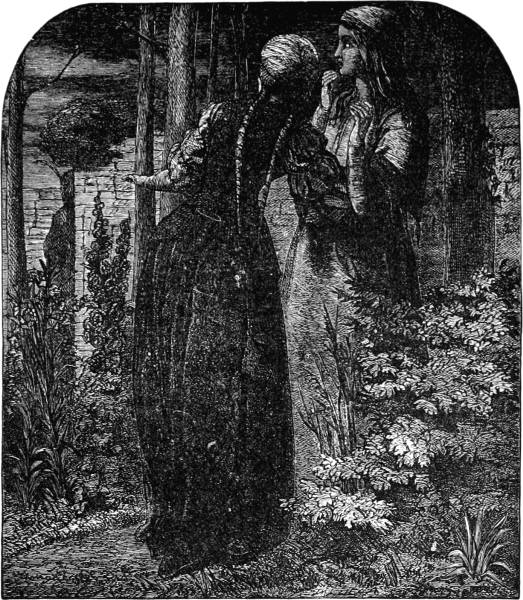
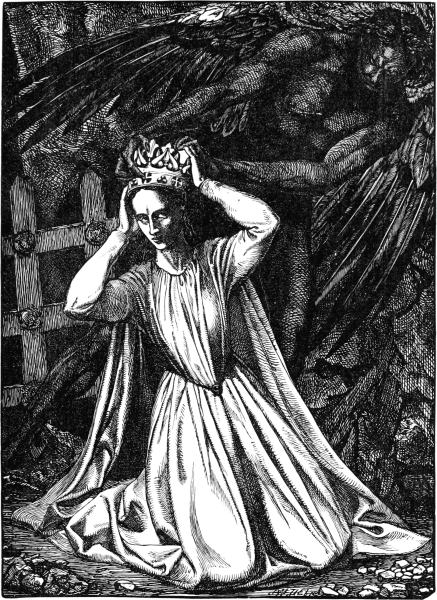
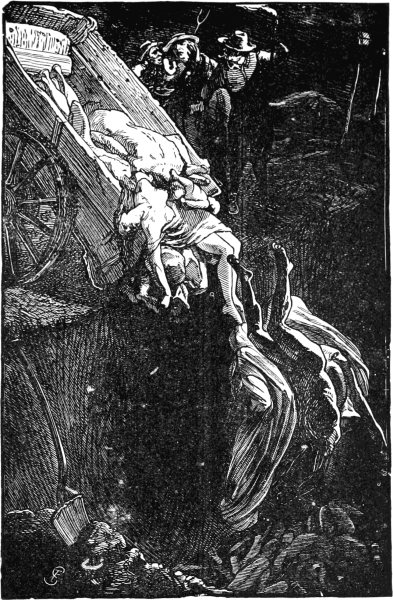
Frederick Sandys,del.
"Oh, what's that in the hollow, so pale I quake to follow?
Oh, that's a thin dead body which waits th'eternal term."
Christina Rossetti.