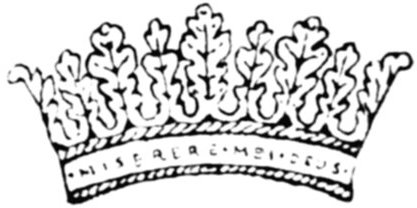
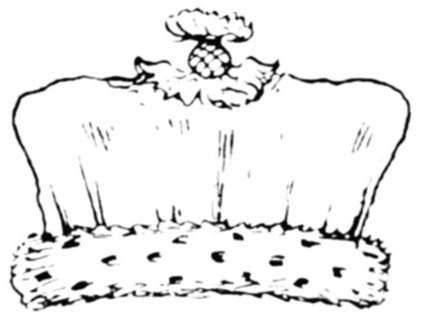
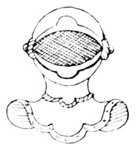
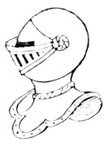
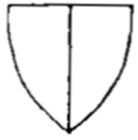
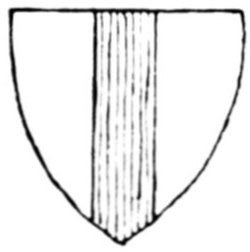
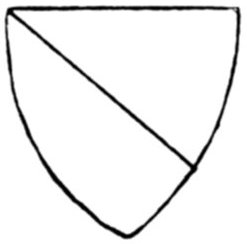
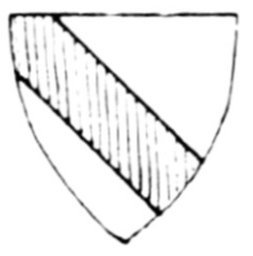
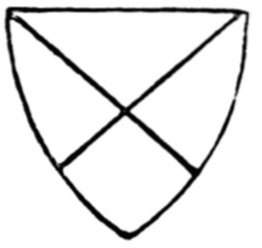
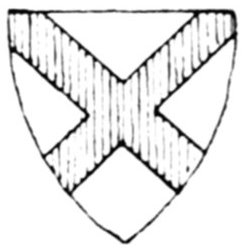
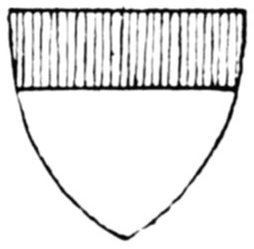
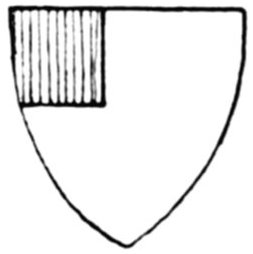
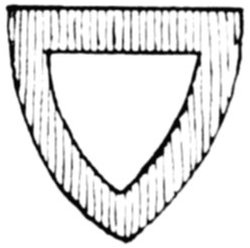
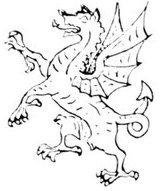
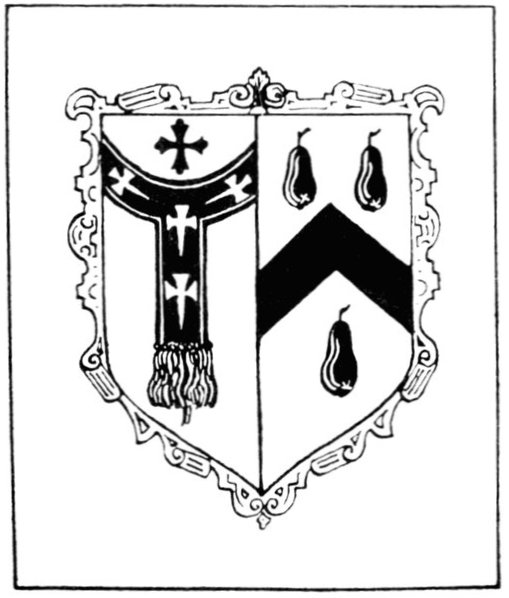
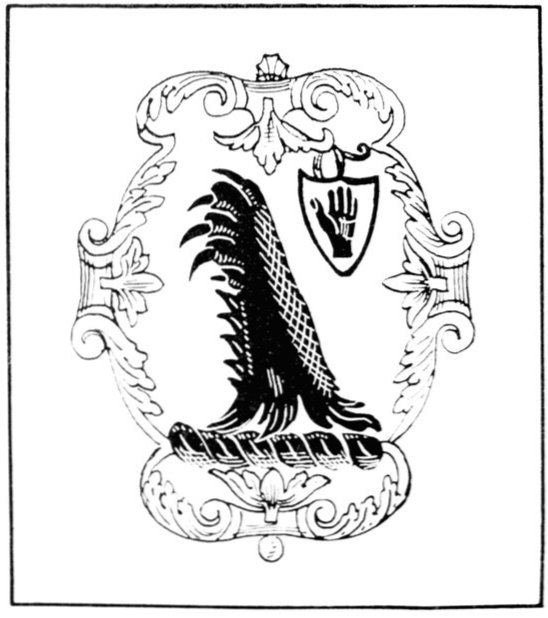
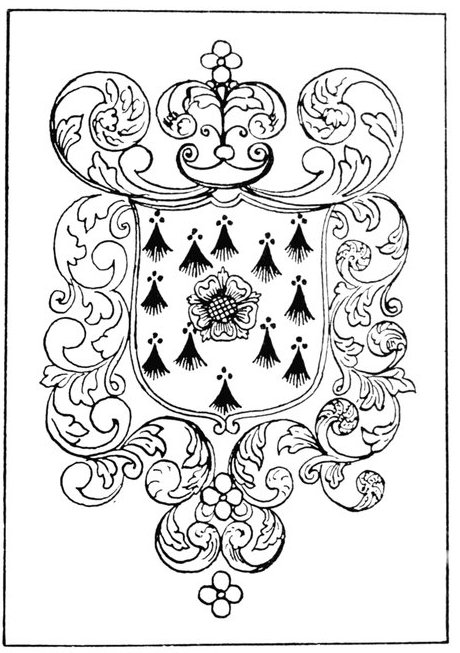
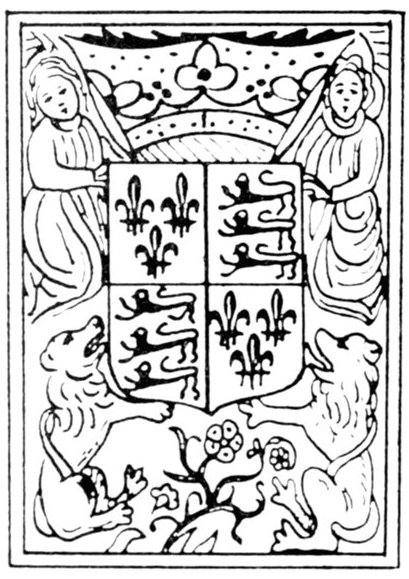
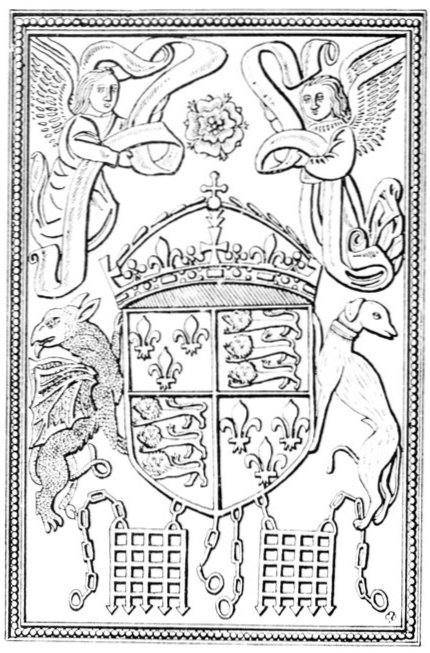
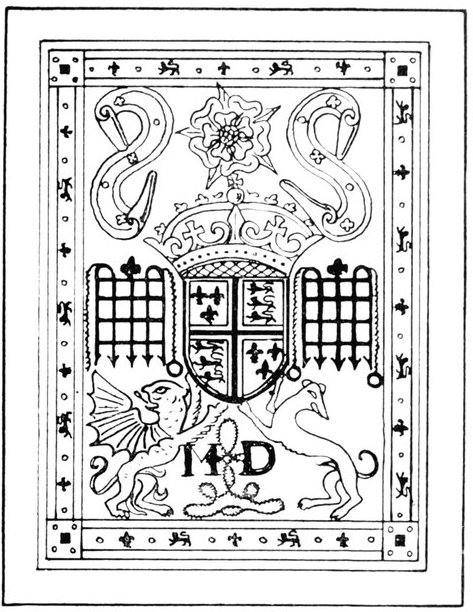
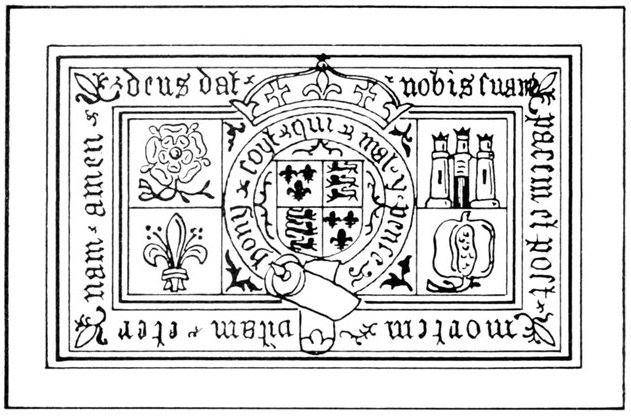
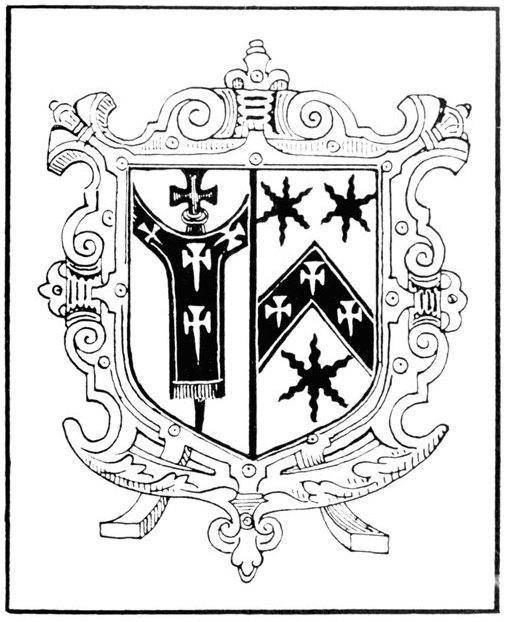
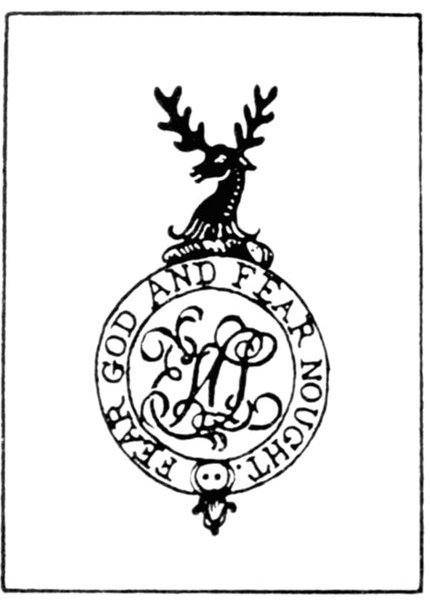
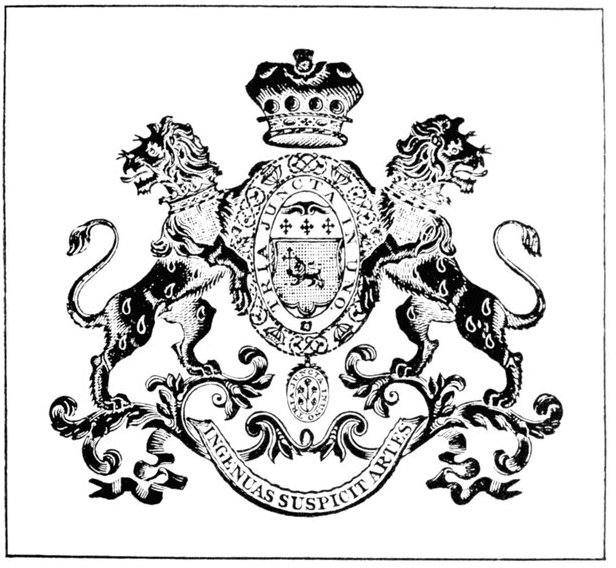
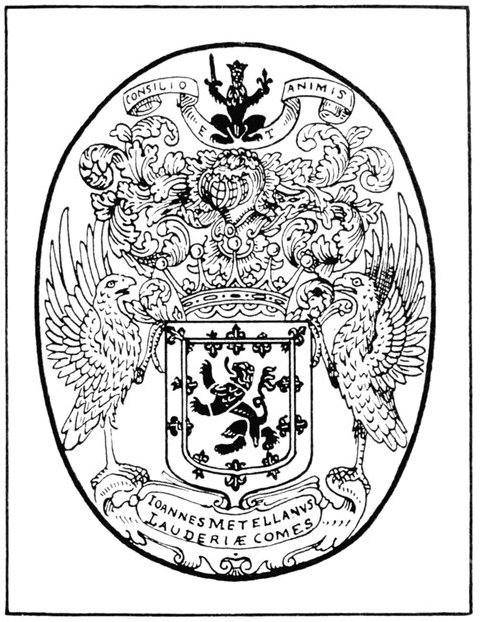
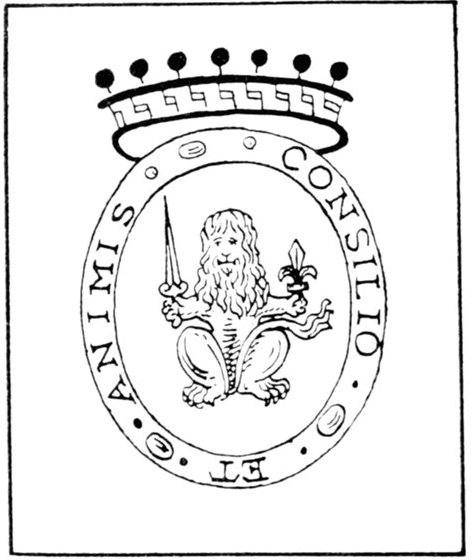
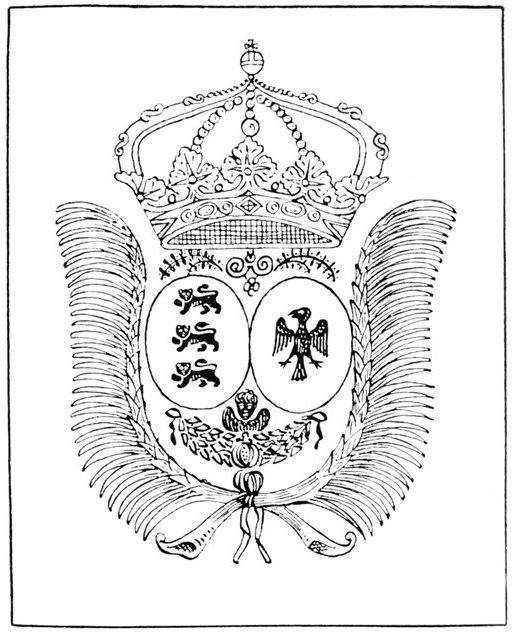
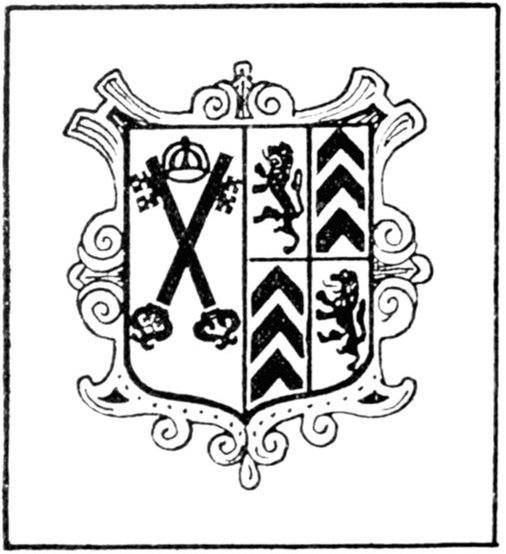
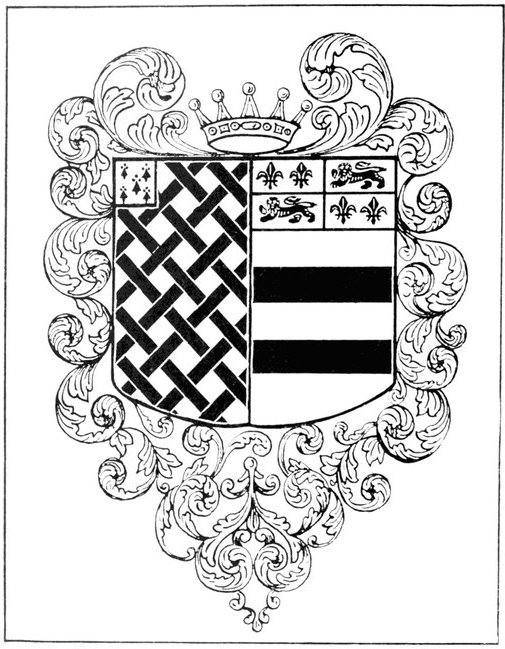
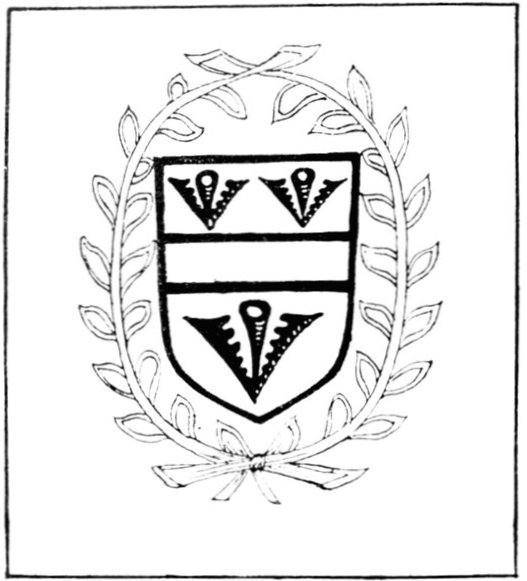
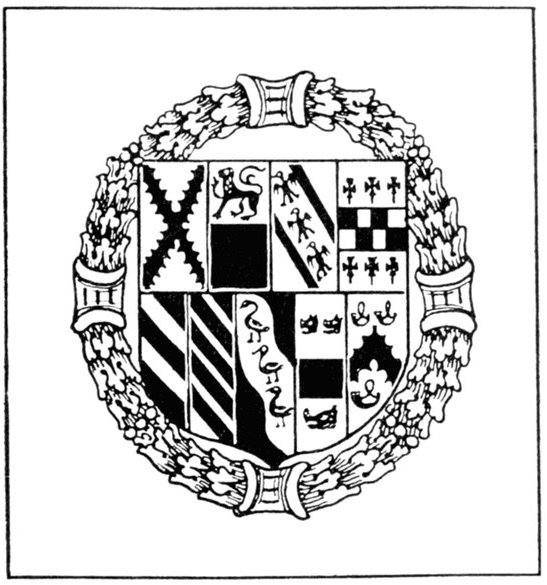
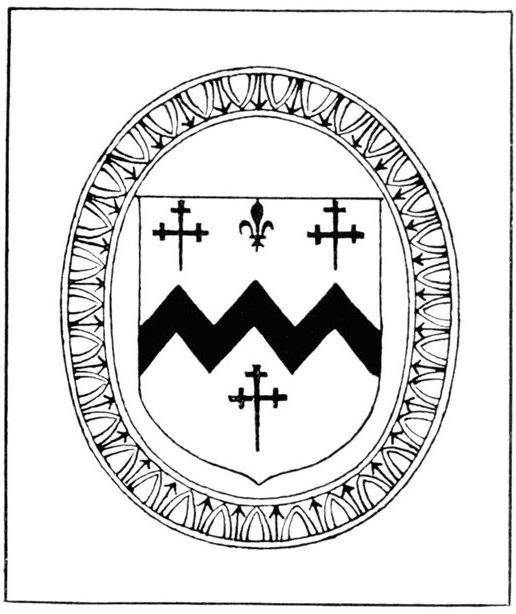
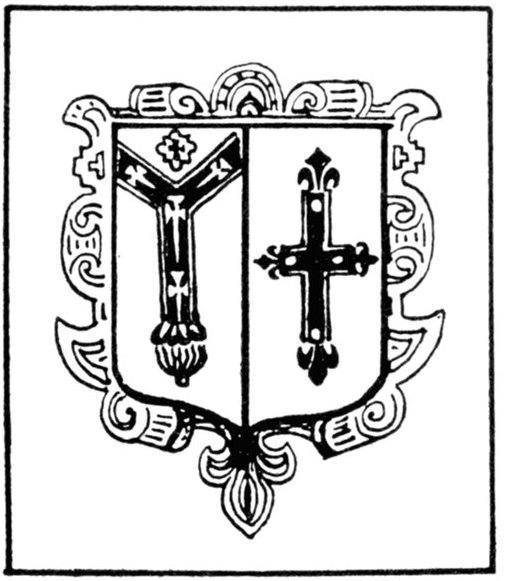
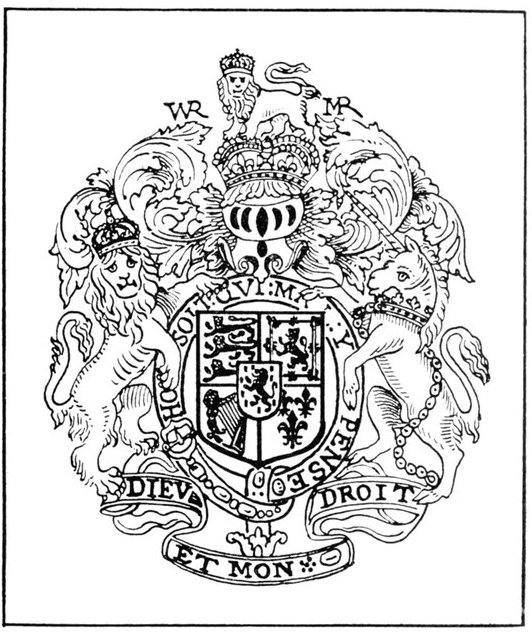
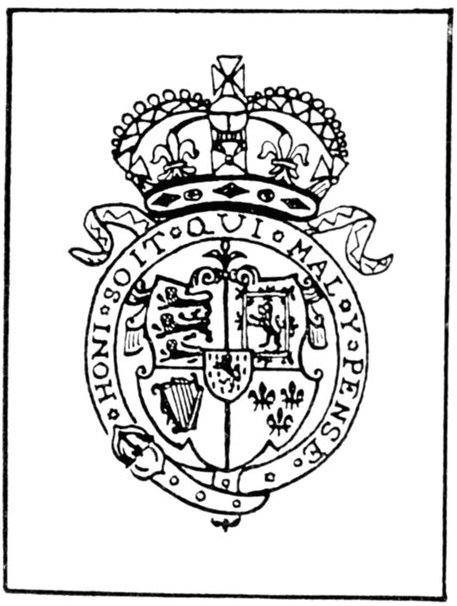
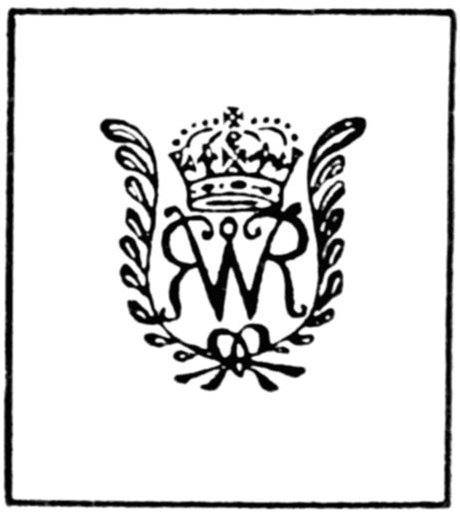
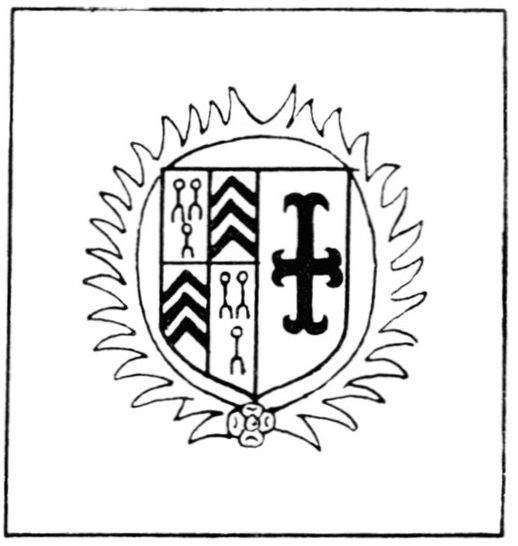
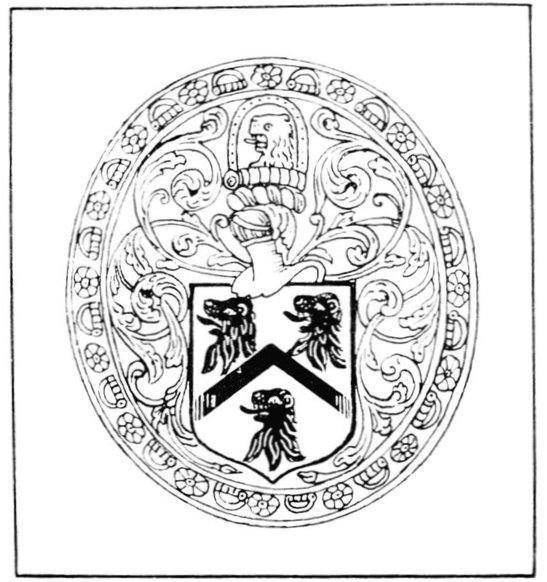
Arms.—Impaled.
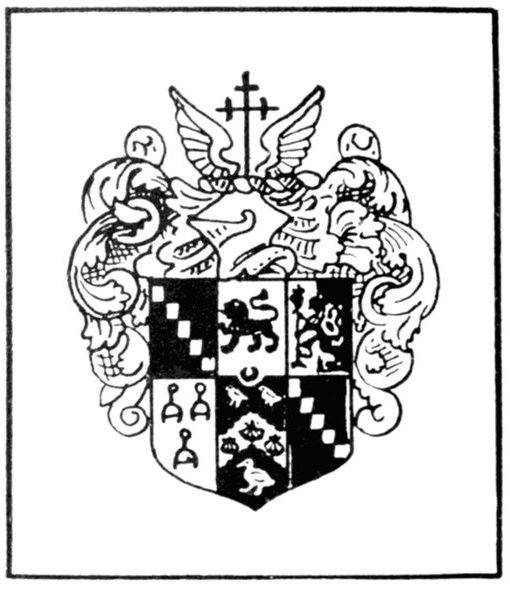
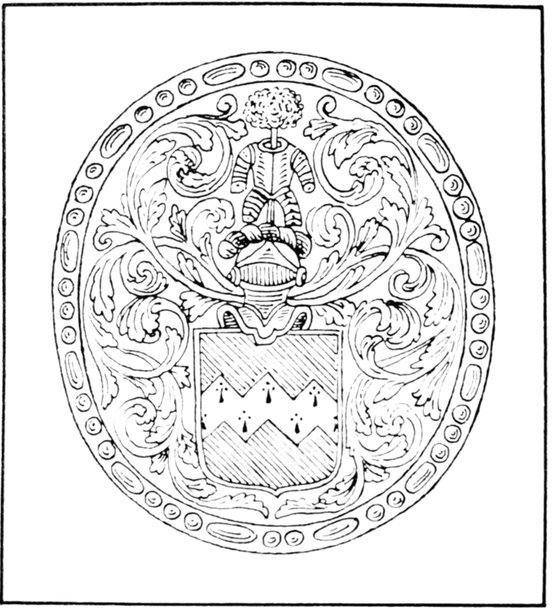
Dexter: Arg., an archiepiscopal staff, headed with
a cross pattée or, surmounted by a pall arg.,
charged with four crosses pattée fitchée sable,
fringed and edged or. The See of Canterbury.
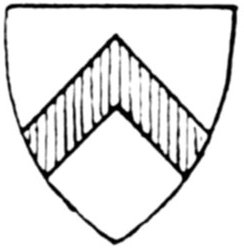
Sinister: Gules, a chevron between three pears
pendent or. Abbot.
[Several volumes in the Library at Lambeth Palace.]
George Abbot, Archbishop of Canterbury (born 29th October 1562,
died 4th August 1633), was a native of Guildford, and took orders in 1585,
afterwards becoming a tutor at Oxford, where he was also a Fellow of
Balliol. He was a strong Puritan and a popular preacher at St. Mary's.
In 1597, Abbot was elected Master of University College, and in 1599
he became Dean of Winchester and also Vice-Chancellor of the University
of Oxford. He wrote several treatises on the religious questions of his
time, and enjoyed the personal esteem of James I., who thought very
highly of him as a theologian and as a politician.
The King's favour showed in the rapid promotion of Dr. Abbot. In
1609 he was consecrated Bishop of Coventry and Lichfield, and later in
the same year he was translated to London. In the next year, on the
death of Archbishop Bancroft, Abbot was made Archbishop of Canterbury.
Dr. Abbot had no sinecure in his Archbishopric, and his many enemies
and the troubled state of theological matters generally left him but little
peace. In 1621, when shooting with a crossbow at a buck, he accidentally
killed a gamekeeper, and this not only preyed much upon his mind, but
it also offered a handle for his detractors, especially those among the clergy,
many of whom held that homicide rendered him unfit for his high position.
On the death of James I. Royal favour deserted the Archbishop, as
Charles I. never appears to have thought well of him. In 1627, on more
or less unjust pretexts, he suffered sequestration of his office, and a commission
was appointed to exercise the Archiepiscopal functions, and Abbot
retired to his native town, Guildford, where he died in 1633. Many of
his books remain in the Library at Lambeth Palace.
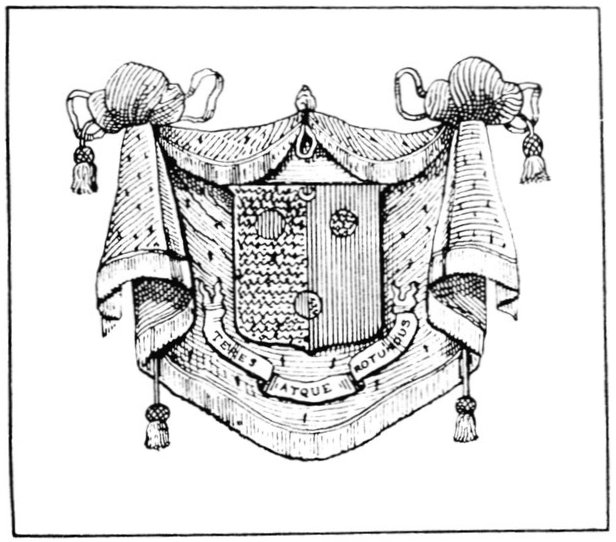
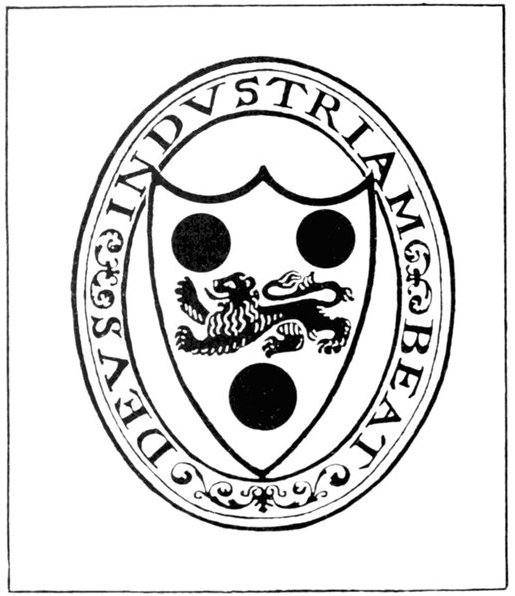
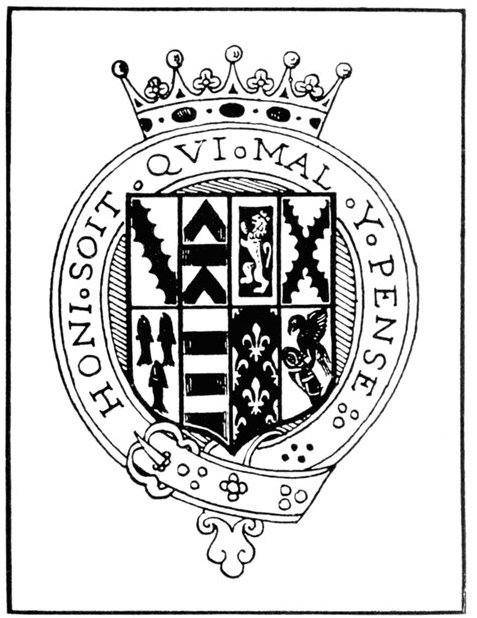
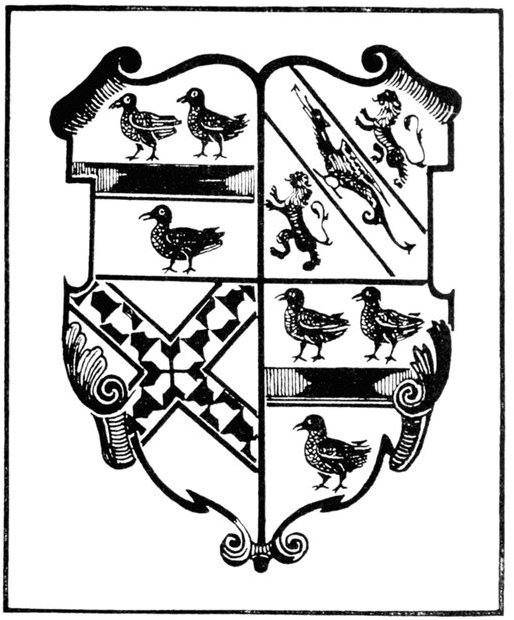
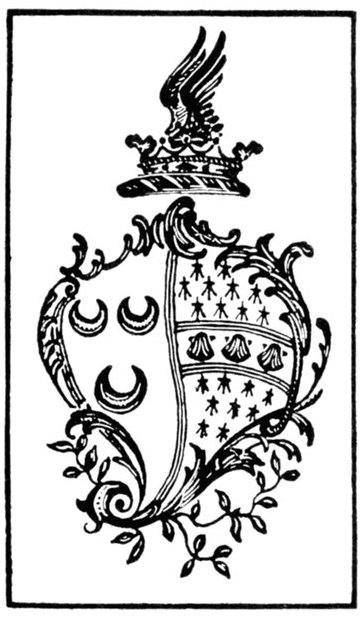
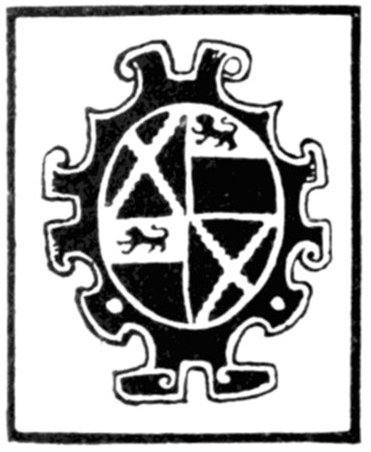
Arms.—Per pale or and gu., three roundels interchanged,
a crescent for difference.
Motto.—Teres atque rotundus.
Probably belonged to the Library of a member of
the Worcestershire family of Abrol.
[Tusser. Five hundred pointes of good Husbandrie.
1593.]
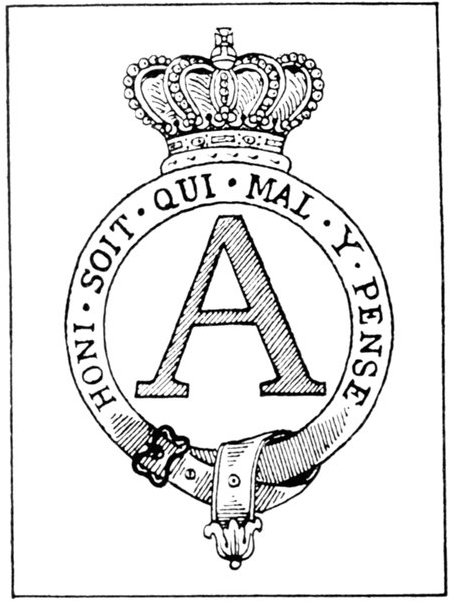
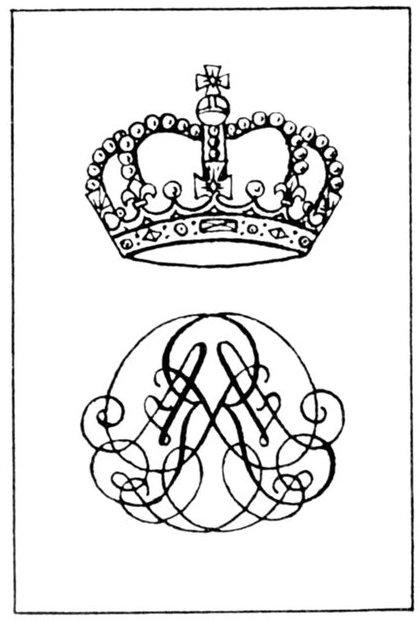
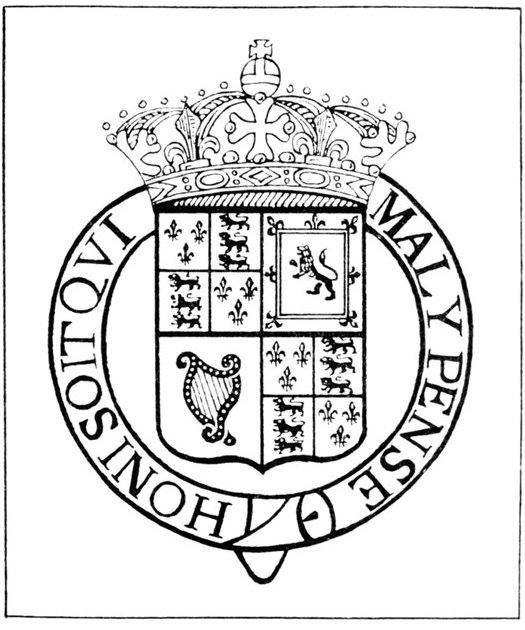
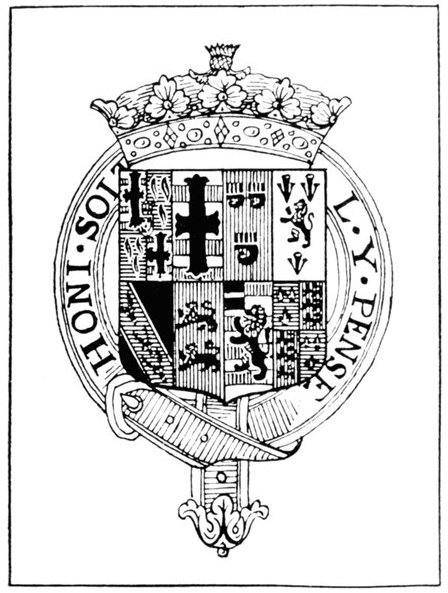
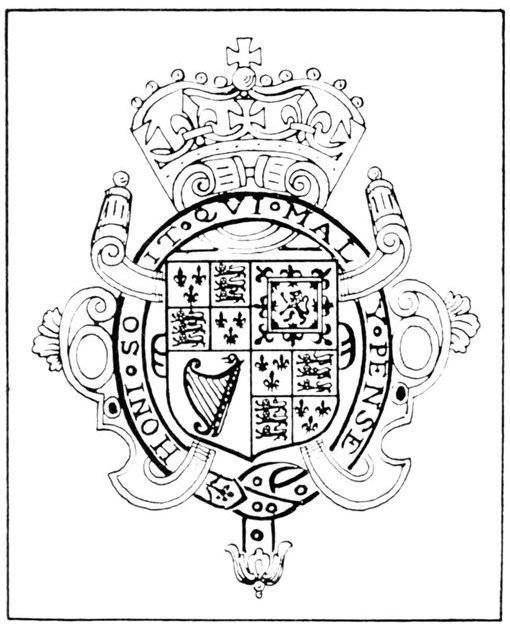
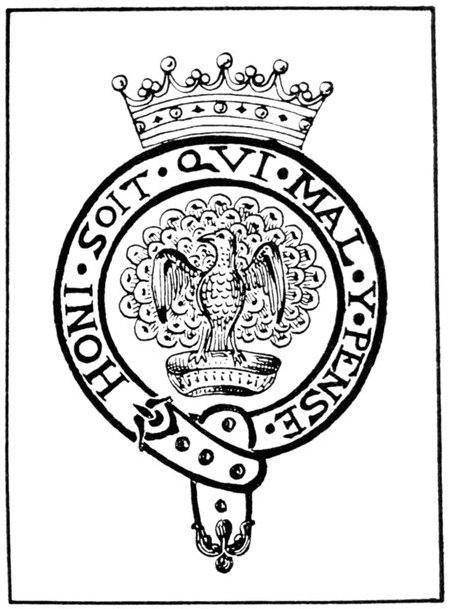
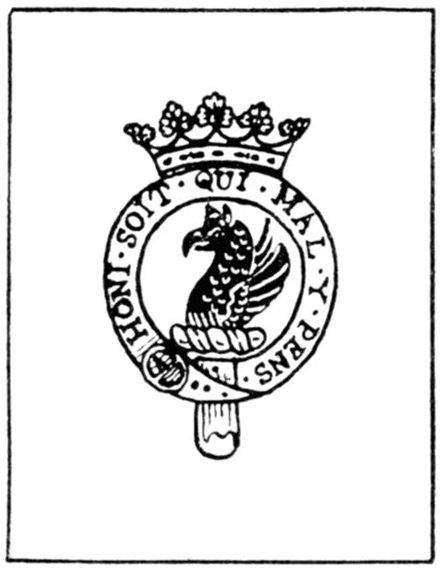
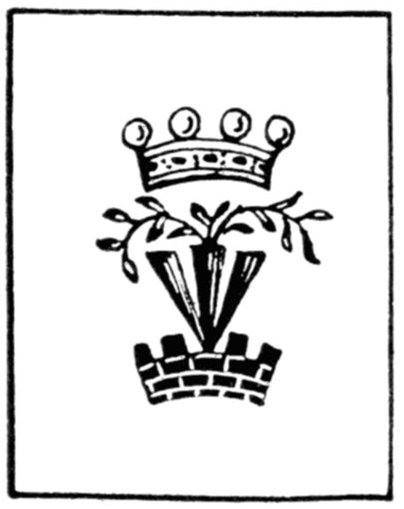
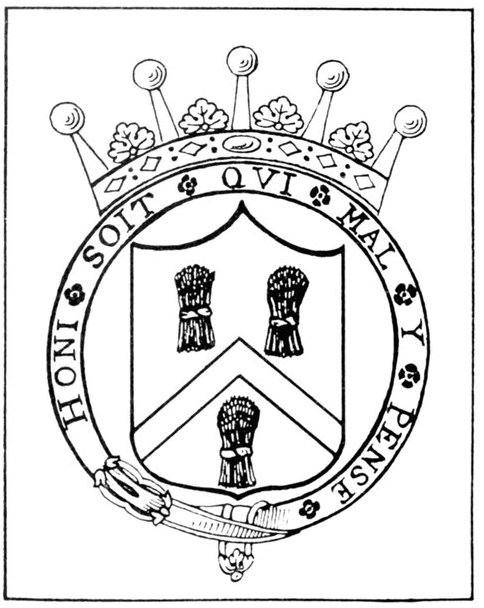
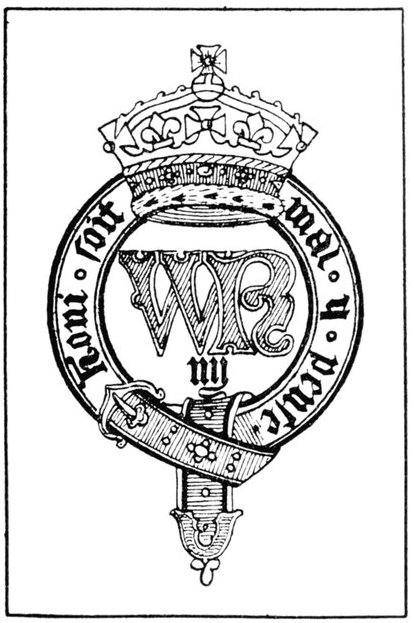
The initial "A" within the garter and ensigned
with the Ducal Crown of Saxe-Coburg-Gotha.
[Raphael. Works at Windsor Castle, 1876.]
Prince Albert (born 26th August 1819, died 14th December 1861)
was the second son of Ernest, Duke of Saxe-Coburg-Gotha. He married
Queen Victoria at St. James's, 16th February 1840, and was all his life
a Patron of the Arts and of Literature, and the International Exhibition
of 1851 is said to have been originally thought of by him.
Prince Albert's books were kept at one or other of the Royal Palaces,
and few of them are anywhere else.
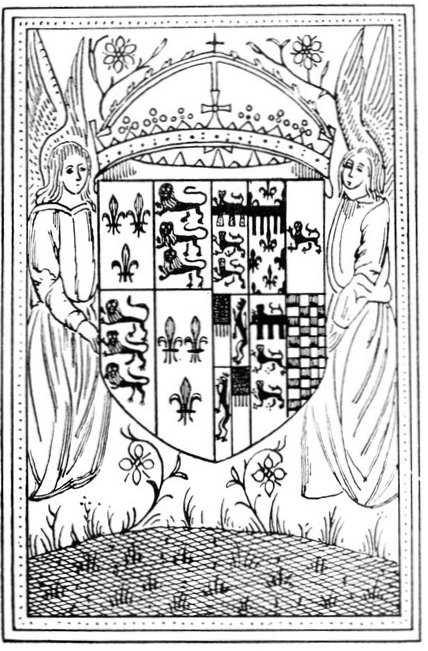
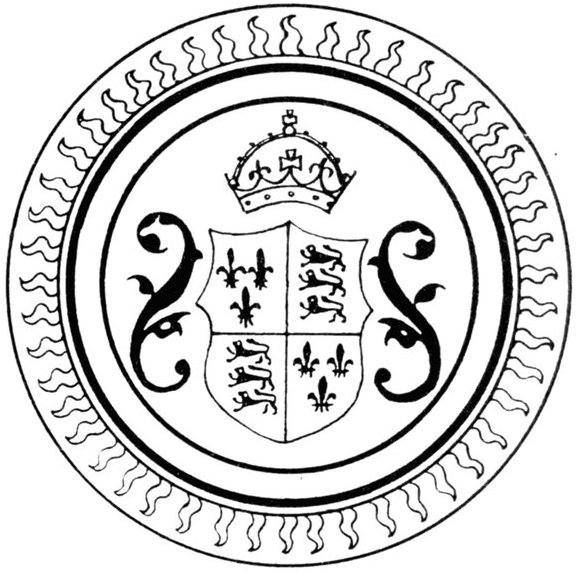
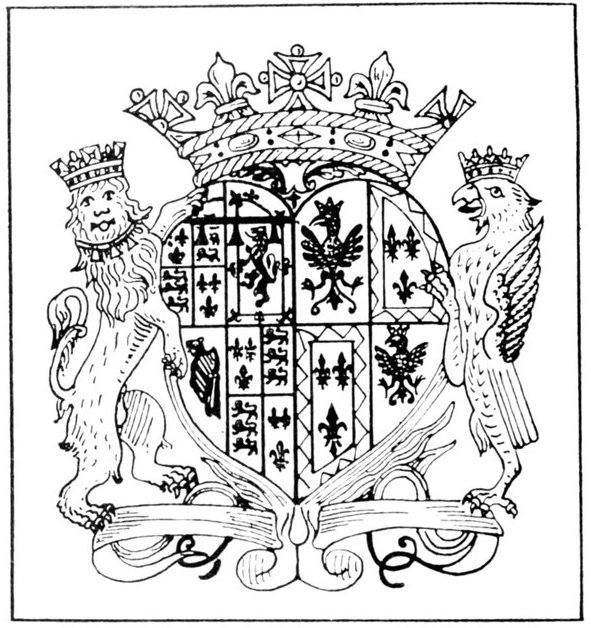
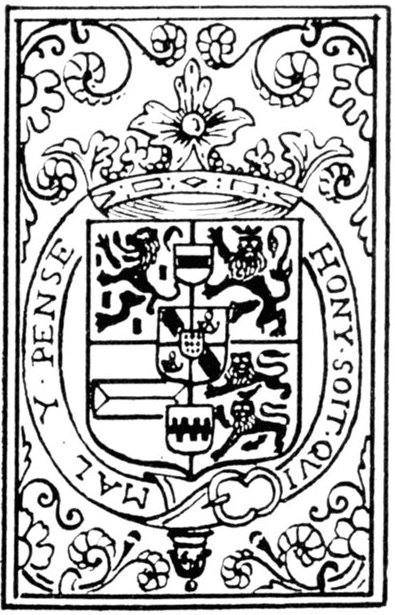
Arms.—Impaled.
Dexter: Quarterly.
| 1 and 4. France |
All as used by Henry VIII.
(q.v.). |
| 2 and 3. England |
Sinister: Quartered.
1. Gu., 3 lions passant guardant or, a label of
three points az., each charged with three
Fleur-de-lys or. Earls of Lancaster.
2. Az., semée de Fleur-de-lys or, a label of
five points gu. Angoulême.
3. Gu., a lion passant guardant or. Guyenne.
4. Quarterly, first and fourth, per fess indented
az. and or. Butler. Second and third arg.,
a lion rampant sa., crowned or. Rochford.
5. Gu., 3 lions passant guardant or, a label of
three points arg. Brotherton, Earl of Norfolk.
6. Chequy, or and az. Warren, Earl of Warren
and Surrey.
The first three of these coats were granted to Anne
Bullen by Henry VIII., when he created her Marchioness
of Pembroke. The paternal coat of Bullen, "Arg., a
chevron gules, between three bulls' heads sa.," is omitted.
The shield is ensigned with the Royal Crown of
England, and supported by two angels.
[Whittington. De octo partibus orationis. Londini
[1521], and other Sixteenth-Century Tracts.]
Anne Bullen, or Boleyn (born 1507, died 19th May 1536), was the
daughter of Sir Thomas Boleyn, Earl of Wiltshire and Ormonde, of Hever
Castle in Kent. She was maid of honour to Catherine of Aragon, Queen
of Henry VIII., and while acting in this capacity she attracted the attention
of the king, who decided that he would marry her if he could get rid of
Queen Catherine.
Consequently, after many difficulties, a divorce was arranged, and
Henry married Anne Bullen in 1532, and she was crowned Queen in
1533. Queen Elizabeth was her only child.
In 1536 the Queen was indicted of high treason, and on 19th May of
the same year she was beheaded. Some of the books bearing Queen
Anne Bullen's arms form part of the old Royal library in the British
Museum; the stamp is impressed in blind, without gold, and with it is
often associated one or other of the panel stamps having the coat-of-arms
of Henry VIII.
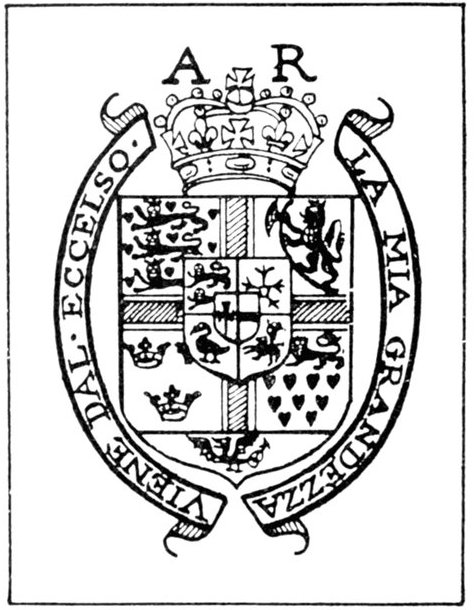
Arms.—A cross gu., surmounted of another arg.
Frederick II., King of Denmark and Norway.
Dexter canton: Or, semé of hearts ppr., 3 lions
passant guardant az., crowned or. Denmark.
Sinister canton: Gu., a lion rampant, crowned or,
holding in his paws a battle-axe arg. Norway.
Dexter base: Az., 3 crowns ppr. Sweden.
Sinister base: Or, 9 hearts, 4, 3, and 2, gu., in
chief a lion passant guardant az. Gothes.
In base: Gu., a wyvern, wings expanded and tail
nowed or. The Vandals.
An escutcheon of Pretence, quarterly;
1. Or, 2 lions passant guardant az. Sleswick.
2. Gu., an inescutcheon having a nail fixed in
every point thereof in triangle, between as
many holly leaves, all arg. Holstein.
3. Gu., a swan, wings close arg. Stormer.
4. Az., a chevalier armed at all points, brandishing
his sword, his helmet plumed, upon
a courser arg., trapped or. Ditzmers.
Over the whole an inescutcheon per pale—
Dexter: Az., a cross formée fitchée or. Dalmenhurst.
Sinister: Or, 2 bars gu. Oldenburg.
Motto.—La mia Grandezza viene dal Eccelso.
[Plutarch. Les Œuvres morales de Plutarque.
Paris, 1588.]
Anne of Denmark (born 12th December 1574, died 1619), Queen
Consort of James I., King of England, Scotland, France, and Ireland, was
the daughter of Frederick II., King of Denmark and Norway. The
alliance between the Danish Princess and James VI. of Scotland was not
agreeable to Queen Elizabeth, but in spite of her opposition the marriage
took place in 1589 at Upslo. In 1590 the king and queen returned to
Scotland, and in 1603, on the death of Queen Elizabeth, they came to
England.
Queen Anne was a great patron of Progresses, Pageants, and Masques,
and is said to have been a beautiful dancer. She was very extravagant, and
incurred much censure for running into debt, although her allowances
were very liberal. At one period Queen Anne was suspected of leanings
towards the Roman Catholic religion. She objected to the marriage,
ultimately of the greatest importance, of her daughter Elizabeth to
Frederick V., Elector Palatine of the Rhine, on the ground that his
position was not high enough, but she attended the marriage in 1612.
Several of her books are among the old Royal collection presented to
the British Museum in 1757.
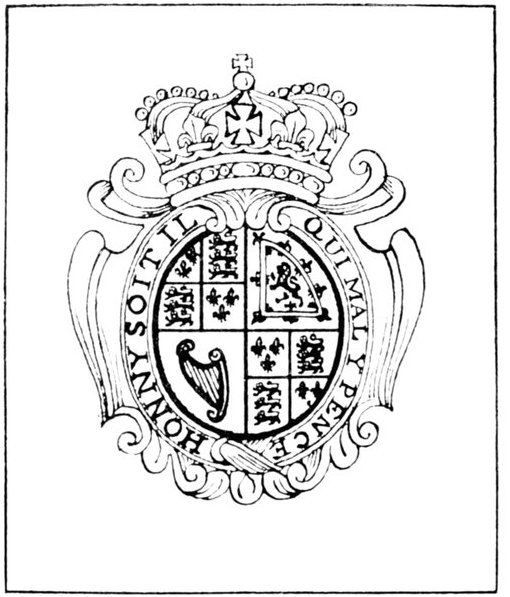
First Coat-of-Arms
1. Arms.—Within the Garter. Quarterly.
1st and 4th grand quarters; quarterly; France
and England.
2nd grand quarter; Scotland.
3rd grand quarter; Ireland.
As used by James I. (q.v.).
Used from 8th March 1702 until 6th March 1706.
[Bianchini. De Kalendario et Cyclo Cæsaris.
Romae, 1703.]
Second Coat-of-Arms
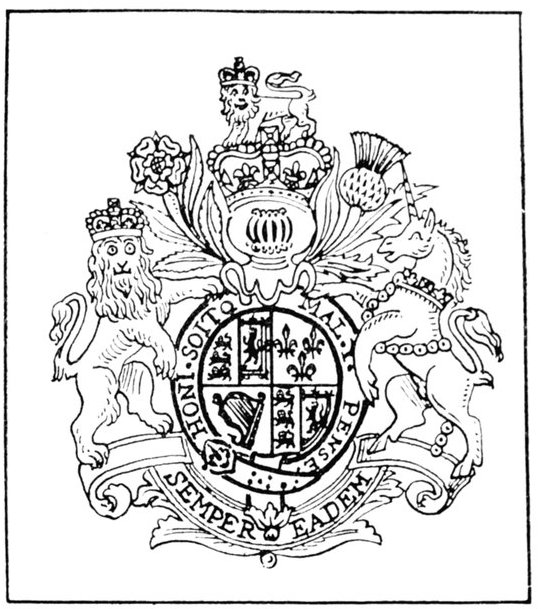
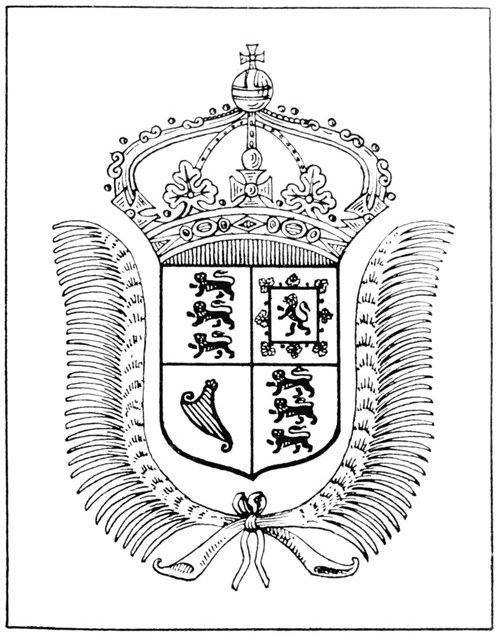
2. Arms.—Within the Garter. Quarterly.
1st and 4th grand quarters, impaled.
Dexter: England.
Sinister: Scotland.
2nd grand quarter; France.
3rd grand quarter; Ireland.
Colours as used by James I. (q.v.).
Used from 6th March 1706 until 1st August 1714.
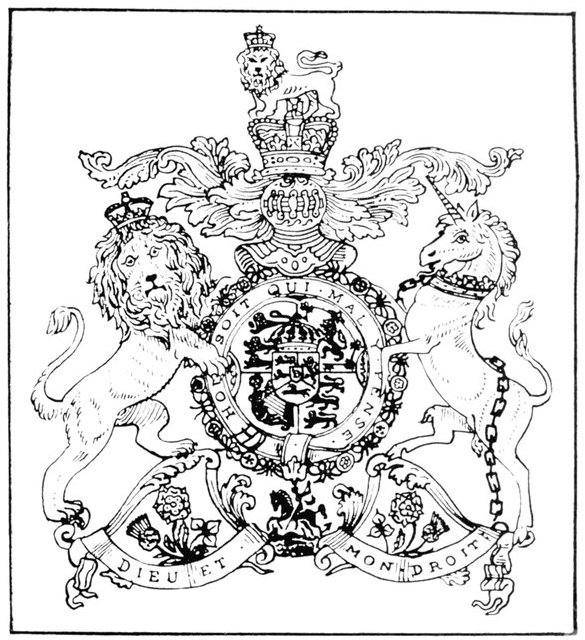
Crest.—A Royal Crown ppr., thereon a lion statant
guardant or, crowned ppr.
Supporters.—Lion and unicorn.
Motto.—Semper eadem.
Badges.—Tudor rose and Thistle.
[England. Laws. 1702.]
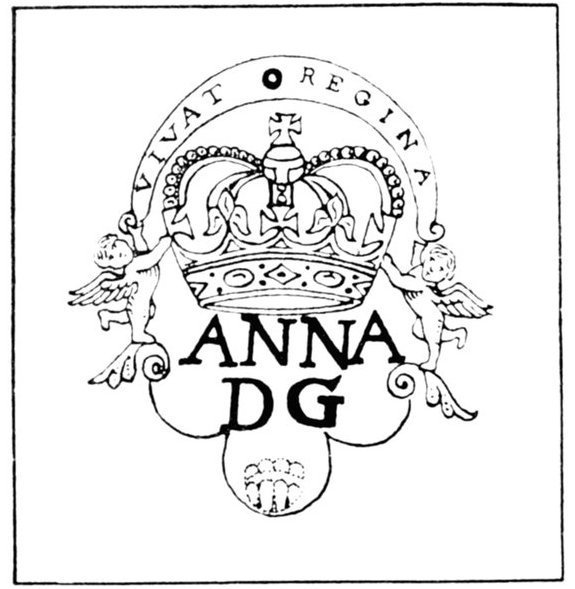
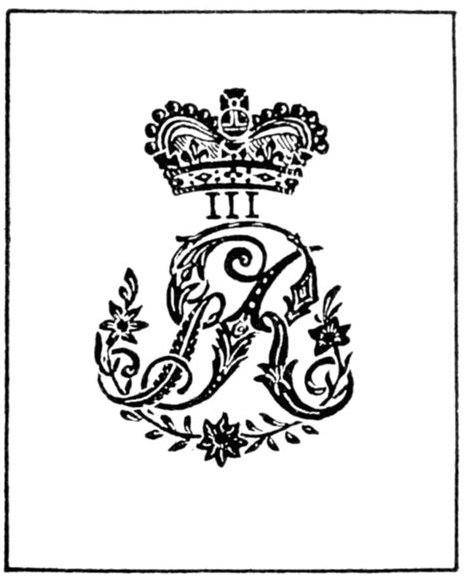
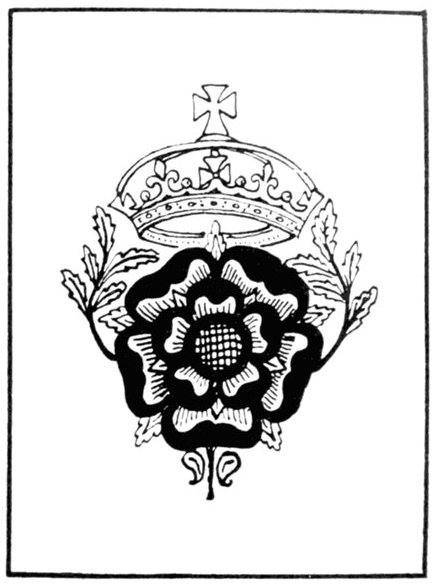
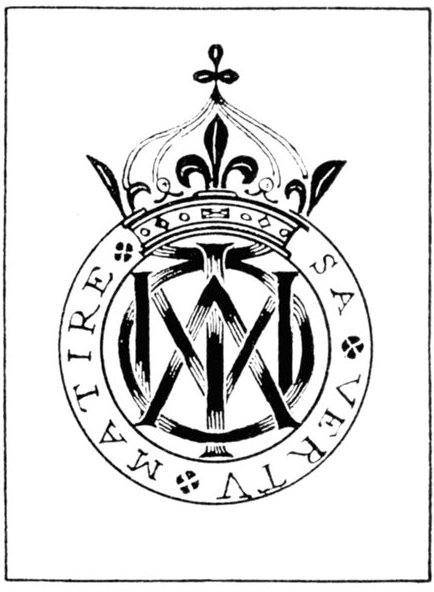
The Royal name ensigned with a Royal Crown, and
the motto "Vivat Regina" upheld by two cherubs.
[Euclid. Elements. Oxford, 1703.]
The Royal Monogram
ensigned with a Royal
Crown.
[Overbeck.
Reliq. Ant. Romae.
Amst., 1708.]
Queen Anne (born 10th May 1655, died 1st August 1714) was the
second daughter of James II. and Anne Hyde, daughter of Edward Hyde,
first Earl of Clarendon. She succeeded her cousin, William III., on the
throne of England in 1702. Queen Anne was the last of the Stuart line
to occupy the throne of England.
The first coat-of-arms used by Queen Anne was the same as that
generally used by her predecessor, but without the arms of Nassau, that is
to say, first and fourth grand quarters, France and England quarterly;
second grand quarter, Scotland; and third grand quarter, Ireland.
In 1702 a notice was published in the London Gazette to the effect
that "wheresoever there shall be occasion to embroider, depict, grave, carve,
or paint Her Majesty's Royal Arms with a motto, this Motto following,
viz. Semper eadem, is to be used" (23rd December). It will be remembered
that this motto had been previously used by Queen Elizabeth.
The Legislative Union of the kingdoms of England and Scotland took
place on Thursday, 6th March 1706, when the royal assent was given to
the Act. A change in the Royal coat-of-arms took place in consequence
of this Act, and for the remainder of the reign of Queen Anne (1706-1714)
the first and fourth grand quarters contained the coats of England and
Scotland impaled, in the manner used to denote husband and wife; the
second grand quarter, France; and the third grand quarter, Ireland.
Besides the coat-of-arms, the crowned initials and name of Queen Anne
were frequently stamped upon her books, and some of her book-stamps
appear to have been designed by foreigners.
Queen Anne's books came to the British Museum with the rest of the
old Royal Library of England in 1757.
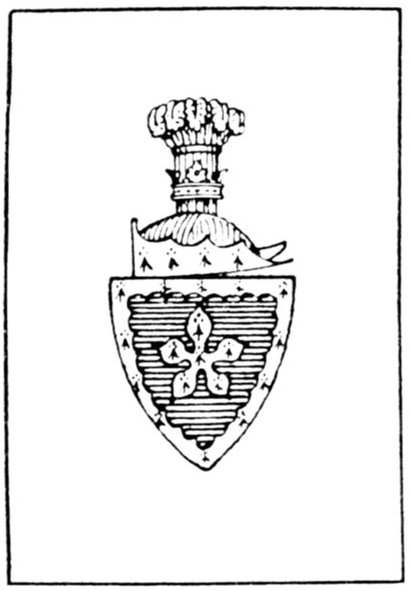
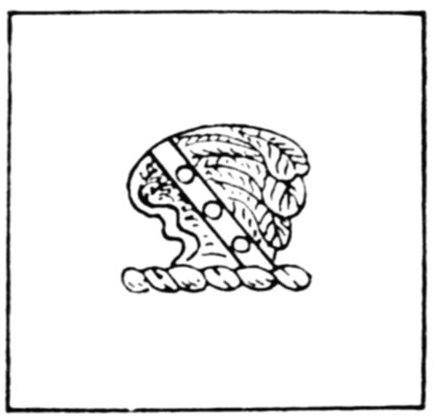
Arms.—Az., a cinquefoil erm., a bordure engrailed
of the second. Astle.
Crest.—On a chapeau, a plume of five feathers in
a case arg. banded gu., and environed with a ducal
coronet or.
[Collection of miscellaneous MSS. Stowe, 516.]
Thomas Astle (born 22nd December 1735, died 1st December
1803) was a book collector and antiquary, and a native of Yoxall in
Staffordshire. In 1783 he was appointed Keeper of the Records in the
Tower of London, where his literary tastes stood him in good stead, and
he edited and indexed the treasures which were under his care with energy
and success; he was also a Trustee of the British Museum.
Astle wrote several important works; perhaps the most useful of them
are the Catalogue of the MSS. in the Cottonian Library, and a treatise
on the Origin and Progress of Writing. His printed books now belong to
the library of the Royal Institution, and his collection of Manuscripts
is kept at the British Museum. This important collection belonged successively
to the Marquis of Buckingham at Stowe, and then to the Earl of Ashburnham,
who sold it in 1883 to the Trustees of the British Museum.
Mr. Astle was a Fellow of the Royal Society and of the Society of
Antiquaries.
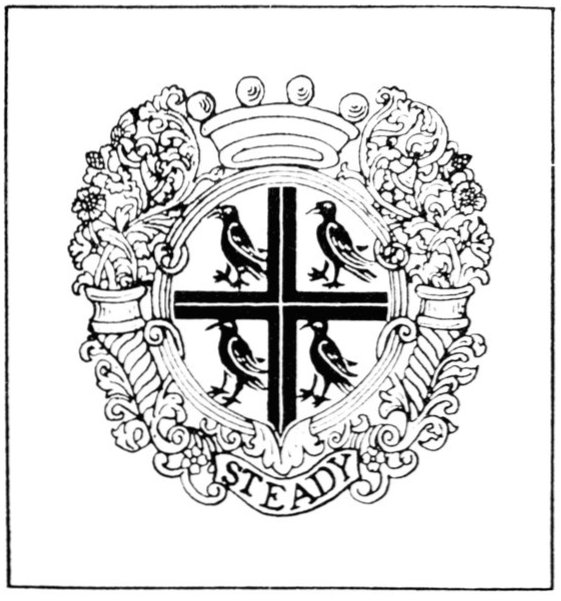
Arms.—Arg., a cross sa., between four Cornish
Choughs of the second. Aylmer.
Coronet.—That of a Baron.
Motto.—Steady.
[Burnet. History of the Reformation. London, 1681.]
Matthew Aylmer (born 1660 (?), died 18th August 1720) was a
sailor who took part in the Battle of La Hogue. He subsequently
became Rear-Admiral of Great Britain and Governor of Chelsea Hospital.
In 1718 he was created Baron Aylmer of Balrath in Meath.
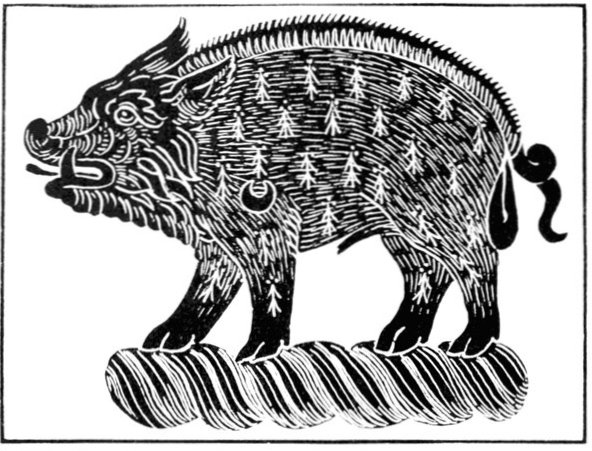
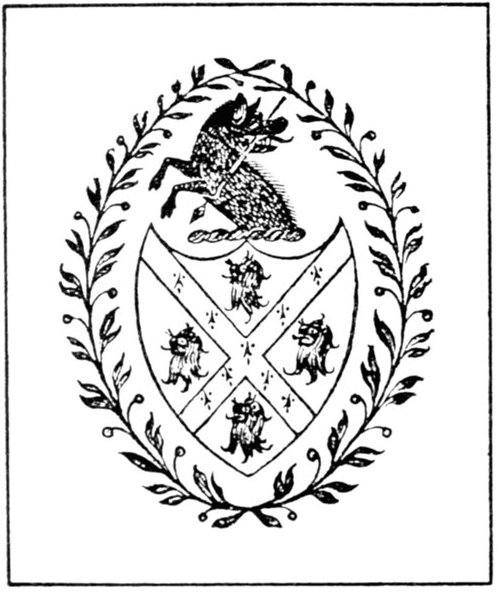
Crest.—A boar passant erm., armed and hoofed
or, a crescent for difference. Bacon.
[Bacon. Novum Organum. Londini, 1620.]
[University Library, Cambridge.]
Francis Bacon (born 22nd January 1561, died 9th April 1626) was
a son of Sir Nicolas Bacon, Lord Keeper of the Seals to Queen Elizabeth.
He went to Cambridge at the age of thirteen and studied law.
In 1595 he was elected Member of Parliament for Middlesex, but
presently fell upon evil times and, among other troubles, managed to
offend the Queen by some of his writings. James I., however, restored
him to Royal favour. In 1619 he became Lord Chancellor, and shortly
afterwards was created Baron Verulam and Viscount St. Albans. Bacon's
enemies presently prevailed against him again, and his own malpractices
with regard to various judicial matters gave them the opportunity of
ruining him. In spite of the king's favour and efforts in his behalf, in
1621 Bacon was ordered to pay a fine of £40,000 for his misdeeds; he
was adjudged to be incapable of sitting in Parliament or to accept any
public office under the Crown, neither was he to be permitted to live
in any place where the Royal Court might be. He was, moreover, condemned
to be kept a prisoner in the Tower of London during the king's
pleasure.
In 1625, when Charles I. came to the throne of England, all these
judgments were reversed and Bacon was rehabilitated, but did not live
much longer to enjoy his honours.
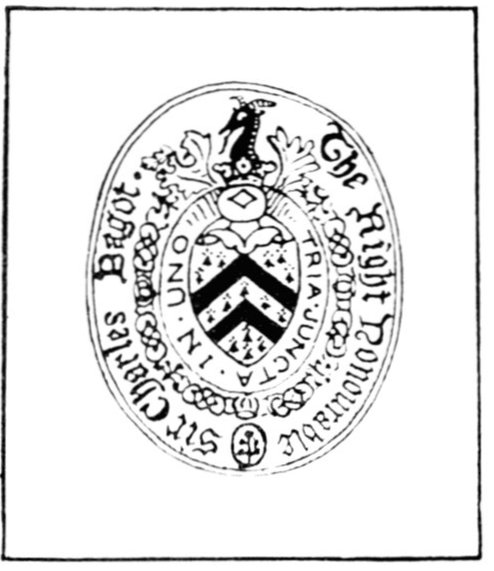
Arms.—Erm., two chevrons az. Bagot.
Crest.—Out of an heraldic coronet, a goat's head ar.,
attired or.
Helmet.—That of a Knight.
Decoration.—The collar and badge of a Knight
Grand Cross (civil) of the Order of the Bath, with the
motto "Tria juncta in uno."
Legend.—The Right Honourable Sir Charles
Bagot.
[Cary. Memoirs. Edinburgh, 1808.]
Sir Charles Bagot (born 23rd September 1781, died 19th May 1843)
was the second son of William, first Baron Bagot, who for many years
represented Stafford in the House of Commons.
Sir Charles had an important political and diplomatic career; he was a
Privy Councillor and a Knight Grand Cross of the Order of the Bath.
In 1807 he was Under-Secretary of State for Foreign affairs, and acted
as Minister Plenipotentiary both to France and to the United States of
America.
In 1841 Sir Charles Bagot was governor of Canada, and at different times
he held the posts of Ambassador to Russia, the Netherlands, and to Austria.
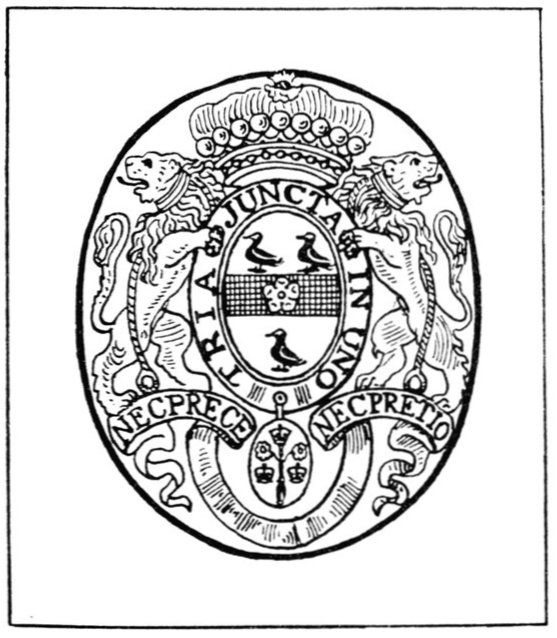
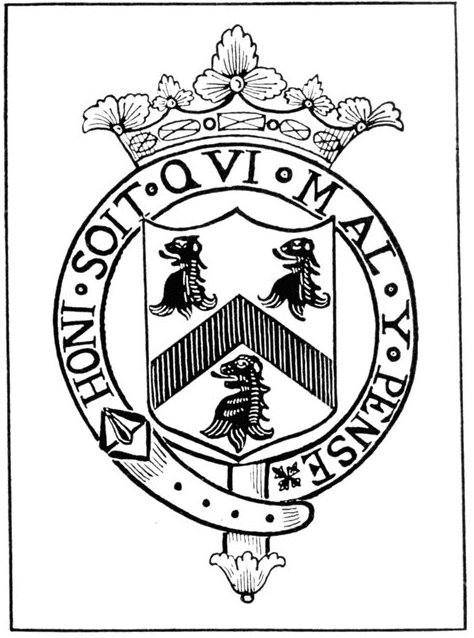
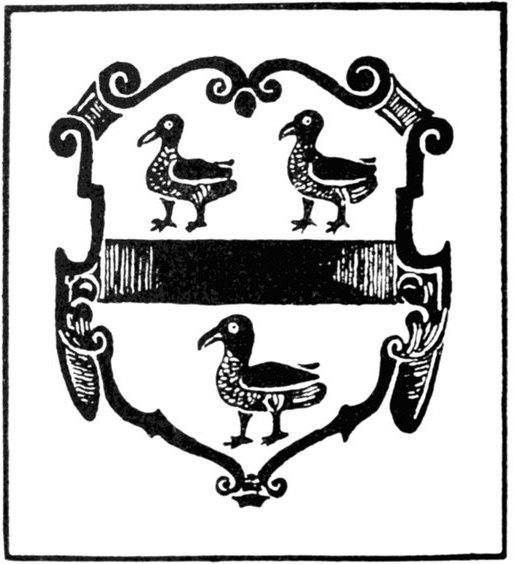
Arms.—On a fess sa., between three muscovy ducks
ppr., a rose of the field. Bateman. All within a fillet
bearing the legend "Tria juncta in uno," being the
motto of the Order of the Bath; dependent from the fillet
is the badge of the same Order.
Coronet.—That of a Viscount.
Supporters.—Two lions rampant reguardant ppr.,
collared and chained or.
Motto.—Nec prece nec pretio.
[Mondonville. Sonates.]
William Bateman (born circ. 1680, died December 1744) was the son
of Sir James Bateman, Lord Mayor of London in 1717.
Mr. Bateman was twice Member of Parliament for Leominster,
and in 1725 was created Viscount Bateman in the Peerage of Ireland.
In 1731 he was made a Knight of the Order of the Bath.
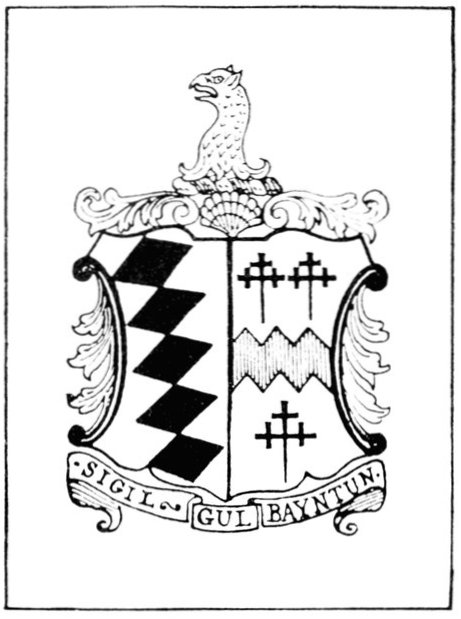
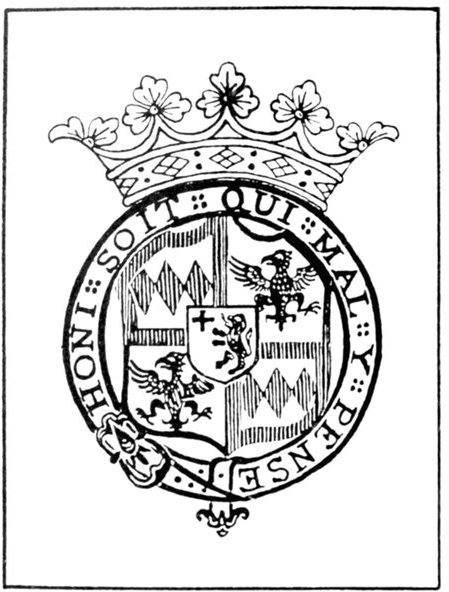
Arms.—Impaled.
Dexter: Sa., a bend lozengy arg. Bayntun.
Sinister: Gu., a fess dancetty between three cross
crosslets fitchée or. Gore.
Crest.—A griffin's head erased sa., beaked or.
Legend.—Sigil gul Bayntun.
[England. Statuta in Parlameto, etc. London, 1504.]
Probably the arms of William Bayntun, who was Consul-General at
Algiers in the latter half of the eighteenth century. His son Henry
became an Admiral and a Knight Grand Cross of the Order of the Bath
in 1839.
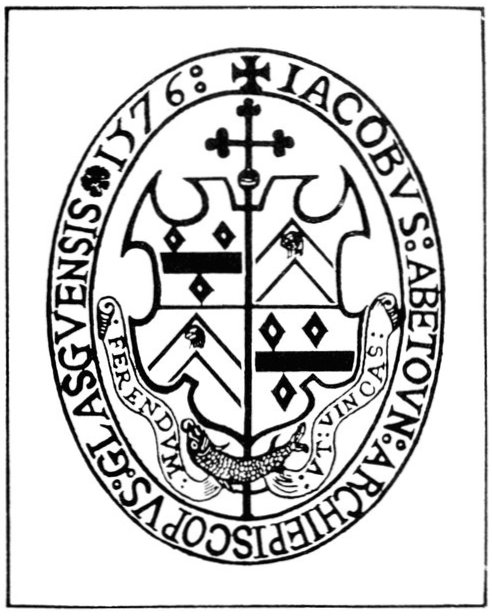
Arms.—On a Bishop's cross. Quarterly, first and
fourth, arg., a fess between three mascles or; second and
third arg., a chevron sa., charged with an otter's head
erased of the first. Beaton. At the base of the shield,
the fish of Glasgow holding a ring in its mouth.
Motto.—Ferendvm vt vincas.
Legend.—Iacobvs a betovn archiepiscopvs
glasgvensis 1576.
[Hours of the Diocese of Salisbury. 1526.]
James Beaton (born 1517, died 1603) was a son of John Beaton of Balfour,
Fife. He was a man of high character and much esteemed both in Scotland
and in France, where circumstances caused him to spend a considerable
portion of his life. Beaton acted as Ambassador from Scotland at the French
Court, and lived in Paris at the Scots College, an Institution of which he
was very proud, and to which he bequeathed the greater part of his fortune.
Beaton also took a leading part in the politics of his time, and was a
staunch friend to Mary Queen of Scots. In 1552 he was, in Paris, consecrated
Archbishop of Glasgow, and he also held several important
ecclesiastical preferments in France.
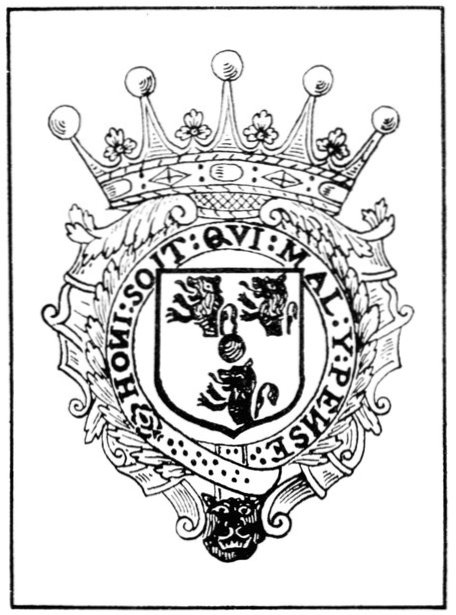
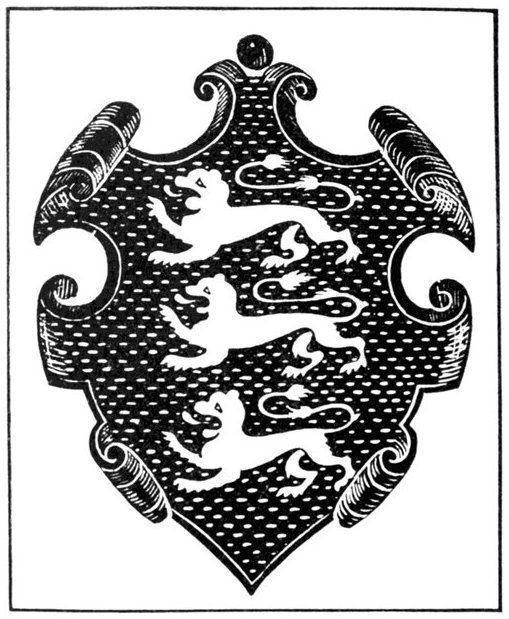
Arms.—Within the Garter. Gu., a bezant between
three demi lions rampant arg. Bennet.
Coronet.—That of an Earl.
[Hist. del Ministerio del Card. Guilio Mazarino.
Colonia, 1669.]
Henry Bennet (born 1618, died 20th July 1685) was the second son of
Sir John Bennet of Dawley in Middlesex. He was an excellent scholar
and linguist, and a skilled diplomatist, especially in foreign affairs, but his
standard of political morality does not appear to have been a very high one.
Bennet was a favourite of Charles II. for a long time, and the king
honoured him highly. He was made Keeper of the Privy Purse, and
Secretary of State in 1662; next year he was created Baron Arlington.
In 1672 he was made a Knight of the Garter and Earl of Arlington, in
1674 Lord Chamberlain of the Household, and in 1675 a Lord of the
Admiralty.
Arlington was a member of the Cabal Ministry; in 1674 he was
impeached for his promotion of popery, breach of trust, and other misdeeds,
but the vote of censure was lost. In 1674 he sold his secretaryship to
Sir Joseph Williamson, and retired, more or less in disgrace, to his estate
at Euston in Suffolk, where he had built a splendid house. Here he died
in 1685.
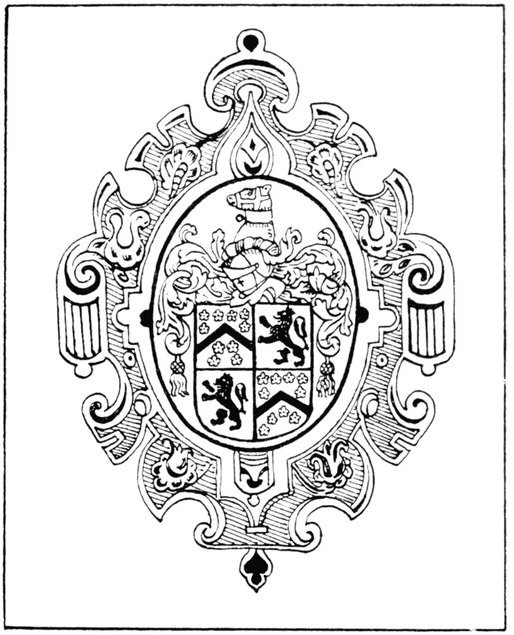
Arms.—Quarterly.
1st and 4th; gu., a chevron between 10 cinquefoils
ar. Berkeley.
2nd and 3rd; gu., a lion rampant arg., ducally
crowned or. Hayward.
Crest.—A bear's head couped arg., muzzled gu.
Helmet.—That of an Esquire.
[Polano. The Historie of the Council of Trent.
London, 1620.]
Robert Berkeley (born 1713, died 20th December 1804) was a son
of Thomas Berkeley of Spetchley in Worcestershire. He wrote several
anonymous treatises, both political and theological, on questions of his time.
He married three times but left no issue. Thomas Phillips wrote his Life
of Cardinal Pole while he was chaplain at Spetchley.
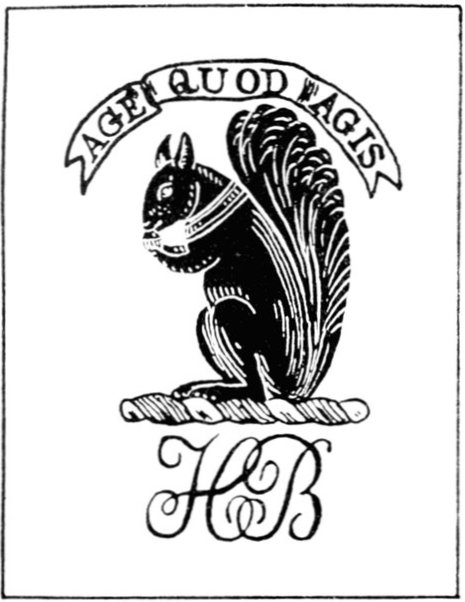
Crest.—A squirrel sejant gu., collared and holding a
nut or. Blundell.
Motto.—Age quod agis.
Initials.—H. B. (Henry Blundell).
[Engravings and etchings of the Principal Statues, etc., in the
collection of Henry Blundell, Esq., at Nice. 1809.]
Henry Blundell (born 1723, died 1810), of Nice-Blundell in Lancashire,
was the son of Robert Blundell of Nice. He was a noted collector of
works of art and an antiquary of some repute. His contributions to
literature are accounts of his own collections, and are illustrated with fine
engravings.
Blundell was a friend of the antiquary and collector Charles Towneley
of Towneley Hall, also in Lancashire, and it is probable that his archæological
tastes were largely fostered by this friendship. Towneley certainly
suggested the production of Blundell's catalogues.
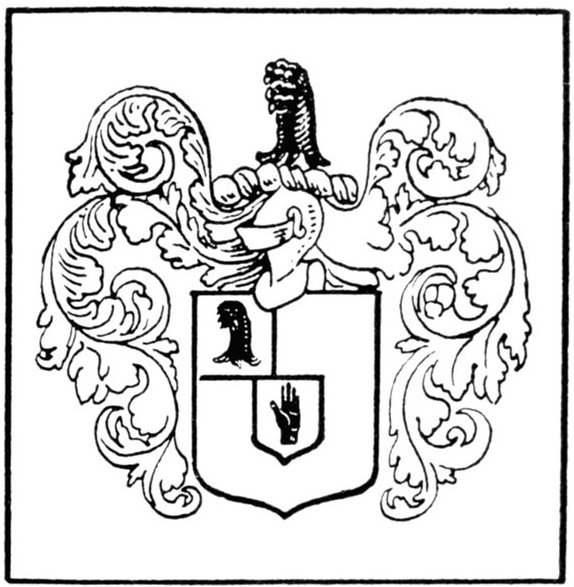
Arms.—Ar., on a canton sa., a lion's gamb erased
erect or. Boothby. In the centre of the shield an
inescutcheon arg., bearing the Ulster hand gu.
Crest.—A lion's gamb erased erect or.
Helmet.—That of an Esquire.
[Williams. Antichrist. London, 1660.]
Crest.—A lion's gamb erased erect or. On an
escutcheon arg., pendent from a branch, the Ulster
hand gu., the badge of a Baronet.
[Campanella. A discourse touching the Spanish Monarchy.
London.]
Sir Brooke Boothby, 7th Baronet (born 1743, died 1824), was the eldest
son of Sir Brooke Boothby, 6th Baronet, of Ashbourne Hall, Derbyshire.
Sir Brooke was the author of several political treatises and miscellaneous
works, many of which are in verse. He belonged to the literary circles
of his time, and spent some time in France, where he is said to have enjoyed
the friendship of Rousseau.
Arms.—Erm., a rose gu., barbed and seeded ppr.
Boscawen.
[Settle. Rebellion display'd. London, 1715.]
Hugh Boscawen of Tregothnen, Cornwall (born 1680 (?), died 25th
October 1734), was a noted whig politician. He represented successively,
Tregony, Cornwall, Truro, and Penryn, following in the footsteps of his
father, Edward Boscawen, who had also been a member of Parliament for a
long time.
In 1720 Boscawen was created Viscount Falmouth, and he held the
appointments of Comptroller of the Household, Vice-Treasurer of Ireland,
and Warden of the Stanneries, besides others of lesser note. He was also
a member of the Privy Council.
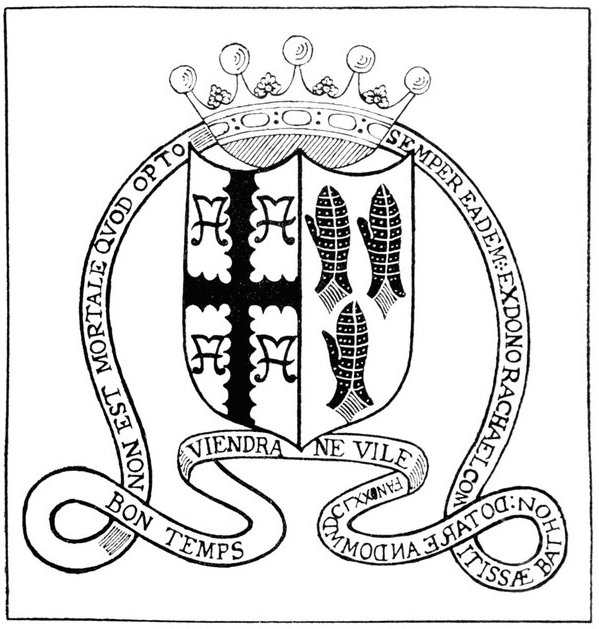
Arms.—Impaled.
Dexter: Arg., a cross engrailed gu., between
four water bougets sa. Bourchier.
Sinister: Arg., three dexter gauntlets, backs
affrontées or. Fane.
Coronet.—That of an Earl.
Mottoes.—Bon temps viendra.
Ne vile fano.
Non est mortale qvod opto.
Semper eadem.
Legend.—Ex dono rachael comitissæ bathon
dotare an. dom. mdclxx.
[Symbolarum in Matthaeum Tom. I., etc. Tolosae, 1646.]
Rachael Fane (born 1613, died 11th November 1680) was the daughter
of Francis Fane, first Earl of Westmorland. In 1638 she married (1)
Henry Bourchier, 6th Earl of Bath, and (2) Lionel Cranfield, 3rd Earl
of Middlesex, retaining, however, her precedency as Countess of Bath by
Royal Warrant.
The earliest English lady's armorial book-plate belonged to Lady
Bath, and was similar to the book-stamp illustrated herewith.
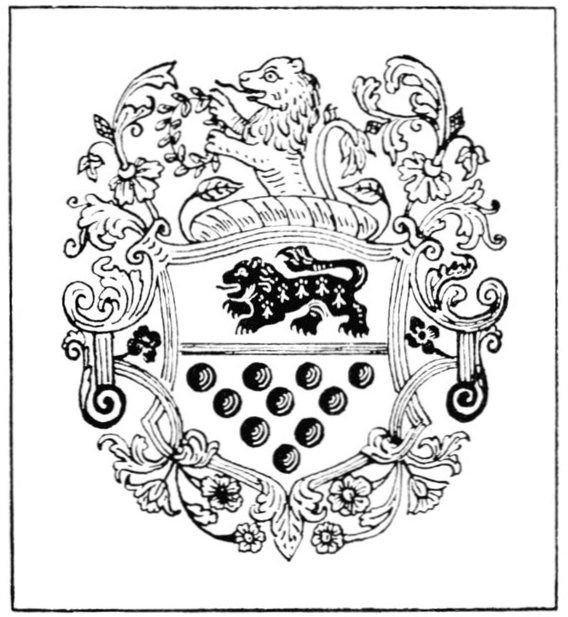
Arms.—Sa., ten plates, four, three, two, and one; on
a chief arg., a lion passant erm. Bridgman.
Crest.—A demi lion rampant arg., holding between
the paws a garland of laurel ppr.
[Lauri. Antiquae urbis Splendor. Romae, 1612.]
Sir Orlando Bridgman (born 1606 (?), died 1674) was a distinguished
lawyer and legal author. He was the son of John Bridgman, Bishop of
Chester, and a Fellow of Magdalene College, Cambridge.
In 1640 Bridgman was elected Member of Parliament for Wigan and
was Knighted. By submitting to Cromwell he escaped the penalties of
being a Royalist, and made himself of much importance as a lawyer during
the Commonwealth. At the Restoration Sir Orlando was received into
Royal favour in consideration of his former loyalty, and was given a
Baronetcy and made Chief Baron of the Exchequer. In 1660 he was
made Chief Justice of the Common Pleas, and in 1667 Lord Keeper of
the Great Seal. On occasions he acted as Speaker in the House of Lords.
Towards the end of his life he fell into some sort of disfavour, and lived
in retirement at Teddington.
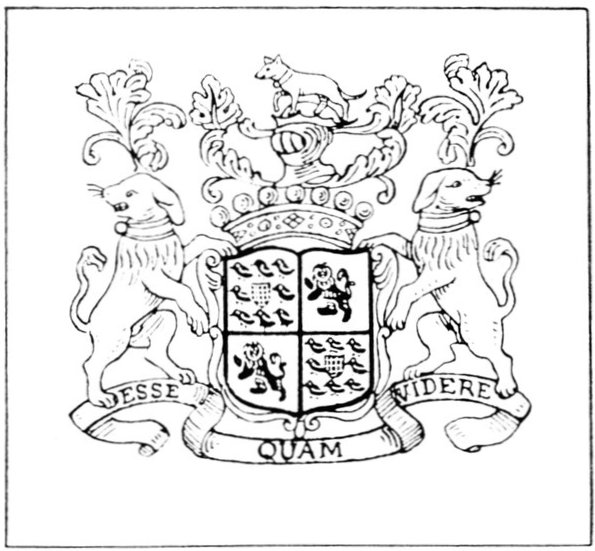
Arms.—Quarterly.
1st and 4th; or, an inescutcheon within an
orle of martlets sa. Brownlow.
2nd and 3rd; arg., a lion rampant az. Mason.
Crest.—On a chapeau gules, turned up with ermine, a
greyhound passant or, collared of the first.
Supporters.—Two talbots ppr., collared gu.
Coronet.—That of a Viscount.
Helmet.—That of a Peer.
Motto.—Esse quam videre.
[Savage. The Wanderer. London, 1729.]
[Edward Almack, Esq., F.S.A., Brighton.]
Sir John Brownlow (born 1692 (?), died 27th February 1754) was the
eldest son of Sir William Brownlow of Belton in Lincolnshire. He was
Member of Parliament for Grantham and for Lincolnshire, and in 1718
was created Viscount Tyrconnel. In 1725 he was made a Knight of the
Order of the Bath. Lord Tyrconnel died at his country seat of Belton,
and left no heir.
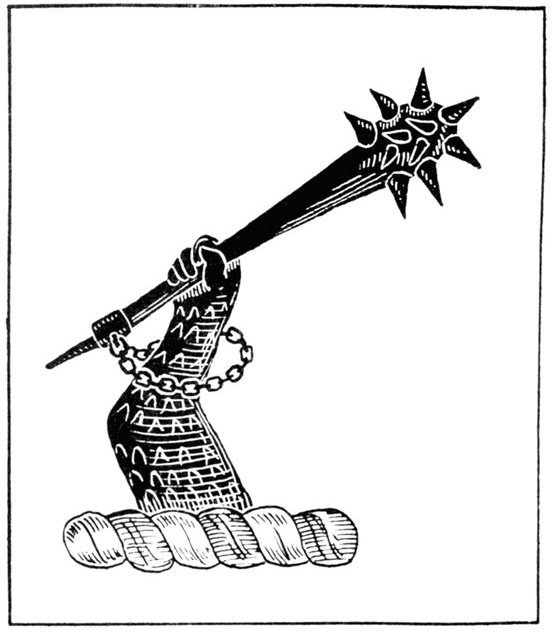
Crest.—A dexter arm embowed, covered with leaves
vert, grasping a spiked club, in bend sinister or, slung to
the arm with a chain of the last. Brudenell.
[Le Mire. Geographia Ecclesiastica. Lugd., 1620.]
Books bearing this crest probably belonged to a member of the family
of Brudenell, of Stanton Wyvile in Leicestershire.
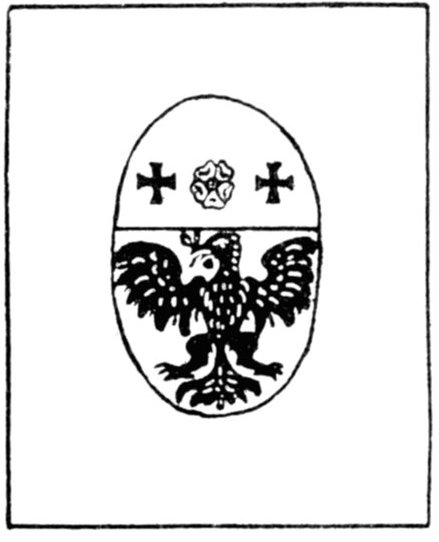
Arms.—Az., an eagle displayed arg., in the beak
a sprig vert, on a chief or, a rose between two crosses
crosslet gu. Bullingham.
[Hardwick Papers, Vol. 766.]
The book belonged to a member of the Lincolnshire family of
Bullingham, in the seventeenth century.
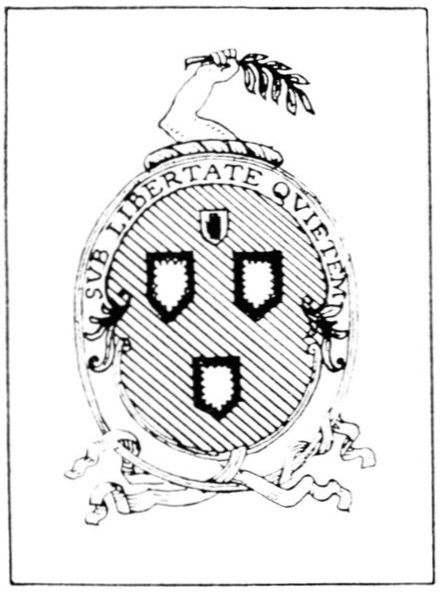
Arms.—Vert, 3 shields arg., 2 and 1, each charged
with a bordure engrailed or. In the chief point on an
escutcheon arg., the Ulster hand gu.
Crest.—A naked arm embowed holding a branch of
laurel, all ppr.
Motto.—Svb libertate qvietem.
[Collinson. The History and Antiquities of the
County of Summerset. Bath, 1791.]
William Burrell (born 10th October 1732, died 20th January 1796)
was the son of Peter Burrell of Beckenham, Kent, and was educated at
St. John's College, Cambridge, where he graduated LL.D.
In 1789 Burrell succeeded, by special remainder, to the Baronetcy of
his father-in-law, Sir Charles Raymond. Sir William Burrell was
Member of Parliament for Haslemere; a Commissioner of Excise;
a Fellow of the Royal Society and of the Society of Antiquaries.
He was especially interested in the antiquities of Sussex, both architectural
and genealogical. He made a large collection of prints, drawings, and
manuscripts relating to Sussex, which he bequeathed to the British
Museum, and which are now in the Department of Manuscripts.
He died at Deepdene in Surrey.
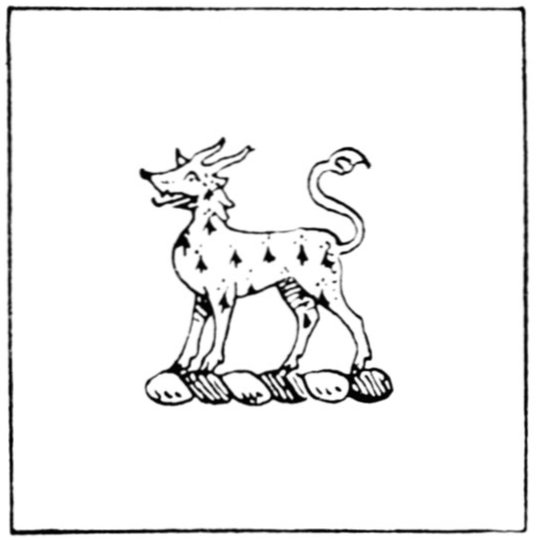
Crest.—An heraldic antelope statant erm., armed,
crined, and unguled or. Byng.
[Rhodes. Book of Nurture. 1577.]
Mr. Byng's Library, largely composed of Shakespeare literature, was
mostly bound in a straight-grain green morocco. He was probably a
member of the family of the Earl of Strafford.
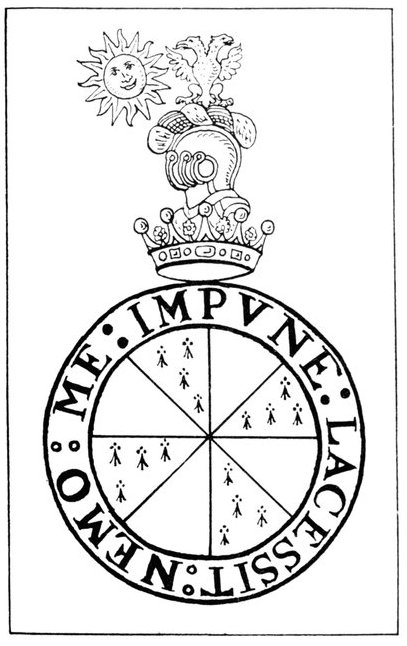
Arms.—Gyronny of eight, erm. and gu. Campbell
of Auchmannoch.
Crest.—A double-headed eagle, on the dexter side
a sun in glory ppr.
Coronet.—That of an Earl.
Helmet.—That of a Peer.
Motto.—Nemo me impvne lacessit, being the motto
of the Order of the Thistle.
[Settle. Irene Triumphaus. London, 1713.]
Hugh Campbell (born c. 1666, died 20th November 1731) was the
eldest son of James, 2nd Earl of Loudoun. He succeeded to the title in
1684. Lord Loudoun held several important official posts in Scotland; he
was a Lord of Session, a member of the Scottish Privy Council, and a
Commissioner of the Treasury. In 1704 he was a joint Secretary of State
for Scotland, and a Commissioner for the Union. In 1707 Lord Loudoun
was made a Knight of the Order of the Thistle, and shortly afterwards
Keeper of the Great Seal of Scotland and a member of the English Privy
Council.
Lord Loudoun fought at Sheriffmuir in 1715. He was one of the
Scottish representative peers in the House of Lords, and Lord Lieutenant
of Ayrshire. The Earldom of Loudoun descends through the female line
and has consequently belonged to various families; it has been held by
representatives, among others, of the families of Rawdon, Campbell, and
Hastings.
Arms.—Impaled.
Dexter: Quarterly.
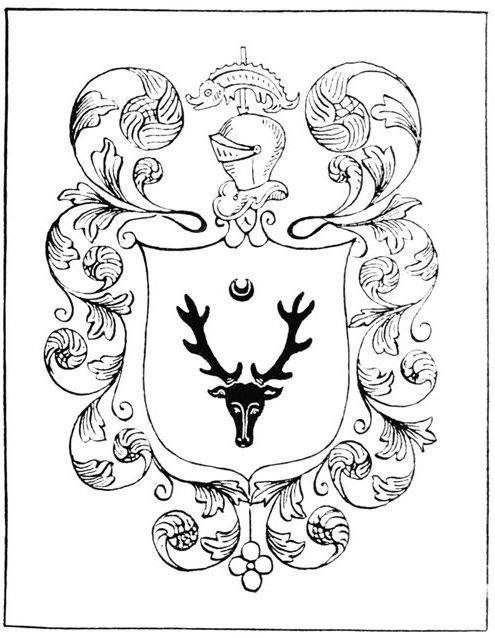
1. Or, a hart's head caboshed sa., attired gu.
Calder.
2. Gyronny of eight, or and sa. Campbell.
3. Arg., a lymphad sa. Lorn.
4. Per fess, az. and gu., a cross or. Lort.
Sinister: Quarterly.
1 and 4. Barry of 10, or and sa. Botevile.
2 and 3. Arg., a lion rampant, tail nowed and
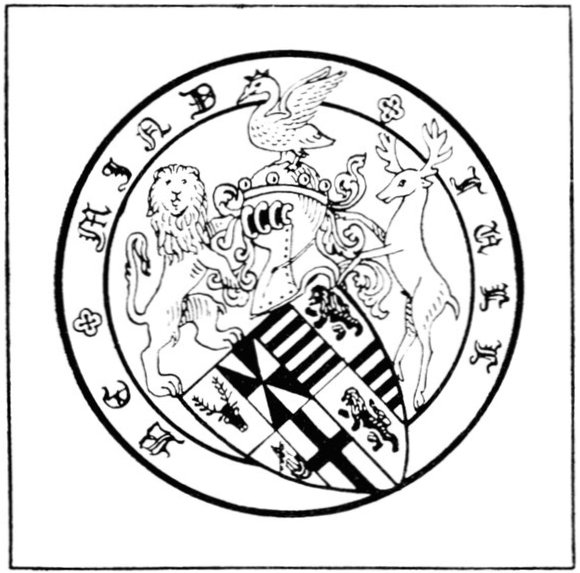
erected gu. Thynne.
Crest.—A swan ppr., crowned or.
Coronet.—That of a Baron.
Helmet.—That of a Peer.
Supporters.—Dexter, a lion rampant guardant gu.
Sinister, a hart ppr.
Motto.—Be mindfull.
[Caxton. Chronicles of England. Westminster, 1482.]
John Frederick Campbell (born 8th November 1790, died 7th November
1860) was the eldest son of John Campbell of Stackpole Court, Pembrokeshire,
first Baron Cawdor. In 1821 John Frederick succeeded to his
father's Barony, and in 1816 he married Elizabeth Thynne, daughter of
the Marquis of Bath. In 1827 he was created Earl Cawdor of Castlemartin.
He was a Fellow of the Royal Society, and Lord Lieutenant of
Carmarthen.
The coat-of-arms of Calder, which is given the place of honour in
Lord Cawdor's coat, is borne by right of Muriel, heiress of John Calder,
or Cawdor, of Nairn. She married Sir John Campbell, son of Archibald,
Earl of Argyll, about 1510, and was the ancestress of the present family.
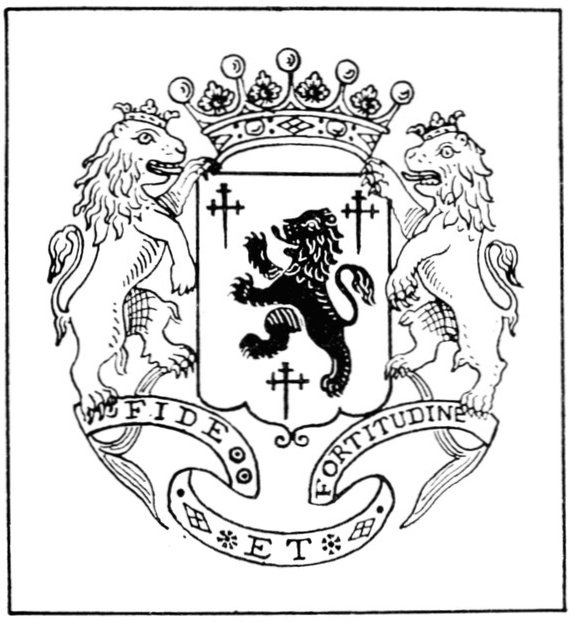
Arms.—Gu., a lion rampant between 3 crosses crosslet
fitchée or. Capell.
Coronet.—That of an Earl.
Supporters.—Two lions rampant arg., ducally crowned
gu.
Motto.—Fide et fortitudine.
[Basnage. History of the Jews. London, 1708.]
William Capell (born 1697, died 17th January 1742) was the son of
Algernon, Earl of Essex, and succeeded his father in the Earldom in 1710.
Lord Essex held several important offices, among them those of
Keeper of Hyde Park, Ambassador to Sardinia in 1735, Captain of the
Yeomen of the Guard, Ranger of St. James's Park, and Lord Lieutenant
of Hertfordshire. In 1725 he was made a Knight of the Order of the
Thistle, and in 1738 a Knight of the Garter.
Arms.—Or, 3 lioncels passant sa. Carew.
[Prateolus. Elenchus Haereticorum. Coloniae, 1605.]
George Carew (born 29th May 1555, died 22nd March 1629) was the
son of George Carew, Dean of Windsor, and educated at Oxford. In
1583 he was Sheriff of Carlow in Ireland, and was Knighted in 1585.
Sir George Carew held several important military appointments in Ireland,
and became Master of the Ordnance and commander of expeditions to Cadiz
and other places, and in 1598 he was Ambassador to France. In 1600 he
was President of Munster, and shortly afterwards Vice-Chamberlain to
Anne, Queen Consort, and Member of Parliament for Hastings.
In 1605 he was created Baron Carew, and he became Master of the
Ordnance in England and Governor of Guernsey, and in 1625 he was
created Earl of Totness, and afterwards became Treasurer-General to
Queen Henrietta Maria.
Lord Totness was an excellent antiquary and a friend of Sir Robert
Cotton. He collected manuscripts, especially those concerning Ireland, and
his collections are now scattered, but are chiefly to be found in the British
Museum, at Lambeth, in the Bodleian Library at Oxford, at Hatfield, or in
the State Paper Office.
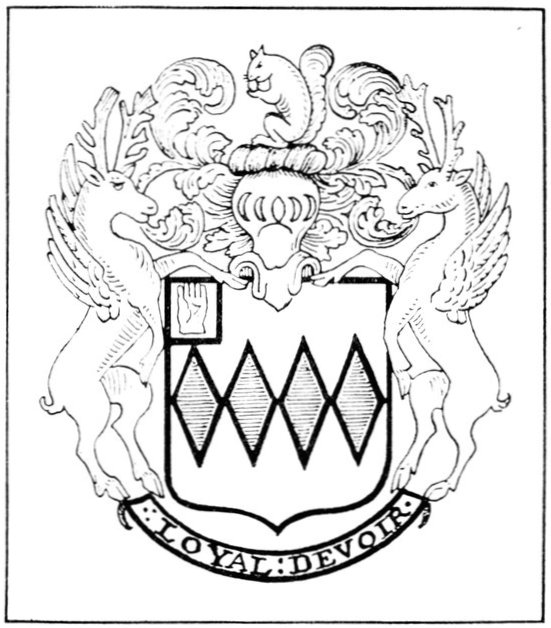
Arms.—Gu., four fusils in fess arg., with the Ulster
hand gu., in an escutcheon arg., in the dexter chief.
Carteret.
Crest.—On a mount vert, a squirrel sejant, cracking a
nut ppr.
Helmet.—That of a Peer, but wrongly shown, as it
should be in three-quarters position.
Supporters.—Two winged stags.
Motto.—Loyal devoir.
[Churchill. Divi Britannici. London, 1675.]
George Carteret (born 1669, died 1695) was the grandson of Sir George
Carteret, Governor of Jersey, who had been created a Baronet by Charles I.
in 1645. In 1681 Sir George was created Baron Carteret of Hawnes,
and married Grace, daughter of John Granville, Earl of Bath, in 1674.
In 1714 she was created Countess Granville, and at her death her son
John succeeded to the Earldom.
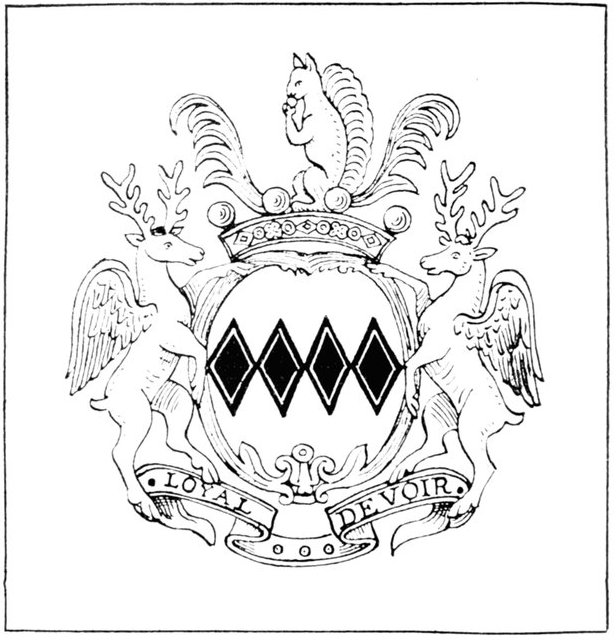
Arms.—Gu., four fusils in fess arg. Carteret.
Crest.—On a mount vert, a squirrel sejant, cracking
a nut ppr.
Coronet.—That of a Baron.
Supporters.—Two winged stags.
Motto.—Loyal devoir.
[Thucydides. De Bello Peloponnesiaco. Oxonii, 1696.]
[Sir William Worsley, Bart., Hovingham Hall, York.]
John Carteret (born 12th April 1690, died 2nd January 1763) succeeded
his father as second Baron Carteret in 1695, and in 1744 became Earl
Granville on the death of his mother, Countess Granville, whose Earldom
was created January 1, 1714. Lord Granville was a Lord of the Bedchamber
to George I., and in 1716 Lord Lieutenant and Curtos
Rotulorum of Devonshire. In 1719 he was Ambassador to Sweden.
In 1721 Lord Granville was Secretary of State, and three years later
Lord Lieutenant of Ireland. He was also a Knight of the Garter. In
1710 he married Frances, daughter of Sir Robert Worsley, Bart., of
Appledurcombe, in the Isle of Wight.
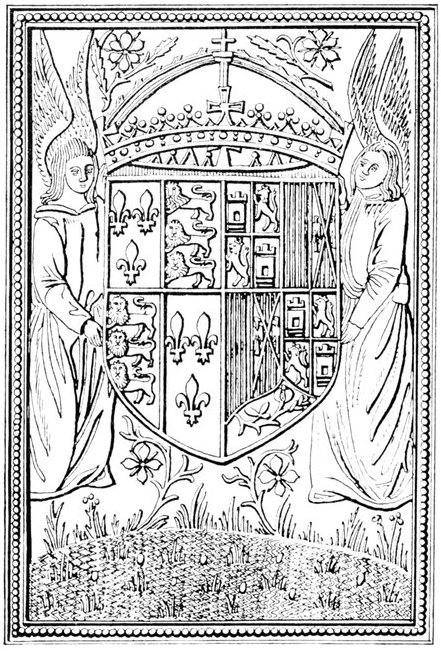
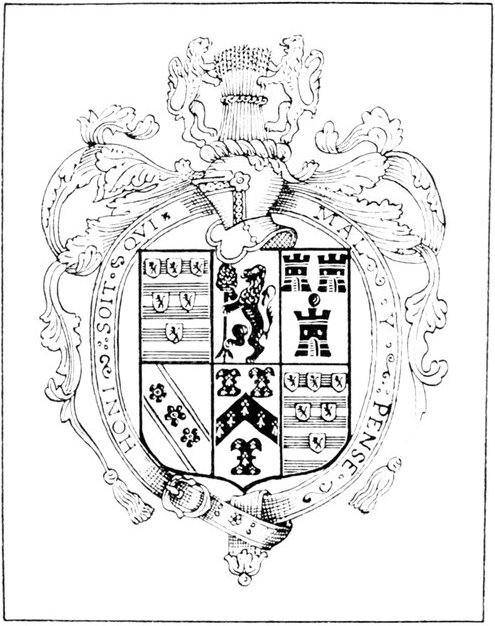
Arms.—Impaled.
Dexter: Quarterly.
1st and 4th, France.
2nd and 3rd, England. All as used by Henry
VIII. (q.v.).
Sinister: Quartered.
1st and 4th grand quarters, quarterly.
1 and 4. Gu., a castle or. Castile.
2 and 3. Arg., a lion rampant gu. Leon.
2nd and 3rd grand quarters, per pale.
Dexter: Or, paly of 4 gu. Aragon.
Sinister: Per saltire arg., 2 eagles displayed
sa. and or, paly of 4 gu. Sicily.
In the base point, arg., a pomegranate or.
Grenada.
Ensigned with a Royal Crown and supported by two
angels.
[Holkot. Opus revera insignissimum in librum Sapietie
Salomonis editum. Parisius, 1518.]
Catherine of Aragon (born 15th December 1485, died 6th January
1536) was the youngest daughter of Ferdinand and Isabella of Spain, and in
1501 she married Arthur, Prince of Wales, who died in 1502.
In 1509, Catherine married Henry VIII., and they had several children,
of whom only Mary, afterwards Queen, survived her infancy. Henry
VIII. divorced Queen Catherine in 1533, on the plea that the marriage
was illegal as she was his brother's widow, and in the same year he married
Anne Bullen, who was one of the Queen's Maids of Honour.
Queen Catherine died at Kimbolton Castle, Huntingdonshire, in 1536,
and was buried at Peterborough. A few of her books came with the old
Royal Library to the British Museum in 1757. She was fond of literature
and a patron to learning of all sorts, and a friend of Erasmus. She
appointed Ludovicus Vives, a well-known Spanish savant and author, to
be tutor to her daughter Mary.
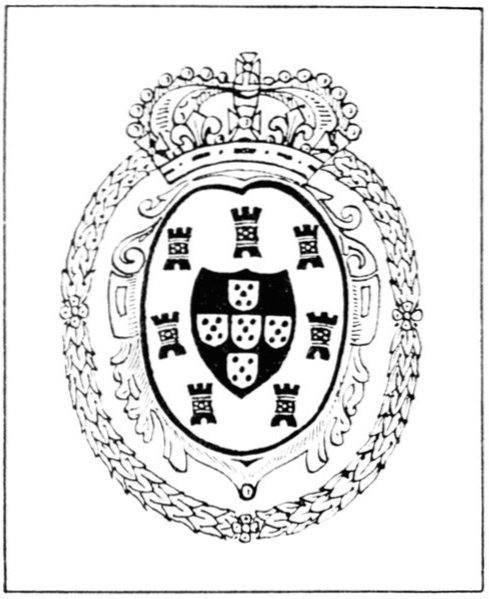
Arms.—Arg., 5 shields az., 1, 3, and 1, each charged
with 5 plates, 2, 1, and 2; a bordure of Castile, gu., 7
towers or, 3, 2, and 2. Portugal.
Crown.—The Royal Crown of England.
[Jesus Maria Joseph; or, The devout Pilgrim of the Virgin
Mary. Amsterdam, 1663.]
[Edward Almack, Esq., F.S.A., Brighton.]
Catherine of Braganza (born 15th November 1638, died 31st December
1705) was the daughter of John, Duke of Braganza, who in 1640 became
Juan IV., King of Portugal. In 1662 the Princess Catherine married
Charles II., King of England, and as part of her very large dowry, the
King received Tangier, commanding the Straits of Gibraltar, and Bombay.
After Charles's death Queen Catherine retired to Portugal, where in
1704-5 she acted ably as Regent for her brother, Pedro II.
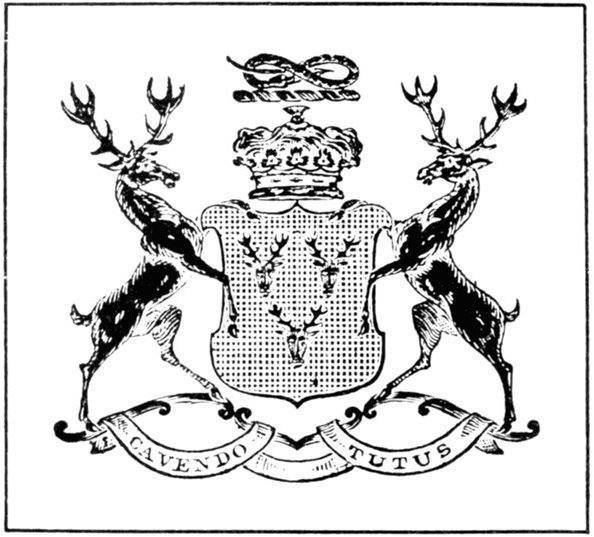
Arms.—Sa., 3 bucks' heads, caboshed arg. Cavendish.
Crest.—A serpent nowed ppr.
Coronet.—That of a Duke.
Supporters.—Two bucks ppr.
Motto.—Cavendo tutus.
[Theodocritus. Δ. Χαλκονδυλου ἐρωτηματα συνοπτικα των ὀκτω
του λογου μερων μετα τινων χρησμων κανονων. Milan, 1493.]
William George Spencer Cavendish (born 21st May 1790, died 17th
January 1858) was the son of William, fifth Duke of Devonshire, and
succeeded to the family honours in 1811.
The Library at Chatsworth was already one of much importance, but
the sixth Duke of Devonshire added to it so extensively that he is generally
considered as its founder. He purchased rare books at all the great sales of
his time, and removed the books which had accumulated at his other
residences to Chatsworth. His collection has been further added to by
successive owners.
The Duke was a Knight of the Garter, a Member of the Privy Council,
Lord Lieutenant and Custos Rotulorum of Derbyshire, and High Steward
of Derby. In 1821 he carried the orb at the Coronation of George IV.
In 1826 he was Ambassador Extraordinary to Russia, and twice held the
office of Lord Chamberlain of the Household. At the Coronation of
Queen Victoria His Grace carried the Sword "Curtana," the square-tipped
Sword of Mercy.
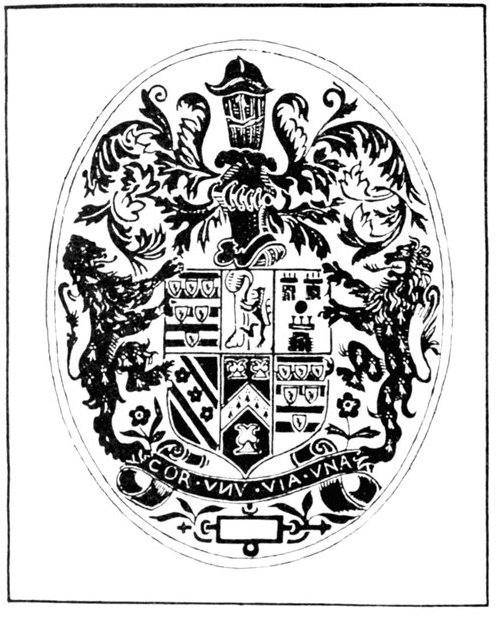
Arms.—Quartered.
1 and 6. Barry of 10, arg. and az.; over all six
escutcheons sa., 3, 2, and 1, each charged
with a lion rampant of the first. Cecil.
2. Per pale, gu. and az. a lion rampant arg.,
supporting a tree eradicated vert. Wynstone.
3. Sa., a plate between 3 castles arg. Etchington.
4. Gu., on a bend cotised arg., 3 cinquefoils sa.
Berondon.
5. Arg., a chevron erm., between 3 chess-rooks.
Pinchbeck.
Crest.—Six arrows in saltire or, barbed and
feathered arg., girt together with a belt gu., buckled
and garnished or, over the arrows a morion cap ppr.
Helmet.—That of a Peer.
Supporters.—Two lions rampant erm.
Motto.—Cor · vnv · via · vna.
[Hebrew Bible. Antverpiae, 1582.]
Variety.—Within the Garter, the crest is shown
without the morion cap, and the two Supporters are
moved up from the side of the shield, the usual place
for Supporters, and used as Supporters for the crest.
[Ariosto. Orlando Furioso in English Heroical Verse,
by John Harington. London, 1591.]
William Cecil (born 13th September 1520, died 4th August 1598) was
the son of Richard Cecil, Master of the Robes to Henry VIII. He was
educated at Cambridge, and soon showed a remarkable ability. After
Cambridge Cecil went to Gray's Inn and studied Law, and presently
came under the personal notice of Henry VIII., who at once took a strong
liking to him. At Court Cecil rapidly gained place and power, and
under the Protector Somerset he became Secretary of State. He steered
his way with some difficulty through the troubles accruing through the
claim of Lady Jane Grey to the throne, but managed to escape serious
misfortune, and was elected Member of Parliament for Lincolnshire.
At this time he also made himself useful to the Princess Elizabeth,
then holding a difficult political position, and when she became Queen
in 1558 she at once made Cecil a member of her Privy Council and
Secretary of State. In 1563 he was Speaker of the House of Commons.
Although not on friendly terms with the Earl of Leicester, and in a
position which gave cause to much envy, Cecil was able to retain
the confidence of Queen Elizabeth, who, in 1571, created him Baron
Burghley, and shortly afterwards a Knight of the Garter.
Lord Burghley seems to have had a considerable library, and most of
his books have upon them one or other of his beautiful stamps, sometimes
in gold and sometimes in blind.
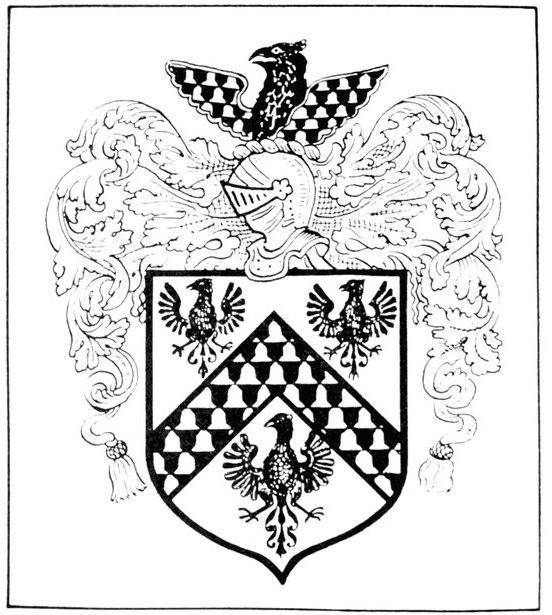
Arms.—Arg., a chevron vairé between 3 eagles
displayed vert. Challeston.
Crest.—A demi eagle vert, wings displayed vairé.
Helmet.—That of an Esquire.
[Stow. Survey of London. 1618.]
The family of Challeston does not appear to have distinguished itself
in any of the ordinary ways, but the arms are described in Burke's General
Armory, and also in Papworth's Dictionary of Coats-of-Arms.
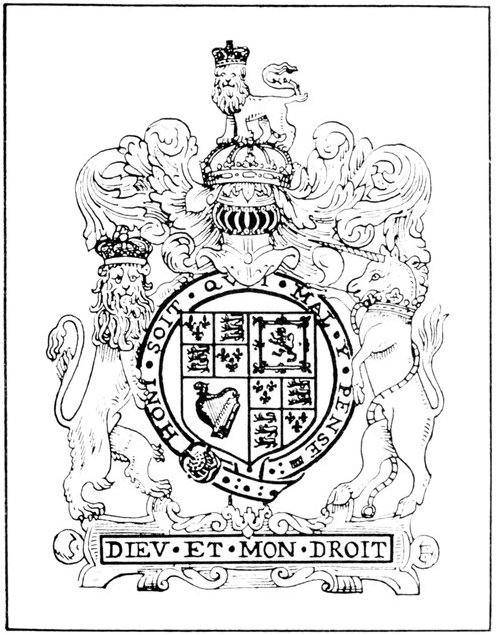
Arms.—Within the Garter. Quarterly.
1st and 4th grand quarters; France and England
quarterly.
2nd grand quarter; Scotland.
3rd grand quarter; Ireland. All as used by
James I. (q.v.).
Crest.—A Royal Crown ppr., thereon a lion statant
guardant or, crowned ppr.
Helmet.—Royal.
Supporters.—A lion and a unicorn, as used by
James I. (q.v.).
Motto.—Diev et mon droit.
[Cespedes y Meneses. Historia de Don Felipe III., Rey
de las Españas. Barcelona, 1634.]
Prince Charles (born 29th November 1600, died 30th January 1649)
was the second son of James I., and on the death of his brother Henry
became heir to the Crown. He was created Prince of Wales on 3rd
November 1616, and while holding this rank he often used some of his
brother's book-stamps, differentiating them, however, by the addition of his
initials "C. P.," and also by the substitution of gold for silver in places
where the latter metal had been used by Prince Henry, as, for instance, in
the case of the label of the eldest son and the feathers in the Prince of
Wales' plumes.
As Prince, Charles had a few small books bound for him in red
leather, the first instance of its use for English Royal bindings, and
towards the end of his reign again he had several fine bindings made for
him in the fine red morocco which was so largely used by Samuel Mearne
for Charles II. Whether Charles I.'s red bindings were made by Mearne
is doubtful, but it is possible that they were. They are quite plain except
for the fine coat-of-arms in the centre, and for delicate gold tooling, of
Mearne style, in the panels of the back. Charles I. was a patron of the
Arts and a man of cultured and literary tastes. The style of binding
that is generally associated with his name is of a better order than the
semis and heavy corners which marked the bindings made for James I.
Many of James I.'s stamps were, however, used by King Charles I., and
in a majority of cases it is only by the date of the printing of the book
that it is possible to say to which king the volume belonged. There is a
tendency for the corner-pieces to become less, and also a tendency to
substitute a more distinguished manner with regard to small gold toolings
than that of the formal symmetrical repetition so prevalent in the previous
reign.
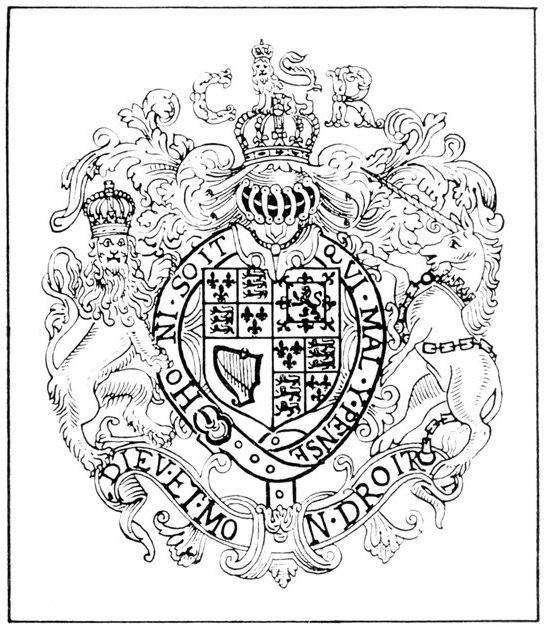
Arms.—Within the Garter. Quarterly.
1st and 4th grand quarters; France and England
quarterly.
2nd grand quarter; Scotland.
3rd grand quarter; Ireland. All as used by
James I. (q.v.).
Crest.—A Royal Crown ppr., thereon a lion statant
guardant or, crowned ppr.
Helmet.—Royal.
Supporters.—A lion and a unicorn, as used by
James I. (q.v.).
Motto.—Diev et mon droit.
Initials.—C. R. (Carolus Rex).
[Reynold's Works, 1658.]
Variety.—Without Supporters.
[Common Prayer. London, 1660.]
Variety.—Within the Garter and without Supporters.
[Paraphrasis in Psalmos Davidis. Salmurii, 1662.]
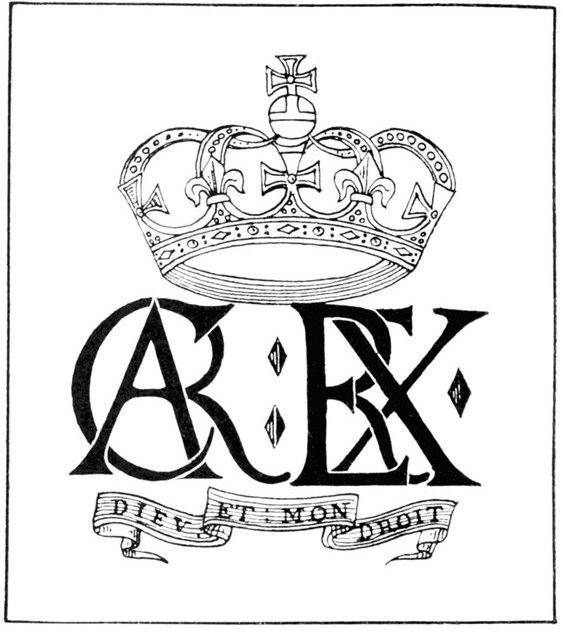
The Royal name and title abbreviated. "Car.
Rex" (Carolus Rex) ensigned with a Royal Crown,
and with the motto "Diev et mon droit."
[Sanderson. Complete History of the Life and Raigne
of King Charles. London, 1658.]
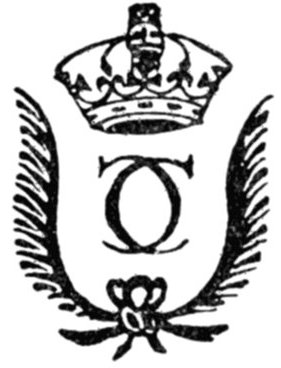
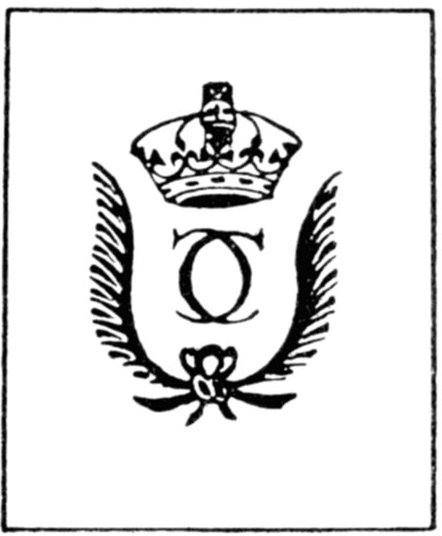
Crowned initials "C.C." adossés, within palm
branches, commonly found on books bound for
Charles II. by Samuel Mearne, the Royal Bookbinder.
[Cranzius. Vandaliae and Saxoniae Alberti Cranzii
Continuatio. Wittebergae, 1586.]
Charles II. (born May 1630, died 6th February 1685) was the
elder son of Charles I. In 1660 Charles ascended the throne of
England, although his accession is sometimes counted from the date of
the death of Charles I., 30th January 1649. In Scotland it is always
so dated.
Samuel Mearne was appointed Royal Bookbinder to Charles II. in
June 1660, and he bound the greater number of the King's books in a
beautiful red morocco. On most of these bindings the King's initials
within a palm spray appear, and sometimes the edges of the leaves of
the books have designs painted upon them, only showing when the book
is open. Charles II. also used several of the book-stamps that had been
made for Charles I.
Mearne was one of the greatest bookbinders of any time, and apart
from the splendid work he did for Charles II., he executed numbers of
other bindings, many of which are inlaid and have the leather stained
and painted. He invented what is known as the "Cottage" design,
and his style and detail is often copied even at the present time.
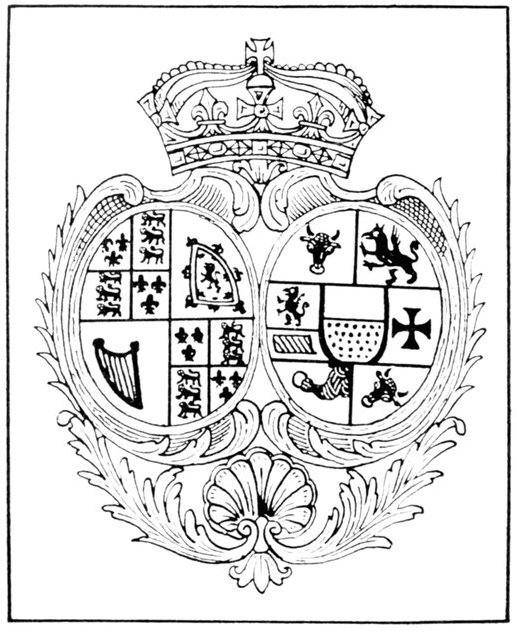
Arms.—On two separate shields, side by side.
Dexter shield: Quarterly.
1st and 4th, France and England, quarterly.
2nd, Scotland.
3rd, Ireland. All as used by James I. (q.v.).
Sinister shield, the arms of Charlotte of Mecklenburg.
Quartered.
1. Arg., a bull's head in pale sa. (crowned
gu.), armed and ringed arg. Mecklenburg.
2. Az., a griffin segreant or. Wenden.
3. Vert, in chief az., a griffin segreant or.
Principality of Schwerin.
4. Gu., a cross pattée arg. Ratzeburg.
5. Gu., an arm armoured ppr., holding a ring
or, issuing from a cloud. County of
Schwerin.
6. Or, a bull's head sa., in bend sinister (crowned
gu.), armed and ringed arg. Rostock.
Over all, on an escutcheon of pretence, the arms of
Stargard, per fess, gu. and or.
The two shields are ensigned with the Royal Crown
of England.
This stamp is probably of foreign design, as it will
be noted that the Royal coat-of-arms of England is as
that used by Queen Anne before 1706, and not that
used by George III., for whom it is intended.
[Ceffalonie. Monument élevé à la gloire de Pierre-le-Grand.
Paris, 1777.]
Charlotte Sophia (born 16th May 1744, died 17th November
1818) was the youngest daughter of Charles Louis, Grand Duke of
Mecklenburg-Strelitz.
In 1761 the Princess married George III., King of England, and
her married life was uneventful. As Queen she devoted herself entirely
to domestic matters.
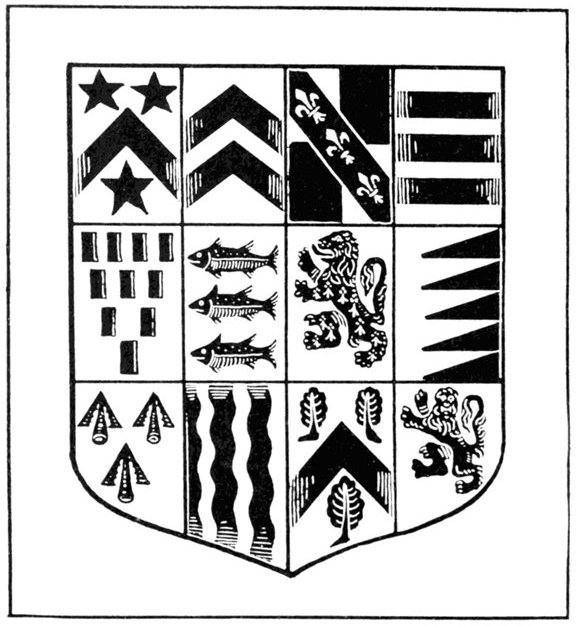
Arms.—Quartered.
1. Az., a chevron between 3 mullets or. Chetwynd.
2. Arg., 2 chevrons az. Bagot.
3. Quarterly, arg. and az., on a bend gu., 3 fleurs-de-lys
or. Garshall.
4. Arg., 3 bars sa. Raymond.
5. Gu., 10 billets or. Salter.
6. Sa., 3 fishes naiant in pale or. Verney.
7. Gu., a lion rampant erm. Meriford.
8. Gu., 5 piles issuing from the sinister.
Henderson (?).
9. Sa., 3 pheons arg. Egerton of Shropshire.
10. Paly wavy of 6, arg. and gu. Gurnon.
11. Arg., a chevron between 3 oak leaves vert.
Haslerigg.
12. Az., a lion rampant or. Hetherfield.
[Democritus. Anatomy of Melancholy. Oxford, 1628.]
Walter Chetwynd (born circ. 1620, died 1693) was a son of Walter
Chetwynd of Ingestre, in Staffordshire. He was Member of Parliament
for Stafford, and for Staffordshire, and Sheriff in 1680.
Chetwynd was a Fellow of the Royal Society, and an Antiquary,
particularly as concerned the County of Staffordshire. He was a friend
of Dr. Robert Plot, who wrote The Natural History of Staffordshire
in 1686, and assisted him in many ways. His collections of drawings
and manuscripts were nearly all lost in a fire at Ingestre in 1882.
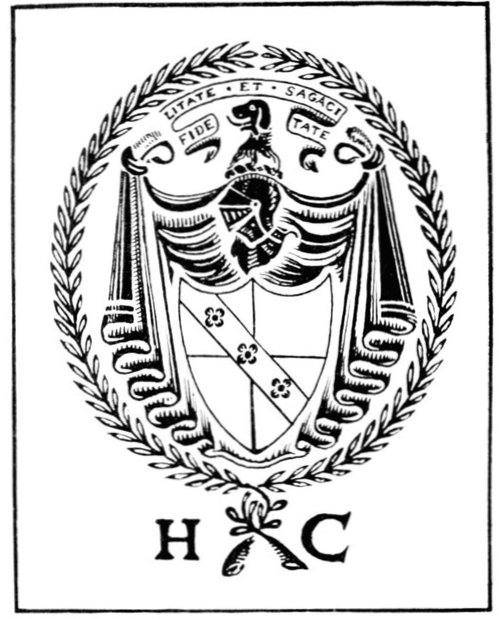
Arms.—Quarterly; arg. and az., on a bend gu., 3
quatrefoils of the first. Chitting.
Crest.—A talbot's head erased arg.
Helmet.—That of an Esquire.
Motto.—Fidelitate et sagacitate.
Initials.—H. C. (Henry Chitting).
[Collection of rolls of the reigns of many kings. Stowe, 601.]
Henry Chitting (born 1580 (?), died 1638) was a herald and genealogist.
In 1618 he became Chester Herald, and conducted several of the heraldic
visitations of English counties. Chitting wrote a valuable work on the
Extinct Baronage of England, and others of less general importance.
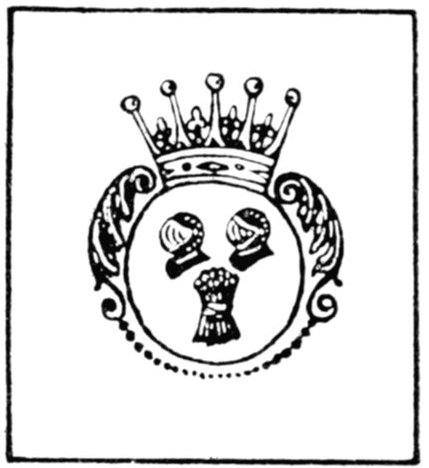
Arms.—Gu., in chief 2 helmets in profile arg., and
in base a garb or. Cholmondeley.
Coronet.—That of an Earl.
[Faerni. Fabulae. London, 1743.]
George Cholmondeley (born 2nd January 1702, died 10th June 1770)
was the son of George, second Earl Cholmondeley, and succeeded his
father in the Earldom in 1733. He was Member of Parliament for East
Looe, and afterwards for Windsor, and Governor of Chester Castle. In
1725 Viscount Malpas, the courtesy title used by George Cholmondeley,
was made a Knight of the Order of the Bath, and he subsequently held
the offices of Master of the Robes, Master of the Horse, and was Lord
Lieutenant of North Wales and of Montgomery. In 1736 he became
Chancellor of the Duchy of Lancaster, and in 1743 Lord Privy Seal. He
held the rank of Lieutenant-General in the army.
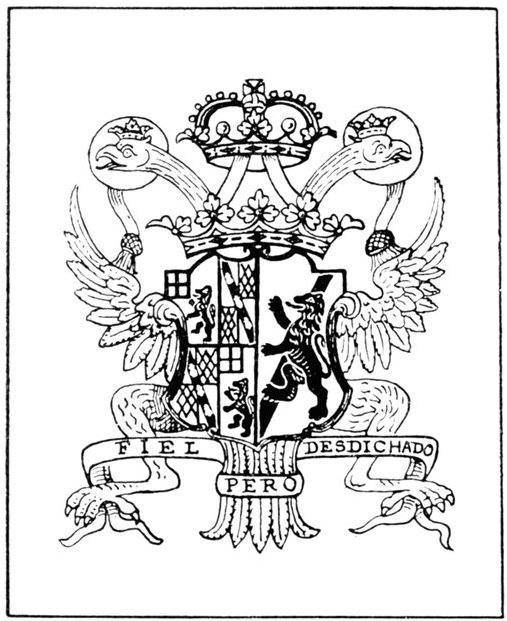
Arms.—Impaled.
Dexter: Quarterly.
1st and 4th sa., a lion rampant arg., on a canton
of the last a cross gu. Churchill.
2nd and 3rd quarterly, arg. and gu., in the
second and third quarters a fret or; over all
on a bend sa., 3 escallops of the first. Spencer.
Sinister: Or, a bend sa.; over all a lion rampant
gu. Abernethy (?).
Coronet.—That of a Duke.
Motto.—Fiel pero desdichado.
The whole arms are borne upon an Imperial eagle,
the heraldic indication of the rank of a Prince of the
Holy Roman Empire, a dignity given to John Churchill,
Duke of Marlborough. The eagle is ensigned with a
closed crown, the circlet of which bears the strawberry
leaves and pearls of an English Marquis.
[Ferrarotto. Della preeminenza dell' officio di Stradicò
della nobile città di Messina. Venetiis, 1593.]
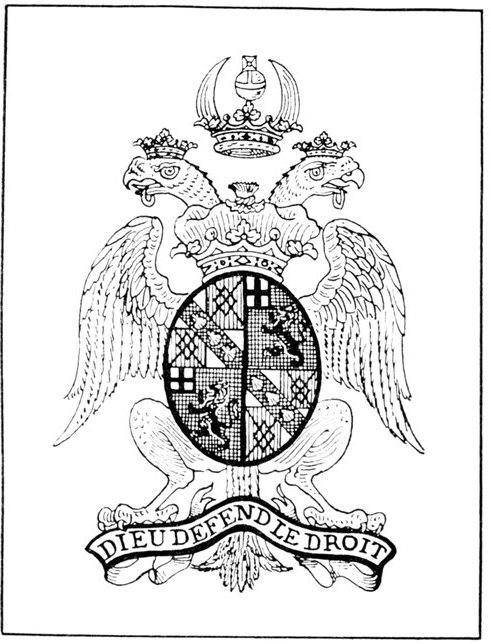
Variety.—Used as Marquis of Blandford before 1817.
Spencer.
Arms.—Quarterly.
1st and 4th quarterly, arg. and gu., on the second
and third quarters a fret or; over all on a bend
sa., 3 escallops of the first. Spencer.
2nd and 3rd sa., a lion rampant arg., on a canton of
the last a cross gu. Churchill.
Coronet.—That of a Marquis.
Motto.—Dieu defend le droit.
The whole arms are borne upon an Imperial eagle
as before, but in this case the whole is ensigned with a
Royal orb between the two horns of a crescent arg.,
issuing from a Marquis's coronet.
[Colonna. Discours du Songe de Poliphile. Paris, 1654.]
George Spencer, afterwards Spencer-Churchill (born 6th March 1766,
died 5th March 1840), was the son of George, fourth Duke of Marlborough.
He was educated at Eton and Oxford, and served as Member of Parliament
for Oxfordshire and for Tregony, and was a Lord of the Treasury. He
married Susan, daughter of the Earl of Galloway.
In 1817, on the death of his father, he succeeded to the Dukedom of
Marlborough, and in the same year he assumed by Royal Licence the
surname and arms of Churchill in addition to his patronymic of Spencer.
This was done in memory of the first Duke of Marlborough, who left no
male heir, but whose second daughter Anne had married Charles Spencer,
third Earl of Sunderland, and their son Charles, fifth Earl of Sunderland,
succeeded his aunt Henrietta, suo jure Duchess of Marlborough, in the
Dukedom in 1733. While Marquis of Blandford the Duke collected a
magnificent library at his house, White Knights, near Reading, but
extravagance in living compelled him to part with it by auction in 1819.
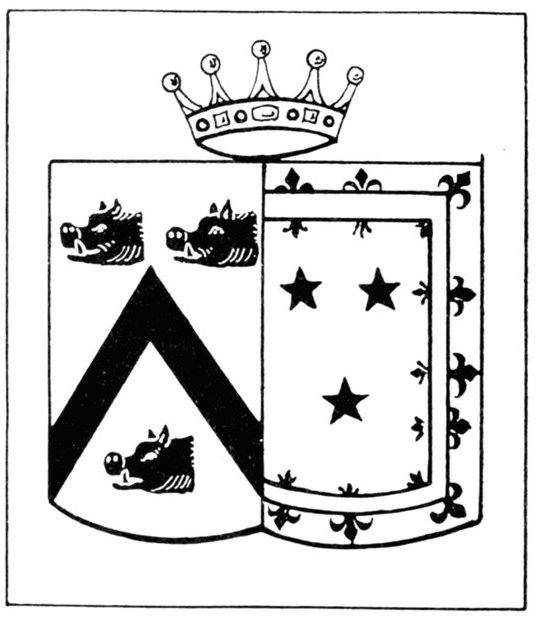
Arms.—Impaled.
Dexter: Arg., a chevron gu., between 3 boars' heads
erased arg. Cochrane.
Sinister: Az., 3 mullets arg., within a double tressure
flory counterflory or. Murray.
Coronet.—That of an Earl.
[Settle. Virtute Sacellum. London, 1720.]
John Cochrane (born 1660 (?), died 5th June 1720) was the second son of
John, second Earl of Dundonald, and succeeded his brother William in the
Earldom in 1705. In 1706 he married Anne, daughter of Charles Murray,
Earl of Dunmore. Lord Dundonald was a Representative Peer of
Scotland and Colonel of the 4th Regiment of Horse Guards.
Crest.—On a mount vert, a stag lodged reguardant
arg., attired sa., and gorged with a chaplet of laurel leaves
vert. Cocks.
Coronet.—That of a Baron.
[Common Prayer. London, 1669.]
John Somers Cocks (born 6th May 1760, died circ. 1841) was the son
of Charles Cocks, Baron Somers, and was educated at Oxford. He was
successively Member of Parliament for West Looe, for Grampound, and
for Reigate. In 1806 he succeeded to his father's barony, and in 1821
was created Earl Somers. Lord Somers married as his second wife,
Jane, daughter of his Uncle James, and widow of the Rev. George
Waddington.
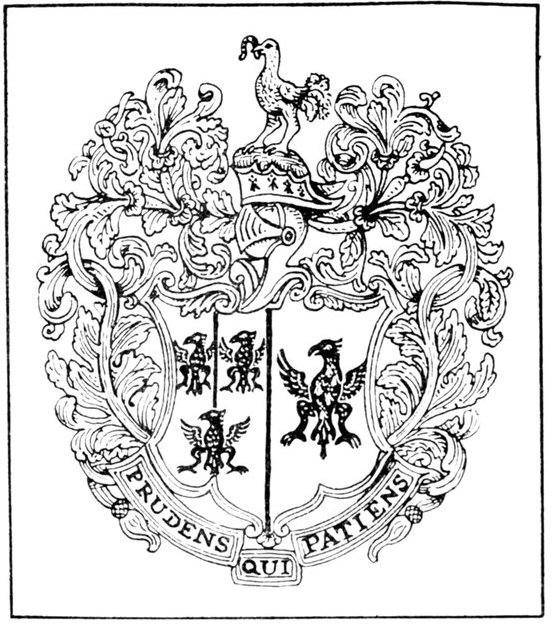
Arms.—Impaled.
Dexter: Per pale, gu. and az., 3 eagles displayed
or. Coke.
Sinister: Sa., an eagle displayed erm. Tufton.
Crest.—On a chapeau az., turned up erm., an ostrich
arg., holding in its mouth a horseshoe or.
Helmet.—That of an Esquire.
Motto.—Prudens qui patiens.
[Morgues. Diverses Pièces pour la Defense de la Royne
Mère du Roy Louys XIII. Paris, 1637.]
Thomas Coke (born circ. 1699, died 20th April 1759) was the eldest
son of Edward Coke of Holkham in Norfolk. In 1725 Mr. Coke was
made a Knight of the Order of the Bath, and in 1728 he was created
Baron Lovel. In 1733 Lord Lovel was Postmaster-General, and in 1744
he was given a step in the Peerage and created Viscount Coke and Earl of
Leicester. In 1718 Lord Leicester married Lady Mary Tufton, daughter
of Thomas, Earl of Thanet. He left no heir, but the Earldom of Leicester
was revived in 1837 in the person of one of his collateral descendants.
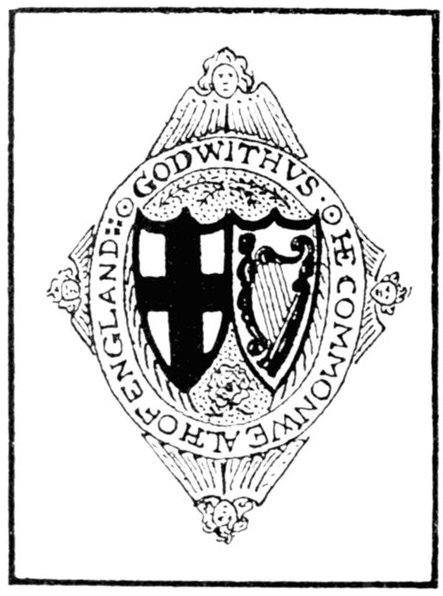
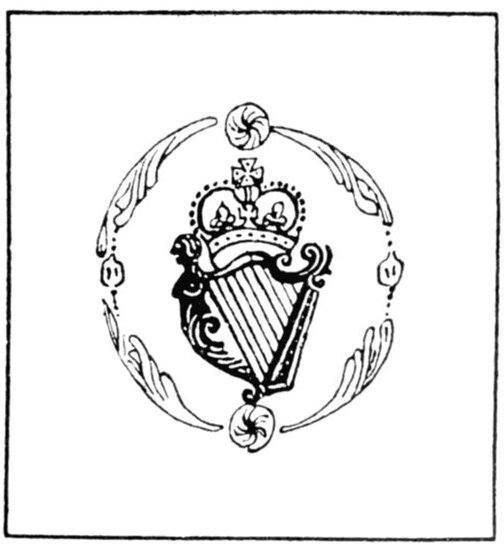
Arms.—On two separate shields side by side.
Dexter shield: Arg., a cross gu., being the arms of
St. George of England.
Sinister shield: Az., a harp or, stringed arg., being
the Harp of Ireland.
Motto.—God with vs.
Legend.—The Commonwealth of England.
[Proclamations of the Lord Protector, G. 5194.]
The Commonwealth was established in England in 1649, and Oliver
Cromwell made Protector. In 1649 Charles, Prince of Wales, was
crowned King at Scone, and in the next year at Carlisle. In 1658, on the
death of Cromwell, the people of England felt that the Commonwealth
had lasted long enough, and in 1660 Charles II. returned among general
rejoicings. From a bookbinding point of view the period of the
Commonwealth was one of little interest, but on the Restoration, Samuel
Mearne raised the standard of English bookbinding to a very high level.
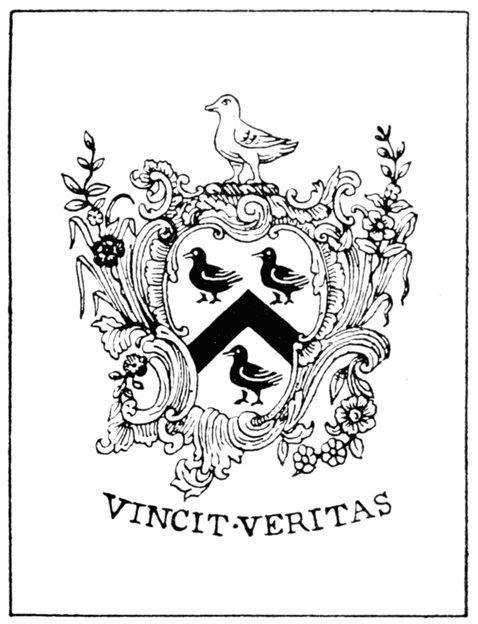
Arms.—Arg., a chevron between 3 coots sa. Coote.
Crest.—A coot ppr.
Motto.—Vincit veritas.
[Boulainvilliers. Parliaments of France.
London, 1739.]
Charles Coote (born circ. 1761, died 19th November 1835) was the
son of a London bookseller, John Coote, and was educated at St. Paul's
School and at Oxford, where he distinguished himself by his diligence and
literary tastes. He took his D.C.L. degree in 1789. Dr. Coote wrote
several historical works of much importance, and in 1789 he was admitted
to the College of Advocates, but he never appears to have taken much to
law. His son H. C. Coote was an author of much note and a high
authority on the subject of the Romans in Britain.
Arms.—Quartered.
1. Az., an eagle displayed arg. Cotton.
2. Sa., a fess dancetté between 3 mullets arg.
Wesenham.
3. Or, a saltire gu., a chief of the first. Bruce.
4. Three piles gu., meeting in point. Wishart;
over all on an escutcheon or, a lion rampant
sa., within a double tressure flory counterflory
of the second. Buchanan.
5. Or, a lion rampant sa., a chief gu.
Beauchamp (?).
6. Az., a cross flory between 4 martlets or.
King Edward the Confessor.
[Breviary of the Diocese of Salisbury. Parisiis, 1499.]
Variety, with four quarterings only.
[Papeburg. Comment. Basileae, 1551.]
[Sir W. Worsley, Hovingham Hall, York.]
Robert Bruce Cotton (born 22nd January 1570, died 6th May 1631) was
the eldest son of Thomas Cotton of Connington, Huntingdon. At an early
age he began to collect manuscripts, especially English ones, and the dissolution
of the monasteries in the earlier half of the sixteenth century
afforded him excellent opportunity of acquiring invaluable examples. So
valuable was Cotton's collections, much of it containing official documents,
that twice it was sequestrated by the Government; some of it, however,
was restored to him. He was made a Baronet in 1611, having previously
received the honour of Knighthood. The part of the collection of
manuscripts which had been retained by the Government of the day was
eventually restored to his son Sir Thomas Cotton.
A grandson of Sir Robert, Sir John Cotton, desired to present the
collection to the Nation, together with Cotton House, with various conditions
as to name and safe custody, and after tedious negotiations the
collection became National property and was deposited in Essex House,
Strand; in 1730 it was moved to Ashburnham House, in Little Dean's
Yard, Westminster, then the property of the Government, where also the
old Royal manuscripts were kept. In 1731 a fire occurred at Ashburnham
House, and a large number of manuscripts were burnt and many others
badly injured. The remainder were then stored in a dormitory at Westminster
School, and here they remained until they were transferred to the
British Museum in 1757.
The Cottonian collection of manuscripts is now kept in the Manuscript
Department at the British Museum; but there are numbers of printed
books as well that are widely distributed. A member of the Cotton
Family is always a Family Trustee of the British Museum. Sir Robert
Cotton wrote a large number of tracts, mainly political. The Cottonian
MSS. are curiously arranged under the names of the Roman Emperors.
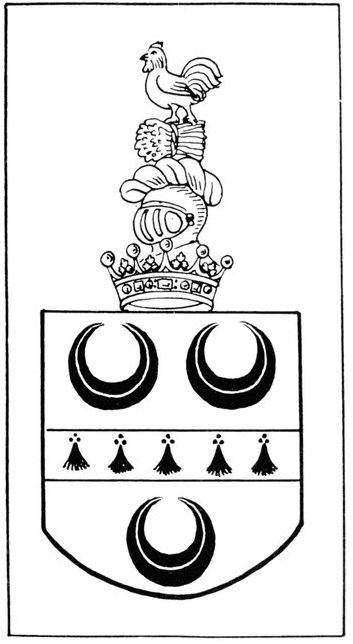
Arms.—Sa., a fess erm., between 3 crescents sa.
Crest.—A garb or, lying fesswise, thereon a cock gu.,
comb, wattles, and legs of the first.
Coronet.—That of an Earl.
Helmet.—That of a Peer.
[Settle. Honori Sacellum. London, 1712.]
William Coventry (born c. 1688, died 18th March 1750) was the son of
Walter Coventry of London, the lineal representative of Walter Coventry,
brother of the first Earl of Coventry, in which line, by special limitation,
the Earldom was allowed to rest. Mr. Coventry was Member of Parliament
for Bridport, and succeeded to the Earldom of Coventry in 1719.
He was Lord Lieutenant and Custos Rotulorum of the county of
Worcester, a Member of the Privy Council, and Clerk Comptroller of
the Green Cloth.
Arms.—Quartered.
1. Gu., a fess ermine between 3 martlets or.
Covert.
2. Erm., 2 bars and a canton gu. Boyes.
3. Gu., a fess between 3 lions' heads couped or.
St. Clair.
4. Arg., a chevron between 3 garbs gu. Sheffield.
5. Or, 2 crescents, 1 and 1, gu., a canton
erm. Symonds.
6. Lozengy, arg. and gu., a fess sa. Rockly.
7. Arg., a cross sa., with 2 crosses crosslet fitchée
of the last in the upper cantons. Balderstone.
8. Arg., on a chief gu., 3 lions rampant arg.
Yonge.
9. Or, a cross gu. Bourke.
10. Arg., 5 fusils in bend, gu. Bradeston.
11. Arg., on a chief gu., 3 crosses pattée fitchée
of the first. Dyall.
12. Arg., 3 garbs gu. Comyn.
13. Lozengy, arg. and sa., each lozenge sa., charged
with a martlet or. Croft (?).
[Babington's Works. London, 1615.]
William Covert of Kent belonged to an old family, members of which
were settled in Kent, Surrey, and Sussex since the sixteenth century.
John Covert, a member of the same family, had a command at the
Siege of Boulogne in 1558.
Arms.—Arg., 3 martlets gu., 2 and 1, on a chief
engrailed of the last, as many annulets or. Cowper.
Note.—The annulets are wrongly shown on this
stamp.
[Settle. Fears and Dangers. London, 1706.]
William Cowper (born c. 1655, died 10th October 1723) was the son
of Sir William Cowper, Bart., M.P. for Hertford, and succeeded to his
father's Baronetcy in 1706. He was educated at St. Albans, and entered
the Middle Temple in 1681, and became a great lawyer and politician.
In 1706 he was made Lord Keeper of the Great Seal and created Baron
Cowper of Wingham. In 1707 he was Lord High Chancellor, and
in 1718 was created Earl Cowper. Lord Cowper was a Fellow of the
Royal Society, a Governor of the Charterhouse, and Lord Lieutenant
of Hertfordshire.
Arms.—Or, a saltire erm., between 4 lions' heads
erased sa. Cracherode.
Crest.—A demi boar saliant reguardant or, wounded
in the shoulder with an arrow ppr., which he holds in
his mouth.
Note.—Probably designed and the stamp cut by
Roger Payne.
[Suetonius. Opera. Leovardiae, 1715.]
Clayton Mordaunt Cracherode (born 23rd June 1730, died 5th April
1799) was a son of an officer of Marines, Colonel Mordaunt Cracherode.
Clayton Cracherode was educated at Westminster and Christchurch,
Oxford, and was a Fellow of the Royal Society, and of the Society of Antiquaries,
and a Trustee of the British Museum. He was ordained shortly
after leaving Oxford. On the death of his father, Mr. Cracherode became
a rich man, and spent his fortune freely in collecting choice books,
bindings, drawings, prints, coins, and gems, always getting the finest
examples procurable.
Mr. Cracherode was an eccentric and shy recluse; he hardly ever left
London, and his life is said to have been embittered by the fact that he
was liable to act as King's Cup-bearer at a coronation, his manor at Great
Wymondley being held on that Tenure. The collections made by Mr.
Cracherode were all bequeathed to the British Museum except two
books, a Bible left to the Bishop of Durham, and a Homer to Cyril
Jackson, Dean of Christchurch, but both of these eventually were given
to the Museum Library. Several of Mr. Cracherode's books were bound
for him by Roger Payne, one of the greatest English bookbinders.
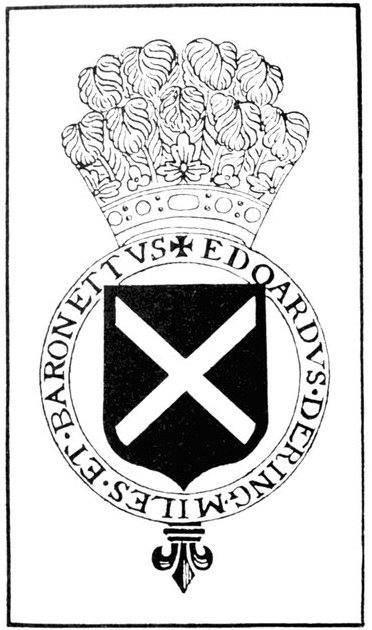
Arms.—Or, a saltire sa. Dering.
Crest.—Out of an heraldic coronet a plume of 9
ostrich feathers, 4 and 5, arg.
Legend.—Edoardvs dering miles et baronettvs.
[The Catholike Moderator. London, 1623.]
Edward Dering (born 28th January 1598, died 22nd June 1644) was
the son of Sir Anthony Dering of Surrenden. He was educated at Cambridge,
and soon became a collector and lover of antiquities.
In 1619 Dering received the honour of Knighthood, and in 1627
became a Baronet. He represented Kent in the House of Commons, and
interested himself much in religious matters. He eventually got into trouble
with Parliament about some of his writings, and was imprisoned for a time
in the Tower. He raised a regiment for the King at the commencement
of the Civil War, and in consequence he suffered sequestration of his
estates. He does not appear to have succeeded well as a soldier. Dering
never recovered from the troubles incident upon his advocacy of the Royalist
cause, and he died in comparative poverty. He has left several works and
pamphlets, chiefly political or theological.
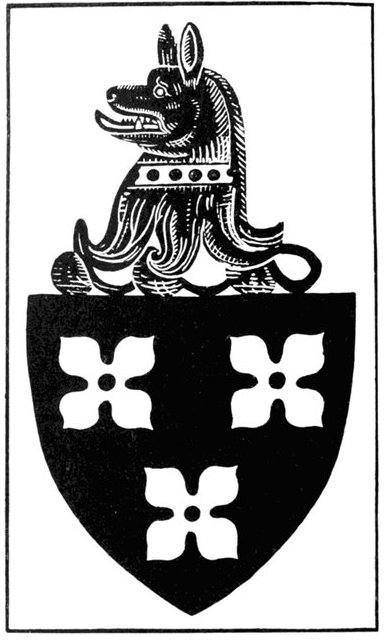
D'EWES, SIR SYMONDS, BARONET
Arms.—Or, 3 quatrefoils pierced gu. D'Ewes.
Crest.—A wolf's head erased or, about the neck a
collar vairé.
[D'Ewes. Journals of Parliaments temp. Eliz.
Harl. MS. 73.]
Symonds D'Ewes (born 18th December 1602, died 8th April 1650) was
the son of Paul D'Ewes of Milden in Suffolk. He went to Cambridge,
and was called to the Bar in 1623. His tastes were always of a literary
and antiquarian character, and he was a friend of Sir Robert Cotton. In
1626 he received the honour of Knighthood, and on his father's death in
1631 he inherited considerable property.
D'Ewes was High Sheriff of Suffolk and Member of Parliament for
Sudbury, and in 1641 he became a Baronet. He wrote many valuable
historical and antiquarian works; his "Diaries" are now in the British
Museum, as are several others of his manuscripts, forming part of the
Harleian Collection.
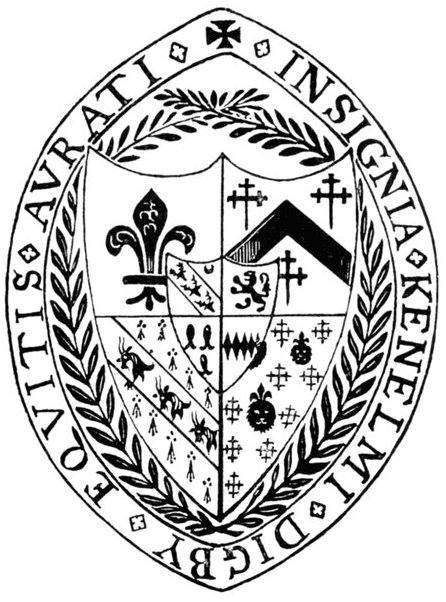
Arms.—Quarterly.
1. Az., a fleur-de-lys arg. Digby.
2. Arg., a chevron between 3 crosses crosslet
fitchée. Davenport.
3. Erm., on a bend sa., 3 goats' heads erased
arg., armed or. Mulsho.
4. Gu., semé of crosses crosslet arg., 3 leopards'
heads jessant-de-lys, arg. Neville.
On an escutcheon of pretence, the arms of Venetia
Stanley.
Quarterly.
1st and 4th grand quarters arg., on a bend az.,
3 bucks' heads cabossed or, a crescent for
difference. Stanley.
2nd grand quarter, quarterly.
1st and 4th or, a lion rampant az. The Duke
of Brabant.
2nd and 3rd gu., 3 lucies hauriant arg. Lucy.
3rd grand quarter az., 5 fusils conjoined in
fess or. Percy.
Crest.—An ostrich arg., with a horseshoe in his
mouth ppr.
Helmet.—That of an Esquire.
[Aristotle. Opera. Lut. Parisiorum, 1619.]
Variety.—Impaled.
Dexter: Quarterly.
| 1st and 4th, Digby. |
Sir Kenelm Digby. |
| 2nd and 3rd, Mulsho. |
Sinister: Quarterly.
| 1st and 4th, Stanley. |
Venetia Stanley. |
| 2nd and 3rd, The Duke of Brabant. |
[Boccalini. Delli Avvisi di Parnaso. Venetia, 1619.]
Variety.—Within a vesica.
Quarterly.
| 1. Digby. |
3. Mulsho. |
Sir Kenelm Digby. |
| 2. Davenport. |
4. Neville. |
On an escutcheon of pretence.
Quarterly.
| 1. Stanley. |
3. Lucy. |
Venetia Stanley. |
| 2. The Duke of Brabant. |
4. Percy. |
Legend.—Insignia Kenelmi Digby Eqvitis Avrati.
[Plato. Opera. Paris, 1578.]
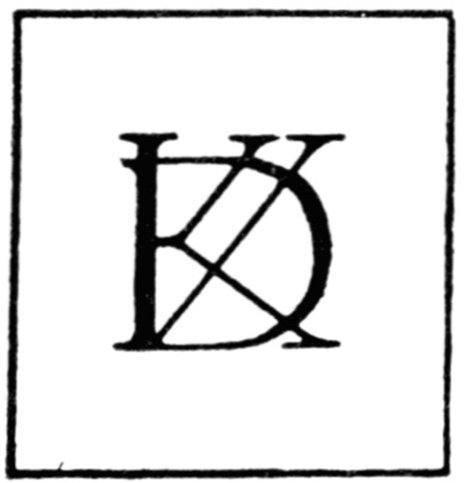
Initials "K.D." for Kenelm Digby,
and "V." for Venetia, his wife.
[Aristotle. Opera.
Lut. Parisiorum, 1619.]
Kenelm Digby (born 11th July 1603, died 11th June 1665) was the
elder son of Sir Everard Digby, Knight, and Mary Mulsho, his wife. He
inherited large estates from his father in spite of the fact that much
of Sir Everard's property had been confiscated. Kenelm Digby was
educated at Oxford, at Gloucester Hall, near Worcester College. He
travelled much on the Continent, particularly in France and in Spain. In
1623 he was Knighted by James I. Quite early in life he had fallen in
love with Venetia, daughter of Sir Edward Stanley, and in 1625 he
married her.
In 1627 Digby fitted out and commanded a curious privateering
expedition, and captured several French, Dutch, Spanish, Flemish, and
Venetian ships, but his conduct was disavowed by the English government.
Digby was suspected of popish sympathies and suffered various terms
of imprisonment in consequence, but in 1643 he was allowed to leave
England for France, and for a time he made his home in Paris, a town to
which he had always been very partial, and he appears to have been well
received by Louis XIV.
Sir Kenelm Digby wrote a large number of books, religious, philosophical,
and scientific; he was a man of much imagination, and took delight in
inventing quack medicines. He possessed a large library; many of his
books were presented to the Bodleian Library at Oxford, others are said
to have been given to Louis XIV., and others again were scattered.
On some of the volumes the coat-of-arms of Digby alone occurs, but
in the majority of cases the coat-of-arms is quartered with various other
family coats, and has also the coat-of-arms of Venetia Stanley either
impaled or borne as an escutcheon of pretence. Many of Sir Kenelm's
books were bound in Paris.
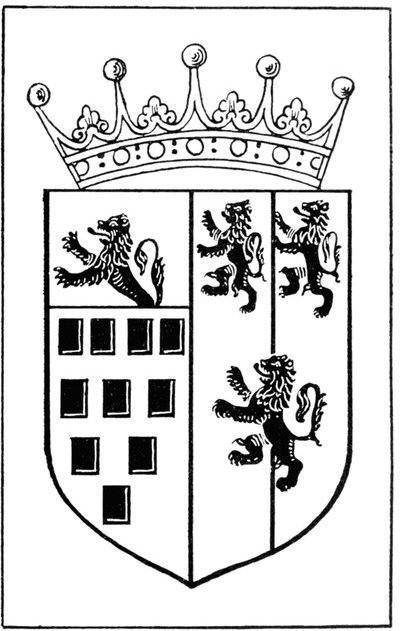
Arms.—Impaled.
Dexter: Az., 10 billets or, 4, 3, 2, and 1, on a
chief of the second a demi lion rampant issuant
sa. Dormer.
Sinister: Per pale, az. and gu., 3 lions rampant arg.
Herbert.
Coronet.—That of an Earl.
[Common Prayer. Dublin, 1621.]
Robert Dormer (born circ. 1610 (?), died 20th September 1643) was the
only son of Sir William Dormer, son of Robert, Baron Dormer of Wyng.
In 1616 Robert Dormer succeeded to the Barony of Dormer on the
death of his grandfather, his father having predeceased him. In 1628 he was
created Earl of Carnarvon, and in 1641 he was Lord Lieutenant of Bucks.
Lord Carnarvon was killed at the Battle of Newbury, where he fought
as a Royalist. He married in 1625 Anna Sophia Herbert, daughter of
Philip, Earl of Pembroke.
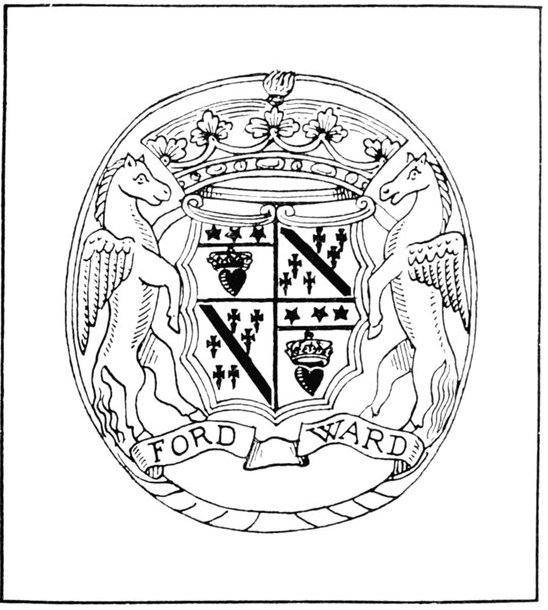
Arms.—Quarterly.
1st and 4th; arg., a human heart gu., imperially
crowned ppr., on a chief az., 3 mullets of the
field. Douglas.
2nd and 3rd; az., a bend between 6 crosses crosslet
fitchée or. Marr.
All within a bordure or, charged with the double
tressure (flory counterflory) of Scotland, added by Charles
II. to the coat of William Douglas, Earl of Queensberry,
when he conferred upon him the Marquisate of Queensberry
in 1681.
Coronet.—That of a Duke.
Supporters.—On each side a Pegasus arg., winged,
maned, and hoofed or.
Motto.—Fordward.
[Boethius. Scotorum Historiae a prima gentis origine.
Paris, 1526.]
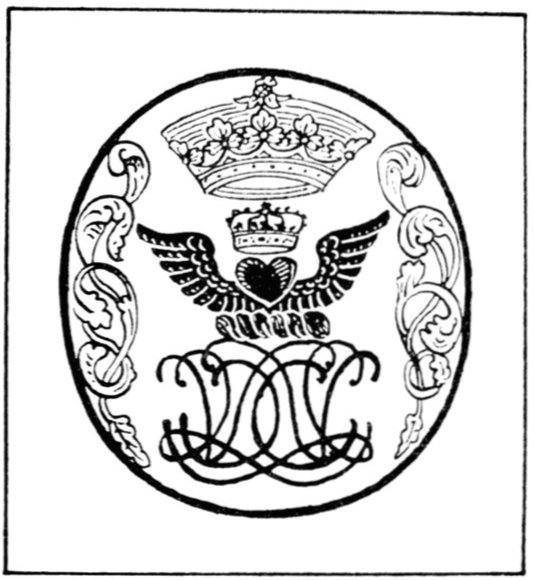
Crest.—A man's heart gu., ensigned with an imperial
crown ppr., and winged or. Douglas.
Coronet.—That of a Duke.
Initials.—W. D. (William Douglas).
[Pliny. C. Plinii Secundi Historiae Naturalis, Lib. xxxvii.
Lugd. Batavorum, 1635.]
William Douglas (born circ. 1637, died 28th March 1695), Viscount
Drumlanrig, was the son of James Douglas, second Earl of Queensberry.
In 1671 Lord Drumlanrig succeeded to his father's honours, and in
1681 he received a step in the Peerage, being created first Marquis of
Queensberry. In 1684 he was created Duke of Queensberry. His
Grace was Justice-General of Scotland in 1680 and a Lord of Session,
and from 1682 to 1686 he was High Governor of Edinburgh Castle.
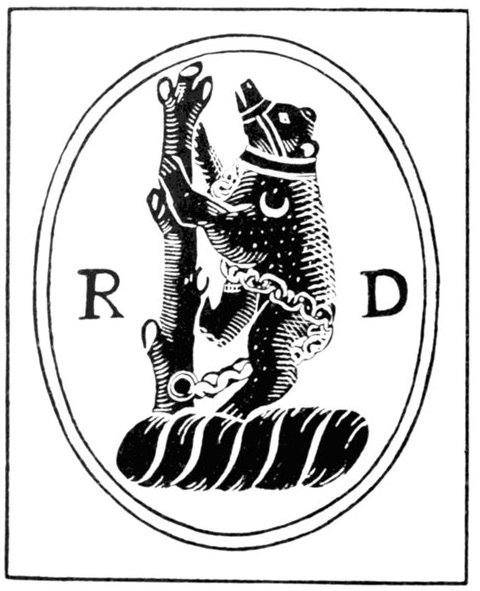
Crest.—A bear arg., muzzled and chained or, grimpant
on a staff raguly arg. A crescent for difference.
Dudley.
Initials.—R. D. (Robert Dudley).
[Trissino. La Italia Liberata. Venezia, 1547.]
Robert Dudley (born 24th June 1532, died 4th September 1588) was
a son of John Dudley, Duke of Northumberland. In 1549 he married
Amy Robsart, who was killed at Cumnor Place in Berks in 1560. It
was supposed this was done in order to allow of a marriage between
Dudley and Queen Elizabeth.
Lord Robert Dudley was a great favourite both of Edward VI., to
whom he had been a Gentleman of the Privy Chamber and Master of
the Buckhounds, and of Queen Elizabeth. He was for a time Member
of Parliament for Norfolk. With his father, the Duke of Northumberland,
Lord Robert conspired to place Lady Jane Grey on the throne of England,
and for this he was sentenced to death in 1553, but shortly afterwards he
was pardoned and restored in blood. Under Elizabeth Dudley received
many honours. He was made Master of the Horse, Lord Steward of the
Household, and Knight of the Garter in 1559, and in 1564 Earl of
Leicester. In 1564 he was elected Chancellor of Oxford University, and
in 1575 he entertained the Queen at his beautiful home at Kenilworth.
Leicester was Lord Lieutenant of Warwickshire and of other counties,
and his possessions were very great. He married a second time in 1573,
but left no heir.
The emblem of the ragged staff, or "Sable a staff raguly in bend
arg.," was used as a coat-of-arms by the ancient Earls of Warwick, and it
shows, as well as a bear, in the representations of the town of Warwick
held in the hands of figures in the "Rows Roll," written and illuminated
by John Rows of Warwick in the fifteenth century. The bear seems to
have been assumed as a cognizance by Earl Arthgallus, and may
either have been taken from the Warwick bear or as an allusion to his
name "Arth," in British meaning "Bear." The successive Earls of
Warwick used the bear and the ragged staff as a badge, and Robert
Dudley, Earl of Leicester, whose father, among other honours, was nineteenth
Earl of Warwick, used it as a crest. Lord Leicester used a chained
bear as his dexter supporter, and the ragged staff shows on one of his
many quarterings.
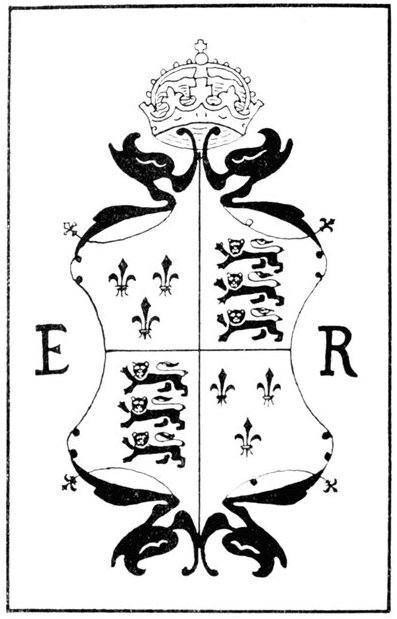
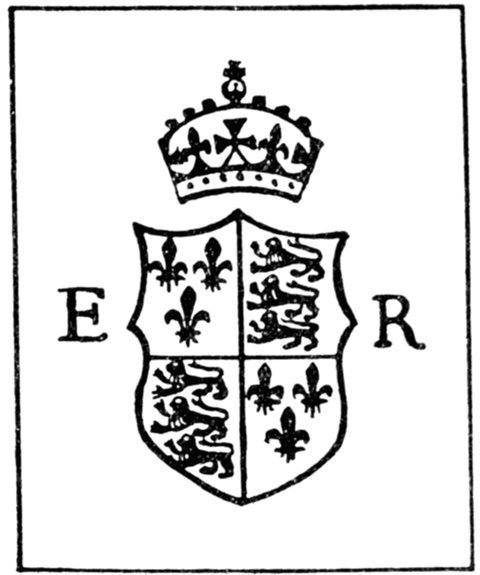
Arms.—Quarterly, France and England as used by
Henry VIII. (q.v.).
Crown.—Royal.
Initials.—E. R. (Edvardus Rex).
This coat-of-arms is upon a binding made for Edward
VI. by Thomas Berthelet, who had been Royal Bookbinder
to Henry VIII. It has been, however, transferred
to a volume which belonged to Queen Elizabeth.
[Public Acts. London, 1559.]
Variety.—Quarterly, France and England as used by
Henry VIII. (q.v.).
Crown.—Royal.
Initials.—E. R. (Edvardus Rex).
[Andreasi. De Amplitudine misericordiae Dei oratio.
Basileae, 1550.]
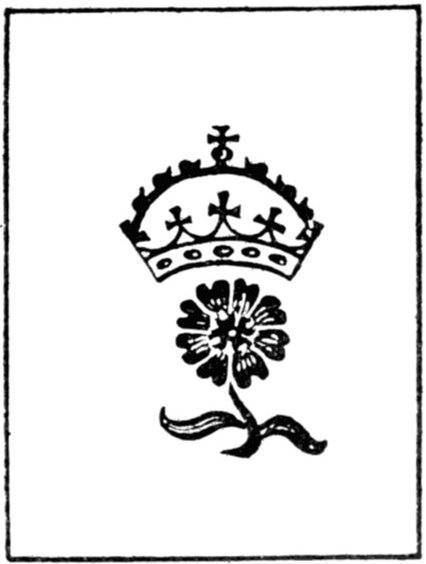
Badge.—A daisy ppr., crowned or.
The daisy was used as a badge by Edward VI., in
memory of his great-grandmother, Margaret Beaufort,
mother of Henry VII.
[Belief in Christ. London, 1550.]
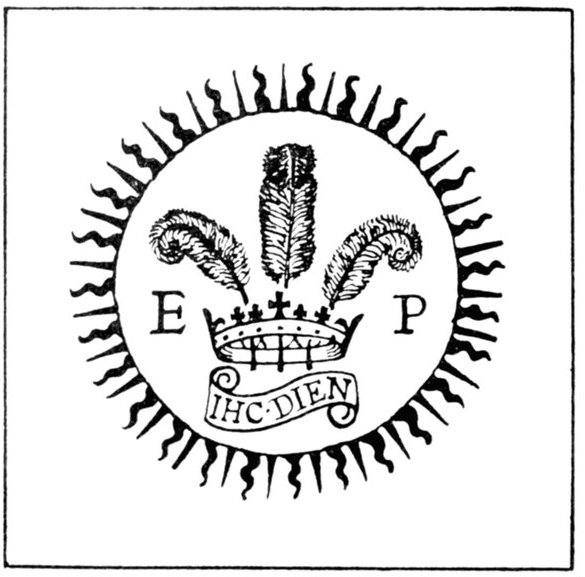
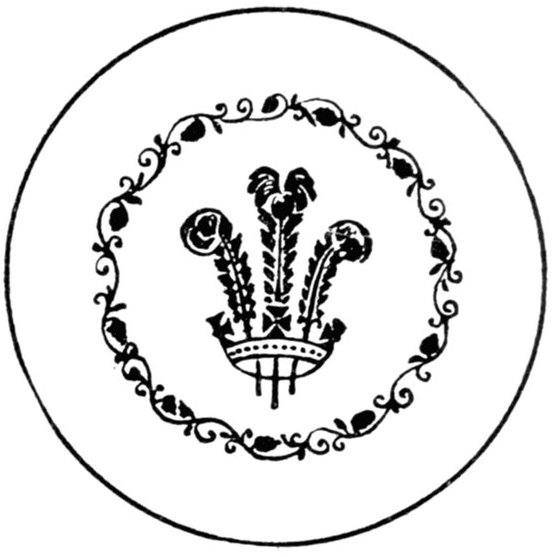
Badge.—The triple ostrich plume arg., of the Prince
of Wales, within a princely coronet or.
Motto.—Ihc (sic) dien.
Initials.—E. P. (Edward, Prince.)
[List of Cities, etc., named in Trogus Pompeius and in the
epistles of Cicero; addressed by Peter Olivarius to
Edward, Prince of Wales. 1546, MS.]
Prince Edward (born 12th October 1537, died 6th July 1553) was
the son of Henry VIII. and Queen Jane Seymour, his third wife. He
succeeded his father on the throne of England in 1547, and left the crown
by will to his cousin Lady Jane Grey, the result of which was that her
relatives endeavoured to place her upon the throne and she was beheaded
in 1554 by order of Queen Mary. Although the Prince of Wales's
plumes were used on the bindings made for Prince Edward, he never
was Prince of Wales. The majority of his bindings were made by
Thomas Berthelet, and they came to the British Museum with the rest
of the old Royal Library in 1757.
The supporters used by Edward VI. were the golden lion and the red
dragon, as they were used by Henry VIII. after 1528, but they do not
show on any of his bindings as far as is at present known.
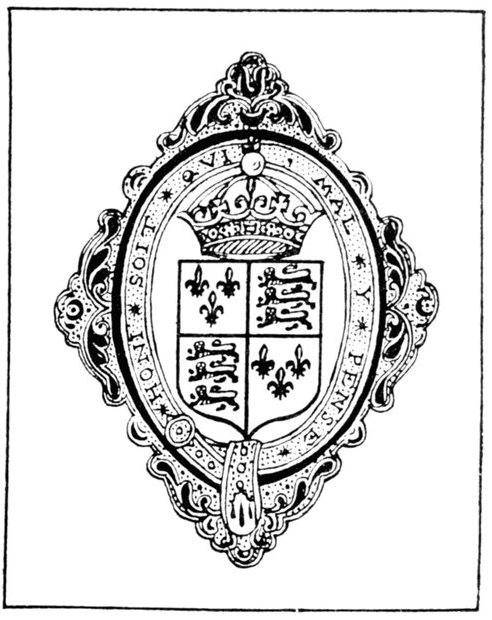
Arms.—Within the Garter, and surrounded by the
Collar of the Order of the Garter, dependent from which
is the Great George.
Quarterly.
1st and 4th; gu., 2 lions passant guardant in pale
or, langued and unguled az. England.
2nd; or, a lion rampant within a double tressure
flory counterflory gu. Scotland.
3rd; az., a harp or, stringed arg. Ireland.
Crown.—Royal.
[For illustration see the Frontispiece.]
Arms.—Quarterly.
1st and 4th grand quarters; arg., a lion rampant
gu., between 3 pheons sa. Egerton.
2nd grand quarter; quarterly, France and
England. Mary, daughter of Henry VII.
3rd grand quarter; barry of six, arg. and az.
Grey.
Coronet.—That of an Earl.
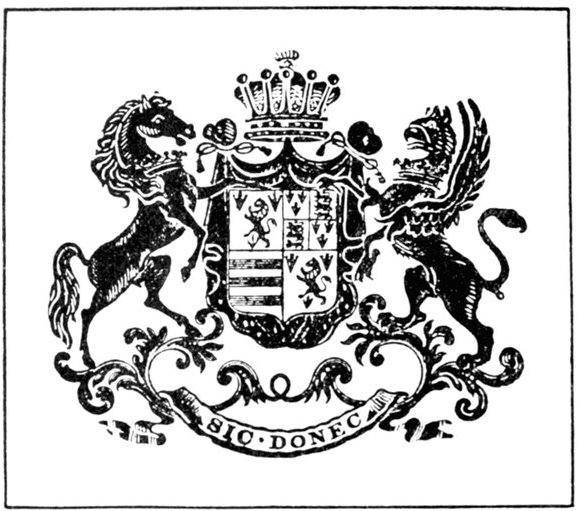
Supporters.—Dexter, a horse; sinister, a griffin; each
gorged with a ducal coronet.
Motto.—Sic donec.
[Rabani Mauri Tractatus super Librum Regum.
Eg. MS. 1783.]
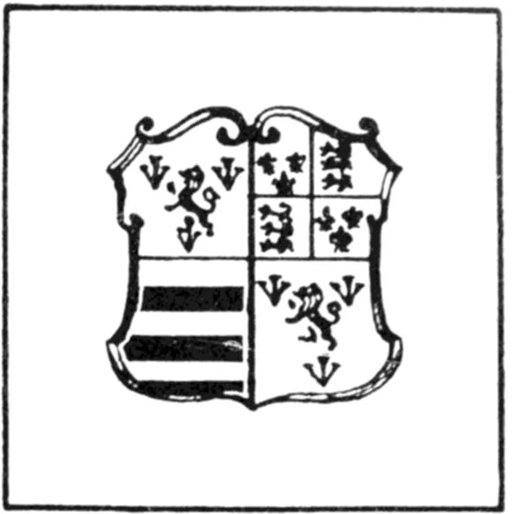
Variety.—The shield alone.
[Beza. Nov. Test. London,
1582.]
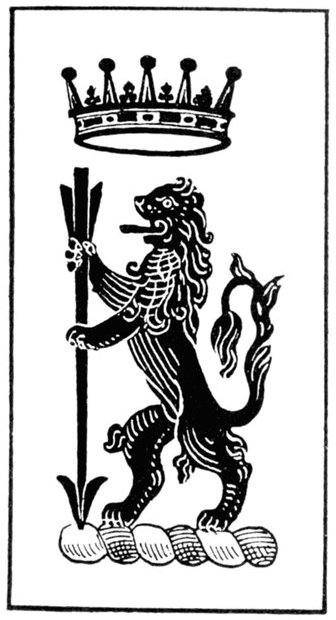
Crest.—A lion rampant gu.,
supporting an arrow erect or,
headed and feathered arg.
Coronet.—That of an Earl.
[Taylor. An arrant Thiefe.
London, 1625.]
Francis Henry Egerton (born 11th November 1756, died 11th
February 1829) was a son of John Egerton, Bishop of Durham. He was
educated at Eton and All Souls' College, Oxford, and was for a long time
Rector of Middle, Shropshire. He was a Fellow of the Royal Society and
of the Society of Antiquaries. Mr. Egerton was a scholar and a book
lover, and wrote several books, mostly genealogical, a subject of which he
was very fond.
In 1823, on the death of his brother, Mr. Egerton became Earl of
Bridgwater, but he remained in Paris, where he had lived for some time.
With the Peerage Lord Bridgwater inherited a large fortune, and he
bequeathed a large portion of this in the endowment of Literature, one
result of which was the "Bridgwater Treatises." He also left a very
large collection of manuscripts and other treasures to the Trustees of the
British Museum, with property to allow of accessions.
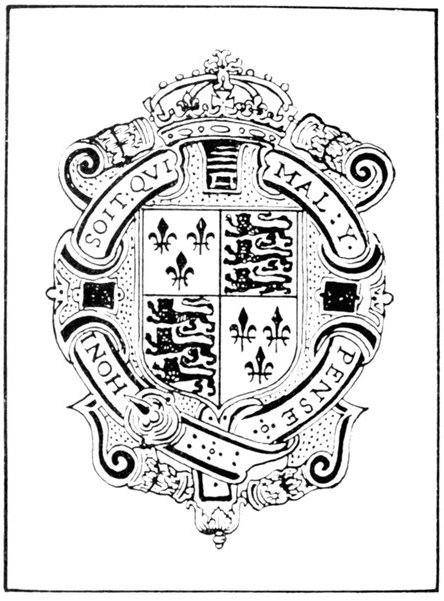
Arms.—Within the Garter. Quarterly, first and
fourth, France; second and third, England, as used by
Henry VIII. (q.v.).
Crown.—Royal.
[Grant. Graecae Linguae Spicilegium. London, 1577.]
Variety.—Within the Garter.
[Guicciardini. Historie. London, 1599.]
Badge.—Upon a mound or, a falcon arg., royally
crowned or, and holding in his dexter claw a Royal
sceptre or; growing on the dexter side of the mound a
rose-tree ppr., with red and white roses.
Queen Elizabeth used this badge in memory of her
mother, Queen Anne, at whose coronation it was shown in
a pageant. A falcon was the crest of the Ormond family,
and it is shown sculptured on the tomb of the Earl of
Wiltshire, father of Anne Bullen.
[Trogi Pompeii historiarum Philippicarum Epitoma.
Paris, 1581.]
Badge.—A Tudor rose, arg. and gu., seeded or, and
leaved vert. Ensigned with a Royal Crown.
[Caius. De Antiquitate Cantebrigiensis Academiae libri
duo. Londini, 1574.]
Badge.—A Tudor rose bearing a scroll upon which is
the name "Elizabeth."
[New Testament. London, 1532.]
The Princess Elizabeth (born 7th September 1533, died 24th March
1603) was the daughter of Henry VIII. and his second wife Anne Bullen.
In 1558 Elizabeth succeeded her half-sister Mary as Queen of England.
Queen Elizabeth loved magnificence of all kinds, and the bindings made
for her show a considerable range of style; several were sumptuously bound
in velvet with rich embroideries and pearls, some of these being made
by the workmen of Archbishop Parker; other velvet bindings were
stamped in gold, and had overlays of coloured satin. As Princess,
Elizabeth is supposed to have embroidered a few bindings; two of these
are now in the Bodleian Library at Oxford, and another is in the British
Museum. Others were in carved, engraved, or repoussé gold finely
enamelled, and numbers were in leather, both gold tooled and blind tooled;
some of the former were very likely bound for the Queen by the printer
John Day, who was the first English binder to use inlays of leather
coloured differently to the main part of the binding.
Small series of triple dots and small corner-pieces show for the first
time on small books bound for Queen Elizabeth towards the end of her
reign.
The supporters used by Queen Elizabeth were the golden lion and the
red dragon; they show on some of the beautiful painted bindings done for
the Queen, but not on any of the stamps. The Queen's portrait is sometimes
found stamped on her books.
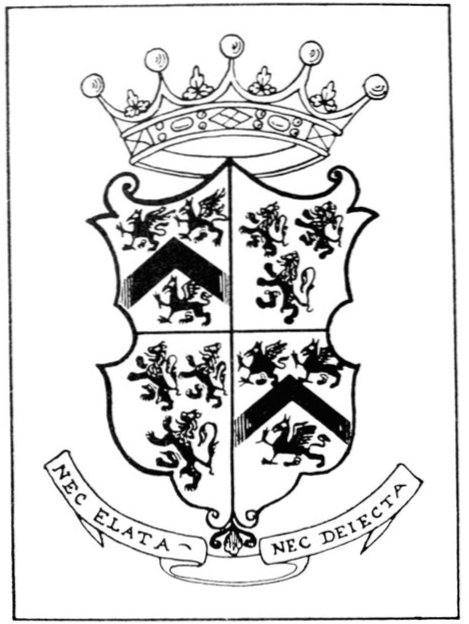
Arms.—Quarterly.
1st and 4th; arg., a chevron between 3 griffins
passant. Finch.
2nd and 3rd; per pale, az. and gu., 3 lions rampant
arg. Herbert.
Coronet.—That of an Earl.
Motto.—Nec elata nec deiecta.
[Sacchi. Platinae hystoria de vitis potificum.
Venetiis, 1511.]
Heneage Finch (born c. 1647, died 22nd July 1719) was the second
son of the first Earl of Nottingham. Mr. Finch was an eminent lawyer,
and in 1678 he became Solicitor-General. He was Member of Parliament
for Oxford, and in 1702, shortly after the accession of Queen Anne,
he was chosen to receive Her Majesty when she visited that city. On
this occasion he was created Baron of Guernsey. On the accession of
George I. Lord Guernsey was created Earl of Aylesford, and also made a
Member of the Privy Council and Chancellor of the Duchy of Lancaster.
Arms.—Within the Garter. Quarterly.
1st and 4th; gu., a lion rampant or. Fitz-Alan.
2nd and 3rd; sa., a fret or. Maltravers.
Crest.—Out of an heraldic coronet gu., a demi eagle,
wings displayed or.
Helmet.—That of a Peer.
Motto.—Virtvtis lavs actio.
Note.—Coloured. The earliest heraldic book-stamp
of an English subject as yet known.
[Aristotle. Venetiis, 1513.]
Badge.—A horse courant arg., bearing in his mouth
a sprig of oak ppr.
[Biblia. Venice, 1544.]
Henry Fitz-Alan (born c. 1511, died c. 1580) was the son of William,
Earl of Arundel, and succeeded his father in 1544.
Lord Arundel was a soldier of repute, and took part in the siege of
Boulogne in 1545. He gave political offence to the Earl of Warwick
in the reign of Edward VI. and was committed to the Tower. He
acted as Constable at the coronation of Queen Mary, and as Lord High
Steward at that of Queen Elizabeth. He was a Knight of the Garter.
Fond of books, Lord Arundel made a large collection of them, and
profited by the dissolution of the monasteries in the early sixteenth
century to add to his library at Nonsuch. Many of his books had
belonged to Archbishop Cranmer. He bequeathed his library to his son-in-law,
Lord Lumley, and they were nearly all purchased eventually by
Henry, Prince of Wales.
Arms.—Impaled.
Dexter: Quarterly.
1st and 4th; sa., a lion rampant or, crowned gu.
Pfalz-am-Rhein.
2nd and 3rd; lozengy, az. and arg. Bavaria.
Over all an escutcheon of pretence bearing a Royal
orb as an emblem of dominion.
Sinister: The Royal arms of James I. (q.v.).
Crest.—Out of a princely coronet, a lion sejant
or, crowned gu., between 2 buffalo horns lozengy, az.
and arg.
Supporters.—2 lions rampant or, crowned gu.
[Legrain. Decade contenant la vie et gestes de Henry le
Grand Roy de France. Paris, 1614.]
Frederick V., Elector Palatine of the Rhine, married the Princess
Elizabeth (born 15th August 1596, died 13th February 1662), daughter
of James VI. of Scotland, in 1613. In 1618, Frederick was elected King
of Bohemia; his acceptance of this dignity is said to have been largely due
to his wife's ambition. As Queen of Bohemia, Elizabeth's life was not
easy, and she was never popular at Prague, and in 1622 the Palatinate
was taken by the Duke of Bavaria. Her father, now James I. of England,
does not appear to have taken much interest in the Queen of Bohemia;
neither in turn did Charles I. In 1632 the King of Bohemia died, and
the Queen passed the latter part of her life in England.
Queen Elizabeth's youngest daughter, Sophia, Electress of Hanover,
was the mother of George I., King of England.
Arms.—Within the Garter. Quarterly.
1st; England and Scotland impaled.
2nd; France.
3rd; Ireland.
4th; the arms of the Royal Dominions in Germany.
As used by George I. (q.v.); over all the label arg.
of the eldest son of the King; and the whole ensigned
with a Princely coronet.
Crest.—A Princely coronet ppr., thereon a lion statant
guardant or, coroneted with a princely coronet ppr.
Helmet.—Royal.
Supporters.—The lion and unicorn of England,
differenced with a label of three points arg., and the
lion wearing a Prince's coronet.
Motto.—Ich dien.
[Papers relating to Cuba. London, 1744.]
Frederick Louis, Prince of Hanover, and afterwards Prince of Wales
(born 6th January 1707, died 20th March 1751), was the eldest son of
George, Electoral Prince of Hanover, afterwards George II., King of
England. In 1729 Prince Frederick was created Prince of Wales, but all
his life there were incessant quarrels between himself and his parents. In
1736 he married the Princess Augusta of Saxe-Gotha; it proved an
unhappy marriage.
The Prince of Wales died in 1751, from the after-effects of an
accidental blow from a tennis ball, and nobody appears to have regretted
him. He left nine children, the eldest of whom, George, succeeded to
the throne of England on the death of his grandfather in 1760. The
Prince of Wales' books were generally bound in red morocco, with one or
other of his armorial stamps, some of which bear the label of the eldest
son, and others do not. But they all have the motto "Ich dien," and
occasionally the initials "F. P." at the top on each side of the crest.
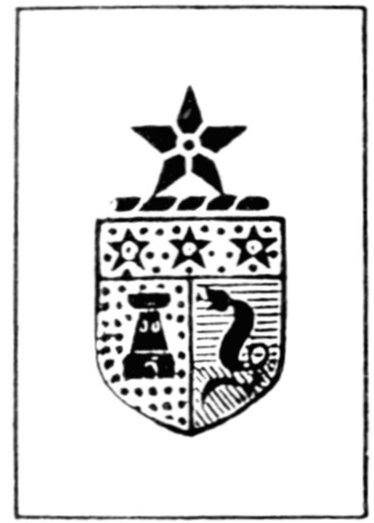
Arms.—Per pale, or and az., in the dexter compartment
a tower gu., and in the sinister, on a mount vert,
a sea-horse arg., mane, fins, and tail of the first; on a chief
or, 3 mullets of the second.
Crest.—A mullet or.
[Etherege. The Comical Revenge. London, 1690.]
David Garrick (born 19th February 1716, died 20th January 1779)
was the son of an officer in the army, and of Huguenot descent from the
family of La Garrique of Bordeaux. Garrick took to the stage at an
early age, and after having unsuccessfully tried other means of making a
livelihood he eventually took to acting as a profession. He acted as an
amateur at St. John's Gate, Clerkenwell, and he wrote several plays. His
family did not approve of his becoming an actor, but his rapid success
ultimately reconciled them to it. His life-history is one of unvarying
triumphs, which, however, naturally made him many enemies; he left the
stage practically in 1762.
Garrick was a collector of treasures of all sorts, but particularly copies
of Early English plays, of which he made a very large and valuable collection.
These he bequeathed to the British Museum. He left a large
fortune, and was buried in Westminster Abbey.
Arms.—Within the Garter. Quarterly.
| 1st grand quarter; England
and Scotland impaled. |
As used by Queen Anne. |
| 2nd grand quarter; France. |
| 3rd grand quarter; Ireland. |
| 4th grand quarter; the arms of the Royal
Dominions in Germany. Impaled. |
Dexter: Gules, 2 lions passant guardant or.
Brunswick.
Sinister: Or, semée of hearts ppr., a lion rampant
az. Lunenburg.
In the base point gu., a horse current arg.
Saxony.
Over all an escutcheon gu., charged with the
Crown of Charlemagne or, as a badge of
the office of High Treasurer of the Holy
Roman Empire. The Crown of Charlemagne
is one of the finest Byzantine Crowns in the
world, and it is one of the very few heraldic
bearings that are in actual existence. It is of
gold and richly ornamented with jewels and
enamels, and is kept in the Royal Treasury at
Vienna.
Crest.—A Royal Crown ppr., thereon a lion statant
guardant or, crowned ppr.
Helmet.—Royal.
Supporters.—The lion and unicorn, as used by James I.
(q.v.).
Motto.—Dieu et mon droit.
Initials.—G. R. (Georgius Rex).
Badges.—A Tudor rose and a thistle.
[The many advantages of a good Language. 1724.]
George Lewis, Electoral Prince of Hanover (born 28th May 1660,
died 11th June 1727), was the eldest son of Sophia, youngest daughter of
the Princess Elizabeth, daughter of James I., and Ernest Augustus, Duke
of Brunswick-Lunenburg. In 1714 Prince George succeeded his cousin,
Queen Anne, on the throne of England. He was then fifty-four years of
age, and firmly fixed in his German ideas; he never spoke English well,
and took every possible opportunity of revisiting his electoral dominions,
where he died in 1727.
George I. made an important change in the English coat-of-arms,
by including the quartered coat containing the Arms of the Royal
Dominions in Germany, Brunswick, Lunenburg, and Saxony. These
arms were used in the fourth quarter by George I., George II., and
George III. until 1801. After that date they were shown on an escutcheon
of pretence by George III., George IV., and William IV., at whose
death they were discontinued altogether.
Arms.—Within the Garter. Quarterly.
1st grand quarter; England and Scotland impaled.
2nd grand quarter; France.
3rd grand quarter; Ireland.
4th grand quarter; Brunswick impaling Lunenburg,
Saxony in the base point, and the Crown of
Charlemagne on an escutcheon of pretence; all
as used by George I. (q.v.).
Crest.—A Royal Crown ppr., thereon a lion statant
guardant or, crowned ppr.
Supporters.—The lion and the unicorn, as used by
James I. (q.v.).
Motto.—Dieu et mon droit.
Badges.—Roses and a Thistle.
[Boerhave. Methodus Studii Medici. Amst., 1751.]
Variety.—Used as Prince of Wales.
Arms.—Within the Garter. Impaled.
Dexter: The Royal Arms of England, quarterly;
first, England and Scotland impaled; second,
France; third, Ireland; fourth, the arms of the
Dominions of the Crown in Germany; over
all the label, with three points arg., of an
elder son.
Sinister: The arms of Princess Caroline of
Brandenburg-Anspach. Quartered.
1. Per fess, gu. and arg. Magdeburg.
2. Arg., an eagle displayed sa. Brandenburg.
3. Arg., an eagle displayed sa. Jägerndorff.
4. Or, a griffin segreant gu. Herz. Wenden.
5. Or, a griffin segreant sa. Fürst Wenden.
6. Arg., a griffin segreant gu. Pommern.
7. Arg., an eagle displayed sa. Crossen.
8. Arg., a griffin segreant gu. Kassuben.
9. Arg., an eagle displayed gu. Prussia.
10. Per pale, arg. and gu. Halberstadt.
11. Or, a lion rampant sa., crowned or,
within a bordure gobony, arg. and gu.
Nüremberg.
12. Gu., 2 keys in saltire or. Minden.
13. Quarterly, arg. and sa. Hohenzollern.
14. Gu., a cross ar. Ratzeburg.
15. Gu. For right of Regalia.
Crest.—A Prince's coronet ppr., thereon a lion statant
guardant or, coroneted ppr.
Helmet.—Royal.
Supporters.—The lion and unicorn, the Royal
Supporters of England, each charged with a Prince
of Wales' label. The lion is coroneted with the
coronet of a Royal Prince.
Motto.—Ich dien.
[Playford. Wit and Mirth. London, 1714.]
Variety.—Used as Prince of Wales. The Prince of
Wales' plumes, within a princely coronet, and flanked
by the initials "G. P." for "Georgius Princeps."
Motto.—Ich dien.
[Musgrave. Antiquitates Britanno-Belgicae.
Exeter, 1719.]
George, Electoral Prince of Hanover, afterwards Prince of Wales
(born 30th October 1683, died 25th October 1760), was the only son
of George I., and succeeded his father on the throne of England in 1727.
In 1753 an Act was passed "For the purchase of the Museum or
Collection of Sir Hans Sloane and of the Harleian Collection of MSS.;
and for providing one General Repository for the better reception and more
convenient use of the said Collections, and of the Cottonian Library."
In 1757 King George II. added to these "Foundation Libraries" of the
British Museum, the old Royal Library of England, which had been
largely brought together by Henry, Prince of Wales. The old Royal
Library underwent several vicissitudes after the death of Prince Henry.
It was kept at St. James's Palace. When it was at length incorporated
with the Sloane and Cotton collections it numbered altogether about
fifteen thousand volumes, manuscripts, and printed books.
On 2nd September 1705, Prince George, then Electoral Prince of
Hanover, married Wilhelmina Caroline (born 1st March 1683, died 20th
November 1737), the eldest daughter of John Frederick, Margrave of
Brandenburg-Anspach. Queen Caroline made herself as important in
Court and political affairs as she had already done as Princess, and allied
herself strongly with Sir Robert Walpole, then Minister of State, and
her power became very great, as the King gave way to her wishes almost
invariably. Both George II. and Queen Caroline disliked their eldest son
Frederick. During the King's several absences in Hanover, Queen
Caroline acted as Regent, to the great annoyance of the Prince of Wales.
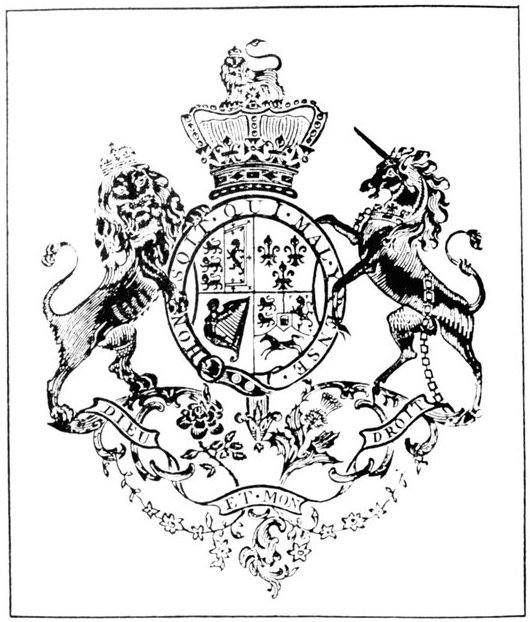
First Coat-of-Arms
Arms.—Within the Garter. Quarterly.
1st, England and Scotland impaled. 2nd, France.
3rd, Ireland. 4th, The arms of the Royal
Dominions in Germany; all as used by
George I. (q.v.).
Crest.—A royal crown ppr., thereon a lion statant
guardant or, crowned ppr.
Supporters.—The lion and the unicorn, as used by
James I. (q.v.).
Motto.—Dieu et mon droit.
Badges.—A rose for England and a thistle for
Scotland.
Note.—Used from 24th October 1760 until 1st
January 1801.
[Vitruvius Pollio. Architecture. London, 1791.]
First Coat-of-Arms
Variety.—With supporters bearing the standards of
St. George and St. Andrew. Probably a foreign design.
[Secondat. Le Temple de Guide. Parisiis, 1772.]
First Coat-of-Arms
Variety.—Within the Garter, with the "George"
jewel, and the badges and collars of the Orders of the
Thistle and the Bath (Civil), with their respective
mottoes, Nemo me impune lacessit and Tria juncta
in uno.
[Petavius. De Nithardo breve Syntagma. Parisiis,
1613.]
First Coat-of-Arms
Variety.—Used without supporters.
[Monro. Works. Edinburgh, 1781.]
Second Coat-of-Arms
Arms.—Within the Garter. Quarterly.
1st and 4th, England. 2nd, Scotland. 3rd, Ireland.
Over all, on an escutcheon of pretence, the arms of the
Royal Dominions in Germany ensigned with an electoral
bonnet gu., turned up with miniver. Used from 1st
January 1801 until 8th June 1816. Colours as used by
George I. (q.v.).
Crest, Supporters, and Motto as used by James I. (q.v.).
Badges.—Roses and thistles.
[S. Augustinus. De Civitate Dei, etc. 1467.]
Third Coat-of-Arms
Arms.—Within the Garter. Quarterly, as in the
preceding case, but with the Royal Hanoverian Crown,
instead of the electoral bonnet, over the escutcheon of
pretence. Used from 8th June 1816 until 29th January
1820.
Crest, Supporters, Badges, and Motto.—As before, with
a Royal helmet, but the shield is additionally enclosed
within the collar of the Order of the Garter, dependent
from which is the badge of the Great George.
[Inventories of plate belonging to the Crown, etc.]
The Royal Initials ensigned with a Royal Crown.
[Allionius. Tractatio de Miliarium origine et
curatione. Aug. Taurinorum, 1758.]
The Irish Harp, crowned.
[Lord's Journals of Ireland. Dublin, 1780.]
George III. (born 4th June 1738, died 29th January 1820) was the
eldest son of Frederick, Prince of Wales, and grandson of George II. He
succeeded to the throne in 1760.
The troubles in Ireland ended, for a time, in the Legislative Union in
1801. During the latter part of his reign George III. became insane
and the Prince of Wales was appointed Regent. Almost as soon as
George III. succeeded to the throne he began collecting books, no
doubt to a great extent induced to do so because of the fact that
George II. had practically denuded the Royal Libraries of their treasures
in 1757, but in many ways he possessed the true collector's instinct.
The Royal Librarian was Sir Frederick Barnard, K.C.H., who travelled
about the Continent seeking early editions and desirable books generally,
under the advice of Dr. Samuel Johnson. Besides the books collected
abroad by Sir Frederick, large numbers were acquired in England,
among these the entire library of Joseph Smith, British Consul at Venice.
Sir Frederick Barnard did not neglect the sale-room, and he acquired
especially valuable additions to the Royal Library at the sales of the
important libraries of James West, John Ratcliffe, and Richard Farmer,
all of which took place about the same time.
The library collected by George III. is now housed in the beautiful
room known as the "King's Library" in the British Museum. All the
books have one or other of the many book-stamps used by the King
impressed upon them, either on the sides or on the back. The estimated
number of volumes in the library at the time of its acquisition by the
British Museum was about eighty-four thousand, as well as a very
large collection of charts, maps, and drawings, and several manuscripts.
The books in the King's Library are in splendid condition, and among
them are numbers of precious bindings, especially later English, Scottish,
and Irish. Several of the Royal books were bound by Charles
Kalthoeber, a German binder who copied the style and stamps used by
Roger Payne.
The coat-of-arms used by George III. in the early part of his reign
was the same as that used by his predecessor, viz. first quarter, England
and Scotland impaled; second quarter, France; third quarter, Ireland; and
fourth quarter, Brunswick impaling Lunenburg, in the base point Saxony,
and an escutcheon of pretence bearing the crown of Charlemagne, as a
badge of the office of High Treasurer of the Holy Roman Empire. This
coat was used until 1801.
On the 1st of January 1801, a Proclamation was issued by the King
regarding the Legislative Union with Ireland, and certain armorial changes
are noted. The first is that in future the title of the King is to be "of Great
Britain and Ireland King," instead of as heretofore, "King of Great
Britain, France, and Ireland." Next the arms "shall be Quarterly: first
and fourth England; second Scotland; third Ireland; and it is our Will
and Pleasure that there shall be borne therewith on an escutcheon of
pretence, the arms of Our Dominions in Germany, ensigned with the
electoral Bonnet." So that now the fourth quarter, as used by George I.
and George II., is moved up, and shown on the escutcheon of pretence in
the centre of the shield.
It will be noticed that the Fleurs-de-lys of France are now left out of
the English coat-of-arms, as well as the title of King of France. The
arms of France had been used in the English coat-of-arms since their
adoption, with the motto "Dieu et mon Droit," by Edward III. in
1341, when he claimed the throne of France by right of his mother
Isabella, only surviving child of Philippe IV. From that time until 6th
March 1706, when Queen Anne changed the first quarter of the English
coat, the French Fleurs-de-lys had held the place of honour. Although
the French coat was discarded in 1801, the motto which alluded to the
same claim to the French throne has been retained and is still used.
The Fleurs-de-lys of France were at first semées, but Charles VI. of
France reduced them to three, and a corresponding change was presently
made in the English coat.
In 1816 the electorate of Hanover was given the rank of a kingdom, so
that the electoral bonnet no longer properly represented the dignity. On
8th June 1816, a notice was given in the London Gazette that his Majesty
was in future "King of Hanover," and that a corresponding alteration is
to be made in the Royal arms, and it is ordered that, "instead of the arms
of His Majesty's Dominions in Germany, ensigned with the electoral
bonnet, as directed by His Majesty's Proclamation above mentioned, there
shall henceforth be used and borne with the arms or ensigns armorial of
His Majesty's said United Kingdom, on an escutcheon of pretence, the
arms of His Majesty's Dominions in Germany, ensigned with the
Hanoverian Royal Crown."
The Royal title Britanniarum Rex, "King of the United Kingdom of
Great Britain and Ireland," without the Ducal titles of the Royal
Dominions in Germany, which had been used by George I. and
George II., first appears on the Fifth Great Seal of George III., used from
1st August 1815 to 17th September 1821.
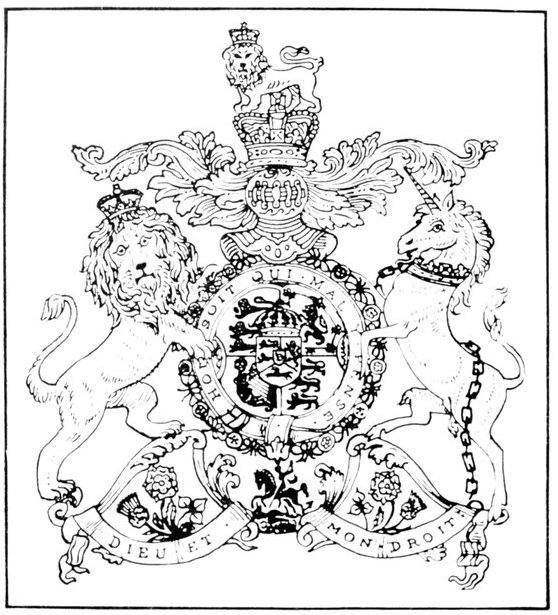
The coat-of-arms of George IV. was the same as
the last used by George III., namely 1st and 4th,
England; 2nd, Scotland; 3rd, Ireland; with the arms
of the Royal Dominions in Germany on an escutcheon
of pretence, ensigned with the Royal Crown of Hanover.
Several of the older book-stamps of George III.
were, however, frequently used by George IV.
[Inventories of plate at Windsor, etc.]
Used when Prince of
Wales. A Prince of
Wales' plume within a
princely coronet.
[London and its Environs
described. London, 1761.]
George IV. used the same coat-of-arms as the last one of George III.,
that is to say, first and fourth grand quarters, England; second grand
quarter, Scotland; and third grand quarter, Ireland; on an escutcheon
of pretence the arms of the Dominions of the Crown in Germany,
ensigned with the Hanoverian Royal Crown.
When George IV. inherited the large library made by his father,
he very soon found that it was a very costly and troublesome legacy,
and at one time he was inclined to sell it to the Emperor, Alexander I.
of Russia. This idea, however, was very displeasing to English feeling,
and the Premier, Lord Liverpool, was able to convince the King that
any such sale would be highly unpopular. After considerable trouble
the matter was amicably arranged, and Ministers were able to satisfy
the King by means of a fund called "Droits of Admiralty," which they
could dispose of without troubling Parliament. The King then wrote a
letter, 15th January 1823, to Lord Liverpool, in which he says:—
"The King, my late revered and excellent father, having formed
during a long series of years, a most valuable and extensive Library, I
have resolved to present this collection to the British Nation."
The library was consequently removed from Buckingham House to the
British Museum in 1828, and arranged in the beautiful room built for it.
In this room the books are kept by themselves, apart from the rest of the
library. It is probable that some idea of the ultimate destination of this
library existed as long ago as 1791, as in that year a German preacher,
Frederick Wendeborn, wrote that the books in the King's private library, "it
is said, will be one time or another joined to those of the British Museum."
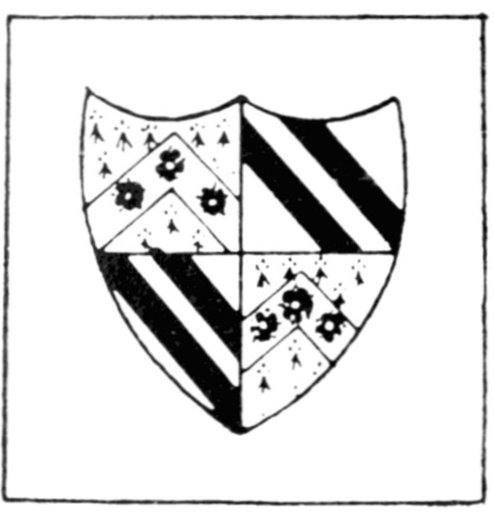
Arms.—Quarterly.
1st and 4th; erm., on a chevron sa., 3 roses arg.
Gilbert.
2nd and 3rd; arg., 2 bendlets sa. Bradshaw.
Note.-Used before 1726.
[Tesauro. Patriarchae Genealogia. Mediolani, 1645.]
John Gilbert (born circ. 1693, died 9th August 1761) was a son of
John Gilbert, Prebendary of Exeter. He was educated at Oxford, and
ordained about 1718.
In 1722 Gilbert succeeded to his father's Prebendal stall at Exeter,
and two years later he was made Dean. In 1726 Dr. Gilbert was
consecrated Bishop of Llandaff, and was afterwards translated to Salisbury.
In 1757 he became Archbishop of York. Gilbert was not a man
of much learning, and his preferment in the Church is remarkable as
being due more to influence than character. He published several
sermons.
Arms.—Within the Garter. Quartered.
1. Quarterly;
1st and 4th, barry of 8, arg. and gu., over
all a cross patonce sa. Gower.
2nd and 3rd, az., 3 laurel leaves or. Leveson.
2. Barry of 8, arg. and gu., over all a cross
patonce sa. Gower.
3. Gu., 3 clarions or. Granville.
4. Arg., a lion rampant gu., between 3 pheons,
sa. Egerton.
5. Arg., on a bend az., 3 bucks' heads cabossed
or. Stanley.
6. Gu., 2 lions passant arg. Strange.
7. Barry of 10, arg. and gu., a lion rampant or,
on a canton sa., a fess arg. Brandon.
8. Quarterly;
1st and 4th, France.
2nd and 3rd, England; being the arms of
England, borne by right of descent from
the Princess Mary, daughter of Henry VII.
Coronet.—That of a Duke.
[Jewel. Defense of the Apologie, etc. London, 1576.]
George Granville Leveson-Gower (born 9th January 1758, died
19th July 1833) was the son of Granville, Marquis of Stafford. Lord
George was summoned to the House of Lords as Baron Gower during
his father's lifetime, and succeeded to the Marquisate in 1803.
The Marquis was a Member of the Privy Council and a Knight of
the Garter, and in 1833 he was created Duke of Sutherland. The
Earldom of Sutherland came into the Gower family by right of Elizabeth,
Countess of Sutherland in her own right, who married the Duke in
1785. It is said to be the most ancient Earldom in North Britain, and
to date back as far as 1057. The Duke's successors all used a quartering
on their coat-of-arms for this ancient Earldom, namely, gu., 3 mullets
or, within a bordure of the last, charged with a double tressure, flory
counterflory of the field.
Arms.—Az., 3 bucks statant or. A crescent for
difference. Green.
Motto.—Nec spero nec despero.
[Bacon. Of the Advancement and Proficience of Learning.
Oxford, 1640.]
Joseph Henry Green of Barnet (born 1st November 1791, died 13th
December 1863) was the second son of Joseph Green of London. He
was an eminent surgeon, and commenced his medical studies in Germany.
Returning to London, Green worked at St. Thomas's Hospital, where he
eventually held important office, becoming chief surgeon in 1820.
In 1824, Green was appointed Professor of Anatomy at the College of
Surgeons. He was Professor of Surgery at King's College, a Fellow of
the Royal Society, and twice President of the College of Surgeons.
Professor Green was a friend and literary executor to S. T. Coleridge.
Arms.—Vert., on a cross arg., 5 torteaux. A crescent
for difference. Grenville.
[Tristan, Chlr. de la Table Ronde. Paris.]
Thomas Grenville (born 31st December 1755, died 17th December
1846) was the second son of George Grenville of Wotton Hall, Bucks,
and was educated at Oxford. He served for a short time in the army.
In 1780 Grenville was Member of Parliament for Buckinghamshire, and
interested himself much in political matters. In 1790 he was Member
for Aldborough, and in 1794 he was Minister Extraordinary at Vienna.
His younger brother William, Baron Grenville, was Premier in 1806.
Grenville was a Member of the Privy Council, and in 1799 Ambassador
to Berlin, and was the last person to hold the office of Chief-Justice in
Eyre south of Trent. He was for a time First Lord of the Admiralty.
In 1818 Grenville left public life. He was always an eager collector of
fine books, and bequeathed his magnificent library to the nation. It is
now kept at the British Museum, of which Mr. Grenville was a Trustee,
in a room especially kept for it, and known as the Grenville Room.
Among the Grenville books are still a few fine old bindings, but the
majority have been rebound by George Lewis, one of the most eminent of
the later English trade binders.
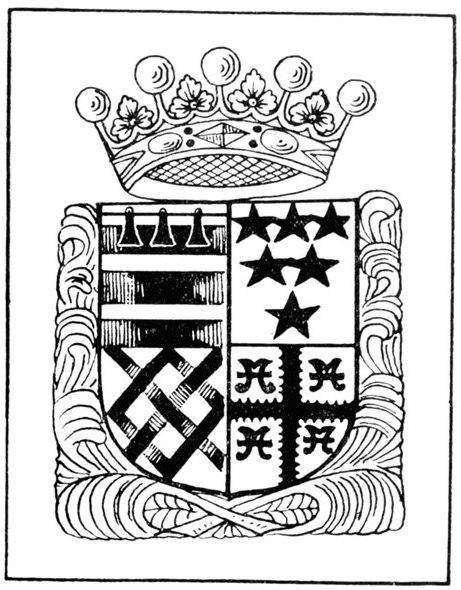
Arms.—Quartered.
1. Barry of 6, arg. and az. A label for difference.
Grey.
2. Sa., 6 mullets or, 3, 2, and 1. Bonvile.
3. Arg., a fret sa. Tollemache.
4. A cross engrailed between 4 water bougets sa.
Bourchier.
Coronet.—That of an Earl.
[L'Histoire de France. Paris, 1581.]
Henry Grey (born c. 1599, died 23rd August 1673) was the son of Sir
John Grey, and grandson of Henry, first Baron Grey of Groby, to whom
he succeeded in the barony in 1614. In 1628 Lord Grey was created
Earl of Stamford. He was a soldier, and held a command in the Parliamentary
Army, but proved a bad General. He was Lord Lieutenant of
Leicestershire, and served for a time as Member of Parliament for that
county. In 1645 he was impeached in the House of Commons for an
assault on Sir Arthur Haselrig.
Many of the books which had belonged to Lord Stamford subsequently
came into the possession of Robert Harley, Earl of Oxford, and now form
part of the Harleian Library.
Crest.—An ostrich wing, the feathers alternately arg.
and gu., charged with a bend sa., charged with 3 plates.
Gulston.
[Boccaccio. Decamerone. Firenze, 1516.]
Arms.—Arg., 3 bars nebuly gu., over all a bend sa.,
charged with 3 plates. Gulston.
Note.—Used by a lady of the Gulston family.
[Coqville. Histoire du Pays et Duché de Nivernois.
Paris, 1612.]
Variety of crest in smaller size.
[Tirante il Bianco valorissimo Cavaliere. Vinegia, 1538.]
William Gulston was Rector of Symondsbury in Dorsetshire. In 1679
he was consecrated Bishop of Bristol, a preferment he held until his death
in 1684.
The Gulston coat-of-arms is shown on the screen in Bristol Cathedral.
The coat shown on a lozenge is that of a lady of the Gulston family,
possibly a daughter of the Bishop. In most of the books on which this
coat occurs there is a book-plate of "Elize Gulston," so the book-stamp
was in all probability hers also. Both the small coat and the small crest
are usually added on the backs of finely bound books, but the large crest
occurs on the side in the usual manner.
Arms.—On an archiepiscopal cross. Quarterly.
1 and 4. Gu., 3 cinquefoils erm. Hamilton.
2 and 3. Arg., a lymphad sa. Arran.
[Celsus. De arte Medicina. Basileae.]
John Hamilton (born c. 1510, died 1st April 1570) at an early age
became a Benedictine monk at Kilwinning, and in time went to study
at Paris. The Regent Arran was his half-brother, and the priest had
considerable influence with him. Hamilton's preferment in the Church
was rapid. In 1545 he was made Bishop of Dunkeld, and in 1546 succeeded
David Beaton as Archbishop of St. Andrews and Primate of Scotland.
He was also Keeper of the Privy Seal and Lord Treasurer of Scotland.
The Archbishop was a strong adherent of Mary, Queen of Scotland,
and was a Member of her Privy Council; he actively helped her escape
from Loch Leven, as well as taking the field on her behalf. He was
accused of complicity in the murders of Darnley and of the Regent Moray.
Archbishop Hamilton wrote several theological works. He was hanged at
Stirling in 1570.
Arms.—Gu., a lion passant or, between 3 bezants.
Harborne.
Motto.—Devs indvstriam beat.
[Passe. Hortus Floridus. Utrecht, 1615.]
William Harborne (born circ. 1550, died 9th September 1617) was the
son of William Harborne of Great Yarmouth. He was a great traveller.
In 1582 Harborne was appointed the Queen's Ambassador to Turkey,
and remained at Constantinople until 1588. His tenure of this office was
beneficial to trade, and he also procured several privileges from the Sultan as
to English travellers in the East. Mr. Harborne wrote an account of his
voyage to Constantinople, and other books about his stay there. His
manuscripts are mostly at the British Museum or at the Bodleian Library
at Oxford.
Arms.—Or, a bend cotised sa. Harley.
Coronet.—That of an Earl.
Supporters.—Two angels ppr.
Motto.—Virtute et fide.
[Survey of Manors in various Counties. Harl. MS. 2192.]
Arms.—Or, a bend cotised sa. Harley.
Motto.—Virtvte et fide.
Legend.—Robert Harley.
[The Annals of King James and King Charles the First.
London, 1681.]
Robert Harley (born 5th December 1661, died 21st May 1724)
was the son of Sir Edward Harley of Brampton Bryan, Herefordshire.
Robert Harley was Member of Parliament for Tregony, and afterwards
for New Radnor, and was distinguished for his knowledge of finance. In
1701 he became Speaker of the House of Commons, and had a considerable
share in the passing of the Act for the Protestant succession to the Throne
of England.
In 1704, Mr. Speaker Harley became a Member of the Privy Council,
and also was made one of the Principal Secretaries of State. Owing to
various jealousies and plots against him, Harley resigned office in 1707.
In 1710 he was made Chancellor of the Exchequer; in 1711 he was
nearly assassinated by Antoine de Guiscard, a French adventurer, and his
escape increased his popularity, and he was created Earl of Oxford, and
Lord High Treasurer, an office he held until 1714.
In 1715 Lord Oxford was impeached for betrayal of duty and other
matters, twenty-two articles in all, and in 1717 he was acquitted after a
long trial.
Through all his many political troubles, Harley continued the collection
of manuscripts, which was his dearest hobby. He brought together many
of the most famous collections, among them those of Sir Thomas Smith,
Sir Symonds D'Ewes, and the Earl of Stamford. In the Harleian Library
were about six thousand volumes of manuscripts, as well as about fifteen
thousand separate rolls and charters, and this collection was largely added
to by the second Earl. The entire collection was purchased by Parliament
in 1753, and is now in the British Museum. The printed books
were dispersed.
Many of the Harleian books were bound, generally in red morocco, by
Thomas Eliot and Christopher Chapman, with broad, gold-tooled borderings,
and this style is known as the "Harleian." Several of Lord Oxford's
favourite books have a facsimile signature "Robert Harley," impressed inside
on the paper in gold. A member of the Harley family always holds one
of the six family trusteeships of the British Museum.
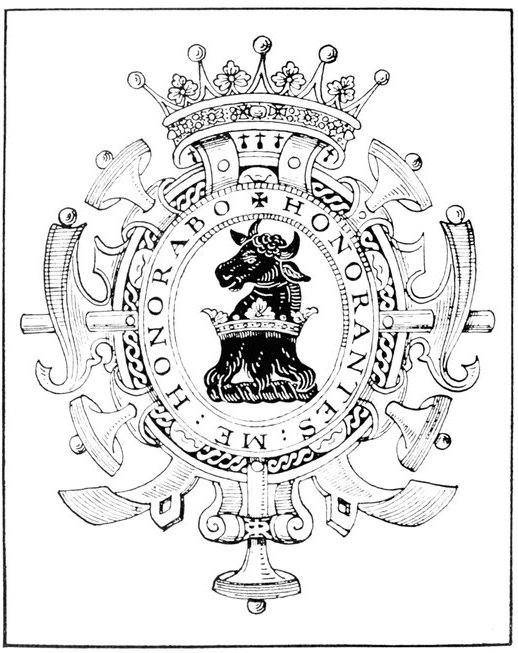
Crest.—A bull's head erased sa., armed and ducally
gorged or. Hastings.
Coronet.—That of an Earl.
Motto.—Honorantes me honorabo.
[Camden. Tomus alter Annalium Rerum Anglicarum ...
regnante Elizabetha. Londini, 1627.]
Crest.—A bull's head erased sa., armed and ducally
gorged or. Hastings.
Coronet.—That of an Earl.
[Reusner. ΒΑΣΙΛΙΚΩΝ operis Genealogici Catholici Auctarium,
illustres Stirpes Comitum continens, etc. Francofurti, 1592.]
Ferdinando Hastings (born 18th January 1608, died 13th February
1655) was the son of Henry, fifth Earl of Huntingdon, and his wife
Elizabeth, daughter of Ferdinando, Earl of Derby. He succeeded his
father in the Earldom in 1643. Lord Huntingdon married Lucy,
daughter of Sir John Davis of Englefield, Berks.
Arms.—Quartered.
1. Az., a chevron between 3 garbs or. Hatton.
2. Arg., a cross flory between 4 cornish choughs,
ppr. Offley.
3. Arg., an eagle displayed sa. Browne.
4. Arg., a bend lozengy gu. Bradeston.
5. Az., a cross engrailed erm. Stanton.
6. Gu., a saltire arg. Nevill of Raby.
7. Az., a chevron between 3 garbs or; a crescent
for difference. Hatton.
8. Arg., a fess sa., in chief a crescent of the last.
York.
9. Az., 5 cinquefoils in cross arg., 1, 3, and 1.
Holdenby.
10. Bendy, arg. and sa., on a canton of the second
a castle of the first. Carrell.
11. Gu., on a chief or, 3 quatrefoils vert. Wedson.
Crest.—A hind passant or.
Helmet.—That of an Esquire.
[Bible. London, 1588.]
Christopher Hatton (born c. 1540, died 20th November 1591) was the
youngest son of William Hatton of Holdenby, Northamptonshire. He
was educated at Oxford and entered the Middle Temple.
Queen Elizabeth noticed Hatton at a masque, and was struck by
his good looks and graceful dancing. He was shortly afterwards attached
to the Court, and became a Gentleman of the Privy Chamber, Captain of
the Guard, Vice-Chamberlain, and a Member of the Privy Council.
In 1587 he was made Lord Chancellor, and also a Knight of the
Garter. From 1588 until he died, Hatton was Chancellor of the
University of Oxford. He wrote a few books on law or the drama,
and had a considerable library.
Arms.—Sa., 3 heathcocks arg., membered gu.
Heath.
[Colle. Medicina Practica. Pisauri, 1617.]
Benjamin Heath (born 20th April 1704, died 13th September 1766)
was a son of Benjamin Heath, a merchant of Exeter. He inherited a
considerable fortune from his father, and as a young man travelled much
on the Continent.
Mr. Heath spent all his life in the pursuit of literature and the collection
of books. Among his writings is one of some importance, "Notæ sive
Lectiones ad Æschyli, quæ supersunt dramata," published at Oxford in
1762. He was a D.C.L. of Oxford. He also wrote some political
pamphlets, and others concerning Shakespeare. Dr. Heath left a large
family, and one of his sons became headmaster of Eton. His library was
very extensive, and he gave a large portion of it to his sons during his
lifetime, and the remainder was sold in 1810.
Arms.—Quarterly.
1st and 4th; az., 3 fleurs-de-lys or. France.
2nd and 3rd; gu., 3 lions passant or, langued and
unguled az. England.
Crown.—Royal, but of a type used before the time
of Henry VI. and supported by two angels.
Supporters.—Two lions sejant arg. Mortimer, Earls
of March.
Note.—This stamp is sometimes said to have
belonged to Edward IV. The crown as shown here is
that which appears on groats of Henry VII.; but the
crown which appears on his great seal, a higher
authority, has the crosses pattée and fleurs-de-lys
alternately as now used. The crosses pattée were first
used as the seal for foreign affairs of Henry VI.
[Impressed in blind, upon a loose cover in the Library
of Westminster Abbey. C., 1490.]
Henry Tudor (born 26th June 1456, died 1509) was the son of Edmund
Tudor, Earl of Richmond, and Margaret Beaufort. In 1486 the Earl of
Richmond married Elizabeth of York, daughter of Edward IV., the
first King of the Yorkist line, and as the Earl himself represented the
Lancastrian line, by way of Catherine Swinford, this marriage united
the two houses of York and Lancaster, and gave rise to the beautiful
Tudor badge of the Red and White Rose. The two colours are shown
sometimes per pale, sometimes quartered, or there may be simple rows
of alternate petals, or, as is most usual, the inner petals are all white and
the outer petals all red; the centre is always gold, and the little leaves
between the outer petals, if showing at all, are green. The portcullis and
gateway, also commonly used as badges by our Sovereigns until the time
of Charles I., are both used as emblems of the De Beaufort alliance.
The portcullis is or, nailed az., chained and ringed of the first.
The Earl of Richmond defeated Richard III. at the battle of Bosworth
Field in 1485, and the king was killed. Henry VII. was crowned king
on the battlefield. He possessed a considerable number of manuscripts,
and also a small library of printed books, which, as far as is known, were
bound in velvet. Judging from the leather binding in Westminster Abbey
Library, Henry also had some commoner books stamped with his coat-of-arms.
Several bindings that were made for Henry VII. still exist; they are
either at the Record Office, the Library of Westminster Abbey, or the
British Museum, and are all bound in the same way. The binding is of
red velvet, beautifully bossed with silver or other metal; the bosses are
ornamented with the Royal coat-of-arms, with the red dragon of
Cadwallader as a dexter supporter, and the white greyhound of the Nevills,
or, when used by Henry VII., of the De Beauforts, as sinister supporter.
But before using the dragon and greyhound Henry VII. had used
two white lions. A white lion was the badge of the Earls of March, who
were distantly connected with the King.
The coat-of-arms used by Henry VII., i.e. France and England
quarterly, was the same as had been used by all the English kings since
Henry IV. in 1408, when the fleurs-de-lys semées, which had been
hitherto used, were reduced to three, in accordance with the change made
in the French coat by Charles VI., King of France.
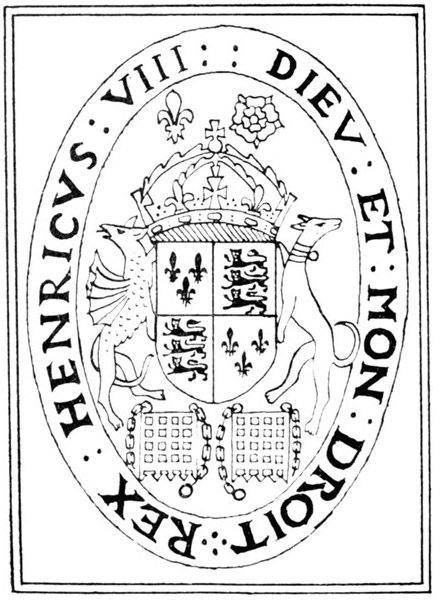
Arms.—Quarterly.
1st and 4th; az., 3 fleurs-de-lys, 2 and 1, or.
France.
2nd and 3rd; gu., 3 lions passant guardant, in pale
or, langued and unguled az. England.
Crown.—Royal.
Supporters.—Dexter, a dragon gu. Cadwallader.
Sinister, a greyhound arg., gorged or. Nevill or
De Beaufort.
Badges.—Dependent from the shield 2 portcullises or,
nailed az., chained of the first. De Beaufort.
At the top, a fleur-de-lys or, France; and a double
rose gu. and arg., centred or, and leaved vert, Tudor.
Motto.—Diev et mon droit.
Legend.—Rex henricvs viii.
[Opus eximium de vera differentia regiae potestatis et
ecclesiasticae. London, 1534.]
Variety.—Arms as before. Panel stamp with 2
angels bearing scrolls. At the top a Tudor rose, and 2
portcullises dependent from the base of the shield, which
is ensigned with a Royal crown, and supported by a
dragon and a greyhound.
[Holkot. Opus revera insignissimum in librum Sapietie
Salomonis editum. Parisiis, 1518.]
Variety.—Arms as before. With two scrolls and a
Tudor rose on the top, and "M. D.," probably the initials
of the designer, below. A dragon and a greyhound
support the shield, which is ensigned with a Royal crown
and flanked by two portcullises chained.
On the border are lions passant guardant and fleurs-de-lys
alternately.
[Dialogues in English. London, 1532.]
Variety.—Arms as before. Within the Garter,
ensigned with a Royal crown and flanked by the Tudor
emblems of a Tudor rose, a fleur-de-lys, the gateway of
the Castle of De Beaufort, and the cleft pomegranate of
Aragon.
Legend.—On the rectangular borders. Deus dat
nobis tuam pacem et post mortem vitam eternam
amen.
[England. Le bregement des Estatuts. London, 1521.]
Variety.—Arms and supporters as before. With the
sun and moon in the two upper corners and the shields
of St. George and the City of London. Ensigned with
a Royal crown of incorrect pattern.
This design was probably used by Royal consent by
members of the Stationers' Company of London, and there
are many examples of it on which are also engraved the
initials of London printers and publishers, e.g. "J. R.,"
probably John Reynes; "J. N.," probably Jean Norins;
"G. G.," probably Garret Godfrey; "R. L.," probably
Richard Lant, and several more.
These initials are usually shown at the base of the
shield. Cf. under heading Tudor.
Prince Henry (born 28th June 1491, died 28th January 1547) was the
second son of Henry VII., and in 1509 succeeded his father on the throne
of England. Henry VIII. always lived in much luxury and loved finery
and splendour, and to a certain extent this feeling shows in the many
beautiful bindings which were made for him. The King was certainly
fond of his books, and he had several of them beautifully bound in velvet
and embroidered with pearls and inlays of coloured silks and satins, finished
with gold thread. Others are of gold, richly worked and enamelled.
For his Queens also several fine bindings were made; these, however,
were generally armorial panel stamps, impressed without gold. He married
six times. For Catherine of Aragon bindings were made which still exist,
for Anne Bullen and Catherine Parr, the same, but for Jane Seymour,
Anne of Cleves, or Katherine Howard I know of no bindings recorded or
in existence. Katherine Parr is said to have herself embroidered a
beautiful armorial velvet-bound copy of Petrarch with her own arms, and
at the Bodleian Library at Oxford there is a book said to have been
embroidered for her by the Princess Elizabeth, on which are the initials
"K. P."
Thomas Berthelet, the first English bookbinder to use gold tooling was
made Royal Printer and Bookbinder to Henry VIII. in 1530, and he
bound the greater number of the Royal books in leather, velvet, or satin.
Henry VIII. used the same coat-of-arms and supporters as his father,
namely, the red dragon of Cadwallader as a dexter supporter and the white
greyhound of the Nevills as a sinister supporter, until 1528, when he
adopted a golden lion rampant royally crowned as his dexter supporter, and
moved the dragon to the sinister side, leaving out the greyhound altogether.
This change, however, does not, as far as I know, show on any book, but
it can be seen on the gold coins of the period, and also on a sculptured
compartment at Caerhays, is common at the house of a member of the
Trevanion family, and again on the keystone of the ceiling over the organ-loft
at St. George's Chapel, Windsor, and here, moreover, the date 1528 is
also given.
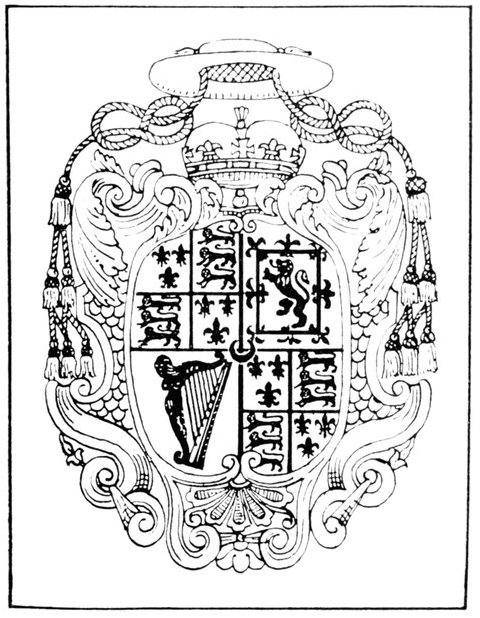
Arms.—Quarterly.
1st and 4th grand quarters, France and England
quarterly.
2nd grand quarter, Scotland.
3rd grand quarter, Ireland.
All as used by James I. (q.v.). Over all a crescent
for difference. Ensigned with a Royal crown and the
tasselled hat of a cardinal.
Note.—This stamp was probably designed and cut
after 1788, at which date the Cardinal entitled himself
King of England.
[Stellato. Ad frequentem in fidei controversiis
interrogationem, etc. Viennae, 1752.]
Henry Benedict (born 5th March 1725, died 13th July 1807) was the
second son of James Francis Edward, called the Chevalier St. George,
son of James II., King of England, and Mary of Modena, who married
Mary Clementina, daughter of James Sobieski, in 1719.
Prince Henry, who occasionally used the Royal Crown of England
over his coat-of-arms, is called sometimes Henry IX., King of England.
He entered the Romish Church as a priest at an early age, and in 1747 he
was made a Cardinal by Benedict XIV., and held several Bishoprics and
the Archbishopric of Corinth, but was usually known as Cardinal York.
He assumed certain airs of dignity abroad in consequence of his Royal
ancestry and claims, and in 1788, on the death of his elder brother, he had
a medal made and inscribed "Henricus nonus magnae britanniae
rex."
The Cardinal lived almost always abroad, and suffered much by loss of
revenue caused by the French Revolution; he had to part with much of
his private property, jewels, and plate. At this juncture George III.
generously assisted Cardinal York, and made him a handsome allowance,
in gratitude for which His Eminence bequeathed to the Prince of
Wales, afterwards George IV., many of the Crown Jewels which James
II. had taken with him to France. Some of the most important of these
stones now adorn the English Imperial Crown. The Cardinal had a large
library, and several of his books are at Windsor and at the British
Museum. The majority of these are in leather, but some are embroidered.
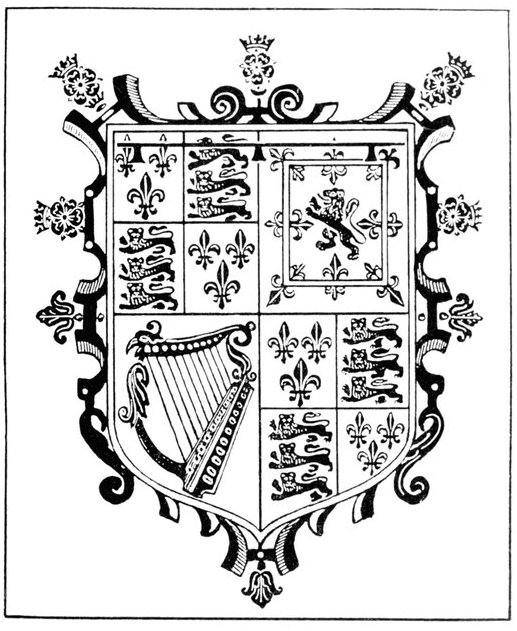
Arms.—Quarterly; 1st and 4th grand quarters, France
and England quarterly; 2nd grand quarter, Scotland; 3rd
grand quarter, Ireland. All as used by James I. (q.v.);
and over all a label arg. of three points.
A variety of this stamp has thistles instead of roses in
the border.
[Apollonius Gallus. Exsuscitata Apollonii Pergaei
ΠΕΡΙ ΕΠΛΦΩΝ Geometria. Parisiis, 1600.]
Variety.—Arms as before. Within the garter, and
ensigned with a Princely coronet.
[Vittori. Tesoro de las tres lenguas Francesa, Italiana,
ej Española. Geneve, 1609.]
A Prince of
Wales's triple
ostrich plume,
commonly used
as a corner stamp,
all impressed in
silver.
[Alunno.
Della Fabrica del
Mondo.
Venetia, 1575.]
A Prince of Wales's
triple ostrich plume;
the coronet, ribs of
feathers, and motto
generally impressed
in gold, the feathers
in silver. Used
mostly as a centre
stamp.
[Lipsius. Admiranda.
Antverpiae, 1599.]
A Badge of a lion
rampant guardant,
with princely coronet,
always impressed
entirely in
gold.
[Reusnerus.
ΒΑΣΙΛΙΚΩΝ opus genealogicum
Catholicum
de praecipuis familiis
Imperatorum.
Francofurti, 1592.]
A Badge of a
Tudor rose, with
princely coronet.
[Boccaccio.
I casi degl' Huomini
Illustri.
Fiorenza, 1598.]
A Badge of a fleur-de-lys.
[Baretus. An Alvearie, or triple Dictionarie.
London, 1573.]
Henry Frederick, Prince of Wales (born 19th February 1594, died
6th November 1612), was the eldest son of James I., and from his
childhood showed studious and literary inclinations, as well as sporting
tastes. In 1609 he purchased the library of John, Lord Lumley, a great
part of which had previously belonged to his father-in-law, Henry Fitz-Alan,
Earl of Arundel, and another large proportion to Thomas Cranmer,
Archbishop of Canterbury. He also acquired a number of books which
had belonged to a Welshman, John Maurice or Morris.
On the Prince's death his library became the property of James I., and
it was added to the existing Royal Library, then under the care of Patrick
Young.
Prince Henry had his books bound in calf, and probably destroyed
numbers of valuable old bindings which were originally used. The new
bindings were ornamented with stamps bearing the Prince's coat-of-arms,
without supporters, and others showing a lion rampant, with princely
coronet; a Tudor rose, with princely coronet; a fleur-de-lys, and two
stamps, with slight variations, of the Prince of Wales's plume of three
ostrich feathers. These latter stamps are normally used as corner-pieces,
but they also show now and then as centres. Smaller corner stamps
are found showing coroneted Tudor roses, coroneted thistles, coroneted
fleurs-de-lys, and Prince of Wales's feathers in gold. On the panels of
the backs of Prince Henry's books are found small stamps of a lion
rampant, with princely coronet; a unicorn rampant; a Tudor rose; a
portcullis, sometimes chained, and a Royal Crown. These are arranged
in various combinations.
The greater number of Prince Henry's bindings are simple, having
the coat-of-arms in the centre and the badges in the corners, but several
are very handsomely ornamented with accessory gold tooling. The label
shown on Prince Henry's coat-of-arms is the cadency mark of the eldest
son; it is generally impressed in silver, as it ought always to be. The
feathers in the Prince of Wales's plume are always impressed in silver,
which has now oxidised black. Prince Henry's library came to the British
Museum with the rest of the Old Royal Library of England in 1757.
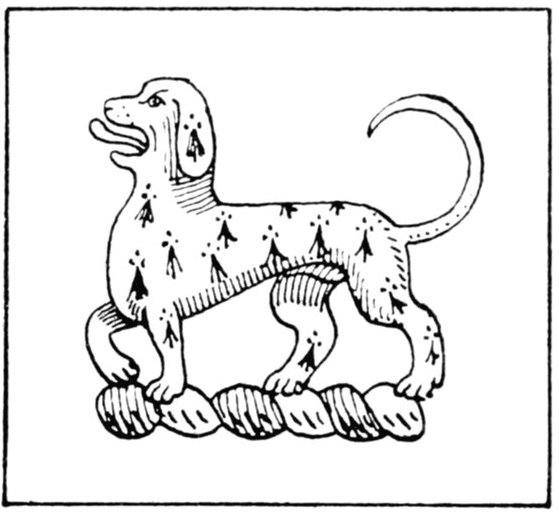
Crest.—A talbot statant erm. Heydon.
Note.—Painted.
[Cicero. Orationum volumen primum, etc.
Venetiis, 1540.]
Christopher Heydon (born circ. 1550, died circ. 1623) was the son of
Sir William Heydon of Bacousthorpe, Norfolk. He was educated at
Cambridge. In 1588 he represented Norfolk in the House of Commons,
and in 1596 he was knighted by the Earl of Essex. Sir Christopher
Heydon wrote some treatises on astrology. He married first Mirabel
Rivet, and secondly Anne Dodge, and left a large family.
Crest.—An eagle's head erased arg. Hoare.
[Hoare. Catalogue of Books on Italian Topography, etc.
London, 1812.]
Richard Colt Hoare (born 9th December 1758, died 19th May 1838)
was the son of Sir Richard Hoare of Barn Elms, Surrey, a banker.
Mr. Hoare worked for a time in the family bank, and then, having
a competent fortune, he travelled much on the Continent. In 1787
he succeeded his father in the baronetcy. Sir Richard Hoare wrote a
large number of works on antiquities and travel, the most important
of which is the Ancient History of North and South Wiltshire, published at
London in 1810. He was a Fellow of the Royal Society and of the
Society of Antiquaries. At his house "Stourhead" Sir Richard had a
large library, much of which he catalogued himself.
Arms.—Sa., a stag's head cabossed arg., attired or.
A crescent for difference. Horton.
Crest.—A spear erect or, headed arg., enfiled with a
dolphin of the first.
Helmet.—That of an Esquire.
[Songs by Several Masters. 1704, etc.]
Francis Horton, a member of an old family belonging to Catton,
county Derby, was a collector of musical works in the eighteenth century.
Arms.—Within the Garter. Quarterly.
1. Gu., on a bend between 3 cross crosslets fitchée
arg., an escutcheon or, charged with a demi lion
rampant, pierced through the mouth with an
arrow, within a tressure flory counterflory of the
first. Howard.
2. Gu., 3 lions passant guardant in pale or, in chief
a label of 3 points arg. Brotherton.
3. Chequy, or and az. Warren.
4. Gu., a lion rampant or, armed and langued az.
Fitz-Alan.
A mullet for difference.
Crest.—On a chapeau gu., turned up erm., a lion
passant, ducally crowned or, and charged on the neck
with a label and a mullet.
Helmet.—That of a Peer.
Supporters.—Two lions erm., each charged with a
mullet.
Motto.—Desir n'a repos.
[Caradoc. Historie of Cambria. London, 1584.]
Charles Howard (born c. 1536, died 14th December 1624) was the
eldest son of William Howard, Baron Howard of Effingham, Lord High
Admiral of England. Charles Howard was a person of importance from
an early age, and was sent by Queen Elizabeth on an Embassy to France.
He was Member of Parliament for Surrey, and a general officer in the
army as well as being a sailor. In 1574 he was made a Knight of the
Garter and Lord Chamberlain of the Household, and in 1573 he
succeeded to his father's barony.
Lord Howard of Effingham became Lord High Admiral of England
in succession to the Earl of Lincoln, and in 1588 he defeated and dispersed
the Spanish Armada. At the time of the coronation of James I. Lord
Howard became Lord High Steward of England.
Arms.—Within the Garter. Quarterly.
1. Gu., a bend between six crosses crosslet fitchée
arg. Howard.
2. Gu., 3 lions passant guardant in pale or, in chief
a label of 3 points arg. Brotherton.
3. Chequy, or and az. Warren.
4. Gu., a lion rampant or, langued and armed az.
Fitz-Alan.
A crescent for difference.
Coronet.—That of an Earl.
[Marsilius. Interpretatione, etc. Jenae, 1586.]
Henry Howard (born 25th February 1539, died 15th June 1614) was
the second son of Henry Howard, Earl of Surrey, who was beheaded in
1547. Henry Howard the younger was restored in blood by Queen
Elizabeth, and on the accession of James I. he quickly became a person
of much importance. He was made a Member of the Privy Council,
Warden of the Cinque Ports, and Constable of Dover Castle.
In 1604 Mr. Howard was created Earl of Northampton and a
Knight of the Garter, and in 1608, Lord Privy Seal. Lord Northampton
was a man of much learning, and wrote several treatises on astrology
and theology. He had much taste in knowledge as to architecture, and
built Northumberland House from the designs of Moses Glover.
Arms.—Gu., on a bend between six crosses crosslet
fitchée arg., an escutcheon or, thereon a demi lion
rampant, pierced through the mouth with an arrow,
within a double tressure flory counterflory of the first.
Howard.
Coronet.—That of an Earl.
Legend.—Bibliotheca arvndeliana.
Note.—A nineteenth-century stamp.
[Lydgate. Siege of Troy. Arundel MS. 99.]
Thomas Howard (born c. 1585, died 24th September 1646) was the
son of Philip, Earl of Arundel, who was attainted and died in 1595.
James I. restored his father's titles to Thomas Howard, but not the
property, much of which, however, he subsequently purchased; and in
1644 he was created Earl of Norfolk in addition. He was a descendant
of Henry Fitz-Alan, Earl of Arundel, who had also been a great book
collector, and whose library had been largely acquired by Henry, Prince
of Wales.
Lord Arundel travelled largely and made very valuable collections
of all sorts of antiquities, manuscripts particularly; but as well as these
he acquired marbles, coins, gems, and pictures. Among the more
notable of the collections of manuscripts purchased by Lord Arundel
was that made by the Pirckheimer family of Nüremberg. The manuscripts
were for some time kept at Arundel House, where they suffered
much from neglect, and in 1666 most of them were given to the Royal
Society and others to the Heralds' College.
In 1831 the Arundelia MSS. in the Royal Society's library were
transferred, by arrangement, to the British Museum. Lord Arundel was
made a Knight of the Garter in 1611; in 1616 he became a Member
of the Privy Council; and in 1621 he was restored to his hereditary post
of Earl Marshal. He was also High Steward of England.
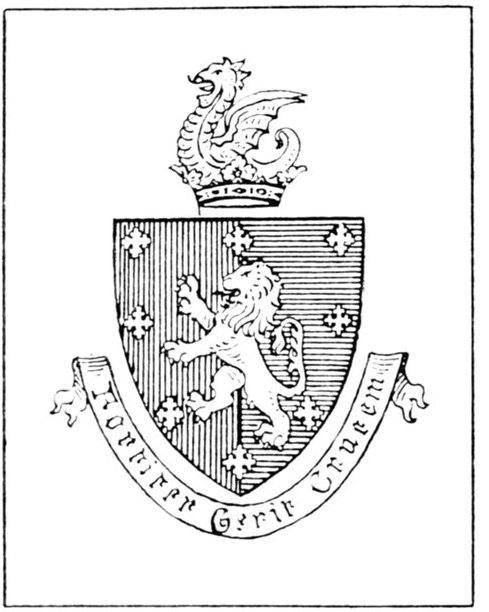
Arms.—Per pale gu. and az., a lion rampant between
three crosses crosslet arg. Hutchinson.
Crest.—A cockatrice, wings expanded az., comb,
wattles, and members or, issuing from a heraldic coronet.
Motto.—Fortiter gerit crucem.
[D * * *. Satyres sur les Femmes. 1718.]
Thomas Hutchinson (born May 1698, died February 1769) was a
son of Peter Hutchinson of Cornforth, Durham. He was educated at
Oxford, and entered the Church about 1730. In 1731 he was Rector of
Lyndon in Rutland, and in 1748 he was Vicar of Horsham, Rector of
Cocking, and a Prebendary of Chichester.
Dr. Hutchinson edited a few editions of the classics, and published
several sermons and a few essays, particularly one on Demoniacal
Possession.
Arms.—Within the Garter. Quarterly.
1st and 4th grand quarters, quarterly.
1 and 4. Az., 3 fleurs-de-lys, 2 and 1, or. France.
2 and 3. Gu., 3 lions passant guardant in pale
or, langued and unguled az. England.
2nd grand quarter; or, a lion rampant within a
double tressure flory counterflory gu. Scotland.
3rd grand quarter; az., a harp or, stringed arg.
Ireland.
Ensigned with a Royal Crown.
Supporters.—Dexter, a lion or, royally crowned ppr.
England.
Sinister, a unicorn arg., armed, crined, unguled or,
gorged with a princely coronet, a chain affixed
thereto, passing between the forelegs, and
reflexed over the back of the last. Scotland.
Motto.—Diev et mon droit.
Initials.—I. R. (Jacobus Rex).
The thistle, the badge of Scotland, shows at the base.
[Coquaeus. Apologia pro summis ecclesiae Romanae
Pontificibus, etc. Mediolani, 1619.]
Variety.—With vine spray and a thistle at the top.
[Godwin. Rerum Anglicarum Annales. London, 1616.]
Variety.—With an ornamental border containing the
falcon badge of Queen Anne Bullen and Queen Elizabeth,
the triple ostrich plume of the Prince of Wales, the
fleur-de-lys of France, the portcullis of the De Beauforts,
and the Tudor rose. A thistle of Scotland at the top.
[Du Bellay. Mémoires. Parisiis, 1569.]
Variety.—Without supporters.
[T. Bradwardini. Arch. Cantuariensis de causa Dei
contra Pelagium. London, 1618.]
Variety.—Without supporters.
[Boverius. Orthodoxa Consultatio. Matriti, 1623.]
The badge of a Tudor
rose, arg. and gu., reeded
or and leaved vert, royally
crowned, with sprays of
rose leaves.
[Perkins. Works.
Cambridge, 1603.]
The badge of a Tudor
rose, as before, royally
crowned, within a lozenge
of laurel leaves.
[Christian Dictionarie.
London, 1612.]
James Stuart (born 19th June 1566, died 27th March 1625) was the
son of Mary, Queen of Scotland, and Henry Stuart, Lord Darnley. He
was great-grandson of the Princess Margaret, eldest daughter of Henry
VII., who had married James IV., King of Scotland, in 1502, and by right
of this descent James came into the line of succession of the English throne.
On the dethronement of Queen Mary in 1569, under the Regency of
the Earl of Murray, James became King of Scotland under the title of
James VI., and reigned for thirty-four years until the death of his cousin,
Queen Elizabeth, in 1603, when he inherited the English crown and
came to England as James I.
On the accession of James I., a greater change took place in the
English Royal coat-of-arms than had ever occurred before. The old coat,
France and England quarterly, which had practically been in use ever since
the time of Edward III., now became only a quartering, and was shown
in the first and fourth quarters, then in the second quarter James put the
ancient coat-of-arms of Scotland, or, a lion rampant, within a double tressure
flory counterflory gu.
The lion appears for the first time on the shield of Alexander II., and
it is supposed to have been derived from the ancestors of the Scottish
kings, the Earls of Northumberland and of Huntingdon, whose device it
was. The tressure is also of doubtful origin, and is also very ancient;
it is popularly supposed to have been given by Charlemagne in recognition
of a league between that monarch and Achaius, King of Scotland.
The double tressure is presumed to indicate that there were two
treaties.
In the third quarter is the coat-of-arms of Ireland, az., a harp or,
stringed arg. This harp appears on an illuminated manuscript that
belonged to Elizabeth, and is said to have been granted to Ireland by
Henry VIII. as a mark of his admiration for the musical qualities of the
Irish. It also is used as a badge on Irish coins of and after 1526, and this
single harp was increased to three in similar coins made during Elizabeth's
reign. The harp was sacred to Apollo Grian or Beal, an ancient Irish
deity. Irish silver groats of 1478 show the device of three crowns in pale,
and this was probably the coat-of-arms of Ireland at that time, and before
that, in 1422, a single crown is found as a badge.
It is curious to note the strong tendency of single devices or badges to
merge into threes. It occurs first in the case of the single crown, which
presently gets tripled, then the single harp does the same, and the three
castles, the arms of Dublin, very likely began as one.
James I. made one more important change; he substituted one of the
Scottish unicorn supporters for the red dragon of Cadwallader, used as a
dexter supporter by Henry VIII., Edward VI., Mary, and Elizabeth.
The ancient Scottish supporters were two unicorns arg., armed, maned,
and unguled, gorged with a princely coronet and chained or. The origin
of the unicorn supporters is lost, but the creature is generally considered to
be an emblem of purity and of freedom; the horn, moreover, was credited
with medical powers as a remedy against poisons. The idea of an animal
bearing a single horn arose probably from the horn of the narwhal, which
has diagonal striations upon it resembling those generally shown on the
horn of a unicorn, and certainly does not look like the tooth of a fish.
On the other hand cups made of rhinoceros horn are credited with the
same magical powers as that of the unicorn. The chain attached to a
princely coronet on the neck of the unicorn is not easy to explain; it is
said that it alludes to an early king of Scotland, who, as a young man,
accidentally killed his father, and bore the chain ever afterwards on his
supporters as a sign of grief.
The lion and the unicorn have remained ever since the time of James
I. as the supporters of the English Royal coat-of-arms, without any change
whatever.
In Scotland James VI. had John Gibson for his bookbinder. He was
appointed under the Privy Seal, and was "Our Soverane Lordis Buikbinder,"
but there is no binding left that can with certainty be attributed to him.
On James's advent to England John and Roger Norton and Robert
and Christopher Barker were made Royal binders and printers, and in
1604 John and Abraham Bateman were made "Bookbinders to the
King."
The many fine armorial bindings which were used by James I. were
probably made by one or other of these binders, but for the present no
signed binding has been found, so the authorship of any one of them is
only conjectural.
The main characteristic of the finer bindings made for James I. is the
form of ornamentation known as a semis, that is to say, a powdering all
over the field of small stamps arranged symmetrically near together. The
commonest of these small stamps show stars, flaming hearts, ermine spots,
roses, thistles, pineapples, tridents, fleurs-de-lys, and lions, but there are
several others. Another characteristic is the presence of large corner
stamps. These are cut in arabesque designs, and many of them are very
handsome. The idea of corner ornamentation of this sort began late in
Queen Elizabeth's reign, but it did not reach its highest excellence in
stamp form until well into the reign of James I.
James I. was the first sovereign to have his books mainly bound in
morocco, and this leather is found in most quiet colours—greens and
browns and blues, but not red. Several beautiful volumes are also bound
in vellum, and others in velvet and satin. The Jacobean period was a
decorative one, but not one of the highest level of the art of bookbinding.
The greater number of James I.'s books came to the British Museum
by gift of George II. in 1757, with the rest of the Old Royal Library of
England.
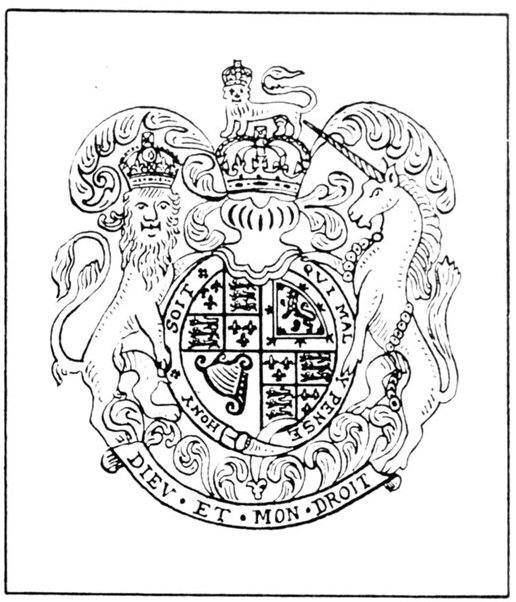
Arms.—Within the Garter. Quartered.
1st and 4th grand quarters, quarterly, France
and England.
2nd grand quarter, Scotland.
3rd grand quarter, Ireland.
As used by James I. (q.v.).
Crest.—A Royal crown ppr., thereon a lion statant
guardant or, crowned ppr.
Helmet.—Royal.
Supporters.—A lion and a unicorn as used by James
I. (q.v.).
Motto.—Diev et mon droit.
Used from 1685 until 1689, when James II. was
deposed.
[Ordnance Rules. 1683-1685. Stowe MS. 442.]
Variety.—Used in France from 1689 until 1701.
Arms.—Quarterly.
1st and 4th, England.
2nd, Scotland.
3rd, Ireland.
Colours as used by James I. (q.v.). Ensigned with
the Royal Crown, and between two palm branches.
In this coat James has left out the coat of France,
probably out of courtesy to the French King, Louis XIV.,
who had given him asylum at St. Germains. It is remarkable
that this coat-of-arms subsequently became
that used by Queen Victoria in 1837.
[La Renommée qui publie le Bonheur de l'Europe sous le regne
de Jacques ... Roy de la Grande Bretagne. 1688.]
[E. Almack, Esq., F.S.A., Brighton.]
Variety.—Within the Garter. Used in France from
1689 until 1701. The same curious coat-of-arms as in
the preceding plate.
[Traité des obligations des Chrétiens. Paris, 1699.]
[E. Almack, Esq., F.S.A., Brighton.]
Used as Duke of York.
Initials.—J. D. (Jacobus Dux). Ensigned with a
princely coronet, and within two palm branches.
This cypher occurs in corners of books, and it appears
to have been designed so that either the D or the J is
always properly visible. It is found in conjunction with
the two C's of Charles II., which also show clearly either
way up.
[Ser. Jacobi Stuarti et Mariae Beatricis Estiae ...
epithalamium. Londini, 1673.]
James, Duke of York (born 14th October 1633, died 16th September
1701), was the second son of Charles I. He succeeded his brother Charles
II. in 1685. James II. had a short and troubled reign, chiefly because
he had Roman Catholic tendencies, and ultimately joined that faith. The
feeling in favour of Protestantism in England was very determined, and
the nation ultimately invited William, Prince of Orange, who had married
James's elder daughter Mary and was a strong Protestant, to come and
accept the throne. This he did, and in 1689 James was deposed and
William became King in his stead.
James fled to France where he lived for the rest of his life, and the
book-stamps that he had made at this time do not include the French
coat. He was known as the Duke of York, but nevertheless his book-stamps
show a Royal Crown. James's second wife, Mary of Modena, was
a Roman Catholic and strongly influenced his views. He died at St.
Germains, Paris, at the age of seventy.
Arms.—Quartered.
1st and 4th grand quarters, quarterly, France and
England.
2nd grand quarter, Scotland.
3rd grand quarter, Ireland.
As used by James I. (q.v.). Ensigned with a princely
coronet.
Note.—A foreign stamp.
[Gervaise. La vie de Saint Martin, Evêque de Tours.
Tours, 1699.]
James Francis Edward (born 10th June 1688, died 1st January
1766) was the eldest son of James II. and his second wife, Mary of
Modena. He was born before his father became King of England.
Prince James, who is known as the Old Pretender in distinction to
his son Charles Edward, the Young Pretender, is also known as the
Chevalier St. George. His history is an unhappy one from his birth.
On his father's death in 1701 at St. Germains he was proclaimed James
III. of England and VIII. of Scotland, but by the Act of Settlement made
in the same year the Stuarts were cut out of the succession to the English
throne.
The Chevalier St. George spent his life in fruitless endeavours to make
good his claim to the English throne. His character appears to have been
wanting in most of the qualities that make for success, and towards the
latter part of his life his misfortunes so preyed upon him that he gave way
to unworthy dissipations.
Arms.—Quarterly.
1st and 4th; gu., 3 garbs within a bordure
engrailed or. Kempe.
2nd and 3rd; sa., 3 crescents arg., 2 and 1. Read.
[Alliances généalogiques de France. Paris, 1561.]
Thomas Read Kemp (born c. 1781, died 20th December 1844) was
the son of Thomas Kemp, Member of Parliament for Lewes, who married
Ann Read of Brookland. Mr. Kemp was educated at Cambridge, and
in 1811 he represented Lewes in the House of Commons. He sold his
castles at Lewes and at Hurstmonceaux and built largely near Brighton,
where the district known as Kemp Town was founded by him. He
spent all his fortune in this speculation, which, however, in time became
of great value.
The family of Kemp or Kempe is one of great antiquity in Kent.
John Kempe, Archbishop of Canterbury in the fifteenth century, and his
nephew Thomas Kempe, Bishop of London, both belonged to it. The
immediate ancestor of Mr. T. R. Kemp was Sir Thomas Kempe of
Olantigh, near Ashford, an estate which had belonged to the family since
the time of Edward I.
Arms.—Quarterly.
1st and 4th; vert., on a chevron between 3
unicorns' heads erased arg., armed and maned
or, as many mullets sa. Ker.
2nd and 3rd; gu., 3 mascles or. Weapont.
Coronet.—That of a Duke.
Supporters.—Two savage men, wreathed about the
head and waist with laurel, each holding, with the
exterior hand, a club resting upon the shoulder, all ppr.
Motto.—Pro christo et patria.
[The Roxburghe Ballads.]
Variety.—Without Supporters.
[Onosander. Strategicus. Lut. Parisiorum, 1599.]
John Ker (born 23rd April 1740, died 19th March 1804) was the
elder son of Robert Ker, second Duke of Roxburghe. He succeeded his
father in the title in 1755. The Duke brought together a splendid
library, among which was the special collection of ballads which are now
known by his name. The ballads were at first collected by Robert
Harley, and they were largely added to by a Mr. West and by Major
T. Pearson, and after the entire collection had been purchased by the
Duke of Roxburghe he continued adding to it himself.
In 1812 the Duke's library was sold and the books widely scattered;
the ballads, however, in 1845 were acquired for the British Museum at
the sale of the books of Mr. B. H. Bright. The Duke of Roxburghe
was a Knight of the Garter, and also a Knight of the Thistle. He was a
Lord of the Bedchamber and a Privy Councillor.
The Roxburghe Club of Edinburgh was founded in honour of the
Duke in 1812.
Arms.—Gu., on a chevron arg., 3 mullets of the
field. Kerr.
Coronet.—That of an Earl.
Supporters.—Two bucks, each gorged with a collar
arg., charged with 3 mullets gu.
Motto.—Sors mea dextra dei.
[Bacon. Of the advancement and proficience of Learning.
Oxford, 1640.]
William Kerr (born c. 1605, died October 1675) was the son of
Robert Kerr, first Earl of Ancrum, and in 1631 he was created Earl of
Lothian. In that year he had married Anne, Countess of Lothian in
her own right, and there was some litigation about the title. The Earl
was at the Battle of Newbury in 1643; he was Governor of Newcastle,
and a man of much political importance. He was a Commissioner of the
Treasury in Scotland, and Lieutenant-General of the Scottish army in
Ireland. In 1642 he went to France for the purpose of considering the
position of the Scottish Guard at the French Court.
Lord Lothian was one of the commissioners sent by the Scottish
Parliament to protest against the proceedings against Charles I., and he
also served on several of the commissions which were appointed about
that time concerning the Restoration of Charles II.
Arms.—Quarterly.
1st and 4th; sa., on a bend or, 3 martlets vert., a
bordure of the second. Kinnear.
2nd and 3rd; arg., on a fret gu., 4 hearts, one
in each angle, gu., and in every interstice a
rose of the second. Gardiner.
Crest.—An anchor in pale az.
Motto.—Spem fortuna alit.
[Bannatyne Club. The Palice of Honour.
Edinburgh, 1827.]
John Gardiner Kinnear was a banker of Edinburgh. He was a
member of the Bannatyne Club, to which he was admitted in 1826.
The Kinnears were well known as a family of bankers, and they
also had literary tastes. The particular book from which I have taken
the accompanying coat-of-arms is one that was presented to the
Bannatyne Club in 1827, and reprinted in that year for Mr. J. G.
Kinnear. The text is taken from a rare book written by Gawyn
Douglas, Bishop of Dunkeld, called The Palice of Honour, and "Imprentit
at Edinburgh be Johne Ros, for Henric Charteris, Anno 1579."
Arms.—Impaled.
Dexter: Az., an archiepiscopal staff, headed with
a cross pattée or, surmounted by a pall arg.,
charged with 4 crosses pattée fitchée sa., fringed
and edged or. See of Canterbury.
Sinister: Sa., on a chevron or, between 3 estoiles of
6 points of the second, as many crosses pattée
fitchée gu. Laud.
[Laud. A relation of the Conference between William Lawd ...
and Mr. Fisher the Jesuite, etc. London, 1639.]
William Laud (born 7th October 1573, died 10th January 1645) was
the son of William Laud of Reading. After leaving Reading he went to
Oxford and entered the Church, and quickly came into notice as a theologian.
He was supposed to favour Romish doctrines. After enjoying several
minor appointments, Laud was made Dean of Gloucester in 1616, and by
this time he was high in the favour of James I., who in 1621 promoted
him to the Bishopric of St. David's.
Under Charles I. Laud acquired still more importance. In 1626 he
was made Dean of the Chapel Royal, and next year a member of the Privy
Council, and in 1628 he became Bishop of London. In 1629 Laud was
Chancellor of the University of Oxford, and in 1633 he was made Archbishop
of Canterbury. Archbishop Laud was impeached for treason in
1641; he underwent his trial in 1644, and an ordinance of attainder was
passed in the next year. Although Laud had in his possession a pardon
from the king, he was beheaded on Tower Hill in 1645. He wrote
a large number of books, mainly theological or historical. Several of his
books are in the library at Lambeth Palace, and others are in the British
Museum.
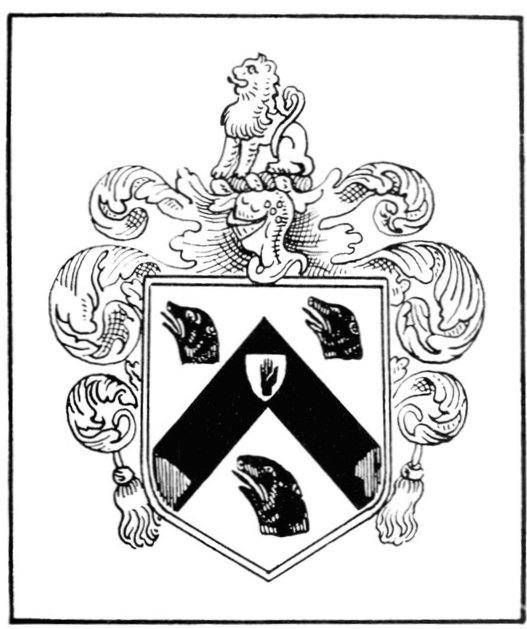
Arms.—Arg., a chevron between 3 seals' heads couped
sa. Ley.
The Ulster hand gu., on an escutcheon arg., in the
chief point of the chevron.
Crest.—A lion sejant or.
Helmet.—That of an Esquire.
Used between 1620 and 1625.
[Brutus Abbreviatus. Add. MS. 34,266.]
James Ley (born c. 1550, died 14th March 1628) was the son of Henry
Ley of Teffont Ewias, Wilts. He was educated as a lawyer, and attained
great eminence in that profession. In 1605 he became Chief-Justice of
the King's Bench in Ireland, and in 1620 he was made a Baronet, and
next year Chief-Justice of the King's Bench in England.
In 1625 Sir James Ley was created Baron Ley, and became Lord
Treasurer of England, and in 1626 he was created Earl of Marlborough
and President of the Council. Lord Marlborough had a high reputation
as a lawyer and as a judge, and he was the author of several works on
history and law.
Arms.—Quarterly.
1st and 4th; gu., a fess chequy, arg. and az.
Lindsay.
2nd and 3rd; or, a lion rampant gu., debruised of
a ribbon in bend sa. Abernethy.
All within a bordure of the third, semée of stars or.
Crest.—A tent ppr., semée of stars or, with ASTRA
CASTRA on a fillet.
Helmet.—That of a Peer.
Supporters.—Two lions sejant guardant gu., gorged or.
Motto.—Nvmen lvmen mvnimen.
Legend.—David dominvs lyndesay de balcarres.
[Books at Haigh Hall, Wigan.]
[The Earl of Crawford, Haigh Hall, Wigan.]
Crest.—A tent ppr., semée of stars or, with ASTRA
CASTRA.
[Books at Haigh Hall, Wigan.]
[The Earl of Crawford, Haigh Hall, Wigan.]
David Lindsay (born c. 1586, died March 1640) was the son of John
Lindsay, Lord Menmuir, second son of the ninth Earl of Crawford.
David Lindsay succeeded his brother John in 1601, and in 1612 he was
knighted. In 1633 he was created Baron Lindsay of Balcarres. He was
the ancestor of the present Earl of Crawford. Lord Lindsay was a firm
adherent of Charles I. He was fond of books and literature, besides being
a man of science and scientific pursuits generally.
Arms.—Gu., 3 boars' heads erased in pale arg.
Lloyd.
Crest.—Out of an heraldic coronet a boar's head
erased arg.
Motto.—Dare quam accipere.
[Porta. Natural Magick. London, 1658.]
David Lloyd (born 1597, died 7th September 1663) was the son of
David Lloyd of Llanidloes, Montgomery. He was educated at Oxford, and
took orders about 1628. Dr. Lloyd was chaplain to the Earl of Derby,
and held several benefices in Wales, and in 1660 was made Dean of St.
Asaph. He wrote a well-known book called The Legend of Captain Jones,
which was published in London in 1631. This remarkable work went
through several editions, many of which were curiously added to and
altered by successive editors or re-writers.
Crest.—A buck's head erased ppr. Locker.
Motto.—Fear God and fear not.
Initials.—E. H. L. (Edward Hawke Locker).
[Descrizione delle Pitture che trovansi in alcune città dello
Stato Ligure. Genova, 1780.]
Edward Hawke Locker (born 9th October 1777, died 16th October
1849) was the son of William Locker, Captain R.N. He was educated at
Eton, and occupied several positions of trust, until in 1819 he was made
Secretary to Greenwich Hospital. Mr. Locker was a Fellow of the
Royal Society, an artist and an author, and has left a few books, chiefly
biographical or historical. At Greenwich he inaugurated the scheme of
making a collection of naval pictures, which has proved of the greatest
value. His son Frederick, who assumed the additional surname of
Lampson in 1885, afterwards became a well-known book collector.
Arms.—Sa., a lion passant arg., holding in the dexter
paw a cross crosslet fitchée or, on a chief of the second
3 crosses crosslet of the field.
Coronet.—That of a Baron.
Supporters.—Two lions reguardant arg., gouttées de
sang, each gorged with a ducal coronet or, thereto
pendent an escutcheon sa., charged with a cross crosslet
arg.
Motto.—Ingenuas suspicit artes.
The coat is enclosed with a fillet bearing the legend
"Tria juncta in uno," being the motto of the Order of
the Bath. This is again enclosed within the collar of
the said Order, as worn by a Knight Grand Cross, from
which depends the badge of the Order.
[Letters of German Authors, etc. Egerton MS. 2407.]
Charles Long (born circ. 1760, died 17th January 1838) was the son of
Beeston Long of Carshalton Park, Surrey. He was educated at Cambridge,
and was successively Member of Parliament for Rye, Midhurst and
Wendover, and Haslemere, and held many important offices.
In 1800 Mr. Long became joint Secretary of the Treasury, and
presently one of the Lords of the Treasury, and was Paymaster-General from
1817 until 1826, when he was created Baron Farnborough of Bromley
Hill Place. He was a Knight Grand Cross of the Bath, and a member
of the Privy Council. Lord Farnborough took an important part in the
negotiations with George IV., with regard to his gift to the Nation
of the Library of George III., and he also bequeathed a considerable
sum of money to the Trustees of the British Museum, to augment the
Bridgewater Fund. He was a Trustee of the British Museum, a Fellow
of the Royal Society and of the Society of Antiquaries, and possessed a
valuable collection of pictures and antiquities at his house, Bromley Hill
Place, in Kent.
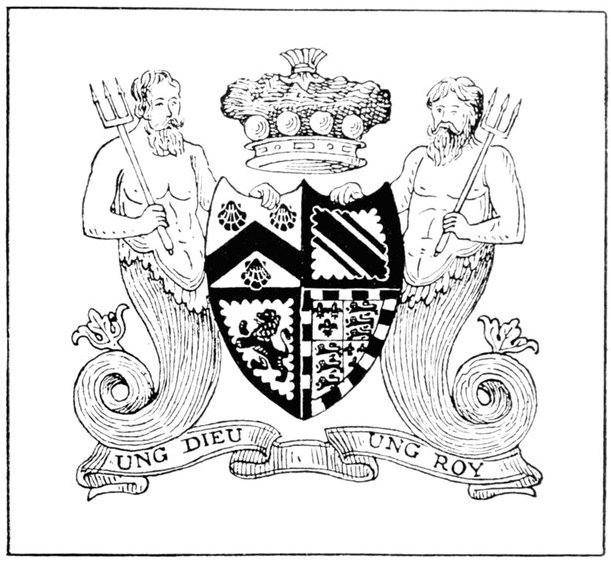
Arms.—Quarterly.
1. Arg., a chevron between 3 escallops sa.
Lyttelton.
2. Arg., a bend cotised sa., within a bordure
engrailed gu. (bezantée). Westcote.
3. Gu., a lion rampant within a bordure
engrailed or. Burley.
4. France and England quarterly, within a
bordure gobony, arg. and az. By right of
descent from Elizabeth, daughter of Sir Gilbert
Talbot, and great-great-granddaughter of John
of Gaunt, Duke of Lancaster. Plantagenet.
Coronet.—That of a Baron.
Supporters.—On either side a merman ppr., in his
exterior hand a trident or. But in several instances
of early use, a dexter Supporter alone is found.
Motto.—Ung dieu ung roy.
[Littleton. The first part of the Institutes of the Lawes
of England. London, 1794.]
[The Viscount Cobham, Hagley Hall, Stourbridge.]
William Henry Lyttelton (born 24th December 1724, died 14th
September 1808) was the fifth son of Sir Thomas Lyttelton, Baronet,
who was created Viscount Cobham in 1718. In 1776 Mr. Lyttelton was
created Baron Westcote in the Peerage of Ireland, and on the death of his
nephew, Sir Thomas Lyttelton, second Baron Lyttelton, he succeeded
to the Baronetcy and the English peerage expired.
Lord Westcote was Governor of South Carolina and of Jamaica, and
Envoy Extraordinary to the Court of Portugal. In 1794 he was created
Baron Lyttelton in the Peerage of England, assuming the same title as
had become extinct by the death of his nephew in 1779. Lord Lyttelton
was a descendant of the great lawyer, Sir Thomas Lyttelton, Judge of
the Court of Common Pleas, who wrote the celebrated treatise on Tenures,
in the fifteenth century.
Arms.—Or, a lion rampant dechaussé, within a
double tressure flory counterflory of fleurs-de-lys gu.
Maitland.
Crest.—A lion sejant affrontée gu., ducally crowned
or, holding in the dexter paw a sword ppr., pommelled
and hilted or, in the sinister paw a fleur-de-lys az., on
a fillet "Consilio et animis."
Coronet.—That of an Earl.
Helmet.—That of a Peer.
Supporters.—Two eagles, wings expanded, ppr.
Legend.—Ioannes metellanvs lauderiæ comes.
[La Bigne. Magna Bibliotheca Veterum Patrum et Antiq.
Scriptorum Ecclesiasticorum. Coloniae Agrippinae, 1618.]
Crest.—A lion sejant affrontée gu., holding in his
dexter paw a sword ppr., pommelled and hilted or, and
in the sinister paw a fleur-de-lys az.
Coronet.—That of a Viscount.
Motto.—Consilio et animis.
Note.—Used between 1616 and 1624.
[Tacitus. Opera. 1595.]
John Maitland (born circ. 1580, died 18th January 1645) was the
only son of John Maitland, Lord Maitland of Thirlestane, and succeeded
to his father's peerage in 1595. In 1616 Lord Maitland was created
Viscount Lauderdale, and in 1624, Earl of Lauderdale. Lord Lauderdale
was a Lord of Session in Scotland.
Crest.—Within the Garter. On a chapeau gu., turned
up erm., a peacock in pride ppr. Ros afterwards
Manners.
Coronet.—That of an Earl.
[Ruvius. Commentarii in Octo libros Aristotelis de Physico.
Col. Agrippinae, 1616.]
Francis Manners (born 1578, died 17th December 1632) was the son
of John Manners, Earl of Rutland. He was educated at Cambridge, and
studied law at the Inner Temple. Mr. Manners was made a Knight of the
Order of the Bath in 1604, and in 1612, on the death of his elder brother,
Roger, he succeeded to his father's peerage.
Lord Rutland was Lord Lieutenant of Lincolnshire, Constable of
Nottingham Castle, and in 1612 he entertained James I. at Belvoir Castle.
In consequence of certain legal decisions adverse to his claim to an older
title he was, in 1616, made Lord Ross of Hamlake. In the same year he
was made a Knight of the Garter. He carried the sceptre with the
dove at the coronation of Charles I., was Chief-Justice of Eyre north
of Trent, and in 1623 he commanded the fleet sent to escort Prince
Charles back from Spain.
The beautiful crest of a peacock in pride upon a chapeau was adopted
by the Manners family after the marriage, in the fifteenth century, of Sir
Robert Manners of Etal, Northumberland, with Eleanor, daughter and
heiress of Thomas, 10th Lord Ros, whose crest it was. The family crest
of Sir Robert Manners was a bull's head erased gu., ducally gorged and
chained or.
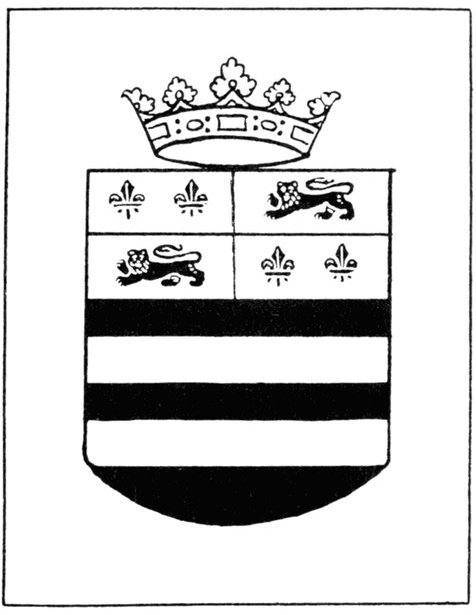
Arms.—Or, 2 bars az., a chief quarterly of the
second and gu.; the first and fourth quarters each charged
with 2 fleurs-de-lys or, the second and third quarters each
charged with a lion of England or. Manners.
This chief was originally gu., and the change made in
it, incorporating the fleurs-de-lys of France and the lion of
England, was an augmentation granted in consideration of
descent from Edward IV.
Coronet.—That of a Duke.
[Settle. Fears and Dangers fairly display'd.
London, 1706.]
John Manners (born 29th May 1638, died 10th January 1710) was the
son of John Manners, ninth Earl of Rutland, and succeeded his father in
the Earldom in 1679.
Before this, however, he had been created Lord Manners of Haddon.
He carried the Queen's sceptre with the cross at the coronation of
James II. He supported the Protestant cause, and the Princess Anne at
one time took refuge at Belvoir Castle, and when she presently became
Queen she created Lord Manners Marquis of Granby and Duke of
Rutland.
Arms.—Quarterly.
1st and 4th, France.
2nd and 3rd, England.
As used by Henry VIII. (q.v.).
Crown.—Royal.
[Epitome operum divi Augustini. Cologne, 1549.]
The Princess Mary (born 18th February 1516, died 17th November
1558) was the daughter of Henry VIII. and his first wife, Catherine of
Aragon. In 1553 she succeeded her brother Edward VI. on the throne
of England.
In 1554 Queen Mary married Prince Philip, afterwards Philip II.,
King of Spain, but the marriage was neither happy nor popular.
The bindings made for Queen Mary often show her coat-of-arms
encircled by flames. They were bound by Thomas Berthelet, who had
been Royal Bookbinder to Henry VIII. Most of the books are bound in
calf, but some are in embroidered velvet, and show the pomegranate flower.
Mary also used the badges of the fleur-de-lys and the portcullis of the De
Beauforts. Her initials, "M. I.," are sometimes used on her bindings.
Queen Mary used the same supporters as Henry VIII. in the latter part of
his reign, namely, the lion and the red dragon, but they do not show on
any of her books. Queen Mary's books came to the British Museum
in 1757.
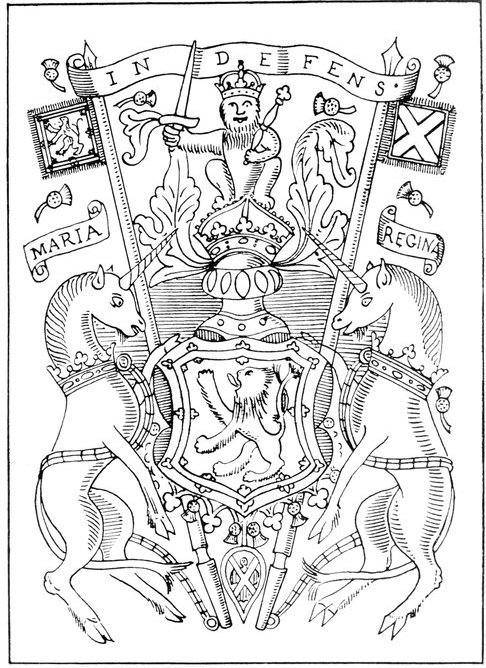
Arms.—Or, a lion rampant within a double tressure
flory counterflory gu. Scotland.
As used by James I. (q.v.).
Crest.—The Scottish Royal Crown, ppr., thereon a
lion sejant or, holding in his dexter paw a sword
and in his sinister paw a sceptre, all ppr.
Helmet.—Royal.
Supporters.—Two unicorns arg., armed, unguled, each
gorged with a princely coronet and chained or, as used
by James I. (q.v.).
Motto.—In defens.
Behind the shield are two spears, on the dexter of
which is a banner bearing the arms of Scotland, and on
the sinister a banner bearing the cross of St. Andrew
arg., on a field az.
The shield is enclosed within the collar of the Order
of the Thistle, from which depends the badge of the Order.
Legend.—Maria Regina.
[The Black Acts. Edinburgh, 1556.]
Cypher Μ., i.e. "Marie," and Φ, i.e. "Francis," used
about 1559 or 1560, when Mary was Queen of Francis
II., King of France.
The motto "Sa vertv matire" is an anagram on the
name Marie Stuuarte.
The crown is the crown of France.
Note.—A foreign stamp.
[Ptolemy. Geographia. Rome, 1490.]
[The late Sir Wollaston Franks, K.C.B.]
Mary, Princess of Scotland (born 8th December 1542, died 8th
February 1587), was the daughter of James V., King of Scotland, and on
his death in 1542, when she was eight days old, she succeeded to his crown.
Mary was the granddaughter of the Princess Margaret, eldest daughter of
Henry VII., who had married James IV., King of Scotland, in 1502.
In 1558 she married the Dauphin of France, who shortly afterwards
became king as Francis II. He died in 1560, and Mary returned to
Scotland, and in 1565 married Henry Stuart, Earl of Darnley, who was
proclaimed King of Scotland on the day of his marriage.
Lord Darnley was murdered in 1567, and Queen Mary dethroned in
favour of her son, James VI., and in the same year she married John
Hepburn, Earl of Bothwell, who is supposed to have been Darnley's
murderer. Troubles multiplied round the unfortunate queen. Her husband
had to take refuge abroad, and she herself was made a prisoner and shut
up at Loch Leven. Queen Mary asked Queen Elizabeth's help in the
discords which became incessant in Scotland, and at last Mary was induced
to put herself in her rival's power, and took refuge at Carlisle.
The end was that after a long imprisonment in England she was tried,
condemned, and beheaded at Fotheringay in 1587, the plea being that she
had conspired against Queen Elizabeth's life.
Queen Mary was very intellectual and a notable linguist. Many of
her books are bound in black and have black edges. This is supposed to
have been intended as a mark of mourning for her first husband. Mary's
only son, James VI., succeeded to the throne of England on the death
of Queen Elizabeth in 1603, his title in England being James I.
The present official coat-of-arms of Scotland is,
quarterly:
1st and 4th, Scotland.
2nd, England.
3rd, Ireland.
Colours as used by James I. (q.v.).
Supporters.—Dexter: A unicorn arg., maned, horned,
hoofed, and gorged with a princely coronet and
chained or.
Sinister: A lion or, royally crowned.
Crest.—The crest of Scotland as used by Mary, Queen
of Scotland, but on an English Royal Crown. Behind the
shield are two standards bearing respectively the crosses
of St. Andrew and St. George, and the helmet, collar of the
Order of the Thistle, and motto are all as used by Queen
Mary.
Arms.—Two shields side by side.
Dexter shield: Gu., 3 lions passant guardant, in pale,
or, langued and unguled az. England.
Sinister shield: Arg., an eagle displayed sa. D'Este.
Ensigned with a Royal Crown of foreign design, and
enclosed between two palm branches.
Note.—This stamp was probably made in France after
1689.
[Desporcellets. Regne de Jacques II. MS.]
Arms.—Impaled.
Dexter: Quarterly.
1st and 4th grand quarters, quarterly; France
and England.
2nd grand quarter; Scotland.
3rd grand quarter; Ireland.
As used by James I. (q.v.). Over all the label, with
three points arg., of an eldest son.
Sinister: Quarterly.
1st and 4th; arg., an eagle displayed sa.,
coroneted ppr. D'Este.
2nd and 3rd; az., 3 fleurs-de-lys or, within a
bordure counter-indented, or and gu. Ferrara.
Ensigned with a princely coronet.
Supporters.—Dexter: A lion of England or, wearing
a princely coronet ppr., and charged on the neck
with a label of three points arg.
Sinister: An eagle of D'Este sa., wearing a ducal
coronet or.
Note.—This stamp was made while James was still
Duke of York, that is to say, between 1673 and 1685.
[Waller. Poems. London, 1668.]
Mary Beatrice of Modena (born 5th October 1658, died 7th May
1718) was a daughter of Alphonso IV., D'Este, Duke of Modena. She
was a strong Roman Catholic. In 1673 she married James, Duke of
York, whom she presently converted to the Roman Catholic religion, and
when she became queen in 1685, her influence over the king continued
to be very great. There were many disquieting rumours about the birth
of the Prince of Wales, and Queen Mary was never liked in England.
She seems, however, to have been a devoted and affectionate wife.
Her trouble culminated about 1688, when she fled to France with her
little son, and was well and honourably received by Louis XIV. James
II. presently joined her at the Palace of St. Germain, which the French
king had put at his disposal on his deposition from the throne of England
in 1689. After James's death in 1701 Queen Mary continued to live at
St. Germain, and remained there for the rest of her life.
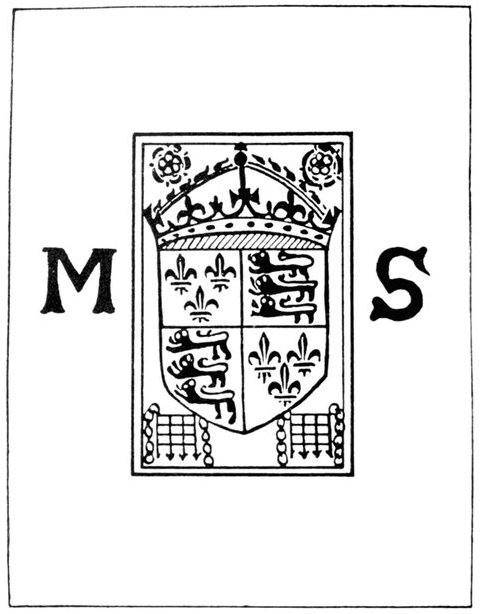
Arms.—Quarterly, France and England, as used by
Henry VIII. (q.v.).
Badges.—Tudor roses, gu. and arg., and portcullis
arg., chained or.
Initials.—M. S. (Mary Suffolk).
Note.—The book bears the arms of Henry VIII., and
the initials have been added. It is one of the earliest
gold-tooled English bindings in existence, and was
probably made by John Taverner for an earlier inside
than that which it now covers.
[Herbarum Imagines. Francofurti, 1535.]
Mary Tudor (born 1497, died 23rd June 1534) was the youngest
daughter of Henry VII. At an early age she was enamoured of Charles
Brandon, afterwards Duke of Suffolk. Henry VIII., however, decided
that her marriage with Louis XII. of France was more expedient, and in
1514 she became his Queen. Next year she was left a widow, and almost
immediately she married the Duke of Suffolk abroad, and the marriage
was afterwards re-solemnised in England.
Arms.—Impaled.
Dexter: Gu., two keys in saltire arg., in chief a
Royal Crown or. See of York, after 1515.
Sinister: Quarterly.
1st and 4th; sa., a lion rampant arg.
2nd and 3rd; gu., 3 chevrons arg. Matthew.
[Novum Testamentum. 1580.]
Tobias Matthew (born circ. 1546, died 29th March 1628) was the
son of John Matthew of Ross in Herefordshire. He was educated at
Oxford and ordained in 1566. He preached before Queen Elizabeth at
St. Mary's Church in the High Street at Oxford, and attracted Her Majesty's
attention by his eloquence and his handsome appearance. He was made
a Canon of Christchurch Cathedral in 1570, and Dean in 1576. In
1583 he was Dean of Durham. In 1595 he was consecrated Bishop of
Durham, and in 1606 Archbishop of York. Archbishop Matthew took a
prominent part in the political as well as the theological affairs of his time.
Lady Arabella Stuart was imprisoned in his house, and she escaped from it
in 1611.
Arms.—Within the Garter. Gu., a chevron
between 3 lions' heads erased arg. Monck.
Coronet.—That of a Duke.
[Heylyn. Ecclesia Restaurata. London, 1674.]
Christopher Monck (born circ. 1653, died 6th October 1688) was the
son of General George Monck, who, in recognition of his services concerning
the restoration of Charles II., was by that monarch created Duke
of Albemarle in 1660. Christopher Monck succeeded his father in the
Dukedom in 1669. He was made a Knight of the Garter in the same
year, and in 1687 he was appointed Governor of Jamaica.
Arms.—Within the Garter. Quarterly.
1st and 4th; arg., 3 lozenges conjoined in fess
gu., within a bordure sa. Montagu.
2nd and 3rd; or, an eagle displayed vert., beaked
and membered gu. Monthermer.
On an escutcheon of pretence. Sa., a lion rampant
arg., on a canton of the last a cross gu. Churchill.
Coronet.—That of a Duke.
[Bacon. The Historie of the Reigne of King
Henry the Seventh. London, 1641.]
Crest.—Within the Garter. A griffin's head couped
or, beak and wings endorsed sa. Montagu.
[Berkeley. Siris. London, 1744.]
John Montagu (born circ. 1688, died 6th July 1749) was the son of
Ralph Montagu, Duke of Montagu, whom he succeeded in 1709. At
the coronation of George I. the Duke of Montagu was High Constable,
and he was Governor of St. Lucia and St. Vincent, both of which islands
were given to him by the king.
The Duke of Montagu carried the sceptre with the cross at the
coronation of George II., and in 1740 he was made Master-General of
the Ordnance. He raised a regiment of cavalry, known as "Montagu's
Carabineers." In 1719 he was made a Knight of the Garter, and in 1725
Grand Master of the Order of the Bath, and he also held several military
appointments. He was a Fellow of the Royal Society and of the Royal
College of Physicians.
The Duke's town residence, Montagu House, originally occupied the
site now covered by the British Museum, and at his death it was acquired
by the Government. Many alterations were carried out for the better
housing of the collections which were placed in it, and eventually it was
entirely rebuilt in a more convenient form. It had been originally built
for Ralph, the first Duke of Montagu. The Duke married Mary
Churchill, daughter of John Churchill, Duke of Marlborough, the great
General. Lady Mary Churchill's only brother having died as a boy, she
and her sisters became heraldic heiresses, so their coat-of-arms were borne
on an escutcheon of pretence in the centre of the coats-of-arms of their
respective husbands.
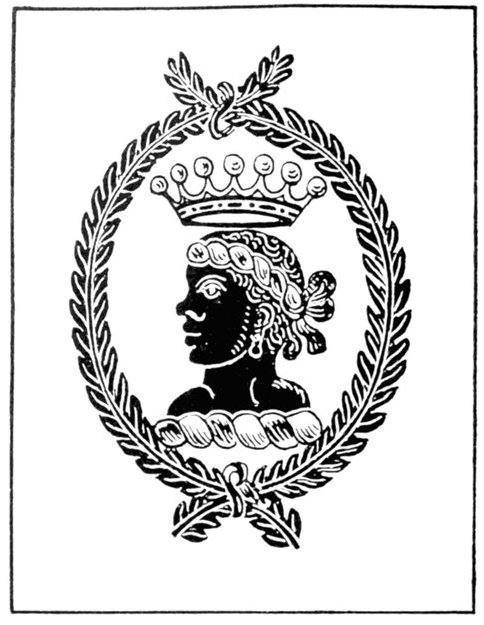
Crest.—A Saracen's head in profile ppr., wreathed
about the temples, arg. and sa. Mordaunt.
Coronet.—That of a Viscount.
[Buchonius. Primitiae gnomonicae Catoptricae, etc.
Avenione, 1635.]
Variety.—In a smaller size.
[Recueil general des Caquets de l'Acouchée. 1623.]
John Mordaunt (born 18th June 1626, died 5th June 1675) was the
second son of John Mordaunt, Earl of Peterborough. He was educated
at Oxford and was a strong Royalist. In 1658 he was in consequence tried
for his life, and only escaped death by one vote. He was with Charles II.
on the Continent, and in 1659 was created Viscount Mordaunt of Avalon.
In 1660, on the Restoration, Lord Mordaunt was knighted. He commanded
a troop of horse and a regiment of foot, and was Constable of
Windsor Castle and Keeper of the Great Park. He was also Lord
Lieutenant of Surrey.
Crest.—Two arms in armour, gauntleted ppr., holding
an annulet or. Musgrave.
[Saint German. Doctor and Student.
In the Savoy, 1751.]
William Musgrave (born 8th October 1735, died 16th January 1800)
was the second son of Sir Richard Musgrave of Hayton Castle, and
succeeded to the family Baronetcy in 1755, on the death of his elder
brother.
Sir William was a Commissioner of Customs and of Accounts, a
Fellow and Vice-President of the Royal Society, a lawyer of much distinction,
and a Bencher and Treasurer of the Middle Temple. He was
author of a very useful compilation known as Musgrave's Obituary; it
gives reference to places where the various persons deceased are mentioned,
and also further particulars. The obituary was published by the Harleian
Society in 1899-1901.
Sir William Musgrave made large collections of manuscripts on the
subject of portrait-painting in England, and also concerning the history of
England. He bequeathed these manuscripts, as well as a considerable
number of printed books, to the British Museum, of which he was a
Trustee. He had already given several books to the library during his
lifetime, many of which contain an autograph note of the presentation.
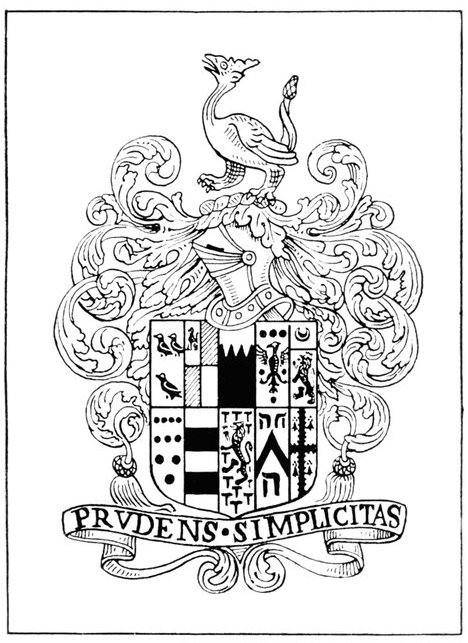
Arms.—Quartered.
1. Gu., 3 martlets or. Naunton.
2. Quarterly, or and gu., in the first quarter a
lion rampant of the second. Inglish.
3. Arg., a chief indented sa. Hillock.
4. Sa., an eagle displayed arg., between 6 bezants,
3, 2, and 1. Busserard.
5. Arg., a lion rampant sa., a chief gu., a crescent
for difference. Ashby.
6. Gu., 10 bezants, 4, 3, 2, and 1. Zouch.
7. Arg., 2 bars gu. Martin.
8. Gu., a lion rampant between 14 tau crosses
or. Powell (?).
9. A chevron between 3 Hebrew letters
"Cheth," probably standing for "Jehovah."
Unknown.
10. Erm., a cross engrailed sa. Houghton.
Crest.—A basilisk ppr.
Helmet.—That of an Esquire.
Motto.—Prvdens simplicitas.
[Common Prayer. London, 1612.]
Robert Naunton (born circ. 1563, died 27th March 1635) was the son of
Henry Naunton of Alderton. He was educated at Cambridge, where in
1594 he was elected Public Orator, and travelled largely on the Continent
for the purpose of studying politics. He was Member of Parliament for
Helston in 1606, then for Camelford and for Suffolk, and sat in three
Parliaments as Member for Cambridge. In 1614 he received the honour
of Knighthood, and in 1617 became Secretary of State, and afterwards
Master of the Court of Wards. Sir Robert was an earnest Protestant,
and the Catholics considered that he was too strongly opposed to their
interests. The latter part of his life was troubled, chiefly because he
was too free in expressing his own views as to matters of public interest.
Although he held several important official offices, he does not appear to
have been a man of much talent, but his management of the matters
entrusted to him was marked by strong common sense and trustworthiness.
He wrote several valuable books on travel, biography, and history.
Badges.—1. A Lancastrian rose gu., seeded or, and
leaved vert. 2. A portcullis of De Beaufort arg., chained
and ringed or, nailed az. Both ensigned with an Earl's
Coronet.
[C. Suetonius. Tranquillus ex recensione F. Oudendorpii.
Lugduni Batavorum, 1751.]
George Nevill (born 24th June 1727, died 9th September 1785)
was the son of William Nevill, Lord Abergavenny. He was a godson
of George II., and succeeded his father in the Barony in 1744. Lord
Abergavenny was Lord Lieutenant of Sussex, and in 1784 he was created
Earl of Abergavenny.
The use of the badges shown is not confined to any particular
earl, but had been generally used by the Nevill family for a long time.
The Red Rose of Lancaster was adopted as a badge by Richard Nevill,
Earl of Warwick, whose daughter Anne married Edward, Prince of
Wales, only son of Henry VI., the last of the Lancastrian Kings, in
1470. The Princess Anne afterwards married Richard III., the last of
the Yorkist Kings. The portcullis was used as a badge of descent from
the house of De Beaufort, and both badges are still used by the family
of Nevill.
Arms.—Impaled.
Dexter: Or, fretty gu., a canton erm. Noel.
Sinister: Or, two bars az., a chief quarterly of
the last and gu., in the first and fourth quarters
2 fleurs-de-lys or, and in the second and third
quarters a lion passant guardant, of the last
langued and unguled az. Manners.
Coronet.—That of an Earl.
[Settle. Thalia Lacrymans. London, 1714.]
Baptist Noel (born 1684, died 17th April 1714) was the son of
Baptist Noel of Luffenham, Rutland, who was the eldest son, by his
fourth marriage, of Baptist Noel, second Baron Noel and third Viscount
Campden. The eldest son of Lord Campden succeeded to his father's
title in 1682, and in 1681 he was created Earl of Gainsborough
with special remainder to his younger brothers. In consequence of
this remainder, on the death of Wriothesley Noel, second Earl of
Gainsborough, in 1691, without male heir, the Earldom reverted to
Baptist Noel, his cousin, who succeeded as third Earl.
Lord Gainsborough married, about 1706, his first cousin, Dorothy
Manners, daughter of John, first Duke of Rutland.
Arms.—Gu., on a chevron between 3 keys erect
arg., as many estoiles of the field. The estoiles were
an augmentation added in 1559. Parker.
[New Testament. London, 1574.]
Matthew Parker (born 6th August 1504, died 17th May 1575) was
educated at Cambridge, and in 1527 he took orders and became a Fellow
of his College, and quickly made a name as a powerful preacher. In
1537 he was made Chaplain to the King and a Prebendary of Ely. He
became Master of his old College, St. Benet's (Corpus Christi), in 1544.
In 1552 he was Dean of Lincoln, but on Mary's accession he lost that
and his other preferments on the ground of his being married.
During all Queen Mary's reign Dr. Parker kept himself well out of
the way, but when Elizabeth came to the throne he was sought out
and in 1559 consecrated Archbishop of Canterbury, being the second
Protestant Archbishop of that See.
Archbishop Parker concerned himself much with literature, and wrote
several valuable books. He had much to do with the Book of Common
Prayer, and also with the revisal of the then existing translation of the
Bible, the edition finally issued by him being known as the "Bishop's
Bible." He founded the Society of Antiquaries of London in 1572, and
bequeathed a large number of books and manuscripts to the University of
Cambridge and to his old College.
Archbishop Parker had a staff of workmen in his own house, part
of which was fully equipped for their use. His work De Antiquitate
Britannicae Ecclesiae, of which it is said no two copies are alike, as the
Archbishop made some alterations in the proofs every time they were
submitted to him, is said to have been printed at the Archbishop's press
by John Day. Some of his books are beautifully bound in embroidered
velvet, also supposed to have been done in his own house. In one of
his letters to Lord Burghley, he says that he has in his house "Paynters,
Lymners, Wryters, and Book-Bynders." It is possible that several of
the fine bindings made for Queen Elizabeth and for Lord Burghley
were really made in the Archbishop's workshop.
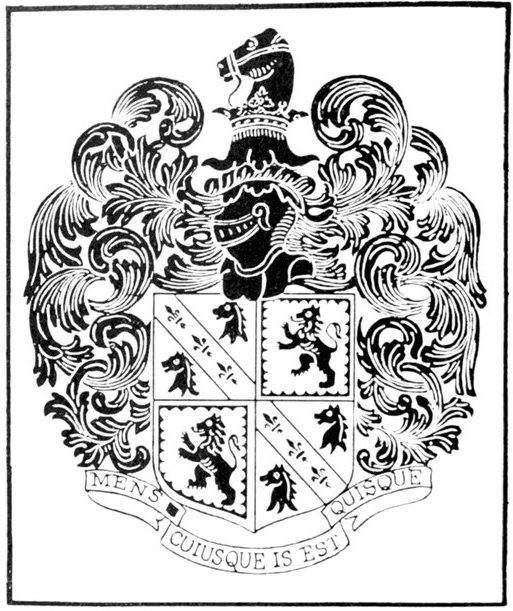
Arms.—Quarterly.
1st and 4th; sa., on a bend or, between 2 nags'
heads erased arg., 3 fleurs-de-lys of the field.
Pepys.
2nd and 3rd; gu., a lion rampant within a bordure
engrailed arg. Gray.
Crest.—A camel's head erased or, bridled, lined,
ringed, and gorged with a ducal coronet or.
Helmet.—That of an Esquire.
Motto.—Mens cuiusque is est quisque.
[Several books in the Pepys Library at Magdalene College,
Cambridge.]
[The Pepys Library at Magdalene College, Cambridge.]
Variety.—A shield lettered "SAM. PEPYS CAR. ET
IAC. ANGL. REGIB. A SECRETIS ADMIRALIÆ."
Behind the shield are two fouled anchors.
Crest and helmet as in the preceding example.
[Books at Magdalene College, Cambridge.]
[The Pepys Library at Magdalene College, Cambridge.]
Samuel Pepys (born 23rd February 1632, died 26th May 1703) was
the son of John Pepys of Cottenham, in Cambridgeshire. He was
educated at Magdalene College, Cambridge, and became clerk of the
Acts of the Navy in 1660.
In 1673 Mr. Pepys was Secretary to the Admiralty, and he introduced
several admirable reforms in the management of that office, which he
retained until 1689. He accompanied Lord Dartmouth to Tangier, and
made several expeditions to the Continent and about the coasts of England.
In 1690 he published his Memoirs concerning the navy of England,
a very important work. In 1684 Mr. Pepys was President of the Royal
Society. He left a considerable library to his old College at Cambridge,
manuscripts as well as printed books, and also several prints. Pepys kept
a curious Diary in cypher from 1659 to 1669. It has been deciphered and
published several times, but the best edition is that issued by Mr. H. B.
Wheatley in 1893.
Badge.—Within the Garter.
A crescent arg., ensigned with an Earl's coronet.
[James I. Triumphs, etc. London, 1610.]
Henry Percy (born April 1564, died 5th November 1632) was the son
of the eighth Earl of Northumberland and succeeded his father, who was
murdered in the Tower, in 1585. Lord Northumberland was fined and
imprisoned in the Tower in consequence of an alleged complicity in the
Gunpowder Plot. In 1593 he was made a Knight of the Garter, and in
1603 he was Captain of the Corps of Gentlemen Pensioners.
Northumberland was in distant remainder to the Crown of England,
and at one time it was probable that his claims might be strengthened
by a marriage with Lady Arabella Stuart, niece of Lord Darnley, and
great-granddaughter of Margaret, elder daughter of Henry VII., but the
negotiation came to nothing. The Earl was fond of scientific pursuits
and was known as "The Wizard Earl," and was a great smoker. The
badge of the silver crescent was used by the Percy family generally and
not exclusively by any particular member of it.
Arms.—Within the Garter. Quarterly.
1st and 4th; erm., on a bend az., a magnetic needle
pointing at a Pole Star or. Petty.
2nd and 3rd; arg., a saltire gu., a chief erm. Fitzmaurice.
Coronet.—That of a Marquis.
Supporters.—Two pegasi erm., bridled, crined, winged,
and unguled or., each charged on the shoulder with a
fleur-de-lys az.
Motto.—Virtute non verbis.
[Pontificale. Lansdowne MS. 451.]
William Fitzmaurice Petty (born 1737, died 7th May 1805) was the
son of John, Earl of Shelburne. He was educated at Oxford, and then
entered the army, and fought at Campen and at Minden, eventually
becoming a general officer. He represented High Wycombe in
Parliament. In 1761, on the death of his father, William Petty became
Earl of Shelburne, and quickly made his mark in the House of Lords, and
became head of the Board of Trade. In 1766 he became a Secretary of
State for the Southern Department. On the death of Lord Rockingham
in 1782, Lord Shelburne succeeded as Premier, and held this position
until 1783. In 1784 Lord Shelburne was created Marquis of Lansdowne,
and he spent the remainder of his life at his beautiful Wiltshire seat of
Bowood.
About 1765 he began collecting books, particularly those concerning
history and politics. Among the books collected by Lord Shelburne were
several which had belonged to Sir Julius Cæsar, and also many of Lord
Burghley's. Lord Lansdowne's manuscripts were acquired for the British
Museum by purchase after his death.
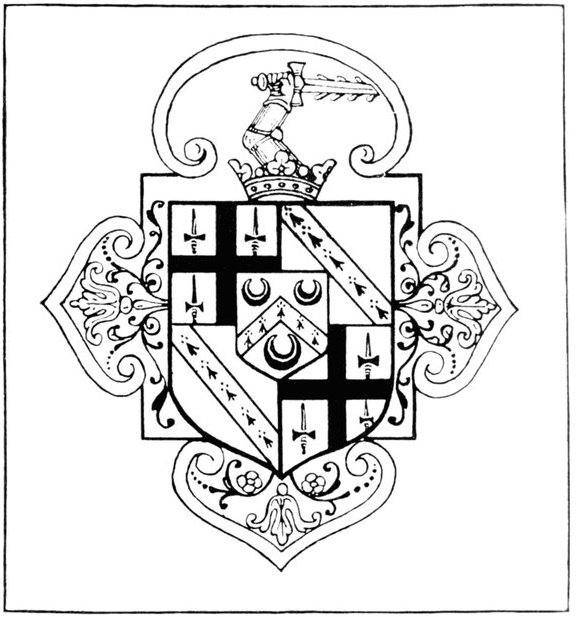
Arms.—Quarterly.
1st and 4th; gu., a cross arg., between four swords
erect of the second, pommelled and hilted or.
Philpot.
2nd and 3rd; sa., a bend ermine. Philipot.
On an escutcheon of pretence. Az., a chevron erm.,
between 3 crescents arg. Glover.
Crest.—Out of a ducal coronet, a dexter arm embowed
in armour holding in the hand a sword guttée de sang,
all ppr.
(College of Arms, Queen Victoria Street, E.C.)
[Books at the College of Arms.]
John Philpot (born c. 1587, died 20th November 1645) was the son of
Henry Philpot, at one time Mayor of Folkestone. He married Susan
Glover, niece of the Somerset Herald, Robert Glover. In 1618 Philpot
was appointed Blanch Lion Pursuivant, and a little later Rouge Dragon.
He was deputy for William Camden in the visitations of Kent, Hampshire,
Berkshire, Gloucestershire, Sussex, Buckingham, Oxfordshire, and
Rutlandshire.
In 1624 he became Somerset Herald, and held also the office of Steward
of the Manors of Gillingham and Grain. Philpot supported the cause of
Charles I., and fought for him, and in 1644 he was made prisoner by the
Parliamentarians. Besides his several Visitations, Philpot published several
other valuable historical and genealogical works, and left many more in
manuscript. Several of his books are at the College of Arms.
Arms.—On a lozenge. Sa., 3 swords in pile arg.,
hilts or.
[Dryden. Fables. London, 1745.]
Bridget Poulett (born c. 1720, died c. 1780) was the eldest daughter of
John Poulett, Earl Poulett. Lady Bridget married Pollexpen Bastard of
Kitly in Devon. She had three sisters, one of whom married John
Parker, and these two would have used the same coat-of-arms within a
lozenge before their marriage. The other two sisters died unmarried, so
they would always have used it.
It is not now safe to say, without further information, to which of
these sisters any particular book bearing this coat belonged.
Arms.—Quartered.
1 and 6. Erm., a bend fusilly, gu. Pye.
2. A lion passant.
3. Per pale, gu. and az., a lion rampant supporting
a tree eradicated vert. Wynstone.
4. Gu., 3 stirrups leathered and buckled or.
Scudamore.
5. Arg., on a chevron engrailed sa., between 3
ravens ppr., as many escallops or. Croker.
Crest.—A cross crosslet fitchée gu., between two
wings expanded arg., over all a crescent for difference.
Helmet.—That of an Esquire.
[Allen. An antidote against Heresy, etc. London, 1648.]
Robert Pye (born 1585, died 1662) was Remembrancer of the
Exchequer in 1618, and received the honour of Knighthood in 1621.
He was a strong Parliamentarian, and his son Robert married a daughter
of John Hampden. Sir Robert Pye acquired the property of Faringdon in
Berkshire, where his descendants lived for a long time. He represented
Woodstock in Parliament.
Arms.—Within the Garter. Quartered.
1. Arg., a bend engrailed sa. Radcliffe.
2. Or, a fess between 2 chevrons gu. Fitz-Walter.
3. Arg., a lion rampant sa., crowned or, a bordure
az. Burnell.
4. Arg., a saltire engrailed az. Harding.
5. Gu., 3 lucies hauriant arg. Lucy.
6. Barry of six, arg. and az. Grey.
7. Arg., semée of fleurs-de-lys sa. Bereford.
8. Arg., an eagle carrying off a child swathed gu.,
banded or. Culcheth.
Coronet.—That of an Earl.
[Lonicer. Chronicorum Turcicorum Liber, etc.
Francoforti ad Moenum, 1578.]
Robert Radclyffe (born c. 1560, died 22nd September 1629) was the
only son of Henry Radclyffe, fourth Earl of Sussex. In 1593 Robert, styled
Viscount Fitzwalter, succeeded to his father's earldom. In 1594 he went
to Scotland as Ambassador for the christening of Prince Henry, and he
commanded a regiment of infantry at Cadiz in 1596, when he was
knighted by the Earl of Essex. Lord Sussex twice acted as Earl
Marshal, and in 1599 he was made a Knight of the Garter. In 1599
he was Colonel General of Foot, and in 1626 he carried the orb at the
coronation of Charles I. Lord Sussex served as Lord Lieutenant of Essex
and Governor of Harwich.
Crest.—On a mural coronet arg., a pheon sa., with
a laurel branch issuant thereout ppr. Rawdon.
[Recueil general des Caquets de l'Acouchée. 1623.]
John Rawdon (born c. 1710, died 20th June 1793) was the son of
Sir John Rawdon, Baronet, of Moira, Member of Parliament for County
Down. He succeeded his father in the baronetcy in 1723, and in 1750
was raised to the peerage as Baron Rawdon. In 1761 he was created
Earl of Moira in the peerage of Ireland.
The same crest would have been borne for a time by the son of Lord
Moira, Francis Rawdon-Hastings, who was an eminent soldier. He was
in 1783 created an English Peer by the same title as was enjoyed by his
father, Baron Rawdon, by which he was known until 1793, when he
succeeded to the Earldom of Moira. The additional surname of
Hastings was assumed by Lord Rawdon in 1790, in accordance with the
will of his maternal uncle Francis Hastings, tenth Earl of Huntingdon.
Arms.—Arg., a fess between 3 pheons sa. Rawdon.
[Life of Marmaduke Rawdon of York. MS.]
Marmaduke Rawdon (born March 1609, died 7th February 1668)
belonged to an old Yorkshire family, and was the son of Laurence
Rawdon of York. Mr. Rawdon entered the employ of an uncle who
was a merchant, and travelled about the world in his service. He was
for a long time in the Canary Islands, and he made an ascent of the Peak
of Teneriffe. Rawdon was a noted antiquary, and he made valuable
notes of his travels. His "Life" has been edited for the Camden
Society by Mr. Robert Davies.
Crest.—A sheldrake ppr., in his beak an escallop arg.
Rawlinson.
Badge.—An escallop arg., being an excerpt from the
Rawlinson coat-of-arms which is gu., 2 bars gemelles
between 3 escallops arg.
[Bible, Greek. Antwerp, 1566.]
Richard Rawlinson (born 3rd January 1690, died 6th April 1755) was
the fourth son of Sir Thomas Rawlinson, Lord Mayor of London. He
was educated at Oxford and took Orders in 1716. In 1728 he was consecrated
nonjuring Bishop, but never accepted the duties of the position.
Dr. Rawlinson was a Fellow of the Royal Society and of the Society of
Antiquaries. He was a great collector of books and manuscripts, the
greater part of which he bequeathed to Oxford, where they are now kept
in the Bodleian Library. Others were sold by auction. Dr. Rawlinson
wrote a number of books on antiquarian and topographical subjects, and
he left his heart to his old college, St. John's, at Oxford, where it is still
kept in the chapel in a marble urn.
Crest.—A bull statant arg., ducally crowned, collared,
ringed and armed or. Rivers.
[In Aristotelis de Coelo libros quatuor. Venetiis, 1598.]
John Rivers (born circ. 1579, died circ. 1651) was the son of Sir
George Rivers, and grandson of Sir John Rivers, Lord Mayor of London.
Mr. Rivers was educated at Oxford, and admitted to the Inner Temple
in 1600. In 1621 he was created a Baronet.
Arms.—Within the Garter. Quartered.
1. Quarterly; 1 and 4, arg., a lion rampant gu.
Russell.
2nd and 3rd, az., a tower with cupola arg., door
gu. De La Tour.
2. Barry of eight, or and az., a crescent for difference.
Fitzalan.
3. Gu., 3 herrings hauriant in fess arg. Herringham.
4. Sa., a griffin segreant between 3 crosses crosslet
fitchée arg. Froxmere.
5. Sa., 3 chevrons arg. Wyse.
6. Sa., 3 dovecotes arg., 2 and 1, a mullet for difference.
Sapcote.
7. Arg. on a cross gu., 5 mullets arg., 1, 3, and 1.
Bodenham.
Coronet.—That of an Earl.
[Prayers. Edinburgh, 1565.]
Francis Russell (born 1527, died 28th July 1585) was the son of John
Russell, K.G., created Earl of Bedford in 1549. In 1554 Francis Russell
succeeded to his father's earldom, and in 1546 he was made a Knight of
the Bath. He was High Sheriff of Bedfordshire and Buckinghamshire,
Member of Parliament for Northumberland, and Lord Lieutenant for
Bucks.
Lord Bedford served as Ambassador to France on two occasions, and
in 1564 he was made a Knight of the Garter. He also served as Chief
Justice in Eyre south of Trent, and Lord Lieutenant of Dorset, Devon,
and Cornwall. He was known as the "Good Earl of Bedford," and
entertained Queen Elizabeth both at Chenies and at Woburn.
Arms.—Arg., a lion rampant gu., on a chief sa., 3
escallops of the first.
Coronet.—That of a Duke.
[Knolles. Turkish History. London, 1701.]
Wriothesley Russell (born 1st November 1680, died 26th May 1711)
was the son of William Russell, second son of William Russell, first Duke
of Bedford. His mother was Rachel, daughter of Thomas Wriothesley,
Earl of Southampton. In 1700 Wriothesley Russell succeeded to the
Dukedom on the death of his grandfather the first Duke. He was
educated at Oxford, and in 1701 was a Gentleman of the Bedchamber,
and acted as Lord Lieutenant of Bedfordshire, of Cambridgeshire, and of
Middlesex. He was Lord High Constable at the coronation of Queen
Anne, on which occasion he was made a Knight of the Garter.
Through Rachel Wriothesley the Manors of Bloomsbury and St. Giles-in-the-Fields
came into possession of the Russell family, and for a long
time they lived at Bedford House, which occupied the site now forming
the northern side of Bloomsbury Square.
Crest.—Out of an heraldic coronet ppr., an estoile of
8 points arg.
Coronet.—That of an earl.
[De Philotheia. Canticum canticorum, libri x.
Friburgi Helvetiorum, 1609.]
Edward Sackville (born circ. 1590, died 17th July 1652) was the son
of Richard Sackville, third Earl of Dorset. He was educated at Oxford,
and succeeded his father in the Earldom in 1624. Mr. Sackville was
Member of Parliament for Sussex, and in 1616 was made a Knight
Commander of the Order of the Bath, and after his succession to the
peerage he acted as Lord Lieutenant of Middlesex, and later of Sussex.
In 1625 he was made a Knight of the Garter.
Lord Dorset carried one of the swords at the coronation of Charles I.,
and served as Chamberlain of the Household in 1644. He married Mary
Curzon, governess to the king's children.
Arms.—Quartered.
1. Arg., a chief az., over all a lion rampant gu.,
crowned or. St. George.
2. Arg., a cross flory gu. Trussell.
3. Gu., 3 covered cups or. Butler.
4. Arg., 3 fleurs-de-lys between 8 crosslets sa.
Mortimer.
5. Az., a fess dancetty between 6 escallops arg.
Dengayne.
6. Sa., an estoile arg. Ingleby.
Legend.—Sigillvm ricardi sancti georgii.
[Collection of Manuscript Tracts of the Seventeenth Century.
Add. MS. 577, b. 5.]
Richard Saint-George (born circ. 1577, died 17th May 1635) was the
son of Thomas Saint-George of Hatley Saint-George, Cambridge. He
was always a great student of heraldry and genealogy. In 1602 he was
made Berwick Pursuivant, and in 1603 Norroy King-of-Arms. He conducted
visitations of Derbyshire, Yorkshire, Cheshire, Lancashire, and
other counties. In 1616 he received the honour of Knighthood.
Sir Richard became Clarencieux King-of-Arms in 1623, and presently,
with Sir John Borough, Norroy, he conducted several further visitations
in the southern counties of England. He wrote several valuable genealogical
works, many of which are among the manuscripts in the British
Museum. Many of his writings have been published. His son Henry
afterwards became Garter King-of-Arms.
Arms.—Quartered.
1. Sa., a saltire engrailed or. Salwey.
2. Arg., on a chief az., a lion passant of the first.
Aston.
3. Or, on a bend sa., 3 eagles displayed arg.
Manley.
4. Gu., a fess compony, arg. and sa., between 6
crosses crosslet fitchée or. Boteler.
5. Arg., 2 bendlets sa. Bradshaw.
6. Bendy of 10, or and az. Montfort.
7. Arg., on a bend wavy az., 3 swans of the first.
Dawes.
8. Arg., a fess az., between 3 boars' heads couped
sa. Alyson.
9. Arg., a chevron engrailed between 3 bugle
horns sa., stringed or. Wyerley.
[Hatcher. G. Haddoni lucubrationes. Londini, 1567.]
Humphrey Salwey (born circ. 1575, died December 1652) was educated
at Oxford, and entered the Middle Temple in 1591. He took part in the
Civil War on the side of Parliament. In 1644 he was appointed King's
Remembrancer in the Court of Exchequer. In 1649 he was made a
Judge, but never took his place as such. He was buried in Westminster
Abbey.
Arms.—Or, a fess dancetty between 3 crosses crosslet
fitchée gu., a fleur-de-lys for difference. Sandys.
[Jacobus de Voragine. Legendario delle vite de' Santi.
Venetia, 1607.]
Edwin Sandys (born 9th December 1561, died October 1642) was the
sixth son of Edwin Sandys, Archbishop of York. He was educated at
Merchant Taylors' and Oxford, and in 1589 entered the Middle Temple
as a student. In 1586 Mr. Sandys represented Andover in Parliament,
and afterwards sat for Plympton. He wrote some books on religious
subjects during a visit to Paris. In 1603 he received the honour of
Knighthood, and was Member of Parliament for Stockbridge.
Sir Edwin Sandys was conspicuous in Parliament, and got into trouble
about his views as to the succession to the throne, and had to appear before
the Council, but nothing was done further than that he had to give security
for his appearance if wanted. He was an active member of the East India
Company, and the Sandys group of islands in the Somers Islands was
named after him. He also took a prominent part in the affairs of the
Virginia Company, of which he was elected Treasurer in 1619, in
succession to Sir Thomas Smythe. His administration, however, in the
long-run, was no better than that of his predecessor, and in 1621 he was
imprisoned in the Tower, but soon released.
Sir Edwin was returned to Parliament as Member for Sandwich, and
afterwards for Penrhyn, but soon afterwards left public life, and devoted
himself to his favourite East India Company. His political career was of
much interest and importance.
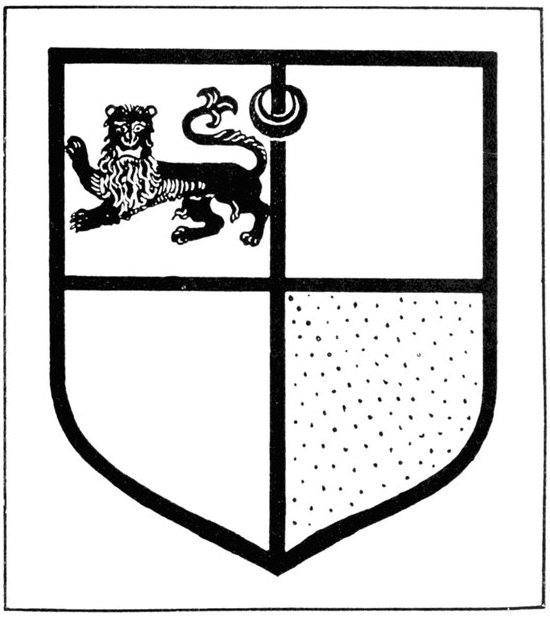
Arms.—Quarterly, or and gu., in the first quarter a
lion passant guardant az. A crescent for difference. Say.
[Dialogi sex. Antverpiae, 1566.]
William Say (born c. 1604, died c. 1666) was the second son of
William Say of Ickenham, Middlesex. He was educated at Oxford, and
was a Bencher of the Middle Temple. Mr. Say was a Member of Parliament
for Camelford, and signed the death warrant of Charles I. For a
time, in the absence of Speaker Lenthal, Say acted as Speaker in the
House of Commons.
At the Restoration Say had to leave England, and found refuge in
Holland, where he died.
Arms.—Within the Garter. Arg., a chevron between
3 garbs gu. Sheffield.
Coronet.—That of an Earl.
Note.—Used between 1674 and 1694.
[Cudworth. The Intellectual System of the Universe.
London, 1678.]
John Sheffield (born 7th April 1648, died 24th February 1720) was
the son of Edmund Sheffield, second Earl of Mulgrave, and succeeded his
father in 1658. John Sheffield had an eventful military and naval career,
the two professions being in his time curiously considered as one. As a
sailor he took part in the fight at Solebay in 1672 under the Duke of
York, and afterwards was Captain of the "Royal Catherine." As a soldier
Lord Mulgrave was Colonel of the Holland Regiment, Governor of Hull,
and commanded a force at Tangier. In 1674 he was made a Knight of
the Garter. He was a member of the Privy Council and Lord Chamberlain
of the Household. In 1694 he was made Marquis of Normandy, and in
1703, Duke of Normandy, and shortly afterwards Duke of the County
of Buckingham. He was a book-lover, and an author of some repute in
his own time.
Arms.—Sa., a fess arg., between 3 sheldrakes ppr.
Sheldon.
[The Annals of Cornelius Tacitus. London, 1640.]
Variety.—Quarterly.
1st and 4th; sa., a fess arg., between 3 sheldrakes
ppr. Sheldon.
2nd; arg., on a bend sa., between 2 lions rampant
of the second, a wyvern, extended, of the first.
Newport.
3rd; gu., a saltire vair. Wellington.
[Nostradamus. The True Prognostications, etc. London,
1672.]
Ralph Sheldon (born 1st August 1623, died 24th June 1684) was the
son of William Sheldon of Beoley, Worcestershire, and an ardent collector
of antiquities, particularly books and manuscripts. He collected a large
library at his house "Weston," at Long Compton, Warwickshire, and
bequeathed to the College of Arms a large number of the manuscripts of
Augustine Vincent, Windsor Herald. Mr. Sheldon suffered persecution
as a Catholic. He wrote several genealogical treatises, many of which are
now kept at the College of Arms.
Arms.—Gu., a sword in pale, point downwards, blade
arg., hilted or, between 2 boars' heads couped at the
neck of the third; on a chief erm., a lion passant of the
first between 2 mascles sa. The Ulster hand gu., on
an escutcheon arg., in the dexter chief.
Legend.—Bibliotheca manuscript. sloaneiana.
[State Papers, 1515-1525. Sloane MS. 3839.]
Hans Sloane (born 16th April 1660, died 11th January 1753) was the son
of Alexander Sloane, a Scotchman who settled in Ireland as receiver-general
of the estates of Lord Clanricarde.
When he was about eighteen Hans Sloane came to London to pursue
his studies, particularly medicine, chemistry, and botany. In botany he
became a great authority, and his botanical collections were of great
importance. In 1683 he went to France to continue his scientific studies,
and on his return to London he set up as a practising physician in
England.
In 1687 Dr. Sloane went to the West Indies as physician to Christopher
Monck, second Duke of Albemarle, who was Governor-General of the
West Indian Colonies, and during the voyage the doctor made valuable
collections, chiefly botanical, and also brought together a mass of material
for his future use as an author. Dr. Sloane's botanical collections were
largely increased by bequests from friends, particularly that of William
Courten in 1702. In 1693 Dr. Sloane was Secretary to the Royal
Society, and he was also Physician-in-Chief to George I., who in 1716
created him a Baronet. He was President of the College of Physicians
in 1719 and of the Royal Society in 1727. Sir Hans Sloane lived in a
house in Great Russell Street, and in 1741 he moved to more roomy
quarters at the Manor House, Chelsea, where his collections could be
better seen.
By his will Sir Hans Sloane bequeathed his natural history collections,
antiquities of all sorts, manuscripts, and printed books to the British
Nation, conditional on the payment to his family of £20,000, and after
considerable negotiation the offer was accepted. In 1753 an Act (25th
George II., chap. 22) was passed "for the purchase of the Museum or
Collection of Sir Hans Sloane," and the collections were in time, with
others, removed to Montagu House, which was opened to the public in
1759. The Sloane family is represented among the Family Trustees of
the British Museum.
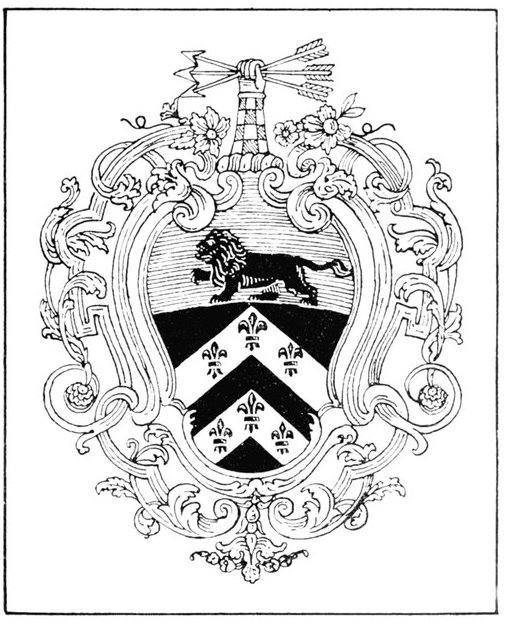
Arms.—Arg., 2 chevrons sa., each charged with 3
fleurs-de-lys of the first; on a chief gu., a lion passant or.
Smith.
Crest.—A dexter arm erect, vested chequy, vert and
or, holding in the hand a sheaf of 3 arrows of the last.
[Petrarch. Canzoniere. Venetiis, 1533.]
Joseph Smith (born circ. 1682, died 6th November 1770) went as a
young man to Venice, and quickly became known as an ardent collector of
books and objects of art generally. In 1740 he was appointed British
Consul at Venice. In 1762 Smith's library was bought for George III.,
and formed the first important nucleus of His Majesty's splendid collection.
It contained especially choice editions of the classics, and also many
incunabula.
Mr. Smith continued to collect books after the king had made his
purchase, and these were eventually sold by auction in 1773. George III.
also acquired a fine collection of pictures, coins, and gems that had been
brought together by Consul Smith.
Arms.—Quarterly.
1st and 4th; sa., a fess dancetty arg., between 3
lioncels rampant of the second, each supporting
an altar or, flaming ppr. Smith.
2nd and 3rd; arg., on a bend sa., 3 crosses of the
first, a martlet for difference. Charnock.
In the centre point a crescent for difference.
Crest.—A Phœnix arg., issuing from flames ppr.
Helmet.—That of an Esquire.
[Short Introduction to Latin Grammar. London, 1609.]
Thomas Smith (born 23rd December 1513, died 12th August 1577)
was the second son of John Smith of Saffron Walden, and Agnes Charnock.
He was educated at Cambridge, where he attracted attention by his
ability and was given a special scholarship by Henry VIII. In 1531
Smith was made a Fellow of his College, and shortly afterwards University
Orator. In 1544 he was made Regius Professor of Civil Law. He was
Provost of Eton and Dean of Carlisle. Although in Orders, Smith
presently came to Court and became Clerk of the Privy Council, and in
1548 he was made one of the Secretaries to the King, and shortly afterwards
received the honour of Knighthood. He went as Ambassador to
the Emperor Charles V., and with an Embassy to France in 1551.
On the accession of Queen Mary, Smith changed his crest, and adopted
that of a salamander living in the midst of flames, alluding perhaps to the
fact that he escaped free from the dangers of the time, he being a strong
Protestant. The Smith crest before this had been an eagle holding a pen
in his claw. Queen Elizabeth in turn favoured Sir Thomas, and made
him Chancellor of the Order of the Garter, and soon afterwards Secretary
of State. Sir Thomas Smith had a large library of books, which he
bequeathed to one or other of the Colleges at Cambridge, or among
private friends. He wrote several works, mostly political.
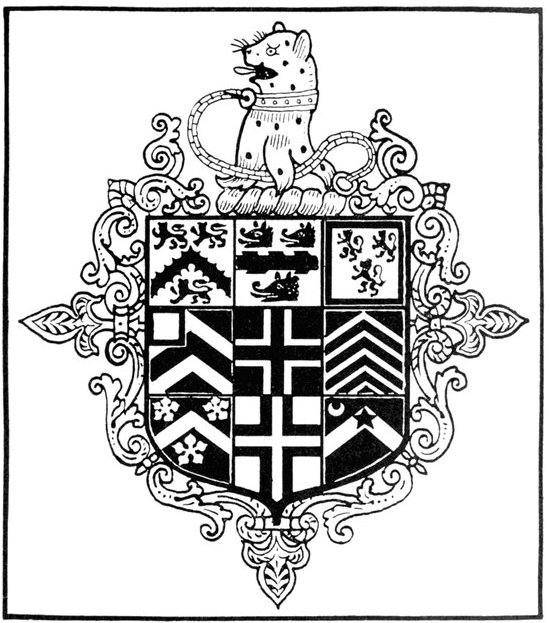
Arms.—Quartered.
1. Az., a chevron engrailed between 3 lions passant
or. Smythe.
2. Gu., a fess raguly between 3 boars' heads
couped arg. Judd.
3. Az., 3 lions rampant within a bordure arg. Chiche.
4. Arg., 2 chevrons az., a canton gu. Dexter.
5. Arg., a cross voided gu. Pilkington.
6. Arg., 5 chevrons sa. Sutton.
7. Or, a chevron between 3 cinquefoils gu.
Chichele.
8. Arg., a cross voided sa. Duckenfield.
9. Or, on a chevron sa., a mullet arg., a crescent for
difference. Mirfin.
Crest.—An ounce's head erased arg., collared and
chained sa.
Note.—Used before 1628.
[Moulin. Anatomie of Melancholy. London, 1620.]
Thomas Smythe (born c. 1599, died 30th June 1635) was the son
of Sir John Smythe of Ostenhanger and Ashford, High Sheriff of Kent in
1600. Thomas Smythe inherited a considerable fortune from his father,
who was a son of Thomas Smythe, Farmer of the Customs to Queen
Elizabeth, his mother being Alice Judd, daughter of Sir Andrew Judd,
Lord Mayor of London and founder of Tunbridge School. In 1625, at
the coronation of Charles I., Thomas Smythe was made a Knight
Commander of the Order of the Bath, and three years later he was created
Viscount of Strangford.
Arms.—Quarterly.
1st and 4th; vert, a fess dancetty erm. Somers.
2nd and 3rd; quarterly, vert and gu., a fess dancetty
erm., in chief a lion passant between 2 hawks
arg. Somers of Worcestershire.
Coronet.—That of a Baron.
Supporters.—2 lions erm., each charged on the neck
with a fess dancetty vert.
Motto.—Prodesse quam conspici.
[Common Prayer. Oxford, 1700.]
Variety.—Used between 1688 and 1697.
Arms.—Vert, a fess dancetty erm.
Crest.—A coat of mail hanging on a laurel tree ppr.
Helmet.—That of a Knight.
[Echard. Roman History. London, 1695.]
John Somers (born 4th March 1650, died 26th April 1716) was son of
John Somers of Clifton-on-Severn. He was educated at Worcester and
Oxford, and became a Bencher of the Middle Temple in 1689.
Mr. Somers became Solicitor-General in 1688, when he received
the honour of Knighthood, and he represented Worcester in Parliament.
Sir John was sworn of the Privy Council in 1693, and shortly afterwards
was made Lord Keeper of the Great Seal, Speaker of the House of
Lords, and Lord Chancellor. In 1697 he was created Baron Somers of
Evesham. Lord Somers was President of the Royal Society. In 1701
he was impeached in the Commons for various supposed misdemeanours,
but the charge was dismissed.
The Barony of Somers became extinct at John Somers' death in 1716,
but it was revived in 1784 in the person of Charles Cocks of Castleditch,
M.P. for Reigate, who was a descendant of a sister of the first Lord.
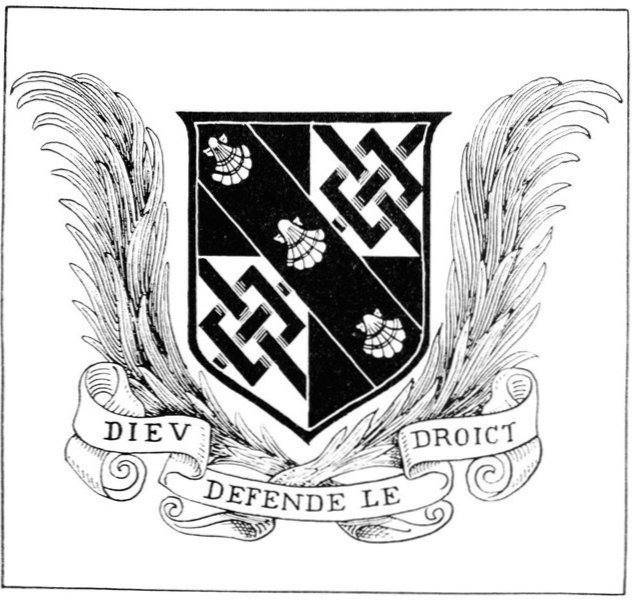
Arms.—Quarterly; arg. and gu., on the second and
third quarters a fret or, over all on a bend sa., 3 escallops
of the first. Spencer.
Motto.—Diev defende le droict.
Note.—Used before 1702.
[Camden. Britain. London, 1637.]
Crest.—Out of a ducal coronet or, a griffin's head
arg., gorged gu., between 2 wings expanded of the
second. Spencer.
Charles Spencer (born c. 1674, died 19th April 1722) was the son
of Robert Spencer, second Earl of Sunderland, and succeeded his father in
1702. He was from an early age a great lover and collector of books,
which he kept at Althorp.
In 1695 he was Member of Parliament for Tiverton; in 1706 he was
a Secretary of State for the Southern Department, and became of much
political importance as a Whig leader. He was appointed Lord
Lieutenant of Ireland in 1714.
In 1715 Lord Sunderland was made Lord Privy Seal, and shortly
afterwards Vice-Treasurer of Ireland. He also held the posts of Groom
of the Stole and Gentleman of the Bedchamber to George I.
Lord Sunderland was a great book collector, and a rival in this respect
to most of his contemporaries. He was a great gambler, and his library
was at one time pledged to the Duke of Marlborough, and in 1749 it was
removed to Blenheim. The library was sold in 1881, and the books
belonging to it were widely dispersed.
Lord Sunderland's son Charles, who in 1729 became fifth earl, on the
demise of his aunt Henrietta, by special Act of Parliament Duchess of
Marlborough, in 1733 succeeded to the Dukedom of the celebrated John
Churchill. The Earldom of Sunderland from that time has been merged
in the Dukedom of Marlborough.
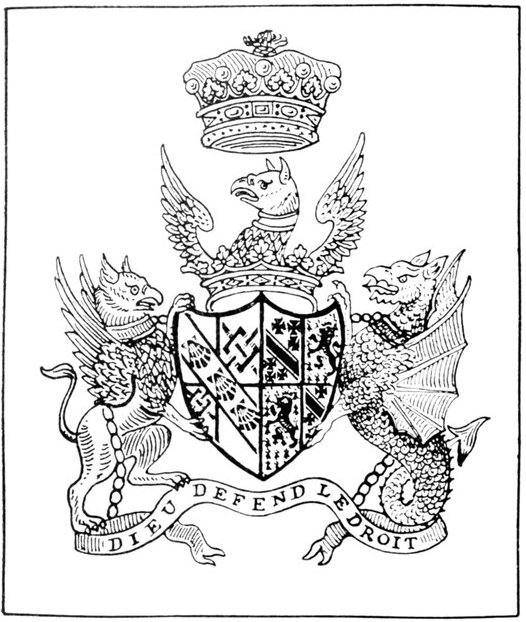
Arms.—Impaled.
Dexter: Quarterly, arg. and gu., on the 2nd and
3rd quarters a fret or, over all on a bend sa., 3
escallops of the first. Spencer.
Sinister: Quarterly.
1st and 4th; az., a bend cotised between 6
crosses pattée or. Bingham.
2nd and 3rd; erm., a lion rampant ducally
crowned or. Smith.
Crest.—Out of a ducal coronet or, a griffin's head
arg., gorged with a bar gemelle gu., between 2 wings
expanded of the second.
Coronet.—That of an Earl.
Supporters.—Dexter: A griffin, per fess erm. and
erminois, gorged with a collar sa., the edges flory counterflory
chained of the last (on the collar 3 escallops arg.).
Sinister: A wyvern erect on his tail erm., collared
and chained as the griffin.
Motto.—Dieu defend le droit.
[Cicero. Tusculanae Disputationes. Romae, 1469.]
George John Spencer (born 1st September 1758, died 10th November
1834) was the son of John Spencer, Earl Spencer. In 1783 he succeeded
his father in the family honours. He was educated at Harrow and Cambridge.
In 1780 George Spencer was Member of Parliament for
Northampton, and shortly afterwards became a Commissioner of the
Treasury Board. He was also Lord Privy Seal and First Lord of the
Admiralty. In 1806 he was made Secretary of State for the Home
Department.
In 1781 Lord Spencer married Lavinia Bingham, daughter of
Charles, Earl of Lucan, and in 1797 he was made a Knight of the Garter.
Lord Spencer made a magnificent collection of books at Althorp Park,
Northampton, and acquired several already celebrated libraries, particularly
those of Count Reviczky and the Duke of Cassano-Serra. Several of
Lord Spencer's books were bound for him by Charles Kalthoeber, a
celebrated binder who worked also for George III., and closely imitated
the work of Roger Payne, whose own work is also excellently represented
in the library.
In 1892 the Althorp Library was purchased by Mrs. Rylands of
Longford Hall, Manchester, and subsequently presented by her to the city
of Manchester in memory of her husband, Mr. John Rylands.
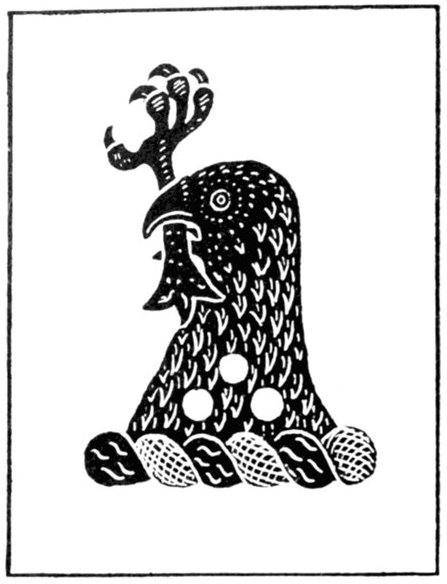
Crest.—An eagle's head couped arg., charged with
3 pellets, one and two, holding in his beak an eagle's
leg erased a la cuise, gu. Stanley.
[Fioravanti. Della Fisica. Venetiis, 1582.]
Thomas Stanley (born circ. 1625, died circ. 1678) was the son of
Sir Thomas Stanley of Cumberlow, Hertfordshire. He was educated at
Cambridge, and occupied himself in literary pursuits from an early age.
Mr. Stanley wrote a number of poetical works, and also made several
translations from Greek and Latin authors. In 1655 he published a
History of Philosophy which during his lifetime enjoyed a great reputation.
His edition of Æschylus was also very successful. Several of his manuscripts
are now kept in the University Library at Cambridge.
Arms.—Or, a fess chequy az. and arg., within a
double tressure flory counterflory gu. Stuart.
Crest.—A demi lion rampant gu., and over it the
motto Nobilis (est) ira (leonis).
Motto.—Avito viret honore. Used before 1812.
[Severim. Noticias de Portugal. Lisboa, 1740.]
Variety.
Arms.—Or, a fess chequy az. and arg., within a
double tressure flory counterflory gu. A mullet for
difference. Stuart.
Within the collar of a Knight Grand Cross of the
Order of the Bath, having the badge of the order
dependent therefrom. Used after 1812.
[Perez del Pulgar. Coronica llamada Las dos
Conquistas del Regno de Napoles. Cargoça, 1559.]
Charles Stuart (born 2nd January 1779, died 6th November 1845) was
the son of General Sir Charles Stuart, K.C.B., son of the Earl of Bute.
Mr. Stuart had an important diplomatic career, and filled several high
posts. He was Chargé d'affaires at Madrid, Envoy to Portugal, Minister
at the Hague, and Ambassador to Paris.
In 1812 he was made a Knight Grand Cross of the Order of the
Bath, and in 1828 he was created Baron Stuart de Rothesay, a high honour,
as the Barony of Rothesay is one of the hereditary honours of the Prince
of Wales. Lord Stuart was afterwards Ambassador to St. Petersburg. He
brought over from France the beautiful castle of Highcliffe, Hants, where
the German Emperor recently stayed. He left no male heir, so his
peerage became extinct at his death.
Arms.—On a chevron between 3 annulets gu., as
many crescents of the field. Sutton.
Crest.—A greyhound's head couped erm., collared gu.,
garnished and ringed or, on the collar an annulet of the
first.
Helmet.—That of an Esquire.
Legend.—Thos · sutton · arm · fundator.
Note.—The word fundator applies to Charterhouse
School.
[Cæsar. C. Julii Cæsaris quæ extant. Lugduni
Batavorum, 1635.]
Thomas Sutton (born circ. 1532, died 12th December 1611) was the
son of Richard Sutton, Steward of the Courts of Lincoln. He is said to
have been educated at Eton, and afterwards studied law at Lincoln's Inn.
In early life Sutton was a soldier and saw active service, and in 1569 he
was appointed Master of the Ordnance in the North.
While in the north Sutton acquired considerable possessions in land,
and from these he drew a large fortune. One of the ships fitted out to
resist the Spanish Armada was called the "Sutton." Sutton was very
generous with his money, and in 1611 he purchased Charterhouse in
Middlesex, where he founded the famous school of that name. The
foundation of this school was originally intended for the benefit of forty
boys of good birth and necessitous parents, but in time it came about that
to be a foundation scholar, or gown boy, was a mark of distinction.
Thackeray was a Charterhouse boy and was familiar with the surroundings
there. Besides the school, there was a foundation or hospital at Charterhouse
for "poverty-stricken gentlemen." The school was moved to
Godalming in 1872, but the "hospital" still remains in Charterhouse
Square. Sutton's tomb is in the Chapel at the Charterhouse.
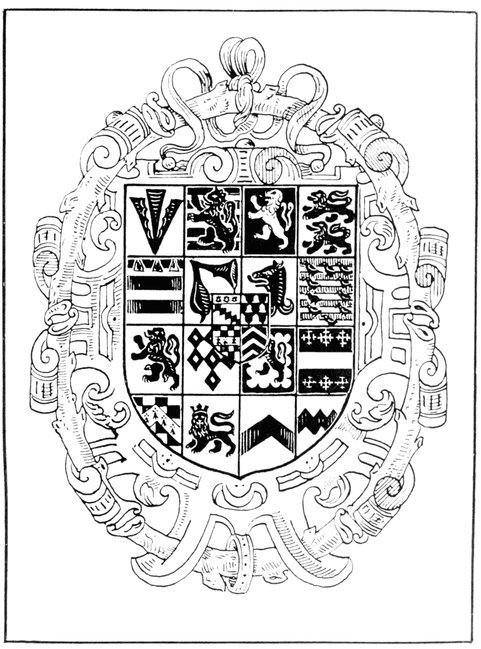
Arms.—Quartered.
1. Arg., a pheon az. Sydney.
2. Barry of 10, arg. and gu., a lion rampant
ducally crowned or. Brandon.
3. Or, a lion rampant az. Brabant.
4. Or, 2 lions passant az. Dudley.
5. Barry of 6, arg. and az., in chief a label of
the first. Grey.
6. Arg., a maunch sa. Hastings.
7. Az., a wolf's head erased arg. Lupus.
8. Barry of 10, arg. and az., an orle of ten
martlets gu. Valence, Earl of Pembroke.
9. A lion rampant.?
10. Gu., 7 mascles conjoined or, three, three, and
one. Ferrers of Groby.
11. Az., a lion rampant arg., within a bordure
engrailed or. Tyrrell.
12. Gu., a fess between 6 crosses crosslet or.
Beauchamp.
13. Chequy, or and az., a chevron erm. Warwick.
14. Gu., a lion statant arg., crowned or. Lyle.
15. Arg., a chevron sa. Trelawney.
16. Arg., a fess dancetty gu. Dene.
On an escutcheon of pretence, being the arms of
Barbara Gamage.
Quarterly.
1. Arg., a bend lozengy gu., on a chief az., 3
escallops arg. Gamage.
2. Vairy, arg. and gu. Nowers.
3. Chequy, or and arg., a fess erm. Calthrop.
4. Arg., 3 chevrons gu. Langton.
[Polydori Vergilii historiae, libri vigintiseptem. Basileae,
1570.]
Robert Sydney (born November 1563, died 13th July 1626) was
the son of Sir Henry Sydney, K.G. He was educated at Oxford, and
in 1584 became Member of Parliament for Glamorganshire, and afterwards
for Kent. In 1586 he was knighted by the Earl of Leicester, and in
1603 he was created Baron Sydney of Penshurst, and two years afterwards
Viscount L'Isle.
Lord L'Isle was made a Knight of the Garter in 1616, and in 1618 he
was created Earl of Leicester. In 1584 he married Barbara Gamage of
Coity, daughter of John Gamage. She died in 1621, and Lord Leicester
married for his second wife Sarah, daughter of William Blount.
Arms.—Quarterly.
1st and 4th; arg., a chevron sa., between 3
sykes, or fountains, ppr. Sykes.
2nd and 3rd; gu., an estoile between 3 fleurs-de-lys
arg. Masterman.
In the centre point the Ulster hand, gu. Above
the shield are the letters M[ark] M[asterman]
S[ykes].
Note.—Used after 1795.
[Valerius Maximus. Facta et Dicta Memorabilia,
Mainz, 1471.]
Mark Sykes (born circ. 1771, died 16th February 1823) was the
son of Sir Christopher Sykes, Baronet, of Sledmere, Yorks. He succeeded
his father in the baronetcy in 1801. Mr. Sykes was educated at Oxford,
and in 1795 was High Sheriff of Yorkshire. He represented York in
Parliament for several years. He assumed the additional name of Masterman
in 1795, on the occasion of his marriage to Henrietta, daughter and heiress
of Henry Masterman of Settrington, Yorks, but he left no heirs and was
succeeded by his brother Tatton.
Sir Mark Sykes possessed a magnificent library, rich in classics and
incunabula, and also a valuable collection of antiquities and pictures. His
collections were sold at his death, and his books and other treasures are
widely distributed.
Arms.—Per pale, or and gu., a chevron between 3
cinquefoils counterchanged, on a chief per pale of the
second and first (2) escallops counterchanged. Tash.
Crest.—A greyhound courant or.
[Tymme. A silver watch-bell. Aberdene, 1627.]
[W. E. Axon, Esq. Deansgate. Manchester.]
Thomas Tash, of London, was one of the Commissioners of Custom
for England and Wales in 1752, but there appears to be no more known
about him. There ought to be another escallop on the coat-of-arms
illustrated, and according to the printed authorities the crest of Tash
should be a demi greyhound.
Arms.—Gu., on a chevron erm., 3 martlets sa., in
chief a mullet or. Topsfield.
Crest.—A talbot couchant guardant in front of a tree,
all ppr.
Helmet.—That of an Esquire.
Motto.—Fayth faileth not.
[England. In this volume are conteined the statutes
made ... from the time of King Henry the thirde
unto ... Kyng Henry the VIII. London, 1564.]
This stamp belonged to a member of the old family of Topsfield, who
owned the estate of Frisingfield, near Harleston in Norfolk, but I have as
yet not been able to find out which particular member used it.
Arms.—Arg., a fess sa., in chief 3 mullets of the
second. Towneley.
Motto.—Tenez le vray.
Date.—1603.
[The Hystory writtone by Thucidides the Athenyan of the
warre which was betwene the Peloponesians and the
Athenyans. London, 1550.]
The family of Towneley is one of ancient domicile in Lancashire.
The member of it to whom the accompanying book-stamp probably
belonged was Richard Towneley of Towneley Hall near Burnley, who
lived there from about 1580 till about 1640.
His son Christopher was a well-known antiquary, but the most distinguished
member of the family was Charles Towneley, who lived in the
eighteenth century. He made a very important collection of ancient
statuary and terra-cottas, which were purchased for the British Museum
in 1805, and a member of the Towneley family is always represented on
the Museum Board of Trustees.
Arms.—Per bend sinister erm. and erminois, a lion
rampant or. Trevor.
[Beaulieu. Take heed of both extremes. London, 1675.]
Crest.—A wyvern with wings addorsed, sa.
Initials.—I. D.
[Beaulieu. Take heed of both extremes. London, 1675.]
Marcus Trevor (born circ. 1620, died circ. 1683) belonged to the
family of Trevor of Brynkinalt in Denbighshire. He was a strong
Royalist, and took part in the struggle between Charles I. and the
Parliamentarians. After the Restoration Charles II. made Colonel
Trevor a peer, and in 1662 created him Baron Trevor and Viscount
Dungannon, both of which peerages became extinct in 1706 on the death
of his grandson Marcus. Lord Dungannon married twice; his first wife
was a daughter of Sir Marmaduke Whitechurch, and his second wife was
a daughter of John Lewis.
Arms.—Quarterly.
1. Arg., a boar passant gu. Trewarthen.
2. Arg., a bend sa. Blackborne.
3. Az., on a chevron between 3 estoiles or, as many
lozenges sa. Butts.
4. Chequy, or and az., on a chief arg., gutty de
sang. Coleshill.
Crest.—A double plume of 5 ostrich feathers, arg.
[Austin. Devout Meditations. London, 1635.]
The family of Trewarthen is an old one belonging to the county of
Cornwall, but to which particular member of the family this stamp
belonged I have been unable to decide at present.
Device.—A Tudor Rose arg. and gu., seeded or and
leaved vert, within a ribbon bearing the legend
HEC ROSA VIRTUTIS DE CELO MISSA SERENO ETERNŪ
FLORENS REGIA SCEPTRA FERET.
Supporters.—Two kneeling angels.
Badges.—In the dexter corner a sun in glory and the
shield of St. George, arg., a cross gu.
In the sinister corner a half-moon with face, and
the shield of the City of London, arg., a cross
gu.; in the first quarter a sword in pale of the
last, point upwards. In the sky stars.
Initials.—I.N., i.e. Ihon Norins, with his trade device.
[Cicero. Commentarii questionum Tusculanarum. Parhisii,
1509.]
This stamp is generally found in combination with one or other of the
armorial stamps which I have figured and placed under the heading of
Henry VIII. No doubt there was some authority given to use these
Royal emblems, and although so far no reliable account of such authority
is forthcoming, it is likely enough that members of the Stationers'
Company may have been granted the privilege. On all these bindings
the coat-of-arms of the City of London appears. On many of them are
also initials which are very often those of well-known contemporary
printers and binders. The original stamps were cut in latten, a form of
brass—copper and zinc—and impressed on the leather in blind, that is
without gold, the design showing in low relief.
The latten plates were probably attached to wooden blocks by means
of two or more metal pins, and in many instances, by reason of irregular
pressure, these pins, the tops of which were engraved in continuation of
the general design, have been forced a little out of their normal level. The
result is that they show very clearly as indented marks. The pressure
necessary to make a good impression from one of these large stamps is
considerable; it may have been done by a slow constant pressure or by
quick pressure from hammer strokes, and the leather was in any case
softened by water. Bindings with these stamps upon them were either
of calf or sheep-skin.
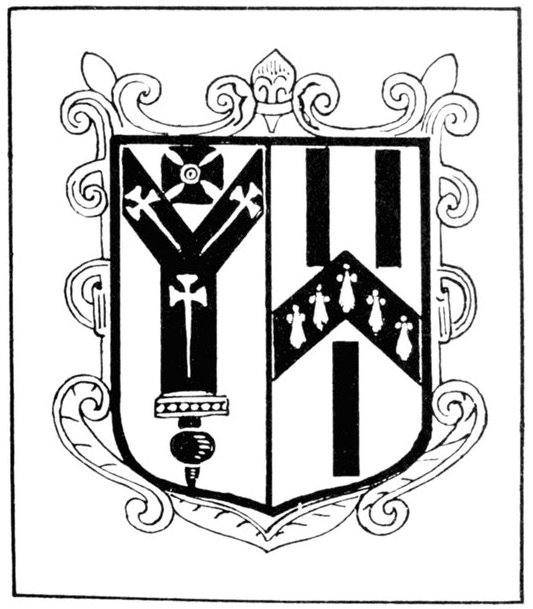
Arms.—Impaled.
Dexter: Az., an archiepiscopal staff, headed with
a cross pattée or, over all a pall arg., charged
with 3 crosses pattée fitchée sa. See of Armagh.
Sinister: Az., a chevron erm., between 3 batons
or. Usher.
[Usher. Britannicae Ecclesiae Antiquitates. Dublin, 1639.]
James Usher (born 4th January 1580, died 21st March 1656) was the
son of Arnold Usher, Clerk of the Irish Court of Chancery. He was educated
at Trinity College, Dublin, and in 1601 he took orders, and became a
preacher of much note. In 1620 Dr. Usher was made Bishop of Meath
and Clonmacnoise, and in 1624 he was consecrated Archbishop of Armagh.
Archbishop Usher wrote several very important theological works, and
he took part in all the controversies of his time. He was a divine of much
learning and a great scholar. His extensive library is for the greater
part in Trinity College, Dublin, where it was sent as a gift by Charles II.
Arms.—A Lymphad, with sail furled, on a sea in
base ppr., at the poop a flag flying towards the bow, arg.,
fimbriated vert, charged with a pomme in fess; on a chief
gu., 3 bezants, each charged with a mullet. Utterson.
[The Hystory of the two valyaunte brethren Valentyne and
Orson ... translated from the French by H.
Watson. London, 1565.]
Edward Vernon Utterson (born circ. 1775, died 14th July 1856)
was the son of John Utterson of Fareham in Hampshire. He was educated
at Eton and Cambridge, and in 1802 was called to the bar. He was
all his life a great collector of books. Mr. Utterson set up a private press
at Ryde, in the Isle of Wight, known as the Beldornie Press, and here
he reprinted such of the early English plays and poems as pleased him.
He also edited a number of reprints of important English books, some
of which are very handsomely produced.
Arms.—Within the Garter. Quarterly.
1st and 4th; England.
2nd; Scotland.
3rd; Ireland.
All coloured as used by James I. (q.v.) and ensigned
by a Royal Crown.
Supporters.—The lion and the unicorn, as used by
James I. (q.v.).
Motto.—Dieu et mon droit.
[Galerie Royale de Costumes. Paris, 1042.]
The Princess Victoria (born 24th May 1819, died 22nd January 1901)
was the only child of Edward, Duke of Kent, fourth son of George III.,
and Victoria Marie Louisa of Saxe-Coburg-Saalfield. On the death of
William IV., 18th June 1837, the Princess Victoria succeeded to the
throne of England. Queen Victoria was crowned at Westminster on
20th June 1838, and on the 1st January 1877 Her Majesty was proclaimed
Empress of India, at Delhi. On the 10th February 1840, Queen
Victoria married her cousin Albert, the youngest son of Ernest, Prince of
Saxe-Coburg-Gotha.
On the accession of Queen Victoria to the English throne, the
Kingdom of Hanover became separated from England, in consequence of
the operation of the Salic Law. The coat-of-arms of the dominions in
Germany was accordingly left out of the Royal coat. The Duke of
Cumberland, the Queen's uncle, became King of Hanover, which country
is now part of the German Empire.
Arms.—Arg., on a pile az., 3 quatrefoils of the
first. Vincent.
Crest.—Out of an heraldic coronet a bear's head ppr.
Helmet.—That of an Esquire.
Supporter.—A bear collared and chained ppr.
Legend.—Vincenti avgvsta.
[Chasseneux. Catalogus Gloriae Mundi.
Francofurti, 1603.]
Augustine Vincent (born circ. 1584, died 11th January 1625) was
the son of William Vincent. He showed antiquarian and heraldic tastes
at an early age, and in 1615 was made Rouge Rose Pursuivant, and in
1624 Windsor Herald. Vincent collected valuable material concerning
heraldic and genealogical matter, and his manuscripts are chiefly to be
found either at the College of Arms or the Bodleian Library at Oxford.
In Vincent's time it was the custom to carry out the heraldic visitations
by deputy. These visitations should have been made by the
Heralds in person, and in 1619 there was much trouble about the matter,
and strong complaints were made to the Earl Marshal by both Garter and
Norroy. The difficulty was brought to a head by the appointment of
Vincent, then Rouge Rose Pursuivant, to carry out the visitations of
Northamptonshire and Rutlandshire as deputy for William Camden,
Clarencieux Herald.
Arms.—Per pale, arg. and gu. Waldegrave.
Supporters.—Two talbots sa., eared or, each gorged
with a mural crown, arg.
Coronet.—That of an Earl.
[Prevost d'Exiles. Memoirs d'un Homme de Qualité.
Paris, 1732.]
James Waldegrave (born 4th March 1714, died 13th April 1763) was
the son of James, first Earl Waldegrave, and succeeded his father in the
Earldom in 1741. In 1752 Lord Waldegrave was Governor and Keeper
of the Privy Purse to George, Prince of Wales. In 1757 he was made a
Knight of the Garter and a Teller of the Exchequer. Lord Waldegrave
wrote a book of Historical Memoirs from 1754 to 1757. He married a
daughter of Sir Edward Walpole but had no son, and at his death the
family honours devolved upon his brother John.
Arms.—Quarterly.
1st and 4th; arg., on a cross of St. George gu., 5
leopards' faces or. Coat of Augmentation.
2nd and 3rd; arg., a chevron between 3 crescents
sa., an annulet for difference. Walker.
Supporter.—A greyhound, collared.
Motto.—Loyavte mon honnevr.
[Indentures of Military Service, Edw. III.-Hen. VII.
Stowe MS. 440.]
Edward Walker (born 24th January 1611, died 19th February 1676)
was the son of Edward Walker of Roobers, Nether Stowey, Somerset.
He joined the College of Arms as an official, and in 1635 he was made
Blanch Lion Pursuivant, filling successively the positions of Rouge Croix
Pursuivant and Chester Herald.
Walker took part with Charles I. in the war with the Roundheads, and
served as Secretary-at-War, and was at Naseby. In 1644 he was created
Norroy King-of-Arms, and in 1645 he succeeded Sir Henry St. George
as Garter. In the same year he received the honour of Knighthood.
In 1649 Sir Edward Walker was made Clerk of the Council in
Ordinary, but in 1650 he got into trouble as a Royalist, and found
refuge in Holland. After some trouble he invested William, Prince of
Orange, with the Garter in 1653.
At the Restoration Walker superintended the arrangements for the
coronation, and his remaining years seem to have been spent in quarrels
with other members of the Heralds' College. Sir Edward Walker wrote
a considerable number of historical and genealogical works, particularly
an illustrated edition of the coronation of Charles II. Many of his
manuscripts are in the British Museum, and others are at the Bodleian
Library at Oxford.
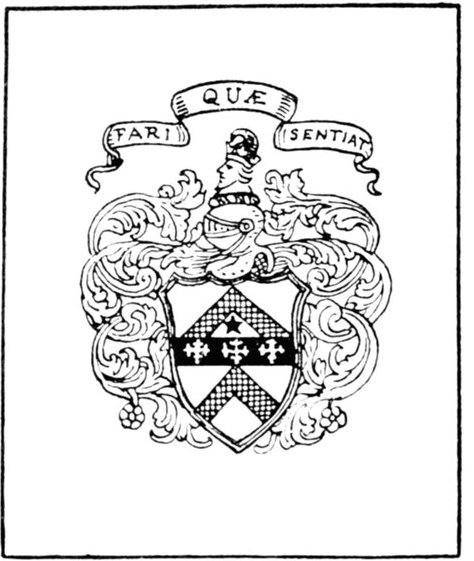
Arms.—Or, on a fess between 2 chevrons sa., 3 crosses
crosslet of the first, a mullet for difference. Walpole.
Crest.—The bust of a man in profile couped, ppr.,
ducally coroneted or, and from the coronet, flowing
forward, a long cap gu., tasselled or, charged with a
Catherine wheel of the last.
Helmet.—That of an Esquire.
Motto.—Fari quæ sentiat.
[Watts. Memoirs of the Revolution in Bengal.
London, 1764.]
Horace Walpole (born 5th October 1717, died 2nd March 1797) was
a younger son of Robert Walpole, Earl of Oxford, for many years Prime
Minister of England. He was educated at Eton and Cambridge, and as a
young man studied law. For a time Mr. Walpole served in the office of
the Exchequer, and represented Callington, Castle Rising, and King's
Lynn in Parliament, where the chief thing he did seems to have been
that he exerted himself to save the life of Admiral Byng.
In 1792 Mr. Walpole succeeded his nephew George in the Earldom,
but never took his seat in the House of Lords. On his death without
heirs most of his titles became extinct, but the Barony of Walpole
devolved on his cousin Horatio.
At Strawberry Hill, near Twickenham, Walpole collected a splendid
library, and also a number of pictures, antiquities, and treasures of all
sorts. Here also he set up a private press, at which he printed many of
his own works. Many of Walpole's books are now famous; among the
best known are, perhaps, the Anecdotes of Painting and the Castle of
Otranto. The Strawberry Hill Collection was sold in 1840.
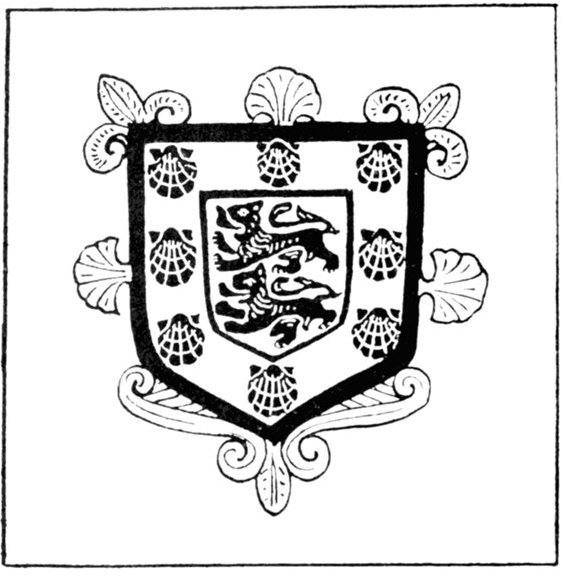
Arms.—Or, 2 lions passant az., within a bordure of
the second, charged with 8 escallops of the first, 3, 2, 2,
and 1. Ware.
[Giraldus Cambrensis. De Topographia Hibernica.
Add. MS. 33,991.]
James Ware (born 26th November 1594, died 1st December 1666)
was the son of Sir James Ware of Dublin. He was educated at Trinity
College, Dublin, and soon developed literary and antiquarian tastes, and
became a collector of manuscripts and antiquities, particularly relating to
Ireland. He was knighted in 1629 by the Lords Justices, and in 1632
became Auditor-General in Ireland, and in 1661 Member for the
University of Dublin. Sir James was imprisoned in the Tower of London
as a Royalist, and was afterwards a hostage for Ireland. Sir James Ware
published some very valuable books on Irish antiquities, most of them in
Latin, but a collection of his works has been translated into English.
Arms.—Arg., on a chevron az., between 3 martlets
sa., as many crescents or. Watson.
Supporters.—Two griffins az., ducally gorged or.
Coronet.—That of an Earl.
Motto.—Mea gloria fides.
[Poste da Roma. Roma, 1600?]
Lewis Watson (born 29th December 1655, died 19th March 1723)
was the son of Edward Watson, Baron Rockingham, and succeeded to
the Barony in 1689. In 1681 Mr. Watson represented Canterbury in
Parliament, and afterward Higham Ferrers. In 1703, Lord Rockingham
was Master of the Buckhounds, and he was also Lord Lieutenant of Kent.
In 1714, besides other dignities, Baron Rockingham was created Earl
of Rockingham. He also held the posts of Vice-Admiral of Kent and
Deputy-Warden of the Cinque Ports. He married twice, his first wife
being a daughter of George Sondes, Viscount Sondes and Baron Throwley,
besides other titles, and these two peerages were revived in 1714 in the
person of Lord Rockingham when he was created an Earl.
Arms.—Erm., on a pale gu., 2 roses ppr., on a chief
indented az., 2 leopards' heads erased arg. White.
Crest.—A falcon, wings extended erm., charged with
a rose ppr., holding in his beak an escutcheon, bendy
indented gu. and arg.
Motto.—Perseverando.
Legend.—Richard Samuel White, Esq.
[Sternhold and Hopkins. The whole booke of Psalmes
collected into Englyshe Meter. London, 1564.]
Richard Samuel White may have been a descendant of Captain Samuel
White who married Edith, daughter of John Watson of Charlton House,
Dorset. I do not find his name in any of the ordinary lists, but some of
the bearings in his coat-of-arms are similar to those used by the family
of White of Charlton.
Arms.—Impaled.
Dexter: Az., an archiepiscopal staff headed with
a cross pattée or, surmounted of a pall arg.,
charged with 4 crosses pattée fitchée sa., fringed
and edged or. See of Canterbury.
Sinister: Arg., on a cross flory sa., 4 bezants.
Whitgift.
[Dionysii Lebei Batillii Reg. mediomatricii Praesidis
Emblemata. Francofurti ad Moen[=u], 1596.]
John Whitgift (born 1530, died 29th February 1603) was the son of
Henry Whitgift of Great Grimsby in Lincolnshire. He was educated at
Cambridge and took orders in 1560. He was an eloquent preacher and
quickly made his name famous.
In 1567 he was made Regius Professor of Divinity, and took much
interest and effected many reforms in the Government of the University.
In 1571 he became Dean of Lincoln. Dr. Whitgift was made Bishop of
Worcester in 1576, and in 1583 Archbishop of Canterbury. Archbishop
Whitgift was a rich man, and was also a great favourite of Queen
Elizabeth's. He was an excellent organiser and ruled church matters
with a strong hand. He left a number of sermons and tracts, several of
which have been published by the Parker Society, and others still remain in
manuscript at Lambeth, the Bodleian, the Record Office, and the British
Museum.
Arms.—Within the Garter. Quarterly.
1st, England.
2nd, Scotland.
3rd, Ireland.
4th, France.
All coloured as used by James I. (q.v.). Over all on
an escutcheon of pretence, az., semée of billets, a lion
rampant or. Nassau.
Crest.—A Royal crown ppr., thereon a lion statant
guardant or, crowned ppr.
Helmet.—That of a King.
Motto.—Diev et mon droit.
Initials.—WR (William Rex) and MR (Mary
Regina).
[Common Prayer. Oxford, 1681.]
Variety.—Without supporters.
[Touchet. Memoirs of the
Earl of Castlehaven.
London, 1681.]
Initials.—WR (William Rex)
within palm sprays and ensigned
with a Royal Crown.
Used after 1694.
[Henri III., King of France. Le
Divorce Satyrique. Paris.]
Arms.—As Prince of Orange. Within the Garter.
Quarterly.
1. Az., semée of billets, a lion rampant or.
Nassau.
2. Or, a lion rampant guardant gu., crowned az.
Dietz.
3. Gu., a fess arg. Vianden.
4. Gu., 2 lions passant guardant or. Catsenelboge.
On an escutcheon of pretence on the centre point.
Quarterly.
1st and 4th; gu., a bend or. Chalon.
2nd and 3rd; or, a bugle horn az., stringed gu.
Orange.
Over all chequy, or and az. Geneva.
In the centre chief point on an escutcheon or, a fess
gu. Moers.
In the base point on an escutcheon gu., a fess embattled
arg. Buren.
Over all a Ducal coronet.
Note.—Used before 1689.
[Apologie pour la Maison de Nassau. Madril, 1664.]
Prince William (born 4th November 1650, died 8th March 1702) was
the son of William Prince of Orange and the Princess Mary, eldest
daughter of Charles I. Prince William married the Princess Mary, eldest
daughter of James, Duke of York, afterwards James II., and Anne Hyde.
The Prince of Orange deposed his father-in-law James II., in 1689, and
was declared king in his stead. William and Mary were, however, joint
sovereigns, and the crowns, sceptres, and orbs were all doubled for them,
and on the Great Seal they are both represented, one hand of each resting
on the orb.
Queen Mary died in 1694, and after that date King William reigned
alone. The same coat-of-arms was used all through, but during the double
reign the initials "WR" and "MR" are generally added. It is curious
to note that William III. several times altered the place of the coat-of-arms
of France on the English coat.
Arms.—Within the Garter and with the collar and
badge of the order. Quarterly.
1st and 4th, England.
2nd, Scotland.
3rd, Ireland.
And on an escutcheon of pretence, ensigned with the
Royal Crown of Hanover, the arms of the Dominions in
Germany, as used by George III. (q.v.) after 1816.
Crest.—A Royal crown ppr., thereon a lion statant
or, crowned ppr.
Helmet.—That of a King.
Supporters.—A lion and a unicorn, as used by James
I. (q.v.).
Motto.—Dieu et mon droit.
Badges.—Tudor Rose, Thistle, and Shamrock.
[Inventories of the various Services of Plate belonging to the
Crown. London, 1832.]
Variety.—The Royal Cypher "WR IIII." (William
Rex IIII.) within the Garter and ensigned with a Royal
Crown.
[Delpech. Iconographie des contemporains. Paris, 1832.]
William, Duke of Clarence (born 21st August 1763, died 20th June
1837), was the third son of George III., and succeeded his brother George
IV. on the throne of England in 1830. He was parsimonious, and the
economy used at his coronation was so marked that it was called a "Half
Crown-ation." William IV. married Adelaide, daughter of George
Frederick, Duke of Saxe-Meiningen, and their two daughters died as
children.
The Royal Libraries were twice given to the Nation, once by George
II., on the foundation of the British Museum, and again by George IV.,
after the death of his father. William IV. evidently thought that there
had been enough generosity in this matter on the part of his predecessors,
and he added to his will an autograph codicil, dated "Pavillion, Brighton,
30th November 1834," to the effect that "I further declare that all the
Books, Drawings, and Plans collected in all the Palaces shall forever continue
heirlooms to the Crown, and on no pretence whatever to be alienated
from the Crown."
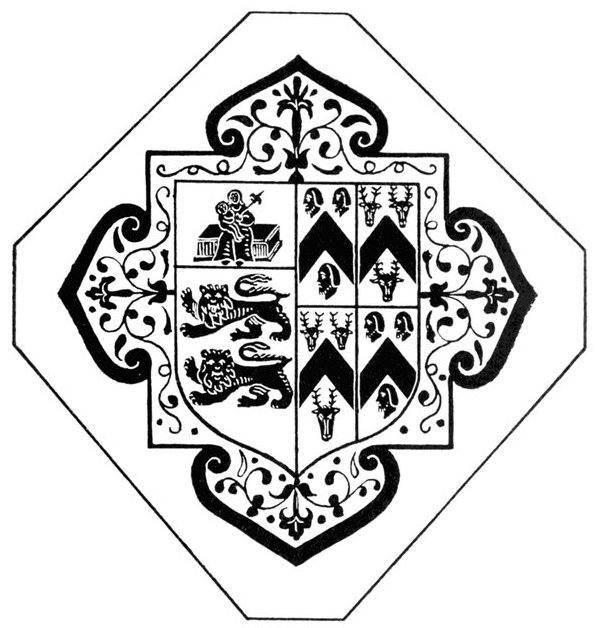
Arms.—Impaled.
Dexter: Gu., 2 lions passant guardant or, on a
chief az., our lady sitting with her babe crowned
and sceptred. See of Lincoln.
Sinister: Quarterly.
1st and 4th; gu., a chevron (erm.) between 3
human heads in profile, couped at the neck,
ppr., hair and beards sa. 2nd and 3rd; gu.,
a chevron or, between 3 stags' faces arg.,
attired or. Williams.
[Hebrew Bible.]
John Williams (born 25th March 1582, died 25th March 1650) was the
son of Edmond Williams of Conway, and was educated at Ruthin Grammar
School and at Cambridge. In 1603 he was ordained, and he soon became
known as an able preacher. After holding several minor ecclesiastical
preferments and enjoying the favour of James I., he was made Dean of
Salisbury in 1619. In 1620 Dr. Williams became Dean of Westminster,
and in 1621 he was consecrated Bishop of Lincoln. In the House of
Lords Bishop Williams took a very important part in the discussions and
legislation concerning the power of the Sovereign in 1628.
In 1635 the Bishop's enemies succeeded in bringing him before the
Star Chamber on a charge of subornation of perjury, and he was condemned
to a heavy fine and loss of profits of his many benefices. He was
imprisoned in the Tower until he was granted an unconditional release
by the House of Lords in 1640. In 1641, with other Bishops, Williams
was again committed to the Tower on a charge of high treason, but soon
escaped, forfeiting his bail. He again took a leading part in the proceedings
of the House of Lords, and was translated to the Archbishopric of York,
where he was enthroned in 1642.
Archbishop Williams worked hard for the Royalist cause; he fortified
Conway Castle and organised the militia. He was possessed of considerable
wealth, and was liberal and charitable. Several of his sermons and
speeches were published.
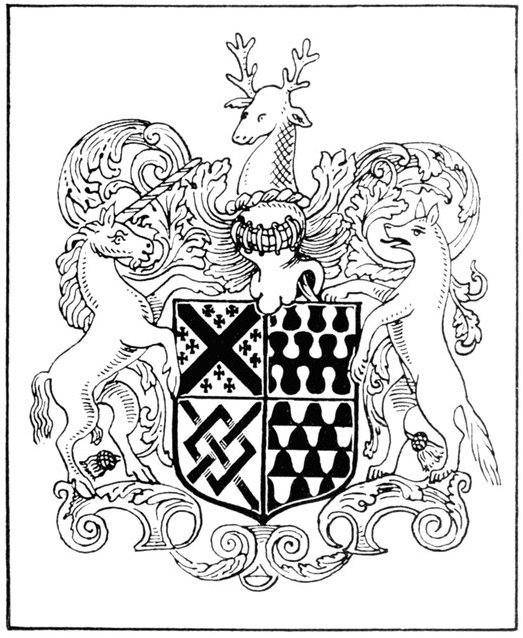
Arms.—Quarterly.
1. Gu., a saltire between 12 crosses pattée or.
Windsor.
2. Barry nebuly or and sa. Blount.
3. Gu., a fret or. Audley.
4. Vairy, arg. and sa. Meynell.
Crest.—A buck's head affrontée, couped at the neck
arg., attired or.
Helmet.—That of a Peer.
Supporters.—Dexter, a unicorn arg., armed, maned,
and unguled or. Sinister, a fox ppr.
[Ossat. Lettres. Paris, 1627.]
Thomas Windsor (born circ. 1580, died 6th December 1642) was the son
of Henry Windsor, fifth Baron Windsor. He succeeded his father in
the Barony in 1605. In 1610 Lord Windsor was made a Knight
Commander of the Order of the Bath, and was Rear-Admiral in the
Navy. He commanded the fleet sent to Spain to bring back Prince
Charles. Lord Windsor left no son, and his title was inherited by his
nephew, Thomas Windsor-Hickman, the son of Elizabeth, daughter and
heiress of the fifth Baron. He married Dixie Hickman of Kew, Surrey.
Arms.—Impaled.
Dexter: Or, 3 crescents gu. Woodhull.
Sinister: Erm., on a fess gu., 3 escallops or.
Ingram.
Crest.—Out of an heraldic coronet 2 wings
addorsed, arg.
[M. T. Ciceronis. Quaestionorum tusculanarum, libri quinq.
Florentiae, 1514.]
Michael Wodhull (born 15th August 1740, died 10th November 1816)
was the son of John Wodhull. He was educated at Winchester and
Oxford. Mr. Wodhull married a Miss Ingram of Wolford in Warwickshire;
he was a collector of books and an author and translator of the
classics. At his library at his house at Thenford, Wodhull had an extensive
collection of books, many of which were bound by Roger Payne, and
among which were several fine historical bindings. These books were
dispersed by sale, partly during Mr. Wodhull's lifetime, but mostly after
his death. In 1783 he was High Sheriff of Northamptonshire.
Arms.—Impaled.
Dexter: Quarterly.
1st and 4th; arg., 3 dung-forks sa. Worthington.
2nd and 3rd; arg., 3 chevrons gu. Langton.
Sinister: Arg., a cross moline gu. Colvile.
[Calvin. A Harmonie upon the Gospels. Londini, 1610.]
The family of Worthington has been well known in several counties,
but chiefly in Lancashire. Members of the family have also settled in
Suffolk and in Cheshire.
I have not been able to decide to which member of the Worthington
family this particular coat-of-arms belonged.
Arms.—Quarterly.
1st and 4th; arg., a saltire engrailed sa. Wotton.
2nd and 3rd; arg., on a chief sa., a lion passant of
the first. Rudston.
Note.—Used before 1602.
[Plinius Secundus. Historia Naturalis. Lugduni, 1548.]
Edward Wotton (born circ. 1548, died circ. 1626) was the son of
Thomas Wotton by his first wife Elizabeth, daughter of Sir John Rudston,
Lord Mayor of London. Mr. Wotton was a man of much learning and
a great linguist, and in 1583 he was Member of Parliament for Kent.
He was Elizabeth's emissary to James VI. concerning his marriage, and
also about a treaty of alliance. In 1591 he received the honour of
Knighthood, and in 1602 he was Comptroller of the Household. In the
same year he was created Baron Wotton.
Lord Wotton was Lord Lieutenant of Kent, and Ambassador to
France and Treasurer of the Household. He inherited his father's library,
and in many cases added his own coat-of-arms impressed in silver to the
beautiful bindings made for Thomas Wotton, "The English Grolier,"
on whose books occur the legend THOMAE WOTTONI ET AMICORUM.
Arms.—Az., 2 bars engrailed arg., in chief as many
leopards' heads or. Wright.
[Lambert. Chancery Collections. Stowe MS. 415.]
James Wright (born circ. 1643, died October 1713) was the son of
Abraham Wright, of Oxfordshire. He was called to the Bar in 1672.
His tastes were literary and antiquarian, and he possessed a considerable
library, chiefly manuscripts. Wright wrote a number of works on
antiquities, and others on the political matters of his time. The drama
also had much fascination for him, and he wrote several poems, and made
an epitome of Dugdale's Monasticon.
Arms.—Arg., on a fess gu., 3 crescents of the first
between 3 Cornish choughs ppr., in chief a spear-head
of the second. Wycliffe.
Crest.—A Cornish chough, wings addorsed, ppr.
Motto.—Deus alit me.
[Groot. Defensio fidei Catholicae de Satisfactione Christi
adversus Faustum socinum. Lugduni Batavorum, 1617.]
This stamp belonged to T. Wycliffe, probably a member of the
Yorkshire family of that name, but I have not so far been able to identify
the owner more particularly.
Arms.—Arg., a chevron between 3 lions' heads erased
or. Wyndham.
Crest.—A lion's head erased, within a fetterlock or.
[Olearius. The Voyages and Travels of J. Albert de
Mandelslo. London, 1669.]
Hugh Wyndham (born circ. 1603, died 27th July 1684) was the son
of Sir John Wyndham of Orchard-Wyndham, Somerset. He was educated
at Oxford, and called to the Bar in 1629. In 1654 Mr. Wyndham was
made a Serjeant-at-Law and a Judge on the Northern Circuit. In 1670
he was made a Baron of the Exchequer, and received the honour of
Knighthood. He married three times.