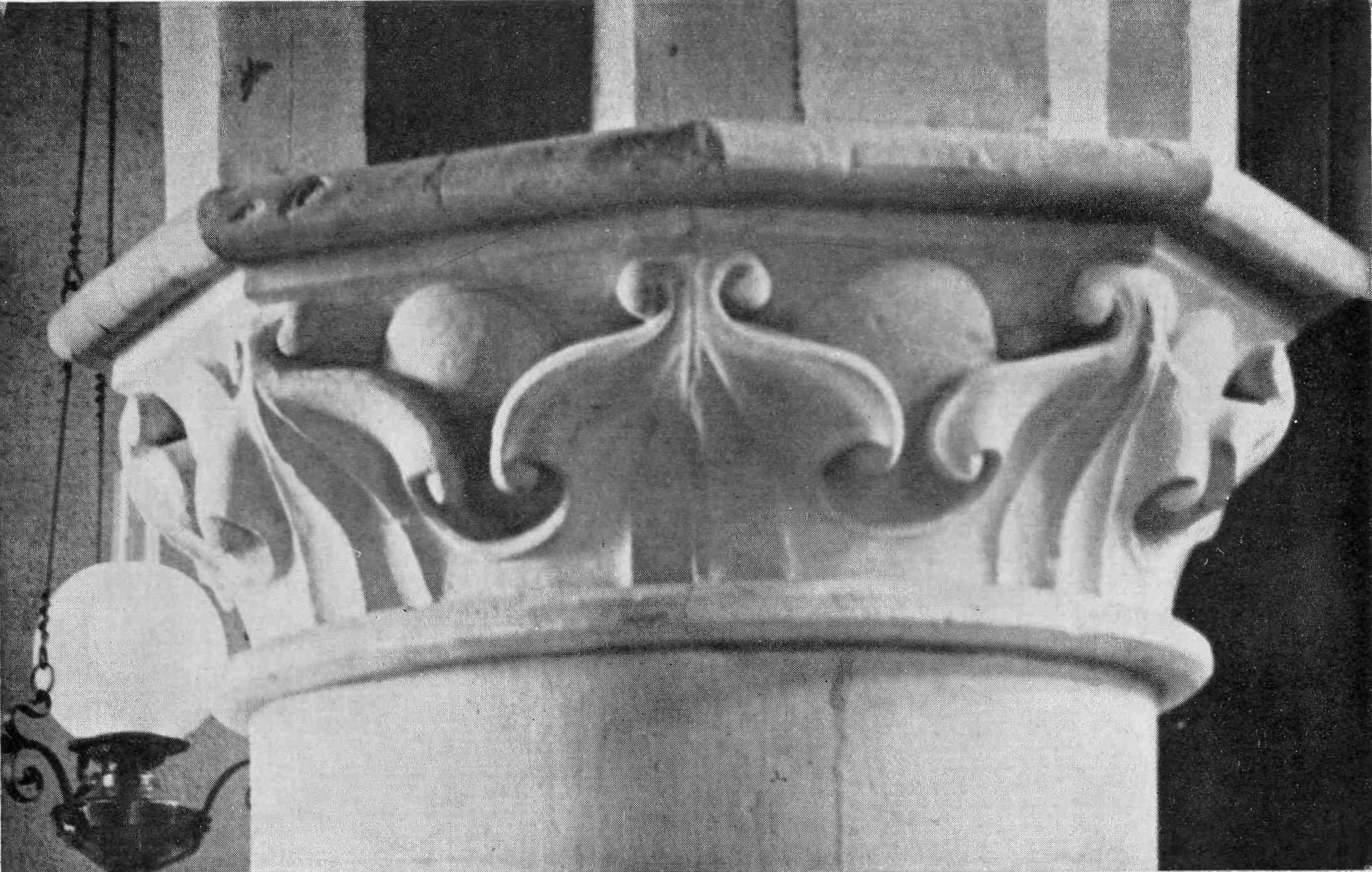
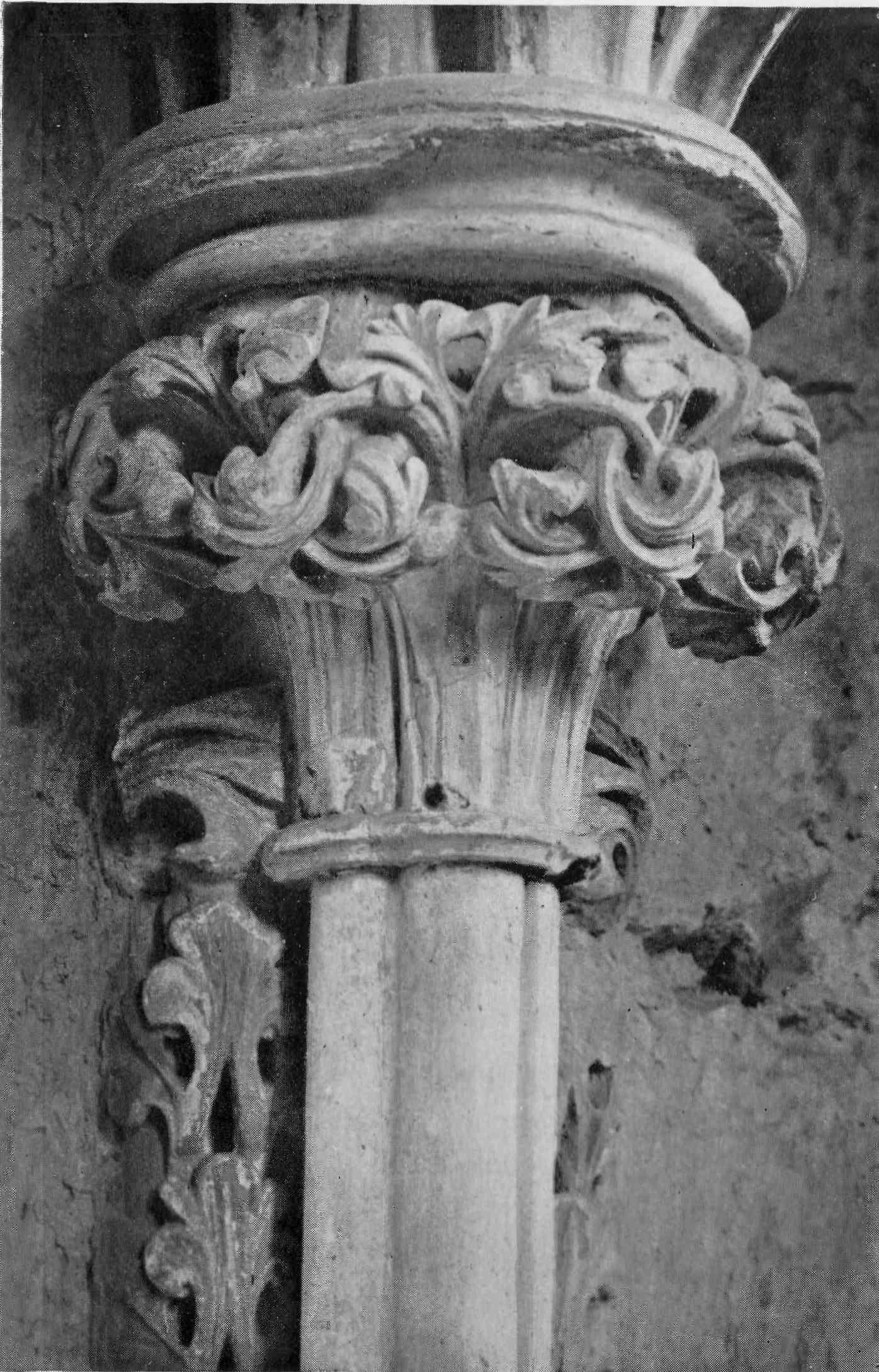
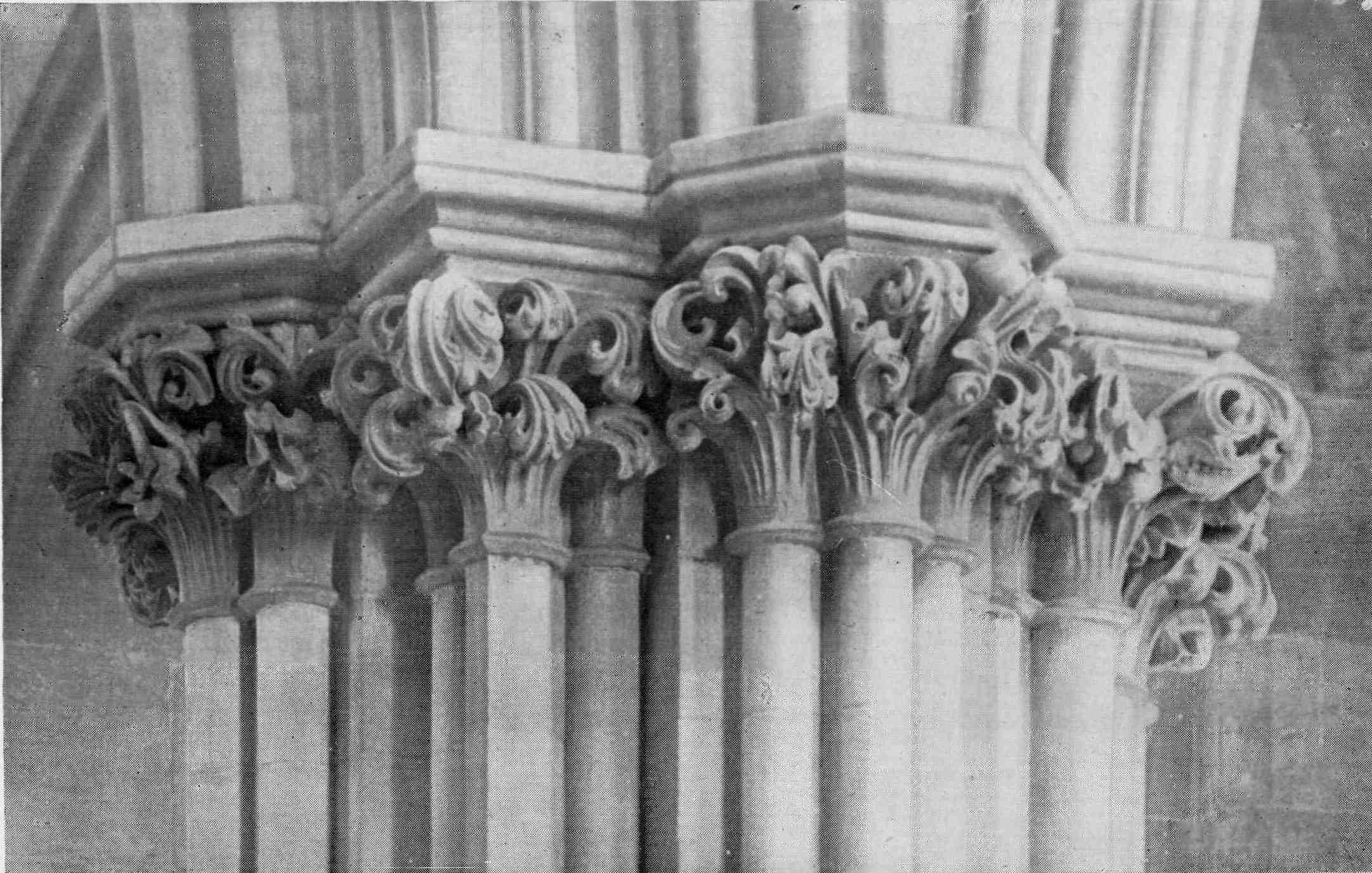
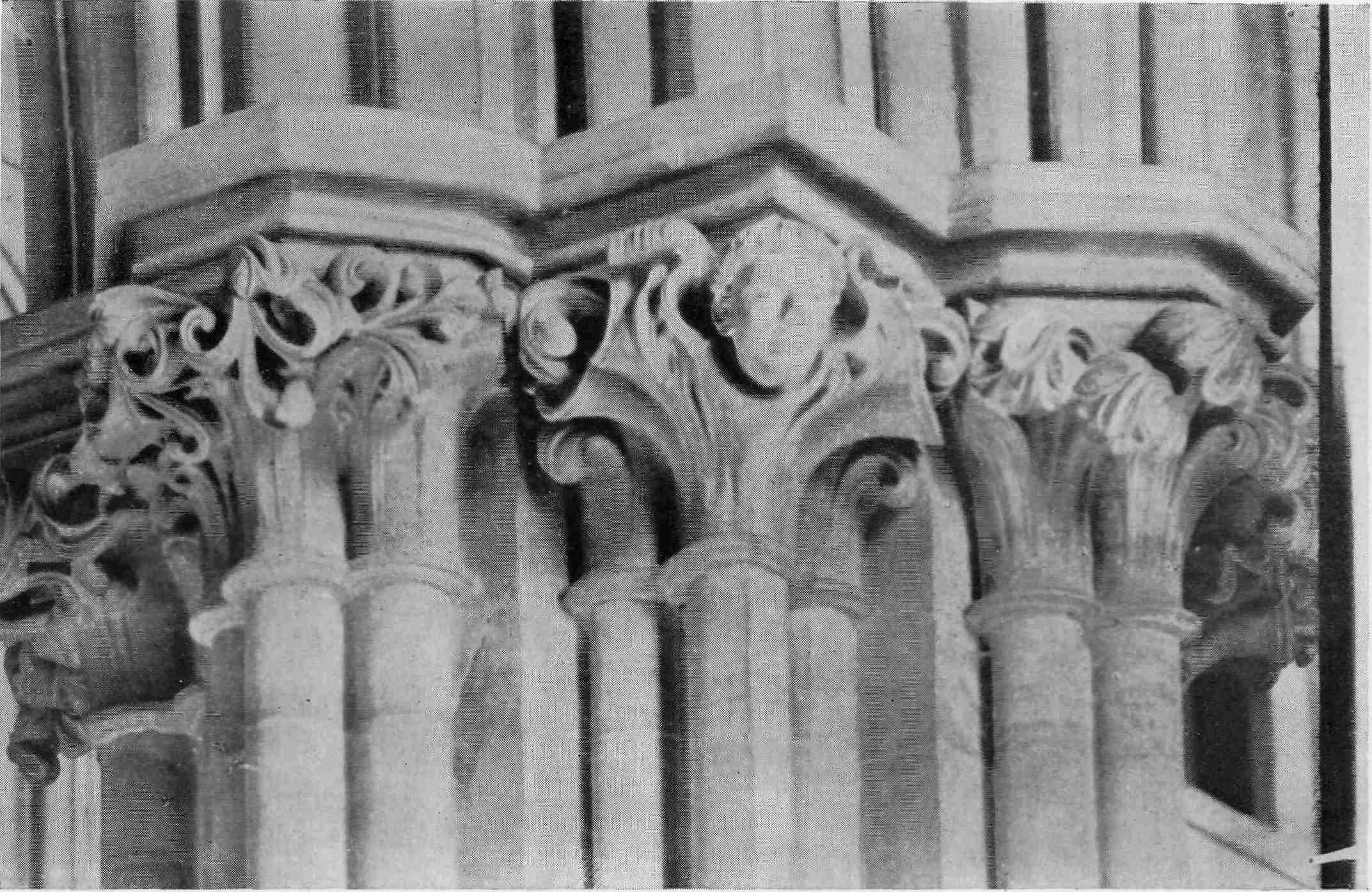
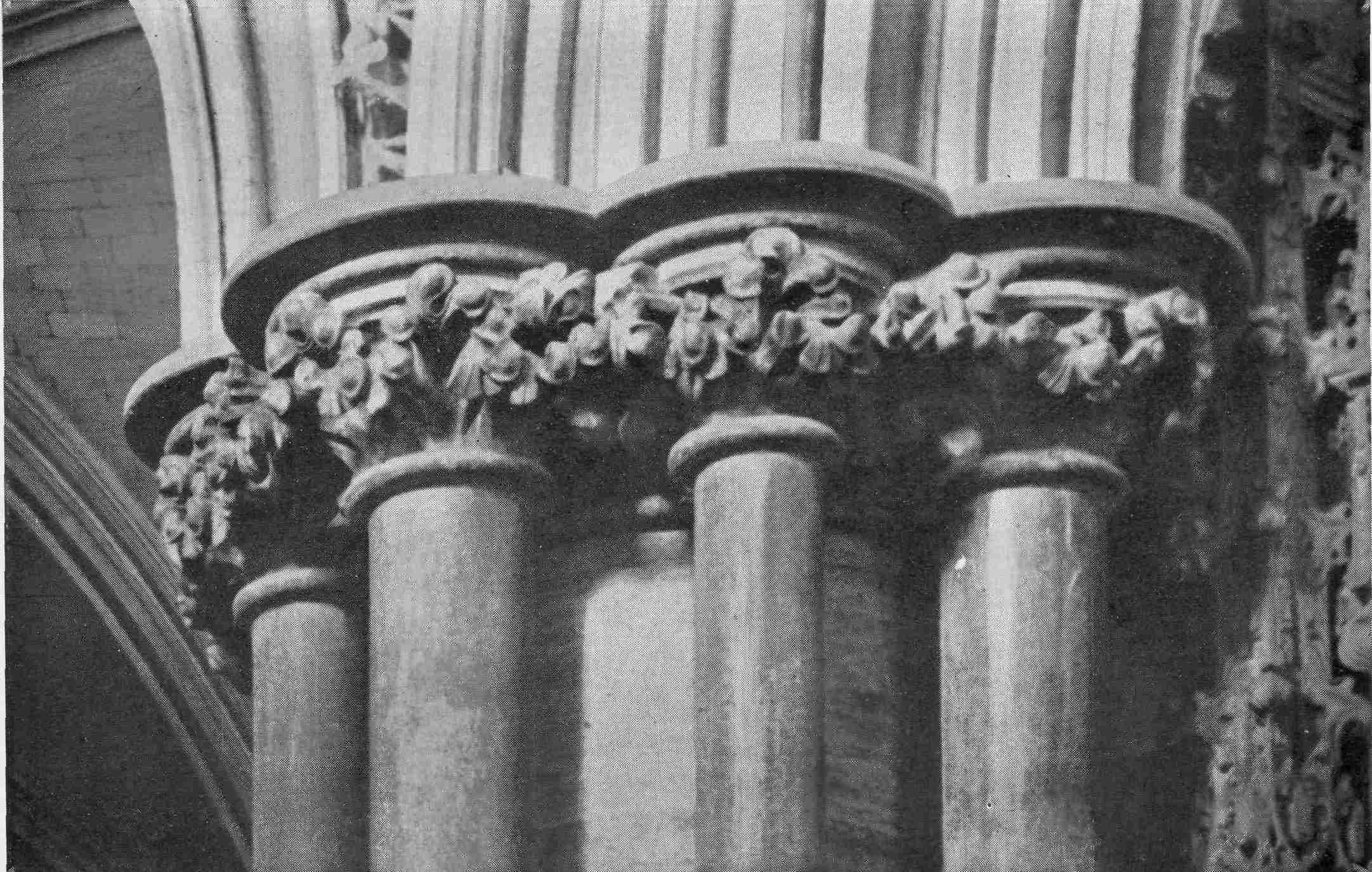
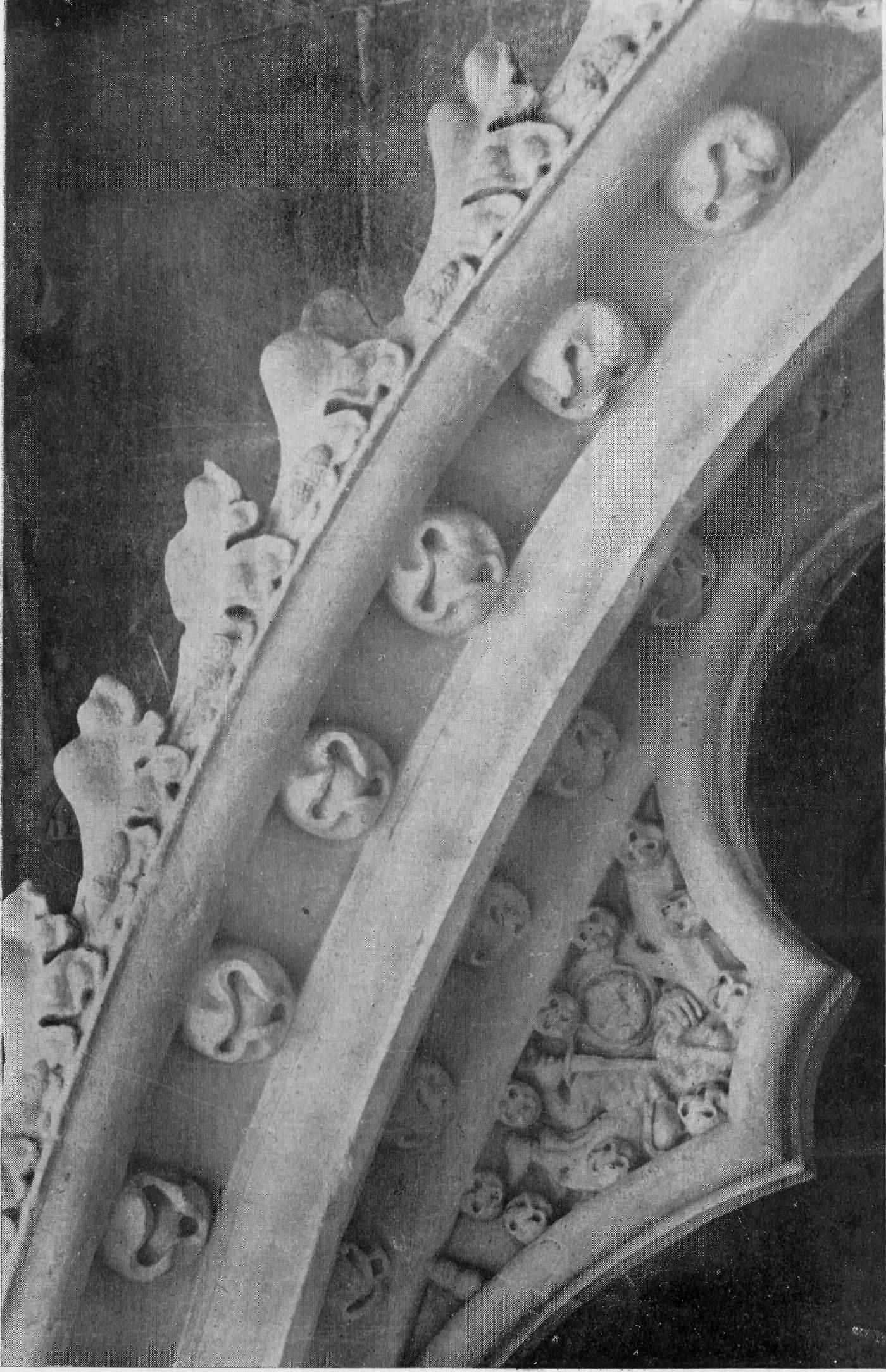
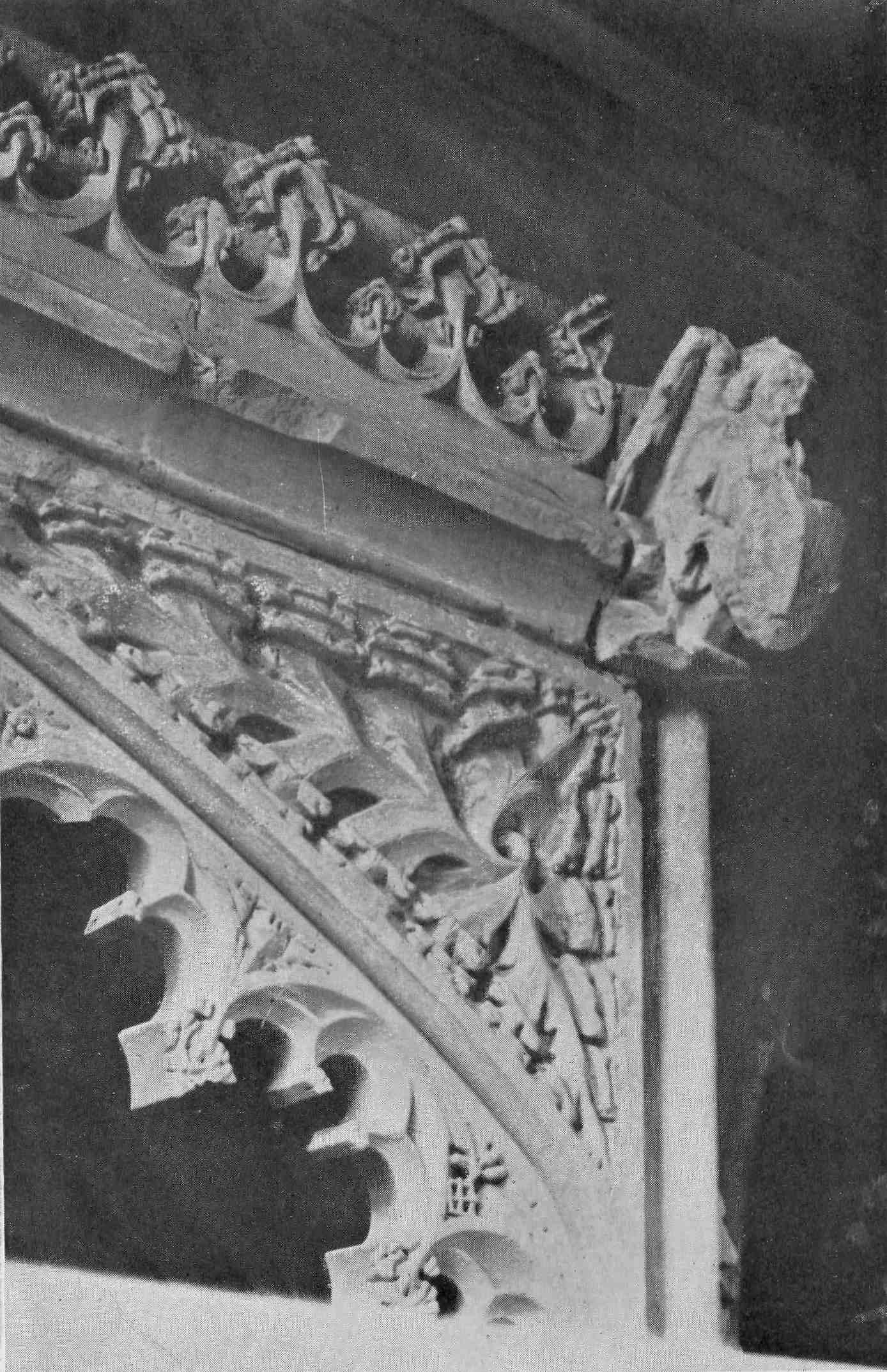
AS foliage sculpture is mostly concentrated
on capitals, and sculpture to some extent is
modified by the shapes of the surfaces which
it ornaments, it will be well before going into
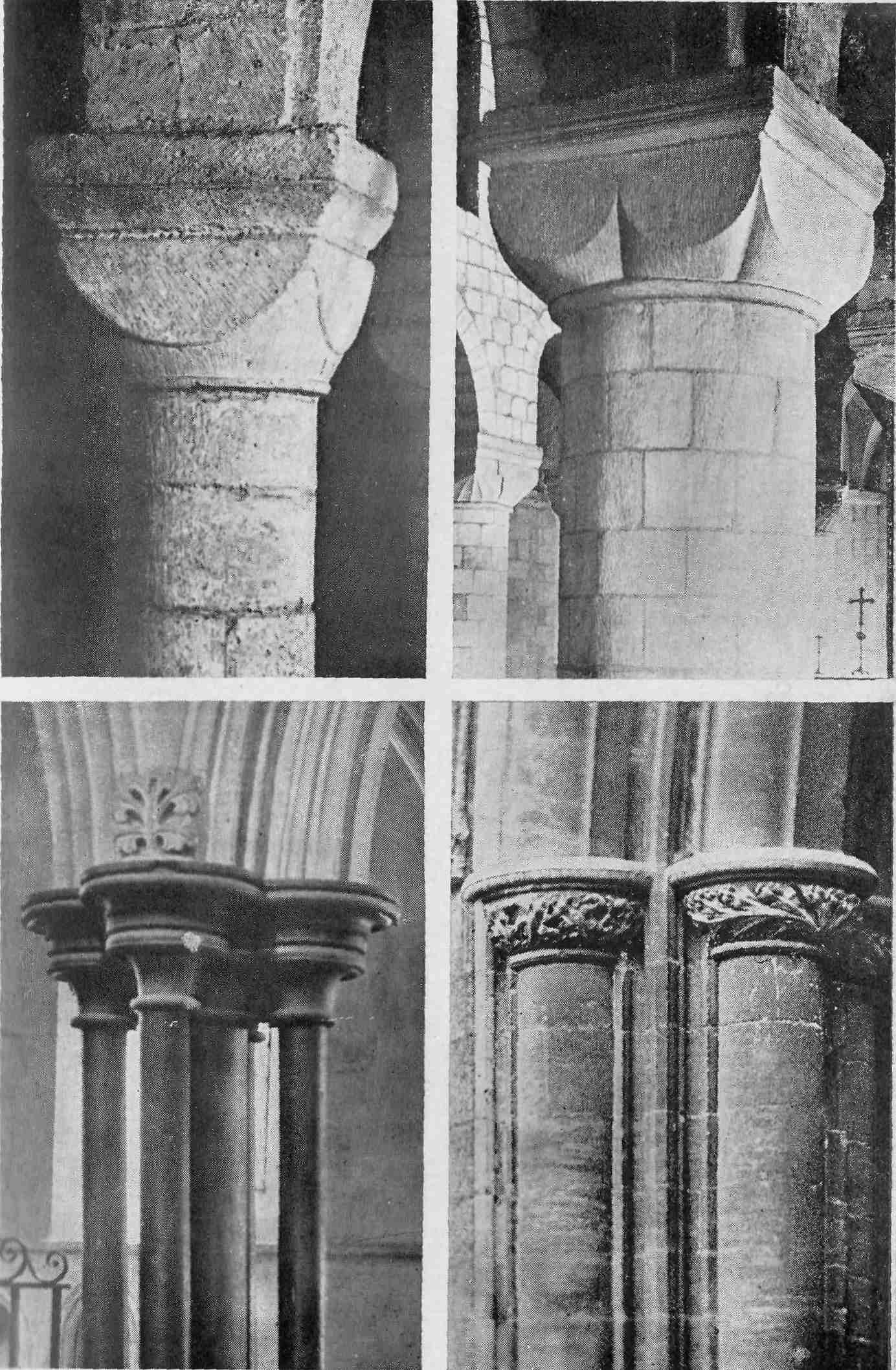
sculptural details to note that English capitals
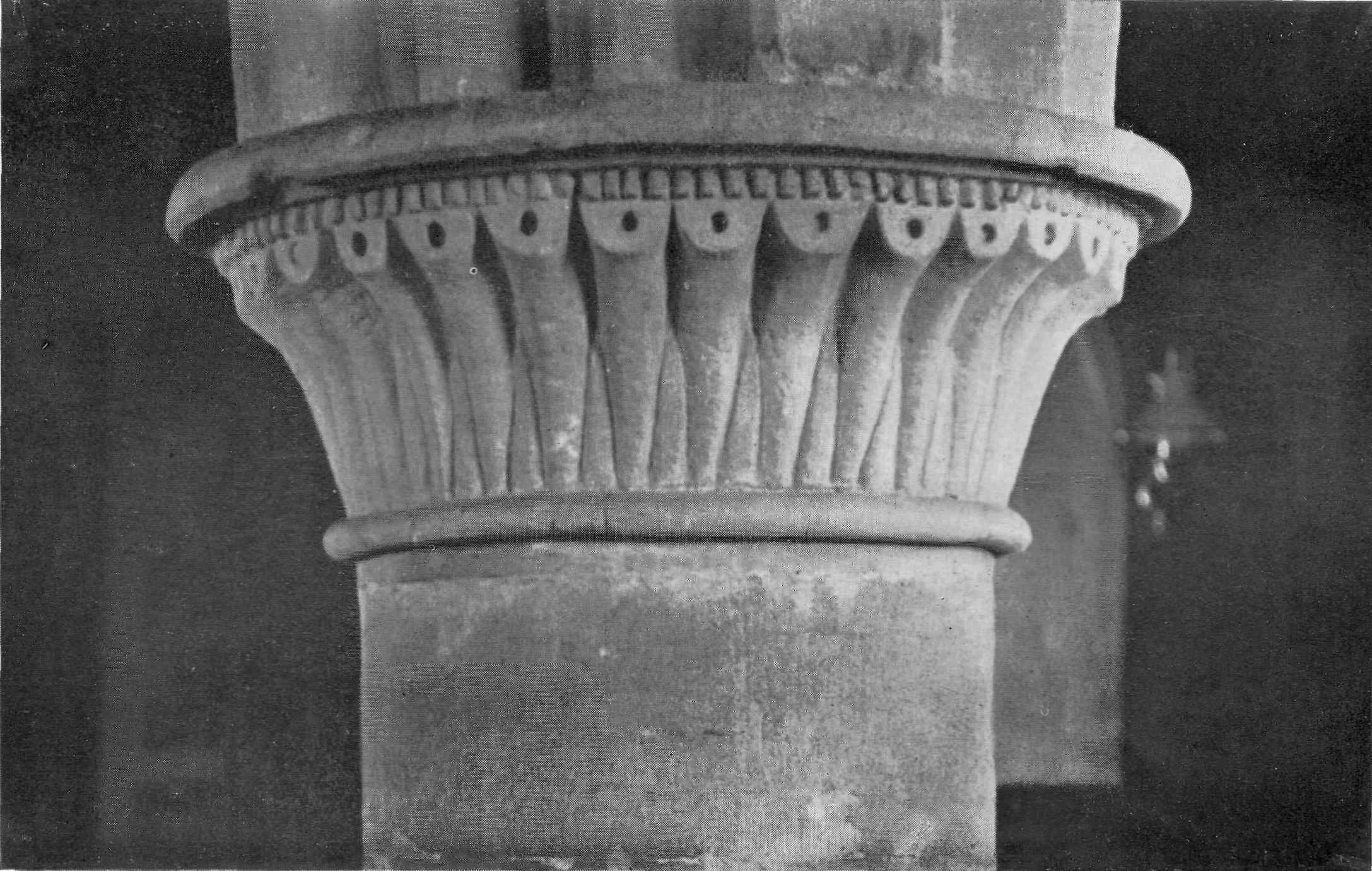
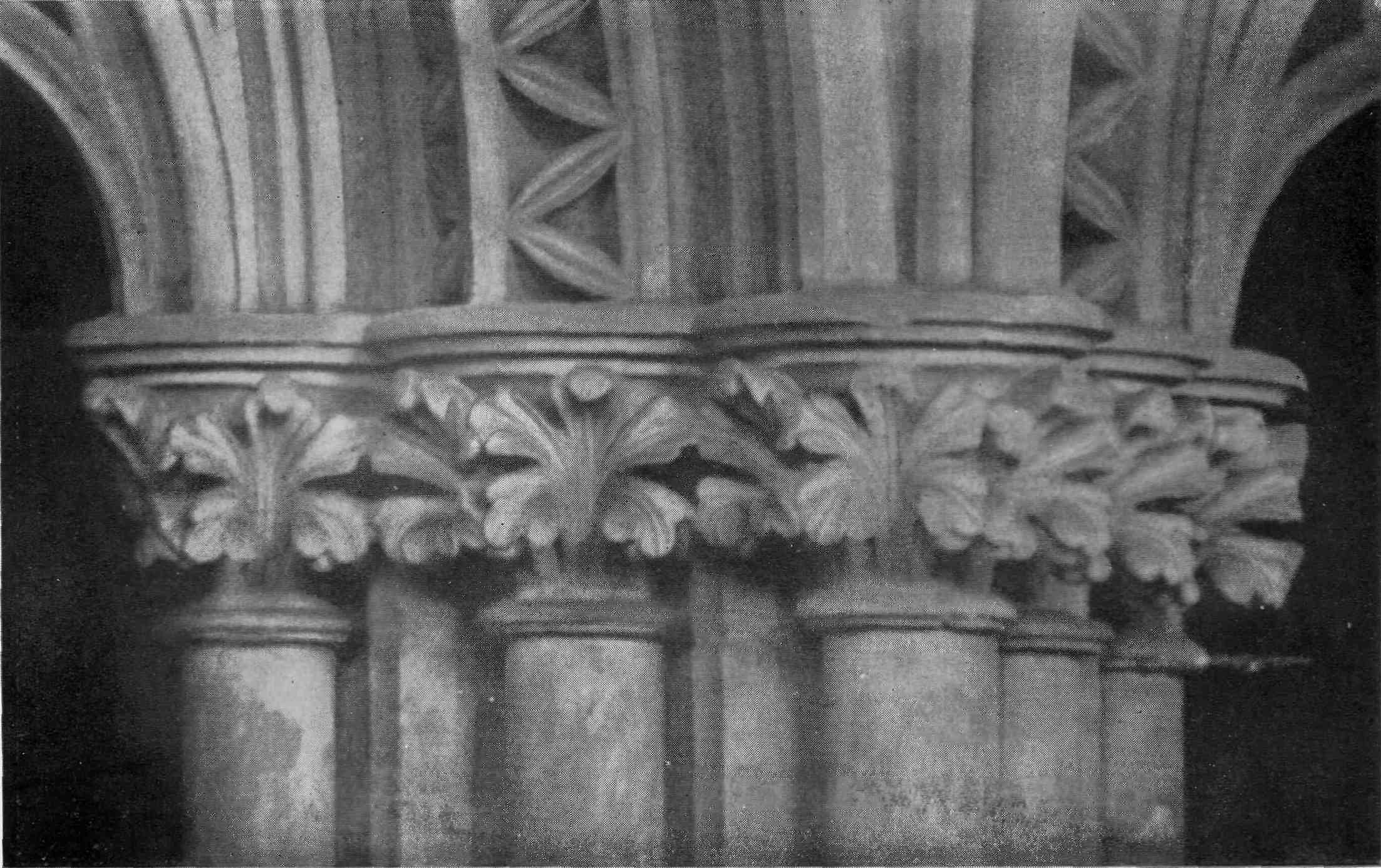
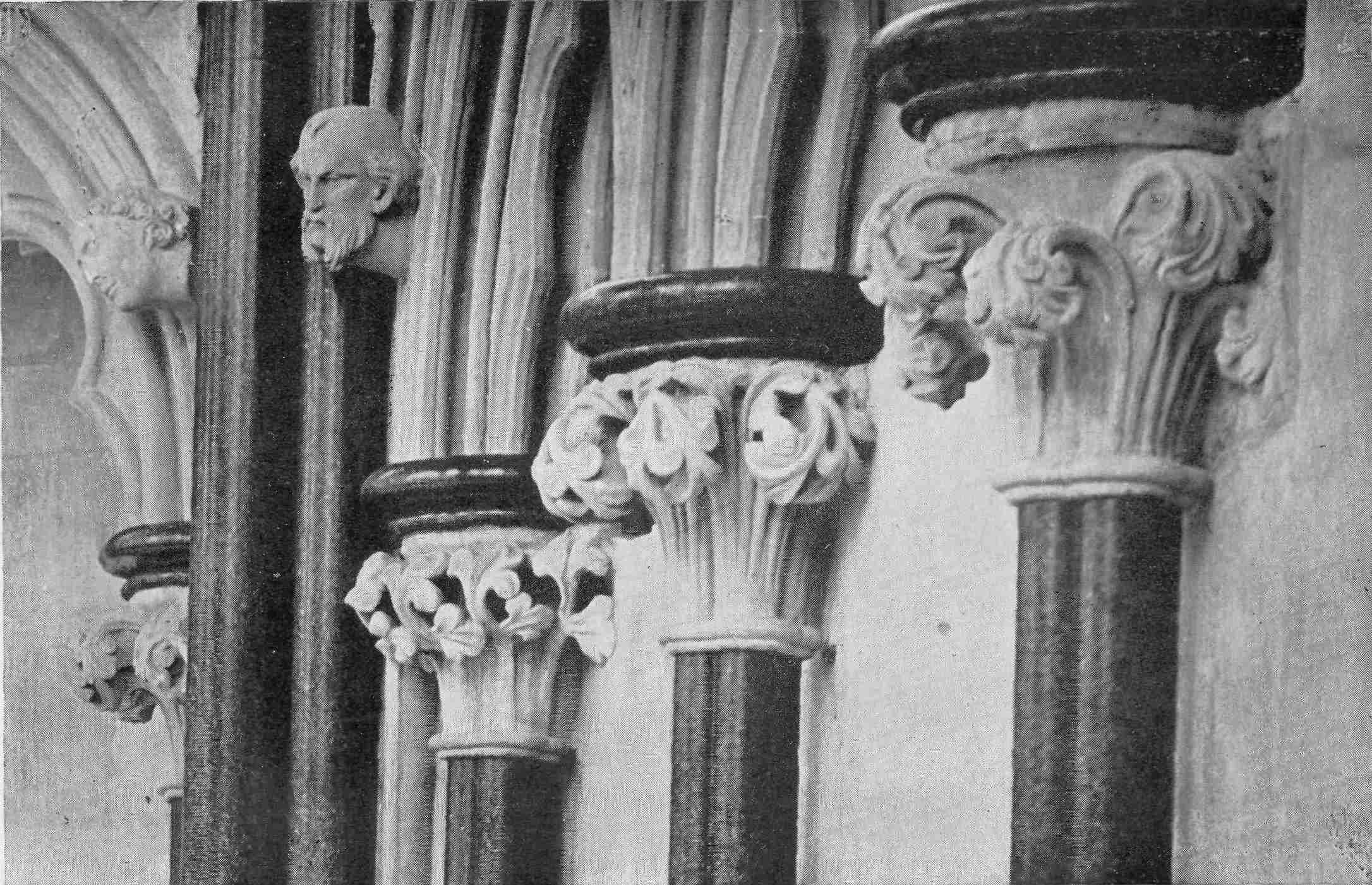
are of four descriptions: (i) cushion, (ii) scalloped,
(iii) bell, and (iv) cup-or bowl-shaped
(Pl. 1).
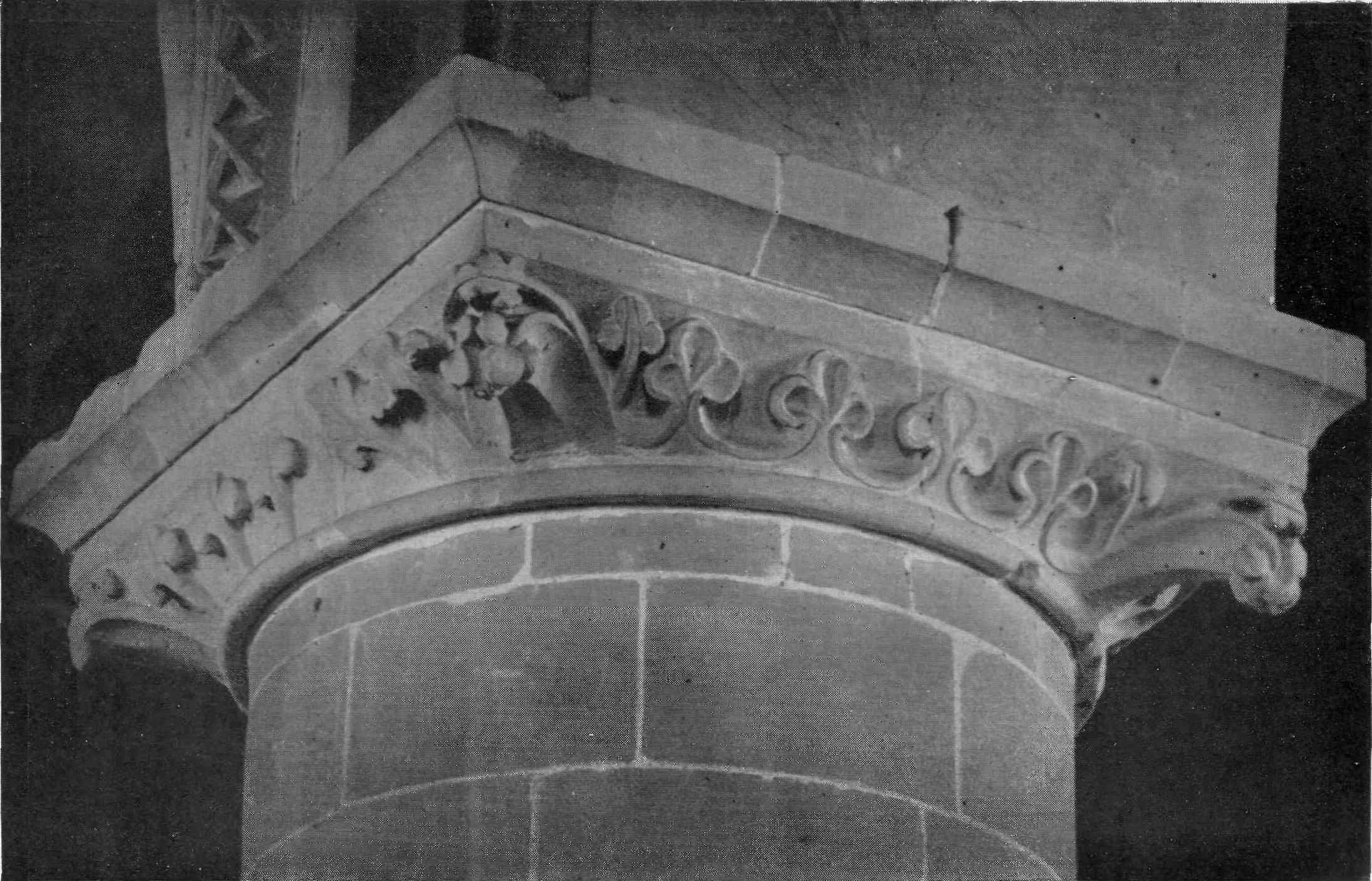
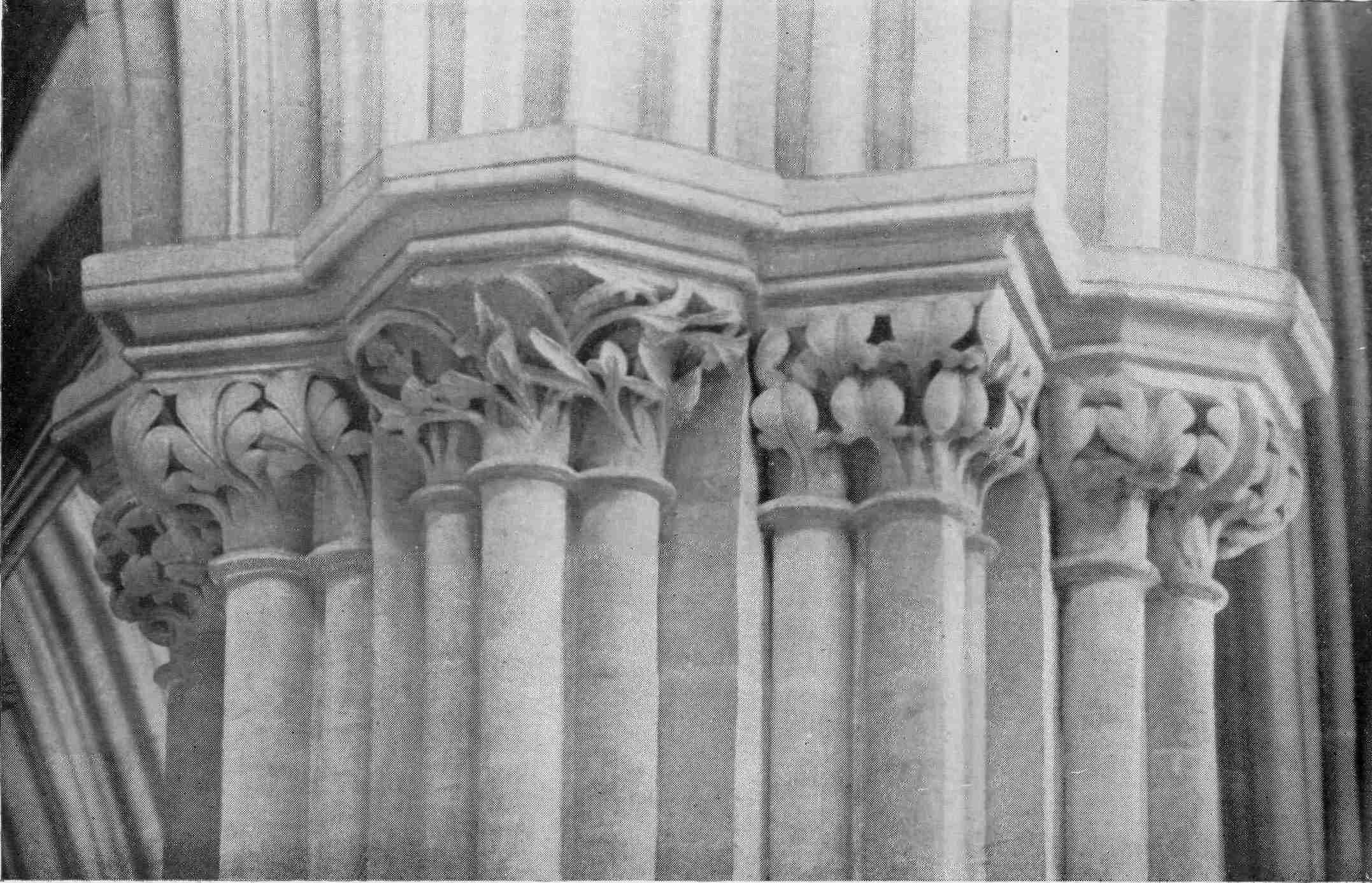
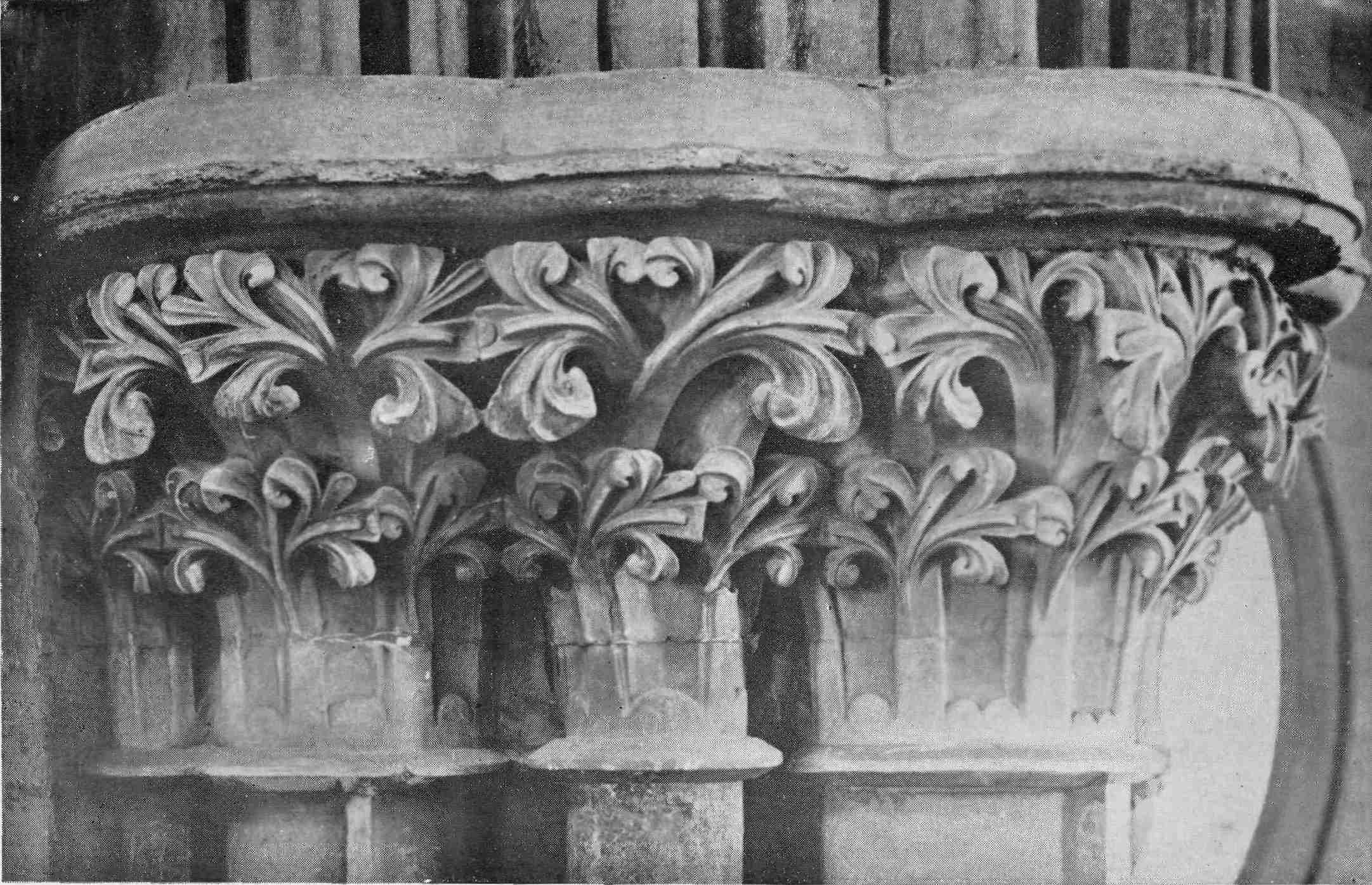
Norman are mostly cushion or scalloped, but
those of the French Corinthian type are bells.
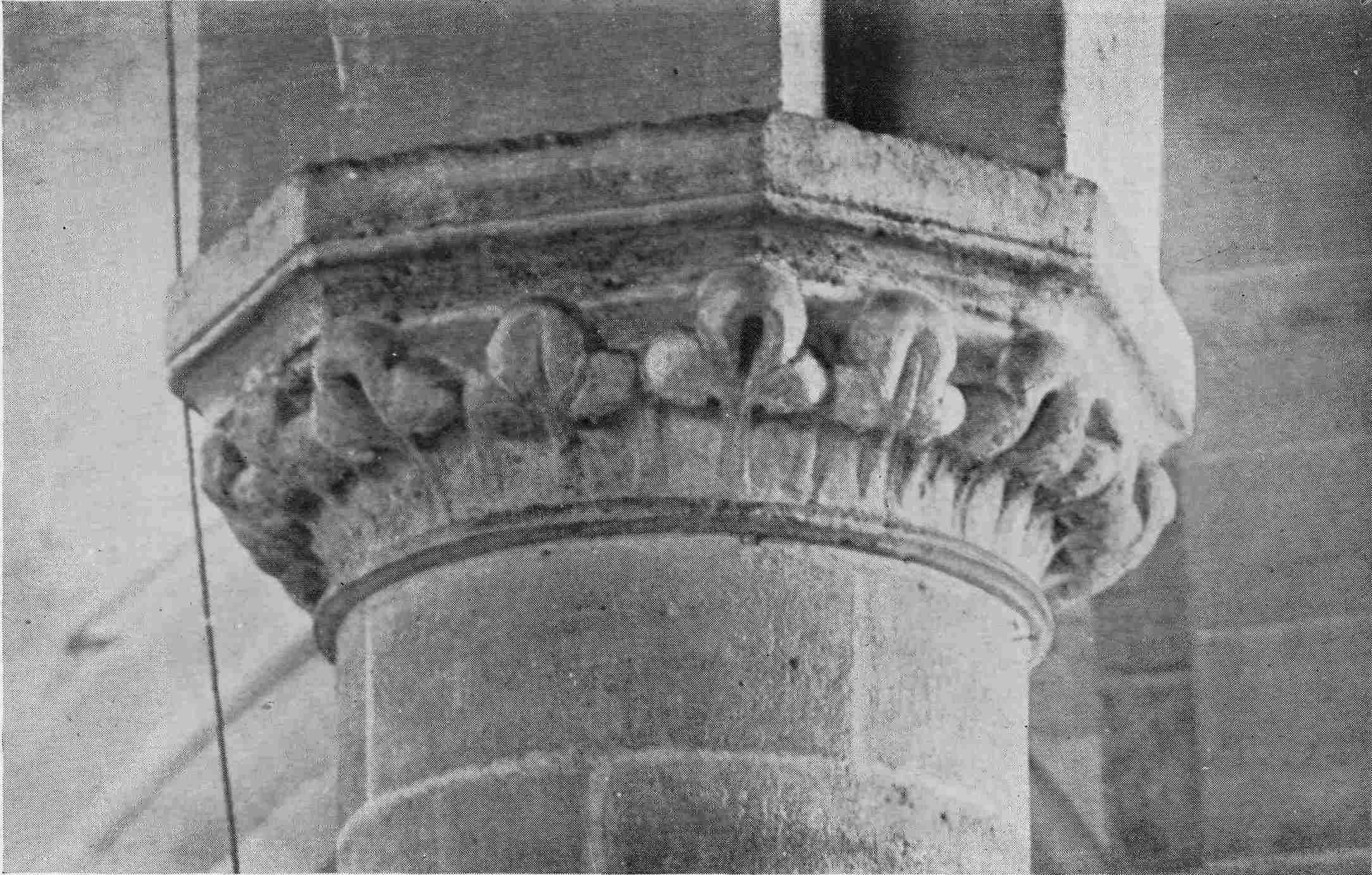
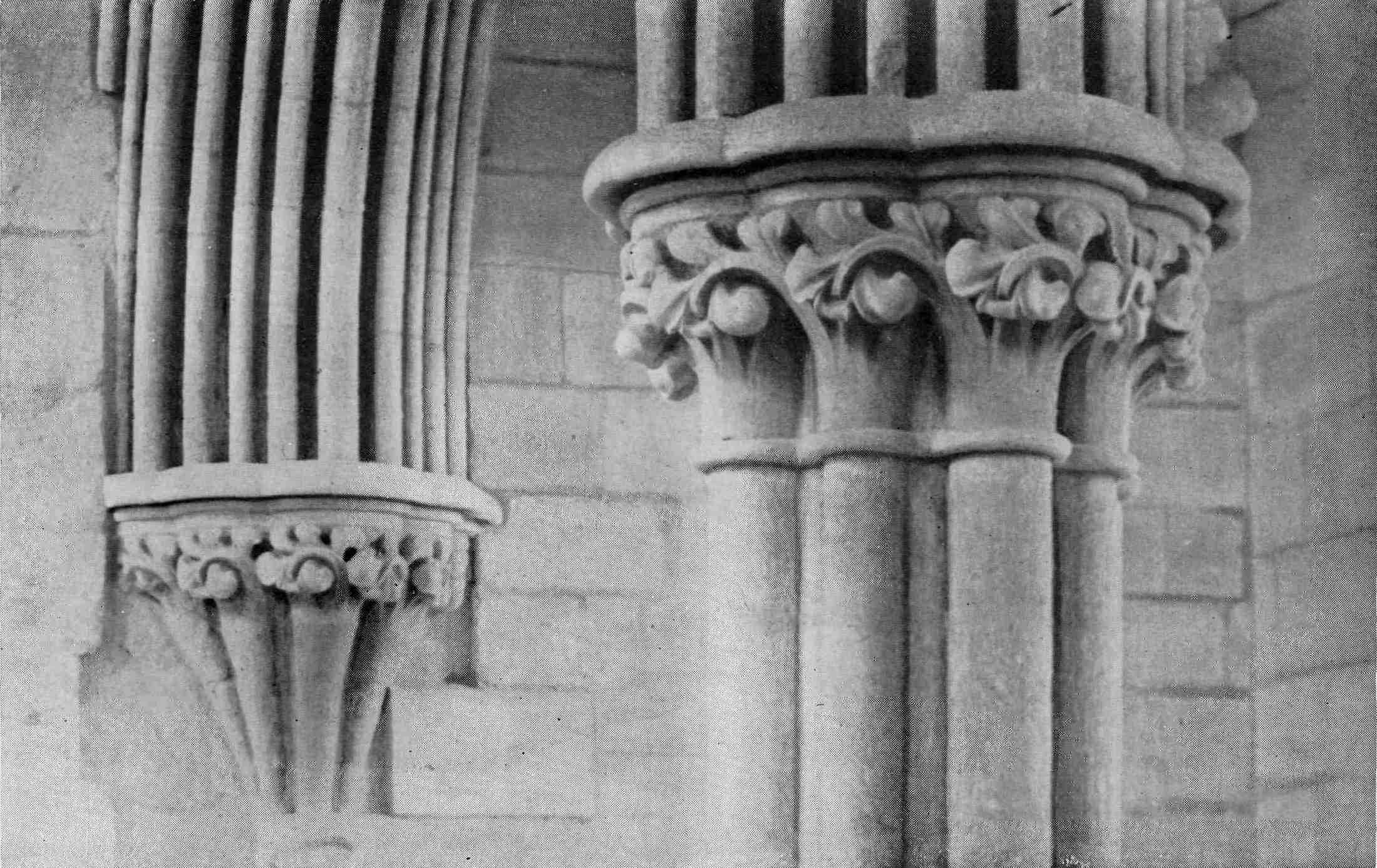
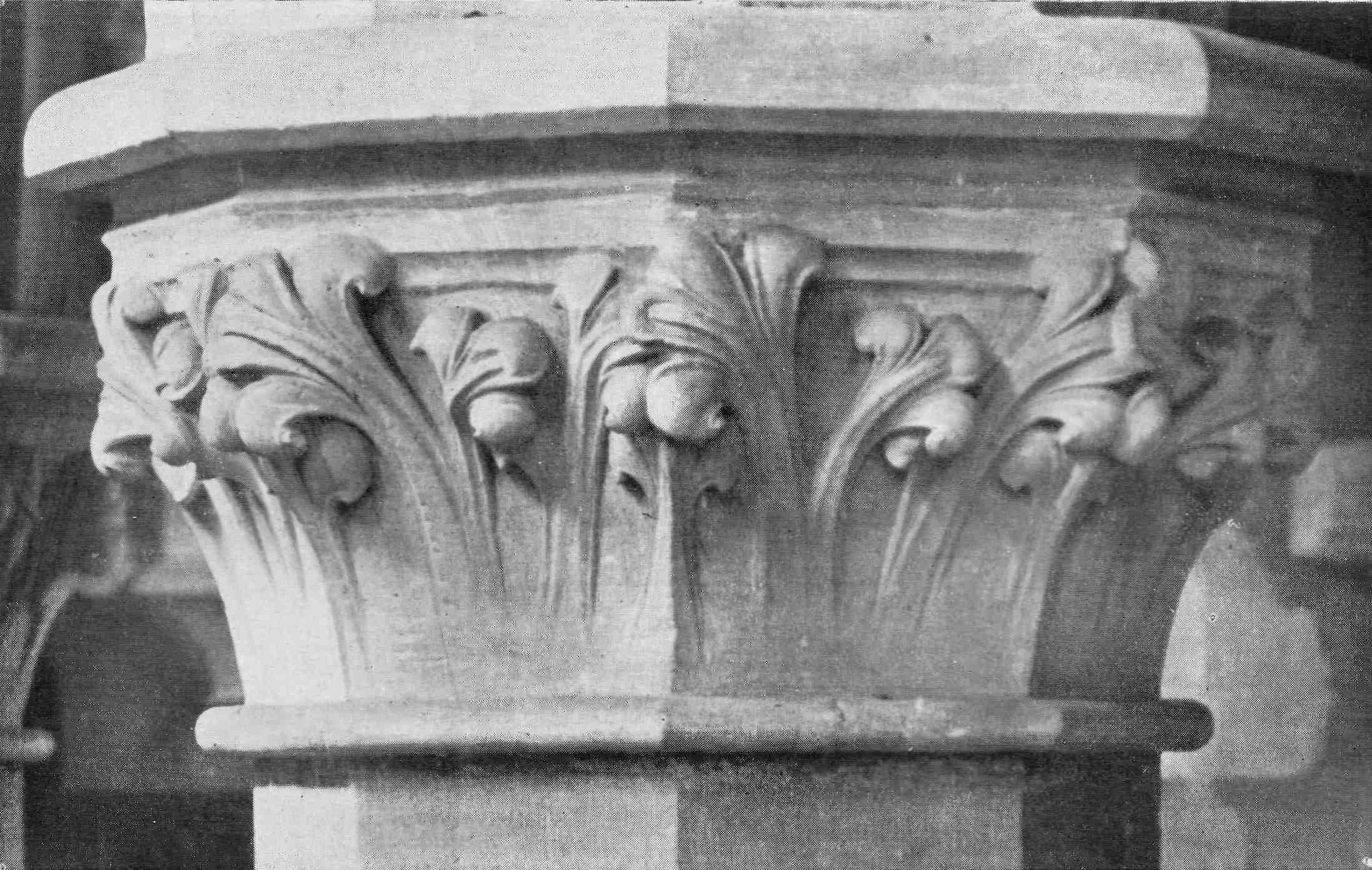
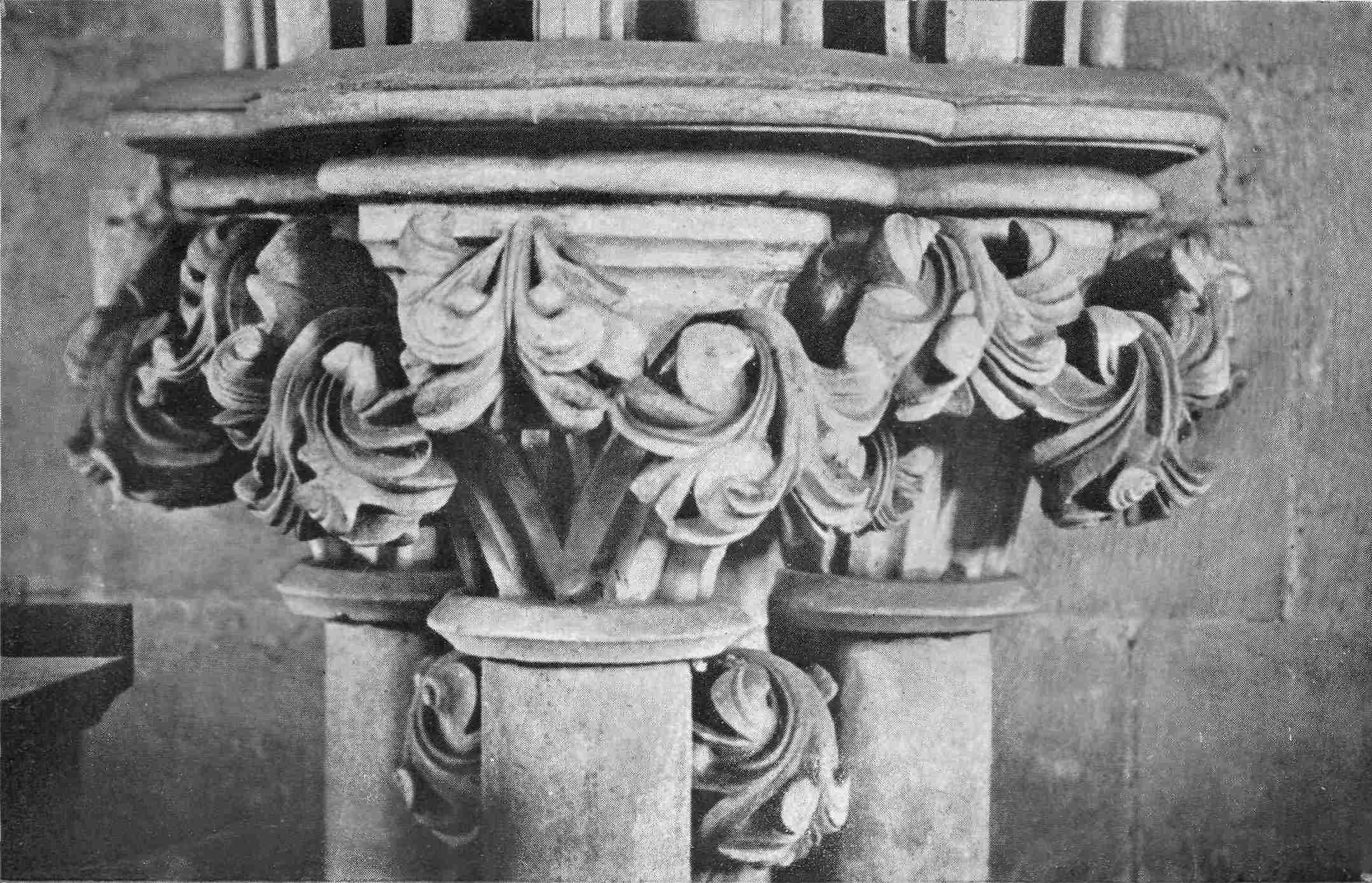
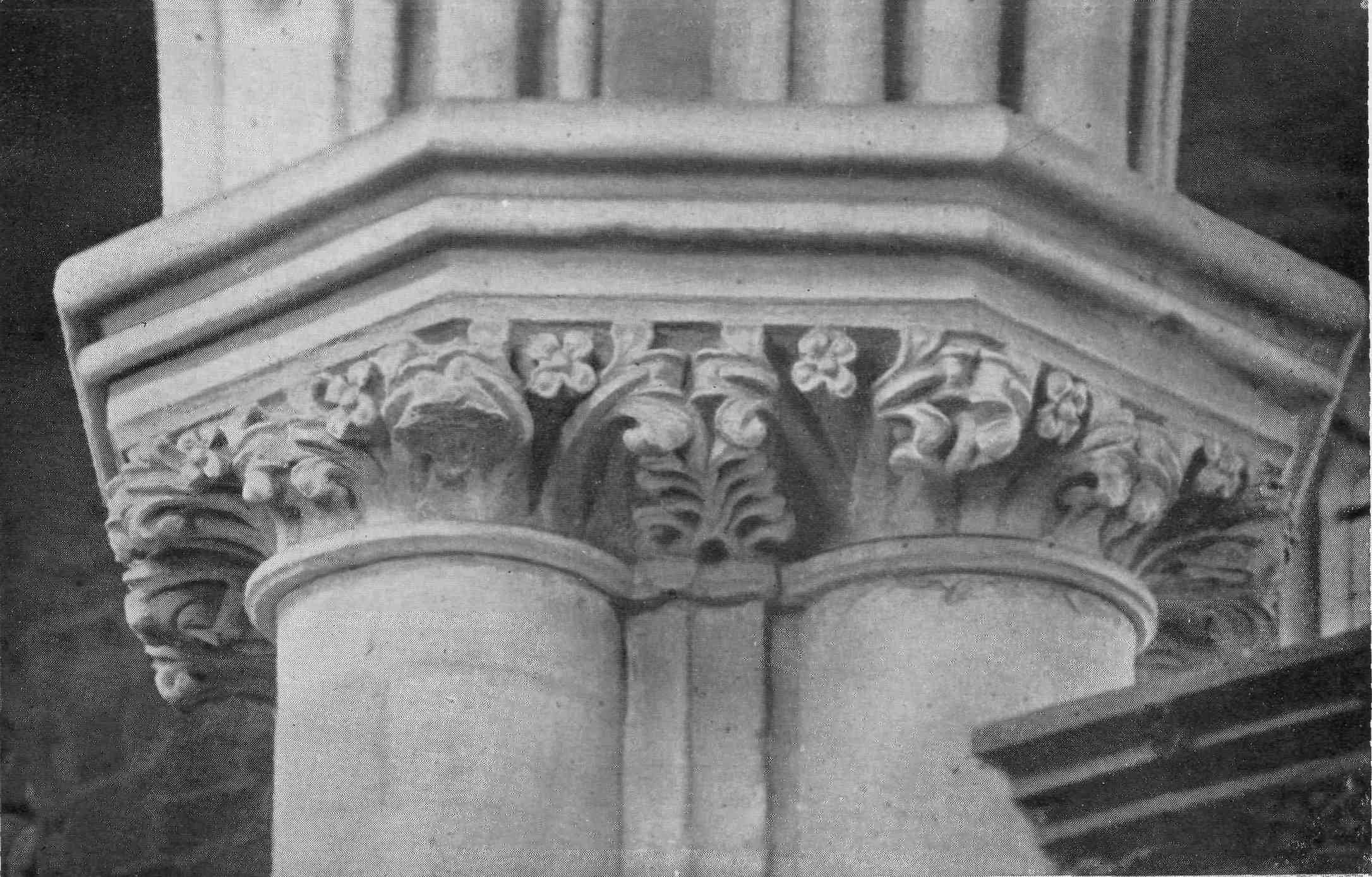
Early English are mostly bells. Decorated
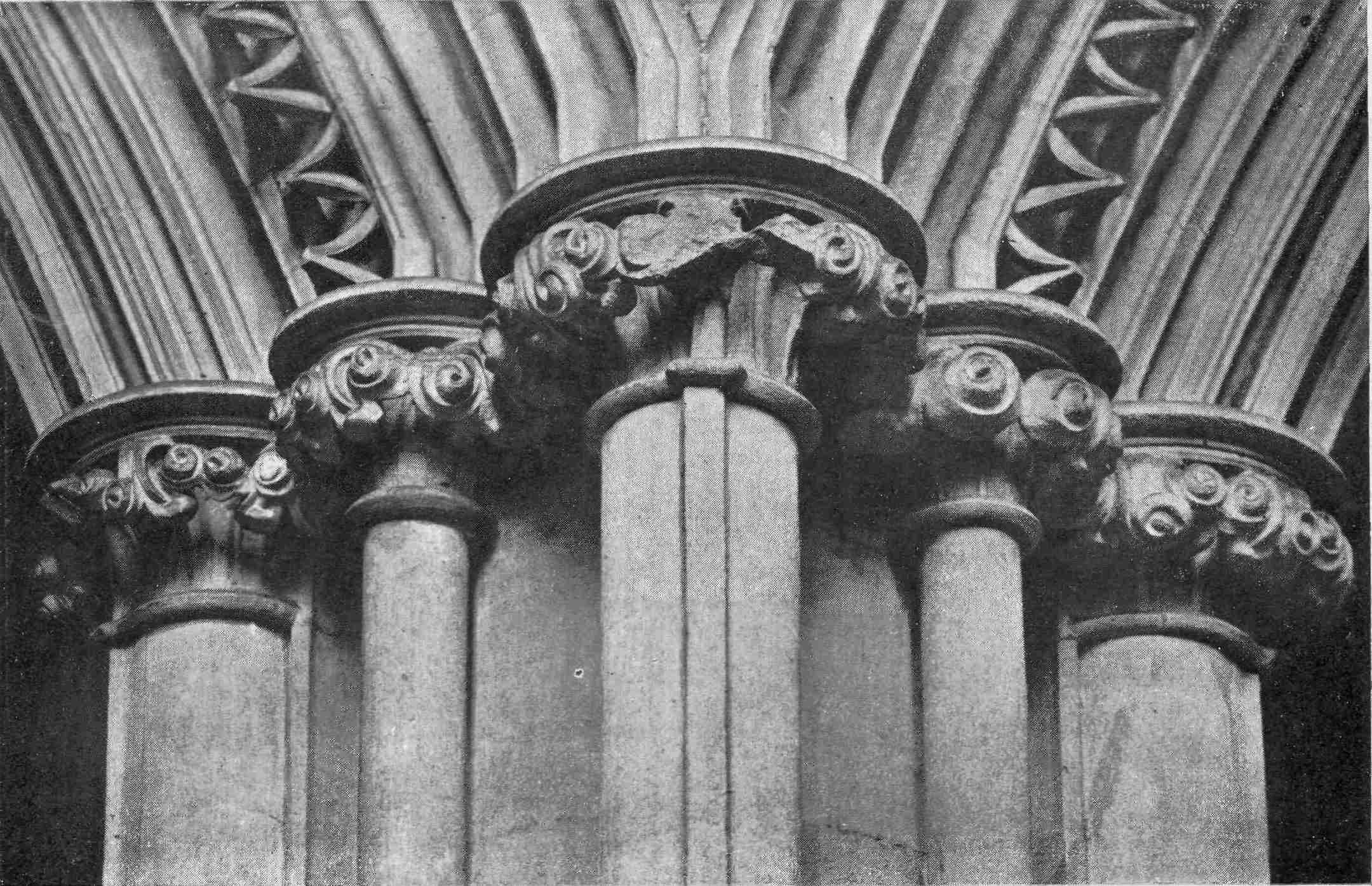
sometimes revert not to the cushion, but to
a modification of it, which we have called cup-shaped,
the abacus being no longer square but
circular, or octagonal (Pl. 71).
The cushion is a cube with the lower corners
chamfered off in such a manner as to make
the four sides semi-circular, the diameter
being at the top. Below the semi-circles the
chamfers slope in to the necking of the shaft.
The bell is the shape of a bell or trumpet-mouth.
The profile of the capital is concave
from the necking up to the larger diameter of
the top adjoining the abacus.
In scalloped capitals the four sides of the
capital, if square, or the circumference if
round, are subdivided into a series of semi-circles,
instead of having one on each face as
in the cushions.
Cup-shaped capitals are the opposite of
bells, having a convex instead of a concave
profile, say the shape of a tea-cup or bowl.
When Norman capitals are sculptured,
whether with figure or foliage sculpture, the
character of the sculpture is Lombardic or
Romanesque. There is nothing especially English
about it. The schools of carving being
mostly either in or under the control of the
monasteries, and the monasteries being cosmopolitan,
the carving was so also, and followed
traditions which were mostly Classical in
origin, but modified by suggestions from
painted illuminations, needlework, wicker-work,
wood-carving, and metal-work, both in
iron and precious metals. Through what are
called the Dark Ages this type of carving had
been kept up chiefly on sarcophagi and ivory
crosses and caskets, upon which the best work
is found.
Some cushion capitals at Christchurch have
the Greek anthemion (Pl. 5) and others the
profile leaf, carved quite after the Greek
manner.
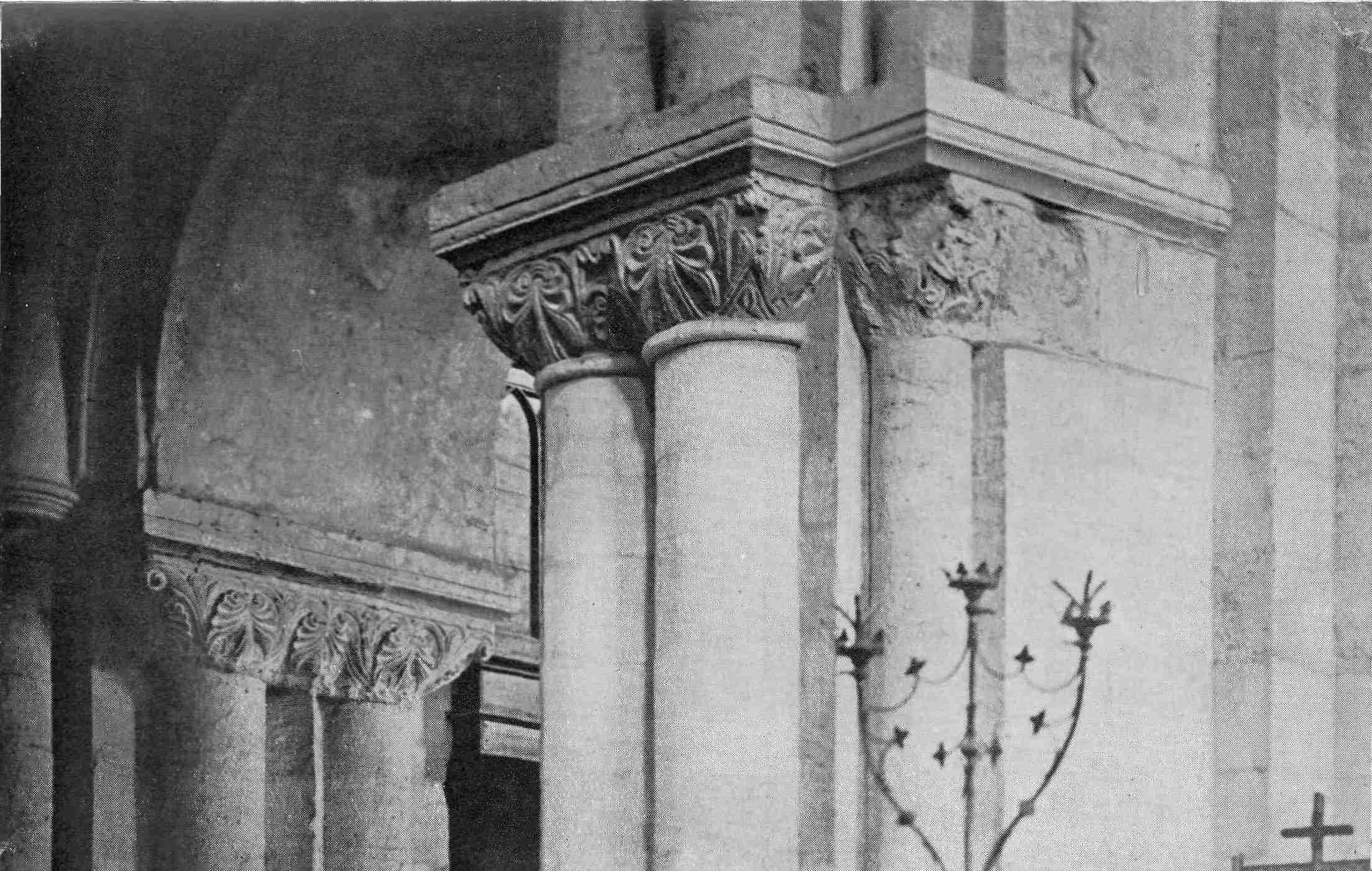
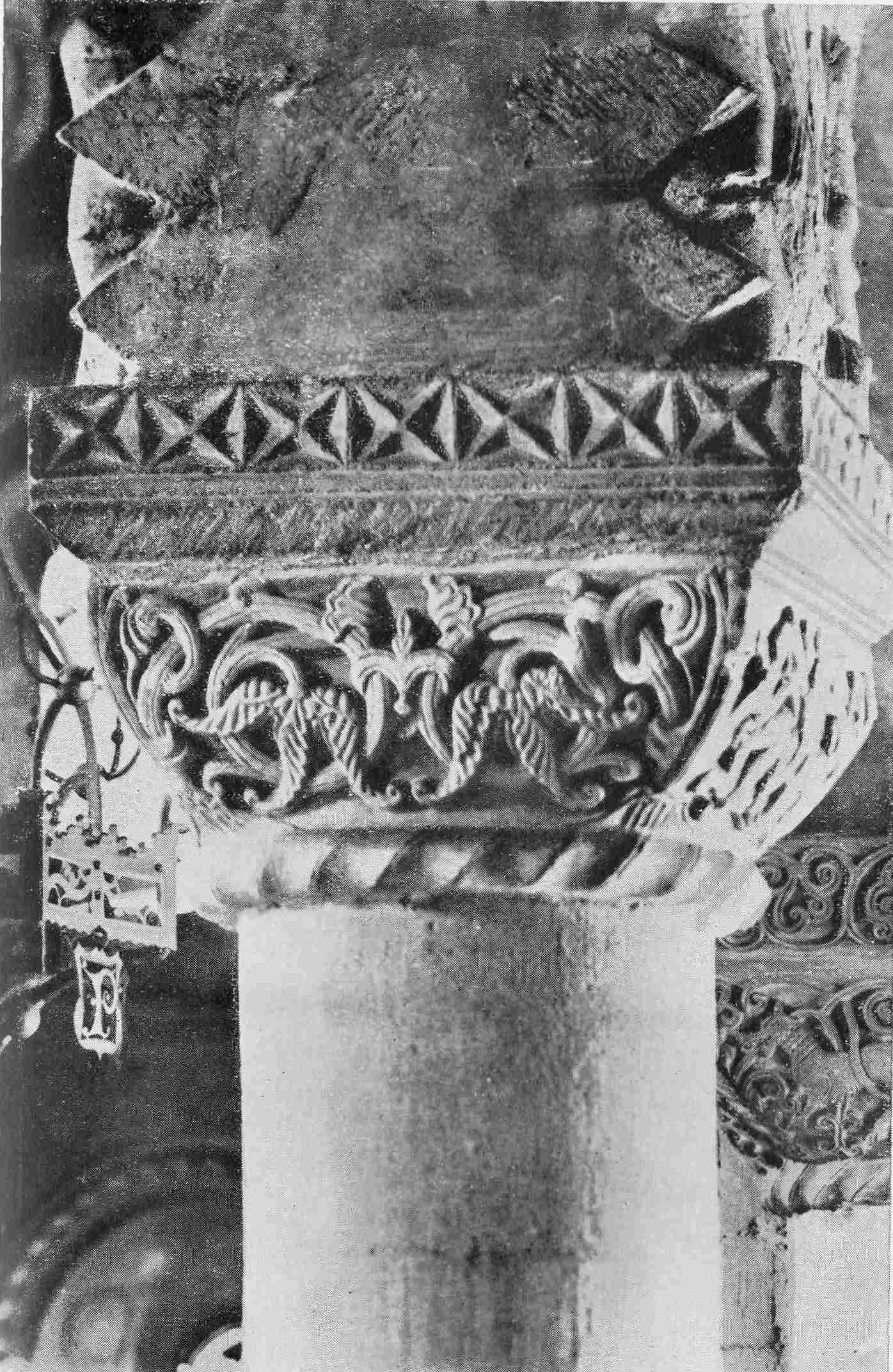
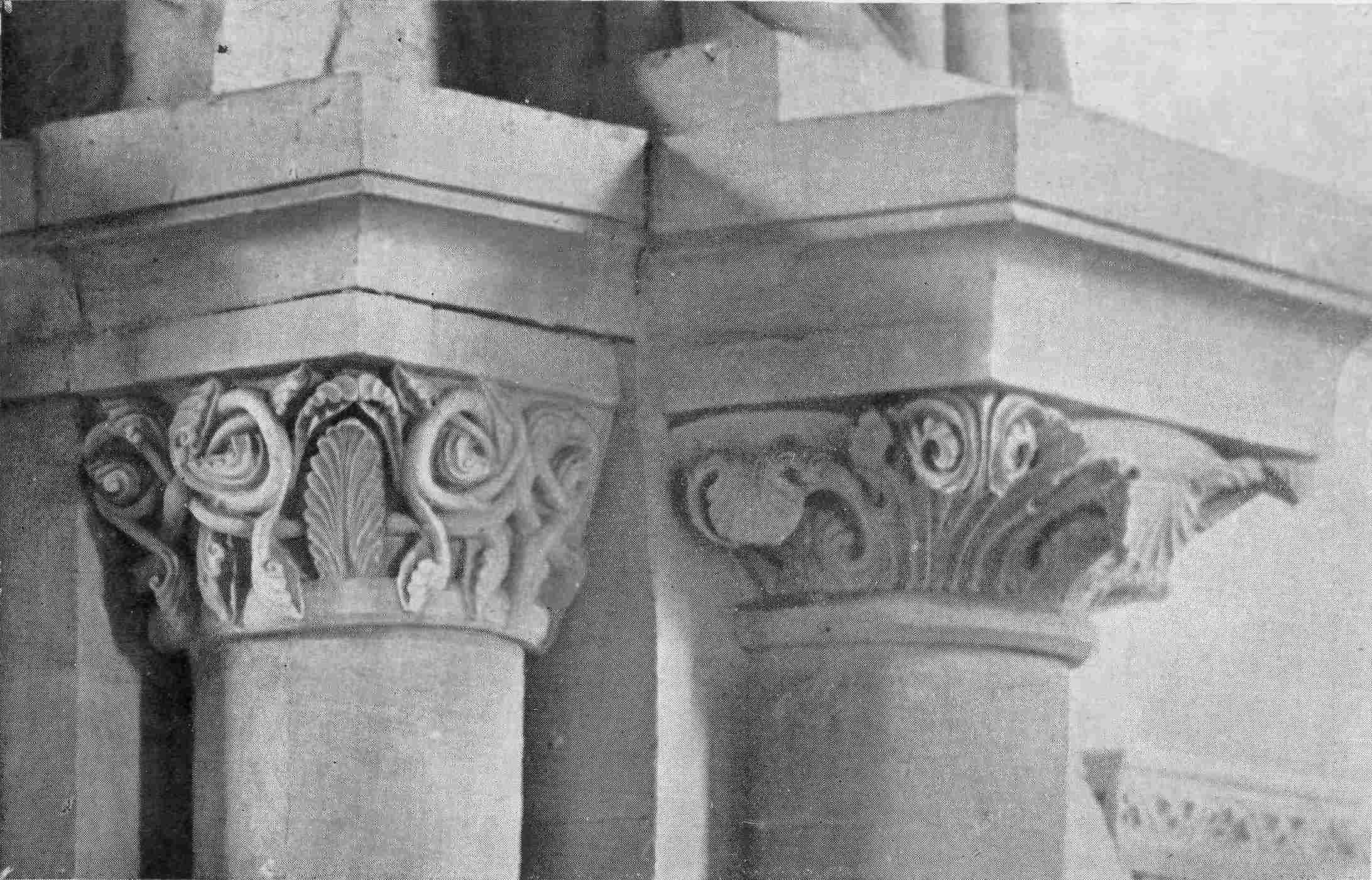
The chancel arch respond at Hemel Hempstead
has strands coming out of the mouth of
a human face, with similar profile leaves,
beaded (Pl. 6). At Hereford Cathedral there
are interlaced spiral strands (beaded) mixed up
with animals and Greek anthemia. At Durham
the capitals of a doorway in the south aisle
show winged monsters with long necks
(beaded) intertwined with foliage, while on
the abacus is a row of anthemia. The carving
on the capitals is suggestive of Norse wood-carving.
The same character belongs to some
capitals from the ruins of Reading Abbey. A
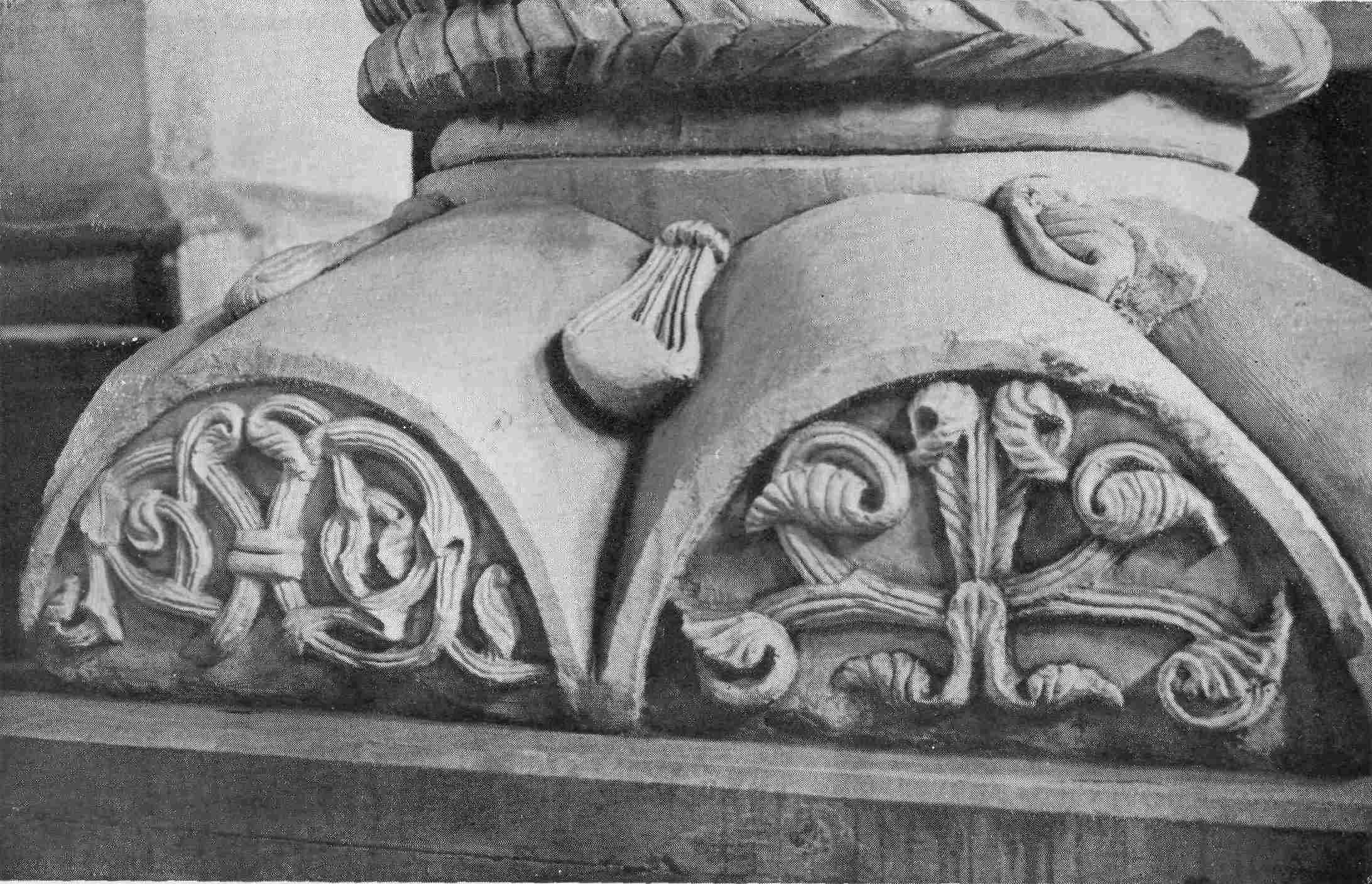
cushion capital at St Peter’s, Northampton,
shows somewhat similar characteristics, but
some of the sprays end in triplets of profile
leaves (Pl. 7). Other capitals in the same
church show animals mixed with the sprays
which are sometimes bound together by what
look like iron bands. Similar features appear
on the base of the font at Aylesbury (Pl. 8).
We might multiply instances of this class of
foliage to almost any extent, but it does not
lead us on to any further development. It
consists merely of variations of the old tradition
derived from Lombardic sources and
exhibits no sign of vitality. We will therefore
content ourselves with showing one more
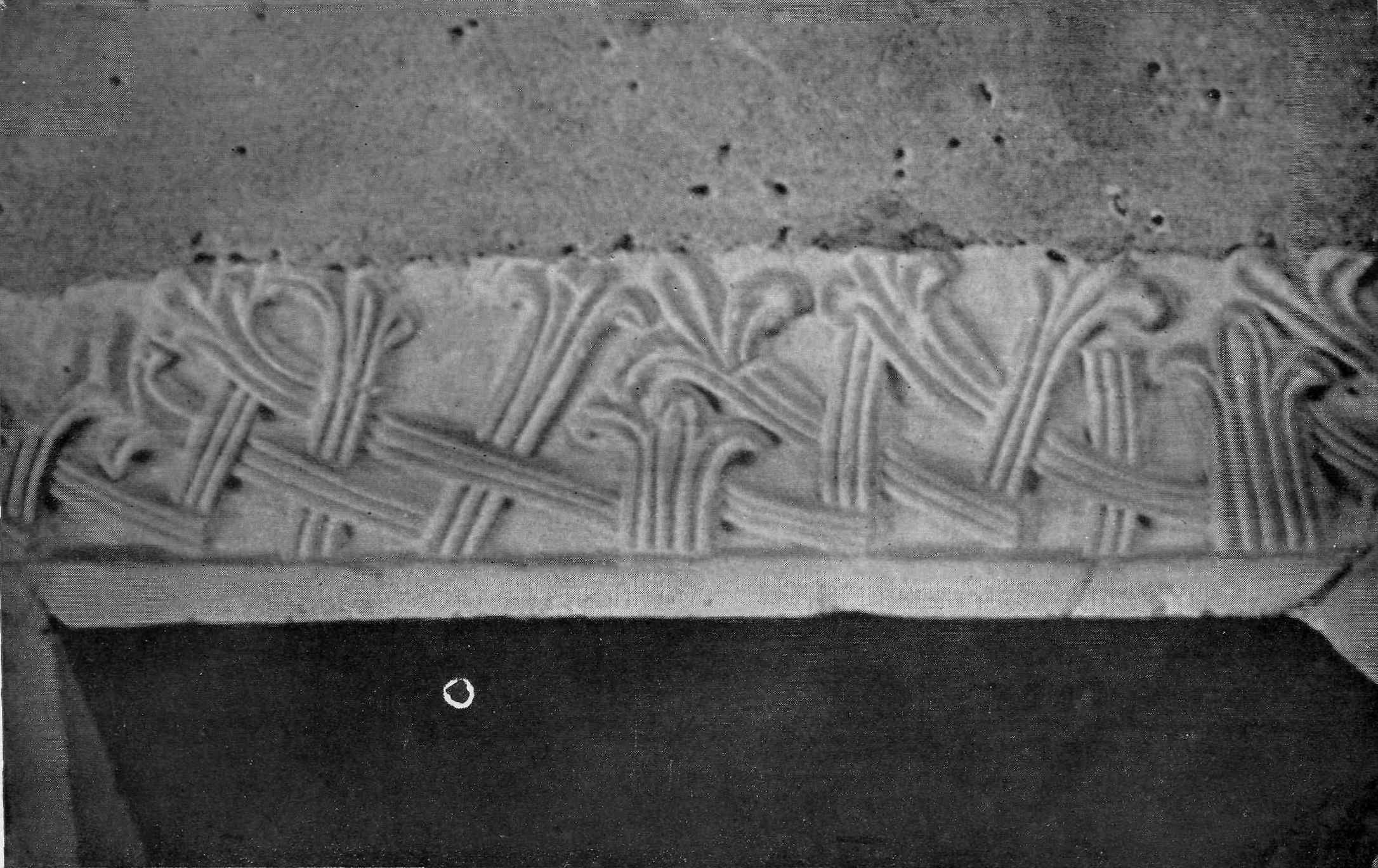
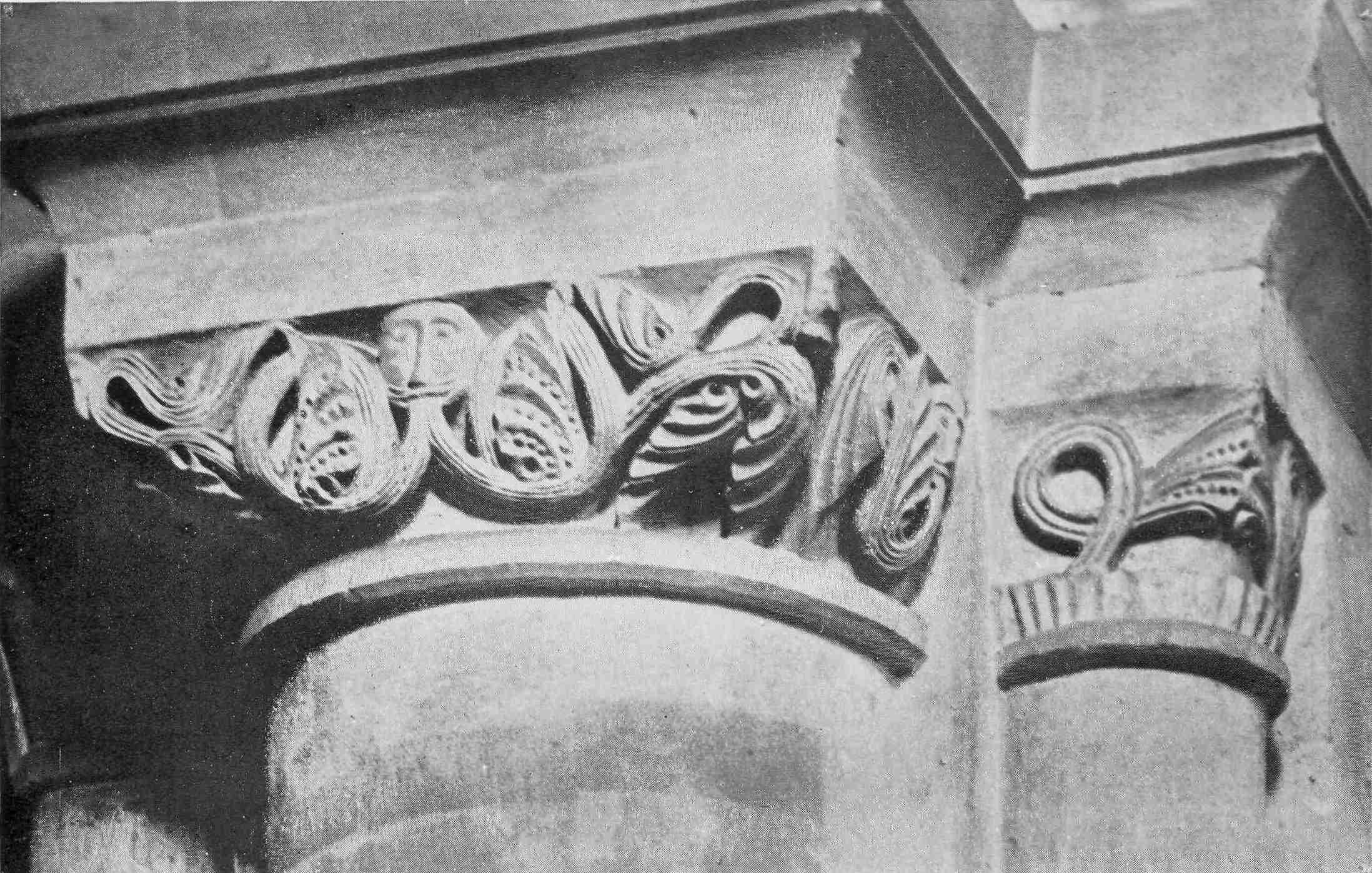
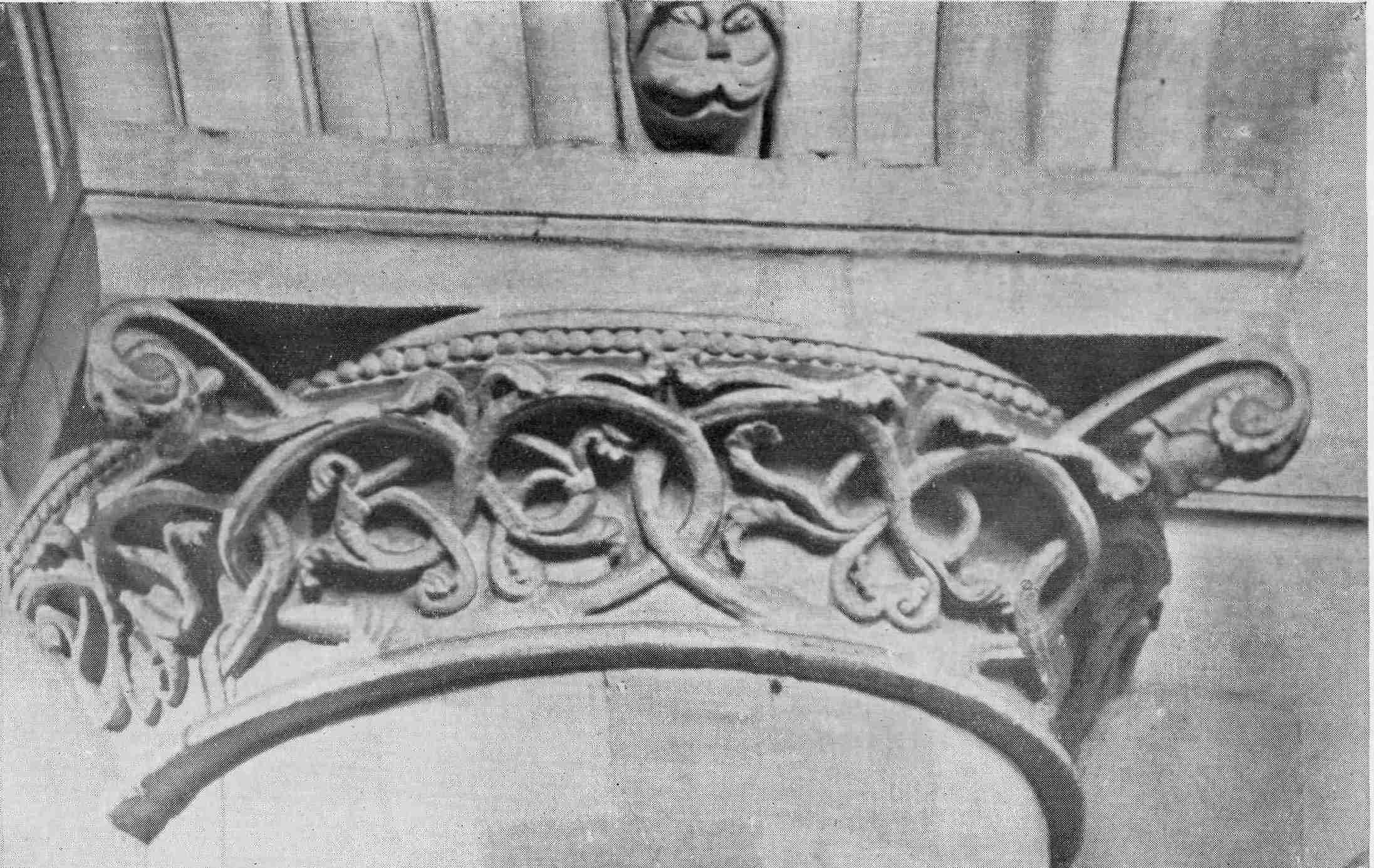
rather remarkable specimen from Oxford
Cathedral. It puzzled antiquaries for a time,
as it was thought to be pre-Conquest in date,
and yet it appears on the capital of a rather late
Norman column, thus illustrating the continuance
or revival of traditions in spite of the
Conquest (Pl. 9).
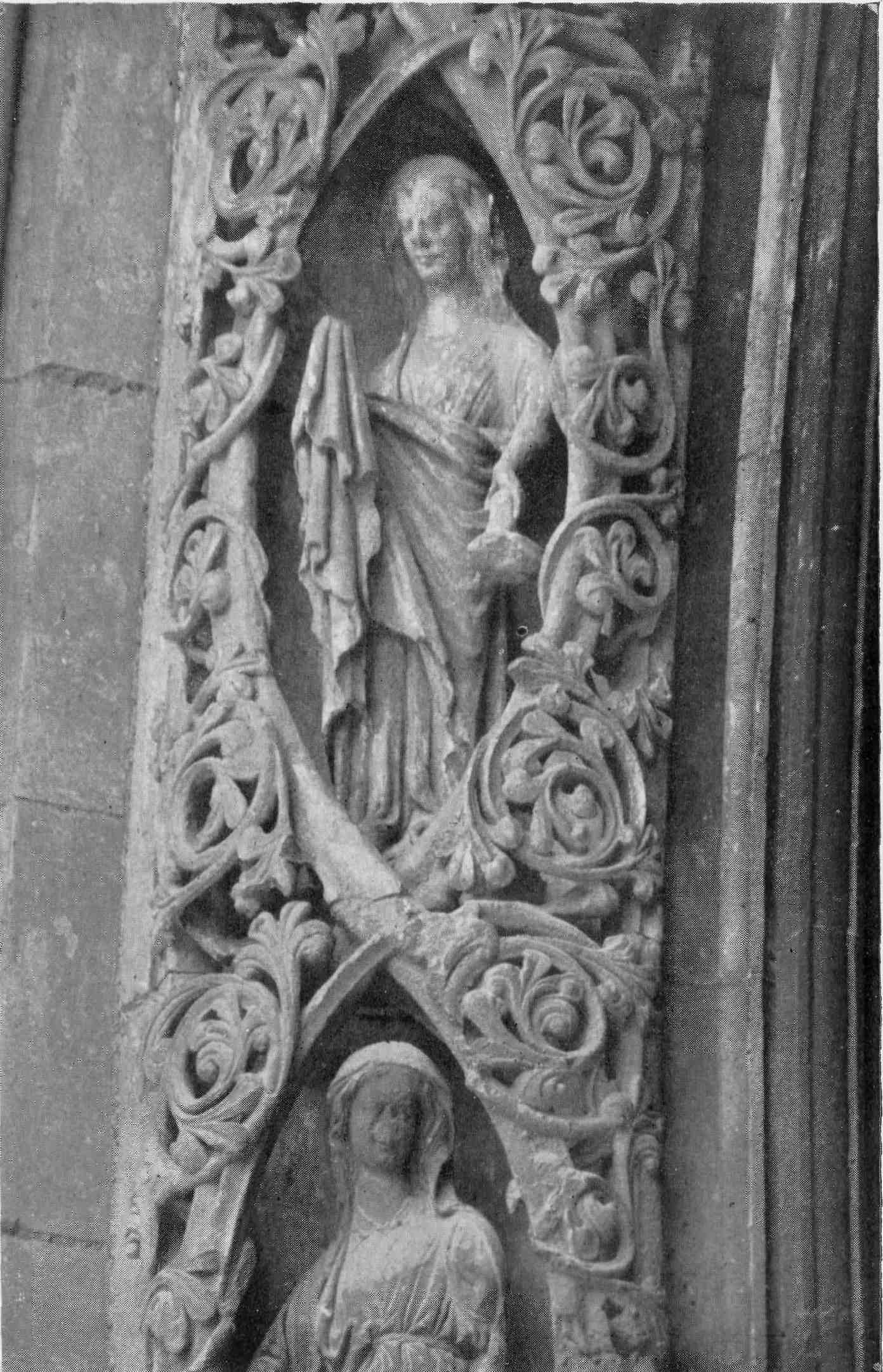
The ornament on a doorway at Malmesbury
consists of profile half-opened leaves just like
those on the Christchurch capitals, but, arranged
as they are here, back to back, they
look more like halves of a Greek anthemion
or palmette.
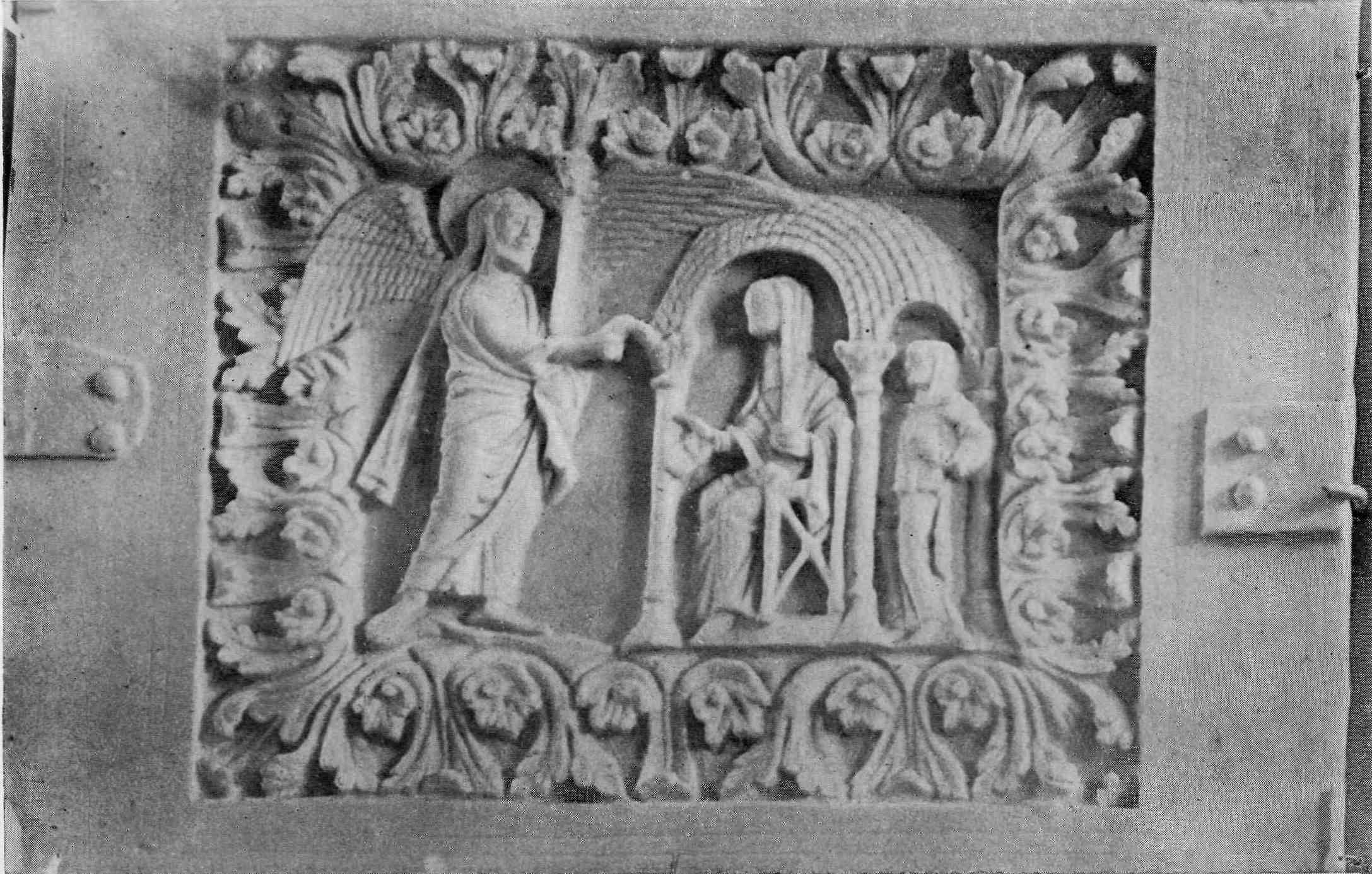
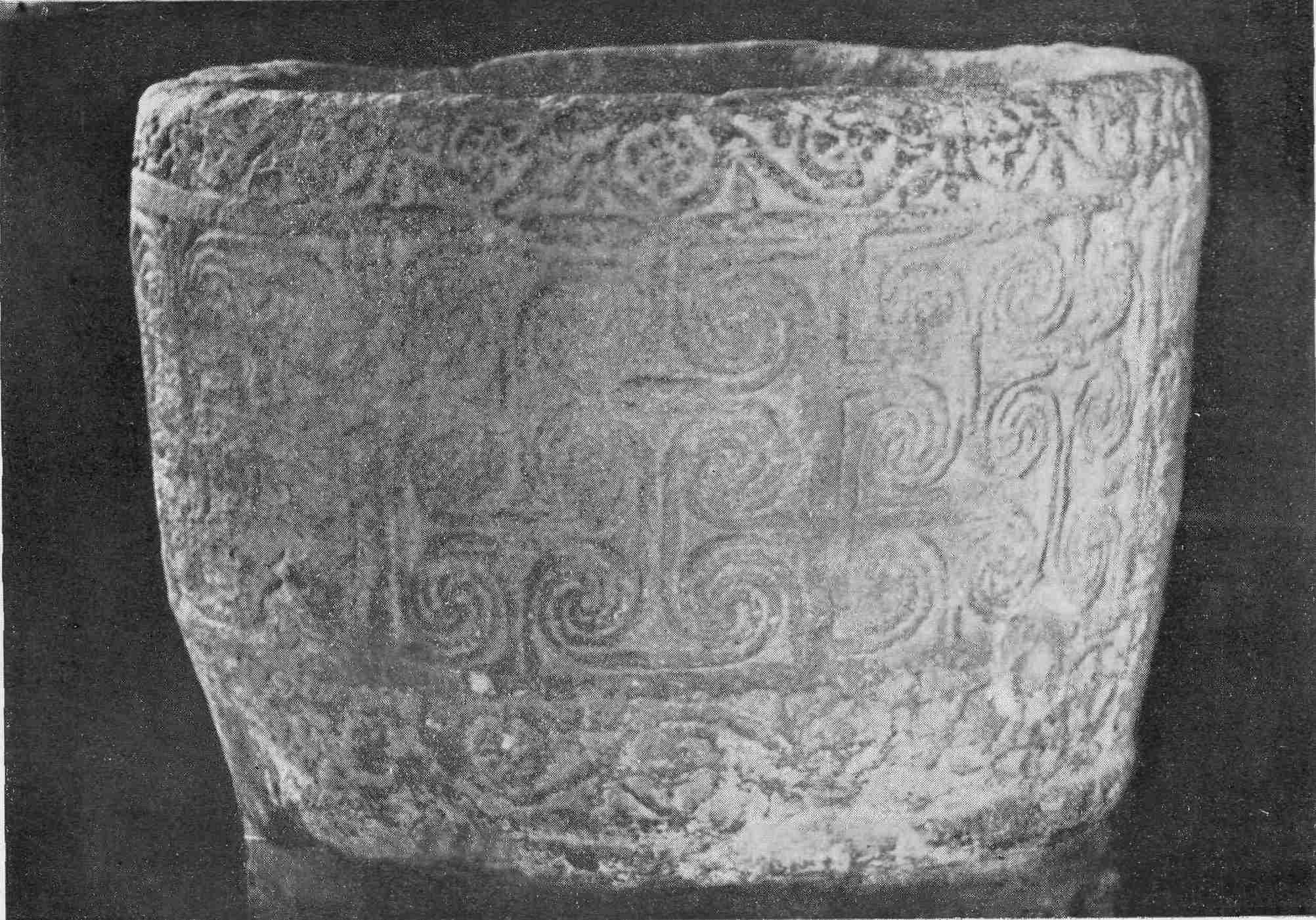
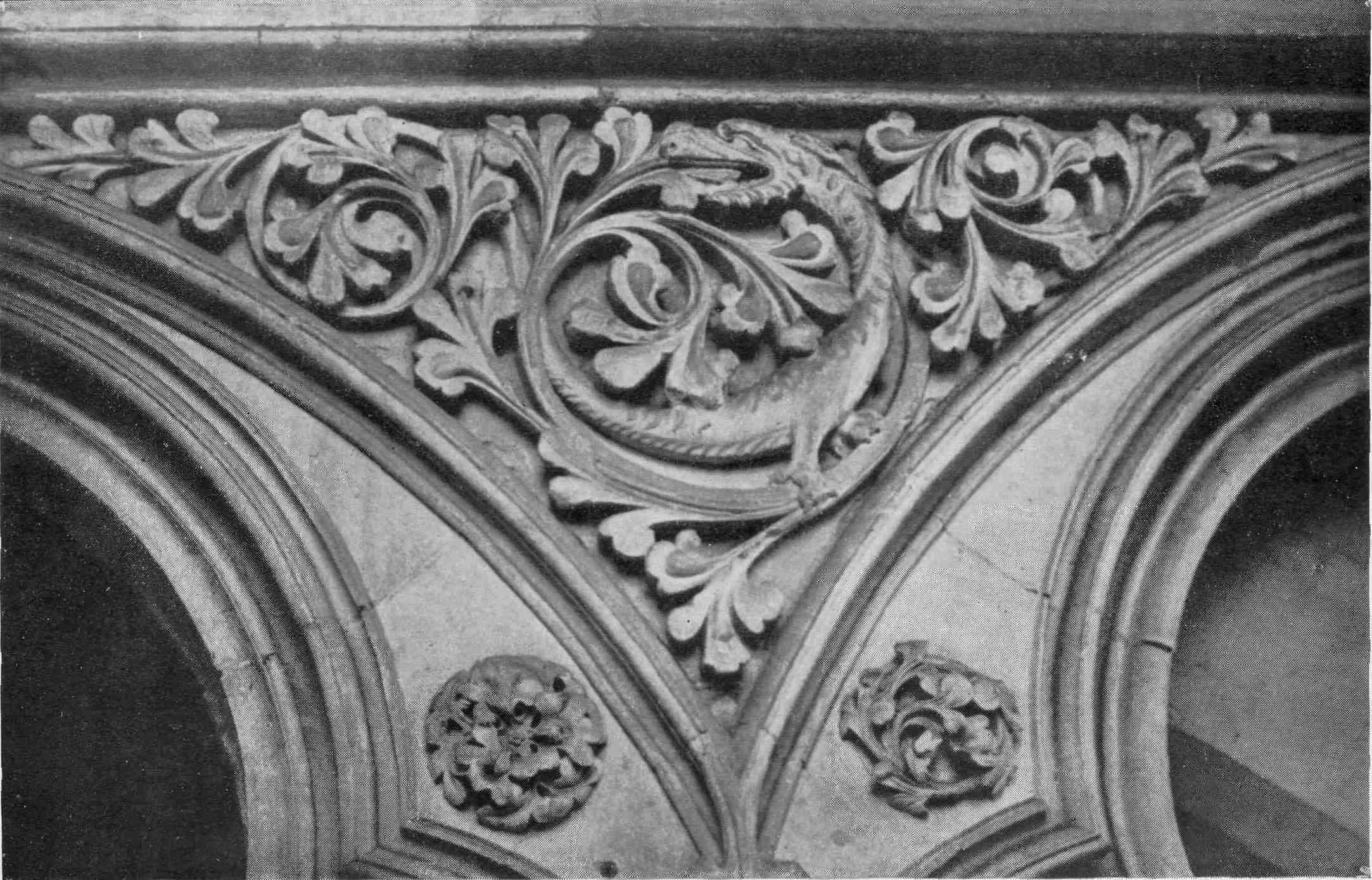
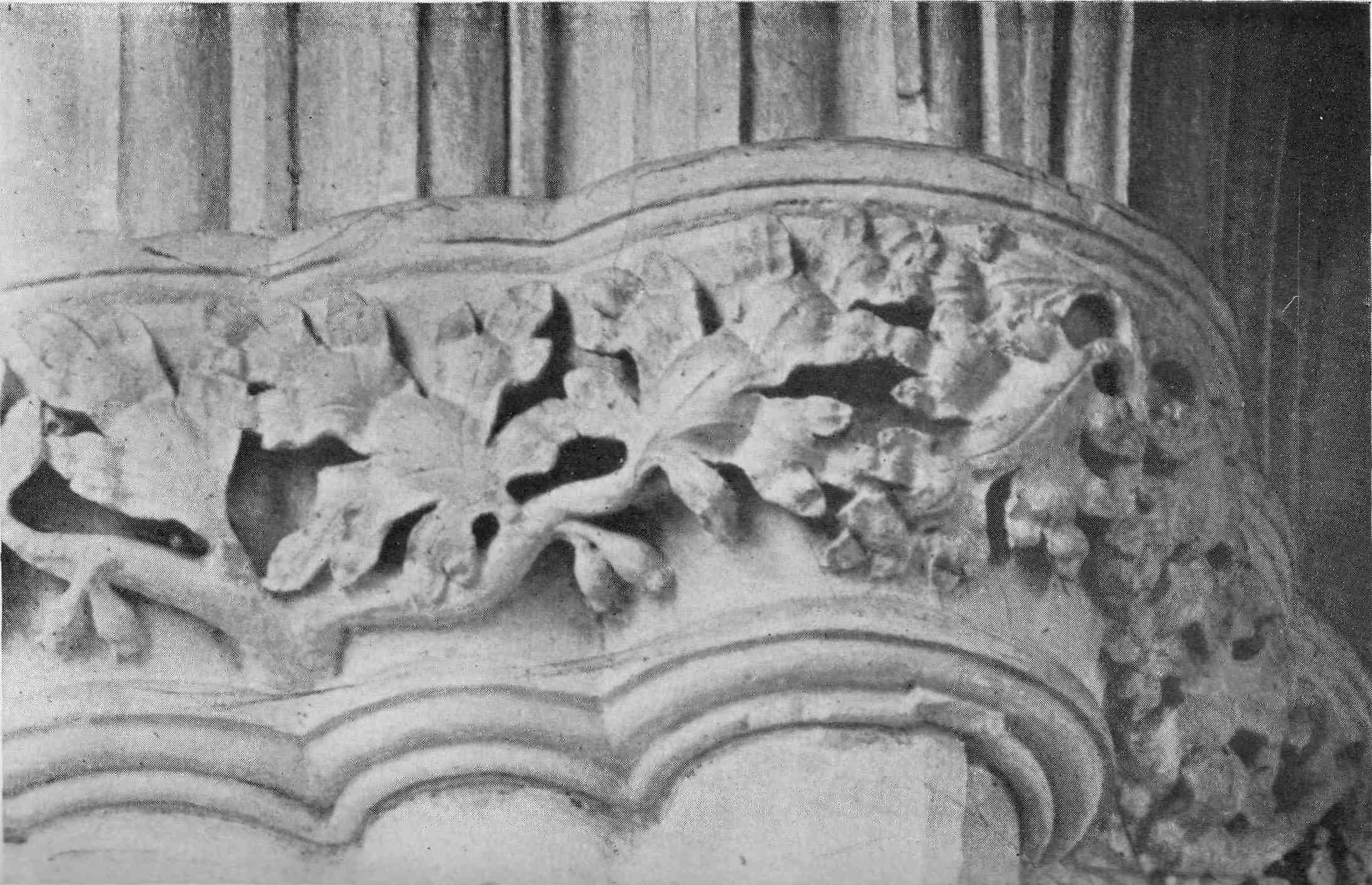
Fonts sometimes show foliage sculpture. At
Deerhurst is a font usually considered Anglo-Saxon,
on which the main part of the bowl is
ornamented with spirals without any leafage,
but the borders, above and below, have graceful
sprays with leaves and flowers (Pl. 10).
The type is interesting, especially as a thirteenth-century
capital in the same church is
evidently copied from it (Pl. 11).
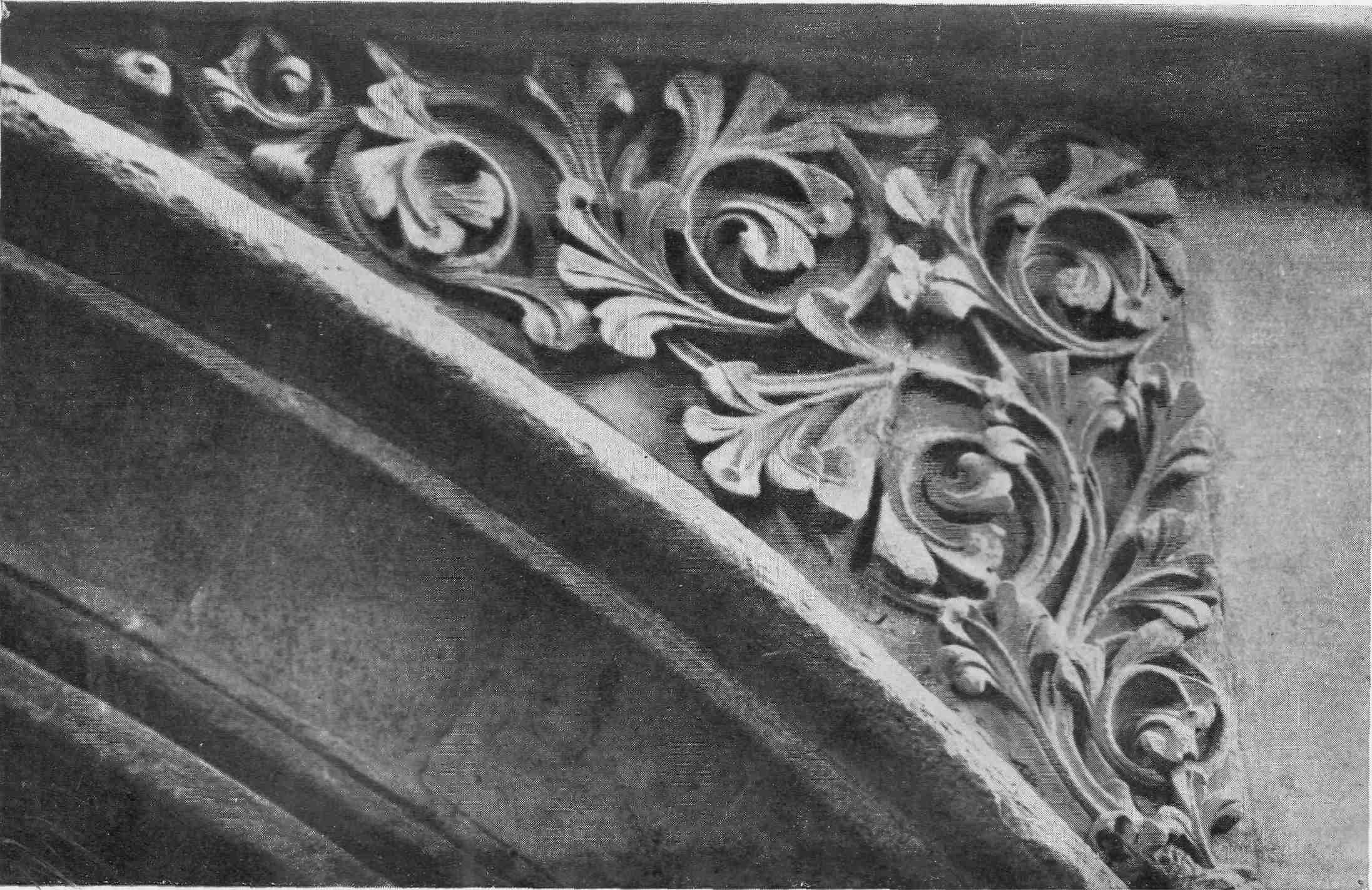
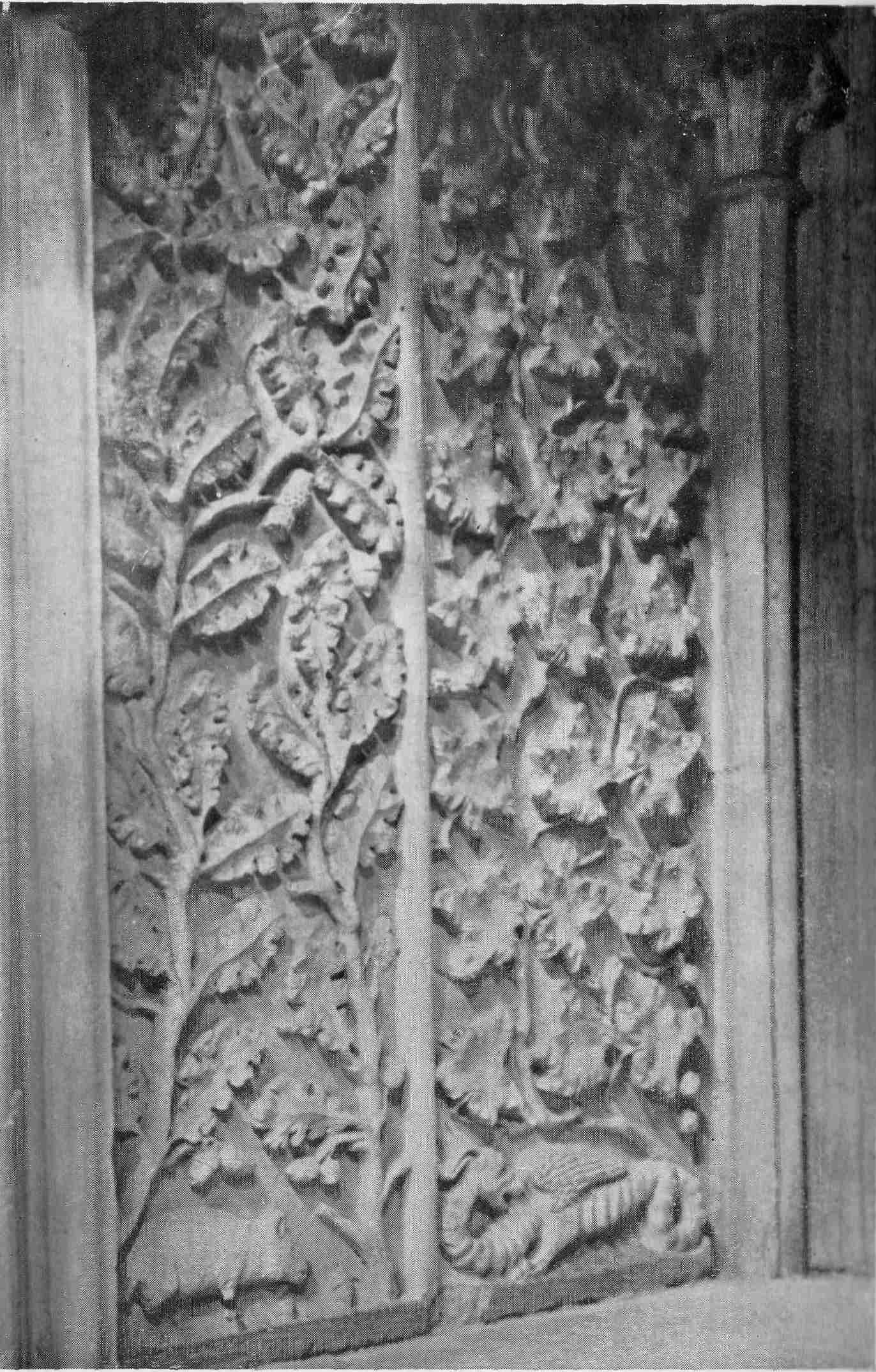
Somewhat similar, but more clumsy, sprays
occur on fonts at St Stephen’s, Launceston,
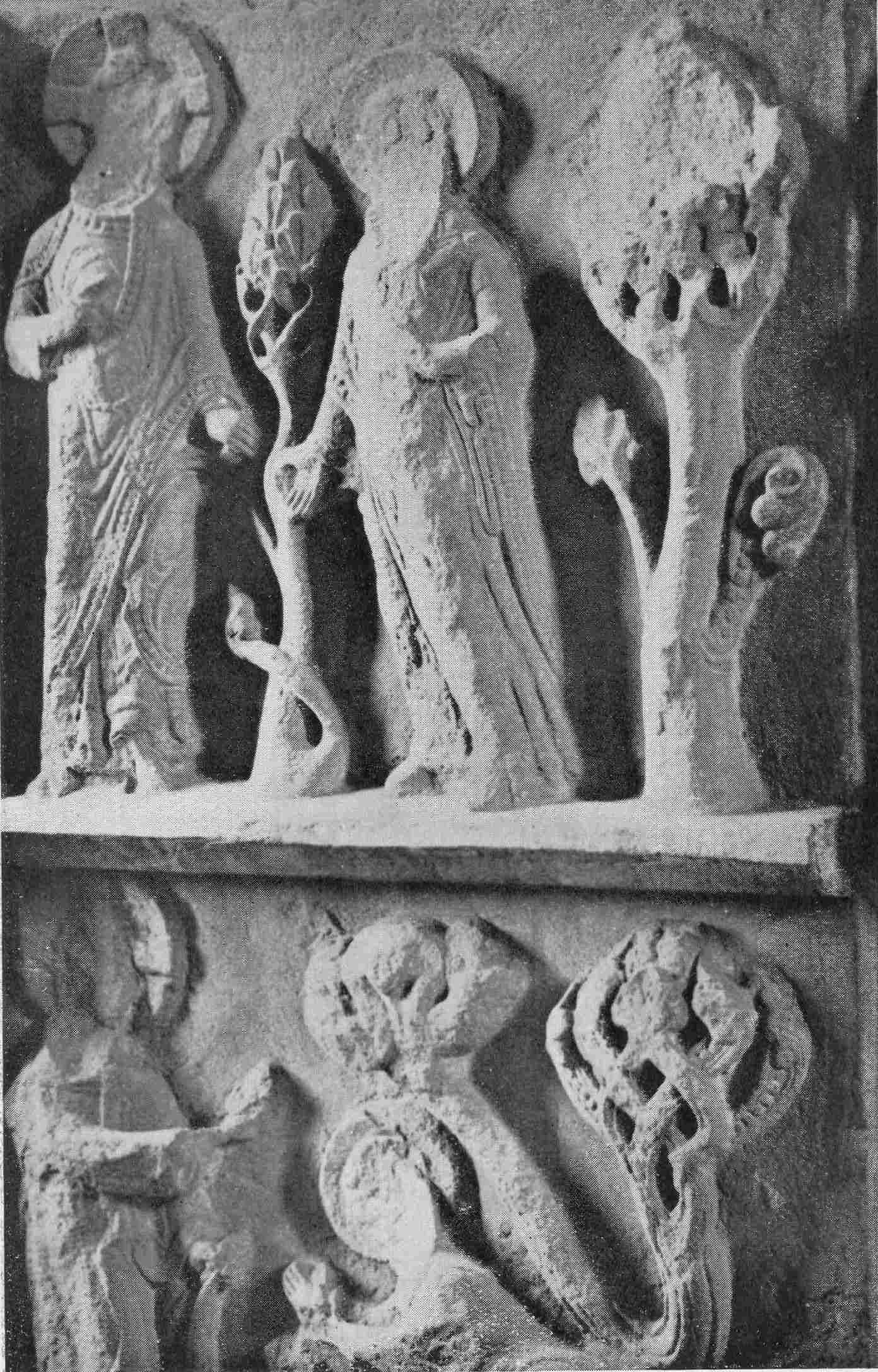
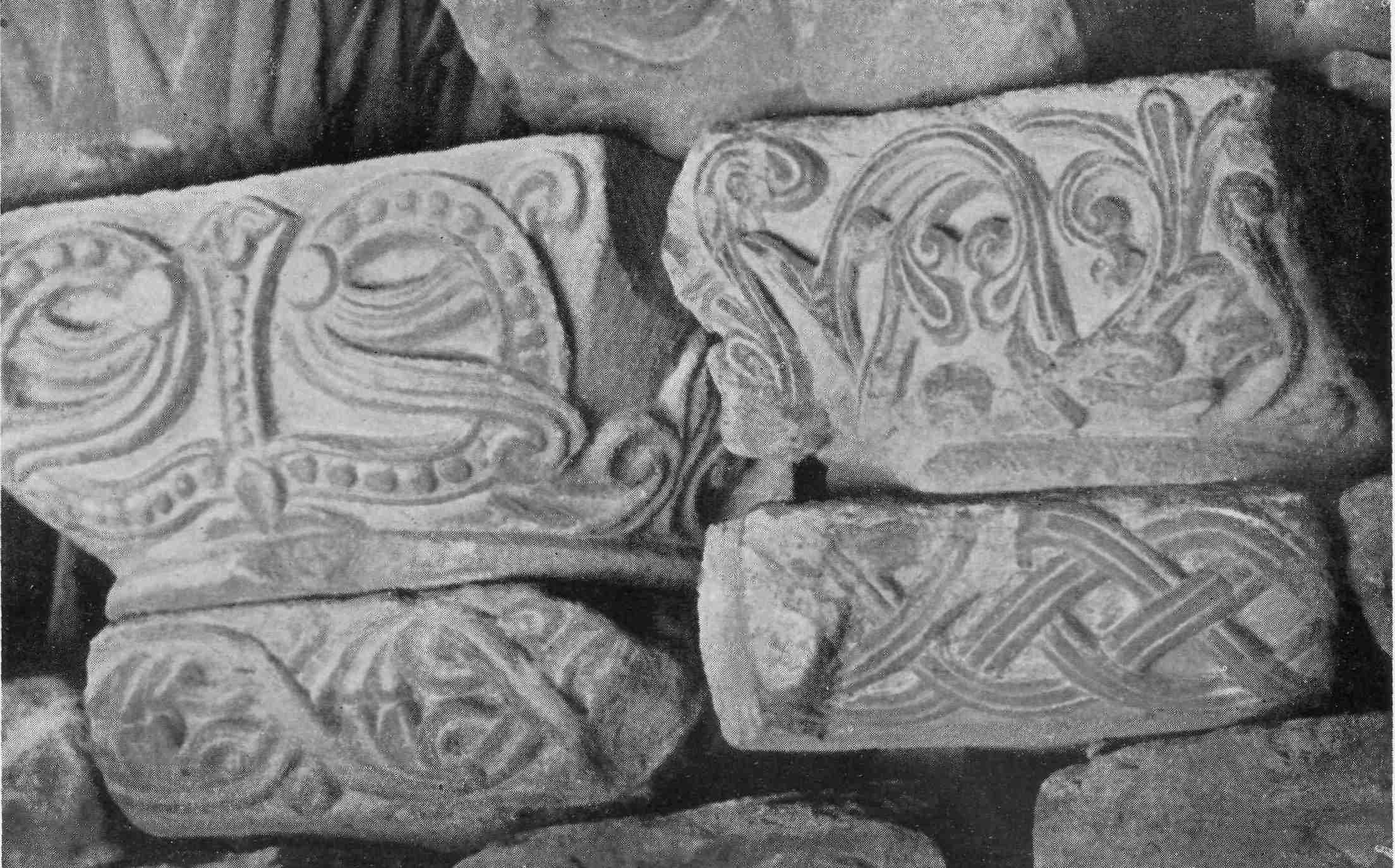
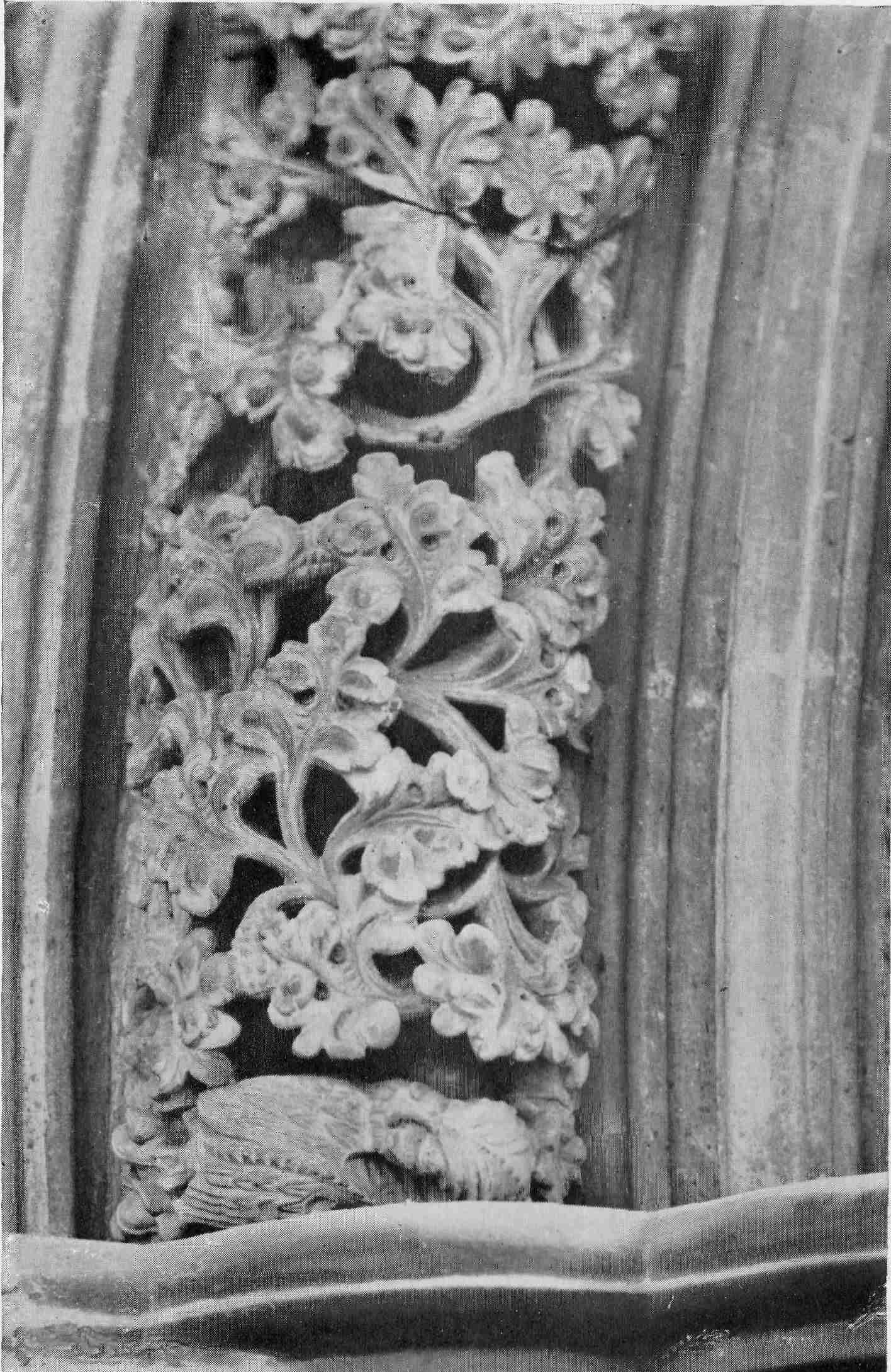
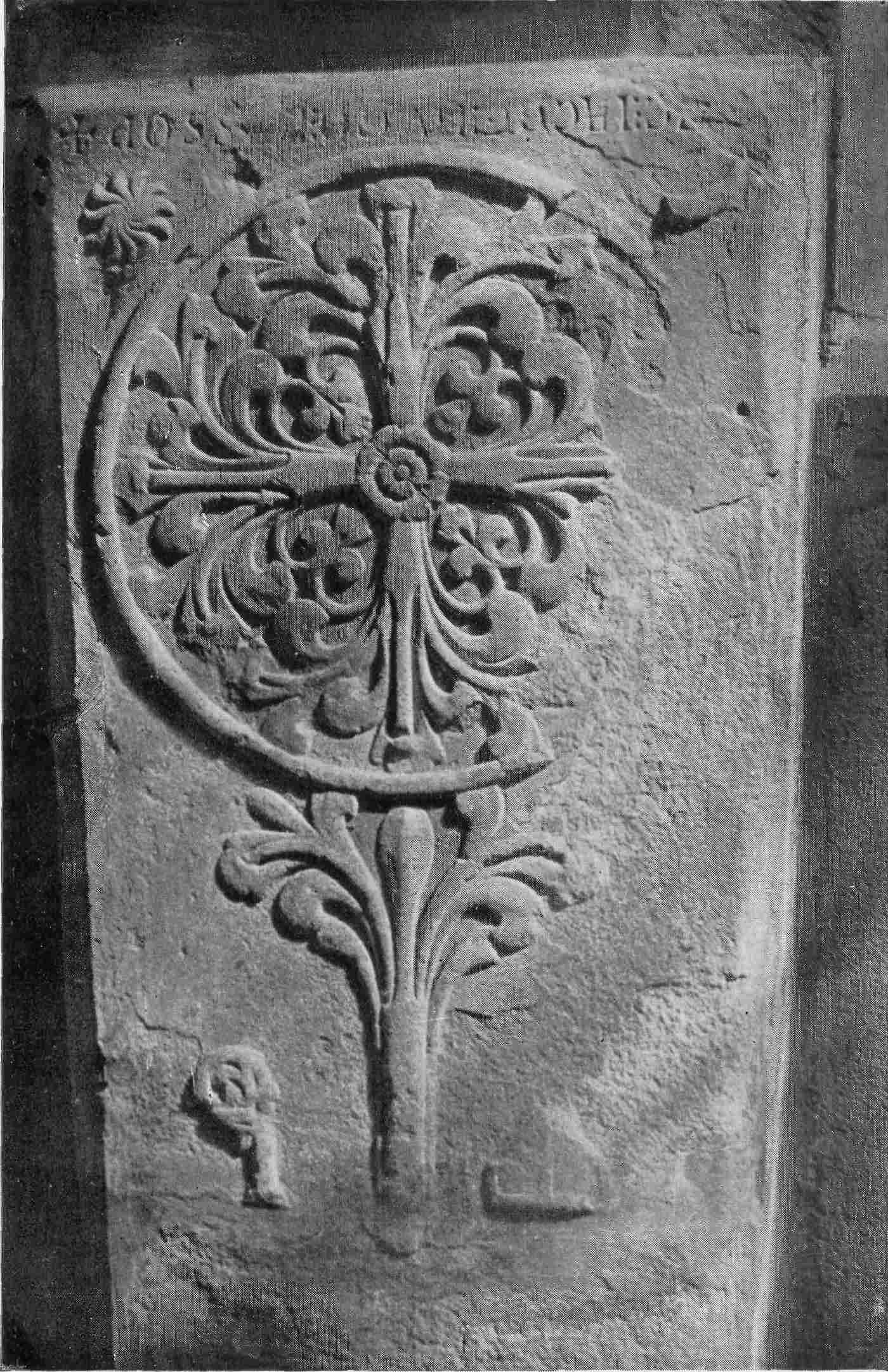
and Sidlington. In the Library of Durham
Cathedral there are some fragments containing
conventional representations of trees,
which are a mixture of beaded straps and
leaves, some attempts at naturalism, others
conventional palmettes or “acanthus” leaves
(Pl. 12).
A variety that stands by itself is seen at
King’s Walden. It is sometimes called water-leaf
(Pl. 13). It also occurs under slightly
different arrangement at Fountains, and at
Oxford Cathedral it is combined with other
experimental sprays.
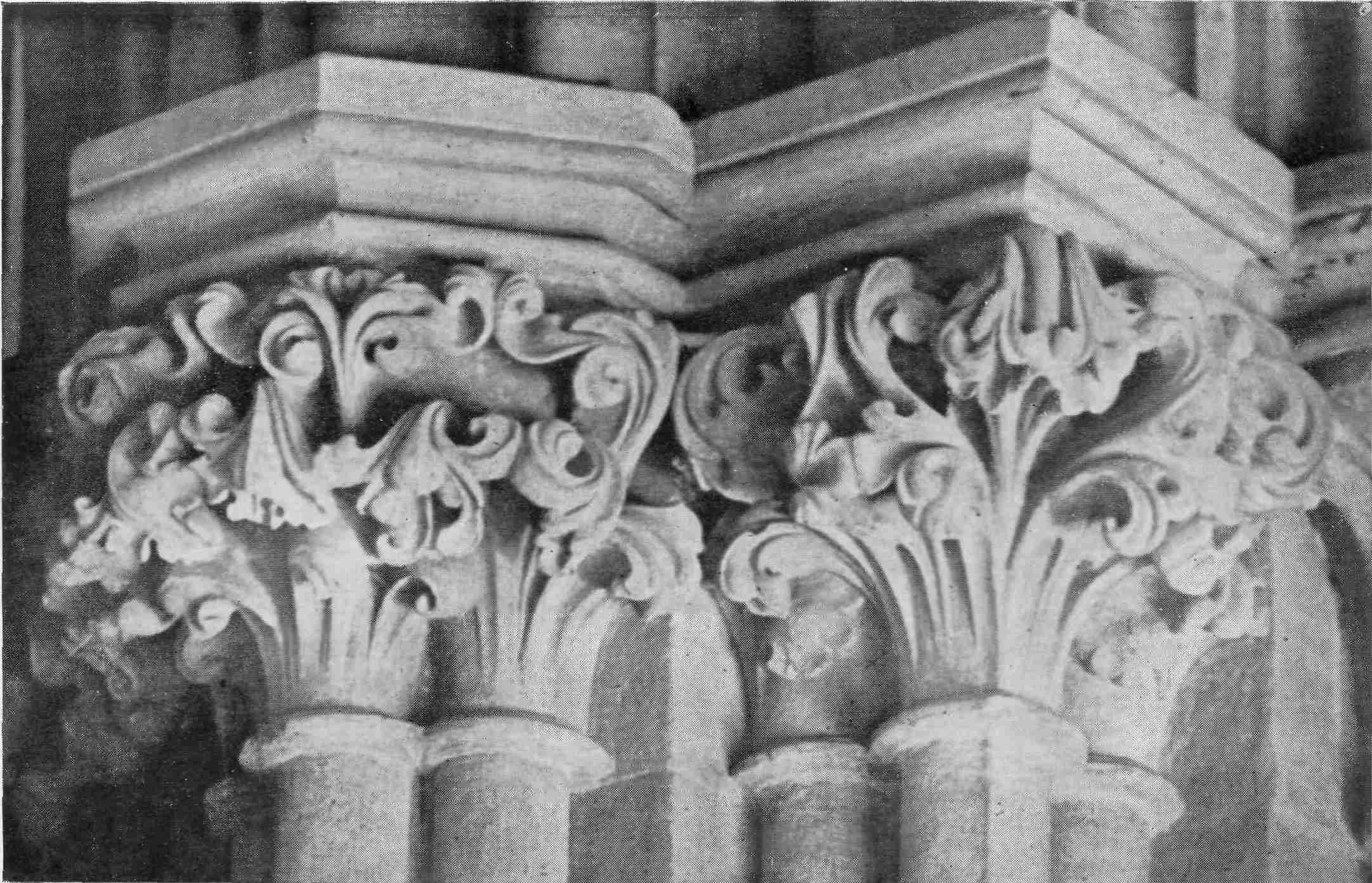
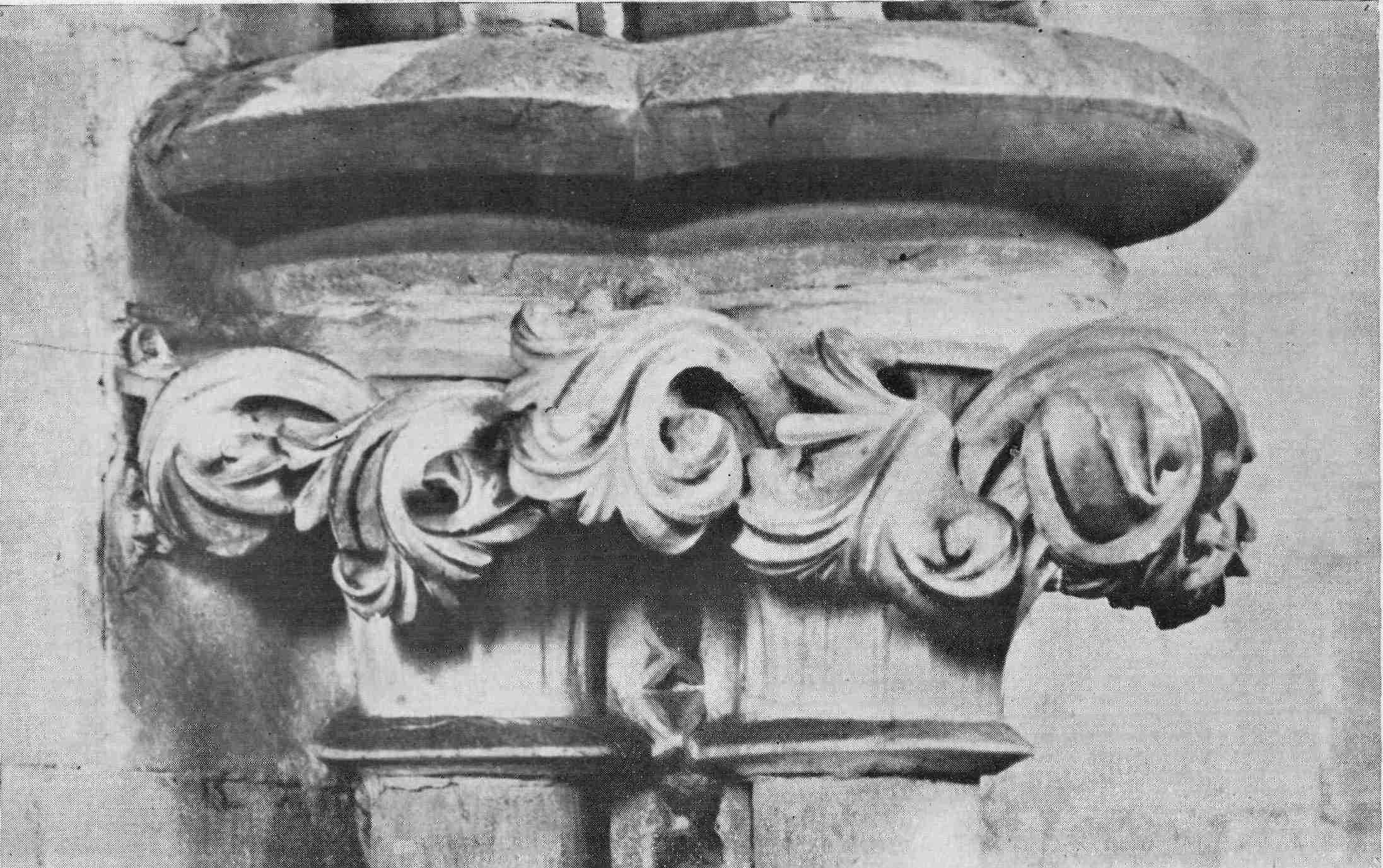
These experiments at Oxford (Pl. 14) mark an
important stage. Hitherto we have come across
nothing in the way of novelty. All the designs
have been copies—mostly debased copies—of
Classical conventional forms. The masons at
Oxford were tired of this and attempted something
different. Their attempts were not altogether
successful and did not lead to any
further development; the only feature that
survived or was afterwards revived was the
rising of stalks from the necking.
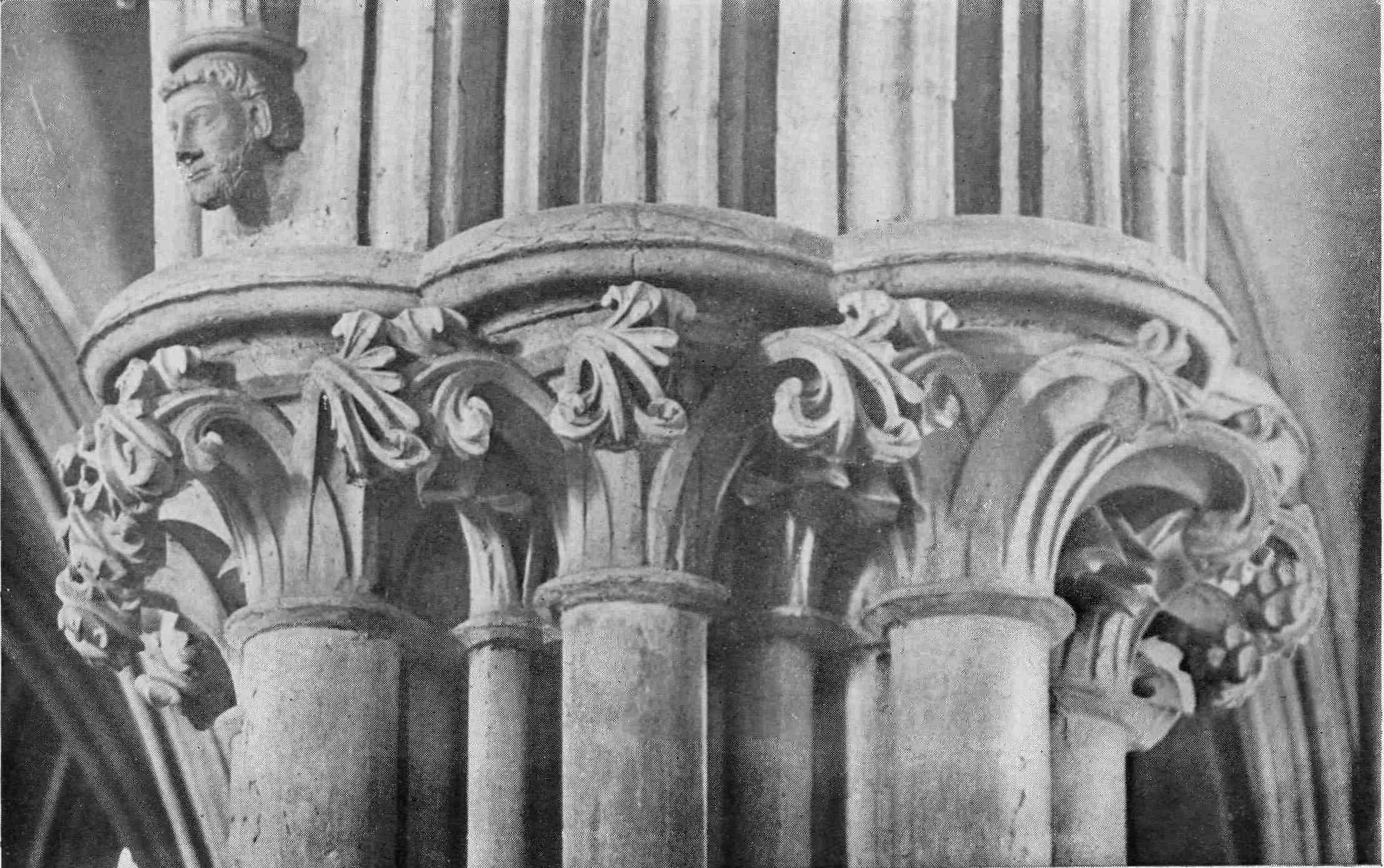
During the same period the re-building of
Canterbury choir took place after the disastrous
fire of 1174. The monks of Canterbury
belonged to the Traditional rather than the
Progressive school, and they entrusted the
work to a French master-mason, William of
Sens, instead of to English masons who were
feeling their way to such work as within a few
years is found fully developed in St Hugh’s
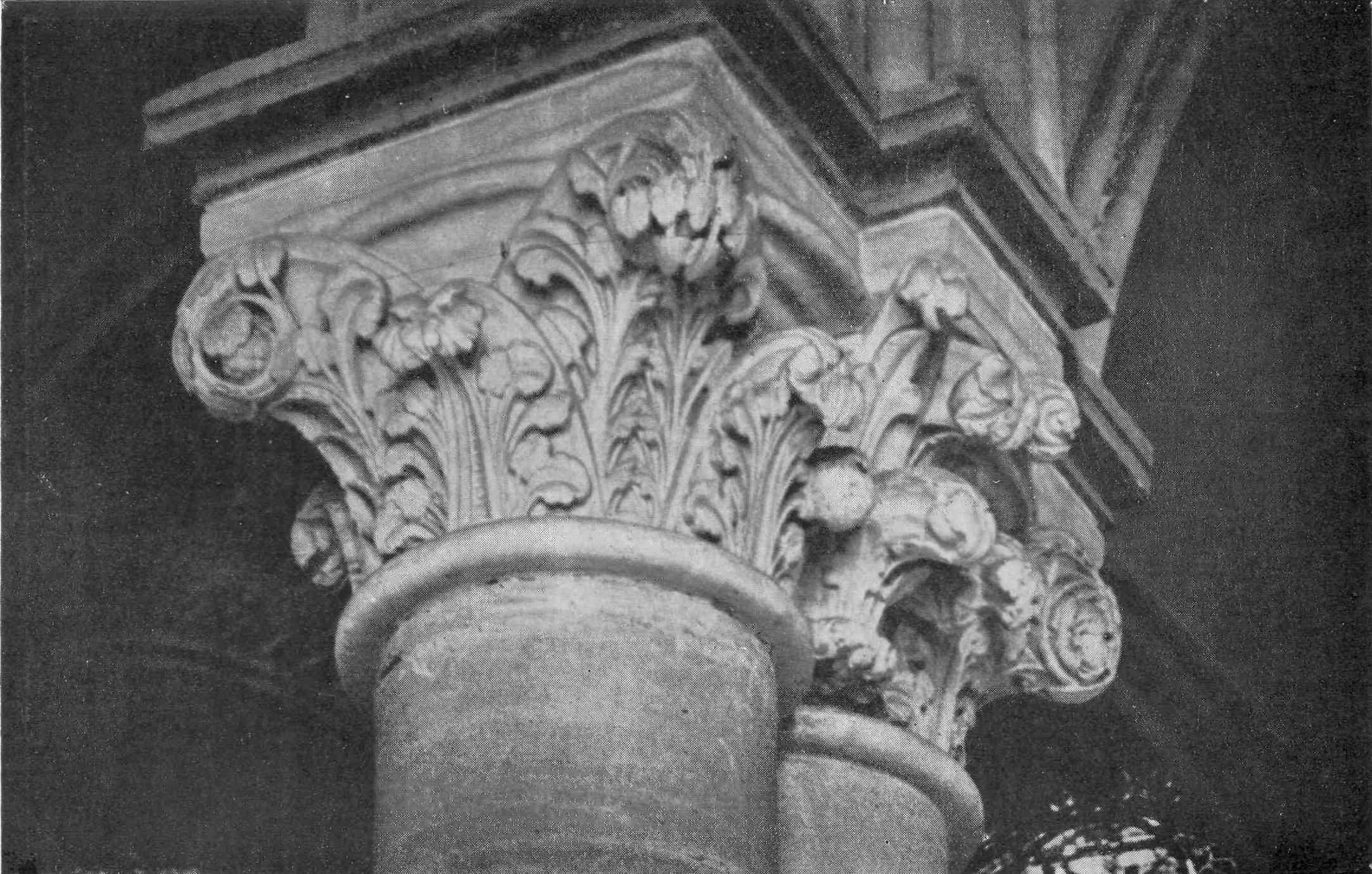
choir at Lincoln. Up to this time the French
masons had adopted the Roman Corinthian
type of capital. This admits of considerable
variety of details, and, after the middle of the
twelfth century, the French introduced not
only Roman conventional foliage, but also
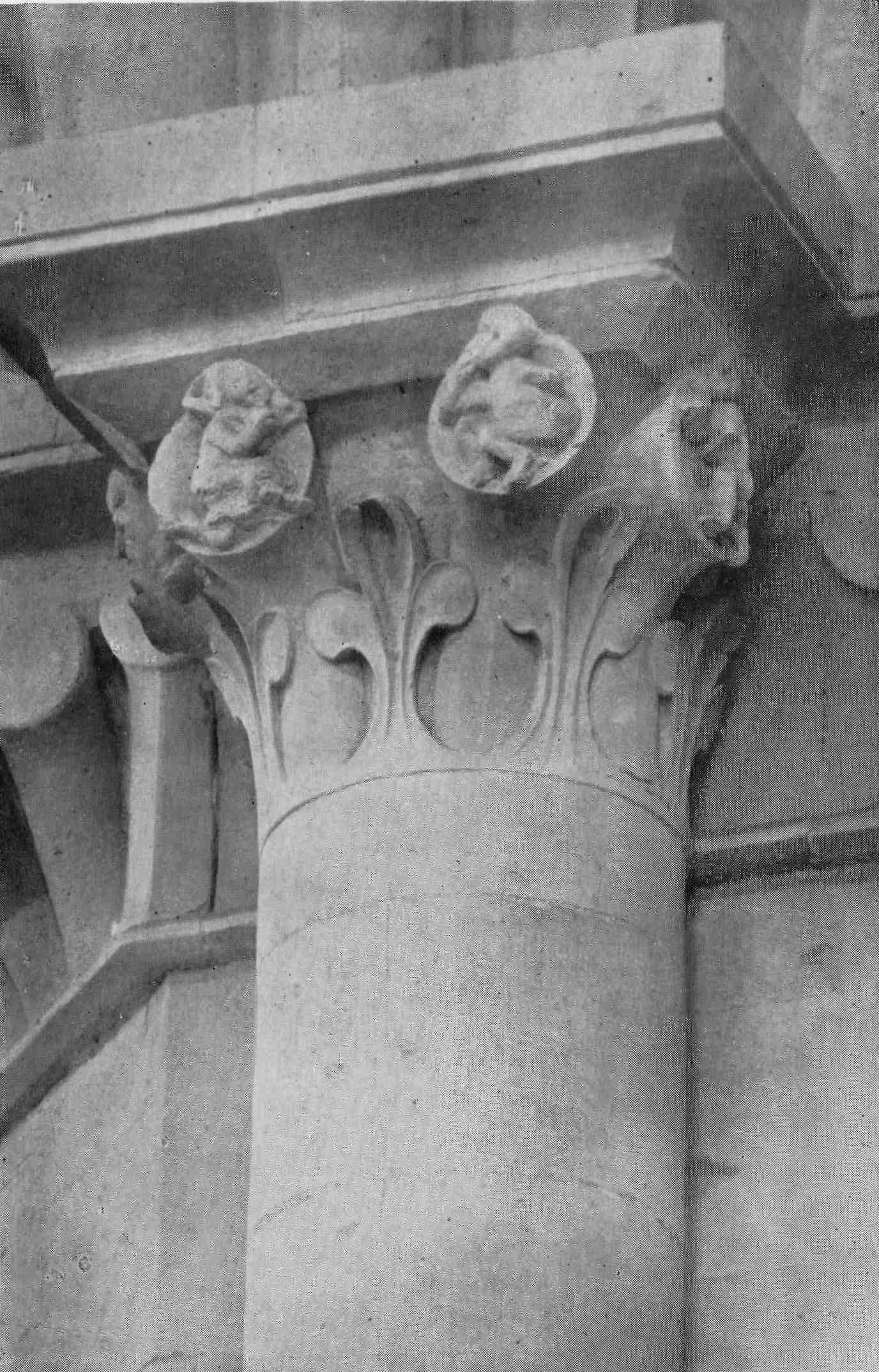
foliage of a more naturalistic kind. The capitals
in the Choir (Pl. 15) and especially in Trinity
Chapel at Canterbury contain much of both
kinds, well executed and highly finished. This
Romanesque work is very beautiful, but it is
not English, and has no place in the continuous
development of English foliage.
The French Corinthian type never made
much progress in England. It requires the
square abacus to be effective, and the square
abacus was almost entirely abandoned here in
favour of the round by the beginning of the
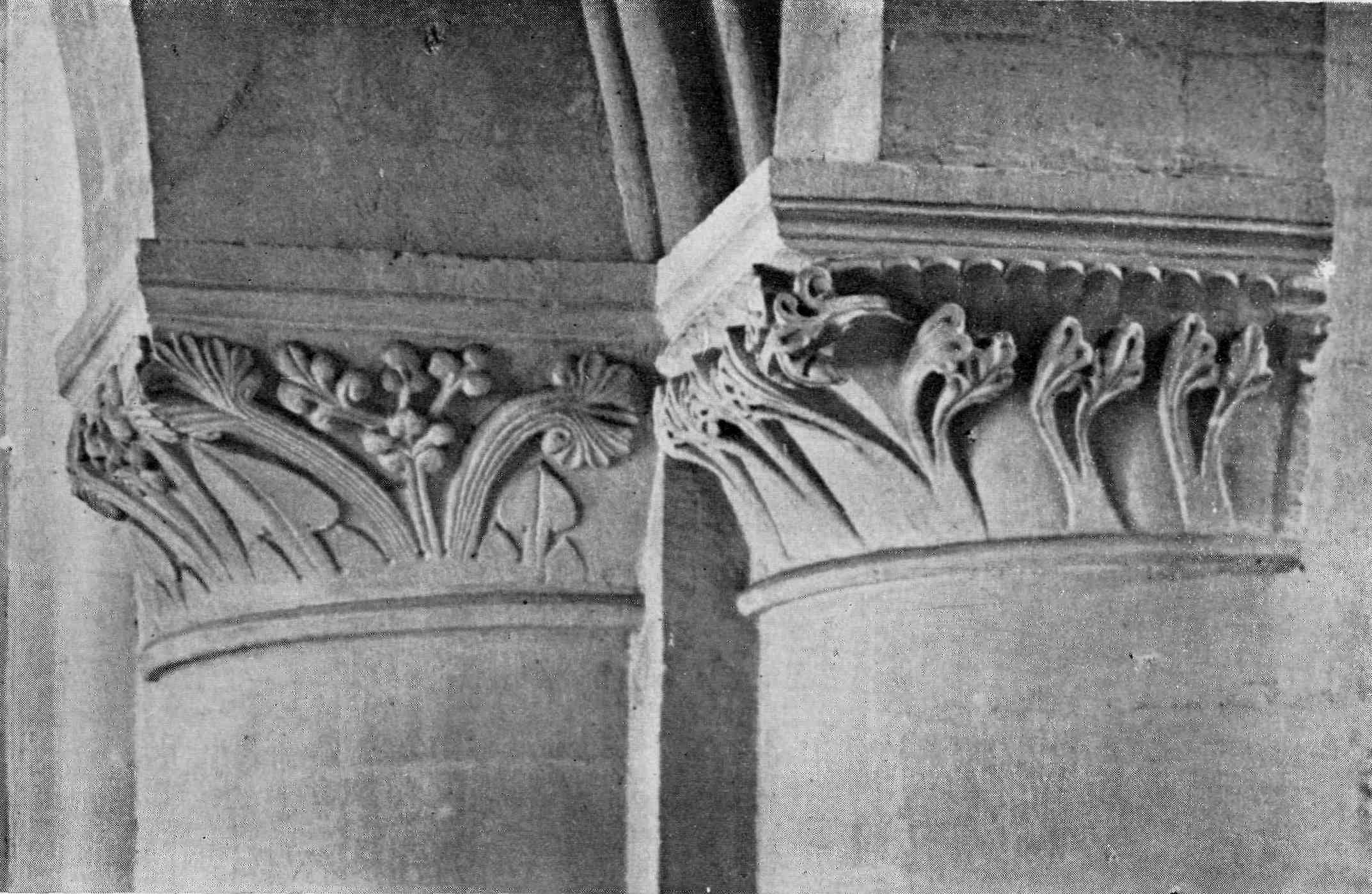
thirteenth century. A rather good example
occurs at Ducklington, Oxon, and an interesting
juxtaposition of the Saxon type and the
French Corinthian is to be seen at Broadwater,
Sussex (Pl. 16). Before passing on to
follow up the development of the stiff-leaf
convention, it may be interesting to note some
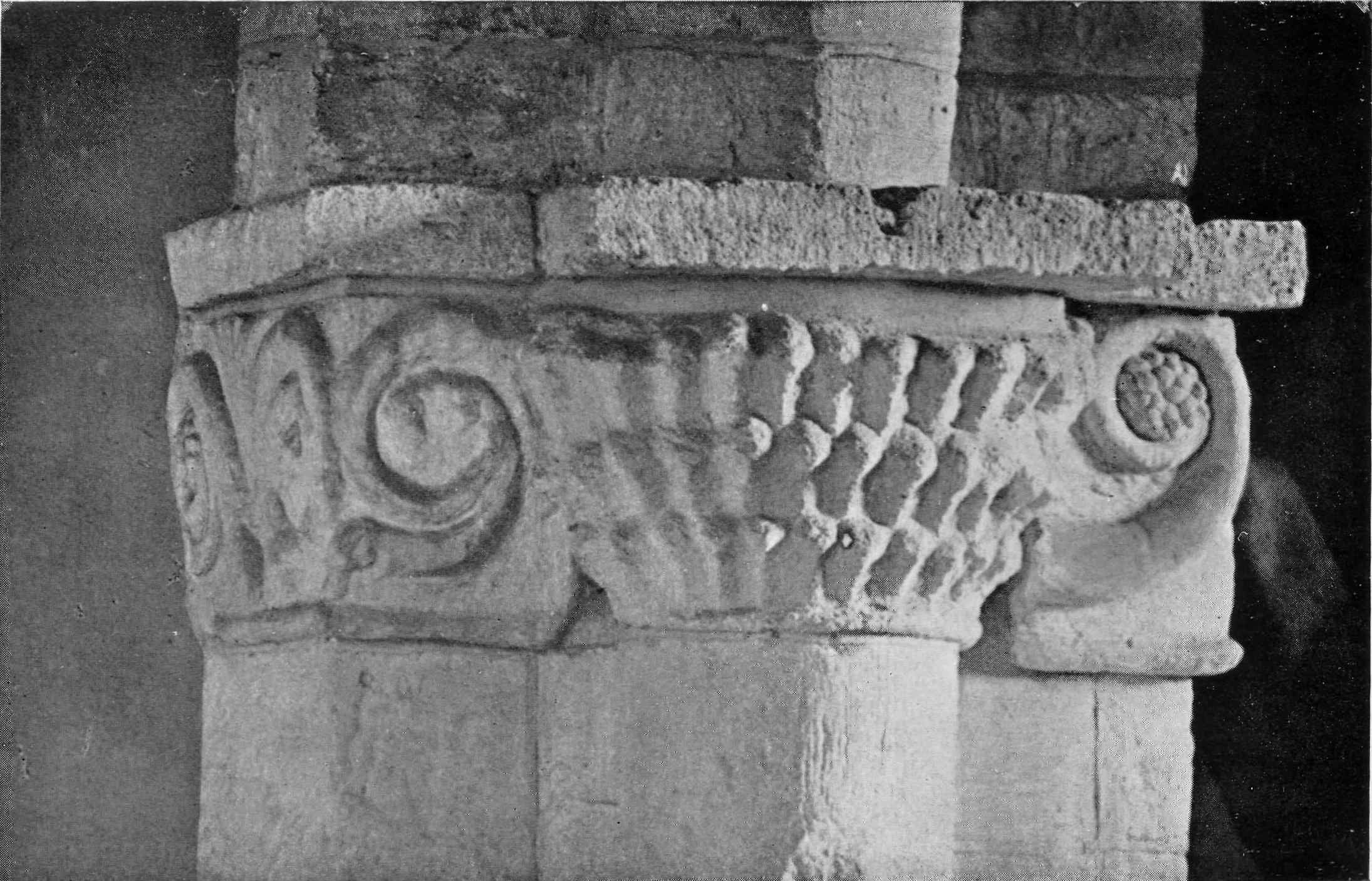
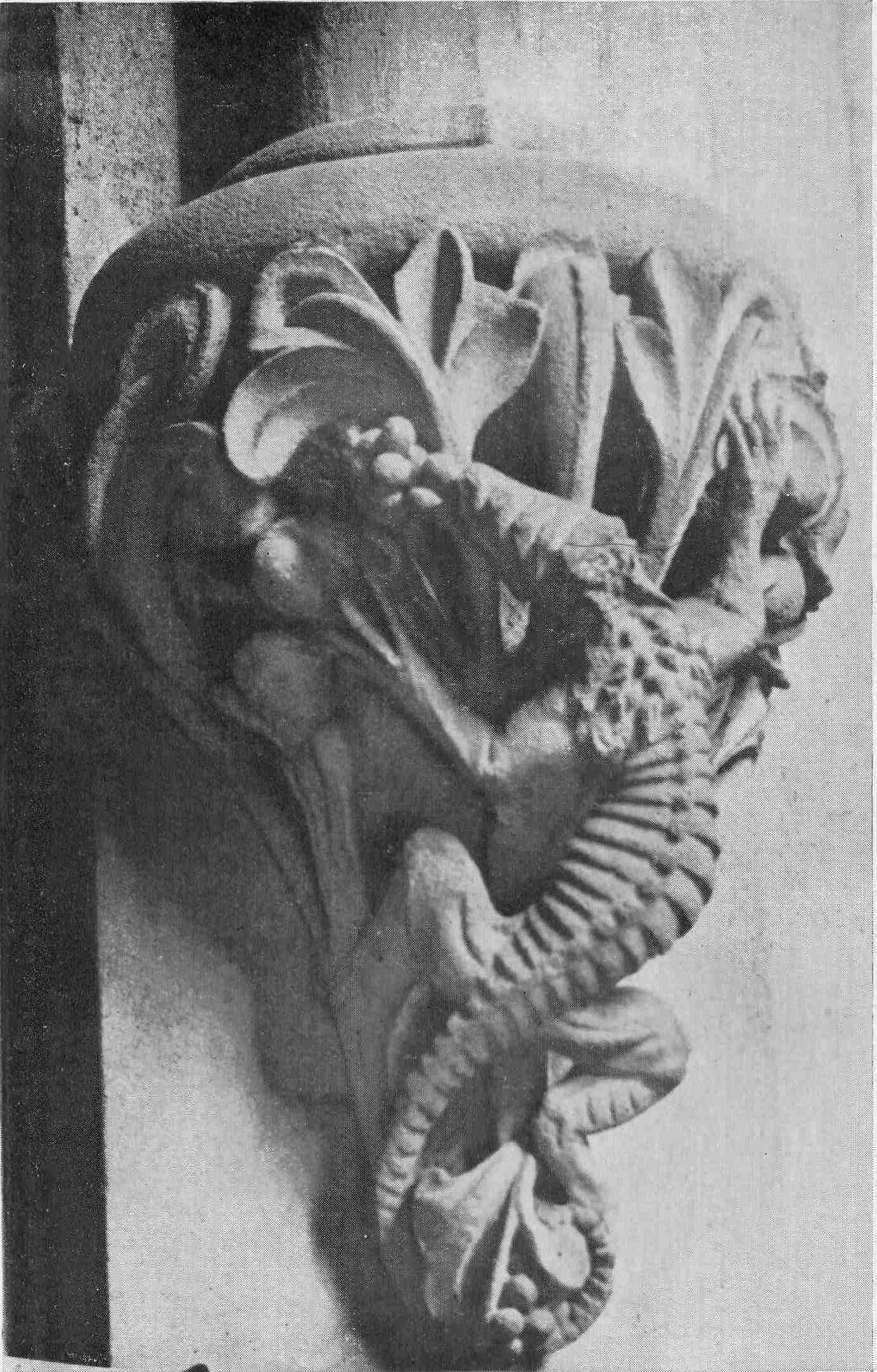
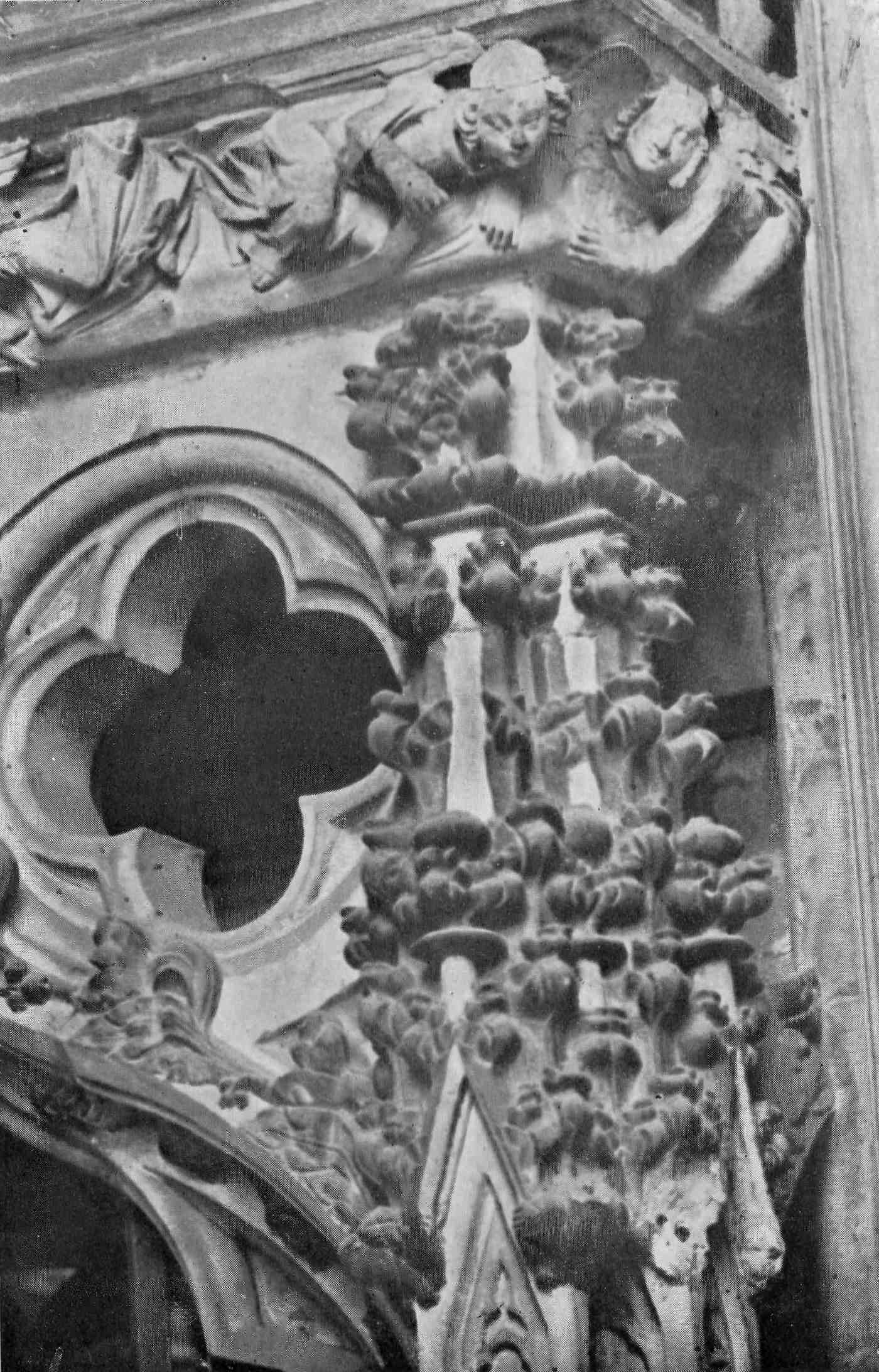
early attempts to copy Corinthian. On a respond
of the tower arch at Sompting Church
is a curious instance of this, probably pre-Norman
in date. It consists of a triple row of
crockets, apparently intended to copy acanthus,
while the volutes resemble ram’s horns,
perhaps placed upside down, with clusters of
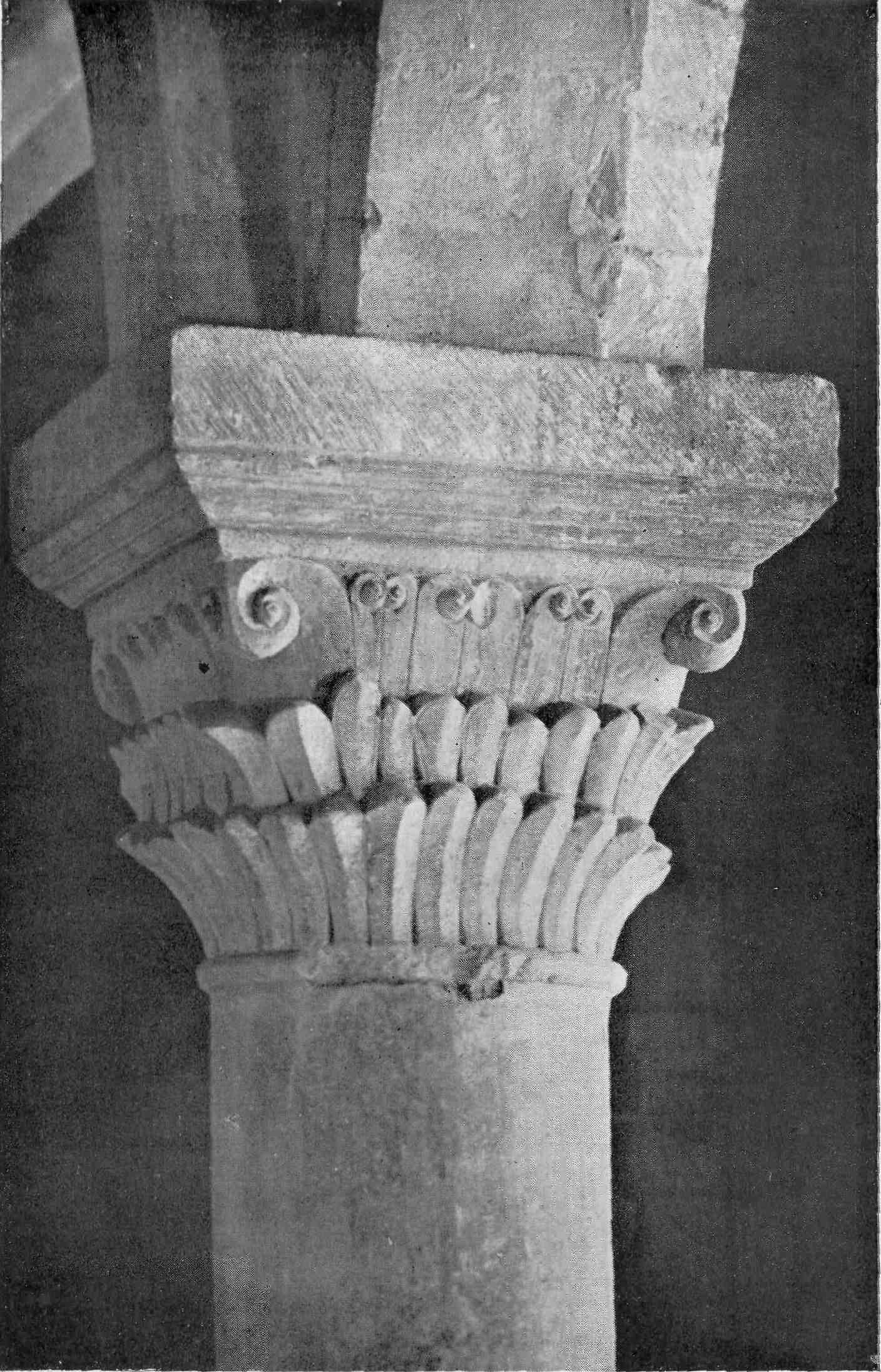
grapes encircled in them (Pl. 17). At Southrop,
Glos, is a very primitive sort of capital with
volutes rising from a central stem, and below
parallel leaves rising from the necking. In
Canterbury crypt there are several such capitals
(Pl. 18), some better and some worse
executed. They appear to have been carved
in situ on capitals that were originally cushions.
The feature that is of most interest in all these
early attempts is the parallel leaves rising from
the necking. There is nothing new about this
arrangement. It is, in fact, precisely similar
to that on the Lysicrates monument at Athens,
but it seems to have some affinity both to
scallops and stiff-leaf stems.
The scalloped form of capital is an English
type. It is formed by dividing each semi-circular
face of the cushion capital into two
or more semi-circles, and carrying the channel
between each semi-circle down to the necking,
so that each convexity is a half-cone. A very
simple example is a scalloped capital at the
Tower of London, in which each face is bisected.
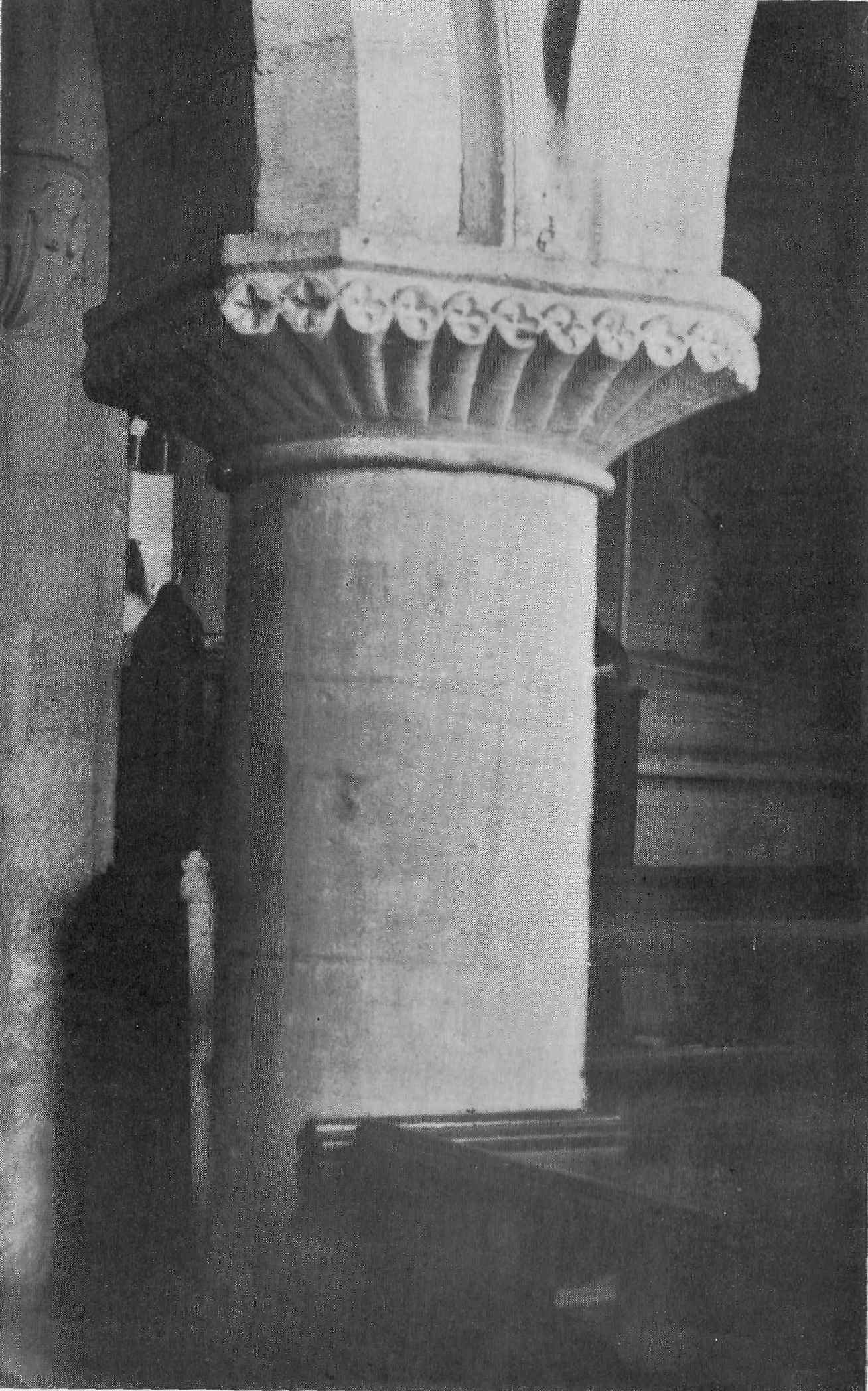
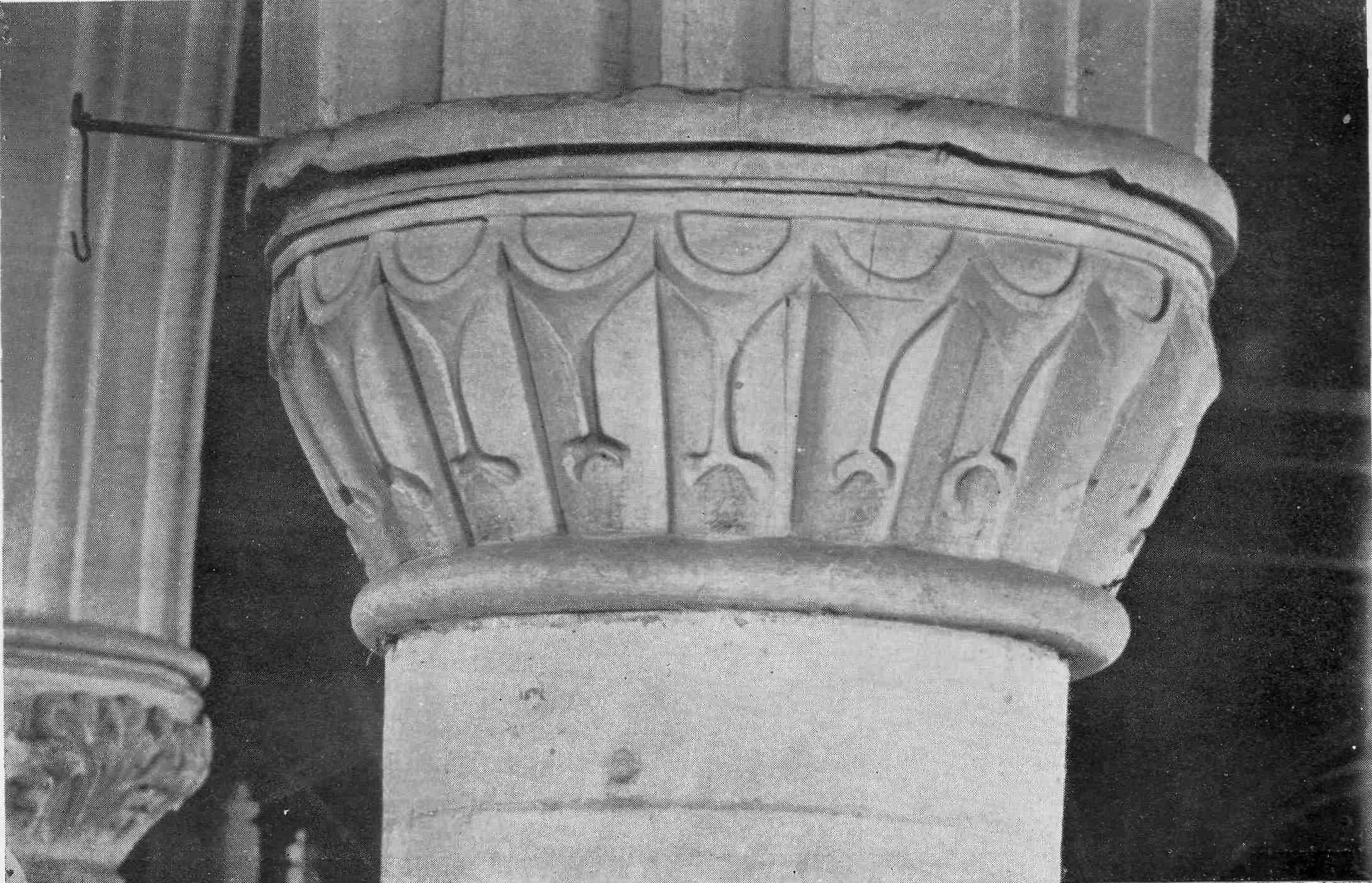
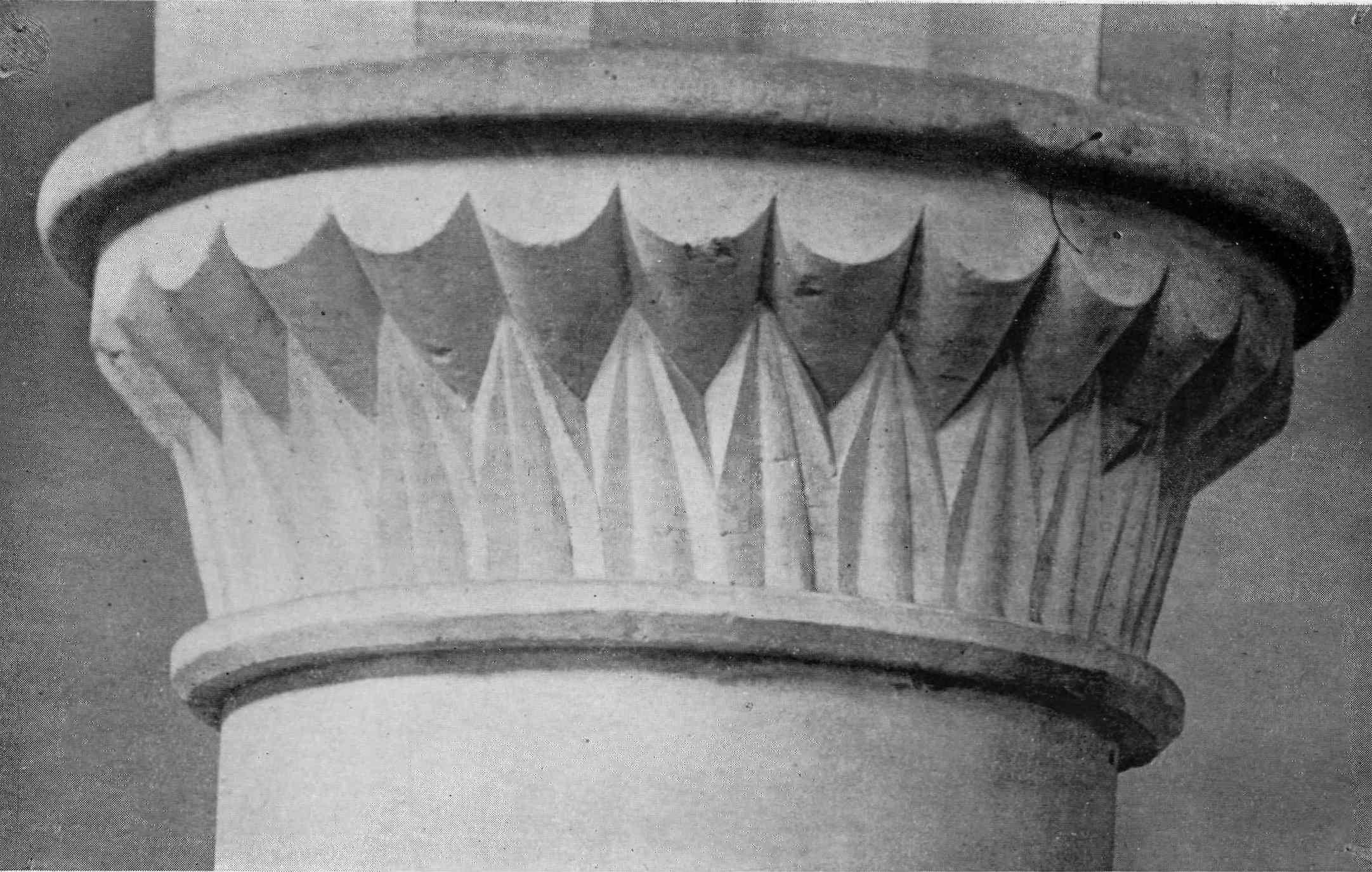
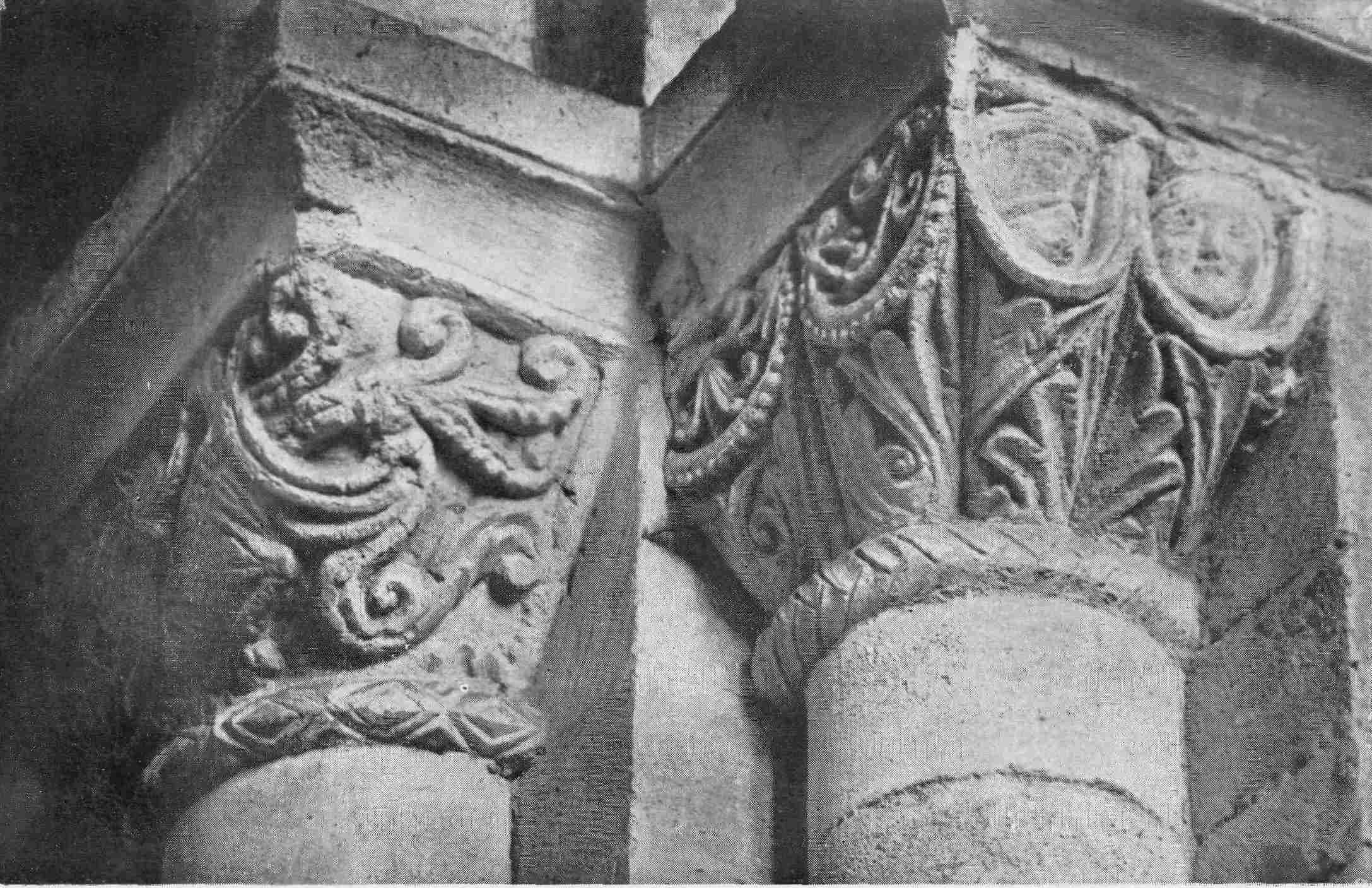
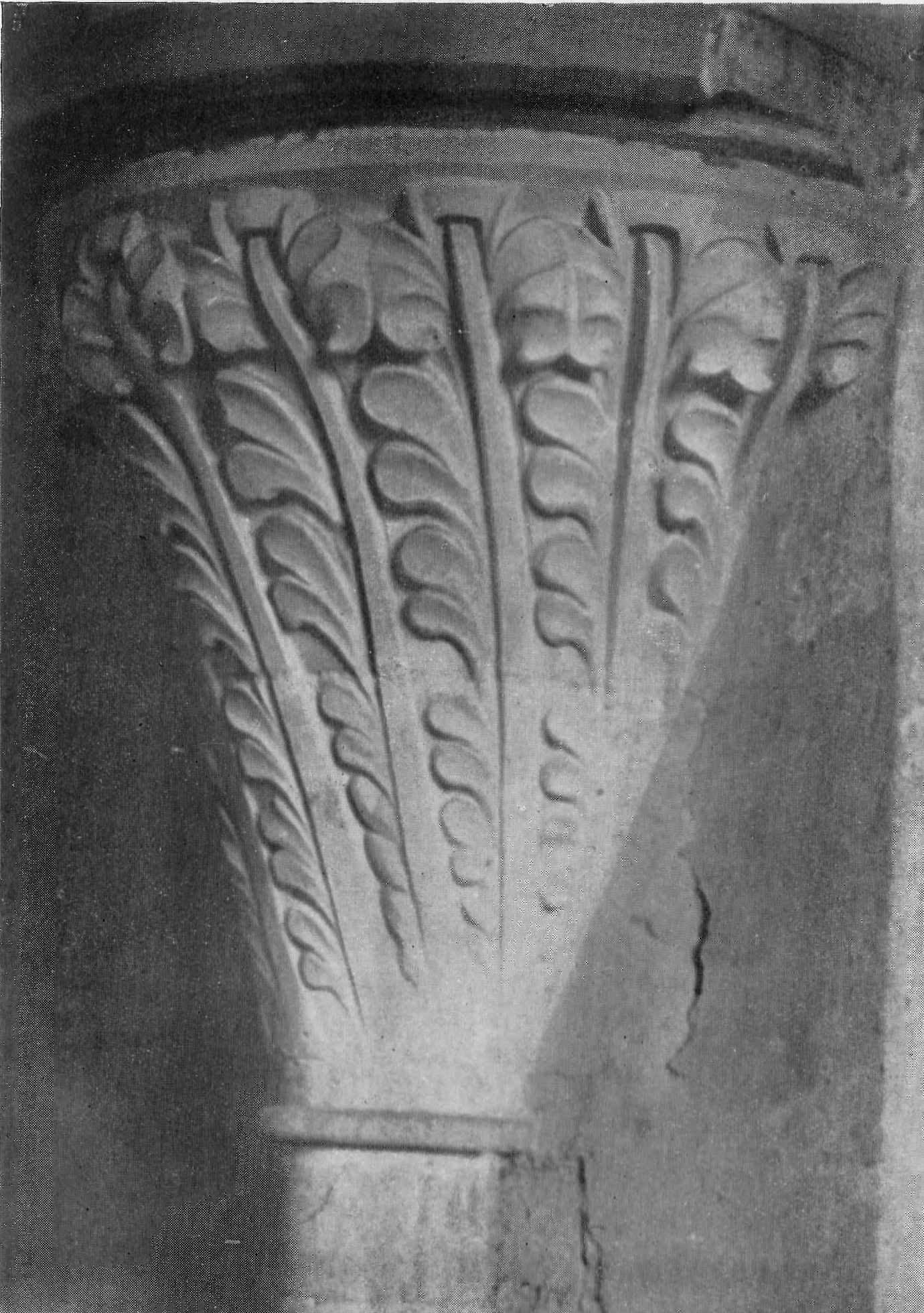
The capitals illustrated in Pl. 1 and
Pls. 19, 20, 21, 22, 23 will show the shape better
than any amount of description. The nave
capitals at Hemel Hempstead show the effect
of scallops on large square capitals. In this case
variety is given by cutting out the corners.
The great round capitals at Malmesbury have
scallops with the semi-circles moulded. At
Black Bourton, Oxon (Pl. 19), the scallops are
curved and the semi-circles made circular and
ornamented with quatrefoils. At Kimpton not
only are the semi-circles moulded but the
scallops themselves have great leaves cut upon
them (Pl. 20). At King’s Walden, close by,
spiked leaves rise from the necking between
the scallops (Pl. 21). At Romsey there are
some very richly carved scalloped capitals,
with faces in the semi-circles and foliage all
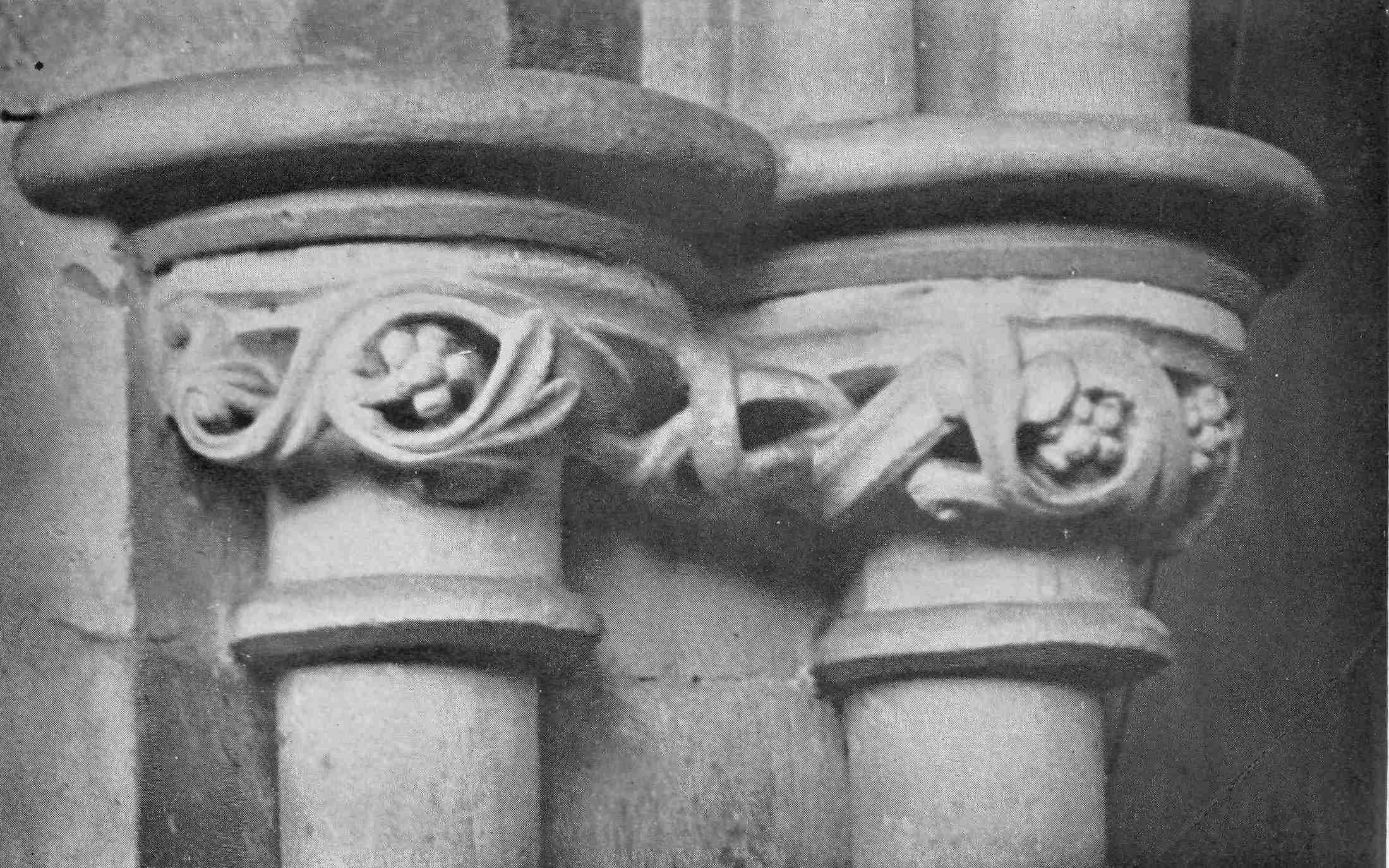
over the scallops (Pl. 22). At Cuddington a
round capital has curved scallops, the semi-circles
ornamented with a round hole, and
plain sharply-pointed leaves rising from the
necking between the scallops (Pl. 23).
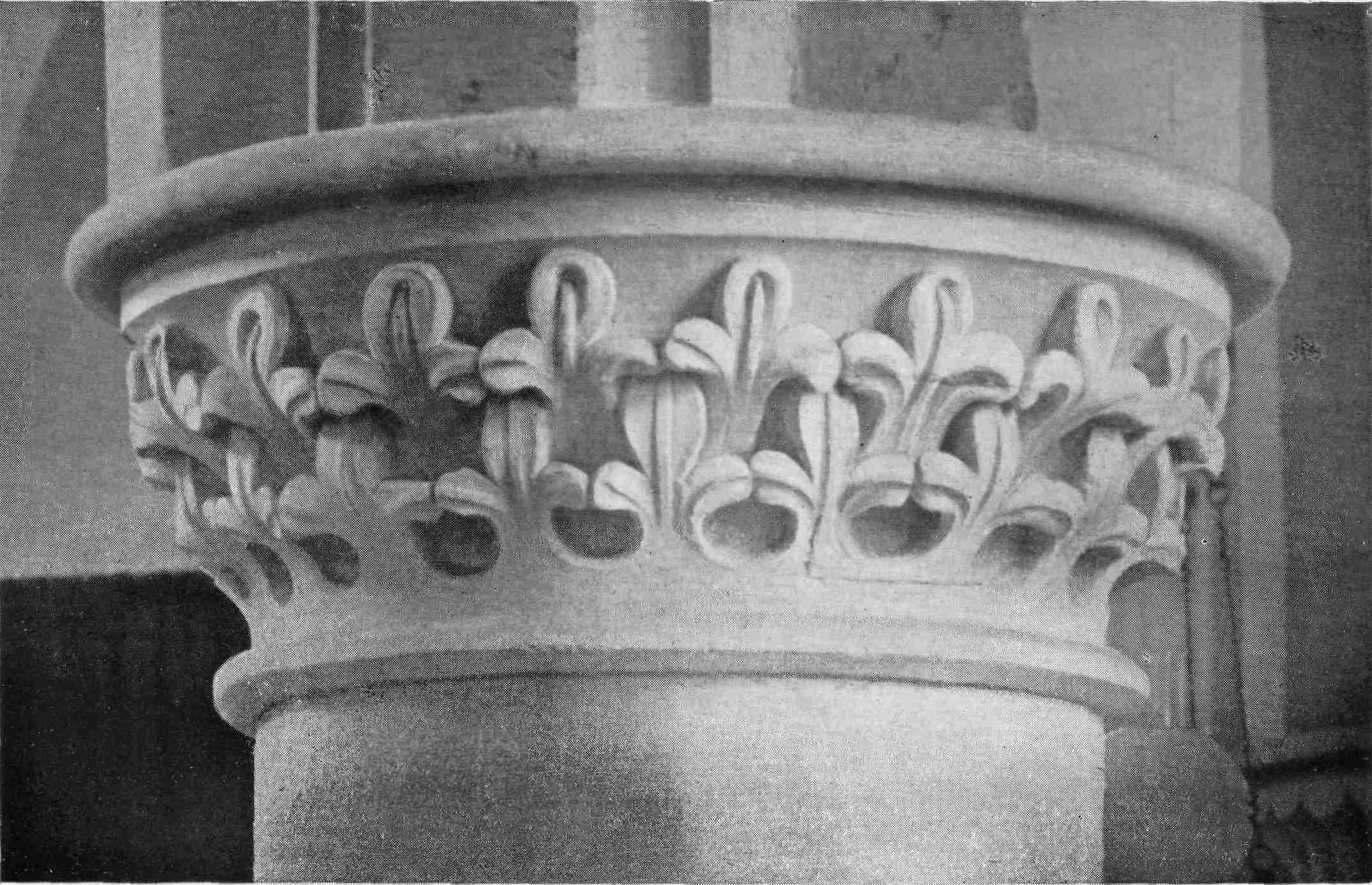
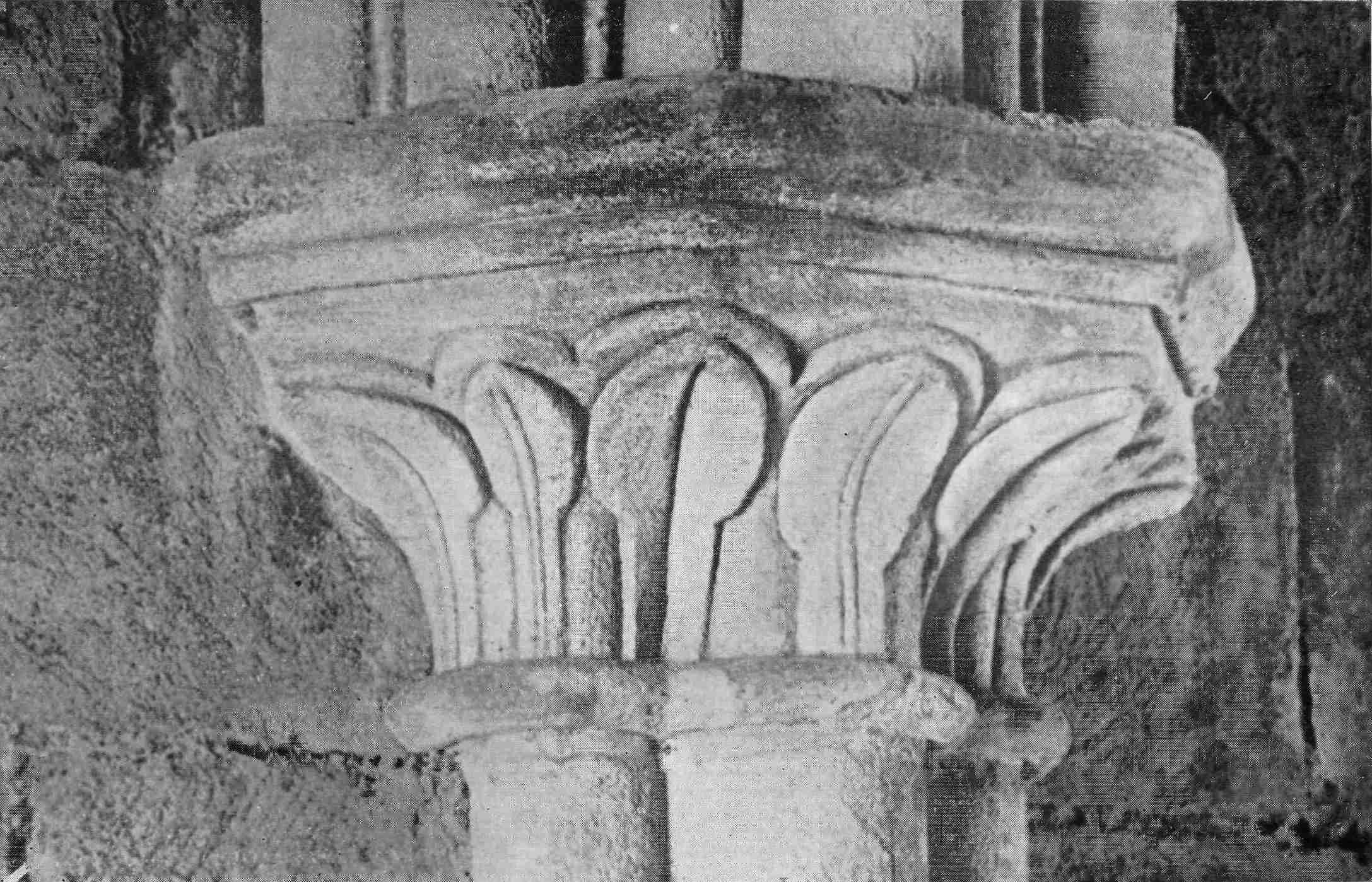
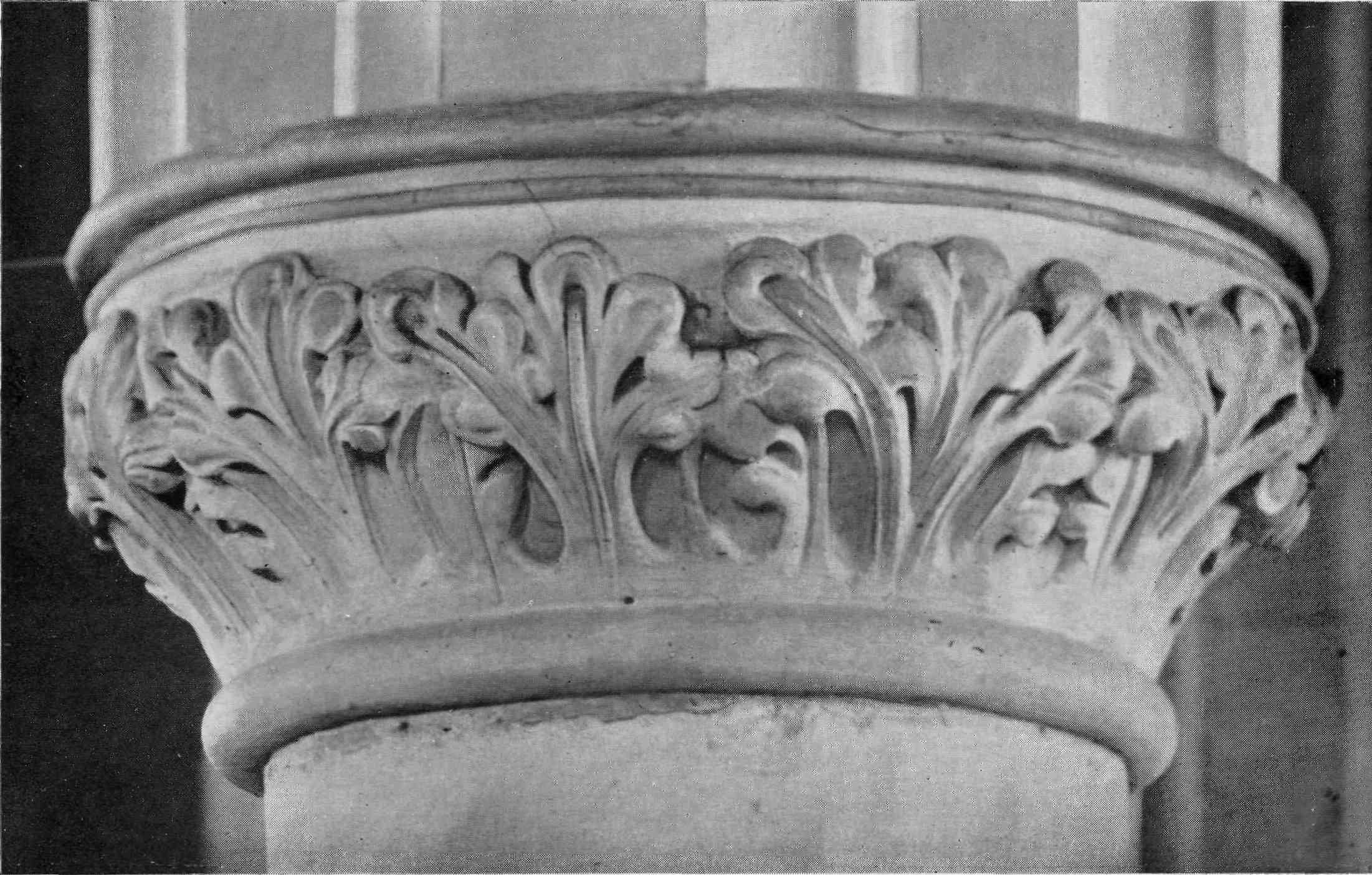
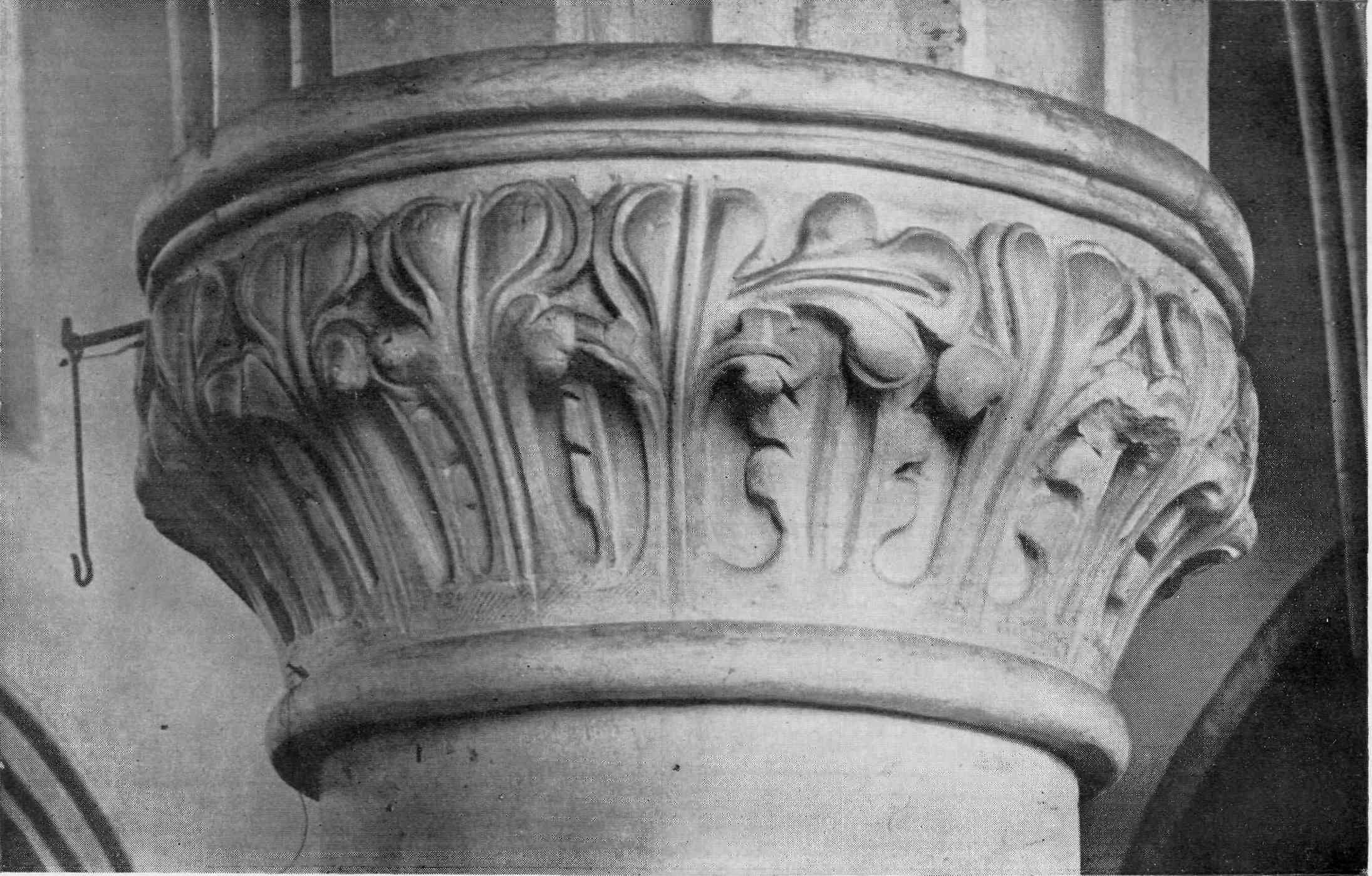
The chief significance of scalloping in connexion
with the development of stiff-leaf is
the rising of straight lines from the necking.
We have already mentioned the Oxford experiments
in which this feature is prominent.