SO far, in writing of decorative illustrators
and of open-air illustrators,
the difference in scheme between a
study of book-illustration and of
'black-and-white' art has not greatly
affected the scale and order of facts.
The intellectual idea of illustration, as a personal
interpretation of the spirit of the text, finds expression,
formally at least, in the drawings of most
decorative black-and-white artists. The deliberate
and inventive character of their art, the fact
that such qualities are non-journalistic, and ineffective
in the treatment of 'day by day' matters,
keeps the interpretative ideal, brought into English
illustration by Rossetti, and the artists whose
spirits he kindled, among working ideals for these
illustrators. For that reason, with the exception
of page-decorations such as those of Mr. Edgar
Wilson, the subject of decorative illustration is
almost co-extensive with the subject of decorative
black-and-white. The open-air illustrator represents
another aspect of illustration. To interpret
the spirit of the text would, frequently, allow his
art no exercise. Much of his text is itinerary.
His subject is before his eyes in actuality, or in
photographs, and not in some phrase of words,
magical with suggested forms, creating by its gift
of delight desire to celebrate its beauty. Still,
if the artist be independent of the intellectual and
imaginative qualities of the book, his is no independent
form of black and white. It is illustration;
the author's subject is the subject of the
artist. Open-air facts, those that are beautiful and
pleasurable, are too uneventful to make 'news
illustration.' Unless as background for some event,
they have, for most people, no immediate interest.
So it happens that open-air drawings are usually
illustrations of text, text of a practical guide-book
character, or of archæological interest, or of the
gossiping, intimate kind that tells of possessions,
of journeys and pleasurings, or, again, illustrations
of the open-air classics in prose and verse.
But in turning to the work of those draughtsmen
whose subject is the presentment of character,
of every man in his own humour, the illustration
of literature is a part only of what is noteworthy.
These artists have a subject that makes the opportunities
of the book-illustrator seem formal; a
subject, charming, poignant, splendid or atrocious,
containing all the 'situations' of comedy, tragedy
or farce; the only subject at once realized by everyone,
yet whose opportunities none has ever comprehended.
The writings of novelists and dramatists—life
narrowed to the perception of an individual—are
limitary notions of the matter, compared with
the illimitable variety of character and incident to
be found in the world that changes from day to
day. And 'real' life, purged of monotony by the
wit, discrimination or extravagance of the artist,
or—on a lower plane—by the combination only
of approved comical or sentimental or melodramatic
elements, is the most popular and marketable of
all subjects. The completeness of a work of art is
to some a refuge from the incompleteness of
actuality; to others this completeness is more incomplete
than any incident of their own experience.
The first bent of mind—supposing an artist who
illustrates to 'express himself'—makes an illustrator
of a draughtsman, the second makes literature seem
no more than la reste to the artist as an opportunity
for pictorial characterization.
Character illustration is then a subject within a
subject, and if it be impossible to consider it without
overseeing the limitations, yet a different point
of view gives a different order of impressions.
Caricaturists, political cartoonists, news-illustrators
and graphic humorists, the artists who pictorialize
society, the stage, the slums or some other kind
of life interesting to the spectator, are outside
the scheme of this article—unless they be illustrators
also. For instance, the illustrations of Sir
Harry Furniss are only part of his lively activities,
and Mr. Bernard Partridge is the illustrator of
Mr. Austin Dobson's eighteenth-century muse as
well as the 'J. B. P.' of 'socials' in 'Punch.'
An illustrator of many books, and one whose
illustrations have unusual importance, both as interpretations
of literature and for their artistic force,
Mr. William Strang is yet so incongruous with contemporary
black-and-white artists of to-day that he
must be considered first and separately. For the
traditions of art and of race that find a focus in the
illustrative etchings of this artist, the creative traditions,
and instinctive modes of thought that are
represented in the forms and formation of his art,
are forces of intellect and passion and insight not
previously, nor now, by more than the one artist,
associated with the practice of illustration. To
consider his work in connection with modern
illustration is to speak of contrasts. It represents
nothing that the gift-book picture represents,
either in technical dexterities, founded on the requirements
of process reproduction, or in its decorative
ideals, or as expressive of the pleasures of
literature. One phase of Mr. Strang's illustrative
art is, indeed, distinct from the mass of his work,
with which the etched illustrations are congruous,
and the line-drawings to three masterpieces of
imaginary adventure—to Lucian, to Baron Munchausen
and to Sindbad—show, perhaps, some infusion
of Aubrey Beardsley's spirit of fantasy into
the convictions of which Mr. Strang's art is compounded.
But these drawings represent an excursion
from the serious purpose of the artist's
work. The element in literature expressed by
that epithet 'weird'—exiled from power to common
service—is lacking in the extravagances of these
voyages imaginaires, and, lacking the shadows cast
by the unspeakable, the intellectual chiaroscuro of
Mr. Strang's imagination, loses its force. These
travellers are too glib for the artist, though his
comprehension of the grotesque and extravagant,
and his humour, make the drawings expressive
of the text, if not of the complete personality of
the draughtsman. The 'types, shadows and metaphors'
of 'The Pilgrim's Progress,' with its poignancies
of mental experience and conflict, its transcendent
passages, its theological and naïve moods,
gave the artist an opportunity for more realized
imagination. The etchings in this volume, published
in 1894, represent little of the allegorical
actualities of the text. Not the encounters by the
way, the clash of blows, the 'romancing,' but the
'man cloathed with rags and a great Burden on his
back,' or Christiana his wife, when 'her thoughts
began to work in her mind,' are the realities to the
artist. The pilgrims are real and credible, poor
folk to the outward sight, worn with toil, limited,
abused in the circumstances of their lives; and
these peasant figures are to Mr. Strang, as to his
master in etching, Professor Legros, symbols of
endurance, significant protagonists in the drama of
man's will and the forces that strive to subdue its
strength. To both artists the peasant confronting
death is the climax of the drama. In the etchings
of Professor Legros death fells the woodman, death
meets the wayfarer on the high-road. There is no
outfacing the menace of death. But to Mr. Strang,
the sublimity of Bunyan's 'poor man,' who overcomes
all influences of mortality by the strength
of his faith, is a possible fact. His ballad illustrations
deal finely with various aspects of the theme.
In 'The Earth Fiend,' a ballad written and illustrated
with etchings by Mr. Strang in 1892, the
peasant subdues and compels to his service the
spirit of destruction. He maintains his projects
of cultivation, conquers the adverse wildness of
nature, makes its force productive of prosperity
and order; then, on a midday of harvest, sleeps,
and the 'earth fiend,' finding his tyrant defenceless,
steals on him and kills him as he lies. 'Death
and the Ploughman's Wife' (1894) has a braver
ending. It interprets in an impressive series of
etchings how 'Death that conquers a'' is vanquished
by the mother whose child he has snatched
from its play. The title-page etching shows a
little naked child kicking a skull into the air,
while the peasant-mother, patient, vigilant, keeps
watch near by. In 'The Christ upon the Hill'
of the succeeding year, a ballad by Cosmo Monkhouse
with etchings by Mr. Strang, the artist
follows, of course, the conception of the writer;
but here, too, his work is expressive of the visionary
faith that discerns death as one of those 'base
things' that 'usher in things Divine.'
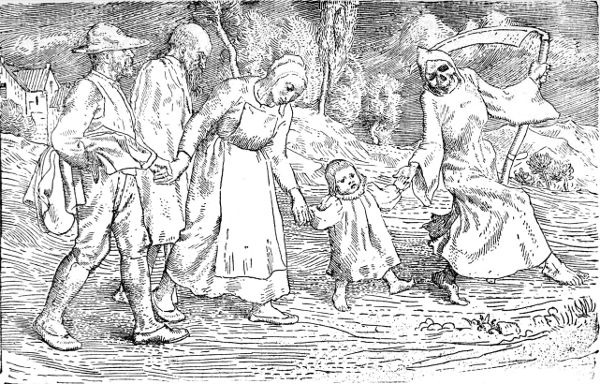 FROM WILLIAM STRANG'S BALLAD, 'DEATH AND THE PLOUGHMAN'S WIFE' (REDUCED FROM THE
ORIGINAL ETCHING).
FROM WILLIAM STRANG'S BALLAD, 'DEATH AND THE PLOUGHMAN'S WIFE' (REDUCED FROM THE
ORIGINAL ETCHING).
BY LEAVE OF MR. A. H. BULLEN.
The twelve etchings to 'Paradise Lost' (1896)
do not, as I think, represent Mr. Strang's imagination
at its finest. It is in the representation of
rude forms of life, subjected to the immeasurable
influences of passion, love, sorrow, that the images
of Mr. Strang's art, at once vague and of intense
reality, primitive and complex, have most force.
Adam and Eve driven from Paradise by the angel
with the flaming sword, are not directly created
by the artist. They recall Masaccio, and are undone
by the recollection. Eve, uprising in the
darkness of the garden where Adam sleeps, the
speech of the serpent with the woman, the gathering
of the fruit, are traditionary in their pictorial
forms, and the tradition is too great, it imposes
itself between the version of Mr. Strang and our
admiration. But in the thirty etchings illustrative
of Mr. Kipling's works, as in the ballad etchings,
the imagination of the artist is unfettered by tradition.
The stories he pictures deal, for all their
cleverness and definition, with themes that, translated
out of Mr. Kipling's words into the large
imagination of Mr. Strang, have powerful purpose.
As usual, the artist makes his picture not of matter-of-fact—and
the etching called 'A Matter of Fact'
is specially remote from any such matter—but of
more purposeful, more overpowering realities than
any particular instance of life would show. He
attempts to realize the value, not of an instance of
emotion or of endeavour, but of the quality itself.
He sets his mind, for example, to realize the
force of western militarism in the east, or the attitude
of the impulses of life towards contemplation,
and his soldiers, his 'Purun Bhagat,' express his
observations or imaginations of these themes. Certainly
'a country's love' never went out to this
kind of Tommy Atkins, and the India of Mr. Strang
is not the India that holds the Gadsbys, or of which
plain tales can be told. But he has imagined a
country that binds the contrasts of life together in
active operation on each other, and in thirty instances
of these schemed-out realities, or of dramatic
events resulting from the clash of racial and national
and chronological characteristics, he has achieved
perhaps his most complete expression of insight
into essentials. Mr. Strang's etchings in the recently
published edition of 'The Compleat Angler,'
illustrated by him and by Mr. D. Y. Cameron, are
less successful. The charm of his subject seems
not to have entered into his imagination, whereas
forms of art seem to have oppressed him. The
result is oppressive, and that is fatal to the value
of his etchings as illustrations of the book that 'it
would sweeten a man's temper at any time to read.'
Intensity and large statement of dark and light;
fine dramatizations of line; an unremitting conflict
with the superfluous and inexpressive in form and
in thought; an art based on the realities of life,
and without finalities of expression, inelegant, as
though grace were an affectation, an insincerity in
dealing with matters of moment: these are qualities
that detach the illustrations of Mr. Strang
from the generality of illustrations. Save that
Mr. Robert Bryden, in his 'Woodcuts of men of
letters' and in the portrait illustrations to 'Poets
of the younger generation,' shows traces of studying
the portrait-frontispieces of Mr. Strang, there
is no relation between his art and the traditions
it represents and any other book-illustrations of
to-day.
Turning now to illustrators who are representative
of the tendencies and characteristics of modern
book-illustration, and so are less conspicuous in a
general view of the subject than Mr. Strang, there
is little question with whom to begin. Mr. Abbey
represents at their best the qualities that belong to
gift-book illustration. It would, perhaps, be more
correct to say that gift-book illustration represents
the qualities of Mr. Abbey's black and white with
more or less fidelity, so effective is the example of
his technique on the forms of picturesque character-illustration.
It is nearly a quarter of a century
since the artist, then a young man fresh from
Harper's drawing-office in New York, came to
England. That first visit, spent in studying the
reality of English pastoral life in preparation for
his 'Herrick' illustrations, lasted for two years,
and after a few months' interval in the States he
returned to England. Resident here for nearly
all the years of his work, a member of the Royal
Academy, his art expressive of traditions of English
literature and of the English country to which
he came as to the actuality of his imaginings, one
may include Mr. Abbey among English book-illustrators
with more than a show of reason.
In 1882, when the 'Selections from the Poetry of
Robert Herrick' was published, few of the men
whose work is considered in this chapter had been
heard of. Chronologically, Mr. Abbey is first of
contemporary character-illustrators, and nowhere
but first would he be in his proper place, for there
is no one to put beside him in his special fashion
of art, and in the effect of his illustrative work on
his contemporaries. There is inevitable ease and
elegance in the pen-drawings of Mr. Abbey, and
for that reason it is easy to underestimate their
intellectual quality. He is inventive. The spirit
of Herrick's muse, or of 'She Stoops to Conquer,'
or of the comedies of Shakespeare, is not a quality
for which he accepts any formula. He finds shapes
for his fancies, rejecting as alien to his purpose all
that is not the clear result of his own understanding
of the poet. Accordingly there is, in all his
work, the expression of an intellectual conception.
He sees, too, with patience. If he isolates a figure,
one feels that figure has stepped forward into a
clear place of his imagination as he followed its
way through the crowd. If he sets a pageant on
the page, or some piece of turbulent action, or
moment of decision, the actors have their individual
value. He thinks his way through processes
of gradual realization to the final picture of
the characters in the play or poem. One writes
now with special reference to the illustrations of
the comedies of Shakespeare—so far, the illustrative
work most exigent to the intellectual powers
of the artist. Herrick's verse, full of sweet sounds
and suggestive of happy sights, 'She Stoops to
Conquer,' where all the mistakes are but for a
night, to be laughed over in the morning, the lilt
and measure of 'Old Songs,' and of the charming
verses in 'The Quiet Life,' called for sensitive
appreciation of moods, lyrical, whimsical, humorous,
idyllic, but—intellectually—for no more than
this. As to Mr. Abbey's technique, curious as he
is in the uses of antiquity as part of the pleasure of
a fresh realization, clothing his characters in textiles
of the great weaving times, or of a dainty
simplicity, a student of architecture and of landscape,
of household fittings, of armoury, of every
beautiful accessory to the business of living, his
clever pen rarely fails to render within the convention
of black and white the added point of
interest and of charm that these things bring into
actuality. Truth of texture, of atmosphere, and of
tone, an alertness of vision most daintily expressed—these
qualities belong to all Mr. Abbey's work,
and in the Shakespearean drawings he shows with
greater force than ever his 'stage-managing'
power, and the correctness and beauty of his
'mounting.' The drawings are dramatic: the
women have beauty and individuality, while the
men match them, or contrast with them as in the
plays; the rogues are vagabonds in spirit, and the
wise men have weight; the world of Shakespeare
has been entered by the artist. But there are
gestures in the text, moments of glad grace, of
passion, of sudden amazement before the realities
of personal experience, that make these active,
dignified figures of Mr. Abbey 'merely players,'
his Isabella in the extremity of the scene with
Claudio no more than an image of cloistered
virtue, his Hermione incapable of her undaunted
eloquence and silence, his Perdita and Miranda
and Rosalind less than themselves.
As illustrations, the drawings of Mr. Abbey
represent traditions brought into English illustrative
art by the Pre-Raphaelites, and developed by
the freer school of the sixties. But, as drawings,
they represent ideas not effective before in the
practice of English pen-draughtsmen; ideas derived
from the study of the black and white of Spain, of
France, and of Munich, by American art students
in days when English illustrators were not given to
look abroad. Technically he has suggested many
things, especially to costume illustrators, and many
names might follow his in representation of the
place he fills in relation to contemporary art. But
to work out the effect of a man's technique on
those who are gaining power of expression is to
labour in vain. It adds nothing to the intrinsic
value of an artist's work, nor does it represent the
true relationship between him and those whom he
has influenced. For if they are mere imitators they
have no relation with any form of art, while to
insist upon derived qualities in work that has the
superscription of individuality is no true way of
apprehension. What a man owes to himself is the
substantial fact, the fact that relates him to other
men. The value of his work, its existence, is in
the little more, or the much more, that himself
adds to the sum of his directed industries, his
guided achievements. And to estimate that, to
attempt to express something of it, must be the
chief aim of a study, not of one artist and his
'times,' but of many artists practising a popular
art.
So that if, in consideration of their 'starting-point,'
one may group most character-illustrators,
especially of wig-and-powder subjects, as adherents
either of Mr. Abbey and the 'American school,'
or of Mr. Hugh Thomson and the Caldecott-Greenaway
tradition, such grouping is also no more
than a starting-point, and everything concerning
the achievements of the individual artist has still
to be said.
Considering the intention of their technique, one
may permissibly group the names of Mr. Fred
Pegram, Mr. F. H. Townsend, Mr. Shepperson,
Mr. Sydney Paget, and Mr. Stephen Reid as
representing in different degrees the effect of
American black and white on English technique,
though, in the case of Mr. Paget, one alludes only
to pen-drawings such as those in 'Old Mortality,'
and not to his Sherlock Holmes and Martin Hewitt
performances. The art of Mr. Pegram and of Mr.
Townsend is akin. Mr. Pegram has, perhaps,
more sense of beauty, and his work suggests a more
complete vision of his subject than is realized in
the drawings of Mr. Townsend, while Mr. Townsend
is at times more successful with the activities
of the story; but the differences between them
seem hardly more than the work of one hand would
show. They really collaborate in illustration,
though, except in Cassell's survey of 'Living London,'
they have never, I think, made drawings for
the same book.
Mr. Pegram served the usual apprenticeship to
book-illustration. He was a news-illustrator before
he turned to the illustration of literature; but he
is an artist to whom the reality acquired by a
subject after study of it is more attractive than the
reality of actual impressions. Neither sensational
nor society events appeal to him. The necessity
to compose some sort of an impression from the
bare facts of a fact, without time to make the best
of it, was not an inspiring necessity. That Mr.
Pegram is a book-illustrator by the inclination of
his art as well as by profession, the illustrations
to 'Sybil,' published in 1895, prove. In these
drawings he showed himself not only observant of
facial expression and of gesture, but also able to
interpret the glances and gestures of Disraeli's
society. From the completeness of the draughtsman's
realization of his subject, illustrable situations
develop themselves with credibility, and his graceful
women and thoughtful men represent the events
of the novel with distinction. With 'Sybil' may
be mentioned the illustrations to 'Ormond,' wherein,
five years later, the same understanding of the ways
and activities of a bygone, yet not remote society,
found equally satisfactory expression, while the
technique of the artist had gained in completeness.
In 'The Last of the Barons' (1897), Mr. Pegram
had a picturesque subject with much strange
humanity in it, despite Lord Lytton's conventional
travesty of events and character. The names of
Richard and Warwick, of Hastings and Margaret
of Anjou, are names that break through conventional
romance, but the illustrator has to keep up
the fiction of the author, and, except that the
sham-mediævalism of the novel did not prevent a
right study of costumes and accessories in the
pictures, the artist had to be content to 'Bulwerize.'
Illustrations to 'The Arabian Nights' gave him
opportunity for rendering textures and atmosphere,
and movements charming or grave, and the
'Bride of Lammermoor' drawings show a sweet-faced
Lucy Ashton, and a Ravenswood who is
more than melancholy and picturesque. Mr.
Pegram's drawings are justly dramatic within the
limits prescribed by a somewhat composed ideal of
bearing. A catastrophe is outside these limits, and
the discovery of Lucy after the bridal lacks real
illustration in the artist's version, skilful, nevertheless,
as are all his drawings, and expressed without
hesitation. Averse to caricature, and keeping
within ideas of life that allow of unbroken expression,
the novels of Marryat, where action so bustling
that only caricatures of humanity can endure
its exigencies, and sentimental episodes of flagrant
insincerity, swamp the character-drawing, are hardly
suited to the art of Mr. Pegram. Still, he selects,
and his selection is true to the time and circumstance
of Marryat's work. In itself it is always an
expression of a coherent and definite conception of
the story.
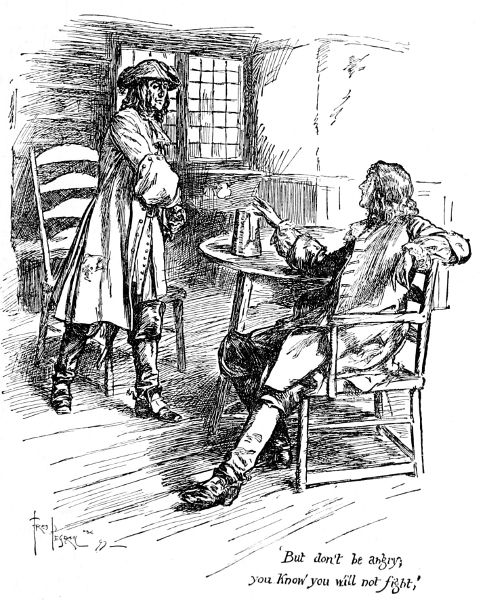 FROM MR. PEGRAM'S 'THE BRIDE OF LAMMERMOOR.'
BY LEAVE OF MESSRS. NISBET.
Mr. Townsend has illustrated Hawthorne and
Peacock, as well as Charlotte Brontë and Scott.
Hawthorne's men and women—embodiments
always of some essential quality, rather than of the
combination of qualities that make 'character'—lend
themselves to fine illustration as regards
gesture, and Mr. Townsend's drawings represent,
not insensitively, the movement and suggestion of
'The Blithedale Romance' and 'The House of
the Seven Gables.' In the Peacock illustrations
the artist had to keep pace with an essentially un-English
humour, an imagination full of shapes
that are opinions and theories and sarcasms masquerading
under fantastic human semblances. Mr.
Townsend kept to humanity, and found occasions
for representing the eccentrics engaged in cheerful
open-air and society pursuits in the pauses of
paradoxical discussion. One realizes in the drawings
the pleasant aspect of life at Gryll Grange and
at Crotchet Castle, the courtesies and amusements
out of doors and within, while the subjects of
'Maid Marian,' of 'The Misfortunes of Elphin'
and of 'Rhododaphne' declare themselves in excellent
terms of romance and adventure. Mr.
Townsend has humour, and he is in sympathy
with the vigorous spirit in life; whether the vigour
is intellectual as in Jane Eyre and in Shirley
Keeldar, or muscular as in 'Rob Roy,' in drawings
to a manual of fencing, and in Marryat's 'The
King's Own,' or eccentric as in the fantasies of
Peacock. His work is never languid and never
formal; and if in technique he is sometimes experimental,
and frequently content with ineffectual
accessories to his figures, his conception of the
situation, and of the characters that fulfil the situation,
is direct and effective enough.
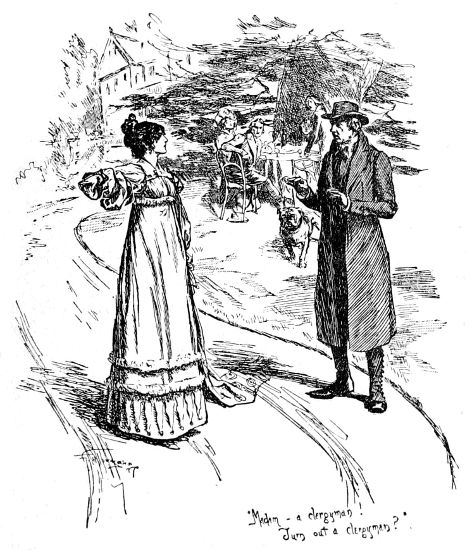 FROM MR. TOWNSEND'S 'SHIRLEY.'
BY LEAVE OF MESSRS. NISBET.
As an illustrator of current fiction, Mr. Townsend
has also a considerable amount of dexterous
work to his name, but a record of drawings contributed
to the illustrated journals cannot even be
attempted within present limits of space.
Mr. Shepperson in his book-illustrations generally
represents affairs with picturesqueness, and with
a nervous energy that takes the least mechanical
way of expressing forms and substances. Illustrating
the modern novel of adventure, he is happy
in his intrigues and conspiracies, while in books of
more weight, such as 'The Heart of Midlothian'
or 'Lavengro,' he expresses graver issues of life
with un-elaborate and suggestive effect. The
energy of his line, the dramatic quality of his
imagination, render him in his element as an
illustrator of events, but the vigour that projects
itself into subjects such as the murder of Sir George
Staunton, or the fight with the Flaming Tinman, or
the alarms and stratagems of Mr. Stanley Weyman,
informs also his representation of moments when
there is no action. Technically Mr. Shepperson represents
very little that is traditional in English black
and white, though the tradition seems likely to be
there for future generations of English illustrators.
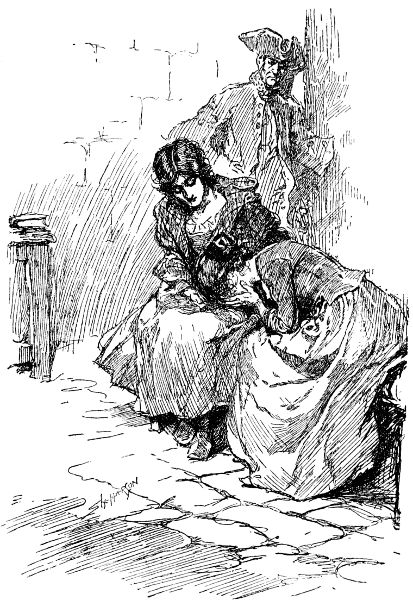 "Ye are ill, Effie," were the first words Jeanie could utter; "ye are very ill."
FROM MR. SHEPPERSON'S 'THE HEART OF MIDLOTHIAN.'
BY LEAVE OF THE GRESHAM PUBLISHING COMPANY.
In a recent work, illustrations to Leigh Hunt's
'Old Court Suburb,' Mr. Shepperson collaborates
with Mr. E. J. Sullivan and Mr. Herbert Railton,
to realize the associations, literary, historical and
gossiping, that have Kensington Palace and Holland
House as their principal centres. On the whole,
of the three artists, the subject seems least suggestive
to Mr. Shepperson. Mr. Sullivan contributes many
portraits, and some subject drawings that show him
in his lightest and most dexterous vein. These
drawings of beaux and belles are as distinct in their
happy flattery of fact from the rigid assertion of the
artist's 'Fair Women,' as they are from the undelightful
reporting style that in the beginning
injured Mr. Sullivan's illustrations. One may
describe it as the 'Daily Graphic' style, though
that is to recognize only the basis of convenience
on which the training of the 'Daily Graphic'
school was necessarily founded. Mr. Sullivan's
early work, the news-illustration and illustrations to
current fiction of Mr. Reginald Cleaver and of his
brother Mr. Ralph Cleaver, the black and white
of Mr. A. S. Boyd and of Mr. Crowther, show this
journalistic training, and show, too, that such a
training in reporting facts directly is no hindrance
to the later achievement of an individual way of
art. Mr. A. S. Hartrick must also be mentioned
as an artist whose distinctive black and white
developed from the basis of pictorial reporting, and
how distinctive and well-observed that art is,
readers of the 'Pall Mall Magazine' know. As a
book-illustrator, however, his landscape drawings
to Borrow's 'Wild Wales' represent another art
than that of the character-illustrator. Nor can
one pass over the drawings of Mr. Maurice
Greiffenhagen, also a contributor to the 'Pall Mall
Magazine,' if better known in illustrations to fiction
in 'The Ladies' Pictorial,' though in an article
on book-illustration he has nothing like his right
place. As an admirable and original technician and
draughtsman of society, swift in sight, excellent in
expression, he ranks high among black-and-white
artists, while as a painter, his reputation, if based on
different qualities, is not doubtful.
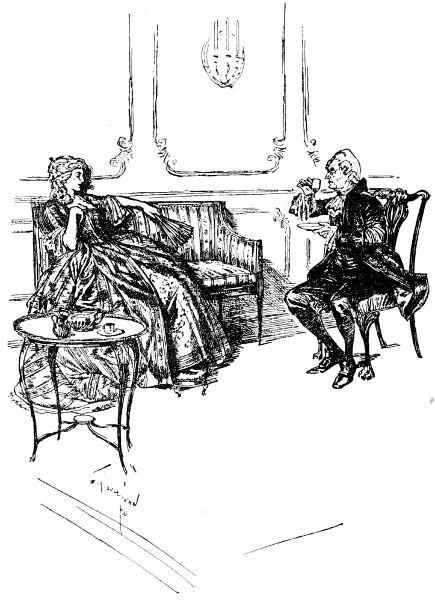 FROM MR. E. J. SULLIVAN'S 'SCHOOL FOR SCANDAL.'
BY LEAVE OF MESSRS. MACMILLAN.
Mr. Sullivan's drawings to 'Tom Brown's Schooldays'
(1896) are mechanical and mostly without
charm of handling, having an appearance of
timidity that is inexplicable when one thinks of
the vigorous news-drawings that preceded them.
The wiry line of the drawings appears in the
'Compleat Angler,' and in other books, including
'The Rivals' and 'The School for Scandal,' 'Lavengro'
and 'Newton Forster,' illustrated by the
artist in '96 and '97; but the decorative purpose
of Mr. Sullivan's later work is, in all these
books, effective in modifying its perversity. Increasing
elaboration of manner within the limits of
that purpose marks the transition between the
starved reality of 'Tom Brown' and the illustrations
to 'Sartor Resartus' (1898). These
emphatic decorations, and those illustrative of
Tennyson's 'Dream of Fair Women and other
Poems,' published two years later, are the drawings
most representative of Mr. Sullivan's intellectual
ideals. They show him, if somewhat indifferent
to charm, and capable of out-facing beauty suggested
in the words with statements of the extreme
definiteness of his own fact-conception, yet strongly
appreciative of the substance and purpose of the
text. Carlyle gives him brave opportunities, and
the dogmatism of the artist's line and form, his
speculative humour, working down to a definite
certainty in things, make these drawings unusually
interesting. Tennyson's 'Dream,' and his poems
to women's names, are not so fit for the exercise of
Mr. Sullivan's talent. He imposes himself with
too much force on the forms that the poet suggests.
There is no delicacy about the drawings and no
mystery. They do not accord with the inspiration
of Tennyson, an inspiration that substitutes the exquisite
realities of memory and of dream for the
realities of experience. Mr. Sullivan's share of the
illustrations to White's 'Selborne' and to the
'Garden Calendar,' are technically more akin to the
Carlyle and Tennyson drawings than to other examples
by him. In these volumes he makes
fortunate use of the basis of exactitude on which
his work is founded, exactitude that includes portraiture
among the functions of the illustrator. No
portrait is extant of Gilbert White, but the presentment
of him is undertaken in a constructive spirit,
and, as in 'The Compleat Angler' and 'The Old
Court Suburb,' portraits of those whose names and
personalities are connected with the books are redrawn
by Mr. Sullivan.
Except Mr. Abbey, no character-illustrator of
the modern school has so long a record of work,
and so visible an influence on English contemporary
illustration, as Mr. Hugh Thomson. In popularity
he is foremost. The slight and apparently playful
fashion of his art, deriving its intention from the
irresistible gaieties of Caldecott, is a fashion to
please both those who like pretty things and those
who can appreciate the more serious qualities that
are beneath. For Mr. Thomson is a student of
literature. He pauses on his subject, and though
his invention has always responded to the suggestions
of the text, the lightness of his later work is the
outcome of a selecting judgment that has learned
what to omit by studying the details and facts of
things. In rendering facial expression Mr. Thomson
is perhaps too much the follower of Caldecott, but
he goes much farther than his original master in
realization of the forms and manners of bygone
times. Some fashions of life, as they pass from
use, are laid by in lavender. The fashions of the
eighteenth century have been so laid by, and Mr.
Abbey and Mr. Thomson are alike successful in
giving a version of fact that has the farther charm
of lavender-scented antiquity.
When 'Days with Sir Roger de Coverley,'
illustrated by Hugh Thomson, was published in
1886, the young artist was already known by his
drawings in the 'English Illustrated,' and recognized
as a serious student of history and literature,
and a delightful illustrator of the times he studied.
His powers of realizing character, time, and place,
were shown in this earliest work. Sir Roger is a
dignified figure; Mr. Spectator, in the guise of
Steele, has a semblance of observation; and if Will
Wimble lacks his own unique quality, he is represented
as properly engaged about his 'gentleman-like
manufactures and obliging little humours.'
Mr. Thomson can draw animals, if not with the
possessive understanding of Caldecott, yet with
truth to the kind, knowledge of movement. The
country-side around Sir Roger's house—as, in a
later book, that where the vicarage of Wakefield
stands—is often delightfully drawn, while the leisurely
and courteous spirit of the essays is represented,
with an appreciation of its beauty. 'Coaching
Days and Coaching Ways' (1888) is a picturesque
book, where types and bustling action picturesquely
treated were the subjects of the artist. The peopling
of high-road and county studies with lively figures
is one of Mr. Thomson's successful achievements,
as he has shown in drawings of the cavalier exploits
of west-country history, illustrative of 'Highways
and Byways of Devon and Cornwall,' and in episodes
of romance and warfare and humour in
similar volumes on Donegal, North Wales, and
Yorkshire. Here the presentment of types and
action, rather than of character, is the aim, but
in the drawings to 'Cranford' (1891), to 'Our
Village,' and to Jane Austen's novels, behaviour
rather than action, the gentilities and proprieties
of life and millinery, have to be expressed as a part
of the artistic sense of the books. That is, perhaps,
why Jane Austen is so difficult to illustrate. The
illustrator must be neither formal nor picturesque.
He must understand the 'parlour' as a setting for
delicate human comedy. Mr. Thomson is better
in 'Cranford,' where he has the village as the
background for the two old ladies, or in 'Our
Village,' where the graceful pleasures of Miss
Mitford's prose have suggested delightful figures
to the illustrator's fancy, than in illustrating Miss
Austen, whose disregard of local colouring robs
the artist of background material such as interests
him. Three books of verses by Mr. Austin Dobson,
'The Ballad of Beau Brocade' (1892), 'The Story
of Rosina,' and 'Coridon's Song' of the following
years, together with the illustrations to 'Peg
Woffington,' show, in combination, the picturesque
and the intellectual interests that Mr. Thomson
finds in life. The eight pieces that form the first of
these volumes were, indeed, chosen to be reprinted
because of their congruity in time and sentiment
with Mr. Thomson's art. And certainly he works
in accord with the measure of Mr. Austin Dobson's
verses. Both author and artist carry their eighteenth-century
learning in as easy a way as though experience
of life had given it them without any
labour in libraries.
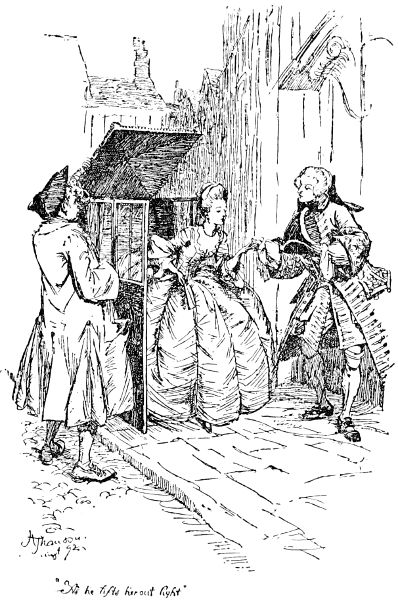 FROM MR. HUGH THOMSON'S 'BALLAD OF BEAU BROCADE.'
BY LEAVE OF MESSRS. KEGAN PAUL.
Mr. C. E. Brock and Mr. H. M. Brock are two
artists who to some extent may be considered as
followers of Mr. Thomson's methods, though Mr.
C. E. Brock's work in 'Punch,' and humorous
characterizations by Mr. H. M. Brock in 'Living
London,' show how distinct from the elegant fancy
of Mr. Thomson's art are the latest developments
of their artistic individuality. Mr. C. E. Brock's
illustrations to Hood's 'Humorous Poems' (1893)
proved his indebtedness to Mr. Thomson, and his
ability to carry out Caldecott-Thomson ideas with
spirit and with invention. An active sense of fun,
and facility in arranging and expressing his subject,
made him an addition to the school he represented,
and, as in later work, his own qualities and the
qualities he has adopted combined to produce
spirited and graceful art. But in work preceding
the pen-drawing of 1893, and in many books illustrated
since then, Mr. Brock at times has shown
himself an illustrator to whom matter rather than
a particular charm of manner seems of paramount
interest. In the illustrated Gulliver of 1894 there
is little trace of the daintiness and sprightliness of
Caldecott's illustrative art. He gives many particulars,
and is never at a loss for forms and details,
representing with equal matter-of-factness the
crowds, cities and fleets of Lilliput, the large details
of Brobdingnagian existence, and the ceremonies
and spectacles of Laputa. In books of
more actual adventure, such as 'Robinson Crusoe'
or 'Westward Ho,' or of quiet particularity, such
as Galt's 'Annals of the Parish,' the same directness
and unmannered expression are used, a directness
which has more of the journalistic than of the playful-inventive
quality. The Jane Austen drawings,
those to 'The Vicar of Wakefield,' and to a recent
edition of the 'Essays of Elia,' show the graceful
eighteenth-centuryist, while, whether he reports
or adorns, whether action or behaviour, adventure
or sentiment, is his theme, Mr. Brock is always an
illustrator who realizes opportunities in the text,
and works from a ready and observant intelligence.
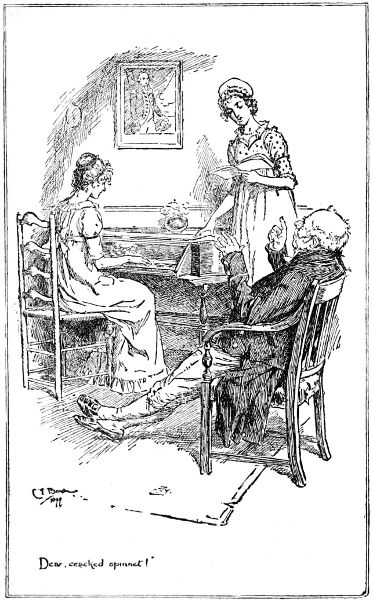 FROM MR. C. E. BROCK'S 'THE ESSAYS OF ELIA.'
BY LEAVE OF MESSRS. DENT.
Mr. Henry M. Brock is also an effective illustrator,
and his work increases in individuality and
in freedom of arrangement. 'Jacob Faithful'
(1895) was followed by 'Handy Andy' and
Thackeray's 'Songs and Ballads' in 1896. Less
influenced by Mr. Thomson than his brother, the
lively Thackeray drawings, with their versatility
and easy invention, have nevertheless much in
common with the work of Mr. Charles Brock.
On the whole, time has developed the differences
rather than the similarities in the work of these
artists. In the 'Waverley' drawings and in those
of 'The Pilgrim's Progress,' Mr. H. M. Brock
represents action in a more picturesque mood than
Mr. Charles Brock usually maintains, emphasizing
with more dramatic effect the action and necessity
for action.
The illustrations of Mr. William C. Cooke,
especially those to 'Popular British Ballads' (1894),
and, with less value, those to 'John Halifax, Gentleman,'
may be mentioned in relation to the Caldecott
tradition, though it is rather of the art of Kate
Greenaway that one is reminded in these tinted
illustrations. Mr. Cooke's wash-drawings to Jane
Austen's novels, to 'Evelina' and 'The Man of Feeling,'
as well as the pen-drawings to 'British Ballads,'
have more force, and represent with some distinction
the stir of ballad romance, the finely arranged
situations of Miss Austen, and the sentiments of life,
as Evelina and Harley understood it.
In a study of English black-and-white art, not
limited to book-illustration, 'Punch' is an almost
inevitable and invaluable centre for facts. Few
draughtsmen of notability are outside the scheme
of art connected with 'Punch,' and in this connection
artists differing as widely as Sir John Tenniel
and Mr. Phil May, or Mr. Linley Sambourne
and Mr. Raven Hill, form a coherent group.
But, in this volume, 'Punch' itself is outside the
limits of subject, and, with the exception of Mr.
Bernard Partridge in the present, and Sir Harry
Furniss in the past, the wits of the pencil who
gather round the 'mahogany tree' are not among
character-illustrators of literature. Mr. Partridge
has drawn for 'Punch' since 1891, and has been
on the staff for nearly all that time. His drawings
of theatrical types in Mr. Jerome's 'Stage-land'
(1889)—which, according to some critics,
made, by deduction, the author's reputation as a
humorist—and to a first series of Mr. Anstey's
'Voces Populi,' as well as work in many of the
illustrated papers, were a substantial reason for
'Punch's' invitation to the artist. From the 'Bishop
and Shoeblack' cut of 1891, to the 'socials' and
cartoons of to-day, Mr. Partridge's drawings, together
with those of Mr. Phil May and of Mr.
Raven Hill, have brilliantly maintained the reputation
of 'Punch' as an exponent of the forms and
humours of modern life. His actual and intimate
knowledge of the stage, and his actor's observation
of significant attitudes and expressions, vivify his interpretation
of the middle-class, and of bank-holiday
makers, of the 'artiste,' and of such a special type
as the 'Baboo Jabberjee' of Mr. Anstey's fluent
conception. If his 'socials' have not the prestige
of Mr. Du Maurier's art, if his women lack charm
and his children delightfulness, he is, in shrewdness
and range of observation, a pictorial humorist
of unusual ability. As a book-illustrator, his most
'literary' work is in the pages of Mr. Austin
Dobson's 'Proverbs in Porcelain.' Studied from the
model, the draughtsmanship as able and searching
as though these figures were sketches for an 'important'
work, there is in every drawing the completeness
and fortunate effect of imagination. The
ease of an actual society is in the pose and grouping
of the costumed figures, while, in the representation
of their graces and gallantries, the artist
realizes ce superflu si nécessaire that distinguishes
dramatic action from the observed action of the
model. Problems of atmosphere, of tone, of
textures, as well as the presentment of life in
character, action, and attitude, occupy Mr. Partridge's
consideration. He, like Mr. Abbey, has
the colourist's vision, and though the charm of
people, of circumstance, of accessories and of association
is often less his interest than characteristic
facts, in non-conventional technique, in style that
is as un-selfconscious as it is individual, Mr. Abbey
and Mr. Partridge have many points in common.
Sir Harry Furniss, alone of caricaturists, has, in
the many-sided activity of his career, applied
his powers of characterization to characters of
fiction, though he has illustrated more nonsense-books
and wonder-books than books of serious
narrative. Sir John Tenniel and Mr. Linley Sambourne
among cartoonists, Sir Harry Furniss, Mr.
E. T. Reed, and Mr. Carruthers Gould among
caricaturists, mark the strong connection between
politics and political individualities, and the irresponsible
developments and creatures of nonsense-adventures,
as a theme for art. To summarize
Sir Harry Furniss' career would be to give little
space to his work as a character-illustrator, but his
character-illustration is so representative of the
other directions of his skill, that it merits consideration
in the case of a draughtsman as effective
and ubiquitous in popular art as is 'Lika Joko.' The
pen-drawings to Mr. James Payn's 'Talk of the
Town,' illustrated by Sir Harry Furniss in 1885,
have, in restrained measure, the qualities of flexibility,
of imagination so lively as to be contortionistic,
of emphasis and pugnacity of expression, of
pantomimic fun and drama, that had been signalized
in his Parliamentary antics in 'Punch' for the preceding
five years. His connection with 'Punch'
lasted from 1880 to 1894, and the 'Parliamentary
Views,' two series of 'M.P.s in Session,' and the
'Salisbury Parliament,' represent experience gained
as the illustrator of 'Toby M.P.' His high spirits
and energy of sight also found scope in caricaturing
academic art, 'Pictures at Play' (1888), being followed
by 'Academy Antics' of no less satirical
and brilliant purpose. As caricaturist, illustrator,
lecturer, journalist, traveller, the style and idiosyncrasies
of Sir Harry Furniss are so public and
familiar, and so impossible to emphasize, that a
brief mention of his insatiable energies is perhaps as
adequate as would be a more detailed account.
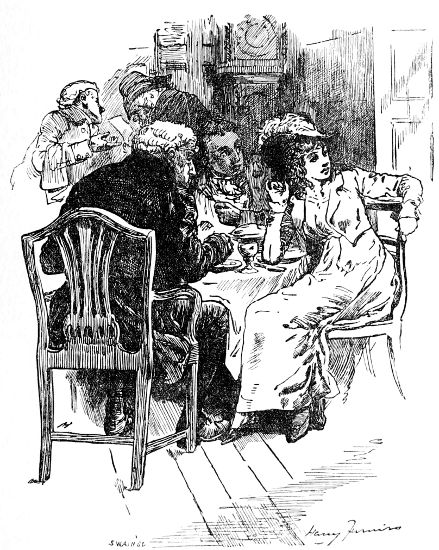 FROM SIR HARRY FURNISS' 'THE TALK OF THE TOWN.'
BY LEAVE OF MESSRS. SMITH, ELDER.
Other book-illustrators whose connection with
'Punch' is a fact in the record of their work are
Mr. A. S. Boyd and Mr. Arthur Hopkins. Mr.
Jalland, too, in drawings to Whyte-Melville used
his sporting knowledge on a congenial subject.
Mr. A. S. Boyd's 'Daily Graphic' sketches prepared
the way for 'canny' drawings of Scottish
types in Stevenson's 'Lowden Sabbath Morn,'
in 'Days of Auld Lang Syne,' and in 'Horace in
Homespun,' and for other observant illustrations to
books of pleasant experiences written by Mrs. Boyd.
Mr. Arthur Hopkins, and his brother Mr. Everard
Hopkins, are careful draughtsmen of some distinction.
Without much spontaneity or charm of
manner, the pretty girls of Mr. Arthur Hopkins,
and his well-mannered men, fill a place in the pages
of 'Punch,' while illustrations to James Payn's
'By Proxy,' as far back as 1878, show that the unelaborate
style of his recent work is founded on past
practice that has the earlier and truer Du Maurier
technique as its standard of thoroughness. Mr. E. J.
Wheeler, a regular contributor to 'Punch' since
1880, has illustrated editions of Sterne and of
'Masterman Ready,' other books also containing
characteristic examples of his rather precise, but
not uninteresting, work.
Save by stringing names of artists together on the
thread of their connection with some one of the illustrated
papers or magazines, it would be impossible
to include in this chapter mention of the enormous
amount of capable black-and-white art produced in
illustration of 'serial' fiction. Such name-stringing,
on the connection—say—of 'The Illustrated
London News,' 'The Graphic,' or 'The Pall Mall
Magazine,' would fill a page or two, and represent
nothing of the quality of the work, the attainment
of the artist. Neither is it practicable to summarize
the illustration of current fiction. One can only
attempt to give some account of illustrated literature,
except where the current illustrations of an
artist come into the subject 'by the way.' Mr.
Frank Brangwyn may be isolated from the group
of notable painters, including Mr. Jacomb Hood,
Mr. Seymour Lucas and Mr. R. W. Macbeth,
who illustrate for 'The Graphic,' by reason of his
illustrations to classics of fiction such as 'Don
Quixote' and 'The Arabian Nights,' as well as to
Michael Scott's two famous sea-stories. To some extent
his illustrations are representative of the large-phrased
construction of Mr. Brangwyn's painting,
especially in the drawings of the opulent orientalism
of 'The Arabian Nights,' with its thousand and one
opportunities for vivid art. Mr. Brangwyn's east
is not the vague east of the stay-at-home artist, nor
of the conventional traveller; his imagination works
on facts of memory, and both memory and imagination
have strong colour and concentration in a mind
bent towards adventure. One should not, however,
narrow the scope of Mr. Brangwyn's art within the
limits of his work in black and white, and what is
no more than an aside in the expression of his individuality,
cannot, with justice to the artist, be
considered by itself. Other 'Graphic' illustrators—Mr.
Frank Dadd, Mr. John Charlton, Mr. William
Small, and Mr. H. M. Paget, to name a few only—represent
the various qualities of their art in black-and-white
drawings of events and of fiction, and the
'Illustrated,' with artists including Mr. Caton
Woodville, Mr. Seppings Wright, Mr. S. Begg,
M. Amedée Forestier and Mr. Ralph Cleaver, fills
a place in current art to which few of the more
recently established journals can pretend. Mr.
Frank Dadd and Mr. H. M. Paget made drawings
for the 'Dryburgh' edition of the Waverleys. In this
edition, too, is the work of well-known artists such as
Mr. William Hole, whose Scott and Stevenson illustrations
show his inbred understanding of northern
romance, and together with the character etchings
to Barrie, shrewd and valuable, represent with some
justice the vigour of his art; of Mr. Walter
Paget, an excellent illustrator of 'Robinson Crusoe,'
and of many boys' books and books of adventure, of
Mr. Lockhart Bogle, and of Mr. Gordon Browne.
In the same edition Mr. Paul Hardy, Mr. John
Williamson and Mr. Overend, showed the more
serious purpose of black and white that has
earned the appreciation of a public critical of any
failure in vigour and in realization—the public
that follows the tremendous activity of Mr. Henty's
pen, and for whom Dr. Gordon Stables, Mr. Manville
Fenn and Mr. Sydney Pickering write. Of M.
Amedée Forestier, whose illustrations are as popular
with readers of the 'Illustrated' and with the larger
public of novel-readers as they are with students of
technique, one cannot justly speak as an English
illustrator. He, and Mr. Robert Sauber, contributed
to Ward Lock's edition of Scott illustrated
by French artists. Their work, M. Forestier's so
admirable in realization of episode and romance,
Mr. Sauber's, vivacious up to the pitch of 'The
Impudent Comedian'—as his illustrations to Mr.
Frankfort Moore's version of Nell Gwynn's fascinations
showed—needs no introduction to an English
public. The black and white of Mr. Sauber and
of Mr. Dudley Hardy—when Mr. Hardy is in the
vein that culminated in his theatrical posters—has
many imitators, but it is not a style that is likely to
influence illustrators of literature. Mr. Hal Hurst
shows something of it, though he, and in greater
measure Mr. Max Cowper, also suggest the unforgettable
technique of Charles Dana Gibson.