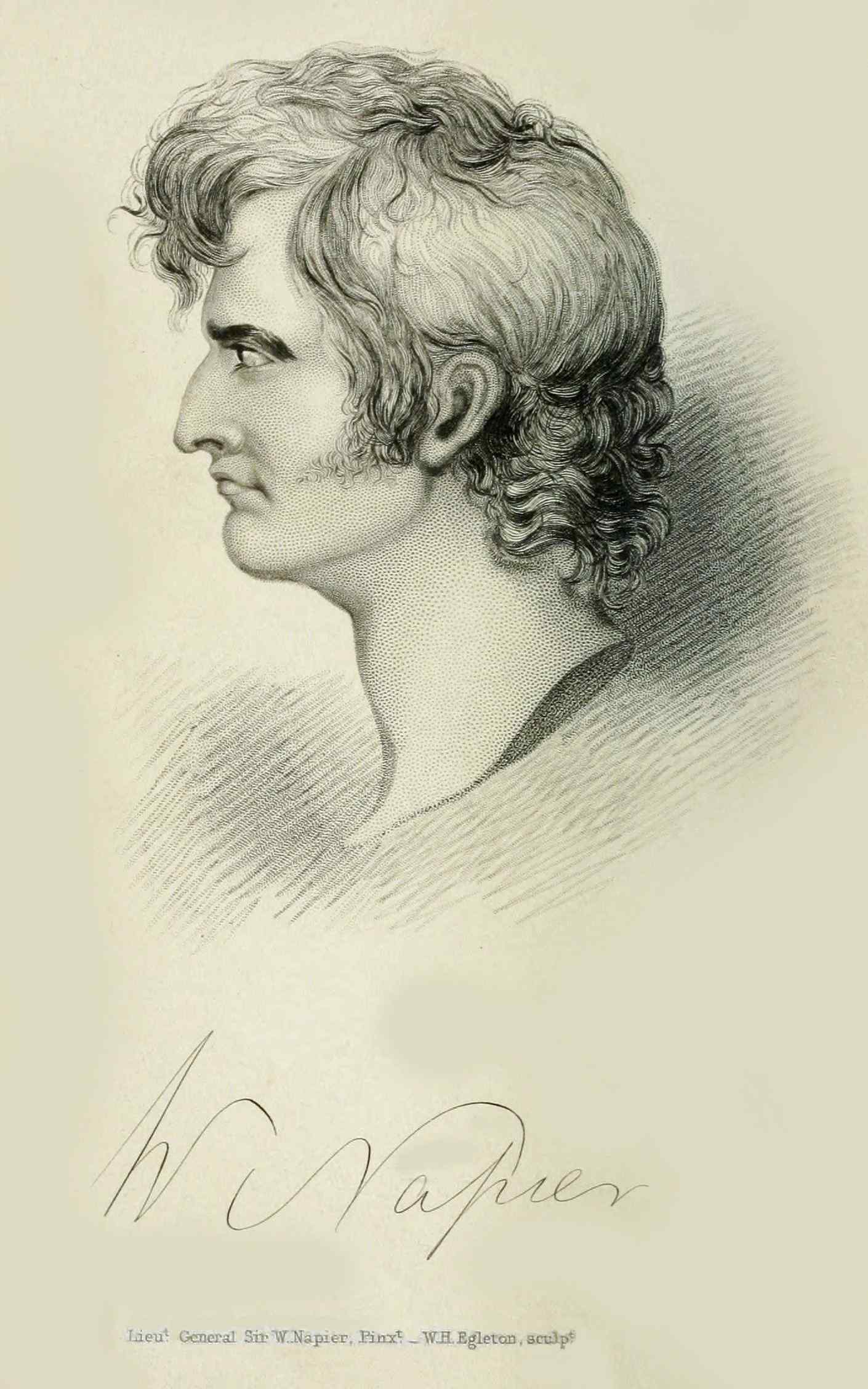
A larger version of the Frontispiece (below)
may be seen by right-clicking it and
selecting an option to view it separately, or by double-tapping
and/or stretching it.
W Napier
Lieut.-General Sir W. Napier. Pinxt. W.H. Egleton, sculpt.
EXTRACTED FROM HIS ‘PENINSULA WAR.’
BY
LIEUT.-GEN. SIR WILLIAM NAPIER, K.C.B., &c. &c.
LONDON: JOHN MURRAY, ALBEMARLE STREET.
1855.
LONDON: PRINTED BY W. CLOWES AND SONS, STAMFORD STREET,
AND CHARING CROSS.
NOTICE.
In this publication, the combats of Roriça, Vimiero, and
Coruña, and the character of Sir John Moore, have been
entirely recomposed. The other battles and sieges are,
with more or less compression of details, transcripts from
the History of the Peninsula War. Thus arranged they will
perhaps most effectually exhibit the constant energy of the
British soldier, and draw attention in their neighbourhoods
to the veterans who still survive. Few of those brave men
have more than a scanty provision, many have none; and
nearly all, oppressed with wounds, disease, and poverty,
sure attendants on an old soldier’s services, feel life a burthen,
so heavy as to make them envy the lot of comrades who
threw it off early on the field of battle.
For the authenticity of the events the reader has this
guarantee. The author was either an eye-witness of what
he relates, or acquired his knowledge from those who were.
Persons of no mean authority. Commanders-in-chief,
generals, and other officers on both sides; private official
correspondence of the English envoys; military journals
and reports of the French leaders; the correspondence of
the intrusive King Joseph, and his ministers, and the private
military notes and instructions of the Emperor Napoleon,
have all contributed to establish the truth of the facts and
motives of action.
For the great Captain who led the British troops so
triumphantly, this record gives no measure of ability. To
win victories was the least of his labours. Those who desire
to know what an enormous political, financial, and military
pressure he sustained, what wiles he circumvented, what
opposing skill he baffled, what a powerful enemy he dealt
with and overcame, must seek the story in the original History
from which this work has been extracted. For the
soldiers it is no measure of their fortitude and endurance:
it records only their active courage. But what they were,
their successors now are—witness the wreck of the Birkenhead,
where four hundred men, at the call of their heroic
officers, Captain Wright and Lieutenant Girardot, calmly
and without a murmur, accepted death in a horrible form
rather than endanger the women and children already saved
in the boats. The records of the world furnish no parallel
to this self-devotion!
CONTENTS.
BOOK I.
Page
Combat of Roriça—Battle of Vimiero—Coruña—Battle of Coruña—Heroic Death and Character of Sir John Moore
Matagorda—Battle of Barosa—Massena’s Retreat—Combat of Redinha—Combat of Cazal Nova—Combat of Foz d’Aronce—Combat of Sabugal—Extraordinary Escape of Colonel Waters—Combat of Fuentes Onoro—Battle of Fuentes Onoro—Evacuation of Almeida
Combat of Campo Mayor—First English Siege of Badajos—Battle of Albuera—Renewed Siege of Badajos—First Assault of Christoval—Second Assault of Christoval
Blockade of Ciudad Rodrigo—Combat of Elbodon—Guinaldo—Combat of Aldea Ponte—Surprise of Arroyo de Molinos—Defence of Tarifa—English Siege of Ciudad Rodrigo—Third English Siege of Badajos—Assault of Picurina—Assault of Badajos
Beira—Extraordinary Escape of Major Grant—Surprise of Almaraz—Siege of the Salamanca Forts—Combats between the Duero and the Tormes—Combats of Castrejon and the Guarena—Battle of Salamanca—Combat of La Serna
Madrid—Siege of Burgos—First Assault—Second Assault—Third Assault—Fourth Assault—Fifth Assault—Retreat from Burgos—Combat of Venta de Pozo—Combat on the Carion—Pisuerga—Duero—Retreat from Madrid—Tormes—Matilla—Combat of the Huebra
Pyrenees—Combat of Roncesvalles—Combat of Linzoain—Combat of Maya—Combat of Zabaldica—First Battle of Sauroren—Combat of Buenza—Second Battle of Sauroren—Combat of Doña Maria—Combats of Echallar and Ivantelly
English Passage of the Bidassoa and Second Combat of Vera—The Passage of the Lower Bidassoa—Second Combat of Vera—Battle of the Nivelle; Characters of Colonel Lloyd and Lieutenant Freer
Passage of the Nive—Battles in front of Bayonne—Combat of Arcangues—First Battle of Barrouilhet—Second Battle of Barrouilhet—Third Combat of Barrouilhet—Battle of St. Pierre—Operations beyond the Nive
Passages of the Gaves and the Adour—Passage of the Gaves—Combat of Garris—Passage of the Adour—Passage of the Gaves continued—Battle of Orthes—Combat of Aire
Garonne—Adour Combat of Vic Bigorre—Death and Character of Colonel Sturgeon; Surprising Feat of Captain Light—Combat of Tarbes—Operations on the Garonne—Major Hughes; Battle of Toulouse—Sally from Bayonne
BATTLES AND SIEGES OF THE PENINSULA. — BOOK I. — Combat of Roriça. (Aug. 1808.) — Battle of Vimiero. (Aug. 1808.) — Coruña. (Jan. 1809.) — Battle of Coruña. (Jan. 1809.)
Combat of Roriça—Battle of Vimiero—Coruña—Battle of Coruña.
In the year 1808 Sir Arthur Wellesley marched from the
Mondego river with twelve thousand three hundred men,
and eighteen guns, to attack General Junot who was in
military possession of Portugal. The French troops were
scattered, but General Laborde had been detached with a
division to cover their concentration, and watch the English
movements. This led to the first fight between the French
and English in the Peninsula.
Fourteen hundred Portuguese, under Colonel Trant, a military
agent, joined the British on the march, and the French
were felt the 15th of August at Brilos, in front of Obidos,
where some men fell in a skirmish. Sir A. Wellesley then
entered the Valley of Obidos, in the middle of which Laborde
occupied isolated ground of moderate elevation, near the
village of Roriça; he had only five thousand men and six
guns, little more than one-third of the English numbers, but
he had five hundred cavalry, had chosen his position well,
and could handle troops with dexterity.
On his right was a lofty mountain ridge, on his left lower
but very rough ground, and the valley behind him was
closed, not only by the commingling of the hills in a mountainous
knot, but by a rocky projection called the Zambugeira
or Columbeira heights, which, at less than a mile, stood like
a citadel in his rear, and was so covered with copses, wild
evergreens and forest trees, and so rugged that only by paths
leading up deep clefts and hollows could it be ascended.
The British general marched from the town of Obidos on
the 17th with fourteen thousand men and eighteen guns in
order of battle. His right, composed of Trant’s Portuguese,
turned the French left; his centre, nine thousand infantry
with twelve guns, moved against their front; his left, one
division with six guns, having gained the crest of the mountain
ridge by a wide movement from Obidos, turned the
French right, and was to oppose any counter attack from
General Loison, who had been heard of on that side, and
might come up during the action with a division six thousand
strong of all arms. Such an order of battle, with such superior
numbers, forbade Laborde to maintain his ground at
Roriça, and after a cannonade, during which his skirmishers
vigorously disputed the approaches, he, with a nice calculation
of time and distance, retreated under the protection of
his cavalry to the rocks of Zambugeira, and then turned to
fight, still hoping to be joined by Loison.
This masterly movement compelled Sir Arthur Wellesley
to show all his forces, and imposed a change in disposition.
His left was then reinforced on the mountain, because each
passing hour rendered Loison’s arrival more likely; Trant was
more closely to menace the French heights on the right, and
the centre was to break in on the front when the strength of
the position should be shaken by the progress of the wings.
In war, however, error is the rule not the exception.
Some mistake caused the left to move directly against the
French right instead of passing the flank to take them in
rear, and as Trant was distant and too feeble to give uneasiness,
the centre dashed prematurely against the crags of
Zambugeira on a front of less than a mile. The advantage
of superior numbers was thus lost, and that of ground was
entirely with the enemy. Only four thousand British could
be thrust into the fight, and though the remainder were at
hand, the foremost combatants had to win their way against
an equal force of brave and active troops, defending rocks
which vigorous men only could scale unopposed. Very
crowded also were the assailing columns in the narrow paths,
which only admitted a few men abreast, and hence no positive
connection could be maintained between the different
attacks, nor could any unity of power be insured: but the
skirmishers soon covered the face of the ascent, and the noise
and flashing of their musketry, with the smoke bursting up
through the foliage, enabled the English general to mark the
progress of the battle and govern his masses: it was soon
manifest that the position would be finally forced, but within
that flame-shooting, smoking labyrinth, rough work was
being done and various turns of fortune had place.
Laborde, unable to hold his ground alone against the great
force opposed, sought to gain time for Loison’s junction by
clinging tenaciously to the side from whence that general
was expected, and gradually drawing off his troops from the
left as the battle approached. While thus operating, two
English regiments, the 9th and 29th, were by a false
movement suddenly thrown into his hands. Forming with
the 5th regiment one column of attack, they were to have
united with Trant on the left of the French, but with a
fierce neglect of orders had taken a path leading more
directly to the enemy: the head of the 29th thus reached
the table-land above at a point where Laborde was concentrating
his left wing on his centre, and as some of the former
were still coming in, the regiment was assailed in front and
flank. Colonel Lake fell, many men went down with him,
and the French on the English right, few in number and
thinking they should be cut off, furiously broke through the
disordered mass, carrying with them a major and many other
prisoners.
Then, dropping below the brow of the hill, the oppressed
troops rallied on their left wing and on the 9th Regiment, and
all rushing up together, regained the table-land, presenting a
confused front, which Laborde vainly endeavoured to destroy:
yet many brave men he struck down, and mortally wounded
Colonel Stewart of the 9th, fighting with great vehemence.
Soon the 5th Regiment, which had not deviated from the
true path, appeared on his left, while the skirmishers of the
other attacks emerged thickly from the crags and copses of
the ascent: the left flanking column had now also turned his
right, had cut off the line of communication with Loison, and
was so rapidly advancing, as to render a retreat imperative
and difficult. His situation was indeed critical in the extreme,
and he was wounded, but with unyielding resolution
he made the movement along a narrow table-land leading
from his position to the knot of mountains behind, checking
pursuit by partial charges of cavalry, until he reached the
village of Zambugeira: there the ground opened, and the
danger from the flanking force being fended off by deep
ravines, he turned and made another stand, but was finally
forced to seek refuge in the higher mountains, having lost
three guns and six hundred men killed and wounded: the
British loss being nearly five hundred.
Laborde was not pursued, his retreat was inland, and to
keep near the coast was essential to the English general,
because he expected reinforcements by sea, and desired to
insure their disembarkation and receive provisions from the
ships. In this view he designed to march by his right on
Torres Vedras, which would bring him near the ocean, give
command of the great road to Lisbon, and throw off Loison
and Laborde from that capital; but in the night came intelligence
that a large fleet, conveying two brigades of
infantry, was on the coast, and to protect their landing he
made for Vimiero, a village near the sea, nine miles from
Torres Vedras: there the brigades from the ocean augmented
his force to sixteen thousand British soldiers. Junot, meanwhile,
having rallied Laborde’s and Loison’s troops, had
forestalled him at Torres Vedras, with fourteen thousand
good soldiers and twenty-three guns of small calibre; and
while his powerful cavalry prevented the scouts from making
observations, he prepared to march in the night of the 20th
and attack on the 21st. Sir Arthur had also projected a
march for the night of the 20th, to turn Junot’s left and gain
Mafra in his rear, without assailing Torres Vedras, which,
though shrouded by the horsemen, was known as a strong
position. The armies would thus have changed places
without encountering, if the English ministers had not appointed
three generals senior to Sir Arthur to act in Portugal,
one of whom, Sir Harry Burrard, had arrived. He did not
land and assume command, but he forbade the projected
march, and thus deprived the English army of the initiatory
movement, giving it to the French: moreover, as the ground
at Vimiero had been taken temporarily and for ease, the troops
were not in fighting order, thus violating the maxim which
prescribes constant readiness for battle when near an enemy.
It was thus posted.
On the right a mountain ridge, trending from the sea inland,
ended abruptly on a small plain in which the village
of Vimiero was situated, and the greater part of the army
was heaped on the summit.
On the other side of the plain the same line was continued
by a ridge of less elevation, narrow, yet protected by a ravine
almost impassable, and being without water had only one
regiment and some picquets posted there.
In front of the break between these heights and within
cannon-shot, was an isolated hill of inferior elevation, yet of
good strength, masking the village and plain of Vimiero, and
leaving only narrow egress from the latter on the right. On
this hill six guns and two brigades of infantry, Fane’s and
Anstruther’s, were posted, the former on the left: behind them
in the plain the commissariat and artillery stores were parked.
All the cavalry with the army—a single squadron under
Col. Taylor—was placed at the egress from the plain, on the
direct road to Torres Vedras; but from the counter hills,
facing the position, another road, running from Torres Vedras
to Lourinham, led at the distance of two miles round the
left, and by it an enemy could gain the ridge where the
picquets were posted, seize the artillery and commissariat
stores in the plain, and take the central hill and right-hand
mountain in reverse.
In the night of the 20th a German officer of cavalry aroused
Sir Arthur Wellesley, saying the French army, twenty
thousand strong, was within an hour’s march. Incredulous
of this tale, the bearer of which was in evident consternation,
he merely took some additional precautions; and at sunrise
all eyes were turned southward, seeking an enemy who was
not to be seen. Nevertheless the German’s report was only
an exaggeration.1 Junot had been in march all night with
fourteen, not twenty, thousand men, designing to fall on at
daybreak; but the rugged ways had retarded his progress,
and his vanguard of cavalry did not crown the hills facing
the English position before eight o’clock—the dust of its
march having been discovered an hour before. Had he
arrived by daybreak this dust could not have been observed,
and an hour of preparation would have been lost to the
English general, which, with a good plan of battle, would
have enabled the French to gain the left-hand ridge, by the
Lourinham road, before the troops on the right could cross
to occupy that part of the position.
Junot employed little time to note his adversary’s ground
and dispositions, and entirely neglected the mountain on the
English right, as being refused to his line of march; but as
the left-hand ridge appeared naked of troops, he resolved to
seize it by a detachment, and take the English central hill
in reverse while he attacked it in front with his main body,
thinking he should find the bulk of the army there. In this
view he directed General Brennier with a brigade across the
ravine covering the ridge, and Laborde with another against
the central hill, supporting the latter with Loison’s division,
a reserve of grenadiers under Kellermann, and the cavalry,
thirteen hundred strong, under Margaron.
To act on conjecture is dangerous in war. Junot conjectured
falsely, and his entire disregard of the English right
was a great error; for when his cavalry crowned the counter
hills, Sir A. Wellesley, seeing the movements did not menace
that part of his position, retained there one brigade under
General Hill to serve as a support to the centre, while
four other brigades were sent across the plain to occupy the
left-hand ridge, and a fifth, reinforced with Trant’s Portuguese,
moved to a parallel ridge in rear, where they could watch the
Lourinham road.
All these movements were hidden from Junot by the
central hill, and two brigades reached their ground before
the action commenced; yet, knowing the ravine in front to
be impracticable, they looked for an attack from the left,
and formed two lines across the ridge, trusting to a chain of
skirmishers to protect their right. The two other brigades
were to have furnished a third line, but while they were
passing the plain below the battle was begun in the centre
with great fury.
In front of the English position the ground was so broken
and wooded that the movements of the French, after they
passed the counter hills, could not be discerned until they
burst upon the centre in attack; and though their artillery
was most numerous, the tormented ground impeded its
action, while the English guns, of heavier metal, had free
play: their infantry, inferior in number, would therefore
have fought at great disadvantage, even if Junot’s combinations
had not failed; but soon that general discovered the
mischief of over-haste in war. Brennier found the bottom of
the ravine impracticable, and floundering amidst rocks and
the beds of torrents was unable to co-operate with Laborde;
hence Junot had to reinforce the latter with Loison’s infantry,
and detach another column of all arms under General Solignac
to turn the English flank by the Lourinham road. But he
did not perceive that Sir Arthur, anticipating such an effort,
had there, not a flank but a front, three lines deep, while the
fifth brigade and Trant’s Portuguese were so disposed, that
Solignac, whose movement was isolated, could be cut off and
placed between two fires.
Laborde and Loison opened three attacks, one principal,
with minor bodies on the flanks. The first, being well led
and covered by skirmishers, forced its way up with great
vehemence and power, but with great loss also; for General
Fane had called up the reserve artillery under Colonel Robe
to reinforce the six guns already on the platform, and while
they smote the column in front, another battery, belonging
to one of the brigades then ascending the left-hand ridge,
smote it in the right flank, and under this conjoint fire of
artillery and a wasting musketry the French reached the
summit, there to sustain a murderous volley, to be charged
by the 50th Regiment, overturned, and driven down again.
Of the other two columns, the one assailing Anstruther’s
brigade was beaten quickly, and that general had time to
reinforce Fane’s left with the second battalion of the 43rd in
opposition to Kellermann’s grenadiers, half of whom now reinforced
the third column on that side. This regiment, posted
in a churchyard on the edge of the declivity, had one or two
companies in advance amongst some trees, and from thence
the first burst of the grenadiers drove them upon the main
body; but then Robe’s battery so smote the left of the French
that they dipped into the ravine on their right, where the
battery from the ridge caught them on the other flank; the
moment was happily seized by the 43rd to pour down in a
solid mass, and with ringing shouts it dashed against the
column, driving it back with irrecoverable disorder: yet not
without the fiercest fighting. The loss of the regiment was
a hundred and twenty, and when the charge was over, a
French soldier and the Sergeant Armourer, Patrick, were
found grimly confronting each other in death as they had
done in life, their hands still clutching their muskets, and
their bayonets plunged to the sockets in each manly breast!
It is by such men that thousands are animated and battles won.
Broken by these rough shocks, the French, to whom defeat
was amazement, retired in confused masses and in a slanting
direction towards the Lourinham road, and while thus disordered
Colonel Taylor rode out upon them doing great execution;
but as suddenly Margaron came down with his strong
cavalry, and the gallant Englishman fell with most of his
horsemen. However, half of Junot’s army was now beaten
with the loss of seven guns, and though Margaron’s powerful
cavalry, and that moiety of Kellermann’s grenadiers which had
not been engaged, interposed to prevent pursuit, the line of
retreat left the shortest road to Torres Vedras uncovered—a
great fault which did not escape the English general’s rapid
comprehension.
Brennier, unable to emerge from the rocks and hollows
where he was entangled, had been of no weight in this
action, but Solignac, having turned the ravine, appeared on
the left about the time Taylor’s charge terminated the fight
in the centre, and his division, strongly constituted with all
arms, was advancing impetuously along the narrow ground,
when General Ferguson, who was there in opposition, met
him with a counter attack, so fierce, so rapid and sustained,
that the French, though fighting stubbornly, bent to the
strong pressure. Solignac was wounded, his cavalry, artillery
and infantry, heaped together and out-flanked, were cut off
from their line of retreat and forced into low ground on their
right with a loss of six guns. These pieces, placed under
guard of the 71st and 82nd while Ferguson continued his
course, were again lost by one of those events which make
battles the property of fortune; for Brennier, after long
struggling, having worked up the ravine by his right to an
accessible place, had ascended the ridge, and, unexpectedly
falling upon the two regiments in charge of the captured
guns, beat them back. He thus got behind Ferguson, and
had time been given to reform his troops and assail that
general’s rear mischief would have ensued; but the English
regiments were disordered only for a moment; they rallied
on higher ground, poured in their fire, broke the French
brigade with a charge and made Brennier, who was wounded,
a prisoner. Solignac’s division was then without resource,
when suddenly another and more decisive change came over
this fitful battle.
Junot’s left wing and centre had been so discomfited, that
only half of Kellermann’s grenadiers and Margaron’s cavalry
remained unbroken, and the road of Torres Vedras, the
shortest to Lisbon, was uncovered; Brennier’s column was
entirely broken; Solignac’s division was in confusion on low
ground, cut off from Junot, and menaced front and rear.
But of the English army, Hill’s brigade had not fired a shot;
neither had the brigade conjoined with Trant’s Portuguese,
and it was then marching to take Solignac’s division in rear.
The two brigades of Ferguson’s third line had lost only a few
men, and those on the central hill had not been hardly
handled; there was therefore a powerful force in hand for
further operations. Now Brennier, when first taken, eagerly
asked if the reserve had attacked, and the other prisoners
being questioned on this point replied in the affirmative,2
wherefore the English general, judging the French power
exhausted, and the moment come for rendering victory decisive,
with the genius of a great captain resolved to make it
not only decisive on the field but of the fate of Portugal.
Expecting Solignac’s division to lay down its arms, he
designed to push his own right wing and centre, under Hill,
on Torres Vedras, to which they were two miles nearer than
any part of the French army; that stroke was sure, and
Junot would have been cut off from Lisbon. Meanwhile Sir
Arthur meaned in person vigorously to drive him across the
Baragueda mountain on to the Tagus, by which he would
lose his remaining artillery, and have with disorganised and
dispirited troops to seek refuge under the guns of one of the
frontier fortresses. This great project was stifled as soon as
conceived. General Burrard had arrived on the field of
battle, he could not comprehend such a stroke of war, and
not only stopped the execution but ordered Ferguson to
halt. Then Solignac’s division, with the alacrity which distinguished
Napoleon’s soldiers, instantly rejoined Junot, who
as promptly recovered his original ground, and being joined
by twelve hundred fresh men from Lisbon regained Torres
Vedras. The battle of Vimiero thus terminated impotently.
Nevertheless, Burrard’s decision, with exception of the unaccountable
order to arrest Ferguson’s career, was not without
a military justification, admitted to be of weight by Sir
Arthur, but it was that of an ordinary general in opposition
to a great captain.
The battle of Vimiero, in which the French lost thirteen
guns and about two thousand killed or wounded, the British
eight hundred, was followed by a convention which relieved
Portugal, and the English Government then sent an army
into Spain under Sir John Moore. Great success was looked
for by the ministers, yet they took no measures to render it
even probable; and the incredible absurdity of the Spaniards,
who were overthrown in every quarter before the English
could reach them, made that which was improbable impossible.
Moore found himself alone in the midst of a
French army commanded by Napoleon, of which the cavalry
alone counted twelve thousand more than the whole British
force! Compelled to retreat, he was pursued by the Emperor,
who made a prodigious march to cut him off at Astorga, and
failing of that, launched Marshal Soult on his traces with one
army, supported by another under Marshal Ney. Through
the mountains of Gallicia the three armies passed like a tempest,
yet Moore, with unflinching resolution, amidst winter
rains and appalling difficulties, and without one gleam of
good fortune to nourish energy, reached Coruña with a gain
of two marches on his pursuers. His retreat was one of suffering,
of privation and fatigue, but he met with no disaster
in arms, and in many combats taught the enemy to beware of
his sword. At Rueda his cavalry, under C. Stewart,3 surprised
a French post and made eighty prisoners. Near
Valladolid Major Otway4 in a sharp action took a colonel,
and more prisoners than he had men to guard them with.
At Sahagun Lord Paget5 overthrew six hundred dragoons,
killed twenty, and took thirteen officers and one hundred and
fifty men. At Mayorga the same nobleman killed as many,
and took a hundred prisoners; and at Benevente defeated
the light cavalry of the Imperial Guard, capturing General
Lefebre and seventy men. At Calcavallos Moore, in person,
repulsed a serious attack in which the French general Colbert
was killed. At Constantino he repulsed another attack, and
at Lugo checked the enemy with a loss of four hundred men.
At Coruña his design was to embark without fighting, but
the ships did not arrive in time, and he had to accept battle
in a bad position. The ground he desired to take was a
rocky range abutting on the Mero, a tidal river, but it being
too extensive for his troops, he was compelled to adopt a
similar yet lower range, likewise abutting on the Mero, yet
inclosed on two sides by the greater heights, which were left
for the enemy. Neither of these ranges were crested, and on
the inferior one Moore had to display a front in opposition to
the superior range, from whence the French not only commanded
most of the English line in front within cannon-shot,
but could flank it also on the right. Soult’s ground was
indeed in every way advantageous. His left rested on a
clump of rocks overlooking both ranges, and all the country
immediately about; and in the night of the 15th he placed
there eleven heavy guns which, from their elevation, could
oppress the right of the English line and send their bullets
raking even to the centre.
Between the two positions the ground was comparatively
easy of passage, though broken and laced with stone inclosures;
and as both ridges ended abruptly on a narrow valley
running perpendicular to their range, there was a seeming
facility from their proximity at that flank for the French to
envelop the British right with superior numbers. On the far
side of this valley also was a mountainous chain of hills on
which all Soult’s cavalry were posted, his light horsemen
being pushed far behind the British rear, while his heavy
dragoons dismounted to act as infantry. Thus the French
army seemed to be surrounding the English, but Moore,
comprehending all the defects of his position, had adopted a
counteracting order of battle, evincing his own martial
vigour, and the confidence a long career of glorious and successful
service had given him in the stern valour of the
British soldier.
To receive battle on the inferior ridge was of necessity,
but to extend his line athwart the narrow valley on his right
to the height occupied by the French cavalry would only
have placed more men under the rock battery, and his flank
would still be exposed to the dismounted French dragoons.
Wherefore he merely stretched a thin line of skirmishers
across, and placed a battalion on the lower falls of the hills
on their right, to check the horsemen on the summit. This
disposition, and a scanty manning of the main ridge, where
he posted only two divisions, Hope’s and Baird’s, the latter
on the right, gave him two divisions of reserve, Paget’s and
McKenzie Frazer’s. The last he placed on rising ground
closely covering Coruña, to watch a road leading round the
heights where the French cavalry were, and which Soult,
whose movements could not be seen, might use to turn the
British and cut them off from the town and harbour.
Paget’s division, the best in the army, remained, and with
it Moore resolved to strike for victory. He kept it in mass
behind the right of his main line, on a moderate elevation,
from whence it commanded a full view of the narrow valley,
and could support the screen of light troops without being
exposed to the fire of the eleven-gun battery. Thus, while
the main ridge, strong in itself though ill presented to the
enemy, was offered in defence, with protected flanks, two
other divisions remained in hand to meet the changes of
battle—a fine result to obtain for an inferior army occupying
unfavourable ground. But Moore meaned more than defence.
Confident that Baird and Hope would repel every attack on
the ridge, he designed, when time should be ripe, if the
French did not join infantry to their cavalry on the other
side of the valley, to pour down the latter with Paget’s division,
reinforcing it with Frazer’s, and thus carry in one
course the rock battery; then changing from the defensive to
the offensive with all his troops, to drive the enemy into the
Mero: it was the conception of a daring man and a great
commander, and only with such potent soldiers as the
British could a like stroke be made. And only a general
who had proved their quality in many a desperate fight
could have expected this effort from his men, after a distressing
winter retreat, with a strong enemy in front and the sea
behind! But general and soldiers were of England’s best.
No suffering, no danger could quell their courage, or shake
his confidence in them: and it was so proved in that hour,
for many of the principal officers, appalled at the superior
force of the enemy, the disadvantage of ground, and the difficulty
of embarkation, proposed negotiations, which Moore
rejected with cold disdain, trusting as he had ever done to
his gallant troops.
Belonging to the French position, and occupied by them
in force, were two villages, Palavia Abajo in front of their
right, Portosa in front of their centre.
Belonging to the English position, though rather too
much advanced, the village of Elvina covered the right
flank, and was occupied by the picquets of the 50th
Regiment.
These features dictated Soult’s order of attack. Forming
three columns of infantry, which he supported with all his
light artillery, he directed two by Palavia and Portosa
against the left and centre of Moore’s line—those villages
serving as intermediate supports in case of disaster—while
the third and strongest column was destined to carry Elvina
and then lap round Baird’s right.
On the 16th of January, 1809, at two o’clock in the afternoon,
twenty thousand French veterans opened this battle
against fourteen thousand British, who, having but nine six-pounders
to oppose to a numerous light artillery, were also
galled by eleven heavy guns on the rocks: and soon that formidable
battery opened the fight with a slaughtering fire,
sending its bullets crashing through the English ranks from
right to centre. Then the columns of infantry, throwing out
clouds of skirmishers, descended from their strong ridge to
the fight. Those coming from Palavia and Portosa, having
some distance to march, did not immediately engage, but
the third dashed at once against Elvina, and there was the
stress of battle; the picquets were driven in heaps out of the
village, and when that was passed the French mass divided,
one portion advancing against Baird’s front, the other turning
his right by the valley, where it was only opposed by
the screen of light troops.
Sir John Moore sent the 42nd and 50th Regiments against
the half column at Elvina, and wheeling back the 4th Regiment
on the extremity of his right, poured a fire into the
flank of the mass penetrating by the valley, where it was also
stoutly opposed by the light troops, and soon abated of its
vehemence in attack. Then the English general knew that
his adversary’s whole force and order of battle was unfolded.
No infantry menaced the valley from where the French
cavalry stood, and the number in front showed that no body
of strength for mischief was behind those heights: it was
evident that Soult offered a close rough trial of arms, without
subtlety, trusting to the valour of his veterans. Eagerly the
gallant Moore accepted the challenge. The moment for his
counter-stroke had arrived, and at once he called up Frazer’s
division in support of Paget, giving the latter, who was
previously well instructed, the signal to descend into the
valley: the French column on his flank being thus provided
with opponents, he turned to observe the progress of the
fight at Elvina, for as yet the battle had but slightly touched
his centre and left.
The 42nd and 50th had driven the enemy back into the
village, and the last-named regiment, entering the streets
with the repulsed disordered mass and giving no respite,
forced it through and broke out, still fighting, on the other
side. To support this advance the general now sent a battalion
of the Guards down, whereupon the 42nd, thinking it
a relief and not a reinforcement, retired, with exception of
the grenadier company. Some confusion thus occurred, the
village was not occupied, and the 50th, still accompanied by
the 42nd Grenadiers, were engaged without support beyond
the houses, their array being quite broken by stone inclosures
and the disorder of the street fight. At that critical moment
the French were strongly reinforced, retook the offensive and
forced the regiment back into Elvina, having killed beyond
it the second Major, Stanhope, a nephew of Mr. Pitt, and
made prisoner the commanding officer, Major Napier, known
since as the conqueror of Scinde; encompassed by enemies,
and denied quarter, he received five wounds, but he still
fought and struggled for life until a French drummer with a
generous heat and indignation forcibly rescued him from his
barbarous assailants. Meanwhile Sir John Moore, observing
the error of the 42nd, had galloped down and with a fiery
exhortation sent it back to the village, where the 50th notwithstanding
the loss of their commander was successfully
sustaining a very violent conflict: then with heroic anticipations
from the development of his counter-combination, he
returned to the ridge from whence he could view the whole
action.
Elvina was now his centre of battle and pivot of movements,
for on his left the battle had then become general and
furious, yet the French made no progress against Hope’s
division; and on the right, in the valley, the attacking
column was at bay, wavering under a double fire in front
and flank: everywhere the signs of coming victory were
bright, when the gallant man, the consummate commander,
who had brought the battle to this crisis, was dashed from
his horse to the earth. A cannon-shot from the rock battery
had torn away all the flesh from his left breast and
shoulder, and broken the ribs over a heart undaunted even
by this terrible this ghastly mortal hurt; for with incredible
energy he rose to a sitting posture, and with fixed look and
unchanged countenance continued to regard the fight at
Elvina until the Frenchmen’s backward steps assured him
the British were victorious: then sinking down he accepted
succour.
Being placed in a blanket for removal, an entanglement
of his belts caused the hilt to enter the wound and Captain
Hardinge6 attempted to take away the weapon altogether;
but with martial pride the stricken man forbade the alleviation—he
would not part with his sword in the field! Epaminondas,
mortally wounded at Mantinea, was anxious for the
recovery of his shield. Moore, mortally wounded at Coruña,
sustained additional torture rather than part with his sword!
The Theban hero’s fall dismayed and paralyzed his victorious
troops. It was not so with the British at Coruña.
They saw Baird, second in command, carried from the field
as the General-in-Chief had been, and they would have seen
all their generals fall one after another without abating their
battle; hence it was not long before the French were entirely
driven from Elvina, while on the left, they were not only
repulsed from the ridge, but pursued and assailed in their
own villages; that of Palavia, defended by the since celebrated
General Foy, was taken. Meanwhile Paget, pouring
into the valley with conquering violence, overthrew everything
in his front, and driving off the dismounted French
dragoons who had descended to the lower falls on his right,
made for the great rock battery, which he would certainly
have stormed if the counter-attack had been continued, and
Frazer’s division been thrown, as Moore designed, into the
fight. The French would thus have been wrecked; for their
ammunition of which the rapid marches through Gallicia had
only allowed them to bring up a small supply, was exhausted,
the river Mero was in full tide behind them, and only one
bridge remained for retreat. But this want of ammunition
was unknown to the English general Hope, on whom the
command had devolved, and he, judging a night action, for
it was then dark, too hazardous, profited from the confusion
of the French to embark the army without loss and sailed
for England. The heroic spirit of Moore went with the
troops, his body rested with the enemy.
For some hours after receiving his hurt that great man had
lived painfully, but with a calm fortitude that excited the
admiration of those about him. Several times he expressed
his satisfaction at having won the battle, and his last words
were to express a hope “that his country would do him justice!”
Full justice has not been done, because malignant faction
has strived hard to sully his reputation as a general—but
thus he died, and the record of his worth will be as a beacon
to posterity so long as heroic virtue combined with great
capacity is reverenced, for in any age, any nation, any conjuncture,
Sir John Moore would have been a leading man.
Tall he was and vigorous of person, and of a very comely
noble aspect, indicating penetration which no subtlety could
deceive, valour which no danger could appal, and withal a
dignity of mind which awed while it attracted admiration
and confidence. With him indeed, all commanding qualities
seemed to be united to and inseparable from estimable sentiments.
Integrity, honour, generosity, patriotism, adorned
the whole course of his existence, and his death furnished an
irrefragable test of the sincerity of his life: for both he may
claim a place with the greatest men of antiquity.
BOOK II. — Passage of the Douro. (May, 1809.) — Talavera. (July, 1809.) — Combat of Salinas. (July, 1809.) — First Combat of Talavera. (July, 1809.) — Second Combat of Talavera. (July, 1809.) — Battle of Talavera. (July, 1809.)
Passage of the Douro—Talavera—Combat of Salinas—First Combat
of Talavera—Second Combat of Talavera—Battle of Talavera.
Napoleon having failed to cut off the English army, returned
to France, leaving precise instructions with his lieutenants
for the invasion of Portugal. Marshal Ney, who reached
Coruña three days after the battle, was to hold Gallicia.
Soult was to march by Oporto upon Lisbon. General Lapisse,
previously directed on Ciudad Rodrigo with twelve thousand
men, was to connect Soult’s invasion with another, to be
conducted south of the Tagus by Marshal Victor, who had
thirty thousand troops. Soult had twenty-five thousand, and,
after several battles with the Portuguese of the northern
provinces, stormed Oporto in March; but he could hear
nothing of Lapisse or Victor, and, his own progressive
strength being then exhausted, he endeavoured to establish
himself solidly until new combinations could be formed.
Lapisse took no pains to open a communication with Soult,
and after several weeks of inactivity suddenly made for
Alcantara, crossed the Tagus there and joined Victor. The
Portuguese and Spaniards, thinking he was flying, rose along
his line of march on both sides of the frontier and cut off all
communication between Victor and Soult. The former was
however little disposed to act. He had defeated the Spanish
general Cuesta in a great battle at Medellin, and only accidentally
failed to obtain Badajos by treason; but then he
took quarters at Merida, sullenly resistant of his orders to
enter Portugal. This enabled Cuesta, who had all the
resources of Andalusia, to reappear in Estramadura with
an army of thirty thousand infantry and six thousand cavalry—and
at the same time a new force sprung up in Portugal.
Previous to this period the English ministers, without
resolution or capacity to adopt any judicious course, at one
time looking to Portugal, at another negotiating for the occupation
of Cadiz, had during these events displayed only
infirmity of purpose and ignorance of the real state of affairs;
but after four months of vacillation, subsequent to the battle
of Coruña, they decided to act in Portugal, where the Regency
had accepted General Beresford as their field marshal. The
British troops in that country were then largely reinforced,
and Sir Arthur Wellesley, assuming the supreme military
command of both nations, commenced that series of victories
which has placed him amongst the truly great generals of
the world—and they are few, though the vanity of nations
would make them many.
Soult was then in Oporto, Victor at Merida, but the frontier
insurrection debarred all intercourse between them; and
Sir Arthur, after making arrangements to cover Lisbon from
Victor, marched against Soult, in whose army there was a
conspiracy of officers to deliver him to the English. One
D’Argenton twice secretly visited head-quarters on this subject,
yet the treason, though of weight as an accessory, was
not permitted to affect the British preparations or movements,
which were carefully concealed.
On the 7th of May Beresford was detached with a mixed
force, six thousand being Portuguese, to operate on the side
of Lamego.
On the 8th, sixteen thousand British troops, fifteen hundred
being cavalry, with twenty-four guns, moved from
Coimbra under Sir A. Wellesley’s personal command towards
the Vouga river.
Up to this time Soult was ignorant that such a force had
been assembled, but hearing nothing of Lapisse or Victor he
had decided to make a flank march into the Salamanca country,
and had pushed his light cavalry under Franceschi to the
Vouga, supporting it with Mermet’s division of infantry.
Loison’s division, six thousand strong, was then beyond the
Tamega at Pezo de Ragoa, and Lorge’s heavy cavalry was
on the Lima, watching the Portuguese insurgents.
In this scattered state the French on the Vouga were
surprised and driven fighting upon the Douro, which they
crossed in the night of the 11th and destroyed the boat bridge.
Soult, who had discovered the conspiracy on the 9th, was thus
suddenly beset with perils. Treason in his army which he could
not probe, a powerful enemy suddenly springing up in front,
an active insurrection on his rear; his troops parcelled from
the Vouga to the Lima and Tamega, and under officers necessarily
suspected while the extent of the conspiracy was
unknown! He did not quail. Directing Lorge to abandon
the Lima and make for the Tamega, he ordered Loison to
hold Amarante on that river, as the only means of concentration
and safety for the army; he sent his stores and most
of the heavy guns towards that place on the 10th and night
of the 11th; and when the troops from the Vouga came
pouring in, the remaining heavy guns and the baggage were
also put in movement, Mermet’s division following them as
far as Vallonga, with orders to secure the boats on the Douro
and vigilantly patrol up the bank. All the craft from Oporto
to the mouth of the river was then drawn to the right bank,
guards were set, and Soult, thinking his position secure,
decided to hold Oporto another day, to give Lorge’s dragoons
and other detachments time to reach Amarante: he was however
curiously misled. In the recent operations, an English
column, moving in boats up the Lake of Ovar, which runs
parallel with the coast, had disembarked on Mermet’s flank,
who thought it had landed from the ocean; hence Soult,
expecting the empty vessels would enter the Douro to effect
a passage, directed his attention entirely to the lower river,
while on the upper his orders were neglected and false reports
made of their execution, for the conspirators were many
and busy.
Before eight o’clock on the morning of the 12th the
British army was secretly concentrated behind a rocky
height, on which stood a convent immediately facing Oporto.
The Douro rolled in front, and the French on the other side
could with two marches gain the Tamega, secure their retreat,
and defeat Beresford in passing; for that general had been
sent over the Douro, above the confluence of the Tamega,
merely to infest Soult’s line of march towards the Salamanca
country, and thus induce him to take the rugged Chaves road
leading to Gallicia, and that could not be risked unless the
main army under Sir Arthur was closely pressing the French
rear; hence his safety, and the forcing Soult into Gallicia,
alike called for an immediate passage of the Douro. Yet how
pass a river, deep, swift, more than three hundred yards
wide, and in the face of ten thousand veterans guarding the
opposite bank? The Macedonian hero might have turned
from it without shame.
The stream came with an elbow round the convent
height, which barred sight of the upper water from the place
where Soult was watching for ships which did not exist;
and he knew not that the British army was behind the frowning
rock above, nor that a great captain was on its summit,
searching with an eagle glance the river, the city, and
the country around. Horses and baggage that captain saw
on the Vallonga road, and the dust of distant columns as in
retreat, but no large force near the river; the guards also
were few and widely spread, the patrols not vigilant—an
auspicious negligence seeming to prevail. Suddenly a large
unfinished building called the Seminary caught his eye; it
was isolated, had an easy access from the water, and was
surrounded by a high wall which extended to the river bank
on each side, inclosing space enough for two battalions, the
only egress being an iron gate opening on the Vallonga road.
This structure commanded everything around, except one
mound, within cannon-shot, but too pointed to hold guns;
there were no French posts near the building, and as the
direct line across the water was entirely hidden from the
city by the rock, Sir Arthur, with a marvellous hardihood,
instantly resolved to force a passage there in face of a veteran
army and a renowned general, his means being as scanty as
his resolution was great, yet with his genius they sufficed.
Colonel Waters, an officer on his staff, a quick-witted,
daring man, discovered a poor barber, who had come over
the river the night before in a small skiff and readily agreed
to go back; he was accompanied by the Prior of Amarante,
who gallantly offered his services: thus Waters crossed
unperceived and returned with three large barges. Meanwhile
eighteen guns had been placed in battery on the
convent rock, and General John Murray was detached with
a brigade of German infantry, the 14th Dragoons, and two
guns, to seek a passage at the Barca de Avintas, three miles
up the river: he was reinforced with other troops when the
barges were secured, and then also the head of the army
cautiously approached the water.
At 10 o’clock, the French being tranquil and unsuspicious,
the British wondering and expectant, Sir Arthur was told
that one boat was ready. Well! Let the men cross was the
reply, and a quarter of an hour afterwards an officer and
twenty-five British soldiers were silently placed on the other
side of the Douro in the midst of the French army! The
Seminary was thus gained, all remained quiet, and a second
boat passed. No hostile stir succeeded, no sound of war was
heard; but when the third boat passed, tumultuous noises
rolled through Oporto, the drums beat to arms, shouts arose,
the citizens, vehemently gesticulating, made signals from
their houses, and confused masses of troops rushing out from
the higher streets threw forward swarms of skirmishers, and
came furiously down on the Seminary.
Secrecy was then no longer valuable and the army
crowded to the river bank. Paget’s and Hill’s divisions
pressed to the point of passage, Sherbrooke’s to where the
bridge had been cut away the night before. Paget himself
passed with the third boat, but on the roof of the Seminary
was deeply wounded. Hill took his place, and the musketry,
sharp and voluble from the first, augmented as the forces
accumulated on each side; yet the French attack was eager
and constant, their fire increased more rapidly than that of
the English, and their guns soon opened against the building.
The English battery on the convent rock swept the
inclosure on each side and confined the attack to the front;
but Murray did not come down the right bank, and the
struggle was such that Sir Arthur was only restrained from
crossing by the remonstrances of those about him, and the
confidence he had in Hill. Soon, however, some citizens
were seen bringing over several great boats to Sherbrooke,
while a prolonged shout from the streets, and the waving of
handkerchiefs from the windows, gave notice that the enemy
had abandoned the lower town: Murray also was then descried
on the right bank.
Three battalions were now in the Seminary, the attack
slackened, and the French began to hurry across the front
of the inclosure by the Vallonga road, and Hill, advancing to
the inclosure wall, was pouring a heavy fire into the disordered
masses as they passed his front, when suddenly five
guns galloped out of the city on his left, but appalled at the
terrible stream of musketry pulled up: while thus hesitating
a volley from behind stretched most of the artillerymen in
the dust, and the rest dispersing left the guns on the road.
It was from Sherbrooke, who had passed through the streets,
this volley came, and he now pressed the French rear while
Hill sent his damaging fire into their flank, and the guns
from the rock deeply searched their masses. The passage
was thus won, the allies were on the right bank of the
Douro, and if Murray had fallen on the disordered crowd,
approaching him, the discomfiture would have been complete.
He however suffered column after column to pass,
and seemed to fear they would step aside to push him into
the river. General C. Stewart and Major Harvey, impatient
of this timidity, took two squadrons of the 14th Dragoons,
and riding over the French rear in a narrow way unhorsed
General Laborde and wounded General Foy; but having no
support from Murray fought their way back with loss, and
Harvey lost his arm. Of the English twenty were killed,
one general and nearly a hundred men wounded on the day;
the French lost a general and five hundred men killed or
wounded, and they left several hundreds in hospital. Five
guns were taken in the fight; and stores of ammunition with
fifty pieces of artillery, the carriages of which had been
burned, were found in the arsenal. The overthrow was
great, but Napoleon’s veterans were so inured to war that no
troops so readily recovered from a surprise. Before they
reached Vallonga their order was restored, a rear-guard was
formed, and in the night was rejoined by a detachment from
the mouth of the Douro, which had been guided by some
friendly Portuguese: then Soult, believing Loison held
Amarante, thought himself well out of his difficulties. He
was soon undeceived.
Sir Arthur Wellesley now brought his baggage, stores, and
artillery over the Douro; but this was not effected until the
evening of the 13th, and though Murray’s Germans were
sent in pursuit on the morning of that day, they did not
advance more than ten miles. “An enemy once surprised
should never be allowed time to recover,” is a great maxim, and so
proved on this occasion: yet there were sound reasons for
the halt. Part of the troops were still on the left bank of
the Douro, and the whole had outmarched provisions, baggage
and spare ammunition, having made more than eighty
miles of rough ground in four days, besides fighting. Men
and animals required rest, and nothing was known of Beresford,
whose proceedings had been of far greater importance
than either he or Sir Arthur knew at the time.7
Loison had fallen back from Pezo de Ragoa on the Douro
the 10th when Beresford crossed that river. The latter was
then in the position required for turning Soult on to the
Chaves road; but Loison again retreated on the 11th, and
Beresford, finding him timid, followed briskly, while a
Portuguese insurgent force under General Sylveira closed on
his flank. The 12th his outposts were driven into Amarante,
and next day he abandoned that place.
These events were unknown to Sir Arthur on the 13th, but
he heard Soult had destroyed guns and ammunition near
Penafiel, and judging that to be a result of Beresford’s operations,
reinforced Murray with cavalry, ordering him to push
on to Penafiel, and if Loison lingered near Amarante to open
a communication with Beresford—the latter was then to
ascend the Tamega and intercept the French at Chaves.
On the 14th Sir Arthur had moved forward himself, and
the 15th reached Braga; Beresford was then near Chaves,
Sylveira marching towards Salamonde, and Soult’s capture
seemed inevitable to his pursuers; he was however beyond
their toils, having by a surprising effort extricated himself
from perils as fearful as ever beset a general.
While retreating towards Amarante he was between the
Douro and the Sierra de Catalina, both said to be impassable,
and the road was very narrow and very rugged. His design
was to pass the Tamega and march on Braganza; failing in
that, he could from Amarante and Guimaraens reach Braga
by a good road leading behind the Catalina ridge; in either
case however Amarante was to be first gained, and his safety
depended on Loison holding that place. But that general
had relinquished it to Beresford on the 13th, and marched on
Guimaraens, though a staff officer, sent by Soult on the 12th,
was in his camp protesting against the movement: the retreat
from Oporto being also known to him. He thus deliberately
abandoned his general and two-thirds of the army to what
appeared certain destruction; for Beresford could not be
forced, and if Murray only had come up on the French
rear, and he was not far off, Soult must have laid down his
arms.
This calamity was made known to that marshal as he was
passing the rugged bed of the Souza, a cross torrent falling
into the Douro. The weather was boisterous, the troops
worn with fatigue and recently defeated were dismayed,
voices were heard calling for capitulation, and all things
tended to ruin: but in that hour of peril the Duke of Dalmatia
justified fortune for having raised him to such dignity.
He had fallen from his horse and severely injured his hip,
broken before by a shot at the siege of Genoa, yet neither
pain nor bodily weakness nor danger could abate his resolution.
A Spanish pedlar told him of a path leading up that
bank of the Souza which he had just left, by which he
could scale the Catalina ridge and reach the Guimaraens
road to Braga: whereupon, with a haughty commandment
he silenced the murmurs of treacherous officers and fearful
soldiers, destroyed his guns, abandoned his military chest
and baggage, loaded the animals which had carried them
with sick men and ammunition, and repassed the Souza to
follow his Spanish guide. Torrents of rain descended and
the path was wild and rough as the desolate region it
threaded, yet with a fierce domination he forced his troops
over the mountain, and descending on Guimaraens, refound
Loison: Lorge’s dragoons came in at the same time from
Braga, and thus almost beyond hope the whole army was
concentrated.
Soult’s energy had been great, his sagacity was now as
conspicuous. The slackness of pursuit, after passing Vallonga,
made him judge Sir Arthur was pushing for Braga
and would reach it first; a fighting retreat and the loss of
guns and baggage would then ensue, and perhaps fatally
depress the soldiers’ spirit; it would also favour the malcontents,
and already one general, apparently Loison, was
urging a convention. Soult replied by destroying the guns,
ammunition, and baggage of the divisions he found at Guimaraens,
and again taking to the mountains crossed them to
Carvalho d’Este, thus gaining a day’s march and baffling the
combination to surround him. Next morning he drew up
his twenty thousand men on the position they had occupied
two months before at the battle of Braga, an imposing
spectacle, and on the scene of a recent victory, by which he
aroused the sinking pride of the French soldier. It was a
happy reach of generalship!
Now he reorganized his army, giving Loison the advanced
guard and taking the rear himself; at which, says the French
historian of this expedition, “the whole army was astonished.”
As if it were not consummate policy to oppose the
British pursuit with men under the General-in-Chief, while
the van, having to fight insurgents, was led by an officer
whose very name called forth execrations from the natives—Maneta,
the one-handed, as Loison was called, however willing,
dared not surrender to a Portuguese force.
From Carvalho the French made for Salamonde, whence
there were two lines of retreat; the one by Ruivaens to
Chaves, the other, shorter and more rugged, by the Ponte
Nova to Montelegre. The scouts said the bridge at Ruivaens
was broken, the passage defended by twelve hundred insurgents
with artillery; moreover, that men had been all the
morning working to destroy the Ponte Nova. The breaking
of the first blocked the road to Chaves, the breaking of the
second would, if completed, cut the army off from Montelegre.
Night was setting in, the soldiers were harassed, barefooted,
and starving, the ammunition was injured by rain,
which had never ceased since the 13th, and was now accompanied
by storms of wind, with the morning the British
army would be on the rear, and if the Ponte Nova could not
be secured the hour of surrender was come! In this extremity,
Major Dulong, justly reputed as one of the most daring
men in the French ranks, was thus addressed by Soult: “I
have chosen you from the whole army to seize the Ponte Nova, which
has been cut by the enemy. Take a hundred grenadiers and twenty-five
horsemen, surprise the guards and secure the passage. If
you succeed, say so, but send no other report; your silence will
suffice.”
Dulong, favoured by the storm, reached the bridge, killed
the sentinel without any alarm being given, and being followed
by twelve grenadiers, crawled along a narrow slip of
masonry which had not been destroyed. The Cavado river
was flooded and roaring in its deep rocky channel below, and
one of the grenadiers fell into the gulf, but the waters were
much louder than his cry, and the others surprised the
nearest guards; then the main body rushed on, and some
crossing the broken bridge while others ascended the heights,
shouting and firing, scared the insurgents away.
At four o’clock the bridge was repaired and the troops
filed slowly over; but the road beyond was only a narrow
cut in the side of a mountain, an unfenced precipice yawned
on the left for several miles, and the way was finally crossed
by the Misarella torrent, rolling in a deep chasm and only
to be passed by the Saltador or leaper, a bridge so called
because it was a single arch, high and boldly thrown, which
admitted only three persons abreast: it was not cut, but was
intrenched, and the rocks on the further side were occupied
by some hundred armed insurgents. Here the good soldier
Dulong again saved the army. For when two assaults had
been repulsed he won the passage with a third, in which he
fell deeply wounded; yet his admiring soldiers carried him
forward in their arms, and then the head of the long French
column poured over the Saltador. It was full time, for the
English guns were thundering on the rear and the restored
Ponte Nova was choked with the dead.
Sir Arthur Wellesley, quitting Braga in the morning of
the 16th, overtook Soult’s rear-guard in the evening, at
Salamonde, before it could cross the Ponte Nova; it was in
a strong position, but men momentarily expecting an order
to retire seldom stand firmly. Some light troops turned
their left, Sherbrooke assailed their front, and after one
discharge they fled by their right to the Ponte Nova. It
was dusk, the way to the bridge was not that of apparent
retreat, and for a while the French were lost to view; they
thus gained time to form a rear-guard, but ere their cavalry
could pass the bridge the English guns opened, sending men
and horses crushed together into the gulf, and the bridge
and the rocks and the defile beyond were strewed with
mangled carcasses.
This was the last infliction by the sword in a retreat
signalized by many horrid and many glorious actions; for
the peasants in their fury tortured and mutilated the sick
and straggling soldiers who fell into their hands, the troops
in revenge shot the peasants, and the marches could be
traced from afar by the smoke of burning houses.
When Soult saved himself in Gallicia Sir Arthur Wellesley
marched to Abrantes on the Tagus, from whence, thinking
the French marshal’s army so ruined it could be of no weight
in the war for several months, he designed to make a great
movement against Madrid, in concert with the Spanish generals
Cuesta and Venegas. He was at the time incredulous
of the Spaniards’ failings, thinking Sir John Moore had misrepresented
them as apathetic and perverse; but this expedition
taught him to respect that great man’s judgment, both as
to the people and the nature of their warfare.
His plan of operations, as might be expected from so great
a general, was bold, comprehensive, and military, according
to the data presented: but he accepted false data. He under-calculated
the French in the Peninsula by more than a
hundred thousand men, he overrated the injury inflicted on
Soult; and while slighting the personal energy and resources
of that marshal, relied on Spanish politicians, Spanish generals,
Spanish troops, and Spanish promises. The time was
indeed one of riotous boasting and ill-founded anticipations
with the Spanish, Portuguese, and British governments.
Their agents and partisans were incredibly noisy, their
newspapers teemed with idle stories of the weakness, misery,
fear and despondency of the French armies, and of the
successful fury of the Spaniards; the most inflated notions
of easy triumph pervaded councils and camps, and the
English general’s judgment was not entirely proof against
the pernicious influence.
Victor, relinquishing the south side of the Tagus, was then
in position at Talavera, and behind him King Joseph had
his own guards, a great body of horsemen, and Sebastiani’s
army corps. Thus more than fifty thousand men, seven
thousand being cavalry, covered Madrid.
Cuesta, following Victor’s movements, had taken post at
Almaraz, with thirty thousand infantry, seven thousand
cavalry, and seventy pieces of artillery.
Venegas was in La Mancha with twenty-five thousand
men.
Sir Arthur Wellesley had eighteen thousand infantry, and
three thousand cavalry, with thirty guns; eight thousand
men, recently landed from England, were on the march to
join him, and both the Spanish government and generals
gave him the strongest assurances of co-operation and support.
He had made contracts with the alcaldes in the valley
of the Tagus for a supply of provisions, and, confiding in
those promises and contracts, entered Spain the latter end of
June, with scanty means of transport and without magazines,
to find every Spanish promise broken, every contract a
failure. When he remonstrated, all the Spaniards concerned,
political or military, vehemently denied that any breach of
engagements had taken place, and as vehemently offered
to make new ones, without the slightest intention to fulfil
them.
A junction with Cuesta was effected the 18th of July.
He was sullen, obstinate, and absurdly prompt to display
contempt for the English general; he marched with him, yet
rejected his counsels, and after reaching Talavera, from
whence Victor had retired, pushed on alone, thinking in his
foolish pride to enter Madrid. But King Joseph, who had
concentrated fifty thousand men and ninety guns on the
Guadarama stream, drove him back the 26th with the loss
of four thousand men, and his army would have dispersed, if
Sherbrooke, who was in advance of the English forces, had
not interposed his division between the scared troops and
the enemy.
Sir Arthur Wellesley, whose soldiers were starving, from
the failures of the Spanish authorities, had not passed the
Alberche, and was intent to retire from Spain; yet now,
seeing the disorder beyond that river, judged that a great
battle was at hand, and being convinced that in a strong
position only would the Spaniards stand, besought their
general to withdraw to Talavera, where there was ground
suited for defence. Cuesta’s uncouth nature then broke out.
His troops, beaten, dispirited, fatigued, and bewildered, were
clustering in fear on a low narrow slip of land, between the
Alberche, the Tagus, and the heights of Salinas. The first
shot must have been the signal for dispersion; yet when
entreated to avoid the fall of the rock thus trembling overhead,
he replied, that his army would be disheartened by
further retreat—he would fight where he stood: had the
French advanced his ruin would have ensued. At daybreak
Sir Arthur renewed his solicitations, but they were fruitless,
until the enemy’s cavalry came in sight and Sherbrooke prepared
to retire; then indeed the sullen old man yielded, yet
with frantic pride told his staff, “he had first made the Englishman
go down on his knees.” Having vented this stupid folly, he retired
to a lumbering coach which attended his head-quarters,
while The Englishman, by virtue of an imperious genius,
assumed command of both armies, and leaving one division
with a brigade of cavalry under General McKenzie on the
Alberche to mask his movements, retired six miles to Talavera;
having before chosen a field of battle there, and
strengthened it with some field-works on a line perpendicular
to the Tagus.
The country in front was a plain, open near this position,
but beyond it covered with olive and cork trees up to the
Alberche. A series of unconnected hills, steep, yet of moderate
height, and running parallel with the Tagus at a distance
of two miles, bounded this plain on the left, and half a mile
beyond them was a mountain-ridge, from which they were
separated by a rugged valley.
Sir Arthur posted the Spanish infantry in two lines on the
right, having their flank resting on the town of Talavera,
which touched the river.
Their left was closed by a mound crowned with a large
field redoubt, behind which a brigade of British cavalry was
posted.
Their front was protected by a convent, by ditches, mud
walls, breastworks, and felled trees; their cavalry was behind
their line, and in rear of all, nearly touching on the town,
was a wood with a large house, well placed for and designed
by the English general to cover a retreat on the main roads
leading from Talavera to Arzobispo and Oropesa.
From the large redoubt, on the mound closing the Spanish
left, the line was prolonged by the British army. Campbell’s
division, in two lines, touched the Spaniards; Sherbrooke’s
touched Campbell’s, but arrayed in one line only, McKenzie’s
division, then on the Alberche, being to form the second.
Hill’s division should have closed the left, by taking post on
the highest of the isolated heights which bounded the plain,
but from some error only the flat ground was occupied, and
the height was left naked, an error afterwards felt. The
English left wing was covered in front by a watercourse,
which, shallow at first, went deepening and widening as it
passed the round hill, and became a formidable chasm in the
valley. The cavalry, originally placed along the front, was
destined to take post, partly behind the British left wing,
partly behind the redoubt on the Spanish left, and the whole
front of battle was two miles long. The Spaniards, reduced
by their recent action to thirty-four thousand combatants,
but still having seventy guns, occupied one-third of it, and
were nearly inattackable from the nature of the ground.
The British and Germans held the remainder of the position,
and the weakest part, although they were but nineteen
thousand sabres and bayonets with thirty guns. The combined
armies therefore, with forty-four thousand infantry,
ten thousand cavalry, and one hundred pieces of artillery,
offered battle to the king, who was coming on with eighty
guns and fifty thousand men, seven thousand being cavalry.
Before daylight the French were in march to attack, and
at one o’clock Victor reached the heights of Salinas overhanging
the Alberche, from whence he could see the dust
raised by taking up the position, though the forest masked
the dispositions. The ground was however known to him,
and the king, at his instance, sent Sebastiani at once against
the allies’ right, the cavalry against the centre, and Victor
himself against the left-supporting the two first with his
guards and the reserve.
Victor first marched on the Caza de Salinas, a house situated
in the plain below. To reach it he had to ford the
Alberche and penetrate two miles through the forest, yet
the position of McKenzie’s division was indicated by the
dust, and as the British cavalry had sent no patrols, the
post was surprised. England was then like to have lost her
great commander, for Sir Arthur, who was in the house for
observation, very hardly escaped capture; for the French
charged so hotly that the English brigades were separated,
fired on each other, and were driven in disorder through the
forest into the open plain. In the midst of this confusion
the 45th, a stubborn old regiment, accompanied by some
companies of the 60th Riflemen, kept good array, and on
them Sir Arthur rallied the others and checked the enemy,
covering his retreat with cavalry; yet he lost four hundred
men, and the retrograde movement was hastily made in face
of both armies.
McKenzie with one brigade now took post behind the
Guards in the centre, but Colonel Donkin, seeing the hill
on the extreme left unoccupied, crowned it with the other
brigade, and thus accidentally filled the position. Meanwhile
Victor, issuing from the forest in fine martial order,
rapidly crossed the plain, seized another isolated hill, opposite
to that held by Donkin, and opened a heavy cannonade:
at the same time Sebastiani approached the Spanish line,
and pushed forward his light cavalry to make Cuesta show
his order of battle; whereupon happened one of those events
which show what a chance-medley thing a battle is, even in
the hands of a great captain. The French horsemen, riding
boldly up, commenced a pistol skirmish, to which the
Spaniards replied with one general discharge of musketry,
and then ten thousand infantry, with all the artillerymen,
as if deprived of their senses, broke and fled away in confused
heaps; the gunners carried away their horses, the
footmen threw away their arms, the Adjutant-General
O’Donoghue was foremost in flight, and even Cuesta went
off some distance in his coach: the panic was spreading
wide, and the elated horsemen charged down the Royal
road, but Sir Arthur instantly flanked them with some
English squadrons, the ditches on the opposite side were
impracticable, the Spaniards who stood fast began to use
their firearms, and those daring troopers had to retreat.
Most of the Spanish runaways made for Oropesa, saying
the allies were defeated, the French in hot pursuit. Incredible
disorder followed. The English commissaries went off
with their animals, the paymasters carried away their money-chests,
the baggage was scattered, and the alarm spread
along the rear even to the frontier of Portugal. Cuesta
indeed, having recovered his presence of mind, sent several
thousand horsemen to head the fugitives and drive them
back, and some of the artillerymen and horses were thus
recovered; many of the infantry also, but in the next day’s
battle the Spanish army was less by six thousand fighting
men than it should have been, and the great redoubt in the
centre was silent for want of guns.
While this disgraceful flight was being perpetrated on
the right, the left of the English line displayed the greatest
intrepidity. The round hill at the extremity was of easy
ascent in rear, but steep and rugged towards the French,
and was also protected there by the deep watercourse at the
bottom. Nevertheless Victor, seeing Donkin’s brigade was
not numerous, and the summit of the hill still naked of
troops, thought to seize the latter by a sudden assault.
The sun was sinking, but the twilight and the confusion
amongst the Spaniards appeared so favourable to the French
marshal, that, without informing the king, he directed Ruffin’s
division to attack, Villatte’s to follow in support, and
Lapisse to assail the German Legion as a diversion for Ruffin,
without engaging seriously. The assault was vigorous, and
though Donkin beat back the French in his front, many of
them turned his left and won the height in his rear. General
Hill had been previously ordered to reinforce him, and it
was not quite dark when that officer, while giving orders
below, was shot at by men on the highest point; thinking
they were English stragglers firing at the enemy, he rode
up, followed by his brigade-major Fordyce, and in a moment
found himself in the midst of the French. Fordyce was
killed, Hill’s horse was wounded, and a grenadier seized his
bridle, but spurring hard he broke the man’s hold and
galloping down met the 29th Regiment, which he led up
with so strong a charge the enemy could not sustain the
shock.
When the summit was thus happily recovered, the 48th
Regiment and a battalion of detachments were brought forward,
and in conjunction with the 29th and Donkin’s brigade
presented a formidable front and in good time; for the troops
beaten back were but part of a regiment forming the van of
Ruffin’s division, the two other regiments having lost their
way in the watercourse; the attack had therefore only subsided,
Lapisse soon opened fire against the Germans, and
Ruffin’s regiment in one mass again assailed the hill. The
fighting then became vehement, and in the darkness the
opposing flashes of musketry showed how resolutely the
struggle was maintained, for the combatants were scarcely
twenty yards asunder, and the event seemed doubtful; but
the charging shout of the British soldier was at last heard
above the din of arms, and the enemy’s broken troops went
down once more into the ravine below: Lapisse, who had
made some impression on the Germans, then abandoned his
false attack and the fighting of the 27th ceased. The British
lost eight hundred men, the French a thousand.
Now the bivouac fires blazed up and the French and
British soldiers were quiet, but at midnight the Spaniards
opened a prodigious peal of musketry and artillery without
cause or object; and during the remainder of the night, the
line was frequently disturbed with desultory firing, which
killed several men and officers.
From the prisoners Victor ascertained the exact position
of the Spaniards, until then unknown, and when reporting
his own failure proposed a second attack for next morning on
the hill. Marshal Jourdan, chief of the king’s staff, opposed
this as a partial enterprise leading to no great result; yet
Victor was so earnest for a trial, urging his intimate knowledge
of the ground, that he won Joseph’s assent. Then he
placed all his guns in one mass on the height to the English
left, from whence they could plunge into the great valley on
their own right, range the summit of the hill in their front,
and obliquely search the whole British line as far as the
great redoubt between the allied armies. Ruffin was in
front of the guns, Villatte in rear, yet having one regiment
close to the watercourse; Lapisse occupied low table-land,
opposite Sherbrooke; Latour Maubourg’s cavalry formed a
reserve for Lapisse; Beaumont’s cavalry a reserve for Ruffin.
On the English side, Hill’s division was concentrated on
the disputed height; the cavalry was massed in a plain behind;
the park of artillery and the hospitals were between
the cavalry and Hill.
About daybreak Ruffin’s troops again menaced the English
hill, moving against the front and by the great valley on
their own right, thus embracing two sides. Their march
was rapid and steady; they were followed by Villatte’s men,
and the assault was preceded with a burst of artillery that
rattled round the height and swept away the English ranks
by sections; the sharp chattering of musketry succeeded,
and then the French guns were pointed towards the British
centre and right. Soon their grenadiers closed, the height
sparkled with fire, and, as the inequalities of ground broke
the formation, on both sides small bodies were seen, here
and there, struggling for the mastery with all the virulence
of a single combat. In some places the French were overthrown
at once, in others they would not be denied and
reached the summit, yet the English reserves always vindicated
their ground and no permanent footing was obtained.
Still the conflict was maintained with singular obstinacy.
Hill himself was wounded and his men were falling fast, but
the enemy suffered more and gave way, step by step at first
and slowly to cover the retreat of their wounded, yet finally,
unable to sustain the increasing fury of their opponents and
having lost above fifteen hundred men in the space of forty
minutes, the whole mass broke away in disorder, sheltered
by the renewed play of their powerful artillery. To this
destructive fire no adequate answer could be made, for the
English guns were few and of small calibre, and when a reinforcement
was demanded from Cuesta he sent two pieces!
useful however they were, and the Spanish gunners fought
them gallantly.
Most of the repulsed troops had gone off by the great
valley, and a favourable opportunity for a charge of horse
occurred, but the English cavalry, having retired during the
night for water and forage, were too distant to be of service.
However, these repeated efforts of the French against the
hill, and the appearance of their light troops on the mountain
beyond the valley, taught the English general that he
should prolong his flank on that side; wherefore he now
posted a mass of cavalry with the leading squadrons looking
into the valley, and sent a Spanish division of infantry to
the mountain itself. At this time also, the Duke of Albuquerque,
discontented with Cuesta’s arrangements, came
with his cavalry to the left and was placed behind the
British: a formidable array of horsemen, six lines in depth,
was thus presented.
Joseph, after examining the position from left to right,
demanded of Jourdan and Victor if he should deliver a
general battle. The former replied that when the great
valley and the mountain were unoccupied on the 27th, Sir
Arthur Wellesley’s attention should have been drawn to the
right by a feint on the Spaniards: that during the night the
whole army should have been silently placed in column at
the entrance of the great valley, ready at daybreak to form
line of battle to its left on a new front, and so have attacked.
Such a movement would have compelled the allies to change
their front also, and during the operation they might have
been assailed with success. This project could not then be
executed. The English, aware of their mistake, had occupied
the valley and the mountain, and were, front and flank
alike, inattackable. Hence, the only prudent line was to take up a
position on the Alberche, and await the effect of Soult’s operations on
the English rear.
Victor opposed this counsel. He engaged to carry the
hill on the English left notwithstanding his former failures,
provided Sebastiani would attack the right and centre at the
same moment, finishing his argument thus: “If such a combination
failed, it was time to renounce making war.”8
The king was embarrassed. His own opinion coincided
with Jourdan’s, yet he feared Victor would make the emperor
think a great opportunity had been lost, and while
thus wavering a despatch arrived from Soult, saying his
forces could only reach Placencia between the 2nd and 5th
of August; intelligence also came that a detachment from
the army of Venegas had appeared near Toledo, and his van
was approaching Aranjuez. This made the king tremble for
Madrid. The stores, reserve artillery, and general hospitals
of all the armies in Spain were there, and the tolls received at
the gates formed almost the only pecuniary resource of his
court: so narrowly did Napoleon reduce the expenditure of
the war. These considerations overpowered his judgment;
rejecting the better counsel, he resolved to succour the
capital, yet first to try the chance of battle.
While the French chiefs were thus engaged in council, the
wounded were carried to the rear on both sides; but the
English soldiers were suffering from hunger, regular service
of provisions had ceased for several days, and a few ounces
of wheat in the grain formed the subsistence of men who had
fought and were yet to fight so hardly. The Spanish camp
was full of confusion and distrust. Cuesta inspired terror by
his ferocity, but no confidence; and Albuquerque, from conviction
or momentary anger, just as the French were coming
on to the final attack, sent one of his staff to inform the
English commander that Cuesta was betraying him. This
message was first delivered to Colonel Donkin, who carried
it to Sir Arthur, then seated on the hill intently watching
the movements of the advancing enemy; he listened without
turning his head, and drily answering—Very well, you may return
to your brigade—continued his survey of the French.
Such was his imperturbable resolution and quick penetration,
and his conduct throughout the day was such as became a
general upon whose vigilance and intrepidity the fate of fifty
thousand men depended.
The dispositions of the French were soon completed.
Ruffin’s division, on the extreme right, was destined to cross
the valley and move by the foot of the mountain to turn the
British left.
Villatte was to menace the key hill with one brigade, and
guard the valley with another, thus connecting Ruffin’s
movement with the main attack.
Lapisse, supported by Latour Maubourg’s dragoons and
the king’s reserve, was to fall with half his infantry upon
Sherbrooke; the other half, connecting its attack with Villatte’s
brigade, was to make a third effort to master the
twice-contested hill.
Milhaud’s dragoons were placed in front of Talavera to
keep Cuesta in check; the rest of the heavy cavalry was
brought into the centre behind Sebastiani, who was to assail
the right of the British army.
Part of the French light cavalry supported Villatte’s
brigade in the valley, part remained in reserve, and many
guns were distributed among the divisions; but the principal
mass remained on Victor’s hill with the reserve of
light cavalry, where also the Duke of Belluno took post to
direct the movements of his corps.
From nine o’clock in the morning until mid-day there was
no appearance of hostility, the weather was intensely hot,
and the troops on both sides descended and mingled without
fear or suspicion to quench their thirst at a brook separating
the positions; but at one o’clock the French soldiers were
seen to gather round their eagles, and the roll of drums was
heard along their whole line. Half an hour later, Joseph’s
guards, the reserve, and Sebastiani’s corps were descried in
movement to join Victor’s corps, and at two o’clock, the
table-land and the height on the French right, even to
the great valley, were covered with dark lowering masses of
men.
At this moment, some hundreds of English soldiers employed
to carry the wounded to the rear returned in one
body, and were by the French supposed to be a detached
corps rejoining the army; nevertheless, the Duke of Belluno
gave the signal for battle, and eighty pieces of artillery sent
a tempest of bullets before the light troops, who came on
with the swiftness and violence of a hail-storm, and were
closely followed by the broad black columns in all the
majesty of war.
Sir Arthur Wellesley had from the summit of the hill a
clear view of the whole field of battle. First he saw Sebastiani’s
troops rushing forwards with the usual impetuosity of
French soldiers, clearing the intersected ground in their
front and falling upon Campbell’s division with infinite fury;
yet that general, assisted by Mackenzie’s brigade and two
Spanish battalions, withstood their utmost efforts; for the
English regiments, putting the French skirmishers aside,
met the advancing columns with loud shouts, broke their
front, lapped their flanks with fire, and giving no respite
pushed them back with a terrible carnage. Ten guns were
taken, but as Campbell would not break his line by a pursuit,
the French, rallying on their supports, made head
for another attack; yet the British guns and musketry
played so vehemently on their masses while a Spanish cavalry
regiment charged their flank, that they again retired in disorder
and the victory was secured in that quarter.
During this fight Villatte, preceded by chosen grenadiers
and supported by two regiments of light cavalry, advanced
up the great valley, and Ruffin was discovered marching
towards the mountain, whereupon Sir Arthur directed Anson’s
cavalry, composed of the 23rd Light Dragoons and 1st
German hussars, to charge the head of Villatte’s column.
Going off at a canter and increasing their speed as they
advanced, these regiments rode against the enemy, but soon
came upon the brink of the water-course, which, descending
from the hill, was there a chasm though not perceptible at
a distance; the French, throwing themselves into squares
behind it, opened their fire, and then the German Colonel
Arentschildt, an officer whom forty years’ service had made
a master in his art, reined up at the brink, exclaiming, in
his broken phrase, I will not kill my young mens! Higher up
however, facing the 23rd, the chasm was more practicable,
and that regiment plunged down, men and horses rolling
over each other in horrible confusion, the survivors ascending
the opposite bank by twos and threes; their colonel,
Seymour, was wounded, but Frederick Ponsonby, a hardy
soldier, rallied all who came up, passed through Villatte’s
columns, which poured fire from each side, and fell with inexpressible
violence upon a brigade of French chasseurs in
the rear. The combat was fierce yet short, for Victor had
before detached his Polish lancers and Westphalian light
horse to support Villatte, and these fresh troops coming on
when the 23rd, already over-matched, could scarcely stand
against the chasseurs, entirely broke them: those who were
not killed or taken made for the Spanish division on the
mountain, leaving behind more than two hundred men and
officers.
During this time the hill, the key of the position, was
again attacked, while Lapisse, having crossed the watercourse,
pressed hard upon the English centre, where his
artillery, aided by the great battery on Victor’s hill, opened
large gaps in Sherbrooke’s ranks, and his columns went
close up in the resolution to win. They were vigorously
encountered and yielded in disorder, but the English Guards,
quitting the line and following with inconsiderate ardour,
were met by the French supporting columns and dragoons,
whereupon the beaten troops turned, while heavy batteries
pounded the flank and front of the Guards, who, thus maltreated,
drew back, and coincidently, the German Legion
being sorely pressed, got into confusion.
At this time Hill’s and Campbell’s divisions stood fast on
each extremity of the line, yet the centre of the British was
absolutely broken, and victory inclined towards the French,
when suddenly Colonel Donellan was seen advancing with
the 48th through the midst of the disordered masses. It
seemed as if this regiment must be carried away with the
retiring crowds, but wheeling back by companies it let them
pass through the intervals, and then resuming its proud and
beautiful line struck against the right of the pursuing enemy,
plying such a destructive musketry and closing with such a
firm countenance that his forward movement was checked.
The Guards and Germans then rallied, a brigade of light
cavalry came up from the second line at a trot, the artillery
battered the flanks without intermission, the French wavered,
and the battle was restored.
In all actions there is one critical and decisive moment
which offers victory to the general who can seize it. When
the Guards made their rash charge, Sir Arthur, foreseeing
the issue, had sent the 48th down from the hill, although a
rough battle was going on there, and at the same time
directed the light cavalry to advance. This made the
British strongest at the decisive point, the French relaxed
their fighting while the English fire grew hotter, and their
ringing shouts—sure augury of success—were heard along
the whole line. In the hands of a great general, Joseph’s
guards and the reserve might have restored the combat, but
combination was over with the French. Sebastiani’s corps,
beaten on the left with the loss of ten guns, was in confusion;
the troops in the great valley on the right, amazed at the
furious charge of the 23rd, and awed by four distinct lines
of cavalry still in reserve, remained stationary, and no impression
had been made on the hill; Lapisse was mortally
wounded, his division had given way, and the king retired
to his original position.
This retrograde movement was covered by skirmishers
and an increasing fire of artillery; the British, exhausted
by toil and want of food, and reduced to less than fourteen
thousand sabres and bayonets, could not pursue, and the
Spanish army was incapable of any evolution: at six o’clock
hostilities ceased, yet the battle was scarcely over when
the dry grass and shrubs took fire, and a volume of flames
passing with inconceivable rapidity across a part of the field,
scorched in its course both the dead and the wounded!
Two British generals, Mackenzie and Langworth, thirty-one
officers of inferior rank, seven hundred and sixty-seven
sergeants and soldiers were killed. Three generals, a hundred
and ninety-two officers, three thousand seven hundred
and eighteen sergeants and privates were wounded; nine
officers, six hundred and forty-three sergeants and soldiers
were missing: making a total loss of six thousand two
hundred and sixty-eight in the two days’ fighting, of which
five thousand four hundred and twenty-two fell on the
28th.
On the French side, nine hundred and forty-four, including
two generals, were killed. Six thousand two hundred and
ninety-four were wounded, one hundred and fifty-six made
prisoners; giving a total of seven thousand three hundred
and eighty-nine men and officers, of which four thousand
were of Victor’s corps: ten guns were taken and seven left
in the woods by the French. The Spaniards returned twelve
hundred men killed and wounded, but the correctness of
their report was very much doubted.
Early on the 29th the French quitted their position for
the heights of Salinas behind the Alberche; and that day
General Robert Craufurd reached the English camp with the
43rd, 52nd and 95th regiments, and immediately took charge
of the outposts. These troops, after a march of twenty miles,
were in bivouac near Malpartida de Placencia when the alarm
caused by the Spanish fugitives spread to that part. Craufurd,
fearing the army was pressed, allowed his men to rest
for a few hours, and then withdrawing fifty of the weakest
marched with a resolution not to halt until he reached the
field of battle. As the brigade advanced it met crowds of
the runaways, not all Spaniards, but all propagating the
vilest falsehoods: the army was defeated—Sir Arthur Wellesley
was killed—the French were only a few miles distant: some,
blinded by their fears, pretended even to point out the
enemy’s posts on the nearest hills! Indignant at this
shameful scene the troops pressed on with impetuous speed,
and leaving only seventeen stragglers behind, in twenty-six
hours crossed the field of battle, a strong compact body,
having during that time marched sixty-two English miles in
the hottest season of the year, each man carrying from fifty
to sixty pounds weight. Had the historian Gibbon known
of such an effort, he would have spared his sneer about the
delicacy of modern soldiers!9
The desperate fighting of the English soldier, responding
to his general’s genius, had now saved the army from the
danger imposed by Cuesta’s perverseness and the infirmity
of the Spanish troops; but Sir A. Wellesley had still to
expiate his own errors as to Spanish character, Spanish warfare,
and the French power and resources.
Soult, after his retreat, had so promptly reorganized his
force as to be co-operating with Ney against the Gallician
insurgents, when in the British camp he was supposed to be
wandering, distressed, and shirking every foe. Meanwhile
Napoleon, foreseeing with intuitive sagacity that the English
general would operate by the valley of the Tagus, and
Gallicia consequently be abandoned, gave Soult authority to
unite in Leon the troops of Mortier, Ney and Kellermann to
his own, above fifty thousand fighting men in all. With
them he was to fall on the British communications, by
crossing the Gredos mountains and entering the valley of
the Tagus; but Ney, discontented at being under Soult’s
command, was dilatory, and the latter only passed the
Gredos the 31st instead of the 29th as he designed; the
allies thus escaped being inclosed between two French
armies, each an overmatch for them in numbers and power
of movement.
Sir A. Wellesley had heard on the 30th that Soult was
likely to cross the mountains, yet, thinking him weak, only
desired Cuesta to reinforce some Spanish troops previously
posted at the pass of Baños, which had however been already
forced by the French; but on the 2nd of August it became
known that Soult had descended upon Placencia and taken
all the English stores there; news which aroused both generals;
then they agreed that Sir Arthur should march against
him, while Cuesta remained at Talavera to watch the king—promising
to bring off the men in the British hospitals if
forced to retreat. Sir Arthur, relying on this, marched the
3rd, still thinking Soult had only fifteen thousand men, the
remnant of his former army; but he had fifty-three thousand,
and on the morning of the 4th the English general found
himself with seventeen thousand half-starved soldiers at
Oropesa, Soult being in his front, Victor menacing his rear,
and Cuesta, false to his word, close at hand, having left
fifteen hundred British sick and wounded to the enemy.
The fate of the Peninsula was then hanging by a thread
which could not support the weight for twelve hours, and
only one resource remained: the bridge of Arzobispo was
near, and the army crossed the Tagus, leaving the French
with all the credit of the campaign.
On the mountains beyond that river, the English general
maintained a defensive position until the 20th against the
enemy; but against the evil proceedings of the Spanish
government and Spanish generals he could not hold his
ground, and therefore retired into Portugal; having during
his short campaign lost by sickness and in battle, or abandoned,
three thousand five hundred gallant soldiers and
nearly two thousand horses, fifteen hundred of which died of
want.
BOOK III. — Combats on the Coa and Agueda. (July, 1810.) — Combat of Almeida on the Coa. (July, 1810.) — Battle of Busaco. (Sept. 1810.)
Combats on the Coa and Agueda—Barba de Puerco—Combat of
Almeida—Anecdotes of British Soldiers—Battle of Busaco.
“I have fished in many troubled waters, but Spanish troubled
waters I will never try again.”
Thus said Sir A. Wellesley after the campaign of Talavera,
by which he had acquired the title of Viscount Wellington,
and a thorough knowledge of the Spanish character.
Looking then to Portugal as his base for future operations,
he conceived and commenced the gigantic lines of Torres
Vedras as a depository for the independence of the Peninsula—a
grand project, conceived and enforced with all the might
of genius. But while preparing this stronghold he did not
resign the frontier, and when Massena, Prince of Essling,
menaced Portugal in 1810 with sixty-five thousand fighting
men in line, besides garrisons and reserves, he found a
mingled British and Portuguese army ready to oppose him.
This defensive force was disposed in two distinct masses.
One under General Hill opposed invasion by the line of the
Tagus, the other under Lord Wellington opposed it by the
line of the Mondego; they were however separated by the
great Estrella mountain and its offshoots, and Massena, when
he took Ciudad Rodrigo, could concentrate his whole army
on either line, moving in front of the Estrella by a shorter
and easier road than the English general could concentrate
his troops behind that mountain. Lord Wellington opened
indeed a military road which shortened the line of co-operation
with Hill; yet this was only an alleviation, the advantage
remained with the French, and Wellington had to trust
his own quickness and the strength of intermediate positions
for uniting his army in the lines of Torres Vedras. Yield
ground without force however he would not, and therefore
had, previous to the fall of Ciudad Rodrigo, detached General
Robert Craufurd with the light division, two regiments of
cavalry, and six pieces of horse-artillery, to the Agueda, in
observation of the French army. On that advanced position
they sustained several actions. The first at Barba de Puerco,
a village, between which and the opposite French post of
San Felices yawned a gloomy chasm, and at the bottom,
foaming over huge rocks, the Agueda swept along beneath a
high narrow bridge. This post, held by the English riflemen,
was of singular strength, yet scarcely was the line of
the Agueda taken when General Ferey, a bold officer,
desirous to create a fear of French enterprise, attempted a
surprise.
Secretly placing six hundred grenadiers below, at an hour
when the moon, rising behind him, cast long shadows from
the rocks deepening the darkness of the chasm, he silently
passed the bridge, surprised and bayoneted the sentinels,
ascended the opposite crags with incredible speed, and fell
upon the picquets so fiercely that all went fighting into the
village while the first shout was still echoing in the gulf
behind. So sudden was the attack, so great the confusion,
that no order could be maintained, and each soldier encountering
the nearest enemy fought hand to hand, while their
colonel, Sidney Beckwith, conspicuous from his lofty stature
and daring action, a man capable of rallying a whole army in
flight, exhorting, shouting, and personally fighting, urged all
forward until the French were pushed down the ravine again
in retreat.
After this combat Craufurd kept his dangerous position
for four months, during which several skirmishes took place.
The one of most note was at the village of Barquilla, where
he surprised and captured some French horsemen, but afterwards
rashly charging two hundred French infantry under
Captain Gouache, was beaten off with the loss of the cavalry
colonel, Talbot, and thirty-two troopers.
Soon after this skirmish Ciudad Rodrigo fell, and Ney advanced
towards Almeida on the Coa. Craufurd’s orders
were to recross that river, yet from headstrong ambition he
remained with four thousand British and Portuguese infantry,
eleven hundred cavalry and six guns to fight thirty
thousand French on bad ground; for though his left, resting
on an unfinished tower eight hundred yards from Almeida,
was protected by the guns of that fortress, his right was
insecure; most of his cavalry was in an open plain in front,
and in his rear was a deep ravine, at the bottom of which,
more than a mile off, was the Coa with only one narrow
bridge for a retreat.
A stormy night ushered in the 24th of July, and the
troops, drenched with rain, were under arms before daylight
expecting to retire when some pistol-shots in front, followed
by an order for the cavalry reserves and guns to advance,
gave notice of the enemy’s approach; then the morning
cleared, and twenty-four thousand French infantry, five
thousand cavalry, and thirty pieces of artillery, were observed
in march beyond the Turones. The British line was
immediately contracted and brought under the edge of the
ravine, but Ney had seen Craufurd’s false disposition, and
came down with the stoop of an eagle—four thousand horsemen
and a powerful artillery swept the English cavalry from
the plain, and Loison’s infantry, rushing on at a charging
pace, made for the centre and left of the position.
While the French were thus pouring down, several ill-judged
changes were made on the English side; a part of
the troops were advanced, others drawn back; the 43rd
Regiment was placed within an inclosure of solid masonry
ten feet high, near the road, about half-musket-shot down the
ravine and having but one narrow outlet! The firing in
front became heavy, the cavalry, the artillery and Portuguese
caçadores successively passed this inclosure in retreat,
the sharp clang of the rifles was heard along the edge of the
plain above, and in a few moments the imprisoned regiment
would have been without a hope of escape, if here, as in
every other part of the field, the battalion officers had not
remedied the faults of the general. The egress was so narrow
that some large stones were loosened, a powerful simultaneous
effort of the whole line then burst the wall, and the
next instant the regiment was up with the riflemen. There
was no room for array, no time for anything but battle,
every captain carried off his company independently, joining
as he could with the riflemen and 52nd, and a mass of skirmishers
was thus presented, acting in small parties and
under no regular command, yet each confident in the courage
and discipline of those on his right and left, and all
keeping together with surprising vigour.
It is unnecessary to describe the first burst of French
soldiers, it is well known with what gallantry the officers
lead, with what vehemence the troops follow, with what a
storm of fire they waste a field of battle. At this moment,
with the advantage of ground and numbers, they were
breaking over the edge of the ravine, their guns, ranged
along the summit, pouring down grape, while their hussars
galloped over the glacis of Almeida and along the road to the
bridge sabreing everything in their way. Ney, desirous
that Montbrun should follow the hussars with the whole of
the French cavalry, sent five officers in succession to urge
him on, and so mixed were friends and enemies, that only a
few guns of the fortress dared open, and no courage could
have availed against such overwhelming numbers: but
Montbrun enjoyed an independent command, and as the
attack was made without Massena’s knowledge he would not
stir. Then the British regiments, with singular intelligence
and discipline, extricated themselves from their perilous
situation. Falling back slowly and stopping to fight whenever
opportunity offered, they retired down the ravine,
tangled as it was with crags and vineyards, in despite of
their enemies; who were yet so fierce and eager that even
their horsemen rode amongst the inclosures, striking at the
soldiers as they mounted the walls or scrambled over the rocks.
Soon the retreating troops approached the river, and the
ground became more open, but the left wing, hardest pressed
and having the shortest distance, arrived while the bridge
was crowded with artillery and cavalry, and the right was
still distant! Major M‘Leod of the 43rd instantly rallied
four companies of his regiment on a hill to cover the line of
passage, he was joined by some riflemen, and at the same
time the brigade-major Rowan10 posted two companies on
another hill to the left, flanking the road: these posts were
maintained while the right wing was filing over the river,
yet the French gathering in great numbers made a rush,
forcing the British companies back before the bridge was
cleared, and when part of the 52nd was still distant from it.
Very imminent was the danger, but M‘Leod, a young man
endowed with a natural genius for war, turned his horse,
called on the troops to follow, waved his cap, and rode with a
shout towards the enemy, on whom the suddenness of the
thing and the animating gesture of the man produced the
effect designed, for the soldiers rushed after him, cheering
and charging as if a whole army had been at their backs:
the enemy’s skirmishers not comprehending this stopped
short, and before their surprise was over the 52nd passed
the river, and M‘Leod followed at speed: it was a fine
exploit!
As the infantry passed the bridge they planted themselves
in loose order on the side of the mountain, the artillery went
to the summit, and the cavalry observed the roads to the
right; this disposition was made to watch some upper fords
two miles off, and the bridge of Castello Bom; for it was to
be apprehended that while Ney attacked in front, other
troops might pass by those fords and bridge of Castello Bom
and so cut off the division from the army: the river was
however rising fast with the rain, and it was impossible to
retreat farther until nightfall.
Soon the French skirmishers opened a biting fire across
the water: it was returned as bitterly; the artillery on both
sides played vigorously, the sounds were repeated by numberless
echoes, and the smoke slowly rising, resolved itself
into an immense arch, spanning the whole gulf and sparkling
with the whirling fuzes of the flying shells. Fast and
thickly the French gathered behind the high rocks, and a
dragoon was seen to try the depth of the upper stream above,
but two shots from the 52nd killed horse and man, and the
carcasses floating down between the contending forces intimated
that the river was impassable save by the bridge.
Then the monotonous tones of a French drum were heard,
the head of a noble column darkened the long narrow bridge,
a drummer and an officer, the last in a splendid uniform,
leaped together to the front and the whole rushed on with
loud cries. The depth of the ravine so deceived the English
soldiers’ aim at first, that two-thirds of the passage was won
ere a shot had brought down an enemy; yet a few paces
onwards the line of death was traced, and the whole of the
leading French section fell as one man; the gallant column
still pressed forward, but none could pass that terrible line,
and the killed and wounded rolled together until the heap
rose nearly even with the parapet, while the living mass
behind them melted away rather than gave back.
The shouts of the British now rose loudly, yet they were
confidently answered, and in half an hour another column,
more numerous than the first, again crowded the bridge:
this time the range was far better judged, and ere half the
passage was gained the multitude was again torn, shattered,
dispersed or slain: only ten or twelve men crossed to take
shelter under the rocks at the brink of the river. The skirmishing
was then renewed, yet a French surgeon, coming to
the very foot of the bridge, waved a handkerchief and commenced
dressing the wounded under the hottest fire; nor
was the brave man’s touching appeal unheeded, every musket
turned from him, although his still undaunted countrymen
were preparing for a third attempt, a last effort, which was
made indeed, yet with fewer numbers and less energy, for
the impossibility of forcing the passage was become apparent.
The combat was however continued. By the French as a
point of honour, to cover the escape of those who had passed
the bridge; by the English from ignorance of their object.
One of the enemy’s guns was dismantled, a field magazine
exploded, and many continued to fall on both sides until
about four o’clock, when torrents of rain caused a momentary
cessation of fire, the men amongst the rocks then escaped to
their own side, the fight ceased and Craufurd retired in the
night behind the Pinhel river. Forty-four Portuguese, two
hundred and seventy-two British, including twenty-eight
officers, were killed, wounded, or taken; and it was at first
supposed that half a company of the 52nd, posted in the
unfinished tower, were captured; but their officer, keeping
close until the night, had passed the enemy’s posts, and
crossed the Coa. The French lost above a thousand men,
and the slaughter at the bridge was fearful to behold.
During the combat General Picton came up from Pinhel
alone, and Craufurd asked him for the support of the third division;
he refused, and they separated after a sharp altercation.11
Picton was wrong, for Craufurd’s situation was one of
extreme danger; he could not then retire, and Massena
might, by the bridge of Castello Bom, have taken the division
in flank and destroyed it between the Coa and Pinhel
rivers. Picton and Craufurd were however not formed by
nature to agree. The stern countenance, robust frame,
saturnine complexion, caustic speech and austere demeanour
of the first promised little sympathy with the short thick
figure, dark flashing eyes, quick movements and fiery temper
of the second: nor did they often meet without a quarrel.
Nevertheless, they had many points of resemblance in their
characters and fortunes. Both were harsh and rigid in command;
both prone to disobedience, yet exacting entire submission
from inferiors; alike ambitious and craving of glory,
they were both enterprising, yet neither was expert in
handling troops under fire. After distinguished services
both perished in arms, and being celebrated as generals of
division while living, have been, since their deaths, injudiciously
spoken of as rivalling their great leader in war.
That they were officers of mark and pretension is unquestionable—Craufurd
far more so than Picton, because the
latter never had a separate command and his opportunities
were more circumscribed—but to compare either to the Duke
of Wellington displays ignorance of the men and of the art
they professed. If they had even comprehended the profound
military and political combinations he was then conducting,
the one would have carefully avoided fighting on
the Coa, and the other, far from refusing, would have eagerly
proffered his support.
* * * * *
Here some illustrations of the intelligence and the lofty
spirit of British soldiers will not be misplaced.
When the last of the retreating troops had passed the
bridge, an Irishman of the 43rd, named Pigot, a bold turbulent
fellow, leaned on his firelock, regarded the advancing
enemy for some time, and then in the author’s hearing thus
delivered his opinion of the action.
“General Craufurd wanted glory, so he stopped on the wrong side
of the river, and now he is knocked over to the right side. The
French general won’t be content until his men try to get on the wrong
side also, and then they will be knocked back. Well! both will claim
a victory, which is neither here nor there, but just in the middle of the
river. That’s glory!” Then firing his musket he fell into the
ranks. Even to the letter was his prediction verified, for
General Craufurd published a contradiction of Massena’s dispatch.
This sarcasm was enforced by one of a tragic nature.
There was a fellow-soldier to Pigot, a north of Ireland man,
named Stewart but jocularly called the Boy because of his
youth, being only nineteen, and of his gigantic stature and
strength. He had fought bravely and displayed great intelligence
beyond the river, and was one of the last men who
came down to the bridge, but he would not pass. Turning
round, he regarded the French with a grim look, and spoke
aloud as follows. “So! This is the end of our boasting. This
is our first battle and we retreat! The boy Stewart will not live to
hear that said.” Then striding forward in his giant might he
fell furiously on the nearest enemies with the bayonet, refused
the quarter they seemed desirous of granting, and died fighting
in the midst of them!
Still more touching, more noble, more heroic was the
death of Sergeant Robert M‘Quade. During M‘Leod’s rush
this man, also from the north of Ireland, saw two Frenchmen
level their muskets on rests against a high gap in a
bank, awaiting the uprise of an enemy; the present Sir
George Brown, then a lad of sixteen, attempted to ascend at
the fatal point, but M‘Quade, himself only twenty-four years
of age, pulled him back, saying with a calm decided tone
“You are too young Sir to be killed,” and then offering his own
person to the fire fell dead, pierced with both balls!
Soon after Craufurd’s combat, Almeida was betrayed by
some Portuguese officers, and Massena, who had previously
menaced both lines of invasion, adopted that of the Mondego.
This river, flowing between the Estrella mountain and the
Sierra de Caramula, is separated by the latter from the coast,
along which the Royal road runs from Oporto to Lisbon.
The roads on each side of the river were very rugged, and at
the southern end of the valley crossed by two mountain
ridges, namely, the Sierra de Murcella on the left bank, the
Sierra de Busaco on the right bank. Wellington had prepared
the former for battle, and General Hill was coming to
it by the military road, but Massena, aware of its strength,
crossed to the right of the Mondego, and moved by Viseu, to
turn Wellington’s flank and surprise Coimbra; he however
knew nothing of Busaco, which covered that city, and so fell
into the worst road and lost two days waiting for his artillery.
Meanwhile his adversary also passed the Mondego, and
sending troops to the front broke the bridges on the Criz and
Dão, mountain torrents crossing the French line of march.
Coimbra could not then be surprised, yet Massena could
from Viseu gain the Royal coast-road and so reach Coimbra,
turning the Busaco position; he could also repass the Mondego
and assail the Murcella; wherefore the allied army was
necessarily scattered. Hill had by forced marches reached
the Murcella; Spencer was detached to watch the Royal
coast-road; the light division, Pack’s Portuguese, and the
cavalry, were in observation on the Viseu road; the remainder
of the army was in reserve at the fords of the
Mondego, to act on either side. In this state of affairs happened
a strange incident. The light division had established
its bivouac towards evening in a pine-wood, but a peasant
advised a removal, saying it was known as the Devil’s wood,
that an evil influence reigned, and no person who slept there
had ever escaped it. He was laughed at, yet he did not
fable. In the night all the troops, men and officers, seized as
it were with sudden frenzy, started from sleep and dispersed
in all directions: nor was their strange terror allayed until
voices were heard crying out that the enemy’s cavalry were
amongst them, when the soldiers mechanically ran together
and the illusion was dissipated.
After some delay Massena moved down the Mondego and
Busaco was then occupied by the English general. His
line was eight miles long, flanked on the right by the river,
and on the left connected with the Caramula by ridges and
ravines impervious to an army. A road along the crest
furnished easy communication, and the ford of Pena Cova,
behind the right, gave direct access to the Murcella ridge.
Rugged and steep the face of Busaco was, yet the summit
had space for the action of a few cavalry and salient points
gave play to the artillery, while the counter-ridge offered no
facility to the enemy’s guns. When it was first adopted some
generals expressed a fear that the Prince of Essling would not
attack—“But if he does I shall beat him” was Wellington’s
reply: he knew his obstinate character.
Massena had three army corps, Ney’s, Junot’s, and Reynier’s,
with a division of heavy cavalry under Montbrun;
and as he knew nothing of the Torres Vedras lines, and
despised the Portuguese, he was convinced the English
would retreat and embark. A great general in dangerous
conjunctures, he was here, from age and satisfied ambition,
negligent, dilatory, and misled by some Portuguese noblemen
in his camp. Instead of marching with his whole army
compact for battle he retained Junot and Montbrun in the
rear, while Ney and Reynier, restoring the bridges over the
Criz, drove the English cavalry into the hills, forced back
the light division with a sharp fight, and crowned the
counter-ridges in front of Busaco.
Ney seeing that Busaco was a crested mountain and could
not hide strong reserves, that it was only half-occupied and
the troops were moving about in the disorder of first taking
up unknown ground, wished to attack at once; but Massena
was ten miles in rear, and an officer sent to ask his assent
was kept two hours without an audience and then sent back
with an order to await the prince’s arrival.12 A great opportunity
was thus lost, for Spencer had not then come in, Leith
was only passing the Mondego, Hill was on the Murcella,
scarcely twenty-five thousand men were in line, and there
was unavoidable confusion and great intervals between the
divisions.
Ney and Reynier wrote in the night to Massena, advising
an attack at daybreak, yet he did not come up until midday
with Junot’s corps and the cavalry, and then proceeded leisurely
to examine the position. It was now completely
manned. Hill had the extreme right, Leith was next in line,
Picton next to Leith. Spencer’s division and a regiment of
dragoons were on the highest crest in reserve, having on
their left the convent of Busaco. In front of Spencer a Portuguese
division was posted half-way down the mountain,
and on his left, in front of the convent, was the light division,
supported by a German brigade and the 19th Portuguese Regiment.
Cole’s division closed the extreme left, on a line
with the light division and covered, flank and front, by impassable
ravines. There were long intervals in the line, but
the spaces between were unassailable, artillery was disposed
on all the salient points, skirmishers covered all the accessible
ground, and so formidable did the position appear that Ney
now strongly objected to an attack. Reynier however, a presumptuous
man, advised one, and Massena made dispositions
for the next morning.
His ground did not permit any broad front of attack, and
two points were chosen. Reynier was to fall on Picton;
Ney was to assail the light division. These attacks, governed
by the roads, were about three miles asunder, and as
Junot’s corps and Montbrun’s cavalry were held in reserve,
only forty thousand men were employed to storm a mountain
on which sixty thousand enemies were posted; yet the
latter, from the extent of their ground and the impossibility
of making any counter attack, were the weakest at the decisive
points.
The light division was on a spur, or rather brow of
ground, overhanging a ravine so deep that the eye could
scarcely discern troops at the bottom, yet so narrow that
the French twelve-pounders ranged across. Into the lowest
parts of this ravine their light troops towards dusk dropped
by twos and threes, and endeavoured to steal up the wooded
dells and hollows, close to the picquets of the division; they
were vigorously checked, yet similar attempts at different
points kept the troops watchful, and indeed none but veterans
tired of war could have slept beneath that serene sky,
glittering with stars above, while the dark mountains were
crowned with innumerable fires, around which more than a
hundred thousand brave men were gathered.
Before daybreak on the 27th, five columns of attack were
in motion, and Reynier’s troops, having comparatively easier
ground, were in the midst of the picquets and skirmishers of
Picton’s division almost as soon as they could be perceived;
the resistance was vigorous and six guns played along the
ascent with grape, yet in half an hour the French were close
to the summit of the mountain, with such astonishing power
and resolution did they overthrow everything that opposed
their progress! The right of the third division was forced back,
the 8th Portuguese Regiment broken, the highest part of the
crest was gained between Picton and Leith, and the leading
battalions established themselves amongst some crowning
rocks, while a following mass wheeled to the right, designing
to sweep the summit of the sierra. Lord Wellington
immediately opened two guns loaded with grape upon their
flank, a heavy musketry was poured into their front, and
the 88th Regiment, joined by a wing of the 45th, charged
furiously; fresh men could not have withstood that terrible
shock; the French, exhausted by their efforts, opposed only
a straggling fire, and both parties went mingling together
down the mountain side with a mighty clamour and confusion,
their track strewed with the dead and dying even to
the bottom of the valley.
Meanwhile the battalions which had first gained the crest
formed to their left, resting their right on a precipice overhanging
the reverse side of the sierra: the position was thus
won if any reserve had been at hand; for the greatest part
of Picton’s troops were engaged elsewhere, and some of the
French skirmishers actually descended the back of the ridge.
A misty cloud capped the summit, and this hostile mass,
ensconced amongst the rocks, could not be seen except by
Leith; but that officer had put a brigade in motion when he
first perceived the vigorous impression made on Picton, and
though two miles of rugged ground were to be passed on a
narrow front before it could mingle in the fight, it was
coming on rapidly; the Royals were in reserve, the 38th
were seeking to turn the enemy’s right, and the 9th, under
Colonel Cameron, menaced his front: the precipice stopped
the 38th, but Cameron, hearing from a staff-officer how
critical was the affair, formed line under a violent fire, and
without returning a shot run in upon the French grenadiers
and drove them from the rocks with irresistible bravery;
then he plied them with a destructive musketry as long as
they could be reached, yet with excellent discipline refrained
from pursuit lest the crest of the position should be again
lost; for the mountain was rugged, and to judge the general
state of the action difficult. Hill however now edged in
towards the scene of action, Leith’s second brigade joined
the first, and a great mass of fresh troops was thus concentrated,
while Reynier had neither reserves nor guns to
restore the fight.
Ney’s attack had as little success. From the mountain-spur
where the light division stood the bottom of the valley
could be discerned, the ascent was much steeper than where
Reynier had attacked, and Craufurd in a happy mood of
command made masterly dispositions. The platform which
he held was scooped so as to conceal the 43rd and 52nd
Regiments, though in line, and hence the German infantry
who were behind them, being on higher ground, appeared
the only solid force for resistance. Some rocks overhanging
the descent furnished natural embrasures, in which the divisional
guns were placed, and the riflemen and Portuguese
caçadores, planted as skirmishers, covered the slope of the
mountain.
While it was still dark a straggling musketry was heard
in the deep ravine, and when light broke, three heavy
masses, entering the woods below, threw forward a swarm
of light troops. One column, under General Marchand, on
emerging from the dark chasm, turned to its left, and seemed
intent to turn the right of the division; a second under
Loison made straight up the face of the mountain by a road
leading to the convent; the third remained in reserve.
General Simon’s brigade was at the head of Loison’s attack,
and it ascended with a wonderful alacrity; for though the
skirmishers plied it unceasingly with musketry, and the
artillery bullets swept through it from front to rear, its order
was not disturbed, nor its speed abated. The English guns
were worked with great rapidity, yet their range was contracted
every round, the enemy’s musket-balls came singing
up in a sharper key, and soon the British skirmishers,
breathless and begrimed with powder, rushed over the edge
of the ascent—the artillery then drew back, and the victorious
cries of the French were heard within a few yards
of the summit.
Craufurd, standing alone on one of the rocks, had silently
watched the attack, but now, with a quick shrill cry, called
on the two regiments to charge! Then a horrid shout
startled the French column, and eighteen hundred British
bayonets went sparkling over the brow of the hill: yet so
sternly resolute, so hardy was the enemy, that each man of
the first section raised his musket, and two officers with ten
soldiers of the 52nd fell before them—not a Frenchman had
missed his mark! They could do no more: the head of
their column was violently thrown back upon the rear, both
flanks were overlapped, three terrible discharges at five
yards’ distance shattered the wavering mass, and a long
trail of broken arms and bleeding carcasses marked the line
of flight. The main body of the British stood fast, but some
companies followed down the mountain, whereupon Ney
threw forward his reserved division, and opening his guns
from the opposite heights, killed some of the pursuers: thus
warned, they recovered their own ground, and the Germans
were brought forward to skirmish: meanwhile a small
flanking detachment had passed round the right, and rising
near the convent, was defeated by the 19th Portuguese Regiment
under Colonel M‘Bean.
Loison did not renew the fight, but Marchand, having
gained a pine-wood half-way up the mountain, on the right
of the light division, sent a cloud of skirmishers up from
thence about the time General Simon was beaten: the ascent
was however so steep that Pack’s Portuguese sufficed to hold
them in check, and higher up Spencer showed his line of
foot-guards in support; Craufurd’s artillery also smote Marchand’s
people in the pine-wood; and Ney, who was there
in person, after sustaining this murderous cannonade for an
hour relinquished that attack. The desultory fighting of
light troops then ceased, and before two o’clock parties from
both armies were, under a momentary truce, amicably mixed
searching for wounded men.
Towards evening a French company with signal audacity
seized a village half musket-shot from the light division, and
refused to retire; whereupon Craufurd, turning twelve guns
on the houses, overwhelmed them with bullets; but after
paying the French captain this distinguished honour, recovering
his temper, he sent a company of the 43rd down,
which cleared the village in a few minutes. Meanwhile an
affecting incident, contrasting strongly with the savage
character of the preceding events, added to the interest of
the day. A poor orphan Portuguese girl, seventeen years of
age and very handsome, was seen coming down the mountain,
driving an ass loaded with all her property through the
midst of the French army. She had abandoned her dwelling
in obedience to the proclamation, and now passed over the
field of battle with a childish simplicity, totally unconscious
of her perilous situation, and scarcely understanding which
were the hostile and which the friendly troops, for no man
on either side was so brutal as to molest her.
This battle was fought unnecessarily by Massena, and by
Wellington reluctantly, being forced thereto from the misconduct
of the Portuguese government. It was however entirely
to the disadvantage of the French, who had a general and
eight hundred men killed, two generals wounded, and one,
Simon, made prisoner. Their whole loss may be estimated
at four thousand five hundred men, while that of the allies
did not exceed thirteen hundred.
Massena now judged Busaco impregnable, and as it could
not be turned by the Mondego, because the allies might pass
that river on a shorter line, it was proposed in council to
return to Spain; but at that moment a peasant told him of a
road leading over the Caramula and he resolved to turn the
allies’ left. To mask this movement the skirmishing was
renewed on the 28th so warmly that a general battle was
expected; yet an ostentatious display of men, the disappearance
of baggage, and the casting up of earth indicated some
other design. In the evening, the French infantry were
sensibly diminished, the cavalry was descried winding over
the distant mountains towards the allies’ left, and the project
was then apparent. Wellington arrived from the right, and
observed the distant columns for some time with great
earnestness; he seemed uneasy, his countenance bore a
fierce and angry expression, and suddenly mounting his
horse he rode off without speaking—one hour later and the
army was in movement to abandon Busaco, for Massena had
threaded the defiles of the Caramula and was marching upon
Coimbra.
Wellington’s plan was to lay the country waste before
the enemy, but only the richest inhabitants had quitted
Coimbra; that city was still populous when the enemy’s
approach left no choice but to fly or risk the punishment of
death and infamy announced for remaining: then a scene of
distress ensued that the most hardened could not behold
without emotion. Mothers with children of all ages, the
sick, the old, the bedridden, and even lunatics, went or
were carried forth, the most part with little hope and less
help, to journey for days in company with contending armies.
Fortunately for this unhappy multitude the weather was
fine and the roads firm, or the greatest number must have
perished in the most deplorable manner: but all this misery
was of no avail, for though the people fled, the provisions
were left and the mills were but partially and imperfectly
ruined.
On the 1st of October, the allied outposts were driven
from a hill north of Coimbra, and the French horsemen
entered a plain, where they suffered some loss from a cannonade.
The British cavalry were there drawn up on open
ground in opposition, and as the disparity of numbers was
not very great, the opportunity seemed fair for a good
stroke; yet they withdrew across the Mondego, and so
unskilfully that some of the hindmost were cut down in the
middle of the river, and the French were only prevented
from forcing the passage of the ford by a strong skirmish in
which fifty or sixty men fell.
This untoward fight compelled the light division to march
hastily through the city to gain the defile of Condeixa,
which commenced at the end of the bridge; all the inhabitants
who had not before quitted the place then rushed
out with what could be caught up in hand, driving animals
loaded with sick people and children on to the bridge,
where the press became so great the troops halted. This
stoppage was close to the prison, from whence the jailer had
fled with the keys, and the prisoners, crowding to the
windows, strived to tear the bars off with their hands, and
even with their teeth, bellowing in the most frantic manner.
Then the bitter lamentations of the multitude increased, and
the pistol-shots of the cavalry engaged at the ford below
were distinctly heard; it was a shocking scene; but William
Campbell, a staff officer of heroic strength and temper,
broke the prison doors and freed the wretched inmates.
The troops now forced a way over the bridge, yet at the
other end, the defile was cut through high rocks, and so
crowded that no passage could be made, and a troop of
French dragoons, having passed an unwatched ford, hovered
close to the flank: one regiment of infantry could have
destroyed the whole division, wedged as it was in a hollow
way, unable to retreat, advance, or break out on either
side.
Three days Massena halted at Coimbra, the fourth he advanced,
leaving behind his sick and wounded with a garrison,
in all five thousand men, who were suddenly captured four
days later by a small militia force under Colonel Trant!
This “heavy blow and great discouragement”13 did not stop the
French prince, and during his pursuit thirty-six French
squadrons fell on ten British squadrons, but in a severe
fight did not gain five miles in as many hours; yet a few
days after his cavalry had the advantage in a greater action,
and finally the allies entered the lines of Torres Vedras, the
existence of which was first made known to Massena by the
bar they offered! Several skirmishes, in which the English
general Harvey was wounded and the French general
St. Croix killed, were necessary to convince him they
could not be stormed; but though he was without magazines,
he continued to hold his menacing position until the
country behind him was a desert: then falling back two
marches, he took a defensive position at Santarem, and was
in turn blockaded by Lord Wellington.
BOOK IV. — Matagorda. (March, 1811.) — Battle of Barosa. (March, 1811.) — Massena’s Retreat. (March, 1811.) — Combat of Redinha. (March, 1811.) — Combat of Cazal Nova. (March, 1811.) — Combat of Foz d’Aronce. (March, 1811.) — Combat of Sabugal. (April, 1811.) — Fuentes Onoro. (May, 1811.) — Combat of Fuentes Onoro. (May, 1811.) — Battle of Fuentes Onoro. (May, 1811.) — Evacuation of Almeida. (May, 1811.)
Matagorda—Battle of Barosa—Massena’s Retreat—Combat of Redinha—Cazal
Nova—Foz d’Aronce—Sabugal—Fuentes Onoro—Battle
of Fuentes Onoro—Evacuation of Almeida.
Before Massena invaded Portugal king Joseph had subdued
Andalusia, except the Isla de Leon where Cadiz stands. He
left Soult in that province with a large army, of which a
part under Sebastiani held Granada, while another part
under Victor blockaded the Isla with immense works; the
remainder, under Soult in person, formed a field-force to
war against insurrections and the numerous Spanish troops,
which in separate bodies acted against him. The Spaniards,
after long demurring, admitted an auxiliary British and
Portuguese force into Cadiz, under General Graham,14 whose
arrival was signalized by the cannonade of Matagorda. This
small fort, without ditch or bomb-proof, was held for
fifty-four days by a garrison of seamen and soldiers, under
Captain M‘Lean,15 close to the French lines at the Trocadero.
A Spanish seventy-four, and a flotilla, had co-operated in the
resistance until daybreak on the 21st of March, but then a
hissing shower of heated shot made them cut their cables
and run under the works of Cadiz, while the fire of forty-eight
guns and mortars of the largest size, was turned upon
the fort, whose feeble parapet vanished before that crashing
flight of metal, leaving only the naked rampart and undaunted
hearts of the garrison for defence. The men fell
fast, and the enemy shot so quick and close, that a staff
bearing the Spanish flag was broken six times in an hour;
the colours were then fastened to the angle of the work itself,
but unwillingly by the men, especially the sailors, all calling
out to hoist the British ensign, and attributing the slaughter
to their fighting under a foreign flag!
Thirty hours this tempest lasted, and sixty-four men out
of one hundred and forty had fallen, when Graham, finding
a diversion he had projected impracticable, sent boats to
carry off the survivors. With these boats went Major
Lefebre, an engineer of great promise, but to fall there, the
last man whose blood wetted the ruins thus abandoned: and
here be recorded an action of which it is difficult to say
whether it were most feminine or heroic. A sergeant’s wife,
named Retson, was in a casemate with wounded men, when
a young drummer was ordered to fetch water from the well
of the fort; seeing the child hesitate, she snatched the vessel
from him, braved the terrible cannonade, and when a shot
cut the bucket-cord from her hand, recovered it and fulfilled
her mission.
After Matagorda was abandoned, the Spaniards in Cadiz
became so apathetic that General Graham bitterly said of
them “They wished the English would drive away the French, that
they might eat strawberries at Chiclana.” However, in December,
Soult was ordered to co-operate with Massena, and when his
departure was known in January, 1811, Victor’s force being
then weak, Graham undertook, in concert with La Peña,
captain-general at the Isla, to raise the blockade by a maritime
expedition. Contrary winds baffled this project, and
in February Victor was reinforced; nevertheless ten thousand
infantry and six hundred cavalry were again embarked,
being to land at Tarifa, march upon Chiclana, and take the
French lines in reverse. Meanwhile General Zayas, who
remained with the Spanish forces left in the Isla, was to cast
a bridge near the sea-mouth of the Santi Petri, a ship-canal
joining the harbour to the sea and cutting off the Isla from
the continent; Ballesteros was to menace Seville; the Partidas
were to keep Sebastiani in check, and insurrections
were expected in all quarters.
The British troops, passing their port in a gale the 22nd,
landed at Algesiras and marched to Tarifa, being there joined
by the garrison. Somewhat more than four thousand men,
including two companies of the 20th Portuguese, and one
hundred and eighty German hussars, were thus assembled
under Graham, good and hardy troops, and himself a daring
old man of a ready temper for battle. La Peña arrived the
27th with the Spanish contingent, and Graham, to preserve
unanimity, ceded the command, although contrary to his instructions.
Next day the whole moved forward twelve
miles, passing some ridges, which, descending from the
Ronda to the sea, separate the plains of San Roque from
those of Medina and Chiclana. The troops were then reorganized.
General Lardizabal had the vanguard, the Prince
of Anglona the centre; the reserve, of two Spanish regiments
and the British troops, was confided to Graham, and the
cavalry of both nations was given to Colonel Whittingham,
an English officer in the Spanish service.
At this time a French covering division, under General
Cassagne, was at Medina, with outposts at Vejer de la
Frontera and Casa Vieja. La Peña stormed the last the
2nd of March, and then General Beguines, coming from San
Roque, augmented his force to twelve thousand infantry,
eight hundred horsemen, and twenty-four guns. The 3rd,
hearing Medina was intrenched, he turned towards the coast
and drove the French from Vejer de la Frontera. In the
night of the 4th he continued his movement, and on the morning
of the 5th, after a skirmish, in which his advanced guard
of cavalry was routed by a French squadron, he reached the
Cerro de Puerco, called by the English the heights of Barosa,
four miles from the sea-mouth of the Santi Petri.
This Barosa ridge, creeping in from the coast for a mile
and a half, overlooked a broken plain, which was bounded
on the left by the coast cliffs, on the right by the forest of
Chiclana, in front by a pine-wood, beyond which rose a long
narrow height called the Bermeja, to be reached by moving
through the pine-wood, or by the beach under the cliffs.
Graham, foreseeing Victor would come out of his lines to
fight, had previously obtained La Peña’s promise to make
short marches, and not approach the enemy except in a mass.
In violation of this promise the march from Casa Vieja had
been one of fifteen hours on bad roads, and the night march
to Barosa was still more fatiguing. The troops therefore
straggled, and before all had arrived, La Peña, as if in contempt
of his colleague, neither disclosing his own plans nor
communicating by signal or otherwise with Zayas, sent Lardizabal
straight to the mouth of the Santi Petri. Zayas had
there cast his bridge on the 2nd, but he was surprised in the
night and driven into the Isla; Lardizabal had therefore
to win his way with a sharp fight, in which three hundred
Spaniards fell, yet he forced the French posts and effected a
junction.
La Peña directed Graham to follow the vanguard, but the
latter desired to hold Barosa, arguing justly that Victor could
not attack Lardizabal and Zayas, as no general would lend
his flank to an enemy by assailing the Bermeja while Barosa
was occupied: Lascy, chief of the Spanish staff, controverted
this, and La Peña peremptorily commanded Graham to march.
With great temper he obeyed this discourteous order, leaving
only the flank companies of the 9th and 82nd regiments
under Major Brown to guard his baggage. He moved however
in the persuasion that La Peña would remain at Barosa
with Anglona’s division and the cavalry, because a Spanish
column was still behind near Medina: yet scarcely had he
entered the pine-wood when La Peña carried off the corps of
battle and the cavalry by the sea-road to Santi Petri, leaving
Barosa crowded with baggage and protected only by a rear-guard
of four guns and five battalions.
During these events Victor kept close in the forest of
Chiclana, the patrols could find no enemy, and Graham’s
march of only two miles seemed safe—but the French marshal
was keenly watching the movement. He had recalled
Cassagne from Medina when La Peña first reached Barosa
and hourly expected his arrival; yet he felt so sure of success,
as to direct most of his cavalry, then at Medina and Arcos,
upon Vejer and other points to cut off the fugitives after the
battle. He had in hand fourteen pieces of artillery and nine
thousand excellent soldiers, commanded by Laval, Ruffin,
and Villatte. From this force he drafted three grenadier
battalions as reserves, two of which and three squadrons of
cavalry he attached to Ruffin, the other to Laval. Villatte
with two thousand five hundred men, originally on the Bermeja,
now covered the works of the camp against Zayas and
Lardizabal; but Cassagne was still distant when Victor,
seeing Graham in the pine-wood, Zayas and Lardizabal on the
Bermeja, a third body and the baggage on the Barosa height,
a fourth in movement by the coast, a fifth still on the march
from Vejer, poured at once into the plain and began the
battle. Laval confronted the British force, while Victor,
leading Ruffin’s men in person, ascended the rear of the
Barosa height, and having thus intercepted the Spanish column
on the Medina road, drove the rear-guard off the hill towards
the sea, dispersed the baggage and followers, and took three
Spanish guns.
Major Brown, who had kept his troops in good order, being
unable to stem the torrent, slowly retired into the plain
and sent for orders to Graham, who was then near Bermeja.
Fight! was the laconic answer, and facing about himself
he regained the open plain, expecting to find La Peña and
the cavalry on the Barosa hill. But when the view opened,
he beheld Ruffin’s brigade, flanked by the two grenadier
battalions, near the summit on the one side, the Spanish
rear-guard and the baggage flying towards the sea on the
other, the French cavalry following the fugitives in good
order, Laval close upon his own left flank, and La Peña
nowhere!
In this desperate situation, feeling that a retreat upon
Bermeja would bring the enemy pell-mell with the allies on
to that narrow ridge and be disastrous, he resolved to make
a counter-attack, although the key of the battle-field was
already in the enemy’s possession. Ten guns under Major
Duncan instantly opened a terrific fire against Laval’s column,
and Colonel Andrew Barnard16 running vehemently out with
his riflemen and some Portuguese companies, commenced the
fight; the rest of the troops, without attention to regiments
or brigades, so sudden was the affair, formed two masses, with
one of which General Dilkes marched against Ruffin while
Colonel Wheatley led the other against Laval. Duncan’s
guns ravaged the French ranks, Laval’s artillery replied
vigorously, Ruffin’s batteries took Wheatley’s column in flank,
and the infantry on both sides closed eagerly and with a
pealing musketry; but soon a fierce, rapid and prolonged
charge of the 87th Regiment overthrew the first line of the
French, and though the latter fought roughly, they were
dashed so violently upon the second line that both were
broken by the shock and went off, their retreat being covered
by the reserve battalion of grenadiers.
Meanwhile Graham’s Spartan order had sent Brown headlong
upon Ruffin, and though nearly half his detachment
went down under the first fire, he maintained the fight until
Dilkes’ column, having crossed a deep hollow, came up, with
little order indeed but in a fighting mood. Then the whole
ran up towards the summit, and there was no slackness, for
at the very edge of the ascent their gallant opponents met
them and a dreadful and for some time a doubtful combat
raged; but soon Ruffin, and Chaudron Rousseau who commanded
the chosen grenadiers fell, both mortally wounded,
the English bore strongly onward, and their incessant
slaughtering fire forced the French from the hill with the
loss of three guns and many brave soldiers. All the discomfited
divisions then retired concentrically from their
different points, and thus meeting, with infinite spirit endeavoured
to renew the action, but the play of Duncan’s
guns, close, rapid and murderous, rendered the attempt vain:
Victor quitted the field, and the British, who had been
twenty-four hours under arms without food, were too exhausted
to pursue.
While these terrible combats of infantry were being
fought, La Peña looked idly on, giving no aid, not even
menacing Villatte who was close to him and comparatively
weak. The Spanish Walloon guards, the regiment of Ciudad
Real, and some Guerilla cavalry, turning without orders,
came up indeed just as the action ceased, and it was expected
that Colonel Whittingham, an Englishman commanding a
strong body of Spanish horse, would have done as much;
yet no stroke of a Spanish sabre was that day given, though
the French cavalry did not exceed two hundred and fifty
men, and the eight hundred under Whittingham would have
rendered the defeat ruinous. So certain was this, that
Frederick Ponsonby, drawing off his hundred and eighty
German hussars, reached the field of battle, charged the
French squadrons in their retreat, overthrew them, took two
guns, and even attempted though vainly to sabre Rousseau’s
chosen grenadiers. Such was the fight of Barosa. Short,
for it lasted only one hour and a half; violent and bloody, for
fifty officers, sixty sergeants, eleven hundred British soldiers,
and more than two thousand French were killed and wounded;
and six guns, an eagle, two generals, both mortally wounded,
with four hundred other prisoners fell into the hands of the
victors.
Graham remained several hours on the height, still hoping
La Peña would awake to the prospect of success and glory
which the extreme valour of the British had opened. Four
thousand fresh men and a powerful artillery had come over
the Santi Petri; he had therefore twelve thousand infantry
and eight hundred cavalry, while before him were only the
remains of the French line of battle, retreating in the greatest
disorder upon Chiclana; but military spirit was extinct with
the Spaniard, Graham could no longer endure his command
and leaving the dastard on the Bermeja filed the British
troops into the Isla.
Soon after the Barosa fight, Wellington and Massena were
again pitted in attack and defence. Massena had kept
Santarem until the 6th of March expecting Soult’s co-operation,
yet retreated when that marshal after defeating twenty
thousand Spaniards on the Gebora, and taking Olivenza,
Badajos, Albuquerque and Campo Mayor, was coming to his
aid; of this however he was ignorant, because Wellington’s
forces on the south bank of the Tagus had intercepted all
communication. Hence when Soult was invading Portugal
on one side of that river, Massena abandoned the other side
and was pursued by the allied army. He left however a
desert behind him, and soon a horrible spectacle disclosed all
the previous misery of the inhabitants. In the hills was
found a house where thirty women and children were lying
dead from hunger, and sitting by the bodies fifteen or sixteen
living beings—only one a man—so enfeebled by want they
could not devour the food offered to them. All the children
were dead; none were emaciated, but the muscles of their
faces were invariably dragged transversely, as if laughing,
and unimaginably ghastly. The man was most eager for
life, the women patient and resigned, and they had carefully
covered and laid out the dead! A field of battle strewed
with bloody carcasses would have been a solacing sight by
comparison!
Strong positions crossed Massena’s line of retreat, which
was confined by mountains, every village being a defile;
and Ney, governing the rear-guard, lost no advantage. He
was driven by the light division with a sharp skirmish from
Pombal the 10th, but on the 11th he offered battle at
Redinha with five thousand infantry, some cavalry and guns;
his wings were covered by pine-woods which, hanging on
the brow of the table-land he occupied, were filled with
light troops; the deep bed of the Soure protected his right,
his left rested on the Redinha, which flowed also round his
rear; behind his centre the village of Redinha, lying in a
hollow, masked a narrow bridge, and on a rugged height
beyond a reserve was so posted as to seem a great force.
The light division under Sir William Erskine soon won
the wooded slopes covering Ney’s right, and the skirmishers
pushed into the open plain, but were there checked by a
heavy rolling fire, and a squadron of hussars, charging, took
fourteen prisoners. Erskine then formed his line, which,
outflanking the French right, was reinforced with two regiments
of dragoons. Picton had also seized the wood covering
the French left, and Ney’s position was laid bare; but he,
observing that Wellington, deceived by the reserve beyond
the bridge, was bringing all the allied troops into line,
would not retire; he even charged Picton’s skirmishers and
held his ground, though the third division was nearer to
the bridge than his right, and there were troops and guns
enough on the plain to overwhelm him. In this posture
both sides remained an hour, but then three cannon-shots
fired from the British centre, gave the signal for a splendid
spectacle of war. The woods seemed alive with troops, and
suddenly thirty thousand men, presenting three gorgeous
lines of battle, were stretched across the plain, bending on
a gentle curve and moving majestically onwards, while
horsemen and guns, springing simultaneously from the
centre and left, charged under a general volley from the
French battalions, who were thus covered with smoke, and
when that cleared away none were to be seen! Ney, keenly
watching the progress of this grand formation, had opposed
Picton’s skirmishers with his left, while he withdrew the
rest of his people so rapidly as to gain the village before
even the cavalry could touch him, the utmost efforts of the
light troops and horse-artillery only enabling them to gall
the hindmost with fire.
One howitzer was dismounted, but the village of Redinha
was in flames between it and the pursuers, and Ney in person
carried off the injured piece; yet with a loss of fifteen or
twenty men and great danger to himself; for the British
guns were thundering on his rear, and the light troops,
chasing like heated bloodhounds, almost passed the river
with his men; his reserve beyond the bridge then opened a
cannonade, but fresh dispositions soon made it fall back ten
miles. Twelve officers and two hundred men were killed
and wounded in this combat. Ney lost as many, but he
might have been destroyed, Wellington paid him too much
respect.
Condeixa, where the French now took position, commanded
two roads, one behind their right leading to Coimbra; the
other on their left, leading to the Sierra de Murcella. The
first offered the Mondego as a permanent line of defence,
with the power of seizing Oporto by a detachment. The
second presented only a rugged narrow line of retreat up
the left bank of the Mondego, and involved the evacuation of
Portugal; for that river was not fordable at the season and the
Portuguese militia were in force on the other side. Massena
first detached Montbrun to ascertain the state of Coimbra,
which was really defenceless, yet Trant with a few militia-men
made such show of resistance that it was reported inattackable;
whereupon the French prince set fire to Condeixa and
adopted the position of Cazal Nova on the Murcella road:
not however without a skirmish in which he narrowly
escaped capture.
No orders were given in the night to attack, nevertheless,
next morning, although an impenetrable mist covered the
French position and the dull sound of a stirring multitude
came from its depths, Sir W. Erskine, with astounding indifference,
and against the opinion of all the officers about him,
ordered the 52nd Regiment to plunge in column of sections,
without even an advanced guard, into the sea of fog below
him. The road dipped suddenly and the regiment was
instantly lost in the mist, which was so thick that, the
troops, unconsciously passing the enemy’s out-posts, nearly
captured Ney, who slept with his pickets. The rest of the
division was about to descend into the same gulf, when the
rattling of musketry and the booming of round shot were
heard, the vapour rose slowly, and the 52nd was seen on the
slopes of the opposite mountain, closely engaged in the
midst of an army!
Wellington arrived. His design was to turn the French
left, for their front was strong, and they held mountain-ridges
in succession to the Deuca river and the defiles of
Miranda de Corvo. He had sent Cole by a circuit towards
the sources of the Deuca and Ceira, Picton more directly to
menace the French flank, and the main body was coming
up, when Erskine forced the light division prematurely into
action. Ney’s ground was extensive, his skirmishers so
thick and well supported, that the light division offered
only a thread of battle, closely engaged in every part,
without any reserve; nor could it then present an equal
front, until Picton sent some riflemen to prolong the line.
Some advantages were indeed gained, but the main position
was not shaken, until Picton near and Cole further off, had
turned the left, and three divisions, with the heavy cavalry
and artillery, came up in the centre. Then Ney, covering
his rear with guns and light troops, retired from ridge to
ridge without confusion until midday, when the guns got
within range of his masses and his retreat became more
rapid and less orderly, yet he reached the strong pass of
Miranda de Corvo, where Massena was in position. The
light division lost eleven officers and a hundred and fifty
men; the French loss was greater, and a hundred prisoners
were taken.
Massena, fearing Cole would get in his rear, set fire to the
town of Miranda, crossed the Ceira in the night, and being
then crowded in a narrow way between the sierras and the
Mondego, destroyed ammunition and baggage, and directed
Ney to cover the movement with a few battalions, but
charged him not to risk an action: Ney, however, little
regarding his orders, kept the left bank with ten or twelve
battalions, a brigade of cavalry and some guns, and thus
provoked a combat. His right was on rugged ground, his
left at the village of Foz d’Aronce; the weather was obscure
and rainy, the allies did not come up until evening, and
little expecting an action kindled their fires; but Wellington,
suddenly directing the light division and Pack’s brigade to
hold the French right in check, sent the third division
against their left, and the horse-artillery on the gallop to
rising ground, whence it opened with a surprising effect.
Ney’s left wing was soon overthrown by the third division,
and fled in such confusion towards the river that many men
rushed into the deeps and were drowned, while others madly
crowding the bridge were crushed to death. On the other
flank the ground was so rough the action resolved itself into
a skirmish, and Ney sent some battalions to stop the pursuit
of his left; but then darkness fell and the French troops in
their disorder fired on each other. Four officers and sixty
men fell on the side of the British; the enemy lost above
five hundred, one half drowned, and an eagle was afterwards
found in the bed of the river. Massena retired in the night
behind the Alva. Ney kept his post on the Ceira until every
encumbrance had passed, and then blowing up seventy feet
of the bridge, remained with a weak rear-guard. Wellington
halted.
Up to this point of the retreat the French prince had displayed
infinite ability, with a ruthless spirit. The burning
of some towns and villages protected his rear, but Leiria
and the convent of Alcobaça were off the line yet given to
the flames by express orders and in a spirit of vengeance.
But every horror that could make war hideous attended this
retreat. Distress, conflagrations, death, in all modes from
wounds, from fatigue, from water, from the flames, from
starvation! On all sides unlimited violence, unlimited
vengeance. I myself saw a peasant hounding on his dog
to devour the dead and dying, and the spirit of cruelty
smote even the brute creation; for the French general, to
lessen encumbrances, ordered beasts of burden to be destroyed,
and the inhuman fellow charged with the execution
hamstringed five hundred asses and left them to starve;
they were so found by the British, and the mute, sad, deep
expression of pain and grief visible in the poor creatures’
looks, excited a strange fury in the soldiers: no quarter
would have been given at that time: humane feelings would
have thus led direct to cruelty. But all passions are akin to
madness.
From this quarter, Lord Wellington, who had before detached
troops with the same view, now sent Cole’s division
to join Beresford in the Alemtejo, where the latter had been
left to oppose Soult’s progress.
The pursuit of Massena was soon resumed. He attempted
to hold the Guarda mountain on the flank of the Estrella,
and being driven from thence with the loss of three hundred
prisoners descended the eastern slopes to take a position
behind the Coa. There being reinforced, he disposed his
troops on two sides of a triangle, the apex at Sabugal, where
Reynier commanded. Both wings were covered by the
river, which had a sharp bend at Sabugal, and the right had
free communication with Almeida, on which side the craggy
ravine of the Coa forbade an attack. Above Sabugal it was
easier, and Wellington, after menacing the right for two
days, suddenly, at daybreak on the 3rd of April, sent Slade’s
cavalry and the light division to pass the upper stream by a
wide movement and penetrate between the left wing and
centre of the French. The third division moved at the same
time to cross the river by a closer movement, yet still above
the bridge of Sabugal, which the fifth division and the artillery
were to force. Two other divisions were in reserve,
and it was hoped Reynier, whose main body was some distance
above bridge, would be thus turned surrounded and
crushed before the wings could succour him: one of those
accidents so frequent in war marred this well-concerted
scheme.
A thick fog prevented the troops gaining their points of
attack simultaneously, and Erskine took no heed to put the
light division in a right direction; his columns were not
even held together, and he carried off the cavalry without
communicating with Colonel Beckwith, who commanded
his first brigade. That officer thus left without instructions
halted at a ford, until one of the general staff came up and
rudely asked why he did not attack; the thing appeared
rash, yet with an enemy in front, Beckwith could only reply
by passing the river, which was deep and rapid. A very
steep wooded hill was on the other side and four companies
of riflemen ascended, followed by the 43rd Regiment, but
the caçadores of the brigade had joined another column
which was passing the river higher up and moving independently
to the right, on the true point of direction. At
this time very heavy rain was falling, all was obscure, and
none of the other divisions had yet reached their respective
posts; Beckwith’s attack was therefore premature, partial,
dangerous, and at the wrong point; for Reynier’s whole
corps was in front, and one bayonet-regiment, with four
companies of riflemen, were assailing more than twelve
thousand infantry supported by cavalry and artillery!
Scarcely had the riflemen reached the top of the hill when
a strong body of French drove them back upon the 43rd,
the weather cleared at the instant, and Beckwith saw and
felt all the danger, but his heart was too big to quail. With
one fierce charge he beat back the enemy, and he gained,
and kept the summit of the hill, although two French
howitzers poured showers of grape into his ranks, while
a fresh force came against his front, and considerable bodies
advanced on either flank. Fortunately, Reynier, little expecting
to be attacked, had for the convenience of water
placed his main body in low ground behind the height on
which the action commenced; his renewed attack was therefore
up-hill, yet his musketry, heavy from the beginning,
soon increased to a storm, and his men sprung up the acclivity
with such a violence and clamour it was evident that
desperate fighting only could save the British from destruction,
and they fought accordingly.
Captain Hopkins, commanding a flank company of the
43rd, running out to the right, with admirable presence of
mind seized a small eminence, close to the French guns and
commanding the ascent up which the French troops turning
the right flank were approaching. His first fire threw them
into confusion; they rallied and were again disordered by
his volleys; a third time they made head; but a sudden
charge shook them, and then two battalions of the 52nd
Regiment, attracted by the fire, entered the line. The
centre and left of the 43rd were all this time furiously
engaged, and wonderfully excited; for Beckwith, with the
blood streaming from a wound in the head, rode amongst
the skirmishers, praising and exhorting them in a loud
cheerful tone as a man sure to win his battle; and though
the bullets flew thicker and closer, and the fight became
more perilous, the French fell fast and a second charge
again cleared the hill. A howitzer was taken by the 43rd,
and the skirmishers were descending in eager pursuit when
small bodies of cavalry came galloping in from all parts
and compelled them to take refuge with the main body,
which had reformed behind a low stone wall; one French
squadron however, with incredible daring rode close to
this wall, and were in the act of firing over it with pistols
when a rolling volley laid nearly the whole lifeless on the
ground. A very strong column of infantry then rushed up
and endeavoured to retake the howitzer, which was on the
edge of the descent, fifty yards from the wall, but no man
could reach it and live, so deadly was the 43rd’s fire. Two
English guns now came into action, and the 52nd charging
violently upon the flank of the enemy’s infantry again vindicated
the possession of the height; nevertheless fresh
squadrons of cavalry, which had followed the infantry in the
last attack, seeing the 52nd men scattered by this charge,
flew upon them with great briskness and caused some disorder
before they were repulsed.
Reynier, convinced at last that he should not use his
troops piece-meal, then put all his reserves, six thousand
infantry with artillery and cavalry, in motion, and outflanked
the English left, resolute to storm the contested
height. But at that moment the fifth division passed the
bridge of Sabugal, the British cavalry appeared on the hills
beyond the French left, and, emerging from the woods close
on Reynier’s right, the third division opened a fire which
instantly decided the fate of the day. The French general,
fearing to be surrounded, hastily retreated, and meeting the
right wing of the army, which had also retired, both fell
back, pursued by the English cavalry.
In this bloody encounter, which did not last quite an hour,
nearly two hundred British were killed and wounded, and
the enemy’s loss was enormous: three hundred dead bodies
were heaped together on the hill, the greatest part round
the captured howitzer, and more than twelve hundred were
wounded, so unwisely had Reynier handled his masses, and
so true and constant was the English fire. It was no exaggeration
of Lord Wellington to say, “this was one of the
most glorious actions British troops were ever engaged in.”
Massena retreated on Ciudad Rodrigo, and the 5th crossed
the frontier of Portugal, when the vigour of French discipline
was surprisingly manifested. Those men who had for months
been living by rapine, whose retreat had been one continued
course of violence and devastation, having passed a conventional
line became the most orderly of soldiers. Not the
slightest rudeness was offered to any Spaniard, and everything
was scrupulously paid for, although bread was sold at
two shillings a pound! Massena himself also, fierce and
terrible as he was in Portugal, always treated the Spaniards
with gentleness and moderation.
During these events Trant crossed the Lower Coa with
four thousand militia near Almeida, but the river flooded
behind him, the bridges had been broken by Massena, and
there was a French brigade close at hand; hence, constructing
a temporary bridge with great difficulty, he was going to
retire, but there came a letter from Wellington, desiring him
to be vigilant in preventing communication with Almeida,
and fearless, because next morning a British force would
be up to his assistance. Boldly then he interposed between
the fortress and the French brigade, yet the promised
succour did not appear, and the advancing enemy was within
half a mile. His destruction appeared inevitable, when suddenly
two cannon-shots were heard to the southward, the
French hastily formed squares to retire, and six squadrons of
British cavalry with a troop of horse-artillery came up like a
whirlwind in their rear; military order however marked
their perilous retreat, and though the bullets fearfully
ploughed through their masses while the horsemen flanked
their line of march, they got over the Agueda by Barba de
Puerco, with the loss of only three hundred men killed
wounded and prisoners.
A few days after this, Colonel Waters, the boat-finder at
Oporto, who had been taken prisoner, escaped by an effort of
extraordinary daring. Confident in his own resources he
refused parole, but having rashly mentioned his intention of
escaping to the Spaniard in whose house he was lodged at
Ciudad Rodrigo, the man betrayed counsel; his servant,
detesting the treachery, secretly offered his own aid, but
Waters only told him to get the rowels of his spurs sharpened,
no more, for his design was one of open daring.
Guarded by four gens d’armes, he was near Salamanca when
the chief, who rode the only good horse of the party,
alighted, whereupon Waters gave the spur to his own mare,
a celebrated animal, and galloped off. They were on a wide
plain, and for many miles the road was covered with the
French columns, his hat fell off, and thus marked he rode
along the flank of the troops, some encouraging him, others
firing at him, the gens d’armes being always, sword in hand,
close at his heels. Suddenly he broke at full speed between
two of the columns, gained a wooded hollow, baffled his
pursuers, and the third day reached head-quarters, where
Lord Wellington had caused his baggage to be brought,
observing that he would not be long absent!
On the Agueda Massena could not subsist. He retired to
Salamanca, where he was in communication with Marshal
Bessières, who commanded a great force called the Army of
the North. Wellington then invested Almeida, thinking it
was provisioned only for a fortnight, yet it was still resistant
the latter end of April, when the Prince of Essling, having
reorganized his army and obtained cavalry and guns from
Bessières, came down to raise the blockade. The English
general, not expecting this interference, had gone southwards
to superintend the operations of Marshal Beresford, but he
returned rapidly when he heard of the French movement,
and fixed on a field of battle between the Agueda and Coa.
There the ground, though open and fit for cavalry, was traversed
from east to west by three nearly parallel rivers, the
Azava, Duas Casas, and Turones; the first considerable, and
all having, in common with the Agueda and Coa, this peculiarity,
their channels deepen as the water flows: mere
streams with low banks in their upper courses, they soon
become foaming torrents rushing along rocky gulfs.
Almeida, situated on high table-land between the Turones
and Coa, was closely blockaded, the light division and the
cavalry were on the Azava covering the investment, the rest
of the army was cantoned in the villages behind them.
Swollen and unfordable was the Azava, and two thousand
French attempted to seize the bridge of Marialva on the
24th, but the ground was strong, and they were vigorously
repulsed by Captain Dobbs of the 52nd, though he had but a
single bayonet-company and some riflemen. Next day Massena
reached Ciudad Rodrigo in person, and the 27th he felt
the light division posts from Espeja to Marialva. On the
28th Wellington arrived, and took position behind the Duas
Casas.
The Azava was still difficult to ford, and Massena continued
to feel the outposts until the 2nd of May, when the
waters subsided and his army came out of Ciudad Rodrigo.
The light division, after a slight skirmish of horse at Gallegos,
retired from that place and Espeja upon the Duas Casas,
a delicate operation, for though the country behind those
villages was a forest, an open plain between the woods offered
the enemy’s powerful cavalry an opportunity of cutting off
the retreat; the French neglected the advantage and the
separated brigades of the division remained in the woods
until the middle of the night, and then safely crossed the
Duas Casas at Fuentes Onoro, a beautiful village which had
been uninjured during the previous warfare although occupied
alternately for above a year by both sides. Every
family was well known to the light division, and it was with
deep regret and indignation they found the preceding troops
had pillaged it, leaving shells of houses where three days
before a friendly population had been living in comfort.
This wanton act was felt indeed so much by the whole army,
that eight thousand dollars were subscribed for the inhabitants,
yet the injury sunk deeper than the atonement.
Wellington did not wish to risk much for the blockade,
and he knew Massena could bring down superior numbers;
for so culpably negligent was the Portuguese government
that their troops were starving under arms, the infantry
abandoning their colours or dropping from extenuation by
thousands, the cavalry useless: it was even feared that a
general dispersion would take place. Nevertheless, when
the trial came, he would not retreat, although his troops,
reduced to thirty-two thousand infantry, twelve hundred
cavalry in bad condition, and forty-two guns, were unable
to oppose the enemy’s numerous horsemen in the plain.
His position was on the table-land between the Turones
and the Duas Casas, his left being at Fort Conception, his
centre opposite the village of Alameda, his right at Fuentes
Onoro. The whole distance was five miles, and the Duas
Casas, here flowing in a deep ravine, protected the front of
the line.
Massena dared not march by his own right upon Almeida,
lest the allies, crossing the ravine at the villages of Alameda
and Fuentes Onoro, should fall on his flank and drive him
upon the Lower Agueda; hence, to cover the blockade,
maintained by Pack’s brigade and an English regiment,
it was sufficient to leave the fifth division near Fort Conception,
and the sixth division opposite Alameda, while the
first and third concentrated on a gentle rise cannon-shot
distance behind Fuentes Onoro, and where a steppe of land
turned back on the Turones, becoming rocky as it approached
that river.
On the 3rd of May the French came up in three columns
abreast. The cavalry, the sixth corps, and Drouet’s division,
threatened Fuentes, while the eighth and second corps
moved against Alameda and Fort Conception, menacing the
allies’ left, which caused the light division to reinforce the
sixth. Loison, without orders, now fell upon Fuentes, in
which were five battalions detached from the first and third
divisions. Most of the houses were in the bottom of the
ravine, but an old chapel and some buildings on a craggy
eminence behind offered a prominent point for rallying, and
all the low parts were vigorously defended; yet the attack
was so violent and the cannonade so heavy the British abandoned
the streets, and could scarcely maintain the upper
ground about the chapel; the commanding officer fell badly
wounded, and the fight was being lost, when the 24th, the
71st, and 79th regiments, coming down from the main position,
charged the French and drove them quite over the
Duas Casas. During the night the detachments were withdrawn,
the three succouring regiments keeping the village,
where two hundred and sixty British and somewhat more of
the French had fallen.
On the 4th Massena arrived, accompanied by Bessières,
who brought up twelve hundred cavalry and a battery of the
imperial guard. Designing to fight next morning he resolved
to hold the left of the allies in check with the second corps,
and turn their right with the remainder of the army. Forty
thousand French infantry and five thousand horse, with
thirty pieces of artillery, were under arms, and they had
shown their courage was not abated; it was therefore a very
daring act of the English general to receive battle; for
though his position, as far as Fuentes Onoro, was strong and
covered his communication across the Coa by the bridge of
Castello Bom, the plain was continued on his right to Nava
d’Aver, where a round hill, overlooking all the country,
commanded the roads leading to the bridges of Seceiras and
Sabugal. Massena could therefore have placed his army at
once in battle-array across the right flank and attacked the
army between the Duas Casas, the Turones, the Coa and the
fortress of Almeida: the bridge of Castello Bom alone would
then have been open for retreat. To prevent this, and cover
his communications with Sabugal and Seceiras, Wellington,
yielding to Spencer’s suggestions, stretched his right wing
out to the hill of Nava d’Aver, where he placed Julian Sanchez,
supporting him with the seventh division under General
Houstoun. This line of battle was above seven miles, besides
the circuit of blockade; and above Fuentes Onoro the Duas
Casas ravine became gradually obliterated, resolving itself
into a swampy wood, which extended to Poço Velho, a village
half-way between Fuentes and Nava d’Aver.
Massena’s intention was to attack at daybreak, but a delay
of two hours occurred and all his movements were plainly
descried. The eighth corps, withdrawn from Alameda and
supported by all the French cavalry, was seen marching to
turn Poço Velho and the swampy wood, both occupied by
Houstoun’s left, his right being thrown back on the plain
towards Nava d’Aver. The sixth corps and Dronet’s division
were likewise taking ground to their left, yet keeping a
division to menace Fuentes Onoro. At this sight the light
division and the cavalry hastened to the support of Houstoun,
while the first and third divisions made a movement parallel
to that of the sixth corps; the latter, however, drove the
seventh division from Poço Velho, and was gaining ground
in the wood also, when the riflemen of the light division
arrived there and restored the fight.
The French cavalry, after passing Poço Velho, formed an
order of battle on the plain between the wood and the hill of
Nava d’Aver, whereupon Sanchez retired across the Turones,
partly in fear, more in anger, because his lieutenant, having
foolishly ridden close up to the enemy, making violent
gestures, was mistaken for a French officer and shot by a
soldier of the Guards before the action commenced. Montbrun
lost an hour observing this partida, but when it disappeared
he turned the right of the seventh division and
charged the British cavalry; the combat was unequal; for
by an abuse too common, so many men had been drawn
from the ranks as orderlies to general officers, and other
purposes, that not more than a thousand English troopers
were in the field. The French therefore with one shock
drove in all the outguards, cut off Norman Ramsay’s battery
of horse-artillery, and came sweeping in upon the reserves
and the seventh division.
Their leading squadrons, approaching in a loose manner,
were partially checked by the British, and then a great
commotion was observed in their main body. Their troopers
were seen closing with disorder and tumult towards one
point, where a thick dust arose, and where loud cries and
the sparkling of blades and flashing of pistols indicated some
extraordinary occurrence. Suddenly the crowd became violently
agitated, an English shout pealed high and clear, the
mass was rent asunder, and Norman Ramsay burst forth
sword in hand at the head of his battery, his horses, breathing
fire, stretched like greyhounds along the plain, the guns
bounded behind them like things of no weight, and the
mounted gunners followed close, with heads bent low and
pointed weapons in desperate career. At this sight Brotherton17
of the 14th Dragoons, instantly galloping to his aid with a
squadron, shocked the head of the pursuing troops, and
General Charles Stewart,18 joining in the charge, took the
French colonel Lamotte, fighting hand to hand. However
the main body came forward rapidly, and the British cavalry
retired behind the light division, which was thrown into
squares; the seventh division, which was more advanced,
endeavoured to do the same, but the horsemen were too
quickly upon them, and some were cut down; the remainder
stood firm, and the Chasseurs Britanniques, ranged behind a
loose stone wall, poured such a fire that the French recoiled
and seemed bewildered.
While these brilliant actions were passing, the enemy had
made progress in the wood of Poço Velho, and as the English
divisions were separated and the right wing turned, it was
abundantly evident the battle would be lost if the original
position above Fuentes Onoro was not quickly regained. To
effect this Wellington ordered the seventh division to cross
the Turones and move down the left bank to Frenada, while
the light division and the cavalry retired over the plain; he
also withdrew the first and third divisions, and the Portuguese,
to the steppe of land before mentioned, as running
perpendicularly from the ravine of Fuentes Onoro to the
Turones.
Craufurd, who had now resumed command of the light
division, covered the passage of the seventh over the Turones,
and then retired slowly along the plain in squares. The
French horsemen outflanked him and surprised a post of the
Guards under Colonel Hill, taking that officer and fourteen
men prisoners, but continuing their course against the 42nd
Regiment were repulsed. Many times, this strong cavalry
made as if it would storm the light division squares, yet
always found them too formidable, and happily so, for there
was not during the war a more perilous hour. The whole of
that vast plain was covered with a confused multitude of
troops, amidst which the squares appeared as specks, and
there was a great concourse of commissariat followers,
servants, baggage, led horses, and peasants attracted by
curiosity, and all mixed with broken picquets and parties
coming out of the woods: the seventh division was separated
by the Turones, while five thousand French horsemen, with
fifteen pieces of artillery, were trampling, bounding, shouting,
and impatient to charge; the infantry of the eighth corps being
in order of battle behind them, and the wood on their right
filled with the sixth corps. If the latter body, pivoting upon
Fuentes, had come forth while Drouet’s division fell on that
village, if the eighth corps had attacked the light division and
all the cavalry had charged, the loose crowd encumbering the
plain, driven violently in upon the first division, would have
intercepted the latter’s fire and broken its ranks: the battle
would have been lost.
No such effort was made. The French horsemen merely
hovered about Craufurd’s squares, the plain was soon cleared,
the British cavalry took post behind the centre, and the
light division formed a reserve to the first division, the
riflemen occupying the rocks on its right and connecting it
with the seventh division, which had arrived at Frenada and
was again joined by Julian Sanchez. At sight of this new
front, perpendicular to the original one and so deeply lined
with troops, the French army stopped short and commenced
a cannonade, which did great execution amongst the close
masses of the allies; but twelve British guns replied with
such vigour that the enemy’s fire abated, their cavalry drew
out of range, and a body of infantry attempting to glide
down the ravine of the Turones was repulsed by the riflemen
and the light companies of the Guards.
All this time a fierce battle was going on at Fuentes
Onoro. Massena had directed Drouet to carry this village
when Montbrun’s cavalry first turned the right wing, it was
however two hours later ere the attack commenced. The
three British regiments made a desperate resistance, but,
overmatched in number and unaccustomed to the desultory
fighting of light troops, they were pierced and divided; two
companies of the 79th were taken, their Colonel, Cameron,
mortally wounded, and the lower part of the town was carried:
the upper part was however stiffly held and the musketry
was incessant.
Had the attack been made earlier, and all Drouet’s division
thrown frankly into the fight, while the sixth corps
from the wood of Poço Velho closely turned Fuentes Onoro,
the latter must have been forced and the new position falsified.
But Wellington, having now all his reserves in hand,
detached considerable masses to support the fight, and as the
French reinforced their troops, the whole of the sixth corps
and part of Drouet’s were finally engaged. At one time the
fighting was on the banks of the stream and the lower
houses, at another on the heights and around the chapel,
and some of the enemy’s skirmishers even penetrated towards
the main position; yet the village was never entirely abandoned
by the defenders, and in one charge against a heavy
mass on the chapel eminence a great number of French fell.
Thus the fight lasted until evening, when the lower part of
the town was abandoned by both parties, the British holding
the chapel and crags, the French retiring about cannon-shot
distance from the stream.
After the action a brigade of the light division relieved
the regiments in the village, a slight demonstration by the
second corps, near Fort Conception, was checked by a
battalion of the Lusitanian legion, and both armies remained
in observation. Fifteen hundred men and officers, of which
three hundred were prisoners, constituted the loss of the
allies. That of the enemy was estimated at the time to be
near five thousand, but this was founded on the supposition
that four hundred dead were lying about Fuentes Onoro.
Having had charge to bury the carcasses at that point, I can
affirm, that about the village not more than one hundred and
thirty bodies were to be found, more than one-third of which
were British.
Massena retired on the 10th across the Agueda, and was
relieved in his command by Marmont. The fate of Almeida
was then decided, yet its brave governor, Brennier, who had
been exchanged after the battle of Vimiero, carried off the
garrison. He had fifteen hundred men and during the battle
had skirmished boldly with the blockading force, while loud
explosions, supposed to be signals, were frequent in the
place. When all hope of succour vanished, a French soldier,
named Tillet, penetrated in uniform through the posts
of blockade, carrying an order to evacuate the fortress and
rejoin the army by Barba de Puerco. Meanwhile the British
general, placing the light division in its old position on the
Azava with cavalry-posts on the Lower Agueda, had desired
Sir William Erskine to send the 4th Regiment to Barba de
Puerco, and directed General Alexander Campbell to continue
the blockade with the sixth division and Pack’s brigade.
Campbell’s dispositions were negligently made and
negligently executed. Erskine transmitted no orders to the
4th Regiment, and Brennier resolved to force his way
through the blockading troops. An open country and a
double line of posts greatly enhanced the difficulty of the
enterprise, yet he was resolute not only to cut his own passage
but to render the fortress useless. In this view he had
mined the principal bastions, and destroyed his guns by a
singular expedient, firing several at the same moment with
heavy charges but placing the muzzles of all but one
against the sides of the others; thus while some shots flew
towards the besiegers others destroyed the pieces without
attracting notice: these were the explosions supposed to be
signals.
At midnight on the 10th he sprung his mines and in a
compact column broke through the picquets, passing between
the quarters of the reserves with a nicety proving his talent
and his coolness. Pack, following with a few men collected
on the instant, plied him with a constant fire, yet could not
shake or retard his column, which in silence gained the
rough country leading upon Barba de Puerco, where it
halted just as daylight broke. Pack still pursued, and
knowing some English dragoons were a short distance off
sent an officer to bring them out upon the French flank, thus
occasioning a slight skirmish and consequent delay. The
other troops had paid little attention to the explosion of the
mines, thinking them a repetition of Brennier’s previous
practice, but Pack’s fire had roused them, the 36th Regiment
was now close at hand, and the 4th also, having heard the
firing, was rapidly gaining the right flank of the enemy.
Brennier drove off the cavalry and was again in march, yet
the infantry, throwing off their knapsacks, overtook him as
he descended the deep chasm of Barba de Puerco and killed
or wounded many, taking three hundred, but the 36th Regiment
rashly passing the bridge was repulsed with a loss of
forty men. Had Erskine given the 4th Regiment its orders,
the French column would have been lost, and Lord Wellington,
stung by this event, and irritated by previous examples
of undisciplined valour, issued this strong rebuke. “The
officers of the army may depend upon it that the enemy to whom they
are opposed is not less prudent than powerful. Notwithstanding what
has been printed in gazettes and newspapers, we have never seen small
bodies unsupported successfully opposed to large; nor has the experience
of any officer realized the stories which all have read of whole
armies being driven by a handful of light infantry and dragoons.”
BOOK V. — Combat of Campo Mayor. (May, 1811.) — First English Siege of Badajos. (May, 1811.) — Battle of Albuera. (May, 1811.) — Renewed Siege of Badajos. (May, 1811.) — First Assault of Christoval. (June, 1811.) — Second Assault of Christoval. (June, 1811.)
Combat of Campo Mayor—First English Siege of Badajos—Battle of
Albuera—Renewed Siege of Badajos—First Assault of Christoval—Second
Assault on Christoval.
It has been shown how Beresford was sent to oppose Soult
beyond the Tagus, but the latter, disturbed by the battle of
Barosa, which put all Andalusia in commotion, had returned
to Seville, leaving Mortier to continue the operations.
Campo Mayor surrendered the 21st of March, and four days
after, Latour Maubourg, having to bring away the battering
train and a convoy of provisions, issued from the gates with
nine hundred cavalry, three battalions of infantry, some
horse-artillery and sixteen heavy guns, all in column of
march, just as Beresford emerged from an adjacent forest
with twenty thousand infantry, two thousand cavalry and
eighteen field-pieces. An astonishing apparition this was
to the French, for so adroitly had Wellington, while seemingly
absorbed in the pursuit of Massena, organized this
army, that its existence was only made known by its
presence.
All Beresford’s cavalry, supported by a field battery and
a detachment of infantry under Colonel Colborne,19 were
close up ere the enemy knew of their approach, and the
horsemen, sweeping by their left round the town and
moving along gentle slopes, gradually formed a crescent
about the French, who were retreating along the road to
Badajos. Colborne was then coming up at a run, a division
was seen behind him, and the French infantry formed
squares, supported by their cavalry, while their battering
guns and baggage hurried on. General Long, holding back
his heavy cavalry, directed some Portuguese squadrons, and
the 18th Light Dragoons under Colonel Head, to charge.
Head, galloping forward under a fire from the square, was
met half-way by the French hussars with loose reins, and
fiercely they came together, and many went down on both
sides, yet those who kept the saddle drove clean through
each other, re-formed, and again charged in the same fearful
manner! Desperately all struggled for victory, but Head’s
troopers riding close and on better chargers overthrew horse
and man, and the hussars dispersed, yet still fighting in
small bodies with the Portuguese, while the British squadron,
passing under the fire of the square without flinching,
rode forward, hewing down the gunners of the battering
train and seeking to head the long line of convoy.
They thought the heavy dragoons, the infantry and the
artillery, marching behind them, would suffice to dispose of
the enemies they passed, but Beresford took a different
view. He stopped a charge of the heavy dragoons; he
suffered only two guns to open when six were at hand; he
even silenced those two after a few rounds, and let the
French recover their battering train, rally their hussars, and
retreat in safety. Meanwhile the 13th and some of the Portuguese
dragoons reached the bridge of Badajos and there
captured more guns, but were repulsed by the fire of the
fortress, and being followed by Mortier and met by Latour
Maubourg’s retreating column lost some men, but passing by
the flanks they escaped, to be publicly censured by Beresford!
The admiration of the army consoled them. One
hundred of the allies were killed, or hurt, and seventy taken;
the French lost only three hundred and a howitzer, but the
colonel of hussars, Chamorin, a distinguished officer, fell in
single combat with a trooper of the 13th Dragoons, an Irishman
of astonishing might, whose sword went through helmet
and head with a single blow.
Mortier now resigned the command to Latour Maubourg,
who spread his foragers fifty miles abroad to gather provisions
for Badajos, which General Phillipon, one of the
best governors that ever defended a fortress, was with
scanty means striving to prepare for a siege. Beresford, by
adopting a wrong line of operations, lost time, his first bridge
was swept away by floods, he passed the Guadiana with
some difficulty at Jerumenha, and a squadron of the 13th
Dragoons was carried off bodily by the French at that place;
but he reduced Olivenza, drove Latour Maubourg into the
Morena, and defeated two regiments of cavalry near Usagre:
he however neglected to restrain the garrison of Badajos, by
which he gave Phillipon time and license to prepare for
resistance—a great error and pregnant with terrible consequences.
His field operations were inadequate to his means,
for he was not only master of the open country with his own
troops, but had been joined by the captain-general Castaños
with the fifth Spanish army, and was in communication with
Ballesteros and Blake, co-operating Spanish generals, at the
head of considerable bodies. In this state he was first reinforced
with a German brigade from Lisbon under General
Alten, and then Wellington arrived from the north.
He came the 21st of April and immediately changed the
direction of the warfare. Looking to Badajos, and feeling
the value of time, he instantly forded the Guadiana and
pushed close to it with the German troops and some Portuguese
cavalry, to take a convoy going into the place, but the
governor sallied, the convoy escaped, and the allies lost a
hundred men. Beresford had been contemptuous of Soult’s
power and resolution to disturb the siege; but Wellington
had learned to respect that marshal’s energy and resources,
and knowing well he would come with strength and danger,
refused to invest the place until the Spanish generals consented
to the following co-operation. Blake to bring his
army from Ayamonte, and in concert with Ballesteros and
the cavalry of Castaños to watch the passes of the Morena.
Castaños, furnishing three battalions for the siege, to support
the other Spanish generals. The British covering troops to
be in second line having their point of concentration for
battle at Albuera, a village centrically placed with respect to
the roads leading from Andalusia to Badajos. While awaiting
the Spaniards’ consent he prepared the means of siege, yet
under great difficulties.
The Portuguese government had reported that guns, provisions,
boats, stores and means of carriage had been actually
collected for the operation: this was false. The battering
train and stores for the attack had therefore to be taken from
Elvas, and as it was essential for the safety of the fortress to
preserve its armament, and the Guadiana had again carried
away the bridge at Jerumenha, that direct line of communication
was given up for the circuitous one of Merida, where
a stone bridge rendered all safe. But then political difficulties
arose. The Portuguese government was on the point
of declaring war against Spain, which made the Spanish
generals delay assent to the plan of co-operation, and in the
midst of this confusion Massena’s advance recalled Wellington
to fight the battle of Fuentes Onoro.
As Latour Maubourg still held on to Estremadura and
foraged the fertile districts, Colonel Colborne, a man of
singular talent for war, was sent with a brigade of infantry,
some horsemen and guns to curb his inroads. In concert
with Count Penne Villemur, a commander of Spanish cavalry,
he intercepted several convoys, forced the French troops to
quit many frontier towns, and acted with so much address,
that Latour Maubourg went into the Morena, thinking a
great force was at hand. Colborne then attempted to surprise
the fortified post of Benelcazar. Riding on to the drawbridge
in the grey of the morning, he summoned the commandant
to surrender, as the only means of saving himself
from a Spanish army which was coming up and would give
no quarter; the French officer was amazed at the appearance
of the party, yet hesitated, whereupon Colborne, perceiving
he would not yield, galloped off under a few straggling shot
and soon after rejoined the army without loss. During his
absence, the Spanish generals had acceded to Wellington’s
proposition, Blake was in march, the Guadiana had subsided
and the siege was undertaken.
General William Stewart invested Badajos the 5th of May,
on the left bank of the Guadiana, where the principal features
were an ancient castle and some out-works.
On the 8th General Lumley invested Christoval, an isolated
fort or citadel, on the other bank of the Guadiana, which
commanded the bridge; but this operation was not well
combined, and sixty French dragoons, moving under the
fire of the place, maintained a sharp skirmish beyond the
walls.
Thus the first serious siege undertaken by the British army
in the Peninsula was commenced, and, to the discredit of the
English government, no army was ever worse provided for
such an enterprise. The engineers were zealous, and some
of them well versed in the theory of their business, but the
ablest trembled at their utter destitution. Without sappers
and miners, or a soldier who knew how to carry on an
approach under fire, they were compelled to attack a fortress
defended by the most practised and scientific troops of the
age; hence the best officers and boldest soldiers were forced
to sacrifice themselves in a lamentable manner, to compensate
for the negligence and incapacity of a government always
ready to plunge into war without the slightest care for what
was necessary to obtain success. The sieges carried on by
the British in Spain were a succession of butcheries, because
the commonest materials and means necessary for their art
were denied to the engineers.
To breach the castle, while batteries established on the
right bank of the Guadiana took it in reverse, and false
attacks were made against the out-works, was the plan
adopted; but San Christoval was to be reduced before the
batteries against the castle could be constructed; wherefore
on the night of the 8th, the captain of engineers, Squire, was
ordered to break ground there at a distance of four hundred
yards. The moon shone bright, he was ill provided with
tools, and exposed to a destructive fire of musketry from the
fort, of shot and shells from the town; hence he worked with
loss until the 10th, and then the French in a sally entered
his battery; they were driven back, but the allies pursued too
hotly, were caught with grape and lost four hundred men.
Thus five engineers and seven hundred officers and soldiers
of the line were already inscribed upon the bloody list of
victims offered to this Moloch, and only one small battery
against an outwork was completed! On the 11th it opened,
and before sunset the fire of the enemy had disabled four of
its five guns and killed many soldiers. No other result could
be expected. The concert essential to success in double
operations had been neglected by Beresford. Squire was exposed
to the undivided fire of the fortress before the approaches
against the castle were even commenced, and the
false attacks scarcely attracted the notice of the enemy.
To check future sallies a second battery was erected
against the bridge-head, yet this was also overmatched, and
Beresford, having received intelligence that the French army
was again in movement, then arrested the progress of all the
works. On the 12th, believing this information premature,
he directed the trenches to be opened against the castle; but
the intelligence was confirmed at twelve o’clock in the night,
and measures were taken to raise the siege.
Soult had resolved to succour Badajos the moment he
heard that Beresford was in Estremadura, and the latter’s
tardiness gave him time to tranquillise his province and
arrange a system of resistance to the allied army in the Isla
during his absence. Beresford believed he was trembling for
Andalusia. Nothing could be more fallacious. He had
seventy thousand fighting men there, and Drouet, who had
quitted Massena immediately after the battle of Fuentes
Onoro, was in march for that province with eleven thousand,
by the way of Toledo.
On the 10th of May Soult quitted Seville with three
thousand heavy dragoons, thirty guns, and two strong brigades
of infantry under the generals Werlé and Godinot.
The 13th a junction was effected with Latour Maubourg,
who assumed the command of the heavy cavalry, resigning
the fifth corps to General Girard.
On the 14th, having reached Villa Franca, thirty miles
from Badajos, Soult caused his heaviest guns to fire salvos in
the night to notify his approach to the garrison. This expedient
failed, but on the evening of the 15th the whole French
army was concentrated at Santa Marta.
Beresford had raised the siege in the night of the 12th,
against the wish of the chief engineer, who promised him
the place in three days! This promise was nought, and had
it been good Soult would yet have surprised him in his
trenches: his firmness therefore saved the army, and his
arrangements for carrying off the stores were well executed.
By twelve o’clock on the 15th the guns and stores were
on the left bank of the Guadiana, the gabions and fascines
were burnt, the flying-bridge removed; all being so well
masked by the fourth division, which in concert with the
Spaniards continued to maintain the investment, that a sally
on the rear-guard, in which some Portuguese picquets were
roughly treated, first told the French the siege was raised—of
the cause they were still ignorant.
Beresford held a conference with the Spanish generals at
Valverde on the 13th, and the chief command was ceded to
him by the management of Castaños, to the discontent of
Blake, who soon showed his ill-will. It was agreed to receive
battle at the village of Albuera. Ballesteros’ and Blake’s
corps had then united, and Blake engaged to bring them into
line before twelve o’clock on the 15th. Meanwhile, Badajos
being the centre of an arc sweeping through Valverde, Albuera
and Talavera Real, it was arranged that Blake should
watch the roads on the right; the British and fifth Spanish
army those leading upon the centre, and Madden’s Portuguese
cavalry those on the left. The main body of the British
could thus reach Albuera by a half march, as no part of the arc
was more than four leagues from Badajos, and the enemy was
still eight leagues from Albuera: Beresford therefore, thinking
he could not be forestalled on any point of importance, kept
the fourth division in the trenches.
On the 14th Colborne rejoined the army, Madden took post
at Talavera Real, Blake was in march and his dragoons had
joined the Anglo-Portuguese cavalry under General Long,
who was at Santa Marta.
In the morning of the 15th the Anglo-Portuguese army
occupied the left half of the Albuera position, a ridge four
miles long, having the stream of the Aroya Val de Sevilla in
rear and the Albuera in front. The ascent from the last
river was easy for cavalry and artillery, and in advance of
the centre were the bridge and village of Albuera—the
former commanded by a battery, the latter occupied by
Alten’s Germans. Behind Alten, the second division, under
William Stewart, formed one line, the right on a commanding
hill over which the Valverde road passed, the left on
the road of Badajos, beyond which the array was continued
on two lines by the Portuguese troops under Hamilton and
Collins.
The right of the ground being roughest, highest, and
broadest, was left open for Blake, because Beresford, thinking
the hill on the Valverde road the key of the position as
covering the only line of retreat, was desirous to secure it
with his own troops. The fourth division and the infantry
of the fifth Spanish army were still before Badajos, but had
orders to march on the first signal.
About three o’clock on the evening of the 15th, Beresford
being on the left, the whole mass of the allied cavalry, closely
followed by the French light horsemen, came pouring in
from Santa Marta, and finding no infantry beyond the Albuera
to support them passed that river in retreat. The wooded
heights on the right bank being thus abandoned to the
enemy, his force and dispositions were effectually concealed
and the strength of the position was already sapped. Beresford
was disquieted, he formed a temporary right wing with
his cavalry and artillery, stretched his picquets along the
road by which Blake was expected, and sent officers to
hasten his movements; that general had only a few miles of
good road to march and promised to be in line at noon, yet
did not even bring up his van before eleven at night, nor
his rear before three in the morning.
Cole and Madden were now called up. The order failed
to reach Madden; but Cole brought the infantry of the fifth
army, two squadrons of Portuguese cavalry, and two brigades
of his own division to Albuera between eight and nine o’clock
on the morning of the 16th: his third brigade having invested
San Christoval was unable to pass the Guadiana above
Badajos, and was in march by Jerumenha. Cole’s Spanish
troops joined Blake on the right, the two brigades of the
fourth division were drawn up in columns behind the
second division, the Portuguese squadrons reinforced Colonel
Otway, whose horsemen, of the same nation, were pushed
forwards in front of the left wing: all the rest of the
allied cavalry was concentrated behind the centre, and
Beresford, dissatisfied with General Long, gave Lumley the
chief command.
Thirty thousand infantry, more than two thousand cavalry,
and thirty-eight pieces of artillery, eighteen being nine-pounders,
were now in line; but one brigade of the fourth
division was still absent, the British infantry, the pith and
strength of battle, did not exceed seven thousand, and
already Blake’s arrogance was shaking Beresford’s authority.
The French had forty guns, four thousand veteran cavalry
and nineteen thousand chosen infantry: obedient to one
discipline, animated by one national feeling, their composition
compensated for the want of numbers, and their
general’s talent was immeasurably greater than his adversary’s.
Soult examined Beresford’s position without hindrance on
the evening of the 15th. He knew the fourth division was
then before Badajos, heard that Blake would not arrive
before the 17th, and resolved to attack next morning, having
detected all the weakness of the English order of battle.
The hill in the centre, commanding the Valverde road, was
undoubtedly the key of the position if an attack was made
parallel to the front; but Soult saw that on the right, the
rough broad heights trended back towards the Valverde
road, looking into the rear of Beresford’s line, and if he
could suddenly place his masses there he might roll up the
right on the centre and push it into the valley of the Aroya:
the Valverde road could then be seized, the retreat cut, and
his strong cavalry would complete the victory.
Beresford’s right and Soult’s left were only divided by a
hill about cannon-shot from each. Separated from the allies
by the Albuera, from the French by a rivulet called the
Feria, this height was neglected by Beresford: but Soult in
the night placed behind it the greatest part of his artillery
under General Ruty, the fifth corps under Girard, the heavy
cavalry under Latour Maubourg; thus concentrating fifteen
thousand men and thirty guns within ten minutes’ march of
Beresford’s right wing: and yet that general could not see a
man, or draw a sound conclusion as to the plan of attack.
The light cavalry, the brigades of Godinot and Werlé, and
ten guns remained. These were placed in the woods which
lined the banks of the Feria towards its confluence with the
Albuera. Werlé was in reserve, Godinot was to attack the
village and bridge, bear strongly against Beresford’s centre,
attract his attention, separate his wings, and double up his
right when the principal attack should be developed.
Blake and Cole brought up more than sixteen thousand
men, the first joining in the night, the second at nine o’clock
in the morning after the action was begun; yet so defectively
had Beresford occupied his position that Soult, though he
saw how the allied army had been reinforced, made no
change of disposition. At nine o’clock Godinot emerged
from the woods with his division in one heavy column,
preceded by a battery of ten guns; he was flanked by the
light cavalry, followed by Werlé’s division, and made straight
for the bridge of Albuera, attempting with a sharp cannonade
and musketry to force a passage. General Briché, being on
his right, now led two hussar regiments down the river in
observation of Otway’s horsemen, while the French lancers
passed the stream above bridge. The 3rd Dragoon Guards
drove the lancers back, and Dickson’s Portuguese guns,
from a rising ground above the village, ploughed through
Godinot’s column, which crowded towards the bridge
although the water was fordable above and below.
These feints along the front did not deceive Beresford,
he saw Werlé did not follow Godinot closely, and felt the
principal effort would be on the right; he therefore desired
Blake to throw part of his first and all his second line across
the broad part of the hills, at right angles to their actual
front. Then drawing the Portuguese infantry of the left
wing to the centre, he sent a brigade to support Alten at the
bridge, and directed Hamilton to hold the others in hand as
a general reserve. The 13th Dragoons he posted near the
river above bridge, and sent the second English division to
support Blake. The horse-artillery, and cavalry under
Lumley, and Cole’s division, took ground to their right,
the two first on a small plain behind the Aroya stream,
the last about half musket-shot behind them. This done,
Beresford galloped to Blake, who had refused to change his
front, and with great heat told Colonel Hardinge, the bearer
of the order, the real attack was at the village and bridge;
he was entreated to obey, but was obstinate until Beresford
arrived in person, and then only assented because the
enemy’s columns were appearing on his flank, acting however
with such pedantic slowness, that Beresford, impatient
of his folly, took the direction in person.
Great was the confusion and delay thus occasioned, and
ere the troops were formed the French were amongst them.
For scarcely had Godinot engaged Alten’s brigade, when
Werlé, leaving only a battalion of grenadiers to support
the former, and some squadrons to watch the 13th Dragoons
and connect the attacks, countermarched and gained the
rear of the fifth corps as it was mounting the hill on the
right of the allies. The light cavalry, also quitting Godinot,
crossed the Albuera above bridge, ascended the left bank at
a gallop, and sweeping round the rear of the fifth corps
joined Latour Maubourg, who was already in face of Lumley’s
squadrons! Half-an-hour had thus sufficed to render
Beresford’s position nearly desperate; for two-thirds of the
French had been thrown in order of battle across his right,
while his army, disordered and of different nations, was still
in the act of changing its front. Vainly he strove to get
the Spaniards forward and make room for Stewart’s division,
the French guns opened, their infantry threw out a heavy
musketry fire, their cavalry menaced different points, and
the Spaniards, falling fast, drew back. Soult thought the
whole army was yielding, he pushed forward his columns,
his reserves came up the hill, and General Ruty placed all
the French batteries in position.
At this moment William Stewart reached the foot of the
height with the brigade under Colborne, and that able officer,
seeing the confusion above, desired to form in order of
battle previous to mounting; but Stewart, whose boiling
courage generally overlaid his judgment, heedlessly led up
in column of companies, passed the Spanish right and attempted
to open a line as the battalions arrived: he could
not do it, for so galling was the French fire that the foremost
troops impatiently charged, heavy rain obscured the
view, and four regiments of hussars and lancers, which,
unseen, had gained the right flank, immediately galloped
upon the rear of the disordered brigade and slew or took
two-thirds: the 31st only, being still in column, escaped
this charge and maintained its ground, while the French
horsemen, riding violently over everything else, penetrated
to all parts and captured six guns. The tumult was great,
and a lancer fell upon Beresford, but he, a man of great
strength, putting the spear aside, cast the trooper from his
saddle, and then a shift of wind blowed aside the smoke and
mist, whereupon Lumley, seeing the mischief from the plain
below, sent four squadrons up against the straggling hussars
and cut many off. Penne Villemur’s Spanish cavalry was at
the same time directed to charge some French horsemen in
the plain, but when within a few yards of their foes they
turned and shamefully fled.
Great was the disorder on the hill. The shrinking Spaniards
were in one part blindly firing, though the British
troops were before them, and in another part, flying before
the lancers, would have broken through the 29th, then advancing
to the succour of Colborne; but, terribly resolute,
that regiment smote friends and foes without distinction in
their onward progress: meanwhile Beresford urging the
main body of the Spaniards to advance in his heat seized
an ensign by the breast and bore him and his colours by
main force to the front, yet the troops did not follow, and
the coward ran back when released from the marshal’s iron
grasp.
In this crisis, the weather, which had ruined Colborne’s
brigade, saved the day, for Soult could not see the whole
field of battle and kept his troops halted in masses when the
decisive blow might have been struck. His cavalry indeed,
began to hem in that of the allies, yet the fire of the horse-artillery
enabled Lumley, covered by the bed of the Aroya
and supported by the fourth division, to check them; Colborne
still kept the height with the 31st Regiment, and the
British artillery, under Julius Hartman, was coming fast
into action; William Stewart, also, having escaped the
lancers, was again mounting the hill with Houghton’s brigade,
which he brought on with the same vehemence but in
a juster order of battle. The day now cleared and a dreadful
fire poured into the thickest of the French columns taught
Soult the fight was yet to be won.
Houghton’s regiments reached the height under a heavy
cannonade, and the 29th, after breaking through the fugitive
Spaniards, was charged in flank by the French lancers, but
two companies, wheeling to the right, foiled this attack;
and then the third brigade of Stewart’s division came up
on the left, and the Spaniards under Zayas and Ballesteros
moved forward. Hartman’s artillery had made the enemy’s
infantry recoil, yet, soon recovering, they renewed the battle
with greater violence than before, and the cannon on both
sides discharged showers of grape at half-range, while the
play of musketry was incessant and often within pistol-shot;
but the crowded columns of the French embarrassed
their battle, and the British line would not yield them an
inch of ground or a moment of time to open their ranks.
Their fighting was however fierce and dangerous. Stewart
was twice wounded, Colonel Duckworth was slain, and the
gallant Houghton, having received many wounds without
shrinking, fell and died in the act of cheering on his men.
Still the struggle continued with unabated fury. Colonel
Inglis, twenty-two officers, and more than four hundred men,
out of five hundred and seventy, fell in the 57th alone, and
the other regiments were scarcely better off, not one-third
were standing in any; their ammunition failed, and as their
fire slackened the enemy established a column in advance
upon the right flank, which the play of the artillery could
only check for a time, and in that dreadful crisis Beresford
wavered! Destruction stared him in the face, his personal
resources were exhausted and the unhappy thought of a retreat
rose in his agitated mind. He had before posted
Hamilton’s Portuguese with a view to a retrograde movement,
and now sent Alten orders to abandon the bridge of
Albuera, to rally the Portuguese artillery on his Germans,
and take ground to cover a retreat by the Valverde road.
But while the commander was thus preparing to resign the
contest, Colonel Hardinge, using his name, had urged Cole
to bring up the fourth division, and then riding to the third
brigade of Stewart’s division, which, under Colonel Abercrombie,
had hitherto been only slightly engaged, directed
it also to push forward. The die was thus cast, Beresford
acquiesced, Alten received orders to retake the village, and
this terrible battle was continued.
Two brigades of the fourth division were present, one of
Portuguese under General Harvey, the other under Sir
William Myers, composed of the 7th and 23rd Regiments,
was called the fusileer brigade. Harvey, pushing between
Lumley’s cavalry and the hill, was charged by some French
horse and beat them off, while Cole led the fusileers up the
contested height. At this time six guns were in the enemy’s
possession, Werlé’s reserve was pressing forward to reinforce
the French front, and the remnant of Houghton’s brigade
could no longer maintain its ground, the field was heaped
with carcasses, the lancers were riding furiously about the
captured artillery on the upper parts of the hill, and Hamilton’s
Portuguese and Alten’s Germans, withdrawing from
the bridge, seemed to be in full retreat. Soon however
Cole’s fusileers, flanked by a battalion of the Lusitanian
legion under Colonel Hawkshawe, surmounted the hill,
drove off the lancers, recovered five guns and one colour,
and passed the right of Houghton’s brigade, precisely as
Abercrombie passed its left.
Such a gallant line, issuing from the midst of the smoke
and rapidly separating itself from the confused and broken
multitude, startled the enemy’s masses, then augmenting
and pressing onwards as to an assured victory; they wavered,
hesitated, and vomiting forth a storm of fire hastily
endeavoured to enlarge their front, while a fearful discharge
of grape from all their artillery whistled through the British
ranks. Myers was killed, Cole, the three colonels, Ellis,
Blakeney and Hawkshawe fell wounded, and the fusileer
battalions, struck by the iron tempest, reeled and staggered
like sinking ships: but suddenly and sternly recovering
they closed on their terrible enemies, and then was seen
with what a strength and majesty the British soldier fights.
In vain did Soult with voice and gesture animate his
Frenchmen; in vain did the hardiest veterans, breaking
from the crowded columns, sacrifice their lives to gain time
for the mass to open out on such a fair field; in vain did
the mass itself bear up, and fiercely striving fire indiscriminately
upon friends and foes, while the horsemen hovering
on the flank threatened to charge the advancing line. Nothing
could stop that astonishing infantry. No sudden burst
of undisciplined valour, no nervous enthusiasm weakened
the stability of their order, their flashing eyes were bent on
the dark columns in their front, their measured tread shook
the ground, their dreadful volleys swept away the head of
every formation, their deafening shouts overpowered the
dissonant cries that broke from all parts of the tumultuous
crowd, as slowly and with a horrid carnage it was pushed by
the incessant vigour of the attack to the farthest edge of the
height. There the French reserve, mixing with the struggling
multitude, endeavoured to restore the fight but only
augmented the irremediable disorder, and the mighty mass
giving way like a loosened cliff went headlong down the
steep: the rain flowed after in streams discoloured with
blood, and eighteen hundred unwounded men, the remnant
of six thousand unconquerable British soldiers, stood triumphant
on the fatal hill!
While the fusileers were battling above, the cavalry and
Harvey’s brigade advanced, and Latour Maubourg’s dragoons,
battered also by Lefebre’s guns, retired before them, yet
still threatening the fusileers with their right, and with their
left preventing Lumley falling on the defeated infantry. The
crisis was however past, and Beresford, seeking to profit
from the circumstances of the moment, made Alten retake
Albuera, supported him with Blake’s first line, which had
not been engaged, and quickly brought up Hamilton’s and
Collins’s Portuguese, ten thousand fresh men, to strengthen
the fusileers and Abercrombie’s brigade. But so rapid was
the execution of the last, the enemy was never attained by
these reserves, which yet suffered severely, for Ruty having
set the French guns altogether, worked them with prodigious
activity while the fifth corps was still making head,
and when the day was irrevocably lost, he regained the
other side of the Albuera and protected the passage of the
broken infantry.
Beresford, too hardly handled to pursue, now formed a
front with the Portuguese parallel to the heights where
Soult’s troops were rallying, and though the action continued
a short time after at the bridge, all was terminated before
three o’clock. The serious fighting had endured only four
hours, and in that time seven thousand allies and above
eight thousand of their adversaries were struck down.
Three French generals were wounded, two slain, and eight
hundred soldiers so badly hurt as to be left on the field.
On Beresford’s side only two thousand Spaniards and six
hundred Germans and Portuguese were killed or wounded,
and with what resolution the pure British fought was thus
made manifest, for they had but eighteen hundred men left
standing! The laurel is nobly won when the exhausted
victor reels as he places it on his bleeding front. The
French took five hundred unwounded prisoners, a howitzer
and several stand of colours. The British had no trophy to
boast of, but the horrid piles of carcasses within their lines
told with dreadful eloquence who were the conquerors, and
all that night the rain poured down, and the river and the
hills and the woods resounded with the dismal clamour and
groans of dying men.
Beresford was oppressed with the number of his wounded,
far exceeding the sound amongst the British soldiers.
When the picquets were posted few remained to help the
sufferers, and in this cruel distress he sent Hardinge to
demand assistance from Blake; but wrath and mortified
pride were predominant with that general; he refused, saying,
it was customary with allies for each to take care of
their own men. Yet the British had fought for Spain.
Morning came and both armies remained in their respective
situations, the wounded still covering the field of battle,
the hostile lines still menacing and dangerous. The greater
number had fallen with the French, the best soldiers with
the allies, and Soult’s dark masses of cavalry and artillery,
covering all his front, seemed able alone to contend again
for victory. The right of the French appeared also to
threaten the Badajos road, and Beresford in gloom and
doubt awaited another attack; soon however the third
brigade of the fourth division came up from Jerumenha,
and then the second division retook its old ground between
the Valverde and Badajos roads: on the 18th Soult
retreated.
He left to English generosity several hundred men too
deeply wounded to be removed, but all those who could
travel he had, in the night of the 17th, sent by the royal
road of Monasterio to Seville; and now, protecting his
movements with his horsemen and six battalions of infantry,
he filed his right on to the road of Solano. When this flank
march was completed, Latour Maubourg covered the rear
with the heavy dragoons, while Briché protected the march
of the wounded men by the royal road.
Beresford sent Hamilton to re-invest Badajos, and the
whole of his cavalry, supported by Alten’s Germans, after
the French; but soon Wellington, hurrying from the north,
reached the field of battle and directed him to follow the
enemy cautiously in person, while the third and seventh
divisions, just come down from the Coa, completed the reinvestment
of the fortress.
Soult now took a permanent position at Llerena, to await
the junction of Drouet’s division and reinforcements from
Andalusia, resolved to contend again for Badajos. Meanwhile
his cavalry advanced to Usagre designing to scour
the country beyond; but the only outlet from that place
was a bridge over a river with steep banks, which the
French general Bron passed rashly with two regiments and
being charged by General Lumley lost two hundred men.
This terminated Beresford’s operations. The miserable state
to which the Regency had reduced the Portuguese troops
required his presence at Lisbon and General Hill succeeded
to his command.
Lord Wellington had left General Spencer with an army
to straiten Ciudad Rodrigo and watch Marmont, who had
succeeded Massena; but Marmont could from the Salamanca
country cross the mountains and join Soult to disturb the
siege of Badajos, and in that case Spencer, who had a
shorter line, was to join Wellington. With this precaution
it was hoped the place might be taken. But though no
operation in war is so certain as a modern siege, if the rules
of art are strictly followed, no operation is less open to
irregular daring: the engineer can neither be hurried nor
delayed without danger. Now the time required by the
French to gather in force depended on Marmont, whose
march from Salamanca by the mountain passes could not be
stopped by Spencer: it was also possible for him to pass the
Tagus on the shortest line by fords near Alcantara. But
Beresford’s siege had damaged the carriages of the battering
guns, eleven days were required to repair them, and the scanty
means of transport for stores was diminished by carrying the
wounded from Albuera: hence more than fifteen days of
open trenches, including nine days of fire, could not be expected.
With good guns, plentiful stores and regular sappers
and miners, this time would have sufficed; but none of
these things were in the camp, and it was a keen jest of
Picton to say, “Lord Wellington sued Badajos in formâ pauperis.”
His guns were of soft brass, false in their bore, and the
shot of different sizes, the largest being too small; the Portuguese
gunners were inexperienced, there were few British
artillery-men, few engineers, no sappers or miners, and no
time to teach the troops of the line how to make fascines
and gabions.
Regular and sure approaches against the body of the place,
first reducing the outworks, could not now be attempted;
yet Beresford’s lines against the castle and Fort Christoval
might be renewed, avoiding his errors; that is to say, by
pushing the attacks simultaneously and with more powerful
means. This plan was adopted, and something was hoped
from the inhabitants, something from the effect of Soult’s
retreat after Albuera. The battering train was of fifty
pieces, a convoy of engineers’ stores came up from Alcacer
do Sal, and a company of British artillery was on the march
from Lisbon to be mixed with the Portuguese, making a
total of six hundred gunners. Volunteers from the line
acted as assistant engineers, and a draft of three hundred
intelligent infantry soldiers, including twenty-five artificers
of the staff corps, were employed as sappers.
Hamilton’s Portuguese first invested the place on the left
bank, and, the 24th of May, General Houston, having five
thousand men, invested San Christoval; a flying bridge was
then laid down on the Guadiana below the town, and Picton,
crossing that river by a ford above, joined Hamilton. Hill
commanded the covering army, all the cavalry was pushed
forward in observation of Soult, and when intelligence of
Drouet’s junction was obtained, two regiments of cavalry
and two brigades of infantry, which had been quartered at
Coria as posts of communication with Spencer, were called
up to reinforce Hill.
Phillipon had during the interval of siege levelled Beresford’s
trenches, repaired his own damages, mounted more
guns and obtained a small supply of wine and vegetables
from the people of Estremadura, who were still awed by the
presence of Soult’s army. Within the place all was quiet,
the citizens did not now exceed five thousand souls, and
many of them were seen, mixed with soldiers, working at
the defences; hence, as retrenchments in the castle behind
the intended points of attack would have prolonged the
siege beyond the calculated period, Lord Wellington to obtain
timely notice of such works had a large telescope
placed in the tower of La Lyppe near Elvas, by which the
interior of the castle could be searched.
In the night of the 29th the engineers broke ground for a
false attack, and the following night sixteen hundred workmen,
with a covering party of twelve hundred, sunk a
parallel against the castle without being discovered; at the
same time twelve hundred workmen, covered by a guard of
eight hundred, opened a parallel four hundred and fifty
yards from San Christoval and seven hundred yards from
the bridge-head. On this line, one breaching and two
counter batteries were raised against the fort and bridge-head,
to prevent a sally from the last point; a fourth battery
was also commenced to search the defences of the castle,
but the workmen were discovered and a heavy fire struck
down many.
On the 31st the attack against the castle, where the soil
was soft, advanced rapidly; but Christoval being on a rock,
earth had to be brought from the rear and the attack proceeded
slowly and with considerable loss. This day the
British artillery company came up on mules from Estremos,
the engineer hastened his work, and, to save time, prematurely
traced a work for fourteen twenty-four pounders with
six large howitzers to batter the castle.
On the Christoval side the batteries were not finished
until the night of the 1st of June, for the soil was so rocky
the miner had to level ground for platforms, while mortars,
of eighteen inches’ diameter, sent shells from the castle
unerringly amongst the workmen; these huge missiles would
have ruined the works on that side if they had not been on
the edge of a ridge, down which most of the shells rolled
before bursting: yet so difficult is it to judge rightly in war,
that Phillipon stopped this fire, thinking it was thrown
away!20 The progress of the works was so delayed by
bringing up earth, that woolpacks purchased at Elvas were
adopted as a substitute, and on the 2nd, all the batteries
being completed and armed with forty-three pieces of different
sizes, twenty were pointed against the castle. The shot
being too small for the guns the fire was very ineffectual
at first, and five pieces became unserviceable; but towards
evening the practice became steadier, the fire of Christoval
was nearly silenced, and the covering of masonry fell
from the castle-wall, discovering a perpendicular bank of
clay.
In the night of the 3rd a fresh battery for seven guns
was traced against the castle, about six hundred yards from
the breach, but the 4th the garrison’s fire was also increased
by additional guns, six of the besiegers’ pieces were disabled,
principally by their own fire, and the batteries only
slightly marked the bank of clay. At Christoval, the fort
was much injured, and some damage done to the castle also
from the batteries on that side, yet the guns were so soft
that the rate of firing was much reduced. In the night
the new battery was armed, the damaged works repaired,
and next day, as the enemy had caused a gun from Christoval
to plunge into the trenches on the castle side, the
parallel was deepened and traverses constructed to protect
the troops.
Fifteen uninjured pieces still played against the castle,
and the bank of clay fell away in flakes, yet it remained
perpendicular.
In the night the parallel against the castle was extended,
a fresh battery was traced out five hundred and twenty
yards from the breach, and on the Christoval side new
batteries were opened and some old ones abandoned. The
garrison now began to retrench the castle breach, and their
workmen were soon covered, while from Christoval two
pieces of artillery plunged directly into the trenches with
great effect: on the other hand the clay bank took a slope
nearly practicable, and stray shells set fire to the houses
nearest the castle.
On the 6th, one of two breaches in Christoval being
judged practicable, a company of grenadiers with twelve
ladders was ordered to assault, a second turned the fort to
divert the enemy’s attention, three hundred men cut the
communication between the fort and the bridge, and a detachment
with a six-pounder moved into the valley of
the Gebora to prevent any passage of the Guadiana by
boats.
Major M‘Intosh of the 85th Regiment led the stormers,
preceded by a forlorn hope under Lieutenant Dyas of the
51st, and that gallant gentleman, guided by the engineer
Forster, a young man of uncommon bravery, reached the
glacis and descended the ditch without being discovered;
but the French had cleared the rubbish away, seven feet of
perpendicular wall remained, carts and pointed beams of
wood chained together were placed above, and shells were
ranged along the ramparts to roll down. The forlorn hope
finding the opening impracticable was retiring, when the
main body, which had been exposed to a flank fire from the
town as well as a direct fire from the fort, came leaping
into the ditch with ladders and strove to escalade; but the
ladders were too short, the garrison, seventy-five men
besides the cannoneers, made a stout resistance, the confusion
and mischief occasioned by the bursting of the shells
was great, and the stormers were beaten off with the loss of
more than a hundred men.
Bad success produces disputes. The failure was attributed
by some to the breach being impracticable from the
first, by others to the confusion which arose after the main
body had entered. French writers affirm that the breach,
practicable on the night of the 5th was not so on the 6th,
because the besiegers did not attack until midnight and
thus gave the workmen time to remove the ruins and raise
fresh obstacles: the bravery of the soldiers, who were provided
with three muskets each, did the rest. The combinations
for the assault were however not well calculated: the
storming party was too weak, the ladders too few and short,
the breach not sufficiently scoured by the fire of the batteries,
and the leading troops were repulsed before the main
body had descended the ditch. In such attacks the supports
should almost form one body with the leaders, for the sense
of power derived from numbers is a strong incentive to
valour, and obstacles, insurmountable to a few, vanish
before a multitude.
During the storm six iron guns were placed in battery
against the castle, but two brass pieces became unserviceable,
and the following day three others were disabled.
However the bank of clay seemed to offer now a good
slope, and in the night the engineer Patton examined it
closely; he was mortally wounded in returning, yet lived
to report it practicable. At Christoval the garrison continued
to clear away the ruins at the foot of the breach,
made interior retrenchments with bales of wool and other
materials, ranged huge shells and barrels of powder with
matches along the ramparts, and gave the defenders, chosen
men, four muskets each. In this state of affairs news
came that Drouet was close to Llerena, and Marmont on the
move from Salamanca, wherefore Wellington ordered another
assault on Christoval at both breaches. Four hundred
men, carrying sixteen long ladders, were employed, the
supports were better closed up, the appointed hour was nine
instead of twelve, and more detachments were planted on
the right and left to cut off communication with the town;
but Phillipon, in opposition, made the garrison two hundred
strong.
Major M‘Geechy commanded the stormers, the forlorn
hope, again led by the gallant Dyas, was accompanied by
the engineer Hunt, and a little after nine o’clock the leading
troops bounded forward, followed by the support,
amidst a shattering fire of musketry which killed M‘Geechy,
Hunt, and many men upon the glacis. Loudly shouted the
British as they jumped into the ditch, but the French scoffingly
called them on, and rolling down the barrels of powder
and shells made fearful and rapid havoc. A column
had been designed for each breach, yet both came together
at the main breach, where some confusion about the ladders
caused only a few to be reared, and the enemy, standing
on the ramparts, bayoneted the foremost assailants, overturned
the ladders, and again poured their destructive fire
upon the crowd below until one hundred and forty fell and
the rest retired.
The castle breach remained for assault, yet the troops
could not form between the top and the retrenchments
behind the opening unless Christoval was taken, and its
guns used to clear the interior of the castle; but to take
Christoval required several days; hence, as Soult was ready
to advance, the stores were removed and the attack turned
into a blockade, the allies having lost four hundred men and
officers: the process of siege had been altogether false and
irregular.
Marmont now joined Soult, Spencer joined Wellington,
and the 19th of June the French armies entered Badajos.
The allies were only a few miles off holding both sides of
the Caya, a small river flowing between Elvas and Campo
Mayor into the Guadiana: yet their disposition was so skilfully
concealed by undulating ground and woods, that on
the 23rd the French marshals were forced to send out two
exploring bodies of cavalry to obtain information. One
column cut off a squadron of the 11th Light Dragoons, and
the 2nd German Hussars escaped it with difficulty; the
other column was checked by the heavy dragoons and
Madden’s Portuguese cavalry with a sharp skirmish, in
which happened a single combat similar to that between
Ariosto’s Rogero and Mandricardo. An English horseman,
standing high in his stirrups with raised sword, encountered
a French officer who pierced him under the arm; slowly
the weapon was driven through his body, yet no shrinking
motion could be observed; he seemed only to give more
force to his descending weapon, which bit into the Frenchman’s
brain and both fell dead together.
Soult and Marmont had above sixty thousand men in line,
seven thousand being cavalry, with ninety guns. Wellington
had only twenty-eight thousand sabres and bayonets,
and the country, a cavalry one, furnished no position to
compensate for inferior numbers: a battle gained would
certainly have terminated the war. Yet the crisis passed
without mischief, because Wellington so concealed his weakness,
and outfaced his enemies with such audacity, such a
blending of resolution and genius that the French marshals
retired and separated without striking! The political and
military difficulties supported and overcome by the English
general at this period were indeed most extraordinary, and
must be sought for in my History of the War, from which
this work, treating only of combats, is extracted.
BOOK VI. — Blockade of Ciudad Rodrigo. (Sept. 1811.) — Combat of Elbodon. (Sept. 1811.) — Combat of Aldeaponte. (Sept. 1811.) — Surprise of Arroyo de Molinos. (Oct. 1811.) — Defence of Tarifa. (Dec. 1811.) — English Siege of Ciudad Rodrigo. (Jan. 1812.) — Third English Siege of Badajos. (March, 1812.) — Assault of Picurina. (March, 1812.) — Assault of Badajos. (April, 1812.)
Blockade of Ciudad Rodrigo—Combat of Elbodon—Combat of Aldea de
Ponte—Surprise of Aroyo de Molinos—Defence of Tarifa—English
Siege of Ciudad Rodrigo—Third English Siege of Badajos—Assault
of Picurina—Assault of Badajos.
After the second siege of Badajos the contest in the Peninsula
presented a new phase. French reinforcements were
poured into Spain, forty thousand old soldiers entered by
the northern line alone, and General Dorsenne took command
of the Army of the North, which now contained seventeen
thousand of Napoleon’s young guard. The king had a
particular force about Madrid called the Army of the Centre;
Soult commanded the Army of the South; Marmont the Army
of Portugal, with which, by the emperor’s orders, he took
post in the valley of the Tagus, leaving a division at
Truxillo south of that river, establishing a bridge of communication
at Almaraz, which he fortified on both sides
strongly.
This disposition of the French armies was at once offensive
and defensive. Portugal was menaced from the north
by Dorsenne, who had Ciudad Rodrigo as an advanced place
of arms; from the south by Soult, who had Badajos for an
advanced place of arms; in the centre by Marmont, who
could march on Abrantes, join Dorsenne, or unite with
Soult. In defence the French were still more powerful. If
Wellington assailed Dorsenne, the latter by retiring could
concentrate a great force, while Marmont acted on the English
right flank; and together they could present seventy
thousand men in line. If he assailed Soult, as he had indeed
designed before the failure of Badajos, Marmont could
act on his left flank, and, united with Soult, could present
sixty-five thousand fighting men. If he marched against
Marmont by either bank of the Tagus, that marshal, reinforced
with detachments from Dorsenne, Soult, and the king,
could deliver battle with more than seventy thousand men.
The English general could not contend with such powerful
armies beyond the mountains of Portugal, yet from
political pressure he could not stand still, and there were
defects in his adversaries’ breast-plate through which he
hoped to pierce. He saw that Badajos and Rodrigo were
isolated and difficult to provision; that each depended for
succour on the junction of armies under generals of equal
authority, ill disposed to act together, and whose communications
were long and uneasy, furnishing pretences
for non-coöperation. Marmont had indeed a direct line of
intercourse with Dorsenne across the Gredos mountains, by
the fortified pass of Baños; but to reach Soult the Tagus
was to be crossed at Almaraz, the defiles of Estremadura
and the passes of the Morena to be threaded before a junction
could be made in the plains of Badajos: wherefore,
General Girard, having the remains of Mortier’s army,
called the fifth corps, was employed as a moving column in
Estremadura, to support Badajos and connect the army of
Portugal with that of Soult.
In this state of affairs Wellington, who had received large
reinforcements after the siege of Badajos, left General Hill,
in August, with twelve thousand men of all arms to keep
Girard in check, and in person marched to the north, under
pretence of seeking healthy quarters for his sickly troops,
really to blockade Ciudad Rodrigo, which an intercepted
letter described as wanting provisions; it had however been
previously supplied by Bessières before he quitted his command,
and this effort was frustrated. The army was then
placed near the sources of the Agueda and Coa, close to the
line of communication between Marmont and Dorsenne, and
preparations were made for a siege, in the notion that the
last general’s force was weak: but that also was an error,
and when discovered, a blockade was established. Almeida,
whose renewed walls had been destroyed by Spencer when
he marched to the south, was now repaired for a place of
arms, the bridge over the Coa was restored, and with the
utmost subtilty of combination and the most extensive
arrangements the English general, while appearing only to
blockade, secretly prepared for a siege. All his art was
indeed required, for though the Anglo-Portuguese were at
this time eighty thousand on paper, with ninety guns,
twenty-two thousand men were in hospital; wherefore,
Hill’s corps being deducted, less than forty-five thousand
were on the watch to snatch a fortress which was in the
keeping of eighty thousand.
In September Rodrigo called for succour, whereupon
Marmont and Dorsenne advanced to its relief with sixty
thousand men, six thousand being cavalry, and they had a
hundred pieces of artillery. Wellington could not fight this
great army beyond the Agueda, but would not retreat until
he had seen all their force, lest a detachment should relieve
the place to his dishonour. In this view he took the following
positions.
Picton’s division, reinforced with three squadrons of
German and British cavalry, was placed at the heights of
Elbodon and Pastores, on the left of the Agueda, within
three miles of Rodrigo. The light division with some
squadrons of cavalry and six guns, were posted on the right
of the Agueda, at the Vadillo, a river with a rugged channel
falling into the Agueda three miles above Rodrigo: from
this line an enemy coming from the eastern passes of the
hills could be discerned. The sixth division and Anson’s
brigade of cavalry, forming the left of the army, was under
General Graham at Espeja, on the Lower Azava, with
advanced posts at Carpio and Marialva, from whence to
Rodrigo was eight miles over a plain. Julian Sanchez’s
Partida watched the Lower Agueda, and the heads of columns
were thus presented to the fortress on three points, namely,
Vadillo, Pastores and Espeja. Two brigades of heavy cavalry
on the Upper Azava, supported by Pack’s Portuguese, connected
Graham with Elbodon; but he was very distant from
Guinaldo, the pivot of operations, and to obviate the danger
of a flank march in retreat the first and seventh divisions
were posted in succession towards Guinaldo. The army
was thus spread out on different roads, like the sticks of a
fan, having their point of union on the Coa.
This disposition was faulty. Broad heights lining the
left bank of the Agueda ended abruptly above the villages
of Elbodon and Pastores, and were flanked in their whole
length by woods and great plains, extending from Rodrigo
to the Coa; they could not therefore be held against an
enemy commanding those plains, and if the French pushed
along them suddenly, beyond Guinaldo, the distant wings
could be cut off. At Guinaldo however, three field redoubts
had been constructed on high open ground, to impose upon
the enemy and so gain time to assemble and feel his disposition
for a battle, because a retreat beyond the Coa was to be
avoided if possible.
On the 23rd the French encamped behind the hills northeast
of Rodrigo, and a strong detachment, entering the
plain, looked at the light division on the Vadillo and returned.
The 24th, six thousand cavalry and four divisions of
infantry crossed the hills in two columns to introduce the
convoy, while on the English side the fourth division
occupied the position of Guinaldo, and the redoubts were
completed. No other change was made, for it was thought
the French would not advance further; but the 25th, soon
after daybreak, fourteen squadrons of the imperial guards
drove Graham’s outpost from Carpio across the Azava; the
Lancers of Berg then crossed that river in pursuit, but were
flanked by some infantry in a wood and beaten back by two
squadrons of the 14th and 16th Dragoons, who re-occupied
the post of Carpio. During this skirmish, fourteen battalions
of infantry and thirty squadrons of cavalry, with
twelve guns, under Montbrun, passing the Agueda at Rodrigo
marched towards Guinaldo; the road divided there,
one branch turning the Elbodon heights on the French
right the other leading through Pastores and Elbodon, and
as the point of divarication was covered by a gentle ridge, it
was doubtful which branch would be taken. Soon that
doubt vanished. The cavalry pouring along the right-hand
road leading to Guinaldo, drove in the advanced posts, and
without waiting for their infantry fell on.
The action began disadvantageously for the allies. The
left of the third division was turned, the 74th and 60th Regiments,
being at Pastores, far on the right, were too distant
to be called in, and Picton, having three other regiments
at Elbodon, could take no immediate part in the fight.
Wellington sent to Guinaldo for a brigade of the fourth
division, and meanwhile directed General Colville to draw
up the 77th and 5th British Regiments, the 21st Portuguese
and two brigades of artillery of the same nation, on a hill
over which the road to Guinaldo passed, supporting their
flanks with Alten’s three squadrons. This position, convex
towards the enemy, was covered, front and flanks, by deep
ravines; but it was too extensive, and before Picton could
come from Elbodon the crisis was over. Vainly the Portuguese
guns sent their shot through Montbrun’s horsemen,
they crossed the ravine in half squadrons, and with amazing
vigour rode up the rough height on three sides; neither
the loose fire of the infantry nor the artillery stopped them,
but they were checked by the fine fighting of the cavalry,
who charged the heads of the ascending masses, not once
but twenty times, and always with a good will, maintaining
the upper ground for an hour.
It was astonishing to see so few troopers resist that
surging multitude even on such steep ground; but when
Montbrun, obstinate to win, brought up his artillery, his
horsemen, gaining ground in the centre, cut down some
gunners and captured the Portuguese guns, and at the same
time one German squadron, charging too far, got entangled
in the ravines. The danger was then imminent, but suddenly
the 5th Regiment, led by Major Ridge, a daring man,
dashed bodily into the midst of the French cavalry and retook
the artillery, which again opened, while the 77th, supported
by the 21st Portuguese, vigorously repulsed the
enemy on the left. These charges of infantry against a
powerful cavalry, which had room to expand, could however
only check the foe at particular points, and Montbrun
pressed with fresh masses against the left of the allies,
while other squadrons penetrated between their right and
the village of Elbodon, from the inclosures and vineyards of
which Picton was, with difficulty and some confusion, extricating
his regiments. He could give no succour, the brigade
of the fourth division was not in sight, the French
infantry was rapidly approaching, and Wellington therefore
directed both Picton and Colville to fall back and unite in
the plain behind.
Colville, forming his battalions in two squares, descended
at once from the hill, but Picton had a considerable distance
to move, there was a great interval, and at that moment, the
cavalry, fearing to be surrounded, galloped for refuge to the
Portuguese regiment, which was farthest in retreat. Then
the 5th and 77th, two weak battalions formed in one square,
were quite exposed, and in an instant the whole of the
French horsemen came thundering down upon them. But
how vain, how fruitless to match the sword with the musket,
to send the charging horseman against the steadfast veteran!
The multitudinous squadrons, rending the skies with their
shouts, closed upon the glowing squares like the falling
edges of a burning crater, and were as instantly rejected,
scorched and scattered abroad; then a rolling peal of musketry
echoed through the hills, bayonets glittered at the
edge of the smoke, and with firm and even step the British
regiments came forth like the holy men from the Assyrian’s
furnace.
Picton now effected his junction and the whole retired
to Guinaldo, about six miles. The French would not renew
the close attack, yet plied shot and shell until the entrenched
camp was gained; there the fourth division presented a fresh
front, Pack then came in from Campillo, the heavy cavalry
from the Upper Azava, and as it was near dusk the action
ceased. The 74th and 60th Regiments, posted at Pastores,
were abandoned by this retreat, but they crossed the Agueda
at a ford, and moving up the right bank reached Guinaldo in
the night after a march of fifteen hours.
Graham had early received orders to fall back on the first
division, yet to keep posts of observation on the Azava, while
Sanchez’s infantry went behind the Coa; the guerilla chief
himself passed with his cavalry to the French rear, and the
seventh division was withdrawn behind the left wing, which
was now in line with the centre, though still distant. The
light division should have come by Robledo to Fuente Guinaldo;
Craufurd received the order at three o’clock, heard
the cannonade, and might have reached it before midnight;
but fearing a march in darkness he merely retired a league
from the Vadillo, which was immediately passed by fifteen
hundred French; Guinaldo was thus maintained by only
fourteen thousand men, two thousand six hundred being
cavalry. Graham was ten miles distant; the light division,
debarred of a direct route by the enemy, was sixteen miles
distant; the fifth division, posted at Payo in the mountains,
was twelve miles distant; and during the night and the following
day, Marmont united sixty thousand men in front of
Guinaldo. The English general was thus in great danger, yet
he would not abandon the light division, which, intercepted by
the French cavalry at Robledo, did not arrive until after
three o’clock in the evening. Marmont’s fortune was fixed
in that hour! He knew not how matters really stood. He
detached a strong column by the valley of the Azava to
menace the allies’ left, and made an ostentatious display of
the Imperial Guards in the plain, instead of attacking an adversary
who laughed to see him so employed, and soon
changed the state of affairs.
In the night, by an able concentric movement, Wellington
united his whole army on new ground between the Coa and
the sources of the Agueda, twelve miles behind Guinaldo.
Marmont, unconscious of his advantages, instead of troubling
this difficult movement had also retired in the night, and
was marching back when the scouts of his column in the
valley of Azava reported that the allies were in retreat,
and their divisions widely separated. Then discovering
all the deceit of Guinaldo, and the escape of the light
division, he prophetically exclaimed, alluding to Napoleon’s
fortune, And Wellington, he also has a star. In this mood he
would have continued his retreat, but it is said Dorsenne
forced him to wheel round and pursue: Wellington was
then however in a strong position behind the stream of
the Villa Maior, where he could not be turned, and where
it covered all the practicable roads leading to the bridges
and fords of the Coa.
The French moved by two roads against the right and
centre. Checked on the first by the light division, on the
second their horsemen drove the cavalry posts across the
Villa Maior and took possession of Aldeaponte, where at
twelve o’clock the head of their infantry attacked a brigade
of the fourth division, posted on opposing heights, under
General Pakenham. Wellington arriving at that moment
directed a charge, and the French were driven back; they
attempted to turn the brigade by a wood on their own left
while their cavalry advanced to the foot of the hills, but the
artillery sufficed to baffle the effort, and then the English
general, taking the offensive, turned their left and seized
the opposite hills: this finished the action and Aldeaponte
was re-occupied. Wellington, who had been much
exposed to fire, rode to another part, yet scarcely had he departed
when the French from the other road joined those
near Aldeaponte, and at five o’clock retook the village;
Pakenham recovered it, but the enemy was very numerous,
the country rugged, and so wooded he could not tell what
was passing on the flanks: wherefore, knowing the chosen
ground of battle was behind the Coa, he abandoned Aldeaponte
for his original post.
In the night the allies retreated, and on the morning of
the 28th occupied a new and strong position in a deep loop
of the Coa, where it could only be attacked on a narrow
front; but the French, who had brought only a few days’
provisions and could gather none in that country, retired
the same day. Dorsenne marched to Salamanca, a strong
division was posted at Alba de Tormes to communicate with
Marmont, and the latter resumed his old position in the
valley of the Tagus. The light division, reinforced by some
cavalry, now resumed the nominal blockade of Ciudad
Rodrigo, in concert with Julian Sanchez; the rest of the
army was cantoned on both sides of the Coa and head-quarters
were fixed at Freneda.
Only three hundred men and officers fell in these combats
on the British side. The French lost more, because of the
unreturned fire at Elbodon, and here a fine chivalric action
on their side merits notice. In one of the cavalry fights, an
officer in the act of striking at Felton Harvey of the 14th
Dragoons, perceived that he had but one arm and with
a rapid change brought down his sword to a salute and
passed on!
While Rodrigo was being blockaded, General Hill co-operated
with the Spaniards in Estremadura against General
Drouet, who first joined Girard, but after various movements
returned to the Morena, leaving his colleague at
Caceres between the Tagus and the Guadiana. From that
place Hill drove him the 26th of October, and hoping to cut
him off from the bridge of Merida, moved by a cross road
next day. On the march he heard Girard had halted in
Arroyo de Molinos, leaving a rear-guard on the Caceres road—thus
showing he knew not of the cross-road movement
and looked for pursuit only from Caceres. With a rapid decision
and a forced march the English general moved in the
night upon Alcuesca, just one league from Arroyo, which
was in a plain, and close behind it rose a rocky sierra,
crescent-shaped, and about two miles wide on the chord.
From Alcuesca one road led direct to Arroyo, another entered
it on the left, and three led from it, the most distant of the
last being the Truxillo road, which rounded the extremity
of the sierra; the nearest was the Merida road, and between
them was that of Medellin. The weather was very stormy
and wet, but no fires were permitted in the allies’ camp,
and at two o’clock in the morning of the 28th the troops
moved to a low ridge half a mile from Arroyo, under cover of
which they formed three bodies—the infantry on the wings,
the cavalry in the centre. The left column marched straight
upon the village, the right towards the extreme point of the
sierra, where the Truxillo road turned the horn of the crescent,
the cavalry kept the centre.
One brigade of Girard’s division had marched at four
o’clock by the road of Medellin, but Dombrouski’s brigade
and the cavalry of Briche were still in the place, and the
horses of the rear-guard, unbridled, were tied to trees. The
infantry were gathering on the Medellin road outside the
village, and Girard was in a house waiting for his horse,
when two British officers galloped into the street and in an
instant all was confusion; hastily the cavalry bridled their
horses and the infantry ran to their alarm-posts, but a tempest
raged, a thick mist rolled down the craggy mountain, a
terrific shout was heard amidst the clatter of the elements,
and with the driving storm the 71st and 92nd Regiments
came charging down. The French rear-guard of horsemen,
fighting and struggling hard, were driven to the end of the
village, where the infantry, forming their squares, endeavoured
to cover the main body of the cavalry; but then the
71st, lining the garden walls, opened a galling fire on the
nearest square, the 92nd, filing out of the streets, formed
upon the French right, and the 50th Regiment, following
closely, secured the prisoners.
The rest of the column, headed by the Spanish cavalry,
skirted outside the houses to intercept the line of retreat,
and soon the guns opened on the squares, and the 13th
Dragoons captured the French artillery, while the 9th Dragoons
and German Hussars dispersed their cavalry. Girard,
an intrepid officer, although wounded, still kept his infantry
together, retreating by the Truxillo road; but the right
column of the allies was in possession of that line, the
cavalry and artillery were close upon his flank, and the left
column followed fast; his men fell by fifties and his situation
was desperate, yet he would not surrender, and giving
the word to disperse endeavoured to scale the almost inaccessible
rocks of the sierra. His pursuers, not less obstinate,
immediately divided. The Spaniards ascended the hills at
an easier point beyond his left; the 39th Regiment and Ashworth’s
Portuguese turned the mountain by the Truxillo
road; the 28th and 34th, led by General Howard, followed
him step by step up the rocks, taking prisoners, but finally
the pursuers, heavily loaded, were beaten in speed by men
who had thrown away their arms and packs. Girard, Dombrouski,
and Briche, escaped into the Guadalupe mountains,
and then crossing the Guadiana at Orellana, on
the 9th of November rejoined Drouet with six hundred
men, the remains of three thousand: they were said to be
the finest troops then in Spain, and their resolution in
such an appalling situation was no mean proof of their
excellence.
Thirteen hundred prisoners, including General Bron and
the Prince of Aremberg, all the artillery, baggage, commissariat,
and a contribution just raised, were taken. The
allies had seventy killed and wounded, and one officer,
Lieutenant Strenowitz, was taken. He was an Austrian,
and distinguished for courage and successful enterprises,
but he had abandoned the French to join Julian Sanchez,
and was liable to death by the laws of war. Originally
forced into the French service he was, in reality, no deserter,
and General Hill applied frankly in his favour to
Drouet, who was so good-tempered that, while smarting
under this disaster, he released his prisoner.
This exploit set all the French corps in motion to revenge
it; yet on the 28th of November Hill, by a forced march,
again surprised three hundred infantry and some hussars
under Captain Neveux, who however lost only forty men,
escaping the British cavalry, said his generous antagonist,
by “the intrepid and admirable manner in which he retreated.”
Soult had long resolved to reduce the maritime town of
Tarifa, but General Campbell, governor of Gibraltar, equally
resolute to prevent him, threw in an English garrison, under
Colonel Skerrett. The defences were ancient, the place
being encircled with towers connected by an archery wall,
irregular, without a ditch, and too thin to resist even field
artillery. It was commanded also by heights within cannon-shot,
but the English engineer Smith21 adapted the defence
to the peculiarities of ground so skilfully as to fix the
enemy’s attention entirely to one point, which offered facilities
for an internal resistance, to begin when the weak
ramparts should be broken.
Tarifa was cloven by a periodical torrent, entering at the
east and passing out at the west. It was barred at the entrance
by a tower with a portcullis, in front of which palisades
were planted across its bed. The houses within the
walls were strongly built on inclined planes, rising from
each side of the torrent; and at the exit of the water were
two massive structures, called the tower and castle of the
Gusmans, both looking up the hollow formed by the inclined
planes. From these structures, a sandy neck, prolonged by
a causeway for eight hundred yards, joined the town to an
island, whose perpendicular sides forbade entrance save by
the causeway which ended on an unfinished entrenchment
and battery.
On the neck of land were sand hills, the highest, called
the Catalina, being scarped and crowned with a field-work
holding a twelve-pounder. This hill masked the causeway
towards the enemy, and with the tower of the Gusmans,
which was armed with a ship eighteen-pounder, flanked the
western front of the tower. This tower gun also shot clear
over Tarifa to the slope where the French batteries were
expected, and there were a ship of the line, a frigate, and
some gun-boats, anchored to flank the approaches.
Smith deterred the enemy from attacking the western
front by the flanking fire of a fortified convent beyond the
walls, by the Catalina hill, and by the appearance of the
shipping; but he deceitfully tempted an attack on the
eastern front and the line of the torrent, whose bed rendered
the inner depth of wall greater than the outer. There he
loopholed the houses behind, opened communications to the
rear, and barricaded the streets; so that the enemy, after
forcing the breach, would have been confined between the
houses on the inclined planes, exposed on each side to musketry
from loopholes and windows, and in front to a fire
from the Gusmans, which looked up the bed of the torrent;
finally the garrison could have taken refuge in that castle
and tower, which, high and massive, were fitted to cover the
evacuation, and were provided with ladders for the troops
to descend and retreat to the island under protection of the
Catalina.
There was no want of guns. Besides those of the Catalina,
there were in the island twelve pieces, comprising
four twenty-four pounders and two ten-inch mortars; in
the town were six field-pieces, with four cohorns on the
east front; an eighteen-pounder was on the Gusmans, a
howitzer on the portcullis tower, and two field-pieces were
in reserve for sallies: yet most of the island ordnance was
mounted after the investment, and the walls and towers of
the town were too weak and narrow to sustain heavy guns;
hence only three field-pieces and the cohorns did in fact
reply to the enemy’s fire.
The garrison, including six hundred Spanish infantry and
one hundred horse of that nation, amounted to two thousand
five hundred men, of whom seven hundred were in the
island, one hundred in the Catalina, two hundred in the
convent, and fifteen hundred in the town.
On the 19th of December, General Laval, having eight
thousand men, drove in the advanced posts, but was with a
sharp skirmish designedly led towards the eastern front.
The 20th the place was invested, and the 21st some
French troops having incautiously approached the western
front, Captain Wren of the 11th, suddenly descended
from the Catalina and carried them off. In the night the
enemy approached close to the walls of that front, but in
the morning Wren again fell on them; and at the same time
a sally of discovery was made from the convent so vigorously
that Lieutenant Welstead of the 82nd, entering one
of the enemy’s camps captured a field-piece; he was unable
to bring it off in face of the French reserves, yet the latter
were drawn by the skirmish under the fire of the ships, of
the island, and of the town, whereby they suffered severely
and with difficulty recovered the captured piece.
In the night of the 22nd the anticipations of the British
engineer were realized. The enemy broke ground five
hundred yards from the eastern front, and worked assiduously
until the 26th, under a destructive fire, replying
principally with wall-pieces, which would have done much
mischief if the garrison had not been copiously supplied
with sand-bags.
On the 23rd the ships were driven off in a gale; on the
29th the French guns opened against the town and their
howitzers against the island; the piece at the Gusmans was
dismounted, yet quickly re-established; but the ramparts
came down by flakes, and in a few hours opened a wide
breach a little to the English right of the portcullis tower.
Skerrett then proposed to abandon the place, and though
strenuously opposed by Major King and the engineer Smith,
he would have done so, if General Campbell, hearing of this
intention, had not called away the transports. Tarifa was
indeed open to assault and escalade. But behind the breach
the depth to the street was fourteen feet, and Smith had
covered the ground below with iron gratings, having every
second bar turned up; the houses were also prepared and
garrisoned, and the troops well disposed on the ramparts,
each regiment having its own quarter. The breach was
held by the 87th under Colonel Gough.22 On his left
were some riflemen: on his right some Spaniards should
have been, yet were not, and two companies of the 47th
took their place.
In the night of the 29th the enemy fired salvos of grape,
but the besieged cleared the foot of the breach between the
discharges.
The 30th the breaching fire was renewed, and the wall,
broken for sixty feet, offered an easy ascent; yet the besieged
again removed the rubbish, and in the night were augmenting
the defences, when, flooded by rain, the torrent brought
down from the French camp a mass of planks, fascines,
gabions, and dead bodies, which broke the palisades, bent
the portcullis back, and with the surge of waters injured
the defences behind: a new passage was thus opened in the
wall, yet the damage was repaired before morning, and the
troops confidently awaited the assault.
In the night the torrent subsided as quickly as it had
risen, and at daylight a living stream of French grenadiers
gliding swiftly down its bed, as if assured of victory, arrived
without shout or tumult within a few yards of the walls;
but then, instead of quitting the hollow to reach the breach,
they dashed like the torrent of the night against the portcullis.
The 87th, previously silent and observant, as if at
a spectacle, now arose and with a shout and a crashing
volley smote the head of the French column; the leading
officer, covered with wounds, fell against the portcullis
grate and gave up his sword through the bars to Colonel
Gough: the French drummer, a gallant boy, while beating
the charge dropped lifeless by his officer’s side, and the
dead and wounded filled the hollow. The survivors breaking
out right and left, and spreading along the slopes of
ground under the ramparts, opened an irregular musketry,
and at the same time men from the trenches leaped into
pits digged in front and shot fast; but no diversion at other
points was made and the storming column was dreadfully
shattered. The ramparts streamed fire, and a field-piece
sent a tempest of grape whistling through the French ranks
in such a dreadful manner that, unable to endure the
torment, they plunged once more into the hollow and regained
their camp, while a shout of victory mingled with
the sound of musical instruments passed round the wall of
the town.
The allies had five officers wounded, and thirty-one
men killed or hurt; the French dead covered the slopes
in front of the rampart, and choked the bed of the river:
ten wounded officers, of whom only one survived, were
brought in by the breach, and Skerrett, compassionating
the sufferings of the others, and admiring their bravery,
permitted Laval to fetch them off. The siege was then
suspended, for the rain had partially ruined the French
batteries, interrupted their communications, and stopped
their supplies; and the torrent, again swelling, broke
the stockades of the allies and injured their retrenchments:
some vessels also, coming from Gibraltar with ammunition,
were wrecked on the coast. Nevertheless a fresh
assault was expected until the night of the 4th, when frequent
firing in the French camp without any bullets reaching
the town, indicated that the enemy were destroying
guns previous to retreating. Hence, at daylight the besieged,
issuing from the convent, commenced a skirmish with the
rear-guard, but were impeded by a heavy storm and returned,
after making a few prisoners. Laval’s misfortunes did not
end there. His troops had contracted sickness, many deserted,
and it was computed the expedition cost him a
thousand men, while the allies lost only one hundred and
fifty, and but one officer, Longley of the engineers, was
killed.
Such is the simple tale of Tarifa, yet the true history of
its defence cannot there be found. Colonel Skerrett obtained
the credit, but he and Lord Proby, second in command,
always wished to abandon both town and island. It
was the engineer Smith’s vigour and capacity which overmatched
the enemy’s strength without, and the weakness of
those commanders within, repressing despondency where he
failed to excite confidence. Next in merit was the artillery
captain, Mitchel, a noble soldier who has since perished in
the Syrian campaign against Ibrahim Pasha: his talent and
energy at Tarifa were conspicuous.
Lord Wellington, unable to maintain the blockade of
Rodrigo, had withdrawn behind the Coa in November and
widely spread his army for provisions; but the year 1812
opened favourably for his views. Napoleon, then preparing
for his gigantic invasion of Russia, had recalled from Spain
many old officers and sixty thousand of the best soldiers,
including all the Imperial Guards. The Army of the North,
thus reduced, was ordered to quarter about Burgos, while
the Army of Portugal, leaving troops to guard Almaraz,
moved across the Gredos mountains into the Salamanca
country. It had been reinforced with eighteen thousand
men, but was spread for subsistence from Salamanca to the
Asturias on one side, and to the valley of the Tagus and
Toledo on the other; Montbrun also had been detached
from it to Valencia. The Army of the Centre was in a state
of great disorder, and the king and Marmont were at open
discord. In this state of affairs, seeing that Ciudad Rodrigo
was weakly guarded, that Marmont, deceived by previous
combination, had no suspicion of a siege, that Soult’s attention
was fixed on Tarifa; seeing in fine that opportunity
was ripe, Lord Wellington leaped with both feet on Ciudad
Rodrigo.
Thirty-five thousand men, cavalry included, were disposable
for this siege, the materials for which were placed
in villages on the left of the Azava river, and the ammunition
in Almeida, where seventy pieces of ordnance had been
secretly collected. Hired carts and mules were employed
to bring up the stores, but for the guns the means of transport
were so scanty that only thirty-eight could be brought
to the trenches. A bridge was laid down on the Agueda,
six miles below the fortress, on the 1st of January, and
the investment was designed for the 6th, but the native
carters took two days to travel ten miles of good road with
empty carts, and it could not be made before the 8th: to
find fault with them was dangerous, as they deserted on
the slightest offence.
Rodrigo was on high ground overhanging the right bank
of the Agueda; an old rampart thirty feet high, nearly
circular and flanked with a few projections, formed the
body of the fortress; a second bulwark, called a Fausse-braye,
with a ditch and covered way, enclosed this rampart,
yet was placed so low on the descent, as to give little
cover to the main wall.
Beyond the walls, on the side farthest from the river, the
suburb of Francisco was intrenched, and within it two large
convents were fortified; the convent of Santa Cruz on the
opposite side, near the river, was fortified as another outwork;
and nearly between those points was an isolated ridge
called the Little Teson, of less elevation than the place but
only one hundred and fifty yards distant.
Behind the Little Teson and parallel to it, was another
ridge called the Great Teson, which at six hundred yards
overlooked the lesser one, and saw over it to the bottom of
the ditch.
In the centre of the large Teson, on the edge towards
the town, was an enclosed and palisadoed redoubt called
Francisco, which was supported by the fire of two guns and
a howitzer, placed on the flat roof of a convent in the fortified
suburb. An old castle, forming part of the walls, gave access
to the bridge at pistol-shot distance, but was of little value
in defence.
On the side of the Tesons the ground was rocky, the front
of the place better covered with outworks, and more fire
could be directed on the trenches; yet that line of attack
was adopted with reason, because elsewhere the batteries
must have been constructed on the edge of the counterscarp
to see low enough for breaching; whereas the lesser Teson
would enable them to strike over the glacis, and a deep gully
near the latter offered cover for the miner. It was therefore
resolved to storm Fort Francisco, form a lodgement there,
open the first parallel along the greater Teson, place thirty-three
pieces in counter-batteries, ruin the defences and drive
the besieged from the convent of Francisco; then, working
forward by the sap, breaching batteries were to be raised on
the lesser Teson and the counterscarp blowed in, while
seven guns demolished a weak turret on the left, and opened
a second breach to turn retrenchments behind the principal
one. Previous to breaking ground, Carlos España and
Julian Sanchez were pushed to the Tormes, and then four
British divisions and Pack’s Portuguese commenced the
siege; but as neither fuel nor cover were to be had on that
side of the Agueda, the troops kept their quarters on the
hither bank, cooking their provisions there and fording the
river each day in severe frost and snow. Eight hundred
carts drawn by horses had been constructed by the artificers,
and were now the surest means for bringing up ammunition;
but so many delays were anticipated from the irregularity
of the native carters and muleteers, and the chances of weather,
that Wellington calculated upon an operation of
twenty-four days. He hoped to steal that time from his
adversaries, yet knew, if he failed, the clash of arms would
draw their scattered troops to this quarter as tinkling
bells draw swarming bees: and to make them thus gather
and consume their magazines was an essential part of his
warfare.
On the 8th of January the light division and Pack’s
Portuguese forded the Agueda, three miles above the fortress,
and took post beyond the great Teson, where they
remained quiet, and as there was no regular investment the
enemy did not think the siege was commenced. But in the
evening the troops stood to their arms, and Colonel Colborne,
now commanding the 52nd, taking two companies
from each regiment of the light division stormed the redoubt
of Francisco. This he did with so much fury that
the assailants appeared to be at one and the same time in
the ditch, mounting the parapets, fighting on the top of the
rampart, and forcing the gorge of the redoubt, where the
explosion of a French shell had burst the gate open. Of the
defenders, a few were killed and forty made prisoners. The
post being thus taken with a loss of only twenty-four men
and officers, a lodgement was begun on the right, because
the fort was instantly covered with shot and shells from the
town. This tempest continued through the night, yet at
daybreak the parallel, six hundred yards in length, was
sunk three feet deep, four wide, and a communication over
the Teson was completed: thus the siege gained several
days by this well-managed assault.
On the 9th the first division took the trenches, and the
place was encircled by posts to prevent any external communication.
In the night twelve hundred workmen commenced
three counter-batteries for eleven guns each, under
a heavy fire of shells and grape; before daylight the
labourers obtained cover, and a ditch was sunk in front
to provide earth for the batteries, which were made eighteen
feet thick at top to resist the powerful artillery of the
place.
On the 10th the fourth division relieved the trenches, and
a thousand men laboured, yet in great peril, for the besieged
had a superabundance of ammunition and did not
spare it. In the night a communication from the parallel
to the batteries was opened, and on the 11th the third division
undertook the siege.
This day the magazines in the batteries were excavated
and the approaches widened; but the enemy’s fire was
destructive, and shells fell so on the ditch in front of the
batteries that the troops were withdrawn, and earth raised
from the inside. Great damage was also sustained from
salvos of shells with long fuzes, whose simultaneous explosion
cut away the parapets in a strange manner, and in the
night a howitzer from the garden of the Francisco convent
killed many men.
On the 12th the light division resumed work, and the
riflemen during a thick fog digged pits for themselves in
front of the trenches, from whence they picked off the
enemy’s gunners; yet the weather was so cold and the besieged
shot so briskly little progress was made. The 13th,
the same causes impeded the labourers of the first division.
The scarcity of transport also baulked the operations, for
one third only of the native carts arrived, the drivers were
very indolent, most of the twenty-four pound ammunition
was still at Villa de Ponte, and intelligence arrived that
Marmont was preparing to succour the place. Wellington,
thus pressed, decided to open a breach with his counter-batteries,
which were only six hundred yards from the curtain,
and then storm without blowing in the counterscarp:
in other words, to overstep the rules of science and sacrifice
life rather than time, for the capricious Agueda might in
one night flood and enable a small French force to relieve
the place.
The whole army was now brought up and posted in villages
on the Coa, ready to cross the Agueda and give
battle. Hill also sent a division across the Tagus, lest
Marmont, despairing to save Rodrigo, should fall on the
communications by Castello Branco and Villa Velha.
In the night of the 13th the batteries were armed with
twenty-eight guns, the approaches were continued by the
flying sap, and the Santa Cruz convent was surprised by the
Germans of the first division, which secured the right flank
of the trenches.
On the 14th the enemy, who had observed that the men
in the trenches, when relieved, went off in a disorderly
manner, made a sally and overturned the gabions of the
sap; they even penetrated to the parallel, and were upon
the point of entering the batteries, when a few workmen
getting together checked them until a support arrived.
The guns were thus saved, but this sally, the death of the
engineer on duty, and the heavy fire from the town, delayed
the opening of the breaching-batteries. However, at half-past
four in the evening twenty-five heavy guns battered
the fausse-braye and ramparts, while two pieces smote the
convent of Francisco. Then was beheld a spectacle fearful
and sublime. For the French replied with more than fifty
pieces, and the bellowing of eighty large guns shook the
ground far and wide; the smoke rested in heavy volumes
upon the battlements of the place, or curled in light
wreaths about the numerous spires, and the shells hissing
through the air seemed fiery serpents leaping from the
darkness; the walls crashed to the stroke of the bullet, and
the distant mountains, faintly returning the sound, appeared
to moan over the falling city. When night put an end
to this turmoil, the quick clatter of musketry was heard
like the pattering of hail after a peal of thunder, for the
40th Regiment assaulted and carried the convent of Francisco,
and established itself in the suburb on the left of the
attack.
Next day the ramparts were again battered, and fell so
fast it was judged expedient to commence the small breach,
wherefore in the night five more guns were mounted. The
16th, at daylight, the batteries recommenced, but at eight
o’clock a thick fog compelled them to desist; nevertheless
the small breach was open and the place was summoned, yet
without effect. At night the parallel on the Lower Teson
was extended, a sharp musketry was directed against the
great breach, and the riflemen of the light division, from
their pits, picked off the enemy’s gunners.
The 17th the fire on both sides was heavy and the wall
was beaten down in large cantles; but several of the besiegers’
guns were dismounted, their batteries injured, many
men killed, the general of artillery wounded, and the sap
entirely ruined. The riflemen in the pits were overpowered
with grape, yet towards evening recovered the upper
hand; the French could then only fire from distant embrasures,
and in the night a new battery against the lesser
breach was armed, and that on the Lower Teson was raised
to afford more cover.
On the 18th, the besiegers’ fire being resumed with great
violence, a turret was shaken at the small breach, and the
large breach became practicable in the middle; the enemy
commenced retrenching it and the sap made no progress,
the engineer was badly wounded, and a twenty-four
pounder, bursting, killed several men. In the night the
battery on the Lower Teson was improved, and a field-piece
and howitzer from thence played on the great breach to
destroy the retrenchments.
On the 19th both breaches became practicable, the assault
was ordered, the battering-guns were turned against the
artillery of the ramparts, and the order of attack terminated
with these remarkable words, “Ciudad Rodrigo must be
stormed this evening.”—“We will do it,” was the soldiers’
comment.
For the storm the third and light divisions and Pack’s
Portuguese were organized in four parts.
1°. Right attack. On the extreme right, troops posted in
some houses beyond the bridge were to cross the river and
escalade an outwork in front of the castle, where there was
no ditch, but where two guns commanded the junction of
the counterscarp. On their left, two regiments, assembled
behind the convent of Santa Cruz with a third in reserve,
were to enter the ditch at the extremity of the counterscarp,
escalade the fausse-braye, and scour it on their left as far as
the great breach.
2°. Great breach. One hundred and eighty men carrying
hay-bags were to move out of the second parallel, followed
by a storming party, and supported by Mackinnon’s brigade
of the third division.
3°. Left attack. The light division, assembled behind the
convent of Francisco, was to send three rifle companies to
scour the fausse-braye on the right. At the same time a
storming party, preceded by men carrying hay-sacks and
followed by the division, was to assault the small breach,
detaching men, when the fausse-braye should be passed, to
their right to assist the main assault, to the left to force a
passage at the Salamanca gate.
4°. False attack. An escalade, to be attempted by Pack’s
Portuguese at the opposite side of the town.
The right attack was conducted by Colonel O’Toole.
Five hundred volunteers under Major Manners, with a
forlorn hope under Lieut. Mackie, composed the storming
party of the third division. Three hundred volunteers led
by Major George Napier,23 with a forlorn hope under Lieutenant
Gurwood, composed the storming party of the light
division.
The deserters, of which there were many, had told the
governor the light division was come out of its turn, and it
must be to storm, yet he took no heed, and all the troops
reached their posts without seeming to attract attention;
but before the signal was given, and while Wellington, who
in person had pointed out the lesser breach to Major Napier,
was still on the ground, the attack at the right commenced,
and was instantly taken up along the whole line. The
space between the trenches and the ditch was then suddenly
covered with soldiers and ravaged by a tempest of grape
from the ramparts; for though the storming parties in the
centre jumped out of the parallel when the first shout arose,
so rapid were the troops on their right, that before they
could reach the ditch, Ridge, Dunkin, and Campbell, with
the 5th, 77th, and 94th Regiments, had already scoured the
fausse-braye, and pushed up the great breach amidst bursting
shells, the whistling of grape and musketry, and the
shrill cries of the French, who were driven fighting behind
the inner retrenchments. There they rallied, and, aided by
musketry from the houses, made hard battle for their post;
none would go back on either side; yet the British could
not get forward, and the bodies of men and officers, falling
in heaps, choked up the passage, which from minute to
minute was raked with grape, from two guns flanking the
breach, at the distance of a few yards; yet striving and
trampling alike upon dead and wounded these brave men
maintained the combat.
Meanwhile the stormers of the light division, who had
three hundred yards of ground to clear, would not wait for
the hay-bags, and with extraordinary swiftness running to
the crest of the glacis jumped down the scarp, a depth of
eleven feet, and rushed up the fausse-braye under a smashing
discharge of grape and musketry. The ditch was dark
and intricate, and the forlorn hope inclined to the left while
the stormers went straight to the breach, which was so narrow
at top that a gun placed across nearly barred the
opening; then the forlorn hope rejoined, and the whole
rushed up, yet the head, forcibly contracted as the ascent
narrowed, staggered under the fire. With the instinct
of self-preservation the men snapped their muskets
though they had not been allowed to load, and Napier, his
arm shattered by a grape-shot, went down, but in falling
called aloud to use the bayonet, while the unwounded officers
instantly and simultaneously sprung to the front: the
impulse of victory was thus given and with a furious shout
the breach was carried. The supporting regiments, coming
up abreast, then gained the rampart, the 52nd wheeled to
the left, the 43rd to the right, and the place was won.
During this contest, which lasted about ten minutes, the
fighting at the great breach was unabated: but when the
stormers and the 43rd poured along the rampart towards
that quarter, the French wavered, three of their expense
magazines exploded, and the third division with a mighty
effort broke through the retrenchments: the garrison still
fought awhile in the streets indeed, but finally fled to the
castle, where the governor surrendered.
Now plunging into the town from all quarters, and
throwing off all discipline, the troops committed frightful
excesses; houses were soon in flames, the soldiers menaced
their officers and shot each other, intoxication increased
the tumult to absolute madness, and a fire being wilfully
lighted in the middle of the great magazine, the town would
have been blown to atoms but for the energetic coolness of
some officers and a few soldiers who still preserved their
senses. To excuse these excesses it was said, “the soldiers
were not to be controlled.” Colonel McLeod of the 43rd, a
young man of a noble and energetic spirit, proved the contrary.
He placed guards at the breach and constrained his
men to keep their ranks for a long time, but as no organized
efforts were made by higher authorities, and the example
was not followed, the regiment dissolved by degrees in the
general disorder.
Three hundred French fell, fifteen hundred were made
prisoners, and immense stores of ammunition with a hundred
and fifty pieces of artillery, including the battering-train
of Marmont’s army, were captured. The loss of the
allies was twelve hundred soldiers and ninety officers, of
which six hundred and fifty men and sixty officers had been
slain or hurt at the breaches. General Craufurd and General
Mackinnon, the former a person of great ability, were killed,
and with them died many gallant men; amongst others a
captain of the 45th, of whom it has been felicitously said,
that “three generals and seventy other officers had fallen,
yet the soldiers fresh from the strife only talked of Hardyman.”
General Vandeleur, commanding the light division
after Craufurd fell, was badly wounded; so was Colonel
Colborne, with a crowd of inferior rank; and unhappily the
slaughter did not end with the storm; for as the prisoners
and their escort were marching out by the breach, an accidental
explosion killed numbers of both.
This siege lasted only twelve days, half the time originally
calculated, yet from the inexperience of engineers and
soldiers, and the extraordinarily heavy fire of the place, the
works were rather slowly executed. The cold also impeded
the labourers, yet with less severe frost the trenches would
have been overflowed, because in open weather the water
rises everywhere to within six inches of the surface. The
greatest impediment was the badness of the cutting tools
furnished from the storekeeper-general’s office in England;
the profits of the contractor seemed to be the only thing
respected: the engineers eagerly sought for French cutlery,
because the English was useless!
Marmont heard of the siege the 15th and made great
efforts to collect his forces at Salamanca. The 26th he heard
of its fall and retired to Valladolid, thus harassing his
men by winter marches. Had he remained between Salamanca
and Rodrigo with strong advanced guards he would
have recovered the place; for on the 28th the Agueda
flooded two feet over the stone bridge, and carried away
the allies’ trestle-bridge. The army was then on the
left bank, the breaches not closed, and no resistance could
be offered. The greatest captains are the very slaves of
fortune.
* * * * *
When Ciudad Rodrigo fell, Wellington’s eyes were turned
towards Badajos. He desired to invest it again early in
March, because the flooding of the rivers in Beira, from the
periodical rains, would then render a French incursion into
Portugal difficult, enable him to carry nearly all his forces
to the siege, and impede the junction of Soult and Marmont
in Estremadura. Many obstacles arose, some military, some
political, some from the perverseness of coadjutors and the
errors of subordinates; yet on the 5th of March the troops
were well on their way towards the Tagus, and then the
English general, who had remained on the Coa to the last
moment that he might not awaken the enemy’s suspicions,
gave up Rodrigo to Castaños and departed for Elvas.
Victor Alten’s cavalry was left on the Yeltes in advance
of the Agueda to mask the movements, but Marmont was
unable to measure his adversary’s talent or fathom his designs.
He had again spread his army far and wide, appeared
to expect no further winter operations, and having lost all
his secret friends and emissaries at Ciudad Rodrigo, where
they had been discovered and put to death by Carlos
España, with an overstrained severity that gave general
disgust, knew nothing of the allies’ march to the Tagus.
On the other hand the projected siege was, by the incredibly
vexatious conduct of the Portuguese Regency, delayed ten
days, and thrown into the violent equinoctial rains, which
greatly augmented the difficulties. It was in vain Wellington
threatened, remonstrated and wasted his mental powers
to devise remedies for those evils, and to impart energy and
good faith to that extraordinary government. Insolent
anger, falsehood or stolid indifference in all functionaries,
from the highest to the lowest, met him at every turn, and
the responsibility even in small matters became too onerous
for subordinate officers; he was compelled to arrange every
detail of service himself with the native authorities. His
iron strength of body and mind were thus strained until all
men wondered how they resisted, and indeed he did fall
sick, but recovered after a few days.
On the 15th of March pontoons were laid over the Guadiana
four miles from Elvas, where the current was dull,
and two large Spanish boats being arranged as flying-bridges,
Beresford crossed that river on the 16th to invest Badajos
with fifteen thousand men.
Soult was then before Cadiz, but Drouet and Daricau
were with ten thousand men in Estremadura; wherefore
General Graham marched with three divisions of infantry
and two brigades of cavalry upon Llerena, while Hill
moved by Merida upon Almendralejos. These covering
corps were together thirty thousand strong, five thousand
being cavalry, and the whole army presented fifty-one thousand
sabres and bayonets, of which twenty thousand were
Portuguese. Castaños had gone to Gallicia, and the fifth
Spanish army, under Morillo and Penne Villemur, four
thousand strong, passed down the Portuguese frontier to
the Lower Guadiana, intending to fall on Seville when
Soult should march to succour Badajos.
As the allies advanced, Drouet moved by his right towards
Medellin, to maintain the communication with Marmont by
Truxillo. Hill and Graham then halted, the latter at Zafra,
having Slade’s cavalry in front. Marmont meanwhile recalled
his sixth division from Talavera to Castile, and four
other divisions and his cavalry, quartered at Toledo, marched
over the Guadarama towards Valladolid.
It was therefore manifest that he would not act this time
in conjunction with Soult.
Badajos stands between the Rivillas, a small stream, and
the Guadiana, a noble river five hundred yards broad. From
the angle formed by their confluence the town spread out
like a fan, having eight regular bastions and curtains, with
good counterscarps, covered way, and glacis.
At the meeting of the rivers, the Rivillas being there for a
short distance deep and wide, was a rock one hundred feet
high, crowned with an old castle, the ascent to which was
not steep. This was the extreme point of defence on the
enemy’s left, and from thence to the Trinidad bastion, terminating
this the eastern front of resistance, an inundation
protected the ramparts, one short interval excepted, which
was defended by an outwork, beyond the stream, called the
cunette of San Roque.
On the enemy’s right of San Roque, also beyond the
Rivillas and four hundred yards from the walls, another
outwork called the Picurina was constructed on an isolated
hill, about the same distance from San Roque as the latter
was from the castle. These two outworks had a covered
communication with each other, and the San Roque had
one with the town, but the inundation cut the Picurina off
from the latter, and it was an inclosed and palisadoed work.
The southern front, the longest, was protected in the
centre by a crown-work, constructed on the lofty Sierra de
Viento, the end of which, at only two hundred yards, overlooked
the walls. The remainder of that front and the
western front had no outworks.
On the right bank of the Guadiana there were no houses,
but the twice-besieged fort of San Christoval, three hundred
feet square, stood there on a rocky height, and from its
superior elevation looked into the castle, which was exactly
opposite to it and consequently but five hundred yards distant.
This fort also commanded the works heading the
stone bridge, a quarter of a mile below stream.
Phillipon’s garrison, nearly five thousand strong, was composed
of French and Hessian, and some Spanish troops in
Joseph’s service. He had since the last siege made himself
felt in every direction, scouring the country, defeating small
guerilla bands, carrying off cattle almost from under the
guns of Elvas and Campo Mayor, and pushing his spies to
Ciudad Rodrigo, Lisbon, and even to Ayamonte, by which
he gained a knowledge of the forces, material and personal,
combined against his fortress, and prepared accordingly.
He had formed an interior retrenchment at the castle, and
mounted more guns there; he had strengthened San Christoval
on the side before attacked, and made a covered communication
to the bridge-head; he had constructed two
ravelins on the south front, and commenced a third with
counterguards for the bastions. At the eastern front he had
dug a cunette at the bottom of the great ditch, which was in
some parts filled with water. The gorge of the Pardaleras
was enclosed and connected with the body of the place,
from whence it was overlooked by powerful batteries; the
glacis of the western front was mined, and the arch of a
bridge behind the San Roque was built up to cause the inundation.
The inhabitants had been compelled to store
food for three months, and provisions and ammunition had
come in on the 10th and 16th of February, yet the supply
of powder was inadequate, and there were not many shells.
Lord Wellington desired to assail the western front, but
the engineer had not mortars, miners, or guns enough, or
the means of bringing up stores for that attack: indeed the
want of transport had again compelled the drawing of stores
from Elvas, to the manifest hazard of that fortress. Hence,
here, as at Ciudad Rodrigo, time was paid for with the loss
of life, and the crimes of politicians were atoned by the
blood of soldiers.
It was finally agreed to attack the bastion of Trinidad,
because the counterguard there was unfinished, and the bastion
could be battered from the Picurina. The first parallel
was therefore to embrace that fort, the San Roque and the
eastern front, so as to enable the counter-batteries to destroy
the armaments of the southern fronts, which bore against
the Picurina hill. The Picurina was to be stormed, and
from thence the Trinidad and the next bastion, called the
Santa Maria, were to be breached. The guns were then to
be turned against the connecting curtain, known to be of
weak masonry, and to open a third breach, whereby a storming
party might turn any retrenchments behind the other
breaches. In this way the inundation could be avoided.
A French deserter declared, and truly, that the ditch was
eighteen feet deep at the Trinidad, yet Wellington was so
confident that he resolved to storm the place there without
blowing in the counterscarp.
The battering train was of fifty-two pieces, including sixteen
twenty-four-pound howitzers for throwing Shrapnel-shells;
but this species of missile, much talked of at the
time, was little prized by Lord Wellington, who had detected
its insufficiency, save with large guns and as a
common shell; and partly to avoid expense, partly from a
dislike to injure the inhabitants, neither in this, nor in any
former siege did he use mortars. Here indeed he could not
have brought them up, for the peasantry, and even the ordenança,
employed to move the battering train, although well
paid, deserted. Of nine hundred gunners present three
hundred were British, the rest Portuguese; there were one
hundred and fifty sappers, volunteers from the third division,
unskilled, yet of signal bravery.
The engineer’s park was established behind the heights of
St. Michael which faced the Picurina, and in the night of
the 17th, eighteen hundred men broke ground one hundred
and sixty yards from that fort. A tempest stifled the sound
of the pickaxes, and a communication four thousand feet
long, with a parallel of six hundred yards, three feet deep
and three feet six inches wide, was opened without hindrance;
but when day broke the fort was reinforced, and a
sharp musketry, interspersed with discharges from some
field-pieces and aided by heavy guns from the body of the
place, was directed on the trenches.
In the night of the 18th two batteries were traced, the
parallel prolonged, and the previous works improved; but
the garrison raised the parapets of the Picurina, lined the
top of the covered way with sand-bags, and planted musketeers
to gall the men in the trenches.
The 19th, secret notice of a sally being received, the
guards were reinforced; nevertheless, at one o’clock some
cavalry came out by the Talavera gate, and thirteen hundred
infantry under General Vielland, second in command, filed
unobserved into the communication between the Picurina
and San Roque; one hundred men were also ready in the
former, and all these troops, jumping out at once, drove the
workmen off and began to demolish the parallel. Previous
to this outbreak the French cavalry had commenced a sham
fight on the right of the trenches, and the smaller party, pretending
to fly toward the besiegers, answered Portuguese to
the challenge of the picquets and were allowed to pass.
Elated by their stratagem, they galloped to the engineer’s
park, a thousand yards in rear, where they killed some men
before succour came; meanwhile the troops at the parallel
rallied on the relief and beat the infantry back along the
front of the ramparts even to the castle.
In this fight the besieged lost three hundred men and
officers, the besiegers one hundred and fifty; but the chief
engineer, Fletcher, was badly wounded, and several hundred
intrenching tools were carried off; Phillipon had promised a
high price for each, which turned out ill, because the soldiers,
instead of pursuing briskly, dispersed to gather the tools.
After the action a squadron of dragoons and six field-pieces
were placed behind the St. Michael ridge, and a signal-post
was established on the lofty Sierra de Viento, to give notice
of the enemy’s motions.
The weather continued wet and boisterous, making the
labour very severe, yet in the night of the 19th the parallel
was opened on its whole length; the 20th it was enlarged,
and though the rain, flooding the trenches, greatly impeded
progress, the work was extended to the left. Three counter-batteries
were then commenced in its rear, because the
ground was too soft in front to sustain the guns, and the San
Roque was within three hundred yards; hence, the parallel,
eighteen hundred yards long, being only guarded by fourteen
hundred men, a few bold soldiers might by a sudden rush
have spiked the guns in front of the trench.
A slight sally was this day repulsed, and a shoulder was
given to the right of the parallel to cover that flank; in
good time, for next day two field-pieces placed on the right
bank of the Guadiana, tried to rake the trenches and were
baffled by this shoulder. Indications of a similar design
against the left flank, from the Pardaleras hill, were then
observed, and three hundred men with two guns were posted
on that side in some broken ground.
In the night, though the works went on, rain again impeded
progress, and the besiegers, failing to drain the lower
parts of the parallel by cuts, made an artificial bottom of
sand-bags. On the other hand the besieged, thinking the
curtain adjoining the castle was the object of attack, threw
up earth in front and removed the houses behind; they also
made a covered communication from the Trinidad gate to
the San Roque, to take this supposed attack in reverse; and
as the labour of digging was great, hung up brown cloth
which appeared like earth, by which ingenious expedient
they passed unseen between those points.
Vauban’s maxim, that a perfect investment is the first
requisite in a siege, had been neglected to spare labour, yet
the great master’s art was soon vindicated by his countryman.
Phillipon, finding the right bank of the Guadiana free, made
a battery in the night for three field-pieces, which at daylight
raked the trenches, the shots sweeping the parallel
destructively; the loss was great and would have been
greater but for the soft ground, which prevented the touch
and bound of the bullets. Orders were therefore sent to the
fifth division, then at Campo Mayor, to invest the place on
the other bank, but those troops were distant and misfortunes
accumulated. Heavy rain filled the trenches, the Guadiana
run the fixed bridge under water, sunk twelve pontoons,
and broke the tackle of the flying bridges; the provisions of
the army could not be brought over, the battering-guns and
ammunition were still on the right bank, and the siege was
on the point of being raised. In a few days however the
river subsided, some Portuguese craft were brought up to
form another flying bridge, the pontoons saved were employed
as row-boats, and the communication thus secured
for the rest of the siege.
On the 23rd rain again filled the trenches, the works
crumbled and the attack was entirely suspended. Next day
the fifth division invested the place on the right bank, the
weather cleared, and the batteries, armed with twenty-one
guns and seven five-and-a-half-inch howitzers, opened on the
25th, but were so vigorously answered, that one howitzer
was dismounted, and several artillery and engineer officers
killed. Nevertheless the San Roque was silenced, the garrison
of the Picurina so galled by marksmen that none dared
look over the parapet, and as the external appearance of that
fort did not indicate much strength General Kempt was
charged to assault it in the night.
This outward seeming of the Picurina was fallacious; it
was very strong. The fronts were well covered by the
glacis, the flanks deep, the rampart, fourteen feet perpendicular
from the bottom of the ditch, was guarded with
slanting pales above, and from thence to the top was an
earthen slope of sixteen feet. A few palings had been
knocked off at the covered way, and the parapet, slightly
damaged, was repaired with sand-bags, but the ditch was
deep, narrow at the bottom, and flanked by four splinter-proof
casemates. Seven guns were mounted. The entrance
in the rear was protected with three rows of thick paling,
the garrison was above two hundred strong, and every man
had two muskets; the top of the rampart was garnished with
loaded shells, a retrenched guard-house formed a second
internal defence, and small mines, with a loopholed gallery
under the counterscarp to take the assailants in rear, were
begun but not finished.
Five hundred men of the third division assembled for the
attack. Two hundred under Major Rudd were to turn the
fort on the left, an equal force under Major Shaw to turn it
by the right, each being to detach half their force to seize
the communication with San Roque and intercept succour
coming from the town. The remainder were to attack
Picurina by the gorge, leaving one hundred under Captain
Powis as a reserve. The engineers, Holloway, Stanway, and
Gipps, with twenty-four sappers bearing hatchets and ladders,
guided these columns, and fifty men of the light division,
likewise provided with axes, were to move out of the trenches
at the moment of attack.
The night was fine and the stormers quickly reached the
fort, which, black and silent before, then seemed a mass of
fire, under which the stormers run up to the palisades in rear
and endeavoured to break through; the destructive musketry
and thickness of the pales rendered their efforts nugatory,
wherefore, turning against the sides of the work they strove
to get in there, but the depth of the ditch and the slanting
stakes at the top of the brickwork again baffled them. At
this time, the French shooting fast and dangerously, the
crisis appeared so imminent that Kempt sent the reserve
headlong against the front. The fight was thus supported
and the carnage terrible. A battalion which came from the
town to succour the fort was beaten back by the men in the
communication, the guns from the town and castle then
opened, the guard of the trenches replied with musketry,
rockets were thrown up by the besieged, and the shrill sound
of alarm-bells mixing with the shouts of the combatants increased
the tumult.
Still the Picurina sent out streams of fire, by the light of
which dark figures were seen furiously struggling on the
ramparts; for Powis had escaladed in front where the artillery
had broken the pales; and the other assailants, throwing
their ladders in the manner of bridges from the brink of
the ditch to the slanting stakes thus passed, and all were
fighting hand to hand with the enemy. Meanwhile the axemen
of the light division, compassing the fort like prowling
wolves, discovered the gate, and hewing it down broke in
by the rear. Nevertheless the struggle continued. Powis,
Holloway, Gipps, and Oates fell wounded on or beyond the
rampart, Nixon of the 52nd was shot two yards within the
gate, Shaw, Rudd, and nearly all the other officers of the
79th had fallen outside, and it was not until half the garrison
were killed, that Gaspar Thiery, the commandant, surrendered
with eighty-six men, while others, not many,
rushing out of the gate endeavoured to cross the inundation
and were drowned.
Phillipon had thought to delay the siege five or six days
by the resistance of Picurina, and one day later this would
have happened; for the mines and loop-holed gallery in the
counterscarp would have been completed, and the work was
too well covered by the glacis to be quickly ruined by fire.
His calculations were baffled by this heroic assault, which,
lasting only an hour, cost four officers and fifty men killed,
fifteen officers and two hundred and fifty men wounded;
and so vehement was the fight throughout, that the garrison
forgot or had no time to roll over the shells and combustibles
on the ramparts. Phillipon did not conceal the
danger accruing to Badajos from the loss of the Picurina,
but he stimulated his soldiers’ courage, by calling to their
recollection, how infinitely worse than death it was to be
the inmate of an English prison-hulk—an appeal which
must have been deeply felt, for the annals of civilized
nations furnish nothing more inhuman towards captives of
war than the prison-ships of England.
When Picurina was taken three battalions advanced to
secure it, and though a great turmoil and firing from the
town continued until midnight, a lodgement in the works
and communication with the first parallel were established;
the second parallel was also begun, but at daylight the redoubt
was overwhelmed with fire, no troops could remain
and the lodgement was destroyed. In the evening the sappers
effected another lodgement on the flanks, the second
parallel was then opened in its whole length, and next day
the counter-batteries on the right of Picurina exchanged a
vigorous fire with the town.
In the night of the 27th three breaching-batteries were
traced out. The first, between the Picurina and the inundation,
to breach the right face of the Trinidad. The
second, on the Picurina, to breach the Santa Maria. The
third, on a prolonged line of the front attacked, contained
three Shrapnel howitzers to scour the ditch and prevent the
garrison working in it; for Phillipon, having now discovered
the true line of attack, was raising the counterguard
of the Trinidad and the imperfect ravelin. At daybreak
these works being well furnished with gabions and sandbags
were lined with musketeers, who severely galled the
workmen employed on the breaching-batteries, and the
artillery practice was brisk on both sides. Two of the besiegers’
guns were dismounted, the gabions placed in front
of the batteries to protect the workmen were knocked over,
and the musketry became so destructive the men were withdrawn
to throw up earth from the inside.
In the night of the 27th the second parallel was extended
on the right, to raise batteries against San Roque and the
dam which held up the inundation, and to breach the curtain
behind: but the ground was hard, the moon shone
brightly, the labourers were quite exposed and the work
was relinquished.
On the 28th the screen of gabions before the batteries
was restored, the workmen resumed their labours outside
and the parallel was improved. The besieged then withdrew
their guns from San Roque, yet their marksmen still
shot from thence with great exactness, and the plunging fire
from the castle dismounted two howitzers in one of the
counter-batteries. During the night the French observed
the tracing-string, marking the direction of the sap in front
of San Roque, and a daring fellow, creeping out before the
workmen arrived, brought it on the line of the castle fire,
whereby some loss was sustained.
In the night the howitzer battery was re-armed with
twenty-four pounders to play on the San Roque, and a new
breaching-battery was traced on the site of the Picurina; the
second parallel was extended by sap, and a trench was
digged for riflemen in front of the batteries.
The 29th a slight sally made on the right bank of the
river was repulsed by the Portuguese; but the sap at San
Roque was ruined by the enemy’s fire, and the besieged continued
to raise the counterguard and ravelin of the Trinidad,
and to strengthen the front attacked. The besiegers armed
two batteries with eighteen-pounders, which opened next
day against Santa Maria, yet with little effect, and the explosion
of an expense magazine killed many men.
While the siege was thus proceeding, Soult, having little
fear for the town but designing a great battle, was carefully
organizing a powerful force to unite with Drouet and Daricau.
Those generals had endeavoured to hold the district of
La Serena and keep open the communication with Marmont
by Medellin and Truxillo, but Graham and Hill forced
them into the Morena; and on the other side of the country
Morillo and Penne-Villemur descended to the Lower Guadiana,
to fall on Seville when Soult should advance. Nor
were there wanting other combinations to embarrass and
delay that marshal. In February, a Spanish army had
assembled in the Ronda to fall on Seville from that side also,
which compelled Soult to send troops there, and fatally delayed
his march to Estremadura. Marmont was however
concentrating his army in the Salamanca country, and it was
rumoured he meant to attack Ciudad Rodrigo. This disquieted
Wellington: for though Marmont had no battering-train,
the Spanish generals and engineers had neglected the
repairs of the place, and had not even brought up from St.
Jão da Pesqueira the provisions given to them from the British
stores: the fortress therefore had only thirty days’
supply, and Almeida was in as bad a state.
On the 30th, it being known that Soult was advancing
from Cordova, the fifth division was brought over the Guadiana
as a reserve to the covering army, leaving a Portuguese
brigade with some cavalry of the same nation to maintain
the investment on the right bank. The siege was then urged
on, forty-eight pieces of artillery being in constant play, and
the sap against San Roque advancing: the French fire was
however destructive, and their progress in strengthening the
front attacked was visible.
On the 1st of April the sap was pushed close to San Roque,
the Trinidad bastion crumbled under the stroke of the bullet,
and the flank of the Santa Maria, which was casemated, also
began to yield. Next day the face of the Trinidad was
broken, but the Santa Maria casemates being laid open the
bullets were lost in their cavities, and Phillipon commenced
a retrenchment to cut off the whole of the attacked front
from the town.
In the night a new battery against San Roque being
armed, two officers with some sappers glided behind that
outwork, gagged the sentinel, placed powder-barrels and a
match against the dam of the inundation and retired undiscovered.
The explosion did not destroy the dam, the
inundation remained and the sap made no progress, because
of the French musketeers; for though the besiegers’ marksmen
slew many, reinforcements were sent across the inundation
by means of a raft with parapets, and men also
passed unseen behind the cloth communication, from the
Trinidad. But the crisis of the siege was now approaching
rapidly. The breaches were nearly practicable, Soult had
effected his junction with Drouet and Daricau; and Wellington,
who had not sufficient force to assault the place and
give battle at the same time, resolved to leave two divisions
in the trenches and fight at Albuera. In this view Graham
fell back towards that place, and Hill, destroying the bridge
at Merida, marched to Talavera Real.
Time was now, as in war it always is, a great object, and
the anxiety on both sides redoubled. Soult was however
still at Llerena when, the breaches being declared practicable,
the assault was ordered for that evening, and Leith’s division
recalled to the siege; yet a careful personal examination
caused Wellington to doubt, and he delayed the storm, until
a third breach, as originally projected, should be formed in
the curtain between Trinidad and Maria. This could not be
commenced before morning, and during the night the French
workmen laboured assiduously at their retrenchments, despite
of the showers of grape with which the batteries scoured the
ditch and the breach. On the 6th all the batteries were
turned against the curtain, the bad masonry crumbled
rapidly away, in two hours a yawning breach appeared
and Wellington renewed his order for the assault. Eagerly
then the soldiers got ready for a combat, so fiercely fought,
so terribly won, so dreadful in all its circumstances, that
posterity can scarcely be expected to credit the tale: but
many are still alive who know that it is true.
Wellington spared Phillipon the affront of a summons,
and seeing the breach strongly intrenched, the flank fire
still powerful, he would not in that dread crisis trust his
fortune to a single effort. Eighteen thousand daring soldiers
burned for the signal of attack, he was unwilling to lose the
service of any, and therefore to each division gave a task
such as few generals would have the hardihood even to contemplate.
On the right, Picton’s division was to file out of the
trenches, cross the Rivillas, and scale the castle walls, from
eighteen to twenty-four feet high, furnished with all means
of destruction, and so narrow at top that the defenders could
easily reach and as easily overturn the ladders.
On the left, Leith’s division was to make a false attack on
the Pardaleras, but a real assault on the distant bastion of
San Vincente, where the glacis was mined, the ditch deep,
the scarp thirty feet high, the parapet garnished with bold
troops: Phillipon also, following his old plan, had three
loaded muskets placed beside each man that the first fire
might be quick and deadly.
In the centre, the fourth and light divisions, under Colville
and Andrew Barnard, were to march against the breaches.
Furnished like the third and fifth divisions with ladders and
axes, they were preceded by storming parties of five hundred
men, having each their separate forlorn hopes. The light
division was to assault the Santa Maria, the fourth division
the Trinidad and the curtain, both columns being divided
into storming and firing parties, the former to enter the
ditch, the latter to keep the crest of the glacis.
Between these attacks, Major Wilson of the 48th was to
storm the San Roque with the guards of the trenches; and
on the other side of the Guadiana General Power was to
make a feint at the bridge-head.
At first only one brigade of the third division was to have
attacked the castle, but just before the hour fixed, a sergeant
of sappers deserted from the enemy and told Wellington
there was but one communication from the castle to the
town, whereupon he ordered the whole division to advance.
Many nice arrangements filled up this outline, and some
were followed, some disregarded, for it is seldom all things
are attended to in a desperate fight. The enemy was not
idle. While it was yet twilight some French cavalry rode
from the Pardaleras, under an officer who endeavoured to
look into the trenches with the view to ascertain if an assault
was intended, but the picquet there drove him and his escort
back into the works, darkness then fell and the troops
awaited the signal.
Dry but clouded was the night, the air was thick with
watery exhalations from the rivers, the ramparts and trenches
unusually still; yet a low murmur pervaded the latter, and
in the former lights flitted here and there, while the deep
voices of the sentinels proclaimed from time to time that all
was well in Badajos. The French, confiding in Phillipon’s
direful skill, watched from their lofty station the approach
of enemies they had twice before baffled, and now hoped to
drive a third time blasted and ruined from the walls. The
British, standing in deep columns, were as eager to meet
that fiery destruction as the others were to pour it down,
and either were alike terrible for their strength, their discipline,
and the passions awakened in their resolute hearts.
Former failures there were to avenge on one side, and on
both leaders who furnished no excuse for weakness in the
hour of trial; the possession of Badajos was become a point
of personal honour with the soldiers of each nation; but the
desire for glory on the British part was dashed with a hatred
of the citizens from an old grudge, and recent toil and hardship,
with much spilling of blood, had made many incredibly
savage: for these things, which render the noble-minded
averse to cruelty, harden the vulgar spirit. Numbers also,
like Cæsar’s centurion, who could not forget the plunder of
Avaricum, were heated with the recollection of Rodrigo and
thirsted for spoil. Thus every passion found a cause of
excitement, while the wondrous power of discipline bound
the whole together as with a band of iron, and in the pride
of arms none doubted their might to bear down every obstacle
that man could oppose to their fury.
At ten o’clock, the castle, the San Roque, the breaches,
the Pardaleras, the distant bastion of San Vincente, and the
bridge-head on the other side of the Guadiana, were to be
simultaneously assailed. It was hoped the strength of the
enemy would quickly shrivel within that fiery girdle, but
many are the disappointments of war. An unforeseen accident
delayed the attack of the fifth division, and a lighted
carcass, thrown from the castle, falling close to the third
division, exposed its columns and forced it to anticipate the
signal by half an hour. Thus everything was suddenly disturbed,
yet the double columns of the fourth and light divisions
moved silently and swiftly against the breaches, and the
guard of the trenches, rushing forward with a shout, encompassed
the San Roque with fire and broke in so violently that
scarcely any resistance was made.
Soon however a sudden blaze of light and the rattling of
musketry indicated the commencement of a more vehement
combat at the castle. There Kempt, for Picton, hurt by a
fall in the camp and expecting no change in the hour, was
not present; there Kempt, I say, led the third division.
Passing the Rivillas in single files by a narrow bridge under
a terrible musketry, he re-formed his men, and run up the
rugged hill with great fury, but only to fall at the foot of the
castle severely wounded. Being carried back to the trenches,
he met Picton at the bridge hastening to take the command,
and meanwhile the troops, spreading along the front, had
reared their heavy ladders, some against the lofty castle
some against the adjoining front on the left, and with incredible
courage ascended amidst showers of heavy stones, logs
of wood, and bursting shells rolled off the parapet, while
from the flanks musketry was plied with fearful rapidity,
and in front the leading assailants were with pike and
bayonet stabbed and the ladders pushed from the walls: and
all this was attended with deafening shouts, the crash of
breaking ladders, and the shrieks of crushed soldiers answering
to the sullen stroke of the falling weights.
Still swarming round the remaining ladders those undaunted
veterans strove who should first climb, until all were overturned,
when the French shouted victory, and the British,
baffled, yet untamed, fell back a few paces to take shelter
under the rugged edge of the hill. There the broken ranks
were re-formed, and the heroic Colonel Ridge, again springing
forward, called with stentorian voice on his men to follow,
and seizing a ladder raised it against the castle to the right
of the former attack, where the wall was lower and where
an embrasure offered some facility: a second ladder was
placed alongside by the grenadier officer Canch, and the
next instant he and Ridge were on the rampart, the shouting
troops pressed after them, and the garrison, amazed and in a
manner surprised, were driven fighting through the double
gate into the town: the castle was won. Soon a reinforcement
from the French reserve came to the gate, through
which both sides fired and the enemy retired; but Ridge fell,
and no man died that night with more glory—yet many
died, and there was much glory.
All this time the tumult at the breaches was such as if the
earth had been rent asunder and its central fires bursting
upwards uncontrolled. The two divisions reached the glacis,
just as the firing at the castle had commenced, and the flash
of a single musket, discharged from the covered way as a
signal, showed them the French were ready: yet no stir
followed, and darkness covered the breaches. Some hay-packs
were then thrown, some ladders placed, and the forlorn
hopes and storming parties of the light division, five hundred
in all, descended into the ditch without opposition: but
then a bright flame, shooting upwards, displayed all the
terrors of the scene. The ramparts crowded with dark
figures and glittering arms were on one side, on the other
the red columns of the British, deep and broad, coming on
like streams of burning lava: it was the touch of the magician’s
wand, a crash of thunder followed, and the storming
parties were dashed to pieces by the explosion of hundreds
of shells and powder-barrels.
For an instant the light division soldiers stood on the
brink of the ditch, amazed at the terrific sight, but then,
with a shout that matched even the sound of the explosion
they flew down the ladders, or, disdaining their aid, leaped,
reckless of the depth, into the gulf below; and nearly at
the same moment, amidst a blaze of musketry that dazzled
the eyes, the fourth division came running in to descend
with a like fury. There were only five ladders for both
columns, which were close together, and the deep cut made
in the bottom of the ditch, as far as the counterguard of
the Trinidad was filled with water from the inundation:
into this miry snare the head of the fourth division fell,
and it is said above a hundred of the fusileers, the men
of Albuera, were there smothered. Those who followed,
checked not, but, as if the disaster had been expected,
turned to the left and thus came upon the face of the unfinished
ravelin, which, rough and broken, was mistaken
for the breach and instantly covered with men; a wide and
deep chasm was however still between them and the ramparts,
from whence came a deadly fire wasting their ranks.
Thus baffled, they also commenced a rapid discharge of
musketry, and disorder ensued; for the men of the light
division, whose conducting engineer had been disabled
early, having their flank confined by an unfinished ditch,
intended to cut off the Santa Maria, rushed towards the
breaches of the curtain and the Trinidad, which were indeed
before them, but which the fourth division had been destined
to storm.
Great was the confusion, the ravelin was crowded with
men of both divisions, and while some continued to fire,
others jumped down and run towards the breach; many
also passed between the ravelin and the counterguard of
the Trinidad; the two divisions got mixed, and the reserves,
which should have remained at the quarries, also
came pouring in until the ditch was quite filled, the rear
still crowding forward and all cheering vehemently. The
enemy’s shouts also were loud and terrible, and the bursting
of shells and of grenades, the roaring of guns from the
flanks, answered by the iron howitzers from the parallel,
the heavy roll and horrid explosion of the powder-barrels,
the whizzing flight of the blazing splinters, the loud exhortations
of the officers, and the continual clatter of the
muskets made a maddening din.
Now a multitude bounded up the great breach as if
driven by a whirlwind: but across the top glittered a range
of sword-blades, sharp-pointed, keen-edged, immovably fixed
in ponderous beams chained together and set deep in the
ruins; and for ten feet in front the ascent was covered
with loose planks studded with iron points, on which the
feet of the foremost being set the planks slipped, and the
unhappy soldiers falling forward on the spikes rolled down
upon the ranks behind. Then the Frenchmen, shouting
at the success of their stratagem and leaping forward, plied
their shot with terrible rapidity, for every man had several
muskets, and each musket in addition to its ordinary
charge contained a small cylinder of wood stuck full of
wooden slugs, which scattered like hail when they were
discharged.
Once and again the assailants rushed up the breaches,
but the sword-blades, immovable and impassable, always
stopped the charge, and the hissing shells and thundering
powder-barrels exploded unceasingly. Hundreds of men
had fallen, hundreds more were dropping, yet the heroic
officers still called aloud for new trials, and sometimes followed
by many, sometimes by few, ascended the ruins; and
so furious were the men themselves, that in one of these
charges the rear strove to push the foremost on to the sword-blades,
willing even to make a bridge of their writhing
bodies; the others frustrated the attempt by dropping down,
yet men fell so fast from the shot it was hard to say who
went down voluntarily, who were stricken, and many
stooped unhurt that never rose again. Vain also would it
have been to break through the sword-blades; for a finished
trench and parapet were behind the breach, where the assailants,
crowded into even a narrower space than the ditch
was, would still have been separated from their enemies, and
the slaughter have continued.
At the beginning of this dreadful conflict, Andrew Barnard
had with prodigious efforts separated his division from
the other, and preserved some degree of military array; but
now the tumult was such, no command could be heard distinctly
except by those close at hand, while the mutilated
carcases heaped on each other, and the wounded, struggling
to avoid being trampled upon, broke the formations; order
was impossible! Nevertheless officers of all stations, followed
more or less numerously by the men, were seen to
start out as if struck by a sudden madness and rush into
the breach, which yawning and glittering with steel seemed
like the mouth of some huge dragon belching forth smoke
and flame. In one of these attempts Colonel Macleod of the
43rd, whose feeble body would have been quite unfit for
war if it had not been sustained by an unconquerable
spirit, was killed. Wherever his voice was heard there
his soldiers gathered, and with such strong resolution did
he lead them up the ruins, that when one, falling behind
him, plunged a bayonet into his back, he complained not,
but continuing his course was shot dead within a yard of the
sword-blades. There was however no want of gallant
leaders or desperate followers, until two hours passed in
these vain efforts convinced the soldiers the Trinidad was impregnable;
and as the opening in the curtain, although less
strong, was retired, and the approach impeded by deep holes
and cuts made in the ditch, the troops did not much notice it
after the partial failure of one attack, which had been made
early. Gathering in dark groups and leaning on their muskets
they looked up with sullen desperation at the Trinidad,
while the enemy stepping out on the ramparts and aiming
their shots by the light of the fireballs which they threw
over, asked, as their victims fell, Why they did not come into
Badajos?
In this dreadful situation, while the dead were lying in
heaps, and others continually falling, the wounded crawling
about to get some shelter from the merciless shower above,
and withal a sickening stench from the burnt flesh of the
slain, Captain Nicholas of the engineers, was observed by
Lieut. Shaw of the 43rd, making incredible efforts to force
his way with a few men into the Santa Maria. Collecting
fifty soldiers of all regiments he joined him, and passing a
deep cut along the foot of this breach, these two young
officers, at the head of their band, rushed up the slope of
the ruins, but ere they gained two-thirds of the ascent, a
concentrated fire of musketry and grape dashed nearly the
whole dead to the earth: Nicholas was mortally wounded,
and the intrepid Shaw stood alone!24 After this no further
effort was made at any point, and the troops remained passive,
but unflinching, beneath the enemy’s shot, which streamed
without intermission: for many of the riflemen on the glacis,
leaping early into the ditch, had joined in the assault, and
the rest, raked by a cross-fire of grape from the distant bastions,
baffled in their aim by the smoke and flames from the
explosions, and too few in number, had entirely failed to
quell the French musketry.
About midnight, when two thousand brave men had
fallen, Wellington, who was on a height close to the quarries,
sent orders for the remainder to retire and re-form for a
second assault; he had just then heard that the castle was
taken, and thinking the enemy would still hold out in the
town was resolved to assail the breaches again. This retreat
from the ditch was not effected without further carnage and
confusion; for the French fire never slackened, and a cry
arose that the enemy were making a sally from the flanks,
which caused a rush towards the ladders. Then the groans
and lamentations of the wounded, who could not move and
expected to be slain, increased; and many officers who did
not hear of the order endeavoured to stop the soldiers from
going back, some would even have removed the ladders but
were unable to break the crowd.
All this time the third division lay close in the castle,
and either from fear of risking the loss of a point which
insured the capture of the place, or that the egress was too
difficult, made no attempt to drive away the enemy from the
breaches. On the other side however, the fifth division had
commenced the false attack on the Pardaleras, and on the
right of the Guadiana the Portuguese were sharply engaged
at the bridge: thus the town was girdled with fire. For
Walker’s brigade had, during the feint on the Pardaleras,
escaladed the distant bastion of San Vincente. Moving up
the bank of the river, he reached a French guard-house
at the barrier-gate undiscovered, the ripple of the waters
smothering the sound of the footsteps; but then the explosion
at the breaches took place, the moon shone out, the
French sentinels discovering the column fired, and the
British soldiers, springing forward under a sharp musketry,
began to hew down the wooden barrier at the covered way;
the Portuguese, panic-stricken, threw down the scaling-ladders,
but the others snatched them up, forced the barrier
and jumped into the ditch; there the guiding engineer was
killed, a cunette embarrassed the column, and when the foremost
men succeeded in rearing the ladders they were found
too short, for the walls were generally above thirty feet high.
The fire of the French was deadly, a small mine was sprung
beneath the soldiers’ feet, beams of wood and live shells
were rolled over on their heads, showers of grape from the
flank swept the ditch, and man after man dropped dead from
the ladders.
At this critical moment some of the defenders being called
away to aid in recovering the castle, the ramparts were not
entirely manned, and the assailants, having discovered a
corner of the bastion where the scarp was only twenty feet
high, placed three ladders under an embrasure which had no
gun, and was only stopped with a gabion. Some men got
up with difficulty, for the ladders were still too short, but
the first man being pushed up by his comrades drew others
after him, and thus many had gained the summit; and
though the French shot heavily against them from both
flanks and from a house in front they thickened and could
not be driven back. Half the 4th Regiment then entered
the town itself, while the others pushed along the rampart
towards the breach, and by dint of hard fighting successively
won three bastions. In the last, General Walker, leaping
forwards sword in hand just as a French cannonier discharged
a gun, fell with so many wounds that it was wonderful how
he survived, and his soldiers seeing a lighted match on the
ground cried out a mine! At that word, such is the power
of imagination, those troops whom neither the strong barrier
nor the deep ditch, nor the high walls, nor the deadly fire of
the enemy could stop, staggered back, appalled by a chimera
of their own raising. While in that disorder a French reserve
under General Veillande drove on them with a firm
and rapid charge, pitching some over the walls, killing
others outright, and cleansing the ramparts even to the San
Vincente: but there Leith had placed a battalion of the
38th, and when the French came up, shouting and slaying
all before them, it arose and with one close volley destroyed
them. This stopped the panic, and in compact order the
soldiers once more charged along the walls towards the
breaches; yet the French, although turned on both flanks
and abandoned by fortune, would not yield.
Meanwhile the detachment of the 4th Regiment which
had entered the town when the San Vincente was first
carried, was strangely situated; for the streets though empty
were brilliantly illuminated, no person was seen, yet a low
buzz and whisper were heard around, lattices were now and
then gently opened, and from time to time shots were fired
from underneath the doors of the houses by the Spaniards,
while the regiment, with bugles sounding, advanced towards
the great square of the town. In its progress several mules
going with ammunition to the breaches were taken, but the
square was as empty and silent as the streets, and the houses
as bright with lamps. A terrible enchantment seemed to
prevail, nothing to be seen but light, and only low whispers
heard, while the tumult at the breaches was like the crashing
thunder: there the fight raged, and quitting the square
the regiment attempted to take the enemy in reverse, but
they were received with a rolling musketry, driven back
with loss, and resumed their movement through the streets.
At last the breaches were abandoned by the French, other
parties entered the place, desultory combats took place in
various parts, and finally Veillande and Phillipon, both
wounded, seeing all ruined, passed the bridge with a few
hundred soldiers and entered San Christoval. Early next
morning they surrendered upon summons to Lord Fitzroy
Somerset, who with great readiness had pushed through the
town to the drawbridge ere the French had time to organize
further resistance; yet even at the moment of ruin, this
noble governor with an imperturbed judgment had sent
horsemen out from the fort in the night to carry the news to
Soult’s army, which they reached in time to prevent a greater
misfortune.
Now commenced that wild and desperate wickedness,
which tarnished the lustre of the soldier’s heroism. All
indeed were not alike, hundreds risked, and many lost their
lives in striving to stop violence; but madness generally
prevailed, and the worst men being leaders all the dreadful
passions of human nature were displayed. Shameless rapacity,
brutal intemperance, savage lust, cruelty and murder,
shrieks and piteous lamentations, groans, shouts, imprecations,
the hissing of fires bursting from the houses, the
crashing of doors and windows, and the reports of muskets
used in violence resounded for two days and nights in the
streets of Badajos! On the third, when the city was sacked,
when the soldiers were exhausted by their own excesses, the
tumult rather subsided than was quelled: the wounded men
were then looked to, the dead disposed of!
Five thousand men and officers fell during the siege,
including seven hundred Portuguese; three thousand five
hundred were stricken in the assault, sixty officers and more
than seven hundred men slain on the spot. Five generals,
Kempt, Harvey, Bowes, Colville, and Picton were wounded,
the first three severely; six hundred men and officers fell
in the escalade of San Vincente, as many at the castle, and
more than two thousand at the breaches: each division
there lost twelve hundred! But how deadly the strife was
at that point may be gathered from this; the 43rd and
52nd regiments of the light division, alone lost more men
than the seven regiments of the third division engaged at the
castle!
Let it be remembered that this frightful carnage took
place in a space of less than a hundred yards square. That
the slain died not all suddenly nor by one manner of death.
That some perished by steel, some by shot, some by water;
that some were crushed and mangled by heavy weights, some
trampled upon, some dashed to atoms by the fiery explosions;
that for hours this destruction was endured without
shrinking and that the town was won at last: these things
considered, it must be admitted that a British army bears
with it an awful power. And false would it be to say the
French were feeble men, the garrison stood and fought manfully
and with good discipline, behaving worthily. Shame
there was none on any side. Yet who shall do justice to the
bravery of the British soldiers? the noble emulation of the
officers? Who shall measure out the glory of Ridge, of
Macleod, of Nicholas, of O’Hare of the rifles, who perished
on the breach at the head of the stormers, and with him
nearly all the volunteers for that desperate service? Who
shall describe the springing valour of that Portuguese grenadier
who was killed, the foremost man, at the Santa Maria?
or the martial fury of that desperate rifleman, who, in his
resolution to win, thrust himself beneath the chained sword-blades,
and there suffered the enemy to dash his head to
pieces with the ends of their muskets? Who can sufficiently
honour the intrepidity of Walker, of Shaw, of Canch, or the
resolution of Ferguson of the 43rd, who having at Rodrigo
received two deep wounds was here, with his hurts still
open, leading the stormers of his regiment, the third time a
volunteer and the third time wounded! Nor are these
selected as pre-eminent; many and signal were the other
examples of unbounded devotion, some known some that will
never be known; for in such a tumult much passed unobserved,
and often the observers fell themselves ere they
could bear testimony to what they saw: but no age, no
nation ever sent forth braver troops to battle than those who
stormed Badajos.
When the havoc of the night was told to Wellington, the
pride of conquest sunk into a passionate burst of grief for the
loss of his gallant soldiers.
BOOK VII. — Beira. (April, 1812.) — Surprise of Almaraz. (May, 1812.) — Siege of the Salamanca Forts. (June, 1812.) — Combats between the Duero and the Tormes. (July, 1812.) — Combats of Castrejon and the Guarena. (July, 1812.) — Battle of Salamanca. (July, 1812.) — Combat of La Serna. (July, 1812.)
Beira—Grant—Surprise of Almaraz—Siege of the Salamanca Forts—Combats
between the Duero and the Tormes—Combats of Castrejon
and the Guarena—Battle of Salamanca—Combat of La Serna.
After the storming of Badajos the English general desired to
fight Soult in Andalusia, and his cavalry under Sir Stapleton
Cotton very soon overtook the French horse and defeated
them near Usagre with a loss to the victors of fifty or sixty
men, to the vanquished of two or three hundred, one half
being prisoners. Had that action been rapidly followed up
by a powerful army a great victory would probably have
crowned this extraordinary winter campaign, but obstacles,
untimely and unexpected, arose. Carlos España’s oppressions
had created a dangerous spirit in the garrison of Rodrigo,
the people of the vicinity were alarmed, both that
fortress and Almeida were insecure, and Marmont was on
the Coa. These things were to be remedied before Andalusia
could be invaded. Yet the danger was not absolute, and
Wellington lingered about Badajos, hoping Soult, in anger
for its fall, would risk a blow north of the Morena. That
marshal was indeed deeply moved, but the Spanish armies
were menacing Seville, and the allies were double his numbers;
hence he returned to Seville and Wellington marched
to Beira, which Marmont was now ravaging with great
violence.
Following the letter not the spirit of Napoleon’s orders,
for he was discontented at being debarred a junction with
Soult, Marmont had reluctantly made this diversion, and
seemed to have exhaled his ill-will by a savage warfare contrary
to his natural disposition. Carlos España fled before
him, the Portuguese militia were dispersed in a skirmish
near Guarda, Victor Alten retreated across the Tagus at
Villa Velha though the French were still fifty miles distant;
and though personally a very brave man was so disturbed in
judgment that he meditated burning the bridge there, which
would have ruined Lord Wellington’s combinations. The
whole country was in commotion, the population flying before
the ravaging enemy, and all things in disorder; the
Portuguese general Lecor alone preserved a martial attitude:
he checked the French cavalry, saved the magazines and hospitals,
and hung upon the French rear when they retired.
When the allies came on from Badajos Marmont was, at first,
inclined to fight, but found it too dangerous from the flooding
of the rivers behind him, and it was only by the interposition
of fortune that he avoided a great disaster. Finally he
retired to Salamanca, carrying with him as a prisoner Captain
Colquhoun Grant, a scouting officer of great eminence, whose
escape furnished an episode in this war more surprising even
than that of Colonel Waters.
Grant, in whom the utmost daring was so mixed with
subtlety of genius, and both so tempered by discretion that it
is hard to say which quality predominated, had been sent
from Badajos to watch the French movements. Attended by
Leon, a Spanish peasant, faithful and quick of apprehension,
who had been his companion on many former occasions, he
reached the Salamanca district, passed the Tormes during
the night in uniform, for he never assumed any disguise, and
remained three days in the midst of the French camps. He
thus obtained exact information of Marmont’s object, of his
provisions and scaling-ladders, making notes, which he sent
to Wellington from day to day by Spanish agents. The third
night, some peasants brought him an order thus worded—“The
notorious Grant is within the circle of cantonments, the
soldiers are to strive for his capture, and guards will be
placed in a circle round the army.” Grant consulted the peasants,
and before daylight entered the village of Huerta close
to a ford on the Tormes, where there was a French battalion,
and on the other bank of the river cavalry videttes, patrolling
back and forward for the space of three hundred yards, yet
meeting always at the ford.
At daylight, when the soldiers were at their alarm-post, he
was secretly brought with his horse behind the gable of a
house, which hid him from the infantry and was near the
ford. The peasants, standing on loose stones, spread their
large cloaks to hide him from the videttes until the latter
were separated the full extent of their beat; then putting
spurs to his horse he dashed through the ford between them,
received their cross fire without damage, and reaching a wood
baffled pursuit, and was soon rejoined by Leon.
Grant had before ascertained that ladders for storming
Rodrigo were prepared, and the French officers openly
talked of doing so; but desiring further to test this, and
ascertain if Marmont’s march might not finally be for the
Tagus, wishing also to discover the French force, he placed
himself on a wooded hill near Tamames where the road
branched off to the passes and to Rodrigo. There lying
perdue while the army passed in march, he noted every battalion
and gun, and finding all went towards Rodrigo entered
Tamames, and found the greatest part of their scaling-ladders
had been left there, showing that the intention to storm
Rodrigo was not real. This it was which had allayed Wellington’s
fears for that fortress when he sought to entice Soult
to battle.
Marmont then passed the Coa, but Grant preceded him,
with intent to discover if his further march would be by
Guarda upon Coimbra, or by Sabugal upon Castello Branco;
for to reach the latter it was necessary to descend from a
very high ridge, or rather succession of ridges, by a pass at
the lower mouth of which stands Penamacor. Upon one of
the inferior ridges of this pass he placed himself, thinking
the dwarf oaks which covered the hill would secure him from
discovery; but from the higher ridge the French detected his
movements with their glasses, and in a few moments Leon,
whose lynx eyes were always on the watch, called out, the
French! the French! Some dragoons came galloping up,
Grant and his follower darted into the wood for a little
space and then suddenly wheeling rode off in a different
direction; but at every turn new enemies appeared, and at
last the hunted men dismounted and fled on foot through
the low oaks; again they were met by infantry, detached in
small parties down the sides of the pass, and directed in
their chase by the waving of hats on the ridge above: Leon
fell exhausted, and those who first came up killed him in despite
of his companion’s entreaties: a barbarous action!
Grant they carried to Marmont, who invited him to dinner,
and the conversation turned on the prisoner’s exploits.
The French marshal said he had been long on the watch,
knew all his captive’s haunts and disguises, had discovered
that only the night before he slept in the French head-quarters,
with other adventures which had not happened, for this
Grant never used any disguise; but there was another Grant,
also very remarkable in his way, who used to remain for
months in the French quarters, using all manner of disguises;
hence the similarity of names caused the actions of both to
be attributed to one, and that is the only palliative for Marmont’s
subsequent conduct.
Treating his prisoner with apparent kindness, he exacted
from him an especial parole, that he would not admit a
rescue by the Partidas while on his journey through Spain
to France: this secured his captive, though Wellington
offered two thousand dollars to any guerilla chief who should
recover him. The exaction of such a parole was a tacit compliment
to the man; but Marmont sent a letter with the
escort to the governor of Bayonne, in which, still in error
as to there being but one Grant, he designated his captive as
a dangerous spy who had done infinite mischief, and whom
he had not executed on the spot out of respect to something
resembling uniform which he wore: he therefore desired,
that at Bayonne he should be placed in irons and sent to
Paris: this was so little in accord with French honour, that
before the Spanish frontier was passed Grant was made
acquainted with the treachery.
At Bayonne, in ordinary cases, the custom was for prisoners
to wait on the authorities and receive passports for
Verdun; this was done; the letter was purposely delayed,
and Grant with sagacious boldness refrained from escaping
towards the Pyrenees. Judging, that if the governor did
not recapture him at once he would entirely suppress the
letter, and let the matter drop, he asked at the hotels if any
French officer was going to Paris, and finding General
Souham, then on his return from Spain, was so bent, he
introduced himself, requesting permission to join his party.
The other readily assented, and while thus travelling the
general, unacquainted with Marmont’s intentions, often rallied
his companion about his adventures, little thinking he
was then an instrument to forward the most dangerous and
skilful of them all.
In passing through Orleans, Grant by a species of intuition
discovered a secret English agent, and from him received a
recommendation to another in Paris. He looked upon Marmont’s
double-dealing, and the expressed design to take
away his life, as equivalent to a discharge of his parole,
which was moreover only given with respect to Spain;
hence on reaching Paris he took leave of Souham, opened
an intercourse with the Parisian agent, and obtained money.
He would not go before the police to have his passport examined,
but took lodgings in a public street, frequented the
coffee-houses and visited the theatres boldly, for the secret
agent, intimately connected with the police, soon ascertained
that his escape had been unnoticed.
After several weeks, the agent told him a passport was
ready for one Jonathan Buck, an American who had died
suddenly on the day it was to be claimed. Grant coolly demanded
this passport as for Jonathan Buck and instantly
departed for the mouth of the Loire, where, for reasons not
necessary to mention, he expected more assistance. New
difficulties awaited him, yet they were overcome by fresh
exertions of his surprising talent, which fortune seemed to
delight in aiding. Having taken a passage in an American
ship its departure was unexpectedly delayed; then he frankly
told his situation to the captain, who desired him to become
a discontented seaman, gave him sailor’s clothing with forty
dollars, and sent him to lodge the money in the American
consul’s hands, as a pledge that he would prosecute for ill
usage when he reached the United States: this being the custom,
the consul gave him a certificate to pass from port to port
as a discharged sailor seeking a ship.
A promise of ten Napoleons induced a French boatman to
row him in the night to a small island, where, by usage,
English vessels watered unmolested, and, in return, permitted
the few inhabitants to fish and traffic without interruption.
The masts of the British ships were dimly seen beyond
the island, and the termination of all Grant’s toils seemed at
hand, when the boatman from fear or malice returned to
port. Some men would have strived in desperation to force
fortune and so have perished, others would have sunk in
despair, for the money promised was Grant’s all, and the boatman
demanded full payment; but with admirable coolness he
gave him one piece and a rebuke for his misconduct; the
other threatened a reference to the police yet found himself
overmatched in subtlety: his opponent replied that he
would then denounce him as aiding the escape of a prisoner
of war, and adduce the price of his boat as a proof of
his guilt!
An old fisherman was afterwards engaged, and faithfully
performed his bargain, but there were then no English vessels
near the island; however the fisherman caught some fish,
with which he sailed towards the southward, having heard
of an English ship of war being there. A glimpse was obtained
of her, and they were steering that way when a shot
from a coast-battery brought them to, and a boat with soldiers
put off to board. The fisherman was steadfast and true.
He called Grant his son, and the soldiers were only sent to
warn them not to pass the battery because an English vessel,
the one they were in search of, was on the coast. The old
man bribed the soldiers with his fish, assuring them he must
go with his son or they would starve, and he was so well
acquainted with the coast he could easily escape the enemy.
Being desired to wait till night and then depart, he, under
pretence of avoiding the English vessel, made the soldiers
point out her bearings so exactly that when darkness fell he
run her straight on board, and the intrepid Grant stood in
safety on the quarter deck.
In England he got permission to choose a French officer
for an exchange, that no doubt might remain as to the
propriety of his escape; great was his astonishment to find
in the first prison he visited the old fisherman and his real
son, who had been captured notwithstanding a protection
given to them for their services. Grant, whose generosity
and benevolence were as remarkable as the qualities of his
understanding, soon obtained their release, sent them with
a sum of money to France, returned to the Peninsula,
and within four months from the date of his first capture
was again on the Tormes, watching Marmont’s army as
before! Other adventures could be mentioned of this generous
and spirited, yet gentle-minded man, who, having served
his country nobly in every climate, died a victim to continual
hardships aided by a mortified spirit, for he had not
been rewarded as he deserved.
So many obstacles, military and political, were to be overcome
before Andalusia could be invaded, 1812, that Lord
Wellington finally resigned that project and meditated instead,
operations against Marmont’s army. To obtain success
it was essential to isolate him as much as possible, and in
that view various combinations were matured; but the most
important stroke was to destroy the bridge and forts at
Almaraz on the Tagus. Strong in works, that place was
also a great depôt for stores and boats, and not only facilitated
the passage of the Tagus for reinforcements coming
from Soult, but was sufficient to serve as a base and place of
arms for an army to operate on the rear and flank of the
British, if they engaged with Marmont in Castile. General
Hill, who remained with a force in the Alemtejo, was
charged with this great and dangerous enterprise, for a clear
understanding of which the nature of the country must be
described.
The left bank of the Tagus, from Toledo to Almaraz, is
lined with rugged mountains, difficult for small bodies, impracticable
for an army. From Almaraz to the frontier of
Portugal the banks are more open, yet still difficult, and
the Tagus was only to be crossed at certain points, to which
bad roads led. From Almaraz to Alcantara the bridges,
both those included, were ruined, and those of Arzobispo
and Talavera above Almaraz were of little value because
of the rugged mountains. Soult’s pontoon equipage had
been captured in Badajos, and the French could only cross
the Tagus between Toledo and the frontier of Portugal by
Marmont’s boat bridge at Almaraz, to secure which he had
constructed three strong forts and a bridge-head.
The first, called Ragusa, contained stores and provisions,
and was, though not finished, exceedingly strong; it had
a loopholed stone tower twenty-five feet high within, and
was flanked without by a field-work near the bridge. This
was on the north bank. On the south bank the bridge
had a fortified head of masonry, which was again flanked
by a redoubt called Fort Napoleon, placed on a height a
little in advance; imperfectly constructed, however, inasmuch
as a wide berm in the middle of the scarp furnished a
landing-place for troops escalading. It was yet strong,
because it contained a second interior defence or retrenchment,
with a loopholed stone tower, a ditch, drawbridge, and
palisades.
These forts and the bridge-head were armed with eighteen
guns and garrisoned with eleven hundred men, which insured
command of the river; but the mountains on the
left bank precluded the passage of an army towards Lower
Estremadura, save by the royal road to Truxillo, which, five
miles from the Tagus, went over the lofty rugged Mirabete
ridge: to secure the summit of this, the French had drawn a
line of works across the throat of the pass; that is to say, a
large fortified house was connected by smaller posts with
the ancient watch-tower of Mirabete, which contained eight
guns and was surrounded by a rampart twelve feet high.
If all these works, and a road, which Marmont, following
the traces of an ancient Roman way, was now opening
across the Gredos mountains had been finished, the communication
of the French, though circuitous, would have
been very good and secure. Wellington feared that accomplishment
and designed to surprise Almaraz previous to
the siege of Badajos, when the redoubts were far from complete;
but the Portuguese government then baffled him by
neglecting to furnish the means of transporting the artillery
from Lisbon. Hill now marched to attempt it with a force
of six thousand men, including four hundred cavalry, two
field brigades of artillery, a pontoon equipage, and a battering-train
of six iron twenty-four-pound howitzers. The
enterprise was become more difficult. For when the army
was round Badajos, only the resistance of the forts was to be
looked to; now Foy’s division of Marmont’s army was in
the valley of the Tagus, and troops from the king’s army
occupied Talavera. Drouet was also with eight or nine
thousand men near Medellin, and closer to Merida than Hill
was to Almaraz; he might therefore intercept the latter’s
retreat—and the king’s orders were imperative that he
should hang on the English force in Estremadura. Hill had
therefore to steer, going and coming, through all these forces
with an unwieldy convoy, and as it were, blot out the
strong place without a battle; but Wellington took many
precautions to divert the French attention to other points,
and to furnish support without indicating the true object.
Hill, though dangerously delayed by the difficulty of restoring
the bridge of Merida, which he had himself destroyed
during the siege of Badajos, crossed the Guadiana with six
thousand men, twelve field-pieces, pontoons, battering-train
and fifty country carts, conveying material and ammunition.
On the 15th he reached Truxillo, and during his march the
guerillas of the Guadalupe mountains made demonstrations
at different points, between Almaraz and Arzobispo, as if
seeking a place to cast a bridge that he might join Wellington.
Foy was deceived by these feints, for his spies at
Truxillo, while reporting the passage of the Guadiana, said
Hill had fifteen thousand men, and that two brigades of
cavalry were following: one report even stated that thirty
thousand men had entered Truxillo, whereas there were less
than six thousand of all arms.
Early on the 16th the armament reached Jaraicejo,
formed three columns, and made a night march, intending
to surprise at the same moment, the tower of Mirabete, the
fortified house in the pass, and the forts at the bridge of
Almaraz. The left column, directed against the tower,
was commanded by General Chowne. The centre, with the
dragoons and artillery, moved by the royal road under
General Long. The right, composed of the 50th, 71st, and
92nd Regiments, under Hill in person, was to penetrate by
the narrow and difficult way of Roman Gordo against the
forts of the bridge; but day broke before any column
reached its destination, and all hopes of a surprise were
extinguished. This was an untoward beginning, unavoidable
with the right and centre column because of the bad
roads, but Chowne was negligent, for the Mirabete tower
might have been assaulted before daylight.
Hill now saw that to reduce the Mirabete works in the
pass he must incur more loss than was justifiable, and be in
such plight that he could not finally carry the forts below;
yet it was only through the pass the artillery could move
against the bridge. In this dilemma, after losing the 17th
and part of the 18th, in fruitless attempts to discover some
opening through which to reach Almaraz with his guns,
he resolved to leave them on the Sierra with the centre
column, make a false attack on the tower with Chowne’s
troops, and in person, with the right column, secretly
penetrate by the scarcely practicable line of Roman Gordo
to the bridge, intent, with infantry alone, to storm works
which were defended by eighteen pieces of artillery and
powerful garrisons!
This resolution was even more hardy than it appears,
without a reference to the general state of affairs. His
march had been one of secrecy, amidst various divisions of
the enemy; he was four days’ journey from Merida, his first
point of retreat; he expected Drouet to be reinforced and
advance, and hence, whether defeated or victorious at Almaraz,
his retreat would be very dangerous; exceedingly so if
defeated, because his fine British troops could not be repulsed
with a small loss, and he would have to fall back
through a difficult country, with his best soldiers dispirited
by failure and burthened by numbers of wounded men.
Then, harassed on one side by Drouet, pursued by Foy and
D’Armagnac on the other, he would have been exposed to
the greatest misfortunes, every slanderous tongue would have
been let loose on the rashness of attacking impregnable forts,
and a military career, hitherto so glorious, might have terminated
in shame. Devoid of interested ambition, he was
unshaken by such fears, and remained concealed until the
evening of the 18th, when he commenced the descent, with
design to escalade the Fort Napoleon before daylight. The
march was less than six miles, but the head of the troops
only reached the fort a little before daylight, the rear was
distant, and it was doubtful if the scaling ladders, cut in
halves to thread the short narrow turns in the precipitous
descent, would serve for an assault. Some small hills concealed
the head of the column, and at that moment Chowne
commenced his false attack at Mirabete. Pillars of white
smoke rose on the lofty brow of the Sierra, the heavy sound
of artillery came rolling over the valley, and the garrison of
Fort Napoleon, crowding on the ramparts, were gazing at
those portentous signs of war, when, quick and loud, a
British shout broke on their ears, and the 50th Regiment
with a wing of the 71st, came bounding over the low hills.
Surprised the French were to see an enemy so close while
the Mirabete was still defended, yet they were not unprepared;
a patrol of English cavalry had been seen from the
fort on the 17th, and in the evening of the 18th a woman
had given exact information of Hill’s numbers and designs.
This intelligence had caused the commandant, Aubert, to
march in the night with reinforcements to Fort Napoleon,
which was therefore defended by six companies ready to
fight, and when the first shout was heard they smote with
musketry and artillery on the British front, while the guns
of Fort Ragusa took them in flank. A rise of ground, twenty
yards from the ramparts, soon covered the assailants from
the front fire, and General Howard, leading the foremost
into the ditch, commenced the escalade. The breadth of the
berm kept off the ends of the shortened ladders from the
parapet, but the first men jumped on to the berm itself and
drawing up the ladders planted them there; then with a
second escalade they won the rampart and, closely fighting,
all went together into the retrenchment round the stone
tower. Aubert was wounded and taken, and the garrison
fled towards the bridge-head, but the victorious troops would
not be shaken off, they entered that work also in one confused
mass with the fugitives, who continued their flight
over the bridge itself. Still the British soldiers pushed
their headlong charge, slaying the hindmost, and would
have passed the river if some of the boats had not been
destroyed by stray shots from the forts, which were now
sharply cannonading each other, for the artillery men had
turned the guns of Napoleon on Fort Ragusa.
Many French, leaping into the water, were drowned, but
the greatest part were made prisoners, and to the amazement
of the conquerors the panic pervaded the other side of the
river, where the garrison of Ragusa, though perfectly safe,
fled with the others! Some grenadiers of the 92nd, then
swimming over, brought back boats, with which the bridge
was restored and the towers and works of Ragusa were destroyed,
and the stores, ammunition, provisions and boats,
burned. In the night the troops returned to the Mirabete
ridge with the colours of the foreign regiment, and two hundred
and fifty prisoners, including a commandant and sixteen
other officers, their own loss being a hundred and eighty
men. One officer of artillery was killed by his own mine,
placed for the destruction of the tower, but the only officer
slain in the assault was Captain Candler, of the 50th, a brave
man, who fell leading the grenadiers of that regiment on to
the rampart of Fort Napoleon.
Rapidity was an essential cause of this success. Foy had
ordered D’Armagnac to reinforce the forts with a battalion,
which might have entered Fort Ragusa early in the morning
of the 19th; but instead of marching before day-break, it
did not move until eleven o’clock, and meeting the fugitives
on the road caught the panic.
Hill was about to reduce the works at Mirabete, when Sir
W. Erskine, confused by the French movements, gave a false
alarm, which caused a retreat on Merida; Wellington, in
reference to this error of Erskine, told the ministers, that his
generals, stout in action as the poorest soldiers, were overwhelmed
with fear of responsibility when left to themselves:
the slightest movement of an enemy deprived them of judgment.
Erskine was a miserable officer; but all officers
knew, that without powerful interest future prospects and
past services would wither under the blight of a disaster;
that a selfish government would instantly offer them as victims
to a misjudging public and a ribald press, with which
success is the only criterion of merit. English generals are,
and must be, prodigal of their blood to gain reputation; but
they are timid in command, because a single failure without
a fault consigns them to shame and abuse.
Having resumed his former position, Hill engaged in a
series of marches and countermarches against Drouet, yet no
action occurred, save one between General Slade and General
Lallemande, with two regiments of dragoons on each side.
Slade, contrary to orders, drove back the French horsemen
for eight miles, and through the defile of Maquilla followed
in disorder; but in the plain beyond stood Lallemande’s
reserves, with which he broke the disorderly mass, killed
or wounded fifty, pursued for six miles and took a hundred
prisoners. Two days after, the Austrian Strenowitz, having
but fifty men of Slade’s dragoons, recovered all the wounded
prisoners, defeated eighty French, killed many and took
twenty-six: such is the difference between mere dash and
military skill.
In the summer of 1812 Lord Wellington resolved to fight
Marmont. There were many reasons for this, but the principal
one was, that Napoleon was in the heart of Russia, that
his own army was stronger, especially in cavalry, than it
had yet been or was likely to be, and if he did not then
strike no better opportunity could be expected. He had
ninety thousand men, British and Portuguese, but six thousand
were in Cadiz, and the Walcheren expedition was still
to be atoned for; the regiments which had served there were
so sickly that only thirty-two thousand British were in line;
yet to these he could join twenty-five thousand Portuguese,
making fifty-seven thousand sabres and bayonets, which he
judged sufficient. Of this force Hill had seventeen thousand,
two thousand being cavalry with twenty-four guns. General
D’Urban was with twelve hundred Portuguese horsemen in
the Tras Os Montes, and was to coöperate with Wellington,
who had therefore nearly forty thousand of all arms, three
thousand five hundred being cavalry, with fifty-four guns.
Almaraz bridge had been destroyed to lengthen the French
lateral line of communication, Alcantara was now repaired
to shorten the British line; and though the break in that
stupendous structure was ninety feet wide and one hundred
and fifty above the water, the genius of Colonel Sturgeon
overcame the difficulty. Hill’s army was thus brought a
fortnight nearer to Wellington than Drouet was to Marmont,
if both marched with artillery; and as the army of the centre
was, by the king’s misrule, in a state of great disorder,
Marmont was for a time isolated from all the other armies
save that of the north, now under General Caffarelli, who
was however occupied by maritime expeditions from Coruña.
Marmont was a man to be feared. He was quick of apprehension,
morally and physically brave, scientific, used to
war, strong of body, in the prime of life, eager for glory;
and though neither a great nor a fortunate commander, such
a one as could bear the test of fire. He had strongly fortified
three convents at Salamanca, and having about twenty-five
thousand men in hand, demanded aid from the king,
from Soult, and from the army of the north. His design was
to dispute the Tormes and Duero in succession, the first by
his forts, the second with an army, which he could augment
to forty-six thousand without extraneous aid by calling
Bonet’s division from the Asturias.
On the 13th of June Wellington advanced to the Tormes.
The bridge of Salamanca was barred by the French forts, all
the others had been destroyed save that of Alba de Tormes,
the castle of which was garrisoned; the allies however
passed the river above and below Salamanca by the fords
of Santa Marta and Los Cantos, and General Clinton invested
the forts with the sixth division. Marmont, who had
two divisions and some cavalry, retired by the road of Toro.
Salamanca then became a scene of rejoicing. The houses
were illuminated, the people, shouting, singing and weeping
for joy, gave Wellington their welcome while his army
took a position on the hill of San Christoval five miles in
advance.
Clinton had only four heavy guns and three twenty-four-pound
howitzers, but the train used by Hill at Almaraz had
passed the Tagus at Alcantara on its way up. The strength
of the forts had however been under-estimated, they contained
eight hundred men. San Vincente, placed on a perpendicular
cliff overhanging the Tormes, had a fortified convent
within, and was well flanked and separated by a deep
ravine from the other forts; and these last, called San Cajetano
and La Merced, though smaller and of a square form,
were bomb-proof and with deep ditches.
The engineer Burgoyne, directing the siege, commenced a
battery two hundred and fifty yards from Vincente, and as
the ruins of convents all around which had been destroyed to
make the forts, rendered it impossible to excavate, earth was
brought from a distance; but the moon was up, the night
short, the French musketry heavy, the sixth division inexperienced,
and at daybreak the battery was still imperfect.
An attempt had been made to attach the miner secretly to the
counterscarp, but the vigilance of a trained dog baffled this
design: it was then openly made, yet defeated by a plunging
fire from the top of the convent.
On the 18th eight hundred Germans, placed in the ruins,
mastered all the enemy’s fire save that from loop-holes, and
two field-pieces were placed on a neighbouring convent to
silence the French artillery, but failed.
In the night the first battery was armed; at daybreak on
the 19th seven guns opened, and by nine o’clock the wall
of the convent was cut away to the level of the rampart;
a second breaching battery of iron howitzers, which saw
lower down the scarp, then commenced its fire, but that
ordnance was unmeet for battering, and the enemy’s musketry
brought down a captain and more than twenty
gunners.
The 20th Colonel Dickson arrived with more iron
howitzers from Elvas, and the second battery, reinforced
with additional pieces, revived its fire, striking only the
convent, a huge cantle of which came to the ground, crushing
many of the garrison and laying bare the inside of the
building; carcasses were immediately thrown into the opening,
but the enemy extinguished the flames. A lieutenant
and fifteen gunners were lost this day, ammunition failed,
and the attack was suspended.
During this siege the aspect of affairs had changed on
both sides. Wellington, deceived as to the strength of the
forts, now found by intercepted returns that both Soult
and Marmont were far stronger than he had expected; he
had calculated also that Bonet’s division would not quit the
Asturias, but that general was in full march for Leon;
Caffarelli was likewise preparing to reinforce Marmont, and
thus the brilliant prospect of the campaign was suddenly
clouded. Meanwhile Marmont, having united four divisions
of infantry and a brigade of cavalry, twenty-five thousand
men, came to the succour of the forts. His approach, over
an open country, being descried at a considerable distance, a
brigade was called from the siege, the battering train was
sent across the Tormes, and the army formed in order of
battle on the top of San Christoval. This position was four
miles long, rather concave, and the steep descent in front
tangled with hollow roads, stone inclosures and villages;
the summit was broad, even, and covered with ripe corn,
the right was flanked by the Upper Tormes, the left dipped
into the country bordering the Lower Tormes; for in passing
Salamanca that river took a sweep round the back of the
position. The infantry, heavy cavalry and guns, crowned
the summit of the mountain, but the light cavalry was in a
low country on the left, where there was a small stream and
a marshy flat. In front of the left, centre, and right, the
villages of Christoval, Castillanos, and Moresco, were nearly
in a line at the foot of the position, which overlooked the
country for many miles, yet had neither shade nor fuel to
cook with, nor water nearer than the Tormes, and the heat
was very oppressive.
At five o’clock in the evening the enemy’s horsemen
approached, pointing towards the left of the position, as if
to turn it by the Lower Tormes; to check this the light
cavalry made a short forward movement and a partial
charge took place, but the French opened six guns and the
others retired to their own ground. The light division
immediately closed towards the left, and the French cavalry
halted. Meanwhile the main body of the enemy bore with
a rapid pace in one dark volume against the right, and
halting at the foot of the position sent a flight of shells
on to the lofty summit; nor did this fire cease until after
dark, when Marmont, taking possession of Moresco, established
himself behind that village and Castillanos, within
gun-shot of the allies.
That night the English general slept amongst the troops,
and the first streak of light saw both sides under arms.
Some signals were interchanged between Marmont and the
forts, yet all remained quiet until evening, when Wellington
detached the 68th Regiment to drive the French from Moresco.
This attack, made with vigour, succeeded, but the
troops being recalled just as daylight failed, a body of
French, passing unperceived through standing corn, broke
into the village unexpectedly and did considerable execution.
In the skirmish an officer, named Mackay, being surrounded,
refused to surrender, and, fighting against a multitude, received
more wounds than the human frame was thought capable
of sustaining; yet he lived to show his honourable scars.
Next day three divisions and a brigade of cavalry joined
Marmont, who, having now forty thousand men, extended
his left and seized a part of the height in advance of the
allies’ right wing. From thence he could discern the whole
of their order of battle, and attack their right on even terms;
but Graham, using the seventh division, dislodged his detachment
with a sharp skirmish before it could be formidably
reinforced, and in the night the French withdrew
to some heights six miles in rear.
It was thought Marmont’s tempestuous advance to Moresco
on the evening of the 20th should have been his ruin; but
Wellington argued, that if he came to fight it was better to
defend a strong position than descend to combat in the
plain; for the French inferiority was not such as to insure a
result decisive of the campaign, and in case of failure, a
retreat across the Tormes would have been very difficult.
To this may be added, that during the first evening there
was some confusion amongst the allies; the troops, of different
nations, had formed their order of battle slowly; the
descent of the mountain towards the enemy was by no means
easy; walls, hollow ways and villages, covered the French
front, and Marmont, having plenty of guns and troops ready
of movement, could have evaded the action until night.
This reasoning however failed on the 21st. The allies,
whose infantry was a third more, their cavalry three times
as numerous and much better mounted, might have poured
down by all the roads at daybreak, and then Marmont,
turned on both flanks and followed vehemently, could never
have made his retreat to the Duero through the open country:
on the 22nd, when his other troops came up, the
chances were no longer the same.
Marmont now withdrew his right, abandoning the road of
Toro, but keeping that of Tordesillas, and placing his left on
the Tormes at Huerta, where the river took a sudden bend,
descending perpendicularly towards the allies. Thus commanding
the ford of Huerta he could pass the river and
communicate by the left bank with his forts. Wellington
made corresponding dispositions. Closing towards the
river, he placed the light division at the ford of Aldea
Lengua, sent Graham down with two divisions to the
nearer ford of Santa Marta, and General Bock’s heavy
German cavalry over the Tormes to watch the ford of
Huerta.
On the 23rd all was tranquil, but at break of day on
the 24th some dropping pistol-shots, and now and then a
shout, came faintly from a mist covering the lower ground
beyond the river; the heavy sound of artillery succeeded,
and the hissing of bullets cutting through the thickened
atmosphere told that the French were over the Tormes.
Soon the fog vanished, and the German horsemen were seen
retiring in close and beautiful order before twelve thousand
French infantry, advancing in battle array. At intervals,
twenty guns would start forwards and send their bullets
whistling and tearing up the ground beneath the Germans,
while scattered parties of light cavalry scouting out capped
all the hills in succession, peering abroad and giving signals
to the main body. Wellington then sent Graham over the
river with two divisions and a brigade of English cavalry,
concentrating the rest of his troops near Moresco to await
the event.
Bock continued his retreat in fine order, regardless alike
of the cannonade and of the light horsemen on his flanks,
until the enemy’s scouts gained a height, from whence, at
the distance of three miles, they for the first time perceived
Graham’s twelve thousand men, ranged with eighteen guns
on an order of battle perpendicular to the Tormes. From
the same point Wellington’s heavy columns were seen clustering
on the height above the fords of Santa Marta, and the
light division at Aldea Lengua, ready either to advance
against the French troops left on the right bank, or to pass
the river in aid of Graham. At this sight Marmont hastily
faced about, repassed the Tormes, and resumed his former
ground.
Wellington, unwilling to stir before the forts fell, here
again refused an accidental advantage; for it is not easy to
see how the French could have avoided a defeat if he had
moved with all the troops on the right bank against the
French divisions on that side.
The forts were now closely pressed. On the 23rd, the
heavy guns being brought back, a battery to breach San
Cajetano was armed with four pieces; yet the line of fire
being oblique only beat down the parapet and knocked away
the palisades. An escalade of that fort and La Merced was
tried at ten o’clock, yet failed in half an hour with a loss of
one hundred and twenty men and officers; the wounded
were brought off next day under truce, and the enemy had
all the credit of the fight. General Bowes, whose rank
might have excused his leading so small a force, being
wounded early in this assault, was having his hurt dressed
when he heard the troops were yielding, whereupon he returned
to the fight and fell.
Want of powder now suspended the siege until the 26th,
when a convoy arrived. Then the second and third batteries
were re-armed, and the field-pieces replaced on the
neighbouring convent. The iron howitzers, throwing hot
shot, soon set the convent within San Vincente on fire; but
the garrison extinguished the flames and this balanced combat
continued during the night. In the morning the besiegers’
fire was redoubled, the convent was in a blaze, the
breach of Cajetano improved, and a fresh storming party was
assembled, when the white flag waved from Cajetano. Negotiation
ensued, but Wellington, judging it an artifice to
gain time, ordered a double assault, to oppose which Cajetano
scarcely fired a shot, and the flames raged so at Vincente
no opposition could be made. Seven hundred prisoners,
thirty pieces of artillery, provisions, arms, clothing, and a
secure passage over the Tormes, were the immediate fruits of
this capture: not the less prized that the breaches were found
more formidable than those at Rodrigo, and a storm would
have been very doubtful if the garrison could have gained
time to extinguish the flames in San Vincente. The allies
had ninety killed, and their whole loss was five hundred
men and officers, of which one hundred and sixty men with
fifty horses fell outside Salamanca, the rest in the siege.
When the forts were taken Marmont retreated. Wellington
pursued by easy marches, and on the 2nd of July
inflicted a slight loss on the rear-guard at the bridge of Tordesillas;
it would have been a great one if he had not been
deceived by a false report that the French had broken the
bridge the night before.
Marmont then took the line of the Duero, having fortified
posts at Zamora and Toro, and broken the bridges there and
at Puente Duero and Tudela also, preserving only that of
Tordesillas. His left was at Simancas on the Pisuerga,
which was unfordable, and the bridges at that place and
Valladolid were commanded by fortified posts. His centre
was at Tordesillas and very numerous; his right on heights
opposite the ford of Pollos, which Wellington seized instantly
as it gave him a passage, though a difficult one and
unfit for a large force. Head-quarters were then fixed at
Rueda, and the army disposed with a head against the ford of
Pollos and bridge of Tordesillas, the rear on the Zapardiel and
Trabancos rivers to meet any outbreak from the Valladolid
side. Marmont’s line of defence, measured from Valladolid
to Zamora, was sixty miles; from Simancas to Toro above
thirty; but the actual occupation was not above twelve; the
bend of the river gave him the chord, the allies the arc, and
the fords were few and difficult.
It was Wellington’s design to force Marmont by the co-operation
of the Gallician and other Spanish forces to live on
his fixed magazines; Castaños however, like all Spanish generals,
failed in the hour of need. Marmont had then the
means of rendering the campaign futile if not disastrous to
the British general, but with a false judgment threw away his
actual advantages by striving to better them. Bonet’s recall
from the Asturias was a great error. Napoleon and Wellington
had alike foreseen the importance of holding that province;
the one ordered, the other calculated on its retention,
and their judgment was now vindicated. The Gallicians
and Asturians immediately moved by the coast towards
Biscay, where the maritime expedition from Coruña, a large
one under Sir Home Popham, had descended on several
points; Caffarelli therefore retained the reinforcement destined
for Marmont, and that marshal, by gaining six thousand
men under Bonet, lost twelve or thirteen thousand of
the army of the north, and opened all the northern provinces
to the Spaniards.
In this state of affairs neither Wellington nor Marmont had
reason to fight on the Duero. The latter because his position
was so strong he could safely wait for Bonet’s and Caffarelli’s
troops, while the king operated against the allies’ communications.
The former because he could not attack the French,
except at great disadvantage; for the fords of the Duero
were little known, and that of Pollos very deep. To pass
the river there and form within gunshot of the enemy’s left,
without other combinations, promised nothing but defeat, for
the strength of ground was with the French. While they
had the bridge at Tordesillas, an attempt to force a passage
would have enabled Marmont to fall on the front and rear, if
the operation was within his reach; if beyond his reach,
that is to say, near Zamora, he could cut the communication
with Rodrigo and yet preserve his own with Caffarelli and
the king. Wellington therefore resolved to wait until the
fords should become lower, or the Gallicians and Partidas
should be persuaded to act, and thus force the French to
detach men or dislodge for want of provisions.
D’Urban’s Portuguese cavalry, which was on the French
side of the river, now incommoded Marmont’s right, and Foy
marched to drive them off; General Pakenham, commanding
the third division, immediately crossed the ford of Pollos,
which brought Foy back, and Marmont then augmented the
efficiency of his cavalry by taking a thousand horses from the
infantry officers and sutlers.
On the 8th Bonet arrived, and the French marshal, extending
his right to Toro, commenced repairing the bridge there.
Wellington, in like manner, stretched his left to the Guarena,
keeping his centre still on the Trabancos and his right at
Rueda, with posts near Tordesillas and the ford of Pollos.
In this situation the armies remained for some days, during
which Graham and Picton went to England in bad health,
and the principal powder magazine at Salamanca exploded
with hurt to many. No other events worth recording occurred.
The weather was fine, the country rich, the troops
received their rations regularly, and wine was so plentiful it
was hard to keep the soldiers sober; the caves of Rueda, natural
or cut in the rock below the surface of the earth, were
so immense, and held so much wine, that the drunkards of two
armies failed to make any very sensible diminution in the
quantity, and many men perished in that labyrinth. The
soldiers of each army also, passing the Duero in groups, held
amicable intercourse, conversing of battles that were yet to be
fought, and the camps on the banks of the Duero seemed at
times to belong to one general, so difficult is it to make brave
men hate each other.
To the officers of the allies all looked prosperous, they were
impatient for the signal of battle, and many complained that
the French had been permitted to retreat from Christoval;
had Wellington been finally forced back to Portugal, his
reputation would have been grievously assailed by his own
people. The majority, peering forward with misty political
vision, overlooked the difficulties close at hand, but their
general was fretted with care and mortification, for all cross
and evil circumstances seemed to combine against him. The
Spanish coöperation had failed in all quarters, the enemy in
front was growing stronger, Soult was seriously menacing
Cadiz, and the king was said to have been joined by Drouet;
the Portuguese troops were deserting in great numbers from
misery; the English government had absurdly and perniciously
interfered with the supply of the military chest;
there was no money and the personal resources of Wellington
alone kept the army in its forward position. “I have
never,” said he, “been in such distress as at present, and
some serious misfortune must happen if the government do
not attend seriously to the subject and supply us regularly
with money. The arrears and distresses of the Portuguese
government are a joke to ours, and if our credit was not
better than theirs we should certainly starve. As it is, if we
don’t find means to pay our bills for butcher’s meat there
will be an end to the war at once.”
Thus stript as it were to the skin, he was going once more
to hide his nakedness in the mountains of Portugal, when Marmont,
proud of his own unripened skill, and perhaps, from
the experience of San Christoval, undervaluing his adversary’s
tactics; desirous also, it was said, to gain a victory
without the presence of a king; Marmont, pushed on by
fate, madly broke the chain which restrained his enemy’s
strength.
To understand the remarkable movements which were now
about to commence, it must be borne in mind that the French
army, while the harvest was on the ground, had no regard to
lines of communication; it had supports on all sides, and the
troops were taught to reap the standing corn, and grind it
themselves if their cavalry could not seize flour in the villages.
This organization, approaching the ancient Roman
military perfection, baffled the irregular, and threw the regular
force of the allies entirely upon the defensive; their
flanks once turned a retreat must follow to save the communications;
but the French offered no point for retaliation.
Wherefore, with a force composed of four different nations,
Wellington was to make difficult evolutions in an open
country, his only chances of success being the casual errors of
his adversary, an able general, who knew the country perfectly
and had troops well disciplined, and of one nation.
The game would have been quite unequal if the English had
not been so strong in cavalry.
In the course of the 15th and 16th Marmont, who had previously
made deceptive movements, concentrated his beautiful
and gallant army on its right towards Toro, which place,
intercepted letters, reports of deserters and the talk of the
peasants, had for several days assigned as his point of
passage. On the morning of the 16th English exploring
officers, passing the Duero near Tordesillas, found only the
garrison there, and in the evening the reports stated, that
two French divisions had already crossed by the bridge of
Toro; wherefore Wellington united his centre and left at
Canizal, on the Guarena, during the night, intending to
attack; but as he had still some doubts of the real object, he
left Sir Stapleton Cotton on the Trabancos with the right
wing, composed of the fourth and light divisions and Anson’s
cavalry. Suddenly Marmont recalled his troops, returned to
Tordesillas and Pollos, passed the Duero and concentrated at
Nava del Rey in the evening of the 17th, some of his men
having marched forty, some fifty miles without a halt.
Wellington was then near Toro, and Cotton remained behind
the Trabancos during the night without orders, in a
bad position; Wellington however hastened to his aid,
bringing up Bock’s, Le Marchant’s, and Alten’s cavalry,
while the fifth division took post six miles in rear of the
Trabancos.
At daybreak Cotton’s outposts were driven in, yet the
bulk of his cavalry and a troop of horse artillery showed
a front, having the two infantry divisions in support;
the fourth behind his left, the light division behind his
right, but widely separated by a valley. The country was
open, like the downs of England, with here and there water-gullies,
dry hollows and naked heads of land, behind one of
which, on the other side of the Trabancos, lay the French
army. Cotton, seeing only horsemen, pushed his cavalry
towards the river, advancing cautiously by his right along
some high table-land, where his troops were lost at first in
the morning fog, then thick on the stream. Very soon the
deep tones of artillery shook the ground, the sharp ring of
musketry was heard in the mist, and the 43rd Regiment was
hastily brought through the village of Castrejon to support
the advancing cavalry; for besides the deep valley separating
the fourth from the light division, there was a ravine with a
marshy bottom between the cavalry and infantry, and the
village furnished the only good passage.
The cannonade became heavy, and the spectacle surprisingly
beautiful. The lighter smoke and mist, mingling and
curling in fantastic pillars, formed a huge and glittering
dome tinged with many colours by the rising sun, and
through the gross vapour below the restless horsemen were
seen or lost, as the fume thickened from the rapid play of
the artillery; the bluff head of land beyond the Trabancos,
now covered with French troops, appeared by an optical
deception close at hand, dilated to the size of a mountain,
and crowned with gigantic soldiers, who were continually
breaking off and sliding down into the fight. Suddenly a
dismounted English cavalry officer stalked from the midst of
the smoke towards the line of infantry; his gait was peculiarly
rigid, and he appeared to hold a bloody handkerchief
to his heart; but that which seemed a cloth was a broad and
dreadful wound: a bullet had entirely effaced the flesh from
his left shoulder and breast and carried away part of his
ribs, his heart was bared and its movement plainly discerned.
It was a piteous and yet a noble sight, for his countenance
though ghastly was firm, his step scarcely indicated weakness,
and his voice never faltered. This unyielding man’s
name was Williams. He died a short distance from the field
of battle, it was said in the arms of his son, a youth of fourteen,
who had followed his father to the Peninsula in hopes
of obtaining a commission, for they were not in affluent circumstances.
Cotton maintained this exposed position until seven o’clock,
when Wellington and Beresford came up, and both were like
to have been slain together. For a squadron of French
cavalry, breaking away from the head of land beyond the
Trabancos, had just before come with such speed across the
valley that it was for a moment thought they were deserting;
but with headlong course they mounted the table-land on
which Cotton’s left wing was posted, and drove a whole line
of British cavalry skirmishers back in confusion. The reserves
then came up from Alaejos, and these furious swordmen,
scattered in all directions, were in turn driven away or
cut down; yet thirty or forty, led by their gallant officer,
suddenly appeared above the ravine separating the British
wings, just as Wellington and Beresford arrived on the slope
beneath them. Some infantry picquets were in the bottom,
higher up were two guns covered by a squadron of light
cavalry disposed in perfect order, and when the French
officer saw this squadron he reined in his horse with difficulty,
his men gathering in a confused body round him;
they seemed lost, but their daring leader waving his sword
soused down with a shout on the English troopers, who
turning, galloped through the guns, and the whole mass,
friends and enemies, went like a whirlwind to the bottom,
carrying away in the tumult Wellington and Beresford. The
French horsemen were now quite exhausted and a reserve
of heavy dragoons cut most of them to pieces; yet their
invincible leader, assaulted by three enemies at once, struck
one dead from his horse, and with surprising exertions saved
himself from the others, though they rode hewing at him on
each side for a quarter of a mile.
Scarcely was this over when Marmont, having ascertained
that a part only of Wellington’s army was before him,
crossed the Trabancos in two columns, and penetrating between
the light and fourth divisions marched straight upon
the Guarena. The British retired in three columns, the
light division being between the fifth division and the
French, close to the latter, the cavalry on the flanks and
rear. The air was extremely sultry, the dust rose in clouds,
and the close order of the troops was rendered very oppressive
by a siroc wind; but where the light division marched
the military spectacle was strange and grand. Hostile
columns of infantry, only half musket-shot from each other,
were marching impetuously towards a common goal, the
officers on each side pointing forwards with their swords, or
touching their caps and waving their hands in courtesy,
while the German cavalry, huge men, on huge horses, rode
between in a close compact body as if to prevent a collision:
at times the loud tones of command to hasten the march were
heard passing from the front to the rear on both sides, and
now and then the rush of French bullets came sweeping
over the columns, whose violent pace was continually accelerated.
Thus moving for ten miles, yet keeping the most perfect
order, both parties approached the Guarena, and the enemy
seeing the light division, although more in their power than
the others, was yet outstripping them in the march, increased
the fire of their guns and menaced an attack with infantry:
the German cavalry instantly drew close round, the column
plunged suddenly into a hollow dip of ground on the left,
and ten minutes after the head of the division was in the
stream of the Guarena between Osmo and Castrillo. The fifth
division entered it at the same time higher up on the left,
and the fourth division passed on the right. The soldiers of
the light division, tormented with thirst yet long used to
their enemy’s mode of warfare, drunk as they marched;
those of the fifth division, less experienced, stopped a few
moments, and on the instant forty French guns gathering on
the heights above sent a tempest of bullets amongst them.
So nicely timed was the operation.
The Guarena, flowing from four distinct sources which
united below Castrillo, offered a very strong line of defence;
yet Marmont, hoping to carry it in the first confusion,
brought up all his artillery and pushed the head of his right
column over an upper branch. Wellington, expecting this,
had previously ordered up the other divisions of his army,
and they were in line before Marmont’s infantry, oppressed
with heat and long marches, could gather strength to attempt
the passage of the other branch. Carier’s brigade of cavalry
first crossed, and was followed by a column of infantry, just
as the fourth division had gained the table-land above.
Carier’s horsemen entered the valley on the left, the infantry
in one column menaced the front, but the sedgy banks of the
stream would have been difficult to force, if Victor Alten, slow
to perceive an advantage, had not suffered the French cavalry
to cross first in considerable numbers without opposition.
Then he assailed them by successive squadrons instead
of regiments, and when the 14th and German Hussars
were hard-pressed, brought up the 3rd Dragoons, who were
however driven back by the fire of the infantry, and many
fell. Finally Carier being wounded and taken, the French
retired, and meanwhile the 27th and 40th Regiments, coming
down the hill, broke the enemy’s infantry with an impetuous
bayonet charge: Alten’s horsemen then sabred some of the
fugitives.
Marmont lost a general and five hundred soldiers by this
combat, but, though baffled at one point, and beaten at
another, he concentrated his army and held both banks of
the branch he had gained. Wellington also concentrated,
and as the previous operations had only cost him six hundred
men and the French but eight hundred, the day being still
young, the positions open and within cannon-shot, a battle
was expected. Marmont’s troops had however been marching
for two days and nights, and Wellington’s plan did not
admit of fighting unless in defence, or with such advantage
as that he could crush his opponent and keep the field afterwards
against the king.
The French marshal had passed a great river, surprised
the allies’ right, and pushed it back above ten miles: he had
nevertheless failed as a general. His aim had been, by menacing
the communication between Salamanca and Rodrigo,
to draw the allies back; yet on the evening of the 16th,
having passed the Duero at Toro, he was nearer to Salamanca
than they were, and, persisting, Wellington must have fought
him at disadvantage, or passed the Tormes at Huerta to
regain the road of Rodrigo. Marmont however relinquished
this stroke to march eighty miles in forty-eight hours, and
after many nice evolutions, in which he lost a thousand men
by the sword and fatigue, found his adversary on the 18th
facing him in the very position he had turned on the evening
of the 16th!
On the 19th the armies were quiet until evening, when the
French were suddenly concentrated in one mass on their left.
Wellington made a corresponding movement on the tableland
above, which caused the light division to overlook the
enemy’s main body, then at rest round the bivouac fires; it
would have remained so if Sir Stapleton Cotton coming up
had not turned a battery upon a group of French officers.
At the first shot they seemed surprised—for it was a discourteous
and ill-considered act—at the second their gunners run
to their pieces, and a reply from twelve heavier guns wounded
an artillery-officer, killed several British soldiers, swept away
a whole section of Portuguese, and compelled the division
to withdraw in a mortifying manner to avoid unnecessary
blood-spilling.
Wellington now expected a battle, because the heights he
occupied trended backwards to the Tormes on the shortest
line, and as he had thrown a Spanish garrison into the castle
of Alba de Tormes he thought the French could not turn his
right; if they attempted it, he could shoulder them off the
Tormes at the ford of Huerta. At daybreak however, instead
of crossing the Guarena in front to dispute the high land,
Marmont marched rapidly up the river and crossed the
stream, though the banks were difficult, before any disposition
could be made to oppose him. He thus turned the right
and gained a new range of hills trending also towards the
Tormes, and parallel to those which Wellington possessed.
Then commenced a scene similar to that of the 18th but on a
greater scale. The allies moving in two lines of battle within
musket-shot of the French endeavoured to cross their march,
the guns on both sides exchanged rough salutations as the
accidents of ground favoured their play, and the officers, like
gallant gentlemen who bore no malice and knew no fear,
made their military recognitions, while the horsemen on each
side watched with eager eyes for an opening to charge: but
the French, moving as one man along the crest of the heights,
preserved the lead and made no mistake.
Soon it became evident that the allies would be outflanked,
wherefore Wellington, falling off a little, made towards the
heights occupied by Marmont during the siege of the forts,
intending to halt there while an advanced guard, forcing a
march, secured the position and fords of Christoval. But
he made no effort to seize the ford of Huerta, for his own
march had been long, the French had passed over nearly
twice as much ground, and he thought they could not reach
the Tormes that day. When night approached he discovered
his error. His second line had indeed got the heights of
Vellosa, but his first line was heaped up in low ground near
the French army, whose fires, crowning all the opposite
hills, showed they commanded the ford of Huerta. Wellington
then ordered the bivouac fires to be made with much
smoke, under cover of which he filed the troops off with
great celerity towards Vellosa; but the Portuguese cavalry,
coming in from the front, were mistaken for French and lost
some men by cannon-shot ere they were recognised.
Very much disquieted by this day’s operations was the
English leader. Marmont, perfectly acquainted with the
country, had outflanked and outmarched him, and gained
the command of the Tormes, thus securing his junction with
the king’s army, and enabled to fight or wait for reinforcements,
while the scope of the allies’ operations would hourly
become more restricted. Meanwhile Caffarelli having finally
detached eighteen hundred cavalry with guns to aid Marmont,
they were coming on, and the king also was taking the field;
hence though a victory should be won, unless it was decisive,
Wellington’s object would not be advanced. That object
was to deliver the Peninsula by a course of solid operations,
incompatible with sudden and rash strokes unauthorized by
anything but hope; wherefore, yielding to circumstances, he
resolved to retreat on Portugal and abide his time; yet with
a bitter spirit, nothing soothed by the recollection that he
had refused to fight at advantage exactly one month
before upon the very hills he now occupied. Nevertheless
that steadfast temper which then prevented him from seizing
an adventitious chance would not now let him yield to
fortune more than she could ravish from him: he still hoped
to give the lion’s stroke, and resolved to cover Salamanca
and the communication with Ciudad Rodrigo to the last
moment. The uncertainty of war was now shown. This
inability to hold his ground was made known to Castaños by
a letter, which Marmont intercepted, and immediately decided
to push on without waiting for the king, who afterwards
announced this accident as a subtle stroke by Wellington
to draw on a premature battle!
On the 21st, the allies being on San Christoval, the French
threw a garrison into Alba de Tormes, from whence the
Spaniards had been withdrawn by Carlos España, without
the knowledge of the English general. Marmont then
passed the Tormes by the fords, between Alba and Huerta,
and moving up the valley of the Machechuco encamped at
the outer edge of a forest. Wellington also passed the
Tormes in the evening by the bridge of Salamanca and the
fords of Santa Marta and Aldea Lengua; but the third
division and D’Urban’s cavalry remaining on the right bank,
intrenched themselves, lest the French, who had left a
division on the heights of Babila Fuente, should recross the
Tonnes in the night and overwhelm them.
When the light division descended the rough side of the
Aldea Lengua mountain to cross the river night had come
down suddenly, and with more than common darkness, for a
storm, that usual precursor of a battle in the Peninsula,
was at hand. Torrents of rain deepened the ford, the water
foamed and dashed with increasing violence, the thunder
was frequent and deafening, and the lightning passed in
sheets of fire close over the column, playing upon the points
of the bayonets. One flash falling amongst the cavalry near
Santa Marta killed many men and horses, while hundreds of
frightened animals, breaking loose and galloping wildly
about, were supposed to be the enemy charging in the
darkness, and some of their patrols were indeed at hand,
hovering like birds of prey: but nothing could disturb the
beautiful order in which the serene veterans of the light
division were seen by the fiery gleams to pass the foaming
river, pursuing their march amidst this astounding turmoil,
alike regardless of the storm and the enemy.
The position now taken was nearly the same as that occupied
by General Graham a month before, when the forts of
Salamanca were invested. The left wing rested in low
ground on the Tormes, having a cavalry post in front. The
right wing was extended on a range of heights, which ended
also in low ground, near the village of Arapiles: this line,
perpendicular to the Tormes from Huerta to Salamanca, was
parallel to it from Alba to Huerta, and covered Salamanca.
Meanwhile the enemy, extending his left along the edge of
the forest, menaced the line of communication with Rodrigo;
and in the night advice came that General Chauvel, bringing
up Caffarelli’s horsemen and twenty guns, had reached
Pollos the 20th, and would join Marmont the 22nd or 23rd.
Hence Wellington, feeling he must now retreat to Rodrigo,
and fearing the French cavalry thus reinforced would hamper
his movements, determined, unless they attacked him or
committed some flagrant fault, to retire before Chauvel’s
horsemen could arrive.
At daybreak on the 22nd, Marmont called the troops at
Babila Fuente over the Tormes, brought Bonet’s and Maucune’s
divisions out of the forest, and took possession of the
ridge of Calvariza Ariba; he also occupied in advance of
it on his right, a wooded height on which was an old chapel
called Nuestra Señora de la Pena. But at a little distance
from his left and from the English right, stood a pair of solitary
hills, called indifferently the Arapiles or the Hermanitos.
Steep and savagely rugged, about half cannon-shot from each
other, their possession would have enabled Marmont to cross
Wellington’s right, and force a battle with every advantage.
Nevertheless they were neglected by the English at first,
until Colonel Waters, having observed an enemy’s detachment
stealing towards them, informed Beresford, who thought it
of no consequence, but Waters then rode to Wellington who
immediately sent troops to seize them. A combat similar to
that which happened between Cæsar and Afranius at Lerida
now ensued; for the French, seeing this detachment, broke
their own ranks and running to the encounter gained the
first Arapiles and kept it, yet were repulsed in an endeavour
to seize the second. This skirmish was followed by one at
Nuestra Señora de la Pena, half of which was gained, the
enemy keeping the other half: Victor Alten, aiding the
attack with a squadron of German hussars, was there
wounded by a musket-shot.
The loss of the distant Arapiles rendered a retreat difficult
to the allies during daylight; for though the one gained was
a fortress in the way of the French army, Marmont, by extending
his left and gathering a force behind his own rock,
could frame a dangerous battle during the movement. Wellington
therefore extended his troops on the right of his own
Hermanito, placing the light companies of the Guards at the
village of Arapiles in low ground, and the fourth division,
with exception of the 27th Regiment, on a gentle ridge
behind them. The fifth and sixth divisions he gathered in
one mass upon the internal slope of the English Hermanito,
where the ground being hollow, hid them from the enemy.
During these movements a sharp cannonade was exchanged
from the tops of those frowning hills, on whose crowning
rocks the two generals sat like ravenous vultures watching
for their quarry.
Marmont’s project was not yet developed. His troops
from Babila Fuente were still in the forest some miles off,
and he had only two divisions close up. The occupation
of Calvariza Ariba and Nuestra Señora de la Pena might
be therefore only a daring defensive measure to cover the
formation of his army; but the occupation of the Hermanito
was a start forward for an advantage to be afterwards
turned to profit, and seemed to fix the operations on
the left of the Tormes. In this doubt Wellington brought
up the first and light divisions to confront the French on
Calvariza Ariba, and calling the third division and D’Urban’s
cavalry over the river, posted them in a wood near Aldea
Tejada, entirely refused to the enemy and unseen by him,
yet securing the main road to Rodrigo. Thus the position
was suddenly reversed. The left now rested on the English
Hermanito, the right on Aldea Tejada; that which was the
rear became the front, the interval between the third and
fourth divisions being occupied by Bradford’s Portuguese infantry,
a Spanish division, and the British cavalry.
Breaks and hollows so screened the men that few could
be seen by the French, and those seemed pointing to the
Rodrigo road in retreat; moreover, the commissariat and
baggage had been ordered to the rear and the dust of their
march was seen many miles off: nothing indicated an approaching
battle. Such a state of affairs could not last long.
At twelve o’clock Marmont, thinking the important bearing
of his Hermanito on Wellington’s retreat would induce the
latter to drive him thence, brought up Foy’s and Ferey’s
divisions in support, placing the first, with some guns, on a
wooded height between the Hermanito and Nuestra Señora
de la Pena; the second, with Boyer’s dragoons, on a ridge
behind Foy. Nor was this ill-timed, for Wellington, thinking
he could not insure a safe retreat in daylight, was
going to attack, but on the approach of these troops gave
counter-orders lest he should bring on a general battle disadvantageously.
The French from Babila Fuente had not then reached
the edge of the forest, yet Marmont resolved to fight, and
fearing the allies would retreat before his own dispositions
were completed, ordered Thomières’ division, covered by
fifty guns and supported by the light cavalry, to make a
flank movement by its left and menace the Rodrigo road.
Then hastening the march of his other divisions, he
watched when Wellington should move in opposition to
Thomières, designing to fall upon him by the village with
six divisions of infantry and Boyer’s dragoons, which he
now ordered to take fresh ground on the left of the Hermanito
rock, leaving only one regiment of cavalry with Foy.
In these new circumstances the two armies embraced an
oval basin, formed by different ranges of hills that rose like
an amphitheatre, the Arapiles rocks appearing like the doorposts.
Around this basin, which was more than a mile from
north to south and more than two miles from east to west,
the hostile forces were grouped. The northern and western
half formed the allies’ position; the eastern heights were
held by the French right; their left, consisting of Thomières’
division, the artillery and light cavalry, moved along
the southern side of the basin, but with a wide loose march;
for there was a long space between Thomières’ division and
those in the forest destined to form the centre; a longer
space between him and the divisions about the French Hermanito.
The artillery, fifty guns, massed on Thomières’
right flank, opened its fire grandly, taking ground to the left
by guns in succession as the infantry moved on; and these
last marched eagerly, continually contracting their distance
from the allies and bringing up their left shoulders as if to
envelope Wellington’s position and embrace it with fire.
At this time also, Bonet’s troops, one regiment of which held
the French Arapiles, carried the village of that name, and
although soon driven from the greatest part of it again maintained
a fierce struggle.
Marmont’s first arrangements had occupied several hours,
but as they gave no positive indication of his designs,
Wellington, ceasing to watch them, had retired from his
Hermanito; but when he was told the French left was in
motion pointing towards the Ciudad Rodrigo road, he returned
to the rock and observed their movements for some
time with a stern contentment. Their left wing was entirely
separated from the centre, the fault was flagrant, and he
fixed it with the stroke of a thunderbolt. A few orders
issued from his lips like the incantations of a wizard, and
suddenly the dark mass of troops which covered the English
Hermanito, as if possessed by some mighty spirit, rushed
violently down the interior slope of the mountain and entered
the great basin, amidst a storm of bullets which
seemed to shear away the whole surface of the earth over
which they moved. The fifth division instantly formed on
the right of the fourth, connecting the latter with Bradford’s
Portuguese, who hastened forward at the same time from the
right of the army, and then the heavy cavalry, galloping up
on the right of Bradford, closed this front of battle. The
sixth and seventh divisions, flanked on the right by Anson’s
light cavalry, were ranged at half cannon shot on a second
line, which was prolonged by the Spaniards in the direction
of the third division; and this last, reinforced by two
squadrons of the 14th Dragoons, and D’Urban’s Portuguese
horsemen, formed the extreme right of the army. Behind
all, on the highest ground, the first and light divisions
and Pack’s Portuguese were disposed in heavy masses as a
reserve.
When this grand disposition was completed, the third
division and its attendant horsemen, formed in four columns
and flanked on the left by twelve guns, received orders to
cross Thomières’ line of march. The remainder of the first
line, including the main body of the cavalry, was to advance
when the attack of the third division should be developed;
and as the fourth division must in this forward movement
necessarily lend its flank to the enemy’s troops stationed on
the French Hermanito, Pack was to assail that rock the
moment the left of the British line passed it. Thus, after
long coiling and winding, the armies came together, and
drawing up their huge trains like angry serpents mingled in
deadly strife.
Marmont from his Hermanito saw the country beneath
him suddenly covered with enemies at a moment when he
was in the act of making a complicated evolution, and when,
by the rash advance of his left, his troops were separated
into three parts too dispersed to assist each other, those
nearest the enemy being neither strong enough to hold their
ground nor aware of what they had to encounter. The third
division was however still hidden by the western heights,
and he hoped the tempest of bullets in the basin beneath
would check the British line until he could bring up his
other divisions and by the village of Arapiles fall on what
was now the left of the allies’ position. But even this his
only resource for saving the battle was weak, for there were
in reserve the first and light divisions and Pack’s Portuguese,
in all twelve thousand troops, with thirty pieces of artillery;
the village was also well disputed, and the English rock
stood out as a strong bastion of defence. However, nothing
daunted, Marmont despatched officer after officer, some to
hasten the troops from the forest, others to stop the progress
of his left wing; and with a sanguine expectation he still
looked for victory, until Pakenham shot with the third division
like a meteor across Thomières’ path; then pride and
hope alike died within him, and desperately he was hurrying
in person to that fatal point, when an exploding shell
stretched him on the earth with a broken arm and two deep
wounds in his side. Confusion ensued, and the troops, distracted
by ill-judged orders and counter-orders, knew not
where to move, whom to fight, or whom to avoid.
It was five o’clock when Pakenham fell upon Thomières;
and it was at a moment when that general, whose column
had gained an open isolated hill, expected to see the allies in
full retreat towards the Rodrigo road, closely followed by
Marmont from the Arapiles. The counter-stroke was terrible!
Two batteries of artillery, placed on the summit of the
western heights, suddenly took his troops in flank, Pakenham’s
massive columns, supported by cavalry, were in his
front, and two-thirds of his own division, lengthened out
and unconnected, were still in a wood, where they could
hear but could not see the storm now bursting; from the
chief to the lowest soldier all felt they were lost, and in an
instant Pakenham, the most frank and gallant of men, commenced
the battle.
As the British masses came on, forming lines while in
march, the French gunners, standing up manfully, sent out
showers of grape, and a crowd of light troops poured in
a fire of musketry, under cover of which the main body endeavoured
to display a front. But bearing onwards through
the skirmishers with the might of a giant Pakenham broke
the half-formed lines into fragments, and sent the whole in
confusion upon the advancing supports; one only officer
remained by the artillery; standing alone he fired the last
gun at the distance of a few yards, but whether he lived or
there died could not be seen for the smoke. Some squadrons
of light cavalry fell on the right of the third division; the
5th Regiment repulsed them, and then D’Urban’s Portuguese
horsemen, reinforced by two squadrons of the 14th Dragoons
under Felton Harvey, gained the enemy’s flank, while the
Oporto regiment, led by the English Major Watson, charged
his infantry, but Watson fell deeply wounded and his men
retired.
Pakenham continued his tempestuous course against the
remainder of Thomières’ troops, which were now arrayed on
the wooded heights behind the first hill, yet imperfectly and
offering two fronts; the one opposed to the third division
and its attendant horsemen, the other to the fifth division,
Bradford’s brigade, and the main body of cavalry and artillery,
all of which were now moving in one great line across the
basin. Meanwhile Bonet, repulsed from the village of Arapiles,
was sharply engaged outside with the fourth division,
Maucune kept a menacing position behind the French Hermanito,
Clausel’s division came up from the forest, and the
connection of the centre and left was in some measure restored:
two divisions were however yet in the rear, and
Boyer’s dragoons were still in march. Thomières had been
killed, Bonet succeeding Marmont was disabled, hence more
confusion; but the command then devolved on Clausel, and
he was of a capacity to sustain this terrible crisis, which may
be thus described. The fourth and fifth divisions and Bradford’s
brigade, hotly engaged, were steadily gaining ground
on the English left; the heavy cavalry, Anson’s light dragoons,
and Bull’s troop of artillery were next in line, advancing
at a trot on Pakenham’s left, and on that general’s
right D’Urban’s horsemen overlapped the enemy. Thus in
less than half an hour, and before an order of battle had even
been formed by the French, their commander-in-chief and
two other generals had fallen, and the left of their army was
turned, thrown into confusion and enveloped.
Clausel’s division had now joined Thomières’, and a new
front had been spread on the southern heights, yet loosely
and unfit to resist; for the troops were, some in double lines,
some in columns, some in squares, a powerful sun struck on
their eyes, and the light soil, stirred up and driven forward
by a breeze, which arose in the west at the moment of attack,
came mingled with smoke full upon them in such stifling
volumes, that scarcely able to breathe and quite unable to
see their fire was given at random. In this situation, while
Pakenham, bearing onward with conquering violence was
closing on their flank, and the fifth division advancing with
a storm of fire on their front, the interval between the two
attacks was suddenly filled with a whirling cloud of dust,
moving swiftly forward and carrying within its womb the
trampling sound of a charging multitude. As it passed the
left of the third division, Le Marchant’s heavy horsemen,
flanked by Anson’s light cavalry, broke out at full speed, and
the next instant twelve hundred French infantry, formed in
several lines, were trampled down with a terrible clangour
and tumult. Bewildered and blinded they cast away their
arms and run through the openings of the British squadrons,
stooping and demanding quarter, while the dragoons, big
men on big horses, rode onward, smiting with their long
glittering swords in uncontrollable power, and the third
division, following at speed, shouted as the French masses
fell in succession before this dreadful charge.
Nor were these valiant swordsmen yet exhausted. Le
Marchant and many officers had fallen, but Cotton and all
his staff were still at their head, and with ranks confused
and blended in one mass, still galloping forward, they sustained
from a fresh column an irregular stream of fire which
emptied a hundred saddles; yet with fine courage and downright
force, the survivors broke through this the third and
strongest body of men that had encountered them, and Lord
Edward Somerset, continuing his course at the head of one
squadron with a happy perseverance, captured five guns.
The French left was thus entirely broken, more than two
thousand prisoners were taken, their light horsemen abandoned
that part of the field, and Thomières’ division no
longer existed as a military body. Anson’s cavalry, which
had passed quite over the hill and had suffered little in the
charge, was now joined by D’Urban’s troopers and took the
place of Le Marchant’s exhausted men; the heavy German
dragoons followed in reserve, forming with the third and
fifth divisions and the guns one formidable line, two miles in
advance of where Pakenham had first attacked: and that impetuous
officer with unmitigated strength still pressed forward
spreading terror and disorder on the enemy’s left.
But while these signal events, which occupied about forty
minutes, were passing on the allies’ right, a terrible battle
raged in the centre. For when the first shock of the third
division had been observed, the fourth division, moving in a
line with the fifth, had passed the village of Arapiles under a
prodigious cannonade, and vigorously driving Bonet’s troops
step by step to the southern and eastern heights, had compelled
them to mingle with the broken remains of Clausel’s
and Thomières’ divisions. This combat having opened the
French Hermanito about the time of the cavalry charge,
enabled Pack’s Portuguese to assail that rock, and the front
of battle was thus completely defined, for Foy’s division was
then exchanging a distant cannonade with the first and light
divisions. However Bonet’s troops, notwithstanding Marmont’s
fall and the loss of their own general, fought strongly,
and Clausel made a surprisingly vigorous effort and beyond
all men’s expectations to restore the battle. Soon a great
change was visible. Ferey’s division, drawn off from the
height of Calvaraza, arrived in the centre behind Bonet’s
men; the light cavalry, Boyer’s dragoons, and two divisions
of infantry from the forest, were also united there; and on
this mass of fresh men Clausel rallied the remnants of his
own and Thomières’ division. Thus Sarrut’s, Brennier’s and
Ferey’s unbroken divisions, supported by all the cavalry,
were suddenly massed to cover the line of retreat on Alba de
Tormes, while Maucune still held the French Hermanito,
having Foy on his right.
But Clausel, not content with having thus got the army
together in a condition to effect a retreat, attempted to turn
the tide of victory, founding hope on a misfortune which
had befallen Pack. For that officer, ascending the French
Hermanito in one heavy column, was within thirty yards of
the summit, believing himself victorious, when the enemy
leaped suddenly forward from the rocks upon his front and
upon his left flank; the hostile masses closed, there was a
thick cloud of smoke, a shout, a stream of fire, and the side
of the hill was covered with the dead, the wounded and
flying Portuguese. They were unjustly scoffed at for this
failure, no troops could have withstood that crash upon such
steep ground, and the propriety of attacking the hill at all
seems questionable. The result went nigh to shake the
whole battle. For the fourth division had just then reached
the southern ridge of the basin, and one regiment had
actually gained the summit when twelve hundred French,
arrayed on the reverse slope, charged up hill when the British
were quite breathless and disordered by the previous
fighting; the French came up resolutely and without a shot
won the crest, and even pursued down the other side until
two supporting regiments below checked them.
This counter-blow took place at the moment of Pack’s
defeat, and then Maucune, no longer in pain for the Hermanito,
menaced the left flank and rear of the fourth division
with skirmishers, until a wing of the 40th Regiment, wheeling
about with a rough charge, cleared the rear. Maucune
would not engage more deeply at that time, yet Ferey’s
troops pressed vigorously against the front of the fourth
division, and Brennier did the same by the first line of the
fifth division; Boyer’s dragoons also came on rapidly, and
the allies outflanked and overmatched lost ground. Fiercely
and fast the French followed, and the fight once more raged
in the basin below. General Cole had before this fallen
deeply wounded, Leith had the same fortune, but Beresford
promptly drew Spry’s Portuguese brigade from the second
line of the fifth division, and thus flanked the advancing
columns of the enemy: yet he also fell desperately wounded,
and Boyer’s dragoons came freely into action, because
Anson’s cavalry had been checked, after Le Marchant’s
charge, by a heavy fire of artillery.
Now the crisis of battle arrived, victory was for the
general who had the strongest reserves in hand, and Wellington,
seen that day at every point where and when his
presence was most required, brought up the sixth division,
and turned the scale by a charge, rough, strong, and successful.
Nevertheless the struggle was no slight one.
Hulse’s brigade, which was on the left, went down by hundreds,
and the 61st and 11th Regiments won their way
desperately and through such a fire as British soldiers only
can sustain. Some of Boyer’s dragoons also, breaking in
between the fifth and sixth divisions, slew many men and
caused some disorder in the 53rd; yet that brave regiment
lost no ground, nor did Clausel’s impetuous counter-attack
avail at any point, after the first burst, against the steady
courage of the allies. The southern ridge was thus regained,
the French generals Menne and Ferey were wounded, the
first severely, the second mortally; Clausel himself was
hurt, Boyer’s reserve of dragoons, coming on at a canter,
were met and broken by the fire of Hulse’s noble brigade,
and the current of the fight once more set for the British.
The third division continued to outflank the enemy’s left,
Maucune abandoned the Hermanito, Foy retired from Calvariza,
and the allied host, righting itself as a gallant ship
after a sudden gust, again bore onwards in blood and gloom:
for though the air, purified by the storm of the night before,
was peculiarly clear, one vast cloud of smoke and dust rolled
along the basin, and within it was the battle with all its
sights and sounds of terror.
When Wellington had thus restored the fight in the centre,
he directed the first division to push between Foy and the
rest of the French army, which would have rendered it impossible
for the latter to rally or escape; but this order was
not executed, and Foy’s and Maucune’s divisions were skilfully
used by Clausel to protect his retreat. Foy, posted on
undulating ground and flanked by dragoons, covered the
roads to the fords of Huerta and Encina; Maucune, reinforced
with fifteen guns, was on a steep ridge in front of the
forest, covering the road to Alba de Tormes; and behind
this ridge, the rest of the army, then falling back in disorder
before the third, fifth and sixth divisions, took refuge. Wellington
immediately sent the light division in two lines,
flanked by dragoons, against Foy, and supported them with
the first division in columns, flanked on the right by two
brigades of the fourth division, which he drew from the
centre when the sixth division had restored the fight. The
seventh division and the Spaniards followed in reserve, the
country was covered with troops, and a new army seemed to
have arisen out of the earth.
Foy, throwing out a cloud of skirmishers, retired by
wings, firing heavily from every rise of ground upon the
light division, which returned no shot, save by its skirmishers;
for three miles this march was under his musketry,
occasionally thickened by a cannonade, but the French aim
was baffled by the twilight and rapid gliding of the lines.
Meanwhile the French general Desgraviers was killed, the
flanking brigades from the fourth division penetrated between
Maucune and Foy, and it seemed difficult for the
latter to extricate his troops. Yet he did so thus. Augmenting
his skirmishers on the last defensible ridge, along
the foot of which run a marshy stream, he redoubled his
musketry and made a menacing demonstration with his
horsemen just as the darkness fell; the British guns immediately
opened, a squadron of dragoons galloped forwards
from the left, the infantry impetuously hastened to the
summit of the hill, and a rough shock seemed at hand, but
there was no longer an enemy: the main body had gone into the
forest on their left during the firing, and the skirmishers fled
swiftly after covered by the smoke and coming night.
Maucune was now maintaining a noble battle. He was
outflanked and outnumbered, yet the safety of the French
army depended on his courage, he knew it, and Pakenham,
marking his bold demeanour, advised Clinton, who was
immediately in his front, not to assail him until the third
division should have turned his left. Nevertheless Clinton
plunged his troops into action under great disadvantage;
for after remaining some time unnecessarily under Maucune’s
batteries, which ploughed heavily through their ranks, they
were suddenly directed to attack the hill, and aided by a
brigade of the fourth division they rushed up; but in the
darkness of the night the fire showed from afar how the
battle went. On the English side a sheet of flame was seen,
sometimes advancing with an even front, sometimes pricking
forth in spear heads, now falling back in waving lines, anon
darting upwards in one vast pyramid, the apex of which
often approached yet never gained the actual summit of the
mountain; but the French musketry, rapid as lightning,
sparkled along the brow of the height with unvarying fulness,
and with what destructive effects the dark gaps and
changing shapes of the adverse fire showed too plainly:
meanwhile Pakenham turned the left, Foy glided into the
forest, and Maucune’s task being then completed, the effulgent
crest of the ridge became black and silent and the
whole French army vanished as it were in the darkness.
During this fight Wellington in person made the light
division advance towards the ford of Huerta, having the
forest on his right; for he thought the Spanish garrison was
still in the castle of Alba, and that the enemy must be found
at the fords. For this final stroke he had strengthened his
left wing; nor was he diverted from it by Foy’s retreat into
the forest, because it pointed towards the fords of Encina
and Gonzalo, where the right wing of the allies would find
him; moreover a squadron of French dragoons, bursting
from the forest soon after dark and firing their pistols,
had passed at full gallop across the front of the 43rd
Regiment towards the ford of Huerta, indicating great confusion
in the defeated army, and confirming Wellington’s
notion as to the direction: yet the troops were then marching
through standing corn, where no enemy could have preceded
them!
Had the castle of Alba been held the French could not
have carried off a third of their army; nor would they have
been in much better plight if Carlos España, who soon discovered
his error in withdrawing the garrison, had informed
Wellington of the fact; but he suppressed it and suffered the
colonel who had only obeyed his orders to be censured. The
left wing therefore reached the fords without meeting any
enemy, and, the night being far spent, was there halted. The
right wing, exhausted by long fighting, halted after the
action with Maucune, and thus the French gained Alba
unmolested; yet the action did not terminate without two
remarkable accidents. While riding close behind the 43rd
Regiment, Wellington was struck in the thigh by a spent
ball which passed through his holster; and in the night Sir
Stapleton Cotton, who had gone to the ford of Huerta, was,
in returning, shot through the arm by a Portuguese sentinel
whose challenge he disregarded. These were the last events
of this famous battle in which the English general, to use a
French officer’s expression, defeated forty thousand men in forty
minutes! Yet he fought it as if his genius disdained such
trial of its strength. Late in the evening of that great day I
saw him behind my regiment, then marching towards the
ford. He was alone, the flush of victory was on his brow,
his eyes were eager and watchful, but his voice was calm
and even gentle. More than the rival of Marlborough, for
he had defeated greater generals than Marlborough ever
encountered, he seemed with prescient pride only to accept
the victory as an earnest of greater glory.
During the few hours of darkness succeeding the battle of
Salamanca, Clausel with a wonderful diligence passed the
Tormes at Alba; but Wellington also crossed that river with
his left wing at daylight, and moving up stream overtook
the French on the Almar rivulet, near the village of La
Serna, and launched his cavalry against them. Their
squadrons fled from Anson’s troopers, abandoning three
battalions of infantry, who in separate columns were making
up a hollow slope, hoping to gain the crest of some heights
before the pursuing cavalry could fall on, and the two
foremost did reach the higher ground and there formed
squares; the last, when half-way up, seeing Bock’s heavy
German dragoons galloping hard on, faced about and commenced
a disorderly fire, and the squares above also plied
their muskets on the Germans, who, after crossing the Almar,
had to pass a turn of narrow road and clear rough ground
before opening a charging front. They dropped fast under
the fire. By twos, by threes, by tens, by twenties they
fell, yet the mass, surmounting the difficulties of the ground,
hurtled on the column and went clean through it: then the
squares above retreated and several hundred prisoners were
made by those able and daring horsemen.
This charge was successful even to wonder, and the victors
standing in the midst of captives and admiring friends
seemed invincible; yet those who witnessed the scene, nay
the actors themselves remained with the conviction of the
military truth,—that cavalry are not able to cope with
veteran infantry, save by surprise. The hill of La Serna
offered a frightful spectacle of the power of the musket.
The track of the Germans was marked by their huge bodies.
A few minutes only had the combat lasted, and above a
hundred had fallen—fifty-one were killed outright. In
several places man and horse had died simultaneously, and
so suddenly, that falling together on their sides they appeared
still alive, the horse’s legs stretched out as in movement,
the rider’s feet in the stirrups, the bridle in hand, the
sword raised to strike, and the large hat fastened under the
chin, giving to the grim yet undistorted countenance a supernatural
and terrible expression.
When the French found their rear-guard attacked they
turned to its succour, but seeing the light division coming up
recommenced the retreat, and were soon joined by Caffarelli’s
horsemen and guns, under General Chauvel: too late they
joined for the battle, yet covered the retreat with a resolution
that deterred the allied cavalry from meddling with them.
Clausel then carried his army off with such celerity that
his head-quarters were that night forty miles from the field
of battle.
King Joseph was at this time at Blasco Sancho, one short
march from the beaten army: he came to aid Marmont with
fourteen thousand men, and so early as the 24th could easily
have effected a junction, but he then knew only of Marmont’s
advance from the Duero, not of his defeat. Next day he
received, from that marshal and Clausel, letters describing
the battle and saying the army must go over the Duero to
establish new communications with the Army of the North.
A junction with them was still possible, but the king retreated
in haste, leaving behind two officers and twenty-seven
horsemen, who were next day attacked and captured
by seven troopers of the 14th Dragoons led by Corporal
Hanley,25 a noble soldier, thus described by an officer under
whom he had many times charged. “A finer fellow never
rode into the field. His feats, besides the one at Blasco
Sancho, were extraordinary. He was a very handsome man,
rode magnificently, and had altogether such a noble bearing
before the enemy as is not often seen.”
Clausel marched upon Valladolid, abandoning the garrisons
of Toro, Tordesillas and Zamora, and, being still pressed by
the British, went up the Arlazan river. Then the king
passed over the Guadarama mountains to Madrid and Wellington
entered Valladolid, where he found large stores,
seventeen pieces of artillery, and eight hundred sick and
wounded men. This terminated the Salamanca operations,
which present the following remarkable results. On the
18th of July Marmont’s army, forty-two thousand sabres and
bayonets with seventy-four guns, passed the Duero to attack
the allies. On the 30th it repassed that river in retreat,
having in those twelve days marched two hundred miles,
fought three combats, and a general battle, in which one
marshal of France, seven generals, and twelve thousand five
hundred men and inferior officers were killed, wounded or
taken, together with two eagles, several standards and twelve
guns, exclusive of those found at Valladolid. In the same
period the allies, who had forty-six thousand sabres and
bayonets, with sixty guns, the excess of men being Spanish,
marched one hundred and sixty miles, and had one marshal,
Beresford, four generals and six thousand men and officers
killed or wounded.
BOOK VIII. — Madrid. (Aug. 1812.) — Siege of Burgos. (Sept. 1812.) — First Assault. (Sept. 1812.) — Second Assault. (Sept. 1812.) — Third Assault. (Sept. 1812.) — Fourth Assault. (Oct. 1812.) — Fifth Assault. (Oct. 1812.) — Retreat from Burgos. (Oct. 1812.) — Combat of Venta de Pozo. (Oct. 1812.) — Combat on the Carion. (Oct. 1812.) — Retreat from Madrid. (Oct. 1812.) — Combat of the Huebra. (Nov. 1812.)
Madrid—Siege of Burgos—Retreat from Burgos—Combat of Venta
de Pozo—Combat on the Carion—Retreat from Madrid—Alba de
Tormes—Combat of the Huebra.
Wellington, having entirely separated the king’s army from
Marmont’s, had to choose between pursuing the latter and
besieging Burgos, or marching on Madrid. He adopted
the last, and crossing the Guadarama mountains descended
on the Spanish capital, leaving General Clinton with twelve
thousand men to watch Clausel and co-operate with Spaniards
from Gallicia. Joseph had good troops, and being unwilling
to fly before a detachment occupied the Escurial, placing detachments
on all the roads. In this state D’Urban’s Portuguese
cavalry drove back Trielhard’s outposts and entered
Majadahonda. Some German infantry, Bock’s heavy cavalry,
and a troop of horse-artillery then entered Las Rozas, a mile
in D’Urban’s rear; but in the evening, Trielhard, reinforced
by Schiazzetti’s Italian dragoons and the lancers of Berg,
returned; D’Urban called up the horse artillery and would
have charged, but his Portuguese fled, and three of the guns
being overturned on rough ground were taken. The victorious
cavalry passed through Majadahonda in pursuit, and
though the German dragoons, albeit surprised in quarters,
stopped the leading French squadrons, yet, when Schiazzetti’s
horse came up, the fight would have ended badly if Ponsonby’s
cavalry and the seventh division had not arrived.
Trielhard then retired, carrying away captive, the Portuguese
general, Visconde de Barbacena, the colonel of the German
cavalry, and others of less rank. The whole loss was above
two hundred, and the German dead lay very thickly in the
streets; many were stretched in their shirts and trousers
across the sills of the doors, thus manifesting the suddenness
of the action and their own bravery.
After this combat the king crossed the Tagus with his
court, but in the most horrible confusion, for his army, composed
of Spaniards, French and Italians, began to plunder the
convoy. Marshal Jourdan threw himself into the midst of
the disorderly troops, and being aided by other generals,
with great personal risk arrested the mischief, and succeeded
in making the multitude file over the bridge of Aranjuez;
yet the procession was lugubrious and shocking; crowds of
weeping women and children and despairing men, courtiers
of the highest rank, desperately struggling with savage
soldiers for the animals on which they were endeavouring to
save their families. Lord Wellington did not molest them.
Ignorant of their situation, or more probably, compassionating
their misery and knowing the troops could escape over the
Tagus, he would not strike. Perhaps also he thought it wise
to leave Joseph with the burthen of a court.
The king, expecting to find a strong reinforcement from
Soult at Toledo, was inclined to march towards the Morena;
instead of troops he found a positive refusal, and a plan for
uniting his own and Suchet’s army to Soult’s in Andalusia.
From thence all were to menace Lisbon, but this was too
vast for the king’s genius, and his personal anger at being
denied the troops, overcoming prudence, he directed his
march on Valencia, peremptorily commanding Soult to abandon
Andalusia and join him there. Meanwhile Wellington
entered Madrid and was met by the whole population—not
with feigned enthusiasm to a conqueror, for there was no
tumultuous exultation, famine was amongst them and misery
had subdued their spirit: but with tears and every sign of
deep emotion they crowded around his horse, hung by his
stirrups, touched his clothes, and throwing themselves on
their knees blessed him aloud!
Madrid was still vexed by the presence of an enemy in
the Retiro, which was garrisoned with two thousand good
soldiers besides convalescents, and contained enormous
stores, twenty thousand stand of arms, one hundred and
eighty pieces of artillery, and the eagles of two French
regiments. The works however were bad, and the French
yielding on terms were sent to Portugal, but on the way
were basely robbed and many murdered by the escort: an
infamous action perpetrated by Spaniards, far from Madrid.
It was strange to see French generals, used to war, thus
giving up armies as it were to their enemies; for including
the garrisons of Toro, Tordesillas, Astorga and Zamora,
all of which might have been saved but were not, and this
of the Retiro, which should not have been left, six thousand
good soldiers were absolutely given as a present to swell the
loss of Salamanca.
Some time Wellington remained in Madrid, apparently
occupied with balls and bull-fights, yet really watching
events to decide whether he should operate in the north
or south. The hour of action came at last. Soult abandoned
Andalusia, and the 29th of August his rear-guard lost two
hundred men in Seville, where it was attacked by Colonel
Skerrett and some Spaniards from Cadiz; the former then
joined Hill, who after a series of operations against Drouet,
in one of which he defeated the French cavalry, now came to
La Mancha. The south of Spain was for the enemy then a
scene of confusion which gave Wellington time for action in
the north, where his presence was absolutely required; for
Clausel had re-occupied Valladolid with a renovated force of
twenty-two thousand men and fifty guns, Clinton had made
some serious errors, and the Spanish generals had as usual
failed on all points.
Leaving Hill a powerful force to co-operate with all the
southern Spanish armies beyond the Tagus, Lord Wellington
quitted Madrid the 1st of September, and at Arevalo concentrated
twenty-one thousand men, three thousand being
cavalry; yet the Portuguese soldiers were ill equipped, and
could scarcely be fed, because of the continued misconduct
of their government.
On the 6th he passed the Duero to fight Clausel, and called
on Castaños to join him with the Gallicians; but seldom did
a Spanish general deviate into activity; Castaños delayed
and Clausel retreated slowly up the beautiful valleys of the
Pisuerga and Arlanzan, which, in denial of the stories about
French devastation, were carefully cultivated and filled to
repletion with corn, wine and oil. Nor were they deficient
in military strength. Off the high road ditches and rivulets
impeded the troops, while cross-ridges continually furnished
strong positions, flanked with lofty hills on either side, by
means of which Clausel baffled his adversary in a surprising
manner. Each day he offered battle, yet on ground Wellington
was unwilling to assail, partly because he momentarily
expected the Gallicians; chiefly because of the declining
state of his own army from sickness, and that the hope of
ulterior operations in the south made him unwilling to lose
men. By flank movements he dislodged the enemy, yet each
day darkness fell ere they were completed and the morning’s
sun always saw Clausel again in position. Thus he barred
the way at eight places, and finally covered Burgos the 16th,
by taking the strong position of Cellada del Camino.
But eleven thousand Spanish infantry, three hundred
cavalry, and eight guns, had now joined Wellington, who
would have fallen on frankly the 17th, if Clausel, alike wary
and skilful, had not observed the increased numbers and
retired in the night to Frandovinez; he was however next
day pushed sharply back to the heights of Burgos, and the
following night passed through that town leaving behind
large stores of grain. Caffarelli, who had come down to
place the castle in a state of defence, now joined him and
both retreated upon Briviesca.
The allies entered Burgos amidst great confusion. The
garrison of the castle had set fire to some houses impeding
the defence, the conflagration spread, and the Partidas,
gathering like wolves round a carcass, entered the town
for mischief. Mr. Sydenham, an eye-witness not unused
to scenes of war, thus described their proceedings: “What
with the flames and plundering of the guerillas, who are as
bad as Tartars and Cossacks of the Kischack or Zagatay
hordes, I was afraid Burgos would be entirely destroyed,
but order was at length restored by the manful exertions of
Don Miguel Alava.”
Caffarelli had placed eighteen hundred infantry, besides
artillery-men, in the castle; and Dubreton, the governor,
in courage and skill surpassed even the hopes of his sanguine
countrymen. The works inclosed a rugged hill, between
which and the river the city of Burgos was situated. An
old wall with a new parapet and flanks offered the first line
of defence; the second line, within the other, was of earth,
a kind of field-retrenchment, but well palisaded; the third
line, similarly constructed, contained two elevated points, on
one of which was an intrenched building called the White
Church, on the other the ancient keep of the castle. This
last, the highest point, was intrenched and surmounted with
a casemated work called the Napoleon battery, which commanded
everything around, save on the north. There the
hill of San Michael, only three hundred yards distant and
scarcely less elevated than the fortress, was defended by a
horn-work with a sloping scarp twenty-five, and a counterscarp
ten feet high. This work was merely closed by strong
palisades, but was under the fire of the Napoleon battery,
well flanked by the castle, and covered in front by intrenchments
for out picquets. Nine heavy guns, eleven field-pieces
and six mortars or howitzers, were mounted in the
fortress; and as the reserve artillery and stores of the
Army of Portugal were deposited there the armament could
be augmented.
So completely commanded were all the bridges and fords
over the Arlanzan by the castle guns, that two days elapsed
ere the allies could cross; but on the 19th, the passage being
effected above the town, Major Somers Cocks with the 79th,
supported by Pack’s Portuguese, drove in the French outposts
on the hill of San Michael, and in the night, reinforced
with the 42nd Regiment, assailed the horn-work. The
conflict was murderous. The main storming column was
beaten off, and the attack would have failed if Cocks had
not forced an entrance by the gorge. The garrison was
thus cut off, but the assailants not being closely supported
the French broke through them. The troops complained of
each other, and the loss was above four hundred, while that
of the enemy was less than one hundred and fifty.
The defences of the castle were feeble and incomplete,
yet Wellington’s means were so scant that he relied more
upon the enemy’s weakness than his own power. However,
it was said water was scarce, and that the provision-magazines
might be burned; wherefore twelve thousand men
were set to the siege while twenty thousand formed the
covering army.
For the attack, the trenches were to be opened on the
right of San Michael towards the town, and a battery for
five guns established on the right of the captured horn-work.
A sap was then to be pushed from the trenches towards the
first wall, and from thence the engineer was to proceed by
gallery and mine.
When the first mine should be completed, the battery from
San Michael was to open against the second line of defence,
and the assault given on the first line. Approaches were
then to be continued against the second line, and the battery
turned against the third line, in front of the White Church,
where the defences were exceedingly weak. Meanwhile a
trench for musketry was to be dug along the brow of San
Michael, and a concealed battery prepared within the horn-work
for a final attack on the Napoleon battery; but the
artillery consisted of only three eighteen-pounders with five
iron twenty-four-pound howitzers: slender means which,
rather than the defects of the fortress, governed the line of
attack.
When the horn-work fell, a lodgement was commenced in
the interior, and continued vigorously under a destructive
fire from the Napoleon battery, but good cover was obtained
in the night.
On the 21st the garrison mounted several field-guns, and
at night fired heavily with grape and shells on the workmen
digging the musketry trench. The 22nd this fire was redoubled,
yet the besiegers worked with little loss, and their
musketeers galled the enemy. In the night the battery was
armed with two eighteen-pounders and three howitzers, and
the secret battery within the horn-work was commenced;
but Wellington, now deviating from his first plan, directed
an escalade against the first line. In this view, at midnight
four hundred men with ladders were secretly posted in a
hollow road, fifty yards from the wall, which was from
twenty-three to twenty-five feet high without flanks; and to
aid this main column, a Portuguese battalion was assembled
in the town of Burgos for a flank attack.
In this assault, although the Portuguese were repelled by
the fire of the common guard, the principal party, composed
of detachments under Major Lawrie, entered the ditch, yet
altogether and confusedly; Lawrie was killed, the soldiers
who mounted the ladders were bayoneted, combustible
missiles were thrown down in abundance, and the men gave
way, leaving half their number behind. The wounded were
brought off next day under a truce, and it is said, that on the
body of an officer the French found a complete plan of the
siege. It was a very disastrous attempt, which delayed the
regular progress for two days, increased the enemy’s courage
and produced a bad effect upon the troops, some of whom
were already dispirited by the storm of the horn-work.
The original plan being now resumed, the hollow way
from whence the escaladers had advanced, running along
the front of defence, was converted into a parallel, and the
trench made deep and narrow to secure them from the
plunging shot of the castle. Musketeers were also planted
to keep down the enemy’s fire. But heavy rains incommoded
the troops, and the French raised a palisaded work
on their own right, which flanked this parallel, and from
thence they killed so many of the besiegers’ marksmen that
the latter were withdrawn.
In the night a flying sap from the right of the parallel was
pushed within twenty yards of the first line; but the directing
engineer was killed, and with him many men, for the
French plied their musketry sharply, and rolled large shells
down the steep side of the hill. The head of the sap was
indeed so commanded as it approached the wall, that a six-feet
trench, added to the height of the gabions above,
scarcely protected the workmen; wherefore the gallery for a
mine was worked as rapidly as the inexperience of the
miners would permit.
When the secret battery in the horn-work of San Michael
was completed two eighteen-pounders were removed from
the first battery to arm it, being replaced by two iron howitzers.
The latter were used to drive the French marksmen
from their offensive palisaded wall, but after firing one hundred
and forty rounds without success the attempt was
relinquished; and ammunition was so scarce that the soldiers
were paid to collect the enemy’s bullets.
A zigzag was now commenced in front of the first battery,
down the face of San Michael, to obtain footing for a musketry
trench to overlook the enemy’s defences below: the workmen
were exposed to the whole fire of the castle at the distance of
two hundred yards, and were knocked down fast, yet the
work went steadily on.
On the 26th the gallery was advanced eighteen feet and the
soil found favourable; but the men, in passing the sap, were
hit by the French marksmen, and an assistant engineer was
killed. In the night the parallel was prolonged on the right
to within twenty yards of the ramparts, in the view of
driving a second gallery and mine; musketeers were then
planted there and at the same time the zigzag was continued,
and the musket trench completed with little loss, though
the whole fire of the castle was concentrated on the spot.
The 27th the French strengthened their second line, cut a
step along the edge of the counterscarp for a covered way,
and palisaded the communication. The besiegers finished
the musketry trench on the right of their parallel, and
opened a gallery for the second mine; but the first mine
went on slowly, the men in the sap being galled by stones,
grenades, and small shells, which the French threw into
the trenches by hand; the artillery fire also knocked over the
gabions of the musketry trench on San Michael so fast that
the troops were withdrawn during the day.
In the night a trench of communication, forming a second
parallel behind the first, was begun and nearly completed
from the hill of San Michael, but at daylight the French fire
was heavy, and the shells which passed over came rolling
down the hill again into the trench. The completion of the
work was therefore deferred until night, and though the
back roll of the shells continued to gall the troops, this, and
the other trenches in front of the horn-work, above and on
the right of the parallel below, were filled with men whose
fire was incessant: the first mine also was completed, and
being loaded with a thousand pounds of powder, and the
gallery strongly tamped for fifteen feet with bags of clay,
another storm was ordered.
At midnight, the hollow road being lined with men to fire
on the defences, the storming party, three hundred strong,
was assembled there, attended by others who carried tools
and materials to secure a lodgement when the breach should
be carried. The mine was then exploded, the wall fell, and
an officer with twenty men rushed forward to the assault.
The effect of the explosion was disappointing, yet it cast the
wall down, the enemy was stupefied, and the forlorn hope, a
sergeant and four daring soldiers, gained the summit of the
breach; soon however the French recovered, and threw them
over pierced with bayonet wounds. Meanwhile the officer,
with his twenty men, missed the breach in the dark, and
finding the wall unbroken returned, saying there was no
breach; then the main body regained the trenches, and
before the sergeant and his comrades came in with streaming
wounds to tell their tale the enemy was reinforced:
the scarcity of ammunition would not permit a fire to be
directed upon the work during the night, and the French,
raising a parapet behind it, placed obstacles on the ascent
which deterred the besiegers from renewing the assault at
daylight.
Twelve days had now elapsed since the siege commenced,
one assault had succeeded, two had failed, twelve hundred
men had been killed or wounded, little progress was made,
and the troops were dispirited, notably the Portuguese, who
seemed to be losing their ancient spirit. Discipline was
relaxed, ammunition was wasted, work in the trenches
avoided and neglected by officers and men, insubordination
was gaining ground, and reproachful orders were issued,
the Guards only being noticed as presenting an honourable
exception.
The French marksmen in the flanking palisaded work
were so expert that everything which could be seen from
thence was hit, until the howitzer battery on San Michael
was reinforced with a captured French eighteen-pounder,
and this mischievous post was at last demolished. At the
same time the gallery of the second mine was pushed forward,
and a new breaching battery for three guns constructed
behind it, so close to the enemy’s defences that they screened
it from the artillery fire of their upper fortress. To arm
this work the three eighteen-pounders were dragged in the
night from San Michael, and next day were, under a musketry
fire which thinned the workmen, placed in battery; but the
watchful Dubreton brought a howitzer down, with which he
threw shells into the battery, and making a hole through a
flank wall, thrust out a light gun also, which sent its bullets
whizzing through the thin parapet of the work at every
round. The allies were thus driven from their post, more
French cannon were brought from the upper works, and
the battery was demolished; two of the gun-carriages were
disabled, a trunnion was knocked off one of the guns, and
the muzzle of another split: and vainly the marksmen endeavoured
to quell this fire, the French eventually remained
masters.
In the night a more solid battery was made on the left of
the ruined one, but at daylight the French fire, plunging from
above, made the parapet fly off so rapidly, that the besiegers
relinquished it also, returning to their mines and breaching
battery on San Michael. The two guns still serviceable
were now remanded to the upper battery, to beat down a
retrenchment formed by the French behind the old breach;
but the weather was so wet and stormy that the workmen,
those of the Guards excepted, abandoned the trenches, and
at daylight the guns were still short of their destination.
However, on the 2nd of October they were placed, and at
four o’clock in the evening, their fire having cleansed the
old breach, and the second mine being tamped for explosion,
a double assault was ordered. For this operation a battalion
of the 24th British Regiment, under Captain Hedderwick,
was formed in the hollow way, having one advanced party
under Lieut. Holmes near the new mine, and a second under
Lieut. Frazer towards the old breach.
At five o’clock the mine exploded with terrific effect, sending
many of the French into the air and breaking down one
hundred feet of the wall; the next instant Holmes and his
brave men went rushing through the smoke and crumbling
ruins; and Frazer, as quick and brave, was already fighting
with the defenders on the summit of the old breach. The
supports followed closely, and in a few minutes both points
were carried with a loss of thirty-seven killed and two hundred
wounded, seven being officers,—amongst them the conducting
engineer.
During the night lodgements were formed on the ruins of
the new breach, imperfectly and under a destructive fire
from the upper defences; but the previous happy attack had
revived the spirits of the army, vessels with powder were
coming coastwise from Coruña, a convoy was expected by
land from Rodrigo, and a supply of ammunition, sent by
Sir Home Popham, reached the camp from Santander. This
promising state of affairs was of short duration. On the
evening of the 5th three hundred French came swiftly down
the hill, and, sweeping away labourers and guards from the
trenches, killed or wounded a hundred and fifty men, got
possession of the old breach, destroyed the works and carried
off all the tools.
In the night the allies repaired the damage and pushed
saps from each flank, to meet in the centre near the second
French line and serve as a parallel to check future sallies.
Meanwhile the howitzers on San Michael continued their
fire, and the breaching battery in the horn-work opened;
but the guns, being unable to see the wall sufficiently low
soon ceased to speak, and the embrasures were masked. On
the other hand the besieged could not, from the steepness of
the castle-hill, depress their guns to bear on the lodgement at
the breaches in the first line; yet their musketry was murderous,
and they rolled down large shells to retard the approaches
towards the second line.
On the 7th the besiegers were so close to the wall that the
howitzers above could not play without danger to the workmen,
and two French field-pieces taken in the horn-work
were substituted. The breaching battery on San Michael
being amended renewed its fire and at five o’clock had beaten
down fifty feet from the parapet of the second line, yet the
enemy’s return was heavy and another eighteen-pounder lost
a trunnion. In the night block-carriages with supports for
the broken trunnions were provided, and the disabled guns
again fired with low charges; but rain now filled the trenches,
the communications were injured, the workmen negligent,
the approaches to the second line went on slowly, and again
Dubreton came thundering down from the upper ground,
driving the guards and workmen from the new parallel at
the lodgements, levelling all the works, carrying off all the
tools, and killing or wounding two hundred men. Colonel
Cocks, promoted for his gallant conduct at the storming of
San Michael, restored the fight and repulsed the French, but
fell dead on the ground recovered: he was a young man of a
modest demeanour, brave, thoughtful and enterprising: he
lived and died a good soldier.
After this severe check the approaches to the second line
were abandoned, the trenches were extended to embrace the
whole of the front attacked, and as the battery on San
Michael had now formed a practicable breach twenty-five
feet wide the parallel was prolonged towards it, and a trench
was opened for marksmen at thirty yards’ distance. Nevertheless
another assault could not be risked, because the
powder was nearly exhausted and the troops, if unsuccessful,
would have been without ammunition in front of the French
army, then gathering head near Briviesca. Heated shot
were however thrown at the White Church to burn the
magazines, and the miners were directed to drive a gallery
on the other side of the castle against the church of San
Roman, a building occupied by the French beyond their
line.
On the 10th a supply of ammunition arrived from Santander,
but Dubreton had meanwhile strengthened his works,
and isolated the new breach on one flank by a stockade,
extending at right angles from the second to the third line
of defence. The fire from the Napoleon battery then compelled
the besiegers again to withdraw their guns within
the horn-work, and the attempt to burn the White Church
was relinquished, yet the gallery against San Roman was
continued.
On the 15th the battery in the horn-work was rearmed
against the Napoleon battery, but was silenced in three-quarters
of an hour. The embrasures were then altered,
that the guns might bear on the breach in the second line,
and the besiegers worked to repair the mischief done by
rain, and to push the gallery under San Roman, where the
mine was loaded with nine hundred pounds of powder.
The 17th the battery of the horn-work cleared away the
temporary defences at the breach, the howitzers damaged
the rampart on each side, and, a small mine being sprung, a
cavalier or mound from which the enemy had killed many
men in the trenches was taken, yet the French soon recovered
that work.
On the 18th the new breach being practicable, the storm
was ordered, the explosion of the mine under San Roman to
be the signal; that church was also to be assaulted, and
between these attacks the works covering the ancient breach
were to be escaladed.
At half-past four o’clock the mine at San Roman exploded,
with little injury to the church itself; but the latter was
resolutely attacked by some Spanish and Portuguese troops,
and though the enemy sprung a countermine which brought
the building entirely down the assailants lodged themselves
in the ruins. Meanwhile two hundred of the Foot-Guards,
with strong supports, pouring through the old breach in the
first line escaladed the second, and between that and the
third line were strongly met by the French. A like number
of Germans under Major Wurmb, similarly supported, simultaneously
stormed the new breach, and some men mounting
the hill above actually gained the third line. Unhappily at
neither point did the supports follow closely, and the Germans,
cramped on their left by the enemy’s stockade, extended
their right towards the Guards; but at that moment Dubreton
came dashing like a torrent from the upper ground and
in an instant cleared the breaches. Wurmb and many
other brave men fell, and the French gathering round the
Guards forced them also beyond the outer line. More than
two hundred men and officers were killed or wounded in this
combat, and next night the enemy recovered San Roman by
a sally.
The siege was now virtually terminated, for though the
French were beaten out of San Roman again, and a gallery
was opened from that church against the second line, these
were mere demonstrations. The fate of Burgos was fixed
outside. For while the siege was going on, Caffarelli and
Clausel had received a reinforcement of twelve thousand men
from France, and thus forty-four thousand good troops were
prepared to relieve the Castle before October, although they
could not act until Souham, appointed to command in chief,
had arrived. It was also essential to combine their operations
with the king, who had formed a great army to recover
Madrid; but all the lines of correspondence were so circuitous
and beset by the Partidas that the most speedy and certain
communication was through the minister of war at Paris,
who found the information he wanted in the English newspapers!
These, while deceiving the British public by accounts
of battles never fought, victories never gained, enthusiasm
and vigour nowhere existing, with great assiduity enlightened
the enemy upon the numbers, situation, movements and
reinforcements of the allies.
Souham arrived the 3rd of October with more reinforcements
from France, but he imagined that sixty thousand
troops were around Burgos, exclusive of the Partidas, and
that three divisions were coming up from Madrid; whereas
none were coming, and little more than thirty thousand were
around Burgos, eleven thousand being Gallicians, scarcely so
good as the Partidas. Wellington’s real strength was in his
Anglo-Portuguese, now only twenty thousand; for besides
those killed or wounded at the siege, the sick had gone to the
rear faster than the recovered men came up. Some unattached
regiments and escorts were near Segovia and other
points north of the Guadarama, and a reinforcement of five
thousand men had been sent from England in September;
but the former belonged to Hill’s army, and of the latter
the Life-Guards and Blues had gone to Lisbon: hence a
regiment of Foot-Guards, and some detachments of the line,
in all three thousand, were the only available forces in the
rear.
During the first part of the siege, the English general,
seeing the French scattered and only reinforced by conscripts,
did not fear interruption; the less so, that Sir Home
Popham was again menacing the coast line; and now, when
they were concentrating, he was willing to fight; for he
thought Popham and the guerillas would keep Caffarelli
employed, and he was himself a match for Clausel. Souham
however, over-rating the allies’ force, feared a defeat, as
being the only barrier between Wellington and France; and
far from meditating an advance dreaded an attack; hence, as
want of provisions forbad a concentration of his army permanently
near Burgos, he prepared to fight on the Ebro.
Soon however, the English newspapers told him Soult was
in march from Andalusia—that the king intended to move
upon Madrid,—that no English troops had left that capital
to join Wellington, that the army of the latter was not
numerous, and the castle of Burgos was sorely pressed: then
he resolved to raise the siege.
On the 13th a skirmish took place on a stream beyond
Monasterio, where Captain Perse of the 16th Dragoons, twice
forced from the bridge twice recovered it and maintained
his post until F. Ponsonby, who commanded the Cavalry
reserves, arrived. Ponsonby and Perse were both wounded,
and this demonstration was followed by various others until
the evening of the 18th, when the whole French army was
united and the advanced guard captured a picquet of Brunswickers.
This sudden movement prevented Wellington
taking, as he designed, the advanced position of Monasterio.
Falling back, therefore, he took ground covering the siege,
where, on the 20th, Maucune, advancing with two divisions
of infantry and one of cavalry, gained some advantage, yet,
having no supports, was finally outflanked and beaten back
to Monasterio by two divisions under Sir Edward Paget.
There were now in position, twenty-one thousand Anglo-Portuguese
infantry and cavalry, eleven thousand Gallicians,
and the guerilla horsemen of Marquinez and Julian Sanchez.
Four thousand were troopers, but only two thousand six
hundred were British and German, and the Spanish horsemen,
regular or irregular, could scarcely be reckoned as
combatants. The artillery counted forty-two pieces, including
twelve Spanish guns extremely ill equipped and
scant of ammunition. The French had nearly five thousand
cavalry, and more than sixty guns. Wellington stood therefore
at great disadvantage in numbers, composition, and
real strength. In his rear was the castle and the river
Arlanzan, the fords and bridges of which were commanded
by the guns of the fortress; his generals of division, Paget excepted,
were not of marked ability, and his troops were somewhat
desponding, and deteriorated in discipline. His situation
was altogether dangerous. Victory could scarcely be
expected, defeat would be destruction, and he had provoked
a battle not knowing Caffarelli’s troops were united to
Souham’s.
Souham should have forced an action, because his ground
was strong, his retreat open, his army powerful and compact,
his soldiers full of confidence, his lieutenants, Clausel,
Maucune, and Foy, men of distinguished talents, able to
second, and able to succeed him in the chief command: the
chances of victory were great, the chances of defeat comparatively
small. It was thus he judged the matter himself,
for Maucune’s advance was designed as the prelude to a
great battle, and the English general was then willing to
stand the trial. But generals are not absolute masters of
events. Extraneous events here governed both sides. The
king by the junction of Soult’s army was at the head of a
great force, and had designed not only to drive Hill from
Madrid, but to cut Wellington off from Portugal: hence he
had ordered Souham not to fight. Hill at the same time
gave notice of the king’s advance; and Wellington, fearing
to be isolated when Hill was forced from Madrid, raised the
siege and resolved to retreat.
Some fighting had meanwhile taken place at Burgos.
Dubreton had again got possession of the ruins of San
Roman but was driven away next morning; but then, the
order to raise the siege being received the guns and stores
were removed from the batteries. The greatest part of the
draught animals had however gone to fetch powder and
artillery from Santander, and the eighteen-pounders could
not be carried off. Thus the siege was raised after five
assaults, several sallies and thirty-three days of investment,
during which the besiegers lost more than two thousand,
and the besieged six hundred men killed or wounded; the
latter also suffered severely from continual labour, want of
water, and bad weather; for the fortress was too small to
afford shelter for the garrison, and the greater part had
bivouacked between the lines of defence.
It was commenced in the night of the 21st by the following
daring enterprise. The army quitted its position after
dark, the artillery, the wheels being muffled with straw,
passed the bridge of Burgos under the castle guns with such
silence and celerity, that Dubreton, watchful and suspicious
as he was, knew nothing of the march until the Partidas,
failing in nerve, commenced galloping, when he poured a
destructive fire down but soon lost the range. By this
delicate operation Souham was compelled to follow, instead
of using the castle to intercept the line of retreat; for if
Wellington had avoided the fortress, the French by passing
through it could have forestalled him at Cellada del Camino.
The 23rd the infantry crossed the Pisuerga, but while the
main body made this long march, Souham having passed
through Burgos in the night of the 22nd, vigorously attacked
the rear-guard under Sir Stapleton Cotton, which was composed
of cavalry and horse-artillery, two battalions of
Germans and the Partidas of Marquinez and Sanchez.
At seven o’clock the picquets were first driven from the
bridge of Baniel, and then from the Hormaza stream, after
which the whole rear-guard drew up in a large plain behind
Cellada del Camino. It had on the left a range of hills
occupied by Marquinez, on the right the Arlanzan, and
across the middle of the plain a marshy rivulet cut the main
road, being only passable by a little bridge near a house
called the Venta de Pozo. In front, about half-way between
this stream and Cellada, there was a broad ditch with a
second bridge and a hamlet. Cotton retired over the marshy
stream, but left Anson’s horsemen and Halket’s infantry as
a rear-guard beyond the ditch, and then Anson, placing the
11th Dragoons and the guns in advance at Cellada del Camino
on a gentle eminence, likewise prepared to pass the stream.
When the French approached Cellada, two squadrons of
the 11th beat back their leading horsemen, and the artillery
plied them briskly with shot; yet the main body, advancing
at a trot along the road, compelled the whole to retire beyond
the bridge of Venta de Pozo. Meanwhile the French general
Curto, leading a brigade of hussars and followed by
Boyer’s dragoons, ascended the hills and drove Marquinez
from them towards a ravine at the foot, which could only be
passed at particular points; towards one of those the Partida
galloped, just as the French on the plain, after a sharp
struggle had forced the 11th Dragoons across the ditch
between Cellada and Venta de Pozo. The German riflemen
were in the hamlet, and the ditch might have been disputed
if it had not been thus turned by Curto; but that event
compelled Anson to retire on the Venta de Pozo stream.
His movement was covered by the 16th Dragoons, and while
passing the bridge there, the Partidas, pouring down from
the hills, were so closely pursued by the French hussars that
the mixed mass hurtled on the flank of the 16th at the
moment it was charged in rear by the enemy pursuing in
the plain: Colonel Pelley and many men were taken, and
the regiment was driven back on the reserves, which however
stood fast, and while the French were reforming the
whole got over the bridge of Venta de Pozo.
Cotton now formed a new line. Anson was on the left
of the road, the German infantry and guns were in support,
the heavy German cavalry on the right—the whole presenting
an imposing order of battle. But then Caffarelli’s
cavalry, composed of the lancers of Berg, a regiment of
chasseurs, and several squadrons of gens d’armes, all fresh
men, entered the line on the French left. At first they
tried the stream on a wide front, and finding it impassable
wheeled with a quick daring decision to their right, trotting
under the heavy pounding of the English artillery over the
bridge and forming beyond in opposition to the German
cavalry. The latter charged with a rough shock and broke
their right, but they had let too many come over, the French
left gained an advantage, and their right, full of mettle,
rallied; a furious sword combat had place, in which the gens d’armes
fought so fiercely that the Germans, maugre their
size and courage and the superiority of their horses, were
beaten back in disorder. The French followed on the spur
with shrill and eager cries, and Anson being outflanked and
menaced on both sides retreated also; not happily, for
Boyer’s dragoons had now crossed the ravine at the foot of
the hills and came thundering in on his left, breaking the
ranks and sending all to the rear in a confused mass.
The Germans first extricated themselves and formed a fresh
line on which the others rallied, the gens d’armes and lancers
who had suffered severely from the artillery as well as in the
sword fight having halted; but Boyer’s dragoons, ten squadrons,
then attacked the new line which was still confused
and wavering, and though the German officers rode gallantly
to meet the charge their men followed but a short way and
finally turned, when the swiftness of the English horses
alone prevented a terrible catastrophe.
Some favourable ground enabled the line to reform once
more, yet only to be again broken. Meanwhile Wellington
in person placed Halket’s infantry and the guns in a position
to cover the cavalry, and they remained tranquil until the
enemy, in full pursuit after the last charge, came galloping
down, lending their left flank, when the power of the musket
was again manifested. A tempest of bullets emptied the
French saddles by scores, and their hitherto victorious
horsemen, after three fruitless charges, drew off to the hills,
while the British cavalry, covered by the infantry, made
good its retreat to the Pisuerga. The loss in this combat
was considerable on both sides. The French suffered most,
but took a colonel and seventy other prisoners; and before
the fight they had captured a commissariat store near
Burgos.
While the rear-guard was thus engaged, drunkenness and
insubordination, the usual concomitants of an English retreat,
were exhibited at Torquemada, where the well-stored wine-vaults
became the prey of the soldiery: twelve thousand
men were at one time in a state of helpless inebriety. This
was bad, and Wellington having now retreated fifty miles,
resolved to check the pursuit. His previous arrangements
had been well combined, but the means of transport were
scanty, the weather severe, and his convoys of sick and
wounded were still on the wrong side of the Duero: wherefore,
crossing the Carion river at its confluence with the
lower Pisuerga, he turned and halted.
Here he was joined by a regiment of Guards and detachments
coming from Coruña, and his ground, extending from
Villa Muriel to Dueñas below the meeting of the waters,
was strong; for though the upper Pisuerga was parallel to
the Carion, the lower part turned suddenly, to flow at a
right angle from the confluence. Hence his position, a
range of hills, lofty yet descending with an easy sweep, was
covered in front by the Carion, and on the right by the
lower Pisuerga. A detachment was left to destroy the
bridge of Baños on this last river, and a battalion was sent
to aid the Spaniards in destroying the bridges high up on the
Carion at Palencia. On the immediate front some houses
and convents, lying beyond both rivers, furnished posts to
cover the destruction of the bridges of Muriel and San Isidro
on the Carion, and that of Dueñas on the lower Pisuerga.
Souham cannonaded the rear-guard at Torquemada on the
24th, and then passing the upper Pisuerga sent Foy’s division
against Palencia, but ordered Maucune to pursue the
allies to the bridges of Baños, Isidro, and Muriel, halting
himself, however, if fame does not lie, because the number
of French drunkards were even more numerous than those
of the British army.
Before the enemy appeared the summits of the hills were
crowned, the bridges mined, and that of San Isidro strongly
protected by a convent filled with troops. The left of the
position was equally strong, but the advantage of a dry canal
with high banks, running parallel with the Carion, was
overlooked, and the village of Muriel was not occupied in
sufficient strength. Foy meanwhile reached Palencia, where,
according to some French writers, a treacherous attempt was
made, under cover of a parley, to kill him; he however
drove the allies with loss from the town, and in such haste that
all the bridges were abandoned in a perfect condition, and
the French cavalry, spreading abroad, gathered baggage and
prisoners.
This untoward event compelled Wellington to throw back
his left at Muriel, thus offering two fronts, the one facing
Palencia, the other the Carion; in that state Maucune, having
dispersed some caçadores defending a ford, fell with a strong
body of infantry and guns on the troops at Muriel, just as a
mine was exploded and the party covering the bridge were
passing the broken arch by means of ladders. The play of
the mine checked the advance of the French, but suddenly a
horseman, darting at full speed from their column, rode
down to the bridge under a flight of bullets from his own
people, calling out he was a deserter. When he reached the
chasm made by the explosion, he violently checked his
foaming horse, held up his hands, exclaimed that he was a
lost man, and with hurried accents asked if there was no ford
near. The good-natured soldiers pointed to one a little way
off, whereupon the gallant fellow looked earnestly for a few
moments to fix the exact point, then wheeling sharply round,
kissed his hand in derision, and bending low over his saddle-bow
dashed back to his own comrades, amidst showers of
shot and shouts of laughter from both sides. Maucune’s
column, covered by a concentrated fire of guns, then passed
the river at the ford thus discovered, made some prisoners in
the village and lined the dry bed of the canal.
At this moment Wellington came up, and turning some
guns upon the enemy desired that the village and canal
might be retaken; General Oswald said they could not be
held afterwards; but Wellington, whose retreat was endangered
by the presence of the enemy on that side of the river,
peremptorily ordered one brigade to attack the main body,
and another brigade to clear the canal, strengthening the
last with Spanish troops and Brunswickers. A sharp fire of
artillery and musketry ensued, and the allies suffered some
loss, especially by cannon-shot, which from the other side of
the river plumped into the reserves and threw the Spaniards
into confusion: they were falling back, when their fiery
countryman, Miguel Alava, with exhortation and example,
for though wounded he would not retire, urged them forward
until the enemy was driven over the river.
During these events other French troops attempted unsuccessfully
to seize the bridge of San Isidro, but at that of
Baños on the Pisuerga the mine failed, and their cavalry galloping
over made both working and covering party prisoners.
Wellington’s position was thus sapped. For Souham could
concentrate on the allies’ left by Palencia and force them to
fight with their back upon the lower Pisuerga; or he could
pass that river on his own left and forestall them on the
Duero at Tudela. If the allies pushed over the Pisuerga by
the bridge of Dueñas, Souham, having the initial movement,
might be first on the ground while Foy fell on their rear.
If Wellington sought by a rapid movement down the right
of the Pisuerga to cross at Cabezon, the next bridge, and so
gain the Duero, Souham, moving by the left bank, might
fall on him while in march and hampered between the
Duero, Pisuerga, and Esquevilla: he must then have retired
through Valladolid and Simancas, giving up his communications
with Hill. In this critical state of affairs, keeping
good watch on the left of the Pisuerga, and knowing the
ground there was rugged and the roads narrow and bad,
while on the right bank they were good and wide, the
English general sent his baggage in the night to Valladolid,
withdrew all the troops before day-break on the 26th, made
a sixteen-mile march to Cabezon, passed to the left of the
Pisuerga and mined the bridge: it was a fine stroke of
generalship.
Being then master of his own movements he sent a detachment
to hold the bridge of Tudela on the Duero, immediately
behind him, and employed the seventh division to
secure the more distant bridges of Valladolid, Simancas, and
Tordesillas. The line of that great river, now in full water,
being thus assured, he again halted, partly because the
ground was favourable, partly to give the commissary-general
Kennedy time to remove the sick men and other
incumbrances from Salamanca. This operation was attended
with great disasters from the negligence of medical and
escorting officers conducting the convoys, and the consequent
bad conduct of the soldiers. Outrages were perpetrated
on the inhabitants along the whole line of march,
terror was predominant, and the ill-used drivers and muleteers
deserted by hundreds, some with, some without their
cattle. Great sufferings were endured by the sick, the
commissariat lost nearly the whole of the animals and carriages
employed, the villages were abandoned, and the
under-commissaries were bewildered, or paralyzed by the
terrible disorder thus spread along the line of communication.
Souham pursued on the 26th by the right of the Pisuerga,
being deterred from taking the left bank by the rugged
nature of the ground, and by the king’s orders not to risk
a serious action. In the morning of the 27th his whole
army was collected in front of Cabezon, but he contented
himself with a cannonade and an unmeaning display: the
former killed Colonel Robe of the artillery; the latter enabled
Wellington for the first time to discover the numbers
he had to contend with, and taught him that he could hold
neither the Pisuerga nor the Duero permanently. Nevertheless
he kept his actual position, and when the French,
leaving a division in his front, extended their right by
Valladolid to Simancas, he caused the bridges at those places
to be destroyed. Congratulating himself that he had not
fought in front of Burgos with so powerful an army, he now
resolved to retire behind the Duero and, if pressed, even
behind the Tormes. Meanwhile, as General Hill would
then be liable to a flank attack, and the more certainly if
any disaster happened on the Duero, he ordered him to
retreat at once from Madrid, giving a discretion as to the
line, yet desiring him, if possible, to come by the Guadarama
passes: for he still designed, if all went well, to unite
with Hill in a central position, keep Souham in check with
a part of his force, and with the remainder fall upon Soult
who was now directing the king’s army.
On the 28th Souham, still extending his right, endeavoured
to force the bridges at Valladolid and Simancas on
the Pisuerga, and that of Tordesillas on the Duero. The
first was defended by the seventh division, but the French
being strong and eager at the second it was destroyed, and
the regiment of Brunswick Oels was detached to ruin that
of Tordesillas. This was effected, and a tower behind the
ruins being occupied, the remainder of the Brunswickers
took post in a pine wood at some distance. The French
arrived and seemed baffled, yet very soon sixty officers and
non-commissioned officers, headed by Captain Guingret, a
daring man, formed a small raft to hold their arms and
clothes, and then plunged into the water with their swords
between their teeth, swimming and pushing the raft before
them. Under protection of a cannonade they thus crossed
this great river, though it was in full and strong water and
the weather very cold, and having reached the other side,
naked as they were, stormed the tower, whereupon the
Brunswickers, amazed at the action, abandoned their ground,
leaving the gallant Frenchmen masters of the passage.
When Wellington heard of the attack at Simancas and
saw the whole French army in march to its right down the
Pisuerga he destroyed the bridges at Valladolid and Cabeçon,
and crossed the Duero at Tudela and Puente de Duero on
the 29th; but scarcely had he effected this when intelligence
of Guingret’s splendid action at Tordesillas reached him.
Critical then was his position, but with the decision of a
great captain he marched instantly by his left, reached the
heights between Rueda and Tordesillas on the 30th, and
there fronting his powerful enemy forbad further progress.
The bridge had been repaired by the French, yet their main
body had not arrived, and Wellington’s menacing position
was too significant to be misunderstood. The bridges of
Toro and Zamora were now destroyed by detachments,
and though the French, spreading along the river, commenced
repairing the former, the junction with Hill’s army
was insured; the English general, therefore, thinking the
bridge of Toro could not be restored for several days, again
hoped to maintain the line of the Duero permanently, because
Hill, of whose operations it is now time to speak, was
fast approaching.
The king, having fifty thousand veteran infantry, eight
thousand cavalry and eighty-four pieces of artillery, came to
drive the allies from Madrid. Soult and Jourdan acted
under him, and the former first attacked General Cole at
the Puente Largo, near Aranjuez on the Tagus; but though
the English mines failed to destroy the bridge the French
were vigorously repulsed. General Hill being thus menaced
resolved to retreat by the Guadarama and join Wellington,
whom he knew to be pressed by superior forces: he also
thought the valley of the Tagus, although opened, could not
furnish provisions for the French; but the commissary who
had the care of that line had not removed the great magazines
formed for the allies’ advance to Madrid: they were
full, and Soult might have used them to interpose between
Wellington and Portugal while Souham pressed him in
retreat; yet neither he, nor Hill, nor Wellington, knew of
their existence! Such is war.
Hill burned his pontoons and then causing the fort of
the Retiro in Madrid to be blown up with all its stores,
retreated by easy marches across the Guadarama, followed
gently by the French; for Soult did not know his actual
force, and, suspecting Wellington’s design to unite and fight
a battle, moved cautiously. When near Arevalo, fresh
orders, founded on new combinations, changed the direction
of Hill’s march. Souham had repaired the bridge of Toro
several days sooner than Wellington expected, and thus his
design to join Hill on the Adaja and attack Soult was
baffled; for Souham, possessing Toro and Tordesillas, could
fall upon his rear; and he could not bring Hill up to attack
Souham, because, having destroyed the bridges, he had no
means to repass the Duero, and Soult moving by Fontiveros
would reach the Tormes on his rear. His central position
was therefore no longer available for offence or defence, and
he directed Hill to gain Alba de Tormes at once by the
road of Fontiveros. On the 6th of November he fell back
himself to San Christoval, covering Salamanca.
Joseph, thinking to prevent Hill’s junction, had gained
Arevalo by the Segovia road, and on the 8th, Souham’s scouts
being met with at Medina del Campo, the king, for the first
time since he had quitted Valencia, obtained news of the
army of Portugal. One hundred thousand combatants, of
which above twelve thousand were cavalry, with a hundred
and thirty pieces of artillery, were then assembled on plains,
over which, three months before, Marmont had marched with
such confidence to his own destruction; and Soult, then
expelled from Andalusia by Marmont’s defeat, was now, after
having made half the circuit of the Peninsula, come to drive
into Portugal that very army whose victory had driven him
from the south. Wellington had foreseen, and foretold, that
the acquisition of Andalusia, though politically important
and useful, would prove injurious to himself at the moment.
The prophecy was fulfilled. The French had concentrated a
mighty power, from which it required both skill and fortune
to escape. Meanwhile the Spanish armies let loose by this
union of all the French troops kept aloof, or, coming to aid,
were found a burden rather than a help.
On the 7th Hill passed the Tormes at Alba, and the bridge
there was mined; for Wellington, holding Christoval and
being still uncertain of the real numbers of the enemy, was
desirous to maintain the line of the Tormes permanently and
give his troops repose. His own retreat had been of two
hundred miles; Hill had marched a greater distance; Skerrett
had come from Cadiz; the soldiers who besieged Burgos had
been in the field with scarcely an interval of repose since
January; all were barefooted, their equipments were spoiled,
the cavalry were weak, the horses out of condition, and
discipline was generally failing.
The excesses committed on the retreat from Burgos have
been touched upon; and during the first day’s march from
the Tagus to Madrid, five hundred of the rear-guard, chiefly
of one regiment, finding the inhabitants of Valdemoro had
fled, plundered the houses; drunkenness followed and two
hundred and fifty fell into the hands of the enemy. The
conduct of an army can never be fairly judged by following
in the wake of a retreat. Here there was no want of provisions,
no hardships to exasperate, yet the author of this
history counted on the first day’s march from Madrid seventeen
bodies of murdered peasants; by whom killed, or for
what, whether by English or Germans, by Spaniards or
Portuguese, whether in dispute, in robbery, or in wanton
villany, was unknown; but their bodies were in the ditches,
and a shallow observer might thence have drawn most
foul and false conclusions against the English general and
nation.
Wellington desired a battle. Christoval was strong, the
Arapiles glorious as well as strong; and by the bridge of
Salamanca and the fords he could concentrate on either
position on a shorter line than the French. Yet he prepared
for retreat, sending sick men and stores to the rear,
ordering up small convoys of provisions on the road to
Rodrigo, and destroying spare ammunition. He gave clothing,
arms and accoutrements to the Spanish troops, but
an hour after had the mortification to see them selling
their equipments under his own windows! At this time,
indeed, the Spaniards, civil and military, began to evince
hatred of the British. Daily did they attempt or perpetrate
murder, and one act of peculiar atrocity merits notice. A
horse, led by an English soldier, being frightened, backed
against a Spanish officer commanding at a gate; he caused
the soldier to be dragged into his guard-house and there
bayoneted him in cold blood, and no redress could be had
for this or other crimes, save by counter-violence, which
was not long withheld. A Spanish colonel while wantonly
stabbing at a rifleman was shot dead by the latter; and a
British volunteer slew another officer at the head of his
own regiment in a sword fight, the troops of both nations
looking on, but here there was nothing dishonourable on
either side.
The civil authorities, not less savage, treated every person
with intolerable arrogance. The Prince of Orange, remonstrating
about his quarters with the sitting junta, they
ordered one of their guards to kill him; and he would have
been killed, had not Lieut. Steele of the 43rd, a bold athletic
person, felled the man before he could stab, but then both
had to fly. The exasperation caused by these things was
leading to serious mischief, when the enemy’s movements
gave another direction to the rising passions.
On the 10th Soult opened a concentrated fire of eighteen
guns against the castle of Alba de Tormes, which, crowning
a bare rocky knoll and hastily intrenched, furnished
scarcely any shelter from this tempest; for two hours the
garrison could only reply with musketry, but eventually it
was aided by the fire of four pieces from the left bank of the
river; the post was thus defended until dark with such
vigour that the enemy would not assault. During the night
the garrison was reinforced, the damaged walls were repaired,
barricades were made, and in the morning the enemy withdrew.
This combat cost the allies a hundred men.
On the 11th the king reorganised his army. Uniting
his own troops with the army of the south, he placed the
whole under Soult and removed Souham to make way for
Drouet. Caffarelli had before returned to Burgos with his
divisions and guns, and what with garrisons, stragglers, and
losses, scarcely ninety thousand combatants were on the
Tormes; but twelve thousand were cavalry, nearly all were
veteran troops, and they had one hundred and twenty pieces
of artillery. Such a mighty power could not remain idle,
the country was exhausted of provisions, the soldiers wanted
bread, and the king, eager enough for battle, for he was of a
brave spirit and had something of his brother’s greatness of
soul, sought counsel how to deliver it with most advantage.
Jourdan was for the boldest and shortest mode. He said
Wellington’s position was composed of three parts, namely, a
right wing at Alba; a centre at Calvariza Ariba; a left wing
at San Christoval, separated from the centre by the Tormes.
This line was fifteen miles long, the Tormes was still fordable
in many places above Salamanca, and therefore the
French army might assemble in the night, pass the river at
day-break by the fords between Villa Gonzalo and Huerta,
and make a concentrated attack upon Calvariza Ariba, which
would force on a decisive battle.
Soult opposed this. He objected to attacking a position
Wellington knew so well, which he might have fortified, and
where the army must fight its way even from the fords to gain
room for an order of battle. He proposed instead, to move
by the left to certain fords, three in number, between Exéme
and Galisancho, seven or eight miles above Alba de Tormes.
Easy in themselves their banks were suited to force a passage,
and by a slight circuit the troops in march would
not be seen by the enemy. The army would thus gain two
marches, would be placed on the flank and rear of the allies,
and would fight on ground chosen by its own generals,
instead of ground chosen by the enemy; or it could force
an action in a new position whence the enemy could with
difficulty retire in the event of disaster: Wellington must
then fight to disadvantage, or retire hastily, sacrificing part
of his army to save the rest, and the effect, militarily and
politically, would be the same as if he was beaten by a front
attack.
Jourdan observed, that this was prudent, and might be
successful if Wellington accepted battle; but that general
could not thereby be forced to fight, which was the great
object; he would have time to retreat before the French
could touch his communication with Rodrigo, and it was
supposed by some generals that he would retreat on Almeida
at once by San Felices and Barba de Puerco.26
Neither Soult nor Jourdan knew the position of the Arapiles,
and the former, while urging his plan, offered to yield
if the king was so inclined; but though Jourdan’s proposition
was supported by all the generals of the army of
Portugal, except Clausel, who leaned to Soult’s opinion, the
last marshal commanded two-thirds of the army, and the
question was finally decided agreeably to his counsel. Nor
is it easy to determine which was right, for though Jourdan’s
reasons were strong and the result conformable, the
failure was only in the execution. Nevertheless it would
seem, so great an army and so confident, for the French soldiers
eagerly demanded a battle, should have grappled in
the shortest way.
Wellington, well acquainted with his ground, desired a
battle on either side of the Tormes. His hope was indeed
to prevent the passage of that river until the rains, rendering
it unfordable, should force the French to retire
from want of provisions, or engage him on the position
of Christoval: yet he also courted a fight on the Arapiles,
those rocky monuments of his former victory. He had
sixty-eight thousand combatants under arms, fifty-two
thousand of which, including four thousand British cavalry,
were Anglo-Portuguese, and he had nearly seventy guns.
With this force concentrated upon the strong ridges of
Calvariza Ariba and the two Arapiles, the superiority of
twenty thousand men would scarcely have availed the
French.27
Soult’s project was adopted, trestle bridges were made for
the artillery, and at daybreak on the 14th were thrown,
while the cavalry and infantry passed by the upper fords;
the army then took a position at Mozarbes, having the road
from Alba to Tamames under the left flank. Wellington remained
in Salamanca, and when the first report came that
the enemy was over the Tormes, he made the caustic observation,
that he would not recommend it to some of them.
Soon however the concurrent testimony of many reports
convinced him of his mistake, he galloped to the Arapiles,
ascertained the direction of Soult’s march, and drew off the
second division, the cavalry, and some guns to attack the
head of the French column. The fourth division and Hamilton’s
Portuguese remained at Alba to protect this movement;
the third division secured the Arapiles until the troops from
Christoval should arrive; and he was still so confident that
the bulk of the troops did not quit Christoval that day. But
at Mozarbes he found the French already too strong to be
seriously meddled with, and when under cover of a cannonade
which kept off their cavalry, he examined their
position, discovered that the evil was without remedy.
Wherefore he destroyed the bridge of Alba, leaving only
three hundred Spaniards in the castle, with orders, if the
army retired, to save themselves as they could.
He still hoped the French would give battle at the Arapiles,
but placed the first division at Aldea Tejada on the
Junguen stream, to secure a passage in case Soult should
finally compel him to choose between Salamanca and Rodrigo.
Meantime Clausel’s army, now under Drouet, finding
the bridge of Alba broken and the castle occupied, also
crossed the Tormes at Galisancho, and then Soult, who had
commenced fortifying Mozarbes, extended his left towards
the Rodrigo road: yet slowly, because the ground was heavy
and crossed by the many sources of the Junguen and Valmusa
streams, which were flooded with the rain. This
movement was like that of Marmont at the battle of Salamanca,
but on a wider circle, and an outward range of
heights, beyond a sudden attack and catastrophe. The
result in each case was remarkable. Marmont closing with
a short quick turn, a falcon striking at an eagle, received a
buffet that broke his pinions and spoiled his flight. Soult, a
wary kite, sailing slowly and with a wide wheel to seize his
prey, lost it altogether.
When Wellington saw the French cavalry pointing to the
Rodrigo road, he judged the design was first to establish a
fortified head of cantonments at Mozarbes, from whence to
operate against the communication with Rodrigo; wherefore
suddenly casting his army into three columns he crossed
the Junguen, and covering his left flank with cavalry and
guns, defiled in order of battle with a wonderful boldness
and facility at little more than cannon-shot from his enemy.
He had good fortune however to aid: for there was a thick
fog and a heavy rain which rendered the bye-ways and fields
nearly impassable to the French while he used the high
roads. Then he took his army in one mass quite round the
French left, and having gained the Valmusa river halted for
the night, in rear of those who had been threatening him in
front only a few hours before!
This was truly a surprising exploit, yet it was not creditable
to the generalship on either side. The English commander,
having suffered Soult to pass the Tormes and turn
his position, waited too long on the Arapiles, or this dangerous
movement would have been unnecessary; and a
combination of bad roads, bad weather, and want of vigour
on the other side, rendered it possible and no more. It has
been said by a great master, that the defect of Soult’s military
genius was a want of promptness to strike at the
decisive moment, and here he was certainly slack.
On the 16th the allies retired by three roads, all of which
led, by Tamames, San Munos, and Martin del Rio, to Rodrigo,
through a forest penetrable in all directions: in the
evening they halted behind the Matilla river. This march
was only of twelve miles, yet stragglers were numerous, and
the soldiers finding vast herds of swine quitted their colours
by hundreds to shoot them; indeed such a rolling musketry
echoed through the forest, that Wellington thought the
enemy was upon him. Every effort was made to stop this
excess, and two offenders were hanged; still the hungry
men broke from the columns, the property of whole districts
was swept away in a few hours, and the army was in some
degree placed at the mercy of the enemy; who were however
content to glean the stragglers, of whom they captured
two thousand: they did not press the rear until evening,
when their lancers fell on, but were checked by the 28th
Regiment and the Light Dragoons.
During the night, the light division having the rear-guard,
the cavalry in the front, for some unknown reason, filed off
by the flanks without giving any intimation of the movement,
and at daybreak as the soldiers of the division were
rolling their blankets some strange horsemen were seen
behind the bivouac; they were taken for Spaniards, until
their cautious movements and vivacity of gesture showed
them to be French. The troops run to arms, in good time,
for five hundred yards in front the wood opened on a large
plain, where eight thousand French horsemen were discovered
advancing in one solid mass, yet carelessly, and
without suspecting the vicinity of the British. The division
immediately formed columns, two squadrons of dragoons
came hastily up from the rear, and Julian Sanchez’ cavalry
also appeared in small parties on the right flank. This
checked the enemy’s march while the infantry retired, but
the French, though fearing to close, sent many squadrons to
the right and left, some of which rode on the flanks near
enough to bandy wit in the Spanish tongue with the British
soldiers, and very soon mischief was visible: the road was
strewed with baggage, the bâtmen came running in for protection,
some wounded, some without arms, and all breathless
as just escaped from a surprise.
The thickness of the forest had enabled the French horsemen
to pass unperceived on the flanks, and, as opportunity
offered, they galloped from side to side, sweeping away the
baggage and sabring the conductors and guards; they even
menaced one of the columns but were checked by the fire of
the artillery. In one of these charges General Paget was
carried off, and it might have been Wellington’s fortune, for
he also was continually riding between the columns and
without an escort. The main body of the army soon passed
the Huebra river at three places and took post behind it;
but when the light division arrived at the edge of a table-land
which overhung the fords, the French cavalry suddenly
thickened, and the sharp whistle of musket-bullets with the
splintering of branches gave notice that their infantry were
also up; for Soult, hoping to forestal the allies at Tamames,
had pushed a column towards that place from his left, but
finding Hill’s troops there in position, turned short to his
right in hopes to cut off the rear-guard.
The English and German cavalry, warned by the musketry,
crossed the fords in time, and the light division
should have followed without delay; for the forest ended at
the edge of the table-land, and the descent to the river, eight
hundred yards, was quite open and smooth, the fords of the
Huebra deep. Instead of this General C. Alten ordered the
division to form squares! All persons were amazed, but
then Wellington happily came up and caused the astonished
troops to glide off to the fords. Four companies of the 43rd
and one of riflemen, left by him to cover the passage, were
instantly assailed on three sides with a fire showing that a
large force was at hand; a driving rain and mist prevented
them from seeing their adversaries, they were forced through
the wood, and thrown out on the open slope, where they
maintained their ground for a quarter of an hour, and then
swiftly running to the fords passed them under a sharp
musketry. Only twenty-seven fell, for the tempest, beating
in the Frenchmen’s faces, baffled their aim, and the division
guns, playing from the low ground with grape, checked the
pursuit: yet the deep bellow from thirty pieces of heavy
French artillery in reply, showed how critically timed was
the passage.
The banks of the Huebra were steep and broken, but
the French infantry spread to the right and left and there
were several fords to be guarded; the 52nd and the Portuguese
defended those below; the guns, supported by the
riflemen and 43rd, defended those above, and behind the
right of the light division, on higher ground, was the
seventh division. The bulk of the army was massed on
the right of this position, covering all the roads leading to
Rodrigo.
One brisk attempt to force the fords guarded by the 52nd
was vigorously repulsed by that regiment, but the skirmishing,
and the cannonade, which never slackened, continued
until dark; and heavily the French guns played on the
light and 7th divisions. The former was of necessity held
near the fords and in column, lest a sudden rush of cavalry
should carry off the division pieces from the flat ground, and
it was plunged into at every round, yet suffered little loss,
because the clayey soil, saturated with rain, swallowed the
shot and smothered the shells. But the 7th division was,
with astonishing want of judgment, kept by Lord Dalhousie
on open and harder ground, in one huge mass, tempting
havoc for hours, when a hundred yards in his rear the rise
of the hill and the thick forest would have entirely protected
it, without in any manner weakening the position! Nearly
three hundred men were thus lost.
On the 18th the army was to have drawn off before
daylight, and Wellington was uneasy, because the Huebra,
good for defence, was yet difficult to remove from at that
season, inasmuch as the roads, hollow and narrow, led up
a steep bank to table-land, open, flat, marshy, and scored
with water-gullies. Moreover from the overflowing of one
stream the principal road was impassable at a mile from the
position; hence to get off in time, without jostling and
without being attacked, required nice management. All the
baggage and stores had marched in the night, with orders
not to halt until they reached the high lands near Rodrigo;
but if the preceding days had produced some strange occurrences,
the 18th was not less fertile in them.
Wellington, knowing the direct road was impassable from
the flood, had directed several divisions by another, longer
and apparently more difficult; this seemed so extraordinary
to some generals, that, after consulting together, they
deemed him unfit to conduct the army, and led their troops
by what appeared to them the fittest line of retreat! The
condemned commander had before daylight placed himself
on his own road, and waited impatiently for the arrival of
the leading division until dawn; then, suspecting something
of what had happened, he galloped to the other road and
found the would-be leaders, stopped by that flood which his
arrangements had been made to avoid. The insubordination
and the danger to the whole army were alike glaring; yet
the practical rebuke was so severe and well timed, the
humiliation so complete and so deeply felt, that, with one
proud sarcastic observation, indicating contempt more than
anger, he led back the troops and drew off all his forces
safely.28
Some confusion and great danger still attended the operation,
for even on the true road one water-gully was so deep
that the light division, covering the rear, could only pass it
man by man over a felled tree; but Soult, unable to feed his
troops a day longer, stopped on the Huebra with his main
body and only sent some cavalry to Tamames. Thus the
allies retired unmolested, yet whether from necessity, or
from negligence in the subordinates, the means of transport
were too scanty for the removal of the wounded men, most
of whom were hurt by cannon-shot; many were thus left
behind; and as the enemy never passed the Huebra, those
miserable creatures perished by a horrible lingering death.
The marshy plains over which the army was now marching
exhausted the strength of the wearied soldiers, thousands
straggled, the depredations on the herds of swine were
repeated, and the temper of the troops generally prognosticated
the greatest misfortunes if the retreat should be
continued. This was however the last day of trial. Towards
evening the weather cleared up, the hills near Rodrigo
furnished dry bivouacs and fuel, good rations restored the
strength and spirits of the men, and next day Rodrigo and
the neighbouring villages were occupied in tranquillity.
The cavalry was then sent out to the forest, and being aided
by Sanchez’ Partida, brought in from a thousand to fifteen
hundred stragglers who must otherwise have perished.
Such was the retreat from Burgos. The French gathered
good spoil of baggage, but what the exact loss of the allies in
men was cannot be exactly determined, because no Spanish
returns were ever seen. An approximation may however be
easily made, and the whole loss of the double retreat cannot
be set down at less than nine thousand, including the siege
of Burgos.
BOOK IX. — March to Vittoria. (May, 1813.) — Battle of Vittoria. (June, 1813.)
March to Vittoria—Battle of Vittoria.
In England, the retreat from Burgos produced anger and
fear; for the public had been taught to believe the French
weak and dispirited, and the reverses were unexpected.
Lord Wellesley justly attributed them to the imbecile, selfish
policy of Mr. Perceval and his colleagues, which he characterized
as having “nothing regular but confusion.” Lord Wellington
alone supported the contest, for the Portuguese and
Spanish Governments had become absolutely hostile to him,
and were striving to make the people of those countries hostile
also. However, in 1813, the aspect of the war, not in the
Peninsula only but all over the civilized world, was changed
by the failure of Napoleon’s gigantic expedition to Russia,
and the English General, morally strengthened by this great
event, and seeing time ripe for a decisive blow, successfully
exerted all his mental vigour to overbear the folly and vices
of the governments he had to deal with. He renovated discipline,
repressed the intrigues of the Portuguese Regency,
and, going to Cadiz, obtained of the Spanish Cortes paramount
military authority, with its assent to a general combination
all over the Peninsula. The three nations gave him
two hundred thousand men; the Anglo-Portuguese army
furnishing seventy thousand, with ninety pieces of artillery,
and sixteen thousand Anglo-Sicilians were at Alicant. His
flanks rested on the Biscay and Mediterranean seas, on each
of which floated British fleets; now effective auxiliaries,
because the French lines of retreat being close to and
parallel with the coast on both sides of Spain, every port
abandoned by them, furnished a storehouse to the allies, and
the navy became a moveable base of operations.
To oppose him were great armies on the French side, yet
all in confusion. Napoleon had drawn off thousands of the
old soldiers and experienced officers, to give stability to the
new levies with which he was striving to restore his failing
fortunes; to compensate for the weakness thus occasioned,
he directed the king to concentrate on the northern line of
invasion and act, not as the monarch of a subdued country
but as the general of an army in the field, having to contend
with an equal power. This view demanded promptness and
vigour to clear the communications of insurgents, judgment
to adopt suitable positions, and one imperious command over
all the generals. Thus governed the French soldiers were
numerous enough to hope for victory against greater numbers
than Wellington could employ against them; for though
reduced by drafts, and the secondary war of the Spaniards
after the retreat of Burgos, to two hundred and thirty thousand
men, of which seventy-eight thousand were on the
southern line of invasion and thirty thousand in hospital, a
hundred and twenty thousand men with a hundred guns,
including a reserve at Bayonne, were on the northern line
of invasion. This was a great power, of one nation, one
spirit, one discipline, and the emperor with comprehensive
genius had explained how it was to be made available.
Joseph could not comprehend the spirit of the great master’s
instructions, and was unwilling to obey. Quarrelling with
his subordinates, he would be still a king, lost time, made
false movements, and at the opening of the campaign, instead
of being concentrated on the right point and under one head,
his troops were scattered over all the north of Spain, under
generals who agreed in nothing but opposition to his military
command.
Such was the state of affairs when Wellington, forming two
masses, gave one of forty thousand fighting men to General
Graham, with orders to penetrate through the Portuguese
province of Tras os Montes to the Esla river, in Spain,
thus turning that line of the Duero which Marmont had the
year before made an iron barrier. With the other mass,
thirty thousand, he designed to force the Tormes, pass the
Duero, unite with Graham, augment his army to ninety
thousand, by calling down the Gallicians under Castaños,
and then ranging the whole on a new front march all abreast
upon the scattered French and drive them refluent to the
Pyrenees. A grand design and grandly executed. For
strong of heart and strong of hand his veterans marched to
the encounter, the glories of twelve victories playing about
their bayonets, and he their leader, so proudly confident,
that in crossing the stream which marks the frontier of
Spain, he rose in his stirrups, and waving his hand cried out
Adieu Portugal!
How were the French employed and disposed at this
critical moment, when the serpent they had pursued only a
few months before, slowly trailing his exhausted length into
Portugal, had thus cast his slough, and with glistening crest
and rattling scales was again rolling forward in voluminous
strength?
The king was at Valladolid with his guards, holding a
mock court instead of a general’s orderly room.
Drouet with the army of the centre was in march from
Segovia towards the Duero above Valladolid.
General Leval who commanded ten thousand men at
Madrid, was preparing to move with a large convoy of
pictures and other property towards Segovia.
General Gazan with the army of the south, was moving
his troops in a state of uncertainty between the Upper
Tormes and the Duero, having an advanced division of
infantry and cavalry at Salamanca under General Villatte.
General Reille with the army of Portugal was on the
Duero and the Esla.
The position of the French was therefore defined by the
three rivers. The Esla covered their right wing, the Duero
their centre, the Tormes their left, and the point of concentration
was Valladolid. But Leval’s troops at Madrid were
isolated, and that was not all the extent of the dissemination.
Clausel, now commanding the army of the north, was engaged
in Navarre warring down the insurgents, Foy as his
lieutenant was in Biscay with a large detachment, and half
of Reille’s army was on the march to join Clausel. Add
many false reports, false conjectures, and continued disputes
as to the real plan of the English general, and the confusion
of the king’s command will be comprehended.
On the 22nd of May, Graham being well advanced, Lord
Wellington put his right wing in motion towards the
Tormes, and the 26th at 10 o’clock in the morning the heads
of his columns appeared with excellent concert close to that
river on all the roads.
Villatte, a good officer, barricaded the bridge, sent his baggage
to the rear, and called in a detachment from Alba, yet
wishing to discover the real force of his enemy waited on
the heights above the ford of Santa Marta too long; for the
ground enabled Wellington to conceal his movements, and
Fane’s horsemen with six guns passed the ford of Santa
Marta in Villatte’s rear unseen, while Victor Alten’s cavalry
removed the barricades on the bridge and pushed through
the town to attack in front. The French general indeed
gained the heights of Cabrerizos, marching towards Babila
Fuente, before Fane got over the river, but at the defile of
Aldea Lengua was overtaken by both columns of cavalry,
and being first battered by the guns was charged. But
horsemen are no match for such infantry, whose courage and
discipline nothing could quell. They fell before the round
shot in sections, and one hundred died in the ranks without
a wound from intolerable heat; yet they beat off the cavalry,
and in the face of thirty thousand enemies made their way
to Babila Fuente, where, being joined by the detachment
from Alba, the whole disappeared from the sight of their
admiring and applauding opponents. Two hundred had
fallen dead in the ranks, a like number, unable to keep up,
were captured, and a leading gun being overturned in the
defile retarded six others, all of which were taken.
On the 28th, having approached the point on the Duero
where he proposed to throw the bridge for communication
with Graham’s corps, Wellington left Hill in command, and
went off suddenly to the Esla, being uneasy for his combination
there. Passing the Duero at Miranda, by means of a
basket moving on a rope stretched from rock to rock, the
river foaming hundreds of feet below, he on the 30th reached
Carvajales.
Graham had met with many difficulties in the rugged
Tras os Montes, and though the Gallicians did not fail here,
the combination was retarded by the difficulty of crossing
the Esla. It was to have been effected the 29th, at which
time the right wing, continuing its march from the Tormes,
could have been near Zamora and the passage of the Duero
insured; the French would then have been surprised, separated,
and overtaken in detail; now, though still ignorant
that a whole army was on the Esla, they were alarmed, and
had planted the opposite bank with picquets of cavalry and
infantry; moreover, the stream was full and rapid, the banks
steep, the fords hard to find, difficult and deep, and the
appearance of the allies on the Tormes was known through
all the cantonments. Nevertheless Wellington, early on
the 31st, caused some squadrons of hussars with infantry
holding by their stirrups, to pass a ford, and Graham approached
the right bank with all his forces; a French picquet
was thus surprised by the hussars, the pontoons were immediately
laid, and the columns commenced crossing, but
several men, even of the cavalry, were drowned.
On the 1st of June the rear was still on the Esla, yet the
van entered Zamora, the French retiring on Toro. Next day
their rear-guard of cavalry being overtaken by the hussars
gave battle, was broken, and driven back on the infantry
with a loss of two hundred men.
Wellington halted the 3rd to bring the Gallicians down
on his left, and to close up his own rear, for he thought the
French, who were concentrating, might give battle; but he
had entirely mastered the line of the Duero, and those who
understand war may say, whether it was an effort worthy of
the man and his army. Some of his columns had marched a
hundred and fifty, some above two hundred and fifty miles
in the wild Tras os Montes, through regions thought to be
impracticable even for small corps; forty thousand men, infantry,
cavalry, artillery, and even pontoons, all had passed,
and been suddenly placed as if by a supernatural power
upon the Esla before the enemy knew that they were in
movement.
The field was now clear for the shock of arms, but the
forces were unequally matched. Wellington had ninety
thousand men, and more than one hundred pieces of artillery
in hand. Twelve thousand were cavalry, the British
and Portuguese were seventy thousand; and this mass of
regulars was aided by all the Partidas. Sanchez’ horsemen,
a thousand strong, were on the right beyond the Duero;
Porlier, Barcena, Salazar and Manzo on the left between the
Upper Esla and the Carion; Saornil menaced Avila, the
Empecinado hovered about Leval; and the Spanish reserve
of Andalusia, having crossed the Tagus on the 30th, drew
all the numerous small bands swarming around as it advanced.
On the other hand, though the French could
collect nine or ten thousand horsemen and one hundred
guns, their infantry was less than half the number of the
allies, being only thirty-five thousand strong, exclusive of
Leval. The way to victory was therefore open, and on the
4th Wellington marched forward with a conquering vehemence,
pouring a torrent of war, whose depth and violence
the king was even now ignorant of.
It was thought Joseph would fight on the Carion. But
though he had then fifty-five thousand fighting men, exclusive
of a Spanish division escorting the convoys and baggage,
he did not judge that river a good position and retired behind
the upper Pisuerga. Meanwhile he sent Jourdan to examine
Burgos castle, and expedited fresh letters, having before
written from Valladolid, to Foy, Sarrut and Clausel, calling
them towards the plains of Burgos, and others to Suchet,
directing him to march upon Zaragoza: but Suchet was then
engaged in Catalonia, Clausel was in Aragon, Foy on the
coast of Guipuscoa, and Sarrut pursuing Longa in the
Montaña.
Joseph was still unacquainted with his enemy. Higher
than seventy or eighty thousand he did not estimate his
force, and proposed to fight on the elevated plains of Burgos.
But more than a hundred thousand men were before and
around him; for all the Partidas of the Asturias and Montaña
were drawing together on his right, Julian Sanchez and
the Partidas of Castile were closing on his left, and Abispal
having passed the Gredos mountains with the Andalusian
reserve and Frere’s cavalry was in full march for Valladolid.
Joseph was however hopeful to win if he could rally Clausel’s
and Foy’s divisions in time, and his despatches to the
former were frequent and urgent. Come with the infantry
of the army of Portugal! Come with the army of the north,
and we shall drive the allies over the Duero! Such was his
cry, but he was not a general to contend with Wellington,
and recover the initiatory movement at such a crisis.
While still on the Pisuerga he received Jourdan’s report.
The castle of Burgos was untenable, there were no magazines
of provisions, the new works were unfinished and
commanded the old, which were unable to hold out a day.
Of Clausel’s and Foy’s divisions nothing had been heard.
This intelligence was decisive, and he resolved to retire
behind the Ebro. All the French outposts in the Bureba
and Montaña were immediately withdrawn, and the great
depôt of Burgos was evacuated upon Vittoria, which was
thus encumbered with the artillery depôts of Madrid, Valladolid
and Burgos, and with the baggage and stores of many
armies and many fugitive families; and at that moment also
arrived, from France, a convoy of treasure which had long
waited for escort at Bayonne.
Meanwhile the tide of war flowed onwards with terrible
power. The allies having crossed the Carion the 7th, Joseph
retired to Burgos with his left wing, composed of the armies
of the south and centre, while Reille’s army, forming the
right wing, moved by Castro Xerez. Wellington followed
hard: conducting his operations continually on the same
principle, he pushed his left wing and the Gallicians along
bye-roads, and passed the upper Pisuerga on the 8th, 9th,
and 10th. Having thus turned the line of the Pisuerga
entirely, and outflanked Reille, he made a short journey the
11th, and on the 12th halted his left wing to arrange the
supplies; yet he still pushed forward the right wing, resolved
to make the French yield the castle of Burgos or
fight for possession.
Reille, who had regained the great road to Burgos the
9th, was now strongly posted behind the Hormaza stream,
barring the way to Burgos; the other armies were in
reserve behind Estepar. In this situation they had been
for three days, cheered by intelligence of Napoleon’s victory
at Bautzen, and the consequent armistice; but on the
12th, Wellington’s columns came up, and the light division,
preceded by the hussars and dragoons, turned Reille’s right,
while the rest of the troops attacked the whole range of
heights to Estepar. Reille, finding horsemen acting behind
his right flank while his front was strongly menaced, made
for the bridge of Baniel under the fire of Gardiner’s horse-artillery,
losing some prisoners and a gun; an effort was
made to cut him off from the bridge, but he bore the artillery
fire without shrinking, and, evading a serious attack,
passed the Arlanzan with a loss of only thirty men killed.
The three French armies being then covered by the Urbel
and Arlanzan rivers could not be easily attacked, all the
stores of Burgos were removed, and in the night the king,
having mined the castle, retreated along the high road to
Pancorbo, into which he threw a garrison. Everything was
done confusedly. The mines under the castle exploded
outwardly at the moment a column of infantry was defiling
beneath, several streets were laid in ruins, thousands of
shells and other combustibles were driven upwards with a
horrible crash, the hills rocked above the devoted column,
and a shower of iron, timber, and stony fragments falling on
it, in an instant destroyed more than three hundred men!
Fewer deaths might have sufficed to determine the crisis of
a great battle! Such and so fearful is the consequence of
error, so terrible the responsibility of a general!
Wisely did Napoleon speak when he told Joseph, if he
would command he must give himself up entirely to the
business, labouring day and night, thinking of nothing else.
Here was a noble army driven like sheep before prowling
wolves, yet in every action the inferior generals had been
prompt and skilful, the soldiers brave, ready and daring,
and in a country very favourable for defence; but the mind
of a great commander was wanting, and the Esla, the
Tormes, the Duero, the Carion, the Pisuerga, the Arlanzan,
seemed to be dried up, the rocks, the mountains, the deep
ravines to be levelled. Clausel’s strong positions, Dubreton’s
thundering castle, all disappeared like a dream, and
sixty thousand veteran soldiers, willing to fight, were hurried
with all the confusion of defeat across the Ebro: nor
was that barrier found of more avail to mitigate the rushing
violence of their formidable adversary.
Joseph, having placed the defile and fort of Pancorbo
between him and his enemy, thought he could safely await
his reinforcements, and extended his wings for the sake of
subsistence. Hence on the 16th Drouet marched to Aro on
the left, while Gazan held the centre, having a strong
advanced guard beyond Pancorbo; for as the king’s hope
was to retake the offensive, he retained the power of issuing
beyond the defiles, and his scouting parties were pushed
forward on all sides. The rest of the army was cantoned
by divisions in rear, and Reille, from behind the Ebro,
was to watch the road to Bilbao, being there joined by
Sarrut.
While these movements were in progress, all the incumbrances
of the armies were assembled in the basin of Vittoria,
and many small garrisons of the army of the north
came in; for Clausel, having received the king’s first letter
on the 15th of June, had gathered his scattered columns to
rejoin by the way of Logroño, yet his garrisons were many,
and he could only concentrate fourteen thousand men. The
king was nevertheless confident in the strength of his front,
and had no doubt of retaking the offensive when all his
forces came in.
His dream was short-lived. On the 13th, while the
explosion at Burgos was still ringing in the hills, Wellington
was marching by his left towards the country about the
sources of the Ebro. This great movement, masked by the
cavalry and the Spanish irregulars who infested the rear of
the French, suddenly placed the army between the sources
of the Ebro and the great mountains of Reynosa; this cut
the French entirely off from the sea-coast, and all the ports,
except Santona and Bilbao, were immediately evacuated.
Santona was then invested by the Spaniards, and the English
ships entered Sant Andero, where a depôt and hospital station
was established; the connection of the army with
Portugal was thus severed: she was cast off as a heavy
tender is cast from its towing-rope, and all the British
military establishments were transferred by sea to the coast
of Biscay.
The English general had now to choose between a march
down the left bank of the Ebro to seek a battle; or to
place the army on the great communication with France,
while the fleet, keeping pace, furnished fresh depôts at
Bilbao and other ports. The first was an uncertain operation,
because of the many narrow and dangerous defiles
which were to be passed; the second was secure even if the
first should fail; but both were compatible to a certain
point; for to gain the great road leading from Burgos to
Bilbao, was a good step for either, and, failing of that, there
was a road leading by Valmaceda to Bilbao in reserve.
Wherefore with an eagle’s sweep Wellington brought his left
wing round, and poured his numerous columns through all
the deep narrow valleys and rugged defiles towards the great
road of Bilbao. At Medina de Pomar, a central point, he
left the sixth division to guard his stores and supplies, but
the march of the other divisions was unmitigated; neither
the winter gullies, nor the ravines, nor the precipitous passes
amongst the rocks, retarded the march even of the artillery;
where horses could not draw men hauled, when the wheels
would not roll the guns were let down or lifted up with
ropes; and strongly did the rough veteran infantry work
their way through those wild and beautiful regions: six
days they toiled unceasingly; on the seventh, swelled by
Longa’s Spaniards, and all the smaller bands which came
trickling from the mountains, they burst like raging
streams from every defile and went foaming into the basin
of Vittoria.
During this movement many reports reached the French,
some absurdly exaggerated, as that Wellington had one
hundred and ninety thousand men, yet all indicating the
true direction of his march; and as early as the 15th,
Jourdan, warning Joseph that the allies would turn his
right, pressed him to place Reille at Valmaceda and close
the other armies towards the same quarter. Joseph yielded
so far, that Reille was ordered to concentrate at Osma and
gain Valmaceda by Orduña if it was still possible; if not
he was to descend rapidly upon Bilbao, and rally Foy’s division
and the garrisons of Biscay upon his army: but no
general decided dispositions were made.
Reille called in Maucune from Frias, and having fears for
his safety gave him a choice between a direct road across the
hills, or the circuitous route of Puente Lara. Maucune
started late in the night of the 17th by the direct road; and
meanwhile Reille having reached Osma on the morning of
the 18th, found a strong English column issuing from the
defiles in his front, and in possession of the high road to
Orduña. This was Graham. He had three divisions and a
considerable body of cavalry, and the French general, who
had eight thousand infantry and fourteen guns, engaged him
with a sharp skirmish and cannonade, wherein fifty men fell
on the side of the allies, above a hundred on that of the
enemy; but at half-past two o’clock, Maucune had not arrived,
and beyond the mountains, on the left of the French, the
sound of a battle arose and seemed to advance along the
valley of Boveda in rear of Osma. Reille, suspecting the
truth, instantly retired fighting towards Espejo, where the
mouths of the two valleys opened on each other, and then
suddenly, from that of Boveda Maucune’s troops rushed
forth, begrimed with dust and powder, breathless and
broken.
That general had, as before said, marched over the Araçena
ridge instead of going by the Puente Lara, and his leading
brigade, after clearing the defiles, halted near the village of
San Millan in the valley of Boveda, without planting picquets;
he was there awaiting his other brigade and the baggage,
when suddenly the light division, moving on a line parallel
with Graham’s march, appeared on some rising ground in
front. The surprise was equal on both sides, but the British
riflemen instantly dashed down the hill with loud cries and
a bickering fire, the 52nd followed in support, and the French
retreated fighting as they best could. The rest of the
English regiments remained in reserve, thinking all their
enemies before them, but then the second French brigade,
followed by the baggage, came hastily out from a narrow
cleft in some perpendicular rocks on their right hand, and a
confused action ensued. For the reserve scrambled over
rough intervening ground to attack this new foe, who made
for a hill a little way in front, and then the 52nd, whose
rear was thus menaced, quitting their first enemies, wheeled
round and running full speed up the hill met them on the
summit; so pressed, the French cast off their packs, and half
flying, half fighting, escaped along the side of the mountains,
while their first brigade, still retreating on the road towards
Espejo, were pursued by the riflemen. Meanwhile the
sumpter animals, sadly affrighted, run about the rocks with
a wonderful clamour; and though the escort, huddled together,
fought desperately, all the baggage became the spoil of
the victors, and four hundred of the French fell or were
taken: the rest with unyielding resolution and activity
escaped, though pursued through the mountains by some
Spanish irregulars: Reille then retreated behind Salinas de
Añara.
Neither Reille nor the few prisoners he had made could
account for more than six Anglo-Portuguese divisions at
these defiles; hence, as no enemy had been felt on the great
road from Burgos, the king judged that Hill was marching
with the others by Valmaceda into Guipuscoa, to menace the
great communication with France. It was however clear
that six divisions were on the right and rear of the French
position, and no time was to be lost; wherefore Gazan and
D’Erlon marched in the night to unite behind the Zadora
river, up the left bank of which they had to file into the
basin of Vittoria. But their way was through the pass of
Puebla de Arganzan, two miles long, and so narrow as
scarcely to furnish room for the great road: wherefore to
cover the movement, Reille fell back during the night to
Subijana Morillas on the Bayas river. His orders were to
dispute the ground vigorously, for by that route Wellington
could enter the basin before the others could thread the pass
of Puebla; or he might send a corps from Frias, to attack
the king on the Miranda side in rear while his front was
engaged in the defile. One of these things the English
general should have endeavoured to accomplish, but the
troops had made long marches on the 18th, and it was dark
before the fourth division reached Espejo: D’Erlon and
Gazan, therefore, without difficulty passed the defile, and
the head of their column appeared on the other side just as
the allies drove Reille back from the Bayas.
Wellington had reached that river before mid-day the
19th, and, if he could have forced it at once, the other two
armies, then in the defile, would have been cut off; Reille
was however well posted, his front covered by the stream,
his right by the village of Subijana de Morillas, which was
occupied as a bridge-head; his left was secured by rugged
heights, and it was only by a combat in which eighty French
fell that he was forced beyond the Zadora; but the other
armies had then passed the defile, the crisis was over, and
the allies pitched their tents on the Bayas. The king now
heard of Clausel at Logroño, and called him to Vittoria; he
also directed Foy, then in march for Bilbao, to rally the
garrisons of Biscay and Guipuscoa and join him on the
Zadora. These orders were received too late.
The basin into which the king had thus poured all his
troops, his parcs, convoys and incumbrances, was eight
miles broad by ten long, Vittoria being at the further end.
The Zadora, narrow and with rugged banks, after passing
that town, flows through the Puebla defile towards the
Ebro, dividing the basin unequally,—the largest portion
being on the left bank. A traveller, coming from the Ebro
by the royal Madrid road, would enter the basin by the
Puebla defile, breaking through a rough mountain ridge.
On emerging from the pass, at the distance of six miles on
the left he would see the village of Subijana de Morillas,
facing the opening into the basin which Reille had defended
on the Bayas. The spires of Vittoria would appear eight
miles in front, and radiating from that town, the road to
Logroño would be on his right hand; that to Bilbao by
Murgia on the left hand, crossing the Zadora at a bridge near
the village of Ariaga. Further on, the road to Estella and
Pampeluna would be seen on the right, the road to Durango
on the left, and between them the royal causeway leading
over the great Arlaban ridge by the defiles of Salinas. Of
all these roads, though some were practicable for guns, especially
that to Pampeluna, the royal causeway alone could
suffice for such an incumbered army; and as the allies were
behind the ridge, bounding the basin on the right bank of
the Zadora, and parallel to the causeway, they could by
prolonging their left cut off that route.
Joseph, feeling this danger, thought to march by Salinas
to Durango, there to meet Foy’s troops and the garrisons of
Guipuscoa and Biscay; but in the rough country, neither
his artillery nor his cavalry, on which he greatly depended,
though the cavalry and artillery of the allies were scarcely
less powerful, could act or subsist, and he must have sent
them into France: moreover, if pressed by Wellington in
that mountainous region, so favourable for irregulars, he
could not long remain in Spain. It was then proposed to
retire to Pampeluna and bring Suchet’s army up to Zaragoza;
but Joseph desired to keep open the great communication
with France; for though the Pampeluna road was
practicable to wheels, it required something more for the
enormous mass of guns and carriages of all kinds now heaped
around Vittoria.
One large convoy had marched the 19th, and the fighting
men in front were thus diminished, while the plain was still
covered with artillery parcs and equipages, and the king,
infirm of purpose, continued to waste time in vain conjectures
about his adversary’s movements. And on the 21st, at
three o’clock in the morning, Maucune’s division, more than
three thousand good soldiers, also marched with a second
convoy. The king then adopted a new line of battle.
Reille, reinforced by a Franco-Spanish brigade of infantry
and Digeon’s dragoons, took the extreme right to defend the
passage of the Zadora, where the Bilbao and Durango roads
crossed it by the bridges of Gamara Mayor and Ariaga. The
centre, under Gazan and Drouet, was distant six or eight
miles from Gamara, lining the Zadora also; but on another
front, for the stream, turning suddenly to the left round the
heights of Margarita, descended thence to the Puebla defile
nearly at right angles with its previous course. There covered
by the river, on an easy open range of heights, Gazan’s
right was extended from an isolated hill in front of the village
of Margarita to the royal road; his centre was astride
of the royal road in front of the village of Arinez; his left
occupied rugged ground behind Subijana de Alava, facing
the Puebla defile, and a brigade under Maransin was on the
Puebla ridge beyond the defile. Drouet was in second line;
the mass of cavalry, many guns, and the king’s guards
formed a reserve behind the centre about the village of
Gomecha, and fifty pieces of artillery were pushed in front,
pointing to the bridges of Mendoza, Tres Puentes, Villodas,
and Nanclares.
While the king was making conjectures, Wellington had
made a new disposition of his forces; for thinking Joseph
would not fight on the Zadora, he sent Giron with the
Gallicians on the 19th to seize Orduña; Graham was to have
followed him, but finally penetrated through difficult mountain
ways to Murguia, thus cutting the enemy off from Bilbao
and menacing his communications with France. The army
had been so scattered by the previous marches that Wellington
halted on the 20th to rally the columns, and took that
opportunity to examine the French position, where, contrary
to his expectation, they seemed resolved to fight, wherefore
he gave Graham fresh orders and hastily recalled Giron from
Orduña. The long-expected battle was then at hand, and on
neither side were the numbers and courage of the troops of
mean account. The sixth division, six thousand five hundred
strong, had been left at Medina de Pomar, and hence only
sixty thousand Anglo-Portuguese sabres and bayonets, with
ninety pieces of cannon, were actually in the field; but the
Spanish auxiliaries raised the numbers to eighty thousand
combatants. The regular muster-roll of the French was lost
with the battle, yet a careful approximate reckoning gives
about sixty thousand sabres and bayonets, and in number and
size of guns they had the advantage: but their position was
visibly defective.
Their best line of retreat was on the prolongation of
Reille’s right, at Gamara Mayor; yet he was too distant to
be supported by the main body, and therefore the safety of
the latter depended on his good fighting. Many thousand
carriages and other impediments were heaped about Vittoria,
blocking all the roads and disordering the artillery parcs;
and on the extreme left, Maransin’s brigade, occupying the
Puebla ridge, was isolated and too weak to hold its ground.
The centre was indeed on an easy range of hills, its front
open, with a slope to the river, and powerful batteries bore
on all the bridges; nevertheless, many of the guns being
advanced in the loop of the Zadora, were exposed to musket-shot
from a wood on the right bank.
Seven bridges were within the scheme of operations, yet
none were broken or retrenched. The bridge of La Puebla,
facing the French left, was beyond the defile; that of Nanclares,
facing Subijana de Alava, was at the French end of
the defile; three bridges around the deep loop of the river
opened upon the right of the French centre, that of Mendoza
being highest up the stream, Vellodas lowest down, Tres
Puentes in the centre: the bridges of Gamara Mayor and
Ariaga were, as already said, guarded by Reille.
Wellington projected three distinct battles. Graham,
moving by the Bilbao road, was to force a passage with
twenty thousand men against Reille, and Giron’s Gallicians
were called up to his support; the design being to shut up
the French centre and left between the Zadora and the Puebla
mountain. Hill, having Morillo’s Spaniards, Sylviera’s
Portuguese and the second British division, with cavalry and
guns, in all twenty thousand men, was to force the passage
of the Zadora river beyond the Puebla defile, assailing
Maransin there with his right, while his left, threading the
pass to enter the basin on that side, turned and menaced the
French left and secured the bridge of Nanclares.
In the centre battle, the third, fourth, seventh and light
divisions of infantry, the great mass of artillery, the heavy
cavalry and Portuguese horsemen, in all thirty thousand
combatants, were led by Wellington in person. Being encamped
along the Bayas, these bodies had only to march
over the ridge which bounded the basin of Vittoria on that
side, and come down to their respective points on the
Zadora, namely, the bridges of Mendoza, Tres Puentes,
Villodas and Nanclares; but the country was so rugged
exact concert could not be maintained, and each general of
division was left in some degree master of his own movements.
At daybreak on the 21st, the weather being rainy with a
thick vapour, the troops moved from the Bayas, crossed the
ridge and slowly approached the Zadora, while Hill on the
other side of the ridge commenced the passage of that river
beyond the defile of Puebla. On his side Morillo’s Spaniards
led, and their first brigade assailed the mountain to the right
of the great road; but the ascent proved so steep the soldiers
appeared to climb rather than walk up, and the second
brigade, which was to connect the first with the British
troops below, ascended only half-way. Little opposition
was made until the first brigade was near the summit, when
skirmishing commenced and Morillo was wounded; his
second brigade then joined him, and the French, feeling
the importance of the height, reinforced Maransin. Hill
soon succoured Morillo with the 71st regiment and a battalion
of light infantry, both under Colonel Cadogan, yet the
fight was doubtful; for though the British won the summit
and gained ground along the side of the mountain, Cadogan
fell, and Gazan having sent Villatte’s division to aid Maransin,
the French fought so strongly that the allies could
scarcely hold their ground. Hill sent more troops, and
with the remainder of his corps passed the Zadora, threaded
the Puebla defile, and fiercely issuing forth on the other
side won the village of Subijana de Alava in front of
Gazan’s line, and then connecting his right with the troops
on the mountain, maintained that forward position, despite
of the enemy’s efforts, until the centre battle was begun on
his left.
Meanwhile Wellington, keeping all his cavalry in mass as
a reserve, placed the fourth division opposite the bridge of
Nanclares, the light division at the bridge of Villodas, both
being covered by rugged ground and woods, and the light
division so close to the water, that the skirmishers could
have killed the French gunners in the loop of the river.
The weather had now cleared up, and then Hill’s battle
was prolonged by the riflemen of the light division, with a
biting fire on the enemy’s skirmishers; but no serious effort
was made, because the third and seventh divisions, meeting
with rough ground, had not reached their point of attack,
and it would have been imprudent to push the fourth
division and cavalry over the bridge of Nanclares, with the
Puebla defile in their rear, before the other divisions were
ready.
While thus waiting, a Spanish peasant told Wellington the
bridge of Tres Puentes on the left of the light division was
unguarded, and offered to lead the troops over it. General
Kempt’s brigade was on the instant directed towards that
quarter, and being concealed by some rocks, passed the
narrow bridge at a running pace, mounted a steep rise of
ground and halted close under the crest, being then actually
behind the king’s advanced posts, and within a few hundred
yards of his line of battle. Some French cavalry approached,
and two round shots were fired by the enemy, one of which
killed the poor peasant to whose courage and intelligence
the allies were so much indebted, but no movement of attack
was made, and Kempt called the 15th Hussars over the
river: they came at a gallop, crossing the narrow bridge
one by one, horseman after horseman, and still the French
remained torpid, showing an army but no general.
It was now one o’clock, Hill’s assault on the village of
Subijana was entirely developed, and a curling smoke, faintly
seen far up the Zadora on the extreme left, and followed by
the sound of distant guns, told that Graham’s attack had also
commenced. Then the king, finding both flanks in danger,
caused his reserve to file off towards Vittoria, and gave
Gazan orders to retire by successive masses; but at that
moment the third and seventh divisions were seen moving
rapidly down to the bridge of Mendoza, whereupon Gazan’s
artillery opened, a body of his cavalry drew near the bridge,
and the French light troops, very strong there, commenced
a vigorous musketry. Some British guns replied to the
French cannon from the opposite bank, and the value of
Kempt’s forward position was instantly made manifest; for
Andrew Barnard, springing forward, led the riflemen of the
light division in the most daring manner between the French
cavalry and the river, taking their light troops and gunners
in flank, and engaging them so closely that the English
artillerymen, thinking his dark-clothed troops enemies,
played on both alike.
This singular attack enabled a brigade of the third division
to pass the bridge of Mendoza without opposition, while the
other brigade forded the river higher up, followed by the
seventh division and Vandeleur’s brigade of the light division.
The French now abandoned the ground in front of Villodas;
and the battle, which had slackened, was revived with extreme
violence; for Hill pressed the enemy in his front, the
fourth division passed the bridge of Nanclares, the smoke
and sound of Graham’s guns became more distinct, and the
banks of the Zadora presented a continuous line of fire. Thus
the French, weakened in the centre by the draft made of
Villatte’s division, and shaken in resolution by the king’s
order to retreat, became perplexed and could make no regular
retrograde movement, because the allies were too close.
The seventh division and Colville’s brigade of the third
division, having forded the river, formed the left of the
British, and were immediately engaged with the French
right; but then Wellington, seeing the hill in front of Arinez
nearly denuded of troops by the withdrawal of Villatte’s
division, led Picton and the rest of the third division in close
column at a running pace, diagonally, across the front of
both armies, towards that central point. This attack was
headed by Barnard’s riflemen, and followed by the remainder
of Kempt’s brigade and the hussars;29 and at the same time,
when the fourth division had passed the bridge of Nanclares,
the heavy cavalry, a splendid body, galloped over also,
squadron after squadron into the plain ground between Cole
and Hill.
Thus caught in the midst of their dispositions for retreat,
the French threw out a prodigious number of skirmishers,
and fifty pieces of artillery played with astonishing activity.
To answer this fire Wellington brought over most of his
guns, and both sides were shrouded by a dense cloud of
smoke and dust, under cover of which the French retired
by degrees to the second range of heights in front of
Gomecha, on which their reserve had been posted, yet still
holding the village of Arinez on the main road. Picton’s
troops, always headed by the riflemen of the light division,
then plunged into that village amidst a heavy fire of muskets
and artillery, and three guns were captured; but the post
was important, fresh French troops came down, and for
some time the smoke and dust and clamour, the flashing of
the fire-arms, and the shouts and cries of the combatants,
mixed with the thundering of the guns, were terrible: finally
the British troops issued forth victorious on the other side.
During this conflict the seventh division, reinforced by
Vandeleur’s brigade of the light division, was heavily raked
by a battery at the village of Margarita, until the 52nd
regiment with an impetuous charge carried that village, and
the 87th won the village of Hermandad, and, so fighting, the
whole line advanced.
When the village of Arinez was won, the French opposed
to Hill, at Subijana de Alava, were turned, and being hard
pressed in front, and on their left by the troops of the Puebla
mountain, fell back two miles in disorder, striving to regain
the line of retreat to Vittoria. It was thought some cavalry
launched at the moment would have disorganized the whole
French battle, but none moved, and the confused multitude
shooting ahead recovered order.
The ground was exceedingly diversified with woods and
plains, here covered with corn, there broken by ditches,
vineyards and hamlets; hence the action, for six miles,
resolved itself into a running fight and cannonade, the dust
and smoke and tumult of which, filling all the basin, passed
onwards towards Vittoria. Many guns were taken, and at
six o’clock the French reached the last defensible height,
one mile in front of Vittoria. Behind them was the plain in
which the city stood, and beyond the houses thousands of
carriages, animals and non-combatants, men, women, and
children, huddling together in all the madness of terror;
and as the English shot went booming over head, the vast
crowd started and swerved with a convulsive movement,
while a dull and horrid sound of distress arose: but there
was no hope, no stay for army or multitude. It was the
wreck of a nation.
French courage was not yet quelled. Reille, on whom
every thing now depended, maintained his post at the Upper
Zadora, and the armies of the south and centre, drawing up
on their last heights between the villages of Ali and Armentia,
made their muskets flash like lightning, while more
than eighty pieces of artillery, massed together, pealed with
such a horrid uproar, that the hills laboured and shook and
streamed with fire and smoke, amidst which the dark figures
of the French gunners were seen hounding with a frantic
energy. This terrible cannonade and musketry checked the
allies. The third division, having the brunt of the storm,
could scarcely maintain its ground, and the French generals
began to draw off their infantry from the right wing, when
suddenly the fourth division rushing forward carried the hill
on the French left; then the heights were all abandoned, for
at that moment Joseph, finding the royal road so blocked by
carriages the artillery could not pass, indicated the road of
Salvatierra for retreat, and the troops at once went off in a
confused mass. The British followed hard, and the light
cavalry galloped through the town to intercept the new
line, which passed a marsh, and was likewise choked with
carriages and fugitive people, for on each side there were
deep drains. Disorder and mischief then prevailed entirely.
The guns were left on the edge of the marsh, the artillerymen
fled with the horses, and the infantry, breaking through
the miserable multitude, went clean off: the cavalry however
still acted with order, and many generous horsemen
were seen to carry children and women from the dreadful
scene.
This retreat placed Reille in great danger. His advanced
troops under Sarrut had been originally posted at the village
of Aranguis, beyond the Zadora, holding some heights which
covered the bridges of Ariaga and Gamara Mayor. They
were driven from thence by Graham’s vanguard under
General Oswald, who seized Gamara Menor on the Durango
road, and forced the Franco-Spaniards from Durano on
the royal causeway: thus the first blow on this side deprived
the king of his best line of retreat and confined him to the
road of Pampeluna. Sarrut however recrossed the river in
good order, taking post with one brigade at the bridge of
Ariaga and the village of Abechuco covering it; the other
was in reserve to support him and General La Martinière,
who defended the bridge of Gamara Mayor and the village
of that name, also on the right of the river. Digeon’s dragoons
were behind the village of Ariaga; Reille’s own dragoons
were behind the bridge of Gamara; one brigade of
light cavalry was on the extreme right to sustain the
Franco-Spanish troops, higher up the river; another, under
General Curto, was on the French left, extending down the
Zadora.
Longa’s Spaniards were to have attacked Gamara at an
early hour, when it was feebly occupied, but they did not
stir, and the village being reinforced, Robinson’s brigade
of the fifth division assaulted it instead. He made the
attack at a running pace at first, but the French fire became
so heavy, that his men stopped to reply, and the
columns got intermixed; however, encouraged by their officers,
and especially by the example of General Robinson, an
inexperienced man but of a daring spirit, they renewed the
charge, broke through the village and even crossed the
bridge. One gun was captured and the passage seemed to
be won, when Reille suddenly turned twelve pieces upon the
village, and then La Martinière, rallying his men under
cover of this cannonade retook the bridge: it was with difficulty
the allied troops could even hold the village until
they were reinforced.
Now a second British brigade came down, and the bridge
was again carried, but the new troops were soon driven
back as the others had been, and the bridge remained forbidden
ground. Graham had meanwhile attacked the village
of Abechuco, covering the bridge of Ariaga; it was
carried at once by the German riflemen, who were supported
by Bradford’s Portuguese and the fire of twelve guns; yet
here, as at Gamara, the French maintained the bridge, so
that at both places the troops on each side remained stationary
under a reciprocal fire of artillery and small arms.
Reille, with inferior numbers, thus continued to interdict
the passage until the tumult of Wellington’s battle, coming
up the Zadora, reached Vittoria itself, and a part of the British
horsemen rode out of that city upon Sarrut’s rear.
Digeon’s dragoons kept this cavalry in check for the moment,
and Reille had previously formed a reserve of infantry,
which now proved his safety; for Sarrut was killed at the
bridge of Ariaga, and Menne, next in command, could
scarcely draw off his troops while Digeon’s dragoons held
the British cavalry at point; but with the aid of his reserve
Reille finally rallied all his troops at Betonio. He had now to
make head on several sides, because the allies were coming
down from Ariaga, from Durano, and from Vittoria; yet he
fought his way to Metauco on the Salvatierra road and there
covered the general retreat with some degree of order.
Vehemently and closely did the British pursue, and neither
the bold demeanour of the French cavalry, which made
several vigorous charges, nor darkness, which now fell,
could stop their victorious career until the flying masses had
passed Metauco.
This was the battle of Vittoria. The French had, comparatively,
few men slain, but to use Gazan’s words, “lost all
their equipages, all their guns, all their treasure, all their stores, all
their papers; no man could even prove how much pay was due to him:
generals and subordinate officers alike were reduced to the clothes on
their backs, and most of them were barefooted.” Never was an
army more hardly used by its commander. The soldiers
were not half beaten; yet never was a victory more complete.
The French carried off but two pieces of artillery
from the battle. Jourdan’s baton, a stand of colours, one
hundred and forty-three brass pieces, one hundred of which
had been used in the fight, all the parcs and dépôts from
Madrid, Valladolid, and Burgos, carriages, ammunition,
treasure, every thing, fell into the hands of the victors.
The loss in men did not exceed six thousand; the loss of
the allies was five thousand one hundred and seventy-six,
killed, wounded, and missing. Of these one thousand
and forty-nine were Portuguese; five hundred and fifty-three
Spanish. Hence the English lost more than double what
Portuguese and Spaniards did together; yet both fought
well, and especially the Portuguese: but British troops are
the soldiers of battle. The spoil was immense, yet so plundered,
principally by the followers and non-combatants, for
with some exceptions the fighting troops may be said to
have marched upon gold and silver without stooping to
pick it up, that of five millions and a half of dollars, indicated
by the French accounts to be in the money-chests, not
one dollar came to the public. Wellington sent fifteen officers
with power to examine all loaded animals passing the
Ebro and the Duero, yet very little was recovered; and this
robbery was not confined to ignorant and vulgar people:
officers were seen mixed with the mob contending for the
disgraceful gain.
On the 22nd, Giron and Longa pursued the convoy which
had moved under Maucune on the morning of the battle;
the heavy cavalry and Portuguese horsemen remained at
Vittoria; Pakenham came with the sixth division from
Medina Pomar, and Wellington pursued Joseph, who had
been flying up the Borundia and Araquil valleys all night.
Reille, who covered the retreat, reached Huerta in the valley
of Araquil, thirty miles from the field of battle, on the
evening of the 22nd. Joseph attained Yrursun, from which
roads branched off to Pampeluna on one side, and to Tolosa
and St. Esteban on the other, from thence on the 23rd, expediting
orders to different points on the French frontier to
prepare provisions and succours for his suffering army;
meanwhile he sent Reille by St. Esteban to the Lower
Bidassoa with his infantry, six hundred select cavalry, the
artillery-men and horses: Gazan’s and D’Erlon’s troops
marched upon Pampeluna, intending to cross the frontier at
St. Jean Pied de Port.
At Pampeluna the army bivouacked on the glacis of the
fortress, but in such destitution and insubordination that the
governor would not suffer them to enter the town.
Wellington, who had sent Graham’s corps into Guipuscoa
by the pass of St. Adrian, overtook the French rear and captured
one of the two guns saved from Vittoria, and on the
28th the king fled into France by the Roncesvalles. Foy
and Clausel were thus isolated on each flank and in great
danger. The first had a strong country, but his troops were
disseminated, and the fugitives from the battle spread such
alarm that the forts of Arlaban, Montdragon, and Salinas,
blocking the passes into Guipuscoa, were abandoned to
Longa and Giron. Foy, who had only one battalion in
hand, rallied the fugitive garrisons, advanced, and from
some prisoners acquired exact intelligence of the battle.
Then he ordered the two convoys from Vittoria to march
day and night towards France, and reinforcing himself with
Maucune’s escort gave battle to the Spanish general, who,
having three times his force, worsted him with a loss of six
guns and two hundred men. He retreated to Villafranca,
where, late in the evening of the 24th, Graham came upon
him from the side pass of San Adrian: he had now rallied a
considerable force and gave battle on the Orio with Maucune’s
troops and St. Pol’s Italian division: the first were
beaten, yet the Italians gained some advantages, and the
position was so strong that Graham had recourse to flank
operations; Foy then retired to Tolosa, and again offered
battle; whereupon Graham turned his flank with the Spaniards,
broke his front with the Anglo-Portuguese, drove
his wings beyond Tolosa on each side, and bursting the gate
of the town forced a passage through his centre by the main
road. Nevertheless Foy retreated with a loss of only four
hundred men, and he had killed and wounded more than
four hundred Anglo-Portuguese in the two days’ operations.
The Spanish loss was not known, but must have been considerable,
and Graham, who was himself hurt, halted two
days to hear of Wellington’s progress. During that time
the convoys reached France in safety, and Foy, his force increased
by the junction of detachments to more than sixteen
thousand men, threw a garrison into San Sebastian and
joined Reille on the Bidassoa: twenty-five thousand men
were then on that river, and Graham halted to invest
Sebastian.
While these events passed in Guipuscoa, Clausel was more
hardly pressed on the other flank of the allies. He had
approached Vittoria with fourteen thousand men on the
22nd, but finding Pakenham there with the 6th division,
retired to Logroño and halted until the evening of the 23rd,
thus enabling Wellington, who thought he was at Tudela, to
discover his real situation and march against him. He fled
to Tudela, reached it the 27th, after a march of sixty miles
in forty hours, and thinking he had outstripped his pursuers
proposed to enter France by Taffalla and Olite, but an
alcalde told him Wellington had forestalled him at those
places and he marched upon Zaragoza. He could have been
intercepted again, yet Wellington, fearing to drive him on
Suchet, only launched Mina in pursuit, and Clausel after
destroying guns and baggage finally escaped by Jacca into
France. The king had meanwhile caused Gazan to re-enter
Spain by the Bastan, from whence Hill quickly drove him.
Joseph’s reign was over. After years of toils and combats,
admired rather than understood, Lord Wellington, emerging
from the chaos of the Peninsula struggle, crowned the Pyrenees—a
recognized conqueror. From that pinnacle the
clangour of his trumpets was heard, and the splendour of his
genius blazed out, a flaming beacon for warring nations.
BOOK X. — Battle of Castalla. (April, 1813.) — English Siege of Tarragona. (June, 1813.) — Siege of San Sebastian. (June, 1813.) — Storming of San Bartolomeo. (July, 1813.) — First Storm of San Sebastian. (July, 1813.)
Battle of Castalla—English Siege of Taragona—Siege of San Sebastian—Storming
of San Bartolomeo—First Storm of San Sebastian.
While the main armies strove in the north of Spain, the
Mediterranean coast was the scene of a secondary contest
maintained by an English expedition sent from Sicily in
1812. Destined at first for Catalonia, it finally landed at
Alicant, where it remained inactive until April, 1813, but
then Sir John Murray, whose want of vigour on the Douro
was overbalanced by aristocratic influence at home, assumed
command. Acting in conjunction with the Spanish general
Elio, he commenced a series of petty enterprises, and broached
several projects which he had not nerve to execute, and only
roused Suchet to serious action. That marshal, previously
inert, concentrated in the night of the 11th all his disposable
force, and next morning falling upon Mijares, Elio’s lieutenant,
defeated him with a loss of fifteen hundred prisoners.
Then he marched against Murray, who retreated through the
pass of Biar to a position of battle, leaving Colonel F. Adam
with two thousand five hundred men and six guns in the
defile. The ground was very strong, but the French light
troops crowned the rocks on each side and after two hours’
fighting the allies abandoned the pass, with a loss of two
guns and some prisoners besides killed and wounded, yet
made their retreat, three miles, to the main position, in good
order, and were not pursued.
This double success in one day indicated the approach of
a decisive battle, in anticipation of which Murray had
studied and chosen his ground with judgment. His left,
composed of Whittingham’s Spanish division, was intrenched
on a rugged sierra, and the troops coming from Biar prolonged
the line on a front of two miles, until the ridge ended
abruptly over the town of Castalla. That place with its old
castle, crowning an isolated sugar-loaf hill, was prepared for
defence, having all the approaches commanded by batteries,
and being strongly occupied with Mackenzie’s British division.
The cavalry was disposed on a plain, partly in front,
partly behind the town. Clinton’s English and Roche’s
Spanish divisions were in reserve in rear of the right, on a
lower height nearly perpendicular to the main front; and
their line as well as the town was covered by the dry bed of
a torrent called a baranco, having precipitous sides and in
many places a hundred feet in depth: that front was therefore
refused and scarcely attackable.
On the 12th Suchet’s cavalry, issuing cautiously from the
defile of Biar, extended to its left on the plain; the infantry,
following, took possession of a low ridge facing the Sierra,
and then the cavalry, passing the baranco, turned the town
as if to menace the divisions in reserve. This movement
alarmed Murray, and notwithstanding the impregnable
strength of his ground he shrunk from the encounter; even
while Suchet was advancing he thrice gave orders to the
quartermaster general Donkin to put the army in retreat;
the last time so peremptorily, that obedience must have followed
if at that moment the French light troops in advance
had not commenced firing.
Suchet’s dispositions were slowly made, as if he feared to
commence. A mountain spur, jutting from the Sierra between
Whittingham and the troops from Biar, hid two-thirds
of the allies from his view, and he first sent an exploring
column of infantry towards Castalla, to turn the intercepting
spur and discover all the conditions of the position; when
that was effected his cavalry closed towards the baranco.
Then he formed two powerful columns of attack and sent
them against Whittingham and Adam on each side of the
spur, retaining a reserve on his own ridge, and keeping his
exploring column towards Castalla to meet any sally from
that point.
The ascent against Whittingham was so ruggedly steep,
and the upper part so intrenched, that the battle resolved
itself there at once into a stationary skirmish of light troops;
but on the other side of the spur the French mounted the
height, slowly indeed and with many skirmishers, yet so
resolutely, that it was evident good fighting only would
send them down again. Their light troops, spreading over
the face of the Sierra and in some places attaining the
summit, were met and held in play by the Anglo-Sicilian
troops with changing fortune; but where the main column
came on the 27th Regiment there was a terrible crash of
battle, and preceded by a singular encounter. For an abrupt
declination of ground enabled the French to halt and re-form
for the decisive assault, out of fire, yet close to that regiment
which was by order lying down in expectation of the charge.
Suddenly a grenadier officer, rising alone to the upper ground,
challenged Waldron the captain of the 27th Grenadiers to
single combat; he, an agile Irishman of boiling courage,
instantly leaped forward to the duel, and the hostile lines
though ready to charge awaited the result. Rapidly the
champions’ swords clashed and glittered in the sun, but
Waldron cleft his adversary’s head in twain, and the 27th
springing up with a deafening shout charged and sent the
French, maugre their numbers and courage, down the mountain
side, covering it with their dead and wounded. It was
a glorious exploit, erroneously attributed in the despatch to
Colonel Adam, though entirely conducted by the colonel of
the regiment, Reeves.
Suchet seeing his principal column thus broken, and
having the worst of the fight in other parts, made two
secondary attacks with his reserve to cover a rally, yet failed
in both and his army was thus separated in three parts
without connection; for the column beaten by Reeves was
in great confusion at the foot of the Sierra, the exploring
column was on the left, and the cavalry beyond the baranco,
the only passage across it being commanded by the allies.
A vigorous sally from Castalla, and a general advance, would
then have compelled the French-infantry to fall back upon
Biar in confusion before the cavalry could come to their
assistance, and the victory would have been completed; but
Murray, who had remained during the whole action behind
Castalla, first gave Suchet time to rally and retire in order
towards the pass of Biar, and then gradually passing out
Clinton’s and Roche’s divisions by the right of the town,
with a tedious pedantic movement, changed his own front,
keeping his left at the foot of the heights, and extending his
right, covered by the cavalry, towards another sierra called
Onil: General Mackenzie however, moving out by the left
of Castalla with four battalions and eight guns, followed the
enemy without orders.
Suchet had by this time plunged into the pass with his
infantry, cavalry and tumbrils, in one mass, leaving the rear-guard
of three battalions and eight guns to cover the passage;
these being pressed by Mackenzie and sharply cannonaded,
turned and offered battle, answering gun for gun; but they
were heavily crushed by the English shot, the clatter of
musketry commenced, and one well-directed vigorous charge
would have overturned and driven them in mass upon the
other troops, then wedged in the narrow defile. Mackenzie
was willing, but his advance had been directed by the
quartermaster-general Donkin, not by Murray, and he was
now compelled by the latter, despite of all remonstrances
and the indignant cries of the troops, to retreat! Suchet,
thus relieved from ruin by his adversary, immediately occupied
a position across the defile, having his flanks on the
ridges above; and though Murray finally sent some light
companies to attack his left he retained his position until
night.
This battle, in which the allies had about seventeen
thousand men of all arms, the French about fifteen thousand,
was, Suchet says, brought on against his wish by the impetuosity
of his light troops, and that he lost only eight hundred
men. His statement is confirmed by Vacani the Italian
historian. Murray affirmed that it was a pitched battle, and
that the French lost above three thousand men. In favour
of Suchet’s version it may be remarked, that neither the
place, nor the time, nor the mode of attack was answerable
to his talents and experience in war, if he had really intended
a pitched battle; and though the fight was strong at the
principal point, it was scarcely possible to have so many as
three thousand killed and wounded. Eight hundred seems
too few, because the loss of the victorious troops, with all
advantages of ground, was more than six hundred. This
however is certain; if Suchet lost three thousand men, which
would have been at least a fourth of his infantry, he must
have been so disabled, that what with the narrow defile of
Biar in the rear, and the distance of his cavalry in the plain,
to have escaped at all was extremely discreditable to Murray’s
generalship.
It has been shown that Lord Wellington put every armed
body of the Peninsula in movement against the French when
he commenced the march to Vittoria; and under his combinations
the Duke del Parque should have joined Elio from
Andalusia, before the battle of Castalla, which would have
raised the allied forces there to fifty thousand men, including
the irregulars. Del Parque with the usual Spanish procrastination
delayed his arrival until the end of May; and then
Murray had to execute his part of the following plan, sketched
by Wellington to hamper Suchet and prevent him from
moving to the king’s assistance. The Spaniards, numerous
but unwieldy, were to oppose that marshal in front on the
Xucar, while Murray with the Anglo-Sicilians was to embark
and sail for the siege of Tarragona in his rear: if he detached
men to raise the siege the Spaniards were to advance, and
Murray was to return and aid them to keep the country thus
gained: if Suchet came back to recover his ground this
operation was to be repeated.
On the 31st of May Murray, in pursuance of this arrangement,
sailed with fifteen thousand men under arms, his
British and Germans being about eight thousand, his cavalry
seven hundred. His battering-train was complete and powerful,
the materials for gabions and fascines were previously
collected at Iviça, and the naval part, under Admiral Hallowel,
was strong in ships of the line, frigates, bomb-vessels,
gun-boats and transports. There was however no cordiality
between General Clinton, the second in command, and
Murray; nor between the latter and his quartermaster-general
Donkin; nor between Donkin and the admiral:
subordinate officers also, adopting false notions, some from
vanity, some from hearsay, added to the uneasy state of the
leaders, and there was much tale-bearing. Neither admiral
nor general was very sanguine as to success, and in no quarter
was there a clear comprehension of Lord Wellington’s ably
devised plan.
When the fleet passed Valencia with a fair wind Suchet
knew the expedition aimed at Catalonia, and prepared to aid
that principality, but he could not march before the 7th of
June. Murray’s armament however, having very favourable
weather, anchored on the evening of the 2nd in the Bay of
Tarragona, whence five ships of war were sent with two
battalions of infantry and some guns, under Colonel Prevost
to attack San Felippe de Balaguer, a fort garrisoned by a
hundred men and only sixty feet square. But it was on a
steep isolated rock in the gorge of a pass, blocking the only
carriage-way from Tortoza to Tarragona, and though the
mountains on either hand commanded it, they were nearly
inaccessible themselves, and great labour was required to
form the batteries.
Prevost, landing the 3rd, was joined by a Spanish brigade,
and in concert with the navy placed two six-pounders on the
heights south of the pass, from whence at seven hundred
yards’ distance they threw shrapnel-shells. Next day two
twelve-pounders and a howitzer, brought to the same point
by the sailors, opened also, and at night the seamen with extraordinary
exertions dragged up five twenty-four pounders
and their stores. The troops then constructed their batteries
with great labour, for the earth was carried up from below,
and everything else, even water, brought from the ships, the
landing-place being more than a mile and a half off; wherefore,
time being valuable, favourable terms were offered to
the garrison. They were refused and the fire continued, yet
with slight success, one battery was relinquished, and a
violent storm retarded the construction of the others.
Colonel Prevost had early warned Murray that his means
were insufficient, and a second Spanish brigade was now sent
to him; but, so severe was the labour, that the breaching
batteries were still incomplete on the 6th, and out of three
guns mounted one was disabled. Suchet, who was making
forced marches to Tortoza, ordered the governor of that
place to succour San Felippe, and he would certainly have
raised the siege, if Captain Peyton of the Thames frigate had
not brought up two eight-inch mortars, with which, on the
7th, he exploded a small magazine, whereupon the garrison
surrendered. The besiegers then occupied the place, and
meanwhile Murray had commenced the siege of Tarragona.
Bertoletti, an Italian, commanded the fortress and was
supposed to be disaffected, yet be proved himself a loyal and
energetic officer. His garrison, sixteen hundred strong, five
hundred being privateer seamen and Franco-Spaniards,
served him well, and when Murray occupied the Olivo and
Loretto heights the first day, and the town was bombarded
in the night by the navy, the fire was returned so sharply
that the flotilla suffered most. Two batteries were then
opened the 6th, but were found too distant, and a third was
commenced six hundred yards from Fort Royal. The 8th a
practicable breach was made in that outwork, yet the assault
was deferred, and some pieces removed to play from the
Olivo; whereupon the besieged, finding the fire slacken,
repaired the breach at Fort Royal and increased the defences.
The subsequent proceedings cannot be understood without
reference to the relative positions of the French and allied
armies.
Tarragona was situated on one of a cluster of rocks terminating
a range descending to the sea, but, with the exception
of that range, surrounded by an open country called
the Campo de Tarragona, itself environed by very rugged
mountains, through which several roads descend into the
plain.
Westward there were only two carriage-ways from Tortoza.
One direct, by the Col de Balaguer to Tarragona; the
other circuitous, leading by Mora, Falcet, Momblanch and
Reus. The capture of San Felippe blocked the first, the
second was in bad order, and at best only available for small
mountain-guns.
Northward there was a carriage-way leading from Lerida,
which united with that from Falcet at Momblanch.
Eastward was the royal causeway from Barcelona, running
through Villa Franca and Torredembarra, and after passing
Villa Franca sending two branches to the right, one through
the Col de Cristina, the other through Col de Leibra.
Between these various roads the mountains were too
rugged to permit cross communications; troops coming from
different sides could only unite in the Campo de Tarragona;
where Murray, who had fifteen thousand fighting men, and
Copons, who had six thousand regulars and the irregular
division of Manso, could present twenty-five thousand combatants.
Copons indeed told Murray, that his troops could only
fight in position, and he would not join in any operation to
endanger his retreat into the mountains; but his force, the
best in Spain, was now at Reus and the Col de Balaguer,
ready to harass and oppose any French corps which should
attempt to descend into the Campo. Murray could also calculate
upon seven or eight hundred seamen and marines to
aid him in the siege, or in a battle near the shore, and he
expected three thousand fresh troops from Sicily. Sir
Edward Pellew, commanding the great Mediterranean fleet,
promised to distract the French by a descent eastward of
Barcelona, and a general rising of the Somatenes might have
been effected: those mountaineers were indeed all at his
disposal, to procure intelligence, to give timely notice of
the French marches and impede them by breaking up the
roads.
The French power was greater yet more scattered. On
the west Suchet, coming with nine thousand men from
Valencia, was to be reinforced by Pannetier’s brigade and
some troops from Tortoza, up to eleven or twelve thousand
men with artillery; but the fall of San Felippe de Balaguer
barred his only carriage-way, and the road by Mora and
Momblanch, which remained open, was long and bad. On
the eastern side Maurice Mathieu could bring seven thousand
men with artillery from Barcelona; Decaen could
move from the Ampurdam with an equal number, and thus
twenty-five thousand men in all might finally bear upon the
allied army.
Suchet had more than a hundred and sixty miles to march,
and Maurice Mathieu was to collect his forces from various
places, and march seventy miles after Murray had disembarked;
nor could he stir at all until Tarragona was actually
besieged, lest the allies should reëmbark and attack Barcelona.
Decaen had in like manner to look to the security of the
Ampurdam, and was one hundred and thirty miles distant.
Wherefore the English general could calculate upon ten
days’ clear operations after investment, before even the
heads of the enemy’s columns could issue from the hills
bordering the Campo; and it was possible that Suchet might
endeavour to cripple the Spaniards in his front at Valencia
before he marched to the succour of Tarragona. Eastward,
and westward also, the royal causeway was in places exposed
to the fire of the naval squadron; and though the first siege
of Tarragona had shown that an army could not be there
stopped by this fire, it was an impediment not to be left out
of the calculation. Thus, a central position, possession of
the enemy’s point of junction, the initial movement, the
good-will of the people, and the aid of powerful flank diversions
belonged to Murray: superior numbers and better
soldiers to the French, since the allies, brave and formidable
to fight in a position, were not well constituted for general
operations.
Tarragona, if the resources for an internal defence be disregarded,
was a weak place. A simple revetment three feet
and a half thick, without ditch or counterscarp, covered it
on the west; the two outworks of Fort Royal and San Carlos,
slight obstacles at best, were not armed or even repaired
until after the investment; and the garrison, too weak for
the extent of rampart, was oppressed with labour. Here
then, time being precious to both sides, ordinary rule should
have been set aside for daring operations, and Murray’s
troops were brave. They had been acting together for
nearly a year, and after the fight at Castalla became so eager,
that an Italian regiment, which at Alicant was ready to go
over bodily to the enemy, now volunteered to lead the
assault on Fort Royal. This confidence was not shared by
their general: up to the 8th his proceedings were ill-judged,
and his after operations disgraceful to the British army.
False reports had made Suchet reach Tortoza on the 5th,
and put two thousand Frenchmen in motion from Lerida,
whereupon Murray avowed alarm and regret at having left
Alicant; yet he constructed heavy counter-batteries near the
Olivo, sent a detachment to Valls on the Lerida road, and
placed Manso on that of Barcelona.
On the 9th the emissaries said the French were coming
from the east and from the west, and would, when united,
exceed twenty thousand. Murray sought an interview with
the admiral, and declared his intention to raise the siege,
and though his views changed during the conference, he was
discontented, and the two commanders were evidently at
variance, for Hallowel would not join in a summons to the
governor, and again bombarded the place.
On the 10th spies in Barcelona gave notice that ten thousand
French with fourteen guns would march from that city
next day, whereupon Copons joined Manso; but Murray
landed several mortars, armed the batteries at the Olivo, and
on the 11th opened their fire in concert with the ships of
war. Professing also a desire to fight the column coming
from Barcelona, he sent the cavalry under Lord Frederick
Bentinck to Altafalla, and pretending to seek a position of
battle to the eastward left orders to storm the outworks that
night; he returned however before the hour appointed, extremely
disturbed by intelligence that Maurice Mathieu was
at Villa Franca with eight thousand combatants, and Suchet
closing on the Col de Balaguer. His infirmity of mind was
now apparent. At eight o’clock he repeated the order to
assault, and the storming party was awaiting the signal,
when a countermand arrived; the siege was then to be
raised and the guns removed immediately from the Olivo;
the commandant of artillery remonstrated, and the general
promised to hold the batteries until next night, but meanwhile
called in the detachment at Valls and the cavalry,
without any notice to Copons, though he depended on their
support.
All the artillery stores and the heavy guns of the batteries
on the low ground, were removed to the beach for
embarkation on the morning of the 12th, and at twelve
o’clock Lord Frederick Bentinck arrived with the cavalry:
it is said he was ordered to shoot his horses, but refused to
obey and moved towards the Col de Balaguer. The detachment
from Valls arrived next, the infantry marched to
Cape Salou to embark, the horsemen followed Lord Frederick,
and were themselves followed by fourteen pieces of
artillery; yet each body moved independently, and all was
confused, incoherent, afflicting, and dishonourable.
When the seamen were embarking the guns, orders were
sent to abandon that business and collect boats for the
reception of troops, the enemy being supposed close at
hand; and notwithstanding Murray’s previous promise to
hold the Olivo he now directed the artillery officer to spike
the guns and burn the carriages. Then loud murmurs
arose, army and navy were alike indignant, and so excited,
that it is said personal insult was offered to the general.
Three staff-officers repaired in a body to his quarters to offer
plans and opinions, and the admiral, who did not object to
raising the siege but to the manner of doing it, would not
suffer the seamen to discontinue the embarkation of artillery;
he however urged an attack upon the column coming
from Barcelona, and opposed the order to spike the guns at
the Olivo, offering to be responsible for carrying all clear off
during the night.
Murray again wavered. Denying he had ordered the
battering-pieces to be spiked, he sent counter-orders, and
directed a part of Clinton’s troops to advance towards the
Gaya river; yet a few hours afterwards he peremptorily
renewed the order to destroy the guns. Even this unhappy
action was not performed without confusion. General
Clinton, forgetful of his own arrangements, with an obsolete
courtesy took off his hat to salute an enemy’s battery which
had fired upon him, forgetting that this action from that
particular spot was the conventional signal for the artillery
to spike the guns: they were thus spiked prematurely. All
the troops were embarked in the night of the 12th, and
many stores and horses on the 13th, without interruption
from the enemy; but nineteen battering-pieces, whose carriages
had been burnt, were, in view of the fleet and army,
carried in triumph, with all the platforms, fascines, gabions,
and small ammunition, into the fortress! Murray, seemingly
unaffected by this misfortune, shipped himself on the evening
of the 12th and took his usual repose in bed!
During these proceedings, the French, unable to surmount
the obstacles opposed to their junction, unable even
to communicate by their emissaries, were despairing of the
safety of Tarragona. Suchet did not reach Tortoza before
the 10th, but a detachment from the garrison had on the
8th attempted to succour San Felippe, and nearly captured
the naval Captain Adam, Colonel Prevost, and other officers,
who were examining the country. On the other side Maurice
Mathieu reached Villa Franca the 10th, announcing
that Decaen was close behind with a powerful force; he
drove Copons from Arbos the 11th, and sent his scouting
parties into Vendrills, as if he was resolved singly to attack
Murray. Sir Edward Pellew had however landed his marines
at Rosas, which arrested Decaen’s march; and Maurice
Mathieu, alarmed at the cessation of fire about Tarragona,
knowing nothing of Suchet’s movements and too weak to
fight the allies alone, fell back in the night of the 12th to
the Llobregat.
Suchet’s operations to the westward were even less decisive.
His advanced guard under Panettier reached Perillo
the 10th. Next day, hearing nothing from his spies, he
caused Panettier to pass by his left over the mountains to
some heights terminating abruptly on the Campo; on the
12th therefore that officer was but twenty-five miles from
Tarragona, and a patrol, descending into the plains, met Lord
Frederick Bentinck’s troopers, and reported that Murray’s
whole army was at hand: Panettier would not then enter
the Campo, but at night kindled large fires to encourage the
garrison. These signals were unobserved, the country
people had disappeared, no intelligence could be procured,
and Suchet could not follow him with a large force in those
wild hills, where there was no water. Thus on both sides of
Tarragona the succouring armies were quite baffled at the
moment chosen by Murray for flight.
Suchet now received alarming intelligence from Valencia,
yet still anxious for Tarragona, pushed towards Felippe de
Balaguer on the 14th, thinking to find Prevost’s division
alone; but the head of his column was suddenly cannonaded
by the Thames frigate, and he found the British fleet
anchored off San Felippe and disembarking troops. Murray’s
operations were indeed as irregular as those of a partizan,
yet without partizan vigour. He had heard in the
night of the 12th of Panettier’s march, and to protect the
cavalry and guns under Lord Frederick, sent Mackenzie’s
division by sea to Balaguer on the 13th, following with
the whole army on the 14th. Mackenzie drove back the
French posts at both sides of the pass, the embarkation of
the cavalry and artillery then commenced, and Suchet, still
uncertain if Tarragona had fallen, marched to bring off
Panettier.
At this moment Murray heard that Maurice Mathieu’s
column, which he always erroneously supposed to be under
Decaen, had retired to the Llobregat, that Copons was
again at Reus, and Tarragona had not been reinforced.
Elated by this information, he revolved various projects in
his mind, at one time thinking to fall upon Suchet, at
another to cut off Panettier; now resolving to march upon
Cambrills, and even to menace Tarragona again by land;
then he was for sending a detachment by sea to surprise
the latter, yet finally disembarked the army on the 15th,
and being ignorant of Suchet’s last movement decided to
strike at Panettier. With that object, he detached Mackenzie
by a rugged valley against Valdillos, which he
reached on the 16th; but Suchet had then carried off Panettier’s
brigade, and next day the detachment was recalled
by Murray, who now only thought of re-embarking.
This determination was caused by a fresh alarm from
the eastward. Maurice Mathieu, hearing the siege was
raised, and the allies had re-landed at the Col de Balaguer,
retraced his steps and boldly entered Cambrills the 17th,
on which day, Mackenzie having returned, Murray’s whole
army was concentrated in the pass. Suchet was then behind
Perillo, and as Copons was at Reus, by Murray’s desire,
to attack Maurice Mathieu, the latter was in danger, if the
English general had been capable of a vigorous stroke. On
the other hand Suchet, too anxious for Valencia, had disregarded
Mackenzie’s movement on Valdillos, and taught by
the disembarkation of the army at San Felippe that the fate
of Tarragona, for good or evil, was decided, had on the 16th
retired to Perillo and Amposta, attentive only to the movement
of the fleet.
Meanwhile Maurice Mathieu endeavoured to surprise
Copons, who was led into this danger by Murray; for
having desired him to harass the French general’s rear with
a view to a general attack, he changed his plan without
giving the Spaniard notice. However he escaped, and
Murray was free to embark or remain at Col de Balaguer.
He called a council of war, and it was concluded to re-embark;
but at that moment the great Mediterranean fleet
appeared in the offing, and Admiral Hallowel, observing
the signal announcing Lord William Bentinck’s arrival,
answered with more promptitude than decorum, “we are all
delighted.” Thus ended an operation perhaps the most
disgraceful that ever befel the British arms.
Murray’s misconduct deeply affected Lord Wellington’s
operations. The English battering train being taken, Suchet
had nothing to fear for Catalonia, which was full of fortresses,
and he could therefore move by Zaragoza to disturb the
siege of Pampeluna, which was consequently relinquished
for a blockade, and the siege of San Sebastian undertaken.
This involved the adoption of an immense line of covering
positions along the Pyrenees from Roncesvalles to the Bidassoa,
and along the left hank of that river to the sea; and the
siege, itself a difficult one, was rendered more so by the
culpable negligence of the English naval administration.
Passages, the only port near the scene of operations suited
for the supply of the army, being between the covering
and besieging forces, the stores and guns once landed were
in danger from every movement of the enemy; and no
permanent magazines could therefore be established nearer
than Bilbao, at which port and at St. Ander and Coruña
the great depôts of the army were fixed; the stores being
transported to them from the establishments in Portugal.
But the French held Santoña, whence their privateers
interrupted the communication along the coast of Spain;
American privateers did the same between Lisbon and
Coruña; and the intercourse between Sebastian and the
ports of France was scarcely molested by the English vessels
of war: because Wellington’s urgent remonstrances could
not procure a sufficient naval force on the coast of Biscay!
Built on a low sandy isthmus, having the harbour on
one side, the river Urumea on the other, Sebastian was
strong; and behind it rose the Monte Orgullo, a rugged
cone four hundred feet high, washed by the ocean and
crowned with the small castle of La Mota. This hill was
cut off from the town by a line of defensive works, and
covered with batteries; but was itself commanded at a distance
of thirteen hundred yards by the Monte Olia, on the
other side of the Urumea.
The land front of the town, three hundred and fifty
yards wide, stretching quite across the isthmus, consisted
of a high curtain or rampart, very solid, with half bastions
at either end and a lofty casemated flat bastion or cavalier
in the centre. A regular horn-work was pushed out from
this front, and six hundred yards beyond the horn-work the
isthmus was closed by the ridge of San Bartolomeo, at the
foot of which stood the suburb of San Martin.
On the opposite side of the Urumea were certain sandy hills
called the Chofres, through which the road from Passages
passed to a wooden bridge over the river, and thence, by a
suburb called Santa Catalina, along the top of a sea-wall
which formed a fausse-braye for the horn-work.
The flanks of the town were protected by simple ramparts,
washed on one side by the water of the harbour,
on the other by the Urumea, which at high tide covered
four of the twenty-seven feet comprised in its elevation.
This was the weak side of the fortress, though protected by
the river; for it had only a single wall, which was ill-flanked
by two old towers and a half-bastion called San
Elmo, close under the Monte Orgullo. There was no
ditch, no counterscarp, no glacis; the wall could be seen
to its base from the Chofre hills, at distances varying from
five hundred to a thousand yards; and when the tide was
out the Urumea left a dry strand under the rampart as far
as St. Elmo. However the guns from the batteries at
Monte Orgullo, especially that called the Mirador, could
rake this strand. The other flank of the town was secured
by the harbour, in the mouth of which was a rocky island,
called Santa Clara, where the French had established a post
of twenty-five men.
Previous to the battle of Vittoria Sebastian was nearly
dismantled; there were no bomb-proofs, no palisades, no
outworks; the wells were foul, the place only supplied
with water by an aqueduct. Joseph’s defeat restored its
importance as a fortress. General Emanuel Bey entered it
the 22nd of June, bringing with him the convoy which had
quitted Vittoria the day before the battle. The town was
thus filled with emigrant Spanish families, and the ministers
and other persons attached to the court; the population,
ordinarily eight thousand, was increased to sixteen
thousand, and disorder and confusion were predominant.
Rey, pushed by necessity, forced all persons not residents
to march at once to France; the people of quality went
by sea, the others by land, and fortunately without being
attacked, for the Partidas would have given them no
quarter.
On the 27th Foy threw a reinforcement into the place,
and next day Mendizabal’s Spaniards appeared; whereupon
Rey burned the wooden bridge with both the suburbs, and
commenced fortifying the heights of San Bartolomeo.
The 29th the Spaniards having slightly attacked San
Bartolomeo were repulsed.
The 1st of July the governor of Gueteria abandoned that
place, and his troops, three hundred, entered San Sebastian;
at the same time a vessel from St. Jean de Luz arrived with
fifty-six cannoniers and some workmen. The garrison was
thus increased to three thousand men, and all persons not
able to provide subsistence for themselves were ordered away:
meanwhile Mendizabal cut off the aqueduct.
On the 3rd an English frigate and sloop with some
small craft arrived to blockade the harbour, but French
vessels from St. Jean de Luz continued to enter by night.
On the 4th Rey sallied to obtain news, and after some
hours’ skirmishing returned with prisoners.
The 6th, French vessels with a detachment of troops and
a considerable convoy of provisions from St. Jean de Luz
entered the harbour.
The 7th Mendizabal tried, unsuccessfully, to set fire to the
convent of San Bartolomeo.
The 9th Graham arrived with British and Portuguese
troops, and on the 13th the Spaniards marched away.
At this time Reille was at Vera and Echallar, in a menacing
position, but Wellington drove him thence on the 15th and
established the seventh and light divisions there; thus
covering the passes over the Peña de Haya mountain, by
which the siege might have been interrupted.
Before Graham arrived the French had constructed a
redoubt on San Bartolomeo, connecting it with the convent
of that name, which they also fortified. These outworks
were supported by posts in the ruined houses of the San
Martin suburb, and by a circular redoubt, formed of casks,
on the main road, half-way between the convent and horn-work.
Hence, working along the isthmus, it was necessary
to carry in succession three lines covering the town, and a
fourth behind it, at the foot of Monte Orgullo, before the
castle of La Mota could be assailed: seventy-six pieces were
mounted on the walls.
The besieging army consisted of the fifth division under
General Oswald, and the Portuguese brigades of J. Wilson
and Bradford, reinforced by detachments from the first
division. Including the artillery-men, some seamen commanded
by Lieutenant O’Reilly of the Surveillante, and one
hundred regular sappers and miners, now for the first time
used in the sieges of the Peninsula, nearly ten thousand men
were employed, with forty pieces of artillery. The siege
depôt was at Passages, from whence to the Chofre sand-hills
was only one mile and a half of good road, and a pontoon
bridge was laid over the Urumea river above the Chofres;
but from thence to the height of Bartolomeo was more than
five miles of very bad road.
Early in July, Major Smith, the engineer of Tarifa, proposed
a plan of siege, founded upon the facility furnished by
the Chofre hills to destroy the flanks, rake the principal
front, and form a breach with the same batteries; the works
would, he observed, be secured, except at low water, by the
Urumea, and counter-batteries could be constructed on the
left of that river, to rake the line in which the breach was
to be formed. Against the castle and its out-works he relied
principally upon vertical fire, instancing the reduction of
Fort Bourbon in the West Indies as proof of its efficacy.
This plan would probably have reduced Sebastian in a
reasonable time without any remarkable loss of men, and
Lord Wellington approved of it, though he erroneously
doubted the efficacy of the vertical fire. He renewed his
approval after examining the works in person, and all his
orders were in that spirit; but neither the plan nor his
orders were followed, and the siege which should have been
an ordinary event of war obtained a mournful celebrity.
Wellington has been unjustly charged with a contempt for
the maxims of the great masters of the art in his desire to
save time: he did not urge the engineer here beyond the
rules. Take the place in the quickest manner, but do not from over
speed fail to take it, was the sense of his instructions. The
haste was with Graham, one of England’s best soldiers, but
of a genius intuitive rather than reflective, which, joined to
great natural modesty and a certain easiness of temper,
caused him at times to abandon his own correct conceptions
for less judicious counsels of men who advised deviations
from the original plan.
In the night of the 10th two batteries were raised against
the convent and redoubt of San Bartolomeo; and in that of
the 13th, four batteries, to contain twenty of the heaviest
guns and four eight-inch howitzers, were marked out on the
Chofre sand-hills, at distances varying from six hundred to
thirteen hundred yards from the eastern rampart of the town.
No parallel of support was made, because the river was supposed
unfordable, but good trenches of communications and
subsequently regular approaches were formed. Two attacks
were thus established—one on the right bank of the Urumea
by the Portuguese brigades; one on the left bank by the
fifth division: yet most of the troops were encamped on the
right bank to facilitate a junction with the covering army
in the event of a general battle.
On the 14th a French sloop entered the harbour with supplies,
and the batteries of the left attack opened against San
Bartolomeo, throwing hot shot into the convent. The
besieged responded with musketry from the redoubt, with
heavy guns from the town, and with a field-piece which they
had mounted on the belfry of the convent itself.
The 15th Colonel Fletcher took command of the engineers,
but Major Smith retained the direction of the attack from the
Chofre hills, and Wellington’s orders continued to pass
through his hands. This day, the convent being set on fire,
the musketry of the besieged silenced, and the defences
damaged, the Portuguese troops of the fifth division felt the
enemy, but were repulsed with loss: the French then sallied,
and the firing only ceased at nightfall.
A battery for seven additional guns was now commenced
against Bartolomeo on the right of the Urumea, and the
original batteries again set fire to the convent, yet the flames
were extinguished by the garrison.
In the night of the 16th Rey sounded the Urumea, designing
to cross and storm the batteries on the Chofres; but the
fords discovered were shifting, and the difficulty of execution
deterred him.
The 17th, the convent being nearly in ruins, an assault
was ordered. Detachments from Wilson’s Portuguese, supported
by the light company of the 9th British Regiment and
three companies of the Royals, composed one column, which
under General Hay was to storm the redoubt; another
column under General Bradford, composed of Portuguese,
but supported by three companies of the 9th British Regiment
under Colonel Cameron, assailed the convent.
At ten o’clock in the morning two six-pounders opened
against the redoubt, and the French, reinforced and occupying
the suburb of San Martin in support, announced with
a sharp return of fire their resolution to fight. The Portuguese
advanced slowly at both attacks, and the companies of
the 9th, passing through them, first fell upon the enemy.
Cameron’s grenadiers going down the face of the hill were
exposed to a heavy cannonade from the horn-work, yet soon
gained the cover of a wall, fifty yards from the convent, and
there awaited the second signal. This rapid advance, which
threatened to cut off the garrison from the suburb, joined
to the fire of the two six-pounders, and some other field-pieces
on the farther side of the Urumea, caused the French
to abandon the redoubt, whereupon Cameron jumped over
the wall and assaulted both the convent and the houses of
the suburb. At the latter a fierce struggle ensued, and
Captain Woodman was killed in the upper room of a house,
after fighting his way from below; yet the grenadiers carried
the convent with such rapidity that the French could not
explode some small mines, and hastily joined the troops in
the suburb: there the combat continued, Cameron’s force
was much reduced and the affair was becoming doubtful,
when the remainder of his regiment arrived and the suburb
was with much fighting entirely won.
At the right attack the company of the 9th, although
retarded by a ravine, by a thick hedge, by the slowness of
the Portuguese, and by a heavy fire, entered the abandoned
redoubt with little loss; but the troops were then rashly led
against the cask redoubt, contrary to orders, and were beaten
back by the enemy. The loss was thus balanced. That of
the French was two hundred and forty, and the companies
of the 9th under Cameron, alone, had seven officers and sixty
men killed or wounded. The operation, although successful,
was an error; for the seven-gun battery on the right of the
Urumea was not opened, wherefore the assault was precipitate
or the battery was not necessary, but the loss justified
the conception of the battery. When the action ceased the
engineers made a lodgement in the redoubt, and commenced
two batteries to rake the horn-work and the eastern rampart
of the place. Two other batteries were also commenced on
the right bank of the Urumea.
The 18th the besieged threw up traverses on the land front
to meet the raking fire of the besiegers; and the latter
dragged four pieces up the Monte Olia to plunge into the
Mirador and other works on the Monte Orgullo. In the
night a lodgement was made on the ruins of San Martin, the
two batteries at the right attack were armed, and two additional
mortars dragged up the Monte Olia.
On the 19th all these batteries were armed, and in the
night the French were driven from the cask redoubt.
All the batteries opened fire the 20th, and were principally
directed to form the breach.
Smith’s plan was similar to that followed by Marshal
Berwick a century before. He proposed a lodgement on the
horn-work before the breach should be assailed; but he had
not then read the description of that siege, and unknowingly
fixed the breaching-point precisely where the wall had been
most strongly rebuilt after Berwick’s attack. This was a
fault, yet a slight one, because the wall did not resist the
batteries very long; but it was a serious matter that Graham,
at the suggestion of the commander of the artillery, began
his operations by breaching. Smith objected to it, Fletcher
acquiesced very reluctantly, on the understanding that the
ruin of the defences was only postponed, a condition afterwards
unhappily forgotten.
This first attack was not satisfactory, the weather proved
bad, some guns mounted on ship-carriages failed, one twenty-four-pounder
was rendered unserviceable by the enemy, another
by accident, a captain of engineers was killed, and the
shot had little effect on the solid wall. In the night however,
the ship-guns were mounted on better carriages, and a
parallel across the isthmus was projected; but the greatest
part of the workmen, to avoid a tempest, sought shelter in the
suburb of San Martin, and when day broke only one-third
of the work was performed.
On the 21st the besiegers sent a summons, the governor
refused to receive the letter, the firing was renewed, and
though the main wall resisted the parapets crumbled; the
batteries on Monte Olia also plunged into the horn-work at
sixteen hundred yards’ distance, with such effect that the
besieged, having no bomb-proofs, were forced to dig trenches
to protect themselves. The French fire, directed solely
against the breaching batteries, was feeble, but at midnight
a shell thrown from the castle into the bay gave the signal
for a sally, during which French vessels with supplies entered
the harbour. The besieged now isolated the breach by cuts
in the rampart and other defences, yet the besiegers’ parallel
across the isthmus was completed, and in its progress laid
bare the mouth of a drain four feet high and three feet
wide, containing the pipe of the aqueduct cut off by the
Spaniards. Through that dangerous opening Lieutenant
Reid,30 a young and zealous engineer, crept even to the
counterscarp of the horn-work, where he found the passage
closed and returned. Thirty barrels of powder were placed
in this drain, and eight feet was stopped with sand-bags,
forming a globe of compression to blow, as through a tube,
so much rubbish over the counterscarp as might fill the narrow
ditch of the horn-work.
On the 22nd the fire from the batteries, unexampled from
its rapidity and accuracy, opened what appeared a practicable
breach in the eastern flank wall, between two towers called
Los Hornos and Las Mesquitas; but the descent into the
town behind this breach was more than twelve feet perpendicular,
and the garrison were seen from Monte Olia diligently
working at the interior defences to receive the
assault: they added also another gun to the battery of St.
Elmo, just under the Mirador battery, to flank the front
attack. On the other hand the besiegers had placed four
sixty-eight pound carronades in battery to play on the defences
of the breach, yet the fire was slack because the guns
were now greatly enlarged at the vents.
On the 23rd, the sea blockade being null, the French
vessels carried off the badly-wounded men. This day also
the besiegers, judging the breach between the towers practicable,
turned the guns, at the suggestion of General Oswald,
to break the wall on the right of the main breach.
Smith opposed this, urging, that no advantage would be
gained by making a second opening, to get at which the
troops must first pass the great breach; time would be thus
lost, and there was a manifest objection on account of the
tide and depth of water at the new point attacked. His
counsel was overruled, and in the course of the day, the wall
being thin, the stroke heavy and quick, a second breach thirty
feet wide was rendered practicable.
The ten-inch mortars and sixty-eight-pound carronades
were now turned upon the great breach, and a stockade, the
latter separating the high curtain from the flank against
which the attack was conducted. Under this fire the houses
near the breach were soon in flames, which destroyed several
defences and menaced the whole town with destruction,
wherefore the assault was ordered for next morning: when
the troops assembled the flames were still so fierce the
attack was deferred, and the batteries again opened.
During the night the vigilant governor mounted two
field-pieces on the cavalier, fifteen feet above the other
defences and commanding the high curtain; and he still had
on the horn-work a light piece, and two casemated guns on
the flank of the cavalier. Two other field-pieces were
mounted on an intrenchment, crossing the ditch of the land
front and bearing on the approaches; a twenty-four pounder
looked from the tower of Las Mesquitas, flanking the main
breach; two four-pounders were in the tower of Hornos;
two heavy guns on the flank of St. Elmo, and two others, on
the right of the Mirador, looked on the breaches from within
the fortified line of Monte Orgullo. Thus fourteen pieces
were still available for defence, and the retaining sea-wall,
or fausse-braye, between which and the river the storming
parties must necessarily advance, was covered with live
shells to roll over on the columns below. Behind the burning
houses other edifices were loopholed and filled with
musketeers; but as the flames forced the French to withdraw
their guns until the moment of attack, and the British artillery
officers were confident that in daylight they could silence
the enemy’s fire and keep the parapet clear of men, Graham
renewed his order for the assault.
In the night of the 24th two thousand men of the fifth
division filed into the trenches on the isthmus. Of this
force, a battalion of the Royals, under Major Frazer, was
destined for the great breach; the 38th Regiment under
Colonel Greville, was to assail the lesser and most distant
breach; the 9th Regiment under Colonel Cameron, was to
support the Royals. A detachment selected from the light
companies of all those battalions was placed in the centre of
the Royals, under Lieutenant Campbell31 of the 9th Regiment,
who was accompanied by the engineer Machel with a
ladder party, being designed to sweep the high curtain after
the breach should be won.
From the trenches to the points of attack was three hundred
yards, the way being between the horn-work and the
river, strewed with rocks slippery from sea-weed; the tide
also had left large deep pools of water; the parapet of the
horn-work was entire, the parapets of the other works and
the two towers, closely flanking the breach, were far from
being ruined, and every place was thickly garnished with
musketeers. The difficulties were obvious, and a detachment
of Portuguese was placed in a trench on the isthmus, only
sixty yards from the ramparts, to quell, if possible, the fire of
the horn-work.
It was still dark when the stormers moved out of the
trenches, and when the globe of compression in the drain
was exploded against the horn-work the astonished garrison
abandoned the flanking parapet; the troops then rushed
onwards, the stormers for the main breach leading, and suffering
more from the fire of their own batteries on the right
of the Urumea than from the enemy. Frazer and the engineer
Harry Jones first reached the breach, the enemy had
fallen back behind the ruins of the burning houses, and
those brave officers rushed up expecting their troops would
follow; but not many followed, for it was extremely dark,
the narrow way and the rocks had contracted the front and
disordered the column, and the soldiers came straggling and
out of wind to the foot of the breach. The foremost gathered
near their gallant leaders, yet the deep descent into the town
and volumes of flames and smoke still issuing from the houses
awed the stoutest; more than two-thirds, irritated by the
destructive flank fire, had broken off at the demi-bastion to
commence a musketry battle with the enemy lining the
rampart on their left, and the shells from Monte Orgullo fell
rapidly. Then the French at the breach, recovering confidence,
with a smashing musketry from the ruins and loopholed
houses smote the head of the column, while those in
the towers smote it on the flanks; and from every quarter
came showers of grape and hand-grenades tearing the ranks
in a dreadful manner.
Frazer was killed on the flaming ruins, the intrepid Jones
stood there awhile longer amidst a few heroic soldiers, hoping
for aid, but none came and he and those with him were struck
down; the engineer Machel had been killed early, his ladder-bearers
fell or were dispersed, and the rear of the column had
got disordered before the head was beaten. It was in vain
Greville, Cameron, Captain Archimbeau, and other regimental
officers, strove to rally their men and refill the
breach; in vain Campbell, breaking through the tumultuous
crowd with the survivors of his chosen detachment, mounted
the ruins; twice he ascended, twice he was wounded, and all
around him died. Then the Royals endeavoured to retire,
but got intermixed with the 38th and some companies of the
9th, which were seeking to pass them and get to the lesser
breach; and thus swayed by different impulses, pent up
between the horn-work and the river, the mass, reeling to
and fro, could neither advance nor go back until the shells
and musketry, constantly plied in front and flank, thinned
the concourse and the trenches were regained in confusion.
At daylight a truce was agreed to for an hour, during which
the French, who had removed Jones and other wounded men
from the breach, carried off the more distant sufferers, lest
they should be drowned by the rising of the tide.
Five officers of engineers, including Sir Richard Fletcher,
and forty-four officers of the line with five hundred and
twenty men, were killed, wounded, or made prisoners in
this assault, the failure of which was signal, yet the causes
were obvious.
1°. Lord Wellington, on the 22nd, had given final directions
for the attack, finishing thus: “Fair daylight must be
taken for the assault.” These instructions and their emphatic
termination were unheeded.
2°. Major Smith had ascertained that the ebb tide would
serve exactly at daybreak on the 24th, but the assault
was made the 25th, and before daylight, when the higher
water contracted the ground, increased the obstacles, and
forced the column, with a narrow front and uneasy progress,
to trickle onwards instead of dashing with a broad surge
against the breach.
3°. The troops filed tediously out of long narrow trenches
in the night, and were immediately exposed to a fire of
grape from their own batteries on the Chofres; this fire
should have ceased when the globe of compression was
sprung in the drain, but from the darkness and noise that
explosion was neither seen nor heard.
4°. There was a neglect of moral influence, followed by
its natural consequence, want of vigour in execution. No
general went out of the trenches. Oswald had opposed the
plan of attack, and his opinion, in which other officers of
rank joined, was freely expressed out of council, it was said
even in the hearing of the troops, abating that daring
confidence which victory loves.
Wellington repaired immediately to St. Sebastian and
would have renewed the attack, but there was no ammunition,
and next day extraneous events compelled him to turn
the siege into a blockade. The battering train was then
sent to Passages, and at daybreak the garrison sallied and
swept off two hundred Portuguese with thirty British
soldiers. This terminated the first siege of San Sebastian,
in which the allies lost thirteen hundred men.
BOOK XI. — Combat of Roncesvalles. (July, 1813.) — Combat of Linzoain. (July, 1813.) — Combat of Maya. (July, 1813.) — Combat of Zabaldica. (July, 1813.) — First Battle of Sauroren. (July, 1813.) — Combat of Buenza. (July, 1813.) — Second Battle of Sauroren. (July, 1813.) — Combat of Doña Maria. (July, 1813.) — Combats of Echallar and Ivantelly. (Aug. 1813.)
Pyrenees—Combat of Roncesvalles—Combat of Linzoain—Combat
of Maya—Combat of Zabaldica—First Battle of Sauroren—Combat
of Buenza—Second Battle of Sauroren—Combat of Doña Maria—Combats
of Echallar and Ivantelly.
The battle of Vittoria was fought the 21st of June, and on
the 1st of July Marshal Soult, under a decree issued at
Dresden, succeeded Joseph as lieutenant to the emperor.
The 12th, travelling with surprising expedition, that
marshal assumed command of the French troops, now reorganized
in one body, called the army of Spain, and he had
secret orders to put Joseph forcibly aside if necessary, but
that monarch voluntarily retired.32
Reinforced from the interior, Soult’s army was composed
of nine divisions of infantry, a reserve and two regular
divisions of cavalry, besides light horsemen attached to
the infantry. Including garrisons, and thirteen German,
Italian, and Spanish battalions not belonging to the organization,
he had one hundred and fourteen thousand men:
and as the armies of Catalonia and Aragon numbered at the
same period above sixty-six thousand, the whole force still
employed against Spain exceeded one hundred and eighty
thousand men, with twenty thousand horses.
Soult was one of the few men whose energy rendered
them worthy lieutenants of the emperor, and with singular
zeal and ability he now served. Nominally he had ninety-seven
thousand men under arms, with eighty-six pieces of
artillery; but the foreign battalions, most of which were to
return to their own countries for the disciplining of new
levies, only counted as part of the garrisons of Pampeluna,
San Sebastian, Santoña and Bayonne: they amounted to seventeen
thousand, and the permanent army of Spain furnished
therefore, only seventy-seven thousand five hundred men
under arms, seven thousand being cavalry. Its condition was
not satisfactory. The military administration was disorganized,
the soldiers were discouraged by disaster, discipline
had been deteriorated, and the people were flying from
the frontier.
To secure his base and restore order ere he retook the
offensive was Soult’s desire; but Napoleon’s orders were
imperative against delay, and he was compelled to immediate
action, though Wellington’s advance from Portugal
had been so rapid that the great resources of the French
frontier were not immediately available, and everything was
reeling and rocking in terror from the blow given to the
army at Vittoria.
Bayonne, a fortress of no great strength, had been entirely
neglected. But the arming and provisioning that and other
places; the restoration of an intrenched camp, originally
traced by Vauban to cover Bayonne; the enforcement of
discipline; the removal of the immense train of Joseph’s
wasteful court; the establishment of a general system for
supplies, and judicious efforts to stimulate the civil authorities
and excite the national spirit, soon indicated the presence
of a great commander. The soldiers’ confidence then
revived, and some leading merchants of Bayonne zealously
seconded the general: the people were however more
inclined to avoid burdens than to answer calls on their
patriotism.
Soult examined the line of military positions on the
14th, and ordered Reille, who then occupied the passes of
Vera and Echallar, to prepare pontoons for throwing two
bridges over the Bidassoa at Biriatou; Wellington, as
before said, drove him from those passes next day, yet he
prepared his bridges, and by the 16th, Soult was ready for
a gigantic offensive movement.
His army was divided into three corps of battle and a
reserve. Clausel with the left was at St. Jean Pied de
Port, and in communication, by the French frontier, with
a division under General Paris at Jaca, belonging to Suchet
but under Soult’s orders.
Drouet, Count D’Erlon, with the centre, occupied the
heights near Espelette and Ainhoa.
Reille with the right wing was on the mountains overlooking
Vera from the side of France.
The reserve, under Villatte, guarded the right bank of
the Bidassoa from the mouth to Irun, at which place the
stone bridge was destroyed. The heavy cavalry under
Trielhard, and the light horsemen under Pierre Soult, the
marshal’s brother, were on the banks of the Nive and the
Adour.
To oppose this force Wellington had in Navarre and
Guipuscoa above a hundred thousand men. Of these the
Anglo-Portuguese furnished fifty thousand infantry and
seven thousand cavalry; the Spanish regulars under Giron,
Abispal, and Carlos España, about twenty-five thousand
infantry; the rest were irregular; and hence the troops in
line were, of the allies, eighty-two thousand, of the French
seventy-eight thousand.
The theatre of operations was quadrilateral, with sides
from forty to sixty miles in length, having a fortress at each
angle, namely, Bayonne, San Jean Pied de Port, San Sebastian
and Pampeluna, all in possession of the French. The
interior, broken and tormented by peaked mountains,
narrow craggy passes, deep watercourses, dreadful precipices
and forests, appeared a wilderness which no military
combinations could embrace. The great spinal ridge
of the Pyrenees furnished a clue to the labyrinth. Running
diagonally across the quadrilateral, it entirely separated
Bayonne, St. Jean Pied de Port and San Sebastian from
Pampeluna, and the troops blockading the latter were thus
cut off from those besieging San Sebastian, the only direct
communication between them being a great road running
behind the mountains from Tolosa, by Irurzun, to Pampeluna.
A secondary range of mountains on the French side of the
Great Spine, inclosing the valley of Bastan and lining that
of the Bidassoa, furnished positions for the centre and left
of the covering armies, with interior but difficult lateral
communications.
The troops covering Pampeluna were on the Great Spine
of the Pyrenees. Behind them were valleys into which the
passes across the spine led, descending at the other side in
parallel lines, and giving to each division means for a concentric
retreat on Pampeluna.
Wellington having his battering-train and stores about
San Sebastian, which was nearer and more accessible to
the enemy than Pampeluna, made his army lean towards
that side. His left wing, including the army of siege, was
twenty-one thousand, with singularly strong positions of
defence; his centre, twenty-four thousand strong, could in
two marches unite with the left to cover the siege or fall
upon the flanks of an enemy advancing by the high road of
Irun; but three days or more were required by those troops
to concentrate for the security of the blockade of Pampeluna
on the right.
Soult thought no decisive result would attend a direct
movement upon San Sebastian, and by his seaboard intercourse
he knew that place was not in extremity; but he
had no communication with Pampeluna, and feared its fall.
Wherefore he resolved rapidly to concentrate on his left by
means of the great French roads leading to St. Jean Pied
de Port, covering his movement by the Nivelle and Nive
rivers, and by the positions of his centre: thus he hoped to
gather on Wellington’s right quicker than that general
could gather to oppose him, and, compensating by numbers
the disadvantage of assailing mountain positions, force a
way to Pampeluna.
That fortress succoured, he designed to seize the road
of Irurzun, and either fall upon the separated divisions of the
centre in detail as they descended from the Great Spine, or
operate on the rear of the troops besieging San Sebastian,
while a corps of observation, left on the Lower Bidassoa,
menaced it in front. The siege of San Sebastian and the
blockade of Pampeluna would be thus raised, the French
army united in an abundant country, and its communication
with Suchet secured.
To mislead Wellington by vexing his right, simultaneously
with the construction of the bridges against his
left, Soult directed General Paris to march from Jaca,
when time suited, by the higher valleys towards Sanguessa,
to drive the partizans from that side, and join the left of the
army when it should have reached Pampeluna. Clausel was
directed to repair the roads in his own front, push the heads
of columns towards the Roncesvalles pass, and with a strong
detachment menace Hill’s flank by the lateral passes of the
Bastan.
On the 20th Reille’s troops on the heights of Sarre and
Vera, being cautiously relieved by Villatte, marched towards
St. Jean Pied de Port, which they were to reach early on the
22nd; and on that day the two divisions of cavalry and parc
of artillery were to concentrate at the same place. D’Erlon,
with the centre, was to hold his positions in front of Hill
while these great movements were taking place.
Villatte, having fifteen thousand sabres and bayonets,
remained in observation on the Bidassoa. If threatened by
superior forces he was to retire upon the intrenched camp
at Bayonne, halting successively on certain positions. If
only a small corps crossed the river, he was to drive it
vigorously back; and if the allies retired in consequence of
Soult’s operations, he was to relieve San Sebastian and follow
them briskly by Tolosa.
Rapidity was of vital importance to the French marshal,
but heavy rains swelled the streams and ruined the roads in
the deep country between Bayonne and the mountains; the
head-quarters which should have arrived at St. Jean Pied de
Port on the 20th, were a few miles short of that place the
21st, and Reille’s troops were forced to go round by Bayonne
to gain the causeway. The cavalry was also retarded, and
the army, men and horses, worn down by severe marches.
Two days were thus lost, yet the 24th more than sixty
thousand fighting men, including cavalry, national guards,
and gens d’armes, with sixty-six pieces of artillery, were assembled
to force the passes of Roncesvalles and Maya; the
former being in the Great Spine, the latter giving entrance
to the Bastan. The main road leading to Roncesvalles was
repaired, and three hundred sets of bullocks were provided
to drag the guns; the national guards of the frontier on the
left, ordered to assemble in the night on the heights of
Yropil, were reinforced with regular troops to vex and turn
the right of the allies at the foundry of Orbaiceta.
At St. Jean Pied de Port Soult was almost in contact with
the allies at the passes of the Roncesvalles, which were also
the points of the defence nearest to Pampeluna. He had thirty
thousand bayonets, the frontier national guards to aid, and
his artillery and cavalry were massed behind his infantry;
for here the great road from St. Jean Pied de Port to Pampeluna,
the only one fit for cannon, entered the mountains:
but to understand his movements a short description
of the country is necessary, taking the point of departure
from his camp.
Before him was the Val Carlos, formed by two descending
shoots from the Great Spine of the Pyrenees. That on
his left hand separated this valley from the valley of Orbaiceta;
that on his right hand separated it from several
conjoint valleys, known as the Alduides and Baygorry, the
latter name being given to the lower, the former to the
upper parts.
The great road to Pampeluna led up the left hand
tongue by the remarkable rocks of Château Pignon, near
which narrow branches went off to the village of San
Carlos on the right, and to the foundry of Orbaiceta on the
left. The main line, after ascending to the summit of the
Great Spine, turned to the right and run along the crest
until it reached the pass of Ibañeta, where, turning to the
left, it led down by the famous Roncesvalles into the valley
of Urros.
A lateral continuation however run along the magistral
crest, beyond the Ibañeta, to another pass called the Mendichuri,
which also led down into the Val de Urros; and
from Mendichuri there was a way into the Alduides valley
through a side pass called the Atalosti.
On Soult’s right hand the Val Carlos was bounded by the
ridge and rock of Ayrola, from the summit of which there
was a way directly to the Mendichuri and the lateral pass
of Atalosti; and the ground between those defiles, called the
Lindouz, was an accessible mountain knot, tying all the valleys
together and consequently commanding them.
Continuing along the Great Spine, after passing the Atalosti,
there would be on the right hand, descending towards
the French frontier, the Val de Ayra, the Alduides and
the Bastan. On the left hand, descending to Pampeluna,
would be the Val de Zubiri and the valley of Lanz, separated
from each other by a lofty wooded range. All these
valleys on each side were, in their order, connected by
roads leading over comparatively low portions of the Great
Spine, called by the French cols, or necks, by the Spaniards
puertos, or doors.
General Byng and Morillo, the first having sixteen hundred
British troops, the second four thousand Spaniards,
were in position before Soult. Byng, reinforced with two
Spanish battalions, held the rocks of Altobiscar, just above
Château Pignon. On his right a Spanish battalion was
posted at the foundry of Orbaiceta; on his left Morillo’s
remaining Spaniards were near the village of Val Carlos on
a minor height called the Iroulepe.
Behind the Great Spine, in the valley of Urros, General
Cole held the fourth division in support of Byng; but he
was twelve miles off, separated by the Ibañeta pass, and
could not come up under four hours. General Campbell,
having a Portuguese division two thousand strong, watched
the Alduides; but he was eight miles off, and separated by
the lateral pass of Atalosti. General Picton, with the third
division, was at Olague in the valley of Lanz, on the Spanish
side of the Spine; and both he and Campbell could at pleasure
gain the valley of Zubiri—Picton by a cross communication,
Campbell by the pass of Urtiaga, which was directly in his
rear; he could also join Cole in the valley of Urros by the
pass of Sahorgain.
In this state of affairs Soult placed twelve thousand infantry
within two miles of the Château Pignon, against Byng, and
directed the national guards at Yropil, reinforced with
regulars, to move into the valley of Orbaiceta and turn the
Spaniards at the foundry. A second column, four thousand
strong, was placed in the Val Carlos to assail Morillo at
Iroulepe. A third column of sixteen thousand, under Reille,
assembled, in the night, at the foot of the Ayrola rock, with
orders to ascend at daylight and move along the crest of the
ridge to seize the culminant Lindouz. From that point
detachments were to be pushed through the passes of
Ibañeta, Mendichuri, and Sahorgain, into the Roncesvalles,
while others extended to the right as far as the pass of
Urtiaga, thus cutting off Byng and Morillo from Cole and
Hamilton.
On the 23rd Soult issued an order of the day remarkable
for its force and frankness. Conscious of ability he avowed
a feeling of his own worth; but he was too proud to depreciate
brave adversaries on the eve of battle.
“Let us not,” he said to his soldiers, “defraud the enemy of
the praise which is due to him. The dispositions of the general have
been prompt, skilful, and consecutive, the valour and steadiness of his
troops have been praiseworthy.”
On the 25th at daylight he led up against the rocks of
Altobiscar.
Byng, warned the evening before that danger was near,
and jealous for the village of Val Carlos, had sent the 57th
Regiment down there, yet kept his main body in hand and
gave notice to Cole.
Soult, throwing out a multitude of skirmishers, pushed
forward his supporting columns and guns as fast as the
steepness of the road and difficult nature of the ground would
permit; but the British fought strongly, the French fell fast
among the rocks, and their musketry pealed in vain for
hours along that cloudy field of battle, five thousand feet
above the level of the plains. Their numbers however continually
increased in front, and the national guards from
Yropil, skirmishing with the Spaniards at the foundry of
Orbaiceta, threatened to turn the right. Val Carlos was at
the same time menaced by the central column, and Reille
ascending the rock of Ayrola turned Morillo’s left.
At mid-day Cole arrived in person at Altobiscar, but his
troops were distant, and the French, renewing their attack,
neglected the Val Carlos to gather more thickly against
Byng. He resisted their efforts, yet Reille made progress
along the summit of the Ayrola ridge, Morillo fell back
towards Ibañeta, and the French were nearer that pass than
Byng, when Ross’s brigade, of Cole’s division, coming up
the Mendichuri pass, appeared on the Lindouz at the instant
when the head of Reille’s column was closing on the Atalosti
to cut the communication with Campbell. This last-named
officer had been early molested, according to Soult’s plan,
by the frontier guards of the Val de Baygorry, yet he soon
detected the feint and moved by his right towards Atalosti
when he heard the firing on that side. The Val d’Ayra
separated him from the ridge of Ayrola, along which Reille
was advancing, yet, noting that general’s strength and seeing
Ross’s brigade labouring up the steep ridge of Mendichuri,
he judged its commander to be ignorant of what was going
on above, and, sending Cole notice of the enemy’s proximity
and strength, offered to pass the Atalosti and join battle, if
he could be furnished afterwards with provisions and transport
for his sick.
Before this message reached Cole, a wing of the 20th
Regiment and a company of Brunswickers, forming the head
of Ross’s column, had gained the Lindouz, where suddenly
they encountered Reille’s advanced guard. The moment
was critical, and Ross, an eager hardy soldier, called aloud
to charge, whereupon Captain Tovey of the 20th run forward
with a company, and full against the 6th French Light
Infantry dashed with the bayonet. Brave men fell by that
weapon on both sides, yet numbers prevailed and Tovey’s
soldiers were eventually pushed back. Ross however gained
his object, the remainder of his brigade had time to come up
and the pass of Atalosti was secured, with a loss of one
hundred and forty men of the 20th Regiment and forty-one
of the Brunswickers.
Previous to this vigorous action, Cole, seeing the French
in the Val Carlos and the Orbaiceta valley, on both flanks of
Byng, whose front was not the less pressed, had reinforced
the Spaniards at the foundry, but now recalled his men to
defend the Lindouz; and learning from Campbell how strong
Reille was, caused Byng, with a view to a final retreat, to
relinquish Altobiscar and approach Ibañeta. This movement
uncovered the road leading down to the foundry of Orbaiceta,
yet it concentrated all the troops; and Campbell, although
he could not enter the line, Cole being unable to meet his
demands, made such skilful dispositions as to impress Reille
with a notion that his numbers were considerable.
During these operations the skirmishing never ceased,
though a thick fog, coming up the valley, stopped a general
attack which Soult was preparing; thus, when night fell
Cole still held the Great Spine, having lost three hundred
and eighty men killed and wounded. His right was however
turned by Orbaiceta, he had only eleven thousand bayonets
to oppose thirty thousand, and his line of retreat, five miles
down hill and flanked by the Lindouz, was unfavourable;
wherefore in the dark, silently threading the passes, he
gained the valley of Urros, and his rear-guard followed in
the morning. Campbell went off by Urtiaga into the Zubiri
valley, and the Spanish battalion retreated from the foundry
by a goat path. The great chain was thus abandoned, yet
the result of the day’s operation was unsatisfactory to Soult.
He had lost four hundred men, he had not gained ten miles,
and was still twenty-two miles from Pampeluna, with strong
positions in the way, where increasing numbers of intrepid
enemies were to be expected.
His combinations had been thwarted by fortune, and by
errors of execution which the most experienced generals
know to be inevitable. Fortune sent the fog at the moment
he was thrusting forward his heaviest masses; Reille failed
in execution; for he was to have gained the Lindouz with
all speed, but previous to ascending the rock of Ayrola lost
time by reorganizing two newly arrived conscript battalions
and serving out provisions; the two hours thus employed
would have sufficed to seize the Lindouz before Ross got
through the pass of Mendichuri. The fog would still have
stopped the spread of his column to the extent designed by
Soult, yet fifteen or sixteen thousand men would have been
placed on the flank and rear of Byng and Morillo.
On the 26th Soult putting his left wing on Cole’s track,
ordered Reille to follow the crest of the mountains and seize
the passes from the Bastan in Hill’s rear, while D’Erlon
pressed him in front. Hill would thus, Soult hoped, be
crushed or thrown off from Pampeluna, and D’Erlon could
thus reach the valley of Zubiri with his left, while his right,
descending the valley of Lanz, would hinder Picton from
joining Cole. A retreat by those generals, on separate lines,
would then be inevitable, and the French army could issue
in a compact order of battle from the mouths of the two
valleys against Pampeluna.
All the columns were in movement at daybreak, but every
hour brought its obstacle. The fog still hung heavy on the
mountain-tops. Reille’s guides were bewildered, refused to
lead the troops along the crests, and at ten o’clock, having
no other resource, he marched down the Mendichuri pass
and fell into the rear of Soult’s column, the head of which,
though retarded also by the fog and rough ground, had overtaken
Cole’s rear-guard. The leading infantry struck hotly
upon some British light companies under Colonel Wilson,
while a squadron, passing their flank, fell on the rear; but
Wilson, facing about, drove them off, and thus fighting Cole
reached the heights of Linzoain. There Picton met him,
with intelligence that Campbell had reached Eugui in the
Val de Zubiri, and that the third division, having crossed
the woody ridge, was also in that valley. The junction of
all was thus secured, the loss of the day was less than two
hundred, and neither wounded men nor baggage had been
left behind; but at four o’clock the French seized some
heights which endangered Cole’s position, and he again fell
back a mile, offering battle at a puerto, in the ridge separating
the valley of Zubiri from that of Urros, which last,
though descending on a parallel line, did not open on Pampeluna.
During this skirmish, Campbell, coming from
Eugui, showed his Portuguese on the ridge above the French
right flank; he was however distant, Picton’s troops were
still further off, and there was light for an action if Soult
had pressed one; but, disturbed with intelligence received
from D’Erlon, and doubtful what Campbell’s troops might
be, he put off the attack until next morning, and after dark
the junction of all the allies was effected.
This delay was an error. Cole was alone for five hours,
and every action, by augmenting the wounded men and
creating confusion, would have augmented the difficulties of
a retreat for troops fatigued with incessant fighting and
marching during two days and a night. Moreover Reille’s
failure from the fog, had reduced the primary combinations
to D’Erlon’s co-operation, and reports now brought the mortifying
conviction that he also had gone wrong: by rough
fighting only could Soult therefore attain his object, and,
it is said, his manner discovered a secret anticipation of
failure; yet his temper was too steadfast to yield, for he gave
orders to advance next day, renewing his instructions to
D’Erlon, whose operations must now be noticed.
That general, who had eighteen thousand fighting men,
placed two divisions on the morning of the 25th near the
passes of Maya, having previously caused the national guards
of Val Baygorry to make demonstrations towards the lateral
passes of Arriette, Yspeguy and Lorietta, on Hill’s right.
General William Stewart, commanding a division, and still
the same daring but imprudent man he had shown himself
at Albuera, was deceived by these feints, and looked to that
quarter which was guarded by Sylviera’s Portuguese more
than to his own front. His division, consisting of two
British brigades, was consequently neither posted as it should
be, nor otherwise prepared for an attack. His ground was
strong, but however rugged a position may be, if it is too extensive
and the troops are not disposed with judgment, the
inequalities constituting its strength become advantageous to
an assailant.
There were three passes over the Col de Maya to defend,
Aretesque on the right, Lessessa in the centre, Maya on the
left; and from these entrances two roads led into the Bastan
in parallel directions; one down the valley through the
town of Maya, the other along the Atchiola mountain.
General Pringle’s brigade guarded the Aretesque, Colonel
Cameron’s brigade the Maya and Lessessa passes. The Col
itself was broad on the summit, three miles long, and on
each flank lofty rocks and ridges rose one above another;
those on the right blended with the Goramendi mountains,
those on the left with the Atchiola mountain, near the summit
of which the 82nd Regiment, belonging to the seventh
division, was posted.
Cameron, encamped on the left, had a clear view of troops
coming from Urdax, one of D’Erlon’s camps; but at Aretesque
a great round hill, one mile in front, masked the movements
of an enemy coming from Espelette, the other French camp.
This hill was not occupied at night, nor in the daytime, save
by some Portuguese cavalry videttes, and the nearest guard
was an infantry picquet of eighty men posted on the French
slope of the Col. Behind this picquet there was no immediate
support, but four light companies were encamped one mile
down the reverse slope, which was more rugged and difficult
of access than that towards the enemy. The rest of Pringle’s
brigade was disposed at distances of two and three miles in
the rear, and the signal for occupying the position was to be
the fire of four Portuguese guns from the rocks above the
Maya pass. Thus of six British regiments, furnishing more
than three thousand fighting men, half only were in line,
and chiefly massed on the left of a position, wide, open, and
of an easy ascent from the Aretesque side. Stewart also,
quite deceived as to the real state of affairs, was at Elisondo,
several miles off, when at midday D’Erlon commenced the
battle.
From the Aretesque pass at dawn a glimpse had been
obtained of cavalry and infantry in movement along the hills
in front, and soon afterwards some peasants announced the
approach of the French. At nine o’clock a staff officer,
patrolling round the great hill in front, discovered sufficient
to make him order up the light companies from the reverse
slope, to support the picquet; and they formed on the ridge
with their left at the rock of Aretesque, just as D’Armagnac’s
division, coming from Espelette, mounted the great hill in
front; Abbé’s division followed, while Maransin, with a third
division, advanced from Ainhoa and Urdax against the Maya
pass, seeking also to turn it by a narrow way leading up the
Atchiola mountain.
D’Armagnac forced the picquet back with great loss upon
the light companies, who sustained his assault with infinite
difficulty; the alarm guns were then heard from the Maya
pass, and Pringle hastened to the front; but his battalions,
moving hurriedly from different camps, came up irregularly.
The 34th arrived first at a running pace, yet by companies
not in mass, and breathless from the length and ruggedness
of the ascent; the 39th and 28th followed, but not immediately
nor together, and meanwhile D’Armagnac, closely
supported by Abbé, with domineering numbers and valour
combined, maugre the desperate fighting of the light companies
and the 34th, established his columns on the broad
ridge of the position. Colonel Cameron sent the 50th from
the left to the assistance of the overmatched troops, and that
fierce and formidable old regiment, charging the head of an
advancing column drove it clear out of the pass of Lessessa
in the centre. But the French were many, and checked at
one point assembled with increased force at another; nor
could Pringle restore the battle with the 39th and 28th
Regiments, which, cut off from the others, were, though
fighting strongly, forced back to a second and lower ridge
crossing the main road into the Bastan. They were followed
by D’Armagnac, while Abbé pushed the 50th and 34th
towards the Atchiola road to the left, upon Cameron’s
brigade. That officer, still holding the pass of Maya with
the left wings of the 71st and 92nd Regiments, now brought
their right wings and the Portuguese guns into action: yet
so dreadful was the slaughter, especially of the 92nd, that
the enemy was, it is said, actually stopped for a time by the
heaped mass of dead and dying; and then the left wing of
that noble regiment, coming down from the higher ground,
was forced to smite wounded friends and exulting foes
alike, as mingled together they stood or crawled before its
fire.33
Such was the state of affairs when Stewart reached the
field by the mountain road of Atchiola. The passes of
Lessessa and Aretesque were lost; that of Maya was still
held by the left wing of the 71st, but Stewart, seeing Maransin’s
men gathered thickly on one side, and Abbé’s men
on the other, abandoned it for a new position on the first
rocky ridge covering the road over the Atchiola. He called
down the 82nd from the highest part of that mountain, sent
messengers to demand further aid from the seventh division,
and meanwhile, though wounded, made a strenuous resistance,
for he was a very gallant man. During this retrograde
movement, Maransin suddenly thrust the head of his
division across the front of the British line and connected
his left with Abbé, throwing as he passed a destructive fire
into the wasted remnant of the 92nd, which even then gave
way but sullenly, and still fought, though two-thirds had
fallen: however, one after the other, all the regiments were
forced back, the Portuguese guns were taken and the position
lost.
Abbé now followed D’Armagnac on the road to the town
of Maya, leaving Maransin to deal with Stewart’s new position;
and notwithstanding its extreme strength the French
gained ground until six o’clock; for the British, shrunk in
numbers, wanted ammunition, and a part of the 82nd defended
the rocks on which they were posted with stones. In
this desperate condition Stewart was upon the point of abandoning
the mountain entirely, when Barnes’ brigade of the
seventh division, arriving from Echallar, charged and drove
the French back to the Maya ridge. Stewart was then
master of the Atchiola, and D’Erlon thinking greater reinforcements
had come up, recalled his other divisions from
the Maya road and re-united his whole corps on the Col. He
had lost fifteen hundred men and a general, but he took four
guns, and fourteen hundred British soldiers and one general
were killed or wounded.
Such was the commencement of Soult’s operations to
restore the fortunes of France. Three considerable actions
fought on the same day had each ended in his favour. At
San Sebastian the allies’ assault was repulsed; at Roncesvalles
they abandoned the passes; at Maya they were defeated—but
the decisive blow was still to be struck.
Lord Wellington heard of the fight at Maya on his way
back from San Sebastian, after the assault, but with the false
addition that D’Erlon was beaten. As early as the 22nd
he had known that Soult was preparing a great offensive
movement; yet the impassive attitude of the French centre,
the disposition of their reserve, twice as strong as he at first
supposed, together with the bridges prepared by Reille,
were calculated to mislead, and did mislead him. Soult’s
combinations to bring his centre finally into line on the
crest of the great chain being impenetrable, the English
general could not believe he would throw himself with only
thirty thousand men into the valley of the Ebro, unless sure
of aid from Suchet. But that general’s movements indicated
a determination to remain in Catalonia, and Wellington, in
contrast to Soult, knew that Pampeluna was not in extremity,
and thought, the assault not having been made, that San Sebastian
was. Hence the operations against his right, their
full extent not known, appeared a feint, and he judged the
real effort would be to raise the siege of San Sebastian.
But in the night of the 25th, correct intelligence of the
Maya and Roncesvalles affairs arrived. Graham was then
ordered to turn the siege into a blockade, to embark the
guns and stores, and hold his spare troops ready to join
Giron, on a position of battle marked out near the Bidassoa.
Cotton was directed to move the cavalry up to Pampeluna,
and Abispal was instructed to hold some of his Spanish
troops ready to act in advance of that fortress. Meanwhile
Wellington, having arranged his lines of correspondence,
proceeded to San Esteban, which he reached early in
the morning.
While the embarkation of the guns and stores was going
on it was essential to hold the posts at Vera and Echallar,
because D’Erlon’s object was not pronounced; and an
enemy in possession of those places could approach San
Sebastian by the roads leading over the Peña de Haya, or
by the defiles of Zubietta leading round that mountain.
But when Wellington reached Irueta, saw the reduced state
of Stewart’s division, and knew Picton had marched from
Olague, he directed all the troops within his power upon
Pampeluna, and to prevent mistakes indicated the valley
of Lanz as the general line of movement. Of Picton’s exact
position, or of his intentions, nothing positive was known;
but supposing him to have joined Cole at Linzoain, as indeed
he had, Wellington judged their combined forces sufficient
to check the enemy until assistance could reach them from
the centre, or from Pampeluna, and he so advised Picton on
the evening of the 26th.34
Following these orders the seventh division marched in
the night of the 26th, the sixth division the next morning,
and Hill in the following night. Meanwhile the light division,
quitting Vera, reached the summit of the Santa Cruz
mountain, and there halted to cover the defiles of Zubietta
until Longa’s Spaniards should block the roads leading
over the Peña de Haya; that effected, it was to thread the
passes and descend upon the great road of Irurzun, thus
securing Graham’s communication with the army round
Pampeluna.
These movements spread fear and confusion far and wide.
All the narrow valleys and roads were crowded with baggage,
commissariat stores, artillery and fugitive families;
reports of the most alarming nature were as usual rife; each
division, ignorant of what had really happened to the other,
dreaded that some of the numerous misfortunes related
might be true; none knew what to expect, or where they
were to meet the enemy, and one universal hubbub filled
the wild regions through which the French army was working
its fiery path towards Pampeluna.
D’Erlon’s inactivity gave great uneasiness to Soult: he
repeated his original orders to push forward by his left
whatever might be the force opposed, and thus stimulated
D’Erlon advanced to Elisondo the 27th; yet again halted
there, and it was not until the morning of the 28th, when
Hill’s retreat had opened the way, that he followed through
the pass of Vellate. His further progress belongs to other
combinations, arising from Soult’s direct operations which
shall now be continued.
Picton having assumed command of all the troops, seventeen
thousand, in the valley of Zubiri on the evening of the
26th, retreated before dawn the 27th, without hope or
intention of covering Pampeluna; Soult followed in two
columns down both banks of the Guy river, his cavalry and
artillery closing the rear: both moved in compact order, the
narrow valley was overgorged with troops, and a bicker of
musketry alone marked the separation of the hostile forces.
Meanwhile the garrison of Pampeluna attacked the Count of
Abispal, who in great alarm spiked some of his guns, destroyed
his magazines, and would have suffered a disaster, if
Carlos España had not fortunately arrived from the Ebro
with his division and checked the sally. Imminent was the
crisis however, for Cole, first emerging from the Zubiri
valley, had passed Villalba, three miles from Pampeluna, in
retreat; Picton, following close, was at Huarte, and Abispal’s
Spaniards were in confusion: in fine Soult was all but
successful, when Picton, feeling the importance of the crisis,
suddenly turned on some steep ridges which stretched across
the mouths of the Zubiri and Lanz valleys and screened
Pampeluna.
Posting the third division on the right, he prolonged his
left with Morillo’s Spaniards, called upon Abispal to support
him, and directed Cole to occupy some heights a little in
advance. That general had however noted a salient hill
one mile farther on, commanding the great road, where two
Spanish regiments of the blockading troops were still posted,
and towards them he directed his course. Soult had also
marked this hill, and a French detachment was in full career
to seize it, when the Spaniards, seeing the British so close,
vindicated their ground by a sudden charge. This was for
Soult the stroke of fate. His double columns, just then
emerging exultant from the narrow valley, stopped at the
sight of ten thousand men crowning the summit of the
mountain in opposition, while two miles further back stood
Picton with a greater number, for Abispal had now taken
post on Morillo’s left. To advance by the great road was
then impossible, and to stand still was dangerous; for the
French army, contracted to a span in front, was cleft in its
whole length by the river Guy, and compressed on each
side by mountains which there narrowed the valley to a
quarter of a mile. In this difficulty Soult, with the promptness
of a great commander, instantly shot the head of Clausel’s
columns to his right, across the ridge which separated
the Zubiri from the Lanz valley, and threw one of Reille’s
divisions of infantry and a body of cavalry across the mountains
on his left, beyond the Guy river, thus giving himself
a strong position of battle and menacing Picton’s right flank.
Reille’s remaining divisions he established at the village of
Zabaldica in the Val de Zubiri, close under Cole’s right,
while Clausel seized the village of Sauroren as close under
that general’s left.
While Soult was thus establishing a line of battle, Wellington,
who had quitted Hill’s quarters in the Bastan early
on the 27th, crossed the great mountain spine into the valley
of Lanz, without being able to learn anything of Picton’s
movements or position until he reached Ostiz, a few miles
from Sauroren. There he found Long’s brigade of light
cavalry, placed to furnish posts of correspondence in the
mountains, and from him heard that Picton had abandoned
the heights of Linzoain: whereupon, leaving instructions to
stop all the troops coming down the valley of Lanz until the
state of affairs near Pampeluna could be ascertained, he
made at racing speed for Sauroren. As he entered that
village he saw Clausel’s divisions moving along the crest of
the mountain, and thus knew the allied troops in the valley
of Lanz were intercepted; then pulling up his horse, he
wrote on the parapet of the bridge at Sauroren fresh instructions
to turn everything from that valley to the right
by a cross-road, which led out of it to Marcalain and thence
round the hills, to enter the valley again at Oricain, in rear
of the position occupied by Cole. Lord Fitzroy Somerset,
who had kept up with him, galloped with these orders out
of Sauroren by one road, the French light cavalry simultaneously
dashed in by another, and Wellington rode alone
up the mountain.
A Portuguese battalion on the left, first recognising him,
raised a joyful cry, and soon the shrill clamour was taken up
by the next regiments, swelling as it run along the line into
that stern and appalling shout which the British soldier is
wont to give upon the edge of battle, and which no enemy
ever heard unmoved. In a conspicuous place he stopped,
desirous that both armies should know he was there. A spy
who was present pointed out Soult, then so near that his features
could be plainly distinguished. Fixing his eyes attentively
upon that formidable man, Wellington thus spoke,
“Yonder is a great commander, but he is a cautious one and will
delay his attack to ascertain the cause of these shouts; that will give
time for the sixth division to arrive and I shall beat him.” The
event justified the prediction.
Cole’s position was the summit of a mountain mass, which
filled all the space between the Guy and Lanz valleys, as
far back as Huarte and Villalba. It was highest in the
centre and well defined towards the enemy, yet the trace
was irregular, the right being thrown back towards the
village of Arletta so as to flank the great road, which was
also swept by guns placed on a lower range behind.
Overlooking Zabaldica and the Guy river, was the bulging
hill vindicated by the Spaniards, a distinct but lower point
on the right of the position. The left, also abating in height,
was yet extremely rugged and steep, overlooking the Lanz
river, and Ross’s brigade was posted on that side, having in
front a Portuguese battalion, whose flank rested on a small
chapel. Campbell was on the right of Ross. Anson was on
the highest ground, partly behind, partly on the right of
Campbell. Byng’s brigade was on a second mass of hills in
reserve, and the Spanish hill was further reinforced by a
battalion of Portuguese.
This front of battle was less than two miles, and well
filled, its flanks being washed by the Lanz and the Guy;
and those torrents, pursuing their course, broke by narrow
passages through the steep ridges screening Pampeluna
which had been first occupied by Picton, and where the
second line was now posted; that is to say, at the distance
of two miles from, and nearly parallel to the first position,
but on a more extended front. Carlos España maintained
the blockade behind these ridges, and the British cavalry
under Cotton stood on some open ground in the rear of
Picton’s right wing.
Soult’s position was also a mountain filling the space between
the two rivers. It was even more rugged than that
of the allies, and was only separated from it by a deep
narrow ravine. Clausel’s three divisions leaned to the right
on the village of Sauroren, which was down in the valley
of Lanz, close under the chapel height; Reille’s two divisions
occupied the village of Zabaldica, quite down in the
valley of Zubiri under the right of the allies. The remaining
division of this wing and the light cavalry were, as before
said, thrown forward on the mountains at the other side of
the Guy river, menacing Picton and seeking to communicate
with Pampeluna.
The French guns at Zabaldica first opened fire, but the
elevation required to send the shot upward rendered it so
ineffectual, that the greatest part of the artillery remained in
the narrow valley of Zubiri. Soult had however made another
effort to gain the Spaniards’ hill and establish himself near
the centre of the allies’ line of battle, but had been valiantly
repulsed just before the arrival of Wellington, who now
reinforced the post with the 40th British Regiment. There
was then a general skirmish along the front, under cover of
which Soult examined the whole position, and the firing continued
on the mountain side until a terrible storm, the usual
precursor of English battles in the Peninsula, brought on
premature darkness and terminated the dispute. This was
the state of affairs at daybreak on the 28th, but a signal alteration
had place before the great battle of that day commenced,
and the movements of the wandering divisions by
which this change was effected must now be traced.
Although the Lanz covered the left of the allies and the
right of the French, the heights occupied by both were
prolonged beyond that river; the continuation of the allies’
range sweeping forward so as to look into the rear of Sauroren,
while the continuation of the French range fell back
in a direction nearly parallel to this forward inclination of
the allies’ ridge. On each side they were steep and high,
yet lower and less rugged than the heights on which the
armies stood opposed; for on the latter, rocks piled on rocks
stood out like castles, so difficult to approach and so dangerous
to assail that the hardened veterans of the Peninsula
only would have dared the trial: both sides were therefore
strong in defence. But Soult was forced to attack or retreat,
and therefore Wellington looked anxiously for his
sixth division, then coming from Marcalain by a road which
run behind his ridge beyond the Lanz and fell into that
valley at Oricain, one mile in rear of Cole’s left. It had
been turned into that road from the higher part of the Lanz
valley by Lord Fitzroy Somerset, and was followed by
General Hill when he arrived at the point of divarication;
the way was thus open for D’Erlon to join Soult, and the
rapidity with which that marshal had seized Sauroren would
thus have proved a master-stroke, if his lieutenant had pursued
Hill vigorously: for the change of direction gave the
sixth division a march of eighteen instead of four hours to
join the army; and Hill, forced to take a position at Marcalain,
covering the great road of Irurzun on Wellington’s
left, was there joined by the seventh division and the whole
were thrown out of the line of battle. During these important
movements, which were not completed until the
evening of the 28th, and which finally placed all the allies
in military communication, D’Erlon remained inactive in
the Bastan!
The proximity of the sixth division on the morning of
the 28th, with the certainty of Hill’s co-operation, made
Wellington think Soult would not venture an attack; and
the latter, disquieted about D’Erlon, of whom he only knew
that he had not followed his instructions, certainly viewed
the British position with uneasy anticipations, and again
with anxious eyes took cognizance of its rugged strength,
seeming dubious and distrustful of fortune. He could not
operate with advantage by his left beyond the Guy river,
because the mountains there were rough, and his enemy,
having shorter lines of movement, could meet him with all
arms combined; moreover his artillery, unable to emerge
from the Val de Zubiri, except by the great road, would
thus have been exposed to a counter attack. In this dubious
state he crossed the Lanz and ascended the prolongation of
the allies’ ridge, which, as he had possession of the bridge
of Sauroren, was for the moment his own ground; from
thence he could see into the left and rear of Cole’s position,
but the country towards Marcalain was so broken that
he could not discern the march of the sixth division. The
deserters however told him that four divisions, namely, the
second, sixth, and seventh British, and Sylviera’s Portuguese,
which was under Hill, were expected from that
side; he was thus influenced to attack, because the valley,
widening as it descended, offered the means of assailing the
allies in front and flank, and intercepting the divisions
from Marcalain by the same combination.
One of Clausel’s divisions already occupied Sauroren,
and the other two were now posted on each side of that
village; that on the right hand was ordered to send
flankers to the ridge from whence Soult had made his observations,
and upon signal to move down the valley, wheel to
the left, and assail the rear of the allies while the other two
divisions assailed their front: five thousand men would
thus be enveloped by sixteen thousand, and Soult hoped to
crush them notwithstanding the strength of ground. Meanwhile
Reille’s two divisions on the side of Zabaldica, were
each to send a brigade against the Spanish hill, and connect
the right of their attack with Clausel’s left. The remaining
brigades were to follow in support, the division beyond the
Guy was to keep Picton in check, and all were to throw
themselves frankly into action.
At midday on the 28th of July, the anniversary of the
Talavera fight, the French gathered in masses at the foot of
the position, and their skirmishers quickly spread over the
face of the mountain, working upward like a conflagration;
but the columns of attack were not all ready when Clausel’s
right-hand division, without awaiting the general signal of
battle, threw out flankers on the ridge beyond the Lanz
and pushed down the valley in one mass. With a rapid
pace it turned Cole’s left and was preparing to wheel up
on his rear, when suddenly Madden’s Portuguese brigade of
the sixth division appeared on the crest of the ridge beyond
the river, driving the flankers back and descending, as from
the clouds, with a rattling fire upon the right and rear of
the column; and not less suddenly the main body of that
division, emerging from behind the same ridge near the
village of Oricain, presented a line of battle across the front.
It was the counter-stroke of Salamanca! The French were,
while striving to encompass Cole’s left, themselves encompassed;
for two brigades of Cole’s division instantly turned
and smote them on the left, the Portuguese smote them on
the right, and thus scathed on both flanks with fire, they
were violently shocked and pushed back with a mighty
force by the sixth division, yet not in flight, but fighting
fiercely and strewing the ground with their enemies’ bodies
as well as with their own.
Clausel’s second division, on the other side of Sauroren,
seeing this dire conflict, with a hurried movement assailed
the chapel height to draw off Cole’s fire from the troops in
the valley, and gallantly did the French soldiers throng up
the craggy steep; yet the general unity of the attack was
ruined; neither the third division nor Reille’s brigades
had yet received the signal, and their attacks were made
irregularly, in succession, running from right to left as the
necessity of aiding others became apparent. It was however
a terrible battle and well fought. One column darting
out of the village of Sauroren, silently, sternly, without
firing a shot, worked up to the chapel under a tempest of
bullets, which swept away whole ranks without abating the
speed and power of the mass; the Portuguese there shrunk
abashed, and that part of the position was won; soon however
they rallied on Ross’s British brigade, and the whole,
running forward, charged the French with a loud shout and
dashed them down the hill. Heavily stricken the latter
were, yet undismayed, they re-formed, and again ascended,
to be again broken and overturned. But the other columns
of attack now bore upwards through the smoke and flame
with which the skirmishers covered the face of the mountain,
and another Portuguese regiment, fighting on the right
of Ross, yielded to their fury; thus a heavy body crowned
the heights, and wheeling against Ross’s exposed flank
forced him back also, and his ground was instantly occupied
by the enemies with whom he had been engaged in front.
Now the fight raged close and desperate on the crest of the
position, charge succeeding charge, each side yielding and
advancing by turns. This astounding effort of French
valour was however of no avail. Wellington brought
Byng’s brigade forward at a running pace, and calling the
27th and 48th British Regiments, from the higher ground in
the centre, against the crowded masses, rolled them backward
in disorder, and threw them, one after the other, violently
down the mountain-side; yet with no child’s play;
the two British regiments had to fall upon the enemy three
separate times with the bayonet, and lost more than half their
own numbers.
During this battle on the mountain-top, the sixth division
gained ground in the Lanz valley, and when it arrived on a
front with the left of the victorious troops near the chapel,
Wellington, seeing the momentary disorder of the enemy,
ordered Madden’s Portuguese brigade beyond the Lanz,
which had never ceased its fire against the right flank of the
French column, to assail the village of Sauroren in rear;
but the state of the action in other parts and the exhaustion
of the troops soon induced him to countermand this movement.
On the French left, Reille’s brigades, connecting their
right with Clausel’s third division, had environed the Spanish
hill and ascended it unchecked, at the moment when the
fourth division was so hardly pressed from Sauroren; a
Spanish regiment then gave way on the left of the 40th, but
a Portuguese battalion, rushing forward, again covered the
flank of that invincible regiment, which waited in stern
silence until the French set their feet upon the broad summit.
Scarcely did their glittering arms appear over the brow of
the mountain when the charging British cry was heard, the
fierce shock given, the French mass was broken to pieces
and a tempest of bullets followed it down the mountain.
Four times this assault was renewed, and the French officers
were seen even to pull up their tired men by the belts, so
fierce and resolute they were to win, but it was the labour
of Sisyphus; the vehement shout and shock of the British
soldier always prevailed, and at last, with thinned ranks,
tired limbs, and fainting hearts, hopeless from repeated
failures, the French were so abashed that three British companies
sufficed to bear down a whole brigade.35
While the battle was thus being fought on the mountain,
Soult’s cavalry beyond the Guy river passed a rivulet, and
with a fire of carbines forced the 10th Hussars to yield some
rocky ground on Picton’s right, but the 18th Hussars renewed
the combat, killed two officers, and drove them over
the rivulet again.
Such were the leading events of this sanguinary struggle,
which Lord Wellington, fresh from the fight, with homely
emphasis called “bludgeon work.” Two generals and eighteen
hundred men had been killed or wounded on the French
side, following their official reports; a number far below the
estimate made at the time by the allies, whose loss amounted
to two thousand six hundred. These discrepancies between
hostile calculations ever occur, and there is little wisdom in
disputing where proof is unattainable; yet the numbers
actually engaged were twenty-five thousand French and
twelve thousand allies; hence, if the strength of the latter’s
position did not save them from the greater loss, their
steadfast courage is more to be admired.
The 29th the armies rested in position without firing a
shot, and the wandering divisions on both sides were now
entering the line.
Hill had sent all his baggage, artillery, and wounded men
to Berioplano behind Picton’s ridge, but still occupied his
position, covering the Marcalain and Irurzun roads; thus
posted, he likewise menaced the valley of Lanz in rear of
Soult’s right, his communication with Oricain being maintained
by the seventh division; the light division was also
approaching Hill’s left, and therefore on Wellington’s side
the crisis was over. He had vindicated his position with
only sixteen thousand combatants, and now, including the
Spanish troops blockading Pampeluna, he had fifty thousand
in close military combination. Thirty thousand flushed
with recent successes were in hand, and Hill’s troops were
well placed for re-taking the offensive.
Soult’s situation was proportionably difficult. Seeing he
could not force the position, he had sent his artillery, part of
his cavalry, and his wounded men, back to France immediately
after the battle, ordering the two former to join
Villatte on the Lower Bidassoa and await further instructions.
Having shaken off this burthen he awaited D’Erlon’s
arrival by the valley of Lanz, and that general did reach
Ostiz, a few miles above Sauroren, at mid-day on the 29th,
bringing intelligence, obtained indirectly during his march,
that Graham had retired from the Bidassoa and Villatte had
crossed that river. This gave Soult a hope that his first
movements had disengaged San Sebastian, and he instantly
conceived a new plan of operations, dangerous indeed, yet
conformable to the critical state of his affairs.
No success was to be expected from another attack, yet he
could not, being reinforced with eighteen thousand men,
retire by the road he came without some dishonour; nor
could he remain where he was, because his supplies of provisions
and ammunition, derived from distant magazines by
slow and small convoys, were unequal to the consumption.
Two-thirds of the British troops, great part of the Portuguese
and all the Spaniards, were, as he supposed, assembled
in his front under Wellington, or on his right flank under
Hill; and it was probable other reinforcements were on the
march; wherefore he resolved to prolong his right with
D’Erlon’s corps, and cautiously drawing off the rest of his
army place the whole between the allies and the Bastan, in
military connection with his reserve and closer to his frontier
magazines. Thus posted he could combine all his forces in
one operation to relieve San Sebastian, and profit from new
combinations.
In the evening of the 29th the second division of cavalry,
which was in the valley of Zubiri, passed over to that of
Lanz and joined D’Erlon, who was ordered to march early
on the 30th by the cross road, leading on Marcalain, which
Hill had followed to get out of that valley. During the
night the first division of cavalry and La Martinière’s division
of infantry, both on the extreme left of the French army,
retired over the mountains to Eugui, in the upper part of the
Zubiri valley, having orders to cross the separating ridge
there and join D’Erlon in the valley of Lanz. The remainder
of Reille’s wing moved by the crest of the position to Sauroren,
being gradually to relieve Clausel’s troops, which
were then to move up the Lanz valley, follow D’Erlon, and
be followed in like manner by Reille: meanwhile Clausel
detached two regiments to the ridges beyond the Lanz river,
to cover his own march and open a military connection with
D’Erlon, whose new line of operations was just beyond those
heights.
In the night Soult again heard, from deserters, that three
divisions were to make an offensive movement next day by
the Marcalain road on his right, and at daylight he was convinced
the men spoke truly; because from the ridges held
by Clausel beyond Sauroren he descried columns descending
from Picton’s position and from above Oricain, while others
were in movement apparently to turn Clausel’s right flank.
These columns were Morillo’s Spaniards, Campbell’s Portuguese,
and the seventh division, marching to adopt a new
disposition, which shall be presently explained.
Early in the morning Soult’s combination was apparent:
Foy’s division, the last of Reille’s wing, was seen in march
along the crest of the mountain to Sauroren, where Maucune’s
division had previously relieved Conroux’s, and the
latter, belonging to Clausel, was moving up the valley of
Lanz. Wellington was not a general to suffer a flank march
across his front within cannon-shot. He immediately opened
his batteries from the chapel height, and sent skirmishers
against Sauroren; and soon this fire, spreading to the right,
became brisk between Cole and Foy; but it subsided at Sauroren,
and Soult, relying on the strength of the ground,
directing Reille to maintain that village until nightfall, went
off himself to join D’Erlon. His design was to fall upon the
troops he had seen moving to turn his right and crush
them with superior numbers: a daring project, well and
finely conceived, but he had to deal with a man more rapid
of perception and of a rougher stroke than himself. Overtaking
D’Erlon, who had three divisions of infantry and two
of heavy cavalry, he found him facing, not the troops seen in
march the evening before, but Hill who was in position with
ten thousand men.
Hill, occupying a very extensive mountain ridge, had his
right strongly posted on rugged ground, but his left was
insecure. D’Erlon, who had not less than twenty thousand
sabres and bayonets in line, was followed by La Martinière’s
division of infantry. Soult’s combination was therefore still
extremely powerful, the light troops were already engaged
when he arrived, and thus the same soldiers on both sides
who had so strenuously combated at Maya were again opposed
to each other.
D’Armagnac made a false attack on Hill’s right, Abbé
endeavoured to turn his left and gain the summit of the
ridge in the direction of Buenza; Maransin followed Abbé,
and the French cavalry, entering the line, connected the two
attacks. D’Armagnac pushed his feint too far, became seriously
engaged and was beaten; but after some hard fighting
Abbé turned the left flank, gained the summit of the
mountain, and rendered the position untenable.
Hill, who had lost four hundred men, retired to the
heights of Eguaros, drawing towards Marcalain with his
right and throwing back his left; being there joined by
Campbell and Morillo he again offered battle. Soult, whose
principal loss was in D’Armagnac’s division, had however
gained his main object; he had turned Hill’s left, secured a
fresh line of retreat, a shorter communication with Villatte
by the pass of Doña Maria, and withal, the command of the
great Irurzun road to Toloza, which was distant only one
league. His first thought was to seize it and march upon
Toloza or Ernani to raise the siege of San Sebastian; there
was nothing to oppose this, except the light division, whose
movements shall be noticed hereafter, but neither Hill nor
Soult knew of its presence. If the French marshal’s other
combinations had been happily executed he would have
broken into Guipuscoa on the 31st with fifty thousand
men, thrust aside the light division in his march, and
taken Graham in reverse while Villatte’s reserve attacked
him in front. Wellington would have followed, yet scarcely
in time, for he did not suspect his views, and was ignorant
of his strength, thinking D’Erlon’s force to be only three
divisions, whereas it was four divisions of infantry and
two of cavalry. This error however did not prevent him
from seizing the decisive point of operation and like a
great captain giving a counter-stroke which Soult, trusting
to the strength of Reille’s position, little expected.
For when La Martinière’s division and the cavalry had
abandoned the mountains above Elcano, and that Zabaldica
was evacuated, Picton, reinforced with two squadrons of
cavalry and a battery of artillery, was directed to enter the
Zubiri valley and turn the French left. Meanwhile the
seventh division swept over the hills beyond the Lanz river
upon Clausel’s right, with safety, because Campbell and
Morillo insured communication with Hill, who was ordered
to push the head of his column towards Olague and menace
Soult’s rear in the valley of Lanz. He was in march to do
this when D’Erlon, as shown, met and forced him back.
During these movements Cole never ceased to skirmish with
Foy on the mountain between Zabaldica and Sauroren, while
the sixth division reinforced with Byng’s brigade assaulted
the latter village.
Picton quickly gained the Val de Zubiri, and threw his
skirmishers against Foy’s left flank on the mountain, while
on the other flank General Inglis, one of those veterans
who purchase every step of promotion with their blood,
advancing with only five hundred men of the seventh
division, broke at one shock the two French regiments on
the ridges covering Clausel’s right, and drove them down
into the valley of Lanz. He lost indeed one-third of his
own men, but instantly spread the remainder in skirmishing
order along the descent and opened a biting fire upon the
flank of Conroux’s division, which being in march up the
valley from Sauroren, was now thrown into disorder by
having two regiments thus suddenly tumbled upon it from
the top of the mountain.
Foy’s division was marching along the crest of the position
between Zabaldica and Sauroren at the moment of
this attack; but he was too far off to give aid, and his own
light troops were engaged with Cole’s skirmishers; moreover
Inglis had been so sudden that before the evil was
well perceived it was past remedy; for Wellington instantly
pushed the sixth division under Pakenham to the left of
Sauroren, and sent Byng headlong down from the chapel
height against Maucune, who was in that village. This
vigorous assault was simultaneously enforced from the other
side of the Lanz by Madden’s Portuguese, and the battery
near the chapel sent its bullets crashing through the houses,
or booming up the valley towards Conroux’s column, which
Inglis never ceased to vex.
The village and bridge of Sauroren and the straits beyond
were soon covered with a pall of smoke, the musketry pealed
frequent and loud, and the tumult and affray echoing from
mountain to mountain filled all the valley. Byng with hard
fighting carried Sauroren, fourteen hundred prisoners were
made, and the two French divisions, being entirely broken,
fled, partly up the valley towards Clausel’s other divisions,
partly up the original position, to seek refuge with Foy,
who remained on the summit a helpless spectator of this
rout. He rallied the fugitives in great numbers, but had
soon to look to himself, for his own skirmishers were now
driven up the mountain by Cole’s men, and his left was infested
by Picton’s detachments. Thus pressed, he fell back
along the hills separating the valley of Zubiri from that of
Lanz, and the woods enabled him to effect his retreat without
much loss; yet he dared not descend into either valley,
and thinking himself entirely cut off, sent advice to Soult
and went over the Great Spine into the Alduides by the
pass of Urtiaga. Clausel meanwhile had been driven up
the valley of Lanz to Olague, where, being joined by La
Martinière, he took a position; and Wellington, whose
pursuit had been damped by hearing of Hill’s action, also
halted.
The allies lost nineteen hundred men killed, wounded,
or taken in this and Hill’s battle, and nearly twelve hundred
were Portuguese, for the soldiers of that nation bore
the brunt of both fights. On the French side the loss was
enormous. Conroux’s and Maucune’s divisions were completely
disorganized. Eight thousand men under Foy were
entirely separated from the main body, two thousand at
the lowest computation were killed or wounded, many were
dispersed in the woods and ravines, and three thousand
prisoners were taken. Soult’s fighting men were thus reduced
to thirty-five thousand, of which fifteen thousand
under Clausel and Reille were dispirited by defeat, and
the whole in a critical situation, seeing that Hill’s force,
increased to fifteen thousand men by the junction of Morillo
and Campbell, was in their front at Eguaros, and thirty
thousand were on their rear in the valley of Lanz; for
Picton, finding no enemies in the valley of Zubiri, had
joined Cole on the heights.
Wellington had sent some Spaniards to Marcalain when
he first heard of Hill’s action, yet he was not then aware of
the true state of affairs on that side, and his operations were
founded on the notion that Soult was in retreat towards the
Bastan. Hence he designed to follow closely and push his
own left forward to support Graham on the Bidassoa; but
he still underrated D’Erlon’s force, and thought La Martinière’s
division had originally retreated up the Val de
Zubiri to Roncesvalles, instead of crossing the intervening
ridge to the Lanz valley; and as Foy’s column was numerous,
and two divisions had been broken at Sauroren, he
judged the force immediately under Soult to be very weak,
and made dispositions accordingly. The sixth division and
the 13th Light Dragoons were ordered to join Picton, the
whole to move upon the Roncesvalles; Cole was called
down into the valley of Lanz, and Hill was directed to
press Soult, turning his right, yet still directing his own
march upon Lanz: the seventh division was to let Hill cross
its front, and then march for the pass of Doña Maria.
These arrangements show that Wellington expected Soult
to rejoin Clausel, and make for the Bastan by the pass of
Vellate. But the French marshal was so far advanced he
could not return to Lanz; he was between two fires, and
could only retreat into the valley of St. Estevan by the pass
of Doña Maria; wherefore, calling up Clausel, and giving
D’Erlon, whose divisions were in good order, the rear-guard,
he commenced his march at midnight towards the
pass. Mischief was thickening around him. Graham, on
the British left, had twenty thousand men ready to move
either against Villatte or into the valley of St. Estevan; and
there remained on that side the light division, under Charles
Alten, of whose operations it is time to speak.
That general had descended the mountain of Santa Cruz
on the evening of the 28th, to gain the great road of Irurzun;
but whether by orders from Graham, or in default of orders,
the difficulty of communication being extreme in those wild
regions, he commenced his movement very late, and darkness
falling on his rear brigade while in march, the troops
got dispersed in that frightful wilderness of woods and
precipices. Many soldiers made faggot torches, waving
them as signals, and, so moving, the lights served indeed to
assist those who carried them, yet misled and bewildered
others who saw them at a distance; for the heights and the
ravines were alike studded with these small fires, and the
soldiers calling to each other filled the whole region with
their clamour. Thus they continued to rove and shout until
morning showed the face of the mountain covered with
scattered men and animals, who had not gained half a league
of ground beyond their starting place, and it was many hours
ere they could be collected.
Alten, now for three days separated from the army, sent
mounted officers in various directions to obtain tidings, and
at six o’clock in the evening renewed his march, but at
Areysa halted without suffering fires to be lighted; for he
knew nothing of the enemy and was fearful of discovering
his situation. At night he moved again, and finally established
his bivouacs near Lecumberri early on the 30th,
having heard the noise of Hill’s battle at Buenza in the
course of the day. The light division was thus brought
into the immediate system of operations, and had Soult continued
his march, after driving back Hill, it would have
been in great danger. Now it was a new power thrown into
Wellington’s hands at a critical moment, for Villatte, contrary
to the intelligence received, had not advanced, and
Soult was therefore completely isolated: he had indeed no
resources save what his ability and courage could supply.
His single line of retreat by Doña Maria was secure only
as far as San Estevan, and from that town he could march
up the Bidassoa to the Bastan, to regain France by the Col
de Maya; or down the same river towards Vera by Sumbilla
and Yanzi, from both of which roads branching off to the
right led over the mountains to Echallar: yet he might be
intercepted on either side. The Col de Maya way was good,
that down the Bidassoa was a long and terrible defile, so contracted
about the bridges of Yanzi and Sumbilla that a few
men only could march abreast. This then he had to dread.
First, that Wellington by the pass of Vellate would reach
the Bastan before him, and block the Maya passes. Second,
that Graham would occupy the rocks of Yanzi and cut him
off from Echallar. Then, confined to a narrow mountain-way
leading from San Estevan to Zagaramurdi, and far too
rugged for wounded men and baggage, he would be followed
by Hill, and perhaps headed at Urdax by Wellington.
In this state, the first object being to get through Doña
Maria, he commenced his retreat in the night of the 30th,
while Wellington, still ignorant of the real state of affairs,
halted in the valley of Lanz to let Hill pass his front and
enter the Bastan. But early on the 31st, Soult’s real strength
became known, and the seventh division was directed to aid
Hill, while Wellington marched himself through the pass of
Vellate, and sent Alten orders to cut in upon the French,
intercepting their march where he could. Longa, who was
with Graham, had instructions to seize the defiles at Yanzi,
and aid the light division to block that way, while Graham
was to hold all his corps in readiness for the same object.
General Hill overtook the French rear-guard early on the
31st, just as the seventh division appeared on his right, and
the enemy could only gain the summit of the Doña Maria
pass under the fire of his guns; there however they turned,
and throwing out skirmishers made strong battle. General
Stewart, leading the attack and now for the third time engaged
with D’Erlon’s troops, was again badly wounded and
his first brigade was repulsed; yet Pringle renewed the attack
with the second brigade, and broke the enemy’s right;
the seventh division did the same for the left, and some
prisoners were taken: a thick fog prevented further pursuit,
and the loss of the French was unknown, but that of the
allies was four hundred.
The seventh division remained on the mountain. Hill,
following his orders, moved by a short rugged way between
Doña Maria and Vellate over the Great Spine to join Wellington,
who had during this combat entered the Bastan. Meanwhile
General Byng, previously pushed forward, had captured
at Elisondo a large convoy of provisions and ammunition left
there by D’Erlon, had made several hundred prisoners after
a sharp skirmish, and seized the pass of Maya. Wellington
then occupied the hills through which the road from San
Estevan led to the Bastan, and full of hope he was to strike
a terrible blow; for Soult, after passing Doña Maria, had
halted in San Estevan, although from his scouts he knew
the convoy had been taken by Byng. He was in a deep
valley, and four divisions were behind the crest of the mountains
overlooking his post; the seventh division was on the
summit of the Doña Maria pass; the light division and Graham’s
Spaniards were marching to block the valley at Vera
and Echallar; Byng was at Maya, and Hill was moving by
Almandoz just behind Wellington; a few hours gained and
the French must surrender or disperse!
Strict orders were given to prevent the lighting of fires,
the straggling of soldiers, or any other indication of the
presence of troops, and the English commander placed
himself on some rocks at a culminant point, from whence
he could observe every movement. Soult seemed tranquil,
and when four of his “gens d’armes” were seen to ride up
the valley in a careless manner some staff-officers proposed
to cut them off. Wellington, whose object was to hide
his own presence, forbade this; but the next moment three
marauding English soldiers entering the valley, were
seen and carried off by the French patrol; half an hour
afterwards their drums beat to arms and the columns began
to move out of San Estevan towards Sumbilla. Thus
the disobedience of three plundering knaves, unworthy of
the name of soldiers, deprived one consummate commander
of the most splendid success, and saved another from the
most terrible disaster.36
Soult walked from his prison, yet his chains still hung
upon him. The way was narrow, the multitude great,
wounded men borne on their comrades’ shoulders filed in
long procession with the baggage, Clausel’s troops, forming
the rear-guard, were therefore still near San Estevan the
next morning; and scarcely had they marched a league
when Cole’s skirmishers and the Spaniards, thronging along
the heights on their flank, opened a fire on them, to which
little reply could be made: the soldiers and baggage soon
got mixed in disorder, numbers fled up the hills, and the
energy of Soult, whose personal exertions were conspicuous,
could scarcely prevent a general dispersion. Prisoners and
baggage were now taken at every step, and the boldest were
dismayed; worse would have awaited them, if Wellington
had been on other points well seconded by his subordinate
generals.
Instead of taking the first road leading from Sumbilla to
Echallar, the head of the French column passed onward
towards that leading from the bridge near Yanzi; the valley
narrowed to a mere cleft in the rocks as they advanced, the
Bidassoa was on their left, and there was a tributary torrent
to cross, the bridge being defended by a battalion of Spanish
Caçadores from Vera. The head of the column was by this
time as much disordered as the rear, and had the Caçadores
been reinforced, only those French near Sumbilla, who
could take the road from that place to Echallar, would
have escaped; but the Spanish general Longa kept aloof,
D’Erlon won the defile, and Reille’s divisions were following,
when a new enemy appeared.
The light division had been directed to head the French
at San Estevan or Sumbilla. The order was received on the
evening of the 31st, and General Alten, threading the defiles
of Zubieta and descending the deep valley of Lerins, reached
Elgoriaga about mid-day on the 1st of August, having then
marched twenty-four miles. He was little more than a
league from Estevan, was about the same distance from Sumbilla,
and the movement of the French along the Bidassoa
was immediately discovered. Instead of moving direct on
Sumbilla he turned to his left, clambered up the great
mountain of Santa Cruz and made for the bridge of Yanzi.
The weather was very sultry, the mountain steep and hard
to overcome, many men fell and died convulsed and frothing
at the mouth, others whose spirit and strength had never
before been quelled, leaned on their muskets and muttered
in sullen tones that they yielded for the first time. However,
towards evening, after marching nineteen consecutive hours,
and over forty miles of mountain roads, the head of the exhausted
column reached the edge of a precipice near the
bridge of Yanzi. Below it, within pistol-shot, Reille’s
divisions were seen hurrying forward along the horrid
defile in which they were pent up, a fire of musketry
commenced, and the scene which followed is thus described
by an eye-witness.37
“We overlooked the enemy at stone’s throw, and from
the summit of a tremendous precipice. The river separated
us, but the French were wedged in a narrow road with
inaccessible rocks on one side and the river on the other.
Confusion impossible to describe followed, the wounded were
thrown down in the rush and trampled upon, the cavalry
drew their swords and endeavoured to charge up the pass of
Echallar, but the infantry beat them back, and several,
horses and all, were precipitated into the river; some fired
vertically at us, the wounded called out for quarter, while
others pointed to them, supported as they were on branches
of trees, on which were suspended great coats clotted with
gore, and blood-stained sheets taken from different habitations
to aid the sufferers.”
On these miserable supplicants brave men could not fire,
and so piteous was the spectacle that it was with averted or
doubtful aim they shot at the others, although the latter
rapidly plied their muskets in passing, and some in their
veteran hardihood even dashed across the bridge of Yanzi to
make a counter-attack. It was a soldier-like but vain effort,
the night found the British in possession of the bridge; and
though the great body of the enemy escaped by the mountain
path to Echallar, the baggage was cut off and with many
prisoners fell into the hands of the light troops which were
still hanging on the rear in pursuit from San Estevan.
That day the French losses were great, yet Wellington
was justly discontented with the result. Neither Longa nor
Alten had fulfilled their missions. The former should have
stopped D’Erlon; the latter should have passed the bridge of
Yanzi and struck a great blow: it was for that his soldiers
had made such a prodigious exertion.
In the night Soult rallied his divisions about Echallar,
and on the morning of the 2nd occupied the Puerto of that
name. His left was on the rocks of Zagaramurdi, his right,
on the Ivantelly mountain, communicating with Villatte,
who held certain ridges between the Ivantelly and the head
of the great Rhune mountain. Clausel’s three divisions,
reduced to six thousand men, were on a strong hill between
the Puerto and town of Echallar. This position was
momentarily adopted by Soult to make Wellington discover
his final object, but that general would not suffer the affront.
He had the fourth, seventh, and light divisions in hand, and
resolved to fall upon Clausel, whose position was dangerously
advanced.
From Yanzi the light division marched to the heights of
Santa Barbara, which were connected with the Ivantelly,
thus turning Clausel’s position and menacing Soult’s right,
while the fourth division moved to attack his front, and the
seventh menaced his left; these attacks were to be simultaneous,
but General Barnes led his brigade of the seventh
division against Clausel’s strong post before the fourth and
light divisions were seen or felt. A vehement fight ensued,
yet neither the steepness of the mountain, nor the overshadowing
multitude of the enemy, clustering above in
support of their skirmishers, could arrest the assailants, and
the astonishing spectacle was presented of fifteen hundred
men, driving by sheer valour and force of arms six thousand
good troops from ground so rugged, the numbers might have
been reversed and the defence made good without much
merit. Incalculable is the preponderance of moral power in
war! These were the Frenchmen who had assailed the
terrible rocks above Sauroren with a force and energy that
all the valour of the hardiest British veterans scarcely
sufficed to repel; yet now, five days only having elapsed,
although posted so strongly, they did not sustain the shock
of one-fourth of their own numbers! And at this very time,
eighty British soldiers, the comrades and equals of those who
achieved this wonderful exploit, having wandered to plunder,
surrendered to some French peasants, who as Lord Wellington
truly observed, “they would under other circumstances have eat up!”
What gross ignorance of human nature then do those writers
display, who assert, that the use of brute force is the highest
qualification of a general!
Clausel fell back fighting to a strong ridge beyond the
pass of Echallar, having his right covered by the Ivantelly
mountain, which was strongly occupied. Meanwhile the
light division ascended the broad heights of Santa Barbara,
and halted until the operations of the fourth and seventh
divisions rendered it advisable to attack the Ivantelly, which
lifted its sugar-loaf head on their right rising as it were
out of the Santa Barbara heights, and shutting them off
from the ridges through which the troops beaten at Echallar
were now retiring. Evening was coming on, a thick mist
capped the crowning rocks, where a strong French regiment
was ensconced, and the division, besides its terrible march
the previous day, had been for two days without sustenance.
Weak and fainting, the soldiers were leaning on their arms
when the advancing fire at Echallar imported an attack on
the Ivantelly, and Andrew Barnard led five companies of
riflemen up the mountain. Four companies of the 43rd followed
in support, the misty cloud descended lower, the
riflemen were soon lost to the view, and the sharp clang of
their weapons, heard in distinct reply to the more sonorous
rolling musketry of the French, told what work was going
on. For some time the echoes rendered it doubtful how the
action went, but the companies of the 43rd could find no
trace of an enemy save the killed and wounded: Barnard
had fought his way unaided, and without a check to the
summit, where his dark-clothed swarthy veterans raised their
victorious shout on the highest peak, just as the coming night
showed the long ridges of the mountains beyond, sparkling
with the last musket-flashes from Clausel’s troops retiring in
disorder from Echallar.
This day cost the British four hundred men, and Wellington
himself narrowly escaped the enemy’s hands. He
had taken towards Echallar half a company of the 43rd as
an escort, and placed a sergeant, named Blood, with a
party to watch in front while he examined his maps. A
French detachment endeavoured to cut the party off, and
their troops, rushing on at speed, would infallibly have
fallen unawares upon Wellington, if Blood, leaping down
the precipitous rocks, had not given him warning: as it
was, they arrived in time to send a volley after him while
galloping away.
Now, after nine days of continual movement during which
ten serious actions had been fought, the operations ceased.
Of the allies, including the Spaniards, seven thousand three
hundred officers and soldiers had been killed, wounded, or
taken, and many were dispersed from fatigue or to plunder.
On the French side the loss was terrible, and the disorder
rendered the official returns inaccurate. Wellington called
it twelve thousand, but hearing the French officers admitted
more, raised his estimate to fifteen thousand. The engineer
Belmas, in his Journals of Sieges compiled from official
documents, sets down above thirteen thousand. Soult in
his official correspondence at the time, gave fifteen hundred
for Maya, four hundred for Roncesvalles, two hundred on
the 27th, eighteen hundred the 28th, after which he spoke
no more of losses by battle. There remain therefore to
be added, the combats of Linzoain, the battles of Sauroren
and Buenza on the 30th, the combats on the 31st, 1st and
2nd: finally, four thousand unwounded prisoners. Let this
suffice. It is not needful to sound the stream of blood in all
its horrid depths.
BOOK XII. — Catalonia. (Sept. 1813.) — Combat of Ordal. (Sept. 1813.) — Renewed Siege of San Sebastian. (Aug. 1813.) — Storming of San Sebastian. (Aug. 1813.) — Battles on the Bidassoa. (Aug. 1813.) — Combat of San Marcial. (Aug. 1813.) — Combat of Vera. (Aug. 1813.)
Catalonia—Combat of Ordal—Renewed Siege of San Sebastian—Storm
of San Sebastian—Battles on the Bidassoa—Combat of San
Marcial—Combat of Vera.
While Wellington was thus victorious in Navarre, Lord W.
Bentinck, having reorganized Murray’s army at Alicant,
was pushing the war in Catalonia; for to that province
Suchet retired after the battle of Vittoria, relinquishing Valencia
and Aragon, though he knew Clausel was at Zaragoza.
But in every way his determination to act independently,
however injurious it might prove to the emperor’s interest,
was apparent. Had he joined Clausel, forty-five thousand
men, well based on fortresses, would have menaced Wellington’s
right flank when Soult took the command: neither
Sebastian nor Pampeluna could then have been invested, and
Soult’s recent defeats would have been spared.
Lord William Bentinck had command of the Spanish
armies as well as his own, and Lord Wellington had
planned a cautious scheme for renewed operations, with
reference to his own position in the Pyrenees: but Lord
William, whose thoughts were running on Sicily and an
invasion of Italy, pushed headlong into Catalonia, and
though a brave and able man he did not meet with much
success. Having passed the Ebro late in July, leaving the
fortress of Tortoza behind him, he on the 30th sat down before
Tarragona with his own and Del Parque’s armies.
Up to this time the Spaniards, giving copious but false
information to Lord William, and none to Suchet, had
induced a series of errors on both sides. The Englishman
thinking his adversary weak had pressed forwards rashly;
the Frenchman, deeming the other’s boldness the result of
strength, thought himself weak, and awaited reinforcements
from Upper Catalonia. Suchet first recognised his own
superior force, and advanced on the 16th of August to
attack with thirty thousand men; and then Lord William,
also discovering the true state of affairs, refused the battle
he had provoked and retired. He had indeed equal numbers,
yet of a quality not to be put in competition with his
opponents.
During the retreat, his brother, Lord Frederick, being on
the left, defeated the French hussars with a loss of fifty men,
and it was said either General Habert or Harispe was taken
but escaped in the confusion. This checked the enemy, and
in the mountains above Tortoza the allies halted. Suchet
would not assail them there, but he destroyed the works of
Tarragona and took a permanent position behind the Llobregat,
thus giving up the fertile Campo de Tarragona, allowing
the allies to invest Tortoza, and isolating himself entirely
from the operations in Navarre, where he might have decided
the war. Seeing this timidity, Lord William again
moved forward, but again misled by false information, detached
Del Parque’s army by the way of Tudela to Navarre:
meanwhile going himself beyond Tarragona to Villa Franca,
he placed Colonel Adam with twelve hundred men ten miles
in advance, at the strong pass of Ordal.
In this position, having lost Del Parque’s army, and left
Whittingham’s Spanish division in the rear for the sake of
subsistence, Lord William was exposed to a formidable
attack from Suchet, who had more than thirty thousand men
on the Llobregat, a few miles off. But he could only be
approached on two lines—one in front, from Molino del Rey,
by the royal road; the other on his left by Martorel and
San Sadurni. The first he blocked with Adam’s corps, at
Ordal, which he now reinforced with three battalions and
a squadron of Spanish cavalry; the second, a rugged and
difficult way, he guarded by two Catalan corps under Eroles
and Manso, reinforced with a Calabrese battalion: there was
indeed a third line on his right by Avionet, but it was little
better than a goat-path.
He had designed to push his main body close to Ordal on
the evening of the 12th, yet from some slight cause, and in
war slight causes often determine the fate of nations, he delayed
it until next day. Meanwhile he viewed the country
in front of that defile without discovering an enemy, his
confidential emissaries assured him the French were not
going to advance, and he so expressed himself to Adam on
his return. A report of a contrary tendency was made by
Colonel Reeves of the 27th, on the authority of a Spanish
woman who had before proved her accuracy and ability as a
spy, but she was now disbelieved: this incredulity was unfortunate.
Suchet thus braved, and his communication with
Lerida threatened by Manso on the side of Martorel, was in
person actually marching to attack Ordal, and Decaen and
Maurice Mathieu were turning the left by San Sadurni.
The heights occupied by Adam rose gradually from a magnificent
bridge, by which the main road was carried over a
deep impracticable ravine. The second battalion of the 27th
British Regiment was on the right, some Germans and Swiss
with six guns defended a dilapidated fort commanding the
main road; the Spaniards were in the centre; the Anglo-Calabrese
on the left; a British squadron of cavalry in reserve.
A bright moonlight facilitated the movements of the
French, three daring scouts sent in advance discovered the
state of affairs, and a little before midnight, the leading
column under General Mesclop passed the bridge without
let or hindrance, mounted the heights with a rapid pace and
driving back the picquets gave the first alarm. The first effort
was against the 27th, the Germans and Spanish battalions
were then assailed in succession as the French masses got
free of the bridge, but the Calabrese were too far on the left
to take a share in the action. The combat was fierce and
obstinate. Harispe, commanding the French, constantly
outflanked the right of the allies, and at the same time
pressed their centre, where the Spaniards fought gallantly.
Adam was wounded early, Reeves succeeded him, and
seeing his flank turned and his men falling fast, in short,
finding himself engaged with a whole army on a position of
which Adam had lost the key by neglecting the bridge,
resolved to retreat. He first ordered the guns to fall back,
but seeking to cover the movement by charging a column of
the enemy, which was pressing forward on the high-road, he
also fell severely wounded, and there was no recognised
commander on the spot to succeed him. Then the affair
became confused. For though the order to retreat was
given, the Spaniards continued to fight desperately, the 27th
thought it shame to abandon them, and as the Germans and
Swiss still held the old fort the guns came back. The action
was thus continued with great fury, and Colonel Carey,
bringing his Calabrese into line from the left, menaced the
right flank of the French. He was too late. The Spaniards,
overwhelmed in the centre, were by that time broken, the
right was completely turned, the old fort was lost, the
enemy’s skirmishers got into the rear, and at three o’clock
the allies dispersed, the most part in flight: the Spanish
cavalry were then overthrown on the main road by the
French hussars, and four guns were taken in the tumult.
Captain Waldron with the 27th, reduced to eighty men,
being joined by Captain Müller with about the same number
of Germans and Swiss, broke through small parties of the
enemy and effected a retreat in good order by the hills on
each side of the road. Colonel Carey endeavoured to gain
the road of Sadurni on the left, but meeting with Decaen’s
people on that side retraced his steps, crossed the field of
battle in the rear of Suchet’s columns and made for Villa
Nueva de Sitjes, where he finally embarked without loss,
save a few stragglers. The overthrow was complete, and
the prisoners were at first very numerous, yet darkness
enabled many to escape, and two thousand men took refuge
with Manso and Eroles.
Suchet, continuing his career, closed about nine o’clock
on Lord W. Bentinck, who retired skirmishing behind Villa
Franca. He was there assailed by the French horsemen,
some of which fell on his rear-guard while others edged to
their right to secure the communication with Decaen; the
latter was looked for by both parties with great anxiety, but
he had been delayed by the resistance of Manso and Eroles
in the rugged country between Martorel and Sadurni.
Suchet’s cavalry however, continued to infest the rear of
the retreating army until it reached a deep baranco, where,
the passage being dangerous and the French horsemen importunate,
that brave and honest soldier, Lord Frederick
Bentinck, charged their right, and fighting hand to hand
with the enemy’s general Myers, wounded him and overthrew
his squadron. They rallied indeed upon their dragoons
and endeavoured to turn the flank, but were stopped
by the fire of two guns; and meanwhile the French cuirassiers
on the left, while pressing the Brunswick hussars and
menacing the infantry, were roughly checked by the fire of
the 10th Regiment. This cavalry action was vigorous, and
the allies lost more than ninety men, but the baranco was
safely passed, and about three o’clock the pursuit ceased.
The Catalans meanwhile had retreated towards Igulada and
the Anglo-Sicilians retired to Tarragona.
Lord William Bentinck then returned to Sicily, leaving
the command to Sir William Clinton. He had committed
errors, but the loss at Ordal was due to the folly of Colonel
Adam, and whoever relies on his capacity in peace or war
will be disappointed.
After the combats of Echallar and Ivantelly Soult resumed
his former defensive positions, that is to say, from the mouth
of the Bidassoa up its right bank to Vera, and from thence
by the lower ranges of the Pyrenees to St. Jean Pied de
Port. Lord Wellington also reoccupied his old positions on the
main spine, and on the advanced counter ridges, which gave
him the command of the Bastan and the valley of San Estevan.
Many causes had concurred to deter him from pushing his
success, and though this termination was, perhaps, scarcely
defensible on high military principles, the difficulties were so
great that he contented himself with renewing the siege of
San Sebastian, the blockade of which had been always maintained.
On the 8th of August the attack there was renewed by
sinking a shaft and driving a gallery to countermine the
enemy, who was supposed to be working under the cask redoubt;
but water rose to the height of twelve feet, the work
was discontinued, and the siege itself was vexatiously delayed
by the negligence of the English government in providing
guns and stores, and by the astounding insulting
refusal of the Admiralty to supply the necessary naval aid.
To use Lord Wellington’s expression, “Since Great Britain
had been a naval power, a British army had never before been left in
such a situation at a most important moment.”
During this forced inactivity the garrison received supplies
and reinforcements by sea, repaired the damaged works,
raised new defences, filled the magazines, and put sixty-seven
pieces of artillery in a condition to play. Eight hundred and
fifty men had been killed and wounded since the commencement
of the siege; but more than two thousand six hundred
good soldiers, still under arms, celebrated the emperor’s
birth-day by crowning the castle with a splendid illumination—encircling
it with a fiery legend to his honour in
characters so large as to be distinctly read by the besiegers.
On the 19th of August, a battering train demanded by
Wellington three months before, did arrive from England,
and in the night of the 22nd fifteen heavy pieces were placed
in battery. A second battering train came on the 23rd, augmenting
the number of pieces to a hundred and seventeen;
but with characteristic official negligence, this enormous
armament brought shot and shells for only one day’s consumption!
On the 24th the Chofre batteries were enlarged, and two
batteries were begun on the heights of Bartolomeo, designed
to breach the faces of the horn-work of St. John and the end
of the high curtain, which rose in gradation one above
another in the same line of shot. The approaches on the
isthmus were pushed forward by the sap, but the old trenches
were still imperfect, and at daylight on the 25th a sally from
the horn-work swept the left of the parallel, injured the sap,
and made some prisoners.
On the 26th fifty-seven pieces opened with a general salvo,
and continued to play with astounding noise and rapidity
until evening. The firing from the Chofres destroyed the
revêtment of the demi-bastion of St. John, and nearly ruined
the towers at the old breach, together with the wall connecting
them; but from the isthmus, the batteries only injured
the horn-work, and Wellington, who was present at
this attack, ordered a new one of six guns to be constructed
amongst some ruined houses on the right of the parallel, and
only three hundred yards from the main front: two shafts
were also sunk for driving galleries to protect this battery
against the enemy’s mines.
In the morning of the 27th the boats of the squadron,
carrying a hundred soldiers, put off to attack the island of
Santa Clara, and landed with some difficulty under a heavy
fire, yet took the island with a loss of twenty-eight men and
officers, eighteen being seamen.
In the night of the 27th the French sallied against the
new battery on the isthmus, but on the edge of the trenches
the 9th Regiment met and checked them with the bayonet.
At daybreak the besiegers’ fire was extremely heavy, and
the shrapnel shells were supposed to be destructive; the
practice was however very uncertain, the shells frequently
flew amongst the guards in the parallel, and one struck the
field-officer of the day. To meet sallies the trenches were
furnished with banquettes and parapets; yet the work was
slow, because the Spanish authorities of Guipuscoa neglected
to provide carts to convey materials from the woods, and this
hard labour was performed by the Portuguese soldiers.
Lord Wellington again visited the works on the 28th, and
in the night the advanced battery, which at the desire of the
chief engineer Fletcher had been constructed for only four
guns, was armed and opened the 29th; an accident kept back
one gun, the enemy’s fire dismounted another, and thus only
two instead of six guns, as Wellington had designed, smote
St. John and the end of the high curtain. The general firing
however damaged the castle and the town-works, their guns
were nearly silenced, and as sixty-three pieces, of which
twenty-nine threw shells or spherical case-shot, were now in
play from the Chofres, the superiority of the besiegers was
established.
At this time the Urumea was discovered to be fordable
by Captain Alexander Macdonald of the artillery, who had
voluntarily waded across in the night, passed close under the
works to the breach and returned. Hence, as a few minutes
would suffice to bring the enemy into the Chofre batteries,
to save the guns from being spiked their vents were covered
with iron plates fastened by chains; and this was also done
at the advanced battery on the isthmus. The materials for
a battery to take the defences of the Monte Orgullo in reverse
were now sent to the island of Santa Clara, and some
pieces on the Chofres were turned against the retaining wall
of the horn-work, in the hope of shaking down any mines
there without destroying the wall itself, which offered cover
for the troops advancing to the assault.
On the isthmus the trenches were wide and good, the sap
was pushed to the demi-bastion of the horn-work, and the
sea-wall, supporting the high road into the town, which had
cramped the formation of the columns in the first assault, was
broken through, giving access to the strand and shortening
the way to the breaches.
In this state a false attack was ordered in the night to
make the enemy spring his mines, a desperate service, executed
by Lieutenant Macadam. The order was sudden, no
volunteers were demanded, no rewards offered, no means of
excitement resorted to; yet such is the inherent bravery of
British soldiers, that seventeen men of the Royals, the nearest
at hand, immediately leaped forth ready and willing to encounter
what seemed certain death. With a rapid pace, all
the breaching batteries playing hotly at the time, they
reached the foot of the breach unperceived and rushed up
in extended order shouting and firing, but the French
musketry laid the whole party low with exception of their
commander.
On the 30th, the sea flank of the place being opened from
the half-bastion of St. John to the most distant of the old
breaches, five hundred feet, the Chofre batteries were turned
against the castle and defences of Monte Orgullo, while the
advanced battery on the isthmus demolished, in conjunction
with the fire from the Chofres, the face of St. John and the
end of the high curtain above it. The whole of that quarter
was now in ruins, for the San Bartolomeo batteries had
broken the demi-bastion of the horn-work and cut away the
palisades. Then Wellington, again coming to the siege, resolved
to make a lodgement on the breach, and ordered an
assault for the next day at eleven o’clock, when the ebb of
tide would leave full space between the horn-work and the
water.
The galleries on the isthmus had now been pushed close
up to the sea wall, and three mines were formed, with the
double object of opening an easy way for the troops to
reach the strand, and rendering useless any subterranean
defensive works of the enemy. At two o’clock in the morning
they were sprung and opened three wide passages,
which were immediately connected, and a traverse, six feet
high, was run across the mouth of the main trench on the
left, to screen the opening from the grape-shot of the castle.
Everything was then ready for the assault, but ere that
terrible event is told the French state of defence must be
made known.
General Graham had been before the place fifty-two days,
during thirty of which the attack was suspended. All that
time the garrison had laboured incessantly, and though the
heavy fire of the besiegers since the 26th appeared to have
ruined the defences of the enormous breach in the sea flank,
it was not so. A perpendicular fall behind of more than
twenty feet barred progress, and beyond that, amongst the
ruins of the burned houses, was a strong counter wall fifteen
feet high, loopholed for musketry and extending in a
parallel direction with the breaches, which were also cut
off from the sound part of the rampart by traverses at the
extremities. The only really practicable road into the town
was by the narrow end of the high curtain above the half
bastion of St. John.
In front of the loopholed wall, about the middle of the
great breach, stood the tower of Los Hornos, still capable
of some defence, and beneath it a mine was charged with
twelve hundred weight of powder. The streets were all
trenched and furnished with traverses to cover a retreat
to Monte Orgullo; and before the main breach could be
even reached a lodgement was to be effected in the horn-work;
or, as in the former assault, the advance made under
a flanking fire of musketry for two hundred yards, the first
step being close to the sea wall at a salient angle, where
two mines charged with eight hundred pounds of powder
were prepared to overwhelm the advancing columns. To
support this system of retrenchments and mines there was
still one sixteen-pounder at St. Elmo, flanking the left of
the breaches on the river face; a twelve and an eight-pounder
in the casemates of the cavalier, to sweep the land
face of St. John; many guns from the Monte Orgullo, also
especially those at the Mirador, could play on the advancing
columns, and there was a four-pounder hidden on the horn-work
to open during the assault. Neither the resolution
of the governor nor the courage of the garrison was abated,
but the overwhelming fire had reduced the fighting men,
and Rey, who had only two hundred and fifty in reserve,
demanded of Soult whether his brave garrison should be
exposed to another assault. “The army would endeavour to
succour him,” was the reply, and he abided his fate.
This assault, before the defences were ruined, was obviously
a repetition of the former fatal error; and the same
generals who had before publicly disapproved of the operations
now more freely dealt out censures, which, not ill-founded,
were most ill-timed, because doubts descend from
the commanders to the soldiers. Lord Wellington thought
the fifth division had been thus discouraged, and incensed
at the cause, demanded fifty volunteers from each of the
fifteen regiments composing the first, fourth, and light divisions,
“men who could show other troops how to mount a breach.”
That was the phrase employed, and seven hundred and fifty
gallant soldiers instantly marched to San Sebastian in
answer to the appeal. Colonel Cooke and Major Robertson
led the Guards and Germans of the first division; Major
Rose commanded the men of the fourth division; Colonel
Hunt, an officer who had already won his promotion at
former assaults, led the fierce rugged veterans of the light
division, yet there were good officers and brave soldiers in
the fifth division.
At first a simple lodgement on the great breach was designed,
and the volunteers and one brigade of the fifth
division only were to be employed; but in a council held at
night, the engineer Smith maintained that the orders were
misunderstood, as no lodgement could be formed unless the
high curtain was gained; General Oswald was of the same
opinion; wherefore the remainder of the fifth division was
brought to the trenches, and General Bradford, having
offered the services of his Portuguese brigade, had a discretion
to ford the Urumea from the Chofres and assail the farthest
breach.
General Leith, commanding the fifth division, directed
the attack from the isthmus, and being offended at the
arrival of the volunteers would not suffer them to lead the
assault; some he spread along the trenches to keep down
the fire of the horn-work, the remainder he kept in reserve
with Hay’s British and Sprye’s Portuguese brigades.
Robinson’s brigade was to assault in two columns, one at
the old breach between the towers, the other at St. John
and the end of the high curtain. The small breach was left
for Bradford, and some large boats filled with troops were
to menace the back of Monte Orgullo from the ocean: Graham
overlooked all the operations from the Chofres.
The morning of the 31st broke heavily, and as a thick fog
hid every object the batteries could not open until eight
o’clock, but from that hour a constant shower of heavy
missiles poured upon the besieged until eleven: then Robinson’s
brigade got out of the trenches, passed through the
openings in the sea-wall and was launched against the
breaches. While this column was gathering on the strand,
near the salient angle of the horn-work, twelve men under
a sergeant, whose heroic death has not sufficed to preserve
his name, running violently forward, leaped on the covered
way to cut the sausage of the enemy’s mines, and the French
fired the train prematurely; the sergeant and his brave followers
were destroyed, and the high sea-wall was thrown
with a dreadful crash upon the head of the advancing
column, but not more than forty men were crushed and the
rush was scarcely checked. The forlorn hope had previously
passed beyond the play of the mine, speeding along
the strand amidst a shower of grape and shells, the leader,
Lieutenant Macguire of the 4th Regiment, conspicuous from
his long white plume, his fine figure, and his swiftness, bounding
far ahead of his men in all the pride of youthful strength
and courage, but at the foot of the great breach he fell
dead, and the stormers swept like a dark surge over his
body: many died with him and the trickling of wounded
men to the rear was incessant.
A broad strand had been left by the retreating tide, and
the sun had dried the rocks, yet they still broke the ranks
and the main breach was two hundred yards off; the French
also, seeing the first mass of assailants pass the horn-work
without attacking, crowded to the river face and poured
their musketry into the flank of the second column as it
rushed along a few yards below them: yet still running
forward the British returned this fire without slackening
their speed. Then the batteries of the Monte Orgullo and
the St. Elmo sent showers of shot and shells down on them,
the two pieces on the cavalier swept the breach in St. John,
and the four-pounder in the horn-work, being suddenly
mounted on the broken bastion, poured grape-shot into
their rear.
Although scourged thus with fire, and their array broken
by shot and by the rocks, the stormers reached the great
breach and the head of the first column mounted; but the
unexpected gulf beyond could only be passed at a few places
where meagre parcels of the burned houses were still
attached to the rampart, and the deadly clatter of the
French muskets from the loop-holed wall beyond soon
strewed the narrow crest of the ruins with dead. In vain
the following multitude, covering the ascent, sought an entrance
at every part; to advance was impossible and the
mass slowly sunk downwards, yet remained stubborn and
immoveable on the lower part. There they were covered
from the musketry in front, yet from several isolated points,
especially the tower of Los Hornos under which the great
mine was placed, the French still struck them with small
arms, and the artillery from Monte Orgullo poured shells
and grape without intermission.
Meanwhile at the St. John affairs were worse. To reach
the top of the high curtain was quite practicable, and the
effort to force a way there being strenuous and constant,
the slaughter was in proportion; for the traverse on the
flank was defended by French grenadiers who would not
yield, the two guns on the cavalier swept the front face, and
the four-pounder and the musketry from the horn-work
swept the river face. In the midst of this destruction some
sappers and a working party attached to the assaulting
columns endeavoured to form a lodgement; but no artificial
materials had been provided, and most of the labourers were
killed before they could raise cover.
During this time the British batteries kept up a constant
counter-fire, which killed many French, and the reserve brigades
of the 5th division gradually fed the attack until the
left wing of the 9th Regiment only remained in the trenches.
The volunteers who had been with difficulty restrained in
the parallel, calling out to know, “why they had been brought
there if they were not to lead the assault,”—these fierce and terrible
men, whose presence had given such offence to Leith
that he would have kept them altogether from the assault,
being now perforce let loose, went like a whirlwind to the
breaches and swarmed up the face of the ruins; but on the
crest the stream of fire struck and they came down like a
falling wall; crowd after crowd were seen to mount, to
totter, to sink, and when the smoke floated away the summit
bore no living man.
Graham, standing on the nearest of the Chofre batteries,
beheld this frightful destruction with a stern resolution to
win at any cost, and he was a man to have put himself at
the head of the last company and died sword in hand rather
than sustain a second defeat: but neither his confidence nor
his resources were yet exhausted. He directed a new attack
on the horn-work, and concentrating the fire of fifty heavy
pieces upon the high curtain sent his shot over the heads of
the troops gathered at the foot of the breach; a fearful stream
of missiles, which pouring along the upper surface of the
high curtain broke down the traverses, shattering all things,
and strewing the rampart with the mangled limbs of the defenders.
When this flight of bullets first swept over the
heads of the soldiers a cry arose from some inexperienced
people, “to retire because the batteries were firing on the stormers;”
but the veterans of the light division, being at that point,
were not to be so disturbed, and in the very heat and fury
of the cannonade effected a solid lodgement in some house
ruins actually within the rampart, on the right of the great
breach.
For half an hour the horrid tempest smote upon the works
and the houses behind, and then suddenly ceased, when the
clatter of French muskets was again heard, showing that the
assailants were still in activity. At the same time the 13th
Portuguese Regiment under Major Snodgrass, followed by a
detachment of the 24th under Colonel Macbean, entered the
river from the Chofres. The ford was deep, the water rose
above the waist, and when the soldiers reached the middle
of the stream, two hundred yards wide, a shower of grape
struck the column with terrible havoc, yet the survivors
closed and moved on; a second discharge tore the ranks from
front to rear; still the regiment moved on, and amidst a confused
fire of musketry from the ramparts, and artillery from
St. Elmo, the castle, and the Mirador, landed and rushed
against the third breach, while Macbean’s men reinforced the
great breach. The fighting then again became fierce and
obstinate at all the breaches; yet the French musketry
rolled with deadly effect, the heaps of slain increased, and
once more the great mass of stormers sunk to the foot of
the ruins unable to win: the living sheltered themselves as
they could, and the dead and wounded lay so thickly that
hardly could it be judged whether the hurt or unhurt were
most numerous.
It was now evident the assault must fail unless some accident
intervened; for the tide was rising, the reserves all
engaged, and no greater effort could be expected from men
whose passionate courage had been already pushed to the
verge of madness. Fortune intervened. A number of powder
barrels, live shells, and combustible materials accumulated
behind the traverses caught fire, a bright consuming flame
wrapped the high curtain, a succession of explosions followed,
hundreds of the French grenadiers were destroyed; the rest
were thrown into confusion, and while the ramparts were
still involved with suffocating eddies of smoke the British
soldiers broke in at the first traverse. The French, bewildered
by this terrible disaster, yielded for a moment, yet
soon rallied, and a close desperate struggle took place along
the summit of the high curtain, but the fury of the stormers,
whose numbers increased every moment, could not be stemmed;
the colours on the cavalier were torn away by Lieutenant
Gethin of the 11th Regiment; the horn-work, the land
front below the curtain, and the loop-holed wall behind the
great breach, all were abandoned, and then the light division
soldiers, already established in the ruins on the French left,
penetrated into the streets; and at the same moment the
Portuguese at the small breach, mixed with British who had
wandered to that point seeking for an entrance, burst in on
their side.
Five hours this dreadful battle had lasted at the walls,
and now the stream of war went pouring into the town; yet
the undaunted governor still disputed the victory at his barricades,
although several hundreds of men had been cut off
in the horn-work, and his garrison was so reduced that even
to retreat behind the line of defence separating the town
from Monte Orgullo was difficult: however the troops, flying
from the horn-work on the harbour flank, broke through a
body of the British near the fortified convent of Santa Téresa,
and that post was still retained by the French within the
town. It was thought Monte Orgullo might have been then
carried if a commander of rank to direct the troops had been
at hand; but, as in the first assault, whether from wounds or
accident no general entered the place until long after the
breach had been won, the battalion officers were embarrassed
for want of orders, and a thunder-storm, coming down the
mountains with unbounded fury just as the place was carried,
added to the confusion of the fight—the opportunity was
lost.
This storm seemed to be a signal from hell for the perpetration
of villany which would have shamed the most ferocious
barbarians of antiquity. At Ciudad Rodrigo intoxication
and plunder had been the principal objects; at Badajos
lust and murder were joined to rapine and drunkenness; at
San Sebastian, the direst, the most revolting cruelty was
added to the catalogue of crimes: one atrocity, of which a
girl of seventeen was the victim, staggers the mind by its
enormous, incredible, indescribable barbarity. Some order
was at first maintained, but the resolution to throw off discipline
was quickly made manifest. A British staff-officer was
pursued with a volley of small arms and escaped with difficulty
from men who mistook him for a provost-marshal; a
Portuguese adjutant, striving to prevent some ruffianism, was
put to death in the market-place, not with sudden violence
but deliberately. Many officers exerted themselves to preserve
order, many men were well-conducted, yet the rapine
and violence commenced by villains soon spread, the camp-followers
crowded into the place, and the disorder continued
until fire, following the steps of the plunderer, put an end to
his ferocity by destroying the whole town.
Three generals, Leith, Oswald, and Robinson, had been
hurt in the trenches; Sir Richard Fletcher, a brave man, was
killed; Colonel Burgoyne, next in command of the engineers,
was wounded. The carnage at the breaches was appalling.
Nearly half the volunteers were struck down, the fifth division
suffered in the same proportion, and the whole loss
since the renewal of the siege exceeded two thousand five
hundred men and officers. Amongst the last may be mentioned
Lieutenant John O’Connel of the 43rd, in blood
nearly related to the celebrated turbulent agitator. He was
gentle, amiable, and modest, and brave as man could be,
and having previously been in several storming parties here
again sought in such dangerous service the promotion he
had earned before without receiving—he found death.
Monte Orgullo was now to be attacked. Steep and difficult
to assail it was, and just below the castle four batteries
connected with masonry were stretched across its face; from
their extremities, also, ramps protected by redans led to the
convent of Santa Téresa, the most salient part of the defence.
Towards the harbour and behind the mountain were sea batteries,
and if all these works had been of good construction and
defended by fresh troops the siege would have been difficult;
but the garrison was shattered by the recent assault, most of
the engineers were killed, the governor wounded, five
hundred men sick or hurt, and the soldiers fit for duty, only
thirteen hundred, had four hundred prisoners to guard. The
castle was small, the bomb-proofs filled with ammunition
and provisions, and but ten guns were left for service, three
being on the sea line. There was little water, and the
soldiers had to lie on the naked rock, exposed to fire, or only
covered by asperities of ground; they were however still resolute
to fight, and received nightly, by sea, supplies of
ammunition in small quantities.
Lord Wellington arrived the day after the assault, and
judging regular approaches up the naked rock impracticable,
doubting also the power of vertical fire, he resolved
to breach the remaining line of defence and then
storm the Orgullo. Meanwhile from the Santa Téresa
convent, which was actually in the town, the French killed
many men; and when, after several days, it was assaulted,
they set the lower parts on fire and retired by a communication
from the roof to a ramp on the hill behind. All this
time the flames were licking up the houses, and the Orgullo
was overwhelmed with vertical fire.
On the 3rd of September the governor was summoned, he
was unshaken, and the vertical fire was continued day and
night, the British prisoners suffering as well as the enemy;
for the officer in the castle, irritated by the misery of the
garrison, cruelly refused to let the unfortunate captives make
trenches to cover themselves. The French however complain,
that their wounded and sick men, placed in an empty
magazine with a black flag flying, were fired upon, although
the English prisoners, in their uniforms, were posted around
to strengthen the claim of humanity.
New breaching batteries were now commenced and armed
with guns, brought from the Chofres at low water across the
Urumea, at first in the night, but the difficulty of labouring
in the water during darkness finally induced the artillery
officers to transport them in daylight under the enemy’s
batteries, which did not however fire. In the town labour
was impeded by the flaming houses, but near the foot of
the Orgullo the ruins furnished shelter for musketeers to
gall the garrison, and the Santa Clara Island battery
was actively worked by the seamen. With the besieged
ammunition was scarce, and the horrible vertical fire, contrary
to Lord Wellington’s expectation, subdued their
energy; yet the action was prolonged until the 8th of September,
when fifty-nine heavy battering pieces opened at
once from the island, the isthmus, the horn-work and the
Chofres. In two hours the Mirador and Queen’s battery
were broken, the French fire extinguished, and the hill furrowed
in a frightful manner; the bread-ovens were destroyed,
a magazine exploded, and the castle, small and crowded
with men, was overlaid with the descending shells. Then
proudly bending to fate the governor surrendered. On the 9th
this brave man and his heroic garrison, reduced to one-third
of their original number, and leaving five hundred wounded
behind, marched out with the honours of war. The siege
thus terminated, after sixty-three days’ open trenches, and
just as the tempestuous season, then beginning to vex the
coast, would have rendered a continuance of the sea blockade
impossible.
The excesses committed in the storming of San Sebastian
caused great indignation in Spain, and justly; but they were
used by the Spanish government to create a hatred of the
British army, and, horrible as were the facts, it is certain
the atrocities were the work of a few. Writers have not
been wanting however to excuse them on the insulting
ground, that no soldiers can be restrained after storming a
town and British soldiers least of all, because they are
brutish and insensible to honour! Shame on such calumnies!
What makes the British soldier fight as no other soldier ever
fights? His pay! Soldiers of all nations receive pay. At
the period of this assault, a sergeant of the 28th, named Ball,
being sent with a party to the coast from Roncesvalles to
make purchases for his officers, placed two thousand dollars
entrusted to him with a commissary, secured his receipt and
persuaded his party to join in the storm. He survived,
reclaimed the money, made his purchases, and returned to
his regiment. And these are the men, these the spirits who
are called too brutish to work upon except by fear! It is to
fear they are most insensible!
While Sebastian was being stormed Soult fought a battle
with the covering force, not willingly, nor with much hope of
success; but being averse to let it fall without another effort,
he thought a bold demeanour would best hide his real weakness.
Guided however by the progress of the siege, which
he knew through his sea communication, he awaited the last
moment of action, striving meanwhile to improve his resources
and revive public confidence. Of his dispersed
soldiers eight thousand had rejoined, and he was promised a
reinforcement of thirty thousand conscripts; but these last
were yet to be enrolled, and neither the progress of the siege
nor the panic along the frontier, which recurred with
increased violence after the late battles, would suffer him to
wait.
He knew his enemy’s superior strength in positions, number
and military confidence, yet expected, as his former
effort had interrupted the siege, another would produce a
like effect; and he hoped, by repeating the disturbance, as
long as he could by sea reinforce and supply the garrison,
to render the siege a wasting operation. To renew the
movement against Pampeluna was most advantageous, but it
required fifty thousand infantry for attack, twenty thousand
for observation on the Lower Bidassoa, and he had not so
many. His supplies also were uncertain, the loss of all the
military carriages at Vittoria was still felt, the resources of
the country were reluctantly yielded by the people, and to
act on the side of St. Jean Pied de Port was therefore impracticable.
To attack the allies’ centre was unpromising. Two mountain-chains
were to be forced before the movement could
seriously affect Wellington, and as the ways were impracticable
for guns success would not give any decisive result.
To attack the left of the allies by the great road of Irun
remained. He could there employ forty-five thousand infantry,
but the positions were of perilous strength. The Upper
Bidassoa was in Wellington’s power, because the light division,
occupying Vera and the heights of Santa Barbara on
the right bank, commanded all the bridges. The Lower
Bidassoa, flowing from Vera with a bend to the left, separated
the hostile armies, and against that line, of nine miles,
the attack was necessarily directed. From the broken bridge
of Behobia, in front of Irun, to the sea, the river, broad and
tidal, offered no apparent passage; from the fords of Biriatu
up to those of Vera, three miles, there was only the one passage
of Andarlassa, two miles below Vera, and there steep
craggy mountain-ridges without roads lining the river forbade
great operations. Thus the points of attack were
restricted to Vera itself and the fords between Biriatu and
Behobia.
To gain Oyarzun, a small town eight miles beyond the
Bidassoa and close to Passages, was Soult’s object, and a
royal road led directly to it by a broad valley between the
Peña de Haya and Jaizquibel mountains; but the Peña de
Haya, called also the four-crowned mountain, filled all the
space between Vera, Lesaca, Irun and Oyarzun, and its
staring head, bound with a rocky diadem, was impassable:
from the bridges of Vera and Lesaca, however, roads, one of
them not absolutely impracticable for guns, passed over its
enormous flanks to Irun on one side, to Oyarzun on the other,
falling into the royal road at both places. Soult therefore
proposed to drive the light division from Santa Barbara, and
use the bridges of Lesaca and Vera to force a passage over
the Peña de Haya on his own right of its summit, pushing
the heads of columns towards Oyarzun and the Upper Urumea,
while Reille and Villatte, passing the Bidassoa at Biriatu,
forced their way by the royal road.
Soon he changed this plan, and with great caution and
subtilty brought his left from St. Jean Pied de Port to his
right, masking the movement by his cavalry, and thus
formed two columns of attack on the Lower Bidassoa. One
under Clausel, of twenty thousand men with twenty pieces
of artillery, was concentrated in the woods behind the Commissari
and Bayonette mountains above Vera. The other
under Reille, eighteen thousand strong, was placed on the
Lower Bidassoa, having Foy’s division and some light cavalry
in the rear ready to augment it to twenty-five thousand.
Thirty-six pieces of artillery and two bridge equipages were
disposed near Urogne, on the royal road, all being secreted
behind the lower ridge of the mountains near Biriatu.
Soult’s first design was to attack at daybreak on the 30th,
but his preparations being incomplete he deferred it until
the 31st, taking rigorous precautions to prevent intelligence
passing over to the allies; Wellington’s emissaries had, however,
told him in the night of the 29th that the French were
in movement, and the augmentation of troops in front of
Irun was observed in the morning of the 30th. In the evening
the bridge equipage and the artillery were discovered on
the royal road, and thus warned he prepared for battle with
little anxiety; for a fresh brigade of English foot-guards,
most of the marauders and men wounded at Vittoria, and
three regiments from England, forming a new brigade under
Lord Aylmer, had recently joined.
His extreme left was on the Jaizquibel, a narrow mountain-ridge
seventeen hundred feet high, running along the
coast and abutting at one end on the Passages harbour, at the
other on the navigable mouth of the Bidassoa. Offering no
mark for attack, it was only guarded by some Spaniards;
but the small fort of Figueras, commanding the entrance of
the river at its foot, was garrisoned by seamen from the naval
squadron, and Fuenterabia, a walled place, also at its base,
was occupied.
The low ground between Fuenterabia and Irun was defended
by large field redoubts, connecting the Jaizquibel
with some heights covering the royal road to Oyarzun.
On the right of Irun, between Biriatu and the burned
bridge of Behobia, a sudden bend in the river presented the
convex to the French, who thus commanded the fords; but
beyond those fords was a stiff and lofty ridge, called San
Marcial, terminating one of the great flanks of the Peña de
Haya. The water flowed round the left of this ridge, confining
the road from the Behobia bridge to Irun, one mile,
to the narrow space between the channel and the foot of the
height; Irun itself, defended by a field-work, blocked this
way; and hence the French, after passing the river, had to
win San Marcial before they could use the great road; but
six thousand Spaniards occupied that strong ridge, which
was strengthened by abbattis and temporary field-works.
Behind Irun the first British division was posted under
General Howard, and Lord Aylmer’s brigade supported the
left of the Spaniards.
San Marcial, receding from the river on the right, was
exposed to an enemy passing above Biriatu; but Longa’s
Spaniards, drawn off from those slopes of the Peña de Haya
descending towards Vera, were posted on those descending
towards Biriatu, where they supported the right of the
Spaniards on San Marcial.
Eighteen thousand fighting men were thus in position, and
as the fourth division was still disposable, a Portuguese
brigade was detached from it to replace Longa near Vera,
and cover the roads from that place over the flanks of the
Peña de Haya. The British brigades of that division were
stationed up the mountain, near the foundry of San Antonio,
commanding the intersection of the roads coming from Vera
and Lesaca, and furnishing a reserve to the Portuguese brigade,
to Longa, and to San Marcial—tying all together. The Portuguese
brigade being however too weak to guard the enormous
slopes near Vera, Inglis’s brigade was drawn from Echallar
to reinforce it; yet the flanks of the Peña de Haya were so
rough and vast the troops seemed sprinkled rather than posted.
In the night of the 30th Soult placed his guns, and gave
his orders. Reille was to storm San Marcial, to leave a
strong reserve there to meet troops coming from Vera or
descending the Peña de Haya, and with the rest of his force
drive the allies from ridge to ridge, until he gained the slope
of the mountain which descends upon Oyarzun. When the
royal road was thus opened, Foy’s infantry, with the cavalry
and artillery in one column, were to cross by bridges to be
laid during the fight.
To aid Reille’s progress and provide for a general concentration
at Oyarzun, Clausel was to make a simultaneous
attack from Vera; not as first designed, by driving the allies
from Santa Barbara, but, leaving one division and his guns
to keep the light division in check, to cross the river by
fords just below the town of Vera and assail the Portuguese
brigade and Inglis, forcing his way upwards to the forge of
Antonio, from whence he was to fall down again on the rear
of San Marcial, or move on Oyarzun.
At daylight on the 31st, Reille forded the Bidassoa above
Biriatu with two divisions and two pieces of artillery, to
seize a detached ridge just under San Marcial. Leaving
there one brigade as a reserve, he detached another to attack
the Spanish left, while in person he assailed their right. The
side of the mountain was covered with brushwood and very
steep, the French troops preserved no order, the supports
and skirmishers got mixed in one mass, and the charging
Spaniards drove them headlong down.
During this action two bridges were thrown below the
fords, by which Villatte’s reserve crossed and renewed the
fight; one of his brigades reached the chapel San Marcial
above, and the left of the Spanish line was shaken; but
then the 85th, from Lord Aylmer’s brigade, advanced to
support, and at that moment Wellington rode up with all
his staff. He exhorted the Spaniards, and they, with a
noble instinct which never abandons the poor people of any
country, acknowledged real greatness without reference to
nation; for, shouting in reply they dashed their adversaries
down with so much violence that many were driven into
the river, and some of the French pontoon boats coming
to the succour were overloaded and sunk. It was several
hours before the broken and confused masses could be
rallied, or the bridges, which were broken up to let the
boats save the drowning men, be replaced. When that was
effected, Soult sent the whole of Villatte’s reserve over the
river, called up Foy, and prepared a better attack: with
greater hope of success, also, because Clausel was now
making good way up the Peña de Haya.
Clausel had descended the Bayonette and Commissari
mountains at daybreak in a thick fog, but at seven o’clock
the weather cleared, and three heavy columns were seen by
the troops on Santa Barbara making for the fords below
Vera. A fourth column and the guns remained stationary
on the mountains, the artillery opening now and then upon
Vera, from which the picquets of the light division were
recalled, with the exception of one post in a fortified house
commanding the bridge. At eight o’clock the French
passed the fords, covered by a fire of artillery, but the first
shells thrown fell into the midst of their own ranks, and
the British troops on Santa Barbara cheered their battery
with a derisive shout. Their march was however sure, and
their light troops, without knapsacks, soon commenced
battle with the Portuguese brigade, forcing it to retire up
the mountain. Inglis fed his line of skirmishers until the
whole of his brigade was engaged, but Clausel menaced his
left flank from the lowest ford, and the French skirmishers
still forced their way upwards in front until the contending
masses disappeared fighting amidst the asperities of the
Peña de la Haya. The British lost two hundred and seventy
men and twenty-two officers, and were driven up to the
fourth division at the foundry of San Antonio.
This fight, from the great height and asperity of the
mountain, occupied many hours, and it was past two o’clock
before even the head of Clausel’s column reached Antonio.
Meanwhile, his reserve in front of Santa Barbara made no
movement, and as Wellington had directed the light division
to aid Inglis, a wing of the 43rd, three companies of riflemen
and three weak Spanish battalions, drawn from Echallar,
crossed the Bidassoa by the Lesaca bridge and marched
towards some lower slopes on the right of Inglis. This
covered a knot of minor communications coming from Lesaca
and Vera, and the remainder of Kempt’s brigade occupied
Lesaca itself. Thus the chain of connection and defence
between Santa Barbara and the positions of the fourth
division on the Peña de la Haya was completed.
Clausel seeing these movements, thought the allies at
Echallar and Santa Barbara were only awaiting to take him
in flank and rear by the bridges of Vera and Lesaca, wherefore
he abated his battle and informed Soult of his views,
and his opinion was well-founded. Wellington was not a
general to have half his army paralyzed by D’Erlon’s divisions
in the centre, and had on the 30th, when Soult first assembled
in front of San Marcial, ordered attacks to be made
upon D’Erlon from Echallar, Zagaramurdi and Maya; Hill
also had been directed to show the heads of columns towards
St. Jean Pied de Port; and on the 31st, when the force and
direction of Clausel’s columns were known, the seventh
division was called to Lesaca.
Following these orders, Giron’s Spaniards skirmished on
the 30th with the advanced posts in front of Sarre, and next
day the whole line was assailed. Two Portuguese brigades
drove the French from their camp behind Urdax and burned
it, but Abbé who commanded there, collecting all his force
on an intrenched position made strong battle and repulsed
the attack. Thus five combats besides the assault on Sebastian
were fought in one day at different points of the general
line, and D’Erlon who had lost three or four hundred men,
seeing a fresh column coming from Maya, as if to turn his
left, judged that a great movement against Bayonne was in
progress and sent notice to Soult. He was mistaken. Wellington
only sought by these demonstrations to disturb the
French plan of attack, and the seventh division marched
towards Lesaca.
D’Erlon’s despatch reached Soult at the same time that
Clausel’s report arrived. All his arrangements for a final
attack on San Marcial were then completed, but these reports
and the ominous cannonade at San Sebastian, plainly heard
during the morning, induced him to abandon this project
and prepare to receive a general battle on the Nivelle. In
this view he sent Foy’s infantry and six troops of dragoons
to the heights of Serres, behind the Nivelle, as a support to
D’Erlon, and directed Clausel to repass the Bidassoa in the
night, to leave a division on the Bayonette mountain and
join Foy at Serres.
Reille’s troops were not recalled from San Marcial and the
battle went on sharply; for the Spaniards continually detached
men from the crest to drive the French from the lower
ridges into the river until about four o’clock, when, their
hardihood abating, they desired to be relieved; but Wellington,
careful of their glory, and seeing the French attacks
were exhausted, refused to relieve or aid them. It would
not be just to measure their valour by this fact; the English
general blushed while he called upon them to fight; knowing
they had been previously famished by their vile government,
and that there were no hospitals to receive, no care for them
when wounded. The battle was however arrested by a tempest,
which commenced about three o’clock and raged for
several hours with wonderful violence, tearing huge branches
from the trees, and whirling them through the air like feathers
on the howling winds, while the thinnest streams
swelling into torrents dashed down the mountains, rolling
innumerable stones along with a frightful clatter. Amidst
this turmoil and under cover of night the French re-crossed
the river at San Marcial.
Clausel’s retreat was more unhappy. The order to retire
reached him when the storm had put an end to all fighting,
and he repassed the fords in person before dark at the head
of two brigades, ordering General Vandermaesen to follow
with the remainder of the troops. Expecting no difficulty,
he neglected to seize the bridge of Vera and the fortified
house covering it, occupying himself with suggesting new
projects to Soult. Meanwhile Vandermaesen’s situation became
desperate. Many of his soldiers were drowned by the
rising waters, and finally, unable to effect a passage at the
fords, he marched up the stream to seize the bridge of Vera,
which Clausel should have done before. His advanced guard
surprised a corporal’s picquet and rushed over, but was
driven back by a rifle company posted in the fortified house.
This happened at three o’clock in the morning, and the
riflemen defended the passage until daylight, when a second
company and some Portuguese Caçadores came to their aid.
But then the French reserve left at Vera, seeing how
matters stood, opened a fire of guns against the house from a
high rock just above, and their skirmishers approached it on
the right bank, while Vandermaesen plied his musketry from
the left bank: the two rifle captains and many men fell
under this cross fire and the passage was forced; but Vandermaesen,
urging the attack in person, was killed, and more
than two hundred of his soldiers were hurt.
Meanwhile Soult, who was preparing a new attack on San
Marcial, got Rey’s report of the assault on San Sebastian, and
also heard that Hill was moving on the side of St. Jean Pied
de Port. San Sebastian was lost, an attempt to carry off the
garrison of the castle would cost five or six thousand men,
and the whole army would be endangered amongst the terrible
asperities of the crowned mountain; for Wellington
could now throw his right and centre, thirty-five thousand
men, upon the French left during the action, and would be
nearer to Bayonne than their right when the battle was
beyond the Lower Bidassoa. Three thousand six hundred
men had been lost, one general had been killed, four
wounded; a fresh attempt would be very dangerous, and
serious losses might cause an immediate invasion of France.
Reflecting on these things, he resolved to adopt defensive
measures at once, for which his vast knowledge of war, his
foresight, his talent for methodical arrangement, and his
firmness of character, peculiarly fitted him. Twelve battles
or combats in seven weeks he had delivered to regain the
offensive, unsuccessfully; yet willing still to strive, he called
on Suchet to aid him, and demanded fresh orders from the
emperor; but Suchet helped him not, and Napoleon’s answer
indicated at once his own difficulties and his reliance upon
the Duke of Dalmatia’s capacity and fidelity. “I have given
you my confidence and can add neither to your means nor to your
instructions.”
In this straggling battle the loss of the allies had been
one thousand Anglo-Portuguese and sixteen hundred Spaniards:
hence the cost of men on the day, including the
assault, exceeded five thousand; but the battle in no manner
disturbed the siege; the French army was powerless against
such strong positions.
BOOK XIII. — English Passage of the Bidassoa and Second Combat of Vera (Oct. 1813.) — The Passage of the Lower Bidassoa. (Oct. 1813.) — Second Combat of Vera. (Oct. 1813.) — Battle of the Nivelle. (Nov. 1813.) — Battle of the Nivelle. (Nov. 1813.)
English Passage of the Bidassoa and Second Combat of Vera—The
Passage of the Lower Bidassoa—Second Combat of Vera—Battle
of the Nivelle; Characters of Colonel Lloyd and Lieutenant Freer.
The fall of San Sebastian gave Lord Wellington a new port,
and let loose a considerable body of troops; Austria had
joined the allies in Germany; the English cabinet had promised
the continental sovereigns that France should be immediately
invaded; the English newspaper editors were
actively deceiving the people of all countries by their dictatorial
absurd projects and assumptions; the Bourbon
partizans were conspiring, and the Duke of Berri desired
to join the British army, pretending that twenty thousand
Frenchmen were armed and organized to receive him. All
was exultation and extravagance, but Wellington, despising
such inflated hopes and promises, exposed the absurdity of
the newspapers, and checked similar folly in higher places, by
observing, “that if he had done all that was expected he should
have been before that period in the moon.”
Far from designing to invade France, he felt his own position
insecure while Suchet was master of Catalonia: and
he was only prevented from transferring the war to that province
by the disasters Napoleon now experienced in Germany,
rendering it impossible to reinforce Soult. However,
pressed by the ministers and the allied sovereigns, he so far
bent his military judgment to political pressure, as to undertake
the establishing his army in a menacing position on
French ground; and in that view matured an offensive
movement as daring as any undertaken during the whole
war. But to comprehend all the audacious grandeur of this
operation, the relative positions of the hostile armies must
be glanced at.
Soult’s base and place of arms was Bayonne, from whence
roads spread out to the Pyrenees like a fan. Two only were
great causeways. One, on the French left hand, run to St.
Jean Pied de Port; the other, on their right, run along the
sea-coast through St. Jean de Luz to Irun. Between these
points, a distance of nearly forty miles, the space was filled
transversely by a double range of mountain ridges nearly
parallel to each other, on which the armies were posted; not
in a continuous line, for there were no direct lateral communications,
but as the passes and inaccessible peaks governed
the dispositions. Thus on the French left, at St. Jean Pied
de Port, Foy occupied with fifteen thousand men an entrenched
camp in front of that fortress, and was opposed by
Hill’s right wing, which was planted at the head of the Val
Carlos, in the Roncesvalles and Alduides; but Foy could
only communicate by a circuitous road, leading across the
Nive river at Cambo, with the French centre, entrenched,
under D’Erlon, at Ainhoa and Urdax, opposite the Maya
passes, and menacing the Bastan, where Hill’s left was
posted.
At Urdax the Nivelle river bisected the French positions,
and then, turning to the left, run to St. Jean de Luz.
The line of their right centre, beyond that river, was under
Clausel, and thrown forward to Vera, along another batch
of mountainous ridges, which, touching on the Bidassoa,
lined its right bank to the bridge of Behobia near Iran.
From Clausel’s right to the mouth of the Bidassoa, Soult’s
right wing, under Reille, guarded the French territory.
Clausel’s ground comprised the Great La Rhune mountain,
two thousand seven hundred feet high, whose bleak
rocky head overlooked everything around, and from whose
flanks the positions of Sarre shot out on the French left, and
on their right the Commissari, Bayonette, and Mandale
ridge—the two first overhanging Vera, the last lining the
Bidassoa down to San Marcial and Irun.
Opposed to Clausel Wellington held, first the Atchiola
mountain on the left of Maya, then the Echallar ridges as
far as the Ivantelly mountain facing Sarre, and the Santa
Barbara ridge abutting on the Bidassoa at Vera, facing the
Bayonette and Commissari. On the left bank of the Bidassoa
he occupied the flanks of the Peña de Haya to San
Marcial, from whence his redoubts, as before noticed, run
along the river to the Jaizquibel.
Soult had commenced a chain of entrenched camps and
redoubts along his whole line, and in the low country, from
the end of the Mandale to the sea, was constructing a
double chain of entrenched positions and camps bearing
many names and to be noticed in the narrative. These works
were approaching completion when Wellington resolved to
seize the Great La Rhune with its dependents on both
flanks, at the same time forcing the passage of the Lower
Bidassoa in face of Soult’s entrenchments. Thus he would
establish his left in the French territory, from Sarre to the
sea, and bring within his own lines the Rhune, the Commissari,
and Bayonette mountains, which would give him
a salient menacing point of impregnable strength towards
France, and shorten his lateral communication on both
flanks of those mountains. It would also give entire command
of a road running up the Bidassoa from Irun to Vera,
and secure the port of Fuenterabia, which, though bad in
winter, was desirable for a general whose supplies came
from the ocean, and who with scanty means of transport had
to sustain the perverse negligence always, and often the
hostility of the Spanish authorities.
He had designed to force the passage in the middle of
September before the French works were advanced, but his
pontoons were delayed by a negligence of orders; the weather
then became bad, and the attempt, which depended
upon the state of the tides and fords, was of necessity
deferred to the 7th of October.
Great subtlety was to be combined with wonderful boldness,
for the Bidassoa was broad and tidal below Irun, and
the ridges lining it above that point rough and terrible to
assail; both water and mountain line were strengthened
with works, incomplete indeed, but already of strength in
defence; the river was also to be passed and the positions
beyond carried between tides, or the troops would be swallowed
by the returning flood. Hence to mislead Soult, to
support the blockade of Pampeluna, and to ascertain Foy’s
true position and strength at St. Jean Pied de Port, which
menaced anew that blockade, Wellington brought up Del
Parque’s army from Tudela to Pampeluna, transferred the
Andalusians at the latter place to Giron at Echallar, and
directed Mina to gather his irregulars around the Roncesvalles:
then repairing himself to that quarter on the 1st of
October, he surprised a French post on the Ayrola rock, cut
off a scouting party in the Val de Baygorry, and swept away
two thousand sheep.
These movements awakened Soult’s jealousy. He expected
an invasion of France without being able to ascertain from
what quarter, and at first, deceived by false information that
Cole had reinforced Hill, thought Mina’s troops and the
Andalusians were used to mask an attack by the Val de
Baygorry. The arrival of the light cavalry in the Bastan,
Wellington’s presence at Roncesvalles, and the loss of the
Ayrola post, seemed to confirm this; but he knew that pontoons
were at Oyarzun, and the deserters, very numerous at
this time, said the real object was the Great Rhune. On the
other hand, a French commissary, taken at San Sebastian and
exchanged after remaining twelve days at Wellington’s head-quarters,
assured him nothing there indicated a serious
attack. This weighed much, because the negligence about
the pontoons, and the wet weather, had caused a delay contradictory
to the reports of the spies and deserters. It was
also beyond calculation that Wellington, merely to please
the allied sovereigns in Germany, should thereby seek to
establish his left wing in France, when the most obvious
line for a permanent invasion was by his right and centre,
and there was no apparent cause for deferring his operations.
The cause of the procrastination, namely, the state of the
tides and fords on the Lower Bidassoa, was necessarily impenetrable,
and Soult finally inclined to think the only design
was to secure the blockade of Pampeluna by menacing
the French, and impeding their entrenchments which were
now becoming strong. Nevertheless, as all the deserters and
spies came with the same story, he recommended increased
vigilance along the whole line; yet so little did he anticipate
the real project, that on the 6th he reviewed D’Erlon’s
divisions at Ainhoa and remained that night at Espelette,
doubting if any attack was intended, and having no fear for
his right. But Wellington could not diminish his troops on
the side of Roncesvalles, lest a force should unite at St. Jean
Pied de Port to raise the blockade of Pampeluna; and at
Maya, Hill was already menacing Soult between the Nive
and the Nivelle: it was therefore only with his left wing and
left centre, and against the French right, that he could act
while Pampeluna held out.
Early in October a reinforcement of twelve hundred British
soldiers arrived from England. Mina was then on the right
of Hill, who was thus enabled to call Campbell’s Portuguese
from the Alduides, and replace at Maya the third division,
which, shifting to its left, then occupied the heights of
Zagaramurdi and enabled the seventh division to relieve
Giron’s Andalusians in the Puerto de Echallar.
These dispositions were made with a view to the attack of
the Great Rhune and its dependents, for which Wellington
assembled the fourth and light divisions on Santa Barbara,
Giron’s Spaniards being on their right, and Longa’s on their
left. The sixth division, supported by the third, was at
Zagaramurdi to make a demonstration against D’Erlon’s advanced
posts. Thus, without weakening his line between
Roncesvalles and Echallar, he could assail the Rhune mountain
and its dependents with twenty thousand men, and had
still twenty-four thousand disposable for the passage of the
Lower Bidassoa.
It has been before said that between the Andarlasa ford,
below Vera, and the fords of Biriatu, a distance of three
miles, there were neither roads nor fords nor bridges. The
French, trusting to this difficulty of approach and to their
entrenchments on the craggy slopes of the Mandale, had collected
their troops principally where the Bildox or green
mountain, and the entrenched camp of Biriatu overlooked
the fords, and against them Wellington directed Freyre’s
Spaniards from San Marcial.
Between Biriatu and the sea the advanced points of defence
were the mountain of Louis XIV., a ridge called the
Caffé Républicain, and the town of Andaya; behind which the
Calvaire d’Urogne, the Croix des Bouquets, and the camp of the
Sans Culottes, served as rallying posts. The first and fifth
divisions, and the unattached brigades of Wilson and Lord
Aylmer, in all fifteen thousand men, were destined to assault
these works; and the Spanish fishermen had secretly indicated
three fords practicable at low water between the
bridge of Behobia and the sea. Wellington therefore, with an
astonishing hardihood, designed to pass his columns at the
old known fords above and these secret fords below bridge,
though the tides rose sixteen feet, leaving at the ebb open
heavy sands not less than half a mile broad! The left bank
of the river also was completely exposed to observation from
the enemy’s hills, which, though low in comparison of the
mountains above the bridge, were strong ridges of defence;
but relying on his previous measures the English general disdained
these dangers, and his anticipations were not belied
by the result. For the unlikelihood that, having a better
line of operations, he would force such a river as the Bidassoa
at its mouth, entirely deceived Soult, whose lieutenants were
also very negligent. Of Reille’s two divisions, one under
Boyer was dispersed, labouring on the entrenched camp of
Urogne far from the river; Villatte’s reserve was at Ascain
and Serres; and five thousand men of Maucune’s division,
though on the first line, were unexpectant of an attack. The
works on the Mandale were finished, those at Biriatu in a
forward state, but from the latter to the sea all were imperfect.
On the 6th the night set in heavily. A sullen thunderstorm,
gathering about the craggy summit of the Peña de
Haya, came slowly down its flanks, and towards morning,
rolling over the Bidassoa, fell in its greatest violence upon
the French positions. During this turmoil Wellington, whose
pontoons and artillery were close up to Irun, disposed a
number of guns and howitzers along the crest of San Marcial,
and his columns secretly attained their stations along the
banks of the river. The Spaniards, one brigade of Guards,
and Wilson’s Portuguese, stretching from the Biriatu fords
to the broken bridge of Behobia, were ensconced behind the
lower ridge of San Marcial, which had been seized by the
French in the attack of the 31st; another brigade of Guards
and the Germans were concealed near Irun, close to a ford,
below bridge, called the Great Jonco; the fifth division were
covered by a river embankment opposite Andaya; Sprye’s
Portuguese and Lord Aylmer’s brigade were posted in the
ditch of Fuenterabia.
All the tents were left standing in the camps, and the
enemy, seeing no change on the morning of the 7th, were
unsuspicious; but at seven o’clock, the fifth division and
Aylmer’s brigade, emerging from their concealment took
the sands in two columns. The left one moved against the
French camp of the Sans Culottes, the other against the
ridge of Andaya, but no shot was fired until they passed
the low water channel, when an English rocket was sent up
from the steeple of Fuenterabia as a signal. Then the
artillery opened from San Marcial, the troops near Irun,
covered by the fire of a battery, made for the Jonco, and the
passage above the bridge also commenced.
From the crest of San Marcial seven columns could now be
seen at once, attacking on a line of five miles; those above
bridge plunging at once into the fiery contest, those below,
appearing in the distance like huge serpents sullenly winding
over the heavy sands. The Germans missed the Jonco
ford and got into deep water, yet quickly recovered the true
line, and the French, completely surprised, permitted even
the brigades of the fifth division to gain the right bank and
form their lines before a hostile musket flashed. The cannonade
from San Marcial was heard by Soult at Espelette, and
at the same time the sixth division made a false attack on
D’Erlon’s positions; the Portuguese brigade under Colonel
Douglas, was however pushed too far and got beaten with
the loss of a hundred and fifty men.
Soult now comprehending the true state of affairs hurried
to his right, but his camps on the Bidassoa were lost before
he arrived. For when the British artillery first opened,
Maucune’s troops assembled at their different posts, and the
French guns opened from the Louis XIV. and Caffé Républicain;
then the alarm spread, and Boyer marched from
Urogne to support Maucune, without waiting for the
junction of his working parties; but his brigades moved
separately as they could collect, and before the first came into
action, Sprye’s Portuguese, forming the extreme left of the
allies, were menacing the camp of the Sans Culottes: thither
therefore one of Boyer’s regiments was ordered, while the
others advanced by the royal road towards the Croix des
Bouquets. Andaya, guarded only by a picquet, was meanwhile
abandoned, and Reille, thinking the camp of the Sans
Culottes would be lost before Boyer’s men could reach it,
sent a battalion there from the centre; he thus weakened
the chief point; for the British brigades of the fifth division
were now bearing from Andaya towards the Croix des
Bouquets under a fire of guns and musketry.
The first division had passed the river, one column above
bridge, preceded by Wilson’s Portuguese, the other below,
preceded by the German light troops, who with the
aid of the artillery on San Marcial won the Caffé Républicain
and the mountain of Louis XIV., driving the French to the
Croix des Bouquets. This last was the key of the position,
and towards it guns and troops were now hastening from
both sides, but the Germans were there brought to a check,
for the heights were strong and Boyer’s leading battalions
close at hand; at that moment however, Colonel Cameron,
coming up with the 9th Regiment, passed through the German
skirmishers and vehemently ascended the first height,
whereupon the French opened their ranks to let their guns
retire, and then retreated at full speed to a second ridge,
somewhat lower, but only to be approached on a narrow
front. Cameron as quickly threw his men into a single
column and bore against this new position under a concentrated
fire, yet his violent course did not seem to dismay the
French until within ten yards when the furious shout and
charge of the 9th appalled them and the ridges of the Croix
des Bouquets were won as far as the royal road. Cameron
lost many men and officers, and during the fight the French
artillery and scattered troops, coming from different points
and rallying on Boyer’s battalions, had gathered on other
ridges close at hand.
The entrenched camp above Biriatu had been at first
well defended in front, but the Spanish right wing being
opposed only by a single battalion, soon won the Mandale
mountain whereupon the French fell back from the camp to
the Calvaire d’Urogne. Then Reille, beaten at the Croix
des Bouquets and having both his flanks turned, the left by
the Spaniards, the right along the sea-coast, retreated in
great disorder through the village of Urogne. The British
skirmishers entered that place in pursuit, but were immediately
beaten out again by the second brigade of Boyer’s
division; for Soult had now arrived with part of Villatte’s
reserve and many guns, and by his presence restored order
just as retreat was degenerating into flight.
Reille lost eight guns and four hundred men; the allies
only six hundred men, of which half were Spaniards, so easy
had the skill of the English general rendered this stupendous
operation. But if Soult, penetrating Wellington’s design,
had met the allies with the sixteen thousand troops of that
quarter, instead of the five thousand actually engaged, the
passage could scarcely have been forced; and a simple check
would have been tantamount to a terrible disaster, because
in two hours the returning tide would have come with a
swallowing flood upon the rear.
Equally unprepared and unsuccessful were the French on
the side of Vera, although the struggle there proved more
fierce and constant.
Before daybreak Giron descended with his Spaniards from
the Ivantelly rocks, and Alten with the light division from
Santa Barbara; the first to the gorge of the pass leading
from Vera to Sarre, the last to the town of Vera, where he
was joined by half of Longa’s force.
One brigade, consisting of the 43rd, 17th Portuguese
Regiment, and two battalions of British riflemen, were in
columns on the right of Vera; the other brigade under
Colonel Colborne, consisting of the 52nd, two battalions
of Caçadores, and a third battalion of British riflemen,
were on the left of that town: half of Longa’s division
was between these brigades, the other half, after crossing
the ford of Salinas, drew up on Colborne’s left. The whole
of the narrow vale of Vera was thus filled with troops ready
to ascend the mountains; and General Cole, displaying his
force to advantage on the heights of Santa Barbara, presented
a formidable reserve.
Taupin’s division guarded the enormous positions in front.
His right was on the Bayonette, from whence a single slope
descended to a small plain, two parts down the mountain.
From this platform three distinct tongues shot into the
valley below, each defended by an advanced post; the
platform itself was secured by a star redoubt, behind which,
about half-way up the single slope, there was a second
retrenchment with abbatis. Another large redoubt and an
unfinished breast-work on the superior crest completed the
defence.
The Commissari, a continuation of the Bayonette, towards
the Great Rhune, had in front a profound gulf thickly
wooded and filled with skirmishers; and between this gulf
and another of the same nature, run the main road from
Vera over the Puerto, piercing the centre of the French
position. Ascending with short abrupt turns, this road was
blocked at every uncovered point with abbatis and small
retrenchments, each obstacle being commanded at half musket
shot by small detachments placed on all the projecting
parts overlooking the ascent. A regiment, entrenched above
on the Puerto itself, connected the troops on the crest of the
Bayonette and Commissari with those on a saddle-ridge,
which joined those mountains with the Great Rhune, and
was to be assailed by Giron.
Between Alten’s right and Giron’s left was an isolated
advanced ridge called by the soldiers the Boar’s back, the
summit of which, half a mile long and rounded at each end,
was occupied by four French companies. This huge cavalier,
thrown as it were into the gulf on the allies’ right
of the road, covered the Puerto and the saddle-ridge; and
though of mean height in comparison of the towering ranges
behind, was yet so lofty, that a few warning-shots, fired
from the summit by the enemy, only reached the allies
at its base with that slow singing sound which marks the
dying force of a musket-ball. It was essential to take this
Boar’s back before the general attack commenced, and five
companies of riflemen, supported by the 17th Portuguese,
assailed it at the Vera end, while a battalion of Giron’s
Spaniards, preceded by a company of the 43rd, attacked it
on the other. Meanwhile the French were in confusion.
Clausel knew by a spy in the night that the Bayonette
was to be assaulted, and in the morning had heard from
Conroux who was at Sarre, that Giron’s camps were abandoned
although the tents of the seventh division were still
standing; at the same time musketry was heard on the
side of Urdax, a cannonade on the side of Irun; then came
Taupin’s report that the vale of Vera was filled with troops,
and to this last quarter Clausel hurried. On his left the
Spaniards had then driven Conroux’s outposts from the
gorge leading to Sarre, and a detachment was creeping
up towards the unguarded head of the Great Rhune; wherefore,
ordering four regiments of Conroux’s division to occupy
the summit, the front, and the flanks, of that mountain, he
placed a reserve of two other regiments behind it, hoping
thus to secure possession and support Taupin: but that general’s
fate had been already decided by Alten.
Soon after seven o’clock a few cannon-shot from some
mountain-guns, of which each side had a battery, were
followed by the Spanish musketry on the right, and the
next moment the Boar’s back was simultaneously assailed at
both ends. The riflemen on the Vera side ascended to a
small pine-wood two-thirds up and there rested, but soon
resumed their movement and with a scornful gallantry swept
the French off the top, disdaining to use their rifles, save
a few shots down the reverse side to show they were masters
of the ridge. This had been the signal for the general attack.
The Portuguese followed the victorious sharp-shooters; the
43rd, preceded by their own skirmishers and the remainder
of the riflemen of the right wing, plunged into the rugged
pass; Longa entered the gloomy wood of the ravine on their
left; and beyond Longa, Colborne’s brigade, moving by
narrow paths, assailed the Bayonette. The 52nd took the
middle tongue, the Caçadores and riflemen the two outermost,
all bearing with a concentric movement against the
star redoubt on the platform above. Longa’s second brigade
should have flanked the left of this attack with a wide skirting
movement; but neither he nor his starved soldiers knew
much of such warfare, and therefore quietly followed the
riflemen in reserve.
Soon the open slopes were covered with men and with
fire, and a confused sound of mingled shouts and musketry
filled the deep hollows, from whence the white smoke came
curling up from their gloomy recesses. The French, compared
with their assailants, seemed few and scattered on the
mountain side, and Kempt’s brigade fought its way without
a check through all the retrenchments on the main pass, the
skirmishers spreading wider as the depth of the ravines on
each side lessened and melted into the higher ridges. When
half-way up an open platform gave a clear view over the
Bayonette slopes, and all eyes were turned that way. Longa’s
right brigade, fighting in the gulf between, seemed labouring
and over-matched; but beyond it, on the broad open
space in front of the star-fort, Colborne’s Caçadores and
riflemen were seen to come out in small bodies from a forest
which covered the three tongues of land up to the edge of
the platform. Their fire was sharp, their pace rapid, and in
a few moments they closed upon the redoubt in a mass; the
52nd were not then in sight, and the French, thinking from
the dark clothing all were Portuguese, rushed in close order
out of the entrenchment; they were numerous and very
sudden, the rifle as a weapon is overmatched by the musket
and bayonet, and this rough charge sent the scattered assailants
back over the rocky edge of the descent. With shrill
cries the French followed, but just then the 52nd soldiers
appeared on the platform and raising their shout rushed forward;
their red uniform and full career startled the hitherto
adventurous French, they stopped short, wavered, turned,
and fled to their entrenchment. The 52nd, following hard,
entered the works with them, and then the riflemen and
Caçadores, who had meanwhile rallied, passed it on both
flanks; for a few moments everything was hidden by a dense
volume of smoke, but again the British shout pealed high
and the whole mass emerged on the other side, the French,
now the fewer, flying, the others pursuing, until the second
entrenchment, half-way up the parent slope, enabled the
retreating troops to make another stand.
The exulting and approving cheers of Kempt’s brigade
then echoed along the mountain-side, and with renewed
vigour the men continued to scale the craggy mountain,
fighting their toilsome way to the top of the Puerto. Meanwhile
Colborne, after having carried the second entrenchment
above the star-fort, was brought to a check by the works on
the crest of the mountain, from whence the French not only
plied his troops with musketry at a great advantage but rolled
huge stones down the steep. These works were well lined
with men and strengthened by a large redoubt on the right,
yet the defenders faltered, for their left flank was turned by
Kempt, and the effects of Wellington’s general combinations
were then felt in another quarter.
Freyre’s Spaniards, after carrying the Mandale mountain,
had pushed to a road leading from the Bayonette to St. Jean
de Luz, which was the line of retreat for Taupin’s right
wing. The Spaniards got there first, and Taupin, being thus
cut off on that side, had to file his right under fire along the
crest of the Bayonette to reach the Puerto de Vera road,
where he joined his centre, but, so doing, lost a mountain-battery
and three hundred men. These last were captured
by Colborne in a remarkable manner. Accompanied by one
of his staff and half-a-dozen riflemen, he crossed their march
unexpectedly, and with his usual cool intrepidity ordered
them to lay down their arms; an order which they, thinking
themselves entirely cut off, obeyed. During these events,
the French skirmishers in the deep ravine between the two
lines of attack, being feebly pushed by Longa’s troops,
retreated slowly, and getting amongst some rocks from
whence there was no escape also surrendered to Kempt.
Taupin’s right and centre being then completely beaten fled
down the side of the mountain, closely pursued until they
rallied upon Villatte’s reserve, which was in order of battle
on a ridge extending across the gorge of Olette, between
Urogne and Ascain. The Bayonette, Commissari, and Puerto
de Vera, were thus won after five hours’ incessant fighting,
and toiling, up their craggy sides. Nevertheless the battle
was still maintained by the French troops on the summit of
the Rhune.
Giron, after driving Conroux’s advanced post from the
gorge leading from Vera to Sarre, had pushed a battalion
towards the head of the Great Rhune, and placed a reserve in
the gorge to cover his rear from any counter-attack. When
his left wing was free to move by the capture of the Boar’s
back, he fought his way up abreast with the British line
until near the saddle-ridge, a little to the right of the
Puerto; but there his men were arrested by a strong line of
abbatis, from behind which two French regiments poured a
heavy fire. An adventurer named Downie, then a Spanish
general, exhorted them and they kept their ranks, yet did
not advance; but there happened to be present an officer of
the 43rd Regiment, named Havelock,38 who being attached
to Alten’s staff had been sent to ascertain Giron’s progress.
His fiery temper could not brook the check. He took off
his hat, called upon the Spaniards, and putting spurs to his
horse at one bound cleared the abbatis and went headlong
among the enemy. Then the soldiers, shouting for “El
chico blanco,”—“the fair boy,” so they called him, for he was
very young and had light hair,—with one shock broke through
at the very moment the French centre was flying under the
fire of Kempt’s skirmishers from the Puerto on the left.
The two defeated regiments retired by their left to the
flanks of the Rhune, and thus Clausel had eight regiments
concentrated on this great mountain. Two occupied the
highest rocks called the Hermitage; four were on the flanks,
which descended towards Ascain on one hand and Sarre on
the other; the remaining two occupied a lower parallel
mountain behind called the Small Rhune. Giron’s right
wing first dislodged a small body from a detached pile of
crags about musket-shot below the summit of the Great
Rhune, and then assailed the bald staring rocks of the Hermitage
itself, endeavouring at the same time to turn it on
the right. At both points the attempts were defeated with
loss; the Hermitage was impregnable: the French rolled
down stones large enough to sweep away a whole column at
once, and the Spaniards resorted to a distant musketry which
lasted until night.
In this fight Taupin lost two generals, four hundred men
killed and wounded, and five hundred prisoners. The loss
of the allies was nearly a thousand, of which half were
Spaniards, and the success was not complete; for while
the French kept possession of the summit of the Rhune the
allies’ new position was insecure.
Wellington, observing that the left flank of the mountain
descending towards Sarre was less inaccessible, concentrated
the Spaniards next day on that side for a combined attack
against the mountain itself, and against the camp of Sarre.
At three o’clock in the afternoon the rocks which studded
the lower parts of the Rhune slope were assailed by the
Spaniards, and detachments of the seventh division descended
from the Puerto de Echallar upon the fort of San Barbe and
other outworks covering the French camp of Sarre. The
Andalusians easily won the rocks and an entrenched height
commanding the camp; for Clausel, alarmed by some slight
demonstrations of the sixth division in rear of his left,
thought he should be cut off from his great camp, and very
suddenly abandoned, not only the slope of the mountain but
all his advanced works in the basin below, including the fort
of San Barbe. His troops were thus concentrated on the
height behind Sarre, still holding with their right the smaller
Rhune, but the consequences of his error were soon apparent.
Wellington established a strong body of Spaniards close to
the Hermitage, and the two French regiments there, seeing the
lower slopes and San Barbe given up, imagined they also
would be cut off, and without orders abandoned their impregnable
post in the night. Next morning some of the
seventh division rashly pushed into the village of Sarre, but
were quickly repulsed and would have lost the camp and
works taken the day before if the Spaniards had not succoured
them.
The whole loss on the three days’ fighting was fourteen
hundred French and sixteen hundred of the allies; but many
of the wounded were not brought in until the third day after
the action, and others perished miserably where they fell, it
being impossible to discover them in those vast solitudes.
Some men also descended to the French villages, got drunk,
and were taken; nor was the number small of those who
plundered in defiance of Lord Wellington’s proclamations.
He arrested and sent several officers to England, observing
in his order of the day, that if he had five times as many
men he could not venture to invade France unless marauding
was prevented. It is remarkable likewise, that the French
troops on the same day acted towards their own countrymen
in the same manner, and Soult also checked the mischief with
a terrible hand, causing a captain of some reputation to be
shot as an example for having suffered his men to plunder
a house in Sarre.
With exception of the slight checks sustained at Sarre and
Ainhoa, the course of these operations had been eminently
successful, and the bravery of troops who assailed and carried
such stupendous positions must be admired. To them
the unfinished state of the French works was not visible.
Day after day, for more than a month, entrenchment had
risen over entrenchment, covering the slopes of mountains
scarcely accessible from their natural steepness and asperity.
These could be seen, but the growing strength of the works,
the height of the mountains, the broad river with its heavy
sands and its mighty rushing tide, all were despised by
those brave soldiers; and while they attacked with such
confident valour, the French fought in defence of their dizzy
steeps with far less fierceness than when, striving against
insurmountable obstacles, they attempted to storm the lofty
rocks of Sauroren. Continual defeat had lowered their
spirit. Yet the feeble defence on this occasion may be
traced to another cause. It was a general’s, not a soldier’s
battle. Wellington had with overmastering combinations
overwhelmed every point. Taupin’s and Maucune’s divisions,
each less than five thousand strong, were separately
assailed, the first by eighteen, the second by fifteen thousand
men; and at neither point were Reille and Clausel able to
bring their reserves into action before the positions were won.
Soult complained that his lieutenants were unprepared,
although repeatedly told an attack was to be expected; and
though they heard the noise of the guns and pontoons about
Irun on the night of the 5th, and again on the night of the
6th. The passage of the river had, he said, commenced only
at seven o’clock, long after daylight; the enemy’s masses
were clearly seen forming on the banks, and there was full
time for Boyer’s division to arrive before the Croix des
Bouquets was lost; yet the battle was fought in disorder
with less than five thousand men, instead of ten thousand in
good order and supported by Villatte’s reserve. To this
negligence they also added discouragement. They had so
little confidence in the strength of their positions, that if the
allies had pushed vigorously forward before his own arrival,
they would have entered St. Jean de Luz and forced the
French army back upon the Nive and Adour. This was
true, but such a stroke did not comport with Wellington’s
system. He could not go beyond the Adour, he doubted
whether he could even maintain his army during the winter
in the position he had already gained; and he was averse to
the experiment, while Pampeluna held out and the war in
Germany bore an undecided aspect.
Soult was very apprehensive for some days of another
attack; but when he saw Wellington’s masses form permanent
camps he ordered Foy to recover the fort of San
Barbe, which blocked a pass leading from the vale of Vera
to Sarre and defended some narrow ground between La
Rhune and the Nivelle river. Abandoned without reason
by the French, it was only occupied by a Spanish picquet,
several battalions being encamped in a wood close behind.
Many officers and men quitted their troops to sleep in the
fort, and on the night of the 12th three French battalions
surprised and escaladed the work; the Spanish troops behind
went off in confusion at the first alarm, and two hundred
soldiers with fifteen officers were made prisoners. Two
Spanish battalions, ashamed of the surprise, made a vigorous
effort to recover the fort at daylight, but were repulsed. An
attempt was then made with five battalions, but Clausel
brought up two guns, and a sharp skirmish took place in
the wood which lasted for several hours, the French endeavouring
to regain the whole of their old entrenchments,
the Spaniards to recover the fort. Neither succeeded. San
Barbe remained with the French, who lost two hundred
men, while the Spaniards lost five hundred. Soon after this
action a French sloop of war run from St. Jean de Luz, but
three English brigs cut her off, and the crew after exchanging
a few distant shots set her on fire and escaped in boats to the
Adour.
Head-quarters were now fixed in Vera, and the allied army
was organized in three grand divisions. The right, having
Mina’s and Morillo’s battalions attached to it, was commanded
by General Hill, and extended from Roncesvalles to the
Bastan. The centre, occupying Maya, the Echallar, Rhune
and Bayonette mountains, was given to Marshal Beresford.
The left, extending from the Mandale mountain to the sea,
was under Sir John Hope. This officer succeeded Graham,
who had returned to England. Commanding in chief at
Coruña after Sir John Moore’s death, he was superior in
rank to Lord Wellington during the early part of the Peninsular
war; but when the latter obtained the baton of field-marshal
at Vittoria, Hope, with a patriotism and modesty
worthy of the pupil of Abercrombie, the friend and comrade
of Moore, offered to serve as second in command, and Wellington
joyfully accepted him, saying—“He was the ablest
officer in the army.”
After the passage of the Bidassoa, Soult was assiduous to
complete an immense chain of intrenchments, some thirty
miles long, which he had previously commenced. The
space between the sea and the upper Nivelle, an opening of
sixteen miles, was defended by double lines, and the lower
part of that river, sweeping behind the second of them,
formed a third line, having the intrenched camp of Serres
on its right bank: the upper river separated D’Erlon’s from
Clausel’s positions, but was crossed by the bridge of Amotz;
the left of D’Erlon rested on the rough Mondarain mountains,
which closed that flank, abutting on the Nive.
Beyond the Nive, Foy was called down that river towards
the bridge of Cambo, which was fortified in rear of D’Erlon’s
left, and from thence Soult had traced a second chain of intrenched
camps, on a shorter line behind the Nivelle, by San
Pé, to join his camp at Serres: thus placed, Foy had the
power of reinforcing D’Erlon or menacing the right of the
allies according to events.
Reille still commanded on the right in the low ground
covering St. Jean de Luz.
Lord Wellington could scarcely feed his troops; those on
the right, at Roncesvalles, went two days without provisions,
being blocked up by snow; and the rest of the army, with
the exception of the first division, was lying out on the
crests of high mountains very much exposed. This made
them indeed incredibly hardy and eager to pour down on
the fertile French plains below; but notwithstanding his
recent bold operation, their general looked to a retreat into
Spain and a removal of the war to Catalonia; for his position
was scarcely tenable from political and other difficulties,
all of which he had foreseen and foretold when the foolish
importunity of the English Government urged him to enter
France. And if Soult, who was continually, though vainly
urging Suchet to co-operate with him, had persuaded that
marshal to act with vigour the allies must have retreated to
the Ebro. Suchet however would not stir, and the war in
Germany having taken a favourable turn Wellington eventually
resolved to force the French lines.
For this object, when Pampeluna surrendered, early in
November, Hill’s right was moved from Roncesvalles to the
Bastan with a view to the battle, and Mina took its place on
the mountains; but then the Spanish general Freyre suddenly
declared that he was unable to subsist and must
withdraw a part of his troops. This was a disgraceful trick
to obtain provisions from the English, and it was successful,
for the projected attack could not be made without his aid.
Forty thousand rations of flour, with a formal intimation that
if he did not co-operate the whole army must retire again
into Spain, contented him for the moment; but it was
declared the supply given would only suffice for two days,
although there were less than ten thousand soldiers in the
field!
Heavy rain again delayed the attack, but on the 10th of
November, ninety thousand combatants, seventy-four thousand
being Anglo-Portuguese, descended to battle, and with
them ninety-five pieces of artillery, all of which were with
inconceivable vigour thrown into action: four thousand five
hundred cavalry and some Spaniards remaining in reserve
near Pampeluna. The French had been augmented by a
levy of conscripts, many of whom however deserted to the
interior, and the fighting men did not exceed seventy-nine
thousand, including the garrisons. Six thousand were
cavalry, and as Foy’s operations were extraneous, scarcely
sixty thousand infantry and artillery were actually in line.
On Soult’s side each lieutenant-general had a special position
to defend. The left of D’Erlon’s first line, resting on
the fortified rocks of Mondarain, could not be turned; his
right was on the Nivelle, and the whole, strongly intrenched,
was occupied by one of Abbé’s and one of D’Armagnac’s brigades.
The second line, on a broad ridge several miles
behind, was occupied by the remaining brigades of those
divisions, and its left did not extend beyond the centre of
the first line; but the right reached to the bridge of Amotz,
where the Nivelle, flowing in a slanting direction, gave
greater space. Three great redoubts were in a row on this
ridge, and a fourth had been commenced close to the bridge.
On the right of D’Erlon’s second line, that is to say beyond
the bridge of Amotz, Clausel’s position extended to Ascain,
along a strong range of heights fortified with many redoubts,
trenches, and abbatis; and as the Nivelle, after passing
Amotz, swept in a curve completely round this range to
Ascain, both flanks rested alike upon that river,—the bridges
of Amotz and Ascain being close on the right and left, and
a retreat open by the bridges of San Pé and Harastaguia in
rear of the centre. Two of Clausel’s divisions, reinforced
by one of D’Erlon’s under General Maransin, were there
posted. In front of the left were the redoubts of San Barbe
and Grenada, covering the village and ridge of Sarre. In
front of the right was the smaller Rhune, which was fortified
and occupied by a brigade of Maransin’s division: a new
redoubt with abbatis was also commenced to cover the approaches
to the bridge of Amotz.
On the right of this line, beyond the bridge of Ascain,
Daricau’s division of Clausel’s corps, and the Italian brigade
of San Pol, drawn from Villatte’s reserve, held the intrenched
camp of Serres; they thus connected Clausel’s position with
Villatte’s, which crossed the gorges of Olette and Jollimont.
Reille’s position, strongly fortified on the lower ground
and partially covered by inundations, was nearly impregnable.
Soult’s weakest point was between the Rhune mountains
and the Nivelle, where the space, gradually narrowing as it
approached the bridge of Amotz, was the most open and the
least fortified. The Nivelle, being fordable above this bridge,
did not hamper the allies’ movements, and a powerful force
acting in that direction could therefore pass by D’Erlon’s
first line, and break between the right of his second line and
Clausel’s left; it was thus Wellington framed his battle; for
seeing the French right could not be forced, he decided to
hold it in check while he broke their centre and pushed
down the Nivelle to San Pé.
In this view, Hill, leaving four of Mina’s battalions to face
the rocks of Mondarain, moved in the night by the passes of
the Puerto de Maya to fall on D’Erlon.
On Hill’s left, Beresford was to send the third division
against the unfinished redoubts and intrenchments covering
the bridge of Amotz, thus turning D’Erlon’s right while it
was attacked in front by Hill.
On the left of the third division, the seventh, descending
from the Echallar pass, was to storm the Grenada redoubt,
pass Sarre, and assail Clausel abreast with the third division.
On the left of the seventh, the fourth division, assembling
on the lower slopes of the greater Rhune, was to descend
upon San Barbe, and then, moving through Sarre also, to
assail Clausel abreast with the seventh division.
On the left of the fourth division, Giron’s Spaniards,
gathered higher up the flank of the great Rhune, were to
move abreast with the others, leaving Sarre on their right.
They were to drive the enemy from the lower slopes of the
smaller Rhune, and then join the attack on Clausel’s main
position. In this way Hill’s and Beresford’s corps, forming
a mass of more than forty thousand infantry, were to be
thrust on both sides of the bridge of Amotz, between Clausel
and D’Erlon.
Charles Alten with the light division and Longa’s
Spaniards, together eight thousand, was likewise to attack
Clausel’s line on the left of Giron, while Freyre’s Gallicians
approached the bridge of Ascain to prevent reinforcements
coming from the camp of Serres. But ere Alten could assail
Clausel’s right the smaller Rhune which covered it was to
be taken. This outwork was a hog’s-back ridge, rising
abruptly out of table-land opposite the greater Rhune and
inaccessible along its front, which was precipitous and from
fifty to two hundred feet high; on the enemy’s left the rocks
gradually decreased, descending by a long slope to the
valley of Sarre, and, two-thirds down, the 34th French Regiment
was placed, with an outpost at some isolated crags
between the two Rhunes. On the enemy’s right the hog’s-back
sunk by degrees into an open platform, but was covered
at its termination by a marsh scarcely passable. The
attacking troops had therefore first to move against the perpendicular
rocks in front, and then to file, under fire,
between the marsh and lower rocks to gain an accessible
point from whence to fight their way along the narrow ridge
of the hog’s-back; the bristles of the latter being huge perpendicular
crags built up with loose stones into small forts
or castles which communicated by narrow foot-ways, and
rose one above another until the culminant point was attained.
Beyond this ridge an extensive table-land was bounded
by a deep ravine, one narrow space on the right of the marsh
excepted, where the enemy had a traverse of loose stones
running perpendicularly from behind the hog’s-back and
ending in a star fort. This rampart and fort, and the hog’s-back
itself, were defended by Barbot’s brigade, whose line
of retreat was a low neck of land bridging the deep ravine
and linking the Rhune to Clausel’s main position. A reserve
was placed there to sustain the 34th French Regiment on the
slope of the mountain, and to protect the neck, which was
the only approach to the main position in that part: to storm
the smaller Rhune was therefore a necessary preliminary to
the general battle.
Alten, filing his troops after dark on the 9th, from the
Hermitage, the Commissari, and the Puerto de Vera, collected
them at midnight on that slope of the greater Rhune which
descended towards Ascain. His main body, turning the
marsh by the left, was to assail the stone traverse and lap
over the star fort by the ravine beyond; Longa, stretching
still farther on the left, was to turn the smaller Rhune
altogether; the 43rd Regiment was to assail the hog’s-back.
One battalion of riflemen and the mountain-guns were left on
the greater Rhune, with orders to assail the French 34th and
connect Alten’s attack with Giron’s. All these troops gained
their respective stations so secretly the enemy had no suspicion
of their presence, although for several hours the
columns were lying within half musket-shot of the works:
towards morning indeed, five or six guns fired in a hurried
manner from the low ground near the sea broke the stillness,
yet all remained quiet on the Rhunes: the British troops
silently awaited the rising of the sun, when three guns fired
from the summit of the Atchubia mountain were to be the
signal of attack.
With great splendour the day broke, and as the first ray
of light played on the summit of the lofty Atchubia the signal
guns were fired in rapid succession; then the light division
soldiers leaped up, and the French beheld with astonishment
the columns rushing onward from the flank of the great
Rhune. Running to their works with much tumult, they
opened a few pieces, which were answered from the top of
the greater Rhune by the mountain-artillery, and two companies
of the 43rd were detached to cross the marsh, if
possible, and keep down the enemy’s fire from the lower part
of the hog’s-back. The action being thus commenced, the
remainder of that regiment advanced against the high rocks,
from whence the French shot fast and thickly; but the quick
even movement of the line deceived their aim, and the
soldiers, running forward very swiftly, turned suddenly
between the rocks and the marsh and were immediately joined
by the two companies, which had passed that obstacle notwithstanding
its depth. Then all together jumped into the
lower works, and the men, exhausted by their exertions, for
they had run over half a mile of very rough difficult ground
with a wonderful speed, remained for a few minutes lying
down and panting within half-pistol shot of the first stone
castle, from whence came a sharp and biting musketry:
when their breath returned they arose and with a stern shout
commenced the assault.
As numerous as the assailants were the defenders, and for
six weeks they had been labouring on their well-contrived
castles; but strong and valiant in arms must the soldiers
have been who stood in that hour before the veterans of the
43rd. One French grenadier officer only dared to sustain
the rush. Standing alone on the high wall of the first castle
and flinging large stones with both his hands, a noble figure,
he fought to the last and fell, while his men, shrinking on
each side, sought safety among the rocks behind. Close and
confused then was the fight, man met man at every turn,
yet with a rattling fire of musketry, sometimes struggling in
the intricate narrow paths, sometimes climbing the loose
stone walls, the British soldiers won their desperate way,
and soon carried a second castle, named by the French the
magpie’s nest because of a lofty rock within it, on which a
few marksmen were perched. From this castle they were
driven into a culminant citadel, called the Donjon, larger
than the others, and covered by a natural ditch or cleft in
the rocks fifteen feet deep.
Here they made a final stand, and the assailants, having
advanced so as to look into the rear of the rampart and star
fort on the table-land below, suspended the vehement throng
of their attack for a while; partly to gather head for storming
the Donjon, partly to fire on the enemy beneath, who
were warmly engaged with the two battalions of riflemen,
the Portuguese Caçadores, and the 17th Portuguese. This
last regiment was to have followed the 43rd, but seeing how
rapidly and surely the latter were carrying the rocks, had
moved at once against the traverse on the other side of the
marsh. The French thus pressed in front, and taught by the
fire they were outflanked on the ridge above; seeing the
52nd also turning their extreme right by the deep ravine
beyond the star fort, abandoned their works below. Then the
43rd gathering a strong head stormed the Donjon. Some
leaped with a shout down the deep cleft in the rock, others
turned it by the narrow paths on each flank, and the walls
were abandoned at the moment of being scaled. Thus in
twenty minutes six hundred old soldiers were hustled out of
this labyrinth; yet not so easily but that the victorious
regiment lost eleven officers and sixty-seven men.
The whole mountain was now cleared, for the riflemen,
dropping almost perpendicularly down from the greater
Rhune upon the post of crags, had seized it with small loss.
Yet they were ill seconded by Giron’s Spaniards, and hardly
handled by the French 34th, which maintained its main post
on the slope, and covered the flight of the confused crowd
then rushing down from the smaller Rhune towards the neck
of land behind: there however all rallied and seemed inclined
to renew the action, yet, after some hesitation, continued
their retreat. This favourable moment for a decisive stroke
had been looked for by the commander of the 43rd, but the
officer intrusted with the reserve companies of the regiment
had thrown them heedlessly into the fight, and rendered it
impossible to collect in time a body strong enough to assail
such a heavy mass. The contest at the stone rampart and
star fort, being shortened by the rapid success on the hog’s-back,
had not been very severe, but General Kempt, always
conspicuous for his valour, was severely wounded: nevertheless
he did not quit the field, and soon re-formed his
brigade on the platform he had so gallantly won. Longa,
during the fight, got close to Ascain, in connection with
Freyre’s troops, and in this state of affairs, the enemy now
and then cannonading from a distance, Alten awaited the
progress of the army on his right, for the columns there had
a long way to march and it was essential to regulate the
movements.
The signal-guns from the Atchubia which sent the light
division against the Rhune, had also sent the fourth and
seventh divisions against San Barbe and Grenada, and while
eighteen guns, placed in battery against the former, poured
streams of shot, the troops advanced with scaling-ladders.
The skirmishers soon got in rear of the work, whereupon
the French leaping out fled, and then Ross’s battery of horse-artillery,
galloping to a rising ground in rear of the Grenada
fort, drove the enemy from there also. After that the following
troops won the village of Sarre and the heights beyond,
and advanced to the attack of Clausel’s main position.
It was now eight o’clock, and, to the troops posted on the
Rhune, a splendid spectacle was presented. On one hand
the ships of war, slowly sailing to and fro, were exchanging
shots with the fort of Socoa, while Hope, menacing all the
French lines in the low ground, sent the sound of a hundred
pieces of artillery bellowing up the rocks. He was answered
by nearly as many from the tops of the mountains, amidst
the smoke of which the summit of the great Atchubia glittered
to the rising sun, while fifty thousand men, rushing
down its enormous slopes with ringing shouts, seemed to
chase the receding shadows into the deep valley. The
plains of France, so long overlooked from the towering crags
of the Pyrenees, were to be the prize of battle, and the half-famished
soldiers in their fury were breaking through the
iron barrier erected by Soult as if it were but a screen of
reeds.
The principal action was on a space of seven or eight
miles, yet the skirts of battle spread wide, and in no point
had the combinations failed. Far on the right Hill by a
long and difficult night march had got near the enemy
before seven o’clock; opposing then his Spanish troops to
Abbé’s left wing on the Mondarain rocks, he with the
second division brushed back D’Armagnac’s brigade from the
forge of Urdax and the village of Ainhoa; but he called the
sixth division and Hamilton’s Portuguese over the Nivelle,
to act on the right instead of the left bank, against the
bridge of Amotz. Thus three divisions approached D’Erlon’s
second position in mass, yet the country was very
rugged, and it was eleven o’clock before they got within
cannon-shot of the French redoubts, each of which contained
five hundred men. They were placed along the summit of
a high ridge thickly clothed with bushes and covered by a
ravine; but General Clinton, leading the sixth division on
the extreme left, turned this ravine and drove the enemy
from the unfinished works covering the bridge, after which,
wheeling to the right, he advanced against the nearest
redoubt and the garrison abandoned it. Meanwhile the
Portuguese and the second division, passing the ravine, appeared
on the right of the sixth, menacing the second and
third redoubts, whereupon all were abandoned. D’Armagnac
then set fire to his hutted camp and retreated to Helbacen
de Borda, behind San Pé, pursued by Clinton. Abbé’s
second brigade, forming the French left, though separated
by a ravine from D’Armagnac, after some hesitation also
retreated towards Cambo, where his first brigade, coming
down the Mondarain mountain rejoined him.
It was the progress of the battle on the left of the Nive
that rendered D’Erlon’s fight on the right bank so feeble;
for after the fall of San Barbe and Grenada Conroux endeavoured
to defend the village and heights of Sarre, but while
the fourth and seventh divisions carried those points, the
third division, on their right, pushed rapidly to the bridge
of Amotz; presenting in conjunction with the sixth division
the narrow end of a wedge now formed by Beresford’s and
Hill’s corps. The French were thus driven from all their
unfinished works covering that bridge on both sides of the
Nivelle, and Conroux’s division, spread from Sarre to Amotz,
was broken by superior numbers at every point. When he
attempted to defend the finished works at the bridge itself,
he fell mortally wounded, his troops retired, and the third
division, seizing the bridge, established itself on some heights
between that structure and a large unfinished work called
the redoubts of Louis XIV. All this happened about eleven
o’clock, and D’Erlon, fearing to be cut off from San Pé, then
gave up his strong position to Hill, as before shown; at the
same time the remainder of Conroux’s troops fell back in
disorder from Sarre, pursued by the fourth and seventh
divisions, which were immediately established on the left of
the third. The communication between Clausel and D’Erlon
was thus cut, the left flank of one and the right flank of the
other were broken, and a direct communication between Hill
and Beresford was secured by the same blow.
Clausel still stood firm with Taupin’s and Maransin’s divisions,
and the latter having recovered Barbot’s brigade from
the smaller Rhune, occupied the redoubt of Louis XIV.
where, supported with eight field-pieces, he attempted to
cover the flight of Conroux’s troops. Ross’s horse artillery,
the only battery which had surmounted the difficulties of
ground after passing Sarre, silenced these guns, and the infantry
were then assailed in front by the fourth and seventh
divisions, and in flank by the third division. The redoubt of
Louis XIV. was soon stormed and the garrison bayoneted,
Conroux’s men continued to fly, Maransin’s were cast headlong
into the ravines behind their position, and that general
was taken, but escaped in the confusion: Giron also came up
now, yet too late, and after having abandoned the riflemen
on the lower slopes of the smaller Rhune.
Taupin’s division and a large body of conscripts forming
Clausel’s right, still remained to fight. Their left rested on
a large work called the signal redoubt, which had no artillery,
yet overlooked the whole position; their right was
covered by two redoubts overhanging a ravine which
separated them from the camp of Serres; some works in the
ravine itself protected their communication by the bridge of
Ascain; and behind the signal redoubt, on a ridge crossing
the road to San Pé, along which Maransin and Conroux’s
divisions were flying, there was another work called the redoubt
of Harastaguia, where Clausel thought he might still
dispute the victory, if his reserve division in the camp of
Serres could come to his aid. In this view he drew the 31st
French Regiment from Taupin to post it in front of the redoubt
of Harastaguia; his object being to rally Maransin’s
and Conroux’s troops and form a new line, the left on Harastaguia,
the right on the signal redoubt, into which last he
threw six hundred of the 88th Regiment. In this position,
having a retreat by the bridge of the Ascain, he resolved to
renew the fight, but his plan failed at the moment of conception,
because Taupin could not stand before the light division,
which was now again in full action.
About half-past nine, Alten, seeing the whole of the columns
on his right as far as the eye could reach well engaged with
the enemy, had passed the low neck of land in his front, the
52nd Regiment leading with a rapid pace and a very narrow
front, under a destructive cannonade and musketry from the
intrenchments, which covered the side of the opposite mountain.
A road coming from Ascain, by the ravine, led up the
position, and as the 52nd pushed their attack along it the
French abandoned the intrenchments on each side, and forsook
even the crowning works above. This formidable regiment
was followed by the remainder of the division, yet
Taupin awaited the assault above, being supported by the
conscripts in his rear; but at that moment the Spaniards
opened a distant skirmishing fire against the works covering
the bridge of Ascain on his right, whereupon a panic seized
his men, and the 70th Regiment abandoned the two redoubts
above, while the conscripts were withdrawn. Clausel ordered
Taupin to retake the forts, yet this only added to the disorder;
the 70th Regiment, instead of facing about, disbanded
entirely and were not reassembled until next day. There
remained only four regiments unbroken: one, the 88th, was
in the signal redoubt, two with Taupin kept together in the
rear of the works on the right, and the 31st covered the fort
of Harastaguia, now the only line of retreat.
In this emergency, Clausel, anxious to bring off the 88th
Regiment, ordered Taupin to charge on one side of the signal
redoubt, intending to do the same himself on the other at the
head of the 31st Regiment; but the latter was now vigorously
attacked by the Portuguese of the seventh division, and the
fourth division was rapidly interposing between that regiment
and the redoubt. Moreover Alten, previous to this,
had directed the 43rd, preceded by Andrew Barnard’s riflemen,
to turn, at the distance of musket-shot, the right flank
of the redoubt; wherefore Taupin, instead of charging, was
himself charged in front by the riflemen, and being menaced
at the same time in flank by the fourth division, retreated,
closely pursued by Barnard until that intrepid officer fell
dangerously wounded. Meanwhile the seventh division
broke the French 31st, and the rout became general, the
French fled to the different bridges over the Nivelle, and the
signal redoubt was left to its fate.
This formidable work barred the way of the light division,
yet it was of no value to the defence when the forts on its
flanks were abandoned. Colborne approached it in front
with the 52nd Regiment, Giron’s Spaniards menaced it on
Colborne’s right, the fourth division was passing to its rear,
and Kempt’s brigade was turning it on the left. Colborne,
whose military judgment was seldom at fault, seeing the
work must fall, halted under the brow of the conical hill on
which it was situated to save his men; but some of Giron’s
Spaniards made a vaunting though feeble demonstration of
attacking it on his right and were beaten, and at that moment
a staff-officer, without warrant, for Alten on the spot
assured the Author of this History that he sent no such order,
rode up and directed Colborne to advance. It was not a
moment for remonstrance. The steepness of the hill covered
his men until he reached the flat top, and then the troops
made their rush; but then a ditch, thirty feet deep, well
fraised and palisaded, stopped them short, and the fire of
the enemy stretched the foremost in death. The intrepid
Colborne, escaping miraculously, for he was always at the
head on horseback, immediately led the regiment under the
brow to another point, where, thinking to take the French
unawares, he made another rush, yet with the same result:
at three different places did he rise to the surface in this
manner, and each time the head of his column was swept
away. Then holding out a white handkerchief he summoned
the commandant, and showed to him how his work
was surrounded, whereupon he yielded, having had only one
man killed; but on the British side there fell two hundred
soldiers of a regiment never surpassed in arms since arms
were first borne by men—victims to the presumptuous folly
of a young staff-officer.
During this affair all Clausel’s other troops had crossed
the Nivelle, Maransin’s and Conroux’s divisions near San
Pé, the 31st Regiment at Harastaguia, Taupin between that
place and the bridge of Serres. They were pursued by the
third and seventh divisions; and the skirmishers of the
former, crossing by Amotz and a bridge above San Pé, entered
that place while the French were in the act of passing
the river below. Conroux’s troops then pushed on to Helbacen
de Borda, a fortified position on the road from San Pé to
Bayonne, where they were joined by Taupin, and by D’Erlon
with D’Armagnac’s division, while Clausel rallied Maransin’s
men and took post on some heights immediately above San
Pé.
Soult was not present at any of these actions. He had
hurried on the first alarm from St. Jean de Luz to Serres
with his reserve artillery and spare troops, and now menaced
Wellington’s left flank by Ascain; whereupon the latter halted
the fourth and light divisions and Giron’s Spaniards, to face
Serres until Clinton’s division was well advanced on the
right of the Nivelle. When he was assured of its progress
he crossed the Nivelle with the third and seventh divisions,
and drove Maransin from his new position, after a hard
struggle in which General Inglis was wounded, and the 51st
and 68th Regiments were handled very roughly. This ended
the battle in the centre, for darkness was coming on and
Clinton’s men had been marching or fighting for twenty-four
hours: but three divisions were now firmly established in
rear of Soult’s right, of whose operations it is time to treat.
In front of Reille’s intrenchments were two advanced positions,
the camp of the Sans Culottes on the right, the Bons
Secours in the centre, covering Urogne. The first had been
carried early in the morning by the fifth division, which advanced
to the inundation covering the heights of Bordegain
and Ciboure: the second was also easily taken by the Germans
and the Guards, and immediately afterwards the 85th
Regiment drove a French battalion out of Urogne. The first
division then menaced the camp of Belchena, and the German
skirmishers passed a small stream covering that part of
the line, yet were driven back by the enemy, whose musketry
and cannonade were brisk along the whole front.
Meanwhile Freyre, advancing on the right of the first division,
opened a battery against a large work covering Ascain,
where he was opposed by his own countrymen under Casa
Palacio, commanding the remains of Joseph’s Spanish
guards. This false battle was maintained until nightfall,
with equal loss of men, yet great advantage to the allies,
because it entirely occupied Reille and Villatte, and prevented
their troops in the camp of Serres from passing by the
bridge of Ascain to aid Clausel, who was thus overpowered.
When that event happened, and Wellington had passed the
Nivelle at San Pé, Reille retired to the heights of Bidart
on the road to Bayonne. He retired in good order, destroying
the bridges.
During the night the allied army halted on the position
gained in the centre, but an accidental conflagration catching
a wood completely separated their picquets towards Ascain
from the main body—spreading far and wide over the
heath, it lighted up all the hills, a blazing sign of war to
France.
On the 11th the army advanced in order of battle. Hope
forded the Nivelle above St. Jean de Luz and marched on
Bidart; Beresford moved by the roads leading upon Arbonne;
Hill brought his left forward into communication
with Beresford, and with his centre faced Cambo on the
Nive. This change of front and the time required to restore
the bridges for the artillery, enabled Soult to rally his army
upon a third line of fortified camps which he had previously
commenced, the right resting on the coast at Bidart, the
centre at Helbacen Borda, the left at Ustaritz on the Nive.
His front was of eight miles, but the works were only
slightly advanced, and dreading a second battle on so wide
a field he drew back his centre and left to Arbonne and
Arauntz, broke down the bridges on the Nive at Ustaritz,
and at two o’clock a slight skirmish, commenced by the allies
in the centre, closed the day’s proceedings.
Next morning the French retired to the ridge of Beyris,
having their right in advance at Anglet and their left in the
intrenched camp of Bayonne near Marac. The movement
was covered by a dense fog, but when the day cleared Hope
took post at Bidart on the left; Beresford then occupied
Ahetze, Arbonne, and the hill of San Barbe in the centre,
and Hill endeavoured to pass the fords and restore the
broken bridges of Ustaritz. He also made a demonstration
against the works at Cambo, but heavy rain in the mountains
rendered the fords impassable and both points were defended
successfully by Foy, whose operations having been distinct
from the rest require notice.
D’Erlon, mistrusting the strength of his own position, had
in the night of the 9th sent Foy orders to march from Bidaray
to Espelette; but the messenger did not arrive in time,
and on the morning of the 10th, Foy, following Soult’s previous
instructions, drove Mina’s battalions from the Gorospil
mountain; then pressing against the flank of Morillo on
Hill’s right he forced him also back fighting to the Puerto
de Maya. However D’Erlon’s battle was at this period receding
fast, and Foy fearing to be cut off retired with the
loss of a colonel and one hundred and fifty men, having
taken a quantity of baggage and a hundred prisoners.
Continuing his retreat all night he reached Cambo and
Ustaritz on the 11th, and on the 12th defended them against
Hill.
Such were the principal circumstances of the battle of
the Nivelle, whereby Soult was driven from a mountain
position he had been fortifying for three months. He lost
four thousand two hundred and sixty-five men and officers,
including twelve or fourteen hundred prisoners, and one
general killed. His field-magazines at St. Jean de Luz
and Espelette fell into the hands of the victors, and fifty-one
pieces of artillery were taken; the greater part abandoned
in the redoubts of the low country to Hope. The
allies had two generals, Kempt and Byng, wounded, and
they lost two thousand six hundred and ninety-four men
and officers.
In the report of the battle, scant and tardy justice was
done to the light division. Acting alone, for Longa’s
Spaniards scarcely fired a shot, that division, of only four
thousand seven hundred men and officers, first carried the
smaller Rhune defended by Barbot’s brigade, and then beat
Taupin’s division from the main position, driving superior
numbers from the strongest works: numbering less than
one-sixth of the whole force employed against Clausel,
it had defeated one-third of that general’s corps. So
doing, it lost many brave men, and of two who fell I will
speak.
The first, low in rank, being but a lieutenant, was rich in
honour, for he bore many scars and was young of days. He
was only nineteen, and had seen more combats and sieges than
he could count years. Slight in person, and of such surpassing
and delicate beauty that the Spaniards often thought him
a girl disguised in man’s clothing, he was yet so vigorous, so
active, so brave, that the most daring and experienced veterans
watched his looks on the field of battle, and would obey
his slightest sign, in the most difficult situations. His education
was incomplete, yet his natural powers were so happy
the keenest and best-furnished intellects shrunk from an
encounter of wit, and all his thoughts and aspirations were
proud and noble, indicating future greatness if destiny had
so willed it. Such was Edward Freer of the 43rd, one of
three brothers who all died in the Spanish war. Assailed
the night before the battle with that strange anticipation of
coming death, so often felt by military men, he was pierced
with three balls at the first storming of the Rhune rocks,
and the sternest soldiers in the regiment wept even in the
middle of the fight, when they heard of his fate.
On the same day and at the same hour was killed Colonel
Thomas Lloyd. He likewise had been a long time in the
43rd. Under him Freer had learned the rudiments of his
profession, but promotion had placed Lloyd at the head of
the 94th, and leading that regiment he fell. In him were
combined mental and bodily powers of no ordinary kind. A
graceful symmetry of person combined with Herculean
strength, and a frank majestic countenance, indicated a great
and commanding character. His military acquirements were
extensive both from experience and study, and on his mirth
and wit, so well known in the army, it is only necessary to
remark, that he used the latter without offence, yet so as to
increase his ascendancy over those with whom he held intercourse;
for though gentle he was valiant, ambitious, and
conscious of fitness for great exploits. He like Freer was
prescient of and predicted his own fall, yet with no abatement
of courage. When he received the mortal wound, a
most painful one, he would not suffer himself to be moved,
but remained watching the battle and making observations
upon the changes in it until death came, and at the age of
thirty, the good, the brave, the generous Lloyd died. Tributes
to his merit have been published by Lord Wellington
and by one of his own poor soldiers! by the highest and by
the lowest! To their testimony I add mine: let those who
served on equal terms with him say, whether in aught I
have exceeded his deserts.
BOOK XIV. — Passage of the Nive. (Dec. 1813.) — Battles in front of Bayonne. (Dec. 1813.) — Combat of Arcangues. (Dec. 1813.) — First Battle of Barrouilhet. (Dec. 1813.) — Second Battle of Barrouilhet. (Dec. 1813.) — Third Combat of Barrouilhet. (Dec. 1813.) — Battle of St. Pierre. (Dec. 1813.) — Operations beyond the Nive. (Dec. 1813.)
Passage of the Nive—Battles in front of Bayonne—Combat of Arcangues—First
Battle of Barrouilhet—Second Battle of Barrouilhet—Third
Combat of Barrouilhet—Battle of St. Pierre—Operations
beyond the Nive.
Soult, having lost the Nivelle, at first designed to leave part
of his force in the entrenched camp of Bayonne, and take a
flanking position behind the Nive, half-way between Bayonne
and St. Jean Pied de Port. With his left on the entrenched
mountain of Ursouia, his right on the heights above Cambo,
the double bridge-head of which would enable him to make
offensive movements on the left bank, he hoped to confine
Wellington to the district between that river and the sea,
and render his situation very uneasy during the winter if he
did not retire. He was forced to modify this plan; the Bayonne
camp was incomplete; the work on the Ursouia mountain
had been neglected, contrary to his orders; the bridge-head
at Cambo was only commenced on the right bank, and
on the left constructed defectively; the river in dry weather
was fordable also at Ustaritz below Cambo, and in many
places above that point. Remaining therefore at Bayonne
with six divisions and Villatte’s reserve, he sent D’Erlon with
three divisions to reinforce Foy at Cambo.
But neither D’Erlon’s divisions nor Soult’s whole army
could have stopped Wellington if other circumstances had
permitted him to follow up his victory. Neither the works
of the Bayonne camp nor the barrier of the Nive could have
barred the progress of his fiery host, if Nature had not opposed
her obstacles. The clayey country at the foot of the
Pyrenees was impassable after rain, except by the royal road
near the coast or by that of St. Jean Pied de Port, and both
were in the power of the French. On the bye-roads the
infantry sunk to the mid-leg, the cavalry above the horses’
knees, even to the saddle-girths in some places, and the artillery
could not move at all. Rain and fogs on the 12th had
enabled Soult to regain his camp and secure the high road
to St. Jean Pied de Port; his troops then easily recovered
their proper posts on the Nive, while Wellington, fixed in
the swamps, could only make the ineffectual demonstration
at Ustaritz and Cambo, already noticed. On the 16th, uneasy
for his right flank, he directed Hill to menace Cambo again,
where Foy had orders to preserve the bridge-head on the
right bank in any circumstances, and only abandon the left
bank in the event of a general attack; but the officer at the
bridge now destroyed in a panic all the works and the bridge
itself. This was a great loss to Soult, and enabled Wellington
to take cantonments.
Bad weather was not the only obstacle to the British operations.
During the battle of the 10th Freyre’s and Longa’s
soldiers had pillaged Ascain and murdered several persons;
and next day all the Spanish troops committed excesses in
various places. On the right, Mina’s battalions, who were mutinous,
made a plundering and murdering incursion towards
Hellette; the Portuguese and British soldiers commenced
like outrages, killing two persons in one town, but General
Pakenham, arriving at the moment, put the perpetrators to
death, nipping this wickedness in the bud at his own risk,
for legally he had not that power. He was a man whose
generosity, humanity and chivalric spirit, excited the admiration
of every honourable person; yet is he the officer who,
falling at New Orleans, has been so foully traduced by American
writers. Pre-eminently distinguished by his detestation
of inhumanity and outrage, he has been with astounding
falsehood represented as instigating his troops there to infamous
excesses; but from a people holding millions of their
fellow-beings in the most horrible slavery, while they prate
and vaunt of liberty until men turn with loathing from the
sickening folly, what can be expected?
Terrified by these excesses the French fled even from the
large towns. Wellington soon dissipated their fears. On the
12th, although expecting a battle, he put to death all the
Spanish marauders he could take in the act, and then with
many reproaches, and despite of the discontent of their
generals, forced the whole to withdraw into their own
country. He disarmed the mutinous battalions under Mina,
placed Giron’s Andalusians in the Bastan under O’Donnel,
quartered Freyre’s Gallicians between Irun and Ernani, and
sent Longa over the Ebro. Morillo’s division alone remained
with the army. These decisive proceedings, marking the lofty
character of the man, proved not less politic than resolute;
the people returned, and, finding strict discipline preserved,
adopted an amicable intercourse with the invaders. However
the loss of such a mass of troops, and the weather,
reduced the army for a moment to a state of inactivity, the
head-quarters were fixed at St. Jean de Luz and the troops
took permanent cantonments.
The left wing extended from Bidart on the sea-coast to the
Nive, on an opening of six miles. The right wing, thrown
back at right angles, lined the bank of that river for eight
miles. In front of Bidart, the broad ridge of Barrouilhet
crossing the great coast-road was occupied, the principal post
being the mayor’s house, which was covered by tanks and
pools, between which the road led. The centre of the left
wing was on a continuation of this ridge near the village of
Arcangues; the right was on the hill of San Barbe, close to
Ustaritz on the Nive.
These posts were not established without combats. On the
18th the generals, John Wilson and Vandeleur, were wounded,
and next day Beresford, who had seized the small bridge of
Urdains at the junction of some roads, was attacked in force,
yet maintained the bridge. This acquisition covered the
right flank of the troops at Arcangues, but on the 23rd the
light division had an action there, very ill managed by
the divisional generals, and lost ninety men, of which eighty
fell in the 43rd Regiment.
Wellington, having nearly nine thousand cavalry and a
hundred guns, fretted on the curb in his contracted position
until December, when the weather cleared and he resolved
to force the line of the Nive and extend to his right, a resolution
which led to sanguinary battles, for Soult’s positions
were then strong and well-chosen. Bayonne, his base,
being situated at the confluence of the Nive and the Adour
rivers furnished bridges for the passage of both; and though
weak in itself, was covered by Vauban’s entrenched camp,
which was exceedingly strong and not to be lightly attacked.
In this camp Soult’s right, under Reille, three divisions
including Villatte’s reserve, touched on the lower Adour,
where there was a flotilla. His front was protected by
inundations and a swamp, through which the royal coast-road
led to St. Jean de Luz, and along which fortified
outposts extended to Anglet. On his left Clausel’s three
divisions extended to the Nive, being partly covered by the
swamp, partly by a fortified house, partly by an artificial
inundation spreading from the small bridge of Urdains to
the Nive; and beyond these defences the country held by
the allies was a deep clay, covered with small farm-houses
and woods, very unfavourable for movement.
On the right of the Nive, Vauban’s camp being continued
to the upper Adour under the name of the “Front of Mousserolles,”
was held by D’Erlon’s four divisions, with posts extending up
the right bank of the Nive; that is to say, D’Armagnac
fronted Ustaritz, and Foy was at Cambo. The communication
with the left bank of the Nive was double; circuitous
through Bayonne, direct by a bridge of boats. Moreover,
after the battle of the Nivelle, Soult brought General Paris’s
division from St. Jean Pied de Port to Lahoussoa close under
the Ursouia mountain, whence it communicated with Foy’s
left by the great road of St. Jean Pied de Port.
The Nive, the Adour, and the Gave de Pau, which falls
into the latter many miles above Bayonne, were all navigable;
the first as far as Ustaritz, the second to Dax, the third to
Peyrehorade, and the French had magazines at the two latter
places; yet they were fed with difficulty, and to restrain
Soult from the country beyond the Nive, to intercept his
communications with St. Jean Pied de Port, to bring a
powerful cavalry into activity and obtain secret intelligence
from the interior, were Wellington’s inducements to force a
passage over the Nive. But to place an army on both sides
of a navigable river, with communications bad at all times
and subject to entire interruptions from rain; to do this in
face of an army possessing short communications, good roads,
and entrenched camps for retreat, was a delicate and dangerous
operation.
Hope and Alten, having twenty-four thousand combatants
and twelve guns, were ordered to drive back all the French
advanced posts in front of their camp, between the Nive and
the sea, on the 9th, and thus keep Soult in check while
Beresford and Hill crossed the Nive—Beresford at Ustaritz
with pontoons, Hill at Cambo and Larressore by fords.
Both, generals were then to repair the bridges at those points
with materials prepared beforehand. To cover Hill’s movement
on the right and protect the valley of the Nive from
General Paris, who being at Lahoussoa might have penetrated
to the rear of the army during the operations, Morillo’s
Spaniards were to cross at Itzassu. At this time D’Armagnac
was opposite Ustaritz, Foy’s division extended from Halzou,
in front of Larressore to the fords above Cambo, having the
Ursouia mountain between its left and Paris: the rest of
D’Erlon’s troops occupied some heights in advance of
Mousserolles.
At Ustaritz the double bridge was broken, but an island
connecting them was in possession of the British. Beresford
laid his pontoons down on the hither side in the night, and,
on the morning of the 9th, a beacon lighted on the heights
above Cambo gave the signal of action; the passage was soon
forced, the second bridge laid, and D’Armagnac driven back;
but the swampy nature of the country between the river and
the high road by retarding the attack gave him time to
retreat. Hill also forced his passage in three columns
above and below Cambo with slight resistance, though the
fords were so deep that several horsemen were drowned,
and the French very strongly posted, especially at Halzou,
where a deep strong mill-race had to be crossed as well as
the river.
Foy, seeing by the direction of Beresford’s fire that his
own retreat was endangered, went off hastily with his left,
leaving his right wing under General Berlier at Halzou,
without orders; hence, when General Pringle attacked the
latter from Larressore the sixth division was already on the
high road between Foy and Berlier, and though the latter
escaped by cross roads he did not rejoin his division until
two o’clock in the afternoon. Meanwhile Morillo passed at
Itzassu, and Paris retired to Hellette, where he was joined
by a regiment of light cavalry from the Bidouse river:
Morillo followed, and in one village his troops murdered
fifteen peasants, amongst them several women and children.
Hill placed a brigade of infantry at Urcurray to cover the
bridge of Cambo, and to support the cavalry, which he
despatched to scour the roads and watch Paris and Pierre
Soult. With the rest of his troops he marched against the
heights of Mousserolles in front, and was there joined by the
sixth division, the third remaining to cover the bridge of
Ustaritz.
It was now one o’clock, Soult came from Bayonne, approved
of D’Erlon’s dispositions, and offered battle. His
line crossed the high road, and D’Armagnac’s brigade, coming
from Ustaritz, was in advance at Villefranque. A heavy
cannonade and skirmish ensued along the front, but no
general fight took place because the deep roads retarded the
rear of Hill’s columns; however the Portuguese of the sixth
division drove D’Armagnac with sharp fighting out of Villefranque
about three o’clock, and a brigade of the second
division was established in advance to connect Hill with
Beresford.
Three divisions of infantry, wanting the brigade left at
Urcurray, now hemmed up four French divisions; and as
the latter, notwithstanding their superiority of numbers,
made no advantage of the broken movements caused by the
deep roads, the passage of the Nive may be judged a surprise,
and Wellington had so far overreached his able adversary.
Yet he had not trusted an uncertain chance. The French
masses by falling upon the heads of his columns while the rear
was still labouring in the deep roads might have caused disorder;
but they could not have driven either Hill or Beresford
over the river again, because the third division was close at
hand, and a brigade of the seventh could from San Barbe
have followed by the bridge of Ustaritz. The greatest
danger was, that Paris, reinforced by Pierre Soult’s cavalry,
should have fallen upon Morillo, or the brigade left at
Urcurray in the rear, while Soult, reinforcing D’Erlon with
fresh divisions from the other side of the Nive, attacked Hill
and Beresford in front: but it was to prevent that, Hope and
Alten, whose operations are now to be related, had been
ordered to act on the left bank.
Hope, having twelve miles to march from St. Jean de Luz
before he could reach the French works, put his troops in
motion during the night, and about eight o’clock passed
between the tanks with his right, while his left descended
from the platform of Bidart towards Biaritz. The French
outposts retired fighting, and Hope, sweeping with a half
circle to his right, preceded by the fire of his guns and many
skirmishers, faced the entrenched camp about one o’clock.
His left rested on the Lower Adour; his centre menaced an
advanced work on the ridge of Beyris: his right was in
communication with Alten, who had halted about Bussussary
and Arcangues until Hope’s fiery crescent closed on the
French camp; then he also advanced, but with the exception
of a slight skirmish at the fortified house met no resistance.
Three divisions, some cavalry and the unattached brigades,
equal to a fourth division, sufficed therefore to keep six
French divisions in check on this side, and when evening
closed fell back towards their original positions, yet under
heavy rain and with great fatigue to Hope’s troops, for even
the royal road was knee-deep of mud, and they were twenty-four
hours under arms. The whole day’s fighting cost eight
hundred men of a side, the loss of the allies being rather
greater on the left of the Nive than on the right.
Wellington’s wings were now divided by the Nive, and
Soult resolved to fall upon one with all his forces united.
The prisoners assured him the third and fourth divisions
were both in front of Mousserolles, he was able to assemble
troops with greatest facility on the left of the river, and
as the allies’ front there was most extended, he chose that
side for his counter-stroke. In Bayonne itself were eight
thousand men, troops of the line and national guards, with
which he occupied the entrenched camp of Mousserolles;
then placing ten gun-boats on the Upper Adour, to guard
it as high as the confluence of the Gave de Pau, he made
D’Erlon file four divisions over the boat-bridge on the Nive,
to take post behind Clausel’s corps on the other side. He
thus concentrated nine divisions of infantry and Villatte’s
reserve, with a body of cavalry and forty guns, in all sixty
thousand combatants, including conscripts, to assail a quarter
where the allies, although stronger by one division than
he imagined, had yet only thirty thousand infantry with
twenty-four guns.
His first design was to pour on to the table-land of Bussussary
and Arcangues, and act as circumstances should dictate,
and judged so well of his position that he warned the
Minister of War to expect good news for the next day:
indeed his enemy’s situation, though better than he knew
of, gave him a right to anticipate success, for on no point
was this formidable counter-attack anticipated. Wellington
was on the right of the Nive, awaiting daylight to assail the
heights where he had last seen the French. Hope’s troops,
with exception of the Portuguese under General Campbell,
who were at Barrouilhet, slept in their cantonments—the
first division at St. Jean de Luz six miles from the
outposts, the fifth division between that place and Bidart,
and all exceedingly fatigued. The light division had orders
to retire from Bussussary to Arbonne, four miles; a part
had marched before dawn, but Kempt, suspicious of the
enemy’s movements, delayed the rest until he could see
well to his front: he thus saved the position.
The extraordinary difficulty of moving through the country,
the numerous inclosures and copses which intercepted
the view, the recent easy success on the Nive, and a certain
haughty confidence, sure attendant of a long course of victory,
had rendered the English general somewhat negligent,
and the troops were not prepared for a battle. His general
position was, however, strong. Barrouilhet could only be attacked
along the royal road on a narrow front between the
tanks, where he had directed entrenchments to be made; but
there was only one brigade there, and a road, made with difficulty
by the engineers, supplied a bad flank communication
with the light division. The Barrouilhet ridge was prolonged
to the platform of Bussussary, but bulged there too near the
enemy to be safely occupied in force, wherefore the ridge of
Arcangues, behind it, was the real position of battle on that
side.
From the Bussussary platform three tongues of land shot
out, and the valleys between them, as well as their slopes,
were covered with copse-woods. The left-hand tongue was
held by the 52nd Regiment; the central tongue by the
picquets of the 43rd, with supporting companies in succession
towards an open common, across which the troops
had to pass to the church of Arcangues. The third tongue
was guarded, partly by the 43rd, partly by riflemen, but the
valley there was not occupied. One brigade of the seventh
division, covered by the inundation and holding the bridge
of Urdains, continued this line of posts to the Nive; the
other brigades being behind San Barbe and belonging
rather to Ustaritz than to this front: the fourth division
was several miles behind the right of the light division.
If Soult had, as he first designed, burst with his whole
army upon Bussussary and Arcangues, it would have been
impossible for the light division, scattered over difficult
ground, to have stopped him for half an hour; and there
was no support within several miles, no superior officer to
direct the concentration of the different divisions. Wellington
had ordered all the line to be entrenched, but the works
were commenced on a great scale, and, as is usual when danger
does not spur, the soldiers had laboured so carelessly,
that a few abbatis, the tracing of some lines and redoubts,
and the opening of a road of communication were all the
results. The French could thus have gained the broad
open hills beyond Arcangues, separated the fourth and
seventh from the light division, and cut all off from Hope.
Soult, however, in the course of the night, for reasons which
have not been stated, changed his project, and at day-break
Reille marched with Boyer’s and Maucune’s divisions,
Sparre’s cavalry, and from twenty to thirty guns against
Hope by the main road on the right. He was followed by
Foy and Villatte, but Clausel assembled his troops near the
fortified house in front of Bussussary, and one of D’Erlon’s
divisions approached the bridge of Urdains.
Heavy rain fell in the night, but the morning broke fair,
and at dawn French soldiers were observed close to the
most advanced picquet of the 43rd on the left, pushing each
other about as if at gambols, yet lining by degrees the
nearest ditches; a general officer was also seen behind a
farmhouse within pistol-shot, and the heads of columns could
be perceived in the rear. Thus warned, some companies
were thrown on the right into the basin, to prevent the
enemy from penetrating that way to the small common between
Bussussary and Arcangues. Kempt’s foresight in
delaying his march to Arbonne was now manifest, and he
immediately placed the reserves of his brigade in the
church and mansion-house of Arcangues. Meanwhile the
French, breaking forth with loud cries and a rattling musketry,
had fallen at a running pace upon the 43rd at the
tongue and in the basin, while a cloud of skirmishers,
descending on their left, penetrated between them and the
52nd, seeking to turn both. The right tongue was in like
manner assailed, and the assault was so strong and rapid,
the enemy so numerous, the ground so extensive, that to
cross the common and reach the church of Arcangues would
have been impossible if serious resistance had been attempted
at first. Wherefore, delivering their fire at pistol-shot
distance, the picquets fell back in succession, with
eminent coolness and intelligence. For though they had to
run at full speed to gain the common before the enemy,
who was constantly outflanking them by the basin; though
the ways were so deep and narrow no formation could be
preserved; though the fire of the French was thick and
close, and their cries vehement in pursuit, the instant
the open ground was attained, the crowd of seeming
fugitives turned and presented a compact and well-formed
body, defying and deriding the efforts of their adversaries.
The 52nd, which was half a mile to the left, was but
slightly assailed, yet fell back also to the main ridge; for
though the ground did not permit Colonel Colborne to see
the enemy’s strength, the rapid retreat of the 43rd told him
the affair was serious. Well did the regiments of the light
division understand each other’s qualities, and in good time
he withdrew to the main position. On the right-hand tongue
the troops were not so fortunate; the enemy, moving by the
basin, reached the common before them, and about a hundred
of the 43rd and riflemen were intercepted. The French were
in a hollow road and careless, never doubting that the officer
of the 43rd, Ensign Campbell, a youth scarcely eighteen
years of age, would surrender; but with a shout he broke
into their column sword in hand, and though the struggle
was severe and twenty of the 43rd and thirty of the riflemen
with their officer remained prisoners, he reached the church
with the rest.
D’Armagnac’s division of D’Erlon’s corps now pushed
close up to the bridge of Urdains, and Clausel assembling
his three divisions by degrees at Bussussary, opened a sharp
fire of musketry. The position was however safe. A mansion-house
on the right, covered by abbatis and not easily
accessible, was defended by a rifle battalion and the Portuguese.
The church and churchyard were occupied by the
43rd, supported with two mountain-guns, their front being
covered by a declivity of thick copse-wood filled with riflemen,
and only to be turned by narrow hollow roads leading
on each side to the church. On the left, the 52nd, supported
by the remainder of the division, spread as far as the great
basin which separated this position from the ridge of Barrouilhet,
towards which some small posts were pushed: yet
there was still a great interval between Alten and Hope.
As the skirmishing grew hot, Clausel brought up twelve
guns with which he threw shot and shells into the churchyard
of Arcangues, and four or five hundred infantry made a
rush forwards, but a heavy fire from the 43rd sent them back
over the ridge where their guns were posted. Yet their
cannonade would have been murderous, if this musketry had
not made the gunners withdraw their pieces a little behind
the ridge, and caused their shot to fly wild and high. Kempt,
thinking the distance too great, was at first inclined to stop
the fire, but the moment it lulled the French pushed their
pieces forwards again, and their shells knocked down eight
men in an instant: the muskets then recommenced and the
shells again flew high. The village and mansion-house on
the right were defended by the riflemen, and the action,
hottest where the 52nd fought, continued all day. It was
not very severe, yet both French and English writers, misled
perhaps by an inaccurate phrase in the public dispatch, have
represented it as a desperate attack by which the light division
was driven into its entrenchments; whereas the picquets
only were forced back, and there were no entrenchments,
save those made on the spur of the moment by the soldiers
in the churchyard.
On that side Reille, having two divisions, drove Campbell’s
Portuguese from Anglet about nine o’clock, and Sparre’s
cavalry cut down a great many men. The French infantry
then assailed the position of Barrouilhet, but moving along
a narrow ridge, confined on each flank by tanks, only two
brigades could get into action by the main road, and the
rain had rendered all the bye-roads so deep that it was
midday before their line of battle was filled. This delay
saved the allies, for the attack here also was so unexpected
that the first division and Lord Aylmer’s brigade were at
rest in St. Jean de Luz and Bidart when the action commenced,
and the latter did not reach the position before
eleven o’clock; the foot-guards did not march until after
twelve, and only arrived at three o’clock when the fight was
done; all the troops were exceedingly fatigued, only ten
guns could be brought into play, and from some negligence
part of the infantry were without ammunition.
Robinson’s brigade of the fifth division first arrived to
support Campbell and fight the battle. The French skirmishers
had then spread along the whole valley, while their
columns moved by the great road against the mayor’s
house on the platform of Barrouilhet, where the ground
was thick of hedges and coppice-wood. A most confused
fight took place. The assailants, cutting ways through
the hedges, poured on in smaller or larger bodies as the
openings allowed, and were immediately engaged, at some
points successfully, at others beaten, and few knew what
was going on to the right or left of where they stood. By
degrees Reille engaged both his divisions, and some of
Villatte’s reserve also entered the fight, but then Bradford’s
Portuguese and Aylmer’s brigade arrived on the allies’ side,
which enabled Greville’s brigade of the fifth division,
hitherto in reserve, to relieve Robinson’s troops who had
suffered severely, and he himself was dangerously wounded.
A notable action now happened with the 9th Regiment
under Colonel Cameron. Posted on the extreme left of
Greville’s brigade, there was between it and Bradford’s
brigade a Portuguese battalion. Opposite the 9th was a
coppice-wood possessed by the enemy, whose skirmishers
were continually gathering in masses and rushing out as
if to assail the regiment, and were as often driven back;
but the ground was so broken that nothing could be seen
on the flanks, and after some time Cameron, who had
received no orders, heard a sudden firing along the main
road close to his left. His adjutant, sent to look out, returned
quickly to say a French regiment, which must have
passed unseen in small bodies between the Portuguese
battalion and the 9th, was rapidly filing into line on the rear.
The 4th British Regiment was in column at a short distance,
and its commander, Colonel Piper, was directed by Cameron
to face about and fall on the French regiment; but he took
a wrong direction, no firing followed, and the adjutant again
hurried to the rear in observation. The 4th Regiment was
not to be seen, and the enemy’s line was then nearly formed,
whereupon Cameron, leaving fifty men to answer the skirmishing
fire, which now increased from the copse, faced
about and marched against the new enemy, who was about
his own strength. The French opened fire, slowly at first,
but increasing vehemently as the distance lessened, until
the 9th sprung forwards to charge; then the adverse line
broke and fled by their flanks in disorder, those who made
for their own right brushing the left of Greville’s brigade
and carrying off an officer of the Royals in their rush: yet
the greatest number were made prisoners and Cameron
having lost eighty men and officers resumed his old ground.
Reille’s divisions were now all repulsed, but Villatte still
menaced the right flank, and Foy, taking possession of the
narrow ridge connecting Bussussary with the platform of
Barrouilhet, threw his skirmishers into the great basin
leading to Arbonne and menaced Hope’s right flank. It
was now two o’clock, and Soult, his columns being then all
in hand, gave orders to renew the battle, and his masses
were beginning to move, when Clausel reported that a large
body of troops, coming from the right of the Nive, was
menacing D’Armagnac near Urdains. Unable to account
for this, Soult, who saw the Guards and Germans coming
up from St. Jean de Luz, and the unattached brigades
already in line, suspended his attack, and ordered D’Erlon,
who had two divisions in reserve, to detach one to the
support of D’Armagnac: ere that could be done the night
fell.
The troops seen by Clausel were the third, fourth, sixth,
and seventh divisions, whose movements during the battle it
is time to notice. When Wellington discovered that the
heights in Hill’s front were abandoned, he directed that
officer to push parties close up to the front of Mousserolles;
but then hearing the cannonade on the left bank of the Nive
repaired there. In passing he made the third and sixth
divisions recross that river, and ordered Beresford to lay
another bridge of communication lower down the Nive at
Villefranque, to shorten the line of movement. When he
saw how the battle stood with Hope and Alten, he made the
seventh division close in from the hill of San Barbe, placed
the third division at Urdains, and brought up Cole’s division
to an open heathy ridge a mile behind the church of Arcangues,
from thence a brigade moved into the basin on the left
of Colborne to cover Arbonne, and the whole division was
ready to oppose any attempt to penetrate between Hope and
Alten. It was these dispositions which checked Clausel and
prevented Soult’s attack at Barrouilhet.
In this battle two generals and twelve hundred Anglo-Portuguese
had been killed and wounded, three hundred
made prisoners. The French had one general, Villatte,
wounded, and lost two thousand men; and when the action
terminated two regiments of Nassau with one of Frankfort
came over to the allies. These men were not deserters.
Their prince having abandoned Napoleon in Germany sent
secret instructions to his troops to do so likewise, and in
good time, for Napoleon’s orders to disarm them reached
Soult the next morning.
In the night of the 10th Reille withdrew behind the tanks,
while Foy and Villatte moved along the connecting ridge
towards Bussussary, to unite with Clausel’s left and D’Erlon’s
reserve; hence on the morning of the 11th the French army,
D’Armagnac’s division which remained at Urdains excepted,
was concentrated, for Soult feared a counter-attack. The
French deserters indeed declared that Clausel had formed a
body of two thousand choice grenadiers to assault the village
and church of Arcangues, yet the day passed there with only
a slight skirmish. Not so at Barrouilhet. There was a
thick fog, and at ten o’clock Lord Wellington, desirous to
ascertain what Soult was doing, directed the 9th Regiment
to skirmish beyond the tanks, but not to push the action if the
French augmented their force. Cameron did so and the
fight was becoming warm, when Colonel Delaney, a staff-officer,
rashly directed the 9th to enter the village: an error
sharply corrected. For the fog cleared up, and Soult, who
had twenty-four thousand men at that point, seeing the 9th
unsupported, made a counter-attack so strong and sudden
that Cameron only saved his regiment with the aid of some
Portuguese troops hastily brought up by Hope. The fighting
then ceased and Wellington went to the right, leaving Hope
with orders to drive back the French picquets and re-establish
his own outposts.
Soult, hitherto seemingly undecided, was roused by this
second insult. He ordered Daricau’s division to attack the
right of Barrouilhet in reply, while Boyer’s division fell on
by the main road between the tanks. The allies, unexpectant
of battle, had dispersed to gather fuel, for the time was wet
and cold, wherefore the French penetrated in all directions;
they outflanked the right, they passed the tanks, seized the
outhouses of the mayor’s house and occupied the coppice in
front of it; and though driven from the outbuildings by the
Royals, the tumult was great and the coppice was filled with
men of all nations intermixed and fighting in a perilous
manner. Robinson’s brigade was very hardly handled, the
officer commanding it was wounded, a squadron of French
cavalry again cut down some Portuguese near the wood; and
on the right the colonel of the 84th having unwisely entered
a hollow road, the French, having the banks, killed him
and a great number of his men. However the 9th Regiment,
posted on the main road, plied Boyer’s flank with fire, the
85th Regiment came into action, and Hope, conspicuous from
his gigantic stature and heroic courage, was seen wherever
danger pressed, encouraging the troops: at one time he was in
the midst of the enemy, his clothes were pierced with bullets
and he was severely wounded in the ankle, yet he would not
quit the field, and thus by his calm intrepidity restored
the battle; the French were beaten from Barrouilhet, but
they had recovered their original posts and continued to
gall the allies with a fire of shot and shells until the fall of
night.
In this fight six hundred men of a side fell, and as the
fifth division was very much reduced the first division took
its place in the line. Meanwhile Soult sent his cavalry over
the Nive to Mousserolles to check the incursions of Hill’s
horsemen.
Rain again fell heavily in the night, and, though the
morning broke fair, neither side seemed inclined to recommence
hostilities; but the advanced posts being very close
to each other at ten o’clock a quarrel arose. For Soult observing
the fresh regiments of the first division close to his
posts, imagined the allies were going to attack him, and reinforced
his front; this caused an English battery to fall into a
like error, it opened on the advancing troops and in an
instant the whole line of posts was engaged. Soult then
brought up a number of guns, the firing continued without
object for many hours, and four hundred men of a side were
killed or wounded, although the great body of the French
army remained concentrated and quiet on the ridge between
Barrouilhet and Bussussary.
Wellington, expecting Soult would finally abandon his
attack to fall on Hill, had sent Beresford orders to reinforce
the latter with the sixth division by the new bridge if necessary;
and also with the seventh division by Ustaritz without
waiting for further instructions; yet now, seeing Soult’s
tenacity, he drew the seventh division again towards Arbonne.
Beresford had however made a movement towards
the Nive, and this, with the march of the seventh and some
changes in the position of the fourth division, caused Soult
to believe the allies were gathering with a view to attack his
centre on the morning of the 13th; and it is remarkable
that the deserters, at this early period, told him the Spaniards
had re-entered France, although orders to that effect were
not, as we shall find, given until the next day. Convinced
then that his bolt was shot on that side of the Nive, he left
two divisions and Villatte’s reserve in the entrenched camp,
and marched with the other seven to Mousserolles, intending
to fall upon Hill.
That general had pushed his scouting parties far abroad, and
when Sparre’s horsemen arrived at Mousserolles on the 12th,
Pierre Soult advanced from the Bidouze river with all his
light cavalry, and being supported by General Paris drove
the allies’ posts from Hasparen. Colonel Vivian, who commanded
there, ordered Major Brotherton to charge with the
14th Dragoons across the bridge. It was an ill-judged order,
and the impossibility of succeeding was so manifest, that
when Brotherton, noted throughout the army for his daring,
galloped forward, only two men and one subaltern, Lieutenant
Southwell, passed the narrow bridge with him and
they were all taken except one man who was killed. Vivian
charged with his whole brigade to rescue them, but in vain,
and he fell back to Urcurray upon Morillo’s Spaniards; Hill
then put a British brigade in march to support him on the
12th, yet recalled it at sunset, because he had then discovered
Soult’s columns passing the Nive by the boat-bridge above
Bayonne.
Wellington, feeling the want of numbers, now brought
forward a division of Gallicians to St. Jean de Luz, and one
of Andalusians from the Bastan to Itzassu, and to prevent
plunder fed them from the British magazines. The Gallicians
were to support Hope, the Andalusians to protect the
rear of the army from General Paris and Pierre Soult.
Hill now took a position of battle on a front of two miles.
His left, composed of the 28th, 34th and 39th Regiments
under General Pringle, occupied a wooded ridge crowned by
the château of Villefranque, where it covered the new pontoon
bridge of communication, but was separated from the
centre by a small stream forming a chain of ponds in a deep
marshy valley.
His centre was on both sides of the high road, near the
hamlet of St. Pierre, on a crescent-shaped height, broken with
rocks and close brushwood on the left hand; on the right
hand inclosed with high and thick hedges, one of which, at
the distance of a hundred yards, covered part of the line and
was nearly impassable. Here Barnes’s British brigade of the
second division were posted, the 71st Regiment being on the
left, the 50th in the centre, the 92nd on the right. Ashworth’s
Portuguese were posted in advance immediately in
front of St. Pierre, with skirmishers occupying a small wood
covering their right. Twelve guns under Ross and Tullock
were in the centre, looking down the great road; and half a
mile in rear Lecor’s Portuguese and two guns were in reserve.
The right, under Byng, was composed of the 3rd, 57th,
31st, and 66th. The first-named was posted on a height
running parallel with the Adour, called the ridge of Old
Moguerre because a village of that name was on the summit;
pushed in advance, this regiment could only be assailed by
crossing a narrow swampy valley, the upper part of which
was held by Byng with the remainder of the brigade, his post
being also covered by a great mill-pond.
One mile in front of St. Pierre a range of counter heights
were held by the French, but the basin between was broad,
open, and commanded by the fire of the allies. All parts
were too heavy and enclosed for the action of cavalry, and
the French infantry could only approach in force on one
narrow front of battle along the high road, until within
cannon-shot, but then two narrow difficult lanes branched off
to the right and left, crossing the swampy valleys on each
side, and leading, the one against the allies’ right, where the
3rd Regiment was posted; the other against their left.
In the night of the 12th rain swelled the Nive and carried
away the bridge of communication; it was soon restored, but
for the time Hill was cut off from the rest of the army; and
while seven French divisions of infantry, furnishing thirty-five
thousand combatants, approached him in front, an eighth
under General Paris, and the cavalry of Pierre Soult, menaced
him in rear. To meet those in his front he had only fourteen
guns and fourteen thousand men in position; to check
those on his rear but four thousand Spaniards and Vivian’s
cavalry at Urcurray.
Morning broke with a heavy mist, under cover of which
Soult formed his order of battle. D’Erlon, having D’Armagnac’s,
Abbé’s, and Daricau’s divisions of infantry, Sparre’s
cavalry, and twenty-two guns, marched in front; Foy and
Maransin followed, but the remainder of the army was in reserve,
for the roads would not allow of any other order. The
mist hung heavily, and the French masses, at one moment
quite shrouded in vapour, at another dimly seen or looming
sudden and large, and dark, at different points, appeared like
thunder-clouds gathering before the storm; but at half-past
eight Soult pushed back the British picquets in the centre,
the sun burst out, and the sparkling fire of the light troops
spread wide in the valley and crept up the hills on either
flank, while the bellowing of forty pieces of artillery shook
the banks of the Nive and the Adour.
Daricau, marching on the French right, was directed
against Pringle. D’Armagnac, moving on the left, took Old
Moguerre as his point of direction, and sought to force Byng’s
right. Abbé assailed the centre at St. Pierre, where General
Stewart commanded. Hill took his station on a commanding
mount in the rear, from whence he could see the whole battle
and direct the movements.
Abbé, a man noted for vigour, pushed his attack with great
violence and gained ground so rapidly with his light troops
on the left of Ashworth’s Portuguese, that Stewart sent the
71st Regiment and two guns from St. Pierre to the latter’s
aid; then the French won the small wood on Ashworth’s
right, and half of the 50th Regiment was detached to that
quarter. The wood was thus retaken, and the flanks of
Stewart’s position secured, but his centre was weakened, the
fire of the French artillery was concentrated against it, and
Abbé pushed on there with such a power that, despite of the
play of musketry on his flanks and a crushing cannonade in
his front, he gained the top of the position, and drove back
the remainder of Ashworth’s Portuguese, together with the
other half of the 50th Regiment, which had remained in
reserve.
General Barnes now brought the 92nd Regiment from behind
St. Pierre with so furious a counter-attack that the
French skirmishers fell back in disorder on each side,
leaving their column to meet the charge, which was so
roughly pushed that the French mass wavered and gave way:
Abbé immediately replaced it with another, and Soult, redoubling
the heavy play of his heavy guns from the heights,
sent a battery of horse artillery galloping down into the
valley, where it opened fire close to the allies with destructive
activity. The cannonade and musketry then rolled like
a prolonged peal of thunder, and Abbé’s second column, regardless
of Ross’s guns, though they tore the ranks in a
horrible manner, advanced so steadily up the high road, that
the 92nd was compelled to take shelter behind St. Pierre.
The Portuguese guns, their British commanding officer having
fallen wounded, then limbered up to retire, and the French
skirmishers reached the thick hedge in front of Ashworth’s
right.
Barnes, seeing that hard fighting only could save the position,
now made the Portuguese guns resume fire, while the
wing of the 50th and the Caçadores gallantly held the small
wood on the right; but he was soon wounded, the greatest
part of his and Stewart’s staff were hurt, and the matter
seemed desperate. For the light troops, overpowered by
numbers, were all driven in, except those in the wood, the
artillerymen were falling at the guns, Ashworth’s line crumbled
rapidly before the musketry and cannonade, the ground
was strewed with the dead in front, and the wounded crawling
to the rear were many. If the French light troops could
then have penetrated through the thick hedge, defeat would
have been inevitable. For the column of attack was steadily
advancing up the main road, and a second column launched
on its right was already victorious, because the colonel of the
71st shamefully withdrew that gallant regiment and abandoned
the Portuguese. Pringle was still fighting strongly
against Daricau’s superior numbers on the hill of Villefranque;
but on the extreme right, the colonel of the 3rd
regiment also shamefully abandoned his strong post to D’Armagnac,
whose leading brigade then rapidly turned Byng’s
other regiments on that side.
Foy’s and Maransin’s divisions, hitherto retarded by the
deep roads, were now coming into line to support Abbé, and at
a moment when the troops opposed to him were deprived of
their reserve, because Hill, beholding the retreat of the 3rd
and 71st Regiments, descended in haste from his mount,
turned the latter back, renewed the fight in person, and
bringing one brigade of Lecor’s reserve to the same
quarter sent the other against D’Armagnac at Old Moguerre.
Thus at the decisive moment of the battle the French reserve
was augmenting, while that of the allies was thrown as
a last resource into action. However the right wing of the
50th and Ashworth’s Caçadores never lost the small wood in
front, upholding the fight there and towards the high road
with unflinching courage: this gave the 92nd Regiment time to
reform behind the hamlet of St. Pierre, and its gallant colonel,
Cameron, once more led it down the road with colours flying
and music playing, resolved to give the shock to whatever
stood in the way. At this sight the British skirmishers on
the flanks, suddenly changing from retreat to attack, rushed
forward and drove those of the enemy back on each side;
yet the battle seemed hopeless, for Ashworth was badly
wounded, his line was shattered, and Barnes, who had not
quitted the field for his former hurt, was now shot through
the body.
The 92nd was but a small clump compared with the
heavy mass in its front, and the French soldiers seemed
willing enough to close with the bayonet, until an officer
riding at their head suddenly turned his horse, waved his
sword and appeared to order a retreat: then they faced about
and retired across the valley to their original position, in
good order however, and scarcely pursued by the allies, so
exhausted were the victors. This retrograde movement, for
there was no panic or disorder, was produced partly by the
gallant advance of the 92nd and the returning rush of the
skirmishers; partly by the state of affairs immediately on
the right of the French column, where the 71st, indignant
at their colonel’s conduct, had returned to the fight with
such fierceness, and were so well aided by Lecor’s Portuguese,
Hill and Stewart in person leading the attack, that
the hitherto victorious French were overthrown there also,
at the very moment when the 92nd came with that brave
show down the main road. Many men fell and Lecor was
wounded, but the double action in the centre being seen
from the hill of Villefranque, Daricau’s division, already
roughly handled by Pringle, also fell back in confusion;
while on the extreme right, Buchan’s Portuguese, detached
by Hill to recover the Moguerre ridge, ascended under a
flank fire from Soult’s guns, and rallied the 3rd Regiment:
in happy time, for D’Armagnac’s first brigade had passed
Byng’s flank at the mill-pond and was in rear of his line.
It was now twelve o’clock, and while the fire of the light
troops and cannonade in the centre continued, the contending
generals restored their respective orders of battle.
Soult’s right wing had been quite repulsed by Pringle, his
left was giving way before Buchan, and the difficult ground
forbad his sending immediate succour to either; moreover
in the exigency of the moment he had called D’Armagnac’s
reserve brigade to sustain Abbé’s retiring columns. However
that brigade, and Foy’s and Maransin’s divisions, were
in hand to renew the fight in the centre, and the allies
could not, unsuccoured, have sustained a fresh assault, their
ranks being wasted with fire, nearly all the staff killed or
wounded, and three generals badly hurt.
In this crisis Hill, seeing Buchan well engaged on Old
Moguerre and Byng master of his ground in the valley of
the mill-pond, drew the 57th Regiment from the latter place
to reinforce his centre; at the same time the bridge of
boats having been restored, the sixth division, which had been
marching since daybreak, appeared in order of battle on the
mount below St. Pierre. It was soon followed by the
fourth and third divisions, and two brigades of the seventh
division were likewise in march. With the first of these
troops came Wellington. He had hurried from Barrouilhet
when the first sound of cannon reached him, yet he arrived
only to witness the close of the battle—the crisis was past.
Hill’s day of glory was complete.
Soult, according to the French method, now made another
attack, or rather demonstration against the centre to cover
his new dispositions, but he was easily repulsed, and at the
same moment Buchan drove D’Armagnac headlong off the
Moguerre ridge. The French masses continued to maintain
a menacing position on the high road, and on a hillock
rising between the road and the mill-pond, but were
soon dispossessed by Wellington, who sent Byng with two
battalions against the hillock, and some troops from the
centre against those on the high road. At this last point
however the generals and staff had been so cut down, that
Colonel Currie, the aide-de-camp, could find no superior
officer to deliver the order to and led the troops himself
to the attack. Both charges were successful, and two
of the light guns, sent down in the early part of the fight
by Soult and which, had played without ceasing, were
taken.
The battle now abated to a skirmish, under cover of
which the French endeavoured to carry off their wounded
and rally their stragglers, but at two o’clock Wellington
commanded a general advance of the whole line. Then the
French retreated fighting, and the allies, following close on
the side of the Nive, plied them with musketry until dark;
yet they maintained their line towards the Adour, and
Sparre’s cavalry passing out that way rejoined Pierre Soult.
This last general and Paris had during the day skirmished
with Morillo and Vivian’s cavalry at Ureurray, until the ill-success
at St. Pierre became known, when they retired.
In this bloody action Soult had designed to employ seven
divisions of infantry with one brigade of cavalry on the
front, and one brigade of infantry with a division of cavalry
on the rear; but the state of the roads and the narrow front
did not permit more than five divisions to act, and only half
of those were seriously engaged. His loss was certainly
three thousand, making a total, on the five days’ fighting,
of six thousand men with two generals, Villatte and Maucomble,
wounded. Hill had three generals and fifteen hundred
men killed or wounded, and Wellington’s loss on the
five days’ fighting was five thousand, including five hundred
prisoners. Five generals, Hope, Robinson, Barnes, Lecor
and Ashworth, were wounded.
When Soult lost the battle of St. Pierre, he left three
divisions on the Mousserolles camp, sent two over the Nive
to reinforce Reille, and passing the Adour in the night with
Foy’s division, extended it up the right bank of that river to
the confluence of the Gave de Pau, to protect the navigation,
on which his supplies now depended. To intercept those
supplies, to cut the French communication with St. Jean Pied
de Port, and open a fertile tract of country for the subsistence
and action of his powerful cavalry, had been Wellington’s
object in forcing the passage of the Nive; for Bayonne
could not be assailed with success until the army occupying
the entrenched camp in its front was drawn away by want.
Soult was resolved to hold his position around that fortress,
and the country beyond the Nive favoured that object,
being deep, traversed by many rivers, which flooding with
every shower in the mountains furnished in their concentric
courses to the Adour barriers not easy to break through
without great loss: and to turn them by their sources near
the mountains required wide movements, and fine weather
to harden the roads. But the winter of 1813 was peculiarly
wet. Still Soult’s security depended on the weather, and
three fine days made him tremble. He was now also dependent
on water-carriage for his supplies, his chief magazines
being at Dax on the Adour, and Peyrehorade on the
Gave de Pau; the latter only twenty-four miles from Bayonne,
and both so exposed to sudden incursions that he was compelled
to entrench them.
While thus watching clouds and skies for the signal of
great operations, the two commanders carried on a minor
warfare of posts and surprises. Soult, finding the navigation
of the Adour most endangered near Urt, where the
river narrowed, sent Foy across to cast a bridge and fortify
a head to it; but Wellington, forestalling the attempt, drove
him back again, and the supplies were then only brought
down at night by stealth or with a guard of gunboats under
fire: indeed the French army could not have been thus supplied
if the coasting trade from Bordeaux to Bayonne had
been interrupted by the English navy, but Wellington’s remonstrances
on that head were still unheeded by the Admiralty.
However Soult was so embarrassed, that leaving
Reille with but four divisions in Vauban’s camp, he transferred
his head-quarters to Peyrehorade, and sent Clausel
with two divisions, all the light cavalry and Trielhard’s
heavy dragoons beyond the Adour to take post on the Bidouze,
one of the many rivers descending concentrically
from the Pyrenees to the Adour. His advanced posts were
then pushed to the Joyeuse and Aran rivers, close to Wellington,
who immediately made counter dispositions, and
thus the principal fronts of opposition were placed on a
line perpendicular to that against Bayonne, which thus
became secondary.
This did not prevent the minor warfare for the command
of the navigation of the Adour being continued. Hill seized
the island of Holriague in the Adour; those of Berens
and Broc above it, were taken by Foy, and the allies were
momentarily embarrassed by the loss of their boat-bridge on
the Nive, which was carried away by a flood. On their extreme
right Morillo, having without authority taken two
squadrons of the 18th Hussars to aid one of his foraging incursions,
abandoned them at a critical moment, whereby their
major, Hughes, two captains and a lieutenant were wounded
and many men lost. Mina also invaded the valleys of Baygorry,
plundering, burning, and murdering men, women, and
children; whereupon the people there took arms, and being
reinforced with two hundred regulars from St. Jean Pied de
Port surprised one of his battalions and pressed the others
with vigour. This gave Soult hopes of exciting the Basques
to an insurgent warfare; and General Harispe, a Basque by
birth and of great reputation, who had been long expected
from Suchet’s army, now arrived to aid this plan. If Harispe
had come in November, Wellington’s strict discipline being
then unknown, a formidable warfare would have been raised.
It was now too late for a general rising, yet his presence,
and Mina’s incursions, with the licentious conduct of Morillo,
had so awakened the warlike propensities of the Baygorry
Basques, that Harispe soon made a levy and commenced
active operations. To aid him Soult extended and strengthened
his own left, and made the light cavalry menace all
the outposts, whereupon Wellington, thinking he sought a
general battle, resolved to fall on him at once, but was
stopped by the sudden swelling of the rivers. When they
subsided, he marched to attack Clausel in the centre, and as
Soult was there in person a general battle seemed inevitable;
but the movements on both sides were founded on mistakes,
and the matter ended with a slight skirmish.
Harispe reinforced with Paris’s division and Dauture’s
brigade then drove Mina with loss into the high mountains,
surprised Morillo’s foragers, and captured some English
dragoons. Lord Wellington, fearing this warfare, put forth
his authority in a vigorous manner to check the Spanish
generals, and a sullen obedience followed, yet the Basque
insurrection spread, and he therefore published a manifesto
calling on the people to declare for war or peace, announcing
his intention to burn their villages and put them to death if
they continued insurgent—in fine, to treat them as the
French generals had treated the insurgents in Spain. This
stopped Harispe’s efforts, and Soult, who now expected
reinforcements and was desirous to resume the offensive
with his whole army, ordered him to abandon his Peasant
war, to concentrate his regular force and hem in the allies’
right. Then Harispe, always daring and active, drove back
all Morillo’s foragers, and with them a body of English
cavalry: at the same time one of Hill’s cavalry posts on the
left was cut off in retaliation for a French post which had
been surprised by the sixth division, with circumstances
entirely opposed to good feeling and to the generous habits
long established between the light division and the French
soldiers, of which the following are fine illustrations.
On the 9th of December, the 43rd was assembled within
twenty yards of a French out-sentry, yet he continued his
beat for an hour without concern, relying so confidently on
the customary system as to place his knapsack on the
ground. When the order to advance was given, one of the
British soldiers told him to go away and helped him to
replace his pack before the firing commenced. Next morning
the French in like manner warned a 43rd sentry to
retire. At another time Lord Wellington, desirous to gain
the top of a hill occupied by the enemy near Bayonne,
ordered his escort of riflemen to drive the French away, and
seeing the soldiers stealing up too close, as he thought,
called out to fire, but with a loud voice one of those veterans
replied, No firing! Holding up the butt of his rifle towards
the French, he tapped it in a peculiar way, and at the
private signal, which meaned, We must have the hill for a short
time, the French, who could not maintain yet would not
have relinquished it without a fight if they had been fired
upon, quietly retired: yet this signal would never have
been made if the post had been one capable of a permanent
defence, so well did those veterans understand war and its
proprieties.
Soult’s conscripts were now deserting fast, and the inclemency
of the weather filled his hospitals, while Wellington’s
bronzed soldiers, impassive to fatigue, patient to endure,
fierce in execution, were free from serious maladies, ready
and able to plant their colours wherever their general listed.
The country was however a vast quagmire; neither provisions
nor orders could be conveyed to the different quarters;
a Portuguese brigade was several days without food from
the swelling of the rivulets, which stopped the commissariat
mules. At the sea-side the troops were better off, yet with
a horrible counterpoise; for on that iron-bound coast, storms
and shipwrecks were so frequent, that scarcely a day passed
without some vessel, sometimes many together, being seen
embayed and drifting towards the reefs, which shoot out like
needles for several miles. Once in that situation there was
no human help! A faint cry might be heard at intervals,
but the tall ship floated solemnly onwards until the first
rock arrested her, when a roaring surge would dash her to
pieces and the shore was strewed with broken timbers and
dead bodies. January was thus passed by the allies, but
February saw Wellington break into France, the successful
invader of that mighty country.
BOOK XV. — Passages of the Gaves and the Adour. (Feb. 1814.) — Passage of the Gaves. (Feb. 1814.) — Combat of Garris. (Feb. 1814.) — Passage of the Adour. (Feb. 1814.) — Passage of the Gaves continued. (Feb. 1814.) — Battle of Orthes. (Feb. 1814.) — Combat of Aire. (Feb. 1814.)
Passages of the Gaves and the Adour—Passage of the Gaves—Combat
of Garris—Passage of the Adour—Passage of the Gaves continued—Battle
of Orthes—Combat of Aire.
While the armies remained inactive, political difficulties
accumulated on both sides in a strange manner. What those
difficulties were and their causes must be sought for in the
original History: this work treats only of battles. Yet their
gravity will be understood when it is said, that Soult, surrounded
with traitors and lukewarm friends, had his army
again so reduced by drafts that he proposed to Napoleon,
then driven from Germany and striving hard to defend
France on the east, no longer to contend with Wellington in
regular warfare, but to scatter his forces as great partizan
corps in opposition to the invasion. On the other hand,
Wellington seriously warned his Government that he looked
to San Sebastian as a post where he should soon have to
fight for an embarkation against the united French and
Spanish armies! In fine that the war could no longer be
continued. Suddenly however his position was ameliorated
by a change in the Spanish councils, by the approach of fine
weather, and the simultaneous receipt of a large sum in gold,
which enabled him again to employ the Spaniards in France
with less danger of their plundering the country. He had
sent before him the fame of a just discipline and wise consideration
for the people, and there was indeed nothing he
dreaded more than the insurgent warfare projected by Soult.
Harispe’s Basques had done him more mischief than the
French army, the terrible menace of destroying their villages
and killing all the male population, by which he stopped
their warfare, marked his apprehensions, and he neglected
no means of conciliation.
He permitted the local authorities to carry on the internal
government, to take their salaries and raise the necessary
taxes, and by opening the ports he drew a large commerce
to support his army; he established many channels for intelligence,
political and military, and would have extended
his policy further if the English ministers had not abruptly
and ignorantly interfered with his proceedings. Finally,
foreseeing that his gold, being in foreign coin, would create
embarrassment, he adopted an expedient which he had before
practised in India; for knowing that in a British army a
wonderful variety of vocations, good and bad, may be found,
he secretly caused false coiners and die-sinkers to be sought
for amongst the soldiers, and they, when assured no ill was
designed for them, very readily acknowledged their peculiar
talents. With these men he secretly coined gold Napoleons,
marking them with a private stamp and carefully preserving
their just fineness and weight, to enable the French government,
when peace should be established, to call them in
again. He thus avoided all the difficulties of exchange, and
removed a fruitful source of quarrels between the troops and
shopkeepers, the latter being always fastidious in taking and
desirous of abating the real worth of strange coin; while the
former attribute to fraud any declination from the value at
which they receive their money. This sudden increase of
current coin tended also to diminish the pressure necessarily
attendant upon troubled times.
Nor was his provident sagacity less eminent in military
than in administrative and political operations. During the
bad weather he had formed large magazines at the ports,
examined the course of the Adour, and carefully meditated
on his plans. To penetrate France and rally a great Bourbon
party under the protection of his army was the system he
desired to follow; and though the last depended on the proceedings
of the allied sovereigns, his own military operations
would not clash, because to drive the French from Bayonne
and blockade or besiege it were the first steps in either
case.
That fortress and its citadel, comprising in their circuit
the confluence of the Nive and the Adour, could not be safely
invested with less than three times the number necessary to
resist the garrison at any one point; and hence the whole
must be so numerous as seriously to weaken the forces operating
towards the interior. How and where to cross the
Adour for the investment was also a subject of solicitude.
It was a great river with a strong current, and well guarded
by troops and gun-boats above Bayonne; still greater was it
below the town, and there the ebb-tide run seven miles
an hour; there also, gun-boats, a sloop of war, and armed
merchant-vessels could be employed to interrupt the passage.
To collect boats enough to bridge the stream above or below
Bayonne, and the carriage of them, an immense operation in
itself, would inevitably give notice of the design, unless
the French army were first driven away; and even then the
garrison of Bayonne, fifteen thousand men, might baffle the
attempt. Nevertheless in the face of these difficulties he
resolved to pass, his preparations being proportionate to the
greatness of the design.
Many reasons concurred to make him throw his bridge
below and not above Bayonne, and in that view he had collected
at St. Jean de Luz forty large sailing-boats of from
fifteen to thirty tons’ burthen, called chasse-marées, as if for
the commissariat service; but he had them secretly loaded
with materials for his bridge, designing with naval aid to
run up the Adour to a certain point, upon which the troops
and artillery were to move; then with hawsers, and rafts
made of pontoons, he designed to throw over a covering
body, trusting that the greatness and danger of the attempt
would lull suspicion. No obstacles deterred him. All the
French trading vessels in the Adour had in January secretly
offered to come out upon licenses and serve his commissariat;
but he was compelled to forego that advantage by the silly
meddling of the English ministers, which added greatly to
the difficulty of his enterprise, inasmuch as it forced him,
instead of receiving these men as friends and coadjutors, to
prepare means for burning their vessels.
Soult was not less active in defensive measures. He had
fortified all the main passes of the rivers on the great roads
leading against his left; yet the diminution of his force in
January had compelled him to withdraw his outposts from
Anglet, which enabled Wellington to examine the whole
course of the Adour below Bayonne and arrange for the passage
with more facility. Soult then, in pursuance of Napoleon’s
system of warfare, which always prescribed a recourse to
moral force to cover physical weakness, concentrated his left
wing against the allies’ right beyond the Nive, and renewed
that harassing partizan warfare already noticed, endeavouring
to throw his adversary entirely upon the defensive.
He knew however he could not thus check the allies long;
and judging Wellington would aim at Bordeaux and the
line of the Garonne, while his own line of retreat must
ultimately be in a parallel direction with the Pyrenees, he
tried to organize in time a defensive system. In this view
he sent Daricau, a native of the Landes, to prepare an insurgent
levy in that wilderness, and directed Maransin to
the High Pyrenees to extend the insurrection of the mountaineers,
already commenced in the Lower Pyrenees by
Harispe.
At Bordeaux there was a small reserve, which he urged
the Minister of War to increase with conscripts from the interior,
and he sent artillerymen there, ordering various dispositions:
but there was no public spirit awakened and
treason was rife in that city.
On the side of the Lower Pyrenees he improved the works
of Navarrens, and designed an entrenched camp; the castle
of Lourdes in the High Pyrenees was already defensible,
and he gave orders to fortify the castle of Pau, thus providing
supporting points for a retreat. At Mauleon he put
on foot partizan corps, and had hopes of forming a reserve
of seven or eight thousand national guards, gens d’armes and
artillerymen at Tarbes. Dax, containing his principal
depôts, was being fortified, and the communication with it
maintained across the rivers by bridges, with bridge-heads
at Port de Lannes, Hastingues, Peyrehorade, and Sauveterre;
but in the beginning of February floods carried away
that at Port de Lannes, and the communication between
Bayonne and the left of the army was thus interrupted until
he established a flying bridge.
Such was his situation when Wellington retook the offensive,
with one hundred and twenty thousand infantry and
fifteen thousand cavalry, as Soult supposed; for he knew
not of the political and financial difficulties which had reduced
the English general’s power and prevented the junction
of the reinforcements expected. His emissaries told
him that Clinton’s Catalonian force was broken up, and the
British part in march to join Wellington; that the garrisons
of Carthagena, Cadiz and Ceuta were at hand, and reinforcements
were coming from England and Portugal. This made
him conclude there was no intention of pressing the war in
Catalonia, and that all would be united to march against
him; wherefore with more earnestness than before he urged
that Suchet should be ordered to join him, that their
united forces might form a dike against the torrent which
threatened to overwhelm the south of France. The real
power opposed to him was however much below these calculations.
Twenty thousand British and Portuguese had
been promised by their governments, but did not arrive;
Clinton’s army was still in Catalonia; the regular Spanish
forces available, and that only partially on account of their
licentious conduct, did not exceed thirty thousand; the
Anglo-Portuguese were but seventy thousand, with ninety-five
pieces of artillery.
Soult, exclusive of his garrisons and detachments at Bordeaux
and in the High Pyrenees, exclusive also of the conscripts
of the second levy which were now beginning to arrive,
had only thirty-five thousand soldiers of all arms, three thousand
being cavalry, with forty pieces of artillery. But Bayonne
alone, without reference to St. Jean Pied de Port and Navarrens,
occupied twenty-eight thousand of the allies; and by
this and other drains Wellington’s superiority was so reduced,
that his penetrating into France, that France which had
made all Europe tremble at her arms, must be viewed as a
surprising example of courage and fine conduct, military and
political.
In the second week of February the weather set in with a
strong frost, and the English general advanced, precisely at
the moment when General Paris had marched with a convoy
from Navarrens to make a last effort for the relief of Jaca in
Spain, where a French garrison still remained. But clothing
for the troops, which had been long negligently delayed in
England, arrived at that moment also, and the regiments,
wanting the means of carriage, had to march for it to the
coast. The first design was therefore restricted to turning
the French left by the sources of the rivers with Hill’s corps,
marching by the roots of the Pyrenees; Beresford meanwhile
keeping the centre in check upon the lower parts of the
same rivers, in hope that Soult’s attention would thus be
attracted while the passage of the Adour was being made
below Bayonne. It would seem also, that uncertain if he
should be able to force the passage of the tributary rivers
with his right, Wellington intended, if his bridge was happily
thrown, to push his main operations in that quarter,
turning the Gaves by the right bank of the Adour: a fine
conception by which his superiority of numbers would have
best availed him to seize Dax and the Port de Landes, and cut
Soult off from Bordeaux.
Events frustrated this plan. On the 14th Hill, having
twenty thousand combatants and sixteen guns, marched in
two columns; one to drive Clausel’s posts beyond the Joyeuse,
another by the great road of St. Jean Pied de Port against
Harispe. This last body had the Ursouia mountain on its
right, while beyond it Morillo marched against the same
point. Harispe, who had only three brigades, principally
conscripts, retired skirmishing in the direction of St. Palais.
The line of the Joyeuse was thus turned by the allies, the
direct communication with St. Jean Pied de Port was out,
that place was invested by Mina’s battalions, and on the
15th Hill, leaving a regiment to observe the road of St.
Jean, marched upon Garris, pushing back Harispe’s rear-guard.
Soult knew of the intended operations on the 12th, but
hearing the allies had collected boats and constructed a fresh
battery near Urt on the Upper Adour, and that the pontoons
had reached Urcurray, thought Wellington’s design was to
turn his left with Hill’s corps, to press him on the Bidouze
with Beresford’s, and keep Bayonne in check with the
Spaniards, while Hope crossed the Adour above that fortress.
Wherefore, when Hill’s movement commenced, he
resolved to dispute the passage of the Bidouze, and the two
Gaves of Mauleon and Oleron in succession. He had already
four divisions on the Bidouze, and he recalled Paris to post
him between St. Palais and St. Jean Pied de Port in observation
of Mina, whom he supposed to be stronger than he
was.
Harispe, having Paris under his orders, and supported by
Pierre Soult with a brigade of light cavalry, now covered
the road from St. Jean with his left, the upper line of
the Bidouze with his right; from thence Villatte, Taupin
and Foy were extended to its confluence with the Adour.
Hill moved against Harispe. The latter had just occupied
in advance of the Bidouze a ridge called the Garris mountain,
which stretched to St. Palais, when his rear-guard came
plunging into a deep ravine in his front, closely followed by
the light troops of the second division. Upon the parallel
counter-ridge thus gained, General Hill immediately established
himself, and though the evening was beginning to
close his skirmishers descended into the ravine, while two
guns played over it upon four thousand men, arrayed on
the opposite mountain by Harispe. In this state of affairs
Wellington arrived. He was anxious to turn the line of
the Bidouze before Soult could strengthen himself there,
and seeing the communication with General Paris, by St.
Palais, was not well maintained, sent Morillo along the ridge
towards that place; then menacing Harispe’s centre with
Le Cor’s Portuguese division, he directed Pringle’s brigade
to attack, saying with concise energy “The hill must be taken
before dark.”
This expression caught the fancy of the soldiers, and was
repeated by Colonel O’Callaghan, as he and Pringle placed
themselves at the head of the 39th, which, followed by the
28th, immediately rushed with loud and prolonged shouts
into the ravine. Pringle fell wounded, and most of the
mounted officers had their horses killed; but the troops,
covered by the thick wood, gained the summit of the Garris
mountain, on the right of the enemy, who thinking from the
shouting that a larger force was coming retreated. The
39th then wheeled to their right, intending to sweep the
summit, when the French, discovering their error, came back
at a charging pace and receiving a volley without flinching
tried the bayonet. O’Callaghan, distinguished for strength
and courage, had two strokes from that weapon, but repaid
them with fatal power in each instance, and the French,
nearly all conscripts, were beaten off. Twice however
they came back, and fought until the fire of the 28th was
beginning to be felt, when Harispe, seeing the remainder
of the second division ready to support the attack, Le Cor
advancing against his centre, Morillo in march towards St.
Palais, retreated to that town, and calling in Paris broke
down the bridges over the Bidouze. He lost altogether
five hundred men, two hundred being taken, and would
hardly have escaped if Morillo had not been slow. The
allies lost one hundred and sixty, most of them in the
bayonet contest.
During these operations Picton, marching on Hill’s left,
menaced Villatte; but Beresford, though his scouting parties,
on the left of Picton, approached the Bidouze, facing Taupin
and Foy, remained on the Joyeuse, as the pivot upon which
Wellington’s right was to sweep round the French positions.
Foy however had observed the movement of two other divisions,
pointing as he thought towards the French left, and
his reports to that effect reached Soult at the moment the
latter received notice that St. Jean Pied de Port was invested.
Thinking then that Wellington would not attempt
to pass the Adour above Bayonne, but win his way to that
river by constantly turning the French left, he made new
dispositions.
His line on the Bidouze was strong, yet too extended,
and he resolved to abandon that and the Mauleon for the
Gave d’Oleron, placing his right at Peyrehorade, his left
at Navarrens. Villatte therefore took post at Sauveterre
on the Oleron where the bridge had a well-fortified head;
from thence Taupin lined the right bank to the confluence
of the Gave de Pau, which Foy guarded from Peyrehorade
to its confluence with the Adour, his front being prolonged
by D’Erlon towards Dax. One brigade of cavalry was in
reserve at Sauveterre and the head-quarters went to Orthes.
But the magazines of ammunition were at Bayonne, Navarrens,
and Dax; and Soult, seeing his communications with
all those places likely to be intercepted before he could remove
his stores, wrote to the minister of war to form new
depôts.
On the 16th Wellington repaired the broken bridges of St.
Palais, and after a skirmish Hill crossed the Bidouze, but
the day was spent in the operation. Meanwhile the centre
divisions passed the Joyeuse.
The 17th Hill advanced towards the Mauleon, while Picton,
on his left, made for the heights of Somberraute, both
corps converging upon General Paris, who, in defence of the
Mauleon Gave, attempted to destroy the bridge of Arriveriete.
Lord Wellington was too quick. The 92nd regiment,
covered by the fire of some guns, passed at a ford above, and
beating two French battalions from the village secured the
passage. The troops halted there, having marched only five
miles, and though Paris relinquished the Gave he did not
retire until the morning of the 18th. The allies then seized
the main road between Sauveterre and Navarrens on the left
bank of the Oleron Gave, while Harispe, Villatte, and Paris,
supported by a brigade of cavalry, concentrated at Sauveterre;
Taupin was lower down on their right; Foy on the
right of Taupin; D’Erlon on the left of the Adour, above its
confluence with the Gave de Pau.
Soult, thrown from the commencement of the operations
entirely upon the defensive, was now at a loss to discover
his adversary’s object. In this uncertainty, sending Pierre
Soult with a cavalry brigade and two battalions of infantry
to act between Oleron and Pau and communicate with the
partisan corps forming at Mauleon, he decided to hold the
Gaves as long as he could; and, when they were forced,
concentrate his army at Orthes and fall upon the first of the
converging columns that approached. He had considered
every likely movement, as he thought, and his conjectures
had indeed embraced every plan of operation possible, except
the one contemplated by his adversary, namely, the
stupendous bridge over the Adour below Bayonne. That was
now to be done, and Wellington designed to superintend
the casting of it in person; hence, when he had established
his right strongly beyond the Mauleon and Bidouze rivers
and knew his pontoons were well advanced, he returned
rapidly to St. Jean de Luz. Everything there depending on
man was ready, but the weather was boisterous with snow
for two days, and Wellington, fearful of letting Soult
strengthen himself on the Gave of Oleron, returned on the
21st to Garris, deciding to press his operations on that side
in person and leave Hope and Admiral Penrose to throw the
bridge.
Hope had twenty-eight thousand men and twenty pieces
of artillery, and in the night of the 22nd the first division,
with six eighteen-pounders and a rocket battery, cautiously
filed towards the river; the road was deep and one of the
guns falling into a ditch delayed the march, yet at daybreak
the whole reached some sand-downs which lined the river
bank. The French picquets were then driven into the
intrenched camp, the pontoon train and field-artillery came
down opposite the village of Boucaut, and the eighteen-pounders
were placed in battery on the bank. The light
troops, meanwhile, closed to the edge of the marsh covering
Vauban’s camp; and from Arcangues and Urdains the
enemy’s attention was attracted by false attacks, which were
prolonged beyond the Nive by the fifth division.
The gun-boats and chasse-marées should have reached
the mouth of the Adour at the time the troops reached the
bank; but the wind was contrary and none were seen.
Hope, whose firmness no untoward event could ever shake,
then resolved to try the passage with the army alone; the
French flotilla opened fire on his columns, but his artillery
and rockets retorted so fiercely that three of the gun-boats
were destroyed, and the sloop so hardly handled that about
one o’clock the whole took refuge higher up the river. Sixty
men of the guards were then rowed in pontoons across the
mouth of the river in the face of a French picquet, which,
seemingly bewildered, retired without firing. A raft was
formed with the remainder of the pontoons, a hawser was
stretched across, and Colonel Stopford passed with six hundred
of the guards, the 60th Regiment, and some rockets:
yet slowly and at slack water, for the tide ran strongly
and the waters were wide.
General Thouvenot, deceived by spies and prisoners,
thought the light division was with Hope as well as the first
division, and that fifteen thousand men had been embarked
at St. Jean de Luz to land between Cape Breton and the
Adour; he feared therefore to send a strong force to any
distance; and when he heard of Stopford’s detachment on
the right hank, detached only two battalions under Macomble
to gain information, because a pine-forest and the bending of
the river prevented him from obtaining a view from Bayonne.
Macomble menaced Stopford, but the latter, flanked by the
field artillery on the other bank, received him with a discharge
of rockets; projectiles which, like the elephants in
ancient warfare, often turn upon their own side: this time,
amenable to their directors, they smote the French column
and it fled amazed with a loss of thirty wounded. It is
however obvious that if Thouvenot had kept strong guards
with a field-battery on the right bank of the Adour, Hope
could not have passed his troops in pontoons, no vessels
could have crossed the bar, and to disembark troops between
the river and Cape Breton must have been attempted. This
error was fatal to the French. The British remained unmolested
until twelve o’clock on the 24th, and then the long-expected
flotilla was seen under a press of sail making with
a strong breeze for the mouth of the river.
To enter the Adour is, from the flatness of the coast, never
an easy task; it was now most difficult; the high winds of
the preceding days had raised a great sea, and the enemy
had removed one of the guiding flag-staves by which the
navigation was ordinarily directed. In front of the flotilla
came the boats of the men of war, and the naval captain,
O’Reilly, ran his craft, a chosen Spanish vessel, first into the
midst of the breakers, which rolling in a frightful manner
over the bar dashed her on to the beach. That brave officer,
stretched senseless on the shore, would have perished with
all his crew but for the ready succour of the soldiers; some
were drowned, but the remainder with an intrepid spirit
launched their boat again to aid the passage.
O’Reilly had been followed successfully by Lieutenant
Debenham in a six-oared cutter, but the tide was then falling,
and the remainder of the boats, the impossibility of passing
until high water being evident, drew off and a pilot was
landed to direct the line of navigation by concerted signals.
When the flood again came, the crews being promised rewards
in proportion to their successful daring, the whole flotilla
approached in close order; with it however came black clouds
and a driving gale which sent along the whole coast a rough
tumbling sea, dashing and foaming without an interval of
dark water to mark the entrance of the river. The men-of-war’s
boats first drew near this terrible surge, and Mr. Bloye
of the Lyra, having the chief pilot with him, heroically led
into it, but in an instant his barge was ingulfed and he and
all with him were drowned. The following vessels seeing
the Lyra’s boat thus swallowed swerved in their course,
and shooting up to the right and left kept hovering undecided
on the edge of the tormented waters. Suddenly Lieutenant
Cheyne of the Woodlark pulled ahead, and striking
the right line with courage and fortune combined, safely
passed the bar. The wind then lulled, the waves as if conquered
abated somewhat of their rage, and the chasse-marées,
manned with Spanish seamen, but having an engineer officer
with a party of sappers in each who compelled them to follow
the men-of-war’s boats, came plunging one after another
through the huge breakers and reached the point designed
for the bridge. Thus was achieved this perilous and glorious
exploit. Not without more loss. Captain Elliot of the
Martial, with his crew and the crews of three transports’
boats, perished close to the shore in despite of the most
violent efforts made by the troops to save them; three other
vessels, cast on the beach, lost part of their crews; and one
large chasse-marée, full of men, after passing the line of surf
safely, was overtaken by a swift bellying wave which broke
on her deck and dashed her to pieces.
Eight thousand men were now on the right bank. They
remained in the sand-hills for the night, and next morning,
sweeping in a half-circle round the citadel and its entrenchments,
placed their left on the Adour above the fortress,
their right on the same river below; the water however
made such a bend that their front was little more than two
miles wide, and for the most part covered by a marshy
ravine. This nice operation was effected without opposition,
because the Vauban camps, menaced by the troops on the
other side of the Adour, were so extensive that Thouvenot’s
force was scarcely sufficient to maintain them. The bridge
was then constructed three miles below Bayonne, at a place
where the river was contracted to eight hundred feet by
strong retaining walls, built with the view of sweeping away
the bar by increasing the force of the current. Bridge and
boom were the joint conception of Colonel Sturgeon and
Major Todd of the Staff corps; but the execution was confided
entirely to the latter, who, with a mind less brilliant
than Sturgeon’s, yet more indefatigable, very ably and usefully
served his country throughout this war.
Twenty-six chasse-marées, moored head and stem at distances
of forty feet, were first bound together with ropes; two
thick cables were then carried loosely across their decks, the
ends, cast over the walls on each bank, being strained and
fastened in various modes to the sands. They were sufficiently
slack to meet the spring-tides, which rose fourteen
feet, and planks were tied upon them without any supporting
beams. The boom, moored with anchors above and below,
was a double line of masts connected with chains and cables,
so as to form a succession of squares, in the design, if a
vessel broke through the outside, that it should by the shock
turn round in the square and get entangled with the floating
wrecks of the line it had broken. Gun-boats, with aiding
batteries on the banks, were then stationed to protect the
boom, and to keep off fire-vessels, row-boats were furnished
with grappling irons. The whole was by the united labour
of seamen and soldiers finished on the 26th, and, contrary to
the general opinion on such matters, Major Todd assured the
Author of this History that he found the soldiers, with
minds quickened by the wider range of knowledge attendant
on their service, more ready of resource, and their efforts
under a regular discipline of more avail, with less loss of
time, than the irregular activity of the seamen. But fortune,
the errors of the enemy, the matchless skill and daring of
the British seamen, and the discipline and intrepidity of the
British soldiers, combined by the genius of Wellington,
were all necessary to the success of this stupendous undertaking,
which must always rank amongst the prodigies of
war.
When the bridge was finished Hope contracted the line
of investment, a difficult operation, for the position of the
French outside the citadel was exceedingly strong. The
flanks were protected by ravines, the sides of which were
covered with fortified villas, the front being on a ridge,
crowned by the village and church of St. Etienne, both
dominant, strongly entrenched, and under the fire of the
citadel. Three converging columns, covered by skirmishers,
were employed, and the wings attained the edges of the
ravines at either side, their flanks resting on the Adour
above and below; but a very vigorous action happened in
the centre. The German and a brigade of guards were
to attack simultaneously, the guards on the left, the light
German troops on the right, their heavy infantry in the
centre; some accident retarded the wings, and St. Etienne
being first attacked the citadel guns opened and the skirmishing
fire was heavy; yet the Germans stormed church
and village, forced the entrenched line of houses, and took
a gun, which however they could not carry off under the
fire of the citadel. The action then ceased for a time, but
the people of Bayonne were in such consternation that
Thouvenot to re-assure them sallied at the head of the troops,
charged the Germans twice, and fought well; he was however
wounded and finally lost a gun and the position of
St. Etienne: the British loss was however not less than five
hundred men and officers.
While Hope passed the Adour, Wellington pushed his
operations on the Gaves with great vigour. Six divisions of
infantry and two brigades of cavalry were concentrated on
the Gave d’Oleron, between Sauveterre and Navarrens.
Beresford lined the Bidouze to its confluence with the
Adour, and the 23rd drove Foy from his works on the lower
parts of the Oleron Gave, into the bridge-head at Peyrehorade.
Soult’s right and centre were thus held in check,
and the rest of his army was at Orthes and Sauveterre.
On the 24th Wellington advanced to force the Gave
d’Oleron. During the previous days his movements had
again deceived Soult, who thought the light division was
with Hope, and imagined the first division was with Beresford;
he did not expect however to hold the Gave, and looked
to a final concentration at Orthes.
On the 24th also, Morillo, reinforced with a detachment
of cavalry, moved towards Navarrens, where rough ground
concealed his real force while his scouters beat back the
French outposts; then a battalion menaced the fords of the
Gave at Doguen, with a view to draw the attention of the
garrison from the ford of Ville Nave, three miles below,
where Wellington designed really to pass. For that object
a great concentric movement was now in progress. Favoured
by the hilly nature of the country, which concealed all the
columns, the sixth division moved towards the ford of Montfort,
three miles below that of Ville Nave, while a battalion
of the second division menaced the ford of Barraute below
Montfort. Picton marched against the bridge-head of Sauveterre,
with orders to make a feint of forcing the passage
there. Vivian’s hussars, coming up from Beresford’s right,
threatened other fords upon Picton’s left, and Beresford,
keeping Foy in check at Peyrehorade with the seventh
division, sent the fourth above the confluence of the waters
to seek a fit place to throw a bridge. Thus the French front
was menaced on a line of twenty-five miles, but the great
force was above Sauveterre.
The first operations were not happily executed. Some of
the columns missed the fords, and Picton, opening a cannonade
at Sauveterre, made four companies of Keane’s
brigade and some cavalry pass the Gave in the vicinity of
the bridge; but they were driven back with a loss of ninety
men and officers, of whom some were drowned and thirty
made prisoners: the diversion was however complete and
the general operations successful. Soult on the first alarm
drew Harispe from Sauveterre, placing him on the road to
Orthes where a range of hills parallel to the Gave of Oleron
separates it from the Gave of Pau; only a division of
infantry and Berton’s cavalry then remained at Sauveterre,
and Villatte, alarmed by Picton’s demonstrations, abandoned
his works on the left bank and destroyed the bridge. Meanwhile
the sixth division passed without opposition at Montfort
above Sauveterre, and the main body, meeting at the
ford of Ville Nave with only a small cavalry picquet, crossed
with no more loss than two men drowned: a happy circumstance,
for the waters were deep and rapid, the cold intense,
and the ford so narrow the passage was not completed before
dark. To have forced it in face of an enemy would have
been exceedingly difficult; and it is remarkable that Soult,
who was with Harispe only five miles from Montfort and
seven from Ville Nave, should not have sent that general
down to oppose either passage.
On the 25th at daylight, Wellington pushed the French
rear-guard into the suburb of Orthes, which masked the
bridge there, and the Portuguese of the light division lost
twenty-five men in the skirmish. The second, sixth, and light
divisions, Hamilton’s Portuguese, five regiments of cavalry,
and three batteries, were now massed in front of Orthes;
the third division and a brigade of cavalry were in front of
the broken bridge of Berenx five miles lower down the
Gave; the fourth and seventh divisions, with Vivian’s cavalry,
were in front of Peyrehorade, from whence Foy retired to
Orthes.
On the morning of the 26th, Beresford, finding Foy had
abandoned Peyrehorade, passed the Gave, partly by a pontoon
bridge, partly by a ford where the current ran so strong
that a column was like to have been carried away bodily; but
he had previously detached the 18th Hussars to find another
ford higher up, which was effected under the guidance of a
miller, and the hussars gaining the high road to Orthes drove
some French cavalry through Puyoo. There they rallied on
their reserves and beat back the foremost of the pursuers;
yet they would not await the shock of the main body, now
reinforced by Vivian’s brigade and commanded by Beresford
in person. In this affair Major Sewell, an officer of the staff,
who had frequently manifested his personal prowess, being
without a sword, pulled a large stake from a hedge and with
that weapon overthrew two hussars in succession, only ceasing
to fight when a third cut his club in twain.
Beresford now threw out a detachment on his left to
intercept the enemy’s communication with Dax, and Wellington
sent Lord Edward Somerset’s cavalry with the third
division across the Gave, by some fords below the broken
bridge of Berenx. Then directing Beresford to take a
position for the night on some heights near the village of
Baïghts, he proceeded to throw a pontoon bridge at Berenx;
and thus after a circuitous march of more than fifty miles
with his right wing, and the passage of five Gaves, he had
again united it with his centre and secured a direct communication
with Hope.
The bridge of Orthes, an ancient and beautiful structure,
could not be easily forced. Composed of irregular arches, it
had a tower in the centre, the gateway of which was built
up, and the principal arch in front of the tower was mined,
the houses on both sides contributing to the defence. The
river immediately above and below the bridge was deep, and
full of needle-rocks; but above the town the water, spreading
wide, with flat banks, presented the means of crossing.
Wellington’s first design was to pass there with Hill’s troops
and the light division, but when he heard Beresford had
crossed the Gave below, he suddenly threw his bridge at
Berenx. This operation was covered by Beresford, while
Soult’s attention was diverted by a continual skirmish at the
suburbs of Orthes; by the appearance of Hill’s columns
above the town; and by Wellington’s taking cognizance of
the position near the bridge so openly as to draw a cannonade.
The latter thought that when Soult knew Beresford
and Picton were over the Gave he would not await a battle,
and the emissaries reported that he was already in retreat;
a circumstance to be borne in mind, because next day’s
operation required success to justify it.
Hope’s happy passage of the Adour now became known
and he was instructed to establish a line of communication
to the port of Lannes, where a permanent bridge was to be
formed with boats brought up from Urt; a direct intercourse
was thus secured; yet Wellington felt he was going beyond
his strength if Suchet should send reinforcements to Soult;
wherefore he called up Freyre’s Spaniards, who were to
cross the Adour below Bayonne and join him by the port
of Lannes. O’Donnel’s Andalusians and the Prince of
Anglona’s troops were also directed to be in readiness to
enter France. These orders were given with great reluctance.
The feeble resistance made by the French in the
difficult country already passed, left him without much
uneasiness as to the power of Soult’s army in the field, but
his disquietude was extreme about the danger of an insurgent
warfare.
“Maintain the strictest discipline, without that we are lost,” was
his expression to Freyre; and he issued a proclamation
authorizing the people of the districts he had overrun to arm
themselves for the preservation of order under the direction
of their mayors. He invited them to arrest all straggling
soldiers and followers of the army, all plunderers and evil
doers, and convey them to head-quarters with proof of their
crimes, promising to punish the culpable and pay for all
damages. At the same time he confirmed all the local
authorities who chose to retain their offices: on the sole
condition of having no political or military intercourse
with the countries still possessed by the French army. Nor
was his proclamation a dead letter. In the night of the
25th the inhabitants of a village, near the road leading from
Sauveterre to Orthes, shot one English soldier dead and
wounded a second who had come with others to plunder.
Wellington caused the wounded man to be hung as an example,
and also forced an English colonel to quit the army
for suffering his soldiers to destroy the municipal archives
of a small town.
Soult had no thought of retreating. His army was concentrated,
and every bridge except that at Orthes, the
ancient masonry of which resisted his mines, was destroyed.
One regiment of cavalry was on his right, watching the fords
as far as Peyrehorade; three others, with two battalions of
infantry, under Pierre Soult, watched those between Orthes
and Pau. Two regiments of cavalry remained with the
army, and the design was to fall upon the first column
which should cross the Gave. But the officer at Puyoo, who
had suffered Vivian’s hussars to pass on the 26th without
opposition, made no report of the event, which enabled
Beresford to complete his movement unmolested, instead of
being assailed by two-thirds of the French army. It was
not until three o’clock in the evening that Soult knew of his
being over the Gave, although he was then close on the
flank of the French army, his scouters being on the Dax
road in its rear: and at the same time the sixth and light
divisions were seen descending from the heights beyond the
river pointing towards Berenx.
In this crisis the French marshal hesitated whether to
fall upon Beresford and Picton while the latter was still
passing the river, or take a defensive position. Finally,
judging he had not time to form an attack, he decided upon
the latter, and under cover of a skirmish, hastily threw his
army on a new line across the road from Peyrehorade. His
right extended to the heights of San Boës, along which ran
the road from Orthes to Dax; and the line was prolonged
on the left to Castetarbe, a village close to the Gave.
Having thus opposed a temporary front to Beresford, he
made dispositions to receive battle next morning, bringing
Villatte’s infantry and Pierre Soult’s cavalry from the other
side of Orthes through that town: it was this movement
that led Wellington’s emissaries to say he was retiring.
Soult’s position was on a ridge of hills, partly wooded,
partly naked.
In the centre was an open rounded hill, from whence long
narrow tongues shot out towards the high-road of Peyrehorade
on the left; on the right by St. Boës, towards the church of
Baïghts; the whole presented a concave front covered with
a marshy ravine, which was crossed by two shorter necks
coming from the round hill in the centre.
The road from Orthes to Dax passed behind the line to
the village of St. Boës; and behind the centre a succession
of undulating bare heathy hills trended for several miles to
the rear.
Behind the right the country was low and deep; but
Orthes, receding from the river up the slope of a steep hill,
was behind the left wing.
Reille, having Taupin’s, Roguet’s, and Paris’s divisions
under him, commanded on the right, holding the ground
from St. Boës to the centre.
D’Erlon, commanding Foy’s and D’Armagnac’s divisions,
was on Reille’s left, extending along a ridge towards the
road of Peyrehorade—the second being in reserve. Villatte’s
division and the cavalry were posted above the village of
Rontun, on open heathy hills, from whence they overlooked
the low country beyond St. Boës, and furnished a reserve to
both D’Erlon and Reille.
Harispe, whose troops as well as Villatte’s were under
Clausel’s orders, occupied Orthes and the bridge, having a
regiment near the ford of Souars above the town. Thus the
French army extended from St. Boës to Orthes, but the
great mass was disposed towards the centre. Twelve guns
were attached to Harispe, twelve were upon the round hill
in the centre, sweeping the ground beyond St. Boës, sixteen
were in reserve on the Dax road.
At daybreak on the 27th, the sixth and light divisions,
having passed the Gave near Berenx, by a pontoon bridge
thrown in the night, wound up a narrow way between high
rocks to the great road of Peyrehorade, and the third division,
with Lord Edward Somerset’s cavalry, were already
established there, having skirmishers pushed forwards to
the edge of the wooded height occupied by D’Erlon’s left.
Beresford, having the fourth and seventh divisions and
Vivian’s cavalry, then gained the ridge of St. Boës and approached
the Dax road beyond. Hill, with his own British
and Le Cor’s Portuguese division, menaced the bridge of
Orthes, and the ford of Souars from the left bank. Between
Beresford and Picton, a mile and a half, there were no
troops; but half-way, in front of the French centre, was a
Roman camp crowning an isolated peering hill nearly as
lofty as the centre of Soult’s position.
On this camp, now covered with vineyards, but then open
and grassy, with a few trees, Wellington stopped for an hour
to examine the enemy’s order of battle; his two divisions
were then coming up from the river, yet so hemmed in by
rocks that only a few men could march abreast, and their
point of union with the third division was little more than
cannon-shot from the French left. It was a critical moment,
and Picton did not conceal his disquietude; but Wellington,
imperturbable, continued his observations without seeming
to notice his dangerous position. When the troops reached
the main road he reinforced Picton with the sixth, and drew
the light division by cross roads behind the Roman camp,
thus connecting his wings and forming a central reserve;
because from that point byeways led, on the left to the
church of Baïghts and the Dax road; on the right to the
Peyrehorade road; and two others led by the low necks
across the marsh to the French position.
This marsh, the open hill, where Soult’s guns and reserves
were gathered, and the narrow tongues on either side, combined
to forbid a front attack, and the flanks were scarcely
more promising. The ridge occupied by the French left
sunk indeed to a gentle undulation in crossing the Peyrehorade
road; yet to push there between D’Erlon and Orthes
would have been useless, because that town was strongly
occupied by Harispe, and covered by an ancient wall. To
turn the St. Boës flank the troops must have descended into
the low marshy country beyond the Dax road, where the
heathy hills trending backwards from the centre of the
French position would have enabled Soult to oppose a new
front, at right angles to his actual position; the whole of the
allied army must then have made a circuitous flank movement
within gun-shot, through a difficult country, or Beresford’s
left must have been dangerously extended and the
whole line weakened. Nor could the movement be hidden,
because the hills, although only moderately high, were
abrupt on that side, affording a full view of the low country,
and Soult’s cavalry detachments were in observation on
every brow.
It only remained to assail the French flanks along the
narrow ridges, making the principal effort at St. Boës, and
overlapping the French right to seize the road to St. Sever,
while Hill passed the Gave at Souars and cut off the road
to Pau, thus enclosing the beaten army in Orthes. This
was no slight affair. On Picton’s side it was easy to obtain
a footing on the flank ridge near the high road; but beyond
that the ground rose rapidly, and the French were gathered
thickly with a narrow front and plenty of guns. On Beresford’s
side they could only be assailed along the summit of
the St. Boës ridge, advancing from the high church of
Baïghts and the Dax road; but the village of St. Boës was
strongly occupied, the ground immediately behind it
strangled to a narrow pass; and sixteen guns on the Dax
road, placed behind the centre of Soult’s line and well
covered from counter-fire, were ready to crush any column
emerging from the gorge of St. Boës.
From daybreak there had been a slight skirmish, with
occasional cannon-shots on the allies’ right, and the French
cavalry at times pushed parties forward on each flank; but
at nine o’clock Wellington commenced the real attack.
The third and sixth divisions won without difficulty the
lower part of the ridges occupied by Foy, and endeavoured
to extend their left towards the French centre with a sharp
fire of musketry; yet the main battle was on the other
flank. There Cole, keeping Anson’s brigade of the fourth
division in reserve, had assailed St. Boës with Ross’s
British brigade and Vasconcellos’ Portuguese, his object
being to get on to the open ground beyond. Fierce and
slaughtering was the struggle; five times breaking through
the scattered houses did Ross carry his battle into the
wider space beyond; but ever as his troops emerged the
French guns from the centre hill smote them in front, and
the reserved battery on the Dax road swept through them
with grape from flank to flank; while Taupin’s supporting
masses, rushing forward with a wasting fire and lapping
the flanks with skirmishers, which poured along the ravines
on either hand, forced the shattered columns back into the
village. It was in vain that with desperate valour the
allies broke time after time through the narrow way and
strived to spread a front beyond: Ross fell dangerously
wounded, and Taupin’s troops, thickly clustered and well
supported, defied every effort. Nor was Soult less happy on
the other side. From the narrowness of the ground the
third and sixth divisions could only engage a few men at
once, no progress was made; one small detachment, which
Picton extended to his left, attempting to gain the smaller
tongue jutting out from the central hill, was very suddenly
charged as it neared the summit, by Foy, and driven down
again in confusion, losing several prisoners.
When the combat had continued with unabated fury on
the side of St. Boës for three hours, Wellington sent a caçadore
regiment of the light division from the Roman camp
to protect the right flank of Ross’s brigade against the
French skirmishers; this was of no avail, for the Portuguese
already there under Vasconcellos being unable to sustain
the violence of the enemy, had given way in disorder, and
the French pouring on, the British troops retreated through
St. Boës with difficulty. This happened at the moment when
the detachment on Picton’s left was repulsed, victory seemed
to declare for the French, and Soult, conspicuous on his central
hill, the knot of all his combinations, seeing his enemies
thus broken and thrown backwards on each side, put all his
reserves in movement to complete the success. It is said
that in the exultation of the moment he smote his thigh,
exclaiming, “At last I have him.” And it was no vain-glorious
speech, the crisis seemed to justify the exultation. There
was however a small black cloud rising just beneath, unheeded
by the French commander amidst the thundering din
and tumult that now shook the field of battle, but which
soon burst with irresistible violence.
Wellington, seeing St. Boës was inexpugnable, had suddenly
changed his plan of battle. Supporting Ross with
Anson’s brigade, which had not hitherto been engaged, he
backed both with the seventh division and Vivian’s cavalry,
thus establishing a very heavy body towards the Dax road.
Then he ordered the third and sixth divisions to be thrown
in mass upon the French left, and at the same time sent the
52nd Regiment down from the Roman camp, with instructions
to cross the marsh in front, mount the French position,
and assail the flank and rear of the troops engaged with the
fourth division at St. Boës. Colonel Colborne, so often distinguished,
immediately led this regiment across the marsh
under a skirmishing fire, the men sinking at every step
above the knees, in some places to the middle; yet still
pressing forwards with that stern resolution and order to
be expected from the veterans of the light division, soldiers
who had never yet met their match in the field, they soon
obtained footing on firm land, and ascended the heights in
line at the moment when Taupin, on the French right, was
pushing vigorously through St. Boës; and when Foy and
D’Armagnac, hitherto more than masters of their positions,
were being assailed on the left by the third and sixth divisions.
With a mighty shout and a rolling fire the 52nd soldiers
dashed forwards between Foy and Taupin, beating down a
French battalion in their course and throwing everything
before them into disorder. General Bechaud was killed,
Foy was dangerously wounded, and his troops, discouraged
by his fall and by this sudden storm from a quarter where
no enemy was expected, for the march of the 52nd had
been hardly perceived save by the skirmishers, got into
confusion, and the disorder spreading to Reille’s wing, he
also was forced to fall back and take a new position. The
narrow pass behind St. Boës was thus opened, and Wellington,
seizing the critical moment, thrust the fourth and
seventh divisions, Vivian’s cavalry, and two batteries of
artillery through, and spread a front beyond. Victory was
thus secured. For the third and sixth divisions on the other
flank had won D’Armagnac’s position and established a battery
of guns on a knoll, from whence the bullets ploughed
through the French masses from one flank to another; and
though a squadron of French chasseurs, coming suddenly at
a hard gallop down the main road of Orthes, charged these
guns and rode over some of the sixth division which had
advanced too far, their brave career was too madly pushed,
they got entangled in a hollow way and nearly all destroyed.
The third and seventh divisions then advanced and the
wings of the army were united.
Soult now concentrated his forces on the heathy hills beyond
the Dax road, and with Taupin’s, Roguet’s, Paris’s, and
D’Armagnac’s divisions made strong battle to cover the rallying
of Foy’s disordered men. But his foes were not all
in front. Hill, having twelve thousand combatants, received
orders, when Wellington changed his plan of attack, to force
the passage of the Gave, partly to prevent Harispe from falling
upon the flank of the sixth division, partly in hope of a
successful issue: and so it happened. Unable to force the
bridge, he forded the river above, at Souars, drove back
the troops there, seized the heights, cut off the French
from the road to Pau, and turned the town of Orthes. He
thus menaced Soult’s only line of retreat by Salespice, on the
road to St. Sever, at the moment the junction of the allies’
wings was effected on the French position. Clausel, so
pressed, made Harispe abandon Orthes and close towards
Villatte on the heights above Rontun, leaving however some
conscript battalions on a rising point near the road of St.
Sever called the Motte de Turenne, while in person he endeavoured
to check Hill with two cavalry regiments and a brigade
of infantry.
Soult, seeing that Hill’s passage at Souars rendered the
whole position untenable, now gave orders for a general
retreat. This was a perilous matter. The heathy hills upon
which he was now fighting, furnished for a short distance a
succession of parallel positions favourable for defence, but
then resolved themselves into a low ridge running to the rear
on a line parallel with the road to St. Sever; and on the opposite
side of that road, at cannon-shot distance, was a corresponding
ridge along which Hill, judging by the firing how
matters went, was now rapidly advancing. Five miles off
was the Luy de Bearn, and four miles further on the Luy de
France, two rivers deep and with difficult banks. Beyond
them the Lutz, the Gabas, and the Adour crossed the line;
and though once beyond the wooden bridge of Sault de
Navailles on the Luy de Bearn, these streams would necessarily
cover the retreat, it seemed impossible to carry off by
one road and one bridge a defeated army still closely engaged
in front. Soult did so however. For Paris sustained the fight
on his right until Foy and Taupin’s troops rallied, and when
the impetuous assault of the 52nd, and a rush of the fourth
and seventh divisions, drove Paris back, D’Armagnac interposed
to cover him until the union of the allies’ wings was
completed: then both retired, covered by Villatte. In this
manner the French yielded step by step and without confusion,
and the allies advanced with an incessant deafening
musketry and cannonade, yet losing many men, especially
on the right where the third division were very strongly
opposed. As the danger of being cut off at Salespice by
Hill became imminent, the retrograde movements were more
hurried and confused, and Hill seeing this quickened his
pace. At last both sides began to run violently, and so
many men broke from the French ranks, making across the
fields towards the fords, and there was such a rush by the
rest to gain the bridge of Sault de Navailles, that the whole
country was covered with scattered bands, amongst which
General Cotton poured Lord Edward Somerset’s hussars, first
breaking through a covering body opposed to him by
Harispe. In this charge two or three hundred men were
sabred, and two thousand threw down their arms in an inclosed
field; yet from some mismanagement the greatest
part, recovering their weapons, escaped, and the pursuit
ceased at the Luy of Bearn.
Apparently the French army was now entirely dispersed,
yet it was not so. Soult passed the Luy of Bearn and
destroyed the bridge with the loss of only six guns and less
than four thousand men killed, wounded, and prisoners.
Many thousands of conscripts however threw away their
arms, and one month afterwards the stragglers still amounted
to three thousand. Nor would the passage of the Luy have
been effected so happily, if Wellington had not been struck
by a musket-ball just above the thigh, which caused him to
ride with difficulty. The loss of the allies was two thousand
three hundred, of which fifty, with three officers, were
taken; among the wounded were Wellington, General
Walker, General Ross, and the Duke of Richmond, then
Lord March; this last had served on the head-quarter staff
during the whole war without a hurt, but being made a
captain in the 52nd, like a good soldier joined his regiment
the night before the battle, and was shot through the chest
a few hours afterwards; thus learning by experience the
difference between the labours and dangers of staff and
regimental officers, which are generally in the inverse ratio
to their promotions.
General Berton, who had been between Pau and Orthes
during the battle, was cut off by Hill’s movement; but
skirting that general’s march he retreated by Mant and
Samadet with his cavalry, picking up two battalions of conscripts
on the road. Meanwhile Soult, having no position
to rally upon, continued his retreat in the night to St. Sever,
breaking down all the bridges behind him. Wellington
pursued at daylight in three columns, one in the centre by
the main road, the others on the right and left. At St.
Sever he hoped to find the French still in confusion, but
they had crossed the river, the bridge was broken, and the
allied army halted. The result of the battle was however
soon made known far and wide, and Daricau, who with a
few hundred soldiers was endeavouring to form an insurgent
levy at Dax, immediately destroyed part of the stores,
removed the rest to Mont Marsan, and retreated through the
Landes to Langon on the Garonne.
From St. Sever, which offered no position, Soult turned
short to his own right, moving upon Barcelona up the
Adour. He left D’Erlon however with two divisions of
infantry, some cavalry and four guns, at Caceres on the
right bank, sent Clausel into Aire on the opposite side of
the river, abandoned his magazines at Mont Marsan, and
opened the direct road to Bordeaux; but with his right he
commanded another road by Roquefort to that city, while
his left protected at Aire the magazines and artillery parc
at that place, and covered the road to Pau. This movement
made it difficult to judge what line he meant to adopt.
Wellington passed the Adour at St. Sever, and sent the
light division and some cavalry to seize the magazines at
Mont Marsan; at the same time he pushed a column towards
Caceres, where a cannonade and charge of cavalry had place,
and a few persons were hurt on both sides. Next day,
when Hill had reached the Adour between St. Sever and
Aire, D’Erlon was driven back skirmishing to Barcelona
on the other bank. It was then evident that Soult had
abandoned Bordeaux; yet the pursuit could not be pushed
vigorously, because every bridge was broken; and a violent
storm on the evening of the 1st, filling the smaller rivers
and torrents, carried away the pontoon bridges and cut off
all the supplies: the bulk of the army therefore halted
on the right bank of the Adour until the bridges could be
repaired.
Hill, who was on the left bank, had meanwhile marched
to seize the magazines at Aire. Moving in two columns he
reached that place on the 2nd at three o’clock, and having
two divisions of infantry, a brigade of cavalry, and a battery
of horse-artillery, expected no serious opposition. Clausel
was however there in order of battle with Villatte’s and
Harispe’s divisions, and some guns. Occupying a steep
ridge, which was high and wooded on the right where it
overlooked the river, but merging on the left into a wide
table-land, over which the great road led to Pau, his position
was strong, yet insecure. It could be readily outflanked on
the left by the table-land, and was uneasy for retreat on the
right, because the ridge was narrow and the ravine behind
very rugged, with a mill-stream at the bottom; moreover
a branch of the Adour flowing behind Aire cut it off from
Barcelona, and behind the left wing was the greater Lees,
a river with steep banks and only one bridge.
Hill attacked without hesitation. General Stewart with
two British brigades fell on the French right, a Portuguese
brigade assailed their centre, and the other brigades followed
in columns of march; but the action was sudden,
the Portuguese were pushed forward in a slovenly manner
by General Da Costa, a man of no ability, and the French
under Harispe met them, on the flat summit, with so rough
a charge that they gave way in flight while the rear of the
allies’ column was still in march. The fight was thus like
to be lost, when Stewart, having easily won the heights on
the French right, where Villatte, fearing to be enclosed,
made but a feeble resistance, immediately detached Barnes
with the 50th and 92nd Regiments to the aid of the Portuguese,
and the vehement assault of these troops turned the
stream of battle; the French were broken in turn and
thrown back on their reserves. Yet they rallied and renewed
the action with great courage, fighting obstinately
until Byng’s British brigade came up; then Harispe was
driven towards the river Lees, and Villatte quite through
the town of Aire into the space between the two branches
of the Adour behind.
Reille, who was at Barcelona when the action began, now
brought up a division to support Villatte, and the combat
was continued until night at that point, while Harispe
passed the Lees and broke the bridge. The French lost
many men. Two generals, Dauture and Gasquet, were
wounded, a colonel of engineers was killed, a hundred
prisoners were taken, many of Harispe’s conscripts threw
away their arms and fled to their homes, and the magazines
fell into the conqueror’s hands. The British lost one
hundred and fifty men, General Barnes was wounded, Colonel
Hood killed. The Portuguese loss was never officially
stated, it could not have been less than the British, and the
vigour of the action showed that the enemy’s courage was
not abated by the battle of Orthes. His retreat was now
made up the Adour by both banks, but he was not followed,
because new combinations were opening on both sides.
BOOK XVI. — Garonne. (March, 1814.) — Combat of Vic Bigorre. (March, 1814.) — Combat of Tarbes. (March, 1814.) — Operations on the Garonne. (March, 1814.) — Battle of Toulouse. (April, 1814.) — Sally from Bayonne. (April, 1814.)
Garonne—Adour—Combat of Vic Bigorre—Death and Character of
Colonel Sturgeon; surprising Feat of Captain Light—Combat of
Tarbes—Operations on the Garonne—Major Hughes; Battle of Toulouse—Sally
from Bayonne.
Very perilous was Soult’s state after the battle of Orthes.
Losses in actions, desertion of conscripts, and the dispersion
of the old soldiers, had reduced his army; all his magazines
were taken; his officers were discontented; he was ill
seconded by the civil authorities, and a strong Bourbon party
was actively exciting the people to insurrection. He was,
however, a man formed by nature to struggle with difficulties,
and always appeared greatest in desperate circumstances.
Retreating towards the foot of the Pyrenees, he
took a position covering Tarbes, and commanding the great
road from Pau to Toulouse; there he reorganized his army,
called in all the detachments made before the battle, put
the national guards and gens d’armes of the Pyrenees in
activity, and directed the commanders of districts behind
him to collect all the old soldiers they could, and send them
to the army. Then, to counteract the machinations of the
Bourbonists, he issued a proclamation remarkable for its
power, and evincing the sternest resolution, which was not
belied by his acts, though his difficulties hourly increased.
But Wellington also was embarrassed. The weather had
stopped his pursuit when vigorous action would have been
decisive; Soult had rallied on a new line of retreat with
strong defensive positions; the allied army, weakened by
every step in advance, would, if it followed the French,
have to move between the Garonne and the Pyrenees, exposing
both its flanks and its rear to all the power which the
French government could command. It was, therefore, necessary
to find a counterpoise by increasing his own force and
strengthening the Bourbonists. He had long been promised
twenty thousand additional men from England and Portugal,
but the governments of both countries failed in their
engagements. He had heard and believed that Suchet had
detached ten thousand men to join Soult, and he had, as
before shown, called up Freyre’s Gallicians through the
Landes, because there was less temptation for plunder there,
and he had provided them entirely from the English magazines
and military chest; yet their entrance into France
was instantly marked by outrages which began to dispose
the people to listen to Soult’s proclamation, and an insurrection
was to be feared. Inactive, however, he could not
remain, and while awaiting the junction of the Spaniards
he detached Beresford with twelve thousand men against
Bordeaux, remaining with only twenty-six thousand in
position to observe Soult, who could from Tarbes move by
Roquefort, and gain Bordeaux before Beresford. That general
entered the city on the 12th; and the mayor, Lynch, eager
to betray his sovereign, very quickly tore his own scarf of
honour off to meet the invaders with a welcome. The Duke of
Angoulême then arrived, the Bourbonists took the ascendant,
and Beresford returned to the army with the fourth division
and Vivian’s cavalry, leaving Lord Dalhousie behind with
the seventh division and three squadrons.
Then the Napoleonists, recovering from their first stupor,
bestirred themselves. A partizan officer cut off fifty men
sent by Lord Dalhousie over the Garonne; the peasants of
the Landes formed bands and burned the houses of gentlemen
who had assumed the white colours; forces of various
descriptions were being assembled beyond the Garonne, and
General Decaen was sent by the emperor to organize and command
them. General Beurman also, who had been detached
by Suchet with six thousand men to aid Lyons, was now
directed to descend the Garonne towards Bordeaux, where
a counter-insurrection was being prepared. But then the
English fleet under Admiral Penrose entered the Garonne,
sweeping it of French vessels of war, and ruining the batteries
on the banks; whereupon Lord Dalhousie crossed the
river, and, meeting with General L’Huillier at Etauliers,
took three hundred prisoners, the French flying at the first
onset. Better troops were, however, gathering in that quarter,
and the British force would have been eventually in danger,
if Napoleon, the man of mightiest capacity for good known
to history since the days of Alexander the Great, had not
been just then overthrown to make room for despots; who,
with minds enlarged only to cruelty, avarice, dissoluteness,
and treachery, were secretly intent to defraud their people
of the just government they demanded as the compensation
for serving ungrateful masters.
While Beresford was detached, Soult and Wellington remained
in observation, each thinking the other stronger than
himself; for the English general, hearing of Beurman’s
march, believed his troops had joined Soult, and the latter,
not knowing of Beresford’s march until the 13th, concluded
Wellington had still those twelve thousand men. The numbers
on each side were, however, nearly equal. Three
thousand French stragglers had been collected, but were
kept back by the generals of the military districts, and Soult
had therefore in line, exclusive of conscripts without arms,
only twenty-eight thousand sabres and bayonets, with
thirty-eight pieces of artillery. Wellington had twenty-seven
thousand sabres and bayonets, with forty-two guns;
having, besides, pushed detachments to Pau, to Roquefort,
into the Landes, and towards the Upper Garonne.
Two great roads led to Toulouse; one on the English left
from Aire by Auch; the other on their right from Pau by
Tarbes; Soult commanded both, and Wellington thought he
would take that of Auch; wherefore he desired Beresford to
lean towards it in returning from Bordeaux; but Soult had
arranged for the other line, and was only prevented from
retaking the offensive, on the 9th or 10th, by the loss of his
magazines, which forced him to organize a system of requisition
first for subsistence. Meanwhile his equality of force
passed away; for on the 13th, the day on which he heard of
Beresford’s absence, Freyre came up with eight thousand
Spanish infantry, and next day Ponsonby’s heavy cavalry
arrived. Wellington was then the strongest, yet awaited
Beresford’s arrival, and was uneasy about his own situation.
He dreaded the junction of Suchet’s twenty thousand veterans;
the English ministers, instead of troops, had sent ridiculous
projects. The French army in his front, having
recovered its stragglers, and being reinforced by conscripts,
was now reorganized in six divisions, under Daricau, Maransin,
Villatte, D’Armagnac, Taupin, and Harispe. General
Paris’s troops, hitherto acting as an unattached body,
were thus absorbed; the cavalry, composed of Berton’s and
Vial’s brigades, was commanded by Pierre Soult, and seven
thousand conscript infantry under Travot formed a reserve.
Again, therefore, driven by necessity, Wellington called
Giron’s Andalusians and Del Parque’s troops also into France,
although Freyre’s soldiers had by their outrages already
created wide-spread consternation.
The head-quarters had been fixed at Aire, with the army
on each side of the Adour, all the bridges being restored,
and some small bands which had appeared upon the left
flank and rear were dispersed by the cavalry; Soult was, however,
organizing an extensive system of partizans towards
the mountains, waiting only for money to give it activity.
Meanwhile, though the main bodies were a long day’s march
asunder, the regular cavalry had frequent encounters, and
both generals claimed the superiority. In this desultory
warfare, on the night of the 7th, Soult sent a strong detachment
to Pau to arrest some nobles who had assembled to
welcome the Duke of Angoulême; but General Fane got
there first with a brigade of infantry and two regiments of
cavalry, and the stroke failed; the French, however, returning
by another road, made prisoners of an officer and four or
five English dragoons. A second French detachment, penetrating
between Pau and Aire, carried off a post of correspondence;
and two days after, when Fane had quitted Pau,
a French officer with only four hussars captured there thirty-four
Portuguese, with their commander and ten loaded
mules.
It was these excursions which gave Soult a knowledge
of Beresford’s march, and he resolved to attack the allies,
thinking to strike a good blow on the 13th, by throwing his
army offensively upon the high tabular land between Pau
and Aire; the country was open for all arms, yet the movement
produced only a few skirmishes. Pierre Soult pushed
back Fane’s cavalry posts on the English right with the
loss of two officers and a few men wounded; on the left,
Berton, having two regiments, sought to pass a difficult
muddy ford, but the head of his column was overthrown by
Sir John Campbell with a squadron of the 4th Portuguese
cavalry. The latter were however too few to bar the
passage, and Berton, getting a regiment over higher up,
charged the retiring troops in a narrow way, killed several,
and took some prisoners, amongst them Bernardo de Sà,
since well known as Count of Bandeira.
Wellington, imagining the arrival of Suchet’s troops had
caused Soult’s boldness, made only defensive dispositions,
and on the 14th Pierre Soult again drove back Fane’s horsemen;
at first with some loss, yet finally was himself driven
clear off the Pau road. Both generals, acting under false
information, were afraid to strike, each thought his adversary
stronger than he really was; but Soult, who was in
a tangled country, now hearing that Bordeaux had fallen,
first took alarm, and retreated in the night of the 16th.
Pierre Soult then again got on to the Pau road, and
detached a hundred chosen troopers under Captain Dania
to molest the communication with Orthes. By a forced
march that partizan reached Hagetnau at nightfall, surprised
six officers and eight medical men with their baggage, made
a number of other prisoners, and returned on the evening of
the 18th. This enterprise, so far in the rear, was supposed
to be an insurgent exploit; wherefore Wellington seized
the authorities at Hagetnau, and again declared he would
hang all the peasants caught in arms, and burn their
villages.
Soult’s offensive operations had now terminated. He
sent his conscripts to Toulouse and prepared for a rapid
retreat on that place. His recent operations had been commenced
too late, he should have moved the 10th or 11th,
when there were not more than twenty-two thousand men
in his front. Wellington’s passive state, which had been
too much prolonged, was also at an end; all his reinforcements
and detachments were either up or close at hand, and
he could now put in motion forty thousand bayonets, six
thousand sabres, and sixty pieces of artillery.
On the evening of the 17th the hussars went up the
valley of the Adour, closely supported by the light division,
and, half a march behind, by the fourth division coming
from Bordeaux.
The 18th, the hussars, the light and the fourth division,
advanced towards Plaissance; and Hill’s troops, on the
right, marched against Conchez, keeping a detachment on
the Pau road in observation of Pierre Soult’s cavalry; the
centre, under Wellington, moved by the high road leading
from Aire to Toulouse. The French right was thus turned
by the valley of the Adour, while Hill, with a sharp skirmish
in which eighty British and Germans were killed or
wounded, drove back their outposts upon Lembege.
Soult retired during the night to a strong ridge behind
a small river with rugged banks, called the Laiza, his right,
under D’Erlon, was extended towards Vic Bigorre, on the
great road of Tarhes, and Berton’s cavalry took post in
column, covering Vic Bigorre, where the road was lined on
each side by deep and wide ditches. In this situation,
being pressed by Bock’s cavalry, Berton suddenly charged,
and took an officer and some men, yet finally he was beaten
and retreated. Soult, thinking a flanking column only was
in the valley of the Adour, moved to fall upon it with his
whole army. But he recognised the skill of his opponent
when he found the whole of the allies’ centre had also been
thrown on to the Tarhes road, and was close to Vic Bigorre;
while the light division, beyond the Adour, was getting in
rear of it by Rabastans, upon which place the hussars had
driven a body of French cavalry. Berton’s horsemen then
passed in retreat, the danger of being cut off from Tarbes
was imminent, and Soult in alarm ordered Berton to join the
cavalry at Rabastans, and cover that road to Tarbes, while
D’Erlon checked the allies at Vic Bigorre on the main road,
and enabled him personally to hasten with Clausel’s and
Reille’s divisions to Tarbes by a circuitous way.
D’Erlon, not comprehending the crisis, moved slowly
with his baggage in front, and, having the river Lechez to
cross, rode on before his troops, expecting to find Berton at
Vic Bigorre; but he met the German cavalry there, and
had only time to place Daricau’s division, now under Paris,
amongst some vineyards, when hither came Picton to the
support of the cavalry, and fell upon him.
The French left flank was secured by the Lechez river;
the right, extended towards the Adour river, was exposed
to the German cavalry, while the front was attacked by
Picton. The action commenced about two o’clock, and
Paris was driven back in disorder; but then D’Armagnac
entered the line, and, spreading to the Adour, renewed the
fight, which lasted until D’Erlon, after losing many men,
and seeing his right turned beyond the Adour by the light
division and the hussars, fell back behind Vic Bigorre, and
took post for the night. This action was vigorous. Two
hundred and fifty Anglo-Portuguese fell, and amongst them
died Colonel Henry Sturgeon. Skilled to excellence in
almost every branch of war, and possessing a variety of
other accomplishments, he used his gifts so gently for himself,
so usefully for the service, that envy offered no bar to
admiration, and the whole army felt painfully mortified that
his merits were passed unnoticed in the public despatches.
Soult’s march was through a deep sandy plain, very harassing,
and it would have been dangerous if Wellington
had sent Hill’s strong cavalry in pursuit; but the country
was unfavourable for quick observation, and the French
covered their movements with rear-guards whose real
numbers it was difficult to ascertain. One of these bodies
was posted on a hill, the end of which abutted on the high
road, the slope being clothed with trees, and well lined by
skirmishers. Lord Wellington desired to know what force
thus barred his way, yet all the exploring attempts were
stopped by the enemy’s fire. Captain William Light, distinguished
by the variety of his attainments, an artist, musician,
mechanist, seaman, and soldier, then made the trial.
He rode forward as if he would force his way through the
French skirmishers, but in the wood dropped his reins and
leaned back as if badly wounded; his horse appeared to
canter wildly along the front of the enemy’s light troops, and
they, thinking him mortally hurt, ceased their fire, and
took no further notice. He thus passed unobserved through
the wood to the other side of the hill, where there were no
skirmishers, and, ascending to the open summit above, put
spurs to his horse, and, galloping along the French main
line, counted their regiments as he passed. His sudden
appearance, his blue undress, his daring confidence, and his
speed, made the French doubt if he was an enemy, and a
few shots only were discharged, while he, dashing down
the opposite declivity, broke from the rear through the very
skirmishers whose fire he had at first essayed in front,
reached the spot where Wellington stood, and told him
there were but five battalions on the hill.
Soult now felt that a rapid retreat upon Toulouse was
inevitable, yet, determined to dispute every position offering
the least advantage, he was on the morning of the 20th again
in order of battle on the heights of Oleac, three miles behind
Tarbes, which he still covered with Harispe’s and Villatte’s
divisions, both under Clausel. The plain of Tarbes, apparently
open, was yet full of deep ditches which forbad the
action of horsemen; wherefore he sent his brother with five
regiments of cavalry to his right flank in observation of the
route to Auch, fearing Wellington would by that line intercept
his retreat to Toulouse.
At daybreak Hill moved with the right along the high-road;
the centre, under Wellington, composed of the light
division and hussars, Ponsonby’s heavy cavalry, the sixth
division and Freyre’s Spaniards, marched by the road from
Rabastens; Cole, having the left, was making forced marches
with the fourth division and Vivian’s cavalry, and throwing
out detachments to watch Pierre Soult.
Wellington’s column was separated by a branch of the
Adour from Hill’s, and when he approached Tarbes the
light division and the hussars attacked Harispe’s division
on the heights of Orleix; Clinton, making a flank movement
to his left through the village of Dours with the sixth division,
then opened a cannonade against Harispe’s right, and
endeavoured to get between that general and Soult’s position
at Oleac; Hill, moving by the other bank of the river,
assailed the town and bridge of Tarbes, which were defended
by Villatte. These operations were designed to envelop
and crush Clausel’s troops, which seemed easy, because there
appeared only a fine plain fit for the action of cavalry between
them and Soult. The latter, however, having sent his
baggage and incumbrances off during the night, saw the movement
without alarm, being better acquainted with the difficult
nature of the plain behind, in which he had been forced to
make roads to enable Harispe to retreat upon Oleac without
passing through Tarbes. Nevertheless there was danger:
for while Hill menaced Tarbes, the light division, supported
with cavalry and guns, fell upon Orleix, and Clinton with a
brisk cannonade penetrated between Harispe and Pierre
Soult, cutting the latter off from the army.
The action commenced at twelve o’clock. Hill’s artillery
thundered on the right, Clinton’s answered it on the left,
and Alten threw the light division in mass upon the centre,
where Harispe’s left brigade, posted on a strong hill, was
suddenly assailed by the three rifle battalions. There the
fight was short, yet wonderfully fierce and violent; for the
French, probably thinking their opponents Portuguese on
account of their green dress, charged with great hardiness,
and being encountered by men not accustomed to yield, the
fight was muzzle to muzzle, and very difficult it was to judge
at first who should win. At last the French gave way, and
Harispe, his centre being thus suddenly overthrown, retired
rapidly over the plain by Soult’s roads before Clinton could
get into his rear; then also Hill forced the passage of
the Adour at Tarbes, and Villatte retreated along the
high-road to Tournay, yet under a continued cannonade.
The flat country was now covered with confused masses of
pursuers and pursued, all moving precipitately and with an
eager musketry, the French guns replying as they could to
the allies’ artillery; the situation of the retreating troops
seemed desperate; but, as Soult had foreseen, the British
cavalry could not act, and Clausel extricating his divisions
with great ability gained the main position, where four
fresh divisions were drawn up in order of battle and immediately
opened all their batteries on the allies. The pursuit
was thus checked, and before Wellington could make
arrangements for a new attack darkness came on, wherefore
he halted on the banks of the Larret and Larros rivers. The
loss of the French is unknown, that of the allies did not
exceed one hundred and twenty, of whom twelve officers and
eighty men were of the rifle battalions.
During the night Soult retreated in two columns, one by
the main road, the other on the left of it, guided by fires
lighted on different hills as points of direction. Next day
he reached St. Gaudens with D’Erlon’s and Reille’s corps,
while Clausel, who had retreated across the fields, halted
at Monrejean, and was there rejoined by Pierre Soult’s
cavalry. This march of more than thirty miles was made
with a view to gain Toulouse in the most rapid manner;
for Soult having now seen Wellington’s infantry and his
five thousand horsemen, and hearing from his brother that
the fourth division and Vivian’s cavalry were on his right,
feared they would cut him off from Toulouse—his great
depôt, the knot of all his future combinations, and the only
position where he could hope to make a successful stand
with his small army.
The allies pursued in three columns, but their marches
were short. However, at St. Gaudens four squadrons of
French cavalry were overtaken and overthrown by two
squadrons of the 13th Dragoons; they galloped in disorder
through St. Gaudens, yet rallied on the other side and
were again broken and pursued for two miles, many being
sabred and above a hundred taken prisoners. In this
action the veteran Major Dogherty of the 13th was seen
charging between his two sons at the head of the leading
squadron.
On the 23rd Hill was at St. Gaudens, Beresford at
Puymauren, Wellington at Boulogne.
The 24th Hill was in St. Martory, Beresford in Lombez,
Wellington at Isle en Dodon.
The 25th Hill entered Caceres, Beresford reached St. Foy,
and Wellington was at Samatan.
On the 26th Beresford, marching in order of battle by his
left, his cavalry skirmishing to the right, took post on the
Auch road behind the Aussonnelle stream, facing the French
army, which was on the Touch covering Toulouse. The
allies thus took seven days to march what Soult had done in
four; but the two armies being thus again brought together
in opposition with a common resolution to fight, it is fitting
to show how the generals framed their combinations.
Soult, a native of these parts, had chosen Toulouse as a
strategic post, because that ancient capital of the south,
having fifty thousand inhabitants, commanded the principal
passage of the Garonne, was the centre of a great number of
roads on both sides of that river, and the chief military
arsenal of the south of France. There he could most easily
feed his troops, assemble, arm, and discipline the conscripts,
control and urge the civil authorities with more power, and
counteract the machinations of the discontented; it also gave
him command of various lines of operations. He could retire
upon Suchet by Carcassonne, or towards Lyons by Alby.
He could go behind the Tarn and defend successively that
river and the Lot, or even retreat upon Decaen’s army near
Bordeaux, and thus draw the allies down the right bank of
the Garonne as he had before drawn them up the left bank;
assured that Wellington must follow him, and with weakened
forces, as it would be necessary to leave troops in observation
of Suchet.
Thus reasoning, he placed a separate body of troops recently
assembled by General Loverdo from the interior, at
Montauban, with orders to construct a bridge-head on the
left of the Tarn. This secured the passage of that river, a
point of assembly for detachments observing the Garonne
below Toulouse, and the command of several great roads.
But to hold Toulouse was a great political object. It was
the last point connecting him at once with Suchet and
Decaen; while he held it, the latter general and the partizans
organized in the mountains about Lourdes could act,
each on their own side, against Wellington’s long lines of
communication. At Toulouse Suchet could aid him, either
with his whole force, or by a detachment to the Upper Garonne,
where General Lafitte had collected seven or eight
hundred national guards and other troops: Suchet, however,
though strongly urged, treated this proposition, as he had
done those before made, with contempt.
Toulouse was not less valuable as a position of battle.
The Garonne, flowing along the allies’ right, presented
the concave of a deep loop, at the bottom of which was a
bridge masked by the suburb of St. Cyprien; this last,
originally protected by an ancient brick wall three feet
thick and flanked by massive towers, was now strengthened
by Soult with a line of exterior entrenchments.
Beyond the river was the city, inclosed by an old wall
flanked with towers, and so thick as to hold twenty-four
pound guns.
The great canal of Languedoc, which joined the Garonne
a few miles below the town, was generally within point-blank
shot of this wall, covering it on the north and east, as
the Garonne and St. Cyprien did on the west.
Eastward, two suburbs, St. Stephen and Guillermerie,
lying on both sides of this canal, were entrenched and protected
by the hills of Sacarin and Cambon, which were also
entrenched, and flanked the approaches to the canal above
and below the suburbs.
Eight hundred yards beyond these hills a high ridge
called Mont Rave ran nearly parallel with the canal, its
outer slope was exceedingly rugged, and overlooked a
marshy plain, through which the Ers river flowed.
South of the town was a plain, but there the suburb of
St. Michel furnished another outwork; and some distance
beyond it a range of heights, called the Pech David, commenced,
trending westward up the Garonne in a nearly
parallel direction.
Such being Soult’s position, he calculated, that as Wellington
could not force the passage by the suburb of St.
Cyprien without an enormous sacrifice of men, he must
seek to turn the flanks above or below Toulouse, leaving a
force to blockade St. Cyprien lest the French should issue
thence against his communications. If he passed the Garonne
above Toulouse, and above its confluence with the
Arriege, he would have to cross the latter river also, which
could only be effected at Cintegabelle, one march higher
up. He would then have to come down the right bank,
through a country at that time impracticable for guns,
from rain. If he passed the Garonne below the confluence
of the Arriege, his movements would be overlooked from
the Pech David, and the heads of his columns attacked;
if that failed, Toulouse and the Mont Rave remained as a
position of battle, from whence there was a secure retreat
upon Montauban.
For these reasons the passage above Toulouse could lead
to no decisive result: but a passage below was a different
matter. Wellington would then cut the army off from
Montauban and attack Toulouse from the northern and
eastern quarters; and the French, losing the battle, could
only retreat by Carcassonne to unite with Suchet in Roussillon;
where with their backs to the mountains and the
allies between them and France they would starve. Convinced
therefore that the attack would be on that side,
Soult lined the Garonne with his cavalry as far as the
confluence of the Tarn, and called up some troops, recently
collected at Agen under General Despeaux, to line the Tarn
itself, his design being to attack the allies if they crossed
between that river and the Garonne rather than lose his
communication with Montauban.
Wellington having suffered the French to gain three days’
march in the retreat from Tarbes had little choice of operations.
He could not halt until the Andalusians and Del
Parque’s troops joined him, without giving Soult time to
strengthen his defence; nor without appearing fearful of the
French people, which would have been very dangerous.
Still less could he wait for the fall of Bayonne. He had
taken the offensive, and the invasion of France being begun
could not be relinquished. Leading an army victorious and
superior in numbers, his business was to fight; and as he
could not force St. Cyprien, he had to pass the Garonne above
or below Toulouse.
A passage below was undoubtedly the prudent course;
but Wellington, observing that, when across, the south side
of the city would be most open to attack, resolved to cast
his bridge at Portet, six miles above Toulouse; designing
to throw his right wing suddenly into the open country
between the Garonne and the canal of Languedoc, while
with his centre and left he assailed the suburb of St.
Cyprien.39 Hence, at eight o’clock in the evening of the
27th, one of Hill’s brigades approached the river, some men
were ferried over and the bridge was commenced; but the
river being measured was too wide for the pontoons, there
were no trestles, and that project was necessarily abandoned.
Had it been effected, some great advantage would have been
gained; for Soult only knew of the attempt two days later,
and then by emissaries, not by scouts. Wellington persisted.
Collecting a great body of infantry about Portet, he
began by driving the French horsemen from the Touch river,
which was in his front, for his army lined the bank of the
Garonne above Toulouse, and did not face St. Cyprien. In
this operation a single squadron of the 18th Hussars, under
Major Hughes, being inconsiderately pushed by Colonel
Vivian across the bridge of St. Martin de la Touch, suddenly
came upon a regiment of French cavalry. The rashness of
the act, as often happens in war, proved the safety of the
British; for the enemy, thinking a strong support must be
at hand, discharged their carbines and retreated at a canter;
Hughes followed, the speed of both parties increased; and as
the road did not admit egress by the sides, this great body
of horsemen was pushed headlong by a few men under the
batteries of St. Cyprien.
Soult’s attention being thus attracted below Toulouse,
a bridge was laid near Pensaguel, two miles above the confluence
of the Arriege, and Hill passed the Garonne with
thirteen thousand sabres and bayonets, eighteen guns, and
a rocket brigade. His advanced guard then pushed on
rapidly by the great road to seize the bridge of Cintegabelle
fifteen miles up the Arriege; and to secure a ferry-boat
known to be at Vinergue. The main body followed with
intent to pass the Arriege at Cintegabelle, and so come
down the right bank to attack Toulouse on the south, while
Wellington assailed St. Cyprien. This march was to have
been made privily in the night of the 30th, but the pontoon
bridge was not finished until five in the morning of the 31st;
Soult thus got notice in time to observe the strength of the
column, and ascertain that the great body of the army was
still in front of St. Cyprien. Knowing what swamps were
to be passed, and having the suburbs of St. Michel and St.
Etienne now in a state of defence, he thought the operation
only a feint to draw off a part of his army from Toulouse
while St. Cyprien was assaulted or the Garonne passed
below the city; wherefore, keeping his infantry in hand, he
merely sent cavalry up the Arriege in observation, and
directed Lafitte, who had some regular horsemen and national
guards higher up, to hang upon Hill’s skirts and pretend to
be the van of Suchet’s army. He was, however, disquieted,
because the allies’ baggage, to avoid encumbering the march,
had been sent higher up the Garonne, to cross at Carbonne,
and was by the scouts reported as a second column increasing
Hill’s force to eighteen thousand men.
While in this uncertainty, Soult first heard of the measurement
of the river made at Portet in the night of the
27th, and that many guns were still there; hence, as he
could not know why the bridge was not thrown, he concluded
the intent was to cross there also when Hill should descend
the Arriege. To meet this danger, he gave Clausel orders
to fall upon the head of the allies with four divisions if they
should attempt the passage before Hill came down; resolving
in the contrary case to fight in the suburbs of Toulouse
and on the Mont Rave, because the positions on the right of
the Arriege were all favourable to the assailants. He was,
however, soon relieved from anxiety. Hill passed the Arriege
at Cintegabelle and sent his cavalry forward; but his artillery
were unable to follow in that deep country, and as
success and safety alike depended on rapidity, he returned
and recrossed the Garonne in the night, keeping a flying
bridge and a small guard of infantry and cavalry on the
right bank: he was followed by Lafitte’s horsemen, who
picked up a few stragglers and mules, but no other event
occurred, and Soult was well pleased that his adversary had
thus lost three or four important days.
Being now sure the next attempt would be below Toulouse,
he changed his design of marching down the Garonne to
fight between that river and the Tarn; and as his works for
the city and suburbs were nearly complete, he concluded to
hold Toulouse in any circumstances, and set his whole army
and all the labouring population to entrench the Mont Rave,
beyond the canal, thinking thus to bear the shock of battle,
come on which side it would. Fortune favoured him. The
Garonne continued so full and rapid that Wellington remained
inactive before St. Cyprien until the evening of the
3rd, when, forced to adopt the lower passage, and the flood
having abated, the pontoons were carried in the night to
Grenade, fifteen miles below Toulouse. The bridge was
then well thrown, and thirty guns placed in battery on the
left bank to protect it. The third, fourth, and sixth divisions,
with three brigades of cavalry, the whole under Beresford,
immediately passed; and the horsemen being pushed
to the front and flanks captured a large herd of bullocks
destined for the French. But again the Garonne flooded
high, the light division and the Spaniards were unable to
follow, the bridge got damaged and was taken up.
Soult soon heard by his cavalry scouts of this passage,
but not of the force across, and as Morillo’s Spaniards, whom
he mistook for Freyre’s, were then in front of St. Cyprien, he
thought Hill had moved also to Grenade, and that the greatest
part of the allied army was over the Garonne. Wherefore,
observing Beresford with cavalry, he continued to work
at his field of battle, his resolution to fight for Toulouse being
confirmed by hearing that the allied sovereigns had entered
Paris.
On the 8th the water subsided again, and the bridge was
once more laid; Freyre’s Spaniards and the Portuguese
artillery then crossed, and Wellington in person advanced
within five miles of Toulouse. Marching up both banks of
the Ers, his columns were separated by that river, which
was impassable without pontoons, and it was essential to
secure one of the stone bridges. Hence, when his left
approached the heights of Kirie Eleison, on the great road
of Alby, Vivian’s horsemen first drove Berton’s cavalry
up the right of the Ers towards the bridge of Bordes; then
the 18th Hussars descended towards that of Croix d’Orade,
where after some skirmishing a French regiment suddenly
appeared in front of the bridge. The opposite bank of the
river was as instantly lined with dismounted carbineers, and
the two parties stood facing each other, hesitating to begin,
until the approach of some British infantry, when both sounded
a charge at the same moment; but the English horses were
so quick the French were in an instant jammed up on the
bridge, and their front ranks sabred, while the rear went off
in disorder. They had many killed or wounded, lost above
a hundred prisoners, and were pursued through the village
of Croix d’Orade, yet rallied beyond on the rest of their
brigade and advanced again; whereupon the hussars recrossed
the bridge, which was now defended by the British
infantry. The communication between the allied columns
was thus secured. The credit of this brilliant action was
erroneously given to Colonel Vivian in the despatch. That
officer was wounded by a carbine shot previous to the charge
at the bridge, and the attack was conducted by Major
Hughes.
Wellington having, from the heights of Kirie Eleison,
examined the French general’s position, decided to attack
on the 9th; and, to shorten his communications with Hill,
had his bridge on the Garonne relaid higher up at Seilh,
where the light division were to cross at daybreak; but
the pontoons were not relaid until late in the day, and he,
extremely incensed at the failure, was forced to defer his
battle until the 10th.
Soult had now by means of his fortresses, his battles,
the sudden change of his line of operations after Orthes,
his rapid retreat from Tarbes, and his clear judgment in
fixing upon Toulouse as his next point of resistance, reduced
the strength of his adversary to an equality with his own.
He had gained seventeen days for preparation, and had
compelled Wellington to fight on ground naturally adapted
for defence and well fortified; where one-third of his force
was separated by a great river from the rest; where he
could derive no advantage from his numerous cavalry, and
was overmatched in artillery. Covering three sides of
Toulouse the French position was indeed very strong. The
left was at St. Cyprien on the west; the centre at the canal
on the north; the right at Mont Rave on the east; the
reserve of conscripts manned the ramparts of Toulouse, and
the urban guards within the town aided the transport of
artillery and ammunition to different posts.
Hill was in front of St. Cyprien, and he could only communicate
with the main body by the pontoon bridge at
Seilh, a circuit of ten or twelve miles. Wellington was
advancing from the north, but being still intent to assail on
the south, where Soult was weakest in defence, he examined
the country on the left of the Ers, designing under cover
of that river to make a flank march and gain the open
ground which he had formerly vainly endeavoured to reach
by passing at Portet and Pinsaguel. Again he was baffled
by the deep country, which he could not master so as to
pass the Ers by force in the upper part; and all the bridges
there, with the exception of Croix d’Orade, were mined or
destroyed. There was no choice then but to attack the
north and east fronts. The first, open and flat, and easily
approached by the great roads of Montauban and Alby, was
yet impregnable in defence; because the canal, the bridges
over which were strongly defended by works, was under the
fire of the ramparts of Toulouse, and for the most part
within musket-shot. Wherefore, as at St. Cyprien, a fortress,
not a position, was opposed, and the assault was necessarily
confined to the Mont Rave or eastern front.
Naturally strong and rugged, that ridge was covered by
the Ers river, and presented two distinct platforms, Calvinet
and St. Sypière. Between them, where the ground
dipped a little, two routes called the Lavaur and Caraman
roads led to Toulouse, passing the canal at the Guillemerie
and St. Etienne suburbs.
The Calvinet platform was fortified on the left with two
large redoubts, having open entrenchments in front. On
the right were two other large forts, called the Colombette
and Tower of Augustines.
St. Sypière had also two redoubts, one on the extreme
right called St. Sypière, the other without a name near the
road of Caraman.
The whole occupation was two miles long, and to attack
the front it was necessary to cross the Ers under fire,
advancing over ground naturally marshy and now almost
impassable from artificial inundations to the assault of the
ridge and its works. If the assailants should force a way
between the two platforms, they would, while their flanks
were battered by the redoubts above, come in succession
upon new works, at Cambon and Sacarin; upon the
suburbs of Guillemerie and Etienne; upon the canal; and
finally upon the ramparts of the town. But the Ers could
not be passed except at Croix d’Orade, and Wellington was
reduced to a flank march under fire, between that river and
Mont Rave, until he could gain ground to present a front to
the latter and storm it; after which the canal was to be
crossed above ere the army could be established on the
south of Toulouse. To impose that march had been Soult’s
object, and his army was disposed in the following order to
render it disastrous.
Reille defended St. Cyprien with Taupin’s and Maransin’s
divisions.
Daricau’s division lined the canal on the north from its
junction with the Garonne to the road of Alby, defending
the bridge-head of Jumeaux, the convent of the Minimes,
and the Matabiau bridge.
Harispe’s division held the Mont Rave, his right being
at St. Sypière, his centre at the Colombette, about which
Vial’s horsemen were also collected; his left looked down
the road of Alby, having in front a detached eminence
within cannon-shot, called the Hill of Pugade, occupied by
St. Pol’s brigade.
Soult’s remaining divisions were in columns behind the
Mont Rave.
This order of battle formed an angle, each side about two
miles long, the apex towards the Alby road being covered
by the Pugade hill.
Wellington made the following dispositions of attack for
the 10th. Hill to menace St. Cyprien, augmenting or
abating his efforts according to the progress of the main
battle. The third and light divisions and Freyre’s Spaniards
to move against the northern front; the two first, supported
by Bock’s cavalry, were to menace the line of canal
defended by Daricau—Picton at the bridge of Jumeaux and
the Minimes; Alten to connect him with Freyre, who, reinforced
with the Portuguese artillery, was to carry the hill
of Pugade, and then halt to cover Beresford’s column. This
last, composed of the fourth and sixth divisions with three
batteries, was to move round the left of the Pugade, and
along the low ground between the Mont Rave and the Ers,
until the rear should pass the road of Lavaur in the centre,
when it was to wheel into line and attack the platform of
St. Sypière. Freyre was then to assail that of Calvinet,
and Ponsonby’s dragoons were to connect that general’s
left with Beresford’s column. Meanwhile Lord Edward
Somerset’s hussars and Vivian’s cavalry were to ascend
both banks of the Ers in observation of Berton’s cavalry;
because the latter could by the bridges of Bordes and Montaudran
pass from the right to the left bank, destroy the
bridges, and fall on the head of Beresford’s troops.
On the 10th of April, at two o’clock in the morning, the
light division passed the Garonne by the bridge at Seilh,
and at six the army moved to the attack. Picton and Alten
on the right, drove the French posts behind the works
covering the bridges on the canal. Freyre, marching along
the Alby road, was cannonaded by St. Pol until he passed
a small stream, when the French general, following his
instructions, retired to the works on the Calvinet platform:
the Spaniards were thus established on the Pugade, opposite
the apex of the French position, which the Portuguese guns
cannonaded heavily.
Beresford, preceded by the hussars, marched from Croix
d’Orade in three columns abreast, masked by the Pugade
until he entered the marshy ground; but he left his guns
behind, fearing to engage them in that deep and difficult
country. Beyond the Ers, on his left, Vivian’s cavalry,
now under Colonel Arentschildt, drove Berton’s horsemen
back over the bridge of Bordes, which the French general
destroyed with difficulty. The German hussars then gained
the bridge of Montaudran higher up, though defended by a
detachment sent there by Berton, who remained in position
near the bridge of Bordes, looking down the left of the Ers.
During these operations Freyre, who had demanded leave to
lead the battle at Calvinet, from error or impatience assailed
while Beresford was still in march, and his Spaniards, nine
thousand strong, advanced in two lines and a reserve with
great resolution, throwing forward their flanks so as to embrace
the hill. The French musketry and great guns thinned
their ranks at every step, but closing upon the centre they
mounted the ascent under a formidable fire, which increased
in violence until their right wing, raked also from the bridge
of Matabiau, became unable to endure the torment, and the
leading ranks madly jumped for shelter into a hollow road,
twenty-five feet deep, covering this part of the French
entrenchments; the left wing and the second line ran back
in disorder, the Cantabrian fusiliers, under Colonel Leon de
Sicilia, alone maintaining their ground under cover of a
bank which protected them. Then the French came leaping
out of their works with loud cries, and lining the edge of
the hollow road, poured an incessant stream of shot upon the
helpless crowds in the gulf below, while a battery from the
Matabiau, constructed to rake the hollow, sent its bullets
from flank to flank, hissing through the quivering mass of
flesh and bones.
The Spanish generals rallied their troops and led them
back again to the brink of the fatal hollow; but the frightful
carnage below, with the unmitigated fire in front, filled
them with horror: again they fled, and again the French
bounding from their trenches pursued, while several battalions
sallying from the Matabiau and Calvinet also followed
them. The country was now covered with fugitives,
and the pursuers’ numbers and vehemence increased, until
Wellington pushed forward with Ponsonby’s cavalry and
the reserve artillery, while a brigade of the light division,
wheeling to its left, menaced the flank of the French, who
then returned to the Calvinet.
More than fifteen hundred Spaniards had been killed or
wounded, and their defeat was not the only misfortune.
Picton, regardless of his orders, which, his temper on such
occasions being known, were especially given both verbally
and in writing, had turned his false attack into a real one
against the bridge of Jumeaux; but the enemy, fighting
from a work too high to be forced without ladders, and approachable
only on open ground, repulsed him with a loss
of four hundred men and officers; amongst the latter Colonel
Forbes of the 45th was killed, and General Brisbane was
wounded. Thus from the hill of Pugade to the Garonne the
French had vindicated their position, the allies had suffered
enormously; and beyond the Garonne, although Hill forced
the exterior line of entrenchments, the inner line, more contracted
and strongly fortified, could not be stormed. The
musketry now subsided for a time, yet a prodigious cannonade
was kept up along the whole of the French line; and by the
allies, from St. Cyprien to where the artillery left by Beresford
was, in concert with the guns on the Pugade, pouring
shot incessantly against the Calvinet platform; injudiciously
it has been said by Beresford’s guns, because the ammunition,
thus used for a secondary object, was afterwards wanted
when a vital advantage might have been gained.
In this state the victory depended on Beresford’s attack,
and, from Picton’s error, Wellington had no reserves to
enforce the decision; for the light division and the heavy
cavalry only remained in hand, and were necessarily retained
to cover the rallying of the Spaniards, and protect the
artillery employed to keep the enemy in check. The crisis
therefore approached with all happy promise to the French.
The repulse of Picton, the dispersion of the Spaniards, and
the strength of St. Cyprien, enabled Soult to draw Taupin’s
whole division first, and then one of Maransin’s brigades,
from that quarter, to reinforce his battle on Mont Rave;
thus three divisions and the cavalry, in all fifteen thousand
combatants, were disposable for a counter-attack. With this
mass he might have fallen upon Beresford, whose force,
originally less than thirteen thousand bayonets, was cruelly
reduced, as it made slow way for two miles through ground
deep and tangled with watercourses: sometimes moving in
mass, sometimes filing under the French musketry, always
under fire of their guns without one to reply, the length of
the column augmented at every step, and frequent halts were
necessary to close up.
Between the river and the heights the ground became
narrower, and more miry as the troops advanced, Berton’s
cavalry was a-head, an impassable river was on the left, and
three French divisions supported by artillery and horsemen
overshadowed the right flank! Meanwhile Soult, eyeing
this terrible march, had carried Taupin’s division to the
platform of St. Sypière, supporting it with one of D’Armagnac’s
brigades, and now, after a short hortative, ordered
Taupin to fall on, while a regiment of Vial’s cavalry descended
the Lavaur road to intercept retreat, and Berton’s
horsemen assailed the flank from the bridge of Bordes. But
this was not half the force which might have been employed.
Taupin’s artillery, retarded in its march, was still in the
streets of Toulouse, and that general, instead of attacking
frankly, waited until Beresford had completed his flank
march and formed his lines at the foot of the heights. Then
the French infantry poured down the hill, but some well-directed
rockets, whose noise and dreadful aspect were
unknown before, dismayed his soldiers; whereupon the
British skirmishers running forwards plied them with a biting
fire, Lambert’s brigade of the sixth division, aided by Anson’s
and some provisional battalions of the fourth division,
followed with a terrible shout, and the French fled to the
upper ground. Vial’s horsemen, trotting down the Lavaur
road, had meanwhile charged the right flank, but Beresford’s
second and third lines being thrown into squares repulsed
them; and on the other flank Cole had been so sudden in
his advance that Berton’s cavalry had no opportunity to
charge. Lambert killed Taupin, wounded a general of
brigade, and without a check won the summit of the platform;
his skirmishers even pursued down the reverse slope,
while Cole, meeting with less resistance, had still more
rapidly gained the height at his side: so complete was the
rout that the two redoubts were abandoned from panic, and
the French sought shelter in Sacarin and Cambon.
Soult, astonished at this weakness in troops from whom
he had expected so much, and who had but just before given
him assurances of their resolution and confidence, was now
in fear that Beresford would seize the bridge of the Demoiselles
on the canal, and so gain the south side of Toulouse.
Wherefore, covering the flight as he could with Vial’s
cavalry, he hastily led D’Armagnac’s other brigade to
Sacarin, checked the British skirmishers there, and rallied
the fugitives; Taupin’s guns arrived from the town at the
same moment, and the mischief being thus stayed, a part of
Travot’s conscripts moved to the bridge of the Demoiselles.
This new order of battle required fresh dispositions for attack,
but the indomitable courage of the British soldiers had decided
the first great crisis of the fight, and was still buoyant.
Lambert’s brigade wheeled to its right across the platform,
menacing the French left flank on the Calvinet platform,
while Pack’s Scotch brigade and Douglas’s Portuguese, composing
the second and third lines of the sixth division,
formed on his right, to march against the Colombette redoubts.
Then also Arentschildt’s cavalry came down from
the bridge of Montaudran on the Ers river, round the south
end of the Mont Rave, where in conjunction with the skirmishers
of the fourth division it again menaced the bridge
of the Demoiselles.
Entirely changed now was the aspect and form of the
battle. The French, thrown entirely on the defensive,
occupied three sides of a square. Their right, extending
from Sacarin to the Calvinet platform, was closely menaced
by Lambert, solidly established on the St. Sypière; the
redoubts of Colombette and Augustines were menaced by
Pack and Douglas, and the left, thrown back to the Matabiau,
awaited a renewed attack: the whole position was very
strong, not exceeding a thousand yards on each side, with
the angles defended by formidable works. The canal and
the city furnished a refuge, while the Matabiau on one side,
Sacarin and Cambon on the other, insured retreat.
In this contracted space were concentrated Vial’s cavalry,
Villatte’s division, one brigade of Maransin’s, another of
D’Armagnac’s, and the whole of Harispe’s division, except
the regiment driven from the Sypière redoubt. The victory
was therefore still to be contended for, and with apparently
inadequate means; for on the right Picton was paralyzed by
Daricau, the Spaniards not to be depended upon, and there
remained only the heavy cavalry and light division; which
Wellington could not thrust into action under pain of being
without a reserve in the event of a repulse. The final stroke
therefore was still to be made on the left, and with a small
force, seeing Lambert’s brigade, and Cole’s division, were
necessarily employed to keep in check the French at the
bridge of the Demoiselles, at Cambon and Sacarin, where
Clausel seemed disposed to retake the offensive.
At half-past two o’clock Beresford renewed the action
with the brigades of Pack and Douglas. Ensconced in the
Lavaur road on Lambert’s right, they had been hitherto
protected from the fire of the French redoubts; but now
scrambling up the steep banks of the road, under a wasting
fire of cannon and musketry, they carried all the French
breastworks—the Colombette and Augustine redoubts being
taken by the 42nd and 79th Regiments. It was a surprising
action when the loose attack imposed by the ground is
considered; and the French, although they yielded to the
first thronging rush of the British, came back with a reflux,
their cannonade was incessant, their reserves strong, and
the struggle became terrible. Harispe, under whom the
French seemed always to fight with extraordinary vigour,
surrounded the redoubts with a surging multitude, broke
into the Colombette, killed or wounded four-fifths of the
42nd, and retook the Augustine also; but then the 11th and
91st Regiments came up and the French again abandoned
those works: yet so many of the allies had fallen that they
appeared only as a thin line of skirmishers.
Some British cavalry, riding up from the low ground,
now attempted to charge, but were stopped by a deep hollow
road, into which several troopers fell and there perished.
Meanwhile the combat about the redoubts continued, yet
the French, though most numerous, never could retake the
Platform; and when Harispe and General Baurot had fallen
dangerously wounded, drew off by their right to Sacarin,
and by their left towards the Matabiau.
During this contest the Spaniards had again attacked the
Calvinet platform from Pugade hill, but were again put to
flight; the French thus remained masters of their entrenchments
in that quarter, and Beresford halted to reform his
battle and receive his artillery, which came to him with
great difficulty, and little ammunition from the heavy
cannonade it had previously furnished. However, Soult,
seeing the Spaniards, supported by the light division, had
rallied a fourth time; that Picton again menaced the bridge
of Jumeaux and the Minime convent; and that Beresford,
master of three-fourths of Mont Rave, was now ready to
advance along the summit, relinquished the Calvinet platform
entirely, and withdrew about five o’clock behind the
canal, still holding Sacarin and Cambon. Wellington was
then master of the Mont Rave, and so ended the battle of
Toulouse, in which the French had five generals and about
three thousand men killed or wounded, and they lost a gun.
The allies lost four generals and more than four thousand
six hundred men and officers, two thousand being Spaniards.
A lamentable spilling of blood, and useless, for before this
period Napoleon had abdicated the throne of France, and a
provisional government was constituted at Paris.
During the night Soult replaced the ammunition expended
in the action, reorganized and augmented his field artillery
from the arsenal of Toulouse, and made dispositions for
fighting the next morning behind the canal. Looking
however to a final retreat, he wrote to Suchet to inform him
of the result of the contest, and proposed a combined plan
of operations illustrative of the firmness and pertinacity of
his temper. “March,” said he, “with the whole of your
forces by Quillan upon Carcassonne. I will meet you there
with my army, we can then retake the initiatory movement,
transfer the seat of war to the Upper Garonne, and holding
on by the mountains compel the enemy to recall his troops
from Bordeaux, which will enable Decaen to recover that
city and make a diversion in our favour.”
On the morning of the 11th he was again ready, but
Wellington was not. The French position, within musket-shot
of the city walls, was still inexpugnable on the northern
and eastern fronts; the conquest of Mont Rave was only a
preliminary step to the passage of the canal, and throwing
of the army on the south side of the town; a great matter,
requiring fresh dispositions, and provision of ammunition
only to be obtained from the parc on the other side of the
Garonne. Hence, to accelerate the preparations, to ascertain
Hill’s state, and give him further instructions, Wellington
repaired on the 11th by Seilh to St. Cyprien; but the day
was spent before the arrangements for the passage of the
canal could be completed, and the attack was therefore
deferred until daylight.
Meanwhile the light cavalry were sent up the canal, to
interrupt the communications with Suchet and menace
Soult’s retreat on Carcassonne. Their appearance on the
heights above Baziege, together with the preparations in
front, taught Soult he would soon be shut up in Toulouse
instead of fighting; wherefore, leaving eight pieces of heavy
artillery, two generals, Harispe being one, and sixteen
hunched men whose wounds were severe, to the humanity
of the conquerors, he filed out of the city with surprising
order and ability, made a forced march of twenty-two miles,
cut the bridges over the canal and the Upper Ers, and the
12th established his army at Villefranche. Hill followed,
and at Baziege the light cavalry beat the French with the
loss of twenty-five men, cutting off a like number of gens d’armes
on the side of Revel.
Now Wellington entered Toulouse in triumph, the white
flag was displayed, and, as at Bordeaux, a great crowd of
persons adopted the Bourbon colours; but the mayor, faithful
to his sovereign, retired with the French army; and the
British general, true to his honest line of policy, again
warned the Bourbonists that their revolutionary movement
must be at their own risk. In the afternoon however two
officers, the English colonel, Cooke, and the French colonel,
St. Simon, arrived from Paris, charged to make known to
the armies the abdication of Napoleon. They had been
detained near Blois by the officiousness of the police attending
the court of the Empress Louisa, and the blood of eight
thousand brave men had overflowed the Mont Rave in consequence:
nor did their arrival immediately put a stop to
the war. When St. Simon, in pursuance of his mission,
reached Soult’s quarters on the 13th, that marshal, not
without just cause, demurred to his authority, and proposed
to suspend hostilities until authentic information could be
obtained from the ministers of the emperor; then sending
all his incumbrances by the canal to Carcassonne, he took
a position of observation at Castelnaudary and awaited the
progress of events. Wellington refused to accede to his proposal,
and as General Loverdo, commanding at Montauban,
had acknowledged the authority of the provincial government,
he thought Soult designed to make a civil war, and
therefore marched against him. The 17th the outposts were
on the point of engaging, when the Duke of Dalmatia,
having then received official information from the chief of
the emperor’s staff, notified his adhesion to the new state
of affairs in France; with this honourable distinction, that
he had faithfully sustained the cause of his great monarch
until the very last moment.40
Lord Wellington immediately transmitted the intelligence
to the troops at Bayonne. Too late. Misfortune and suffering
had there fallen upon one of the brightest soldiers of
the British army.
During the progress of the main army in the interior,
General Hope had conducted the investment of Bayonne
with all the unremitting vigilance that difficult operation
required. He had gathered gabions and fascines and platforms,
and was ready to attack the citadel, when rumours
of the events at Paris reached him, yet indirectly and without
any official character to warrant a formal communication
to the garrison: he made them known indeed at the outposts,
but to such irregular communications, which might
be intended to deceive, the governor naturally paid little
attention. At this time the fortified posts at St. Etienne
were held by a brigade of the fifth division; from thence
to the extreme right the Guards had charge of the line, one
company being in St. Etienne itself; Hinuber’s German
brigade was encamped as a support to the left; the remainder
of the first division was in the rear.
In this state, about one o’clock in the morning of the
14th, a deserter gave General Hay, who commanded the outposts
that night, an exact account of a projected sally; the
general could not speak French, and sent him to Hinuber,
who interpreted the man’s story to Hay, put his own troops
under arms, and transmitted the intelligence to Hope. It
would appear that Hay, perhaps disbelieving the man’s
story, took no additional precautions, and it is probable
neither the German brigade nor the reserves of the Guards
would have been under arms but for Hinuber. However,
at three o’clock, the French, commencing with a false attack
on the left of the Adour as a blind, poured suddenly out of
the citadel to the number of three thousand combatants;
they surprised the picquets, and with loud shouts, breaking
through the chain of posts at various points, carried with
one rush the church and the village of St. Etienne, with
exception of a fortified house defended by Captain Forster
of the 38th. Masters of every other part, and overbearing
all before them, they drove picquets and supports in heaps
along the Peyrehorade road, killed General Hay, took Colonel
Townsend of the Guards prisoner, divided the wings of the
investing troops, and, passing in rear of the right, threw
the whole line into confusion. Then it was that Hinuber,
having his Germans in hand, moved up to Etienne, rallied
some of the fifth division, and being joined by a battalion of
Bradford’s Portuguese, bravely gave the counter-stroke to
the enemy and regained the village and church.
On the right the combat was still more disastrous. Neither
picquets nor reserves could sustain the fury of the assault,
and the battle was most confused and terrible; for on both
sides the troops, broken into small bodies by the inclosures,
and unable to recover their order, came dashing together in
the darkness, fighting often with the bayonet;—and sometimes
friends encountered, sometimes foes—all was tumult
and horror. The guns of the citadel, vaguely guided by
the flashes of the musketry, sent their shot and shells booming
at random through the lines of fight, while some gun-boats,
dropping down the river, opened their fire upon the
flank of the supporting columns, which being put in motion
by Hope on the first alarm were now coming up. One hundred
pieces of artillery were thus in full play at once, the
shells set fire to the fascine depôts, and to several houses,
the flames from which cast a horrid glare over the striving
masses.
Amidst this confusion General Hope suddenly disappeared,
none knew how or wherefore at the time. Afterwards
it became known, that having brought up the reserves,
he had pushed for St. Etienne by a hollow road
behind the line of picquets; but the French were on both
banks; he endeavoured to return, was wounded, and his
horse, a large one, as was necessary to sustain the gigantic
warrior, having received eight bullets fell on his leg. His
staff had escaped from the defile, yet two of them, Captain
Herries and Mr. Moore, nephew to Sir John Moore, returning,
endeavoured to draw him from beneath the horse, but
were both dangerously wounded and carried off with Hope,
who was again badly hurt in the foot by an English bullet.
Light now beginning to break enabled the allies to act
with more unity. The Germans were in possession of St.
Etienne, the reserve brigades of the foot Guards, rallied in
mass by General Howard, suddenly raised their shout, and
running in upon the French drove them back to their works
with such slaughter, that their own writers admit a loss of
one general and more than nine hundred men. On the
British side General Hay was killed, Stopford wounded, and
the whole loss was eight hundred and thirty men and officers,
of which more than two hundred, with the commander-in-chief,
were taken. Captain Forster’s firm defence of the
fortified house first, and next the ready gallantry with
which Hinuber’s Germans retook St. Etienne, had staved off
a very terrible disaster.
A few days after this piteous event the convention made
with Soult became known and hostilities ceased.
All the French troops in the south were then reorganized
in one body under Suchet, but so little inclined to acquiesce
in the revolution, that Prince Polignac, acting for
the duke of Angoulême, applied to the British commissary-general
Kennedy, for a sum of money to quiet them.
The Portuguese soldiers returned to Portugal; the Spaniards
to Spain; their generals, it is said, being inclined to
declare for the Cortes against the king, but they were
diverted from it by the influence of Lord Wellington.
The British infantry embarked at Bordeaux, some for
America, some for England; the cavalry, marching through
France, took shipping at Boulogne. Thus the war terminated,
and with it all remembrance of the veterans’
services.
Yet those veterans had won nineteen pitched battles and
innumerable combats; had made or sustained ten sieges
and taken four great fortresses; had twice expelled the
French from Portugal, once from Spain; had penetrated
France, and killed, wounded, or captured two hundred
thousand enemies—leaving of their own number forty thousand
dead, whose bones whiten the plains and mountains of
the Peninsula.
THE END.
LONDON: PRINTED BY W. CLOWES AND SONS, STAMFORD STREET,
AND CHARING CROSS.
FOOTNOTES
1 The Chaplain-General Gleig has in one of his publications contradicted
this fact, on the authority of a German Chelsea-pensioner, who affirms, according
to Mr. Gleig, that it was he who awakened Sir Arthur, and that he was cool
and collected. My authority is the Duke of Wellington, who assured me that
it was not only a German officer, but a titled one; a Baron; and that he was
anything but cool or collected. The name had escaped his memory at the
time, but he made frequent attempts to recover it, and said several times
that he was a Baron. The two authorities may be weighed by those who are
fastidious.
2 General Brennier published a denial of this fact; but it may well be
imagined that a short sentence uttered at such a moment by a prisoner wounded
and highly excited, would escape his recollection. My authority is the Duke of
Wellington, who not only caught the words at the time, and questioned the
other prisoners as to their value, but drew from them a conclusion on which to
rest a great counter movement.
7 A writer, or rather writers in the Quarterly Review, for there were
two of them, indulging in the graceless effrontery of assertion so common
with anonymous critics, treated these reasons for halting with ridicule, calling
them imaginary, and affirming that they were unknown to the General-in-Chief!
My authority however was that very General-in-Chief. The Duke
of Wellington not only gave me verbally a description of his motives and
proceedings on this occasion, but supplied me with written notes, from
which and from a memoir received from Marshal Soult, and information
derived from Colonel Waters and other officers engaged, my narrative was
composed.
8 My authority for this colloquy is a written communication from Marshal
Jourdan.
9 In a recent work upon the war in Algeria, written by General Yusuf, a
French Zoave, evidently a man of great military talent, a march of sixty miles
in twenty-six hours by a French detachment is recorded, and by an English
writer has been compared with this of the light division. But the French soldier
does not carry more than two-thirds of the weight an English soldier carries,
and Yusuf does not say how many stragglers there were; moreover the light
division had previously made a march of twenty miles with only a few hours to
rest, or rather to wash and cook: their real march was therefore eighty-two
miles.
11 This altercation, though public and known to the whole division, has been
ridiculously denied by the writer of Picton’s life.
12 For this anecdote my authority was Colonel D’Esmenard, Ney’s first
aide-de-camp, the officer employed. He said Massena was in bed, and spoke to
him through the door.
13 This forcible expression, now become common, is generally supposed to be
an original saying of the late Lord Melbourne; but it is not so. It was first
employed by the Spanish government in a manifesto, to characterise the battle
of Baylen, and Lord Melbourne adopted it without acknowledging its source.
24 Now Major-General Shaw Kennedy. Captain Nicholas when dying, told
the story of this effort, adding that he saw Shaw, while thus standing alone,
deliberately pull out his watch and repeating the hour aloud declare that the
breach could not be carried that night.
33 In my original work, misled by false information, I said the soldiers of the
92nd were all Irish: but their Colonel, McDonald, afterwards gave me irrefragable
proof, by a list of names, that they were Scotchmen.
34 All these conjectures and proceedings are given on the Duke’s personal
authority.
35 For this fact I had the authority of a French colonel of artillery.
36 The facts as here stated were supplied to me by the Duke of Wellington.
37 Memoirs of Captain, now Lieut.-Colonel Cooke, Gentleman-at-Arms.
38 Colonel Havelock, since killed in the Punjaub at the head of the 14th
Dragoons.
39 This plan and the reasons for it are taken from MS. notes written by the
Duke of Wellington in reply to my inquiries.
40 Soult has been foully and falsely accused of fighting at Toulouse, knowing
that the war was over, and the slander was repeated by Lord Aberdeen in the
House of Lords, when the Marshal was minister in France. The Duke of Wellington,
with a generous warmth, instantly rose and truly declared that Soult
did not know, and it was impossible he could know, of the Emperor’s abdication
when he fought the battle.
Transcriber’s Notes
Punctuation, hyphenation, and spelling were made
consistent when a predominant preference was found
in the original book; otherwise they were not changed.
Simple typographical errors were corrected; unbalanced
quotation marks were remedied when the change was
obvious, and otherwise left unbalanced.
Text uses both Mackenzie and McKenzie.
The running headers of the original book included
dates. In this eBook, those dates appear in
parentheses, next to the Section headings.