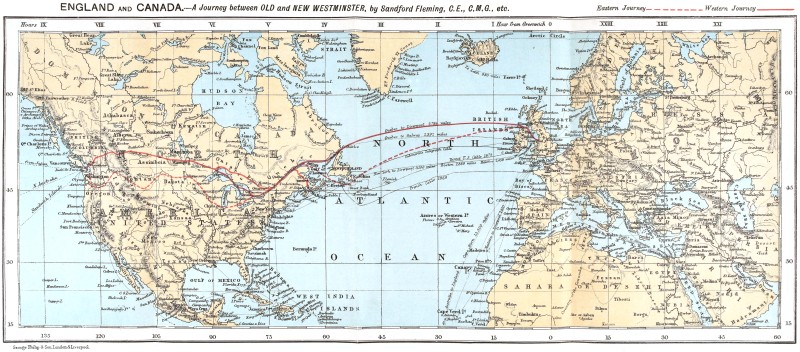
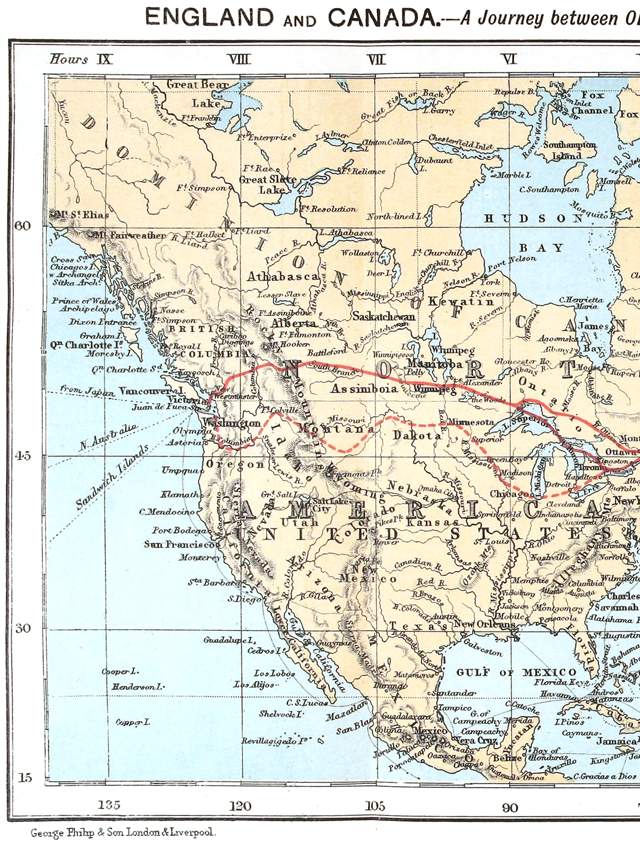
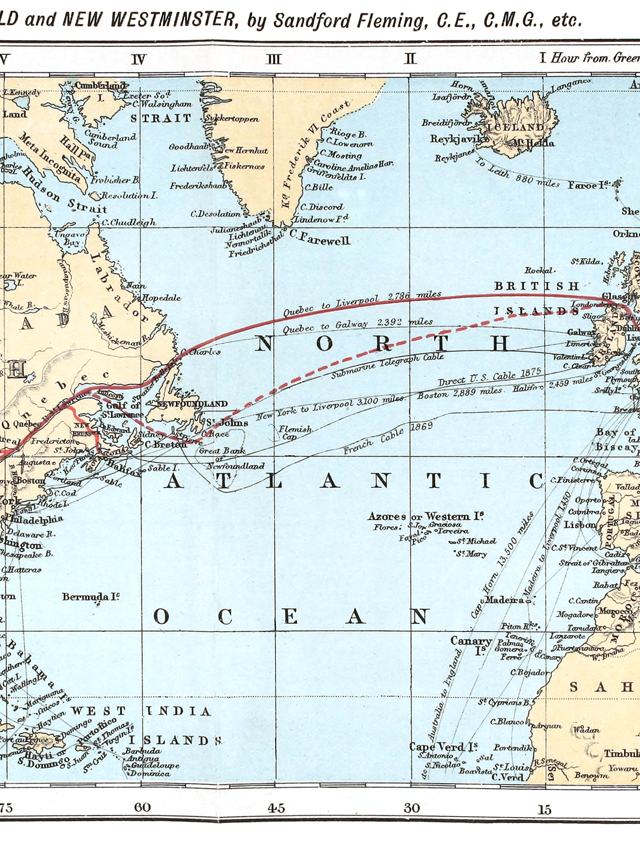
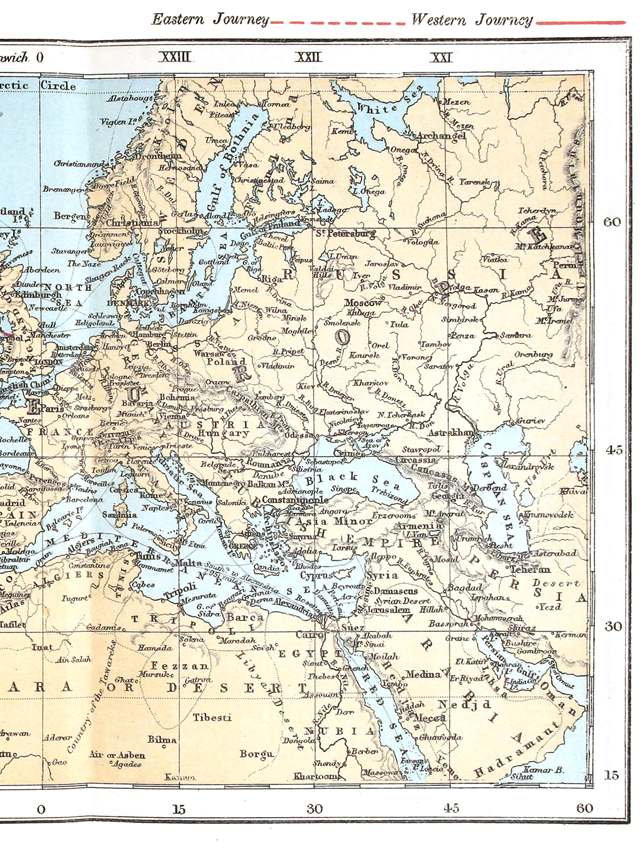
ENGLAND and CANADA.—A Journey between OLD and NEW WESTMINSTER, by Sandford Fleming, C.E., C.M.G. etc. Eastern Journey_ _ _ _ _ _ _ _ Western Journey____________
Entered according to Act of Parliament of Canada, in the year 1884, by Sandford Fleming,
in the Office of the Minister of Agriculture.
GAZETTE PRINTING COMPANY, MONTREAL.
TO The Right Honourable the Marquis of Lorne, K.T.
G.C.M.G., P.C., &C., &C.,
ONE OF CANADA’S TRUEST AND WARMEST FRIENDS,
WITH SINCERE RESPECT
THIS RECORD OF A JOURNEY FROM THE IMPERIAL CAPITAL TO THE
PACIFIC OCEAN, THROUGH CANADIAN TERRITORY, IS DEDICATED.
Halifax—Cunard Line—Intercolonial Railway—Truro—Travelling by Pullman—New Brunswick—Miramichi—Great Fires in New Brunswick—Salmon Fishing—Micmac Indians—Rimouski—S.S. Parisian—The first Ocean Steamer the Royal William—Incidents of Ocean Voyage—Arrival.
Marquis of Salisbury—Classical Studies—Henley Regatta—Red Lion—London Dinner to Lord Dufferin—His Speech—Greenwich—Fisheries Exhibition—Bray—The Vicar—The Thames—Minehead—The Polynesian.
Early Colonization—De Monts—Champlain—Sir William Alexander—Capture of Quebec—The Treaties—The Acadian Evangeline—Louisbourg—First Capture—Peace of Aix la Chapelle—Boundary Disputes—The Final Struggle—Deportation of the Acadians—Nova Scotia constituted a Province.
Home in Halifax—Start for the Pacific—The Intercolonial Railway—Major Robinson—Old Companions—The Ashburton Blunder—Quebec—The Provincial Legislature—Champlain—The Iroquois.
Montreal—Ship Channel—Hon. John Young—St. Lawrence Canals—Indifference of Quebec—Quebec Interests Sacrificed—Need of a Bridge at Quebec—Montreal Trade in Early Times—Beauty of the City—Canadian Pacific Railway—Ottawa—The Social Influence of Government House—Kingston.
Early Explorers of the North-West—Du Luth—De la Verendrye—Mackenzie—Hudson’s Bay Company—Treaty of Utrecht—North-West Company—Lord Selkirk—War in the North-West—Union of the Rival Companies—The North-West Annexed to Canada.
The Descent of the Selkirk Range—Glaciers—The Last of our Horses—Devil’s Clubs—The Ille-celle-waet—A Rough Journey—A Mountain Storm—Slow Progress—A Roaring Torrent—Skunk Cabbage—Marsh—A Long Ten Miles’ Journey.
A Difficult March—Cariboo Path—Organization of Advance—Passing Through the Canyon—Timber Jam—A Gun-shot heard—The Columbia again—Indians—Disappointment—The Question of Supplies becomes Urgent—No Relief Party Found—Suspense.
The Kamloops Men at Last—No Supplies—On Short Allowance—An Indian Guide—Bog-wading—The Summit of the Pass—Bluff Lake—Victoria Bluff—Three Valley Lake—Eagle River—Shooting Salmon—The Cached Provisions—Pack-horses again—Road Making—The South Thompson—Indian Ranches.
Lake Kamloops—Savona’s Ferry—Irrigation—Chinese Navvies—Chinese Servants—Lytton—The Fraser River Canyon—Old Engineering Friends—Sunday at Yale—Paddling Down the Fraser—An English Fog at New Westminster.
New Westminster—Enormous Forest Trees—English Broom—Port Moody—Down Burrard Inlet—Sea Fog—Navigation by Echo—Straits of Georgia—The St. Juan Archipelago—Seamanship—Victoria.
Puget Sound—The Columbia—Portland—Oregon and San Juan Disputes—Arid Country—Mountain Summits—The Yellowstone—The Missouri—The Red River—Chicago—Standard Time Meeting—The British Association—Home.
Indian Population—The Government Policy—Indian Instincts—The Hudson’s Bay Company—Fidelity and Truthfulness of Indians—Aptitude for Certain Pursuits—The Future of the Red Man.
Rapid Construction—Travelling Old and New—Beginning of Pacific Railway—Difficulties—Party Warfare—The Line North of Lake Superior—The United States Government—Mountain Passes—Soil and Climate—National Parks—Pacific Terminus.
England and Canada—Old and New Colonial Systems—Political Exigencies—The High Commissioners—Lord Lorne’s Views—The Future—The French Element in Canada—Colonial Federation—The Larger Union.
Page 420
ENGLAND AND CANADA.
CHAPTER I. INTRODUCTORY.
If we carry ourselves in imagination to that
part of North America nearest to Europe, we find
that we have reached the most easterly coast of
the Island of Newfoundland, an outlying portion
of the continent. Standing on Cape Bonavista and
looking from this promontory over the waste of
waters, we discover that between the Equator
and Greenland the Atlantic Ocean is generally of
much greater width in every other parallel than
opposite our present position: that its breadth
rapidly increases as we proceed southward, if but
a few degrees of latitude, and that, in the parallels
of New York or Philadelphia, the ocean is more
than double the width. Towards the continent of
Europe the first land the eye rests upon is that of
the British Islands. Four centuries back the first
recorded discoverer of Newfoundland sailed from
those shores, and from the time of the Tudor monarchs
this stretch of ocean has been unceasingly
traversed by European ships. It has thus been
the cradle of ocean navigation. Adventurous men,
who planted the early settlement of America, crossed
to the new world on this narrow belt. The vessels
which carried them were indeed frail craft compared
with the creations of modern ship-building.
But, step by step, they were enlarged and developed
to the magnificent clipper, which again has been
supplanted by the still more magnificent ocean
steamer.
In old days, even in a sailing vessel of large tonnage,
a sea voyage was frequently accompanied
with much misery. It was not uncommon for
emigrants to be detained at sea as many weeks as
now days are needed for the voyage. Ships might
be retarded or driven back by adverse gales, or
they might remain in mid-ocean, becalmed in water
as unruffled as a mirror of glass. Steam has revolutionized
these conditions. Instead of ships being
turned far from their course by contrary winds, or
with flapping canvas waiting for a fair breeze, we
behold on the waters of the Atlantic fleets of swift
steamers, carrying thousands of passengers to and
fro with the regularity of the daily post between
two neighbouring cities. However formidable the
voyage once was, its greater drawbacks are now
removed. A steam ferry has been practically established
between the two continents, and transportation
is effected with scarcely less regularity than
between opposite banks of a navigable river. The
path of the ocean steamer has in reality become,
as it were, the Queen’s highway; and were anything
wanting to facilitate intercourse, we possess
it in the telegraph. If this belt of ocean has been
the nursery of the ocean steamers, it has also given
birth to ocean telegraphy. In no part of the world
are so many submarine cables laid along the ocean
bed as in this direction. We live in a period when
instantaneous communications from continent to
continent are as easily effected as from county to
county. Year by year the facilities of intercourse,
both by steamship and by telegraph, are increasing
in a manner to bind closer than ever, by the
ties of mutual benefit and common interest, the
different members of the British family. On the
one hand, the Canadian is enabled to visit the old
land, where his traditions have been gathered, and
where there is a history in which he can claim an
inherited participation. On the other, it provides
the youth of the Mother Country with an outlet
by which he may gain a home with a kindred
people, who revere the same memories, and who
will cordially welcome his labour and energies to
aid in strengthening and consolidating the institutions
of that portion of the Empire.
From a multiplicity of causes, there are different
shades of character and thought to distinguish the
several members of the British family. They are
called into being by geographical position, by race,
by climate and other influences. Diversities exist,
and why should it not be so? It is a shallow and
unwise pretension which would ignore the fact.
The inhabitants of neighbouring counties, even the
members of one family, have not the same characteristics
or identical likes and dislikes. As in the
family so in the state. It is natural, and in some
respects advantageous, that varieties of character
and power should be traceable; on the other hand,
as the family likeness may be seen in a group of
individuals, however in many respects they may
differ, an essential unity of national life and sentiment
may be found one and the same amid characteristics
the most divergent. The people of
Canada and of England differ as the current coin
of the realm differs. While in the currency there
are dissimilarities of name, of value, of colour and of
metal, all are impressed with the stamp of the one
sovereign; so in the people there are diversities,
but all can be recognized as British subjects.
If we turn our eyes in the direction opposite to
Europe, we find Newfoundland situated as a barrier
between the outer ocean and an inner sea;
the Gulf of St. Lawrence. Whatever its destiny,
Newfoundland is the one portion of British North
America which has not allied her fortunes with
the Canadian Dominion. Geographically, the island
stands as a gigantic breakwater to shelter from the
surges of the Atlantic the continent to the west,
and to protect the entrance of the St. Lawrence.
The Gulf of St. Lawrence has been compared to
the Baltic, but, unlike the Baltic, having but one
narrow channel of entry, it is approachable from the
ocean by two wide navigable openings. These
passages—the Straits of Belle Isle and St. Paul—lie
to the north and south of Newfoundland. Around
this inner Baltic-like sea we behold the Maritime
Provinces of Nova Scotia, New Brunswick and
Prince Edward Island, to which may be added
the eastern portion of Quebec. These Provinces
occupy an extensive coast line, indented with bays
and capacious harbours, presenting all the facilities
for shipping, commerce and fisheries. They
are bound together, and to the other Provinces of
the Dominion, by one trade, one tariff and by one
common nationality; on the other hand, they have
each distinct local institutions for their own domestic
government.
Continuing our glance westward, a thousand
miles from Bonavista, beyond the ancient fortress
of Quebec, we behold Montreal, the commercial
metropolis of the Dominion. Here are seen ocean
steamers of the largest class discharging cargoes
loaded twelve days back in Liverpool, Glasgow
and other parts of Europe. Advancing our view
another thousand miles, over cultivated fields and
flourishing cities and lakes of unrivalled magnitude,
our vision carries us through deep forests
beyond the Province of Ontario to the confines of
Manitoba, in the middle of the continent. Still
another thousand miles to the west, across prairies
abounding with a fabulous fertility of soil, we
reach the foot-hills of a snow-capped mountain
range, concealing the country which lies beyond
it. To penetrate this barrier we must advance
by the known passes, and for hundreds of miles
follow deep defiles, traversing further mountain
ranges, until we reach the wide grassy plateau
interspersed with picturesque lakes in the heart
of British Columbia. We may still pierce another
serrated wall of mountains by a deep and rugged
valley, and, by following a tortuous and foaming
river to its mouth, we meet the flow of tide of
another ocean far greater in extent than that which
lies behind us.
Carrying our vision beyond the shore of the
western mainland, across a strait similar to that
separating England from Europe, we see the Island
of Vancouver, washed by currents warmed in the
seas of Asia. Vancouver Island is not quite so
large as England, but it enjoys the same climatic
conditions, and possesses in profusion many of the
same mineral treasures.
British Columbia is the youngest colony of the
Empire, and until recently was practically the
most distant from the Imperial centre. Its chief
city bears the name of Her Majesty. The sun
does not rise on Victoria, the capital of British
Columbia, until eight hours after it gilds the
towers of Westminster. One-third of the complete
circle of the globe separates the Imperial
capital from the capital of the Pacific Province,
but no land intervenes which is not British, and
the whole distance is under the shadow of the one
national flag.
In imagination we first glanced across the ocean
at its narrowest limit. Turning our glance landward,
we have looked across a continent at its
greatest width. All we have scanned, from sea to
sea, is Canada. The vast proportions of the Dominion,
its varied features, its lakes and rivers,
mountains and plains, its sources of wealth and
magnificent scenery, are but little known to Englishmen.
A country to be known must be seen.
It is not enough to examine a terrestrial globe or
ponder over maps and geographies in order to form
an estimate of the character of half a continent.
They suggest but a faint idea of territorial extent.
You must traverse its different sections, and bestow
time in examining its fields and forests, its natural
landscape, its cities and its civilization.
There are few, indeed, who possess anything
like an adequate conception of the immense extent
and resources of the Dominion. It is scarcely possible
even for Canadians themselves to conceive
the wealth of territory and the varied magnificence
of scenery and the productive capacity of the land,
the destinies of which it is their privilege to control.
During the past summer (1883), circumstances
induced the writer to visit England, to recross
the Atlantic, and make a journey through the
whole extent of Canada to the Pacific coast. The
railway took him to the base of the Rocky Mountains.
From thence he entered the passes, and by
pack-horse and on foot he followed the route proposed
to be taken by the Canadian Pacific Railway
through British Columbia.
As is customary in such circumstances, the writer
sent home, at convenient opportunities, a diary of
his daily progress. He is aware that the notes of
travel which have interest for a circle of intimate
friends, have often but slender claim to public
attention. These notes, however, give a sketch of
the first continuous journey ever made, indeed the
only one yet attempted, through the whole longitudinal
extent of the Dominion by the route taken.
From the interest which has been attached to his
notes of travel, the writer has been prevailed upon
to prepare them for publication, and, with the view
of supplying such information as the future traveller
may desire, a few historical notes have been
included in the narrative.
Canada is certainly not within the actual geographical
limits of the Mother Land, yet it is no
mere rhetorical phrase to say that this half of the
North American continent has become an integral
part of the Empire. Seventeen years ago, when
the British North American Act of 1867, creating
the Dominion, passed the Imperial Parliament,
British and Canadian statesmen laid the foundation
of a great future for the confederated provinces.
From that date Canada has steadily, step
by step, done her part to realize all that was then
foreshadowed of her future. She undertook to
establish a highway for commerce through her
forests, prairies and mountains, to connect the
most distant Provinces. In a short time the
national highway will be opened from the Atlantic
to the Pacific, and Canada will become a recognized
central commercial link between England
and Asia.
The writer ventures to think that the record of
the journey he made, will show how closely England
and Canada are brought together by the modern
agencies of steam and electricity. Equally it
will be obvious, how easily the British subject in
Canada may revivify old associations; and how the
denizen of the United Kingdom can, without discomfort,
visit the whole extent of the Dominion,
to enjoy the varied scenery in the many forms in
which it is presented. The writer sincerely hopes
that what he ventures now to submit may be instrumental
in leading others to enjoy what proved
to him a delightful summer tour by sea and land.
It is not without diffidence that he yields to the
wish expressed for the publication of his notes.
He is desirous, however, of establishing that such
a journey as he has accomplished presents many
other points of attraction independent of the beauty
of the scenery and novelty of the associations.
There is much to repay enquiry in the examination
of our system of government and of the institutions
of the several Provinces; in ethnological developments;
and in geological and kindred scientific
researches. It will be found, too, that there is a
past history which gives attraction to many a
scene, and in all that constitutes and promotes
the advance of nations there is presented much of
varied interest worthy of investigation.
The writer does not hide from himself the fact
that, in describing scenes and events, he may say
much that is well known to many. He makes no
pretension to original research. His endeavour is
simply to present the notes of his journey side by
side with some leading historical facts, in a way
which may admit of generalization and be useful
to the ordinary reader. Hence it is not impossible
that the professional littérateur may, with a certain
cynicism, consider that the following pages contain
much that is not worth the record.
The two voyages across the ocean and the journey
over the continent embraced a total distance
travelled of about 14,000 miles, the eastern and
western portions of which began and ended at
Halifax.
CHAPTER II. HALIFAX TO LIVERPOOL.
Halifax—Cunard Line—Intercolonial Railway—Truro—Travelling
by Pullman—New Brunswick—Miramichi—Great Fires
in New Brunswick—Salmon Fishing—Micmac Indians—Rimouski—S.
S. Parisian—The first Ocean Steamer the Royal
William—Incidents of Ocean Voyage—Arrival.
Halifax, selected for its excellence as a harbour
in connection with its geographical position, is
well known throughout the world as one of the
most important stations for the British Navy. For
upwards of a century it has been pre-eminently
the Admiralty port for the British fleet in North
Atlantic waters, and it was its superiority as a
harbour in all respects which determined the
demolition of Louisburg in 1756. It was held
that no second naval arsenal was required in proximity
to Halifax, and consequently not one stone
was left standing upon another at Louisburg after
its second capture. The enterprise of the city has
intimately connected its name with the history of
the navigation of the ocean. Ships of Nova Scotia
may be seen on every sea, and it is here that the
centre has been, around which the commerce of the
Province revolved. It was in Halifax that the
Cunard Steamship Company took its origin, under
the distinguished family who have so long lived
there: an organization which may well be considered
one of the most successful known. For
nearly half a century the record of their immense
fleet shows that not a passenger has been lost or a
letter miscarried. The irreverent Frederick the
Great was wont to say that Providence was generally
on the side of large armies. His own good
fortune in the field was owing, however, mainly
to his supervision of the simplest detail and attention
to discipline. In a similar manner the unprecedented
success and the perfect organization of
the Cunard Company must be traced to the unwonted
care and vigilance continually observed in
connection with the enterprise. The principle laid
down by Mr. Cunard was that nothing was to be
left to chance; that the best of all material and
workmanship was to be obtained in the construction
of his steamers; that the crew were to be subjected
to the strictest discipline; and that no possible
care or precaution, even in the simplest detail,
was to be omitted. The result of these efforts from
the initiation of the company is seen in the magnificent
Cunard fleet: a noble monument to the
name it bears.
My connection with Halifax sprang from my
relationship with the Intercolonial Railway, the
explorations of which I was appointed to conduct
in 1863, and of which I remained Chief Engineer
until its completion in 1876. My acquaintance
with this locality consequently extends back twenty
years. I have formed there many warm friendships,
which I am happy to think I still retain,
and scarcely a year goes by without my passing
some portion of the summer months at that delightful
suburb of Halifax known as the “Northwest
Arm.”
In common with all who have been connected
with Halifax, I must express my humble view of
the charm which the place possesses. Its scenery
of wood, hill and dale; its ample expanse of water
in all forms; its healthy climate and fresh air; its
cool evening breezes in the heat of summer; its
pleasant drives and the varied features of its daily
life; all leave an impression not easily forgotten.
But when to these recognized advantages the social
elements of Halifax are added, it is held by common
consent that there are few cities more attractive.
And when we remember the well-bred, travelled
men, many of whom also highly educated, to be
met among the officers of the garrison and on
board the ships at the station, with their continuous
efforts to return the hospitalities of the citizens,
we all must acknowledge that Halifax, in its
social aspects, possesses features and a charm peculiar
to itself.
A line of steamers runs from Halifax to Liverpool,
but I had taken my passage by the steamer
“Parisian,” of the Allan Line. The weekly steamer
of this line, as a rule, leaves her moorings in front
of Quebec at a fixed hour on the forenoon of Saturday.
The traveller ordinarily goes on board the
tender an hour earlier. But a train leaves Toronto,
480 miles west of Quebec, on the evening of Friday,
connecting at Montreal on Saturday morning with
an express mail train for Rimouski, a point on the
St. Lawrence about 200 miles below Quebec. By
this means letters can be posted at Toronto, indeed
at nearly all the cities in Canada west of Quebec,
to the last moment. This express mail, which
makes rapid time, reaches Rimouski late on Saturday
night. By it, passengers who have been unable
to embark at Quebec may take the steamer, as it
always remains off Rimouski to receive the mail.
Travellers to Europe from the Maritime Provinces
may also embark at Rimouski by taking the regular
train over the Intercolonial Railway from St.
John or Halifax. The latter is the route which I
followed.
On the afternoon of the 15th June I said goodbye
to my family at the station at Halifax, and
with my youngest daughter I started for England.
The day was bright and beautiful; indeed, although
sea fogs prevail at certain seasons of the year, I
know no latitude where the air is purer than it is
in Nova Scotia, or where nature, during summer,
is more attractive. There were several of my
friends on the train, and when the sadness of parting
passed away there was everything to make the
trip cheerful.
After leaving Halifax we have supper at Truro,
a large, clean-looking Nova Scotian town, situated
on one of the heads of the Bay of Fundy. Truro,
however, was not always so clean and cheerful
looking as it is to-day. At one time it was conspicuous
for its dark and dingy appearance, and it
has to thank the visit of the Prince of Wales,
nearly a quarter of a century back, for the change.
The Prince had landed at Halifax, and was expected
to pass through Truro in a few days. Meetings
were held to devise means to do honour to the
Royal visitor. I think it was Mr. Hiram Hyde
who said that “evergreen arches would be out of
place unless the town presented a clean face.”
He moved a resolution, which was unanimously
adopted, that a schooner load of lime lying in the
bay should be secured, and every one be obliged to
turn out with whitewash brushes. In forty-eight
hours Truro was so metamorphosed as not to seem
the same place, and so well satisfied were the
inhabitants that they have kept its face clean ever
since.
To continue. We are at the Truro refreshment
room. One never criticizes railway meals too
severely, at least those who are much accustomed
to travel. The golden rule on such occasions
is to open your mouth, shut your eyes, and take
what is placed before you. If things are to your
liking, then you can “give them the painted flourish
of your praise.”
Our route passes over the Cobequid Mountains,
and at Amherst, on another inlet of the Bay of
Fundy, you may have further refreshments at ten
o’clock. Then comes the night’s rest in the Pullman.
To the denizens of this continent the Pullman is a
necessity. In a country of narrow geographical
limit nothing is more pleasant than a few hours
in an ordinary first class English carriage. But
we do not count our trips by hours on the western
continent. Often we do so by days. Sitting up
all night in one of the old carriages, which many
yet from circumstances are obliged to do, was one
of the small miseries of life. The want of rest, the
cramped position, the foul air, the banging of
doors, frequently the crowd of passengers, had
all to be endured; and who of that date cannot
remember the extreme discomfort to which the
traveller was compelled to submit as best he
could. With a Pullman you have comparative
quiet, and with well-mannered and competent
officials, who keep the car heated only to an endurable
temperature and properly ventilated, you have
all the auxiliaries of comfort. What dream is there
in the Arabian Nights equal to the realization of
finding yourself in a comfortable bed, with all the
accessories of home, travelling at the rate of forty
miles an hour?
Soon after leaving Amherst we crossed the Missiquash,
the river which separates Nova Scotia
from New Brunswick. It has some historic import
of which I will speak hereafter. Our course is now
through New Brunswick to the River Restigouche,
on the north side of which lies the Province of
Quebec. The whole distance through the three
Provinces embraces a variety of scenes of great
interest to me, as many years of my life were
passed in the construction of the Intercolonial
Railway.
It was not until after the American Revolution
that New Brunswick was looked upon as a colony.
Five thousand of the United Empire Loyalists
arrived at St. John in the British fleet in 1783,
one hundred years ago. It became a Province in
1786. No little of its history is in connection
with its terrible fires. That of Miramichi in 1825;
of St. John in 1837, when, in the heart of a rigorous
winter, nearly the whole business part of the
city was destroyed; and again of St. John in 1877,
when, in the short space of nine hours, 200 acres
of buildings were levelled to the ground, and fully
two-thirds of the entire city laid in ashes. During
the night the train passes through the scene of the
first disaster, which left some 6,000 square miles
in a state of devastation. The summer had been
unusually hot and dry. On the first day of October,
1825, the inhabitants of the valley of the
Miramichi were disturbed by immense forest fires
in the neighbourhood of the settlements. The
smoke with great heat continued for seven days,
when the fire extended to the settlements, defying
all efforts to extinguish it, and sweeping away all
that lay before it. The town of Newcastle was
consumed, as also Douglastown with all the smaller
outlying settlements. The devastation continued
along the northern side of the river for one hundred
miles. Hundreds of settlers and thousands of
cattle were lost. The number of wild animals
which were burned was also very great. Even
the salmon perished in the smaller streams, owing
to the intense heat. To this date the trace of the
fire is distinctly seen in the character of the trees
which have grown upon the burnt district. A
gale increased the violence of the fire, so that its
fury was uncontrollable. In many cases the inhabitants,
not looking for such a calamity, were
suddenly awakened in their beds by the alarm
of danger. A few minutes’ delay would have led
to their destruction. Many were unable to save
themselves. Not a few owed their preservation
to the fact that their farms were near the river, in
which they threw themselves, and escaped by
clinging to logs. The loss of life to those at a
distance from the river, where escape was impossible,
must have been serious. Many of the survivors
were dreadfully mutilated, and in the distant
settlements few escaped to tell their dreadful experience.
In the morning we reached Campbellton, on the
Restigouche, at the head of the Bay Chaleur, and
we have a royal breakfast of salmon fresh from the
nets. Some of our friends on the train are enthusiastic
fishermen. Col. Chalmers, recently from
India, and the Rev. Mr. Townend, Garrison Chaplain
at Halifax, are among the number. They are
bound for the fishing pools on the Restigouche,
and are in high spirits. They learn here that the
run of salmon up the river is unprecedentedly
large, and their excitement is intense. My sympathies
are with them, for fishing to me is a most
pleasant recreation. If I am not a skillful, I am at
least a devout, disciple of Isaac Walton.
At the station I met some of my old Micmac
Indian friends, some of whom I have known for
twenty years, and who accompanied me in my
various wanderings in the wilds of New Brunswick.
I have a strong and kindly feeling for
these children of the forest. Personally I have
found their simplicity of character not the sham
which many claim it to be. There are exceptions,
but, as a rule, in their relations to me, they have
proved honest and faithful. Although perfectly
undemonstrative, they never forget a kind act or
word. Such is my experience, and I have had
much to do with Indians of nearly every tribe
between the Atlantic and the Pacific. It has been
my invariable good fortune to come in contact
with those among them to whom I could at any
time have trusted my life. We shook hands all
round. Breakfast, however, has only left time for
a few words. The train starts, and as it leaves the
station I receive from my dusky friends a hearty
bò jou! bò jou!
We are still in New Brunswick, but in half an
hour we cross the Restigouche and enter the Province
of Quebec near the Metapedia station. Here
our friends of the rod leave us with our best
wishes for their success. The Railway now follows
the River Metapedia, and the run up the
valley is all we could wish. The day was fine;
no morning could be more bright. The curves in
the track are frequent but unavoidable, and how
few who whirl over them ever think of the labour
bestowed in order to reduce them to a minimum!
In the Metapedia many splendid salmon pools are
found. Mr. George Stephen, President of the
Canadian Pacific Railway Company, has the most
pleasant of fishing boxes here, pleasantly situated
within sight of the passing train at Causapscal.
H. R. H. Princess Louise and Prince Leopold remained
for some weeks here three years ago. Mr.
Stephen is himself a keen sportsman, and never
lets a season pass without spending a holiday at
Causapscal. He had arrived the day previous with
a party of friends.
In the middle of the afternoon we reached Rimouski,
where we left the train and placed ourselves
in the hands of Madame Lepage, who keeps
a comfortable pension at this place. This landlady’s
untiring devotion to the comforts of her
guests is on a par with the glow of her sparkling
black eyes. She is the mother of a large family,
some of whom are grown up, yet she retains all
her youthful vivacity and naiveté.
Rimouski is a large straggling French Canadian
town, the last of any importance in the Province
of Quebec to the east, if we except the thriving
village of Matane. It is chiefly remarkable for its
ecclesiastical and educational institutions. There
is another peculiarity; the largeness of the family
in many households. It is no uncommon matter
to find a family of from fifteen to twenty children.
Not long ago I heard of a case of a family of
eighteen, and there was a question of an orphan
to be taken, for whose nurture nothing was to be
paid, its parents having died under circumstances
of privation and poverty. “Let it come and take
its chance with our children,” said this excellent
French Canadian mother, and it was so resolved.
Travellers to Europe, like ourselves, have their
letters and telegrams directed to Rimouski in case
of more or less last words being necessary. I was
very glad to find good news in those I received.
I went to the station to meet the train for the
south. There I found more fishermen bound for
the Restigouche, New Yorkers, who now come
yearly to our waters, a class who do not fish for
the pot, but are sportsmen. Among them were
Mr. Dean Sage and Mr. Worden, with a party of
friends.
At 10 o’clock p.m., the mail train having arrived,
we took the tender for the steamer, which lay off
in the stream. Sir Alex. Galt was on the train,
on his way back from Halifax, where he had taken
part in a public banquet given to his successor as
High Commissioner for Canada in London; Sir
Charles Tupper. I was in hopes that he, too, was
starting for England, but to my disappointment
he continued his journey to Montreal.
We reach the wharf on the branch railway, where
the tender is lying. The arrangements are not quite
perfect. The wharf itself is of unusual length,
but it only reaches shallow water at low tide. In
consequence the capacity of the tender is limited,
and, although strongly built, it rolls disagreeably
in rough weather, to the discomfort of passengers
who are indifferent sailors.
We embarked on the “Parisian,” and at once found
our way to the cabins allotted to us. A friend had
previously consoled us by saying that they were
the worst in the ship. They were directly under
the scuppers used for pouring the ashes overboard,
the disagreeable noise of which operation we were
expecting to hear every hour in the night. We
did not, however, experience much inconvenience
on this score, as for the greater part of the voyage,
our cabin was on the windward side, which is
never used at sea for the discharge of refuse.
The passenger list placed in our hands contained
several familiar names. There were Canadian
Cabinet Ministers and Montreal merchants,
with their wives and families, and there were
friends whom we expected to meet, some of them
we found in the saloon before retiring for the night.
Trips by ocean steamers have much the same
features, and, while the changes and vicissitudes
of fog, rain and fine weather are all important in
the little floating community, they have little concern
for the outer world. To sufferers from sea-sickness,
an ocean trip is a terror. Medical men
say, in a general way, that the infliction should
be welcomed, for it brings health, but I have seen
those prostrated by it who have been so depressed
that I can not but think that if this theory be true
the improvement to health will be dearly purchased
by the penalty. Such, however, are the
exceptions. With most people one or two days’
depression is generally the extent of the infliction.
Personally I cannot complain. Nature has made
me an excellent sailor. With no remarkable appetite,
I have never missed a meal on board ship, nor
ever found the call to dinner unwelcome.
Our first morning commenced with fog, but it
cleared away as we coasted along the somewhat
bold shore of Gaspé in smooth water. There is
always divine service on these vessels on Sunday.
The Church of England form is as a rule adhered
to, which is read by the captain or doctor if no
clergyman be present. If a clergyman be found
among the passengers he is generally invited to
conduct divine service, and any Protestant form is
admitted. On the present occasion the Rev. C.
Hall, Presbyterian minister of Brooklyn, N. Y.,
officiated. The service was simple and appropriate,
and the sermon admirable. The day turned
out fine, and the water so smooth that in the
afternoon every passenger was on deck. Our
course being to the south of the Island of Newfoundland,
we passed the Magdalen Islands and
the Bird Rocks, and we think of the vast number
of ships which have ploughed these waters on
their way to and from Quebec and Montreal. It
is now fifty years since “The Royal William”
steamed homewards on the same course we are
now following. Much interest begins to centre
in “The Royal William.” It is claimed that she
was one of the pioneers of steamers, if not the
very first steamer which crossed the Atlantic under
steam the whole distance. She was built in Canada.
She left Quebec on the 18th August, 1833,
coaled at Pictou, in Nova Scotia, and arrived at
Gravesend on the 11th September. She did not
return to Canada, as she was sold by her owners
to the Spanish Government. Her model is preserved
by the Historical Society of Quebec. Some
of these particulars I had from the lips of one of
the officers of “The Royal William,” who died
a quarter of a century ago.
There is but one counter claim to the distinction.
A ship named the “Savannah” crossed the Atlantic
from the port of that name in the Southern
United States to Liverpool in 1819. She had
machinery for propulsion of a somewhat rude
description, which seemed to be attached as an
auxiliary power to be used when the wind failed.
There is nothing to show that it was continuously
employed. I have recently heard from a friend in
Savannah on the subject, and I quote from his
letter: “She was 18 days on the voyage. She
resembled very much in mould an old United
States war frigate. The hull was surmounted with
a stack and three masts—fore, main and mizzen—and
was provided with side wheels of a primitive
pattern, left wholly exposed to view, and so arranged
that they could at any time be unshipped
and the vessel navigated by sails only.”
On Monday before 2 a.m. we pass out of the Gulf
by the Strait of St. Paul into the open Atlantic, and
still the water continues perfectly smooth. There
is a slight fog, which passes away, and we behold
nothing but the world of waters around us. The
moon appears, and we have an evening on deck
long to be remembered. Everything stands out
clear and distinct, but the shadows are dark and
heavy. The moon casts its line of rippling light
across the waves, and the ship glides onward,
almost weird-like in its motion.
One of the pleasures, as well as penalties, of
travelling is to be asked to make one at whist. It
is a pleasure to take part in a single rubber if
played without stakes, but to one indifferent to
cards, who does not want to win his friend’s money
or lose his own, to join such a party is often no
little of a sacrifice. Your reply when asked to play
may take the conventional form, “With pleasure,”
and in a way you feel pleasure, for you like to
oblige people you care for, and you may be in an
extra genial mood; but how often I have wished
some other victim could have been found at such
times. On this occasion I left the deck when I
would have willingly remained, and took my seat
at the card table.
The fog returned, and the ship went at half
speed for the night. When next day came there
was no fog, but there was some little rocking,
which, to me, during the previous night, was but
a pleasant incentive to sleep, for I did not once
hear the fog whistle in its periodic roar—no pleasant
sound—nor was I sensible of the dreaded
rattling of the ashes emptied overboard, a nightly
and unavoidable duty, and by no means a musical
lullaby.
I find that several ladies are absent from breakfast
this morning. A breeze springs up; a sail is
hoisted; and occasionally we have fog, and now
and then a cold blast, with alternations of damp
and moist air. Such is the general experience in
crossing the Banks. As one passenger remarked,
“It is hungry weather.” The breakfast in most
cases had been sparing, an enforced necessity in
some instances, but the general feeling is one of
being ravenous for lunch. The day passes pleasantly,
possibly idly, and in the evening the whist
table has its votaries. We leave the fog behind
us, but the next day is cloudy. There is a light
wind, and the sea is a little disturbed. Most of
the passengers keep the deck. We fancy we see a
whale. There is too much cloud for the moon to
penetrate, so the passengers generally leave the
deck to enjoy themselves quietly in the saloon.
We have a bright midsummer day this 21st June
after a glorious morning, and we advance eastward
with all sail set. The spirits of all on board seem
to rise, the sky is so blue, and the sea so bright.
There is but slight motion, with which, most of
the passengers are becoming familiar.
We are now half way across. We begin to calculate
when we shall arrive, and what trains we
shall take at Liverpool. I have many times crossed
the Atlantic, but I never could understand the
restlessness with which so many look for the termination
of the voyage. If there were some urgent
necessity for immediate action on the part of those
who are travelling this impatience could be accounted
for. The majority, however, are tourists
for pleasure or for health, and, as for business or
professional men, I never could see how a few
hours one way or the other could influence their
operations. To some the voyage is simply imprisonment;
the condition of being at sea is a
penalty they pay at the sacrifice of health and
comfort. These are the exceptions. There are a
large number who feel as I do, and for my part,
while it would be affectation to profess to be fond
of storm and tempest, a sea voyage in ordinary
fine weather is one of the most pleasurable experiences
of my life. I have good digestion and
good spirits, and I am satisfied with the pleasant
change from a life on shore. I can generally read,
and I can always remain on deck, and I always
have a certain feeling of regret when I think that
the voyage is soon coming to an end. We are all
well cared for, we form pleasant associations, and
anyone who can study human nature finds no little
opportunity for doing so on shipboard.
Our library, it is true, is somewhat limited, but
it has a few good books. I was somewhat struck
on reading during this voyage almost the last
words of the celebrated Mary Somerville, who,
after a most distinguished career in science, died
eleven years ago at Naples. These words appear
more striking to me when read on board ship.
“The blue peter has long been flying at my foremast,
and, now that I am in my 92nd year, I may
soon expect the signal for sailing.”
We discuss our progress on all occasions. There
is a general thankfulness as we advance. Towards
evening the motion of the ship has increased, but
we can all walk the deck. On the following day we
put on more canvas, for the breeze has increased
and is more favorable, and our progress is much
greater. There is now considerable motion, but
we have all got familiar with it, and, as sailors
say, we have our sea-legs. The wind is at north-west;
the day clear and bright, with a warm-looking
sky, speckled with fleecy clouds. The
decks are dry. We appear to be achieving wonders
in speed, and we are entering into all sorts of
calculations as to what extent we shall make up
the seven hours’ detention by fog on the Banks of
Newfoundland. Our run yesterday was 342 miles
in 23½ hours. Reckoning by observed time, we
lose half an hour daily by the advance made easterly.
During the afternoon we have a fair breeze,
with all sail set, followed by the same pleasant
and agreeable evening. The passengers talk of
leaving with much readiness. Well is it said that
much of the pleasure of life is retrospective. “We
are approaching land” is now the cry, and we
commence early the next morning calculating
when we shall reach Moville. Saturday afternoon
is delightful. Bright gleams of sunshine appear
in the intervals of occasional showers. In the
evening there is a concert with readings from
eight to ten. The collection is for the “Sailors’
Orphanage” at Liverpool. On account of the concert
our lights are allowed to burn until midnight,
and many of us remain on deck nearly to that
hour. The moon is three-quarters full; we have
all sail set, and we can see the reflected light of
the sun in the northern sky at midnight. To me
there is a strange fascination in a scene of this
character, with all its accompaniments. There is a
movement in the sea and a freshness in the air
which give a tingle to the blood, and we seem to
walk up and down the deck with an elasticity we
cannot explain to ourselves.
Next morning was Sunday. I was on deck half
an hour before breakfast. The land on the west
coast of Ireland was in sight. The morning was
most fair, and it seemed to give additional zest to
the excitement produced by the approaching termination
of the voyage. We learn that we shall
be at Moville at 2 o’clock. We have again divine
worship. A Methodist minister read the Church
of England service and delivered an admirable
sermon. We reach Moville, and find we have
been seven days and ten hours making the run
from Rimouski. I took the opportunity here to
send a cablegram home; it consisted of one word,
but that word contained a page of family meaning.
We passed the Giant’s Causeway, at which the
passengers intently looked. We could also see
Islay and the Mull of Kintyre.
In the evening we have a second service. Our
eloquent friend from Brooklyn satisfied us so well
the previous Sunday that we begged of him to
give us another sermon. He complied with our
wishes, and with equal success.
It is our last night on board; to-morrow we are
to separate. Many of us on this voyage have met
for the first time, and in all human probability
few of us will again come side by side. There is
always a feeling of sadness in thinking you do
something for the last time. I can fancy even a
convict leaving his cell where he has passed some
years pausing upon the threshold while a rush of
the old recollections, the long, sad hours cheered
by gleams of hope, crowd upon him, when he will
feel some strange sentiment of regret that it is the
last time he looks upon the place. The feeling
may last but a second, but it is an impulse of our
nature which is uncontrollable.
On board ship, with a certainty of gaining port
to-morrow, the last hours are passed in packing
up and preparing to leave, and a feeling of regret
creeps in that now so many pleasant associations
are to end, and in spite of yourself some of the
good qualities of those who are set down as disagreeable
people come to the surface in your
memory. Some few friendships are formed at sea
which are perpetuated, but generally the pleasantest
of our relations terminate with the voyage. It
is too often the case, as in the voyage of life, that
those we have learned to esteem are seen no more.
We had to lose no time in order to pass the
troublesome bar at the mouth of Liverpool harbour.
With vessels of the draught of the American
steamers it can only be crossed at high water.
The officers generally calculate what can be done
from the hour they leave Moville, and regulate
their speed accordingly, so as to approach it at the
right moment.
No one knows better than the occupants of the
cabin corresponding with our own on the opposite
side of the vessel that a great many tons of ashes
have been thrown overboard during the voyage:
we all know that a large volume of smoke has
passed out of the funnel, a proof of the great weight
of fuel which has been expended in keeping the
screw revolving. The draught of the ship is
consequently considerably less than when we left
the St. Lawrence.
There is now no fog; the weather is fine; there
is everything to encourage the attempt to run in,
and it proves successful. On this occasion, had
we been twenty minutes later, we should have
had to remain outside until another tide. The
lights of Galloway and the Isle of Man were passed
before the most of us retired last night. We all
awoke early; at a quarter to five we had crossed
the bar; the “Parisian” was in the Mersey; the
tender came alongside the ship, and very soon
afterwards I stood again on English ground.
CHAPTER III. ENGLAND.
Willie Gordon—Custom House Annoyances—Cable Telegram—Post
Office Annoyances—London—Spurgeon’s Tabernacle—An
Ancestral Home—English and United States Hotels—English
Reserve—A Railway Accident—The Land’s End—A
Deaf Guest.
As I stood on the landing stage at Liverpool
awaiting patiently and with resignation for the
Customs officers to allow the removal of our luggage,
a host of recollections ran through my mind.
My thoughts went back twenty years to another
occasion when I landed from an ocean steamer at
an hour equally early. My memory has been
aided by one of those works which appear so
frequently from the New York press, so fertile
in this species of encyclopædiac literature, endeavouring
to embrace in a few pages the truths
learned only by a life’s experience. The small
volume tells you what not to do, and it sententiously
sets forth its philosophy in a series of
paragraphs. There are ninety-five pages of this
philanthropic effort, with about four hundred
negative injunctions. The title of the book is
“Don’t.” The injunction that struck my eye most
forcibly may be taken as no bad type of the teaching
of the book. It runs, “Don’t” is the first
word of every sentence. “Don’t go with your
boots unpolished, but don’t have the polishing
done in the public highways.” These words met
my eye as I was engaged in these pages, and they
brought back the feelings which passed through
my mind on the morning I left the “Parisian.”
My thoughts reverted to my visit to the Mother
Country after eighteen years’ absence; the first
made by me since I left home in 1845. I was a passenger
on the “United Kingdom,” due at Glasgow.
She had passed up the Clyde during the night,
and arrived opposite the Broomielaw in the early
morning. The night previous the passengers were
in the best of humour, and the stewards had been
kept up late attending to us. We were all in high
spirits, and without exception delighted at returning
to Scotland. I was particularly impatient to
get ashore, to touch the sacred ground of my
native land. I arose that morning one of the first
of the passengers, before the stewards were visible.
The ship was in the stream off the Broomielaw.
A boat came to the side. I jumped into her and
went ashore. I strolled along the quay. My foot
was not literally on “my native heath,” but I
enjoyed intensely the pleasure we all feel in revisiting
our native shores, and in being near the
scenes from which we have been long absent.
Everything seemed so fresh and charming. I had
no definite purpose in my wandering, but I was
at home; it was Scotland. In my semi-reverie I
was interrupted by a young voice in the purest
Clydesdale Doric saying “hae yer butes brushed?”
I looked down mechanically at my feet, and found
that the cabin bootblack of our vessel had neglected
this duty, probably owing to the irregular hours
of the last night on board. Moreover, it was the
first word addressed to myself, and I should have
felt bound to accept the offer if it had been unnecessary
in the fullest sense. I commenced conversation
with the boy. He was very young. I
summoned to my aid my best Scotch for the occasion.
His name was Willie Gordon, and he told
me his widowed mother was a washerwoman, that
he had a number of brothers and sisters younger
than himself, that his earnings amounted to about
half a crown a week, and that between him and
his mother they managed to earn ten shillings
in that time. “And how do you live, Willie?”
“Reel weel,” replied the boy, with the cheeriest
of voices. “And now, Willie,” I said, when I had
paid him his fee, “it is many years since I have
been here. I want to see the places of greatest
interest in Glasgow.” “Ou, sir,” he promptly
said, “ye shuld gang ta see Corbett’s eatin hoose.”
“Do you know the way there?” I asked. “Fine,
sir. I ken the way vary weel. I’ll gang wi ye
tae the door,” and his face looked even happier
than before. I accepted his guidance, and, if my
recollection is correct, the place was in Jamaica
street. The boy walked by my side carrying his
brushes and box, and chatted gaily of himself and
his life. Apparently no prince could be happier.
We reached the renowned establishment he had
named. It was a species of home which a benevolent
citizen had instituted, on the same principle
on which the coffee taverns are now established:
to furnish an early hot cup of tea or coffee to men
going to work, to offer some other refreshment than
whiskey and beer, to give a meal at cost price with
all the comfort possible with cleanliness good
cheer and airy rooms, warm in winter. After
some hesitation, and persuasion on my part, Willie
shyly entered with me. The menu was on the
wall. Porridge and milk one penny, large cup
of coffee one penny, bread and butter, thick, one
penny, eggs and toast one penny, &c., &c.; everything,
one penny. I cannot say that I give a precise
account of what appeared, but it was essentially
as I describe it. We were a little early even
for that establishment, so Willie and I sat down.
The buxom matron gave us some account of the
place and its doings. The Duke of Argyle had
dined with her a few days before. She told us the
establishment was well patronized and prosperous.
The time soon came for our order, for we were the
first to be served. I set forth what I required for
myself, and that was no light breakfast, as I had a
sea appetite, sharpened by the early morning walk.
I directed the attendant to bring the same order in
double proportions for the boy, so that we had a
splendid déjeuner. My little companion was in
ecstasies. Never was hospitality bestowed on a
more grateful recipient. He would not leave me,
and he seemed bound to make a morning of it, and
from time to time graciously volunteered, “I’ll tak
ye ony gait, Sir.” His customers were forgotten, but
I trust he did not suffer from his devotion to me,
for I did my best to remedy his neglect of professional
duty. He followed me from place to place,
carrying the implements of his day’s work, and
he seemed anxious to do something for the trifling
kindness I had shown him and the few pence I
had paid for his breakfast. But I was more than
compensated by the pleasure I myself received. I
listened to all he said with fresh interest, for he
was open, earnest, honest and simple-minded. He
was deeply attached to his mother, and was evidently
proud to be able to add to her slender
earnings, which were just enough to keep her and
her family from want. He certainly seemed determined
to do all in his power to make her comfortable.
He never lost sight of me till I left by the
eleven o’clock train, and my last remembrance, on
my departure from Glasgow on that occasion as
the train moved out, was seeing Willie waving
his brushes and boot-box enthusiastically in the
air. I often wonder what Willie’s fate is. He
appeared to me to be of the material to succeed in
life. In Canada he certainly would have worked
his way up. I never heard of him again, but I
certainly shall not be greatly astonished to hear of
Sir William Gordon, distinguished Lord Provost of
Glasgow.
One of the nuisances of travelling throughout
the world is the ordeal of passing the Custom House.
Frequently the traveller from Canada thinks
the infliction at Liverpool is pushed a little further
than is requisite. What can we smuggle from
Canada? I know quite well that there is generally
a very loose conscience as to the contents of a
lady’s trunk, considered under the aspect of its
fiscal obligations, but surely some form of declaration
might be drawn up by means of which honourable
men and women would be spared this
grievous and irritating delay. Apart from the
delay, it is no agreeable matter to open out your
carefully packed portmanteau. To ladies it is
particularly offensive to have their dresses turned
over and the contents of their trunks handled by
strangers. Canadians, while crossing their own
frontier, find the Custom House officers of the
United States, as a rule, particularly courteous,
and, on giving a straightforward declaration that
they have nothing dutiable, they are generally
allowed to pass at once. Liverpool may not be
alone in strictly exacting all that the law allows,
but is this course at all necessary or wise? It
cannot increase the revenue, for the additional
expense of collection must more than absorb the
trifling receipts. And one is not kindly impressed
with this reception, especially when we feel that
it is totally unnecessary. We cross the ocean from
Canada with peculiar feelings of pride and sentiment
to visit our Mother Land, and it is somewhat
of a severe wrench to be treated as foreigners by
the Customs authorities on our arrival; I will not
say uncivilly or wrongfully, but as if we were
adventurers going to England on some plundering
tour. It is certainly no petty annoyance to Canadians,
when they make their entry into a land
they are taught to call “home,” to have their
sense of common honesty thus challenged at the
threshold. Anything which is brought from Canada
can only be some trifling present, such as
Indian work, to some relative in the Old Country;
and if, possibly, a few pounds be lost to the exchequer,
it is made up a thousandfold by the good
will arising from being courteously treated on the
first landing on English soil. Would it not suffice
if every ordinary passenger were required to make
a declaration in some such form as the following?:
“I am a Canadian subject. I declare upon my
honour that my baggage contains nothing whatever
for sale. I have with me my personal effects
for my own use only.” Or it may be added, “I
have a few gifts for old friends, of little or no
commercial value.”
Perhaps some British statesman might not think
these suggestions beneath his notice. Let him
send a competent agent to examine and report
upon this subject. He will probably discover that
the whole nuisance can be swept away without
inflicting the slightest injury on the national
exchequer. It would form no discreditable sentence
in a statesman’s epitaph to read that “he did
away with the needless and offensive restrictions
imposed on British subjects from the outer empire
visiting the Imperial centre.”
Having at last passed the Custom House, I drove
to Rock Ferry, one of the most pleasant suburbs of
Liverpool, to visit a family I was acquainted with,
and with them I passed a most enjoyable day. The
greeting I received was most cordial and gratifying.
In the afternoon I started for London, leaving
my daughter behind me, and I found myself
once more whirling through the green meadows
and cultivated fields of England. I was alone,
but I did not feel solitary. How charming everything
looked! The air was fresh with passing
showers, and the rain played for some quarter of
an hour on the landscape only to make it look
fresher and fairer, and, when the sun came out,
more full of poetry. Why, we are at Harrow-on-the-Hill!
Has time gone so quickly? There is
so much to think about, so many fresh scenes to
gaze upon, and so many events seem to crowd into
the hours that the traveller, in his bewilderment,
loses count of time.
I am again in London, at Batt’s hotel, Dover
street, and I walk to the Empire Club to learn if
there are any letters for me. I am disappointed
to find there is no cablegram. I despatched one
from Moville, and one word in reply would have
told me if all was well. I recollect well the
depression I experienced at the time at not receiving
news. It was an inexplicable feeling; not
exactly one of impatience or disappointment, but
rather of keen anxiety. “Why should there be
silence,” I murmur, when everything points to the
necessity for a reply.
Next day my business took me to the city, and
I returned as rapidly as I could. In the afternoon,
to relieve my suspense, I went to the Geological
Society’s rooms, and mechanically looked over the
books and specimens. I wandered into the rooms
of the Royal Society, and found before me the well
known features of Mary Somerville as they are
preserved in her bust. I then strolled into the
parks and down to the Club, and still no cablegram.
These facts are of no interest to any but
the writer, but possibly they may suggest, not
simply to the transmitter of telegrams but to the
officials who pass them through their hands, how
much often depends upon their care and attention,
and that there is something more required than
simply receiving and recording a message. There
is the duty of seeing to its proper delivery, and it
was precisely on this ground that my trouble took
its root.
I was three days in London when I received a
telegram from Mr. George Stephen, President of
the Canadian Pacific Railway Company, stating
that he was desirous that I should proceed
to British Columbia as soon as possible. It
was my acceptance of this proposition which has
led to the production of these pages, but at that
hour I felt that Mr. Stephen’s communication only
increased my bewilderment. My telegraphic address
was properly registered at the General Post
Office in London, and it had been used over and
over again during my annual visits to England.
The cablegram I had just received bore the registered
address, and yet I had received no message
from my family in Halifax. I have often sent
cablegrams, and never more than twenty-four hours
elapsed before receiving a reply. Consequently I
again telegraphed, plainly stating my anxiety, and
then wandered out to call on some friends. Later
in the evening I at last found an answer, and, in
order that it might not again miscarry, the sender
put on my address five additional words, held as
quite unnecessary, at two shillings each, making
ten shillings extra to pay. On my return to Canada
I learned that no less than three cablegrams had
been sent to me, each one of which remains to this
day undelivered. Two of the despatches were
sent before, one subsequently to, the message last
mentioned. All were properly addressed. I felt
it a public duty to write to the Secretary of the
Post Office Department in London, but no satisfactory
explanation has yet been given. Life is a
mass of trifles, as a rule. The exceptions are our
griefs and our sufferings, our triumphs and joys;
the latter, as a French writer says, “counting by
minutes, the former by epochs.” I passed three
particularly unpleasant days during this period,
my own personal affair, of course, and one in which
the world may seem to have no interest. But the
public has really a deep interest in having a more
perfect system of Atlantic telegraphy than we now
possess, and the facts I have described, have their
moral. At least it is to be hoped that the authorities
may remember that anyone separated by the
ocean from his correspondents is not content that
telegrams should be delayed for days, and still less
content not to have them delivered at all.
I was a month in England, chiefly in London,
remaining until the 26th of July. I must say that
when in London I often thought of, although I
can not fully endorse, the words of that enthusiastic
Londoner who held that it was the “best
place in the world for nine months in the year,
and he did not know a better for the other three.”
In London you can gratify nearly every taste, and
although it always takes money to secure the
necessaries and luxuries of life, especially in great
cities, still, if one can content himself with
living modestly, it does not require a wonderfully
large income to enjoy the legitimate excitements
and amusements of London. In this respect it is
a marked contrast to New York, where, generally
speaking, a large income must be at your command
for even a moderate degree of respectable comfort.
In London, to those who cannot afford a carriage,
there is a cab, and those who have no such
aspirations as a “hansom” can take the omnibus.
It is not necessary to go to the orchestra stalls to
see a performance, nor are you obliged to pay six
guineas per week for your lodgings or one pound
for your dinner. The reading room of the British
Museum is open to every respectable, well-ordered
person. You can look at some of the best pictures
in the world for nothing, and, if you are a student
of history and literature, there are localities within
the ancient boundaries of the city which you cannot
regard without emotion. You have two of
the noblest cathedrals in the world; Westminster
Abbey, with its six centuries of history, and with
its tombs and monuments, setting forth tangibly
the evidences of the past national life. Then you
have Wren’s classical masterpiece St. Paul’s, one
of the most perfect and commanding edifices ever
erected anywhere. Its interior has never been
completed. Will it ever be so? Yet, as Wren’s
epitaph tells us, if you wish to see his monument
“look around you.”
Again, in London, by way of recreation, you
have public parks, river-side resorts, and by the
river itself and underground railway you can
easily reach many pleasant haunts about the
suburbs. Indeed, by the aid of the steamboat or
rail you can take the most charming outings any
person can desire to have. London may be said
to be inexhaustible.
As one of the directors of the Hudson Bay Company
I had often to visit the city, and some very
pleasant relationships grew out of my attendance
at the various board meetings. I was constantly
meeting Canadians, and certainly we hold together
in a peculiar way when away from the Dominion.
It is a strong link we are all bound by, and yet
we would find it hard to explain why. Even men
who are not particularly civil to one another in
Canada will cross each other’s path with pleasure
when from home, and intimacies never anticipated
are formed, and associations entered upon once
thought impossible.
One of my visits was to Spurgeon’s Tabernacle.
The name is familiar to everyone, and as I had
been many times in London without hearing this
celebrated preacher, I was anxious not to return to
Canada without making the attempt. I was told
to be in good time, and, acting on the suggestion,
I obtained a good seat, and formed, I should suppose,
one of four thousand people. Just in front
of me, strange to say, I beheld a familiar form,
which I recollected last to have seen at Queen’s
College convocation, Kingston: the Premier of
Ontario! Mr. Oliver Mowat was the gentleman
who was seated two pews in front of me. He
was the last person I expected to meet in such a
place, as I did not even know he was in England.
He was the only one in that vast assemblage I
recognized. Spurgeon is, undoubtedly, worthy of
his great reputation, and on this particular Sunday
his sermon was forcible, marked by rare good
sense, and perfectly adapted to his auditory. I
felt fully rewarded for my effort to be present.
When the service was over I had a few words
with Mr. Mowat, but our interview was but short,
for I had an engagement, and it was necessary for
me to hurry to the Waterloo Station to take the
train for Guildford, in order to reach —— Park,
in its neighbourhood.
This was a most agreeable visit to me. I do
not think there is any country but England where
scenes and associations are known such as I there
witnessed. At the station a carriage met us, for
I found myself in company with a gentleman
going to the same hospitable mansion. He was
an Irish M. P. On our entering the grounds
we passed amidst grand old elms, along a noble
avenue, and through walks beautiful with roses,
ivy and laurel. My welcome was most courteous
and graceful. There were several guests, but it
was my privilege to sleep in the haunted room.
The walls were hung with tapestry; the floor was
of oak; the fireplace was a huge structure of sculptured
stone from floor to ceiling. No ghost disturbed
my slumbers, and, in the words of Macbeth,
“I slept in spite of thunder.” I awoke at
dawn, and drew back the heavy curtains to admit
the light. It was about sunrise. Shall I ever
forget that magnificent view from the old windows,
with their quaint transoms and quarterings, and
circular heads! the sight of those fine old trees,
stately beeches, tall ancient elms, venerable blue
beech, and many a noble oak of from two to three
centuries’ growth! It was one of those old ancestral
domains, with glades, avenues and forest,
which seem to take you out of the present world
and back in thought to one altogether different, in
many of its conditions, from the life of to-day. The
most carefully developed homestead of old Boston,
or one of the finest mansions on the Hudson, with
the outline of mountain scenery, and its associate
stream; any one of the well built halls south of
the Potomac, elaborated with all the wealth of the
planter; or even one of our own palatial Canadian
residences; all appear a thing of yesterday
as compared with that stately edifice, with its
delightful lawns, walks and avenues, which bear
the ancient impress of their date and of their early
greatness. No doubt these paths were trod by
men in the troublous times of Henry VIII. and
his three children, men who then may have debated
mooted points of history in this very neighbourhood.
There is a tradition also that the virgin
Queen has looked upon this same landscape “in
maiden meditation fancy free.”
The morning was peculiarly fine, and as I
opened the window to admit the pure, fresh air
I really breathed again to enjoy it, and inhale the
perfume of foliage and of the garden flowers;
flowers whose ancestors may have traced three
centuries of life, at least the early known plants
indigenous to English soil; while those of foreign
origin could boast of sires, perhaps, the first of
their genus brought from the Continent. The air
was vocal with music; the trees seemed peopled
with scores of blackbirds and mavis, and there
was many a proverbial “early bird” busy with
the yet earlier worm, who had gained so little by
his rising. All nature seemed teeming with life
and gladness. I can only here acknowledge the
courtesy I received from my host and hostess. The
hours passed away unclouded by the slightest
shadow, and I know no more pleasant memory
than that of my visit to this English ancestral
home.
I was highly pleased, on my return to Batt’s
Hotel, to receive intimation that my daughter was
shortly to join me in London. There is a certain
solitude in a London hotel, which is much the
opposite of the continental life, and entirely distinct
from the table d’hote system of this continent.
In England the desire is to secure extreme quiet
and privacy, while on this side of the Atlantic
every auxiliary is provided for publicity and freedom
of movement. This is especially the case in
the United States. In Canada it may be said that
a middle course is taken. In many large hotels
on this continent, in addition to the drawing and
breakfast rooms, parlours and halls and writing
and news rooms are open, where papers are furnished
and sold, seats at the theatre obtained,
telegrams sent, books, especially cheap editions of
novels, purchased, with photographs of the professional
beauties, leading politicians and other
celebrated people. All of these places are marked
by busy, bustling life. The dining room, from
its opening in the morning till a late hour at
night, is one scene of animation, be the meal what
it may. Some of the beau sexe even visit the breakfast
room with elaborate toilets, and many a pair
of earrings glitter in the sun’s early rays. A walk
up and down the wide passage or hall at any hour
is proper and regular, and it is stated that it is
often the only exercise indulged in by many living
in the great hotels of the United States, the street
car furnishing the invariable means of locomotion.
In the large cities the hotels are situated, as a
rule, on the main streets. There are always rooms
where one may from the windows look upon the
crowds passing and repassing. Thus a drama of
ever-changing life can be comfortably witnessed
from an armchair placed at the right point of observation.
There is no such thing as loneliness.
Almost everyone is ready, more than ready, to converse
with you. If you yourself are courteous and
civil you will probably find those around you
equally so, whether they be guests or belong to
the establishment. With a little tact and judgment
you can always obtain useful information.
My experience likewise is that the information is
invariably correct: for there never seems to be any
hesitation in a negative reply when those you
address are not acquainted with the particular
point of inquiry. The gentleman who presides
over the cigars, the controller of the papers and
the photographs and the official of the bar, an
important field of action in a high class hotel,
each and all make it a point of duty impressively
to patronize your local ignorance when you ask
for information. In an English hotel the general
rule is for no one person to speak to another.
If you do venture on the proceeding, Heaven only
knows what reply you may receive. In the class
divisions of the Mother Country there may be
social danger in not observing the lines defined
by etiquette. There are always men of good
address and appearance who are not unknown to
the police, and whose photographs may be destined
at no distant period to figure in the Rogues’
Gallery. But such men are to be found in all
countries. Whatever necessity there may be for
prudence and circumspection, it has struck me
that there is really no ground for that absolute
uncompromising offensiveness of manner which
often well-meaning men in England feel bound
to show to any person who addresses them, as the
joke goes, “to whom they have not been introduced.”
If you are quite alone very little experience in
the English hotel is enough to throw you back
on yourself, and to depress even a gay and blithsome
nature. You walk with a listless air through
the corridors, you take your meals with a sort of
mechanical impassiveness which you cannot help
feeling, and you seem to drop into the crowd of
reserved, self-contained individuals, who act as if
they thought that courtesy to a stranger was a
national crime. I do not speak of the clubs,
where, if you are a member, you can always meet
some acquaintance. But comparatively few Canadians
visit England who are club men. I know
no solitude so dreary, nor any atmosphere so
wearying, as that of the London hotel in a first
class lateral street when you have nobody to
speak to, where you can see scarcely a living
soul out of the window, where the only noise
is the distant rumble of vehicles in the neighbouring
thoroughfare, and where, when you are
tired with reading or writing, you have no recourse
but to put on your hat and sally out into
the street.
A circumstance crosses my mind as I am writing
which gives some insight into English life
and character. It happened to a friend, now no
more, with whom I had crossed the Atlantic. He
was travelling from Liverpool to London, and took
his place in the railway carriage, sitting on the
back middle seat, while opposite in the corner
seats were two gentlemen, each with a newspaper.
The train had been an hour on its journey, but
the silence was unbroken. At last my friend spoke.
“Gentlemen,” he said, “I am L—— D——. I
have come from ——”, and he named a city in
the Dominion. “I have been a merchant for fifty
years, and now I am living in ease. I am eighty-three
years of age, and, like the large majority of
Canadians, I have two eyes and one tongue, and,
like a great many of my countrymen, I feel a
pleasure in using them. My eyes feel the period of
time they have done me service. I cannot read from
the motion, but I can take part in a conversation.
My business in Britain is to see my daughters.
One is married to an officer quartered at the Royal
barracks in Dublin. I am just returning from a
visit to her, and I am on my way to see my second
daughter, whose husband is stationed at Woolwich.
Having now introduced myself, I trust,
gentlemen, you will not look upon me as a pickpocket
or anything of that sort.” One of the
gentlemen carefully drew out his card-case and
gave his card. This example was followed by
his opposite neighbour. “What, gentlemen,” my
friend said, looking at the cards through his spectacles,
which he deliberately put on, “you do not
seem to know one another; let me introduce you.”
At the same moment he crossed his arms and
presented the card of the one to the other. The
curtest and least definable bow was given. One
query followed another, and my friend had a great
deal to say and much to enquire about. He had
occupied the highest position in the city he came
from, and had mixed a good deal with the men of
his world. The three or four hours which followed
were most pleasing to the trio. My friend’s
fellow travellers were county men, and he was
cordially invited to spend a week with each of
them. The invitations were accepted, the acquaintance
renewed, he met with the most cordial English
welcome, and the visits proved to be particularly
agreeable to all parties.
In my experience, and in that of others who
come under the name of Canadians, whose fortunes
now lie in the Dominion, whatever our
place of birth, all that the Englishman wants to
know regarding us is that we are Canadians; in
other words, that we are not dubious members of
an uncertain phase of English society. We then
at once receive the most genial courtesy and kindness;
real, true, honest, hospitable kindness. I
reason from this that we must be outside the
circle in which this frigid intercourse is observed
as a protection. We are in England for a brief
time; then we pass from the scene, and there is
no fear entertained on the part of our English
neighbours of forming an unpleasant and unprofitable,
that is scarcely the word, an embarrassing,
relationship. I have heard the explanation
given for this peculiarity that its very defects
spring from the loyalty of character which marks
the high-bred Englishman. The theory is that, if
he knows you once, he is always to know you.
He wishes to run no risk of being placed in a
false position, and hence avoids any intercourse
which, although in a way agreeable to him, he
will not accept at the cost of his own self-respect.
And there are men who in no way incur blame
for want of courtesy in a railway carriage, but
they will pass their fellow traveller after a week’s
interval as if they had never seen him. It may
be urged that those who live in the state of society
which obtains in England are the best able to
understand its conditions and the wisdom of its
laws. It is quite possible that this mode of treatment
of a stranger may be commended by experience.
There are many examples where the opposite
course has led to trouble, but prudence and
good sense would surely avoid annoyance, and
they are requisite under all circumstances. But
is it not also advisable to avoid the extraordinary
discourtesy with which sometimes a remark from
a stranger is received, as if it were designed to
serve some deliberate scheme of wrong, or to lead
up to some act of swindling and imposture. Surely
we may always be able to detect any attempt of
this kind and protect ourselves; and in all conditions
of life good manners cost little and entail no
risk.
In one of my excursions from London I was
travelling by the Great Western Railway. A lady
and gentleman were in the same compartment. I
made the third. Shortly after leaving Paddington
the lady suffered from a spark in her eye,
certainly a most painful annoyance. Her fellow
passenger appeared much troubled and as much
bewildered. Neither seemed to know what to
do, and the lady did not conceal how much she
suffered. I ventured to address the gentleman,
and said, as was the case, that I had frequently
experienced this unfortunate accident, and that
if the eye was kept moist the pain would be
lessened. He barely answered me. The lady
continued in pain. The train stopped for three
minutes at Swindon. I took my flask, made a
rush to the refreshment room, carefully washed
the cup, filled it with water, and brought it to
the carriage. I offered it, I believe with ordinary
good manners, to the gentleman, and suggested
that a handkerchief moistened with cold water
should be applied to the eye. My offer was curtly
declined! There was nothing more to be done. I
threw the water out of the window, replaced my
flask in my travelling bag, and turned to my book.
I did not forget the incident during my trip, nor,
indeed, have I ever done so.
I continued on my journey, and proceeded to
visit some friends in the West of England, after
which I found my way to the Land’s End, which
I felt a great desire to see. I went to Torquay,
and the sight of so many invalids in Bath chairs
made me melancholy; to Dartmouth, at the entrance
of the River Dart, near the birthplace of the
great Sir Walter Raleigh; to Totness, to Davenport
and to Penzance; thence to the treeless, bleak-looking
district of the Land’s End, to look at a
landscape which I shall always remember.
At a little inn on the most westerly point of
England I found I could get a chop and a glass of
ale. Having ordered luncheon, I strolled out in the
meantime to have a look at the blue water and
the wide expanse of ocean. The place is certainly
solitary enough, but in its way the boldness of
the landscape and the never-ceasing roar of the
waves elevated it from dreariness. I returned to
the room of the inn and found a gentleman seated
at the table. I had a perfect recollection of my
experience in the railway carriage a few days previously.
But it seemed to me to meet a stranger
at this spot, seldom visited, gave a guarantee of a
certain similarity of tastes, and that it might possibly
be agreeable to both to exchange a few
words. Indeed, I thought it would be perfect
folly for us to remain together in silence for about
half an hour as if ignorant of the presence of each
other. I therefore made up my mind that, at any
rate, the fault should not be mine, and that I
would make bold to break the ice. We were certainly
not introduced, but at all risks I would
make an effort to begin by saying some ordinary
words about the weather. The sky was cloudy
and the air cold, but I raised my voice to a cheerful
tone and said, “It is rather raw to-day, sir.”
The gentleman addressed took not the slightest
notice of what I had said! And how ridiculous
and embarrassing it did seem to me at the time to
think that two rational beings should be lunching
together at a little round table in the last house in
England in solemn silence! I fear that not a few
disagreeable thoughts passed through my mind,
but I could do nothing. In due time I was ready
to return to Penzance. I entered the vehicle which
had brought me hither, and at no great distance
away from the inn we passed the individual I had
lunched with, walking by himself. I took the
opportunity, when out of hearing, of asking the
driver if he knew who he was. I received the
reply that he was a deaf and dumb gentleman who
lived in the neighbourhood!
CHAPTER IV. ENGLAND —( Continued ).
Marquis of Salisbury—Classical studies—Henley Regatta—Red
Lion—London Dinner to Lord Dufferin—His Speech—Greenwich—Fisheries
Exhibition—Bray—The Vicar—The Thames—Minehead—The
Polynesian.
I was exceedingly glad to be joined by my
daughter in London, because much depended on
her arrival. We had many places to see together,
and she was to accompany me on a visit to some
friends in the country, who had extended to us a
very warm invitation. During this visit we met
all the kindness we could have even fancied, at
one of those English homes, standing among old
trees, with ivy-covered walls, and gardens full of
roses of all colours and in the greatest perfection.
We returned to London, as I had matters to
attend to at the offices of the Hudson Bay Company,
the Colonial Office, and the office of the
High Commissioner for Canada.
Shortly after my arrival the Marquis of Salisbury
distributed the prizes at King’s College, and
his remarks on the occasion struck me forcibly.
Owing to my connection with Queen’s University,
Kingston, it had become my duty, however
imperfectly I might have performed it, to approach
the same question: the extent to which classical
studies should form the basis of education. Lord
Salisbury pointed out, with all the polish which
marks his utterances, that intellectual capacity is
as varied as any other of God’s creations; that
many minds have little inclination for study: and
that to devote the best years of life to the acquisition
of an imperfect acquaintance with Greek and
Latin was most unwise and barren of good results.
Lord Salisbury proceeded to say:
“I cannot but feel, in reading this list, how singularly
privileged the present generation is in the studies they
are invited to pursue. In my time, and before my time,
for I was just at the end of the darker period, there were
only two possible lines of study—classics and mathematics.
Mathematics was looked upon in many quarters
with considerable jealousy and doubt. Classics was the
one food tendered to all appetites and all stomachs. I
do not wish to say a word in depreciation of classics. It
would be as sensible to speak in depreciation of wheat
and oats because wheat will not grow in the North of
Scotland and oats will not grow at the equator. But
people are coming gradually, if they have not come
fully, to the conclusion that the intellectual capacity is
as various as any other of nature’s creations, and that
there are as many different kinds of minds, open to as
many different kinds of treatment, as there are soils on
the surface of the earth; and that it is as reasonable to
try to force all minds to grow classics, or to grow mathematics,
or to grow history, as it would be to force all
soils to grow fruit, or grass, or corn. This is an enormous
gain to the present generation. For what happened
in the last generation, or two generations ago, was this,
that those minds which were fitted for education in classics
received full development, while those minds not fitted
for that treatment were stunted and turned from intellectual
pursuits altogether. There is no greater privilege
of the present generation than the full conception at
which we have arrived of the fact that almost every intellect
is, if it be properly treated, capable of high development.
But whether that development be reached or not
depends upon the judgment with which its capacities are
nurtured and its early efforts encouraged. Now, in this
list I am very glad to see that modern history and the
English language and literature occupy a very distinguished
position.
“I have the greatest possible respect for the educational
establishments in which I was brought up, but I never look
back without a feeling of some bitterness to the many
hours during which I was compelled to produce the most
execrable Latin verse in the world. I believe that if a
commission of distinguished men were appointed to discover
what is the most perfectly useless accomplishment
to which the human mind can be turned a large majority
would agree that versification in the dead languages was
that accomplishment. On that account, I suppose, we
were compelled in the last generation, whether we were
fitted or not, to devote a considerable time to it, and, if
it is any compensation to you for the severe examination
you have to undergo, think of the agonies of unpoetical
minds set to compose poetical effusions, which you are
happily spared.”
Lord Salisbury dwelt upon the number of examinations
to which everybody in the military
and civil services is subjected, and instanced one
official who had passed through thirty-six examinations.
In his own able way he declared his
opposition to the system of cramming, by which
the mere surface of knowledge is floated over with
facts, cunningly grouped together, soon to be forgotten
and never of true value.
Hot weather is sometimes experienced in London,
but it is a different heat from that of Canada, and
by no means to be compared with it in temperature.
Few people dress to meet the summer in
England, and in winter the sole addition is the
great coat. A fur cap is unknown. The round
silk hat, so much abused, holds its own, summer
and winter, against all attempts to banish it. Although
the days are hot, the nights are generally
cool. Any extraordinarily hot weather is exceedingly
oppressive to the Londoner.
It was during the warm days that I went to
Henley, to join a party who had engaged to be
present at the regatta. With a Canadian friend
I took the train to Maidenhead, thence by the
branch railway to Henley, one of the most striking
landscapes in the valley of the Thames, remarkable
for its many beauties. The river here is
broad, and runs between undulating hills covered
with foliage. We cross the old stone bridge at
Henley in order to find our friends among the
many carriages. No more pleasant spectacle could
have been seen. It presented only the sunny and
holiday side of life. It was as different from the
mixed mass of human beings of all classes and
conditions you meet at the Derby or the other
horse races near the metropolis as can be imagined.
All was order, quietude and irreproachable
respectability. There were no drinking booths,
no gambling, no shrieking out the “odds,” none
of the professional rough element in search of a
“good thing.” We were among the most elaborate
toilets. No one but looked her best. Probably nowhere
do we see more thoroughly this one phase
of English life than at the Henley regatta. The
scenery is English, the people are English; we
have the theoretical English staidness and propriety.
The amusement is English. What struck
me was the absence of all excitement. This indifference
appeared to me remarkable. Indeed,
the only exhibition of interest was that shown by
the oarsmen, who were young men in perfect
condition, with muscles well trained and developed,
and who bent enthusiastically to their work.
I did not hear a single cheer. I never before nor
since beheld such an orderly crowd, if I may
apply that word to an assemblage of so many
distinguished people. I noticed that those who
came under my observation were generally light-haired
or brown, with fair complexions. It seemed
to me, judging from appearances, as if the regatta
was looked upon as a very ordinary affair in itself,
and that it was more an occasion for the well-dressed
mass of people to meet together. There evidently
was a theory that some one boat must come
in first, and, as it generally happened that there
was a foregone conclusion as to who the winner
would be, there was nothing to call for enthusiasm.
Certainly none was shown.
We did not find our friends, although we
searched diligently for them on both sides of the
river. After giving up the attempt reluctantly,
we resolved to take luncheon at the renowned old
hostelry, the “Red Lion,” celebrated as the inn
where Shenstone wrote his lines in praise of an
inn, perhaps his only lines now generally remembered.
The “Red Lion” did not belie its ancient
reputation. There is always a pleasure in visiting
these haunts of a former generation. There is
little of modern finery and frippery about them,
but you find the actual comforts of life above
criticism. Nowhere can be seen a whiter cloth,
brighter glass, finer bread, sweeter butter, juicier
meat or a more royal tankard of English ale, whose
praises Chaucer might have sung.
We took the 6.10 evening train to Maidenhead,
and then walked to our friends’ place. We found
that they had driven to Henley, excepting those
who kindly received us. The party, however,
came back in good time, having heard of us through
a common friend, recently an Aide-de-camp on the
General’s staff in Halifax. We had met him at
the regatta, and asked intelligence of the party.
He had succeeded where we had failed, and had
found those of whom we were in search.
We returned to London. Finding we had now
about a fortnight to remain, we mapped out our
plans in order to see what we could do in that
time. We saw all the public sights which our
engagements enabled us to do. I cannot say that
I was greatly impressed with the pictures of the
Royal Academy. Several were good, but I did
not find a large number of surpassing excellence,
I was much struck by a water-colour drawing of
mountain scenery, with a bridge and stream, Kirbrücher
Stadden in Switzerland, by Arthur Croft.
We went to the theatre, and saw Irving in “The
Bells” and “Impulse” at the St. James; to a promenade
concert at the Botanical Gardens, Regent’s
Park and to Wimbledon. Through the courtesy
of Col. Otter, in command of the Canadian camp,
we were invited to an at home given by him, where
we saw a great many Canadian friends. We also
met some distinguished military people. We were
gratified to learn all about the success of our
marksmen. The rain, however, was exceptionally
heavy during the whole day, and most unfortunately
there was no going beyond the shelter of
the canvas tents.
One event of no ordinary importance which we
witnessed was the banquet to Lord Dufferin at the
Empire Club. Lord Bury presided. Sir Charles
Tupper and the Honourable Alexander Mackenzie
both spoke very effectively. It struck me that in
each case their speeches were admirable. Neither
of them occupied more than ten or fifteen minutes,
and what they said had the impress of careful
consideration and finish, for it was dignified, concise
and appropriate. I have no recollection of
having heard either of those well known public
men speak to better advantage, and it was a matter
of great regret to all of us that their speeches were
not reported. The dining room of the club is not
large; it can hold no more than sixty at most, so
the number who could attend was limited, much
to the disappointment of many. We were all
of us glad to see Lord Dufferin. He was quite
unchanged. He had the same high-bred charm of
manner, and that polished courtesy which becomes
him so well and is never out of place. We did
not sit down to dinner until 8.30, so it was late
when we separated. There was something in
Lord Dufferin’s speech which made it more than a
mere after-dinner address, something so striking,
so statesmanlike, that I deem it my duty to include
it in these chapters:
My Lords and Gentlemen,—If there is one thing more
embarrassing than another to a person on commencing a
public speech it is to find his oratorical ground suddenly
cut away from beneath his feet. I had fully intended to
claim your indulgence on the grounds so eloquently
referred to by my noble friend, and I can assure you
that that indulgence is as much needed as I have ever
experienced it, for, however easy it may be to speak
with an empty head, it is very difficult to do so with a
full heart. In rising, however, to return my warmest
thanks for the kind manner in which you have drunk
my health, I cannot help asking myself with some
anxiety what title I possess to the good-will of my
entertainers. Your chairman has been pleased to refer
in very flattering terms to my public services: but I fear
that the reason of your cordiality is further to seek than
anything which can be found in the indulgent observation,
I hope, on the present occasion, of the members of
the Empire Club, and I think I am not wrong in conjecturing
that I am indebted for the signal honour which you
have conferred upon me, not so much to my individual
merits, as to the fact that for the last twelve years of my
life I have been unremittingly occupied in promoting and
maintaining the Imperial, as distinguished from the domestic,
interests of our common country. In Canada, at
St. Petersburg, at Constantinople and in Egypt, I can
conscientiously say that home politics, with all their irritating
associations, have faded from my view, and that
my one thought by day and night has been to safeguard,
to protect and to extend the honour, the influence and
the commerce of England with the foreign Governments
or else to draw still more closely together those ties of
affectionate regard by which she is united to one of her
most powerful, most loyal and most devoted colonies.
Well, then, gentlemen, under these circumstances, I
think I may be pardoned if I have come to look at
England, this sceptred isle, this earth of majesty, this
other Eden-beaming paradise, this happy breed of men,
this precious stone set in a silver sea; not as she
displays herself in the recriminatory warfare of parliamentary
strife, or in the polemical declamation of the
platform, but in an aspect softened by distance and
regarded as the happy home of a noble and united
people, whom it is an honour to serve, and for whose
sake it would be a privilege to make the greatest sacrifices.
I do not say this in any spirit of selfish and vulgar
“Jingoism,” although I must admit that by their profession
ambassadors and colonial governors are bound to be a
little “jingo.” I have come to regard England in the same
light as she is regarded by those great communities who
are carrying her laws, her liberties, her constitutional
institutions and her language into every portion of the
world, many of whose most distinguished representatives
are present here to-night, and to whom it is the especial
function of this club to extend the right hand of brotherhood
and affection. Gentlemen, I am well aware that
many of our most influential thinkers are almost disposed
to stand aghast at the accumulative responsibility and increasing
calls upon our resources, and the ever-widening
vulnerability entailed by England’s imperial position.
Certainly, the outlook counsels both prudence and, above
all, preparation. After all, the life of nations and individuals
in many respects resemble each other, and each
of us is aware that his daily burden of care, anxiety and
responsibility gathers weight and strength in proportion
to the expansion of his faculties, the accumulation of his
wealth, the energy of his endeavours and the extension of
his influence. Why, gentlemen, even the children that
people our homes are so many hostages given to fortune;
and the wives of our bosoms—I say this beneath
my breath—are very apt each of them to open a startling
chapter of accidents; but what man of spirit has ever
turned his back upon the opportunity, or refused to enter
upon the tender obligations of a love-lit fireside for fear
of increasing his responsibilities, entailed by a fuller,
ampler and more perfect existence? But, my lords and
gentlemen, even did she desire it, I believe that the time
is too late for England to seek to disinherit herself of
that noble destiny with which I firmly believe she has
been endowed. The same hidden hand which planted
the tree of constitutional liberty within her borders, and
thus called upon her to become the mother of parliaments,
has sent forth her children to possess and fructify
the waste places of the earth. How a desert in every
direction has been turned into a paradise of plenty those
who are present can best tell. I believe that, great as
have been the changes which have already occurred, our
children are destined to see even still more glorious accomplishments.
One of the greatest statisticians of modern
times, a man of singularly sober judgment, has calculated
that ere the next century has reached its close the English
speaking population of the globe will have already exceeded
one hundred millions of human beings. Of these,
in all probability, forty millions will be found in Canada
alone, and an equal proportion along the coast of Africa
and in our great Australian possessions. If these great
communities are united in a common bond of interest, if
they are co-ordinated and impelled by a common interest,
what an enormous influence, as compared with that of
any other nationality, whether for good or evil, whether
considered from a moral or material point of view, are
they destined to exercise! But, gentlemen, that they
will remain Englishmen who can doubt! The chops
and changes on an accelerated momentum of human progress
forbid all accurate prediction. These enormous
forces, operating over such a large space, defy all prescience
and human wisdom to direct the current of
events; but one thing, at all events, is certain, and that
is that these great communities will be deeply impressed
by English ideas, by English literature, by English institutions
and by English habits of thought. That this
shall long continue to be the case is, I am sure, the
earnest wish of those whom I am addressing. It is their
desire that our statesmen should so conduct the relations
of this country with their colonial dependencies as to
cherish and maintain those affectionate ties by which
they are so remarkably and distinctly bound to the
Mother Country. One thing, at all events, is certain:
that the people of England will never again allow their
Government to repeat the error which resulted in the
separation of the United States. Whatever may be our
present relations with the great transatlantic republic, it
is certain that, had it not been for the violent disruption
that occurred, those relations would now have been even
more mutually advantageous. The catastrophe, unhappily,
was brought about by the Ministry of the day
being incapable of appreciating and understanding the
force and direction of colonial sentiment. Now, my
lords and gentlemen, I believe that statesmen can make
no greater mistake than not accurately to comprehend
the enormous part which sentiment plays in human
affairs. By far the greater number of the wars which
have devastated the globe have been produced and generated
by outraged sentiment rather than by the pursuit
of material advantages. Even commerce itself, the most
unsentimental and matter-of-fact of interests, is wont for
long periods of time to follow in the track of custom,
habit and sentiment. This was a fact which for a long
time the English people failed to comprehend. They
failed to comprehend the desire which the colonies had
to have their kinship recognised. Happily, however,
the increased facilities of communication and the necessities
and exigencies of trade have changed all this, and
I believe that now there is not a man in England who
does not understand, and to whose imagination it has
not been forcibly brought home, that beyond the circuit
of the narrow seas which confine this island are vast
territories, inhabited by powerful communities who are
actuated by ideas similar to our own, who are proud to
own allegiance to Queen Victoria, whose material resources
are greater than those possessed by his own
country, and whose ultimate power may, perhaps, exceed
the power of Great Britain. And yet these great communities
of noble, high-spirited, industrious Englishmen,
if only they are properly dealt with, and if only their
feelings and just exigencies are duly considered, will
never have a higher ambition than to be allowed to
continue as co-heirs with England in her illustrious
career, associated with her in her gigantic empire, and
sharers in her fortunes, whether they be for good or
evil, until the end of time. Gentlemen, such are the
sentiments and opinions which I believe this club has
been founded to encourage and propagate, and I felt that
in rising to return thanks for the great and signal
honour which you have done me, and for which really
I cannot find words sufficient to thank you, I could not
do so in a more acceptable manner than by telling you
with what enthusiasm and with what sincerity of conviction
I myself subscribe to these sentiments.
One of my pleasantest recollections of London
dates about ten days before my departure for
Canada. When the heat was tempered by a fresh
breeze, a party of us met by appointment on one
of the wharves near London Bridge. We owed
the invitation to a Canadian who, like myself, was
from the north of the Tweed. He introduced me
to our host, one of his oldest friends, a friendship
which had lasted from boyhood. Our host had
engaged a steamer to take his guests down the
river to the large establishment of which he is
the leading mind. I believe I am safe in saying
that thousands of people are employed in these
works. We went through the various departments,
and to do so took some hours. Some of the ladies
of the party thought they had accomplished miles
of pedestrianism. They were greatly interested in
what they saw, and before they left were delighted,
for our host, who has a heart as large as the business
he controls, presented from the factory to each
of our party a substantial mark of his regard.
We returned to Greenwich, the very name is
redolent of fish dinners and whitebait to the Londoner,
and twenty-one of us sat down at the
great round table in the bow window of the
“Ship Hotel.” We were not in a mood to criticise
our entertainment. Had we been so, we
could only have found something additional to
praise. We had good appetites, were in the best
of humour, and felt prepared to do justice to the
profusion of dainties set before us. Our host had
visited Canada nearly half a century ago, and he
spoke of his experience in what is now a highly
cultivated district, but was then very thinly
populated. His youthful days came back to him,
and he referred to a pair of bright eyes he encountered
at a picnic on the shores of Lake Simcoe
which very nearly made him a Canadian. I do
not know what prominent position amongst us
he might not now have occupied had the possessor
of the bright eyes affirmed her conquest.
We are not, in Canada, a people particularly
demonstrative in our own land, but away from
home, when those of us who are bound by friendly
associations come side by side, no meeting can be
more gay or pleasant. It was especially so on
this occasion, and our host had the satisfaction of
seeing all his good cheer thoroughly appreciated
by his guests. It was ten o’clock before we separated,
and found our way back to London.
The Fisheries Exhibition was then the event of
the season. In London or Paris there is always
something going on which everybody feels bound
to see, and not to have the privilege or opportunity
of seeing places you, in an undefined way,
in such a secondary position that you appear to
be excluded. The question is not always if the
spectacle or exhibition, or other notoriety of the
moment, will repay the time and attention given
to witnessing it. The leading consideration is that
it is something to be seen, and it is never of any
use running counter to the tide of the community
in which you live and move. Very often a good
deal of trouble is taken, and frequently no small
amount of money expended, to pass through some
ordeal of this character, which brings no addition
to our information and but little satisfaction.
The Fisheries Exhibition, however, was not of
this character. Many must have been surprised
at the part played in it by Canada, and at the
richness and variety of her exhibits. Scarcely
anything could have been designed to set forth
better to the London world the vastness of the
resources of the Dominion than this exhibition,
and to bring before the English people an idea of
the extensive fishing grounds it possesses. Many
would then learn for the first time that our fisheries
are not confined to the St. Lawrence and
the lakes. Canada has an immense extent of sea
coast in the Maritime Provinces frequented by
shoals of fish, for which these waters have been
famous since the first discovery of America. The
almost virgin waters of British Columbia swarm
with fish of the finest description, and Canada possesses
the whole of Hudson Bay and the northern
coast of America in which to develop her enterprise
and industry. What country in the world can
boast of such great and prolific fish fields on three
oceans, all open to enterprise.
One of the agreeable associations connected with
the exhibition was the fête in aid of the English
Church at Berlin, and in commemoration of the
silver wedding of the Crown Princess of Germany,
Her Majesty’s eldest daughter. It seemed to me
that there was a constant rush of visitors till
midnight. The spectacle was a brilliant one, as
much on account of the great crowd of people
who were there as from the light and glitter of
the scene itself. The newspapers mentioned the
number present as 6,000, and they truly described
it as a fairy scene. The whole place was bright
with many-coloured lamps, Chinese lanterns and
electric lights. One of the striking features was
the tea party of the Chinese court, where a veritable
Chinese grandee presided with her daughter.
The Marchioness Tseng seemed to me a type of
liberality. It could scarcely be political exigency
which led this lady and her family to intervene
in aid of an Anglican Church in the heart of a
Lutheran population. The Duke and Duchess of
Albany assisted her. Fans were sold here, the
recommendation of which was that they had been
specially painted by the Chinese Minister himself
and embroidered and worked by the Marchioness
and her daughter. It struck me that if this display
be typical of the industry of the Chinese
family our western civilization is much behind
in the path of productive labour. There were to
be seen also an English refreshment room, and
an “American” bar, under the direction of Mrs.
Lowell, attended by all the United States beauties
in London, whose personal charms, supplemented
by New York taste in dress, not a little influenced
the price of what was served. The Countess of
Dufferin was there. She seemed quite in her
element, doing her best to promote the general
gaiety and brightness of the scene. A distinguished
naval officer, whose name has penetrated
wherever the English language is spoken, Lord
Charles Beresford, assisted Lady Dufferin. It was
their duty to preside over the fish pond, where
the small charge of five shillings was paid for the
use of the rod and line. There seemed to be an
unlimited supply of fish. The successful anglers
generally brought up something which excited
shouts of laughter. One fisherman would land a
nightcap, another a toy of some sort, and so on.
The Prince and Princess of Wales came about
eleven o’clock, which added in no little degree to
the excitement of the scene. What must strike
strangers on British soil is the admirable order
which prevails during an exhibition of this kind.
It is seldom that any unpleasantness occurs. We
did not remain until the close, but it was late before
we reached home.
It was my good fortune to spend some pleasant
days with my friends at their charming and hospitable
house within four miles of Windsor. A
few hours in the country is always a congenial
change even to the inveterate London-loving resident
of the capital. It was equally so with myself.
I awoke at my friend’s pleasant home one bright
Sunday morning. Some of the family started for
the old church at Bray, and invited me to accompany
them. We pass along a winding road, between
hedges of hawthorn, with here and there
fine old trees, some of them with trunks as much
as five and six feet in diameter, relics of Windsor
Forest. The country is somewhat flat, but it is
rendered peculiarly attractive by its fertility and
the richness of the foliage. Windsor Castle stands
out boldly in the landscape, and to-day the Imperial
Standard on the Round Tower shows that Her
Majesty is at her ancient home.
We reached the cross roads, with a finger post
directing us to Windsor and to Bray. Following
the road to the latter, we came upon “Jesus Hospital,”
founded, we read on the inscription over
the gateway in quaint old English characters, by
William Goddard in 1627. His statue over the
entrance looks upon a plot of garden flowers. On
the inscription we further learn that “he hath
provided for forty poor people forever.” Then we
are told that there is no admission for vagrants,
or unlicensed hawkers, or dogs.
We attended service at Bray Church, an old edifice
dating, in some parts, from the beginning or
middle of the fifteenth century. The square tower
tells a story of a later date.
Who has not heard of Simon Aleyn, the Vicar?
His memory is still as fresh as it was three centuries
back, when he died. He lived from the
time of Henry VIII. to that of Elizabeth, and was an
Anglican, a Presbyterian or a Papist as was expedient.
It does no harm to repeat old Fuller’s
words, although they appear in the guide book:
“He had seen some martyrs burned at Windsor,
and found this too hot for his tender temper.
This Vicar being taxed by one with being a turncoat
and an inconsistent changling, ‘Not so,’ said
he, ‘for I have always kept my principle, which
is to live and die Vicar of Bray.’” After the service
we walked through the churchyard, and, Scotchman-like,
I looked among the tombstones to see if
there were any Dugalds, Donalds or Macs. There
were none. I never before felt so much being in
the heart of England. There was not a record of
one Scotchman having died here, and I thought they
had penetrated everywhere. I can well recollect
making a trip to the west coast a few years back.
It was during the period when the Honourable A.
Mackenzie was Premier of Canada. I was then
an officer of the Canadian Government on leave.
I visited Truro, the most southern city in England,
and on entering the principal business street the
first sign I saw was that of Alexander Mackenzie
& Co. I certainly thought then I was a long way
from Scotland, and still further from all Canadian
associations. I have been in many strange and
remote corners of the globe on both continents,
but I was never before in a place where there was
no trace of the ubiquitous, enterprising and energetic
north-country man. And yet it was a
Vicar of the church which I had just attended
who curtly refused to pay a bill of James the First
at Maidenhead. That monarch, on a certain occasion,
having outrode his hunting escort, and being
hungry, begged leave to join the Vicar and curate
at dinner. His Majesty seems to have been in
excellent humour. He told so many stories that
the two listeners, who did not know their Royal
guest, laughed as they seldom did. The bill came,
the King had no money, and asked his companions
to pay for him. The Vicar declined, it would
seem, somewhat irately. The curate was more
kindly disposed, and paid the bill. In the meantime
the retinue arrived, and with it recognition
of the Royal person. The Vicar threw himself on
his knees, and asked pardon for his harshness.
James told him he should not disturb him in his
vicarage, but that he should always remain Vicar
of Bray. The genial curate he would make a
Canon of Windsor, so that he would look down
on both him and his vicarage.
On returning from the church we strolled by the
river, which, from Oxford to London, is renowned
as boating water, and we saw many skiffs and
pleasure boats upon it. It is here that Monkey
Island is situated, so often visited from Windsor
and Eton. The houses in the neighbourhood are
all suggestive of comfort; they are surrounded
with abundance of flowers, and have all a look of
cleanliness, and an aspect both cheerful and inviting.
We return home by another route. Our walk is
a good mile and a half, in the course of which we
are caught in the rain and take shelter in a cottage.
Some one remembers that it is St. Swithin’s Day,
the 15th of July, and according to the tradition,
if it rains on that day, it will rain for forty days.
We revert in thought to those ancient historians,
the most sceptical of whom, while they very summarily
got rid of the portents and miracles of their
own time, hesitated to reject the traditions of their
ancestors. However there is a break in the clouds
and we reach the house.
Even with the dread of the realization of the
prophecy, we take an afternoon walk and return
at five, just in time to escape another St. Swithin
shower. In the evening we go again to church.
I experience that which is not always the case in
the Anglican service. The lessons are remarkably
well read, the words properly and distinctly pronounced,
the sentences not dropped in tone at the
end and run into one another, and above all with
an entire absence of affectation. I learn that the
reader is Mr. Wallace, who has lately taken high
honours at Oxford.
The weather at this time turned exceedingly
cold, and the Londoner may recollect this exceptional
wave of low temperature. The newspapers
declared that the thermometer fell to a degree
lower than it read on Christmas day. I never
heard any explanation of this abnormal depression
in July, but last year was marked by remarkable
phenomena. The terrible earthquakes in the
south of Europe and in the Indian Ocean betokened
the activity of extraordinary forces. We are, indeed,
fortunate in our experience throughout the
British Empire that hitherto no portion of it has
suffered by such terrible convulsions, and that the
extent of them is limited to a fall of the temperature
or an excess of rainfall.
I again receive a telegram to know when I will
leave for Canada and proceed to British Columbia.
I had already arranged to leave London by the
20th, but I felt that my plans must be altered, and
that I would be obliged to give up the idea of
spending a week in Scotland.
Previous to starting for Liverpool I had arranged
to visit some friends in Somersetshire. The route
is by the Great Western Railway and the branch
line to Taunton. As I passed from Bristol to the
latter place the appearance of the country reminded
me of the reclaimed marsh land at the head of the
Bay of Fundy; and the turbid water of the Bristol
Channel was very much the same in colour as
that of the bay. The country is admirably adapted
for grazing, and large herds of beautiful cattle;
Herefords, Devons, and Shorthorns were to be
seen along the route.
We reached our destination at Minehead, and
here our friends, who were originally from Nova
Scotia, gave us that warm welcome which we
everywhere received in England. Not the least of
the pleasant associations connected with this visit
was the charming scenery from the hills behind
the town, which command a view of the Bristol
Channel east of Ilfracombe and the distant mountains
of South Wales. The foliage of the west of
England is always particularly striking to anyone
from Canada. Trees and plants which, with us,
can only be raised under glass, are found in luxurious
abundance. There is a profusion of walnut,
myrtle, wistaria, laurestina, bay, ivy, and roses,
which give a rich variety to the flora of the parks
and gardens, leaving nothing to be desired. The
drives are unrivalled; often through narrow lanes;
with high hedgerows blooming with flowers such
as, at least, I have never seen out of England. One
of our drives took us to Exmoor, the only district
of England, as I was informed, where stag-hunting
is still enjoyed yearly. At Exmoor I gathered a
bunch of heather which, on the higher levels, has
an extensive growth. On Sunday there was a
christening at the church, in which we were all
interested, and through which one of the names
born by the humble writer of these pages may be
remembered a few years after his own race is run.
There was an old church in the neighbourhood
which we visited, as a north country man would
say, “in the gloaming.” There was, however,
light enough to see in the dusk a marble statue of
Queen Anne near the altar, which might easily
pass for the Virgin. There is a chained Bible on
the stand as in the first days when the people
were called to hear it read. I could not say what
the date of the Bible was; whether one of Tyndall’s
or Archbishop Cranmer’s, or one more modern.
The pews were separated from each other by high
divisions, five or six feet in height, so that those
who desired to pray unseen could do so. Certainly
they were not favourable to the display of
any finish in dress worn by their occupants, and
which now makes such a marked feature in what
are called, I borrow the phrase, fashionable
churches.
On Monday we had to leave, and it is often hard
to say good-bye under such circumstances. Is it
not one of the hardships of life that we have to
undergo these separations? But often our pleasantest
memories are crowded into the narrow
space of such brief visits. Our destination is
Liverpool; we leave by the morning train at eight
o’clock, and reach Bristol to take the connecting
train to Liverpool. We pass by the world-renowned
Stratford-on-Avon, by Burton, for which
place the unrivalled pale ale of Bass and Allsopp
have obtained an almost equally extended reputation.
As we crossed the silvery Trent I wondered
if any calculation had ever been made as to the
quantity of its water which had found itself transferred
to every clime in the shape of bitter beer.
We soon leave Birmingham behind and pass
through the hills and dales of Derbyshire; a district
celebrated for its loveliness and beauty. The
panorama which is seen even from the carriage
window is worth the trip. It is, indeed, something
to say you have looked upon it. At half-past six
we are again in Liverpool. Tuesday and Wednesday
we enjoy the society of some old friends, and
on Thursday we embark on the Allan line steamer
“Polynesian,” and start on our way over the
western waters to Canada.
CHAPTER V. ENGLAND TO CANADA.
The Ocean Voyage—Its Comfort—Moville—Mail Coach Road
of Old Days—Impressive Service on Deck—Comfort on the
Vessel—Rimouski—Halifax.
We are off this Thursday, 26th July, and underway
at three p.m. As is usually the case we
have a pleasant run down the Mersey to the Irish
Sea. With few exceptions the passengers are all
strangers, one to the other, and we remain on deck,
no few of us speculating as to “who is who?” We
dine at four the first day. There is a printed list
of passengers on the plate of each as we take our
seats at the tables which have been assigned to us,
perhaps in some cases by a little pre-arrangement
with the purser. In the evening we pass close to
the Isle of Man with its bold headlands and picturesque
coast line, but few of us appear to be
inclined to stay up late. There is always an
excitement, and consequent rebound, in leaving
the land where we have passed some weeks, whatever
the associations we have separated from, and
whatever future may lie before us. The first night
at sea is generally quiet; it is true you have
always your inveterate whist player who wants to
get up a rubber as if it was the one duty of life
not to lose an opportunity of gaining the odd trick.
And you have the perpetual smoker who looks
upon leisure as specially designed for the enjoyment
of the pipe or cigar, as if the sole charm of
life lay in tobacco!
The whole conditions of an ocean voyage have,
of late years, been much changed. A voyage in
the modern steamship is more like a yacht trip.
Indeed, excepting the yachts of men of colossal
fortunes, the yacht suffers by comparison with the
steamship. In the latter you have a bed clean and
comfortable, with all the auxiliaries of the toilet.
On nearly all the best ships you have hot and cold
baths. Some vessels carry a professional barber;
and I have known a chiropodist to be in attendance.
If you want more bedding, or hot water, or
any other et cetera you ask for and obtain it.
You have a cabin as large and comfortable as it is
possible to have under the circumstances, and if
you chose to pay for it you can have it to yourself,
and thus obtain all the privacy of an anchorite.
Your state-room, as it is called, is cleaned daily,
and it is open to you whenever you see fit to enter;
you have a large saloon in which you take your
meals, sit, read, or write, or play chess or whist;
where ladies can group themselves in order to
carry on their embroidery, or to undertake less pretentious,
if more useful work. Generally there is
a separate saloon, for ladies, in an airy part of the
ship, where, if they are not free from nausea or
depression, they can retire and be as private as
they desire. You have the best of food, thoroughly
and carefully cooked, with the most obsequious of
attendants whom you are generally expected to
reward at the end of the voyage, and you feel yourself
second to no one in the world you are in.
There are no troublesome experiences on points of
etiquette or ceremony; you never receive a lesson
of your insignificance, although if it be particularly
sought for, it can be obtained. You have fresh air,
bright skies, and the ocean that
“Glorious mirror, where the Almighty’s form Glasses itself in tempests.”
is your constant monitor. All you seem to want
is a sea-stomach and firmness on your feet. As a
rule, a few days, often a few hours, will give you
both. To those who are not sea-sick what life is
more pleasant? You have all sorts of people on
board, and the sea seems to act as a sort of leveller
of individualism. Although there are men and
women who are known to have spoken to nobody,
and who have walked up and down during almost
the whole voyage in perfect solitude, wrapped up
in themselves, as if no contact with others were
permissible. On seeing these people I have
thought of Æsop’s mountain in labour, and pitied
the poor little mouse brought into the world with
such effort.
There are storms at sea, naturally, but you have
a crew in the highest state of discipline; you have
a ship as strong as money and iron can make it;
you have an engine of wondrous power and a
marvel of perfection in machinery. Competition,
energy, and enterprise, have so multiplied the
means of travel that you may pass from one continent
to the other with comfort, and for not much
more money than the sum you pay for the same
period of time at one of the high class hotels in
London or New York. You have no extras to pay
for in the steamship except wine or beer.
According to your feeling you can give a douceur
to the steward who attends to your room, and if
need be nurses you in sickness, and to the steward
who waits upon you at table. The only items you
have to pay extra for, as before stated, are beer and
wine, if you choose to order either. You are not
remarkable either in avoiding or using them, for
never was there so unrestrained a matter of taste
as in this respect at the saloon table.
It is Friday: we have passed the first night at
sea, and we take an early tepid salt water bath. We
are now steaming up Lough Foyle to Moville, where
the mails containing letters posted in London on
Thursday night, are put on board. Thus the clear
business day of Thursday is gained by English correspondents.
The weather is delightful. Some of
the party go on shore as the steamer is seven hours
in advance of the train with the mails.
There is nothing specially attractive on this part
of the Irish coast it is true, still it is always pleasant
to touch terra firma as a change, and it is
always a break during the hours that we are lying at
anchor. We remain at Moville until three o’clock,
when the “Polynesian” starts. The weather continues
bright and clear, the water smooth, all
is pleasant on deck, where all the passengers are
present. The only spectacle to which I can compare
the scene is a garden party where everybody has
but one thing to do, and that is to amuse and be
amused, and look as charming as each one can.
We all know that the best way to succeed in being
genial and good-humoured is to endeavour to be
so, and where can a day be better enjoyed than at
sea? I am aware that tradition is against me.
The poor sufferer from sea-sickness may remember
this trying time, as the most dreary of his life,
and this form of sickness is to many, even in a
minor way, a most serious ordeal, but, as a rule, it
soon passes away. I believe the best cure for those
afflicted with this malady is to remain quiet, to eat
sparingly, and avoid everything greasy; if there
be nausea to take only toast and tea, and make the
effort to get on deck. Looking at the severities of
the affliction in their strongest light they are certainly
by no means what they were in the old
days of sailing vessels of small tonnage, and with
accommodation proportioned to the craft. There
were then many discomforts and privations now
happily unknown. Voyages were, at that period,
counted by weeks instead of days, and to one
unaccustomed to the sea the Atlantic trip was no
little of a penalty. It is very much owing to the
reminiscences of this period that the dread of the
sea now prevails. The discomforts of land travelling
in the past have now ceased to be even thought
of. The bad roads, the ricketty coaches, the foul
air in the inside, and the suffering from cold and
wet on the outside of the coach, have all passed
out of mind. Even the modern novel does not
dwell upon them. All that is recorded is the
cheery appearance of the old-time coach on a fine
evening, driving through a town, with the guard
arrayed in bright uniform, with his bouquet in his
buttonhole, the cynosure of all the servant girls;
while the coachman handled the ribbons to the
admiration and envy of all the fast young gentlemen
of the place. In its way there was bitter
suffering in bad weather in the course of such a
journey, but the ease and comfort of railway travelling
have destroyed all remembrance of it.
What greater contrast can there be between the
torture felt in the inside of an old stage coach
going from Liverpool to London and the luxury of
sitting in a Pullman car travelling the same distance?
What more striking difference can there
be between railway life as it is now in the journey
from Brighton to London, accomplished in an hour,
and the same journey performed by the old stage
coaches? Railway travelling has so insensibly
crept into our system that the present generation
does not think of the privations of half a century
ago.
One of the causes doubtless of the continuance of
the prejudice against ocean navigation is the poor
and inefficient steamers still in use for crossing the
English Channel. There is frequently bad weather,
indeed, if all that is said be true, it seldom would
appear to be otherwise, and an immense percentage
of those now passing to the continent suffer the
tortures of sea-sickness, much as was experienced
on this route half a century back. One of the channel
steamers, on a fine day when the run is made
in calm weather, is a spectacle. Everybody is
good-tempered and in the best of humour; even
the most high-minded somewhat unbend and cease
to be ungenial. They appear to feel that a great
penalty has been escaped, that they have passed
unscathed through what is generally considered a
terrible ordeal.
To such as these, whose experience has been
gained in this school of travel, the escape from sea-sickness
may appear impossible. They will be
exceedingly surprised to learn that many make an
ordinary voyage across the Atlantic without any
sea-sickness at all. Some may, it is true, have a
slight qualm; but half a day’s retirement and careful
diet, are all that is necessary to bring back
health, good spirits, and vivacity, and possibly a
wonderful increase of appetite.
Such was the experience on Friday afternoon;
all were pleasant and agreeable, and many, as they
retired that night to rest, on the Atlantic Ocean,
felt that the voyage was a delightful reality and
that there was every prospect of their proving
excellent sailors.
Saturday is equally pleasant, happy, and bright.
The portholes are opened, and, as usual, many
begin the day with a salt water bath. We pass the
“Oregon,” which left Liverpool at the same time
we did, but our visit to Moville enabled her to sail
onward as we entered Lough Foyle. A light breeze
springs up, and the swell of the ocean gives movement
to the vessel which causes more or less sea-sickness
and depression. Many are walking about
with comfort and ease, and a few are miserable.
There is dinner at 6.30; one of those sumptuous,
well-served dinners which no wise man will face
every day of his life, even if he can manage to
obtain it. There are one hundred and fourteen
saloon passengers and five children on board, but
only seventeen are at table, one of them a lady,
Mrs. D., of Toronto. A great contrast to yesterday’s
experience. The deck is wet and uncomfortable, the
rain is falling and there is a heavy fog. The planks
are slippery, and with the unsteady motion of the
ship, there is little to tempt one to abandon the
shelter of the warm, cheery, well-lighted saloon.
On Saturday night there was a head wind, but on
Sunday morning the ship was somewhat quieter,
the decks were dry, and motion was practicable.
There are on board two clergymen of the Anglican
Church, so service is held in the saloon. We have
also with us Bishop Rogers, the Roman Catholic
Bishop of Chatham, New Brunswick, who holds a
service in another part of the ship. We pass
through a school of whales, some six of which rise
above the water not far from the vessel. The
majority of the ladies make an effort to appear on
deck, and either sit on chairs or recline on couches
extemporised with cushions, wraps and shawls;
some few even attempt a promenade. Well does
Shakespeare tell us that “Courage mounteth with
occasion.” There are those who shake their heads
at the prediction of their immediate recovery.
Some few achieve wonders and attend dinner.
The evening turns out fine, the air is warm, so
the Rev. H. Huleatt conducts a service on deck.
He is an old army chaplain, and over his white surplice
wears three medals for service in the Crimea,
China and Abyssinia. I was bred in, and adhere
to, the Presbyterian Church, in which the forms
of the Anglican Church are certainly not taught,
and by many of us not favourably regarded.
The persecution of the Covenanters in the seventeenth
century, having in view the establishment
of Anglicanism, produced results which its
projectors did not conceive possible. It cannot
be said that persecution always fails in its purpose,
for history furnishes painful examples to
the contrary. But there are few instances of its
failure more remarkable than this attempt to force
on the people of Scotland a form of worship which
they did not favour. With certain classes and
individuals the feelings which the attempt left
have long since died out, but the memory of them
remained for many a year. I am not one who
has been trained to regard the ceremonies of the
English Church with marked reverence, especially
when they turn towards the “high” development.
With men like myself I venture the
remark that the Church of England is never so
strong as when she adheres to her simplest teaching.
Her ritual is never so impressive as when
stripped of strained formality; it is then that, in
spite of ourselves, we must feel and admire all the
strength and beauty of her liturgy. It is not easy
to comprehend how thoughtful men can advocate
the introduction of extreme ceremonies, which even
many Anglicans themselves regard as theatrical
accessories. It has been my good fortune to attend
the English Church service in some of the noblest
cathedrals in England; at Westminster, Canterbury,
Chester and St. Paul’s, unrivalled in its
classic excellence: and I have at such times felt
how decorous and impressive it can be made
when the ritual is not encumbered with the
observances which a strong party in the Church
of England regard as unseemly, and which, with
my feelings, I hold to be unnecessary. With
this limitation this form of prayer, in my
humble view, appears peculiarly adapted to the
English mind and character. For more gorgeous
ceremonial, I have witnessed the Mass at St.
Peter’s, one of the grandest temples erected by
man for the worship of his Maker. Never in any
church was I ever present at a scene and service
more memorable than the evening prayer on the
deck of the “Polynesian.” The military chaplain,
in his white surplice, appeared with the
three medals on his breast and his Bible and
prayerbook in his hand, walking slowly once or
twice up and down the deck, by way, as he afterwards
explained, “of ringing the bell.” In this
manner the passengers generally were collected
into picturesque groups. He took an elevated
position; his white dress and his long white hair
moving in the breeze, formed a striking contrast
to the dark funnel, masts and spars in the background.
He repeated the simple words of the
Anglican liturgy in a clear, natural voice. He
spoke briefly and forcibly, as possibly he had
often done on the eve of battle. He conducted
the singing of some of those touching hymns
common to all branches of the Christian Church.
The congregation, consisting of all sects and beliefs,
was unaffectedly serious and devout, and
many voices joined in earnest praise.
We occupied the centre of the ocean, that marked
emblem of the Everlasting. Above and around
us the blue vault of heaven was frescoed with
fleecy clouds, radiant with the rich hues of the
evening sun. On every side the rolling waters
added solemnity to the scene. There were few
who did not feel the spectacle itself to be a sermon
not soon to be forgotten. It spoke to us all
against our littleness and selfishness. As we looked
beyond the bulwarks of our ship, a point in God’s
endless creation, we could feel how imperfect was
the teaching of sects and creeds, in view of the
higher and nobler views we should aspire to: the
faith which widens our sympathies as the warmth
of summer expands the buds of our northern
forests.
Monday again is a beautiful morning, and
we are all on deck enjoying the fresh, healthful
breeze and the sun, whose bright beams glitter
on the face of the rolling waters, the blue sky
above us with its passing clouds, and the sea
in ceaseless motion all around us, wave chasing
wave, chequered with varying light and shade.
We are all so full of life that the afternoon is
given over to games which, on shore, many of us
might think somewhat undignified. At dinner the
table is full. And what appetites most of us have!
Some achieve perfect wonders as trencher men
and women, and often in memory many of the
passengers will revert to their powers in this
respect. Wholly undisturbed by fears of dyspepsia,
they ate with the best of appetites. The
evening passed pleasantly with most of us in the
saloon, which presented a scene of quiet comfort
and amusement. The next morning is also enjoyable.
We find we are now half way across,
and we talk of making the Straits of Belleisle by
Thursday. Our run at noon is 332 knots. There
is a little fog, and the air is somewhat cold. The
theory is expressed that we are near Greenland;
that a cold blast may come from across its “icy
mountains,” told of by Bishop Heber in the hymn
we have heard so often.
All the passengers, without exception, are now
accustomed to the motion of the ship. Every one
appears at home. The forenoon passes quickly,
and we can hardly believe that the dinner hour is
near. When we all sit down at the long and
well-provided tables one can hardly conceive that
he is not on shore at some famed hotel in Montreal
or Toronto. I am aware that I run the risk
of being charged with exaggeration, but I express
the result of my convictions. I am sure that
my remarks will be borne out by all who have
made several trips across the Atlantic. There are
stormy and particularly unpleasant voyages, I
know. Such I have myself experienced, but they
are generally in winter; in summer they are the
exception.
The evening passes in the usual pleasant way,
and we all separate reluctantly when bed-time
comes.
We have again another fine day, and the forenoon
is marked by sunshine. During the night
we passed the steamer “Parisian,” homeward
bound. At noon we learn the run is 332 miles,
the same as yesterday, and our chart shows us
that we are due at the Straits of Belleisle at
midnight. During the afternoon, at intervals, fog
arises and disappears to return again, and when
the fog is on the water we prudently go at half
speed. We pass some icebergs, and they seem to
have affected the temperature, for the air is cold.
The passengers are in high spirits. The prospect
of seeing land gives an impetus to the general
hilarity. We expect to enter the northern passage
to the St. Lawrence before morning. The trip so
far has been most agreeable. The time has passed
pleasantly. The group to which I was more particularly
attached was always full of life and
animation. One gentleman, who had retired from
the army, and was going out to Canada on a
sporting tour, proved to be an excellent artist,
and made many amusing sketches. To another
member of our group we owe particular acknowledgments
for the life he inspired around him,
and, if he cheered us by his unfailing good temper
and charm of manner, we owe also no little to his
brilliant and ready wit.
The evening was spent in asking riddles and
playing card tricks. One effort led to another.
Some of them were worth perpetuating. Indeed,
a very interesting volume of a moderate size could
be written descriptive of our trip, which would
be read with no small amount of pleasure, and I
have no doubt would lead to the removal of many
prejudices regarding sea voyages.
We are now in the straits of Belleisle, having
passed the light at five a.m. During the forenoon
the weather is a little foggy, so we go at half speed.
In the afternoon the fog clears away to be replaced
by pleasant sunshine. There is to be an amateur
concert this evening in aid of the funds of the
Sailor’s Orphanage at Liverpool. Those who are
directors in this matter are particularly earnest. In
the meanwhile some of us write letters to post at
Rimouski. I take it into my head to count how
many trips I have made across the Atlantic Ocean
since I left Glasgow in April, 1845. I have crossed
in every kind of vessel, from a sailing ship up to
the “Great Eastern,” and this present voyage I find
to be my nineteenth, so I think I can speak with
some confidence of what life on an ocean steamship
truly is. My shortest passage was by the “Alaska,”
in October, 1882, from Sandy Hook, New York, to
Liverpool, in seven days and five hours, but on
this occasion we were detained inside the bar in
the harbour of New York for two days, owing to
fog. My longest voyage was by the ship “Brilliant,”
it occupied nearly six weeks.
The concert was, as usual, a success, at least
everybody was pleased. Thirteen pounds sterling
were collected. Those who ventured on supper
partook of all the usual delicacies in vogue on
these occasions, and the disciple of the pipe and
cigar indulged himself for some time on deck. By
half-past eleven the last of us had turned in.
It was wet the following day; we were steaming
up the St. Lawrence as we took breakfast.
Those who were to leave at Rimouski, of whom I
was one, point out that it is the last time we may
take this meal together, for we may arrive at
Rimouski by night. In the afternoon we have
fog, showers, and fine weather alternately. We
overtake the “Hanoverian.” She had passed us
during the five hours we had lost in the fog.
Night comes on, and at ten o’clock we run into a
dense fog. Prudence dictates that we advance
“dead slow,” so I throw myself on my bed without
undressing, to catch some little sleep in the
interval before we are met by the Rimouski tender.
We are called at three o’clock on Saturday morning;
we take a cup of coffee in the saloon, and I
receive a batch of letters from my family and other
correspondents. We enter the tender and arrive at
the long Rimouski wharf just as dawn is breaking.
My daughter and myself go southward to Halifax
with three others, amongst them the venerable
Bishop Rogers, of Chatham.
However pleasant the trip across the ocean has
been, and although many of us found its associations
most agreeable and we separate from them only
by necessity, nevertheless all of us reach the shore
with no little satisfaction. The fact is we are subjected
to a new set of influences. We revive old
associations. We see well-known scenes, and meet
familiar faces. There is a change from our life of
the last nine days to a new series of events and
excitements. One of the first Canadians to give
us a welcome was the young son of Madam Lepage,
who had seen us off by the tender on 17th June.
The train carries us over the familiar Inter-Colonial
Railway, nearly every spot along the
line having a special claim on my recollection.
The landscape is always striking in the neighbourhood
of the Metapedia and Restigouche. There
has been much rain and the vegetation is luxuriant.
Bishop Rogers and myself revert to fifteen
years ago when we crossed the Atlantic together.
Then, as now, he was returning from a visit to the
Holy Father at Rome. The Bishop insisted on
acting as host at breakfast at Campbelton: he held
that we had now entered his diocese and that he
must consider us his guests. It would have pained
the good old Bishop had we declined his courtesy.
We learn that the fishing on the Restigouche
this season has been excellent. As usual, we have
the best of fresh salmon for breakfast. We say
good-bye to the Bishop, who leaves us at Newcastle,
and we proceed on our journey, arriving
late at night safely at our home in Halifax.
We are now in Nova Scotia, where I am delayed
a few days before starting on the long land journey
over the western continent.
CHAPTER VI. NOVA SCOTIA.
Early Colonization—De Monts—Champlain—Sir William Alexander—Capture
of Quebec—The Treaties—The Acadian Evangeline—Louisbourg—First
Capture—Peace of Aix la Chapelle—Boundary
Disputes—The Final Struggle—Deportation of
the Acadians—Nova Scotia constituted a Province.
The first attempt at the colonization of Nova
Scotia which was made from France was singularly
unfortunate. In 1598, we read, the Marquis de la
Roche left Saint Malo with a crew, almost entirely
composed of convicts. He landed forty of them at
Sable Island until he could select a place fit for
settlement, when a westerly storm drove his ship
back to France. These settlers, if they can be so
called, remained unnoticed for seven years, and
when they were found twelve only remained.
Had it not been for De Lery, who placed some
live stock here in 1518, which in the interval had
greatly multiplied, they must have starved. Their
houses were built of the timbers of wrecked vessels,
and it would seem no little of the fuel was
derived from the same source. There is a letter
from one John Butt to Henry VIII., which states
that in 1527, seventy years previously, he met
fifteen vessels in the harbour of Newfoundland,
and there is every ground to warrant the belief
that individual enterprise led to constant communication
between the maritime nations of Europe
and America from the early days of the discovery
of Newfoundland, and that very many vessels
penetrated to the shores of Nova Scotia and to
the St. Lawrence before the days of Verazzano and
Cartier. The object being alone that of trade with
the Indians, and to obtain fish, no settlement followed,
and doubtless many a wreck lay on the
dreary shores of the exposed island where these
unfortunate men had been landed.
The first well-considered attempt at European
colonization occurred under the leadership of De
Monts in 1604; in which we of Canada feel the
greater interest, as the founder of Canada, the
illustrious Champlain, took part in it. He has
himself recorded the voyage, and Lescarbot, the
first chronicler of the northern portion of the continent
has fully related its history. It is mentioned
that when De Monts arrived, he found a free trader
in one of the bays whose name is preserved, Rossignol,
a marked proof which I venture to adduce
as showing the frequent intercourse between the
two hemispheres at that date. De Monts entered
the Bay of Fundy and passed up St. Mary’s Bay,
whence he proceeded to what is now known as
Annapolis. Poutrincourt was of the party, and he
commenced his chequered career by obtaining a
grant of Port Royal from De Monts, founding a
settlement there and giving it the name it bore for
upwards of a century. De Monts himself passed
over to Saint John whence he descended to Passamaquoddy
Bay, where he built the Fort of Saint
Croix. His crew suffered from scurvy during the
winter. Hence he formed the opinion that the settlement
was unhealthy, and accordingly he went
as far south as the Penobscot. Finding the Indians
unfriendly at this place, he returned to Port Royal.
Here he met Pontgravé, known as the friend and
associate of Champlain, who at this date first
appears on the scene.
The leaders returned to France where strong influences
were exercised against them. But they
reappeared in 1606 and commenced in earnest to
cultivate the land. A mill was constructed, and
in the height of their efforts the following year
notice was received from France that the monopoly
of the trade in peltry given to De Monts was
revoked. De Monts’ future scene of labour was
the Saint Lawrence, but Poutrincourt obtained the
confirmation of De Monts’ concession to him of
Port Royal, accompanied by the condition that it
should maintain a Jesuit Mission.
The influence which sustained this addition was
all powerful, so the two Jesuits, Biard and Masse,
arrived at Port Royal.A The Jesuits could not
agree with the commander of the settlement and
they departed to found a colony on the Penobscot
River. But in 1613, Captain Samuel Argall, from
James River, in Virginia, where a settlement had
been established since 1606, sailed to fish for cod in
the more northern waters. His pretensions were
higher than that of a fisherman, for he carried
fourteen guns and a crew of sixty men. Some
Indians in perfect good faith set him on the track
of the new settlements, which he at once attacked
and destroyed.
No attempt was made to form a settlement from
the Mother Country until 1621, when what in
modern language are called the Maritime Provinces
were granted to Sir William Alexander. A vessel
with emigrants sailed in 1622, but owing to storms,
was driven to Newfoundland. James I. died in
1625, and his death led to the complications which
followed on this continent. Charles I. had determined
to assist the French Protestants then besieged
in Rochelle, and as a portion of his operations,
Kirke’s celebrated expedition against Canada, took
place in 1628. Quebec was taken. The French
settlements still continued with small increments
in what is known as Acadia: at Port Royal, Annapolis,
to the country round Minas Bay, or the
Basin of Minas from Chignecto to Cobequid, and
south to Windsor and Cornwallis. There were
some small settlements at Cape Sable, Cape la Have
and at Canso. Fifty years after this date the total
population was but little over 800, so settlement
could only have taken place slowly and at intervals.
In 1632 all that is now known as British
America, which lies beyond the valley of the St.
Lawrence, was given over to the French by treaty.
But Oliver Cromwell became Protector of England,
and seized the forts of St. John and Port Royal,
and, what is more, in the treaty of Westminster of
1655 held Nova Scotia as a possession. In 1658 the
great Englishman died, and the discreditable days
of the restoration followed. In 1662 the French
Ambassador received instructions to demand restitution
of the country. The English King, the pensioner
of France, had no resource but compliance,
although the people of Massachusetts, hearing of
the proposition, sent a remonstrance against the
proceeding. Its only effect was to lead to delay,
for in 1667 a discreditable surrender was made
by the treaty of Breda. The Governor was ordered
to hand over Nova Scotia to French rule. The
accession of William III. led to war, and in 1690
an expedition against Port Royal ended in its capture.
But by the Peace of Ryswick, 1697, Nova
Scotia was again transferred to France. Port Royal
was occupied and placed in a condition of defence,
and it was among the grievances of the New Englanders
that it was the resort of pirates who preyed
on Massachusetts commerce. War again broke
out in 1702. The early attempts to capture Port
Royal were not successful. Had the Governor,
Subercase, been sustained from France, the conquest
might have been perhaps stayed. But the support
he asked was not extended, and in 1710 the place
was again taken. The English Government had
learned some terrible lessons on the necessity of
holding the territory in this direction. The massacres
at York and Oyster River in 1694 and the
attempt to destroy Wells must have taught her
rulers that the English colonies required some
firmly seated support against such attempts. The
effort of France was to connect Canada by a series
of outposts with the Atlantic. A fort was built
on the St. John, opposite Fredericton, Naxouat, and
at the Jemseg to the south. The thinly-peopled
northern parts of Maine and Massachusetts were
thus constantly exposed to attack, and it was
manifestly necessary to the protection of New
England that a garrison of sufficient strength
should be established in a locality where it would
be available to meet an excursion from Canada, if
French encroachments were to be resisted. It
was thus that attention was directed to Port Royal,
which had been taken in the expedition under
Nicholson in 1710, and now received the name
of Annapolis, from the reigning Queen. Halifax
was then unknown, and the whole settlement of
Nova Scotia consisted in what went under the
name of Acadia, which did not contain 1,000 souls.
It was resolved, however, to hold Nova Scotia permanently,
and a garrison was left at Annapolis.
It was not until 1755, forty-five years after this
date, that the deportation of the Acadians took
place, and what follows in the history of Nova
Scotia must be remembered in connection with
the relentless policy of Governor Lawrence, which
enforced their banishment.
Many have formed their idea of that measure by
Mr. Longfellow’s well known poem of “Evangeline,”
but it must be judged in a far wider view than
what is suggested by those polished hexameters.
Few can deny that the measure was one bringing
much suffering with it, and that many innocent
persons underwent tribulation, and that there is
a hard, unbending purpose running through the
proceeding to cause feelings of horror and pain.
This cannot be denied. But what is all war but
an unvarying scene of individual misery and
wrong? A private execution of the most notorious
malefactor makes an appeal to one’s more merciful
feelings. The real question to be considered is;
was this step a merciless, treacherous, unnecessary
brutality like the massacre of Glencoe, inflicting
uncalled for suffering on a defenceless people,
taken unawares, who had no chance given them
to avoid such a fate; or was it an act of necessary
policy entailed by most pressing circumstances, by
consideration for the safety of a community, which
the sufferers could have avoided, without the
slightest sacrifice of principle, feeling or of individual
right. The fact must be clearly stated. The
Acadians, as a conquered people, obtained every
consideration and kindness, and for years they were
called upon earnestly to be loyal and to abstain
from injury to those who were now their masters.
No one ever received the slightest individual injury.
They were treated with justice, with forbearance,
with mercy. They were assured the practice of
their religion, the maintenance of their property
and their personal liberty. All they were asked to
do was to give a solemn assurance, to become in
fact and by their lives, subjects of their conquerors.
Not to side with their foes, but to defend the land
on which they held their property, against its
enemies, and above all to abstain from encouragement
of the savage Indian, whose theory of warfare
was stealthy assassination. I return to the date
1710.
Port Royal was conquered, and its conquerors
clearly shewed that they intended to retain it as a
possession. The inhabitants never ceased from
hostility in all its forms. Parties sent out to cut
wood were assassinated. Travelling beyond the
fort was dangerous; for the individual it was death.
The enmity of the people was kept up by the missionaries
with the assurance that the fort would
be attacked and retaken at the first opportunity,
and that British continued possession was an impossibility.
War was closed by the Treaty of
Utrecht in 1713, when Nova Scotia remained a
British possession. The French retained the sovereignty
of the Island of Cape Breton,B which with
the Port of Louisbourg, remained an eternal threat
to Nova Scotia. The Acadians were pressed by the
French governor, to remove to Cape Breton. By
the 14th Article of the Treaty, they had one year
in which they could leave Nova Scotia. But they
would not do so. At the same time, they declared
to the French of Cape Breton their intention of
remaining subjects of France, and that they never
would take the oath of allegiance to England
under any circumstances.
In 1714 Nicholson was appointed Governor of
Nova Scotia, then a recognized Province. No steps
appear to have been taken for some years with
regard to the Acadians. The oath had been tendered
and refused. It was not enforced, and they
remained in this unsatisfactory condition for thirty
years, when war broke out again in 1743. It was
well known that, in the event of war, every
Acadian would be an enemy to British rule.
Mascarene was then Governor. Descended from
Huguenot French, he was a man of rare ability
and power. A French force attacked the fort.
The attack was to have been made in connection
with a French squadron. The latter not arriving,
the force retired, having shewn little enterprise.
The Acadians did not join the attacking army.
There was a body of Indians from the main land,
friendly to the English, who were sufficient to
counterbalance the Nova Scotian Micmacs, and
the determined defence was a guarantee against
any pronounced aid from within.
If Nova Scotia was to be retained with a population
ever ready to rise at the first gleam of success
of the enemies of Great Britain and its religion,
Louisbourg, it was evident could not be allowed
to continue, a constant omen of danger and loss.
Whoever first proposed the attack, and I think it
must have been a necessity everywhere understood,
it was Shirley, then Governor of Massachusetts,
who prepared the organization by which the first
taking of Louisbourg was effected, and whose energy
and ability led to the expedition of 1745. William
Pepperel was appointed its commander. Few such
expeditions have been marked by such signal organization
and completeness, a striking contrast to the
contemptible result of Phipp’s expedition against
Quebec in 1690, and Walker’s miserable failure in
1711. Admiral Warren commanded the naval
forces. Louisbourg fell. The booty was immense,
and to increase it the French flag was kept flying
so that vessels from France entered the harbour to
become the spoil of the conqueror. A lesson not forgotten
when Boston was evacuated by the British
in 1776, by the incompetent General Gage and his
equally inefficient lieutenants. For the British
flag, still flying on the fort, invited the English
vessels unhesitatingly to sail in, if combatants, to
become prisoners of war and for the stores and
merchandise to be sequestrated. It is said that at
Louisbourg the share of a seaman before the mast
was eight hundred guineas. The efforts on the
part of France to revenge this reverse were futile.
The design was even to destroy Boston, but the
expedition was one of the most impotent on record.
Port Royal, Annapolis seemed more easy of
attainment. The commandant knowing the weakness
of his garrison applied for reinforcements. On
the arrival of 420 men, they were sent to Minas.
A French fort was then at Chignecto. An attack
was at once determined. The English troops took
no precaution, as if they were in full security. Led
by Acadian guides to the exact locality where the
men were quartered, the French arrived at 2 o’clock
in the morning on 23rd January, 1747. Snow was
falling so the advance was not seen until close on
the sentries. The troops, attacked in bed, made a
desperate resistance, but they were defeated and
capitulated. Such a result would have been impossible
without the assistance of the Acadians,
who led the troops precisely to the points to be
attacked and withheld all knowledge of the expedition.
The disgraceful peace of Aix-la-Chapelle was
made in 1748. It is hard to believe that Louisbourg
and Cape Breton were given back to the
French under the vague clause that no conquest
since the commencement of the war should be
held. England, therefore, retained Nova Scotia
and France Cape Breton, for the tragedy of Louisbourg
to be repeated ten years later. We all
recollect the toast of Blucher that the diplomatist
may not lose by the pen what the soldier has
gained by the sword. On this continent we have
much to remind us how a few words in a treaty,
indistinct and indefinite in their purport, have
ignored many years of national effort, courage
and determination, at the same time sacrificing
remorselessly a multiplicity of private interests.
But the time had come when the quarrel between
France and England should be fought out, and
both powers felt that this chronic condition of
war could no longer continue. In ten years the
struggle had ceased. One by one the strongholds
of France passed from her hands, and in ten years
her flag had ceased to be a type of power on the
continent. Both countries accordingly put forth
their whole strength in this period: a fact of
importance when the question of the treatment of
the Acadians is judged. One of the first steps
was the foundation of Halifax in 1749 under Cornwallis.
It was done with rare organization, with
perfect success. Without delay Cornwallis called
upon the Acadians to take the oath of allegiance.
They declined. For six years was this request
avoided with ill-concealed hostility. “In fact,”
said Governor Hopson in July, 1753, “what we
call an Indian war is no other than a pretence
for the French to commit hostilities upon His
Majesty’s subjects.” The French, moreover, while
recognizing the provisions of the Treaty of Aix-la-Chapelle,
drew an arbitrary boundary of Nova
Scotia: that of Missiquash River, now the boundary
of New Brunswick and Nova Scotia; and La
Jonquière, then Governor of Canada, sent a force
under La Corne to erect a chain of forts from the
Bay of Fundy to Bay Verte. They constructed
Fort Beauséjour. The Governor of Nova Scotia
established Fort Lawrence, near the settlement of
Beauséjour. In 1755 it was resolved to drive the
French from their position. As was looked for,
the Acadians were there on the French side, but
the fort was taken and called Fort Cumberland.
It was these very encroachments of the French
against Nova Scotia which led to the declaration
of war in May of 1756. What followed I need
but cursorily mention. Louisbourg again fell in
1758; Quebec in 1759. In 1760 Louisbourg was
demolished, for no other port than Halifax was
needed. In six months this monument of French
power, which it had taken twenty-five years to
raise, was levelled to the ground. All of value
was transported to Halifax, many of the boucharded
stones, even, having been taken there. In
this year Montreal capitulated, and De Vaudreuil
signed the capitulation which gave the continent
to British rule.
All these facts require to be stated when the
deportation of the Acadians has to be considered.
What else could be done with them in this crisis?
From the period when Cornwallis first arrived,
in 1749, it was the one question: how to act
with a body of men disloyal to the country as
it was governed. Too weak to obtain a national
standing, but constantly intriguing to injure the
authority they lived under but would not recognize;
refusing all efforts of conciliation; and, with
the guarantee of possessing personal liberty, the
free practice of their religion, the enjoyment of
their property, they still declined to give the
slightest assurance of good behaviour or fidelity.
They refused even to furnish supplies to the British
garrison, and they ranged themselves actually on
the side of the French expeditions. They encouraged
the savage to rob, and to plunder, and to
murder. They complacently looked on while a
vessel was looted under their eyes, and at the
same time they were subject to no direct tax and
had every privilege a loyal subject could ask.
European writers who have alluded to this proceeding
have dwelt much on the peaceful lives and
the quiet, primitive habits of most of those who
suffered. That fact has never been disputed. But
poetry has endeavoured to sublimate their virtues
to a height they never reached. The Acadians
lived in rude plenty, unmarked by the least culture.
Their prejudices were only developed among
themselves. They were litigious and grasping,
and French writers of that date complain that
the specie which they received never left their
possession, for they held it back for the hour of
difficulty, which would have been in no way
unwelcome if it ended in driving from their midst
those who, with all the exaggeration on the subject,
could not be called their oppressors. In September,
1755, a considerable number of the most
troublesome were seized, arbitrarily, undoubtedly,
and banished from the country. What the number
was which were thus scattered and shipped
in transports it is hard to state. Many were left
behind, as the despatches of subsequent Governors
clearly establish. In Grand Pré 1,925 were collected.
At Annapolis and Cumberland many took
to the woods. I cannot form any other opinion
than that the number 5,000 is an exaggeration.
Among the papers at the Colonial Office or at
Halifax the true state of the case may be found.
I am quite unable, from what I can learn, to give
any estimate, but the evidence leads me to think
that probably less than 3,000 were so deported. A
melancholy fate of suffering, sorrow and privation;
for these poor creatures were sent, homeless and
destitute, to other States; but there was no unnecessary
hardship and cruelty shown, and their condition
was not worse than that of the immigrant
who in old days sought our shores.
Undoubtedly it is a chapter of human misery,
this enforced exodus, but those who suffered by it
could have avoided it by a line of conduct marked
by no one act in any way unworthy or humiliating.
All that was called for was the acceptance of
an unavoidable condition of events, beyond their
control, irremediable. They refused to become
friends of those who made the offer of peace and
conciliation in the hour of danger and difficulty.
They showed themselves to be avowed enemies.
For upwards of forty years they destroyed the
peace of the colony, and had at length to pay the
penalty their conduct exacted, which was only
with reluctance adopted as a necessity which self-preservation
demanded.
It is not until 1714 that Nova Scotia ranks as a
British Province. There were many mutations
before it took this definite form, and in connection
with its history there is the record common to
most of the communities of this continent: that
of misapprehension and a failure to understand its
importance as an American possession.
For the hundred and seventy years which Nova
Scotia has continued under British rule its population
has steadily increased from various sources,
and as a maritime people they have placed themselves
in the highest rank. Nova Scotia thus
possesses the distinction of being the oldest British
Province of the Dominion.
CHAPTER VII. HALIFAX TO QUEBEC.
Home in Halifax—Start for the Pacific—The Intercolonial Railway—Major
Robinson—Old Companions—The Ashburton
Blunder—Quebec—The Provincial Legislature—Champlain—The
Iroquois.
Arrived at my Halifax home, I made the few
preparations necessary for the journey before me.
In the interval, I rambled through the Dingle with
my children and paddled over the north-western
arm, a sheet of water of much beauty. There is
always unusual pleasure in such quiet occupations,
exacting neither labour, nor thought, nor any great
strain upon the attention. We float along or stroll
idly, as it were following the bent of our inclinations,
now and then considering what lies before
us, or reverting in memory to that which once has
happened. Then I visited my old friends, who
gave me the proverbial Halifax welcome. Two
vessels of the fleet were in port, the “Northampton”
and the “Canada,” the latter attracting some attention
from the fact that Prince George, the second
son of the Prince of Wales, was on board, performing
the duties of a midshipman, as any other youngster
in that position and as efficiently. A new Commander
of the Forces had arrived, Lord Alexander
Russell, formerly known in Canada as commanding
one of the battalions of the Rifle Brigade, and the
conversation of the garrison was the changes in
discipline and general economy introduced, as is
frequently the case by new administrators. All
my friends were well and in good spirits. I had
the additional pleasure of finding that the kindness
of former days was unimpaired, and my whole visit
was one of pleasantness.
I was four days in Halifax, and on the ninth of
August, I started alone. Dr. Grant who accompanied
me on my first trip to the Pacific eleven
years ago, had accepted the invitation to accompany
me across the Rocky Mountains, and it was arranged
that he should join me in Winnipeg. My second
son was also to be of the party. He was to meet
me in Toronto.
My family went with me to the station. There
was an unusual effort to say good-bye in starting
on this long journey, but that matter has no interest
here.
It is only on alternate nights that the Pullman
car runs through from Halifax to Montreal. On
this occasion I had to leave Halifax by the Pullman
which went no further than Moncton Junction,
and with the other western passengers I had to
wait there for the train to arrive from St. John.
We reached Moncton at two o’clock in the morning,
an hour not the most convenient for effecting the
change. It is among the minor miseries of travelling
to be obliged to turn out at such an hour for a
coming train. But the fault was my own. Had I
curtailed my brief sojourn in Halifax a few hours, or
had my arrangements admitted of delay for another
day, I would have had the advantage of a through
Pullman without the inconvenience of a break at
this place. Moncton is in New Brunswick, at the junction
of the lines from Halifax and St. John, whence
a common course is followed to the St. Lawrence.
As I was sitting on the platform in the cool
summer air before dawn, I could not but recollect
that the 10th of August was one of the red letter
days of my life. Thirty-one years back, on that day
my railway career in Canada commenced. I was appointed
as an Assistant-engineer on what was then
known as the Ontario, Simcoe and Huron Railway,
afterwards developed into the Northern Railway
of Canada, and of which I remained chief engineer
for a number of years. The Montreal and Portland
Railway was under construction. The Grand Trunk
Railway had just been commenced, and with the
exception of some small lengths of line, such as the
Lachine, the La Prairie, and the Carillon Railways,
it may be said that, at that date, railways had no
working existence in Canada.
The station ground at Moncton was illuminated
by an electric light; to escape its piercing rays, I
turned away to a seat which they did not reach.
As I was thus sitting apart, my recollection went
back over the last thirty-one years and to the many
events which the spot suggested. The night was
dark, and, excepting in the immediate neighbourhood,
it seemed to be rendered darker by the light
which flickered and glared directly above me. I
cannot say that the dazzling “Brush” light is
agreeable to me at any time, or on that occasion
that my tone of thought was affected by it; but
in spite of myself my mind ran over much of the
past, and brought vividly before me many events
long forgotten. I remembered the frequent mention
of Moncton by Major Robinson in his well
known report, and I felt how much I owed to his
labours and to those of his efficient assistant Captain,
now Sir Edmund Henderson. I thought of poor
Major Pipon, who was drowned in one of the
streams while gallantly striving to save the life of
an Indian boy. Prominent among the actors I
reverted to my friend Mr. Light, who constructed
the line from Moncton to St. John, whose labours
were continued on the Intercolonial Railway until
its completion, and who is still actively engaged
in his profession. Naturally, in connection with
these memories, the whole staff of engineers who
worked with me on the Intercolonial Railway
passed before me, from the first long snow-shoe
tramps through the forest and across the mountains
in 1864 to the completion of the line in 1876.
Some are no more; those who remain are scattered
over this continent doing their work as manfully
as they did it here, wherever their field of duty.
So far as the Intercolonial Railway appears before
the public to-day, those engineers who were for
years engaged in its construction are as if they
never existed. I was struck with the similitude
between the life of the engineer and of the soldier.
There is much which is identical in the two professions.
In both, privations and hardships are
endured. In both, self-sacrifice is called for. In
both, special qualities are demanded to gain desired
results; and the possessors of them for a time
obtain prominence, to pass out of mind with the
necessity for their service, and to be forgotten
and uncared for. It is peculiarly during an hour
of patient waiting in the advanced hours of night
that much of the past comes vividly before us. My
mind reverted to all the incidents connected with
the history of this national railway. I recalled
many recollections of the Railway Commissioners
whom the Government appointed at that date, and I
did my best to forget many an unpleasantness. Differences
of view were not unfrequent. They seemed
important enough at the time, but on looking back
to them now, how insignificant many of them
appear. Those mistakes which permanently affect
the public interests are only to be deplored. The
train had just passed over the scene of one of the
most glaring of these departures from a wise policy.
In order to serve purely local interests, the railway
was diverted many miles out of its true direction.
The proper location would have cost less;
the line, when completed, would have been better
in an engineering point of view; the distance
would have been ten miles shorter. But the local
interests, in themselves insignificant, were sustained
by political influence. Whatever administration
was in power, there was some one prominent
politician to advocate the location by the circuitous
route. In this one point men on opposite sides
of the House could meet on common ground, and
in spite of all remonstrancesC and regardless of
the facts, their individual interests prevailed.
Thus the country was saddled with an unnecessary
expense of construction of a needless increased
length of line with its perpetual maintenance, and
every person, and every ton of goods, entering or
leaving Nova Scotia, has to pay a mileage charge
of conveyance over ten extra unnecessary miles: a
tax on the travelling public and the commerce of
the country for ever! As I looked along the track
into the darkness, I remembered that some fifteen
years had passed since the troubles and unpleasantness
of those days, and it came to my mind that
the prominent actors in the events are dead. I
was struck with the truth of our experience in the
vanity of human wishes and the worse than folly
of sacrificing permanent public interests for matters
of passing moment.
The circumstances suggested another recollection
of higher historical importance and infinitely more
consequence. Moncton itself, geographically, is
nearly due east of Montreal, but in order to reach
this point, the Intercolonial railway has to diverge
northerly nearly three degrees of latitude, through
the narrow limit of territory along the St. Lawrence.
The extraordinary series of negotiations
which led to the establishment of the Maine
boundary, is a chapter in our history which the
British nation equally with Canadians would willingly
forget. It is with pain and humiliation that
we reflect on the ignorance of the simplest facts of
the case and of the deplorable inattention to every
national interest which marked the conduct of the
Imperial representative, Lord Ashburton, in the
settlement of that question. I had occasion, some
years ago, carefully to examine the whole subject,
and I could never discover that the blame of the
discreditable settlement of the matter at issue is in
any way chargeable to the Washington Government,
as many suppose, and as I myself at one time
had been taught to believe. The diplomacy of
the United States was perfectly straightforward
throughout. Strange as it may seem, the objectionable
settlement, which leaves this painful blot on
the map of the Dominion, is due to the rejection of
a proposition which came from the Executive at
Washington. Had the wise and just proposal made
and repeated by President Jackson been accepted,
there cannot be a doubt that the boundary would
have been satisfactorily established, in accordance
with the true spirit of the treaty of 1783. We
would have been spared the bitter humiliation of
the Ashburton treaty; we would have saved ten
millions of dollars in the first cost of the Intercolonial
railway, and Nova Scotia would have been,
for all practical purposes of trade and intercourse,
two hundred miles nearer the western provinces
of the Dominion.
The yearly cost of maintaining and working this
unnecessary length of railway represents a large
sum. The direct advantages of the shorter line
would have been incalculable. The transport of
coal alone, at half a cent per ton per mile, reckoned
on 200 miles, would effect a saving to the consumers
in the Provinces of Quebec and Ontario of one
dollar per ton. Such a reduction in itself would
have created great activity in the mining industries
of Nova Scotia, the coal fields of which are inexhaustible,
but which from their distance from
market are subjected to much unfavorable competition.
The train arrives in due time; a sleeping berth
had been secured by telegraph, and I proceed onwards.
The following evening, the train reaches
the Chaudière Junction, opposite Quebec, having
passed Rimouski and Rivière du Loup in the afternoon.
At the latter place, generally so quiet and
free from bustle, we saw an unusual number of
people assembled. It was the annual excursion of
the Press Association, and the members had been
listening to an address from the Premier of the
Dominion.
There are three ways of reaching Montreal from
Quebec. The traveller may take the steamboat up
the St. Lawrence, 180 miles. He may cross the
river and avail himself of the North Shore Railway,
or he may remain on the south side and proceed
by the Grand Trunk Railway. It is now seven in
the evening and the train is about starting, so I
continue on the Grand Trunk route and have a
second night to pass in the Pullman car. In the
morning at half-past six the train enters Montreal
by the famed Victoria Bridge.
To those who desire to pass a day at Quebec,
the steamboat is a very pleasurable mode of travelling.
The steamers on the route are well built.
The accommodation is excellent, and they present
a varied and animated sight during the season from
the number of passengers.
I have frequently visited Quebec, and I have
passed many days among its many pleasant associations.
On this occasion, it was a mere point in
my travels. Those who visit Canada for the first
time, will certainly not hurry past this famous
city as I was then doing.
Quebec will always be remarkable for its historical
associations and for the exquisite beauty of
its scenery. The traveller, however far he may
have rambled, can not fail to recognize that the
view from Durham Terrace is one of the finest he
has ever seen. Some contend that it is unsurpassed.
On one side is the citadel in all its strength
and grandeur. On the opposite bank of the river,
Point Levis stands forth with its coves and buildings
and scenes of stirring life. Immediately below
us the majestic river itself flows in a great,
placid stream on its way to the ocean. To the
north, rise the bold heights of the Laurentian range,
bearing evidences of life from their base far up on
the hill side. The whole scene furnishes a panorama
rarely to be met. In Quebec one feels that
he is on a spot where every foot of space was once
of value, from the necessity of protecting the whole
by works of defence. We are taken back to the
European life of insecurity of two centuries ago,
when every town was so protected, and yet was
often ravaged and despoiled. Quebec is the one
memorial of that condition of things on this continent.
The city itself is built on an eminence
which admits of much variety of landscape. It is
a spot of great attraction which everybody visits
with pleasure. The society has long been known
by the genial and kindly character of its hospitality.
Although its commerce is not relatively what it
was in former years, it is still a centre of much
activity and possesses great wealth. The commencement
of a railway to the settlement at Lake
St. John, to the north, entirely by Quebec capital,
is a proof that the spirit of enterprise yet remains.
The city is the seat of Provincial Government.
During the sitting of its Legislature it is much
frequented by men busy in political life. In
summer the hotels are invariably full of tourists,
chiefly from the United States, hundreds often
arriving daily to go over the ground of its historic
associations, to enjoy the beauty of the landscape,
and to observe what remains of the life of a past,
of which in their own country they are without a
parallel. Much of the history of Canada centres
around Quebec. Many illustrious names are associated
with the ancient city. The most distinguished
is its founder, Samuel Champlain.
Champlain’s career in Canada dates from 1608
to 1635. He founded Quebec. He ascended the
Richelieu and discovered Lake Champlain, which
bears his name. He ascended from Ticonderoga
to Lake George, and penetrated the valleys of the
Hudson and the Mohawk. He ascended the Ottawa,
passed over the height of land, and by Lake
Nipissing reached Georgian Bay. He travelled
the country overland from Lake Simcoe to the
Trent, and by the Bay of Quinté crossed the
waters of Lake Ontario to what is now the State
of New York, and penetrated to one of the lakes,
believed to be Lake Canandaigua. He was the
first to make a map of Canada, and he published
his memoirs and his travels. He, and he only, is
the founder of Canada. What he effected was
wonderful. Few men have been marked by such
singular honesty of character. Few men have
possessed so well directed a spirit of adventure,
controlled by an unusually active and penetrating
mind. His fortitude, his endurance, his courage,
his perseverance, his personal honour make him
one of the great characters of history.
Midway between Quebec and Montreal the City
of Three Rivers is situated. This place was early
settled, a fort having been constructed here in
1634. Its geographical position called for this
protection. It is at the foot of the St. Maurice,
whose sources lie far to the north, and west of
Lake St. Peter, which in those days might be
called an Iroquois lake, from the frequent incursions
of the Indians, who were merciless in their
warfare. For forty years the early French Canadian
settler never knew if he would be able to
reap the harvest of the seed he had sown. Indeed,
it is not an exaggeration to say that it was doubtful,
when he left his home for his day’s labour, if
he would not be before night a scalped corpse. It
was not until 1686 that Tracy passed by the Richelieu
and read the Iroquois a lesson by which peace
was obtained. Three Rivers was at an early day a
settlement of some importance. It even obtained
a preference over Quebec, but the better situation
of Montreal eventually diverted the trade to that
city. It has long been a pleasant enough place,
but, as the saying goes, one through which everybody
passes and where nobody stops.
CHAPTER VIII. QUEBEC, MONTREAL, OTTAWA.
Montreal—Ship Channel—Hon. John Young—St. Lawrence
Canals—Indifference of Quebec—Quebec Interests Sacrificed—Need
of a Bridge at Quebec—Montreal Trade in Early
Times—Beauty of the City—Canadian Pacific Railway—Ottawa—The
Social Influence of Government House—Kingston.
It is only within the last half century that the
commercial advantages, geographically, possessed
by Montreal have been understood and developed.
It is not possible to enter into the history of
the remarkable works, extending east and west,
which have secured to this city its commercial
success. They may, however, be briefly mentioned.
To the east a ship channel has been
dredged through Lake St. Peter to a depth of
twenty-five feet, to admit of the passage of ocean
steamers. The original depth over the St. Peter
flats was eleven feet. This gigantic work, commenced
in 1840, has been continued until the
present day. The excavation extends for a distance
of seventeen miles, over shoals irregular in
depth. At this date the sum of $3,500,000 has
been expended in the work. The further deepening
of this channel to admit the depth of twenty-seven
feet six inches is now in progress, and to
obtain this depth throughout above Quebec the
shoals of the River St. Lawrence itself above and
below Lake St. Peter must likewise be dredged.
There is but one parallel to this work in the
world: the improvement of the Clyde, which has
been continued for one hundred years. Originally
only vessels drawing three feet six inches
could reach Glasgow. From time to time this
depth has been increased, until it may be said
that at this date ocean steamers of the largest
draught are found at the Broomielaw. Hence
Glasgow, by artificial means, has become one of
the most important ports in the United Kingdom;
and similarly Montreal, although a thousand miles
from the ocean, is now one of the chief seaports
of the Dominion, and, judged by the standard of
Customs receipts, must be held to be the first.
In connection with the improvement of the St.
Lawrence, between Montreal and Quebec, indeed
with regard to much which has increased the
prosperity of Montreal, one name rises into marked
prominence, that of the Hon. John Young, so long
and so honourably known in that city, and still so
well remembered. It was owing in a great degree
to his energy and capacity that the deepening
of Lake St. Peter was completed according to the
original design. It may also be said that he was
one of the first to recognize the necessity of an
increased sufficiency of depth of channel above
Quebec, if Montreal was to remain the unquestioned
port of the ocean steamer. A project which
he advocated to his death, and which until a great
extent he was instrumental in placing in its present
satisfactory condition, so that in no great
number of years the depth will be attained.
To the west of Montreal several canals have
been completed to overcome the rapids of the St.
Lawrence, the last of which is the renowned Falls
of Niagara, and which our grandsires held to be
so insuperable as to bar settlement on the upper
lakes. These works are a marked feature of Canadian
enterprise, and in themselves an important
chapter in the history of canal construction. Nowhere
in the world, on a line of navigation, are
such locks to be seen. Those of the Lachine
Canal are two hundred and seventy-five feet in
length, forty-five feet wide, with twelve feet of
water in the sills, so constructed that, without
interruption to traffic, they may be increased to
fourteen feet. The enlargement of the whole
navigation of the St. Lawrence, now in progress,
is on a similar scale. It is by the central and
commanding position which these works have
created for Montreal that the city has attained its
present supremacy.
For a time Quebec enjoyed to the full extent
the control of the ocean shipping trade, but the
day the channel was formed through the flats of
Lake St. Peter for the passage of seagoing vessels
the monopoly was broken and the trade diverted.
The City of Quebec has long complained that its
commerce was languishing, among other causes,
from the persistent efforts of Montreal to control
it. The deepening of the channel between the
two cities has accomplished more than was even
hoped for by its far-seeing projectors, for most of
the seagoing steamships steam past Quebec, to
find at Montreal the point of transfer for their
western freight, and the point where it is most
convenient to receive a cargo. There is a recorded
saying of the Hon. John Neilson, a well known
public man of forty years back, that there are
two advantages Montreal could not take away
from Quebec: the Citadel and the tide. Evidently
meaning by the former that tourists would always
visit the city to see what only could there be found,
and that Quebec, by constructing tidal docks, had
the means of bringing to her harbour vessels which,
from their draught, could not ascend the river to
Montreal. The persistent, well-directed efforts of
Montreal, however, have been to concede no such
advantages.
What, in the meantime, has been the course of
Quebec? It is well known that at this hour
great efforts are being put forth by Halifax public
men to establish Halifax as the winter shipping
port of the Dominion. It is contended that the
Intercolonial Railway is a national work, constructed
with public money, and that it is precisely
to meet an emergency of this character, to
prevent the diversion of the winter freight to the
United States ports, that one of the main causes
of its construction can be found. The City of
Quebec, labouring under a depression of its trade,
gave its strongest support to the project of the
North Shore Railway, with its prolongation to
Ottawa, and even contributed $1,000,000 towards
its establishment. In the eye of the Quebec merchant
it is a national work, the object of which is
to extend to Quebec, by railway, the same facilities
for transhipment of freight which is now
possessed by Montreal. The Province had a plain
policy to follow. It was of paramount importance
that she should retain full control of the line to
Montreal and Ottawa, and that it should offer,
at both points, perfect facilities for the transfer
of traffic to and from the competing railway
lines: the Canadian Pacific and Grand Trunk.
The effect would have been to restore a share
of the trade in shipping freight which Quebec had
previously enjoyed. Moreover, as the navigation
is confined to the summer months, it would appear
to be clearly the policy of Quebec to develop and
complete her railway connections to the east, so
that the traffic in winter would flow in a continuous
stream over the North Shore line, and be
carried onward to the winter shipping port at
Halifax. To carry out this theory successfully
the St. Lawrence would have to be bridged as
near Quebec as practicable. In the vicinity of
the city, some few miles south, there is a site
adapted for such a bridge. The shores of the
river are high, and the deep-water channel can
be crossed by a single span, lofty enough for the
tallest masts of a vessel to pass beneath. Modern
engineering has rendered the project not only
possible but comparatively easy, for it has reduced
greatly the time and the cost which some years
back would have been held necessary to consummate
the project. The railway connections,
equally of the City and Province of Quebec, I may
add of the Dominion, will always remain incomplete
and unsatisfactory without such a bridge.
With this structure the whole conditions of the
problem would be changed. At all seasons of the
year it would facilitate the arrival and increase
the number of tourists. It would have the effect
of augmenting traffic on both the North Shore
and Intercolonial Railways. It would extend provincial
as well as local advantages to commerce
generally, and it would go far to establish Halifax
as the winter port of the Dominion. Moreover, it
would affect all this result without the sacrifice of
one single Canadian interest.
There is much in the late policy of the Government
of Quebec to astonish and bewilder all who
study the laws of trade. It has been remarked
that the City of Quebec felt its interests to be so
deeply concerned in the completion of the North
Shore Railway that it voted $1,000,000 to secure
its establishment. Throughout the Province the
railway was advocated for many years; it was
fostered and cherished, and held to be the key to
its future prosperity. Nevertheless the Provincial
Government has deliberately sold all its interest
in the work, and has passed over its control to
a railway company whose interests lie in an entirely
different direction. They have thus sacrificed
the one chance of extending a fostering hand
to local trade and regaining the prestige of the
Ancient City. Indeed, the Provincial Government
stands in relationship to this railway as if it had
never been constructed as a public work. As I
am writing I read in the newspapers that the
present tariff of charges between Montreal and
Quebec, a distance of one hundred and eighty
miles, on certain articles of freight, is thirty-three
per cent. higher than between Quebec and Halifax,
a distance of six hundred and eighty miles!
Possibly an extreme case; but can any fact bear
stronger testimony to the sacrifice which has been
made of the interests of the City of Quebec? It is
long since there has been such an abandonment of
a position from which so much might have been
hoped, and, strange to add, the sacrifice has been
made without a protest, without a remonstrance
from those most interested. It would seem that
there is a failure to understand the extent of the
advantages which have been thrown away. If
there be any truth in the adage that misery likes
company, it may be some consolation to the people
of Quebec to know that the shadow of this unfortunate
transaction has been equally cast over the
fortunes of the Intercolonial Railway and on the
prosperity of the City of Halifax.
It seems to me that the error committed cannot
too soon be rectified. Indeed, it is a case in
which the intervention of the general government
is both justifiable and necessary. The Intercolonial
Railway, owned and operated by the
Dominion Government, extends from Halifax to a
point opposite Quebec. It connects only with
the Grand Trunk Railway. The interests of the
Grand Trunk Company call for the transport of
freight to Portland, in the United States, rather
than its transfer to Halifax. The Intercolonial was
established for national purposes. Strong reasons
present themselves why it should not terminate
at Chaudière Junction, but that its outlet should
be Ottawa. This policy of extension to the capital
would involve bridging the St. Lawrence at
Quebec and of obtaining control of the railway
to Ottawa. Such a connection would admit of
the exchange of traffic with the competing lines
on equal terms at Montreal and Ottawa, and would
remove from Quebec, from the Intercolonial Railway
and from Halifax the serious disabilities under
which they now labour.
Under French rule Montreal had simply a monopoly
of trade with the Indians, and no attempt
was made until a later period to overcome the
natural impediments which lay in the way of
its advancement. It was not until some years
after the conquest, when Western Canada, now
Ontario, became a field for settlement, that any improvement
of the navigation of the St. Lawrence
was attempted. Some rude canals, with narrow
locks, were early formed to enable the Durham
boats, then the only means of transit, to pass up
the Cascade, Cedar and Coteau Rapids. The present
canals were the impulse of a later date. In
the early days of Canada commerce was not of the
importance it has now attained. There was a
chronic state of war, first with the red man for the
possession of the country itself; secondly with the
English and the southern colonies for the traffic
with the Indians. The scene of the struggle was
generally on the borders of the great lakes, and
then, as now, the main effort was put forth to
determine whether the products of the west would
pass by the Mohawk to the Hudson, or whether
it would follow the course of the St. Lawrence to
the sea.
Montreal, at this period, was virtually the end
of French settlement, and the population was
small. At the present day Montreal is a city,
with its suburbs, of nearly 200,000 inhabitants.
Most of the old French landmarks are disappearing,
one by one, and there remains little
of material form to recall French rule. It may
almost be said that the language, and that portion
of our laws which owes its origin to France,
are all that remain to remind us of her power.
Her criminal and commercial law is English;
the other divisions of her jurisprudence retain
their early impress. There remains, however,
the Roman Catholic form of worship, the most
marked heirloom of those days which the French
Canadian has most jealously retained. Montreal,
socially, is now characterized by those features
which wealth, proceeding from a long and prosperous
commerce, stamps upon a community on
this side of the Atlantic. On all sides you see
palatial residences and highly cultivated grounds.
The main business streets are marked by unusual
architectural embellishments, for which the limestone
quarries in the neighbourhood furnish the
best of facilities. The wharves in front of the
city, with the stone revetment wall, have not
their equal on the continent. The canals have
already been referred to, and I know nowhere
else where such works are to be seen. The Canadian
canal is a river, and not a small one, and the
vessels which pass through it are of no ordinary
size. There is much material success; and this
commercial element has gathered together a busy,
anxious, enterprising, pushing population, with
all the accessories in connection with it which
wealth gives. But I must turn to the matters
which have brought me to Montreal.
I had a long and important interview with the
Directors of the Canadian Pacific Railway. They
desired me to proceed to British Columbia on a
special professional service, and, if practicable, they
wished me to pass over the line west of Winnipeg
to examine the passes of the Rocky Mountains.
It was agreed that I should start without delay.
Some preparations are always necessary for such
a journey, and to cross the mountains over an
almost untrodden path I required strong, rough
clothing and unexceptional protection for the feet.
I took the afternoon train for Ottawa. In Montreal
the terminus of the Canadian Pacific Railway
is at Dalhousie Square. It extends from Notre
Dame street, at a lower level, to the quay, and it
would be difficult to find a more striking site for
a railway station. For upwards of a mile the line
runs along the side of the harbour, and you have
in view the bold landscape produced by the river
and St. Helen’s Island. To the west Victoria
Bridge stands out in bold relief, and, in spite of
its massiveness, it spans the river with the most
graceful of lines. The harbour of Montreal during
the season of navigation is always more or less
full of shipping, among which the ocean steamer
predominates. In winter it presents a totally
different appearance. The river is a field of
ice, often cumbered with Cyclopean masses, distorted
by “shoves” into most picturesque forms,
often a scene in all respects striking and rarely
met. The railway, on leaving Montreal, passes
through a really charming landscape. Crossing
two branches of the St. Lawrence, at Sault-au-Recollet
and Rivière-des-Prairies, it touches the
River Ottawa, and continues generally in sight
of the river till it reaches the capital. Twenty
miles east the line passes directly over the falls of
Le Lievre, at Buckingham, which form an object
of special attraction. On approaching Ottawa we
cross the long iron bridge over the river, and see
the city lying before us, and the outline of the
Government buildings, with their peculiar architecture,
almost suggesting that you are entering
some mediæval city.
At no period of the year, except during the three
months when the House is in session, is there any
particular animation in the Capital. Parliament
meets in February, occasionally in January, and
continues its sittings until April or May. From
Christmas to the opening of the House the Government
offices are unusually active in the preparation
of documents to be laid before Parliament.
Strangers arrive a week before the day of the opening.
There is a constant succession of new faces
in the streets. The Ministers commence their
series of dinners, the intention of which is to
affirm their political influence, but clothed with
all the graces of social attraction. Those in the
city proper who can entertain do so at this season.
The Club, which for the remaining nine months
can number in its rooms its visitors by tens, is then
crowded, and the hotels are full of busy, bustling
individuals engaged in the many schemes which
await the countenance of Parliament, and the
dining-room in the evening has the fullest attendance.
Few cities of the size are more lively under this
aspect than Ottawa during the session. A few
days after its close another story is told. Government
House, which for the last ten years has been
the scene of so much polished and plenteous hospitality,
becomes tenantless. The two previous
Governors-General, Lord Dufferin and Lord Lorne,
endeavoured to bring side by side all that was
estimable and prominent in the capital. There was
something so cordial, so unaffectedly hearty in the
welcome given to all, that no one went there
without pleasure or left without regret. The
invitations were not confined to a comparatively
narrow clique. No hospitality could be more
genial, more liberal or more unaffected. Twice a
week, or so, there were skating and tobogganing
parties. Once a week there were state dinners,
frequently on other evenings guests were gathered
around the private table. Lord Dufferin inaugurated
a series of private theatricals. He was
also followed by Lord Lorne in his desire to
add to the common happiness, as indeed in all
that was excellent which Lord Dufferin commenced.
No balls ever were more pleasant than
those given at Ottawa under their regime. There
is a delicacy in writing all this, as both these
distinguished men are in active political life, and
it is not easy to speak of the actors in our Canadian
drama who yet play a part in the wider
Imperial life. Equally difficult to venture to
allude to the Countess of Dufferin, who exercised
such a healthy influence on the society in which
she mixed. The more exalted position of H. R. H.
the Princess Louise makes it more embarrassing to
refer to her presence; but who that has, in any
way, been brought within her influence can forget
all the associations which it suggests, not those of
rank, but the more durable impress of genius, of
excellence, with the most simple and unaffected
manner, blended with a consideration for others
which delighted everyone.
I remained a few hours in Ottawa, and took the
night train for Toronto. We start from the Canadian
Pacific station, at which I had arrived, and
follow the line to Brockville. Brockville is a town
of importance on the St. Lawrence, at the lower
end of that interesting reach of forty miles which
embraces the Thousand Islands. During the night
the Pullman is connected with the Grand Trunk
train, and we proceed on our journey as if we
were travelling on the system of lines we started
on. There is no tax imposed on travellers, as at
Moncton on alternate nights turning you out of
your berth at three in the morning. When you
awake you are still proceeding onward on the
western journey. We pass Kingston at night, a
town which has grown around Frontenac’s fort,
erected in 1672. Its site is still a barrack used for
the Military College. Kingston has the advantage
of a finely settled country in its rear; it has an
ancient look, and is substantially built of limestone.
Its position at the junction of Lake Ontario
with the St. Lawrence, and the presence of
many owners of craft, cause some activity during
the season of navigation. Kingston is also known
as the seat of Queen’s College and University, in
which, personally and officially, the writer has the
greatest interest.
There is a restaurant car attached to the train,
and one can obtain any breakfast he may require.
After breakfast one generally becomes critical, for
thought is turned outward. As we are moving
onward it struck me that the farming between
Trenton and Cobourg was not of a high character.
At no season should thistles and weeds be seen in
the fields, certainly not at the period when they
are going to seed, and even a few slovenly farms
will disfigure a whole district. The grain crop is
later than usual, but is fast ripening, and in this
section of the country not without promise. West
of Cobourg the land is among the best in the
world. Nowhere is agriculture more careful.
There is scarcely any land remaining uncultivated,
and no one but can be struck with the
fertility of the district through which we are
passing.
CHAPTER IX. TORONTO TO LAKE SUPERIOR.
Toronto—Collingwood—Georgian Bay—The Sault St. Mary—Navigation
of the Great Lakes—Manitoulin Islands—Lake
Huron—Arrival at the Sault.
Arriving safely at Toronto I was welcomed by
my son Sandford, who accompanies me on my
journey. For the first time I am presented to a
still younger descendant, who confers upon me a
new claim to family respect, and whom I meet
with much pleasure.
It was the civic holiday in Toronto. It has been
a custom on this Continent, in the large cities and
more important towns, for one day in the year to
be set apart, when, by common consent, business
ceases. All sorts of excursions are organized by
railway and steamboat companies, and to crown
the whole with additional dignity, the purport of
the day is officially declared by proclamation by
His Worship the Mayor. Every possible auxiliary
is called in aid to give effect to the occasion. In
the city there are various performances at the
theatres, morning and evening. The neighbouring
small towns contribute their sympathizing crowds.
There are cricket matches, lacrosse matches, with
other meetings of every character of pleasurable
association. There is the best of good eating and
drinking for all who require it and are willing to
pay for it. This Toronto holiday was in no way
wanting in the general characteristics which such
a day brings with it. Crowds of good-looking,
good-humoured, holiday-dressed personages filled
the streets, and there was a gaiety of manner
and an atmosphere of amusement in the main
thoroughfares which even the indifferent spectators
could with difficulty resist.
If Montreal may be said to be the admitted
commercial capital of Canada, Toronto is battling
hard to dispute its supremacy. The capital of
Ontario, it is what Montreal is not. It is a political
centre of great activity, where much is originated
to influence both Dominion and local politics. It
justly claims, too, a higher tone of intellectual life.
On the whole, it may be said that there is a more
assured type of culture and urban refinement by
the shores of Lake Ontario than on the Island of
Montreal. The city contains two Universities:
one, Toronto University, without religious test,
supported by the Province; the second, Trinity,
supported by the Church of England. Besides
which there are a Presbyterian College and Theological
Halls of other denominations. The Canadian
Institute also has a reputation. It numbers
among its members some of the leading minds of
the country, and for many years it has been distinguished
as a centre for the exchange of thought
on scientific and literary topics; it has greatly
aided the collection of information respecting the
economic resources of the Dominion and in the
determination of problems which have a direct
influence upon its future. There has been always
a marked polish of manner, blended with a sympathy
with intellectual power, which has distinguished
Toronto society. The leading members
of the professions have, as a rule, obtained greater
social recognition, and generally the horizon of
education is much more extended than in the
larger eastern city.
The surrounding country is of little interest
beyond what is artificially obtained, but the large
sheltered sheet of water in front of the city, locally
designated “the Bay,” and protected from the lake
by a long sandy island about a mile from the shore,
will always give it value as a harbour, and afford
excellent boating water for the members of the
Yacht Club. The more distant environs are
particularly striking. In four hours, steamboats
take you to Niagara. On excursion days they
are crowded with passengers. Niagara is one of
those sights which the more you behold the more
you are astonished. I have met those who have
expressed disappointment at their first view of the
Falls. It is difficult to explain how this feeling is
entertained, except by some previous extravagant
misconception of their extent and appearance.
Their character and beauty have deservedly included
them in the wonders of the world. Necessarily
they have become a show place, and to some
extent one experiences the unpleasant influences
which the tourist has to contend with at such
resorts. The locality is the scene of many a small
extortion into which the unwary occasionally
stumble. There cannot be a doubt that the Falls
of Niagara, with the scenery above and below
them, and the masses of rushing water in all its
various aspects and circumstances, present a sight
to dwarf into insignificance everything of the kind
generally beheld. At all seasons of the year they
attract crowds of visitors to the neighbourhood,
and scarcely any one visiting the Continent fails
to look upon them.
I spent a pleasant day at Collingwood with my
dear old mother, 83 years of age, looking fresh and
hearty, without one physical ache or pain; at the
same time her mind retains its marked natural
acuteness.
At four in the afternoon on Tuesday, the 14th
August, with my son, I went on board the steamer
“Campana” in the best of spirits. She is a staunch
iron vessel, built in England and registered in
London. There was an unusual crowd of passengers,
but I had telegraphed and secured state-rooms,
as the cabins are called, so I had not to content
myself with a mattrass on the floor, the fate
of many. The water was perfectly smooth. As
the steamer left the dock the outline of the town
of Collingwood, with the blue mountains in the
background, appeared to me more picturesque than
ever. What a change has taken place at this spot
in the last thirty years, since the day when my
men cut the first trees on the first examination of
the ground on which this important town now
stands. It was then in a state of nature with the
primeval forest to the water’s edge. It is to-day a
scene of busy active life, with wharves, streets,
churches, schools and many a pleasant residence.
The ground on which the dry dock is constructed
I recollect as the spot where I have watched for
deer when I had seen their foot tracks fresh on the
sand beach. Where are the men who were busy
at their work in those days? Who remain of the
directors, engineers, contractors, and what the
newspapers called “influential personages,” who,
on a bright winter morning in 1851 gathered near
the shore and on the ice, breaking a bottle of wine,
named the future City of Collingwood. The
familiar features of Sheriff Smith, Judge Orton,
Captain Hancock, Messrs. Isaac Gilmour, Geo. H.
Cheney, Angus Morrison, John McWatt, De Grassey
and Stephens are yet kindly remembered by
many, and especially by myself. There were
others present whom I do not so well recollect.
How many of these voices are mute, which then
joined in the cheers given as the heralds of our
good wishes! Few of the actors in that scene
remain but myself.
The direct course of the “Campana” was along
the coast of Georgian Bay, skirting Craigleith and
Thornbury. We touch at the bustling town of
Meaford, where our well-filled passenger list receives
additions, certainly by no means desirable.
But the new-comers crowd on board, and the
steamer moves off to round Cape Rich, to enter
the bay of Owen Sound. It was one of those
pleasant, moonlight, calm evenings so enjoyable
in Canada. There was not a ripple on the water.
The air was cool and pleasant, the moon three-quarters
full, and its reflection seemed to dance
over the whole surface of the bay. The steamer
is of iron, and we move onward with little noise
and without vibration. We enter the narrow
harbour at Owen Sound, a town surrounded by
low hills, through the gorges of which the River
Sydenham penetrates, passing over some falls of
great beauty a mile from the town. As we are
moving up to the wharf we hear the arrival of
the train from Toronto, with more passengers for
the boat. The latter have come on board, the
vessel has started, when all at once the cry is
heard, “A man overboard!” He is soon rescued,
but he has lost his hat, and the air of suffering
with which he regards this misfortune would lead
us almost to think that he held life of little
account that it had been preserved at this serious
cost. Such an event is by no means uncommon
on these lakes. Generally it happens that some
one is late for the steamer. Passengers have often
to drive long distances; nevertheless they loiter to
chat over an evening dram, and lose their time in
gossip, or they fail to recollect the length of the
distance they have to pass over. Be that as it
may, punctuality seems to have been imperfectly
learned in these latitudes. It is remembered that
the steamer itself is often late, and there is ever
present the good natured friend to suggest that
“there is no hurry.” At last the moment comes.
The dawdler is made aware that there is no time
to spare. The steamer’s last whistle has sounded.
There is a rush to get on board, under unfavourable
circumstances, and sometimes the experiment
is dearly paid for. It is not always the hat that
is lost. Sometimes it is the fate of the unhappy
wearer never again to require one.
We have recovered from this adventure. We
are starting, and have actually left the wharf, but
suddenly the signal is given to stop the engine,
and the voice of the captain is heard shrieking
out, “Sam! there is a letter left at the office by
two young ladies.” Sam takes no short time to
find the letter, but at last we get under way, and
our captain is benignity itself. Our next landing
place is Sault St. Mary, which we will not reach
for thirty hours.
The arrangements for the steamer leaving Collingwood
to touch at Owen Sound cannot be
accounted for by any doctrine of necessity. It
would appear as if the owners were anxious to
act with perfect impartiality to the two railway
companies, which, if they cannot be called opposition
lines, have few interests in common. The
Northern line runs to Collingwood; the Toronto,
Grey & Bruce to Owen Sound; both from Toronto.
As a rule, passengers by the steamer are for the
North-West. Generally Port Arthur, on Lake
Superior, is their destination. But we lost some
twelve hours coasting around from Collingwood,
and I could not see with one single advantage.
This profitless waste of time will in all probability
cease when the boats of the Canadian Pacific run
between Port Arthur and Algoma, on the north
shore of Lake Huron, connecting at that point
with the railways now under construction. The
new route will give to eastern passengers what
they never yet possessed: a direct connection with
Lake Superior without loss of time. From Toronto,
passengers will probably continue to be carried
for some time as at present.
Having passed three succeeding nights on the
railway train on my journey from Halifax, I willingly
sought my berth. The breakfast hour is
seven, but I had had some experience of the preceding
evening’s supper. Appetite must possess
to many a somewhat tyrannical mastery, if we are
to judge by the demonstrative determination to
obtain seats at a steamboat table. With us there
were four relays of supper, and it was an effort to
find a seat at any one of them. Who has not
noticed, under such circumstances, the rows of
men and women who place themselves, with
suppressed impatience, behind the seats, standing
in the most prosaic of attitudes, in expectation for
the word that the meal is ready. I was myself
content to take my place at the fourth table, so
that I could eat what I required with deliberation.
With this experience, I was in no hurry to rise,
so it was about nine o’clock when I entered the
long saloon. There were a few stragglers like
myself present, probably influenced by the same
philosophy, who were seated here and there at
a table on which lay the scattered remains of
the fourth breakfast. On these lake boats the
attendants are called “waiters,” not “stewards,”
as on ocean steamers, and if there be a difference
of nomenclature, there is certainly no identity of
manner. The steward of the ocean steamer is the
most benignant, courtly, kindly, considerate person
in the world, and, as a rule, his virtues in this
respect are sufficiently appreciated. On this boat
I addressed one of the waiters, I thought politely
enough, and gave my orders. I was met by the
rugged reply, in the hardest of tones, “Ye cannot
have hot breakfasts if ye lie in bed.” The man’s
axiom was certainly borne out by fact. There
was no breakfast, in the sense of the word, and
what there remained was not hot. But the coffee
was exceptionally good, and with a crust of bread
I thought that I might have fared worse. Possibly
the owners of the new steamers to be placed
on the lakes next summer will introduce some
improvement in the stewards’ department, which
the ordinary traveller, they may be assured, will
duly appreciate.
We were passing through the chain of islands
extending from Tobermory to the Great Manitoulin.
The water is perfectly smooth. The passengers
are lounging, smoking, or basking on deck.
Others, proud of their prowess, are relating their
adventures and experiences, enlivened with many
an anecdote, to the amusement of knots of hearers.
As we were running through these waters they
were so beautifully smooth and the air so fresh
and pleasant that my mind went back to the
Adriatic as you see it near Venice, or to the
western coast of Italy from Civita Vecchia to
Genoa. What you miss is the deep, ultra-marine
blue of the Mediterranean. Although above you
to-day there is a sky not less cloudless, bright and
blue than we see in Southern Europe, the hue of
the water is a deep slate colour, but in no way
wanting in transparency. We have a horizon
only broken by the islands behind us and the
Great Manitoulin, dimly lying to our right. Like
the Mediterranean, this great inland sea does
not always exhibit the glassy surface it presents
to-day. As in the Bay of Naples, the waters of
which all pictures depict in the brightest blue,
the gale can sometimes produce an angry, turbid
sea, so on Lake Huron, especially in the late
autumn, we have many a storm, often to create
the roughest of weather. Some thirty years ago,
while crossing in a Mackinaw boat, those were
not the days of steamers with four relays of meals,
I was caught in a nor’-wester, and driven to take
refuge to the windward of one of the smallest
of the islands we are leaving behind us. We
reached the shore before sundown by the most
strenuous exertions. All of us in the boat were
exhausted, and we slept soundly on the gravel
beach until the following day. The island was
but a few acres in extent, but we could not
venture to leave it. To have done so would have
been certain death, for the water rolled in on the
exposed beach in giant, swelling breakers. All
the subsistence the whole crew had for three days
was a solitary rabbit, which we managed to snare,
and a few biscuits we had in our pockets.
It seems as if the whole study of the hour on
board the steamer is to provide food for the passengers.
It brings to recollection the prosperous
hotel manager, who related with great zest how
many hundreds he had been feeding in the last
few days. It certainly required some genius to
feed the numerous passengers of the “Campana,”
with such limited accommodations. At noon dinner
is provided. There are eighty seats, and four times
that number of people to fill them. But dinner,
like everything else, has its end. The passengers
again form in knots upon the deck: the lounger,
the smoker and the man who delights in euchre,
the latter more within the scope of lake travel
than the more classic whist, are all seen at their
occupation, and the raconteur, with a fresh audience,
is more than usually loquacious.
The moon is a day nearer the full; and when
the sun sets, it does so gloriously and more brightly
than last night. We arrive at a landing place and
are moored to a wharf where we have to wait till
morning. The Neebish Rapids lie before us. They
have been improved for the purpose of navigation,
but they are not yet lighted, and it is extremely
hazardous to attempt to run them in the dark.
Until a few years ago, when they were deepened
and widened, they were positively dangerous.
Eleven propeller blades were picked up by the
divers during their operations. By daylight the
Rapids can now be safely enough ascended, but it
is not simply the Neebish Rapids which are
unnavigable without daylight. An artificial channel
through Lake George, made some years ago by
the United States authorities, follows a circular
course, and it is not possible to pass through it
after dark without extraordinary precaution. It is
true that it can be effected by sending two boats
with lights following the course of the buoys on
each side one by one, but all this was a labour our
captain had no instructions to undertake, so we
remained at the wharf. Had we not experienced
the incident of the man overboard, and the forgotten
letter of the two damsels at Owen Sound,
we might have arrived in time to have ascended
by daylight.
The next morning the boat left her moorings
at dawn. It is a pleasant sail through Lake
George and the St. Mary’s River, with its Indian
settlements and the quiet locality known as Garden
River. We had passed all these places when
I awoke. We were then moving through the canal
constructed on the Michigan side to overcome the
Sault St. Mary. At the “Sault” there are, on either
side, the Canadian and United States town bearing
its name. Neither of them has much pretension,
and neither of them is deficient in picturesqueness.
The United States town, on the south side, is not
without a certain commercial activity, and contains
some barracks, in which generally there are two
or three companies of the United States regular
army.
The Sault is celebrated for its white-fish, and
the passer-by will frequently observe a number of
Indian canoes at the foot of the rapids, paddling
about, with a man in the stern to seize the fish by
a hand net. The white fish is held to be a great
delicacy. They appear on the table first about
Kingston, and are caught in all the lakes, but the
opinion seems to be that the further north you go
the better they are, those on Lake Superior being
considered the best. We run out of the canal,
and continue through the stretch of the River St.
Mary above the Sault. There is little to attract
the eye until we reach the lofty heights standing
as portals to Lake Superior, the last and largest of
the great sheets of water tributary to the St.
Lawrence.
CHAPTER X. LAKE SUPERIOR TO WINNIPEG.
Lake Superior—Early Discoverers—Joliet and La Salle—Hennepin—Du
Luth—Port Arthur—The Far West—The North-West
Company—Rat Portage—Gold Mining—Winnipeg.
The morning is dull, the sky leaden, and the
temperature is not very enlivening for the most of
us. But the boat moves pleasantly up the slight
current until we reach Whitefish Point, then we
enter the lake which lies before us in all its magnificent
extent. Some idea of the size of Lake
Superior may be formed when it is pointed out
that from its two extremities the distance is equal
to that from London to the centre of Scotland. In
width it is capacious enough to take in the whole
of Ireland. Its surface is 600 feet above, its bed is
300 feet below, the ocean level, the lake being 900
feet in depth. Its water is remarkably pure, with
the colour of the finest crystal.
We pass a number of steamers and deeply laden
vessels. We are now fairly in the lake, with its
rugged, rocky hills on the north shore ascending
to the height of a thousand feet. We are in the
midst of a light fog. The air becomes chilly and
raw, but the water continues smooth, and we sail
calmly over it. Towards evening the fog has
cleared away, and we find ourselves in the midst
of this immense fresh water sea. The nearly full
moon appears and is high up in view. Our horizon
is the circumference of an unbroken circle, for
there is not a trace of land in sight. Our position
is near the meridian of Chicago, although six
degrees of latitude further north; and we approach
the longitude of that great western territory which
on both sides of the International boundary is
being developed with such marvellous progress.
Champlain appears to have known the existence
of a northern fresh water lake of great size, but he
never visited it. He showed on his map a large
body of water under the title, Mer de Nor Glaciale.
This was in 1632. Galinée’s map of 1670 gives
the River Ottawa and Lake Ontario sufficiently
correctly for those days, everything considered, but
Lake Michigan was unknown to him. He considered
Lakes Michigan and Huron to be one body
of water, and so represented them. Lake Superior
he did not appear to know, although he had
reached Sault St. Mary. One of the earliest works
of the Jesuit Fathers in Canada is their map of
Lake Superior, published in 1671, with the title
of Lac Tracy-ou-Superior. It showed that the
many bays and inlets had been explored, and the
map is marked by great correctness, allowing for
the date of its production. They also knew of the
Peninsula of Michigan. Indeed by this date the
general geography and coast line of the great lakes
was fairly understood. In 1669 La Salle made the
first of the series of discoveries which have preserved
his name. He had heard of the great river
to the west, and he was desirous of proceeding
thither. He descended the Ohio, probably as far
as Louisville, but it was not until eleven years
later that he discovered the outlet of the Mississippi.
Marquette and Joliet had in the meantime
ascended from Green Bay, Lake Michigan, and followed
the Fox River to the Mississippi. They may
be held to be its discoverers, although claims
antagonistic to their priority have been advanced,
I believe, without sufficient proof. Hennepin, the
Recollet Friar, was the first to ascend the upper
waters of the Mississippi and describe the Falls of
St. Anthony, where the great milling City of
Minneapolis now flourishes. On his return with his
captors, for he was a prisoner of the Indians, he met
Du Luth some distance below the falls. Du Luth
was one of those many enterprising spirits whom
France sent to this Continent, a man of untiring
energy and undaunted nature. He penetrated to
the then utmost limit known. He was a martyr
to rheumatism, but no suffering interfered with
his discoveries and his devotion to the supremacy
of France. At Lake Superior he had heard that
there were white men on the Mississippi. The
news caused him anxiety. His first thought was
that English traders had penetrated from New
York, and in the interest of France he felt such
intrusion had summarily to be stopped. He
started with four well armed Frenchmen, followed
one of the streams leading southerly and passed
by the St. Croix, which falls into the Mississippi
below St. Paul. It was here that he met Hennepin,
who proved to be the white man he had heard of.
Du Luth returned by way of Lake Michigan.
Previous to this date Du Luth had established
himself on the Kaministiquia, Lake Superior. In
1680 he built a fort on the site of the present Fort
William on that river, for half a century the
extreme point beyond which the French did not
penetrate, and in itself the first settlement on the
north shore. The Jesuits had established themselves
on the south shore of the lake at an early
date in Canadian history at La Pointe, the modern
Bayfield.
It was a brilliant summer morning, Friday, 17th
August, when I awoke; we were near land. Silver
Islet was in sight, and Thunder Cape, a bold headland
lit up by the sun, stood forth to bid us
welcome. During breakfast we enter Thunder
Bay, a noble expanse of water surrounded on three
sides by lofty hills. The entrance is some six
miles wide, protected to some extent from the
storms of Lake Superior by Isle Royale, some distance
to the south. We have fourteen miles to
steam before we reach what was formerly called
Prince Arthur’s Landing, now known as Port
Arthur. It has grown up of late years. It possesses
an air of liveliness, and I do not think that
those whose interests are centered in the town
underrate the advantages of its situation or have
any doubts with regard to its future. There are
copper and silver mines in the neighbourhood,
some of which are represented to be of value.
They have been worked from time to time and discontinued,
and their occasional operations have
told on the progress of the town.
But Port Arthur does not possess unchallenged
all the advantages claimed for it. Fort William on
the Kaministiquia proffers an equal claim to become
the Lake Superior terminus of the Canadian Pacific
Railway to the west, and to the point of connection
with the eastern bound steamers in summer.
A propeller with freight, loaded in the canal basin
at Montreal, can reach Thunder Bay without breaking
bulk. A large movement in freight and passengers
for transfer to the railway for Winnipeg
may be looked for, even when the railway line on
the north shore of Lake Superior shall have been
completed. A trip by the lake steamers is pleasant
and agreeable in the fine weather of summer, and
doubtless these ports on Thunder Bay will retain
their importance.
There is but one train in the twenty-four hours
from Port Arthur to Winnipeg. We were twelve
hours too late for the train which had left and
twelve hours too early for the one to leave. All
that could be done was to accept the situation.
Human nature, however, asserts its prerogative
under a sense of injustice. My mind, in spite of
myself, reverted to our useless journey to Meaford
and Owen Sound, and to the waste of time at
these places by which we lost so many hours at
the Neebish. It was the old story of the nail in
the horseshoe of the Cavalier. I think the experience
of all travellers is that when a journey is
marked by delay, little is done in the way of
remedying it. Indifference succeeds the sense of
misadventure or carelessness, and the chance of
making up lost time becomes every hour less and
less.
I had twelve hours before me, so I determined
to make good use of them. I communicated by
telegraph with the railway superintendent at
Winnipeg and the engineer in charge of construction
at Calgary, to enlist their co-operation in our
advance over the mountains. I drove with my son
from Port Arthur to the River Kaministiquia, a river
which assumed some importance in the early days
of the construction of the railway six years back.
The terminus was established three miles from its
mouth. The river is upwards of three hundred feet
in width, deep enough to float the largest lake craft.
A bar, easily removable, extends across the entrance.
When this obstruction is removed the river will
be in all respects accessible, and will extend greater
capacity for shipping than the river at Chicago,
which accommodates the enormous business of that
city.
As it was my duty, I visited the Hudson Bay
Company’s post near the mouth of the river. After
an existence of two centuries as a fur-trading station
under varied fortunes, it is soon to disappear,
the fate of all such establishments on this continent
as civilization overtakes them. As Bishop Berkeley
wrote a century ago, “westward the star of empire
takes its way.”
In my own recollection the “Far West” was on
the eastern shores of Lakes Huron and Michigan,
now far within the limits of civilization. Those
whose fortunes were cast there looked on themselves
as pioneers of an unexplored wilderness.
Twenty years ago the upper waters of Lake Huron
and Lake Superior were but just coming into
notice, and Fort William was regarded as the chief
eastern outpost of the Hudson’s Bay Company,
beyond which few thought of passing. This celebrated
company, which has played such a part in
the history of the North-West of this continent,
was formed under a charter of Charles II. in 1670.
It was the Treaty of Utrecht in 1713 which fully
recognized the English title to the territory granted
under the charter, and abandoned forever such
French claims as had been preferred, for the Treaty
of Ryswick with France in 1696 had left the
question of sovereignty undecided.
As early as 1641 two Jesuits, Jogues and Raymbault,
extended their missionary labours to the
shores of Lake Superior. The main mission, La
Pointe, now Bayfield, on the south shore, was established
in 1670, and the Indians remained during
French rule entirely under their influence. At the
period of the conquest the trade of the French
disappeared, for they had no longer the power to
visit the country, and by degrees it fell into British
hands. On the one side, the Hudson’s Bay Company,
from the north, pushed onwards to control
it, for a period with success; on the other, parties
were started from Montreal to obtain a share of
the great profits which were made, the value of
which was fully known.
The French trade had been carried on under
admirable regulations. Liquor, so ruinous to the
Indian, was withheld from him. The enterprising
Montreal trader introduced it, regardless of consequences:
hence the orgies, the drunkenness and the
quarrels which were a scandal even to the wilderness.
To intensify this condition of affairs, some
Montreal merchants entered into a partnership in
1787, and formed the celebrated North-West Trading
Company. It then consisted of twenty-three
partners, with a staff of agents, factors, clerks,
guides, interpreters, voyageurs, amounting in all
to two thousand persons. If the individual trader
disappeared from the field, there were two powerful
companies remaining, who had to operate in
the same field side by side, and there sprang up
the fiercest and most embittered rivalry. I shall
hereafter refer more definitely to this contention.
This state of things was leading to the common
ruin of the two companies, when, in 1821, after
forty-three years of competition, discord and disaster,
the two formed one corporation under the
title of the Hudson’s Bay Company.
As I looked upon the old fort on the site of its
departed greatness, I thought of the many stirring
scenes which it witnessed before and after the
beginning of this century. The stone store houses,
once so well filled with every requirement, erected
around the sides of a square, are now empty, containing
a few boxes of rusty flint muskets and
bayonets, with chests of old papers, dating back,
some of them, more than a hundred years.
The buildings will all soon be unroofed, to
make way for a railway station. A year ago I
saw two old cannon in the front of the courtyard.
On that occasion I believe they fired their last
salute. They are now removed. The old rickety
flagstaff still remains, and so soon as it is known
that a member of the Company of Adventurers is
within the precincts the flag is run up as a salute,
a service probably for the last time performed at
Fort William. In a few months the whole scene
will be changed. There is still an agent of the
Hudson’s Bay Company in charge, Mr. Richardson,
whose complexion of bronze tells of many years of
exposure; and his attendant, an Indian, who has
been attached to the fort for forty years.
On leaving Mr. Richardson we called on a retired
Hudson’s Bay officer, Mr. John McIntyre,
who lives in a comfortable house a little further
up the river. He is an Argyleshire Highlander,
who has the stalwartness of his race, and is as
active as ever. At his suggestion we go to Point
de Meuron, named after the soldiers of that regiment
in Lord Selkirk’s service, camped here in the
memorable days of 1817. There was nothing to
be seen but the farm, so we returned to the town
plot, and, as the hour suggested, took dinner at the
Ontario House, a place of some local reputation.
There were several vessels from Ohio discharging
coal at the railway wharves adjoining, showing
that even the narrow cut dredged some years ago
across the bar at the mouth of the river was still
sufficient to admit their passage; establishing,
moreover, how easily a properly excavated channel
can be maintained, and plainly showing that
the completion of navigation at the entrance of
the Kaministiquia will eventually have an important
bearing on the commerce of the North-West.
I returned to Port Arthur to prepare for the
train, when some of my friends kindly gave me
an invitation to a ball to take place in the evening.
I should have liked to have accepted it for several
reasons, not the least of which was to see that
phase of social life in this region; but it was
impossible to lose the twenty-four hours, the price
of my attendance.
It was dark when the train left, so all that could
be done was to turn to the comfortable Pullman,
and in due time retire for the night. The railway
to Winnipeg is far from being completed; indeed,
it has but lately been put in operation. Many of
the station buildings have yet to be erected. As a
consequence, the following morning the breakfast
was served under a large canvas awning. There
was no pretension about this breakfast, but what
there was of it was good; certainly the ventilation
was perfect.
The distance from Port Arthur to Winnipeg is
some 430 miles, and, as the unfinished condition
of a considerable portion of the line necessitated
travelling at reduced speed, the journey to most
of the passengers seemed very tedious. To me
every mile was full of interest. We pass over that
portion of the line known as “Section A,” which
extends to a point 230 miles from Port Arthur.
Civilization and settlement have not penetrated
to this district, lying, as it does, intermediate
between Lake Superior and the prairie region.
We have traversed a long stretch of black, boggy
swamp, to which the Indian name of Muskeg has
been given. One is reminded of Chatmoss, where
similar difficulties in the infancy of railway construction
were so triumphantly met by the elder
Stephenson. Muskeg is much of the character of
peat. It is here inexhaustible, and hereafter may
be valuable from its capacity to be formed into
fuel.
As the train moves on, nothing is to be seen but
rock and forest in their most rugged forms. The
falls of Waubigon and those of Eagle River, as we
pass them, are the more striking by the contrast
they present. We reach the far-famed “Section B,”
of which we have heard so much, and which is
still a theme of such varied comment by politicians
and newspaper writers. This section of railway
passes through a country rugged in the extreme.
The surface is a succession of rocky ridges, with
tortuous lakes and deep muskegs intervening.
The line has been carried across these depressions
on temporary staging, and steam shovels and construction
trains are busy converting the miles of
frail looking trestlework into solid embankment.
Our train moves slowly over this portion of the
line; indeed, until this work is further advanced
it would be hazardous to adopt a high rate of
speed. Eagle Lake, with the numerous lakelets
which we see from the railway, are sheets of
water with beauty enough to command attention.
A few rude graves on the hillside mark
the violent death of the poor workmen who suffered
from the careless handling of that dangerous
explosive, nitro-glycerine. Although the most effective
of instruments in the removal of rock, the
least want of caution and care often exacts the
most terrible penalty. In the fifty miles we have
passed over, upwards of thirty poor fellows have
lost their lives by its use. This explosive may be
used with perfect safety, but in its handling it
exacts prudence and attention to details; otherwise
there will be no immunity from want of care.
With the reckless and negligent it is a constant
source of danger.
There is no great area of land suitable for profitable
farming in this district. A few good townships
may be laid out, but the country generally
through which the railway runs is not adapted for
agricultural purposes. Every acre of soil, however,
is covered with timber of more or less value.
Care should be taken to prevent the destruction
of these forests. Stringent regulations should be
made with regard to them, and no reckless waste
permitted. In a few years these forests will prove
sources of considerable wealth, and the ground
over which we are now passing should be jealously
guarded as a preserve for the supply of timber in
coming years.
The passengers begin to be clamorous for the
next refreshment station. We learn that it is at
Rat Portage. We trust that the name does not
suggest the cheer we are to receive. There is
an old tradition that the Chinaman delighted in
that rodent, and we all have read that during the
siege of Paris it was an established article of
food. Rat Portage is beginning to be an important
place. It is situated where the waters of the
Lake of the Woods fall into the River Winnipeg.
Four large saw mills have been constructed here,
and immense quantities of lumber have been despatched
to Winnipeg and the country beyond.
At present Rat Portage is the watering place for
the City of Winnipeg. Gold mining has been
commenced, but it is a pursuit on which but little
calculation can be made.
For the moment there is excitement in the district,
and many explorers are engaged in examining
the rocky ledges which crop out on the
shore and are exposed on the innumerable islands
of the Lake of the Woods. It is to be seen if this
is a passing spasm or an assured success. When
some instance of individual good fortune in gold
mining becomes known, crowds for a time push
forward eagerly, many desperately, on the path
which they impulsively trust is to lead them at
once to fortune. Such hopes are often built on
imperfect foundations. The slightest reverse depresses
the sanguine gold-hunter, and the pursuit
is most often abandoned with the recklessness
with which it was undertaken. How many may
with bitterness repeat the well known words of
my countryman, John Leyden, in his ode to an
Indian gold coin:
“Slave of the mine, thy yellow light Gleams baleful on the tomb fire drear.”
When the train came to a stand the proverbial
rush for dinner was made. No regular refreshment
room could be found. In fact, none had yet
been erected. But there were several temporary
shanties built around, whose merits were loudly
proclaimed by the several touts in a great many
words and the ringing of bells. We had made
the acquaintance of some New Zealand travellers
on their way to see two sons settled in Manitoba,
and we agreed to take our dinner together. We
selected one of these establishments. Our recollections
of Rat Portage are not impressed by any
excellence in its commissariat. That which was
set before us was execrable. I am not difficult to
please, but there is a lower depth in these matters.
Such a meal would scarcely have been palatable
during the hunger of the siege of Paris, and a
man could only have swallowed what was given
at Rat Portage when suffering the pangs of starvation.
There is evidently a call for improvement
at this place before the line is fully opened to
travellers.
Leaving Rat Portage, we pass to what is known
as “Section Fifteen.” It is nearly forty miles in
length, and, like “Section B,” runs through a
district remarkable for its rugged aspect. For a
long distance west of Rat Portage the country is
much the same in character as the Lake of the
Woods: full of rocky, tree-covered ridges and
islets, the former a labyrinth of deep, narrow,
winding sheets of water, separated by tortuous
granite bluffs. If the lake has within its limits
hundreds of islands, the land embraces innumerable
lakelets. It was this rugged and broken
country, so repelling in its condition in the wilderness,
which dictated the opinion of a quarter
of a century back of high authorities that the
country between Lake Superior and Red River
was not practicable for railway construction. The
difficulties have, however, been grappled with and
overcome, necessarily with great labour and great
cost; and, as I was passing over it, it struck my
mind as no bad example of the danger of positively
asserting a negative. The necessary work of placing
the trestlework in good condition on “Section
Fifteen” is more advanced than on “Section B.”
The train, therefore, runs at a higher rate of speed.
As we proceed we can observe that the roadbed is
fairly well ballasted, and we run at about thirty
miles an hour on the finished portion of the line,
over the gigantic earthworks of Cross Lake, Lake
Deception and the succeeding lakes.
The distance from Lake Superior to the Red
River at Selkirk is 410 miles, and notwithstanding
the extreme roughness of the country through
which it passes, the railway, when completed, will
bear comparison with any other line on this Continent.
The utmost care has been exercised to
establish gradients favourable to cheap transportation.
In this respect I know of no other four
hundred miles of railway in the Dominion or in
the United States that can be compared with the
section west of Port Arthur.
We leave “Section 15” and the rugged country
behind us, and enter on the prairie land of the
West. We pass Selkirk, which once promised to
be a centre of importance, but the City of Winnipeg,
twenty miles to the south of it, has grown up,
is rapidly increasing, and asserting its claim to be
the first city in the North-West. As we proceed
the sky becomes darkened and we are overtaken by
a thunderstorm, during which the rain falls in as
heavy masses of water as it has ever been my fate
to see. The wind increases to a hurricane, but art
triumphs over the elements. As the train continues
its course on the well ballasted road, at the
rate of twenty-five miles an hour, the passengers
generally seemed scarcely aware of the tempest
raging outside. An unusual phenomenon is presented:
we pass through an electrical snowstorm,
which, in a few minutes, whitens the ground over
a stretch of a mile. Hail storms are in no way
uncommon when the conditions of the air are disturbed,
but I have never before witnessed a snowstorm
under similar circumstances.
We reach the station at Winnipeg, having been
twenty-four hours on our journey. A few years
ago the distance from Lake Superior to this point,
by the old canoe route, exacted twelve or fourteen
days. When the railway is in complete working
order the journey may be performed in fourteen
hours. On my arrival at the station the night was
black and forbidding, for the rain continued to fall
in torrents. Nevertheless several old friends were
there to extend me a welcome and the offer of a
temporary home. Among others I grasped the
hand of Dr. Grant, of Queen’s College, who again
is to be my companion to the Pacific Coast. Before
leaving the station I made definite arrangements
with the railway officials to leave in thirty-six
hours for Calgary. We groped our way through
the wind and rain to profit by the hospitality so
kindly offered, and I was not sorry to find myself
again under a roof with the best of good cheer
before me.
CHAPTER XI. WINNIPEG, HUDSON’S BAY COMPANY, LORD SELKIRK.
Early Explorers of the North-West—Du Luth—De la Verendrye—Mackenzie—Hudson’s
Bay Company—Treaty of Utrecht—North-West
Company—Lord Selkirk—War in the North-West—Union
of the Rival Companies—The North-West Annexed
to Canada.
Winnipeg, with a population of 30,000 inhabitants,
is the creation of the last decade. Thirteen
years back there was little to distinguish its site
from any other spot on the river’s bank. The Red
River was skirted by a single tier of holdings on
the shore line, directly along its banks for a distance
of fifty miles, known as the Selkirk Settlement.
At the confluence of the River Assiniboine
with the main stream there stood old Fort Garry,
an establishment of the Hudson’s Bay Company.
We have in this old fort the precursor of the city.
In 1859 a few buildings, including a hotel, were
clustered near it as the commencement of the
future Winnipeg. At an early date in the history
of French Canada a great extent of the country
around the western lakes was explored. Prominent
among the many men eminent in these discoveries
was Du Luth, who appears in connection
with the North-West as having been the first
to establish a fort on the River Kaministiquia,
Lake Superior, about 1680, on the site of Fort
William. It is not to be supposed that at this
date no further explorations were undertaken
westward by the French. Many of the waterways
were certainly known, and to some extent
they were followed. But no attempt was made to
extend trade operations beyond Lake Superior; and
it was only to a limited extent that discovery was
pushed westward. For some years exploration
was turned towards the south of the territory held
by the French, to guard against the encroachment
of the English from New York, which now commenced
to attract more attention.
There is no proof that any change in this respect
took place until the days of De la Verendrye. This
remarkable man in 1731 was in charge of Fort
Nepigon, Lake Superior. In that year he started
westward across the height of land, passed through
the chain of lakes to the Lake of the Woods and
followed the River Winnipeg to Lake Winnipeg.
Proceeding to the south of the Lake he ascended
the Red River and reached the Assiniboine. I
cannot learn that any white man, before him, ever
stood on the site of the present City of Winnipeg.
A series of forts were constructed by him; one
where Rainy River flows into the Lake of the
Woods, Fort St. Pierre; one on what is known as
the Northwest Angle, Fort Charles; one where the
River Winnipeg flows into Lake Winnipeg, Fort
Maurepas, which name he also gave to the lake
itself; one where the Red River flows into Lake
Winnipeg, Fort Rouge; and one at the junction of
the Assiniboine with the Red River, proximately
on the site of the City of Winnipeg, Fort de la
Reine.
De la Verendrye, himself, never saw the Rocky
Mountains, but the discovery was made by his two
sons in an expedition organized by him and carried
out in accordance with his instructions. They
started from the Fort de la Reine, followed the
Assiniboine to the River Souris, which they traced
to one of its sources, thence passing to the Missouri
they followed that stream till they came within
sight of the first range of mountains. It was
therefore to the south of Canadian territory that
the peaks were first seen. De la Verendrye had
made a series of northern explorations, reaching
the Saskatchewan by Lake Winnipeg, into which
it discharges. He established Fort Bourbon at
this point. He advanced along the river as far
as Lake Cumberland, at the entrance to which he
established Fort Poscoyac, which seems to have
been the limit of his travels. He was acquainted
with Lake Winnipegoosis and Lake Manitoba, and
established Fort Dauphin at the northern end of
the latter lake. While engaged in organizing a
more extended expedition he died in 1749 at
Quebec.
The succeeding ten years of French Canada were
passed in the struggle for national life. The
North-West obtained but little attention except for
the purpose of commerce with the Indians. In
spite of the difficulties of carrying it on, it had
increased in extent and was now of considerable
importance. With the conquest the trade almost
disappeared, and it was not for some years afterwards
that it was recommenced on the part of the
British.
The celebrated Sir Alexander Mackenzie, the
first white man who by land reached the Pacific
Ocean in Northern latitudes, has left some valuable
information concerning the trade of this
period. We learn from him that the military posts
established by the French at the confluence of the
lakes had strongly in view the control of the traffic
in furs. During French rule, trade had been conducted
under admirable regulations. He himself
tells us that a number of able and respectable men,
retired from the army, had carried on their operations
under license with great order and regularity.
At the same time, the trade itself was
fettered by many unwise restrictions. Nevertheless
it was taken to immense distances, and “it
was a matter of surprise,” he adds, “that no exertions
were made from Hudson’s Bay to obtain
even a share of the trade,” which, according to the
charter of that company, belonged to it.
The Hudson’s Bay Company at this date had
been nearly a century in existence. Hudson’s
last voyage to Hudson’s Bay was in 1610. In 1612
Button sailed and discovered Port Nelson, York
Factory. It was not, however, until 1669 that any
settlement was made, when Captain Zachariah
Gillam, a New England captain, established himself
at the discharge of the Nemisco and constructed
a stone fort, calling it Fort Charles, the
present Fort Rupert. It was after this step, on
the 2nd of May, 1670, that the charter was given
to the Hudson’s Bay Company, a result no little
owing to the influence of Prince Rupert.
The first operations of the company were marked
by great energy, and their trade rapidly increased.
In the first fifteen years five factories were in
operation: Rupert, to the east of James’ Bay, at
the discharge of the River Nemisco; Hayes, at the
south-western corner and at the mouth of the
Moose River; Albany, on the west, some twenty
miles north of Moose River; York Factory, on the
Nelson River; and Churchill, north of York, the
most northerly settlement on the west coast.
From 1686 to the Treaty of Utrecht there
were a series of attempts on the part of French
Canada to dispossess the company. No doubt the
French authorities held that their supremacy was
dangerously threatened by the establishment of
flourishing settlements to the north, identical in
nationality with the Bostonnais of Massachusetts
and the English of New York. The Treaty of
Ryswick itself, in 1695, even became the cause of
difficulty, from the vagueness of its provisions,
and it was not until the Treaty of Utrecht, in
1713, that the French claims were entirely abandoned.
The English Government had determined
to retain Nova Scotia, the fisheries of Newfoundland
and what was called the Hudson’s Bay
Territory, and on that basis peace was made.
For the next half century there was no clashing
of interests between the Hudson’s Bay Company
and the French of Canada, owing to the operations
of the latter being extended in a limited degree
north of Lake Superior. After the conquest, for
some years, the trade was thrown entirely into
the Company’s hands. Indians even went to York
Factory to barter their furs. During this period
the profits must have been immense. It was only
by degrees that the English traders from Canada
penetrated into the country. They found the
Indian unfriendly. The French had instilled into
his mind a jealousy of the English speaking race,
having represented it as the ally of the Iroquois,
the long-standing enemy of the Lake Superior
Indians. A rooted distrust had thus grown up
which long remained. About 1766 trade somewhat
recommenced, assisted by Montreal enterprise.
Michillimackinac was for a long time the
base of such operations, and few traders penetrated
further than the Kaministiquia. Thomas
Curry was the first to pass beyond this limit.
He reached Fort Bourbon, where Cedar Lake discharges
into Lake Winnipeg, whence he brought
away so fine a cargo of furs that he was satisfied
never again to return to the Indian country.
By this time the Hudson’s Bay Company had
pushed on their posts to Sturgeon Lake, and now
commenced that antagonism between those representing
the interests centered at Montreal and the
members of the company, which for half a century
caused difficulty, embarrassment, loss and finally
bloodshed.
One of the charges made against the Montreal
traders of those days was that they were the first
to introduce rum into the North-West, to the ruin
of the Indians.
A name of that period, preserved in the records
of the law, still survives: Peter Pond, who was
tried for the murder of one of his partners. He
escaped by the Court determining that they had
no jurisdiction in the territory. Pond was a man
of much energy. Following in the steps of Frobisher,
he traded north of Lake Winnipeg to the
tributaries of the Churchill, and to the Westward
as far as the Arthabaska and Elk Rivers. His
purpose was to intercept the furs en route to Fort
Churchill, on Hudson’s Bay. The trade, in the
meantime, received a severe blow from the conduct
of some traders at Eagle Hills. A dose of
laudanum was given to an Indian, and caused
his death. In the turmoil which ensued several
lives were lost, and the commerce with the Indians
became much impeded.
To remedy the depressed condition of the trade
and to avoid further complications, the North-West
Company was formed in 1783. A rival
company was started, of which the celebrated
Mackenzie was a member. The two were, however,
united in 1787.
At this date the North-West Company arrogated
to itself full control over the country. No operations
of any kind except under their authority
were permitted. The company was supreme.
The private trader was driven from the field, and
it would seem that these extreme measures could
be carried out with impunity. They were the
days of the North-West Company’s affluence and
power. Influences even without its ranks came
within their control, to make the organization
irresistible. Peculiarly it was a Canadian enterprise,
and as such commanded sympathy against
competition from without. We can scarcely, at
this day, understand the extent of its power. In
our commercial world, as we find it, there are
many wealthy corporations possessing social and
political control. The avenues to wealth and distinction
are numerous, branching out from many
centres. It may be asserted that formerly the
North-West was looked upon as the one field
which promised prizes in life’s lottery to the
youth of the country. The leading magnates,
who had large incomes, indulged in princely hospitality,
the memory of which has not wholly
died away, and it may be conceived how, at that
date, with a small population, with a limited
field for enterprise, with little general wealth, the
power of the company was everywhere recognized.
I have now arrived at the period when I have
to record the settlement of Red River, the forerunner
of the City of Winnipeg: indeed, the first
step taken towards making the prairies the abode
of civilized life. The task is not easy. The ashes
of the fires of that day are yet warm under our
feet. The sons and grandsons of the men whose
names are identified with the leading events are
among those who we meet daily. The story has
often been told; nevertheless it is only imperfectly
known. The principal actor in these events was
Lord Selkirk. As his character is studied it must
be conceded that few men have been marked by a
higher sense of life and duty. A man of remarkable
ability, his character was one of rare disinterestedness
and chivalry, and I cannot but think
his name will so live in our history.
As early as 1802 Lord Selkirk entered into
correspondence with the English Government on
the advisability of promoting emigration from the
Highlands and Ireland to Rupert’s Land. The
following year he arranged to carry a body of
Highlanders to Prince Edward Island. We next
hear of him in Canada and the United States,
where he passed two years examining into the
means available to carry out his purpose. During
1804 he entered into correspondence with General
Hunter, then Governor of Upper Canada, now
Ontario, with regard to making settlements in
that Province. Those were not the days when
questions such as these received much attention,
nor were they even understood. The value of
population to develop the resources of a country
had generally to be better known before correct
views could prevail as to the value of unsettled
land, and the negotiations failed owing to the
excessive price demanded for it.
As Canada did not offer the field sought, Lord
Selkirk turned to the Hudson’s Bay Company as
the means by which his theories of colonization
could be carried out. He and his friends took
their measures accordingly. He purchased stock
in the company, and thus obtained a commanding
influence and the recognition necessary for the
prosecution of the undertaking. This event took
place in 1811.
From the commencement the North-West Company
vigorously opposed his project. They looked
upon Lord Selkirk as a visionary, and his scheme
alike impracticable and undesirable. They might
not be unwilling to divide the hunting ground of
a continent with their rivals, but they did not
recognise that the prairies of the west were available
for support of human life. They regarded
the country as a wilderness, to be reserved for the
fur-bearing animals alone. Hitherto their profits
had been excessive and secure, and any change
threatening the discontinuance or reduction of the
advantages which they possessed had to be avoided.
Evidently such a scheme as that of Lord Selkirk’s
was the first step towards the destruction
of their trade and the diminution of their profits.
The same year some ninety persons, mostly Highland
cotters from Sutherlandshire, with a few
additions from the West of Ireland, reached Hudson’s
Bay. They wintered there, and in 1812
travelled to Red River, a proceeding in itself
memorable, as from it dates the settlement of the
North-West. A further number was added in
1813. The two winters 1812–1813, till the spring
of 1814, were passed at Pembina, at Fort Daer.
The Governor was Captain Miles Macdonnell,
formerly of the Queen’s Rangers. In 1814 further
settlers arrived under Mr. A. Macdonald, having
passed the winter at Fort Churchill. Towards
the end of the year the number amounted to two
hundred.
It was in this year that the Governor issued the
proclamation so much criticized and censured, and
it has been brought forward as sufficient in itself
to justify the inimical proceedings subsequently
taken against the settlement. It is difficult to
recognize that it was not warranted by the circumstances,
and, considering the interests entrusted
to the Governor, that it was not one which he had
a perfect right to issue when he did so, in no
way to the injury of others. He directed that no
provisions should be exported from the country,
as such stores were required for the arrivals expected,
that money would be paid for all produce,
and that those not observing these regulations
would be arrested. The Governor must have
known and felt the difficulties under which he
was placed. The North-West Company, both in
London and on this continent, had shown the
strongest opposition to the settlement. Independently
of the nature of the difficulties incident to
the situation, there was this enmity to be met; an
enmity known to be powerful and not over scrupulous.
It is true that it had not taken the armed
and open attitude which it ultimately assumed,
but the ruin of the settlement had long been resolved
upon.
A council of the officers of the North-West Company
was held at Fort William in 1814, and it is in
evidence that it was here that plans were formed
to induce the settlers to abandon their homesteads
and prejudice the Indians against them—every
employé of the company was already their foe—and
to buy up all the provisions so that scarcity
should result and ruin to the settlement follow.
It was in anticipation of such a scheme that
the Governor’s proclamation was issued. He had
obtained information that such a policy would be
followed, and he endeavoured, on his side, to meet
it as best he could.
The Selkirk settlers had constructed a new fort,
Fort Douglas. Its site lies within the present
City of Winnipeg, not far from Fort Gibraltar, the
property of the North-West Company. It was in
1814 that Duncan Cameron came to the Red River
in charge of the latter. His special mission was
to influence the settlers to abandon their homes.
Cameron is represented to have been a man of
address and plausibility, and he so well executed
the duty assigned him of making those who
listened to him discontented that about three-fourths
of the number left the Red River for Upper
Canada. Their descendants are yet to be found in
the Counties of Elgin, Middlesex and Simcoe, in
Ontario.
It will scarcely be believed that a notice was
served on those who remained, signed by four
partizans of the North-West Company, sternly
requiring them to leave the settlement. It had
to be entirely abandoned. The better to show
their power, in the temporary absence of the
Governor, they removed the cannon, implements
and other property from Fort Douglas. The proceeding
was doubtless calculated to show the
strength of the North-West Company, side by side
with the impotent character of Lord Selkirk’s protection.
There was no course open but compliance.
The exiles took canoes and paddled down the
Red River to Lake Winnipeg, and reached Norway
House, to the north of the lake. They had not
been long here when they were met by Collin
Robertson and some twenty employés passing up
Jack River on their way to join the settlement.
Robertson was a man of determination, and saw
that there was no good reason why the enterprise
should be abandoned, and that such an outrage,
with one of Selkirk’s character, would only call
for renewed effort. He induced the settlers to
return. They found their houses burned and their
property destroyed. This occurred in August, but
in October an additional number came, and the
settlement had regained more assured strength.
We have now arrived at 1816.
In the half century which had elapsed since the
conquest that which may almost be called a new
race of men had sprung up: the children of the
French voyageurs of the North-West Company, who
had married or lived with Indian women in the
neighbourhood of the several forts. They obtained
the name of “Bois-Brulés.” They were powerful
in frame, disinclined to restraint, attached to a
wandering life and unsettled habits, mostly without
education. They were easily accessible to
those who knew how to appeal to their prejudices.
They had courage, and under able leaders became
a formidable foe. Their sympathies were difficult
to determine. Perhaps the leading feature of
their character was jealousy of their individual
rights. In subsequent years their self-assertion
took so threatening a form that the presence of
Imperial troops more than once became necessary.
Early in June, 1816, a party of them gathered
at Portage-la-Prairie, on the Assiniboine. They
had but one object in view. It was, in a sentence,
to retain the country for themselves, and
to drive out all whom they had learned to look
upon as intruders. There is everything to show
that they were perfectly organized. They were
armed, it is said that they were painted and
disguised, and every precaution taken to make
their movements appear an act of the genuine
Red man. The evidence, accessible to those who
will examine it, shows that the Indians were
in no way mixed up with the expedition. It
was confined to the men whose sympathies were
with the North-West Company. Their operations
commenced by seizing some boats and furs at
Portage-la-Prairie, belonging to the Hudson’s Bay
Company, and advancing to Fort Douglas, at Red
River.
At the fort itself the intrigues and intentions of
those hostile to the settlement were known, and
in some undefined way it was felt that danger
was near. What form it would take, or whence it
would come, none could say, but a watch was
kept night and day. It would appear that the
attack came earlier than was looked for. On the
evening of the 17th June the alarm was given of
the approach of the Bois-Brulés. Semple was the
Governor. He was a man of courage and had
served. He did what little he could with the
resources which at that hour were available. He
collected a few men and started onwards to meet
the advancing party. Seeing the numbers increase,
he sent for a cannon and more force, and in the
meantime continued to advance. As the opposing
parties approached, each leader asked the other
what he wanted. It is stated that one of the
Governor’s party fired a shot in the air, on which
a shot from the Bois-Brulés brought down Mr.
Holte, who held the rank of lieutenant in the
settlement. The firing became general. Governor
Semple was killed and his men fell around
him. Twenty-two in all were shot. There is no
report of a death on the side of the Bois-Brulés.
No further resistance was attempted, and Fort
Douglas was given over to the North-Westers.
The settlers were compelled to take to their canoes
and find a refuge where they could. The settlement
was again entirely broken up.
Such was the celebrated affair of Seven Oaks on
the 17th June, 1816, yet sung in the songs of the
Bois-Brulés and chanted as the hymn of victory.
Lord Selkirk had heard the story of the attack
of the preceding year, and at once hurried to
Canada. He passed the winter of 1815 in Montreal,
the season being too late for him to go west.
Governor Semple was held to be in all respects
competent, and Lord Selkirk had given him his
full confidence; so it was thought that until his
own arrival no further difficulty would be experienced.
He was, however, convinced that the
attacks had not ceased, and that if the settlement
had to be defended a force sufficient to meet such
outrages had to be found. The deMeuron and
Watteville regiments were on the eve of being
disbanded, and Lord Selkirk obtained from their
ranks the men he required to recruit the colony.
These regiments were two of the foreign legion
raised during the Peninsula war; they had been
ordered to Canada in 1812. At the peace after
Waterloo their disbandment was resolved on.
They left the British service with the highest
reputation for discipline and conduct. Early in
June, 1816, the expedition started from Montreal
with four officers and eighty men of the deMeuron
corps. At Kingston the number was increased by
seventy of the Watteville regiment. It proceeded
up to Drummond’s Island on Lake Huron to
receive a sergeant and six men of the Imperial
army, who were to be present at Red River as a
proof of the countenance given to the settlement
by the home authorities.
Selkirk joined the expedition at Sault St. Mary
His purpose was to have proceeded to Duluth,
Fond du Lac, and to have crossed overland to Red
River. They had not advanced far when they
met Miles Macdonnell bringing down the news of
the second destruction of the colony and of the
violent death of the Governor and twenty-one of
his people. Selkirk at once started for Fort
William to meet the foe on his own ground. They
arrived on the 12th August and encamped on the
Point deMeuron, some five miles from the mouth
of the Kaministiquia, a name it still retains, and
which the reader may remember I alluded to when
visiting that locality. A demand was at once
made on the fort for the parties captured, who had
been brought there as prisoners. The North-West
people denied the fact of the arrest, and sent them
to Point deMeuron.
Lord Selkirk had now before him the evidence
of such of his people who had suffered at Seven
Oaks to confirm the opinion that the trouble had
been caused by the North-West Company. Fort
William was unable to resist him. He arrested
McGillivray, McKenzie and others of the Company
who were then present, by warrant. They were
allowed to remain for a time at Fort William, but
as it was evident a rescue was intended, he sent
them down as prisoners to York, now Toronto,
under an escort. Selkirk wintered on the Kaministiquia
and collected provisions. On the 1st May,
1817, he started for Red River, and arrived there
the last week in June, passing over the distance
in seven or eight weeks, which recently I travelled
by rail in twenty-four hours. The settlement was
again established.
Like all men who take a prominent part in life’s
drama, Lord Selkirk has his admirers and defamers.
There are those who can see in his conduct only
the most self-interested motives and an example of
arbitrary, tyrannical self-assertion. He lived in
an age when his unselfish views were rare. To-day
we can better understand that his object in
urging emigration as a scheme to aid the poor and
struggling masses of an overcrowded country,
sprang from philanthropy and a desire to relieve
suffering humanity. His personal comforts and
benefits lay in the opposite direction to the course
he pursued. A calculation of the chances could
promise only misconception of his motives and
personal annoyance. He lived half a century
before his time. Of late years his theories have
been accepted as admitted truths. Every facility
has been established to carry them out. The shores
of this Continent yearly bear witness in the
number of immigrants who arrive, that it is the
policy of all wise governments to aid the less fortunate
of a people to seek a home on the unoccupied
lands which are open to them. Such was
Selkirk’s view. Moreover, he desired to keep up
the national prestige. His aim was to transplant
those who were willing to struggle to better their
future to a land of promise beyond the seas, where
they were required to adapt themselves to no new
political existence; where they changed, it is true,
the scene of their lives, but still remained subjects
of the mother land whence they had sprung.
In 1821 the Hudson’s Bay Company and the
North-West Company united their fortunes, and
have since continued under the name of the Hudson’s
Bay Company.
Here I shall leave the subject. The events which
grew out of the proceedings above described are
too near the present day to suggest that any comment
should be made upon them in the circumstances
under which I write. For the next half
century the colony passed through many difficulties.
It had no assistance in the shape of emigration.
The Bois-Brulés often caused trouble. After
Lord Selkirk’s death, which took place in Paris in
1820, the wants of the settlers were cared for by
his relatives. In 1835 they gave up all control to
the Hudson’s Bay Company.
The events following the transfer of the Hudson’s
Bay Company’s territory to the Government of
Canada in 1870 are fresh in remembrance, and the
period has not arrived to state them dispassionately.
In the meantime Winnipeg has grown up to be a
lively, bustling city, full of business and enterprise.
One danger, however, threatens Winnipeg,
that of floods; and I allude to it in the hope of
directing the attention of those of her citizens
who have influence, that some consideration be
given to the subject, so that all possible precautions
be taken to reduce the risk of danger and loss. I
believe it is one of the painful experiences of
humanity that where a flood has once been, there
is always a probability that it may repeat itself.
During the early days of the Pacific Railway this
question was earnestly considered. The levels of
the recorded floods of 1826, 1852 and of 1861, from
which the Selkirk settlements suffered so much,
showed that there was danger to be apprehended,
and that it would be advisable to bridge the Red
River at a point where traffic would run no risk of
being impeded. The town plot of Selkirk, about
twenty miles nearer Lake Winnipeg, was the point
recommended. I have no desire to be an alarmist
and to reproduce the accounts of these floods,
written by Archbishop Taché, the Bishop of
Rupert’s Land, and by Mr. Alexander Ross. It is
not to be said that these gentlemen were interested
witnesses desirous of injuring the country in
which they lived.
No one can more firmly hope than myself that
no such flood may ever again happen. We have,
however, before us the experience of this winter in
the central United States, and the people of Winnipeg
themselves have had several premonitory
warnings within the past few years. Should there
be a repetition of what has previously happened,
damage so extensive must arise that it cannot be
contemplated without dread. All but the original
landowners and the speculators who have been
enriched by their operations in lots will be serious
sufferers, and none more than the population of
Winnipeg will deplore that the city has been
built within the known limits of a periodic overflow.
The time has passed for the consideration where
a better location might have been obtained for the
establishment of a centre of the importance which
Winnipeg promises to attain. But it is necessary
to endeavour to find a solution to the complicated
engineering problem by which future disastrous
consequences may be avoided. The responsibility
is now thrown upon the Municipal Corporation,
and it is their duty to care for the safety of the
city, so that there will be the least cause to lament
that it has not been founded on a site above all risk
of injury from floods.
The rain continued to fall in torrents the whole
night of our arrival in Winnipeg, and the gale
increased in violence. The streets were next to
impassable. Roadways, without paving or metal,
in the newest of cities, formed only on the deep,
black, vegetable soil of the locality, are the least
fitted to undergo an ordeal such as that of the last
fifteen hours. The storm increased in strength to
the time when the services commenced, so on
this Sunday the city clergymen preached to pews
almost empty. It was not until late in the afternoon
that its violence passed away. But its traces
were everywhere visible. Trees recently planted
had been torn up by their roots; buildings had
been unroofed and many injured; frame-work in
course of construction had been destroyed, and a
church steeple was completely thrown down. As
daylight was waning it became possible to walk
on the plank sidewalk without danger of being
mastered by the wind. The roads were in a terrible
condition, and where no plank had been laid
down, the foot sank deep into the tenacious mud.
I had arranged to start by the eight o’clock train
on the Monday. Our baggage had been all collected,
and we breakfasted early. The cabman
anticipated the appointed hour, bearing in mind
the condition of the streets through which his
horses had to toil. The roads were, indeed, in a
wretched state. I could only compare the thoroughly
saturated, deep, black, vegetable soil to
treacle, and the horses had to do their utmost to
draw the load through it. The wheels were often
axle deep, and the vehicle cracked, from time to
time, as if it was going to pieces. The platform of
the station was crowded. The last look was given
to the bags, blankets and waterproofs, and to the
saddles, bridles, tents and our whole outfit, to see
that they were all collected and that nothing was
left behind. As it would be impossible to supply
a missing necessary after we had left the railway,
the inspection had to be made with care.
During my stay in Winnipeg I saw the Chief
Commissioner of the Hudson’s Bay Company, and
discussed with him the possibility of having supplies
sent from the Company’s establishment in
British Columbia to meet us at a point east of
Kamloops. It would scarcely be possible to carry
with us from this side sufficient food for the
whole distance. It seemed practicable, however,
to make this arrangement, and he kindly undertook
to telegraph and also explicitly instruct his
agent in British Columbia to carry it out. Before
leaving the station it was definitely agreed that
such supplies should reach the Columbia River,
opposite the Eagle Pass, by the 8th or 10th of
September. If on our arrival at Calgary circumstances
compelled us to abandon the attempt to
cross the mountains, the fact would be telegraphed
both to himself and to British Columbia.
The distance across from Calgary to Kamloops is
possibly over 400 miles. Leaving the railway at
the former place, we must carry our provisions
with us, limiting our supply to the bare quantity
necessary to reach the point agreed upon. To
make a good start is one of the first elements
of success, and it was my endeavour to avoid all
ground for self-reproach whatever might hereafter
happen.
As the train moved out of the station many
of our old friends kindly bade us farewell. The
railway company had kindly placed at my disposal
a private car, attached to the rear of the four ordinary
cars, which, with the baggage and post office
cars, constituted the train. My small party was
now joined by Dr. Grant, who had accompanied
me on a similar expedition across the continent
eleven years back.
There is no great extent of farming to be seen
immediately in the neighbourhood of Winnipeg.
The land, I believe, is generally held by speculators;
probably as the “boom” has lost somewhat
of its force, this fallow land may once more be
considered of value to the agriculturist. During
the past two years the locality has generally been
regarded as given up to speculation. As we proceed,
however, we come upon fields of oats and
wheat, and much to the surprise of all of us the
grain stands up undamaged by the recent storm.
The line runs, I will not say in the Valley
of the Assiniboine, for such an expression will
scarcely convey the meaning in this prairie country,
but its direction follows generally the course of
the river to Portage-la-Prairie, from which point
the route is almost due west. Ten years ago Portage-la-Prairie
had little more than the name by
which it was known by the voyageur; it is now a
thriving town with many streets and buildings
extended over possibly a square mile. Two large
elevators are constructed on the railway line for
the storage of wheat, and there is a brisk, lively
tone about the station, which, I am told, is characteristic
of the place. The town is on the northern
bank of the Assiniboine, directly to the south
of Lake Winnipeg. A branch railway has been
established north-westerly to Gladstone. The next
station is Burnside, an improvement on Rat Creek,
as it was once called. The new name has not
unlikely been suggested by some recollection of
McGill College, Montreal; the Burnside estate being
the property on which that University is built,
and which furnished the means of its endowment.
Eleven years ago I camped at this place, not far
from the last house on the prairies, no settlers
having ventured west of where we stood. The
country around is now well cultivated, large fields
of waving grain stretch far back from the railway
on both sides; and one might easily fancy he was
looking at a champagne country, developed by a
century of agriculture. Archbishop Taché was on
the train, and did me the favour to join us in our
car. It need scarcely be said that our comfort
and convenience had been much increased by the
possession of this private car. Accommodation,
in respect to meals, on many parts of the line is
not fully completed. We had a kitchen and a cook
and a well provided larder. We had bedrooms
and couches, chairs and tables in perfect arrangement.
Meals were served regularly whether the
train was standing or moving. Our dinner with
the Archbishop was very pleasant. He was in
excellent spirits, and we thoroughly enjoyed his
conversation. We were fortunate in respect to our
cook, an artist in his way, and he did his utmost to
develop the many resources kindly provided for
our use.
Before reaching Brandon we passed through the
luxuriant rolling prairie in the neighbourhood of
Carberry. It is diversified by groves of trees, and
it is an easy effort of thought to imagine that you
are in a suburban park of some large city. The
soil is good and warm. Large crops of grain are
visible, and in no way have they been affected by
the storm of yesterday.
We arrived at Brandon, where the passengers
dine. We are now 130 miles from Winnipeg.
The progress at Brandon in so short a time is
remarkable. The streets are well formed, and,
owing to the gravelly nature of the soil, I could
not but think, in a much better condition than
those we had left behind in Winnipeg. The town
is advantageously situated on a slope rising from
the River Assiniboine, and commands a good view
of the surrounding landscape. It has become a
busy and important place. I was here a year ago,
and then a cluster of canvas tents constituted
the town. The prairie in all directions in the
neighbourhood has a warm subsoil of sandy or
gravelly loam, differing from the deep, black,
vegetable mould of the level banks of Red River.
Settlers’ houses and huts are seen in all directions,
and I learn that a great extent of the country has
been taken up for farming. As we advance westward
the prairie appears in all respects suited for
settlement, and we see indications on all sides that
the land is occupied.
We pass Virden, a station and village which
have sprung into existence in a year. About forty
good wooden houses have replaced the one tent of
twelve months back. Carpenters are at work on
an elevator, on the summit of which their hammers
resound, and which will soon be completed.
The streets of the village are also in course of
formation; and one feels that there is here great
promise of a prosperous future.
We have now reached the spot on the line
where the reservation of the mile belt along the
railway begins, so the farms cease to come within
our immediate view. Stations succeed each other
at every eight or ten miles. To a greater or less
extent a village is springing up around each
station. Passing one of these places our attention
was drawn to a pile of lumber destined, we were
told, for the erection of a Presbyterian Church.
With some complacency we are asked to accept it
as an evidence that there are farmers, not far distant,
to attend the church, and that it is an evidence
of their piety. It is a material proof of the
confidence of those furnishing the money to build
it, that there is every inducement to remain where
they have settled, and that their future is one of
assured confidence.
Moosomin is the place where the train halts for
supper. It has a life of six months and now
counts several buildings. Meals, however, are still
given in a canvas tent. Broadview, twenty miles
further, is a place of more importance. Here an
engine stable has been constructed, and we obtain
a fresh locomotive. As it is nine o’clock when we
arrive, a Pullman sleeper is attached to the train.
It has been raining and the night is dark; between
ten and eleven the moon comes out to some extent.
We can see by its light the country around us, but
all of us had risen early and we were not sorry to
seek our beds.
During the night we have passed fourteen or
fifteen embryo towns. We even failed to see
Regina, the capital of Assiniboine. I cannot, therefore,
speak of its Government buildings, its terraces,
its avenues and its parks. Possibly it may be
described as being a place of as much importance
as Winnipeg was ten or twelve years ago.
We reached Moose Jaw before breakfast, and
received a copy of the Moose Jaw News. Amongst
its advertisements we learn that pianos are offered
for sale, and that these luxuries can be had side by
side with buckboards, stoves, and, what is of first
importance in that country, lumber. The paper,
we learn, is published every Friday morning in
the city of Moose Jaw. There can be no doubt of
its journalistic loyalty to the interests advocated.
The city is declared to be in all respects a better,
larger and more promising city than its rival,
Regina, and it is authoritatively claimed that the
News has an infinitely larger list of subscribers
than the Leader, published at the Capital. On
leaving this ambitious place, four hundred miles
from Winnipeg, and the editor and his readers
have our best wishes for the future of their city,
our cook gives us a breakfast which would satisfy
the most critical gourmet. The line now follows
Thunder Creek, gradually ascending the grand
Coteau of the Missouri. It may be said that we
have been passing over classic ground. According
to common belief, it was this route which the
sons of De la Verendrye followed when they first
saw the Rocky Mountains. Leaving the Red
River by the Assiniboine, they turned into its
tributary, the Souris, which they traced to its
source, not far to the south of us, and then passed
over to the Missouri.
The herbage is light but the soil, when turned
over to form the embankment, is warm, friable
clay. I cannot but believe that if the rainfall be
sufficient, almost any crop will thrive upon such a
soil. The summers are undoubtedly dry in this
section, if we may judge from the flora; all grain,
it seems to me, should be sowed in the first days
of spring to profit by the moisture of that season
and to obtain early strength. There is an utter
absence of trees on these rolling plains, and it
would be well to encourage plantation for many
reasons, not the least important being the improvement
of the climate. It is not by spasmodic efforts
at plantation that any appreciable change will be
effected. It is only by constant and persevering
labour that the face of the country can be changed
and the climate rendered less arid.
Secretan is the name of the station on the summit
and we descend westerly, passing through
cuttings which expose fine beds of gravel, excellent
for ballast and road work.
At some of the stations there are groups of
Indians, men and women. We enter into conversation
with them through an interpreter on the
platform. Pie-à-Pot, the great Indian chief, we are
told, has gone on a mission to the Lieutenant-Governor
at Regina to complain of the smoke of
the locomotive, which he considers to be an evil
medicine to ruin the health of his people.
We pass a group of three salt water lakes, the
“Old Wives’ Lakes.” Together they extend fifty
miles in length and from six to ten miles broad.
They abound in wild duck. Chaplin Station is in
the vicinity. Buffalo skulls and bones strew the
ground, telling of the past, and buffalo tracks are
distinctly traceable in all directions.
We had been led to expect, from much that we
have heard, that this part of the country was perfectly
barren. I can entertain no such opinion.
The soil is light and variable. In seasons not too
dry good crops may be raised in the district we
have passed over. In crossing the Coteau des
Missouri we have traversed a great grassy region,
the surface of which has the appearance of the
ocean subsiding into a calm after a great tempest.
There are countless undulations of varied extent
and outline, and as the train passes along they
look as if they themselves were in motion; as if
they were masses of water rolling into quietness
with the calm swell, so often experienced in mid-ocean
after a gale has passed away.
We arrive at Swift Current, ten degrees of longitude
west of Winnipeg. This station is not far
from the southern bend of the South Saskatchewan,
where that river makes a detour before proceeding
northward to Carlton. A large engine
house has been erected at Swift Current. Dinner
is provided for the passengers and we remain an
hour and a half at the station. Several Indians
are lounging about. We make an effort to converse
with them, but as we have no means of understanding
each other the attempt is not successful.
What will be the fate of the Indian as the plains
are filled up? Is he to be engulfed in the common
field of industry? Is he to become civilized
and labour with the rest of us at the prosaic
occupations of every day life? Is he to be uncared
for and left to his fate, or be clothed and
fed in idleness? The problem is not an easy
one to unravel. I learned from one of the passengers,
who seems to speak with authority, that
at present some ten thousand Indians receive an
allowance of rations. It may be said that the
Indian territory has been appropriated in the
interest of the community, and that it is a consequent
duty to care for the Red man. If it be
possible the course to follow is to train the coming
generation to habits of industry and self-reliance.
Is it possible?
As a rule we take our meals when the train is in
motion, so that we can utilize the various halts to
obtain information from those we may meet at the
stations. There is a change to be made in the
composition of the train at this point. The sleeping
car goes no further, and a number of cars
loaded with material for construction purposes are
appended. We are really from this point half a
construction train. There is only one ordinary
passenger car, with the private car occupied by
our party. Our speed, too, is reduced. It seemed
to me somewhat churlish to retain to ourselves all
the comfort and accommodation the directors had
so liberally extended to me and mine, when there
were others I knew on the train not so fortunately
circumstanced. I was therefore glad to be of use
to some of my fellow passengers. Our party
became thus increased by the Baron de Longueuil,
Dr. Grant the younger, of Ottawa, and other
gentlemen.
We pass Gull Lake and Cypress Stations, 554
miles from Winnipeg, north of the Cypress Hills.
Not a tree or shrub is to be seen; the lofty ground
to the south of us is perfectly bare; the country is
dry, the herbage scanty. On the other hand there
are plain indications that the country is not barren
and worthless. It has been described by some
people as a semi-desert. So far as my memory will
admit the comparison, the soil resembles in colour
and character that of the Carse of Gowrie in Perthshire.
Those who remember that section of Scotland
will perceive the force of the comparison.
The ditches and excavations expose a fine fertile
clay soil, not only on the surface but to the whole
depth of the cuttings. On the recently formed
road-bed, in the bottoms of ditches, there are
tufts of green oats growing vigorously twenty-four
inches high, each plant with twelve to twenty
strong stalks sticking out from a single root. This
scattered growth, so luxuriant in itself, has arisen
from the seed dropped from trains or the horse’s
feed, during construction, without any attempt
at cultivation. It is true that the herbage is brown
and dried up, but not more so than I have frequently
seen it in Ontario at this season. I cannot
speak of the country from Moose Jaw to Qu’Appelle,
for it was night when we passed through it, but
from what I heard at the various stations the land
is good; and generally it may be affirmed that
in the five hundred and fifty miles of territory
between Swift Current and Winnipeg the waste
and worthless land is scarcely appreciable.
We reach Maple Creek, 596 miles from Winnipeg.
The country continues to be of the character
I have described. I had some conversation with
a Dumfries man who had passed twenty years in
the County of Bruce, in Ontario. He had a
comrade with him and both were fully satisfied
with their new home. There is evidently nothing
whatever in their experience to lead to a regret
that they have left Ontario. Last November there
was not a single house at Maple Creek; this evening
I counted more than two dozen. The surface
water is reported not to be the best. It is slightly
alkaline; but good, pure water has been obtained
from wells at no great depth. The snow does not
appear until the end of December. Last year
ploughing took place on the 11th March.D Some
two inches of snow fell after this date, but it soon
disappeared. This year potatoes have been obtained
from the virgin soil. I was informed by
these parties that all the land is fair to Medicine
Hat, the country being of the character of that
which we have passed through. They are
decidedly of opinion that fall ploughing and early
sowing will never fail to produce good crops; they
consider the country is excellent for stock raising,
as the winter is short and but little snow falls.
The water required can be obtained from wells
pumped by wind-mills, and the climate is in all
respects healthy. It is men of this stamp who
are of the right build to force their way in a new
country. They make light of difficulties and are
fertile in expedients. They know that their success
depends upon their skill and labour; they have no
yearning for continual holidays, nor do they affect
an exaggerated love of sport to take precedence of
all duty. If they have some hardship for the
moment they put aside every thought regarding
it, for they feel that their reward is assured and
that they are laying up a safe provision for those
who are to follow them. Hence their cheerfulness
is unfailing. Their romance lies in the future:
numerous herds and flocks, with rich harvests of
grain, and men busy gathering them in. The
small wooden house they have put up is one day
to give place to a more imposing building of stone
or brick, with verandahs and blinds and plenty of
room for occasional friends. The piano may come,
too, bye and bye, from Moose Jaw or some nearer
place. Crowds of settlers will succeed, with
weddings and births. There will also be the
churchyard, where, in future generations, some
Canadian Gray may write his “Elegy” over the
graves of the village Hampdens and Cromwells,
whose force of character has led their memory to
be handed down as the pioneers of the district
they reclaimed from the wilderness.
It was dark when we left Maple Creek. Observation
in the dim light was not possible. Our
eyes were fatigued by reading, so recourse was
had to that universal panacea when time hangs
heavy, the whist table. Our rubber caused no
regret on the part of the loser, for the winner had
nothing to receive.
I was called early the following morning, for I
was desirous of seeing the station at Medicine
Hat and of observing the course of the South
Saskatchewan. We had crossed the river when I
rose. I learned that the stream is spanned by a
temporary structure of timber trestles on piles,
some thirty feet above the water level, to be
replaced by an iron bridge before next spring.
There has been a hard frost during the night,
and the air is cool. I am writing on the 22nd
August. We start as the sun rises and we soon
experience the heat of his rays. We have, as
usual, an excellent breakfast, and our cook proportionately
rises in our esteem. Several people
joined the train at Medicine Hat. We discuss
the character of the country with them, for I
desire to obtain as many independent opinions as
possible. I learn that the land between Maple
Creek and Medicine Hat, passed over during the
night, is of the character of the country to the east
and west of it, which I have described.
As we proceed we can see, undoubtedly, by the
herbage, that the climate is dry, but the excavation
shows the friable soil necessary to the growth and
nourishment of cereals. There are probably seasons
of drought when ordinary root crops will not
be generally successful.
We continue through a genuine prairie without
tree or shrub. Our point of vision is really and
truly the centre of one vast, grassy plain, the circumference
of which lies defined in the horizon.
As we look from the rear, the two lines of rails
gradually come closer till they are lost, seemingly,
in one line; the row of telegraph poles recedes
with the distance to a point. I should estimate
the horizon to be removed from us from six to
eight miles. The sky, without a cloud, forms a
blue vault above us; nothing around is visible but
the prairie on all sides gently swelling and undulating,
with the railway forming a defined diameter
across the circle. Looking along the track in the
distance there is a small cloud of vapour discernible,
indicating that an engine is following us.
The train itself is not visible. There is certainly
no little monotony in a railway journey over the
prairie. The landscape is unvaried: a solitude, in
which the only sign of life is the motion of the
train. To obtain some change in this oneness of
view, I obtain permission to take a seat in the cab
of the locomotive. I discover that the engine
driver is from Truro in Nova Scotia, Mr. Charles
Wright. I learn from him that he began his railway
life under me on the Intercolonial Railway.
I need not say that the look-out from the locomotive
was no new sensation to me, but I was
impressed with different feelings to those which
affected me when looking rearward from the train.
I do not think I ever was more conscious of the
power of the locomotive, or in so marked a way
had I ever been so capable of grasping its wonderful
capacity to change the whole condition of
our lives. I felt as if I was borne along on
the shoulders of some gigantic winged monster,
moving onward with lightning speed, skimming
the surface of the ground, and setting time and
distance equally at defiance.
We are now on a broad plateau between Bow
River and the Red Deer River. The outline of the
eroded valley of the former is visible away on the
southern horizon; the latter is too far distant to
be traceable. We expect soon to be able to see
the Rocky Mountains. The soil improves as we
advance, and the prairie has long, gentle ascents,
with occasional heavy gradients. At the “Blackfoot
Crossing” there is a large Indian reserve, and
at the station opposite we see many red men and
women still clinging to the life of their past,
wrapped in the white or red blanket, with fringed
leather leggings. Some of the younger men have
their faces painted a brilliant scarlet, and, mounted
on Indian ponies, do their utmost to keep up with
the train, the women and children partaking in
the excitement of the effort. They all looked so
cheerful and contented that they made no appeal
to our sympathies on any ground of suffering or
discontent.
We gradually ascend to the summit of the rolling
plain, and now for the first time the peaks of
the Rocky Mountains appear in view. They are
possibly one hundred miles distant; nevertheless
they stand out clear and defined in the horizon,
their snow-clad tops glistening in the afternoon
sun. They give a marked relief to the landscape
after the monotony of the prairie. They look like
a huge rampart stretched from north to south to
impede all progress beyond them. Their features
slowly change as the sun sinks to the western
ocean, but as long as daylight lasts we never tire
looking upon them, and in watching the varying
colours of the atmosphere reflected by their lofty
summits.
Our train has become heavy by constant additions.
There are now twenty loaded cars, and it
is as much as the engine can do to take them up
the heavy grades. We experience, therefore, some
delay in the last ten miles to Calgary. It is after
dark when we cross Bow River and enter the
outer valley. At last we arrive at Calgary, having
reached the 114th meridian, 840 miles west of
Winnipeg.
When I crossed the continent eleven years ago,
before Winnipeg as a city had even a name, I left
Fort Garry on the 2nd August, and did not arrive
in sight of the mountains until the 7th September.
In that journey we did not spare ourselves or our
horses, for we made over the prairies an average
of over forty miles a day. On the present occasion
we left Winnipeg on Monday morning, to come
within sight of the mountains on Wednesday
afternoon. The first journey occupied thirty-six
days, and the last about fifty-six hours!
It was eleven o’clock when we stopped on a
siding. We were anxious to acquire the positive
information which we were to obtain here. Our
further advance depended on the facts which we
hoped to learn respecting the country we were
desirous of passing over. For it was yet a question
if it was possible to cross the Selkirk Range to the
Columbia; and it was not a matter of certainty
that either the Kicking-Horse or the Eagle Pass
could be followed. But those who could throw
any light on the subject had long retired, so we
could do nothing better at that late hour than
follow their example.
CHAPTER XIII. CALGARY TO THE SUMMIT.
Start for the Mountains—The Cochrane Ranche—Gradual Ascent—Mount
Cascade—Anthracite Coal—Sunday in the Rockies—Mountain
Scenery—The Divide.
We had reached the point on our journey when
the accessories of modern travel ceased to be at
our disposal. Before us lay the mountain zone
to Kamloops, the distance across which, as the
crow flies, is about three hundred miles. We had
failed to obtain any reliable information of the
character of the country over which we had to
pass. Indeed, it was by no means a certainty
that there was a practicable route through it.
We had hoped to learn at Calgary all that was
known of the territory, to gain such thorough
information that we should know precisely what
course we should take to reach British Columbia.
The problem had now to be discussed: if we
could venture to advance directly westward, or if
we should be driven to pass through the United
States. At the worst, it was in our power to turn
to the south from Calgary to Montana, and find
our way by the Northern Pacific Railway through
Oregon to Victoria, in British Columbia.
We had been referred to Mr. James Ross, the
manager of construction of the mountain district
at Calgary. He had been instructed by telegram
before I left Montreal to collect the fullest information.
Accordingly he had sent out Indian
couriers to the exploring parties to learn all that
was known, and it was in his power to acquaint
us with the facts if any one could do so. I had
endeavoured to ascertain by telegraph what Mr.
Ross had learned; the invariable reply had been
that the couriers had not returned.
Mr. Ross entered while we were at our early
breakfast. The couriers he had sent to the Columbia
had been detained by forest fires, but they had
at last returned with letters from Major Rogers,
at the mouth of the Kicking-Horse River. I
learned that the journey to Kamloops through
the mountains was not held to be impracticable,
but undoubtedly it was marked by difficulties.
There was a road which waggons could travel
for some distance up the valley of the Bow River.
Where the road ceased there was a rough horse-trail
as far as the exploring parties had penetrated
from the east, some five miles beyond the summit
of the Selkirk Range. From that point the ground
was perfectly unbroken. We were told that for the
remainder of the distance the only way open to us
was to go on foot; that the walking, at the least calculation,
would occupy ten or twelve days; and
that it required about ten Indians to carry supplies.
The question of supplies had specially to be
considered, as there was no possibility of obtaining
them by the way. The country was totally
uninhabited. We could depend on no resource
but our own commissariat, which should be sufficiently
ample to avoid all risk of the chance of
starvation. Our means of conveyance would not
admit of transportation to the full extent of our
requirements for the whole distance to Kamloops.
Before leaving Winnipeg this contingency had
been anticipated, and definite arrangements, which
we thought could scarcely fail, had been made
with the Hudson’s Bay Company for supplies, to
be sent easterly from Kamloops to the Columbia,
opposite Eagle Pass. It was my calculation that
we would find our stores without fail at that point
on the 10th September. We therefore resolved
to attempt to cross the mountains on the trail
across the Selkirk Range as it had been described.
To place the question of supplies beyond a peradventure,
I sent a special telegram to the Chief Commissioner
of the Hudson’s Bay Company, which
I hoped would make error impossible.E
It was the morning of the 23rd August. We
all wrote some last lines home, and telegraphed
some last words to our friends in the east, informing
them that we were leaving Calgary to follow
the mountain route. Previous to starting I called
at the Hudson’s Bay Company’s store to learn all
that was there known about the country before
us, and to see the establishment itself.
We got off about eleven, meeting an unwelcome
delay of an hour in crossing Bow River. The
ferry was being transferred to a better site, and
we had to wait until the final arrangements for
stretching the wire rope were completed. Finally
it is stretched and secured, and we move onwards.
Before many miles were passed our waggon
broke down. To save time we take lunch during
the halt for repairs. The prairie about us has
good soil, but the herbage is dry. However,
it affords good pasturage. We proceed onwards
through the Cochrane ranche, passing along a
stretch of rolling country, with hills bringing in
mind many parts of the south of Scotland; well
adapted for grazing. A smoky atmosphere conceals
from our view the outline of the mountains.
Our drivers, however, inform us that when the
air is clear they stand out distinctly to view, and
present a grand sight.
Our miserable waggon again causes us trouble.
One of the wheels gives way. We have again to
halt, and remain by a large pond bordered by
willows. A fire is made to furnish some boiling
water, by means of a frying pan, to Mr. David
MacDougall, who has appeared on the scene. Boiling
water, says this authority, repairs a wheel
“slap bang, and makes it go for another hundred
miles,” with a few willow withes and some cod
lines, which everyone should carry in the mountains,
unless he has what is better, “shaginappy.”F
The wheel is pronounced fit for use, although it
looked much less like a wheel, and we reach in
safety Morley, forty miles from Calgary.
Our day’s journey had been partially through
rich pasture without a tree. In certain parts a
few groves are seen. The general course was
along a wide valley bounded by lofty hills. We
had to do the best we could at Morley. What
accommodation we obtained we owed to Mr. MacDougall,
who gave up his own bed. But few
travellers passed this way until recently, and but
little provision has been made for them. We were
thankful for any shelter we could obtain. It was
nine o’clock and dark when we arrived, so in any
case there was but time to establish ourselves as
best we could. We were up at an early hour the
next morning, to find that our baggage waggon
had not come up. Who should we see, as we sat
down to breakfast, but Senator Ogilvie, to lead us
to think that we had still some relations with the
world behind us.
I determined not to wait for the waggon, but to
push on to the next stopping place and see what
arrangements could be made for our further
advance. The baggage was to follow. I was
much struck with the view as we started. It
was very fine, but its effect was marred by the
cloudy atmosphere which hid the more distant
peaks. For twenty-two miles to Padmore the
whole route was equally striking. The valley is
from three to eight miles wide, extending generally
in a western direction between the foot hills
of the mountains. It is marked by no sudden
precipitous ascents and is usually flat, carrying the
prairie character with a gentle ascent into the
heart of the mountains. We are told that at one
time this valley, with the country around Morley
and Calgary, was the haunt of the buffalo. Mr.
David Macdougall tells us that he has seen the
ground black with them, and that from an eminence
not far from Morley he has beheld them in
herds on the plains, the number of which would
not be less than a million!
The prairie diminishes in extent as we advance.
We pass through park-like scenery. Groups of
trees appear at intervals, and the Bow River in
its windings gleams pleasantly in the sun. The
heavy atmosphere is partially lifted and the outline
of the mountains in the distance comes to our
view. What we see is probably the outlying
group; they are, nevertheless, bold bluffs, some of
them defined precipices to the summit, with long
slopes in one direction, and in some cases their
fantastic forms look as if shaped in masonry.
The streams crossed to-day run in ravines of
some depth, and the water is clear and cold. We
halt at Padmore, where the valley is contracted to
half a mile. Evidently we are about entering the
portals of the mountains. To the north, the slopes
are bare; to the south, they are wooded. The bare
precipitous rock to the north is stratified and
strongly contorted. The geological features are
most striking and the exposure is on a grand scale.
A great bluff rises nearly vertically to the height
of possibly fifteen hundred feet and is about two
miles in length. The lines of the strata are distinctly
traceable, dipping towards the west.
Four miles west of Padmore we are completely
in the mountains. On every side the sound of the
hammer and drill was heard, and every turn of the
road revealed new views of the grandest mountain
scenery. Peaks towering behind and above each
other came in sight, and the sun poured down its
warmest rays, deepening the shadows and bringing
out fresh beauties. As we advanced, the eye rests
only on these mighty heights when they are not
concealed from view by the hazy atmosphere.
The smoky air, occasionally, it seemed to me,
opened up, and in a way added to, the landscape
by developing the aerial perspective. As we
advanced the vapour disappeared, and before us
stood out, clear and well defined in the horizon,
bold, massive mountain heights, crowned by sharp,
turreted peaks.
We pass Mount Cascade, so named from the
small stream issuing from its side, said to be at the
height of two thousand feet, and with one leap
descending to the valley below. It is the most
striking of the masses we have seen, and we learn
that its summit is 5,060 feet above the plain. Discoveries
of anthracite coal have been made in the
flanks of this mountain, and since my visit mining
operations have commenced. The road has become
very rough; the wonder is how any vehicle can
stand the jolting, jarring and sudden wrenches
over rocks and stumps which we experience.
We are indebted to Mr. Graham, of Mount Forrest,
for our dinner. He very hospitably received
us at his contractor’s camp, and we were in a condition
to enjoy all he gave us.
About 4 o’clock we arrived at Hillsdale, named
after Mr. Hill, manager of the company’s store. I
was glad to meet here Mr. Dunbar, the resident
engineer, for I had looked forward to obtaining
from him some more definite information than we
had yet received, especially of our way across the
Selkirk Range. A short conversation with this
gentleman gave a new colour to our enterprise, and
I resolved not to proceed further that day. Indeed
we would have derived no advantage from doing
so. One statement of Mr. Dunbar, and he was
supported in it by one of his assistants who had
recently come from the country in front of us, certainly
surprised me. He had heard of no one having
crossed the Selkirk Range. Major Rogers had
made several attempts to do so, but he had only so
far succeeded as to reach the summit, or one of the
summits, but had not penetrated entirely through
the mountains on a connected line. No one was
known to have passed over from where we stood
by the route before us to Kamloops; not even an
Indian, and it was questionable, if it were possible,
to find a route which could be followed.
I must confess that this information was unwelcome
to me. I was not without experience in
crossing mountains, but expected in this instance
that our route would be over known ground, and
that, whatever difficulties lay before us, we had
only to persevere to overcome them. From what
I now heard all seemed uncertain before me. It
was possible that we might have to walk our toilsome
way onwards for many days, suddenly to
find it was impossible to proceed. I did not contemplate
assuming the position of an original explorer.
My knowledge of work of this kind had taught
me how frequently it exacted much time and
labour, often to end in failure; that a gigantic
natural impediment might present itself to bar
further advance, and that whatever the courage,
determination and fertility of resource shown,
failure to proceed onward would be the irremediable
result.
I reserved, however, my opinion of our position
until I had met Major Rogers, in charge of these
explorations. I understood he was at the mouth
of the Kicking-Horse River. In the meantime I
entered into the details of our journey with Mr.
George Wilson, who had been detailed to go with
us in command of the pack train.
We discussed our route, estimated every day’s
journey, and all the possibilities and probabilities
incident to our advance. George had once been a
scout in the service of the Southern States during
the war, and was evidently experienced in rough
travelling. He appeared to me to know well the
work and duty of crossing the mountains, and we
formed some estimate of the pork and flour
required to take us, with half a dozen packers, to
Eagle Pass, at the Columbia. I went into the
whole question so far as my knowledge permitted,
and we talked it over until bed time.
I owed to Mr. Dunbar, on that occasion, that we
had comfortable beds to sleep on, for he and his
friends insisted that we should take possession of
their quarters.
The weather on Sunday morning was really
beautiful. Those living in cities can with difficulty
understand the effect on the spirits and
minds of men away from civilization of a bright,
cheery Sunday. In all well ordered expeditions
Sunday is a day of rest, and this view alone,
denuded entirely of all religious feeling, which
is to some extent dependent on early education,
creates a scene of quiet and repose not always
experienced to the same extent in civilized communities.
To one bred like myself in the strict
views of the Presbyterian Church, there is something
more than this sentiment: it is as if you
held it a privilege on these remote mountains to
pay homage to the lessons of your youth. Not
from the merely mechanical acceptance of them,
but from a heartfelt sense of their truth. I have
felt, on such occasions, a sense of peace and freedom
from the carping cares of life I never could
explain; but that the thought is not peculiar to
myself many circumstances have shown. You
seem, as it were, at such times, only to commune
with nature, and to be free from all that is false
and meretricious in our civilization. You are
beyond the struggles and petty personalities of
the world, and you feel how really and truly life
is better and happier as it is more simple.
The sun lit up in warm colours the great mountains
encircling the valley. We were surrounded
by these magnificent heights. Our camp was but
a few miles distant from the valley, which leaves
Bow River for the Vermilion Pass. The atmosphere
was not so clear as we could wish, and the
distant peaks were invisible. We had, nevertheless,
a remarkable view of the towering battlements
to the north, in themselves so lofty and so
near to us, and the details so intricate that it
would be impossible to portray them within the
limits of ordinary canvas. It remains to be seen
what effect will be produced by photography.
Dr. Grant held a service at ten o’clock, and gave
a short sermon. The congregation was composed
of men engaged on the surveys and works. Some
two dozen attended. There was one also of the
gentler sex present, who, with her husband, came
from the contractors’ camp near by. We dine
early. As to-morrow we have to take to the
saddle, and in order to get hardened to our work,
we think it prudent that we fit ourselves for the
journey. We ride about twelve miles up the
valley, between mountains of the grandest description.
To the south two heights of great prominence
present themselves. They command a view
of the depression leading to the Vermilion Pass.
One of the peaks is crowned with perpetual snow,
and is of striking beauty. The other has a cubical
form of summit. A third, at no great distance, is
pyramidal, and so on in every conceivable variety
these mountains tower above us. Westward we
see Castle Mountain to our right. The resemblance
to Cyclopean masonry has doubtless suggested
the name, for it is marked by huge masses
of castellated-looking work, with turreted flanks.
After passing through a mile of burnt pine wood
at its base, we reach Spillman’s camp, where we
stay for the night. The fires in the valley are
extinguished, but they are still running up the
mountain side, and as night comes on the flames
gleam with a weird light. We soon wrapped ourselves
in our blankets. Although with a certain
sense of fatigue, I could not sleep. My thoughts
reverted to the journey before us. Uncertainty
seemed to increase as we advanced.
Next morning some of us felt a little stiff and
tired from our afternoon drill, for such indeed was
the object of our ride. Wilson and Kit Lawrence,
his assistant, started early with the supply
waggon, as our own movements are governed by
those of the baggage. We did not deem it necessary
immediately to follow, and hence did not
hurry our start. The sun was a degree or so
above Castle Mountain as we left. Our ride was
very agreeable: to some extent through Banksian
pine, occasionally along the bank of the Bow
River, still a large stream, more considerable, for
instance, than the Thames at Richmond. The
current is strong, and unhappy the canoeman
who has to pole up against it. Here and there
we ride through burnt woods. A “brulé” is an
ominous word to any one who has to make his
way through the bush. The fire has recently
destroyed the growth of young timber. The existence
of these fires explains the frequent thick,
heavy, smoky atmosphere through which we have
been unable to see the outline of the mountains.
Occasionally a snow-covered peak peers far above
the dense smoke below, and to the south we see
what the maps suggest to be Mount Lefroy; but
there are several lofty summits, any one of which
is sufficiently remarkable to be named after that
distinguished General. One is crested like a huge
camel’s back; one rises to a sharp cone; a third
has the appearance of an extinct volcano, and the
crumbling edge of the crater reveals the glacier
within.
The waggon which has brought us from Calgary
has been driven by a young man named
Kane. He had started early in the morning with
Wilson, and at a turn in the path we came suddenly
upon Wilson’s horse tethered up by the
bridle. Kane was lying upon the ground, suffering
from a violent attack of colic. We had at
once to ride and overtake the waggon for medicine.
Thirty drops of chlorodine relieved him, and we
left him at the nearest contractors’ camp. The
two waggons with which we started from Calgary
have now nearly disappeared, for we have
lost three wheels, and one of the drivers is left
behind.
Twelve miles distant from Spillman’s Camp the
waggon road, bad as it had been, comes to an end,
and our supplies must now be carried on pack
horses. Here we met Mr. Neilson, a Kingston
man, who renders us great service; and it is here
also, that Dave Leigh joins our service as cook and
pack man. There is always great delay in getting
a pack train ready; horses, saddlery and men
must be collected. Our first calculation was that
three horses would suffice, as we know the
weights of all the packages and our calculation
had been based upon them; but from the badness
of the roads we reduced the theoretical weight of
the pack by increasing the number of our animals.
Our whole load amounted to eleven hundred
pounds, and our packers assured us that over the
bad roads it could not be carried by less than six
horses. Experience proved that the judgment of
the men was correct; the consequence was that
the pack train could not leave that night.
Our party, however, started. One of them, who
left after the rest, took a wrong direction and narrowly
escaped losing himself, at least for the night.
George shewed wonderful judgment in hunting
up the wanderer and putting him on the right
track, relieving us all from great anxiety. Our
course took us across two forks of the Bow River
and thence along the banks of a rapid stream
called Bath Creek, so named from one of the engineers
having fallen into it. We ascended for a
few miles, when we turned to the west by Summit
Creek, a small glacier-bed stream, which we followed
till we arrived at the engineer’s camp at the
Summit, 5,300 feet above sea level.
I had here to take leave of my friend Mr. Dunbar,
who had to return to his duties. He had been
good enough to accompany us this far, and I had
found his presence of great use. Sitting around
the camp fire at night he was an admirable companion,
for he had a fine voice. I have particularly
a very pleasurable recollection of the hymns he
sang on the Sunday evening in the first mountain
pass. All music has a peculiar effect under such
circumstances, especially when it brings back
thoughts of the past and of distant friends; and
there is to men of my age a peculiar feeling in
listening to devotional music, the influence and
power of which, however simple, are not easily
forgotten.
To-night we fall asleep on the continental
“Divide.” Hitherto we have passed over ground
draining to the east. To-morrow we follow a
stream flowing into the waters of the Pacific.
We were up at half-past five, and it was a cold,
sharp morning. At six, Mr. Dunbar had said good-bye
and turned eastward. When breakfast was
over the pack-train arrived, and by nine we had
started for the River Columbia. It was a rugged
and broken path which we entered upon. To our
right two conspicuous twin summits were standing
out in the range. The water of the streams
which we were following was more heard than
seen, for the trail exacted all our attention. Our
horses were moving among sharp broken granite
rocks and fallen trees. In about half an hour we
passed by the side of Summit Lake. The northern
mountains were now concealed from view by a
forest of spruce, through which we were passing.
To the south the landscape is more magnificent
than ever; a bold, rocky bluff rises thousands
of feet directly in front of us, while mountains
of great height, in groups, tower above it to the
right and left. Some of them have crater-shaped
peaks filled with snow. Our progress is slow and
much interfered with by the pack-horses getting
continually off the trail and losing part of their
load.
We pass the second mountain lake, and about
four miles from our morning camp we reach the
third and largest lake, about a mile in length. We
cross the path of a great snow slide, an avalanche
divided into two forks, one about fifty yards
and the other about one hundred and fifty yards
wide. Thousands of trees, two and three feet in
diameter, have been broken into shreds by it, and
roots, trunks and branches, in a tangled mass, have
been swept away, and, with a multitude of boulders
of all dimensions, hurled into the lake, to form
a promontory of which three or four hundred feet
still remain. To the south, beyond the lake, the
eye rests upon a mighty mountain, streaked by
snow-filled crevices, and reflected in the bright,
glassy lake, presenting to our eyes a most striking
picture. We cross the outlet by fording a stream
some forty feet wide and about sixteen inches in
depth. I looked upon it with no little interest for
it is the stream we are to follow for some days.
There is often a history lying behind the nomenclature
of these waters and peaks, and in the present
instance it is said that Dr. Hector, who
accompanied the Palliser expedition, was kicked
not far from this spot. The Indians have translated
it Shawata-nowchata-wapta—Horse-Kicking
River.
As we ascend the steeper and southern bank we
obtain a grand view of the lofty twin mountains
seen from our last camp, and it struck me that it
was from the lower heights that the avalanches
must have descended. A mile of bad trail brought
us to Walton’s camp, where we delivered the mail
which had been entrusted to our care. We were
now six miles from our morning’s starting point.
By George’s account we are about entering the
worst five miles of road before us, and bad enough
it proved to be. Dave declared that there were
places further on far more trying. We moved at
a snail’s pace, but our progress, if slow, was sure.
The scramble on the rugged path, through the
boulders, rocks and ragged surface, was a constant
effort to the poor horses. In many places they had
to be dragged up almost perpendicular heights.
Three packs rolled off, and one of the horses fell
down a side hill, accomplishing a complete somersault.
No doubt the creature was saved from
injury by the pack, firmly secured to his back. He
was soon released by George and Dave unfastening
the pack ropes and lifting him to his feet. We are
seldom in the saddle, for it is safer to walk. Now
and then we catch a glimpse of the stream passing
along in foaming rapids, with an inclination apparently
from 1 in 5 to 1 in 8. By this rapidity of
current the water is churned into a liquid in colour
like weak whitewash. It gathers its volume from
so many side tributaries that although its source is
a mere brook, yet four miles below when the
water is high the stream seemingly attains a width
of nearly a thousand feet. Even at the present
time its volume is so great that it is only with
difficulty it can be forded.
We descend the mountain side to the bed of the
river and follow the gravel banks. Before we
reach our night’s camping ground we meet with
some remarkable scenery. Looking upwards to
the south at about an angle of sixty degrees, we
can see high, in the clear air, a mountain peak
which, lighted up by the sun, presents in its
horizontal strata various colours, and assumes the
form of a mural crown. Separated from this
height by a great depression rises a sister peak
singularly striking, both undoubtedly rising to a
vertical mile above the river. A great glacier on
the second mountain overhangs a precipice with a
face of hundreds of feet in thickness: at the base
debris has gathered for countless centuries to form
an immense deposit sloping down the mountain.
We cross its base, and accept the first place suitable
for a camp which we reach. Grass for the
horses is the first requirement, water we can
always count upon. Our saddle horses have travelled
twelve miles, the journey of the pack-horses
has been seventeen. It was still early in the
afternoon, but the strain upon the poor animals
had been severe. The last six miles had taken
four hours and a half to pass over; and then
there had been no mid-day halt and feed. There
cannot be a doubt that one of the secrets of driving
a horse long continuous distances is to let him
take his own pace and feed him regularly. Any
one who has had any experience with horses well
knows that the creature will by a hundred ways
let you know when he looks for his food should
you neglect to give it him. There is everything
to show that he suffers in strength if there be
great irregularity in this respect.
We learn that there is no pasture in our front for
a long distance, so we camp on the gravelly beach.
The ground we are on, at high water, is covered,
and a few rods from us the river is winding on
its rapid, rolling course. The horses are provided
for in a gully near by. Close to us rise four
massive, lofty mountains, and as we turn to their
summits the eye is raised from forty to fifty degrees.
A blue sky looks down between these heights
through an atmosphere free from smoke. These
high peaks rising directly from the valley form the
points of a quadrilateral figure, the longest side
of which does not exceed three miles. There are
no foot hills, no intervening eminence between
us and these mountains, rising 5,000 feet above
where we stand. The sun sets behind the western
heights. I have often felt the calm of evening,
but I do not recollect so perfect a picture of
quiet and repose as that which reigned in this
amphitheatre of nature in the first twilight, when
everything was marked and distinct, but with
subdued colour, with no high lights, and presenting
a solitude so vast that one for the time loses
all consciousness of the existence of an outer world.
Two families of Stoney Indians were encamped
near by. They belonged to the christianized tribe
at Morley, and consisted of a father, three handsome
sons, two squaws and a number of children.
They had with them some of the spoils of the
chase, mountain sheep and goats.
Towards night a party of the locating engineers
arrived wet to the middle from fording streams.
Their pack-horses had not come up, so they were
without dry clothes or tents, but they made the
best of the situation. They were all cheerful, and
indulged in that “chaff” by which men work
themselves up to make a molehill of what is often
a serious hardship, accepting what is inevitable
with perfect stoicism. They made a huge fire to
dry their wet clothes, by which they passed the
night without tents or blankets. For our part we
had some days’ serious work before us, and were
not sorry to seek repose, and we soon were lulled
to sleep by the roar of the rapid which ran within
fifty yards of us.
We are now fairly up to our work. We rise
about five; then breakfast, an important element
at the start; then see to the packing of the animals,
an operation which takes a good hour’s time. We
say good-bye to the Indians and to the engineering
party, none of whom seem the worse for their
night’s experience, and we start. Often during
the hour are the names of the horses shouted in
those valleys, occasionally with no feeble echo;
especially of the pack animals, and we soon know
them one and all. There is always a wonderful
link between the man and the horse, and the
kinder the man the more gentle the quadruped.
The names of our horses are Black, Coffee, Blue,
Calgary, Coaly, Buck, Pig, Bones, Strawberry and
Steamboat, and each creature knows perfectly the
reproof or the cheering cry addressed to him.
We follow the bed of the river, which is of considerable
width, for five miles, and leaving it we
turn to a trail over low ground to return to the
stream some distance down. We find it considerably
increased in volume and it would be impossible
to ford it fourteen miles from our morning
camp. The valley has widened out, the river now
flows in a well defined channel with banks six
feet above the water level. We stop and take our
mid-day meal; the horses, too, must have rest and
be fed. The atmosphere has again become smoky,
not a pleasant indication, for we may be approaching
forest fires, and it is the last situation in which
one desires to be placed, for when the fire is around
you there is no extrication. We advanced, however,
but took the wrong trail, which led to a cul-de-sac,
where Mr. Davis was encamped, and his
trail was the best defined. We made our way
back and fortunately met two gentlemen, Messrs.
Hogg and Shaw, connected with the engineering
staff, returning from an exploration to the Selkirk
Range; they spoke of the travel as of the roughest
description as far as they had gone, and it was as
far as it was possible to go. They held that the
continuance of the route on which we were bound
was impracticable; there was no path or track of
any description beyond the point at which they
turned back and nothing to mark the way; in fact,
no one had been through to the western slope of
the Selkirks. I must add that, however little I
said, I had some very serious reflections on what I
heard from these gentlemen.
We halted about twenty miles from the last
camping ground; the horses, owing to the detour
at Davis’, had travelled about twenty-three miles
and had little to eat since we first started. It was
six o’clock in the evening, and on examining the
grassy plain we discovered it was a beaver meadow
with the beaver works in excellent condition.
One beaver house was twelve feet in diameter by
six feet high, formed of sticks, and each stick
showed the marks of the beaver’s teeth. We found
a number of underground passages through which
the water flowed; here and there were vertical
openings twelve or fifteen inches in diameter; the
passages crossed and recrossed each other like the
underground passages made by moles. The dam
was, generally, in good preservation, but the water
had found a way for itself at some points. We
pitched our camp on the edge of the beaver
meadow; the horses could not have better pasture.
Our beds, too, were a shade in advance of last
night’s quarters on the gravelly beach, for they
were of hemlock boughs, and if well laid who
would ask a daintier resting place. Certainly we
were all asleep at half-past nine. What a sound
sleep it is after a day’s ride or march over a bad
road!
As we started on our next day’s journey a high
mountain frowned down upon us; but not from
its lofty summit, for its peak is hidden by rain
clouds. Yesterday the smoke interfered with our
landscape, for we could only dimly see the outline
even when the glaciers were gleaming in the sunlight.
Our last night’s camp was half a mile distant
from the river, but we heard the roar of the
water; the heavy atmosphere, the lowering clouds
and the loud echo of the rapid river warn us to
prepare for rain, and we do so as best we can. We
ride onward, leaving the pack animals to follow,
for I am desirous of reaching Major Hurd’s camp,
a few miles distant. We were unfortunate on our
arrival, for Major Hurd had left for the Columbia
about an hour and a half before we appeared. As
it was possible to overtake him we hurried forward;
the trail winds through old windfalls up
and down the elevations in our path. We were in
hopes of meeting him at Island Camp, but on our
reaching the place we found that he had stopped
and fed, but that he had left before we arrived.
Our horses were tired, his were fresh, and we had
been told that for the next thirteen miles there was
no food for the animals, so we remained there for
the night. By this time it commenced to rain; we
made a good fire and toasted the slices of bacon we
had brought for luncheon. The pack-horses came
up and there was good feed for them on the island
in the river.
The clouds shortly rolled away. We could see
that snow-covered mountains lay directly in our
front; indeed at all points of the compass, and
especially from the direction we had come, there
were magnificent lofty peaks. As we sat at our
early supper a cloud appeared and swept rapidly
down the mountain side with a mighty rush of
wind. Heavy rain commenced to fall and everything
about us which we could not gather up got
so drenched that we had some trouble in drying
our things. We retired in good time, to prepare
for an early start, for we well knew that we had a
hard journey before us on the morrow.
It was cold during the night, and on rising
there was a dense fog, with the prospect of a wet
day. The mist hung like a thick curtain, concealing
everything not directly near the camp fire.
But we start; the six pack-horses in front with
their loads standing out from their backs, giving
the creatures the appearance of so many dromedaries.
Dave rides ahead with the bell-horse, then
the pack-horses follow, and the horsemen bring
up the rear to see that none stray behind. Our
journey this day was over exceedingly rough
ground. We have to cross gorges so narrow that
a biscuit might be thrown from the last horse descending,
to the bell-horse six hundred feet ahead,
ascending the opposite side. The fires have been
running through the wood and are still burning;
many of the half-burnt trees have been blown
down, probably by the gale of last night, obstructing
the trail and making advance extremely difficult.
The delays are frequent; ascending a long
slope by a narrow path, the footing of one horse
gave way and the poor animal fell, rolling over a
dozen times. Our fear was that Calgary was killed,
or at least seriously injured, and that he would
have to be left behind. The first thought is to
prepare the rifle to put him out of agony, but
Dave and George unfastened the load and soon had
him again on his feet at a depth of some fifty
yards below the trail. After some delay the poor
brute takes his place in the pack-train as if nothing
had happened.
The road does not improve as we advance, and
we have many miles of burnt woods to pass
through. Fortunately there was no wind. The
air was still and quiet, otherwise we would have
ran the risk of blackened trunks falling around
us, possibly upon the animals or ourselves, even
at the best seriously to have impeded our progress,
if such a mischance did not make an advance
impossible, until the wind should moderate. We
move forward down and up gorges hundreds of
feet deep, amongst rocky masses, where the poor
horses had to clamber as best they could amid
sharp points and deep crevices, running the constant
risk of a broken leg. The trail now takes
another character. A series of precipices run sheer
up from the boiling current to form a contracted
canyon. A path has therefore been traced along
the hill side, ascending to the elevation of some
seven or eight hundred feet. For a long distance
not a vestige of vegetation is to be seen. On the
steep acclivity our line of advance is narrow, so
narrow that there is scarcely a foothold; nevertheless
we have to follow for some six miles this
thread of trail, which seemed to us by no means
in excess of the requirements of the chamois and
the mountain goat.
We cross clay, rock and gravel slides at a giddy
height. To look down gives one an uncontrollable
dizziness, to make the head swim and the view
unsteady, even with men of tried nerve. I do not
think that I can ever forget that terrible walk; it
was the greatest trial I ever experienced. We are
from five to eight hundred feet high on a path of
from ten to fifteen inches wide and at some points
almost obliterated, with slopes above and below us
so steep that a stone would roll into the torrent in
the abyss below. There are no trees or branches
or twigs which we can grip to aid us in our
advance on the narrow, precarious footing. We
become more sensible to the difficulties we encounter
each step as we go forward. The sun came out
with unusual power; our day’s effort has caused
no little of a strain, and the perspiration is running
from us like water. I, myself felt as if I had
been dragged through a brook, for I was without
a dry shred on me. About three miles from the
mouth of the Kicking-Horse Valley we met Major
Rogers and Major Hurd. At the same time we
obtained the first uninterrupted look upon the
Selkirk range. From this point to the Columbia
the trail improved, but it still ran at a great
height. We had not, however, got out of our
difficulties, for we came upon a hornets’ nest.
The leading horses were stung and darted forward.
To have been attacked by the whole colony on so
narrow a path might have caused serious disaster,
so we abandoned the trail and traced a new route
for ourselves to avoid that which we were following,
and thus escaped the dilemma.
The Kicking-Horse Valley turns into the valley
of the Columbia River, which at the junction is
some twelve miles wide from peak to peak. Our
train has now travelled through the whole valley
of the Kicking-Horse from its summit to the flats
of the Columbia, a distance of about fifty miles,
with a descent of 2,700 feet; the average fall is
about fifty-seven feet to the mile, the first six miles
however, give a descent of twelve hundred feet,
being two hundred feet per mile; the last ten
miles the river falls at an average of sixty feet per
mile, leaving on the intervening thirty-two miles
an average fall of thirty feet per mile.
Arrived at Major Rogers’ camp, I own I was
weary and foot-sore after our frightful march of
many miles over rough ground high up on the
mountain side, over a path every step of which
was a renewed difficulty. I was somewhat indemnified
by knowing that the horses had travelled
without a mishap. I thought of the Mauvais-pas
at Chamouni, which, extending only a few
hundred yards, is thought to be a feat in its
way, even with a special guide leading the traveller,
holding his hand; but the Mauvais-pas of
the Kicking-Horse Valley extended for miles, and
they were only passed over from the very desperation
of our circumstances. Having entered
on the journey we could not turn back and we
had to face the difficulties in our front cost what
it would.
We were all tired and weary, men and horses,
and all equally hungry. A sponge down with
cold water, fresh, dry clothing and a good supper
are always the best of comforters, so in a few
hours I had been able to discuss our future progress
with Major Rogers, and one of the first
arrangements to which we came was that to-morrow
both men and horses would take a day’s
rest.
CHAPTER XV. TO THE SUMMIT OF THE SELKIRKS.
The Eagle Pass—Kicking-Horse River—Valley of the Columbia—The
Selkirk Range—The Columbia River—Summit of the
Selkirks—Major Rogers’ Discovery.
The point which we have reached is about two
and a third degrees north of the international
boundary, of the forty-ninth parallel. The Columbia
takes its rise ninety or a hundred miles to
the south-east of us and flows in a generally direct
course to a point known as the Boat Encampment,
some seventy miles to the north-west. From its
source for nearly this whole distance the Columbia
is flanked by lofty mountains, those on the south-west
side of the valley being known as the Selkirk
Range. The Boat Encampment is a trifle to the
north of the fifty-second parallel. At this point
the Columbia completely changes its course and
runs almost directly south to Washington Territory,
in the United States. This section of the
Columbia also flows between high mountains, the
Selkirk Range being in this direction of its course
on the east and the Gold Range on the west.
Near the point where the river crosses the 51st
parallel there is a remarkable opening in the Gold
Range, known as the Eagle Pass, which leads
westerly towards Kamloops. Measured on the
map, the distance, in a straight line to the second
crossing of the Columbia at the Eagle Pass, is
scarcely sixty miles. To reach that point is the
task directly before us.
The route which we had followed to the position
where we now are, is the Valley of the Kicking-Horse
River, which has its source in one of the
Summit lakes of the Rocky Mountains. It flows
with tremendous impetuosity for the first six
miles from the summit and for the last ten miles
through canyons. The descent in the principal
canyon is most rapid, and the water in the lower
reach, now of great volume, rushes downwards
with wonderful force before it falls into the Columbia.
In the lower canyon this large volume of
water is forced through a rocky chasm of unknown
depth. At one spot which I visited, the rocks on
opposite banks so over-hung the current that their
summits did not seem to be more than fifteen
yards apart.
The valley of the Columbia where we are now
encamped is several miles in width. Although
less than one hundred miles from its source the
river is of considerable size, being fed by many
streams, like the Kicking-Horse, having their
sources in the glaciers.
It is the first of September, which we devote to
the rest needed for the horses and men. The subject
of discussion naturally is the chance of getting
through to Kamloops. A lofty range of mountains
intervenes directly before us to make our
advance in that direction impracticable. We know
that there is a possibility of passing round the
Selkirk range by descending the Columbia to the
Boat Encampment and thence continuing until
we reach the Eagle Pass, and so get through the
Gold Range to our destination.
We learn, however, from Major Rogers that he
has found a pass through the Selkirk range which
we can take, and he proposes to accompany us
part of the distance and to send his nephew, Mr.
Albert Rogers the entire route. We must follow
the Columbia River north-westerly thirty-two
miles on the way to the Boat Encampment, and
then turning westerly enter the Selkirk Mountains
by the valley of a stream named Beaver River to
an opening in the west of the range, and crossing
the summit descend the valley of a stream, the
Ille-celle-waet, which, running southerly and westerly,
falls into the Columbia directly opposite Eagle
pass. We learn that a horse trail has been opened
to the summit of the Selkirk range and a short
way down the Ille-celle-waet. Beyond that point
we have the wilderness in its native ruggedness,
without a path for the human foot, with the river
and mountain gorges only as landmarks and guides.
Such is the condition of the country to the
second crossing of the Columbia. The passage
through the Eagle Pass is mentioned as being of
the roughest description; we have therefore to
prepare for the work before us. We take a day’s
rest, lightening the packs as much as possible.
We arrange to start the horses in the morning,
while we ourselves will descend the Columbia in
a canoe and overtake the animals at the end of
their first day’s journey.
It is again Sunday. The horses with the men
leave us as arranged. We remain quietly in our
camp. It is a beautiful morning; the sun lights
up the whole valley of the Columbia. The great
Selkirk range lies in front of us. To the west and
north-west high peaks appear, forming a golden
line of stern magnificence. We are at the base of
the Rocky Mountains, which lie behind us to the
east, and hence they form no part of the panorama.
A glacier is visible to the south and huge areas
of snow, possibly the accumulation of centuries,
rest between the peaks. It is a prosaic fact to
record, amid all this grandeur, that yesterday’s
halt admitted of some washing of our clothes; a
homely fact but suggestive of volumes of comfort.
We look forward for the rest of the day to enjoying
the quiet scene in which we seek a few hours’
rest, to regain our vigour and elasticity, and they
have never more strength than after repose from
labour.
As it is Sunday Dr. Grant holds a short service.
Our congregation, gathered from the nearest engineer’s
camp, numbers twenty-two. The incident
may hereafter be remembered as the first act of
public worship in this part of the Columbia Valley.
After service we walk to the river, about a
mile and a half of a stroll over low ground. We
find the quiet stream gently flowing in its north-western
course, a strange contrast to the bold
broken mountain peaks which form the border of
the valley through which it runs. The evening
was warm. Some of us took a plunge into the
Columbia, a pleasant incident in our trip. The
water was of the right temperature, and there was
a certain romance in swimming in a stream in the
heart of the mountains, in water as calm as the
Serpentine, in the centre of a vast solitude without
the slightest impress of civilization. In the cool of
the evening we walked up the first gravelly terrace
in rear of the camp to enjoy the view, ascending
some 500 feet. We were repaid for our effort.
The huge mountains in our front and the valley
stretching away in the magnificence of foliage to
the south-east, lit up by the warm colour of sunset,
presented a noble landscape. I asked myself
if this solitude would be unchanged, or whether
civilization in some form of its complex requirements
would ever penetrate to this region? What
is the nature of the soil, what isothermal lines
curve in this direction? Is there anything that
can be sown and ripened? Certainly as a grazing
country it must be valuable. Beef and mutton
may be produced for men and women of other
lands. Will the din of the loom and whirl of the
spindle yet be heard in this unbroken domain of
nature? It cannot be that this immense valley
will remain the haunt of a few wild animals. Will
the future bring some industrial development:
a future which is now dawning upon us. How
soon will a busy crowd of workmen take possession
of these solitudes, and the steam whistle echo
and re-echo where now all is silent? In the ages
to come how many trains will run to and fro from
sea to sea with millions of passengers. All these
thoughts crowd upon me with that peaceful scene
before us as the sun sinks behind the serrated
Selkirk Mountains, and I do not think that I can
ever forget the sight as I then gazed upon it.
The evening, like all evenings in the mountains,
after sunset, became cold, and we found our camp
fire comfortable. As we sat opposite it we missed
our friend, Mr. Dunbar, whose cheery voice we
would have all welcomed. Possibly I exaggerate
my friend’s powers, for it was the only human
melody we heard on our travels. We retired early
to prepare us for the journey. The night was cold,
and sleeping in our clothes and wrapped in our
blankets we could not complain of the heat. As
usual we were up early. At eight we were in a
canoe floating down the River Columbia. The
immediate banks are low and the river winds in
its course with but little current. We could now
see the rocky range which we have left behind us.
The terrace on which we stood at sunset lies along
the foot of the hills and a second terrace is seen
to follow the Kicking-Horse River, I learn, some
1,200 feet high. The ground from the canyon of
the Kicking-Horse River ascends to this terrace
with a slope, as far as I can judge, scarcely one
to one, an angle of less than 45°, and it was
along the face of this upper shelving acclivity that
the narrow ledge of pathway was traced, which
we followed for miles. I never wish to take such
another walk. I dared not look down. It seemed
as if a false step would have hurled us to the
base, to certain death. There is many a joke of the
strong head of the North Countryman. I shall ever
listen to any wit of this character complacently,
for I feel that it was because of my experience in
my younger days amid hills and dales that my
nerve did not fail me as we went onward. I am
not ashamed to say that I still look upon the tramp
in the Kicking-Horse as a serious effort. I believe
that there are many who could not have passed
through it in any form. The power to walk
along heights is a constitutional endowment not
extended to us all. For my part I have no desire
to retrace my steps by the path I have followed in
the descent of the Kicking-Horse Valley.
Six miles below our starting point, to-day, we
touched the shore to take note of the buildings
erected by those engaged on the railway survey of
twelve years back. They are five or six in number,
and look as if once they offered a comfortable
resting place.
We continue our journey for three miles. We
feel the contrast between this comfortable advance
compared to our efforts of last week. The glacier-fed
river, the grand wide banks and the dim distant
hills, with the snow-covered mountains far
behind them, presented a panorama as striking as
it is rarely seen. At noon we passed a tributary
which has been called “Wait-a-bit,” suggestive as
the spot where travelling parties rest and adjust
the loads in their canoes before passing the three
miles of descending rapids which lay before them.
In twenty minutes we have passed the rapids and
reach the landing. We have crossed the outlet of
a clear stream from the east discharging its bright
blue water far into the turbid flood of the Columbia.
The landing is at the upper end of a canyon
through which the river passes between rocky
bluffs at the foot of the mountains. At this point
we have overtaken our pack train. George and
Dave speedily unload the canoe and we make preparations
for a twelve mile march on foot or
saddle. The sun has been hot the whole day. The
air is smoky and the distant mountains are not
visible. The trail we follow passes up the hillside
for some little distance and then descends to
a lower level, and for this locality is comparatively
good. It continues for six miles alongside the
canyon, so called, but which, really, is no more
than a series of rapid descents through the contracted
portion of the river. There is nothing
to prevent them being safely run by canoes and
boats, as many of the rapids of the Saint Lawrence
are so passed over. Indeed, I believe that a
steamer could descend them, for the water is less
turbulent than the rapids overcome by the Beauharnois
canal. Once down, however, ascent would
be impossible. As far as I can learn, the Indians
of this territory do not use canoes to any extent.
Generally they depend on the Indian ponies, and
mounted upon them they follow known trails
through the forest. We followed the flats of the
river to our camping ground, some thirty miles
north-westerly from the mouth of the Kicking-Horse
River, opposite the mouth of the Beaver
River on the Selkirk side.
We had now to ascend the eastern slope of the
Selkirk range. We are up by day-break. Although
only the 4th of September, as usual in these
mountain valleys, the morning was raw and cold.
A heavy dew had fallen during the night. Breakfast
was over at six, but our horses were missing.
There was little pasture for them in the neighbourhood
and they had strayed in search of food.
George has been absent since day-break in search
of them. He shortly returns with three horses
less than our number. Those he has collected
have to be taken across the river, and the only way
of reaching the opposite bank is to make them
swim the stream. The width is about 400 feet
and the water is deep for three quarters of the distance.
All animals swim, especially the horse, but
to land on an opposite shore is not always easy.
Such was the case in this instance, and some of
the poor creatures, failing to make a landing, by
instinct returned to the side whence they started,
the strong current sweeping them a long distance
down stream. The three lost horses are found. At
last man and beast are on the Selkirk side of the river.
We ourselves, and the impedimenta are taken
across by an old leaky boat built by the Moberly
surveying party in 1871. By this time it is nine
o’clock. It is no use crying over spilt milk; but
time is now precious, and every hour lost is a mishap.
I did not look complacently on our delay;
there was, however, the satisfaction that we had
overcome the difficulty. We hope after crossing
the mountains before us to meet the Columbia in
its southern course in about a week. We follow
the rough and recently cut trail by the Beaver
River itself, a large stream, passing through an
open canyon for four or five miles. It is quite
unnavigable. There are few places where it can
be forded along the whole route. We proceed
through a flat well-timbered valley over half a
mile in width.
There is a dense growth of cedar, spruce and
cotton wood, and such magnificent cedar! Four
feet and more in diameter. We have now an
undergrowth which is the genuine flora of the
Pacific slope. Everywhere the prickly aralia or
devil’s clubG and ferns and skunk cabbageH are
to be seen, all of the rankest growth, on the low
ground. There is no pasture for horses. Having
had little to eat last night the poor animals look
miserable and wearily wind their way through the
woods up and down the ascents, while the voices
of the drivers are constantly heard encouraging
them.
As we advance we come upon a flock of grouse,
five of which were secured by hand without much
difficulty, the birds being so tame. The packmen
know them as “fool hens.” We fancy that they
resemble the spruce partridge of the Atlantic Provinces.
A short time after the capture as we were
trudging onwards a few miles beyond the spot,
my friend, Dr. Grant, finds that he has lost his
watch. He supposes that it dropped from the
guard as he was engaged in the chase. We are
three miles past the spot. Unfortunately it was a
gold presentation watch, highly valued, and an
effort must be made to find it. Along with Mr.
Albert Rogers he determines to return to make
a search for it. It was not possible to halt; the
pack-train moves forward and I accompany it.
The smoke in the air now becomes more dense, for
we were reaching a region where fires appeared to
be ahead of us, the ordeal of passing through
which we did not wish to experience. The forest
had evidently been burning some time, and the
trees had fallen in many directions, obstructing the
path and causing considerable delay. With difficulty
we continued our advance. The horses at
one time clambered over fallen trees, still on fire,
at another waded through hot ashes or burning
vegetable soil. We go on with some dread. If
wind arises the half burned trees may be hurled
across the horses and ourselves.
We continue on wearily hour after hour in the
hope of finding a spot where the horses can pasture,
but none is to be seen. At last we reach an
engineer’s camp about six p.m., and Dr. Grant soon
appears, in the best of spirits. He had found his
watch, and if ever a patient search was justly
rewarded it was in his case.
There is no pasture for a long way before us, and
there is no alternative; we must remain for the
night, even if there be no feed for the horses. The
surveying party is in charge of Major Critchelow,
a West Point man, with all the marks of culture
which that institution extends. His assistants are
equally agreeable. They give us a cordial welcome,
and we have a supper of oatmeal porridge
and condensed milk. I could eat only with effort
when I thought that our horses were without
their feed. But so it was, and nothing could be
done. We have still five or six miles to ascend
before we reach the summit. We have travelled
eighteen miles to-day, and we are fatigued, and I
do not think any of us were long wrapped in our
blankets before we were fast asleep.
Our poor horses could only nibble the leaves of
the devil’s club in the attempt to satisfy hunger.
There was nothing to be done but to proceed, and
as soon as possible reach good pasture at the
summit. We were now no longer by Beaver
River. We had followed it for fifteen miles, and
had ascended a branch named Bear Creek. We
heard that a number of these creatures are to be
met in this locality. The surveying party had
seen as many as fifty. We pass through a tall
forest until we reach a rugged mountain defile
leading up to the summit, which we are to
cross. The mountain peaks rise high above us,
and although it is far advanced in the forenoon
the sun has not yet appeared to us in the defile,
for it has not yet ascended to the lofty horizon.
We crossed many old avalanche slides. On the
southern side of the mountains, as we wind our
way, great scaurs, banked with snow, are seen
two hundred or three hundred feet above the
bottom of the narrow valley through which Bear
Creek flows. To the north we observe a glacier,
possibly fifty yards thick at its overhanging termination.
It takes its origin at some remote lofty
source far beyond the reach of our view. Below
the glacier on the mountain side there are traces
of a heavy avalanche, where trees have been
broken and crushed in all directions. Judging
from the age of the timber the movement must
have taken place a considerable time back, and
was probably caused by the breaking off of a
huge mass of the glacier. What could have been
more majestic than the fall of one of those great
glaciers, in its descent driving everything before
it as stubble in the field.
Five miles from our last night’s camp we leave
Bear Creek and follow a small stream to the south.
Half a mile further brings us to the summit. At
last there is pasture for the poor horses, so they
are unloaded and unsaddled and turned out to
their food. Our dinner, too, is prepared, although
it is not yet noon. The horses require rest and we
ourselves are now in no hurry to proceed. There
is a grassy knoll in our neighbourhood which
might have been placed in the most sylvan of
scenes, and we recline at our full ease to enjoy
the scene around us. Nothing would have been
gained by leaving before the horses had satisfied
themselves. I recollected that I had a package of
cigars, a gift from our genial Ottawa friend, Mr.
N——. They had crossed and re-crossed the
Atlantic with me during the present summer, and
it was little thought when they came into my
possession that their aroma would mingle with
the atmosphere of a summit in the Selkirk range.
They are produced. We have no wine, so we can
only congratulate Major Rogers over the cigars on
the discovery of a pass so far practicable and on
certain conditions appearing to furnish a solution
of the problem of crossing over the Selkirk range
instead of making a detour, following the Columbia
by the Boat Encampment. We are now 4,600
feet above the sea, surrounded by mountains of
all forms, pyramidal, conical and serrated. They
are marked in bold relief on the lofty sky line.
Between them the everlasting glaciers present the
most remarkable variety of appearance. Westward
there is an open valley with great peaks which
stands out in the dim distance. It is by looking
north in the direction whence we came that we
have the grandest view. The valley is to all
appearance completely enclosed by what seemed
to be impenetrable mountains. The defile which
we entered is not visible, although the entrance is
dimly seen clothed in shadow through the smoky
air. Towering high near the crest there is a series
of glaciers extending for half a mile or more from
north to south.
As we quietly rested, enjoying our cigars in the
midst of the remarkable scenery which surrounded
us on every side, Major Rogers described to us
various details connected with the discovery of
the pass, and we felt that his description was as
creditable to him as the discovery itself. He stated
that he was indebted to the report of Mr. Walter
Moberly for a suggestion which led to the examination.
As far as I have any knowledge, Mr. Moberly
is the first white man who ascended the Ille-celle-waet,
the stream which we have now to follow on
our journey. It was eighteen years ago. He was
engaged in an exploration for the Government of
British Columbia. In the year 1865, Mr. Moberly
had discovered the Eagle pass, through the Gold
Range. He then ascended the Ille-celle-waet, a
distance which he estimated at forty miles, to the
Forks, where it divided into two streams, one of
which, the most northern, he traced some thirty
miles farther. This branch terminated in a cul-de-sac
among snowy mountains. The other branch he
was unable to follow, as the season was advanced,
23rd September, and his Indian guide declined to
accompany him. In his report, Mr. Moberly spoke
hopefully of a route by that branchI and recommended
that it “should be examined before a road
is finally determined on.” It was upon this hint
that Major Rogers acted. Three years back he
traced the Ille-celle-waet to the Forks, and then
followed the eastern branch. This branch also
proceeded from two streams, the most southerly of
which he followed. With his nephew he climbed
a mountain on its northern bank, and from the
summit he looked down on the meadow on which
we were then resting. Major Rogers, pointing
up to the height directly in front of us, said:
“There Al. and I stood; we could trace through
the mountains a valley, and the conclusion was
established in my mind that it led to the unexplored
branch of the Ille-celle-waet. We also
traced a depression to the east, which we considered
might lead to the upper waters of the
Columbia. And so it proved.” Major Rogers could
go no further at that date. He was short of provisions,
and he returned as he came. But next
year he ascended the stream by which we have
travelled for the last two days and reached this
grassy plot. On this occasion also his nephew
accompanied him, and recognized the meadow,
the height on which they formerly stood and the
peculiar features of the scenery which they beheld.
All that remained was to follow the flow of water
westerly. They did so as far as the forks of the
Ille-celle-waet. They returned by another route
in the hope of finding a better pass, but this effort
proved unsuccessful.
A party had been detailed to cut out a trail
westward, which we are now to follow as far as it
is made passable. Beyond that point our party
will be the first to pass across the Selkirk Range
from its eastern base on the upper Columbia to the
second crossing of that river.
The horses are still feeding and we have some
time at our command. As we view the landscape
we feel as if some memorial should be preserved of
our visit here, and we organize a Canadian Alpine
Club. The writer, as a grandfather, is appointed
interim president, Dr. Grant, secretary, and my
son, S. Hall Fleming, treasurer. A meeting was
held and we turn to one of the springs rippling
down to the Ille-celle-waet and drink success to
the organization. Unanimously we carry resolutions
of acknowledgment to Major Rogers, the
discoverer of the pass, and to his nephew for
assisting him. The summit on which we stand is
a dry meadow about a mile in extent, with excellent
grass. On the approaches we found raspberries,
blackberries, blueberries, pigeonberries and
gooseberries. They were a treat to us with our
hard fare. Fruit, gathered from the bush is always
more pleasant to the taste, and fancy eating these
delicious fruits in the heart of the Selkirk Range,
nearly a vertical mile above the ocean! We are
in the best of health, and have the digestion of
ostriches. The air is bracing, the day is fine. We
have regained our freshness and elasticity, and to
show that we are all still young and unaffected by
our journey we deem it proper to go through a
game of leap-frog, about the only amusement at
our command, an act of Olympic worship to the
deities in the heart of the Selkirks! Our packers
look upon our performance gravely, without a
smile. It struck us that the thought passed
through their minds that it would be as well for
us to reserve our strength for the morrow, and
that in view of the path before us our elation
was somewhat premature. If such were their
thoughts they were certainly justified by the following
week’s experience.
CHAPTER XVI. DOWN THE ILLE-CELLE-WAET.
The Descent of the Selkirk Range—Glaciers—The Last of our
Horses—Devil’s Clubs—The Ille-celle-waet—A Rough Journey—A
Mountain Storm—Slow Progress—A Roaring Torrent—Skunk
Cabbage—Marsh—A Long Ten Miles’ Journey.
Our horses having grazed on the rich pasture
are evidently satisfied, some are actually rolling
on the grass. So the hour has come to leave the
pleasant meadow in the Rogers Pass and pursue
our journey. The animals are loaded with their
packs, but they are not too eager to make another
start. We hear “Steamboat,” “Calgary” and the
other names shouted in tones of anything but
gentle remonstrance, and occasionally stronger
means of persuasion are employed. At last we are
fairly under way. Our descent is rapid. We soon
come in sight of a conical peak rising about fifteen
hundred feet, as near as I can judge, above the
surrounding lofty mountains. It stood out majestically
among its fellows. We thought that it was
a fit spot for the virgin attempt of the Alpine
Club. We name it Syndicate Peak. Major Rogers
declared it would be the summit of his ambition
to plant on its highest point the Union Jack on
the day that the first through train passed along
the gorge we were now travelling. To the west
there is a remarkable glacier whence issues one of
the sources of the Ille-celle-waet. We descend
slowly enough but with increased rapidity of
actual descent, crossing a series of avalanche
slides with a growth of tall alder bushes, the roots
being interlaced in all directions. A line had
been cut through by the surveying party, or our
progress would have been exceedingly difficult.
The narrow gorge occasionally widens out. The
flat in the valley of the Ille-celle-waet in some
parts may be a quarter of a mile in width, but it is
exceedingly irregular in that respect.
We soon find ourselves five hundred feet below
the summit. The adjoining mountains are steep,
and tracks of avalanches are frequent. From some
little distance to a point where the last pasture
for the horses can be had the trail is moderately
good. Later in the afternoon we came upon an
encampment of two Shuswap Indians, who had
left Critchelow’s camp in the morning before we
started. They had pack-animals with them, and
had selected the spot on account of some grass
growing on the line of a snow-slide. They
informed us that this was the last pasture to be
found on the trail, so we resolved to camp at the
same place.
Our course had been westerly through a valley
flanked on both sides by high mountains of all
forms with interlying glaciers. We have difficulty
in finding a place to pitch our tent, but finally we
secure a nook with area enough on the low gravelly
bank of a brook of crystal eighteen inches wide,
but so small is the space available that the camp
fire must be placed on the opposite side of the
rivulet; the murmur of its waters at my feet was
the sound by which I fall asleep.
In our encampment we had eleven men and
sixteen horses, and a strange compound of nationalities
we presented. We are from Massachusetts,
Minnesota, Virginia, Nova Scotia, Ontario, Scotland,
England, Norway and Austria, and two are
Shuswap Indians of British Columbia.
The nights are now cold, and before morning
we are chilled, although we wrap ourselves in
our blankets without being undressed. It could
hardly be otherwise in the neighbourhood of so
many glaciers. The hot sun penetrates into the
valley, but after sunset the cold air of the upper
strata by degrees usurps its place. Breakfast and
exercise make us once more ourselves, and we
again start, winding along the rough and rocky
edge of a rapidly descending stream on a narrow
trail traced out by the surveying parties a few
days previously. We continue through the valley
walled in by mountains, the height of which must
be counted by thousands of feet. After a progress
of fourteen miles we come upon two large masses
of frozen snow, one on each side of the river and
fifty feet back from it. We learn that three years
ago, when first seen, they were much larger and
higher, forming a great natural bridge across the
stream. The water, which is here of considerable
volume and impetuosity, passed through the opening
which it had forced in the centre. It is the
remains of an avalanche from one of the glaciers,
at what date no one can tell, and as I have said, it
was first seen three years ago. The bridge has
disappeared and only the abutments of hard frozen
snow or ice are left, and they are gradually melting
away. It is to be inferred that it was of no
late occurrence, and that the mass must have been
precipitated from a neighbouring glacier, evidently
not an uncommon occurrence in this district. Mr.
Moberly mentions in his journal, 26th September,
1865, having seen further up the Ille-celle-waet a
snow bridge on which his party crossed the stream
which flowed two hundred and fifty feet beneath
without being seen.
We trudge slowly along the newly cut trail
high up among the rocks, to descend again to the
flats with its alders and devil’s clubs until at last,
we reach a surveyors’ camp, twenty-four miles
from the summit. Such is the measured distance
but we would have estimated it as much longer by
the tax upon our strength.
Our horses have now to leave us, it being impossible
for them to proceed further. I feel quite sad
in separating from them. In an expedition such
as we are on, horses and men become identified, for
they have the common object of moving onwards
on the trail before them. A spirit of comradeship
springs up but little known in the world of paved
streets and hack-cabs. Day after day, as you see
the familiar creatures obediently serving you and
partaking of your fatigue, and, as in this instance,
undergoing privation by your side you regard
them as friends. You have always a cheery word
of kindness for them, and how a horse knows a
man’s voice and makes an increased effort at obedience
in response to it! These poor creatures had
acted admirably for us. On one occasion for a
spell of nearly sixty hours they had been almost
without food. Yet how patiently they kept to
their labours. All of us, I may say, greeted the
pasture at the summit with as much delight as if
our own food depended on it. But we have now
to separate. They return on their way and we go
onwards. I had a kind thought for the poor
brutes and said to them some parting words, and
I hope to-day they have a perfect paradise of pasture
wherever they may be.
On reaching the surveyors’ camp alluded to I
find a fellow laborer of former days, one of the
Intercolonial staff, and I was delighted to see him,
Mr. McMillan. He commenced the active duties
of his profession with me some seventeen or
eighteen years back. Engineers have always a
pleasure in meeting those who have been on the
same work, and when there has been no unpleasantness,
which, I am glad to say, does not often
happen, the link having so worked together is very
strong. Nothing but the best of feeling existed
between Mr. McMillan and myself, so we were
equally pleased at the meeting.
We spent the evening in discussing the best
means of proceeding, for we required additional
men to take our provisions, at least to the south
flow of the Columbia.
The camping ground was not good. Between
the tall cedars there was a dense growth of devil’s
club through which we had to pass going from
tent to tent, and to avoid it we were driven to
carry torches to light our way. Before the evening
was over we had finally made arrangements
for our further journey, and it was ten before we
retired.
Last night it rained hard, with thunder and
lightning. This morning everything is wet and
the trees are dripping in all directions; not a pleasant
prospect for those who have to travel under
them. There is, however, no halting in a journey
such as ours. Our horses have left us. They were
driven back to find pasture last night. The men
must now carry on their shoulders what we require,
through an untrodden forest without path
or trail of any kind. Clothing, tents, food and a
few cooking utensils constitute what we have to
bring with us. Fortunately we can always find
water. It is a matter of some calculation and care
putting these articles into proper packs, but the
task is finally accomplished. We say good-bye to
Major Rogers and Mr. McMillan and we start at
half-past nine. In saying good-bye to them we
were bidding farewell to all civilization which had
forced itself into the mountains. Hitherto we had
enjoyed what appliances of the great world were
available. Our advance had been made as easy as
it was possible to make it. We were now turning
our back on civilized life and its auxiliaries, again
to meet them, we trusted, at Kamloops. Our world
was for a time in our little band. We knew
nothing of the country before us and we had no
assistance to look for from the world behind us.
We were following a tributary of the Columbia to
the waters of that river, and this was the one
guide for our direction. One by one we march off
in Indian file to the forest, and I bring up the
rear. Independently of myself, the party consists
of Dr. Grant, my son Sandford, Mr. Albert Rogers
and five men from Mr. McMillan’s party, transferred
to our service to carry our necessary stores
as far as the Columbia. We had also Dave, our
cook. I must here say that Dave, in his way, was
a man of genius; with that magnificent equanimity
that is seldom unaccompanied by great powers.
Dave was a plain, honest Englishman, who had
spent part of his life as a sailor, and had roughed
it in many parts of the world. He never shirked
his duty, was of herculean frame and always shouldered
the heaviest pack. With a certain roughness
of manner he was, with us, one of the round
formed pins set in the roundest of holes. I often
think of him, and I am sure that he will be equally
useful wherever he is.
The walking is dreadful, we climb over and
creep under fallen trees of great size and the men
soon show that they feel the weight of their burdens.
Their halts for rest are frequent. It is hot
work for us all. The dripping rain from the bush
and branches saturate us from above. Tall ferns
sometimes reaching to the shoulder and devil’s
clubs through which we had to crush our way
make us feel as if dragged through a horse-pond
and our perspiration is that of a Turkish bath. We
meet with obstacles of every description. The
devil’s clubs may be numbered by millions and
they are perpetually wounding us with their spikes
against which we strike. We halt very frequently
for rest. Our advance is varied by ascending rocky
slopes and slippery masses, and again descending
to a lower level. We wade through alder swamps
and tread down skunk cabbage and the prickly
aralias, and so we continue until half-past four,
when the tired-out men are unable to go further.
A halt becomes necessary. We camp for the night
on a high bank overlooking the Ille-celle-waet.
Three of us have dry underclothing, in water-proof
bags, but the poor men have no such luxury,
so they make large fires by which to dry themselves.
Dave, our cook, fries the pork and makes
us tea in the usual way on such expeditions. We
have all excellent appetites and no fear of a bad
digestion; and all quite ready to sleep, literally and
truly in spite of thunder, without criticizing the
couch on which we lie.
The Ille-celle-waet, on whose banks we have
camped, has increased from a tiny brook to a raging
torrent, some fifty yards wide. The colour of
the water is much as that at London Bridge; a
result possibly due to the disintegration of the rock
over which the stream rushes and to the grinding
action of the boulders rolling down the stream.
A sediment is thus formed which is visibly precipitated
in any vessel where the water remains
quiet.
Last night we discussed the suggestion of constructing
a raft and with the current float down to
the Columbia. As we look upon the water foaming
past us and the numerous rocks and obstacles
in the stream, we are satisfied that no raft could
live long in such a torrent. The valley is narrow
and is skirted by lofty mountains, wooded up their
sides and of considerable elevation; but owing to
the height of the trees we cannot see their summit.
Occasionally during the day we have beheld snow
peaks peering above the lower levels. In some
parts of the valley a stray sunbeam never penetrates
to the lower ground. The vegetation in
consequence is peculiar, and mosses of rare variety
are found. The ferns, where the soil is rich, are
as high as a man’s head. The aralia and skunk
cabbage are as rank as possible. Here and there
on rocky points, above the deeper portions of the
valley, we find many berry-bearing shrubs. They
enjoy but little sunshine. The fruit in consequence
is acid but palatable. Darkness at an early
hour enshrouds the base of the peaks, so the cook
has to bake to-morrow’s bread by the light of the
fire. Suddenly thunder is heard and the red glare
of lightning illuminates all around us. For some
time we are threatened with rain and at length it
falls in torrents. The thunder and lightning are
now seen and heard through the valley, and our
one danger is that a heavy wind may spring up,
and, as often happens, root up many of the forest
trees around us; but our trust is in Providence as
we wrap ourselves in our blankets to sleep.
By the morning the thunder had ceased and the
tall trees around us stood erect; the air is thick
with mist. The mossy ground with every bush
is wet with rain. Breakfast comes, with one and
the same menu for all meals, and for us all, fried
pork and bread made in a frying pan, now and
then some dried apples boiled, and tea without
milk, strong enough for anyone, and nothing could
have been more relished. We mount our packs,
for we all carry something, and start onwards for
another hard day’s march. Our yesterday’s
advance on a direct line we estimate at four miles.
This day’s experience was a repetition of that of
yesterday, and our great business at the halting
places is for each of us to extract the prickles from
our hands and knees.
The scene of our mid-day meal of cold pork and
bread was the junction of two clear streams from
the mountains, the more bright and crystal like
from contrast with the chocolate looking water of
the Ille-celle-waet. We resolve to encamp somewhat
earlier, so that the men may dry their clothes
by daylight. It was fair weather when we halted
by a picturesque brook, tired and weary enough.
The spot we selected was at a turn of the Ille-celle-waet
where the boiling, roaring torrent sweeps
past with formidable fury. Coming from the south
a brook falls by gentle slopes into the larger stream
forming a cascade near its mouth, where we obtain
a shower-bath of nature’s creation. On the river
side there is a forest scene of dark cedars, while
here and there lie immense prostrate trunks, some
of them eight or ten feet in diameter, covered with
moss. Beyond the river the mountains frown
down upon us as defiantly as ever. The usual
routine of camp settling is gone through and after
supper has been eaten the last pipe is smoked
and the last lingerer leaves the camp fire for his
blankets.
It is Sunday, so we venture to sleep a few five
minutes longer, and as we hear the roar of the
rapids which seem to shake the very ground, we
wonder how we could have slept through it. It
rained all night, none of the men had tents and
they nestled by the trees and obtained what protection
they could. Our waterproofs were divided
among them as far as they would go and such as
did not possess them were more or less drenched.
Looking skywards through the openings in the
thick overhanging branches there seems a prospect
of the clouds rising. Sunday though it be, with
our supplies limited, we are like a ship in mid-ocean:
we must continue our journey without
taking the usual weekly rest, which would have
been welcomed by us all. Dr. Grant called us
together, and after the simple form of worship
which the Church of Scotland enjoins under such
circumstances, we start onwards. The walking is
wretchedly bad. We make little headway, and
every tree, every leaf, is wet and casts off the rain.
In a short time we are as drenched as the foliage.
We have many fallen trees to climb over, and it is
no slight matter to struggle over trees ten feet and
upwards in diameter. We have rocks to ascend
and descend; we have a marsh to cross in which
we sink often to the middle. For half a mile we
have waded, I will not say picked, our way to the
opposite side, through a channel filled with stagnant
water, having an odour long to be remembered.
Skunk cabbage is here indigenous and is found in
acres of stinking perfection. We clamber to the
higher ground, hoping to find an easier advance,
and we come upon the trail of a cariboo, but it
leads to the mountains. We try another course,
only to become entangled in a windfall of prostrate
trees. The rain continues falling incessantly:
the men, with heavy loads on their heads, made
heavier by the water which has soaked into them,
become completely disheartened, and at half-past
two o’clock we decide to camp. Our travelling
to-day extended only over three hours, we have
not advanced above a mile and a half of actual
distance and we all suffer greatly from fatigue. I
question if our three days’ march has carried us
further than ten miles.
We build huge bonfires and dry our clothes and
are just beginning to feel comfortable, under the
circumstances, when we discover that an old
hollow cedar of some height, near us, has caught
fire and leans towards our camp threatening to fall
across it. I have heard unpleasant stories about
camps in such situations, so we move to another
place. In the morning this very tree lay on the
ground directly along the site where we were first
encamped. In the meantime the rain falls more
and more heavily. Our blankets, kept in their
water-proof bags, are the only parts of our baggage
which are dry. Under the circumstances it was a
blessing we possessed this luxury.
CHAPTER XVII. DOWN THE ILLE-CELLE-WAET. — Continued.
A Difficult March—Cariboo Path—Organization of Advance—Passing
Through the Canyon—Timber Jam—A Gun-shot
Heard—The Columbia Again—Indians—Disappointment—The
Question of Supplies becomes Urgent—No Relief Party
Found—Suspense.
It rained when we awoke at five on the Monday.
Dave, our cook, had had one of those nights of
misery which many have now and then to undergo,
but his excellencies are more appreciable as
difficulties increase. Soaking wet to the skin he
performs the duty of preparing breakfast as cheerfully
as if he were in the Royal Kitchen, and in
such a situation good humour is the first of
virtues. Some time is exacted in drying, even
partially, our wet blankets and clothing, so as to
lighten the loads, already heavy enough; we cannot,
therefore, start as early as we wish.
In the first hours of our journey we make fair
progress. We are now far up the mountain side,
and here and there we come upon the path of the
bear and the cariboo. Generally these trails do
not run in the direction we wish to take, but if
they incline in the least towards the West we
gladly turn to them. They are gone over with so
much more ease than the tangled forest, that however
much they prolong the distance it is a saving
to follow their windings. The cariboo paths, however,
too frequently lead to recesses in the mountains
or to alder swamps near the river. An
attempt to systematize our travelling was made
to-day. Hitherto our rests had been irregular.
Our halts were long and we were drenched with
perspiration; we got chilled, so we laid down the
rule to walk for twenty minutes and rest for five.
Dr. Grant is appointed the quartermaster-general
for the occasion, with absolute authority to time
our halts and our marches by the sound of a
whistle, and when he sees fit to call special halts
after extraordinary efforts. Our period of progress
for twenty minutes often seems very long, and we
wearily struggle through the broken ground and
clamber over obstacles, eagerly listening for the
joyful sound to halt proclaimed by the whistle.
It was a system of forced marches and answered
admirably, for we made more progress in this way
than on any previous occasion. We have another
experience of an alder swamp, possibly not quite
so formidable as that of yesterday, for we did not
sink deeper than the knee. But we had another
phase of experience. We reached the lower canyon
of the Ille-celle-waet and climbed from rock to
rock, grasping roots and branches, scrambling up
almost perpendicular ascents, swinging ourselves
occasionally like experienced acrobats and feeling
like the clown in the pantomime as he tells the
children, “here I am again.” At some places the
loads had to be unpacked and the men had to
draw each other up, by clinched hands, from one
ledge to another. Then we had another chapter
of the Kicking-Horse Valley experience: passing
cautiously along a steep slope, where a false step
was certain disaster; creeping under a cascade,
over a point of precipitous rock and surmounting
obstacles, which, unless we had to go forward or
to starve, would have been held to be insurmountable.
But we persevere and overcome them, and
reach our camping ground for the night, all of us
showing traces of our day’s work. We select for
our camp a small plateau of about half an acre,
overlooking the river, which passes in a foaming
torrent through a deep canyon with perpendicular
rocky sides, which twists in gigantic irregularities.
Such places are only seen in these mountains.
The packmen give them the name of “box canyons.”
A dead tree furnishes us with fuel, and
we obtain water by letting a man down with a
sling half way to the river’s edge to a spot where
there is an excellent spring. The water of the
river was objectionable, being impregnated with
dark sand held in solution.
As we were preparing to rest for the night a
bright glare of lightning and a sharp peal of
thunder warn us to protect our clothes as best we
can against rain. We saw but one flash and heard
its accompanying loud crash, to remind us that
each night of our descent by the Ille-celle-waet we
have been saluted after dark by heaven’s artillery.
Our relief is great in the morning to find that it
does not rain, that the sky is clear and that there
is promise of a fine day. We have all slept well
and are refreshed and hope to make the Columbia
early in the day. We start off cheerfully, but we
are not out of the canyon. We again climb
through the rocky defile, and about half a mile
from our starting point we reach a jam of trunks
of trees, not far from its lower end. Tree after tree
has been piled here by the current for many a
year. Who can tell the period? For the space of
some hundreds of yards up and down the stream
a mass has been heaped up thirty or forty feet
above the level of the water. There is an accumulation
of material at this spot which would be a
fortune to its possessor if he had it in London or
any European city. We cautiously clamber from
log to log over this jam and reach the opposite
side of the canyon. We proceed onward soon to
find the ground cumbered by many fallen trees,
with masses of rocks and the invariable ferns and
devil’s clubs in all their luxuriance. We continue
our march, making our halts by rule, and on the
whole make decent progress.
We halt at mid-day sufficiently long to eat our
bread and cold bacon, and we thought we ought
to be within hearing of a gunshot from the Columbia.
We expect the party from Kamloops with
supplies to meet us there. It is the eleventh of
the month. I had named the 8th of September as
the date at the latest when we should reach the
place appointed. Accordingly I direct my son
rapidly to fire two rifle shots. We listen attentively
and in a short time we hear the welcome
report of a gunshot. We answer with three shots
in quick succession, and again we hear a gunshot.
We count almost with breathless excitement. It
is repeated and again repeated,—it is the three
shots! Thank God! We have established our
connection. Our friends are in front of us with
the provisions on which we rely. All anxiety for
the future is past, and the promised waters of the
Columbia cannot be far from us.
By the nature of the ground over which we
have to pass some time is exacted for us to overcome
the obstacles before us, but not a moment is
lost. We are all alive with excitement, and move
forward as rapidly as it is possible to do. At our
first rest we fire another shot, and we hear two
shots more distinctly than on the first occasion.
We are much elated to feel that our combinations
have been so successful, and that we were on the
eve of having to welcome new faces from the outer
world, and possibly receive letters from home. We
strike a bee line in the direction of the sound and
strive to follow it. Soon we are out of the green
woods and are in sight of the Columbia. We observe
the smoke of a camp a mile from us on the opposite
shore. Impulsively we give a series of hurrahs,
for it seems to us we can see our friends from
Kamloops. Two canoes cross the river. We are
standing upon the high sandy bank in full view
of the Eagle pass, directly opposite to us. We soon
observe that our expectations have deceived us.
The canoes contain Indians only. We meet them
at the water’s edge. They can speak no English,
but with the help of a little “Chinook,” we learn,
to our great disappointment, that no one has
arrived from Kamloops! It was the Indians who
had replied to our shots. They were Fort Colville
Indians, and had come by the Columbia some time
ago as a small hunting party, and they had been
on this spot for at least four weeks. However, we
decided to cross the river in their canoes and send
back the men to Mr. McMillan, as we had promised
him.
We divided our little store of provisions with
the fine fellows who had carried our impedimenta
down the Ille-celle-waet, so that they would have
enough to take them back to McMillan’s camp. I
added a letter of approval to their chief. No men
ever more deserved thanks than they did. Our
lives had been passed side by side for many an
hour, so I could judge and estimate their good-will
and the cheerfulness with which they performed
their duties. I never knew men with better
pluck or endurance. I could easily see that my
friend, McMillan, had specially picked them out
for the arduous service they had to perform. They
were all made of the truest and best of stuff, and
let me here make my acknowledgments to them
for their admirable conduct. We had Campbell,
Currie and McDougall, from Ontario; McMillan,
from New Brunswick, and Scoly, an Englishman,
from Lancashire. These men had been put to the
test, and showed of what material their manhood
was made. They could not have behaved better,
and they carry with them my best wishes for their
future welfare.
Our canoes shot out from the shore and those we
leave behind give us three hearty cheers, which
we as cordially acknowledge. The Columbia at
the junction of the Ille-celle-waet, is a noble
stream, broad and deep. We landed at the gravelly
bank of the Indian encampment, where we found
three Indian families, with four canoes. We
pitched our tent four hundred yards down stream,
where the current was much stronger. The width
here is about twelve hundred feet, and the whole
river brought to my mind the South-west Miramichi,
where the Intercolonial Railway crosses it.
It was early in the afternoon and the stream
furnished us the luxury of a good bath. We made
a fire on the beach and had dinner, after which
we seriously considered our situation. We were
fatigued beyond measure and every joint ached.
The skin of all of us in a few places was somewhat
lacerated, our hands were festering from the pricks
of the devil’s club, and we had not yet come to
the end of our work. I was well aware that we
would yet have difficulties to meet in reaching
Kamloops. Our supply of food was nearly exhausted,
and what was left we had to carry ourselves.
I certainly felt grievously disappointed
that the men from Kamloops were not present.
We were three days later than the appointed day
of meeting. We ought to have found the party
on the spot to receive us, and their absence had
a most depressing effect on us. Neither men
nor provisions were on the ground. I distinctly
remembered the arrangements made at Winnipeg.
I read over and over copies of the directions left
behind, also the telegrams sent from Calgary, and
I knew that if any one could carry out the arrangement
it was the agents of the Hudson’s Bay
Company. I had been careful in impressing upon
the Chief Commissioner that we depended on him
solely and absolutely for our supplies of food at
this point. We were on the spot where they
should have been delivered, and the time had
passed when the relief party should be on the
ground. We thought of all sorts of mishaps that
might have befallen them. We knew there was
no trail through the Eagle Pass; indeed I myself
had telegraphed that fact from Calgary. Major
Rogers and his nephew had traversed it three
years ago, and we were aware that the ground to
be passed over was of the most trying description:
that there were several lakes to be crossed. The
thought came upon us that the supply party might
have met with an accident in crossing one of these
lakes, or they might have been overtaken by forest
fires, or some other misadventure might have happened
which we knew nothing of.
There was one alternative open to us. Fortunately
the band of Indians were on the spot, and
if the worst came to the worst we might induce
them to paddle us down the Columbia to Fort
Colville, in the United States, and thence find our
way through Washington Territory and Oregon to
our destination. But we had started to go through
the mountains to reach Kamloops on a direct line,
and the idea of abandoning the attempt and
making a flank movement was the last we could
entertain.
Our decision as to the course we are to take
cannot be long delayed, as our slender stock of
provisions will last but a few days. In this painful
embarrassment, and it was painful, we asked
ourselves the question: Would it be prudent to go
on risking the chance of meeting the party from
Kamloops, or do the circumstances compel us to
give up the idea of crossing the Gold Range and
force us to enlist the services of the Indians to
take us down the Columbia, some two hundred
miles to their own village, from which point we
can find our way to Portland in Oregon in twelve
days, and then by Puget’s Sound reach our destination
in British Columbia? This mode of procedure
was most repugnant to us; but however
desirous we were to cross the Gold Range of
mountains, we had seriously to consider the situation.
I may seem to exaggerate the doubt and
misgiving which thus crossed my mind. But the
facts of the case must be borne in mind that our
dependence rested entirely upon receiving the
supplies from Kamloops; this source failing, none
was open to us. Had our stock of provisions been
exhausted and no Indians been present on the
Columbia, I do not see that our fate would have
been different to that of many an explorer: starvation.
There was only one deduction to be drawn
from the absence of the Kamloops party: that there
had been misapprehension or misfortune, and that
we could not look for assistance where we stood.
The responsibility of determining the course to
be taken under such circumstances was serious
and depressing. It was evident that we had to
act independently of others, and viewing the state
of our provisions we had at once to do so. Our
united feeling was strong that we should not
abandon the Eagle Pass. We all recognized that
after a night’s rest immediate action was imperative,
that we ought in no way to delay but to
proceed onward, leaving behind us tent, blankets,
baggage and everything not absolutely required,
carrying only the remnant of food we still had,
with a small frying pan, and so work our way
westward as best we could. With this feeling
uppermost in our minds we try to consider the
prospect before us with equanimity.
We had at least accomplished an important part
of the journey, and our advance had so far been
without mishap. We had crossed through the
Rocky Mountain Range and the Selkirk Range,
and had arrived at the second crossing of the
Columbia by the time estimated. We are no
longer in the wet and clammy recesses which we
passed through along the course of the turbulent
river recently followed. We are on the banks of a
noble stream in the wide open valley of the
Columbia. The landscape which met our view
was of great beauty. It was mellowed with
autumnal tints and confined within countless lofty
peaks. To the east lay the valley of the Ille-celle-waet,
surrounded by towering heights gradually
fading in the distance, while in front of us the
Columbia swept along through its various windings,
made more glittering by the contrast of the
dark masses of foliage on the low ground.
Evening came on to throw a more sombre tint
of colour over the scene. All that was to be heard
was the peculiar sound of the rapidly flowing
stream and the distant roar of the Falls of the
Ille-celle-waet.
CHAPTER XVIII. THROUGH THE EAGLE PASS.
The Kamloops Men at Last—No Supplies—On Short Allowance—An
Indian Guide—Bog-wading—The Summit of the Pass—Bluff
Lake—Victoria Bluff—Three Valley Lake—Eagle River—Shooting
Salmon—The Cached Provisions—Pack-horses Again—Road
Making—The South Thompson—Indian Ranches.
Our anxiety passed away when five men appeared
coming from the woods on the flats of the
Columbia, a short distance from our camp. We
saw them approach with more than usual satisfaction,
for we felt certain that they were the men we
were looking for, and we hastened to meet them
as they came towards us.
McLean was in charge, with four Shuswap
Indians, and without delay he gave me letters from
the Hudson’s Bay Company’s agent. And among
them was a sheet of foolscap setting forth a list of
the provisions sent us, which, in the condition of
our own stores was peculiarly acceptable. On
inquiry we learn that the sheet of paper alone
represented the provisions, for it was all that the
party had brought with them. The stores entrusted
to them to bring to the Columbia had been cached
at a point five days distant from us, and they had
brought with them barely enough food to supply
their own wants. It was neither welcome nor
looked for intelligence with our slender stock of
pork and flour. We had already put ourselves on
short allowance, and in view of our resources we
had not a moment to lose in making a start.
The non-appearance of the Kamloops party at
an earlier day was accounted for by the well-meant
but ill-advised attempt to bring horses with
them to the Columbia, and by the exceedingly
rough character of the ground through the Eagle
pass itself, even for foot travel. Many parts of the
valley were blocked up by fallen trees of gigantic
size; and the obstructions, owing to masses of
rock, the lakes, swamps and a general ruggedness,
had proved to be formidable. No attempt had been
made to bring on any of the provisions beyond
the point which the horses could not pass. At
that spot the whole was cached, and one of the
Indians had been detailed to remain behind in
charge of the animals. The main object of their
mission had, therefore, not been fulfilled: that of
being at the Columbia on the 8th of September
with provisions. They had neither observed the
date of meeting, nor had they brought with them
the food which we looked for at their hands.
Fidelity to an engagement of this character is
indispensable in the wilderness. It ought to be
felt that failure might lead to privation and suffering.
Had any one of us or our party slipped
on the rocks or trees, had forest fires impeded our
progress, had we lost our way, or had we, through
any other unforeseen cause, been delayed, our
stock of supplies would have been exhausted
when we reached the Columbia. Fortunately
we had met with no misadventure. We had
been exceedingly careful with our provisions, and
hence we had a small reserve of pork and flour,
which, with careful management, could be made
to serve for a couple of days longer. There was
nothing left for us but to make an effort to extricate
ourselves from the false position in which we found
ourselves.
We discovered that the Fort Colville Indians
encamped near us were well acquainted with the
country for some distance back of the Columbia.
It had been their hunting ground; accordingly we
engaged one of their party, old Baptiste, as a guide,
to take us on our way by the least difficult route,
to the extent of his knowledge of the country.
After the usual delay incident to a start with a
new set of men we march off in Indian file, headed
by old Baptiste. None of us had been impressed
either by the knowledge of the country which the
Kamloops party possessed or by their skill in combinations.
The Indian knew the route well as far
as Three Valley Lake, and we felt safer under his
pilotage, and assigned him the advanced post of
our party.
We imagined that we were making the best of
starts. We all started forward in Indian file with
that springy gait which marks men having confidence
in themselves. The guide, however, led
us to his own camp. He did so without explanations
or remark. He entered his wigwam and we
remained outside. The proceeding was inexplicable
until we learned that he had to repair his
moccasins before he could start. We halted three
quarters of an hour, while the squaw deliberately
plied her awl and leather thong, the Indian in the
meanwhile sitting motionless, smoking his pipe
and looking into the embers of the fire. We could
only imitate his patience and await the result. At
length in the same silent way he re-appeared, and
started without comment on the trail. We submissively
followed. The thought crossed my mind
that in this case knowledge was power.
Our guide took us by a circuitous route round
the shore of the “big eddy,” avoiding a mile of
exceedingly painful walking, which the Kamloops
men had passed over last night.
We find our way over ground almost clear of
trees. Some years back the country had been ravaged
by one of the great forest fires, often extending
over immense distances. The trees had not
again grown, and we rapidly reach the green wood
in the pass, where we take our mid-day meal.
We start again, skirting a large marsh. It
seemed to us at first to be a beaver meadow. It
was full of water holes, skunk cabbage and deep
black muck. McLean and his men had waded
through this bog up to their middle for the greater
part of the way. It was the one part of their
return they most dreaded to encounter. Do any of
my readers know what it is to wade through a
marsh of deep oozy mud, covered with stinking
water? It is not an experience they may long for.
The path we pass along is the one taken by the
Indians for carrying cariboo and game over the
mountains. The various wild berries we saw on
the route were unusually large. They more
resembled small grapes in size than the ordinary
berry, and were pleasant to the taste. There was an
abundance of black huckleberries and blackberries.
Is not this presence of a luxurious growth of wild
growing fruit an indication that garden fruits
might find their home in these sheltered valleys?
We are fast ascending towards the summit. The
valley leading to the Eagle pass is about a quarter
of a mile wide, walled in by parallel mountains
generally wooded to the top. We pass through a
vast grove of fine timber, mostly hemlock, fit for
purposes of railway construction. We cross several
times the stream we are following, and about
five o’clock encamp on its eastern side. The site
we select is the freest we could find from the
formidable devil’s clubs. Cedars, four feet in
diameter, rise up around us like the columns of a
lofty temple. We counted some forty or fifty in a
circle of a radius of a hundred feet, and a striking
appearance they presented.
We have travelled seven miles and have reached
the summit of the Pass. Our journey has been in
every way satisfactory. We thoroughly recognize
all we owe to our guide. He has saved us labour,
time and much painful experience, and we are proportionately
satisfied with our own forethought
that his services could be utilized.
As night came on we lit up a hollow cedar. It
is some distance from us, and when it falls it will
be away from us, as it inclines in the opposite
direction to our camp ground. It burns rapidly,
and illuminates the scene around us for the whole
evening. It was moonlight also, but the dense
forest intervened, so the camp remained in shadow.
The vegetation around us was rank, with a green,
luxurious growth of mosses. Indeed the mosses
extended in all directions, the surface of the lower
branches of the lofty trees not excepted. Some of
the ferns we saw were striking, and the abominable
devil’s club was in profusion all around us.
It rained during the night; we were comfortable
in our tents, but the men were exposed to the
rain, having brought with them no protection
against it. Before starting their blankets had to
be dried, so it was nearly eight o’clock before we
got off.
In less than two-thirds of a mile we gain Bluff
Lake on the summit; the steep rocky sides have
given it its name, and the walking is so difficult
that we deem it expedient to form a raft on which
we can float to its further end.
We have now entered into the third range of
mountains and have passed beyond the waters
flowing into the Columbia. We have reached the
waters of the Eagle River, which find their way
to the Fraser. Our raft carried the tent and baggage,
but was not large enough for all to find a
place upon it. Accordingly some had to clamber
over the rocks as best they could, and a difficult
walk they had. We reached the end of the Lake
and continued on our journey. Another three-quarters
of a mile brings us to a second Victor
Lake. We did not construct a raft to navigate it.
Baptiste took us by what he called an easy route.
We had, however, to clamber over rocky precipices
the whole of the way, and it is the afternoon
before we sat down to take our meal at its western
end. The Lake is about three-quarters of a mile
in length; the water is like a mirror, in which
the lofty peaks are reflected in every variety of
shade. Directly in our front there is a magnificent
bluff rising vertically sheer from the water seven
hundred feet. Its image appears in the mirror-like
lake as well defined as in the atmosphere. On
behalf of the Canadian Alpine Club we name the
bluff after Her Majesty, and give three cheers for
the Queen in honour of the occasion. We all feel
in good spirits, for we are satisfied with the progress
we are making. Our advance, however, was
not without its difficulties. We had a seemingly
endless number of prostrate trunks of trees and
rocks to surmount, and on the lower ground we had
from time to time to wade through troublesome
marshes.
Three and a half miles from Victor Lake we
arrived at Three Valley Lake. Our Kamloops men,
on their way to meet us, had constructed a raft
at this point, which is again available. It is large
enough to take the whole party. So we embarked
upon it. Baptiste followed in a small, birch-bark
canoe, which he had taken from its cache. We
move slowly through this beautiful lake, nestling
in the mountains, where three valleys meet. Its
shape is somewhat that of a three-corner staff
officer’s hat. It has lofty, wide banks, with bold
rocky bluffs standing out from the spruce and
birch wood, here and there visible. It is a beautiful
sheet of water, dark in color and exceedingly
deep. It has been said that it is fathomless.
Few Swiss lakes, which I have seen in my limited
wanderings, rise in my mind as superior to it in
wild, natural beauty. This sheet of water has a
character of its own. We reach the outlet in about
an hour, somewhat chilled by sitting immovably
in one position on the raft. We soon are ourselves
again as we arrange our camping ground. Every
spot is bright green, but there is not a blade of
grass. Possibly, owing to the excessive moisture
of the locality, the ground is brilliant with rich
mosses of the thickness of three or four inches,
and you walk on them as on a Turkish carpet.
We encamped on a small tree-covered promontory
at the outlet of the lake. Eagle River has
now become a good sized stream of clear water
flowing over a rocky bottom. The scenery is
striking in all directions. The central of the
Three Valleys branches into four subordinate valleys,
between each of which high peaks, covered
with snow, are to be seen. To the north and west
the peaks are less lofty. Baptiste tells us that
much game abounds, and that from the lake large
fish are taken, as we infer, salmon. The evening
was very pleasant; we were all in good humour,
not by any means the worst resource to the wanderer
in his travels.
It did not rain last night. I do not hold my own
experience as sufficient for any generalization, but
from all I can learn, at this season of the year, it
is seldom that such is the case in the mountains.
Certainly the nights during which we have
escaped rain since entering the Selkirk Range have
been few.
We had now to part with our Indian guide, who
had fulfilled his contract, so we settled with him
and found he had a cool way of his own in reckoning
the value of his services, whatever he might
know of arithmetic. As a “lucky penny” we
supplied him with enough matches to last him a
month, a mine of wealth to him; and he paddled
away to the east to find his way back to the Grand
Eddy.
The Kamloops Indians, now on their own
ground, are unusually active this morning. A
tree is felled on which we can cross the river, and
we get off by eight o’clock, trudging through the
woods, passing over alder swamps and dry rocky
ground, encountering prostrate trees of giant
growth until we reach Griffin’s Lake, a mile in
length, with rough and rugged sides. We constructed
a raft of light timber and formed our
paddles of split cedar. It took an hour and three-quarters
to make the raft, but by paddling through
the lake we made up the time and reserved our
strength for further efforts. We had an excellent
opportunity of seeing the country from the middle
of the lake. Snow covered peaks were here and
there visible, but I question if this snow be permanent;
it struck me that it was only the deposit
of the late storms which we had experienced.
We took our mid-day meal, it was now bread and
water, on the raft, so there was no delay in our
starting westward when we landed. The ground
was smooth for some distance, but we soon reached
a part of the valley where it was entirely swamp
to the base of the hills. We had, therefore, to
clamber along its side, which was encumbered
with large fallen trees and huge stones. Our progress
was as slow as in the valley of the Ille-celle-waet;
and soon, from sheer fatigue, we were forced
to accept the first available camping ground which
offered: a small plateau near a mountain stream.
As arranged, Albert and McLean started next
morning at day-break towards the point where the
horses and supplies had been left, to get everything
in order, so that when we came up no time
would be lost and we could at once proceed. We
shall not reach the spot a minute too soon, for we
are out of everything in the shape of food. McLean
and the four Indians, despatched from Kamloops
with supplies, have helped to finish the remnant
of stores which we have carried across three mountain
summits from the Bow River. Without our
forced marches our provisions would certainly
have been insufficient, and but for the accident of
meeting a guide we might have been in an unenviable
situation. Yet the failure of our plan was
in itself so ridiculous that I cannot look back upon
it without a smile. We were in the heart of a
desert and asked for bread. We did not even get
a stone, but we met five hungry Indians ready to
devour the little store we had brought with us.
We started soon after seven, every member of
the party carrying his own pack, except Albert
and McLean, who had been already despatched
without loads. Our advance had much of the
character of that of yesterday, along a steep hill
side, among fallen trees from four to six feet in
diameter. Our progress was exceedingly slow
through these difficulties; at length we reached
the cached provisions at eleven o’clock. The hour
of short commons was passed, and at our mid-day
meal we had a sumptuous fare. We found tinned
oysters, potatoes, coffee, bacon, flour, onions and
such delicacies; we also had an example of the
saying that “it never rains but it pours,” for my
son fortunately shot a salmon in the Eagle River.
We were thus in the very lap of luxury;
but our business was to do more than revel on
good fare. We had to be up and moving. The
Indians expressed great astonishment when the
order was given to march. They expected we
should remain here for a few days to feast on the
good things till they were done: as they term it
in British Columbia, to have a regular “potlatch.”
We continued our journey, having horses to
carry the loads. Occasionally we ourselves mount,
but the trail is so rough that for the best part of
the distance it was easier made on foot. The
horses were fresh after a week’s rest, and for an
hour they bounded over the logs and rocks with
ease, but they soon settled down into their ordinary
pack-horse walk.
Two miles from our dinner camp we crossed a
stream of bright blue water from the north, nearly
equal in volume to the Eagle River. Four miles
further we met Mr. Joseph Hunter on his way to
find us. He gave us the welcome news that to-morrow
we would be on a waggon road, now
being constructed over the western end of Eagle
Pass, and that at Shuswap Lake we would find a
steamer to take us to Kamloops.
Our trail did not improve. It continued on the
hill side over rocky ground, partially through a
brulé. Our march was tedious, for we were more
on foot than in the saddle.
Eight miles from our noon camp we reached the
north fork of the Eagle River, a stream about
eighty feet in width. The water was turbid, indicative
of a glacial source. We found some
difficulty in fording it, owing to the rapidity of
the current and the bed of the stream being full
of large boulders. A mile further on we camped
on the hill side among the charred remains of a
forest fire, and had an excellent supper. The moon
rose, nearly at the full, lighting the lofty hills in
our front, and as we sat by the fire Mr. Hunter
told us all he knew of the doings of the outer
world, of which we had lost all trace for nearly
four weeks. We learned that our camp is but four
or five miles in a direct course from a working
party constructing a waggon road in our direction.
As the morrow will be Sunday, Dr. Grant suggests
that we should start as usual, and that he
should hold a service when we arrive. Accordingly
the following morning Mr. Hunter and he
start off on foot in advance. We were so eager to
reach the waggon road that all were up and at
breakfast before sunrise and were under way as its
early rays were peering over the mountains where,
last night, the full moon came up. The sky was
without a cloud. The trail was so imperfect and
circuitous that, although the distance was given
as from four to five miles, it took us from six until
about twelve to reach the encampment of Mr. G.
B. Wright, the road contractor. It was a tented
village. Our hostess, Mrs. Wright, received us
under a large tent, appearing to us with an additional
charm as being the first white woman we
had seen since we left Morley on the eastern slope
of the Rocky Mountains. One of our first luxuries
was the use of soap and hot water, and certainly
we all required it. After we had partaken of the
bounteous hospitality of Mrs. Wright, Dr. Grant
held a service, at which about forty men attended,
together with the only woman of our race within
a long distance—our hostess. The men wore the
usual long beard, bearing no signs of the scissors,
and their dress was rough, but they all listened
with marked attention and reverence.
In the afternoon we left this canvass town,
which comprised some sixty tents of all sizes.
We were accommodated with a spring waggon
and were driven some sixteen miles over an excellent
road. The whippletree gave way more than
once, but was speedily repaired by the help of a
short stick and some cod line. At half-past five
we reached Shuswap Lake, where a steamer was
waiting for us, Albert having ridden ahead to
detain it. We were soon on board and steamed
through the Sicamouse Narrows, about three hundred
feet wide with about six to eight feet of
water, as the last rays of the sun were lighting the
lake. The moon rose and we could see the country
around us with the water channels from every
point of view. The shore is still in a state of
nature, without a settlement. There is not even a
house at the steamboat landing, and the supplies
for the waggon road construction parties find shelter
from the rain under canvas. The steamer is
about a hundred feet in length, with a stern wheel
for navigating shallow waters. It was eleven
o’clock before we turned in, and I could not but
contrast our present mode of travel with that of a
few days back, and it seemed almost like a dream
as I thought of our advance from the first summit.
We had still, however, a most unpleasant recollection
of our wearing journey through the mountains;
the prickles of the devil’s club in their
poisonous effects had become a great annoyance to
many of us. Indeed, our swollen hands had to be
wrapped in oatmeal poultices. In one case the
swelling and pain were really serious, and as a
consequence at least one of our party suffered from
loss of sleep.
At eight next morning we were on deck. The
steamer was sailing down the South Thompson.
We stopped frequently at Indian ranches for passengers
and freight. The effort of getting some
pigs on board at one of the landings created some
amusement; a scene in its way suggestive of our
having entered again the realm of civilization.
Breakfast had been delayed until our arrival at a
spot where we were to obtain fresh milk and some
butter. When we reached the place, a ranche by
the river side, the fresh butter was not ready, so we
waited until the churning had been completed.
Affairs seemed to us rather primitive west of Kamloops
Lake. Our cook is a Chinaman, comely looking
enough, and the breakfast that he put before
us was certainly a respectable proof of his skill.
We were now gliding through a country entirely
different from that east of Shuswap Lake.
We had left the lofty peaks behind us, and were
surrounded by high hills covered with bunch
grass, with groves of trees and sometimes with
single massive trunks of spruce or Douglas pine.
The landscape has a park-like character, and is
highly picturesque. The hills are high and varied
in outline. Some portions of the River Thompson
recall the scenery on the upper portions of the
Arno and the Tiber on the journey from Florence
to Rome. No rocky bluffs are visible; the hills
are smooth and rounded, but nevertheless of such
variety as to take away any monotony in the
landscape as we move down the river. About nine
o’clock we arrive at Kamloops, some ninety miles
distant from Shuswap Lake, our starting place of
the previous night, where we had embarked.
CHAPTER XIX. KAMLOOPS TO THE COAST.
Lake Kamloops—Savona’s Ferry—Irrigation—Chinese Navvies—Chinese
Servants—Lytton—The Fraser River Canyon—Old
Engineering Friends—Sunday at Yale—Paddling Down the
Fraser—An English Fog at New Westminster.
The district into which we have entered, in its
physical character, is directly the opposite of that
which we have traversed. We have no mosses to
tell the story of excessive humidity. We are now
in a country where the leading feature is extreme
aridity. I can compare the dark powdered earth
to nothing to which it bears more resemblance
ground pepper. On all sides the indications show
that this condition of soil and climate extends over
a wide district. The surface is covered by a tufted
vegetation known as bunch grass. There is only
one remedy to make it productive of farm crops:
a system of irrigation on an extensive scale. As
yet no steps have been taken for its introduction in
this neighbourhood. Nowhere is the eye relieved
by a flower garden or by the familiar charm of
cultivated ground. The small town of Kamloops
at present can boast of no such advantages, but
there is nothing to lead to the belief that they are
not attainable.
We are indebted for a temporary home to the
hospitable factor of the Hudson’s Bay Company.
Naturally one of our first acts is to report our
arrival to our friends in the east. Unfortunately
the telegraph line is down and the operator absent
repairing it. Deeming it of importance that no
time should be lost we despatch an Indian courier
with messages to the next station, Savona’s Ferry,
thirty miles distant.
We all feel that after our tramp we are entitled
to a few hours’ additional rest. It is true that for
the most part we have slept soundly every night
of our journey; indeed, if men could not sleep after
serious work like ours, it would be hard to say
when they could do so. But we had not indulged
in the luxury of late hours. We were always up
at day-break, and I never heard the complaint that
any of us had slept too long. One satisfaction we
had, we can thankfully say that we were generally
spared the penalty of loss of sleep. Last night,
however, was an exception. In my own case the
wounds on my hands, swollen by the poison of
the devil’s club, made sleep impossible. We
resolved accordingly to pass the afternoon quietly
at the Hudson’s Bay post, and retire early to bed;
in this case not a figure of speech, for under this
roof we had all the comforts of civilization.
We were up in good time next morning. I paid
what bills we owed, bade farewell to our Kamloops
friends, said good-bye to Mr. McLean and his Indians,
and prepared to proceed westward. A
steamer had been engaged to take us to Savona’s
Ferry. We started about nine o’clock, skirting
along the north shore of Lake Kamloops by Battle
Bluff. We returned by the south side, examining
the ground adjoining Cherry Bluff. The day was
fine, so the trip was pleasant. The sky was as
clear and the air as pure and balmy as on an Italian
lake. The steamer touched at a place called Tranquille,
where the land has been irrigated. In this
instance the experiment has been in all respects
satisfactory. The result is shown in a good garden
with excellent fruit and vegetables.
At Savona’s Ferry I received messages by telegraph,
and I was reminded of being once more
within the circle of artificial wants and requirements.
For the last thirty days we have been out
of the world, knowing nothing beyond the experience
of our daily life. Our leading thoughts were
of the difficulties which lay in our path and of the
labour necessary to overcome them. There was
nothing vicarious in our position; there was no
transfer of care or labour to others. Each one had
to accept what lay before him, and our world for
the time was in our little circle. Now we are
reminded that we are again in another condition of
being. There is scarcely anything more powerful
to recall the attention to this change than the
receipt of a telegram sent across a continent to
remove anxieties as to home and family.
I had much pleasure in meeting Mr. Hamlin, an
old Intercolonial friend, the Resident Engineer of
the section under contract west of Savona’s Ferry.
I had telegraphed to him the previous evening,
and he had taken the trouble to come seventeen
miles to meet me. We took dinner at Savona; and
the fact recalled to my mind that eleven years ago
I had stopped at this same place. Mrs. Whorn was
then our hostess, whom I perfectly recollected, but
the poor lady had been dead for twelve months,
and is buried not far distant.
Dr. Grant and my son started in a waggon for
Cache Creek. I had professional business with
Mr. Hamlin. We proceeded by the banks of the
River Thompson, and reached his quarters about
sunset, to receive from his wife and mother the
most kindly of Irish welcomes. We passed a
pleasant evening and spoke much of old days,
going back to the time when we were working in
the valley of the Metapedia, in Quebec.
I had another excellent night’s sleep and was up
early. At six Mr. Hamlin and myself started.
The morning air was cold. We arrived at Cache
Creek about half-past seven, and found Dr. Grant
and my son under canvas. The hotel was so unpromising
that they preferred their tent to the
cheerless entertainment it suggested. Albert and
Mr. Hunter soon join us, and the four took the
stage to Spence’s bridge. Mr. Hamlin was good
enough to drive me there with his own horses.
We took some refreshment at Ashcroft, seven miles
from Cache Creek. The country residence of the
Lieutenant-Governor of British Columbia is at
Ashcroft, and I felt it my duty to pay him my
respects. Mr. Cornwall, himself, was absent; the
ladies, however, received us with much kindness,
and our conversation turned to a previous occasion
when I passed an evening in their society under
the same roof, some years back, of which I retained
the most pleasing recollection. In fact, I may
remark that, as they say in Paris, this was my visite
de digestion after the pleasant dinner which I then
had with the family.
As we proceed the sun shines upon us with
unusual heat for the time of year. Small fields of
irrigated land are seen here and there and present
a promising appearance. The ground generally is
dry, for there is little rainfall in this district. From
the indications I fear no crop can thrive without
irrigation, and it appears to me it is the main consideration
for the residents to entertain.
We descend by the westerly bank of the River
Thompson, and obtain a good view of the railway
work on the opposite bank. We reached Spence’s
Bridge about three o’clock, where Mr. H. F. Macleod
greeted me with a warm welcome and invited the
whole party to his house. Mr. Hamlin returned to
his own place. Dr. Grant, my son and myself
availed ourselves of Mr. Macleod’s hospitality. Mr.
Macleod is another old friend and fellow worker on
the Intercolonial Railway. Spence’s Bridge has a
canvas town of about one thousand Chinamen,
engaged on the railway works. I presume the
Chinese population will disappear as the railway
is completed. The place contains a good hotel,
with a garden of some size, producing apples,
grapes and excellent vegetables; in itself showing
what can be accomplished with irrigation, effort
and skill. No fact is more patent than that irrigation
is indispensable in this district.
Mr. Macleod kindly drove us over the works.
We follow the deep gorge through which the
Thompson forces its way. Mr. Macleod’s house is
situated at Drynoch, so called from his relationship
to the Macleods of Skye. It is scarcely necessary
to say that at Drynoch we received a cordial and
graceful Highland welcome. We were particularly
struck with the appearance of the Chinaman
waiting at table. His loose dress was of spotless
white, and with his thick soft-soled shoes he
moved so quietly as to be scarcely audible. He
had always a smile on his face, and his mistress
gave him the best of characters for intelligence,
industry and good manners. We passed a delightful
evening in this oasis in the mountains.
In the morning Mr. Macleod accompanied us to
Lytton, where the Thompson falls into the Fraser.
Lytton has not greatly improved since I saw it
last year. It is still a wretchedly dilapidated
place. The dingy wooden buildings were marked
by a striking absence of paint, and evidently the
summary course applied at Truro, in Nova Scotia,
on the occasion of the Prince of Wales’ visit, could
with benefit be introduced here. At Lytton I said
good-bye to Mr. Macleod, heartily thanking him for
his hospitality. Mr. Hannington, another of my
old assistants, from Ottawa, now received me.
Mr. Hannington drove me to his place, three
miles beyond Lytton, and we proceeded eight
miles further to the site of the railway bridge
to cross the River Fraser. The bridge, a massive
structure of stone and iron, is in progress. Here
we met Mr. George Keefer, the Engineer in charge
of this section, another of my old staff. Mr.
Keefer took me to his quarters, seventeen miles
below Lytton, being thirty-three miles from Drynoch.
Mr. Keefer’s house is on the railway line
on the western bank of the Fraser. So we crossed
the river in a canoe and floated down the boiling,
seething current to a convenient landing
place. Ascending the bank about two hundred
feet nearly vertically, we reached Mr. Keefer’s
present house, where we remained for the night.
Mrs. Keefer and her children were absent on
a visit at Victoria, but he himself left no effort
untried to entertain us. I was delighted again
to see my old friend so pleasantly circumstanced,
and we were all indebted to him for his hospitality.
I was awakened in the morning by a Chinaman
appearing with a bath, a luxury more appreciated
after my late experience, and one among the first
benefits of civilization, which we hasten to enjoy.
We are forty miles from Yale, in that huge cleft
in the Cascade Range through which the Fraser
impetuously continues its course. The rails are
laid from Yale to a point two miles above where
we now are. We can accordingly reach Yale by
a locomotive in little more than an hour, but it is
my desire to pass leisurely over the line, in order
somewhat to examine it. It has therefore been
arranged that we proceed on our journey by hand-car.
A dense fog fills up the valley but the sun
soon comes out and the fog is dispelled. As we
approached Mr. Keefer’s quarters last night we had
to pass over the long ascent of Jackass mountain,
a name familiar to British Columbians from the
day of the discovery of gold in Cariboo. The road
leading to the gold mines passes over it. The
frame of a house on a small terrace some nine
hundred feet above the river, was pointed out as
the resting place for the night of Lord and Lady
Dufferin when in British Columbia. It affords a
magnificent view of Fraser river and the great
mountains which flank the valley on both sides.
The hand-car came, bringing with it my old
friend Mr. H. J. Cambie. He had left his home
this morning at Spuzzem, twenty miles distant.
We again start. To Dr. Grant the hand-car was
almost a revelation; it was certainly a new mode
of travelling which he was about to experience.
Mr. Keefer follows on a railway velocipede. This
machine has its two main wheels on one rail, with
a third wheel to steady it, gauged to the opposite
rail. It is kept in motion by a crank, worked by
the rider’s feet. I am sorry to say that on this
expedition Mr. Keefer’s velocipede was crushed by
a gravel train backing, owing to a mistake of
orders, and Mr. Keefer had only just time enough
to extricate himself to avoid a similar fate.
Our course followed the railway down the western
bank of the great canyon of the Fraser. The
Cariboo waggon road runs on the opposite bank as
far as the Alexandria Bridge. We had an opportunity
of observing the lofty cliffs and the precipitous
ledges it passes over, and from the really slight
character and dangerous appearance of the staging
upon which man and horse have so long risked
their lives, I could not but think that the railway
would not be open for traffic an hour too soon. I
presume that when that result comes to pass the
waggon road will fall into disuse. The construction
of the railway has been exceedingly difficult
and costly within the twenty-eight mile section in
charge of Mr. Cambie. The work is extremely
heavy, including thirteen tunnels. We reach
Spuzzem in the afternoon, having travelled leisurely.
We proposed making another start, but
Mr. Cambie would not hear of our passing his
house, and despatched the hand-car to Yale for
our letters, the place where they had been ordered
to be addressed. In a couple of hours I had
received the bag containing my month’s correspondence,
including letters from home of the latest
date.
I was under no apprehension of any bad news,
for the telegram which I had sent from Savona’s
Ferry had been answered to the effect that all was
well; but with what delight, when we have been
for weeks cut off from those dear to us, do we
read in their own words that everything is precisely
as it should be.
Every onward step, every hour, was bringing
us more into the world’s usages. I had not been
long at Spuzzem when I was invited to attend a
telephone conference. On taking my place, at once
I recognized the voice addressing me, although at
twelve miles distance, and I had not heard it for
two years. It was that of Mr. Onderdonk, giving
the party a cordial invitation to make his house
our home during our stay in Yale.
Under Mr. Cambie’s roof we had another delightful
evening, as might be supposed from my many
years pleasant intercourse with him. It is twenty
years since he entered my staff on the first explorations
on the Intercolonial Railway in 1863, and I
am glad to say our relations have been untinged
by the least unpleasantness. I cannot but express
the satisfaction I felt in meeting so many of my
old associates in my journey from Kamloops. I
was no longer the Chief Engineer of the Railway:
I was simply a wayfarer. Nevertheless I felt
no little satisfaction to find the works originally
planned by me so well advanced and in such good
hands. Nothing could have given me more pleasure
than the cordial way in which the members
of my old staff received me. There is always a
perfunctory mode of paying a civility which it
is somewhat embarrassing not to offer, and it is
generally well understood on both sides what such
attentions amount to. But in the case of my old
friends I was received by a hearty, natural, unmistakeable
kindness, and I feel confident that it will
not be unwelcome to them to learn that I was
much affected by it.
It was nearly ten the next morning before we
started, continuing our journey on the hand-car.
The works we pass still continue very heavy. We
are in the heart of the Cascades, and many of the
rocky masses which rise up perpendicularly from
the foaming torrent must be pierced by tunnels as
the only means of passage through them.
We make our halt at Mr. Onderdonk’s gate at
Yale, to meet with a hearty welcome from his
family. I continue my journey some twenty miles
further, but I return to Mr. Onderdonk’s house
before dark, for it is Saturday night and I had
accepted his kind invitation to pass the Sunday
with him. We now sleep in beds in the true
meaning of the word, and how we enjoy our
night’s rest! We learn that there is but one church
in Yale, a small wooden building of the Church of
England, and we readily accept the offer to attend
the service. En route Mr. and Mrs. Cambie joined
us, increasing our number to nine. When we
entered the building we really formed the major
part of the congregation. As the service proceeded
other parties arrived at irregular intervals. There
were twenty-four in all, including five children.
Two clergymen officiated, evidently educated men,
but with “advanced” views. To me even the
Lessons, the only part of the service not chanted,
were far from being read in a natural tone of voice.
Intoning the service may be proper enough in
some circumstances, but it certainly seemed out of
place in Yale. There are possibly at this time
eight hundred or a thousand people, white people,
Christians statistically at least, within half a mile
of the spot where the church was situated, nevertheless
the congregation was little more than half
as large as the number assembled for worship
the previous Sunday, at the invitation of Dr.
Grant, in the Eagle Pass. As we walked home
we saw not a few loitering about the streets,
and especially around the taverns. One would
think that with all the teaching which the Church
of England has received since the days of Wesley,
the wants of those to whom the clergy have to
minister would be better understood. I asked
myself could these clergymen know the character
and habits of the men who have been brought
together to perform the work of the railway. No
class of men are so peculiar. They are not perfect
in many respects. Some are sensual, brutal and
self-indulgent. But they are not all of this character.
If the mass of them have any trait which
is at all in prominence, it is their respect for
straightforward dealing and regard of what is
natural. They can understand what is plain and
free from pretension and affectation, but the least
shade of what is artificial and strained repels
them. This very conclusion was again forced
upon me from the appearance of the congregation.
I doubt if a single man of the six or eight hundred
workmen in Yale on that Sunday were present in
the Anglican Chapel, the only church open for
worship. If the workmen were not attracted by
the service, the merest handful of ordinary citizens
were present. It was painful to observe so small
an attendance. The character of the service may
not have been the wholly repelling cause which
existed; but I venture the remark that in my
humble judgment in circumstances of this character
the simpler the worship the more consideration
it will obtain. What is wanted on railway
works is the active, simple effort of the missionary
who will seek men out in their houses and penetrate
within their daily lives and conduct. Such
ministers of religion bring men within their influence
by the genuineness of the sympathy which
they show and by an appeal to the best feelings
of their listeners. Ritualism on the Fraser was
obviously not a success. I am strongly of the
opinion that such men as the army chaplain whom
we had on board the “Polynesian” would have
found a fine field in Yale, and would have attracted
crowds of willing worshippers to his services.
We pass a quiet afternoon in Mr. Onderdonk’s
shady verandah, around which the hop vines
luxuriantly grew. In the evening, as the lights
appeared in the windows, Yale had a pleasant and
picturesque appearance. It is built on a bend of
the river at the head of steamboat navigation, and
at night, with the reflected lights in the stream, it
assumes an importance which by day one would
not concede to it. As a landscape the mountains
are too lofty, too near, too precipitous and crowded
to be remarkable for beauty. There is a total
absence of all distance in the picture. One sees
only a maze of rugged, towering rocks, for the
most part covered with a stunted vegetation.
Monday came and with it our determination to
start by the steamer for New Westminster. We
gratefully said good-bye to our polished host and
hostess, whose kindness reminded me of what I had
heard of the hospitality of the old Knickerbocker
families. During our stay at Yale it was hard to
believe that we were not in some hospitable mansion
on the banks of the Hudson. We take with
us a dug-out canoe and a crew of Indians to paddle
us on our journey when we deem it advisable to
leave the boat. My purpose is to proceed by
steamer to the point which on Saturday night I
reached by hand-car and then take to the canoe. I
will thus be enabled fully to examine the whole
line in the valley of the Fraser. The steamer is by
no means of little account on these waters, to judge
by the passengers that she carries and the places
she stops at. Our landings are frequent, to receive
or discharge freight, cattle and passengers.
We reach the spot where, with my son, I go on
board the canoe. We arrive at Harrison River
at half-past three. I was met at this point by
Mr. Brophy, also an old Intercolonial friend. Mr.
Wilmot, who has hitherto kindly accompanied us,
goes on shore. We ourselves continue our descent
of the Fraser. The three Indians paddle at a good
pace down the Nicomen Slough to a point off
Sumas. It is after six and twilight is coming on,
so we find our way through a cross channel to the
main river. We believe that any other course
would be hazardous, so we follow the stream to
the point where Dr. Grant was to leave the steamer
and where we expect to meet him. The Fraser is
wide at this spot and the current swift but we
keep the centre of the river. The Indians continue
to paddle briskly. We float down the current very
rapidly. The air is much warmer than we have
yet experienced it, both when we were in the
mountains and since we reached Kamloops. Night
comes on, and although there is no moon the sky
is without a cloud and the stars shine brightly,
giving us enough light to guide our canoe. We
still keep to the middle of the river where the
stream is the strongest. About eight o’clock we
see a light on the shore towards which we paddle,
and as we approach we hear the well known voice
of Dr. Grant.
We find supper waiting for us for which we are
indebted to Mrs. Perkins, who keeps a workman’s
boarding house. But we had a mile further to
paddle to the engineers’ camp, where we are to
find beds. They receive us as hospitably as engineers
always receive men accredited to them.
They insist on me taking the one stretcher they
have; the rest of the party find rest on the floor.
We were up early, for although we had come
sixty miles yesterday we were anxious to continue
our journey. A heavy fog made it impossible to
leave before nine. We paddle for an hour and a
half until we reach Stave River, where we land.
There is a fine view of Mount Baker, forty miles
distant, when the weather is clear, but there is too
much mist in the air to-day for us to see it.
We again land three miles above Maple ridge,
and walk that distance over the half-constructed
railway, crossing Kanaka bridge. We owed our
dinner at Maple Ridge to Mrs. Sinclair’s culinary
art.
We come to the site of the land slide of four
years back. A surface of twenty-four acres was
carried into the river, bearing along with it the
forest trees with which it was covered. A large
extent of the mass was thrown across the River
Fraser, fully a quarter of a mile on to the opposite
shore, uprooting many acres of forest and for a
time damming back the stream. Its traces are still
visible, to show what the consequences are of
these minor convulsions of nature which on a
great scale effect such wonderful changes.
We are again in the canoe. The water of this
great river is as calm as a canal in Venice, and our
quiet progress partakes no little of the motion of
the gondola. The air conveys the idea that it is
full of smoke, while the temperature recalls the
season of Indian summer. The banks of the river,
even at a short distance, are scarcely discernible.
We now reach the tidal waters of the Pacific.
There is no great rise where we now are, and the
water is still fresh for some distance, but at flood
there is no current and the surface looks like a
placid lake. The air is pleasant. The three Indians
keep paddling with marvellous regularity. Two
sit in front, side by side, and the third is at the
stern steering as he paddles. The men work as if
they were pieces of mechanism, in perfect silence;
not a word is spoken.
We leave the main stream at the mouth of Pitt
River, where we paddle up to the new railway
bridge, spanning 1850 feet of a deep inlet, at one
spot sixty feet below high water. We return to
the Fraser, where we were about thirty-four miles
from the starting point of the morning. We pass
on our right the mouth of the River Coquitlum
and on the left is the salmon cannery of that name,
consisting of a large number of scattered buildings,
the centre of one of the chief industries of the
Province. We meet a number of boats manned by
Indians, drawing in or laying down salmon nets.
The river is nearly half a mile wide with deep
water. The Fraser is a noble stream, but it is only
at intervals, as the fog lifts, that you can see the
opposite shore. So thick is the fog that the sun
itself is obscured, and it was in weather of this
character, bringing back to my mind the November
fogs of the world’s emporium on the banks of the
Thames, that we made our landing at New Westminster,
on the Pacific ocean.
CHAPTER XX. ON PACIFIC WATERS.
New Westminster—Enormous Forest Trees—English Broom—Port
Moody—Down Burrard Inlet—Sea Fog—Navigation by
Echo—Straits of Georgia—The St. Juan Archipelago—Seamanship—Victoria.
We had reached the most important town on the
Mainland of British Columbia. Although New
Westminster is of modern date the town has had
its mutations and disappointments, the last and
not the least of which is to have seen the Railway
terminus diverted northward to Burrard Inlet, a
proceeding which her own citizens must admit
to have been unavoidable.
In the morning we found the fog even thicker
than last night. I had finished breakfast and was
considering what course I would take when Mr.
Marcus Smith did me the favour to call upon
me, and kindly offered to drive me to Port Moody,
first calling at old Government House, now the
Railway Engineer’s office. Government House
was, I believe, last occupied by Governor Seymour
and, from all I have heard, many pleasant hours
have been passed within its walls. It has fallen
upon the evil days of ceasing to be the home of
official life. Victoria, on Vancouver’s Island, is
the seat of government, and is the present centre
of political movement. The capacious dining and
ball rooms are much out of repair, but they still
retain a trace of former grandeur. The grounds
are well laid out with shade trees and rich green
lawns, but unfortunately the fog conceals everything
but the objects almost within reach, and
prevents any extended examination.
New Westminster is not remarkable either for its
extent or population. Two thousand five hundred
is the estimated number of its present inhabitants.
It possesses, however, a four peal of bells, the gift
of Baroness Burdett-Coutts, the only peal on the
whole Pacific coast, and indeed a rare possession
on this continent. The residence of the Anglican
Bishop is in the neighbourhood of Government
House; and at no great distance the Lunatic Asylum
and the Penitentiary are to be found.
About half-past ten, under the escort of Mr. Smith,
we started in an open carriage for Port Moody, on
Burrard Inlet. My attention was attracted by
the forest trees of enormous size. Within the
limits cleared for the roadway, blackened stumps
of many of them, ten feet in diameter, still remain,
on which the record of their age is traceable.
Some of these trunks show a life of six centuries,
and hence must have attained the rank of good-sized
trees before the recorded discovery of the
American continent. The ground is covered with
a luxuriant flora, indicating a rich soil and a moist
climate. Along the road side English broom was
growing wild, in great luxuriance, the first I have
met in such circumstances on this continent. A
drive of six miles over a hilly road brought us to
Burrard Inlet, at Bronson’s tavern, a recent erection,
where the road terminates. At this point we
had recourse to a boat and rowed about a mile to
Port Moody, the terminus of the railway.
Port Moody is something more than a village,
but at the present moment it is a strained recognition
of its importance, even as a railway terminus,
to call it a town. The number of inhabitants
when I was there could not exceed two score of
souls. Whatever its future, at the present time it
has certainly no claim to civic rank. A wharf
of good size has been constructed. At this time
it was covered with piles of steel rails. A freight
shed is attached. Near it stands the small house
occupied by Mr. A. J. Hill, Resident Engineer.
Two sailing vessels were lying at the wharf. The
rail track has been laid a few miles westward.
In the neighbourhood are half a dozen scattered
frame buildings, some of them scarcely finished,
erected by speculators to promote the selling of
town lots. Several square miles of land have been
so laid out. At this moment the greater part of
the city of the future is covered with a dense
growth of primeval forest, the age of some portions
of which carries us back to the century in which
the Magna Charta became law. I was told on the
spot that the lots so projected would accommodate
tenfold the present white population of British
Columbia.
I have to acknowledge the kindness and hospitality
of Mr. and Mrs. Hill. I derived no little
pleasure from looking at the water-colour drawings
of the wild flowers of British Columbia, which
Mrs. Hill had executed. They promise to be a
valuable contribution to science. I trust they
may be published at some future date, when they
shall have been sufficiently completed to admit of
this proceeding.
The steamer on which we had to embark at
Burrard Inlet had not arrived, so we obtained a
small boat and descended the inlet to meet her in
order to have sufficient daylight to continue our
trip through the entrance. The fog, which had
partly cleared away by this time, soon re-appeared,
and accordingly we kept near the shore so as not
to lose our reckoning. We had rowed a distance
of three miles when we met the small tug sent in
search of us. We got on board without delay.
The fog necessitated caution in our progress. It
became thicker and thicker, until it was impossible
to see a ship’s length ahead. Night came on and
we did not know where we were. The head of the
tug was turned in the supposed direction of the
settlement, near Hasting’s saw-mill. All that we
had to steer by was a pocket compass, which on more
than one occasion has done good service. Some of
us fancied that we heard the squealing of a pig;
important in the double sense that we were not
far from land and also near a settlement. Our
whistle was almost continually sounded and the
sharpest look-out kept. The pig replied unmistakably.
We continued cautiously to approach in
the direction of the sound, and were enabled to
land at almost the only settlement on the south
side of Burrard Inlet, west of Port Moody.
On landing we obtained intelligence of the
steamer “Alexandria,” detailed to take the party to
Victoria. The vessel was lying at the Saw Mill
wharf, at no great distance, so we found our way
to it. Supper was gone through; but the fog still
continued. The captain therefore concluded that
it was better not to start, but wait until morning;
he on his part being prepared to leave the moment
the fog lifted. The “Alexandria” is a large, powerful
tug, which the owner had kindly placed at
our disposal to cross the Straits of Georgia. She
came expressly from Nanaimo to Burrard Inlet to
meet us. We slept on board, and when we awoke
found that we were still moored to the wharf. It
was early, half-past five, but the fog continued
heavy and damp. Capt. Urquhart, however, determined
to start and to feel his way through the thick
mist. About half-past seven he took his bearings,
and directed the steamer towards the entrance
of the Inlet. We steamed slowly on through the
fog, and in a few minutes nothing was visible
from the deck. The whistle was sounded continually,
and the lead was cast without ceasing. We
several times stopped, backed, and again proceeded
slowly, till we reached the Narrows at the entrance.
Here the current is rapid and the channel narrow,
not having above two hundred and fifty yards of
sea-room. Fortunately we got a glimpse of the
shore through the haze. The captain, however,
saw enough to satisfy himself, and with a fresh
departure put the boat at full speed down English
Bay; at least so we concluded by reference to the
chart, for we could see nothing through the fog
by which we are surrounded.
We proceeded down the Straits of Georgia
towards the San Juan Islands, our whistle continually
blowing. Mr. Joseph Hunter is the only
passenger not directly connected with the party.
At Victoria I am to part with Dave Leigh, the
last of the men who had been with us in the
mountains. He joined us at Bow River, and had
determined to see us to the end of our journey.
From the day when we commenced with pack-horses
to cross the range of mountains, Dave has
stood by us and has gallantly helped in many a
difficulty. He is a powerful Cheshire man, such
as one would fancy a northern Englishman to be:
honest, self-reliant, plain-spoken and staunch, with
a peculiar habit of calling a spade a spade. He
has cooked for us in all circumstances, there
is no other word for it, heroically. He did his
share of the packing, and if there was a load a
shade heavier it was caught up by Dave with
some saying of his own, and off he trudged as if
it were a plaything. He had done everything for
us that a man could do with unfailing cheerfulness,
and has followed our fortunes for many a
mile. He has driven pack-horses, paddled canoes,
rowed boats, built rafts, stretched our tent, driven
hand-cars, cooked our food and indulged in many
a hearty objurgation at Skunk Cabbage and Devil’s
Club. He crosses the Straits of Georgia, and then
at Victoria we have to say good-bye, he to seek
other employment. I wish him all happiness and
success, but I have no fear of his future. Whatever
his sphere he will do his duty, and always be
found from the beginning to the end a true man.
We approached the San Juan Archipelago and
made our way from the soundings read from the
line and by the echo of the whistle, as its tone
was affected by the nearness or distance of the
land. I stood on the bridge with Capt. Urquhart,
and the fidelity with which he could judge the
situation was not simply the result of experience,
but of a natural capacity to determine the niceties
and delicacies of sound. I myself began somewhat
to understand the shades of difference, but I was
a very long way from possessing the ability to
navigate the ship. We were approaching an
island. The whistle vibrated toward it with a
more muffled tone. We are warned by the echo
on which side of us it lay. We came opposite to
it and passed without its being visible to the eye.
The echo changed as we proceeded.
The lead is unceasingly cast. We are warned
that we are coming near land. The current is
carrying us towards it. We see plainly before us
a precipitous rock, and with difficulty we change
our course, for we have to back against the current
and give the ship’s head another bearing; so we
grope our way, stealing along to avoid mischance,
without the least guide beyond the echo of the
whistle, as it is affected by the nearness or distance
of the shore.
The fog continued all day; it appeared, however,
to have little influence upon Captain Urquhart
more than to bring out his phonetic genius.
Familiar with the intricate channels, currents and
tidal influences of the San Juan Islands, the lead
constantly going, he keeps on his course slowly
and cautiously, but perfectly undismayed and
without a moment of doubt. The whistle, with
its echo, pilots him through the archipelago; and
to this day it is a wonder to me how we found our
way. I was by his side and had the benefit of his
shrewd deductions and theories. Even with a
bright sun, skill and knowledge of the landmarks
are called for in the passage through these waters.
Our difficulties and the skill displayed in overcoming
them may well be imagined. Fortunately
for us there was no wind; frequently we found
ourselves amongst kelp, with its rank leaves floating
on the surface. At one point we passed by
rocks not seventy yards distant from us on the
starboard side, the land appeared through the fog
a ship’s length ahead. We immediately stop. The
engine is backed. We are so near that we can
hear the voices of children playing on the elevated
shore directly ahead. No one is visible, but in
reply to the question from the look-out at the bow
we learn that we have passed Victoria Harbour
and are near the entrance to Esquimalt.
The course of the steamer is changed and we
shortly enter Victoria Harbour in as dense a fog as
can be seen in any part of the world. It was dark
when we reached the wharf. I do not think that
any of us were sorry that the experience of the
last thirteen hours had been brought to a close. It
was entirely new to me, and with all its success
somewhat bold and enterprising. Capt. Urquhart
undoubtedly displayed great qualities, sagacity,
caution, coolness and skill to track his way as he
did. He achieved wonders in seamanship, but to
men wanting in the qualification he possesses, the
attempt to imitate it is not to be commended.
It was three o’clock in the afternoon of the following
day when the regular steamer from New
Westminster arrived. She left twenty-four hours
before we started for Burrard Inlet, and took fifty-six
hours to cross the Strait through the fog. We
found our way in thirteen hours. In clear weather
the trip is made in about half that time.
We went directly to the Driard house, an hotel
which the Victorians never tire praising. We
were late but had a special dinner, and Mr. Hunter
with Captain Urquhart did us the favour to join us,
when, as in duty bound, we did due homage to the
captain and ship which carried us over; and we
had especial cause to do so as we were indebted to
Mr. Dunsmuir, the owner, who, hearing of my
desire to pass to Vancouver Island, with great
courtesy placed the vessel at my disposal. I did
not fail next day to call and thank him for his
kindness, and I feel it my duty again to acknowledge
my obligations to him. The dinner was
excellent and after it was over we strolled out into
the gaslight of Fort street and walked a few miles
into the country before we retired. I looked upon
the gaslight as an old friend whose acquaintance I
was glad to make again, and a pleasant duty it is
to recognize all we owe to a well lighted city.
We obtained our portmanteaus, which had been
sent from Winnipeg by the way of San Francisco,
and we were by no means unwilling to fall back
on the garb of every-day city life. Moreover we
also had the happiness to receive letters from home.
Saturday was a comparatively idle day. We
walked through nearly every street of Victoria.
We made some calls, and I recollected that eleven
years ago on Saturday, September 29th—to-day is
the 28th—I reached Kamloops after a hard journey
across the mountains by the Yellowhead Pass.
My task was now accomplished. We were on
the shores of the Pacific, having passed through
the mainland of British Columbia and crossed the
waters to Vancouver Island. Our next thought is
the direction we must follow homewards. But for
the moment, as birds of passage, we have to wait
for the fog to lift.
CHAPTER XXI. BRITISH COLUMBIA.
Sir Francis Drake—Mears—Vancouver—Astor—Hudson’s Bay
Company—Gold Discoveries—Climate—Timber—Fisheries—Minerals—Mountain
Scenery.
The western Province of the Dominion cannot
lay claim to even a geographical recognition of
longer date than that of a century. Drake first
visited the Pacific ocean three centuries back, in
1579, but it is questionable if he ascended higher
than the forty-eighth parallel when he took possession
of the country now included in Oregon
and Washington Territory in the royal name of
Queen Elizabeth and called it New Albion.
There is also a tradition that Vancouver Island
was discovered by De Fuca in 1592. From this
date the northern Pacific waters remained without
further notice for two centuries, until the voyage
of Capt. Cook, who coasted along the shores in
1778. Ten years later these possessions were on
the verge of causing war between England and
Spain. In that year, 1788, some subjects of Great
Britain, the most prominent among whom was a
Mr. Mears, purchased from the natives the land
about Friendly Cove, Nootka Sound, on the west
coast of Vancouver Island. What was then held
to be the transfer of the territory was gone through;
buildings were erected and possession assumed.
Mr. Mears shortly after left the spot to return
the next season, placing the whole in charge of
Maquema, an Indian chief. During his absence
two Spanish ships of war arrived, took formal
possession of the place and declared it to belong to
the realm of Spain. An appeal was at once made
to the Imperial Government for protection. Spain,
on the other hand, in the first instance, seemed
determined to justify the act of its officers. The
proceeding attracted much attention in England.
Public feeling was greatly excited. The spirit of
the nation was thoroughly aroused. A fleet was
fitted out, and it looked as if the dispute could
only be settled by war, when Nootka Sound was
surrendered by Spain.
It was in 1792, when Capt. Vancouver, of the
Royal navy, was sent from England to receive the
transfer, and to make a voyage of discovery to the
Pacific. Those familiar with the literature of the
last century will recall all that was then said of
Nootka Sound. By this date the mainland had
been penetrated from the east. Sir Alexander
McKenzie had discovered the river which bears his
name, running to the north, and he had accomplished
the difficult journey of penetrating to the
shores of the Pacific overland, the first of our race
to find his way through the wilderness of the
Rocky Mountains. To the south, the Government
of the United States had fitted out the expedition
of Clark and Lewis, who in 1802–3 ascended by the
sources of the Missouri and Yellowstone Rivers,
and reached the Columbia and the Pacific Ocean.
The name also of John Jacob Astor cannot be forgotten
in connection with the Columbia River, at
the mouth of which he established the celebrated
settlement of Astoria.
In 1821 the Hudson’s Bay Company obtained a
license to extend their operations to New Caledonia,
as British Columbia was then designated,
and the country virtually passed under their control.
There was indeed little to tempt the emigrant
to cast his lot there and to seek an independent
existence, for without aid from the organization of
the Hudson’s Bay Company it was impossible to
cross the continent. New Caledonia could only
be approached from the ocean.
Vancouver Island continued in its state of isolation.
Thirty years ago its white population of all
ages, chiefly employés of the Hudson’s Bay Company,
was four hundred and fifty. The Mainland
was even less known and had fewer civilized
inhabitants. Without the influences which caused
the rush of population to the Fraser, New Caledonia
might have remained undisturbed for half a century.
It is difficult to see how it could cease to be other
than a wilderness, and its gigantic forests unpenetrated
except by Indian tribes, with a few trappers
of wild animals. In 1856 the discovery of gold
inaugurated a total change in its character. The
Fraser was then the scene of the gold excitement.
This, the chief river of British Columbia, flows in
a course seven hundred miles, and is marked by
rare grandeur of scenery, with frequent rapids
dashing through gorges almost impassable. Mr.
Douglas was at that time chief factor of the Hudson’s
Bay Company and Governor of Vancouver
Island. In April of this year, 1856, he reported to
the Home Government the discovery of gold, the
miners being chiefly retired servants of the Company.
In 1857 the number was increased by
arrivals from the United States. In a short time
the report of the richness of the deposit was spread
among the miners of California. The result was
that by July, 1858, some twenty thousand persons
left California for British Columbia. The parties
who engaged in the new venture are described as
being of all ages and conditions; men advanced in
life, those still on its threshold, many with ample
means, doubtless the greater part extremely needy;
all crowded to the Fraser, it was said, some to
steal, unquestionably some to die. They arrived
too early in the season, and the majority experienced
disappointment. The river was swollen and
the bars containing the deposits covered with
water. Those who failed in patience or endurance
through deficiency in resources, returned to California,
to share in the abuse of the district and of
the country in general. Those who remained
received the reward of their patience. The water
ceased to cover the bars, and the miners who
worked them found what was sought after in fair
amount.
The political history of British Columbia goes
no further back than 1840. Vancouver Island was
then created a colony, with Governor Blanchard as
administrator. The only inhabitants were Indians,
and there was no revenue from any source. No
laws were enacted, and scarcely anything was
done to promote settlement. He returned to England
in 1851, when Sir Francis Douglas succeeded
him. In the same year a Surveyor General and
assistant arrived from England, and surveys were
commenced as the first step towards emigration
and settlement. A Council of four was nominated
to assist in passing laws. Shortly afterwards one
hundred and fifty persons, farm labourers and
miners, arrived from England. Mr. Labouchere
was then Secretary for the Colonies, and in accordance
with his instructions Governor Douglas, in
June, 1856, issued a proclamation for the election
of a House of Assembly, composed of seven members.
The qualification of a member to be the
possession of £300, that of the electors the ownership
of twenty acres of land. The first House met
in April, 1858.
In 1858 the discovery of gold, which had become
known, led to a great increase of the population
along the Fraser. The mainland, British Columbia,
was, however, not declared a colony until 1859,
when the license of occupation of the Hudson’s
Bay Company expired. It was presided over by
the Governor of Vancouver Island, and possessed
of itself no Legislative Council or Assembly. The
Assembly of Vancouver Island, on the other hand,
was increased to twelve members. There was
also this further distinction: Vancouver Island
was free for importation, whereas British Columbia
had a revenue tariff.
In 1864 Governor Douglas retired, and Governor
Kennedy was appointed to Vancouver Island, at
the same time Governor Seymour was named
Governor of British Columbia, with an Assembly
partly nominated and partly elected.
In 1866 Vancouver Island became part of the
Colony of British Columbia, with one Assembly, as
above described—partly nominated and partly
elected. Governor Kennedy retired. On the death
of Governor Seymour, in 1869, Governor Musgrove
was appointed, and it was during his rule that
the incorporation of the Province in the Dominion
of Canada was accomplished in 1871.
It returns to the Dominion Parliament three
Senators and six Members of the House of Commons.
According to the census of 1870 the population
was 8,576 whites, 472 coloured and 1,578
Chinamen.
The present population is roughly estimated at
25,000 whites, 40,000 Indians, 17,000 Chinese.
Victoria, the capital, is reported to contain 8,000
inhabitants.
The Province has been described as a sea of
mountains. Within its limits, however, are considerable
tracts of rolling prairie, marked by fertility.
They consist of good soil, capable of abundantly
producing cereals, although in some localities there
is too large an admixture of gravel or of decomposed
rock.
Its extent is about 200,000 square miles, extending
from latitude 49° to latitude 57°. The sea coast
is about 450 miles in length, indented from north
to south by a succession of inlets running many
miles within the coast line, in each case presenting
a harbour of perfect security, of great depth of
water, generally to be approached with safety and
in all cases marked with the boldest scenery. In
no part is the climate so severe as in the same
parallel of latitude on the Atlantic. To find the
eastern equivalent of the mildest sections we must
descend twelve hundred miles to the south.
As a rule, throughout the Province, in the habitable
portions, the climate is favourable to the conditions
of human life, generally without the great
extremes of heat and cold. It is marked, however,
with atmospheric diversities. From the mouth of
the Fraser, inland, it is moist. The rain is abundant
in spring, summer and autumn, in the fall of
the year continuing for days together. In winter
the depth of snow is from one to two feet, in the
extreme northern districts, frequently deeper. It
remains on the ground, near the coast, from a fortnight
to three weeks, and it disappears to be succeeded
by another fall, and so continues throughout
the winter. Fogs prevail in October and November,
sometimes earlier, as was the case in my experience.
But they do not occur every year, for on a former
occasion I found the air both light and clear during
my whole visit at the same season.
There is much to be learned about the climate
and its variations, and it is difficult to form a close
generalization of the extent of the localities where
changes begin and end. We pass by insensible
mutations from the one zone to the other. There
is no definite arbitrary line shewing when we are
in another climate. It may, however, be said that
the humidity of atmosphere is found to extend
from the sea coast up the Fraser, as far as Lillooet,
above the junction of the Thompson, and that it is
continued along the Upper Fraser to the Forks.
Within this district the level land is fertile and
densely wooded. In the more northern Cariboo
section there are extensive tracts of forest land
and of open prairie, highly fertile, fitted for farming
purposes, and well watered and drained. The
soil, most strongly marked by these characteristics,
is found more immediately in the neighbourhood
of the Fraser and of the innumerable lakes in this
district. In these localities the climate is superior
to that of the Lower Fraser, for it is drier. In
Winter it is of a lower temperature, much like
that of some parts of Ontario.
Leaving the Fraser to the east by the Valley of
the Thompson, the land is elevated but the winter
is less cold. Indeed whatever varieties of climatic
influences may be found in different localities, it
can with certainty be affirmed that Southern British
Columbia is free from the extreme heat of summer
and the intense cold of winter experienced in Eastern
Canada and North-Eastern United States.
So far as such a statement can be made, it may
be said that snow on the Upper Fraser and its tributaries
does not reach the depth found in Eastern
Canada. Often it is not deeper than from six to
twelve inches; frequently the ground is quite
bare. The authorities I have referred to assert
that the larger lakes in the district do not freeze,
as in Eastern Canada, nor do the Fraser and
other streams become locked up in ice like the
tributaries of the St. Lawrence. Stock can subsist
on the bunch grass throughout the whole year.
On the more lofty ranges and summits, the height
to which they ascend must be taken as typical of
the depth of snow.
There is, undoubtedly, east of the Fraser an
extent of country where the dryness of the soil
calls for irrigation, especially in the direction
through which I passed; but wherever artificial
moisture has been obtained by this means, the
result has left nothing to be desired.
Around the more southern coast and the lower
lands of Vancouver Island it is not possible to live
in a more favourable climate. The winter is especially
mild, the thermometer seldom falling below
freezing point. The summer is temperate; the
thermometer, Fahrenheit, seldom rises above 72°,
the lowest range being 23° 30′. Southerly winds
prevail for two-thirds of the year, and summer
lasts from May to September. The atmosphere is
sensibly affected by the current which flows from
the southern latitudes of Japan and China. The
Kuro-Siwo brings the warmer temperature of the
southern seas in the same way as the Gulf Stream
has heightened the salubrity of the British Islands.
It has been said that the weather of Vancouver
Island is milder and steadier than that of the
South of England, the summer longer and finer,
and the winter shorter and less rigorous; and this
is saying a great deal. The climate of this Island
must be almost perfection. It is its oldest inhabitant
who should be the most free from disease.
There is one recorded fact to establish the salubrity
of the general climate of British Columbia.
I refer to the miners, who suffered great hardship
and exposure, toiling in cold, rapid streams, camping
on damp ground, constantly wet from the rain,
wading in water of low temperature, and even
suffering from insufficiency of food. Nevertheless,
no sickness, no epidemic was experienced by them.
It was the saying at the time that many increased
in weight, and it was the boast of not a few that
they were never so robust. This circumstance
was brought into strong prominence by a recollection
of the contrary results which had been experienced
in California when the conditions of mining
operations were much the same, and where
there remained a painful record of broken health
and shattered constitutions. To a far greater
extent is this condition experienced in Vancouver
Island, described as one of the gardens of the
world. The residents of Victoria speak of the
delight which Her Royal Highness the Princess
Louise experienced in this healthy locality, the
more so as she could, unrestrained and without
annoyance, follow the simple habits she prefers.
Many anecdotes are still told of Her Royal Highness
during her residence, and twelve months have
elapsed since she left.
Medical men prophesy that the lower lands of
Vancouver Island will be constantly visited by
many whose health exacts absence from latitudes
marked by severe temperature. Such as now visit
Colorado will find a more salubrious and genial
retreat on the waters of the Pacific. Vancouver
Island promises not simply to furnish coal and to
be a site of many a manufactory of iron, but
equally, to offer to the invalid a home and a
sojourn where he may hope for renewed health.
The timber of British Columbia, drawn from its
majestic forests, might supply the markets of the
world for years without a perceptible diminution
of its extent. In many localities trees, tall and
straight, stand so close together as to be a marvel.
Its wealth in the pine or cone-bearing family is
very great. It consists of the celebrated Douglas
pine, white pine, hemlock, spruce and balsam.
The cedars, I may say, are of fabulous size. I have
measured them and found the diameter not less
than twelve feet. At the saw-mills where the
Douglas pine is manufactured, it is strange to have
to relate it, no log of greater diameter than eight
feet is received, for the trees of larger diameter are
unmanageable.
There are localities of prairie destitute of trees,
but the growth on the river flats is abundant and
varied. Birch, oak, ash, yew and maple are found
in some localities, and in the swamps alder, cotton
wood and Balm of Gilead.
The wild fruits and berries seem inexhaustible.
With fish they furnish the diet of the Indian in his
native state. They consist of the wild plum, the
cherry, the crab-apple, prickly pear, the raspberry,
blueberry, scarlet currant, gooseberry, bearberry,
and on low ground the cranberry.
The game is most varied and plentiful, as every
one who has lived at Victoria can bear witness. I
have counted fifteen deer hanging in a butcher’s
shop. The mountain sheep, when full grown,
weighs several hundred pounds. It is covered
with long hair resembling coarse wool, with enormous
horns. There is a tradition that when
escaping pursuit the animal leaps over precipices
to a lower level, and it is upon these horns it
throws itself. The flesh is equal to that of the
domestic sheep, but they are rarely caught as they
keep up in the mountains until forced down by
the snow in search of food.
The fisheries have already become a prolific
source of wealth and yet they are in their infancy.
The British Columbia salmon is well known, even
in the English market, in which it has been
introduced preserved, and has been favourably
received. Herrings abound around the islands,
and many kinds of fish are caught off the coast.
The development of the fisheries naturally will
create other industries, such as are connected with
their own requirements, with fish oil and isinglass.
The mineral deposits are coal, iron and copper,
with the precious metals. More or less gold is
found in every stream. There are immense iron
ore deposits at Texada Island, in the Gulf of
Georgia. Bituminous coal is found on Vancouver
Island at several points; at Nanaimo the mines are
profitably worked. Anthracite coal is obtainable
on Queen Charlotte Island. The proximity of iron
and coal cannot fail to have a large influence on
the fortunes of the Province, especially as manufactured
articles will find an outlet to the east by
rail equally as by water in the opposite direction.
It remains only to allude to the scenery, of
which it would be impossible to omit mention,
for it is in every respect remarkable. It presents
the most marked contrasts. Gigantic mountains,
themselves overcapped by snow-covered peaks,
quiet prairie, foaming cascades, striking waterfalls,
the most rapid of running waters, river reaches
with scarcely a ripple. Everywhere it is bold and
even its occasional sylvan quietude is impressive,
sometimes reaching a grandeur as majestic as it
is wild. The canyons are clefts in the mountains
which ascend almost perpendicularly from the
rivers and in some spots incline inwards, while a
torrent fiercely rushes through the fissure. On
some sections of the Fraser terraces are seen to rise
in regular gradations and to extend far back, each
change of level shewing angles and slopes as
defined as if formed by art. The peaks, in clear
weather, are seen standing out in bold relief,
receding by gradations until the last outline can
with difficulty be traced. Among all these bewildering
spectacles are seen waterfalls descending
hundreds of feet of perpendicular height.
The fiords indenting the whole line of coast run
into the Cascade Range. Their shores rise perpendicularly
to peaks, often a perpendicular mile from
the water’s edge, while the water is so sheltered as
to be without a ripple and lies dark and fathomless
at their base.
Travellers relate how, in the solitude of the
wilderness, sounds have come upon them as of
muffled thunder. It is the descent of an avalanche
from a glacier, miles away from them; or one of
those mountain slides of earth and trees which
occur in the summer heat in the lands at high
elevation. These spectacles are among the most
wonderful movement of the earth’s forces. I have
spoken of some of these phenomena as traces of
them passed under my notice.
It would be difficult to find in any one of the
four continents more majestic or more varied
scenery, marked by more of Nature’s fertility of
resource in grouping together scenes of astonishing
grandeur. I do not except Switzerland, with
which no comparison can be made, for British
Columbia has a character of its own. It must be
seen to be appreciated.
CHAPTER XXII. HOME BY THE NORTHERN PACIFIC.
Puget Sound—The Columbia—Portland—Oregon and San Juan
Disputes—Arid Country—Mountain Summits—The Yellowstone—The
Missouri—The Red River—Chicago—Standard
Time Meeting—The British Association—Home.
The fog had become less dense on the early
Monday morning we were leaving Victoria to
cross to Puget Sound, to proceed thence to Portland,
in Oregon. We had now entered on October.
It was the first of the month. My object in taking
this route was to pass over the Northern Pacific
Railway. It seemed to me in every way desirable,
that correct information should be obtained of the
nature of the country through which that line
passes, and I had already travelled over the Central
Pacific line from San Francisco. The last spike
had been driven when we were in the Valley of
the Ille-celle-waet, and the opening ceremonies had
been celebrated on an unusually large scale, three
weeks back, before we had finished our journey
across the Selkirk Range.
We had crossed from the Atlantic to the Pacific.
We had passed over the four ranges of mountains
by a hitherto partly unsurveyed route, and I had
satisfied myself as to the possibility of establishing
the railway on the line we had traversed. The
journey we made was the first of its kind, and no
limited portion of the distance had proved exceedingly
trying. In a few years the railway connection
will be completed, and what a field for travel
will then be opened to those who desire to visit
the boldest and most majestic of Nature’s scenes
which the traveller will be able to visit with very
little effort.
The Northern Pacific Railway extends from the
western end of Lake Superior to Portland, in Oregon,
where it will have a connection with a branch
line to Puget’s Sound. To the east it is at present
connected with St. Paul and Minneapolis, and is
accordingly brought into relationship with the
whole railway system of the continent. Its charter
dates from 1864, so it has taken twenty years to
complete the line. The enterprise has passed
through many vicissitudes. No real progress in
its construction was made until Messrs. Jay Cooke
& Co., of Philadelphia, arranged in 1870–71 to float
thirty million dollars of its bonds, by which means
the line was constructed from Lake Superior to
Bismarck, on the Missouri. The misfortunes of that
firm in 1873, involved the railway in the common
ruin. The line was thrown into bankruptcy. The
company was re-organized, the bonds transferred
into preferred stock, and the building of the railway
commenced at the western end. The Missouri
division followed. Several presidents endeavoured
to carry the line to completion. Finally a
first mortgage loan was negotiated. At this period
the credit of the company was established, money
was obtained, and the track was pushed on equally
from east and west and the rails finally connected.
The steamer North Pacific crossed the San Juan
de Fuca Straits to Admiralty Inlet and ascended
Puget’s Sound. The day was wet and cloudy.
Neither at Victoria nor the Straits were we able to
obtain a glimpse of Mount Baker. I well remember
the first view of the majestic outline of this
mountain, reaching far above snow-line. I was
then at sea at a point eighty or one hundred
miles distant. Its appearance is as familiar to the
British Columbian as the less elevated “Fujisan”
to the Japanese. Nor could we see the striking
Olympic Range, which in clear weather in so
marked a way strikes the eye on the southern
coast of Vancouver Island. The steamer called at
one or two places before reaching Seattle, the
principal port of Puget’s Sound, itself a place of
considerable importance as the locality whence the
product of the coal mines is shipped. Tacoma,
however, was our destination, which we reached
after dark. It has an excellent harbor, and is the
terminus of the railway. It was so dark on our
arrival that we proceeded to the nearest hotel, a
few yards distant. In the evening, to obtain some
exercise we indulged in the proverbial “sailor’s
walk” up and down the platform in front of the
building.
We rose early next morning, for the train left
at seven. The rain had ceased, but the sky was
dull, and there was no view of Mount Tacoma to
the east of us.
The railway line ascends rapidly from the level
of the Sound, and continues through a partially
settled country, much of it prairie, with here and
there groves of pine. The soil is generally of
gravel except in the flats of the Kalama River.
The appearance of the homesteads differs little from
the backwoods settlements of Ontario. I saw no
example of good husbandry, nor could I trace any
signs of productiveness in the country through
which we passed. We arrived at Kalama about
noon, striking the Columbia for the third time.
First, when we descended by the Kicking-Horse
pass; again, when we came by the Ille-celle-waet.
From the latter point the river has flowed some
six hundred and fifty miles, four hundred of which
are through the United States territory on a course
southerly and thence westerly. It now makes a
slight deflection to the north previous to discharging
into the ocean at Astoria.
At Kalama we waited for the steamer which
ascends the river to Portland, that portion of the
railway being yet incomplete. We also took dinner
at the one hotel, near the station. The fare
was bad, the charges exorbitant. It seemed to me
that there was much uncalled for delay in moving
on board a small quantity of lumber. Incidentally,
it may be remarked that there is a tone of
thought, a course of action with the people on
the Pacific slope by no means in accord with
eastern energy. There is no appearance of the
bustle and rush you see nearer the Atlantic. The
steamer is propelled by a stern wheel. She is
of some size and is a regular river boat, with tiers
of state-rooms above the main deck. The river is
about half a mile wide and is navigable for sea-going
vessels to Portland, and for some distance
above that city for vessels of less draught. Our
trip is limited only to the thirty miles between
Kalama and Portland. We passed places with
ambitious names but of little promise. The cities
of St. Helen and Columbia, so called, neither of
which is half so large as the new town of Brandon.
Each may be described as the site of a saw-mill,
with dwelling houses for the owner and workmen.
We ascended the Columbia until we reached a
branch, the Williamette, which we followed to
Portland. We were now thirty miles south of
Kalama.
The River Columbia is the boundary between
the State of Oregon and Washington Territory.
Portland, on the Williamette, is in Oregon. It is a
commercial centre of such territory on the Pacific
slope as San Francisco has not made tributary.
The construction of the Northern Pacific has exercised
great influence on its growth, for in twelve
years it has increased in population from 11,000 to
35,000. This city, like Montreal, is some distance
from the coast, being one hundred and twenty-five
miles from the ocean. But, unlike Montreal, it is
not easily approachable by a very large class of
ocean going vessels. The wharves, however, present
some animation from the ships moored there.
On this occasion there were one iron steamer and
six sailing vessels. The railway accommodation
for the transfer of freight is on an extensive scale,
and its promise of a prosperous future seems well
assured.
We went to the hotel, which we were told both
at Victoria and on our way up the river, was the
best. If such be the case, Portland must be one
of the worst provided cities, in this respect, in the
United States. Our rooms were small. One had
no window to admit light. Not one of them had
a fire-place to assist in ventilation, which was
especially needed, for the passages were filled with
a nauseating stench proceeding from the filthy
offices immediately below. The beds were without
clean linen; the towels seemed scarcely washed,
certainly they had not been ironed nor been passed
through the mangle. The supply of water was
insufficient, and when more was asked for it was
refused. To crown all, we were hurried off from
the hotel at half-past five without breakfast, to
cross the river to wait until seven when the train
started.
The night previous we secured tickets for Chicago
and paid for a Pullman drawing-room, but
there was no Pullman on the train on starting, nor
a restaurant car where we could get breakfast.
From Portland the railway runs easterly two hundred
and twenty-eight miles, to Ainsworth. Our
first view of the Columbia is striking. It is the
locality where it flows through the Cascade Mountains.
The line runs along the base of bold, rocky
bluffs, twisting and curving a few feet above the
water line. The fog and smoky atmosphere conceal
the mountains, but I should judge, when visible,
that the view is picturesque.
For eighty miles from Portland the flora indicates
a somewhat moist climate, but on passing
east of the Cascade Range everything is as dry as
at Kamloops. We are informed that no rain has
fallen for four months. We see bunch grass on the
hills. The rocks are balsaltic, and the indications
suggest that the geology of the Thompson extends
to this locality. One of the most characteristic
features of the landscape are the basaltic columns
which stand out prominently on both sides of the
river.
Before twelve we reach the Dalles at the eighty-seventh
mile. I have kindly recollections of this
place, for we broke our fast here. It was dinner
hour for the passengers, and what was served was
very good. Our hostess was an Ontario woman
from Kingston, and the landlord one of those genial,
imperturbable geniuses whom our neighbours so
often produce, who have been everywhere and
learned much. In his wanderings he had been in
Canada, whence he had carried away his wife. He
had so much to tell us of the Dominion that we
looked upon him as a countryman. Dalles, in
Indian phraseology, we learn from him, means
“swift water,” or rapids.
We continue the ascent of the southern bank of
the Columbia. The valley is generally from two
to three miles wide, in the centre of which the
stream flows in its placid course. The banks are
hilly and appear broken frequently by trap and
balsaltic rock. For miles not a tree is to be seen.
The light, dry sand is drifted with the wind, like
snow in winter, and sand is often formed during
storms into mounds and banks, which are more
troublesome to the company than snow itself. We
were told that the trains were often seriously
delayed by it. From the car windows we could
see the “dunes” which have accumulated in many
places. An occasional house is visible, with the
sand half concealing the windows; sometimes cast
up to the very eaves. Persevering efforts have
been made to arrest its progress by planting trees,
and to prevent the saplings from being blown
away the roots have been covered with paving
stones. At other places the surface is shingled
with boards to hold down the sand, so that it will
not be blown on the railway track. The landscape
has a dreary and forlorn look, which even the river
fails fully to relieve.
About one hundred and fifty miles from Portland
the high river banks have disappeared. We
run through a flat, level, barren country covered
with sage brush, and we are probably less than
three hundred feet above tide water.
Umatilla, one hundred and ninety miles from
Portland, is the ghost of a once flourishing centre,
which existed when gold digging in the Blue
Mountains was actively followed. To-day it is a
picture of desolation, with deserted streets, with
dilapidated wooden buildings surrounded by a
desert of sage brush. There is one marked memorial
of its prosperity: a graveyard, where many a
poor miner lies in his last home. The fence which
encloses it is maintained, and what makes it more
remarkable, it is the only fence to be seen for many
a mile.
At Wallula Junction we have supper. There is
at this place a branch to Walla-Walla, thirty-one
miles distant. On the side track there is an
excursion train full of “Oregon pioneers” travelling
towards St. Paul. They left Portland seventeen
hours before us and had been detained by
an obstruction. As a regular train we take precedence
and arrived at Snake River about seven, a
little way above its junction with the Columbia
at Ainsworth. Snake River is one of the chief
tributaries of the Columbia; it takes its rise five
hundred miles to the south-east. It is as yet
unbridged, and we cross to the opposite shore by
a ferry; passengers, mails and baggage being transferred
to the train, attached to which, for the first
time, we find the Pullman.
We have followed the valley of the River
Columbia from Kalama to this point, generally
on an easterly course, south of the 46th parallel,
ascending its great current flowing westerly. It
runs in a southerly course directly from 49° lat.
to this place; and now we leave this magnificent
river to see it no more on our journey.
The railway has followed the south or Oregon
bank of the Columbia from Portland. As a Canadian
I could not but feel a deep interest in looking
across on the opposite bank to Washington Territory.
I reverted to the settlement by treaty of the
Oregon question in 1846. Great Britain most
justly claimed the whole territory north of the 42°
parallel. The claims of the United States as set
forth by them were only limited by Alaska. At
that date the fact is undoubted that there was not
a single citizen of the United States established
north of the Columbia River. The country was
occupied only by the Hudson’s Bay Company. The
Columbia was the thoroughfare of that Company
to the Boat Encampment, already alluded to, at
the extreme north of the Selkirk Range. This
river would have made a good natural boundary
line, and in itself would have been a compromise
most favourable to the United States. It would
have given them Astoria and all the discoveries of
Lewis and Clark, but the treaty of 1846 was simply
a capitulation even more inglorious than the Ashburton
Treaty of four years earlier date, and will so
live in history. Six degrees of latitude by three
degrees of longitude of British Territory were
deliberately abandoned by the Imperial diplomatists,
and what is more remarkable the settlement
was so ill-defined as, some years afterwards, to
cause the San Juan difficulty, which raised great
trouble and much ill-feeling.
At six next morning we arrive at Spokane Falls,
a well built town with a population of fifteen
hundred. The soil is light and gravelly, with
groves of pine. We reach Rathdrum, thirty miles
distant, described in the guide book as an agricultural
centre in the best portion of the valley. The
train remains here twenty minutes. We learn that
no rain has fallen since early in May, and that the
crops are almost a failure. All the soil we have
looked upon for three hundred miles is sandy and
gravelly, and without rain good crops can scarcely
be looked for.
At nine we reach Sand Point, four hundred and
forty-five miles from Portland. From Ainsworth
we have been running in a north-easterly direction
and we are now fifty miles south of the Boundary
Line. The mouth of the Kicking-Horse River is
two hundred miles from us, nearly due north. I
looked on Sand Point with some interest, for if we
had been driven at the Ille-celle-waet to abandon
our journey through the Eagle Pass, it was at this
spot we would have reached the Northern Pacific
Railway on our descent by the Columbia past
Fort Colville.
We have passed the northern part of Idaho and
are entering Montana. At Heron, thirty-eight
miles from Sand Point, a few drops fall from the
cloudy sky, we are told the only rain since spring!
We are following Clark’s Fork Valley towards the
Rocky Mountains. We come upon open prairie
with good soil and bunch grass pasture, with
patches of good sized forest trees. The valley
varies in width from one to five miles, and is not
wanting in natural beauty. It resembles somewhat
Bow River, above Calgary; but at Bow
River the mountains are higher and bolder in outline
than on the Northern Pacific, and at this spot
the heights are wooded to the summit and are
unmarked by bold, rocky, lofty peaks.
We have rain during the afternoon. If it be
acceptable to the arid soil it is equally welcome to
the traveller as an accessory to comfort. Hitherto
the dust has followed us like a cloud, but the rain
dispels it. It is getting dark. My intention had
been to stay up to observe, as best I could, the
mountain “divide,” but as it was hopeless to look
for moonlight I turned in before twelve.
I slept an hour when I again rose. It was still
dark and drizzly, but the glare from the engines
working their full power up the ascent was reflected
by the hanging clouds, and near objects were dimly
visible. I was desirous of seeing what I could of
the country, for we were approaching the divide of
the water flow of the continent; the one turning
to the Pacific, the other to the Atlantic and the
Gulf of Mexico. As morning advanced the sky
became clear and the features of the country visible.
A tunnel two-thirds of a mile long, the Mullan
tunnel, is in progress through the summit. At
present the rails are connected over the mountain
by a surface line, four miles in length, with steep
grades. The train was drawn up by two engines
and we crept up at a slow pace. On reaching the
highest point we came to a stand to admit of an
examination of the couplings and of the whole
machinery of the locomotive and train.
We had now to face the serious work of descent.
The heaviest grade is confined to a mile. The
inclination, evidently great, was shown by the
angle formed by the hanging articles in the Pullman,
with the vertical lines of its panels. I extemporized
a plummet and line with the silk cord
of my glasses, and according to my calculation
the gradients we passed over for some distance
exceeded two hundred and sixty feet to the mile;
in one spot they reached nearly three hundred
feet: 5.7 feet to the hundred feet.
We left the temporary line and followed the
permanent track, the gradient of which I was told
is one hundred and sixteen feet to the mile. In
our passage over the summit no mountains were
visible. The hills through which we passed were
but a few hundred feet higher than the track. We
crossed the “divide” by a narrow depression, as
far as we can judge, of no great depth. The exact
length of the completed Mullan tunnel will be
3,850 feet, its height 5,547 feet above sea level.
We have reached Helena. We are now in the
valley of the Missouri. The second summit, between
the Missouri and the Yellowstone Rivers, is
about one hundred and forty miles distant from
the main summit. Before reaching it I take the
opportunity to get some sleep.
Seventy miles from Helena we come to Gallatin.
At this spot the Missouri may be said to commence.
It is fed by three important tributaries,
the Jefferson, the Madison and the Gallatin, all
rising within the periphery of a semi-circle of
mountains visible to the south and east of us.
We passed through the fertile plain of Bozzeman,
where we obtained a fine view of the Rocky
Mountains, south of us. Their lofty peaks, tipped
with snow, are probably eighty miles distant. It
could not have been very far from this neighbourhood
that the sons of De la Verendrye first looked
upon the mountain heights as they ascended a
branch of the Missouri. At Bozzeman we prepared
for another ascent and pass over a temporary
track until the Bozzeman tunnel is completed. It
will be 4,500 feet long and 5,572 feet above tide
level. There is a marked contrast in the character
of the heights at Bozzeman to those of Mullan.
The latter are wooded, whereas the former are
bare, with only a few small bushes. The Bozzeman
tunnel, although only through a spur of the Rocky
Mountain chain, is a few yards more elevated than
the Mullan tunnel through the main divide. At
Livingstone we are in the Yellowstone Valley,
eight hundred and eighty miles from Portland.
We followed the Yellowstone for three hundred
and forty miles. Yellowstone park is sixty miles
to the south, and a railway leads to it from this
point. We can see the mountains of the National
park in the distance, grand, lofty and striking,
recalling some portion of the Selkirk range. I saw
nothing on the Northern Pacific Railway except
this distant view, to equal the mountains on our
Canadian line.
We cross the Yellowstone River, about one hundred
and fifty feet wide, and which takes its rise
in Yellowstone Lake, one hundred miles south
of us.
At Livingstone we enter a prairie country which
we follow in our journey eastward for twenty
degrees of longitude. As we pass over the two
water sheds, between five and six thousand feet
above the sea, we form the impression that there is
abundance of moisture at this elevation. We are
now, however in comparatively low ground, and
the district generally is evidently dry, if not to
some extent rainless. Possibly the mountains
intercept the vapour-bearing clouds, or drive them
into the higher regions. The maps show that
there are spurs of the Rocky Mountains continuing
to the north and south of the Yellowstone Valley
for a long distance east of the main range, but all
of them are too distant from our point of vision or
too low to appear above the horizon.
The railway follows the general direction of the
river, sometimes along its banks, and at no place
at any great distance from it. The soil on the bottom
lands is loam or clay with a gravelly sub-soil.
The grass is dry and thin, but preparations for
irrigation on a considerable scale have been undertaken
west of Billings’ station, one hundred and
fifteen miles east of Livingstone. By this means
the lowlands adjacent to the river will be brought
under cultivation. Beyond the immediate valley
itself, in which irrigation is practicable the ground
must remain much as it now is. East of Billings
we meet the same arid country, with scanty herbage
and a few scattered trees of small size along
the river’s edge.
We are now in the territory which for so many
years was the scene of frequent Indian wars. Fort
Custer is to the south of us, and to the east Fort
Keogh. At Custer station an officer entered the
train on his way to Fort Keogh. Like most officers
of the United States army, he was agreeable and
full of conversation. He had had fifteen years’
experience of the country, and consequently had
many anecdotes to tell of the wars. He showed
us a rusty revolver which, a few days previously,
he had picked up from the field where Custer’s
whole command was destroyed in the last successful
effort of the Red man on a large scale. We can
recollect the extraordinary excitement the news
caused on this continent. I must frankly say that,
making all allowance for Custer’s known gallantry,
my sympathies have always been with the
men who rode after him, rather than with their
leader. Custer himself, it is true, paid the penalty
of his rashness. The record is simple. He, with
his command, some six hundred sabres, rode up
the valley of the Rosebud. Not one returned to
tell the tale of their extermination. The criticism
of the day was not favorable to Custer’s generalship.
He had turned into an attack what was
intended as a reconnaisance. His critics accuse
him of endeavoring to attract public attention by
some bold dashing movement, the one justification
of which would have been its success. Every
reader of the Indian wars knows that the strategy
of the Red man is that of surprise and ambuscade,
and that failure in observing caution in an advance,
incurs the danger of defeat and loss. The
snare into which Custer fell is one of the most
remarkable in its results that not a man escaped.
Its parallel in misfortune, however, was not long
after witnessed at Isandula, when not one man of
the two hundred in the ranks of the Imperial
second 24th regiment survived the Zulu attack on
the unfortified camp.
During the night we left the Yellowstone at
Glendive. We have passed over the Mauvaise Terre
which I had wished to see; but it was not possible,
as it was dark when we came through it. Our
restaurant car no longer accompanies us. The
fact is brought to our mind by a bad and expensive
breakfast at Richardson, in Dacota. Between
Glendive and Bismarck the soil is good; the grass,
however, is brown, but of better growth than to
the West. At Sims, coal mining has been commenced
with some success.
This place is scarcely a year old, but it contains
a number of brick buildings. The site of the town
is on an eminence, and altogether it looks more
promising than any spot we have seen since we
left Portland. We are now in the hundred and
second meridian of longitude.
Improvement advances as we proceed easterly;
the towns are more numerous and better built, and
are marked by more bustle. The land is of a
higher character and better cultivated, and we see
a superior class of station buildings.
We reached Mandane on the Missouri. Bismarck
is on the eastern bank, opposite. These two places
are the creation of a few years, and the progress
they have made is marvellous. They are connected
by a high level iron bridge. The three centre
spans are each four hundred feet, on stone piers.
The height from the bottom of the deepest foundation
to the top chord is one hundred and seventy
feet, the height of the truss is fifty feet. It is
approached by timber trestling at one part sixty
feet in height. It is a bold piece of engineering,
and the cost is named at one million dollars. The
bridge was finished in May of last year.
The land near Bismarck is very good. Already
the country is well settled; but night came on and
cut off further observation. We passed over an
important but scarcely perceptible water-shed,
about one hundred and fifty miles east of Bismarck.
The elevation above the general level cannot be
distinguished, and we have prairie around us on
all sides. Near the small station of Sanbon we
leave the basin of the Gulf of Mexico, and without
visible signs of change pass to that of the
Hudson’s Bay. From the Rocky Mountains to
this point the drainage has been by the Missouri.
The rainfall passes now to the Red River and Lake
Winnipeg to the north. We are in the upper part
of the Red River Plain, an extension of that district
in Canada so unequalled for fertility.
At eleven at night we reach Fargo, where the
line crosses the Red River. Fargo, like Winnipeg,
is the wonderful creation of a few years. The
Station is illuminated by electric lights, and even
at the late hour the place has the appearance of an
important commercial centre. Moorhead is on the
eastern bank of the river, opposite Fargo. Glyndon,
ten miles further east, is 1,626 from Portland
and 274 miles from St. Paul. It is a place of
importance, in so far that a connection is made
with the railway from St. Paul for Winnipeg, but
is not otherwise remarkable. I was sorry to
separate from my old friend and fellow traveller,
Dr. Grant, who left the train for Winnipeg. We
had been together for six weeks through the
adventures which I have recorded. At midnight
we shook hands; Dr. Grant to go northward, and
myself and my son to find ourselves at St. Paul on
the next forenoon.
At St. Paul we are on known ground. Twenty-four
hours brings us to Chicago and another
twenty-four hours to Toronto. There are many
Canadian interests in St. Paul, and this picturesque
city on the banks of the Mississippi has been often
visited and described. We are now thoroughly
within all the influences of busy life, and the
meagerest of newspaper readers turns to the journals
of the day to learn what has happened and
is to be looked for.
I am gratified to learn that the next meeting of
the British Association will be held in Canada, and
I read that in a couple of days there is to be a
gathering in Chicago of railway managers from
the United States and Canada in special convention
to determine what steps are to be taken to
establish the standards for the regulation of time.
Twenty years ago, personally, I had felt that in
connection with the railways of Canada in the
future, extending over several degrees of longitude,
difficulties would arise in the computation of
time. To my mind it was evident that, in place
of the rude mode followed, some more scientific
system was called for. When I became Engineer
of the Intercolonial Railway from Nova Scotia to
Quebec, and of the Canadian Pacific Railway from
Ontario to the far West, my views were confirmed,
and, as I devoted time and study to the problem, I
became more than ever impressed with the importance
of the question, not only to Canada or to this
continent, but to the world generally.
Reasoning on the subject à priori from the admitted
necessity of a change of system, it struck me
forcibly that it could only be effected on principles
which would meet every objection and generally
commend themselves as well founded. Moreover,
the subject appeared to me of unusual interest, and
as such I thought it my duty specially to bring it
under the notice of the British Association for the
Advancement of Science. I formed the opinion
that this Association, having been established for
promoting the general welfare, was the body above
all others to which any proposition having so
universal an application should be submitted. I
was in London in 1878, and addressed the permanent
officers of the Association on the subject,
expressing my wish to bring it forward. I complied
with all the regulations, and gave notice of
my intention to introduce its consideration before
the forty-eighth meeting to be held in Dublin the
following August. I prepared a paper and submitted
an outline of it. I was informed by letter
from the Secretary that it would be brought before
Section A, “Mathematics and Physical Science.” I
arrived in Dublin the first day of the meeting, the
14th August, and lost no time in addressing the
Secretary, personally, and informing him that I
was prepared to read my paper when called upon.
He answered that I should receive a reply in due
course. Not receiving any communication for
three days, I saw the Secretary and was then
informed by him that the Committee had decided
that my paper should be read on the 21st. It
turned out that on that day there would be no
meeting. The last meeting was on the 20th. My
paper was put down at the end of the list: it was
the twelfth. I attended the Section until the
meeting closed, but no opportunity was given me
to introduce it. There was still another day, so I
approached the Secretary and endeavoured to make
some arrangement for its being read in the morning.
I was curtly told that Section A would not
meet again, as all the papers but mine had been
disposed of, and he took upon himself to add that
the reading of my paper was of little consequence.
I deemed it my duty, without delay, to bring the
circumstance under the notice of the President of
the Association, but my letter did not receive the
slightest attention. What could I do?
The letter of the Secretary received in London
distinctly informed me that my paper would be
considered, and consequently I had travelled to
Dublin and waited from day to day until the last
meeting, but all to no purpose. I was unknown.
I was from the other side of the Atlantic, and in
those days there was no High Commissioner to
obtain common justice for the Canadian. I had
simply experienced one of those acts of official
insolence or indifference so mischievous in their
influence and so offensive in their character, which
I fear, in years gone by, too many from the Outer
Empire experienced. I assume that the secretary
represented the Committee, and that the Committee
had the right to form their own opinion as to the
importance of the subjects proposed to be brought
before the Association, and reject such as to them
seemed unworthy of attention. But they were
not justified in saying one thing in London and
acting as they did in Dublin. I will take upon
myself to remind the officers of the British Association
that since that date the subject I proposed
to bring before the Dublin meeting has not been
considered beneath the notice of many scientific
societies on both sides of the Atlantic, that it
has been earnestly discussed at International Congresses
in Venice and Rome, and it has led to the
House of Representatives and the Senate of the
United States passing a joint resolution requesting
the President to invite the attention of all civilized
nations to the question.
It struck me as a singular coincidence that
among the first things that I read in the Chicago
newspapers was the notice of the important meeting
of Railway ManagersJ to take definite action
on the subject of regulating time, so unpleasantly
disposed of in Dublin by the British Association,
and that the Association itself was coming to
Canada to learn that the managers of one hundred
thousand miles of railway, travelled over by fifty
millions of people on this continent, had taken the
first important step in the scheme of Cosmopolitan
Time Reckoning, which, as an Association, it officially
and offensively refused to entertain; and, further,
to learn that on the 1st October, after their
visit to Canada, an International Conference will
be held in Washington, on the invitation of the
President of the United States, to take another
step in its establishment, and to recommend to the
world such further action regarding it as may be
deemed expedient.
I venture to say that members of the British
Association visiting the Dominion next summer
will be received with cordiality and hospitality,
and some may recross the ocean with new ideas of
the busy world outside of England. Possibly their
visit to Canada and the warm reception which,
I am sure, they will receive, will engender new
feelings; less insular, perhaps, and more kindly,
more sympathetic, towards their fellow subjects
whose homes are to be found in the territory of
the Empire which lies beyond the four seas.
From Chicago I followed the usual route to
Ottawa. I paid my respects to His Excellency
Lord Lorne and Her Royal Highness, so soon to
leave Canada. Lord Lorne was in a few days to
proceed to Quebec to meet Lord Lansdowne. I
went on my way to Halifax, where I arrived on
Saturday, 13th October, exactly seventeen weeks
since I left for England, on the 17th of June.
CHAPTER XXIII. THE INDIANS.
Indian Population—The Government Policy—Indian Instincts—The
Hudson’s Bay Company—Fidelity and Truthfulness of
Indians—Aptitude for Certain Pursuits—The Future of the
Red Man.
In the foregoing chapters I have alluded more
than once to the Indian population scattered over
the Dominion and more especially remarkable in
the North-West and British Columbia. It is a
subject to command attention when the future of
Canada is at all considered. Fortunately it is one
concerning which little anxiety need be felt. The
Government on one side recognizes its obligations
to the Red man, and is desirous of doing him justice.
The Indian is satisfied that there is a desire
to treat him fairly. The land formerly held by
them and now owned by the Dominion has not
been ruthlessly seized, arbitrarily held in possession
by squatters and remorseless traders. It has
been obtained by treaty on principles of right and
justice, and has been ceded to the commonwealth
for an agreed equivalent; when the settler enters
upon possession, he simply takes his holding on
Government land.
The decrease of the Indian population has steadily
advanced since the settlement of the east coast
by the first Anglo-Saxon in the seventeenth century.
The number of the native race at that date
must be always a matter of conjecture. Catlin
estimated it at that time to have been fourteen
millions, and half a century ago he described it
as reduced to two millions. All the early writers
of Canada describe the populous condition of the
Indian tribes. That they no longer present this
character is undoubted. General Lefroy, in a paper
read before the Canadian Institute, of Toronto, in
1858, estimated the total number of Indians in
North America at 250,000. Even without intercourse
with the white man, their desolating wars,
the frequent scarcity of food and the want of
knowledge of the means by which life can be preserved,
all had their influence. As the country
became more occupied and under the control of
the European, their territory became narrowed, and
hence the greater cause of quarrel arose. Then the
Indians of the Mohawk and those of Lake Huron
became mixed up in the wars of the English and
French. During the revolutionary war with the
United States and the war of 1812 the tribes took
opposite sides, while there were whole races who
lived in open hostility to the white man.
Except in the North-West, they have almost
passed out of mind. In Ontario they are seldom
thought of, but in the neighbourhood where they
are seen, nevertheless their number amounts to
18,000. In Quebec they attract greater attention;
their number, however is only 12,000. In the
Maritime Provinces they number 4,000. At present
the estimated number of Indians east of the Rocky
Mountains is 51,500; in British Columbia proper
there are nearly 36,500; in the more northern
Hudson’s Bay Territories, Labrador and the Arctic
coast, 9,000. In the North-West, at no late date,
there was much to unsettle confidence, in view
of the rapid strides with which settlement was
advancing, and in view also of the difficulty which
appears inherently to attend the solution of this
important problem in political economy; more
especially when we consider the constant turmoil
and difficulty experienced in the United States.
But the solution has been found, as much else in
life, by following the very simple principle of
justice and honesty.
There are now in the North-West under the
immediate care of the Government 10,000 Indians.
The proximate cost of beef and flour furnished
them is twelve cents per head per day.
It may confidently be affirmed that the present
satisfactory condition of our North-West Indian
relations is entirely owing to the admirable government
of the Hudson’s Bay Company. One
principle observed was never to allow the Indian
to suffer from starvation. Provisions under conditions
of privation were given to those in need; but
the recipients were made clearly to understand
that it was an advance of goods to be repaid in the
future. Those receiving assistance when in want,
or to enable them to start for the hunting grounds
were held to give back the value of what was then
given, when the recipient was in a condition to
do so. A principle was accordingly established,
which the Dominion Government is endeavouring
to enforce: that the Indian should never regard
himself as an object of charity, specially to be
provided for. He is by these means taught that
to beg is discreditable, and to receive Government
rations as alms is personally dishonourable to himself.
He is taught self-reliance, for he is made to
understand that the rations, or clothing, or powder
must be repaid by work or otherwise as he can
satisfy the claim.
The duty has accordingly been imposed on those
able to work to make some return for what they
have received. Such as these labour under the eye
of the farm instructor on each reserve. If there be
no work there will be no food, a principle perfectly
within Indian comprehension and sense of
justice. Moreover, what labour they give redounds
to their own personal advantage. The strides to
civilization may not be immediate, but they are perceptible,
and progress is in that direction. Above
all things, the Indian is satisfied, for he feels that
he is treated with justice.
We must, on our side, be reasonable in our
expectations. We must remember that the Indian
has never been habituated to steady labour, and it
should not be a matter of bewilderment if he is
vacillating and irregular in accepting that condition.
For countless generations his life has been
nomadic. He has been lord of the soil, bred a
warrior, and the white men who has been the
cause of the change in his condition should bear
with him and be patient, and extend him help and
aid. It is not only the Indian who finds it hard
to accept the life of monotonous employment, day
out, day in. Many of our race who, at a somewhat
advanced period in their career are set down
to patient effort, find it no little of a trial. The
hand of little employment hath the daintier sense,
and we must look to two or three generations
passing away before the Indian will take his place
in the family of civilized man. He has much of
his former life to unlearn; he has to struggle
against the instincts of his blood; he has to accept
the great truth that labour is honourable. Those
human lilies of the valley who toil not, neither
do they spin, do not hold the same high grade in
human estimation which they obtained a century
back. No doctrine is more recognized than that
every right is co-existent with a duty. The Indian
has to reach the condition of understanding that
he can only hold his place by the side of the white
man by fulfilling the obligations attendant on the
position he claims.
The white man engaged in the effort to elevate
the Indian, must not be discouraged if the attempt
made on his part does not at once lead to little
more than perceptible results. He must look forward
to much patient perseverance for many years,
and he must guard against discouragement. If he
has difficulties to meet there is also much in
the Indian character by which they are fitted
for peculiar employment; as guardians of rivers,
as herdsmen, as boatmen; and they have extraordinary
aptitude for any calling which exacts
readiness of resource and quickness of perception.
Moreover, the Indian in many ways displays much
artistic skill. The Indians of the Pacific coast
especially are noted for their taste. This is exemplified
in the really fine models of ship architecture
seen in their large sea-going canoes. They are also
distinguished for carving in wood and their work
in metals.
They are capable of taking part in many profitable
occupations. In British Columbia they are
preferred as labourers to the Chinamen. The
Indian has proved himself to be an excellent
assistant on a farm. He is useful in a saw-mill,
and in such manufactures as he can undertake.
He can be relied upon as an overseer of rivers and
to protect fisheries. He can be trained to look
after forests and to prevent the wholesale destruction
of timber, so often the result of carelessness
and imprudence. As forester and guardian of
the observance of the game laws he would be
invaluable; and it is only by strict observance of
our regulations with regard to the season in which
fish and game can be hunted and killed that its
preservation can be assured. Who more fit for
this duty?
The Indians have already some minor industries,
by which they show strong commercial instincts.
They split cedar logs by means of yew wedges,
which they sell to the northern tribes for seal or
whale oil, blankets and dried fish. The seal
fisheries which they carry on are of great extent.
The annual value is named at $200,000. Speaking
generally of them in British Columbia, they are in
no way held in this western part of the Dominion,
where they are well known, to be the unimpressible
animals many assert them to be. I can
myself trace many strong indications of progress,
and I do not think that many years will pass
before this fact has been clearly established.
Many are now receiving instruction in agriculture.
They are furnished with the necessary
implements and seed. Cattle have also been given
them. If in some instances there have been failures,
the majority of those to whom these advantages
have been extended have fairly profited by
them.
On many of the reserves much interest has been
shewn in agriculture, with the important result that
the grain raised has reduced the number of rations
issued. It is proposed to introduce on their
farms pigs to breed from. It is held that many
will understand that they are not at once to be
killed and eaten. If successful, it will prove a step
of importance; on one side inculcating thrift, on
the other being a provision against want. Even
the Blackfeet, who a few years back were continually
on the war-path, have settled down to peaceable
pursuits. Most families have a small farm or
garden in place of the wigwam. An attempt is to
be made to establish industrial schools. But the
Indians do not willingly see their children separated
from them.
The Sioux, who were driven out of the United
States twelve years back, came to Manitoba with
the stigma of the atrocities they were charged
with; into these I will not enter. They asked a
home. They prayed to be allowed to be hewers of
wood and drawers of water. No special privilege
was claimed by them. The desire was granted;
and they have never violated the hospitality extended
to them. Their career has been one of
patient labour.
The Hudson Bay Company obtained control over
the Indian, by its inflexible regard to its obligations.
They never falsified their word. The love
of truth in the Indian in his natural condition is
one of the marked features of his character. It is
a virtue he respects in others, for he himself practices
it. It has been said that such was the confidence
in every officer of the Company, hence in
every white man, that an Indian would accept a
few pencil words which he could not understand,
on a sheet of paper, from a stranger, telling him to
present it as a certificate at a certain post in payment
for provisions or skins or any service rendered.
The fidelity of the Indian to his engagements is
best known by those who have intercourse with
him. However the fact may be disputed by mere
petulant abuse, it is uncontradictable. A proof of
the strongest character can be adduced, even at
this hour, by the agents of the Hudson’s Bay Company.
There are many localities where the business
is not sufficient to support a resident storekeeper,
where there are none but Indians. At
the same time there are requirements of traffic
which cannot be ignored. This condition is met
by an arrangement of a simple character, but it is
only possible when unvarying good faith and honesty
are observed. The Hudson’s Bay Company
erect a store, generally a large log shanty; glass
being difficult to obtain, generally the windows
are made of parchment. The door is only secured
against the intrusion of wild animals, that is to
say, it is securely fastened from the outside by a
latch or bar. So any one can enter it at any time.
Here are stored such supplies as the Indian may
need: blankets, clothing, arms, powder, shot and
such articles as are used by the Red man. When
an Indian in the district requires any article from
the store, he enters and takes what he wants,
leaving behind the requisite number of skins in
barter, denoting by some mark the individuality
of the deposit. A tariff of equivalents has been
established, and the Indian knows precisely what
he has to leave behind for the value of that which
he takes away. This arrangement has existed for
many years. I have never heard an instance of
the store having been fraudulently visited, or of
the least dishonesty on the part of the Indian. In
the regular periodical visit to these localities, in
some cases not oftener than twice a year, the
agents have invariably found everything in order
and satisfactory. In these visits the stock is
replenished and the furs deposited taken possession
of. The system still prevails, and until fraud has
been learned from intercourse with the white man
it will continue in the remote districts.
It is difficult amid civilized commerce to find a
parallel to the confidence on one side and to the
honesty shewn on the other. If all the chronicles
related of the days of Alfred be true, the national
honesty may then have partaken of the reliability
and trustworthiness of the Indian. But no
other record of this character is to be found in
any page of history. It can only exist, indeed, in
a simple state of society in which the dominant
class is marked by the strictest honesty and fidelity
to a promise made. It is this tone of personal
honour which the Red man both appreciates and
in his own conduct observes, until it is lost
in the vices and misfortunes of a civilization
which generally he has experienced to his ruin,
subsequently to be developed to untiring calumny
of his race. Whatever the feelings and weaknesses
of the Indian in his natural condition, in
other respects truth and honesty are his marked
characteristics.
There is a special difficulty in British Columbia,
found in no other part of Canada, the custom
of holding “pot-laches”: feasts spread over much
time, when extravagant gifts are made. A proclamation
was issued by Lord Lorne forbidding these
meetings. It is now proposed to make them a
misdemeanor by statute. In some parts of this
Province liquor has been introduced among the
Indians by the Chinese and others, and in some
tribes the spirit of gambling is springing up. In
one agency, however, they have been induced to
burn their cards.
A more important proceeding is the introduction
into the House of Commons of a measure to give
some of the old tribes self-government. What is
specially required is to make the Indian self-reliant
and self-respecting. If he have to live by the
side of whites he can only be taught a sense of
equality with them by removing every remnant
of patronizing protection. Even communities not
Indian, not subject to effort, from whom little
exertion is called for, easily drop into habits of
indulgence and indolence. The true policy towards
the Indian is that of extending to him protection
from being robbed and abused, but at the
same time teaching him to feel how much of his
happiness depends on his own conduct, and that
his future depends largely on himself.
There are a class of men who reason themselves
into the theory that the best civilization for the
Indian is to civilize him off the face of the country.
Such as these seem to forget that the worst
faults of the Red man are those which he has
learned from our race. From the days of Columbus
and Cortez until modern times, the white
man has looked upon the Indians as a class of
beings to whom he was bound by no tie of honour.
By the wrongs he himself has committed he
awakened feelings of revenge, and one policy only
was known, coercion and force. In modern times,
happily, one duty has been recognized, the enforced
abstinence of the Indian from liquor. Throughout
the Dominion, but especially in the North-West, on
Canadian soil, the strongest precautions are taken
against the introduction of spirituous liquors. No
alcohol is admitted into Indian territory. Were
the contrary course allowed, the Red man would
soon degenerate into the lowest depths of misery
and crime. It is not to be denied that our own
race shew many examples of dishonesty and fraud;
but crime with the Indian is found in its most
marked form when in contact with the white man.
The experience of all who know them is that they
have great tenacity of purpose, and will endure
hardship and privation uncomplainingly. The
advance of events has changed their whole lives,
and in the proportion that governments have recognized
this fact and have endeavoured to adapt the
tribes to the new relations in which they have to
live, so are they found to be willing to accept
what lies before them and to be grateful for the
consideration which they receive. The Canadian
Government is acting on this principle. Those
who study the question hopefully look forward
to the day when the Indian population of the
North-West will turn to pastoral and agricultural
pursuits and constant labour to obtain their bread.
The present peaceable character of the Indian is
sufficiently established by the fact that the mounted
police, which consists of five hundred men, is
sufficiently strong to exercise the necessary control
over the fifty thousand of Indian population east
of the Rocky Mountains. All authorities agree in
stating that they are under perfect subjection to
law, and that the police are competent to keep out
the mischievous whiskey trader, whose progress
through the land is a blight and a curse where it
passes.
It is true that the days of adventure and individual
prowess have passed away, but their energy
and power of almost untiring effort remain. All
that is needed is a healthful, well-considered, just
policy to turn these good qualities into the right
direction.
CHAPTER XXIV. THE CANADIAN PACIFIC RAILWAY.
Rapid Construction—Travelling—Old and New—Beginning of
Pacific Railway—Difficulties—Party Warfare—The Line North
of Lake Superior—The United States Government—Mountain
Passes—Soil and Climate—National Parks—Pacific Terminus.
Any one who, with the least attention, has followed
the writer in his journey cannot fail to have
observed the ease with which long distances on
this continent in modern times are passed over.
Within the last quarter of a century the whole
system of travel has changed. With efficient railway
carriages, possessing sleeping accommodation
and accessories to personal comfort and with a restaurant
car, making allowance for time and distance,
the traveller may pass over half a continent
with no greater difficulty than he meets in going
from London to Liverpool. The Canadian Pacific
Railway Company has shewn extraordinary energy
in the construction of the work. The progress
seems fabulous. Four hundred and fifty miles of
main line, independently of collateral branches in
the North-West, aggregating one hundred and forty
miles, which they have completed in one summer.
The railway now extends westerly from Port
Arthur, Lake Superior, to the first range of the
Rocky Mountain zone, thirteen hundred and ninety
miles. It has practically reached the eastern boundary
of British Columbia, in itself identical with
the mountain crest forming the continental water-shed.
The Canadian Government, in accordance
with the contract, retained in its hands the construction
of the line from Kamloops to Port Moody,
215 miles. The intervening distance of 300 miles
remains to be constructed to complete the connection
between Lake Superior and the Pacific.
North of Lake Superior the line is under construction
easterly. During the present winter a
force of 10,000 workmen have been continually
engaged in the task of establishing the line between
Port Arthur and Callander, 650 miles, at
which last named point connection has been made
with the railway systems of Ontario and Quebec.
By degrees these gaps will be closed, and in two
or three years it is estimated that trains starting
on the eastern seaboard will run on an unbroken
line to the Pacific waters. Literally a new continent
will be opened to the traveller; the tourist
of other lands will be tempted to visit Canada by
the care bestowed on his comfort and convenience,
and by the moderate expense at which the journey
can be accomplished.
During the last century travelling was the prerogative
of the wealthy alone. The spirit of enterprise
which leads to the examination of the institutions
and the inner life of foreign countries was
not general. The journey itself was marked with
so much discomfort that it required no little love
of adventure to face the ordeal. There was also
the insular prejudice against the continent and
what is still called foreign manners. Men of
ancient families and of large ancestral acres frequently,
during a long life, were known not to
have extended their visits beyond the county town
of their shire. The grand tour of the continent, it
is true, was a portion of the education of the sons
of noblemen and of men of large fortune, but it
was enjoyed by few others. It was not simply a
matter of money which imposed a limit to the
number. Leisure was equally necessary for its
enjoyment, and men in busy life could not give
the time required. To pass from one locality to
another, separated by long distances, even in England
itself, was a matter of expense; and, although
in their day the mail coach and the post chaise
achieved wonders in the then standard of rapid
movement, it was only the possessors of assured
and ample means who could use those conveyances
to any extent for a pleasure tour.
The wide influences which steam applied to
motion, exercised upon life in all its forms was
rapidly felt. When we consider the shortness of
the period within which these changes have arisen,
we recognise additional ground for astonishment,
that in so limited a period so much has been done
to mould us to a new condition of being. All the
important departures from our old theories and
habits have taken place within this century. It
was but a few years beyond this limit when Johnson
expressed the belief that one of the happinesses
of life was to be whirled rapidly along in a post
chaise. Only a few years previously, in 1762,
Brindley commenced his first canals which, if
they did not admit of speed, permitted intercommunication
along their line, until the very traffic
which they created led to the establishment of
railways, in one sense, to supplant them.
The success of the locomotive and the rapidity of
movement which it created, with the decreased
cost of travel, were early suggestive of the modifications
which would arise in thought, in manners,
in the form of life and the political aspirations of
modern times. The opening of railways in the
early stages of the system established that the new
mode of conveyance was one attended with less risk
and danger than the old stage and mail coach, and
by the control obtained over it applicable to all our
wants. Moreover, it was of common utility from
the extreme lowness of the charge which it exacted
from those using it. It is no exaggeration to say
that with the highest class of minds profound
emotion was experienced in the changes which
they saw would follow in the introduction of this
new awakening of thought. It was to them an
entirely new departure from old traditions. The
ordinary mass of men saw but little beyond the
excitement of the hour. Not a few feared trouble
in its democratic developments, that something
portentous and inevitable had come into being, the
consequences of which could not be foreseen. It
was felt that life henceforth would be turned
into a new track. Men traced an analogy of
feeling to that experienced by their fathers when
America was discovered, when printing became a
power, when the Reformation established liberty
of thought and made inward conscience the guide
of conduct. It was felt that new relations of life,
new comforts, joys and sorrows had come upon us;
that the institution of the railway seemed almost
a special dispensation, the ends of which were
inscrutable, and that the very form and colour of
our being had been changed. There are numerous
passages in modern literature to prove that
in no way I exaggerate the anticipations which
were formed, and doubtless which many can well
remember.
As we look back to 1839, when the “Rocket”
ran the first trip, we have but a few years of interval
beyond half a century within which every
department of human life has been expanded,
enlarged and widened. Much as successive additions,
adaptations and developments have made
the locomotive in its character, weight, power and
capabilities, wonderfully in advance of the primitive
machine of that date—in itself, be it said, in
every respect remarkable, containing many elements
of what was to follow—so our lives, by its
influence have, step by step, assumed a totally distinct
and different character to that which marked
the early days of the century.
Few of those who are struggling in the business
and pleasures of the day stop to consider that the
world was ever different to what it now is. The
positive results and advantages which we now
enjoy have come to us gradually. They are accepted
by our children as if they had always
existed. It must, however, be evident to all who
for a moment think, that to the creation of the railway
system we owe much. If the railway has
revolutionized many parts of Europe, I cannot but
think that the history of the United States would
have been very different but for its introduction.
Certainly the lines of travel would have been by no
means so extended, and what influence a restricted
field of settlement might have exercised on the
fortunes of the Republic no mere speculation can
define. It is obvious that without the new agency
the successful settlement of the great North-West
of Canada would have been impossible. We have
only to compare the condition of the Selkirk settlement
of a few years back and the limited progress
made during half a century to the sudden and
extraordinary bound which it took when the first
few miles of railway were put in operation.
It is now twenty years since I was first publicly
called upon, as a delegate on behalf of the Selkirk
settlement, to give my attention to the question
of opening up British North America by the establishment
of a line of communication from the
Atlantic to the Pacific. I was then called upon to
submit my views on the subject to the Imperial
and Canadian Governments. Those views were
recorded in the parliamentary documents of that
year, 1863,K and since that year have frequently
been referred to in debate.
British Columbia became connected with Canada
in 1871, and one of the conditions of union was
the construction of the Canadian Pacific Railway.
I was appointed Engineer-in-chief of the undertaking.
What the condition of the country was at
that period may be seen in the many volumes
published by the Government. I shall quote but
one passage from the report for 1873, of the Department
of Public Works, issued by the Hon.
Alexander Mackenzie, then Premier: “It is no
exaggeration to speak of the extent of territory to
be explored as immense.” I undertook the duty
with all the zeal I could command, and moreover,
I did so with a strong feeling of sympathy with
the work as a great national undertaking, and as
one which, I believed, would in the future command
more than an equivalent for all the moneys
expended upon it, in its bearing on our history
and the advantages it would extend.
In the tenth year of my labour in connection with
this gigantic undertaking political or rather party
exigencies compelled me to sever all official connection
with it. I do not wish in any way, directly
or indirectly, to allude to my retirement from the
position I held. The subject can be of no interest
to the general reader, but I may say that
before I retired, in 1880, the problem of the practicability
of the Railway had been grappled with
and solved. The formidable natural barriers which
lay before us had been penetrated. Construction
had been commenced at several points between
British Columbia and Lake Superior, within a
range of two thousand miles; and, further, the
completion of a length of railway of eight hundred
miles, embracing some of the most difficult sections
of the work, was assured within a very short
period of time. The latter in the west piercing
to the heart of British Columbia from the Pacific,
and in the east opening up a way through Canadian
territory for the influx of settlers to the fertile
prairies of the North-West.
As I am writing, the subject of the Canadian
Pacific Railway is again before Parliament. Four
years ago the Ministry entrusted the construction
of the railway to a Company. The measure was
carried by large majorities in both Houses. If I
understand the argument advanced for this policy,
it was advocated on the ground that a Company
could carry on the work more efficiently and more
economically than a Department of the Government.
The facts disclosed in the recent discussions in
the House of Commons establish that a Company
cannot find money at less than double the cost at
which it is obtainable by the Canadian Government.
The Company has been raising capital at
more than nine per cent. The Government can
find money at four per cent. or less. That a Company
can carry out a national undertaking more
efficiently and economically than a government,
if the argument be not a fallacy, most certainly
implies that there is some defect in the system of
government itself.
The difficulty with our present system lies in
the fact that the interests of party must be consulted,
whatever the cost, whatever the sacrifice.
Party takes precedence of every other consideration.
Party seems to cloud the judgments of men who,
in many instances, are irreproachable in private
life. Public men seem to act on the principle that
there is one creed and language for the hustings,
the press and parliament, and another for social
intercourse.
The Canadian Pacific Railway has been considered
a political question during three administrations,
and has played an important part in party
warfare. Every year, since 1871, motion after
motion has been made in Parliament relating to
engineering operations and the mode of conducting
the work. Seldom have there been such acrimonious
discussions. Frequently the whole debate
was dictated by the party results supposed to be
obtainable. Committee followed Committee, year
after year, in the Senate and House of Commons,
nominally to investigate matters, in reality to
create party capital. Who now can point out the
slightest result from all these efforts? Two Royal
Commissions of special enquiry were appointed.
The first made no report; the second prolonged its
sittings for two years, at a cost of some $40,000 to
the country. What remains of the labours of those
Commissions beyond the items of their cost in the
public accounts? The report of the second Commission
was contained in two bulky volumes. The
record of an attempt for party ends to blast the
reputation of men who had given the best years
of their lives to the performance of public duty.
When this report was considered it was held to
be so valueless that it has never been circulated.
In Canada we enjoy a liberal constitution, and it
may be affirmed that it is the only principle of
authority which, as a people, we would tolerate.
It cannot, however, be said that in its present
form our system of government is an unmixed
blessing.
We may ask if representative government is
ever to be inseparable from the defects which form
the most striking feature in its application and
administration, especially on this continent. Must
a country constitutionally governed be inevitably
ranged into two hostile camps? One side denouncing
their opponents and defaming the leading
public men of the other, not hesitating even to
decry and misrepresent the very resources of the
community and to throw obstacles in the way of
its advancement. Never was partyism more abject
or remorseless. Its exigencies are unblushingly
proclaimed to admit the most unscrupulous tactics
and the most reprehensible proceedings. Is there
no escape from influences so degrading to public
life and so hurtful to national honour?
It is evident that the evils which we endure
are, day by day, extending a despotism totally at
variance with the theory and principles of good
government. Possibly Canada may be passing
through a phase in the earlier stage of her political
freedom. Can we cheer ourselves by the hope
that institutions inherently good will clear themselves
from the slough into which they unfortunately
may be immersed? May not the evils of
partyism at last become so intensified that their
climax will produce a remedy. As by natural
laws a liquid in the process of fermentation purifies
itself by throwing off the scum and casting
the dregs to the bottom, so may we be encouraged
to believe that we are approaching the turning
period in the political system we have fallen into,
and that year by year Parliament will become
less and less a convention of contending party
men and be elevated to its true position in the
machinery of representative government. Public
life will then become more ennobling; it will,
indeed, be an object of ambition for men of honour
and character to fill places in the Councils of the
Nation, when rectitude of purpose and patriotism
and truth will be demanded in all and by all who
aspire to positions of national trust and dignity.
From the earliest days of my connection with
the Pacific Railway I felt convinced of its national
necessity. If the North-West country was to
become a part of the Dominion vigorous efforts
for its settlement were necessary. Among the
facilities to be given to the immigrant one of the
most important was that of obtaining a means of
ingress and a market for his produce. Taking the
geographical central position of the country it was
not enough to have completed a connection in one
direction. If, in due time, a market was open to
the Atlantic, it appeared equally essential that an
outlet to the Pacific should be obtained. It was
clearly foreseen that the only true principle on
which the line could be constructed was to form
a connection equally with the valley of the St.
Lawrence and with the Pacific Ocean.
This view was not generally entertained. There
were many who readily admitted that the Railway
should be carried across from Red River to Lake
Superior, to find an outlet to the East by the St.
Lawrence. For without such a connection no
Canadian character would have been given to the
line, and freight and passengers equally would
have been diverted to St. Paul and Chicago, to be
engulfed in the United States system of railways.
But while such as these recognized the commercial
and political wants of a line from the interior
to Lake Superior, there were many who saw no
advantage in its Eastern extension along the north
shore of Lake Superior, to connect with the lines
in operation to the East. It was held that the
Railway should terminate at Lake Superior. It
was argued that from May to the month of November
navigation is open for vessels to proceed by
the lakes and the St. Lawrence; and that during
the remaining five months of the year it was
contended that connection could be obtained by
passing over the Canadian frontier to St. Paul and
by following the railways eastwards. It was
remembered that Montreal had been many years
without a winter port, and that no practical inconvenience
by that arrangement had followed.
On the contrary, that every convenience had resulted,
and for the five winter months the limited
travel of that period had been profitably directed
through the United States Railways to Portland.
Very many, therefore, argued that the line should
stop at Port Arthur, and that the completion of the
portion on the north shore of Lake Superior should
be postponed for an indefinite period. I have
always held a different opinion. My theory, from
the first, has been that the construction of a Pacific
Railway meant the construction of the whole
Railway.
If Canada had held the sovereignty of the south
shore of Lake Superior or controlled the railways
in operation by the South Shore, there was much
plausibility in the argument that the several links
should be connected by the completion of the parts
wanting, and that this route should be followed
for a quarter of a century or until a large increase
of population called for the construction of the
line along the north shore of Lake Superior. But
all lines south of the lake pass through the States
of Michigan and Minnesota. Any diplomatic difficulty
would at once be felt in this direction. We
were, by such a policy, creating for ourselves a
weak spot to be felt on the least strain in our
relations with our neighbours. That it is not a
fanciful supposition may be found in President
Grant’s proposition to Congress in his annual message
of 1880. In alluding to the course taken
by the Canadian authorities in seeking to protect
the inshore fisheries of the Dominion and to the
Statute passed by Parliament in that intent, General
Grant makes the following deliberate proposal to
Congress: “I recommend you to confer upon the
Executive the power to suspend by proclamation
the operation of the laws authorizing the transit of
goods, wares and merchandise in bond across the
territory of the United States to Canada; and,
further, should such an extreme measure become
necessary, to suspend the operation of any laws
whereby the vessels of the Dominion of Canada
are permitted to enter the waters of the United
States.”
Such language as this is a threat of no slight
moment, and its record is a warning both so powerful
and unmistakeable as not to allow it to pass
without providing against the contingency of its
future execution. With a summer route by water
via Port Arthur and a winter railway line through
the United States to Winnipeg, encouragement
would be offered to the United States Government
on the slightest provocation, to repeat the language
of General Grant, and for Congress to carry it into
effect. Without a connection on the north shore
of Lake Superior we would have possessed but
a shadow of a line, which an hour’s declaration
of unfriendliness would have nullified. Even in
summer Canada would be practically cut in two,
for the canal overcoming the Rapids of Sault St.
Mary, at the outlet of Lake Superior, is in the State
of Michigan. With the connection completed from
Ottawa we are perfectly independent of any diplomatic
strain on our relations. Possibly the cost of
our freedom from this risk may be some millions
of dollars, but it is precisely the situation when
cost cannot be counted.
Some attempt has been made to cumber the
problem by assertions of the bleak and barren character
of the intervening distance from Callander to
Port Arthur. One important industry is certainly
ministered to by this line: that of the lumber trade.
At a period when some of the old fields of enterprise
have ceased to furnish the timber supply of former
days, all the territory where the waterfall runs away
from the Ottawa will be directly served by this
line, and an opportunity for working it opened up.
It is also confidently affirmed that the mineral
wealth of the territory is great and that in no long
period many important industries will arise in
connection with its development.
The British Columbia terminus of the Pacific
Railway involved many considerations and it could
not at once be determined. At any early stage of
our proceedings it was expedient to adopt a pass
through the mountains which would admit of
a connection with any one of the many harbours
advocated. The Yellow Head Pass was the only
one to meet this condition; it was attended also
with the accompanying advantage that the line
from Red River to this locality passed through
the heart of the best land in the North-West. It
has been designated the fertile belt; a fact, I
believe, indisputable. On both sides of the proposed
line the land was marked by great productive
qualities; the soil was considered, in every respect,
suitable for agricultural purposes. Moreover, the
line so projected ran within easy reach of the
extreme Peace River District, by some reported to
be the most fertile of the North-West. It was
these reasons, its low elevation and its freedom
from objectionable features of climate, which led
to the almost universal recognition of the excellency
of the Yellow Head Pass. I have not seen
it necessary to modify the views which, under the
aspect in which it was selected, I then expressed
concerning it. I still regard it as peculiarly favourable,
and under that aspect superior to every other
passage through the mountains to the south or to
the north.
When the Railway Company entered into their
contract with the Government and assumed the
work of construction, the conditions under which
the consideration of the location presented themselves
were no longer the same. Port Moody, Burrard
Inlet, had been definitely chosen as the terminus,
and construction had commenced between
Kamloops and Port Moody, that distance being the
extent of line which the Government undertook to
complete. To the East the line between Lakes
Superior and Winnipeg was also being pushed
forward with vigour by the Government. The
problem which the Company had to solve was the
location between Winnipeg and Kamloops. They
have considered it on the principle of obtaining
the shortest trans-continental route, and in these
few words they explain the theory of their selection.
They claim that this reason, in itself, is all
powerful to determine the location by the more
southern route which they follow, and one in itself
sufficient to meet any objection urged against it.
In the earlier pages of this volume I described
the soil of the country west of Winnipeg through
which the Railway has been constructed, and I
expressed my opinion as to its capability for agricultural
development. It is generally conceded
that for four hundred miles, to Moose Jaw, it is of
great fertility. I could not learn one unfavourable
view of any portion of this extent with the most
trifling exception. The whole distance may be said
to be entirely free from that sterile, forbidding surface
soil which passes under the name of waste land.
There is by no means the same unanimity of
opinion regarding the country from Moose Jaw to
Calgary. Travellers and land jobbers in Winnipeg
described it to me as a semi-desert. I came to a
different conclusion. I was surprised, from what I
heard, to find the soil such as I have described it.
I am satisfied that the same land in the climate
of the farming districts of England and Scotland
would produce the most luxuriant crops. I will
not compare it in character to the land away to the
north on the route by Edmonton. In many places
I found the pasture short and dried brown, as it is
often to be seen in the best districts of Ontario at
the end of August, the period of the year I passed
through the North-West. The fears which I heard
expressed respecting an insufficient rainfall exacted
more attention, for without moisture even good
soil will bring only indifferent crops. This important
consideration, however, will soon be brought
within the domain of fact. The railway company
has commenced a series of experimental operations,
breaking up the land and bringing it under cultivation
in the neighbourhood of the stations in those
localities where any doubt has been expressed of
the character of the soil.
I have crossed the continent on the four different
lines now known, and to a certain extent can contrast
the features of the country and its fertility as
they are represented on each line by such an examination
as I could make. We have, likewise,
the known opinions of each separate route by
those familiar with it. So some fair ground of
comparison exists as to their characteristics:—
1. The Central and Union Pacific from Omaha to
San Francisco;
2. The Northern Pacific from St. Paul via Portland,
Oregon, to Puget Sound;
3. The Canadian Pacific from Lake Superior to
Port Moody by the Kicking-Horse, Rogers and
Eagle Passes;
4. The line originally surveyed from Lake Superior
to Port Moody by the North Saskatchewan
and Yellow Head Pass.
Speaking generally, the country traversed by
these lines is the least valuable on the most
southern and increases in value as the lines run
through the more northern country.
The best land is undoubtedly to be met on the
line through the valley of the North Saskatchewan,
leading to the Yellow Head Pass. The most
indifferent is the Central Pacific at the south.
The Northern Pacific line passes through a better
country than the latter, but is again greatly inferior
to the land between Winnipeg and Calgary,
which I cannot recognize as so good as on the
more northern route.
The engineering character of the four trans-continental
routes may in some respects be judged by
the mountain summits passed over.
The Central and Union Pacific Railway passes
over four main summits at intervals apart of from
300 to 400 miles; the lowest of which is 6,120
feet, the highest is 8,240 above sea level.
The Northern Pacific line passes over two summits
120 miles apart, reaching elevations of 5,547
and 5,572 feet.
The Canadian Pacific Railway, by the route
followed on the recent journey, has the Bow River
summit, 5,300 feet, and the Rogers summit, 4,600
feet above sea level. The latter summit may,
however, be entirely avoided by following the
River Columbia, a detour which would somewhat
lengthen the line.
The one main summit on the line by the North
Saskatchewan is at the Yellow Head Pass, 3,720
feet above tide water.
As nearly as can be ascertained, the lengths of
the four lines are as follows: From Montreal to
Port Moody by the Yellow Head Pass 2,940 miles,
and by the route adopted 2,890 miles. From New
York to Tacoma by the Northern Pacific 3,380
miles, and from New York to San Francisco by
the Central Pacific 3,270 miles. It thus appears
that the railway through Canada will be 380 and
490 miles shorter between ocean ports than the
other lines established through the United States.
The Canadian Pacific, now in process of construction,
has this remarkable peculiarity: it is
unsurpassed in the variety and magnificence of
its scenery. Between Calgary and Kamloops we
meet a group of bold, striking combinations of
rivers and mountains, not yielding in any way to
the scenery of Switzerland, so often visited and
described. I have not myself seen the Yosemite
Valley, but, judging from the photographs which
are well known, my experience suggests that there
are scores of places in the mountain zone to be
made accessible by the Canadian Pacific equally as
striking and marked by as much beauty. They
only require to be known to obtain a world-wide
fame. There are also some localities near the
north shore of Lake Superior possessing attractive
scenery of a different character. It is therefore
suggested that the opportunity for establishing
one or more national parks or domains should not
be neglected. Two such Parks of ample dimensions,
one to the east and the other to the west,
might now be selected. The most easterly should
undoubtedly embrace Lake Nepigon, to the north
of Lake Superior, and the other should take in
possibly one hundred miles square of the finest
mountain scenery in the Rocky Mountain zone.
Such parks, with the marked salubrity of the
climate, would attract visitors to frequent them.
Rendered perfectly easy of access by the Railway,
and with assurance that the life to be found there
was marked by comfort at no extravagant cost,
these resorts would, especially in the heat of summer,
bring many within their boundaries on the
score of health and recreation. Sportsmen and
crowds of tourists would flock thither, some to
hunt the grizzly, the cariboo or the bighorn, others
to fish the splendid speckled trout to be found in
the mountain streams; many with alpenstock in
hand to climb the glacier-covered heights, and all
to enjoy the pure air and the charm of the scenery
and the striking features of natural beauty nowhere
else to be seen. Every year a limited expenditure
in forming roads and bridle paths to the remote
sections would render the localities more and more
attractive. In no long time all the aid that art
could furnish would be manifested in developing
the landscape and in establishing retreats of quiet
and repose amid some of the grandest scenes of
wild nature. Evidently such improvements, being
in the common interest, they should in some degree
be borne by the Dominion. In itself it would be
a national matter. It would require no large
expenditure; the development should be gradual
and systematic, and in a few years the Dominion
would possess attractive spots of the rarest
picturesque scenery, to be ranked among those
remarkable localities which all look upon with
pleasure, and which, by the number of strangers
who would visit them would become a source of
general profit. It is scarcely possible to estimate
the amount of money circulated in this form in
Switzerland. It really forms no inconsiderable
part of the annual revenue of the Republic. Once
a route of travel and centres of attraction of this
character are established with ourselves, the profit
derived would be equally considerable; and, taking
the question in its commercial aspect, would repay
any moderate outlay so incurred.
One important result of more than ordinary
Imperial interest is attained by the construction
of the Canadian Pacific Railway. Halifax, with
its admirable harbour, is the headquarters of the
North American fleet, and its dockyard is furnished
with every accessory for refitting and repair. If
the British fleet is to rendezvous in Pacific waters,
it must be plain that the same opportunities for
repair and renewal of stores must be extended, and
in proportion that the distance from England is
greater the more positive demand exists for a completely
equipped dockyard on the Pacific Coast.
Naval and military men have come to the one
conclusion on the subject: that the Imperial Dockyard
should be as near as practicable to the
terminus of the Railway. Indeed it must be evident
to all, that where there is a naval station
with war vessels on active service there must
be the means of refitting and renovation, in a location
central and accessible, and one perfectly
defensible. It is held that the dockyard should be
on an efficient scale, so that a ship of war which
has found refuge in port, whatever her condition,
can be replaced in her integrity and made completely
serviceable.
Captain Colomb, in reference to Imperial and
Colonial responsibility in war, has remarked “That
an absolute and pressing necessity exists for the
erection of a great Imperial dockyard at the other
side of the world which would relieve the pressure
on home dockyards, and fulfil duties they
cannot in war perform, and in peace offer commercial
advantages of construction and repair to
ships of the mercantile marine.” The advantages
of a naval station in British Columbia extends
beyond the mere repairing and refitting of
vessels. They can be best set forth in the words
of Admiral Mayne, who reports that with respect
to the fleet in Chinese waters:—“Our ships there,
which are sometimes almost disabled from sickness,
could reach the healthy climate of Vancouver
in six weeks, and might, if required,
be relieved by vessels of the Pacific Squadron.
Vessels have been ordered to Esquimault from
China with crews greatly debilitated, and afterwards
returned with all hands in perfect health.”
However well situated Esquimault may be for a
Sanitorium, it cannot be looked upon as offering
equally the proper site for a naval arsenal. Esquimault
was selected, it is said, at mere haphazard
for the purpose of an hospital during the Crimean
war. It is an exposed situation, and its defence
is complicated by the position of the city of Victoria
in the neighbourhood.
The construction of the railway, with its terminus
established at Port Moody, has totally changed
all the circumstances which hitherto had obtained
prominence. It is now held that the naval dockyard
should be on Burrard Inlet, near the terminus.
The site has been pointed out by Major-General
Lawrie and advocated by him in a carefully written
paper, in which both the question of the
necessity of such a dockyard and the site itself are
fully discussed.
The spot on Burrard Inlet described by General
Lawrie, is held to be eligible in every point of
view. It is defensible by land and by sea, with
good anchorage in front. It is situated on the
north shore, west of the North Arm, so far within
the Inlet as to be unassailable by cruisers, except at
the risk of their total destruction, unapproachable
by surprise by land, and in close proximity to the
terminus of the railway; while at the mouth of
the Inlet batteries can be constructed to make
entry next to impossible. It must also be borne
in mind that Burrard Inlet is directly opposite
to the coal fields of Nanaimo. Coal is even to
be found on Burrard Inlet itself, and in modern
naval warfare coal is an important article of equipment.
Indeed, it may be said to take priority; for
without fuel no vessel of modern construction can
move from her anchorage. The supply of coal,
therefore, becomes of primary consideration, and
the source where it can be obtained is of special
value and has jealously to be protected.
These views of naval and military men have
been widely echoed by all who have studied the
question. It is on all sides an accepted opinion
that with the completion of the Railway, bringing
British Columbia within twelve or fifteen days
of England, the terminus on Burrard Inlet becomes
the most important strategic centre on the Pacific
Ocean.
CHAPTER XXV. CONCLUSION.
England and Canada—Old and New Colonial Systems—Political
Exigencies—The High Commissioners—Lord Lorne’s Views—The
Future—The French Element in Canada—Colonial Federation—The
Larger Union.
Scarcely a season passes without the production
of some volume of startling adventures. If romance
of incidents have been sought in these
pages the result must have been disappointing.
Nevertheless I venture to think that the described
journey, embracing one hundred and twenty degrees
of longitude, which I twice passed over in
seventeen weeks, must have some interest to many
who are identified with the growth and development
of the Empire.
If I have any dominant thought in putting these
pages into type, it is the hope that they may aid, in
however humble a manner, in placing in prominence
the close relationship between Great Britain
and British North America, and in showing how
firmly and permanently it may be established.
Inferentially, it may be said that the feeling of
attachment to the Mother Land, which is blended
with hope for the future, is not confined to the
Dominion alone, but is common to all the outlying
Provinces, in whatsoever quarter of the globe they
may be.
The part which Canada has to play in the
aggregation of States which constitute the British
Empire is a subject which has constantly crossed
my mind when engaged on these notes. It is a
subject which I can only approach with diffidence.
Until late years there has been an active Imperial
minority who estimate the value of colonies by a
narrow standard. They regard them simply as
possessions beyond the sea which, when they cease
to yield direct returns of profit, should be considered
as so many sources of weakness. It was not
only with complacency that men of this stamp
viewed their possible separation from the Imperial
relationship; but they advocated a severance of the
connection equally as a benefit to the community
to be cut adrift as to the Mother Country, which
would thus be relieved of an embarrassing and
unprofitable responsibility. The early difficulties
which were experienced in some of the colonies
arose mainly from the blunders and mismanagement
due to the fact that the principles of colonial
government were misunderstood. The second Pitt
was one of the first boldly to advance the theory
that the gift of self-government to the colonies
would serve to attach them to the Mother Country,
and Fox gave expression to his conviction that the
only method of retaining them was to enable them
to govern themselves.
The old colonial system has passed away. It is
now forty years since virtual self-government was
given to Canada. The Colonial Legislatures became
supreme in all matters which bore on national
life within their geographical limits. The only
attempt at control exercised has been on those
points of legislation which had an Imperial bearing.
Since the days when the Colonial House of
Assembly possessed the power of directing its own
local affairs there has been an end of the heart-burnings
and disputes which were never absent
on any assertion of Downing street control. The
concession of self-government in a few years not
only quieted the public mind concerning much
which had agitated it, but it admitted the settlement
of the most difficult questions, such as the
Seigniorial Tenure in French Canada and the advance
of money on municipal security. It enabled
each successive administration to devote its energies
to the establishment of the great public works
necessary to open out important lines of communication.
The true principle of colonial government
has thus been realized. Great Britain has adopted
as a fixed policy and has faithfully adhered to the
principle of giving to her colonies of European
races, equally with the United Kingdom, the fullest
liberty of self-government, entailing upon them
the wise observance of their political duties. As
a consequence a totally new character has been
given to Provincial aspirations. The principle,
even with enlarged powers, has been extended
to the Confederated Provinces of the Dominion.
Many prominent men have advocated an extension
of the system. They claim that the Dominion
should be represented in the Imperial Parliament.
The difficulty must always exist that the Canadian,
as a representative of his own country, cannot
with propriety interfere with questions affecting
the domestic and political condition of the people
of the British Isles. Their internal affairs can only
be constitutionally controlled by their own representatives
in parliament at Westminster. The
Canadian’s interests are assured by his own institutions.
It is the Parliament at Ottawa which
controls the laws of the Dominion. Those who
dwell in the United Kingdom might equally claim
to interfere in the legislation of this country as the
Canadian to vote on laws in the working of which
he has no direct interest. It would be at variance
with all right for a representative from this side of
the Atlantic to cast a vote on questions of taxation
and expenditure to which the Dominion in no way
contributed.
It is only step by step that human institutions
adapt themselves to political exigencies. The advance
of opinion is slow. All change is pertinaciously
resisted. The British Constitution has
grown and been developed from the first century
of its existence. It may not always have kept
pace with the progress of events, but the advance
has been steadily in the direction of good government.
Why should it cease to adapt itself to
human requirements? As the world moves onwards
it will doubtless continue to expand and
to improve, and as circumstances demand its
elasticity will admit of extension. Certainly there
are wonderful progressive agencies now at work,
and the conditions of life are changing every year.
We cannot doubt that some political organization
will be arrived at by which the various units
which make up the Empire, while maintaining
full control over their own local affairs, will be
held together by an alliance founded on mutual
affection and a consensus of belief in the common
benefit which all derive.
In the mean time matters cannot be left to
chance, and the best possible provision must be
made by which the Dominion may be represented
at the Imperial centre. To a great extent the void
is supplied by the presence in London of a High
Commissioner. He is a member of the Canadian
Privy Council and can speak with authority on
the part of the Ministry of which, to some extent,
he is a member. All special representations can
be clearly and lucidly submitted through him,
while he can receive and forward those confidential
communications which are made public only
when it is expedient to publish them. There is
here a guarantee against misrepresentation or misunderstanding
on both sides by means of an
organization which is simple and natural.
In his address to the Royal Colonial Institute
Lord Lorne referred to the appointment of a High
Commissioner, resident in London, representing
the Dominion. He alluded to it as “by far the
most important event which has occurred in the
colonial history of the last few years. As the
first step taken by a colony and cordially accepted
by the Imperial authorities,” to lead to an
arrangement by which the Imperial policy will be
directly guided.
Lord Lorne in no way overvalues the importance
of the presence at the Imperial centre of a
High Commissioner of ability and experience. The
Dominion thus represented can submit on all
occasions precise and correct information, and in
matters of treaty with foreign powers can set before
the Imperial authorities the considerations
which directly affect our interests. We have but
to think of what we suffered through the ignorance
displayed during the Ashburton negotiations
leading to a treaty which, in its disastrous features,
could not be repeated to-day.
Until late years, except the few who by some
strange chance obtained the official ear, the Canadian
entrusted with official business with the
home government felt that he was not included in
the circles and courtesies of diplomacy. Then the
ordinary Canadian who was present in London
was made painfully to feel that he was far less
favourably placed than the actual foreigner. The
citizen of a foreign state had his Embassy to which
he could address himself, but the Colonial Office
seemed to have the door barred against the Colonist.
If the teaching of history has any weight the
barriers between the British people on the two
sides of the Atlantic should be entirely removed.
By the appointment of a High Commissioner the
connection between the Empire and Canada, so far
as the individual is concerned, becomes more real.
The great truth to bring to the mind of the Canadian
who sets his foot on the soil of the parent
state, be it England, Ireland or Scotland, is that it
is his home; that he is in much the same position
as he would occupy in any Province of his own
land.
The office of the High Commissioner is common
ground whereon all may meet. At this centre
the Canadian registers his name, and his address
is known to all who ask for it. It is at this office
that all enquiries about him can be made. He
is personally and cordially welcomed. His letters
may be directed to the office. His friends may
meet him in the public room as if in a national
club. He is in the midst of all information,
and if his business partakes of a public character
he is on the spot where its bearings can best
be learned. If he has legitimate claims to be
brought into official relations with some Departmental
Head the High Commissioner is present to
obtain for him an audience. The days are gone
when a Canadian of credit and status was placed in
a position inferior to that of a visitor from a foreign
nation.
There are many ways in which the High Commissioner
can assist the views of those visiting
England. He can intervene even in the courtesies
of life. Cabinet Ministers in London have but
twenty-four hours in a day, like other folk, and,
similar to the Governor General, no one of them
can hold himself at the beck of the first comer
asking for an interview. But there are many
duties in life performed from self respect and not
through the prospect of profit. Few men of any
position in Canada visit Ottawa without leaving
their names in the visitors’ book of the Governor
General, even when it is impossible that the least
attention can be extended to them. So in London
it would be a courtesy to inscribe your name in
the book of the Minister in whom Colonial interests
centre. On the other hand, it could not be
but agreeable to him to receive this act of homage
from a Transatlantic British subject. To all of us
with any right feeling it is no little of a pleasure
to testify our respect even in this unpretending
manner.
I have thought that it would be by no means
without advantage if, during the sitting of Parliament,
and periodically when in London, the
Colonial Minister held an occasional levee, where
colonists could be presented by some responsible
personage. With us the High Commissioner would
be held to introduce any one entitled to the distinction.
The presentation would be itself sufficient
guarantee of respectability everywhere exacted.
The reception might be monthly, and no Minister
of the Crown could devote a few hours in a
twelve months to a more important purpose. The
proceeding would be simple and without cost,
and it would be productive of good. It would
establish the fact that there exists a strong ground
of sympathy which unites the members of a common
Empire. There is no feeling so paralyzing as
that which makes us think we are held in indifference.
Turning back no great number of years
in the history of Canada, a feeling had crept on
many of us that the Mother Country had become
completely careless whether we remained within
the fold of her Empire or passed out of it. Owing
largely however to the social and statesmanlike
qualities of the two last Governors-General that
feeling has passed away. We do not now view
ourselves in that dreary and disheartening condition.
It may be said that there is much of sentiment
in all this; but sentiment plays a stronger
part in national feeling than the mere doctrinaire
will admit. No true statesman will ignore the
fact. There are few who possess the slightest
knowledge of history but must recognize the presence
and strength of sentiment in national life.
In Canada we feel that from England have sprung
all true theories of liberty and personal freedom
which have so much advanced the world. Not
even the Roman citizen in the best days of the
Empire could feel greater pride than any one of us
in the possession of the right of declaring himself
a British subject. The sentence itself is, as it
were, the aegis under which he is protected and by
which he is included in the first rank of national
honour.
All that can be said respecting the degree of relationship
between Canada and the Mother Country
applies with equal force to the connection between
every British possession and the Imperial centre.
Lord Lorne, in his address before the Royal Colonial
Institute, has dwelt upon this subject with
much power.
“These islands have thirty-five millions of people, Canada
has now about five millions, Australia will soon have
four millions. Britain has, for the small area she possesses,
great resources in coal and other wealth, but it
may be well for her to remember how little of the earth’s
surface she possesses in comparison with her children.
The area of Canada and of the Australian States is so
vast, the fertility of the soil is so remarkable, the healthfulness
of their climate is so well proved, and the rapid
increase of their white population is so certain that
within the lifetime of the children of gentlemen here
present their numbers will equal our own. In another
century they must be greatly superior to us in men and
material of wealth. How foolish, therefore, will our
successors in England deem us to have been if we do not
meet to the fullest degree possible the wishes of those
growing States. They have a filial affection for their
Fatherland. They will retain a brother’s feeling for us
if we are friendly to them in the critical time of their
coming manhood. Days may arrive when we shall implore
their assistance, and when the alliance of those
Powers, grown into maturity and strength, and under
very possible circumstances the strong arbiters of our
own destinies, shall be ours through the wisdom we may
show to-day.”
That a closer union between the different outlying
members of the Empire and the parent land is
desirable, has passed beyond the stage of argument.
The basis on which the relationship will
rest is certain and known. It is that of affection
and common interest. It may, however, be difficult
to define the precise arrangement by which its
accomplishment can be attained. The unity of the
Empire is one of the leading considerations of the
day. Its dismemberment cannot be thought of.
Even in those more general interests which are
common to the whole human race, it is desirable
that this vast Empire, marked by progress and
humanity of purpose, should be maintained in its
integrity; an Empire world-wide in its extent,
with a population of three hundred millions of
souls.
All the difficulties which naturally lie in the
way of inter-communication between these scattered
possessions have been removed by science.
The ocean is the common link of intercourse, and
because it is so constituted Great Britain must
remain its mistress to safeguard it.
If it be a marked feeling of this common nationality
that a firm union should knit together into
one whole the several separated communities, to
each one there must be assigned special duties and
functions, which may be difficult but yet must be
quite possible to determine when all are animated
by one dominant sentiment.
Lord Lorne conceives that a legislative union
would be impracticable. At the same time he
favours an organization in which the Mother
Country and each division of the Empire would
meet as a collective body. Each self-governing
colony or group of colonies might be represented
by their High Commissioner or by members appointed
on some established principle. In allusion
to this consideration Lord Lorne adds:—
“Your diplomacy in commercial matters must take
into account the vastness of Imperial sway, and it must
be thoroughly representative, not of this little island
only, but of the great continents or parts of continents
which are content to be under the same flag with you for
the sake of mutual advantage. It must be an Imperial,
not alone a British, Commission which discusses trade
arrangements. The confederation of the Empire, which
has been spoken of as possible in the future, must be
expressed by no central and unwieldy parliament, representing
lands separated from each other by the width of
the world; but it must be represented by a council of
envoys, who, by working together for each part, may
consummate treaties and enforce agreements. No country
like Canada would now allow the out-voting of her
representatives which would take place in a parliament
in London.”
It has been remarked that the Empire must
maintain its naval supremacy, and in this policy
the Dominion, with her recognized nursery for
seamen can render important service.L
The great importance of this principle rises into
special prominence when we bear in mind that
the opening of the Railway to the Pacific will lead
to a great increase of British mercantile marine in
these waters. The construction of a system of
submarine telegraphs will also follow at an early
day. They will be established across the ocean
to Japan and connect with China. They will be
extended to India, to Australia and New Zealand.
Great Britain may then be in close relations with
her possessions in every quarter of the globe by
lines of communication under the protection of
her flag without passing through an acre of foreign
soil.
Egypt, owing to its geographical relationship
with India and Australia, is constantly a source of
anxiety. Lord Wolseley gave as his opinion that
the destruction of the Suez canal could be effected
by the means of a few old canal boats loaded with
stone or one effective torpedo exploded in a well
selected spot. Notes of warning in other forms
have frequently been given. Three years ago an
insurrection in Egypt, out of the fold of Imperial
policy, but claiming consideration from the aspect
it assumed with regard to Indian interests exacted
British interference. Two-thirds of the available
naval power of Great Britain was called into service
to keep open the canal. Given then the possibility
that the canal may at any hour be rendered
unnavigable and the telegraph destroyed, what
other conclusion can there be than the words of
Lord Wolseley, that it is suicidal to depend on the
route through Egypt as the means of communication
with the East.
The Imperial character which this consideration
gives to the lines of communication now being
constructed by Canada is indisputable. They offer
a constant reliable communication with the Eastern
possessions of Great Britain when European complications
shall assume a threatening attitude, or
when Egyptian difficulties have led to the stoppage
of the navigation of the Suez Canal. Canada will
consequently add greatly to the common safety by
the completion of her national Railway from the
Atlantic to the Pacific seaboard. Its two termini
have the common excellence of possessing within
command inexhaustible coal deposits, where ships
may be supplied and naval arsenals may be established
on any scale. The Railway itself passes
through a territory a great part of which east of
the Rocky Mountains is not surpassed in fertility
by any soil in the world, while immediately north
of the line the fertile belt presents a field for immigration
for centuries, where bread and butchers’
meat will be plentifully produced to meet the
most extended requirements which the future may
create. I have described the changes which have
taken place in a few months, even under my own
eyes, along the line. What districts of population
and cultivation a few years of prosperity may
create is beyond calculation.
We are taught by history that some four centuries
back Columbus discovered this western land.
But Cabot,M of English birth, and under the English
flag, was absolutely the first to land on the continent.
We owe to another nation the early knowledge we
possess of a large extent of Canada. The French
were the first to penetrate the valley of the Saint
Lawrence to the limit it is naturally navigable.
All nations are influenced by the events which
they experience, and no people were more moulded
into a new development than the Anglo-Saxon
race in the Eleventh century, when the Norman
crossed the channel and wrung the sovereignty of
the country from the reigning monarch. Traces
of customs, of laws, of thought, of language, of
feeling, of the character of those earlier centuries
still remain. But in a few generations the descendants
of those who fought in the battle near Hastings
had no sentiment but for English soil. They
had ceased to be Norman, and it was by the children
of the conquering race that the liberties of
the country were affirmed in the Great Charter.
In the Province of Quebec there yet remains the
unmistakeable impress of its early settlement: of
those Normans and Bretons who settled on the
shores of the St. Lawrence and in Acadia, and of
those who claim ancestry with the noble race which,
south and east of the Loire, extending to Rochelle,
so constantly battled for freedom of thought. One
hundred and twenty years have passed since the
last remnant of the power of France disappeared
from the northern part of the continent. Great
changes have taken place within this period. It
was only step by step, in confusion and difficulty,
that the present system of self-government became
established: a truth evolved out of much complication
and from want of the comprehension of
Imperial and Colonial relations. The effect has
been of imperfect accomplishment in much. This
positive good has, however, been achieved, even if
in other respects the consummation has been incomplete.
The whole of the inhabitants of the
several Provinces are united by the one feeling of
advancing the common prosperity, and the French
Canadian is found in the advanced ranks when
the progress of the whole Dominion is in any way
concerned.
Of the five great colonial empires which arose
in the sixteenth and seventeenth centuries, Spain,
Portugal, France, Holland and Great Britain, the
British Empire is the only one which survives.
The remaining powers possess but a few remnants
of their once outstanding colonies. No one
of them retains the character of its former strength.
The loss of the thirteen colonies of North America
a century back by Great Britain was a wound to
the national greatness which it was feared by
many would never be healed. It was a serious
and painful separation which prudence and good
government might have averted.
It is often no little of a benefit to each of
us to pass through tribulation. Equally so with
communities. The Mother Country in this struggle
had much to unlearn before her possessions
were wisely governed. It took nearly seventy
years before the lesson bore fruit. But thoughtful
men, step by step, won adherence to their sound
policy. We have its result in the present prosperous
condition of the Outer Empire, which now,
apart from India, contains ten millions of the European
race, little less than the population of the
British Isles at the period of the American war.
In the last century powerful antagonistic forces
were in operation: religious disabilities, commercial
restrictions, a narrow franchise, an imperfect parliamentary
representation, unwise trade regulations.
Discontent followed. It was the interference with
the commerce of Massachusetts with the West
Indies which was one of the first causes of the severance
of good feeling, so soon to be transformed
into bitterness and hate. That these grievances no
longer exist and that the several British Provinces
enjoy free institutions, which it is to be hoped
they will learn wisely to work; all this dates from
that terrible struggle. Probably the lesson was
only the better remembered that it was taught in
blood and suffering.
No such repelling forces now exist. The causes of
dissension have passed into oblivion. Commerce,
science and increased intelligence have relieved
the problem from the features which disfigured it.
The Atlantic has ceased to be a cause of separation.
It is a pertinent query, had these new conditions
prevailed a century back, whether the Declaration
of Independence would ever have been written.
The American revolution divided the history of
the English speaking race into two streams. What
will be their future course? They cannot flow
in opposite directions. Are there any influences
which will lead them insensibly to gravitate one
to the other, until in process of years the waters
will blend?
We may assert thus far, that however we may
be unable to forecast the future, we can trace
at this date an assimilation of thought in much,
which a few years back could meet on no common
ground. Such a result is visible on many occasions
and in a thousand ways. In the words of
Commodore Tattnall, who went to our rescue at
the Pei-ho forts, “Blood is thicker than water.”
On all sides the movement is convergent.
The diffusion of the English race and the English
language over the face of the globe is a result
without a parallel. When Columbus and Cabot
crossed the Atlantic the number of the English
people equalled proximately half the present population
of Canada. When Elizabeth ascended the
throne it was about five millions. At the time of
the American revolution the English population
in the British Isles and in North America together
numbered fifteen millions. The English-speaking
population in all parts of the globe has now
increased to a hundred millions, nearly equally
divided between England, her Colonies and the
United States.
The progress and well-being of the world is
largely dependent on the prosperity and harmony
of this rapidly increasing branch of the human
family. That any of its elements should disintegrate,
or that antagonism should take the form of
hostility, is painful even to contemplate. There
are no signs of any such tendency. There is a
natural affinity existing between the children of
the one parentage, with substantially the same
theories of human duty, with the like interests
in the progress of art and science, by which
our comforts are multiplied and human happiness
increased. They enjoy equally free institutions,
speak one language, with one literature, with
common traditions, with a history one and the
same for nearly the whole of the nineteen Christian
centuries. The aims of the two great sections
of the race are identical, and whatever political
institutions in either case may prevail, it is an
object worthy of the highest ambition of the most
enlightened statesmen to bind these peoples in a
perpetual alliance of union and friendship and
common interest.
We may look hopefully to the closer union of
all countries where our language is spoken as a
consummation to be desired in the general interest
of mankind. In the meantime as Canadians
and British subjects our first duty is the strengthening
and consolidating of the State to which we
owe allegiance. It is the peculiar privilege of
Canada to make manifest her earnest desire to
build up and uphold the Empire of which we are
an integral part, an Empire without a parallel in
the world’s history.
The ceremony of naming Collingwood, which has been
described at page 151 as having taken place in 1851, should have
been referred to the 14th January, 1853. It was at this date that
the meeting took place, when the locality in question, protected
from the north by a few islands near the shore, then known as
the “Hen and Chickens,” was formally named Collingwood by
the Sheriff of the County of Simcoe.
FOOTNOTES
A A stone inscription, dated 1609, was found in an old wall
in the Fort at Port Royal, now Annapolis, by the late Judge
Halliburton, author of “Sam Slick.” Some fifteen years ago it
was in the possession of his son, Mr. R. G. Halliburton, then in
Halifax. That gentleman gave it as a loan to the writer to be
placed in the Museum of the Canadian Institute. Thus the
oldest stone inscription probably in America may be found in
Toronto.
B The readers of Humphrey Clinker may recollect
the astonishment of the Duke of Newcastle, the
foolish Minister of George II., on hearing that Cape
Breton was an island. The story as recorded is worth
reproduction: “They [the Ministers] are so ignorant
they scarce know a crab from a cauliflower, and then
they are such dunces that there is no making them
comprehend the plainest proposition. In the beginning
of the war this poor, half-witted creature told me, in
great fright, that thirty thousand French had marched
from Acadia to Cape Breton. ‘Where did they find
transports?’ said I. ‘Transports!’ cried he; ‘I tell
you they marched by land.’ ‘By land to the Island of
Cape Breton?’ ‘What! is Cape Breton an island?’
‘Certainly.’ ‘Ha! are you sure of that?’ When I
pointed it out in the map he examined it earnestly with
his spectacles; then, taking me in his arms, ‘My dear
C——!’ cried he, ‘you always bring us good news.
Egad! I’ll go directly and tell the King that Cape
Breton is an island.’”
C This matter is entered into at length in the writer’s published
history of the Intercolonial Railway, 1876, page 102.
D At the same date in Ottawa the snow usually lies to a depth
of two or more feet.
E “We expect to reach Columbia River, opposite Eagle Pass,
on foot from Selkirk summit about 10th September. No trail
reported from that point on Columbia River to Shuswap Lake.
If there is no trail the supplies must be packed through Eagle
Pass. We will depend absolutely upon your agent at Kamloops
sending a guide, with supplies, to meet us at Columbia River by
10th September. We leave to-day for the mountains. Good-bye.”
F Buffalo rawhide, used for cordage, indeed for nearly every
purpose, by Indians and trappers.
I The latter valley was evidently the one that, judging from
its general bearing, would be most likely to afford a pass in
the direction wished for. I therefore tried to induce the Indians
I had with me by every possible persuasion to accompany me
all the way across the Selkirk Range, and make for Wild-Horse
Creek. (The Columbia River Indians would, from the first, only
engage to go as far as the head waters of the Ille-celle-waet.)
All my efforts were, however, unavailing, as they affirmed that
if we went on we should be caught in the snow and never get
out of the mountains.—Mr. Moberly to Chief Commissioner of
Lands and Works, 18th Dec., 1855.
J This meeting was held on October 11th. As a result the
Standard Hour system went into force throughout North America
on the 18th November following.
L The fisheries, only in their infancy, already employ 60,000
men and boys.
M Cabot landed on the coast of Labrador 24th June, 1497.
Columbus did not see this continent till the following year. He
discovered the West India Islands in 1492–3–4.
Transcriber’s Notes
The original book contained an unusually high frequency of typographical
and spelling errors. Missing periods generally have been remedied, but
apparently misspelled words have been changed only
when correctly-spelled (according to dictionaries when this ebook
was produced) versions of those words also occur.
Ambiguous hyphenation has been retained; unbalanced quotation marks
have been corrected when the intent was clear, and otherwise have not
been remedied.
Page 19: “Rev. Mr. Townend” is spelled “Townsend” in the Index. The
latter seems more likely to be correct, so both have been retained.
Page 70: Unmatched closing quotation mark removed after “these
sentiments.”
Page 268: “There Al. and I stood;” was printed with the period after “Al”.
Pages 361–362: “balsaltic” should be “basaltic”, but as it was misprinted
that way twice, and only printed as “basaltic” once, both spellings have
been retained here.
Page 434: The reference to the footnote was missing. Based on the context
of the page and the footnote, the reference has been added after the
first occurrence of the name “Cabot”.
The Index was not checked for proper alphabetization or correct page references,
except for three whose page numbers did not exist: “457” changed to “417”;
“458” to “158”; and “613” to “413”.
In the Index, some periods, commas, and semi-colons were changed for
consistency, but not enumerated in these notes.
When words in the Index were spelled differently than on the
pages they referenced, and this was noticed by the transcribers,
the Index entry spellings were changed, except for “Townsend” as
noted above.
Page 447: “Potlach” refers to two pages. On page 306, it is
spelled “potlatch”; on page 390, it is spelled “pot-laches”.