The birds constitute a large group of the animal kingdom.
Their chief distinguishing feature is their covering
of feathers. Another characteristic is the production of
their young enclosed in eggs.
The Vultures.
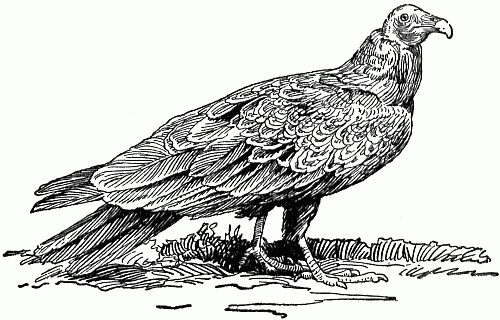 TURKEY BUZZARD.
The name "vulture" is applied to a family of birds
of prey. The bill of the vulture is large and very strong;
the head and neck are almost naked, being very lightly
sprinkled with down. It is a carrion-devouring bird and
does not attack living animals. It displays marvelous quickness
in discovering a dead body. Vultures are generally
protected in the countries where they are found because
of their value in clearing away the putrid animal matter
which would otherwise be injurious as well as disagreeable.
The American vultures sometimes reach a large size
and are very powerful in flight.
The Turkey Buzzard and Carrion Crow, both of which
are vultures, are common in the temperate parts of America.
The Carrion Crow is found as far North as Carolina.
The Turkey Buzzard is not a true buzzard and is wrongly
so called.
The Eagle.
Eagles are large and powerful birds. The flight of this
magnificent bird is very beautiful and imposing, but its
gait when on land is rather awkward. Its food is usually
smaller birds and quadrupeds such as hares, rabbits, etc.,
but it does not hesitate to carry off young lambs or sometimes
to destroy sickly sheep. It generally hunts in pairs,
one eagle watching at some height while the other courses
along the ground and scares the game from the bushes.
It lays two eggs of a yellowish-white color with brownish
spots on a nest composed of a great mass of sticks, brush
and grass. The young are fledged about the end of July.
While the young are in the nest it is very dangerous to
approach it as the eagles are then extremely fierce and
daring. Some instances have been related of children that
have been carried off by an eagle, but these stories are
very doubtful. Eagles have certainly been known to
pounce upon children and carry them a little way, but
there are no true accounts of children having been actually
taken to the eagles' nest, although there are many stories
founded on such a supposition. The beak of the eagle is
curved from the face, having a sharp point. Its wings are
long and large. They catch and kill their own prey, but
unlike the vultures will not eat carrion. The eagle which
is found in North America is usually the golden eagle,
and inhabits the Western States. The Indians called it
"the War Eagle." Its feathers are dark brown.
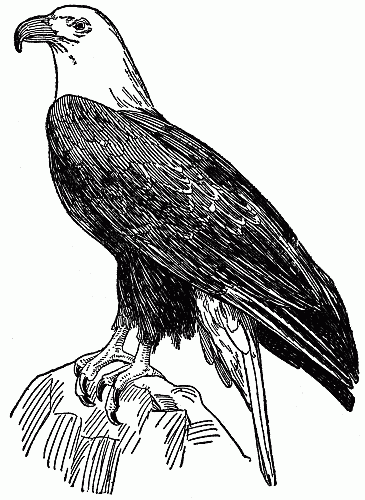 AMERICAN BALD EAGLE.
The Buzzards.
The family of Buzzards are distinguished by their short
beaks, large rounded wings and squared tails. They live
on small animals, reptiles and various insects.
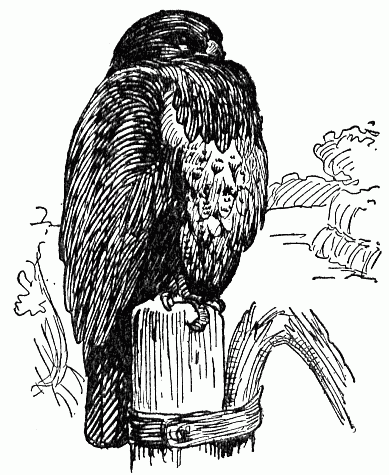 COMMON BUZZARD.
The Common Buzzard, when searching for food, rests
upon some high branch, keeping a keen watch on the
ground, and waiting patiently until some small animal
makes its appearance or some bit of carrion is scented. Its
length is from twenty to twenty-two inches. In flight it
is rather slow and heavy. The bird popularly known as a
Hen Hawk is a buzzard.
The Falcons.
The falcons are also birds of prey. Hawks are members
of this family. The Peregrine Falcon is an inhabitant of
most parts of Europe, Asia, South America and North
America. It builds its nest on cliffs and lays from two
to four eggs which are spotted with dark red. It preys on
other birds; its strength and swiftness are very great,
enabling it to strike down its prey with great ease; indeed,
it has been known to disable five partridges in succession.
It changes the color of its plumage several times before it
arrives at full maturity. Its length is from fifteen to
eighteen inches.
The Sparrow Hawk feeds on mice, ground squirrels, insects,
small birds. It displays great pertinacity in pursuit
of its prey which it will chase for a long while, skimming
along a few feet above the ground. When taken
young it is easily tamed and will then associate with the
most incongruous companions. Its length is from twelve
to fifteen feet. It builds upon lofty trees.
The Owls.
The owls are nocturnal birds, pursuing their prey by
night and sleeping by day. They have a large round
head with enormous eyes looking forward. Many species
possess two feathery tufts placed on the head greatly resembling
horns. In order to enable them to see their prey
their eyes are enormously large, capable of taking in every
ray of light. To protect them from the cold they are furnished
with a dense covering of downy feathers which also
prevents the movements of the wing from being heard.
The beak is short and horny, but very strong. They prey
on small animals, fish, insects, reptiles. The cry of the
owl is very peculiar and weird. This, coupled with their
strange appearance, has made them objects of superstition.
The ancients adopted them as symbols of wisdom. The
owls of North America that are the best known are the
Horned Owl, the Grayish-barred Owl and the Mottled Owl.
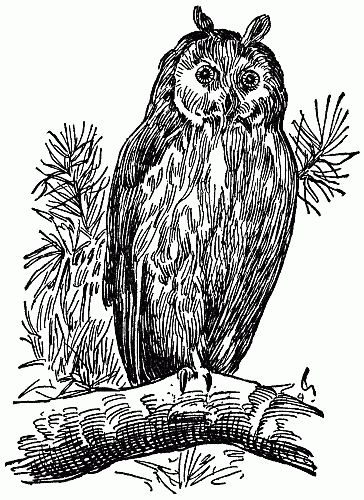 AN OWL.
The Snowy Owl also is found in North America; it is a
good fisher, snatching its prey from the water by a sudden
grasp of the foot; it also preys on small animals, chasing
and striking at them with its foot. It makes its nest on
the ground and lays three or four white eggs. Its length
is from twenty-two to twenty-seven inches. It extends its
wings four feet. There are some species of owl found in
America that burrow, living in the same hole with prairie
dogs, making their nest in the mouth of the prairie dog's
burrow.
Cousins to the owls are the Nightjars, for example, the
night hawk and whip-poor-will. They feed on moths and
insects which they catch as they fly. Their eggs are laid
on the ground without a nest.
The Swallows.
Swallows are remarkable for their great power of wing,
their wide mouths, their short legs and weak feet. Their
wing feathers are long, stiff and pointed, and their tails are
long and forked. Nine species of swallow are found north
of Mexico. They spend most of their time on the wing and
live almost entirely upon insects which they capture as
they fly; their large mouths particularly adapt them for
this manner of feeding. They nest frequently in colonies;
they migrate in large flocks and can often be seen in great
quantities at roosting places. They show skill in the construction
of their nests. The purple martin belongs to this
family; it is common in the South but rare in the Northern
States. The tree swallow builds its nest, of grasses and
feathers in the hollow of a tree. The bank swallow nests
in a sand-bank.
The Swifts.
The swifts are often confused with swallows owing to
the similarity of their flight and the manner in which they
feed. A Chimney Swift, commonly but erroneously called
the Chimney Swallow, in construction is more like the
humming-bird than the swallow; they nest in chimneys
about ten feet from the top.
The Kingfisher.
These birds are chiefly tropical, the Belted Kingfisher
being the only one of the family that is found north of
Texas. They feed on fishes and frequent the land near
the water and nest in holes which they make in a bank.
They perch on some limb overhanging the water and
watchfully wait for their dinner.
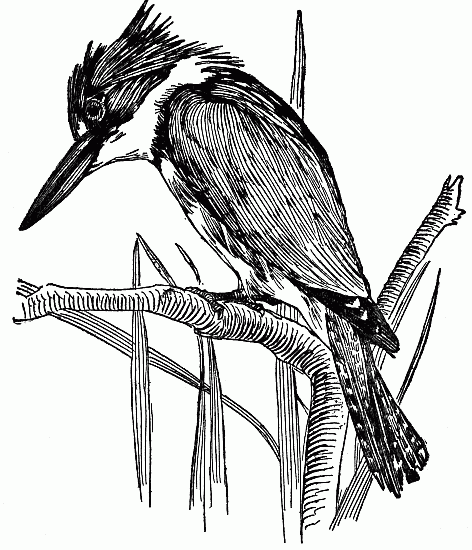 KINGFISHER.
The Humming-bird.
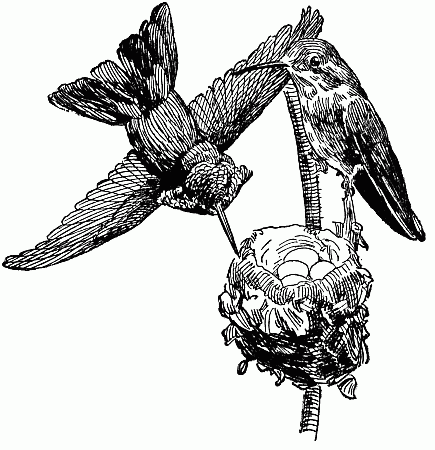 HUMMING-BIRD.
Eighteen species of these have been found in the United
States, but only one of these is found east of the Mississippi.
They feed on insects and also on the juices of flowers. The
humming-bird has no song, but the beauty of its plumage
makes up for this deficiency. It darts through the air
almost as quickly as thought; now it is within a yard of
your path—in an instant gone—now it flutters from flower
to flower to sip the dew—it is now a ruby—now a topaz—now
an emerald—now burnished gold. Its tongue is almost
like that of the woodpecker, being curled around the
head under the skin, and is thus capable of being darted
to a considerable distance; like many other little creatures,
it is remarkable for its assurance and impudence; it is
easily tamed for that very reason and has been known to
domesticate itself in an hour from the time it is captured,
and often when released has returned again to partake of
the dainties which it has tasted during its captivity. It
seems to have no fear and will attack any bird, irrespective
of size. The nest of the humming-bird is as dainty as the
bird itself.
The Wrens.
The American House Wren is larger than the European
wren, being about five inches long. It is of a reddish-brown
color. The nest of the wren is built in any convenient
cranny: an ivy-covered tree, the thatch of a barn
or a warm scarecrow are all used by this featherless little
bird. It is a good fighter and will attack bluebirds and
swallows. The nest is usually of an oval shape, always
covered on the outside with some material resembling the
color of the objects around it, such as green moss, if built
among ivy, or brown lichen, if built on a rock or in the fork
of a withered branch. The eggs are six or eight in number—white,
specked with reddish-brown.
The Carolina Wren frequents the undergrowth in thickets;
he is the most nervously active of all the wrens.
The Bewick's Wren is often found in the barnyard.
The Winter Wren builds its nest usually in the tree-roots
and heaps of brush.
The Marsh Wrens build their nests of a globular shape
with the entrance at the side, either attached to weeds or
tall grass, near or on the ground.
The Warblers.
This is a very large family; they feed almost entirely
upon insects. They are the first to leave upon the approach
of winter and the last to come in the spring. They
migrate at night and thousands are killed annually by
dashing against lighthouses.
The black and white warbler is streaked with black and
white and can be readily identified; it can be often seen
creeping under branches in search of its insect food.
The yellow warbler. What boy has not seen a "wild
canary"? It likes to inspect the gardens and shrubbery
around our houses, and consequently may be frequently
noticed. There are a great many more in this numerous
family.
The Thrushes.
This is another large bird family. In it are the bluebird
and the friendly robin; their song is very sweet.
The wood thrush is less shy than the veery or hermit
thrush. It can be distinguished from the others by its
larger size and its ruddy color and the large black spots
covering its underparts. The veery's upper parts are cinnamon
color; its dress is finely marked and its sides almost
white; it inhabits the dense woods and does not frequent
the habitation of man as does the wood thrush.
The Hermit Thrush is distinguished by its red tail, which
is much brighter in color than its back; it comes early in
the spring and lingers long in the autumn.
There are probably few boys who do not know a robin
when they see one, nor does the bluebird need to be introduced.
The Blackbirds and Orioles.
The Red-winged Blackbird has bright scarlet shoulders;
the rest of the feathers are mainly black; they frequent
marshes.
Orchard Orioles are to be found in the orchards, the elms,
the maples, and other trees of our lawns. This bird is remarkable
for the complete change he makes in his plumage,
from a dull yellow to a deep orange and black, the bird in
the summer presenting an entirely different aspect from
that in the winter. He builds his nest very near the end
of a tall limb where it will swing in the wind like a hammock.
The Bobolink is another one of this family that changes
its clothes each year. It goes North as the bobolink and
goes South as the reedbird or ricebird.
The Purple Grackle comes to us early in the spring; its
plumage is an iridescent purplish and greenish black.
The Cowbirds build no nests; they deposit their eggs in
the nests of smaller birds. These eggs are hatched with
the others in the nest and the young birds clamor constantly
for food and often starve or crowd out the rightful
bird babies.
The Thrashers, Mocking-birds, etc.,
frequent the borders or the edges of the woods and have
considerable singing ability; possibly the best known of
this family is the catbird, so called because his most familiar
cry is similar to the plaintive "meow" of the cat.
Although very few seem to know it, the catbird is also a
fine songster.
The mocking-bird is a great singer, sometimes singing
throughout a particularly bright moonlight night as well
as all day long. While sitting on its eggs it is an exceedingly
courageous bird, attacking without discrimination
men, dogs, or any animal that may approach too near the
nest. The black snake is the special object of its vengeance.
The snake, which has perhaps just arrived at the vicinity of
the nest, and is contemplating a pleasant breakfast on the
young or eggs, is violently attacked by the enraged mocking-bird,
which, by repeated blows on the head, generally
destroys its enemy, and then, mounting on a bush, pours
forth a triumphant song of victory. The nest is made generally
in a bush or fruit tree, frequently close to houses,
as the bird is protected by the inhabitants. The mocking-bird
is often kept tame, in which case, so far from its imitative
powers showing any decrease, the variety of domestic
sounds heard about the house is often very perplexing.
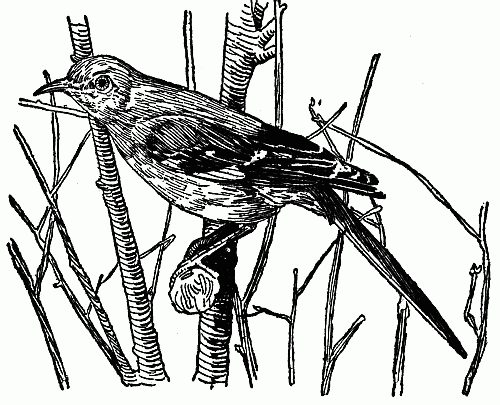 MOCKING-BIRD.
The thrasher is also a vocalist of some quality; he likes
to sit where he can be seen when he is singing, generally
high up in the tree.
The Flycatchers.
The flycatchers are songless; they are found all over the
United States. They remain on their perch, waiting for
a passing insect; when their prey is within sight they dart
after it and then return to their station.
The kingbird is grayish in color and bears a crest which,
when raised, reveals reddish feathers. He perches quietly
at his station, but is alert to every movement near him, and
rarely does a passing insect escape his keen eye.
The phœbe is very fond of building its nest under an old
bridge. His call is a monotonous, plaintive reiteration.
It sounds as though he were saying, "phœbe"; hence his
name.
Very common flycatchers are the Arcadian Flycatcher,
the Wood Peewee and the Least Flycatcher: the latter being
called the Least Flycatcher on account of its being the
smallest in size.
The Shrikes.
The color of this bird is gray, black and white. It
causes fright at once among sparrows, on which it preys
as well as upon mice and insects. He has a characteristic
flight, flying steadily and in a straight line close to the
ground, flapping his wings. When he gets near his destination
he reaches it by a sudden upward movement. The
shrikes are often called "butcher birds"; they well deserve
their name; they transfix their prey upon a thorn
preparatory to devouring it, having darted on it from some
place of concealment after the same manner as the flycatchers.
The Crows and Jays.
It will probably surprise you to know that the gaily
colored blue jay belongs to the same family as the dusky
crow. All of this family are great feeders, taking fruits,
seeds, insects, eggs and refuse; all of them possess great
intelligence. The blue jay seems to take positive pleasure
in teasing other birds; he is noisy and reckless; he nests
usually in the crotch of a tree from ten to twenty feet
high.
The crow's harsh voice, large size and black plumage
make this bird well known. Every boy who lives in the
country knows how fond the crow is of corn, and who has
not seen the scarecrows flapping their empty sleeves in
the winds of the cornfield.
The Finches and Sparrows.
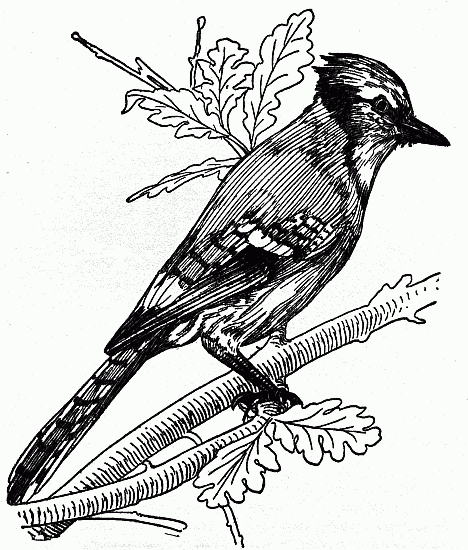 BLUE JAY.
This is the largest bird family. They possess stout bills
fitted to crush the seeds on which they feed. The House,
or English sparrow, was first introduced into the United
States in 1851. The Crossbill derives its name from having
the tips of its bill crossed. They frequent pine forests
and the structure of their bills helps them in forcing the
cones open to get at the seeds within.
The Goldfinches are canary-yellow and black; they
travel usually in small flocks; in song they become at times
so ecstatic that it seems as if they would burst their little
bodies.
The Junco is a small, plump bird. When the summer
birds have left for the South the Junco comes from the
North.
The Cardinal is one of the gayest of our feathered
friends; its plumage is a rosy-red with a little black patch
at the throat and the crest; it nests in bushes, the nest
being composed of twigs, rootlets and lined with grasses.
The Indigo Bunting is blue as his name. You will find
him in old pastures among bushes and clearings. The female
of this bird is like a sparrow in marking, except for
the tinge of blue which you may discover in her plumage.
The Tanagers
are closely related to the finches; all of them have pretty
clothes, especially the Scarlet Tanager, who is bright scarlet
with black wings and tail. It is well worth a day's tramp
to see one.
The Waxwings.
The Cedar Waxwings arrive late in the spring. They
have a black line which runs through the eye; their upper
parts are brown, their head is greenish, their tails gray.
You will often find them among fruit and shady trees;
they like old orchards where they hunt for cankerworms.
They have red spots on their wings that look like drops
of sealing-wax.
The Vireos.
Small insect-eating birds; they do not catch their prey
on the wing as do the flycatchers, but search for their
food on bark and leaves; they are pleasant songsters and
their nests are neat and well-rounded, suspended from the
fork of a branch.
The Woodpeckers.
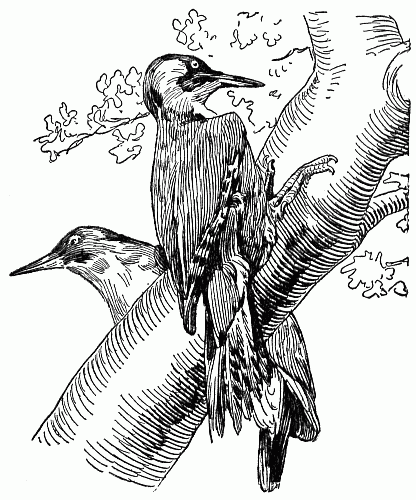 WOODPECKERS.
The claw of the woodpecker is constructed of two toes
forward and two toes backward, which assist them in
climbing the tree-trunks; their tail feathers are pointed
and stiff and serve as a prop; the bill is adapted for
chiseling out the homes of grubs, insects, etc., in the bark.
The Downy Woodpecker. Its upper parts are black, scarlet
band on the neck, the middle of the back is white, while
the wing feathers are specked with white. You can often
see him in an orchard or in the trees on the lawn, picking
out the grubs as he climbs the tree-trunks and branches.
The Sapsucker has a scarlet cap; its back is black and
yellow, tail black; it feeds largely on tree juices.
Red-headed Woodpecker. Head, neck, throat and principal
parts red; back black and white; nests generally in
a dead tree.
The Flicker. The top of the head gray; red band across
back of the neck; back brownish with black bars; they are
frequently called "high-holes."
The Pigeons and Doves.
The passenger pigeon is now practically extinct. Captain
Bendire, writing twenty years ago, says: "It looks
now as if their total extermination might be accomplished
within the present century. The only thing which retards
their complete extinction is that it no longer pays to net
these birds, they being too scarce for this now, at least in
the more settled portions of the country, and also, perhaps,
that from constant and unremitting prosecution on their
breeding-grounds they have changed their habits somewhat,
the majority no longer breeding in colonies, but
scattering all over the country and breeding in isolated
pairs." They used to be seen in enormous flocks, which, as
they migrated, really hid the sun, destroyed forests miles
wide, breaking down branches with their weight and wasting
the crops far and wide. This bird moves with extraordinary
speed and goes enormous distances. Many have
been killed in New York State with their crops full of
rice that they must have eaten in Georgia. That means
that they flew three hundred miles in six hours. In 1813,
Audubon says the air was literally filled with pigeons, and
the midday sun darkened as in an eclipse, and the flocks
flew over him in countless numbers for three whole days.
The Mourning Dove is similar to the Passenger Pigeon,
but not as large.
Grouse.
The Grouse are as a rule ground birds and trust to
their ability to hide to escape detection, their color being
such as to make them difficult to detect against a background
of dead leaves. The Ruffed Grouse can easily be
detected by the drumming sound which it makes. This
drumming begins gradually and gradually dies away. The
sound is made by the male bird beating its wings in the
air. The young birds run about like small chickens. They
feed on insects, berries and seeds.
Quail.
Who has not heard the quail call across the fields "bobwhite,
poor bobwhite"? They like the fields of corn in
the fall; in the winter they journey to the deep woods;
like the grouse, they rely upon their coloration for protection
and will only take flight as a last resort.
The Plovers.
In habit they are like the snipes; but their tails are
shorter and thicker. The Golden Plover may be found in
marshes and sand-flats; they can run very rapidly; they
may be seen as the tide goes out feeding on sand-flats or
sand-bars. After running a few yards they stop suddenly
and seem to take their bearings. It is well known by its
plaintive cry and the stratagems it employs to decoy intruders
away from its nest, or rather eggs.
The Killdeer is so called on account of the cry which
it utters; it resembles "kill-dee, kill-dee." It is found
usually in flocks and nests on the ground in a hollow.
The Cranes
frequent marshes and are fond of frogs, field mice, snakes,
etc. They have a loud cry. When in flight the neck is
not bent like the Heron's. They nest on the ground.
The Herons and Bitterns.
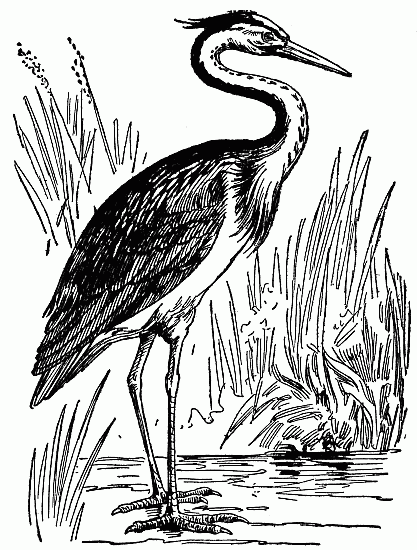 HERON.
The Herons nest in flocks; the bitterns are not as sociable.
The latter inhabit grassy marshes, while Herons like the
shores of lakes and rivers. The Herons fly with their neck
bent in between their shoulders. The American Bittern
lives in large grassy meadows; it makes a peculiar booming
sound which can be heard for a long distance. The Great
White Heron is found along the Gulf of Mexico and in
Florida. The Great Blue Heron is found further north;
its nest is usually in tall trees and is made up of sticks
and twigs. The Egrets belong to this family.
The Spoonbills.
The Roseate Spoonbill is found only in the very Southern
parts of the United States and in small quantities; their
bill is large and flat, shaped at the end like a large spoon.
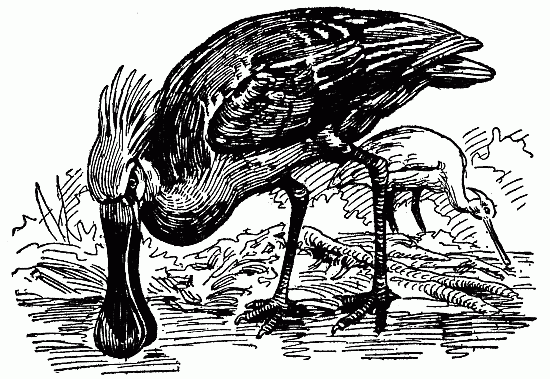 THE SPOONBILLS.
The Ibises.
The Ibises find their food on mud-flats along the shores of
lakes and rivers. It consists of frogs, small fish, etc.
The Snipes and Sandpipers.
The birds are also found near the water; they have long
bills which they force into the mud in search of their
food.
The Wilson Snipe nests in meadows and swamps. It
builds its nest on the ground and is a game bird popular
with the sportsman. The Snipe in its habits much resembles
the Woodcock; its flight is very singular, rendering
it a difficult mark.
The American Woodcock.
The presence of Woodcock can always be determined by
the holes which they make in the earth in search of worms;
these are known as woodcock borings. When the bird
is found near its nest or young birds it will feign an injury
and will endeavor in this way to lead you away from them.
The Woodcock frequents dense thickets during the day
and at night it leaves for swamps and meadows in search
of worms and insects.
Avocets and Stilts.
Called "The Wading Snipe"; they wade in shallow
water and can swim when necessary. The bill of this bird
is curved like that of the Curlew, but the curve is upward
instead of downward.
The Rails, Gallinules and Coots.
The Rails live in marshes. The Gallinules live on marshy
banks of rivers, lakes, etc. The Coots are still more aquatic,
and are very noisy; all of this family lay their eggs on
the ground.
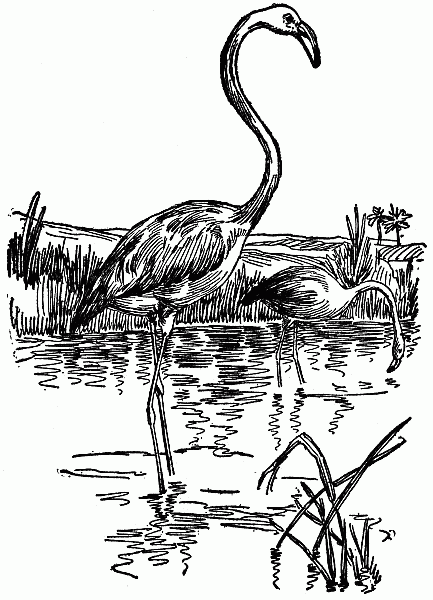 FLAMINGOES.
The Flamingoes.
The Flamingoes formerly visited Southern Florida every
winter. Now their appearance is rare. The singularly
shaped beak of this splendid bird is peculiarly adapted
to its long and flexible neck. When the bird wishes to
feed it merely stoops its head into the water; the upper
mandible is then lowest and is well fitted to receive the
nutritive substances which are entangled in a filter placed
on the edges of the beak.
The color of its plumage is a deep brilliant scarlet, except
the quill feathers, which are black. When a number of
these birds stand ranged in a line, according to their custom,
they present the appearance of a small and well-drilled
body of soldiers.
The Swans.
Wild Swans are now rare birds in the United States.
They feed as they swim by putting their long necks and
heads under the water. They swim with great rapidity.
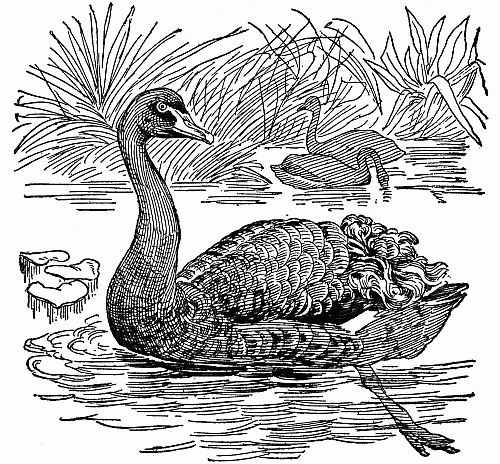 SWAN.
SWAN.
Geese.
Watch the skies in the spring and when you see a V-shaped
flock of birds flying northward, the wild geese are
flying. It is said that the apex of the V is always an old
gander. They feed on vegetable matter, both in the water
and on shore.
The White-fronted Goose is common in the Mississippi
Valley and on the Pacific Coast.
The Canada Goose travels many thousand miles each
year in its migrations.
Geese nest on the ground, the nest being made of grasses
and twigs and thickly lined with down.
Ducks.
The Mallard is the origin of our domestic bird, and is
widely spread over the northern parts of Europe, Asia
and America. In the winter it migrates in countless flocks
to the warmer States.
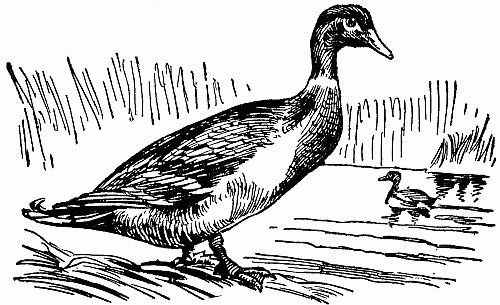 WILD DUCK.
The Black Duck is sometimes called the Black Mallard.
The Red-head Duck along the Atlantic Coast feeds in salt
water. The Canvasback is in great demand on account
of the superior quality of its flesh as food. Both the Red-head
and Canvasback are fond of feeding on wild celery,
and it is said that it is this that gives their flesh the fine
flavor.
The Pelicans.
These birds nest in colonies. Their flight is strong. The
White Pelican and the Brown Pelican are found in Florida.
It is a very conspicuous bird, its singular membranous pouch
offering a distinction perfectly unmistakable. The pouch,
when distended, holds two gallons of water, but the bird
has the power of contracting it so that it can scarcely be
discerned.
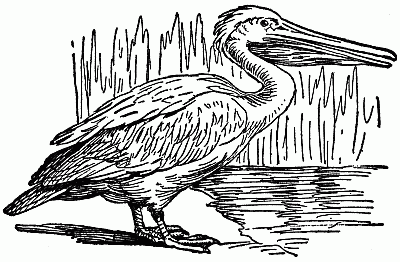 PELICAN.
The pouch serves as a net in which to scoop up the fish
on which the Pelican feeds.
Another most important use of the pouch is to convey
food to the young. The parent Pelican presses the pouch
against its breast, in order to enable the young to obtain
the fish, which action in all probability gave rise to the
fable of the Pelican feeding its own blood. Although web-footed,
it can perch on trees, although it prefers sitting
on rocks.
The Cormorants.
Cormorants like the sea, but sometimes may be seen
inland. They, too, are colony birds. Their nests are made
of sticks and seaweed.
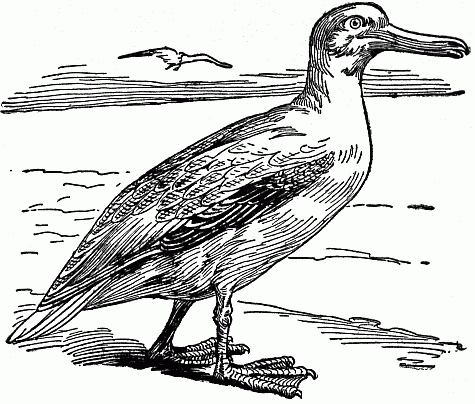 CORMORANT.
The Cormorant is exceedingly voracious, and devours an
almost incredible amount of fish. It is an excellent diver,
and chases the fish actually under the water, seldom if ever
returning without having secured its prey. Like the otter,
when engaged in chase, it occasionally rises to take breath,
and then resumes the pursuit with renewed vigor. It has
the power of perching on trees, an accomplishment which
we should hardly suspect a web-footed bird of possessing.
The Cormorant is easily tamed, and its fishing propensities
can be turned to good account. The Chinese, at the
present day, employ a kind of Cormorant for that purpose,
having previously placed a ring round the bird's neck to
prevent it from swallowing the fish. Its length is about
three feet.
The Petrels.
The Stormy Petrel is, under the name of Mother Carey's
Chicken, the terror of the sailor, who always considers the
bird as the precursor of a storm. It is the smallest of the
web-footed birds. Few storms are violent enough to keep
this curious little bird from wandering over the waves in
search of the food that the disturbed water casts to the
surface.
The Albatrosses.
The Albatrosses are relatives of the Petrels, but much
larger birds.
The Wandering Albatross, the largest of the genus, is a
well-known bird in the southern seas, following ships for
many miles. The flight of this bird is peculiarly majestic.
Its extreme length of wing prevents it from rising at once
from the ground, but when once launched into the air it
seems to float and direct its course without effort.
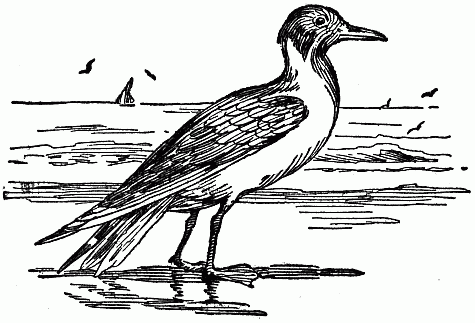 ALBATROSS.
The Terns.
The Terns, or Sea Swallows, are possessed of great power
and endurance of flight, their long forked tails and pointed
wings indicating strength and swiftness.
It preys on fish, which it snatches from the surface with
unerring aim as it skims over the waves with astonishing
velocity.
They inhabit the seashore and, unlike gulls, make distant
journeys from the coast.
The Gulls.
The Gulls are larger birds than the Terns. As the
vultures are the scavengers of the land, these birds are
the scavengers of the sea. They are frequently seen at
great distance from land, resting on the water. Their
nests are found in colonies.
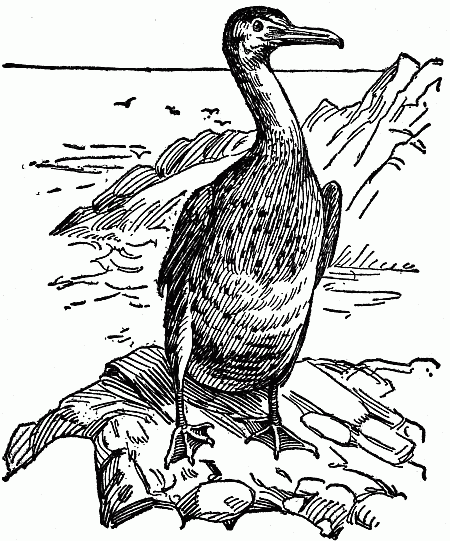 GULL.
GULL.
Puffins.
The Puffin is an excellent diver, plunging fearlessly from
a lofty cliff into the sea, and speedily returning with its
beak full of fish, which are secured by their heads, and
lie in a row along the bill of the Puffin, forming a kind
of piscatorial fringe. Its enormous and sharp-edged bill
renders it a formidable antagonist to intruders. It is
often called the "Sea Parrot."
Loons.
Inhabit fresh water lakes during the summer and the
sea during the winter. They can swim considerable distances
under water. Their nest is near the shore.
Grebes.
The foot of the Grebes is not webbed like that of most
water birds, but each toe is separated and flattened, so as
to serve as a separate paddle.
Common Red Birds.
| Scarlet Tanager. |
| Cardinal. |
| Rose-breasted Grossbeak. |
| Redstart. |
Common Blue Birds.
Common Yellow and Orange Birds.
| Yellow Warbler. |
| Flicker. |
| Baltimore Oriole. |
Common Black Birds.
| Crow. |
| Purple Grackle. |
| Red-winged Blackbird. |
| Cowbird. |
Common Black and White Birds.
| Black and White Warbler. |
| Bobolink. |
| Downy Woodpecker. |
Common Brown Birds.
 "We're gaining a little all the time, fellows!" exclaimed Elmer.