THE TRIBUNAL OF CONSCIENCE
Uncle Charlie took six blue tickets from
his pocket and set them on the dining-room
mantel. His ownership of a newspaper was
the explanation for this liberality of supply
to those who could put the two things together.
"I wonder," said he, "if anybody in this
room ever heard of the circus?"
Emmy Lou could not get down from her
place at the dinner-table fast enough. She hurried
to the kitchen. She had heard of the circus
from Bob the house-boy, who had a circus
bill!
Bills, as a rule, are small affairs measurable
in inches; bits of paper which reduce Aunt
Cordelia to figurings with a lead pencil, short
replies, and low spirits.
But a circus bill, pink and pictorial, is measurable
in feet. As Bob spread his on the
kitchen table yesterday and again this morning,
it fell either side well on the way to the
floor. Its wonders, inexplicable where he,
spelling out the text, forebore to explain, or
explicable where he did if one knew no better
than he, were measurable only by the limits
of the mind to take them in. If Emmy Lou,
who started to school last fall three weeks late
owing to a popular prejudice against whooping-cough,
had caught up as Aunt Cordelia
easily assumed she would, or "caught on," in
the words of Uncle Charlie, she might have
been spelling out some of the wonders of the
circus bill for herself.
Bob's finger had paused beneath a lady in
myriad billowing skirts poised mid-air between
a horse and a hoop such as Emmy Lou spent
hours trying to trundle on the sidewalk. "She's
jumpin' th'ough the hoop, but thet ain't
nothin'. Heah in the other picture she's
jumpin' th'ough six."
Emmy Lou, hurrying to the kitchen now
and finding Bob about to start in with the soup,
borrowed the bill and hurried back with it to
the dining-room and Uncle Charlie's side.
"This one's an elephant," she explained, her
finger, even as Bob's, beneath the picture. "He
picks little children up and puts them in his
trunk."
"I see you know, though some do call it his
howdah," said Uncle Charlie. "And no doubt
about the lions and the tigers, the giraffe and
the zebra as well?" regretfully. "Even the
lemonade?"
"Lemonade?"
"Pink. And peanuts." Uncle Charlie motioned
to Bob to put his soup down and have
done with it, as it were. "Also Nella, The
Child Equestrienne in Her Triumphal Entry—here
she is. And Zephine, the Wingless
Wonder, in Her Flight Through the Air——"
"Am I going to the circus?" from Emmy
Lou.
"That's what I hoped," from Uncle Charlie,
handing back the bill and turning to his soup.
"But of course if there is room for doubt
about it——"
The very next day Emmy Lou came hurrying
home from Sunday school. She had the
Dawkins, Sarah, the conscientious elder sister,
Maud, and Albert Eddie, for company as far
as the grocery at the corner. Since Aunt
Cordelia had learned they were English, apparent
explanation for those who understood,
they had been persuaded to go to St. Simeon's
Sunday school too.
Sunday school was to have a—Emmy Lou
in her Sunday dress and her Sunday hat, hurrying
on from the corner by herself, tried to
straighten this out before reaching home and
reporting it. What was it Sunday school was
to have? In Uncle Charlie's study—a small
back room, somewhat battered and dingy but,
as he claimed in its defense, his own—was a
picture of a stout little man propelled in a
wheelbarrow by some other men.
Emmy Lou had discovered that Uncle Charlie
loved the little man and prized the picture.
When she asked who he was and where he
was going in the wheelbarrow, Uncle Charlie
said it was Mr. Pickwick going to a picnic.
Or, and here was the trouble, was it Mr. Picnic
going to a pickwick? It depended on this what
Sunday school was to have.
Uncle Charlie, hat and cane in hand, waiting
in the hall for Aunt Cordelia to start to church,
straightened out the matter. Mr. Pickwick
was going to a picnic. It then followed that
Emmy Lou, in general a brief person, had such
a store of information about the picnic she
was moved to share it with Uncle Charlie.
This common interest about the circus and their
recurring conversations about it were drawing
them together, anyhow. Her data about the
picnic on the whole was menacing in its character.
As, for example:
It was to be in Mr. Denby's grove. He
charged too much for it, but St. Simeon's could
not do any better. If you went too far away
from the swings and the benches the mamma
of some little pigs would chase you.
Further. You cannot go to St. Simeon's
picnic, or, indeed, to any picnic without a basket!
Emmy Lou had endeavored to find out
what sort of a basket and Sarah had cut her
short with the brief reply, "A picnic basket."
And, finally, "Albert Eddie wishes he'd
never started to St. Simeon's. Sarah says he
has to go to the picnic and he wants to go to
the circus!"
Aunt Cordelia arriving in full church array
caught this last. "I've been meaning to
speak about it myself. I find the circus is
here for the one day only and that the day for
St. Simeon's picnic."
Emmy Lou received this as applying to the
Dawkins only. The information her inquiries
had enabled her to get together led her personally
to disparage picnics.
"Albert Eddie says Sarah made him wash
dishes at the last picnic he went to. And she
makes him carry baskets. That if he'd wash
dishes for 'em at the circus and carry water,
they'd let him in."
"Sarah, Maud, Albert Eddie, you, me, and
one ticket to spare; such was my idea," said
Uncle Charlie, he and Aunt Cordelia preparing
to start. "The only thing we've ever given
the Dawkins up to date is the whooping-cough.
Picnic or circus, duty or pleasure,
we'll have to put it to them which they want
it to be."
Aunt Cordelia, even at the risk of being late
to church, stopped short. She didn't see the
matter in any such fashion at all! "Emmy
Lou will prefer to go to her own Sunday
school picnic too, I hope," decidedly. "How
you distract and bother the child, Charlie!"
"I bother Emmy Lou? She and I are as
near good friends as people get to be. We
respect each other's honesty and go our own
ways. I am going to leave the tickets where
I put them yesterday. I planned to take her
and the Dawkins to the circus. You and she
can fight it out." He proceeded through the
open doorway to the stone steps.
"In that case," from Aunt Cordelia as she
followed him, "since you seem to put me in
the wrong, I leave it to her own conscience.
She is seven years old, a big girl going to
school and Sunday school, and ought to know
right from wrong." And the two were gone.
Conscience! Familiar shibboleth to the seventh
age of little girls! Stern front behind
which Aunt Cordelia these days hides her kindly
features.
Somewhere beyond the neighborhood where
Emmy Lou lived with Aunt Cordelia and
Uncle Charlie, was the roundhouse and the
yards of a railroad. Or so Aunt Cordelia explained.
The roundhouse bell, rung every
hour by the watchman on his rounds, made
far-off melancholy tolling through the night.
The sins at seven, the chubby, endeavoring
Emmy Lou's sins, her cloak on the coat-closet
floor instead of the closet peg, mucilage on
Aunt Katie's rug where a paper outspread
before pasting began would have saved it—sins
such as these have no prod to reminder
more poignant than this melancholy tolling of
the roundhouse bell in the night.
"It is an uneasy conscience," Aunt Cordelia
invariably claimed when Emmy Lou, waking,
came begging for permission to get in her bed.
"If your conscience was all that it should be,
you'd be asleep."
Yet did Aunt Cordelia, as a rule, leave those
matters to Emmy Lou's conscience which she
thought she did? Did Emmy Lou three out
of four Sundays find herself remaining at
church rather than on her road home because
she herself wanted to stay? Or taking off her
new dress on reaching home because she
wanted to get into the older one?
Or, rather, did she find her baffled if unsuspecting
self, coerced and bewildered, doing
these and other things in the name of choice
when the doing was not through choice at all?
Aunt Cordelia was going to leave the decision
between the circus and the picnic to Emmy
Lou, too, because she said she was. Nor did
Aunt Cordelia, honest soul, or Emmy Lou,
unquestioning and trusting one, dream but that
she did.
"I'll see Sarah Dawkins," said Aunt Cordelia
to Aunt Katie and Aunt Louise the very
next morning, "and arrange with her to look
after Emmy Lou at the picnic. We'll use the
small hamper for her basket. She can take
enough for herself and them. Bob can take her
and it around to the church corner where the
chartered street cars are to be waiting, and
put her in Sarah's charge there. I can't see,
Katie, why you oppose a cake with custard
filling for the basket."
"It's messy," said Aunt Katie, "both to take
and to eat."
"But if she likes it best?" from Aunt Cordelia.
It was the first thing come to Emmy Lou's
hearing lending appeal to the picnic; or light
on the purpose of the baskets.
Uncle Charlie arriving for dinner outmatched
it, however, by another appeal. "I
saw a new circus bill on the fence of the vacant
lot as I came by. A yellow bill."
Emmy Lou hurried right down there from
the dinner-table. Nella, the Child Equestrienne,
was kissing her hand right to Emmy
Lou from her horse's back. And the elephant,
abandoning his customary dark business of
putting little children in his trunk, with unexpected
geniality was sitting on a stool before
a table drinking tea.
And the next day Bob outmatched this. He
had been to the grocery to see about chickens
for the picnic to which Emmy Lou ought to
want to go.
"There's a Flyin' Dutchman on the outside,
an' side-shows too. I seen about it on a bill
the other side of the grocery. A green bill."
Emmy Lou hurried down there. She didn't
see anything that she could identify as a Flying
Dutchman, perhaps because she was hazy
as to what a Dutchman was. But Zephine,
swinging by her teeth, was just leaping into
space.
"I think I will let her wear her sprigged
muslin," said Aunt Cordelia at supper that
night. "A good many grown persons go in
the afternoon."
"Their excuse being to take the children——"
from Uncle Charlie easily.
"I am not talking of the circus, Charlie, and
you know I am not," from Aunt Cordelia
sharply.
"She has decided then?"
"She certainly ought to have decided. There
never should have been any doubt. I'll put
in some little tarts, Katie; all children like
tarts."
Had Emmy Lou decided? She heard it assumed
that she had. Why, then, with this
sense of frustration and bewilderment was she
swallowing at tears?
"I certainly feel I may say Emmy Lou has
decided," repeated Aunt Cordelia. "I'm sure,
Katie, tarts are just the thing."
"I'll never believe it," said Uncle Charlie,
emphatically, nor was he referring to the
tarts.
Did he refuse to be party to any such idea?
"I would not be surprised," said he to Emmy
Lou the next evening, "if we hear the circus
rumbling by in the night. Our street is the
one they usually take from the railroad yards
to the circus-grounds. I put six tickets on
the mantelpiece where at the most we will need
only five. Suppose I take one and see what
I can do with it?"
"Emmy Lou has no idea but of going to
her own Sunday school picnic," said Aunt Cordelia.
"I wish, Charlie, you would be still
about your tickets and the circus."
"They are not my tickets. They are going
to stay right here. I merely was to go with
Emmy Lou on one of them. They are her
tickets to do with as she wants and to take
whom she pleases."
Though the circus did go by in the night,
according to report next morning, Emmy Lou
failed to hear it. Nor did the melancholy
of the tolling bell disturb her. Aunt Cordelia
said this was because she was going to
her Sunday school picnic as she should, and
had a quiet conscience.
"I come roun' by the circus as I come to
work," Bob said in the pantry where Aunt
Cordelia and he packed the basket with Emmy
Lou for spectator. "Gittin' them wagons with
the lookin'-glass sides ready for the perade.
Thet ol' elephant come swinging erlong like
he owned the y'earth. Mr. Charlie gimme a
ticket las' night to go."
Which reminded Emmy Lou. Even though
she was going to the picnic, there was comfort
in the thought those tickets yet on the mantelpiece
were hers. She went into the dining-room
and pushed a chair to the hearth. The
sprigged muslin she was to wear had a pocket,
and later when this dress was put on the tickets
which were her own were in the pocket.
If one never has been to a picnic the only
premises to go on are those given you.
"You haven't a thing to do but stay with
Maud and Albert Eddie, and mind Sarah,"
said Aunt Cordelia as she put Emmy Lou's
hat on her head and its elastic under her chin,
"except, of course, to look after your basket.
There is pink icing on the little cakes and a
good tablecloth that I don't want anything to
happen to under the beaten biscuits at the bottom.
There is ham and there's tongue and
there's chicken."
"I have to look after the basket," Emmy
Lou told Sarah as she and the Dawkins with
the rest of St. Simeon's Sunday school were
put aboard the excursion cars.
"Of course you do," said Sarah approvingly.
"We all do. It's right here. And," with the
heartiness of one distributing largesse in privileges,
the meanwhile settling her three charges
in their places, "when we get off the car Albert
Eddie shall carry it."
Emmy Lou had a seat between Albert Eddie
and Maud. Beyond Albert Eddie were three
little boys in knickerbockers, blouses, and straw
hats, as gloomy in face as he.
"Not only let him carry water for the elephant
but gave him a ticket for doing it," the
nearest one was saying to the other three.
"Had it with him when he got back. I saw
it myself. He lemme take it in my hand. A
blue ticket."
"Right past the circus grounds, tents and
all," from the second little boy as their car
came in sight of the beflagged tent city. "I'll
betcher they're gettin' ready for the parade
right now!"
Four glittering, turbaned beings appeared
around a tent, each leading a plumed and
caparisoned horse to a place before a gilded
and high-throned edifice. "Didn't I tell you
they were?" bitterly. A band crashed.
The heads of St. Simeon's Sunday school,
regardless of danger, craned out as one. The
more venturesome left their seats.
St. Simeon's chartered cars rolled inexorably
by. Heads came in. The venturesome
returned to their places.
"What is there to a picnic anyhow?" from
the third little boy. "Nothin' at all but what
you eat."
Albert Eddie staggered under the weight
of the basket when in time the car stopped on
the track along the dusty road outside Mr.
Denby's grove. But then one out of every
two persons descending from the several cars
was similarly staggering under the weight of
a basket.
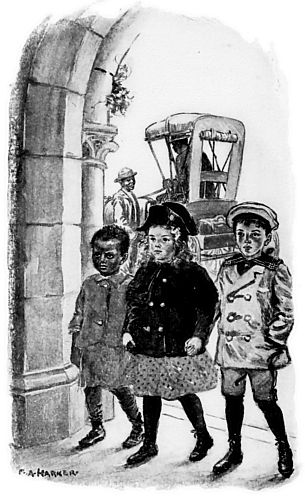
Sarah and Maud, with Emmy Lou led by
either hand between them, followed Albert Eddie
with their own. After which, St. Simeon's,
having brought all baskets to a common center
beneath a tree in the neighborhood of the ice-water
barrel, went off and left them.
"I'm going with a little girl who asked me,"
Maud told Sarah. "We won't go too far or
the mother of the little pigs will chase us."
"Albert Eddie, I told the ladies that you
would get the wood for a fire so we can put
the coffee on," said Sarah. "When you come
back from that you can take the bucket and
bring us the ice-water from the barrel for the
lemonade."
Sarah's glance came next to Emmy Lou, no
mixer in the world of Sunday school at best, as
Sarah before this had observed. Sarah frowned
perturbedly. Some are picnickers by intuition,
for example Maud and the little girl
gone off together; others come to it through
endeavor. It was seven-year-old Emmy Lou's
first picnic, and she in her sprigged muslin
stood looking to Sarah.
Sarah was a manager, but having yet to
manage for Emmy Lou her frown was perturbed.
Then her face cleared. She fetched a
flat if a trifle over-mossy stone and put it down
on the outskirts of the baskets grouped beneath
the sheltering tree, and near the ice-water barrel.
"There, now! You can sit down here
and look after the baskets till I get back," she
told Emmy Lou and was gone.
There is virtue in coming to a picnic. Aunt
Cordelia plainly gave one to understand so.
"Why don't you go play with the others,
little girl?" asked a lady who was tying on a
gingham apron as she hurried by. "Go over
to the swings and see-saws."
But Emmy Lou, no picnicker by intuition,
nor as yet by any other mode of arrival, was
grateful that she had to stay with the baskets,
and, had the lady paused long enough for a
reply, could say so.
Was there virtue in coming to the picnic
for Albert Eddie too? Emmy Lou on her
stone under the tree guarding baskets saw
him come back with his load of firewood. She
saw him next carrying the bucket of water from
the barrel.
And here some ladies approaching the baskets
beside Emmy Lou beneath the tree, and
casting appraising eyes over the outlay, began
to help themselves to the same! To this basket,
and that basket, and carry them away!
One even approached and laid hands on Emmy
Lou's own! It took courage to speak, but she
found it.
"It's mine," from Emmy Lou.
"And just the very nicest looking one I have
seen," said the lady heartily after raising the
lid and probing into the contents. "Anyone
would be glad to say it was hers," and went off
with it! St. Simeon's with a commendable
sense of fellowship made a common feast from
its picnic baskets at long tables for all, but
Emmy Lou did not know this. She only saw
her cake with the custard filling, her cakes
with the pink icing, her tarts, her ham and
tongue, her chicken and biscuits and tablecloth
borne off from her with a coolness astounding
and appalling.
Virtue is hers who dully endures a picnic.
Emmy Lou, coming out of her stun and daze
and seeing some little boys approaching, the
ice-water barrel being a general Mecca, swallowed
hard that, did they notice her, they
might not see how near she was to crying.
Three little boys in knickerbockers, blouses,
and straw hats they were, still with their common
air of being more than justifiably aggrieved.
They noticed her and at the abrupt halt of
one, all stopped.
"We saw her on the car," he said. "What's
she got?"
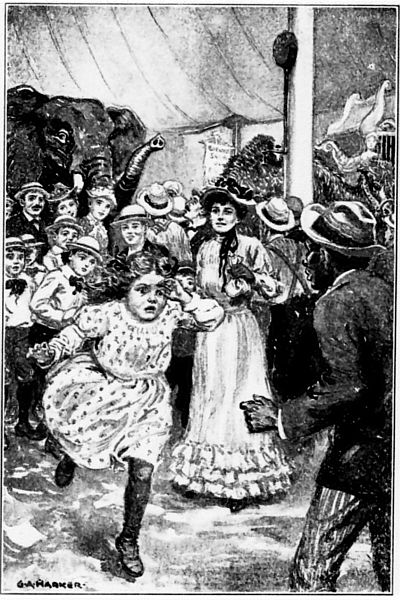 "Why should that monstrous bulk of elephant have trumpeted just then?"
For Emmy Lou's hand some time since had
brought forth for comfort from her pocket
the blue tickets which were her own. That
hand closed on them at the question now. She'd
just seen her basket go!
"Are they circus tickets? Sure? Lemme
see them? Aw, what you scared of, lettin' me
see 'em in my hand?"
Emmy Lou did not know just what. The
ways of a picnic and those attending were new
to her, but what she had learned discouraged
confidence. Her hand and the tickets in it
went behind her.
"Where'd she get 'em?" the boy asked now
of Albert Eddie, arriving with his bucket for
more water.
He set the bucket down by the barrel and
joined the group.
"Do you s'pose they are really hers?" was
the query put to him as he got there.
Emmy Lou knew Albert Eddie, had known
him for a long time as time is measured at
seven years. He looked after her on the way
to and from Sunday school even though he did
it at Sarah's bidding, whereas Maud forgot
her. Moreover, he had not wanted to come to
the picnic, and, bond firmly established between
them, neither had she. She surrendered
her tickets into his hands to be inspected. She
even credentialed them. The others had
doubted them! "They're mine. My Uncle
Charlie said so. To take anybody I wanted to
take if I hadn't had to come here!"
Her tickets! Five by actual count and actual
touch! To do what she pleased with!
This plump little girl with the elastic of her
hat under her chin, sitting alone at the picnic
on a stone!
The conversation in the group became choric
and to some extent Delphic, Emmy Lou, with
her eyes on the tickets in Albert Eddie's hands,
alone excluded.
"Aw, we could!"
"Follow the track!"
"Could she do it?"
"'Tain't so far she couldn't if we start now."
Four little boys, nearing nine, Albert Eddie,
Logan, John, and Wharton, made Machiavellian
through longing, turned to this little girl
on her stone and made court to her as they
knew how.
"Aw, you ask her! You know her!" from
Logan to Albert Eddie.
Albert Eddie cleared his throat. He'd carried
the basket. He'd carried the wood. He'd
carried the water. He was bitter to desperate
lengths, indeed, and in the rebound no good
and obedient little boy at all but one gloriously
afloat on seas of dire and reckless abandon.
"We'll take you to the circus, these boys
and me, and let you see everything, if you want
us to," with a diablerie of cunning so appalling
and so convicting in its readiness he knew he
must falter if he stopped to consider it.
"'Tain't as if we hadn't been before, every
one of us," from Logan, with that yet greater
cunning of the practiced and the artist, indifference;
"but we wouldn't mind taking you."
"I been twice," from Wharton mightily.
"I been once, last year," from Albert Eddie.
"I been twice in one year," from John, "here
at home and when I went to visit my grandmother."
"I been twice to one show," from Logan,
eclipsing them all. "One day with one uncle,
and the next day with another!"
And Emmy Lou never had been at all! The
tickets, most cunning play of all, had been put
back in her own hand.
"Old clown he threw his hat up, turned a
handspring, and come up and caught it on
his head," from Wharton. "We'll show you
the clown."
"—rode one horse standing and driving five
and kissed her hand every time she came by—"
Logan, forgetting his cue and his cunning, was
saying to Albert Eddie and John.
"—picks out the letters, that dog does, and
spells his own name—" John, forgetting his
cue and his cunning, was saying to Albert Eddie
and Logan.
Emmy Lou moved on her stone.
"—rolls in a big keg, that elephant does, and
turns it up and sits down on it. We'll show
you the elephant too," Wharton, faithful to his
cue, was saying to her.
Emmy Lou stood up. She handed the tickets
to whoever might be to take charge of
them. She put her hand in Albert Eddie's.
"I didn't want to come to the picnic and not
go to the circus," she said.
They were grateful and solicitous little boys.
They hurried her unduly, perhaps, in getting
her out of the grounds, but once upon the
safer territory of road beside the track they
were mindful of her.
"I'll take her by one hand," said Logan to
Albert Eddie, "and you keep hold of her by
the other hand, because she knows you."
Whatever that hot, dusty, shadeless, that appalling
stretch of country road meant to Emmy
Lou, she never afterward referred to it.
But then there were reasons making silence
more natural on her part.
Yet she saw the circus! Emmy Lou saw
the circus! Come what might, she had that!
What that they arrived at the circus entrance
dinnerless, dust-laden, and, but for a stop
along the way at a pump and trough, thirsty!
What that the man sitting at the mouth of
the passage between canvas walls, to whom
the tickets were handed, eyed them, four unattended
little boys taking marked care of one
little girl in their midst—since he let them by
and in!
Sawdust, orange-peel, flaring gas jets,
camel, lions, big pussy-tiger, Oh, glorious and
unmatchable blend of circus aroma! Oh, vast
circling sweep and reach of seats and faces,
with four little boys guarding one little girl
in their midst, wandering along looking for
places!
Oh, blare of brass, Oh, fanfare of trumpets,
Oh, triumphant entry of all hitherto but dimly
sensed and hauntingly visioned, color, pageant,
rhythm, triumph, glory, heretofore lost as they
came, but now palpable, tangible, and existent!
Oh, pitiful, a bit terrifying, white-faced
clown! The butt, the mock, the bear-all! Emmy
Lou does not laugh at the clown! Because
she pities him and is sorry for him, her heart
goes out to him instead! And she trembles
for Nella as her horse urged by the snapping,
menacing whip sweeps by faster and even faster—and
she cries out when at the crash of
the kettle-drums, Zephine leaps——
"But I didn't see the elephant like I did the
lions and the camel and the tiger," she tells
Logan and Albert Eddie and the others. Nor
had she. The elephant had gone to take his
place in the triumphal entry when Emmy Lou
and her four cicerones, in their progress
through the animal tent before the program,
reached his roped-in inclosure.
And so they made their way back to him
through the surging crowd as they went out,
four solicitous little boys conducting Emmy
Lou. Made their way as near as might be,
then pushed her through the row of spectators
in front of them to the rope.
"He picks little children up and puts them
in his trunk," she was saying as one fascinated
by the very awfulness of that she dwelt on, as
they squeezed her through.
Why should that monstrous bulk of elephant
have trumpeted just then—as Emmy Lou
emerged at the rope—have flung his trunk
out in all the lordly condescension of a mighty
one willing to stoop, in the accustomed quest
of peanuts?
Aunt Louise, returning from a futile trip
to the church corner to meet Emmy Lou, had
just explained that the picnic had not returned,
being delayed, so rumor said, by the
search for five missing children, when Bob
walked in bringing a dust-laden Emmy Lou.
"Came on her at the circus?" from Aunt
Cordelia incredulously.
"In the animal tent roun' there whar thet
elephunt is," Bob diagrammed.
Emmy Lou's face, bearing marks of recent
agitation, showed agitation anew.
"Good work," from Uncle Charlie, just arrived
himself. "Who was with her?"
"Some li'l boys, she says. She warn't with
nobody when I come on her runnin' f'om thet
elephunt toward me without knowin' it, an'
screamin'."
Emmy Lou's agitation broke into speech
mingled with tears. "He picks little children
up and puts them in his trunk. And he tried
to pick up me!"
Along in the night Emmy Lou awaking
found that she wanted a drink. These warm
June nights the water bottle and tumbler sat
on the sill of the open window in Aunt Cordelia's
room, which meant that Emmy Lou
must get out of bed and patter in there to
them.
Reaching the window—was Emmy Lou in
her nightgown and her bare feet really there
and awake or in her bed in reality and direly
dreaming?
Was it so or not so, this looming, swinging,
menacing bulk, palpably after her
again, approaching adown the silent, dusky
street?
Seven years old and a little, little girl, Emmy
Lou fled to Aunt Cordelia's bedside and
tugged at her arm to get her awake.
Aunt Cordelia, taking her into her bed,
soothed her, her hand massaging up and down
back, shoulders, little thighs, comfortingly
enough, even the while she scolds. She takes
it without question that Emmy Lou has been
dreaming.
"It is what comes of being a naughty little
girl again. We never sleep well when our
conscience is uneasy."
Emmy Lou lay close. Conscience! Aunt
Cordelia said so!
Nor did Aunt Cordelia dream, nor Emmy
Lou suspect, that the monstrous, looming
shape padding along the silent street beyond
the open window with its broad sill was the
circus elephant making his way to the railroad
yard and his traveling car, the yard where the
roundhouse bell even now made melancholy
tolling in the night.