The Chateau de St. Alpin was a gloomy and antique building, but
in habitable repair. The only constant resident in it for some years
had been the Demoiselle de St. Alpin, now about five and forty;
whose whole attention had been given to keeping it in order, and
collecting, in the garden, variety of plants, in which she took
singular pleasure. Detached from the world, and with no other
relations than her brother and her nephews, whom she was seldom
likely to see, she found in this innocent and amusing pursuit a
resource against the tedium of life. Her manners, tho' simple,
were mild and engaging; and her heart perfectly good and benevolent.
With her, therefore, Emmeline was extremely pleased; and
the country in which her residence was situated, was so beautiful,
that accustomed to form her ideas of magnificent scenery from the
first impressions that her mind had received in Wales, Emmeline
acknowledged that her eye was here perfectly satisfied.
With her heart it was far otherwise. On her arrival at St. Alpin,
she found letters from Lady Adelina enclosed in others from Mrs.
Stafford. Lady Adelina gave such an account of her own health
as convinced Emmeline it was not improved since she left England.
Of Mr. Godolphin she only said, that he was returned from Ireland,
but had staid with her only a few hours, and was then obliged to
go on business to London, where his continuance was uncertain.
Mrs. Stafford gave of herself and her family a more pleasing
account. She said she had hopes that the readjustment of Mr.
Stafford's affairs would soon allow of their return to England;
and as it might possibly happen on very short notice, and before
Emmeline could rejoin them, she had sent, by a family who were
travelling to Geneva, and who readily undertook the care of it, a
large box which contained some of her cloaths and the caskets
which belonged to her, which had been long left at Mrs. Ashwood's
after Emmeline's precipitate departure from her house with
Delamere, and which, on Mrs. Ashwood's marriage and removal,
she had sent with a cold note (addressed to Miss Mowbray) to
the person who negociated Mr. Stafford's business in London.
Their lengthened journey had so much broken in on the time
allotted to their tour, that Lord and Lady Westhaven purposed
staying only a month at St. Alpin. The Baron, who had equal
pride and pleasure in the company of his nephew, endeavoured by
every means in his power to make that time pass agreeably; and
felt great satisfaction in shewing to the few neighbours who were
within fifteen miles of his chateau, that he had, in an English nobleman
of such rank and merit, so near a relation.
He had observed very early the growing passion of his son for
Miss Mowbray. He was assured that she returned it; for he never
supposed it possible that any woman could behold the Chevalier
with indifference.
He had heard from Lord Westhaven that Emmeline was the
daughter of a man of fashion, but was by the circumstances of
her birth excluded from any share of his fortune, and entirely
dependant on the favour of the Marquis of Montreville. The old
Baron, charmed himself with her person and her manners, rather
approved than opposed the wishes of his son; and however convenient
it might have been to have seen him married to a woman
of fortune, he was disposed to rejoice at his inclining to marry at
all; and convinced that with Emmeline he must be happy, thought
he might dispense with being rich. The Chevalier, confident of
success, and believing that Emmeline had meant by her timid
refusals only encouragement, grew so extremely importunate,
that she was sometimes on the point of declaring to him her real
situation.
But from this she was deterred by the apprehension that he
would apply to Lord Delamere for the relinquishment of her
promise; and should he obtain it, consider himself as having a
claim to the hand his Lordship resigned.
This was an hope, which whatever his vanity might have suggested,
she never meant to give him; yet she had the mortification
to find that all her rejections, however repeated, were considered
by the Chevalier as words of course. It was in vain she assured
him that besides her disinclination to change her situation by
marriage at all, she had other forcible objections; that she should
never think of passing her life out of England; that not only their
country, but their manners, their ideas on a thousand subjects,
so materially differed, as to make every other reason of her refusal
unnecessary.
When she seriously urged thus much, he usually answered that
he would then reside in England; that he would accommodate
his manner of living to her pleasure; and that as to the ideas which
had displeased her, he would never again offend her with their
repetition.
Emmeline had indeed been extremely hurt and disgusted at
that levity of principle on the most serious subjects which the
Chevalier avowed without reserve, and for which he appeared to
value himself. Tho' brought up a Calvinist, he had as he owned
always conformed to the mode of worship and ceremonies of the
Catholics while he was among them; and usually added, that had
he served amid the Turks or the Jews, he should have done the
same, as a matter of great indifference.
The Baron, whose life had been more active than contemplative,
was unaccustomed to consider these matters deeply. And as every
thing Bellozane advanced had with him great authority, he was
struck with his lively arguments; and whatever might be their
solidity, could not help admiring the wit of the Chevalier, whom
he sometimes encouraged to dispute with Lord Westhaven. The
religion of Lord Westhaven was as steady and unaffected as his
morals were excellent; and he entered willingly into these dialogues
with Bellozane, in hopes of convincing him that infidelity
was by no means necessary to the character of a soldier; and that
he was unlikely to serve well the country to which he belonged, or
for which he fought, who began by insulting his God.
He found however that the young man had imbibed these
lessons so early, and fancied them so much the marks of a superior
and penetrating mind, that he could make no impression by rational
argument. Bellozane usually answered by a sprightly quotation
from some French author, and his Lordship soon declined the
conversation, believing that if sickness and sorrow did not supercede
so slow a cure, time at least would convince him of his folly.
But such was the effect of this sort of discourse on Emmeline, that
had Bellozane been in other respects unexceptionable, and had her
heart been free from any other impression, she would never have
listened to him as a lover.
From his own account of himself in other respects, Emmeline
had gathered enough to believe that he was profligate and immoral.
But as she could not appear to detect these errors without allowing
him to suppose her interested in his forsaking them, she generally
heard him in silence; and only when pressed to name her objections
stated his loose opinions as one in her mind very material.
To this he again repeated, that his opinions he would correct;
his residence should be settled by herself.—'Had she any objection
to his person?' enquired he, as he proudly surveyed it in the
long old fashioned glass which ornamented the sal a manger.[26]
Emmeline, blushing from the conscious recollection of the
resemblance it bore in height and air to that of Godolphin,
answered faulteringly—'That to his person there could be no
objection.'
'To his fortune?'
'It was undoubtedly more than situated as she was she could
expect.'
'To his family?'
'It was a family whose alliance must confer honour.'
'What then?' vehemently continued the Chevalier—'what then,
charming Emmeline, occasions this long reserve, this barbarous
coldness? Since you can form no decided objection; since you
have undoubtedly allowed me to hope; why do you thus cruelly
prolong my sufferings? Surely you do not, you cannot mean finally
to refuse and desert me, after having permitted me so long to speak
to you of my passion?'
'It is with some justice,' gravely and coldly answered Emmeline—'I
own it is with some justice that you impute to me the appearance of
coquetry; because I have listened with too much patience, (tho'
certainly never with approbation,) to your discourse on this subject.
But be assured that whatever I have said, tho' perhaps with insufficient
firmness, I now repeat, in the hope that you will understand it
as my unalterable resolution—The honour you are so obliging as to
offer me, I never can accept; and I beg you will forbear to urge me
farther on a subject to which I never can give any other answer.'
This dialogue, which happened on the second day of her residence
at St. Alpin, and the first moment he could find her alone,
did not seem to discourage the Chevalier. He observed her narrowly:
the country round St. Alpin, which, as well as the place
itself, he thought 'triste et insupportable,' seemed to delight and
attract her. He saw her not only enduring but even fond of his
aunt and her plants, which were to him, 'les sujets du monde les
plus facheux.'[25]—His excessive vanity made him persist in believing
that she could not admire such a place but thro' some latent
partiality to it's master; nor seek the company and esteem of his
aunt, but for the sake of her nephew.
These remarks, and a conviction formed on his own self-love
and on the experience of his Parisian conquests, made him disregard
her refusal and persecute her incessantly with his love.
Lord Westhaven saw her uneasiness; but knew not how to relieve
her without offending the Baron and the Chevalier, or divulging
circumstances of which he did not think himself at liberty without
her permission to speak.
Lady Westhaven, to whom Emmeline was obliged to complain
of the importunity of Bellozane, repeatedly but very fruitlessly
remonstrated with him. What she had at first ridiculed, now gave
her pain; and anxious as she was to reconcile her brother to her
friend, from whom she thought only his warmth of temper and a
misunderstanding had divided him, she wished to shorten as
much as possible their stay at St. Alpin.
Her own situation too made her very anxious to return to
England; and she was impatient to see Lord Delamere, to explain
to him all the mystery of Emmeline's conduct; a detail which she
could not venture by the post, tho' she had written to him from
Lyons, intreating him to suspend all opinion in regard to Miss
Mowbray's conduct 'till she should see him.
This letter never reached the hands of Lord Delamere, and
therefore was not answered to St. Alpin; whither his sister had
desired him to direct, and where she now grew very uneasy at
not hearing from him.
Le Limosin and his Madelon had arrived at St. Alpin some
time before their noble patrons, with whose goodness they were
elated to excess. Le Limosin himself, assiduous to do every thing
for every body, flew about as if he was but twenty. His particular
province was to attend with Lady Westhaven's English servant
on her Ladyship and Miss Mowbray; and Madelon was directed
to wait on the latter as her fille de chambre.
Emmeline, with painful solicitude for which she could hardly
account, wished to hear from Le Limosin those particulars of her
father of which he was so well able to inform her. He had served,
too, her mother; whose name she had hardly ever heard repeated,
and of whom, before witnesses, she dared not enquire.
Lord Westhaven had not yet explained to him to what he principally
owed the extraordinary kindness he had met with. He
knew not that the lady on whom he had the honour to wait was the
daughter of that master to whom he had been so much obliged.
The first days that Lord and Lady Westhaven and Emmeline
had passed with the Baron, had been engaged by company or in
parties which he made to shew the views of the surrounding country
to his English guests. The Chevalier never suffered Emmeline to
be absent from these excursions, nor when at home allowed her
to be a moment out of his company. If she sought refuge in the
chamber of Mrs. St. Alpin, he followed her; if she went with her
to her plants, thither also came Bellozane; and having acquired
from his aunt's books a few physical and botanical terms, affected
to desire information, which the old Lady, highly pleased with
his desire of improvement in her favourite studies, gave him with
great simplicity.
Lord Westhaven grew apprehensive that the jaunts of pleasure
which the Baron continued to propose would be too fatigueing
for his wife. And as they were now to go on a visit to one of St.
Alpin's old military friends, who resided at the distance of fifteen
miles, and where they were to remain all night, he prevailed on
her to stay at home, where Emmeline also desired to be left.
Bellozane, detesting a party which the ladies were not to enliven,
made some efforts to be excused also; but he found his declining
to go would so much chagrin and disappoint his father, that, with
whatever reluctance, he was obliged to set out with him.
Lady Westhaven, who was a good deal indisposed, went to lie
down in her own room; whither Emmeline attended her, and finding
she was disposed to sleep, left her. Mrs. St. Alpin was busied
in her garden; and Emmeline, delighted with an opportunity of
being alone, retired to her room to write to Mrs. Stafford. She had
not proceeded far in her letter, when a servant informed her that
the messenger who had been sent to Geneva for her box was returned
with it. She desired that it might be brought up. Madelon
came to assist her in opening it, and then left her.
She took out the cloaths and linen, and then the two embroidered
caskets, which she put on the table before her, and gazed at with
melancholy pleasure, as silent memorials of her parents. They
brought also to her mind the recollection of Mrs. Carey, and many
of her infantine pains and pleasures at Mowbray Castle, where
she remembered first to have remarked them in a drawer belonging
to that good woman; to which, tho' it was generally locked,
she had occasionally sent her little charge when she was herself
confined to her chair.
One of them she had began to inspect at Clapham, and perused
some of the letters it contained. They were from her grandmother,
Mrs. Mowbray, to her father; and were filled with reproaches
so warm and severe, and such pointed censures of his
conduct in regard to Miss Stavordale, her mother, to whom one
letter yet more bitter was addressed, that after reading three of
them, Emmeline believed that the further inspection of the casket
was likely to produce for her only unavailing regret.
Still however she would then have continued it, painful as it
was, but was interrupted by the sudden entrance of Lord Montreville,
who came to enquire after his son. The sight of Mr. Mowbray's
picture, which she had taken out, created in the breast of
his Lordship a momentary tenderness for his niece. She had since
always worn that picture about her; but the papers, by which she
had been too much affected after that interview farther to peruse,
she had again secured in the caskets; and being almost immediately
afterwards taken by Delamere on her involuntary journey
to Stevenage, from whence she returned no more to Clapham,
she had not since had them in her possession.
Her mind in this interval had acquired greater strength; and
she at length wished to know those particulars of her mother's
fate, into which she had hitherto forborne thro' timidity to enquire.
Being now therefore alone, and having these repositories once
more in her hands, she resolutely inspected them.
The first contained about twenty letters. Some were those she
had before seen, and others followed them equally severe. They
seemed in sullen resentment to have been preserved; and Emmeline
could not but reflect with pain on the anger and asperity in
which they were written; on the remorse and uneasiness with
which they must have been read.
The second casket seemed also to hold letters. On opening it,
Emmeline found they were part of the correspondence between
her father and mother during the early part of their acquaintance,
when, tho' they sometimes resided in the same house, the vigilant
observation of Mrs. Mowbray very seldom allowed them to
converse.
Among these, were several pieces of poetry, elegant and affecting.
After having read which, Emmeline imagined she had seen
all the box contained, a few loosely folded papers only remaining;
but on opening one of these, what was her astonishment to find
in it two certificates of her mother's marriage; one under the hand
of a Catholic priest, by whom she had been married immediately
on their arrival at Dunkirk; the other signed a few days before the
birth of Emmeline by an English clergyman, who had again performed
the ceremony in the chapel of the English Ambassador
at Paris.
That the memory of her mother should thus be free from reproach;
that the conduct of her father, which had hitherto appeared
cruel and unjust, should be vindicated from every aspersion; and
that she should herself be restored to that place in society from
which she seemed to be excluded for ever; was altogether such
unexpected, such incredible happiness, as made her almost doubtful
of the evidence of her senses. Ignorant as she was of the usual
form of such papers, yet the care with which these seemed to be
executed left her little doubt of their regularity. One other folded
paper yet remained unread. Trembling she opened it. It was
written in her father's hand and endorsed
MEMORANDUM
'The harshness with which my mother and her family have
treated Miss Stavordale, for a supposed crime, has forced her to
put herself under my protection. Miss Stavordale is now my wife;
but of this I shall not inform my family, conceiving myself accountable
no longer to persons capable of so much rashness and injustice.
Least any thing however should happen before I can make
a will in due form, I hereby acknowledge Emmeline Stavordale
(now Mowbray) as my wife; and her child, whether a son or a
daughter, heir to my estate. My brother being possessed of a
very large fortune, both by his late marriage and the gifts of his
mother's family, will hardly dispute the claim of such child to my
paternal estate.
'(This is a duplicate of a paper sent to Francis Williamson, my
steward at Mowbray Castle.) Signed by me at Paris in presence of
two witnesses, this fifteenth of March 17—.
Henry Charles Mowbray.
Witnessed by
Robert Wallace,
Baptiste La Fere,, (dit Le Limosin.)'
This, which was of the same date as the last certificate, confirmed
every claim which they both gave Emmeline to her name
and fortune. A change of circumstances so sudden; her apprehensions
that the Marquis of Montreville, who she thought must
have long known, should dispute her legitimacy, and her wonder
at the concealment which Mr. Williamson and Mrs. Carey seemed
passively to have suffered; which together with a thousand other
sensations crouded at once into her mind, so greatly affected her,
that feeling herself grow sick, she was obliged to call Madelon,
who being at work in an adjoining room, ran in, and seeing her
lady look extremely pale, and hearing her speak with difficulty,
she threw open the window, fetched her some water, and then
without waiting to see their effects she flew away to call Mrs. St.
Alpin; who presently appeared, followed by her maid carrying a
large case which was filled with bottles of various distillations from
every aromatic and pungent herb her garden or the adjacent
mountains afforded.
Emmeline, hardly knowing what she did, was compelled to
swallow a glass full of one of these cordials; which Mrs. St. Alpin
assured her was 'excellente pour les vapeurs.'[27] It almost deprived
her of breath, but recalled her astonished spirits; and having with
great difficulty prevailed on her kindly-busy hostess to leave her,
she locked up her papers, and threw herself on the bed; where,
having directed Madelon to draw the curtains and retire, she tried
to compose her mind, and to consider what steps she ought to take
in consequence of this extraordinary discovery.
[28]
Convinced of the noble and disinterested nature of Lord Westhaven,
Emmeline thought she ought immediately on his return to
shew him the papers she had found, and entreat him to examine,
for farther particulars, Le Limosin, who seemed providentially
to have been thrown in her way on purpose to elucidate her
history.
After having formed this resolution, her mind was at liberty for
other reflections. Delamere returned to it: his unjust suspicions;
his haughty reproaches; his long, indignant anger, which vouchsafed
not even to solicit an explanation; she involuntarily compared
with the gentleness, the generosity of Godolphin; with his
candid temper, his warm affections, his tender heart. And with
pain she remembered, that unless Delamere would relinquish the
fatal promise she had given him, she could not shew the preference
which she feared she must ever feel for him. Sometimes she
thought of asking Lord Westhaven to apply to Delamere for her
release. But how could she venture on a measure which might
involve, in such difficulties, Lady Adelina, and engage Lord Westhaven
in an enquiry fatal to his repose and that of his whole family?
How could she, by this application, counteract the wishes of Lady
Westhaven, who anxiously hoped to re-unite her brother and her
friend; and who desired ardently to be in England, that she might
explain herself, to Delamere, all the circumstances that had injured
Emmeline in his opinion; which she thought she could easily do
without hazarding any of the evils that might follow from an inconsiderate
disclosure of the occurrences he had misunderstood.
Uneasily ruminating on the painful uncertainty of her situation
and the difficulties which every way surrounded her, she continued
alone; till Lady Westhaven, alarmed at hearing she had
been ill, sent her woman to enquire after and know if she might
herself come to her? Emmeline, to relieve at once her friendly
solicitude, arose and went to her apartment; where she made light
of her sickness, and endeavoured to assume as much chearfulness
as possible.—'Till she had seen Lord Westhaven, she determined
not to mention to her Ladyship the discovery of the morning;
feeling that there would be great indelicacy in eagerly divulging
to her a secret by which she must tacitly accuse the Marquis of
Montreville of having thus long detained from its legal owner the
Mowbray estate; and of having brought up in indigence and
obscurity, the daughter of his brother, while conscious of her
claim to education and affluence.
Struggling therefore to subdue the remaining tumult of her
spirits, she rejoined her friend. They passed the afternoon tranquilly
with Mrs. St. Alpin; and about eleven o'clock the following
morning, Lord Westhaven, the Baron, and the Chevalier, returned.
Emmeline took the earliest opportunity of telling Lord Westhaven
that she wished to speak to him alone. There was no way
of escaping from the Chevalier but by his Lordship's openly
declaring that he wanted a private conference with his fair cousin,
whom he led into the garden. Bellozane, who hoped that his earnest
solicitations had prevailed on Lord Westhaven to befriend his love,
was glad to see them walk out together, while he watched them
from a window.
Emmeline put into her pocket the two certificates and the
memorandum written by her father. Without explanation or
comment, she gave them, as soon as they were at a little distance
from the house, to Lord Westhaven.
He read them twice over in silence; then looking with astonishment
at Emmeline, he asked her from whence she had these papers?
'They were enclosed, my Lord,' answered she 'in two little
boxes or caskets which were left to me among other things by my
father's nurse; who becoming the housekeeper at Mowbray
Castle, brought me up. They afterwards long remained at the
house of Mrs. James Crofts, with whom you know I resided; on
her removal after her marriage, they were sent, together with some
of my cloaths, to Mrs. Stafford's agent in London; from whence
she lately received them; and having an opportunity of sending
them to Geneva by a family travelling thither, she forwarded them
to me, and I found them yesterday in the trunk brought by the
messenger which you know the Baron sent thither on purpose.'
Again Lord Westhaven read the papers; and after pausing a
moment said—
'There is no doubt, there can be none, of the authenticity of
these papers, nor of your consequent claim to the Mowbray estate.
Surely,' added he, again pausing—'surely it is most extraordinary
that Lord Montreville should have suffered the true circumstances
of your birth to remain thus long unexplained. Most cruel! most
ungenerous! to possess himself of a property to which he must
know he had no right! Your father's memorandum says that he
had forwarded a duplicate of it to Francis Williamson; do you
know whether that person is yet living?'
'He is dead, my Lord. He died in consequence of an accident
at Mowbray Castle, where he was many years steward.'
'He must however have had sufficient time to give Lord Montreville
every information as to his master's marriage, even if his
Lordship knew it not, as he probably did, by other means. Yet
from a man of honour—from Lord Montreville—such conduct is
most unworthy. I can hardly conceive it possible that he should
be guilty of such concealment.'
'Surely, my Lord, it is possible,' said the candid and ingenuous
Emmeline—'surely it is possible that my uncle might, by some
accident, (for which without knowing more we cannot account)
have been kept in ignorance of my mother's real situation. For
your satisfaction and mine, before we say more on this subject,
would it not be well to hear what Le Limosin, who was I suppose
present both at my mother's marriage and at my father's death,
has to relate?'
To this proposal Lord Westhaven agreed. The sal a compagnie[29]
was usually vacant at this time of the day. Thither they went together,
and sent for Le Limosin; who loved talking so much that
nothing was more easy than to make him tell all he remembered, and
even minutely describe every scene at which he had been present.
'Le Limosin,' said Lord Westhaven, as soon as he came into the
room, 'I was much pleased and interested with the account you
gave me when I first met you, of the English master whom you call
Milor Mowbray. I know his family well. Tell me, does this picture
resemble him?'
His Lordship shewed him a portrait of Mr. Mowbray which
had been drawn at Paris.
Le Limosin looked a moment at it—the tears came into his eyes.
'O oui—oui, mi Lor!—je me rappelle bien ce portrait!—Ah! quel
resemblance! Quelques mois avant sa mort tel etoit mon pauvre maitre!
Ah!' added he, giving back, with a sigh, the picture to Lord
Westhaven—'cela me fend le cœur!'[30]
'Now then,' reassumed Lord Westhaven, 'look, Le Limosin,
at that.' He put before him the resemblance of Emmeline's mother,
which had been painted at the same time.
'Eh! pardi oui—voila—voila Madame! la charmante femme, dont
la perte couta la vie a mon maitre. Helas!—je m'en souviens bien du
jôur que je vis pour la premiere fois cette aimable dame. Elle n'avoit
qu'environ quatorze a quinze ans. Ah! qu'elle etoit pour lors, gaï,
espiegle, folatre, et si belle!—si belle!'[34]
'Tell me,' said Lord Westhaven, 'all you remember of her.'
'I remember her, my Lord,' said Le Limosin, speaking still in
French, 'I remember her from the first of my going to England
with Milor Mowbray. She lived then with Madame Mowbray; and
the servants told me, that being a distant relation and an orphan,
Madame had taken her and intended to give her a fortune. Milor
Mowbray, when he first returned from his travels, used to live
for two or three months together with Madame his mother; but
she was strict and severe, and used frequently to reproach him
with his gaieties—il etoit un peu libertin Milor, comme sont a l'ordinaire
les jeunes seigneurs de sa nation.[35] He admired Mademoiselle
Stavordale as a beautiful child, and used to romp with her;
but as she grew older, Madame Mowbray was dissatisfied with him
for taking so much notice of her, and would oblige her to live always
up in Madame's dressing room, so that my master could hardly
ever see her. Madame, however, told my master one day, that tho'
Mademoiselle Stavordale had no fortune, she would not object to
his marrying her in a year or two if he was then in the same mind.
But my master was in his turn offended. He said he would not be
dictated to, nor told whether he should marry or remain single.
Madame etoit forte brusque—elle piquoit Monsieur par un reponse un
peu vive[33]—and they had a violent disagreement; in consequence of
which he quitted her house, and only went now and then afterwards
to see her quite in form. Some months afterwards he called
me to him; and as I was dressing him he asked me if I had no
female friend among his mother's servants. 'Baptiste,' said he, 'I
cannot get the Demoiselle Stavordale out of my head.—J'aime a
la folie cette fille mais pour le mariage,je ne suis pas trop sur, que je
m'acquitterai bien, en promissant de l'aimer pour la vie.—Je veux
aussi qu'elle m'aime sans que l'interet y'entre pour quelque chose.—Puisque
Madame ma mere s'amuse a me guetter, je voudrois bien la
tromper; je scais que tu est habile—ne pourra tu pas nous menager
une petite tete a tete?[31] 'Milor, je faisois mon possible—et enfin—par
la bonté et l'honeteté—d'une fille qui servoit Madame—je vins
heureusement about—Quelque jours apres—Monsieur enleva la belle
Stavordale tant en depit—qu'en amour.'[32]
At this recital, Emmeline found herself cruelly hurt; but Lord
Westhaven besought her to command herself, and Le Limosin
went on.
'To avoid the rage and reproaches of Madame Mowbray, which
it was likely would be very loud, my master took Mademoiselle
Stavordale immediately abroad. We landed at Dunkirk; but the
young lady was so unhappy at the step she had taken, elle pleuroit,
elle se desoloit, elle s'abandonna a le desespoir—enfin, tant elle faisoit,[36]
that Monsieur sent for a priest, and they were married. Soon
afterwards my lady was likely to bring Monsieur an heir. Ah!
qu'ils etoient pour lors heureux. But their happiness was interrupted
by the death of my master's mother, Madame Mowbray, who had
never forgiven him, and who disposed of all her money that was
in her own power to his brother. My poor lady took this sadly to
heart. She reproached herself with being the cause of my master's
losing such a fortune. He said he had yet enough; and tried to
console my lady. Still, still it hung on her spirits; and she could
not bear to think that Madame Mowbray, who had brought her
up, and had been kind to her when she had no other friend, should
have died in anger with her. I believe my master was sorry then
that he had not reconciled himself with his mother, as my lady
often begged and entreated that he would; but it was now too late;
and he said his brother had used him unkindly, and had certainly
helped to irritate his mother against him; and he would not write
to him tho' my lady often desired and prayed that he would. As
she grew near her time, she was more and more out of spirits, and
my master finding her uneasy because they had not been married
by an English priest, had the ceremony performed again in the
chapel of the English Ambassador. My master could not however
make her forget her concern for the death of his mother; and she
was always melancholy, as if she had foreseen how little a time she
had herself to live. Alas! she brought my master a daughter, and
died in three hours!'
'If I were to live a thousand years,' continued Le Limosin,
'I should never forget my poor master's distraction when he heard
she was dead. It was with great difficulty that even with the assistance
of his English servants I could prevent his destroying himself
in the phrenzy of his grief. I dared not leave him a moment.
He heard nothing we said to him; he heeded not the questions
I asked him about the child; and at last I was forced to send an
express to Mr. Oxenden, his friend, who was at some distance
from Paris. He came; and by the help of another English gentleman
they forced him out of the house while the body of my mistress
was removed to be carried to England. He was so near madness,
that his friends were afraid of his relapsing, even after he grew
better, if they asked him many questions about it. So they gave me
orders as to her funeral; and after about a fortnight he came back
to the house where the child was, attended by his two friends.
'It was an heart-piercing sight, Milor, to see him weep over the
little baby as it lay in the arms of it's nurse. After some time he
called me, and told me that he should not be easy, unless he was
sure his poor little girl would be taken proper care of; that he had
no friend in France to whom he chose to entrust her; and therefore
ordered me to go with the nurse to England, and directed
Therése, my mistress's fille de chambre, to go also, that the child
might be well attended. He told me that he should perhaps quit
Paris before I could get back; in which case he would leave directions
where I should follow him. Then he kissed his little girl,
and his two friends tore him away. I immediately proceeded to
England as he directed, with the nurse, and Therése, and we
carried the infant to the Chateau de Mowbray. The French nurse
could speak no English, and could not be prevailed upon to stay
above two days. Therése too longed to get back to France; and
we immediately returned to Paris, where I found a letter from my
master, ordering me to follow him into Italy.
'At Milan, Milor, I rejoined him. He looked very ill; and complained
of feeling himself indisposed. But still he went out; and
I believe drank too much with his English friends. The third or
fourth day after I got there he came home from a party which he
had made out of town with them about ten o'clock in the morning,
and told me he had a violent pain in his head. He went up into his
room. "I am strangely disordered, Baptiste," said he, as he put
his hand to his temples—"perhaps it may go off; but if it should
grow worse, as I am afraid it will, remember that you take those
two little boxes in which I keep my papers, to England, and deliver
them to my steward at Mowbray Castle. I have already written
to him about my daughter." Then almost shrieking with the acute
pain which darted into his head, he cried—"I cannot talk, nor can
I now write to my brother as I think I ought to do about my child.
But send, send for a notary, and when I am a little easier I will
dictate a will."
'Milor, I sent for the notary, But he waited all day in the anti-room
to no purpose. My poor master was never again easy enough
to see him—never again able to dictate a will. He grew more and
more delirious, and continued to complain of his head, his head!
Alas! he did not even know me, till about an hour before his
death.'
Emmeline, whose tears had almost choaked her during the
greatest part of this narration, now said to Lord Westhaven—
'My Lord, do not let him repeat the scene of my father's death;
I am not now able to bear it.'
'Well, Le Limosin,' said his Lordship, 'this young lady, who
is the daughter of your master; the same whom you helped to
carry, an infant, to Mowbray Castle, will soon have it in her power
to reward your fidelity and attachment to her father.'
Le Limosin now threw himself on his knees in a transport of
joy and acknowledgment. Lord Westhaven, fearing that his raptures
might quite overcome the disturbed spirits of his fair mistress,
desired her to give him her hand to kiss; which she did, and trying,
but ineffectually, to smile thro' her tears, was led by his Lordship
into her own room. He told her that at present he wished to conceal
from Lady Westhaven the discovery they had made. 'For tho'
I am convinced,' added he, 'that for your sake she will rejoice in
it, she will be hurt at the extraordinary conduct of her father, and
harrass herself with conjectures about it and apologies for it, which
I wish to spare her in her present state.'
Emmeline assured him she would observe a strict silence; and
he left her to give to Le Limosin a charge of secresy. He then retired
to his room, and wrote to Lord Montreville, stating the simple fact,
and enclosing copies of the certificates; and after shewing his letter
to Emmeline, sent it off to England.
Emmeline now went out to walk, in hopes of recovering her
composure and being able to appear at dinner without betraying
by her countenance that any thing extraordinary had been the
subject of her conversation with Lord Westhaven. The Chevalier,
however, was soon at her side. And still flattering himself that his
Lordship had undertaken to plead his cause, he addressed her
with all the confidence of a man sure of success.
Emmeline was very little disposed to listen to him; and with a
greater appearance of chagrin and impatience than she had yet
shewn, repeated to him her determination not to marry. He still
declared himself sure of her relenting; and added, that unless she
had designed finally to hear him favourably she would never have
allowed him so repeatedly to press his attachment. This speech,
which indirectly accused her of coquetry, encreased her vexation.
But the persevering Chevalier was not to be repressed. He told
her that he had projected a party of pleasure on the lake the next
day, in which he intended to include a visit to the Rocks of
Meillerie.
'It is classic ground, Mademoiselle,' said he, 'and is fitted to
love and despair. Ah! will you not there hear me? Will you still
inhumanly smile; will you still look so gentle, while your heart is
harder than the rocks we shall see—colder than the snow that
crowns them!—an heart on which even the pen of fire which
Rousseau held would make no impression!'
He held her hands during this rhapsody. She could not therefore
immediately escape. But on the appearance of a servant, who
announced the dinner's being ready, she coldly disengaged herself
and went into the house
The agitation she had undergone in the morning, affected both
the spirits and the looks of Emmeline; and when, immediately
after dinner, Bellozane proposed the party of pleasure he had
projected for the next day, Lady Westhaven answered—'As
for me I shall on my own account make no objection, but I cannot
equally answer for our fair cousin.—Emmeline, my love,
you seem ill. I cannot imagine, my Lord, what you have been
saying to her?'
'I have been advising her,' answered Lord Westhaven, 'to
go into a convent; and her looks are merely looks of penitence
for all the mischief she has done. She determines to take the veil,
and to do no more.'
Emmeline, tho' hardly able to bear even this friendly raillery,
turned it off with a melancholy smile. The party was agreed
upon; the Baron went out to give orders for preparing the provisions
they were to take with them, and the Chevalier to see
that the boat was in a proper state for the expedition and give
the boatmen notice.
Lady Westhaven then began talking of England, and expressed
her astonishment at having heard nothing from thence for above
six weeks. While Lord Westhaven was attempting to account
for this failure of intelligence, which he saw gave his wife more
concern than she expressed, a servant brought in several large
pacquets of letters, which he said the messenger who was usually
sent to the post town, had that moment brought in.
His Lordship, eagerly surveying the address of each, gave to
Emmeline one for her; which opening, she found came from
Mrs. Stafford, and enclosed another.
St. Germains, June 6.
'My dearest Emmeline will forgive me if I write only a line
in the envelope, to account for the long detention of the enclosed
letter. It has, by some mistake of Mr. La Fosse, been kept at
Rouen instead of being forwarded to St. Germains; and appears
to have passed thro' numberless hands. I hope you will get it
safe; tho' my being at Paris when it did arrive here has made it
yet a week later. By the next post I shall write more fully, and
therefore will now only tell you we are well, and that I am ever,
with the truest attachment, your
C. Stafford.'
Emmeline now saw by the seal and the address that the second
letter was from Lord Montreville. It appeared to have been written
in great haste; and as she unfolded it, infinite was her amazement
to find, instead of a remittance, which about this time she expected,
the promise she had given Delamere, torn in two pieces and put
into a blank paper.
The astonishment and agitation she felt at this sight, hardly
left her power to read the letter which she held.
Berkley-Square, May 5, 17—
'Dear Miss Mowbray,
'My son, Lord Delamere, convinced at length of the impropriety
of a marriage so unwelcome to his family, allows me to
release you from the promise which he obtained. I do myself the
pleasure to enclose it, and shall be glad to hear you receive it safe
by an early post. My Lord Delamere assures me that you hold
no promise of the like nature from him. If he is in this matter
forgetful, I doubt not but that you will return it on receipt of this.
'Maddox informs me that he shall in a few days forward to you
the payment due: to which I beg leave to add, that if you have
occasion for fifty or an hundred pounds more, during your stay
on the continent, you may draw on Maddox to that amount. With
sincere wishes for your health and happiness, I am, dear Miss
Mowbray, your obedient and faithful humble servant,
Montreville.'
Tho' joy was, in the heart of Emmeline, the predominant emotion,
she yet felt some degree of pique and resentment involuntarily
arise against Lord Montreville and his son; and tho' the
renunciation of the latter was what she had secretly wished ever
since she had discovered the capricious violence of Delamere and
the merit of Godolphin, the cold and barely civil stile in which
his father had acquainted her with it, seemed at once to shock,
mortify, and relieve her.
After having considered a moment the contents of her own
letters, she cast her eyes towards Lady Westhaven, whose countenance
expressed great emotion; while her Lord, sternly and displeased
ran over his, and then put them into his pocket.
'What say your letters from England, my fairest cousin?' said
he, advancing and trying to shake off his chagrin.
'Will you do me the honour to peruse them, my Lord?' said
she, half smiling.—'They will not take you up much time.'
He read them. 'It is a settled thing then I find. Lady Westhaven,
your's are, I presume, from Berkley-Square?'
'They are,' answered she.—'Never,' and she took out her handkerchief—'never
have I received any less welcome!'
She gave one from Lady Frances Crofts to his Lordship, in
which, with many details of her own affairs, was this sentence—
'Before this, you have heard from my father or my mother that
Lord Delamere has entirely recovered the use of his reason, and
accepts of Miss Otley with her immense fortune. This change was
brought about suddenly. It was settled in Norfolk, immediately
after Lord Delamere's return from Ireland. I congratulate you
and Lord W. on an event which I conclude must to both of you be
pleasing. I have seen none of the family for near three weeks, as
they are gone back into Norfolk; only my brother called for a
moment, and seemed to be greatly hurried; by which, as well as
from other circumstances, I conclude that preparations are making
for the wedding immediately.'
May 18.
Lady Westhaven, who saw all hopes of being allied to the friend
of her heart for ever at an end—who believed that she had always
cherished an affection for her brother, and who supposed that in
consequence of his desertion she was left in mortifying dependance
on Lord Montreville, was infinitely hurt at this information.
The letter from her father to Emmeline confirmed all her apprehensions.
There was a freezing civility in the style, which gave no
hopes of his alleviating by generosity and kindness the pain which
her Ladyship concluded Emmeline must feel; while Lord Westhaven,
knowing that to her whom he thus insulted with the distant
offer of fifty or an hundred pounds, he really was accountable for
the income of an estate of four thousand five hundred a year, for
near nineteen years, and that he still withheld that estate from
her, could hardly contain his indignation even before his wife;
whom he loved too well not to wish to conceal from her the ill
opinion he could not help conceiving of her father.
Emmeline, who was far from feeling that degree of pain which
Lady Westhaven concluded must penetrate her heart, was yet
unwilling to shew that she actually received with pleasure (tho'
somewhat allayed by Lord Montreville's coldness) an emancipation
from her engagement. Of her partiality to Godolphin, her
friend had no idea; for Emmeline, too conscious of it to be able to
converse about him without fearing to betray herself, had studiously
avoided talking of him after their first meeting; and she now
imagined that Lady Westhaven, passionately fond of her brother
as she was, would think her indifference affected thro' pique; and
carried too far, if she did not receive the intelligence of their eternal
separation with some degree of concern. These thoughts gave her
an air of vexation and embarrassment which would have saved
her the trouble of dissimulation had she been an adept in it's
practice. Extremely harrassed and out of spirits before, tears now,
in spite of her internal satisfaction, and perhaps partly arising from
it, filled her eyes; while Lady Westhaven, who was greatly more
hurt, exclaimed—
'My brother then marries Miss Otley! After all I have heard
him say, I thought it impossible!'
'He will however, I doubt not, be happy,' answered Emmeline.
'The satisfaction of having made Lord and Lady Montreville
completely happy, must greatly contribute to his being so
himself.'
'Heaven grant it!' replied Lady Westhaven. 'Poor Frederic!
he throws away an invaluable blessing! Whether he will, in any
other, find consolation, I greatly doubt. But however changed his
heart may be, my dearest Emmeline,' added she, tenderly embracing
her, 'I think I can venture to assure you that those of Lord
Westhaven and your Augusta, will, towards you, ever be the same.'
Emmeline now wished to put an end to a conversation which
Lady Westhaven seemed hardly able to support; and she languished
herself to be alone. Forcing therefore a smile, tho' the
tears still fell from her eyes, she said—'My dear friends, tho' I
expected this long ago, yet I beg you to consider that being but
a woman, and of course vain, my pride is a little wounded, and I
must recollect all your kindnesses, to put me in good humour
again with myself. Do not let the Chevalier follow me; for I am
not disposed to hear any thing this evening, after these sweetest
and most consoling assurances of your inestimable friendship.
Therefore I shall take Madelon with me, and go for a walk.'
She then left the room, Lady Westhaven not attempting to
detain her; and her Lord, vexed to see his gentle Augusta thus
uneasy, remained with her, pointing out to her the fairest prospects
of establishment for her beloved Emmeline; tho' he thought the
present an improper opportunity to open to her his knowledge of
those circumstances in her friend's fortune, which, without such
conspicuous merit, could hardly fail of obtaining it.
To go to a great distance from the house, alone, Emmeline
had not courage; to stay near it, subjected her to the intrusion
and importunity of the Chevalier. She therefore determined to
take Madelon, whose presence would be some protection without
any interruption to her thoughts. She had wished, ever since
her arrival at St. Alpin, to visit alone the borders of the lake of
Geneva. Madelon, alert and sprightly, undertook to shew her
the pleasantest way, and led her thro' a narrow path crossing
a hill covered with broom and coppice wood, into a dark and
gloomy wood of fir, cypress, and chestnut, that extended to the
edge of the water; from which it was in some places separated
by rocks pointing out into the lake, while in others the trees
grew almost in the water, and dipped their extremities in the
limpid waves beneath them.
Madelon informed Emmeline that this was the place where
the servants of the castle assembled to dance of an holyday, in
the shade; and where boats usually landed that came from the
other side of the lake.
The scene, softened into more pensive beauty by the approach
of a warm and serene evening, had every thing in it that could
charm and soothe the mind of the lovely orphan. But her internal
feelings were at this time too acute to suffer her to attend
to outward circumstances. She wished only for tranquillity
and silence, to collect her thoughts; and bidding Madelon
find herself a seat, she went a few yards into the wood, and
sat down on the long grass, where even Madelon might not
remark her.
The events of the two last days appeared to be visions rather
than realities. From being an indigent dependant on the bounty
of a relation, whose caprice or avarice might leave her entirely
destitute, she was at once found to be heiress to an extensive
property. From being bound down to marry, if he pleased, a
man for whom she felt only sisterly regard, and who had thrown
her from him in the violence of unreasonable jealousy and gloomy
suspicion, she was now at liberty to indulge the affections she
had so long vainly resisted, and to think, without present self-accusation,
or the danger of future repentance, of Godolphin.
In imagination, she already beheld him avowing that tenderness
which he had before generously struggled to conceal. She
saw him, who she believed would have taken her without fortune,
receiving in her estate the means of bestowing happiness,
and the power of indulging his liberal and noble spirit. She saw
the tender, unhappy Adelina, reconciled to life in contemplating
the felicity of her dear William; and Lord Westhaven, to whom
she was so much obliged, glorying in the good fortune of a brother
so deservedly beloved; while still calling her excellent and lovely
friend Augusta by the endearing appellation of sister, she saw
her forget, in the happiness of Godolphin, the concern she had
felt for Delamere.
From this delicious dream of future bliss, she was awakened
somewhat suddenly by Madelon; who running towards her,
told her that a boat, in which there appeared to be several men,
was pointing to land just where she had been sitting. Emmeline,
wearied as she was with the Chevalier's gallantry, immediately
supposed it to be him, and she knew he was out on the
lake. She therefore advanced a step or two to look. It was so
nearly dark that she could only distinguish a man standing in
the boat, whose figure appeared to be that of Bellozane; and
taking Madelon by the arm, she hastily struck into the wood, to
avoid him by returning to St. Alpin before he should perceive
her.
She had hardly walked twenty paces, when she heard the
boat put on shore, and two or three persons leap out of it. Still
hoping, however, to get thro' the wood before Bellozane could
overtake her, she almost ran with Madelon. But somebody
seemed to pursue them. Her cloaths were white; and she knew,
that notwithstanding the evening was so far shut in, and the
path obscured by trees, she must yet be distinguished gliding
between their branches. The persons behind gained upon her,
and her pace quickened as her alarm encreased; for she now
apprehended something yet more disagreeable than being overtaken
by Bellozane. Suddenly she heard—'Arretez, arretez,
Mesdames! de grace dites moi si vous etes de la famille du Baron de
St. Alpin?'[37]
The first word of this sentence stopped the flying Emmeline,
and fixed her to the spot where she stood. It was the voice of
Godolphin—Godolphin himself was before her!
The suddenness of his appearance quite overcame her, breathless
as she was before from haste and fear; and finding that to
support herself was impossible, she staggered towards a tree which
grew on the edge of the path, but would have fallen if Godolphin
had not caught her in his arms.
He did this merely from the impulse of his natural gallantry and
good nature. What were his transports, when he found that the
fugitive whom he had undesignedly alarmed by asking a direction
to St. Alpin, was his adored Emmeline; and that the lovely object
whose idea, since their first meeting, had never a moment been
absent from it, he now pressed to his throbbing heart? Instantly
terrified, however, to find her speechless and almost insensible,
he ordered the servant who followed him to run back for some
water; and seating her gently on the ground, he threw himself
down by her and supported her; while Madelon, wringing her
hands called on her aimable, her belle maitresse; and was too much
frightened to give her any assistance.
Before the man returned with the water, her recollection was
restored, and she said, faintly—'Mr. Godolphin! Is it possible?'
'Loveliest Miss Mowbray, how thoughtlessly have I alarmed
you!—Can you forgive me?'
'Ah!' cried she, disengaging herself from his support—'how came
you here, and from whence?'
Godolphin, without considering, and almost without knowing
what he said, replied—'I come from Lord Delamere.'
'From Lord Delamere!' exclaimed she, in amazement. 'Is he
not in London then?—is he not married?'
'No; I overtook him at Besançon; where he lies ill—very ill!'
'Ill!' repeated Emmeline.—'Ill, and at Besançon!—merciful
heaven!'
She now again relapsed almost into insensibility: for at the
mention of Godolphin's having overtaken him, and having left
him ill, a thousand terrific and frightful images crouded into her
mind; but the predominant idea was, that it was on her account
they had met, and that Delamere's illness was a wound in consequence
of that meeting.
That such an imagination should possess her, Godolphin had
no means of knowing. He therefore very naturally concluded that
the violent sorrow which she expressed, on hearing of Delamere's
illness, arose from her love towards him; and, in such a conclusion,
he found the ruin of those hopes he had of late fondly cherished.
'Happy, happy Delamere!' said he, sighing to himself.—'Her
first affections were his, and never will any secondary tenderness
supersede that early impression. Alas! his rejection of her, has
not been able to efface it—For me, there is nothing to hope! and
while I thus hold her to my heart, I have lost her for ever! I came
not hither, however, solely on my own account, but rather to save
from pain, her and those she loves. 'Tis not then of myself I am
to think.'
While these reflections passed thro' his mind, he remained
silent; and Emmeline concluded that his silence was owing to the
truth of her conjecture. The grief of Lady Westhaven for her
brother, the despair of Lord Montreville for his son, presented
themselves to her mind; and the contemptuous return of her
promise, which a few hours before she thought of with resentment,
was now forgotten in regret for his illness and pity for his sufferings.
'Ah!' cried she, trying to rise, 'what shall I say to Lady Westhaven?—How
disclose to her such intelligence as this?'
'It was to prevent her hearing it abruptly,' said Godolphin, 'that
I came myself, rather than sent by a messenger or a letter, such
distressing information.'
So strongly had the idea of a duel between them taken possession
of the mind of Emmeline, that she had no courage to ask particulars
of his illness; and shuddering with horror at the supposition that
the hand Godolphin held out to assist her was stained with the
blood of the unfortunate Delamere, she drew her's hastily and
almost involuntarily from him; and taking again Madelon's arm,
attempted to hasten towards home.
But the scene of anguish and terror which she must there encounter
with Lady Westhaven, the distress and vexation of her
Lord, and the misery of believing that Godolphin had made
himself for ever hateful to all her own family, and that if her
cousin died she could never again behold him but with regret and
anguish, were altogether reflections so overwhelming, and so
much more than her harrassed spirits were able to sustain, that
after tottering about fifty yards, she was compelled to stop, and
gasping for breath, to accept the offered assistance of Godolphin.
Strongly prepossessed with the idea of her affection for Delamere,
he languidly and mournfully lent it. He had no longer courage
to speak to her; yet wished to take measures for preventing Lady
Westhaven's being suddenly alarmed by his appearance; and he
feared, that not his appearance only, but his countenance, would
tell her that he came not thither to impart tidings of happiness.
It was now quite dark; and the slow pace in which only Emmeline
could walk, had not yet carried them through the wood. The
agitation of Emmeline encreased: she wished, yet dreaded to
know the particulars of Delamere's situation; and unable to summons
courage to enquire into it, she proceeded mournfully along,
almost borne by Godolphin and Madelon; who understanding
nothing of what had been said, and not knowing who the gentleman
was who had thus frightened her mistress, was herself almost
as much in dismay.
After a long pause, Emmeline, in faultering accents, asked 'if
the situation of Lord Delamere was absolutely desperate?'
'I hope and believe not,' said Godolphin. 'When I left him, at
least, there were hopes of a favourable issue.'
'Ah! wherefore did you leave him? Why not stay at least to see
the event?'
'Because he so earnestly desired that his sister might know of
his situation, and that I only might acquaint her with it and press
her to go to him.'
'She will need no entreaties. Poor, poor Delamere!'—sighing
deeply, Emmeline again became silent.
They were to mount a small hill, which was between the wood
they had left and the grounds immediately surrounding St. Alpin,
which was extremely steep and rugged. Before she reached the
top, she was quite exhausted.
'I believe,' said she, 'I must again rest before I can proceed.'
She sat down on a bank formed by the roots of the trees which
sustained the earth, on the edge of the narrow path.
Godolphin, excessively alarmed at her weakness and dejection,
which he still attributed to the anguish she felt for Delamere, sat
by her, hardly daring to breathe himself, while he listened to her
short respiration, and fancied he heard the violent palpitation of
her heart.
'And how long do you think,' said she, again recurring to Delamere—'how
long may he linger before the event will be known?'
'I really hope, and I think I am not too sanguine, that the fever
will have left him before we see him again.'
'The fever!' repeated Emmeline—'has he a fever then?'
'Yes,' replied Godolphin—'I thought I told you that a fever
was his complaint. But had you not better, my dear Madam, think
a little of yourself! Ill as you appear to be, I see not how you are to
get home unless you will suffer me to go on and procure some kind
of conveyance for you.'
'I shall do very well,' answered she, 'as I am, if you will only tell
me about Lord Delamere. He has only a fever?'
'And is it not enough,' said Godolphin. 'Tho', were I Lord
Delamere, I should think an illness that called forth in my favour
the charming sensibility of Miss Mowbray, the happiest event of
my life.'
Having said this, he fell into a profound silence. The certainty
of her affection for Delamere, deprived him of all spirits when he
most wanted to exert them. Yet it was necessary to take some
measures for introducing himself at St. Alpin without alarming
Lady Westhaven, and to consider how he was to account to his
brother for Delamere's estrangement from Emmeline; and while
he canvassed these and many other perplexities, Emmeline, who
was relieved from the most distressing of her apprehensions, and
dared not for the world reveal what those apprehensions had been,
in some degree recovered herself; and growing anxious for Lady
Westhaven, said she believed she could now walk home.
As she was about to arise with an intention to attempt it, they
heard the sound of approaching voices, and almost immediately
lights appeared above the hill, while 'Mademoiselle!—Miss
Mowbray!—Madelon!—Madelon!' was frequently and loudly
repeated by the persons who carried them.
'The Baron and Lord Westhaven,' said Emmeline, 'alarmed at
my being out so late, have sent persons in search of me.'
Her conjecture was right. In a moment the Chevalier, with a
flambeau in his hand, was before them; who, when he found
Emmeline sitting in such a place, supported by a young man
whom he had never before seen, was at once amazed and displeased.
There was no time for explanation. Lord Westhaven
immediately followed him; and after stopping a moment to consider
whether the figure of Godolphin which rose before him was
not an illusion, he flew eagerly into his arms.
The manly eyes of both the brothers were filled with tears.
Lord Westhaven had not seen Godolphin for four years; and, since
their last parting, they had lost their father. After a short pause,
his Lordship introduced Godolphin to Bellozane; and then taking
the cold and trembling hand of Emmeline, who leaned languidly
on Madelon, he said—
'And you, my lovely cousin, for whose safety we have been
above an hour in the cruellest alarm, where did you find William,
and by what extraordinary chance are ye here together?'
Emmeline with great difficulty found voice enough to explain
their accidental meeting. And Bellozane observing her apparent
faintness, said—'you seem, Mademoiselle, to be extremely fatigued.
Pray allow me the honour of giving you my arm.'
'If you please,' said she, in a low voice. And supposing that
Godolphin would be glad to have some conversation with his
brother, she accepted his assistance and proceeded.
This preference, however, of Bellozane, Godolphin imputed to
her coldness or dislike towards himself; and so struck was he with
the cruel idea, that it was not without an effort he recollected himself
enough to relate to his brother, as they walked, all that it was
necessary for him to know. Lord Westhaven, anxious for a life
so precious to his wife and her family as was that of Lord Delamere,
determined immediately to go to him. At present it was
necessary to reveal as tenderly as possible his situation to his
sister, Lady Westhaven; and first to dissipate the uneasiness she
had suffered from the long absence of Emmeline.
Lord Westhaven first entered the room where his wife was,
whose alarming apprehensions at Emmeline's long stay were by
this time extreme.
'Our Emmeline is returned, my love,' said he, 'and has met with
no accident.'
Lady Westhaven eagerly embracing her, reproached her tenderly
for her long absence. But then observing how pale she looked, and
the fatigue and oppression she seemed to suffer, her Ladyship
said—
'Surely you have been frightened—or you are ill? You look so
faint!'
'She is a little surprised,' interrupted Lord Westhaven, seeing
her still unable to answer for herself. 'She has brought us a visitor
whom we did not expect. My brother Godolphin landed just as
she was returning home.'
At this intelligence Lady Westhaven could express only pleasure.
She had never seen Godolphin, who was now introduced,
and received with every token of regard by her Ladyship, as well
as by the Baron and Mrs. St. Alpin; who beheld with pleasure
another son of their sister, and beheld him an honour to their
family.
Bellozane, however, saw his arrival with less satisfaction. He
remembered that Emmeline had been, as she had told him, well
acquainted with Godolphin in England; and recollected that
whenever he had been spoken of, she had always done justice to
his merit, yet rather evaded than sought the conversation. Her
extraordinary agitation on his arrival, which was such as disabled
her from walking home, seemed much greater than could have
been created by the sight of a mere acquaintance; his figure was
so uncommonly handsome, his countenance so interesting, and
his address such a fortunate mixture of dignity and softness, that
Bellozane, vain as he was, could not but acknowledge his personal
merit; and began to fear that the coldness and insensibility of
Emmeline, which he had, till now, supposed perseverance would
vanquish, were less occasioned by her affected blindness to his
own perfections, than by her prepossession in favour of another.
Whatever internal displeasure this idea of rivalry gave the
Chevalier, he overwhelmed Godolphin with professions of regard
and esteem, not the less warm for being wholly insincere.
But Godolphin, who saw, in the encreasing dejection of Emmeline,
only a confirmation of her attachment to Delamere, drooped
in hopeless despondence. Emmeline, unable to support herself,
retired early to her room; and Godolphin, complaining of fatigue,
was conducted to his by Bellozane; while Lord Westhaven meditated
how to disclose to his wife, without too much distressing her,
the illness of her brother. He thought, that as she had suffered a
good deal of vexation in the course of the day, as well as terror at
Emmeline's absence at so late an hour in the evening, he would
defer till the next morning this unwelcome intelligence. As soon,
however, as she was retired, he communicated to his uncle and
aunt the situation of Lord Delamere, and the necessity there was
for their quitting St. Alpin the next day, to attend him; an account
which they both heard with sincere regret. Mrs. St. Alpin heartily
wished Lord Delamere was with her, being persuaded she could
immediately cure him with remedies of her own preparing; while
the Baron expressed his vexation and regret to find the visit of his
nephews so much shortened.
Lord Westhaven went to his own apartment in great uneasiness.
He heard from his brother, that Lord Delamere, repenting of his
renunciation of Emmeline, was coming to St. Alpin, when illness
stopped him at Besançon. He knew not how to act about her; who,
heiress to a large fortune, was of so much more consequence than
she had been hitherto supposed. He had a long contention in view
with Lord Montreville; and was now likely to be embarrassed
with the passion of Delamere, if he recovered, (who would certainly
expect his influence over Emmeline to be exerted to obtain
his pardon); or if the event of his illness should prove fatal, he
dreaded the anguish of Lady Westhaven and the despair of the
whole family.
He was besides hurt at that melancholy and unhappy appearance,
so unlike his former manners, which he had observed in
Godolphin; and for which, ignorant of his passion for Emmeline,
he knew not how to account. His short conversation with him had
cleared up no part of the mystery which he could not but perceive
hung about the affairs of Lady Adelina; and he only knew enough
to discover that something remained which it would probably
pain him to know thoroughly.
The pillow of Emmeline also was strewn with thorns. For tho'
the sharpest of them was removed, by having heard that Delamere
was ill without having suffered from the event of any dispute in
which he might on her account have engaged, she was extremely
unhappy that he had, in pursuit of her, come to France, which
she now concluded must be the case, and sorry for the disquiet
which she foresaw must arise from his indisposition and his love.
She was sure that Lady Westhaven would immediately fly to her
brother. And in that event how was she herself to act?
Could she suffer her generous, her tender friend, to whom she
was so much obliged, to encounter alone all the fatigue and anxiety
to which the sickness and danger of this beloved brother would
probably expose her? Yet could she submit to the appearance of
seeking a man who had so lately renounced her for ever, with coldness,
contempt, and insult? If she went not with Lady Westhaven,
she had no choice but that of travelling across France alone, to
rejoin Mrs. Stafford; since she could not remain with propriety
a moment at St. Alpin, with the Chevalier de Bellozane; whose
addresses she never meant to encourage, and whose importunate
passion persecuted and distressed her. Godolphin too!—whither
would Godolphin go? Could she go where he was, and conceal
her partiality? or could she, by accompanying him to Besançon,
plunge another dagger in the heart of Delamere, and shew him,
not only that he had lost that portion of her regard he had once
possessed, but that all her love was now given to another.
That she was most partial to Godolphin, she could no longer
attempt to conceal from herself. The moment her fears that he
had met Delamere hostilely were removed, all her tenderness for
him returned with new force. She again saw all the merit, all the
nobleness of his character; but she still tormented herself with
uneasy conjectures as to the cause of his journey to Switzerland;
and wearied herself with considering how she ought to act, 'till
towards morning, when falling, thro' mere fatigue and lassitude,
into a short slumber, she saw multiplied and exaggerated, in
dreams, the dreadful images which had disturbed her waking;
and starting up in terror, determined no more to attempt to sleep.
It was now day break; and wrapping herself in her muslin morning
gown and cloak, she went down into the garden of Mrs. St.
Alpin, where, seated on a bench, under a row of tall walnut trees,
which divided it from the vineyard, she leaned her head against
one of them; and lost in reflections on the strangeness of her fate,
and the pain of her situation, she neither saw or heard any thing
around her.
Godolphin, in the anxiety she had expressed for Delamere,
believed he saw a confirmation of his fears; which had always been
that the early impression he had made on her heart would be
immoveable, and that neither his having renounced her or his
rash and heedless temper would prevent her continuing to love
him. Wretched in this idea, he concluded all hopes of obtaining
her regard for ever at an end; while every hour's experience of
his own feelings, whether he thought of or saw her, convinced
him that his love, however desperate, was incurable. Accustomed
to fatigue, all that he had endured the day before could not restore
to him that repose which was driven away by these reflections.
Almost as soon as he saw it was light, he left his room, and with
less interest than he would once have taken in such a survey,
wandered over the antique apartments of the paternal house of
his mother. He then went down into the garden; and musing rather
than observing, passed along the strait walk that went between
the walnut trees into the vineyard. At the end of it he turned, and,
in coming again towards the house, saw Emmeline sitting on the
bench beneath them, who had not seen him the first time he passed
her, but who now appeared surprised at his approach.
She had not, however, time to rise before he went up to her, and
bowing gravely, enquired how she did after the alarm he had been
so unfortunate as to give her the evening before?
'I fear,' said he, seating himself by her, 'that Miss Mowbray
is yet indisposed from her late walk and my inconsiderate address
to her. I know not how to forgive myself for my indiscretion, since
it has distressed you.'
'Such intelligence as I had the misfortune of hearing, Sir, of
the brother of Lady Westhaven—a brother so dear to her—could
hardly fail of affecting me. I should have been concerned had a
stranger been so circumstanced; but when—'
'Ah! Madam,' interrupted Godolphin, 'you need not repeat
all the claims which give the fortunate Delamere a right to your
favour. But do not suffer yourself, on his account, to be so extremely
alarmed. I hope the danger is by no means so great as to
make his recovery hopeless. Since of those we love, the most
minute account is not tedious, and since it may, perhaps, alleviate
your apprehensions for his safety, will you allow me to relate all
I know of his illness! It will engage me, perhaps, in a detail of our
first acquaintance, and carry me back to circumstances which I
would wish to forget; if your gratification was not in my mind a
consideration superior to every other.'
Emmeline, trembling, yet wishing to hear all, could not refuse.
She bowed in silence; and Godolphin considering that as an
assent, reassumed his discourse.
'Soon after I had the happiness of seeing you last, my wish to
embrace Lady Clancarryl and her family (from whose house I
had been long obliged to absent myself because Mr. Fitz-Edward
was with them) carried me to Ireland; and to my astonishment
I there met Lord Delamere.
'The relationship between their families, made my sister
anxiously invite him to Lough Carryl. Thither reluctantly he
came; and an accident informed him that I had the good fortune,
by means of Lady Adelina Trelawny, to be known to you.
'He did me the honour to shew me particular attention; and the
morning after he found I had the happiness of being acquainted
with Miss Mowbray, he took occasion, when we were alone, to ask
me, abruptly, whether I knew Colonel Fitz-Edward? I answered
that I certainly did, by the connection in our families; and that he
was once my most intimate friend.
'He then unreservedly, and with vehemence said, that Fitz-Edward
was a villain! Astonished and hurt at an assertion which
(how true soever it might be) I thought alluded to that unhappy
affair which I hoped was a secret, I eagerly asked an explanation.
But judge, Miss Mowbray, of the astonishment, the pain, with
which I heard him impute to you the error of my unfortunate
Adelina—when I saw him take out three anonymous letters, one
of which I found had hastened his return from France, purporting
that Fitz-Edward had availed himself of his absence to win your
affections, that he had taken, of those affections, the most ungenerous
advantage, and that on going to a place named (which
I remembered to be the house where my little William was nursed,)
he might himself see an unequivocal proof of your fatal attachment
and Fitz-Edward's perfidy.
'When I had read these odious letters, and listened to several
circumstances he related, which confirmed in his apprehension
the truth of the assertions they contained, he went on to inform
me, that following this cruel information, he had seen you with
the infant in your arms; had bitterly reproached you, and then
had quitted you for ever!—But as he could not rest without trying
to punish the infamous conduct of Fitz-Edward, he had pursued
him to Ireland, where, instead of finding him, he heard that he
was gone to France, undoubtedly to meet you, by your own
appointment; but as Lord Clancarryl still expected him back, he
determined to wait a little longer, in hopes of an opportunity of
discussing with him the subjects of complaint he had related.
'Tho' I immediately saw what I ought to do, astonishment for
a moment kept me silent, and in that moment we were interrupted.
'This delay, however unwelcome, gave me time for reflection.
Lord Delamere was to go the same day from Lough Carryl to
Dublin. I resolved to follow him thither, and relate the whole
truth; since I would by no means suffer your generous and exalted
friendship for my sister to stain the lovely purity of a character
which only the malice of fiends could delight in blasting, only the
blind and infatuated rashness of jealousy a moment believe capable
of blemish! Many reasons induced me, however, to delay this
necessary explanation 'till I saw him at his own lodgings. Thither
I followed him, two days after he departed from Lough Carryl.
But on enquiring for him, was surprised and mortified to find that
he had received letters from England which had induced him
immediately to return thither, and that he had sailed in the packet
for Holyhead the day after his arrival at Dublin.'
Emmeline, astonished at the malice which appeared to have
been exerted against her, remained silent; but in such tremor,
that it was with difficulty she continued to hear him.
'I now, therefore, relinquished all thoughts of returning to the
house of my sister, and followed him by the first conveyance that
offered, greatly apprehending, that if the letters he had received
gave him notice of Fitz-Edward's return to London, my interposition
would be too late to prevent their meeting. I knew the
hasty and inconsiderate Delamere would, without an explanation,
so conduct himself towards Fitz-Edward, that neither his spirit
or his profession would permit him to bear; and that if they met,
the consequence must, to one of them, be fatal. I was impatient
too to rescue your name, Madam, from the unmerited aspersions
which it bore. But when I arrived in London, and hastened to
Berkley-Square, I heard that Lord and Lady Montreville, together
with Lady Frances Crofts, her husband, and Lord Delamere,
had gone all together to Audley Hall, immediately after his
return from Ireland. Thither, therefore, I went also.'
'Generous, considerate Godolphin!' sighed Emmeline to herself.
'Tho' related, by my brother's marriage, to the family of the
Marquis of Montreville, I was a stranger to every member of it
but Lord Delamere. He was gone to dine out; and in the rest of
the family I observed an air of happiness and triumph, which
Lord Montreville informed me was occasioned by the marriage
which was intended soon to take place between his son and Miss
Otley; whose immense fortune, and near relationship to his
mother's family, had made such a marriage particularly desirable.
I was glad to hear he was likely to be happy; but it was not therefore
the less necessary to clear up the error into which he had
fallen. On his coming home, he appeared pleased and surprised
to see me; but I saw in his looks none of that satisfaction which
was so evident in those of the rest of the house.
'As soon as we were alone, he said to me—"You see me, Mr.
Godolphin, at length taken in the toils. Immediately after leaving
Lough Carryl, I received a letter from a person in London, whom
I had employed for that purpose, which informed me that he
heard, at the office of the agent to Fitz-Edward's regiment, that
he was certainly to be in town in a few days. He named, indeed,
the exact time; and I, who imagined that pains had been taken to
keep us from meeting, determined to return to England instantly,
that he might not again avoid me. On reaching London, however,
I found that the intelligence I had received was wholly unfounded,
and originated in the mistake of a clerk in the agent's office. None
knew where Fitz-Edward was, or when he would return; and
though I wrote to enquire at Rouen, where I imagined the residence
of Miss Mowbray might induce him to remain, I have yet
had no answer. The entreaties and tears of my mother prevailed
on me to come down hither; and reckless of what becomes of me,
since Emmeline is undoubtedly lost to me for ever, I have yielded
to the remonstrance of my father and the prayers of my mother,
and have consented to marry a woman whom I cannot love. Let
not Fitz-Edward, however, imagine," (vehemently and fiercely
he spoke) "that he is with impunity to escape; and that tho' my
vengeance may be delayed, I can forgive the man who has basely
robbed me of her whom I could love—whom I did love—even to
madness!"
'I own to you, Madam, that when I found this unfortunate
young man had put into his father's hands the promise you had
given him, and that it was returned to you, I felt at once pity for
him, and—hope for myself, which, 'till then, I had never dared
to indulge.'
Godolphin had never been thus explicit before. Pale as death,
and deprived of the power as well as of the inclination to interrupt
him, Emmeline awaited, in breathless silence, the close of this
extraordinary narrative.
'It was now,' reassumed he, 'my turn to speak. And trusting
to his honour for his silence about my unhappy sister, I revealed
to him the whole truth. I at once cleared your character from
unjust blame, and, I hope, did justice to those exalted virtues to
which I owe so much. I will not shock your gentle and generous
bosom with a relation of the wild phrenzy, the agonies of regret
and repentance, into which this relation threw Lord Delamere.
Concerned at the confusion his reproaches and his anguish had
occasioned to the whole family, I lamented that I could not explain
to them what I had said to him, which had produced so sudden a
change in his sentiments about you; but to such women as the
Marchioness of Montreville and her daughter, I could not relate
the unhappiness of my poor Adelina; and Delamere steadily
refused to tell them how he became convinced of your innocence,
and the wicked arts which had been used to mislead him; which
he openly imputed to the family of the Crofts', against whom his
fiery and vindictive spirit turned all the rage it had till now cherished
against Fitz-Edward.
'The Marquis, tho' extremely hurt, had yet candour enough to
own, that if I was convinced that the causes of complaint which
his son had against you were ill founded, I had done well in removing
them. Yet I saw that he wished I had been less anxious for the
vindication of innocence; and he beheld, with an uneasy and suspicious
eye, what he thought officious interference in the affairs
of his family. I observed, too, that he believed when the influence
that he supposed I had over the mind of Lord Delamere was
removed, he should be able to bring him back to his engagements
with Miss Otley, which had, I found, been hurried on with the
utmost precipitation. The ladies, who had at first overwhelmed
me with civilities, now appeared so angry, that notwithstanding
Lord Delamere's entreaties that I would stay with him till he
could determine how to act, I immediately returned to London;
and from thence, after passing a week with Adelina, whom I had
only seen for a few hours since my return from Ireland, I set out
for St. Alpin.'
'But Lord Delamere, Sir?' said Emmeline, inarticulately.
'Alas! Madam,' dejectedly continued Godolphin, 'I mean not
to entertain you on what relates to myself; but to hasten to that
which I farther have to say of the fortunate Delamere! I waited a
few days at Southampton for a wind; and then landing at Havre,
proceeded to St. Germains, where Mrs. Stafford's last letters had
informed Adelina she was settled. I knew, too, that you were gone
with my brother and Lady Westhaven to St. Alpin. Mrs. Stafford
had only the day before forwarded to you Lord Montreville's
letter, which, by one from his Lordship to herself, she knew contained
the promise you had given Lord Delamere. She said, that
this renunciation would give you no pain. She made me hope that
your heart was not irrevocably his. Ah! why did I suffer such
illusions to lead me on to this conviction! But pray forgive me,
lovely Miss Mowbray! I am still talking of myself. From St.
Germains I made as much haste as possible to Besançon. I rode
post; and, just as I got off my horse at the hotel, was accosted by a
French servant, whom I knew belonged to Lord Delamere.
'The man expressed great joy at seeing me, and besought me to
go with him to his master, who, he said, had, thro' fatigue and the
heat of the weather, been seized with a fever, and was unable to
proceed to St. Alpin, whither he was going.
'I was extremely concerned at his journey; and, I hope, not so
selfish as to be unmoved by his illness. I found, indeed, his fever
very high, but greatly irritated and encreased by his impatience.
As soon as he saw me, he told me that he was hurrying to St.
Alpin, in hopes of obtaining your pardon; that he had broke off
his engagement with Miss Otley, and never would return to
England till he carried you thither as his wife.
'"I am now well enough to go on, indeed Godolphin," added
he, "and if I can but see her!—--"
'I was by no means of opinion that he was in a condition to
travel. His fever encreased; after I left him in the evening, he grew
delirious; and Millefleur, terrified, came to call me to him. I sat
up with him for the rest of the night; and being accustomed to
attend invariably to the illness of men on ship board, I thought I
might venture, from my experience, to direct a change in the
method which the physician he had sent for pursued. In a few
hours he grew better, and the delirium left him; but he was then
convinced that he was too weak to proceed on his journey.
'He knew I was coming hither, and he entreated me to hasten
my departure. "Go, my good friend," said he—"send Augusta to
me. She will bring with her the generous, the forgiving angel,
whom my rash folly has dared to injure! She will behold my
penitence; and, if her pardon can be obtained, it will restore me
to life; but if I cannot see them—if I linger many days longer in
suspence, my illness must be fatal!"
'As I really did not think him in great danger, and saw every
proper care was now taken of him, determined to come on; not
only because I wished to save Lady Westhaven the pain of hearing
of his illness by any other means, but because—'
He was proceeding, when a deep and convulsive sigh from
Emmeline made him look in her face, from which he had hitherto
kept his eyes, (unable to bear the varying expressions it had shewn
of what he thought her concern for Delamere.) He now beheld
her, quite pale, motionless, and to all appearance lifeless. Her
sense of what she owed to the generosity of Godolphin; her concern
for Delamere; and the dread of those contending passions
which she foresaw would embitter her future life, added to the
sleepless night and fatigueing day she had passed, had totally
overcome her. Godolphin flew for assistance. The servants were
by this time up, and ran to her. Among the first of them was Le
Limosin, who expressed infinite anxiety and concern for her, and
assiduously exerted himself in carrying her into the house; where
she soon recovered, begged Godolphin's pardon for the trouble
she had given, and was going to her own room, led by Madelon,
when Bellozane suddenly appeared, and offered his assistance,
which Emmeline faintly declining, moved on.
Godolphin, who could not bear to leave her in such a state,
walked slowly by her, tho' she had refused his arm. The expression
of his countenance, while his eyes were eagerly fixed on her
face, would have informed any one less interested than Bellozane,
of what passed in his heart; and the Chevalier surveyed him with
looks of angry observation, which did not escape Emmeline, ill
as she was. On arriving, therefore, at the foot of the staircase, she
besought, in English, Godolphin to leave her, which he instantly
did. She then told the Chevalier that she would by no means trouble
him to attend her farther; and he, satisfied that no preference was
shewn to his cousin, at least in this instance, bowed, and returned
with him into the room where they usually assembled in a morning,
and where they found Lord Westhaven.
His Lordship told them that Lady Westhaven had been less
alarmed at the account he had given her of Delamere than he had
apprehended; and that she was preparing to begin their journey
towards him immediately after breakfast.
'I must send,' continued he, 'Miss Mowbray to her; who is,
I understand, already up and walking.'
Bellozane then informed his Lordship of what he knew of
Emmeline. But Godolphin was silent: he dared not trust himself
with speaking much of her; he dared not relate her illness, lest
the cause of it should be enquired into. 'Does Miss Mowbray go
with my sister?' asked he.
'That I know not,' replied Lord Westhaven. 'Augusta will very
reluctantly go without her. Yet her situation in regard to Lord
Delamere is such'—He ceased speaking; looked embarrassed; and,
soon after, the Chevalier quitting the room, before whom civility
would not allow them to converse long in English, and to whom
his Lordship thought he had no right to reveal the real situation of
Emmeline, while it yet remained unknown to others, he related
to his brother the circumstances of the discovery that had been
made of her birth, and of her consequent claim to the Mowbray
estate.
Godolphin, who would, from the obscurest indigence, have
chosen her in preference to all other women, heard this account
with pleasure, only as supposing that independance might be
grateful to her sensibility, and affluence favourable to the liberality
of her spirit. But the satisfaction he derived from these reflections,
was embittered and nearly destroyed, when he considered,
that her acquiring so large a fortune would make her alliance
eagerly sought by the very persons who had before scorned and
rejected her; and that all the family would unite in persuading her
to forgive Delamere, the more especially as this would be the only
means to keep in it the Mowbray estate, and to preclude the necessity
of refunding the income which had been received for so many
years, and which now amounted to a great sum of money. When
the pressing instances of all her own family, and particularly of
Lady Westhaven, whom she so tenderly loved, were added to the
affection he believed she had invariably felt for Delamere, he
thought it impossible that her pride, however it might have been
piqued by the desertion of her lover, could make any effort against
a renewal of her engagement; and his own hopes, which he had
never cherished till he was convinced Delamere had given her up,
and which had been weakened by her apparent affection for him,
were by this last event again so nearly annihilated, that, no longer
conscious he retained any, he fancied himself condemned still to
love, serve, and adore the object of his passion, without making
any effort to secure it's success, or being permitted to appear
otherwise than as her friend. He was vexed that he had been
unguardedly explicit, in telling her that he had ever indulged those
hopes at all; since he now feared it would be the means of depriving
her conversation and her manner, when they were together, of
that charming frankness, of which, tho' it rivetted his chains and
encreased his torments, he could not bear to be deprived. Melancholy
and desponding, he continued long silent after Lord Westhaven
ceased speaking. Suddenly, however, awakening from his
reverie, he said—'Does your Lordship think Miss Mowbray ought
to go to meet Lord Delamere?'
'Upon my word I know not how to advise: my wife is miserable
without her, and fancies the sight of her will immediately restore
Delamere. On the other hand, I believe Emmeline herself will with
reluctance take a step that will perhaps, appear like forcing herself
into the notice of a man from whom she has received an affront
which it is hardly in female nature to forgive.'
They were now interrupted by Bellozane, who flew about the
house in evident uneasiness and confusion. He did not yet know
how Emmeline was to be disposed of: he saw that Lord Westhaven
was himself uncertain of it; and he had been applying for information
to Le Limosin and Madelon, who had yet received no orders
to prepare for her departure.
While Emmeline had created in the bosoms of others so much
anxiety, she was herself tortured with the cruellest uncertainty.
Unable to resolve how she ought to act, she had yet determined
on nothing, when Lady Westhaven sent for her, who, as soon as
she entered the room, said—'My dear Emmeline, are you not
preparing for our journey?'
'How can I, dearest Madam—how can I, with any propriety,
go where Lord Delamere is? After the separation which has now
so decidedly and irrevocably taken place between us, shall I
intrude again on his Lordship's sight? and solicit a return of that
regard with which I most sincerely wish he had forborne to honour
me?'
'You are piqued, my lovely friend; and I own with great reason.
But Mr. Godolphin has undoubtedly told you that poor Frederic
is truly penitent; that he has taken this journey merely to deprecate
your just anger and to solicit his pardon. Will my Emmeline,
generous and gentle as she is to others, be inexorable only to him?
Besides, my sweet coz, pray consider a moment, what else can
you do? You certainly would not wish to stay here? Surely you
would not travel alone to St. Germains. And let me add my own
hopes that you will not quit me now, when poor Frederic's illness,
and my own precarious health, make your company not merely
pleasant but necessary.'
'That is indeed a consideration which must have great force
with me. When Lady Westhaven commands, how shall I disobey,
even tho' to obey be directly contrary to my judgment and my
wishes.'
'Commands, my dear friend,' very gravely, and with an air of
chagrin, said her Ladyship, 'are neither for me to give or for you
to receive. Certainly if you are so determined against going with
me, I must submit. But I did not indeed think that Emmeline,
however the brother may have offended her, would thus have
resented it to the sister.'
'I should be a monster, Lady Westhaven,' (hardly was she able
to restrain her tears as she spoke,)—'was I a moment capable of
forgetting all I owe you. But do you really think I ought again to
put myself in the way of Lord Delamere—again to renew all the
family contention which his very unfortunate partiality for me has
already occasioned; and again to hazard being repulsed with contempt
by the Marquis, and still more probably by the Marchioness
of Montreville. My lot has hitherto been humble: I have learned
to submit to it, if not without regret, at least with calmness and
resignation; yet pardon me if I say, that however unhappy my
fortune, there is still something due to myself; and if I again make
myself liable to the humiliation of being refused, I shall feel that
I am degraded in mind, as much as I have been in circumstances,
and lost to that proper pride to which innocence and rectitude has
in the lowest indigence a right, and which cannot be relinquished
but with the loss of virtue.'
The spirit which Emmeline thought herself obliged to exert,
was immediately lost in softness and in sorrow when she beheld
Lady Westhaven in tears; who, sobbing, said—'Go then, Miss
Mowbray!—Go, my dear Emmeline! (for dear you must ever be
to me) leave me to be unhappy and poor Frederic to die.'
'Hear me, my dear Madam!' answered she with quickness—'If
to you I can be of the least use, I will hesitate no longer; but let
it then be understood that I go with you, and by no means to
Lord Delamere.'
'It shall be so understood—be assured, my love, it shall! You
will not, then, leave me?—You will see my poor brother?'
'My best, my dearest friend,' replied Emmeline, collecting all
her fortitude, 'hear me without resentment explain to you at once
the real situation of my heart in regard to Lord Delamere. I feel
for him the truest concern; I feel it for him even to a painful excess;
and I have an affection for him, a sisterly affection for him, which
I really believe is little inferior to your own. But I will not deceive
you; nor, since I am to meet him, will I suffer him to entertain
hopes that it is impossible for me to fulfil. To be considered as the
friend, as the sister of Lord Delamere, is one of the first wishes
my heart now forms—against ever being his wife, I am resolutely
determined.'
'Impossible!—Surely you cannot have made such a resolution?'
'I have indeed!—Nor will any consideration on earth induce
me from that determination to recede.'
'And is it anger and resentment only have raised in your heart this
decided enmity to my poor brother? Or is it, that any other——'
Emmeline, whose colourless cheeks were suffused with a deep
blush at this speech, hastily interrupted it.—
'Whatever, dear Lady Westhaven, are my motives for the
decision, it is irrevocable; as Lord Delamere's sister, I shall be
honoured, if I am allowed to consider myself.—As such, if my
going with you to Besançon will give you a day's—an hour's
satisfaction, I go.'
'Get ready then, my love. But indeed, cruel girl, if such is your
resolution it were better to leave you here, than take you only to
shew Lord Delamere all he has lost, while you deprive him of all
hopes of regaining you. But I will yet flatter myself you do not
mean all this.—"At lovers' perjuries they say Jove laughs."—And
those of my fair cousin will be forgiven, should she break
her angry vow and receive her poor penitent. Come, let us hasten
to begin our journey to him; for tho' that dear Godolphin, whom
I shall love as long as I live,' (ah! thought Emmeline, and so shall I)
'assures me he does not think him in any danger, my heart will
sadly ache till I see him myself.'
Emmeline then left her to put up her cloaths and prepare for a
journey to which she was determined solely by the pressing instances
of Lady Westhaven. To herself she foresaw only uneasiness
and embarrassment; and even found a degree of cruelty in permitting
Lord Delamere to feed, by her consenting to attend him, those
hopes to which she now could never accede, unless by condemning
herself to the most wretched of all lots—that of marrying one man
while her love was another's. The late narrative which she had
heard from Godolphin, encreased her affection for him, and took
from her every wish to oppose it's progress; and tho' she was thus
compelled to see Delamere, she determined not to deceive him, but
to tell him ingenuously that he had lost all that tenderness which
her friendship and long acquaintance with him would have induced
her to cherish, had not his own conduct destroyed it—
But it was hardly less necessary to own to him part of the truth,
than to conceal the rest. Should he suspect that Godolphin was his
rival, and a rival fondly favoured, she knew that his pride, his
jealousy, his resentment, would hurry him into excesses more
dreadful, than any that had yet followed his impetuous love or his
unbridled passions.
The apprehensions that he must, if they were long together, discover
it, were more severely distressing than any she had yet felt;
and she resolved, both now and when they reached Besançon, to
keep the strictest guard on her words and looks; and to prevent if
possible her real sentiments being known to Delamere, to Lady
Westhaven, and to Godolphin himself.
So painful and so difficult appeared the dissimulation necessary
for that end; and so contrary did she feel it to her nature, that she
was withheld only by her love to Lady Westhaven from flying to
England with Mrs. Stafford; and should she be restored to her
estate, she thought that the only chance she had of tranquillity
would be to hide herself from Delamere, whom she at once pitied
and dreaded, and from Godolphin, whom she tenderly loved, in
the silence and seclusion of Mowbray Castle.
Her embarrassment and uneasiness were encreased, when, on
her joining Lord and Lady Westhaven, whose carriages and baggage
were now ready, she found that the Chevalier de Bellozane
had insisted on escorting them; an offer which they had no pretence
to refuse. On her taking leave of the Baron, he very warmly
and openly recommended his son to her favour; and Mrs. St.
Alpin, who was very fond of her, repeated her wishes that she
would listen to her nephew; and both with unfeigned concern
saw their English visitors depart. Captain Godolphin had a place
in his brother's chaise; Madelon occupied that which on the former
journey was filled by Bellozane in the coach, the Chevalier now
proceeding on horseback.
During the journey, Emmeline was low and dejected; from
which she was sometimes roused by impatient enquiries and fearful
apprehensions which darted into her mind, of what was to happen
at the end of it. Every thing he observed, confirmed Godolphin in
his persuasion that her heart was wholly Delamere's: her behaviour
to himself was civil, but even studiously distant; while the unreserved
and ardent addresses of Bellozane, who made no mystery
of his pretensions, she repulsed with yet more coldness and severity:
and tho' towards Lord and Lady Westhaven the sweetness of her
manners was yet preserved, she seemed overwhelmed with sadness,
and her vivacity was quite lost.
As soon as they reached Besançon, Lord Westhaven directed
the carriages to stop at another hotel, while he went with his
brother to that where Lord Delamere was. At the door, they met
Millefleur; who, overjoyed to see them, related, that since Mr.
Godolphin left his master the violence of his impatience had
occasioned a severe relapse, in which, according to the orders
Mr. Godolphin had given, the surgeons had bled and blistered
him; that he was now again better, but very weak; yet so extremely
ungovernable and self-willed, that the French people who attended
him could do nothing with him, and that his English footmen, and
Millefleur himself, were forced to be constantly in his room to
prevent his leaving it or committing some other excess that might
again irritate the fever and bring on alarming symptoms. They
hastened to him; and found not only that his fever still hung on
him, tho' with less violence, but that he was also extremely emaciated;
and that only his youth had supported him thro' so severe an
illness, or could now enable him to struggle with it's effects.
The moment they entered the room, he enquired after his sister
and Emmeline; and hearing the latter was actually come, he protested
he would instantly go to her.
Lord Westhaven and Godolphin resolutely opposed so indiscreet
a plan: the former, by his undeviating rectitude of mind
and excellent sense, had acquired a greater ascendant over Delamere
than any of his family had before possessed; and to the latter
he thought himself so much obliged, that he could not refuse to
attend to him. He consented therefore at length to remain where
he was; and Lord Westhaven hastened back to his wife, whom he
led immediately to her brother.
She embraced him with many tears; and was at first greatly
shocked at his altered countenance and reduced figure. But as
Lord Westhaven and Godolphin both assured her there was no
longer any danger if he would consent to be governed, she was
soothed into hope of his speedy recovery and soon became tolerably
composed.
As Lord Westhaven and Godolphin soon left them alone, he
began to talk to his sister of Emmeline. He told her, that when he
had been undeceived by Mr. Godolphin, and the scandalous
artifices discovered which had raised in his mind such injurious
suspicions, he had declared to Lord and Lady Montreville his
resolution to proceed no farther in the treaty which they had
hurried on with Miss Otley, and had solicited their consent, to
his renewing and fulfilling that, which he had before entered into
with Miss Mowbray; but that his mother, with more anger and
acrimony than ever, had strongly opposed his wishes; and that
his father had forbidden him, on pain of his everlasting displeasure,
ever again to think of Emmeline.
After having for some time, he said, combated their inveterate
prejudice, he had left them abruptly, and set out with his three
servants for St. Alpin, (where Godolphin informed him Emmeline
was to be;) when a fever, owing to heat and fatigue, seized and
confined him where he now was.
'Ah, tell me, my sister, what hopes are there that Emmeline will
pardon me? May I dare enquire whether she is yet to be moved
in my favour?'
Lady Westhaven, who during their journey could perceive no
symptoms that her resolution was likely to give way, dared not
feed him with false hopes; yet unwilling to depress him by saying
all she feared, she told him that Emmeline was greatly and with
justice offended; but that all he could at present do, was to take
care of his health. She entreated him to consider the consequence
of another relapse, which might be brought on by his eagerness
and emotion; and then conjuring him to keep all he knew of Lady
Adelina a secret from Lord Westhaven (the necessity of which he
already had heard from Godolphin) she left him and returned to
Emmeline.
To avoid the importunity of Bellozane, and the melancholy
looks of Godolphin, which affected her with the tenderest sorrow,
she had retired to a bed chamber, where she waited the return of
Lady Westhaven with impatience.
Her solicitude for Delamere was very great; and her heart
greatly lightened when she found that even his tender and apprehensive
sister did not think him in any immediate danger, and
believed that a few days would put him out of hazard even of a
relapse.
She now again thought, that since Lady Westhaven had nothing
to fear for his life, her presence would be less necessary; and her
mind, the longer it thought of Mowbray Castle, adhering with
more fondness to her plan of flying thither, she considered how
she might obtain in a few days Lady Westhaven's consent to the
preliminary measure of quitting Besançon.
While the heiress of Mowbray Castle meditated how to escape
thither from the embarrassed and uneasy situation in which she
now was; and while she fancied that in retirement she might conceal,
if she could not conquer, her affection for Godolphin, (tho'
in fact she only languished for an opportunity of thinking of him
perpetually without observation), Lady Westhaven laid in wait
for an occasion to try whether the ruined health and altered looks
of her brother, would not move, in his favour, her tender and
sensible friend.
While Delamere kept his chamber, Emmeline easily evaded
an interview; but when, after three or four days, he was well
enough to leave it, it was no longer possible for her to escape seeing
him. However Godolphin thought himself obliged to bury in
silence his unfortunate passion, he could not divest himself of
that painful curiosity which urged him to observe the behaviour
of Emmeline on their first meeting. Bellozane had discovered on
what footing Lord Delamere had formerly been; and he dreaded
a renewal of that preference she had given her lover, to which his
proud heart could ill bear to submit, tho' he could himself make
no progress in her favour. Tho' Lady Westhaven had entreated
her to see Delamere alone, she had refused; assigning as a reason
that as he could never again be to her any other than a friend,
nothing could possibly pass which her other friends might not
hear. Delamere was obliged therefore to brook the hard conditions
of seeing her as an indifferent person, or not seeing her at
all. But tho' she was immoveably determined against receiving
him again as a lover, she had not been able to steel her heart against
his melancholy appearance; his palid countenance, his emaciated
form, extremely affected her. And when he approached her, bowed
with a dejected air, and offered to take her hand—her haughtiness,
her resentment forsook her—she trembling gave it, expressed in
incoherent words her satisfaction at seeing him better, and betrayed
so much emotion, that Godolphin, who with a beating
heart narrowly observed her, saw, as he believed, undoubted
proof of her love; and symptoms of her approaching forgiveness.
Delamere, who, whenever he was near her, ceased to remember
that any other being existed; would, notwithstanding the presence
of so many witnesses, have implored her pardon and her pity;
but the moment he began to speak on that subject, she told him,
with as much resolution as she could command, that the subject
was to her so very disagreeable, as would oblige her to withdraw
if he persisted in introducing it.
While his looks expressed how greatly he was hurt by her coldness,
those of Godolphin testified equal dejection. For however
she might repress the hopes of his rival by words of refusal and
resentment, he thought her countenance gave more unequivocal
intelligence of the real state of her heart. Bellozane, as proud, as
little used to controul and disappointment, and with more personal
vanity than Lord Delamere, beheld with anger and mortification
the pity and regard which Emmeline shewed for her cousin; and
ceasing to be jealous of Godolphin, he saw every thing to apprehend
from the rank, the fortune, the figure of Delamere—from
family connection, which would engage her to listen to him—from
ambition, which his title would gratify—from her tenderness to
Lady Westhaven, and from the return of that affection which she
had, as he supposed, once felt for Lord Delamere himself.
But the more invincible the obstacles which he saw rising,
appeared, the more satisfaction he thought there would be in
conquering them. And to yield up his pretensions, on the first
appearance of a formidable rival, was contrary to his enterprising
spirit and his ideas of that glory, which he equally coveted in the
service of the fair and of the French King.
With these sentiments of each other, the restraint and mistrust
of every party impeded general or chearful conversation. Godolphin
soon left the room, to commune with his own uneasy thoughts
in a solitary walk; Lord Westhaven would then have taken out
Bellozane, in order to give Lord Delamere an opportunity of
being alone with his sister and Emmeline. But he was determined
not to understand hints on that subject; and when his Lordship
asked him to take an afternoon's walk, found means to refuse it.
Afraid of leaving two such combustible spirits together, Lord
Westhaven, to the great relief of Emmeline, staid with them till
Delamere retired for the night.
But the behaviour of Bellozane to Emmeline, which was very
particular, as if he wished it to be noticed, had extremely alarmed
Delamere; and whenever they afterwards met, they surveyed each
other with such haughty reserve, and their conversation bordered
so nearly on hostility and defiance, that Emmeline, who expected
every hour to see their animosity blaze out in a challenge, could
support her uneasiness about it no longer; and sending early to
speak to Lord Westhaven on the beginning of the second week of
their stay, she represented to him her fears, and entreated him to
prevail on the Chevalier to leave them and return to St. Alpin.
'I have attempted it already,' said he; 'but with so little success,
that if I press it any farther I must quarrel with him myself.
I know perfectly well that your fears have too much foundation;
and that if we can neither separate or tranquillise these unquiet
spirits, we shall have some disagreeable affair happen between
them. I know nothing that can be done but your accepting at once
your penitent cousin.'
'No, my Lord,' answered she, with an air of chagrin, 'that I
will not do! I most ardently wish Lord Delamere well, and would
do any thing to make him happy—except sacrificing my own
happiness, and acting in opposition to my conscience.'
'Why, my dear Emmeline, how is this? You had once, surely,
an affection for Delamere; and his offence against you, however
great, admits of considerable alleviation. Consider all the pains
that were taken to disunite you, and the importunity he suffered
from his family. Surely, when you are convinced of his repentance
you should restore him to your favour; and however you may be
superior to considerations of fortune and rank, yet when they
unite in a man otherwise unexceptionable they should have some
weight.'
'They have none with me, upon my honour, my Lord. And
since we have got upon this topic, I will be very explicit—I am
determined on no account to marry Lord Delamere. But that I
may give no room to charge me with caprice or coquetry (since
your Lordship believes I once had so great a regard for him), or
with that unforgiving temper which I see you are disposed to
accuse me of, it is my fixed intention, if I obtain, by your Lordship's
generous interposition, the Mowbray estate, to retire to
Mowbray Castle, and never to marry at all.'
Lord Westhaven, at the solemnity and gravity with which she
pronounced these words, began to laugh so immoderately, and
to treat her resolution with ridicule so pointed, that he first made
her almost angry, and then obliged her to laugh too. At length,
however, she prevailed on him again to listen to her apprehensions
about Delamere and Bellozane.
'Do not, my Lord, rally me so cruelly; but for Heaven's sake,
before it is too late, prevent any more meetings between these
two rash and turbulent young men. Why should the Chevalier
de Bellozane stay here?'
'Because it is his pleasure. I do assure you seriously, my dear
Miss Mowbray, that I have almost every day since we came hither
attempted to send my fiery cousin back to St. Alpin. But my
anxiety has only piqued him; and he determines more resolutely
to stay because he sees my motive for wishing him gone. He is
exactly the character which I have somewhere seen described by
a French poet.—A young man who,
——'leger, impetueux,
De soi meme rempli, jaloux, presomptueux,
Bouillant dans ses passions; cedant a ses caprices;
Pour un peu de valeur, se passoit de tous ses vices.'[38]
'Yet, among all his faults, poor Bellozane has some good qualities;
and I am really sorry for this strange perseverance in an hopeless
pursuit, because it prevents my asking him to England. I give you
my honour, Emmeline,' continued his Lordship, in a more serious
tone, 'that I have repeatedly represented to him the improbability
of his success; but he answers that you have never positively
dismissed him by avowing your preference to another; that he
knows your engagement with Lord Delamere is dissolved, and
that he considers himself at liberty to pursue you till you have
decidedly chosen, or even till you are actually married. Nay, I
doubt whether your being married would make any difference in
the attentions of this eccentric and presuming Frenchman, for
I do not consider Bellozane as a Swiss.'
'Well, but my dear Lord, if the Chevalier will persist in staying,
I must determine to go. I see not that my remaining here will be
attended with any good effects. It may possibly be the cause of
infinite uneasiness to Lady Westhaven. Do, therefore, prevail
upon her to let me go alone to St. Germains. When I am gone,
Lord Delamere will think more of getting well than of forcing me
into a new engagement. He will then soon be able to travel; and
the Chevalier de Bellozane will return quietly to the Baron.'
'Why to speak ingenuously, Emmeline, it does appear to me
that it were on every account more proper for you to be in England.
Thither I wish you could hasten, before it will be possible for
Lord Delamere, or indeed for my wife, who must travel slowly,
to get thither. I do not know whether your travelling with us will
be strictly proper, on other accounts; but if it were, it would be
rendered uneasy to you by the company of these two mad headed
boys; for Bellozane I am sure intends, if you accompany us, to
go also.'
'What objection is there then to my setting out immediately for
St. Germains, with Le Limosin and Madelon, if Lady Westhaven
would but consent to it?'
'I can easily convince her of the necessity of it; but I foresee
another objection that has escaped you.'
'What is that, my Lord?'
'That Bellozane will follow you.'
'Surely he will not attempt it?'
'Indeed I apprehend he will. I have no manner of influence over
him; and he is here connected with a set of military men, who are
the likeliest people in the world to encourage such an enterprize—and
if at last this Paris should carry off our fair Helen!'—
'Nay, but my Lord do not ridicule my distress.'
'Well then, I will most seriously and gravely counsel you: and
my advice is, that you set out as soon as you can get ready, and
that my brother Godolphin escort you.'
Emmeline was conscious that she too much wished such an
escort; yet fearing that her preference of him would engage
Godolphin in a quarrel with Bellozane or Lord Delamere, perhaps
with both, she answered, while the deepest blush dyed her cheeks—
'No, my Lord, I cannot—I mean not—I should be sorry to give
Captain Godolphin the trouble of such a journey—and I beg you
not to think of it—.'
'I shall speak to him of it, however.'
'I beg, my Lord—I intreat that you will not.'
'Here he is—and we will discuss the matter with him now.'
Godolphin at this moment entered the room; and Lord Westhaven
relating plainly all Emmeline's fears, and her wishes to put
an end to them by quitting Besançon, added the proposal he had
made, that Godolphin should take care of her till she joined Mrs.
Stafford.
Tho' Godolphin saw in her apprehensions for the safety of
Delamere, only a conviction of her tender regard for him, and
considered his own attachment as every way desperate; yet he
could not refuse himself, when it was thus offered him, the pleasure
of being with her—the exquisite tho' painful delight of
being useful to her. He therefore eagerly expressed the readiness,
the happiness, with which he should undertake so precious a
charge.
Emmeline, fearful of betraying her real sentiments, overacted
the civil coldness with which she thought it necessary to refuse
this offer. Godolphin, mortified and vexed at her manner as much
as at her denial, ceased to press his services; and Lord Westhaven,
who wondered what could be her objection, since of the honour
and propriety of Godolphin's conduct he knew she could not
doubt, seemed hurt at her rejection of his brother's friendly
intention of waiting on her; and dropping the conversation, went
away with Godolphin.
She saw that her conduct inevitably impressed on the mind of
the latter a conviction of her returning regard for Delamere; and
she feared that to Lord Westhaven it might appear to be the effect
of vanity and coquetry.
'Perhaps he will think me,' said she, 'so vain as to suppose that
Godolphin has also designs, and that therefore I decline his
attendance; and coquet enough to wish for the pursuit of these
men, whom I only affect to shun, and for that reason prefer going
alone, to accepting the protection of his brother. Yet as I know
the sentiments of Godolphin, which it appears Lord Westhaven
does not, surely I had better suffer his ill opinion of me, than
encourage Godolphin's hopes; which, till Delamere can be
diverted from prosecuting his unwelcome addresses, will inevitably
involve him in a dispute, and such a dispute as I cannot bear
to think of.'
Uncertain what to do, another day passed; and on the following
morning, while she waited for Lady Westhaven, she was addressed
by Godolphin, who calmly and gravely enquired if she would
honour him with any commands for England?
'Are you going then, Sir, before my Lord and Lady?'
'I am going, Madam, immediately.'
'By way of Paris?'
'Yes, Madam, to Havre; whence I shall get the quickest to
Southampton, and to the Isle of Wight. I am uneasy at the entire
solitude to which my absence condemns Adelina.'
'You have heard no unfavourable news, I hope, of Lady Adelina
or your little boy?'
'None. But I am impatient to return to them.'
'As you are going immediately, Sir,' said Emmeline (making
an effort to conquer a pain she felt rising in her bosom) 'I will not
detain you by writing to Lady Adelina. Perhaps—as it is possible—as
I hope'—
She stopped. Godolphin looked anxious to hear what was
possible, what she hoped.
'As I shall so soon, so very soon be in England, perhaps we may
meet,' reassumed she, speaking very quick—'possibly I may have
the happiness of seeing her Ladyship and dear little William.'
'To meet you,' replied Godolphin, very solemnly, 'Adelina shall
leave her solitude; for certainly a journey to see her in it will
hardly be undertaken by Lady Delamere.'
He then in the same tone wished her health and happiness till
he saw her again, and left her.
He was no sooner gone, than she felt disposed to follow him
and apologize for her having so coldly refused his offers of protection.
Pride and timidity prevented her; but they could not stop
her tears, which she was obliged to conceal by hurrying to her
own room. Lady Westhaven soon after sent for her to a late breakfast:
she found Lord Delamere there; but heard that Godolphin
was gone.
Soon after breakfast, Lady Westhaven and her brother, (who
could not yet obtain a clear intermission of the fever which hung
about him, and who continued extremely weak,) went out together
for an airing; and Lord Westhaven, unusually grave, was left
reading in the room with Emmeline.
He laid down his book. 'So,' said he, 'William is flown away
from us.'
It was a topic on which Emmeline did not care to trust her voice.
'I wish you could have determined to have gone with him.'
'I wish, my Lord, I could have reconciled it to my ideas of propriety;
since certainly I should have been happy and safe in such
an escort; and since, without any at all, I must, in a day or two, go.'
'I believe it will be best. Lord Delamere is no better; and Bellozane
has no thought of leaving us entirely, tho' his military friends
take up so much of his time that he is luckily less with Delamere.
Lord Delamere has again, Miss Mowbray, been imploring me to
apply to you. He wishes you only to hear him. He complains that
you fly from him, and will not give him an opportunity of entering
on his justification.'
'I am extremely concerned at Lord Delamere's unhappiness.
But I must repeat that I require of his Lordship no justification;
that I most sincerely forgive him if he supposes he has injured me;
but that as to any proposals such as he once honoured me with,
I am absolutely resolved never to listen to them; and I entreat
him to believe that any future application on the subject must be
entirely fruitless.'
'Poor young man!' said Lord Westhaven. 'However you must
consent to see him alone, and to tell him so yourself; for from me
he will not believe you so very inflexible—so very cruel.'
'I am inflexible, my Lord, but surely not cruel. The greatest
cruelty of which I could be guilty, either to Lord Delamere or
myself, would be to accept his offers, feeling as I feel, and thinking
as I think.'
'I do not know how we shall get him to England, or what will
be done with him when he is there.'
'He will do well, my Lord. Doubt it not.'
'Upon my honour I do doubt it! It is to me astonishing that a
young man so volatile, so high-spirited as Delamere, should be
capable of an attachment at once so violent and so steady.'
'Steady!—Has your Lordship forgotten Miss Otley?'
'His wavering then was, you well know, owing to some evil
impressions he had received of you; which, tho' he refuses to tell
me the particulars, he assures me were conveyed and confirmed
with so much art, that a more dispassionate and cooler lover
would have believed them without enquiry. How then can you
wonder at his petulant and eager spirit seizing on probable circumstances,
which his jealousy and apprehension immediately converted
into conviction? As soon as he knew these suspicions were
groundless, did he not fly to implore your pardon; and hasten,
even at the hazard of his life, to find and appease you? Such is the
present situation of his mind and of his health, that I very seriously
assure you I doubt whether he will survive your total rejection.'
Emmeline, unable to answer this speech gravely, without betraying
the very great concern it gave her, assumed a levity she
did not feel.
'Your Lordship,' said she, 'is disposed to think thus, from
the warm and vehement manner in which Lord Delamere is
accustomed to express himself. If he is really unhappy, I am very
sorry; but I am persuaded time, and the more fortunate alliance
which he is solicited to form, will effect a cure. Don't think me
unfeeling if I answer your melancholy prophecy in the words of
Rosalind—
'Men have died from time to time, and worms have eat them—but not
for love.'
She then ran away, and losing all her forced spirits the moment
she was alone, gave way to tears. She fancied they flowed entirely
for the unhappiness of poor Delamere, and for her uncertain
situation. But tho' the former uneasiness deeply affected her
sensible heart, many of the tears she shed were because Godolphin
was gone, and she knew not when she should again see him.
Godolphin, repining and wretched, pursued his way to Paris.
He thought that Emmeline's coldness and reserve were meant to
put an end to any hopes he might have entertained; and that her
reconciliation and marriage with Lord Delamere must inevitably
take place as soon as she had, by her dissimulated cruelty, punished
him for his rashness and his errors. His daily observation confirmed
him in this opinion: he saw, that in place of her candid and
ingenuous manners, a studied conduct was adopted, which concealed
her real sentiments—sentiments which he concluded to be
all in favour of Delamere. And finding that he could not divest
himself of his passion for her, he thought that it was a weakness,
if not a crime, to indulge it in her presence, while it imposed on
himself an insupportable torment; and that, by quitting her, he
should at least conceal his hopeless attachment, and save himself
the misery of seeing her actually married to Lord Delamere. He
determined, therefore, to tear himself away; and to punish himself
for the premature expectations with which he had begun his
journey to St. Alpin, by shutting himself up at East Cliff (his house
in the Isle of Wight) and refusing himself the sight of her, of whom
it would be sufficient misery to think, when she had given herself
to her favoured and fortunate lover.
Full of these reflections, Godolphin continued his road, intending
to take the passage boat at Havre. But at the hotel he frequented
at Paris, he met a gentleman of his acquaintance who was going the
next day to England by way of Calais; and as he had his own post
chaise, and only his valet with him, he told Godolphin that if he
would take a place in his chaise he would send his servant post.
This offer Godolphin accepted; and altering his original design,
went with his friend to Calais to cross to England.
It was now impossible for Emmeline to avoid a conversation with
Lord Delamere, which his sister urged her so earnestly to allow
him. Bellozane was, by the French officers, with whom he principally
lived, engaged out for two days; and Lord and Lady Westhaven
easily found an opportunity to leave Emmeline with
Delamere.
He was no sooner alone in her presence, than he threw himself
on his knees before her—'Will you,' cried he, 'ah! will you still
refuse to hear and to forgive me? Have I offended beyond all hopes
of pardon?'
'No, my Lord.—I do most readily and truly forgive every
offence, whether real or imaginary, that you believe you have
committed against me.'
'You forgive me—But to what purpose?—Only to plunge me
yet deeper into wretchedness. You forgive me—but you despise,
you throw me from you for ever. Ah! rather continue to be angry,
than distract me by a pardon so cold and careless!'
'If your Lordship will be calm—if you will rise, and hear me
with temper, I will be very explicit with you; but while you yield
to these extravagant transports, I cannot explain all I wish you
to understand; and must indeed beg to be released from a conversation
so painful to me, and to you so prejudicial.'
Delamere rose and took a chair.
'I need not, Sir,' said Emmeline, collecting all her courage,
'recall to your memory the time so lately passed, when I engaged
to become your's, if at the expiration of a certain period Lord and
Lady Montreville consented, and you still remained disposed to
bestow on me the honour of your name.'
'What am I to expect,' cried Delamere, eagerly interrupting
her—'Ah! what am I to expect from a preface so cold and cruel?
You have indeed no occasion to recall to my memory those days
when I was allowed to look forward to that happiness, which now,
thro' the villainy of others, and my own madness and ideotism,
I have lost. But, Madam, it must not, it cannot be so easily relinquished!
By heaven I will not give you up!—and if but for a
moment I thought——.'
'You seemed just now, Sir, disposed to hear me with patience.
Since, however, you cannot even for a few minutes forbear these
starts of passion, I really am unequal to the task of staying with
you.'
She would then have hastened away; but Delamere forcibly
detaining her, again protested he would be calm, and again she
went on.
'At that time, I will own to you, that without any prepossession,
almost without a wish either to accept or decline the very high
honour you offered me, I was content to engage myself to be your
wife; because you said such an engagement would make you happy,
and because I then knew not that it would render me otherwise.'
'Was you even then thus indifferent? Had I no place in your
heart, Madam, when you would have given me your hand?'
'Yes, Sir—you had then the place I now willingly restore to
you. I esteemed you; I looked upon you with a sisterly affection;
and had I married you, it would have been rather to have made
you happy, than because I had any wish to form other ties than
those by which our relationship and early acquaintance had
connected us.'
'Ah! my angelic Emmeline! it will still make me happy! Let the
reasons which then influenced you, again plead for me; and forget,
O! forget all that has passed since my headlong folly urged me to
insult and forsake you!'
'Alas! my Lord, that is not in my power! You have cancelled
the engagements that subsisted between us; and, as I understand,
have actually formed others more indissoluble, with a lady of high
rank and of immense fortune—one whose alliance is as anxiously
courted by your family, as mine is despised. Can your Lordship
again fly from your promises? Can you quit at pleasure the
affluent and high-born heiress as you quitted the deserted and
solitary orphan?'
'Cursed, cursed cruelty!' exclaimed Delamere, speaking thro'
his shut teeth—But go on, Madam! I deserve your severity, and
must bear your reproaches! Yet surely you know that but for the
machinations of those execrable Crofts', I should never have
acted as I did—you know, that however destitute of fortune chance
had made you, I preferred you to all those who might have brought
me wealth!'
'I acknowledge your generosity, Sir, and on that head meant
not to reproach. I merely intended to represent to you what you
seem to have forgotten—that were I disposed to restore you the
hand you so lately renounced, you could not take it; since Miss
Otley will certainly not relinquish the claim you have given her
to your regard.'
'You are misinformed.—I am under no engagement to Miss
Otley.—I am not by heaven! by all that is sacred!'
'Were not all preparations for your marriage in great forwardness,
Sir, when you left England? and must not your consent have
been previously obtained before Lord Montreville would have
made them? However, to put an end to all uncertainty, I must tell
you, my Lord, with a sincerity which will probably be displeasing
to you, that my affections—'
'Are no longer in your own power!' cried he, hastily interrupting
her—'Speak, Madam—is it not so?'
'I did not say that, Sir. I was going to assure you that I now find
it impossible to command them—impossible to feel for you that
preference, without which I should think myself extremely culpable
were I to give you my hand.'
'I understand you, Madam! You give that preference to another.
The Chevalier de Bellozane has succeeded to your affections. He
has doubtless made good use of the opportunities he has had to
conciliate your favour; but before he carries his good fortune
farther, he must discuss with me the right by which he pretends
to it.'
'Whether he has or has not a right to pretend to my regard, Sir,'
said Emmeline, with great spirit, 'this causeless jealousy, so
immediately after you have been convinced of the fallacy of your
supposition in regard to another person, convinces me, that had
I unfortunately given you an exclusive claim to my friendship and
affection, my whole life would have been embittered by suspicion,
jealousy, and caprice. Recollect, my Lord, that I have said nothing
of the Chevalier de Bellozane, nor have you the least reason to
believe I have for him those sentiments you are pleased to impute
to me.'
'But can I doubt it!' exclaimed Delamere, rising, and walking
about in an agony—'Can I doubt it, when I have heard you disclaim
me for ever!—when you have told me your affections are
no longer in your power!'
'No, Sir; my meaning was, what I now repeat—that as my near
relation, as my friend, as the brother of Lady Westhaven, I shall
ever esteem and regard you; but that I cannot command now in
your favour those sentiments which should induce me to accept
of you as my husband. What is past cannot be recalled; and tho'
I am most truly concerned to see you unhappy, my determination
is fixed and I must abide by it.'
'Death and hell!' cried the agonized Delamere—'It is all over
then! You utterly disclaim me, and hardly think it worth while to
conceal from me for whose sake I am disclaimed!'
Emmeline was terrified to find that he still persisted in imputing
her estrangement from him to her partiality for Bellozane; foreseeing
that he would immediately fly to him, and that all she
apprehended must follow.
'I beg, I entreat, Lord Delamere, that you will understand that
I give no preference to Mr. de Bellozane. I will not only assure
you of that, but I disclaim all intention of marriage whatever!
Suffer me, my Lord, to entreat that you will endeavour to calm
your mind and regain your health. Reflect on the cruel uncertainty
in which you have left the Marquis and the Marchioness; reflect
on the uneasy situation in which you keep Lord and Lady Westhaven,
and on the great injury you do yourself; and resolutely
attempt, in the certainty of succeeding, to divest yourself of a
fatal partiality, which has hitherto produced only misery to you
and to your family.'
'Oh! most certainly, most certainly!' cried Delamere, almost
choaked with passion—'I shall undoubtedly make all these wise
reflections; and after having gone thro' a proper course of them,
shall, possibly, with great composure, see you in the arms of that
presumptuous coxcomb—that vain, supercilious Frenchman!—that
detested Bellozane! No, Madam! no! you may certainly give
yourself to him, but assure yourself I live not to see it!'
He flew out of the room at these words, tho' she attempted to
stop and to appease him. Her heart bled at the wounds she had
yet thought it necessary to inflict; and she was at once grieved and
terrified at his menacing and abrupt departure. She immediately
went herself after Lord Westhaven, to intreat him to keep Bellozane
and Delamere apart. His Lordship was much disturbed at
what had passed, which Emmeline faithfully related to him:
Bellozane was still out of town; and Lord Westhaven, who now
apprehended that on Delamere's meeting him he would immediately
insult him, said he would consider what could be done to
prevent their seeing each other 'till Delamere became more reasonable.
On enquiry, he found that the Chevalier was certainly
engaged with his companions 'till the next day. He therefore
came back to Emmeline about an hour after he had left her, and
told her that he thought it best for her to set out that afternoon on
her way to St. Germains.
'You will by this means make it difficult for Bellozane to overtake
you, if he should attempt it; and when he sees you have actually
fled from Delamere, he will be little disposed to quarrel with him,
and will perhaps go home. As to Delamere, his sister and I must
manage him as well as we can; which will be the easier, as he is,
within this half hour, gone to bed in a violent access of fever.
Indeed, in the perturbation of mind he now suffers, there is no
probability of his speedy amendment; for as fast as he regains
strength, his violent passions throw his frame again into disorder.—But
perhaps when he knows you are actually in England, he
may try to acquire, by keeping himself quiet, that share of health
which alone can enable him to follow you.'
Emmeline, eagerly embracing this advice, which she found had
the concurrence of Lady Westhaven, prepared instantly for her
departure; and embracing tenderly her two excellent friends, who
hoped soon to follow her, and who had desired her to come to
them to reside as soon as they were settled in London, where they
had no house at present, she got into a chaise, with Madelon, and
attended by Le Limosin, who was proudly elated at being thus
'l'homme de confience'[39] to Mademoiselle Mowbray, she left
Besançon; her heart deeply impressed with a sense of Delamere's
sufferings, and with an earnest wish for the restoration of his
peace.
Tho' Godolphin had been gone four days, and went post, so that
she knew he must be at Paris long before her, she could not, as she
proceeded on her journey, help fancying that some accident might
have stopped him, and that she might overtake him. She knew not
whether she hoped or feared such an encounter. But the disappointed
air with which she left every post house where she had
occasion to stop for horses, plainly evinced that she rather desired
than dreaded it. She felt all the absurdity and ridicule of expecting
to see him; yet still she looked out after him; and he was the object
she sought when she cast her eyes round her at the several stages.
Without overtaking him, or being herself overtaken by Bellozane,
she arrived in safety and in the usual time at Paris, and
immediately went on to St. Germains; Le Limosin being so well
acquainted with travelling, that she had no trouble nor alarm during
her journey.
When she got to St. Germains, she was received with transport
by Mrs. Stafford and her family. She found her about to depart,
in two days, for England, where there was a prospect of settling
her husband's affairs; and she had undertaken to go alone over, in
hopes of adjusting them for his speedy return; while he had agreed
to remain with the children 'till he heard the success of her endeavours.
Great was the satisfaction of Mrs. Stafford to find that
Emmeline would accompany her to England; with yet more
pleasure did she peruse those documents which convinced her
that her fair friend went to claim, with an absolute certainty of
success, her large paternal fortune.
Lord Westhaven had given her a long letter to the Marquis of
Montreville, to whom he desired she would immediately address
herself; and he had also written to an eminent lawyer, his friend,
into whose hands he directed her immediately to put the papers
that related to her birth, and by no means to trust them with any
other person.
With money, also, Lord Westhaven had amply furnished her;
and she proposed taking lodgings in London, 'till she could settle
her affairs with Lord Montreville; and then to go to Mowbray
Castle.
On the second day after her reaching St. Germains, she began
her journey to Calais with Mrs. Stafford, attended by Le Limosin
and Madelon. When they arrived there, they heard that a passage
boat would sail about nine o'clock in the evening; but on
sending Le Limosin to speak to the master, they learned that
there were already more cabin passengers than there was room
to accommodate, and that therefore two ladies might find it
inconvenient.
As the evening, however, was calm, and the wind favourable,
and as the two fair travellers were impatient to be in England,
they determined to go on board. It was near ten o'clock before
the vessel got under way; and before two they were assured they
should be at Dover. They therefore hesitated not to pass that
time in chairs on the deck, wrapped in their cloaks; and would
have preferred doing so, to the heat and closeness of the cabin,
had there been room for them in it.
By eleven o'clock, every thing insensibly grew quiet on board.
The passengers were gone to their beds, the vessel moved calmly,
and with very little wind, over a gently swelling sea; and the
silence was only broken by the waves rising against it's side, or by
the steersman, who now and then spoke to another sailor, that
slowly traversed the deck with measured pace.
The night was dark; a declining moon only broke thro' the heavy
clouds of the horizon with a feeble and distant light. There was a
solemnity in the scene at once melancholy and pleasing. Mrs.
Stafford and Emmeline both felt it. They were silent; and each
lost in her own reflections; nor did they attend to a slight interruption
of the stillness that reigned on board, made by a passenger
who came from below, muffled in a great coat. He spoke in a low
voice to the man at the helm, and then sat down on the gunwale,
with his back towards the ladies; after which all was again quiet.
In a few minutes a deep sigh was uttered by this passenger; and
then, after a short pause, the two friends were astonished to hear,
in a voice, low, but extremely expressive, these lines, addressed
to Night.
SONNET
I love thee, mournful sober-suited Night,
When the faint Moon, yet lingering in her wane
And veil'd in clouds, with pale uncertain light
Hangs o'er the waters of the restless main.
In deep depression sunk, the enfeebled mind
Will to the deaf, cold elements complain,
And tell the embosom'd grief, however vain,
To sullen surges and the viewless wind.
Tho' no repose on thy dark breast I find,
I still enjoy thee—chearless as thou art;
For in thy quiet gloom, the exhausted heart,
Is calm, tho' wretched; hopeless, yet resign'd.
While, to the winds and waves, it's sorrows given,
May reach—tho' lost on earth—the ear of heaven!
'Surely,' said Mrs. Stafford in a whisper, 'it is a voice I
know.'
'Surely,' repeated the heart of Emmeline, for she could not
speak, 'it is the voice of Godolphin!'
'Do you,' reassumed Mrs. Stafford—'do you not recollect the
voice?'
'Yes,' replied Emmeline. 'I think—I believe—I rather fancy it
is—Mr. Godolphin.'
'Shall I speak to him?' asked Mrs. Stafford, 'or are you disposed
to hear more poetry? He has no notion who are his auditors.'
'As you please,' said Emmeline.
Again the person sighed, and repeated with more warmth—
'And reach, tho' lost on earth—the ear of heaven!'
'Yes—if she is happy, they will indeed be heard! Ah! that cruel
if—if she is happy! and can I bear to doubt it, yet leave her to the
experiment!'
There now remained no doubt but that the stranger was
Godolphin; and Emmeline as little hesitated to believe herself the
subject of his thoughts and of his Muse.
'Why do you not speak to him, Emmeline?' said Mrs. Stafford
archly.
'I cannot, indeed.'
'I must speak then, myself;' and raising her voice, she said—'Mr.
Godolphin, is it not?'
'Who is so good as to recollect me?' cried he, rising and looking
round him. It was very dark; but he could just distinguish that
two ladies were there.
Mrs. Stafford gave him her hand, saying—'Have you then forgotten
your friends?'
He snatched her hand, and carried it to his lips.
'There is another hand for you,' said she, pointing to Emmeline—'but
you must be at the trouble of taking it.'
'That I shall be most delighted to do. But who is it? Surely it
cannot be Miss Mowbray, that allows me such happiness?'
'Have you, in one little week,' said the faultering Emmeline,
'occasion to ask that question?'
'Not now I hear that voice,' answered Godolphin in the most
animated tone—'Not when I hold this lovely hand. But whence
comes it that I find you, Madam, here? or how does it happen that
you have left my brother and sister, and the happy Delamere?'
He seemed to have recollected, after his first transport at meeting
her, that he was thus warmly addressing her who was probably
only going to England to prepare for her union with his rival.
'Do not be so unreasonable,' said Mrs. Stafford, 'as to expect
Miss Mowbray should answer all these questions. But find a
seat; and let us hear some account of yourself. You have also to
make your peace with me for not seeing me in your way.'
Godolphin threw himself on the deck at their feet.
'I find a seat here,' said he, 'which I should prefer to a throne.
As to an account of myself, it is soon given. I met a friend, whose
company induced me to come to Calais rather than travel thro'
Normandy; and the haste he was in made it impossible for me to
stop him. Miss Mowbray had refused to give me any commission
for you; and I had nothing to say to you that would have given
you any pleasure. I was, therefore, unwilling to trouble you merely
with a passing enquiry.'
'But whence comes it that you sail only to-night, if your friend
was so much hurried?'
'He went four days ago; but I—I was kept—I was detained at
Calais.'
Emmeline felt a strange curiosity to know what could have
detained him; but dared not ask such a question.
They then talked of Lord and Lady Westhaven.
'Lord Delamere is, I conclude, much better?' said Godolphin.
'When I took leave of Lord and Lady Westhaven,' coldly
answered Emmeline, 'I did not think him much better than when
we first saw him. His servant said he was almost as ill as when you,
Sir, with friendship so uncommon, attended him.'
'Call it not uncommon, Madam!—It was an office I would have
performed, not only for any Englishman in another country, but
I hope for any human being in any country, who had needed it.
Should I then allow you to suppose there was any great merit in
my rendering a slight service to the brother of Lady Westhaven;
and who is besides dear to one to whom I owe obligations so
infinite.'
The stress he laid on these words left Emmeline no doubt of
his meaning. She was, however, vexed and half angry that he
persisted in believing her so entirely attached to Delamere; and,
for the first time she had ventured to think steadily on the subject,
meditated how to undeceive him. Yet when she reflected on the
character of Delamere; and remembered that his father would
now claim an authority to controul her actions—that one would
think himself at liberty to call any man to an account who addressed
her, and the other to refuse his consent to any other marriage than
that which would be now so advantageous to the family—she saw
only inquietude to herself, and hazard to the life so dear to her,
should she suffer the passion of Godolphin openly to be avowed.
'Is it not remarkable,' said Mrs. Stafford, 'that you should
voluntarily have conducted us to France, and by chance escort us
home?'
'Yes,' answered Godolphin.—'And a chance so fortunate for
me I should think portended some good, was I sanguine, and had
I any faith in omens.'
'Are you going immediately to London?'
'Immediately.'
'And from thence to East Cliff?'
'I believe I shall be obliged to stay in town a week or ten days.—But
my continuance there shall be longer, if you or Miss Mowbray
will employ me.'
The night now grew cold; and the dew fell so heavily, that Mrs.
Stafford expressed her apprehensions that Emmeline would find
some ill effects from it, and advised her to go down.
'Oh! no,' said Godolphin, with uncommon anxiety in his
manner—'do not go down. There are so many passengers in the
cabin, and it is so close, that you will find it extremely disagreeable.
It will not now be half an hour before we see the lights of Dover;
and we shall presently be on shore.'
Emmeline, who really apprehended little from cold, acquiesced;
and they continued to converse on general topics 'till they landed.
Godolphin saw them on shore immediately, and attended them
to the inn. He then told them he must go back to see after the baggage,
and left them hastily. They ordered a slight refreshment; and
when it was brought in, Emmeline said—'Shall we not wait for
Mr. Godolphin?'
'The Gentleman is come in, Madam,' said the waiter, 'with
another lady, and is assisting her up stairs. Would you please I
should call him?'
Emmeline felt, without knowing the nature of the sensation,
involuntary curiosity and involuntary uneasiness.
'No, do not call him,' said Mrs. Stafford—'I suppose he will be
here immediately. But send the French servant to us.'
Le Limosin attending, she gave him some requisite orders, and
then again enquired for Captain Godolphin.
Le Limosin answered, that he was gone to assist a lady to her
room, who had been very ill during the passage.
'Of which nation is she, Le Limosin?'
'I am ignorant of that, Madam, as I have not heard her speak.
Monsieur Le Capitaine is very sorry for her, and has attended her
the whole way, only the little time he was upon deck.'
'Is she a young lady?' enquired Mrs. Stafford.
'Yes, very young and pretty.'
The curiosity of Mrs. Stafford was now, in spite of herself,
awakened. And the long stay Godolphin made, gave to Emmeline
such acute uneasiness, as she had never felt before. It is extraordinary
surely, said she to herself, that he should be thus anxious
about an acquaintance made in a pacquet boat.
She grew more and more disturbed at his absence; and was
hardly able to conceal her vexation from Mrs. Stafford, while she
was ashamed of discovering it even to herself. In about ten minutes,
which had appeared to her above an hour, Godolphin came in;
apologised, without accounting, for his stay, and while they made
all together a slight repast, enquired how they intended to proceed
to London and at what time.
On hearing that they thought of setting out about noon, in a
chaise, he proposed their taking a post coach; 'and then,' added he,
'you may suffer me to occupy the fourth place.' To this Mrs. Stafford
willingly agreed; and Emmeline, glad to find that at least he did
not intend waiting on his pacquet boat acquaintance to London, retired
with somewhat less uneasiness than she had felt on her first
hearing that he had brought such an acquaintance on shore.
After a few hours sleep, the fair travellers arose to continue their
journey. They heard that Mr. Godolphin had long left his room,
and was at breakfast with the lady whom he had been so careful of
the preceding morning. At this intelligence Emmeline felt all her
anxiety revive; and when he came into the room where they were
to speak to them, hardly could she command herself to answer him
without betraying her emotion.
'Miss Mowbray is fatigued with her voyage,' said he, tenderly
approaching her—'The night air I am afraid has affected her
health?'
'No, Sir;' coldly and faintly answered Emmeline.
'How is the young lady you was so good as to assist on shore,
Sir?' said Mrs. Stafford. 'I understand she was ill.'
Godolphin blushed; and replied, with some little embarrassment,
'she is better, Madam, I thank you.'
'So,' thought Emmeline, 'he makes then no mystery of having
an interest in this lady.'
'Are you acquainted with her?' enquired Mrs. Stafford.
'Yes.'
Politeness would not admit of another question: yet it was
impossible to help wishing to ask it. Godolphin, however, turned
the discourse, and soon afterwards went out. Emmeline felt ready
to cry, yet knew not for what, and dreaded to ask herself whether
she had not admitted into her heart the tormenting passion of
jealousy.
'Why should I be displeased,' said she. 'Why should I be unhappy?
Mr. Godolphin believes me attached to Delamere, and
has ceased to think of me; wherefore should I lament that he thinks
of another; or what right have I to enquire into his actions—what
right have I to blame them?'
The post coach was now ready. Emmeline, attended by Madelon,
Mrs. Stafford, and Godolphin, got into it, and a lively and animated
conversation was carried on between the two latter. Emmeline,
in the approaching interview with her uncle, and in the
wretchedness of Delamere, which she never ceased to lament, had
employment enough for her thoughts; but in spite of herself they
flew perpetually from those subjects to the acquaintance which
Captain Godolphin had brought with him from Calais.
When they arrived at Canterbury, the ladies were shewn into
a parlour, where Godolphin did not join them for near half an
hour. Emmeline had accounted for her lowness of spirits by
her dread of meeting her uncle on such terms as they were likely
to meet; but Mrs. Stafford knew the human heart too well to
be ignorant that there was another and a concealed source of
that melancholy which overwhelmed her. It was in vain she had
attempted to dissemble. It was, to her friend, evident, that her
compassion, her good wishes, were Delamere's, but that her
heart was wholly Godolphin's, and was now pierced with the
poignant thorns of new-born jealousy and anxious mistrust.
While they waited together the return of Godolphin, Mrs.
Stafford said—'I fancy that post chaise that passed us about half
an hour ago, contained Mr. Godolphin's acquaintance.'
'Did it? Why do you think so?'
'Because he looked after it so earnestly; and there seemed to be
only a young woman in it.'
'I did not observe it indeed,' replied Emmeline, with the
appearance of carelessness.
'I should like to see her nearer,' continued Mrs. Stafford, with
some archness—'By the glympse I had of her she appeared to be
very handsome.'
'Do you think she is a French woman?' enquired Emmeline,
still affecting great indifference.
'No, she appeared to be English. But if you please I will enquire
of him?'
'I beg you will not,' in an half angry tone, answered Emmeline—'I
am sure it is very immaterial.'
At this moment Godolphin entered; and with looks of uneasiness
apologized for his long stay. 'I have an awkward embarrassment,'
said he, 'on my hands: a poor young woman, who is wholly
a stranger in this country, and whom I have undertaken to conduct
to London; but she is so ill that I am afraid she is unfit to go on.—Yet
how to leave her here I know not.'
'Pray, Sir,' said Emmeline, 'do not let us be any restraint to
you. If your presence is necessary to the lady, you had surely
better continue with her, than put her to any inconvenience to
go on.'
Godolphin, who was at once pleased and pained by the quickness
with which she spoke, said—'I will tell you, my dear Miss
Mowbray, very ingenuously, that if I were quite sure the character
of this unhappy young woman is such as may entitle her to your's
and Mrs. Stafford's protection, I should without scruple have
asked it. I know,' continued he, looking distressed, 'how compassionate
and good you both are; but I ought not therefore to
hazard improperly taxing such generosity and sensibility.'
'Who is this young person, Sir?' asked Mrs. Stafford.
'If it will not tire you I will tell you. On my arrival at Calais
this day se'nnight, I found all the pacquet boats on the other side,
and was obliged to wait with my friend Cleveland a whole day. As
I was sauntering about the streets after dinner, I passed by an
Englishman whose face I thought I recollected. The man looked
confused, and took off his hat; and I then perfectly remembered
him to have been one of the best sailors I had on board in the
West Indies, where he received a dangerous wound in the arm.
'I stopped, and asked him by what accident he came to Calais,
and why his appearance was no better; for his honest hard features
seemed pinched with want, his dress was shabby, his person
meagre, and his look dejected.
'"I am ashamed to tell you, Captain," said he, "how I came
hither; but in short because I could not live at home. You know
I got prize money when I served under your honour. Mayhap I
might have managed it better; but howsomdever 'tis gone, and
there's an end on't. So as we are all turned a drift in the world,
some of my ship mates advised me to try a little matter of smuggling
with them, and come over here. I have lived among these Frenchmen
now these two months, and can, to be sure, just live; but
rot 'em, if I could get any thing to do at home, I wouldn't stay
another hour, for I hates 'em all, as your honour very well knows.
A lucky voyage or two will put some money mayhap in my way,
with this smuggling trade; and then I reckons to cross over home
once for all, and so go down to Liverpool to my friends, if any on
um be alive yet."
'I reproved my acquaintance severely for his proceeding, and
told him, that to enable him to go to his friends, I would supply
him with money to buy him cloaths, which I found he principally
wanted; being ashamed to appear among his relations so ill
equipped, after having received a considerable sum in prize money.
'The poor fellow appeared to be very grateful, and assured me
that to prove his sincerity he would embark in the same pacquet
boat. "But Lord, Captain," added he, "I be'nt the only Englishman
who stays in this rascally country agin their will—your honour
remembers Lieutenant Stornaway, on board your honour's ship?"
'Aye, to be sure I do.'
'"Well; he, poor lad, is got into prison here for debt, and there
I reckon he'll die; for nobody that ever gets into one of their confounded
jails in this country, ever gets out again."
'As I perfectly remembered Stornaway, a gallant and spirited
young Scotsman, I was much hurt at this account, and asked if I
could be admitted to see him. I found it attended with infinite
difficulty, and that I must apply to so many different persons
before I could be allowed to see my unfortunate countryman, that
the pacquet boat of the next day must sail without me. Cleveland
therefore departed; and I, with long attendance on the Commandant
and other officers, was at length introduced into the
prison. I will not shock you with a description of it, nor with the
condition in which I found the poor young man; who seemed to
me likely to escape, by death, from the damp and miserable
dungeon where he lay, without necessary food, without air, and
without hope of relief. He related to me his sorrowful and simple
tale. He was brought up to the sea; had no friends able to assist
him; and on being discharged, after the peace, had gone, with
what money he received, and on half pay, to France, in hopes of
being able to live at less expence than in England, and to learn, at
the same time, a language so necessary in his profession.
'"And for some time," said he, "I did pretty well; till going with
one of my countrymen to see a relation of his, who was (tho' born
of Scots parents) brought up as a pensioner in a convent, and a
Catholic, I was no longer my own master, and tho' I knew that it
was almost impossible for me to support a wife, I yet rashly married,
and have made one of the loveliest young creatures in the
world a beggar.
'"She was totally destitute of fortune; and was afraid her
friends, who were but distant relations, and people of rank in
Scotland, would insist on her taking the veil, as the most certain
and easiest means of providing for her. She had a decided aversion
to a monastic life; and poor as I was, (for I did not attempt to
deceive her,) hesitated not to quit her convent with me, which it
was easy enough to do by the management of her relation, with
whom she was allowed to go out. We set out, therefore, together
for England. I had about twenty Louis in my pocket, which would
have carried us thither comfortably: but calamity overtook us by
the way. We travelled in stages and diligences, as we found cheapest;
in one of which I imagine my poor girl caught the infection of
the small pox, with which she fell ill at Amiens. I attended her with
all the agonizing fear of a wretch who sees his only earthly good on
the point of being torn from him for ever; and very, very ill she
was for many days and nights. Yet her lovely face was spared; and
in a month I saw her quite out of danger, but still too weak to
travel. As I spared nothing that could contribute to her ease or
her recovery, my money was dreadfully diminished, and I had
barely enough left to carry me alone to England. But as our credit
was yet good, I purposed our living on it till her strength was
somewhat re-established, and that I would then go to England,
get a supply of money, and return to pay my debts and fetch
my wife.
'"This was the only expedient," said poor Stornaway, "that I
could think of, and perhaps was the very worst I could have
adopted; since by this means we insensibly got into debt, and to
creditors the most inexorable.
'"At the end of three weeks, my wife was tolerably well. I
divided with her the money I had left, and went off in the night
to Calais, flattering myself I should return to her within a fortnight.
But so vigilant were those to whom I owed money, and so
active the maréchaussés, that I was pursued, and thrown, without
hesitation and without appeal, into this prison; where my little
remaining money, being all exhausted in fees, to save me from
even worse treatment, I have now lain near six weeks in the situation
in which you see me. As to myself," continued the poor young
man, "my life has been a life of hardship, and I have learned to
hold it as nothing; but when I reflect on what must have been the
condition of my Isabel, I own to you, dear Sir, that my fortitude
forsakes me, and the blackest despair takes possession of my soul."
'I had but little occasion to deliberate,' said Godolphin, continuing
his narrative—'I had but little occasion to deliberate.
I enquired into the debt. It was a trifle. I blushed to think, that
while Englishmen were daily passing thro' the place in pursuit of
pleasure, a gentleman, an officer of their nation, languished for
such a sum in the horrors of a confinement so dreadful. The debt
was easily discharged; and I took the unhappy Stornaway to my
lodgings, from whence he was eagerly flying to Amiens, when I
was called aside by one of the maréchaussé, who desired to speak
to me.
'"Sir," said the man, "you have been generous to me, and I
will hazard telling you a secret. Orders are coming to stop your
friend, whom you have released from prison, for stealing a pensioner
out of a convent. Get him off to England immediately, or
he will be taken, and perhaps confined for life."
'I hastened Stornaway instantly into a boat, and sent him after
a pacquet which had just sailed, and which I saw him overtake.
He conjured me, in an agony of despair, to enquire for his wife,
without whom he said he could not live, and that rather than
attempt it, he would return and perish in prison. I promised all
he desired; and as soon as I was sure he was safe, I set out post for
Amiens, where I found the poor young woman in a situation to
which no words can do justice. She had parted with almost every
thing for her support; and was overwhelmed by the weight of
misfortunes, which, young and inexperienced as she was, she had
neither the means to soften or the fortitude to bear. I brought her
away to Calais, and embarked with her yesterday, having only
staid long enough to furnish her with cloaths, and to recruit her
enfeebled frame after her journey. But sea sickness, added to her
former ill state of health, has reduced her to a condition of deplorable
weakness. She speaks so little English that she is unable to
travel alone; and I was in hopes that by her chaise keeping up with
the coach, I might have assisted her on the road; but she is now so
extremely ill that I am afraid she must remain here.'
During the first part of this short account, Emmeline, charmed
more than ever with Godolphin, and ashamed of having for a
moment entertained a suspicion to the disadvantage of such a
man, sat silent; but at the conclusion of it, her eyes overflowed
with tears; she felt something that told her she ought to apologize
to him for the error she had been guilty of—tho' of that error he
knew nothing; and impelled by an involuntary impulse, she held
out her hand to him.—Dear, generous, noble-minded Godolphin!
was uttered by her heart, but her lips only echoed, the last word.
'Godolphin!' said she, 'let us go to this poor young creature—let
us see her ourselves.'
'Certainly we will,' cried Mrs. Stafford; 'and indeed, Sir, you
ought to have told us before, that we might sooner have offered
all the assistance in our power.'
'I was afraid,' answered he. 'I knew not whether I might not
be deceived in the character of Mrs. Stornaway; and dared not
intrude upon you, lest it should be found that the object merited
not your good offices.'
'But she is in distress!' said Emmeline—'she is a stranger!—and
shall we hesitate?—'
Godolphin, who found in the tenderness of her address to him,
and in the approbation her eyes expressed, a reward as sweet as
that which the consciousness of doing good afforded from his
own heart; kissed the hand she had given him, in silence, and then
went to enquire if the poor young woman could see the ladies.
She expressed her joy at being so favoured, and Mrs. Stafford and
Emmeline were introduced.
The compassion they expressed, and the assurances they gave
her that she would meet her husband in London, and that she
should stay with them 'till she did, calmed and composed her;
and as her illness was merely owing to fatigue and anxiety, they
believed a few hours rest, now her mind was easier, would restore
her. Tho' they were impatient to get on to London, they yet
hesitated not to remain at Canterbury all night, on the account of
this poor stranger. Godolphin, on hearing their determination,
warmly thanked them: the heart of Emmeline was at once eased
of its inquietude, and impressed with a deeper sense than ever of
Godolphin's worth: she gave way, almost for the first time, to her
tenderness and esteem, without attempting to check or conceal
her sentiments; while Mrs. Stafford, who ardently wished to see
her in possession of her estate and married to Godolphin, rejoiced
in observing her to be less reserved; and Godolphin himself,
hardly believing the happiness he possessed real, forgot all
his fears of her attachment to Lord Delamere, and dared again
entertain the hopes he had discarded at Besançon—as he thought,
for ever.
The next day Mrs. Stornaway was so much recovered that they
proceeded in their journey, taking her into the coach with them
and directing Madelon to travel in the chaise, accompanied by
her father. They arrived early in town; and Godolphin, leaving
them at an hotel, went in search of lodgings. He soon found
apartments to accommodate them in Bond street; and thither they
immediately went; Mrs. Stafford taking upon herself the protection
of the poor forlorn stranger 'till Godolphin could find her
husband, on whose behalf he immediately intended to apply for
a berth on board some ship in commission. He had given him a
direction to his banker, and bid him there leave an address where
he might be found in London. The next day he brought the transported
Stornaway to his wife; and the gratitude these poor young
people expressed to their benefactor, convinced the fair friends
that they had deserved his kindness, and that there was no deception
in the story the Lieutenant had told them about his wife.
Godolphin took a lodging for them in Oxford street; and gave
them money for their support till he could get the young man
employed, which his interest and indefatigable friendship soon
accomplished.
In the mean time he saw Emmeline every day, and every day he
rose in her esteem. Yet still she hesitated to discover to him all
she thought of him; and at times was so reserved and so guarded,
that Godolphin knew not what to believe. He knew she was above
the paltry artifice of coquetry; yet she fearfully avoided being
alone with him, and never allowed him an opportunity of asking
whether he had any thing to hope from time and assiduity.
'Is he not one of the best creatures in the world?' said Mrs.
Stafford, after he left the room, on the second day of their arrival,
to go out in the service of the Stornaways.
'Yes.'
'Yes! and is that all the praise you allow to such a man? Is he
not a perfect character?'
'As perfect, I suppose, as any of them are.'
'Ah! Emmeline, you are a little hypocrite. It is impossible you
can be insensible of the merit of Godolphin; and I wonder you
are not in more haste to convince him that you think of him as he
deserves.'
'What would you have me do?'
'Marry him.'
'Before I am sure he desires it?' smilingly asked Emmeline.
'You cannot doubt that, tho' you so anxiously repress every
attempt he makes to explain himself. Shall I tell you what he has
said to me? Shall I tell you what motive carried him to St. Alpin?'
'No—I had rather not hear any thing about it.'
'And why not?'
'Because it is better, for some time, if not for ever, that Godolphin
should be ignorant of those favourable thoughts I may have
had of him—better that I should cease to entertain them.'
'Why so, pray?'
'Because I dread the mortified pride and furious jealousy of
Lord Delamere on one hand; and on the other the authority of my
uncle, who, 'till I am of age, will probably neither restore my
fortune nor consent to my carrying it out of his family.'
'For those very reasons you should immediately marry Godolphin.
When you are actually married, Delamere will reconcile
himself to the loss of you. To an inevitable evil, even his haughty
and self-willed spirit must submit. And should Lord Montreville
give you any trouble about your fortune, who can so easily, so
properly oblige him to do you justice, as a man of spirit, of honour,
of understanding, who will have a right to insist upon it.'
It was impossible to deny so evident a truth. Yet still Emmeline
apprehended the consequence of Delamere's rage and disappointment;
and thought that there would be an indelicacy and an impropriety
in withdrawing herself from the protection of her own
family almost as soon as she could claim it, and that her uncle
might make such a step a pretence for new contention and longer
wrath. The result, therefore, of all her deliberations ended in a
determination neither to engage herself or to marry 'till she was
of age; and, 'till then, not even to encourage any lover whatever.
By that time, she hoped that Lord Delamere, wearied by an hopeless
passion, and convinced of her fixed indifference, would
engage in some more successful pursuit. She knew that by that
time all affairs between her and Lord Montreville must be adjusted.
If the affection of Godolphin was, as she hoped, fixed, and founded
on his esteem for her character, he would not love her less at the
end of that period, when she should have the power of giving him
her estate unincumbered with difficulties and unembarrassed by
law suits; and should, she hoped, escape the misery of seeing
Delamere's anguish and despair, on which she could not bear to
reflect.
She ingenuously explained to Mrs. Stafford her reasons for
refusing to receive Godolphin's proposals; in which her friend,
tho' she allowed them to be plausible, by no means acquiesced;
still insisting upon it, that the kindest thing she could do towards
Lord Delamere, as well as the properest in regard to the settlement
of her estate, was immediately to accept Godolphin. But
Emmeline was not to be convinced; and all she could obtain from
Mrs. Stafford was an extorted promise, reluctantly given, that she
would not give any advice or encouragement to Godolphin immediately
to press his suit. Emmeline, tho' convinced she was right,
yet doubted whether she had fortitude enough to persist in the
conduct she wished to adopt; if exposed at once to the solicitations
of a woman of whose understanding she had an high opinion, and
to the ardent supplications of the man she loved.
The day after her arrival in London, she had sent to
Berkley-Square, and was informed that Lord Montreville and his
family were in Norfolk.
Thither therefore she wrote, and enclosed the letter she had
brought from Lord Westhaven. Her own was couched in the most
modest and dutiful terms, and that of Lord Westhaven was equally
mild and reasonable. But they gave only disquiet and concern to
the ambitious and avaricious bosom of Lord Montreville. Tho'
already tortured by Delamere's absence and illness, and uncertain
whether the object of his long solicitude would live to reap the
advantage of his accumulated fortunes, he could not think but with
pain and reluctance of giving up so large a portion of his annual
income: still more unwilling did he feel to refund the produce of
the estates for so long a period; and in the immediate emotion of
his vexation at receiving Lord Westhaven's first letter, he had sent
for Sir Richard Crofts, who, having at the time of Mr. Mowbray's
death been entrusted with all the papers and deeds which belonged
to him, was the most likely to know whether any were among them
that bore testimony to the marriage of Mr. Mowbray and Miss
Stavordale.
The fact was, that a very little time before he died, his steward,
Williamson, had received the memorandum of which Emmeline
had found a copy; and, on the death of his master, had carried it
to Sir Richard Crofts; Lord Montreville being then in the North
of England. Sir Richard eagerly enquired whether there were
any other papers to the like purport. Williamson replied, he believed
not; and very thoughtlessly left it in his hands. When, a
few days afterwards, he called to know in whose name the business
of the Mowbray estate was to be carried on, Sir Richard (then
acting as an attorney, and only entering into life) told him that
every thing was to be considered as the property of Lord Montreville;
because there were many doubts about the marriage of Mr.
Mowbray, and great reason to think that the paper in question
was written merely with a view to pique and perplex his brother,
with whom he was then at variance; but that Lord Montreville
would enquire into the business, and certainly do justice to any
claims the infant might have on the estate.
Soon after, Williamson applied again to have the paper restored;
but Crofts answered, that he should keep it, by order of Lord
Montreville, tho' it was of no use; his Lordship having obtained
undoubted information that his brother was never married.
Sir Richard had reflected on the great advantage that would
accrue to his patron from the possession of this estate; to which,
besides it's annual income, several boroughs belonged. He thought
it was very probable that the little girl, then only a few weeks old,
and without a mother or any other than mercenary attendants,
might die in her infancy: if she did not, that Lord Montreville
might easily provide for her, and that it would be doing his friend
a great service, and be highly advantageous to himself, should he
conceal the legal claim of the child, even unknown to her uncle,
and put him in immediate possession of his paternal estate.
Having again strictly questioned Williamson; repressed his
curiosity by law jargon; and frightened him by threats of his Lord's
displeasure if he made any effort to prove the legitimacy of Emmeline;
he very tranquilly destroyed the paper, and Lord Montreville
never knew that such a paper had existed.
Williamson, timid and ignorant of every thing beyond his
immediate business, returned in great doubt and uneasiness to
Mowbray Castle. When he received the child and the two caskets,
he had questioned the Frenchman who brought her and heard an
absolute confirmation of the marriage of his master. He then
examined the caskets, and found the certificates. But without
money or friends, he knew not how to prosecute the claim of the
orphan against the power and affluence of Lord Montreville; and
after frequent consultations with Mrs. Carey, they agreed that the
safest way would be carefully to secure those papers till Emmeline
was old enough to find friends; for should they attempt previously
to procure justice for her, they might probably lose the papers
which proved her birth, as they had already done that which
Williamson had delivered to Crofts. As long as Williamson lived,
he carefully locked up these caskets. His sudden death prevented
him from taking any steps to establish the claim of his orphan
mistress; and that of Mrs. Carey two years afterwards, involved
the whole affair in obscurity, which made Sir Richard quite easy
as to any future discovery.
But as the aggressor never forgives, Sir Richard had conceived
against Emmeline the most unmanly and malignant hatred, and
had invariably opposed every tendency which he had observed in
Lord Montreville to befriend and assist her, for no other reason
but that he had already irreparably injured her.
He hoped, that as he had at length divided her from Lord
Delamere, and driven her abroad, she would there marry a
foreigner, and be farther removed than ever from the family, and
from any chance of recovering the property of which he had deprived
her: instead of which, she had, in consequence of going
thither, met the very man in whose power it was to prove the
marriage of her mother; and, in Lord Westhaven, had found a
protector too intelligent and too steady to be discouraged by
evasion or chicanery—too powerful and too affluent to be thrown
out of the pursuit, either by the enmity it might raise or the
expence it might demand.
Nothing could exceed the chagrin of Sir Richard when Lord
Montreville put into his hands the first letter he had on this subject
from Lord Westhaven. Accustomed, however, to command
his countenance, he said, without any apparent emotion, that as
no papers in confirmation of the fact alledged had ever existed
among those delivered to him on the death of Mr. Mowbray, it
was probably some forgery that had imposed on Lord Westhaven.
'I see not how that can be,' answered Lord Montreville. 'It is
not likely that Emmeline Mowbray could forge such papers, or
should even conceive such an idea.'
'True, my Lord. But your Lordship forgets and overlooks and
passes by the long abode and continuance and residence she has
made with the Staffords. Mrs. Stafford is, to my certain knowledge
and conviction, artful and designing and intrigueing; a woman,
my Lord, who affects and pretends and presumes to understand
and be competent and equal to business and affairs and concerns
with which women should never interfere or meddle or interest
themselves. It is clearly and evidently and certainly to the interest
and advantage and benefit of this woman, that Miss Mowbray,
over whom she has great influence and power and authority,
should be established and fixed and settled in affluence, rather than
remain and abide and continue where nature and justice and reason
have placed her.'
'I own, Sir Richard, I cannot see the thing in this light. However,
to do nothing rashly, let us consider how to proceed.'
Sir Richard then advised him by no means to answer Lord
Westhaven's letter, but to wait till he saw his Lordship; as in
cases so momentous, it was, he said, always wrong to give any
thing in black and white. In a few days afterwards he heard out of
Norfolk, (for he had come up from thence to consult with Sir
Richard Crofts) that Lord Delamere was ill at Besançon. His
precipitate departure had before given him the most poignant
concern; and now his fears for his life completed the distress of
this unfortunate father. On receiving, however, the second letter
from Lord Westhaven, together with that of Emmeline, his apprehensions
for the life of his son were removed, and left his mind at
liberty to recur again to the impending loss of four thousand five
hundred a year, with the unpleasant accompanyment of being
obliged to refund above sixty thousand pounds. Again Sir Richard
Crofts was sent for, and again he tried to quiet the apprehensions
of Lord Montreville. But his attempt to persuade him that the
whole might be a deception originating with the Staffords,
obtained not a moment's attention. He knew Stafford himself was
weak, ignorant, and indolent, and would neither have had sagacity
to think of or courage to execute such a design; and that Mrs.
Stafford should imagine and perform it seemed equally improbable.
He was perfectly aware that Lord Westhaven had a thorough
acquaintance with business, and was of all men on earth the most
unlikely to enter warmly into such an affair, (against the interest
too of the family into which he had married) unless he was very
sure of having very good grounds for his interference.
But tho' Sir Richard could not prevail on him to disbelieve the
whole of the story, he saw that his Lordship thought with great
reluctance of the necessity he should be under of relinquishing
the whole of the fortune. He now therefore recommended it to
him to remain quiet, at least 'till Lord Westhaven came to England;
to send an answer to Miss Mowbray that meant nothing; and to
gain time for farther enquiries. These enquiries he himself undertook;
and leaving Lord Montreville in a political fit of the gout, he
returned from Audley Hall to London, and bent all his thoughts
to the accomplishment of his design; which was, to get the original
papers out of the hands of Emmeline, and to bribe Le Limosin
to go back to France.
While these things were passing in England, Lord Delamere
(whose rage and indignation at Emmeline's departure the authority
of Lord Westhaven could hardly restrain) had learned from his
brother-in-law the real circumstances of the birth of his cousin,
and he heard them with the greatest satisfaction. He now thought
it certain that his father would press his marriage as eagerly as he
had before opposed it; and that so great an obstacle being removed,
and Emmeline wholly in the power of his family, she would be
easily brought to forgive him and to comply with the united wishes
of all her relations.
In this hope, and being assured by Lord Westhaven that
Bellozane was actually returned into Switzerland without any
design of following Emmeline, (who had been induced, he said,
to leave Besançon purely to avoid him) he consented to attempt
attaining a greater command over his temper, on which the
re-establishment of his health depended; and after about ten days,
was able to travel. Lord and Lady Westhaven, therefore, at the
end of that time, slowly began with him their journey to England.
Emmeline had now been almost a week in London; and Mrs.
Stafford, with the assistance of Godolphin, had succeeded so
much better than she expected, in the arrangement of some of
those affairs in which she apprehended the most difficulty, that
very little remained for her to do before she should be enabled
to return to France (where her husband was to sign some papers
to secure his safety); and that little depended on James Crofts,
who seemed to be making artificial delay, and trying to give her
all the trouble and perplexity in his power.
He had, however, another motive than merely to harrass and
distress her. His father had employed him to deal with Le Limosin;
well knowing that there was nothing so base and degrading that
he would not undertake where his interest was in question; and
Sir Richard had promised him a considerable addition to his
fortune if he had address enough to prevent so capital a sum as
Emmeline claimed from being deducted from that of the family
to whom his brother was allied; and from whence he had expectations,
which could not but suffer from such a diminution of it's
wealth and interest.
The tediousness therefore that the Crofts' created promised
still to detain Emmeline in London; and her uncle's letter, which
coldly and hardly with civility deferred any conference on her affairs
till the arrival of Lord Westhaven, convinced her that from his
tenderness she had nothing, from his justice, little to hope.
Godolphin was very anxious to be allowed personally to apply
to him on the claim of his niece. But this Emmeline positively
refused. She would not even allow Mr. Newton, the lawyer to
whom Lord Westhaven had recommended her, and in whose
hands her papers were safely deposited, to write officially to Lord
Montreville; but determined to wait quietly the return of Lord
Westhaven himself, on whom she knew neither the anger of her
uncle, or the artifices of Sir Richard, would make any impression;
while his Lordship's interference could not be imputed to such
motives as might possibly be thought to influence Godolphin, or
would it give her the appearance of proceeding undutifully and
harshly against Lord Montreville, which appearances she might
be liable to, should she hastily institute a suit against him.
She grew, however, very uneasy at the determined attendance
of Godolphin, whose presence she knew was so necessary to poor
Lady Adelina. She saw that he was anxious about his sister, yet
could not determine to tear himself from her; and to insist upon
his returning to Lady Adelina, would be to assume a right, to
which, on the footing they were, she declined pretending. She
failed not, however, every day to represent to him the long solitude
in which Lady Adelina had been left, and to read to him parts
of her letters which breathed only sorrow and depression. Whenever
this happened, Godolphin heard her with concern, and
promised to set out the next day; but still something was to be
done for the service of Emmeline, and still he could not bear to
resign the delight he had now so long enjoyed of seeing her every
day, and of indulging those hopes she had tacitly allowed him to
entertain.
Mrs. Stafford, notwithstanding her promise to Emmeline, had
not been able to forbear discovering to him part of the truth. Yet
when he reflected on the advantages Delamere had over him in fortune,
in rank, in the influence his family connection and his former
engagement might give him, he trembled least, if he should be himself
absent when Lord Delamere arrived, her tender and timid
spirit would yield to the sorrow of her lover and the authority of her
family; and that almost in despite of herself, he might lose her for
ever. While he yet lingered, and continued to promise that he would
go to the Isle of Wight, the eight first days of their stay in town
glided away. Early in the morning of the ninth, Godolphin entered
the room where Mrs. Stafford and Emmeline were at breakfast.
'I must now indeed,' said he, 'lose no time in going to Adelina.
I am to day informed that Mr. Trelawny is dead.'
'Shall we then see Lady Adelina in town?' eagerly asked Emmeline,
who could not affect any concern at the death of such a man.
'I apprehend not,' replied Godolphin. 'Whatever business there
may be to settle with the Bancrafts, I am sure will be more proper
for me than for her. To them I must now go, at Putney; and only
came to inform you, Madam,' addressing himself to Mrs. Stafford,
'of the reason of my sudden absence.'
'Shall you return again to London, Sir, before you proceed into
Hampshire?'
'Not unless you or Miss Mowbray will allow me to suppose that
to either of you my return may be in any way serviceable.'
Mrs. Stafford assured him she had nothing to trouble him upon
which required such immediate attention. Emmeline then attempted
to make an answer of the same kind. But tho' she had for
some days wished him to go, she could not see him on the point of
departing without being sensible of the anguish his absence would
occasion her; and instead of speaking distinctly her thanks, she
only murmured something, and was so near bursting into tears,
that fearing to expose herself, she was hurrying out of the room.
'No message—no letter—not one kind word,' said he, gently
detaining her, 'to poor Adelina? Nothing to your little protegé?'
'My—love to them both, Sir?'
'And will you not write to my sister?'
'By the post,' said Emmeline, struggling to get from him to conceal
her emotion.
He then kissed her hand, and suffered her to go. While the
explanation Mrs. Stafford gave of her real feelings, elated him to
rapture, in which he departed, protesting that nothing should
prevent his return, to follow the good fortune which he now believed
might be his, as soon as he could adjust his sister's business
with her husband's relations.
Mrs. Stafford recommended it to him to bring Lady Adelina to
London with him, as the affection Emmeline had for her would
inevitably give her great influence. Godolphin, in answer to this
advice, only shook his head; and Mrs. Stafford remained uncertain
of his intentions to follow it.
A few days now elapsed without any extraordinary occurrence.
Emmeline thought less of the impending restoration of her fortune
(for of it's restoration Mr. Newton assured her he had no doubt),
than of him with whom she hoped to share it. She impatiently
longed to hear from Lady Adelina that he was with her: and sometimes
her mind dwelt with painful solicitude on Lady Westhaven
and Delamere, for whose health and safety she was truly anxious,
and of whom she had received no account since her arrival in
London.
As she was performing the promise she had made to Godolphin
of writing to Lady Adelina by an early post, Le Limosin announced
Mr. James Crofts; who immediately entered the room with his
usual jerking and familiar walk. Emmeline, who incapable as she
was of hating any body, yet felt towards him a disgust almost
amounting to hatred, received him with the coldest reserve, and
Mrs. Stafford with no more civility than was requisite to prevent
his alledging her rudeness and impatience as reasons for not
settling the business on which she concluded he came.
He began with general conversation; and when Mrs. Stafford,
impatient to have done with him, introduced that which went
more immediately to the adjustment of the affair she wished to
settle, he told her, that being extremely unwilling to discuss a
matter of business with a lady, and apprehensive of giving offence
to one for whom he and his dear Mrs. Crofts had so sincere a
regard, he had determined to leave all the concerns yet between
them to his attorney; a man of strict honour and probity, to whom
he would give her a direction, and to whom it would be better for
her attorney to apply, than that they should themselves enter on
a topic whereon it was probable they might differ.
Mrs. Stafford, vexed at his dissimulation and finesse, again
pressed him to come to a conclusion without the interference of
lawyers. But he again repeated the set speech he had formed on
the occasion; and then addressing himself to Emmeline, asked
smilingly, and affecting an interest in her welfare, 'whether the
information he had received was true?'
'What information, Sir?'
'That Miss Mowbray has the most authentic claim to the estate
of her late father.'
'It is by no means an established claim, Sir; and such as you
must excuse me if I decline talking of.'
'I am told you have papers that put it out of dispute. If you
would favour me with a sight of them, perhaps I could give you
some insight into the proceedings you should commence; and I
am sure my friendship and regard would make any service I could
do you a real satisfaction to myself.'
'I thank you, Sir, for your professions. The papers in question
are in the hands of Mr. Newton of Lincolns Inn. If he will allow
you to see them I have no objection.'
'You intend then,' said James Crofts, unable entirely to conceal
his chagrin—'you intend to begin a suit with my Lord Montreville?'
'By no means, Sir. I am persuaded there will be no necessity for
it. But as you have just referred Mrs. Stafford to a lawyer, I must
beg leave to say, that if you have any questions to ask you must
apply to mine.'
James Crofts, quite disconcerted notwithstanding his presumptuous
assurance, was not ready with an answer; and Emmeline,
who doubted not that he was sent by his father to gain what
intelligence he could, was so provoked, that not conceiving herself
obliged to preserve the appearance of civility to a man she despised,
she left him in possession of the room, from whence Mrs. Stafford
had a few moments before departed. He therefore was obliged to
withdraw; having found his attempt to shake the integrity of Le
Limosin as fruitless as that he had made to get sight of the papers.
He had not long been gone, when a servant brought to Emmeline
the following note.—
'I have heard you are in town with Mrs. Stafford, and beg leave
to wait on you. Do not, ma douce amie, refuse to grant me this
favour. Besides the happiness of seeing you and your friend, I have
another very particular reason for soliciting you to grant such an
indulgence to
George Fitz-Edward.
'I write this from a neighbouring coffee-house, where I expect
your answer.'
Emmeline immediately carried this billet to Mrs. Stafford; who
told her there was no reason why she should refuse the request it
contained. She therefore wrote a card of compliment to Colonel
Fitz-Edward, signifying that she should be glad to see him.
In a few moments Fitz-Edward appeared; and Emmeline, tho'
aware of his arrival, could not receive him without confusion and
emotion. Nor could she without pity behold his altered countenance
and manner, so different from what they were when she
first saw the gay and gallant Fitz-Edward at Mowbray Castle. He
began by expressing, with great appearance of sincerity, his joy
at seeing her; enquired after Lord Delamere, and mentioned his
astonishment at what he had heard—that Delamere had so
repeatedly enquired after him, and signified such a wish to see
him, yet had never written to him to explain his business.
Emmeline, who knew well on what he had so earnestly desired
to meet him, blushed, but did not think it necessary to clear up a
subject which Godolphin's explanation to Delamere had rendered
no longer alarming.
'You know, perhaps,' said Fitz-Edward, 'that Mr. Trelawny is
dead.'
'I do.'
'And your fair unhappy friend?—May I now—(or is it still a
crime,) enquire after her.'
'She is, I believe, well,' answered Emmeline, 'and remains at
the house of her brother.'
'Tell me, Miss Mowbray—will she after a proper time refuse,
do you think, her consent to see me? will you, my lovely friend,
undertake to plead for me? will you and Mrs. Stafford, who know
with what solicitude I sought her, with what anguish I deplored
her loss, intercede on my behalf?—you, who know how fondly my
heart has been devoted to her from the moment of our fatal
parting?'
'I can undertake nothing of this kind, Sir. The fate of Lady
Adelina depends, I apprehend, on her brothers. To them I think
you should apply.'
'And why not to herself? Is she not now at liberty? And when
destiny has at length broken the cruel chains with which she was
loaded, will she voluntarily bind herself with others hardly more
supportable? If she refers me to her brothers, I must despair:—the
cold-hearted Lord Westhaven, the inflexible and rigid Godolphin,
will make it a mistaken point of honour to divide us for ever!'
'You cannot suppose, Sir, that I shall undertake to influence
Lady Adelina to measures disapproved by her family. I know not
that Lord Westhaven is cold and unfeeling as you describe him:
on the contrary, I believe he unites one of the best heads and
warmest hearts. If your request is proper, you certainly risk
nothing by referring it to him.'
Of Godolphin she spoke not; fearful of betraying to the
penetrating and observing Fitz-Edward how little he answered in
her idea the character of unfeeling and severe.
'I know not what to do,' said Fitz-Edward. 'Should I address
myself to her brothers without success, I am undone; since I well
know that from their decision there will be no appeal. I cannot live
without her, Emmeline—indeed I cannot; and in the hope only
of what has lately happened, have I dragged on till now a reluctant
existence. Once, and but once, I dared write to her. But her
brother returned the letter. She suffered him cruelly to return it,
in a cover in which he informed me, "that the peace and honour
of Lady Adelina Trelawny made it necessary for her to forget that
such a man existed as Colonel Fitz-Edward." Godolphin,' continued
he—'Godolphin may carry this too far; he may oblige me
to remind him that there is more than one way in which his inexorable
punctilio may be satisfied.'
'Certainly,' cried Emmeline, in great agitation, which she vainly
struggled to conceal, 'there is no method more likely to convince
Lady Adelina of your tenderness for her, than that you hint at;
and if you should be fortunate enough to destroy a brother to
whom she owes every thing, your triumph will be complete.'
'Prevent then the necessity of my applying to Godolphin by
speaking to Lady Adelina in my favour. Ask her whether she can
divest herself of all regard for me? ask her whether she can condemn
me to eternal regret and despair?'
'I cannot indeed. I am not likely to see her; and if I were, this
is a subject on which nothing shall induce me to influence her.'
Mrs. Stafford, who had been detained in another room by a
person who came to her upon business, now joined them; and
Fitz-Edward without hesitation repeated to her what he had been
saying to Emmeline.
'I do not think indeed, Colonel, that Miss Mowbray can interfere;
and I am of her opinion, that as soon as such proposals as
you intend to make are proper, you should address them to her
brothers.'
'Mr. Godolphin, Madam, treats me in a way which only my
tenderness, my love for his sister, induces me to bear. I have met
him accidentally, and he passes rudely by me. I sent a gentleman
to him to desire an amicable interview. He answered, that as we
could not meet as friends, he must be excused from seeing me at
all. Had I been as rash, as cruel as he seems to be, I should then
have noticed, in the way it demanded, such a message: but conscious
that I had already injured him, I bore with his petulance
and his asperity. I love Godolphin,' continued he—'from our
boyish days I have loved and respected him. I know the nobleness
of his nature, and I can make great allowances for the impatience
of injured honour. But will he not carry it too far, if now that his
sister is released from her detested marriage he still persists in
dividing us?'
'You are not sure,' said Mrs. Stafford, 'that he will do so. Have
patience at least till the time is elapsed when you may try the
experiment. In the interim I will consider what ought to be done.'
'My ever excellent, ever amiable friend!' exclaimed Fitz-Edward
warmly—'how much do I owe you already! Ah! add yet
to those obligations the restoration of Adelina, and I shall be
indebted to you for more than life. As to you, my sweet marble-hearted
Emmeline, I heartily pray that all your coldness both
towards me and poor Delamere may be revenged by your feeling,
on behalf of him, all the pain you have inflicted.'
Alas! thought Emmeline, your wicked wish is already accomplished,
tho' not in favour of poor Delamere.
Fitz-Edward then obtained permission to wait on them again;
tho' Mrs. Stafford very candidly told him, that after Captain
Godolphin came to town, she begged he would forbear coming in
when he heard of his being there.
'We will try,' said she, 'to conciliate matters between you, so
that ye may meet in peace; and till then pray forbear to meet at all.'
Fitz-Edward, flattering himself that Mrs. Stafford would interest
herself for him, and that Emmeline, however reserved, would be
rather his friend than his enemy, departed in rather better spirits;
and left the fair friends to debate on the means of preventing what
was very likely to happen—a difference of the most alarming kind
between him and Godolphin, should the latter persist in refusing
him permission to address, at a proper season, Lady Adelina.
The long delays that seemed likely to arise before her own
business would be adjusted with Lord Montreville; the fiery and
impatient spirits with which it appeared to be her lot to contend;
the vexation to which she saw Mrs. Stafford subjected by the sordid
and cruel conduct of the Crofts' towards her; and lastly, her
encreasing disquietude about Godolphin, whom she feared to
encourage, yet was equally unwilling and unable to repulse;
oppressed her spirits, and made her stay in London very disagreeable
to her. She had never before been in it for more than a
night or two; and at this time of the year (it was the beginning of
October) the melancholy, deserted houses in the fashionable
streets, and the languor that appeared in the countenances of those
who were obliged to be in town, offered no amusement or variety
to compensate for the loss of the pure air she had been accustomed
to breathe, or for the beautiful and interesting landscapes which
she remembered to have enjoyed in Autumn at Mowbray Castle;
where she so much languished to be, that she sometimes thought,
if her uncle would resign it and the estate immediately around, to
her, she could be content to leave him in possession of the rest of
that fortune he coveted with so much avidity.
A few days longer passed, and Emmeline yet heard nothing of
the return of Lord and Lady Westhaven; a circumstance at which
she grew extremely uneasy. Not only as it gave her reason to fear
for the health of Lord Delamere, for whom she was very anxious;
but for that of Lady Westhaven, whom she so tenderly loved.
She observed too, with concern, that under pretence of waiting
the arrival of his son and his son in law, Lord Montreville delayed
all advances towards a settlement; and that Mrs. Stafford, wearied
by the duplicity and chicanery of the Crofts', and miserable in
being detained so long from her children, grew quite disheartened,
and was prevented only by her affection for Emmeline from returning
to France and abandoning all hopes of an accommodation
which every day seemed more difficult and more distant.
The arrival of Lord Westhaven was on her account particularly
desirable, as he had promised Emmeline to make a point of assisting
her; and on his assurances she knew it was safe to rely, since
they were neither made to give himself an air of importance, nor
meant to quiet the trouble of present importunity, by holding out
the prospect of future advantage never thought of more.
Nothing, however, could be done to hasten this important
arrival; and the fair friends, tho' uneasy and impatient, were
obliged to submit. But from the restlessness of daily suspence, they
were roused by two letters; which brought in it's place only
poignant concern. That to Mrs. Stafford was from her husband;
who, tho' he had neither relish for her conversation nor respect
for her virtues, was yet dissatisfied without her; and even while
she was wholly occupied in serving him, tormented her with
murmurs and suspicions. He scrupled not to hint, 'that as she was
with her beloved Miss Mowbray, she forgot her duty to her family;
and that as she had been now gone near a month, he thought it
quite long enough, not only to have done the business she undertook,
but to have enjoyed as much pleasure as was in her situation
reasonable. He therefore expected her to return to France, and
supposed that she had settled every thing to facilitate his coming
back to England.' The unreasonable expectations, and ungrateful
suspicions, which this letter contained, overwhelmed her with
mortification. To return without having finished the business on
which she came, would be to expose herself to insult and reproach;
yet to stay longer, without a probability of succeeding by her stay,
would only occasion an aggravation of his ill humour, and probably
a worse reception when she rejoined him.
The letter to Emmeline was from Lady Adelina, and ran thus.—
East Cliff, Oct. 16.
'Godolphin, my Emmeline, is at length returned to your unhappy
friend, who has passed many, many melancholy days since
he left her. My dear brother appears not only in better health, but
in better spirits than when he went from hence. Ought I then to
repine? when I see him, and when he tells me that you are well;
and that affluence, and with it, I hope, happiness will be your's?
The very name of happiness and of Adelina should not come in
the same page! Ah! never must they any where meet again.
Pardon me for thus recurring to myself: but the mournful topic
will intrude! Unhappy Trelawny! he had not quite compleated
his twenty-fifth year. Tho' I never either loved or esteemed him,
and tho' to my early and hasty marriage I owe all the misery of
my life, his death has something shocking in it. My weak spirits,
which have of late been unusually deranged, are sadly affected by
it. Yet surely in regard to him I have little to reproach myself. Did
he not abandon me to my destiny? did he not plunge headlong into
follies from which he resented even an effort to save him? Alas!
unless I could have given him that understanding which nature
had denied him, my solicitude must ever have been vain! It is
some alleviation, too, to my concern, to reflect, that as much of
his honour as depended on me, has not, by the breath of public
fame, been sullied. And I try to persuade myself, that since his
life was useful to nobody, and had long been, from intemperance,
burthensome to himself, I should not suffer his death to dwell so
heavily upon me. Yet in spite of every effort to shake off the
melancholy which devours me, it encreases upon me; and to you
I may say, for you will hear and pity me, that there exists not at
this moment so complete a wretch as your Adelina!
'To my brother William, all gentle and generous as he is, I
cannot complain. It were ingratitude to let him see how little all
his tenderness avails towards reconciling me to myself; towards
healing the wounds of my depressed spirit, and quieting the
murmurs of this feeble heart. Yet methinks to have a friend, in
whose compassionate bosom I might pour out it's weakness and
it's sorrows, would mitigate the extreme severity of those sufferings
which are now more than I can bear.
'Where have I on earth such a friend but in my Emmeline? And
will she refuse to come to me? Ah! wherefore should she refuse it?
I shall be alone; for Godolphin is obliged to go immediately to
London to settle all the business I shall now ever have with the
family of Trelawny, and put it on such a footing as may preclude
the necessity of my ever meeting any of them hereafter. He tells
me that your affairs advance nothing till Lord Westhaven's return;
and that our dear Mrs. Stafford talks of being obliged to go back
to her family. If she must do so, you will not stay in London alone;
and where is your company so fondly desired, where can you
have such an opportunity of exercising your generous goodness,
as in coming hither? Our little boy—do you not long to embrace
him? Ah! lovely as he is, why dare I not indulge all the pleasure
and all the pride I might feel in seeing him; and wherefore must
anguish so keen mingle with tenderness so delicious!
'Ah! my friend, come to me, I entreat, I implore you! The
reasons why I cannot see London, are of late multiplied rather
than removed, and I can only have the happiness of embracing
you here. Hesitate not to oblige me then; for I every hour wish
more and more ardently to see you. When I awake from my
imperfect slumbers, your presence is the first desire of my heart:
I figure you to myself as I wander forth on my solitary walks.
And when I do sleep, the image of my angelic friend, consolatory
and gentle, makes me some amends for visions less pleasant, that
disturb it.
'Ah! let me not see you in dreams alone; for above all I want
you—"when I am alone with poor Adelina." Come, O come; and
if it be possible—save me—from myself!
A.T.'
The melancholy tenor of this letter greatly affected Emmeline.
She wished almost as eagerly as her friend to be with her. But how
could she determine to become an inmate at the house of Godolphin,
even tho' he was himself to be absent from it? She communicated,
however, Lady Adelina's request to Mrs. Stafford, who
could see no objection to any plan which might promote the
interest of Godolphin. She represented therefore to Emmeline
how very disagreeable it would be to her to be left alone in town,
when she should herself be obliged to leave her, as must now soon
happen. That there was, in fact, no very proper asylum for her
but the house of her uncle, which he seemed not at all disposed
to offer her. But that to Lady Adelina's proposal there could be
no reasonable objection, especially as Godolphin was not to be
there.
Emmeline yet hesitated; till another letter from Stafford, more
harsh and unreasonable than the first, obliged her friend to fix
on the following Thursday for her departure; the absurd impatience
of her husband thus defeating it's own purpose; and Emmeline,
partly influenced by her persuasions, and yet more by her own
wishes, determined at length to fix the same time for beginning
her journey to the Isle of Wight.
There was yet two days to intervene; and Mrs. Stafford was
obliged to employ the first of them in the city, among lawyers and
creditors of her husband. From scenes so irksome she readily
allowed Miss Mowbray to excuse herself; who therefore remained
at home, and was engaged in looking over some poems she had
purchased, when she heard a rap at the door, and the voice of
Godolphin on the stairs enquiring of Le Limosin for Mrs. Stafford.
Le Limosin told him that she was from home, but that Mademoiselle
Mowbray was in the dining room. He sent up to know if
he might be admitted. Emmeline had no pretence for refusing him,
and received him with a mixture of confusion and pleasure,
which she ineffectually attempted to hide under the ordinary forms
of civility.
The eyes of Godolphin were animated by the delight of beholding
her. But when she enquired after Lady Adelina, as she almost
immediately did, they assumed a more melancholy expression.
'Adelina is far from being well,' said he. 'Has she not written
to you?'
'She has.'
'And has she not preferred a request to you?'
'Yes.'
'What answer do you mean to give it? Will you refuse once more
to bless and relieve, by your presence, my unhappy sister?'
'I do not know,' said Emmeline, deeply blushing, 'that I ought,
(especially without the concurrence of my uncle,) to consent; yet
to contribute to the satisfaction of Lady Adelina—to give her
any degree of happiness—what is there I can refuse?'
'Adorable, angelic goodness!' eagerly cried Godolphin. 'Best,
as well as loveliest of human creatures! You go then?'
'I intend beginning my journey on Thursday.'
'And you will allow me to see you safe thither?'
'There can surely be no occasion to give you that trouble, Sir,'
said Emmeline apprehensively; 'nor ought you to think of it, since
Lady Adelina's affairs certainly require your attendance in
London.'
'They do; but not so immediately as to prevent my attending
you to East Cliff. If you will suffer me to do that, I promise instantly
to return.'
'No. I go only attended by my servants or go not at all.'
Godolphin was mortified to find her so determined. And easily
discouraged from those hopes which he had indulged rather from
the flattering prospects offered to him by Mrs. Stafford than presumption
founded on his own remarks, he now again felt all his
apprehensions renewed of her latent affection for Delamere. The
acute anguish to which those ideas exposed him, and their frequent
return, determined him now to attempt knowing at once,
whether he had or had not that place in Emmeline's heart which
Mrs. Stafford had assured him he had long possessed.
Sitting down near her, therefore, he said, gravely—'As I may
not, Miss Mowbray, soon have again the happiness I now enjoy,
will you allow me to address you on a subject which you must long
have known to be nearest my heart; but on which you have so
anxiously avoided every explanation I have attempted, that I fear
intruding too much on your complaisance if I enter upon it.'
Emmeline found she could not avoid hearing him; and sat silent,
her heart violently beating. Godolphin went on.—
'From the first moment I beheld you, my heart was your's.
I attempted, indeed, at the beginning of our acquaintance—ah!
how vainly attempted!—to conquer a passion which I believed
was rendered hopeless by your prior engagement. While I supposed
you the promised wife of Lord Delamere, I concealed, as
well as I was able, my sufferings, and never offended you with an
hint of their severity. Had you married him, I think I could have
carried them in silence to the grave. Those ties, however, Lord
Delamere himself broke; and I then thought myself at liberty to
solicit your favour. It was for that purpose I took the road to St.
Alpin, when the unhappy Delamere stopped me at Besançon.
'When I afterwards related to you his illness; the sorrow, the
lively and generous sorrow, you expressed for him, and the cold
and reserved manner in which you received me, made me still
believe, that tho' he had relinquished your hand he yet possessed
your heart. I saw it with anguish, and continued silent. All that
passed at Besançon confirmed me in this opinion. I determined
to tear myself away, and again conceal in solitude a passion, which,
while I felt it to be incurable, I feared was hopeless. Accident,
however, detaining me at Calais, again threw me in your way; and
I heard, that far from having renewed your engagement with Lord
Delamere, you had left him to avoid his eager importunity. Dare
I add—that then, my pity for him was lost in the hopes I presumed
to form for myself; and studiously as you have avoided giving me
an opportunity of speaking to you, I have yet ventured to flatter
myself that you beheld not with anger or scorn, my ardent, my
fond attachment.'
From the beginning of this speech to it's conclusion, the encreasing
confusion of Emmeline deprived her of all power of answering
it. With deepened blushes, and averted eyes, she at first sought for
refuge in affecting to be intent on the netting she drew from her
work box; but having spoiled a whole row, her trembling hands
could no longer go on with it; and as totally her tongue refused to
utter the answer, which, by the pause he made, she concluded
Godolphin expected. After a moment, however, he went on.
'I have by no means encouraged visions so delightful, without
a severe alloy of fear and mistrust. Frequently, your coldness,
your unkindness, gives me again to despondence; and every lovely
prospect I had suffered my imagination to draw, is lost in clouds
and darkness. Yet I am convinced you do not intend to torture me;
and that from Miss Mowbray I may expect that candour, that
explicit conduct, of which common minds are incapable. Tell me
then, dearest and loveliest Emmeline, may I venture to hope that
tender bosom is not wholly insensible? Will you hear me with
patience, and even with pity?'
'What, Sir, can I say?' faulteringly asked Emmeline. 'I am in a
great measure dependant, at least for some time, on Lord Montreville;
and till I am of age, have determined to hear nothing on the
subject on which you are pleased to address me.'
'Admitting it to be so,' answered Godolphin, 'give me but an
hope to live upon till then!'
'I will not deny, Sir,' said Emmeline still more faintly, 'I will
not deny that my esteem for your character—my—my'
'Oh! speak!' exclaimed Godolphin eagerly—'speak, and tell
me that——'
At this moment Le Limosin hastily came into the room, and
said—'Mademoiselle, le Chevalier de Bellozane demande permission
de vous parler.'[40]
Godolphin, vexed at the interruption, and embarrassed at the
arrival of the Chevalier, said hastily—'You will not see him?'
'How can I refuse him?' answered she; 'perhaps he comes with
some intelligence of your brother—of my dear Lady Westhaven.'
By this time the Chevalier was in the room. Emmeline received
him with anxious and confused looks, arising entirely from her
apprehensions about Lady Westhaven and Lord Delamere; but
the vanity of Bellozane saw in it only a struggle between her real
sentiments and her affectation of concealment. She almost instantly,
however, enquired after her friends.
'I left them,' said Bellozane, 'almost as soon as you did, and went
(because I wanted money and my father wanted to see me,) back
to St. Alpin, where I staid almost a fortnight; and having obtained
a necessary recruit of cash, I set off for Paris; where (my leave of
absence being to expire in another month) I was forced to make
interest to obtain a longer permission, in order to throw myself,
lovely Miss Mowbray, at your feet, and to pass the winter in the
delights of London, which they tell me I shall like better than
Paris.'
Emmeline, disgusted at his presumption and volatility, enquired
if he knew nothing since of Lord and Lady Westhaven.
'Oh, yes,' said he, 'I saw them all at Paris, and asked them if
they had any commands to you? But I could get nothing from my
good cousin but sage advice, and from Lady Westhaven only cold
looks and half sentences; and as to poor Delamere, I knew he was
too much afraid of my success to be in a better temper with me
than the other two; so we had but little conversation.'
'But they are well, Sir?'
'No; Delamere has been detained all this time by illness, at
different places. He was better when I saw him; but Lady Westhaven
was herself ill, and my cousin was, in looks, the most rueful
of the three.'
'But, Sir, when may they be expected in England?'
'That I cannot tell. The last time I saw Lord Westhaven was
above a week before I left Paris; and then he said he knew not
when his wife would be well enough to begin their journey, but
he hoped within a fortnight.'
'Good God!' thought Emmeline, 'what can have prevented his
writing to me all this time?'
Godolphin, after the first compliments passed with the Chevalier,
had been quite silent. He now, however, asked some questions
about his brother; by which he found, that in consequence of
endeavouring to discourage Bellozane's voyage to England, Lord
Westhaven had offended him, and that a coldness had taken place
between them. Bellozane had ceased to consider Godolphin as a
rival, when he beheld Lord Delamere in that light; and was now
rather pleased to meet him, knowing that his introduction into
good company would greatly be promoted by means of such a
relation.
'Do you know,' said the Chevalier, addressing himself to
Emmeline, 'that I have had some trouble, my fair friend, to find
you?'
'And how,' enquired Godolphin, 'did you accomplish it?'
'Why my Lord Westhaven, to whom I applied at Paris, protested
that he did not know; so remembering the name of le Marquis de
Montreville, I wrote to him to know where I might wait on
Mademoiselle Mowbray. Monseigneur le Marquis being at his
country house, did not immediately answer my letter. At length
I had a card from him, which he had the complaisance to send by
a gentleman, un Monsieur—Monsieur Croff, who invited me to
his house, and introduced me to Milady Croff, his wife, who is
daughter to Milor Montreville. Mon Dieu! que cette femme la,
est vive, aimable; qu'elle a l'air du monde, et de la bonne compagnie.'[43]
'You think Lady Frances Crofts, then, handsomer than her
sister?' asked Godolphin.
'Mais non—elle n'est pas peut-etre si belle—mais elle a cependant
un certain air. Enfin—je la trouve charmante.'[42]
Godolphin then continuing to question him, found that the
Crofts' had invited Bellozane with an intention of getting from
him the purpose of his journey, and what his business was with
Emmeline; and finding that it was his gallantry only brought him
over, and that he knew nothing of the late Mr. Mowbray's affairs,
had no longer made any attempt to oppose his seeing her.
Godolphin, tho' he believed Emmeline not only indifferent but
averse to him, was yet much disquieted at finding she was likely
again to be exposed to his importunities. He trembled least if he
discovered her intentions of going to East Cliff, he should follow
her thither; for which his relationship to Lady Adelina would
furnish him with a pretence; and desirous of getting him away
as soon as possible, he asked if he would dine with him at his
lodgings.
Bellozane answered that he was already engaged to Mr. Crofts';
and then turning to Emmeline, offered to take her hand; and
enquired whether she had a softer heart than when she left
Besançon?
Emmeline drew away her hand; and very gravely entreated
him to say no more on a subject already so frequently discussed,
and on which her sentiments must ever be the same. Bellozane
gaily protested that he had been too long a soldier to be easily
repulsed. That he would wait on her the next day, and doubted
not but he should find her more favourably disposed. 'Je reviendrai
demain vous offrir encore mon hommage. Adieu! nymphe belle et
cruelle. La chaine que je porte fera toute ma gloire.'[41] He then snatched
her hand, which in spite of her efforts he kissed, and with his usual
gaiety went away, accompanied by Godolphin.
Hardly had Emmeline time to recollect her dissipated spirits
after the warm and serious address of Godolphin, and to feel
vexation and disgust at the presumptuous forwardness of Bellozane,
from which she apprehended much future trouble, before a
note was brought from Mrs. Stafford, to inform her, that after
waiting some hours at the house of the attorney she employed,
the people who were to meet her had disappointed her, and that
there was no prospect of her getting her business done till a late
hour in the evening; she therefore desired Emmeline to dine without
her, and not to expect her till ten or eleven at night.
As it was now between four and five, she ordered up her dinner,
and was sitting down to it alone, when Godolphin again entered
the room. Vexation was marked in his countenance: he seemed
hurried; and having apologized for again interrupting her, tho'
he did not account for his return, he sat down.
'Surely,' cried Emmeline, alarmed, 'you have heard nothing
unpleasant from France?'
'Nothing, upon my honour,' answered he. 'The account the
Chevalier gives is indeed far from satisfactory, yet I am persuaded
there is nothing particularly amiss, or we should have heard.'
'It is that consideration only which has made me tolerably easy.
Yet it is strange I have no letter from Lady Westhaven. Will you
dine with me?' added Emmeline. It was indeed hardly possible
to avoid asking him, as Le Limosin at that moment brought up
the dinner.
'Where is Mrs. Stafford?' said he.
'Detained in the city.'
'And you dine alone, and will allow me the happiness of dining
with you?'
'Certainly,' replied Emmeline, blushing, 'if you will favour me
with your company.'
Godolphin then placed himself at the end of the table; and in
the pleasure of being with her, thus unmarked by others, and considering
her invitation as an assurance that his declaration of the
morning was favourably received, he forgot the chagrin which
hung upon him at his first entrance, and thought only of the means
by which he might perpetuate the happiness he now possessed.
Emmeline tried to shake off, in common conversation, her
extreme embarrassment. But when dinner was over, and Le
Limosin left the room, in whose presence she felt a sort of protection,
she foresaw that she must again hear Godolphin, and that
it would be almost impossible to evade answering him.
She now repented of having asked him to dine with her; then
blamed herself for the reserve and coldness with which she had
almost always treated a man, who, deserving all her affections,
had so long possessed them.
But the idea of poor Delamere—of his sadness, his despair,
arose before her, and was succeeded by yet more frightful images
of the consequences that might follow his frantic passions. And
impressed at once with pity and terror, she again resolved to
keep, if it were possible, the true state of her heart from the knowledge
of Godolphin.
'I have seldom seen one of my relations with so little pleasure,'
said he, after the servant had withdrawn, 'as I to day met my
volatile cousin de Bellozane. I hoped he would have persecuted
you no farther with a passion to which I think you are not disposed
to listen.'
'I certainly never intend it.'
'Pardon me then, dearest Miss Mowbray, if I solicit leave to
renew the conversation his abrupt entrance broke off. You had
the goodness to say you had some esteem for my character—Ah!
tell me, if on that esteem I may presume to build those hopes
which alone can give value to the rest of my life?'
Emmeline, who saw he expected an answer, attempted to
speak; but the half-formed words died away on her lips. It was
not thus she was used to receive the addresses of Delamere: her
heart then left her reason and her resolution at liberty, but now the
violence of it's sensations deprived her of all power of uttering
sentiments foreign to it, or concealing those it really felt.
Godolphin drew from this charming confusion a favourable
omen.—'You hear me not with anger, lovely Emmeline!' cried
he—'You allow me, then, to hope?'
'I can only repeat, Sir,' said Emmeline, in a voice hardly
audible, 'that until I am of age, I have resolved to hear nothing on
this subject.'
'And why not? Are you not now nearly as independant as you
will be then?'
'Alas!' said Emmeline, 'I am indeed!—for my uncle concerns
not himself about me, and it is doubtful whether he will do me
even the justice to acknowledge me.'
'He must, he shall!' replied Godolphin warmly—'Ah! entrust
me with your interest; let me, in the character of the fortunate
man whom you allow to hope for your favour—let me apply to
him for justice.'
'That any one should make such an application, except Lord
Westhaven, is what I greatly wish to avoid. I shall most reluctantly
appeal to the interference of friends; and still more to that of law.
The last is, you know, very uncertain. And instead of the heiress
to the estate of my father, as I have lately been taught to believe
myself, I may be found still to be the poor destitute orphan, so
long dependant on the bounty of my uncle.'
'And as such,' cried Godolphin, greatly animated, 'you will be
dearer to me than my existence! Yes! Emmeline; whether you are
mistress of thousands, or friendless, portionless and deserted, your
power over this heart is equally absolute—equally fixed! Ah!
suffer not any consideration that relates to the uncertainty of your
situation, to delay a moment the permission you must, you will
give me, to avow my long and ardent passion.'
'It must not be, Mr. Godolphin!' (and tears filled her eyes as
she spoke) 'Indeed it must not be! It is not now possible, at least
it is very improper, for me to listen to you. Ah! do not then press it.
I have indeed already suffered you to say too much on such a
topic.'
Godolphin then renewed his warm entreaties that he might be
permitted openly to profess himself her lover: but she still evaded
giving way to them, by declaring that 'till she was of age she would
not marry. 'Had I no other objections,' continued she, 'the singularity
of my circumstances is alone sufficient to determine me. I
cannot think of accepting the honour you offer me, while my very
name is in some degree doubtful; it would, I own, mortify me to
take any advantage of your generosity; and should I fail of obtaining
from Lord Montreville that to which I am now believed to
have a claim, his Lordship, irritated at the attempt, will probably
withdraw what he has hitherto allowed me—scanty support, and
occasional protection.'
'Find protection with your lover, with your husband!' exclaimed
he—'And may that happy husband, that adoring lover,
be Godolphin! May Adelina forget her own calamities in contemplating
the felicity of her brother; and may her beauteous, her
benevolent friend, become her sister indeed, as she has long been
the sister of her heart.'
'You will oblige me, Sir,' said Emmeline, feeling that notwithstanding
all her attempts to conceal it the truth trembled in
her eyes and faultered in her accents—'you will oblige me if you
say no more of this.'
'I will obey you, if you will only tell me I may hope.'
'How can I say so, Sir, when so long a time must intervene before
I shall think of fixing myself for life.'
'Yet surely you know, the generous, the candid Miss Mowbray
knows, whether her devoted Godolphin is agreeable to her, or
whether, if every obstacle which exists in her timid imagination
were removed, he would be judged wholly unworthy of pretending
to the honour of her hand?'
'Certainly not unworthy,' tremblingly said Emmeline.
'Let me then, thus encouraged, go farther—and ask if I have a
place in your esteem?'
'Do not ask me—indeed I cannot tell—Nay I beg, I entreat,'
added she, trying to disengage her hands from him, 'that you will
desist—do not force me to leave you.'
'Ah! talk not, think not of leaving me; think rather of confirming
those fortunate presages I draw from this lovely timidity.
I cannot go till I know your thoughts of me—till I know what
place I hold in that soft bosom.'
'I think of you as an excellent brother; as a generous and disinterested
friend; for such I have found you; as a man of great
good sense, of noble principles, of exalted honour!'
'As one then,' said Godolphin, vehemently interrupting her,
'not unworthy of being entrusted with your happiness; who may
hope to be honoured with a deposit so inestimable, as the confidence
and tenderness of that gentle and generous heart?'
'I do indeed think very highly of you.—I cannot, if I would,
deny it.'
'And you allow me, then, to go instantly to Lord Montreville?'
'Oh! no! no!—surely nothing I have said implied such a
consent.'
Godolphin, however, was still pressing; and at length brought
her to confess, with blushes, and even with tears, her early and
long partiality for him, and her resolution either to be his, or die
unmarried. She found, indeed, all attempts to dissimulate, vain:
the reserve she had forced herself to assume, gave way to her
natural frankness; and having once been induced to make such
an acknowledgment of the state of her heart, she determined to
have no longer any secrets concealed from him who was it's
master.
She therefore candidly told him how great was her compassion
for Lord Delamere, and how severe her apprehensions of his rage,
resentment and despair.
He allowed the force of the first; but as to the other, he would
not suppose it a reason for her delaying her marriage.
'Poor Delamere,' said he, 'is of a temper which opposition and
difficulty renders more eager and more obstinate. Yet when you
are for ever out of his reach; as the obstacle will become invincible,
he must yield to necessity. While you remain single, he will still
hope. The greatest kindness, therefore, that you can do him, will
be to convince him that he has nothing to expect from you; and
put an end at once to the uncertainty which tortures him.'
'To drive him to despair? Ah! I know so well the dreadful force
of his passions, and the excesses he is capable of committing when
under their influence, that I dare not, I positively will not, risk it.
I love Delamere as my brother; I love him for the resemblance he
is said to bear to my father. I pity him for the errors which the
natural impetuosity of his temper, inflamed by the unbounded
indulgence of his mother, continually leads him into; and the
misfortunes these causes are so frequently inflicting on him; and
should his fatal inclination for me, be the means of bringing on
himself and on his family yet other miseries, I should never forgive
myself; or him by whose means they were incurred.'
'From me, at least, you have nothing of that sort to apprehend:
I truly pity Delamere; I feel what it must be to have relinquished
the woman he loves; and to find her lost to his hopes, while his
passion is unabated:—be assured my compassion for him will
induce me rather to soothe his unhappiness than to insult him
with an ostentatious display of my enviable fortune. Yet if you
suffer me to believe my attachment not disagreeable to you, how
shall I wholly conceal it? how appear as not daring to avow that,
which is the glory and happiness of my life? and by your being
supposed disengaged and indifferent, see you exposed to the
importunities of an infinite number of suitors, who, however inconsequential
they may be to you, will torment me. I do not know
that I have much of jealousy in my nature; yet I cannot tell how
I shall bear to see Delamere presuming again on your former
friendship for him.—Even the volatile and thoughtless Bellozane
has the power to make me uneasy, when I see him so persuaded
of his own merit, and so confident of success.'
'While you assert that you are but little disposed to jealousy,
you are persuading me that you are extremely prone to it. You
know Bellozane can never have the smallest interest in my heart.
But as to Delamere, I am decided against inflaming his irritable
passions, by encouraging an avowed rival, tho' I will do all I can
by other means, to discourage him. The only condition on which
I will continue to see you is, that you appear no otherwise interested
about me, than as the favoured friend of your sister, your brother,
and Lady Westhaven. Press me, therefore, no farther on the subject,
and let us now part.'
'Tell me, first, whether your journey remains fixed for Thursday?—whether
you still hold your generous resolution of going
to Adelina?'
'I do. But I must insist on going alone.'
'And if Bellozane should enquire whither you are going? You
see nothing prevents his following you; and to follow you to East
Cliff, he will, you know, have sufficient excuse. Emmeline, I
cannot bear it!—there is a presumption in his manner, which
offends and shocks me; and which, however you may dislike it, it
may not always be in your power to repress!'
'Surely he need not know that I am going thither.'
It was now, therefore, agreed between them that if Bellozane
called upon her the next day, as he said he intended, she should
be denied to him; and that early on the following morning, which
was Thursday, she should set out for East Cliff, attended by
Madelon and Le Limosin.
This arrangement was hardly made when Mrs. Stafford
returned, weary and exhausted from the unpleasant party with
which she had passed the day.
With Emmeline's permission (who left the room that she might
not hear it) Godolphin related to Mrs. Stafford the conversation
they had held. It was the only information which had any power
to raise her depressed spirits; and as soon as Emmeline rejoined
them, she added her entreaties to those of Godolphin. They urged
her to conquer immediately all those scruples which divided her
from him to whom she had given her heart; and to put herself into
such protection as must at once obviate all the difficulties she
apprehended. But Emmeline still adhered to her resolution of
remaining single, if not 'till she was of age, at least till her affairs
with her uncle were adjusted, and 'till she saw the unhappy Delamere
restored to health and tranquillity. But notwithstanding this
delay, Godolphin, assured of possessing her affection, left her
with an heart which was even oppressed with the excess of it's
own happiness.
Emmeline seemed to be happier since she had confessed to
Godolphin his influence over her mind, and since she had made
him in some measure the director of her actions. She hoped that
she might conceal her partiality 'till she had nothing to fear from
Delamere; at present she was sure he had no suspicion that Godolphin
was his rival; and she flattered herself, that on his return to
England, the conviction of her coldness would by degrees wean
him from his attachment, and that he would learn to consider her
only as his sister.
These pleasing hopes, however, were insufficient to balance the
concern she felt for Mrs. Stafford; who having long struggled
against her calamities, now seemed on the point of sinking under
their pressure, and of determining to attend, in despondent resignation,
the end of her unmerited sufferings.
Emmeline attempted to re-animate her, by repeating all the
promises of Lord Westhaven, on whose word she had the most
perfect reliance. She assured her, that the moment her own affairs
were settled, her first care should be the re-establishment of those
of her beloved friend. For some time the oppressed spirits of Mrs.
Stafford would only allow her to answer with her tears these
generous assurances. At length she said—
'It is to you, my Emmeline, I could perhaps learn to be indebted
without being humbled; for you have an heart which receives
while it confers an obligation. But think what it is for one, born
with a right to affluence and educated in its expectation, with
feelings keen from nature, and made yet keener by refinement,
to be compelled, as I have been, to solicit favours, pecuniary
favours, from persons who have no feeling at all—from the shifting,
paltry-spirited James Crofts, forbearance from the claim of debts;
from the callous-hearted and selfish politician, his father, pity and
assistance; from Rochely, who has no ideas but of getting or saving
money, to ask the loan of it! and to bear with humility a rude
refusal. I have endured the brutal unkindness of hardened avarice,
the dirty chicane of law, exercised by the most contemptible of
beings; I have been forced to attempt softening the tradesman and
the mechanic, and to suffer every degree of humiliation which the
insolence of sudden prosperity or the insensible coolness of the
determined money dealer, could inflict. Actual poverty, I think,
I could have better borne;
'I should have found, in some place of my soul,
A drop of patience!'
But ineffectual attempts to ward it off by such degradation I can
no longer submit to. While Mr. Stafford, for whom I have encountered
it all, is not only unaffected by the poignant mortifications
which torture me; but receives my efforts to serve him, if
successful, only as a duty—if unsuccessful, he considers my
failure as a fault; and loads me with reproach, with invective, with
contempt!—others have, in their husbands, protectors and
friends; mine, not only throws on me the burthen of affairs which
he has himself embroiled, but adds to their weight by cruelty and
oppression. Such complicated and incurable misery must overwhelm
me, and then—what will become of my children?'
Penetrated with pity and sorrow, Emmeline listened, in tears,
to this strong but too faithful picture of the situation of her unfortunate
friend; and with difficulty said, in a voice of the tenderest
pity—
'Yet a little patience and surely things will mend. It cannot be
very long, before I shall either be in high affluence or reduced to
my former dependance; perhaps to actual indigence. Of these
events, I hope the former is the most probable: but be it as it
may, you and your children will be equally dear to me.—If I am
rich, my house, my fortune shall be your's—if I am poor, I will
live with you, and we will work together. But for such resources
as the pencil or the needle may afford us, we shall, I think, have
no occasion. You, my dear friend, will continue to exert yourself
for your children; Lord Westhaven is greatly interested for you;
and all will yet be well.'
'I am afraid not,' replied Mrs. Stafford. 'Among the various
misfortunes of life, there are some that admit of no cure; some,
which even the tender and generous friendship of my Emmeline
can but palliate. Of that nature, I fear, are many of mine. My past
life has been almost all bitterness; God only knows what the
remainder of it may be, but
'Shadows, clouds, and darkness, rest upon it.'
'Ah! give not up your mind to these gloomy thoughts,' said
Emmeline. 'Setting aside all hopes I have of being able, without
the assistance of any one, to clear those prospects, I have a firm
dependance on Lord Westhaven, and am sure I shall yet see you
happy.'
'Never, I believe, in this world!' dejectedly answered Mrs.
Stafford. 'But why should I distress you, my best Emmeline, with
a repetition of my hopeless sorrows; why cannot I now refrain, as
I have hitherto done, from taxing with my complaints your lively
sensibility?' She then began to talk of their journey for the next
day, for which every thing was now ready. It would have been
very agreeable to Emmeline could Mrs. Stafford have gone by
Southampton, and have accompanied her for a few days to East
Cliff; but she said, that besides her suffering so much at sea, which
made the long passage to France very dreadful to her, she had
already, in a letter to her husband, fixed to go by Calais; and as
he might either send or come to meet her on that road, he might
be offended if she took the other: besides these reasons, she had
yet another in the chance the Calais road afforded of meeting Lord
and Lady Westhaven. The two last arguments were unanswerable:
Emmeline relinquished the project of their going together; and
they passed the rest of the day in the last preparations for their
separate journeys. In the course of it, Bellozane called twice, but
was not admitted. Godolphin was allowed to sup with them; and
early the next morning came again to see them set out. They
parted on all sides with tears and reluctance—Emmeline, with
Madelon in the chaise with her, and Le Limosin on horseback,
took the road to Southampton, and Mrs. Stafford pursued her
melancholy journey to Dover.
Emmeline arrived at Southampton late the same evening,
where she slept; and the next morning landed on the Isle of Wight.
It was a clear and mild day, towards the end of October; and
she walked, attended by her servants, to East Cliff. As she
approached the door of Godolphin's house, her heart beat quick;
a thousand tender recollections arose that related to it's beloved
master, and some mournful apprehensions for the fate of it's present
lovely and unhappy inhabitant.
The maid who had so long waited on Lady Adelina opened the
door, and expressed the utmost delight at seeing Emmeline. 'Ah!
dearest Madam!' said she, 'how good it is in you to come to my
lady! Now, I hope, both her health and her spirits will be better.
But the joy of knowing you are here, will overcome her, unless
I inform her of it with caution; for tho' she rather expected you,
I know it will be extreme.'
Barret then ran to execute this welcome commission, and in a
few moments Lady Adelina, supported by her, walked into the
room, holding in her hand little William, and fell, almost insensible,
into the arms of her friend.
The expression of her countenance, faded as it was, where a
gleam of exquisite pleasure seemed to lighten up the soft features
which had long sunk under the blighting hand of sorrow; her
weeds, forming so striking a contrast to the fairness of her transparent
skin; and the lovely child, now about fourteen months old,
which hung on her arm; made her altogether appear to Emmeline
the most interesting, the most affecting figure, she had ever seen.
Neither of them could speak. Lady Adelina murmured something,
as she fondly pressed Emmeline to her heart; but it was not till
it's oppression was relieved by tears, that she could distinctly
thank her for coming. Emmeline, with equal marks of tenderness,
embraced the mother and caressed the son, whose infantine beauty
would have charmed her had he been the child of a stranger.
After a little, they grew more composed; and Emmeline, while
Lady Adelina in the most melting accents spoke of her brother
William, and enquired tenderly after her elder brother and his
wife, had time to contemplate her lovely but palid face; from
which the faint glow of transient pleasure, the animated vivacity
of momentary rapture, was gone; and a languor so great seemed
to hang over her, such pensive and settled melancholy had taken
possession of her features, that Emmeline could hardly divest
herself of the idea of immediate danger; and fancied that she was
come thither only to see the beauteous mourner sink into the
grave. She trembled to think on the consequence which, in such
a state of health, might arise from the conflict she would probably
have to undergo in regard to Fitz-Edward. Emmeline herself
dared not name him to Godolphin in their long conference. It
was a subject, on which (however slightly touched) he had always
expressed such painful sensibility, that she could not resolve to
enter upon it with him. Yet she foresaw, that on Lord Westhaven's
arrival either a general explanation must take place, or that his
Lordship would accept, for his sister, the offer of Fitz-Edward,
to which there would be in his eyes, (while he yet remained ignorant
of their former unfortunate acquaintance,) no possible objection.
She supposed that Lord and Lady Clancarryl, equally
ignorant of that error (which had been partly owing to their own
confidence in Fitz-Edward) would press Lady Adelina to accept
him; and that Godolphin must either consent to forgive, and
receive him as his brother, or give such reasons for opposing his
alliance with Lady Adelina, as would probably destroy the peace
of his family and the fragile existence of his sister. Sometimes, she
thought that his inflexible honour would yield, and induce him to
bury the past in oblivion. But then she recollected all the indignation
he had but lately expressed against Fitz-Edward, and doubted,
with fearful apprehension, the event.
The first day passed without that mutual and unreserved confidence
being absolutely established, which the lovely friends
longed to repose in each other. Lady Adelina languished to enquire
after, to talk of Fitz-Edward, yet dared not trust herself with his
name; and Emmeline, tho' well assured that the knowledge of
those terms which she was now on with Godolphin would give
infinite pleasure to his sister, yet had not courage to reveal that
truth which her conscious heart secretly enjoyed. Affected with
her friend's depression, and unwilling to keep her up late, she
complained of fatigue soon in the evening, and retired to her own
room. She there dismissed Madelon, and bade her, as soon as
Mrs. Barret came from her lady's apartment, let her know that
she desired to speak to her.
She wished to enquire of this faithful servant her opinion of
her lady's health. And as soon as she came to her, expressed her
fears about it in terms equally anxious and tender.
'Ah! Madam,' said Barret, 'all you observe as to my lady is but
too just; and what I go thro' about her, (especially when the Captain
is not here) I am sure no tongue can tell. Sometimes, Ma'am,
when I have left her of a night, and she tells me she is going to
bed, I hear her walk about the room talking; then she goes to the
bed (for I have looked thro' the key hole) where Master Godolphin
sleeps, and looks at him, and bursts into tears and laments herself
over him, and again begins to walk about the room, and speaks as
it were to herself; and at other times, she will open the window,
and leaning her head on her two hands, sit and look at the clouds
and the stars; and sighs so deeply, and so often, that it makes my
heart quite ache to hear her. The child was very ill once with a
tooth fever, while the Captain was gone to France; and then
indeed I thought my poor lady would have been quite, quite
gone in her head again; for she talked so wildly of what she would
do if he died, and said such things, as almost frightened me to
death. We sent to Winchester for a physician; and before he could
come, for you know, Ma'am, what a long way 'tis to send, she grew
so impatient, and had terrified herself into such agonies, that
when the doctor did come, he said she was in a great deal the most
danger of the two. Thank God, Master Godolphin soon got well;
but it was a long time before my lady was quite herself again; and
since that, Ma'am, she will hardly suffer Master out of her sight
at all; but makes either his own maid or me sit in the room to
attend upon him while she reads or writes. When she walks out,
she generally orders one of us to take him with her; and only goes
out alone after he is in bed of a night. Then, indeed, she stays out
long enough; and tho' you see, Ma'am, how sadly she looks, she
never seems to care at all about her own health, but does things
that really would kill a strong person.'
'What then does she do?' enquired Emmeline.
'Why, Ma'am, quite late sometimes of a night, when every body
else is asleep, she will go away by herself perhaps to that wood you
see there, or down to the sea shore; and she orders me to let nobody
follow her. Quite of cold nights this Autumn, when the wind blew,
and the sea made a noise so loud and dismal, she has staid there
whole hours by herself; only I ventured to disobey her so far as
to see that no harm came to her. But three or four times, Ma'am,
she remained so long that I concluded she must catch her death.
At last, I bethought me of getting one of the maids to go and tell
her Master was awake; and I have got her to come in by that means
out of the wind and the cold. Then, Ma'am, she seems to take
pleasure in nothing but sorrow and melancholy. The books she
reads are so sad, that sometimes, when her own eyes are tired and
she makes me read them to her, I get quite horrible thoughts in
my head. But my lady, instead of trying, as I do, to shake them off,
will go directly to her music, and play such mournful tunes, that
it really quite overcomes me, as I am at work in another room. At
other times she goes and writes verses about her own unhappiness.
How is it possible, Ma'am, that with such ways of passing her
time, my lady, always so delicate as she was in health, should be
well: for my part I only wonder she is not quite dead.'
'But how do you know, Barret, that your lady employs herself
in writing verses about her own unhappiness?'
'Dear, Ma'am, I have found them about every where. When the
Captain is absent, my lady is indifferent where she leaves them.
Sometimes four or five sheets lay open on the table in her little
dressing room, and sometimes upon her music.'
Emmeline was too certain that such were the occupations of
her poor friend. During the short time they had been together,
Lady Adelina had shewn her some work; and as she took it out of
her drawer, she drew out some papers with it.
'I do but little work,' said she. 'I find even embroidery does not
serve to call off my thoughts sufficiently from myself. I read a
good deal in books of mere amusement, for of serious application
I am incapable; and here is another specimen of my method of
employing myself, which perhaps you will not think a remedy for
melancholy thoughts.'
She put a written paper into Emmeline's hand, who was about
to open it; but Lady Adelina added, with a pensive smile, 'do not
read it now; rather keep it till you are alone.'
This paper Emmeline took out to peruse as soon as she had
dismissed Barret. Her heart bled as she ran over this testimony
of the anguish and despondence which preyed on the heart of
Lady Adelina. It was an
ODE TO DESPAIR
Thou spectre of terrific mien,
Lord of the hopeless heart and hollow eye,
In whose fierce train each form is seen
That drives sick Reason to insanity!
I woo thee with unusual prayer,
'Grim visaged, comfortless Despair!'
Approach; in me a willing victim find,
Who seeks thine iron sway—and calls thee kind!
Ah! hide for ever from my sight
The faithless flatterer Hope—whose pencil, gay,
Portrays some vision of delight,
Then bids the fairy tablet fade away;
While in dire contrast, to mine eyes
Thy phantoms, yet more hideous, rise,
And Memory draws, from Pleasure's wither'd flower,
Corrosives for the heart—of fatal power!
I bid the traitor Love, adieu!
Who to this fond, believing bosom came,
A guest insidious and untrue,
With Pity's soothing voice—in Friendship's name;
The wounds he gave, nor Time shall cure,
Nor Reason teach me to endure.
And to that breast mild Patience pleads in vain,
Which feels the curse—of meriting it's pain.
Yet not to me, tremendous power!
Thy worst of spirit-wounding pangs impart,
With which, in dark conviction's hour,
Thou strik'st the guilty unrepentant heart!
But of Illusion long the sport,
That dreary, tranquil gloom I court
Where my past errors I may still deplore
And dream of long-lost happiness no more!
To thee I give this tortured breast,
Where Hope arises but to foster pain;
Ah! lull it's agonies to rest!
Ah! let me never be deceiv'd again!
But callous, in thy deep repose
Behold, in long array, the woes
Of the dread future, calm and undismay'd,
Till I may claim the hope—that shall not fade!
The feelings of a mind which could dictate such an address,
appeared to Emmeline so greatly to be lamented, and so unlikely
to be relieved, that the tender and painful compassion she had ever
been sensible of for her unhappy friend, was if possible augmented.
Full of ideas almost as mournful as those by which they had been
inspired, she went to bed, but not to tranquil sleep. Her spirits,
worn by her journey, and oppressed by her concern for Lady
Adelina, were yet busy; and instead of the uneasy images which
had pursued her while she waked, they represented to her others
yet more terrifying. She beheld, in her dreams, Godolphin wildly
seeking vengeance of Fitz-Edward for the death of his sister. Then,
instead of Fitz-Edward, Lord Delamere appeared to be the object
of his wrath, and mutual fury seemed to animate them against the
lives of each other. To them, her uncle, in all the phrenzy of grief
and despair, succeeded; overwhelmed her with reproaches for
the loss of his only son, and tore her violently away from Godolphin,
who in vain pursued her.
These horrid visions returned so often, drest in new forms of
terror, that Emmeline, having long resisted the impression they
made upon her, could at length bear them no longer; but shaking
off all disposition to indulge sleep on such terms, she arose from
her bed, and wrapping herself up in her night gown, went to the
window. The dawn did not yet appear; but she sat down by the
window, of which she had opened the shutter to watch it's welcome
approach.
The morning, for it was between three and four, was mild; the
declining stars were obscured by no cloud, and served to shew
dimly the objects in the garden beneath her. She softly opened
the sash; listened to the low, hollow murmur of the sea; and surveyed
the lawn and the hill behind it, which, by the faint and
uncertain light, she could just discern. All breathed a certain
solemn and melancholy stillness calculated to inspire horror.
Emmeline's blood ran cold; yet innocence like her's really fears
nothing if free from the prejudices of superstition. She endeavoured
to conquer the disagreeable sensations she felt, and to
shake off the effects of her dreams; but the silence, and the gloominess
of the scene, assisted but little her efforts, and she cast an
eye of solicitude towards the Eastern horizon, and wished for the
return of the sun.
In this disposition of mind, she was at once amazed and alarmed,
by seeing the figure of a man, tall and thin, wrapped in a long
horseman's coat, as if on purpose to disguise him, force himself
out from between the shrubs which bounded one part of the lawn.
He looked not towards the windows; but with folded arms, and
his hat over his eyes, was poring on the ground, while with slow
steps he crossed the lawn and came immediately under the windows
of the house.
When she first perceived him, she had started back from that
where she sat; but tho' greatly surprized, she could not forbear
watching him: on longer observing his figure, she fancied it was
that of a gentleman; and by his slow walk and manner he did not
appear to have any design to attack the house. Her presence of
mind never forsook her unless where her heart was greatly affected;
and she had now courage enough to determine that she would
still continue for some moments to observe him, and would not
alarm the servants till she saw reason to believe he had ill intentions.
She sat therefore quite still; and saw, that instead of making
any attempt to enter the house, he traversed the whole side of it
next the lawn, with a measured and solemn pace, several times;
then stopped a moment, again went to the end, and slowly returned;
and having continued to do so near an hour, he crossed
the grass, and disappeared among the shrubs from whence he had
issued.
Had not Emmeline been very sure that she not only heard his
footsteps distinctly as he passed over a gravel walk in his way, but
even heard him breathe hard and short, as if agitated or fatigued,
she would almost have persuaded herself that it was a phantom
raised by her disordered spirits. The longer she reflected on it,
the more incomprehensible it seemed, that a man should, at such
an hour, make such an excursion, apparently to so little purpose.
That it was with a dishonest design there seemed no likelihood, as
he made no effort to force his way into the house, which he might
easily have done; and had he come on a clandestine visit to any
of the servants, he would probably have had some signal by which
his confederates would have been informed of his approach. But
he seemed rather fearful of disturbing the sleeping inhabitants;
his step was slow and light; and on perceiving the first rays of the
morning, he 'started like a guilty thing,' and swiftly stepped away
to his concealment.
Emmeline continued some time at the window after his
disappearance, believing he might return. But it soon grew quite
light: the gardener appeared at his work; and she was then convinced
that he would for that time come no more.
So extraordinary a circumstance, however, dwelt on her mind;
nor could she entirely divest herself of alarm. A strange and confused
idea that this visitor might be some one not unknown to
her, crossed her mind. His height answered almost equally to that
of Bellozane, Godolphin, and Fitz-Edward. The latter, indeed,
was rather the tallest, and to him she thought the figure bore the
greatest resemblance. Yet he had taken leave of her ten days before
she left London, and told her he was going down to Mr. Percival's,
in Berkshire; where, as he was very anxious to hear of Lady
Adelina, he had desired Mrs. Stafford to write to him; (who had
done so, and had received an answer of thanks dated from thence
before the departure of Emmeline from London). That Fitz-Edward,
therefore, should be the person, seemed improbable; yet
it was hardly less so that a night ruffian should be on foot so long,
without any attempt to execute mischief, or even the appearance
of examining how it might be perpetrated. After long consideration,
she determined, that lest the first conjecture should be true,
she would speak to nobody of the stranger she had seen; but
would watch another night, before she either terrified Lady
Adelina with the apprehension of robbers, or gave rise to conjectures
in her and the servants of yet more disquieting tendency.
Having taken this resolution, and argued herself out of all those
fears for her personal safety which might have enfeebled a less
rational mind, she met Lady Adelina at breakfast with her usual
ease, and almost with her usual chearfulness: but she was pale,
and her eyes were heavy: Lady Adelina remarked it with concern;
but Emmeline, making light of it, imputed it intirely to the fatigue
of her journey; and when their breakfast was finished, proposed a
walk. To this her friend assented; and while she went to give some
orders, and to fetch the crape veil in which she usually wrapped
herself, (for even her dress partook something of the mournful
cast of her mind), Emmeline, already equipped, went into the
lawn, and saw plainly where the stranger had made his way thro'
the thick shrubs, and where the flexible branches of a young larch
were twisted away, a laurel broken, and that some deciduous
trees behind them had lost all their lower leaves; which, having
sustained the first frosts, fell on the slightest violence. She marked
the place with her eye; and determined to observe whether, if he
came again, it was from thence.
Emmeline now desired that Madelon might come with them to
wait on little William, rather than his own maid; as she understood
English so ill, that she would be no interruption to their discourse.
They then walked arm in arm together towards the sea; and there
Lady Adelina, who now enjoyed the opportunity she had so long
languished for, opened to her sympathizing friend the sorrows of
an heart struggling vainly with a passion she condemned, and
sinking under ineffectual efforts to vindicate her honour and
eradicate her love.
She knew not that Fitz-Edward had ever written to her. Godolphin,
well acquainted with his hand, had kept the letter from her.
She knew not that he had applied to Emmeline: and tho' she had
torn herself from him, and had vowed never again to write to him,
to name him, to hear from him, she involuntarily felt disposed to
accuse him of neglect, of ingratitude, of cruelty, for having never
attempted to write to her or see her; and added the poignant
anguish of jealousy to the dreary horrors of despair. That Fitz-Edward
was for ever lost to her, she seemed to be convinced; yet
that he should forget her, or attach himself to another, seemed a
torment so entirely insupportable, that when her mind dwelt
upon it, as it perpetually did, her reason was inadequate to the
pain it inflicted; and when she touched on that subject, Emmeline
too evidently saw symptoms of that derangement of intellect to
which she had once before been a melancholy witness.
With a mind thus unsettled, and a heart thus oppressed, the
consequences of touching on the application of Fitz-Edward to
herself, might, as Emmeline believed, have the most alarming
effect on Lady Adelina. And she dared not therefore name it
unless she had the concurrence of Godolphin. She only attempted
to soothe and tranquillize her mind, without giving her those
assurances of his undiminished attachment, which, she thought,
might in the event only encrease her anguish, if her brother
remained inflexible. On the other hand, she forbore to remonstrate
with her on the necessity there might be to forget him; being
too well convinced that the arguments which were to enforce that
doctrine, would be useless, and perhaps appear cruel, to a heart
so deeply wounded as was that of the luckless, lovely Adelina.
But in pouring her sorrows into the bosom of her friend she
appeared to find consolation. The tender pity of Emmeline was a
balm to her wounded mind; and growing more composed, she
began to discourse on the singular discovery Emmeline had made,
and to enter with some interest into the affairs depending between
her and the Marquis of Montreville; and by questions, aided by
the natural frankness of Emmeline, at length became acquainted
with the happy prospects, which, tho' distant, opened to Godolphin.
This was the only information that seemed to have the power
of suspending for a moment the weight of those afflictions which
Lady Adelina suffered. 'My brother then,' cried she—'my dear
Godolphin, will be happy! And you, my most amiable friend, will
constitute, while you share his felicity. Ah! fortunate, thrice fortunate
for ye both, was the hour of your meeting; for heaven and
nature surely designed ye for each other! Fortunate, too, were those
circumstances which divided my Emmeline from Delamere, before
indissoluble bonds enchained you for ever. Had it been otherwise;
had your guardian angel slumbered as mine did; you too, all lovely
and deserving as you are, would have been condemned to the
bitterest of all lots, and might have discovered all the excellence
and worth of Godolphin, when your duty and your honour allowed
you no eyes but for Delamere. Your destiny is more happy—yet
not happier than you deserve. Oh! may it quickly be fixed unalterably;
and long, very long, may it endure! So shall your
Adelina, for the little while she drags on a reluctant existence, have
something on which to lean for the alleviation of her sorrows; and
when she shall interrupt your felicity no longer by the sight of
cureless calamity, she will, in full confidence, entrust the sole tie
she has on earth, the dear and innocent victim of her fatal weakness,
to the compassionate bosoms of Godolphin and his Emmeline!'
The tremulous voice and singular manner in which Lady
Adelina uttered these words, made Emmeline tremble. She now
tried to divert the attention of her poor friend, from dwelling too
earnestly either on her own wretchedness or the promised felicity
of her brother: but, as if exhausted by the mingled emotions of
pain and pleasure, she soon afterwards fell into a deep silence;
scarce attending to what was said; and after a long pause, she
suddenly called to Madelon, in whose arms her little boy had fallen
asleep, and looking at him earnestly a moment, took him from the
maid, and carried him towards the house. Emmeline, more and
more convinced of her partial intellectual derangement, followed
her, dreading lest she should see it encrease, without the power of
applying any remedy. Before Lady Adelina reached the gate,
which opened from the cliffs to the lawn, she was fatigued by her
lovely burthen and forced to stop. Emmeline would then have
taken him; but she said 'No!' and sitting down on the ground,
held him in her lap, till Barret, who had seen her from a window,
came out and took him from her; to which, as to a thing usual, she
consented, and then walked calmly home with Emmeline, who,
extremely discomposed by the wildness of her manner, was fearful
of again introducing any interesting topic, lest she should again
touch those fine chords which were untuned in the mind of her
unhappy friend; and which seemed occasionally to vibrate with
an acuteness that threatened the ruin of the whole fabric. Barret,
who afterwards came to assist her in dressing, told her, that within
the last six weeks her lady had often been subject to long fits of
absence, sometimes of tears; which generally ended in her snatching
the child eagerly to her, kissing him with the wildest fondness,
and that after having kept him with her some time, and wept
extremely, she usually became rational and composed for the
rest of the day.
When Emmeline met Lady Adelina at dinner, she had the satisfaction
to find her quite tranquil and easy. As the afternoon
proved uncommonly fine, and Emmeline was never weary of
contemplating the scenery which surrounded them, she willingly
consented to Lady Adelina's proposal of another ramble; that she
might see some beautiful cliffs, a little farther from the house than
she had yet been. There, she was pleased to find, that her fair
friend seemed to call off her mind from it's usual painful occupations
to admire the charms, which on one side a very lovely country,
and on the other an extensive sea view, offered to their sight.
'You cannot imagine, my Emmeline,' said she, 'how exquisitely
beautiful the prospect is from the point of these rocks where we
stand, in the midst of summer; now the sun, more distant, gives
it a less glowing and rich lustre, and reflects not his warm rays on
the sea, and on the white cliffs that hang over it. Here it was, that
indulging that melancholy for which I have too much reason,
I made, while my brother was absent last summer, some lines,
which, if it was pleasant to repeat one's own poetry, I would read
to you, as descriptive at once of the scene, and the state of mind in
which I surveyed it.'
Emmeline now earnestly pressing her to gratify the curiosity
she had thus raised, at length prevailed upon her to repeat the
following
SONNET
Far on the sands, the low, retiring tide,
In distant murmurs hardly seems to flow,
And o'er the world of waters, blue and wide
The sighing summer wind, forgets to blow.
As sinks the day star in the rosy West,
The silent wave, with rich reflection glows;
Alas! can tranquil nature give me rest,
Or scenes of beauty, soothe me to repose?
Can the soft lustre of the sleeping main,
Yon radient heaven; or all creation's charms,
'Erase the written troubles of the brain,'
Which Memory tortures, and which Guilt alarms?
Or bid a bosom transient quiet prove,
That bleeds with vain remorse, and unextinguish'd love!
The 'season and the scene' were brought by this description
full on the mind of Emmeline; yet she almost immediately repented
having pressed Adelina to repeat to her what seemed to
have led her again into her usual tract of sad reflection. She fell,
as usual, into one of her reveries, and as they walked homewards
said very little. The rest of the evening, however, passed in a sort
of mournful tranquillity—Adelina seemed to feel encreasing
pleasure as she gazed on her friend; and remembering all her
goodness, reflected on the happiness of her brother. But this satisfaction
was not of that kind which seeks to express itself in words;
and Emmeline, sensible of great anxiety for her and Godolphin,
(who would, she knew, be cruelly hurt by the relapse which he
feared threatened his sister) and busied in no pleasant conjectures
about the person whom she had seen in the lawn, was in no spirits
for conversation. Nor did her thoughts, when they wandered to
other objects from those immediately before her, bring home
much to appease her anxiety. That nothing had yet been heard of
Lord and Lady Westhaven, was extremely disquieting. She knew
not that the Marquis of Montreville had received a letter for her
under cover to him; and that having sent it to Mr. Crofts in another,
in order to be forwarded to her, the latter had exercised his political
talents, and supposing it related to her claims on Lord Montreville,
and probably contained instructions for pursuing them, and
that therefore his Lordship would be but little concerned if it
never reached the place of its destination, he had very composedly
put it into the fire; and undertook, should it be enquired for, to
account for it's failure without suffering the name of Lord Montreville
to be called in question.
The Marquis, tho' his conscience had been so long under the
direction of Sir Richard Crofts that it ought to have acquired
insensibility as callous as his own, yet found it sometimes a very
troublesome companion; and it often spoke to him so severely on
the subject of his niece, that he was more than once on the point
of writing to her, to say he was ready to make her the retribution
to which his heart told him she had the clearest pretensions, and
which his fears whispered that a court of justice would certainly
render her.
These qualms and these fears, would inevitably have produced
a restoration of the Mowbray estate to it's owner, had they not
been counteracted by the influence of the Marchioness of Montreville
and Sir Richard Crofts. The Marchioness, now in declining
health, felt all the inefficacy of riches, and all the fallacy of ambition;
yet could she not determine to relinquish one, or to own that the
other had but little power to confer happiness. That Emmeline
Mowbray, whom she had despised and rejected, should suddenly
become heiress to a large fortune, and that of that fortune her own
children should be deprived; that Lord Westhaven should be the
instrument to assist her in this hateful transition, and should
interfere for this obscure orphan, against the interest of the illustrious
family into which he had married; stung her to the soul,
and irritated the natural asperity of her temper, already soured by
the repeated defection of Delamere, and her own continual ill
health, till it was grown insupportable to others, and injurious to
herself; since it aggravated all her complaints, and put it out of
the power of medicine to relieve her.
Rather than encrease these maladies by opposition, his Lordship
was content to yield to delay. And while her haughtiness and
violence withheld him on one hand from settling with his niece,
Sir Richard assailed him on the other with cool and plausible
arguments; and together they obliged him to have recourse to
such expedients as gained time, without his having much hope
that he could finally detain the property of his late brother from
his daughter, who seemed likely to establish her right to it's
possession.
At once to indulge his avarice and quiet his conscience, he would
willingly have consented to pay her a considerable portion, and
to leave her right to the whole undecided; but of such an accommodation
there seemed no probability, unless he could win over
Lord Westhaven to his interest. He thought, however, that there
could be little doubt of his re-uniting the Mowbray estate with his
own, by promoting the marriage between Emmeline and Lord
Delamere, which he had hitherto so strenuously opposed. But
this, he knew, must be the last resort; not only because he was
ashamed so immediately to avow a change of opinion in regard to
Emmeline, which could have happened only from her change of
circumstances, but because the dislike which Lady Montreville
had originally conceived towards her, now amounted to the most
determined and inveterate hatred.
Bent on conversing fully with Lord Westhaven before he took
any measures whatever either to detain or to restore the estate,
the Marquis was desirous of seeing him immediately on his
arrival in England, and to precede any conversation he might hold
with Emmeline. For this reason he kept back all information that
related to his son-in-law's return; and tho' he knew that the
indisposition of Lord Delamere and his sister had kept Lord
Westhaven at Paris almost three weeks, and that they were travelling
only twenty miles a day, from thence to Calais, he had withheld
even this intelligence from the anxious Emmeline.
Lady Frances Crofts, never feeling any great disposition to
filial piety, and having lost, in the giddy career of dissipation, the
little sensibility she ever possessed, was soon tired of attending on
her mother at Audley Hall. The fretful impatience or irksome
lassitude which devoured a mind without resources, and weary
of itself, in the melancholy gloom of a sick chamber, soon disgusted
and fatigued her; she therefore left Audley Hall in October, and
after staying ten days or a fortnight in Burlington street, where
she made an acquaintance with Bellozane, she went to pass the
months that yet intervened before it was fashionable to appear in
London, at a villa near Richmond; which she had taken in the
summer, and fitted up with every ornament luxury could invent
or money purchase. She retired not thither, however, to court
the sylvan deities: a set of friends of both sexes attended her.
Bellozane was very handsome, very lively, very much a man of
fashion: Lady Frances, who thought him no bad addition to her
train, invited him also. Bellozane became the life of the party;
and was soon so much at his ease in the family, and so great a
favourite with her Ladyship, at a very early period of their acquaintance,
that only her high rank there exempted her from those
censures, which, in a less elevated condition, would have fallen
on her, from the grave and sagacious personages who are so good
as to take upon them the regulation of the world.
Crofts, detained by his office in London, heard more than gave
him any pleasure. But like a wise and cautious husband, he forebore
to complain. Besides the fear of his wife, which was no inconsiderable
motive to silence, he had the additional fear of the
martial and fierce-looking French soldier before his eyes; who
talked, in very bad English, of such encounters and exploits as
made the cold-blooded politician shudder.
When, on Friday evenings, after the business of his office was
over, he went down to Richmond, he now always found there this
foreign Adonis; and beheld him with mingled hatred and horror,
tho' he concealed both under the appearance of cringing and
servile complaisance. And when Lady Frances compared the
narrow-spirited and mean-looking Crofts, with the handsome,
animated, gallant Bellozane, the poor husband felt all the disadvantages
of the comparison, and as certainly suffered for it.
Scorning to dissimulate with a man whom she thought infinitely
too fortunate in being allied to her on any terms, and superior to
the censures of a world, the greater part of whom she considered
as beings of another species from the daughter of the Marquis of
Montreville, her Ladyship grew every day fonder of the Chevalier,
and less solicitous to conceal her partiality. She found, too, her
vanity and inordinate self love gratified, in believing that this
elegant foreigner did justice to her superior attractions, and had
been won by them, from that inclination for Emmeline which
had brought him to England. A conquest snatched from her, whom
she had always considered at once with envy and contempt, was
doubly delightful; and Bellozane, with all the volatility of his
adopted country, saw nothing disloyal or improper in returning
the kind attentions of Lady Frances, en attendant the arrival of
Emmeline; with whom he was a good deal piqued for her having
left London so abruptly without informing him whither she was
gone. He still preferred her to every other person; but he was not
therefore insensible to the kindness, or blind to the charms of
Lady Frances; who was really very handsome; and who, with a
great portion of the beauty inherited by the Mowbray family,
possessed the Juno-like air as well as the high spirit of her mother.
In aid of these natural advantages, every refinement of art was
exhausted; and by those who preferred it's dazzling effects to the
interesting and graceful simplicity of unadorned beauty, Lady
Frances, dressed for the opera, might have been esteemed more
charming, than Emmeline in her modest muslin night gown; or
than the pensive Madona, which, in her widow's dress, was
represented by Lady Adelina.
These two friends, after having passed a calm afternoon together,
retired early to their respective apartments. Emmeline,
who had a repeating watch, given her by Lord Westhaven, wound
it up carefully; and having bolted her chamber door, lay down for
a few hours; being sure that the anxiety she felt would awaken
her before the return of that on which the stranger had appeared
the preceding night. Fatigue and long watching closed her eyes;
but her slumber was imperfect; and suddenly awaking at some
fancied noise, she pressed her repeater, and found it was half past
three o'clock.
This was about the time on which the man had appeared the
night before; and tho' she felt some fear, she had yet more curiosity
to know whether he came again. She arose softly, therefore,
and went to the window, which she did not venture to open. But
she had no occasion to look towards the shrubbery to watch the
coming of the stranger; he was already traversing the length of
the house, dressed as before; and with his arms folded, and his
head bent towards the ground, he slowly moved in the same
pensive attitude.
Emmeline, tho' now impressed with deeper astonishment, summoned
resolution narrowly to observe his air and figure. Had not
his hat concealed his face, the obscurity would not have allowed
her to examine his features. But tho' the great coat he wore considerably
altered the outline of his person, she still thought she
discerned the form of Fitz-Edward. His height and his walk confirmed
this idea; and the longer she observed him, the more she
was persuaded it was Fitz-Edward himself. This conviction was
not unaccompanied by terror. She wished to speak to him; and
to represent the indiscretion, the madness of his thus risking the
reputation of Lady Adelina; and his own life or that of one of her
brothers; while the very idea of Godolphin's resentment and
danger filled her mind with the most alarming apprehensions.
She determined then to open the window and speak to him: yet
if it should not be Fitz-Edward? At length she had collected the
courage necessary; and knowing that tho' the whole family was
yet fast asleep she could easily rouse them, if the person to whom
she spoke should not be known to her, and gave her any reason for
alarm, she was on the point of lifting up the sash, when the stranger
put an end to her deliberations by hastily walking away to his
former covert among the shrubs; and she saw him no more.
Emmeline, wearied alike with watchfulness and uneasiness, now
went to bed; having at length determined to keep Barret (on
whose silence and discretion she could rely) with her the next
night; and when the Colonel appeared (for the Colonel she was
sure it was) to send her to him, or at least make her witness to
what she should herself say to him from the window. The anxiety
of her mind made her very low on the early part of the next day;
and Lady Adelina was still more so. They dined, however, early;
and as the evening was clear, and they had not been out in the
morning, Lady Adelina proposed their taking a short walk to the
top of the hill behind the house, which commanded a glorious
view that Emmeline had not seen; but as it was cold, they agreed
to leave little William at home. The grounds of Godolphin behind
the house, consisted only of a small paddock, divided from the
kitchen garden by a dwarf wall; and the copse, which partly cloathed
the hill, and thro' which a footpath went to a village about two miles
beyond it. The woody ground ceasing about half way up, opened
to a down which commanded the view. They stood admiring it a
few moments; and then Emmeline, who could not for an instant
help reflecting on what she had seen for two nights, felt something
like alarm at being so far from the house. She complained
therefore that it was cold; and the evening (at this season very
short) was already shutting in.
The wind blew chill and hollow among the half stripped trees,
as they passed thro' the wood; and the dead leaves rustled in the
blast. 'Twas such a night as Ossian might describe. Emmeline
recollected the visionary beings with which his poems abound,
and involuntarily she shuddered. At the gate that opened into the
lawn, Lady Adelina stopped as if she was tired. She was talking
of something Godolphin had done; and Emmeline, who on that
subject was never weary of hearing her, turned round, and they
both leaned for a moment against the gate, looking up the wood
walk from which they had just descended. The veil of Lady
Adelina was over her face; but Emmeline, less wrapped up,
suddenly saw the figure which had before visited the garden,
descending, in exactly the same posture, down the pathway,
which was rather steep. He seemed unknowingly to follow it,
without looking up; and was soon so near them, that Emmeline,
losing at once her presence of mind, clasped her hands, and
exclaimed—'Good God! who is this?'
'What?' said Lady Adelina, looking towards him.
By this time he was within six paces of the gate; and sprung
forward at the very moment that she knew him, and fell senseless
on the ground.
Emmeline, unable to save her, was in a situation but little better.
Fitz-Edward, for it was really himself, knelt down by her, and
lifted her up. But she was without any appearance of life; and he,
who had no intention of rushing thus abruptly into her presence,
was too much agitated to be able to speak.
'Ah! why would you do this, Sir?' said Emmeline in a tremulous
voice. 'What can I do with her?' added she. 'Merciful Heaven,
what can be done? How could you be so cruel, so inconsiderate?'
'Don't talk to me,' said he—'don't reproach me! I am not able
to bear it! I suffer too much already! Have you no salts? Have you
nothing to give her?'
Emmeline now with trembling hands searched her pockets for
a bottle of salts which she sometimes carried. She luckily had it;
and, in another pocket, some Hungary water, with which she
bathed the temples of her friend, who still lay apparently dead.
She remained some moments in that situation; and Emmeline
had time to reflect, which she did with the utmost perturbation,
on what would be the consequence of this interview when she
recovered her recollection. She dreaded lest the sight of Fitz-Edward
should totally unsettle her reason. She dreaded lest
Godolphin should know he had clandestinely been there; and she
concluded it were better to persuade him to leave them before the
senses of Lady Adelina returned.
'How fearfully long she continues in this fainting fit,' cried she,
'and yet do I dread seeing her recover from it.'
'You dread it!—and why dread it?'
'Indeed I do. When her recollection returns, it may yet be
worse; you know not how nearly gone her intellects have at times
been, and the least emotion may render her for ever a lunatic'
'It is the cruelty of her brother,' sternly replied Fitz-Edward,
'that has driven her to this. His rigid conduct has overwhelmed
her spirits and broken her heart. But now, since we have met, we
part not till I hear from herself whether she prefers driving me
to desperation, or quitting, in the character I can now offer her,
the cold and barbarous Godolphin.'
'Do not, ah! pray do not attempt to speak to her now. Let me
try to get her home; and when she is better able to see you, indeed
I will send to you.'
'Can you then suppose I will leave her? But perhaps she is
already gone! She seems to be dead—quite dead and cold!'
Nothing but terror now lent Emmeline strength to continue
chafing her temples and her hands. In another moment or two
the blood began to circulate; and soon after, with a deep sigh, Lady
Adelina opened her eyes.
'For pity's sake,' said Emmeline in a low voice—'for pity's sake
do not speak to her.' Then addressing herself to her, she said—'Lady
Adelina, are you better?'
'Yes.'
'Do you think I can assist you home?'
'She shall not be hurried,' said Fitz-Edward.
'Ah! save me! save me!' exclaimed she, faintly shrieking—'save
me!' and clasping her arms round Emmeline, she attempted
to rise.
'Am I then grown so hateful to you,' said Fitz-Edward, as he
assisted and supported her—'that for one poor moment you will
not allow me to approach you. Will no penitence, no sufferings
obtain your pity?'
'Take me away, Emmeline!' cried she, in a hurried manner—'ah!
take me quick away! Godolphin will come, he will come
indeed.—Let us go home—go home before he finds us here!'
'It is as I said!' exclaimed Fitz-Edward: 'her brother has terrified
her into madness. But——'
Emmeline, now making an effort to escape falling into a condition
as deplorable as was her friend's, said, with some firmness—'Mr.
Fitz-Edward, I must entreat you to say nothing about her
brother. It is a topic of all others least likely to restore her.'
Adelina still clung to her; and putting away Fitz-Edward with
her hand, laid her head on the shoulder of Emmeline, who said—'I
fancy you can walk. Shall we go towards home?'
Lady Adelina, without speaking, and still motioning with her
hand to Fitz-Edward to leave her, moved on. But so enfeebled was
she, that in the very attempt she had again nearly fallen; Emmeline
being infinitely too much frightened to lend her much assistance.
'She cannot walk,' cried Fitz-Edward, 'yet will not let me support
her. Will you, Miss Mowbray, accept my arm; perhaps it
may enable you to guide better the faultering steps of your friend.'
Emmeline thought that at all events it was better to get her into
the house; and therefore taking, in silence, the arm that Fitz-Edward
offered her, she proceeded across the lawn. Lady Adelina
appeared to exert herself. She quickened her pace a little; and
they were soon at a small gate, which opened in a wire fence near
the house to keep the cattle immediately from the windows. Here
Emmeline determined to make another effort on Fitz-Edward to
persuade him to leave them.
'Now,' said she, 'we shall do very well. Had you not better
quit us?'
He seemed disposed to obey; when Mrs. Barret, who had seen
them from the door, where she had been watching the return of
her lady, advanced hastily towards them, and said to Emmeline—'Dear
Ma'am, I am so glad you and my lady are come in! The
Captain is quite frightened at your being out so late.'
'The Captain!' exclaimed Emmeline.
'Yes, Ma'am, the Captain has been come in about two minutes;
he is but just seeing Master Godolphin, and then was coming out
to meet you.'
'Take hold of your lady, Barret,' cried Emmeline. Barret ran
forward. But Lady Adelina (whom the terror of her brother's
return at such a moment had again entirely overcome), was already
lifeless in the arms of Fitz-Edward; and Emmeline, whose first
idea was to go in and prevent Godolphin from coming out to meet
them, could get no farther than the door; where, breathless and
almost senseless, she was only prevented from falling by leaning
against one of the pillars.
'Your lady is in a fainting fit, Mrs. Barret,' said Fitz-Edward;
'pray assist her.'
The woman at once knew his voice, and saw the situation of
her lady; and terrified both by the one and the other, screamed
aloud. Godolphin, caressing his nephew in the parlour, heard not
the shriek; but a footman who was crossing the hall ran out; and
flying by Emmeline, ran to the group beyond her; where, as Mrs.
Barret still wildly called for help for Lady Adelina, he proposed to
Fitz-Edward to carry her ladyship into the house, which they
together immediately did.
This was what Emmeline most dreaded. But there was no time
for remonstrance. As they passed her at the door, she put her hand
upon Fitz-Edward's arm, and cried—'Oh! stop! for God's sake
stop!'
'Why stop?' said he. 'No! nothing shall now detain me; I am
determined, and must go on!' She saw, indeed, that Godolphin's
being in the house only made him more obstinately bent to enter it.
The door of the parlour now opened; and Godolphin saw, with
astonishment inexpressible, his sister, to all appearance dead, in
the arms of Fitz-Edward; and Emmeline, as pale and almost as
lifeless, following her; who silently, and with fixed eyes, sat down
near the door.
'What can be the meaning of this?' exclaimed Godolphin. 'Miss
Mowbray!—my Emmeline!—my Adelina!'
The child, with whom Godolphin had been at play, reached out
his little arms to Lady Adelina, whom they had placed on a sopha.
Godolphin sat him down upon it; and not knowing where to fix
his own attention, he looked wildly, first at his sister, and then at
Emmeline; while Fitz-Edward, totally regardless of him, knelt by
the side of Lady Adelina, and surveyed her and the little boy with
an expression impossible to be described.
'For mercy's sake tell me,' Godolphin, as he took the cold and
trembling hands of Emmeline in his—'for mercy's sake tell me
what all this means? Is my sister, my poor Adelina dead?'
'I hope not!'
'You are yourself almost terrified to death. Your hands tremble.
Tell me, I conjure you tell me, what you have met with, and to
what is owing the extraordinary appearance of Mr. Fitz-Edward
here?'
'That, or any farther enquiry Mr. Godolphin has to make,
which may relate to me,' said Fitz-Edward sternly, 'I shall be
ready at any other time to answer; but now it appears more necessary
to attend to this dear injured creature!'
'Injured, Sir!' cried Godolphin, turning angrily towards him—'Do
you come hither to tell me your crimes, or to triumph in their
consequence?'
'Oh! for the love of heaven!' said Emmeline, with all the strength
she could collect, 'let this proceed no farther. Consider,' added
she, lowering her voice, 'the servants are in the room. Reflect on
the consequence of what you say.'
'Let every body but Barret go out,' said Godolphin aloud.
The child, whose usual hour of going to rest was already past,
had crept up to his mother, heedless of the people who surrounded
her, and had dropped asleep on her bosom.
'Should I take Master, Sir?' enquired the nursery maid of
Godolphin.
'Leave him!' answered he, fiercely.
Excess of terror now operated to restore, in some measure, to
Emmeline the presence of mind it had deprived her of. She found
it absolutely necessary to exert herself; and advancing towards
Lady Adelina, by whose side Fitz-Edward still knelt, she took one
of her hands—'I hope,' said she to Barret, your lady is coming to;
she is less pale, and her pulse is returning. Colonel Fitz-Edward,
would it not be better for you now to leave us?'
'I must first speak to Lady Adelina.'
'Impossible! you cannot speak to her to-night.'
'Nor can I leave her, Madam, unless she herself dismisses me.—Leave
her, thus weak and languid, to meet perhaps on my
account reproach and unkindness!'
'Reproach and unkindness! Mr. Fitz-Edward,' said Godolphin,
in a passionate tone—'Reproach and unkindness! Do me the
favour to say from whom you apprehend she may receive such
treatment?'
'From the cruel and unrelenting brother, who has persisted in
wishing to divide us, even after heaven itself has removed the
barrier between us.'
'Sir,' replied Godolphin, with a stern calmness—'in this house,
and in Miss Mowbray's presence, you may say any thing with
impunity, and I may bear this language even from the faithless
destroyer of my sister.'
Fitz-Edward now starting from his knees, looked the defiance
he was about to utter, when Lady Adelina drew a deep and loud
sigh, and Barret exclaimed—'For God's sake, gentlemen, do not
go on with these high words. My lady is coming to; but this sort
of discourse will throw her again into her fits worse than ever.
Pray let me entreat of you both to be pacified.'
'I insist upon it,' said Emmeline, 'that you are calm, or it will
not be in my power to stay. I must leave you, indeed I must, Mr.
Godolphin! if you would not see me expire with terror, and entirely
kill your sister, you must be cool.' She was indeed again deprived
nearly of her breath and recollection by the fear of their instantly
flying to extremities.
Lady Adelina now opened her eyes and looked round her. But
there was wildness and horror in them; and she seemed rather to
see the objects, than to have any idea of who were with her.
The child, however, was always present to her. 'My dear boy
here?' cried she, faintly; 'poor fellow, he is asleep!'
'Shall I take him from you, Ma'am?' asked her woman.
'Oh! no! I will put him to bed myself.' She then again reposed
her head as if fatigued, and sighed. 'Twas all,' said she,
'long foreseen. But destiny, they say, must be fulfilled, and
fate will have it's way. I wish I had not been the cause of his
death, however.'
'Of whose death, dear Madam?' said Barret. 'Nobody is dead;
nobody indeed.'
'Did I not hear him groan, and see him die? did not he tell
me, I know not what, of my Lord Westhaven? I shall remember
it all distinctly to-morrow!'
She now rested again, profoundly sighing; and Emmeline
beckoning to Fitz-Edward and Godolphin, took them to the
other end of the room, where the arm of the sopha she reclined
on concealed them from her view. 'Pray,' said she, addressing
herself to them both, 'pray leave her.' Then recollecting that she
dared not trust them together, she added—'No, don't both go
at once. But indeed it is absolutely necessary to have her kept
quite quiet and got to bed as soon as possible.'
'I believe it is,' answered Godolphin. 'Poor Adelina! her dreadful
malady is returned.'
'It is indeed,' said Emmeline. 'I have seen it too evidently
approaching for some days; and this last shock'—she stopped, and
repented she had said so much.
'Mr. Fitz-Edward,' cried Godolphin, 'will you walk with me
into another room?'
'Certainly.'
'Oh! no! no!' exclaimed Emmeline with quickness.
They were going out together; but taking an arm of each, she
eagerly repeated 'oh! no! no! not together!'
The imagination of Lady Adelina was now totally disordered.
She had risen; and carrying the child in her arms, walked towards
her brother, who in traversing the apartment with uneasy steps
was by this time near the door; while Fitz-Edward was at the other
end of the room, where Emmeline was trying to persuade him to
quit the house.
Lady Adelina, supported by her maid, and trembling under the
weight of the infant she clasped to her bosom, stepped along as
quickly as her weakness would allow; and putting her hand on
Godolphin's arm, she cried, in a slow and tremulous manner—'Stay,
William! I have something to say to you before you go.
Lord Westhaven, you know, is coming; and you have promised
that he shall not kill me. I may however die; and I rather believe
I shall; for since this last sight I am strangely ill. You and Emmeline
will take care of my poor boy, will ye not? Had Fitz-Edward
lived—nay do not look so angry, for now he cannot offend you—had
poor Fitz-Edward lived, he would perhaps have taken him.
But now, I must depend on Emmeline, who has promised to be
good to him. They say she will have a great fortune too, and therefore
I need not fear that you will find my child burthensome.'
'Burthensome!' cried Godolphin. 'Good God, Adelina!'
'Well! well! be not offended. Only you know, when people come
to have a family of their own, the child of another may be reckoned
an incumbrance. I know that now you love my William dearly;
but then, you know, it will be another thing.'
'Gracious heaven!' exclaimed Godolphin, 'what can have made
her talk in this manner?'
'Reason in madness!' said Fitz-Edward, advancing towards her.
'Her son, however, shall be an incumbrance to nobody.'
Emmeline now grasping his hand, implored him not to speak
to her. Lady Adelina neither heard or noticed him: but again
addressing herself to her brother, said, with a mournful sigh—'And
now, since I have told you what was upon my mind, I will
go put my little boy to bed. Good night to you, dear William! You
and Miss Mowbray will remember!—-- ' She then walked out of
the room, and calmly took the way to her own, attended by her
maid.
Emmeline, not daring to leave together these two ardent spirits
irritated against each other, remained, trembling, with them;
hoping by her presence to prevent their animosity from blazing
forth, and to prevail upon them to part. They both continued for
some time to traverse the room in gloomy silence. At length Fitz-Edward
stopped, and said—'At what hour to-morrow, Sir, may
I have the honour of some conversation with you?'
'At whatever hour you please, Sir—the earlier, however, the
more agreeable.'
'At seven o'clock, Sir, I will be with you.'
'If you please; at that hour I will be ready to receive your
commands.'
Fitz-Edward then took his hat, and bowing to Emmeline,
wished her a good night, and left the room. Starting from her chair,
she followed him into the hall, and shut the parlour door after her.
'Fitz-Edward,' cried she, detaining him, and speaking in an
half whisper—'Fitz-Edward, hear me! Do you design to kill me?'
'To kill you?' replied he. 'No surely.'
'Then do not go till you have heard me.'
'It is unpleasant to me to stay in Godolphin's house after what
has just passed. But as you please.'
She led him into a little breakfast room; and regardless of being
without light, shut the door.
'Tell me,' said she, 'before I die with terror—tell me with what
intention you come to-morrow?'
'Simply to have a positive answer from Mr. Godolphin, if he
will, together with his brother, allow me, when the usual mourning
is over, to address their sister with proposals of marriage; which
in fact they have no right to prevent. And if Mr. Godolphin
refuses——'
'What, if he refuses?'
'I shall take my son into my own care, and wait till Lady Adelina
will herself exert that freedom which is now her's.'
'Godolphin doats on the child. Nothing, I am persuaded, will
induce him to part with it.'
'Not part with it? He must, nay he shall!'
'Pray be calm—pray be quiet. Stay yet a few months—a few
weeks.'
'Not a day! Not an hour!'
'Good God! what can be done? Mischief will inevitably happen!'
'I am sorry,' replied Fitz-Edward, 'that you are thus made
uneasy. But I cannot recede; and my life has not been pleasant
enough lately to make me very solicitous about the event of my
explanation with Mr. Godolphin. Conscious, however, that he
has some reason to complain of me, I do not wish to increase it.
I mean to keep my temper, if I can: but if he suffers his to pass
the bounds which one gentleman must observe towards another,
I shall not consider myself as the aggressor, or as answerable for
the consequences.'
'But why, oh! why would you come hither? Wherefore traverse
the garden of a night, and suffer appearances to be so much against
you, and what is yet worse, against Lady Adelina?'
'Who told you I have done so—Godolphin?'
'No. He was, you well know, absent. But I saw you myself; with
terror I saw you, and meditated how to speak to you alone, when
our unhappy meeting in the wood this evening put an end to all
my contrivances.'
'Yet I had no intention of terrifying you, or of abruptly rushing
into the presence of Adelina. It is true, that for some nights past I
have walked under the window where she and my child sleep: for
I could not sleep; and it was a sort of melancholy enjoyment to me to
be near the spot which held all I have dear on earth. As I pass at the
ale house where I lodge as a person hiding in this island from the
pursuit of creditors, my desire of concealment did not appear
extraordinary. I have often lingered among the rocks and copses,
and seen Adelina and my child with you. Last night I came out in
the dusk, and was approaching, to conceal myself near the house, in
hopes, that as you love walking late, and alone, I might have found
an opportunity of speaking to you, and of concerting with you the
means of introducing myself to her without too great an alarm.'
'Would to heaven you had! But now, since all this has happened,
consent to put off this meeting with Godolphin. Do not meet, at
least, to-morrow! I entreat that you will not!'
'On all subjects but this,' said he, as he opened the door—'on
all subjects but this, Miss Mowbray knows she may command
me. But this is a point from which I cannot, without infamy,
recede; and in which she must forgive me, if all my veneration and
esteem for her goodness and tenderness does not induce me to
desist.'
He then went into the hall; and by the lamp which burnt there,
opened himself the door into the garden, and hastily walked away.
While the trembling and harrassed Emmeline, finding him inflexible,
went back to Godolphin, with very little hopes that she
should, with him, have better success.
On entering the room, Emmeline sat down without speaking.
'How is Adelina, my dearest Miss Mowbray?'
'I know not.'
'You have not, then, been with her?'
'No.'
'Were it not best to enquire after her?'
'Certainly. I will go immediately.'
'But come to me again—I have much to say to you.'
Emmeline then went up stairs. She found that the composing
medicine, which Barret had been directed to keep always by her,
had been liberally administered; and that her lady was got into
bed, and was already asleep. Barret sat by her. Deep sighs and convulsive
catchings marked the extreme agitation of her spirits after
she was no longer conscious of it herself. With this account Emmeline
returned, in great uneasiness, to Godolphin.
'I thank Heaven,' said he, 'that she is at least for some moments
insensible of pain! Now, my Emmeline, for surely I may be allowed
to say my Emmeline, sit down and try to compose yourself. I
cannot bear to see you thus pale and trembling.'
He led her to a seat, and placed himself by her; gazing with
extreme concern on her face, pallid as it was, and expressive only
of sorrow and anxiety.
'Whence is it,' said she, after a pause of some moments, that I
see you here? Did I not come hither on the assurance you gave me
that you would long be detained in or near London by the business
of your sister?'
'I certainly did say so. But I could not then foresee what happened
on the Sunday after you left London.'
'Has, then, any thing happened?'
'The return of Lord and Lady Westhaven, with Lord Delamere.'
'Are they all well?'
'Tolerably so. But my brother is very anxious to see Adelina;
and expects you with little less solicitude. He could not think of
giving Lady Westhaven the trouble of such a journey; nor could
he now leave her without being unhappy. I therefore, at his pressing
request, came myself to fetch you both to London.'
'And do you mean that we should begin our journey to-morrow?'
'I meant it, certainly, till the events of this evening made me
doubtful how far my sister herself may be in a situation to bear
change of place and variety of objects; or being able, whether she
may chuse to leave to me the direction of her actions.'
'Ah! impute not to Lady Adelina the meeting with Fitz-Edward;
it was entirely accidental; it's suddenness overcame her,
and threw her into the way in which you saw her.'
'And what has a man to answer for, who thus comes to insult
his victim, and to rob her of the little tranquillity time may have
restored to her?'
'Indeed I think you injure poor Fitz-Edward. Fondly attached
to your sister, he has no other wish or hope than to be allowed to
address her when the time of her mourning for Mr. Trelawny is
expired. For this permission he intended to apply to you: but the
severity with which you ever received his advances discouraged
him; and he then, in the hope of hearing that such an application
would not be rendered ineffectual by her own refusal, and languishing
to see his son, came hither; not with any intention of forcing
himself abruptly into the presence of Lady Adelina, but to see me
and induce me to intercede with her for an interview. Accident
threw us in his way; your sister fell senseless on the ground; and
when she did recover, endeavoured to avoid him: but she was too
weak to walk home without other assistance than mine, and I was
compelled to accept for her, that which Fitz-Edward offered. On
hearing from Barret that you was returned, the terror which has
ever pursued her, lest you and Fitz-Edward should meet as
enemies, again overcame her, and occasioned the scene you must,
with so much astonishment, have beheld.'
'Has Adelina had any previous knowledge of the proposals
Fitz-Edward intends to make?'
'None, I believe, in the world.'
'Do you know whether they have ever corresponded?'
'I am convinced they have not.'
'There are objections, in my mind, insuperable objections, to this
alliance. These, however, I must talk over with the Colonel
himself.'
'Not hostilely, I hope. Surely you have too much regard for the
unhappy Adelina, to give way now to any resentment you may
have conceived against him; or if that does not influence you,
think of what I must suffer.' She knew not what she had said;
hardly what she intended to say.
'Enchanting softness!' exclaimed Godolphin in a transport—'Is
then the safety of Godolphin so dear to that angelic bosom?'
'You know it but too well. But if my quiet is equally dear to you,
promise me that if this meeting to-morrow must take place, you
will receive Fitz-Edward with civility, and hear him with patience.
Remember on how many accounts this is necessary. Remember
how many expressions there are which his profession will not
allow him to hear without resentment, that must end in blood.
Your's is no common cause of enmity; none of those trifling quarrels
which daily send modern beaux into the field. Your characters are
both high as military men, and as gentlemen; and your former
intimacy must, I know, impress more deeply on the mind of each
the injury or offence that either suppose they receive. Be careful
then, Godolphin; promise me you will be careful!'
'Ah! lovely Emmeline! more lovely from this generous tenderness
than from your other exquisite perfections; can I be insensible
of the value of a life for which you interest yourself? and shall I
suffer any other consideration to come in competition with your
peace?'
'You promise me then?'
'To be calm with Fitz-Edward, I do. And while I remember his
offence (for can I forget while I suffer from it) I will also recollect,
that you, who have also suffered on the same account, think him
worthy of compassion; and I will try to conquer, at least to stifle,
my resentment. But what shall we do with Adelina?'
'That must depend on her situation in the morning. I have
greatly apprehended an unhappy turn in her intellects ever since
my first coming. The death of Trelawny, far from appearing to
have relieved her by removing the impediment to her union with
Fitz-Edward, seems rather to have rendered her more wretched.
Continually agitated by contending passions, she was long unhappy,
in the supposition that Fitz-Edward had obeyed her when
she desired him to forget her. Since Trelawny's decease, as she
has more fearlessly allowed her thoughts to dwell on him, she has
suffered all the anxiety of expecting to hear from him, and all the
bitterness of disappointment. And I could plainly perceive, that
she was still debating with herself, whether, if he did apply to her,
she should accept him, or by a violent effort of heroism determine
to see him no more. This conflict is yet to come. Judge whether,
in the frame of mind in which you see her, she is equal to it; and
whether any additional terror for you and for him will not quite
undo her. Alas! far from aggravating, by pursuing your resentment,
anguish so poignant, try rather to soothe her sorrows and
assist her determination. And whatever that determination may
be, when it is once made she may perhaps be restored to health
and to tranquillity.'
'Indeed I will do all you dictate, my loveliest friend! Surely I
should ill deserve the generosity you have shewn to me, were
I incapable of feeling for others, and particularly for my sister.
But wherefore that air of defiance which Mr. Fitz-Edward thought
it necessary to assume? He seemed to come more disposed to
insult than to conciliate the family of Lady Adelina.'
'Alas! do you make no allowance for the perturbed situation of
his mind, when he saw the woman he adores to all appearance
dead, and for the first time beheld the poor little boy? He looked
upon you as one who desires to tear from him for ever these beloved
objects; and forgetting that he was the aggressor, thought only of
the injury which he supposed you intended.'
'There is, indeed, some apology for the asperity of his manner;
and perhaps I was in some measure to blame. Generous, candid,
considerate Emmeline! how does your excellent heart teach you
to excuse those weaknesses you do not feel, and to pity and to
forgive errors which your own perfect mind makes it impossible
for you to commit! Ah! how heavily is your tenderness perpetually
taxed: here, it is suffering from the sight of Adelina—in town,
it will have another object in the unfortunate Delamere.'
'Did you not tell me he was in tolerable health?'
'Alas! what is bodily health when the mind is ill at ease? The
anxiety of Delamere to see you, to hear his destiny from yourself,
is uneasy even to me, who feel my own exquisite happiness in
knowing what that destiny must be. I look with even painful
commiseration on this singular young man. Yet from passions so
violent, and obstinacy so invincible, I must have rejoiced that
Miss Mowbray has escaped; even tho' her preference of the fortunate
Godolphin had not rendered his lot the most happy that a
human being can possess.'
'Since you are so good,' said Emmeline faintly, for she was quite
exhausted, 'to compassionate the situation of mind of Delamere,
you will, I think, see the humanity of concealing from him—that—'
She could find no term that she liked, to express her meaning, and
stopped.
'That he has a fortunate rival?' said Godolphin. 'No, dearest
Emmeline, I hope I am incapable of such a triumph! 'Till poor
Delamere is more at ease, I am content to enjoy the happiness of
knowing your favourable opinion, without wishing, by an insulting
display of it, to convince him he has for ever
'Thrown a pearl away richer than all his tribe!'
'Yet I am sure you will think it still more cruel to give him hope.
I will tell you all my weakness. While I see you here, all benignity
and goodness to me, I feel for Lord Delamere infinite pity; but
were you to receive him with your usual sweetness, to give him
many of those enchanting smiles, and to look at him with those
soft eyes, as if you tenderly felt his sorrows, I am not sure whether
the most unreasonable jealousy would not possess me, and whether
I should not hate him as much as I now wish him well.'
'That were to be indeed unreasonable, and to act very inconsistently
with your natural candour and humanity. I will not
think so ill of you as to believe you. You know I must of course
often see Lord Delamere: but after the avowal you have extorted
from me, surely I need not repeat that I shall see him only as my
friend.'
Godolphin then kissed her hands in rapture; and for a few
moments forgot even his concern for Lady Adelina. Emmeline
now wished to break off the conversation; and he at length allowed
her to leave him. After having enquired of Barret after her mistress,
who was happily in a calmer sleep, she retired to her own room,
where she hoped to have a few hours of repose: but notwithstanding
the promises of Godolphin, she felt as the hour of the morning
approached on which he was to meet Fitz-Edward, that anxiety
chased away sleep, and again made her suffer the cruellest suspense.
The heart of Godolphin, glowing with the liveliest sense of his
own happiness, yet felt with great keenness the unfortunate situation
of his sister. He began to doubt whether he had any right to
perpetuate her wretchedness; and whether it were not better to
leave it to herself to decide in regard to Fitz-Edward. The delicacy
of his honour made him see an infinity of objections to their
marriage, which to common minds might appear chimerical and
romantic. To that part of his own family who were yet ignorant
of her former indiscretion, as he could not urge his reasons, his
opposition of Fitz-Edward must seem capricious and unjust. Lord
Westhaven must therefore either be told that which had hitherto
with so much pains been concealed from him, or he must determine
to refer Fitz-Edward entirely to Lady Adelina herself; and
on this, after long deliberation, he fixed.
Exactly as the clock struck seven, Fitz-Edward was at the door;
and was introduced into Godolphin's study, who was already up
and waiting for him. Emmeline, still full of apprehension, had
arisen before six, and hearing Lady Adelina was still asleep, had
gone down stairs, and waited with a palpitating heart in the breakfast
room.
She was glad to distinguish, at their first meeting, the usual
salutations of the morning. She listened; but tho' the rest of the
house was profoundly silent, she could not hear their conversation
or even the tone in which it was carried on. It was not, however,
loud, and she drew from thence a favourable omen. Near two hours
passed, during which breakfast was carried in to them; and as the
servant passed backwards and forwards, she heard parts of sentences
which assured her that then, at least, they were conversing
on indifferent subjects.
Now, therefore, the agitation of her spirits began to subside;
and she dared even to hope that this meeting would prove the
means of reconciliation, rather than of producing those fatal effects
she had dreaded.
In about a quarter of an hour, however, after they had finished
their breakfast, they went out and crossed the lawn together. Then
again her heart failed her; and without knowing exactly what she
intended, she took the little boy, whom the maid had just brought
to her, and walked as quickly as possible after them. Before she
could overtake them, they had reached the gate; and in turning to
shut it after him, Godolphin saw her, and both together came
hastily back to meet her. At the same moment, the child putting
out his hands to Godolphin, called him papa! as he had been used
to do; and Fitz-Edward, snatching him up, kissed him tenderly,
while his eyes were filled with tears.
Godolphin took the hand of Emmeline. 'Why this terror? why
this haste?' said he, observing her to be almost breathless.
'I thought—I imagined—I was afraid—' answered she, not
knowing what she said.
'Be not alarmed,' said Godolphin—'We go together as friends.'
'And Godolphin,' interrupted Fitz-Edward, 'is again the same
noble minded Godolphin I once knew, and have always loved.'
'Let us say then,' cried Emmeline, 'no more of the past.—Let us
look forward only to the future.'
'And the happiness of that future, at least as far as it relates to
me, depends, dearest Miss Mowbray, on you.'
'On me!'
'Godolphin wishes me not now to see his sister. I have
acquiesced. He wishes me even to refrain from seeing her till she
has been six months a widow. With this, also, I have complied.
But as it is not in my power to remain thus long in a suspence so
agonizing as that I now endure, he allows me to write to her, and
refers wholly to herself my hopes and my despair. Ah! generous,
lovely Emmeline! you can influence the mind of your friend.
When she is calm, give her the letter I will send to you; and if you
would save me from a life of lingering anguish to which death is
preferable, procure for me a favourable answer.'
Emmeline could not refuse a request made by Fitz-Edward
which Godolphin seemed not to oppose. She therefore acquiesced;
and saw him, after he had again tenderly caressed the child, depart
with Godolphin, who desired her to return to the house, in order
to await Lady Adelina's rising; where he would soon join her.
With an heart lightened of half the concern she had felt on this
melancholy subject, she now went to the apartment of her poor
friend, who was just awakened from the stupor rather than
the sleep into which the soporifics she had taken had thrown
her. With an heavy and reluctant eye she looked round her, as
if hopeless of seeing the image now always present to her imagination.
Emmeline approached her with the child. She seemed
happy to see them; and desiring her to sit down by the bed side,
said—'Tell me truly what has happened? Have I taken any
medicine that has confused my head, or how happens it that
I appear to have been in a long and most uneasy dream? Wild
and half formed images still seem to float before my eyes; and
when I attempt to make them distinct, I am but the more bewildered
and uneasy.'
'Think not about it, then, till the heaviness you complain of
is gone off.'
'Tell me, Emmeline, have I really only dreamed, or was a
stranger here yesterday? I thought, that suddenly I saw Fitz-Edward,
thin, pale, emaciated, looking as if he were unhappy;
and then, as it has of late often happened, I lost at once all traces
of him; and in his place Godolphin came, and I know not what
else; it is all confusion and terror!'
Emmeline now considered a moment; and then concluded that
it would be better to relate distinctly to her, since she now seemed
capable of hearing it, all that had really passed the preceding
evening, than to let her fatigue her mind by conjectures, and
enfeeble it by fears. She therefore gave her a concise detail of
what had happened; from the accidental meeting with Fitz-Edward,
to the parting she had herself just had with him in the
garden. She carefully watched the countenance of Lady Adelina
while she was speaking; and saw with pleasure, that tho' excessively
agitated, she melted into tears, and heard, with a calmer
joy than she had dared to hope, the certainty of Fitz-Edward's
tender attachment, and the unhoped for reconciliation between
him and her brother. Having indulged her tears some time, she
tenderly pressed the hand of Emmeline, and said, in a faint
voice, that she found herself unable to rise and meet Godolphin
till she had recovered a little more strength of mind, and that
she wished to be left alone. Emmeline, rejoiced to find her so
tranquil, left her, and rejoined Godolphin, who was by this time
returned; and who read, in the animated countenance of Emmeline,
that she had favourable news to relate to him of his sister.
While they enjoyed together the prospect of Lady Adelina's
return to health and peace, of which they had both despaired,
the natural chearfulness of Emmeline, which anxiety and affection
had so long obscured, seemed in some degree to return;
and feeling that she loved Godolphin better than ever, for that
generous placability of spirit he had shewn to the repentant Fitz-Edward,
she no longer attempted to conceal her tenderness, or
withhold her confidence from her deserving lover. They breakfasted
together; and afterwards, as Lady Adelina still wished to
be alone, they walked over the little estate which lay round the
house, and Emmeline allowed him to talk of the improvements he
meditated when she should become it's mistress. The pleasure,
however, which lightened in her eyes, and glowed in her bosom,
was checked and diminished when the image of Delamere, in
jealousy and despair, intruded itself. And she could look forward
to no future happiness for herself, undashed with sorrow, while
he remained in a state of mind so deplorable. When they returned
into the house, Barret brought to Godolphin the following note.—
'Dearest and most generous Godolphin! I find myself unequal
to the task of speaking on what has passed within these last twenty
four hours. I wish still to see you. But let our conversation turn
wholly on Lord Westhaven, of whom I am anxious to hear; and
spare me, for the present, on the subject which now blinds with
tears your weak but grateful and affectionate
Adelina.'
Godolphin now assured her, by Emmeline, that he would
mention nothing that should give her a moment's pain, and that
she should herself lead the conversation.
He soon after went up to her and Emmeline, in her dressing
room; and found her still calm, tho' very low and languid. The
name of Fitz-Edward was carefully avoided. But in the short time
they were together, Godolphin observed that the eyes of Lady
Adelina seemed, on the entrance of any one into the room, fearfully
and anxiously to examine whether they brought the letter
she had been taught to expect from Fitz-Edward. It was easy to
see that she deeply meditated on the answer which she must give;
and that she felt an internal struggle, which Godolphin feared
might again unsettle her understanding. She was too faint to sit
up long; and desirous of being left entirely alone, Godolphin had
for the rest of the day the happiness of entertaining Emmeline
apart. He failed not to avail himself of it; and drew from her a
confession of her partiality towards him, even from the first day
of their acquaintance; and long before she dared trust her heart
to enquire into the nature of those sentiments with which it was
impressed.
Late in the evening, a messenger arrived with the expected
letter from Fitz-Edward. To convince Godolphin of the perfect
integrity with which he acted, he sent him a copy of it; adding,
that he was then on his road to London, where he should await,
in painful solicitude, the decision of Lady Adelina. It was determined
that Emmeline should give her the letter the next morning;
and that if after reading it she retained the same languid composure
which she had before shewn, they should go in the evening
to Southampton, and from thence proceed the following day to
London, where Lord and Lady Westhaven so anxiously expected
their arrival.
When Emmeline delivered the letter, Lady Adelina turned pale,
and trembled. She left her to read it; and on returning to her in
about half an hour, Emmeline found her drowned in tears. She
seemed altogether unwilling to speak of the contents of the letter;
but assured Emmeline that she was very well able to undertake
the journey her brother proposed, and she believed it would be
rather useful than prejudicial to her. 'As to the letter,' added she,
with a deep sigh, 'it will not for some days be in my power to
answer it.'
Every thing was, by the diligence of Godolphin, soon prepared
for their departure. Lady Adelina, her little boy, Emmeline and
Godolphin, attended by their servants, went the same evening to
Southampton; from whence they began their journey the next
day; and resting one night at Farnham, arrived early on the
following at the house Lord Westhaven had taken in Grosvenor
street
The transports with which Lord Westhaven received his sister,
were considerably checked by her melancholy air and faded form.
The beauty and vivacity which she possessed when he last saw her,
were quite gone, tho' she was now only in her twenty second year;
and tears and sighs were the only language by which she could
express the pleasure she felt at again seeing him. Imputing, however,
this dejection entirely to her late unfortunate marriage, his
Lordship expressed rather sorrow than wonder. He admired the
little boy, whom he believed to be the son of Godolphin; and he
met Emmeline with that unreserved and generous kindness he
had ever shewn her.
Lady Westhaven, with the truest pleasure, again embraced the
friend of her heart; and with delight Emmeline met her; but it
was soon abated by the sanguine hopes she expressed that nothing
would now long delay the happiness of Lord Delamere.
'My Emmeline,' said she, 'will now be indeed my sister! Lord
Montreville and my mother can no longer oppose a marriage so
extremely advantageous to their son. She will forgive them for
their long blindness; and pardoning poor Delamere for the involuntary
error into which he was forced, will constitute the
happiness of him and of his family.'
To this, Emmeline could only answer that she had not the least
intention of marrying. Lady Westhaven laughed at that assertion.
And she foresaw a persecution preparing for her, on behalf of
Delamere, which was likely to give her greater uneasiness than
she had yet suffered from any event of her life.
Lord Westhaven, as soon as they grew a little composed, took
an opportunity of leaving the rest of the party; and went into his
dressing room, where he sent for Emmeline.
'Well, my lovely cousin,' said he, when she was seated, 'I have
seen Lord Montreville on your business. I cannot say that his
Lordship received me with pleasure. But some allowances must
be made for a man who loves money, on finding himself obliged
to relinquish so large an estate, and to refund so large a sum as he
holds of yours.'
'I hope, however, you, my Lord, have had no dispute on my
account with the Marquis?'
'Oh! none in the world. What he thought, I had no business to
enquire; what he said, was not much; as he committed the arguments
against you to Sir Richard Crofts, who talked very long, and,
as far as I know, very learnedly. He spoke like a lawyer and a
politician. I cut the matter short, by telling him that I should
attend to nothing but from an honest man and a gentleman.'
'That was severe, my Lord.'
'Oh! he did not feel it. Wrapped in his own self-sufficiency, and
too rich to recollect the necessity of being honest, he still persisted
in trying to persuade me that nothing should be done in regard to
restoring your estate 'till all the deeds had been examined; as he
had his doubts whether, allowing your father's marriage to be
established, great part of the landed property is not entailed on
the heirs male. In short, he only seemed desirous of gaining time
and giving trouble. But the first, I was determined not to allow
him; and to shorten the second, I took Mr. Newton with me the
next day, and desired Sir Richard, if he could prove any entail, to
produce his proofs. For that, he had an evasion ready—he had
not had time to examine the deeds; which I find are all in his hands.
We, however, were better prepared. Mr. Newton produced the
papers that authenticate your birth; he offered to bring a witness
who was present when Mr. Mowbray was married to Miss Stavordale;
nay even the clergyman who performed the ceremony at
Paris, and who is found to be actually living in Westmoreland. The
hand writing of your father is easily proved; and Mr. Newton,
summing up briefly all the corroborating testimonies that exist
of your right to the Mowbray estate, concluded by telling Lord
Montreville, that at the end of two days he should wait upon his
Lordship for his determination, whether he would dispute it in
a court of law or settle it amicably with me on behalf of his niece.
Newton then left us; and I desired your uncle to allow me a few
moments private conversation; which, as he could not refuse it,
obliged old Crofts, and that formal blockhead his son, to leave us
alone together. I then represented to him how greatly his character
must suffer should the affair become public. That tho' I believed
myself he was really ignorant of the circumstances which gave you,
from the moment of your father's death, an undoubted claim to
the whole of his fortune, yet that the world will not believe it; but
will consider him as a man so cruelly insatiable, so shamefully
unjust, as to take advantage of a defenceless orphan to accumulate
riches he did not want, and had no right to enjoy. I added, that if
notwithstanding he chose to go into court, he must excuse me if
I forgot the near connection I had with him, and appeared publicly
as the assertor of your claim, and of course as his enemy.
'The Marquis seemed very much hurt at the peremptory style
in which I thought myself obliged to speak. He declined giving
any positive answer; saying, only, that he must consult his wife
and his son. What the former said, I know not; but the latter,
generous in his nature, and adoring you, protested to his father
that he would himself, as your next nearest relation, join in the
suit against him, if the estate was not immediately given up. This
spirited resolution of Lord Delamere, and the opinions of several
eminent lawyers whom Sir Richard was sent to consult, at length
brought Lord Montreville to a resolution before the expiration of
the two days; and last night I received a letter from him, to say
that he would, on Monday next, account with you, and put you in
possession of your estate; the management of which, however,
and the care of your person, he should reserve to himself 'till you
were of age.'
'Good God!' exclaimed Emmeline; trembling, 'am I to meet
my uncle on Monday on this business?'
'Yes; and wherefore are you terrified?'
'At the idea of his anger—his hatred; and of being compelled
to live with the Marchioness, who always disliked me, and now
must detest me.'
Lord Westhaven then assured her that he would be there to
support her spirits. That her uncle, whatever might be his feelings,
would not express them by rudeness and asperity; but would more
probably be desirous of shewing kindness and seeking reconciliation.
Yet that it was improbable he should propose her residing
with Lady Montreville; 'whose present state of health,' said he,
'makes her incapable of leaving her room, and for whose life the
most serious apprehensions are entertained by her physicians.'
Emmeline, thus reassured by Lord Westhaven on that subject,
and extremely glad to hear there would be no necessity for proceedings
at law against her uncle, returned with some chearfulness
to the company; where it was not encreased by the entrance of
Lord Delamere, which happened soon afterwards.
The very ill state of health indicated by his appearance, extremely
hurt her. Nor was she less affected by his address to her, so
expressive of the deepest anguish and regret. She could not bear
to receive him with haughtiness and coldness; but mildly, and
with smiles, returned the questions he put to her on common
subjects. His chagrin seemed to wear off; and hope, which Emmeline
as little wished to give, again reanimated in some degree his
melancholy countenance.
The next day, and again the next, he came to Lord Westhaven's;
but Emmeline cautiously avoided any conversation with him to
which the whole company were not witnesses. Godolphin too was
there: her behaviour to him was the same; and she would suffer
neither to treat her with any degree of particularity. Godolphin,
who knew her reason for being reserved towards him, was content;
and Delamere, who suspected not how dangerous a rival he had,
was compelled to remain on the footing only of a relation; still
hoping that time and perseverance might restore him to the
happiness he had lost.
Monday now arrived, and Emmeline was to wait on her uncle
in Berkley-Square. At twelve o'clock Lord Westhaven was ready.
Emmeline was led by him into the coach. They took up Mr.
Newton in Lincolns-inn; and then went to their rendezvous.
Emmeline trembled as Lord Westhaven took her up stairs: she
remembered the terror she had once before suffered in the same
house; and when she entered the drawing-room, could hardly
support herself.
The Marquis, Sir Richard Crofts, his eldest son, and Lord
Delamere, with two stewards and a lawyer, were already there.
Lord Montreville coldly and gravely returned his niece's compliments;
Sir Richard malignantly eyed her from the corners of his
eyes, obscured by fat; and Crofts put on a look of pompous
sagacity and consequential knowledge; while Lord Delamere,
who would willingly have parted with the whole of his paternal
fortune rather than with her, seemed eager only to see a business
concluded by which she was to receive benefit.
The lawyer in a set speech opened the business, and expatiated
largely on Lord Montreville's great generosity.
Lord Westhaven looked over the accounts: they appeared to
have been made out right. The title deeds of the estate were then
produced; the usual forms gone thro'; and papers signed, which
put Emmeline in possession of them. All passed with much silence
and solemnity: Lord Montreville said very little; and ineffectually
struggled to conceal the extreme reluctance with which he made
this resignation. When the business was completed, Emmeline
advanced to kiss the hand of her uncle: he saluted her; but without
any appearance of affection; and coldly enquired how she intended
to dispose of herself?
'I propose, my Lord, wholly to refer myself to your Lordship
as to my present residence, or any other part of my conduct in
which you will honour me with your advice.'
'I am sorry, Miss Mowbray, that the ill state of health of the
Marchioness prevents my having the pleasure of your company
here. However my daughter, Lady Westhaven, will of course be
happy to have you remain with her till you have fixed on some
plan of life, or till you are of age.'
'Not only till Miss Mowbray is of age, my Lord, but ever, both
Lady Westhaven and myself should be gratified by having her
with us,' said Lord Westhaven.
To this no answer was given; and a long silence ensued.
Emmeline felt distressed; and at length said—'I believe, my
Lord, Lady Westhaven will expect us.'
They then rose; and taking a formal leave of the Marquis, were
allowed to leave the room. Lord Delamere, however, took Emmeline's
hand, and as he led her to the coach implored her to indulge
him with one moment's conversation at any hour when they might
not be interrupted. But with great firmness, yet with great sweetness,
she told him that she must be forgiven if she adhered to a
resolution she had made to give no audience on the topic he wished
to speak upon, for many months to come.
'Almost two years!' exclaimed he—'almost two long years
must I wait, without knowing whether, at the end of that time,
you will hear and pity me! Ah! can you, Emmeline, persist in
such cruelty?'
'A good morning to your Lordship,' said she, as she got into
the coach.
'Will you dine with us, Delamere?' asked Lord Westhaven.
'Yes; and will go home with you now, and dress in Grosvenor
street.' He then gave some orders to his servants, and stepped
into the coach.
'I never was less disposed in my life,' said he, 'to rejoin a party,
than I am to go back to those grave personages up stairs: it is
with the utmost difficulty I command my temper to meet those
Crofts' on the most necessary business. My blood boils, my soul
recoils at them!'
'Pooh, pooh!' cried Lord Westhaven, 'you are always taking
unreasonable aversions. Your blood is always boiling at some body
or other. I tell you, the Crofts' are good necessary, plodding people.
Not too refined, perhaps, in points of honour, nor too strict in
those of honesty; but excellent at the main chance, as you may see
by what they have done for themselves.'
Delamere then uttered against them a dreadful execration, and
went on to describe the whole family with great severity and with
great truth, 'till he at length talked himself into a violent passion;
and Lord Westhaven with difficulty brought him to be calm by
the time they had set down Mr. Newton and stopped at his own
door. At the same instant Lord Westhaven's coach arrived there,
a splendid chariot, most elegantly decorated, came up also.
Delamere, struck with its brilliancy, examined the arms and saw
his own: looking into it, he changed countenance, and said to Lord
Westhaven—'Upon my word! Crofts' wife and your Swiss relation,
de Bellozane!'
'Crofts' wife?'
'Aye. I mean the woman who was once Fanny Delamere, my
sister.'
'Come, Delamere, forget these heartburnings, and remember
that she is your sister still.'
'I should be glad to know (if it were worth my while to enquire)
what business Bellozane has with her?'
By this time they were in the house, where Lady Frances and
the Chevalier arrived also.
Lord Westhaven met them with his usual politeness; but Delamere
only slightly touched his hat to Bellozane, and sternly saluted
his sister with 'your servant, Lady Frances Crofts!' He then
passed them, and went into Lord Westhaven's dressing room;
while her Ladyship, regardless of his displeasure, and affecting
the utmost gaity, talked and laughed with Lord Westhaven as she
went up stairs. Emmeline followed them, listening to the whispered
compliments of Bellozane with great coldness; and Lady Frances,
entering with a fashionable flounce the drawing room where her
sister was, cried—'Well child! how are you? I beg your pardon
for not coming to enquire after you sooner: but I have had such
crowds of company at Belleville Lodge, that it was impossible to
escape. And here's this animal here, this relation of your Lord's,
really haunts me; so I was forced at last to bring him with me.'
This speech was accompanied by a significant smile directed to
Bellozane.
Lady Westhaven, checked by such an address from flying into
the arms of her sister, now expressed, without any great warmth,
that she was glad to see her. Something like general conversation
was attempted. But Lady Frances, who hoped to hide, under the
affectation of extravagant spirits, the envy and mortification with
which she contemplated the superior happiness of her sister,
soon engrossed the discourse entirely. She talked only of men of
the first rank, or of beaux esprits their associates, who had been
down in parties to Belleville Lodge (the name she had given to
her villa near Richmond); and she repeated compliments which
both the Lords and the wits had made to her figure and her
understanding. When she seemed almost to have exhausted this
interesting topic, Lady Westhaven said, as if merely for the sake
of saying something—'Mr. Crofts has been so obliging as to call
here twice since we came to London; but unluckily was not let in.
Pray how does he do?'
'Mr. Crofts? Oh! I know very little of him. At this time of the
year we never meet. He lives, you know, in Burlington street, and
I live at Belleville; and if he comes thither, as he sometimes does
of a Friday or Saturday, he finds me too much engaged to know
whether he is there or not. I believe, tho', he is very well; and I
think the last time I saw him he was nearly as lively and amusing
as he usually is. Don't you think he was, Bellozane?'
'O! assurement oui,' replied the Chevalier, sneeringly, 'Monsieur
Croff a toujours beaucoup de vivacité.—C'est un homme fort amusant
ce Monsieur Croff.'[44]
Lady Westhaven, disgusted, shocked, and amazed, had no
power to take any share in such a dialogue; and Lady Frances
went on.
'Well! but now I assure you, Augusta, I'm going to be most
uncommonly good; and am coming, tho' 'tis a terrible heavy
undertaking, to pass a whole week, without company, with mon
tres cher Mari, in Burlington-Street. Nay, I will go still farther,
and make a family party with you to the play, which I generally
detest of all things.'
'That is being really very kind,' said Lady Westhaven. 'But
since you are so tenderly disposed towards your own family,
would it not be well if you were to enquire after my mother? You
know, I suppose, how very ill she is; how much worse 'tis feared
she may be?'
'Yes, I shall certainly call,' replied Lady Frances with the utmost
sang froid, 'before I go home. But as to her illness, you are frightened
at nothing: she has only her old complaints.'
'Her old complaints! And are not they enough? If I were in a
situation to be useful to her; or even as it is, if Lord Westhaven
would permit me, I should certainly think it my duty constantly to
attend her.'
'Probably you might. And it is equally probable that it would
be of no use if you did. She has Brackley, and all her own people
about her; and no more could be done for her, even tho' you were
to hazard your precious life, or if I, (who you know would not risk
by it that of an heir to an Earldom) should sacrifice my ease and
my friends to attend her.'
The unfeeling malignity of this speech was so extremely distressing
to Lady Westhaven, that she could hardly command her tears.
Lord Westhaven saw her emotion, and said, 'Augusta, my love,
your sister is too brilliant for you. You have not acquired that last
polish of high life, which quite effaces all other feelings; nor will
you, perhaps, ever arrive at it.'
'God forbid that I ever should!' cried Lady Westhaven, unable
to conceal her indignation.
'Poor thing!' said Lady Frances, with the most unblushing
assurance—'You have curious ideas of domestic felicity: and it's a
thousand pities, that instead of being what you are, destiny had
not made you the snug, notable wife of a country parson, with
three or four hundred a year—You would have been pure and
happy, to drive about in a one horse chaise, make custards, walk
tame about the house, and bring the good man a baby every year:
but really, you are now quite out of your element.' She then rang
the bell for her carriage; which being soon ready, she gaily wished
her sister good day, and the Chevalier handed her down stairs;
where, as she descended, she said, loud enough to be heard, 'S'il
y'a une chose au monde que je deteste plus qu'un notre, c'est la tristesse
d'une societé comme cela.'[45] The Chevalier assented with his lips;
but his heart and his wishes were fled towards Emmeline. He was,
however, so engaged with her proud and insolent rival, that he
no longer dared openly to avow his predilection for her: and Lady
Frances seemed so sure of the strength of that attachment which
was her disgrace, that she brought him on purpose where Emmeline
was, to shew how little she apprehended his defection.
Lord Westhaven, after pausing a second, ran down stairs after
them; and just as Bellozane was stepping into the chariot, took
him by the arm, and begged to speak to him for two minutes.
He apologized to Lady Frances, and they went together into
a room; where Lord Westhaven, with all the warmth which his
relationship authorized, remonstrated against his stay in England;
represented the expence and uneasiness it must occasion to the
good old Baron; and above all, exhorted him to fly immediately
from the dangerous society of Lady Frances Crofts.
Bellozane received this advice from his cousin with a very ill
grace. He said, that he could not discover why his Lordship
assumed an authority over him, or pretended either to blame his
past conduct or dictate his future. That he came to England a
stranger; brought thither by his honourable passion for Miss
Mowbray, which he had a right to pursue; but that Mr. Godolphin,
who was his only relation then in England, had either from accident
or design shewn him very little attention; while Lady Frances
had, with the most winning honeteté, invited him to her house, and
supplied the want of that hospitality which his own family had
not afforded him. And that infinitely obliged as he was to her, he
should ill brook any reflection on a woman of honour who was
his friend.
'But my Lord,' added he, 'if your Lordship will allow me to
visit here as Miss Mowbray's favoured lover, I will not only drop
the acquaintance of Lady Frances, but will put myself entirely
under your Lordship's direction.'
Lord Westhaven, piqued and provoked, answered—'that he
had no power whatever to direct Miss Mowbray; and if he had,
should never advise her to receive him. Be assured, Monsieur le
Chevalier, that you have no chance of ever being acceptable to
her, and you must think no more of her.'
Bellozane, equally impatient of advice and contradiction, burst
from him; and went back to Lady Frances in a very ill humour.
Delamere, who had been dressing while his eldest sister
remained, now joined Lady Westhaven and Emmeline in the
drawing room. Thither also came Lady Adelina; who, during the
five days they had been in town had not been well enough till this
day to dine below.
She was now languid and faint, and obliged to retire, as soon as
the cloth was removed, to her own room. Emmeline attended her;
and when they were alone together, she complained of finding
herself every day more indisposed. 'The air of London,' said she,
'is not good for my child: I cannot help fancying he droops already.
And the noise of a house where there are unavoidably so many
visitors, and such a multitude of servants, is too much for my
spirits. As Lord Westhaven is desirous of my staying in London
till my sister Clancarryl arrives, that we may meet all together
after being so many years divided, I will not press my return to
East Cliff; but I wish he would allow me to go to some village near
London, where I may occasionally enjoy solitude and silence; for
I have that upon my heart, Emmeline, that demands both.'
Emmeline communicated her wish to Godolphin the same
evening; who undertook to settle it with Lord Westhaven as his
sister desired; and the next day Lady Adelina and her little boy
removed to Highgate, where her brother had procured her a
handsome lodging; and he, quitting those he usually occupied in
town, went to reside with her.
After having been there a few days, she sent to Emmeline the
following letter, which she desired might be delivered by her
own hand.
'To the Honourable George Fitz-Edward.
'I have thus long forborne to answer your letter, because I have
not 'till now been able to collect that strength of mind which is
necessary, when I am to obey the inexorable duty that tears me
from you for ever!
'That you yet love me well enough to solicit my hand, is I own
most soothing and consolatory: but where, Fitz-Edward, is the
Lethean cup, without which you cannot esteem me?—without
which, I cannot esteem myself? No! I am not worthy the honour
of being your wife! It is fit my fault be punished—punished by
the cruel obligation it lays me under of renouncing the man I love!
'Fitz-Edward, I will not dissemble! I cannot, if I would! My
affection for you is become a part of my existence, and can end
my reason was too weak to support me: now that I have no longer
any apprehensions of either, my reason is returned—it is returned
to shew me all my wretchedness, and to afford me that light by
which I must plunge a dagger into my own bosom.
'Had I, however, no objections on my own account, there is one
that on another appears insuperable. Were the marriage you
solicit to take place, and to be followed by a family, could I bear
that my William, the delight and support of my life, should be as
an alien in his father's house, and either appear as the son of
Godolphin or learn to blush for his mother!
'We must part, Fitz-Edward! Indeed we must! Or if we are
obliged to meet, do you at least forget that we ever met before.
'I know that the daughter of Lord Westhaven, in youth, beauty,
and innocence, would not have been, however portionless, unworthy
of you. But what would you receive in the widow of
Trelawny? A mind unsettled by guilt and sorrow; spirits which
have lost all relish for felicity; a blemished, if not a ruined reputation,
a faded person, and an exhausted heart—exhausted of almost
every sentiment but that so fatally predominant; which now
forces me to blot my paper with tears, as I write this last farewel!
'Farewel! most beloved Fitz-Edward!—Ah! try if it be possible
to be happy! Be assured I wish it; even tho' it be necessary for that
end to drive from your memory, for ever, the lost
Adelina Trelawny.'
Emmeline, to whom this letter was sent open, could not but
approve the sentiments it contained, while her heart bled for the
pain it must have cost Lady Adelina, and for that which it must
inflict on Fitz-Edward.
When she had dispatched a note to his lodgings, to name an
early hour the next day for speaking to him, she went down into
the drawing room, where a large party of company were already
assembled. Emmeline, to avoid a particular conversation with
Lord Delamere, which he incessantly solicited, placed herself
near one of the card tables; when, at a late hour of the evening,
dressed in the utmost exuberance of fashion, blazing in jewels
and blooming in rouge, entered Mrs. James Crofts, followed by
the two eldest of her daughters; one, drest in the character of
Charlotte in the Sorrows of Werter; and the other, as Emma, the
nut brown maid. Their air and manner were adapted, as they
believed, to the figures of those characters as they appear in the
print shops; and their excessive affectation, together with the
gaudy appearance of their mama, nearly conquered the gravity of
Emmeline and of many others of the company.
While Mrs. Crofts paid her compliments to Lady Westhaven
and Emmeline, and gave herself all those airs which she believed
put her upon an equality with the circle she was in, the two Misses
anxiously watched the impression which they concluded their
charms must make on the gentlemen present. Their mama had
told them that most likely all of them were Lords, or Lords sons
at least; and the girls were not without hopes, that among them
there might be some of that species of men of quality, whom modern
novelists describe as being in the habit of carrying forcibly away,
beautiful young creatures, with whom perchance they become
enamoured, and marrying them in despite of all opposition. They
longed above all things to meet with such adventures, and to be
carried off by a Lord, or a Baronet at least; whose letters afterwards,
to some dear Charles or Harry, could not fail to edify the world.
After Mrs. Crofts had displayed her dress, and convinced the
company of her being quite in a good style of life; and when her
daughters had committed hostilities for near an hour upon the
hearts of the gentlemen, they sailed out in the same state as they
entered; nor could all Emmeline's good humour prevent her
smiling at the satyrical remarks made on them by some of the
company; nothing more strongly exciting the ridicule and contempt
of people of real fashion than awkward and impotent
efforts to imitate them.
The next day, Fitz-Edward attended at the hour Emmeline
appointed, and received from her the letter of Lady Adelina, with
a degree of anguish which gave great pain to Emmeline and
Godolphin. Still, however, he was not quite deprived of hope;
but flattered himself that the persuasions of her sister, Lady Clancarryl
(who was now every day expected, with her husband and
family, to pass the rest of the winter in London) added to those of
Lord Westhaven, and the good offices of Emmeline, would together
prevail on Lady Adelina to alter a resolution which rendered
them both wretched.
Some weeks, however, passed, and she still adhered to it; while
the melancholy conversation which Emmeline frequently had with
Fitz-Edward, and the importunity and unhappiness of Delamere,
deprived her of much of that tranquillity she might otherwise
have enjoyed; particularly after the recovery of Lady Westhaven
(who presented her Lord with a son), and the arrival of Mrs.
Stafford and her family from France.
Lord Westhaven, who held a promise particularly sacred when
made to the unfortunate, had procured for Mr. Stafford a lucrative
employment in the West Indies. Thither he immediately
went; and his wife, whose spirits and health were greatly hurt,
was happy to accept the offer Emmeline made her of going down
with her children to Mowbray Castle. The Marquis of Montreville
had presented his niece with the furniture he had sent thither,
being in truth ashamed to charge it; there was therefore every
thing necessary; and there Emmeline intended Mrs. Stafford
should reside 'till she should be established in some residence
agreeable to her; which she intended to fix if possible near her
own; and she now felt all the advantages of that fortune, which
enabled her to repay the obligations she owed to her earliest friend.
The rank, and extensive connections of Lady Westhaven, led her
unavoidably into a good deal of company; but it was among
persons as respectable for their virtues as their station. Emmeline,
of course, often accompanied her: but almost all her mornings,
and frequently her evenings, were dedicated to Lady Adelina;
who hardly saw any body but her, Lady Westhaven, her brothers,
and her sister; and never went out but for the air.
Godolphin passed with her much of his time: to the love and
pity he had before felt for her, was added veneration and esteem,
excited by the heroism of her conduct. At her lodgings, too, he
could see Emmeline without the restraint they were under in
other places. There, he could talk to her of his love; and there, she
consented to hear him.
Lady Westhaven went constantly every morning to visit her
mother, who had lately been rather better, and whose health her
physicians entertained some hopes of re-establishing. Her own
unhappy temper seemed to be the chief impediment to her
recovery; her violent passions, unsubdued by sickness and disappointment;
and her immeasurable pride, which even the
approach of death could not conquer, kept her nerves continually
on the stretch; and allowed her no repose of mind, even when her
bodily sufferings were suspended. That her favourite project of
uniting the only surviving branches of her own family, by the
marriage of Lord Delamere and Miss Otley, was now for ever at
an end, was a perpetual source of murmuring and discontent.
And tho' Emmeline had as splendid a fortune, with a person and
a mind infinitely more lovely, her Ladyship could not yet prevail
upon herself to desire, that the name for which she felt such proud
veneration, and the fortune of her own illustrious ancestors,
should be enjoyed, or carried down to posterity by her, who had
become the object of her capricious but inveterate dislike.
Emmeline was very glad that the Marchioness thro' prejudice,
and her uncle thro' shame, forbore to persecute her in favour of
their son: but tho' perfectly aware of the antipathy Lady Montreville
entertained towards her, she yet shewed her all the attention
she would receive; and would even constantly have waited on her,
had she not expressed more pain than pleasure in her presence.
Lady Frances Crofts, by this time fixed in Burlington street for
the winter, called now and then on her mother; but her visits were
short and cold. It unfortunately happened, that the Marchioness,
whose amusement was now almost solely confined to reading the
daily prints, had found in one of them a paragraph evidently
pointed at the intimacy subsisting between Lady Frances and the
Chevalier de Bellozane, which had long been the topic of public
scandal.
Lady Frances called upon her while her mind was under the
first impression of this disgraceful circumstance; and she spoke to
her daughter of her improper attachment to that young foreigner
with more than her usual severity. Lady Frances, far from hearing
her remonstrance with calmness, retorted, with rudeness
and asperity, what she termed unjust reproaches; and asserted
her own right to associate with whom she pleased. The Marchioness
grew more enraged, and they parted in great wrath: in consequence
of which, Lady Montreville, in the inconsiderate excess of her
anger, sent for her husband and her son; and exclaiming with all
her natural acrimony against the shameful conduct of Lady
Frances, insisted upon their obliging Crofts to separate his wife
from her dangerous and improper acquaintance, and forcing her
immediately into the country.
Lord Montreville, who had already heard too much of his
daughter's general light conduct, and her particular partiality to
Bellozane, now saw new evils gathering round him, from which
he knew not how to escape. The fiery and impatient Delamere,
already irritated against Bellozane for his pretensions to Emmeline,
broke forth in menace and invective; and nothing but his
father's anguish, and even tears, prevented his flying directly to
him to execute that vengeance which his mother had dictated.
She herself, in the violence of her passion, had overlooked the consequence
of putting this affair into the hands of the inconsiderate
and headlong Delamere; but when she saw him thus inflamed,
terror for him, was added to resentment against her daughter; and
altogether produced such an effect on her broken constitution,
that in a few days afterwards her complaints returned with great
violence, and all remedies proving ineffectual, she expired in less
than a fortnight. Lady Westhaven and Emmeline attended on her
themselves for the last four or five days; but she was insensible;
and knew neither of them. Delamere, very fond of his mother, and
whose feelings were painfully acute, suffered for many days the
most violent paroxysms of grief; yet it was a considerable alleviation
to reflect that he had not finally been the cause of her death.
Lord Montreville bore it with more composure: and the softer,
tho' deep sorrow of Lady Westhaven, found relief in the constant
and tender attention of her Lord, and the sympathy of Emmeline.
Lady Frances Crofts, not insensible to remorse, but resolutely
stifling it, affected to hear the news with proper concern, yet as
what had been for many months expected. She sent constantly to
enquire after her father; and the Marquis hoping that while her
mind was softened by such a mournful event his remonstrance
might make a deeper impression, determined to go to her; therefore
the day after the remains of the Marchioness had been carried
to the family vault of the Delameres, he took his chair, and went
to Burlington street.
On entering the house, the servants, who concluded he came to
Mr. Crofts, were taking him into those apartments below which
their master occupied: but his Lordship told them he must speak
to their lady. Her own footman said her Ladyship had given orders
to be denied.
'To her father, puppy?'—said Lord Montreville. 'Where is she?'
'In her dressing room, my Lord.'
He then passed alone up stairs—As he went, he heard the voice
of laughter and gaiety, and was more shocked than surprised, when,
on opening the door, he saw Lady Frances in a morning dishabille,
and the Chevalier de Bellozane making her tea. At the entrance of
her father thus unexpectedly, she changed colour; but soon
assuming her usual assured manner, said she was glad to see his
Lordship well enough to come out.
'Dismiss this young man,' said he sternly. 'I must speak to you
alone.'
'Va mon ami,' cried Lady Frances, with the utmost ease, 'pour
quelques moments.'
Bellozane left the room; and then Lord Montreville, with
paternal affection, tried to move her. But she had conquered her
feelings; and answered with great calmness—'That conscious of
her own innocence, she was quite indifferent to the opinion of the
world. And that tho' she certainly wished to be upon good terms
with her own family, yet if any part of it chose to think ill of her,
they must do so entirely from prejudice, which it was little worth
her while to attempt removing.'
Lord Montreville, now provoked beyond all endurance, gave
way to the indignation with which he was inflamed, and denounced
his malediction against her, if she did not immediately dismiss
Bellozane and regulate her manner of life. She heard him with the
most callous insensibility; and let him depart without making any
attempt to appease his anger or calm his apprehensions. From her,
he went down to Crofts; to whom he forcibly represented the
necessity there was for putting an immediate stop to the scandal
which the conduct of his wife occasioned. Pusillanimous and mean-spirited,
Crofts chose neither to risk his personal safety with the
Chevalier, nor the diminution of his fortune by attempting to
procure a divorce, which would compel him to return what he
loved much better than honour.
He saw many others do extremely well, and mightily respected,
whose wives were yet gayer than his own; and convinced that
while he had money he should always obtain as much regard as he
desired, he rather excused to Lord Montreville the conduct of
Lady Frances than shewed any disposition to resent it. The Marquis
left him with contempt, and ordered his chair to Lord
Westhaven's. As he went, he could not forbear reflecting on the
contrast between his eldest and youngest daughter, and between
his eldest daughter and his niece. He grew extremely anxious for
Lord Delamere's marriage with Emmeline: sure of finding, in her,
an honour to his family, which might console him for his present
misfortunes: and he deeply regretted that infatuation which had
blinded him to her superior merit, and hazarded losing her for
ever. Disgusted already with the Crofts, he remembered that it
had been in a great measure owing to them, and he thought of
them only with repentance and dislike.
He saw Lord Westhaven alone; and relating to him all that had
passed that morning, besought him to consider what could be
done to divide Bellozane from Lady Frances Crofts.
Lord Westhaven had seen and heard too much of the intimacy
between them. He was extremely hurt that so near a relation of
his own should occasion such uneasiness in the family of his wife;
but as he had not invited him over, and always discouraged his
stay, he had on that head nothing with which to reproach himself.
And all he could now do, was, to promise that he would speak again
to Bellozane, and write to the Baron de St. Alpin, entreating him
to press the return of his son to Switzerland. His Lordship entered
warmly into the apprehensions of Lord Montreville; and undertook
to use all his influence with Delamere to prevent his running
rashly into a quarrel with a young man as passionate and as violent
as himself.
Lord Montreville then spoke of Emmeline; and expressed his
wishes that the union between her and his son might speedily be
accomplished: but on this subject Lord Westhaven gave him very
little hopes. Tho' Emmeline had done her utmost to conceal even
from Lord and Lady Westhaven the true state of her heart, his
Lordship had, in their frequent conferences on her affairs, clearly
perceived what were her sentiments. But since they were in favour
of his brother, he could not think of attempting to alter them,
however sorry for Delamere; and could only determine to observe
an absolute neutrality.
He did not communicate to the Marquis all he thought, but
told him in general, that Emmeline seemed at present averse to
every proposal of marriage, and firm in the resolution she had
made, to remain single 'till she had completed her twenty-first
year. Lord Westhaven sent for Bellozane; who had lately been
less frequent in his visits at Grosvenor-Street, and who seemed to
resent the coldness with which his cousins received him, and to
have conceived great anger at the reserve and even aversion with
which Emmeline treated him. The servant whom his Lordship
dispatched with a note to Bellozane, returned in about ten minutes,
and said that the Chevalier was gone to Bath. Lord Westhaven
now hoped that for some time the intercourse which had given
such offence, and occasioned such misery, would be at an end:
in the afternoon, however, Crofts came in; and on Lady Westhaven's
enquiry after her sister, he told her that she was going
that afternoon to Speenhamland in her way to Bath. Conduct,
so glaringly improper and unfeeling, a defiance so bold to the
opinions of the world and the common decencies of society,
extremely hurt both her Ladyship and her Lord. The latter, however,
found some satisfaction in reflecting that at least Delamere
and Bellozane could not immediately meet.
Above a month now passed with as much tranquillity as the
ardent supplications of Delamere to Emmeline would admit.
Lord and Lady Clancarryl, with their family, arrived in London
to pass the rest of the winter; and Lady Adelina, insensibly won
from her retirement by the pleasure of meeting at once her sister
and her two brothers, seemed to be in better health, and sometimes
in better spirits. As she was now frequently induced to join these
charming family parties, she was obliged to see Fitz-Edward
among them; and he entertained new hopes that she would at
length conquer her scruples and accept his hand: she carefully,
however, avoided all conversation with him but in mixed company;
and Emmeline being continually with her, they were equally
prevented from hearing, with any degree of particularity, Godolphin
or Fitz-Edward.
The Marchioness of Montreville had now been dead almost two
months; and Lady Westhaven, who from respect to her memory
had hitherto forborne to appear in public, was prevailed upon to
go to a new play; for the author of which, a nobleman, one of her
friends, being particularly interested, he prevailed on all the
people of fashion and taste whom he knew to attend on the third
night of it's representation. Lady Westhaven, Lady Clancarryl,
and Emmeline, were by his earnest entreaties induced to be
among them: but as Lord Westhaven, Lord Clancarryl, Godolphin,
and Fitz-Edward, were absent, being gone all together to
the seat of the former, in Kent, for a few days, they foresaw but
little pleasure in the party; and Lady Westhaven expressed even
a reluctance for which she knew not how to account. The eagerness
of Lord——to serve his friend at length over-ruled her objections;
his Lordship himself and Lord Delamere were to attend
them; and they were to be joined by some other ladies there.
The stage box had been retained for them; and they proceeded to
the playhouse, where they were hardly seated, before Lady Westhaven
saw, with infinite mortification and alarm, her sister, Lady
Frances Crofts, enter the next box, handed by the Chevalier de
Bellozane, and accompanied by a lady, of fashion indeed, but of
very equivocal character, with whom she had lately contracted a
great intimacy. All attention to the play was now at an end.
Incapable of receiving amusement, Lady Westhaven would
instantly have returned home; and Emmeline, who saw rage and
fierceness in the countenance of Lord Delamere, was equally
anxious to do so: but they knew not how to account for such a
wish to their party without making their fears public; and while
they deliberated how to act, the play went on. Lady Frances, as
if quite unconscious of any impropriety in her conduct, spoke to
them and to Delamere. They forced themselves to answer her with
civility; but her brother, turning from her, darted an angry look
at Bellozane, and went to the other side of the house. He from
thence watched with indignation the familiar whispers which
passed between her and the Chevalier; and reflecting on the
recent death of his mother, which had been hastened if not occasioned
by this connection; remembering how greatly the sufferings
of her last hours had been embittered by it, and recalling to
his memory a thousand other causes of anger against Bellozane,
he heated his imagination with the review of these injuries, till
he raised himself into an agony of passion, which it was soon
impossible for him, had he been so disposed, to restrain.
A very few minutes after the play ended, Lady Westhaven,
impatient to get away before her sister, beckoned to Delamere;
and finding her servants ready, told her party she was too much
tired to stay the entertainment, and rose with Emmeline to go.
Lord——led her Ladyship, and Delamere took the hand of
Emmeline: the two former walked hastily thro' the lobby; but as
the two latter followed, they were suddenly stopped by Rochely,
who, making one of his solemn bows, advanced close to Emmeline,
and with great composure congratulated her in his usual slow and
monotonous manner, on her late acquisitions; assured her of his
great respect and esteem; and added, that as he understood she
would, when she came of age, be possessed of a large sum of
money, he flattered himself she would allow him to manage it for
her, as Lord Montreville at present did; declaring that nobody
could be more attentive to the interest of his customers. The
profound gravity with which, in such a place, he made such a
request; the sordid meanness of spirit, which could induce a man
already so very rich, to solicit custom with the avidity of a mechanic
beginning business; and the uncouth and formal figure of the
person himself; would have excited in Emmeline ridicule as well
as contempt, at any other time: but now, distrest at the delay this
meeting occasioned, she hurried over some answer, she hardly
knew what, and hastened towards the door. Just, however, before
they reached it, Bellozane, with Lady Frances Crofts hanging on
his arm, overtook and passed them: the Chevalier slightly touched
his hat to Emmeline; and Lady Frances, nodding familiarly, said—'Good
night! good night!' Lady Frances and Bellozane went on;
and Emmeline, who saw fury in the eyes of Delamere, now wished
as much to linger behind as she had before done to hurry forward.
But Delamere quickening his pace, overtook them as they descended
the steps, and rushed so closely and with so much intended
rudeness by Bellozane, that it was with the utmost difficulty he
could avoid falling and dragging his fair associate with him. The
fiery Frenchman recovering his footing, turned fiercely to Delamere,
and asked, in French, what he meant? Lord Delamere, in
the same language, replied, that he meant to tell him he was a
scoundrel! Instantly a mutual blow was exchanged: the shrieks of
Emmeline brought the sentinels; who, together with the croud
which immediately gathered, forced them from each other.
Lord——who had taken care of Lady Westhaven to her coach,
alarmed at Emmeline's not joining them, and at the noise he heard,
now came back to see what was the matter. He met her, more dead
than alive, coming towards him, attended by a stranger; and she
had just breath enough to implore him not to think of her, but to
find Lord Delamere, and try to prevent the fatal consequence of
what had just happened.
Leaving her to the care of the gentleman he had found her with,
who almost supported her to the coach, his Lordship went forward
in quest of Delamere, whom he met with two or three other gentlemen.
Bellozane, after stating to them the affront he had received,
and giving Lord Delamere a card, had returned back into the lobby
with Lady Frances and her friend; from whence it was supposed
he had gone out with them across the stage, as Lady Frances
appeared in great alarm. Lord——now entreated Delamere to
go with him to the coach, where he told him his sister was in the
utmost terror for his safety. But enquiring eagerly whether Miss
Mowbray was safe with her, and hearing she was, he said he would
be in Grosvenor-Street to supper, and desired they would go home.
Lord——then very warmly remonstrated on the cruelty of terrifying
his sister, and insisted on his going with him to the coach: but
they were by this time among the croud at the door, where people
began to go out fast; and Delamere, whose passions were now
inflamed to a degree of madness, broke violently away from his
Lordship; and rushing into the street, instantly disappeared.
Every attempt which himself, his servants, or some gentlemen who
were witnesses to the transaction, made to find him, being ineffectual,
Lord——now returned to the coach, where Lady
Westhaven was fainting in the arms of Emmeline; who, equally
alarmed, and hardly able to support herself, was trying to assist
and console her. Lord——, instead of returning to his own family,
now sent a footman to desire they would go home without him;
and remaining in Lady Westhaven's carriage, directed it to be
driven with the utmost speed to Grosvenor street. As they went,
he attempted to appease the agonizing fears of them both, by
persuading them that they might find Lord Delamere at home
before them; but they knew too well the ferocity with which he
was capable of pursuing his vengeance when it was once awakened;
and arrived at home in such disorder, that neither could speak.—The
coach, however, no sooner stopped than somebody ran out.
They had no power to ask who; but the voice was that of Godolphin;
who finding his brother likely to be detained two days longer,
and existing only while he could see Emmeline every hour, had
returned alone to town, and now waited their arrival from the play.
He was astonished at the situation he found them in, as he assisted
them out of the carriage. He received, however, a brief account of
the cause from Lord——; while Lady Westhaven, a little recovered
by the sight of Godolphin and the hartshorn and water she had
taken, found her voice.
'For God's sake! dear Godolphin, lose not a moment, but go
after my brother. We dread lest he went immediately in search of
Bellozane—Oh! fly! and endeavour to prevent the horrid effects
that may be expected from their meeting!'
'Pray go!' said Emmeline. 'Pray go instantly!'
Godolphin needed not entreaty. He took his hat, and ran away
directly, without knowing whither to go. He thought, however,
that it was possible Delamere might go to Berkley square, and
send from thence an appointment to Bellozane. Thither therefore
he hastened; but heard that Lord Delamere had not been at home
since he dressed to dine in Grosvenor street, and that the Marquis
was gone to Lord Dornock's, where he was to stay some days;
news, which encreased the alarm of Godolphin, who had hoped
that his influence might be used to prevent the rashness of his son.
He ordered Millefleur, and Delamere's coachman, footmen, and
grooms, to run different ways in search of their master, while he
went himself to the lodgings of Bellozane. Bellozane, he learnt,
came from Bath only that morning, and had dressed at his lodgings,
but had not been there since.
He now flew to the house of Lady Frances Crofts. Mr. Crofts
was gone down to his father's; and Lady Frances, who had come
from Bath the same day, had dined with her friend, and was to be
set down by her carriage after supper. Eagerly asking the name of
this friend, he was directed to Charlotte street, Oxford street;
where on hastening he found Lady Frances, who was vainly
attempting to conquer the terrors that possessed her. Bellozane,
he heard, had procured chairs for her and the lady with her, at
the stage door, and had there wished them a good night, tho' they
had both intreated of him to go home with them. They added,
that they had refused to let him look for their carriage, which was
driven off in the croud, lest he should meet with Delamere; but
were greatly afraid he had gone back to the avenues of the playhouse
with that design. Godolphin, however unpromising his
search yet appeared, determined not to relinquish it. But while he
continued running from place to place, Lady Westhaven and
Emmeline sat listening to every noise and terrifying themselves
with conjectures the most dreadful. Almost as soon as Godolphin
was gone, they had conjured Lord——to go on the same search:
but he returned not; and of Godolphin they heard nothing. Even
the late hours when fashionable parties break up, now passed by.
Every coach that approached made them tremble between hope
and fear; but it rolled away to a distance. Another and another
passed, and their dreadful suspence still continued. Emmeline
would have persuaded Lady Westhaven to go to bed; but nothing
could induce her to think of it. She sometimes traversed the room
with hurried steps; sometimes sat listening at the window; and
sometimes ran out to the stair case, where all the servants except
those who had been dispatched in pursuit of Lord Delamere were
assembled.
The streets were now quiet; the watch called a quarter past five;
and convinced that if something fatal had not happened some body
would have returned to them by this time, their terror grew insupportable.
A quick rap was now heard at the door. Emmeline
flew to the stairs—'Is it Lord Delamere?' 'No, Madam,' replied
a servant, 'it is Captain Godolphin.' Afraid of asking, yet unable
to bear another moment of suspence, she flew down part of the
stairs. Godolphin, with a countenance paler than death, caught
her in his arms—'Whither would you go?' cried he, trembling as
he spoke.
'Have you found—Delamere?'
'I have.'
'Alive and well?'
'Alive—but—'
'Oh! God!—but what?'
'Wounded, I fear, to death. Keep his sister from knowing it
too suddenly.'
That was almost impossible. Lady Westhaven had at first sat
down in the drawing room in that breathless agony which precluded
the power of enquiry; then losing her weakness in desperation,
she ran down, determined to know the worst, and was already
on the stairs.
Emmeline, white and faint, leaned on Godolphin—'Where is
he, where is my brother?' cried Lady Westhaven.
Godolphin beckoned to the servants to assist him in getting
her up stairs. After a moment, they were all in the drawing
room.
'Tell me,' cried she, with an accent and look of despair—'Tell
me for I will know! You have seen my brother; he is killed!
I know he is killed!'
'He is alive,' answered Godolphin, hardly bearing to wound
her ears with such intelligence as he had to deliver—'at least he
was alive when I left him.'
'Was alive! He is wounded then—and dying!'
'It were useless and cruel to deceive you. I greatly fear he is.'
Uttering a faint shriek, Lady Westhaven now sprung towards
the door, and protested she would go to him wherever he was.
Emmeline clung about her, and besought her to be patient—to be
pacified.
'Perhaps,' cried she, 'his situation may not be so desperate. Let
us rather enquire what can be done for him, than indulge the
extravagance of our own despair.'
'Ah! tell me, then, where?—how?' Lady Westhaven could say
no more. Godolphin thought it best to satisfy her.
'I will not relate the first part of my search. It was fruitless. At
length I saw a croud before the door of the Bedford. I asked what
was the matter? and heard that two gentlemen had fought a duel,
by candlelight, with swords; that one was killed and the other had
escaped. This was too much like what I expected to hear: I forced
my way into the room. Lord Delamere was bleeding on the ground.
Two surgeons were with him. I cleared the room of all but them,
and the necessary attendants. I saw him carefully conveyed to bed.
I left them with him; and came to tell you. Now I must hasten
back to him. I will not flatter you; the surgeons gave me very little—indeed
no hope of his life.'
'Oh! my father! my father!' exclaimed Lady Westhaven, 'what
will become of him when he hears this?'
'I would go to him,' said Godolphin, 'but that I must return to
poor Delamere. What little he said was to request that I would
stay with him.'
'Go then,' said Emmeline—'we must do without you. Let him
not miss the comfort of your presence.'
'Yes,' answered he, 'I must indeed go.' Emmeline, leaving Lady
Westhaven a moment to her woman, followed him out, and he said
to her—'Try, I conjure you, my Emmeline, to exert yourself for
the sake of your poor friend. Keep her as tranquil as you can; and
may ye both acquire fortitude to bear what is, I fear, inevitable!'
'Oh! my father!' loudly exclaimed Lady Westhaven, with a
dreadful shriek—'Who shall dare to announce these tidings to
you?'
'Send,' continued Godolphin, 'an express to Lord Montreville.
He is at Lord Dornock's; and dispatch another to my brother.
Pray take care of your own health. It is now impossible for me to
stay—the poor languishing Delamere expects me.' He then ran
hastily away; and Emmeline, struggling with all her power against
her own anguish, was obliged to commit her friend to the care of
her servants, while she sat down to write to Lord Montreville.
Her letter contained only two lines.
'My dear Lord,
'Your son is very ill. We are much alarmed; and Lady Westhaven
begs you will immediately come hither. Do not go to
Berkley-Square.
Emmeline Mowbray.'
Grosvenor-Street,
April 5th.
This note, short as it was, she had the utmost difficulty to make
legible. A servant was sent off with it, who was ordered to answer
no questions; and in another short and incoherent note she told
to Lord Westhaven the melancholy truth, and sent it by express
into Kent.
Having thus obeyed Godolphin as well as she could; she returned
to Lady Westhaven, who could not be prevailed upon to go to
bed, but insisted on being allowed to see her brother. Emmeline,
dreadfully terrified by her obstinacy, now sent for the two physicians
who usually attended the family. One of them had been taken
by Godolphin to Delamere; but the other instantly attended the
summons. Every argument he could use failing entirely of effect,
he was obliged to administer to her a remedy, which soon acting
on her fatigued and exhausted spirits, threw her for a short time
into insensibility. While poor Emmeline, who expected soon the
arrival of the unhappy father, and who waited with torturing
anxiety for news from Godolphin, could not even sit down; but
wandered about the house, and walked from room to room, as if
change of place could shorten or lessen her dreadful suspence.
No news, however, came from Godolphin. But a little before
eight o'clock, the Marquis's chaise stopped at the door.
He got out; asked faulteringly of the servants for his son. Their
looks imported sad tidings; but they were ordered to profess
ignorance, and it was the excruciating task allotted to Emmeline
to inform this wretched parent that his only son, the pride and
support of his life, had fallen; and what made it still more horrid,
by the hand of his daughter's paramour. Lord Montreville entered
the drawing room; and the wild and pallid looks of his niece struck
him with such horror, that he could only pronounce with trembling
lips the name of Delamere: and then throwing himself into
a chair, seemed to expect she should tell him what he was unable
to ask.
She approached him; but words failed her.
'Delamere!—my son!' cried he, in a voice hollow and tremulous.
'He is not dead, my Lord.'
'Not dead! wherefore is it then that you look thus? Oh! what is
it I am to know?'
Emmeline then briefly related his situation, as she had heard it
from Godolphin. She had only said, that tho' desperately wounded
he yet lived, when Lord Montreville, gazing on her with eyes that
bespoke the agony of his soul, and seizing her violently by the
hand, said—'Come, then, with me! come to him with me, now, this
instant!'
He then burst out of the room, still taking her with him. She
knew not why he wished her to follow; but went, unequal to
resistance or enquiry.
His chariot was at the door. They both got in, and just as it was
driving away, Millefleur ran up to it.
'Your master?—your master?—' said Lord Montreville.
'Ah! my Lord, he is—yet living!'
'Yet living!'
'And Captain Godolphin sent me to see if you was come, in
hopes that you might see him.'
'Go on!' cried Lord Montreville, with a degree of fierceness that
made Emmeline shudder. The horses flew. He continued in
dreadful and gloomy silence, interrupted only by deep groans.
Emmeline had no comfort to offer, and dared not speak to him.
At length they arrived at the place. The servants assisted their lord
to leave the chariot. Just as he got out of it, Dr. Gardner came out;
but too much shocked to be able to speak, he waved his hand to
say that all was over; and almost instantly, Godolphin, with a
countenance most expressive of what he felt, came out to him also.
'My dear Lord, your going up will be of no use; spare yourself
so great a shock, and suffer me to attend you home.'
'He is dead then?'
Deep and mournful silence told him it was so.
'I will see him, however,' said he, pushing by those who would
have detained him.
'No, no,' cried Emmeline. 'Pray, my Lord! pray, my dear
uncle!'
'Uncle!' exclaimed he. 'Have I deserved to be your uncle? But
I am punished—dreadfully, dreadfully punished!'
A croud was now gathering; and Godolphin was compelled to
let him proceed; while he himself approached Emmeline, who was
left half dead in the chariot.
'Ah! attend not to me!' said she. 'Go, I beg of you, with my poor
uncle!'
Dreadful was the scene when the miserable father beheld the
body of his son. In that bitter anguish which is incapable of tears,
he reproached himself for the obstinacy with which, even against
his own judgment, he had opposed his marriage with Emmeline.—'Instead
of seeing thus my hopes blasted for ever, I might have
grown old among his children and the children of my brother's
daughter! But I drove her to France; and in consequence of that,
the scourge, the dreadful scourge has fallen upon me! I and my
house are low in the dust! Weak and wretched infatuation!
Dreadful sacrifice to vain and empty ambition; Oh! my poor
murdered boy!' Then, after a moment's pause, he turned suddenly
to Godolphin, whose manly countenance was covered with tears.
'Tell me, Sir! did he not wish to see his misjudging father? did
he leave me nothing—not even his forgiveness?'
'Lord Delamere,' said Godolphin, 'was wounded in the lungs,
and every effort to speak threatened his immediate dissolution.
He expressed a wish to see you and Miss Mowbray; but said very
little else.'
'I brought her, because I knew he must wish to see her. But he
will see her no more!' A deep and hollow groan now burst from
him: his sorrow began to choak him; and exclamation was at an
end; yet struggling a moment with it, he said quickly to Godolphin—'Do
you think he suffered great pain?'
'I believe very little, my Lord.'
'And he had every assistance?'
'He had instantly every assistance that skill could offer. Two
surgeons of eminence were at supper with company in the house;
and they were with him before I was, which was not ten minutes
after the accident. I never left him afterwards, but to run to Lady
Westhaven.'
'Excellent young man! you will still, I know, remain with him,
and do what I cannot do.' He then paused a moment, and his
anguish seemed to gather strength—while with a look of deep
and gloomy despair he approached the bed; slowly and sternly
invoked the vengeance of heaven on his eldest daughter; and then
continued with glazed and motionless eyes to gaze on the body.
From this dreadful torpor it was necessary to rouse him, and to
remove him from the room. The united efforts of Godolphin and
the surgeons, with difficulty effected it. He was however at length
placed in the chariot; and with Emmeline, who was more dead
than alive, was conveyed to Grosvenor-Street. Godolphin, dreading
the scene he was to encounter when they got thither, followed
them on foot; and assisted Lord Montreville to his chamber,
where he entreated the servants not to allow him to see Lady
Westhaven, till they were both better able to bear the interview.
He then returned to Emmeline; who, quite overcome by excessive
terror and fatigue, had hardly strength to speak to him; and unable
to support herself longer, retired to bed, where a violent fever
seized her; and for near a week she was so alarmingly ill, that
Godolphin, in the wildest distraction, believed he saw her snatched
from him by the inexorable hands of death. Lady Adelina came to
her the evening after Delamere's decease, and never left her bed
side while there was the least appearance of danger; Godolphin
continued whole days in the little dressing room that adjoined to
it; and Fitz-Edward, who insisted on attending him during these
hours of torturing suspence, was unavoidably frequently in the
presence of Lady Adelina, whose every sentiment was for the time
absorbed in her fear for a life so dear to them all.
At length Emmeline, tho' yet too ill to leave her room, was no
longer in danger; and Lord Westhaven, who returned instantly
to town on hearing the mournful news helped to appease the violent
grief of his wife. But on the more settled and silent anguish of her
wretched father, his good offices made not the least impression.
He seemed to abhor all thoughts of consolation: and when the
remains of poor Delamere were carried to be deposited with those
of his mother, he shut himself up in total darkness, and refused to
admit even Lady Westhaven to participate his sorrows. When
she was allowed to pay her duty to him, he conjured her to keep
from him the sight of any of the Crofts', and that she would prevent
even their name being repeated in his presence. With their visits
there was no danger of his Lordship's being offended; for as he
had, in consequence of this family calamity, resigned all the places
he held, Sir Richard and his two sons were already eagerly paying
their court to his successor; and had entered into new views, and
formed new political connections, with an avidity which made
them equally forgetful of their patron's personal afflictions and
of that favour to which they owed their sudden and unmerited
elevation. Amidst all the misery which the guilty and scandalous
conduct of his wife had brought upon the family of his benefactor,
the point on which Mr. Crofts felt the most solicitude, was to
know what portion of the Delamere estate was irrevocably settled
in equal divisions on the daughters, if the Marquis of Montreville
died without a son. The physicians now advised Lord Westhaven
to carry the Marquis into the country as soon as possible; where
he might enjoy the solitude he so much desired, without being
excluded from the air, as he was in town, by being confined entirely
to his bed chamber and dressing room. The sight of any of his
own seats; places which he had so lavishly embellished for the
residence of him who was now no more, he could not yet endure;
and Lord Westhaven with some difficulty prevailed upon him to
remove to his house in Kent. Thither, therefore, the Marquis and
Lord Westhaven's family removed, at the end of a fortnight; but
Emmeline, tho' pretty well recovered, desired Lady Westhaven
not to insist on her being of the party; being convinced, that tho'
he tried to see her with fortitude, and to behave to her with tenderness,
the sight of her was painful to her uncle, and perpetually
brought to his mind his own fatal misconduct in regard to his son.
Lady Westhaven yielded reluctantly to her reasons, and departed
without her: but as her health made her immediate departure
from London necessary, she went with Lady Adelina to Highgate;
who now remained there only for the purpose of taking leave
of Lord and Lady Clancarryl, as they were within a fortnight to
return to Ireland.
In this interval, they heard that Lady Frances Crofts, infatuated
still with her passion for Bellozane, had followed him to Paris,
whither he had fled after his fatal encounter with her brother.
Bellozane, stung with guilt, and pursued by remorse, hurried
from her with detestation; and concealing himself in Switzerland,
saw her no more. For some time she continued to live in France
in a style the most disgraceful to her family and herself. Nobody
dared name her to her unhappy father. But Lord Westhaven at
length interposed with Crofts, who, influenced by his authority,
and still more by his own desire to lessen her expences, went over,
and found no great difficulty in procuring a lettre de cachet, which
confined her during pleasure to a convent.
To fix some plan for her future life, Emmeline now thought
absolutely and immediately necessary. To go to Mowbray Castle
seemed the properest measure she could adopt; and on that she
appeared to determine. But tho' she still meant to adhere to her
resolution of remaining single until she became of age, the tender
importunity of her lover, the pressing entreaties of her friends,
and her own wishes to make them happy, were every hour more
powerfully undermining it. Her mind, softened by grief for the
death of poor Delamere, and more fondly attached than ever to
the generous Godolphin; whose noble qualities that unhappy event
had served to call forth anew, was rendered less capable than ever
of resisting his prayers; and Delamere, on whose account her
determination had been originally made, could now no longer
suffer by her breaking it. Still, however, she insisted upon it, that
a term little short of what she had named should elapse before her
marriage should take place; as a compliment to the memory of
her unfortunate lover, and to the deep sorrow of her uncle and
Lady Westhaven.
Here, then, she rested her last defence. And when their encreasing
solicitations obliged her to consent to shorten the term to
three months, Godolphin undertook to make it the particular
request of Lord Montreville and his daughter, that their marriage
should take place within three weeks. Animated by the hopes of
hastening the period, he went himself into Kent; where he pleaded
so successfully to Lady Westhaven, that she not only wrote pressingly
to Emmeline, but prevailed on the Marquis to give him a
letter also; in which, after deploring, in terms expressive of anguish
and regret, that unfortunate infatuation which had eventually
robbed him of his son, he told her that he had very little more now
to wish, dead as he was to the world, than to see her happily
married. That the tender attention of the generous Godolphin to
that beloved son, in the last hours of his life, had endeared him to
him above all other men; that his character, connections and conduct
were unexceptionable; and therefore, his Lordship added,
that tho' he did not know that he could himself bear to see it, he
wished she would not hesitate to complete his happiness; observing,
that if she thought it too early after the loss of so near a relation,
she might have the ceremony performed with such privacy, that
only the respective families need know of its celebration. Emmeline,
having now no longer a subterfuge, was obliged to let Godolphin
take his own way. He exerted himself so anxiously to get the
deeds completed, that before the end of three weeks they were
finished. Lord and Lady Clancarryl prolonged their stay on purpose;
and they, together with Lady Adelina and Fitz-Edward,
were present at the ceremony. When it was over, Lord and Lady
Clancarryl took an affectionate leave of the bride and bridegroom,
and set out for Ireland, accompanied by Fitz-Edward; who, with
the most painful reluctance tearing himself from Lady Adelina
by her express desire, was yet allowed to carry with him the hope,
that at the end of her mourning she would relent, and accede to
the entreaties of all her family.
Godolphin, his Emmeline, his sister and her little boy, took
immediately afterwards the road to East Cliff. They continued
there the months of May and June; where, about six weeks after
their marriage, they were visited by Lord and Lady Westhaven;
the latter having never left her father 'till then, and being impatient
to return to him, tho' she assured Mrs. Godolphin that he was
much calmer and more composed than they had at first expected.
In the filial attention of his youngest daughter he found all the
consolation his misfortunes would admit of on this side the grave;
and Emmeline, who had deeply lamented the lingering and hopeless
anguish to which her uncle was condemned, heard with satisfaction
that resignation was, however slowly, blunting the anguish
he had endured; and that having relinquished for ever all those
ambitious pursuits to which he had sacrificed solid happiness, he
thought only of rewarding the piety and tenderness of his youngest
daughter; and heard of the happiness of his niece with pleasure.
When Lord and Lady Westhaven left East Cliff, Mr. and Mrs.
Godolphin and Lady Adelina went to Mowbray Castle; where
Mrs. Stafford received them with transport, and where they were
surrounded by numberless tenants and dependants, who blessed
the hour of it's restoration to it's benevolent and lovely mistress,
as well as that which had given her to a man, who had a heart as
nobly enlarged, and a spirit generously liberal, as her own.
The comfortable establishment of Mrs. Stafford at Woodfield,
was a point which Emmeline had much at heart; and Godolphin,
who knew it was now almost her first wish, took his measures with
so much success, that it was soon accomplished. Mrs. Stafford,
however, at their united request, consented to stay with them
while they remained at Mowbray Castle; and Emmeline had the
delightful assurances of having made her happy, as well as of
having greatly contributed to the restored tranquillity of Lady
Adelina.
Mowbray Castle, ever so peculiarly dear to Mrs. Godolphin,
and where she was now blessed with her beloved husband and
her charming friends, brought however to her mind the mournful
remembrance of poor Delamere; and the tears of rapture with
which the greatness of her own happiness sometimes filled her
eyes, were mingled with those of sorrow for his untimely death.
She considered him as the victim of his mother's fatal fondness
and his father's ambition: yet that his early death was not immediately
owing to his violent passion for her, was a great consolation;
and with only the one source of regret which his premature fate
occasioned, and which being without remedy yielded inevitably
to time; she saw an infinite deal for which to be grateful, and failed
not to offer her humble acknowledgments to that Providence,
who, from dependance and indigence, had raised her to the highest
affluence; given her, in the tenderest of husbands, the best, the
most generous and most amiable of men; and had bestowed on
her the means and the inclination to deserve, by virtue and beneficence,
that heaven, where only she can enjoy more perfect and
lasting felicity.
FINIS
Transcriber's Note:
- To aid navigation, entries for each chapter have been added to the Table of Contents,
as well as a List of Illustrations.
- There were several instances of numbered footnote markers without matching footnotes in the original text.
These have been removed.
- Minor differences in hyphenation have been made consistent.
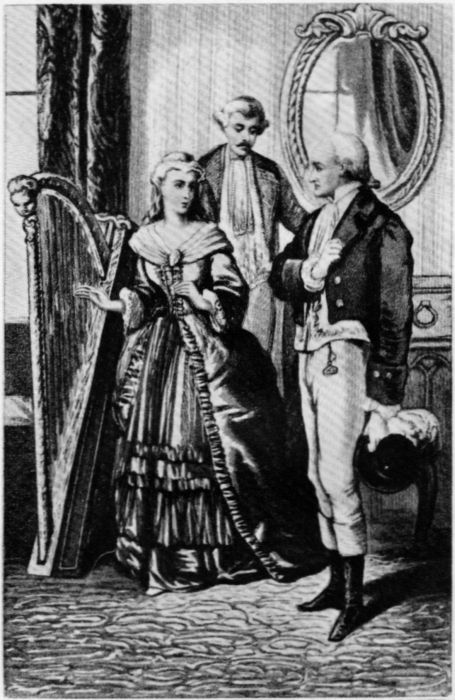 Miss Mowbray! is it thus you fulfil the promise you gave me?
 Emmeline and Lady Adelina surprised at the appearance