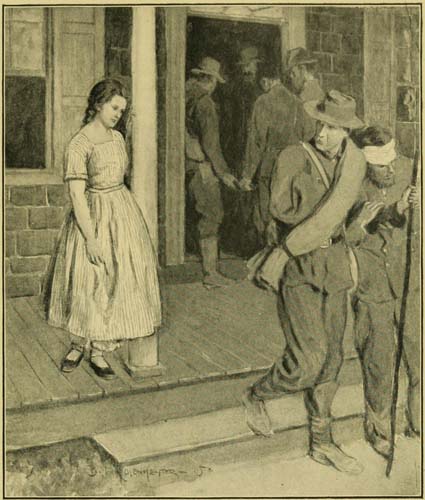
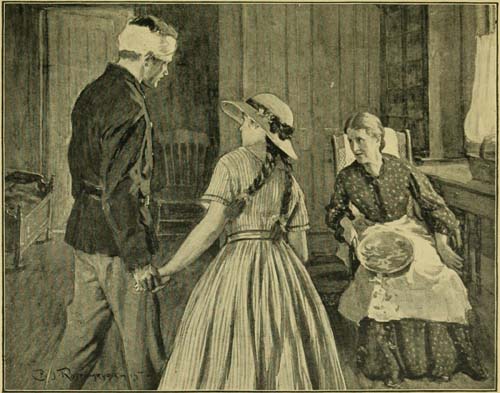
It seemed to Emmeline, as she stood at the outlet of the wood road,
that an hour passed before any one spoke or moved. She herself was too
much confused to speak. How had these men come up so quietly? Porch and
dooryard and fields were thronged. The ridge that cut off Gettysburg
from her view, the road down which she had run after she had left
Mrs. Schmidt,—they, too, were filled with men, and horses, caissons,
cannon, and huge wagons. And the soldiers were clad, not in friendly
blue, but in hateful gray.
Only in Emmeline's immediate neighborhood was silence. Beyond, men
were shouting, horses were neighing, and wheels were creaking. Yonder,
a body of troops advanced to the music of a fife; here a bugler was
playing. Men were laying fires with little piles of sticks; men were
going to Willoughby Run for water; men were leading horses down to
drink. The throng seemed to be thickening every moment.
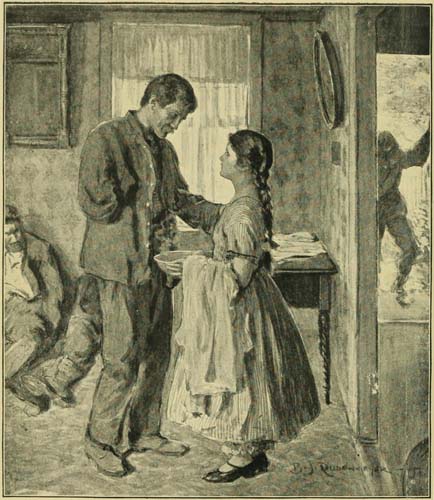
One man, tall and lean and brown, lifted his hand from the latch of
Grandfather Willing's door and came to the edge of the porch. He had
only one arm; under his coat were the bandages that still bound a
recent wound. He had quiet gray eyes, which smiled at Emmeline.
He and his friends could have been to Emmeline no more startling
an apparition than she was to them. The dust of travel had soiled
somewhat her blue-and-white dress and her white stockings, but she
seemed to the soldiers immaculate and fairy-like. Some exclaimed
sharply; into the eyes of others came a sudden smarting and burning. In
their minds they saw far away other little girls with dark braids and
ruffled dresses. But Emmeline did not see their tears; these were her
enemies.
The tall man with the kindly face crossed the dooryard and approached
Emmeline.
"Well, sissy," he drawled, "and who may you be?"
A variety of emotions almost suffocated Emmeline. Uppermost was hatred
of that particular form of address.
"I am Emmeline Willing," said she, with dignity.
Men left their piles of sticks and crowded to the fence; others, who
were going on errands, made a détour in order to come a little nearer
to the group.
"And who," drawled the tall man, "who may Emmyline Willing be?"
Emmeline saw the thickening crowd and remembered the dull roar that
had ceased only a little while ago. She grew pale, but she answered
bravely:—
"I am the granddaughter of the owner of this place."
"So-o-o! And where may the owner of this place be?"
"He has gone away." Emmeline's courage was failing. She felt the cooler
air of evening and saw the shadows lengthening as the sun sank behind
the woodland. "My grandfather would not wish you to be here. You ought
to go away."
"Now, sissy," drawled the tall man, in a distressed voice, "don't cry!"
"I am not crying," protested Emmeline, in spite of good evidence to the
contrary. "I want you to go away!"
"Well, sissy,"—the tall man seemed actually to be considering
Emmeline's command,—"we couldn't very well do that."
"You will have to!" cried Emmeline. "Our soldiers are here by the
million! They will make you go!"
The tall man made no answer to Emmeline's assertion.
"You come here to the porch, sissy. Nobody's going to hurt a leetle
gal."
"I am going home," announced Emmeline. "I am going home to my mother.
The battle is over." In spite of her brave words, Emmeline moved a
little nearer to the porch. "Isn't the battle over?" she said.
"Not exactly," said the tall soldier.
As he mounted the porch, the others moved away. Busy men could not
stand forever looking at a little girl in a striped dress. The tall
soldier laid his hand on the latch.
"Sissy, do you know any way to get this door open short of breaking it
in?"
"You can't get in!" cried Emmeline. "It isn't your house! You—"
"Look here," interrupted a rough voice, "get this door open! Stop your
crying and keep out of the way!"
The new comer set his shoulder against the door. The old latch held for
an instant, and then, as the soldier gave another sharper thrust, the
hasp tore from the wood. Emmeline grew still paler. From the porch she
could see farther over the country; on hills and fields men were still
marching, horses were still being led or driven, cannon and caissons
were rumbling along.
The soldier who had burst open the door was now in Grandmother
Willing's kitchen. He threw wide the shutters, and rattled the lids of
the stove, and opened the doors of the cupboard.
Once more little Emmeline protested furiously:—
"You can't touch those things!"
The soldier lifted a handful of kindling from the box by the stove, and
heaping it into the fire box, lighted it.
"Can you bake?" he demanded rudely.
Emmeline did not answer. Could she bake? She had been taught here in
this very kitchen, she had mixed her dough in that very bowl on the
table, and had set her rising in that old-fashioned bread trough in the
pantry. Would she bake? Never while breath was in her body!
Men were now crowding in at the door; an army wagon had stopped at the
gate, and rough soldiers were bringing in great coffee-pots and cans.
One of them brought Grandmother Willing's hens and roosters, headless,
plucked, ready for the pot. Emmeline backed farther and farther into
the corner, speechless and tearful.
"If I were you, I'd go upstairs, sissy," the tall man said. "Set at the
window and look out. There'll be a lot going on that you can see."
Blindly Emmeline turned to obey. Crying bitterly, she climbed to her
own little room, and there sat down on a chair by the window.
Where were those thousands of blue-coated soldiers? Why did they permit
this great army to camp on these hills, to occupy her grandfather's
house, and his fields, and the other fields round about? The enemy
were now chopping down trees and tearing down fences; they had already
ruined her grandfather's wheat and killed her grandmother's chickens.
Why did not the blue-coated soldiers come and drive them away?
At the sound of galloping hoofs, Emmeline looked out of the window. She
saw that a man on horseback had stopped at the gate and was talking
with the tall soldier. His voice rose exultantly:—
"We drove 'em like sheep through the town! We have thousands of
prisoners! To-morrow we'll settle them!"
"There's a leetle gal here," the tall soldier answered in his slow
way. "She came to see her gran'paw, but he had gone. She lives in
Gettysburg."
"She'll be safer here than in Gettysburg. Tell her to stay indoors.
There'll be hotter work to-morrow."
"So they say!" drawled the tall soldier.
Presently the aroma of chickens boiling in the pot began to spread
through the house. It seemed to spread to an amazing distance, for from
all directions men came crowding into Grandmother Willing's kitchen.
The surly cook swore at them and at the stove, whereupon a drawling
voice reminded him that there was "a leetle gal" within hearing. The
cook's tones sank to a rumble.
But Emmeline paid no heed to the loud voices of the hungry men; she
did not even smell the delicious odor of the cooking chickens. She
heard only those dreadful, exultant words from the lips of the mounted
soldier:—
"'We drove 'em like sheep through the town! We have thousands of
prisoners! To-morrow we'll settle them!'"
So that was why no Northern troops had come to her rescue and the
rescue of her grandfather's house!
Emmeline ceased to cry; alarm and terror dried her tears. She thought
of her mother and of Bertha. She recalled the deep earnestness of her
mother's eyes.
Had there been fighting in quiet, peaceful Gettysburg? Emmeline had
picked lint for padding, had wound muslin strips for bandaging, and had
seen Gettysburg soldiers who had returned with a leg or an arm missing;
but of actual battle Emmeline had no clear idea. She had thought of
bugle blasts, of banners flying, of loud, inspiring commands; beyond
that her imagination had failed. Now for the first time it became clear
to her that actual danger of death threatened those whom she loved.
Where was her mother? Had Bertha been taken into the cellar as the
soldier advised? Vague recollections of the details of Bertha's illness
came to her, scraps of conversation between her mother and Bertha
that she had heard as she passed the door of the sick room. A vague,
half-formed suspicion flashed into her mind. At this moment Emmeline
began suddenly to grow up. But the first speech of her adult life was
childish.
"I must go home!" she cried, as she sprang from her chair.
She ran down the steps and out to the porch. Dankness had come;
soldiers lay about on the grass, and the murmur of their voices spread
in all directions. The moon was rising; in its first oblique rays all
things looked queer and distorted.
There were many sounds: the click of pickaxes against stones, the
crash of trees that were being felled, the hoarse shouts of officers
giving orders. Emmeline rushed to the side of the tall soldier, who was
sitting on the steps.
"I must go home!" she declared again. "I must go home!"
"Now you're just frightened," the tall soldier said. "There ain't no
reason for you to be skeered. No harm'll come to you. We ain't wild
beasts, sissy."
"I must see my mother!"
"You'll see her soon, sissy."
"My sister-in-law is sick and my brother is away." Emmeline forgot
for an instant that this was an enemy of her country. "We haven't
heard from him for weeks. He's in the reserves; he—" Remembering the
character of her audience, Emmeline paused. Then she added, "I must
go home!"
The tall soldier changed the subject.
"I've got a leetle gal like you; Bessie is her name—Bessie Christy. I
haven't seen her for two years."
"Why not?" asked Emmeline, curious in spite of herself.
"On account of war. Now, Emmyline, 'tisn't every leetle gal can watch
the sappers at work before a battle. They're the folks that build the
breastworks. Look at them up there! You might see great things if you
watched, 'stead of crying. You might see General Lee ride by."
"I hate him!"
"Now, sissy!"
"I hate you all!"
Private Christy looked at Emmeline for a moment with a smile on his
lips.
"I'll explain the army to you, Emmyline," said he. "It's a
wonderful thing, an army. If you begin at the top, there's the
commander-in-chief, and next below him—" Private Christy went on and
on in his pleasant, drawling voice. The duty of a private was this, he
explained, the duty of a sutler was that. Presently Emmeline asked him
what he did. Her voice was no longer sharp; it was soft and drowsy and
gentle. After a long time, when Private Christy said, "I have my work,
too, Emmyline," without saying what that work was, Emmeline did not
hear. Feeling a light touch on his arm, Private Christy looked down
and beheld Emmeline's head resting upon it.
"Well, I vum!" said he softly.
For a long time Private Christy sat still; presently slow tears rolled
down his tanned cheeks. He called to one of the men:—
"Say, you, Mallon!"
The soldier approached.
"Well, I'll be switched!" he said.
"You take her upstairs, Mallon."
It may have been that Mallon, too, had a "leetle gal" at home; at any
rate, he seemed to know how to lift a sleeping person of Emmeline's
size.
"The pore leetle gal!" said one-armed Christy, as he led the way.
"I'm sick of this war!" answered Private Mallon soberly.
Through the hot kitchen, where the cook had ceased his work, up the
narrow stairs, they carried Emmeline to her room, and there, without
waking her, laid her gently upon her bed.
"Couldn't she be got out of this?" asked Private Mallon.
Private Christy shook his head. "Not nohow," said he.
Private Mallon returned to his sleep on the grass, Private Christy to
his seat on the porch steps. Far away to the west there was a sudden,
indefinable suggestion of a great body of men marching. Private Christy
heard it and shook his head; Private Mallon nudged his neighbor.
"More coming," he said, and turned on his side.
All about on the daisies of the field lay the great carpet of sleeping
men. Everyone got some sleep that night. Those who dug pits in which
to lie half hidden on the morrow, or who threw up semi-circular walls
of earth or timber to shelter the great cannon, gave pick and shovel
after a while to others, roused from sleep, and threw themselves down
near where they had been working.
Later in the night Private Christy lay down on the porch floor and
slept heavily and comfortably.
Meanwhile to the rear of the great army pressed on another great army,
which, being assigned its place, lay down also. The time between sunset
and sunrise in early July is short enough even for those who are not
exhausted by long marches.
On the ridge, officers riding back and forth in the bright moonlight
marked positions and looked speculatively across at that other parallel
ridge, which takes its name from the Evergreen Cemetery near one end.
Far to the north, where the heavy cannonading had been, ambulances
traveled the fields, guided by a whimper or a groan of pain. The
greatest general of all, whom Private Christy had promised Emmeline
she might see, rode about on his white horse studying the victory won,
planning fresh victory for to-morrow. Thus, rapidly enough, the night
waned.
When the sun rose on July 2, the thousands of soldiers in gray stirred
and woke. In the Willing kitchen the surly cook began to bake his
miserable biscuit; on the porch Private Christy rose and yawned, and
persuaded the cook to give him place on the stove for his coffee-pot.
All about in the fields and woods the thousands rose and prepared their
simple breakfast. Emmeline slept and slept. Five o'clock yesterday had
found her awake and dressed; but to-day five o'clock passed, then six,
then seven, then eight.
Along the lines of battle all was peace; it was almost as quiet as on
any other summer morning. Cannon were moved without noise under cover
of the woodland, as if each great army wished to hide from the other.
Emmeline, waking, lay still and stretched out her arms. Where was she?
Why was she still dressed? How had she got to bed? She sat up and
looked out of the window. Then it was not a dream, after all! Round her
were still the thousands of Confederate soldiers; below her on the
porch she heard Private Christy's voice.
"'Bout time to begin, ain't it?" he queried.
A voice answered that it had been time long ago. Emmeline saw the sun
high in the sky; she smoothed her dress and braided her hair, and ran
down the steps. There was no battle; it was the middle of the morning,
and still there was no battle. Surely she could go home!
In the kitchen the surly cook gave her one of his soggy biscuits.
It was nine o'clock, according to the stubby hands of Grandmother
Willing's clock, which ticked on the mantel-shelf.
Emmeline's tall friend was on the porch.
"Good-morning, Emmyline!" said he cheerfully.
Emmeline's war code, which she remembered clearly this morning, did not
permit her to say good-morning to the enemy.
"There is no battle," she announced. "I want to go home."
"Oh, but you can't do that!"
"I must!" Emmeline looked about her. Still all was peaceful. "Just up
that road! I walked almost all the way yesterday."
Private Christy shook his head.
"No, Emmyline. 'Twouldn't do."
"You are an enemy of my country!" cried Emmeline. "You have no right to
keep me! I am going home!"
When Emmeline reached the gate, Private Christy called to her.
"Come back, sissy!" he said.
Emmeline obeyed, weeping.
"Aren't you afraid that there biscuit'll p'isen you?" he asked. "Seems
to me if I was a woman and could bake, I couldn't swallow that biscuit.
You wouldn't bake me a real biscuit, I suppose?"
"No," answered Emmeline with decision, "I wouldn't."
"Well," drawled the quiet voice, "you don't have to."
Emmeline, standing with one foot on the step of the porch, considered.
She had taken one bite of the biscuit. Although she was wretchedly
hungry, she could eat no more.
"Will you let me go if I bake you some?" Emmeline asked.
"I'll see," answered Private Christy.
The cook had left his stove, and Emmeline went to work with the
familiar utensils—the yellow bowl, the wooden spoon. When the biscuits
were in the oven, she looked up to find the doorway crowded with
soldiers; some of them were bandaged like Private Christy; all of them
were thin and deeply tanned.
"Are you going to give we-all some of them real biscuit?" asked an
eager voice.
Emmeline's face flushed crimson; the position of almsgiver to her enemy
was not altogether unhappy. "I'll see," she answered.
When one pan was taken from the oven, Emmeline had another ready and
then another and another. Emmeline grew warmer and warmer and her
cheeks rosier and rosier.
"Now," said Emmeline, "you can watch that last pan. I am going home."
"But I haven't had any!" cried Private Christy. "Nobody here knows
anything about watching and turning 'em! Oh, please, sissy, bake me a
pan!"
Private Christy brought in fresh fuel for the fire. A half-hour passed,
another half-hour.
"Now," said Emmeline, "I am going."
Private Christy made no answer. The hungry crowd in the yard had faded
away; the very atmosphere seemed charged with suspense. Emmeline looked
out of the door. Was the army still here?
The army was still here; but the army was formed, massed. It was like a
great animal, alive, awake, crouching for a spring.
Then Emmeline screamed, and whirled round on the step. Near at
hand—almost, it seemed to her, in the very house itself—the cannon
roared.