THE house in the hollow was “a mile from anywhere”—so
Maywood people said. It was situated
in a grassy little dale, looking as if it had never been
built like other houses but had grown up there like a big,
brown mushroom. It was reached by a long, green lane
and almost hidden from view by an encircling growth of
young birches. No other house could be seen from it
although the village was just over the hill. Ellen Greene
said it was the lonesomest place in the world and vowed
that she wouldn’t stay there a day if it wasn’t that she
pitied the child.
Emily didn’t know she was being pitied and didn’t
know what lonesomeness meant. She had plenty of
company. There was Father—and Mike—and Saucy
Sal. The Wind Woman was always around; and there
were the trees—Adam-and-Eve, and the Rooster Pine,
and all the friendly lady-birches.
And there was “the flash,” too. She never knew when
it might come, and the possibility of it kept her a-thrill
and expectant.
Emily had slipped away in the chilly twilight for a
walk. She remembered that walk very vividly all her
life—perhaps because of a certain eerie beauty that was
in it—perhaps because “the flash” came for the first time
in weeks—more likely because of what happened after
she came back from it.
It had been a dull, cold day in early May, threatening
to rain but never raining. Father had lain on the sitting-room
lounge all day. He had coughed a good deal and
he had not talked much to Emily, which was a very
unusual thing for him. Most of the time he lay with
his hands clasped under his head and his large, sunken,
dark-blue eyes fixed dreamily and unseeingly on the
cloudy sky that was visible between the boughs of the two
big spruces in the front yard—Adam-and-Eve, they
always called those spruces, because of a whimsical resemblance
Emily had traced between their position, with
reference to a small apple-tree between them, and that of
Adam and Eve and the Tree of Knowledge in an old-fashioned
picture in one of Ellen Greene’s books. The
Tree of Knowledge looked exactly like the squat little
apple-tree, and Adam and Eve stood up on either side
as stiffly and rigidly as did the spruces.
Emily wondered what Father was thinking of, but she
never bothered him with questions when his cough was
bad. She only wished she had somebody to talk to.
Ellen Greene wouldn’t talk that day either. She did
nothing but grunt, and grunts meant that Ellen was disturbed
about something. She had grunted last night
after the doctor had whispered to her in the kitchen, and
she had grunted when she gave Emily a bedtime snack
of bread and molasses. Emily did not like bread and
molasses, but she ate it because she did not want to hurt
Ellen’s feelings. It was not often that Ellen allowed her
anything to eat before going to bed, and when she did it
meant that for some reason or other she wanted to confer
a special favor.
Emily expected the grunting attack would wear off
over night, as it generally did; but it had not, so no
company was to be found in Ellen. Not that there was
a great deal to be found at any time. Douglas Starr
had once, in a fit of exasperation, told Emily that “Ellen
Greene was a fat, lazy old thing of no importance,” and
Emily, whenever she looked at Ellen after that, thought
the description fitted her to a hair.
So Emily had curled herself up in the ragged, comfortable
old wing-chair and read The Pilgrim’s Progress all
the afternoon. Emily loved The Pilgrim’s Progress.
Many a time had she walked the straight and narrow
path with Christian and Christiana—although she never
liked Christiana’s adventures half as well as Christian’s.
For one thing, there was always such a crowd with
Christiana. She had not half the fascination of that
solitary, intrepid figure who faced all alone the shadows
of the Dark Valley and the encounter with Apollyon.
Darkness and hobgoblins were nothing when you had
plenty of company. But to be alone—ah, Emily shivered
with the delicious horror of it!
When Ellen announced that supper was ready Douglas
Starr told Emily to go out to it.
“I don’t want anything tonight. I’ll just lie here and
rest. And when you come in again we’ll have a real
talk, Elfkin.”
He smiled up at her his old, beautiful smile, with the
love behind it, that Emily always found so sweet. She
ate her supper quite happily—though it wasn’t a good
supper. The bread was soggy and her egg was underdone,
but for a wonder she was allowed to have both
Saucy Sal and Mike sitting, one on each side of her, and
Ellen only grunted when Emily fed them wee bits of
bread and butter.
Mike had such a cute way of sitting up on his haunches
and catching the bits in his paws, and Saucy Sal had her
trick of touching Emily’s ankle with an almost human
touch when her turn was too long in coming. Emily
loved them both, but Mike was her favourite. He was
a handsome, dark-grey cat with huge owl-like eyes, and
he was so soft and fat and fluffy. Sal was always thin;
no amount of feeding put any flesh on her bones. Emily
liked her, but never cared to cuddle or stroke her because
of her thinness. Yet there was a sort of weird beauty
about her that appealed to Emily. She was grey-and-white—very
white and very sleek, with a long, pointed
face, very long ears and very green eyes. She was a
redoubtable fighter, and strange cats were vanquished in
one round. The fearless little spitfire would even attack
dogs and rout them utterly.
Emily loved her pussies. She had brought them up
herself, as she proudly said. They had been given to
her when they were kittens by her Sunday School teacher.
“A living present is so nice,” she told Ellen, “because
it keeps on getting nicer all the time.”
But she worried considerably because Saucy Sal didn’t
have kittens.
“I don’t know why she doesn’t,” she complained to
Ellen Greene. “Most cats seem to have more kittens
than they know what to do with.”
After supper Emily went in and found that her father
had fallen asleep. She was very glad of this; she knew
he had not slept much for two nights; but she was a
little disappointed that they were not going to have that
“real talk.” “Real” talks with Father were always such
delightful things. But next best would be a walk—a
lovely all-by-your-lonesome walk through the grey evening
of the young spring. It was so long since she had
had a walk.
“You put on your hood and mind you scoot back if it
starts to rain,” warned Ellen. “You can’t monkey with
colds the way some kids can.”
“Why can’t I?” Emily asked rather indignantly. Why
must she be debarred from “monkeying with colds” if
other children could? It wasn’t fair.
But Ellen only grunted. Emily muttered under her
breath for her own satisfaction, “You are a fat old thing
of no importance!” and slipped upstairs to get her hood—rather
reluctantly, for she loved to run bareheaded.
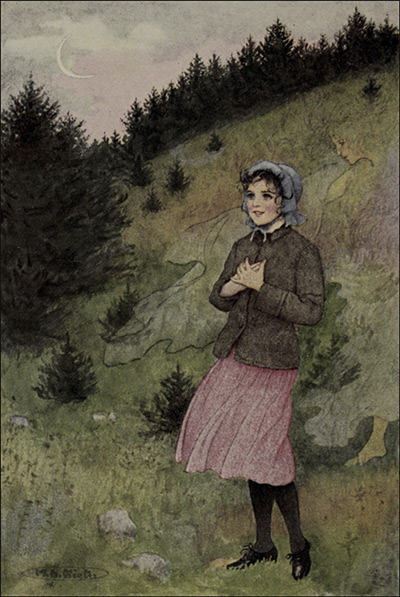
She put the faded blue hood on over her long, heavy
braid of glossy, jet-black hair, and smiled chummily at
her reflection in the little greenish glass. The smile began
at the corners of her lips and spread over her face
in a slow, subtle, very wonderful way, as Douglas Starr
often thought. It was her dead mother’s smile—the
thing that had caught and held him long ago when he
had first seen Juliet Murray. It seemed to be Emily’s
only physical inheritance from her mother. In all else,
he thought, she was like the Starrs—in her large, purplish-grey
eyes with their very long lashes and black
brows, in her high, white forehead—too high for beauty—in
the delicate modeling of her pale oval face and
sensitive mouth, in the little ears that were pointed just
a wee bit to show that she was kin to tribes of elfland.
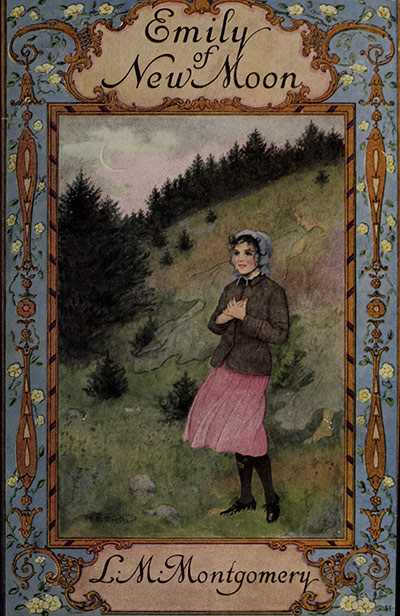
“I’m going for a walk with the Wind Woman, dear,”
said Emily. “I wish I could take you too. Do you ever
get out of that room, I wonder. The Wind Woman
is going to be out in the fields to-night. She is tall and
misty, with thin, grey, silky clothes blowing all about
her—and wings like a bat’s—only you can see through
them—and shining eyes like stars looking through her
long, loose hair. She can fly—but to-night she will walk
with me all over the fields. She’s a great friend of mine—the
Wind Woman is. I’ve known her ever since I
was six. We’re old, old friends—but not quite so old
as you and I, little Emily-in-the-glass. We’ve been
friends always, haven’t we?”
With a blown kiss to little Emily-in-the-glass, Emily-out-of-the-glass
was off.
The Wind Woman was waiting for her outside—ruffling
the little spears of striped grass that were sticking
up stiffly in the bed under the sitting-room window—tossing
the big boughs of Adam-and-Eve—whispering
among the misty green branches of the birches—teasing
the “Rooster Pine” behind the house—it really did look
like an enormous, ridiculous rooster, with a huge, bunchy
tail and a head thrown back to crow.
It was so long since Emily had been out for a walk
that she was half crazy with the joy of it. The winter
had been so stormy and the snow so deep that she was
never allowed out; April had been a month of rain and
wind; so on this May evening she felt like a released
prisoner. Where should she go? Down the brook—or
over the fields to the spruce barrens? Emily chose
the latter.
She loved the spruce barrens, away at the further end
of the long, sloping pasture. That was a place where
magic was made. She came more fully into her fairy
birthright there than in any other place. Nobody who
saw Emily skimming over the bare field would have
envied her. She was little and pale and poorly clad;
sometimes she shivered in her thin jacket; yet a queen
might have gladly given a crown for her visions—her
dreams of wonder. The brown, frosted grasses under
her feet were velvet piles. The old, mossy, gnarled half-dead
spruce-tree, under which she paused for a moment
to look up into the sky, was a marble column in a palace
of the gods; the far dusky hills were the ramparts of a
city of wonder. And for companions she had all the
fairies of the countryside—for she could believe in them
here—the fairies of the white clover and satin catkins,
the little green folk of the grass, the elves of the young
fir-trees, sprites of wind and wild fern and thistledown.
Anything might happen there—everything might come
true.
And the barrens were such a splendid place in which
to play hide and seek with the Wind Woman. She was
so very real there; if you could just spring quickly
enough around a little cluster of spruces—only you never
could—you would see her as well as feel her and hear
her. There she was—that was the sweep of her grey
cloak—no, she was laughing up in the very top of the
taller trees—and the chase was on again—till, all at once,
it seemed as if the Wind Woman were gone—and the
evening was bathed in a wonderful silence—and there
was a sudden rift in the curdled clouds westward, and
a lovely, pale, pinky-green lake of sky with a new moon
in it.
Emily stood and looked at it with clasped hands and
her little black head upturned. She must go home and
write down a description of it in the yellow account book,
where the last thing written had been, “Mike’s Biograffy.”
It would hurt her with its beauty until she
wrote it down. Then she would read it to Father. She
must not forget how the tips of the trees on the hill
came out like fine black lace across the edge of the pinky-green
sky.
And then, for one glorious, supreme moment, came
“the flash.”
Emily called it that, although she felt that the name
didn’t exactly describe it. It couldn’t be described—not
even to Father, who always seemed a little puzzled
by it. Emily never spoke of it to any one else.
It had always seemed to Emily, ever since she could
remember, that she was very, very near to a world of
wonderful beauty. Between it and herself hung only a
thin curtain; she could never draw the curtain aside—but
sometimes, just for a moment, a wind fluttered it
and then it was as if she caught a glimpse of the enchanting
realm beyond—only a glimpse—and heard a note
of unearthly music.
This moment came rarely—went swiftly, leaving her
breathless with the inexpressible delight of it. She
could never recall it—never summon it—never pretend
it; but the wonder of it stayed with her for days. It
never came twice with the same thing. To-night the
dark boughs against that far-off sky had given it. It
had come with a high, wild note of wind in the night,
with a shadow wave over a ripe field, with a greybird
lighting on her window-sill in a storm, with the singing
of “Holy, holy, holy” in church, with a glimpse of
the kitchen fire when she had come home on a dark
autumn night, with the spirit-like blue of ice palms on a
twilit pane, with a felicitous new word when she was
writing down a “description” of something. And always
when the flash came to her Emily felt that life was
a wonderful, mysterious thing of persistent beauty.
She scuttled back to the house in the hollow, through
the gathering twilight, all agog to get home and write
down her “description” before the memory picture of
what she had seen grew a little blurred. She knew just
how she would begin it—the sentence seemed to shape
itself in her mind: “The hill called to me and something
in me called back to it.”
She found Ellen Greene waiting for her on the sunken
front-doorstep. Emily was so full of happiness that
she loved everything at that moment, even fat things of
no importance. She flung her arms around Ellen’s
knees and hugged them. Ellen looked down gloomily
into the rapt little face, where excitement had kindled a
faint wild-rose flush, and said, with a ponderous sigh:
“Do you know that your pa has only a week or two
more to live?”
CHAPTER II A Watch in the Night
EMILY stood quite still and looked up at Ellen’s
broad, red face—as still as if she had been suddenly
turned to stone. She felt as if she had. She was as
stunned as if Ellen had struck her a physical blow. The
colour faded out of her little face and her pupils dilated
until they swallowed up the irides and turned her eyes
into pools of blackness. The effect was so startling that
even Ellen Greene felt uncomfortable.
“I’m telling you this because I think it’s high time
you was told,” she said. “I’ve been at your pa for
months to tell you, but he’s kept putting it off and off.
I says to him, says I, ‘You know how hard she takes
things, and if you drop off suddent some day it’ll most
kill her if she hasn’t been prepared. It’s your duty to
prepare her,’ and he says, says he, ‘There’s time enough
yet, Ellen.’ But he’s never said a word, and when the
doctor told me last night that the end might come any
time now, I just made up my mind that I’d do what was
right and drop a hint to prepare you. Laws-a-massy,
child, don’t look like that! You’ll be looked after.
Your ma’s people will see to that—on account of the
Murray pride, if for no other reason. They won’t let
one of their own blood starve or go to strangers—even
if they have always hated your pa like p’isen. You’ll
have a good home—better’n you’ve ever had here. You
needn’t worry a mite. As for your pa, you ought to be
thankful to see him at rest. He’s been dying by inches
for the last five years. He’s kept it from you, but he’s
been a great sufferer. Folks say his heart broke when
your ma died—it came on him so suddent-like—she was
only sick three days. That’s why I want you to know
what’s coming, so’s you won’t be all upset when it happens.
For mercy’s sake, Emily Byrd Starr, don’t stand
there staring like that! You give me the creeps! You
ain’t the first child that’s been left an orphan and you
won’t be the last. Try and be sensible. And don’t go
pestering your pa about what I’ve told you, mind that.
Come you in now, out of the damp, and I’ll give you a
cooky ’fore you go to bed.”
Ellen stepped down as if to take the child’s hand. The
power of motion returned to Emily—she must scream
if Ellen even touched her now. With one sudden, sharp,
bitter little cry she avoided Ellen’s hand, darted through
the door and fled up the dark staircase.
Ellen shook her head and waddled back to her kitchen.
“Anyhow, I’ve done my duty,” she reflected. “He’d
have just kept saying ‘time enough’ and put it off till
he was dead and then there’d have been no managing
her. She’ll have time now to get used to it, and she’ll
brace up in a day or two. I will say for her she’s got
spunk—which is lucky, from all I’ve heard of the Murrays.
They won’t find it easy to overcrow her. She’s
got a streak of their pride, too, and that’ll help her
through. I wish I dared send some of the Murrays
word that he’s dying, but I don’t dast go that far.
There’s no telling what he’d do. Well, I’ve stuck on
here to the last and I ain’t sorry. Not many women
would ’a’ done it, living as they do here. It’s a shame
the way that child’s been brought up—never even sent to
school. Well, I’ve told him often enough what I’ve
thought of it—it ain’t on my conscience, that’s one comfort.
Here, you Sal-thing, you git out! Where’s Mike,
too?”
Ellen could not find Mike for the very good reason that
he was upstairs with Emily, held tightly in her arms, as
she sat in the darkness on her little cot bed. Amid her
agony and desolation there was a certain comfort in the
feel of his soft fur and round velvety head.
Emily was not crying; she stared straight into the
darkness, trying to face the awful thing Ellen had told
her. She did not doubt it—something told her it was
true. Why couldn’t she die, too? She couldn’t go on
living without Father.
“If I was God I wouldn’t let things like this happen,”
she said.
She felt it was very wicked of her to say such a thing—Ellen
had told her once that it was the wickedest thing
any one could do to find fault with God. But she didn’t
care. Perhaps if she were wicked enough God would
strike her dead and then she and Father could keep on
being together.
But nothing happened—only Mike got tired of being
held so tightly and squirmed away. She was all alone
now, with this terrible burning pain that seemed all over
her and yet was not of the body. She could never get
rid of it. She couldn’t help it by writing about it in
the old yellow account book. She had written there
about her Sunday School teacher going away, and of
being hungry when she went to bed, and Ellen telling her
she must be half crazy to talk of Wind Women and
flashes; and after she had written down all about them
these things hadn’t hurt her any more. But this couldn’t
be written about. She could not even go to Father for
comfort, as she had gone when she burned her hand so
badly, picking up the red-hot poker by mistake. Father
had held her in his arms all that night and told her stories
and helped her to bear the pain. But Father, so Ellen
had said, was going to die in a week or two. Emily felt
as if Ellen had told her this years and years ago. It
surely couldn’t be less than an hour since she had been
playing with the Wind Woman in the barrens and looking
at the new moon in the pinky-green sky.
“The flash will never come again—it can’t,” she
thought.
But Emily had inherited certain things from her fine
old ancestors—the power to fight—to suffer—to pity—to
love very deeply—to rejoice—to endure. These things
were all in her and looked out at you through her purplish-grey
eyes. Her heritage of endurance came to her
aid now and bore her up. She must not let Father know
what Ellen had told her—it might hurt him. She must
keep it all to herself and love Father, oh, so much, in
the little while she could yet have him.
She heard him cough in the room below: she must be
in bed when he came up; she undressed as swiftly as her
cold fingers permitted and crept into the little cot bed
which stood across the open window. The voices of
the gentle spring night called to her all unheeded—unheard
the Wind Woman whistled by the eaves. For the
fairies dwell only in the kingdom of Happiness; having
no souls they cannot enter the kingdom of Sorrow.
She lay there cold and tearless and motionless when
her father came into the room. How very slowly he
walked—how very slowly he took off his clothes. How
was it she had never noticed these things before? But
he was not coughing at all. Oh, what if Ellen were mistaken?—what
if—a wild hope shot through her aching
heart. She gave a little gasp.
Douglas Starr came over to her bed. She felt his
dear nearness as he sat down on the chair beside her,
in his old red dressing-gown. Oh, how she loved him!
There was no other Father like him in all the world—there
never could have been—so tender, so understanding,
so wonderful! They had always been such chums—they
had loved each other so much—it couldn’t be
that they were to be separated.
“Winkums, are you asleep?”
“No,” whispered Emily.
“Are you sleepy, small dear?”
“No—no—not sleepy.”
Douglas Starr took her hand and held it tightly.
“Then we’ll have our talk, honey. I can’t sleep either.
I want to tell you something.”
“Oh—I know it—I know it!” burst out Emily. “Oh,
Father, I know it! Ellen told me.”
Douglas Starr was silent for a moment. Then he
said under his breath, “The old fool—the fat old fool!”—as
if Ellen’s fatness was an added aggravation of her
folly. Again, for the last time, Emily hoped. Perhaps
it was all a dreadful mistake—just some more of Ellen’s
fat foolishness.
“It—it isn’t true, is it, Father?” she whispered.
“Emily, child,” said her father, “I can’t lift you up—I
haven’t the strength—but climb up and sit on my knee—in
the old way.”
Emily slipped out of bed and got on her father’s knee.
He wrapped the old dressing-gown about her and held
her close with his face against hers.
“Dear little child—little beloved Emilykin, it is quite
true,” he said, “I meant to tell you myself to-night.
And now that old absurdity of an Ellen has told you—brutally,
I suppose—and hurt you dreadfully. She has
the brain of a hen and the sensibility of a cow. May
jackals sit on her grandmother’s grave! I wouldn’t have
hurt you, dear.”
Emily fought something down that wanted to choke
her.
“Father, I can’t—I can’t bear it.”
“Yes, you can and will. You will live because there
is something for you to do, I think. You have my gift—along
with something I never had. You will succeed
where I failed, Emily. I haven’t been able to do much
for you, sweetheart, but I’ve done what I could. I’ve
taught you something, I think—in spite of Ellen Greene.
Emily, do you remember your mother?”
“Just a little—here and there—like lovely bits of
dreams.”
“You were only four when she died. I’ve never talked
much to you about her—I couldn’t. But I’m going to
tell you all about her to-night. It doesn’t hurt me to
talk of her now—I’ll see her so soon again. You don’t
look like her, Emily—only when you smile. For the
rest, you’re like your namesake, my mother. When you
were born I wanted to call you Juliet, too. But your
mother wouldn’t. She said if we called you Juliet then
I’d soon take to calling her ‘Mother’ to distinguish between
you, and she couldn’t endure that. She said her
Aunt Nancy had once said to her, ‘The first time your
husband calls you “Mother” the romance of life is over.’
So we called you after my mother—her maiden name
was Emily Byrd. Your mother thought Emily the prettiest
name in the world,—it was quaint and arch and
delightful, she said. Emily, your mother was the sweetest
woman ever made.”
His voice trembled and Emily snuggled close.
“I met her twelve years ago, when I was sub-editor of
the Enterprise up in Charlottetown and she was in her
last year at Queen’s. She was tall and fair and blue-eyed.
She looked a little like your Aunt Laura, but
Laura was never so pretty. Their eyes were very much
alike—and their voices. She was one of the Murrays
from Blair Water. I’ve never told you much about your
mother’s people, Emily. They live up on the old north
shore at Blair Water on New Moon Farm—always have
lived there since the first Murray came out from the Old
Country in 1790. The ship he came on was called the
New Moon and he named his farm after her.”
“It’s a nice name—the new moon is such a pretty
thing,” said Emily, interested for a moment.
“There’s been a Murray ever since at New Moon
Farm. They’re a proud family—the Murray pride is a
byword along the north shore, Emily. Well, they had
some things to be proud of, that cannot be denied—but
they carried it too far. Folks call them ‘the chosen
people’ up there.
“They increased and multiplied and scattered all over,
but the old stock at New Moon Farm is pretty well run
out. Only your Aunts, Elizabeth and Laura, live there
now, and their cousin, Jimmy Murray. They never
married—could not find any one good enough for a Murray,
so it used to be said. Your Uncle Oliver and your
Uncle Wallace live in Summerside, your Aunt Ruth in
Shrewsbury and your Great-Aunt Nancy at Priest Pond.”
“Priest Pond—that’s an interesting name—not a pretty
name like New Moon and Blair Water—but interesting,”
said Emily. Feeling Father’s arm around her the horror
had momentarily shrunk away. For just a little while
she ceased to believe it.
Douglas Starr tucked the dressing-gown a little more
closely around her, kissed her black head, and went on.
“Elizabeth and Laura and Wallace and Oliver and
Ruth were old Archibald Murray’s children. His first
wife was their mother. When he was sixty he married
again—a young slip of a girl—who died when your
mother was born. Juliet was twenty years younger
than her half-family, as she used to call them. She was
very pretty and charming and they all loved and petted
her and were very proud of her. When she fell in love
with me, a poor young journalist, with nothing in the
world but his pen and his ambition, there was a family
earthquake. The Murray pride couldn’t tolerate the
thing at all. I won’t rake it all up—but things were
said I could never forget or forgive. Your mother
married me, Emily—and the New Moon people would
have nothing more to do with her. Can you believe
that, in spite of it, she was never sorry for marrying
me?”
Emily put up her hand and patted her father’s hollow
cheek.
“Of course she wouldn’t be sorry. Of course she’d
rather have you than all the Murrays of any kind of a
moon.”
Father laughed a little—and there was just a note of
triumph in his laugh.
“Yes, she seemed to feel that way about it. And we
were so happy—oh, Emilykin, there never were two happier
people in the world. You were the child of that
happiness. I remember the night you were born in the
little house in Charlottetown. It was in May and a west
wind was blowing silvery clouds over the moon. There
was a star or two here and there. In our tiny garden—everything
we had was small except our love and our
happiness—it was dark and blossomy. I walked up and
down the path between the beds of violets your mother
had planted—and prayed. The pale east was just beginning
to glow like a rosy pearl when some one came
and told me I had a little daughter. I went in—and
your mother, white and weak, smiled just that dear,
slow, wonderful smile I loved, and said, ‘We’ve—got—the
only—baby—of any importance—in—the world, dear.
Just—think—of that!’”
“I wish people could remember from the very moment
they’re born,” said Emily. “It would be so very interesting.”
“I dare say we’d have a lot of uncomfortable memories,”
said her father, laughing a little. “It can’t be very
pleasant getting used to living—no pleasanter than getting
used to stopping it. But you didn’t seem to find it
hard, for you were a good wee kidlet, Emily. We had
four more happy years and then—do you remember the
time your mother died, Emily?”
“I remember the funeral, Father—I remember it distinctly.
You were standing in the middle of a room,
holding me in your arms, and Mother was lying just
before us in a long, black box. And you were crying—and
I couldn’t think why—and I wondered why Mother
looked so white and wouldn’t open her eyes. And I
leaned down and touched her cheek—and oh, it was so
cold. It made me shiver. And somebody in the room
said, ‘Poor little thing!’ and I was frightened and put
my face down on your shoulder.”
“Yes, I recall that. Your mother died very suddenly.
I don’t think we’ll talk about it. The Murrays all came
to her funeral. The Murrays have certain traditions
and they live up to them very strictly. One of them is
that nothing but candles shall be burned for light at New
Moon—and another is that no quarrel must be carried
past the grave. They came when she was dead—they
would have come when she was ill if they had known, I
will say that much for them. And they behaved very
well—oh, very well indeed. They were not the Murrays
of New Moon for nothing. Your Aunt Elizabeth wore
her best black satin dress to the funeral. For any funeral
but a Murray’s the second best one would have done;
and they made no serious objection when I said your
mother would be buried in the Starr plot in Charlottetown
cemetery. They would have liked to take her back
to the old Murray burying-ground in Blair Water—they
had their own private burying-ground, you know—no
indiscriminate graveyard for them. But your Uncle
Wallace handsomely admitted that a woman should belong
to her husband’s family in death as in life. And
then they offered to take you and bring you up—to ‘give
you your mother’s place.’ I refused to let them have
you—then. Did I do right, Emily?”
“Yes—yes—yes!” whispered Emily, with a hug at
every “yes.”
“I told Oliver Murray—it was he who spoke to me
about you—that as long as I lived I would not be parted
from my child. He said, ‘If you ever change your mind,
let us know.’ But I did not change my mind—not even
three years later when my doctor told me I must give up
work. ‘If you don’t, I give you a year,’ he said, ‘if
you do, and live out-of-doors all you can, I give you
three—or possibly four.’ He was a good prophet. I
came out here and we’ve had four lovely years together,
haven’t we, small dear one?”
“Yes—oh, yes!”
“Those years and what I’ve taught you in them are
the only legacy I can leave you, Emily. We’ve been
living on a tiny income I have from a life interest that
was left me in an old uncle’s estate—an uncle who died
before I was married. The estate goes to a charity now,
and this little house is only a rented one. From a
worldly point of view I’ve certainly been a failure. But
your mother’s people will care for you—I know that.
The Murray pride will guarantee so much, if nothing
else. And they can’t help loving you. Perhaps I should
have sent for them before—perhaps I ought to do it yet.
But I have pride of a kind, too—the Starrs are not entirely
traditionless—and the Murrays said some very bitter
things to me when I married your mother. Will I
send to New Moon and ask them to come, Emily?”
“No!” said Emily, almost fiercely.
She did not want any one to come between her and
Father for the few precious days left. The thought was
horrible to her. It would be bad enough if they had
to come—afterwards. But she would not mind anything
much—then.
“We’ll stay together to the very end, then, little Emily-child.
We won’t be parted for a minute. And I want
you to be brave. You mustn’t be afraid of anything,
Emily. Death isn’t terrible. The universe is full of love—and
spring comes everywhere—and in death you open
and shut a door. There are beautiful things on the other
side of the door. I’ll find your mother there—I’ve
doubted many things, but I’ve never doubted that.
Sometimes I’ve been afraid that she would get so far
ahead of me in the ways of eternity that I’d never catch
up. But I feel now that she’s waiting for me. And
we’ll wait for you—we won’t hurry—we’ll loiter and
linger till you catch up with us.”
“I wish you—could take me right through the door with
you,” whispered Emily.
“After a little while you won’t wish that. You have
yet to learn how kind time is. And life has something
for you—I feel it. Go forward to meet it fearlessly,
dear. I know you don’t feel like that just now—but
you will remember my words by and by.”
“I feel just now,” said Emily, who couldn’t bear to
hide anything from Father, “that I don’t like God any
more.”
Douglas Starr laughed—the laugh Emily liked best.
It was such a dear laugh—she caught her breath over
the dearness of it. She felt his arms tightening round her.
“Yes, you do, honey. You can’t help liking God. He
is Love itself, you know. You mustn’t mix Him up
with Ellen Greene’s God, of course.”
Emily didn’t know exactly what Father meant. But
all at once she found that she wasn’t afraid any longer—and
the bitterness had gone out of her sorrow, and the
unbearable pain out of her heart. She felt as if love
was all about her and around her, breathed out from
some great, invisible, hovering Tenderness. One couldn’t
be afraid or bitter where love was—and love was everywhere.
Father was going through the door—no, he was
going to lift a curtain—she liked that thought better,
because a curtain wasn’t as hard and fast as a door—and
he would slip into that world of which the flash had
given her glimpses. He would be there in its beauty—never
very far away from her. She could bear anything
if she could only feel that Father wasn’t very far away
from her—just beyond that wavering curtain.
Douglas Starr held her until she fell asleep; and then
in spite of his weakness he managed to lay her down in
her little bed.
“She will love deeply—she will suffer terribly—she
will have glorious moments to compensate—as I have
had. As her mother’s people deal with her, so may God
deal with them,” he murmured brokenly.
CHAPTER III A Hop out of Kin
DOUGLAS STARR lived two weeks more. In after
years when the pain had gone out of their recollection,
Emily thought they were the most precious of her
memories. They were beautiful weeks—beautiful and
not sad. And one night, when he was lying on the
couch in the sitting-room, with Emily beside him in the
old wing-chair, he went past the curtain—went so quietly
and easily that Emily did not know he was gone until
she suddenly felt the strange stillness of the room—there
was no breathing in it but her own.
“Father—Father!” she cried. Then she screamed for
Ellen.
Ellen Greene told the Murrays when they came that
Emily had behaved real well, when you took everything
into account. To be sure, she had cried all night and
hadn’t slept a wink; none of the Maywood people who
came flocking kindly in to help could comfort her; but
when morning came her tears were all shed. She was
pale and quiet and docile.
“That’s right, now,” said Ellen, “that’s what comes
of being properly prepared. Your pa was so mad at
me for warning you that he wasn’t rightly civil to me
since—and him a dying man. But I don’t hold any
grudge against him. I did my duty. Mrs. Hubbard’s
fixing up a black dress for you and it’ll be ready by supper
time. Your ma’s people will be here tonight, so
they’ve telegraphed, and I’m bound they’ll find you looking
respectable. They’re well off and they’ll provide
for you. Your pa hasn’t left a cent but there ain’t any
debts, I’ll say that for him. Have you been in to see
the body?”
“Don’t call him that,” cried Emily, wincing. It was
horrible to hear Father called that.
“Why not? If you ain’t the queerest child! He
makes a better looking corpse than I thought he would,
what with being so wasted and all. He was always a
pretty man, though too thin.”
“Ellen Greene,” said Emily suddenly, “if you say any
more of—those things—about Father, I will put the black
curse on you!”
Ellen Greene stared.
“I don’t know what on earth you mean. But that’s
no way to talk to me, after all I’ve done for you. You’d
better not let the Murrays hear you talking like that or
they won’t want much to do with you. The black curse
indeed! Well, here’s gratitude!”
Emily’s eyes smarted. She was just a lonely, solitary
little creature and she felt very friendless. But she was
not at all remorseful for what she had said to Ellen
and she was not going to pretend she was.
“Come you here and help me wash these dishes,”
ordered Ellen. “It’ll do you good to have something to
take up your mind and then you won’t be after putting
curses on people who have worked their fingers to the
bone for you.”
Emily, with an eloquent glance at Ellen’s hands, went
and got the dish towel.
“Your hands are fat and pudgy,” she said. “The
bones don’t show at all.”
“Never mind sassing back! It’s awful, with your
poor pa dead in there. But if your Aunt Ruth takes
you she’ll soon cure you of that.”
“Is Aunt Ruth going to take me?”
“I don’t know, but she ought to. She’s a widow with
no chick or child, and well-to-do.”
“I don’t think I want Aunt Ruth to take me,” said
Emily deliberately, after a moment’s reflection.
“Well, you won’t have the choosing likely. You ought
to be thankful to get a home anywhere. Remember
you’re not of much importance.”
“I am important to myself,” cried Emily proudly.
“It’ll be some chore to bring you up,” muttered Ellen.
“Your Aunt Ruth is the one to do it, in my opinion.
She won’t stand no nonsense. A fine woman she is and
the neatest housekeeper on P. E. Island. You could eat
off her floor.”
“I don’t want to eat off her floor. I don’t care if a
floor is dirty as long as the tablecloth is clean.”
“Well, her tablecloths are clean too, I reckon. She’s
got an elegant house in Shrewsbury with bow windows
and wooden lace all round the roof. It’s very stylish.
It would be a fine home for you. She’d learn you
some sense and do you a world of good.”
“I don’t want to learn sense and be done a world of
good to,” cried Emily with a quivering lip. “I—I want
somebody to love me.”
“Well, you’ve got to behave yourself if you want
people to like you. You’re not to blame so much—your
pa has spoiled you. I told him so often enough, but he
just laughed. I hope he ain’t sorry for it now. The fact
is, Emily Starr, you’re queer, and folks don’t care for
queer children.”
“How am I queer?” demanded Emily.
“You talk queer—and you act queer—and at times
you look queer. And you’re too old for your age—though
that ain’t your fault. It comes of never mixing
with other children. I’ve always threaped at your father
to send you to school—learning at home ain’t the same
thing—but he wouldn’t listen to me, of course. I don’t
say but what you are as far along in book learning as
you need to be, but what you want is to learn how to be
like other children. In one way it would be a good
thing if your Uncle Oliver would take you, for he’s got
a big family. But he’s not as well off as the rest, so
it ain’t likely he will. Your Uncle Wallace might, seeing
as he reckons himself the head of the family. He’s
only got a grown-up daughter. But his wife’s delicate—or
fancies she is.”
“I wish Aunt Laura would take me,” said Emily.
She remembered that Father had said Aunt Laura was
something like her mother.
“Aunt Laura! She won’t have no say in it—Elizabeth’s
boss at New Moon. Jimmy Murray runs the
farm, but he ain’t quite all there, I’m told—”
“What part of him isn’t there?” asked Emily curiously.
“Laws, it’s something about his mind, child. He’s
a bit simple—some accident or other when he was a
youngster, I’ve heard. It addled his head, kind of.
Elizabeth was mixed up in it some way—I’ve never
heard the rights of it. I don’t reckon the New Moon
people will want to be bothered with you. They’re awful
set in their ways. You take my advice and try to please
your Aunt Ruth. Be polite—and well-behaved—mebbe
she’ll take a fancy to you. There, that’s all the dishes.
You’d better go upstairs and be out of the way.”
“Can I take Mike and Saucy Sal?” asked Emily.
“No, you can’t.”
“They’d be company for me,” pleaded Emily.
“Company or no company, you can’t have them.
They’re outside and they’ll stay outside. I ain’t going
to have them tracking all over the house. The floor’s
been scrubbed.”
“Why didn’t you scrub the floor when Father was
alive?” asked Emily. “He liked things to be clean. You
hardly ever scrubbed it then. Why do you do it now?”
“Listen to her! Was I to be always scrubbing floors
with my rheumatiz? Get off upstairs and you’d better
lie down awhile.”
“I’m going upstairs, but I’m not going to lie down,”
said Emily. “I’ve got a lot of thinking to do.”
“There’s one thing I’d advise you to do,” said Ellen,
determined to lose no chance of doing her duty, “and
that is to kneel down and pray to God to make you a
good and respectful and grateful child.”
Emily paused at the foot of the stairs and looked back.
“Father said I wasn’t to have anything to do with your
God,” she said gravely.
Ellen gasped foolishly, but could not think of any reply
to this heathenish statement. She appealed to the universe.
“Did any one ever hear the like!”
“I know what your God is like,” said Emily. “I saw
His picture in that Adam-and-Eve book of yours. He
has whiskers and wears a nightgown. I don’t like Him.
But I like Father’s God.”
“And what is your father’s God like, if I may ask?”
demanded Ellen sarcastically.
Emily hadn’t any idea what Father’s God was like,
but she was determined not to be posed by Ellen.
“He is clear as the moon, fair as the sun, and terrible
as an army with banners,” she said triumphantly.
“Well, you’re bound to have the last word, but the
Murrays will teach you what’s what,” said Ellen, giving
up the argument. “They’re strict Presbyterians and
won’t hold by any of your father’s awful notions. Get
off upstairs.”
Emily went up to the south room, feeling very desolate.
“There isn’t anybody in the world who loves me now,”
she said, as she curled up on her bed by the window.
But she was determined she would not cry. The Murrays,
who had hated her father, should not see her crying.
She felt that she detested them all—except perhaps
Aunt Laura. How very big and empty the world had
suddenly become. Nothing was interesting any more.
It did not matter that the little squat apple-tree between
Adam-and-Eve had become a thing of rose-and-snow
beauty—that the hills beyond the hollow were of green
silk, purple-misted—that the daffodils were out in the garden—that
the birches were hung all over with golden
tassels—that the Wind Woman was blowing white young
clouds across the sky. None of these things had any
charm or consolation for her now. In her inexperience
she believed they never would have again.
“But I promised Father I’d be brave,” she whispered,
clenching her little fists, “and I will. And I won’t let
the Murrays see I’m afraid of them—I won’t be afraid
of them!”
When the far-off whistle of the afternoon train blew
beyond the hills, Emily’s heart began to beat. She
clasped her hands and lifted her face.
“Please help me, Father’s God—not Ellen’s God,” she
said. “Help me to be brave and not cry before the
Murrays.”
Soon after there was the sound of wheels below—and
voices—loud, decided voices. Then Ellen came puffing up
the stairs with the black dress—a sleazy thing of cheap
merino.
“Mrs. Hubbard just got it done in time, thanks be.
I wouldn’t ’a’ had the Murrays see you not in black for
the world. They can’t say I haven’t done my duty.
They’re all here—the New Moon people and Oliver and
his wife, your Aunt Addie, and Wallace and his wife,
your Aunt Eva, and Aunt Ruth—Mrs. Dutton, her name
is. There, you’re ready now. Come along.”
“Can’t I put my Venetian beads on?” asked Emily.
“Did ever any mortal! Venetian beads with a mourning
dress! Shame on you! Is this a time to be thinking
of vanity?”
“It isn’t vanity!” cried Emily. “Father gave me those
beads last Christmas—and I want to show the Murrays
that I’ve got something!”
“No more of your nonsense! Come along, I say!
Mind your manners—there’s a good deal depends on the
impression you make on them.”
Emily walked rigidly downstairs before Ellen and into
the parlour. Eight people were sitting around it—and
she instantly felt the critical gaze of sixteen stranger
eyes. She looked very pale and plain in her black dress;
the purple shadows left by weeping made her large eyes
look too large and hollow. She was desperately afraid,
and she knew it—but she would not let the Murrays see it.
She held up her head and faced the ordeal before her
gallantly.
“This,” said Ellen, turning her around by the shoulder,
“is your Uncle Wallace.”
Emily shuddered and put out a cold hand. She did
not like Uncle Wallace—she knew that at once—he was
black and grim and ugly, with frowning, bristly brows
and a stern, unpitying mouth. He had big pouches under
his eyes, and carefully-trimmed black side-whiskers.
Emily decided then and there that she did not admire
side-whiskers.
“How do you do, Emily?” he said coldly—and just as
coldly he bent forward and kissed her cheek.
A sudden wave of indignation swept over Emily’s
soul. How dared he kiss her—he had hated her father
and disowned her mother! She would have none of his
kisses! Flash-quick, she snatched her handkerchief from
her pocket and wiped her outraged cheek.
“Well—well!” exclaimed a disagreeable voice from the
other side of the room.
Uncle Wallace looked as if he would like to say a
great many things but couldn’t think of them. Ellen,
with a grunt of despair, propelled Emily to the next sitter.
“Your Aunt Eva,” she said.
Aunt Eva was sitting huddled up in a shawl. She had
the fretful face of the imaginary invalid. She shook
hands with Emily and said nothing. Neither did Emily.
“Your Uncle Oliver,” announced Ellen.
Emily rather liked Uncle Oliver’s appearance. He was
big and fat and rosy and jolly-looking. She thought she
would not mind so much if he kissed her, in spite of his
bristly white moustache. But Uncle Oliver had learned
Uncle Wallace’s lesson.
“I’ll give you a quarter for a kiss,” he whispered
genially. A joke was Uncle Oliver’s idea of being kind
and sympathetic, but Emily did not know this, and resented
it.
“I don’t sell my kisses,” she said, lifting her head as
haughtily as any Murray of them all could do.
Uncle Oliver chuckled and seemed infinitely amused and
not a bit offended. But Emily heard a sniff across the
room.
Aunt Addie was next. She was as fat and rosy and
jolly-looking as her husband and she gave Emily’s cold
hand a nice, gentle squeeze.
“How are you, dear?” she said.
That “dear” touched Emily and thawed her a trifle.
But the next in turn froze her up instantly again. It
was Aunt Ruth—Emily knew it was Aunt Ruth before
Ellen said so, and she knew it was Aunt Ruth who had
“well—welled” and sniffed. She knew the cold, grey
eyes, the prim, dull brown hair, the short, stout figure, the
thin, pinched, merciless mouth.
Aunt Ruth held out the tips of her fingers, but Emily
did not take them.
“Shake hands with your Aunt,” said Ellen in an angry
whisper.
“She does not want to shake hands with me,” said
Emily, distinctly, “and so I am not going to do it.”
Aunt Ruth folded her scorned hands back on her black
silk lap.
“You are a very ill-bred child,” she said; “but of course
it was only what was to be expected.”
Emily felt a sudden compunction. Had she cast a reflection
on her father by her behaviour? Perhaps after
all she should have shaken hands with Aunt Ruth. But
it was too late now—Ellen had already jerked her on.
“This is your Cousin, Mr. James Murray,” said Ellen,
in the disgusted tone of one who gives up something as
a bad job and is only anxious to be done with it.
“Cousin Jimmy—Cousin Jimmy,” said that individual.
Emily looked steadily at him, and liked him at once without
any reservations.
He had a little, rosy, elfish face with a forked grey
beard; his hair curled over his head in a most un-Murray-like
mop of glossy brown; and his large, brown eyes were
as kind and frank as a child’s. He gave Emily a hearty
handshake, though he looked askance at the lady across
from him while doing it.
“Hello, pussy!” he said.
Emily began to smile at him, but her smile was, as
always, so slow in developing that Ellen had whisked her
on before it was in full flower, and it was Aunt Laura
who got the benefit of it. Aunt Laura started and paled.
“Juliet’s smile!” she said, half under her breath. And
again Aunt Ruth sniffed.
Aunt Laura did not look like any one else in the room.
She was almost pretty, with her delicate features and the
heavy coils of pale, sleek, fair hair, faintly greyed, pinned
closely all around her head. But it was her eyes that
won Emily. They were such round blue, blue eyes. One
never quite got over the shock of their blueness. And
when she spoke it was in a beautiful, soft voice.
“You poor, dear, little child,” she said, and put her arm
around Emily for a gentle hug.
Emily returned the hug and had a narrow escape then
from letting the Murrays see her cry. All that saved
her was the fact that Ellen suddenly pushed her on into
the corner by the window.
“And this is your Aunt Elizabeth.”
Yes, this was Aunt Elizabeth. No doubt about that—and
she had on a stiff, black satin dress, so stiff and rich
that Emily felt sure it must be her very best. This pleased
Emily. Whatever Aunt Elizabeth thought of her father,
at least she had paid him the respect of her best dress.
And Aunt Elizabeth was quite fine looking in a tall, thin,
austere style, with clear-cut features and a massive coronet
of iron-grey hair under her black lace cap. But her
eyes, though steel-blue, were as cold as Aunt Ruth’s, and
her long, thin mouth was compressed severely. Under
her cool, appraising glance Emily retreated into herself
and shut the door of her soul. She would have liked to
please Aunt Elizabeth—who was “boss” at New Moon—but
she felt she could not do it.
Aunt Elizabeth shook hands and said nothing—the
truth being that she did not know exactly what to say.
Elizabeth Murray would not have felt “put about” before
King or Governor-General. The Murray pride
would have carried her through there; but she did feel
disturbed in the presence of this alien, level-gazing child
who had already shown that she was anything but meek
and humble. Though Elizabeth Murray would never have
admitted it, she did not want to be snubbed as Wallace
and Ruth had been.
“Go and sit on the sofa,” ordered Ellen.
Emily sat on the sofa with her eyes cast down, a slight,
black, indomitable little figure. She folded her hands on
her lap and crossed her ankles. They should see she had
manners.
Ellen had retreated to the kitchen, thanking her stars
that that was over. Emily did not like Ellen but she felt
deserted when Ellen had gone. She was alone now before
the bar of Murray opinion. She would have given
anything to be out of the room. Yet in the back of her
mind a design was forming of writing all about it in the
old account book. It would be interesting. She could
describe them all—she knew she could. She had the very
word for Aunt Ruth’s eyes—“stone-grey.” They were
just like stones—as hard and cold and relentless. Then
a pang tore through her heart. Father could never again
read what she wrote in the account book.
Still—she felt that she would rather like to write it
all out. How could she best describe Aunt Laura’s eyes?
They were such beautiful eyes—just to call them “blue”
meant nothing—hundreds of people had blue eyes—oh,
she had it—“wells of blue”—that was the very thing.
And then the flash came!
It was the first time since the dreadful night when Ellen
had met her on the doorstep. She had thought it could
never come again—and now in this most unlikely place
and time it had come—she had seen, with other eyes than
those of sense, the wonderful world behind the veil.
Courage and hope flooded her cold little soul like a
wave of rosy light. She lifted her head and looked
about her undauntedly—“brazenly” Aunt Ruth afterwards
declared.
Yes, she would write them all out in the account book—describe
every last one of them—sweet Aunt Laura,
nice Cousin Jimmy, grim old Uncle Wallace, and moon-faced
Uncle Oliver, stately Aunt Elizabeth and detestable
Aunt Ruth.
“She’s a delicate-looking child,” said Aunt Eva, suddenly,
in her fretful, colourless voice.
“Well, what else could you expect?” said Aunt Addie,
with a sigh that seemed to Emily to hold some dire significance.
“She’s too pale—if she had a little colour she
wouldn’t be bad-looking.”
“I don’t know who she looks like,” said Uncle Oliver,
staring at Emily.
“She is not a Murray, that is plain to be seen,” said
Aunt Elizabeth, decidedly and disapprovingly.
“They are talking about me just as if I wasn’t here,”
thought Emily, her heart swelling with indignation over
the indecency of it.
“I wouldn’t call her a Starr either,” said Uncle Oliver.
“Seems to me she’s more like the Byrds—she’s got her
grandmother’s hair and eyes.”
“She’s got old George Byrd’s nose,” said Aunt Ruth,
in a tone that left no doubt as to her opinion of George’s
nose.
“She’s got her father’s forehead,” said Aunt Eva, also
disapprovingly.
“She has her mother’s smile,” said Aunt Laura, but in
such a low tone that nobody heard her.
“And Juliet’s long lashes—hadn’t Juliet very long
lashes?” said Aunt Addie.
Emily had reached the limit of her endurance.
“You make me feel as if I was made up of scraps and
patches!” she burst out indignantly.
The Murrays stared at her. Perhaps they felt some
compunction—for, after all, none of them were ogres
and all were human, more or less. Apparently nobody
could think of anything to say, but the shocked silence was
broken by a chuckle from Cousin Jimmy—a low chuckle,
full of mirth and free from malice.
“That’s right, puss,” he said. “Stand up to them—take
your own part.”
“Jimmy!” said Aunt Ruth.
Jimmy subsided.
Aunt Ruth looked at Emily.
“When I was a little girl,” she said, “I never spoke
until I was spoken to.”
“But if nobody ever spoke until they were spoken to
there would be no conversation,” said Emily argumentatively.
“I never answered back,” Aunt Ruth went on severely.
“In those days little girls were trained properly. We
were polite and respectful to our elders. We were taught
our place and we kept it.”
“I don’t believe you ever had much fun,” said Emily—and
then gasped in horror. She hadn’t meant to say
that out loud—she had only meant to think it. But she
had such an old habit of thinking aloud to Father.
“Fun!” said Aunt Ruth, in a shocked tone. “I did not
think of fun when I was a little girl.”
“No, I know,” said Emily gravely. Her voice and
manner were perfectly respectful, for she was anxious to
atone for her involuntary lapse. Yet Aunt Ruth looked
as if she would like to box her ears. This child was
pitying her—insulting her by being sorry for her—because
of her prim, impeccable childhood. It was unendurable—especially
in a Starr. And that abominable
Jimmy was chuckling again! Elizabeth should suppress
him!
Fortunately Ellen Greene appeared at this juncture
and announced supper.
“You’ve got to wait,” she whispered to Emily. “There
ain’t room for you at the table.”
Emily was glad. She knew she could not eat a bite
under the Murray eyes. Her aunts and uncles filed out
stiffly without looking at her—all except Aunt Laura,
who turned at the door and blew her a tiny, furtive kiss.
Before Emily could respond Ellen Greene had shut the
door.
Emily was left all alone in the room that was filling
with twilight shadows. The pride that had sustained
her in the presence of the Murrays suddenly failed her
and she knew that tears were coming. She went straight
to the closed door at the end of the parlour, opened it,
and went in. Her father’s coffin stood in the centre
of the small room which had been a bedroom. It was
heaped with flowers—the Murrays had done the proper
thing in that as in all else. The great anchor of white
roses Uncle Wallace had brought stood up aggressively
on the small table at the head. Emily could not see her
father’s face for Aunt Ruth’s heavily-fragrant pillow of
white hyacinths lying on the glass, and she dared not
move it. But she curled herself up on the floor and laid
her cheek against the polished side of the casket. They
found her there asleep when they came in after supper.
Aunt Laura lifted her up and said,
“I’m going to take the poor child up to bed—she’s worn
right out.”
Emily opened her eyes and looked drowsily about
her.
“Can I have Mike?” she said.
“Who is Mike?”
“My cat—my big grey cat.”
“A cat!” exclaimed Aunt Elizabeth in a shocked tone.
“You must not have a cat in your bedroom!”
“Why not—for once?” pleaded Laura.
“Certainly not!” said Aunt Elizabeth. “A cat is a
most unwholesome thing in a sleeping apartment. I’m
surprised at you, Laura! Take the child up to bed and
see that there are plenty of bedclothes. It’s a cold night—but
let me hear no more talk of sleeping with cats.”
“Mike is a clean cat,” said Emily. “He washes himself—every
day.”
“Take her up to bed, Laura!” said Aunt Elizabeth,
ignoring Emily.
Aunt Laura yielded meekly. She carried Emily upstairs,
helped her undress, and tucked her into bed. Emily
was very sleepy. But before she was wholly asleep she
felt something, soft and warm and purry and companionable,
snuggling down by her shoulder. Aunt Laura had
sneaked down, found Mike and brought him up to her.
Aunt Elizabeth never knew and Ellen Greene dared not
say a word in protest—for was not Laura a Murray of
New Moon?
CHAPTER IV A Family Conclave
EMILY wakened at daylight the next morning.
Through her low, uncurtained window the splendour
of the sunrise was coming in, and one faint, white star
was still lingering in the crystal-green sky over the Rooster
Pine. A fresh sweet wind of dawn was blowing around
the eaves. Ellen Greene was sleeping in the big bed and
snoring soundly. Except for that the little house was
very still. It was the chance for which Emily had waited.
Very carefully she slipped from her bed, tiptoed across
the room and opened the door. Mike uncoiled himself
from the mat on the middle of the floor and followed
her, rubbing his warm sides against her chilly little
ankles. Almost guiltily she crept down the bare, dark
staircase. How the steps creaked—surely it would
waken everybody! But nobody appeared and Emily got
down and slipped into the parlour, drawing a long breath
of relief as she closed the door. She almost ran across
the room to the other door.
Aunt Ruth’s floral pillow still covered the glass of the
casket. Emily, with a tightening of the lips that gave
her face an odd resemblance to Aunt Elizabeth, lifted up
the pillow and set it on the floor.
“Oh, Father—Father!” she whispered, putting her hand
to her throat to keep something down. She stood there,
a little shivering, white-clad figure, and looked at her
father. This was to be her good-bye; she must say it
when they were alone together—she would not say it
before the Murrays.
Father looked so beautiful. All the lines of pain had
vanished—his face looked almost like a boy’s except for
the silver hair above it. And he was smiling—such a
nice, whimsical, wise little smile, as if he had suddenly
discovered something lovely and unexpected and surprising.
She had seen many nice smiles on his face in life
but never one just like this.
“Father, I didn’t cry before them,” she whispered.
“I’m sure I didn’t disgrace the Starrs. Not shaking
hands with Aunt Ruth wasn’t disgracing the Starrs, was
it? Because she didn’t really want me to—oh, Father,
I don’t think any of them like me, unless perhaps Aunt
Laura does a little. And I’m going to cry a little bit
now, Father, because I can’t keep it back all the time.”
She laid her face on the cold glass and sobbed bitterly
but briefly. She must say good-bye before any
one found her. Raising her head she looked long and
earnestly at the beloved face.
“Good-bye, dearest darling,” she whispered chokingly.
Dashing away her blinding tears she replaced Aunt
Ruth’s pillow, hiding her father’s face from her forever.
Then she slipped out, intent on speedily regaining her
room. At the door she almost fell over Cousin Jimmy,
who was sitting on a chair before it, swathed in a huge,
checked dressing-gown, and nursing Mike.
“S-s-h!” he whispered, patting her on the shoulder.
“I heard you coming down and followed you. I knew
what you wanted. I’ve been sitting here to keep them
out if any of them came after you. Here, take this and
hurry back to your bed, small pussy.”
“This” was a roll of peppermint lozenges. Emily
clutched it and fled, overcome with shame at being
seen by Cousin Jimmy in her nightgown. She hated
peppermints and never ate them, but the fact of Cousin
Jimmy Murray’s kindness in giving them to her sent a
thrill of delight to her heart. And he called her “small
pussy,” too,—she liked that. She had thought nobody
would ever call her nice pet names again. Father had
had so many of them for her—“sweetheart” and “darling”
and “Emily-child” and “dear wee kidlet” and
“honey” and “elfkin.” He had a pet name for every
mood and she had loved them all. As for Cousin Jimmy,
he was nice. Whatever part of him was missing it wasn’t
his heart. She felt so grateful to him that after she was
safely in her bed again she forced herself to eat one of
the lozenges, though it took all her grit to worry it down.
The funeral was held that forenoon. For once the
lonesome little house in the hollow was filled. The coffin
was taken into the parlour and the Murrays as mourners
sat stiffly and decorously all round it, Emily among them,
pale and prim in her black dress. She sat between Aunt
Elizabeth and Uncle Wallace and dared not move a
muscle. No other Starr was present. Her father had
no near living relatives. The Maywood people came and
looked at his dead face with a freedom and insolent
curiosity they would never have presumed on in life.
Emily hated to have them looking at her father like that.
They had no right—they hadn’t been friendly to him
while he was alive—they had said harsh things of him—Ellen
Greene had sometimes repeated them. Every glance
that fell on him hurt Emily; but she sat still and gave no
outward sign. Aunt Ruth said afterwards that she had
never seen a child so absolutely devoid of all natural
feeling.
When the service was over the Murrays rose and
marched around the coffin for a dutiful look of farewell.
Aunt Elizabeth took Emily’s hand and tried to draw her
along with them but Emily pulled it back and shook her
head. She had said her good-bye already. Aunt Elizabeth
seemed for a moment to be on the point of insisting;
then she grimly swept onward, alone, looking every
inch a Murray. No scene must be made at a funeral.
Douglas Starr was to be taken to Charlottetown for
burial beside his wife. The Murrays were all going but
Emily was not to go. She watched the funeral procession
as it wound up the long, grassy hill, through the
light grey rain that was beginning to fall. Emily was
glad it was raining; many a time she had heard Ellen
Greene say that happy was the corpse the rain fell on;
and it was easier to see Father go away in that soft, kind,
grey mist than through sparkling, laughing sunshine.
“Well, I must say the funeral went off fine,” said
Ellen Greene at her shoulder. “Everything’s been done
regardless. If your father was looking down from
heaven at it, Emily, I’m sure he’d be pleased.”
“He isn’t in heaven,” said Emily.
“Good gracious! Of all the children!” Ellen could
say no more.
“He isn’t there yet. He’s only on the way. He said
he’d wait around and go slow until I died, too, so that
I could catch up with him. I hope I’ll die soon.”
“That’s a wicked, wicked thing to wish,” rebuked Ellen.
When the last buggy had disappeared Emily went back
to the sitting-room, got a book out of the bookcase, and
buried herself in the wing-chair. The women who were
tidying up were glad she was quiet and out of the way.
“It’s well she can read,” said Mrs. Hubbard gloomily.
“Some little girls couldn’t be so composed—Jennie Hood
just screamed and shrieked after they carried her mother
out—the Hoods are all such a feeling people.”
Emily was not reading. She was thinking. She knew
the Murrays would be back in the afternoon; and she
knew her fate would probably be settled then. “We’ll
talk the matter over when we come back,” she had heard
Uncle Wallace saying that morning after breakfast.
Some instinct told her just what “the matter” was; and
she would have given one of her pointed ears to hear the
discussion with the other. But she knew very well she
would be sent out of the way. So she was not surprised
when Ellen came to her in the twilight and said:
“You’d better go upstairs, Emily. Your aunts and
uncles are coming in here to talk over the business.”
“Can’t I help you get supper?” asked Emily, who
thought that if she were going and coming around the
kitchen she might catch a word or two.
“No. You’d be more bother than help. March, now.”
Ellen waddled out to the kitchen, without waiting
to see if Emily marched. Emily got up reluctantly.
How could she sleep to-night if she did not know what
was going to happen to her? And she felt quite sure
she would not be told till morning, if then.
Her eyes fell on the oblong table in the centre of the
room. Its cloth was of generous proportions, falling in
heavy folds to the floor. There was a flash of black
stockings across the rug, a sudden disturbance of drapery,
and then—silence. Emily, on the floor under the table,
arranged her legs comfortably and sat triumphant. She
would hear what was decided and nobody would be any
the wiser.
She had never been told that it was not considered
strictly honourable to eavesdrop, no occasion for such instruction
ever having arisen in her life with her father;
and she considered that it was a bit of pure luck that she
had thought of hiding under the table. She could even
see dimly through the cloth. Her heart beat so loudly
in her excitement that she was afraid they would hear
it; there was no other sound save the soft, faraway
singing of frogs through the rain, that sounded through
the open window.
In they came; down they sat around the room; Emily
held her breath; for a few minutes nobody spoke, though
Aunt Eva sighed long and heavily. Then Uncle Wallace
cleared his throat and said,
“Well, what is to be done with the child?”
Nobody was in a hurry to answer. Emily thought
they would never speak. Finally Aunt Eva said with a
whine,
“She’s such a difficult child—so odd. I can’t understand
her at all.”
“I think,” said Aunt Laura timidly, “that she has what
one might call an artistic temperament.”
“She’s a spoiled child,” said Aunt Ruth very decidedly.
“There’s work ahead to straighten out her manners, if
you ask me.”
(The little listener under the table turned her head
and shot a scornful glance at Aunt Ruth through the
tablecloth. “I think that your own manners have a slight
curve.” Emily did not dare even to murmur the words
under her breath, but she shaped them with her mouth;
this was a great relief and satisfaction.)
“I agree with you,” said Aunt Eva, “and I for one
do not feel equal to the task.”
(Emily understood that this meant Uncle Wallace
didn’t mean to take her and she rejoiced thereat.)
“The truth is,” said Uncle Wallace, “Aunt Nancy ought
to take her. She has more of this world’s goods than
any of us.”
“Aunt Nancy would never dream of taking her and
you know it well enough!” said Uncle Oliver. “Besides,
she’s entirely too old to have the bringing up of a child—her
and that old witch Caroline. Upon my soul, I
don’t believe either of them is human. I would like to
take Emily—but I feel that I can hardly do it. I’ve a
large family to provide for.”
“She’ll not likely live long to bother any one,” said
Aunt Elizabeth crisply. “She’ll probably die of consumption
same as her father did.”
(“I won’t—I won’t!” exclaimed Emily—at least she
thought it with such vim that it almost seemed that she
exclaimed it. She forgot that she had wanted to die
soon, so that she could overtake Father. She wanted
to live now, just to put the Murrays in the wrong. “I
haven’t any intention of dying. I’m going to live—for
ages—and be a famous authoress—you’ll just see
if I don’t, Aunt Elizabeth Murray!”)
“She is a weedy looking child,” acknowledged Uncle
Wallace.
(Emily relieved her outraged feelings by making a
face at Uncle Wallace through the tablecloth. “If I
ever possess a pig I am going to name it after you,”
she thought—and then felt quite satisfied with her revenge.)
“Somebody has to look after her as long as she’s alive
though, you know,” said Uncle Oliver.
(“It would serve you all right if I did die and you
suffered terrible remorse for it all the rest of your lives,”
Emily thought. Then in the pause that happened to
follow, she dramatically pictured out her funeral, selected
her pall-bearers, and tried to choose the hymn verse that
she wanted engraved on her tombstone. But before
she could settle this Uncle Wallace began again.)
“Well, we are not getting anywhere. We have to
look after the child—”
(“I wish you wouldn’t call me ‘the child,’” thought
Emily bitterly.)
“—and some of us must give her a home. Juliet’s
daughter must not be left to the mercy of strangers.
Personally, I feel that Eva’s health is not equal to the
care and training of a child—”
“Of such a child,” said Aunt Eva.
(Emily stuck her tongue out at Aunt Eva.)
“Poor little soul,” said Aunt Laura gently.
(Something frozen in Emily’s heart melted at that
moment. She was pitifully pleased over being called
“poor little soul” so tenderly.)
“I do not think you need pity her overmuch, Laura,”
said Uncle Wallace decidedly. “It is evident that she
has very little feeling. I have not seen her shed a tear
since we came here.”
“Did you notice that she would not even take a last
look at her father?” said Aunt Elizabeth.
Cousin Jimmy suddenly whistled at the ceiling.
“She feels so much that she has to hide it,” said Aunt
Laura.
Uncle Wallace snorted.
“Don’t you think we might take her, Elizabeth?”
Laura went on timidly.
Aunt Elizabeth stirred restlessly.
“I don’t suppose she’d be contented at New Moon, with
three old people like us.”
(“I would—I would!” thought Emily.)
“Ruth, what about you?” said Uncle Wallace.
“You’re all alone in that big house. It would be a good
thing for you to have some company.”
“I don’t like her,” said Aunt Ruth sharply. “She is
as sly as a snake.”
(“I’m not!” thought Emily.)
“With wise and careful training many of her faults
may be cured,” said Uncle Wallace, pompously.
(“I don’t want them cured!” Emily was getting angrier
and angrier all the time under the table. “I like my
faults better than I do your—your—” she fumbled mentally
for a word—then triumphantly recalled a phrase of
her father’s—“your abominable virtues!”)
“I doubt it,” said Aunt Ruth, in a biting tone.
“What’s bred in the bone comes out in the flesh. As for
Douglas Starr, I think that it was perfectly disgraceful
for him to die and leave that child without a cent.”
“Did he do it on purpose?” asked Cousin Jimmy
blandly. It was the first time he had spoken.
“He was a miserable failure,” snapped Aunt Ruth.
“He wasn’t—he wasn’t!” screamed Emily, suddenly
sticking her head out under the tablecloth, between the
end legs of the table.
For a moment the Murrays sat as silent and motionless
as if her outburst had turned them to stone. Then
Aunt Ruth rose, stalked to the table, and lifted the cloth,
behind which Emily had retired in dismay, realising what
she had done.
“Get up and come out of that, Em’ly Starr!” said
Aunt Ruth.
“Em’ly Starr” got up and came out. She was not
specially frightened—she was too angry to be that. Her
eyes had gone black and her cheeks crimson.
“What a little beauty—what a regular little beauty!”
said Cousin Jimmy. But nobody heard him. Aunt
Ruth had the floor.
“You shameless little eavesdropper!” she said.
“There’s the Starr blood coming out—a Murray would
never have done such a thing. You ought to be
whipped!”
“Father wasn’t a failure!” cried Emily, choking with
anger. “You had no right to call him a failure. Nobody
who was loved as much as he was could be a failure.
I don’t believe anybody ever loved you. So it’s you that’s
a failure. And I’m not going to die of consumption.”
“Do you realize what a shameful thing you’ve been
guilty of?” demanded Aunt Ruth, cold with anger.
“I wanted to hear what was going to become of me,”
cried Emily. “I didn’t know it was such a dreadful
thing to do—I didn’t know you were going to say such
horrid things about me.”
“Listeners never hear any good of themselves,” said
Aunt Elizabeth impressively. “Your mother would
never have done that, Emily.”
The bravado all went out of poor Emily. She felt
guilty and miserable—oh, so miserable. She hadn’t
known—but it seemed she had committed a terrible sin.
“Go upstairs,” said Aunt Ruth.
Emily went, without a protest. But before going she
looked around the room.
“While I was under the table,” she said, “I made a face
at Uncle Wallace and stuck my tongue out at Aunt Eva.”
She said it sorrowfully, desiring to make a clean breast
of her transgressions; but so easily do we misunderstand
each other that the Murrays actually thought that she
was indulging in a piece of gratuitous impertinence.
When the door had closed behind her they all—except
Aunt Laura and Cousin Jimmy—shook their heads and
groaned.
Emily went upstairs in a state of bitter humiliation.
She felt that she had done something that gave the Murrays
the right to despise her, and they thought it was
the Starr coming out in her—and she had not even found
out what her fate was to be.
She looked dismally at little Emily-in-the-glass.
“I didn’t know—I didn’t know,” she whispered. “But
I’ll know after this,” she added with sudden vim, “and
I’ll never, never do it again.”
For a moment she thought she would throw herself on
her bed and cry. She couldn’t bear all the pain and
shame that were burning in her heart. Then her eyes
fell on the old yellow account book on her little table. A
minute later Emily was curled up on her bed, Turk-fashion,
writing eagerly in the old book with her little
stubby lead pencil. As her fingers flew over the faded
lines her cheeks flushed and her eyes shone. She forgot
the Murrays although she was writing about them—she
forgot her humiliation—although she was describing
what had happened; for an hour she wrote steadily by
the wretched light of her smoky little lamp, never pausing,
save now and then, to gaze out of the window into
the dim beauty of the misty night, while she hunted
through her consciousness for a certain word she wanted;
when she found it she gave a happy sigh and fell to
again.
When she heard the Murrays coming upstairs she put
her book away. She had finished; she had written a
description of the whole occurrence and of that conclave
ring of Murrays, and she had wound up by a pathetic
description of her own deathbed, with the Murrays standing
around imploring her forgiveness. At first she depicted
Aunt Ruth as doing it on her knees in an agony
of remorseful sobs. Then she suspended her pencil—“Aunt
Ruth couldn’t ever feel as bad as that over anything,”
she thought—and drew her pencil through the
line.
In the writing, pain and humiliation had passed away.
She only felt tired and rather happy. It had been
fun, finding words to fit Uncle Wallace; and what exquisite
satisfaction it had been to describe Aunt Ruth as
“a dumpy little woman.”
“I wonder what my uncles and aunts would say if
they knew what I really think of them,” she murmured as
she got into bed.
CHAPTER V Diamond Cut Diamond
EMILY, who had been pointedly ignored by the
Murrays at breakfast, was called into the parlour
when the meal was over.
They were all there—the whole phalanx of them—and
it occurred to Emily as she looked at Uncle Wallace, sitting
in the spring sunshine, that she had not just found
the exact word after all to express his peculiar quality of
grimness.
Aunt Elizabeth stood unsmilingly by the table with
slips of paper in her hand.
“Emily,” she said, “last night we could not decide who
should take you. I may say that none of us feel very
much like doing so, for you have behaved very badly in
many respects—”
“Oh, Elizabeth,—” protested Laura. “She—she is
our sister’s child.”
Elizabeth lifted a hand regally.
“I am doing this, Laura. Have the goodness not to
interrupt me. As I was saying, Emily, we could not decide
as to who should have the care of you. So we have
agreed to Cousin Jimmy’s suggestion that we settle the
matter by lot. I have our names here, written on these
slips of paper. You will draw one and the one whose
name is on it will give you a home.”
Aunt Elizabeth held out the slips of paper. Emily
trembled so violently that at first she could not draw one.
This was terrible—it seemed as if she must blindly settle
her own fate.
“Draw,” said Aunt Elizabeth.
Emily set her teeth, threw back her head with the air of
one who challenges destiny, and drew. Aunt Elizabeth
took the slip from the little shaking hand and held it up.
On it was her own name—“Elizabeth Murray.” Laura
Murray suddenly put her handkerchief to her eyes.
“Well, that’s settled,” said Uncle Wallace, getting up
with an air of relief. “And if I’m going to catch that
train I’ve got to hurry. Of course, as far as the matter
of expense goes, Elizabeth, I’ll do my share.”
“We are not paupers at New Moon,” said Aunt Elizabeth
rather coldly. “Since it has fallen to me to take
her, I shall do all that is necessary, Wallace. I do not
shirk my duty.”
“I am her duty,” thought Emily. “Father said nobody
ever liked a duty. So Aunt Elizabeth will never
like me.”
“You’ve got more of the Murray pride than all the
rest of us put together, Elizabeth,” laughed Uncle Wallace.
They all followed him out—all except Aunt Laura.
She came up to Emily, standing alone in the middle of
the room, and drew her into her arms.
“I’m so glad, Emily—I’m so glad,” she whispered.
“Don’t fret, dear child. I love you already—and New
Moon is a nice place, Emily.”
“It has—a pretty name,” said Emily, struggling for
self-control. “I’ve—always hoped—I could go with
you, Aunt Laura. I think I am going to cry—but it’s
not because I’m sorry I’m going there. My manners are
not as bad as you may think, Aunt Laura—and I wouldn’t
have listened last night if I’d known it was wrong.”
“Of course you wouldn’t,” said Aunt Laura.
“But I’m not a Murray, you know.”
Then Aunt Laura said a queer thing—for a Murray.
“Thank heaven for that!” said Aunt Laura.
Cousin Jimmy followed Emily out and overtook her in
the little hall. Looking carefully around to ensure privacy,
he whispered,
“Your Aunt Laura is a great hand at making an apple
turnover, pussy.”
Emily thought apple turnover sounded nice, though
she did not know what it was. She whispered back a
question which she would never have dared ask Aunt
Elizabeth or even Aunt Laura.
“Cousin Jimmy, when they make a cake at New Moon,
will they let me scrape out the mixing-bowl and eat the
scrapings?”
“Laura will—Elizabeth won’t,” whispered Cousin
Jimmy solemnly.
“And put my feet in the oven when they get cold?
And have a cooky before I go to bed?”
“Answer same as before,” said Cousin Jimmy. “I’ll
recite my poetry to you. It’s very few people I do that
for. I’ve composed a thousand poems. They’re not
written down—I carry them here.” Cousin Jimmy
tapped his forehead.
“Is it very hard to write poetry?” asked Emily, looking
with new respect at Cousin Jimmy.
“Easy as rolling off a log if you can find enough
rhymes,” said Cousin Jimmy.
They all went away that morning except the New
Moon people. Aunt Elizabeth announced that they
would stay until the next day to pack up and take Emily
with them.
“Most of the furniture belongs to the house,” she said,
“so it won’t take us long to get ready. There are only
Douglas Starr’s books and his few personal belongings
to pack.”
“How shall I carry my cats?” asked Emily anxiously.
Aunt Elizabeth stared.
“Cats! You’ll take no cats, miss.”
“Oh, I must take Mike and Saucy Sal!” cried Emily
wildly. “I can’t leave them behind. I can’t live without
a cat.”
“Nonsense! There are barn cats at New Moon, but
they are never allowed in the house.”
“Don’t you like cats?” asked Emily wonderingly.
“No, I do not.”
“Don’t you like the feel of a nice, soft, fat cat?” persisted
Emily.
“No; I would as soon touch a snake.”
“There’s a lovely old wax doll of your mother’s up
there,” said Aunt Laura. “I’ll dress it up for you.”
“I don’t like dolls—they can’t talk,” exclaimed Emily.
“Neither can cats.”
“Oh, can’t they! Mike and Saucy Sal can. Oh, I
must take them. Oh, please, Aunt Elizabeth. I love
those cats. And they’re the only things left in the world
that love me. Please!”
“What’s a cat more or less on two hundred acres?”
said Cousin Jimmy, pulling his forked beard. “Take
’em along, Elizabeth.”
Aunt Elizabeth considered for a moment. She couldn’t
understand why anybody should want a cat. Aunt Elizabeth
was one of those people who never do understand
anything unless it is told them in plain language and
hammered into their heads. And then they understand
it only with their brains and not with their hearts.
“You may take one of your cats,” she said at last, with
the air of a person making a great concession. “One—and
no more. No, don’t argue. You may as well learn
first as last, Emily, that when I say a thing I mean it.
That’s enough, Jimmy.”
Cousin Jimmy bit off something he had tried to say,
stuck his hands in his pockets, and whistled at the ceiling.
“When she won’t, she won’t—Murray like. We’re all
born with that kink in us, small pussy, and you’ll have
to put up with it—more by token that you’re full of it
yourself, you know. Talk about your not being Murray!
The Starr is only skin deep with you.”
“It isn’t—I’m all Starr—I want to be,” cried Emily.
“And, oh, how can I choose between Mike and Saucy
Sal?”
This was indeed a problem. Emily wrestled with it
all day, her heart bursting. She liked Mike best—there
was no doubt of that; but she couldn’t leave Saucy Sal
to Ellen’s tender mercies. Ellen had always hated Sal;
but she rather liked Mike and she would be good to him.
Ellen was going back to her own little house in Maywood
village and she wanted a cat. At last in the evening,
Emily made her bitter decision. She would take
Saucy Sal.
“Better take the Tom,” said Cousin Jimmy. “Not
so much bother with kittens you know, Emily.”
“Jimmy!” said Aunt Elizabeth sternly. Emily wondered
over the sternness. Why weren’t kittens to be
spoken of? But she didn’t like to hear Mike called “the
Tom.” It sounded insulting, someway.
And she didn’t like the bustle and commotion of packing
up. She longed for the old quiet and the sweet,
remembered talks with her father. She felt as if he had
been thrust far away from her by this influx of Murrays.
“What’s this?” said Aunt Elizabeth suddenly, pausing
for a moment in her packing. Emily looked up and
saw with dismay that Aunt Elizabeth had in her hands
the old account book—that she was opening it—that she
was reading in it. Emily sprang across the floor and
snatched the book.
“You mustn’t read that, Aunt Elizabeth,” she cried
indignantly, “that’s mine,—my own private property.”
“Hoity-toity, Miss Starr,” said Aunt Elizabeth, staring
at her, “let me tell you that I have a right to read
your books. I am responsible for you now. I am not
going to have anything hidden or underhanded, understand
that. You have evidently something there that you
are ashamed to have seen and I mean to see it. Give
me that book.”
“I’m not ashamed of it,” cried Emily, backing away,
hugging her precious book to her breast. “But I won’t
let you—or anybody—see it.”
Aunt Elizabeth followed.
“Emily Starr, do you hear what I say? Give me that
book—at once.”
“No—no!” Emily turned and ran. She would never
let Aunt Elizabeth see that book. She fled to the
kitchen stove—she whisked off a cover—she crammed
the book into the glowing fire. It caught and blazed
merrily. Emily watched it in agony. It seemed as if
part of herself were burning there. But Aunt Elizabeth
should never see it—see all the little things she had written
and read to Father—all her fancies about the Wind
Woman, and Emily-in-the-glass—all her little cat dialogues—all
the things she had said in it last night about
the Murrays. She watched the leaves shrivel and shudder,
as if they were sentient things, and then turn black.
A line of white writing came out vividly on one. “Aunt
Elizabeth is very cold and hawty.” What if Aunt Elizabeth
had seen that? What if she were seeing it now!
Emily glanced apprehensively over her shoulder. No,
Aunt Elizabeth had gone back to the room and shut the
door with what, in anybody but a Murray, would have
been called a bang. The account book was a little heap
of white film on the glowing coals. Emily sat down by
the stove and cried. She felt as if she had lost something
incalculably precious. It was terrible to think that
all those dear things were gone. She could never write
them again—not just the same; and if she could she
wouldn’t dare—she would never dare to write anything
again, if Aunt Elizabeth must see everything. Father
never insisted on seeing them. She liked to read them
to him—but if she hadn’t wanted to do it he would never
have made her. Suddenly Emily, with tears glistening
on her cheeks, wrote a line in an imaginary account book.
“Aunt Elizabeth is cold and hawty; and she is not
fair.”
Next morning, while Cousin Jimmy was tying the
boxes at the back of the double-seated buggy, and Aunt
Elizabeth was giving Ellen her final instructions, Emily
said good-bye to everything—to the Rooster Pine and
Adam-and-Eve—“they’ll miss me so when I’m gone;
there won’t be any one here to love them,” she said wistfully—to
the spider crack in the kitchen window—to the
old wing-chair—to the bed of striped grass—to the
silver birch-ladies. Then she went upstairs to the window
of her own old room. That little window had always
seemed to Emily to open on a world of wonder.
In the burned account book there had been one piece of
which she was especially proud. “A deskripshun of the
vew from my Window.” She had sat there and
dreamed; at night she used to kneel there and say her
little prayers. Sometimes the stars shone through it—sometimes
the rain beat against it—sometimes the little
greybirds and swallows visited it—sometimes airy fragrances
floated in from apple and lilac blossom—sometimes
the Wind Woman laughed and sighed and sang and
whistled round it—Emily had heard her there in the
dark nights and in wild, white winter storms. She did
not say good-bye to the Wind Woman, for she knew the
Wind Woman would be at New Moon, too; but she said
good-bye to the little window and the green hill she had
loved, and to her fairy-haunted barrens and to little
Emily-in-the-glass. There might be another Emily-in-the-glass
at New Moon, but she wouldn’t be the same
one. And she unpinned from the wall and stowed away
in her pocket the picture of the ball dress she had cut
from a fashion sheet. It was such a wonderful dress—all
white lace and wreaths of rosebuds, with a long, long,
train of lace flounces that must reach clear across a room.
Emily had pictured herself a thousand times wearing that
dress, sweeping, a queen of beauty, across a ballroom
floor.
Downstairs they were waiting for her. Emily said
good-bye to Ellen Greene rather indifferently—she had
never liked Ellen Greene at any time, and since the night
Ellen had told her her father was going to die she had
hated and feared her.
Ellen amazed Emily by bursting into tears and hugging
her—begging her not to forget her—asking her to
write to her—calling her “my blessed child.”
“I am not your blessed child,” said Emily, “but I will
write to you. And will you be very good to Mike?”
“I b’lieve you feel worse over leaving that cat than
you do over leaving me,” sniffed Ellen.
“Why, of course I do,” said Emily, amazed that there
could be any question about it.
It took all her resolution not to cry when she bade farewell
to Mike, who was curled up on the sun-warm grass
at the back door.
“Maybe I’ll see you again sometime,” she whispered
as she hugged him. “I’m sure good pussy cats go to
heaven.”
Then they were off in the double-seated buggy with
its fringed canopy, always affected by the Murrays of
New Moon. Emily had never driven in anything so
splendid before. She had never had many drives. Once
or twice her father had borrowed Mr. Hubbard’s old
buckboard and grey pony and driven to Charlottetown.
The buckboard was rattly and the pony slow, but Father
had talked to her all the way and made the road a wonder.
Cousin Jimmy and Aunt Elizabeth sat in front, the
latter very imposing in black lace bonnet and mantle.
Aunt Laura and Emily occupied the seat behind, with
Saucy Sal between them in a basket, shrieking piteously.
Emily glanced back as they drove up the grassy lane,
and thought the little, old, brown house in the hollow
had a broken-hearted look. She longed to run back and
comfort it. In spite of her resolution, the tears came
into her eyes; but Aunt Laura put a kid-gloved hand
across Sal’s basket and caught Emily’s in a close, understanding
squeeze.
“Oh, I just love you, Aunt Laura,” whispered Emily.
And Aunt Laura’s eyes were very, very blue and deep
and kind.
CHAPTER VI New Moon
EMILY found the drive through the blossomy June
world pleasant. Nobody talked much; even Saucy
Sal had subsided into the silence of despair; now and
then Cousin Jimmy made a remark, more to himself, as
it seemed, than to anybody else. Sometimes Aunt Elizabeth
answered it, sometimes not. She always spoke
crisply and used no unnecessary words.
They stopped in Charlottetown and had dinner. Emily,
who had had no appetite since her father’s death,
could not eat the roast beef which the boarding-house
waitress put before her. Whereupon Aunt Elizabeth
whispered mysteriously to the waitress, who went away
and presently returned with a plateful of delicate, cold
chicken—fine white slices, beautifully trimmed with lettuce
frills.
“Can you eat that?” said Aunt Elizabeth sternly, as to
a culprit at the bar.
“I’ll—try,” whispered Emily.
She was too frightened just then to say more, but by
the time she had forced down some of the chicken she
had made up her small mind that a certain matter must
be put right.
“Aunt Elizabeth,” she said.
“Hey, what?” said Aunt Elizabeth, directing her steel-blue
eyes straight at her niece’s troubled ones.
“I would like you to understand,” said Emily, speaking
very primly and precisely so that she would be sure
to get things right, “that it was not because I did not
like the roast beef I did not eat it. I was not hungry at
all; and I just et some of the chicken to oblige you, not
because I liked it any better.”
“Children should eat what is put before them and never
turn up their noses at good, wholesome food,” said Aunt
Elizabeth severely. So Emily felt that Aunt Elizabeth
had not understood after all and she was unhappy about
it.
After dinner Aunt Elizabeth announced to Aunt Laura
that they would do some shopping.
“We must get some things for the child,” she said.
“Oh, please don’t call me ‘the child,’” exclaimed
Emily. “It makes me feel as if I didn’t belong anywhere.
Don’t you like my name, Aunt Elizabeth?
Mother thought it so pretty. And I don’t need any
‘things.’ I have two whole sets of underclothes—only
one is patched.——”
“S-s-sh!” said Cousin Jimmy, gently kicking Emily’s
shins under the table.
Cousin Jimmy only meant that she would better let
Aunt Elizabeth buy “things” for her when she was in
the humour for it; but Emily thought he was rebuking
her for mentioning such matters as underclothes and subsided
in scarlet conviction. Aunt Elizabeth went on
talking to Laura as if she had not heard.
“She must not wear that cheap black dress in Blair
Water. You could sift oatmeal through it. It is nonsense
expecting a child of ten to wear black at all. I
shall get her a nice white dress with black sash for good,
and some black-and-white-check gingham for school.
Jimmy, we’ll leave the child with you. Look after her.”
Cousin Jimmy’s method of looking after her was to
take her to a restaurant down street and fill her up with
ice-cream. Emily had never had many chances at ice-cream
and she needed no urging, even with lack of appetite,
to eat two saucerfuls. Cousin Jimmy eyed her
with satisfaction.
“No use my getting anything for you that Elizabeth
could see,” he said. “But she can’t see what is inside
of you. Make the most of your chance, for goodness
alone knows when you’ll get any more.”
“Do you never have ice-cream at New Moon?”
Cousin Jimmy shook his head.
“Your Aunt Elizabeth doesn’t like new-fangled things.
In the house, we belong to fifty years ago, but on the
farm she has to give way. In the house—candles; in
the dairy, her grandmother’s big pans to set the milk in.
But, pussy, New Moon is a pretty good place after all.
You’ll like it some day.”
“Are there any fairies there?” asked Emily, wistfully.
“The woods are full of ’em,” said Cousin Jimmy.
“And so are the columbines in the old orchard. We
grow columbines there on purpose for the fairies.”
Emily sighed. Since she was eight she had known
there were no fairies anywhere nowadays; yet she hadn’t
quite given up the hope that one or two might linger in
old-fashioned, out-of-the-way spots. And where so
likely as at New Moon?
“Really-truly fairies?” she questioned.
“Why, you know, if a fairy was really-truly it wouldn’t
be a fairy,” said Uncle Jimmy seriously. “Could it,
now?”
Before Emily could think this out the aunts returned
and soon they were all on the road again. It was sunset
when they came to Blair Water—a rosy sunset that
flooded the long, sandy sea-coast with colour and brought
red road and fir-darkened hill out in fleeting clearness of
outline. Emily looked about her on her new environment
and found it good. She saw a big house peering
whitely through a veil of tall old trees—no mushroom
growth of yesterday’s birches but trees that had loved
and been loved by three generations—a glimpse of silver
water glistening through the dark spruces—that was the
Blair Water itself, she knew—and a tall, golden-white
church spire shooting up above the maple woods in the
valley below. But it was none of these that brought
her the flash—that came with the sudden glimpse of the
dear, friendly, little dormer window peeping through
vines on the roof—and right over it, in the opalescent
sky, a real new moon, golden and slender. Emily was
tingling all over with it as Cousin Jimmy lifted her from
the buggy and carried her into the kitchen.
She sat on a long wooden bench that was satin-smooth
with age and scrubbing, and watched Aunt Elizabeth
lighting candles here and there, in great, shining, brass
candlesticks—on the shelf between the windows, on the
high dresser where the row of blue and white plates began
to wink her a friendly welcome, on the long table
in the corner. And as she lighted them, elvish “rabbits’
candles” flashed up amid the trees outside the windows.
Emily had never seen a kitchen like this before. It
had dark wooden walls and low ceiling, with black rafters
crossing it, from which hung hams and sides of bacon
and bunches of herbs and new socks and mittens, and
many other things, the names and uses of which Emily
could not imagine. The sanded floor was spotlessly
white, but the boards had been scrubbed away through
the years until the knots in them stuck up all over in
funny little bosses, and in front of the stove they had
sagged, making a queer, shallow little hollow. In one
corner of the ceiling was a large square hole which looked
black and spookish in the candlelight, and made her feel
creepy. Something might pop down out of a hole like
that if one hadn’t behaved just right, you know. And
candles cast such queer wavering shadows. Emily didn’t
know whether she liked the New Moon kitchen or not.
It was an interesting place—and she rather thought she
would like to describe it in the old account book, if it
hadn’t been burned—but Emily suddenly found herself
trembling on the verge of tears.
“Cold?” said Aunt Laura kindly. “These June evenings
are chilly yet. Come into the sitting-room—Jimmy
has kindled a fire in the stove there.”
Emily, fighting desperately for self-control, went into
the sitting-room. It was much more cheerful than the
kitchen. The floor was covered with gay-striped homespun,
the table had a bright crimson cloth, the walls were
hung with pretty, diamond-patterned paper, the curtains
were of wonderful pale-red damask with a design of
white ferns scattered all over them. They looked very
rich and imposing and Murray-like. Emily had never
seen such curtains before. But best of all were the
friendly gleams and flickers from the jolly hardwood fire
in the open stove that mellowed the ghostly candlelight
with something warm and rosy-golden. Emily toasted
her toes before it and felt reviving interest in her surroundings.
What lovely little leaded glass doors closed
the china closets on either side of the high, black, polished
mantel! What a funny, delightful shadow the carved
ornament on the sideboard cast on the wall behind it—just
like a negro’s side-face, Emily decided. What
mysteries might lurk behind the chintz-lined glass doors
of the bookcase! Books were Emily’s friends wherever
she found them. She flew over to the bookcase and
opened the door. But before she could see more than the
backs of rather ponderous volumes, Aunt Elizabeth came
in, with a mug of milk and a plate whereon lay two little
oatmeal cakes.
“Emily,” said Aunt Elizabeth sternly, “shut that door.
Remember that after this you are not to meddle with
things that don’t belong to you.”
“I thought books belonged to everybody,” said Emily.
“Ours don’t,” said Aunt Elizabeth, contriving to convey
the impression that New Moon books were in a class
by themselves. “Here is your supper, Emily. We are
all so tired that we are just having a lunch. Eat it and
then we will go to bed.”
Emily drank the milk and worried down the oat-cakes,
still gazing about her. How pretty the wallpaper was,
with the garland of roses inside the gilt diamond!
Emily wondered if she could “see it in the air.” She
tried—yes, she could—there it hung, a yard from her
eyes, a little fairy pattern, suspended in mid-air like a
screen. Emily had discovered that she possessed this
odd knack when she was six. By a certain movement
of the muscles of her eyes, which she could never describe,
she could produce a tiny replica of the wallpaper
in the air before her—could hold it there and look at it
as long as she liked—could shift it back and forth, to
any distance she chose, making it larger or smaller as it
went farther away or came nearer. It was one of her
secret joys when she went into a new room anywhere to
“see the paper in the air.” And this New Moon paper
made the prettiest fairy paper she had ever seen.
“What are you staring at nothing in that queer way
for?” demanded Aunt Elizabeth, suddenly returning.
Emily shrank into herself. She couldn’t explain to
Aunt Elizabeth—Aunt Elizabeth would be like Ellen
Greene and say she was “crazy.”
“I—I wasn’t staring at nothing.”
“Don’t contradict. I say you were,” retorted Aunt
Elizabeth. “Don’t do it again. It gives your face an
unnatural expression. Come now—we will go upstairs.
You are to sleep with me.”
Emily gave a gasp of dismay. She had hoped it might
be with Aunt Laura. Sleeping with Aunt Elizabeth
seemed a very formidable thing. But she dared not protest.
They went up to Aunt Elizabeth’s big, sombre bedroom
where there was dark, grim wallpaper that could
never be transformed into a fairy curtain, a high black
bureau, topped with a tiny swing-mirror, so far above her
that there could be no Emily-in-the-glass, tightly closed
windows with dark-green curtains, a high bedstead with a
dark-green canopy, and a huge, fat, smothering feather-bed,
with high, hard pillows.
Emily stood still, gazing about her.
“Why don’t you get undressed?” asked Aunt Elizabeth.
“I—I don’t like to undress before you,” faltered
Emily.
Aunt Elizabeth looked at Emily through her cold, spectacled
eyes.
“Take off your clothes, at once,” she said.
Emily obeyed, tingling with anger and shame. It was
abominable—taking off her clothes while Aunt Elizabeth
stood and watched her. The outrage of it was unspeakable.
It was even harder to say her prayers before Aunt
Elizabeth. Emily felt that it was not much good to
pray under such circumstances. Father’s God seemed
very far away and she suspected that Aunt Elizabeth’s
was too much like Ellen Greene’s.
“Get into bed,” said Aunt Elizabeth, turning down the
clothes.
Emily glanced at the shrouded window.
“Aren’t you going to open the window, Aunt Elizabeth?”
Aunt Elizabeth looked at Emily as if the latter had
suggested removing the roof.
“Open the window—and let in the night air!” she exclaimed.
“Certainly not!”
“Father and I always had our window open,” cried
Emily.
“No wonder he died of consumption,” said Aunt Elizabeth.
“Night air is poison.”
“What air is there at night but night air?” asked
Emily.
“Emily,” said Aunt Elizabeth icily, “get—into—bed.”
Emily got in.
But it was utterly impossible to sleep, lying there in
that engulfing bed that seemed to swallow her up, with
that cloud of blackness above her and not a gleam of light
anywhere—and Aunt Elizabeth lying beside her, long
and stiff and bony.
“I feel as if I was in bed with a griffin,” thought
Emily. “Oh—oh—oh—I’m going to cry—I know I
am.”
Desperately and vainly she strove to keep the tears
back—they would come. She felt utterly alone and
lonely—there in that darkness, with an alien, hostile
world all around her—for it seemed hostile now. And
there was such a strange, mysterious, mournful sound in
the air—far away, yet clear. It was the murmur of the
sea, but Emily did not know that and it frightened her.
Oh, for her little bed at home—oh, for Father’s soft
breathing in the room—oh, for the dancing friendliness
of well-known stars shining down through her open window!
She must go back—she couldn’t stay here—she
would never be happy here! But there wasn’t any
“back” to go to—no home—no father—. A great sob
burst from her—another followed and then another. It
was no use to clench her hands and set her teeth—and
chew the inside of her cheeks—nature conquered pride
and determination and had her way.
“What are you crying for?” asked Aunt Elizabeth.
To tell the truth Aunt Elizabeth felt quite as uncomfortable
and disjointed as Emily did. She was not used
to a bedfellow; she didn’t want to sleep with Emily any
more than Emily wanted to sleep with her. But she considered
it quite impossible that the child should be put
off by herself in one of the big, lonely New Moon rooms;
and Laura was a poor sleeper, easily disturbed; children
always kicked, Elizabeth Murray had heard. So there
was nothing to do but take Emily in with her; and when
she had sacrificed comfort and inclination to do her unwelcome
duty this ungrateful and unsatisfactory child
was not contented.
“I asked you what you were crying for, Emily?” she
repeated.
“I’m—homesick, I guess,” sobbed Emily.
Aunt Elizabeth was annoyed.
“A nice home you had to be homesick for,” she said
sharply.
“It—it wasn’t as elegant—as New Moon,” sobbed
Emily, “but—Father was there. I guess I’m Father-sick,
Aunt Elizabeth. Didn’t you feel awfully lonely
when your father died?”
Elizabeth Murray involuntarily remembered the
ashamed, smothered feeling of relief when old Archibald
Murray had died—the handsome, intolerant, autocratic
old man who had ruled his family with a rod of iron all
his life and had made existence at New Moon miserable
with the petulant tyranny of the five years of invalidism
that had closed his career. The surviving Murrays had
behaved impeccably, and wept decorously, and printed a
long and flattering obituary. But had one genuine feeling
of regret followed Archibald Murray to his tomb?
Elizabeth did not like the memory and was angry with
Emily for evoking it.
“I was resigned to the will of Providence,” she said
coldly. “Emily, you must understand right now that
you are to be grateful and obedient and show your appreciation
of what is being done for you. I won’t have
tears and repining. What would you have done if you
had no friends to take you in? Answer me that.”
“I suppose I would have starved to death,” admitted
Emily—instantly beholding a dramatic vision of herself
lying dead, looking exactly like the pictures she had
seen in one of Ellen Greene’s missionary magazines depicting
the victims of an Indian famine.
“Not exactly—but you would have been sent to some
orphanage where you would have been half-starved, probably.
You little know what you have escaped. You
have come to a good home where you will be cared for
and educated properly.”
Emily did not altogether like the sound of being “educated
properly.” But she said humbly,
“I know it was very good of you to bring me to New
Moon, Aunt Elizabeth. And I won’t bother you long,
you know. I’ll soon be grown-up and able to earn my
own living. What do you think is the earliest age a
person can be called grown-up, Aunt Elizabeth?”
“You needn’t think about that,” said Aunt Elizabeth
shortly. “The Murray women have never been under
any necessity for earning their own living. All we require
of you is to be a good and contented child and to
conduct yourself with becoming prudence and modesty.”
This sounded terribly hard.
“I will be,” said Emily, suddenly determining to be
heroic, like the girl in the stories she had read. “Perhaps
it won’t be so very hard after all, Aunt Elizabeth,”—Emily
happened at this point to recall a speech she had
heard her father use once, and thought this a good opportunity
to work it in—“because, you know, God is good
and the devil might be worse.”
Poor Aunt Elizabeth! To have a speech like that fired
at her in the darkness of the night from that unwelcome
little interloper into her orderly life and peaceful bed!
Was it any wonder that for a moment or so she was too
paralyzed to reply! Then she exclaimed in tones of
horror,
“Emily, never say that again.”
“All right,” said Emily meekly. “But,” she added
defiantly under her breath, “I’ll go on thinking it.”
“And now,” said Aunt Elizabeth, “I want to say that
I am not in the habit of talking all night if you are.
I tell you to go to sleep, and I expect you to obey me.
Good-night.”
The tone of Aunt Elizabeth’s good-night would have
spoiled the best night in the world. But Emily lay very
still and sobbed no more, though the noiseless tears
trickled down her cheeks in the darkness for some time.
She lay so still that Aunt Elizabeth imagined she was
asleep and went to sleep herself.
“I wonder if anybody in the world is awake but me,”
thought Emily, feeling a sickening loneliness. “If I
only had Saucy Sal here! She isn’t so cuddly as Mike
but she’d be better than nothing. I wonder where she
is. I wonder if they gave her any supper.”
Aunt Elizabeth had handed Sal’s basket to Cousin
Jimmy with an impatient, “Here—look to this cat,” and
Jimmy had carried it off. Where had he put it? Perhaps
Saucy Sal would get out and go home—Emily had
heard cats always went back home. She wished she
could get out and go home—she pictured herself and her
cat running eagerly along the dark, starlit roads to the
little house in the hollow—back to the birches and Adam-and-Eve
and Mike, and the old wing-chair and her dear
little cot and the open window where the Wind Woman
sang to her and at dawn one could see the blue of the
mist on the homeland hills.
“Will it ever be morning?” thought Emily. “Perhaps
things won’t be so bad in the morning.”
And then—she heard the Wind Woman at the window—she
heard the little, low, whispering murmur of the
June night breeze—cooing, friendly, lovesome.
“Oh, you’re out there, are you, dearest one?” she
whispered, stretching out her arms. “Oh, I’m so glad
to hear you. You’re such company, Wind Woman.
I’m not lonesome any more. And the flash came, too!
I was afraid it might never come at New Moon.”
Her soul suddenly escaped from the bondage of Aunt
Elizabeth’s stuffy feather-bed and gloomy canopy and
sealed windows. She was out in the open with the Wind
Woman and the other gipsies of the night—the fireflies,
the moths, the brooks, the clouds. Far and wide she
wandered in enchanted reverie until she coasted the shore
of dreams and fell soundly asleep on the fat, hard pillow,
while the Wind Woman sang softly and luringly in the
vines that clustered over New Moon.
CHAPTER VII The Book of Yesterday
THAT first Saturday and Sunday at New Moon always
stood out in Emily’s memory as a very wonderful
time, so crowded was it with new and generally
delightful impressions. If it be true that we “count
time by heart throbs” Emily lived two years in it instead
of two days. Everything was fascinating from the moment
she came down the long, polished staircase into the
square hall that was filled with a soft, rosy light coming
through the red glass panes of the front door. Emily
gazed through the panes delightedly. What a strange,
fascinating, red world she beheld, with a weird red sky
that looked, she thought, as if it belonged to the Day
of Judgment.
There was a certain charm about the old house which
Emily felt keenly and responded to, although she was
too young to understand it. It was a house which aforetime
had had vivid brides and mothers and wives, and
the atmosphere of their loves and lives still hung around
it, not yet banished by the old-maidishness of the régime
of Elizabeth and Laura.
“Why—I’m going to love New Moon,” thought Emily,
quite amazed at the idea.
Aunt Laura was setting the breakfast table in the
kitchen, which seemed quite bright and jolly in the glow
of morning sunshine. Even the black hole in the ceiling
had ceased to be spookish and become only a commonplace
entrance to the kitchen loft. And on the red-sandstone
doorstep Saucy Sal was sitting, preening her fur
as contentedly as if she had lived at New Moon all her
life. Emily did not know it, but Sal had already drunk
deep the delight of battle with her peers that morning
and taught the barn cats their place once and for all.
Cousin Jimmy’s big yellow Tom had got a fearful drubbing,
and was minus several bits of his anatomy, while
a stuck-up, black lady-cat, who fancied herself considerably,
had made up her mind that if that grey-and-white,
narrow-faced interloper from goodness knew where was
going to stay at New Moon, she was not.
Emily gathered Sal up in her arms and kissed her joyously,
to the horror of Aunt Elizabeth, who was coming
across the platform from the cook-house with a plate
of sizzling bacon in her hands.
“Don’t ever let me see you kissing a cat again,” she
ordered.
“Oh, all right,” agreed Emily cheerfully. “I’ll only
kiss her when you don’t see me after this.”
“I don’t want any of your pertness, miss. You are
not to kiss cats at all.”
“But, Aunt Elizabeth, I didn’t kiss her on her mouth,
of course. I just kissed her between her ears. It’s nice—won’t
you just try it for once and see for yourself?”
“That will do, Emily. You have said quite enough.”
And Aunt Elizabeth sailed on into the kitchen majestically,
leaving Emily momentarily wretched. She felt
that she had offended Aunt Elizabeth, and she hadn’t the
least notion why or how.
But the scene before her was too interesting to worry
long over Aunt Elizabeth. Delicious smells were coming
from the cook-house—a little, slant-roofed building
at the corner where the big cooking-stove was placed in
summer. It was thickly overgrown with hop vines, as
most of the New Moon buildings were. To the right
was the “new” orchard, very wonderful now in blossom,
but a rather commonplace spot after all, since Cousin
Jimmy cultivated it in most up-to-date fashion and had
grain growing in the wide spaces between the straight
rows of trees that looked all alike. But on the other side
of the barn lane, just behind the well, was the “old orchard,”
where Cousin Jimmy said the columbines grew
and which seemed to be a delightful place where trees had
come up at their own sweet will, and grown into individual
shapes and sizes, where blue-eyed ivy twined about
their roots and wild-briar roses rioted over the grey paling
fence. Straight ahead, closing the vista between the
orchards, was a little slope covered with huge white
birches, among which were the big New Moon barns, and
beyond the new orchard a little, lovable red road looped
lightly up and up, over a hill, until it seemed to touch
the vivid blue of the sky.
Cousin Jimmy came down from the barns, carrying
brimming pails of milk, and Emily ran with him to the
dairy behind the cook-house. Such a delightful spot she
had never seen or imagined. It was a snow-white little
building in a clump of tall balm-of-gileads. Its grey
roof was dotted over with cushions of moss like fat
green-velvet mice. You went down six sandstone steps,
with ferns crowding about them, and opened a white
door with a glass panel in it, and went down three more
steps. And then you were in a clean, earthy-smelling,
damp, cool place with an earthen floor and windows
screened by the delicate emerald of young hop-vines, and
broad wooden shelves all around, whereon stood wide,
shallow pans of glossy brown ware, full of milk coated
over with cream so rich that it was positively yellow.
Aunt Laura was waiting for them and she strained the
milk into empty pans and then skimmed some of the
full ones. Emily thought skimming was a lovely occupation
and longed to try her hand at it. She also
longed to sit right down and write a description of that
dear dairy; but alas, there was no account book; still,
she could write it in her head. She squatted down on a
little three-legged stool in a dim corner and proceeded
to do it, sitting so still that Jimmy and Laura forgot
her and went away and later had to hunt for her a quarter
of an hour. This delayed breakfast and made Aunt
Elizabeth very cross. But Emily had found just the
right sentence to define the clear yet dim green light that
filled the dairy and was so happy over it that she didn’t
mind Aunt Elizabeth’s black looks a bit.
After breakfast Aunt Elizabeth informed Emily that
henceforth it would be one of her duties to drive the cows
to pasture every morning.
“Jimmy has no hired man just now and it will save
him a few minutes.”
“And don’t be afraid,” added Aunt Laura, “the
cows know the way so well they’ll go of themselves.
You have only to follow and shut the gates.”
“I’m not afraid,” said Emily.
But she was. She knew nothing about cows; still,
she was determined that the Murrays should not suspect
a Starr was scared. So, her heart beating like a trip-hammer,
she sallied valiantly forth and found that what
Aunt Laura had said was true and cows were not such
ferocious animals after all. They went gravely on ahead
and she had only to follow, through the old orchard and
then through the scrub maple growth beyond, along a
twisted ferny path where the Wind Woman was purring
and peeping around the maple clumps.
Emily loitered by the pasture gate until her eager eyes
had taken in all the geography of the landscape. The
old pasture ran before her in a succession of little green
bosoms right down to the famous Blair Water—an almost
perfectly round pond, with grassy, sloping, treeless
margins. Beyond it was the Blair Water valley, filled
with homesteads, and further out the great sweep of the
white-capped gulf. It seemed to Emily’s eyes a charming
land of green shadows and blue waters. Down in
one corner of the pasture, walled off by an old stone
dyke, was the little private graveyard where the dead-and-gone
Murrays were buried. Emily wanted to go
and explore it, but was afraid to trust herself in the
pasture.
“I’ll go as soon as I get better acquainted with the
cows,” she resolved.
Off to the right, on the crest of a steep little hill,
covered with young birches and firs, was a house that
puzzled and intrigued Emily. It was grey and weather-worn,
but it didn’t look old. It had never been finished;
the roof was shingled but the sides were not, and the
windows were boarded over. Why had it never been
finished? And it was meant to be such a pretty little
house—a house you could love—a house where there
would be nice chairs and cozy fires and bookcases and
lovely, fat, purry cats and unexpected corners; then and
there she named it the Disappointed House, and many
an hour thereafter did she spend finishing that house,
furnishing it as it should be furnished, and inventing the
proper people and animals to live in it.
To the left of the pasture field was another house of
a quite different type—a big, old house, tangled over
with vines, flat-roofed, with mansard windows, and a
general air of indifference and neglect about it. A large,
untidy lawn, overgrown with unpruned shrubs and trees,
straggled right down to the pond, where enormous willows
drooped over the water. Emily decided that she
would ask Cousin Jimmy about these houses when she
got a good chance.
She felt that, before she went back, she must slip along
the pasture fence and explore a certain path which she
saw entering the grove of spruce and maple further down.
She did—and found that it led straight into Fairyland,—along
the bank of a wide, lovely brook—a wild, dear,
little path with lady-ferns beckoning and blowing along it,
the shyest of elfin June-bells under the firs, and little
whims of loveliness at every curve. She breathed in the
tang of fir-balsam and saw the shimmer of gossamers
high up in the boughs, and everywhere the frolic of elfin
lights and shadows. Here and there the young maple
branches interlaced as if to make a screen for dryad
faces—Emily knew all about dryads, thanks to her father—and
the great sheets of moss under the trees were meet
for Titania’s couch.
“This is one of the places where dreams grow,” said
Emily happily.
She wished the path might go on forever, but presently
it veered away from the brook, and when she had scrambled
over a mossy, old board fence she found herself in
the “front-garden” of New Moon, where Cousin Jimmy
was pruning some spirea bushes.
“Oh, Cousin Jimmy, I’ve found the dearest little road,”
said Emily breathlessly.
“Coming up through Lofty John’s bush?”
“Isn’t it our bush?” asked Emily, rather disappointed.
“No, but it ought to be. Fifty years ago Uncle Archibald
sold that jog of land to Lofty John’s father—old
Mike Sullivan. He built a little house down near the
pond and lived there till he quarrelled with Uncle Archibald—which
wasn’t long, of course. Then he moved his
house across the road—and Lofty John lives there now.
Elizabeth has tried to buy the land back from him—she’s
offered him far more than it’s worth—but Lofty John
won’t sell—just for spite, seeing that he has a good farm
of his own and this piece isn’t much good to him. He
only pastures a few young cattle on it through the
summer, and what was cleared is all growing up with
scrub maple. It’s a thorn in Elizabeth’s side and likely
to be as long as Lofty John nurses his spite.”
“Why is he called Lofty John?”
“Because he’s a high and lofty fellow. But never
mind him. I want to show you round my garden, Emily.
It’s mine. Elizabeth bosses the farm; but she lets me
run the garden—to make up for pushing me into the
well.”
“Did she do that?”
“Yes. She didn’t mean to, of course. We were just
children—I was here on a visit—and the men were putting
a new hood on the well and cleaning it. It was
open—and we were playing tag around it. I made Elizabeth
mad—forget what I said—’twasn’t hard to make
her mad, you understand—and she made to give me a
bang on the head. I saw it coming—and stepped back
to get out of the way—and down I went, head first.
Don’t remember anything more about it. There was
nothing but mud at the bottom—but my head struck the
stones at the side. I was took up for dead—my head
all cut up. Poor Elizabeth was—” Cousin Jimmy
shook his head, as if to intimate that it was impossible
to describe how or what poor Elizabeth was. “I got
about after a while, though—pretty near as good as new.
Folks say I’ve never been quite right since—but they
only say that because I’m a poet, and because nothing
ever worries me. Poets are so scarce in Blair Water
folks don’t understand them, and most people worry so
much, they think you’re not right if you don’t worry.”
“Won’t you recite some of your poetry to me, Cousin
Jimmy?” asked Emily eagerly.
“When the spirit moves me I will. It’s no use to ask
me when the spirit don’t move me.”
“But how am I to know when the spirit moves you,
Cousin Jimmy?”
“I’ll begin of my own accord to recite my compositions.
But I’ll tell you this—the spirit generally moves me when
I’m boiling the pigs’ potatoes in the fall. Remember
that and be around.”
“Why don’t you write your poetry down?”
“Paper’s too scarce at New Moon. Elizabeth has
some pet economies and writing paper of any kind is
one of them.”
“But haven’t you any money of your own, Cousin
Jimmy?”
“Oh, Elizabeth pays me good wages. But she puts all
my money in the bank and just doles out a few dollars
to me once in a while. She says I’m not fit to be trusted
with money. When I came here to work for her she
paid me my wages at the end of the month and I started
for Shrewsbury to put it in the bank. Met a tramp on
the road—a poor, forlorn creature without a cent. I
gave him the money. Why not? I had a good home
and a steady job and clothes enough to do me for years.
I s’pose it was the foolishest thing I ever did—and the
nicest. But Elizabeth never got over it. She’s managed
my money ever since. But come you now, and I’ll
show you my garden before I have to go and sow turnips.”
The garden was a beautiful place, well worthy Cousin
Jimmy’s pride. It seemed like a garden where no frost
could wither or rough wind blow—a garden remembering
a hundred vanished summers. There was a high
hedge of clipped spruce all around it, spaced at intervals
by tall lombardies. The north side was closed in by a
thick grove of spruce against which a long row of peonies
grew, their great red blossoms splendid against its darkness.
One big spruce grew in the center of the garden
and underneath it was a stone bench, made of flat shore
stones worn smooth by long polish of wind and wave.
In the southeast corner was an enormous clump of lilacs,
trimmed into the semblance of one large drooping-boughed
tree, gloried over with purple. An old summer house,
covered with vines, filled the southwest corner. And in
the northwest corner there was a sun-dial of grey stone,
placed just where the broad red walk that was bordered
with striped grass, and picked out with pink conchs, ran
off into Lofty John’s bush. Emily had never seen a sun-dial
before and hung over it enraptured.
“Your great-great grandfather, Hugh Murray, had
that brought out from the Old Country,” said Cousin
Jimmy. “There isn’t as fine a one in the Maritime
Provinces. And Uncle George Murray brought those
conchs from the Indies. He was a sea-captain.”
Emily looked about her with delight. The garden was
lovely and the house quite splendid to her childish eyes.
It had a big front porch with Grecian columns. These
were thought very elegant in Blair Water, and went far to
justify the Murray pride. A schoolmaster had said they
gave the house a classical air. To be sure, the classical
effect was just now rather smothered in hop vines that
rioted over the whole porch and hung in pale-green festoons
above the rows of potted scarlet geraniums that
flanked the steps.
Emily’s heart swelled with pride.
“It’s a noble house,” she said.
“And what about my garden?” demanded Cousin
Jimmy jealously.
“It’s fit for a queen,” said Emily, gravely and sincerely.
Cousin Jimmy nodded, well pleased, and then a strange
sound crept into his voice and an odd look into his eyes.
“There is a spell woven round this garden. The
blight shall spare it and the green worm pass it by.
Drought dares not invade it and the rain comes here
gently.”
Emily took an involuntary step backward—she almost
felt like running away. But now Cousin Jimmy was
himself again.
“Isn’t this grass about the sun-dial like green velvet?
I’ve taken some pains with it, I can tell you. You make
yourself at home in this garden.” Cousin Jimmy made
a splendid gesture. “I confer the freedom of it upon
you. Good-luck to you, and may you find the Lost
Diamond.”
“The Lost Diamond?” said Emily wonderingly. What
fascinating thing was this?
“Never hear the story? I’ll tell it to-morrow—Sunday’s
lazy day at New Moon. I must get off to my
turnips now or I’ll have Elizabeth out looking at me. She
won’t say anything—she’ll just look. Ever seen the real
Murray look?”
“I guess I saw it when Aunt Ruth pulled me out from
under the table,” said Emily ruefully.
“No—no. That was the Ruth Dutton look—spite and
malice and all uncharitableness. I hate Ruth Dutton.
She laughs at my poetry—not that she ever hears any of
it. The spirit never moves when Ruth is around.
Dunno where they got her. Elizabeth is a crank but
she’s sound as a nut, and Laura’s a saint. But Ruth’s
worm-eaten. As for the Murray look, you’ll know it
when you see it. It’s as well-known as the Murray pride.
We’re a darn queer lot—but we’re the finest people ever
happened. I’ll tell you all about us to-morrow.”
Cousin Jimmy kept his promise while the aunts were
away at church. It had been decided in family conclave
that Emily was not to go to church that day.
“She has nothing suitable to wear,” said Aunt Elizabeth.
“By next Sunday we will have her white dress
ready.”
Emily was disappointed that she was not to go to
church. She had always found church very interesting
on the rare occasions when she got there. It had been
too far at Maywood for her father to walk but sometimes
Ellen Greene’s brother had taken her and Ellen.
“Do you think, Aunt Elizabeth,” she said wistfully,
“that God would be much offended if I wore my black
dress to church? Of course it’s cheap—I think
Ellen Greene paid for it herself—but it covers me all
up.”
“Little girls who do not understand things should hold
their tongues,” said Aunt Elizabeth. “I do not choose
that Blair Water people should see my niece in such a
dress as that wretched black merino. And if Ellen
Greene paid for it we must repay her. You should have
told us that before we came away from Maywood. No,
you are not going to church to-day. You can wear the
black dress to school to-morrow. We can cover it up
with an apron.”
Emily resigned herself with a sigh of disappointment
to staying home; but it was very pleasant after all.
Cousin Jimmy took her for a walk to the pond, showed
her the graveyard and opened the book of yesterday for
her.
“Why are all the Murrays buried here?” asked Emily.
“Is it really because they are too good to be buried with
common people?”
“No—no, pussy. We don’t carry our pride as far as
that. When old Hugh Murray settled at New Moon
there was nothing much but woods for miles and no
graveyards nearer than Charlottetown. That’s why the
old Murrays were buried here—and later on we kept it
up because we wanted to lie with our own, here on the
green, green banks of the old Blair Water.”
“That sounds like a line out of a poem, Cousin
Jimmy,” said Emily.
“So it is—out of one of my poems.”
“I kind of like the idea of a ’sclusive burying-ground
like this,” said Emily decidedly, looking around her approvingly
at the velvet grass sloping down to the fairy-blue
pond, the neat walks, the well-kept graves.
Cousin Jimmy chuckled.
“And yet they say you ain’t a Murray,” he said.
“Murray and Byrd and Starr—and a dash of Shipley to
boot, or Cousin Jimmy Murray is much mistaken.”
“Shipley?”
“Yes—Hugh Murray’s wife—your great-great-grandmother—was
a Shipley—an Englishwoman. Ever hear
of how the Murrays came to New Moon?”
“No.”
“They were bound for Quebec—hadn’t any notion of
coming to P. E. I. They had a long rough voyage and
water got scarce, so the captain of the New Moon put in
here to get some. Mary Murray had nearly died of sea-sickness
coming out—never seemed to get her sea-legs—so
the captain, being sorry for her, told her she could go
ashore with the men and feel solid ground under her for
an hour or so. Very gladly she went and when she got
to shore she said, ‘Here I stay.’ And stay she did;
nothing could budge her; old Hugh—he was young Hugh
then, of course—coaxed and stormed and raged and
argued—and even cried, I’ve been told—but Mary
wouldn’t be moved. In the end he gave in and had his
belongings landed and stayed, too. So that is how the
Murrays came to P. E. Island.”
“I’m glad it happened like that,” said Emily.
“So was old Hugh in the long run. And yet it rankled,
Emily—it rankled. He never forgave his wife with a
whole heart. Her grave is over there in the corner—that
one with the flat red stone. Go you and look at what he
had put on it.”
Emily ran curiously over. The big flat stone was inscribed
with one of the long, discursive epitaphs of an
older day. But beneath the epitaph was no scriptural
verse or pious psalm. Clear and distinct, in spite of age
and lichen, ran the line, “Here I stay.”
“That’s how he got even with her,” said Cousin Jimmy.
“He was a good husband to her—and she was a good
wife and bore him a fine family—and he never was the
same after her death. But that rankled in him until it
had to come out.”
Emily gave a little shiver. Somehow, the idea of that
grim old ancestor with his undying grudge against his
nearest and dearest was rather terrifying.
“I’m glad I’m only half Murray,” she said to herself.
Aloud—“Father told me it was a Murray tradition not
to carry spite past the grave.”
“So ’tis now—but it took its rise from this very thing.
His family were so horrified at it, you see. It made considerable
of a scandal. Some folks twisted it round to
mean that old Hugh didn’t believe in the resurrection, and
there was talk of the session taking it up, but after a
while the talk died away.”
Emily skipped over to another lichen-grown stone.
“Elizabeth Burnley—who was she, Cousin Jimmy?”
“Old William Murray’s wife. He was Hugh’s
brother, and came out here five years after Hugh did.
His wife was a great beauty and had been a belle in the
Old Country. She didn’t like the P. E. Island woods.
She was homesick, Emily—scandalous homesick. For
weeks after she came here she wouldn’t take off her
bonnet—just walked the floor in it, demanding to be
taken back home.”
“Didn’t she take it off when she went to bed?” asked
Emily.
“Dunno if she did go to bed. Anyway, William
wouldn’t take her back home so in time she took off her
bonnet and resigned herself. Her daughter married
Hugh’s son, so Elizabeth was your great-great-grandmother.”
Emily looked down at the sunken green grave and
wondered if any homesick dreams haunted Elizabeth
Burnley’s slumber of a hundred years.
“It’s dreadful to be homesick—I know,” she thought
sympathetically.
“Little Stephen Murray is buried over there,” said
Cousin Jimmy. “His was the first marble stone in the
burying-ground. He was your grandfather’s brother—died
when he was twelve. He has,” said Cousin Jimmy
solemnly, “become a Murray tradition.”
“Why?”
“He was so beautiful and clever and good. He hadn’t
a fault—so of course he couldn’t live. They say there
never was such a handsome child in the connection. And
lovable—everybody loved him. He has been dead for
ninety years—not a Murray living to-day ever saw him—and
yet we talk about him at family gatherings—he’s
more real than lots of living people. So you see, Emily,
he must have been an extraordinary child—but it ended
in that—” Cousin Jimmy waved his hand towards the
grassy grave and the white, prim headstone.
“I wonder,” thought Emily, “if any one will remember
me ninety years after I’m dead.”
“This old yard is nearly full,” reflected Cousin Jimmy.
“There’s just room in yonder corner for Elizabeth and
Laura—and me. None for you, Emily.”
“I don’t want to be buried here,” flashed Emily. “I
think it’s splendid to have a graveyard like this in the
family—but I am going to be buried in Charlottetown
graveyard with Father and Mother. But there’s one
thing worries me Cousin Jimmy, do you think I’m likely
to die of consumption?”
Cousin Jimmy looked judicially down into her eyes.
“No,” he said, “no, Miss Puss. You’ve got enough
life in you to carry you far. You aren’t meant for
death.”
“I feel that, too,” said Emily, nodding. “And now,
Cousin Jimmy, why is that house over there disappointed?”
“Which one?—oh, Fred Clifford’s house. Fred Clifford
began to build that house thirty years ago. He was
to be married and his lady picked out the plan. And
when the house was just as far along as you see she jilted
him, Emily—right in the face of day she jilted him.
Never another nail was driven in the house. Fred went
out to British Columbia. He’s living there yet—married
and happy. But he won’t sell that lot to any one—so I
reckon he feels the sting yet.”
“I’m so sorry for that house. I wish it had been
finished. It wants to be—even yet it wants to be.”
“Well, I reckon it never will. Fred had a bit of
Shipley in him, too, you see. One of old Hugh’s girls
was his grandmother. And Doctor Burnley up there in
the big grey house has more than a bit.”
“Is he a relation of ours, too, Cousin Jimmy?”
“Forty-second cousin. Way back he had a cousin of
Mary Shipley’s for a great-something. That was in the
Old Country—his forebears came out here after we did.
He’s a good doctor but an odd stick—odder by far than
I am, Emily, and yet nobody ever says he’s not all there.
Can you account for that? He doesn’t believe in God—and
I am not such a fool as that.”
“Not in any God?”
“Not in any God. He’s an infidel, Emily. And
he’s bringing his little girl up the same way, which I
think is a shame, Emily,” said Cousin Jimmy confidentially.
“Doesn’t her mother teach her things?”
“Her mother is—dead,” answered Cousin Jimmy, with
a little odd hesitation. “Dead these ten years,” he added
in a firmer tone. “Ilse Burnley is a great girl—hair like
daffodils and eyes like yellow diamonds.”
“Oh, Cousin Jimmy, you promised you’d tell me about
the Lost Diamond,” cried Emily eagerly.
“To be sure—to be sure. Well, it’s there—somewhere
in or about the old summer-house, Emily. Fifty
years ago Edward Murray and his wife came here from
Kingsport for a visit. A great lady she was, and wearing
silks and diamonds like a queen, though no beauty. She
had a ring on with a stone in it that cost two hundred
pounds, Emily. That was a big lot of money to be wearing
on one wee woman-finger, wasn’t it? It sparkled on
her white hand as she held her dress going up the steps of
the summer house; but when she came down the steps it
was gone.”
“And was it never found?” asked Emily breathlessly.
“Never—and for no lack of searching. Edward
Murray wanted to have the house pulled down—but
Uncle Archibald wouldn’t hear of it—because he had
built it for his bride. The two brothers quarrelled over
it and were never good friends again. Everybody in the
connection has taken a spell hunting for the diamond.
Most folks think it fell out of the summer house among
the flowers or shrubs. But I know better, Emily. I
know Miriam Murray’s diamond is somewhere about
that old house yet. On moonlit nights, Emily, I’ve seen
it glinting—glinting and beckoning. But never in the
same place—and when you go to it—it’s gone, and you
see it laughing at you from somewhere else.”
Again there was that eerie, indefinable something in
Cousin Jimmy’s voice or look that gave Emily a sudden
crinkly feeling in her spine. But she loved the way he
talked to her, as if she were grown-up; and she loved the
beautiful land around her; and, in spite of the ache for
her father and the house in the hollow which persisted
all the time and hurt her so much at night that her pillow
was wet with secret tears, she was beginning to be a little
glad again in sunset and bird song and early white stars,
in moonlit nights and singing winds. She knew life was
going to be wonderful here—wonderful and interesting,
what with out-door cook-houses and cream-girdled dairies
and pond paths and sun-dials, and Lost Diamonds, and
Disappointed Houses and men who didn’t believe in any
God—not even Ellen Greene’s God. Emily hoped she
would soon see Dr. Burnley. She was very curious to
see what an infidel looked like. And she had already
quite made up her mind that she would find the Lost
Diamond.
CHAPTER VIII Trial by Fire
AUNT ELIZABETH drove Emily to school the next
morning. Aunt Laura had thought that, since
there was only a month before vacation, it was not worth
while for Emily to “start school.” But Aunt Elizabeth
did not yet feel comfortable with a small niece skipping
around New Moon, poking into everything insatiably,
and was resolved that Emily must go to school to get her
out of the way. Emily herself, always avid for new experiences,
was quite keen to go, but for all that she was
seething with rebellion as they drove along. Aunt Elizabeth
had produced a terrible gingham apron and an equally
terrible gingham sunbonnet from somewhere in the New
Moon garret, and made Emily put them on. The apron
was a long sack-like garment, high in the neck, with
sleeves. Those sleeves were the crowning indignity.
Emily had never seen any little girl wearing an apron
with sleeves. She rebelled to the point of tears over
wearing it, but Aunt Elizabeth was not going to have any
nonsense. Emily saw the Murray look then; and when
she saw it she buttoned her rebellious feelings tightly up
in her soul and let Aunt Elizabeth put the apron on
her.
“It was one of your mother’s aprons when she was a
little girl, Emily,” said Aunt Laura comfortingly, and
rather sentimentally.
“Then,” said Emily, uncomforted and unsentimental,
“I don’t wonder she ran away with Father when she
grew up.”
Aunt Elizabeth finished buttoning the apron and gave
Emily a none too gentle push away from her.
“Put on your sunbonnet,” she ordered.
“Oh, please, Aunt Elizabeth, don’t make me wear that
horrid thing.”
Aunt Elizabeth, wasting no further words, picked up
the bonnet and tied it on Emily’s head. Emily had to
yield. But from the depths of the sunbonnet issued a
voice, defiant though tremulous.
“Anyway, Aunt Elizabeth, you can’t boss God,” it said.
Aunt Elizabeth was too cross to speak all the way to
the schoolhouse. She introduced Emily to Miss Brownell,
and drove away. School was already “in,” so Emily
hung her sunbonnet on the porch nail and went to the
desk Miss Brownell assigned her. She had already made
up her mind that she did not like Miss Brownell and
never would like her.
Miss Brownell had the reputation in Blair Water of
being a fine teacher—due mainly to the fact that she was
a strict disciplinarian and kept excellent “order.” She
was a thin, middle-aged person with a colourless face,
prominent teeth, most of which she showed when she
laughed, and cold, watchful grey eyes—colder even than
Aunt Ruth’s. Emily felt as if those merciless agate eyes
saw clean through her to the core of her sensitive little
soul. Emily could be fearless enough on occasion; but
in the presence of a nature which she instinctively felt to
be hostile to hers she shrank away in something that was
more repulsion than fear.
She was a target for curious glances all the morning.
The Blair Water school was large and there were at least
twenty little girls of about her own age. Emily looked
back curiously at them all and thought the way they whispered
to each other behind hands and books when they
looked at her very ill-mannered. She felt suddenly unhappy
and homesick and lonesome—she wanted her father
and her old home and the dear things she loved.
“The New Moon girl is crying,” whispered a black-eyed
girl across the aisle. And then came a cruel little
giggle.
“What is the matter with you, Emily?” said Miss
Brownell suddenly and accusingly.
Emily was silent. She could not tell Miss Brownell
what was the matter with her—especially when Miss
Brownell used such a tone.
“When I ask one of my pupils a question, Emily, I am
accustomed to having an answer. Why are you crying?”
There was another giggle from across the aisle. Emily
lifted miserable eyes and in her extremity fell back on a
phrase of her father’s.
“It is a matter that concerns only myself,” she said.
A red spot suddenly appeared in Miss Brownell’s
sallow cheek. Her eyes gleamed with cold fire.
“You will remain in during recess as a punishment for
your impertinence,” she said—but she left Emily alone
the rest of the day.
Emily did not in the least mind staying in at recess, for,
acutely sensitive to her environment as she was, she
realized that, for some reason she could not fathom, the
atmosphere of the school was antagonistic. The glances
cast at her were not only curious but ill-natured. She
did not want to go out to the playground with those girls.
She did not want to go to school in Blair Water. But
she would not cry any more. She sat erect and kept her
eyes on her book. Suddenly a soft, malignant hiss came
across the aisle.
“Miss Pridey—Miss Pridey!”
Emily looked across at the girl. Large, steady, purplish-grey
eyes gazed into beady, twinkling, black ones—gazed
unquailingly—with something in them that cowed
and compelled. The black eyes wavered and fell, their
owner covering her retreat with another giggle and toss
of her short braid of hair.
“I can master her,” thought Emily, with a thrill of
triumph.
But there is strength in numbers and at noon hour
Emily found herself standing alone on the playground
facing a crowd of unfriendly faces. Children can be the
most cruel creatures alive. They have the herd instinct
of prejudice against any outsider, and they are merciless
in its indulgence. Emily was a stranger and one of the
proud Murrays—two counts against her. And there
was about her, small and ginghamed and sunbonneted as
she was, a certain reserve and dignity and fineness that
they resented. And they resented the level way she looked
at them, with that disdainful face under cloudy black
hair, instead of being shy and drooping as became an
interloper on probation.
“You are a proud one,” said Black-eyes. “Oh, my,
you may have buttoned boots, but you are living on
charity.”
Emily had not wanted to put on the buttoned boots.
She wanted to go barefoot as she had always done in
summer. But Aunt Elizabeth had told her that no child
from New Moon had ever gone barefoot to school.
“Oh, just look at the baby apron,” laughed another
girl, with a head of chestnut curls.
Now Emily flushed. This was indeed the vulnerable
point in her armour. Delighted at her success in drawing
blood the curled one tried again.
“Is that your grandmother’s sunbonnet?”
There was a chorus of giggles.
“Oh, she wears a sunbonnet to save her complexion,”
said a bigger girl. “That’s the Murray pride. The
Murrays are rotten with pride, my mother says.”
“You’re awful ugly,” said a fat, squat little miss, nearly
as broad as she was long. “Your ears look like a cat’s.”
“You needn’t be so proud,” said Black-eyes. “Your
kitchen ceiling isn’t plastered even.”
“And your Cousin Jimmy is an idiot,” said Chestnut-curls.
“He isn’t!” cried Emily. “He has more sense than
any of you. You can say what you like about me but
you are not going to insult my family. If you say one
more word about them I’ll look you over with the evil
eye.”
Nobody understood what this threat meant, but that
made it all the more effective. It produced a brief silence.
Then the baiting began again in a different form.
“Can you sing?” asked a thin, freckled girl, who yet
contrived to be very pretty in spite of thinness and
freckles.
“No,” said Emily.
“Can you dance?”
“No.”
“Can you sew?”
“No.”
“Can you cook?”
“No.”
“Can you knit lace?”
“No.”
“Can you crochet?”
“No.”
“Then what can you do?” said the freckled-one in a
contemptuous tone.
“I can write poetry,” said Emily, without in the least
meaning to say it. But at that instant she knew she could
write poetry. And with this queer unreasonable conviction
came—the flash! Right there, surrounded by hostility
and suspicion, fighting alone for her standing,
without backing or advantage, came the wonderful
moment when soul seemed to cast aside the bonds of flesh
and spring upward to the stars. The rapture and delight
on Emily’s face amazed and enraged her foes. They
thought it a manifestation of Murray pride in an uncommon
accomplishment.
“You lie,” said Black-eyes bluntly.
“A Starr does not lie,” retorted Emily. The flash was
gone, but its uplift remained. She looked them all over
with a cool detachment that quelled them temporarily.
“Why don’t you like me?” she asked directly.
There was no reply. Emily looked straight at Chestnut-curls
and repeated her question. Chestnut-curls felt
herself compelled to answer it.
“Because you ain’t a bit like us,” she muttered.
“I wouldn’t want to be,” said Emily scornfully.
“Oh, my, you are one of the Chosen People,” mocked
Black-eyes.
“Of course I am,” retorted Emily.
She walked away to the schoolhouse, conqueror in
that battle.
But the forces against her were not so easily cowed.
There was much whispering and plotting after she had
gone in, a conference with some of the boys, and a
handing over of bedizened pencils and chews of gum for
value received.
An agreeable sense of victory and the afterglow of the
flash carried Emily through the afternoon in spite of the
fact that Miss Brownell ridiculed her for her mistakes
in spelling. Miss Brownell was very fond of ridiculing
her pupils. All the girls in the class giggled except one
who had not been there in the morning and was consequently
at the tail. Emily had been wondering who she
was. She was as unlike the rest of the girls as Emily
herself, but in a totally different style. She was tall,
oddly dressed in an overlong dress of faded, striped print,
and barefooted. Her thick hair, cut short, fluffed out
all around her head in a bushy wave that seemed to be of
brilliant spun gold; and her glowing eyes were of a brown
so light and translucent as to be almost amber. Her
mouth was large, and she had a saucy, pronounced chin.
Pretty she might not be called, but her face was so vivid
and mobile that Emily could not drag her fascinated eyes
from it. And she was the only girl in class who did not,
sometime through the lesson, get a barb of sarcasm from
Miss Brownell, though she made as many mistakes as
the rest of them.
At recess one of the girls came up to Emily with a box
in her hand. Emily knew that she was Rhoda Stuart
and thought her very pretty and sweet. Rhoda had been
in the crowd around her at the noon hour but she had not
said anything. She was dressed in crispy pink gingham;
she had smooth, lustrous braids of sugar-brown hair, big
blue eyes, a rose-bud mouth, doll-like features and a
sweet voice. If Miss Brownell could be said to have a
favourite it was Rhoda Stuart, and she seemed generally
popular in her own set and much petted by the older girls.
“Here is a present for you,” she said sweetly.
Emily took the box unsuspectingly. Rhoda’s smile
would have disarmed any suspicion. For a moment
Emily was happily anticipant as she removed the cover.
Then with a shriek she flung the box from her, and stood
pale and trembling from head to foot. There was a
snake in the box—whether dead or alive she did not know
and did not care. For any snake Emily had a horror
and repulsion she could not overcome. The very sight
of one almost paralyzed her.
A chorus of giggles ran around the porch.
“Before I’d be so scared of an old dead snake!”
scoffed Black-eyes.
“Can you write poetry about that?” giggled Chestnut-curls.
“I hate you—I hate you!” cried Emily. “You are
mean, hateful girls!”
“Calling names isn’t ladylike,” said the Freckled-one.
“I thought a Murray would be too grand for that.”
“If you come to school to-morrow, Miss Starr,” said
Black-eyes deliberately, “we are going to take that snake
and put it around your neck.”
“Let me see you do it!” cried a clear, ringing voice.
Into their midst with a bound came the girl with amber
eyes and short hair. “Just let me see you do it, Jennie
Strang!”
“This isn’t any of your business, Ilse Burnley,” muttered
Jennie, sullenly.
“Oh, isn’t it? Don’t you sass me, Piggy-eyes.” Ilse
walked up to the retreating Jennie and shook a sunburned
fist in her face. “If I catch you teasing Emily Starr to-morrow
with that snake again I’ll take it by the tail and
you by your tail, and slash you across the face with it.
Mind that, Piggy-eyes. Now you go and pick up that
precious snake of yours and throw it down on the ash
pile.”
Jennie actually went and did it. Ilse faced the others.
“Clear out, all of you, and leave the New Moon girl
alone after this,” she said. “If I hear of any more meddling
and sneaking I’ll slit your throats, and rip out your
hearts and tear your eyes out. Yes, and I’ll cut off your
ears and wear them pinned on my dress!”
Cowed by these ferocious threats, or by something in
Ilse’s personality, Emily’s persecutors drifted away. Ilse
turned to Emily.
“Don’t mind them,” she said contemptuously. “They’re
jealous of you, that’s all—jealous because you live at
New Moon and ride in a fringed top-buggy and wear
buttoned boots. You smack their mugs if they give you
any more of their jaw.”
Ilse vaulted the fence and tore off into the maple bush
without another glance at Emily. Only Rhoda Stuart
remained.
“Emily, I’m awful sorry,” she said, rolling her big
blue eyes appealingly. “I didn’t know there was a snake
in that box, cross my heart I didn’t. The girls just told
me it was a present for you. You’re not mad at me, are
you? Because I like you.”
Emily had been “mad” and hurt and outraged. But
this little bit of friendliness melted her instantly. In a
moment she and Rhoda had their arms around each other,
parading across the playground.
“I’m going to ask Miss Brownell to let you sit with
me,” said Rhoda. “I used to sit with Annie Gregg but
she’s moved away. You’d like to sit with me, wouldn’t
you?”
“I’d love it,” said Emily warmly. She was as happy
as she had been miserable. Here was the friend of her
dreams. Already she worshipped Rhoda.
“We ought to sit together,” said Rhoda importantly.
“We belong to the two best families in Blair Water.
Do you know that if my father had his rights he would
be on the throne of England?”
“England!” said Emily, too amazed to be anything
but an echo.
“Yes. We are descended from the kings of Scotland,”
said Rhoda. “So of course we don’t ’sociate with everybody.
My father keeps store and I’m taking music
lessons. Is your Aunt Elizabeth going to give you
music lessons?”
“I don’t know.”
“She ought to. She is very rich, isn’t she?”
“I don’t know,” said Emily again. She wished Rhoda
would not ask such questions. Emily thought it was
hardly good manners. But surely a descendant of the
Stuart kings ought to know the rules of breeding, if anybody
did.
“She’s got an awful temper, hasn’t she?” asked Rhoda.
“No, she hasn’t!” cried Emily.
“Well, she nearly killed your Cousin Jimmy in one of
her rages,” said Rhoda. “That’s true—Mother told me.
Why doesn’t your Aunt Laura get married? Has she
got a beau? What wages does your Aunt Elizabeth pay
your Cousin Jimmy?”
“I don’t know.”
“Well,” said Rhoda, rather disappointedly. “I suppose
you haven’t been at New Moon long enough to find
things out. But it must be very different from what
you’ve been used to, I guess. Your father was as poor
as a church mouse, wasn’t he?”
“My father was a very, very rich man,” said Emily
deliberately.
Rhoda stared.
“I thought he hadn’t a cent.”
“Neither he had. But people can be rich without
money.”
“I don’t see how. But anyhow, you’ll be rich some
day—your Aunt Elizabeth will likely leave you all her
money, Mother says. So I don’t care if you are living
on charity—I love you and I’m going to stick up for you.
Have you got a beau, Emily?”
“No,” cried Emily, blushing violently and quite scandalized
at the idea. “Why, I’m only eleven.”
“Oh, everybody in our class has a beau. Mine is
Teddy Kent. I shook hands with him after I’d counted
nine stars for nine nights without missing a night. If
you do that the first boy you shake hands with afterwards
is to be your beau. But it’s awful hard to do. It took
me all winter. Teddy wasn’t in school to-day—he’s been
sick all June. He’s the best-looking boy in Blair Water.
You’ll have to have a beau, too, Emily.”
“I won’t,” declared Emily angrily. “I don’t know a
thing about beaux and I won’t have one.”
Rhoda tossed her head.
“Oh, I s’pose you think there’s nobody good enough
for you, living at New Moon. Well, you won’t be able
to play Clap-in-and-clap-out if you haven’t a beau.”
Emily knew nothing of the mysteries of Clap-in-and-clap-out,
and didn’t care. Anyway, she wasn’t going to
have a beau and she repeated this in such decided tones
that Rhoda deemed it wise to drop the subject.
Emily was rather glad when the bell rang. Miss
Brownell granted Rhoda’s request quite graciously and
Emily transferred her goods and chattels to Rhoda’s seat.
Rhoda whispered a good deal during the last hour and
Emily got scolded for it but did not mind.
“I’m going to have a birthday party the first week in
July, and I’m going to invite you, if your aunts will let
you come. I’m not going to have Ilse Burnley though.”
“Don’t you like her?”
“No. She’s an awful tomboy. And then her father
is an infidel. And so’s she. She always spells ‘God’
with a little ‘g’ in her dictation. Miss Brownell scolds
her for it but she does it right along. Miss Brownell
won’t whip her because she’s setting her cap for Dr.
Burnley. But Ma says she won’t get him because he
hates women. I don’t think it’s proper to ’sociate with
such people. Ilse is an awful wild queer girl and has
an awful temper. So has her father. She doesn’t chum
with anybody. Isn’t it ridic’lus the way she wears her
hair? You ought to have a bang, Emily. They’re all
the rage and you’d look well with one because you’ve
such a high forehead. It would make a real beauty of
you. My, but you have lovely hair, and your hands are
just lovely. All the Murrays have pretty hands. And
you have the sweetest eyes, Emily.”
Emily had never received so many compliments in her
life. Rhoda laid flattery on with a trowel. Her head
was quite turned and she went home from school determined
to ask Aunt Elizabeth to cut her hair in a bang.
If it would make a beauty of her it must be compassed
somehow. And she would also ask Aunt Elizabeth if
she might wear her Venetian beads to school next day.
“The other girls may respect me more then,” she
thought.
She was alone from the crossroads, where she had
parted company with Rhoda, and she reviewed the events
of the day with a feeling that, after all, she had kept the
Starr flag flying, except for a temporary reverse in the
matter of the snake. School was very different from
what she had expected it to be, but that was the way in
life, she had heard Ellen Greene say, and you just had
to make the best of it. Rhoda was a darling; and there
was something about Ilse Burnley that one liked; and
as for the rest of the girls Emily got square with them
by pretending she saw them all being hanged in a row
for frightening her to death with a snake, and felt no
more resentment towards them, although some of the
things that had been said to her rankled bitterly in her
heart for many a day. She had no father to tell them
to, and no account book to write them out in, so she
could not exorcise them.
She had no speedy chance to ask for a bang, for there
was company at New Moon and her aunts were busy
getting ready an elaborate supper. But when the preserves
were brought on Emily snatched the opportunity
of a lull in the older conversation.
“Aunt Elizabeth,” she said, “can I have a bang?”
Aunt Elizabeth looked her disdain.
“No,” she said, “I do not approve of bangs. Of all
the silly fashions that have come in now-a-days, bangs
are the silliest.”
“Oh, Aunt Elizabeth, do let me have a bang. It would
make a beauty of me,—Rhoda says so.”
“It would take a good deal more than a bang to do
that, Emily. We will not have bangs at New Moon—except
on the Molly cows. They are the only creatures
that should wear bangs.”
Aunt Elizabeth smiled triumphantly around the table—Aunt
Elizabeth did smile sometimes when she thought
she had silenced some small person by exquisite ridicule.
Emily understood that it was no use to hope for bangs.
Loveliness did not lie that way for her. It was mean of
Aunt Elizabeth—mean. She heaved a sigh of disappointment
and dismissed the idea for the present. There
was something else she wanted to know.
“Why doesn’t Ilse Burnley’s father believe in God?”
she asked.
“’Cause of the trick her mother played him,” said
Mr. Slade, with a chuckle. Mr. Slade was a fat, jolly-looking
old man with bushy hair and whiskers. He had
already said some things Emily could not understand
and which had seemed greatly to embarrass his very
lady-like wife.
“What trick did Ilse’s mother play?” asked Emily, all
agog with interest.
Now Aunt Laura looked at Aunt Elizabeth and Aunt
Elizabeth looked at Aunt Laura. Then the latter said:
“Run out and feed the chickens, Emily.”
Emily rose with dignity.
“You might just as well tell me that Ilse’s mother
isn’t to be talked about and I would obey you. I understand
perfectly what you mean,” she said as she left the
table.
CHAPTER IX A Special Providence
EMILY was sure on that first day at school that she
would never like it. She must go, she knew, in
order to get an education and be ready to earn her own
living; but it would always be what Ellen Greene solemnly
called “a cross.” Consequently Emily felt quite astonished
when, after going to school a few days, it dawned
upon her that she was liking it. To be sure, Miss
Brownell did not improve on acquaintance; but the other
girls no longer tormented her—indeed, to her amazement,
they seemed suddenly to forget all that had happened and
hailed her as one of themselves. She was admitted to
the fellowship of the pack and, although in some occasional
tiff she got a dig about baby aprons and Murray
pride, there was no more hostility, veiled or open. Besides,
Emily was quite able to give “digs” herself, as she
learned more about the girls and their weak points, and
she could give them with such merciless lucidity and irony
that the others soon learned not to provoke them. Chestnut-curls,
whose name was Grace Wells, and the Freckled-one,
whose name was Carrie King, and Jennie Strang
became quite chummy with her, and Jennie sent chews
of gum and tissue thumb-papers across the aisle instead
of giggles. Emily allowed them all to enter the outer
court of her temple of friendship but only Rhoda was
admitted to the inner shrine. As for Ilse Burnley, she
did not appear after that first day. Ilse, so Rhoda said,
came to school or not, just as she liked. Her father
never bothered about her. Emily always felt a certain
hankering to know more of Ilse, but it did not seem
likely to be gratified.
Emily was insensibly becoming happy again. Already
she felt as if she belonged to this old cradle of her family.
She thought a great deal about the old Murrays; she
liked to picture them revisiting the glimpses of New
Moon—Great-grandmother rubbing up her candlesticks
and making cheeses; Great-aunt Miriam stealing about
looking for her lost treasure; homesick Great-great-aunt
Elizabeth stalking about in her bonnet; Captain George,
the dashing, bronzed sea-captain, coming home with the
spotted shells of the Indies; Stephen, the beloved of all,
smiling from its windows; her own mother dreaming of
Father—they all seemed as real to her as if she had known
them in life.
She still had terrible hours when she was overwhelmed
by grief for her father and when all the splendours of
New Moon could not stifle the longing for the shabby
little house in the hollow where they had loved each other
so. Then Emily fled to some secret corner and cried
her heart out, emerging with red eyes that always seemed
to annoy Aunt Elizabeth. Aunt Elizabeth had become
used to having Emily at New Moon but she had not drawn
any nearer to the child. This hurt Emily always; but
Aunt Laura and Cousin Jimmy loved her and she had
Saucy Sal and Rhoda, fields creamy with clover, soft
dark trees against amber skies, and the madcap music
the Wind Woman made in the firs behind the barns when
she blew straight up from the gulf; her days became vivid
and interesting, full of little pleasures and delights, like
tiny, opening, golden buds on the tree of life. If she
could only have had her old yellow account book, or some
equivalent, she could have been fully content. She missed
it next to her father, and its enforced burning was something
for which she held Aunt Elizabeth responsible and
for which she felt she could never wholly forgive her.
It did not seem possible to get any substitute. As Cousin
Jimmy had said, writing paper of any kind was scarce at
New Moon. Letters were seldom written, and when
they were a sheet of note-paper sufficed. Emily dared
not ask Aunt Elizabeth for any. There were times when
she felt she would burst if she couldn’t write out some
of the things that came to her. She found a certain
safety valve in writing on her slate in school; but these
scribblings had to be rubbed off sooner or later—which
left Emily with a sense of loss—and there was always the
danger that Miss Brownell would see them. That, Emily
felt, would be unendurable. No stranger eyes must behold
these sacred productions. Sometimes she let Rhoda
read them, though Rhoda rasped her by giggling over her
finest flights. Emily thought Rhoda as near perfection
as a human being could be, but giggling was her fault.
But there is a destiny which shapes the ends of young
misses who are born with the itch for writing tingling
in their baby fingertips, and in the fulness of time this destiny
gave to Emily the desire of her heart—gave it to her,
too, on the very day when she most needed it. That
was the day, the ill-starred day, when Miss Brownell
elected to show the fifth class, by example as well as
precept, how the Bugle Song should be read.
Standing on the platform Miss Brownell, who was not
devoid of a superficial, elocutionary knack, read those
three wonderful verses. Emily, who should have been
doing a sum in long division, dropped her pencil and
listened entranced. She had never heard the Bugle Song
before—but now she heard it—and saw it—the rose-red
splendour falling on those storied, snowy summits and
ruined castles—the lights that never were on land or
sea streaming over the lakes—she heard the wild echoes
flying through the purple valleys and the misty passes—the
mere sound of the words seemed to make an exquisite
echo in her soul—and when Miss Brownell came to
“Horns of elf-land faintly blowing” Emily trembled
with delight. She was snatched out of herself. She
forgot everything but the magic of that unequalled line—she
sprang from her seat, knocking her slate to the
floor with a clatter, she rushed up the aisle, she caught
Miss Brownell’s arm.
“Oh, teacher,” she cried with passionate earnestness,
“read that line over again—oh, read that line over
again!”
Miss Brownell, thus suddenly halted in her elocutionary
display, looked down into a rapt, uplifted face where
great purplish-grey eyes were shining with the radiance
of a divine vision—and Miss Brownell was angry.
Angry with this breach of her strict discipline—angry
with this unseemly display of interest in a third class
atom whose attention should have been focused on long
division. Miss Brownell shut her book and shut her
lips and gave Emily a resounding slap on her face.
“Go right back to your seat and mind your own business,
Emily Starr,” said Miss Brownell, her cold eyes
malignant with her fury.
Emily, thus dashed to earth, moved back to her seat
in a daze. Her smitten cheek was crimson, but the wound
was in her heart. One moment ago in the seventh heaven—and
now this—pain, humiliation, misunderstanding!
She could not bear it. What had she done to deserve
it? She had never been slapped in her life before. The
degradation and the injustice ate into her soul. She
could not cry—this was “a grief too deep for tears”—she
went home from school in a suppressed anguish of
bitterness and shame and resentment—an anguish that
had no outlet, for she dared not tell her story at New
Moon. Aunt Elizabeth, she felt sure, would say that
Miss Brownell had done quite right, and even Aunt
Laura, kind and sweet as she was, would not understand.
She would be grieved because Emily had misbehaved
in school and had had to be punished.
“Oh, if I could only tell Father all about it!” thought
Emily.
She could not eat any supper—she did not think she
would ever be able to eat again. And oh, how she hated
that unjust, horrid Miss Brownell! She could never forgive
her—never! If there were only some way in which
she could get square with Miss Brownell! Emily, sitting
small and pale and quiet at the New Moon supper
table, was a seething volcano of wounded feeling and
misery and pride—ay, pride! Worse even than the injustice
was the sting of humiliation over this thing that
had happened. She, Emily Byrd Starr, on whom no
hand had ever before been ungently laid, had been slapped
like a naughty baby before the whole school. Who could
endure this and live?
Then destiny stepped in and drew Aunt Laura to the
sitting-room bookcase to look in its lower compartment
for a certain letter she wanted to see. She took Emily
with her to show her a curious old snuff-box that had belonged
to Hugh Murray, and in rummaging for it lifted
out a big, flat bundle of dusty paper—paper of a deep
pink colour in oddly long and narrow sheets.
“It’s time these old letter-bills were burned,” she said.
“What a pile of them! They’ve been here gathering
dust for years and they are no earthly good. Father
once kept the post-office here at New Moon, you know,
Emily. The mail came only three times a week then,
and each day there was one of these long red ‘letter-bills,’
as they were called. Mother always kept them,
though when once used they were of no further use.
But I’m going to burn them right away.”
“Oh, Aunt Laura,” gasped Emily, so torn between desire
and fear that she could hardly speak. “Oh, don’t
do that—give them to me—please give them to me.”
“Why, child, what ever do you want of them?”
“Oh, Aunty, they have such lovely blank backs for
writing on. Please, Aunt Laura, it would be a sin to
burn those letter-bills.”
“You can have them, dear. Only you’d better not
let Elizabeth see them.”
“I won’t—I won’t,” breathed Emily.
She gathered her precious booty into her arms and
fairly ran upstairs—and then upstairs again into the garret,
where she already had her “favourite haunt,” in which
her uncomfortable habit of thinking of things thousands
of miles away could not vex Aunt Elizabeth. This was
the quiet corner of the dormer window, where shadows
always moved about, softly and swingingly, and beautiful
mosaics patterned the bare floor. From it one could see
over the tree-tops right down to the Blair Water. The
walls were hung around with great bundles of soft fluffy
rolls, all ready for spinning, and hanks of untwisted yarn.
Sometimes Aunt Laura spun on the great wheel at the
other end of the garret and Emily loved the whirr of
it.
In the recess of the dormer window she crouched—breathlessly
she selected a letter-bill and extracted a lead
pencil from her pocket. An old sheet of cardboard
served as a desk; she began to write feverishly.
“Dear Father”—and then she poured out her tale of
the day—of her rapture and her pain—writing heedlessly
and intently until the sunset faded into dim, star-litten
twilight. The chickens went unfed—Cousin Jimmy had
to go himself for the cows—Saucy Sal got no new milk—Aunt
Laura had to wash the dishes—what mattered
it? Emily, in the delightful throes of literary composition,
was lost to all worldly things.
When she had covered the backs of four letter-bills
she could see to write no more. But she had emptied
out her soul and it was once more free from evil passions.
She even felt curiously indifferent to Miss Brownell.
Emily folded up her letter-bills and wrote clearly across
the packet,
Mr. Douglas Starr,
On the Road to Heaven.
Then she stepped softly across to an old, worn-out
sofa in a far corner and knelt down, stowing away her
letter and her “letter-bills” snugly on a little shelf formed
by a board nailed across it underneath. Emily had discovered
this one day when playing in the garret and had
noted it as a lovely hiding-place for secret documents.
Nobody would ever come across them there. She had
writing paper enough to last for months—there must be
hundreds of those jolly old letter-bills.
“Oh,” cried Emily, dancing down the garret stairs,
“I feel as if I was made out of star-dust.”
Thereafter few evenings passed on which Emily did
not steal up to the garret and write a letter, long or short,
to her father. The bitterness died out of her grief.
Writing to him seemed to bring him so near; and she
told him everything, with a certain honesty of confession
that was characteristic of her—her triumphs, her failures,
her joys, her sorrows, everything went down on the
letter-bills of a Government which had not been so economical
of paper as it afterwards became. There was
fully half a yard of paper in each bill and Emily wrote
a small hand and made the most of every inch.
“I like New Moon. It’s so stately and splendid here,”
she told her father. “And it seems as if we must be
very aristokratik when we have a sun dyal. I can’t help
feeling proud of it all. I am afraid I have too much
pride and so I ask God every night to take most of it
away but not quite all. It is very easy to get a repputation
for pride in Blair Water school. If you walk
straight and hold your head up you are a proud one.
Rhoda is proud, too, because her father ought to be King
of England. I wonder how Queen Victoria would feel
if she knew that. It’s very wonderful to have a friend
who would be a princess if every one had their rites.
I love Rhoda with all my heart. She is so sweet and
kind. But I don’t like her giggles. And when I told
her I could see the school wallpaper small in the air she
said You lie. It hurt me awfully to have my dearest
friend say that to me. And it hurt me worse when I
woke up in the night and thought about it. I had to
stay awake ever so long, too, because I was tired lying
on one side and I was afraid to turn over because Aunt
Elizabeth would think I was figitting.
“I didn’t dare tell Rhoda about the Wind Woman because
I suppose that really is a kind of lie, though she
seems so real to me. I hear her now singing up on the
roof around the big chimneys. I have no Emily-in-the-glass
here. The looking-glasses are all too high up in
the rooms I’ve been in. I’ve never been in the look-out.
It is always locked. It was Mother’s room and Cousin
Jimmy says her father locked it up after she ran away
with you and Aunt Elizabeth keeps it locked still out of
respect to his memory, though Cousin Jimmy says Aunt
Elizabeth used to fight with her father something scandalus
when he was alive though no outsider knew of it
because of the Murray pride. I feel that way myself.
When Rhoda asked me if Aunt Elizabeth burned candles
because she was old-fashioned I answered hawtily no, it
was a Murray tradishun. Cousin Jimmy has told me
all the tradishuns of the Murrays. Saucy Sal is very
well and bosses the barns but still she will not have kittens
and I can’t understand it. I asked Aunt Elizabeth about
it and she said nice little girls didn’t talk about such
things but I cannot see why kittens are impropper. When
Aunt Elizabeth is away Aunt Laura and I smuggle Sal
into the house but when Aunt Elizabeth comes back I
always feel gilty and wish I hadn’t. But the next time
I do it again. I think that very strange. I never hear
about dear Mike. I wrote Ellen Greene and asked about
him and she replyed and never mentioned Mike but told
me all about her roomatism. As if I cared about her
roomatism.
“Rhoda is going to have a birthday party and she is
going to invite me. I am so exited. You know I never
was to a party before. I think about it a great deal and
picture it out. Rhoda is not going to invite all the girls
but only a favered few. I hope Aunt Elizabeth will let
me ware my white dress and good hat. Oh, Father, I
pinned that lovely picture of the lace ball dress up on
the wall of Aunt Elizabeth’s room, just like I had it
at home and Aunt Elizabeth took it down and burned
it and skolded me for making pin marks in the paper.
I said Aunt Elizabeth you should not have burned that
picture. I wanted to have it when I grow up to have
a dress made like it for balls. And Aunt Elizabeth said
Do you expect to attend many balls if I may ask and I
said Yes when I am rich and famus and Aunt Elizabeth
said Yes when the moon is made of green cheese.
“I saw Dr. Burnley yesterday when he came over to
buy some eggs from Aunt Elizabeth. I was disappointed
because he looks just like other people. I thought a man
who didn’t believe in God would look queer in some way.
He did not sware either and I was sorry for I have never
heard any one sware and I am very angshus to. He has
big yellow eyes like Ilse and a loud voice and Rhoda says
when he gets mad you can hear him yelling all over Blair
Water. There is some mistery about Ilse’s mother
which I cannot fathum. Dr. Burnley and Ilse live alone.
Rhoda says Dr. Burnley says he will have no devils of
women in that house. That speech is wikked but striking.
Old Mrs. Simms goes over and cooks dinner and
supper for them and then vamooses and they get their
own breakfast. The doctor sweeps out the house now
and then and Ilse never does anything but run wild.
The doctor never smiles so Rhoda says. He must be
like King Henry the Second.
“I would like to get akwanted with Ilse. She isn’t as
sweet as Rhoda but I like her looks, too. But she doesn’t
come to school much and Rhoda says I mustn’t have
any chum but her or she will cry her eyes out. Rhoda
loves me as much as I love her. We are both going to
pray that we may live together all our lives and die the
same day.
“Aunt Elizabeth always puts up my school dinner for
me. She won’t give me anything but plain bread and
butter but she cuts good thick slices and the butter is
thick too and never has the horrid taste Ellen Greene’s
butter used to have. And Aunt Laura slips in a cooky
or an apple turnover when Aunt Elizabeth’s back is
turned. Aunt Elizabeth says apple turnovers are not
helthy for me. Why is it that the nicest things never
are helthy, Father? Ellen Greene used to say that too.
“My teacher’s name is Miss Brownell. I don’t like
the cut of her jib. (That is a naughtical frays that
Cousin Jimmy uses. I know frays is not spelled right
but there is no dixonary at New Moon but that is the
sound of it.) She is too sarkastik and she likes to make
you rediklus. Then she laughs at you in a disagreable,
snorting way. But I forgave her for slapping me and
I took a boquet to her to school next day to make up.
She receeved it very coldly and let it fade on her desk.
In a story she would have wepped on my neck. I don’t
know whether it is any use forgiving people or not.
Yes, it is, it makes you feel more comfortable yourself.
You never had to ware baby aprons and sunbonnets because
you were a boy so you can’t understand how I feel
about it. And the aprons are made of such good stuff
that they will never ware out and it will be years before
I grow out of them. But I have a white dress for church
with a black silk sash and a white legorn hat with black
bows and black kid slippers, and I feel very elegant in
them. I wish I could have a bang but Aunt Elizabeth
will not hear to it. Rhoda told me I had beautiful eyes.
I wish she hadn’t. I have always suspekted my eyes
were beautiful but I was not sure. Now that I know
they are I’m afraid I’ll always be wondering if people
notis it. I have to go to bed at half past eight and I
don’t like it but I sit up in bed and look out of the
window till it gets dark, so I get square with Aunt Elizabeth
that way, and I listen to the sound the sea makes.
I like it now though it always makes me feel sorrowful,
but it’s a kind of a nice sorrow. I have to sleep with
Aunt Elizabeth and I don’t like that either because if
I move ever so little she says I figit but she admits that
I don’t kick. And she won’t let me put the window up.
She doesn’t like fresh air or light in the house. The
parlour is dark as a toomb. I went in one day and rolled
up all the blinds and Aunt Elizabeth was horrifyed and
called me a little hussy and gave me the Murray look.
You would suppose I had committed a crime. I felt so
insulted that I came up to the garret and wrote a deskription
of myself being drowned on a letter-bill and then I
felt better. Aunt Elizabeth said I was never to go into
the parlour again without permission but I don’t want to.
I am afraid of the parlour. All the walls are hung over
with pictures of our ancesters and there is not one good-looking
person among them except Grand-father Murray
who looks handsome but very cross. The spare room
is upstairs and is just as gloomy as the parlour. Aunt
Elizabeth only lets distingwished people sleep there. I
like the kitchen in daytime, and the garret and the cook-house
and the sitting-room and the hall because of the
lovely red front door and I love the dairy, but I don’t like
the other New Moon rooms. Oh, I forgot the cellar
cubbord. I love to go down there and look at the beautiful
rows of jam and jelly pots. Cousin Jimmy says it is
a New Moon tradishun that the jam pots must never be
empty. What a lot of tradishuns New Moon has. It is
a very spashus house, and the trees are lovely. I have
named the three lombardys at the garden gate the Three
Princesses and I have named the old summer house
Emily’s Bower, and the big apple tree by the old orchard
gate the Praying Tree because it holds up its long boughs
exactly as Mr. Dare holds up his arms in church where
he prays.
“Aunt Elizabeth has given me the little right hand top
burow drawer to keep my things in.
“Oh, Father dear, I have made a great diskoverry. I
wish I had made it when you were alive for I think you’d
have liked to know. I can write poetry. Perhaps I
could have written it long ago if I’d tried. But after
that first day in school I felt I was bound in honnour to
try and it is so easy. There is a little curly black-covered
book in Aunt Elizabeth’s bookcase called Thompson’s
Seasons and I decided I would write a poem on a season
and the first three lines are,
Now Autumn comes ripe with the peech and pear,
The sportsman’s horn is heard throughout the land,
And the poor partridge fluttering falls dead.
“Of course there are no peeches in P. E. Island and
I never heard a sportsman’s horn here either, but you
don’t have to stick too close to facts in poetry. I filled
a whole letter-bill with it and then I ran and read it to
Aunt Laura. I thought she would be overjoyed to find
she had a niece who could write poetry but she took it
very coolly and said it didn’t sound much like poetry.
It’s blank verse I cryed. Very blank said Aunt Elizabeth
sarkastically though I hadn’t asked her opinion.
But I think I will write ryming poetry after this so that
there will be no mistake about it and I intend to be a
poetess when I grow up and become famus. I hope
also that I will be silph-like. A poetess should be silph-like.
Cousin Jimmy makes poetry too. He has made
over 1000 pieces but he never writes any down but carries
them in his head. I offered to give him some of my
letter-bills—for he is very kind to me—but he said he
was too old to learn new habits. I haven’t heard any
of his poetry yet because the spirit hasn’t moved him
but I am very angshus to and I am sorry they don’t fatten
the pigs till the fall. I like Cousin Jimmy more and
more all the time, except when he takes his queer spells
of looking and talking. Then he fritens me but they
never last long. I have read a good many of the books
in the New Moon bookcase. A history of the reformation
in France, very relijus and sad. A little fat book
deskribing the months in England and the afoursaid
Thompson’s Seasons. I like to read them because they
have so many pretty words in them, but I don’t like the
feel of them. The paper is so rough and thick it makes
me creepy. Travels in Spain, very fassinating, with
lovely smooth shiny paper, a missionary book on the
Paciffic Islands, pictures very interesting because of the
way the heathen chiefs arange their hair. After they
became Christians they cut it off which I think was a
pity. Mrs. Hemans Poems. I am passhunately fond of
poetry, also of stories about desert islands. Rob Roy,
a novel, but I only read a little of it when Aunt Elizabeth
said I must stop because I must not read novels.
Aunt Laura says to read it on the sly. I don’t see why
it wouldn’t be all right to obey Aunt Laura but I have
a queer feeling about it and I haven’t yet. A lovely
Tiger-book, full of pictures and stories of tigers that
make me feel so nice and shivery. The Royal Road, also
relijus but some fun in it so very good for Sundays.
Reuben and Grace, a story but not a novel, because Reuben
and Grace are brother and sister and there is no getting
married. Little Katy and Jolly Jim, same as above
but not so exciting and traggic. Nature’s Mighty Wonders
which is good and improving. Alice in Wonderland,
which is perfectly lovely, and the Memoirs of Anzonetta
B. Peters who was converted at seven and died
at twelve. When anybody asked for a question she
answered with a hym verse. That is after she was converted.
Before that she spoke English. Aunt Elizabeth
told me I ought to try to be like Anzonetta. I
think I might be an Alice under more faverable circumstances
but I am sure I can never be as good as Anzonetta
was and I don’t believe I want to be because she never
had any fun. She got sick as soon as she was converted
and suffered aggonies for years. Besides I am sure that
if I talked hyms to people it would exite ridicule. I
tried it once. Aunt Laura asked me the other day if
I would like blue stripes better than red in my next winter’s
stockings and I ansered just as Anzonetta did
when asked a similar question, only different, about a
sack,
Jesus Thy blood and rightchusness
My beauty are, my glorious dress.
And Aunt Laura said was I crazy and Aunt Elizabeth
said I was ireverent. So I know it wouldn’t work. Besides,
Anzonetta couldn’t eat anything for years having
ulsers in her stomach and I am pretty fond of good eating.
“Old Mr. Wales on the Derry Pond Road is dying of
canser. Jennie Strang says his wife has her morning all
ready.
“I wrote a biograffy of Saucy Sal to-day and a deskripshun
of the road in Lofty John’s bush. I will pin
them to this letter so you can read them too. Good night
my beloved Father.
“Yours most obedient humble servant,
“Emily B. Starr.
“P. S. I think Aunt Laura loves me. I like to be
loved, Father dear.
“E. B. S.”
CHAPTER X Growing Pains
THERE was a great deal of suppressed excitement
in school during the last week in June, the cause
thereof being Rhoda Stuart’s birthday party, which was
to take place early in July. The amount of heart burning
was incredible. Who was to be invited? That was
the great question. There were some who knew they
wouldn’t and some who knew they would; but there were
more who were in truly horrible suspense. Everybody
paid court to Emily because she was Rhoda’s dearest
friend and might conceivably have some voice in the
selection of guests. Jennie Strang even went as far as
bluntly to offer Emily a beautiful white box with a gorgeous
picture of Queen Victoria on the cover, to keep her
pencils in, if she would procure her an invitation. Emily
refused the bribe and said grandly that she could not
interfere in such a delicate matter. Emily really did put
on some airs about it. She was sure of her invitation.
Rhoda had told her about the party weeks before and had
talked it all over with her. It was to be a very grand
affair—a birthday cake covered with pink icing and
adorned with ten tall pink candles—ice-cream and oranges—and
written invitations on pink, gilt-edged notepaper
sent through the post-office—this last being an
added touch of exclusiveness. Emily dreamed about that
party day and night and had her present all ready for
Rhoda—a pretty hair ribbon which Aunt Laura had
brought from Shrewsbury.
On the first Sunday in July Emily found herself sitting
beside Jennie Strang in Sunday School for the opening
exercises. Generally she and Rhoda sat together,
but now Rhoda was sitting three seats ahead with a
strange little girl—a very gay and gorgeous little girl,
dressed in blue silk, with a large, flower-wreathed leghorn
hat on her elaborately curled hair, white lace-work
stockings on her pudgy legs and a bang that came clean
down to her eyes. Not all her fine feathers could make a
really fine bird of her, however; she was not in the least
pretty and her expression was cross and contemptuous.
“Who is the girl sitting with Rhoda?” whispered
Emily.
“Oh, she’s Muriel Porter,” answered Jennie. “She’s
a towny, you know. She’s come out to spend her vacation
with her aunt, Jane Beatty. I hate her. If I was
her I’d never dream of wearing blue with a skin as dark
as hers. But the Porters are rich and Muriel thinks she’s
a wonder. They say Rhoda and her have been awful
thick since she came out—Rhoda’s always chasing after
anybody she thinks is up in the world.”
Emily stiffened up. She was not going to listen to
disparaging remarks about her friends. Jennie felt the
stiffening and changed her note.
“Anyway, I’m glad I’m not invited to Rhoda’s old
party. I wouldn’t want to go when Muriel Porter will
be there, putting on her airs.”
“How do you know you are not invited?” wondered
Emily.
“Why, the invitations went out yesterday. Didn’t you
get yours?”
“No—o—o.”
“Did you get your mail?”
“Yes—Cousin Jimmy got it.”
“Well, maybe Mrs. Beecher forgot to give it to him.
Likely you’ll get it to-morrow.”
Emily agreed that it was likely. But a queer cold sensation
of dismay had invaded her being, which was not
removed by the fact that after Sunday School Rhoda
strutted away with Muriel Porter without a glance at
any one else. On Monday Emily herself went to the post-office,
but there was no pink envelope for her. She cried
herself to sleep that night, but did not quite give up hope
until Tuesday had passed. Then she faced the terrible
truth—that she—she, Emily Byrd Starr, of New Moon—had
not been invited to Rhoda’s party. The thing was
incredible. There must be a mistake somewhere. Had
Cousin Jimmy lost the invitation on the road home?
Had Rhoda’s grown-up sister who wrote the invitations
overlooked her name? Had,—Emily’s unhappy doubts
were forever resolved into bitter certainty by Jennie,
who joined her as she left the post-office. There was
a malicious light in Jennie’s beady eyes. Jennie liked
Emily quite well by now, in spite of their passage-at-arms
on the day of their first meeting, but she liked to
see her pride humbled for all that.
“So you’re not invited to Rhoda’s party after all.”
“No,” admitted Emily.
It was a very bitter moment for her. The Murray
pride was sorely wrung—and, beneath the Murray pride,
something else had been grievously wounded but was not
yet quite dead.
“Well, I call it dirt mean,” said Jennie, quite honestly
sympathetic in spite of her secret satisfaction. “After
all the fuss she’s made over you, too! But that’s Rhoda
Stuart all over. Deceitful is no name for her.”
“I don’t think she’s deceitful,” said Emily, loyal to
the last ditch. “I believe there’s some mistake about
my not being invited.”
Jennie stared.
“Then you don’t know the reason? Why, Beth
Beatty told me the whole story. Muriel Porter hates
you and she just up and told Rhoda that she would not
go to her party if you were invited. And Rhoda was
so crazy to have a town girl there that she promised she
wouldn’t invite you.”
“Muriel Porter doesn’t know me,” gasped Emily.
“How can she hate me?”
Jennie grinned impishly.
“I can tell you. She’s dead stuck on Fred Stuart and
Fred knows it and he teased her by praising you up to
her—told her you were the sweetest girl in Blair Water
and he meant to have you for his girl when you were a
little older. And Muriel was so mad and jealous she
made Rhoda leave you out. I wouldn’t care if I was
you. A Murray of New Moon is away above such
trash. As for Rhoda not being deceitful, I can tell you
she is. Why, she told you that she didn’t know that
snake was in the box, when it was her thought of doing
it in the first place.”
Emily was too crushed to reply. She was glad that
Jennie had to switch off down her own lane and leave
her alone. She hurried home, afraid that she could not
keep the tears back until she got there. Disappointment
about the party—humiliation over the insult—all were
swallowed up in the anguish of a faith betrayed and a
trust outraged. Her love of Rhoda was quite dead
now and Emily smarted to the core of her soul with
the pain of the blow that had killed it. It was a child’s
tragedy—and all the more bitter for that, since there was
no one to understand. Aunt Elizabeth told her that
birthday parties were all nonsense and that the Stuarts
were not a family that the Murrays had ever associated
with. And even Aunt Laura, though she petted and
comforted, did not realize how deep and grievous the
hurt had been—so deep and grievous that Emily could
not even write about it to her father, and had no outlet
for the violence of emotion that racked her being.
The next Sunday Rhoda was alone in Sunday School,
Muriel Porter having been suddenly summoned back
to town by her father’s illness; and Rhoda looked sweetly
towards Emily. But Emily sailed past her with a head
held very high and scorn on every lineament. She would
never have anything to do with Rhoda Stuart again—she
couldn’t. She despised Rhoda more than ever for
trying to get back with her, now that the town girl for
whom she had sacrificed her was gone. It was not for
Rhoda she mourned—it was for the friendship that had
been so dear to her. Rhoda had been dear and sweet on
the surface at least, and Emily had found intense happiness
in their companionship. Now it was gone and she
could never, never love or trust anybody again. There
lay the sting.
It poisoned everything. Emily was of a nature which,
even as a child, did not readily recover from or forget
such a blow. She moped about New Moon, lost her
appetite and grew thin. She hated to go to Sunday
School because she thought the other girls exulted in
her humiliation and her estrangement from Rhoda.
Some slight feeling of the kind there was, perhaps, but
Emily morbidly exaggerated it. If two girls whispered
or giggled together she thought she was being discussed
and laughed at. If one of them walked home with her
she thought it was out of condescending pity because
she was friendless. For a month Emily was the most
unhappy little being in Blair Water.
“I think I must have been put under a curse at birth,”
she reflected disconsolately.
Aunt Elizabeth had a more prosaic idea to account
for Emily’s languor and lack of appetite. She had come
to the conclusion that Emily’s heavy masses of hair “took
from her strength” and that she would be much stronger
and better if it were cut off. With Aunt Elizabeth to
decide was to act. One morning she coolly informed
Emily that her hair was to be “shingled.”
Emily could not believe her ears.
“You don’t mean that you are going to cut off my
hair, Aunt Elizabeth,” she exclaimed.
“Yes, I mean exactly that,” said Aunt Elizabeth firmly.
“You have entirely too much hair especially for hot
weather. I feel sure that is why you have been so miserable
lately. Now, I don’t want any crying.”
But Emily could not keep the tears back.
“Don’t cut it all off,” she pleaded. “Just cut a good
big bang. Lots of the girls have their hair banged
clean from the crown of their heads. That would take
half my hair off and the rest won’t take too much
strength.”
“There will be no bangs here,” said Aunt Elizabeth.
“I’ve told you so often enough. I’m going to shingle
your hair close all over your head for the hot weather.
You’ll be thankful to me some day for it.”
Emily felt anything but thankful just then.
“It’s my one beauty,” she sobbed, “it and my lashes.
I suppose you want to cut off my lashes too.”
Aunt Elizabeth did distrust those long, upcurled
fringes of Emily’s, which were an inheritance from the
girlish stepmother, and too un-Murray-like to be approved;
but she had no designs against them. The hair
must go, however, and she curtly bade Emily wait there,
without any fuss, until she got the scissors.
Emily waited—quite hopelessly. She must lose her
lovely hair—the hair her father had been so proud of.
It might grow again in time—if Aunt Elizabeth let it—but
that would take years, and meanwhile what a fright
she would be! Aunt Laura and Cousin Jimmy were out;
she had no one to back her up; this horrible thing must
happen.
Aunt Elizabeth returned with the scissors; they clicked
suggestively as she opened them; that click, as if by magic,
seemed to loosen something—some strange formidable
power in Emily’s soul. She turned deliberately around
and faced her aunt. She felt her brows drawing together
in an unaccustomed way—she felt an uprush as from
unknown depths of some irresistible surge of energy.
“Aunt Elizabeth,” she said, looking straight at the
lady with the scissors, “my hair is not going to be cut off.
Let me hear no more of this.”
An amazing thing happened to Aunt Elizabeth. She
turned pale—she laid the scissors down—she looked
aghast for one moment at the transformed or possessed
child before her—and then for the first time in her life
Elizabeth Murray turned tail and fled—literally fled—to
the kitchen.
“What is the matter, Elizabeth?” cried Laura, coming
in from the cook-house.
“I saw—Father—looking from her face,” gasped Elizabeth,
trembling. “And she said, ‘Let me hear no more
of this,’—just as he always said it—his very words.”
Emily overheard her and ran to the sideboard mirror.
She had had, while she was speaking, an uncanny feeling
of wearing somebody else’s face instead of her own.
It was vanishing now—but Emily caught a glimpse of
it as it left—the Murray look, she supposed. No wonder
it had frightened Aunt Elizabeth—it frightened herself—she
was glad that it had gone. She shivered—she fled
to her garret retreat and cried; but somehow, she knew
that her hair would not be cut.
Nor was it; Aunt Elizabeth never referred to the matter
again. But several days passed before she meddled
much with Emily.
It was a rather curious fact that from that day Emily
ceased to grieve over her lost friend. The matter had
suddenly become of small importance. It was as if it
had happened so long ago that nothing, save the mere
emotionless memory of it, remained. Emily speedily
regained appetite and animation, resumed her letters to
her father and found that life tasted good again, marred
only by a mysterious prescience that Aunt Elizabeth had
it in for her in regard to her defeat in the matter of her
hair and would get even sooner or later.
Aunt Elizabeth “got even” within the week. Emily
was to go on an errand to the shop. It was a broiling
day and she had been allowed to go barefooted at home;
but now she must put on boots and stockings. Emily
rebelled—it was too hot—it was too dusty—she couldn’t
walk that long half-mile in buttoned boots. Aunt Elizabeth
was inexorable. No Murray must be seen barefooted
away from home—and on they went. But the
minute Emily was outside the New Moon gate she deliberately
sat down, took them off, stowed them in a hole
in the dyke, and pranced away barefooted.
She did her errand and returned with an untroubled
conscience. How beautiful the world was—how softly
blue was the great, round Blair Water—how glorious
that miracle of buttercups in the wet field below Lofty
John’s bush! At sight of it Emily stood stock still and
composed a verse of poetry.
“Buttercup, flower of the yellow dye,
I see thy cheerful face
Greeting and nodding everywhere
Careless of time and place.
“In boggy field or public road
Or cultured garden’s pale
You sport your petals satin-soft,
And down within the vale.”
So far, so good. But Emily wanted another verse to
round the poem off properly and the divine afflatus
seemed gone. She walked dreamily home, and by the
time she reached New Moon she had got her verse and
was reciting it to herself with an agreeable sense of completion.
“You cast your loveliness around
Where’er you chance to be,
And you shall always, buttercup,
Be a flower dear to me.”
Emily felt very proud. This was her third poem and
undoubtedly her best. Nobody could say it was very
blank. She must hurry up to the garret and write it on
a letter-bill. But Aunt Elizabeth was confronting her
on the steps.
“Emily, where are your boots and stockings?”
Emily came back from cloudland with a disagreeable
jolt. She had forgotten all about boots and stockings.
“In the hole by the gate,” she said flatly.
“You went to the store barefooted?”
“Yes.”
“After I had told you not to?”
This seemed to Emily a superfluous question and she
did not answer it. But Aunt Elizabeth’s turn had come.
CHAPTER XI Ilse
EMILY was locked in the spare-room and told that
she must stay there until bedtime. She had pleaded
against such a punishment in vain. She had tried to
give the Murray look but it seemed that—in her case at
any rate—it did not come at will.
“Oh, don’t shut me up alone there, Aunt Elizabeth,”
she implored. “I know I was naughty—but don’t put
me in the spare-room.”
Aunt Elizabeth was inexorable. She knew that it was
a cruel thing to shut an over-sensitive child like Emily
in that gloomy room. But she thought she was doing
her duty. She did not realize and would not have for
a moment believed that she was really wreaking her own
smothered resentment with Emily for her defeat and
fright on the day of the threatened hair-cutting. Aunt
Elizabeth believed she had been stampeded on that occasion
by a chance family resemblance coming out under
stress, and she was ashamed of it. The Murray pride
had smarted under that humbling, and the smart ceased
to annoy her only when she turned the key of the spare-room
on the white-faced culprit.
Emily, looking very small and lost and lonely, her eyes
full of such fear as should have no place in a child’s
eyes, shrank close against the door of the spare-room.
It was better that way. She could not imagine things
behind her then. And the room was so big and dim that
a dreadful number of things could be imagined in it. Its
bigness and dimness filled her with a terror against which
she could not strive. Ever since she could remember
she had had a horror of being shut up alone in semi-darkness.
She was not frightened of twilight out-of-doors,
but this shadowy, walled gloom made of the spare-room
a place of dread.
The window was hung with heavy, dark-green material,
reinforced by drawn slat-blinds. The big canopied bed,
jutting out from the wall into the middle of the floor,
was high and rigid and curtained also with dark draperies.
Anything might jump at her out of such a bed. What
if some great black hand should suddenly reach out of it—reach
right across the floor—and pluck at her? The
walls, like those of the parlour, were adorned with pictures
of departed relatives. There was such a large connection
of dead Murrays. The glasses of their frames
gave out weird reflections of the spectral threads of light
struggling through the slat blinds. Worst of all, right
across the room from her, high up on the top of the
black wardrobe, was a huge, stuffed white Arctic owl,
staring at her with uncanny eyes. Emily shrieked aloud
when she saw it, and then cowered down in her corner
aghast at the sound she had made in the great, silent,
echoing room. She wished that something would jump
out of the bed and put an end to her.
“I wonder what Aunt Elizabeth would feel like if I
was found here dead,” she thought, vindictively.
In spite of her fright she began to dramatize it and
felt Aunt Elizabeth’s remorse so keenly that she decided
only to be unconscious and come back to life when everybody
was sufficiently scared and penitent. But people
had died in this room—dozens of them. According to
Cousin Jimmy it was a New Moon tradition that when
any member of the family was near death he or she was
promptly removed to the spare-room, to die amid surroundings
of proper grandeur. Emily could see them
dying, in that terrible bed. She felt that she was going
to scream again, but she fought the impulse down. A
Starr must not be a coward. Oh, that owl! Suppose,
when she looked away from it and then looked back she
would find that it had silently hopped down from the
wardrobe and was coming towards her. Emily dared not
look at it for fear that was just what had happened.
Didn’t the bed curtains stir and waver! She felt beads
of cold perspiration on her forehead.
Then something did happen. A beam of sunlight
struck through a small break in one of the slats of the
blind and fell directly athwart the picture of Grandfather
Murray hanging over the mantel-piece. It was a crayon
“enlargement” copied from the old daguerreotype in the
parlour below. In that gleam of light his face seemed
veritably to leap out of the gloom at Emily with its grim
frown strangely exaggerated. Emily’s nerve gave way
completely. In an ungovernable spasm of panic she
rushed madly across the room to the window, dashed the
curtains aside, and caught up the slat blind. A blessed
flood of sunshine burst in. Outside was a wholesome,
friendly, human world. And, of all wonders, there, leaning
right against the window-sill was a ladder! For a
moment Emily almost believed that a miracle had been
worked for her escape.
Cousin Jimmy had tripped that morning over the
ladder, lying lost among the burdocks under the balm-of-gileads
behind the dairy. It was very rotten and he decided
it was time it was disposed of. He had shouldered
it up against the house so that he would be sure to see
it on his return from the hayfield.
In less time than it takes to write of it Emily had
got the window up, climbed out on the sill, and backed
down the ladder. She was too intent on escaping from
that horrible room to be conscious of the shakiness of the
rotten rungs. When she reached the ground she bolted
through the balm-of-gileads and over the fence into
Lofty John’s bush, nor did she stop running till she
reached the path by the brook.
Then she paused for breath, exultant. She was full
of a fearful joy with an elfin delight running through it.
Sweet was the wind of freedom that was blowing over
the ferns. She had escaped from the spare-room and its
ghosts—she had got the better of mean old Aunt Elizabeth.
“I feel as if I was a little bird that had just got out
of a cage,” she told herself; and then she danced with
joy of it all along her fairy path to the very end, where
she found Ilse Burnley huddled up on the top of a fence
panel, her pale-gold head making a spot of brilliance
against the dark young firs that crowded around her.
Emily had not seen her since that first day of school
and again she thought she had never seen or pretended
anybody just like Ilse.
“Well, Emily of New Moon,” said Ilse, “where are
you running to?”
“I’m running away,” said Emily frankly. “I was bad—at
least, I was a little bad—and Aunt Elizabeth locked
me in the spare-room. I hadn’t been bad enough for
that—it wasn’t fair—so I got out of the window and
down the ladder.”
“You little cuss! I didn’t think you’d gimp enough
for that,” said Ilse.
Emily gasped. It seemed very dreadful to be called
a little cuss. But Ilse had said it quite admiringly.
“I don’t think it was gimp,” said Emily, too honest to
take a compliment she didn’t deserve. “I was too scared
to stay in that room.”
“Well, where are you going now?” asked Ilse. “You’ll
have to go somewhere—you can’t stay outdoors.
There’s a thunderstorm coming up.”
So there was. Emily did not like thunderstorms.
And her conscience smote her.
“Oh,” she said, “do you suppose God is bringing up
that storm to punish me because I’ve run away?”
“No,” said Ilse scornfully. “If there is any God he
wouldn’t make such a fuss over nothing.”
“Oh, Ilse, don’t you believe there is a God?”
“I don’t know. Father says there isn’t. But in that
case how did things happen? Some days I believe there’s
a God and some days I don’t. You’d better come home
with me. There’s nobody there. I was so dod-gastedly
lonesome I took to the bush.”
Ilse sprang down and held out her sunburned paw to
Emily. Emily took it and they ran together over Lofty
John’s pasture to the old Burnley house which looked
like a huge grey cat basking in the warm late sunshine, that
had not yet been swallowed up by the menacing thunderheads.
Inside, it was full of furniture that must have
been quite splendid once; but the disorder was dreadful
and the dust lay thickly over everything. Nothing was
in the right place apparently, and Aunt Laura would
certainly have fainted with horror if she had seen the
kitchen. But it was a good place to play. You didn’t
have to be careful not to mess things up. Ilse and Emily
had a glorious game of hide and seek all over the house
until the thunder got so heavy and the lightning so bright
that Emily felt she must huddle on the sofa and nurse
her courage.
“Aren’t you ever afraid of thunder?” she asked Ilse.
“No, I ain’t afraid of anything except the devil,” said
Ilse.
“I thought you didn’t believe in the devil either—Rhoda
said you didn’t.”
“Oh, there’s a devil all right, Father says. It’s only
God he doesn’t believe in. And if there is a devil and
no God to keep him in order, is it any wonder I’m scared
of him? Look here, Emily Byrd Starr, I like you—heaps.
I’ve always liked you. I knew you’d soon be
good and sick of that little, white-livered, lying sneak of
a Rhoda Stuart. I never tell lies. Father told me once
he’d kill me if he ever caught me telling a lie. I want
you for my chum. I’d go to school regular if I could
sit with you.”
“All right,” said Emily off-handedly. No more sentimental
Rhodian vows of eternal devotion for her. That
phase was over.
“And you’ll tell me things—nobody ever tells me
things. And let me tell you things—I haven’t anybody
to tell things to,” said Ilse. “And you won’t be ashamed
of me because my clothes are always queer and because
I don’t believe in God?”
“No. But if you knew Father’s God you’d believe in
Him.”
“I wouldn’t. Besides, there’s only one God if there
is any at all.”
“I don’t know,” said Emily perplexedly. “No, it
can’t be like that. Ellen Greene’s God isn’t a bit like
Father’s, and neither is Aunt Elizabeth’s. I don’t think
I’d like Aunt Elizabeth’s, but He is a dignified God at
least, and Ellen’s isn’t. And I’m sure Aunt Laura’s is
another one still—nice and kind but not wonderful like
Father’s.”
“Well never mind—I don’t like talking about God,”
said Ilse uncomfortably.
“I do,” said Emily. “I think God is a very interesting
subject, and I’m going to pray for you, Ilse, that you
can believe in Father’s God.”
“Don’t you dast!” shouted Ilse, who for some mysterious
reason did not like the idea. “I won’t be prayed
for!”
“Don’t you ever pray yourself, Ilse?”
“Oh, now and then—when I feel lonesome at night—or
when I’m in a scrape. But I don’t want any one else
to pray for me. If I catch you doing it, Emily Starr,
I’ll tear your eyes out. And don’t you go sneaking and
praying for me behind my back either.”
“All right, I won’t,” said Emily sharply, mortified at
the failure of her well-meant offer. “I’ll pray for every
single soul I know, but I’ll leave you out.”
For a moment Ilse looked as if she didn’t like this
either. Then she laughed and gave Emily a volcanic
hug.
“Well, anyway, please like me. Nobody likes me, you
know.”
“Your father must like you, Ilse.”
“He doesn’t,” said Ilse positively. “Father doesn’t
care a hoot about me. I think there’s times when he
hates the sight of me. I wish he did like me because
he can be awful nice when he likes any one. Do you
know what I’m going to be when I grow up? I’m going
to be an elo-cu-tion-ist.”
“What’s that?”
“A woman who recites at concerts. I can do it dandy.
What are you going to be?”
“A poetess.”
“Golly!” said Ilse, apparently overcome. “I don’t believe
you can write poetry,” she added.
“I can so, too,” cried Emily. “I’ve written three
pieces—‘Autumn’ and ‘Lines to Rhoda’—only I burned
that—and ‘An Address to a Buttercup.’ I composed it
to-day and it is my—my masterpiece.”
“Let’s hear it,” ordered Ilse.
Nothing loth, Emily proudly repeated her lines.
Somehow she did not mind letting Ilse hear them.
“Emily Byrd Starr, you didn’t make that out of your
own head?”
“I did.”
“Cross your heart?”
“Cross my heart.”
“Well”—Ilse drew a long breath—“I guess you are
a poetess all right.”
It was a very proud moment for Emily—one of the
great moments of life, in fact. Her world had conceded
her standing. But now other things had to be thought
of. The storm was over and the sun had set. It was
twilight—it would soon be dark. She must get home
and back into the spare-room before her absence was
discovered. It was dreadful to think of going back but
she must do it lest a worse thing come upon her at Aunt
Elizabeth’s hands. Just now, under the inspiration of
Ilse’s personality, she was full of Dutch courage. Besides,
it would soon be her bedtime and she would be let
out. She trotted home through Lofty John’s bush, that
was full of the wandering, mysterious lamps of the fireflies,
dodged cautiously through the balm-of-gileads—and
stopped short in dismay. The ladder was gone!
Emily went around to the kitchen door, feeling that
she was going straight to her doom. But for once the
way of the transgressor was made sinfully easy. Aunt
Laura was alone in the kitchen.
“Emily dear, where on earth did you come from?”
she exclaimed. “I was just going up to let you out.
Elizabeth said I might—she’s gone to prayer-meeting.”
Aunt Laura did not say that she had tiptoed several
times to the spare-room door and had been racked with
anxiety over the silence behind it. Was the child unconscious
from fright? Not even while the thunderstorm
was going on would relentless Elizabeth allow that door to
be opened. And here was Miss Emily walking unconcernedly
in out of the twilight after all this agony. For
a moment even Aunt Laura was annoyed. But when
she heard Emily’s tale her only feeling was thankfulness
that Juliet’s child had not broken her neck on that rotten
ladder.
Emily felt that she had got off better than she deserved.
She knew Aunt Laura would keep the secret;
and Aunt Laura let her give Saucy Sal a whole cupful
of strippings, and gave her a big plummy cooky and put
her to bed with kisses.
“You oughtn’t to be so good to me because I was bad
to-day,” Emily said, between delicious mouthfuls. “I
suppose I disgraced the Murrays going barefoot.”
“If I were you I’d hide my boots every time I went
out of the gate,” said Aunt Laura. “But I wouldn’t
forget to put them on before I came back. What Elizabeth
doesn’t know will never hurt her.”
Emily reflected over this until she had finished her
cooky. Then she said,
“That would be nice, but I don’t mean to do it any
more. I guess I must obey Aunt Elizabeth because she’s
the head of the family.”
“Where do you get such notions?” said Aunt Laura.
“Out of my head. Aunt Laura, Ilse Burnley and I
are going to be chums. I like her—I’ve always felt I’d
like her if I had a chance. I don’t believe I can ever love
any girl again, but I like her.”
“Poor Ilse!” said Aunt Laura, sighing.
“Yes, her father doesn’t like her. Isn’t it dreadful?”
said Emily. “Why doesn’t he?”
“He does—really. He only thinks he doesn’t.”
“But why does he think it?”
“You are too young to understand, Emily.”
Emily hated to be told she was too young to understand.
She felt that she could understand perfectly well
if only people would take the trouble to explain things
to her and not be so mysterious.
“I wish I could pray for her. It wouldn’t be fair,
though, when I know how she feels about it. But I’ve
always asked God to bless all my friends so she’ll be in
that and maybe some good will come of it. Is ‘golly’
a proper word to say, Aunt Laura?”
“No—no!”
“I’m sorry for that,” said Emily, seriously, “because
it’s very striking.”
CHAPTER XII The Tansy Patch
EMILY and Ilse had a splendid fortnight of fun before
their first fight. It was really quite a terrible
fight, arising out of a simple argument as to whether they
would or would not have a parlour in the playhouse they
were building in Lofty John’s bush. Emily wanted a
parlour and Ilse didn’t. Ilse lost her temper at once,
and went into a true Burnley tantrum. She was very
fluent in her rages and the volley of abusive “dictionary
words” which she hurled at Emily would have staggered
most of the Blair Water girls. But Emily was too much
at home with words to be floored so easily; she grew
angry too, but in the cool, dignified, Murray way which
was more exasperating than violence. When Ilse had to
pause for breath in her diatribes, Emily, sitting on a big
stone with her knees crossed, her eyes black and her
cheeks crimson, interjected little sarcastic retorts that
infuriated Ilse still further. Ilse was crimson, too, and
her eyes were pools of scintillating, tawny fire. They
were both so pretty in their fury that it was almost a
pity they couldn’t have been angry all the time.
“You needn’t suppose, you little puling, snivelling
chit, that you are going to boss me, just because you live
at New Moon,” shrieked Ilse, as an ultimatum, stamping
her foot.
“I’m not going to boss you—I’m not going to associate
with you ever again,” retorted Emily, disdainfully.
“I’m glad to be rid of you—you proud, stuck-up, conceited,
top-lofty biped,” cried Ilse. “Never you speak
to me again. And don’t you go about Blair Water saying
things about me, either.”
This was unbearable to a girl who never “said things”
about her friends or once-friends.
“I’m not going to say things about you,” said Emily
deliberately. “I am just going to think them.”
This was far more aggravating than speech and Emily
knew it. Ilse was driven quite frantic by it. Who knew
what unearthly things Emily might be thinking about
her any time she took the notion to? Ilse had already
discovered what a fertile invention Emily had.
“Do you suppose I care what you think, you insignificant
serpent? Why, you haven’t any sense.”
“I’ve got something then that’s far better,” said Emily,
with a maddening superior smile. “Something that you
can never have, Ilse Burnley.”
Ilse doubled her fists as if she would like to demolish
Emily by physical force.
“If I couldn’t write better poetry than you, I’d hang
myself,” she derided.
“I’ll lend you a dime to buy a rope,” said Emily.
Ilse glared at her, vanquished.
“You go to the devil!” she said.
Emily got up and went, not to the devil, but back to
New Moon. Ilse relieved her feelings by knocking the
boards of their china closet down, and kicking their
“moss gardens” to pieces, and departed also.
Emily felt exceedingly badly. Here was another
friendship destroyed—a friendship, too, that had been
very delightful and satisfying. Ilse had been a splendid
chum—there was no doubt about that. After Emily had
cooled down she went to the dormer window and cried.
“Wretched, wretched me!” she sobbed, dramatically,
but very sincerely.
Yet the bitterness of her break with Rhoda was not
present. This quarrel was fair and open and above-board.
She had not been stabbed in the back. But of
course she and Ilse would never be chums again. You
couldn’t be chums with a person who called you a chit
and a biped, and a serpent, and told you to go to the
devil. The thing was impossible. And besides, Ilse
could never forgive her—for Emily was honest enough
to admit to herself that she had been very aggravating,
too.
Yet, when Emily went to the playhouse next morning,
bent on retrieving her share of broken dishes and boards,
there was Ilse, skipping around, hard at work, with all
the shelves back in place, the moss garden re-made, and a
beautiful parlour laid out and connected with the living-room
by a spruce arch.
“Hello, you. Here’s your parlour and I hope you’ll
be satisfied now,” she said gaily. “What’s kept you so
long? I thought you were never coming.”
This rather posed Emily after her tragic night, wherein
she had buried her second friendship and wept over its
grave. She was not prepared for so speedy a resurrection.
As far as Ilse was concerned it seemed as if no
quarrel had ever taken place.
“Why, that was yesterday,” she said in amazement,
when Emily, rather distantly, referred to it. Yesterday
and to-day were two entirely different things in Ilse’s philosophy.
Emily accepted it—she found she had to.
Ilse, it transpired, could no more help flying into tantrums
now and then than she could help being jolly and affectionate
between them. What amazed Emily, in whom
things were bound to rankle for a time, was the way in
which Ilse appeared to forget a quarrel the moment it
was over. To be called a serpent and a crocodile one
minute and hugged and darling-ed the next was somewhat
disconcerting until time and experience took the
edge off it.
“Aren’t I nice enough between times to make up for
it?” demanded Ilse. “Dot Payne never flies into tempers,
but would you like her for a chum?”
“No, she’s too stupid,” admitted Emily.
“And Rhoda Stuart is never out of temper, but you
got enough of her. Do you think I’d ever treat you as
she did?”
No, Emily had no doubt on this point. Whatever Ilse
was or was not, she was loyal and true.
And certainly Rhoda Stuart and Dot Payne compared
to Ilse were “as moonlight unto sunlight and as water
unto wine”—or would have been if Emily had as yet
known anything more of her Tennyson than the Bugle
Song.
“You can’t have everything,” said Ilse. “I’ve got
Dad’s temper and that’s all there is to it. Wait till you
see him in one of his rages.”
Emily had not seen this so far. She had often been
down in the Burnley’s house but on the few occasions
when Dr. Burnley had been home he had ignored her
save for a curt nod. He was a busy man, for, whatever
his shortcomings were, his skill was unquestioned and
the bounds of his practice extended far. By the sickbed
he was as gentle and sympathetic as he was brusque
and sarcastic away from it. As long as you were ill
there was nothing Dr. Burnley would not do for you;
once you were well he had apparently no further use for
you. He had been absorbed all through July trying to
save Teddy Kent’s life up at the Tansy Patch. Teddy
was out of danger now and able to be up, but his improvement
was not speedy enough to satisfy Dr. Burnley.
One day he held up Emily and Ilse, who were heading
through the lawn to the pond, with fishing-hooks and a
can of fat, abominable worms—the latter manipulated
solely by Ilse—and ordered them to betake themselves up
to the Tansy Patch and play with Teddy Kent.
“He’s lonesome and moping. Go and cheer him up,”
said the doctor.
Ilse was rather loth to go. She liked Teddy, but it
seemed she did not like his mother. Emily was secretly
not averse. She had seen Teddy Kent but once, at Sunday
School the day before he was taken seriously ill, and
she had liked his looks. It had seemed that he liked
hers, too, for she caught him staring shyly at her over
the intervening pews several times. He was very handsome,
Emily decided. She liked his thick, dark-brown
hair and his black-browed blue eyes, and for the first
time it occurred to her that it might be rather nice to have
a boy playmate, too. Not a “beau” of course. Emily
hated the school jargon that called a boy your “beau” if
he happened to give you a pencil or an apple and picked
you out frequently for his partner in the games.
“Teddy’s nice but his mother is queer,” Ilse told her
on their way to the Tansy Patch. “She never goes out
anywhere—not even to church—but I guess it’s because
of the scar on her face. They’re not Blair Water people—they’ve
only been living at the Tansy Patch since last
fall. They’re poor and proud and not many people visit
them. But Teddy is awfully nice, so if his mother gives
us some black looks we needn’t mind.”
Mrs. Kent gave them no black looks, though her reception
was rather distant. Perhaps she, too, had received
some orders from the doctor. She was a tiny
creature, with enormous masses of dull, soft, silky, fawn
hair, dark, mournful eyes, and a broad scar running
slantwise across her pale face. Without the scar she
must have been pretty, and she had a voice as soft and
uncertain as the wind in the tansy. Emily, with her
instinctive faculty of sizing up people she met, felt that
Mrs. Kent was not a happy woman.
The Tansy Patch was east of the Disappointed House,
between the Blair Water and the sand-dunes. Most
people considered it a bare, lonely, neglected place, but
Emily thought it was fascinating. The little clap-boarded
house topped a small hill, over which tansy grew in a
hard, flaunting, aromatic luxuriance, rising steeply and
abruptly from a main road. A straggling rail fence, almost
smothered in wild rosebushes, bounded the domain,
and a sagging, ill-used little gate gave ingress from the
road. Stones were let into the side of the hill for steps
up to the front door. Behind the house was a tumble-down
little barn, and a field of flowering buckwheat,
creamy green, sloping down to the Blair Water. In front
was a crazy veranda around which a brilliant band of
red poppies held up their enchanted cups.
Teddy was unfeignedly glad to see them, and they had
a happy afternoon together. There was some colour in
Teddy’s clear olive skin when it ended and his dark-blue
eyes were brighter. Mrs. Kent took in these signs
greedily and asked the girls to come back, with an eagerness
that was yet not cordiality. But they had found
the Tansy Patch a charming place and were glad to go
again. For the rest of the vacation there was hardly a
day when they did not go up to it—preferably in the long,
smoky, delicious August evenings when the white moths
sailed over the tansy plantation and the golden twilight
faded into dusk and purple over the green slopes beyond
and fireflies lighted their goblin torches by the pond.
Sometimes they played games in the tansy patch, when
Teddy and Emily somehow generally found themselves
on the same side and then no more than a match for agile,
quick-witted Ilse; sometimes Teddy took them to the
barn loft and showed them his little collection of drawings.
Both girls thought them very wonderful without
knowing in the least how wonderful they really were.
It seemed like magic to see Teddy take a pencil and bit
of paper and with a few quick strokes of his slim brown
fingers bring out a sketch of Ilse or Emily or Smoke or
Buttercup, that looked ready to speak—or meow.
Smoke and Buttercup were the Tansy Patch cats.
Buttercup was a chubby, yellow, delightful creature hardly
out of kittenhood. Smoke was a big Maltese and an
aristocrat from the tip of his nose to the tip of his tail.
There was no doubt whatever that he belonged to the
cat caste of Vere de Vere. He had emerald eyes and a
coat of plush. The only white thing about him was an
adorable dicky.
Emily thought of all the pleasant hours spent at the
Tansy Patch the pleasantest were those, when, tired with
play, they all three sat on the crazy veranda steps in the
mystery and enchantment of the borderland ’tween light
and dark when the little clump of spruce behind the barn
looked like beautiful, dark, phantom trees. The clouds of
the west faded into grey and a great round yellow moon
rose over the fields to be reflected brokenly in the pond,
where the Wind Woman was making wonderful, woven
lights and shadows.
Mrs. Kent never joined them, though Emily had a
creepy conviction that she was watching them stealthily
from behind the kitchen blind. Teddy and Ilse sang
school ditties, and Ilse recited, and Emily told stories; or
they sat in happy silence, each anchored in some secret
port of dreams, while the cats chased each other madly
over the hill and through the tansy, tearing round and
round the house like possessed creatures. They would
spring up at the children with sudden pounces and spring
as suddenly away. Their eyes gleamed like jewels, their
tails swayed like plumes. They were palpitating with
nervous, stealthy life.
“Oh, isn’t it good to be alive—like this?” Emily said
once. “Wouldn’t it be dreadful if one had never lived?”
Still, existence was not wholly unclouded—Aunt Elizabeth
took care of that. Aunt Elizabeth only permitted
the visits to the Tansy Patch under protest, and because
Dr. Burnley had ordered them.
“Aunt Elizabeth does not aprove of Teddy,” Emily
wrote in one of her letters to her father—which epistles
were steadily mutiplying on the old garret sofa shelf.
“The first time I asked her if I might go and play with
Teddy she looked at me severely and said, Who is this
Teddy person. We do not know anything about these
Kents. Remember, Emily, the Murrays do not assosiate
with every one. I said I am a Starr—I am not a Murray,
you said so yourself. Dear Father I did not mean
to be impertnent but Aunt Elizabeth said I was and
would not speak to me the rest of the day. She seemed
to think that was a very bad punishment but I did not
mind it much only it is rather unpleasant to have your
own family preserve a disdaneful silence towards you.
But since then she lets me go to the Tansy Patch because
Dr. Burnley came and told her to. Dr. Burnley has a
strange inflewence over Aunt Elizabeth. I do not understand
it. Rhoda said once that Aunt Elizabeth hoped Dr.
Burnley and Aunt Laura would make a match of it—which,
you know means get married—but that is not
so. Mrs. Thomas Anderson was here one afternoon to
tea. (Mrs. Thomas Anderson is a big fat woman and
her grandmother was a Murray and there is nothing else
to say about her.) She asked Aunt Elizabeth if she
thought Dr. Burnley would marry again and Aunt Elizabeth
said no, he would not and she did not think it right
for people to marry a second time. Mrs. Anderson said
Sometimes I have thought he would take Laura. Aunt
Elizabeth just swept her a hawty glance. There is no
use in denying it, there are times when I am very proud
of Aunt Elizabeth, even if I do not like her.
“Teddy is a very nice boy, Father. I think you would
aprove of him. Should there be two p’s in aprove?
He can make splendid pictures and he is going to be a
famus artist some day, and then he is going to paint my
portrate. He keeps his pictures in the barn loft because
his mother doesn’t like to see them. He can whistle
just like a bird. The Tansy Patch is a very quante place—espesially
at night. I love the twilight there. We always
have such fun in the twilight. The Wind Woman
makes herself small in the tansy just like a tiny, tiny
fairy and the cats are so queer and creepy and delightful
then. They belong to Mrs. Kent and Teddy is afraid to
pet them much for fear she will drown them. She
drowned a kitten once because she thought he liked it
better than her. But he didn’t because Teddy is very
much attatched to his mother. He washes the dishes for
her and helps her in all the house work. Ilse says the
boys in school call him sissy for that but I think it is
noble and manley of him. Teddy wishes she would let
him have a dog but she wont. I have thought Aunt
Elizabeth was tirannical but Mrs. Kent is far worse in
some ways. But then she loves Teddy and Aunt Elizabeth
does not love me.
“But Mrs. Kent doesn’t like Ilse or me. She never
says so but we feel it. She never asks us to stay to tea—and
we’ve always been so polite to her. I believe she
is jellus of us because Teddy likes us. Teddy gave me
the sweetest picture of the Blair Water he had painted
on a big white cowhawk shell but he said I mustn’t let
his mother know about it because she would cry. Mrs.
Kent is a very misterious person, very like some people
you read of in books. I like misterious people but not
too close. Her eyes always look hungry though she has
plenty to eat. She never goes anywhere because she has
a scar on her face where she was burned with a lamp
exploding. It made my blood run cold, dear Father.
How thankful I am that Aunt Elizabeth only burns candles.
Some of the Murray tradishuns are very sensible.
Mrs. Kent is very relijus—what she calls relijus.
She prays even in the middle of the day. Teddy says
that before he was born into this world he lived in another
one where there were two suns, one red and one
blue. The days were red and the nights blue. I don’t
know where he got the idea but it sounds atractive to
me. And he says the brooks run honey instead of
water. But what did you do when you were thirsty, I
said. Oh, we were never thirsty there. But I think I
would like to be thirsty because then cold water tastes
so good. I would like to live in the moon. It must be
such a nice silvery place.
“Ilse says Teddy ought to like her best because there is
more fun in her than in me but that is not true. There
is just as much fun in me when my conshence doesn’t
bother me. I guess Ilse wants Teddy to like her best but
she is not a jellus girl.
“I am glad to say that Aunt Elizabeth and Aunt Laura
both aprove of my friendship with Ilse. It is so seldom
they aprove of the same thing. I am getting used to
fighting with Ilse now and don’t mind it much. Besides
I can fight pretty well myself when my blood is up.
We fight about once a week but we make up right away
and Ilse says things would be dull if there was never a
row. I would like it better without rows but you can
never tell what will make Ilse mad. She never gets mad
twice over the same thing. She calls me dreadful names.
Yesterday she called me a lousy lizard and a toothless
viper. But somehow I didn’t mind it much because I
knew I wasn’t lousy or toothless and she knew it too.
I don’t call names because that is unladylike but I smile
and that makes Ilse far madder than if I skowled and
stamped as she does, and that is why I do it. Aunt
Laura says I must be careful not to pick up the words
Ilse uses and try to set her a good example because the
poor child has no one to look after her propperly. I
wish I could use some of her words because they are so
striking. She gets them from her father. I think my
aunts are too perticular. One night when the Rev. Mr.
Dare was here to tea I used the word bull in my conversashun.
I said Ilse and I were afraid to go through Mr.
James Lee’s pasture where the old well was because he
had a cross bull there. After Mr. Dare had gone Aunt
Elizabeth gave me an awful skolding and told me I was
never to use that word again. But she had been talking
of tigers at tea—in connexshun with missionaries—and
I can’t understand why it is more disgraceful to talk about
bulls than tigers. Of course bulls are feroshus animals
but so are tigers. But Aunt Elizabeth says I am always
disgracing them when they have company. When Mrs.
Lockwood was here from Shrewsbury last week they
were talking about Mrs. Foster Beck, who is a bride, and
I said Dr. Burnley thought she was devilishly pretty.
Aunt Elizabeth said EMILY in an awful tone. She was
pale with rath. Dr. Burnley said it, I cryed, I am only
kwoting. And Dr. Burnley did say it the day I stayed to
dinner with Ilse and Dr. Jameson was there from
Shrewsbury. I saw Dr. Burnley in one of his rages that
afternoon over something Mrs. Simms had done in his
office. It was a groosome sight. His big yellow eyes
blazed and he tore about and kicked over a chair and
threw a mat at the wall and fired a vase out of the window
and said terrible things. I sat on the sofa and stared
at him like one fassinated. It was so interesting I was
sorry when he cooled down which he soon did because
he is like Ilse and never stays mad long. He never gets
mad at Ilse though. Ilse says she wishes he would—it
would be better than being taken no notis of. She is as
much of an orfan as I am, poor child. Last Sunday
she went to church with her old faded blue dress on.
There was a tare right in front of it. Aunt Laura
wepped when she came home and then spoke to Mrs.
Simms about it because she did not dare speak to Dr.
Burnley. Mrs. Simms was cross and said it was not her
place to look after Ilses close but she said she had got Dr.
Burnley to get Ilse a nice sprigged muslin dress and Ilse
had got egg stane on it, and when Mrs. Simms skolded
her for being so careless Ilse flew into a rage and went
upstairs and tore the muslin dress to pieces, and Mrs.
Simms said she wasn’t going to bother her head again
about a child like that and there was nothing for her to
ware but her old blue but Mrs. Simms didn’t know it
was tore. So I sneaked Ilses dress over to New Moon
and Aunt Laura mended it neetly and hid the tare with
a pocket. Ilse said she tore up her muslin dress one of
the days she didn’t believe in God and didn’t care what
she did. Ilse found a mouse in her bed one night and
she just shook it out and jumped in. Oh, how brave.
I could never be as brave as that. It is not true that Dr.
Burnley never smiles. I have seen him do it but not
often. He just smiles with his lips but not his eyes and
it makes me feel uncomfortable. Mostly he laughs in a
horrid sarkastic way like Jolly Jim’s uncle.
“We had barley soup for dinner that day—very watery.
“Aunt Laura is giving me five cents a week for washing
the dishes. I can only spend one cent of it and the
other four have to be put in the toad bank in the sitting-room
on the mantel. The toad is made of brass and sits
on top of the bank and you put the cents in his mouth
one at a time. He swallows them and they drop into the
bank. It’s very fassinating (I should not write fassinating
again because you told me I must not use the same
word too often but I cant think of any other that deskribes
my feelings so well). The toad bank is Aunt
Laura’s but she said I could use it. I just hugged her.
Of course I never hug Aunt Elizabeth. She is too rijid
and bony. She does not aprove of Aunt Laura paying
me for washing dishes. I tremble to think what she
would say if she knew Cousin Jimmy gave me a whole
dollar on the sly last week.
“I wish he had not given me so much. It worrys me.
It is an awful responsibility. It will be so diffikult to
spend it wisely also without Aunt Elizabeth finding out
about it. I hope I shall never have a million
dollars. I am sure it would crush me utterly. I keep
my dollar hid on the shelf with my letters and I put it
in an old envelope and wrote on it Cousin Jimmy Murray
gave me this so that if I died suddenly and Aunt Elizabeth
found it she would know I came by it honestly.
“Now that the days are getting cool Aunt Elizabeth
makes me wear my thick flannel petticoat. I hate it. It
makes me so bunchy. But Aunt Elizabeth says I must
wear it because you died of consumption. I wish close
could be both graceful and helthy. I read the story of
Red Riding Hood to-day. I think the wolf was the most
intresting caracter in it. Red Riding Hood was a
stupid little thing so easily fooled.
“I wrote two poems yesterday. One was short and
entitelled Lines Adressed to a blue-eyed-grass flower
gathered in the Old Orchard. Here it is.
Sweet little flower thy modest face
Is ever lifted tords the sky
And a reflexshun of its face
Is caught within thine own blue eye.
The meadow queens are tall and fair
The columbines are lovely too
But the poor talent I possess
Shall laurel thee my flower of blue.
“The other poem was long and I wrote it on a letter-bill.
It is called The Monark of the Forest. The Monark
is the big birch in Lofty John’s bush. I love that
bush so much it hurts. Do you understand that kind of
hurting. Ilse likes it too and we play there most of the
time when we are not at the Tansy Patch. We have
three paths in it. We call them the To-day Road, the
Yesterday Road and the To-morrow Road. The To-day
Road is by the brook and we call it that because it is
lovely now. The Yesterday Road is out in the stumps
where Lofty John cut some trees down and we call it that
because it used to be lovely. The To-morrow Road is
just a tiny path in the maple clearing and we call it that
because it is going to be lovely some day, when the maples
grow bigger. But oh Father dear I haven’t forgotten
the dear old trees down home. I always think of them
after I go to bed. But I am happy here. It isn’t wrong
to be happy, is it Father. Aunt Elizabeth says I got over
being homesick very quick but I am often homesick inside.
I have got akwanted with Lofty John. Ilse is a
great friend of his and often goes there to watch him
working in his carpenter shop. He says he has made
enough ladders to get to heaven without the priest but
that is just his joke. He is really a very devowt Catholic
and goes to the chapel at White Cross every Sunday.
I go with Ilse though perhaps I ought not to when he is
an enemy of my family. He is of stately baring and refined
manners—very sivil to me but I don’t always like
him. When I ask him a serius question he always winks
over my head when he ansers. That is insulting. Of
course I never ask any questions on relijus subjects but
Ilse does. She likes him but she says he would burn us
all at the stake if he had the power. She asked him right
out if he wouldn’t and he winked at me and said Oh, we
wouldn’t burn nice pretty little Protestants like you. We
would only burn the old ugly ones. That was a frivellus
reply. Mrs. Lofty John is a nice woman and not at
all proud. She looks just like a little rosy rinkled
apple.
“On rainy days we play at Ilse’s. We can slide down
the bannisters and do what we like. Nobody cares only
when the doctor is home we have to be quiet because he
cant bear any noise in the house except what he makes
himself. The roof is flat and we can get out on it
through a door in the garret ceiling. It is very exiting
to be up on the roof of a house. We had a yelling contest
there the other night to see which could yell the loudest.
To my surprise I found I could. You never can
tell what you can do till you try. But too many people
heard us and Aunt Elizabeth was very angry. She asked
me what made me do such a thing. That is an okward
question because often I cant tell what makes me do
things. Sometimes I do them just to find out what I
feel like doing them. And sometimes I do them because
I want to have some exiting things to tell my grandchildren.
Is it impropper to talk about haveing grandchildren.
I have discovered that it is impropper to talk
about haveing children. One evening when people were
here Aunt Laura said to me quite kindly What are you
thinking so ernestly about, Emily, and I said I am picking
names for my children. I mean to have ten. And
after the company had gone Aunt Elizabeth said to Aunt
Laura icilly I think it will be better in the future Laura
if you do not ask that child what she is thinking of. If
Aunt Laura doesnt I shall be sorry because when I have
an intresting thought I like to tell it.
“School begins again next week. Ilse is going to ask
Miss Brownell if I can sit with her. I intend to act as
if Rhoda was not there at all. Teddy is going too.
Dr. Burnley says he is well enough to go though his
mother doesnt like the idea. Teddy says she never likes
to have him go to school but she is glad that he hates
Miss Brownell. Aunt Laura says the right way to end
a letter to a dear friend is yours affeckshunately.
“So I am yours very affeckshunately.
“Emily Byrd Starr.
“P. S. Because you are my very dearest friend still,
Father. Ilse says she loves me best of anything in the
world and her red leather boots that Mrs. Simms gave her
next.”
CHAPTER XIII A Daughter of Eve
NEW MOON was noted for its apples and on that
first autumn of Emily’s life there both the “old”
and the “new” orchards bore a bumper crop. In the new
were the titled and pedigreed apples; and in the old the
seedlings, unknown to catalogues, that yet had a flavour
wildly sweet and all their own. There was no taboo on
any apple and Emily was free to eat all she wanted of
each and every kind,—the only prohibition being that she
must not take any to bed with her. Aunt Elizabeth, very
properly, did not want her bed messed up with apple
seeds; and Aunt Laura had a horror of any one eating
apples in the dark lest they might eat an apple worm into
the bargain. Emily, therefore, should have been able
fully to satisfy her appetite for apples at home; but there
is a certain odd kink in human nature by reason of which
the flavour of the apples belonging to somebody else is always
vastly superior to our own—as the crafty serpent
of Eden very well knew. Emily, like most people, possessed
this kink, and consequently thought that nowhere
were there such delicious apples as those belonging to
Lofty John. He was in the habit of keeping a long row
of apples on one of the beams in his workshop and it was
understood that she and Ilse might help themselves freely
whenever they visited that charming, dusty, shaving-carpeted
spot. Three varieties of Lofty John’s apples
were their especial favourites—the “scabby apples,” that
looked as if they had leprosy but were of unsurpassed deliciousness
under their queerly blotched skins; the “little
red apples,” scarcely bigger than a crab, deep crimson all
over and glossy as satin, that had such a sweet, nutty
flavour; and the big green “sweet apples” that children
usually thought the best of all. Emily considered
that day wasted whose low descending sun had not
beheld her munching one of Lofty John’s big green
sweets.
In the back of her mind Emily knew quite well that she
should not be going to Lofty John’s at all. To be sure,
she had never been forbidden to go—simply because it
had never occurred to her aunts that an inmate of New
Moon could so forget the beloved old family feud between
the houses of Murray and Sullivan belonging to
two generations back. It was an inheritance that any
proper Murray would live up to as a matter of course.
But when Emily was off with that wild little Ishmaelite
of an Ilse, traditions lost their power under the allurement
of Lofty John’s “reds” and “scabs.”
She wandered rather lonesomely into his workshop one
September evening at twilight. She had been alone since
she came from school; her aunts and Cousin Jimmy had
gone to Shrewsbury, promising to be back by sunset.
Ilse was away also, her father, prodded thereto by Mrs.
Simms, having taken her to Charlottetown to get her a
winter coat. Emily liked being alone very well at first.
She felt quite important over being in charge of New
Moon. She ate the supper Aunt Laura had left on the
cook-house dresser for her and she went into the dairy
and skimmed six lovely big pans of milk. She had no
business at all to do this but she had always hankered to
do it and this was too good a chance to be missed. She
did it beautifully and nobody ever knew—each aunt supposing
the other had done it—and so she was never
scolded for it. This does not point any particular moral,
of course; in a proper yarn Emily should either have been
found out and punished for disobedience or been driven
by an uneasy conscience to confess; but I am sorry—or
ought to be—to have to state that Emily’s conscience
never worried her about the matter at all. Still, she was
doomed to suffer enough that night from an entirely different
cause, to balance all her little peccadillos.
By the time the cream was skimmed and poured into
the big stone crock and well stirred—Emily didn’t forget
that, either—it was after sunset and still nobody had
come home. Emily didn’t like the idea of going alone
into the big, dusky, echoing house; so she hied her to
Lofty John’s shop, which she found unoccupied, though
the plane halted midway on a board indicated that Lofty
John had been working there quite recently and would
probably return. Emily sat down on a round section of
a huge log and looked around to see what she could get
to eat. There was a row of “reds” and “scabs” clean
across the side of the shop but no “sweet” among them;
and Emily felt that what she needed just then was a
“sweet” and nothing else.
Then she spied one—a huge one—the biggest “sweet”
Emily had ever seen, all by itself on one of the steps of
the stair leading up to the loft. She climbed up, possessed
herself of it and ate it out of hand. She was
gnawing happily at the core when Lofty John came in.
He nodded to her with a seemingly careless glance
around.
“Just been in to get my supper,” he said. “The wife’s
away so I had to get it myself.”
He fell to planing in silence. Emily sat on the stairs,
counting the seeds of the big “sweet”—you told your
fortunes by the seeds—listening to the Wind Woman
whistling elfishly through a knot hole in the loft, and
composing a “Deskripshun of Lofty John’s Carpenter
Shop By Lantern Light,” to be written later on a letter-bill.
She was lost in a mental hunt for an accurate
phrase to picture the absurd elongated shadow of Lofty
John’s nose on the opposite wall when Lofty John
whirled about, so suddenly that the shadow of his nose
shot upward like a huge spear to the ceiling, and demanded
in a startled voice,
“What’s become av that big sweet apple that was on
that stair?”
“Why—I—I et it,” stammered Emily.
Lofty John dropped his plane, threw up his hands, and
looked at Emily with a horrified face.
“The saints preserve us, child! Ye never et that apple—don’t
tell me ye’ve gone and et that apple!”
“Yes, I did,” said Emily uncomfortably. “I didn’t
think it was any harm—I—”
“Harm! Listen to her, will you? That apple was
poisoned for the rats! They’ve been plaguing me life
out here and I had me mind made up to finish their fun.
And now you’ve et the apple—it would kill a dozen av ye
in a brace of shakes.”
Lofty John saw a white face and a gingham apron
flash through the workshop and out into the dark.
Emily’s first wild impulse was to get home at once—before
she dropped dead. She tore across the field through
the bush and the garden and dashed into the house. It
was still silent and dark—nobody was home yet. Emily
gave a bitter little shriek of despair—when they came
they would find her stiff and cold, black in the face likely,
everything in this dear world ended for her forever, all
because she had eaten an apple which she thought she was
perfectly welcome to eat. It wasn’t fair—she didn’t
want to die.
But she must. She only hoped desperately that some
one would come before she was dead. It would be so
terrible to die there all alone in that great, big, empty
New Moon. She dared not try to go anywhere for help.
It was too dark now and she would likely drop dead on
the way. To die out there—alone—in the dark—oh,
that would be too dreadful. It did not occur to her that
anything could be done for her; she thought if you once
swallowed poison that was the end of you.
With hands shaking in panic she got a candle lighted.
It wasn’t quite so bad then—you could face things in the
light. And Emily, pale, terrified, alone, was already deciding
that this must be faced bravely. She must not
shame the Starrs and the Murrays. She clenched her
cold hands and tried to stop trembling. How long would
it be before she died, she wondered. Lofty John had said
the apple would kill her in a “brace of shakes.” What
did that mean? How long was a brace of shakes?
Would it hurt her to die? She had a vague idea that
poison did hurt you awfully. Oh; and just a little while
ago she had been so happy! She had thought she was
going to live for years and write great poems and be
famous like Mrs. Hemans. She had had a fight with
Ilse the night before and hadn’t made it up yet—never
could make it up now. And Ilse would feel so terribly.
She must write her a note and forgive her. Was there
time for that much? Oh, how cold her hands were!
Perhaps that meant she was dying already. She had
heard or read that your hands turned cold when you were
dying. She wondered if her face was turning black.
She grasped her candle and hurried up the stairs to the
spare-room. There was a looking-glass there—the only
one in the house hung low enough for her to see her reflection
if she tipped the bottom of it back. Ordinarily
Emily would have been frightened to death at the mere
thought of going into that spare-room by dim, flickering
candlelight. But the one great terror had swallowed up
all lesser ones. She looked at her reflection, amid the
sleek, black flow of her hair, in the upward-striking light
on the dark background of the shadowy room. Oh, she
was pale as the dead already. Yes, that was a dying face—there
could be no doubt of it.
Something rose up in Emily and took possession of
her—some inheritance from the good old stock behind
her. She ceased to tremble—she accepted her fate—with
bitter regret, but calmly.
“I don’t want to die but since I have to I’ll die as becomes
a Murray,” she said. She had read a similar sentence
in a book and it came pat to the moment. And now
she must hurry. That letter to Ilse must be written.
Emily went to Aunt Elizabeth’s room first, to assure herself
that her right-hand top bureau drawer was quite tidy;
then she flitted up the garret stairs to her dormer corner.
The great place was full of lurking, pouncing shadows
that crowded about the little island of faint candlelight,
but they had no terrors for Emily now.
“And to think I was feeling so bad to-day because my
petticoat was bunchy,” she thought, as she got one of her
dear letter-bills—the last she would ever write on.
There was no need to write to Father—she would see
him soon—but Ilse must have her letter—dear, loving,
jolly, hot-tempered Ilse, who, just the day before had
shrieked insulting epithets after her and who would be
haunted by remorse all her life for it.
“Dearest Ilse,” wrote Emily, her hand shaking a little
but her lips firmly set. “I am going to die. I have been
poisoned by an apple Lofty John had put for rats. I
will never see you again, but I am writing this to tell you
I love you and you are not to feel bad because you called
me a skunk and a bloodthirsty mink yesterday. I forgive
you, so do not worry over it. And I am sorry I told
you that you were beneath contemt because I didn’t
mean a word of it. I leave you all my share of the
broken dishes in our playhouse and please tell Teddy
good-bye for me. He will never be able to teach me how
to put worms on a fish-hook now. I promised him I
would learn because I did not want him to think I was a
coward but I am glad I did not for I know what the worm
feels like now. I do not feel sick yet but I dont know
what the simptoms of poisoning are and Lofty John said
there was enough to kill a dozen of me so I cant have
long to live. If Aunt Elizabeth is willing you can have
my necklace of Venetian beads. It is the only valuble
possession I have. Don’t let anybody do anything to
Lofty John because he did not mean to poison me and it
was all my own fault for being so greedy. Perhaps people
will think he did it on purpose because I am a
Protestant but I feel sure he did not and please tell him
not to be hawnted by remorse. I think I feel a pain in
my stomach now so I guess that the end draws ni. Fare
well and remember her who died so young.
“Your own devoted,
“Emily.”
As Emily folded up her letter-bill she heard the sound
of wheels in the yard below. A moment later Elizabeth
and Laura Murray were confronted in the kitchen by a
tragic-faced little creature, grasping a guttering candle
in one hand and a red letter-bill in the other.
“Emily, what is the matter?” cried Aunt Laura.
“I’m dying,” said Emily solemnly. “I et an apple
Lofty John had poisoned for rats. I have only a few
minutes to live, Aunt Laura.”
Laura Murray dropped down on the black bench with
her hand at her heart. Elizabeth turned as pale as Emily
herself.
“Emily, is this some play-acting of yours?” she demanded
sternly.
“No,” cried Emily, quite indignantly. “It’s the truth.
Do you suppose a dying person would be play-acting?
And oh, Aunt Elizabeth, please will you give this letter
to Ilse—and please forgive me for being naughty—though
I wasn’t always naughty when you thought I was—and
don’t let any one see me after I’m dead if I turn
black—especially Rhoda Stuart.”
By this time Aunt Elizabeth was herself again.
“How long ago is it since you ate that apple, Emily?”
“About an hour.”
“If you’d eaten a poisoned apple an hour ago you’d
be dead or sick by now—”
“Oh,” cried Emily transformed in a second. A wild,
sweet hope sprang up in her heart—was there a chance
for her after all? Then she added despairingly, “But I
felt another pain in my stomach just as I came downstairs.”
“Laura,” said Aunt Elizabeth, “take this child out to
the cook-house and give her a good dose of mustard and
water at once. It will do no harm and may do some
good, if there’s anything in this yarn of hers. I’m going
down to the doctor’s—he may be back—but I’ll see
Lofty John on the way.”
Aunt Elizabeth went out—and Aunt Elizabeth went
out very quickly—if it had been any one else it might have
been said she ran. As for Emily—well, Aunt Laura
gave her that emetic in short order and two minutes later
Emily had no doubt at all that she was dying then and
there—and the sooner the better. When Aunt Elizabeth
returned Emily was lying on the sofa in the kitchen,
as white as the pillow under her head, and as limp as a
faded lily.
“Wasn’t the doctor home?” cried Aunt Laura desperately.
“I don’t know—there’s no need of the doctor. I
didn’t think there was from the first. It was just one
of Lofty John’s jokes. He thought he’d give Emily a
fright—just for fun—his idea of fun. March you off
to bed, Miss Emily. You deserve all you’ve got for going
over there to Lofty John’s at all and I don’t pity you
a particle. I haven’t had such a turn for years.”
“I did have a pain in my stomach,” wailed Emily, in
whom fright and mustard-and-water combined had temporarily
extinguished all spirit.
“Any one who eats apples from dawn to dark must expect
a few pains in her stomach. You won’t have any
more to-night, I reckon—the mustard will remedy that.
Take your candle and go.”
“Well,” said Emily, getting unsteadily to her feet, “I
hate that dod-gasted Lofty John.”
“Emily!” said both aunts together.
“He deserves it,” said Emily vindictively.
“Oh, Emily—that dreadful word you used!” Aunt
Laura seemed curiously upset about something.
“Why, what’s the matter with dod-gasted?” said
Emily, quite mystified. “Cousin Jimmy uses it often,
when things vex him. He used it to-day—he said that
dod-gasted heifer had broken out of the graveyard pasture
again.”
“Emily,” said Aunt Elizabeth, with the air of one impaling
herself on the easiest horn of a dilemma, “your
Cousin Jimmy is a man—and men sometimes use expressions,
in the heat of anger, that are not proper for little
girls.”
“But what is the matter with dod-gasted?” persisted
Emily. “It isn’t a swear word, is it? And if it isn’t,
why can’t I use it?”
“It isn’t a—a ladylike word,” said Aunt Laura.
“Well, then, I won’t use it any more,” said Emily resignedly,
“but Lofty John is dod-gasted.”
Aunt Laura laughed so much after Emily had gone upstairs
that Aunt Elizabeth told her a woman of her age
should have more sense.
“Elizabeth, you know it was funny,” protested Laura.
Emily being safely out of sight, Elizabeth permitted
herself a somewhat grim smile.
“I told Lofty John a few plain truths—he’ll not go
telling children they’re poisoned again in a hurry. I left
him fairly dancing with rage.”
Worn out, Emily fell asleep as soon as she was in bed;
but an hour later she awakened. Aunt Elizabeth had not
yet come to bed so the blind was still up and Emily saw a
dear, friendly star winking down at her. Far away the
sea moaned alluringly. Oh, it was nice just to be alone
and to be alive. Life tasted good to her again—“tasted
like more,” as Cousin Jimmy said. She could have a
chance to write more letter-bills, and poetry—Emily already
saw a yard of verses entitled “Thoughts
of One Doomed to Sudden Death”—and play
with Ilse and Teddy—scour the barns with Saucy
Sal, watch Aunt Laura skim cream in the dairy
and help cousin Jimmy garden,—read books in Emily’s
Bower and trot along the To-day Road—but
not visit Lofty John’s workshop. She determined that
she would never have anything to do with Lofty John
again after his diabolical cruelty. She felt so indignant
with him for frightening her—after they had been such
good friends, too—that she could not go to sleep until
she had composed an account of her death by poison, of
Lofty John being tried for her murder and condemned to
death, and of his being hanged on a gibbet as lofty as
himself, Emily being present at the dreadful scene, in
spite of the fact that she was dead by his act. When she
had finally cut him down and buried him with obloquy—the
tears streaming down her face out of sympathy for
Mrs. Lofty John—she forgave him. Very likely he was
not dod-gasted after all.
She wrote it all down on a letter-bill in the garret the
next day.
CHAPTER XIV Fancy Fed
IN October Cousin Jimmy began to boil the pigs’ potatoes—unromantic
name for a most romantic occupation—or
so it appeared to Emily, whose love of the beautiful
and picturesque was satisfied as it had never yet been
on those long, cool, starry twilights of the waning year at
New Moon.
There was a clump of spruce-trees in a corner of the
old orchard, and under them an immense iron pot was
hung over a circle of large stones—a pot so big that an
ox could have been comfortably stewed in it. Emily
thought it must have come down from the days of fairy
tales and been some giant’s porridge pot; but Cousin
Jimmy told her that it was only a hundred years old and
old Hugh Murray had had it sent out from England.
“We’ve used it ever since to boil the potatoes for the
New Moon pigs,” he said. “Blair Water folks think it
old-fashioned; they’ve all got boiler-houses now, with
built-in boilers; but as long as Elizabeth’s boss at New
Moon we’ll use this.”
Emily was sure no built-in boiler could have the charm
of the big pot. She helped Cousin Jimmy fill it full of
potatoes after she came from school; then, when supper
was over, Cousin Jimmy lighted the fire under it and
puttered about it all the evening. Sometimes he poked
the fire—Emily loved that part of the performance—sending
glorious streams of rosy sparks upward into the
darkness; sometimes he stirred the potatoes with a long
pole, looking, with his queer, forked grey beard and
belted “jumper,” just like some old gnome or troll of
northland story mixing the contents of a magical caldron;
and sometimes he sat beside Emily on the grey granite
boulder near the pot and recited his poetry for her.
Emily liked this best of all, for Cousin Jimmy’s poetry
was surprisingly good—at least in spots—and Cousin
Jimmy had “fit audience though few” in this slender
little maiden with her pale eager face and rapt eyes.
They were an odd couple and they were perfectly
happy together. Blair Water people thought Cousin
Jimmy a failure and a mental weakling. But he dwelt
in an ideal world of which none of them knew anything.
He had recited his poems a hundred times thus, as he
boiled the pigs’ potatoes; the ghosts of a score of autumns
haunted the clump of spruces for him. He was an
odd, ridiculous figure enough, bent and wrinkled and unkempt,
gesticulating awkwardly as he recited. But it
was his hour; he was no longer “simple Jimmy Murray”
but a prince in his own realm. For a little while he was
strong and young and splendid and beautiful, accredited
master of song to a listening, enraptured world. None
of his prosperous, sensible Blair Water neighbours ever
lived through such an hour. He would not have exchanged
places with one of them. Emily, listening to
him, felt vaguely that if it had not been for that unlucky
push into the New Moon well, this queer little man beside
her might have stood in the presence of kings.
But Elizabeth had pushed him into the New Moon
well and as a consequence he boiled pigs’ potatoes and recited
to Emily—Emily, who wrote poetry too, and loved
these evenings so much that she could not sleep after she
went to bed until she had composed a minute description
of them. The flash came almost every evening over
something or other. The Wind Woman swooped or
purred in the tossing boughs above them—Emily had
never been so near to seeing her; the sharp air was full of
the pleasant tang of the burning spruce cones Cousin
Jimmy shovelled under the pot; Emily’s furry kitten,
Mike II, frisked and scampered about like a small, charming
demon of the night; the fire glowed with beautiful
redness and allure through the gloom; there were nice
whispery sounds everywhere; the “great big dark” lay
spread around them full of mysteries that daylight never
revealed; and over all a purple sky powdered with stars.
Ilse and Teddy came, too, on some evenings. Emily
always knew when Teddy was coming, for when he
reached the old orchard he whistled his “call”—the one
he used just for her—a funny, dear little call, like three
clear bird notes, the first just medium pitch, the second
higher, the third dropping away into lowness and sweetness
long-drawn-out—like the echoes in the Bugle Song
that went clearer and further in their dying. That call
always had an odd effect on Emily; it seemed to her that
it fairly drew the heart out of her body—and she had to
follow it. She thought Teddy could have whistled her
clear across the world with those three magic notes.
Whenever she heard it she ran quickly through the orchard
and told Teddy whether Cousin Jimmy wanted him
or not, because it was only on certain nights that Cousin
Jimmy wanted anybody but her. He would never recite
his poetry to Ilse or Teddy; but he told them fairy
stories, and tales about the old dead-and-gone Murrays in
the pond graveyard that were as queer, sometimes, as the
fairy stories; and Ilse would recite too, doing better there
than she ever did anywhere else; and sometimes Teddy
lay sprawled out on the ground beside the big pot and
drew pictures by the light of the fire—pictures of Cousin
Jimmy stirring the potatoes—pictures of Ilse and Emily
dancing hand in hand around it like two small witches,
pictures of Mike’s cunning, little, whiskered face peering
around the old boulder, pictures of weird, vague faces
crowding in the darkness outside their enchanted circle.
They had very wonderful evenings there, those four children.
“Oh, don’t you like the world at night, Ilse?” Emily
once said rapturously.
Ilse glanced happily around her—poor little neglected
Ilse, who found in Emily’s companionship what she had
hungered for all her short life and who was, even now,
being led by love into something of her rightful heritage.
“Yes,” she said. “And I always believe there is a
God when I’m here like this.”
Then the potatoes were done—and Cousin Jimmy gave
each of them one before he mixed in the bran; they broke
them in pieces on plates of birch-bark, sprinkled them
with salt which Emily had cached in a small box under
the roots of the biggest spruce, and ate them with gusto.
No banquet of gods was ever as delicious as those potatoes.
Then finally came Aunt Laura’s kind, silvery voice
calling through the frosty dark; Ilse and Teddy scampered
homewards; and Emily captured Mike II and shut
him up safely for the night in the New Moon dog-house
which had held no dog for years, but was still carefully
preserved and whitewashed every spring. Emily’s heart
would have broken if anything had happened to Mike II.
“Old Kelly,” the tin pedlar, had given him to her.
Old Kelly had come round through Blair Water every
fortnight from May to November for thirty years,
perched on the seat of a bright red pedlar’s wagon and
behind a dusty, ambling, red pony of that peculiar gait
and appearance pertaining to the ponies of country pedlars—a
certain placid, unhasting leanness as of a nag
that has encountered troubles of his own and has lived
them down by sheer patience and staying power. From
the bright red wagon proceeded a certain metallic rumbling
and clinking as it bowled along, and two huge nests
of tin pans on its flat, rope-encircled roof flashed back the
sunlight so dazzlingly that Old Kelly seemed the beaming
sun of a little planetary system all his own. A new
broom, sticking up aggressively at each of the four corners
gave the wagon a resemblance to a triumphal chariot.
Emily hankered secretly for a ride in Old Kelly’s wagon.
She thought it must be very delightful.
Old Kelly and she were great friends. She liked his
red, clean-shaven face under his plug hat, his nice,
twinkly, blue eyes, his brush of upstanding, sandy hair,
and his comical pursed-up mouth, the shape of which was
partly due to nature and partly to much whistling. He
always had a little three-cornered paper bag of “lemon
drops” for her, or a candy stick of many colours, which
he smuggled into her pocket when Aunt Elizabeth wasn’t
looking. And he never forgot to tell her that he supposed
she’d soon be thinking of getting married—for Old
Kelly thought that the surest way to please a female creature
of any age was to tease her about getting married.
One day, instead of candy, he produced a plump grey
kitten from the back drawer of his wagon and told her
it was for her. Emily received the gift rapturously, but
after Old Kelly had rattled and clattered away Aunt Elizabeth
told her they did not want any more cats at New
Moon.
“Oh, please let me keep it, Aunt Elizabeth,” Emily
begged. “It won’t be a bit of bother to you. I have
had experience in bringing up cats. And I’m so lonesome
for a kitten. Saucy Sal is getting so wild running
with the barn cats that I can’t ’sociate with her like I
used to do—and she never was nice to cuddle. Please,
Aunt Elizabeth.”
Aunt Elizabeth would not and did not please. She
was in a very bad humour that day, anyhow,—nobody
knew just why. In such a mood she was entirely unreasonable.
She would not listen to anybody—Laura and
Cousin Jimmy had to hold their tongues, and Cousin
Jimmy was bidden to take the grey kitten down to the
Blair Water and drown it. Emily burst into tears over
this cruel command, and this aggravated Aunt Elizabeth
still further. She was so cross that Cousin Jimmy dared
not smuggle the kitten up to the barn as he had at first
planned to do.
“Take that beast down to the pond and throw it in
and come back and tell me you’ve done it,” said Elizabeth
angrily. “I mean to be obeyed—New Moon is not
going to be made a dumping-ground for Old Jock Kelly’s
superfluous cats.”
Cousin Jimmy did as he was told and Emily would not
eat any dinner. After dinner she stole mournfully away
through the old orchard down the pasture to the pond.
Just why she went she could not have told, but she felt
that go she must. When she reached the bank of the
little creek where Lofty John’s brook ran into Blair
Water, she heard piteous shrieks; and there, marooned
on a tiny islet of sere marsh grass in the creek, was an
unhappy little beast, its soaking fur plastered against its
sides, shivering and trembling in the wind of the sharp
autumnal day. The old oat-bag in which Cousin Jimmy
had imprisoned it was floating out into the pond.
Emily did not stop to think, or look for a board, or
count the consequences. She plunged in the creek up to
her knees, she waded out to the clump of grass and caught
the kitten up. She was so hot with indignation that she
did not feel the cold of the water or the chill of the wind
as she ran back to New Moon. A suffering or tortured
animal always filled her with such a surge of sympathy
that it lifted her clean out of herself. She burst into the
cook-house where Aunt Elizabeth was frying doughnuts.
“Aunt Elizabeth,” she cried, “the kitten wasn’t
drowned after all—and I am going to keep it.”
“You’re not,” said Aunt Elizabeth.
Emily looked her aunt in the face. Again she felt that
odd sensation that had come when Aunt Elizabeth
brought the scissors to cut her hair.
“Aunt Elizabeth, this poor little kitten is cold and
starving, and oh, so miserable. It has been suffering for
hours. It shall not be drowned again.”
Archibald Murray’s look was on her face and Archibald
Murray’s tone was in her voice. This happened only
when the deeps of her being were stirred by some peculiarly
poignant emotion. Just now she was in an agony
of pity and anger.
When Elizabeth Murray saw her father looking at her
out of Emily’s little white face, she surrendered without
a struggle, rage at herself as she might afterwards for
her weakness. It was her one vulnerable point. The
thing might not have been so uncanny if Emily had resembled
the Murrays. But to see the Murray look suddenly
superimposed like a mask over alien features, was
such a shock to her nerves that she could not stand up
against it. A ghost from the grave could not have cowed
her more speedily.
She turned her back on Emily in silence but Emily
knew that she had won her second victory. The grey
kitten stayed at New Moon and waxed fat and lovable,
and Aunt Elizabeth never took the slightest notice of its
existence, save to sweep it out of the house when Emily
was not about. But it was weeks before Emily was really
forgiven and she felt uncomfortable enough over it.
Aunt Elizabeth could be a not ungenerous conqueror but
she was very disagreeable in defeat. It was really just
as well that Emily could not summon the Murray look at
will.
CHAPTER XV Various Tragedies
EMILY, obedient to Aunt Elizabeth’s command, had
eliminated the word “bull” from her vocabulary.
But to ignore the existence of bulls was not to do away
with them—and specifically with Mr. James Lee’s English
bull, who inhabited the big windy pasture west of
Blair Water and who bore a dreadful reputation. He
was certainly an awesome looking creature and Emily
sometimes had fearful dreams of being chased by him
and being unable to move. And one sharp November
day these dreams came true.
There was a certain well at the far end of the pasture
concerning which Emily felt a curiosity, because Cousin
Jimmy had told her a dreadful tale about it. The well
had been dug sixty years ago by two brothers who lived
in a little house which was built down near the shore.
It was a very deep well, which was considered a curious
thing in that low-lying land near pond and sea; the
brothers had gone ninety feet before they found a spring.
Then the sides of the well had been stoned up—but the
work never went further. Thomas and Silas Lee had
quarrelled over some trivial difference of opinion as to
what kind of a hood should be put over it; and in the
heat of his anger Silas had struck Thomas on the head
with his hammer and killed him.
The well-house was never built. Silas Lee was sent
to prison for manslaughter and died there. The farm
passed to another brother—Mr. James Lee’s father—who
moved the house to the other end of it and planked the
well over. Cousin Jimmy added that Tom Lee’s ghost
was supposed to haunt the scene of his tragic death but he
couldn’t vouch for that, though he had written a poem on
it. A very eerie poem it was, too, and made Emily’s
blood run cold with a fearful joy when he recited it to
her one misty night by the big potato pot. Ever since
she had wanted to see the old well.
Her chance came one Saturday when she was prowling
alone in the old graveyard. Beyond it lay the Lee pasture
and there was apparently not a sign of a bull in or about
it. Emily decided to pay a visit to the old well and went
skimming down the field against the sweep of the north
wind racing across the gulf. The Wind Woman was a
giantess that day and a mighty swirl she was stirring up
along the shore; but as Emily drew near the big sand-dunes
they made a little harbour of calmness around the
old well.
Emily coolly lifted up one of the planks, knelt on the
others and peered down. Fortunately the planks were
strong and comparatively new—otherwise the small
maiden of New Moon might have explored the well more
thoroughly than she desired to do. As it was, she could
see little of it; huge ferns grew thickly out of the crevices
among the stones of its sides and reached across it, shutting
out the view of its gloomy depths. Rather disappointed,
Emily replaced the plank and started homeward.
She had not gone ten steps before she stopped. Mr.
James Lee’s bull was coming straight towards her and
was less than twenty yards away.
The shore fence was not far behind Emily, and she
might possibly have reached it in time had she run. But
she was incapable of running; as she wrote that night
in her letter to her father she was “parralised” with terror
and could no more move than she could in her dreams of
this very occurrence. It is quite conceivable that a dreadful
thing might have happened then and there had not a
certain boy been sitting on the shore fence. He had
been sitting there unnoticed all the time Emily had been
peering into the well; now he sprang down.
Emily saw, or sensed, a sturdy body dashing past her.
The owner thereof ran to within ten feet of the bull,
hurled a stone squarely into the monster’s hairy face, then
sped off at right angles towards the side fence. The
bull, thus insulted, turned with a menacing rumble and
lumbered off after this intruder.
“Run now!” screamed the boy over his shoulder to
Emily.
Emily did not run. Terrified as she was, there was
something in her that would not let her run until she
saw whether her gallant rescuer made good his escape.
He reached his fence in the nick of time. Then and not
till then Emily ran too, and scrambled over the shore
fence just as the bull started back across the pasture,
evidently determined to catch somebody. Trembling, she
made her way through the spiky grass of the sand-hills
and met the boy at the corner. They stood and looked
at each other for a moment.
The boy was a stranger to Emily. He had a cheery,
impudent, clean-cut face, with keen, grey eyes and plenty
of tawny curls. He wore as few clothes as decency
permitted and had only the pretence of a hat. Emily
liked him; there was nothing of Teddy’s subtle charm in
him but he had a certain forceful attraction of his own
and he had just saved her from a terrible death.
“Thank you,” said Emily shyly, looking up at him
with great grey eyes that looked blue under her long
lashes. It was a very effective look which lost nothing
of effectiveness from being wholly unconscious. Nobody
had as yet told Emily how very winsome that shy, sudden,
up-glance of hers was.
“Isn’t he a rip-snorter?” said the boy easily. He
thrust his hands into his ragged pockets and stared at
Emily so fixedly that she dropped her eyes in confusion—thereby
doing further damage with those demure lids
and silken fringes.
“He’s dreadful,” she said with a shudder. “And I
was so scared.”
“Were you now? And me thinking you were full of
grit to be standing there like that looking at him cool as
a cucumber. What’s it like to be afraid?”
“Weren’t you ever afraid?” asked Emily.
“No—don’t know what it’s like,” said the boy carelessly,
and a bit boastfully. “What’s your name?”
“Emily Byrd Starr.”
“Live round here?”
“I live at New Moon.”
“Where Simple Jimmy Murray lives?”
“He isn’t simple,” cried Emily indignantly.
“Oh, all right. I don’t know him. But I’m going to.
I’m going to hire with him for chore boy for the winter.”
“I didn’t know,” said Emily, surprised. “Are you
really?”
“Yep. I didn’t know it myself till just this minute.
He was asking Aunt Tom about me last week but I
didn’t mean to hire out then. Now I guess I will.
Want to know my name?”
“Of course.”
“Perry Miller. I live with my old beast of an Aunt
Tom down at Stovepipe Town. Dad was a sea-captain
and I uster sail with him when he was alive—sailed
everywhere. Go to school?”
“Yes.”
“I don’t—never did. Aunt Tom lives so far away.
Anyhow, I didn’t think I’d like it. Guess I’ll go now,
though.”
“Can’t you read?” asked Emily wonderingly.
“Yes—some—and figger. Dad learned me some
when he was alive. I hain’t bothered with it since—I’d
ruther be down round the harbour. Great fun there.
But if I make up my mind to go to school I’ll learn like
thunder. I s’pose you’re awful clever.”
“No—not very. Father said I was a genius, but Aunt
Elizabeth says I’m just queer.”
“What’s a genius?”
“I’m not sure. Sometimes it’s a person who writes
poetry. I write poetry.”
Perry stared at her.
“Golly. I’ll write poetry too, then.”
“I don’t believe you could write poetry,” said Emily—a
little disdainfully, it must be admitted. “Teddy
can’t—and he’s very clever.”
“Who’s Teddy?”
“A friend of mine.” There was just a trace of stiffness
in Emily’s voice.
“Then,” said Perry, folding his arms across his breast
and scowling, “I’m going to punch this friend of yours’
head for him.”
“You’re not,” cried Emily. She was very indignant
and quite forgot for the moment that Perry had rescued
her from the bull. She tossed her own head and started
homeward. Perry turned too.
“May as well go up and see Jimmy Murray about hiring
’fore I go home,” he said. “Don’t be mad, now.
If you don’t want anybody’s head punched I won’t punch
it. Only you’ve gotter like me, too.”
“Why, of course I’ll like you,” said Emily, as if there
could be no question about it. She smiled her slow,
blossoming smile at Perry and thereby reduced him to
hopeless bondage.
Two days later Perry Miller was installed as chore
boy at New Moon and in a fortnight’s time Emily felt
as if he must have been there always.
“Aunt Elizabeth didn’t want Cousin Jimmy to hire
him,” she wrote to her father, “because he was one of
the boys who did a dreadful thing one night last fall.
They changed all the horses that were tied to the fence
one Sunday night when preaching was going on and
when folks came out the confushun was awful. Aunt
Elizabeth said it wouldn’t be safe to have him round the
place. But Cousin Jimmy said it was awful hard to get
a chore boy and that we ode Perry something for saving
my life from the bull. So Aunt Elizabeth gave in and
lets him sit at the table with us but he has to stay in the
kitchen in the evenings. The rest of us are in the sitting-room,
but I am allowed to go out and help Perry
with his lessons. He can only have one candle and the
light is very dim. It keeps us snuffing it all the time.
It is great fun to snuff candles. Perry is head of his
class in school already. He is only in the third book all-though
he is nearly twelve. Miss Brownell said something
sarkastik to him the first day in school and he just
threw back his head and laughed loud and long. Miss
Brownell gave him a whipping for it but she has never
been sarkastik to him again. She does not like to be
laughed at I can see. Perry isn’t afraid of anything. I
thought he might not go to school any more when she
whipped him but he says a little thing like that isn’t
going to keep him from getting an educashun since he
has made up his mind to it. He is very determined.
“Aunt Elizabeth is determined too. But she says Perry
is stubborn. I am teaching Perry grammar. He says
he wants to learn to speak properly. I told him he
should not call his Aunt Tom an old beast but he said
he had to because she wasn’t a young beast. He says
the place he lives in is called Stovepipe Town because
the houses have no chimneys, only pipes sticking out of
the roof, but he would live in a manshun some day.
Aunt Elizabeth says I ought not to be so friendly with
a hired boy. But he is a nice boy though his manners
are crood. Aunt Laura says they are crood. I don’t
know what it means but I guess it means he always
says what he thinks right out and eats beans with his
knife. I like Perry but in a different way from Teddy.
Isn’t it funny, dear Father, how many kinds of ways of
liking there are? I don’t think Ilse likes him. She makes
fun of his ignerance and turns up her nose at him because
his close are patched though her own close are queer
enough. Teddy doesnt like him much and he drew such
a funny picture of Perry hanging by his heels from a
gallos. The face looked like Perrys and still it didn’t.
Cousin Jimmy said it was a carrycachure and laughed at
it but I dared not show it to Perry for fear he would
punch Teddys head. I showed it to Ilse and she got
mad and tore it in two. I cant imagine why.
“Perry says he can recite as well as Ilse and could draw
pictures too if he put his mind to it. I can see he doesnt
like to think anybody can do anything he cant. But he
cant see the wallpaper in the air like I can though he
tries until I fear he will strane his eyes. He can make
better speeches than any of us. He says he used to mean
to be a sailer like his father but now he thinks he will
be a lawyer when he grows up and go to parlament.
Teddy is going to be an artist if his mother will let him,
and Ilse is going to be a concert reciter—there is another
name but I don’t know how it is spelled—and I am going
to be a poetess. I think we are a tallented crowd. Perhaps
that is a vane thing to say, dear Father.
“A very terrible thing happened the day before yesterday.
On Saturday morning we were at family prayers,
all kneeling quite solemn around the kitchen. I just
looked at Perry once and he made such a funny face at
me that I laughed right out loud before I could help it.
(That was not the terrible thing.) Aunt Elizabeth was
very angry. I would not tell that it was Perry made me
laugh because I was afraid he might be sent away if I
did. So Aunt Elizabeth said I was to be punished and
I was not let go to Jennie Strangs party in the afternoon.
(It was a dreadful disappointment but it was not
the terrible thing either.) Perry was away with Cousin
Jimmy all day and when he came home at night he said
to me, very feerce, Who has been making you cry. I
said I had been crying—a little but not much—because
I was not let go to the party because I had laughed at
prayers. And Perry marched right up to Aunt Elizabeth
and told her it was all his fault that I laughed.
Aunt Elizabeth said I should not have laughed anyhow,
but Aunt Laura was greevously upset and said my punishment
had been far too severe; and she said that she
would let me ware her pearl ring to school Monday to
make up for it. I was enraptured for it is a lovely
ring and no other girl has one. As soon as roll call
was over Monday morning I put up my hand to ask
Miss Brownell a question but really to show off my ring.
That was wikked pride and I was punished. At recess
Cora Lee, one of the big girls in the sixth class came
and asked me to let her ware the ring for a while. I
didnt want to but she said if I didnt she would get all
the girls in my class to send me to coventry (which is a
dreadful thing, dear Father, and makes you feel like an
outcast). So I let her and she kept it on till the afternoon
recess and then she came and told me she had lost it
in the brook. (This was the terrible thing). Oh,
Father dear, I was nearly wild. I dared not go home
and face Aunt Laura. I had promised her I would be
so careful of the ring. I thought I might earn money
to get her another ring but when I figgered it out on my
slate I knew I would have to wash dishes for twenty
years to do it. I wepped in my despare. Perry saw
me and after school he marched up to Cora Lee and said
You fork over that ring or I’ll tell Miss Brownell about it.
And Cora Lee forked it over, very meek and said I was
going to give it to her anyhow. I was just playing a
joke and Perry said, Dont you play any more jokes on
Emily or I’ll joke you. It is very comforting to have
such a champeen! I tremble to think what it would have
been like if I had had to go home and tell Aunt Laura I
had lost her ring. But it was crewel of Cora Lee to
tell me she had lost it when she had not and harrow up
my mind so. I could not be so crewel to an orfan girl.
“When I got home I looked in the glass to see if my
hair had turned white. I am told that sometimes hapens.
But it hadnt.
“Perry knows more geograffy than any of us because
he has been nearly everywhere in the world with his
father. He tells me such fassinating stories after his
lessons are done. He talks till the candle is burned to
the last inch and then he uses that to go to bed with up
the black hole into the kitchen loft because Aunt Elizabeth
will not let him have more than one candle a night.
“Ilse and I had a fight yesterday about which we’d
rather be Joan of Arc or Frances Willard. We didn’t
begin it as a fight but just as an argewment but it ended
that way. I would rather be Frances Willard because
she is alive.
“We had the first snow yesterday. I made a poem on
it. This is it.
Along the snow the sunbeams glide
Earth is a peerless, gleaming bride,
Dripping with dimonds, clad in traling white,
No bride was ever half so fair and bright.
“I read it to Perry and he said he could make poetry
just as good and he said right off,
Mike has made a long row
Of tracks across the snow.
Now isnt that as good as yours. I didnt think it was
because you could say it just as well in prose. But when
you talk of peerless gleaming brides in prose it sounds
funny. Mike did make a row of little tracks right across
the barn field and they looked so pretty, but not so pretty
as the mice tracks in some flour Cousin Jimmy spilled
on the granary floor. They are the dearest little things.
They look like poetry.
“I am sorry winter has come because Ilse and I cant
play in our house in Lofty Johns bush any more till
spring or outside at the Tansy Patch. Sometimes we
play indoors at the Tansy Patch but Mrs. Kent makes us
feel queer. She sits and watches us all the time. So
we dont go only when Teddy coaxes very hard. And
the pigs have been killed, poor things, so Cousin Jimmy
doesnt boil for them any more. But there is one consolashun
I do not have to ware a sunbonnet to school
now. Aunt Laura made me such a pretty red hood with
ribbons on it at which Aunt Elizabeth looked skornfully
saying it was extravagant. I like school here better every
day but I cant like Miss Brownell. She isnt fair. She
told us she would give the one who wrote the best composishun
a pink ribbon to wear from Friday night to
Monday. I wrote The Brooks Story about the brook in
Lofty John’s bush—all its advenshures and thoughts—and
Miss Brownell said I must have copyed it and Rhoda
Stuart got the ribbon. Aunt Elizabeth said You waste
enough time writing trash I think you might have won
that ribbon. She was mortifyed (I think) because I had
disgraced New Moon by not getting it but I did not tell
her what had happened. Teddy says a good sport never
whines over losing. I want to be a good sport. Rhoda
is so hateful to me now. She says she is surprised that
a New Moon girl should have a hired boy for a bow.
That is very silly because Perry is not my bow. Perry
told her she had more gab than sense. That was not
polite but it is true. One day in class Rhoda said the
moon was situated east of Canada. Perry laughed right
out and Miss Brownell made him stay in at recess but
she never said anything to Rhoda for saying such a ridiklus
thing. But the meanest thing Rhoda said was that
she had forgiven me for the way I had used her. That
made my blood boil when I hadnt done anything to be
forgiven for. The idea.
“We have begun to eat the big beef ham that hung in
the southwest corner of the kitchen.
“The other Wednesday night Perry and I helped Cousin
Jimmy pick a road through the turnips in the first cellar.
We have to go through it to the second cellar because
the outside hatch is banked up now. It was great fun.
We had a candle stuck up in a hole in the wall and it
made such lovely shadows and we could eat all the apples
we wanted from the big barrel in the corner and the
spirit moved Cousin Jimmy to recite some of his poetry
as he threw the turnips.
“I am reading The Alhambra. It belongs to our book
case. Aunt Elizabeth does not like to say it isnt fit
for me to read because it was one of her fathers books,
but I dont believe she aproves because she knits very
furiusly and looks black at me over her glasses. Teddy
lent me Hans Andersons stories. I love them—only I always
think of a different end for the Ice Maiden and
save Rudy.
“They say Mrs. John Killegrew has swallowed her
wedding-ring. I wonder what she did that for.
“Cousin Jimmy says there is to be an eklips of the
sun in December. I hope it wont interfear with Chrismas.
“My hands are chapped. Aunt Laura rubs mutton
tallow on them every night when I go to bed. It is hard
to write poetry with chapped hands. I wonder if Mrs.
Hemans ever had chapped hands. It does not mention
anything like that in her biograffy.
“Jimmy Ball has to be a minister when he grows up.
His mother told Aunt Laura that she consekrated him to
it in his cradle. I wonder how she did it.
“We have brekfast by candlelight now and I like it.
“Ilse was up here Sunday afternoon and we went up
in the garret and talked about God, because that is propper
on Sundays. We have to be very careful what we
do on Sundays. It is a traddishun of New Moon to keep
Sundays very holy. Grandfather Murray was very strikt.
Cousin Jimmy told me a story about him. They always
cut the wood for Sunday on Saturday night, but one time
they forgot and there was no wood on Sunday to cook
the dinner, so Grandfather Murray said you must not
cut wood on Sundays, boys, but just break a little with
the back of the axe. Ilse is very curious about God although
she doesnt believe in Him most of the time and
doesnt like to talk about Him but still wants to find out
about Him. She says she thinks she might like Him if
she knew Him. She spells his name with a Capital G
now because it is best to be on the safe side. I think
God is just like my flash, only it lasts only a second and
He lasts always. We talked so long we got hungry and
I went down to the sitting-room cubbord and got two
donuts. I forgot Aunt Elizabeth had told me I could
not have donuts between meals. It was not stealing it
was just forgetting. But Ilse got mad at the last and
said I was a she jakobite (whatever that is) and a thief
and that no Christian would steal donuts from her poor
old aunt. So I went and confessed to Aunt Elizabeth
and she said I was not to have a donut at supper. It
was hard to see the others eating them. I thought Perry
et his very quick but after supper he bekoned me out
doors and gave me half his donut which he had kept for
me. He had rapped it in his hangkerchief which was not
very clean but I et it because I did not want to hurt his
feelings.
“Aunt Laura says Ilse has a nice smile. I wonder
if I have a nice smile. I looked at the glass in Ilse’s
room and smiled but it did not seem to me very nice.
“Now the nights have got cold Aunt Elizabeth always
puts a gin jar full of hot water in the bed. I like to put
my toes against it. That is all we use the gin jar for
nowadays. But Grandfather Murray used to keep real
gin in it.
“Now that the snow has come Cousin Jimmy cant
work in his garden any more and he is very lonesome.
I think the garden is just as pretty in winter as in summer.
There are such pretty dimples and baby hills where
the snow has covered up the flower beds. And in the
evenings it is all pink and rosy at sunset and by moonlight
it is like dreamland. I like to look out of the sitting-room
window at it and watch the rabbits candles
floting in the air above it and wonder what all the little
roots and seeds are thinking of down under the snow.
And it gives me a lovely creepy feeling to look at it
through the red glass in the front door.
“There is a beautiful fringe of isikles along the cook-house
roof. But there will be much more beautiful
things in heaven. I was reading about Anzonetta to-day
and it made me feel relijus. Good night, my dearest of
fathers.
“Emily.
“P. S. That doesnt mean that I have any other
Father. It is just a way of saying very very dear.
“E. B. S.”
CHAPTER XVI Check for Miss Brownell
EMILY and Ilse were sitting out on the side bench of
Blair Water school writing poetry on their slates—at
least, Emily was writing poetry and Ilse was reading
it as she wrote and occasionally suggesting a rhyme
when Emily was momentarily stuck for one. It may
as well be admitted here and now that they had no business
whatever to be doing this. They should have been
“doing sums,” as Miss Brownell supposed they were.
But Emily never did sums when she took it into her
black head to write poetry, and Ilse hated arithmetic on
general principles. Miss Brownell was hearing the geography
class at the other side of the room, the pleasant
sunshine was showering in over them through the big
window, and everything seemed propitious for a flight
with the muses. Emily began to write a poem about
the view from the school window.
It was quite a long time since she had been allowed
to sit out on the side bench. This was a boon reserved
for those pupils who had found favour in Miss Brownell’s
cold eyes—and Emily had never been one of those. But
this afternoon Ilse had asked for both herself and Emily,
and Miss Brownell had let both go, not being able to
think of any valid reason for permitting Ilse and refusing
Emily—as she would have liked to do, for she had one
of those petty natures which never forget or forgive
any offence. Emily, on her first day of school, had, so
Miss Brownell believed, been guilty of impertinence and
defiance—and successful defiance at that. This rankled
in Miss Brownell’s mind still and Emily felt its venom
in a score of subtle ways. She never received any commendation—she
was a target for Miss Brownell’s sarcasm
continually—and the small favours that other girls
received never came her way. So this opportunity to
sit on the side bench was a pleasing novelty.
There were points about sitting on the side bench.
You could see all over the school without turning your
head—and Miss Brownell could not sneak up behind you
and look over your shoulder to see what you were up
to; but in Emily’s eyes the finest thing about it was that
you could look right down into the “school bush,” and
watch the old spruces where the Wind Woman played,
the long grey-green trails of moss hanging from the
branches, like banners of Elfland, the little red squirrels
running along the fence, and the wonderful white aisles
of snow where splashes of sunlight fell like pools of
golden wine; and there was one little opening in the trees
through which you could see right over the Blair Water
valley to the sand-hills and the gulf beyond. To-day the
sand-hills were softly rounded and gleaming white under
the snow, but beyond them the gulf was darkly, deeply
blue with dazzling white masses of ice like baby icebergs,
floating about in it. Just to look at it thrilled Emily with
a delight that was unutterable but which she yet must try
to utter. She began her poem. Fractions were utterly
forgotten—what had numerators and denominators to
do with those curving bosoms of white snow—that
heavenly blue—those crossed dark fir tips against the
pearly skies—those ethereal woodland aisles of pearl and
gold? Emily was lost to her world—so lost that she
did not know the geography class had scattered to their
respective seats and that Miss Brownell, catching sight
of Emily’s entranced gaze sky-wards as she searched for
a rhyme, was stepping softly towards her. Ilse was
drawing a picture on her slate and did not see her or she
would have warned Emily. The latter suddenly felt her
slate drawn out of her hand and heard Miss Brownell
saying:
“I suppose you have finished those sums, Emily?”
Emily had not finished even one sum—she had only
covered her slate with verses—verses that Miss Brownell
must not see—must not see! Emily sprang to her feet
and clutched wildly after her slate. But Miss Brownell,
with a smile of malicious enjoyment on her thin lips,
held it beyond her reach.
“What is this? It does not look—exactly—like fractions.
‘Lines on the View—v-e-w—from the Window
of Blair Water School.’ Really, children, we seem to
have a budding poet among us.”
The words were harmless enough, but—oh, the hateful
sneer that ran through the tone—the contempt, the mockery
that was in it! It seared Emily’s soul like a whiplash.
Nothing was more terrible to her than the thought
of having her beloved “poems” read by stranger eyes—cold,
unsympathetic, derisive, stranger eyes.
“Please—please, Miss Brownell,” she stammered miserably,
“don’t read it—I’ll rub it off—I’ll do my sums
right away. Only please don’t read it. It—it isn’t anything.”
Miss Brownell laughed cruelly.
“You are too modest, Emily. It is a whole slateful
of—poetry—think of that, children—poetry. We have a
pupil in this school who can write—poetry. And she
does not want us to read this—poetry. I am afraid
Emily is selfish. I am sure we should all enjoy this—poetry.”
Emily cringed every time Miss Brownell said “poetry,”
with that jeering emphasis and that hateful pause before
it. Many of the children giggled, partly because
they enjoyed seeing a “Murray of New Moon” grilled,
partly because they realized that Miss Brownell expected
them to giggle. Rhoda Stuart giggled louder than any
one else; but Jennie Strang, who had tormented Emily
on her first day at school, refused to giggle and scowled
blackly at Miss Brownell instead.
Miss Brownell held up the slate and read Emily’s poem
aloud, in a sing-song nasal voice, with absurd intonations
and gestures that made it seem a very ridiculous thing.
The lines Emily had thought the finest seemed the most
ridiculous. The other pupils laughed more than ever
and Emily felt that the bitterness of the moment could
never go out of her heart. The little fancies that had
been so beautiful when they came to her as she wrote
were shattered and bruised now, like torn and mangled
butterflies—“vistas in some fairy dream,” chanted Miss
Brownell, shutting her eyes and wagging her head from
side to side. The giggles became shouts of laughter.
“Oh,” thought Emily, clenching her hands, “I wish—I
wish the bears that ate the naughty children in the
Bible would come and eat you.”
There were no nice, retributive bears in the school
bush, however, and Miss Brownell read the whole
“poem” through. She was enjoying herself hugely.
To ridicule a pupil always gave her pleasure and when
that pupil was Emily of New Moon, in whose heart and
soul she had always sensed something fundamentally different
from her own, the pleasure was exquisite.
When she reached the end she handed the slate back
to the crimson-cheeked Emily.
“Take your—poetry, Emily,” she said.
Emily snatched the slate. No slate “rag” was handy
but Emily gave the palm of her hand a fierce lick and one
side of the slate was wiped off. Another lick—and the
rest of the poem went. It had been disgraced—degraded—it
must be blotted out of existence. To the end of
her life Emily never forgot the pain and humiliation of
that experience.
Miss Brownell laughed again.
“What a pity to obliterate such—poetry, Emily,” she
said. “Suppose you do those sums now. They are not—poetry,
but I am in this school to teach arithmetic and
I am not here to teach the art of writing—poetry. Go
to your own seat. Yes, Rhoda?”
For Rhoda Stuart was holding up her hand and snapping
her fingers.
“Please, Miss Brownell,” she said, with distinct triumph
in her tones, “Emily Starr has a whole bunch of poetry
in her desk. She was reading it to Ilse Burnley this
morning while you thought they were learning history.”
Perry Miller turned around and a delightful missile,
compounded of chewed paper and known as a “spit pill,”
flew across the room and struck Rhoda squarely in the
face. But Miss Brownell was already at Emily’s desk,
having reached it one jump before Emily herself.
“Don’t touch them—you have no right!” gasped Emily
frantically.
But Miss Brownell had the “bunch of poetry” in her
hands. She turned and walked up to the platform.
Emily followed. Those poems were very dear to her.
She had composed them during the various stormy
recesses when it had been impossible to play out of doors
and written them down on disreputable scraps of paper
borrowed from her mates. She had meant to take them
home that very evening and copy them on letter-bills.
And now this horrible woman was going to read them to
the whole jeering, giggling school.
But Miss Brownell realized that the time was too short
for that. She had to content herself with reading over
the titles, with some appropriate comments.
Meanwhile Perry Miller was relieving his feelings by
bombarding Rhoda Stuart with spit pills, so craftily timed
that Rhoda had no idea from what quarter of the room
they were coming and so could not “tell” on any one.
They greatly interfered with her enjoyment of Emily’s
scrape, however. As for Teddy Kent, who did not wage
war with spit pills but preferred subtler methods of revenge,
he was busy drawing something on a sheet of
paper. Rhoda found the sheet on her desk the next
morning; on it was depicted a small, scrawny monkey,
hanging by its tail from a branch; and the face of the
monkey was as the face of Rhoda Stuart. Whereat
Rhoda Stuart waxed wroth, but for the sake of her own
vanity tore the sketch to tatters and kept silence regarding
it. She did not know that Teddy had made a similar
sketch, with Miss Brownell figuring as a vampirish-looking
bat, and thrust it into Emily’s hand as they left
school.
“‘The Lost Dimond—a Romantic Tale,’” read Miss
Brownell. “‘Lines on a Birch Tree’—looks to me more
like lines on a very dirty piece of paper, Emily—‘Lines
Written on a Sundial in our Garden’—ditto—‘Lines to
my Favourite Cat’—another romantic tail, I presume—‘Ode
to Ilse’—‘Thy neck is of a wondrous pearly sheen’—hardly
that, I should say. Ilse’s neck is very sunburned—‘A
Deskripshun of Our Parlour,’ ‘The Violets
Spell’—I hope the violet spells better than you do, Emily—‘The
Disappointed House’—
“‘Lilies lifted up white cups
For the bees to dr—r—i—i—nk.’”
“I didn’t write it that way!” cried tortured Emily.
“‘Lines to a Piece of Brokade in Aunt Laura’s Burow
Drawer,’ ‘Farewell on Leaving Home,’ ‘Lines to a Spruce
Tree’—‘It keeps off heat and sun and glare, Tis a
goodly tree I ween’—are you quite sure that you know
what ‘ween’ means, Emily?—‘Poem on Mr. Tom Bennet’s
Field’—‘Poem on the Vew from Aunt Elizabeth’s
Window’—you are strong on ‘v-e-w-s,’ Emily—‘Epitaff
on a Drowned Kitten,’ ‘Meditashuns at the tomb of my
great great grandmother’—poor lady—‘To my Northern
Birds’—‘Lines composed on the bank of Blair
Water gazing at the stars’—h’m—h’m—
“‘Crusted with uncounted gems,
Those stars so distant, cold and true,’
Don’t try to pass those lines off as your own, Emily.
You couldn’t have written them.”
“I did—I did!” Emily was white with sense of outrage.
“And I’ve written lots far better.”
Miss Brownell suddenly crumpled the ragged little
papers up in her hand.
“We have wasted enough time over this trash,” she
said. “Go to your seat, Emily.”
She moved towards the stove. For a moment Emily
did not realize her purpose. Then, as Miss Brownell
opened the stove door, Emily understood and bounded
forward. She caught at the papers and tore them from
Miss Brownell’s hand before the latter could tighten
her grasp.
“You shall not burn them—you shall not have them,”
gasped Emily. She crammed the poems into the pocket
of her “baby apron” and faced Miss Brownell in a kind
of calm rage. The Murray look was on her face—and
although Miss Brownell was not so violently affected
by it as Aunt Elizabeth had been, it nevertheless gave
her an unpleasant sensation, as of having roused forces
with which she dared not tamper further. This tormented
child looked quite capable of flying at her, tooth
and claw.
“Give me those papers, Emily,”—but she said it rather
uncertainly.
“I will not,” said Emily stormily. “They are mine.
You have no right to them. I wrote them at recesses—I
didn’t break any rules. You”—Emily looked defiantly
into Miss Brownell’s cold eyes—“You are an unjust,
tyrannical person.”
Miss Brownell turned to her desk.
“I am coming up to New Moon to-night to tell your
Aunt Elizabeth of this,” she said.
Emily was at first too much excited over saving her
precious poetry to pay much heed to this threat. But
as her excitement ebbed cold dread flowed in. She
knew she had an unpleasant time ahead of her. But at
all events they should not get her poems—not one of
them, no matter what they did to her. As soon as she
got home from school she flew to the garret and secreted
them on the shelf of the old sofa.
She wanted terribly to cry but she would not. Miss
Brownell was coming and Miss Brownell should not see
her with red eyes. But her heart burned within her.
Some sacred temple of her being had been desecrated
and shamed. And more was yet to come, she felt
wretchedly sure. Aunt Elizabeth was certain to side
with Miss Brownell. Emily shrank from the impending
ordeal with all the dread of a sensitive, fine strung nature
facing humiliation. She would not have been afraid of
justice; but she knew at the bar of Aunt Elizabeth and
Miss Brownell she would not have justice.
“And I can’t write Father about it,” she thought, her
little breast heaving. The shame of it all was too deep
and intimate to be written out, and so she could find
no relief for her pain.
They did not have supper at New Moon in winter
time until Cousin Jimmy had finished his chores and
was ready to stay in for the night. So Emily was left
undisturbed in the garret.
From the dormer window she looked down on a dreamland
scene that would ordinarily have delighted her.
There was a red sunset behind the white, distant hills,
shining through the dark trees like a great fire; there
was a delicate blue tracery of bare branch shadows all
over the crusted garden; there was a pale, ethereal alpenglow
all over the southeastern sky; and presently there
was a little, lovely new moon in the silvery arch over
Lofty John’s bush. But Emily found no pleasure in
any of them.
Presently she saw Miss Brownell coming up the lane,
under the white arms of the birches, with her mannish
stride.
“If my father was alive,” said Emily, looking down
at her, “you would go away from this place with a flea
in your ear.”
The minutes passed, each seeming very long to Emily.
At last Aunt Laura came up.
“Your Aunt Elizabeth wants you to come down to
the kitchen, Emily.”
Aunt Laura’s voice was kind and sad. Emily fought
down a sob. She hated to have Aunt Laura think she
had been naughty, but she could not trust herself to explain.
Aunt Laura would sympathize and sympathy
would break her down. She went silently down the
two long flights of stairs before Aunt Laura and out to
the kitchen.
The supper table was set and the candles were lighted.
The big black-raftered kitchen looked spookish and weird,
as it always did by candlelight. Aunt Elizabeth sat
rigidly by the table and her face was very hard. Miss
Brownell sat in the rocking-chair, her pale eyes glittering
with triumphant malice. There seemed something
baleful and poisonous in her very glance. Also, her nose
was very red—which did not add to her charm.
Cousin Jimmy, in his grey jumper, was perched on the
edge of the wood-box, whistling at the ceiling, and looking
more gnome-like than ever. Perry was nowhere to be
seen. Emily was sorry for this. The presence of
Perry, who was on her side, would have been a great
moral support.
“I am sorry to say, Emily, that I have been hearing
some very bad things about your behaviour in school to-day,”
said Aunt Elizabeth.
“No, I don’t think you are sorry,” said Emily, gravely.
Now that the crisis had come she found herself able
to confront it coolly—nay, more, to take a curious interest
in it under all her secret fear and shame, as if
some part of her had detached itself from the rest and
was interestedly absorbing impressions and analyzing
motives and describing settings. She felt that when she
wrote about this scene later on she must not forget to
describe the odd shadows the candle under Aunt Elizabeth’s
nose cast upward on her face, producing a rather
skeletonic effect. As for Miss Brownell, could she ever
have been a baby—a dimpled, fat, laughing baby? The
thing was unbelievable.
“Don’t speak impertinently to me,” said Aunt Elizabeth.
“You see,” said Miss Brownell, significantly.
“I don’t mean to be impertinent, but you are not
sorry,” persisted Emily. “You are angry because you
think I have disgraced New Moon, but you are a little
glad that you have got some one to agree with you that
I’m bad.”
“What a grateful child,” said Miss Brownell—flashing
her eyes up at the ceiling—where they encountered
a surprising sight. Perry Miller’s head—and no more
of him—was stuck down out of the “black hole” and
on Perry Miller’s upside-down face was a most disrespectful
and impish grimace. Face and head disappeared
in a flash, leaving Miss Brownell staring foolishly
at the ceiling.
“You have been behaving disgracefully in school,”
said Aunt Elizabeth, who had not seen this by-play. “I
am ashamed of you.”
“It was not as bad as that, Aunt Elizabeth,” said Emily
steadily. “You see it was this way—”
“I don’t want to hear anything more about it,” said
Aunt Elizabeth.
“But you must,” cried Emily. “It isn’t fair to listen
only to her side. I was a little bad—but not so bad as
she says—”
“Not another word! I have heard the whole story,”
said Aunt Elizabeth grimly.
“You heard a pack of lies,” said Perry, suddenly
sticking his head down through the black hole again.
Everybody jumped—even Aunt Elizabeth, who at once
became angrier than ever because she had jumped.
“Perry Miller, come down out of that loft instantly!”
she commanded.
“Can’t,” said Perry laconically.
“At once, I say!”
“Can’t,” repeated Perry, winking audaciously at Miss
Brownell.
“Perry Miller, come down! I will be obeyed. I am
mistress here yet.”
“Oh, all right,” said Perry cheerfully. “If I must.”
He swung himself down until his toes touched the ladder.
Aunt Laura gave a little shriek. Everybody else
seemed to be stricken dumb.
“I’ve just got my wet duds off,” Perry was saying
cheerfully, waving his legs about to get a foothold on
the ladder while he hung to the sides of the black hole
with his elbows. “Fell into the brook when I was watering
the cows. Was going to put on dry ones—but just
as you say—”
“Jimmy,” implored poor Elizabeth Murray, surrendering
at discretion. She could not cope with the situation.
“Perry, get back into that loft and get your clothes on
this minute!” ordered Cousin Jimmy.
The bare legs shot up and disappeared. There was
a chuckle as mirthful and malicious as an owl’s beyond
the black hole. Aunt Elizabeth gave a convulsive gasp
of relief and turned to Emily. She was determined to
regain ascendancy and Emily must be thoroughly humbled.
“Emily, kneel down here before Miss Brownell and
ask her pardon for your conduct to-day,” she said.
Into Emily’s pale cheek came a scarlet protest. She
could not do this—she would ask pardon of Miss Brownell
but not on her knees. To kneel to this cruel woman
who had hurt her so—she could not—would not do it.
Her whole nature rose up in protest against such a
humiliation.
“Kneel down,” repeated Aunt Elizabeth.
Miss Brownell looked pleased and expectant. It
would be very satisfying to see this child who had defied
her kneeling before her as a penitent. Never again,
Miss Brownell felt, would Emily be able to look levelly
at her with those dauntless eyes that bespoke a soul untamable
and free, no matter what punishment might be
inflicted upon body or mind. The memory of this
moment would always be with Emily—she could never
forget that she had knelt in abasement. Emily felt this
as clearly as Miss Brownell did and remained stubbornly
on her feet.
“Aunt Elizabeth, please let me tell my side of the
story,” she pleaded.
“I have heard all I wish to hear of the matter. You
will do as I say, Emily, or you will be outcast in this
house until you do. No one will talk to you—play with
you—eat with you—have anything to do with you until
you have obeyed me.”
Emily shuddered. That was a punishment she could
not face. To be cut off from her world—she knew it
would bring her to terms before long. She might as
well yield at once—but, oh, the bitterness, the shame of
it!
“A human being should not kneel to any one but God,”
said Cousin Jimmy, unexpectedly, still staring at the
ceiling.
A sudden strange change came over Elizabeth Murray’s
proud, angry face. She stood very still, looking at
Cousin Jimmy—stood so long that Miss Brownell made
a motion of petulant impatience.
“Emily,” said Aunt Elizabeth in a different tone, “I
was wrong—I shall not ask you to kneel. But you must
apologize to your teacher—and I shall punish you later
on.”
Emily put her hands behind her and looked straight
into Miss Brownell’s eyes again.
“I am sorry for anything I did to-day that was wrong,”
she said, “and I ask your pardon for it.”
Miss Brownell got on her feet. She felt herself cheated
of a legitimate triumph. Whatever Emily’s punishment
would be she would not have the satisfaction of
seeing it. She could have shaken “simple Jimmy
Murray” with a right good will. But it would hardly
do to show all she felt. Elizabeth Murray was not a
trustee but she was the heaviest ratepayer in New Moon
and had great influence with the School Board.
“I shall excuse your conduct if you behave yourself
in future, Emily,” she said coldly. “I feel that I have
only done my duty in putting the matter before your
aunt. No, thank you, Miss Murray, I cannot stay to
supper—I want to get home before it is too dark.”
“God speed all travellers,” said Perry cheerfully,
climbing down his ladder—this time with his clothes on.
Aunt Elizabeth ignored him—she was not going to
have a scene with a hired boy before Miss Brownell. The
latter switched herself out and Aunt Elizabeth looked
at Emily.
“You will eat your supper alone to-night, Emily, in the
pantry—you will have bread and milk only. And you
will not speak one word to anyone until to-morrow morning.”
“But you won’t forbid me to think?” said Emily
anxiously.
Aunt Elizabeth made no reply but sat haughtily down
at the supper table. Emily went into the pantry and
ate her bread and milk, with the odour of the delicious sausages
the others were eating for savour. Emily liked
sausages, and New Moon sausages were the last word
in sausages. Elizabeth Burnley had brought the recipe
out from the Old Country and its secret was carefully
guarded. And Emily was hungry. But she had escaped
the unbearable, and things might be worse. It suddenly
occurred to her that she would write an epic poem in imitation
of The Lay Of The Last Minstrel. Cousin Jimmy
had read The Lay to her last Saturday. She would
begin the first canto right off. When Laura Murray
came into the pantry, Emily, her bread and milk only
half eaten, was leaning her elbows on the dresser, gazing
into space, with faintly moving lips and the light
that never was on land or sea in her young eyes. Even
the aroma of sausages was forgotten—was she not
drinking from a fount of Castaly?
“Emily,” said Aunt Laura, shutting the door, and
looking very lovingly upon Emily out of her kind blue
eyes, “you can talk to me all you want to. I don’t like
Miss Brownell and I don’t think you were altogether in
the wrong—although of course you shouldn’t be writing
poetry when you have sums to do. And there are some
ginger cookies in that box.”
“I don’t want to talk to any one, dear Aunt Laura—I’m
too happy,” said Emily dreamily. “I’m composing
an epic—it is to be called The White Lady, and I’ve got
twenty lines of it made already—and two of them are
thrilling. The heroine wants to go into a convent and
her father warns her that if she does she will never be
able to
Come back to the life you gave
With all its pleasures to the grave.
Oh, Aunt Laura, when I composed those lines the flash
came to me. And ginger cookies are nothing to me any
more.”
Aunt Laura smiled again.
“Not just now perhaps, dear. But when the moment
of inspiration has passed it will do no harm to remember
that the cookies in the box have not been counted and
that they are as much mine as Elizabeth’s.”
CHAPTER XVII Living Epistles
“DEAR FATHER:
“O, I have such an exiting thing to tell you. I have
been the heroin of an adventure. One day last week
Ilse asked me if I would go and stay all night with her
because her father was away and wouldn’t be home till
very late and Ilse said she wasn’t fritened but very lonesome.
So I asked Aunt Elizabeth if I could. I hardly
dared hope, dear Father, that she would let me, for
she doesn’t aprove of little girls being away from home
at night but to my surprise she said I could go very
kindly. And then I heard her say in the pantry to
Aunt Laura It is a shame the way the doctor leaves that
poor child so much alone at nights. It is wikked of
him. And Aunt Laura said The poor man is warped.
You know he was not a bit like that before his wife—and
then just as it was getting intresting Aunt Elizabeth
gave Aunt Laura a nudge and said s-s-s-h, little pitchers
have big ears. I knew she meant me though my ears
are not big, only pointed. I do wish I could find out
what Ilse’s mother did. It worrys me after I go to bed.
I lie awake for ever so long thinking about it. Ilse has
no idea. Once she asked her father and he told her (in
a voice of thunder) never to mention that woman to him
again. And there is something else that worrys me too.
I keep thinking of Silas Lee who killed his brother at
the old well. How dreadful the poor man must have felt.
And what is it to be warped.
“I went over to Ilses and we played in the garret.
I like playing there because we dont have to be careful
and tidy like we do in our garret. Ilses garret is very
untidy and cant have been dusted for years. The rag
room is worse than the rest. It is boarded off at one
end of the garret and it is full of old close and bags of
rags and broken furniture. I dont like the smell of it.
The kitchen chimney goes up through it and things hang
round it (or did). For all this is in the past now, dear
Father.
“When we got tired playing we sat down on an old
chest and talked. This is splendid in daytime I said but
it must be awful queer at night. Mice, said Ilse,—and
spiders and gosts. I dont believe in gosts I said skornfully.
There isnt any such thing. (But maybe there
is for all that, dear Father.) I believe this garret is
hawnted, said Ilse. They say garrets always are. Nonsense
I said. You know dear Father it would not do
for a New Moon person to believe in gosts. But I felt
very queer. Its easy to talk said Ilse beginning to be
mad (though I wasnt trying to run down her garret)
but you wouldnt stay here alone at night. I wouldnt
mind it a bit I said. Then I dare you to do it said Ilse.
I dare you to come up here at bedtime and sleep here all
night. Then I saw I was in an awful skrape Father dear.
It is a foolish thing to bost. I knew not what to do.
It was dreadful to think of sleeping alone in that garret
but if I didnt Ilse would always cast it up to me whenever
we fought and worse than that she would tell Teddy
and he would think me a coward. So I said proudly
Ill do it Ilse Burnley and Im not afraid to either.
(But oh I was—inside.) The mice will run over you
said Ilse. O I wouldnt be you for the world. It was
mean of Ilse to make things worse than they were. But
I could feel she admired me too and that helped me a
great deal. We dragged an old feather bed out of the
rag room and Ilse gave me a pillow and half her close.
It was dark by this time and Ilse wouldnt go up into
the garret again. So I said my prayers very carefully
and then I took a lamp and started up. I am so used
to candles now that the lamp made me nervus. Ilse
said I looked scared to death. My knees shook dear
Father but for the honnor of the Starrs (and the Murrays
too) I went on. I had undressed in Ilses room,
so I got right into bed and blew out the lamp. But I
couldnt go to sleep for a long time. The moonlight
made the garret look weerd. I dont know exactly what
weerd means but I feel the garret was it. The bags and
old close hanging from the beams looked like creatures.
I thought I need not be fritened. The angels are here.
But then I felt as if I would be as much fritened of
angels as of anything else. And I could hear rats and
mice scrambling over things. I thought What if a rat
was to run over me, and then I thought that next day
I would write out a descripshon of the garret by moonlight
and my feelings. At last I heard the doctor driving
in and then I heard him knocking round in the kitchen
and I felt better and before very long I went to sleep
and I dreamed a dreadful dream. I dreamed the door
of the rag room opened and a big newspaper came out
and chased me all around the garret. And then it went
on fire and I could smell the smoke plain as plain and it
was just on me when I skreamed and woke up. I was
sitting right up in bed and the newspaper was gone but
I could smell smoke still. I looked at the rag room door
and smoke was coming out under it and I saw firelight
through the cracks of the boards. I just yelled at the
top of my voice and tore down to Ilses room and she
rushed across the hall and woke her father. He said
dam but he got right up and then all three of us kept
running up and down the garret stairs with pails of
water and we made an awful mess but we got the fire
out. It was just the bags of wool that had been hanging
close to the chimney that had caught fire. When all
was over the doctor wiped the persperation from his
manly brow and said That was a close call. A few minutes
later would have been too late. I put on a fire
when I came in to make a cup of tea and I suppose
those bags must have caught fire from a spark. I see
theres a hole here where the plaster has tumbled out.
I must have this whole place cleaned out. How in the
world did you come to diskover the fire, Emily. I was
sleeping in the garret I said. Sleeping in the garret said
the doctor, what in—what the—what were you doing
there. Ilse dared me I said. She said Id be too scared
to stay there and I said I wouldnt. I fell asleep and
woke up and smelled smoke. You little devil, said the
doctor. I suppose it was a dreadful thing to be called
a devil but the doctor looked at me so admiringly that
I felt as if he was paying me a compelment. He has
queer ways of talking. Ilse says the only time he ever
said a kind thing to her was once when she had a sore
throat he called her “a poor little animal” and looked as
if he was sorry for her. I feel sure Ilse feels dreadfully
bad because her father doesnt like her though she
pretends she does not care. But oh dear Father there
is more to tell. Yesterday the Shrewsbury Weekly
Times came and in the Blair Notes it told all about the
fire at the doctors and said it had been fortunately diskovered
in time by Miss Emily Starr. I cant tell you
what I felt like when I saw my name in the paper. I
felt famus. And I never was called Miss in ernest before.
“Last Saturday Aunt Elizabeth and Aunt Laura went
to Shrewsbury for the day and left Cousin Jimmy and
me to keep house. We had such fun and Cousin Jimmy
let me skim all the milk pans. But after dinner unexpekted
company came and there was no cake in the house. That
was a dreadful thing. It never happened before in the
annels of New Moon. Aunt Elizabeth had toothache
all day yesterday and Aunt Laura was away at Priest
Pond visiting Great Aunt Nancy, so no cake was made.
I prayed about it and then I went to work and made a
cake by Aunt Laura’s receet and it turned out all right.
Cousin Jimmy helped me set the table and get supper,
and I poured the tea and never slopped any over in the
saucers. You would have been proud of me Father.
Mrs. Lewis took a second piece of cake and said I would
know Elizabeth Murrays cake if I found it in central
Africa. I said not a word for the honnor of the family.
But I felt very proud. I had saved the Murrays from
disgrace. When Aunt Elizabeth came home and heard
the tale she looked grim and tasted a piece that was left
and then she said Well, you have got some Murray in
you anyway. That is the first time Aunt Elizabeth has
ever praised me. She had three teeth out so they will not
ache any more. I am glad for her sake. Before I went
to bed I got the cook book and picked out all the things
Id like to make. Queen Pudding, Sea-foam Sauce,
Blackeyed Susans, Pigs In Blankets. They sound just
lovely.
“I can see such beautiful fluffy white clouds over
Lofty Johns bush. I wish I could sore up and drop
right into them. I cant believe they would be wet and
messy like Teddy says. Teddy cut my initials and his
together on the Monark of The Forest but somebody
has cut them out. I don’t know whether it was Perry
or Ilse.
“Miss Brownell hardly ever gives me good deportment
marks now and Aunt Elizabeth is much displeased
on Friday nights but Aunt Laura understands. I wrote
an account of the afternoon when Miss Brownell made
fun of my poems and put it in an old envelope and wrote
Aunt Elizabeths name on it and put it among my papers.
If I die of consumption Aunt Elizabeth will find it and
know the rites of it and mourn that she was so unjust
to me. But I don’t think I will die because Im getting
much fatter and Ilse told me she heard her father tell
Aunt Laura I would be handsome if I had more color.
Is it wrong to want to be handsome, dearest Father.
Aunt Elizabeth says it is and when I said to her Wouldn’t
you like to be handsome, Aunt Elizabeth, she seemed
anoyed about something.
“Miss Brownell has had a spite at Perry ever since
that evening and treats him very mean but he is meek
and says he wont kick up any fuss in school because
he wants to learn and get ahead. He keeps saying his
rymes are as good as mine and I know they are not and
it exassperates me. If I do not pay attention all the time
in school Miss Brownell says I suppose you are composing—poetry
Emily and then everybody laughs. No not
everybody. I must not exagerate. Teddy and Perry and
Ilse and Jennie never laugh. It is funny that I like Jennie
so well now and I hated her so that first day in school.
Her eyes are not piggy after all. They are small but
they are jolly and twinkly. She is quite poplar in school.
I do hate Frank Barker. He took my new reader
and wrote in a big sprawly way all over the front
page
Steal not this book for fear of shame
For on it is the owners name
And when you die the Lord will say
Where is that book you stole away
And when you say you do not know
The Lord will say go down below.
“That is not a refined poem and besides it is not the
rite way to speak about God. I tore out the leaf and
burned it and Aunt Elizabeth was angry and even when
I explained why her rath was not apeased. Ilse says
she is going to call God Alla after this. I think it is a
nicer name myself. It is so soft and doesn’t sound so
stern. But I fear its not relijus enough.
“May 20.
“Yesterday was my birthday dear Father. It will
soon be a year since I came to New Moon. I feel as
if I had always lived here. I have grown two inches.
Cousin Jimmy measured me by a mark on the dairy door.
My birthday was very nice. Aunt Laura made a lovely
cake and gave me a beautiful new white pettycoat with
an embroidered flounce. She had run a blue ribbon
through it but Aunt Elizabeth made her pull it out. And
Aunt Laura also gave me that piece of pink satin brokade
in her burow drawer. I have longed for it ever since
I saw it but never hoped to possess it. Ilse asked me what
I meant to do with it but I dont mean to do anything
with it. Only keep it up here in the garret with my
treasures and look at it, because it is beautiful. Aunt
Elizabeth gave me a dixonary. That was a useful present.
I feel I ought to like it. You will soon notice an
improovement in my spelling, I hope. The only trouble
is when I am writing something interesting I get so exited
it is just awful to have to stop and hunt up a word
to see how it is spelled. I looked up ween in it and Miss
Brownell was right. I did not know what it really
meant. It rymed so well with sheen and I thought it
meant to behold or see but it means to think. Cousin
Jimmy gave me a big thick blank book. I am so proud
of it. It will be so nice to write pieces in. But I will
still use the letter-bills to write to you, dear Father, because
I can fold each one up by itself and adress it like
a real letter. Teddy gave me a picture of myself. He
painted it in water colors and called it The Smiling Girl.
I look as if I was listening to something that made me
very happy. Ilse says it flatters me. It does make me
better looking than I am but not any better looking than
I would be if I could have a bang. Teddy says he is
going to paint a real big picture of me when he grows
up. Perry walked all the way to Shrewsbury to get
me a necklace of pearl beads and lost it. He had no more
money so he went home to Stovepipe Town and got a
young hen from his Aunt Tom and gave me that. He
is a very persistent boy. I am to have all the eggs the
hen lays to sell the pedler for myself. Ilse gave me a
box of candy. I am only going to eat one piece a day
to make it last a long time. I wanted Ilse to eat some
but she said she wouldnt because it would be mean to
help eat a present you had given and I insisted and then
we fought over it and Ilse said I was a caterwawling
quadruped (which was ridiklus) and didn’t know enough
to come in when it rained. And I said I knew enough
to have some manners at least. Ilse got so mad she
went home but she cooled off soon and came back for
supper.
“It is raining tonight and it sounds like fairies feet
dancing over the garret roof. If it had not rained Teddy
was going to come down and help me look for the Lost
Dimond. Wouldnt it be splendid if we could find
it.
“Cousin Jimmy is fixing up the garden. He lets me
help him and I have a little flower bed of my own. I
always run out first thing every morning to see how much
the things have grown since yesterday. Spring is such
a happyfying time isnt it, Father. The little Blue People
are all out round the summer house. That is what
Cousin Jimmy calls the violets and I think it is lovely.
He has names like that for all the flowers. The roses
are the Queens and the June lilies are the Snow Ladies
and the tulips are the Gay Folk and the daffodils are the
Golden Ones and the China Asters are My Pink Friends.
“Mike II is here with me, sitting on the window-sill.
Mike is a smee cat. Smee is not in the dictionary. It
is a word I invented myself. I could not think of any
English word which just describes Mike II so I made
this up. It means sleek and glossy and soft and fluffy
all in one and something else besides that I cant express.
“Aunt Laura is teaching me to sew. She says I must
learn to make a hem on muslin that can’t be seen (tradishun).
I hope she will teach me how to make point
lace some day. All the Murrays of New Moon have
been noted for making point lace (I mean all the women
Murrays). None of the girls in school can make point
lace. Aunt Laura says she will make me a point lace
hangkerchief when I get married. All the New Moon
brides had point lace hangkerchiefs except my mother
who ran away. But you didnt mind her not having one
did you Father. Aunt Laura talks a good bit about my
mother to me but not when Aunt Elizabeth is around.
Aunt Elizabeth never mentions her name. Aunt Laura
wants to show me Mothers room but she has never been
able to find the key yet because Aunt Elizabeth keeps it
hid. Aunt Laura says Aunt Elizabeth loved my mother
very much. You would think she would love her
daughter some wouldnt you. But she doesnt. She is
just bringing me up as a duty.
“June 1.
“Dear Father:
“This has been a very important day. I wrote my
first letter, I mean the first letter that was really to go
in the mail. It was to Great-Aunt Nancy who lives at
Priest Pond and is very old. She wrote Aunt Elizabeth
and said I might write now and then to a poor old
woman. My heart was touched and I wanted to. Aunt
Elizabeth said We might as well let her. And she said
to me You must be careful to write a nice letter and I
will read it over when it is written. If you make a good
impression on Aunt Nancy she may do something for
you. I wrote the letter very carefully but it didn’t
sound a bit like me when it was finished. I couldn’t
write a good letter when I knew Aunt Elizabeth was
going to read it. I felt paralized.
“June 7.
“Dear Father, my letter did not make a good impression
on Great-Aunt Nancy. She did not answer it but
she wrote Aunt Elizabeth that I must be a very stupid
child to write such a stupid letter. I feel insulted because
I am not stupid. Perry says he feels like going to Priest
Pond and knocking the daylights out of Great-Aunt
Nancy. I told him he must not talk like that about my
family, and anyhow I dont see how knocking the daylights
out of Great-Aunt Nancy would make her change
her opinion about me being stupid. (I wonder what
daylights are and how you knock them out of people.)
“I have three cantos of The White Lady finished. I
have the heroin imured in a convent and I dont know
how to get her out because I am not a Catholic. I suppose
it would have been better if I had a Protestant
heroin but there were no Protestants in the days of shivalry.
I might have asked Lofty John last year but this
year I cant because Ive never spoken to him since he
played that horrid joke on me about the apple. When
I meet him on the road I look straight ahead just as lofty
as he does. I have called my pig after him to get square.
Cousin Jimmy has given me a little pig for my own.
When it is sold I am to have the money. I mean to give
some for missionaries and put the rest in the bank to go
to my educashun. And I thought if I ever had a pig I
would call it Uncle Wallace. But now it does not seem
to me propper to call pigs after your uncles even if you
dont like them.
“Teddy and Perry and Ilse and I play we are living in
the days of shivalry and Ilse and I are distressed damsels
reskued by galant knites. Teddy made a splendid
suit of armor out of old barrel staves and then Perry
made a better one out of old tin boilers hammered flat
with a broken saucepan for a helmit. Sometimes we
play at the Tansy Patch. I have a queer feeling that
Teddys mother hates me this summer. Last summer
she just didnt like me. Smoke and Buttercup are not
there now. They disappeared misteriously in the winter.
Teddy says he feels sure his mother poisoned them because
she thought he was getting too fond of them.
Teddy is teaching me to whistle but Aunt Laura says
it is unladylike. So many jolly things seem to be unladylike.
Sometimes I almost wish my aunts were
infidels like Dr. Burnly. He never bothers whether Ilse
is unladylike or not. But no, it would not be good manners
to be an infidel. It would not be a New Moon
tradishun.
“Today I taught Perry that he must not eat with his
knife. He wants to learn all the rules of etiket. And
I am helping him learn a recitation for school examination
day. I wanted Ilse to do it but she was mad because
he asked me first and she wouldnt. But she should because
she is a far better reciter than I am. I am too
nervus.
“June 14.
“Dear Father, we have composition in school now and
I learned today that you put in things like this “ ” when
you write anything anybody has said. I didnt know that
before. I must go over all my letters to you and put
them in. And after a question you must put a mark like
this ? and when a letter is left out a postroffe which is
a comma up in the air. Miss Brownell is sarkastic but
she does teach you things. I am putting that down because
I want to be fair even if I do hate her. And she is
interesting although she is not nice. I have written a
descripshun of her on a letter-bill. I like writing about
people I don’t like better than about those I do like.
Aunt Laura is nicer to live with than Aunt Elizabeth,
but Aunt Elizabeth is nicer to write about. I can deskribe
her fawlts but I feel wikked and ungrateful if I say
anything that is not compelmentary about dear Aunt
Laura. Aunt Elizabeth has locked your books away and
says I’m not to have them till I’m grown up. Just as if
I wouldn’t be careful of them, dear Father. She says
I wouldn’t because she found that when I was reading
one of them I put a tiny pencil dot under every beautiful
word. It didn’t hurt the book a bit, dear Father. Some
of the words were dingles, pearled, musk, dappled, intervales,
glen, bosky, piping, shimmer, crisp, beechen, ivory.
I think those are all lovely words, Father.
“Aunt Laura lets me read her copy of A Pilgrims Progress
on Sundays. I call the big hill in the road to White
Cross the Delectable Mountain because it is such a beautiful
one.
“Teddy lent me 3 books of poetry. One of them
was Tennyson and I have learned The Bugle Song off by
heart so I will always have it. One was Mrs. Browning.
She is lovely. I would like to meet her. I suppose
I will when I die but that may be a long time away.
The other was just one poem called Sohrab and Rustum.
After I went to bed I cried over it. Aunt Elizabeth said
“what are you sniffling about?” I wasn’t sniffling—I
was weeping sore. She made me tell her and then she
said “You must be crazy.” But I couldn’t go to sleep
until I had thought out a different end for it—a happy
one.
“June 25.
“Dear Father:
“There has been a dark shadow over this day. I
dropped my cent in church. It made a dreadful noise.
I felt as if everybody looked at me. Aunt Elizabeth was
much annoyed. Perry dropped his too soon after. He
told me after church he did it on purpose because he
thought it would make me feel better but it didn’t because
I was afraid the people would think it was me dropping
mine again. Boys do such queer things. I hope the
minister did not hear because I am beginning to like him.
I never liked him much before last Tuesday. His family
are all boys and I suppose he doesn’t understand little
girls very well. Then he called at New Moon. Aunt
Laura and Aunt Elizabeth were both away and I was in
the kitchen alone. Mr. Dare came in and sat down on
Saucy Sal who was asleep in the rocking-chair. He was
comfortable but Saucy Sal wasn’t. He didn’t sit on her
stomach. If he had I suppose he would have killed her.
He just sat on her legs and tail. Sal yowled but Mr.
Dare is a little deaf and didn’t hear her and I was too
shy to tell him. But Cousin Jimmy came in just as he
was asking me if I knew my catechism and said “Catechism,
is it? Lawful heart, man, listen to that poor dum
beast. Get up if you’re a Christian.” So Mr. Dare got
up and said, “Dear me, this is very remarkable. I
thought I felt something moving.”
“I thought I would write this to you, dear Father, because
it struck me as humerus.
“When Mr. Dare finished asking me questions I
thought it was my turn and I would ask him some about
some things I’ve wanted to know for years. I asked him
if he thought God was very perticular about every little
thing I did and if he thought my cats would go to heaven.
He said he hoped I never did wrong things and that animals
had no souls. And I asked him why we shouldn’t
put new wine in old bottles. Aunt Elizabeth does with
her dandelion wine and the old bottles do just as well as
new ones. He explained quite kindly that the Bible bottles
were made of skins and got rotten when they were
old. It made it quite clear to me. Then I told him I was
worried because I knew I ought to love God better than
anything but there were things I loved better than God.
He said “What things?” and I said flowers and stars
and the Wind Woman and the Three Princesses and
things like that. And he smiled and said “But they are
just a part of God, Emily—every beautiful thing is.”
And all at once I liked him ever so much and didn’t feel
shy with him any more. He preeched a sermon on
heaven last Sunday. It seemed like a dull place. I
think it must be more exiting than that. I wonder what
I will do when I go to heaven since I cant sing. I wonder
if they will let me write poetry. But I think church
is interesting. Aunt Elizabeth and Aunt Laura always
read their Bibles before the servis begins but I like to
stare around and see everybody and wonder what they
are thinking of. It’s so nice to hear the silk dresses
swishing up the isles. Bustles are very fashunable now
but Aunt Elizabeth will not wear them. I think Aunt
Elizabeth would look funny with a bustle. Aunt Laura
wears a very little one.
“Your lovingest daughter,
“Emily B. Starr.
“P. S. Dear Father, it is lovely to write to you. But
O, I never get an answer back.
“E. B. S.”
CHAPTER XVIII Father Cassidy
CONSTERNATION reigned at New Moon. Everybody
was desperately unhappy. Aunt Laura cried.
Aunt Elizabeth was so cantankerous that there was no
living with her. Cousin Jimmy went about as one distracted
and Emily gave up worrying about Ilse’s
mother and Silas Lee’s remorseful ghost after she went
to bed, and worried over this new trouble. For it had all
originated in her disregard of New Moon tradition in
making calls on Lofty John, and Aunt Elizabeth did not
mince matters in telling her so. If she, Emily Byrd
Starr, had never gone to Lofty John’s she would never
have eaten the Big Sweet apple, and if she had never
eaten the Big Sweet apple Lofty John would not have
played a joke on her and if he had not played a joke on
her Aunt Elizabeth would never have gone and said
bitter, Murray-like things to him; and if Aunt Elizabeth
had never said bitter Murray-like things to him Lofty
John would not have become offended and revengeful;
and if Lofty John had not become offended and revengeful
he would never have taken it into his lofty head to cut
down the beautiful grove to the north of New Moon.
For this was exactly where this house-that-Jack-built
progression had landed them all. Lofty John had announced
publicly in the Blair Water blacksmith shop
that he was going to cut down the bush as soon as harvest
was over—every last tree and sapling was to be laid
low. The news was promptly carried to New Moon and
upset the inhabitants thereof as they had not been upset
for years. In their eyes it was nothing short of a catastrophe.
Elizabeth and Laura could hardly bring themselves to
believe it. The thing was incredible. That big, thick,
protecting bush of spruce and hardwood had always been
there; it belonged to New Moon morally; even Lofty
John Sullivan would not dare to cut it down. But Lofty
John had an uncomfortable reputation for doing what
he said he would do; that was a part of his loftiness; and
if he did—if he did—
“New Moon will be ruined,” wailed poor Aunt Laura.
“It will look dreadful—all its beauty will go—and we
will be left open to the north wind and the sea storms—we
have always been so warm and sheltered here. And
Jimmy’s garden will be ruined too.”
“This is what comes of bringing Emily here,” said
Aunt Elizabeth.
It was a cruel thing to say, even when all allowances
were made,—cruel and unjust, since her own sharp tongue
and Murray sarcasm had had quite as much to do
with it as Emily. But she said it and it pierced Emily
to the heart with a pang that left a scar for years. Poor
Emily did not feel as if she needed any additional anguish.
She was already feeling so wretched that she
could not eat or sleep. Elizabeth Murray, angry and
unhappy as she was, slept soundly at nights; but beside
her in the darkness, afraid to move or turn, lay a slender
little creature whose tears, stealing silently down her
cheeks, could not ease her breaking heart. For Emily
thought her heart was breaking; she couldn’t go on living
and suffering like this. Nobody could.
Emily had lived long enough at New Moon for it to
get pretty thoroughly into her blood. Perhaps it had
even been born there. At any rate, when she came to it
she fitted into its atmosphere as a hand into a glove.
She loved it as well as if she had lived there all her short
life—loved every stick and stone and tree and blade of
grass about it—every nail in the old kitchen floor, every
cushion of green moss on the dairy roof, every pink and
white columbine that grew in the old orchard, every
“tradition” of its history. To think of its beauty being
in a large measure reft from it was agony to her. And
to think of Cousin Jimmy’s garden being ruined! Emily
loved that garden almost as much as he did; why, it
was the pride of Cousin Jimmy’s life that he could grow
there plants and shrubs that would winter nowhere else
in P. E. Island; if the northern shelter were removed
they would die. And to think of that beautiful bush itself
being cut down—the Today Road and the Yesterday
Road and the Tomorrow Road being swept out of existence—the
stately Monarch of the Forest discrowned—the
little playhouse where she and Ilse had such glorious
hours destroyed—the whole lovely, ferny, intimate
place torn out of her life at one fell swoop.
Oh, Lofty John had chosen and timed his vengeance
well!
When would the blow fall? Every morning Emily
listened miserably as she stood on the sandstone doorstep
of the kitchen, for the sound of axe blows on the
clear September air. Every evening when she returned
from school she dreaded to see that the work of destruction
had begun. She pined and fretted. There were
times when it seemed to her she couldn’t bear her life
any longer. Every day Aunt Elizabeth said something
imputing the whole blame to her and the child grew morbidly
sensitive about it. Almost she wished Lofty John
would begin and be done with it. If Emily had ever
heard the classic story of Damocles she would have
heartily sympathized with him. If she had had any hope
that it would do any good she would have swallowed
Murray pride and Starr pride and every other kind of
pride and gone on her knees to Lofty John to entreat him
to hold his revengeful hand. But she believed it would
not. Lofty John had left no doubt in anybody’s mind
as to his bitter determination in the matter. There was
much talk about it in Blair Water and some were very
well pleased at this blow to New Moon pride and prestige,
and some held that it was low and unclean behaviour on
Lofty John’s part, and all agreed that this was what they
had prophesied all along as bound to happen some day
when the old Murray-Sullivan feud of three generations
should have come to its inevitable head. The only surprising
thing was that Lofty John hadn’t done it long ago.
He had always hated Elizabeth Murray since their schooldays,
when her tongue had not spared him.
One day by the banks of Blair Water Emily sat down
and wept. She had been sent to trim the dead blossoms
off the rosebushes on Grandmother Murray’s grave; having
finished her task she had not the heart to go back to
the house where Aunt Elizabeth was making everybody
miserable because she was herself so unhappy. Perry
had reported that Lofty John had stated the day before
at the blacksmith’s that he was going to begin cutting
down the big bush on Monday morning.
“I can’t bear it,” sobbed Emily to the rosebushes.
A few late roses nodded at her; the Wind Woman
combed and waved and stirred the long green grasses on
the graves where proud Murrays, men and women, slept
calmly, unstirred by old feuds and passions; the September
sunlight shone beyond on old harvest fields mellowly
bright and serene, and very softly against its green, shrub-hung
bank, purred and lapped the blue Blair Water.
“I don’t see why God doesn’t stop Lofty John,” said
Emily passionately. Surely the New Moon Murrays had
a right to expect that much from Providence.
Teddy came whistling down the pasture, the notes of
his tune blowing across the Blair Water like elfin drops
of sound, vaulted the graveyard fence and perched his
lean, graceful body irreverently on the “Here I stay” of
Great-Grandmother Murray’s flat tombstone.
“What’s the matter?” he said.
“Everything’s the matter,” said Emily, a little crossly.
Teddy had no business to be looking so cheerful. She
was used to more sympathy from Teddy and it aggravated
her not to find it. “Don’t you know Lofty John
is going to begin cutting down the bush Monday?”
Teddy nodded.
“Yep. Ilse told me. But look here, Emily, I’ve
thought of something. Lofty John wouldn’t dare cut
down that bush if the priest told him not to, would he?”
“Why?”
“Because the Catholics have to do just what their
priests tell them to, haven’t they?”
“I don’t know—I don’t know anything about them.
We are Presbyterians.”
Emily gave her head a little toss. Mrs. Kent was
known to be an “English Church” woman and though
Teddy went to the Presbyterian Sunday School, that fact
gave him scanty standing among bred-in-the-bone Presbyterian
circles.
“If your Aunt Elizabeth went to Father Cassidy at
White Cross and asked him to stop Lofty John, maybe
he’d do it,” persisted Teddy.
“Aunt Elizabeth would never do that,” said Emily
positively. “I’m sure of it. She’s too proud.”
“Not even to save the bush?”
“Not even for that.”
“Then I guess nothing can be done,” said Teddy rather
crest-fallen. “Look here—see what I’ve made. This
is a picture of Lofty John in purgatory, with three little
devils sticking red-hot pitch forks into him. I copied
some of it out of one of mother’s books—Dante’s Infernal,
I think it was—but I put Lofty John in place of the
man in the book. You can have it.”
“I don’t want it.” Emily uncoiled her legs and got
up. She was past the stage when inflicting imaginary
torments on Lofty John could comfort her. She had
already slain him in several agonizing ways during her
night vigils. But an idea had come to her—a daring,
breathless idea. “I must go home now, Teddy—it’s supper
time.”
Teddy pocketed his despised sketch—which was really
a wonderful bit of work if either of them had had the
sense to know it; the expression of anguish in Lofty
John’s face as a merry little devil touched him up with a
pitchfork would have been the despair of many a trained
artist. He went home wishing he could help Emily; it
was all wrong that a creature like Emily—with soft purple-gray
eyes and a smile that made you think of all sorts
of wonderful things you couldn’t put into words—should
be unhappy. Teddy felt so worried about it that he added
a few more devils to his sketch of Lofty John in purgatory
and lengthened the prongs of their pitchforks quite
considerably.
Emily went home with a determined twist to her
mouth. She ate as much supper as she could—which
wasn’t much, for Aunt Elizabeth’s face would have destroyed
her appetite if she had had any—and then sneaked
out of the house by the front door. Cousin Jimmy was
working in his garden but he did not call her. Cousin
Jimmy was always very sorrowful now. Emily stood
a moment on the Grecian porch and looked at Lofty
John’s bush—green-bosomed, waving, all lovely. Would
it be a desecrated waste of stumps by Monday night?
Goaded by the thought Emily cast fear and hesitation to
the winds and started briskly off down the lane. When
she reached the gate she turned to the left on the long
red road of mystery that ran up the Delectable Mountain.
She had never been on that road before; it ran
straight to White Cross; Emily was going to the parish
house there to interview Father Cassidy. It was two
miles to White Cross and Emily walked it all too soon—not
because it was a beautiful road of wind and wild fern,
haunted by little rabbits—but because she dreaded what
awaited her at the end. She had been trying to think
what she should say—how she should say it; but her invention
failed her. She had no acquaintance with Catholic
priests, and couldn’t imagine how you should talk to
them at all. They were even more mysterious and unknowable
than ministers. Suppose Father Cassidy
should be dreadfully angry at her daring to come there
and ask a favour. Perhaps it was a dreadful thing to do
from every point of view. And very likely it would do
no good. Very likely Father Cassidy would refuse to
interfere with Lofty John, who was a good Catholic,
while she was, in his opinion, a heretic. But for any
chance, even the faintest, of averting the calamity impending
over New Moon, Emily would have faced the
entire Sacred College. Horribly frightened, miserably
nervous as she was, the idea of turning back never occurred
to her. She was only sorry that she hadn’t put
on her Venetian beads. They might have impressed
Father Cassidy.
Although Emily had never been to White Cross she
knew the parish house when she saw it—a fine, tree-embowered
residence near the big white chapel with the
flashing gilt cross on its spire and the four gilt angels,
one on each of the little spires at the corners. Emily
thought them very beautiful as they gleamed in the light
of the lowering sun, and wished they could have some on
the plain white church at Blair Water. She couldn’t understand
why Catholics should have all the angels. But
there was not time to puzzle over this, for the door was
opening and the trim little maid was looking a question.
“Is—Father Cassidy—at—home?” asked Emily, rather
jerkily.
“Yes.”
“Can—I—see—him?”
“Come in,” said the little maid. Evidently there was
no difficulty about seeing Father Cassidy—no mysterious
ceremonies such as Emily had half expected, even if she
were allowed to see him at all. She was shown into a
book-lined room and left there, while the maid went to
call Father Cassidy, who, she said, was working in the
garden. That sounded quite natural and encouraging.
If Father Cassidy worked in a garden, he could not be so
very terrible.
Emily looked about her curiously. She was in a very
pretty room—with cosy chairs, and pictures and flowers.
Nothing alarming or uncanny about it—except a huge
black cat who was sitting on the top of one of the bookcases.
It was really an enormous creature. Emily
adored cats and had always felt at home with any of
them. But she had never seen such a cat as this. What
with its size and its insolent, gold-hued eyes, set like
living jewels in its black velvet face, it did not seem to
belong to the same species as nice, cuddly, respectable
kittens at all. Mr. Dare would never have had such a
beast about his manse. All Emily’s dread of Father Cassidy
returned.
And then in came Father Cassidy, with the friendliest
smile in the world. Emily took him in with her level
glance as was her habit—or gift—and never again in
the world was she the least bit afraid of Father Cassidy.
He was big and broad-shouldered, with brown eyes and
brown hair; and his very face was so deeply tanned from
his inveterate habit of going about bareheaded in merciless
sunshine, that it was brown, too. Emily thought
he looked just like a big nut—a big, brown, wholesome
nut.
Father Cassidy looked at her as he shook hands; Emily
had one of her visitations of beauty just then. Excitement
had brought a wildrose hue to her face, the sunlight
brought out the watered-silk gloss of her black hair; her
eyes were softly dark and limpid; but it was at her ears
Father Cassidy suddenly bent to look. Emily had a
moment of agonized wonder if they were clean.
“She’s got pointed ears,” said Father Cassidy, in a
thrilling whisper. “Pointed ears! I knew she came
straight from fairyland the minute I saw her. Sit down,
Elf—if elves do sit—sit down and give me the latest
news av Titania’s court.”
Emily’s foot was now on her native heath. Father
Cassidy talked her language, and he talked it in such a
mellow, throaty voice, slurring his “ofs” ever so softly
as became a proper Irishman. But she shook her head
a little sadly. With the burden of her errand on her
soul she could not play the part of ambassadress from
Elfland.
“I’m only Emily Starr of New Moon,” she said; and
then gasped hurriedly, because there must be no deception—no
sailing under false colours, “and I’m a Protestant.”
“And a very nice little Protestant you are,” said Father
Cassidy. “But for sure I’m a bit disappointed. I’m
used to Protestants—the woods hereabouts being full av
them—but it’s a hundred years since the last elf called
on me.”
Emily stared. Surely Father Cassidy wasn’t a hundred
years old. He didn’t look more than fifty. Perhaps,
though, Catholic priests did live longer than other
people. She didn’t know exactly what to say so she said,
a bit lamely,
“I see you have a cat.”
“Wrong.” Father Cassidy shook his head and
groaned dismally. “A cat has me.”
Emily gave up trying to understand Father Cassidy.
He was nice but ununderstandable. She let it go at that.
And she must get on with her errand.
“You are a kind of minister, aren’t you?” she asked
timidly. She didn’t know whether Father Cassidy
would like being called a minister.
“Kind av,” he agreed amiably. “And you see ministers
and priests can’t do their own swearing. They
have to keep cats to do it for them. I never knew any
cat that could sware as genteelly and effectively as the
B’y.”
“Is that what you call him?” asked Emily, looking at
the black cat in some awe. It seemed hardly safe to discuss
him right before his face.
“That’s what he calls himself. My mother doesn’t
like him because he steals the cream. Now, I don’t mind
his doing that; no, it’s his way av licking his jaws after
it that I can’t stand. Oh, B’y, we’ve a fairy calling on
us. Be excited for once, I implore you—there’s a duck
av a cat.”
The B’y refused to be excited. He winked an insolent
eye at Emily.
“Have you any idea what goes on in the head av a cat,
elf?”
What queer questions Father Cassidy asked. Yet
Emily thought she would like his questions if she were
not so worried. Suddenly Father Cassidy leaned across
the table and said,
“Now, just what’s bothering you?”
“I’m so unhappy,” said Emily piteously.
“So are lots av other people. Everybody is unhappy
by spells. But creatures who have pointed ears shouldn’t
be unhappy. It’s only mortals who should be that.”
“Oh, please—please—” Emily wondered what she
should call him. Would it offend him if a Protestant
called him “Father”? But she had to risk it—“please,
Father Cassidy, I’m in such trouble and I’ve come to ask
a great favour of you.”
Emily told him the whole tale from beginning to end—the
old Murray-Sullivan feud, her erstwhile friendship
with Lofty John, the Big Sweet apple, the unhappy consequence,
and Lofty John’s threatened revenge. The
B’y and Father Cassidy listened with equal gravity until
she had finished. Then the B’y winked at her, but
Father Cassidy put his long brown fingers together.
“Humph,” he said.
(“That’s the first time,” reflected Emily, “that I’ve
ever heard anyone outside of a book say ‘Humph.’”)
“Humph,” said Father Cassidy again. “And you
want me to put a stop to this nefarious deed?”
“If you can,” said Emily. “Oh, it would be so splendid
if you could. Will you—will you?”
Father Cassidy fitted his fingers still more carefully
together.
“I’m afraid I can hardly invoke the power av the keys
to prevent Lofty John from disposing as he wishes av
his own lawful property, you know, elf.”
Emily didn’t understand the allusion to the keys but she
did understand that Father Cassidy was declining to
bring the lever of the Church to bear on Lofty John.
There was no hope, then. She could not keep the tears
of disappointment out of her eyes.
“Oh, come now, darling, don’t cry,” implored Father
Cassidy. “Elves never cry—they can’t. It would break
my heart to discover you weren’t av the Green Folk.
You may call yourself av New Moon and av any religion
you like, but the fact remains that you belong to
the Golden Age and the old gods. That’s why I must
save your precious bit av greenwood for you.”
Emily stared.
“I think it can be done,” Father Cassidy went on. “I
think if I go to Lofty John and have a heart-to-heart
talk with him I can make him see reason. Lofty John
and I are very good friends. He’s a reasonable creature,
if you know how to take him—which means to flatter his
vanity judiciously. I’ll put it to him, not as priest to
parishoner, but as man to man, that no decent Irishman
carries on a feud with women and that no sensible
person is going to destroy for nothing but a grudge those
fine old trees that have taken half a century to grow
and can never be replaced. Why, the man who cuts
down such a tree except when it is really necessary should
be hanged as high as Haman on a gallows made from
the wood av it.”
(Emily thought she would write that last sentence of
Father Cassidy’s down in Cousin Jimmy’s blank book
when she got home.)
“But I won’t say that to Lofty John,” concluded Father
Cassidy. “Yes, Emily av New Moon, I think we can
consider it a settled thing that your bush will not be cut
down.”
Suddenly Emily felt very happy. Somehow she had
entire confidence in Father Cassidy. She was sure he
would twist Lofty John around his little finger.
“Oh, I can never thank you enough!” she said earnestly.
“That’s true, so don’t waste breath trying. And now
tell me things. Are there any more av you? And how
long have you been yourself?”
“I’m twelve years old—I haven’t any brothers or sisters.
And I think I’d better be going home.”
“Not till you’ve had a bite av lunch.”
“Oh, thank you, I’ve had my supper.”
“Two hours ago and a two-mile walk since. Don’t
tell me. I’m sorry I haven’t any nectar and ambrosia
on hand—such food as elves eat—and not even a saucer
av moonshine—but my mother makes the best plum cake
av any woman in P. E. Island. And we keep a cream
cow. Wait here a bit. Don’t be afraid av the B’y.
He eats tender little Protestants sometimes, but he never
meddles with leprechauns.”
When Father Cassidy came back his mother came with
him, carrying a tray. Emily had expected to see her big
and brown too, but she was the tiniest woman imaginable,
with snow-white, silky hair, mild blue eyes, and
pink cheeks.
“Isn’t she the sweetest thing in the way av mothers?”
asked Father Cassidy. “I keep her to look at. Av
course—” Father Cassidy dropped his voice to a pig’s
whisper—“there’s something odd about her. I’ve known
that woman to stop right in the middle av housecleaning,
and go off and spend an afternoon in the woods. Like
yourself, I’m thinking she has some truck with fairies.”
Mrs. Cassidy smiled, kissed Emily, said she must go
out and finish her preserving, and trotted off.
“Now you sit right down here, Elf, and be human for
ten minutes and we’ll have a friendly snack.”
Emily was hungry—a nice comfortable feeling she
hadn’t experienced for a fortnight. Mrs. Cassidy’s plum
cake was all her reverend son claimed, and the cream
cow seemed to be no myth.
“What do you think av me now?” asked Father Cassidy
suddenly, finding Emily’s eyes fixed on him speculatively.
Emily blushed. She had been wondering if she dared
ask another favour of Father Cassidy.
“I think you are awfully good,” she said.
“I am awfully good,” agreed Father Cassidy. “I’m
so good that I’ll do what you want me to do—for I feel
there’s something else you want me to do.”
“I’m in a scrape and I’ve been in it all summer. You
see”—Emily was very sober—“I am a poetess.”
“Holy Mike! That is serious. I don’t know if I can
do much for you. How long have you been that way?”
“Are you making fun of me?” asked Emily gravely.
Father Cassidy swallowed something besides plum cake.
“The saints forbid! It’s only that I’m rather overcome.
To be after entertaining a lady av New Moon—and
an elf—and a poetess all in one is a bit too much
for a humble praste like meself. Have another slice av
cake and tell me all about it.”
“It’s like this—I’m writing an epic.”
Father Cassidy suddenly leaned over and gave Emily’s
wrist a little pinch.
“I just wanted to see if you were real,” he explained.
“Yes—yes, you’re writing an epic—go on. I think I’ve
got my second wind now.”
“I began it last spring. I called it The White Lady
first but now I’ve changed it to The Child of the Sea.
Don’t you think that’s a better title?”
“Much better.”
“I’ve got three cantos done, and I can’t get any further
because there’s something I don’t know and can’t find
out. I’ve been so worried about it.”
“What is it?”
“My epic,” said Emily, diligently devouring plum
cake, “is about a very beautiful high-born girl who was
stolen away from her real parents when she was a baby
and brought up in a woodcutter’s hut.”
“One av of the seven original plots in the world,”
murmured Father Cassidy.
“What?”
“Nothing. Just a bad habit av thinking aloud. Go
on.”
“She had a lover of high degree but his family did not
want him to marry her because she was only a woodcutter’s
daughter—”
“Another of the seven plots—excuse me.”
“—so they sent him away to the Holy land on a crusade
and word came back that he was killed and
then Editha—her name was Editha—went into a convent—”
Emily paused for a bite of plum cake and Father Cassidy
took up the strain.
“And now her lover comes back very much alive,
though covered with Paynim scars, and the secret av her
birth is discovered through the dying confession av the
old nurse and the birthmark on her arm.”
“How did you know?” gasped Emily in amazement.
“Oh, I guessed it—I’m a good guesser. But where’s
your bother in all this?”
“I don’t know how to get her out of the convent,”
confessed Emily. “I thought perhaps you would know
how it could be done.”
Again Father Cassidy fitted his fingers.
“Let us see, now. It’s no light matter you’ve undertaken,
young lady. How stands the case? Editha has
taken the veil, not because she has a religious vocation but
because she imagines her heart is broken. The Catholic
Church does not release its nuns from their vows because
they happen to think they’ve made a little mistake av that
sort. No, no,—we must have a better reason. Is this
Editha the sole child av her real parents?”
“Yes.”
“Oh, then the way is clear. If she had had any
brothers or sisters you would have had to kill them off,
which is a messy thing to do. Well, then, she is the sole
daughter and heiress av a noble family who have for years
been at deadly feud with another noble family—the family
av the lover. Do you know what a feud is?”
“Of course,” said Emily disdainfully. “And I’ve got
all that in the poem already.”
“So much the better. This feud has rent the kingdom
in twain and can only be healed by an alliance between
Capulet and Montague.”
“Those aren’t their names.”
“No matter. This, then, is a national affair, with far-reaching
issues, therefore an appeal to the Supreme Pontiff
is quite in order. What you want,” Father Cassidy
nodded solemnly, “is a dispensation from Rome.”
“Dispensation is a hard word to work into a poem,”
said Emily.
“Undoubtedly. But young ladies who will write epic
poems and who will lay the scenes thereof amid times and
manners av hundreds av years ago, and will choose heroines
av a religion quite unknown to them, must expect to
run up against a few snags.”
“Oh, I think I’ll be able to work it in,” said Emily
cheerfully. “And I’m so much obliged to you. You
don’t know what a relief it is to my mind. I’ll finish the
poem right up now in a few weeks. I haven’t done a
thing at it all summer. But then of course I’ve been
busy. Ilse Burnley and I have been making a new
language.”
“Making a—new—excuse me. Did you say language?”
“Yes.”
“What’s the matter with English? Isn’t it good
enough for you, you incomprehensible little being?”
“Oh, yes. That isn’t why we’re making a new one.
You see in the spring, Cousin Jimmy got a lot of French
boys to help plant the potatoes. I had to help too, and
Ilse came to keep me company. And it was so annoying
to hear those boys talking French when we couldn’t understand
a word of it. They did it just to make us mad.
Such jabbering! So Ilse and I just made up our minds
we’d invent a new language that they couldn’t understand.
We’re getting on fine and when the potato picking time
comes we’ll be able to talk to each other and those boys
won’t be able to understand a word we’re saying. Oh,
it will be great fun!”
“I haven’t a doubt. But two girls who will go to all
the trouble av inventing a new language just to get
square with some poor little French boys—you’re beyond
me,” said Father Cassidy, helplessly. “Goodness knows
what you’ll be doing when you grow up. You’ll be Red
Revolutionists. I tremble for Canada.”
“Oh, it isn’t a trouble—it’s fun. And all the girls in
school are just wild because they hear us talking in it and
can’t make it out. We can talk secrets right before
them.”
“Human nature being what it is, I can see where the
fun comes in all right. Let’s hear a sample av your
language.”
“Nat millan O ste dolman bote ta Shrewsbury fernas
ta poo litanos,” said Emily glibly. “That means, ‘Next
summer I am going to Shrewsbury woods to pick strawberries.’
I yelled that across the playground to Ilse the
other day at recess and oh, how everybody stared.”
“Staring, is it? I should say so. My own poor old
eyes are all but dropping out av me head. Let’s hear a
bit more av it.”
“Mo tral li dead seb ad li mo trene. Mo bertral seb
mo bertrene das sten dead e ting setra. That means ‘My
father is dead and so is my mother. My grandfather
and grandmother have been dead a long time.’ We
haven’t invented a word for ‘dead’ yet. I think I will
soon be able to write my poems in our language and then
Aunt Elizabeth will not be able to read them if she finds
them.”
“Have you written any other poetry besides your
epic?”
“Oh, yes—but just short pieces—dozens of them.”
“H’m. Would you be so kind as to let me hear one av
them?”
Emily was greatly flattered. And she did not mind
letting Father Cassidy hear her precious stuff.
“I’ll recite my last poem,” she said, clearing her throat
importantly. “It’s called Evening Dreams.”
Father Cassidy listened attentively. After the first
verse a change came over his big brown face, and he began
patting his fingertips together. When Emily finished
she hung down her lashes and waited tremblingly.
What if Father Cassidy said it was no good? No, he
wouldn’t be so impolite—but if he bantered her as he had
done about her epic—she would know what that meant.
Father Cassidy did not speak all at once. The prolonged
suspense was terrible to Emily. She was afraid
he could not praise and did not want to hurt her feelings
by dispraise. All at once her “Evening Dreams”
seemed trash and she wondered how she could ever have
been silly enough to repeat it to Father Cassidy.
Of course, it was trash. Father Cassidy knew that
well enough. All the same, for a child like this—and
rhyme and rhythm were flawless—and there was one line—just
one line—“the light of faintly golden stars”—for
the sake of that line Father Cassidy suddenly said,
“Keep on,—keep on writing poetry.”
“You mean?”—Emily was breathless.
“I mean you’ll be able to do something by and by.
Something—I don’t know how much—but keep on—keep
on.”
Emily was so happy she wanted to cry. It was the
first word of commendation she had ever received except
from her father—and a father might have too high an
opinion of one. This was different. To the end of her
struggle for recognition Emily never forgot Father Cassidy’s
“Keep on” and the tone in which he said it.
“Aunt Elizabeth scolds me for writing poetry,” she
said wistfully. “She says people will think I’m as simple
as Cousin Jimmy.”
“The path of genius never did run smooth. But have
another piece av cake—do, just to show there’s something
human about you.”
“Ve, merry ti. O del re dolman cosey aman ri sen
ritter. That means, ‘No, thank you. I must be going
home before it gets dark.’”
“I’ll drive you home.”
“Oh, no, no. It’s very kind of you”—the English
language was quite good enough for Emily now. “But
I’d rather walk. It’s—it’s—such good exercise.”
“Meaning,” said Father Cassidy with a twinkle in his
eye, “that we must keep it from the old lady. Good-bye,
and may you always see a happy face in your looking-glass!”
Emily was too happy to be tired on the way home.
There seemed to be a bubble of joy in her heart—a shimmering,
prismatic bubble. When she came to the top of
the big hill and looked across to New Moon, her eyes
were satisfied and loving. How beautiful it was, lying
embowered in the twilight of the old trees; the tips of the
loftiest spruces came out in purple silhouette against the
northwestern sky of rose and amber; down behind it the
Blair Water dreamed in silver; the Wind Woman had
folded her misty bat-wings in a valley of sunset and stillness
lay over the world like a blessing. Emily felt sure
everything would be all right. Father Cassidy would
manage it in some way.
And he had told her to “keep on.”
CHAPTER XIX Friends Again
EMILY listened very anxiously on Monday morning,
but “no sound of axe, no ponderous hammer
rang” in Lofty John’s bush. That evening on her way
home from school, Lofty John himself overtook her in
his buggy and for the first time since the night of the apple
stopped and accosted her.
“Will ye take a lift, Miss Emily av New Moon?” he
said affably.
Emily climbed in, feeling a little bit foolish. But
Lofty John looked quite friendly as he clucked to his
horse.
“So you’ve clean wiled the heart out av Father Cassidy’s
body,” he said. “‘The sweetest scrap av a girl
I’ve iver seen,’ says he to me. Sure an’ ye might lave
the poor prastes alone.”
Emily looked at Lofty John out of the corner of her
eye. He did not seem angry.
“Ye’ve put me in a nice tight fix av it,” he went on.
“I’m as proud as any New Moon Murray av ye all and
your Aunt Elizabeth said a number av things that got
under my skin. I’ve many an old score to settle with
her. So I thought I’d get square by cutting av the bush
down. And you had to go and quare me wid me praste
bekase av it and now I make no doubt I’ll not be after
daring to cut a stick av kindling to warm me shivering
carcase without asking lave av the Pope.”
“Oh, Mr. Sullivan, are you going to leave the bush
alone?” said Emily breathlessly.
“It all rests with yourself, Miss Emily av New Moon.
Ye can’t be after expecting a Lofty John to be too
humble. I didn’t come by the name bekase av me makeness.”
“What do you want me to do?”
“First, then, I’m wanting you to let bygones be bygones
in that matter av the apple. And be token av the
same come over and talk to me now and then as ye did
last summer. Sure now, and I’ve missed ye—ye and
that spit-fire av an Ilse who’s never come aither bekase
she thinks I mistrated you.”
“I’ll come of course,” said Emily doubtfully, “if only
Aunt Elizabeth will let me.”
“Tell her if she don’t the bush’ll be cut down—ivery
last stick av it. That’ll fetch her. And there’s wan
more thing. Ye must ask me rale make and polite to do
ye the favour av not cutting down the bush. If ye do it
pretty enough sure niver a tree will I touch. But if ye
don’t down they go, praste or no praste,” concluded
Lofty John.
Emily summoned all her wiles to her aid. She clasped
her hands, she looked up through her lashes at Lofty
John, she smiled as slowly and seductively as she knew
how—and Emily had considerable native knowledge of
that sort. “Please, Mr. Lofty John,” she coaxed,
“won’t you leave me the dear bush I love?”
Lofty John swept off his crumpled old felt hat. “To
be sure an’ I will. A proper Irishman always does what
a lady asks him. Sure an’ it’s been the ruin av us.
We’re at the mercy av the petticoats. If ye’d come and
said that to me afore ye’d have had no need av your walk
to White Cross. But mind ye keep the rest av the bargin.
The reds are ripe and the scabs soon will be—and
all the rats have gone to glory.”
Emily flew into the New Moon kitchen like a slim
whirlwind.
“Aunt Elizabeth, Lofty John isn’t going to cut down
the bush—he told me he wouldn’t—but I have to go and
see him sometimes—if you don’t object.”
“I suppose it wouldn’t make much difference to you
if I did,” said Aunt Elizabeth. But her voice was not
so sharp as usual. She would not confess how much
Emily’s announcement relieved her; but it mellowed her
attitude considerably. “There’s a letter here for you.
I want to know what it means.”
Emily took the letter. It was the first time she had
ever received a real letter through the mail and she tingled
with the delight of it. It was addressed in a heavy
black hand to “Miss Emily Starr, New Moon, Blair
Water.” But—
“You opened it!” she cried indignantly.
“Of course I did. You are not going to receive letters
I am not to see, Miss. What I want to know is—how
comes Father Cassidy to be writing to you—and writing
such nonsense?”
“I went to see him Saturday,” confessed Emily, realizing
that the cat was out of the bag. “And I asked him
if he couldn’t prevent Lofty John from cutting down the
bush.”
“Emily—Byrd—Starr!”
“I told him I was a Protestant,” cried Emily. “He
understands all about it. And he was just like anybody
else. I like him better than Mr. Dare.”
Aunt Elizabeth did not say much more. There did
not seem to be much she could say. Besides the bush
wasn’t going to be cut down. The bringer of good news
is forgiven much. She contented herself with glaring at
Emily—who was too happy and excited to mind glares.
She carried her letter off to the garret dormer and gloated
over the stamp and the superscription a bit before she
took out the enclosure.
“Dear Pearl of Emilys,” wrote Father Cassidy. “I’ve
seen our lofty friend and I feel sure your green outpost
of fairyland will be saved for your moonlit revels. I
know you do dance there by light o’ moon when mortals
are snoring. I think you’ll have to go through the form
of asking Mr. Sullivan to spare those trees, but you’ll
find him quite reasonable. It’s all in the knowing how
and the time of the moon. How goes the epic and the
language? I hope you’ll have no trouble in freeing the
Child of The Sea from her vows. Continue to be the
friend of all good elves, and of
“Your admiring friend,
“James Cassidy.
“P. S. The B’y sends respects. What word have
you for ‘cat’ in your language? Sure and you can’t get
anything cattier than ‘cat’ can you, now?”
Lofty John spread the story of Emily’s appeal to
Father Cassidy far and wide, enjoying it as a good joke
on himself. Rhoda Stuart said she always knew Emily
Starr was a bold thing and Miss Brownell said she would
be surprised at nothing Emily Starr would do, and Dr.
Burnley called her a Little Devil more admiringly than
ever, and Perry said she had pluck and Teddy took credit
for suggesting it, and Aunt Elizabeth endured, and Aunt
Laura thought it might have been worse. But Cousin
Jimmy made Emily feel very happy.
“It would have spoiled the garden and broken my
heart, Emily,” he told her. “You’re a little darling girl
to have prevented it.”
One day a month later, when Aunt Elizabeth had taken
Emily to Shrewsbury to fit her out with a winter coat,
they met Father Cassidy in a store. Aunt Elizabeth
bowed with great stateliness, but Emily put out a slender
paw.
“What about the dispensation from Rome?” whispered
Father Cassidy.
One Emily was quite horrified lest Aunt Elizabeth
should overhear and think she was having sly dealings
with the Pope, such as no good Presbyterian half-Murray
of New Moon should have. The other Emily thrilled
to her toes with the dramatic delight of a secret understanding
of mystery and intrigue. She nodded gravely,
her eyes eloquent with satisfaction.
“I got it without any trouble,” she whispered back.
“Fine,” said Father Cassidy. “I wish you good luck,
and I wish it hard. Good-bye.”
“Farewell,” said Emily, thinking it a word more in
keeping with dark secrets than good-bye. She tasted
the flavour of that half-stolen interview all the way home,
and felt quite as if she were living in an epic herself.
She did not see Father Cassidy again for years—he was
soon afterwards removed to another parish; but she always
thought of him as a very agreeable and understanding
person.
CHAPTER XX By Aerial Post
“DEAREST FATHER:
“My heart is very sore to night. Mike died this
morning. Cousin Jimmy says he must have been poisoned.
Oh, Father dear, I felt so bad. He was such a
lovely cat. I cried and cried and cried. Aunt Elizabeth
was disgusted. She said, “You did not make half so
much fuss when your father died.” What a crewel
speech. Aunt Laura was nicer but when she said,
“Don’t cry dear. I will get you another kitten,” I saw
she didn’t understand either. I don’t want another kitten.
If I had millions of kittens they wouldn’t make up
for Mike.
“Ilse and I buried him in Lofty John’s bush. I am
so thankful the ground wasn’t frozen yet. Aunt Laura
gave me a shoe box for a coffin, and some pink tissue
paper to wrap his poor little body in. And we put a
stone over the grave and I said “Blessed are the dead who
die in the Lord.” When I told Aunt Laura about it she
was horrified and said, “Oh, Emily, that was a dreadful
thing. You should not have said that over a cat.”
And Cousin Jimmy said, “Don’t you think, Laura, that
an innocent little dum creature has a share in God? Emily
loved him and all love is part of God.” And Aunt
Laura said, “Maybe you are right, Jimmy. But I am
thankful Elizabeth did not hear her.”
“Cousin Jimmy may not be all there, but what is there
is very nice.
“But oh, Father, I am so lonesome for Mike tonight.
Last night he was here playing with me, so cunning and
pretty and smee, and now he is cold and dead in Lofty
John’s bush.
“December 18.
“Dear Father:
“I am here in the garret. The Wind Woman is very
sorry about something tonight. She is sying so sadly
around the window. And yet the first time I heard her
tonight the flash came—I felt as if I had just seen something
that happened long, long ago—something so lovely
that it hurt me.
“Cousin Jimmy says there will be a snow storm tonight.
I am glad. I like to hear a storm at night. It’s
so cozy to snuggle down among the blankets and feel it
can’t get at you. Only when I snuggle Aunt Elizabeth
says I skwirm. The idea of any one not knowing the difference
between snuggling and skwirming.
“I am glad we will have snow for Christmas. The
Murray dinner is to be at New Moon this year. It is our
turn. Last year it was at Uncle Oliver’s but Cousin
Jimmy had grippe and couldn’t go so I stayed home with
him. I will be right in the thick of it this year and it exites
me. I will write you all about it after it is over,
dearest.
“I want to tell you something, Father. I am ashamed
of it, but I think I’ll feel better if I tell you all about it.
Last Saturday Ella Lee had a birthday party and I was
invited. Aunt Elizabeth let me put on my new blue
cashmere dress. It is a very pretty dress. Aunt Elizabeth
wanted to get a dark brown but Aunt Laura insisted
on blue. I looked at myself in my glass and I
remembered that Ilse had told me her father told her I
would be handsome if I had more colour. So I pinched
my cheeks to make them red. I looked ever so much
nicer but it didn’t last. Then I took an old red velvet
flower that had once been in Aunt Laura’s bonnet and
wet it and then rubbed the red on my cheeks. I went to
the party and the girls all looked at me but nobody said
anything, only Rhoda Stuart giggled and giggled. I
meant to come home and wash the red off before Aunt
Elizabeth saw me. But she took a notion to call for me
on her way home from the store. She did not say anything
there but when we got home she said, “What have
you been doing to your face, Emily?” I told her and I expected
an awful scolding, but all she said was, “Don’t you
know that you have made yourself cheap?” I did know it,
too. I had felt that all along although I couldn’t think of
the right word for it before. “I will never do such a thing
again, Aunt Elizabeth,” I said. “You’d better not,” she
said. “Go and wash your face this instant.” I did and I
was not half so pretty but I felt ever so much better.
Strange to relate, dear Father, I heard Aunt Elizabeth
laughing about it in the pantry to Aunt Laura afterwards.
You never can tell what will make Aunt Elizabeth laugh.
I am sure it was ever so much funnier when Saucy
Sal followed me to prayer meeting last Wednesday night,
but Aunt Elizabeth never laughed a bit then. I don’t
often go to prayer meeting but Aunt Laura couldn’t
go that night so Aunt Elizabeth took me because she
doesn’t like to go alone. I didn’t know Sal was following
us till just as we got to the church I saw her. I
shooed her away but after we went in I suppose Sal
sneaked in when someone opened the door and got upstairs
into the galery. And just as soon as Mr. Dare began
to pray Sal began to yowl. It sounded awful up in
that big empty galery. I felt so gilty and miserable. I
did not need to paint my face. It was just burning red
and Aunt Elizabeth’s eyes glittered feendishly. Mr.
Dare prayed a long time. He is deaf, so he did not hear
Sal any more than when he sat on her. But everyone
else did and the boys giggled. After the prayer Mr.
Morris went up to the galery and chased Sal out. We
could hear her skrambling over the seats and Mr. Morris
after her. I was wild for fear he’d hurt her. I ment
to spank her myself with a shingle next day but I did
not want her to be kicked. After a long time he got her
out of the galery and she tore down the stairs and into the
church, up one isle and down the other two or three times
as fast as she could go and Mr. Morris after her with a
broom. It is awfully funny to think of it now but I
did not think it so funny at the time I was so ashamed
and so afraid Sal would be hurt.
“Mr. Morris chased her out at last. When he sat
down I made a face at him behind my hymn book.
Coming home Aunt Elizabeth said, “I hope you have
disgraced us enough tonight, Emily Starr. I shall never
take you to prayer meeting again.” I am sorry I disgraced
the Murrays but I don’t see how I was to blame
and anyway I don’t like prayer meeting because it is dull.
“But it wasn’t dull that night, dear Father.
“Do you notice how my spelling is improved? I have
thought of such a good plan. I write my letter first and
then I look up all the words I’m not sure of and correct
them. Sometimes though I think a word is all right
when it isn’t.
“Ilse and I have given up our language. We fought
over the verbs. Ilse didn’t want to have any tenses for
the verbs. She just wanted to have a different word altogether
for every tense. I said if I was going to make
a language it was going to be a proper one and Ilse got
mad and said she had enough bother with grammer in
English and I could go and make my old language by myself.
But that is no fun so I let it go too. I was sorry
because it was very interesting and it was such fun to
puzzle the other girls in school. We weren’t able to get
square with the French boys after all for Ilse had sore
throat all through potato picking time and couldn’t come
over. It seems to me that life is full of disappointments.
“We had examinations in school this week. I did
pretty well in all except arithmetic. Miss Brownell explained
something about the questions but I was busy
composing a story in my mind and did not hear her so
I got poor marks. The story is called Madge MacPherson’s
Secret. I am going to buy four sheets of foolscap
with my egg money and sew them into a book and write
the story in it. I can do what I like with my egg money.
I think maybe I’ll write novels when I grow up as well
as poetry. But Aunt Elizabeth won’t let me read any
novels so how can I find out how to write them? Another
thing that worries me, if I do grow up and write
a wonderful poem, perhaps people won’t see how wonderful
it is.
“Cousin Jimmy says that a man in Priest Pond says
the end of the world is coming soon. I hope it won’t
come till I’ve seen everything in it.
“Poor Elder MacKay has the mumps.
“I was over sleeping with Ilse the other night because
her father was away. Ilse says her prayers now and she
said she’d bet me anything she could pray longer than
me. I said she couldn’t and I prayed ever so long about
everything I could think of and when I couldn’t think of
anything more I thought at first I’d begin over again.
Then I thought, “No, that would not be honerable. A
Starr must be honerable.” So I got up and said “You
win” and Ilse never answered. I went around the bed
and there she was asleep on her knees. When I woke her
up she said we’d have to call the bet off because she could
have gone on praying for ever so long if she hadn’t fell
asleep.
“After we got into bed I told her a lot of things I
wished afterwards I hadn’t. Secrets.
“The other day in history class Miss Brownell read that
Sir Walter Raleigh had to lie in the Tower for fourteen
years. Perry said “Wouldn’t they let him get up sometimes?”
Then Miss Brownell punished him for impertinence,
but Perry was in earnest. Ilse was mad at Miss
Brownell for whipping Perry and mad at Perry for asking
such a fool question as if he didn’t know anything.
But Perry says he is going to write a history book some
day that won’t have such puzzling things in it.
“I am finishing the Disappointed House in my mind.
I’m furnishing the rooms like flowers. I’ll have a rose
room all pink and a lily room all white and silver and a
pansy room, blue and gold. I wish the Disappointed
House could have a Christmas. It never has any Christmasses.
“Oh, Father, I’ve just thought of something nice.
When I grow up and write a great novel and make lots
of money, I will buy the Disappointed House and finish
it. Then it won’t be Disappointed any more.
“Ilse’s Sunday School teacher, Miss Willeson, gave her
a Bible for learning 200 verses. But when she took it
home her father laid it on the floor and kicked it out in
the yard. Mrs. Simms says a judgment will come on
him but nothing has happened yet. The poor man is
warped. That is why he did such a wicked thing.
“Aunt Laura took me to old Mrs. Mason’s funeral last
Wednesday. I like funerals. They are so dramatic.
“My pig died last week. It was a great finanshul loss
to me. Aunt Elizabeth says Cousin Jimmy fed it too
well. I suppose I should not have called it after Lofty
John.
“We have maps to draw in school now. Rhoda Stuart
always gets the most marks. Miss Brownell doesn’t
know that Rhoda just puts the map up against a window
pane and the paper over it and copies it off. I like drawing
maps. Norway and Sweden look like a tiger with
mountains for stripes and Ireland looks like a little dog
with its back turned on England, and its paws held
up against its breast, and Africa looks like a big pork
ham. Australia is a lovely map to draw.
“Ilse is getting on real well in school now. She says
she isn’t going to have me beating her. She can learn
like the dickins, as Perry says, when she tries, and she has
won the silver metal for Queen’s County. The W.C.T.U.
in Charlottetown gave it for the best reciter. They had
the contest in Shrewsbury and Aunt Laura took Ilse because
Dr. Burnley wouldn’t and Ilse won it. Aunt Laura
told Dr. Burnley when he was here one day that he ought
to give Ilse a good education. He said “I’m not going
to waste money educating any she-thing.” And he looked
black as a thunder cloud. Oh, I wish Dr. Burnley would
love Ilse. I’m so glad you loved me, Father.
“Dec. 22.
“Dear Father: We had our school examination today.
It was a great occasion. Almost everybody was there
except Dr. Burnley and Aunt Elizabeth. All the girls
wore their best dresses but me. I knew Ilse had nothing
to wear but her shabby old last winter’s plaid that is too
short for her, so to keep her from feeling bad, I put on
my old brown dress, too. Aunt Elizabeth did not want
to let me do it at first because New Moon Murrays should
be well dressed but when I explained about Ilse she
looked at Aunt Laura and then said I might.
“Rhoda Stuart made fun of Ilse and me but I heaped
coals of fire on her head. (That is what is called a figure
of speech.) She got stuck in her recitation. She had
left the book home and nobody else knew the piece but me.
At first I looked at her triumphantly. But then a queer
feeling came into me and I thought “What would I feel
like if I was stuck before a big crowd of people like this?
And besides the honour of the school is at stake,” so I
whispered it to her because I was quite close. She got
through the rest all right. The strange thing is, dear
Father, that now I don’t feel any more as if I hated her.
I feel quite kindly to her and it is much nicer. It is uncomfortable
to hate people.
“Dec. 28.
“Dear Father:
“Christmas is over. It was pretty nice. I never saw
so many good things cooked all at once. Uncle Wallace
and Aunt Eva and Uncle Oliver and Aunt Addie and Aunt
Ruth were here. Uncle Oliver didn’t bring any of his
children and I was much disappointed. We had Dr.
Burnley and Ilse too. Everyone was dressed up. Aunt
Elizabeth wore her black satin dress with a pointed lace
collar and cap. She looked quite handsome and I was
proud of her. You like your relations to look well even
if you don’t like them. Aunt Laura wore her brown silk
and Aunt Ruth had on a grey dress. Aunt Eva was very
elegant. Her dress had a train. But it smelled of moth
balls.
“I had on my blue cashmere and wore my hair tied
with blue ribbons, and Aunt Laura let me wear mother’s
blue silk sash with the pink daisies on it that she had when
she was a little girl at New Moon. Aunt Ruth sniffed
when she saw me. She said, “You have grown a good
deal, Em’ly. I hope you are a better girl.”
“But she didn’t hope it (really). I saw that quite
plain. Then she told me my bootlace was untyed.
“She looks better,” said Uncle Oliver. “I wouldn’t
wonder if she grew up into a strong, healthy girl after
all.”
“Aunt Eva sighed and shook her head. Uncle Wallace
didn’t say anything but shook hands with me. His hand
was as cold as a fish. When we went out to the sitting
room for dinner I stepped on Aunt Eva’s train and I
could hear some stitches rip somewhere. Aunt Eva
pushed me away and Aunt Ruth said, “What a very
awkward child you are, Emily.” I stepped behind Aunt
Ruth and stuck out my tongue at her. Uncle Oliver
makes a noise eating his soup. We had all the good silver
spoons out. Cousin Jimmy carved the turkeys and he
gave me two slices of the breast because he knows I like
the white meat best. Aunt Ruth said “When I was a
little girl the wing was good enough for me,” and Cousin
Jimmy put another white slice on my plate. Aunt Ruth
didn’t say anything more then till the carving was done,
and then she said, “I saw your school teacher in Shrewsbury
last Saturday, Em’ly, and she did not give me a very
good account of you. If you were my daughter I would
expect a different report.”
“I am very glad I am not your daughter,” I said in my
mind. I didn’t say it out loud of course but Aunt Ruth
said, “Please do not look so sulky when I speak to you,
Em’ly.” And Uncle Wallace said, “It is a pity she has
such an unattractive expression.”
“You are conceited and domineering and stingy,” I
said, still in my mind. “I heard Dr. Burnley say you
were.”
“I see there is an ink-stain on her finger,” said
Aunt Ruth. (I had been writing a poem before dinner.)
“And then a most surprising thing happened. Relations
are always surprising you. Aunt Elizabeth spoke
up and said, “I do wish, Ruth, that you and Wallace would
leave that child alone.” I could hardly believe my ears.
Aunt Ruth looked annoyed but she did leave me alone
after that and only sniffed when Cousin Jimmy slipped
a bit more white meat on my plate.
“After that the dinner was nice. And when they got
as far as the pudding they all began to talk and it was
splendid to listen to. They told stories and jokes about
the Murrays. Even Uncle Wallace laughed and Aunt
Ruth told some things about Great-Aunt Nancy. They
were sarcastic but they were interesting. Aunt Elizabeth
opened Grandfather Murray’s desk and took out an old
poem that had been written to Aunt Nancy by a lover
when she was young and Uncle Oliver read it. Great-Aunt
Nancy must have been very beautiful. I wonder
if anyone will ever write a poem to me. If I could have
a bang somebody might. I said, “Was Great Aunt
Nancy really as pretty as that?” and Uncle Oliver said,
“They say she was 70 years ago” and Uncle Wallace said,
“She hangs on well—she’ll see the century mark yet,”
and Uncle Oliver said, “Oh, she’s got so in the habit of
living she’ll never die.”
“Dr. Burnley told a story I didn’t understand. Uncle
Wallace hawhawed right out and Uncle Oliver put his
napkin up to his face. Aunt Addie and Aunt Eva looked
at each other sidewise and then at their plates and smiled
a little bit. Aunt Ruth seemed offended and Aunt Elizabeth
looked coldly at Dr. Burnley and said, “I think you
forget that there are children present.” Dr. Burnley said,
“I beg your pardon, Elizabeth,” very politely. He can
speak with a grand air when he likes. He is very handsome
when he is dressed up and shaved. Ilse says she is
proud of him even if he hates her.
“After dinner was over the presents were given. That
is a Murray tradishun. We never have stockings or trees
but a big bran pie is passed all around with the presents
buried in it and ribbons hanging out with names on them.
It was fun. My relations all gave me useful presents
except Aunt Laura. She gave me a bottle of perfume.
I love it. I love nice smells. Aunt Elizabeth does not
approve of perfumes. She gave me a new apron but I
am thankful to say not a baby one. Aunt Ruth gave me
a New Testament and said “Em’ly, I hope you will read a
portion of that every day until you have read it through,”
and I said, “Why, Aunt Ruth, I’ve read the whole New
Testament a dozen times (and so I have) I love Revelations.”
(And I do. When I read the verse “and the
twelve gates were twelve pearls” I just saw them and the
flash came.) “The Bible is not to be read as a story
book,” Aunt Ruth said coldly. Uncle Wallace and Aunt
Eva gave me a pair of black mits and Uncle Oliver and
Aunt Addie gave me a whole dollar in nice new silver
dimes and Cousin Jimmy gave me a hair ribbon. Perry
had left a silk bookmark for me. He had to go home
to spend Christmas day with his Aunt Tom at Stovepipe
Town but I saved a lot of nuts and raisins for him. I
gave him and Teddy handkerchiefs (Teddy’s was a little
the nicest) and I gave Ilse a hair ribbon. I bought them
myself out of my egg money. (I will not have any more
egg money for a long time because my hen has stopped
laying.) Everybody was happy and once Uncle Wallace
smiled right at me. I did not think him so ugly when
he smiled.
“After dinner Ilse and I played games in the kitchen
and Cousin Jimmy helped us make taffy. We had a big
supper but nobody could eat much because they had had
such a dinner. Aunt Eva’s head ached and Aunt Ruth
said she didn’t see why Elizabeth made the sausages so
rich. But the rest were good humored and Aunt Laura
kept things pleasant. She is good at making things
pleasant. And after it was all over Uncle Wallace said
(this is another Murray tradishun) “Let us think for a
few moments of those who have gone before.” I liked
the way he said it—very solemnly and kind. It was one
of the times when I am glad the blood of the Murrays
flows in my vains. And I thought of you, darling
Father, and Mother and poor little Mike and Great-great-Grandmother
Murray, and of my old account book that
Aunt Elizabeth burned, because it seemed just like a person
to me. And then we all joined hands and sung
“For Auld Lang Syne” before they went home. I didn’t
feel like a stranger among the Murrays any more. Aunt
Laura and I stood out on the porch to watch them go.
Aunt Laura put her arm around me and said, “Your
mother and I used to stand like this long ago, Emily, to
watch the Christmas guests go away.” The snow
creaked and the bells rang back through the trees and the
frost on the pighouse roof sparkled in the moonlight.
And it was all so lovely (the bells and the frost and the
big shining white night) that the flash came and that
was best of all.”
CHAPTER XXI “Romantic but not Comfortable”
A CERTAIN thing happened at New Moon because
Teddy Kent paid Ilse Burnley a compliment one
day and Emily Starr didn’t altogether like it. Empires
have been overturned for the same reason.
Teddy was skating on Blair Water and taking Ilse and
Emily out in turns for “slides.” Neither Ilse nor Emily
had skates. Nobody was sufficiently interested in Ilse to
buy skates for her, and as for Emily, Aunt Elizabeth
did not approve of girls skating. New Moon girls had
never skated. Aunt Laura had a revolutionary idea that
skating would be good exercise for Emily and would,
moreover, prevent her from wearing out the soles of her
boots sliding. But neither of these arguments was sufficient
to convince Aunt Elizabeth, in spite of the thrifty
streak that came to her from the Burnleys. The latter,
however, caused her to issue an edict that Emily was not
to “slide.” Emily took this very hardly. She moped
about in a woe-begone fashion and she wrote to her
father, “I hate Aunt Elizabeth. She is so unjust. She
never plays fair.” But one day Dr. Burnley stuck his
head in at the door of the New Moon kitchen and said
gruffly, “What’s this I hear about you not letting Emily
slide, Elizabeth?”
“She wears out the soles of her boots,” said Elizabeth.
“Boots be—” the doctor remembered that ladies were
present just in time. “Let the creature slide all she
wants to. She ought to be in the open air all the time.
She ought”—the doctor stared at Elizabeth ferociously—“she
ought to sleep out of doors.”
Elizabeth trembled lest the doctor should go on to insist
on this unheard-of proceeding. She knew he had
absurd ideas about the proper treatment of consumptives
and those who might become such. She was glad to appease
him by letting Emily stay out-of-doors in daytime
and do what seemed good to her, if only he would say
no more about staying out all night too.
“He is much more concerned about Emily than he is
about his own child,” she said bitterly to Laura.
“Ilse is too healthy,” said Aunt Laura with a smile.
“If she were a delicate child Allan might forgive her for—for
being her mother’s daughter.”
“S—s—h,” said Aunt Elizabeth. But she “s—s—s—h’d”
too late. Emily, coming into the kitchen, had
heard Aunt Laura and puzzled over what she had said
all day in school. Why had Ilse to be forgiven for being
her mother’s daughter? Everybody was her mother’s
daughter, wasn’t she? Wherein did the crime consist?
Emily worried over it so much that she was inattentive
to her lessons and Miss Brownell raked her fore and aft
with sarcasm.
It is time we got back to Blair Water where Teddy
was just bringing Emily in from a glorious spin clear
round the great circle of ice. Ilse was waiting for her
turn, on the bank. Her golden cloud of hair aureoled
her face and fell in a shimmering wave over her forehead
under the faded, little red tam she wore. Ilse’s
clothes were always faded. The stinging kiss of the
wind had crimsoned her cheeks and her eyes were glowing
like amber pools with fire in their hearts. Teddy’s
artistic perception saw her beauty and rejoiced in it.
“Isn’t Ilse handsome?” he said.
Emily was not jealous. It never hurt her to hear Ilse
praised. But somehow she did not like this. Teddy
was looking at Ilse altogether too admiringly. It was
all, Emily believed, due to that shimmering fringe on
Ilse’s white brows.
“If I had a bang Teddy might think me handsome
too,” she thought resentfully. “Of course, black hair
isn’t as pretty as gold. But my forehead is too high—everybody
says so. And I did look nice in Teddy’s picture
because he drew some curls over it.”
The matter rankled. Emily thought of it as she went
home over the sheen of the crusted snow-field slanting
to the light of the winter sunset, and she could not eat
her supper because she did not have a bang. All her long
hidden yearning for a bang seemed to come to a head at
once. She knew there was no use in coaxing Aunt
Elizabeth for one. But when she was getting ready for
bed that night she stood on a chair so that she could see
little Emily-in-the-glass, then lifted the curling ends of
her long braid and laid them over her forehead. The
effect, in Emily’s eyes at least, was very alluring. She
suddenly thought—what if she cut a bang herself? It
would take only a minute. And once done what could
Aunt Elizabeth do? She would be very angry and
doubtless inflict some kind of punishment. But the bang
would be there—at least until it grew out long.
Emily, her lips set, went for the scissors. She unbraided
her hair and parted the front tresses. Snip—snip—went
the scissors. Glistening locks fell at her
feet. In a minute Emily had her long-desired bang.
Straight across her brows fell the lustrous, softly curving
fringe. It changed the whole character of her face.
It made it arch, provocative, elusive. For one brief
moment Emily gazed at her reflection in triumph.
And then—sheer terror seized her. Oh, what had she
done? How angry Aunt Elizabeth would be! Conscience
suddenly awoke and added its pang also. She
had been wicked. It was wicked to cut a bang when
Aunt Elizabeth had forbidden it. Aunt Elizabeth had
given her a home at New Moon—hadn’t Rhoda Stuart
that very day in school twitted her again with “living
on charity”? And she was repaying her by disobedience
and ingratitude. A Starr should not have done that.
In a panic of fear and remorse Emily snatched the scissors
and cut the bang off—cut it close against the hair
line. Worse and worse! Emily beheld the result in
dismay. Any one could see that a bang had been cut, so
Aunt Elizabeth’s anger was still to face. And she had
made a terrible fright of herself. Emily burst into
tears, snatched up the fallen locks and crammed them
into the waste-basket, blew out her candle and sprang
into bed, just as Aunt Elizabeth came in.
Emily burrowed face downward in the pillows, and
pretended to be asleep. She was afraid Aunt Elizabeth
would ask her some question and insist on her looking
up while she answered it. That was a Murray tradition—you
looked people in the face when you spoke to them.
But Aunt Elizabeth undressed in silence and came to bed.
The room was in darkness—thick darkness. Emily
sighed and turned over. There was a hot gin-jar in the
bed, she knew, and her feet were cold. But she did not
think she ought to have the privilege of the gin-jar. She
was too wicked—too ungrateful.
“Do stop squirming,” said Aunt Elizabeth.
Emily squirmed no more—physically at least. Mentally
she continued to squirm. She could not sleep.
Her feet or her conscience—or both—kept her awake.
And fear, also. She dreaded the morning. Aunt Elizabeth
would see then what had happened. If it were only
over—if the revelation were only over. Emily forgot
and squirmed.
“What makes you so restless tonight?” demanded
Aunt Elizabeth, in high displeasure. “Are you taking
a cold?”
“No, ma’am.”
“Then go to sleep. I can’t bear such wriggling. One
might as well have an eel in bed—O—W!”
Aunt Elizabeth, in squirming a bit herself, had put
her own foot against Emily’s icy ones.
“Goodness, child, your feet are like snow. Here, put
them on the gin-jar.”
Aunt Elizabeth pushed the gin-jar over against Emily’s
feet. How lovely and warm and comforting it was!
Emily worked her toes against it like a cat. But she
suddenly knew she could not wait for morning.
“Aunt Elizabeth, I’ve got something to confess.”
Aunt Elizabeth was tired and sleepy and did not want
confessions just then. In no very gracious tone she
said,
“What have you been doing?”
“I—I cut a bang, Aunt Elizabeth.”
“A bang?”
Aunt Elizabeth sat up in bed.
“But I cut it off again,” cried Emily hurriedly.
“Right off—close to my head.”
Aunt Elizabeth got out of bed, lit a candle, and looked
Emily over.
“Well you have made a sight of yourself,” she said
grimly. “I never saw any one as ugly as you are this
minute. And you have behaved in a most underhanded
fashion.”
This was one of the times Emily felt compelled to
agree with Aunt Elizabeth.
“I’m sorry,” she said, lifting pleading eyes.
“You will eat your supper in the pantry for a week,”
said Aunt Elizabeth. “And you will not go to Uncle
Oliver’s next week when I go. I had promised to take
you. But I shall take no one who looks as you do anywhere
with me.”
This was hard. Emily had looked forward to that
visit to Uncle Oliver’s. But on the whole she was relieved.
The worst was over and her feet were getting
warm. But there was one thing yet. She might as well
unburden her heart completely while she was at it.
“There’s another thing I feel I ought to tell you.”
Aunt Elizabeth got into bed again with a grunt. Emily
took it for permission.
“Aunt Elizabeth, you remember that book I found in
Dr. Burnley’s bookcase and brought home and asked you
if I could read it? It was called ‘The History of Henry
Esmond.’ You looked at it and said you had no objections
to my reading history. So I read it. But, Aunt
Elizabeth, it wasn’t history—it was a novel. And I knew
it when I brought it home.”
“You know that I have forbidden you to read novels,
Emily Starr. They are wicked books and have ruined
many souls.”
“It was very dull,” pleaded Emily, as if dullness and
wickedness were quite incompatible. “And it made me
feel unhappy. Everybody seemed to be in love with the
wrong person. I have made up my mind, Aunt Elizabeth,
that I will never fall in love. It makes too much
trouble.”
“Don’t talk of things you can’t understand, and that
are not fit for children to think about. This is the result
of reading novels. I shall tell Dr. Burnley to lock his
bookcase up.”
“Oh, don’t do that, Aunt Elizabeth,” exclaimed Emily.
“There are no more novels in it. But I’m reading such
an interesting book over there. It tells about everything
that’s inside of you. I’ve got as far along as the liver and
its diseases. The pictures are so interesting. Please
let me finish it.”
This was worse than novels. Aunt Elizabeth was
truly horrified. Things that were inside of you were not
to be read about.
“Have you no shame, Emily Starr? If you have not
I am ashamed for you. Little girls do not read books
like that.”
“But, Aunt Elizabeth, why not? I have a liver,
haven’t I—and heart and lungs—and stomach—and—”
“That will do, Emily. Not another word.”
Emily went to sleep unhappily. She wished she had
never said a word about ‘Esmond.’ And she knew she
would never have a chance to finish that other fascinating
book. Nor had she. Dr. Burnley’s bookcase was
locked thereafter and the doctor gruffly ordered her and
Ilse to keep out of his office. He was in a very bad
humour about it for he had words with Elizabeth Murray
over the matter.
Emily was not allowed to forget her bang. She was
twitted and teased in school about it and Aunt Elizabeth
looked at it whenever she looked at Emily and the contempt
in her eyes burned Emily like a flame. Nevertheless,
as the mistreated hair grew out and began to curl in
soft little ringlets, Emily found consolation. The bang
was tacitly permitted, and she felt that her looks were
greatly improved thereby. Of course, as soon as it grew
long enough she knew Aunt Elizabeth would make her
brush it back. But for the time being she took comfort
in her added beauty.
The bang was just about at its best when the letter
came from Great-Aunt Nancy.
It was written to Aunt Laura—Great-Aunt Nancy and
Aunt Elizabeth were not over-fond of each other—and
in it Great-Aunt Nancy said, “If you have a photograph
of that child Emily send it along. I don’t want to see
her; she’s stupid—I know she’s stupid. But I want to
see what Juliet’s child looks like. Also the child of that
fascinating young man, Douglas Starr. He was fascinating.
What fools you all were to make such a fuss
about Juliet running away with him. If you and Elizabeth
had both run away with somebody in your running
days it would have been better for you.”
This letter was not shown to Emily. Aunt Elizabeth
and Aunt Laura had a long secret consultation and
then Emily was told that she was to be taken to Shrewsbury
to have her picture taken for Aunt Nancy. Emily
was much excited over this. She was dressed in her
blue cashmere and Aunt Laura put a point lace collar on
it and hung her Venetian beads over it. And new buttoned
boots were got for the occasion.
“I’m so glad this has happened while I still have
my bang,” thought Emily happily.
But in the photographer’s dressing-room, Aunt Elizabeth
grimly proceeded to brush back her bang and pin it
with hairpins.
“Oh, please, Aunt Elizabeth, let me have it down,”
Emily begged. “Just for the picture. After this I’ll
brush it back.”
Aunt Elizabeth was inexorable. The bang was
brushed back and the photograph taken. When Aunt
Elizabeth saw the finished result she was satisfied.
“She looks sulky; but she is neat; and there is a resemblance
to the Murrays I never noticed before,” she
told Aunt Laura. “That will please Aunt Nancy. She
is very clannish under all her oddness.”
Emily would have liked to throw every one of the
photographs in the fire. She hated them. They made
her look hideous. Her face seemed to be all forehead.
If they sent Aunt Nancy that Aunt Nancy would think
her stupider than ever. When Aunt Elizabeth did the
photograph up in cardboard and told Emily to take it to
the office Emily already knew what she meant to do.
She went straight to the garret and took out of her box
the water-colour Teddy had made of her. It was just
the same size as the photograph. Emily removed the
latter from its wrappings, spurning it aside with her foot.
“That isn’t me,” she said. “I looked sulky because I
felt sulky about the bang. But I hardly ever look sulky,
so it isn’t fair.”
She wrapped Teddy’s sketch up in the cardboard and
then sat down and wrote a letter.
“Dear Great-Aunt Nancy:
“Aunt Elizabeth had my picture taken to send you but
I don’t like it because it makes me look too ugly and I
am putting another picture in instead. An artist friend
made it for me. It is just like me when I’m smiling and
have a bang. I am only lending it to you, not giving it,
because I valew it very highly.
“Your obedient grand niece,
“Emily Byrd Starr.
“P. S. I am not so stupid as you think.
“E. B. S.
“P. S. No. 2. I am not stupid at all.”
Emily put her letter in with the picture—thereby unconsciously
cheating the post-office—and slipped out of
the house to mail it. Once it was safely in the post-office
she drew a breath of relief. She found the walk
home very enjoyable. It was a bland day in early April
and spring was looking at you round the corners. The
Wind Woman was laughing and whistling over the wet
sweet fields; freebooting crows held conferences in the tree
tops; little pools of sunshine lay in the mossy hollows;
the sea was a blaze of sapphire beyond the golden dunes;
the maples in Lofty John’s bush were talking about red
buds. Everything Emily had ever read of dream and
myth and legend seemed a part of the charm of that
bush. She was filled to her finger-tips with a rapture of
living.
“Oh, I smell spring!” she cried as she danced along
the brook path.
Then she began to compose a poem on it. Everybody
who has ever lived in the world and could string
two rhymes together has written a poem on spring. It is
the most be-rhymed subject in the world—and always
will be, because it is poetry incarnate itself. You can
never be a real poet if you haven’t made at least one poem
about spring.
Emily was wondering whether she would have elves
dancing on the brookside by moonlight, or pixies sleeping
in a bed of ferns in her poem, when something confronted
her at a bend in the path which was neither elf
nor pixy, but seemed odd and weird enough to belong to
some of the tribes of Little People. Was it a witch?
Or an elderly fay of evil intentions—the bad fairy of
all christening tales?
“I’m the b’y’s Aunt Tom,” said the appearance, seeing
that Emily was too amazed to do anything but stand
and stare.
“Oh!” Emily gasped in relief. She was no longer
frightened. But what a very peculiar looking lady Perry’s
Aunt Tom was. Old—so old that it seemed quite
impossible that she could ever have been young; a bright
red hood over crone-like, fluttering grey locks; a little
face seamed by a thousand fine, criss-cross wrinkles; a
long nose with a knob on the end of it; little twinkling,
eager, grey eyes under bristly brows; a ragged man’s
coat covering her from neck to feet; a basket in one
hand and a black knobby stick in the other.
“Staring wasn’t thought good breeding in my time,”
said Aunt Tom.
“Oh!” said Emily again. “Excuse me— How do
you do!” she added, with a vague grasp after her
manners.
“Polite—and not too proud,” said Aunt Tom, peering
curiously at her. “I’ve been up to the big house with
a pair of socks for the b’y but ’twas yourself I wanted
to see.”
“Me?” said Emily blankly.
“Yis. The b’y has been talking a bit of you and a
plan kem into my head. Thinks I to myself it’s no bad
notion. But I’ll make sure before I waste my bit o’
money. Emily Byrd Starr is your name and Murray is
your nature. If I give the b’y an eddication will ye
marry him when ye grow up?”
“Me!” said Emily again. It seemed to be all she could
say. Was she dreaming? She must be.
“Yis—you. You’re half Murray and it’ll be a great
step up f’r the b’y. He’s smart and he’ll be a rich man
some day and boss the country. But divil a cent will I
spend on him unless you promise.”
“Aunt Elizabeth wouldn’t let me,” cried Emily, too
frightened of this odd old body to refuse on her own
account.
“If you’ve got any Murray in you you’ll do your own
choosing,” said Aunt Tom, thrusting her face so close to
Emily’s that her bushy eyebrows tickled Emily’s nose.
“Say you’ll marry the b’y and to college he goes.”
Emily seemed to be rendered speechless. She could
think of nothing to say—oh, if she could only wake up!
She could not even run.
“Say it!” insisted Aunt Tom, thumping her stick
sharply on a stone in the path.
Emily was so horrified that she might have said something—anything—to
escape. But at this moment Perry
bounded out of the spruce copse, his face white with rage,
and seized his Aunt Tom most disrespectfully by the
shoulder.
“You go home!” he said furiously.
“Now, b’y dear,” quavered Aunt Tom deprecatingly.
“I was only trying to do you a good turn. I was asking
her to marry ye after a bit an—”
“I’ll do my own asking!” Perry was angrier than
ever. “You’ve likely spoiled everything. Go home—go
home, I say!”
Aunt Tom hobbled off muttering, “Then I’ll know
better than to waste me bit o’ money. No Murray, no
money, me b’y.”
When she had disappeared down the brook path Perry
turned to Emily. From white he had gone very red.
“Don’t mind her—she’s cracked,” he said. “Of
course, when I grow up I mean to ask you to marry me
but—”
“I couldn’t—Aunt Elizabeth—”
“Oh, she will then. I’m going to be premier of Canada
some day.”
“But I wouldn’t want—I’m sure I wouldn’t—”
“You will when you grow up. Ilse is better looking
of course, and I don’t know why I like you best but I do.”
“Don’t you ever talk to me like this again!” commanded
Emily, beginning to recover her dignity.
“Oh, I won’t—not till we grow up. I’m as ashamed
of it as you are,” said Perry with a sheepish grin.
“Only I had to say something after Aunt Tom butted in
like that. I ain’t to blame for it so don’t you hold it
against me. But just you remember that I’m going to
ask you some day. And I believe Teddy Kent is too.”
Emily was walking haughtily away but she turned at
this to say coolly over her shoulder,
“If he does I’ll marry him.”
“If you do I’ll knock his head off,” shouted Perry in
a prompt rage.
But Emily walked steadily on home and went to the
garret to think things over.
“It has been romantic but not comfortable,” was her
conclusion. And that particular poem on spring was
never finished.
CHAPTER XXII Wyther Grange
NO reply or acknowledgement came from Great-Aunt
Nancy Priest regarding Emily’s picture. Aunt
Elizabeth and Aunt Laura, knowing Great-Aunt Nancy’s
ways tolerably well, were not surprised at this, but Emily
felt rather worried over it. Perhaps Great-Aunt Nancy
did not approve of what she had done; or perhaps she
still thought her too stupid to bother with.
Emily did not like to lie under the imputation of stupidity.
She wrote a scathing epistle to Great-Aunt Nancy
on a letter-bill in which she did not mince her opinions as
to that ancient lady’s knowledge of the rules of epistolary
etiquette; the letter was folded up and stowed away on
the little shelf under the sofa but it served its purpose in
blowing off steam and Emily had ceased to think about
the matter when a letter came from Great-Aunt Nancy in
July.
Elizabeth and Laura talked the matter over in the cook-house,
forgetful or ignorant of the fact that Emily was
sitting on the kitchen doorstep just outside. Emily was
imagining herself attending a drawing-room of Queen
Victoria. Robed in white, with ostrich plumes, veil, and
court train, she had just bent to kiss the Queen’s hand
when Aunt Elizabeth’s voice shattered her dream as a
pebble thrown into a pool scatters the fairy reflection.
“What is your opinion, Laura,” Aunt Elizabeth was
saying, “of letting Emily visit Aunt Nancy?”
Emily pricked up her ears. What was in the wind
now?
“From her letter she seems very anxious to have the
child,” said Laura.
Elizabeth sniffed.
“A whim—a whim. You know what her whims are.
Likely by the time Emily got there she’d be quite over
it and have no use for her.”
“Yes, but on the other hand if we don’t let her go
she will be dreadfully offended and never forgive us—or
Emily. Emily should have her chance.”
“I don’t know that her chance is worth much. If
Aunt Nancy really has any money beyond her annuity—and
that’s what neither you nor I nor any living soul
knows, unless it’s Caroline—she’ll likely leave it all to
some of the Priests—Leslie Priest’s a favourite of hers,
I understand. Aunt Nancy always liked her husband’s
family better than her own, even though she’s always
slurring at them. Still—she might take a fancy to Emily—they’re
both so odd they might suit each other—but
you know the way she talks—she and that abominable old
Caroline.”
“Emily is too young to understand,” said Aunt Laura.
“I understand more than you think,” cried Emily indignantly.
Aunt Elizabeth jerked open the cook-house door.
“Emily Starr, haven’t you learned by this time not to
listen?”
“I wasn’t listening. I thought you knew I was sitting
here—I can’t help my ears hearing. Why didn’t you
whisper? When you whisper I know you’re talking secrets
and I don’t try to hear them. Am I going to Great-Aunt
Nancy’s for a visit?”
“We haven’t decided,” said Aunt Elizabeth coldly, and
that was all the satisfaction Emily got for a week. She
hardly knew herself whether she wanted to go or not.
Aunt Elizabeth had begun making cheese—New Moon
was noted for its cheeses—and Emily found the whole
process absorbing, from the time the rennet was put in
the warm new milk till the white curds were packed away
in the hoop and put under the press in the old orchard,
with the big, round, grey “cheese” stone to weight it
down as it had weighed down New Moon cheeses for
a hundred years. And then she and Ilse and Teddy and
Perry were absorbed heart and soul in “playing out” the
“Midsummer Night’s Dream” in Lofty John’s bush and it
was very fascinating. When they entered Lofty John’s
bush they went out of the realm of daylight and things
known into the realm of twilight and mystery and enchantment.
Teddy had painted wonderful scenery on old
boards and pieces of sails, which Perry had got at the
Harbor. Ilse had fashioned delightful fairy wings from
tissue paper and tinsel, and Perry had made an ass’s head
for Bottom out of an old calf-skin that was very realistic.
Emily had toiled happily for many weeks copying
out the different parts and adapting them to circumstances.
She had “cut” the play after a fashion that
would have harrowed Shakespeare’s soul but after all
the result was quite pretty and coherent. It did not
worry them that four small actors had to take six times
as many parts. Emily was Titania and Hermia and a
job lot of fairies besides, Ilse was Hippolyta and Helena,
plus some more fairies, and the boys were anything that
the dialogue required. Aunt Elizabeth knew nothing of
it all; she would promptly have put a stop to the
whole thing, for she thought play-acting exceedingly
wicked; but Aunt Laura was privy to the plot, and Cousin
Jimmy and Lofty John had already attended a moonlight
rehearsal.
To go away and leave all this, even for a time, would
be a hard wrench, but on the other hand Emily had a
burning curiosity to see Great-Aunt Nancy and Wyther
Grange, her quaint, old house at Priest Pond with the
famous stone dogs on the gateposts. On the whole, she
thought she would like to go; and when she saw Aunt
Laura doing up her starched white petticoats and Aunt
Elizabeth grimly dusting off a small, black, nail-studded
trunk in the garret she knew, before she was told, that
the visit to Priest Pond was going to come off; so she took
out the letter she had written to Aunt Nancy and added an
apologetic postscript.
Ilse chose to be disgruntled because Emily was going
for a visit. In reality Ilse felt appalled at the lonely
prospect of a month or more without her inseparable
chum. No more jolly evenings of play-acting in Lofty
John’s bush, no more pungent quarrels. Besides, Ilse
herself had never been anywhere for a visit in her whole
life and she felt sore over this fact.
“I wouldn’t go to Wyther Grange for anything,” said
Ilse. “It’s haunted.”
“’Tisn’t.”
“Yes! It’s haunted by a ghost you can feel and hear
but never see. Oh, I wouldn’t be you for the world!
Your Great-Aunt Nancy is an awful crank and the old
woman who lives with her is a witch. She’ll put a spell
on you. You’ll pine away and die.”
“I won’t—she isn’t!”
“Is! Why, she makes the stone dogs on the gateposts
howl every night if any one comes near the place. They
go, ‘Wo-or-oo-oo.’”
Ilse was not a born elocutionist for nothing. Her
“wo-or-oo-oo” was extremely gruesome. But it was daylight,
and Emily was as brave as a lion in daylight.
“You’re jealous,” she said, and walked off.
“I’m not, you blithering centipede,” Ilse yelled after
her. “Putting on airs because your aunt has stone dogs
on her gateposts! Why, I know a woman in Shrewsbury
who has dogs on her posts that are ten times stonier than
your aunt’s!”
But next morning Ilse was over to bid Emily good-bye
and entreat her to write every week. Emily was going
to drive to Priest Pond with Old Kelly. Aunt Elizabeth
was to have driven her but Aunt Elizabeth was not feeling
well that day and Aunt Laura could not leave her.
Cousin Jimmy had to work at the hay. It looked as if
she could not go, and this was rather serious, for Aunt
Nancy had been told to expect her that day and Aunt
Nancy did not like to be disappointed. If Emily did not
turn up at Priest Pond on the day set Great-Aunt Nancy
was quite capable of shutting the door in her face when
she did appear and telling her to go back home. Nothing
less than this conviction would have induced Aunt Elizabeth
to fall in with Old Kelly’s suggestion that Emily
should ride to Priest Pond with him. His home was on
the other side of it and he was going straight there.
Emily was quite delighted. She liked Old Kelly and
thought that a drive on his fine red wagon would be quite
an adventure. Her little black box was hoisted to the
roof and tied there and they went clinking and glittering
down the New Moon lane in fine style. The tins in the
bowels of the wagon behind them rumbled like a young
earthquake.
“Get up, my nag, get up,” said Old Kelly. “Sure, an’
I always like to drive the pretty gurrls. An’ when is the
wedding to be?”
“Whose wedding?”
“The slyness av her! Your own, av coorse.”
“I have no intention of being married—immediately,”
said Emily, in a very good imitation of Aunt Elizabeth’s
tone and manner.
“Sure, and ye’re a chip av the ould block. Miss Elizabeth
herself couldn’t have said it better. Get up, my
nag, get up.”
“I only meant,” said Emily, fearing that she had insulted
Old Kelly, “that I am too young to be married.”
“The younger the better—the less mischief ye’ll be after
working with them come-hither eyes. Get up, my
nag, get up. The baste is tired. So we’ll let him go
at his own swate will. Here’s a bag av swaties for ye.
Ould Kelley always trates the ladies. Come now, tell
me all about him.”
“About who?”—but Emily knew quite well.
“Your beau, av coorse.”
“I haven’t any beau. Mr. Kelly, I wish you wouldn’t
talk to me about such things.”
“Sure, and I won’t if ’tis a sore subject. Don’t ye be
minding if ye haven’t got one—there’ll be scads av them
after a while. And if the right one doesn’t know what’s
good for him, just ye come to Ould Kelly and get some
toad ointment.”
Toad ointment! It sounded horrible. Emily shivered.
But she would rather talk about toad ointment than beaux.
“What is that for?”
“It’s a love charm,” said Old Kelly mysteriously.
“Put a li’l smootch on his eyelids and he’s yourn for life
with never a squint at any other gurrl.”
“It doesn’t sound very nice,” said Emily. “How do
you make it?”
“You bile four toads alive till they’re good and soft
and then mash—”
“Oh, stop, stop!” implored Emily, putting her hands
to her ears. “I don’t want to hear any more—you
couldn’t be so cruel!”
“Cruel is it? You were after eating lobsters this day
that were biled alive—”
“I don’t believe it. I don’t. If it’s true I’ll never,
never eat one again. Oh, Mr. Kelly, I thought you were
a nice kind man—but those poor toads!”
“Gurrl dear, it was only me joke. An’ you won’t be
nading toad ointment to win your lad’s love. Wait you
now—I’ve something in the till behind me for a prisent
for you.”
Old Kelly fished out a box which he put into Emily’s
lap. She found a dainty little hairbrush in it.
“Look at the back av it,” said Old Kelly. “You’ll
see something handsome—all the love charm ye’ll ever
nade.”
Emily turned it over. Her own face looked back at
her from a little inset mirror surrounded by a scroll of
painted roses.
“Oh, Mr. Kelly—how pretty—I mean the roses and the
glass,” she cried. “Is it really for me? Oh, thank you,
thank you! Now, I can have Emily-in-the-glass whenever
I want her. Why, I can carry her round with me.
And you were really only in fun about the toads!”
“Av coorse. Get up, my nag, get up. An’ so ye’re
going to visit the ould lady over at Praste Pond? Ever
been there?”
“No.”
“It’s full of Prastes. Ye can’t throw a stone but ye
hit one. And hit one—hit all. They’re as proud and
lofty as the Murrays themselves. The only wan I know
is Adam Praste—the others hold too high. He’s the
black shape and quite sociable. But if ye want to see
how the world looked on the morning after the flood
go into his barnyard on a rainy day. Look a-here, gurrl
dear”—Old Kelly lowered his voice mysteriously—“don’t
ye ever marry a Praste.”
“Why not?” asked Emily, who had never thought of
marrying a Priest but was immediately curious as to why
she shouldn’t.
“They’re ill to marry—ill to live with. The wives
die young. The ould lady of the Grange fought her man
out and buried him but she had the Murray luck. I
wouldn’t trust it too far. The only dacent Praste among
them is the wan they call Jarback Praste and he’s too ould
for you.”
“Why do they call him Jarback?”
“Wan av his shoulders is a l’il bit higher than the other.
He’s got a bit of money and doesn’t be after having to
work. A book worrum, I’m belaving. Have ye got a
bit av cold iron about you?”
“No; why?”
“Ye should have. Old Caroline Praste at the Grange
is a witch if ever there was one.”
“Why, that’s what Ilse said. But there are no such
thing as witches really, Mr. Kelly.”
“Maybe that’s thrue but it’s better to be on the safe
side. Here, put this horseshoe-nail in your pocket and
don’t cross her if ye can help it. Ye don’t mind if I
have a bit av a smoke, do ye?”
Emily did not mind at all. It left her free to follow
her own thoughts, which were more agreeable than Old
Kelly’s talk of toads and witches. The road from Blair
Water to Priest Pond was a very lovely one, winding
along the gulf shore, crossing fir fringed rivers and inlets,
and coming ever and anon on one of the ponds for which
that part of the north shore was noted—Blair Water,
Derry Pond, Long Pond, Three Ponds where three blue
lakelets were strung together like three great sapphires
held by a silver thread; and then Priest Pond, the largest
of all, almost as round as Blair Water. As they drove
down towards it Emily drank the scene in with avid
eyes—as soon as possible she must write a description of
it; she had packed the Jimmy blank book in her box for
just such purposes.
The air seemed to be filled with opal dust over the great
pond and the bowery summer homesteads around it. A
western sky of smoky red was arched over the big Malvern
Bay beyond. Little grey sails were drifting along
by the fir-fringed shores. A sequestered side road,
fringed thickly with young maples and birches, led down
to Wyther Grange. How damp and cool the air was in
the hollows! And how the ferns did smell! Emily was
sorry when they reached Wyther Grange and climbed in
between the gateposts whereon the big stone dogs sat very
stonily, looking grim enough in the twilight.
The wide hall door was open and a flood of light
streamed out over the lawn. A little old woman was
standing in it. Old Kelly seemed suddenly in something
of a hurry. He swung Emily and her box to the ground,
shook hands hastily and whispered, “Don’t lose that bit
av a nail. Good-bye. I wish ye a cool head and a warm
heart,” and was off before the little old woman could
reach them.
“So this is Emily of New Moon!” Emily heard a
rather shrill, cracked voice saying. She felt a thin, claw-like
hand grasp hers and draw her towards the door.
There were no witches, Emily knew,—but she thrust her
hand into her pocket and touched the horseshoe-nail.
CHAPTER XXIII Deals with Ghosts
“YOUR aunt
is in the back parlor,” said Caroline
Priest. “Come this way. Are you tired?”
“No,” said Emily, following Caroline and taking her
in thoroughly. If Caroline were a witch she was a very
small one. She was really no taller than Emily herself.
She wore a black silk dress and a little string cap of black
net edged with black ruching on her yellowish white hair.
Her face was more wrinkled than Emily had ever supposed
a face could be and she had the peculiar grey-green
eyes which, as Emily afterwards discovered, “ran” in the
Priest clan.
“You may be a witch,” thought Emily, “but I think I
can manage you.”
They went through the spacious hall, catching glimpses
on either side of large, dim, splendid rooms, then
through the kitchen end out of it into an odd little back
hall. It was long and narrow and dark. On one side
was a row of four, square, small-paned windows, on the
other were cupboards, reaching from floor to ceiling,
with doors of black shining wood. Emily felt like one
of the heroines in Gothic romance, wandering at midnight
through a subterranean dungeon, with some unholy
guide. She had read “The Mysteries of Udolpho” and
“The Romance of the Forest” before the taboo had fallen
on Dr. Burnley’s bookcase. She shivered. It was awful
but interesting.
At the end of the hall a flight of four steps led up to a
door. Beside the steps was an immense black grandfather’s
clock reaching almost to the ceiling.
“We shut little girls up in that when they’re bad,”
whispered Caroline, nodding at Emily, as she opened the
door that led into the back parlour.
“I’ll take good care you won’t shut me up in it,”
thought Emily.
The back parlour was a pretty, quaint old room where
a table was laid for supper. Caroline led Emily through
it and knocked at another door, using a quaint old brass
knocker that was fashioned like a chessy-cat, with such
an irresistible grin that you wanted to grin, too, when
you saw it. Somebody said, “Come in,” and they went
down another four steps—was there ever such a funny
house?—into a bedroom. And here at last was Great-Aunt
Nancy Priest, sitting in her arm-chair, with her
black stick leaning against her knee, and her tiny white
hands, still pretty, and sparkling with fine rings, lying on
her purple silk apron.
Emily felt a distinct shock of disappointment. After
hearing that poem in which Nancy Murray’s beauty of
nut-brown hair and starry brown eyes and cheek of satin
rose had been be-rhymed she had somehow expected
Great-Aunt Nancy, in spite of her ninety years, to be
beautiful still. But Aunt Nancy was white-haired and
yellow-skinned and wrinkled and shrunken, though her
brown eyes were still bright and shrewd. Somehow,
she looked like an old fairy—an impish, tolerant old
fairy, who might turn suddenly malevolent if you rubbed
her the wrong way—only fairies never wore long, gold-tasselled
earrings that almost touched their shoulders, or
white lace caps with purple pansies in them.
“So this is Juliet’s girl!” she said, giving Emily one of
her sparkling hands. “Don’t look so startled, child.
I’m not going to kiss you. I never held with inflicting
kisses on defenseless creatures simply because they were
so unlucky as to be my relatives. Now, who does she
look like, Caroline?”
Emily made a mental grimace. Now for another ordeal
of comparisons, wherein dead-and-gone noses and
eyes and foreheads would be dragged out and fitted on
her. She was thoroughly tired of having her looks
talked over in every gathering of the clans.
“Not much like the Murrays,” said Caroline, peering
so closely into her face that Emily involuntarily drew
back. “Not so handsome as the Murrays.”
“Nor the Starrs either. Her father was a handsome
man—so handsome that I’d have run away with him myself
if I’d been fifty years younger. There’s nothing of
Juliet in her that I can see. Juliet was pretty. You are
not as good-looking as that picture made you out but I
didn’t expect you would be. Pictures and epitaphs are
never to be trusted. Where’s your bang gone, Emily?”
“Aunt Elizabeth combed it back.”
“Well, you comb it down again while you’re in my
house. There’s something of your Grandfather Murray
about your eye-brows. Your grandfather was a handsome
man—and a darned bad-tempered one—almost as
bad-tempered as the Priests,—hey, Caroline?”
“If you please, Great-Aunt Nancy,” said Emily deliberately,
“I don’t like to be told I look like other people.
I look just like myself.”
Aunt Nancy chuckled.
“Spunk, I see. Good. I never cared for meek youngsters.
So you’re not stupid, eh?”
“No, I’m not.”
Great-Aunt Nancy grinned this time. Her false teeth
looked uncannily white and young in her old, brown face.
“Good. If you’ve brains it’s better than beauty—brains
last, beauty doesn’t. Me, for example. Caroline
here, now, never had either brains nor beauty, had you,
Caroline? Come, let’s go to supper. Thank goodness,
my stomach has stood by me if my good looks haven’t.”
Great-Aunt Nancy hobbled, by the aid of her stick, up
the steps and over to the table. She sat at one end, Caroline
at the other, Emily between, feeling rather uncomfortable.
But the ruling passion was still strong in her
and she was already composing a description of them for
the blank book.
“I wonder if anybody will be sorry when you die,”
she thought, looking intently at Caroline’s wizened old
face.
“Come now, tell me,” said Aunt Nancy. “If you’re
not stupid, why did you write me such a stupid letter that
first time. Lord, but it was stupid! I read it over to
Caroline to punish her whenever she is naughty.”
“I couldn’t write any other kind of a letter because
Aunt Elizabeth said she was going to read it.”
“Trust Elizabeth for that. Well, you can write what
you like here—and say what you like—and do what you
like. Nobody will interfere with you or try to bring you
up. I asked you for a visit, not for discipline. Thought
likely you’d have enough of that at New Moon. You
can have the run of the house and pick a beau to your
liking from the Priest boys—not that the young fry are
what they were in my time.”
“I don’t want a beau,” retorted Emily. She felt
rather disgusted. Old Kelly had ranted about beaux half
the way over and here was Aunt Nancy beginning on the
same unnecessary subject.
“Don’t you tell me,” said Aunt Nancy, laughing till
her gold tassels shook. “There never was a Murray of
New Moon that didn’t like a beau. When I was your
age I had half a dozen. All the little boys in Blair Water
were fighting about me. Caroline here now never had
a beau in her life, had you, Caroline?”
“Never wanted one,” snapped Caroline.
“Eighty and twelve say the same thing and both lie,”
said Aunt Nancy. “What’s the use of being hypocrites
among ourselves? I don’t say it isn’t well enough when
men are about. Caroline, do you notice what a pretty
hand Emily has? As pretty as mine when I was young.
And an elbow like a cat’s. Cousin Susan Murray had an
elbow like that. It’s odd—she has more Murray points
than Starr points and yet she looks like the Starrs and
not like the Murrays. What odd sums in addition we
all are—the answer is never what you’d expect. Caroline,
what a pity Jarback isn’t home. He’d like Emily—I
have a feeling he’d like Emily. Jarback’s the only
Priest that’ll ever go to heaven, Emily. Let’s have a
look at your ankles, puss.”
Emily rather unwillingly put out her foot. Aunt
Nancy nodded her satisfaction.
“Mary Shipley’s ankle. Only one in a generation has
it. I had it. The Murray ankles are thick. Even your
mother’s ankles were thick. Look at that instep, Caroline.
Emily, you’re not a beauty but if you learn to use
your eyes and hands and feet properly you’ll pass for
one. The men are easily fooled and if the women say
you’re not ’twill be held for jealousy.”
Emily decided that this was a good opportunity to
find out something that had puzzled her.
“Old Mr. Kelly said I had come-hither eyes, Aunt
Nancy. Have I? And what are come-hither eyes?”
“Jock Kelly’s an old ass. You haven’t come-hither
eyes—it wouldn’t be a Murray tradish.” Aunt Nancy
laughed. “The Murrays have keep-your-distance eyes—and
so have you—though your lashes contradict them a
bit. But sometimes eyes like that—combined with certain
other points—are quite as effective as come-hither
eyes. Men go by contraries oftener than not—if you
tell them to keep off they’ll come on. My own Nathaniel
now—the only way to get him to do anything was to
coax him to do the opposite. Remember, Caroline?
Have another cooky, Emily?”
“I haven’t had one yet,” said Emily, rather resentfully.
Those cookies looked very tempting and she had been
wishing they might be passed. She didn’t know why
Aunt Nancy and Caroline both laughed. Caroline’s
laugh was unpleasant—a dry, rusty sort of laugh—“no
juice in it,” Emily decided. She thought she would
write in her description that Caroline had a “thin, rattling
laugh.”
“What do you think of us?” demanded Aunt Nancy.
“Come now, what do you think of us?”
Emily was dreadfully embarrassed. She had just
been thinking of writing that Aunt Nancy looked “withered
and shrivelled;” but one couldn’t say that—one
couldn’t.
“Tell the truth and shame the devil,” said Aunt Nancy.
“That isn’t a fair question,” cried Emily.
“You think,” said Aunt Nancy, grinning, “that I’m a
hideous old hag and that Caroline isn’t quite human.
She isn’t. She never was—but you should have seen me
seventy years ago. I was handsomest of all the handsome
Murrays. The men were mad about me. When
I married Nat Priest his three brothers could have cut
his throat. One cut his own. Oh, I played havoc in my
time. All I regret is I can’t live it over. ’Twas a grand
life while it lasted. I queened it over them. The women
hated me, of course—all but Caroline here. You
worshipped me, didn’t you, Caroline? And you worship
me yet, don’t you, Caroline? Caroline, I wish you didn’t
have a wart on your nose.”
“I wish you had one on your tongue,” said Caroline
waspishly.
Emily was beginning to feel tired and bewildered. It
was interesting—and Aunt Nancy was kind enough in
her queer way; but at home Ilse and Perry and Teddy
would be foregathering in Lofty John’s bush for their
evening revel, and Saucy Sal would be sitting on the
dairy steps, waiting for Cousin Jimmy to give her the
froth. Emily suddenly realized that she was as homesick
for New Moon as she had been for Maywood her
first night at New Moon.
“The child’s tired,” said Aunt Nancy. “Take her to
bed, Caroline. Put her in the Pink Room.”
Emily followed Caroline through the back hall,
through the kitchen, through the front hall, up the stairs,
down a long hall, through a long side hall. Where on
earth was she being taken? Finally they reached a large
room. Caroline set down the lamp, and asked Emily if
she had a nightgown.
“Of course I have. Do you suppose Aunt Elizabeth
would have let me come without one?”
Emily was quite indignant.
“Nancy says you can sleep as long as you like in the
morning,” said Caroline. “Good-night. Nancy and I
sleep in the old wing, of course, and the rest of us sleep
well in our graves.”
With this cryptic remark Caroline trotted out and shut
the door.
Emily sat down on an embroidered ottoman and
looked about her. The window curtains were of faded
pink brocade and the walls were hung with pink paper
decorated with diamonds of rose chains. It made a very
pretty fairy paper, as Emily found by cocking her eyes
at it. There was a green carpet on the floor, so lavishly
splashed with big pink roses that Emily was almost
afraid to walk on it. She decided that the room was a
very splendid one.
“But I have to sleep here alone, so I must say my
prayers very carefully,” she reflected.
She undressed rather hastily, blew out the light and got
into bed. She covered herself up to her chin and lay
there, staring at the high, white ceiling. She had grown
so used to Aunt Elizabeth’s curtained bed that she felt curiously
unsheltered in this low, modern one. But at least
the window was wide open—evidently Aunt Nancy did
not share Aunt Elizabeth’s horror of night air. Through
it Emily could see summer fields lying in the magic of
a rising yellow moon. But the room was big and
ghostly. She felt horribly far away from everybody.
She was lonesome—homesick. She thought of Old
Kelly and his toad ointment. Perhaps he did boil the
toads alive after all. This hideous thought tormented
her. It was awful to think of toads—or anything—being
boiled alive. She had never slept alone before.
Suddenly she was frightened. How the window rattled.
It sounded terribly as if somebody—or something—were
trying to get in. She thought of Ilse’s ghost—a
ghost you couldn’t see but could hear and feel was something
especially spooky in the way of ghosts—she
thought of the stone dogs that went “Wo—or—oo—oo”
at midnight. A dog did begin to howl somewhere.
Emily felt a cold perspiration on her brow. What had
Caroline meant about the rest of them sleeping well in
their graves? The floor creaked. Wasn’t there somebody—or
something—tiptoeing round outside the door?
Didn’t something move in the corner? There were mysterious
sounds in the long hall.
“I won’t be scared,” said Emily. “I won’t think of
those things, and tomorrow I’ll write down all about how
I feel now.”
And then—she did hear something—right behind the
wall at the head of her bed. There was no mistake
about it. It was not imagination. She heard distinctly
strange uncanny rustles—as if stiff silk dresses were
rubbing against each other—as if fluttering wings fanned
the air—and there were soft, low, muffled sounds like
tiny children’s cries or moans. They lasted—they kept
on. Now and then they would die away—then start up
again.
Emily cowered under the bedclothes, cold with real
terror. Before, her fright had been only on the surface—she
had known there was nothing to fear, even while
she feared. Something in her braced her to endure.
But this was no mistake—no imagination. The rustles
and flutterings and cries and moans were all too real.
Wyther Grange suddenly became a dreadful, uncanny
place. Ilse was right—it was haunted. And she was
all alone here, with miles of rooms and halls between her
and any human being. It was cruel of Aunt Nancy to
put her in a haunted room. Aunt Nancy must have
known it was haunted—cruel old Aunt Nancy with her
ghoulish pride in men who had killed themselves for her.
Oh, if she were back in dear New Moon, with Aunt
Elizabeth beside her. Aunt Elizabeth was not an ideal
bedfellow but she was flesh-and-blood. And if the windows
were hermetically sealed they kept out spooks as
well as night air.
“Perhaps it won’t be so bad if I say my prayers over
again,” thought Emily.
But even this didn’t help much.
To the end of her life Emily never forgot that first horrible
night at Wyther Grange. She was so tired that
sometimes she dozed fitfully off only to be awakened in
a few minutes in panic horror, by the rustling and
muffled moans behind her bed. Every ghost and groan,
every tortured spirit and bleeding nun of the books she
had read came into her mind.
“Aunt Elizabeth was right—novels aren’t fit to read,”
she thought. “Oh, I will die here—of fright—I know I
will. I know I’m a coward—I can’t be brave.”
When morning came the room was bright with sunshine
and free from mysterious sounds. Emily got up,
dressed and found her way to the old wing. She was
pale, with black-ringed eyes, but resolute.
“Well, and how did you sleep?” asked Aunt Nancy
graciously.
Emily ignored the question.
“I want to go home today,” she said.
Aunt Nancy stared.
“Home? Nonsense! Are you such a homesick baby
as that?”
“I’m not homesick—not very—but I must go home.”
“You can’t—there’s no one here to take you. You
don’t expect Caroline can drive you to Blair Water, do
you?”
“Then I will walk.”
Aunt Nancy thumped her stick angrily on the floor.
“You will stay right here until I’m ready for you to
go, Miss Puss. I never tolerate any whims but my own.
Caroline knows that, don’t you, Caroline? Sit down
to your breakfast—and eat—eat.”
Aunt Nancy glared at Emily.
“I won’t stay here,” said Emily. “I won’t stay another
night in that horrible haunted room. It was cruel
of you to put me there. If—” Emily gave Aunt Nancy
glare for glare—“if I was Salome I’d ask for your head
on a charger.”
“Hoity-toity! What nonsense is this about a haunted
room? We’ve no ghosts at Wyther Grange. Have
we, Caroline? We don’t consider them hygienic.”
“You have something dreadful in that room—it rustled
and moaned and cried all night long right in the wall
behind my bed. I won’t stay—I won’t—.”
Emily’s tears came in spite of her efforts to repress
them. She was so unstrung nervously that she couldn’t
help crying. It lacked but little of hysterics with her
already.
Aunt Nancy looked at Caroline and Caroline looked
back at Aunt Nancy.
“We should have told her, Caroline. It’s all our fault.
I clean forgot—it’s so long since any one slept in the
Pink Room. No wonder she was frightened. Emily,
you poor child, it was a shame. It would serve me right
to have my head on a charger, you vindictive scrap. We
should have told you.”
“Told me—what?”
“About the swallows in the chimney. That was what
you heard. The big central chimney goes right up
through the walls behind your bed. It is never used now
since the fireplaces were built in. The swallows nest
there—hundreds of them. They do make an uncanny
noise—fluttering and quarrelling as they do.”
Emily felt foolish and ashamed—much more ashamed
than she needed to feel, for her experience had really
been a very trying one, and older folks than she had been
woefully frightened o’ nights in the Pink Room
at Wyther Grange. Nancy Priest had put people into
that room sometimes expressly to scare them. But to do
her justice she really had forgotten in Emily’s case and
was sorry.
Emily said no more about going home; Caroline and
Aunt Nancy were both very kind to her that day; she
had a good nap in the afternoon; and when the second
night came she went straight to the Pink Room and slept
soundly the night through. The rustles and cries were
as distinct as ever but swallows and spectres were two
entirely different things.
“After all, I think I’ll like Wyther Grange,” said
Emily.
CHAPTER XXIV A Different Kind of Happiness
“July 20th.
“Dear Father:
“I have been a fortnight at Wyther Grange and I have
not written to you once. But I thought of you every
day. I had to write to Aunt Laura and Ilse and Teddy
and Cousin Jimmy and Perry and between times I am
having such fun. The first night I was here I did not
think I was going to be happy. But I am—only it’s a
different kind from New Moon happiness.
“Aunt Nancy and Caroline are very good to me and let
me do exactly as I like. This is very agreeable. They
are very sarcastic to each other. But I think they are
a good bit like Ilse and me—they fight quite frequently
but love each other very hard between times. I am sure
Caroline isn’t a witch but I would like to know what she
thinks of when she is all alone by herself. Aunt Nancy
is not pretty any longer but she is very aristocratic looking.
She doesn’t walk much because of her roomatism,
so she sits mostly in her back parlor and reads and knits
lace or plays cards with Caroline. I talk to her a great
deal because she says it amuses her and I have told her a
great many things but I have never told her that I write
poetry. If I did I know she would make me recite it to
her and I feel she is not the right person to recite your
poetry to. And I do not talk about you or Mother to
her, though she tries to make me. I told her all about
Lofty John and his bush and going to Father Cassidy.
She chuckled over that and said she always liked to talk
to the Catholic Priests because they were the only men
in the world a woman could talk to for more than ten
minutes without other women saying she was throwing
herself at their heads.
“Aunt Nancy says a great many things like that. She
and Caroline talk a great deal to each other about things
that happened in the Priest and Murray families. I
like to sit and listen. They don’t stop just as things are
getting interesting the way Aunt Elizabeth and Aunt
Laura do. A good many things I don’t understand but
I will remember them and will find out about them sometime.
I have written descriptions of Aunt Nancy and
Caroline in my Jimmy-book. I keep the book hid behind
the wardrobe in my room because I found Caroline rummidging
in my trunk one day. I must not call Aunt
Nancy Great-Aunt. She says it makes her feel like
Methoosaleh. She tells me all about the men who were
in love with her. It seems to me they all behaved pretty
much the same. I don’t think that was exciting but she
says it was. She tells me about all the parties and dances
they used to have here long ago. Wyther Grange is
bigger than New Moon and the furniture is much handsomer
but it is harder to feel acquainted with it.
“There are many interesting things in this house.
I love to look at them. There is a Jakobite glass on a
stand in the parlor. It was a glass an old ansester of the
Priests had long ago in Scotland and it has a thistle and
a rose on it and they used it to drink Prince Charlie’s
health with and for no other purpose. It is a very valewable
airloom and Aunt Nancy prizes it highly. And she
has a pickled snake in a big glass jar in the china cabinet.
It is hideous but fascinating. I shiver when I see it but
yet I go to look at it every day. Something seems to drag
me to it. Aunt Nancy has a bureau in her room with
glass knobs and a vase shaped like a green fish sitting up
on end and a Chinese draggon with a curly tail, and a
case of sweet little stuffed humming birds and a sand-glass
for boiling eggs by and a framed wreath made out
of the hair of all the dead Priests and lots of old dagerrotipes.
But the thing I like the best of all is a great
silvery shining ball hanging from the lamp in the parlour.
It reflects everything like a little fairy world. Aunt
Nancy calls it a gazing-ball, and says that when she is
dead I am to have it. I wish she hadn’t said that because
I want the ball so much that I can’t help wondering when
she will die and that makes me feel wicked. I am to
have the chessy-cat door knocker and her gold earrings,
too. These are Murray airlooms. Aunt Nancy says
the Priest airlooms must go to the Priests. I will like
the chessy-cat but I don’t want the earrings. I’d rather
not have people notice my ears.
“I have to sleep alone. I feel frightened but I think
if I could get over being frightened I’d like it. I don’t
mind the swallows now. It’s just being alone so far
away from any one. But it is lovely to be able to stretch
out your legs just as you like and not have anybody scold
you for skwirming. And when I wake up in the night
and think of a splendid line of poetry (because the things
that you think of like that always seem the best) I can
get right out of bed and write it right down in my
Jimmy-book. I couldn’t do that at home and then by
morning I’d likely forget it. I thought of such a nice
line last night. “Lilies lifted pearly chaluses (a chalus
is a kind of cup only more poetical) where bees were
drowned in sweetness” and I felt happy because I was
sure they were two better lines than any I had composed
yet.
“I am allowed to go into the kitchen and help Caroline
cook. Caroline is a good cook but sometimes she makes a
mistake and this vexes Aunt Nancy because she likes nice
things to eat. The other day Caroline made the barley
soup far too thick and when Aunt Nancy looked at her
plate she said “Lord, is this a dinner or a poltis?”
Caroline said “It is good enough for a Priest and what
is good enough for a Priest is good enough for a Murray,”
and Aunt Nancy said “Woman, the Priests eat of the
crumbs that fall from the Murrays’ tables,” and Caroline
was so mad she cried. And Aunt Nancy said to me
“Emily, never marry a Priest”—just like Old Kelly, when
I have no notion of marrying one of them. I don’t like
any of them I’ve seen very much but they seem to me a
good deal like other people. Jim is the best of them but
impident.
“I like the Wyther Grange breakfasts better than the
New Moon breakfasts. We have toast and bacon and
marmalade—nicer than porridge.
“Sunday is more amusing here than at New Moon but
not so holy. Nice for a change. Aunt Nancy can’t go
to church or knit lace so she and Caroline play cards all
day but she says I must never do it—that she is just a bad
example. I love to look at Aunt Nancy’s big parlor
Bible because there are so many interesting things in it—pieces
of dresses and hair and poetry and old tintipes and
accounts of deaths and weddings. I found a piece about
my own birth and it gave me a queer feeling.
“In the afternoon some of the Priests come to see Aunt
Nancy and stay to supper. Leslie Priest always comes.
He is Aunt Nancy’s faverite neffew, so Jim says. I
think that is because he pays her compliments. But I
saw him wink at Isaac Priest once when he paid her one.
I don’t like him. He treats me as if I was a meer child.
Aunt Nancy says terrible things to them all but they just
laugh. When they go away Aunt Nancy makes fun of
them to Caroline. Caroline doesn’t like it, because she
is a Priest and so she and Aunt Nancy always quarrel
Sunday evening and don’t speak again till Monday morning.
“I can read all the books in Aunt Nancy’s bookcase
except the row on the top shelf. I wonder why I can’t
read them. Aunt Nancy said they were French novels
but I just peeped into one and it was English. I wonder
if Aunt Nancy tells lies.
“The place I love best is down at bay shore. Some
parts of the shore are very steep and there are such nice,
woodsy, unexpected places all along it. I wander there
and compose poetry. I miss Ilse and Teddy and Perry
and Saucy Sal a great deal. I had a letter from Ilse today.
She wrote me that they couldn’t do anything more
about the Midsummer Night’s Dream till I got back. It
is nice to feel so necessary.
“Aunt Nancy doesn’t like Aunt Elizabeth. She called
her a “tyrant” one day and then she said “Jimmy Murray
was a very clever boy. Elizabeth Murray killed his intellect
in her temper—and nothing was done to her. If
she had killed his body she would have been a murderess.
The other was worse, if you ask me.” I do not like Aunt
Elizabeth at times myself but I felt, dear Father, that I
must stand up for my family and I said “I do not want
to hear such things said of my Aunt Elizabeth.”
“And I just gave Aunt Nancy a look. She said “Well,
Saucebox, my brother Archibald will never be dead as
long as you’re alive. If you don’t want to hear things
don’t hang around when Caroline and I are talking. I
notice there are plenty of things you like to hear.”
“This was sarcasm, dear Father, but still I feel Aunt
Nancy likes me but perhaps she will not like me very long.
Jim Priest says she is fikkle and never liked anyone, even
her husband, very long. But after she has been sarcastic
to me she always tells Caroline to give me a piece of
pie so I don’t mind the sarcasm. She lets me have real
tea, too. I like it. At New Moon Aunt Elizabeth won’t
give me anything but cambric tea because it is best for
my health. Aunt Nancy says the way to be healthy is
to eat just what you want and never think about your
stomach. But then she was never threttened with consumption.
She says I needn’t be a bit frightened of dying
of consumption because I have too much ginger in me.
That is a comforting thought. The only time I don’t
like Aunt Nancy is when she begins talking about the
different parts of me and the effect they will have on the
men. It makes me feel so silly.
“I will write you oftener after this, dear Father. I
feel I have been neglecting you.
“P. S. I am afraid there are some mistakes in spelling
in this letter. I forgot to bring my dictionary with me.
“July 22.
“Oh, dear Father, I am in a dreadful scrape. I don’t
know what I am to do. Oh, Father, I have broken Aunt
Nancy’s Jakobite glass. It seems to me like a dreadful
dream.
“I went into the parlor today to look at the pickled
snake and just as I was turning away my sleeve caught
the Jakobite glass and over it went on the harth and shivered
into fragments. At first I rushed out and left them
there but afterwards I went back and carefully gathered
them up and hid them in a box behind the sofa. Aunt
Nancy never goes into the parlor now and Caroline not
very often and perhaps they may not miss the glass until
I go home. But it haunts me. I keep thinking of it all
the time and I cannot enjoy anything. I know Aunt
Nancy will be furious and never forgive me if she finds
out. I could not sleep all night for worrying about it.
Jim Priest came down to play with me today but he said
there was no fun in me and went home. The Priests
mostly say what they think. Of course there was no fun
in me. How could there be? I wonder if it would do
any good to pray about it. I don’t feel as if it would
be right to pray because I am deceiving Aunt Nancy.
“July 24.
“Dear Father, this is a very strange world. Nothing
ever turns out just like what you expect. Last night I
couldn’t sleep again. I was so worried. I thought I was
a coward, and doing an underhanded thing and not living
up to my tradishuns. At last it got so bad I couldn’t
stand it. I can bear it when other people have a bad
opinion of me but it hurts too much when I have a bad
opinion of myself. So I got out of bed and went right
back through all those halls to the back parlor. Aunt
Nancy was still there all alone playing Solitare. She said
what on earth was I out of bed for at such an hour. I
just said, short and quick to get the worst over, “I broke
your Jakobite glass yesterday and hid the pieces behind
the sofa.” Then I waited for the storm to burst. Aunt
Nancy said “What a blessing. I’ve often wanted to
smash it but never had the courage. All the Priest clan
are waiting for me to die to get that glass and quarrel
over it and I’m tickled to think none of them can have it
now and yet can’t pick a fuss with me over smashing it.
Get off to bed and get your beauty sleep.” I said “And
aren’t you mad at all, Aunt Nancy?” “If it had been a
Murray airloom I’d have torn up the turf” Aunt Nancy
said. “But I don’t care a hoot about the Priest things.”
“So I went back to bed, dear Father, and felt very releeved,
but not so heroyik.
“I had a letter from Ilse today. She says Saucy Sal
has had kittens at last. I feel that I ought to be home
to see about them. Likely Aunt Elizabeth will have them
all drowned before I get back. I had a letter from
Teddy too, not much of a letter but all filled with dear
little pictures of Ilse and Perry and the Tansy Patch and
Lofty John’s bush. They made me feel homesick.
“July 28.
“Oh, Father dear, I have found out all about the mistery
of Ilse’s mother. It is so terrible I can’t write it
down even to you. I cannot believe it but Aunt Nancy
says it is true. I did not think there could be such terrible
things in the world. No, I can’t believe it and I
won’t believe it no matter who says it is true. I know
Ilse’s mother couldn’t have done anything like that.
There must have been a fearful mistake somewhere. I
am so unhappy and feel as if I could never be happy any
more. Last night I wept on my pillow, like the heroins
in Aunt Nancy’s books do.”
CHAPTER XXV “She Couldn’t Have Done It”
GREAT-AUNT NANCY and Caroline Priest were
wont to colour their grey days with the remembered
crimsons of old, long-past delights and merry-makings,
but they went further than this and talked over any
number of old family histories before Emily with a total
disregard of her youth. Loves, births, deaths, scandals,
tragedies—anything that came into their old heads. Nor
did they spare details. Aunt Nancy revelled in details.
She forgot nothing, and sins and weaknesses that death
had covered and time shown mercy to were ruthlessly
dragged out and dissected by this ghoulish old lady.
Emily was not quite certain whether she really liked
it or not. It was fascinating—it fed some dramatic
hunger in her—but it made her feel unhappy somehow,
as if something very ugly were concealed in the darkness
of the pit they opened before her innocent eyes. As
Aunt Laura had said, her youth protected her to some
extent, but it could not save her from a dreadful understanding
of the pitiful story of Ilse’s mother on the afternoon
when it seemed good to Aunt Nancy to resurrect
that tale of anguish and shame.
Emily was curled up on the sofa in the back parlour,
reading The Scottish Chiefs because it was a breathlessly
hot July afternoon—too hot to haunt the bay shore.
Emily was feeling very happy. The Wind Woman was
ruffling over the big maple grove behind the Grange,
turning the leaves until every tree seemed to be covered
with strange, pale, silvery blossoms; fragrances drifted
in from the garden; the world was lovely; she had had
a letter from Aunt Laura saying that one of Saucy Sal’s
kittens had been saved for her. Emily had felt when
Mike II died that she would never want another cat.
But now she found she did. Everything suited her very
well; she was so happy that she should have sacrificed
her dearest possession to the jealous gods if she had
known anything about the old pagan belief.
Aunt Nancy was tired of playing solitaire. She pushed
the cards away and took up her knitting.
“Emily,” she said, “has your Aunt Laura any notion
of marrying Dr. Burnley?”
Emily, recalled thus abruptly from the field of Bannockburn,
looked bored. Blair Water gossip had often
asked or hinted this question; and now it met her in
Priest Pond.
“No, I’m sure she hasn’t,” she said. “Why, Aunt
Nancy, Dr. Burnley hates women.”
Aunt Nancy chuckled.
“Thought perhaps he’d got over that. It’s eleven
years now since his wife ran away. Few men hold
to one idea for anything like eleven years. But Allan
Burnley always was stubborn in anything—love or hate.
He still loves his wife—and that is why he hates her
memory and all other women.”
“I never heard the rights of that story,” said Caroline.
“Who was his wife?”
“Beatrice Mitchell—one of the Shrewsbury Mitchells.
She was only eighteen when Allan married her. He was
thirty-five. Emily, never you be fool enough to marry
a man much older than yourself.”
Emily said nothing. The Scottish Chiefs was forgotten.
Her finger-tips were growing cold as they always
did in excitement, her eyes turning black. She
felt that she was on the verge of solving the mystery
that had so long worried and puzzled her. She was desperately
afraid that Aunt Nancy would branch off to
something else.
“I’ve heard she was a great beauty,” said Caroline.
Aunt Nancy sniffed.
“Depends on your taste in style. Oh, she was pretty—one
of your golden-haired dolls. She had a little
birthmark over her left eyebrow—just like a tiny red
heart—I never could see anything but that mark when
I looked at her. But her flatterers told her it was a
beauty spot—‘the Ace of Hearts’ they called her. Allan
was mad about her. She had been a flirt before her
marriage. But I will say—for justice among women
is a rare thing, Caroline—you, for instance, are an unjust
old hag—that she didn’t flirt after marrying—openly,
at least. She was a sly puss—always laughing and
singing and dancing—no wife for Allan Burnley if you
ask me. And he could have had Laura Murray. But
between a fool and a sensible woman did a man ever
hesitate? The fool wins every time, Caroline. That’s
why you never got a husband. You were too sensible.
I got mine by pretending to be a fool. Emily, you remember
that. You have brains—hide them. Your
ankles will do more for you than your brains ever will.”
“Never mind Emily’s ankles,” said Caroline, keen on
a scandal hunt. “Go on about the Burnleys.”
“Well, there was a cousin of hers—Leo Mitchell from
Shrewsbury. You remember the Mitchells, don’t you,
Caroline? This Leo was a handsome fellow—a sea-captain.
He had been in love with Beatrice, so gossip
ran. Some said Beatrice wanted him but that her people
made her marry Allan Burnley because he was the better
match. Who knows? Gossip lies nine times and tells
a half truth the tenth. She pretended to be in love with
Allan anyhow, and he believed it. When Leo came home
from a voyage and found Beatrice married he took it
coolly enough. But he was always over at Blair Water.
Beatrice had plenty of excuses. Leo was her cousin—they
had been brought up together—they were like
brother and sister—she was so lonesome in Blair Water
after living in a town—he had no home except with a
brother. Allan took it all down—he was so infatuated
with her she could have made him believe anything.
She and Leo were always together there when Allan was
away seeing his patients. Then came the night Leo’s
vessel—The Lady of Winds—was to sail from Blair
Harbour for South America. He went—and my lady
Beatrice went with him.”
A queer little strangled sound came from Emily’s
corner. If Aunt Nancy or Caroline had looked at her
they would have seen that the child was white as the
dead, with wide, horror-filled eyes. But they did not
look. They knitted and gossiped on, enjoying themselves
hugely.
“How did the doctor take it?” asked Caroline.
“Take it—take it—nobody knows. Everybody knows
what kind of a man he’s been ever since, though. He
came home that night at dusk. The baby was asleep in
its crib and the servant girl was watching it. She told
Allan that Mrs. Burnley had gone to the harbour with her
cousin for a good-bye walk and would be back at ten.
Allan waited for her easily enough—he never doubted
her—but she didn’t come back. She had never intended
to come back. In the morning The Lady of Winds was
gone—had sailed out of the harbour at dark the night before.
Beatrice had gone on board with him—that was
all anybody knew. Allan Burnley said nothing, beyond
forbidding her name ever to be mentioned in his hearing
again. But The Lady of Winds was lost with all on
board off Hatteras and that was the end of that elopement,
and the end of Beatrice with her beauty and her
laughter and her Ace of Hearts.”
“But not the end of the shame and wretchedness she
brought to her home,” said Caroline shrewishly. “I’d
tar and feather such a woman.”
“Nonsense—if a man can’t look after his wife—if he
blinds his own eyes— Mercy on us, child, what is the
matter?”
For Emily was standing up, holding out her hands as
if pushing some loathly thing from her.
“I don’t believe it,” she cried, in a high, unnatural
voice. “I don’t believe Ilse’s mother did that. She
didn’t—she couldn’t have—not Ilse’s mother.”
“Catch her, Caroline!” cried Aunt Nancy.
But Emily, though the back parlour had whirled about
her for a second, had recovered herself.
“Don’t touch me!” she cried passionately. “Don’t
touch me! You—you—you liked hearing that story!”
She rushed out of the room. Aunt Nancy looked
ashamed for a moment. For the first time it occurred
to her that her scandal-loving old tongue had done a
black thing. Then she shrugged her shoulders.
“She can’t go through life in cotton wool. Might
as well learn spades are spades now as ever. I would
have thought she’d have heard it all long ago if Blair
Water gossip is what it used to be. If she goes home
and tells this I’ll have the indignant virgins of New
Moon coming down on me in holy horror as a corrupter
of youth. Caroline, don’t you ask me to tell you any
more family horrors before my niece, you scandalous
old woman. At your age! I’m surprised at you!”
Aunt Nancy and Caroline returned to their knitting
and their spicy reminiscences, and upstairs in the Pink
Room Emily lay face downwards on her bed and cried
for hours. It was so horrible—Ilse’s mother had run
away and left her little baby. To Emily that was the awful
thing—the strange, cruel, heartless thing that Ilse’s
mother had done. She could not bring herself to believe
it—there was some mistake somewhere—there was.
“Perhaps she was kidnapped,” said Emily, trying desperately
to explain it. “She just went on board to look
around—and he weighed anchor and carried her off.
She couldn’t have gone away of her own accord and left
her dear little baby.”
The story haunted Emily in good earnest. She could
think of nothing else for days. It took possession of
her and worried and gnawed at her with an almost physical
pain. She dreaded going back to New Moon and
meeting Ilse with this consciousness of a dark secret
which she must hide from her. Ilse knew nothing. She
had asked Ilse once where her mother was buried and
Ilse had said, “Oh, I don’t know. At Shrewsbury, I
guess—that’s where all the Mitchells are buried.”
Emily wrung her slim hands together. She was as
sensitive to ugliness and pain as she was to beauty and
pleasure, and this thing was both hideous and agonizing.
Yet she could not keep from thinking about it, day and
night. Life at Wyther Grange suddenly went stale.
Aunt Nancy and Caroline all at once gave up talking
family history, even harmless history, before her. And
as it was painful repression for them, they did not encourage
her hanging round. Emily began to feel that
they were glad when she was out of hearing, so she kept
away and spent most of her days wandering on the bay
shore. She could not compose any poetry—she could
not write in her Jimmy-book—she could not even write
to her father. Something seemed to hang between her
and her old delights. There was a drop of poison in
every cup. Even the filmy shadows on the great bay,
the charm of its fir-hung cliffs and its little purple islets
that looked like outposts of fairyland, could not bring
to her the old “fine, careless rapture.” She was afraid
she could never be happy again—so intense had been
her reaction to her first revelation of the world’s sin
and sorrow. And under it all, persisted the same incredulity—Ilse’s
mother couldn’t have done it—and the
same helpless longing to prove she couldn’t have done it.
But how could it be proved? It couldn’t. She had
solved one “mystery” but she had stumbled into a darker
one—the reason why Beatrice Burnley had never come
back on that summer twilight of long ago. For, all the
evidence of facts to the contrary notwithstanding, Emily
persisted in her secret belief that whatever the reason
was, it was not that she had gone away in The Lady of
Winds when that doomed ship sailed out into the starlit
wonder of the gulf beyond Blair Harbour.
CHAPTER XXVI On the Bay Shore
“I WONDER,”
thought Emily, “how much longer I
have to live.”
She had prowled that evening further down the bay
shore than she had ever gone before. It was a warm,
windy evening; the air was resinous and sweet; the bay a
misty turquoise. That part of the shore whereon she
found herself seemed as lonely and virgin as if no human
foot had ever trodden it, save for a tiny, tricksy path,
slender as red thread and bordered by great, green, velvety
sheets of moss, that wound in and out of the big
firs and scrub spruces. The banks grew steeper and
rockier as she went on and finally the little path vanished
altogether in a plot of bracken. Emily was just turning
to go back when she caught sight of a magnificent spray
of farewell summer, growing far out on the edge of the
bank. She must get it—she had never seen farewell-summers
of so dark and rich a purple. She stepped out
to reach them—the treacherous mossy soil gave way under
her feet and slid down the steep slope. Emily made
a frantic attempt to scramble back but the harder she
tried, the faster went the landslide, carrying her with
it. In a moment it would pass the slope and go over
the brink of the rocks, straight to the boulder-strewn
shore thirty feet below. Emily had one dreadful moment
of terror and despair; and then she found that the clump
of mossy earth which had broken away had held on a
narrow ledge of rock, half hanging over it; and she was
lying on the clump. It seemed to her that the slightest
movement on her part would send it over, straight to
the cruel boulders underneath.
She lay very still, trying to think—trying not to be
afraid. She was far, far away from any house—nobody
could hear her if she screamed. And she did not even
dare to scream lest the motion of her body dislodge the
fragment on which she lay. How long could she lie
there motionless? Night was coming on. Aunt Nancy
would grow anxious when the dark fell and would send
Caroline to look for her. But Caroline would never
find her here. Nobody would ever think of looking
here for her, so far away from the Grange, in the spruce
barrens of the Lower Bay. To lie there alone all night—to
fancy the earth was slipping over—waiting for
help that would never come—Emily could hardly restrain
a shudder that might have been ruinous.
She had faced death once before, or thought she had,
on the night when Lofty John had told her she had eaten
a poisoned apple—but this was even harder. To die here,
all alone, far away from home! They might never know
what had become of her—never find her. The crows or
the gulls would pick her eyes out. She dramatized the
thing so vividly that she almost screamed with the horror
of it. She would just disappear from the world as Ilse’s
mother had disappeared.
What had become of Ilse’s mother? Even in her own
desperate plight Emily asked herself that question. And
she would never see dear New Moon again and Teddy
and the dairy and the Tansy Patch and Lofty John’s
bush and the mossy old sundial and her precious little
heap of manuscripts on the sofa shelf in the garret.
“I must be very brave and patient,” she thought. “My
only chance is to lie still. And I can pray in my mind—I’m
sure God can hear thoughts as well as words. It
is nice to think He can hear me if nobody else can.
O God—Father’s God—please work a miracle and save
my life, because I don’t think I’m fit to die yet. Excuse
my not being on my knees—You can see I can’t move.
And if I die please don’t let Aunt Elizabeth find my letter-bills
ever. Please let Aunt Laura find them. And
please don’t let Caroline move out the wardrobe when she
house-cleans because then she would find my Jimmy-book
and read what I wrote about her. Please forgive all my
sins, especially not being grateful enough and cutting a
bang, and please don’t let Father be very far away.
Amen.”
Then, characteristically she thought of a postscript.
“And oh, please let somebody find out that Ilse’s mother
didn’t do that.”
She lay very still. The light on the water began to
turn warm gold and rose. A great pine on a bluff in
front of her overflowed in a crest of dark boughs against
the amber splendour behind it—a part of the beauty of
the beautiful world that was slipping away from her.
The chill of the evening gulf breeze began to creep over
her. Once a bit of earth broke off at her side and went
down—Emily heard the thud of the little pebbles in it
on the boulders below. The portion upon which one of
her legs lay was quite loose and pendent also. She knew
it might break off, too, at any moment. It would be very
dreadful to be there when it got dark. She could see the
big spray of farewell-summer that had lured her to her
doom, waving unplucked above her, wonderfully purple
and lovely.
Then, beside it, she saw a man’s face looking down
at her!
She heard him say, “My God!” softly to himself.
She saw that he was slight and that one shoulder was
a trifle higher than the other. This must be Dean Priest—Jarback
Priest. Emily dared not call to him. She
lay still and her great, grey-purple eyes said, “Save me.”
“How can I help you?” said Dean Priest hoarsely, as
if to himself. “I cannot reach you—and it looks as if
the slightest touch or jar would send that broken earth
over the brink. I must go for a rope—and to leave you
here alone—like this. Can you wait, child?”
“Yes,” breathed Emily. She smiled at him to encourage
him—the little soft smile that began at the corners
of her mouth and spread over her face. Dean Priest
never forgot that smile—and the steadfast child-eyes
looking out through it from the little face that seemed
so perilously near the brink.
“I’ll be as quick as I can,” he said. “I can’t go very
fast—I’m a bit lame, you see. But don’t be frightened—I’ll
save you. I’ll leave my dog to keep you company.
Here, Tweed.”
He whistled—a great, tawny-gold dog came in sight.
“Sit right there, Tweed, till I come back. Don’t stir
a paw—don’t wag a tail—talk to her only with your
eyes.”
Tweed sat down obediently and Dean Priest disappeared.
Emily lay there and dramatized the whole incident for
her Jimmy-book. She was a little frightened still, but
not too frightened to see herself writing it all out the
next day. It would be quite a thrilling bit.
She liked to know the big dog was there. She was
not so learned in lore of dogs as in lore of cats. But
he looked very human and trusty watching her with
great kindly eyes. A grey kitten was an adorable thing—but
a grey kitten would not have sat there and encouraged
her. “I believe,” thought Emily, “that a dog
is better than a cat when you’re in trouble.”
It was half an hour before Dean Priest returned.
“Thank God you haven’t gone over,” he muttered.
“I hadn’t to go as far as I feared—I found a rope in an
empty boat up-shore and took it. And now—if I drop
the rope down to you, are you strong enough to hold
it while the earth goes and then hang on while I pull you
up?”
“I’ll try,” said Emily.
Dean Priest knotted a loop at the end and slid it down
to her. Then he wound the rope around the trunk of
a heavy fir.
“Now,” he said.
Emily said inwardly, “Dear God, please—” and caught
the swaying loop. The next moment the full weight of
her body swung from it, for at her first movement the
broken soil beneath her slipped down—slipped over.
Dean Priest sickened and shivered. Could she cling to
the rope while he drew her up?
Then he saw she had got a little knee-hold on the
narrow shelf. Carefully he drew on the rope. Emily,
full of pluck, helped him by digging her toes into the
crumbling bank. In a moment she was within his reach.
He grasped her arms and pulled her up beside him into
safety. As he lifted her past the farewell-summer Emily
reached out her hand and broke off the spray.
“I’ve got it, anyhow,” she said jubilantly. Then she
remembered her manners. “I’m much obliged to you.
You saved my life. And—and—I think I’ll sit down a
moment. My legs feel funny and trembly.”
Emily sat down, all at once more shaky than she had
been through all the danger. Dean Priest leaned against
the gnarled old fir. He seemed “trembly” too. He wiped
his forehead with his handkerchief. Emily looked curiously
at him. She had learned a good deal about him
from Aunt Nancy’s casual remarks—not always good-natured
remarks, for Aunt Nancy did not wholly like
him, it seemed. She always called him “Jarback” rather
contemptuously, while Caroline scrupulously called him
Dean. Emily knew he had been to college, that he was
thirty-six years old—which to Emily seemed a venerable
age—and well-off; that he had a malformed shoulder
and limped slightly; that he cared for nothing save
books nor ever had; that he lived with an older brother
and travelled a great deal; and that the whole Priest
clan stood somewhat in awe of his ironic tongue. Aunt
Nancy had called him a “cynic.” Emily did not know
what a cynic was but it sounded interesting. She looked
him over carefully and saw that he had delicate, pale
features and tawny-brown hair. His lips were thin and
sensitive, with a whimsical curve. She liked his mouth.
Had she been older she would have known why—because
it connoted strength and tenderness and humour.
In spite of his twisted shoulder there was about him a
certain aloof dignity of presence which was characteristic
of many of the Priests and which was often mistaken
for pride. The green Priest eyes, that were peering
and uncanny in Caroline’s face and impudent in Jim
Priest’s, were remarkably dreamy and attractive in
his.
“Well, do you think me handsome?” he said, sitting
down on another stone and smiling at her. His voice
was beautiful—musical and caressing.
Emily blushed. She knew staring was not etiquette,
and she did not think him at all handsome, so she was
very thankful that he did not press his question, but
asked another.
“Do you know who your knightly rescuer is?”
“I think you must be Jar—Mr. Dean Priest.” Emily
flushed again with vexation. She had come so near to
making another terrible hole in her manners.
“Yes, Jarback Priest. You needn’t mind the nickname.
I’ve heard it often enough. It’s a Priest idea of
humour.” He laughed rather unpleasantly. “The reason
for it is obvious enough, isn’t it? I never got anything
else at school. How came you to slide over that
cliff?”
“I wanted this,” said Emily, waving her farewell-summer.
“And you have it! Do you always get what you go
after, even with death slipping a thin wedge between?
I think you’re born lucky. I see the signs. If that
big aster lured you into danger it saved you as well, for
it was through stepping over to investigate it that I
saw you. Its size and colour caught my eye. Otherwise
I should have gone on and you—what would have
become of you? Whom do you belong to that you are
let risk your life on these dangerous banks? What
is your name—if you have a name! I begin to doubt
you—I see you have pointed ears. Have I been tricked
into meddling with fairies, and will I discover presently
that twenty years have passed and that I am an old man
long since lost to the living world with nothing but the
skeleton of my dog for company?”
“I am Emily Byrd Starr of New Moon,” said Emily,
rather coldly. She was beginning to be sensitive about
her ears. Father Cassidy had remarked on them—and
now Jarback Priest. Was there really something uncanny
about them?
And yet there was a flavour about the said Jarback that
she liked—liked decidedly. Emily never was long in
doubt about any one she met. In a few minutes she
always knew whether she liked, disliked, or was indifferent
to them. She had a queer feeling that she had known
Jarback Priest for years—perhaps because it had seemed
so long when she was lying on that crumbling earth
waiting for him to return. He was not handsome but
she liked that lean, clever face of his with its magnetic
green eyes.
“So you’re the young lady visitor at the Grange!” said
Dean Priest, in some astonishment. “Then my dear
Aunt Nancy should look after you better—my very dear
Aunt Nancy.”
“You don’t like Aunt Nancy, I see,” said Emily coolly.
“What is the use of liking a lady who won’t like me?
You have probably discovered by this time that my Lady
Aunt detests me.”
“Oh, I don’t think it’s as bad as that,” said Emily.
“She must have some good opinions about you—she says
you’re the only Priest who will ever go to heaven.”
“She doesn’t mean that as a compliment, whatever you
in your innocence believe it to be. And you are Douglas
Starr’s daughter? I knew your father. We were boys
together at Queen’s Academy—we drifted apart after
we left it—he went into journalism, I to McGill. But he
was the only friend I had at school—the only boy who
would bother himself about Jarback Priest, who was lame
and hunchbacked and couldn’t play football or hockey.
Emily Byrd Starr—Starr should be your first name.
You look like a star—you have a radiant sort of personality
shining through you—your proper habitat should be
the evening sky just after sunset—or the morning sky
just before sunrise. Yes. You’d be more at home in
the morning sky. I think I shall call you Star.”
“Do you mean that you think me pretty?” asked Emily
directly.
“Why, it hadn’t occurred to me to wonder whether you
were pretty or not. Do you think a star should be
pretty?”
Emily reflected.
“No,” she said finally, “the word doesn’t suit a star.”
“I perceive you are an artist in words. Of course it
doesn’t. Stars are prismatic—palpitating—elusive. It
is not often we find one made flesh and blood. I think
I’ll wait for you.”
“Oh, I’m ready to go now,” said Emily, standing up.
“H’m. That wasn’t what I meant. Never mind.
Come along, Star—if you don’t mind walking a bit
slowly. I’ll take you back from the wilderness at least—I
don’t know that I’ll venture to Wyther Grange to-night.
I don’t want Aunt Nancy to take the edge off you. And
so you don’t think me handsome?”
“I didn’t say so,” cried Emily.
“Not in words. But I can read your thoughts, Star—it
won’t ever do to think anything you don’t want me to
know. The gods gave me that gift—when they kept
back everything else I wanted. You don’t think me
handsome but you think me nice. Do you think you are
pretty yourself?”
“A little—since Aunt Nancy lets me wear my bang,”
said Emily frankly.
Jarback Priest made a grimace.
“Don’t call it by such a name. It’s a worse name even
than bustle. Bangs and bustles—they hurt me. I like
that black wave breaking on your white brows—but don’t
call it a bang—ever again.”
“It is a very ugly word. I never use it in my poetry,
of course.”
Whereby Dean Priest discovered that Emily wrote
poetry. He also discovered pretty nearly everything else
about her in that charming walk back to Priest Pond in
the fir-scented dusk, with Tweed walking between them,
his nose touching his master’s hand softly every now and
then, while the robins in the trees above them whistled
blithely in the afterlight.
With nine out of ten people Emily was secretive and
reserved, but Dean Priest was sealed of her tribe and she
divined it instantly. He had a right to the inner sanctuary
and she yielded it unquestioningly. She talked to
him freely.
Besides, she felt alive again—she felt the wonderful
thrill of living again, after that dreadful space when she
had seemed to hang between life and death. She felt,
as she wrote to her father afterwards, “as if a little bird
was singing in my heart.” And oh, how good the green
sod felt under her feet!
She told him all about herself and her doings and beings.
Only one thing she did not tell him—her worry
over Ilse’s mother. That she could not speak of to any
one. Aunt Nancy need not have been frightened that
she would carry tales to New Moon.
“I wrote a whole poem yesterday when it rained and
I couldn’t get out,” she said. “It began,
I sit by the western window
That looks on Malvern Bay—”
“Am I not to hear the whole of it?” asked Dean, who
knew perfectly well that Emily was hoping that he would
ask it.
Emily delightedly repeated the whole poem. When
she came to the two lines she liked best in it,
Perhaps in those wooded islands
That gem the proud bay’s breast—
she looked up sidewise at him to see if he admired them.
But he was walking with eyes cast down and an absent
expression on his face. She felt a little disappointed.
“H’m,” he said when she had finished. “You’re
twelve, didn’t you say? When you’re ten years older
I shouldn’t wonder—but let’s not think of it.”
“Father Cassidy told me to keep on,” cried Emily.
“There was no need of it. You would keep on anyhow—you
have the itch for writing born in you. It’s
quite incurable. What are you going to do with it?”
“I think I shall be either a great poetess or a distinguished
novelist,” said Emily reflectively.
“Having only to choose,” remarked Dean dryly.
“Better be a novelist—I hear it pays better.”
“What worries me about writing novels,” confided
Emily, “is the love talk in them. I’m sure I’ll never be
able to write it. I’ve tried,” she concluded candidly,
“and I can’t think of anything to say.”
“Don’t worry about that. I’ll teach you some day,”
said Dean.
“Will you—will you really?” Emily was very eager.
“I’ll be so obliged if you will. I think I could manage
everything else very nicely.”
“It’s a bargain then—don’t forget it. And don’t go
looking for another teacher, mind. What do you find
to do at the Grange besides writing poetry? Are you
never lonesome with only those two old survivals?”
“No. I enjoy my own company,” said Emily gravely.
“You would. Stars are said to dwell apart, anyhow,
sufficient unto themselves—ensphered in their own light.
Do you really like Aunt Nancy?”
“Yes, indeed. She is very kind to me. She doesn’t
make me wear sunbonnets and she lets me go barefooted
in the forenoons. But I have to wear my buttoned boots
in the afternoons, and I hate buttoned boots.”
“Naturally. You should be shod with sandals of
moonshine and wear a scarf of sea-mist with a few fireflies
caught in it over your hair. Star, you don’t look
like your father, but you suggest him in several ways.
Do you look like your mother? I never saw her.”
All at once Emily smiled demurely. A real sense of
humour was born in her at that moment. Never again
was she to feel quite so unmixedly tragic over anything.
“No,” she said, “it’s only my eyelashes and smile
that are like Mother’s. But I’ve got Father’s forehead,
and Grandma Starr’s hair and eyes, and Great-Uncle
George’s nose, and Aunt Nancy’s hands, and Cousin Susan’s
elbows, and Great-great-Grandmother Murray’s
ankles, and Grandfather Murray’s eyebrows.”
Dean Priest laughed.
“A rag-bag—as we all are,” he said. “But your soul
is your own, and fire-new, I’ll swear to that.”
“Oh, I’m so glad I like you,” said Emily impulsively.
“It would be hateful to think any one I didn’t like had
saved my life. I don’t mind your saving it a bit.”
“That’s good. Because you see your life belongs to
me henceforth. Since I saved it it’s mine. Never forget
that.”
Emily felt an odd sensation of rebellion. She didn’t
fancy the idea of her life belonging to anybody but herself—not
even to anybody she liked as much as she liked
Dean Priest. Dean, watching her, saw it and smiled his
whimsical smile that always seemed to have so much more
in it than mere smiling.
“That doesn’t quite suit you? Ah, you see one pays a
penalty when one reaches out for something beyond the
ordinary. One pays for it in bondage of some kind or
other. Take your wonderful aster home and keep it as
long as you can. It has cost you your freedom.”
He was laughing—he was only joking, of course—yet
Emily felt as if a cobweb fetter had been flung round her.
Yielding to a sudden impulse she flung the big aster on
the ground and set her foot on it.
Dean Priest looked on amusedly. His strange eyes
were very kindly as he met hers.
“You rare thing—you vivid thing—you starry thing!
We are going to be good friends—we are good friends.
I’m coming up to Wyther Grange to-morrow to see those
descriptions you’ve written of Caroline and my venerable
Aunt in your Jimmy-book. I feel sure they’re delicious.
Here’s your path—don’t go roaming again so far from
civilization. Good-night, my Star of the Morning.”
He stood at the crossroad and watched her out of sight.
“What a child!” he muttered. “I’ll never forget her
eyes as she lay there on the edge of death—the dauntless
little soul—and I’ve never seen a creature who seemed so
full of sheer joy in existence. She is Douglas Starr’s
child—he never called me Jarback.”
He stooped and picked up the broken aster. Emily’s
heel had met it squarely and it was badly crushed. But
he put it away that night between the leaves of an old
volume of Jane Eyre, where he had marked a verse—
All glorious rose upon my sight
That child of shower and gleam.
CHAPTER XXVII The Vow of Emily
IN Dean Priest Emily found, for the first time since
her father had died, a companion who could fully
sympathize. She was always at her best with him, with
a delightful feeling of being understood. To love is easy
and therefore common—but to understand—how rare it
is! They roamed wonderlands of fancy together in the
magic August days that followed upon Emily’s adventure
on the bay shore, talked together of exquisite, immortal
things, and were at home with “nature’s old felicities” of
which Wordsworth so happily speaks.
Emily showed him all the poetry and “descriptions” in
her “Jimmy-book” and he read them gravely, and, exactly
as Father had done, made little criticisms that did not
hurt her because she knew they were just. As for Dean
Priest, a certain secret well-spring of fancy that had long
seemed dry bubbled up in him sparklingly again.
“You make me believe in fairies, whether I will or no,”
he told her, “and that means youth. As long as you believe
in fairies you can’t grow old.”
“But I can’t believe in fairies myself,” protested Emily
sorrowfully. “I wish I could.”
“But you are a fairy yourself—or you wouldn’t be able
to find fairyland. You can’t buy a ticket there, you
know. Either the fairies themselves give you your passport
at your christening—or they don’t. That is all there
is to it.”
“Isn’t ‘Fairyland’ the loveliest word?” said Emily
dreamily.
“Because it means everything the human heart desires,”
said Dean.
When he talked to her Emily felt as if she were looking
into some enchanted mirror where her own dreams
and secret hopes were reflected back to her with added
charm. If Dean Priest were a cynic he showed no cynicism
to Emily. But in her company he was not a cynic;
he had shed his years and became a boy again with a
boy’s untainted visions. She loved him for the world he
opened to her view.
There was such fun in him, too,—such sly, surprising
fun. He told her jokes—he made her laugh. He told
her strange old tales of forgotten gods who were very
beautiful—of court festivals and the bridals of kings.
He seemed to have the history of the whole world at his
fingers’ ends. He described things to her in unforgettable
phrases as they walked by the bay shore or sat in
the overgrown, shadowy old garden of Wyther Grange.
When he spoke of Athens as “the City of the Violet
Crown” Emily realized afresh what magic is made when
the right words are wedded; and she loved to think of
Rome as “the City of the Seven Hills.” Dean had been
in Rome and Athens—and almost everywhere else.
“I didn’t know any one ever talked as you do except in
books,” she told him.
Dean laughed—with a little note of bitterness that was
so often present in his laughter—though less often with
Emily than with other people. It was really his laughter
that had won Dean his reputation for cynicism. People
so often felt that he was laughing at them instead of
with them.
“I’ve had only books for companions most of my life,”
he said. “Is it any wonder I talk like them?”
“I’m sure I’ll like studying history after this,” said
Emily; “except Canadian History. I’ll never like it—it’s
so dull. Not just at the first, when we belonged to
France and there was plenty of fighting, but after that
it’s nothing but politics.”
“The happiest countries, like the happiest women, have
no history,” said Dean.
“I hope I’ll have a history,” cried Emily. “I want a
thrilling career.”
“We all do, foolish one. Do you know what makes
history? Pain—and shame—and rebellion—and bloodshed
and heartache. Star, ask yourself how many hearts
ached—and broke—to make those crimson and purple
pages in history that you find so enthralling. I told you
the story of Leonidas and his Spartans the other day.
They had mothers, sisters and sweethearts. If they
could have fought a bloodless battle at the polls wouldn’t
it have been better—if not so dramatic.”
“I—can’t—feel—that way,” said Emily confusedly.
She was not old enough to think or say, as she would
say ten years later, “The heroes of Thermopylæ have
been an inspiration to humanity for centuries. What
squabble around a ballot-box will ever be that?”
“And, like all female creatures, you form your opinions
by your feelings. Well, hope for your thrilling
career—but remember that if there is to be drama in
your life somebody must pay the piper in the coin of
suffering. If not you—then some one else.”
“Oh, no, I wouldn’t like that.”
“Then be content with fewer thrills. What about
your tumble over the bank down there? That came near
being a tragedy. What if I hadn’t found you?”
“But you did find me,” cried Emily. “I like near escapes—after
they’re over,” she added. “If everybody
had always been happy there’d be nothing to read about.”
Tweed made a third in their rambles and Emily grew
very fond of him, without losing any of her loyalty
to the pussy folk.
“I like cats with one part of my mind and dogs with
another part,” she said.
“I like cats but I never keep one,” Dean said.
“They’re too exacting—they ask too much. Dogs want
only love but cats demand worship. They have never
got over the Bubastis habit of godship.”
Emily understood this—he had told her all about old
Egypt and the goddess Pasht—but she did not quite
agree with him.
“Kittens don’t want to be worshipped,” she said.
“They just want to be cuddled.”
“By their priestesses—yes. If you had been born on
the banks of the Nile five thousand years ago, Emily,
you would have been a priestess of Pasht—an adorable,
slim, brown creature with a fillet of gold around your
black hair and bands of silver on those ankles Aunt Nancy
admires, with dozens of sacred little godlings frisking
around you under the palms of the temple courts.”
“Oh,” gasped Emily rapturously, “that gave me the
flash. And,” she added wonderingly, “just for a moment
it made me homesick, too. Why?”
“Why? Because I haven’t a doubt you were just
such a priestess in a former incarnation and my words
reminded your soul of it. Do you believe in the doctrine
of the transmigration of souls, Star? But of course
not—brought up by the true-blue Calvinists of New
Moon.”
“What does it mean?” asked Emily, and when Dean
explained it to her she thought it a very delightful belief
but was quite sure Aunt Elizabeth would not approve
of it.
“So I won’t believe it—yet,” she said gravely.
Then it all came to an end quite suddenly. It had
been taken for granted by all concerned that Emily was
to stay at Wyther Grange until the end of August. But
in mid-August Aunt Nancy said suddenly to her one
day,
“Go home, Emily. I’m tired of you. I like you very
well—you’re not stupid and you’re passably pretty and
you’ve behaved exceedingly well—tell Elizabeth you do
the Murrays credit—but I’m tired of you. Go home.”
Emily’s feelings were mixed. It hurt her to be told
Aunt Nancy was tired of her—it would hurt any one.
It rankled in her for several days until she thought of a
sharp answer she might have made Aunt Nancy and
wrote it down in her Jimmy-book. She felt quite as
relieved then as if she had really said it.
And she was sorry to leave Wyther Grange; she had
grown to love the old beautiful house, with its flavour
of hidden secrets—a flavour that was wholly a trick of
its architecture, for there had never been anything in it
but the simple tale of births and deaths and marriages
and everyday living that most houses have. She was
sorry to leave the bay shore and the quaint garden and
the gazing-ball and the chessy-cat and the Pink Room
bed of freedom; and most of all she was sorry to leave
Dean Priest. But on the other hand it was delightful
to think of going back to New Moon and all the loved
ones there—Teddy and his dear whistle, Ilse and her
stimulating comradeship, Perry with his determined
reaching up for higher things, Saucy Sal and the new
kitten that must be needing proper training now, and the
fairy world of the Midsummer Night’s Dream. Cousin
Jimmy’s garden would be in its prime of splendour, the
August apples would be ripe. Suddenly, Emily was
very ready to go. She packed her little black box jubilantly
and found it an excellent chance to work in neatly
a certain line from a poem Dean had recently read to
her which had captured her fancy.
“‘Good-bye, proud world, I’m going home,’” she declaimed
feelingly, standing at the top of the long, dark,
shining staircase and apostrophizing the row of grim
Priest photographs hanging on the wall.
But she was much annoyed over one thing. Aunt
Nancy would not give her back the picture Teddy had
painted.
“I’m going to keep it,” Aunt Nancy said, grinning
and shaking her gold tassels. “Some day that picture
will be worth something as the early effort of a famous
artist.”
“I only lent it to you—I told you I only lent it to you,”
said Emily indignantly.
“I’m an unscrupulous old demon,” said Aunt Nancy
coolly. “That is what the Priests all call me behind my
back. Don’t they, Caroline? May as well have the
game as the name. I happen to have a fancy for that
picture, that’s all. I’m going to frame it and hang it
here in my parlour. But I’ll leave it to you in my will—that
and the chessy-cat and the gazing-ball and my gold
earrings. Nothing else—I’m not going to leave you a
cent of my money—never count on that.”
“I don’t want it,” said Emily loftily. “I’m going to
earn heaps of money for myself. But it isn’t fair of
you to keep my picture. It was given to me.”
“I never was fair,” said Aunt Nancy. “Was I, Caroline?”
“No,” said Caroline shrewishly.
“You see. Now don’t make a fuss, Emily. You’ve
been a very good child but I feel that I’ve done my duty
by you for this year. Go back to New Moon and when
Elizabeth won’t let you do things tell her I always let
you. I don’t know if it will do any good but try it.
Elizabeth, like every one else related to me, is always
wondering what I’m going to do with my money.”
Cousin Jimmy came over for Emily. How glad she
was to see his kind face with its gentle, elfish eyes and
forked beard again! But she felt very badly when she
turned to Dean.
“If you like I’ll kiss you good-bye,” she said chokily.
Emily did not like kissing people. She did not really
want to kiss Dean but she liked him so much she thought
she ought to extend all the courtesies to him.
Dean looked down smiling into her face, so young,
so pure, so softly curved.
“No, I don’t want you to kiss me—yet. And our
first kiss mustn’t have the flavour of good-bye. It would
be a bad omen. Star O’ Morning, I’m sorry you’re
going. But I’ll see you again before long. My oldest
sister lives in Blair Water, you know, and I feel a sudden
access of brotherly affection towards her. I seem to see
myself visiting her very often henceforth. In the meantime
remember you have promised to write me every
week. And I’ll write you.”
“Nice fat letters,” coaxed Emily. “I love fat letters.”
“Fat! They’ll be positively corpulent, Star. Now,
I’m not even going to say good-bye. Let’s make a pact,
Star. We’ll never say good-bye to each other. We’ll
just smile and go.”
Emily made a gallant effort—smiled—and went.
Aunt Nancy and Caroline returned to the back parlour
and their cribbage. Dean Priest whistled for Tweed
and went to the bay shore. He was so lonely that he
laughed at himself.
Emily and Cousin Jimmy had so much to talk of that
the drive home seemed very short.
New Moon was white in the evening sunshine which
also lay with exceeding mellowness on the grey old barns.
The Three Princesses, shooting up against the silvery
sky, were as remote and princessly as ever. The old
gulf was singing away down over the fields.
Aunt Laura came running out to meet them, her lovely
blue eyes shining with pleasure. Aunt Elizabeth was in
the cook-house preparing supper and only shook hands
with Emily, but looked a trifle less grim and stately than
usual, and she had made Emily’s favourite cream-puffs for
supper. Perry was hanging about, barefooted and sunburned,
to tell her all the gossip of kittens and calves
and little pigs and the new foal. Ilse came swooping
over, and Emily discovered she had forgotten how vivid
Ilse was—how brilliant her amber eyes, how golden her
mane of spun-silk hair, looking more golden than ever
under the bright blue silk tam Mrs. Simms had bought
her in Shrewsbury. As an article of dress, that loud
tam made Laura Murray’s eyes and sensibilities ache,
but its colour certainly did set off Ilse’s wonderful hair.
She engulfed Emily in a rapturous embrace and quarrelled
bitterly with her ten minutes later over the fact that
Emily refused to give her Saucy Sal’s sole surviving
kitten.
“I ought to have it, you doddering hyena,” stormed
Ilse. “It’s as much mine as yours, pig! Our old barn
cat is its father.”
“Such talk is not decent,” said Aunt Elizabeth, pale
with horror. “And if you two children are going to
quarrel over that kitten I’ll have it drowned—remember
that.”
Ilse was finally appeased by Emily’s offering to let
her name the kitten and have a half interest in it. Ilse
named it Daffodil. Emily did not think this suitable,
since, from the fact of Cousin Jimmy referring to it as
Little Tommy, she suspected it was of the sterner sex.
But rather than again provoke Aunt Elizabeth’s wrath
by discussing tabooed subjects, she agreed.
“I can call it Daff,” she thought. “That sounds more
masculine.”
The kitten was a delicate bit of striped greyness that
reminded Emily of her dear lost Mikes. And it smelled
so nice—of warmth and clean furriness, with whiffs of
the clover hay where Saucy Sal had made her mother-nest.
After supper she heard Teddy’s whistle in the old orchard—the
same enchanting call. Emily flew out to
greet him—after all, there was nobody just like Teddy
in the world. They had an ecstatic scamper up to the
Tansy Patch to see a new puppy that Dr. Burnley had
given Teddy. Mrs. Kent did not seem very glad to see
Emily—she was colder and more remote than ever, and
she sat and watched the two children playing with the
chubby little pup with a smouldering fire in her dark
eyes that made Emily vaguely uncomfortable whenever
she happened to glance up and encounter it. Never before
had she sensed Mrs. Kent’s dislike for her so keenly
as that night.
“Why doesn’t your mother like me?” she asked Teddy
bluntly, when they carried little Leo to the barn for the
night.
“Because I do,” said Teddy briefly. “She doesn’t like
anything I like. I’m afraid she’ll poison Leo very soon.
I—I wish she wasn’t so fond of me,” he burst out, in
the beginning of a revolt against this abnormal jealousy
of love, which he felt rather than understood to be a
fetter that was becoming galling. “She says she won’t
let me take up Latin and Algebra this year—you know
Miss Brownell said I might—because I’m not to go to
college. She says she can’t bear to part from me—ever.
I don’t care about the Latin and stuff—but I want to
learn to be an artist—I want to go away some day to the
schools where they teach that. She won’t let me—she
hates my pictures now because she thinks I like them
better than her. I don’t—I love Mother—she’s awful
sweet and good to me every other way. But she thinks
I do—and she’s burned some of them. I know she has.
They’re missing from the barn wall and I can’t find them
anywhere. If she does anything to Leo—I’ll—I’ll hate
her.”
“Tell her that,” said Emily coolly, with some of the
Murray shrewdness coming uppermost in her. “She
doesn’t know that you know she poisoned Smoke and
Buttercup. Tell her you do know it and that if she does
anything to Leo you won’t love her any more. She’ll
be so frightened of your not loving her that she won’t
meddle with Leo—I know. Tell her gently—don’t hurt
her feelings—but tell her. It will,” concluded Emily,
with a killing imitation of Aunt Elizabeth delivering an
ultimatum, “be better for all concerned.”
“I believe I will,” said Teddy, much impressed. “I
can’t have Leo disappear like my cats did—he’s the only
dog I’ve ever had and I’ve always wanted a dog. Oh,
Emily, I’m glad you’re back!”
It was very nice to be told this—especially by Teddy.
Emily went home to New Moon happily. In the old
kitchen the candles were lighted and their flames were
dancing in the winds of the August night blowing
through door and window.
“I suppose you’ll not like candles very well, Emily,
after being used to lamps at Wyther Grange,” said Aunt
Laura with a little sigh. It was one of the bitter, small
things in Laura Murray’s life that Elizabeth’s tyranny
extended to candles.
Emily looked around her thoughtfully. One candle
sputtered and bobbed at her as if greeting her. One,
with a long wick, glowed and smouldered like a sulky
little demon. One had a tiny flame—a sly, meditative
candle. One swayed with a queer fiery grace in the
draught from the door. One burned with a steady upright
flame like a faithful soul.
“I—don’t know—Aunt Laura,” she answered slowly.
“You can be—friends—with candles. I believe I like
the candles best after all.”
Aunt Elizabeth, coming in from the cook-house, heard
her. Something like pleasure gleamed in her gulf-blue
eyes.
“You have some sense in you,” she said.
“That’s the second compliment she has paid me,”
thought Emily.
“I think Emily has grown taller since she went to
Wyther Grange,” Aunt Laura said, looking at her rather
wistfully.
Aunt Elizabeth, snuffing the candles, glanced sharply
over her glasses.
“I can’t see it,” she said. “Her dress is just the same
length on her.”
“I’m sure she has,” persisted Laura.
Cousin Jimmy, to settle the dispute, measured Emily
by the sitting-room door. She just touched the former
mark.
“You see,” said Aunt Elizabeth triumphantly, liking
to be right even in this small matter.
“She looks—different,” said Laura with a sigh.
Laura, after all, was right. Emily had grown, taller
and older, in soul, if not in body. It was this change
which Laura felt, as close and tender affection swiftly
feels. The Emily who returned from Wyther Grange
was not the Emily who had gone there. She was no
longer wholly the child. Aunt Nancy’s family histories
over which she had pondered, her enduring anguish over
the story of Ilse’s mother, that terrible hour when she
had lain cheek by jowl with death on the cliffs of the bay
shore, her association with Dean Priest, all had combined
to mature her intelligence and her emotions. When she
went to the garret next morning and pulled out her precious
little bundle of manuscripts to read them lovingly
over she was amazed and rather grieved to find that they
were not half so good as she had believed they were.
Some of them were positively silly, she thought; she
was ashamed of them—so ashamed that she smuggled
them down to the cook-house stove and burned them,
much to Aunt Elizabeth’s annoyance when she came to
prepare dinner and found the fire-box all choked up with
charred paper.
Emily no longer wondered that Miss Brownell had
made fun of them—though this did not mellow her bitterness
of remembrance in regard to that lady in any
degree. The rest she put back on the sofa shelf, including
“The Child of the Sea,” which still impressed
her as fairly good, though not just the wonderful composition
she had once deemed it. She felt that many
passages could be re-written to their advantage. Then
she immediately began writing a new poem, “On Returning
Home After Weeks’ Absence.” As everything
and everybody connected with New Moon had to be mentioned
in this poem it promised to be quite long and to
furnish agreeable occupation for spare minutes in many
weeks to come. It was very good to be home again.
“There is no place just like dear New Moon,” thought
Emily.
One thing that marked her return—one of those little
household “epochs” that make a keener impression on
the memory and imagination than perhaps their real
importance warrants—was the fact that she was given a
room of her own. Aunt Elizabeth had found her unshared
slumber too sweet a thing to be again surrendered.
She decided that she could not put up any longer with a
squirming bedfellow who asked unearthly questions at
any hour of the night she took it into her head to do
so.
So, after a long conference with Laura, it was settled
that Emily was to have her mother’s room—the “lookout”
as it was called, though it was not really a lookout.
But it occupied the place in New Moon, looking over the
front door to the garden, that the real lookouts did in
other Blair Water houses, so it went by that name. It
had been prepared for Emily’s occupancy in her absence
and when bedtime came on the first evening of her return
Aunt Elizabeth curtly told her that henceforth she
was to have her mother’s room.
“All to myself?” exclaimed Emily.
“Yes. We will expect you to take care of it yourself
and keep it very tidy.”
“It has never been slept in since the night before your
mother—went away,” said Aunt Laura, with a queer
sound in her voice—a sound of which Aunt Elizabeth
disapproved.
“Your mother,” she said, looking coldly at Emily over
the flame of the candle—an attitude that gave a rather
gruesome effect to her acquiline features—“ran away—flouted
her family and broke her father’s heart. She
was a silly, ungrateful, disobedient girl. I hope you will
never disgrace your family by such conduct.”
“Oh, Aunt Elizabeth,” said Emily breathlessly, “when
you hold the candle down like that it makes your face
look just like a corpse! Oh, it’s so interesting.”
Aunt Elizabeth turned and led the way upstairs in grim
silence. There was no use in wasting perfectly good
admonitions on a child like this.
Left alone in her lookout, lighted dimly by the one
small candle, Emily gazed about her with keen and thrilling
interest. She could not get into bed until she had
explored every bit of it. The room was very old-fashioned,
like all the New Moon rooms. The walls were
papered with a design of slender gilt diamonds enclosing
golden stars and hung with worked woollen mottoes and
pictures that had been “supplements” in the girlhood of
her aunts. One of them, hanging over the head of the
bed, represented two guardian angels. In its day this
had been much admired but Emily looked at it with distaste.
“I don’t like feather wings on angels,” she said decidedly.
“Angels should have rainbowy wings.”
On the floor was a pretty homespun carpet and round
braided rugs. There was a high black bedstead with
carved posts, a fat feather-bed, and an Irish chain quilt,
but, as Emily was glad to see, no curtains. A little table,
with funny claw-feet and brass-knobbed drawers, stood
by the window, which was curtained with muslin frills;
one of the window-panes contorted the landscape funnily,
making a hill where no hill was. Emily liked this—she
couldn’t have told why, but it was really because it
gave the pane an individuality of its own. An oval mirror
in a tarnished gilt frame hung above the table; Emily
was delighted to find she could see herself in it—“all but
my boots”—without craning or tipping it. “And it
doesn’t twist my face or turn my complexion green,” she
thought happily. Two high-backed, black chairs with
horsehair seats, a little washstand with a blue basin and
pitcher, and a faded ottoman with woollen roses cross-stitched
on it, completed the furnishing. On the little
mantel were vases full of dried and coloured grasses and
a fascinating pot-bellied bottle filled with West Indian
shells. On either side were lovable little cupboards with
leaded-glass doors like those in the sitting-room. Underneath
was a small fireplace.
“I wonder if Aunt Elizabeth will ever let me have a
little fire here,” thought Emily.
The room was full of that indefinable charm found
in all rooms where the pieces of furniture, whether old
or new, are well acquainted with each other and the walls
and floors are on good terms. Emily felt it all over her
as she flitted about examining everything. This was
her room—she loved it already—she felt perfectly at
home.
“I belong here,” she breathed happily.
She felt deliciously near to her mother—as if Juliet
Starr had suddenly become real to her. It thrilled her
to think that her mother had probably crocheted the lace
cover on the round pincushion on the table. And that
fat, black jar of pot-pourri on the mantel—her mother
must have compounded it. When Emily lifted the lid a
faint spicy odour floated out. The souls of all the roses
that had bloomed through many olden summers at New
Moon seemed to be prisoned there in a sort of flower
purgatory. Something in the haunting, mystical, elusive
odour gave Emily the flash—and her room had received
its consecration.
There was a picture of her mother hanging over the
mantel—a large daguerreotype taken when she was a little
girl. Emily looked at it lovingly. She had the picture
of her mother which her father had left, taken after their
marriage. But when Aunt Elizabeth had brought that
from Maywood to New Moon she had hung it in the
parlour where Emily seldom saw it. This picture, in her
bedroom, of the golden-haired, rose-cheeked girl, was all
her own. She could look at it—talk to it at will.
“Oh, Mother,” she said, “what did you think of when
you were a little girl here like me? I wish I could have
known you then. And to think nobody has ever slept
here since that last night you did before you ran away
with Father. Aunt Elizabeth says you were wicked to
do it but I don’t think you were. It wasn’t as if you
were running away with a stranger. Anyway, I’m glad
you did, because if you hadn’t there wouldn’t have been
any me.”
Emily, very glad that there was an Emily, opened her
lookout window as high as it would go, got into bed
and drifted off to sleep, feeling a happiness that was so
deep as to be almost pain as she listened to the sonorous
sweep of the night wind among the great trees in Lofty
John’s bush. When she wrote to her father a few days
later she began the letter “Dear Father and Mother.”
“And I’ll always write the letter to you as well as
Father after this, Mother. I’m sorry I left you out so
long. But you didn’t seem real till that night I came
home. I made the bed beautifully next morning—Aunt
Elizabeth didn’t find a bit of fault with it—and I dusted
everything—and when I went out I knelt down and
kissed the doorstep. I didn’t think Aunt Elizabeth saw
me but she did and said had I gone crazy. Why does
Aunt Elizabeth think any one is crazy who does something
she never does? I said ‘No, it’s only because I
love my room so much’ and she sniffed and said ‘You’d
better love your God.’ But so I do, dear Father—and
Mother—and I love Him better than ever since I have my
dear room. I can see all over the garden from it and
into Lofty John’s bush and one little bit of the Blair
Water through the gap in the trees where the Yesterday
Road runs. I like to go to bed early now. I love to lie
all alone in my own room and make poetry and think out
descriptions of things while I look through the open
window at the stars and the nice, big, kind, quiet trees in
Lofty John’s bush.
“Oh, Father dear and Mother, we are going to have a
new teacher. Miss Brownell is not coming back. She
is going to be married and Ilse says that when her father
heard it he said ‘God help the man.’ And the new
teacher is a Mr. Carpenter. Ilse saw him when he came
to see her father about the school—because Dr. Burnley is
a trustee this year—and she says he has bushy grey hair
and whiskers. He is married, too, and is going to live
in that little old house down in the hollow below the
school. It seems so funny to think of a teacher having
a wife and whiskers.
“I am glad to be home. But I miss Dean and the
gazing-ball. Aunt Elizabeth looked very cross when she
saw my bang but didn’t say anything. Aunt Laura says
just to keep quiet and go on wearing it. But I don’t feel
comfortable going against Aunt Elizabeth so I have
combed it all back except a little fringe. I don’t feel quite
comfortable about it even yet, but I have to put up with
being a little uncomfortable for the sake of my looks.
Aunt Laura says bustles are going out of style so I’ll
never be able to have one but I don’t care because I think
they’re ugly. Rhoda Stuart will be cross because she
was just longing to be old enough to wear a bustle. I
hope I’ll be able to have a gin-jar all to myself when the
weather gets cold. There is a row of gin-jars on the
high shelf in the cook-house.
“Teddy and I had the nicest adventure yesterday evening.
We are going to keep it a secret from everybody—partly
because it was so nice, and partly because we
think we’d get a fearful scolding for one thing we did.
“We went up to the Disappointed House, and we found
one of the boards on the windows loose. So we pried it
off and crawled in and went all over the house. It is
lathed but not plastered, and the shavings are lying all
over the floors just as the carpenters left them years ago.
It seemed more disappointed than ever. I just felt like
crying. There was a dear little fireplace in one room so
we went to work and kindled a fire in it with shavings and
pieces of boards (this is the thing we would be scolded
for, likely) and then sat before it on an old carpenter’s
bench and talked. We decided that when we grew up we
would buy the Disappointed House and live here together.
Teddy said he supposed we’d have to get married, but I
thought maybe we could find a way to manage without
going to all that bother. Teddy will paint pictures and I
will write poetry and we will have toast and bacon and
marmalade every morning for breakfast—just like
Wyther Grange—but never porridge. And we’ll always
have lots of nice things to eat in the pantry and I’ll make
lots of jam and Teddy is always going to help me wash
the dishes and we’ll hang the gazing-ball from the middle
of the ceiling in the fireplace room—because likely Aunt
Nancy will be dead by then.
“When the fire burned out we jammed the board into
place in the window and came away. Every now and
then to-day Teddy would say to me “Toast and bacon and
marmalade” in the most mysterious tones and Ilse and
Perry are wild because they can’t find out what he means.
“Cousin Jimmy has got Jimmy Joe Belle to help with
the harvest. Jimmy Joe Belle comes from over Derry
Pond way. There are a great many French there and
when a French girl marries they call her mostly by her
husband’s first name instead of Mrs. like the English do.
If a girl named Mary marries a man named Leon she will
always be called Mary Leon after that. But in Jimmy
Joe Belle’s case, it is the other way and he is called by his
wife’s name. I asked Cousin Jimmy why, and he said
it was because Jimmy Joe was a poor stick of a creature
and Belle wore the britches. But still I don’t understand.
Jimmy Joe wears britches himself—that means trousers—and
why should he be called Jimmy Joe Belle instead of
her being called Belle Jimmy Joe just because she wears
them too! I won’t rest till I find out.
“Cousin Jimmy’s garden is splendid now. The tiger
lilies are out. I am trying to love them because nobody
seems to like them at all but deep down in my heart I
know I love the late roses best. You just can’t help loving
the roses best.
“Ilse and I hunted all over the old orchard to-day for a
four-leaved clover and couldn’t find one. Then I found
one in a clump of clover by the dairy steps to-night when
I was straining the milk and never thinking of clovers.
Cousin Jimmy says that is the way luck always comes,
and it is no use to look for it.
“It is lovely to be with Ilse again. We have only
fought twice since I came home. I am going to try not
to fight with Ilse any more because I don’t think it is
dignified, although quite interesting. But it is hard not
to because even when I keep quiet and don’t say a word
Ilse thinks that’s a way of fighting and gets madder and
says worse things than ever. Aunt Elizabeth says it
always takes two to make a quarrel but she doesn’t know
Ilse as I do. Ilse called me a sneaking albatross to-day.
I wonder how many animals are left to call me. She
never repeats the same one twice. I wish she wouldn’t
clapper-claw Perry so much. (Clapper-claw is a word I
learned from Aunt Nancy. Very striking, I think.) It
seems as if she couldn’t bear him. He dared Teddy to
jump from the henhouse roof across to the pighouse roof.
Teddy wouldn’t. He said he would try it if it had to be
done or would do anybody any good but he wasn’t going
to do it just to show off. Perry did it and landed safe.
If he hadn’t he might have broken his neck. Then he
bragged about it and said Teddy was afraid and Ilse
turned red as a beet and told him to shut up or she would
bite his snout off. She can’t bear to have anything said
against Teddy, but I guess he can take care of himself.
“Ilse can’t study for the Entrance either. Her father
won’t let her. But she says she doesn’t care. She says
she’s going to run away when she gets a little older and
study for the stage. That sounds wicked, but interesting.
“I felt very queer and guilty when I saw Ilse first,
because I knew about her mother. I don’t know why I
felt guilty because I had nothing to do with it. The
feeling is wearing away a little now but I am so unhappy
by spells over it. I wish I could either forget it altogether
or find out the rights of it. Because I am sure
nobody knows them.
“I had a letter from Dean to-day. He writes lovely
letters—just as if I was grown up. He sent me a little
poem he had cut out of a paper called The Fringed
Gentian. He said it made him think of me. It is all
lovely but I like the last verse best of all. This is it:
Then whisper, blossom, in thy sleep
How I may upward climb
The Alpine Path, so hard, so steep,
That leads to heights sublime.
How I may reach that far-off goal
Of true and honored fame
And write upon its shining scroll
A woman’s humble name.
“When I read that the flash came, and I took a sheet of
paper—I forgot to tell you Cousin Jimmy gave me a
little box of paper and envelopes—on the sly—and I
wrote on it:
I, Emily Byrd Starr, do solemnly vow this day
that I will climb the Alpine Path and write my name
on the scroll of fame.
“Then I put it in the envelope and sealed it up and
wrote on it The Vow of Emily Byrd Starr, aged 12 years
and 3 months, and put it away on the sofa shelf in the
garret.
“I am writing a murder story now and I am trying to
feel how a man would feel who was a murderer. It is
creepy, but thrilling. I almost feel as if I had murdered
somebody.
“Good night, dear Father and Mother.
“Your lovingest daughter,
“Emily.
“P. S. I have been wondering how I’ll sign my name
when I grow up and print my pieces. I don’t know
which would be best—Emily Byrd Starr in full or Emily
B. Starr, or E. B. Starr, or E. Byrd Starr. Sometimes I
think I’ll have a nom-de-plume—that is, another name
you pick for yourself. It’s in my dictionary among the
“French phrases” at the back. If I did that then I could
hear people talking of my pieces right before me, never
suspecting, and say just what they really thought of
them. That would be interesting but perhaps not always
comfortable. I think I’ll be,
“E. Byrd Starr.”
CHAPTER XXVIII A Weaver of Dreams
IT took Emily several weeks to make up her mind
whether she liked Mr. Carpenter or not. She knew
she did not dislike him, not even though his first greeting,
shot at her on the opening day of school in a gruff voice,
accompanied by a startling lift of his spiky grey brows
was, “So you’re the girl that writes poetry, eh? Better
stick to your needle and duster. Too many fools in the
world trying to write poetry and failing. I tried it myself
once. Got better sense now.”
“You don’t keep your nails clean,” thought Emily.
But he upset every kind of school tradition so speedily
and thoroughly that Ilse, who gloried in upsetting things
and hated routine, was the only scholar that liked him
from the start. Some never liked him—the Rhoda
Stuart type for example—but most of them came to it
after they got used to never being used to anything.
And Emily finally decided that she liked him tremendously.
Mr. Carpenter was somewhere between forty and fifty—a
tall man, with an upstanding shock of bushy grey
hair, bristling grey moustache and eyebrows, a truculent
beard, bright blue eyes out of which all his wild life had
not yet burned the fire, and a long, lean, greyish face,
deeply lined. He lived in a little two-roomed house
below the school with a shy mouse of a wife. He never
talked of his past or offered any explanation of the fact
that at his age he had no better profession than teaching a
district school for a pittance of salary, but the truth
leaked out after a while; for Prince Edward Island is a
small province and everybody in it knows something
about everybody else. So eventually Blair Water people,
and even the school children, understood that Mr. Carpenter
had been a brilliant student in his youth and had
had his eye on the ministry. But at college he had got in
with a “fast set”—Blair Water people nodded heads
slowly and whispered the dreadful phrase portentously—and
the fast set had ruined him. He “took to drink” and
went to the dogs generally. And the upshot of it all was
that Francis Carpenter, who had led his class in his first
and second years at McGill, and for whom his teachers
had predicted a great career, was a country school-teacher
at forty-five with no prospect of ever being anything else.
Perhaps he was resigned to it—perhaps not. Nobody
ever knew, not even the brown mouse of a wife. Nobody
in Blair Water cared—he was a good teacher, and that
was all that mattered. Even if he did go on occasional
“sprees” he always took Saturday for them and was sober
enough by Monday. Sober, and especially dignified,
wearing a rusty black frock coat which he never put on
any other day of the week. He did not invite pity and he
did not pose as a tragedy. But sometimes, when Emily
looked at his face, bent over the arithmetic problems of
Blair Water School, she felt horribly sorry for him
without in the least understanding why.
He had an explosive temper which generally burst into
flame at least once a day, and then he would storm about
wildly for a few minutes, tugging at his beard, imploring
heaven to grant him patience, abusing everybody in
general and the luckless object of his wrath in particular.
But these tempers never lasted long. In a few minutes
Mr. Carpenter would be smiling as graciously as a sun
bursting through a storm-cloud on the very pupil he had
been rating. Nobody seemed to cherish any grudge
because of his scoldings. He never said any of the biting
things Miss Brownell was wont to say, which rankled
and festered for weeks; his hail of words fell alike on
just and unjust and rolled off harmlessly.
He could take a joke on himself in perfect good nature.
“Do you hear me? Do you hear me, sirrah?” he bellowed
to Perry Miller one day. “Of course I hear you,”
retorted Perry coolly, “they could hear you in Charlottetown.”
Mr. Carpenter stared for a moment, then broke
into a great, jolly laugh.
His methods of teaching were so different from Miss
Brownell’s that the Blair Water pupils at first felt as if he
had stood them on their heads. Miss Brownell had been
a martinet for order. Mr. Carpenter never tried to keep
order apparently. But somehow he kept the children so
busy that they had no time to do mischief. He taught
history tempestuously for a month, making his pupils play
the different characters and enact the incidents. He
never bothered any one to learn dates—but the dates stuck
in the memory just the same. If, as Mary Queen of
Scots, you were beheaded by the school axe, kneeling
blindfolded at the doorstep, with Perry Miller, wearing a
mask made out of a piece of Aunt Laura’s old black silk,
for executioner, wondering what would happen if he
brought the axe down too hard, you did not forget the
year it happened; and if you fought the battle of Waterloo
all over the school playground, and heard Teddy Kent
shouting, “Up, Guards and at ’em!” as he led the last
furious charge you remembered 1815 without half trying
to.
Next month history would be thrust aside altogether
and geography would take its place, when school and
playground were mapped out into countries and you
dressed up as the animals inhabiting them or traded in
various commodities over their rivers and cities. When
Rhoda Stuart had cheated you in a bargain in hides, you
remembered that she had bought the cargo from the Argentine
Republic, and when Perry Miller would not drink
any water for a whole hot summer day because he was
crossing the Arabian Desert with a caravan of camels and
could not find an oasis, and then drank so much that he
took terrible cramps and Aunt Laura had to be up all night
with him—you did not forget where the said desert was.
The trustees were quite scandalized over some of the
goings on and felt sure that the children were having too
good a time to be really learning anything.
If you wanted to learn Latin and French you had to do
it by talking your exercises, not writing them, and on
Friday afternoons all lessons were put aside and Mr. Carpenter
made the children recite poems, make speeches and
declaim passages from Shakespeare and the Bible. This
was the day Ilse loved. Mr. Carpenter pounced on her
gift like a starving dog on a bone and drilled her without
mercy. They had endless fights and Ilse stamped her
foot and called him names while the other pupils wondered
why she was not punished for it but at last had to
give in and do as he willed. Ilse went to school regularly—something
she had never done before. Mr. Carpenter
had told her that if she were absent for a day without
good excuse she could take no part in the Friday “exercises”
and this would have killed her.
One day Mr. Carpenter had picked up Teddy’s slate
and found a sketch of himself on it, in one of his favourite
if not exactly beautiful attitudes. Teddy had labelled
it “The Black Death”—half of the pupils of the
school having died that day of the Great Plague, and having
been carried out on stretchers to the Potter’s Field by
the terrified survivors.
Teddy expected a roar of denunciation, for the day
before Garrett Marshall had been ground into figurative
pulp on being discovered with the picture of a harmless
cow on his slate—at least, Garrett said he meant it for
a cow. But now this amazing Mr. Carpenter only drew
his beetling brows together, looked earnestly at Teddy’s
slate, put it down on the desk, looked at Teddy, and said,
“I don’t know anything about drawing—I can’t help
you, but, by gad, I think hereafter you’d better give up
those extra arithmetic problems in the afternoon and
draw pictures.”
Whereupon Garrett Marshall went home and told his
father that “old Carpenter” wasn’t fair and “made favourites”
over Teddy Kent.
Mr. Carpenter went up to the Tansy Patch that evening
and saw the sketches in Teddy’s old barn-loft studio.
Then he went into the house and talked to Mrs. Kent.
What he said and what she said nobody ever knew. But
Mr. Carpenter went away looking grim, as if he had met
an unexpected match. He took great pains with Teddy’s
general school work after that and procured from somewhere
certain elementary text books on drawing which he
gave him, telling him not to take them home—a caution
Teddy did not require. He knew quite well that if he
did they would disappear as mysteriously as his cats had
done. He had taken Emily’s advice and told his mother
he would not love her if anything happened to Leo, and
Leo flourished and waxed fat and doggy. But Teddy
was too gentle at heart and too fond of his mother to
make such a threat more than once. He knew she had
cried all that night after Mr. Carpenter had been there,
and prayed on her knees in her little bedroom most of the
next day, and looked at him with bitter, haunting eyes for
a week. He wished she were more like other fellows’
mothers but they loved each other very much and had
dear hours together in the little grey house on the tansy
hill. It was only when other people were about that Mrs.
Kent was queer and jealous.
“She’s always lovely when we’re alone,” Teddy had
told Emily.
As for the other boys, Perry Miller was the only one
Mr. Carpenter bothered much with in the way of speeches—and
he was as merciless with him as with Ilse. Perry
worked hard to please him and practiced his speeches in
barn and field—and even by nights in the kitchen loft—until
Aunt Elizabeth put a stop to that. Emily could not
understand why Mr. Carpenter would smile amiably and
say, “Very good” when Neddy Gray rattled off a speech
glibly, without any expression whatever, and then rage at
Perry and denounce him as a dunce and a nincompoop,
by gad, because he had failed to give just the proper
emphasis on a certain word, or had timed his gesture a
fraction of a second too soon.
Neither could she understand why he made red pencil
corrections all over her compositions and rated her for
split infinitives and too lavish adjectives and strode up
and down the aisle and hurled objurgations at her because
she didn’t know “a good place to stop when she saw it,
by gad,” and then told Rhoda Stuart and Nan Lee that
their compositions were very pretty and gave them back
without so much as a mark on them. Yet, in spite of it
all, she liked him more and more as time went on and
autumn passed and winter came with its beautiful bare-limbed
trees, and soft pearl-grey skies that were slashed
with rifts of gold in the afternoons, and cleared to a
jewelled pageantry of stars over the wide white hills and
valleys around New Moon.
Emily shot up so that winter that Aunt Laura had to
let down the tucks in her dresses. Aunt Ruth, who had
come for a week’s visit, said she was outgrowing her
strength—consumptive children always did.
“I am not consumptive,” Emily said. “The Starrs
are tall,” she added, with a touch of subtle malice hardly
to be looked for in near-thirteen.
Aunt Ruth, who was sensitive in regard to her dumpiness,
sniffed.
“It would be well if that were the only thing in which
you resemble them,” she said. “How are you getting on
in school?”
“Very well. I am the smartest scholar in my class,”
answered Emily composedly.
“You conceited child!” said Aunt Ruth.
“I’m not conceited.” Emily looked scornful indignation.
“Mr. Carpenter said it and he doesn’t flatter. Besides,
I can’t help seeing it myself.”
“Well, it is to be hoped you have some brains, because
you haven’t much in the way of looks,” said Aunt Ruth.
“You’ve no complexion to speak of—and that inky hair
around your white face is startling. I see you’re going
to be a plain girl.”
“You wouldn’t say that to a grown-up person’s face,”
said Emily with a deliberate gravity which always exasperated
Aunt Ruth because she could not understand it in
a child. “I don’t think it would hurt you to be as polite
to me as you are to other people.”
“I’m telling you your faults so you may correct them,”
said Aunt Ruth frigidly.
“It isn’t my fault that my face is pale and my hair
black,” protested Emily. “I can’t correct that.”
“If you were a different girl,” said Aunt Ruth, “I
would—”
“But I don’t want to be a different girl,” said Emily decidedly.
She had no intention of lowering the Starr flag
to Aunt Ruth. “I wouldn’t want to be anybody but myself
even if I am plain. Besides,” she added impressively
as she turned to go out of the room, “though I may not
be very good-looking now, when I go to heaven I believe
I’ll be very beautiful.”
“Some people think Emily quite pretty,” said Aunt
Laura, but she did not say it until Emily was out of hearing.
She was Murray enough for that.
“I don’t know where they see it,” said Aunt Ruth.
“She’s vain and pert and says things to be thought smart.
You heard her just now. But the thing I dislike most
in her is that she is un-childlike—and deep as the sea.
Yes, she is, Laura—deep as the sea. You’ll find it out
to your cost one day if you disregard my warning.
She’s capable of anything. Sly is no word for it. You
and Elizabeth don’t keep a tight enough rein over her.”
“I’ve done my best,” said Elizabeth stiffly. She herself
did think she had been much too lenient with
Emily—Laura and Jimmy were two to one—but it nettled
her to have Ruth say so.
Uncle Wallace also had an attack of worrying over
Emily that winter.
He looked at her one day when he was at New Moon
and remarked that she was getting to be a big girl.
“How old are you, Emily?” He asked her that every
time he came to New Moon.
“Thirteen in May.”
“H’m. What are you going to do with her, Elizabeth?”
“I don’t know what you mean,” said Aunt Elizabeth
coldly—or as coldly as is possible to speak when one is
pouring melted tallow into candle-moulds.
“Why, she’ll soon be grown up. She can’t expect you
to provide for her indefinitely”—
“I don’t,” Emily whispered resentfully under her
breath.
“—and it’s time we decided what is best to be done for
her.”
“The Murray women have never had to work out for
a living,” said Aunt Elizabeth, as if that disposed of the
matter.
“Emily is only half Murray,” said Wallace. “Besides,
times are changing. You and Laura will not live forever,
Elizabeth, and when you are gone New Moon goes
to Oliver’s Andrew. In my opinion Emily should be
fitted to support herself if necessary.”
Emily did not like Uncle Wallace but she was very
grateful to him at that moment. Whatever his motives
were he was proposing the very thing she secretly
yearned for.
“I would suggest,” said Uncle Wallace, “that she be
sent to Queen’s Academy to get a teacher’s license.
Teaching is a genteel, lady-like occupation. I will do my
share in providing for the expense of it.”
A blind person might have seen that Uncle Wallace
thought this very splendid of himself.
“If you do,” thought Emily, “I’ll pay every cent back
to you as soon as I’m able to earn it.”
But Aunt Elizabeth was adamant.
“I do not believe in girls going out into the world,”
she said. “I don’t mean Emily to go to Queen’s. I told
Mr. Carpenter so when he came to see me about her taking
up the Entrance work. He was very rude—school-teachers
knew their place better in my father’s time. But
I made him understand, I think. I’m rather surprised
at you, Wallace. You did not send your own daughter
out to work.”
“My daughter had parents to provide for her,” retorted
Uncle Wallace pompously. “Emily is an orphan.
I imagined from what I had heard about her that she
would prefer earning her own living to living on charity.”
“So I would,” cried out Emily. “So I would, Uncle
Wallace. Oh, Aunt Elizabeth, please let me study for
the Entrance. Please! I’ll pay you back every cent you
spend on it—I will indeed. I pledge you my word of
honour.”
“It does not happen to be a question of money,” said
Aunt Elizabeth in her stateliest manner. “I undertook
to provide for you, Emily, and I will do it. When you
are older I may send you to the High School in Shrewbury
for a couple of years. I am not decrying education.
But you are not going to be a slave to the public—no
Murray girl ever was that.”
Emily realising the uselessness of pleading, went out
in the same bitter disappointment she had felt after Mr.
Carpenter’s visit. Then Aunt Elizabeth looked at Wallace.
“Have you forgotten what came of sending Juliet to
Queen’s?” she asked significantly.
If Emily was not allowed to take up the Entrance
classes, Perry had no one to say him nay and he went at
them with the same dogged determination he showed in
all other matters. Perry’s status at New Moon had
changed subtly and steadily. Aunt Elizabeth had ceased
to refer scornfully to him as “a hired boy.” Even she
recognised that though he was still indubitably a hired
boy he was not going to remain one, and she no longer
objected to Laura’s patching up his ragged bits of clothing,
or to Emily’s helping him with his lessons in the
kitchen after supper, nor did she growl when Cousin
Jimmy began to pay him a certain small wage—though
older boys than Perry were still glad to put in the winter
months choring for board and lodging in some comfortable
home. If a future premier was in the making at
New Moon Aunt Elizabeth wanted to have some small
share in the making. It was credible and commendable
that a boy should have ambitions. A girl was an entirely
different matter. A girl’s place was at home.
Emily helped Perry work out algebra problems and
heard his lessons in French and Latin. She picked up
more thus than Aunt Elizabeth would have approved and
more still when the Entrance pupils talked those languages
in school. It was quite an easy matter for a girl
who had once upon a time invented a language of her
own. When George Bates, by way of showing off, asked
her one day in French—his French, of which Mr. Carpenter
had once said doubtfully that perhaps God might understand
it—“Have you the ink of my grandmother and
the shoebrush of my cousin and the umbrella of my
aunt’s husband in your desk?” Emily retorted quite as
glibly and quite as Frenchily, “No, but I have the pen of
your father and the cheese of the innkeeper and the towel
of your uncle’s maidservant in my basket.”
To console herself for her disappointment in regard
to the Entrance class Emily wrote more poetry than ever.
It was especially delightful to write poetry on a winter
evening when the storm winds howled without and
heaped the garden and orchard with big ghostly drifts,
starred over with rabbits’ candles. She also wrote several
stories—desperate love affairs wherein she struggled
heroically against the difficulties of affectionate dialogue;
tales of bandits and pirates—Emily liked these because
there was no necessity for bandits and pirates to converse
lovingly; tragedies of earls and countesses whose conversation
she dearly loved to pepper with scraps of
French; and a dozen other subjects she didn’t know anything
about. She also meditated beginning a novel but
decided it would be too hard to get enough paper for it.
The letter-bills were all done now and the Jimmy-books
were not big enough, though a new one always appeared
mysteriously in her school basket when the old one was
almost full. Cousin Jimmy seemed to have an uncanny
prescience of the proper time—that was part of his Jimmyness.
Then one night, as she lay in her lookout bed and
watched a full moon gleaming lustrously from a cloudless
sky across the valley, she had a sudden dazzling idea.
She would send her latest poem to the Charlottetown
Enterprise.
The Enterprise had a Poet’s Corner where “original”
verses were frequently printed. Privately Emily thought
her own were quite as good—as probably they were, for
most of the Enterprise “poems” were sad trash.
Emily was so excited over the idea that she could not
sleep for the greater part of the night—and didn’t want
to. It was glorious to lie there, thrilling in the darkness,
and picture the whole thing out. She saw her verses in
print signed E. Byrd Starr—she saw Aunt Laura’s eyes
shining with pride—she saw Mr. Carpenter pointing them
out to strangers—“the work of a pupil of mine, by gad”—she
saw all her schoolmates envying her or admiring,
according to type—she saw herself with one foot at least
firmly planted on the ladder of fame—one hill at least of
the Alpine Path crested, with a new and glorious prospect
opening therefrom.
Morning came. Emily went to school, so absent-minded
because of her secret that she did badly in everything
and was raged at by Mr. Carpenter. But it all
slipped off her like the proverbial water off a duck’s back.
Her body was in Blair Water school but her spirit was in
kingdoms empyreal.
As soon as school was out she betook herself to the
garret with half a sheet of blue-lined notepaper. Very
painstakingly she copied down the poem, being especially
careful to dot every i and cross every t. She wrote it
on both sides of the paper, being in blissful ignorance of
any taboo thereon. Then she read it aloud delightedly,
not omitting the title Evening Dreams. There was one
line in it she tasted two or three times:
The haunting elfin music of the air.
“I think that line is very good,” said Emily. “I wonder
now how I happened to think of it.”
She mailed her poem the next day and lived in a delicious
mystic rapture until the following Saturday.
When the Enterprise came she opened it with tremulous
eagerness and ice-cold fingers, and turned to the Poet’s
Corner. Now for her great moment!
There was not a sign of an Evening Dream about it!
Emily threw down the Enterprise and fled to the garret
dormer where, face downward on the old haircloth sofa,
she wept out her bitterness of disappointment. She
drained the draught of failure to the very dregs. It was
horribly real and tragic to her. She felt exactly as if she
had been slapped in the face. She was crushed in the
very dust of humiliation and was sure she could never
rise again.
How thankful she was that she hadn’t told Teddy anything
about it—she had been so strongly tempted to, and
only refrained because she didn’t want to spoil the dramatic
surprise of the moment when she would show him
the verses with her name signed to them. She had told
Perry, and Perry was furious when he saw her tear-stained
face later on in the dairy, as they strained the
milk together. Ordinarily Emily loved this, but to-night
the savour had gone out of the world. Even the milky
splendour of the still, mild winter evening and the purple
bloom over the hillside woods that presaged a thaw could
not give her the accustomed soul-thrill.
“I’m going to Charlottetown if I have to walk and I’ll
bust that Enterprise editor’s head,” said Perry, with the
expression which, thirty years later, warned the members
of his party to scatter for cover.
“That wouldn’t be any use,” said Emily drearily.
“He didn’t think it good enough to print—that is what
hurts me so, Perry—he didn’t think it any good. Busting
his head wouldn’t change that.”
It took her a week to recover from the blow. Then
she wrote a story in which the editor of the Enterprise
played the part of a dark and desperate villain who found
lodging eventually behind prison bars. This got the
venom out of her system and she forgot all about him
in the delight of writing a poem addressed to “Sweet
Lady April.” But I question if she ever really forgave
him—even when she discovered eventually that you must
not write on both sides of the paper—even when she read
over Evening Dreams a year later and wondered how she
could ever have thought it any good.
This sort of thing was happening frequently now.
Every time she read her little hoard of manuscripts
over she found some of which the fairy gold had unaccountably
turned to withered leaves, fit only for the
burning. Emily burned them,—but it hurt her a little.
Outgrowing things we love is never a pleasant process.
CHAPTER XXIX Sacrilege
THERE had been several clashes between Aunt
Elizabeth and Emily that winter and spring.
Generally Aunt Elizabeth came out victorious; there was
that in her that would not be denied the satisfaction of
having her own way even in trifling matters. But once
in a while she came up against that curious streak of
granite in Emily’s composition which was unyielding and
unbendable and unbreakable. Mary Murray, of a hundred
years agone, had been, so family chronicle ran, a
gentle and submissive creature generally; but she had that
same streak in her, as her “Here I Stay” abundantly
testified. When Aunt Elizabeth tried conclusions with
that element in Emily she always got the worst of it.
Yet she did not learn wisdom therefrom but pursued her
policy of repression all the more rigorously; for it occasionally
came home to her, as Laura let down tucks,
that Emily was on the verge of beginning to grow up
and that various breakers and reefs loomed ahead, ominously
magnified in the mist of unseen years. Emily
must not be allowed to get out of hand now, lest later
on she make shipwreck as her mother had done—or as
Elizabeth Murray firmly believed she had done. There
were, in short, to be no more elopements from New
Moon.
One of the things they fell out about was the fact
that Emily, as Aunt Elizabeth discovered one day, was
in the habit of using more of her egg money to buy
paper than Aunt Elizabeth approved of. What did
Emily do with so much paper? They had a fuss over
this and eventually Aunt Elizabeth discovered that Emily
was writing stories. Emily had been writing stories
all winter under Aunt Elizabeth’s very nose and Aunt
Elizabeth had never suspected it. She had fondly supposed
that Emily was writing school compositions.
Aunt Elizabeth knew in a vague way that Emily wrote
silly rhymes which she called “poetry” but this did not
worry her especially. Jimmy made up a lot of similar
trash. It was foolish but harmless and Emily would
doubtless outgrow it. Jimmy had not outgrown it, to be
sure, but then his accident—Elizabeth always went a little
sick in soul when she remembered it—had made him
more or less a child for life.
But writing stories was a very different thing and
Aunt Elizabeth was horrified. Fiction of any kind was
an abominable thing. Elizabeth Murray had been
trained up in this belief in her youth and in her age she
had not departed from it. She honestly thought that it
was a wicked and sinful thing in anyone to play cards,
dance, or go to the theatre, read or write novels, and in
Emily’s case there was a worse feature—it was the Starr
coming out in her—Douglas Starr especially. No Murray
of New Moon had ever been guilty of writing “stories”
or of ever wanting to write them. It was an alien
growth that must be pruned off ruthlessly. Aunt Elizabeth
applied the pruning shears; and found no pliant,
snippable root but that same underlying streak of granite.
Emily was respectful and reasonable and above-board;
she bought no more paper with egg money; but she told
Aunt Elizabeth that she could not give up writing stories
and she went right on writing them, on pieces of brown
wrapping paper and the blank backs of circulars which
agricultural machinery firms sent Cousin Jimmy.
“Don’t you know that it is wicked to write novels?”
demanded Aunt Elizabeth.
“Oh, I’m not writing novels—yet,” said Emily. “I
can’t get enough paper. These are just short stories.
And it isn’t wicked—Father liked novels.”
“Your father—” began Aunt Elizabeth, and stopped.
She remembered that Emily had “acted up” before now
when anything derogatory was said of her father. But
the very fact that she felt mysteriously compelled to
stop annoyed Elizabeth, who had said what seemed good
to her all her life at New Moon without much regard
for other people’s feelings.
“You will not write any more of this stuff,” Aunt
Elizabeth contemptuously flourished “The Secret of the
Castle” under Emily’s nose. “I forbid you—remember,
I forbid you.”
“Oh, I must write, Aunt Elizabeth,” said Emily
gravely, folding her slender, beautiful hands on the table
and looking straight into Aunt Elizabeth’s angry face
with the steady, unblinking gaze which Aunt Ruth called
unchildlike. “You see, it’s this way. It is in me. I
can’t help it. And Father said I was always to keep on
writing. He said I would be famous some day.
Wouldn’t you like to have a famous niece, Aunt Elizabeth?”
“I am not going to argue the matter,” said Aunt
Elizabeth.
“I’m not arguing—only explaining.” Emily was exasperatingly
respectful. “I just want you to understand
how it is that I have to go on writing stories, even though
I am so very sorry you don’t approve.”
“If you don’t give up this—this worse than nonsense,
Emily, I’ll—I’ll—”
Aunt Elizabeth stopped, not knowing what to say she
would do. Emily was too big now to be slapped or shut
up; and it was no use to say, as she was tempted to,
“I’ll send you away from New Moon,” because Elizabeth
Murray knew perfectly well she would not send Emily
away from New Moon—could not send her away, indeed,
though this knowledge was as yet only in her feelings
and had not been translated into her intellect. She
only felt that she was helpless and it angered her; but
Emily was mistress of the situation and calmly went on
writing stories. If Aunt Elizabeth had asked her to give
up crocheting lace or making molasses taffy, or eating
Aunt Laura’s delicious drop cookies, Emily would have
done so wholly and cheerfully, though she loved these
things. But to give up writing stories—why, Aunt
Elizabeth might as well have asked her to give up breathing.
Why couldn’t she understand? It seemed so simple
and indisputable to Emily.
“Teddy can’t help making pictures and Ilse can’t help
reciting and I can’t help writing. Don’t you see, Aunt
Elizabeth?”
“I see that you are an ungrateful and disobedient
child,” said Aunt Elizabeth.
This hurt Emily horribly, but she could not give in;
and there continued to be a sense of soreness and disapproval
between her and Aunt Elizabeth in all the little
details of daily life that poisoned existence more or less
for the child, who was so keenly sensitive to her environment
and to the feelings with which her kindred regarded
her. Emily felt it all the time—except when she was
writing her stories. Then she forgot everything, roaming
in some enchanted country between the sun and
moon, where she saw wonderful beings whom she tried
to describe and wonderful deeds which she tried to record,
coming back to the candle-lit kitchen with a somewhat
dazed sense of having been years in No-Man’s Land.
She did not even have Aunt Laura to back her up in
the matter. Aunt Laura thought Emily ought to yield
in such an unimportant matter and please Aunt Elizabeth.
“But it’s not unimportant,” said Emily despairingly.
“It’s the most important thing in the world to me, Aunt
Laura. Oh, I thought you would understand.”
“I understand that you like to do it, dear, and I think
it’s a harmless enough amusement. But it seems to annoy
Elizabeth some way and I do think you might give it
up on that account. It is not as if it was anything
that mattered much—it is really a waste of time.”
“No—no,” said distressed Emily. “Why, some day,
Aunt Laura, I’ll write real books—and make lots of
money,” she added, sensing that the businesslike Murrays
measured the nature of most things on a cash basis.
Aunt Laura smiled indulgently.
“I’m afraid you’ll never grow rich that way, dear.
It would be wiser to employ your time preparing yourself
for some useful work.”
It was maddening to be condescended to like this—maddening
that nobody could see that she had to write—maddening
to have Aunt Laura so sweet and loving and
stupid about it.
“Oh,” thought Emily bitterly, “if that hateful Enterprise
editor had printed my piece they’d have believed
then.”
“At any rate,” advised Aunt Laura, “don’t let Elizabeth
see you writing them.”
But somehow Emily could not take this prudent advice.
There had been occasions when she had connived
with Aunt Laura to hoodwink Aunt Elizabeth on some
little matter, but she found she could not do it in this.
This had to be open and above-board. She must write
stories—and Aunt Elizabeth must know it—that was the
way it had to be. She could not be false to herself in
this—she could not pretend to be false.
She wrote her father all about it—poured out her
bitterness and perplexity to him in what, though she did
not suspect it at the time, was the last letter she was to
write him. There was a large bundle of letters by now
on the old sofa shelf in the garret—for Emily had written
many letters to her father besides those which have
been chronicled in this history. There were a great
many paragraphs about Aunt Elizabeth in them, most of
them very uncomplimentary and some of them, as Emily
herself would have owned when her first bitterness was
past, overdrawn and exaggerated. They had been written
in moments when her hurt and angry soul demanded
some outlet for its emotion and barbed her pen with
venom. Emily was mistress of a subtly malicious style
when she chose to be. After she had written them the
hurt had ceased and she thought no more about them.
But they remained.
And one spring day, Aunt Elizabeth, housecleaning in
the garret while Emily played happily with Teddy at
the Tansy Patch, found the bundle of letters on the sofa
shelf, sat down, and read them all.
Elizabeth Murray would never have read any writing
belonging to a grown person. But it never occurred to
her that there was anything dishonourable in reading the
letters wherein Emily, lonely and—sometimes—misunderstood,
had poured out her heart to the father she had
loved and been loved by, so passionately and understandingly.
Aunt Elizabeth thought she had a right to
know everything that this pensioner on her bounty did,
said, or thought. She read the letters and she found
out what Emily thought of her—of her, Elizabeth Murray,
autocrat unchallenged, to whom no one had ever
dared to say anything uncomplimentary. Such an experience
is no pleasanter at sixty than at sixteen. As
Elizabeth Murray folded up the last letter her hands
trembled—with anger, and something underneath it that
was not anger.
“Emily, your Aunt Elizabeth wants to see you in the
parlour,” said Aunt Laura, when Emily returned from
the Tansy Patch, driven home by the thin grey rain that
had begun to drift over the greening fields. Her tone—her
sorrowful look—warned Emily that mischief was in
the wind. Emily had no idea what mischief—she could
not recall anything she had done recently that should
bring her up before the tribunal Aunt Elizabeth occasionally
held in the parlour. It must be serious when it
was in the parlour. For reasons best known to herself
Aunt Elizabeth held super-serious interviews like this in
the parlour. Possibly it was because she felt obscurely
that the photographs of the Murrays on the walls gave
her a backing she needed when dealing with this hop-out-of-kin;
for the same reason Emily detested a trial
in the parlour. She always felt on such occasions like a
very small mouse surrounded by a circle of grim cats.
Emily skipped across the big hall, pausing, in spite
of her alarm, to glance at the charming red world
through the crimson glass; then pushed open the parlour
door. The room was dim, for only one of the slat blinds
was partially raised. Aunt Elizabeth was sitting bolt upright
in Grandfather Murray’s black horsehair-chair.
Emily looked at her stern, angry face first—and then at
her lap.
Emily understood.
The first thing she did was to retrieve her precious
letters. With the quickness of light she sprang to Aunt
Elizabeth, snatched up the bundle and retreated to the
door; there she faced Aunt Elizabeth, her face blazing
with indignation and outrage. Sacrilege had been committed—the
most sacred shrine of her soul had been profaned.
“How dare you?” she said. “How dare you touch
my private papers, Aunt Elizabeth?”
Aunt Elizabeth had not expected this. She had looked
for confusion—dismay—shame—fear—for anything
but this righteous indignation, as if she, forsooth, were
the guilty one. She rose.
“Give me those letters, Emily.”
“No, I will not,” said Emily, white with anger, as
she clasped her hands around the bundle. “They are
mine and Father’s—not yours. You had no right to
touch them. I will never forgive you!”
This was turning the tables with a vengeance. Aunt
Elizabeth was so dumfounded that she hardly knew what
to say or do. Worst of all, a most unpleasant doubt of
her own conduct suddenly assailed her—driven home
perhaps by the intensity and earnestness of Emily’s accusation.
For the first time in her life it occurred to
Elizabeth Murray to wonder if she had done rightly.
For the first time in her life she felt ashamed; and the
shame made her furious. It was intolerable that she
should be made to feel ashamed.
For the moment they faced each other, not as aunt
and niece, not as child and adult, but as two human
beings each with hatred for the other in her heart—Elizabeth
Murray, tall and austere and thin-lipped;
Emily Starr, white of face, her eyes pools of black
flame, her trembling arms hugging her letters.
“So this is your gratitude,” said Aunt Elizabeth.
“You were a penniless orphan—I took you to my home—I
have given you shelter and food and education and
kindness—and this is my thanks.”
As yet Emily’s tempest of anger and resentment prevented
her from feeling the sting of this.
“You did not want to take me,” she said. “You made
me draw lots and you took me because the lot fell to
you. You knew some of you had to take me because
you were the proud Murrays and couldn’t let a relation
go to an orphan asylum. Aunt Laura loves me now but
you don’t. So why should I love you?”
“Ungrateful, thankless child!”
“I’m not thankless. I’ve tried to be good—I’ve tried
to obey you and please you—I do all the chores I can to
help pay for my keep. And you had no business to read
my letters to Father.”
“They are disgraceful letters—and must be destroyed,”
said Aunt Elizabeth.
“No,” Emily clasped them tighter. “I’d sooner burn
myself. You shall not have them, Aunt Elizabeth.”
She felt her brows drawing together—she felt the
Murray look on her face—she knew she was conquering.
Elizabeth Murray turned paler, if that were possible.
There were times when she could give the Murray look
herself; it was not that which dismayed her—it was the
uncanny something which seemed to peer out behind
the Murray look that always broke her will. She trembled—faltered—yielded.
“Keep your letters,” she said bitterly, “and scorn the
old woman who opened her home to you.”
She went out of the parlour. Emily was left mistress
of the field. And all at once her victory turned to dust
and ashes in her mouth.
She went up to her own room, hid her letters in the
cupboard over the mantel, and then crept up on her bed,
huddling down in a little heap with her face buried in
her pillow. She was still sore with a sense of outrage—but
underneath another pain was beginning to ache terribly.
Something in her was hurt because she had hurt Aunt
Elizabeth—for she felt that Aunt Elizabeth, under all
her anger, was hurt. This surprised Emily. She would
have expected Aunt Elizabeth to be angry, of course, but
she would never have supposed it would affect her in
any other way. Yet she had seen something in Aunt
Elizabeth’s eyes when she had flung that last stinging
sentence at her—something that spoke of bitter hurt.
“Oh! Oh!” gasped Emily. She began to cry chokingly
into her pillow. She was so wretched that she
could not get out of herself and watch her own suffering
with a sort of enjoyment in its drama—set her mind to
analyse her feelings—and when Emily was as wretched
as that she was very wretched indeed and wholly comfortless.
Aunt Elizabeth would not keep her at New
Moon after a poisonous quarrel like this. She would
send her away, of course. Emily believed this. Nothing
was too horrible to believe just then. How could
she live away from dear New Moon?
“And I may have to live eighty years,” Emily moaned.
But worse even than this was the remembrance of
that look in Aunt Elizabeth’s eyes.
Her own sense of outrage and sacrilege ebbed away
under the remembrance. She thought of all the things
she had written her father about Aunt Elizabeth—sharp,
bitter things, some of them just, some of them unjust.
She began to feel that she should not have written them.
It was true enough that Aunt Elizabeth had not loved
her—had not wanted to take her to New Moon. But
she had taken her and though it had been done in duty,
not in love, the fact remained. It was no use for her
to tell herself that it wasn’t as if the letters were written
to any one living, to be seen and read by others. While
she was under Aunt Elizabeth’s roof—while she owed
the food she ate and the clothes she wore to Aunt Elizabeth—she
should not say, even to her father, harsh
things of her. A Starr should not have done it.
“I must go and ask Aunt Elizabeth to forgive me,”
thought Emily at last, all the passion gone out of her
and only regret and repentance left. “I suppose she
never will—she’ll hate me always now. But I must go.”
She turned herself about—and then the door opened
and Aunt Elizabeth entered. She came across the room
and stood at the side of the bed, looking down at the
grieved little face on the pillow—a face that in the dim,
rainy twilight, with its tear-stains and black shadowed
eyes, looked strangely mature and chiseled.
Elizabeth Murray was still austere and cold. Her
voice sounded stern; but she said an amazing thing.
“Emily, I had no right to read your letters. I admit
I was wrong. Will you forgive me?”
“Oh!” The word was almost a cry. Aunt Elizabeth
had at last discerned the way to conquer Emily. The
latter lifted herself up, flung her arms about Aunt Elizabeth,
and said chokingly,
“Oh—Aunt Elizabeth—I’m sorry—I’m sorry—I
shouldn’t have written those things—but I wrote them
when I was vexed—and I didn’t mean them all—truly,
I didn’t mean the worst of them. Oh, you’ll believe that,
won’t you, Aunt Elizabeth?”
“I’d like to believe it, Emily.” An odd quiver passed
through the tall, rigid form. “I—don’t like to think
you—hate me—my sister’s child—little Juliet’s child.”
“I don’t—oh, I don’t,” sobbed Emily. “And I’ll love
you, Aunt Elizabeth, if you’ll let me—if you want me to.
I didn’t think you cared. Dear Aunt Elizabeth.”
Emily gave Aunt Elizabeth a fierce hug and a passionate
kiss on the white, fine-wrinkled cheek. Aunt Elizabeth
kissed her gravely on the brow in return and then
said, as if closing the door on the whole incident,
“You’d better wash your face and come down to
supper.”
But there was yet something to be cleared up.
“Aunt Elizabeth,” whispered Emily. “I can’t burn
those letters, you know—they belong to Father. But
I’ll tell you what I will do. I’ll go over them all and put
a star by anything I said about you and then I’ll add an
explanatory footnote saying that I was mistaken.”
Emily spent her spare time for several days putting in
her “explanatory footnotes,” and then her conscience had
rest. But when she again tried to write a letter to her
father she found that it no longer meant anything to her.
The sense of reality—nearness—of close communion had
gone. Perhaps she had been outgrowing it gradually,
as childhood began to merge into girlhood—perhaps the
bitter scene with Aunt Elizabeth had only shaken into
dust something out of which the spirit had already departed.
But, whatever the explanation, it was not possible
to write such letters any more. She missed them
terribly but she could not go back to them. A certain
door of life was shut behind her and could not be re-opened.
CHAPTER XXX When the Curtain Lifted
IT would be pleasant to be able to record that after the
reconciliation in the lookout Emily and Aunt Elizabeth
lived in entire amity and harmony. But the truth
was that things went on pretty much the same as before.
Emily went softly, and tried to mingle serpent’s wisdom
and dove’s harmlessness in practical proportions, but their
points of view were so different that there were bound to
be clashes; they did not speak the same language, so there
was bound to be misunderstanding.
And yet there was a difference—a very vital difference.
Elizabeth Murray had learned an important lesson—that
there was not one law of fairness for children and another
for grown-ups. She continued to be as autocratic as ever—but
she did not do or say to Emily anything she would
not have done or said to Laura had occasion called for
it.
Emily, on her side, had discovered the fact that, under
all her surface coldness and sternness, Aunt Elizabeth
really had an affection for her; and it was wonderful
what a difference this made. It took the sting out of
Aunt Elizabeth’s “ways” and words and healed entirely
a certain little half-conscious sore spot that had been in
Emily’s heart ever since the incident of the drawn slips at
Maywood.
“I don’t believe I’m a duty to Aunt Elizabeth any
more,” she thought exultantly.
Emily grew rapidly that summer in body, mind and
soul. Life was delightful, growing richer every hour,
like an unfolding rose. Forms of beauty filled her imagination
and were transferred as best she could to paper,
though they were never so lovely there, and Emily had
the heartbreaking moments of the true artist who discovers
that
“Never on painter’s canvas lives
The charm of his fancy’s dream.”
Much of her “old stuff” she burned; even the Child of
the Sea was reduced to ashes. But the little pile of manuscripts
in the mantel cupboard of the lookout was growing
steadily larger. Emily kept her scribblings there
now; the sofa shelf in the garret was desecrated; and, besides,
she felt somehow that Aunt Elizabeth would never
meddle with her “private papers” again, no matter where
they were kept. She did not go now to the garret to read
or write or dream; her own dear lookout was the best
place for that. She loved that quaint, little old room
intensely; it was almost like a living thing to her—a
sharer in gladness—a comforter in sorrow.
Ilse was growing, too, blossoming out into strange
beauty and brilliance, knowing no law but her own
pleasure, recognizing no authority but her own whim.
Aunt Laura worried over her.
“She will be a woman so soon—and who will look after
her? Allan won’t.”
“I’ve no patience with Allan,” said Aunt Elizabeth
grimly. “He is always ready to hector and advise other
people. He’d better look at home. He’ll come over here
and order me to do this or that, or not to do it, for Emily;
but if I say one word to him about Ilse he blows the roof
off. The idea of a man turning against his daughter
and neglecting her as he has neglected Ilse simply because
her mother wasn’t all she ought to be—as if the poor child
was to blame for that.”
“S—s—sh,” said Aunt Laura, as Emily crossed the
sitting-room on her way upstairs.
Emily smiled sadly to herself. Aunt Laura needn’t be
“s-s-sh’ing.” There was nothing left for her to find out
about Ilse’s mother—nothing, except the most important
thing of all, which neither she nor anybody else living
knew. For Emily had never surrendered her conviction
that the whole truth about Beatrice Burnley was not
known. She often worried about it when she lay curled
up in her black walnut bed o’nights, listening to the moan
of the gulf and the Wind Woman singing in the trees,
and drifted into sleep wishing intensely that she could
solve the dark old mystery and dissolve its legend of
shame and bitterness.
Emily went rather languidly upstairs to the lookout.
She meant to write some more of her story, The Ghost of
the Well, wherein she was weaving the old legend of the
well in the Lee field; but somehow interest was lacking;
she put the manuscript back into the mantel cupboard;
she read over a letter from Dean Priest which had come
that day, one of his fat, jolly, whimsical, delightful letters
wherein he had told her that he was coming to stay a
month with his sister at Blair Water. She wondered
why this announcement did not excite her more. She
was tired—her head was aching. Emily couldn’t remember
ever having had a headache before. Since she
could not write she decided to lie down and be Lady Trevanion
for awhile. Emily was Lady Trevanion very
often that summer, in one of the dream lives she had
begun to build up for herself. Lady Trevanion was the
wife of an English earl and, besides being a famous
novelist, was a member of the British House of Commons—where
she always appeared in black velvet with a
stately coronet of pearls on her dark hair. She was the
only woman in the House and, as this was before the days
of the suffragettes, she had to endure many sneers and
innuendoes and insults from the ungallant males around
her. Emily’s favourite dream scene was where she rose
to make her first speech—a wonderfully thrilling event.
As Emily found it difficult to do justice to the scene in
any ideas of her own, she always fell back on “Pitt’s reply
to Walpole,” which she had found in her Royal Reader,
and declaimed it, with suitable variations. The insolent
speaker who had provoked Lady Trevanion into speech
had sneered at her as a woman, and Lady Trevanion, a
magnificent creature in her velvet and pearls, rose to her
feet, amid hushed and dramatic silence, and said,
“The atrocious crime of being a woman which the honourable
member has, with such spirit and decency,
charged upon me, I shall attempt neither to palliate nor
deny, but shall content myself with wishing that I may
be one of those whose follies cease with their sex and not
one of that number who are ignorant in spite of manhood
and experience.”
(Here she was always interrupted by thunders of applause.)
But the savour was entirely lacking in this scene today
and by the time Emily had reached the line, “But womanhood,
Sir, is not my only crime”—she gave up in disgust
and fell to worrying over Ilse’s mother again, mixed up
with some uneasy speculations regarding the climax of
her story about the ghost of the well, mingled with her
unpleasant physical sensations.
Her eyes hurt her when she moved them. She was
chilly, although the July day was hot. She was still lying
there when Aunt Elizabeth came up to ask why she
hadn’t gone to bring the cows home from the pasture.
“I—I didn’t know it was so late,” said Emily confusedly.
“I—my head aches, Aunt Elizabeth.”
Aunt Elizabeth rolled up the white cotton blind and
looked at Emily. She noted her flushed face—she felt
her pulse. Then she bade her shortly to stay where she
was, went down, and sent Perry for Dr. Burnley.
“Probably she’s got the measles,” said the doctor as
gruffly as usual. Emily was not yet sick enough to be
gentle over. “There’s an outbreak of them at Derry
Pond. Has she had any chance to catch them?”
“Jimmy Joe Belle’s two children were here one afternoon
about ten days ago. She played with them—she’s
always playing round with people she’s no business to
associate with. I haven’t heard that they were or have
been sick though.”
Jimmy Joe Belle, when asked plainly, confessed that
his “young ones” had come out with measles the very day
after they had been at New Moon. There was therefore
not much doubt as to Emily’s malady.
“It’s a bad kind of measles apparently,” the doctor
said. “Quite a number of the Derry Pond children have
died of it. Mostly French though—the kids would be
out of bed when they had no business to be and caught
cold. I don’t think you need worry about Emily. She
might as well have measles and be done with it. Keep
her warm and keep the room dark. I’ll run over in the
morning.”
For three or four days nobody was much alarmed.
Measles was a disease everybody had to have. Aunt
Elizabeth looked after Emily well and slept on a sofa
which had been moved into the lookout. She even left
the window open at night. In spite of this—perhaps
Aunt Elizabeth thought because of it—Emily grew
steadily sicker, and on the fifth day a sharp change for
the worse took place. Her fever went up rapidly, delirium
set in; Dr. Burnley came, looked anxious, scowled,
changed the medicine.
“I’m sent for to a bad case of pneumonia at White
Cross,” he said, “and I have to go to Charlottetown in
the morning to be present at Mrs. Jackwell’s operation.
I promised her I would go. I’ll be back in the evening.
Emily is very restless—that high-strung system of hers
is evidently very sensitive to fever. What’s that nonsense
she’s talking about the Wind Woman?”
“Oh, I don’t know,” said Aunt Elizabeth worriedly.
“She’s always talking nonsense like that, even when she’s
well. Allan, tell me plainly—is there any danger?”
“There’s always danger in this type of measles. I
don’t like these symptoms—the eruption should be out
by now and there’s no sign of it. Her fever is very
high—but I don’t think we need be alarmed yet. If I
thought otherwise I wouldn’t go to town. Keep her as
quiet as possible—humour her whims if you can—I don’t
like that mental disturbance. She looks terribly distressed—seems
to be worrying over something. Has she
had anything on her mind of late?”
“Not that I know of,” said Aunt Elizabeth. She had
a sudden bitter realisation that she really did not know
much about the child’s mind. Emily would never have
come to her with any of her little troubles and worries.
“Emily, what is bothering you?” asked Dr. Burnley
softly—very softly. He took the hot, tossing, little
hand gently, oh, so gently, in his big one.
Emily looked up with wild, fever-bright eyes.
“She couldn’t have done it—she couldn’t have done
it.”
“Of course she couldn’t,” said the doctor cheerily.
“Don’t worry—she didn’t do it.”
His eyes telegraphed, “What does she mean?” to
Elizabeth, but Elizabeth shook her head.
“Who are you talking about—dear?” she asked
Emily. It was the first time she had called Emily
“dear.”
But Emily was off on another tack. The well in
Mr. Lee’s field was open, she declared. Someone
would be sure to fall into it. Why didn’t Mr. Lee
shut it up? Dr. Burnley left Aunt Elizabeth trying
to reassure Emily on that point and hurried away to
White Cross.
At the door he nearly fell over Perry who was curled
up on the sandstone slab, hugging his sunburned legs
desperately. “How is Emily?” he demanded, grasping
the skirt of the doctor’s coat.
“Don’t bother me—I’m in a hurry,” growled the
doctor.
“You tell me how Emily is or I’ll hang on to your
coat till the seams go,” said Perry stubbornly. “I
can’t get one word of sense out of them old maids.
You tell me.”
“She’s a sick child but I’m not seriously alarmed
about her yet.” The doctor gave his coat another
tug—but Perry held on for a last word.
“You’ve got to cure her,” he said. “If anything
happens to Emily I’ll drown myself in the pond—mind
that.”
He let go so suddenly that Dr. Burnley nearly went
headlong on the ground. Then Perry curled up on
the doorstep again. He watched there until Laura
and Cousin Jimmy had gone to bed and then he
sneaked through the house and sat on the stairs, where
he could hear any sound in Emily’s room. He sat
there all night, with his fists clenched, as if keeping
guard against an unseen foe.
Elizabeth Murray watched by Emily until two
o’clock, and then Laura took her place.
“She has raved a great deal,” said Aunt Elizabeth.
“I wish I knew what is worrying her—there is something,
I feel sure. It isn’t all mere delirium. She
keeps repeating ‘She couldn’t have done it’ in such
imploring tones. I wonder oh, Laura, you remember
the time I read her letters? Do you think she means
me?”
Laura shook her head. She had never seen Elizabeth
so moved.
“If the child—doesn’t get—better—” said Aunt
Elizabeth. She said no more but went quickly out of
the room.
Laura sat down by the bed. She was pale and
drawn with her own worry and fatigue—for she had
not been able to sleep. She loved Emily as her own
child and the awful dread that had possessed her heart
would not lift for an instant. She sat there and
prayed mutely. Emily fell into a troubled slumber
which lasted until the grey dawn crept into the lookout.
Then she opened her eyes and looked at Aunt Laura—looked
through her—looked beyond her.
“I see her coming over the fields,” she said in a high,
clear voice. “She is coming so gladly—she is singing—she
is thinking of her baby—oh, keep her back—keep
her back—she doesn’t see the well—it’s so dark
she doesn’t see it—oh, she’s gone into it—she’s gone
into it!”
Emily’s voice rose in a piercing shriek which penetrated
to Aunt Elizabeth’s room and brought her flying
across the hall in her flannel nightgown.
“What is wrong, Laura?” she gasped.
Laura was trying to soothe Emily, who was struggling
to sit up in bed. Her cheeks were crimson and
her eyes had still the same far, wild look.
“Emily—Emily, darling, you’ve just had a bad
dream. The old Lee well isn’t open—nobody has fallen
into it.”
“Yes, somebody has,” said Emily shrilly. “She
has—I saw her—I saw her—with the ace of hearts on
her forehead. Do you think I don’t know her?”
She fell back on her pillow, moaned, and tossed the
hands which Laura Murray had loosened in her surprise.
The two ladies of New Moon looked at each other
across her bed in dismay—and something like terror.
“Who did you see, Emily?” asked Aunt Elizabeth.
“Ilse’s mother—of course. I always knew she didn’t
do that dreadful thing. She fell into the old well—she’s
there now—go—go and get her out, Aunt Laura.
Please.”
“Yes—yes, of course we’ll get her out, darling,”
said Aunt Laura, soothingly.
Emily sat up in bed and looked at Aunt Laura
again. This time she did not look through her—she
looked into her. Laura Murray felt that those burning
eyes read her soul.
“You are lying to me,” cried Emily. “You don’t
mean to try to get her out. You are only saying it to
put me off. Aunt Elizabeth,” she suddenly turned and
caught Aunt Elizabeth’s hand, “you’ll do it for me, won’t
you? You’ll go and get her out of the old well, won’t
you?”
Elizabeth remembered that Dr. Burnley had said that
Emily’s whims must be humoured. She was terrified
by the child’s condition.
“Yes, I’ll get her out if she is in there,” she said.
Emily released her hand and sank down. The wild
glare left her eyes. A great sudden calm fell over her
anguished little face.
“I know you’ll keep your word,” she said. “You are
very hard—but you never lie, Aunt Elizabeth.”
Elizabeth Murray went back to her own room and
dressed herself with her shaking fingers. A little later,
when Emily had fallen into a quiet sleep, Laura went
down stairs and heard Elizabeth giving Cousin Jimmy
some orders in the kitchen.
“Elizabeth, you don’t really mean to have that old
well searched?”
“I do,” said Elizabeth resolutely. “I know it’s nonsense
as well as you do. But I had to promise it to
quiet her down—and I’ll keep my promise. You
heard what she said—she believed I wouldn’t lie to her.
Nor will I. Jimmy, you will go over to James Lee’s
after breakfast and ask him to come here.”
“How has she heard the story?” said Laura.
“I don’t know—oh, some one has told her, of
course—perhaps that old demon of a Nancy Priest.
It doesn’t matter who. She has heard it and the thing
is to keep her quiet. It isn’t so much of a job to put
ladders in the well and get some one to go down it.
The thing that matters is the absurdity of it.”
“We’ll be laughed at for a pair of fools,” protested
Laura, whose share of Murray pride was in hot revolt.
“And besides, it will open up all the old scandal
again.”
“No matter. I’ll keep my word to the child,” said
Elizabeth stubbornly.
Allan Burnley came to New Moon at sunset, on his
way home from town. He was tired, for he had been going
night and day for over a week; he was more worried
than he had admitted over Emily; he looked old
and rather desolate as he stepped into the New Moon
kitchen.
Only Cousin Jimmy was there. Cousin Jimmy did
not seem to have much to do, although it was a good
hay-day and Jimmy Joe Belle and Perry were hauling
in the great fragrant, sun-dried loads. He sat by the
western window with a strange expression on his face.
“Hello, Jimmy, where are the girls? And how is
Emily?”
“Emily is better,” said Cousin Jimmy. “The rash
is out and her fever has gone down. I think she’s
asleep.”
“Good. We couldn’t afford to lose that little girl,
could we, Jimmy?”
“No,” said Jimmy. But he did not seem to want to
talk about it. “Laura and Elizabeth are in the sitting-room.
They want to see you.” He paused a minute
and then added in an eerie way, “There is nothing hidden
that shall not be revealed.”
It occurred to Allan Burnley that Jimmy was acting
mysteriously. And if Laura and Elizabeth wanted to
see him why didn’t they come out? It wasn’t like them
to stand on ceremony in this fashion. He pushed open
the sitting-room door impatiently.
Laura Murray was sitting on the sofa, leaning her
head on its arm. He could not see her face but he felt
that she was crying. Elizabeth was sitting bolt upright
on a chair. She wore her second-best black silk
and her second-best lace cap. And she, too, had been
crying. Dr. Burnley never attached much importance
to Laura’s tears, easy as those of most women, but that
Elizabeth Murray should cry—had he ever seen her cry
before?
The thought of Ilse flashed into his mind—his little
neglected daughter. Had anything happened to Ilse?
In one dreadful moment Allan Burnley paid the price
of his treatment of his child.
“What is wrong?” he exclaimed in his gruffest manner.
“Oh, Allan,” said Elizabeth Murray. “God forgive
us—God forgive us all!”
“It—is—Ilse,” said Dr. Burnley, dully.
“No—no—not Ilse.”
Then she told him—she told him what had been
found at the bottom of the old Lee well—she told him
what had been the real fate of the lovely, laughing
young wife whose name for twelve bitter years had
never crossed his lips.
It was not until the next evening that Emily saw the
doctor. She was lying in bed, weak and limp, red as a
beet with the measles rash, but quite herself again.
Allan Burnley stood by the bed and looked down at her.
“Emily—dear little child—do you know what you have
done for me? God knows how you did it.”
“I thought you didn’t believe in God,” said Emily,
wonderingly.
“You have given me back my faith in Him, Emily.”
“Why, what have I done?”
Dr. Burnley saw that she had no remembrance of
her delirium. Laura had told him that she had slept
long and soundly after Elizabeth’s promise and had
awakened with fever gone and the eruption fast coming
out. She had asked nothing and they had said nothing.
“When you are better we will tell you all,” he said,
smiling down at her. There was something very sorrowful
in the smile—and yet something very sweet.
“He is smiling with his eyes as well as his mouth
now,” thought Emily.
“How—how did she know?” whispered Laura Murray
to him when he went down. “I—can’t understand
it, Allan.”
“Nor I. These things are beyond us, Laura,” he
answered gravely. “I only know this child has given
Beatrice back to me, stainless and beloved. It can be
explained rationally enough perhaps. Emily has evidently
been told about Beatrice and worried over it—her
repeated ‘she couldn’t have done it’ shows that.
And the tales of the old Lee well naturally made a deep
impression on the mind of a sensitive child keenly
alive to dramatic values. In her delirium she mixed this
all up with the well-known fact of Jimmy’s tumble into
the New Moon well—and the rest was coincidence. I
would have explained it all so myself once—but now—now,
Laura, I only say humbly, ‘A little child shall lead
them.’”
“Our stepmother’s mother was a Highland Scotchwoman.
They said she had the second sight,” said
Elizabeth. “I never believed in it—before.”
The excitement of Blair Water had died away before
Emily was deemed strong enough to hear the story.
That which had been found in the old Lee well had been
buried in the Mitchell plot at Shrewsbury and a white
marble shaft, “Sacred to the memory of Beatrice Burnley,
beloved wife of Allan Burnley,” had been erected.
The sensation caused by Dr. Burnley’s presence every
Sunday in the old Burnley pew had died away. On the
first evening that Emily was allowed to sit up Aunt
Laura told her the whole story. Her manner of telling
stripped it forever of the taint and innuendo left by
Aunt Nancy.
“I knew Ilse’s mother couldn’t have done it,” said
Emily triumphantly.
“We blame ourselves now for our lack of faith,”
said Aunt Laura. “We should have known too—but
it did seem black against her at the time, Emily. She
was a bright, beautiful, merry creature—we thought
her close friendship with her cousin natural and harmless.
We know now it was so—but all these years since
her disappearance we have believed differently. Mr.
James Lee remembers clearly that the well was open the
night of Beatrice’s disappearance. His hired man had
taken the old rotten planks off it that evening, intending
to put the new ones on at once. Then Robert Greerson’s
house caught fire and he ran with everybody else to
help save it. By the time it was out it was too dark
to finish with the well, and the man said nothing about
it until the morning. Mr. Lee was angry with him—he
said it was a scandalous thing to leave a well uncovered
like that. He went right down and put the
new planks in place himself. He did not look down in
the well—had he looked he could have seen nothing,
for the ferns growing out from the sides screened the
depths. It was just after harvest. No one was in the
field again before the next spring. He never connected
Beatrice’s disappearance with the open well—he wonders
now that he didn’t. But you see—dear—there had
been much malicious gossip—and Beatrice was known
to have gone on board The Lady of Winds. It was
taken for granted she never came off again. But she
did—and went to her death in the old Lee field. It was
a dreadful ending to her bright young life—but not so
dreadful, after all, as what we believed. For twelve
years we have wronged the dead. But—Emily—how
could you know?”
“I—don’t—know. When the doctor came in that
day I couldn’t remember anything—but now it seems
to me that I remember something—just as if I’d dreamed
it—of seeing Ilse’s mother coming over the fields,
singing. It was dark—and yet I could see the ace
of hearts—oh, Aunty, I don’t know—I don’t like to
think of it, some way.”
“We won’t talk of it again,” said Aunt Laura gently.
“It is one of the things best not talked of—one of God’s
secrets.”
“And Ilse—does her father love her now?” asked
Emily eagerly.
“Love her! He can’t love her enough. It seems
as if he were pouring out on her at once all the shut-up
love of those twelve years.”
“He’ll likely spoil her now as much with indulgence
as he did before with neglect,” said Elizabeth, coming
in with Emily’s supper in time to hear Laura’s reply.
“It will take a lot of love to spoil Ilse,” laughed
Laura. “She’s drinking it up like a thirsty sponge.
And she loves him wildly in return. There isn’t a
trace of grudge in her over his long neglect.”
“All the same,” said Elizabeth grimly, tucking pillows
behind Emily’s back with a very gentle hand, oddly
in contrast with her severe expression, “he won’t get
off so easily. Ilse has run wild for twelve years. He
won’t find it so easy to make her behave properly now—if
he ever does.”
“Love will do wonders,” said Aunt Laura softly.
“Of course, Ilse is dying to come and see you, Emily.
But she must wait until there is no danger of infection.
I told her she might write—but when she found I would
have to read it because of your eyes she said she’d wait
till you could read it yourself. Evidently”—Laura
laughed again—“evidently Ilse has much of importance
to tell you.”
“I didn’t know anybody could be as happy as I am
now,” said Emily. “And oh, Aunt Elizabeth, it is so
nice to feel hungry again and to have something to
chew.”
CHAPTER XXXI Emily’s Great Moment
EMILY’S convalescence was rather slow. Physically
she recovered with normal celerity but a
certain spiritual and emotional languor persisted for a
time. One cannot go down to the depths of hidden
things and escape the penalty. Aunt Elizabeth said she
“moped.” But Emily was too happy and contented to
mope. It was just that life seemed to have lost its
savour for a time, as if some spring of vital energy had
been drained out of it and refilled slowly.
She had, just then, no one to play with. Perry, Ilse
and Teddy had all come down with measles the same
day. Mrs. Kent at first declared bitterly that Teddy
had caught them at New Moon, but all three had contracted
them at a Sunday School picnic where Derry Pond
children had been. That picnic infected all Blair
Water. There was a perfect orgy of measles. Teddy
and Ilse were only moderately ill, but Perry, who had
insisted on going home to Aunt Tom at the first symptoms,
nearly died. Emily was not allowed to know his
danger until it had passed, lest it worry her too much.
Even Aunt Elizabeth worried over it. She was surprised
to discover how much they missed Perry round
the place.
It was fortunate for Emily that Dean Priest was
in Blair Water during this forlorn time. His companionship
was just what she needed and helped her
wonderfully on the road to complete recovery. They
went for long walks together all over Blair Water, with
Tweed woofing around them, and explored places and
roads Emily had never seen before. They watched a
young moon grow old, night by night; they talked in
dim scented chambers of twilight over long red roads
of mystery; they followed the lure of hill winds; they
saw the stars rise and Dean told her all about them—the
great constellations of the old myths. It was a
wonderful month; but on the first day of Teddy’s convalescence
Emily was off to the Tansy Patch for the
afternoon and Jarback Priest walked—if he walked at
all—alone.
Aunt Elizabeth was extremely polite to him, though
she did not like the Priests of Priest Pond overmuch,
and never felt quite comfortable under the mocking
gleam of “Jarback’s” green eyes and the faint derision
of his smile, which seemed to make Murray pride and
Murray traditions seem much less important than they
really were.
“He has the Priest flavour,” she told Laura, “though
it isn’t as strong in him as in most of them. And he’s
certainly helping Emily—she has begun to spunk up
since he came.”
Emily continued to “spunk up” and by September,
when the measles epidemic was spent and Dean Priest
had gone on one of his sudden swoops over to Europe
for the autumn, she was ready for school again—a little
taller, a little thinner, a little less childlike, with great
grey shadowy eyes that had looked into death and read
the riddle of a buried thing, and henceforth would
hold in them some haunting, elusive remembrance of
that world behind the veil. Dean Priest had seen it—Mr.
Carpenter saw it when she smiled at him across
her desk at school.
“She’s left the childhood of her soul behind, though
she is still a child in body,” he muttered.
One afternoon amid the golden days and hazes of
October he asked her gruffly to let him see some of her
verses.
“I never meant to encourage you in it,” he said.
“I don’t mean it now. Probably you can’t write a line
of real poetry and never will. But let me see your stuff.
If it’s hopelessly bad I’ll tell you so. I won’t have you
wasting years striving for the unattainable—at least I
won’t have it on my conscience if you do. If there’s
any promise in it, I’ll tell you so just as honestly. And
bring some of your stories, too—they’re trash yet, that’s
certain, but I’ll see if they show just and sufficient cause
for going on.”
Emily spent a very solemn hour that evening, weighing,
choosing, rejecting. To the little bundle of verse
she added one of her Jimmy-books which contained, as
she thought, her best stories. She went to school next
day, so secret and mysterious that Ilse took offense,
started in to call her names—and then stopped. Ilse had
promised her father that she would try to break herself
of the habit of calling names. She was making fairly
good headway and her conversation, if less vivid, was
beginning to approximate to New Moon standards.
Emily made a sad mess of her lessons that day. She
was nervous and frightened. She had a tremendous
respect for Mr. Carpenter’s opinion. Father Cassidy
had told her to keep on—Dean Priest had told her that
some day she might really write—but perhaps they were
only trying to be encouraging because they liked her and
didn’t want to hurt her feelings. Emily knew Mr. Carpenter
would not do this. No matter if he did like her
he would nip her aspirations mercilessly if he thought the
root of the matter was not in her. If, on the contrary,
he bade her God-speed, she would rest content with that
against the world and never lose heart in the face of
any future criticism. No wonder the day seemed fraught
with tremendous issues to Emily.
When school was out Mr. Carpenter asked her to remain.
She was so white and tense that the other pupils
thought she must have been found out by Mr. Carpenter
in some especially dreadful behaviour and knew she was
going to “catch it.” Rhoda Stuart flung her a significantly
malicious smile from the porch—which Emily
never even saw. She was, indeed, at a momentous bar,
with Mr. Carpenter as supreme judge, and her whole
future career—so she believed—hanging on his verdict.
The pupils disappeared and a mellow sunshiny stillness
settled over the old schoolroom. Mr. Carpenter took
the little packet she had given him in the morning out of
his desk, came down the aisle and sat in the seat before
her, facing her. Very deliberately he settled his glasses
astride his hooked nose, took out her manuscripts and
began to read—or rather to glance over them, flinging
scraps of comments, mingled with grunts, sniffs and
hoots, at her as he glanced. Emily folded her cold hands
on her desk and braced her feet against the legs of it to
keep her knees from trembling. This was a very terrible
experience. She wished she had never given her verses
to Mr. Carpenter. They were no good—of course they
were no good. Remember the editor of the Enterprise.
“Humph!” said Mr. Carpenter. “Sunset—Lord, how
many poems have been written on ‘Sunset’—
‘The clouds are massed in splendid state
At heaven’s unbarred western gate
Where troops of star-eyed spirits wait’—
By gad, what does that mean?”
“I—I—don’t know,” faltered startled Emily, whose
wits had been scattered by the sudden swoop of his spiked
glance.
Mr. Carpenter snorted.
“For heaven’s sake, girl, don’t write what you can’t
understand yourself. And this—To Life—‘Life, as thy
gift I ask no rainbow joy’—is that sincere? Is it, girl.
Stop and think. Do you ask ‘no rainbow joy’ of life?”
He transfixed her with another glare. But Emily was
beginning to pick herself up a bit. Nevertheless, she suddenly
felt oddly ashamed of the very elevated and unselfish
desires expressed in that sonnet.
“No—o,” she answered reluctantly. “I do want rainbow
joy—lots of it.”
“Of course you do. We all do. We don’t get it—you
won’t get it—but don’t be hypocrite enough to pretend
you don’t want it, even in a sonnet. Lines to a
Mountain Cascade— ‘On its dark rocks like the whiteness
of a veil around a bride’—Where did you see a
mountain cascade in Prince Edward Island?”
“Nowhere—there’s a picture of one in Dr. Burnley’s
library.”
“A Wood Stream—
‘The threading sunbeams quiver,
The bending bushes shiver,
O’er the little shadowy river’—
There’s only one more rhyme that occurs to me and that’s
‘liver.’ Why did you leave it out?”
Emily writhed.
“Wind Song—
‘I have shaken the dew in the meadows
From the clover’s creamy gown’—
Pretty, but weak. June—June, for heaven’s sake, girl,
don’t write poetry on June. It’s the sickliest subject in
the world. It’s been written to death.”
“No, June is immortal,” cried Emily suddenly, a mutinous
sparkle replacing the strained look in her eyes.
She was not going to let Mr. Carpenter have it all his
own way.
But Mr. Carpenter had tossed June aside without reading
a line of it.
“‘I weary of the hungry world’—what do you know
of the hungry world?—you in your New Moon seclusion
of old trees and old maids—but it is hungry. Ode to
Winter—the seasons are a sort of disease all young poets
must have, it seems—ha! ‘Spring will not forget’—that’s
a good line—the only good line in it. H’m’m—Wanderings—
‘I’ve learned the secret of the rune
That the somber pines on the hillside croon’—
Have you—have you learned that secret?”
“I think I’ve always known it,” said Emily dreamily.
That flash of unimaginable sweetness that sometimes surprised
her had just come and gone.
“Aim and Endeavour—too didactic—too didactic.
You’ve no right to try to teach until you’re old—and then
you won’t want to—
‘Her face was like a star all pale and fair’—
Were you looking in the glass when you composed that
line?”
“No—” indignantly.
“‘When the morning light is shaken like a banner on
the hill’—a good line—a good line—
‘Oh, on such a golden morning
To be living is delight’—
Too much like a faint echo of Wordsworth. The Sea
in September—‘blue and austerely bright’—‘austerely
bright’—child, how can you marry the right adjectives
like that? Morning—‘all the secret fears that haunt the
night’—what do you know of the fears that haunt the
night?”
“I know something,” said Emily decidedly, remembering
her first night at Wyther Grange.
“To a Dead Day—
‘With the chilly calm on her brow
That only the dead may wear’—
Have you ever seen the chilly calm on the brow of the
dead, Emily?”
“Yes,” said Emily softly, recalling that grey dawn in
the old house in the hollow.
“I thought so—otherwise you couldn’t have written
that—and even as it is—how old are you, jade?”
“Thirteen, last May.”
“Humph! Lines to Mrs. George Irving’s Infant
Son—you should study the art of titles, Emily—there’s
a fashion in them as in everything else. Your titles are
as out of date as the candles of New Moon—
‘Soundly he sleeps with his red lips pressed
Like a beautiful blossom close to her breast’—
The rest isn’t worth reading. September—is there a
month you’ve missed?—‘Windy meadows harvest-deep’—good
line. Blair Water by Moonlight—gossamer,
Emily, nothing but gossamer. The Garden of
New Moon—
‘Beguiling laughter and old song
Of merry maids and men’—
Good line—I suppose New Moon is full of ghosts.
‘Death’s fell minion well fulfilled its part’—that might
have passed in Addison’s day but not now—not now,
Emily—
‘Your azure dimples are the graves
Where million buried sunbeams play’—
Atrocious, girl—atrocious. Graves aren’t playgrounds.
How much would you play if you were buried?”
Emily writhed and blushed again. Why couldn’t she
have seen that herself? Any goose could have seen it.
“‘Sail onward, ships—white wings, sail on,
Till past the horizon’s purple bar
You drift from sight.—In flush of dawn
Sail on, and ’neath the evening star’—
Trash—trash—and yet there’s a picture in it—
‘Lap softly, purple waves. I dream,
And dreams are sweet—I’ll wake no more’—
Ah, but you’ll have to wake if you want to accomplish
anything. Girl, you’ve used purple twice in the same
poem.
‘Buttercups in a golden frenzy’—
‘a golden frenzy’—girl, I see the wind shaking the buttercups.
‘From the purple gates of the west I come’—
You’re too fond of purple, Emily.”
“It’s such a lovely word,” said Emily.
“‘Dreams that seem too bright to die’—
Seem but never are, Emily—
‘The luring voice of the echo, fame’—
So you’ve heard it, too? It is a lure and for most of us
only an echo. And that’s the last of the lot.”
Mr. Carpenter swept the little sheets aside, folded his
arms on the desk, and looked over his glasses at
Emily.
Emily looked back at him mutely, nervelessly. All the
life seemed to have been drained out of her body and
concentrated in her eyes.
“Ten good lines out of four hundred, Emily—comparatively
good, that is—and all the rest balderdash—balderdash,
Emily.”
“I—suppose so,” said Emily faintly.
Her eyes brimmed with tears—her lips quivered. She
could not help it. Pride was hopelessly submerged in
the bitterness of her disappointment. She felt exactly
like a candle that somebody had blown out.
“What are you crying for?” demanded Mr. Carpenter.
Emily blinked away the tears and tried to laugh.
“I—I’m sorry—you think it’s no good—” she said.
Mr. Carpenter gave the desk a mighty thump.
“No good! Didn’t I tell you there were ten good lines?
Jade, for ten righteous men Sodom had been spared.”
“Do you mean—that—after all—” The candle was
being relighted again.
“Of course, I mean. If at thirteen you can write ten
good lines, at twenty you’ll write ten times ten—if the
gods are kind. Stop messing over months, though—and
don’t imagine you’re a genius either, if you have written
ten decent lines. I think there’s something trying to
speak through you—but you’ll have to make yourself a
fit instrument for it. You’ve got to work hard and sacrifice—by
gad, girl, you’ve chosen a jealous goddess. And
she never lets her votaries go—not even when she shuts
her ears forever to their plea. What have you there?”
Emily, her heart thrilling, handed him her Jimmy-book.
She was so happy that it shone through her whole
being with a positive radiance. She saw her future,
wonderful, brilliant—oh, her goddess would listen to her—“Emily
B. Starr, the distinguished poet”—“E. Byrd
Starr, the rising young novelist”—
She was recalled from her enchanting reverie by a
chuckle from Mr. Carpenter. Emily wondered a little
uneasily what he was laughing at. She didn’t think there
was anything funny in that book. It contained only
three or four of her latest stories—The Butterfly Queen,
a little fairy tale; The Disappointed House, wherein she
had woven a pretty dream of hopes come true after long
years; The Secret of the Glen, which, in spite of its title,
was a fanciful little dialogue between the Spirit of the
Snow, the Spirit of the Grey Rain, the Spirit of Mist,
and the Spirit of Moonshine.
“So you think I am not beautiful when I say my
prayers?” said Mr. Carpenter.
Emily gasped—realized what had happened—made a
frantic grab at her Jimmy-book—missed it. Mr. Carpenter
held it up beyond her reach and mocked at her.
She had given him the wrong Jimmy-book! And this
one, oh, horrors, what was in it? Or rather, what wasn’t
in it? Sketches of everyone in Blair Water—and a
full—a very full—description of Mr. Carpenter himself.
Intent on describing him exactly, she had been as mercilessly
lucid as she always was, especially in regard to the
odd faces he made on mornings when he opened the school
day with a prayer. Thanks to her dramatic knack of
word painting, Mr. Carpenter lived in that sketch. Emily
did not know it, but he did—he saw himself as in a glass
and the artistry of it pleased him so that he cared for
nothing else. Besides, she had drawn his good points
quite as clearly as his bad ones. And there were some
sentences in it—“He looks as if he knew a great deal that
can never be any use to him”—“I think he wears the
black coat Mondays because it makes him feel that he
hasn’t been drunk at all.” Who or what had taught the
little jade these things? Oh, her goddess would not pass
Emily by!
“I’m—sorry,” said Emily, crimson with shame all over
her dainty paleness.
“Why, I wouldn’t have missed this for all the poetry
you’ve written or ever will write! By gad, it’s literature—literature—and
you’re only thirteen. But you
don’t know what’s ahead of you—the stony hills—the
steep ascents—the buffets—the discouragements. Stay
in the valley if you’re wise. Emily, why do you want
to write? Give me your reason.”
“I want to be famous and rich,” said Emily coolly.
“Everybody does. Is that all?”
“No. I just love to write.”
“A better reason—but not enough—not enough. Tell
me this—if you knew you would be poor as a church
mouse all your life—if you knew you’d never have a
line published—would you still go on writing—would
you?”
“Of course I would,” said Emily disdainfully. “Why,
I have to write—I can’t help it by times—I’ve just got
to.”
“Oh—then I’d waste my breath giving advice at all.
If it’s in you to climb you must—there are those who
must lift their eyes to the hills—they can’t breathe properly
in the valleys. God help them if there’s some weakness
in them that prevents their climbing. You don’t
understand a word I’m saying—yet. But go on—climb!
There, take your book and go home. Thirty years from
now I will have a claim to distinction in the fact that
Emily Byrd Starr was once a pupil of mine. Go—go—before
I remember what a disrespectful baggage you are
to write such stuff about me and be properly enraged.”
Emily went, still a bit scared but oddly exultant behind
her fright. She was so happy that her happiness
seemed to irradiate the world with its own splendour. All
the sweet sounds of nature around her seemed like the
broken words of her own delight. Mr. Carpenter
watched her out of sight from the old worn threshold.
“Wind—and flame—and sea!” he muttered. “Nature
is always taking us by surprise. This child has—what
I have never had and would have made any sacrifice to
have. But ‘the gods don’t allow us to be in their debt’—she
will pay for it—she will pay.”
At sunset Emily sat in the lookout room. It was
flooded with soft splendour. Outside, in sky and trees,
were delicate tintings and aerial sounds. Down in the
garden Daffy was chasing dead leaves along the red
walks. The sight of his sleek, striped sides, the grace
of his movements, gave her pleasure—as did the beautiful,
even, glossy furrows of the ploughed fields beyond
the lane, and the first faint white star in the crystal-green
sky.
The wind of the autumn night was blowing trumpets
of fairyland on the hills; and over in Lofty John’s bush
was laughter—like the laughter of fauns. Ilse and Perry
and Teddy were waiting there for her—they had made a
tryst for a twilight romp. She would go to them—presently—not
yet. She was so full of rapture that she must
write it out before she went back from her world of
dreams to the world of reality. Once she would have
poured it into a letter to her father. She could no longer
do that. But on the table before her lay a brand-new
Jimmy-book. She pulled it towards her, took up her
pen, and on its first virgin page she wrote.
New Moon,
Blair Water,
P. E. Island.
October 8th.
I am going to write a diary, that it may be published
when I die.
THE END
Transcriber’s Note:
Attempts have been made to standardise punctuation according to the
style used in the original book. Contractions without apostrophes
have been retained as published. Spelling and hyphenation also have
been retained as printed in the original publication except as follows:
Page 58
going to open the window, Aunt Elizaeth changed to
going to open the window, Aunt Elizabeth
Page 68
is one of the places were dreams grow changed to
is one of the places where dreams grow
Page 94
with this unseenly display of changed to
with this unseemly display of
Page 117
ike a huge grey cat basking changed to like a huge grey cat basking
Page 145
as Cousin Jimmie said changed to
as Cousin Jimmy said
Page 147
She helped Cousin Jimmie fill it changed to
She helped Cousin Jimmy fill it
Page 154
Cousin Jimmie added that Tom changed to
Cousin Jimmy added that Tom
Page 249
have run away with him myseif changed to
have run away with him myself
Page 249
bad-tempered at the Priests changed to
bad-tempered as the Priests
Page 270
to the contrary nothwithstanding changed to
to the contrary notwithstanding