Introduction—Materials—Precautions for the Prevention of
Tarnish—Ancient Method of Couching—Its various Good
Points—Description of Working Diagram—Working a Raised
Bar—Examples of Patterns Employed in Old Work—Illustrations upon
Draped Figures—Usual Method of Couching—Couching
Patterns—Outline Work—Raised Work—The Use of Purls, Bullions,
&c.
Gold and silver threads have always played an important part in
embroidered work, and are a most valuable addition to the worker's stock
of materials, for they give a splendour and richness that is not
obtainable in any other way. They have been utilised from the earliest
times in both embroidery and weaving; in scripture and other ancient
historical writings there is abundant proof of this fact.
The earliest form of gold thread in use was the pure metal beaten into
thin plates and then cut into long narrow strips; that it was sometimes
rounded into wire form is very probable. The first wire-drawing machine
is said to have been invented by a workman at Nuremberg, but it was not
until two centuries later that the drawing-mills were introduced into
England.
Gold thread, similar to that we now use, entwined about a silk one, is
mentioned in a XIVth century Latin poem; also, it is known that in the
XIIIth century our English ladies prepared their own gold thread before
working it in, and it was of the same type as ours, the gold being
spirally twisted round a thread of silk or flax.[10]
To be a skilled worker with gold thread needs considerable application
and practice. There is much variety in the work, some branches of it
being more simple to manipulate than others. It is desirable for all
workers to understand something of gold work, for it is frequently
employed in conjunction with other embroidery, as well as alone. Fig.
123 shows a couched line of gold thread outlining some silk embroidery,
which gives a pretty jewel-like effect of something precious in a
setting of gold.
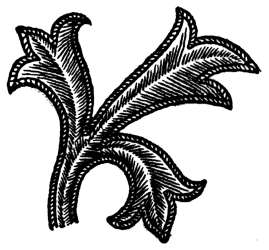 Fig. 123.
Gold embroidery may be divided roughly into three main classes, outline
work, solid flat work, and raised work. Outline work is, as far as
technique is concerned, one of the simplest forms of gold embroidery.
The pattern is followed round with a gold cord or double thread of
passing, fixed either visibly or invisibly with a couching stitch; the
work needs but an interesting design and suitable background to be most
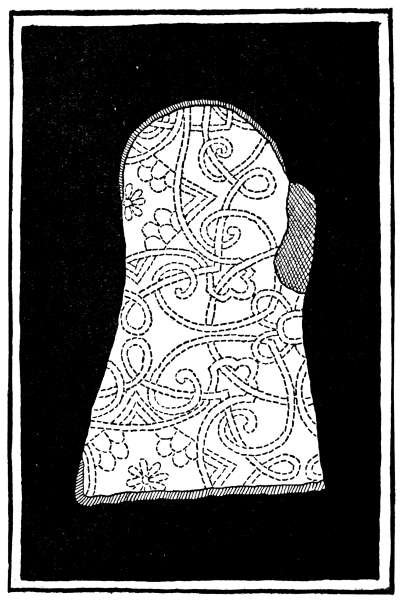
successful. Fig. 124 illustrates a portion of a design, carried out with
gold cord upon a velvet ground, which has been further enriched by the
addition of little applied white flowers. The raised work, and that
which introduces the use of purls and bullions, is at once more
complicated, and perhaps hardly as pleasing as the simpler flat work.
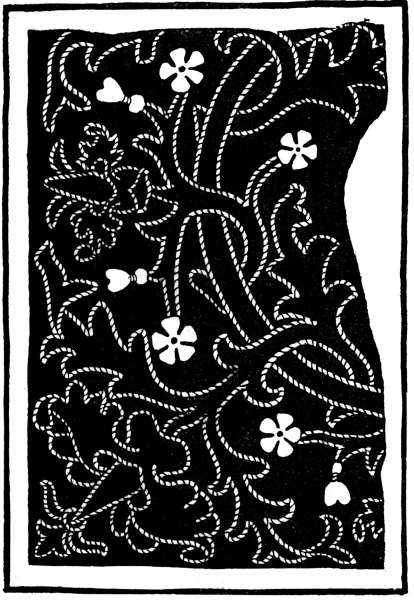 Fig. 124.
The method of applying the gold to the material is usually by couching
of one form or another, for most of the threads are too inflexible to
be stitched through. The ground, if it shows at all, is usually a rich
stuff, such as velvet, satin, or silk, in order to be in keeping with
the valuable thread. If the ground chosen is difficult to work upon, the
embroidery is carried out upon linen, and the finished work afterwards
applied to the ground. If both background and pattern are solidly
embroidered, linen can be used as the permanent ground. It is usual to
have two layers of material for working upon, for gold threads are heavy
and require the support of the double ground. There are several
advantages in this double material, as the old workers knew, for we find
they commonly used two. The under-layer can be a strong linen, and the
surface one silk, satin, or a fine linen, as required.
A variety of metal threads are manufactured for embroidery purposes, and
they are all obtainable in gold, silver, or imitations of these;
aluminium thread has been made lately, and has the advantage of being
untarnishable, but its colour and quality do not seem quite
satisfactory, and it is not popular. The imitation threads are never
worth the using; they tarnish to a worse colour, and are more difficult
in manipulation; what goes by the name of real gold, is silver or
copper, plated with the more valuable metal. The pure gold thread is
said not to be so practical as this, being too brittle; but somehow or
other it was more successfully manufactured in the past than nowadays,
for some gold work six centuries old exhibits beautifully bright
threads.
The following list comprises the chief threads used in this work:—
Passing.—This is a bright smooth thread, resembling in appearance a
gold wire; it consists of a narrow flat strip of gold spirally twisted
round a silken thread. It can be obtained in different sizes, the finest
qualities going by the name of tambour. Most passing has to be couched
on to the material, but it is possible to stitch in the tambour like
ordinary thread.
Purl.—This resembles a smooth round hollow tube of metal, very
pliable and elastic; when pulled lengthways it is found to be
constructed like a closely coiled spiral spring. It is manufactured in
lengths of about one yard, and for use it is cut into small sections of
any required size with scissors or a knife. There are several varieties
of purl, namely, the smooth, rough, check, and wire check. The smooth
has a bright polished appearance, which is obtained by a flat gold wire
being spun spirally round; the rough has a duller and more yellow
appearance, which is owing to the wire having been rounded; the check is
bright and sparkling, and consists of the flattened wire spun in a
different way, so that parts of it catch the light and sparkle; the wire
check is the same thing, but duller and of a deeper yellow, owing again
to its being made of the round wire.
Bullion.—This is the name given to the larger sizes of purl.
Pearl Purl.—This is manufactured in the same spiral tube-like fashion
as the other purl, but the gold wire is previously hollowed out in this
 shape, the convex side being the one exposed.
This, when spun round, has the appearance of a string of tiny gold
beads. It is frequently used as an outlining thread.
shape, the convex side being the one exposed.
This, when spun round, has the appearance of a string of tiny gold
beads. It is frequently used as an outlining thread.
Various gold twists and cords can be obtained; they are composed of
several threads twisted up in the usual cord fashion, each ply
consisting of gold spun round a silk thread.
Plate is a flat strip of metal commonly about one-sixteenth of an inch
wide; it can be obtained in different widths.
Spangles.—These are small variously shaped pieces of thin metal,
usually pierced with a hole in the centre for fixing on to the material.
They are frequently circular in shape, and either flat or slightly
concave; the latter are the prettier. Many fancy shapes also are
obtainable, but they are inclined to look tawdry, and suggestive of the
pantomime.
Cloth of Gold and Silver.—This is a fabric manufactured of silk, with
gold or silver thread inwoven in the making. It is not now so much used
as formerly, when it was in great request for robes of kings and other
high dignitaries of church or state.
A special make of silk for couching down gold thread is obtainable in
various colours. It is called horsetail or sewings, and is both fine and
strong.
Padding for use in raised gold work is usually yellow, and for silver,
white or grey. Yellow soft cotton, linen thread, or silk, are all used
for the purpose.
Various precautions can and must be taken to keep the gold thread
bright, for under unfavourable circumstances it rapidly assumes a bad
colour; the silver thread is even more liable to tarnish than the gold,
and it turns a worse colour, going black. There is a special paper
manufactured to wrap threads in, and the stock supply should be kept in
a tin or air-tight bottle; this is in order to protect the metal from
damp, which is most injurious; to do this is a difficult matter in the
English climate. Linen used for working upon, or as backing, is best
unbleached, for sometimes the chemicals used in the bleaching process
have a deleterious effect upon the gold; a piece of gold embroidery
wrapped up in cotton wool for preservation has been found completely
spoiled by some chemical in this wool, which proved more disastrous than
exposure to air would have been. Gas, strong scents, handling
(especially with hot hands), all have an evil effect, and so should be
avoided as much as possible. Work even whilst in progress should be kept
covered as much as is practicable, and should not be allowed to hang
about; the quicker it is done the better. A piece of finished work can
be polished up with a leather pad or a brush, similar to a housemaid's
brush for silver-cleaning purposes; this of course, must be used with
care.
Gold thread can be couched on to the material in two distinct ways, one
of them in use at the present day, the other one that was commonly
practised in the XIIIth and XIVth centuries. About the second half of
the last-named century the earlier method was supplanted by the present
one. Almost every example of early gold thread work exhibits this
obsolete and ingenious method of couching. The Syon cope and the Jesse
cope in the Victoria and Albert Museum may be mentioned as famous
examples. M. Louis de Farcy[11] draws especial attention to this
beautiful method of working, to which he gives the name point couché
rentré ou retiré, and strongly urges its revival; he points out many
distinct advantages it has over the method now in use.
The durability is very great, owing to the couching thread being upon
the reverse side, where it is protected from wear and tear, and being
out of sight can be made strong and durable. If a thread is accidentally
broken it does not necessarily give way along an entire line, as may
easily happen in the present method. A proof of this point can be seen
upon the beautiful Ascoli cope lately in the Victoria and Albert Museum,
about which there has been so much discussion of late as to in what
country it originated, and who was the rightful owner. The early
couching worked entirely over the background of the cope is in a state
of perfect preservation; portions of the gold thread drapery have here
and there been couched by the other method, the tying down threads have,
in those parts, mostly disappeared, and the gold hangs loose and ragged
upon the surface.
By the way in which it is worked, there results a particularly pleasing
and even surface, agreeably varied by play of light and shade. Another
advantage of the ancient method is that the completed work is very
flexible; this point will appeal to those who have experienced the
extreme stiffness of a large surface of ordinarily couched metal
threads. Flexibility is an invaluable quality for any work destined,
like copes and curtains, to hang in folds.
Representations of draperies upon figures are well expressed, for by the
way in which they are worked there comes an indentation along the lines
marking the folds; this emphasises them rather happily, and also breaks
up the surface in a satisfactory manner.
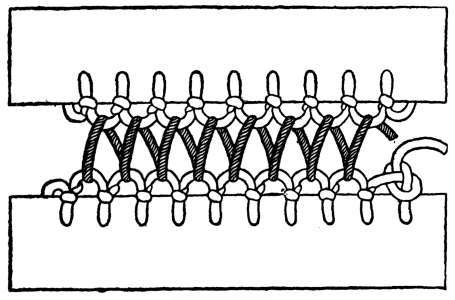
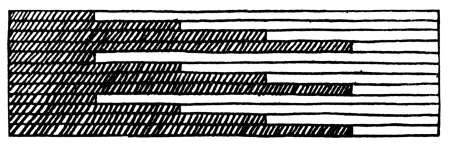
Fig. 125 is a diagram that will aid in explaining the working, it gives
both the front and the reverse side. This has been found to be the
simplest and the most practical method of obtaining a result similar to
the early examples; there is, however, no means other than examination
of result whereby to get at this obsolete method. To all appearance
there is upon the surface a kind of satin stitch worked in gold passing,
the stitches carrying out some geometrical pattern, such as a chevron or
lattice; but at the back a linen thread is seen running to and fro in
close parallel lines in the same direction as the surface thread, and at
regular intervals encircled by the gold passing, just as if this was
intended to couch down the linen thread.
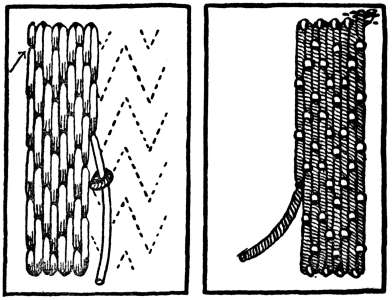 Fig. 125.
Front. Back.
The ingenuity and satisfactoriness of the method must be admitted by all
who give it a trial, and it is interesting to conjecture how it may have
arisen. Possibly weaving suggested it to the embroiderers, for, take
away the intervening material, and it is not unlike woven work, and
these two arts would very likely be the accomplishment of the same
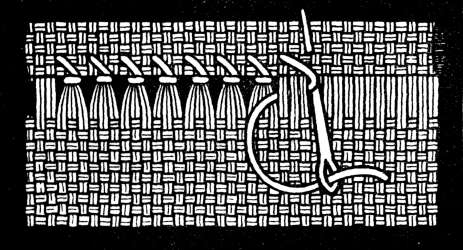
person. Perhaps the commonly used method of taking a coarse thread
through to the back (see fig. 167) suggested it, for this is briefly the
whole process.
In order to try the couching, a two-fold ground material must be firmly
stretched in an embroidery frame, a strong linen underneath and a
thinner closely woven one upon the upper side. Some fine gold passing
and some strong linen thread, well waxed, are required to work with,
also an embroidery needle with long eye and sharp point, the size, which
is important, depending upon the threads in use; the needle has to
pierce the two-fold ground material, making a hole only just large
enough for the passage of a double gold thread.
If the linen has a regular even thread the drawn pattern shown in the
diagram can be worked by counting the threads of the ground fabric, but
if this is difficult or impossible, as in the case say of a twilled
surface, a careful tracing must be made upon the linen; a beginner may
find this the easier way in any case.
The end of the gold thread, which by now, in readiness for working,
will be wound upon the bobbin or spindle, must be passed through to the
back at the starting-point, the top left-hand corner in the diagram. The
linen thread secures it at the back and then comes through to the front
upon the traced line exactly beneath (see arrow on plan). It now
encircles the gold thread which the left hand draws out rather tautly,
and then returns by the same hole to the back, pulling the metal thread
through with it. There is knack in taking the gold thread only just
through and leaving the completed stitch straight and flat upon the
surface. The process is now repeated, the linen thread coming through to
the front again upon the next traced line, and so on. When the base of
the pattern is reached the gold thread is taken through once upon that
line, and then commences a like journey upwards.
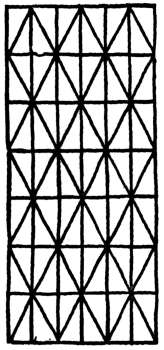
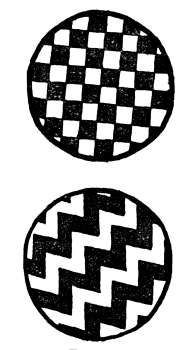
This practically explains the couching; variety is obtained by change of
pattern, but the method of carrying it out is always the same. Figs.
126, 127, and 128 show three patterns taken from old examples of this
couching.
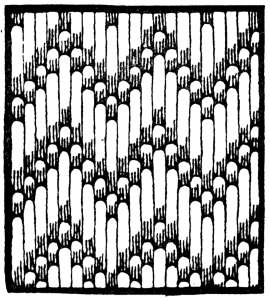 Fig. 126.
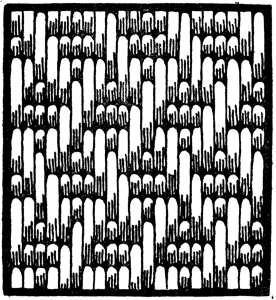 Fig. 127.
The difficulties in technique are easily overcome; an important aid in
this matter is the use of materials exactly right; this means needles
and threads of the correct size, the ground composed of suitable
fabrics, and properly strained in a frame. The aim in the working is to
get each stitch perfectly flat and straight in its correct place in
spite of the obstinacy of the metal thread; to avoid making the
perforation larger than necessary, for this makes the work clumsy; to
make each succeeding line lie closely beside the last one, for the
surface must be of solid gold, and if the ground showed through in
places it would impoverish the effect.
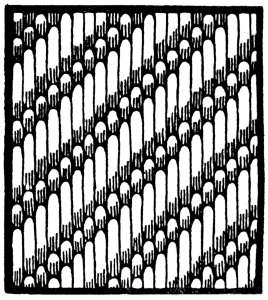 Fig. 128.
The direction of the couched thread is usually either vertical or
horizontal, and it may be both of these in the same piece of work. The
reason of this may be because it is worked by counting the threads of
the fabric, or because the pattern is always treated as a diaper and
placed upon the surface without regard to contour. The exception to this
rule of direction is when the couching is taken along a stem or the
narrow hem of a robe to form the border, or along a girdle, it then
follows the direction of the band, this being evidently the most
straightforward and satisfactory method to use for the purpose.
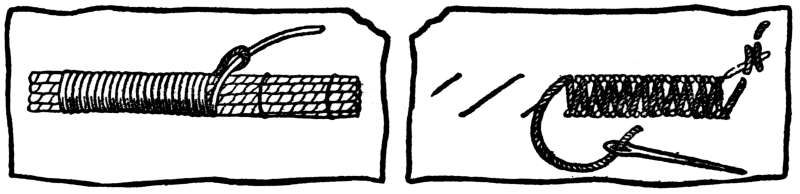 Fig. 129.
Front. Back.
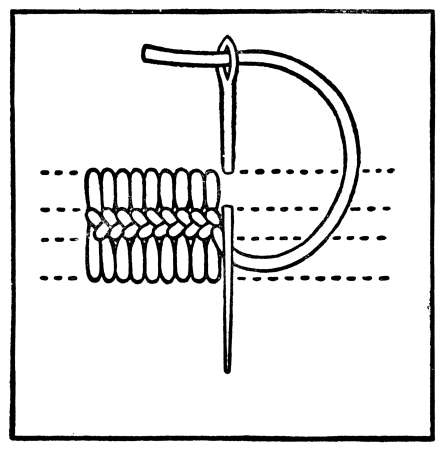
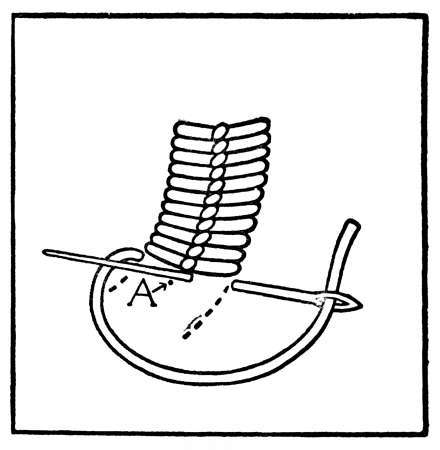
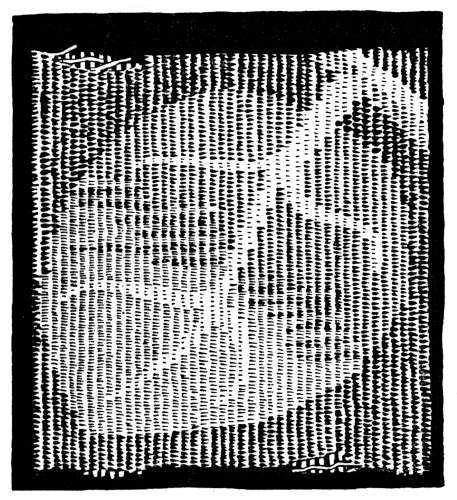
The point couché rentré ou retiré is an excellent method to use for
working a raised bar. Fig. 129 shows the front and reverse sides of a
bar worked by it. The gold thread comes cleanly through from the back of
the material instead of being clumsily doubled upon the surface, and the
durability is evidently great. The linen thread, it will be seen, runs
to and fro at the back, at each turn securing the gold thread.
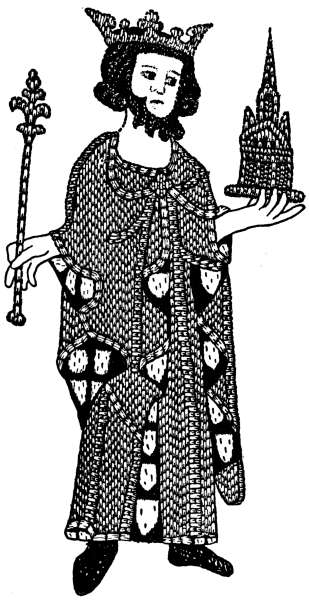 Fig. 130.
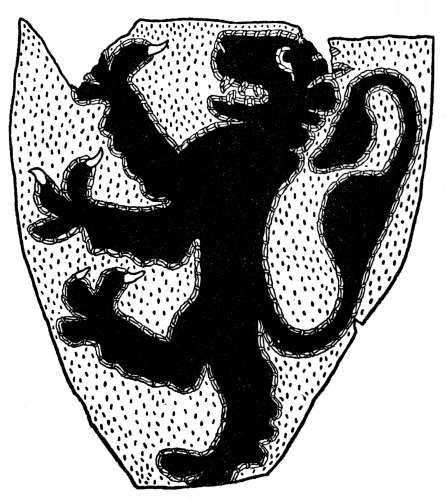
In fig. 130 this couching is to be seen in use upon drapery. It is taken
entirely over the exterior surface of the cloak, and upon the crown,
sceptre, and model of the church. The lines expressing the folds of
drapery are in this case shown by the couching at these places being
taken in a different direction. Fine gold passing is used for the
couched thread, much finer than can possibly be shown in the drawing,
and the pattern chosen for the couching down is a chevron. The other
parts of the work are done with silk thread in a fine chain or split
stitch. The play of light upon the varied surface of the golden cloak is
very beautiful; the drawing of the figure is perhaps primitive, and,
regarded from the draughtsman's point of view, somewhat ludicrous; it is
however sufficiently good to express all that its author intended, and
there is something very human in this dignified little king who would
not have you forget that he founded a church. The king who is
personified here is Edward the Confessor, so the church is Westminster
Abbey, of which he was the founder.
The Madonna and child forming the frontispiece of the work is another
example of this couching. The method of expressing the folds of drapery
is slightly different from that employed upon the king's robes. All
drapery carried out in this stitch is worked in somewhat the same
fashion, that is, the couching running to and fro between the lines
marks each fold as roughly shown at fig. 131. This method leaves an
indented line to express the drapery, which is a more satisfactory way
than a simple line of dark colour worked over the gold, as in more
modern work. The indented line is often further emphasised by a line of
dark silk stitched along it, which is done in this case. The figures
are taken from the Jesse cope in the Victoria and Albert Museum;[12]
this vestment, with its red silk background and its finely coloured and
drawn ancestors of Christ posed amongst encircling vine branches, is a
most beautiful, though sadly mutilated, example of XIIIth century design
and workmanship.
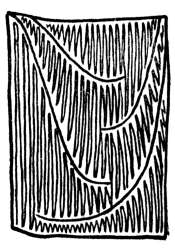 Fig. 131.
In the usual form of couching the gold thread is attached to the
material by fine strong silk. The thread is fastened down as a rule
two-fold, sometimes even three-fold; this method is both quicker and
more effective than couching each thread separately. As the couching
thread is necessarily in evidence, decorative use is often made of it as
well as practical; the stitches, for instance, may be planned so as to
carry out some pattern (see fig. 132) instead of being put down at
random. There is no limit to the variety of the patterns that can be
devised in this way.
Decorative use can be made of the colour of the couching thread; a hot
colour warms the tone of the gold and a cool one does the reverse; and
the more contrasting the colour the more it is in evidence.
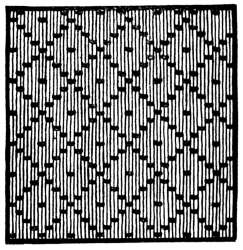 Fig. 132.
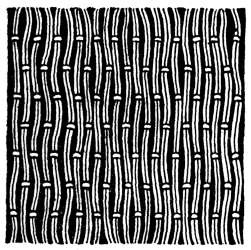 Fig. 133.
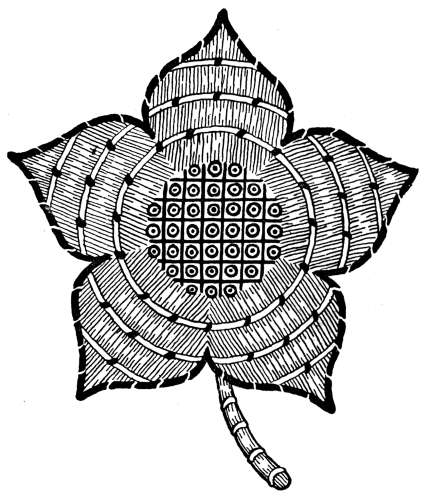
The gold thread may be couched solidly in straight lines, as the above
figure shows, or it may be arranged in wavy lines either close or open,
as in fig. 133. The thread is waved by bending it round the pointed end
of a piercer just before fixing down. This waving line is particularly
suitable for the gold thread, since the slight change in direction
allows the light to play upon the metal very prettily. For this reason
gold is often couched solidly in circular or shell form over a ground.
In gold embroidery, therefore, the direction of the thread is a
specially important matter.
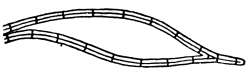 Fig. 134.
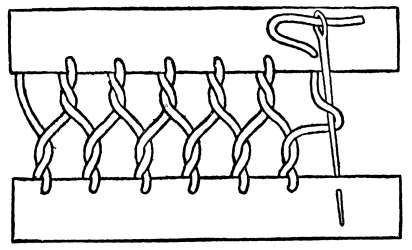
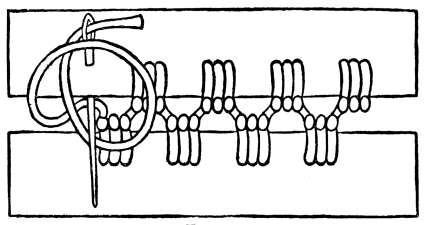
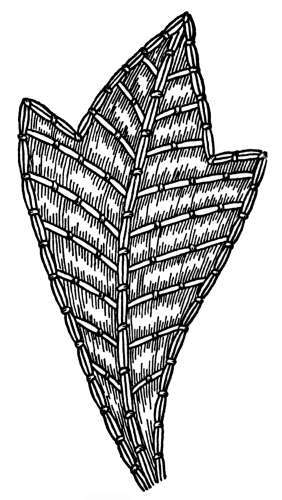
At the end of a line a technical difficulty sometimes arises in the
turning of the thread, which is apt to be clumsy. This difficulty is
overcome in various ways; the most usual is to return the doubled thread
as neatly as possible and continue the next line; another is to cut the
thread sharp off, secure it close to the end with a double stitch, and
recommence in like fashion; the thread can sometimes be passed through
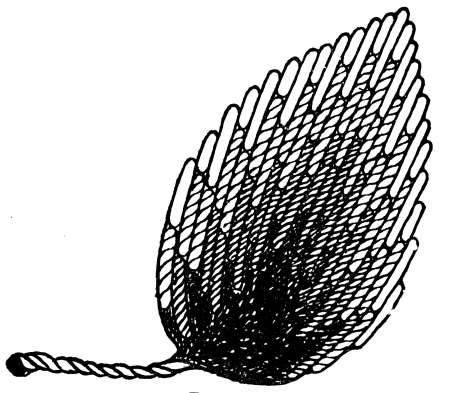
to the back and brought up in position for working the next line. The
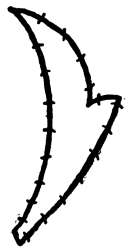
fine point of a leaf may present difficulties in the same way; sometimes
one of the two threads is temporarily let slip and the point completed
with the single one, the left thread being picked up upon the return
(see fig. 134). For such occasions as this it is more practical to wind
the two threads of passing upon separate bobbins, and bring them
together at the working. Another way of overcoming the point difficulty
is shown at fig. 135.
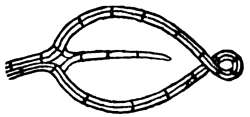 Fig. 135.
The couched gold threads may be raised in parts by means of some kind of
padding interposed between it and the ground. They are very effective so
treated, since the raised metal catches and reflects the light in a
pleasing manner. This raising of the thread, however, has been carried
to such extremes as to resemble goldsmith's work rather than embroidery,
and it is then hardly in good taste.
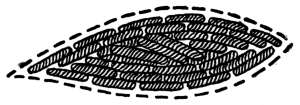
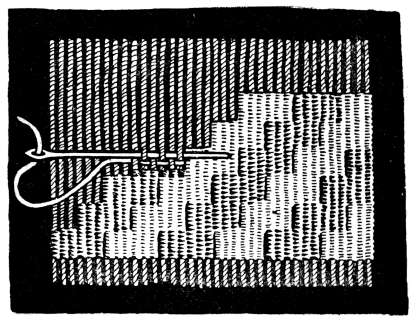
A simple method of raising the gold is to lay down lines of string at
stated intervals over the ground. The well-known form called basket
stitch is done in this way; fig. 136 illustrates this stitch, a part of
the square is left unworked in order to expose the under-layer of
string. To carry out the diagram—First couch down the lines of string
at regular intervals over the surface, then commence laying on the gold
by carrying a doubled thread of passing over two bars of string, and
there fixing it down to the material, then over two more and fixing it
down again, and so on to the end of the line. This is exactly repeated
for a second line of passing, then, for the next two lines, commence by
carrying the passing for the first stitch over one bar only, and for the
remainder of the line over the two as before. This process repeated
makes the wicker-like pattern so frequently seen in gold work. It can be
used as a filling or as a border. It is evident that with the same
arrangement of strings many other patterns could be carried out by
varying the points of couching down.
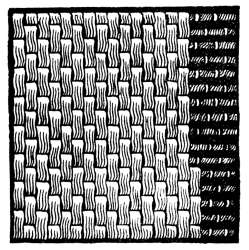 Fig. 136.
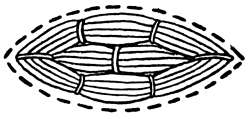
Another way in which string is used for padding the gold is illustrated
in fig. 137. The pattern, which in the first part is two diamond shapes
and a border line, is laid down in string. The doubled gold thread is
then taken horizontally to and fro in close parallel lines over the part
to be worked, and fixed by couching stitches at necessary intervals;
wherever else these stitches may be put, one must always be placed upon
each side of a raised line to make it sharp and clear. Other kinds of
padding are used in this method of work; for instance, a lozenge shape
may be stuffed with layers of soft cotton, as shown in the second part
of this same diagram. Sometimes most complicated patterns are laid down
in string and covered with gold thread in this way, e.g.:—fig. 138
shows an interlacing pattern taken from the border of an orphrey upon a
XVth century chasuble.
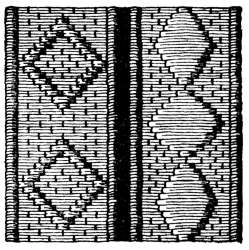 Fig. 137.
A cursory glance must be given to the use of purls and other fancy
threads, but these are mostly used nowadays for badges on uniforms, or
for masonic purposes, and are carried out by the trade. These threads,
when tarnished, are very difficult to clean, they easily turn a bad
colour and catch the dust, and for real embroidery purposes are not as
satisfactory as the plainer threads.
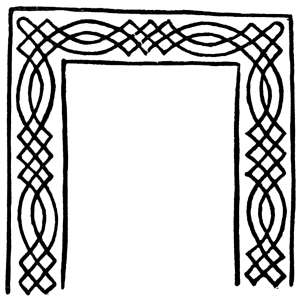 Fig. 138.
Purl and bullion must be cut very accurately into pieces of the required
size, and attached to the material as a bead would be. The metal must be
as little as possible touched with the fingers; the cut pieces can be
placed upon a tray lined with some soft springy substance, such as felt,
in order to be easily picked up with the point of the needle, and they
can be adjusted to their right position upon the work by the aid of the
flat end of the piercer; unnecessary handling may be avoided in this
way.
These threads, laid over padding either straight across or at an angle,
may be used for the stems or petals of conventional flowers. The various
kinds, dull, bright, and check, may perhaps be used in succession.
Plate is frequently taken to and fro over the same kind of forms over a
prepared padding, being caught down by a stitch on each side by a method
the French call le guipé. It needs skill and practice to do this well.
Crinkled plate used to be couched on to work, but now is not much used
in this way.
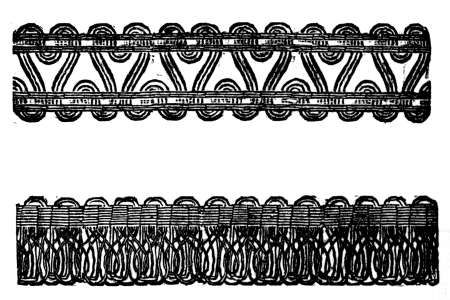
Pearl purl is most often seen outlining a form filled in with the other
threads; an enlarged example of this thread lies vertically down the
centre of fig. 139, the end of it is pulled out, in order to show the
formation of the thread.
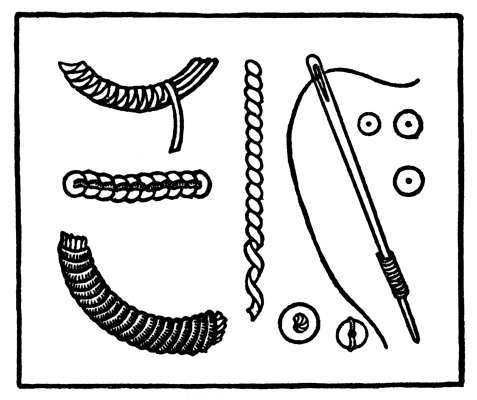 Fig. 139.
Spangles are usually sewn down separately; they may be attached by
stitches from the centre outwards or by the thread being passed through
a piece of purl and then returning to the back through the hole in the
centre of the spangle. Fig. 139 illustrates another way of using these
spangles to form a long tail shape. Here again they are attached with
the help of pieces of purl. In the same figure are given some
illustrations of the use of the fancy threads; to learn more about them
the student should examine XVIth to XVIIIth century gold work during
which period they were in popular use.