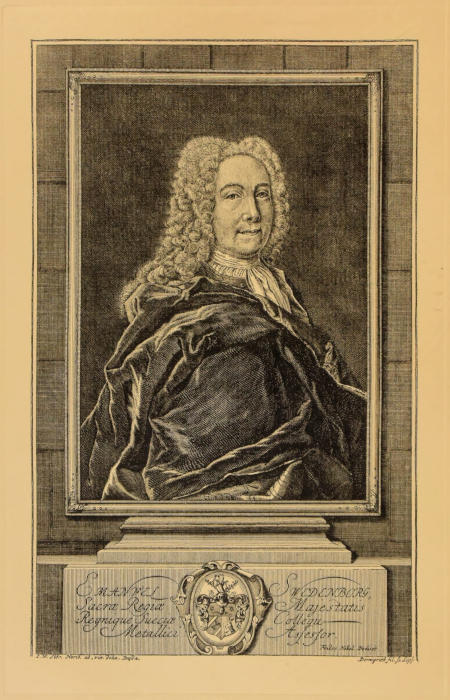
SWEDENBORG’S INVESTIGATIONS IN NATURAL SCIENCE. — SWEDENBORG’S MATHEMATICAL, MECHANICAL AND ASTRONOMICAL INVESTIGATIONS. — SWEDENBORG’S GEOLOGICAL, MINERALOGICAL, CHEMICAL, PHYSICAL AND COSMOLOGICAL INVESTIGATIONS. — SWEDENBORG’S ANATOMICAL AND PHYSIOLOGICAL INVESTIGATIONS.
Before a life-work such as that of Emanuel Swedenborg one
cannot but be filled with admiration. Perhaps not so much on
account of the manysidedness of it; for that was not so very unusual
at the time in which Swedenborg lived—in the 18th century;[12] but because
his researches were at the same time so comprehensive and penetrating,
because he made such great and important conquests within the
most different departments of knowledge; indeed, in many places discovered
by his sharpsighted genius the lines of development along which
science was to proceed for the gaining of its end.
Mathematics, especially geometry, algebra and mechanics, and
astronomy in particular, were the predominating interests with Swedenborg,
when, after having completed his university studies, he entered
upon his first foreign journey (1710). He had at that time the good
fortune to come into personal contact with (Isaac Newton?),[13] John Flamsteed[14]
and Edmund Halley[15] in England, and with the renowned mathematicians
Philippe de la Hire and Pierre Varrignon[16] in France,
and to enter into an interchange of scientific ideas with them. And the
impulses derived from teachers of such great insight and skill did not
take long in manifesting themselves. In 1714 Swedenborg was able to
send home accounts of a great many mechanical inventions which he had
made and the ›correctness of which he proved by mathematical and
algebraical calculations.›[17] As examples of these discoveries may be
mentioned his flying machine,[18] submarine boat, steam engine, mitrailleuse,
sluice constructions, etc.[17] After his return to Sweden he found
opportunities of putting into practice some of these projects, when (in
1716) he was appointed assessor extraordinary in the College of Mines
and ordered to assist Chr. Polhem ›with the construction of his buildings
and inventions›. But he was rich in ideas and quick-witted enough to be
able, together with these official duties, to plan and set on foot the publication
of a periodical devoted to natural science, ›Daedalus Hyperboreus›,
the first scientific periodical in Sweden, and to furnish it abundantly
(during the years 1716-1718) with valuable articles concerning
new inventions, projects and problems for scientific investigations and
experiments.[19] In the year 1718 he has completed a new method of
reckoning with the number 8 as the base; and the following year he
publishes a still better ›Proposal to divide our money and measures, so
that the calculation would be easy and all fractions be abolished›, and
this system is nothing less than the Decimal system![20] He also published
during these years an ingenious method of determining the longitude
by means of the moon, a problem upon which the learned had at that
time been engaged for several years.[21]
Swedenborg thus succeeded in penetrating very deeply into the
mathematical and mechanical sciences, and therefore at first it must arouse
astonishment that he did not accept the professor’s chair in mathematics
at Uppsala University when this was offered him. He wished for freedom
to study in other departments also. And, as we shall see, he soon turned
his interest in another direction, namely to geology.
However, it was also a characteristic in Swedenborg, worthy of
admiration, that in spite of his deep penetration into the sciences and
the bold ideas of his creative genius, he nevertheless strove, at the same
time, to retain contact with practical life and there cause the results
of his investigations to bear fruit. It was also this purpose which to a
great extent influenced him not to accept the offered professorship in
mathematics, which he feared would force him into a direction too theoretical.
In this respect there were, as some of his biographers have shown,
several points of similarity between Swedenborg and his patron, King
Charles XII., namely, ›the unusual combination of the boldest imagination
and a pronounced practical tendency›.[22] And as both were animated by
the same ›burning inclination for all that is great in thought and deed›,
and by the same love of the fatherland, therefore, when these two men
found one another, there was an interesting cooperation. Professor
Holmquist has given a very good description of this in his essay alluded
to above, from which I shall here reproduce some extracts:
— — — ›But Swedenborg had also in the course of his conversation
with Charles XII. advanced several new proposals which won, in
part, the King’s approval. Swedenborg suggested the establishment of
a company to promote the exportation of Swedish iron and tar (a suggestion
later put into practice by the Iron Office), set forth his plan for
an observatory in Uppsala and brought up for discussion the establishment
of salt works in Sweden in order to help his country against the
terrible dearth of salt during the war: all these ideas he also committed
to writing in pamphlets: ’Om sättet för handelns och manufacturernas
uphjelpande’, ’Memorial om Salt Siuderiers inrettning i Swerje’ and
’Om nyttan och nödvändigheten af ett Observatorii inrättande i Sverige’
(preserved in manuscript in the Diocesan Library of Linköping).[23] Of the
ideas just mentioned, it was in the first place the one on salt boileries
which claimed the King’s attention and which he commissioned Swedenborg
to put into practice. It still remains, however, to mention the most
remarkable of Swedenborg’s projects. Through Eric Benzelius he had
come into possession of an old letter of Bishop Hans Brask, in which
the idea of a water way from the western coast straight across Sweden
is expressed. Swedenborg, inspired by this, laid before the King the
suggestion for a canal from Göteborg through Lakes Vänern and Vättern
to the Baltic, which aroused the King’s enthusiasm. Swedenborg was
commissioned to investigate the possibilities for the realization of this
gigantic undertaking. — — — Shortly after this we find him in Uddevalla
investigating the possibility of establishing salt-works, in connection
with which Swedenborg at once set out to construct salt-pans and other
apparatus better than those in use in the defective old salt-works at
Strömstad. — — — We afterwards find him again at Trollhättan, Vänern,
Gullspång and Hjälmaren examining the situation for the canal and
locks and finding ’all to be possible and not of such great expense as
had been supposed’. Swedenborg had passed over to the modern idea
of an inland canal through Hjälmaren and Mälaren directly to Stockholm.›
With justice it may be said that here he gives the impression
of a very sharpsighted and energetic engineer, who possessed the power
of turning his thorough theoretical education to practical use.
It may thus be clearly perceived, from everything I have referred to
above, how comprehensive and penetrating were the researches of Swedenborg
in the mathematical (and especially the mechanical) branches of
science, and what fruitful discoveries had been made by his searching eye.
Swedenborg’s comprehensive interest now turned itself to new fields
of work: to geology, mineralogy, chemistry, physics and finally to cosmology,
without giving up his first subject, mathematics.
And he also now exhibited the same thoroughness as before, beginning
with examinations, experiments and observations, partly original,
but also collected from predecessors. For he says: ›It seems to me
that an infinite mass of completed experiments is a good ground to build
upon, to make the trouble and expense of others serve one’s end; that
is to work with the head over that which others have worked over with
the hands.› (See Holmquist, Op. cit. and the letter from Swedenborg
to Eric Benzelius of May 2nd, 1720, in the edition of the Acad. of Sciences,
I., p. 304).
The result of this period of labour Swedenborg embodied in a
number of works, among which may especially be mentioned: ›On the
Height of Water and the Strong Tides in the Primeval World. Proofs
from Sweden.›[24] Swedenborg here furnishes proofs that our North, in
olden times, lay for the most part under deep water. And he based his
deductions on a great many researches and sharpsighted observations,
and wherever it was possible he tested the correctness of his conclusions
by means of experiments. This is the work which J. J. Berzelius, A. E.
Nordenskiöld and A. G. Nathorst have praised so highly, and in some
places it has been considered to be ›one of the most ingenious contributions
to the history of geology›. Swedenborg also worked out during
this period the great work: ›Miscellanea observata circa res naturales
et praesertim circa mineralia, ignem et montium strata›, (printed in
Leipzig 1722 and lately reprinted in the edition of Swedenborg’s scientific
writings of the Royal Academy of Sciences, Vol. I., 1907, pp. 59-191),
and finally the gigantic work: ›Opera philosophica et mineralia›,
(published in Dresden and Leipzig, 1734, in three large folio volumes).
The last work contains among other things Swedenborg’s cosmology,
and it is here that he developes his famous nebular theory, which so
closely reminds one of the theory worked out in later years by Kant
and Laplace, that one strongly suspects that Swedenborg’s utterances,
in one way or another, lie at the bottom of it. Concerning this work
much has been written during recent years, and therefore it may be sufficient
here only to refer to the statements made in regard to it by Professor
S. Arrhenius in his introduction to the above-mentioned edition
of Swedenborg’s writings, Vol. II., where he says: ›If we briefly summarize
the ideas, which were first given expression to by Swedenborg,
and afterwards, although usually in a much modified form,—consciously
or unconsciously—taken up by other authors in cosmology, we
find them to be the following:
The planets of our solar system originate from the
solar matter—taken up by Buffon, Kant, Laplace, and
others.
The earth—and the other planets—have gradually
removed themselves from the sun and received a
gradually lengthened time of revolution—a view again
expressed by G. H. Darwin.
The earth’s time of rotation, that is to say, the day’s
length, has been gradually increased—a view again expressed
by G. H. Darwin.
The suns are arranged around the milky way—taken
up by Wright, Kant and Lambert.
There are still greater systems, in which the milky
ways are arranged—taken up by Lambert.›
During this period of his investigations Swedenborg enters into
very deep speculations. He desires to grasp the innermost constitution
of things, their causes and origin, and seeks to attain this end through
a long process of analyses and by applying a geometrical explanation
to the phenomena in the world of the senses. This method he employs
in explaining the inner constitution of chemical bodies, and likewise the
varieties of physical phenomena, etc. He thus comes at last to the—geometrical
points: through the combination of these, in different ways, have
all things of the universe originated in a mathematically definable manner;
and the motion of these points is the all connecting, life-giving power.[25]
After Swedenborg had so thoroughly searched through and speculated
upon inorganic nature, he turns himself to the organic. He breaks
away from all other work, travels abroad, and throws himself with intense
zeal into anatomical and physiological studies. These researches
were, for the most part, carried on in the Netherlands, France, and
especially in Italy, where he remained for nearly a year.
After five years he was ready with his first work in this field,
the large, famous ›Œconomia Regni Animalis,› which was printed in
Amsterdam, 1740-1741. It was then published in two large volumes;
but that it was designed to be still larger, is evident, among other
things, from Swedenborg’s own statement;[26] and furthermore, the Englishman
J. J. G. Wilkinson published, in 1847, as a third volume, some
annotations which he regarded as belonging to Swedenborg’s manuscript
of the same work.[27]
The ›Œconomia Regni Animalis› is chiefly directed to a detailed
analysis of the blood, the brain, and finally the soul. In this investigation
Swedenborg directed his attention not only to the morphological and
physiological aspects of the subject, but also to the embryology of the
organs; and he penetrated so deeply into the very essence of development,
that, as Professor J. A. Hammar (Uppsala) has pointed out, he
succeeded in arriving at a conception on this point, which was considerably
better than that of his times. As is well known, during the first part
of the eighteenth century the idea was generally prevalent that, when
the organism developed from the egg or sperm, it grew forth out of it,
much like a flower developes out of the bud, or, in other words, that
the different organs existed pre-formed in the egg or sperm and that
development consisted only in an extension of its size. Swedenborg
expressed himself very decidedly against this ›pre-formation theory›:
The development consisted by no means merely in a growth or expansion
of the germ, (›seminis extensio›), or of a prototype of the future
creature existent in the germ, (›non ... aliqua realis effigies maximi in
minimo, seu in aliquo primo typus futuri corporis, qui simpliciter expanditur.›
See Œc. R. A. I., No. 249); but there was in the germ a certain
formative substance or power, by means of which the various parts
of the embryo were developed one after the other, organ after organ.
( ... singula membra successive, seu unum post alterum producuntur
... Œc. R. A. I., No. 247).
It will be seen that Swedenborg has here put forth essentially the
same theory as was later presented by Caspar Friedrich Wolff in his
well known ›Doctorsdissertation› of the year 1759, i. e., the so called
theory of ›epigenesis›.
I shall here also discuss some of the results and conclusions, which
Swedenborg arrived at in the ›Œconomia Regni Animalis›, concerning
the brain and its function.
As is well known the general principles of the macroscopical anatomy
of the brain were known long before Swedenborg’s days; and even
its microscopical structure had, half a century before his time, begun to
be studied by such men as Leeuwenhoek (1632-1723), Malphigi (1628-1694),
and others. For example, it was not only known that the substance
of the brain, upon incision, exhibits an outer, greyish layer, the
cortex, and an inner, more pure white mass, the medullary substance;
but the above-mentioned investigators had also shown that the cortex of
the brain consists of a numberless mass of small globular bodies, which
are closely surrounded by blood-vessels and are continued in small
thread-like extensions, which run into the medullary substance.[28] Now
Swedenborg succeeded, as regards these globular bodies, in arriving at
the conception that they are the most important components of the cortex
and that it is in these bodies that the nerves originate.[29] He called them
›Sphaerulae› or ›Cerebellula›.
Again, as regards the medullary substance, it was already known
through the works of Willis (1622-1675), Vieussens (1641-1716),
Boerhaave (1668-1738), that it consists, for the most part, of a great
mass of finer and coarser nerve-fibres, and that these, through the medulla
oblongata,[30] continue down into the spinal cord, and that through
the nerves they are in communication with the various parts of the body.
The nerves were supposed to contain a lumen, thus being tubular. On
the basis of certain clinical experiences concerning the changes which
occur in the functions of the soul, when the cortex of the brain is injured,
Swedenborg succeeded in drawing the conclusion that the same medullary
fibres which are derived from the ›Cerebellula› of the cortex of the
brain, continue into the spinal cord and are in connection with the nerves,
and that thus an easily transmitted and continuous communication is
established between the substance of the cerebral cortex and all the
parts of the body, where the nerves are distributed.[31]
Concerning the function of the brain, the old view of Hippocrates
that the brain was a gland was still entertained in Swedenborg’s time.
The cortical substance served for secreting the ›spiritus animalis›, that
is, what the ancients called the ›spirits of life›, and these were collected
in the cortex of the brain that they might, when necessary, stream out
through the nerves. The medullary substance was, according to the
latest conceptions of that day, the origin and source of the soul’s activity,
and the ›spiritus animalis› served as the connecting link between the
soul and the sense-organs and muscles of the body.
Swedenborg also supposed that such a very easily flowing nervous
fluid, ›fluidum spirituosum›, communicated the impressions of the senses
and the impulses of motion: but this fluid determined the connection
between sense-organs and muscles on the one hand, and the cortex of
the brain on the other. It was thus the cerebral cortex! to which the impressions
of the senses were carried, and from this the voluntary impulses
were sent out to the muscles. The cortex was thus the seat of
both the sensory and motor activities of the soul in the body. Œc. R. A.
III., No. 133: ›Substantia enim corticalis est ipsum cerebrum, seu sensorium
et motorium commune.›[32]
But Swedenborg was not contented with this general idea of the
cortex as the seat of the sensations and the will. He also drew conclusions
from his previous experience and results regarding the continuous
connection between the elements of the cortex and the ends of the nerves
distributed in the various parts of the body.
On the basis of this connection he ascribed to the ›Cerebellula› a
very important rôle in the activity of the brain. In the first place they
received, through the external sense-organs and nerves, impressions from
the outer world and worked them over: they were a kind of inner sense-organs.[33]
And since the sensory impressions were so richly various
as well in kind as in degree, the ›Cerebellula› must also possess various
individual qualifications corresponding to these various sensory impressions.
They were, at the same time, connected with one another, and
so arranged into superior and inferior groups that they could receive
and work over the various kinds of sensory impressions.[34]
There were also other groups of grey substance in the interiors of
the brain, through which the sensory nerves passed; but all sensory impressions
must ultimately be gathered together in the cortex of the brain
so as to become conscious perceptions.
(Thus, for example, Swedenborg describes the optic thalami as
such a secondary centre in the course of the path of sight;[35] and the
corpora striata in the path of the sense of smell;[36] and the origin of conscious
tactile sensations he describes thus: — — — ›rudior quicunque
tactus a superficie totius per medios nervos in Medullam Spinalem aut
Oblongatam et abinde in activissimum cinerem, et in circumfusum corticem
Cerebri emicet: Adeo ut extremi receptus modorum sint in cortice
Cerebri, qui conscius redditur mutationum in seriebus et substantiis
compositis usquam contingentium.› Œc. R. A. II., 192).
Thus: although Swedenborg did not suppose the ›Cerebellula› to
be arranged into sensory centres in the same manner as we do, still he
seems to have supposed an arrangement something resembling this, with
Cerebellula-groups as subdivisions of the great sensible centre-organ,
which is formed by the ›Cerebellula› of the brain cortex, taken together,
and which Swedenborg called ›Sensorium commune.›
In regard to the relation of the cortex to motility, Swedenborg expresses
himself much more definitely. This activity of the brain Swedenborg
also regarded as derived from the small cortical elements, the
›Sphaerulae› or ›Cerebellula›.[37] He ascribes to them, on the one hand, a
high degree of self-determination, so that they could perform their functions
independently of each other, this on the basis of certain anatomical
conditions, such as their position in respect to each other in separate cavities,
and their connection each with its own special nerve-fibre, and, besides,
also on the basis of certain clinical and pathological observations;[38]
but on account of other anatomical conditions, such as the aggregation
of the ›Cerebellula› into larger and smaller groups, as into gyres, and
groups of gyres, etc., as well as on certain other grounds, he ascribed to
them also the ability to cooperate with each other when necessary.[39] In
consequence of this the brain possesses, as he says, the power and choice
of influencing whatever nerves and muscles it will, and of stimulating them
to activity. (›Proinde Cerebri secundum ordinatam ejus substantiae dispositionem
in potentia et arbitrio est, quascunque velit fibras, aut fibrarum
fasciculos, et consequenter nervos et musculos inspirare et ad agendum
excitare.› Œc. R. A. II., 153). It was impossible for him to express
himself as to what parts of the cerebrum or which convolutions,
gyri, correspond to the respective muscles, but he refers to experimental
investigations of animals, by which this might be discovered.[40]
But although the brain would then be able to govern every muscular
action, it was not employed every time such an action was to be
performed. No, in the medulla oblongata and in the grey substance of
the spinal cord there were subordinate, secondary motor centres, and
these governed the automatic and habitual movements, so that, for the
performance of these, the brain need not be disturbed in its higher functions.
Only for the purely voluntary motions were impulses from the
cerebrum necessary.[41]
Swedenborg has thus clearly located the ›causa principalis› of the
voluntary movements in the cortex of the cerebrum, or more definitely,
in the cortical elements and in groups of such elements, although in this
work ›Œconomia Regni Animalis› he did not succeed in more closely
defining the position of the various motor centres.
From all that I have here brought forward concerning the functions
which Swedenborg ascribes to the cortical substance of the brain, it is
evident that he succeeded in coming to the full conviction that it is
through the activity of the ›Cerebellula› (or as we express it, through
the cerebral nerve-cells) that the perception of sense-impressions and the
impulses to voluntary motions arise.
But Swedenborg does not stop even here. The elements of the
cerebral cortex, he continues, are still not the ultimate determinants.
They are only, so to speak, the inner sense-organs[42] and sub-determining
media.[43] They are themselves subordinated under the understanding
and the will, and their principle, the soul.[44] The soul, the principle of
life, it is the soul, which, through those cortical elements, perceives the
external world: it is the soul which feels, sees, hears, smells, tastes, it
is the soul which recollects, thinks, performs, and wills; it is the soul
which speaks and acts.[45]
What then is the soul, and where does she reside?
The seat of the soul must surely lie in the cerebral cortex; at least
its activity comes into play there, and still more definitely, in the ›Cerebellula›
of the cortex. (See above and also ›The Brain›, No. 7). But
what is she? What is the soul?
Here Swedenborg makes one attempt after the other to draw away
the obscuring veil. Sometimes he thinks of the soul as only dwelling and
working in the ›Cerebellula› and their ›fluidum spirituosum›; but in this
way he does not come to a solution of the principal question, which is
only removed farther away.[46] Sometimes he thinks the soul to be identical
with the ›fluidum spirituosum›; but how can this, however subtile
fluid, be immortal? Here he is again repulsed.[47] He discusses the supposition
that, although the ›fluidum spirituosum› in itself is not immortal,
it yet becomes so upon the death of the body, and so forth.[48] And at
last he bursts out with: ›it amounts to the same thing if we see in this
fluid the soul itself, or only its faculty of imagination and judgment, for
the one cannot be thought of without the other.›[49]
Swedenborg himself, however, was not satisfied with the result, but
acknowledges that he had been too hasty, when, after having in reality
thoroughly considered only the blood and brain, he entered immediately
upon the search for the soul. He therefore says in the preface to the
next work: ›I am now determined to allow myself no respite, until I have
run through the whole field to the very goal—until I have traversed
the universal animal kingdom to the soul (usque ad animam). Thus I hope,
that by bending my course inward continually, I shall open all the doors
that lead to her, and at length contemplate the soul herself: by the divine
permission.›
It is grand to see the indomitable energy and zeal for investigation
in this man of 53 years!
He was now obliged to extend considerably the field of his investigations—thereby
to come to still more thorough insight into the
conditions of the soul’s life, and afterwards, as he says, ›in his analytical
way to be able to work himself up from the lower to the higher›, to
find the way from phenomena and facts to causes and the final principles
of the organism’s intricate mechanism.
Three years later he has ready the first two volumes of his new
work, and the following year, 1745, a third volume. This work is the
›Regnum Animale›, (The Soul’s Kingdom). It is constructed upon a
very grand plan, comprising not less than 17 parts. Of these, however,
only the three mentioned above issued from the press, and they treat
of the organs of the chest, abdomen, and skin, and of the senses of touch
and taste.[50] Professor Immanuel Tafel (Tübingen) in the middle of the
19th century afterwards published two more volumes of the manuscript.
The first of these, Pars quarta, treats chiefly of the senses of smell,
hearing and sight and the higher degrees of the soul’s activity; and the
other, Pars septima, treats of the soul.[50 b]
But simultaneously with the work in question Swedenborg wrote
still another, namely, the great work on the brain, ›De Cerebro›.—In
these works Swedenborg reached the summit of his scientific career, and
they afterwards served as the foundation of the religious edifice to which
he devoted the remainder of his life.
The ›De Cerebro› of Swedenborg, just referred to, is a rather
large work which treats of the brain from the anatomical, physiological,
and philosophical standpoints. This work left by Swedenborg in Ms.,
has appeared in print only in part, namely, in the English translation by
Dr. Rudolf Tafel, published in London in two volumes, 1882 and
1887, and entitled ›The Brain›. Although this edition comprises, as was
said, only a portion of the whole work, it treats of both the cerebrum,
cerebellum and medulla oblongata, as well as of the cranium and the
membranes of the brain, but chiefly only in so far as their structure and
function regard the activity of the soul. Without doubt Swedenborg’s
main interest here centred on this subject, and therefore I shall give some
intimations concerning how deeply Swedenborg has succeeded in seeing
into the function of the cerebrum as the organ of the soul’s life.
Swedenborg divided each hemisphere of the brain into an anterior
and a posterior region, separated from one another by the fissure of Sylvius.
Now, in the anterior region he located the essential activity of the
soul, while as regards the posterior region, he supposed that it was chiefly
active in animating the blood (›The Brain›, No. 71). In the anterior
region he furthermore distinguished three lobes, or, as he called them,
›curiae›, in which the soul resided and exercised its functions (›The
Brain›, No. 88). He does not define the boundaries of the lobes, but
distinguishes them by saying that the soul’s activity in the highest lobe
attains to the highest degree of clarity and perfection, while in the inferior
lobes, the middle and the lowest, the soul’s activity successively
decreases in sharpness and intensity! (›The Brain›, Nos. 66, 88). In
these lobes or curiae the essential psychic life also has its rise; here observations,
thoughts, judgments, conclusions come into being, yea, even
determinations and the utterances of the will proceed thence. Here consequently
is the source of both the sensory and the motor functions of
the soul (›The Brain›, Nos. 88, 100).
As we have seen, Swedenborg had already shown, in ›Œconomia
Regni Animalis›, not only that it is in the cortex, but just in the cortical
elements, the ›Cerebellula›, that the brain’s psychic function is performed.
Swedenborg emphasizes the same idea in ›De Cerebro›, and declares
that these ›Cerebellula› are the units of which the brain is constructed,
and from which its essential nature is derived (›The Brain›, No. 34).
As in the ›Œconomia Regni Animalis›, so in ›De Cerebro›, he
also refers to the arrangement into different groups, which is so important
for the function of the cortical elements or ›Cerebellula›, and with
respect to this he now makes a new statement, which is of such a nature
as necessarily to excite amazement: he sets forth the most essential
part of the modern theory of localizations. Word for word this statement
reads as follows: ›The muscles and actions which are in the ultimates of
the body, or the soles of the feet, seem to depend more immediately upon the
highest parts (of the anterior region of the brain)[51], the muscles which
belong to the abdomen and thorax upon the middle lobe, those which belong
to the face and head upon the third lobe; for they (the muscles of
the body and the lobes of the brain)[51] seem to correspond to one another
in inverse order›. (See ›The Brain›, No. 68).—Thus, the essential features
of the modern doctrine concerning the relative positions of the
motor centres in the cortex of the brain, that doctrine into which we
have obtained an insight first after much comprehensive and complicated
labour during the last century!
I shall no longer at this point continue the discussion of this work.
What I have brought forward may suffice to indicate the character of
Swedenborg’s investigation and the statements and discoveries based
thereon. By his works on the brain Swedenborg reached the summit of
his Scientific activity, but also its conclusion. He now passes over to the
transcendental field. With the limits which we have set for our examination,
we must, however, refrain from following the energetic investigator
in his continued search for truth.
THE BASIS FOR SWEDENBORG’S STATEMENTS CONCERNING THE FUNCTIONS OF THE BRAIN. — ON THE CENTRES OF THE VEGETATIVE FUNCTIONS. — ON THE CENTRES OF THE PSYCHICAL FUNCTIONS, ESPECIALLY THE SENSORY CENTRES. — ON THE CENTRES OF THE MOTOR FUNCTIONS. — THE DOCTRINE OF LOCALIZATIONS. — THE ›CEREBELLULAR THEORY›. — CONCLUDING SUMMARY.
If we take a general view of Swedenborg’s investigations, the outlines of
which have been sketched above, a number of questions are suggested:
Whence did Swedenborg secure the material for all these far-sighted
statements, whence the evidence for all these discoveries? Did Swedenborg
himself carry out the special investigations which must have formed
the basis of his beautiful results?[52] Or was the evidence ready at hand
in the literature of those days?
The answering of these questions is naturally of a certain importance
in the valuation of the opinions expressed. And as several of Swedenborg’s
statements concern questions which are still among the ›unsolved›,
I have taken up some of these questions for examination. In
this I have restricted my investigation to a confined province, and chosen
one which in our own times is of great actual interest, namely, the function
of the brain, and especially that of the cerebral cortex. As we have
already seen, Swedenborg connected in the closest manner the soul’s
activity with the cortex of the cerebrum, indeed, he localizes in detail
special departments of that activity to determinate regions of the cortex;
and the object of my investigation is, therefore, to endeavour to
find out upon what foundations Swedenborg erected this doctrine of the
centres of the psychic functions in the cortex of the cerebrum.
With regard to the function of the brain, Swedenborg, in the first
place, made the distinction that the cerebrum regulates the psychic, and
the cerebellum the vegetative functions.
Many different opinions prevailed in Swedenborg’s time concerning
this question. Some investigators considered that the vegetative as well
as the psychical functions stood under the direct control of the cerebrum;
others that the centres of vegetative life were separated from those of
psychic life and had not, like these, their place in the cerebrum. And Swedenborg
adopted the latter opinion, primarily for the following reasons:
1) Experiments on animals had brought to light the fact that respiration
and the action of the heart continued for a time even after the hemispheres
of the cerebrum (in dogs) had been separated from their connection
with the cerebellum and medulla oblongata, indeed, even if the
hemispheres of the cerebrum (in dogs) had been extirpated.[53] He was
also led to the same conclusion by
2) Certain teratological and pathological anatomical experiences,
which he had gathered from his studies of books. He advances cases
described by Wepfer, Tyson and Ridley, Manget, Kerkring, Morgagni,
and others, which showed that although the cerebrum had occasionally been
entirely or in part missing in foetuses, yet these deformed foetuses could
nevertheless live a shorter or longer time after birth. And in agreement
with Tulpius he calls attention to the great deformation of the cerebrum
in the case of hydrocephals. In close connection with this he gives accounts
(from Vallisnieri and others) of extreme cases of petrifications in the
brain, regarding which one must suppose that when the cerebrum
gradually lost its functions and the vegetative vital functions nevertheless
continued for a time, these must then have been regulated by the remaining
parts of the central nervous system, that is, by the cerebellum, medulla
oblongata and the spinal cord. (See Œc. R. A. I., Nos. 573, 574 et seqq.).
From these experiments and discoveries it was thus evident to Swedenborg
that the centres for vegetative life are not to be sought for in
the cerebrum.
As was said, he located them instead in the cerebellum, and the
reason for this seems in brief to have been the following: Manget and
Vieussens had described a number of experiments on animals which
were said to have proved that after lesions of the cerebellum respiration
and the action of the heart at once ceased.[54] The injuries in these experiments
had evidently extended more deeply than the descriptions recount,
by which the false conclusion in regard to the cerebellum is explained.
It was probably because of such misleading experiments as these that
Swedenborg’s highly esteemed contemporary, Hermann Boerhaave,
(1668-1737), held the same opinion that the vegetative vital functions
are regulated by the cerebellum.[55] However, the Englishman
Thomas Willis, (1622-1675), had come nearer the truth, when, in a
very guarded statement, he connected these functions with both the
cerebellum and the medulla oblongata.[56] And when Swedenborg chose
his position on the question he seems to have been influenced by both
of these authors, and received the opinion that the cerebellum was the
main centre of vegetative life, making, however, the important addition,
that the medulla oblongata, as for that matter also the spinal cord, are
secondary centres, subordinated to the cerebrum and cerebellum.[57]
This addition was based upon a conclusion which Swedenborg had drawn,
among other things, from the teratological and pathologic-anatomical
observations and from comparative anatomy, but there is no occasion
for entering into this more closely in this connection.
After Swedenborg had, however, upon the grounds alluded to,
separated the centres for the vegetative life-functions from the cerebrum,
there lay before him the localization of the psychical functions; and, as
to them, Swedenborg located the centres of the sensory portion of the
soul’s activity in the cortex of the cerebrum.[58]
That the sensory activity of the soul has its centres in the cerebrum
was in Swedenborg’s time considered quite certain, but it was not so
certain as to just what part of the brain it was in which the soul’s activity
arose.
It is well known that the philosopher Descartes († 1650) had supposed
that the glandula pinealis (pineal gland) was the seat of the soul,
and that the conscious perceptions came into being in this gland and in
the central ventricle of the brain, the ›third ventricle›, from which the
nerves, according to his opinion, took their origin.[59]
Gradually, however, there seems to have been more and more an
inclination to attribute this phase of the operation of the soul to the
white medullary substance around the ventricles of the brain. And in
Swedenborg’s time this opinion seems to have been the usual one. At
least the matter is so presented by Hermann Boerhaave, who, as is
known, in a high degree had the ear of his contemporaries.[60]
And even Haller, some twenty years after Swedenborg had written
his works on the brain, was still of a similar opinion, as is evident from
a quotation which I shall here bring forward, in which he emphasizes that
neither perceptions nor the impulses to motion arise in the cortex of the
cerebrum, but in the medullary substance: ›Non ergo in cerebri cortice
sensus sedes erit, aut plena causae muscularis motus origo: eritque utraque
in medulla cerebri, & cerebelli.› (Alb. v. Haller: ›Elementa physiologiae›,
Lausannae, 1762, Tom. IV., p. 392). But when even Haller
would not attribute the soul’s activity to the cortex, what then can have
led Swedenborg to such a thought?
In order to clear up this question let us first examine the anatomical
literature before Swedenborg’s time. And then we find that the Bartholins
had already in a kind of way associated this branch of the soul’s
activity with the cerebral cortex, because they supposed that the ›spiritus
animalis›, (the ›spirits of life›), was contained in the cortex for the sensory
functions, just as it was conserved in the medullary substance for the
motor functions.[61]
And Thomas Willis considered that the ›spiritus animalis› was
generated in the cerebral cortex, but afterwards underwent proper elaboration
and distribution in the medulla of the cerebrum; and that the
memory had its seat in the cerebral cortex.[62]
And Malpighi (1628-1694) had expressed the surmise, that the
minute cortical elements, so particularly described by him, which correspond
to what we now call the nerve-cells of the cortex, were small glands,
›glandulæ›, whose function was to prepare a substance which, conveyed
through the nerves, calls forth perceptions.[63]
It had also been shown by the researches of Malpighi that these
›glandulæ› put forth a vessel-like fibre, which continued into the cerebral
medulla; and that this medulla for the greater part consisted of such
fibres or vessels.[64]
In how far these structures were ›fibres› or ›vessels›, and whether
they proceeded from (›oriuntur›) or terminated in (›desinunt›) the small
cortical elements, Malpighi leaves undecided. And when Boerhaave afterwards
in his lectures on the brain describes these structures, he still
depicts them as the finest tiny canals, which take up the ›spiritus animalis›,
pressed into them from the cortex, and transport it down to the
medulla oblongata, whence it is afterwards, by means of the nerves, distributed
to the different parts of the body. This ›spiritus› Boerhaave
describes as elaborated in the cortex, ›fabrica mirifica corticis praeparatus›.[65]
These observations and surmises have evidently exercised a great
influence upon Swedenborg’s conception of the function of the cerebral
cortex; but they alone could impossibly have aided him in reaching the
enlightened standpoint at which he arrived. No, the most determining
and decisive factor for him in this question evidently was a great mass
of clinical and pathological observations which he had collected and synthesized,
namely, symptoms of disturbances of consciousness and sensibility,
which had been exhibited by such patients, who, as was shown
by post mortem examination, had been injured in the cerebral cortex. And
I shall later refer to some of these cases in connection with the consideration
of the brain’s motor functions, because these patients nearly always
also exhibited motor disturbances.
But even here I may quote some of Swedenborg’s own words, which
will show what importance he attached to these testimonies: ›It is the
cerebrum or the cortical substance in which the soul disposes and unfolds
its purest and most simple organic forms of activity, and what the cerebrum
is, appears from a change of the faculties in some diseases, as in
apoplexy, epilepsy, paralysis, etc., likewise in many morbid states of the
animal mind in a cerebrum wounded by various accidents;› (›The Brain›,
No. 86).
And in another place he says: ›If the cerebrum is either inflamed
or obstructed, or flaccid, or injured otherwise, the intellectual faculty is
unsettled; as in paralysis, melancholy, in cases of delirium, in atrophy,
apoplexy, in fevers, and other diseases; nay, the determination of the
will also is similarly affected. For each single cortical substance contributes
its share to this intellectory, that is, to this organ of the understanding,
etc.› (›The Brain›, No. 104, r).
All these observations concerning the consequences of injury to the
cerebral cortex—and the above-mentioned discoveries regarding the
structure of the cerebral substance and the hypotheses concerning the
relation of the cerebral cortex and cortical elements to the ›spiritus
animalis› and the perceptions,—these clinical and anatomical experiences
taken together seem to have led Swedenborg to the conviction that
the activity of the soul and not least that just now in question, the sensory,
had its seat in the cortex of the cerebrum.
He now enters into a detailed analysis of the course of the sensory
nerves as far as they are able to be demonstrated (›in ipsius oculi luce›),
and he thus follows the optic nerves to the optic thalami, and thence
their radiation towards the cerebral cortex, the olfactory nerves to the
corpora striata or the medulla of the centrum ovale and from there out
towards its cortical surroundings, the auditory nerves to the medulla
oblongata and thence up toward the cortex of the cerebrum, (›versus
supremum corticem›), and in the same manner he follows the nerves of
taste and touch. (See Œc. R. A. II., No. 192; and III., No. 66). He
cannot now follow further the particular fibres through the medulla all
the way to the cortex, of whose importance for consciousness and sensibility
he became convinced through the clinical experiences, but here
he must suppose a connection, and he says: ›these effects (conscious
perceptions) could never be produced ... unless in every quarter there
were a mutual connection and perpetual communication of the cortical
substance with the medullary, as regards the fibrils ...›, (as well as a
special arrangement of the cortical elements and special qualifications
in them, of which more will be said later).[66]
From all this it is clear, that it was probably through a combination
of clinical and anatomical experiences that Swedenborg secured the
premises for his conclusions that the centre of the soul’s sensory activity
is in the cortex of the cerebrum.
Swedenborg also placed the centres of the soul’s motor activity in
the cerebral cortex (See Œc. R. A., No. 127, etc.).
I have not been able to find anything of this kind even hinted at in
the antecedent literature. We are reminded of how preceding authors,
who made an attempt at some kind of localization of the origin of motion,
in most cases placed this in the medulla of the brain, as for example the
Bartholins;[67] and also Boerhaave.[68] And as we have just heard, Haller
still held the same view.[69] Nevertheless Swedenborg expresses his conception
without the slightest hesitation, and this he did because he regarded
it as resting on a sure foundation. His strongest grounds and
proofs were here also derived from the clinical and pathological observations
in certain cerebral diseases which had caused changes in the cortex,
and in patients, who had been injured in the cerebral cortex. It was
these clinical cases at which I hinted just now. And now some of these
may be brought forward, for the most part as Swedenborg himself has
related them—with some few abbreviations:
A female seventy years of age, who after exhibiting the premonitory
symptoms of apoplexy for some months suddenly lost the power
of speech, and on being conveyed to bed, lost all sensation and motion.
On a post mortem examination a large cavity was found in the cortical substance
of her brain (›in ejus Cerebri substantia corticali ampla cavitas reperta
fuerit›, see Œc. R. A. II., No. 154). The case was taken from J. J.
Wepfer’s ›Historiae Apoplecticorum› (Amsterdam, 1681, pp. 5-11).
Another case taken from Wepfer was the following: A man 50 years
of age had for some weeks before his death suffered from excruciating
headache, the pain of which sometimes drove him mad, so that he was
not seldom unconscious of what he said and did. On examining his head
after death, the whole surface of the cerebrum and cerebellum, including
both the convolutions and the furrows between them, seemed to be clogged
all over with a gelatinous substance, from which, when it was pricked
with a lancet, genuine serum oozed out. And also the very substance of
the cerebrum and cerebellum had imbibed a large quantity of serum.
(Œc. R. A., loco cit. and J. J. Wepfer: Op. cit., p. 15-19).
A case from A. Pacchioni was as follows: A young man had died
under symptoms of fever, severe headache and spasms, or cramp. On
opening his cranium, it appeared that the firm fibrous membrane of the
brain, the dura mater, was loosened from the bone on the top of the head;
and here, according to the description, it had exercised a strong pressure
upon the underlying portion of the brain and was tightly adherent to
it. (Œc. R. A., loc. cit.)——Consequently, in the last two cases: inflammation
of the membranes of the brain, or meningitis with accompanying
influence upon the superficial layer of the brain, the cerebral cortex.
And still another case from Pacchioni, which was still more convincing:
A youth was brought into the hospital in an almost unconscious condition,
spoke incoherently, cast himself about in all directions, etc.; and furthermore——his
lips were somewhat drawn over to the left side (›labris ad sinistrum
paululum detractis›), thus a right-sided facial paralysis! On
examination after death no injuries could be found upon the integuments
of the head, nor upon the outer or inner sides of the cranium, but on the
left side of the brain a depression of the cortex was discovered, occasioned
by the formation of a tumor or ›bladder› on that part of the surrounding
dura mater lying just over the place of depression: ›ibi depressus
et durioris consistentiae cortex cerebri cavernam ostendebat
vesicae congruentem.›[70]
Swedenborg brought forward still more cases, so incomplete, however,
that it is not worth while to repeat them here. But he had at hand
a very large number of cases, as he says: ›phalanges observationum
idem testificantium› (Œc. R. A. No. 154), or, as he says in another place,
so many that a bare enumeration of them would fill two whole pages
(Œc. R. A. II., 154).
Swedenborg had made a specially careful study of a great many
cases of apoplexy and hemiplegy, which naturally, in so far as they affected
the cortex, gave him direct guidance in judging of its function. And
he also understood very well how to judge at the same time with regard
to the importance of bleedings in the soft membrane of the brain, the
pia mater, on and between the convolutions of the brain, the ›gyri›,
and the pressure that these exercise upon the cortex, and the results of
prevented circulation in cases of apoplexy. For in all these cases, he says,
the transmission of blood to the cortex is checked, and by this the cortex
was disturbed in its function, and this was the cause of the loss of sensation
and of the paralysis. (Œc. R. A., III., No. 411 and III., No. 413;
see also ›The Brain›, No. 89).
But Swedenborg had also directed his attention to that method of
investigation which, to the brain physiologists of the present day, is the
best aid for the examination of the motor functions of the cerebral cortex,
namely, experiments on animals. He quotes such experiments, in
which incisions had been made into the cortex ›just to the marrow›, as
it is expressed, (›usque ad substantiam medullarem› [Ridley], Œc.
R. A., I., No. 505); or when the brain (in dogs) had been pierced, (Œc.
R. A., II., No. 154), and how these injuries had occasioned spasms or
contractions of the trunk or extremities (Ridley). He also describes such
cases in which fine needles had been pierced through the dura mater
and corrosive liquors introduced through the holes, with the result that
severe disturbances occurred in both motility and sensibility, and also
how through such injuries muscular contractions had been provoked, by
which it was sometimes observed that with certain stimuli the contractions
first occurred in certain groups of muscles (for example, in the head
or neck) and afterwards spread to the other parts of the body. (Baglivi
›The Brain›, No. 20).
As will be seen, these experiments were no ›precision-investigations›;
and the same may be said of the clinical and pathological ones.
And this may be the more easily understood, when we consider that in
those times so much interest was not attached to such special observations
of pathological changes in the cerebral cortex; for this was then
regarded only as a gland, a secreting organ or reservoir for the ›spiritus
animalis›. These observations were therefore made more as it were in
passing. The same is also true of the experimental investigations on
animals, quoted above. These were in reality made not in order to investigate
any function of the cortex, but for other purposes, namely, in
order to search out the causes of the pulsations of the brain, or the
qualities and functions of the dura mater, etc.
Yet, as we shall see later on, some of the cases, in the original descriptions,
really contain statements somewhat more exact and of greater
interest even for the theory of cortical localizations, than those which
Swedenborg quoted; but he seems to have here adduced no more than
what had reference to the cortex regarded as a whole, and which showed
what great changes in both the power of sensation and motion injuries
in the cortex could produce. If we take this into consideration, and if
we synthesize all these experiences, and add to this the increased knowledge
concerning the minute structure of the brain, which had been produced
especially by Malpighi’s discoveries, we must admit that Swedenborg
had good reasons for his view that the soul’s activity had its seat
in the cortex of the cerebrum.
But Swedenborg, as is well known, did not stop here. The cerebral
cortex certainly constituted a whole which transformed the sensations
into thoughts and determinations, but all the regions of the cortex were
not of the same degree: some ruled the higher, others the lower functions,
thus also containing subdivisions, in some of which the sense-impressions
were received, in others from which the motor impulses proceeded.
(See ›The Brain›, Nos. 66, 68, 71, 88, 98, 100, 102, etc.).
This conception of the brain appears at first glance as very modern.
But upon searching the literature before Swedenborg’s time one finds
that the thought was not so entirely original. New was the thought of
attributing the psychical functions to the cortex, new also was the
attempt to accurately determine upon the place where the different functions
originate; but the idea of localization itself is found again in the
literature which Swedenborg already had at his disposal.
Boerhaave, for instance, says, in his ›Institutiones medicæ›, when
speaking of the sensations, that they give rise to different perceptions,
partly owing to the differing species and nature of the outer objects,
and partly to the different natures of the sense-organ and the affected
nerve, but partly also to the different regions in the cerebral medulla
from which the nerve proceeds. Thus we have here a kind of localization
to a special region of the brain, although in its medulla.[71] And still more
clearly does Boerhaave express the same idea in his ›Prælectiones
academicae,› where he says: ›In the ’Sensorium commune’ there are
regions locally distinguished for the different senses, just as every sense
has its own special sense-organ.›[72]
And before Boerhaave the philosopher Descartes had expressed
an idea concerning a certain form of localization of the various elements
of psychic activity. For he supposed that the images of sensation and
the images of the memory, etc., which the soul perceives, arise on those
places on the walls of the brain’s central ventricle, where, according to
his opinion, the various nerves originate. In a similar way he also imagined
the origin of motility localized. (R. Descartes: ›De homine›,
publ. by F. Schuyl, Ludg. Bat., 1662).
We here reproduce some illustrations from the work of Descartes
just mentioned, which are designed to show how he thought that the
images of sensation arise. — — See the figures 1, 2, 3.
We thus see that the idea of localization itself was not altogether
new. But how did Swedenborg ultimate and develope it?
With regard to function Swedenborg divided the hemispheres of
the cerebrum into two parts: one anterior region and one posterior,
conceiving the fissure of Sylvius as the dividing boundary between them.
(›The Brain›, Nos. 16, 88, 91).
Transcriber’s Note: Click for larger version.
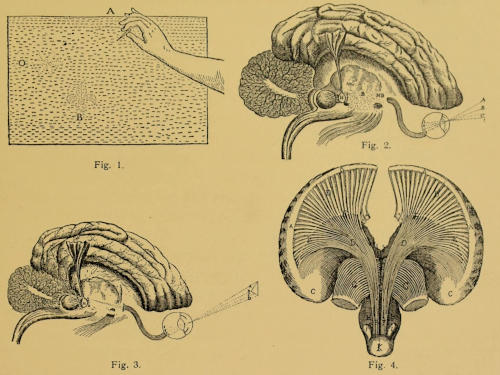
Fig. 1. Fig. 2. Fig. 3. Fig. 4.
Figures 1-3. Reproduced from Descartes: ›Tractatus de homine›.
Fig. 1. A part of the wall of the central ventricle of the brain. The points of the dotted
area represent the openings of the nerves, which, according to the opinion
of Descartes, take their origin in the wall of the ventricle. The figures O (star)
and B (lily) are formed by combinations of such nerve openings.
Fig. 2. View of the left hemisphere from the medial side. The dotted area B represents
the place, where, according to Descartes, the nerves originate. The vesicle
H is the pineal gland, wherein the soul was thought to have its seat.
Fig. 3. Illustrates the act of seeing. The object ABCD forms an image, 1357, on the
retina of the eye. This image provokes a similar image, 2468, on the wall of
the brain’s ventricle, by exciting a stream of ›spiritus animalis› from the central
ventricle through certain of the fine nerve tubules of the optic nerve, the
openings of the nerve tubules in the wall of the ventricle being widened and
thus forming images (of sight), which the soul is able to perceive from its seat
in the pineal gland.
Fig. 4. Reproduced from Vieussens: ›Neurographia universalis›, Tabula XVI. Illustrates
the passage of the coarse fibres of the middle region of the brain’s medullary
substance through the capsula interna, pons and the pyramids on the front
of the medulla oblongata downwards to the anterior part of the spinal cord.
To the anterior region he attributed the actual operation of the soul,
while he supposed that the posterior region was chiefly engaged in the
animation of the blood. He adds, however, ›it cannot be denied that
sensations reach even the posterior region of the brain, yet our mind
does not become conscious of them to the same degree as it does in the
anterior region› (›The Brain›, No. 71).
In this anterior region of the cerebrum he distinguished three lobes,
or so called ›curiae›, the first one highest up, ›in the crown›, a middle one
below it, and a third one lowest down, i. e., nearest to the fissure of
Sylvius.[73] In these three lobes the actual psychic life is developed, and
that so much the more clearly and perfectly, the higher up in the region
these intricate processes occur. It is here that perceptions, thoughts,
judgments, conclusions, come into being; it is from here that ultimately
will and determination issue. (See ›The Brain›, Nos. 12, 66, 71, 88,
98, 100, 102).
As regards the sensory part of the psychic activity, Swedenborg
does not make any attempt at a detailed localization; but as regards the
motor functions he arranges their centres within the above-mentioned
regions as follows: ›The muscles and actions which are in the ultimates
of the body or in the soles of the feet seem to depend more immediately
upon the highest parts (of the brain), upon the middle lobe the muscles
which belong to the abdomen and thorax, and upon the third lobe those
which belong to the face and head;› and he adds, ›for they seem to
correspond to one another in an inverse ratio› (›The Brain›, No. 68).
Whence did Swedenborg get all this? Whence the whole of this
doctrine of localizations? In his first great anatomical work, ›Œconomia
Regni Animalis›, nothing is said about it; first in his last anatomical work,
›De Cerebro›, is it advanced, and then — — — quite finished! One is
at first glance tempted to think that he had succeeded in finding some
new clinical experiences, upon which he could found this doctrine. For
he had not even finished the account of the function of the brain’s anterior
region, before interjecting: ›Therefore, if this portion (the anterior region)
of the cerebrum is wounded, then the internal senses—imagination,
memory, thought—suffer; the very will is weakened, and the power
of its determination blunted. This is not the case if the injury is in the
back part of the cerebrum› (›The Brain›, No. 88). But afterwards he
does not bring forward (in ›De Cerebro›) any observations which could
serve as proof with regard to this. And if one examines the cases he
has referred to in his preceding works, one cannot possibly arrive at
the localization of the psychic functions which he has here (in ›De Cerebro›)
sketched; for the evidence concerning the position of the injuries
in the cortex are entirely too scanty and incomplete. But if we consult
the original descriptions, we find there many other and more particular
data than those quoted by Swedenborg when he was only concerned in
explaining the function of the cortex as a whole. Wepfer, for instance,
reports in his ›Historiæ apoplecticorum› concerning the woman seventy
years of age, who suddenly lost the power of speech, that the cavity,
filled with blood, which was found in the cortex at the autopsy, was located
in the right hemisphere, just behind the forehead (›ad frontem fere
antrorsum›), and that it extended rather far both backwards and upwards;
even measurements were given (length 8, breadth 4, depth about 2 uncias).
It was also stated that the blood-vessels whose bursting caused bleeding
belonged to the antero-lateral branches of the carotid artery in the brain.
It is also mentioned that no changes were found in the left hemisphere
of the brain; and from the clinical account it appears that even after the
stroke the woman was able to move the extremities of the right side.[74] — — — All
this indicates quite evidently that the lesion of the cortex
was situated in the anterior region of the brain!
And Pacchioni reports concerning the youth, who was afflicted with
the right-sided facial paralysis, that even the extremities of the right
side were somewhat paralysed, and that the cyst, which at the post
mortem examination was found on the left hemisphere, extended from
the crown to the region of the temple (›a capitis vertice in temporalem
regionem›).[75] Thus this case also furnishes an unmistakable indication
that the cortical lesion was situated in the anterior region of the brain.
It seems strange that Swedenborg did not here supply an account of
these interesting and convincing cases, which he nevertheless, as we
have seen, was well acquainted with. For his habit is to furnish the
chapters of his works with an introduction in which he reports, often in
very detailed form, the statements of the authors upon which he bases
his conclusions. Since in the present case such an account is lacking, this
may depend: either upon the fact that this last anatomical work of Swedenborg,
›De Cerebro›, was not quite completed and finally edited
for the press, or thereon that Dr. Rudolf Tafel, who edited the
translation which is now accessible in print, excluded it. For Dr. Tafel
says in a note that the introduction to the chapter in question would be
introduced into Part II., chapters 1 and 2, but—Part II. was never printed!
Since, however, the Royal Swedish Academy of Sciences will publish
›De Cerebro› in its edition of Swedenborg’s Scientific works, this
question will no doubt be cleared up. But this much is quite clear from
what has already been adduced, that the cases of paralysis which Swedenborg
previously quoted in a brief form are in the original descriptions
reported so completely and in such detail that one can without the
least doubt localize the cortical lesions reported in those cases in the
anterior (superior) region of the cerebrum.
We now pass to an examination of the anatomical literature to
which Swedenborg had access. And, as we shall find, we can here see
whence Swedenborg derived material for his detailed doctrine concerning
the function of the brain’s anterior region. This becomes evident
on comparing Swedenborg’s mode of thinking of the brain’s psychical
activity with the descriptions of preceding authors in anatomy.
The group of nuclei, ›corpus striatum›, in the cerebrum had been
an object of special interest for preceding authors.
The Englishman, Thomas Willis, had for example in his ›Cerebri
anatome› (published in 1667) portrayed them as a kind of junction,
›internodes›, by which the cerebrum coheres with the medulla oblongata;
and he pays special attention to it on account of its peculiar structure
(›The Brain›, No. 476); and he is said even to have attributed to them
the ›Sens commun›.[76]
And the professor in Montpellier, Raimond Vieussens, had given
in his ›Neurographia universalis› (published in 1685) a very exact description
of the ›corpus striatum›, (not only of its ›superior nuclei›:
›Corp. striat. sup. ant.› = Nucleus caudatus and ›Corp. striat. sup.
post.› = ›Thalamus opticus›, but also of its lower lateral nucleus =
›Nucleus lentiformis›) as also of the mighty medullary tract of nerve fibres,
i. e., ›capsula interna›, which passes through the same, and which on
the one hand is distributed to the brain, especially to its anterior (superior)
region, and on the other hand by means of the nerves radiates into
the various parts of the body.
(In order to facilitate orientation we may refer to C. Toldt: ›Anatomischer
Atlas›, 1899, 8 Lieferung, Fig. 92: ›Querschnitt des verlängerten
Markes und der Gehirnstiele. Verlauf der Pyramidenbahn von der
Pyramidenkreuzung an durch die Pyramide, die Brücke und die Basis
des Grosshirnstiels in die innere Kapsel, woselbst sie in den Stiel des
Stabkranzes, Pedunculus coronæ radiatæ, eingeht.›)
Swedenborg, who had studied and often quoted both Willis and
Vieussens, likewise attributed a very great significance to the corpus
striatum. All the sensory impressions pass through it to the brain, and
all the voluntary impulses to motion pass out by the same path. (›The
Brain›, No. 67). ›It is›, says he in his figurative way, ›in a certain
sense, the Mercury of the Olympus; it announces to the soul what is
happening to the body, and it bears the mandates of the soul to the
body› (›The Brain›, No. 67).
And as the corpus striatum lay most immediately under the anterior
(superior) region of the brain, and was in close connection with it, so the
sensory impressions would for the most part pass to this region, and the
voluntary impulses to motion would likewise proceed from it (›The Brain›,
Nos. 66, 67).
The same Vieussens had furnished a very detailed description of the
passage of the nerve tracts in question, which pass through the corpus
striatum and capsula interna, and had followed them both upwards
towards the hemispheres of the brain and downwards towards the spinal
cord. When he followed them upwards, he found that they formed three
regions in the ›centrum ovale›: the regio superna, highest up nearest
the crown, the regio media, in the middle, and the regio infima, lowest
down, and consequently nearest the fissure of Sylvius. (R. Vieussens:
›Neurographia univ.›, pp. 115 and 117).
In these regions of the cerebral medulla, especially in the highest,
Vieussens considered that the soul’s activity had its seat: with the help
of ›spiritus animalis› the soul here had an opportunity of receiving the
sensory impressions, and in the fine and finest nerve fibres there were
here formed sensory images, conceptions, (Op. cit. p. 129), here the
memory images were preserved, (Op. cit. p. 135), and here the faculty of
judgment had its seat, (Op. cit. p. 137), etc.
In these regions, especially in the highest, the will also had its seat
and origin, and at its command the ›spiritus animalis› streamed out
through the nerves, thus conveying the impulses to motion to the various
muscles of the body. (Op. cit. pp. 122, 123, 188, et seqq.).
For Swedenborg, who had arrived at certainty with regard to the
seat of the soul’s activity in the cerebral cortex, and not in the cerebral
medulla!, and who through Malpighi and others had been led to see
that the fibres of the cerebral medulla were continuations of the processes
of the cortical elements,—for Swedenborg it naturally lay very near
at hand to follow the fibres of the three regions of Vieussens out to the
cortical substance on the surface of the brain; and so Swedenborg has
his three cortical lobes! And to them, especially to the highest, he could
now attribute the source of the soul’s life.
When Vieussens followed the nerve tracts of the corpora striata and
capsula interna downwards, he found:
that the fibres of the uppermost region led down to the posterior
region of the spinal cord; (›ad posticam spinalis medullæ regionem›);[77]
that the fibres of the middle region, which were especially coarse
and traversed the capsula interna and pons, forming thick tracts, could
be clearly followed down into the anterior portion of the spinal cord,
(›in anticam spinalis medullæ partem›), where they came into connection
with the anterior origins of the spinal nerves, (›ad antica nervorum
spinalium principia›), also paying, on their passing through the medulla
oblongata, ›necessary tribute›, (›necessarium vectigal›), as it is expressed,
to certain of its nerves;[78]——See the figure 4!——
that the fibres of the lowest region were distributed to certain nerves,
which proceed from the medulla oblongata, and to some of the anterior
origins of the spinal nerves (›quædam illius pars ad quosdam e Medulla
oblongata prodeuntes, altera vero ad antica nervorum spinalium principia›).[79]
In Swedenborg’s time it was, however, known that the muscles
which produce the movements of the head and face receive their nerves
just from the medulla oblongata and the uppermost part of the spinal
cord; and it therefore lay near at hand for Swedenborg, when he saw
that paralyses arose when certain cortical regions were destroyed, to draw
the conclusion, that the muscles and movements which belong to the
face and head, depend more immediately upon the lowest region of the
third lobe of the cerebral cortex.
And as it was also known that the muscles of the thorax and abdomen
receive their nerves from the superior portion of the spinal cord,
whither just the tracts of coarse fibres from the middle region of the
brain could be followed, (see figure 4), so Swedenborg could likewise
draw the conclusion from this that the muscles and movements which
belong to the thorax and abdomen depend more immediately upon the
middle region or lobe.
It might now appear tempting to continue the conclusion by connecting
the remaining highest lobe and the lower extremity. But probably
Swedenborg did not consider that he had sufficient ground for this. The
description by Vieussens did not here furnish any suitable guidance,
for it was possible that the coarse fibres of the middle region continued
so far down into the spinal cord that they could innervate not only the
muscles of the abdomen but also those of the lower extremity. For this
reason Swedenborg refrains from localizing exactly the centre of motion
of the lower extremity and contents himself with stating in general terms
only that this centre might lie above that of the abdomen. He therefore
says: ›the order seems to be so disposed that——the muscles and
actions, which are in the ultimates of the body, or in the soles of the feet,
depend more immediately upon the highest parts (of the brain)›, whereas
concerning the thorax and abdomen he says that they depend upon
the middle lobe, and of the head that it depends upon the third lobe.
(›The Brain›, No. 68). I believe that this is the reason why Swedenborg’s
doctrine of localizations as concerns the motor centre of the lower
extremity is expressed in such vague terms.
From a comparison of these descriptions by Swedenborg and
Vieussens we have found that there are such considerable similarities
between them that they in many respects agree point for point. And it
therefore seems to me rather probable that Swedenborg derived his
conception of the more detailed localization of the soul’s activity from
the descriptions of Vieussens.
But Swedenborg was not satisfied with knowing only that the
psychical functions arise within certain regions of the cortex of the large
anterior region of the cerebrum: but he continued his search for their
inmost origin, and thus he came to the conviction that the psychical processes
in reality result from the joint work which is performed by the
minute cortical elements, which Swedenborg called ›Sphaerulae› or
›Cerebellula›, that is, the same bodies which we now call the cortical
nerve-cells. These were the units of which the brain was in reality composed
and out of which its actual esse was derived. (See ›The Brain›,
No. 34). It was to these ›Cerebellula› that the sensory impressions went,
and in these they were perceived and brought to consciousness; it was
in these that conceptions, thoughts, judgments, conclusions, came into
being. (Œc. R. A. II., No. 191, and ›The Brain›, No. 98). And this was
possible because there were as many kinds of ›Cerebellula› as there
were kinds of sensory impressions, and that these ›Cerebellula› were connected
together into groups with different subdivisions. (Œc. R. A. II.,
No. 193; VII., chap. XX.). It was also from the ›Cerebellula› of the cortex
that the determinations and impulses to the various movements of the
body emanated. (›The Brain›, No. 99). And this was possible because
the ›Cerebellula› cohered each with its own nerve-fibril, which in their
turn innervated the muscle fibre, and that the ›Cerebellula› were arranged
into groups, these into greater groups, these into convolutions (gyri), etc.,
corresponding to muscle fibres, muscles, groups of muscles, etc. (Œc.
R. A. II., Nos. 146, 156, and ›The Brain›, No. 99). And it is in this
connection that Swedenborg refers to experiments on animals by which
it might be shown which gyre or part of convolution it is, which answers
to this or that muscle in the body.[80]
How Swedenborg was able to come to this modern conception
ought not to be so exceedingly difficult to understand if we summarize
what was already known at that time about these cortical elements and
add thereto the conclusions as to the functions of the cortex to which
Swedenborg had already come.
In Swedenborg’s time the conception of Hippocrates of the brain
as a gland was still generally received. In this one had, however, as
Malpighi says, ›since the time of Piccolomineus› learned to distinguish
between an outer, greyish layer, ›cerebral cortex›, and an inner, more
pure white mass, the ›cerebral medulla›.[81]
Through the microscopic investigations of Leeuwenhoek (1632-1723)
it had further been discovered that the substance of the brain (especially
of the cortex) contained, besides a great mass of blood-vessels and
very fine fibres, a numberless mass of peculiar small bodies of varying
size, by him called ›globuli›, connected with the vessels and fibres. (See
Œc. R. A. II., Nos. 71-75, 112, etc.).
Malpighi, (1628-1694), had closely examined these ›globuli› and
described them as small oval or polygonal ›glands›, which were closely
surrounded by blood-vessels, and in their inner central ends sent forth
processes forming vessel-like fibres which continued into the cerebral
medulla.[82]
As these fibres or vessels formed small clusters, the little glands
hanging on their extreme ends, like ›dates on their stems›, as Malpighi
expresses it, thus formed small groups.
Within these groups the cortical elements were, however, well isolated
from each other by clefts, which indeed sometimes were very small,
but could nevertheless be plainly demonstrated with the aid of colouring
matter.[83]
The cortical elements taken together formed the winding groups
which on the surface of the brain gave rise to the so called gyres.[84]
The profusion of blood-vessels, as was said, Leeuwenhoek and Malpighi
had already described as being very great, but Ruysch (1638-1731)
had afterwards by his famous vascular injections found it to be so
great that he would not call the cortex a glandular but actually a ›vascular›
tissue. (Œc. R. A., II., No. 86). Because of the enormous wealth
of blood-vessels there was thus carried to the cortical substance, especially
to the little follicles, a plenteous quantity of blood, and from this,
according to the opinion of that day, the most subtile components of
the blood could pass to the cortical elements and thereby be transformed
into ›spiritus animalis›. And finally, the Italians Bellini, (1643-1704),
and Zambeccari had shown by their analyses that the juice of the brain
possessed a highly subtile composition, above all a great volatility and
lightness, and was exceedingly mobile. (See Œc. R. A. II., Nos. 88, 96,
119). All this Swedenborg has himself quoted in his works.
On the basis of these and some other anatomical and physiological
data, in conjunction with a number of clinical and experimental observations,
Swedenborg, as we have before seen, came to the conclusion that
it is in the cortex that the soul’s activity comes into being; but at the
same time he concluded that, strictly speaking, the cortical elements
were the real work-shops. For he reasoned in the following manner:
When the sensory impressions enter the brain, they certainly proceed
no further than to the ›Sphaerulae› of the cortex, since these constitute
the beginnings of the nerve and medullary fibres: were they to go further,
for instance to the small arteries which surround the cortical elements,
or to the membranes of the brain, then they would overstep the boundary,
as he says, and leave the actual centre and go out to the more peripheral
parts.[85]
Swedenborg consequently here followed the same line of thought
as his predecessors. Descartes supposed that the nerves originated
from the wall of the central ventricle of the brain and therefore located
the images of sensory impressions, etc., there. Vieussens and others
thought that the nerves originate from the centrum ovale, and thus he
placed the psychic activity there. And Swedenborg now proceeded in
a similar manner when he attributed the psycho-sensory operations to
the ›Cerebellula›. And what other parts of the cortex were better fitted
to perform the demanding and ever-shifting psychical labour than the
›Cerebellula›, to which the life-giving powers of the blood were so plentifully
admitted, and in which, according to the testimony of many, the
highly subtile nervous fluid was created, whose office it was to communicate
the rapid and shifting utterances of the soul’s life!
Swedenborg’s predecessors had thought that the distinctions between
the sensory impressions depended partly upon what kind of nerve
was affected, and Vieussens had located the images of perception and memory
in the nerve-tubes in the centrum ovale, which had the finest caliber.
What, then, was more natural than that Swedenborg should now locate
these images in the ›Cerebellula› of the cortex? For what substance of
the cortex was better fitted, a more suitable medium to comprehend
and distinguish the innumerable shades of the impressions than these
myriads of ›Cerebellula›—of different sizes, forms and consistency, etc.,
which were connected each with its own special nerve-fibril and so well
distinguished from their neighbors! And at the same time they were
connected with the other ›Cerebellula› into groups of different kinds, by
which the psychical elaboration of the impressions was made possible.
On similar grounds Swedenborg supposed that the psycho-motor
labour was performed by the ›Cerebellula›, from which the nerves derived
their origin. And here we may recall that Vieussens had already connected
certain groups of nerves with certain bundles of medullary fibres,
and that Malpighi had shown how bundles of fibres of the cerebral
medulla corresponded to smaller and larger groups of cortical elements,
each one of which, hanging by its fibre, formed the different gyres of
the brain. If we consider this, then we can easily understand how Swedenborg,
with his view of the cortex, could divine the correspondence
between the components of the convolutions and the muscles.
It is interesting to here follow him in his line of thought and to
see how well he understood how to combine his anatomical and clinical
experiences: With the magnifying glass one can see how the nerve-fibres
spring forth from the cortical substance like a brook from its source;
if now the cortical substance be injured (as in the case of certain brain
diseases, and which one may clearly see upon autopsy), then the injury
is spread through the nerves connected with the cortex and at last all
the way down to the muscles, and that, he thought, explained the motor
disturbances.[86] And further ... when one or several of the ›Cerebellula›
of the cortex are destroyed, then the damage is spread more immediately
only to their proper nerves and muscles.[87]
In this manner did Swedenborg synthesize his anatomical, pathological-anatomical
and clinical experiences and extracted from them his
conclusions, and by them he arrived at essentially the same conception,
as our times, of the principles of the nervous system, its cellular structure.
He did not indeed employ the same nomenclature for the nerve-cells
and their long processes, as we do; but the matter itself: the nature
of the nerve-cells as elementary organs of the nervous system, the intimate
connection between the nerve and its cell-body, indeed even its dependence
upon it in regard to nourishment, etc., he was able to clearly
grasp in this way,—and this more than a century before our modern
theory of these relationships, the ›neurone-theory› saw the light.
I hereby conclude my presentation of the grounds upon which Swedenborg
appears to have founded his doctrine of the cerebral cortex as
the seat of the soul’s activity.
I. It has here been my endeavour to show, that his first general
statement that the centres of the psychical functions are to be found in
the cortex was a conclusion, which he derived from three premises, secured
in different ways:
The 1st premise was a conclusion drawn from the clinical observations,
post mortem discoveries and results obtained from experiments
on animals, which he had collected from literature;
The 2nd premise was a summing up of the comparatively recent
discoveries in microscopic cerebral anatomy, and
The 3rd was an hypothesis, concerning the continuous connection
between the cortical elements and the fibres of the cerebral medulla, by
which an easy communication was established between those elements
and the distributions of the nerves in the various parts of the body.
In his conclusions from these premises Swedenborg had some guidance
in preceding authors, who placed at least the sensory function in a certain
connection with the cortical substance.
II. His second statements, his essential doctrine of localization,
showed in many points a great agreement with that presented by
Vieussens, but also contained important differences, which partly rested
upon the conclusion to which Swedenborg had previously come, concerning
the importance of the cortex for the psychic life, partly depended
upon the new point of view concerning the correspondence of the cerebral
regions to those of the body, to which he had arrived in his work supported
by clinical results. The detailed doctrine of localizations seems
to have been constructed with the assistance of Vieussens’ detailed statements
concerning the connection of the nerves with the various regions
of the cerebral medulla.
III. His third statement, his—so to speak, ›Cerebellular theory›,
that the ›Cerebellula› were the units of which the brain was in reality
composed, and that the function of the cortex was essentially the summing
up of the activity of the ›Cerebellula›, and that the ›Cerebellula› were
connected with one another into various kinds of groups, corresponding
to the various kinds of perceptions and to the different movements of
the body, etc., this was grounded in part upon the discoveries of Malpighi
and others and their detailed descriptions of the structure and situation
of the cortical elements and their connection with each other, in
part upon Swedenborg’s clinical experiences and his own previously
drawn conclusions, which be further followed up.
The first two statements have in our time been embraced with the
liveliest interest and essentially corroborated. And as concerns the third,
the same applies in part; but how great the validity of this statement
is, it is for the future to decide.
Consequently Swedenborg arrived at almost the same result as
that to which our own day has attained, although in a partly different
manner. Our times have had the assistance of exact methods of investigation
and of a most highly developed technique. In Swedenborg’s time
the research method of microscopical anatomy and experimental physiology
were yet in their cradle; and the two branches of science, medicine
and pathology, which afterwards with the greatest interest have taken
part in the investigation of the function of the cortex, had then hardly
as yet turned their attention thither. As to how Swedenborg nevertheless
succeeded in winning such rich and beautiful results in this field, and
how well he employed the widely spread literature in question, I have
attempted to show in this my presentation by tracing his path through
the folios of the old authors and indicating the places where he gathered
the material for his doctrinal structure and the premises for his conclusions.
Finally, however, it should be emphasized that, when Swedenborg
collected his facts from the many separated fields of literature, he
found them not at all presented in the large works as important ›chief
subjects›, or even as lying plainly at hand. No, he was often, so to
say, obliged to dig out his material from a chaos of erroneous observations,
false interpretations and curious conceptions; and afterwards he
had to still further sift and elaborate it, before he could draw his conclusions
out of it.
In view of all this one must say that it was in truth a work of genius
to search out of such a chaos the guiding threads which were concealed
within it, and that, in spite of their imperfection in many points, nevertheless
to be able to find so much of the truth!