Nothing need be said concerning the importance
of the study of good health. The first
lesson that a child should learn is the law of
his being. Hitherto the aim has been mainly to train
the mind regardless of the requirements of the body.
The vital connection of the two has been ignored
with a persistency little short of criminality.
Anatomy, Physiology, and Hygiene have their
places in the curriculum of our leading schools, but
the knowledge too often is simply technical and without
practical results. What greater travesty than to
listen to a glib discourse on nutrition, digestion, circulation,
respiration, the muscles, nerves, bones or
brain by a pupil with thin chest, lack-lustre eye,
sallow complexion, and weak frame?
With no wish to slight the value of a thorough
knowledge of Physiology, this little volume seeks to
6give the fundamental laws of health, in such simple
language that every boy and girl advanced enough
to read, can understand them. Accompanied and
supplemented by the earnest words of the teacher,
who shall estimate the good that may be accomplished?
In the preparation of these pages, the author is
glad to acknowledge the valuable assistance received
from C. Shepherd, M.D., Superintendent for many
years of Public Schools, Trenton, N. J., and Washington
Hasbrouck, Ph.D., Principal of the New Jersey
State Normal School.
It is your bounden duty to instruct
your pupils in the laws of health. If
you fail to do so, you are not fit to be
their teacher.
The vices of cigarette smoking, of tobacco
chewing, of beer and alcoholic drinking,
threaten the very existence of the
rising generation. You cannot be too
earnest and persistent in impressing this
truth upon the boys who look up to you
for counsel.
You need not be reminded that the
most powerful teacher is your own example.
Boys respect and admire manly
10vigor. You ought to be able to outrun,
outjump, outthrow, outswim, outwrestle,
outspar, and outplay, at all
points, the largest and most active boy
in school. Many a teacher, when he
attempts to take part in an athletic
game, becomes the laughing-stock of the
youngest urchin, by reason of his flabby
awkwardness.
While our youth often need to be restrained
rather than encouraged to cultivate
their muscles, yet they should be
told to play when the opportunity is
theirs. You ought to take the lead in
their games. Your eye should be as
bright, your sight as true, your cheeks
as rosy, your step as elastic and your
physical prowess the equal at least of any
lad in school.
All the text-books in the land are less
effective than a few timely words from
you. Occasions are continually presenting
11themselves which should be utilized.
When a boy has been playing too violently,
or when he neglects play, when
he is careless as to his clothing or shows
evidence of falling into any bad habit, a
kind but pointed warning will accomplish
more than weeks of study.
There are other dangers to which boys
are peculiarly exposed, and which obviously
cannot be referred to in these pages,
concerning which it would be criminal
for you to remain silent, but in all such
cases, your warning must be uttered to
the offender in private, or by the father
to whom you may make the suggestion.
Of course you will see that the school-room
is properly warmed and ventilated;
that the pupils are kept out of all drafts;
and that the air is as pure as possible.
The faithful teacher will find almost
hourly opportunities for impressing these
12vital truths upon the children, and, only
by doing so to the fullest extent, can he
approach a proper fulfillment of his own
mission as the friend, counselor, and guide
of the coming generations.
TO THE FEMALE TEACHER.
13
What has been said to your co-laborer
about assuming the lead in observing the
laws of health, applies with equal force
to you. Your experience and knowledge
give you invaluable opportunities for instructing
the girls in what is truly the
great question of life and death.
Cleanliness, clothing, food, and all the
subjects treated of in the following pages,
should be supplemented by the practical
illustrations which the girls themselves
continually present. No observant teacher
can have failed to become acquainted with
the rudimentary laws of her being, and
14to none is given so golden an opportunity
to make that knowledge a living truth as
to her whose calling it is to instruct the
future mothers of our country.
CHAPTER I. WHY THE LAWS OF GOOD HEALTH SHOULD BE STUDIED.
15
Every boy and girl ought to live a
hundred years. When worn out at last
by old age, death will come like sweet
sleep, without pain, or suffering.
No one can live very long, unless he
obeys the laws of health. These laws are
so simple that all can learn them. Many
people remain ignorant of them until they
grow to be men and women, when they
find it too late to escape the penalty
16which nature visits on those who break
her laws.
One of the first things that boys and
girls should study is how to keep the
health which their kind Creator has given
them. Such knowledge will save them
days and nights of suffering and perhaps
bring them many years of enjoyment.
Children give little thought to the care
of their bodies, and often form habits
whose ill effects are not seen for a long
time. Let them, therefore, try to learn,
in early life, what is right and wrong in
this respect.
It is not a hard study. What is more
interesting than to learn about the most
17wonderful machine in the world? That
machine is yourself. There never can be
any invention to compare with it. God
alone can create it, and it is your duty
to do all you can to keep it running
until worn out.
Anatomy is the study of the structure
or make-up of our bodies. Physiology
tells of the offices or purposes of all the
parts of our bodies. Hygiene, or Good
Health, is the knowledge of the laws by
which all the organs and parts of our
bodies are kept in the best possible condition.
How long ought every boy and girl to live?
What is said of death from old age?
What is necessary to secure long life? Are these
laws simple? What mistake is made by many
people?
What should be one of the first things for boys
and girls to learn? What will such knowledge save
them?
What do children do? What, therefore, should
they try to learn?
Is it a hard study? What is the most wonderful
machine in the world? What is your duty?
What is Anatomy? Physiology? Hygiene, or
Good Health?
CHAPTER II. CLEANLINESS.—BATHING.
18
One of the first things to remember is
the need of keeping your bodies clean.
Of course you wash your hands and face
as soon as you rise in the morning, and
if necessary through the day, but that is
not enough.
The skin is composed of two layers,
the outer or scarf skin and the inner or
true skin. The outer is continually wearing
out and falls from the body in fine
scales. The skin is pierced by thousands
19upon thousands of pores, or tiny openings,
through which a large part of the
waste of the body passes. If these pores
are allowed to become clogged by want
of cleanliness, the waste matter enters
the blood and may cause disease and
death.
The way to keep the pores open is by
bathing or cleanliness. When the weather
is cold, you should bathe at least once a
week at home. The water should be
moderately cold. After bathing, rub yourself
from head to foot with a coarse towel
until the skin becomes warm and red.
Then dress quickly and do not go out-of-doors
for half an hour.
During summer it is well to bathe
every day. Salt water is better than
fresh. Boys are fond of bathing and are
20inclined to spend too much time in the
water.
Avoid stagnant or impure water. Running
streams, ponds into and from which
water continually flows, creeks, rivers,
lakes, and the ocean afford good bathing.
Do not bathe when the body is overheated
or you are perspiring freely, or
within two hours of breakfast, dinner or
supper. Stay in as long as it is pleasant,
but come out before you begin to feel
chilly.
In entering, it is best to plunge at
once under the surface. If you walk
slowly, as many timid people do, until
21the water gradually reaches your neck,
you leave the brain heated too long. It
ought to be cooled at the first.
After bathing, rub your body dry and
dress without delay. Do not lounge on
the shore in your bathing dress. If you
do, the body becomes chilled, and ill
results are likely to follow.
What is one of the first things to remember?
Of what is the skin composed? What is said of
the outer skin? What of the pores? What follows
if the pores are allowed to become clogged?
How can the pores be kept open? Describe how
one should bathe when the weather is cold?
How often is it well to bathe during summer?
Which, is the better, fresh or salt water? What are
boys apt to do?
What should be avoided? What affords good
bathing?
When should you avoid bathing? How long ought
you to remain in the water?
What is the best manner of entering the water?
Why?
What should be done after bathing? What should
you avoid? Why?
CHAPTER III. DRINKING. — TEA, COFFEE, MILK, AND CHOCOLATE. — WHEN AND HOW TO DRINK. — LEMONADE, ROOT BEER, SODA WATER, ETC.
22
Many diseases of the body are caused
by what we take into our stomachs. You
can see, therefore, how important it is
that we should know what and how to
eat and drink.
If I say that tea, coffee, and chocolate
are poisonous, and that they shorten life,
you will smile and shake your head.
Very likely some of you have kind grandmothers
23who have drunk tea all their
lives and still enjoy good health. Perhaps
your father is fond of his coffee
and feels no ill effects from its use.
No doubt it would be better for all
if only water was drunk, but it cannot
be said that a temperate use of tea, coffee
or chocolate and what are known as temperance
drinks, are injurious. Milk is a
drink of nature, and therefore excellent,
though it does not agree with every
person.
If you have formed the habit of drinking
while eating, stop it at once. At
first your mouth will be dry and your
thirst great, but persevere and in a short
time you will not feel the least desire to
24drink until you have finished your meal,
when a few swallows will be all you
wish.
Nearly every one drinks too much.
If you are thirsty, you fill a tumbler and
drink its contents and sometimes take
even more than that. Now if instead of
doing so, you sip the water slowly, your
thirst will be gone before half the water
is consumed.
An hour or two after a hearty meal,
you may feel a slight degree of thirst.
This is caused by the digestion going on
in the stomach. If you drink, you will
soon be thirsty again and will be forced
to drink often through the day; but, if
you refrain, at first, the thirst will soon
depart and will not return for hours.
25During warm weather, or when perspiring
from exercise, you need more
water than at other times. Even if very
cold, it will do no harm, if slowly sipped.
Many people learn to like warm water,
which is more healthful than cold.
Pure soda water, lemonade, root beer
and similar drinks are not hurtful, but
the sugar they contain increases our
thirst and leads us to drink more than
is good for us. Water is the provision
of nature, and though it has no color,
taste or smell, nothing in the world is
so delicious and refreshing.
Very hot and very cold drinks are
26hurtful, but much of the ill effects may
be averted by sipping them as I have
already advised. Few will believe until
they make the test, how little water is
needed through the day. The less we
take the more comfortable will we feel.
How are many diseases caused? What, therefore,
is important?
What have you to say about tea, coffee, and
chocolate?
What of a temperate use of those and of temperance
drinks? Of milk?
What have you to say of the habit of drinking
while eating?
What does nearly every one do? What is the best
way to drink water?
What should be done when slightly thirsty an
hour or two after a meal?
When do you need more water than at other
times? In what manner may very cold water be
drunk without harm? What of warm water?
What is said of soda water, lemonade, etc.? What
of water?
What of very hot and cold drinks? What will
be the effect if we drink only a small quantity
of water?
CHAPTER IV. EATING. — WHAT BOYS AND GIRLS SHOULD EAT. — WHEN AND HOW MUCH TO EAT. — CHEERFULNESS AND APPETITE IN EATING.
27
Always eat slowly and do not swallow
your food until it is chewed to a pulp.
The glands inside the mouth give out
enough saliva to moisten the food and
fit it for digestion in the stomach. Children
love to soak their bread in coffee,
or to sip the coffee while eating. By
doing so they stop the flow of saliva
and weaken a fluid which digests the
food in the stomach.
In the way of food, bread and butter,
well cooked meat, and fruits not too
28green nor over ripe, should form your
principal diet. Pies and cakes are injurious,
and if you eat
them, do so sparingly.
Never ask for a second
piece.
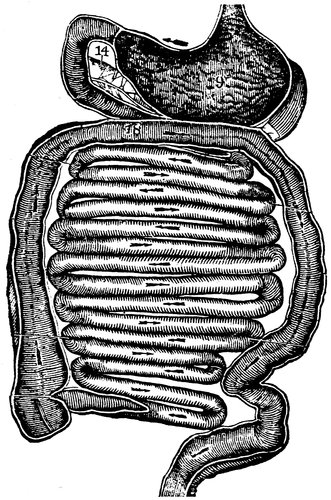
THE STOMACH AND INTESTINES.
Fat meat and butter
cause heat and often
make the blood gross.
Such diet is improper
during warm weather
and, therefore, we do
not crave it. If we
lived in the arctic regions, we would soon
learn to drink oil like water, and to eat
tallow candles as though they were pieces
of crisp celery.
29Highly seasoned food should not be
eaten. It may be salted to suit the taste,
but pepper is harmful.
Eat nothing between meals, which
should always be at regular hours. Partake
sparingly of sugar, candy, and sweetmeats.
In eating the meat of walnuts,
filberts, chestnuts, etc., use salt.
Children, like some grown persons, are
apt to eat more food than is good for
them. You have heard people say that
you ought to leave the table while still
hungry, but if that is true, there can be
no need of sitting down to eat. The true
course is to cease eating, while you still
have a relish for food.
30
The table is not
the place for argument
or dispute.
The conversation
should be cheerful,
and all should try
to be happy. Do
not begin any kind
of work, physical or
mental, until fully
a half hour after
the meal is finished.
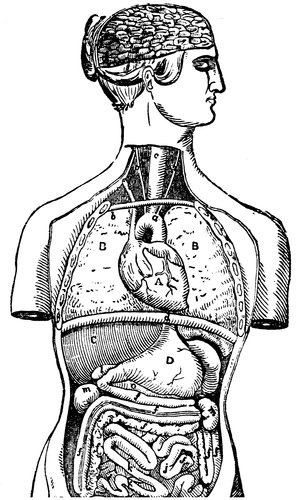
Showing the position of (A) Heart, (B) Lungs, (C) Liver, (D) Stomach, (f, j, etc.) Intestines.
Eat very little if
the mind is excited,
and do not eat at all, if you do not feel
31hungry. Never coax the appetite. Do
not eat heartily within a few hours of
bed-time.
If your appetite is poor, it is well to
omit the last meal of the day. One of
the best medicines in the world is a scant
diet of wholesome food. Overeating and
fasting are hurtful.
Remember that that which agrees with
one may disagree with another. Rice is
one of the most easily digested articles
of food, and yet some persons cannot
retain it on their stomachs. Your own
sense will soon tell you what best agrees
with you. Follow the advice of your
parents, who know what is good for their
children.
In what manner should we eat? Why? What bad
habit are children likely to form?
What should constitute our principal diet? What
is said of pies and cake?
What is said of fat meat, butter, and greasy food?
How would our tastes change, if we lived in the
arctic regions?
What is said of highly seasoned food? What is
said of salt and pepper?
Of eating between meals? Of sugar, candy, and
sweetmeats? How should nuts be eaten?
What are children apt to do? What is the true
course?
What of argument and dispute at the table? What
advice is given?
What should be done if the mind is excited, or
you do not feel hungry? Should the appetite be
coaxed?
Suppose your appetite is poor? What of overloading
and fasting?
Is the same kind of food good for everybody?
How can you learn what is best to eat? What advice
should be followed?
CHAPTER V. THE HAIR, EARS, EYES, AND FEET. — THE EAR. — THE EYE. — HOW TO USE THE EYES. — FEET.
32
The hair needs little attention. A boy
should not wear it long and it should
be carefully combed and brushed. Girls
who let theirs grow longer should have
it frequently clipped, as it gives it vigor.
Never put oil or grease on the hair,
for it catches and holds the dirt in the
air, soils clothing, clogs the pores at the
roots, and tends to produce baldness.
If you will brush your hair vigorously
for several minutes every morning, it will
33soon acquire a gloss and look better than
if smeared with pomatum. The odor will
be pleasant and the hair will not ruin
articles and clothing with which it comes
in contact. Now and then it is well to
clean the hair with Castile soap, warm
water and a strong brush. Shampooing
is excellent.
Hair is a non-conductor of heat,—that
is, very little heat or cold can be made
to pass through it. It serves as a protection
to the brain. While a great many
men are baldheaded, you very rarely see
a woman thus afflicted. This is because
they do not wear air-tight coverings for
their heads, but the scalp is kept cool
and healthy. It is a good thing for children
34to leave off their hats and caps,
except when necessary to protect them
out-of-doors.
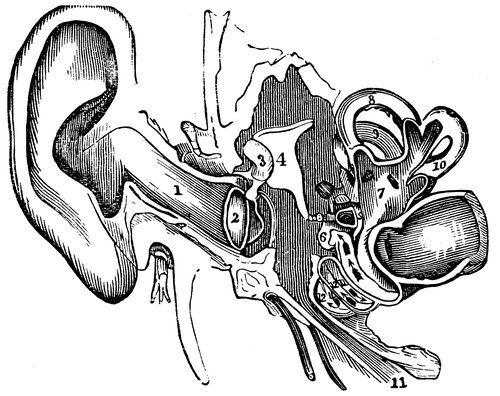
THE EAR.—Showing External Ear and Internal Ear. (1) Auditory Canal, (2) Drum of the Ear, (3, 4, 5, 6) Bones of the Ear, (7, 8, 9, 10) Semi-circular Canals, and Cochlea or Snail Shell, (11) Eustachian Tube, leading to Throat.
The ears need even less care than the
hair, for that which is called by the name,
is only the covering of the true ear.
Every boy and girl will make sure that
35when the face and hands are washed, the
neck and ears are not forgotten. The
shape of the outer ear causes it to catch
many of the particles always floating in
the air. These can be easily removed
with the end of the forefinger, covered
by a portion of a moist towel.
Do not pick the ears. The wax is
placed there by nature for a wise purpose.
It keeps out dirt and insects and
protects from injury the delicate organs
of the true ear within. If the wax becomes
too abundant or hard, it can be
easily removed with the forefinger. If
anything more is required, go to a doctor.
The eye is the most wonderful organ
of the body, and with simple care can
36be preserved all through life. Boys and
girls who have bright, strong eyes are
apt to weaken them by carelessness in
their use.
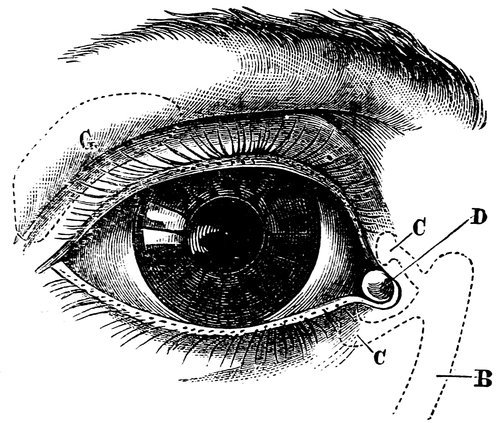
THE EYE.—Showing Iris, Pupil, (G) Tear Gland, (D) Tear Lake, (C) Tear Duct, leading to nose.
You should never
apply water, either
warm or cold,
to the eyeball.
When washing
your face, keep
your eyes closed,
but wash the corners
and outer surface.
The gummy substance which sometimes
collects is thus removed without
trouble. It is well sometimes to close
the eyes and rub them briskly, just as
we feel like doing on awaking from
sleep.
37
Never strain the eyes by trying to
read or examine anything closely when
the light is poor. When it becomes an
effort to see distinctly, cease the effort
at once. A strong glare of light is also
hurtful.
In reading or study, do not permit the
light to fall on the page from the front.
It should pass over the shoulder, the left
being preferable. It is well also to wear
a shade over the forehead, especially when
writing at night, and it is necessary that
the light should come from the front,
on account of the shadow made by the
hands.
When the eyes become weary and the
letters or figures begin to dance and
38flicker, cease work. If a cinder lodges
under the lids, do not attempt to remove
it by rubbing; that only adds to the
irritation. Close the eye and then carefully
draw the upper lid over the lower.
This will cause a flow of the fluid of the
eye which will probably wash away the
substance.
If this fails, a friend is not likely to
have any trouble in removing the object
with the corner of a silk handkerchief.
Should he find it impossible to relieve
you, go without delay to an oculist.
Sometimes the eyes of children have
been weakened by sickness, and it is
necessary to use spectacles. When a boy
or girl feels any peculiar sensation about
39the eyes, or they seem to act wrongly,
the oculist should be appealed to at once.
The feet must be kept clean and warm.
Some prefer cotton and some woolen
stockings. Use whichever are the most
comfortable. Never wear shoes that are
too tight. If you do you will suffer in
after years from corns and bunions. The
nails of the feet as well as of the hand
should be kept pared and clean, but their
surface should never be scraped.
What is said of the hair? What should be done
by a boy? By a girl?
What objection have you to oil and grease?
How can the hair be made glossy? How is that
superior to pomatum? How should the head be
cleaned?
Of what use is the hair? Why are so many men
baldheaded? Why is it rare that we meet a baldheaded
woman? When only should the head be
covered?
What is said of the ear? How should it be kept
clean?
What of the wax in the ear?
What can you say concerning the eye? What is
often done by boys and girls?
Tell how the eyes should be washed. What is it
well to do now and then?
What is said of straining the eyes? What of a
strong glare of light?
What rule should be followed in reading or study?
What of a shade?
When should you cease using the eyes? What
should be done if a cinder gets under the lid?
What should be done if that fails?
When must spectacles be used, or an oculist consulted?
How must the feet be kept? Which are the better,
cotton or woolen stockings? What of tight
shoes? What should be done with the nails?
CHAPTER VI. THE TEETH. — INJURIES TO THE TEETH. — TWO SETS OF TEETH.
40
Few boys and girls take proper care
of their teeth. All of us admire a set
of strong, sound, even, white teeth, and
those who do not have such, will tell
how sorry they are because in youth
they were so careless that their teeth
were ruined.
The teeth should be carefully cleaned
each morning before breakfast. This is
best done with a good brush, Castile
soap, and lukewarm water. Use none
41of the numerous tooth-powders sold, and
never pick your teeth with a metallic
substance. Quill, wooden, or ivory tooth-picks
only should be employed.
When the brush does not remove the
stains from the teeth, the soft end of a
small stick, covered with powdered charcoal
will answer, though it should not
be used often.
Very hot or cold food, or water, sweetmeats
and acids injure the teeth. Children
sometimes like to show the strength
of their teeth by cracking hickory-nuts
and other hard substances. This should
never be done, as the nuts and substances
may prove stronger than the teeth. The
42teeth are made of a soft kind of bone,
covered with enamel. The bone part of
the teeth soon decays if the enamel is
broken.
The first set of teeth, twenty in number,
gradually become loose after a child
is five or six years old, and the second
set, thirty-two in number, crowds after
them. The second are the teeth which
are meant to last all our life-time, and
they should be guarded, therefore, with
the utmost care.
Sometimes the second teeth crowd so
closely that the first become wedged in
place. The old tooth should be removed,
just as soon as the second can be discovered
43pushing after it. If this is not
done, the mouth will be filled with
crooked and unsightly teeth.
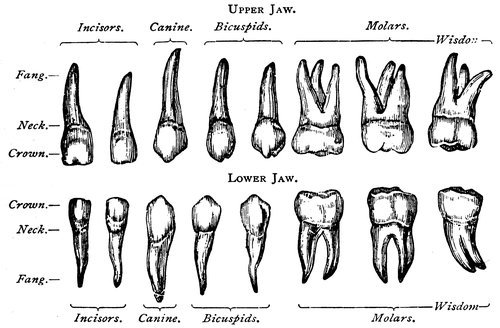
THE PRINCIPAL TEETH.
The mother or father of any boy or
girl will readily draw a loose tooth, by
means of a looped thread. Often, however,
a brave child will pull his own
44teeth, without help. Be on the watch
and clear the way for the second teeth.
If you don't you will be sorry all
your life.
Some children have poorer teeth than
others, and the utmost care will not save
them from decay. When the first speck
appears, go to the dentist. Dentistry has
made such improvements during the last
few years, that the poorest teeth can be
made to last a long time.
What is said of boys and girls?
When and how often should the teeth be cleaned?
What should be used for that purpose? What is said
of tooth-powders and tooth-picks?
How may stains be removed from the teeth?
What substances injure the teeth? What about
cracking nuts and other hard substances with the
teeth?
How many teeth has a child? A man? When
do the second teeth begin to appear? How long is it
intended they should last?
What sometimes takes place? What should be
done? What will follow if this advice is not heeded?
How are loose teeth generally pulled? Have you
ever known of a boy or girl pulling his or her own
teeth? What must you watch for and do? Is there
any need of such care?
What is said of some children? When should you
go to the dentist?
45
MUSCLES.
CHAPTER VII. EXERCISE. — TESTS OF SKILL.
47
Boys and girls are not likely to believe
they need any instruction as to exercise.
They are so fond of play that all they
ask is a chance and they will use it to
the utmost.
That form of exercise is best which
brings most muscles into action. It
should not be too violent nor continued
after one is tired. It should be in the
open air, and some kind of game is preferable
because it also engages and interests
the mind.
48
Base-ball, rowing, foot-ball, hare and
hounds, skating, lacrosse, lawn tennis and
similar tests of skill have become so popular
in this country that the young need
to be restrained from indulging too much
in them. After one's school-days are over
and a young man takes up some sedentary
occupation, he should manage to
gain exercise every day.
The gymnasiums afford the best forms
of exercise, but boys and girls can walk,
run, and use some of the simpler forms
of gymnastics at their homes. They
should make sure they breathe pure air,
that they do not form bad habits, and
are regular in everything daily required
of them.
What form of exercise is best? What should be
guarded against? Where should it be? What is
preferable?
What games are popular? What should every boy
do, after his school-days are over?
What of the gymnasiums? What can be done
by all boys and girls? Of what should they make
sure?
CHAPTER VIII. THE ART OF SWIMMING. — FLOATING.
49
Every boy and girl should learn to
swim. Instances are likely to arise, where
a knowledge of the art will not only enable
you to save your own life, but that
of some dear friend.
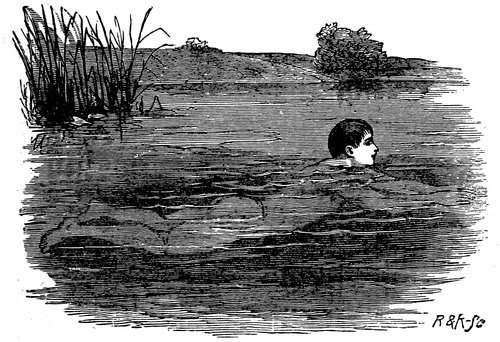
50When ready to take your first lesson
in swimming, plunge into the water until
the head and body are cooled. Then,
standing where the water reaches your
waist, lie down gently on your face, head
erect as if walking, with the mouth just
above the surface. Lift your feet from
the bottom and strike them out in imitation
of a frog. At the same instant or
a second later, throw your arms, palms
outward, from the front of your breast,
drawing them in and striking out as
before.
You will fail a good many times before
you learn to swim, but do not give up.
You will perhaps swallow some water,
and in spite of all you can do, your head
will drop more than once under the surface;
but, if you will keep trying, you
51will soon find yourself able to make two,
three or more strokes, before you sink.
A little practice will complete your mastery
of the art.
It is well to
use helps at the
beginning. A
friend may hold
up your chin, or
a light float may
be fastened behind
your shoulders. The body of a person
is very little heavier than water, and
a slight exertion, rightly directed, will
keep it afloat for hours.
The most important step, after learning
to swim, is to learn how to float.
52A skillful swimmer may find himself
overtaken by cramp while in deep water.
He can turn upon his back and float
until he recovers or help reaches him.
In case of shipwreck, or where a person
is forced to stay a long time in water,
he can rest by floating.
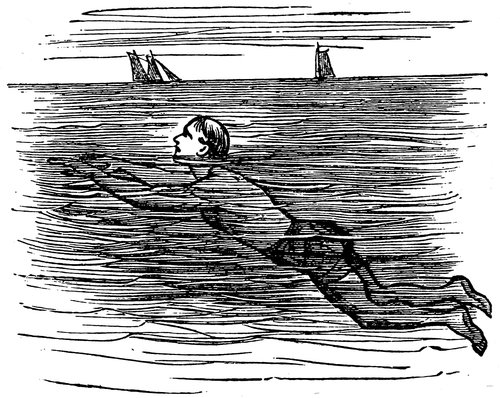
Taking your position in water, no
higher than your breast nor shallower
than your waist, you lie very gently on
your back, with your chest elevated, your
hands on your stomach and your feet
extended in a straight line, close to the
surface. If you wish to swim on your
back, you have only to draw up your
legs and strike out as when swimming
in the natural position. It is a poor
method, however, as you cannot see in
what direction you are going, and will
soon exhaust your strength.
53After learning to swim, there are many
fanciful movements which can be easily
learned. They have no special value, but
afford amusement to those who look on
or engage in them.
You cannot be too careful while learning
to swim. Boys are apt to be venturesome
and think their parents are too
timid on their account. You should make
it a rule never to go into water beyond
your depth until you can swim very well.
If this rule should be followed the number
of deaths from drowning would be
greatly lessened.
Why should every boy and girl learn to swim?
Give directions for the first lesson in swimming.
What is sure to follow?
What helps may be used at the beginning?
Show the advantage of knowing how to float in
the water.
Show how a person may float.
What is said of fanciful movements in the water?
What care should boys exercise?
CHAPTER IX. HOW TO TREAT DROWNED PERSONS.
54
Many persons are drowned every month,
and almost every day. Hundreds doubtless
could be saved by a knowledge of
the art of swimming, while others could
have been revived, had the proper means
been used.
When any one believes he is drowning,
he becomes frantic and his fierce struggles
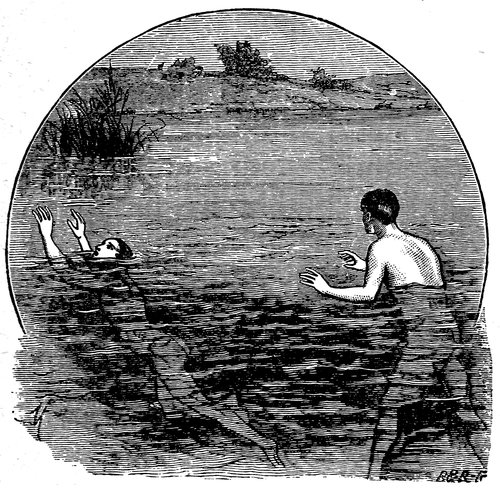
only hasten his death. If a friend swims
to his rescue, there is danger that he will
throw his arms around his rescuer and
cause both to drown.
55
GOING TO THE RESCUE.
If the person in danger will keep still,
when his friend seizes his hair or arm,
he can readily be taken ashore. If a
swimmer finds his sinking friend frantic,
it may be necessary to strike him a violent
blow between the eyes so as to stun
him for a minute or two.
56A drowning person generally rises twice
before sinking the last time. Those who
have been unconscious ten, fifteen, twenty
minutes and sometimes longer, have been
resuscitated or brought back to life. What
is done, therefore, must be done without
delay. Should you be present when a
drowned person is taken from the water,
you ought to know exactly what to do.
If any one can be spared to go for the
doctor, let him run with all speed. The
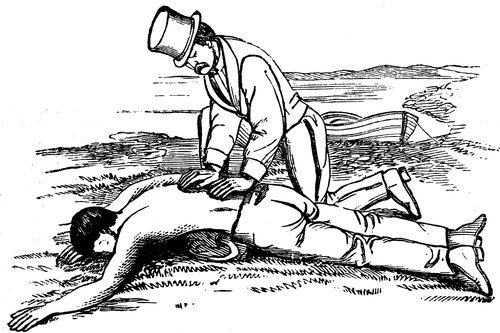
instant the body is brought to land, turn
it upon the face, with a hard roll of
clothing under the pit of the stomach.
This roll can be readily made from your
own clothing or that of others if present.
57Put one wrist of the patient under his
forehead so as to keep his mouth off the
ground.
Then, with your hands well spread
upon the patient's back, above the roll
of clothing, press down with the whole
weight of your body, pushing forward at
the same time. Repeat this two or three
times, with quickness and vigor. The
58object of the movement is to force the
water from the lungs, and it must occupy
very little time, for there is none to throw
away.
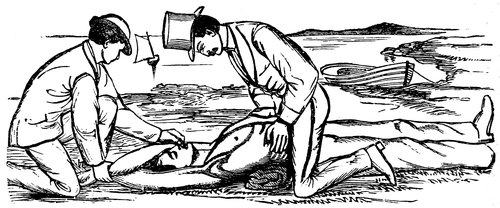
Having freed the lungs so far as possible
from water, turn the patient on his
back, face upward, with the hard roll of
clothing beneath his back. Bend the head
backward and downward, so that the throat
is stretched to the utmost. Place his
hands on top of his head, and, if there
59be any one standing near, let him tie the
wrists with a single twist of the handkerchief.
All the clothing must be instantly
stripped off to the waist. Kneel astride
the patient's hips; grasp the front part
of the chest on both sides of the pit of
the stomach, your thumbs pointing to
the patient's chin and your fingers fitting
into the grooves between the short
ribs.
Brace your elbows firmly, making them
rigid with your sides and hips, while your
knees serve as a pivot. Press the sides
of the patient firmly together, throwing
yourself slowly forward for a second or
two until your face almost touches his
and your whole weight presses upon his
60chest. End this pressure with a sudden
short push, which will send you back to
the kneeling posture.
Stop for two or three seconds, so as to
allow the ribs to spring back into position.
Then repeat this bellows-blowing
movement as before, gradually increasing
the rate from seven to ten times a minute.
Watch closely, and if you detect a
natural gasp, do not interrupt it, but as
the ribs sink, gently press them and
deepen the gasp into a long breath.
Continue to give this help, until the
natural breathing is fully resumed, but
do not cease your efforts for fully an
hour or longer.
Avoid impatient vertical pushes; the
force must be upward and inward. If a
61second person is present, he should pull
the end of the tongue of the patient out
of a corner of his mouth and hold it
there, using his handkerchief or piece
of cotton rag. This helps to give the air
free passage to and from the lungs.
What causes a great many deaths from drowning?
How does a person act when he believes he is
drowning? What is he likely to do if a friend swims
to his rescue?
What may be done if the drowning person keeps
still? What, if he becomes frantic?
How often does a drowning person generally rise?
How long after drowning has a person been resuscitated
or brought back to life?
What about the doctor? Now, describe very carefully
the first step to be taken the instant a drowned
person is brought to land. What should be done with
his wrist?
What next should be done? In what manner and
how often should this be done? What is the object
of the movement?
After freeing the lungs, so far as possible, from
water, what is the next step? What should be done
with his hands?
What of the patient's clothing? What next should
be done?
Having placed yourself astride the patient's hips,
describe what should be done next.
What are the next steps? What should be done
if a natural gasp is detected? How long should
you continue your efforts to restore the patient to
life?
What should be avoided? What should be done
by a spectator, if there be one?
Now tell me precisely what to do from the moment
a drowned person is taken out of the water
until he is resuscitated or it is proven he is beyond
help. (The teacher must insist on an answer, correct
in every particular, for it is evident that unless he
knows every step, the pupil's knowledge is useless.)
CHAPTER X ANOTHER METHOD OF TREATMENT IN CASES OF ASPHYXIA FROM DROWNING, CHLOROFORM, COAL-GAS, ETC.
62
The following method is recommended
by Marshall Hall, a very high authority
on all such questions:
“Treat the patient instantly on the
spot, in the open air, freely exposing the
face, neck, and chest to the breeze except
in very cold weather.
“In order to clear the throat, place the
patient gently on the face, with one wrist
under the forehead, that all fluid, and the
63tongue itself, may fall forward, and leave
the entrance into the windpipe free.
“To excite respiration, turn the patient
slightly on his side, and apply some irritating
or stimulating agent to the nostrils,
such as hartshorn.
“Make the face warm by brisk friction:
then dash cold water upon it.
“If not successful, lose no time; but,
to imitate respiration, place the patient
on his face, and turn the body gently,
but completely on the side, and a little
beyond; then again on the face, and so
on, alternately.
“Repeat these movements deliberately
and perseveringly, fifteen times only in
a minute. (When the patient lies on the
64thorax, this cavity is compressed by the
weight of the body, and expiration takes
place. When he is turned on the side,
this pressure is removed, and inspiration
occurs.)
“When the prone position is resumed,
make a uniform and efficient pressure
along the spine, removing the pressure
immediately, before rotation on the side.
(The pressure augments the expiration;
the rotation commences inspiration.) Continue
these measures.
“Rub the limbs upward, with firm
pressure and with energy. (The object
being the return of venous blood to the
heart.)
“Substitute for the patient's wet clothing,
65if possible, such other clothing as can
be instantly procured, each by-stander supplying
a coat or cloak, etc. Meantime, and
from time to time, to excite inspiration,
let the surface of the body be slapped
briskly with the hand.
“Rub the body briskly till it is dry
and warm, then dash cold water upon it,
and repeat the rubbing.
“Avoid the immediate removal of the
patient, as it involves a dangerous loss
of time; also, the use of bellows, or any
forcing instrument; also, the warm bath
and all rough treatment.”
Describe the first step recommended by Marshall
Hall in the case of asphyxia from drowning, chloroform,
coal-gas, etc.
How would you clear the throat?
How is respiration or breathing excited?
What should be done to the face?
If not successful in reviving the patient, what
should be done to excite respiration?
How often should this movement be repeated?
Explain how respiration is produced by this proceeding.
What is the next step? Explain its meaning.
What should be done with the limbs? What is
the object?
What of the patient's wet clothing? What should
be done from time to time?
What else is recommended to be done?
What should be avoided?
Now, give every step to be taken in resuscitating
persons by Hall's method.
CHAPTER XI. THE MUSCLES. — VOLUNTARY AND INVOLUNTARY MUSCLES. — STRENGTH OF MUSCLES. — HYGIENE OF THE MUSCLES. — EFFECTS OF EXERCISE.
66
You are provided by nature with about
four hundred muscles. Every one has its
special use. They are fastened to the
bones, which can only be moved by them.
The principal muscles are shown in the
figure on page 45.
The muscles are generally found in
pairs, so that when motion is produced
in one direction, another muscle or group
of muscles causes motion in the opposite
direction.
67
A voluntary muscle is one which you
can control; an involuntary muscle is
not subject to your will. Thus, when
you move your hand or foot, it is done
by a voluntary muscle. Your heart beats
without any will of your own, and is
therefore, controlled by involuntary muscles.
A well-developed man can drag a little
less than his own weight over a level
surface, while a draught-horse can draw
only two-thirds. The horse, therefore, is
relatively weaker than man. There are
some insects, however, which are able to
move nearly fifty times their own weight.
From what you have learned about the
68importance of exercise, you will understand
how necessary it is that every
muscle should be trained. In no other
way can you preserve sound, rugged
health.
When the muscles are properly used,
they become large, firm, and dark red in
color. Such use of them causes the skin
to act freely, while the brain is made
vigorous and the digestion improved. It
is the best medicine in the world. You
must be careful not to strain or overwork
your muscles, as it is very hurtful. Your
strength must be built up by moderate,
careful, and regular exercise.
The muscles need not only exercise to
make them strong, but a constant supply
69of good, pure blood. You must eat wholesome
food, in proper quantities, at regular
intervals.
You must take plenty of exercise in
the sunlight. The blood and the muscles
demand the light and the heat of the
sun to make them strong.
The effect of exercise upon the muscles
may be clearly seen in the arm of
the blacksmith; in the foot and leg of
the walker; in the fingers of the pianist;
and in the hand and fore-arm of the
skillful penman.
How many muscles have you? How are the bones
moved?
How are the muscles generally found? In what
manner do they work?
What is a voluntary muscle? An involuntary
one? Illustrate the difference.
Compare the strength of a well-developed man
with that of a horse. What is said of some insects?
Why should the muscles he trained? What is the
result?
What kind of medicine is such exercise? How
must your strength be built up?
What do the muscles need beside exercise?
Where should the exercise be taken?
Show some of the effects.
CHAPTER XII. REST AND POSTURE. — TIME FOR SLEEP. — POSITION IN STANDING, ETC. — WHERE TO BEND THE BODY.
70
“Early to bed and early to rise” should
be your motto. Children need abundant
sleep, and ought to retire early and rise
as soon as they awake in the morning.
Their bodies and brains require regular
rest.
Never lie on your back when sleeping,
but on the left or right side. Place your
limbs in the easiest position possible;
otherwise you will be troubled by bad
dreams, which will awake you from slumber.
Try to keep your mouth closed, so
71as to breathe through your nostrils. You
will thus escape the unpleasant habit of
snoring.
Infants and old people need more sleep
than boys and girls. Night is made for
rest, and the day for work. Do not take
naps through the day nor sit up late at
night. Never lie down to sleep directly
after a meal.
Children are apt to stand and sit in a
wrong position. When walking, the head
and shoulders should be thrown back, so
as to give the lungs full play. Breathe
slowly and deeply, filling every part of
72the lungs at each inspiration. When in
the school-room or at home, be careful
not to lean over by bending the body in
the middle of the back.
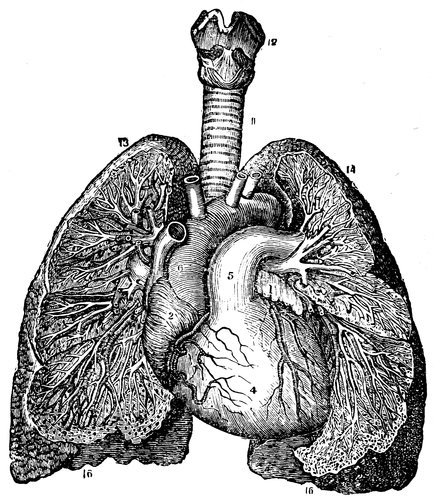
SHOWING POSITION OF LUNGS AND HEART.—(1) Left Auricle, (2) Right Auricle, (3) Left Ventricle, (4) Right Ventricle, (5) Pulmonary Artery, (6) Great Aorta, (12) Larynx, (13 to 16 and 14 to 16) Lungs.
73I am afraid that a good many children
will find, if they notice their posture
when studying their lessons, that their
spines are curved like a bow and their
shoulders pushed forward so as to crowd
the lungs and prevent deep, healthful
breathing. The boys, perhaps, will find a
large dent or wrinkle in their clothing in
front at the pit of the stomach. This
shows that their posture is wrong.
If you wish to bend forward, the pivot
is at the hips; the spine should not be
bent at all. When a child is reminded
that his posture is wrong, he is apt to
straighten up with a jerk, throw his
shoulders far back and thrust his chest
74forward like a pouter pigeon. This is
almost as bad as the other extreme, for
it is unnatural, and after a few minutes,
they gradually return to their former
stoop. The natural posture is easy and
graceful and can be held longer than
any other.
What should be your motto? What do children
need? What do their bodies and brains require?
What position should be taken when lying in
bed? What should be done with the limbs? What
of bad dreams? How can you avoid the habit of
snoring?
Who needs the most sleep? What is said of night
and day? What of taking naps through the day?
When should you avoid sleep?
What of standing and sitting? What ought your
posture to be when walking? What is the right way
to breathe? What must be guarded against when in
the school-room or at home?
What will a good many children find, if they
notice their posture when studying their lessons?
What will show a boy that his position is wrong?
What is the right way to bend forward? What
of the spine? What is a child apt to do when shown
that his position at the desk is wrong? What have
you to say of this?
CHAPTER XIII. PURE AIR, CLOTHING, ETC. — PROPER USE OF CLOTHING. — DAMP CLOTHING. — DANGERS TO HEALTH. — COLD OR DRAFT.
75
There can be no good health without
pure air. Always have it if possible.
Before you lie down to sleep at night,
make sure your windows are lowered at
the top and slightly raised at the bottom,
so that the room is well ventilated. If
the bed has enough covering, you will
sleep much better if the air is fresh
and cool.
76
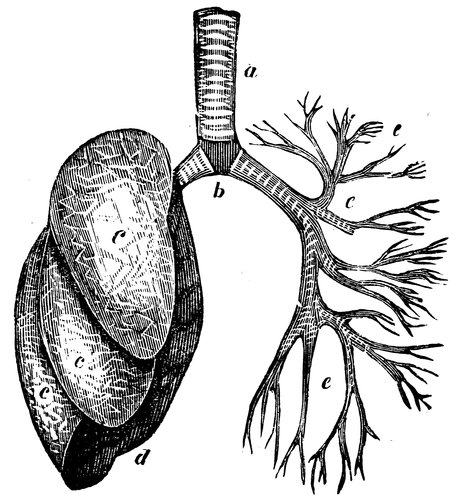
(a) Trachea, (b and e) Bronchial Tubes, (d) Right Lung, (c) Lobes of Lung.
It is a good practice to spend a few
minutes early in the morning, in drawing
into the lungs all the air they can possibly
hold. Then breathe out slowly, by
keeping the lips almost closed. While
doing so, rapidly thump the chest and
ribs with the flat sides of your fists.
This will expand your lungs and prevent
77the congestion or settling of blood among
many of the organs, besides strengthening
and toning up the system.
Your parents furnish you with warm,
comfortable clothing, but much depends
on you whether it shall help preserve
your health. Children often catch cold
and more serious diseases by carelessness
about their dress. Be careful that all
your garments sit well and are not loose
enough to annoy you, nor tight enough
to cause discomfort.
Boys should lay off their overcoats and
overshoes, girls their wraps and overshoes
when they enter a warm room. Always
put them on before going out in the
78cold or wet. Neglect in following this
rule has often caused pneumonia and
death.
If the clothing, shoes or stockings become
wet, they should be changed at the
earliest moment. If there is no chance
to make such change, keep in motion
until the garments can be replaced by
others. If the moisture has reached the
skin, it should be rubbed with a rough
towel until dry and warm.
Before summer sets in, children are
often tempted to sit or lie on the damp
79earth. This is hurtful and never should
be done, even in warm weather.
When heated from exercise, boys love
to throw aside their outer clothing, so as
to “cool off.” This is dangerous; better
to feel uncomfortable for a little while
until your body resumes its natural temperature.
Never sit in a cold room or a draft.
It is sure to injure you and may cause
death. If you feel chilly, warm yourself
by vigorous exercise.
Always obey the promptings of nature.
Failure to do so poisons the blood, causes
serious disease, and frequently destroys
life itself.
Show the necessity of pure air. What precaution
should be taken before lying down to sleep? What
of drafts? What are necessary to sleep well?
What is a good practice for each morning? What
will this do?
What depends upon you? What results from carelessness
in these respects? Of what ought you to be
careful?
What use should be made of overcoats, wraps, and
overshoes? What has resulted from neglect to follow
this rule?
What is the proper course, when the clothing,
shoes or stockings become wet?
What are children often tempted to do in the
spring of the year? Is it a safe thing to do at any
time?
What is said about “cooling off?”
What about sitting in a cold room or draft?
What other advice is given?
CHAPTER XIV. ACCIDENTS AND EMERGENCIES. — HABITS TO CULTIVATE. — BLISTERS. — BOILS, STINGS OF INSECTS, AND BURNS. — BLEEDING OF THE NOSE. — FIRE. — FAINTING. — FROST-BITTEN FEET AND EARS. — SLIGHT CUTS AND WOUNDS. — HOW TO TREAT A BLEEDING ARTERY. — CUT VEINS AND BROKEN LIMBS.
82
This little book is not intended to
take the place of the physician, but is
meant to help you to get along without
him. We are all liable to accidents, and
you should know what to do in such
cases, before the doctor reaches you.
Besides, you can often help yourself, and
will not need the doctor.
Cultivate regularity in all good habits.
The hour for going to bed, and for rising,
for eating your meals, for study, and for
play, indeed, the time for every duty relating
to your body, should, as nearly as
possible, be just the same, day after day.
83
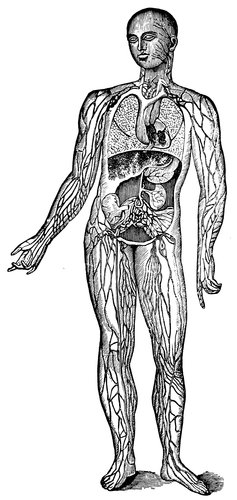
ORGANS OF CIRCULATION.
84
If a blister forms anywhere on the
body, do not prick it. If you do, a sore
will form. Leave it alone until it breaks
of itself. By that time (generally in two
or three days) a new skin will have
formed, and the blister will pass away
almost unnoticed.
The skin of a boiled egg is a good
remedy for boils. Peel it carefully, wet
and apply to the part affected. The stings
of insects may be covered with moistened
85earth. Slight burns will cause little pain,
if the air is shut out by means of paste
or anything of that nature.
For continued bleeding at the nose,
apply ice or cold water to the back of
the neck and push a plug of cotton, or
soft rag covered with powdered alum up
the nose. The “door-key” is good, because
it is cold; any other piece of cold
metal will do as well.
If your clothing should catch fire, keep
your senses about you. Do not start on
a run, unless the distance is very short
to open water, into which you can plunge.
An overcoat, blanket or piece of carpet,
86wrapped closely about the body, will
smother the flames.
If a person faints he should be laid
flat on his back, given fresh air, and
water sprinkled in his face. The clothing
about the neck should be thrown open,
and people prevented from crowding
around.
Sometimes when a boy uses his skates
too long, or he is exposed for a good
while to bitterly cold weather, his feet or
ears become frost-bitten. When this mishap
takes place, he is apt to do the very
thing he ought not to do.
He must not approach a fire, enter a
87warm room, nor use warm water or clothing.
When any part of the body is frozen,
snow should be constantly applied to it.
If no snow is at hand, the coldest water
that can be obtained must be used with
cloths, until the frozen member is gradually
thawed out.
All boys use jack-knives, and now and
then inflict cuts upon themselves. As a
rule, these do not amount to much, and
only require to be washed with cold
water and bound up with a clean rag;
but, if a vein or artery is severed, there
is great danger.
88
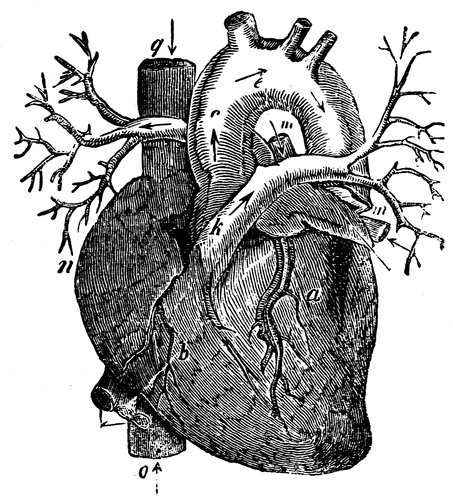
THE HEART.—(a) The Left Ventricle, (m) the Left Auricle, (b) the Right Ventricle, (n) the Right Auricle, (g, o) Veins to Heart, (k) the Pulmonary Artery, (c) the Great Aorta.
If an artery is cut, the blood will be
bright red, and will come out in jets,
corresponding with the throbbing of the
heart. As the arteries take the blood
from the heart, the proper thing to do is
to press the thumb strongly upon the
artery just above the wound. Then a
handkerchief should be knotted around
89the arm or leg, as the case may be,
above the hurt; a stick placed under the
bandage, and twisted about until the flow
of blood is stopped. This will answer
until the surgeon can be brought.
The veins carry the blood back to the
heart. If one is cut the blood is dark
and flows steadily. It is managed more
easily than an artery; all that need be
done is to place some lint over the wound
and bandage it firmly. This, of course,
you will do as soon as possible.
If you should be so unfortunate as to
break or dislocate a limb, assume an easy
position and calmly await the coming of
the surgeon. If a finger only is fractured
you can walk to his office.
What is said of this little book? To what are we
liable and what should we know?
What should be cultivated?
What is the rule concerning a blister which may
form on any part of the body?
What is a good thing for boils? For the stings
of insects? For slight burns?
What is the remedy for continued bleeding at
the nose?
What is the proper course if your clothing should
take fire?
What should be done with a person when he
faints?
What is a boy apt to do when his ears or feet are
frost-bitten?
Give the proper course to be followed.
What should be done with a slight cut?
How can you know that an artery has been cut?
What must be done?
What is the office of the veins? What need be
done if one of them is wounded?
Suppose your arm or leg is broken, what is the
proper course? If it is only a finger?
90
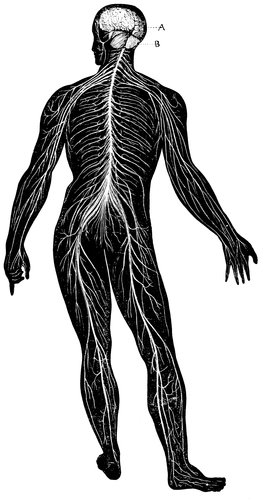
THE NERVOUS SYSTEM.
CHAPTER XV. THE NERVES, BRAIN, SPINAL CORD, ETC.
91
The muscles which move the bones are
themselves moved by the nerves. The
nerves are soft and pulpy in youth, but
harden as you advance in years. They
are composed of a gray substance, called
the nerve-cell, and a white substance,
known as the nerve-fibre.
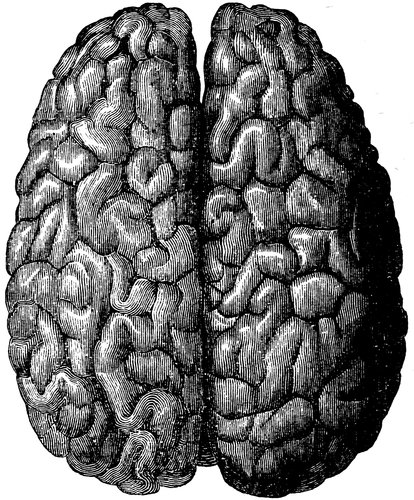
The brain is the mass of nervous tissue
within the skull. It is so tender and
easily harmed that nature has walled it
92about by a hard, bony structure to protect
it from injury.
The gray substance of the nerves is
where nervous
impulses begin,
which are conducted
along the
white substance.
The gray matter
may be compared
to a telegraph
office where the
message is started,
while the
white matter is
the wire along
which the message travels.
SURFACE OF THE CEREBRUM.
The spinal cord, or marrow, is a mass
of soft, nervous tissue, which fills the
93hollow running the length of the spine
or backbone.
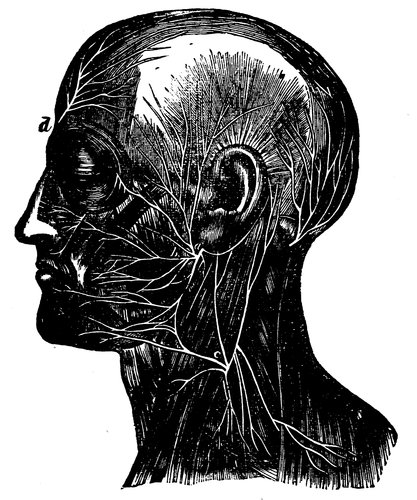
NERVES OF THE FACE AND NECK.—(a, b) Nerve of the Face; (d) Nerve of the Forehead.
From the base of the brain twelve pairs
of nerves are given off to the face and
head. One pair passes to the eye, and
gives sight; one passes to the nose, and
94gives smell; one, to the mouth, tongue,
and palate, and gives taste; one, to the
ears, and gives hearing; and others to the
face, neck, and head, and give the expressions
of joy, sorrow, pain, anger, and
doubt.
From the spinal cord thirty-one pairs
of nerves pass to the various parts and
organs of the body.
There could be no motion or feeling
without the nerves, although they are not
the true centres of either. If you obey
the rules of health, as already laid down,
you will be in the happy condition of
those of whom it is said they do not
feel that they have any nerves at all.
What move the muscles? How are the nerves in
early youth? Of what are they composed? What
are these parts called?
What is the brain? How is it protected?
Where do nervous impulses begin? To what may
the gray and white matter be compared?
What is the spinal cord?
How many pairs of nerves are given off from the
brain? From the spine? Where do they go?
What is said of sensation and feeling? What if
you obey the laws of health?
CHAPTER XVI. SUNSTROKE AND POISONS. — SYMPTOMS OF SUNSTROKE. — HOW TO TREAT SUNSTROKE. — CAUTION. — POISONS. — SULPHURIC ACID POISON. — A SAFE RULE.
95
Don't be afraid of the sun. Its rays
give life and vigor not only to men and
animals, but to the vegetable world. A
little tanning or browning of the skin is
good for you. In summer when the rays
are very strong, you should avoid them;
but at other times, live in the sunlight
all you can.
Very rarely indeed is a child sunstruck;
but it is wise to guard against
it, because it is often fatal. As I have
just told you, you must keep out of the
96direct rays of the sun when the day is
very hot. It is well to carry a wet handkerchief,
or several large green leaves in
the crown of your hat.
The symptoms of sunstroke are stinging
pains in the head, dizziness, weakness,
confusion of sight, and in some cases,
sickness at the stomach. The person
becomes partly or wholly insensible and
often moans or snores. Sometimes he
has spasms.
Should you ever see any one thus
affected, do your utmost to have him
taken at once to the coolest place that
97is near at hand, and where there is plenty
of fresh air. The clothing should be removed
and the body sponged with cold
water, if the surface is warm; if it is
cool, warm water should be used.
If the patient's body is very hot, his
pulse high, he snores or moans, and is
limp and senseless, he should be laid
upon his face, his head slightly raised
and cold water poured upon it for several
minutes, from a height of four or
five feet.
If the pulse is feeble and fast, the
breathing light, and the body cool, the
treatment just named would be highly
dangerous. The patient must be given
small doses of diluted brandy or whiskey,
98and a blister applied to the back of the
neck. Of course a physician will be sent
for at once.
It may happen that a child swallows
by mistake some kind of poison (when
he is alone), and when a few minutes'
delay in reaching a physician will be
fatal. The best and indeed the only
thing to do is to produce instant vomiting.
Stir a tablespoonful of salt or a
teaspoonful of mustard in a tumbler of
warm water and swallow without a moment's
delay.
At the end of five minutes, repeat the
dose, and continue doing so for half an
hour. If vomiting does not take place
immediately, bring it on by thrusting the
99forefinger down the throat, since vomiting
alone will save your life.
There is but one poison which cannot
be thrown off by the means just described.
If water is drank directly after swallowing
sulphuric acid, it will be fatal.
Vomiting must be induced by using the
finger.
The only safe rule for children, as well
as for grown persons, is never to swallow
or touch anything which they are not
certain can do them no harm. When
there is the least doubt, leave it alone.
What is said of sunlight? When should the rays
be avoided?
What should be carried in the crown of the hat
when the sunlight is very strong?
Describe the symptoms of sunstroke.
What is the first thing to do when a person suffers
sunstroke? Suppose the surface of the body is
warm? Suppose it is cool?
If the body is hot, pulse high, he snores, is
limp, etc.?
If the pulse is feeble and fast, breathing light,
body cool?
What course should be followed if poison is taken
by mistake? Suppose the dose described does not
cause vomiting?
What of sulphuric acid?
What is the only safe rule?
CHAPTER XVII. CIGARETTE SMOKING. — SMOKING CREATES A MORBID THIRST. — SMOKING DEGRADES THE TASTES. — BAD EFFECTS SHOWN IN TIME. — QUALITY OF CIGARETTE TOBACCO. — CIGARETTE PAPER. — HURTFUL TO THE YOUNG. — PRODUCES CATARRH. — CAUSES ASTHMA. — OTHER EVIL EFFECTS.
100
I have now a few words to say to the
boys. I hope the girls will also listen,
and help to impress the words on their
friends.
Most of you have fathers, mothers, and
perhaps brothers and sisters. You love
them more than all the world. What
would you think if I should tell you I
can make you hate your mother, strike
your father, lie, cheat, steal, do everything
vile, and at last send you, disgraced and
despised, to a wretched death?
You are shocked and cannot believe
it; but, if you will walk the path I mark
out, you will do just what I have said
101and reach the dreadful end—that is, if
you live long enough.
The first step is cigarette smoking.
It will give you catarrh, weaken the
lungs, cause heart disease, destroy the
health, and create a morbid thirst which
will lead you to the second step,—the
drinking of cider, beer, and malt liquors.
Soon you will crave stronger fluids, and
will swallow gin, wine, brandy, whiskey,
rum, and all sorts of seductive drinks
made from alcohol.
By this time, you will be far along
the road to ruin. You will begin to
102look upon your father and mother as
slow, and will love the company of the
wicked, and hate that of the good. Then
will follow misery, woe, and eternal
ruin.
You know plenty of boys who smoke
cigarettes, and you cannot see that they
suffer any harm on that account. But,
as in many other instances, the harm
comes after a time; and often when too
late to be cured. A great many boys die
every year from cigarette smoking, and
thousands upon thousands are stricken
by disease from that cause alone.
In 1883, about three quarters of a
billion of cigarettes were smoked in this
103country, of which more than one half
were made in the city of New York.
The tobacco used is the worst that can
be found anywhere. Saltpetre is mixed
with it to prevent moulding. Physicians
will tell you that saltpetre, when thus
taken into the system, is very hurtful.
The Havana cigarette is made of fair
tobacco, but is rolled in thick, vile paper
and soaked with creosote, which is very
hurtful. But those cigarettes which pretend
to be made of Cuban tobacco are
imitations that are as bad as they can be.
The oil of tobacco is highly poisonous;
but the oil of the paper used for cigarette
104wrappers is worse than that. It burns
white, because of the acids and chemicals
in it.
Smoking is specially harmful to the
young. It weakens the stomach, causes
indigestion, hastens the action of the
heart, thus producing palpitation.
Cigarette smoking is almost certain to
produce catarrh, one of the most offensive
and incurable diseases. This arises from
the fact that the cigarette being much
shorter than a cigar, the smoke is inhaled
to a greater extent. You have seen boys
swallow the smoke and puff it through
the nostrils, thus inviting catarrh.
105
Cigarette smoking tends also to cause
asthma.
It renders the system more liable to
attacks of pneumonia and bronchitis. It
destroys a healthy appetite for solid food,
and by the constant spitting it causes,
excites a craving for drink. Many instances
are known where the nerves of
the eye have been destroyed by cigarette
smoking. The following are the words
of Dr. S. H. Keep, one of the leading
physicians of Brooklyn:
“If one could select a fine, healthy boy
of from twelve to fifteen years of age,
well known for his fine physique, even
106disposition, and great strength, and start
him in his career as a cigarette smoker
under the observant eye of the public,
what results might not accrue from such
example as the panorama was unfolded
to them?
“The decay of physical power, emaciation,
the irritable temper, the sallow complexion,
the drawn and anxious look, the
unsteadiness of the hands, the dyspepsia,
the capricious appetite, the aversion to
parental and other advice, the tendency
to seek lower companionship, could hardly
fail to leave its impress upon such an
audience.
“More especially in the nervous diathesis[1]
does this rapid decay make itself
apparent, and in varying degrees according
to the amount of indulgence. Physicians
daily watch this process with pain
107and anxiety for those intrusted to their
care. Indeed, if my own professional experience
were to be my guide, I could
declare the evil of cigarette smoking to
be even greater than that of alcohol.”
1. Di ath´ e sis—A condition of the body which, predisposes it to
a particular disease.
So alarming has become this evil that
in some States, laws have been passed
against cigarette smoking. But I trust
that if any of you has felt like forming
the vile habit, your own good sense will
not allow you to do so.
What is the first step toward the ruin of the
body and soul? What is the second step? What
follows?
Where will you be by this time? What then will
follow?
How is it that some boys do not seem to suffer
from cigarette smoking? What takes place every
year?
How many cigarettes were smoked in this country
in 1883? Of what are they generally made?
What of saltpetre?
What is said of the genuine Havana cigarette?
Are there many genuine ones made?
What of the oil of tobacco? Of the oil of the
paper?
How does smoking affect the young?
What loathsome disease is almost certain to result
from cigarette smoking? Why?
What does cigarette smoking tend to produce?
What other effect has it on the system? What is its
effect on the appetite? How does it excite a craving
for drink?
What is said by Dr. Keep, of Brooklyn?
What has been done by some of the States? What
are your own views on the vice of cigarette smoking?
Are you weak-minded enough to be persuaded ever
to place a vile cigarette between your lips?
CHAPTER XVIII. ALCOHOL. — ITS DANGER. — EFFECT UPON THE ORGANS OF THE BODY. — COST OF ALCOHOL. — INTOXICATION. — A GRAVE ERROR. — TOTAL ABSTINENCE A SAFEGUARD. — EFFECT UPON THE MIND AND SOUL.
108
Alcohol does not exist in nature. It
is a fluid made by fermentation, or the
rotting of vegetables and their juices.
Beer, cider, and wine are produced by
the decay of a sweet liquid taken from
grain or fruits. Alcohol is that element
in malt and spirituous liquors which produces
intoxication.
Alcohol is indigestible and lessens the
muscular power. No person training for
any severe contest would dare swallow a
109drop of it. Its great danger lies in its
attractiveness. It makes one at first feel
in high spirits, reckless of right and
wrong, and it destroys his judgment and
sense. You all know that an intoxicated
person talks like an idiot.
Alcohol destroys the nerves, ruins the
stomach, weakens the muscles, affects the
heart, bloats the body, kills the liver,
causes insanity, and makes men descend
lower than the beast of the field. It
turns wise men into fools; peaceable persons
into brawlers; good citizens into
wicked and dangerous ones; and is the
direct cause of more than three fourths
of all the crimes in the country.
110
The total cost of alcoholic drinks each
year is eight times that spent for education.
The saloon-keepers outnumber
the ministers of the gospel four to one.
Sixty thousand people die annually from
alcohol.
Those who use alcohol are very liable
to disease. In Russia the cholera swept
off one year every drinking person in a
certain town before it affected a single
temperate one. In New Orleans, five
thousand drinking men died one season
from yellow fever before it touched a
sober one. In 1832, in Park Hospital,
111New York, out of 204 cases of cholera,
only six were men of temperate habits;
these all recovered, while 122 of the
others died.
Sir John Ross, the famous Arctic explorer,
never used alcohol or tobacco. On
one of his voyages, when a youth, every
one of the crew that was a drinker, died;
but he himself was not sick a single hour.
When exploring the frozen regions, he was
an old man, the oldest of his crew being
twenty years younger than he. His men
used tobacco and spirits, but he went
without either; and with his advanced
years, stood the rigors and hardships better
than any of them.
At a recent meeting of surgeons and
officers of the Pennsylvania Railroad Company
112to arrange for medical and surgical
supplies to be placed on trains and at
each station on the road, the question
of adding alcoholic stimulants to the
supplies was at once rejected; some of the
surgeons claiming that in case of shock
from injury, it was worthless.
Intoxication leads a person to do that
which he would not do when sober if
he dared. It therefore takes away the
self-restraint that is the safeguard of
society.
One of the greatest mistakes of the
young is the belief that a person can
drink a little beer, cider, wine or liquor
113now and then, without danger to himself.
No one ever began drinking with the
belief that he would die a drunkard; he
meant to drink when he felt like it with
his friends, but was sure he could stop
when he chose.
Even if a person were able to keep to
a moderate use of alcohol all his life, his
brain and nervous system would become
diseased. When epidemics visit any place,
the first persons to die, as I have shown,
are those accustomed to drink liquor.
Poisonous as is alcohol to the body,
it is more fatal to the mind and heart.
It clouds the brain, dwarfs and blots out
114the good impulses, and increases the
power of the passions and the baser side
of our nature.
The world is full of moral and mental
wrecks caused by alcohol. You see them
about you; the most wretched drunkard
on which you ever looked was once a
bright, hopeful boy like you. He could
not have been made to believe he would
ever fall so low.
Your only safety is to resolve never
to touch alcohol in any form. Not only
that, but it is your duty to do all you
can to keep others from injuring themselves
by its use.
Does alcohol exist in nature? What is alcohol?
How are beer, cider, and wine produced? What element
is alcohol?
What is said of alcohol? In what lies its great
danger? What are its effects at first?
Show some of the evil effects of alcohol. Of what
is it the direct cause?
Compare the cost of alcoholic drinks and the
sums spent for education. How do the number of
saloon-keepers compare with that of the ministers
of the gospel? How many people does it kill annually?
To what are drinkers of alcohol liable? Illustrate
this statement by what occurred in Russia. In New
Orleans. In New York.
Prove the advantages of leaving tobacco and spirits
alone by some facts respecting Sir John Ross.
What action was taken recently by the surgeons
and officers of the Pennsylvania Railroad Company?
What does intoxication lead a person to do? What
does it therefore take away?
What is one of the greatest mistakes of the young?
Suppose a person really could restrain himself to
a moderate use of alcohol?
How does alcohol affect the mind and heart?
What is said of the most wretched drunkard in
the land?
What is the only safety? What is the duty of
every one?
115
SKELETON.
CHAPTER XIX. BONES, SKELETON, ETC.
117
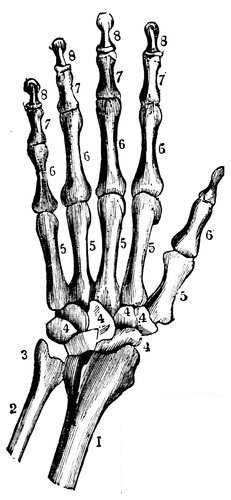
The bones are the frame-work of the
body. Like the muscles, they are generally
found in pairs, one for each side of
the body. Their number is more than two
hundred. When joined together, in their
proper position, they make a skeleton, as
shown in the picture on page 115, where
the names of the principal bones are
given.
118
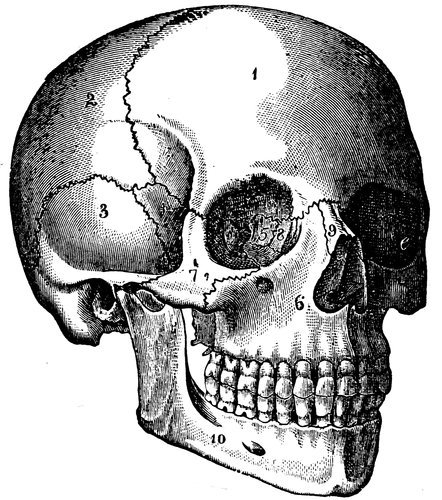
THE SKULL.—(1) Frontal Bone, (2) Parietal Bone, (3) Temporal Bone, (6) Superior Maxillary (Upper Jaw) Bone, (7) Malar Bone, (9) Nasal Bone, (10) Inferior Maxillary (Lower Jaw) Bone
A bone is composed of animal and
mineral substance. The animal part gives
it elasticity, and the mineral, hardness.
In youth there is more of the animal
substance, but it grows less as a person
becomes older. This explains why the
bones of a child do not break so readily
as those of an aged person, and why,
119when broken, they heal much sooner.
Sometimes when a very old man or
woman has a limb broken, the bone will
not “knit,” or heal at all.
THE CHEST.—(a) The Sternum or Breastbone, (b to c) the True Ribs, (d to f) the False Ribs, (g, h) the Floating Ribs, (i to k) the Dorsal Vertebræ.
THE HAND.—(1) Radius, (2) Ulna, (4-4) Bones of the Wrist, (5-5) Bones of the Hand, (6-6) Bones of the Fingers.
120The movable joints are joined by bands
or ligaments, which are very strong. They
often refuse to yield, when the bone to
which they are fastened is broken. If a
ligament is strained or hurt, a “sprain”
is caused, which may be as bad as a
broken bone.
Boys and girls are apt to form bad
habits by which some of the bones become
misshapen. You should hold your
head erect, but not thrust forward; keep
the chest expanded and the shoulders well
back. You will find, after awhile, that
this healthful posture is the most pleasant
you can take, and it will give you
the form which nature intends all of us
to have.
What are the bones? How are they generally
placed? How many bones have you? What is a
skeleton?
Of what is a bone composed? What does the
animal part give? The mineral? Why is the bone
of a child less liable to break than that of an older
person? What takes place sometimes when the bone
of an old person is broken?
How are the movable joints joined? What is
said of the strength of a ligament? What is a
“sprain”?
What are boys and girls apt to do? What is the
proper posture? What will you find?
CHAPTER XX. A CHEERFUL DISPOSITION.
121
Every boy and girl should cultivate a
cheerful disposition. You will have grief
and trouble, and must shed many a tear;
but cheerfulness does more than anything
else to lighten the burdens of life.
Have a kind word for every one. If
there is a deformed boy or girl in school,
never notice it by look or word. If a
boy has a drunken father or any disgrace
attaches to his family, always act
as though you never heard of it. If he
122is poor and in need, make him such
presents as you can afford. It will add
much to your own happiness if now and
then you give something which you think
you cannot afford.
If some little girl wears odd-looking
dresses, do not hurt her feelings by laughing
at her. Show her kindness and make
her feel at home when in your company.
Be respectful to old age. Elderly persons
are sometimes fretful and say provoking
things to children; but it is easy
for you to keep back all impudent replies
and to show that you feel no ill will
toward them.
You should not only be obedient to
your parents, but should feel pleasure in
obeying them. No matter how you are
123employed, or what your own wishes are,
show an eagerness to do whatever they
may request. When father and mother
leave you forever, you will be thankful
beyond expression, if you can say you
never caused them to shed a tear or feel
any sorrow.
Be respectful and obedient to your
teacher. Strive to obey all his rules in
spirit and letter. Be attentive to what
he says, and show by your conduct as
well as by your words that you are grateful
for his interest in and labors for you.
It is you who will feel the most pleasure
at all times, by striving to be cheerful. In
truth, you will not have to strive long,
for it will come natural to be cheerful.
Don't sulk and never repay evil for
evil. If some one has done you an injury,
124the best way to “get even” is by
an act of kindness; but be ready to protect
the helpless against those who would
oppress them. There are persons whose
coming is like so much beautiful sunshine;
there are others who are cross
and disagreeable and whom no one likes.
Strive, every day, to make some one happy,
and live by the Golden Rule, “Do unto
others as you would have others do to
you.”
What should every boy and girl cultivate? Why?
What about kind words? Suppose you have a
deformed class-mate, or one to whom some disgrace
attaches?
Suppose some little girl wears odd-looking clothes?
What of old age?
In what does true obedience to your parents consist?
What will be the result of such obedience?
How should you treat your teacher? Who is most
benefited by such a course of action?
What of sulking? What is the best manner of
“getting even” with some one who has done you a
wrong? What should you strive every day to do?
What is the Golden Rule of life?
CHAPTER XXI. THE DIGESTIBILITY OF SOLID FOODS.
125
The following table is given in order
to show the time required for the digestion
of the most ordinary articles of food:
Kind of Food.
Mode of Cooking.
Time required for Digestion.
Hours.
Minutes.
Pork
roasted
5
15
Cartilage
boiled
4
15
Ducks
roasted
4
00
Fowls
roasted
4
00
Fowls
boiled
4
00
Beef
fried
4
00
Eggs
fried
3
30
Eggs
hard boiled
3
30
Cheese
3
30
Oysters
stewed
3
30
Mutton
roasted
3
15
Mutton
boiled
3
00
Beef
roasted
3
00
126Beef
boiled
2
45
Chicken
fricasseed
2
45
Lamb
broiled
2
30
Pig (suckling)
roasted
2
30
Goose
roasted
2
30
Gelatin
boiled
2
30
Turkey
boiled
2
25
Eggs
roasted
2
15
Cod Fish (cured, dry)
boiled
2
00
Ox Liver
broiled
2
00
Venison Steak
broiled
1
30
Salmon Trout
boiled
1
30
Eggs (whipped)
raw
1
30
Tripe (soused)
boiled
1
00
Pig's Feet (soused)
boiled
1
00
Cabbage
boiled
4
00
Beetroot
boiled
3
45
Turnips
boiled
3
30
Potatoes
boiled
3
30
Wheaten Bread
baked
3
30
Carrot
boiled
3
15
Indian Corn Bread
baked
3
15
Indian Corn Cake
baked
3
00
Apple-dumpling
boiled
3
00
Potatoes
baked
2
33
Potatoes
roasted
2
30
127Parsnips
boiled
2
30
Sponge Cake
baked
2
30
Beans
boiled
2
30
Apples (sour)
raw
2
00
Barley
boiled
2
00
Tapioca
boiled
2
00
Sago
boiled
1
45
Apples (sweet)
raw
1
30
Rice
boiled
1
00
TRANSCRIBER'S NOTE
Moved parenthetical questions from the bottom of each page to the end of the chapter.
Silently corrected typographical errors.
Retained anachronistic and non-standard spellings as printed.
Transcriber's Note:
The cover image was created by the transcriber and is placed in the public domain.