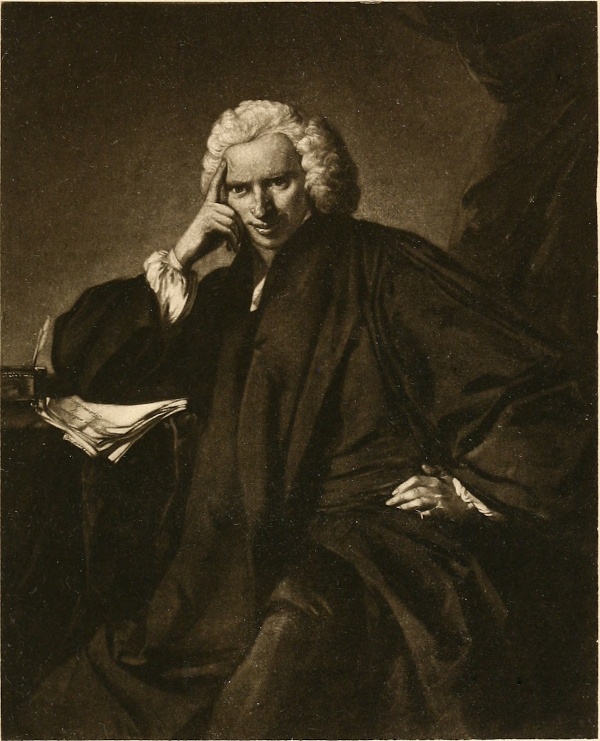
ELIZABETH MONTAGU
THE QUEEN OF THE BLUE-STOCKINGS
1752–1754 — CHIEFLY AT TUNBRIDGE WELLS, SANDLEFORD,
AND HAYES — BEGINNING OF FRIENDSHIP WITH PITT — CORRESPONDENCE
WITH GILBERT WEST.
1752
“PEREGRINE PICKLE”
[1]January 1, 1752, an interchange of letters and compliments
from the Wests and Mrs. Montagu take place.
Mrs. West sends a huge turkey and ham pie, half for
Mrs. Montagu, half for Temple West, Gilbert’s brother.
Mr. Pitt, Lady Cobham, and Berenger were expected.
In a letter to her sister, Sarah Scott, Mrs. Montagu
mentions—
“My Father is going to purchase a fine living for
Willy, indeed he will not enjoy it till after the death of
the present incumbent, but it brings in £470 a year, a
fine reversion for a younger brother, and what, joined
to another moderate living, will be a comfortable subsistence.”
This was the living of Burghfield in Berkshire,
purchased from the Shrewsbury family, for two lives, of
which in after years William Robinson became rector,
his son Matthew succeeding him. Further in this letter
it says—
“I recommend to your perusal ‘The Adventures of
Peregrine Pickle.’[2] Lady Vane’s[3] story is well told. Mr.
W. Robinson and the Doctor called on me this morning.
The Doctor talks of Bath for his health, but he is the
best-looking invalid I ever saw. An Irish Bishopric
will cure him entirely. Mrs. Delany is not in England.
Poor Mrs. Donnellan has lost her brother, Dr. Donnellan,[4]
and is in great affliction.”
Mr. W. Robinson, afterwards Sir William Robinson,
and Dr. Robinson, were her cousins, brothers of “Long”
Sir Thomas Robinson and Sir Septimus, and sons of
William Robinson of Rokeby. Dr. Richard Robinson[5]
was chaplain to the Duke of Dorset, then Lord Lieutenant
of Ireland, and had just been made Bishop of
Killala. They were immense men, with fine features
and rosy cheeks. Mr. Richard Cumberland[6] calls Dr.
Richard Robinson “a colossal man.” So attached was
Sir William to his brother Richard that Cumberland
says he imitated the Archbishop in everything, even to
the size of his shoes, diet, and physic!
On February 10, Mr. West applied to the Bishop of
London[7] for further preferment for Mr. Botham, and
writes to Mrs. Montagu—
“Wickham, February 10, 1752.
“Dear Cousin,
“Inclosed is my letter to the Bishop of London,
which I send open for your perusal; if you approve of
it, be pleased to seal it and convey it to his Lordship in
what manner you think proper. I most sincerely wish
it may have any good effect for my cousin Botham’s
sake, but we must not flatter ourselves too much. Great
men often think their smiles sufficient Favors, and you
know there is a Beauty in that of my Lord of London
that must enhance its value....
“Dear cousin,
“Your most affectionate and
“G. W.”
BISHOP OF LONDON’S LETTER
The letter was sent to the Bishop. Here is his reply
to Mr. West—
“London, ye 18th February, 1752.
“Sir,
“I had the honour of yours of the 10 inst., and
tho’ I am disabled from writing myself with the Gout in
my Hands, yet I will not omit to assure you that there
are very few whom I should be better pleased to oblige
than yourself, and the Lady at whose instance you write.
“I feel very sensibly the distress of Mr. Botham and
his wife, and judge as you do that it is a case that calls
for, and deserves assistance. But in considering where
my Patronages lye, I cannot find that I have any living
within distance of Albury, unless it be in the City of
London, where probably Mr. Botham would not choose
to live. When I have the Happiness to see you, you
shall be more fully acquainted how far I am able to
assist you.
“I am, Sir,
“Your very obedient, humble
Servᵗ,
(Signed by himself) “
Tho. London.
“Mrs. Sherlock desires to join me in respects to you
and Mrs. West.”
In March, Mr. Pitt obtained for Mr. Gilbert West the
clerkship of the Privy Council, a lucrative office.
On March 25, from Hayes to Wickham, Mrs. Montagu
writes—
“Dear Cousin,
“I thank you most heartily for immediately
giving me the sincerest joy I have felt for this long
time. May you long enjoy what you have so late
attained.... You cannot imagine the pleasure I propose
in hearing your friends congratulate you on
Fortune’s first courtesy. Base Jade! to be so tedious
and so sparing in her favours.”
With many congratulations to Mrs. West, etc., to
which Lydia Botham, then at Hayes, added a few lines,
Mrs. Montagu announces she will convey him and Mrs.
West to London the next morning in her post-chaise,
and they shall stay in Hill Street, where Mr. Montagu
was attending to his parliamentary business; and, she
adds, to fix an hour “so as to be with the President of
the Council at 12 o’clock.”
DR. WILLIAM CHESILDEN
From London, on April 17, Mr. Montagu writes an
account of the celebrated surgeon, Dr. William Chesilden’s
death—
“The papers, I suppose, have informed you of the
death of poor Chesilden. I had an account of the
manner of his death from one Mr. Vourse, an eminent
man in his own profession. He told me the poor man
was with Jerry Pierce and others, telling them how
soon after his being seized with the Palsy he had been
making a bargain with an undertaker to bury him, with
this he was entertaining them with his usual humour,
and in the midst of his story was seiz’d with an apoplectic
fit which finish’d him in half an hour.... I forgot to
add that Mr. Chesilden had eat a great deal of Bread
and drank a good quantity of ale; being asthmatic, this
was reckoned to be the cause of his death.”
THE SCOTT SEPARATION
It will be remembered that Mrs. Montagu was
always opposed to her sister Sarah’s marriage to
George Lewis Scott. Unfortunately, her fears as to
their felicity were prophetic, for in April, 1752, after
only a year’s matrimony, they separated; incompatibility
of temper was alleged, but from the letters there was
evidently much more below the surface. Mrs. Delany,
writing in April to her sister, Mrs. D’Ewes, says—
“What a foolish match Mrs. Scott has made for herself.
Mrs. Montagu wrote Mrs. Donnellan word that
she and the rest of her friends had rescued her out of
the hands of a very bad man: but for reasons of interest,
they should conceal his misbehaviour as much as possible,
but entreated Mrs. Donnellan would vindicate her
sister’s character whenever she heard it attacked, for
she was very innocent.”
Sarah was only twenty-nine. Her father and brothers
separated her from Mr. Scott, as is shown in his own
letters to Mr. Montagu, who had been his original
friend. He acknowledged “that Mrs. Montagu knew
nothing of the separation till it was communicated to
her;” in truth she was at Hayes at the time. Her letters
indicate the enmity and rancour of a great lady whose
name was kept behind the scenes. Mr. Scott wrote two
letters to Mr. Montagu, dated April 29 and May 1, but
both are so involved and mysterious as to shed no real
light on his misdemeanours.
Meanwhile, Mrs. Montagu received Mrs. Scott at
Hayes, and in a letter to her husband, whom she was
preparing to join in London, says Morris was urging
Mrs. Scott to go to Albury. She says—
“I could leave her at Hayes when I go to town, but
her spirits are so bad and she is so ill she cannot be
alone.... Indeed, poor creature, her situation is miserable,
allied to the faults and the infamy of a bad man,
subject to his aspersions, and liable to the censures of
his friends (for the worst have some), as in all disagreements
in wedlock, blame falls ever on the innocent
where there is no harmony. ‘How happy to behold in
wedded pair!’ each has the credit of the other’s virtues;
they have double honour, united interests and all that
can make people strong in society. This, my Dearest,
is my happier lot, inriched by your fortune, ennobled by
your virtues, graced by your character, and supported
by your interest.”
Mrs. Montagu accompanied Mrs. Scott to Albury.
She writes—
“We had a very pleasant journey here, and our
horses performed well. We found Lydia and Johnny in
health and happiness, surrounded by five of the finest
children I ever saw; the youngest boy is a little cherubim
and has the finest white hair imaginable.”
A SEDAN CHAIR — THE SCOTTS
Mrs. Donnellan, in May, writes from Delville, where
she still was, to Mrs. Montagu, to say that Lord Holderness
was to give up her house in Hanover Square about
August, and as it was too large for her fortune, and
the lease was near its end,[8] she wishes Mrs. Montagu to
look out for a house for her “not farther than Windsor
from London. Soon after our return, the Dean and
Mrs. Delany go to Down, and I fear his affairs will not
permit him to go to England this year.” She adds—
“I have writ to Mrs. Shuttleworth to bespeak me
a chair of Vaughan.[9] I would have it plain and light,
lined with white cloath and green curtains, as white and
green is my livery. If you should go to town, I should
be obliged to you if you would send to Vaughan about
it....
“I now come to the interesting part of your letter,
the unhappy affair of poor Mrs. Scott. I had heard
before I received yours that she and Mr. Scott were
parted, but could hardly believe it, a match so much of
mutual inclination seemed to promise mutual happiness,
and the shortness of the time of their union hardly
allowed them to find out they were not happy, so that
you are unwilling to hurt the gentleman in his character.
I must conclude he is very bad, since in so short a time he
could force Mrs. Scott and all her family to come to such an
éclat. I am extremely concerned for all the uneasiness
you have had on the occasion, but you have had the
consolation of showing yourself a most generous and
kind sister in supporting her in her misfortunes, and
especially as it was a match made against your better
judgment. I beg my compliments to Mrs. Scott, and
I heartily wish her health and spirits to support her
situation; ’tis said here she is returning to Bath to live
with Lady Montagu. On these occasions people love to
seem to know more than perhaps they do; all I say is
that you entirely justify Mrs. Scott, and I am sure you
must know the truth. I hear, too, he has given her back
half her fortune, and has settled a 150 pounds a year on
her; this, I think, is a justification to her.”
Mrs. Montagu had indeed a great deal of trouble at
this time, for besides sheltering and endeavouring to
cheer Mrs. Scott’s failing spirits, she had, to say nothing
of her own constant ill-health, the additional trouble of
her favourite brother Jack’s illness, now continuing
some months, of a nervous disorder, which he never
recovered from.
SOUTH LODGE — THE REV. WILLIAM ROBINSON
On May 26, from Sandleford, Mrs. Montagu writes to
Mr. West, who is at her house in Hill Street, attending
as clerk to the Privy Council—
“Dear Cousin,
“I was informed by Mrs. Isted[10] that you intended
to return to town in the middle of this week, so
I imagine that by this time you are in the Empire of
China.[11] The leafless trees and barren soil of my landscape
will very ill bear comparison with the shady oaks
and beautiful verdure of South Lodge, and the grinning
Mandarins still worse supply the place of a British
Statesman: but as you can improve every society and
place into which you enter, I expect such hints from you
as will set off the figures, and enliven the landscape with
rural beauty. I grieved at the rain from an apprehension
that it might interfere with your pleasure at South
Lodge. I hope it did not, but that you saw the place
with the leisure and attention it deserves; if you give
me an account of the parts of it which charmed you
most, or of the whole, you will lead my imagination to
a very fine place in very good company, and I shall
walk over it with great pleasure. I imagine you would
feel some poetic enthusiasm in the Temple of Pan, and
hope it produced a hymn or ode in which we shall see
him knit with the Graces and the Hours to dance, lead
on to the Eternal Spring, through groves of your unfading
bays.”
South Lodge, Enfield, was then the residence of Mr.
Pitt, the grounds of which he laid out with great taste,
and designed the Temple of Pan. Mrs. Montagu had
recently been on a visit to him here, as will be seen in
West’s answer. At the end of a long letter, which contains
directions as to the ornaments of her room, comments
on her bad health, in which she quotes Pope’s
saying, “ill-health is an early old age,” she winds up
with regretting that Sir George Lyttelton and Miss
West were going to Tunbridge so soon, for “I fear
they will leave the place the earlier, as they go at the
beginning of the season.” She finishes by commending
her brother William, who was to spend a day or two in
Hill Street, to West, saying—
“I wrote my advice to him to take this opportunity
to pay his respects to you, but possibly a little College
awkwardness, added to natural timidity, may prevent his
doing it. I assure you he is a very good young man,
more I will not say, for having for some years had a
mother’s care of him, I have also a mother’s partiality:
perhaps you may like him the better for his resemblance
to your son.”
From Albury she had brought Lydia’s second
daughter, Bessie—
“Not so handsome as her sister whom you have
seen, but she is fair and well shaped, very sensible and
of a sweet disposition, and though but ten years of age,
reads and writes well, and has made a great progress in
arithmetic.”
To this letter Gilbert West answers on May 30—
“Mr. Pitt, as you will easily imagine from your own
experience, received and entertained us with great politeness,
and something still more pleasing and solid, with
every mark of friendship and esteem. He had provided
for me a wheeling chair, by the help of which I was
enabled to visit every sequestered nook, dingle and
bosky bower from side to side in that little paradise
opened in the wild, and by the help of my imagination
doubled the pleasure I received from the various Beauties
of Art and Nature, by recalling and participating the
past pleasure of a certain person,[12] some of whose remarks
and sayings Mr. Pitt repeated with a secret pride,
and I heard with equal admiration and delight. The
weather indeed was not so favourable to us as we could
have wished.... Molly[13] indeed, who has an insatiable
ardour in viewing a fine place, and an almost implicit
faith in Mr. Pitt’s taste and judgment, stole out often by
herself, and in defiance of wind or rain walked many
times over the enchanting round.... Kitty[14] has seemed
to be inspired with an unusual flow of spirits, which not
only emboldened her to undertake, but enabled her also
to complete the tour, which I was forced to make in my
chair, attended by her, Molly, and Mr. Pitt.”
In the reply occurs the following passage:—
“I am very glad you and Mrs. West went over
every part of South Lodge, as you see with more
judgment you must see with more pleasure than I did,
and I think there can hardly be a finer entertainment
not only to the eyes but to the mind, than so sweet and
peaceful a scene. I was surprised to hear Mr. Pitt say
he had never spent an entire week there, this shows one
that a person who has an active mind and is qualified
for the busy scene of life, need not fear any excess in
the love of retirement.”
CAPTAIN ROBERT ROBINSON — “CHINESE POMP”
Captain Robinson returned from his Chinese expedition
in the Saint George the middle of June, and Mrs.
Montagu and Mrs. Scott met him from Sandleford at
her villa at Hayes. “He has brought me two beautiful
gowns and a fine Chinese lanthorn. We are to go on
board the St. George to-morrow,” she writes to her husband.
He also brought a gown apiece for Lady Sandwich
and her sister, Miss Fane. The greater part of
the Robinson family went to dine on the Saint George,
but on a stormy day, and Mrs. Montagu was very terrified
at the tossing of the small boat they went in. Soon
after this, in the beginning of July, Mrs. Montagu left
for her annual visit to Tunbridge Wells, where she had
taken the “White Stone House” on Mount Ephraim.
Sarah Scott returned to Sandleford to Mr. Montagu,
en route for Bath, where she was about to take up
residence with her friend, Lady Bab Montagu. At
Tunbridge were Sir George and Lady Lyttelton, Mr.
West, Miss Charlotte Fane, Mr. Garrick, Mr. Bower,
the Dean of Exeter, General Pulteney,[15] etc. At a big
ball Mrs. Montagu says—
“I shone forth in full Chinese pomp at the ball, my
gown was much liked, the pattern of the embroidery
admired extremely.... Garrick had an incomparable
letter from Beranger which he read with proper humour
one day he dined here.... I go every day to Mr.
King’s lectures.”
On July 22 Mrs. Montagu writes to her husband—
“Sir George and Lady Lyttelton[16] went away this
morning, as to the lady, she is so unsociable and retired,
her departure makes no difference in the Society, in all
her manners she signified a dislike and contempt of the
company, and in this, the world is always just, and pays
in kind to the full measure, and even with more than
legal interest at 4 per cent!”
“A COLD LOAF”
Mr. West from Tunbridge visited his cousins, the
Bothams, at Albury, and found Lydia in a terrible state
of health, and worried with the preparation of her five
children to be inoculated. He persuaded her to go to
Tunbridge to consult Dr. Shaw, and writes from Stoke
to Mrs. Montagu to suggest that Mrs. Botham should
stay with her at Sandleford whilst the children are
inoculated, and left in their father’s care. He mentions
Mr. Hooke being in a cottage near Stoke, very busy
writing. Lydia Botham, despite of all entreaties, returned
to Albury to remain with her children. Mrs. Montagu
contemplated a visit to Horton, alias Mount Morris, with
her husband, to stay with her brother Matthew, but
violent rheumatism attacked her in the shoulders. She
was reluctantly obliged to let Mr. Montagu visit “the
brethren,” as they termed them, alone. Meanwhile,
West, not being satisfied with the tutor with whom his
son was residing, hastened to Hill Street to remove him
to Oxford. Mrs. Medows[17] writes from Chute on
October 3 to say she had taken her nieces, the Miss
Pulses, to see Sandleford, where they ate “a cold loaf,”[18]
and “I was not a little exalted as a planter when I saw
chestnuts I had set nuts, five and forty feet high.” She
mentions that Mrs. Isted gave them a great many good
things, “and showed several pretty pieces of her painting,
and one of your curtains finished and a handkerchief
the little girl you are so good as to take care of is
making for you, that will look very like point.”
Mr. Montagu set out on October 2 to Horton,
and arrived at Canterbury, where he ascended the
Cathedral tower for the view, his first sight of that
place. His first letter crossed one of his wife’s, in
which she laments her inability to accompany him, and
says—
“I suppose you will see the place with great veneration,
where your consort’s virtues, charms and accomplishments
were ripened to their present perfection,
besides the pleasure of seeing my brothers, which would
have been great. I should have reviewed the place
where I spent the careless days of infancy and the
more gay ones of early youth with satisfaction. To the
Fair, the years from 15 to 20 are very agreeable.” She
continues, “When do my brethren come to town? I
hear my brother Robinson stays to cultivate the
maternal acres. As to the Paternal they will not come
yet. I think he will think of the Père Eternel when
he does not say the Lord’s Prayer. I design to go to
Mrs. Donnellan to-morrow, she is at North End, where
she designs to remain till her house is ready for her
reception.”
These letters are addressed thus:—
“To
“Edward Montagu
Esqr. &
Memʳ· of Parlᵗ·at Matthew Robinson Morris
Esqr.,
at Horton,
“Near Hythe,
“Kent.”
Morris Robinson, when not in town on business, lived
with his brother, and it was a home to all the brothers
as they required one, their gay old father, Mr. Robinson,
preferring lodgings in London, where he was the life and
soul of the fashionable coffee-houses.
A BACHELOR!
Mr. Montagu having complained of his horse not
liking stony roads, his wife writes—
“I am sorry your horse does not like hard roads,
for the ways about Horton are very stony; a dull horse
is like a dull friend, one is safe but not much delighted
in their company.” She adds, “I hope the sight of so
many merry bachelors does not revive in you the love
of a single state. Theirs is the joy of the wicked, not
the pure comforts of a holy state like matrimony....
Poor Mr. Brockman is the only man truly sensible of
the evils of celibacy, and he weeps and will not be comforted,
as all unmarried men should do, were they truly
sensible of their misfortune.”
This is playfully malicious, as Mr. Brockman had
been one of her earliest admirers.
MOUNT MORRIS
Her husband, on October 12, answers a long letter of
hers about the monuments in Canterbury Cathedral, and
says—
“Since I came here I have passed my time much
to my satisfaction, the entire freedom and liberty that
reigns here, the love and harmony that dwells amongst
the brethren, as it is very uncommon, so is the more
agreeable to me, as I cannot but take a part and be
affected with pleasure and pain in everything that relates
to you. If you had been here you would have much
added to our happiness, and I believe this not only to
be my sentiments but that of all the rest of the company.
I have never before now had an opportunity of sufficiently
observing this house, which is very large and
perfectly regular, though it is not placed just where
one could wish it, ’tis easy to see is capable of great
improvement by openings and cuttings in a good deal
of that fine prospect which is now shut out by the walls
and trees; and by grubbing up the bushes and hedges
and making a kind of Paddock on the South side of the
house. A bason of water like that at Newbold might
also be easily made.... Some of these things the
worthy owner is not without having some thoughts of
doing, as well as cutting some walks and vistas through
his wood.”
There is a picture of Mount Morris in Harris’
‘History of Kent,’ 1719, a large square house with a
cupola surmounted by a big ball and weathercock. In
front of the house and round it are the small walled
gardens, formally planted, the fashion of the period.
These were eventually pulled down by Matthew Robinson,
the hedges grubbed and all thrown into one large
park,[19] in which his numerous horses and cattle roamed
at large. Mr. Montagu seemed to have enjoyed some
fine partridge shooting whilst at Horton. He also frequented
“‘Old Father Ocean’ at Hythe, with whose
solemn majestic look I am always delighted.”
ARCHIBALD BOWER
Visits to the Scotts of Scotts Hall, the Brockmans of
Beachborough, etc., are spoken of. In a letter of the
same date, October 12, to her husband, Mrs. Montagu
first mentions Archibald Bower[20] and his wife.
To give the whole biography of Archibald Bower
would take too much space in this book. An account of
him can be found in the “National Biography,” vol. vi.
p. 48. He was a Scotsman, was sent to Douai, and
entered the Jesuit Society in 1706. In 1717 he studied
Divinity at Rome; became Reader of Philosophy and
Adviser to the College of Arezzo. Horrified at the
“hellish proceedings” of the Court of Inquisition, where
he witnessed the torture of two innocent gentlemen, he
fled to England, and while there made the acquaintance
of Dean Berkeley, the old admirer and friend of Mrs.
Donnellan, who was afterwards Bishop of Cloyne. He
entered, as tutor, the family of Mr. Thompson, Coley
Park, Berks, and afterwards that of Lord Aylmer. He
revised the “Universal History.” In 1748 he was made
keeper of the Queen’s Library, and in 1749 he married
a widow with one child, a niece of Bishop Nicholson.
His first volume of his “History of the Popes” was
published in 1748, the second in 1751, the third in 1753.
Though renouncing the Jesuit order, he seems to have
had business dealings with the Society, some of which
brought him into considerable obloquy, but they are
too lengthy to be detailed here.
Mrs. Montagu, returning to Hayes, says—
“Mr. Bower and his wife are to come to me on
Friday, and stay till Saturday or Monday, he is a very
merry entertaining companion. He left all gloominess
in that seat of horrors—the Inquisition. I breakfasted
with him on Tuesday, he is but between two or three
miles from Hayes. His wife is civil and silent, so I asked
her to come over with him. I never saw any country
more beautiful than about Chislehurst, where he lives.
I cannot say much in praise of his habitation, which he
terms his Paradise, but indeed to a mind so gay and
cheerful as his, all places are a Paradise. He is much
engaged with those old ladies, the Popes, but says he
will leave the Santi Padri for his Madonna. He will
teach me the pronunciation of Italian, which he has
reduced to a Method, so it may easily be acquired. He
taught it to Mr. Garrick at Tunbridge.”
“MADONNA”
Apparently Bower was introduced to Mrs. Montagu
by Gilbert West. He was an intimate friend of Sir
George Lyttelton. Both he and Sir George gave Mrs.
Montagu the sobriquet of “Madonna,” but as Bower’s
first letter of 1753 addresses her as “Madonna,” with
him probably the nickname originated. They corresponded
for some years in Italian.
In the next letter of October 14, she says—
“The Bowers came here yesterday. Mr. and Mrs.
West met them here at dinner, and to-morrow we are
all to dine at Wickham. This morning I shall carry
Mrs. Bower to see Cæsar’s Camp, the prospect from
which is now in high beauty.”
INOCULATION
The five Botham children had been inoculated!
Their mother had been persuaded in her bad health to
leave them in their father’s care. Lydia, writing to
Mrs. Montagu to thank her for a present of Madeira,
says—
“You will desire to hear something of my Babes.
My letter from their good Father to-day says they were
well when he wrote, but that my kind and humane
friends, Dr. Shaw and Winchester, who had both been
with them in the morning, said their eyes were so heavy
and their pulses so loaded that they would not hold up
long.”
A postscript to this letter gives the next day’s
account in Mr. Botham’s words—
“My dear Babes are all drooping round me, and
wonder not if I tell you I am glad they are so, since
from the gentlest symptoms of the distemper I have a
good foundation to hope they will do well. They are
sometimes up and sometimes down, and sicken so
gradually that Winchester doubts not that they will
have a favourable sort of the smallpox. I expect they
will be in their beds to-morrow.”
By November 16 the five children were well, and
Mrs. Montagu writes to Mr. West from Sandleford—
“Mrs. Botham returns to her little family to-morrow,
they are all quite recovered, and I hope this lucky event
will hasten the recovery of my Lydia. I should indeed
be glad to behold the happy smile that will illuminate
her countenance at her return to her babes. Mr.
Rogers[21] is recovering from another mortification....
I really believe he will live to the age of Methuselah,
for he recovers of those illnesses which destroy the
strongest.
“I find the Princess of Wales will have a drawing-room
as soon as the King returns, and I hope you will
consult with your friends, whether it will not be proper
you should appear there.... Mr. Linnell[22] brought me
his bill the morning I left town, and I think I will send a
copy of it as a proper warning to your Mrs. West, and
if you will still proceed in spite of my sad and woeful
example, I cannot help it. I shall repent my misdeeds
as the daughters of Israel did theirs in sackcloth and
ashes. Adieu Brocade, Embroidery, and lace, and even
the cheaper vanities of lutestring and blonde.”
Mr. West took Mrs. Montagu’s advice as to going
to Court and “kissing hands, a ceremony which upon
more deliberation I think it most advisable to go
through, however glad I should have been to avoid it.”
NEW BOOKS
In a letter to Miss Anstey from Mrs. Montagu, of
November 23, we gain a glimpse of the books being read
then—
“Mr. Hooke has published a second edition of his
‘Roman History,’ which is much admired. Mr.
Brown’s[23] essays on the ‘Characteristics of Lord
Shaftesbury’[24] are well spoken of; Lord Orrery[25] has
just published his Observations on the ‘Life and
Writings of Dr. Swift.’ ... The ‘Biographia Brittanica’
will entertain you with the Lives of many great
men, some of them are very well written. Mr. Warburton’s[26]
Edition of Mr. Pope’s Works contains some
new pieces, and some alterations of old ones. ‘The
Memoires du Duc de Sully’[27] are very entertaining....
The Duke of Cumberland has been dangerously ill,
is now something better. Lord Coventry[28] they say
is to marry Miss Gunning. Some actors have appeared
at the Theatre, and their characters are not of the first
rank. One of them imitates Mr. Garrick.” This must
have been Foote.
“HISTORY OF THE POPES”
Gilbert West was busied at this time planting his
garden at Wickham with firs and laurels, and Mrs.
Montagu teased him by letter about his “evergreen-nevergreen
garden,” as she called it. She says—
“Remember that while you avoid winter, you exclude
Spring, and forbid the glad return of the vernal season,
as well as the sad approach of autumn. In your garden
and in your life, may all that is necessary for shade, for
shelter and for comfort be permanent and unchanged.
May the pleasures and aromatics be various, successive,
sweet and new! ... I shall be much obliged to you if
when you see the incomparable Mr. Bower you will get
of him the second volume of the ‘History of the Popes.’
I have almost finished Mr. Hooke’s history. I do not
care to quit the city of Rome till I have seen the establishment
of its spiritual Monarchy.... I have just
received a collection of letters, wrote by Madame de
Maintenon, though Voltaire has diminished my opinion
of her in some degree; yet I have an impatience to open
the book.... I shall like to see what alteration there is
in her from the wife and widow of poor Scarron to
becoming the consort of Louis le Grand.”
On December 2 Lady Courtenay sent feathers and
shells to Mrs. Montagu for her work. She was the
daughter of Heneage, 2nd Lord Aylesford, and married
to Sir William Courtenay, afterwards 1st Viscount
Courtenay. She was a sister of Lady Andover’s, and a
great friend of Lydia Botham’s, and in this letter expresses
great concern at Lydia’s sad state of health.
On December 29 Mrs. Montagu writes to her sister
Sarah that she had sustained the great loss of her lady
housekeeper, Mrs. Isted, who had died very suddenly
whilst Mr. and Mrs. Montagu had been spending a few
days with Lydia Botham. The latter was then supposed
to be dying.
From the letters it appears Mrs. Isted was a widow
lady, who had lost an only child, and had been known to
Mrs. Montagu in her more prosperous years. Lydia
Botham rallied for a time.
GEORGE LEWIS SCOTT
A great dispute was going on at Leicester House
at this time on the subject of Prince George’s tutors.
Amongst the sub-preceptors, it will be remembered,
was Mr. George Lewis Scott, Sarah’s (née Robinson)
husband. Soon after this he was dismissed from the
list of tutors. One reason alleged was that he was a
Jacobite, but there was little ground for this supposition.
Though a clever man, he seems to have been
quite an unsuitable person to be tutor to the princes,
and Mrs. Montagu comforts Sarah by saying his true
character will now appear. “You will see shortly that
he and you will have justice done you, and with this
difference, that to you it will be a guardian angel, to
him an avenging minister. In the mean time ‘leave him
to Heaven, and the thorns that prick his bosom,’ as says
good Mr. Hamlet.”
On December 23 she had an assembly, and writes
to Mrs. Boscawen that “the Chinese Room was filled
by a succession of people from eleven in the morning
till eleven at night.”
The year ends with a letter to Gilbert West, who
had had a terrible attack of gout, sending him Birch’s[29]
“Life of Archbishop Tillotson,”[30] “which Mr. Birch left
for you himself.”
1753
1753 opens with a letter from Mrs. Donnellan on
January 2, to Mrs. Montagu, then at Sandleford. In this
she says—
“Two letters from Ireland informed me of a sort of
determination both of Dr. Delany’s affair and my own.
I had a very particular account of both from my Six
Clerk and Manager, Mr. Croker, who is Six Clerk to
Delany’s adversarys, and a short letter from Mrs. Delany.
My Lord Chancellor has acquitted Dr. Delany of a hard
word in the law, called spoliation, but has ordered an
account before two masters in Chancery to be taken of
all the late Mrs. Delany’s personal estate, and what she
was worth when she married the Dean.”
This law-suit, which lasted some years, and was a
great annoyance and expense to the Delanys, was caused
by his having inadvertently burnt a paper of importance
belonging to his first wife. Mrs. Donnellan’s brother
had claimed the lease of the house lately belonging to
their mother, in London, owing to a defect in the execution
of the will. Mrs. Donnellan got the books, and
some few hundred pounds, but, as she had been residuary
legatee in the will, suffered severe loss which she bore
with exemplary patience.
It is probable that at this period her brother-in-law,
Bishop Clayton, being wealthy and generous, gave up
his wife’s marriage portion to her sister, Anne Donnellan.
Anne now took a house in Bolton Row, London.
TURKEY PYE
On January 3 Mrs. Montagu writes to thank Mrs.
West for a portion of Turkey “pye,” and some verses
of her composing with it. She says—
“January 3.
“Dear Madam,
“For your pye and your verses what strains
are sublime enough to return proper thanks! You have
held the balance of justice so exactly and directed its
sword so well where to fall that Mrs. Temple West and
I are determined to divide the pye this evening according
to the rules prescribed. Though our pye has not
yet been toasted, your verses have been well relish’d
by some of the greatest connoisseurs. About an hour
after I had your letter Miss West came to call on me; I
communicated your poetic strains and we were very
merry over them. When Lord Temple and Sir George
Lyttelton came in we let them have a share, and they
joined in the laugh and commendation. Lord Temple
desired his best and kindest compliments to you and
my cousin. He is not at all the worse for his late
illness.... Sir George and he were going to dine with
Mr. Pitt, whose health, I believe, is in much the same
state as when you saw him.”
THE DUCHESS OF CHANDOS
Mrs. Medows wrote on January 6 from Chute,
Wilton, then her brother-in-law’s residence, to wish the
Montagus a happy new year, and in this letter she
says—
“The Duke of C(handos)[31] our neighbour kept his
Son’s[32] birthday with great magnificence. I was invited,
and not foreseeing such an occasion for dress, I had
neither manto nor sack, and desired leave to come in a
white apron in the evening, but the Duchess insisted on
my coming with it to dinner. You may imagine how well
I dined on two and forty dishes, and a dessert of one and
twenty, very well ordered and served; but the Duchess’s
behaviour was really an entertainment, not in the least
embarrassed, she did the honours perfectly well, and
seemed conscious she should make a good figure, and
pleased with the opportunity. In the evening there was
a ball, cards for the grave people. I am pleased to find
that I can still see the young people dance and with
pleasure; our nieces[33] Pulses were the best dancers. I
won four rubbers and past for a good player; content
with this, I came away before supper. I was charmed
with Mrs. Ironmonger[34] ... If you would have me think
you well get a Vandike Hankerchief. Mrs. Ironmonger
had one, and I am sure it will become you.”
The duchess here alluded to was the second wife of
the duke, Anne Jefferies, née Wells. In the “Complete
Peerage” we read, “See the story of her being sold
with a halter round her neck by her husband, Jefferies,
an ostler at the Pelican Inn, Newbury, and purchased
by the Duke of Chandos in ‘N & Q,’ 4th l. vi. p. 179.”
She was married in 1744 to the duke, and died in
1759 s.p.
THE POET GRAY
January 18, Miss Anstey, writing from Trumpington,
says—
“Have you heard that Mr. Gray[35] is going to publish
his whole stock of poetry, which, though it will consist
of only one volume, and contains but few things which
have not been already printed, the price will be half a
guinea; but what seems most extraordinary, it is expected
there will be a very great demand for them, and
I am told there is already a great number bespoke, for
they are to be embellished and illustrated in the most
curious and ingenious manner with copper plates drawn
and imagined by Mr. Bentley.[36] I hear they are all very
clever, and was told for a specimen that the little ode on
the cat is to have in the frontispiece the Fates cutting
her nine threads of her life, and the rats and mice exulting
upon the death of their enemy. At the end Puss is
represented as just landed from Charon’s Boat, and in
her approach towards Pluto’s Palace, she sets up her
back and spits at Cerberus. How do you like the conceit?
They are said to be very highly drawn, and Mr.
Gray gives his poetry. Mr. Horace Walpole[37] is at the
whole expense of the printing and copper plates for the
benefit of Mr. Bentley....
“I hear the scholar[38] of St. John’s who has admitted
himself of the play house performs much better in a
personated than he did here in his real character. I
suppose he does not regret his being expelled the
University, as he finds himself well received by the
Town, for excommunication would not hurt him there.
I hear he is really a good actor, which is a thing, I am
afraid, much more rare than a bad clergyman, so I am
glad he has taken to the stage instead of the Pulpit. I
hear there were fourscore of this University present at
his first performance, and that if he has a benefit the
whole body will be present at it.”
This edition of Gray was published in March, 1753,
printed at Mr. Horace Walpole’s private press at
Strawberry Hill.
BERENGER — BISHOP BERKELEY
Mr. West, attacked by his enemy the gout, was now
a prisoner at Wickham. On January 24, in a long letter,
these paragraphs are of interest—
“The joyous Berenger passed five days with us last
week, read to us a play in Shakespeare and the ‘Volpone’
of B. Johnson, and repeated innumerable scraps
out of a hundred others, laughed a great deal, said many
droll and some witty things, and then disappear’d, after
promising to come frequently to strut upon the little
stage of Wickham, which you may perceive has been
lately graced with almost as great a variety of characters
as are exhibited at Drury Lane, so that we have
little occasion to run to the great city in search of
company, much less for the sake of society, which indeed
there is almost lost, in the various bustle of Resort,
the busy hum of Men, the embarrassments of Hoops,—Interruptions
of Messages and ostentatious dinners and
Drums, Trumpets, Politics, etc., etc.,—but besides the
pleasures of social converse, we have had amusements of
a stiller kind furnished by the obliging civility of some of
my brother Authors; among which are two new papers,
‘The Adventurer’ and ‘The World,’[39] by Adam Fitz-Adam.
The writer of the former sent me the first 14
numbers with a very handsome letter. To the other I
had indeed a kind of right since I am inform’d that the
judicious Tasters of the Town have declared it to be
written by Sir G(eorge) L(yttelton), by Mr. Pitt, or
your humble servant; with how much sagacity this
opinion is form’d I shall leave you to judge, for I doubt
not but this character will recommend them to your
perusal, as it precludes me saying anything in their
favour: of the former I may be so free as to declare I
like them very well, but I will be still bolder in recommending
to you Dr. Leland’s ‘Observations of Lord
Bolingbroke’s letter,’ which was sent me by the author
yesterday, and which I have read through with great
pleasure and edification. I must transcribe a part of my
boy’s[40] letter about the death of the Bishop of Cloyne:
‘We have had a great loss at Oxford; the poor Bishop
of Cloyne died on Sunday about 8 o’clock in the
evening. Mrs. Berkeley[41] was sitting by him, and spoke
to him several times, and he never answered, so it is
supposed he was dead a quarter of an hour before it
was discovered, for he died without a groan or any sign
of pain.’
“He has received Rollin, for which I thank you in
his name.”
To this Mrs. Montagu rejoins—
“How happy was the Bishop of Cloyne’s exit, or
rather entrance, one should call it into another, than
departure out of this life, for it had none of the agonising
pangs of farewell. I pity poor Mrs. Berkeley, who had
so little preparation for so heavy a stroke. I hope the
constant conversation and example of a man so eminent
in every Christian virtue may have given her an uncommon
degree of fortitude and patience. I have heard
her temper and understanding highly commended. She
had a perfect adoration of the Bishop.... Dr. Berkeley
had formerly made his addresses to Mrs. Donnellan:
what were her reasons for refusing him I know not,
friends were consenting, circumstances equal, her opinion
captivated, but perhaps aversion to the cares of a
married life, and apprehensions from some particularities
in his temper hinder’d the match; however their friendship
always continued, and I have always heard her
give him for virtues and talents the preference to all
mankind.”
THE VAPOURS
Mrs. Montagu continues that she had neither health
nor spirits to read with pleasure. “The misfortunes I
have suffered and those I have feared have worn me out;
after the various turns of hope and fear on my poor
Lydia’s account, I am at last in despair about her. Mr.
Botham sent to us for a milch ass for her some days
ago.” After a long lamentation on Lydia’s behalf, she
ends, “I am that poor little selfish animal, a human
creature, made more poor, more little, more selfish
by the Vapours; in all Sir Hans’ Museum there is
not so ugly a monster as a woman in Vapours.” Lydia
becoming worse, Mrs. Montagu wrote to inform her
sister, Mrs. Laurence Sterne, whose curious letter I
give in full as a specimen of her style. Both she
and her sister Lydia wrote large, legible hands, much
alike.
MRS. LAURENCE STERNE
“Sutton,[42] March ye 9th.
“Dear Madam,
“I return you my sincere and hearty thanks for
the Favour of your most welcome letter; which had I received
in a more happy Hour, wou’d have made me almost
Frantick with Joy; for being thus cruelly separated
from all my Friends, the least mark of their kindness
towards me, or Remembrance of me gives me unspeakable
Delight. But the Dismal Account I receiv’d at the
same time of my poor Sister, has render’d my Heart
Incapable of Joy, nor can I ever know Comfort till I
hear of her Recovery.
“Believe me, Dear Madam, you were never more
mistaken than when you imagine that Time and Absence
remove you from my Remembrance. I do assure you I
do not so easily part with what affords me so great Delight,
on the Contrary I spare no pains to improve every
little accident that recalls you to my Remembrance, as
the only amends which can be made me for those Unhappinesses
my Situation deprives me of. As a proof
of this I must inform you that about three weeks ago I
took a long Ride Through very bad weather, and worse
Roads, merely for the satisfaction of enjoying a Conversation
with a Gentleman who though unknown to
you had conceiv’d the highest opinion of you from the
perusal of several of your Letters, for which he was indebted
to Mrs. Clayton. Had this Gentleman nothing
else to recommend him, it certainly would be Sufficient
to have made me desirous of his acquaintance; but he
is both a Man of Sense and good Breeding, so that I am
not a little pleas’d with my new Acquaintance. Your
Supposition of my Sister’s having Boasted to me of her
Children is doubtless extremely Natural, I wish it had
been as Just: But I can in three words inform you of
all I know about ’em,—to wit their number and their
Names, for which I am indebted to Johnny. Had my
Lydia been so obliging as to have made them the
Subject of her Letters, I shou’d by this time have had a
tolerable Idea of them, by considering what she said
with some abatement: but as it is I no more know
whether they are Black, Brown or Fair, Wise, or other
wise, Gentle, or Froward than the Man in the Moon.
Pray is this strange Silence on so Interesting a Subject
owing to her profound Wisdom or her abundant Politeness?
But be it to which it will, as soon as she recovers
her Health I shall insist on all the satisfaction she can
give on this head. In the meantime I rejoice to find
they have your approbation and am truly thankful that
Nature has done her part, which indeed is the most
Material, though I frankly own I shall not be the first
to Forgive any slights that Dame Fortune may be dispos’d
to shew them.
“Your god-Daughter, as in Duty bound, sends her
best Respects to you. I will hope that she may enjoy
what her poor Mother in vain Laments, the want of a
more intimate acquaintance with her Kindred.
“Be so good as to make Mr. Sterne’s and my compliments
to Mr. Montagu, and Believe me, Dear Madam,
“Your most affectionate Cousin,
and oblig’d Humble Servant,
“E. Sterne.”
LYDIA STERNE
The godchild was Lydia Sterne, born December 1,
1747, then in her sixth year. The Sternes had lost their
first child, also a Lydia, born in October, 1745.
Lydia Botham did not long survive; I do not know
the exact day of her death, but West, writing on
April 2, to Mrs. Montagu, says—
“I cannot conclude without thanking you, my dearest
Cousin, for informing me of your health, about which I
should have been under great alarms upon hearing of
Lydia’s Death, of which your letter brought me the first
intelligence. This kind attention to my happiness at a
time when your heart was overflowing with sorrow is
such a proof of your regard for me I shall always
remember with gratitude.”
Though deeply lamented, Lydia’s sufferings, latterly
from asthma, dropsy, and a complication of disorders,
made her death more or less a release. Mr. Botham
was now left a widower with five children.
LADY BATH’S ASSEMBLY
Writing from London, the end of April, to Sarah
Scott in John Street, Bath, where she and Lady Bab
were living, Mrs. Montagu says—
“I have been at Oratorios so crowded and plays so
hot I have almost fainted, but first of all crowds and
greatest of all mobs, I must in justice name Lady
Bath’s[43] assembly, from whence at hazard of life and limb
I broke away a little after one on Tuesday last. Her
ladyship had happily gathered together eight hundred
Christian souls, many of which had like to have perished
by famine and other accidents. I suffered the most
from the first of these; being ill, I had not eat a morsel
of dinner, and there was not a biscuit nor a bit of bread
to be got, and half the company got out through the
stables and garden. The house was not empty till near
3 in the morning.”
Mrs. Montagu had for some time been expecting
Miss Carter, the young daughter of Mr. Montagu’s
faithful agent, to stay with her. She says—
“My little disciple[44] is very good, and takes to me
wondrous well. I expect the eldest Miss Botham next
week, you may suppose it was some denial not to
choose the second, but I thought the other my duty
rather, and the eldest would have been much grieved
to be passed over.”
Writing to Mr. Montagu (who had gone to Sandleford
on business, and to cure a bad cold) on May 3, his
wife describes a Rout she had given. “I had rather
more than an hundred visitants last night, but the
apartment held them with ease, and the highest compliments
were paid to the house and elegance of the
apartments.”
“A PERFECT WOMAN”
Gilbert West from Wickham, on May 23, gives the
following account of Mr. Pitt, whose health had been
causing much anxiety to his friends—
“Had I answered your letter last night I should
have given you a good account of Mr. Pitt, who was
yesterday in better spirits than I have seen him in since
he came hither, but I find by inquiring after him this
morning that he has had a bad, that is, a sleepless night,
which has such effect on his spirits that I am afraid we
shall see him in a very different condition to-day. This
has happened to him every other night since Friday
last, so I am persuaded there is something intermitting
in his case, of which neither the Physicians nor himself
seem to be aware. I think he ought to go to town to
consult with them, but to this he has so great an aversion
that I question if he will comply with our request. Sir
George Lyttelton, who saw him on one of his bad days,
Saturday last, promised to come hither to-day, and his
voice added to ours may possibly prevail....
“Mr. Pitt express’d a due sense of your goodness
in inquiring so particularly after him, and that you may
know how high you stand in his opinion, I must inform
you that in a conversation with Molly he pronounced
you the most perfect woman he ever met with.”
MR. PITT’S INSOMNIA
Mr. Pitt was recommended by his doctors to go to
Tunbridge Wells to drink the waters. Accompanied
by Mr. West, Mrs. West, and Miss West, he set off
on May 26. West, writing to Mrs. Montagu, says—
“Tunbridge Wells, May 27, 1753.
“My dearest Cousin! My best and most valuable
Friend!
“Your kind letter which I received on coming
from Chapel is the most agreeable thing I have met
with at Tunbridge, where we arrived last night about 7,
after only stopping at Sen’nocks, and dining at Tunbridge
Town. It came very seasonably to relieve my
spirits which were much sunk by the extreme dejection
which appears to-day in Mr. Pitt, from a night passed
entirely without sleep, notwithstanding all the precautions
which were taken within doors to make it
still and quiet, and the accidental tranquillity arising
from the present emptiness and desolation of this place,
to which no other invalids, except ourselves are yet
arrived, or even expected to arrive as yet. He began to
drink the waters to-day, but as they are sometimes very
slow in their operations, I much fear both he and those
friends who cannot help sympathizing with him, will
suffer a great deal before the wished-for effect will take
place, for this Insomnium his Physicians have prescribed
Opiates, a medicine which, in this case, though they may
procure a temporary ease, yet often after recoil upon
the spirits. He seems inclined to take Musk, and intends
to talk with Molly about it. I think his Physicians have
been to blame in giving all their attention to the disorder
in his bowels, and not sufficiently regarding the Distemperature
of his spirits, a Disease much more to be
apprehended than the other; while he continues under
this Oppression, I am afraid it will be impossible for me
to leave him, as he fancies me of the greatest use to him
as a friend, and a comforter, but I hope in God he will
soon find some alteration for the better, of which I shall
be glad to give you the earliest information. In the
meantime I beg you will take care of your health, and
as the most effectual means of establishing it, I most
earnestly desire you will follow Mr. Montagu’s exhortations
to repair forthwith to Tunbridge, as by so doing
you will not only contribute to the regaining your own
health, but to the comfort and felicity of some here who
love you.... Kitty, Molly and Mr. Pitt desire their
affectionate compliments. Molly begs you will communicate
this account of Mr. Pitt to Sir G(eorge)
L(yttelton).”
RENT OF LODGINGS
In West’s next letter, of May 30, he says—
“I think Mr. Pitt is somewhat better, tho’ his spirits
are too low to allow him to think so, and his nights are
still sleepless without the aid of Opiates. I write this
from the ‘Stone House’ to which we were driven by
the noisy situation of our house at the foot of Mount
Sion. How many pleasing ideas our present habitation
recalls I leave you to judge, though there needs
no such artificial helps to make you ever present to my
memory.... Mr. Pitt is lodged in your room, and I
in that which was Mr. Montagu’s dressing-room on the
ground floor.”
The Montagus and Wests together had rented the
“Stone House” the year before this. On May 31 West
writes to say he is leaving Mr. William Lyttelton with
Mr. Pitt, and will return to Wickham on Saturday, and
dine with Mrs. Montagu at Hayes en route. He adds,
“Mr. Pitt feels a little gout in his foot, which we hope
will increase so as to be an effectual Remedy for all
his disorders.”
On June 6, West, who had been commissioned to
find a house for Mrs. Montagu, looks at the last two left
on Mount Ephraim, a Mr. Spooner’s and a Mr. Sele’s;
he decided on the latter, orders the chimney to be made
higher, and a hovel put on it to stop smoking, and to
order the owners to lie in the beds to air them!
“The price he told me was 4 guineas a week, or
thirty-five guineas for the whole season, that is till
Michaelmas, or a week or two over; for this price you
are to have stabling for eight horses, and a coach house
for two carriages.... Mrs. West will be obliged to you
if you will bring her jewels with you.”
Mrs. Montagu arrived at Tunbridge on June 11, and
on the 13th writes to her husband, then in London,
to say
“my cough is much abated, and my appetite increased:
the asses’ milk sits well on my stomach.... I have
a constant invitation to dinner at the ‘White House’;
Mr. Pitt is too ill to dine abroad, and the Wests
cannot leave him, so as often as I am disposed for
company, I dine there; the rest of my time passes in
taking air and exercise, and now and then the relief of
a book.”
CANVASSING
On account of the Jew Bill and other unpopular
measures coming before Parliament, a General Election
was anticipated, and Lord Sandwich was already arranging
for it by canvassing his constituents, and those
at Huntingdon, and summoned Mr. Montagu to meet him
at Hinchinbrooke the second week in August. Previous
to this he spent a few days with his wife at Tunbridge
hence proceeding to Yorkshire for his annual estate
business. Old Mr. Robinson accompanied his friend,
Sir Edward Dering, to canvass for him in Kent, and his
daughter says, “My Father would have made a good
counterpart to Sir Edward Dering; if bon mots could
carry a county, I know few that would care to contend
with them.”
Previous to going to Tunbridge, Mrs. Montagu
placed her two young charges, Miss Carter and Miss
Botham, in a boarding-school. She writes to her sister
Sarah—
“Mr. Montagu thought Miss Carter’s dancing would
be better improved if she went to School, and he is as
desirous she should be a fine dancer as if she was to be
a Maid of Honour. I was the more willing in regard to
Miss Botham going, for my cousin is of such a ‘diversian’
temper, as Cotes used to express it, that I feared she
would not be easily restrained in a place of this sort;
she is a fine girl, but so lively and so idle, she requires
infinite care. With great capacity of learning she has
prodigious desire to be idle, and thinks it quite hard
not to take her share of all the diversions she hears of.
On being asked how she liked London she said very
well, but should do so much better if she was to go to
Ranelagh every night! I have left them at a very good
school, but an expensive one; however, they are only
to stay there till the 15th of August, for then the school
breaks up, and if I do not leave this place sooner, they
must come. I believe no gouvernante ever took half
the pains I have done with these children, explaining to
them everything they read, and talking to them on all
points of behaviour.”
PENSHURST
On July 4, in a letter to Mr. Montagu, who was at
Theakstone, his wife writes—
“All the family at the ‘Stone House’ and myself in
their train went yesterday to Penshurst; we spent a
good deal of time in viewing the pictures. I was most
pleased with the portraits, as I know not any family
that for Arts and Arms, greatness of courage and
nobility of mind have excelled the Sydney Race. Beauty
too, has been remarkable in it.”
And on July 8—
“It has been much the turn of the Society I am in to
go out in parties to see places, and last post day we
settled upon an expedition of this sort with such precipitation,
I had not opportunity to write without keeping
the company waiting. We went to see an old seat
of a Mr. Brown’s; it is well situated, was built by Inigo
Jones, has some fine portraits.... We went from this
venerable seat to a place called New Vauxhall, where
Mr. Pitt had provided us a good dinner; the view from
it is romantic; we staid there till the cool of the evening,
and then returned home. We drank tea yesterday
in the most beautiful rural scene that can be imagined,
which Mr. Pitt had discovered in his morning’s ride
about half a mile from hence; he ordered a tent to be
pitched, tea to be prepared, and his French horn to
breathe music like the unseen genius of the wood:
the company dined with me, and we set out, number 8....
Sir George Lyttelton and Mr. Bower are come to
spend a few days with Mr. Pitt.”
To this her husband replies, “I very much approve
of the excursions you make, and think the more the
better, as they both entertain the mind and give
exercise to the body.” He adds, the epidemic then
raging amongst cattle in England had not been so
severe on his northern property as in other parts of the
country.
TRINITY COLLEGE LIBRARY
Mr. Pitt went to Hastings for two days, and on his
return, Mr. West made a tour to Canterbury, Dover,
etc., which lasted five days. Dr. Smith,[45] Mr. Montagu’s
old friend, was then at Tunbridge, and Mrs. Montagu
says—
“We fell into discourse upon some embellishments
and ornaments to be added to the fine Library at Trinity
College. There are to be 26 Bustos put up, 13 in
memory of the ancients, 13 of modern, these are to
be cast in plaister of Paris: but Mrs. Middleton talks of
a fine Marble Busto of Dr. Middleton to be done by
Roubilliac,[46] which I think very proper, as he was so
eminent, there should be a public memorial of him, and
as he was long Librarian it is proper it should be in
that place: there are likewise to be 48 portraits of considerable
persons that have been of the College.”
To this Mr. Montagu replies—
“I am very well pleased with what Dr. Smith is doing
at Trinity College. I hope he has not lay’d aside the
noble design he had form’d of having a Statue[47] of the
great Newton. Such men as he and Dr. Middleton
should be represented in something more durable than
plaister of Paris, and I honour Mrs. Middleton for her
intention.”
GIBSIDE
After seeing to the business consequent on his
trusteeship to his cousin, Mr. Rogers, of Newcastle,
Mr. Montagu had returned to Theakstone on July 29.
He describes Gibside, the seat of Mr. Bowes[48]—
“I dined this day sennight at Gibside; it was one of
the finest summer days I ever saw. It set off to great
advantage the whole vale through which the river Tyne
runs, which consists of a great deal of good rich land.
The Moors, tho’ not so pleasing to the eye, make abundant
amends by the riches of the mines. All the gentlemen
are planting and adorning their Seats, but nothing
comes up to the grandeur and magnificence of what Mr.
Bowes has done, and is a (sic), doing, I mean without
doors, for his house is but an indifferent one. It stands
in the midst of a great wood of about 400 acres, through
which there are a great many noble walks and rides
interspers’d with fine lawns, with a rough river running
thro’ it, on each side of which are very high rocks, which
gives it a very romantick look. Mr. Bowes is at present
upon a work of great magnificence, which is the erecting
a column of above 140 feet high. This, as far as I
know, may be the largest that ever was erected by a
subject in this Island, and may yield to nothing but the
Monument at London. I ought not to omit telling you
that he has already erected upon a rising ground a
gothick building which he calls a Banquetting room,
in which the night before there was a concert of Musick
(sic), at which Jordain and an Italian woman performed,
whom Mrs. Lane[49] brought with her from Bramham
Moor, from which she came in a day.... On Monday
I dined with Sir Thomas Clavering.[50] This gentleman’s
house is very old and bad, but the situation good and
prospect pleasant. He has made a long road leading to
his house and improved his park, and made a serpentine
river.... He has also, as well as all the other gentlemen
in that county, made a kitchen garden with very
high walls, planted with the finest fruit trees. I question
not peaches and nectarines may succeed very well,
but for grapes they must be beholden to fire.”
EXCURSION TO STONELANDS
From this it would appear that walled kitchen
gardens were new things in the North then; probably
“Kail yards” reigned supreme. Miss Carter and Miss
Botham now joined Mrs. Montagu at Tunbridge from
their school. Another excursion to Stonelands[51] with
Mr. Pitt took place, and in a letter to Mr. Montagu on
August 3 we learn—
“This dry Summer has been so favourable to the
Waters that they have made several surprising cures.
I think Mr. Pitt may be numbered amongst them. The
first time I saw the Duke of Bolton,[52] I could hardly
imagine he would last a month, but seeing him again
yesterday I was amazed at the amendment.”
“MINOUETS”
In the afternoons Mrs. Montagu and Mr. Pitt were
attending Mr. King’s lectures on philosophy, etc., and
“Mr. Pitt, who is desirous of attaining some knowledge
in this way, makes him explain things very precisely.”
In another letter she says—
“Miss Carter will excell in dancing. I did not think
it right she should dance Minouets at the ball till she
was quite perfect in it, but Mr. West, Mr. Pitt and all
their family and some other company were here the
other day, and I made her dance a Minouet with Master
West by way of using her to do it in company; she
acquitted herself so well as to get great commendation.”
As usual, the husband and wife exchanged loving
letters on the anniversary of their wedding-day,
August 5. Mrs. Montagu mentions—
“There is a report that Lord Coke is dying; his
wife, Lady Mary, is here; she is extremely pretty, her
air and figure the most pleasing I ever saw. She is
not properly a beauty, but she has more agrémens than
one shall often see. With so many advantages of birth,
person and fortune, I do not wonder at her resentment
being lively, and that she could ill brook the neglects
and insults of her husband.”
Lady Mary was the daughter of the 2nd Duke of
Argyll and Duke of Greenwich. She is often mentioned
by Horace Walpole. Her husband treated her with
great brutality, and she gained a separation from him.
He died August 31, 1753; she survived him till 1811.
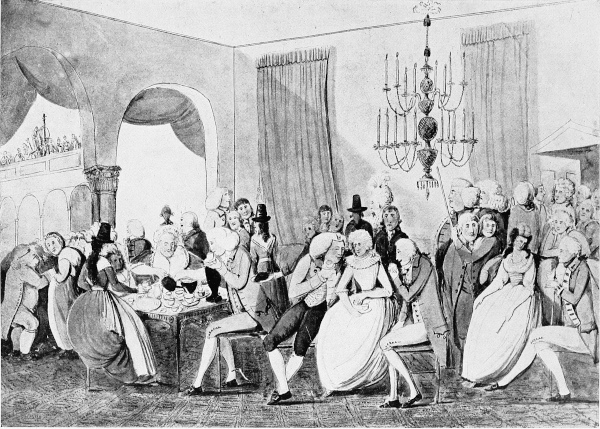
John Nixon, pxt.]
TEA AND COFFEE IN THE BATH-ROOM.
“BEAU” NASH
Mr. Herbert is mentioned as being very ill at Tunbridge;
this was the uncle of the 6th Earl of Carnarvon,
of Highclere Castle, Hants. Mr. Montagu says, “He
has done a great deal to adorn and beautify Highclere;
he had designed to do much more, if he dies it will want
his finishing hand.” On August 13 Mrs. Montagu
writes to her husband—
“Mr. Nash[53] had a fit yesterday, by which it is
imagined this Monarch will soon resign that Empire
over Mankind, which in so extraordinary a manner he
gained and has preserved. The Young Pretender is
now known to be at Passi, near Paris, where he keeps
himself so concealed that he may on any project be able
to leave it without exciting the attention of the people.
It is said in case of a Minority he will make us a visit.
Lord Rochford intercepted a letter from a Cardinal in
France to his brother in Italy, in which he said he had
supped with Prince Charles the night before. I hear
this young adventurer is much a favorite with the French
officers and soldiers, whose romantic visions of honour
may excite them to do more than even the policy of
their Monarque requires.”
On August 20 Mr. Montagu arrived at Hinchinbroke
to stay with Lord Sandwich, in order to beat up votes
for the next election for Huntingdon and the county.
A Mr. Jones, an eminent merchant, was to be his fellow-candidate.
“On Tuesday we are to go about the town and
canvass, where an entertainment will be prepared for
the Burgesses, who will to-morrow night be treated
with their wives, with a ball for them only, a thing
intirely new and which must produce something new
and out of the common. On Friday we shall be at
liberty to move off, but on Monday night we are to
meet and entertain the Londoners at the King’s Head,
Holbourn.”
Writing on August 21 to Mrs. Boscawen, Mrs. Montagu
mentions—
“I am living in the very house my dear Mrs. Boscawen
inhabited three years ago. At the Stone Castle
reside Mr. Pitt, Mr. and Mrs. West and Miss West.
Instead of making parties at Whist or Cribbage, and
living with and like the beau monde, we have been
wandering about like a company of gipsies, visiting all
the fine parks and seats in the neighbourhood.”
These excursions were much encouraged by Mr.
Pitt, who considered them “as good for the mind as the
body,” and that an occasional day without drinking the
waters gave them a greater effect.
Mention of a ventriloquist now occurs as something
new—
“I have been this morning to hear the man who
has a surprising manner of throwing his voice into the
Drawer, a bottle, your pocket, up the chimney, or where
he pleases within a certain distance.... I was last
night at Mr. King’s, we had the Orrery and an astronomical
lecture.”
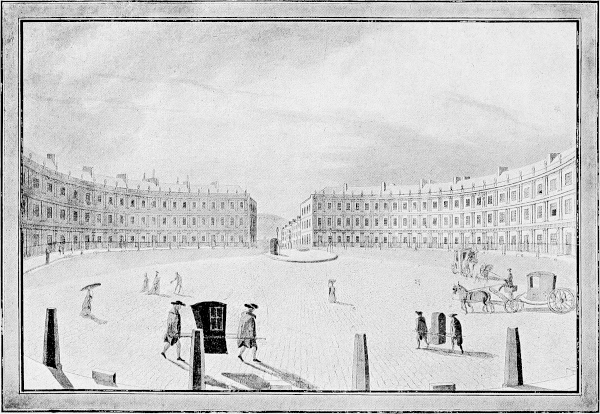
Thos. Malton, pxt.]
THE CIRCUS, AT BATH.
MR. PITT VISITS HAYES
Mr. Montagu joined his wife for a week at Tunbridge,
when he had to return to London. On September 16
she writes to him—
“I intend to be with you on Thursday.... I find
Mr. Pitt has some intentions, as I told you when you was
here, of going to Heys, in case he should not be well
enough to take the long journey he intends, and he
seems much pleased that I will lend him that little
tenement; but as I apprehend a feather bed more will
be wanted than used to be, I propose to send one from
Hill Street.... Mr. Pitt leaves this place to-morrow,
he is now going to Dr. Ascough’s, and from thence to
Stowe[54] and Hagley.[55] Mr. West goes to Stowe with
him.”
Probably it was from this time that Pitt took such
a fancy to Hayes, which endured all his lifetime.
MR. HOOKE
The next letter to Gilbert West I transcribe in
portions—
“Sandleford, September 27, 1753.
“My most honoured Cousin,
“Your kind and agreeable letter restored me in
some measure to the temper I lost at going out of town
the very day you came to it. I know not what poets
may find in the country, when they have filled the woods
with sylvan Deities, and the rivers with Naides; but to
me groves and streams and plains make poor amends
for the loss of a friend’s conversation. You have better
supplied Mr. Pitt’s absence by reading the Orations of
his predecessor, Demosthenes, and I can easily imagine
you would rather have passed the evening with the
British than the Grecian Demosthenes, whom in talents
perhaps he equals, and in grace of manners and the
sweet civilities of life, I dare say he excels. But when
you seem to say you would even have preferred the
simple small talk of your poor cousin to the Athenian
Orator, I cry out,—Oh wondrous power of friendship,
which like the sun gives glorious colours to a vapour,
and brightens the pebble to a gem, till what would have
been neglected by the common herd is accepted by the
most distinguished.... On Tuesday morning about
eight o’clock I called upon Mr. Hooke at his hermitage.
I found him like a true Savant surrounded by all the
elements of Science, but though I roamed round the
room, I could not perceive any signs of the Author,
no papers, pen, ink, or sheets just come from the press.
I fear the fine ladies and fine prospects of Cookham
divert his attention from the Roman History.... I
desired him to carry me to Mrs. Edwin’s, which I heard
was a pretty place.[56] There is an old ferry woman who
crosses the Thames very often before Mrs. Edwin’s
terrace.... While we were in Mrs. Edwin’s garden he
betrayed my name to her ... she came down, showed
me her house and the pictures, which are very fine, but
the views from her windows gave one no leisure to
consider the works of art.... Cliefden Hill rises
majestically in view, and the only flat shore you see
from this place lies straight before it, and is a large
plain of the finest verdure and full of cattle.”
THE WICKHAM URN
To this letter Gilbert West replies—
“I am glad your journey to Sandleford was relieved
by the agreeable digression you made to Cookham,
where I hope to find, at least in the memory of Mr.
Hooke, the vestiges of your having been there, which
will be an additional motive to me to make him a visit
from Stoke, for I am going once more from Wickham,
notwithstanding the neighbourhood of Sir Thomas
Robinson,[57] the Archbishop,[58] and Bower, and the arrival
of my Urn, which is to come this very day, and which
Mr. Cheer hath taught me to consider as an emblem and
monument of the polished, elegant and accomplished
Mrs. Montagu, by assuring me ‘that it is indebted for all
the extraordinary and highly finished ornaments he hath
bestowed upon it, to the great regard and veneration he
hath for her, and that he will not either for love or money
make such another.’ ... I was paying a visit at Fulham,
where I enjoyed the smiles of my beloved Bishop,[59] the
presence of Mrs. Sherlock, and the agreeable conversation
of Mrs. Chester, with the more substantial delicacies
of an excellent English Venison Pasty.”
Further on he says he is going to Lillingston Dayrell
to see his mother, Lady Langham.
THE NEW POST-CHAISE
In the next letter (Oct. 3) from Sandleford to Mr.
West occurs this sentence, “Mr. Montagu returned
hither on Monday with the new four-wheeled post-chaise;
it is the pleasantest machine imaginable in
rough roads, but I think it too easy on even roads.”
The coachmen had nothing intermediate between the
two-wheeled vehicles and the ponderously long six-
or four-horsed coach, which required elaborate skill in
turning.
Staying again at Fulham, Mr. West mentions that
he has been urging Bishop Sherlock to publish some
of his sermons, which he promised to do. West had
a fresh attack of the gout, which made him return
home. Mr. Pitt had left Hayes suddenly for Bath,
Tunbridge waters not having been of sufficient use to
him; and in a letter of October 13, to West, in capital
letters, her inquiries not being answered, Mrs. Montagu
asks, “I desire TO KNOW WHAT YOU HAVE HEARD
CONCERNING MR. PITT’S HEALTH?” Describing her daily
life, she says she keeps up the Tunbridge habit of
driving an hour or so after dinner (which, it must be
remembered, was then early) over the adjacent common;
after these airings she drank tea, and retired to her
dressing-room for two or three hours of reading.
On October 14 West writes—
“The Duke and Duchess of Portland, with two of
their daughters, dined here last Thursday, and we are
to make them a morning’s visit to-morrow at Bullstrode.
Her Grace was extremely courteous and obliging to me,
but never made any inquiry after you, which piqued me
so much, that I put her against her upon talking about
Mr. Botham, and from what she said about the distrest
situation of his family, took occasion to extol you as the
most generous and sincere friend, and indeed the only
one the poor man could depend on.”
LADY BUTE
The reader will have doubtless missed the frequent
mention of the duchess and her letters. There is no
doubt that the coolness between the quondam intimate
friends was on account of the Scott separation. It will
be remembered the duchess sided with Mrs. Scott’s
engagement against Mrs. Montagu’s opinion. After the
Scott separation, probably influenced by her intimate
friend, Lady Bute, who with the Princess of Wales
seems to have defended him,[60] the duchess appears to
have taken his part; but his true character is shown
by the fact that the Prince of Wales (George III.), on
being given a Household in 1756, begged that Scott[61]
should not be continued about him, and to make up
for this dismissal he was given a commissionership in
the Excise. Later on the duchess and Mrs. Montagu
had a rapprochement, but the letters were never as
cordial as in previous times.
BULLSTRODE MENAGERIE
Writing from Lillingston on October 27, West describes
his visit to Bullstrode—
“I was very kindly received both at Bullstrode and
Cookham; at the former we were shown a great many
fine and great many curious things, both in doors and
without; the day proved too cold, and I was not enough
recovered to see all the rarities of the animal as well as
the vegetable kind, which were dispersed over the Park
and gardens. Those that might be seen from the windows,
as some spotted Sheep and a little Bull from Fort
St. David’s, whose resemblance I have often seen in
China ware, I beheld with admiration and applause, and
ventured two steps into the garden to take a view of the
orange trees against the wall.... Her Grace promised
to make me a present of some trained up for that purpose.
In her closet we were shown some curious works
in Shells, performed by Mrs. Delany, whom her Grace
expected at Bullstrode in a short time, and expressed
great pleasure and not a little impatience in the prospect
of seeing so dear and so ingenious a friend. Of you she
said nothing, till upon her naming Mrs. Donnellan, I
said I could give her some account of her, having been
informed by you that she was gone to town; she then
asked when I heard from you, and where you was, but
carried her enquiry after you no further. At Cookham
I spent some hours with Mrs. Stanley, for Mr. Hooke
had gone out with Mrs. Edwin to make a visit to Dr.
Freind....” He further states that he found his
mother well, and “very little alter’d since I last saw
her, excepting that she has grown a little fatter, a
circumstance to a woman of seventy is greatly preferable
to wrinkles. In my way thro’ Stowe Park I met
Miss Banks riding out with Lord Vere,[62] of her I
enquired much about Mr. Pitt, and received from her
the same answer, which I must have made for your
enquiries after him, that they had heard nothing of him
since he left Stowe.... While he staid at Stowe he
was in good health and spirits, he went from thence
to Hagley, and she believed he intended to go from
Hagley to Bath.”
On November 10 Mrs. Donnellan, to whom Mrs.
Montagu had lent her house in Hill Street, whilst she
searched for lodgings in the suburbs, her lungs not
permitting her to live in the town during the winter,
writes—
“I have taken a little house on tryal at Kensington
Gravel Pits ... both Richardson’s house at Northend
and Mrs. Granville’s at Chelsey I think too low for
me.... I want you to read ‘Sir Charles Grandison,’
it is not formed on your plan of banishing delicacy. I
am afraid it carrys it too far on t’other side, and is too
fine spun, but there are fine things and fine characters
in it, and I don’t know how it is, but his tediousness
gives one an eagerness to go on; there is a love-sick
madness that I think extremely fine and touching, but
if you have not read it I must not forestall. I think I
will own to you, the great fault of my friend’s writings,
there is too much of everything. I really laughed at
your nursery of ‘Clarissas,’ but I hope you did not think
of me as the old nurse, there was nobody there while I
stayed!”
“SIR CHARLES GRANDISON”
Mr. Richardson had just completed his novel of
Sir Charles Grandison. The Clarissas is an allusion
to Miss Botham and Miss Carter, then with Mrs.
Montagu.
This same month Mrs. Montagu was again very
unwell. West urged her to go to London, but Mr.
Montagu, who loved the retirement at Sandleford, was
unwilling to leave it, and she says—
“Tho’ I am told I may go to town, I know it would
not be agreeable where I ought to please, and I can
hardly think it right to be in such haste to quit the place
where I live most in the manner I ought to do, where
only I am useful. I relieve the distresses and animate
the industry of a few, and have given all my hours to
the two girls under my care, whose welfare, whose
eternal welfare perhaps, depends on what they shall
now learn.”
Mr. Hooke and Mr. Botham were both at Sandleford.
In Mr. Hooke’s conversation Mrs. Montagu found much
enjoyment; as West put it, “He (Hooke) is a very
worthy man, and has in him the greatest compass of
entertainments of any one I know, from nonsense (as
Lord Bath calls it), to sense, and beyond sense to
Metaphysics.”
“THE TRIUMPHS OF THE GOUT”
On December 20 Mrs. West writes to present her
Christmas wishes, and Mr. West’s, to the Montagus, as
“Tubby” (Mr. West), as was his uneuphonious family
nickname, had the gout in both hands. Mrs. Montagu
writes to him—
“The 27th of December, 1753.
“And what, my dear Cousin, are both hands prisoners
of the gout! such innocent hands too! Hands that
never open’d to receive or give a bribe, that never
dipped into the guilt of the South Sea fraud, of Charitable
Corporations, or pilfer’d lottery tickets, clean even
from perquisite in office, and the most modest means by
which the Miser’s palm wooes and sollicits gain. So far
have your hands been from grasping at other’s gold,
they have not held fast your own with a tenacious grip,
but open’d liberally at the petitions of the poor, for the
productions of Art, or to feast your friends at the genial
board. Most of all do I resent the fate of the writing
hand, which was first dedicated to the Muses, then with
maturer judgment consecrated to the Nymphs of Solyma,
and shall it be led captive by the cruel gout? Why did
you sing the triumphs[63] of the dire goddess? Oh, why
could you not describe them unfelt, as Poets often do
the softer pains and gentler woes of Venus and her
Son?”
1754
SCHOOLGIRLS’ BILL
The first amusing paper I have of 1754 is a school
bill for the two younger Miss Bothams, Molly and Kitty.
I am sorry that several of the items are torn away, but
it is curious as to things then required, and also for
the extraordinarily bad spelling and wording of the
preceptor entrusted with their care. It is addressed to—
“The Revd. Docʳ Botham,
“These.”
“Sir,
“According to your desire by the honour of
your Last, I send you the Bill of the two Miss’s Botham,
your daughters, to ye first of this month, altho’ wee had
spoak of it before the Holydays I had quite forgot it,
and was very easy on that account. I hope, Sir, that
you’r satisfied of us, if so I shall alwise thry, as well as
my wife, to do all wee can to improve your daughters in
everything, especially in their Morals and manners. I
was very sorry of your last indisposition, and hope
you’r much better, it is the sincere wish of
“Sir,
“Your most humble
and obedient Servant,
“E. Sage Roberts.
“Kensington, the 20th January, 1754.
“P.S.—My wife with her compliments to you joyns
with me in compts. of the Saison, wishing you health,
prosperity and all you can wish yourself for many
years.”
“The two Miss’s Botham’s Bill.
| £ | s. | d. | |
| “To Board from the 9th of August, 1753, to
the 1st January, 1754, at £25 per year,
maketh |
19 | 16 | 0 | |
| To a Seat at Church |
0 | 8 | 6 | |
| To copy Books, pens, pencils, Ink, paper, &c. |
0 | 7 | 0 | |
| To the Dancing Master |
4 | 10 | | |
| To sundry things furnished, viz.— |
| To a chest of Draws |
1 | 5 | 0 | |
| To silver spoons, knife and Fork. |
1 | 1 | 0 | |
| To a tea chest |
0 | (torn off) |
| To a Spelling book, 1 Grammar |
0 | 3 | - | |
| To two Hats and two Bonets |
0 | 15 | 0 | |
| To three pair of Shoes |
0 | (torn) |
| To Gloves, 6 pairs |
0 | (torn) |
| To tea and suger |
0 | (torn) |
| To Thread, Tape and pins, needles, worsted,
laces, &c. |
0 | 13 | - | |
| To Hair cutting, Pomatum Powder |
(torn) |
| To Pocket Money |
0 | 10 | 9 | |
| To Pots and Mugs, &c. |
0 | 1 | 6 | |
| To a percel recd. by the Coach |
0 | 0 | 2 | |
| To Soap, Oatmeal for to wash, &c. |
0 | 2 | 6 | |
| | |
| Total
| 30 | 15 | 0 | ” |
MR. PELHAM’S DEATH
In the beginning of March in this year Mr. Pelham,
the Premier, died suddenly, and there was a General
Election. Mr. Pelham’s brother, the Duke of Newcastle,
was appointed first Lord of the Treasury; Mr. Legge,
Mr. Botham’s uncle, Chancellor of the Exchequer; Sir
George Lyttelton, Cofferer. Mr. Montagu proceeded
to Hinchinbrooke early in April to canvass, and his
wife writes to him on the 11th—
“I hope you had a pleasant journey, and arrived
without fatigue. You are proceeding quietly and well
at Huntingdon, while many are hustling with infinite
animosity in other Boroughs. The votes are eleven
hundred paid a piece at Bury as I am informed....
Morris is very busy with the Canterbury Voters, he
does not like them so well as law Clients.”
Morris was canvassing for his elder brother Matthew,
of Horton.
Mr. Montagu writes on April 16 to say, “Yesterday
our Election came on, and was, I believe, one of the most
quiet and peaceable that ever was.”
AN ELECTION
In her next letter to her husband she says—
“I have had a letter to-day from my brother
Robinson, informing me that he is chosen along with
Creed; Mr. Best declined the Poll. My brother has
carried his Election without expence.... I cannot take
leave of you without expressing my pride and satisfaction
in seeing you again enter the House of Commons,
where you have behaved with such steadiness and integrity.
I have a joy and pride whenever I reflect on
any part of your moral character. May your virtues
meet with the happiness they deserve!”
“TOM” LYTTELTON
Bower writes to Mrs. Montagu on April 16 from
Oakhampton, where he had gone with Sir George
Lyttelton for his election, in fervid Italian. He was
disgusted at the orgy of the election, and says that at
the election dinner given by the mayor and magistrates
in their robes to Sir George Lyttelton, they sat down
at 3 o’clock p.m., and none rose to leave till two in the
morning! “e tutti, o quasi tutti partirono cordialmente ubbriachi”
(“and all, nearly all, parted thoroughly drunk”).
He continues, “The cavaliers then went from house to
house to kiss the ladies, as was customary, and ask for
the votes of their husbands.” After fervid speeches made
to the “celeste imagine della Madonna del Monte e
della Strada del Monte” (the celestial image of the
Madonna of the Mount and the Madonna of Hill Street),
meaning Mrs. Montagu, his pen is taken up by Lyttelton,
who says, “The Italian language affords such lofty expressions,
as the poverty of ours will not come up to,
and therefore the Madonna must be content with my
telling her that the good Father with all his Devotion
does not honour her more than I do....” At the
end of his letter he says, “I hear from my wife that
my Boy has been with you: a thousand thanks for your
goodness to him.” This is the first mention of Thomas,
afterwards 2nd Baron Lyttelton, then only ten years
old. Lyttelton had early besought the interest and influence
of Mrs. Montagu for his son and daughter by
his first marriage. Both became truly attached to her,
would that her influence had prevailed on “Tom” later
in life.
At this period Mrs. Donnellan was very ill, and Mrs.
Montagu did her best to nurse her. Lady Sandwich
came to town to inoculate her daughter, Lady Mary.
Miss Mary Pitt had been to see Mrs. Montagu, and “she
assures me Mr. Pitt is in good health, but has had another
attack of gout in his hand, owing, ’tis imagined, to his
being blooded for a sore throat.”
Mr. Montagu at this period sustained the heavy loss
of his faithful agent, the second Mr. Carter, who died at
Theakstone, and whose loss necessitated his immediate
journey to the north to attend to his own and Mr.
Rogers’ affairs, all of which had been confided to Mr.
Carter’s care. Taking Mr. Botham as his temporary
secretary and companion, they started off northward by
post-chaises, a most expensive process, as Mr. Montagu
called it. On June 13 Mrs. Montagu writes—
“I am sorry Mrs. Carter (the grandmother), has set
her heart so much on having her granddaughter with
her, she is of the proper age to receive instruction and
take impressions; a few years passed innocently will
not leave her as amiable a subject as she is now, her
mind will be less flexible.... Mr. Pitt drank tea with
me this afternoon; he has recovered his health entirely,
if one may judge by his looks. He tells me he has built
a very good house at Bath for £1200. He mention’d to
me his intention of going on Saturday to Wickham to
propose the place at Chelsea to Mr. West, the offer will
certainly be an agreeable one.”
This place was that of the paymaster to Chelsea
College. In the next letter to Mrs. Boscawen, Mrs.
Montagu says—
“The place is call’d a thousand pounds a year, it is
in the gift of Mr. Pitt, and was given with grace that few
know how to put into any action ... they have excellent
lodgings annexed to the place.... Mr. Pitt dined with
them on Saturday; I imagine he was very happy, but
he so well deserved to be so. It is a fine thing to act
the part of Providence and bless the good. Miss Carter
was sent for by her old grandmother, last week she
left me.”
Writing to her husband on June 15, Mrs. Montagu
states she shall be glad to hear as soon as Mr. Montagu
thinks he will return, “that I may disfurnish Hayes,
which I shall quit as a man does a homely but a quiet
wife, with some little regret, but not much tender
sorrow; it is not a beautiful place, but it is quiet, and
when one steps out of the bustle of Town, appears on
that account amiable.” She adds that her sister’s health
is greatly improved, and her temper less petulant, on
account of having taken to a milk and vegetable diet.
On July 9 Mrs. Montagu mentions—
“My brother Robinson came to town last night; he
dined here to-day, and we are all going to Vauxhall,
where Mr. Tyers has had the ruins of Palmyra painted
in the manner of the scenes so as to deceive the eye and
appear buildings.”
Her sister Sarah and brother Charles were with her.
She concludes with an affectionate appeal to her husband
not to apply himself too much to business at Newcastle,
but to take exercise for his health’s sake.
MR. WEST’S APPOINTMENT — ELIZABETH CANNING
In another letter undated, but about this period, as it
mentions West’s thanks to Mr. Montagu for his congratulations
on his appointment to Chelsea Hospital,
allusion is made to Elizabeth Canning, whose curious
story of having been kidnapped[64] and ill-treated had
convulsed London opinion.
“The town is in great agitation about Elizabeth
Canning; she is condemn’d to Transportation, but her
guilt is so far from appearing certain, that the Sheriffs
refuse to conduct her among the other felons. All the
Aldermen but Sir Crispe Gascoigne[65] petition in her
behalf, all the great officers of the State almost, interpose
for her, and the Archbishop of Canterbury also
desires that she may have a decent person of her own
sex to attend her over, and then to board in a private
family. Some fear there will be a rising of the Mob in
her favour; in general all seem to agree that the matter
is entirely doubtful. As to Sir Crispe Gascoigne he dare
not stir without being guarded.... I wish the whole
affair was brought to light, there is great iniquity
somewhere.”
On July 19, writing from Hayes, she says—
“Miss Mary Pitt, youngest sister of Mr. Pitt, is come
to stay a few days with me, she is a very sensible, modest,
pretty sort of young woman, and as Mr. Pitt seem’d to
take every civility shown to her as a favour, I thought
this mark of respect to her one manner of returning my
obligations to him.”
Mr. Montagu and Mr. Botham proceeded to Newcastle
to regulate Mr. Rogers’ affairs, which, as before
mentioned, required attention, owing to the death of
the head agent, Mr. Carter.
In consequence probably of worry, Mr. Montagu
returned from the north at the end of July with a fever,
“which,” as his wife writes to Sarah, “bleeding and
wormwood draughts have taken off,” and as soon as he
was fit he was to go with her to Hayes to pack up her
books. Miss Anstey was staying with them, and was
to accompany them to Sandleford. Mention is made
of a portrait of herself which Mrs. Montagu was going
to send Mrs. Scott: “Mr. Cambridge call’d on me the
other day, he spoke much in your praise. I told him
I hoped he would call on you at Bath, he promised he
would.” This was Richard Owen Cambridge,[66] a friend
of Dr. Johnson, who wrote the “Scribbleriad.”
Writing to West from Sandleford of her neighbours
at Hayes, she regrets the society of Mrs. Herring and
the Archbishop,[67] and desires her regards to them. He
answers—
“I made your compliments to the Archbishop and
Mrs. Herring, who dined with us the very day I received
your letter. He is very well and as amiable and polite
as ever. Dick[68] has been very dilligent and very
successful in partridge shooting, and t’other day sent
the prime fruits of his labours, a landrail, as a present to
his Grace of Canterbury.”
BRIGHTHELMSTONE
At the beginning of September, through the influence
of West, the Bishop of London gave the living of Ealing
to Mr. Botham. Botham was at Brighthelmstone with
his two boys for sea-bathing, as they were not in health.
The joy of Mrs. Montagu was great at this preferment,
as the bishop permitted Mr. Botham to continue to hold
Albury as well, placing a curate in the living he did not
occupy.
“PRECIEUSES RIDICULES”
Writing again to West, Mrs. Montagu says—
“Dr. Mangey kept a curate at Ealing as he did not
reside there, but undoubtedly Mr. Botham will discharge
the duties of the living he resides at without assistance;
the Bishop of London required Mr. Botham’s residence:
as the girls and boys are growing up and must soon live
with him, they will be better placed at Ealing in a good
neighbourhood than at Albury. They will learn nothing
there but eating and drinking plentifully of Lord Aylesford,
and Mr. Godschall’s house is generally full of
poetic Misses, who are addressing each other by the
names of Parthenia, Araminta, etc., with now and then
a little epistle to Strephon or Damon. I was uneasy
whenever they were at home, for fear they should enter
into the precieuse character of Mrs. Godschall.”
This style of conversation is taken off in Molière’s
“Precieuses Ridicules.”
West’s mother, Lady Langham was now paying her
son a visit. Mrs. Montagu writes—
“I think the vast territories of imagination could not
afford any view so pleasing as the meeting of such a son
and such a mother; the pictures not only pleased my
mind, but warm’d my heart ... that you may at Lady
Langham’s age be as well able to take a journey, and
your son as well deserve, and as joyfully receive such a
visit is my sincerest and most earnest wish ... another
pleasure attends you all, and which your benevolence
and not your pride will feel, that of setting an example of
those various charities, of parent, child, husband and wife,
which make the happiness of domestic life; and there is
surely more honour in filling well the circle mark’d of
Heaven in these spheres of relation, than in running the
wild career of Ambition in its most shining track.
Indeed there is no part of a conduct that so certainly
deserves our approbation as an acquittance of family
regards. Actions of a public nature often are inspired
by vanity, domestic behaviour has not popular applause
for its object, tho’ with the sober judgment, as Mr. Pope
says of silence, ‘its very want of voice makes it a kind of
fame.’”
She then proceeds to thank West eloquently for
Botham’s presentation to Kingston (this must be a mistake
for Ealing), and ends with desiring some paper hangings
“she and Mrs. Isted had laboriously adorned” to be taken
down with care at her house at Hayes, but leaves the rest
of the hangings to the landlord. “I presume some
retail grocer, haberdasher of small wares, or perhaps a
tallow chandler, will shortly be in possession of my
Castle at Hayes.”
MR. HATELEY
At Sandleford were staying young Mr. Hateley, an
artist, and Miss Anstey. The latter being in treaty for a
house in London, accepted Mr. Montagu’s escort thither,
and Mr. Hateley wishing to accompany them a portion
of the way, mounted a horse, which flung him at the first
start off and grievously cut and bruised him. The
doctor was summoned after the departure of Mr. Montagu
and Miss Anstey, who “blooded him, and he was
ordered to take no food but balm tea lest he should
have a fever.... The Harvest Home Supper last night
was very jolly, the guests had as good appetite as those
who meet to eat Turtle,” writes Mrs. Montagu to her
husband on September 23.
Miss Anstey, having lost her parents, and Trumpington
having become her brother’s property, had determined
to live in London. She took Mr. Montagu to
help her in choosing a residence in Queen Street, a new-built
house for £800. Miss Anstey executed several
commissions for Mrs. Montagu, amongst which she
mentions, “I have sent several prints of Nun’s habits,
some one of which I hope may become the beautiful
Eloise, and I shall very much rejoice to hear she has
taken the Veil.”
Mention is made in a previous letter of Mrs.
Montagu’s of Hateley painting a picture of Eloise, but
who sat for it I cannot say. Hateley recovered from
his accident. A new post-chaise had been ordered for
the Montagus, and Mr. Montagu found it “nothing
showy or brilliant,” but his wife assures him, “I shall
find no fault with the plainness of the post-chaise,
neatness being all that is aimed at.”
LILLINGSTON DAYRELL
West, writing on October 8 from Wickham, says—
“I have the honour to agree with my dearest and
most excellent cousin in looking upon writing letters as
one of the evils of Human Life, and for that reason I
have always declined engaging in a correspondence of
that kind with anybody but her, tho’ I was once invited
to it by the great Mr. Pope.... I am now turning my
thoughts towards Chelsea, where I hope to be settled
for the whole winter by the beginning of next month.
My Mother and Mrs. Ives[69] go from hence to my brother’s[70]
house in the country, where they will remain a week or
ten days, and from there return to Lillingston.[71] Mr.
and Mrs. Dayrell were prevented by the death of two of
his Aunts from making us a visit at Wickham, by which
accident and the absence of my sister Molly, my Mother
lost the opportunity of exhibiting the pleasing picture
of a Hen gathering with a careful and maternal tenderness
all her chickens at once under her wings, but she
will have them by turns.”
From this it would appear that Mrs. Dayrell was a
daughter of Lady Langham’s. The Dayrells have owned
Lillingston Dayrell for some eight hundred years!
Mrs. Medows writes from Chute on October 16 to
Mrs. Montagu—
“I am impatient to wait on you; all the horses and
all the Maids have been taken up with Wey Hill Fair,[72]
now I hope to hire a couple of cart-horses: I dare not
venture with a common postboy and horses, because
the postboys are not used to a four-wheeled chaise, nor
the Road I must go.... I wish you joy of a pleasure
for life at least, the good you have done to Mr. Botham
and his family.... I am pleased you have hired the
wood, now one may walk in the bowling green without
coveting what is your neighbour’s. I hope hiring is a
step to purchasing; laying field to field is a natural
thought and not a blameable one, when no injustice is
meant. I have often thought what a pretty place Sandleford
would be if it was bounded by the little river,
Newbury Wash, and Greenham Heath.”
This wood was on the east side of Sandleford, and
was eventually purchased, and Sandleford at this moment
is bounded exactly as Mrs. Medows wished.
“A Buck, we are told, is come to Grateley, his name
is Mitchell, he has laid out a £1000 in furnishing it completely,
altho’ he could not be sure of having it more
than a year. He intends to keep Stags in the paddocks,
and turn them out on the Downs, which will give him
fine chases. He says the Drawing room is a good drinking
room.”
BATH EASTON
Sarah Scott and Lady Bab Montagu had taken a
house at Bath Easton for use in the summer, and
desiring plants for the garden there, Mrs. Montagu
sends on November 6 to them a vast number of pinks,
roses and honeysuckles, together with a home-cured
ham. In the accompanying letter she mentions Ealing
being
“two hundred pounds a year, his house a very pretty
one, a good garden with a great deal of wall fruit, and
there is a neighbourhood of genteel people, who have all
shown him great civility.... Mr. Hateley is still with
us, he has made a very pretty Landskip (sic) with Eloisa,
and her figure is pretty, her face amiably triste. He has
done my portrait so like, and got a good likeness, and
with a spirit in the countenance and attitude that is very
uncommon.”
“HISTORY OF BATH”
To this Sarah writes on November 17, to thank her
for the plants and to say she and Lady Barbara had
returned to Bath for the winter, Bath Easton being too
near the water for them. She says—
“Have I sent you word of a subscription making for
Nash? I believe it began since I wrote last. It is
entitled a subscription for a ‘History of Bath and
Tunbridge for these last 40 years,’ by Richard Nashe,
Esqre., with an Apology for the Author’s life. The
whole money, two guineas, is to be paid down at once,
for he does not pretend any book is to come out. Some
have subscribed 10 guineas, many five, and a great many
hundred pounds are already subscribed. It is to be
kept open for life, and people give to him who will not
part with a guinea to relieve the greatest real and unmerited
distress imaginable. The pretence is that he
has but little more than £200 a year, which is not supposed
true, but if it was, surely it is full equal to his
merits, whether one considers them as moral or entertaining.
To such ladies as have secret histories belonging
to them, he hints that he knows every one’s private life
and shall publish it. This place grows so full of subscriptions
that no person of moderate fortune will long
be able to come to it. The people of the rooms are
endeavouring to obtain a subscription of half a guinea
each man, and a crown each woman for the season. As
yet it has not been complied with, but they require
it with such insolence, that I make no doubt it will
be complied with. I shall be glad to hear you are
safely settled in Hill Street. I assure you the picture[73]
you were so good as to give me is a great ornament to a
pretty room, and people are so civil to me as to see the
likeness, which I take well of them; as it is placed near
the fire it may grow warmer, which is all that can
improve it.”
“Beau” Nash had reigned a despotic Master of the
Ceremonies over Bath for fifty years, living in a most
expensive style, mainly supported by his success at the
gaming tables. The Act of Parliament against gambling
put an end to his chief means of obtaining money. The
Corporation, however, settled a pension of 120 guineas
on him for his services. He was eighty-one years old
at this period, having been born in 1673. His rules for
general behaviour and manners are most amusing, but
are too long to insert.
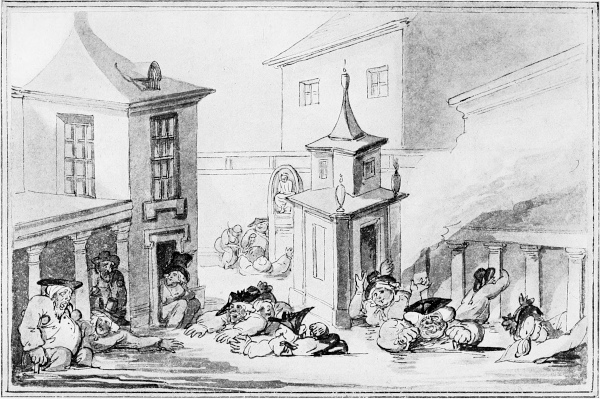
T. Rowlandson, pxt.]
THE KING’S BATH, AT BATH.
MR. PITT’S ENGAGEMENT
At this time Mr. Pitt became engaged to Lady
Hester Grenville, daughter of Mr. Richard Grenville
and his wife, Lady Temple, and sister of Viscount
Cobham. She was a cousin of West’s and Sir George
Lyttelton’s.
On November 5 Mrs. Montagu writes to West—
“My dear Cousin,
“Since the days that Cupid set Hercules to the
distaff, he has not had a nobler conquest than over
the elevated soul of Mr. Pitt. I congratulate you on
the affinity, and I hope he will be happy: his long
acquaintance with the lady makes the hazard much less
than where people marry without knowing the disposition
of the person they choose. I believe Lady
Hester Grenville is very good-humoured, which is the
principal article in the happiness of the Marriage State.
Beauty soon grows familiar to the lover, wit may be
pernicious, and many brilliant qualities troublesome;
but a companion of gentle disposition softens cares and
lightens sorrows. The sober matches made on reflection,
are often happier than those made by sudden and violent
passion, and I hope this will prove of this kind; and
there is an authority in the character of Mr. Pitt, that
will secure him the deference and obedience of his wife;
proud of him abroad, she will be humble to him at home;
and having said so much, I consign them over to Hymen,
who, I hope, will join their hands in the most auspicious
hour. I was prevented writing to you by Sunday’s
post, Dr. Pococke having stayed with us on Saturday
night, and the first Sunday of the month I always go to
Newbury Church;[74] the length of the service made me
too late to write. I am glad Mr. Cambridge has been
with you at Wickham.... We were in Wiltshire last
week to visit Mrs. Medows.”
She ends with expressing a wish to exchange the
country for London, but is determined not to say a
word to Mr. Montagu, whose health had been recently
restored by country air.
REV. W. WARBURTON — THOMAS HEARNE
In her next letter to West, of November 14, she
says—
“As the Virtues and Graces as well as Cupid and
Hymen will assist at Mr. Pitt’s nuptials, I think he
could not choose a better place for their celebration
than Wickham, their capital seat. I wish them many
happy years together, and God bless them with health
and every good.... I hope while you are at Croydon
the good Archbishop will animate you to defy that foul
fiend my Lord Bolingbroke; I believe I shall take some
of Ward’s sneezing powder to clear my head of the impieties
and impurities of his book. I am not satisfied
with Mr. Warburton’s[75] answer, the levity shocks me,
the indecency displeases me, the grossièreté disgusts me.
I love to see the doctrine of Christianity defended by
the spirit of Christianity. When absurdity is mix’d
with impiety, it ceases to be a jest. I can laugh at his
Lordship’s cavils at Mr. Locke, his envy to Plato and
all the old Philosophers, but I could with great seriousness
apply to him the words of his friend and Poet to the
Dunces—
“‘’Tis yours a Bacon and a Locke to blame,
A Newton’s genius or a Milton’s flame.
But oh! with one, immortal one dispense
The source of Newton’s light or Bacon’s sense.’
But I must do his Lordship the justice to say that what
he wants in faith he makes up in confidence, for after
having assured you it is absurd to affirm God is just or
good, he declared he is willing to trust the being whose
attributes he cannot know, to dispose of him in another
world, not at all doubting that the Supreme Being will
be good to him, without goodness, and just to him without
justice! He laughs at the faith of Abraham, and I
should do so too, if Abraham had disputed God’s
veracity, and then trusted to His promises. I never read
such a mass of inconsistencies and contradictions, such
a vain ostentation of learning, and if I durst, I would say
it, all that can show ‘the trifling head, or the corrupted
heart.’ I think I may venture to say trifling, for whatever
does not relate to the argument is so, and to teize
the gentle reader with all the miserable sophisms
that perplex’d the world 2000 years ago, is barbarous.
I wanted to apply to him the Epigram on Hearne[76] the
antiquarian—
“‘Fye on thee! quoth Time to Thomas Hearne,
Whatever I forget, you learn....’
I thank his Lordship, though, for making me once more
look into Mr. Locke and Doctor Clarke,[77] in the veneration
of whom I believe I shall live and dye.”
MR. PITT’S MARRIAGE — THE HONEYMOON
The return letter from West is so interesting that
I give it in extenso—
“Croydon, November 18, 1754.
“My dear Cousin,
“Your admirable letter found me at the Archiepiscopal
Palace at Croydon, where Mrs. West, Dick
and I had been ever since Wednesday; and it was
lucky that it found me there, as I had by that means an
opportunity of showing the Archbishop, whom you very
properly style good, your most ingenious and judicious
Reflections of Lord Bolingbroke’s pompous Rhetorical
and inconsistent Declamations with which his Grace
(who, by the bye agrees entirely with you in the censure
you there pass’d upon Mr. W(arburton)’s way of answering
him,) was so pleas’d that he desired me to give him
a copy of the whole paragraph, promising that if he
show’d it to anybody he would, however, cautiously
conceal the name of the author. After this I need not
tell you how much we both said in praise of you; I
shall only add that I, this morning, received his commands
to present his respects to you, and to tell you
in his name that if you allow’d yourself the liberty of
saying fine things of him, he would be even with you.
These are his own words, grounded on a piece of
information I had given him of the great honour and
esteem you had for him. We quitted Wickham, as I
told you, on Wednesday last, that we might throw no
obstacle in the way of that amorous impatience which
Mr. Pitt had in all his notes express’d of bringing Lady
Hester to our sweet and hospitable Habitation, as he
call’d it; but to our great surprise, and to the no small
mortification of Mrs. West in particular, who was afraid
that all the good things, with which she had fill’d her
larder, would be spoil’d by their delay—the happy
Bridegroom and his Bride did not arrive till Saturday,
on which morning they were married[78] by Dr. Ayscough[79]
with the Archbishop’s License. They came down alone,
and have continued alone ever since, and, I imagine, will
continue during their stay at Wickham, in that Paradisaical
Solitude, tho’ by the quantity of provisions which
Mr. Campion[80] brought with him, and more which he has
since sent for from Croydon, we conclude he expected
some visitants from Town, as Lord Temple, etc.,[81] but
having heard of no such visitants being expected, I
suppose that all this profusion was owing to Mr.
Campion’s solicitude to testify in his own way his
respects to his new Lady, and make his compliments
on this joyous occasion, in the polite, that is, in the
French Phraseology: this is all the intelligence I can
at present give you of this important affair, for we have
had no communication by messages, either to or from
Mr. Pitt, whom we were unwilling to disturb, or
interrupt the free course of those pleasures, which for a
time at least, possess the whole mind, and are most
relished when most private; for this reason I cannot
yet acquaint you when we shall leave Wickham, but
I believe it will be about the middle of this week,
and I suppose we shall not be able to go to Chelsea
before the latter end of the next, or the beginning of the
week after, and by that time I am still in hopes you will
come to Hill Street, and by giving me the pleasure of
seeing you there in good health, compleat the happy
change which you observe is already begun in the once
gloomy month of November. I do often, my dear
Cousin, look back with pleasure and thankfulness on
many incidents of my past Life, and compare them with
my present situation, so much changed for the better
in a thousand instances, such as Health, fortune and
Friendship, among which there is none that has given
me more happiness than yours, and which therefore I
hope will continue, till it is lost where only it can be
lost, in the brighter and warmer radiance of an unchangeable
and everlasting Society, where I hope to
have it continued to me through all eternity. I am
going to take the air with the good and amiable Archbishop,
and therefore must conclude.
“Adieu, my dear, dear Cousin, and assure yourself
that all that period I shall continue
“Ever most affectionately Yours, etc.,
“Gil. West.
“Mrs. West and Mrs. Herring desire their compliments
to Mrs. Montagu and Miss Anstey.”
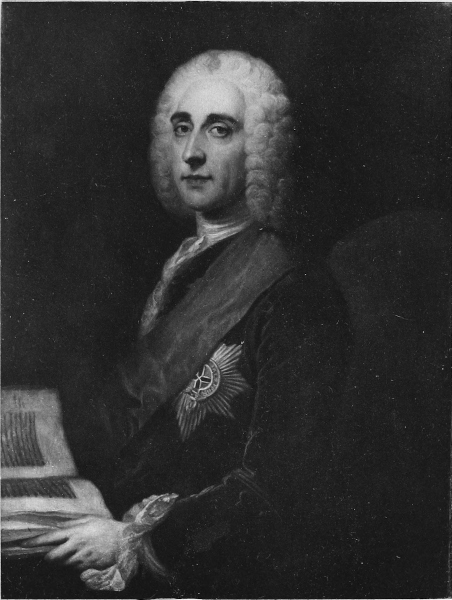
W. Hoare R A Pinx. Emery Walker Ph. Sc.
Philip, 4th Earl of Chesterfield.
“GOSSIP” JOAN
I give a portion of the reply to the foregoing
letter—
“Hill Street, November 23, 1754.
“My dearest Cousin,
“From country Joan I am, according to my
ambitious views, turned into ‘Gossip’ Joan, and by no
supernatural metamorphosing power, but merely by
the help of so ordinary a vehicle as a post-chaise,
which wrought this happy change between the hours
of 7 in the morning and 5 in the afternoon; the
subject, no doubt was well prepared that would so
easily receive the alteration. In my town character I
made 15 visits last night: I should not so suddenly
have assumed my great Hoop if I had not desired to
pay the earliest respect to Lady Hester Pitt. I came
to town on Wednesday night, and was too weary to
write to you. I proposed doing it on Thursday evening,
but my brother Robinson hinder’d me by making a
long visit. Yesterday morning was divided amongst
Milliners, Mantua makers, Mercers and such as deal in
the small wares of vanity.”
MR. HOOKE
The year ends with a letter from Mr. Nathaniel
Hooke—
“Cookham, December 22, 1754.
“Madam,
“If it were not for a certain text of Scripture,
I should be very impatient for the time to come
when I must be in London for some days. The idea of
Hill Street and what is to be seen and heard there, is
very lively and pressing. But alas! What says St.
John the Divine? Little children keep yourselves from
Idols. If you can satisfy my conscience in this point I
shall be much obliged to you, and I beg you will study
it thoroughly, and let me have your Resolution by a
line, directed to be left at Mr. Watson’s in Cavendish
Street. ’Tis uncertain just now when I shall move, but
I think it will be some time this week. Till then I am
not your religious worshipper, but Madam,
“Your most obliged and most obedient
and most humble Servant,
“N. Hooke.
“Give me leave to add best compliments to Mr.
Montagu.”