1743–4 — JOURNEY TO LONDON — LETTERS CHIEFLY FROM
SANDLEFORD PRIORY, FROM BATH, AND FROM LONDON — THE
DEATH OF HER CHILD.
1743
At last the longed-for day arrived for Mrs. Montagu
and her sister to set out southwards. Mr. Carter, the
faithful old steward, insisted on travelling with them
instead of his son Edward, and the description of his
excitement and anxiety shown by his expressions are
very characteristic. Arrived at Doncaster on January 8,
Mrs. Montagu writes to her husband and mother, stating
that she could not do so before, as this was the first
south post she had met.
THE FLOODS
The letter to her mother is dated—
“Doncaster, Saturday the 8,
“(January).
“Dear Madam,
“I arrived here this evening, without having
suffer’d any inconvenience or fatigue in my whole progress.
We were met on Thursday in Leeming Lane[267]
by a Messenger from Capt. Twycross to tell us the
waters were out at Burroughbridge, and that we could
not pass them, so I apply’d to my guide, Mr. Carter, and
a wise man is certainly never out of his element. He
told me I might go to Kirby Hill and there get a warm
lodging, though not an elegant one; which he thought
would be as well as turning back. For my part I assured
him I had rather have my bed stuffed with flocks than
my pillow with care and disappointment, and agreed
to go on to the place he mentioned, and then send a
messenger to see if the waters were fallen. The Dove
returned with an olive branch, and we went on to the
Waterside[268] there to prevent fear (for danger there was
none), we got into a boat and navigated through Mr.
Williamson’s gardens, his melancholy yews just shew’d
their formal heads above the water. Himself a melancholy
shade too, was almost in as bad a way, for the
water was quite to his door, so he could get no amusement
from the rest of the world, but what he saw from
the windows. We were safely landed at the door of the
Inn. The coach came through the water without getting
any wet inside of it, and we all rejoiced that we had been
more afraid than hurt. Mr. Carter, in his care, often
bid me be of good courage; as there was not occasion
for any, I could not be disgraced for want of it: from
our first setting out I have not been less entertain’d
than guarded by him, he has really acted the part of
Sir Roger de Coverley all the way; his benevolent heart
breaks into such honest and affectionate expressions, you
would think he was talking to his family wherever he
is; at the ‘Oak-tree’ he was, I saw, shaking hands with
every creature. I stopp’d to speak to a servant of Mrs.
Yorke’s who met us with her compliments, and could
hear Mr. Carter praising the strong beer, thanking the
Landlord, wishing many good things to a boy who was
stuffing a luncheon of bread and butter, thanking Heaven
for good weather, and commending the road, all in a
breath. At Lord Castlecomer’s Inn he would stop for
the horses to eat, he said a sort of grace to it, praying it
might strengthen them to the end of their journey, then
he extolled the Inn, the Landlord and his wife, not forgetting
a ‘lile lass’ that stood at the gate: all the way
we went in the boat he commended the boatmen more
than an envious person would have done Christopher
Columbus, for exploring leas and lands unknown; at
Borough Bridge he made the funeral Elogy of Mr. Mann,
but not to wrong the living for the sake of the dead, he
said the handsomest things to mine Hostess, the civilest
things to her daughters, the most honourable things of
her son, and the most affable things to the chambermaid,
that ever I heard in my life. At Aberforth he was not
less kind to every creature, nor less indulgent to every
thing, and he is the same still, and I doubt not but will
be Sir Roger de Coverley to the end of the journey. I
am really pleased by reflection, and though I don’t see
everything in his point of view, I am delighted at his
happiness, like the bee he gathers honey from every
flower, nay, weed, which to common taste have no perfection.
I wish I could think as well of all mankind as
he does; but he deserves to think better of it. Benevolence
is built so much on faith, that those who think
very ill of people in general, will never do them much
good, for service often arises from trust, and we cannot
trust those whom we dare not believe.”
A FAITHFUL STEWARD
The end of this letter is lost. Mr. Montagu being
unable, from the Chancery cause coming on, to meet
his wife, despatched a servant named Griffith, but
he, falling ill at an early stage of the road, deputed
another person to meet her. A most dutiful and affectionate
letter occurs here to Mr. Montagu, but too
long for inclusion. Mr. Carter having seen them safe
to Leicester, left them there, where Sarah Robinson
had an attack of illness which delayed them a day.
When well enough, they proceeded by way of Harborough,
Newport Pagnell, Dunstable, etc., to Dover
Street, London.
Mrs. Freind and Mrs. Botham (Mrs. Sterne’s sister,
Lydia), both expecting their confinements, entreated
Mrs. Montagu to stand godmother to their future babes,
to which she consented. Mr. Botham was then Rector
of Yoxall, Staffordshire, and Chaplain to Lord Aylesford,[269]
whose daughter Mary, Lady Andover,[270] was Mrs.
Botham’s most intimate friend and patroness. She was
also a friend of Mrs. Montagu’s, to whom she constantly
wrote tidings of Lydia Botham’s frequent illnesses and
pecuniary troubles.
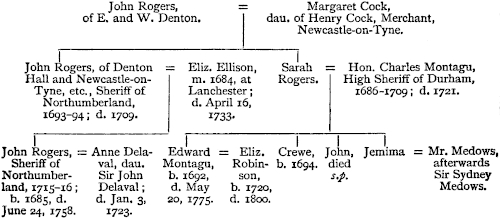
MR. ROGERS’ PEDIGREE
The Chancery suit Mr. Montagu had been engaged
in was occasioned by his claiming the guardianship of
his unfortunate first cousin, Mr. John Rogers, who,
owning large estates at Newcastle-on-Tyne, and East
and West Denton near there, besides much other
property, had now been a lunatic[271] for some years.
It will be seen in the pedigree that Mr. Montagu’s
mother was a Sarah Rogers. This table will elucidate
the relationship—
{Skip transcribed table} {See image for table}
John Rogers,
of E. and W. Denton. |
=
|
| |
Margaret Cock,
dau. of Henry Cock, Merchant, Newcastle-on-Tyne. |
|
| |
|
|
|
| | |
|
| |
|
John Rogers, of Denton Hall and Newcastle-on-Tyne, etc., Sheriff of Northumberland, 1693–94;
d. 1709. |
=
|
|
|
|
|
| |
Eliz. Ellison, m. 1684, at Lanchester; d. April 16, 1733. |
|
Sarah Rogers |
=
|
|
|
|
|
| |
Hon. Charles Montagu, High Sheriff of Durham,1686–1709; d. 1721. |
|
| |
|
| |
|
|
|
|
| | |
|
| |
| |
| John Rogers, Sheriff of Northumberland, 1715–16; b. 1685, d. June 24, 1758. |
= |
Anne Delaval, dau. of Sir John Delaval; d. Jan. 3, 1723. |
|
|
|
|
|
|
| |
Edward Montagu, b. 1692, d. May 20, 1775.
=
Eliz. Robinson, b. 1720, d. 1800. |
|
| |
|
|
|
| | |
| |
|
| |
|
Crewe,
b. 1694. |
John,
died s.p. |
|
Jemima |
= |
Mr. Medows, afterwards Sir Sydney Medows. |
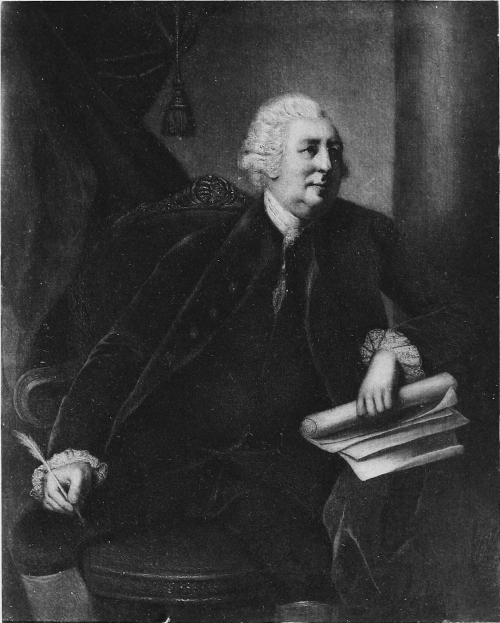
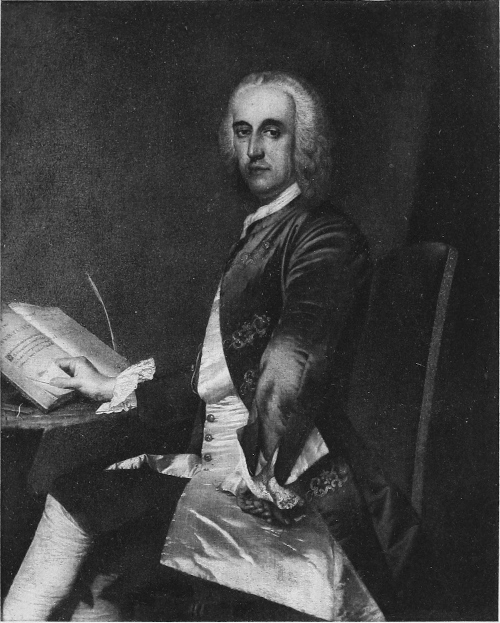
The Rev. M. W. Peters, R.A. Pinx. Emery Walker Ph. Sc.
Morris Robinson
A CURIOUS LETTER
Old Mr. Rogers had bought East Denton land and
collieries for £10,900 from the Erringtons in 1689, who
had long had the property. In December, 1705, Mr.
Rogers bought of Sir James Clavering his share of
the West Denton property. The history of Denton Hall
will be given further on. Young John Rogers appears
to have had fits as early as 1718. He married in 1713,
Anne Delaval, who died in 1723 at Seaton Delaval,
and he seems to have become deranged soon after
her death. As long as his mother lived he was well
cared for, but she died in 1733, and the last nine years
he had been gradually getting worse, and a set of
designing people surrounded him. I have a letter of
his written to his parents, apparently on going to
Oxford in 1705, which is so curious that I insert it here.
It is addressed—
“To
“John Rogers, Esqr., att
“The House in Newcastle upon Tyne,
“These—”
“Dear Father,
“I hope since that I am fallen into the hands of
a gentleman, who is not only a stranger to you, but to
all my relations, that you will do me the favour to write
to my tutor, which I am sure he can’t but take exceeding
well, having never heard from any of my friends since I
removed heather. I had notice by my Mother yt you
had ordered me £40, and wonder that as yett I have not
heard from John Nicholson, that, I fancy Mr. Atkinson’s
letter has miscarried. I see Mr. Fremantel here on
Sunday night who sett forward for Newcastle on
Monday morning, that I fancy you will see him before
you receive this. We had one man executed here on
Saturday morning who was taken here just a little
before our assizes by two Smiths, he had been twice put
in the Gazett for a highwayman, and those fellows took
him, hoped to receive the reward. The fellow knowing
himself to be a great rogue, and that if he escaped here,
they would have had a Habeas Corpus to remove him,
sent for the man whose horse it was he had stolen, to
come to challenge his horse, and was indited for it and
pleaded guilty, hoping I suppose to be transported.
There was a great interest made at Court for to save his
life, but all would not doo, but by this he has baulked
the fellows yt took him of their £40.
“So with my duty to my Mother and yourself,
“I am, dear Father,
“Your dutiful Son,
“John Rogers.
“Oxon, August 18, 1705.”
MR. MONTAGU’S JOURNEY
Mr. Montagu was made guardian and manager to
Mr. Rogers and his estate. Uneasy as he was at leaving
his wife in her present situation, he was obliged to go
to Newcastle to see into affairs. Sarah Robinson, who
had gone home, was quickly summoned to return to her
sister, to which her parents rather unwillingly gave their
consent. Mr. Montagu writes each post, as often as he
could, most affectionate letters to his wife; as he rode
all the way, disliking a carriage, we see by his letters
the time the journey took. March 19, he writes from
Nottingham, having been four days reaching there. He
says, “If j was mounted as j ought to be j could without
much difficulty reach Allerthorpe on Monday night,
whereas j must now be content if j get there some time
on Tuesday.” He bids her divert herself with her friends
and acquaintances, and to send him good accounts of
her health, “as there is nothing under Heaven that is so
dear to me.”
But no sooner had Mr. Montagu set out than the
Duchess of Portland lost her youngest daughter Frances,
just two years old, from convulsions after whooping
cough. She forbade Mrs. Montagu coming to see her
at first, for fear of her grief affecting her in her present
condition. Mrs. Donnellan and Mrs. Pendarves were
with the duchess, and did all they could to solace her
grief, which was intense. After a few days, however,
the two friends met, and had a sad meeting.
To return to Mr. Montagu’s travels, he got to
Allerthorpe, where Mr. Carter joined him, and they
proceeded to Newcastle, to Mr. Rogers’ house, where
“three attorneys attended to take inventorys of the
goods, schedules of the writings and bonds, and whatsoever
we found in the Secretoires etc. of the unhappy
gentleman, but more is owing to the dexterity and unintermitting
diligence of Mr. Carter in the despatch we
have made than to everything else put together. We
have found Bonds amounting to near £10,000 value.”
A general oversight was arranged to be taken by
Mr. Carter of the estates and tenants, many of the
latter being heavily in arrears in rents. It is characteristic
of Mr. Montagu’s uprightness in business that,
though not obliged to do so, he rendered to Sir James
Clavering, Mr. Rogers’ uncle, a complete account of
his estate, of which Sir James greatly approved, and
regretted these steps were not taken ten years before.
A Mr. Grey was put in charge of Mr. Rogers.
DARNTON FAIR
Mr. Montagu and Mr. Carter commenced their
journey home, the latter going to Darnton Fair en
route. People rose early for business then. Mr. Montagu
states Mr. Carter “sat up late last night and rose this
morning at 3, and set out at 6 for Bedale, where he will
be occupied all day.” He adds, “He is unwearied, j
never knew his fellow. He has lived three times as
much as any other man no older than he, and has done
three times as much business and benefited many and
hurt none. I wish j could say as much of those who
are in a rank of life infinitely superior to him.” Truly
this is a fine picture of a righteous steward.
THE BIRTH OF A SON
By May 1, when Elizabeth writes to her mother, Mr.
Montagu had returned to her, she and her sister meeting
him at Highgate. Mention is made in this letter of Miss
Brockman having become temporarily speechless from
inoculation. Sarah returns to Mount Morris, and the last
letter before Mrs. Montagu’s confinement tells of the
purchase of a “magnifique Berceau” just in time, as on
May 11 Mrs. Montagu gave birth, at their house in Dover
Street, to a fine boy, to the infinite joy of Mr. Montagu
and his sister, Mrs. Medows. A young farmer’s wife, a
Mrs. Kennet, living near Mount Morris, had been engaged
as a wet-nurse to the child.
On May 30 the Rev. William Freind, to whom Mr.
Montagu had written to announce the birth of his child,
writes to congratulate him, and to say Mrs. Freind had
presented him with a daughter that morning. Mr.
Montagu had promised to stand godfather if it was
a boy,[272] but if a daughter Mrs. Montagu was to be
godmother. To this letter, on June 4, Mr. Montagu
replied that his wife and child are doing well, and he
says—
“The latter end of next week we intend for the
baptism of our infant, and if you were here should be
prouder to have the ceremony performed by you than
anybody else, for if j may judge from what has happened
to the Father, j imagine it would be auspicious to the
Son. I am sure j ought never to forget the share you
had in putting me in the possession of the Mother,[273] in
whom j find my every wish more than compleated. In
less than a fortnight we intend going to Sandleford,[274]
and after that to go on the inoculation, which j hope
will have an happy event, which, if so, j cannot be too
thankful to Providence.”
He adds his desire for Mr. Freind and his family to
visit them at Sandleford en route home from Bath.
INOCULATION
The reader will remember that Mrs. Montagu was
peculiarly afraid of smallpox, but she had determined,
if once a mother, she would be inoculated, so that she
should be able to attend to her child if it ever had the
disease, and to prevent separation from or infection to
it if she herself took the disease in the natural manner.
When her dread of it is recollected, it will appear a
heroic deed on her part. Her mother, Mrs. Robinson,
was far from easy at the idea of the inoculation taking
place in the summer heat.
Meanwhile the little boy was christened John, though
he soon acquired the nickname of “Punch,” their own
familiar peep-show, as the fond parents deemed him,
and is only twice mentioned in the letters I have as my
little “Jack.”
In a letter of June 21, from the Duchess of Portland,
who was at Welbeck with Lady Oxford, she mentions—
“The Duke of Kingston[275] has been in the utmost
danger, so great Doctor Hickman has refrained sleeping
part of a night, not without the assistance of Barbecued
Hog, Tokay, etc., etc., etc. to keep up his spirits, to
enable him to go through the immense fatigue of waking
a few hours with his patron.” She adds, “Thank God
the children are all well. I hope your little man is so,
my best wishes must ever attend the dear boy.”
Mrs. Montagu went to recruit at Sandleford with
Mr. Montagu, preparatory to removing the child and
establishment there, as she writes to her sister Sarah,
who, with Mrs. Medows, is left in Dover Street in
charge of the son and heir—
BABY CLOTHES
“I really long to have you here. I think I may say
you never saw anything so pretty as the view these
gardens command, for my part I would not change the
situation for any I ever saw; there is nothing in Nature
pretty that they have not. The prospect is allegro, and
as ‘Mirth with thee I chose to live,’ I am glad it is of
that kind, ‘the loathed melancholy of Cerberus and
blackest midnight, born in Stygeian cave forlorn,’ dare
not appear in this little paradise. There is a charming
grove where your reveries may wander at pleasure, you
may allegorize like Spenser, or pastoralize like the lesser
poets, there are roses and honeysuckles hourly dropping
to put you in mind ‘how small a part of time they
share, that are so wondrous sweet and fair,’ and this
will whisper to you ‘de coglier d’amor la rosa,’ indeed,
my dear Sall, these pretty things are mere toys, as are
all things in this world, but a true friend. I am thankful
for the benefits of fortune, and pleased with them, but
really attached only to the person who bestows them.
My benefactor bestows favours with more pleasure and
more complaisance too, than most people receive them
with, and this gives the relish to favour, for as Ophelia
says, ‘Gifts grow cheap when givers are unkind.’
“I hope the young plant thrives under your care.
Pray write every post, and say all you can about the
boy, for as insignificant as he seems in his swaddling
cloaths, it is more interesting to his parents to hear of
where he went, than to hear of all the feats of Hercules
girded in his Lion’s skin.”
Then she orders a dozen bibs to be made for the
babe, of “fine damask, the pattern of Lady Betty
Bentinck’s pinned to my embroidered quilted petticoat.”
SANDLEFORD PRIORY
Sandleford Priory is two miles south of Newbury,
Berks. It was originally founded by Geoffry, 4th Earl of
La Perche, and his wife Matilda of Saxony, between the
years 1193 and 1202, dedicated to St. Mary and St. John
the Baptist, and placed under the Austin Canons; but
Mr. Money, in his “History of Newbury,” states “the
recluses of Sandleford” are mentioned in the Pipe Roll
of the 26th of Henry II., 1180, so that a body of religious
had existed there or near before the date of the building
by the Earl de la Perche.[276] In the reign of Edward IV.,
circ. 1480, a dispute arose between the Prior and the
Bishop of Salisbury, in whose diocese Sandleford lay;
in consequence of this dispute the monastery was forsaken,
and the King, at the instance of the Bishop
(Richard Beauchamp), gave it to the Dean and Chapter
of Windsor. In the 26th of Henry VIII. it was stated
to be in their possession, valued at £10.
In the time of James I., 1615, Sandleford was declared
to be a separate parish, and unratable from Newbury,
but the chapel being dismantled and unfit for use, £8 a
year was ordered to be paid to the Rector of Newbury,
which entitled the occupants of the Priory to a seat in
the Newbury parish church, which has been continued
ever since.
The lessees from the Dean and Canons of Windsor
appear, from a paper of my uncle, Lord Rokeby’s, to have
been, early in the eighteenth century, the Pitt Rivers of
Stratfieldsaye, by whom the lease was sold in 1717 to
William Cradock, Esq., after an intermediate alienation.
The lease was purchased in 1730 by Mr. Edward Montagu,
grandson of the 1st Earl of Sandwich. A letter of April,
1733, of Mr. John Rogers to his aunt, the Hon. Mrs.
Sarah Montagu, at Sandleford, about the death of his
mother, Mrs. Rogers, and her leaving her sister £10,
and each of her three children a ring, is in my possession,
and shows she was then living or staying with her son
Edward.
The chapel is erroneously stated in several works
(vide Tanner, etc., etc.) to be destroyed. It was disused,
not destroyed, though the bells, seats, and the tomb
of the crusading knight[277] had disappeared. As we
proceed further into the manuscripts we shall see it
was used as a bedroom or rooms!
The situation of the Priory is charming, the principal
rooms fronting south on a slight eminence, sloping
to the river Alebourne, now called Enborne, which
crosses the high-road just below the lower lodge, and
skirts the south side of the park. On the east the ground
slopes to a wooded valley, down which are many ponds,
dating from the monks’ time, some of which were joined
together by Mr. Montagu, afterwards more by his widow,
to form lakes. Many fine trees surround it in these
days, and at the time of Mr. Montagu’s first living
there, seem to have been exceedingly numerous; also
walled gardens, which are now removed. Beyond the
valley to the east the ground rises in a wooded ridge.
The village here mentioned must have been a few
cottages near the mill on the west, which existed
where Sandleford Lodge is now built: these have all
long ago disappeared.
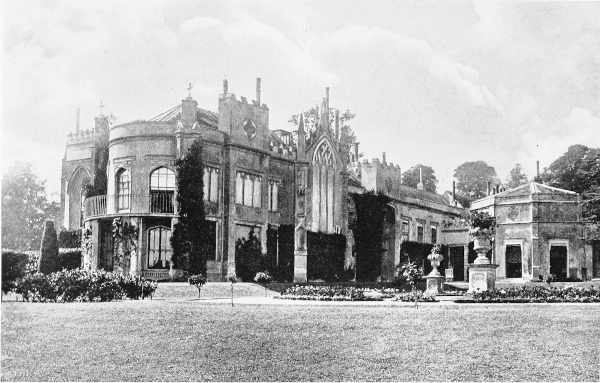
SANDLEFORD PRIORY.
A PARSON AND HIS WIFE
To the duchess Mrs. Montagu wrote in raptures of
the beauties of Sandleford, but in the middle of her
description states, “Here was I interrupted by a Parson,
his wife and daughter, and I shall not be reconciled to
‘Prunello and grogram’ again a great while, they robbed
me of those hours I could have dedicated to your grace.”
Prunello was the woollen stuff then used for clerical
gowns, grogram a coarse kind of taffety, a mixture of
silk and mohair, applicable to feminine attire.
Mrs. Botham writes on July 8, that as Mrs. Montagu
was unable, when her baby was born, to be applied
to, she had given him his father’s name, John. Lydia
Botham had two, if not three, daughters, but this was
her first son.
THE COUNTESS OF GRANVILLE
From Sandleford Mrs. Montagu returned to London,
intending to be inoculated, but in a letter of July 12 she
informs the duchess that Dr. Mead considered she had
better defer the operation till the heat of the summer
was over—in September. In the same letter she states
that Mrs. Medows and herself had called on the old
Countess of Granville,[278] who appears to have been a most
garrulous old lady, and Mrs. Montagu says—
“She fell with all her violence on my complexion, and
behold, she certainly by her description takes my forehead
to be tortoishell, my cheeks to be gold, my eyes
to be onyx, and my teeth amber: all these are precious
things, but Mr. Montagu not having so rich a fancy as
King Midas, I know not whether he would like such a
wife. Your Grace may believe I was extremely mortified.
The good woman says Mrs. Medows looks better
and younger for being married; but for me I am pale
and green, and describes me as worse than the apothecary
that lives about the rendezvous of death in Caius
Marius. She is of opinion that lying in has spoiled my
face; true it is I have furnished a noble pair of chops to
the little boy, and if mine are a little the lanker for it, I
scarce grudge it....”
Further on she says, “Thank you for your kind
inquiry after the young ‘Fidget,’ who loves laughing
and dancing, and is worthy of the Mother he sprang
from. As for Mrs. Donnellan, she is well. Mrs. Delany
is better than well.”
Mrs. Pendarves had been married on June 9 this
same year to the Rev. Dr. Patrick Delany,[279] afterwards
Dean of Down, and an intimate friend of Swift’s.
MONKEY ISLAND
The Montagus, accompanied by Sarah Robinson, now
moved with the child to Sandleford. A letter to the
Duchess of Portland of July 26 says—
“Sandleford, near Newbury.
“Madam,
“If I was as good a poet as Boileau[280] I would
complain of l’Embarras de Londres, and also of l’Embarras
de la Campagne, and of the still greater embarras of
travelling from one place to another. When I had the
happiness of your letter, I was so encompassed with
boxes, trunks and portmanteaus, and even that lesser
plague of band-boxes, that I could not give myself the
pleasure of writing to your Grace. Bag and baggage
we arrived here on Thursday night: first marched the
child crying, nurse singing, and the Abigails talking;
Mr. Montagu, my sister and myself brought up the
rear. We had fine weather and a pleasant journey.
We took a boat from the Inn of Maidenhead Bridge,
and rowed round his Grace of Marlborough’s Island.[281] I
had the pleasure of reflecting on the agreeable morning
I had spent there with you.”
Further in the letter she states the duke[282] had planted
some cannon on the borders.
“Mrs. Medows has promised to take the child while
I am sick,[283] and I am best satisfied that it will be with
her, for I am sure she will take care of it, and thank
God! it is a very strong healthy child; indeed were he
otherwise I should not leave him, for I think when they
are sickly, no one can be tender enough for them but a
parent.”
She says—
“Dr. Courayer dined with us the day before we
left town: he was more elated with having a letter
from you, than he had been dejected with the overthrow
of the French;[284] he looks well, and his mind is the seat
of tranquillity. Donnellan promises to come down here
soon. I hope she will stay till I go to London to be
inoculated.”
WOMAN’S EDUCATION
In alluding to a lady who had “excellent sense and
wit, but a want of softness in her manners,” she adds—
“This is of great consequence to a woman to keep
off disagreeable manners, for the world does not mind
our intrinsic worth so much as the fashion of us, and
will not easily forgive our not pleasing. The men suffer
for their levity in this case, for in a woman’s education
little but outward accomplishment is regarded. Some
of our sex have an affectation of goodness, others a
contempt of it from their education; but the many good
women there are in the world are merely so from nature,
and I think it is much to the credit and honour of
untaught human nature that women are so valuable for
their merit and sense. Sure the men are very imprudent
to endeavour to make fools of those to whom they so
much trust their honour and happiness and fortune, but
it is in the nature of mankind to hazard their peace to
secure power, and they know fools make the best slaves.”
A letter early in August to the duchess, who had
now returned to Bullstrode from Welbeck after visiting
Matlock, says—
“I was in hopes to have heard when you would come
to town. I wish you may come up to us soon after the
24th (August) of this month, which is the time I propose
for going to London for inoculation. I think there is no
danger of hot weather after the middle of September.
Dr. Mead says it is the best time for me....
“Matlock must be well worth seeing, we have nothing
here of the wild and uncultivated sort. I intend to go and
indulge Reveries at an old Castle[285] where Chaucer made
his fairies gambol, with as much grace and prettiness as
the Muses of old on the hill of Parnassus. The Castle
is on a rising just above Newbury, and commands a
pretty view of the country. The prospect is of sufficient
extent to let the poetick fancy soar at pleasure among
the beauties of Nature. Pray where is ‘Pen,’[286] will she
produce a sprig of bays? it must be a little Master
Apollo or a Miss Minerva from parents of such art and
science. I have sent your Grace a copy of a letter Lord
Orford[287] sent to General Churchill,[288] if ever he was to
be envy’d it was when he wrote that letter: it seems
to come from a mind pleased with everything about it,
and easy in itself, amidst the refinement of luxury and
expense, without the madness of intemperance, or inconveniences
of prodigality.”
LORD ORFORD’S LETTER
The end of this letter is missing. Lord Orford’s
letter, written in an unknown hand, is thus:—
“Houghton, June 24, 1743.
“Dear Charles,
“(Lord Orford’s letter to General Churchill.)
“This place affords no news, no subject of
entertainment for fine men. Men of Wit and Pleasure
about Town understand not the charms of the inanimate
world: my Flatterers here are Mutes: the Oaks, the
Brookes, the Chestnuts seem to contend which shall
best please the Lord of the Mannour; they cannot
deceive, they will not Lye. I in sincerity admire them
and have as many Beauties about me as fill up all
my hours of dangling, and no disgrace attends me from
67 years of age. Within doors we come a little nearer
to real Life, and admire upon the almost speaking
canvass all the airs and graces which the proudest of
Town ladies can boast, with these I am satisfied, because
they gratifie me with all I wish, and all I want, and
expect nothing in return, which I cannot give. If these,
Dear Charles, are any Temptation, I heartily invite you
to come and partake of them. Shifting the scene sometimes
has its recommendation, and from Country Fare
you may possibly return with a keener appetite to the
more delicate Entertainments of a refined life.
“I am, dear Charles, etc.,
“Orford.
“P.S.—Since I wrote the above we have been surprised
with good news from abroad. Too much cannot
be said about it, for it is truly matter of infinite Joy, as
it is of Infinite Consequence.”
Lord Orford is here alluding to the battle of
Dettingen.
THE DUCHESS OF MARLBOROUGH
The duchess, in a letter of August 26 from Bullstrode,
says, “Thanks for Sir Robert’s letter, I had never seen
it.” In alluding to the tiresome etiquette and interference
she suffered from at Welbeck under Lady Oxford’s
despotic rule, she says—
“I please myself that my children will love me
better, as my covetousness will not be obliged ’em to
pay me court, and as I shall have no suspicion of their
duty, but be convinced that their motives proceed from
disinterested love, and by that means we shall each of us
be happy. Was the Duchess of Marlborough[289] possessed
by one good quality? I should think she deserved pity
more than the poorest creature in the street, not to have
one child, but what wishes her dead, nor capable of
knowing the enjoyments of friendship.... We propose
being in London Monday sennight.”
On Thursday, August 25, Mrs. Montagu took a
sad leave of her little boy, and started on her journey
to London, sleeping at Windsor, at the house of her
sister-in-law, Mrs. Medows. Mr. Montagu remained
with the child till the time his wife should be inoculated,
when he was to join her in London, and Mrs. Medows
was to take charge of him. Sarah joined her sister in
London; it will be remembered she had had the disorder.
PREPARATION FOR INOCULATION
As inoculation is now out of date, I shall extract
from the various letters the mode of procedure. Arrived
in Dover Street, Mrs. Montagu is told by Elias, the
duchess’s porter (then a most important domestic
magnate), his mistress was coming to London on
Monday. She therefore writes to beg the duchess, the
duke, and Mr. Achard to dine with her that day “at 4
or 5 according to their convenience.” Business, however,
prevented the duchess leaving Bullstrode for a
week, but she is reinvited, as Dr. Mead says Mrs.
Montagu will not be infectious till the disease appears.
Meanwhile, in preparation for the dreaded operation,
she was “dosed, then blooded, another dose or two of
physick is all I shall want, and then proceed to meet
that distemper I have been running from these four and
twenty years: it is at present my misfortune the smallpox
is so little stirring they cannot find a subject.” She
writes to the duchess also in another letter, “Though
Dr. Mead, Dr. Cotes, Mr. Hawkins, and the subaltern of
the Physical faculty, the Apothecary, have been smallpox-hunting
this week, they have not procured a subject
for me.” She urges the duchess to dine, “as I shall be
as well till 7 or 9 days after the operation as ever I was
in my life.”
The duchess had been out of order with hysterical
fits, and states she was ordered to drive in a chaise. Of
this vehicle we gain a glimpse from this allusion of
Mrs. Montagu’s in answer to the duchess, “A chaise is
health, spirits and speed, a lady must lay aside her
hoop, her laziness and pride, before she is diminutive
enough for a chaise.” A portion of a very beautiful
letter, written by Mrs. Montagu to her husband before
he joins her, I copy—
“Dover Street, Tuesday, August 30.
“My Dearest,
“The happiest moments I have spent since I
parted from you, were those I employed in reading your
letter: accept the sincerest thanks a grateful and tender
heart can make to the most kind and generous love.
While Heaven shall lend me life, I will dedicate it to
your service, and I hope our tender engagements shall
not be broke by the cruel hand of fate. Notwithstanding
the distemper I am going into, I have great hopes of
my life, and a certainty of my love to you as long as that
life shall last. Your kind behaviour and conversation
has made my Being of such value to me that I am taking
the best means to preserve and secure it from hazards,
but let not the experiment cost you an anxious thought.
It would be a reproach to the laws of Nature, if one as
virtuous as you are, should not be sure to be happy. I
trust you shall ever be so independent of a weak woman,
who can serve you in nothing but wishes: could I reflect
back the happiness I receive from you, I should tremble
at my own importance to think of sinking from happiness
to insensibility, and nothing might overcome my little
courage, but to imagine I left you a portion of sorrow
and regret as a burthen on all your years to come, would
not only afflict but even distract me.”
THE REV. CHRISTOPHER DONNELLAN
The same day that she wrote this letter to her
husband, she writes a note to Mrs. Donnellan, who
had joined her brother, the Rev. Christopher Donnellan,
at Tunbridge Wells. He, having been ordered to drink
the waters, and having crossed from Ireland for that
purpose, Mrs. Montagu says, “Does not your brother
think he is in Babel? How does he like English
women with French dresses and French manners? In
short, what does grave good sense think of Tunbridge?”
By Mr. Montagu’s desire, Dr. Sandys was added to
the previous M.D.’s. A day or two after this Mr. Montagu
joined her, and she was inoculated on September 3.
WHEATEARS —
ARMY DISCIPLINE
On September 7 Mrs. Montagu writes to Mrs.
Donnellan—
“My very dear Friend,
“As the time that passes between the expectation
of a matter of importance and its happening is not
a time of the greatest pleasure and tranquillity, you will
be glad to hear it is four days since I was inoculated. I
am still well and in perfect good spirits: it would be a
sign of levity as I should be sorry and ashamed to find
in myself to be disturbed at the approach of a distemper
I have been seeking. The Duchess of Portland spent
the day with me on Monday, and was here again with
Lady Wallingford yesterday, and I expect her Grace this
afternoon. In the meantime I hope to hear from you,
and my sister will give you intelligence of me. Dr.
Mead and Dr. Cotes attend me; I have given them on
their prescribing two guineas apiece, but I am told when
Dr. Mead attends constantly, one guinea a day will be
enough, if he comes only once a day, but I wish you
would be so kind as to enquire and let me know when
you write to me; and I will beg you to order your maid
to buy 2 Dozen Wheatears[290] and send them by the Haye
Coach. Mr. Montagu never saw any, so if you please
to tell your servant to send them with the feathers on.
“I am extremely glad to hear Mr. Donnellan finds
benefit by the waters. Your family in Town flourishes
much,[291] Mr. Percival is a young beau, Mrs. Percival has
grown almost a toast, and for Mrs. Shuttleworth,[292] she is
a perfect beauty, she has a bloom like fifteen; I never
saw anyone look so fresh and jolly.
“The town is full of reports of the discontent of the
Army, it is almost feared the English and H(anoverian)s
should fall upon each other. A gun going off while the
Captain was at dinner, he bade General Honeywood go
and see what was the matter; the General brought word
it was nothing, upon which the great Captain sent a
H(anoveria)n officer, who brought word it was the musket
of a soldier upon guard; the Captain then cry’d he could
have no truth from the E(nglis)h and that the E(nglis)h
had no discipline: the D(uk)e of M(arlboroug)h said
they had as much discipline as the H(anoverian)s, for
that coming by their quarters, a ball went under his
horse’s legs.
“Mr. Hawkins[293] comes every day to dress my arms,
though the wounds given for the inoculation are very
trifling, he does not think from the appearance of them
I shall be ill yet. I shall be glad when the proper
period for it arrives, but must wait with patience; it is
said people do not know themselves, but by the little
anxiety I have about myself, one would imagine I knew
myself to be of as small consequence as I really am....
My dear little Babe is perfectly well....”
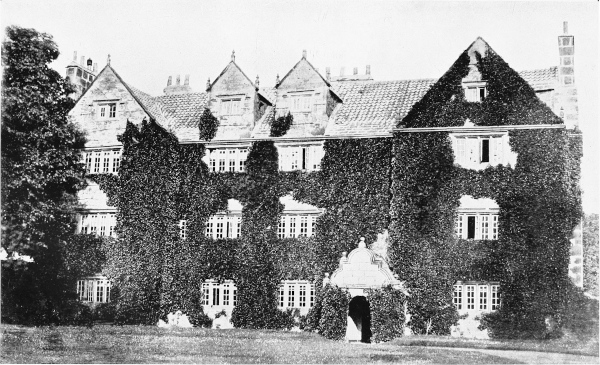
DENTON HALL.
PHYSICIANS’ FEES
To this I subjoin a portion of Mrs. Donnellan’s
answer from Tunbridge Wells—
“I received your comfortable letter, writ with the
spirit of a Christian, a Philosopher and a woman of true
fortitude. Since you don’t expect any appearance yet,
I may venture to write, or if you should not be quite
well, my letter is of no consequence, and may be thrown
by. I will allow all your reasoning for yourself to be
very good, and will not dispute with you now, whether
you are of consequence to the world or not, I will only
beg you to act as if you were, and take care of yourself
for the sake of the few, and let the world come in for its
share of you by an by. I am of opinion one guinea a
day is sufficient from a private gentle woman to any
Physician in England, if he makes but one visit. I know
all our family, and greater than us never gave more
either to Hollins or Willmot; indeed if they prescribe
twice they must be paid twice, but that I hope and
believe will not be your case. I am not acquainted with
anyone who makes use of Dr. Mead, but I suppose he is
fee’d like other Physicians of note, and I think raising
these sort of things on one another when they are already
high enough by conscience is wrong....
“Our company quits us apace, but as there is not
one body but Lady Sunderland[294] and Miss Sutton and
Lady Catherine Hanmer that I care particularly for, and
they stay, I am quite easy about the matter. I generally
take a rural walk with my maid and man, and I am just
returned from the Rocks, whose natural beauties strike
me more agreeably than the laboured work of a palace.
My brother rides every day, but walking does not agree
with him.... No one here cares for a walk that carries
them further than Tod’s Room or Chenevix’s Shop.[295] In
the evening I conform with the world, and play at Whisk,
Roli Poli, or what they will, and make them wonder that
a person who has a guinea in their pockets and can perform
at such entertainments, should prefer wandering
in fields and woods with company little better than the
creatures that inhabit them.”
On September 12 Mrs. Montagu writes to the duchess,
who had returned to Bullstrode, to say Mr. Hawkins
did not believe, from the appearance of her arms, she
would have the smallpox. Dr. Mead and Dr. Cotes had
attended the day before, expecting to find inflammation,
but the wounds appeared healed. From this it appears
the surgeon attended the wounds daily, and doctors
occasionally. The very next day (September 13) Mr.
Hawkins pronounced there was no longer a chance of
the smallpox.
Mrs. Montagu writes to the duchess, “As Anacreon
who swallowed many a hogshead of the juice of the
grape was at last killed with a little grape stone, I who
have missed the dire disease, am grumbling with the
toothache.”
POPE’S GROTTO
The duchess writes to Mrs. Montagu to beg her to
think that though the smallpox has not appeared, she
is as much secured as if it had. On September 15,
as a wind-up to the inoculation, Mrs. Montagu “was
blooded.”
“On Saturday we went to see Mr. Pope’s[296] garden
and grotto, to Hampton Court and Bushey Park,” she
writes to the duchess; and on Wednesday she was intending
to pay a visit to her parents at Mount Morris,
Kent, before returning to her child, for whom, she says,
“her heart sickens.” On October 8 she proceeded to
Sandleford, leaving Mr. Montagu, who had business, to
follow in a few days; and she writes to the duchess from
the inn at Maidenhead Bridge. In this letter she says
she has great difficulty in “squeezing the cotton in the
ink bottle which I am forced to do before each word,
and as my pen is as prodigal of ink, as the bottle is
sparing of it, after I have been half an hour replenishing
my pen, one inconsiderate blot squanders it away.”
This alludes to the strange habit of having cotton placed
in the inn inkstand, under the delusion that it made
it last longer. The whole writing of the letter is thick
and blotted. She also mentions, “My sister set out for
Bath this morning, with Mrs. Cotes. Poor madam Sally’s
stomach is greatly out of order, and her nerves are
often affected, but I hope the waters will do her good.”
A HIGHWAYMAN
Mrs. Cotes was the doctor’s wife, and a sister of Lord
Irwin, a great friend of Sally’s, very small in stature and
pretty, familiarly called “the little Madam.” The two
ladies, accompanied by Mrs. Cotes’ footman, set out for
Bath, diverging from Newbury for a night at Sandleford
to see “Punch.” A passage from a letter of Sarah’s will
show the perils of the road. They travelled in a post-chaise—
“A man set out with us from London, and kept us
company about seven miles. He often asked the footman
who we were, and whether we were going over
Hounslow Heath; to the last he made no answer, but
after being tired with his curiosity told him we were
only ladies’ maids, upon which he forsook us, either
being too proud to accompany abigails, or supposing
we had not money enough to make it worth his while
to go on to Hounslow Heath with us. We had one
post-boy that pleased us extremely, he sung all the
way, our pleasure did not arise from any music in his
voice, but from seeing him so happy, and admiring the
power of a contented spirit, that could make a person so
joyful, that was at the caprice of any one, without any
greater advantage than a shilling’s reward, and who is
always to be jolted almost to death, by the only creatures
that are beneath him.”
Almost shaken to pieces, they arrived at their
lodgings at Mrs. Elliot’s, in the Orange Grove, Bath.
Sarah describes the rooms as small, but comfortable,
“looking down Wade’s Passage and into the coffee-house,
which is a guard to the windows, and very
often prevents their approach.” She grumbles at the
expense of their journey, but says provisions are cheap,
fowls one shilling each.
Jenny, her maid, had travelled by coach, a post-chaise
of that time only holding two people. Here is a passage
worthy of Fielding, “Jenny travelled down unspotted
and pure with the old parson, who gave her no comfort,
but one spiritual kiss upon getting to the end of their
journey.”
DANGERS OF A POST-CHAISE
Both Mrs. Cotes and Sarah suffered from the hardness
of the post-chaise, and Sarah also hints that other
visible effects had been incurred which would last for
days; hence fleas, if not worse, must have existed in it!
Mrs. Montagu, in writing to condole with them, says,
“It is a daring mind that ventures in a post-chaise.
I wonder the partizans of these vehicles do not establish
a broad bottom, and a competent share of cushion.”
The vehicle was, from what I make out, a two-wheeled
chaise. Mrs. Cotes’ footman had been directed to call,
on his way back to London, on Mrs. Montagu. The
style of speech of a servant of this period is shown in
this passage—
“Mrs. Cotes’ man called very civilly, and brought
me your last letter. ‘Pray, Mr. Thomas,’ says I, ‘did you
leave the ladies well?’ ‘Yes, and very merry, Madam.’
‘They had a good journey, I hope?’ ‘Yes, a very merry,
Madam.’ ‘They were not at all afraid?’ ‘No, nothing
but very merry, Madam.’ ‘Were they not tired when
they came to their inns?’ ‘No, always very merry,
Madam!’ At last Thomas’s account made me ‘so merry,
Madam,’ I was forced to retire to laugh.
“Your nephew gets his share of sunshine every day,
his teeth tease him and produce the dew of sorrow on
his little cheeks sometimes, but in a moment it is forgotten,
and he is always lively, and in continual health:
he is thought to grow like his mother, so I think I may
cease to be handsome with a good grace, as I have transferred
it to my offspring.... Your nephew is in his birthday
suit, laughing so I can hear him through the doors;
the usurpation and authority of those bandages called
garments he is too full of Whig principles to approve
of!”
“PUNCH’S” CHARIOT
There were no babies’ carriages in those days, so
little Punch drove out daily in the chariot, not to be
confounded with the coach, a much larger vehicle.
In the same letter it appears that the good old Yorkshire
steward, Mr. Carter, had had a bad fall, and the
house in Dover Street not being large enough, Morris
Robinson was trying to secure them one in Bruton
Street. Mrs. Montagu, having suffered from weakness
and hysterical fits, was recommended to ride daily—a
pastime which was agreeably varied by the cutting of
new walks through the Sandleford woods, and the continual
amusement afforded to her and Mr. Montagu
by the contemplation of their child’s too precocious
ways.
A few details of life at Bath may prove amusing.
Sarah writes to her sister that the waters agree very
well with her, but that people are amazed at her walking
between each glass. She had found a companion in
Mrs. Wadman, Lord Windsor’s sister, whom she had
met at the pump-room, as they drank the waters about
the same time, and both were fond of walking.
The Rev. W. Freind and his wife were at Bath, and
Sarah goes to hear him preach a charity sermon,
“the best I ever heard. I am going to dress to the best
of my skill and power for the sake of his Majesty, this
is kept as his birthday, and there is to be a ball and
supper to-night, the men have subscribed on purpose.
Mr. Simon Adolphus Sloper[297] is to be my partner, and
has sent me his tickets, which will carry in Mrs. Freind
also. Mrs. Cotes’ cold is too bad to go.... The Archbishop[298]
is much censured for going away so soon, he
has not tried the waters long enough to know whether
they would be of any use to such an extream case as
his.... Mrs. Potter would let her husband see nobody
but herself, and took his duty of preaching upon
herself; she tempered it with a comfortable compliance,
and when he used to say ‘I am sure I shall dye,
I wish it might be at home,’ ‘To be sure, my dear,’
answers the good wife, ‘it is proper you should dye
where you like, if you chuse it you shall go and dye at
Lambeth.’ ...”
A BATH BALL
At one of the balls Sarah did not dance, but she
said she did not regret it, “having no inclination to
dance with any man but Mr. Pitt,[299] and that I have not
acquaintance enough with him to expect, I can only
cherish my hopes of future good fortune.” At another
ball she dances with Mr. Vanburgh, “a very pretty sort
of man, but our affections to him are quite Platonic, as
he is in love with the youngest Miss Nash.” This must
have been the sister or daughter of Mr. Richard Nash[300]
(“Beau Nash”), the despotic Master of the Ceremonies at
Bath. He was not well at this time, and Mrs. Montagu
sends her kind regards and condolences on his health.
Amongst other people mentioned at Bath by Sarah
were the Duke of Hamilton, Lord Berkeley, Mr.
Powlett, and Mr. Bathurst, son of Lady Selina, the
two Offleys, Mr. Greville, and Lord Robert Carr, said
to be very handsome.
“Last night in the middle of the dancing we drank tea
with a gentleman who had invited about twenty of us
some days before. They give tea now almost as much
of common days as they used to do on Sundays.”
Sarah says she is going to play shuttlecock with a
Mr. Amiens,[301] at the end of this letter; and in the next
she states—
“I played at Shuttlecock about half an hour, there
were five couple of us: in truth I played so much better
than any in the room, I put them all in amazement, but
it was rather owing to their bad play, and to my being
matched with the two men that played the best, than my
superior skill.... In my last I mentioned I was going
to the ball: there was a table of sweetmeats, jellies,
wine, Biskets, cold Ham and Turkey set behind two
Screens, which at 9 o’clock were taken away, and the
table discovered.... Above stairs there was a hot
supper for all that would take the trouble to go up.”
“MATHEMATICAL INSTERATION!”
The ignorance of some ladies of this period is shown
by Sarah in the following extract:—
“A lady told us last night that Miss Molyneux is so
great a Mathematician that she can inster Greek, and that
often a dozen of the most learned men of the Kingdom
had puzzled their wise heads about a piece of Greek,
and could make nothing of it; they proposed to send
it to Miss Molyneux, and she instered it (alias construed
it), and returned them her insteration!”
Whilst Sarah was at Bath, Mrs. Montagu wrote
frequently to her mother at Mount Morris, much,
naturally enough, about her child, about whom the
fond grandmother was never tired of hearing. A little
sentence gives a clue to his looks, “If my Father has
drawn a blue-eyed simpering Cherubim, you may fancy
him not unlike your grandchild; the child’s eyelashes
are black and long, and he has a laughing look in his
eyes, blue, like my Father.” He was still toothless, and
suffered much with his gums, which made his mother
already uneasy. Mr. Montagu had just taken some
prodigious sized carp from a fish-pond at Sandleford,
and was throwing three of the old monks’ ponds, or fish
stews, into one large one.
Mrs. Donnellan writes from Bullstrode on October 21,
and says her brother is now going to Bath, where he
will stay with their relations the Mountraths,[302] and that
Sarah Robinson, “if she meets him she must make the
advances, all the young ladies do, as he is a grave, stiff
Parson.” Dr. Young and Lady Peterborough[303] were at
Bullstrode when she wrote.
MIDGHAM
In a letter to the duchess of October 25, Mrs.
Montagu describes the gardens at Midgham, the seat of
Mr. Poyntz,[304] near Aldermaston,
“to which Mr. Montagu carried me last week, I had
no small expectations of them, both from report and
the known sense and genius of the owner.... Over
the door of a little grotto he declares for retirement
in open fields, caves and dens, with living waters and
woods. Statues of the Muses adorn his walls, their
Arts adorn his mind and inspire him with the elegant
ingenious gratitude that gives this public demonstration
of honour to them. Every venerable oak has a seat
under it from whence he takes the sacred oracles of
meditation.... The gardens are of uneven ground,
prettily diversified with hills and valleys. There is a
fine bason before the house, that is always well supplied
with water, and inhabited by fish.... I did not see
Mr. Poyntz’s house, as it is not anything extraordinary,
it would have been an impertinent curiosity to desire
it, as they visit here when in the country.”
Mrs. Donnellan writes for the duchess as well as
herself in reply, Lady Oxford being there, and all the
usual writing-hours given up to playing Pope Joan with
her. In this letter, alluding to “Punch” watching with
pleasure the colour of his bed-curtains, she says,
“Master Wesley,[305] who is the most extraordinary child
for sense I ever knew, at three months old, used to be
put in a good humour with a suit of tawdry Tapestry
hangings.”
The Duke of Portland had the misfortune to break
his arm at the end of November, just as the Rev. Dr.
and Mrs. Delany had arrived for their first visit since
their marriage on June 9.
A FOOTPAD
In writing to condole with the duchess, a typical story
of a footpad is given by Mrs. Montagu. The duchess
had just set up keeping bees at Bullstrode, and Mrs.
Montagu intended to do the same, but laments she cannot
“have anything of a menagerie[306] here, there is no
trusting anything out of doors. The town of Newbury
is a melancholy example of the decay of trade,
there is misery and poverty and lawless necessity in
an unhappy abundance. We have robbing upon the
commons here very frequently: a poor labourer who
has been digging in our garden last week was very
oddly preserved from a wound by a Buckler made of
Cheese, like Sardella in ‘The Rehearsal.’ The poor
man had five shillings in his pocket, when he was
stopped by a footpad. He did not care to surrender
his wealth, and so resisted; another robber came to his
comrade’s assistance, and stuck a knife several inches
deep into some cheese and bread he had over his
bosom, in a wallet betwixt his coat and waistcoat. We
had a highwayman taken by a French dancing master
a little while ago. When the dancing master carried
him before the Justice of Peace, the Justice asked what
day of the month he was robbed? ‘Ah,’ says the
dancing master, ‘me can no tell dat,’ but turns to
the highwayman, ‘but you do know, I pray tell Monsieur,
for you must know what day you did rob, and I
pray you now be so civil as tell de gentleman,’ which, as
the highwayman denied the fact of the robbery, was as
good a blunder as one could desire. The highwayman
has since cut his throat, but is likely to recover, only to
try the hempen collar.”
Mr. Montagu had started that morning (December 1)
for the meeting of Parliament, Mrs. Montagu accompanying
him “halfway to Reading.”
THE MINISTRY
A letter of December 3 of Mr. Montagu’s shows the
state of politics in the House—
“I have been making what enquiry j could about the
state of public affairs, and can learn nothing that is
agreeable to one who loves Great Britain, and is more
concerned for his country than the fatal E(lecto)r of
H(anove)r. For though the ministry have been at
variance about some of the treaties mentioned in the
Speech and in the Privy Council, they came to Division,
where Lord Carteret and his friends were only four,
and the opposers, j, amongst whom were Mr. Pelham and
Lord Chancellor and others, still matters have since
been so far made up amongst them that it is said they
all agreed (by the mediation of Lord Orford) in the
speech and address, which is reckoned to be Lord
Carteret’s, and after a division in our House, the address
was carried by a considerable majority, the yeas being
278 against 149 noes. Mr. Pitt exerted himself against
the address with his usual eloquence and with great
acrimony against a Minister whom j need not name,
after j shall tell you that in his invective he said what
he meant was not against the Ministry, but against one
who was a Minister, and had renounced Great Britain,
who had eat of a certain tree that the Poet tells us
makes People forget everything, even their country,
but he hoped the people would never taste of the fruit
of the same tree, nor after his example forget their
country.... Mr. Pelham is to be Chancellor of the
Exchequer, Sandys Pay Master of the Army. The
Duke of Marlborough[307] has resigned.”
POPE’S “DUNCIAD”
A letter of December 4 of Mrs. Montagu to the
duchess makes the following comments on the new
edition of Pope’s “Dunciad,”[308] to which he had just
added a fourth book:—
“We got Mr. Pope’s new Dunciad printed, but I
think it differs little from the old one: the new Hero[309]
is certainly worthy to have the precedency over all
foolish Poets. I like the last Dunciad for exposing
more sorts of follies than the first did, which was
merely upon bad poets and bad criticks. I am always
glad when I see those fops who have translated their
manners and language into French foppery well ridiculed
for the absurd metamorphosis, to ridicule wrong
placed pride is of great service, for if it was not done
this land would be over-run with conceit, for here
people are proud of their vices and follies and iniquity,
and as long as Pride arises from such Stocks, we shall
never want an increase of it. Milton says, ‘Nought
profits more than self-esteem right placed,’ and surely
it is true of that pride that makes us disdain vice, but
that which makes people glory in it is as pernicious.
The British vice of gluttony is openly professed so
much, one can hardly dine at a fashionable table where
eating is not the discourse the whole time, and treated
of as an affair of the utmost consequence.”
MRS. POCOCK
In a letter of December 8, after congratulating the
duchess on the duke’s recovery from his broken arm,
Mrs. Montagu adds this description of the learned Mrs.
Pocock;[310] it is interesting, in contrast with that of the
lady who insters Greek!—
“I have been petrifying my brain over a most solid
and ponderous performance of a woman in this neighbourhood;
having always a love to see Phœbus in
petticoats, I borrowed a book written by an ancient
gentlewoman skilled in Latin, dipped in Greek and
absorbed in Hebrew, besides a modern gift of tongues.
By this learned person’s instruction was Dr. Pococke[311]
(her son) skilled in antique lore while other people
are learning to spell monosyllables, but Hebrew being
the mother tongue, you know it is no wonder he learnt
it. His gingerbread was marked with Greek characters,
and his bread and butter instead of glass windows was
printed with Arabick, he had a mummy for his jointed
baby, and a little pyramid for his playhouse. Mrs.
Pocock lives in a village[312] very near us, but has not
visited here, so I have not had an opportunity to
observe her conversation, but really I believe she is a
good woman, though but an indifferent Author. She
amuses herself in the country so as to be cheerful
and sociable at three score, is always employed either
reading, working or walking, and I don’t hear she is
pedantic.... She always carries a Greek or Hebrew
Bible to Church.... I desire your Grace to make ten
thousand apologies for me to Mrs. Delany if it is true
I have robbed her of a good name, but I hope you
only said this to put me in terrors. I desire my best
compliments to her, Dr. Delany, to whom I wish very
well, though I have offered the shadow of a great
injury in seeming to deprive them of each other.”
This was caused by Mrs. Montagu, in a fit of
absence, having addressed a congratulatory letter to
Mrs. Delany as Mrs. Pendarves, her former name, which
caused much mirth in the Bullstrode circle.
Mr. Montagu writes on December 8—
“We had yesterday a motion of consequence in the
House, which was to have an humble address presented
to his Majesty to forthwith dismiss the Hanoverians in
the British pay, which occasioned a fine debate, and was
carried in the negative by a majority of 50, the numbers
being 181 against 131. The same is to come on tomorrow
before the House of Lords, and Lord Sandwich
is to begin, which j doubt not he will do in the best
manner.”
Dr. Freind, who, with his wife, was invited to spend
Christmas at Sandleford, playfully bids Mrs. Montagu
to write him a sermon to preach before the King, as he
will have to do in a few weeks.
The year ends with Sarah and Morris Robinson and
the Freinds staying at Sandleford.
1744
The first letter of interest in 1744 is one from Mr.
Montagu to his wife, written February 23, from London,
whither he had returned for the meeting of Parliament.
SUGAR TAX
After alluding to parliamentary debates and elections,
and to the failure of the new tax proposed upon sugar,
“which was carried in the negative by a majority of 8
only, to the great joy of those concerned in the Sugar
Colonies, and the duty is to be raised on the surplusage
of the tax which was given upon spirituous liquors[313] last
year,” he says—
“The danger of the Pretender, if we may believe our
wise and vigilant ministers, is not yet blown over. It is
said that a few days ago several French men of war
were seen off Rye and that the Pretender’s Eldest Son
has been seen walking about publickly at Calais, and is
styled Charles the 3rd, his Father having relinquished
his rights in his favour; but people seem to be little
affected with any apprehensions of danger, and what
the designs of the French were, a little time will discover;
whatever they shall prove to have been j am
heartily sorry for the alarm, and whatever ground or
no ground there has been for the rumour of an invasion,
j am afraid it will be made use of as a pretence for a
further plundering of us, and invasion of our pockets,
for j cannot forget what j have heard before j sat in the
House, that a member (I think his name was Hungerford)
should say the Pretender was the best wooden
leg a ministry ever had to beg with, and perhaps the
present may have as much inclination to make use of
it as ever any of their worthy predecessors had.”
THE PRETENDER —
SIR JOHN NORRIS
On February 25 Mr. Montagu writes—
“Since my last the King has sent another message to
the House with some intelligencies concerning the invasion
and the French King’s[314] answer to Mr. Thompson,[315]
our agent in Paris in relation to the removal of the Pretender’s
Son out of France, in pursuance of treaties which
in substance is as follows, viz.:—‘That engagements
entered into by treaties are not binding any further
than those treaties are religiously observed by the contracting
parties on all sides. That when the King of
England shall have caused satisfaction to be given on
the repeated complaints that have been made to him of
the infractions of these very treaties of which he now
demands the performance, which violations were committed
by his orders, his Most Christian Majesty will
then explain himself upon the demands now made by
Mr. Thompson in the name of his Majesty.’ Besides
this there was a long affidavit of a Master of the packet
boat read, letting us know that he saw a young man
who was called the Chevalier, and said to be the Pretender’s
Eldest Son, with another young man, his brother,
that there was arrived there Count Saxe,[316] who was to
bring over here in transports, 1500 men, together with
several particulars too long to be inserted here....
The House addressed his Majesty to augment his forces
both by sea and land as much as be necessary, and that
they would defray the expense.
“An express arrived yesterday that Sir John Norris[317]
with his squadron was in sight of the French fleet, that
he stood off Romney, and they were at Dengeness, that
he weighed anchor and would endeavour to come up
with them, and bring them to an engagement if possible.
It was this morning reported he had demolished them,
but this wants confirmation, as well as the news of
Admiral Matthew’s[318] having beat the Toulon fleet,[319] with
which there has been an engagement.”
Mrs. Montagu and her sister now joined Mr. Montagu
in Dover Street, leaving little “Punch” at Sandleford
with regret. On the way their coachman, who had met
them at Hounslow with their own chaise, ran a race
with a coach and four, and overturned them, but they
were none the worse; in fact, being upset in a carriage
in those days seems to have been little thought of!
A letter of March 4 of Mrs. Robinson from Mount
Morris says—
“Sir John Norris is returned into the Downs, and
all our fears are over. I heard that the people of
Romney and Lydd had their most valuable goods packed
up and put in carts ready to drive away, if they saw any
occasion: for my part I was very composed, never thinking
there would be any occasion to put myself in a stickle....
I am so good a subject to his Majesty that I can’t
conceive any people would be so foolish to assist France
with setting up a Popish Pretender.”
A letter from the duchess states that she has been
reading Lord Bolingbroke’s “Dissertations upon
Partys,” and desires Mrs. Montagu’s opinion on them.
She laughs at the idea of the invasion, and says,
“Cecil, the Pretender’s agent, is taken up, and likewise
Carle, and some say Lord Weims,[320] others his second
son Charles.”
SIR SEPTIMUS ROBINSON
In a letter to Mr. Freind, Mrs. Montagu mentions
meeting at a drum of Mrs. Mainwaring’s “My cousin
Septimus Robinson, dressed as gay as a lover, but
whether that was the footing he was upon, I do not
know.”
Septimus Robinson was a brother of Mrs. Freind,
and, as his name denotes, was the seventh child of
William Robinson of Rokeby. He was born in 1710, was
educated at Oxford, then entered the army, and served
in the ’45, under General Wade. He left the army in
1754; became Governor to the Dukes of Gloucester and
Cumberland, brothers of George III., and eventually was
made Usher of the Black Rod. He died unmarried in
1765.
In the same letter she states—
“Lestock and Matthews are now examined before
the Parliament as to their conduct in the Mediterranean.
It is said by some who have read it Thompson’s[321]
new play is equal to [322]Otway’s Orphan and Rowe’s[323] Fair
Penitent.”
She adds—
“In the morning all throng to the Senate House, and
at night to the playhouse;[324] those who bewail the poverty
of the nation in the morning, part with gold for two hours’
entertainment at the Oratorio at night. Those who talk
of taxation, did they but see how full of powder, and
how empty of thought the heads of the Hydra appear
to be, they would fear nothing from so spruce a set of
Senators. I think the town was never so gay or so fond
of amusements.”
On March 31, 1744, the Duke of Portland wrote to
announce the birth of his second son, Lord Edward,[325]
saying—
“I should be wanting in regard to the long friendship
which has existed between you and my wife, were I not
to give you the earliest notice of your friend: she was
safely brought to bed of a boy this morning, at three
quarters after 3. She and the child are as well as can
be expected.”
“HIDE” PARK
The Montagus now returned to Sandleford to visit
their child, leaving Sarah in Dover Street to await her
father’s arrival from Kent to fetch her. A passage in the
following letter throws a light on the vehicles in use at
this period:—
“Passing through Hide Park,[326] we saw capering
horses with creatures on their backs more whimsical
than themselves.... Between London and Kensington
were many pert folk in single Horse Chairs, who
seemed proud of the government of the humblest
machine, saving a wheelbarrow, that ever the art of
man contrived: one of these chaises had like to have
suffered by contending with his Grace’s coach and six.
Towards Uxbridge we met a leathern vehicle called a
flying coach, a most intolerable counterfeit, for in fact it
merely crawls. We passed two or three travelling
waggons laden with many a ton of Humanity, the
savour of which would have made the delicate nostril a
misanthrope.... Our dear little fellow is all alive and
merry, and more grown in length than breadth.”
A DOMESTIC COMEDIAN!
Dr. Freind, now made a Prebendary of Westminster,
in addition to his living at Witney, in this year sent a
present of Witney blankets to Mrs. Montagu and a
Witney rug to Sarah Robinson. On April 8 Mrs.
Montagu writes to thank him, and says—
“Your kind present is significant of the warmth of a
friend. I think there is great analogy between friendship
and a blanket. We have been here (Sandleford)
almost a fortnight, much diverted with the humours of
‘Punch,’ who grows a merry fellow. I like my little
comedian so well, I shall be sorry to change him for the
great comedians; my little actor has no artifice but hide
and seek, nor plays any tricks but innocent Bopeep.
“I hope now Lord Carteret is going to take a
young, handsome Lady[327] his politicks will take a milder
tone....
“Have you seen Dr. Gregory and his bride? When
I saw the Doctor at Mrs. Knight’s, I did not apprehend
he designed to be our dear cousin.”
This is the first mention of Dr. John Gregory, afterwards
such an intimate friend of the Montagus. He
was the son of Dr. James Gregory, an eminent
physician, by his second marriage with Anne Chalmers,
and grandson of James Gregory, who invented the
Gregorian telescope. His bride, who, judging from the
above, must have been a cousin of the Robinsons, was
Elizabeth,[328] daughter of William, 13th Baron Forbes,
by his wife Dorothy Dale. Lady Forbes lost £20,000
in the South Sea bubble. Dr. John Gregory[329] became
a distinguished physician, and an author of note.
Frequent mention of him will be made later on.
In the same letter Mrs. Montagu urges Dr. Freind
to write and congratulate the duchess on her second
son’s birth. The Freinds had just commenced a friendship
with the Portlands.
GOWNS
Mrs. Robinson asks her daughter, who had now
returned to London, to buy her a lutestring gown,
“but as I have a tabby of a dark brown, I would have
my lutestring pretty light.” This gown, from a further
letter, appears to have cost 6s. 9d. a yard, and Mrs.
Montagu suggests she should buy a French trimming
of Mademoiselle for the same, “a slight pretty thing
for a guinea.” A capucin Mrs. Robinson had ordered;
she says, “I like my capucin much better than that
which was shorter, and it is quite good enough for
the use one makes of them.” Probably a hood with
a deep cape, as in a previous letter the garment is
described as “always ugly, but useful.”
Mrs. Robinson says, “I suppose you have had your
promised visit from Mrs. Middleton.[330] I believe the
doctor would give something to be in the state of widowhood
once again; she is queer and ill-tempered, and he
heartily tired with it.”
Mrs. Botham, Mrs. Laurence Sterne’s sister, had
been in London, and Mrs. Montagu had written to her
mother—
“Mrs. Botham is really quite well behaved, she has
not anything of the Hoyden now. I believe she is one
of the best wives and best Mothers, and an admirable
housewife. I bought a very handsome quarter lace cap
for my godson, and presented her with it. Mr. Botham
wants to be a King’s Chaplain, and I have offered her
my interest with her Grace of Portland, who by means
of Bishop Egerton and others could easily get it for
him.”
To this her mother[331] replies—
“I am much pleased with the character you give of
Mrs. Botham, I always thought her one of good understanding
and good temper, and as to her giddiness, I
hope it is partly wore off. I should have been pleased
to have seen her at Horton, if her time had admitted.
She always had a chearful, agreeable disposition. I
much fear his being chaplain to his Majesty, if he
should succeed, will be no advantage to him, for as I
take it, must occasion London journeys, and without
good interest he may be no nearer preferment.... I
believe his income is but small, and his family increases
very fast. I wish they have not a spirit of generosity
much superior to it, they keep a good deal of company,
and of the expensive kind.”
At a party at the Duchess of Portland’s the bride,
Lady Carteret, is thus described by Mrs. Montagu—
“She came in a sack and a night-cap for which she
made an apology, and said she had a cold. I suppose
she designs to carry her dignity high enough by this,
particularity of dress. She is handsome enough, has a
good air, a genteel, easy address without any mauvaise
honte.”
FANS
In a letter of Sarah’s, May 10, thanking her sister
for a fan, she reminds her she was then at “Mrs. May in
Tooke’s Court, in Cursitor Alley, Chancery Lane.” She
also mentions buying a tabby gown, 7s. 3d. a yard, at
Wells and Hartley, at the “Naked Boy and Woolpack,”
in Ludgate Street. Mrs. Montagu replying, says—
“I am glad you like the fan; there are some worn at
present that exceed the flails of a mill. Cotes has one
that makes an eclipse of her little person whensoever
she pleases to flirt it. I have been buying finery for your
nephew, a famous pink satin coat, and two flowered
lawn frocks, extremely fine.”
A PINK SATIN COAT
“Punch,” being now turned a year old, was to be
weaned, and many were the anxieties and qualms of
his mother on that occasion. Her mother wrote wise
advice to her on the subject, with her experience of a
large family. After this she adds—
“He must be most delightful now he runs and
prattles, he will look a little angel in his finery....
“I find you are still a house hunting: as to the
house you mention in Grosvenor Square, I think the
fault of it cannot be in the goodness of the house or
situation, for, as I take it, they are all calculated for
large fortunes.
“It gave me great joy to hear my Robert got safe
to Bengall. I hope by the end of the summer, we
shall have him safe here, and poor ‘Pigg’ with him.”
“Poor Pigg” was a pet-name for Charles Robinson,
who suffered from weak eyes, and had accompanied his
brother on this voyage for health’s sake.
The weaning of “Punch” was successfully carried
out, and we learn from the letters from Mrs. Montagu
to her husband, who was still detained in London, that
he was fed on “milk porridge, bread and rusks, and
drinks milk and water all day.”
A letter of Mr. Montagu’s of June 7 mentions meeting
the Duke and Duchess of Portland coming from
church at the Banqueting Hall, White Hall, and accompanying
them home. Mr. Carter, the faithful steward,
and his son Willy, who had just returned from the
war wounded, were in town.
“Yesterday I waited on the Duke of Montagu[332] about
our young Hero (Wm. Carter), who will get made a
lieutenant, which does not give us the same satisfaction
as a Captain’s commission would do, but the Duke said
they would not do it for him. I am to consult with his
agent, Mr. Guerin, about it.”
The regiment was probably the 2nd Horse, which
the duke then commanded. The duke was a relation of
Mr. Montagu’s, both being descended from a common
ancestor.
A WET-NURSE
Writing to Sarah Robinson, Elizabeth says—
“Your nephew continues his manlike behaviour, and
scorns to weep over a trifle, he is quite well, and has
been dancing in his shirt on a blanket spread on the
ground, he dances after a droll manner, for not being
very firm on his legs he reels about when he gets out of
his common pace, and he flourishes his hands and legs,
and is just a little merry drunken Bacchus.”
Mrs. Kennet, the wet-nurse, was about returning to
her farmer husband in Kent—
“Mrs. Kennet will soon be restored to her husband.
We are to make up her salary to £50. I have given her
a good deal of cloaths too, the brown silk night gown, a
brown camblet, two short cotton gowns, and I have dyed
my purple Tabby blue, and added two yards of new to
it, which will make her fine.”
APRONS
The first mention is made in this letter of Mrs.
Dettemere, of whom more anon. This poor woman
appears to have been in a good position of life, and
well known to the Robinsons, but unhappy circumstances
had placed her in great distress. Mrs. Montagu says—
“I have collected 3 guineas for her, and put her on
a scheme of working blonde caps. I sold one for her
for 7s. 6d. that cost her only 18d.... I am to lend her
£5 to lay out in ribbons, and get her customers, and she
is to work muslin aprons which I will find the materials
for, and when she sells them I am to be repaid.... I
wish you would devise a pattern of sprigs for an apron
for Mrs. Dettemere to work, I dare not let her have the
same as Mrs. Medows’[333] apron, but I think to get one of
monkeys and squirrels.”
Writing to Mrs. Donnellan on June 7, Mrs. Montagu
says—
“The country is now extremely delightful, all nature
is in bloom, every being joyous and happy, it seems to
me impossible that any citizen of so fair a world should
harbour any gloomy care in their breast. It is a vain
pretence we make to delicacy and taste, while we prefer
a dirty town to the country in the fine Season: all the
arts of luxury cannot invent any pleasures equal to
what one receives from soft air, moderate sunshine, a
gay scene of prospect and the musick of the feather’d
songsters. Sir William Temple[334] says his three wishes
were, ‘health, peace and fair weather.’ I have often
thought that saying not the least wise of many of his
admired sentences.”
Mr. Carter, the faithful north-country agent, was now
at Sandleford, and on June 15 Mrs. Montagu writes to
her sister, who was staying at Chilston in Kent with
the Thomas Bests. Mr. Best had married Caroline, alias
“Cally,” Scott, of Scott’s Hall, the intimate friend of
both sisters. A most happy marriage it appears to have
been—
“Your nephew is really a droll fellow. Mr. Carter is
half bewitched with him, at the first salutation ‘Old
Trusty’[335] had tears of joy, he cries out ‘Bonnie Bairn,
ye are a fine one, weel worth it, weel worth it, I warrant
hee’s think of me when I be dead and gone, I’se make all
t’improvements I can for him. Thank God he’s have a
bonnie estate when all comes in; God send him to live
to an ould man: oh my lady he’s brave company. God’s
blessing light on him,’ thus he ran on for an hour. The
child grew immediately fond of him, cries after him, and
will beat away even the nurse, if she takes him away
from Mr. Carter.”
ORANGE TREES
The Duchess of Portland had promised to give a
dozen orange trees from Bullstrode to Mrs. Montagu,
which she was most anxious to have. These trees were
to be sent to the Red Lyon at Slough, where the Newbury
carrier was to take them up. They arrived, after the
following vicissitudes, safely:—
“The poor waggoner who was to have brought them
was unhappily killed some days ago by a loaded waggon
falling on him; his servant foolishly left the orange trees
because he said he had no room for them, and at 9 o’clock
at night they brought us word the orange trees were
left at Slough. We immediately sent servants with a
cart who travelled almost all night, and brought the
trees safe, the next day. They have not received the
least damage, they are blooming, full of fragrance,” says
Mrs. Montagu in her letter of thanks. She also asks for
Mr. Achard to instruct her as to their culture, “whether
they should be nailed to the wall, without pruning their
heads, and thirdly what size the tubs should be for those
that are to be kept in that manner.”
Mr. Achard’s instructions were sent, but alas! are
lost.
Mr. Montagu being obliged to go to the North to
attend to business of his own, and as trustee to Mr.
Rogers, Mrs. Montagu had determined on accompanying
him and taking “Punch” and her sister Sarah
with them. It was with some difficulty she obtained
leave of her parents for her sister’s company, as they
considered she had been so much away from them.
Sarah was desired not to come in the stage-coach from
Horton, but by a post-chaise or chariot at Mrs. Montagu’s
expense, and
“ask Matt to lend you his footman to ride by the chaise.
You know it will only cost you 3d. a mile more.
“Your nephew has just had his pink sattin coat tryed
on, and he was so fond of it, he scolded and fought every
one who approached him, lest they should deprive him
of his new cloaths. He has just learnt to make a bow
with a good grace, and he is very lavish of it.”
ADMIRAL ANSON
Mrs. Donnellan writes from Hampstead, where she
has taken lodgings for her health, on July 4, and she
describes Admiral Anson’s[336] booty being taken to the
bank thus—
“I went yesterday morning to London, I found all
my folks gone to see the show of Anson’s wealth carried
to the Bank, so I went to my Lord Egmont’s[337] and saw
two and thirty dirty waggons pass by, guarded by a
number of tanned sailors, but we had the pleasure of
knowing or thinking those dirty waggons contained
what makes all the pursuits of this world....
“The Duke and Duchess of Portland staid a day
longer than they designed to see this Show. The King
and all the royal family were spectators. The Tars were
very happy and dressed themselves in the Spanyards’
fine cloaths.”
Commodore Anson had been absent from England
three years and nine months. He had intercepted a
Spanish treasure ship, Neustra Signora de Cabodonga,
loaded with treasure, etc., to the value of £313,100
sterling![338]
Mrs. Donnellan continues—
“I have not yet heard from Mrs. Delany from
Ireland. They were stopped at Chester by the Dean’s
having a return of ague, so you see though a fine preferment
may cure, it cannot preserve from future evils.
The yacht was ready and they hoped to sail the next
morning.”
CLOTHES
Lord Carteret had just made Dr. Delany, Dean of
Down. Sarah Robinson was to stay in Dover Street
a few days to prepare for her northern journey before
joining the Montagus at Sandleford, and Mrs. Montagu
gives her many commissions—
“Mr. Montagu desires you would be so kind as to
buy him a purple tabby for a wastecoat, and a handsome
gold lace to trim it; he has got a pretty Coventry stuff
coat making up here, and would have a purple tabby
wastecoat to wear with it; please to consult Morris[339]
both as to the quantity of silk and lace necessary, and
also what kind of buttons would be proper.... Get
pink sattin enough for a pair of shoes for your nephew,
for he wants a pair of shoes for his silk coat: get me
coarse canvass for the two little armchairs in the dining
room in Dover Street, and buy me shades in purple
worsted to do them in Irish stitch in squares, there must
be some white Thrum for a stitch in each square. I
should be glad if you would buy me a pink French paste
cross and earrings, the best you can get at Chenevix.”[340]
After ordering some table linen to be brought,
“six table cloaths, three dozen napkins, two pair of
sheets, 4 pair of Pillibers,[341] my gold lutestring gown,
and my white sack with the flowers, and a gold handkerchief,
my new hoop please pack up. Pack up paper of
all sorts and sizes enough for all our use, and also wax,
you will find a stationer’s shop in my cabinet of which
I sent you the key. Bring a stick of wax for your
nephew.”
In a letter to Dr. Freind, Mrs. Montagu says—
“‘Punch’ is a fine fellow, he is greatly improved
since you last saw him, he is now an admirable tumbler,
I lay him down on a blanket on the ground every
morning before he is dressed, and at night when he is
stripped, and there he rolls and tumbles about to his
great delight.”
Alas! the mother’s joy was turned to grief, for in
a few days after, Punch cut his first tooth with great
difficulty and severe illness.
They set out on their journey to the North on
July 31, when they started viâ Oxford, stopping at the
Blue Boar there.
MR. JAMES MONTAGU —
CAMBRIDGE AND STOWE
The following letter to the Duchess of Portland was
written from Newbold Verdon, Mr. James Montagu’s
seat in Leicestershire. He was the elder half-brother
of Mr. Montagu by Mr. Charles Montagu’s first wife,
Elizabeth Forster, daughter of Sir James William
Forster, of Bamborough Castle, Northumberland. Newbold
Verdon had been left to Mr. James Montagu by
his uncle by marriage, Nathaniel, Baron Crewe of
Stene, who married Dorothy Forster.
“Newbold Verdon, August 9, 1744.
“Madam,
“I did not set out on my journey so soon as we
proposed; the letter we sent to my brother Montagu
having made the tour of England before it reached him,
so we waited for an answer. The 31st of July we set
out for Oxford, where we spent an agreeable day in
seeing new objects and old friends. The good people
from Witney[342] were so kind as to come over to see us,
and show us what was best worthy our attention. The
University, I think, is finer than Cambridge, but does
not excel so much as I had imagined. Alma Mater,
however, presides in great dignity there. I had hoped
to have seen Mr. Potts,[343] but was informed he was at
Bullstrode, or I should have sent to have begged the
favour of seeing him.
“The mighty Shaw[344] had left the classic ground to
take care of his glebe in the country. The first of August
we went to Stowe,[345] which is beyond description, it gives
the best idea of Paradise that can be; even Milton’s
images and descriptions fall short of it, and indeed a
Paradise it must be to every mind in a state of innocence.
Without the soul’s sunshine every object is dark, but a
contented mind must feel the most ‘sober certainty of
waking bliss.’ The buildings[346] are indeed in themselves
disagreeably crowded, but being dedicated to Patriots,
Heroes, Lawgivers and Poets, men of ingenuity and
invention, they receive a dignity from the persons to
whom they are consecrated. Others that are sacred to
imaginary powers, raise pleasing enthusiasm in the
mind. What different ideas arise in a walk in Kensington
Gardens, or the Mall, where almost every face wears
impertinence, the greater part of them unknown, and
those whom we are acquainted with, only discover to us
that they are idle, foolish, vain and proud. At Stowe
you walk amidst Heroes and Deities, powers and persons
whom we have been taught to honour, who have embellished
the world with arts, or instructed it in Science,
defended their country and improved it. The Temples
that pleased me most for the design to which they
were consecrated, were those to ‘Ancient Virtue,’[347] to
‘Friendship,’[348] and to ‘Liberty.’
“On Saturday last we arrived at my brother
Montagu’s, who has made this place one of the most
charming and pleasant I ever saw: the gardens are
delightful, the park very beautiful, the house neat and
agreeable, and everything about it in an elegant taste.
My brother has made great improvements. It was a
very bad place when Lord Crewe left it to him, and
had no ornament but fine wood; now there is water
in great beauty, grand avenues from every point, fine
young plantations, and in short, everything that can
please the eye. But nothing gives me so much pleasure
as the obliging and friendly reception of the Master,
who has entertained us in a kind and elegant and
magnificent manner. The regularity and order of the
family, and the happiness that appears in the countenance
of every friend and servant, gives one pleasure to
observe it....
“I am, Madam,
“Your Grace’s most obedient,
Humble servant,
“E. Montagu.”
NEWBOLD VERDON
After leaving Newbold Verdon, the Montagus went
over Thoresby, the seat of the Duke of Kingston.[349]
In a letter to Mrs. Freind from Allerthorpe, where the
Montagus had arrived on August 16, Thoresby is thus
described—
“A fine place enough, but does not deserve what is
said of it; the cascade is not pretty, it is regular and
formal. The lake from which it is supplied is fine.
The verdure of the park is not good, nor are there
fine trees. Our last stage was to York, where we saw
the Assembly Room[350] built by Lord Burlington, it is
prodigiously grand and beautiful.”
“PUNCH’S” DEATH
In a letter to the Duchess of Portland of August 19,
Mrs. Montagu said her boy had borne the journey
well, and was “quite well.” She intended to leave him
in Mrs. Carter’s care whilst she accompanied Mr.
Montagu to Newcastle, where the air was not healthy,
and roads very bad. Alas! a few days after, poor little
“Punch,” in cutting another tooth, was taken with
convulsion fits and died. The exact date I am unaware
of. Lodge, in his “Peerage of Irish Peers,” states
he died on August 17, and was buried at Burneston.[351]
The date of the day is wrong, as will be perceived by
her letter to the duchess. My grandfather simply states
he died of convulsion fits, occasioned by teething, no
date; but as Mrs. Freind wrote to condole with Mrs.
Montagu on September 3, it must have happened soon
after her letter to the duchess. As no parents, from
their letters, could have adored an infant more than the
Montagus, it may be judged what a blow this was to
them. Many sweet passages about this child have I
suppressed from want of space. He seems to have been
of a too precocious nature in mind and body. He was
so large he wore shoes big enough for a child of four.
He ran alone and talked, and mimicked people’s manners
and ways, and was only one year and three months
old! “Our little cherub,” “our sweet angel,” as his
father constantly writes of him. The noble way in
which both his parents supported their anguish will be
seen by future extracts from letters. Dr. Freind’s fine
letter of condolence to Mrs. Montagu is indorsed at the
back, “Letter from Dr. Freind on the unhappy loss of
my son,” and is much worn with constant reading.
He had lost two children, and was then threatened with
the loss of his father,[352] whom he adored. The poor
Montagus, much as they desired children, never had
any more. I sometimes think that this poignant and
irrevocable loss turned Elizabeth Montagu’s thoughts
more strongly to literature and knowledge of all kind.
She sought to occupy her mind as a solace for grief,
but she never forgot her loss, and every now and then
the bitterness of it is shown in passages in her letters.
THE LOSS OF AN ONLY CHILD
The Duchess of Portland writes on September 7,
1744—
“My dearest and most amiable of Friends,
“Could I have thought I should have given you
a moment’s relief or abated the anguish of your affliction,
I should before now have written to you, but I
found myself too much affected to be able to say
anything to lessen it. Thank God, my dear Friend,
your Health is good, my dependence is upon your good
understanding and submission to the Divine Will, for
no one can have a higher idea of the Deity than I know
you have. Everything is in His disposal, our blessings,
and our afflictions, and He never chastises us above
what we are able to bear. This affliction would have
been still more grievous had you been out of the way.[353]
You might have thought some neglect had been the
cause, which now you are convinced was not in the
power of Human Means. There is no misfortune but
what God Almighty discovers His mercy in some
means or other, even in our most bitter calamities.
But why should I tell you this, that know and think so
much better than I can do? It is a great comfort to
me that you are well, and I hope you will endeavour to
keep so. Miss Robinson has been most excessively
kind in giving me such frequent accounts of you, for
which I shall ever esteem her, and be her most humble,
grateful servant.... What would I give to be with
you, my dear Friend, that you might pour out your
whole heart, and utter all your grief, but it is never in
my power to be of any service to those I love. Adieu,
God bless and preserve you from any future ill, but
that He may heap many blessings on you is the ardent
wish of one that entirely loves you with the utmost
fidelity and will ever be yours.”
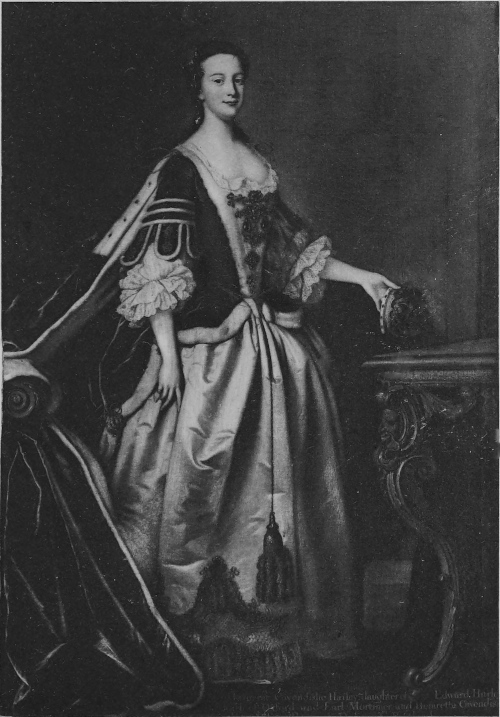
Thomas Hudson Pinx. Emery Walker Ph. Sc.
Margaret Cavendish Harley
second Duchess of Portland.
SUBMISSION TO GOD’S WILL
To this letter Mrs. Montagu replied—
“Allerthorpe, September 16, 1744.
“I am much obliged to my dear Friend for her
tender concern for me; I would have wrote to you
before, but I could not command my thoughts so as to
write what might be understood. I am well enough as
to health of Body, but God knows the sickness of the
soul is far worse. However, as so many good friends
interest themselves for me, I am glad I am not ill. I
know it is my duty to be resigned and to submit; many
far more deserving than I am have been as unfortunate.
I hope time will bring me comfort. I will assist it
with my best endeavours; it is in affliction like mine
that reason ought to exert itself else one should fall
beneath the stroke. I apply myself to reading as much
as I can, and I find it does me service. Poor Mr.
Montagu shows me an example of patience and fortitude,
and endeavours to comfort me, though undoubtedly
he feels as much sorrow as I can do, for he
loved his child as much as ever parent could do. My
sister has been of great service to me; and on this,
as on all other occasions, a most tender friend. I am
much obliged to you for wishing yourself with so unhappy
a companion: your conversation would be a
cordial to my spirits, but I should be afraid of being
otherwise to yours. Adieu, think of me as seldom as
you can, and when you do, remember I am patient,
and hope that the same Providence that snatched this
sweetest blessing from me, may give me others, if
not I will endeavour to be content, if I may not be
happy. Heaven preserve you and your dear precious
Babes; thank God you are far removed from my misfortune,
and can hardly fear to be bereft of all.[354]
“I am, ever your Grace’s most affectionate
“E. M.”
A BROTHER’S SYMPATHY
Lady Andover wrote from Charlton, Wilts, “by
Highworth Bag,” to condole with her friend. In this
letter she mentions that her friend, Lydia Botham (Mrs.
Laurence Sterne’s sister), had nearly died at the birth of
a daughter (Catherine), but was better. Matthew Robinson
wrote and implored his sister to accompany her
husband to Newcastle. He says, “Books and thought
are the food of melancholy, and lovely places, however
beautiful, the dwellings of it, but a town entirely strange
to you, and new company, would bid fairest to dissipate
your thoughts.” He signs himself “Matthew Robinson
Morris,” having adopted the latter, the maiden name of
his mother, as her heir to the Mount Morris and Monk’s
Horton estates. Mrs. Donnellan, writing from Bullstrode
on September 24, mentions, “I have brought
down a screen to work in snail for the Duchess, and
for my retired hours, Carte’s[355] History to read, for Sir
Paul Davis, who is a chief actor, was my great-grandfather.”
No further letters do I possess till October 23, when
Mrs. Montagu writes to the duchess and states Mr.
Montagu had started riding to London on particular
business. He hated wheels, and always preferred riding.
Mrs. Montagu and Sarah had been prevailed on to visit
Mrs. Yorke at Richmond in his absence.
The great Duchess of Marlborough’s death, which had
just occurred on October 18, is commented on thus—
“How are the mighty fallen! Oh vanity of Human
things! the Duchess of Marlborough is now not worth
a groat, nor does pride glow any longer in old Granville’s
heart. The old Countess[356] had reckoned with pleasure
the riches Mrs. Spencer[357] was to possess, and no doubt
pleased herself with the hopes of seeing it, little imagining
Clotho had twisted their line of life together.”
A RAREE SHOW
Whilst staying with Mrs. Yorke, Mrs. Montagu writes
to the duchess—
“Your Grace may not think we have any publick
diversions at Richmond. I must assure you we went
to a fine Raree Show.[358] An orrery made up some part
of it, and gave a dignity to the whole. However it was
an emblem of life, the first scene was all gay figures and
dogs and Ducks and Horses and Coaches, and every
object was new and striking: then came Mademoiselle
Catherina with all the airs of a celebrated toast, turned
her head about with a measured grace, smiled, curtseyed,
and flirted her fan: when everyone had enough of that,
we went to study the world. We observed its motion,
saw the revolution of a few years, and while we rather
admired than understood its movements, were almost
weary and yet loath to retire, there was presented the
figure of Time mowing us all down, and so we made
our Exit.”
Mrs. Montagu and Sarah set out on their journey to
London, and a letter to the duchess from Northampton,
November 17, shows the state of the roads then—
“I am here in a whole skin, thanks to the care of our
coachman, and the stuffing of our coach seats, but never
was poor mortal so jumbled, jolted and dragged through
such roads. I never saw such roads in my life as between
Harborough and this place. We were obliged to come
a nameless pace that is slower than a walk. Mr. Montagu
is to meet us to-morrow, he expected our being at Newport
to-night, but we did not get to Northampton till
after three o’clock in the afternoon, though we got into
the coach at seven in the morning.”
In a letter of November 23 the duchess says, “I have
read a sermon of Swift’s upon the Trinity, which I like
extremely, and wish you would read it, and give me
your opinion of it.”
DISEASE IN CATTLE
At Bullstrode at this time were Lady Wallingford
and Miss Granville. On the same day Mrs. Robinson
writes from Mount Morris and congratulates her
daughters on their safe arrival in Dover Street. She
mentions the cattle plague then beginning; thus—
“Our epidemical distemper is madness, which, thank
God, has not yet reached the human species, but reigns
among horses, cows, hoggs, shepp, and doggs; of the
latter we have been one out of pocket, but our new
tenant has lost a cow, and has a ram uncommonly
freakish, which they suppose is going the same way,
and J. Smith a hogg or two, and the country people
take so little care of their doggs when they are bitt, as
is very injurious to their neighbours. Ours was a greyhound,
which will prevent Mr. Robinson’s coursing till
he recruits his loss with another.”
Poor Mrs. Robinson, only three weeks after this
letter, wrote to her daughters to say she had a swelling
in her breast, which had formed some ten weeks back,
and which she had hitherto concealed, and feared
was cancer. She wrote to Dr. Chesilden,[359] the famous
surgeon, to tell him, and he desired her to come to town.
MRS. ROBINSON’S ILLNESS
Mrs. Montagu writes on December 17 to the duchess in
great distress—
“that it was a cancer, but that not sticking to the ribs,
it may be taken out without danger; he (Dr. Chesilden)
has behaved to her with great gentleness and care, and
has made her very easy. She bears her misfortune with
great fortitude, she is neither afraid of death or pain,
but says she is contented to suffer what Providence
pleases to ordain.... She will not suffer us to be
in the house while the operation is performed. They
assure us there is no danger of her Life, but it is terrible
to think of the pain she must undergo.”
The operation was performed successfully, but must
have been shocking to bear, the use of anæsthetics not
being then known. The two daughters nursed their
mother, and the affectionate Mrs. Donnellan assisted,
though herself in great trouble at the ill-health of her
stepfather, Mr. Perceval. On Christmas Day, Mrs.
Montagu writes a good report to the duchess, whose
London porter, Elias, called daily to inquire. In the
letter mention is made of “Marshall Belleisle[360] being
taken prisoner, as he was going to the King of Prussia.
His papers and attendants all seized.”
Thus end the letters of 1744.