WITH NOTES, ETC., BY
NORMAN PENNEY, F.S.A., F.R.Hist.S.
London:
HEADLEY BROTHERS, Bishopsgate, E.C.
American Agents:
DAVID S. TABER, 144 East 20th Street, New York.
VINCENT D. NICHOLSON, Earlham College, Richmond, Ind.
GRACE W. BLAIR, Media, Pa.
1914.
This volume is issued
as Supplement 12 to
THE JOURNAL OF THE
FRIENDS HISTORICAL SOCIETY
Preface
The Notes collected by the late Mary Radley, of Warwick, for
her contemplated “Life of Elizabeth Hooton” seem to indicate
a work of much wider scope than I have attempted. Since her
research commenced many notable works on the rise of the
Society of Friends have been issued which cover the investigations
made by her. I have therefore endeavoured to bring together in
a collected form the scattered fragments of Elizabeth Hooton’s
history, which are to be found up and down, together with many
of her letters, or extracts from them, which I believe have never
before been published.
Many kind friends have materially assisted in the work,
and I desire gratefully to acknowledge their services here: to
Norman Penney, F.S.A., and the staff at Devonshire House,
London, without whose invaluable help I could not have compiled
the little history; to Mrs. Dodsley of Skegby Hall, for
her search of the Skegby Manor Rolls, and the Church Registers,
also for the illustration of the village which she kindly lent for
reproduction; to A. S. Buxton, Esq., for various notes connected
with the history of the district and for his unfailing help and
interest in the work; to Mrs. Mary G. Swift, of Millbrook, New
York, for notes of various authorities; to my cousin, Ethel
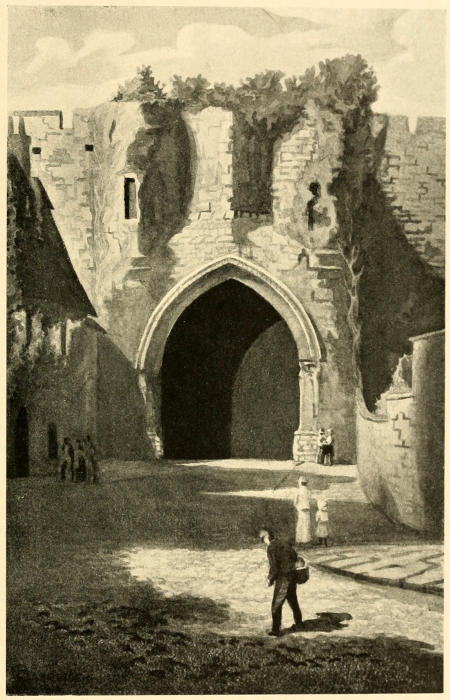
Barringer, for her sketch of Lincoln Castle Gateway; and to
my daughter, Rachel L. Manners, for her photograph of
Beckingham Church and her suggestions and advice generally.
For New England History I have drawn largely on Dr.
Rufus M. Jones’s recent book, The Quakers in the American
Colonies, and for the account of the Quaker persecution in that
country my authority has been New England Judged, 1703 edition.
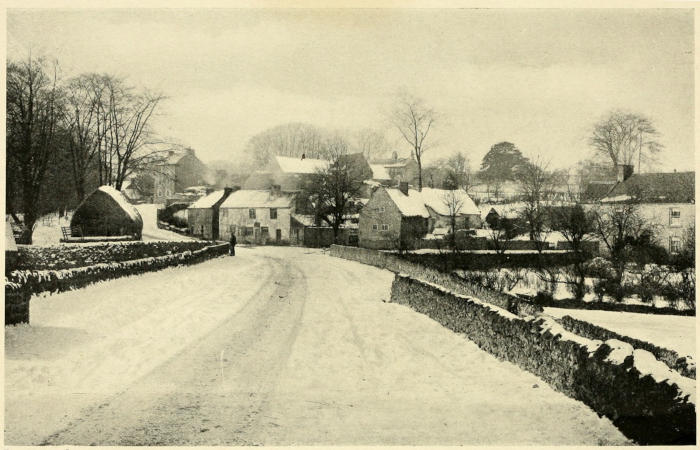
Photograph by the Sherwood Photographic Co., Mansfield.
The tall house on the extreme left of the picture
is standing to-day. It was the property of the Society
of Friends until 1800, when it was sold, with the
adjoining Burial Ground, now a garden, the proceeds
going towards the re-building of the Meeting House
at Mansfield. The house is considered by some to have
been the home of Elizabeth Hooton. It is probably of
seventeenth century construction.
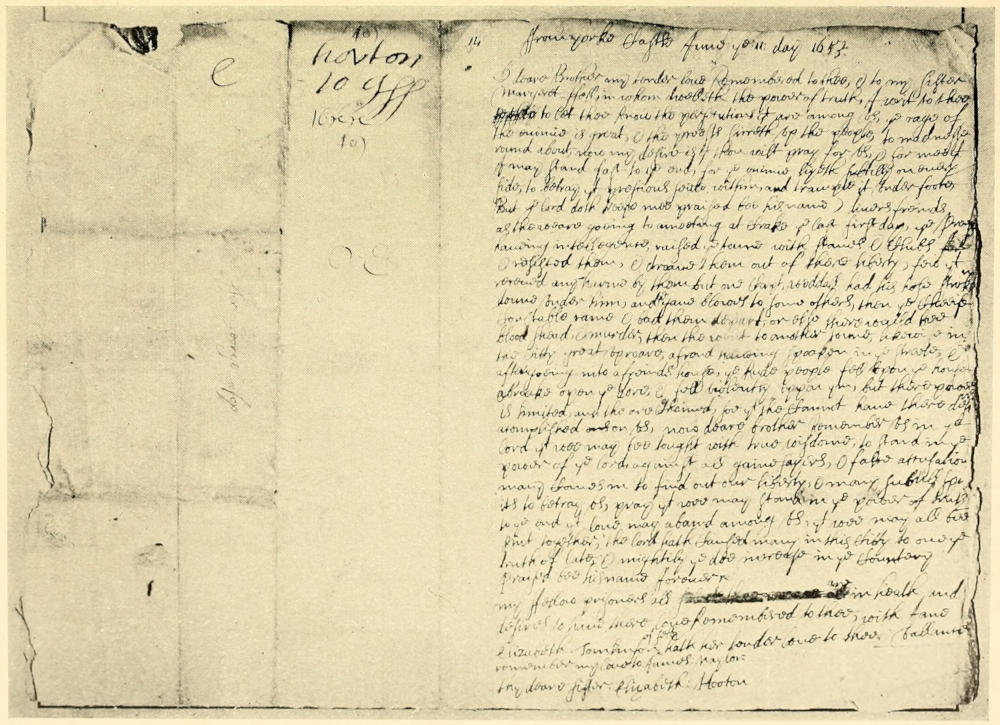
Letter from Elizabeth Hooton to George Fox, 1653 [?]
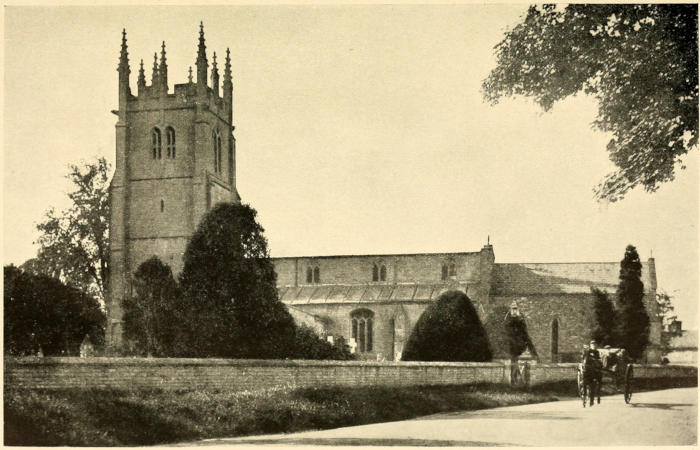
The village of Beckingham is about five miles south
of Newark-on-Trent. The church has a fine Norman
porch and the churchyard is remarkable, being the
shape of a coffin.
This, with some fragments of the old wall, and a
small, strongly-built structure, supposed to have been a
dungeon and known as Cobb’s Hall, is all that remains of
the old Castle. The area of the fortress is now occupied
by the County Hall and a building now disused, which
was the County Gaol.
Key to Abbreviations
D. = The Friends’ Reference Library, at Devonshire House,
136, Bishopsgate, London, E.C.
A.R.B. MSS. = A collection of two hundred and fifty Letters of
early Friends, 1654 to 1688, so named because worked over
by Abram Rawlinson Barclay in 1841. In D.
Camb. Jnl. = The Journal of George Fox, Cambridge ed., 1911.
D.N.B. = Dictionary of National Biography, 68 vols., 1885-1904.
F.P.T. = “The First Publishers of Truth,” being early Records
(now first printed) of the Introduction of Quakerism
into the Counties of England and Wales. Edited for the
Friends Historical Society by Norman Penney, with
Introduction by Thomas Hodgkin, D.C.L., D.Litt., 1907.
Jnl. F.H.S. = The quarterly Journal of the Friends Historical
Society, commencing 1903.
Spence MSS. = A collection of seventeenth century MSS. belonging
to Robert Spence, of London. 3 vols. Deposited in D.
Swarth. MSS. = A Collection of about fourteen hundred letters,
papers, etc. of the seventeenth century. In D.
CHAPTER I Early Service in England
Travelling on through some parts of Leicestershire and into
Nottinghamshire, I met with a tender people, and a very tender
woman whose name was Elizabeth Hooton.
Journal of George Fox.
Such is our introduction to the earliest convert of
George Fox: one who was destined to travel far
in the service of Truth and whose steadfastness,
determination, fearlessness and patience are
unconsciously revealed in the numerous letters which
she wrote. No insignificant place was hers in the long
and bitter struggle for religious liberty, and her life’s
story has left an indelible mark on the history of the
beginnings of the Society of Friends.
In this same Fiftieth Year, Elizabeth Hooton, born and living
in Nottingham, a Woman pretty far advanced in Years, was the
first of her Sex among the Quakers who attempted to imitate
Men and Preach, which she now (in this year) commenced.
After her Example, many of her Sex had the confidence to
undertake the same Office.
This woman afterwards went with George Fox into New-England,
where she wholly devoted her self to this Work; and
after having suffered many Affronts from that People, went
into Jamaica, and there finished her Life.
An exhaustive examination of the Nottinghamshire
Parish Registers shows that the name of Hooton is not an
uncommon one and appears in many different places.
Ollerton, however, a village situated about eight miles
north of Mansfield, seems to have been the home of the
family, and here we find definite traces of Elizabeth
Hooton. Amongst the names of the owners of Ollerton
in 1612, given by Robert Thoroton,[2] an early Nottinghamshire
historian, is Robert Hooton, and in 1631 the
Parish Register shows that “Robert Hooton Paterfamilias”
died. On 11th May, 1628, a certain Oliver
Hooton married Elizabeth Carrier; it is uncertain
whether this Elizabeth was the convert to Quakerism, for
from further entries in the record of Baptisms and Burials
it seems probable that there were two men of the same name
living in the parish at that time, and in 1629 the wife of
one whose name was Elizabeth died: it is clear, however,
that later on an Oliver and Elizabeth Hooton were living
in Ollerton, for there on 4th May, 1633, “Samuell s. of
Oliver and Elizabeth Hooton” was baptized.
Hardly a trace of the seventeenth century village of
Ollerton remains except the ancient churchyard; in 1797
Throsby[3] describes Ollerton as follows:
This lordship belongs to the hon. Lumley Savile of Rufford
Abbey. It contains about 1,300 acres of land enclosed. Many
hops are grown hereabouts. This place has a little market on
Friday, and two fairs, one on May day, and the other the
26th of September for hops; in which month there is a kind of
market or hop club every Tuesday. The town contains about
600 inhabitants. The bridge here like many others was thrown
down (or blown up as it is called) in the flood of 1795. The
church, or rather chapel, is small and is newly built, consequently
no food there for the mind of the antiquary; but at the Hop-pole,
near the church, I have more than once after journeying
from village to village completely tired, found comfortable
refreshment for the body.
The principal inn still bears the name of “The Hop-pole”—all
that remains to tell of the vanished industry,
but the ancient forest still surrounds the village, and the
quiet stream flows gently on as in the time long past.
Between the years 1633 and 1636 Oliver and
Elizabeth Hooton appear to have migrated to Skegby, a
village about four miles west of Mansfield. The Parish
Registers there show that in 1636 “Thomas [?] yᵉ sonne
of Olive Hooton and Elizabeth” was baptized, and in the
years 1639 and 1641 the names of John and Josiah appear.
There is no entry of the births of her two children, Oliver
and Elizabeth, so possibly they were born at Ollerton
between the years 1633 and 1636, when no entries appear
in those Registers.
The owners of the village of Skegby in 1612 were
stated by Thoroton to be “William Lyndley Gent: Lord of
the Mannor, Roger Swinstone, Clark, Richard Tomlinson,
William Butler, Francis Swinstone, Will. Osborne, James
Cowper of Tibshelf, Thomas Jackson of Askham,” and as
the name of Hooton does not appear on the Manor Rolls
it is evident Oliver Hooton did not own the property on
which he settled. In 1650 Thomas Lyndley of Skegby
was appointed a Commissioner to assess the fines of
confiscated Royalist estates. Thomas Lyndley applied
for and received a licence for the holding of Divine
service in part of his house. This particular building
still remains (1914) and is now used as a laundry for
Skegby Hall.
Francis Chapman, in his return made in accordance
with the order issued by the Archbishop of Canterbury,
July 1669, “to enquire after all Conventicles, or unlawful
meetings under pretence of religion and the worship of God,
by such as separate from the unitie and conformitie
of the Church as by law established,”[4] says:
In reply to your worshipful Archdeacon’s letter, I know
nothing but this: that in Mansfield Woodhouse we have no
conventicle but one of Quakers, at the house of Robert Bingham
(excommunicated for not comynge to church) but who they
are who frequent it I cannot say. At Skegby, alsoe, there is a
conventicle of Quakers at the house of Elizabeth Hatton [Hutton]
widow; but I cannot learn who they are who frequent them,
they being all of other towns. In the same town of Skegby,
alsoe, there is another conventicle, reputed Anabaptists and fifth
monarchy men, held at Mr. [Mrs.] Lyndley’s (excommunicate
also) but I know neither their speakers or hearers.
Possibly it was with these last-named people
Elizabeth Hooton associated before her meeting with
George Fox, for it is evident from the following[5] that she
had dissociated herself from the Church before that
time and joined a Baptist community:
Oliver Hutton Saith
And my Mother Joyned with yᵉ Baptists but after some
time finding them yᵗ they were not upright hearted to yᵉ Lord
but did his work negligently and she haveing testifyed agᵗ their
deceit Left yᵐ who in those parts soon after were scatered
& gone: about the year 1647 George ffox Came amongst them
in Nottinghamshire & then after he went into Lestershire
where yᵉ mighty power of yᵉ Lord was manifest that startled
their former separate meeting & some Came noe more but
most yᵗ were Convinced of yᵉ truth stood of wᶜʰ my mother was
one and Jmbraced itt:
Oliver Hutton
writes in his
hystry pag: 46:
Soe here you may see yᵗ they were Called Baptists and
Separates not Children of yᵉ Light till after G: ff: had preached
yᵉ Light of yᵉ Gospell to them & they Received itt.
The memorable meeting with George Fox in 1646-7
changed the whole tenour of her life. At first she met
with opposition at home.
Her husband (says Fox in his Testimony concerning
her)[6]
being Zealous for yᵉ Priests much opposed her, in soe much
that they had like to have parted but at Last it pleased yᵉ
Lord to open his understanding that hee was Convinced
alsoe & was faithfull untill Death.
But clearly her faithfulness had its reward, for he
further adds:
She had Meetings at her house where yᵉ Lord by his power
wrought many Myracles to yᵉ Astonishing of yᵉ world &
Confirming People of yᵉ Truth wᶜʰ she there Received about
1646.
During these years Fox appears to have spent much
time in Mansfield and the neighbourhood, and in his
Journal at this period are noted some of his deepest
religious experiences. Here was revealed to him that over
the sorrow and suffering, the sin and pain, of the world,—“the
ocean of darkness and death,” as he termed it,
there for ever flowed the infinite ocean of God’s light and
love; and this perception brought added strength, for
he tells us, “I had great openings”; and who can
doubt that this deeper spiritual experience and its
resultant strength proved an inspiration to his early
disciple?
The rapid development of the Mansfield of to-day has
brought many changes, and but little remains to remind
one of the seventeenth century town. The “steeple
house” mentioned by Fox has been restored but its
interesting features have been preserved; near it there
still stands on old house, a survival of the past in the
midst of modern surroundings, which was undoubtedly
in existence when he walked “by the steeple house side in
Mansfield.” Hard by lived Elizabeth Heath, that
benefactress to the town whose thoughtful charity has
brightened the lives of so many aged pensioners.
Though it does not appear that she ever openly joined
the followers of Fox, she still held their honesty and
probity in such high esteem that she appointed all the
trustees of her charity from amongst them, and to-day
the trust is still administered by members of the Society
of Friends.[7]
In the year 1649 George Fox suffered imprisonment
at Nottingham and in his “Short Journall”[8] we read:
“There came a Woman to mee to the Prison & two wᵗʰ
her and said yᵗ shee had been possessed two and thirty
years.” He goes on to describe her symptoms and how
“the Priests had kept her, and had kept fasting days
about her, and could not do her any good.” After his
release from prison he bade “friends have her to
Mansfield.” Her conduct there was apparently so
extraordinary that she
would set all friends in a heat and Sweat.... And
so she affrighten’d the World from our meettings; and then
they said if that were cast out of her while she were wᵗʰ us and
were made well, Then They would say yᵗ wee were of God: this
said The world.... And Then it was upon mee that wee should
have a meetting at Skekbey at Elizabeth Huttons house, where
wee had her there, and there were many friends almost overcome
by her ... and yᵉ same day shee was worse then ever shee
was.
Another meeting was held and a cure was effected.
Then the narrative continues:
Wee kept her about a fortnight in yᵉ sight of yᵉ world, and
she wrought and did Things and then wee sent her away to her
friends. And Then the Worlds Professors Priests & Teachers never
could call us any more false prophetts deceivers or witches after
but it did a great deal of good in yᵉ Countrey among People
in relac̄on to yᵉ Truth and to yᵉ stopping the mouths of yᵉ world
& their Slandrous Aspersions.
Shortly after this time Elizabeth Hooton’s active
ministry commenced and bonds and bitter persecutions
awaited her. At Derby in 1651 she suffered imprisonment
for “speaking to one of the Priests there, who so
resented her Reproof that he applied to the Magistrate
to punish her. For it is common with Men who most
deserve Reprehension, to be most offended with those
who administer it.”[9] Although 1651 is the date given,
there is preserved a letter from E. Hooton written from
Derby gaol and bearing two endorsements, the first in the
handwriting of George Fox: (1) “To the meir of darby
from Elliz: hoton 1650.” (2) “This was sent to the meir
of darby from Goodde hutton.” The letter consists
entirely of religious exhortations, and is similar to many
others bearing her signature. It concludes: “Would you
have me put in beale wᶜʰ have not trensgresed your
lawe nor mes be haved my selfe—Conseder is this the
Good ould way that you was touth [taught?].” It is
addressed to “noaH Bullocke of derby in the towne”
and is chiefly interesting as the earliest letter of hers
known to be in existence, addressed to a public
official.[10]
There is no record of the length of her imprisonment
at Derby but in 1652 she was committed to York Castle
for speaking in the Steeple House at Rotherham and
remained there for sixteen months. There are interesting
allusions to Elizabeth Hooton and her husband in
letters from Thomas Aldam[11] written from York Castle
in the above year; he says:[12]
... We have great friendship and love from yᵉ
governor of the Towne, and many of yᵉ Souldiers are very
sollid & loveing. Oh his wonderful love and oh the exceeding
riches of his grace held forth to vs. to him alone all glorie,
honour, and praise, now & for ever; My Sister Elizebeth Hooten
remembers her dear love vnto you in yᵉ lord, and my sister Mary
ffisher[13] who was brought to prison from Selbie for speakeing
to yᵉ preist in yᵉ Steeple house there, she was as servant with
Richard Tomlingson of Selbie.
... My sister Elizebeth Hooton & I did looke for
noe Calling to goe before the Judge & Elizabeth husband in the
flesh came to the Assize & went backe againe shortly: the
Justices told him shee might not bee Called here but at their
Sessions: but at the end of their Assizes they called vs all together
to goe before them; ... an inward peace & rejoiceing was
given mee in goeing up.... I was made to Cry out, Woe to the
partiall Judge.... My sisters was made to speake in great
bouldnes at the Bench against the deceite of their Corrupt
Lawes & Governements & deceitfull Preists we are Kept all of
vs in greate friedome in these outward bonds, & the Lord is
p̄sent wᵗʰ vs in power; to him alone bee praises for ever & ever....
Your deare Brethren & Sisters in the Lord,
There are two letters signed by Elizabeth Hooton
which were probably written at this period. The first is
as follows:[17]
Deare Freind Cap: Stothers[18] & the wife: my deare and
tender love to yᵘ both, my deare freinds I am moved to writ
to you my brethren, yᵗ wee are well, the lord is pleased to recover
me and shew me abundance of his mercy, makeing me acquainted
with Satans wiles and Cuning devices, to trap the simple Seed,
and to ensnare and bondage the people of god, with his subtil
bayts Continually, O deare frends, when the lord hath set
you free and brought you into joy, then you thinke you have over
come all, but there is a daiely Crosse to bee taken vp, whilst yᵗ
the fleshly will remaineth, if any of yᵗ stand vncrucified, the
Serpent there getts hould and brings into death, & darkenesse,
soe yᵗ there is a continuall Warfare for there is noe thing obtained
but throug Death & Suferings, which is by the power of
Faith, which Caryes through all troubles, keepeing Close to it
the power of darkenes cannot hurt, but lookeing out to
satisfie the will of the flesh, there doth the Serpent get in &
tells the Creature of ease, & liberty in the flesh. and say thou
needest to take vp the Crosse noe longer, for thou art now come to
thy rest, thou may eate & drinke and bee merry & I will give
thee joy enough, & thus many a pore soule is drowned and runs
on in lightnes & wantonnes, tho become odious both in the
sight of god and men, & cause Scandalls to arise against yᵉ Church,
& soe through backesliders we are rendered odious to the world
putting on yᵗ which was once put of, disobedience is the beginner
of these things: O deare frends beeware & exort others, yᵗ
wee may sit doune in the lowest roome, taking vp the Crosse
dayely and foloweing Christ & yᵗ hee may goe before vs & leade
vs at his one pleasure, I have experience of the wiles of Satan,
the lord hath exercised mee, but there is noe way but sit doune
and submitt to his will, & there is rest and peace.
farewell. my love to Richard Hatter & his wife & to Will:
Tomlinson.
your frend Elizabeth Hooton
The second of the two letters is a plea on behalf of
James Halliday,[19] of Northumberland, imprisoned in
York Castle:[20]
Yoᵘ that sitt on the Bench doe Justice and Equity to
those honest hearted people Called Quakers whome yoᵘ putt
in prison and Call them to the Barr & sett them at Liberty for
they have done yoᵘ noe wrong nor hurt the cause is for
worshiping of God as hee requires in Spᵗ & in Truth that they
Suffer—James Holliday who hath Laine in Six Months being A
North Country freind the Geoler hath very much Abused By
Taking away his Victualls & Beateing of him till hee hath
been black & Blew & his Skin broake & soe oʳ desire is that yoᵘ
would sett this poore man at Liberty whome the Geoler keepeth
for his fees
Elizabeth Hooton.
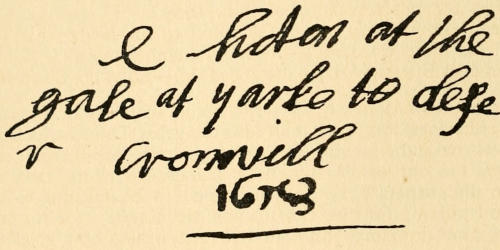
In a very vigorous and lengthy letter[21], endorsed
by Fox: “e hoten at the gale at yorke to olefer Cromwell
1653,” in which she describes herself as a Prisoner
of the Lord at York Castle, she reminds the Protector:
The Lord hath beene pleased to make [the] an Instruement
of warr and Victorie; hee hath given the power over thy
enemies & ours, hee hath given much into thy hand, & thou
hast beene Looked vppon, & sett vpp wᵗʰ many, and wᵗʰ my selfe.
She denounces in no measured terms the corruptness
of Judges, Magistrates, teachers and clergymen and
all officers and gaolers and compares them to Herod and
Pontius Pilate; and continues:
Your Judges Judge for reward, And at this Yorke many
wᶜʰ Committed murder escaped throughe frends & money, &
pore people for Lesser facts are put to death; many Lighe in
prison for fees yet; they Called their Assize a generall Gaole
Delivʳie, but many was but delivʳed from the p̄sence of the
Judges in to the hands of two greate Tirantes vizᵗ. the Gaoler
& the Clearcke of the Assize & these two keepes many pore
Creatures still in prison for fees, the Gaoler hee must have Twenty
shillinge four pence for his fee; & the Clearcke of the Assize
hee must have fifteene shillinges eight pence, & this they
will have of pore Creatures; or els they must starve in prison,
They Lighe worse then doggs for want of strawe, Many beinge
in greate want, that they have not to releeve them wᵗʰall;
yet these Tirants keepe them in this pore Condic̄on The Judges
& Magistrates they might as well have put them to death at the
Assize as put them into the hands of these two tirants who keepes
men for money starveing them in a hole till they be ruined [?] or
starved to death.
She next complains of the way she and her fellow
sufferers for the Truth are treated and tells the Protector:
“Wee have not that Libertie that Paull had of the
Heathenish Romans.” She then appeals to him as follows:
O man what dost thou there except thou stand for the truth
which is trampled under foote Who knowes but thou was Called
to deliver thy brethren out of bondage & slaverie, & that
the Truth may bee set free to speake freely, wᵗʰout money or
wᵗʰout Prize.... O frend thou must lighe downe in the dust & Cast
thy Crowne at the feete of Jesus, how Can you beleeve that seeke
honor one of another & seekes not the honor wᶜʰ is of god onely;
Distribute to the pore, & Denie thy honor, & take up the Crosse
& followe Jesus Christ.
Much more follows in the same strain, mingled with
warnings of the woes that will come upon him and the
nation generally if justice is not done. The whole is a
very good example of the epistolary methods of the
period, and at the same time throws an interesting light
on the condition of prisoners, and the way Justice was
administered—or rather not administered—during the
Commonwealth.
A Tract entitled, False Prophets and false Teachers
described, signed by Thomas Aldam, Elizabeth Hooton,
William Pears, Benjamin Nicholson,[22] Jane Holmes, and
Mary Fisher; “Prisoners of the Lord at York Castle,
1652,” is an eloquent testimony to their unceasing
activity in Truth’s service.[23]
Another detailed account of this imprisonment is
given in a further letter, sealed and directed: “ffor Capt
Stodard at his house in Long Aley in more fields this
đ đ đ in London.” E. Hooton writes:[24]
Deare friends [paper torn] unto you Concerning yᵉ assise
but we 3 sisters were not Called, but they keepe us still in prison,
with the Rest of oure brethren, 3 of them was Called, but the
corupt Judge sett fines vpon them, for Comeing wᵗʰ their hatts
on, but they keepe yᵉ truth murdred, in a whole & will not
suffered it to speake in shutting us vp, what yᵉ truth should be
declared, Some of our brethren was bold & did speake freely
to them, but my bro: Thomas [Aldam] they would not let
him stay nor sufer him to speake, but we are maide to Rest in
yᵉ will of god ... if we would submitt to their wills,
then would they take of our fines, but we dare not deny yᵉ
lord, for at yᵗ time yᵗ he hath apointed he will sett vs fre, from
vnder yᵉ bondage of men, but our fredom is wᵗʰ yᵉ father & yᵉ
sone, whom yᵉ sone hath maide fre is fre indeede....
O noble Captaine yᵉ lord hath manifested his love to the, & he
hath maide the an instrument of good to his people, now it stands
yᵉ vpon to stand vp for the leberty of yᵉ gospell, yᵗ them yᵗ hath
frely Received it, may have fredome to preach itt, & hold it
out to yᵉ world, yᵗ hierlings may be putt downe & have no more
hier, for they through there deceits deceives yᵉ people &
Raises vp yᵉ Magestraites for persecution, for they, yᵉ Clergy &
yᵉ gentry, hath yᵉ lande betwixt them, & yᵉ people of god & yᵉ
power doe they persecute & treade vnder feete, & those Corupt
Magestraits wᶜʰ knowes noe true Justice, keepes yᵉ poore people
in bondage & ꝑsecutes according to their own will, many of
vs are put heare in prison, not ofending their owne way,
Consider of these things and as thou art moved soe
speake to yᵉ generall [Cromwell] yᵗ yᵉ truth may be sett
fre, though we be willing to waite the lords laysure. I
did sende some letters to yᵉ generall, & would know whether
they ever was seene, or noe, & one to yᵉ Parlement, I would
know wᵗ became of them, whether they were brought to
light or noe, any of them.
Elizabeth Hooton,
A prisoner of yᵉ lord in Yorke Castle.
At what period her liberation from York Castle took
place is as yet undetermined—on the 11th June, 1653,
she wrote from the Castle to George Fox,[25] but when free,
undeterred by this imprisonment, she went forward
in her religious service. Here follow some glimpses of her
further labour and suffering.
Margaret Killam[26], writing to George Fox, in 1653,
says:[27]
I was moued of the lord to goe to Cambridge, & I went by
Newarke side & was att a meetinge uppon the first day there,
& I was moued to goe to the Steeplehouse & I was kept in Silence
whilst their teacher had done, & hee gaue ouer in subtilty, a litle,
& after began againe, thinkinge to haue ensnred mee, but in the
wisdome of god I was p̄served, & did not speake untill hee was
come downe out of the place.... His hearers were uery
silent & attentiue to heare & did confesse itt was the truth wᶜʰ
was spoken to them, & was troubled att their Teacher yᵗ hee
fled away. Itt was the same wᶜʰ did Imprison Elizabeth
Hooton, & did ensnare her by his craft, & hee had told them if
any came & spoke in meeknesse hee would heare.
Besse has no record of the above-mentioned imprisonment
of Elizabeth Hooton, so possibly it was not of
long duration.
In the year 1654 George Fox says: “I came to
Balby; from whence several Friends went with me into
Lincolnshire; of whom some went to the steeple-houses
and some to private meetings.”[28]
From the following interesting entry in an early
Lincolnshire minute book[29] it appears likely that John
Whitehead[30] and Elizabeth Hooton were of this
company:
In the beginning of the Ninth Month in the yeare 1654 John
Whitehead first came to preach the Light within, & for beareing
Testimony in the High Place called the Minster in Lincoln that
it is the Light of the Glorious Gospell that Shines in Man’s heart &
Discovers Sin, He was buffetted & most shamefully intreated,
being often knocked down by the Rude & Barberous People,
who were encouraged thereunto by Humphrey Walcott who
then was in Commission to have kept the peace; but brake it
by striking of the said John Whitehead with his owne hands,
wᶜʰ so encouraged the Rude People, that so far as could be
seene they had slaine the said John, but that God stirred
some Souldiers to take him by fforce from amongst them.
Elizabeth Hooton was imprisoned in Lincoln Castle in the 9ᵗʰ
month 1654 by the Procurement of Joseph Thurston, then Priest
of Beckingham, for speaking to him in the Steeplehouse, she
was kept Prisoner about 6 months. She was Imprisoned againe
by procurement of the same priest at Lincoln Castle in Ninth
Month 1655 for speaking to him after the Exercise was done,
& at that time kept prisoner eleven or twelve weeks.
According to Besse, E. Hooton was the first sufferer
for the Truth in Lincolnshire.[31]
There is an imperfect letter from Elizabeth Hooton
in existence, which, though undated, appears to belong
to this period and naturally finds a place here. It is
endorsed: “E. H. Prisoner in Lincolne Castle, pleads
to him in Authority to reforme the abuses of yᵉ Goal,” and
contains a striking description of the state of the gaols
of the Commonwealth and of the many abuses connected
with their management.[32] Her protests against strong
drink, her plea for the separation of the sexes and for the
employment of the prisoners reads more like an appeal
from Elizabeth Fry two centuries later.
O thou that artt sett in Authoryty to doe Justice and Judgmente,
and to lett the oppressed goe free, thease things are required
att thy hands, looke vpon the pore prissonors, heare is that hath
not an[y] [al]lowance all though thear be a greatte sume of mony
comes out of the country suffic[ien]tt to hellpe them all that is
in want, booth theare dew alowance and to sett them aworke
which would labor, And those that are sentt hether for deb[ts]
that theare rates for beds, which is ten grots the weeke may be
taken downe [paper torn] at to reasonable raites, And theare
beare which is sould at such an vnreasonab[le] [paper torn] thear
meseuers being so extreame littell that itt may be amendid [paper
torn] and equity, for many pore detters is sett in heare for a small
dett and [paper torn] a great deale of the score fare more then
thear dette. And it is [? a place of g]reate dissorder and of
wickednes, so that for oppression and prophaines J neuer came
in such a place, because a milignant woman keeps the gole.
Opprission in meat and in drinke and in feese, and in that
which they call garnishes, and in many other thinges, And J my
selfe am much abused, booth hir and hir prissonars, and hir houshould,
so that J cannott walke quiatly abroade but be abused
with those that belonge vnto hir. When a drunken preist
comes to reade command praire, or to preach aftar his
owne in vention or Jmmaginations, then thay locke me up,
and all the rest are comanded to come forth to heare, and so is
keptt in blindnes.
And so in drinking and profaines and wantonnes, men and
women to gether many times partte of the night, which grefes
the spiritt of god in me night and day. This is required of the
o man, to reforme this place, as thy power and Authority doth
alow, ether remove strong drinke out of this place or remove the
Golar, seckondly that theare rates for theare beds may be
taken dowen. That theare garnishes and theare greate fese
may be taken of, and thease oppresed prissonors may come to
some hearing, such as is wrongfuly prissoned, And that theare
may be some beter order amongst the men and woman which
is prissonars to keepe them assunder and sett them a worke,
and sett them att libbirty that is not able to pay the feese, and to
take out the dissordred person, which kipeth all in dissorder,
in carding and dicinge, and many other vaine sportes, and so
J leave itt to thy Concsence to redres the dissorders in this
rewde place, and so have J discarged my Concsence [paper torn]
much vpon me, that thou mightest know itt and itt redres.
Elizebeth Houton,
prisonr in linckoln Castell.
George Fox, after his missionary visit into Lincolnshire,
accompanied by Robert Craven, the Sheriff of
Lincoln (who had been convinced by his preaching) and
by Thomas Aldam, passed into Derbyshire and thence into
Nottinghamshire to Skegby, “where,” he records, “we
had a great meeting of divers sorts of people: and the
Lord’s power went over them and all was quiet. The
people were turned to the spirit of God, by which many
came to receive his power, and to sit under the teaching of
Christ their Saviour. A great people the Lord hath in
these parts.”[33] No mention is made of Elizabeth
Hooton, possibly she was in Lincolnshire at the time, but
it may be that her fostering care of the infant Church and
her unwavering steadfastness to the Truth which she had
received had been mainly instrumental in raising up “a
great people to the Lord.” In 1655 we know she was
again in Lincolnshire, but the brief entry in the Lincoln
Minute Book appears to be the only record of her labours
in that county at this period. She was one of the
first Quaker preachers to visit Oxfordshire as evidenced
by an early Minute which runs: “Also Eliz Hutton, a
good ould woman, came and vised us early.”[34]
In 1657 her husband, Oliver Hooton, died. The
entry in the digest of Friends’ burial registers preserved
at Nottingham reads:
Oliver Hooton died 30 4 1657 Seckbie, Mansfield Mo. Meeting
Buried 30 4 1657. Seckbie.
This is confirmed by the Parish Register at Skegby
where he is described as the Elder, but there is a slight
discrepancy as to day and month, the latter stating he
was buried 24th July, 1657.[35]
At an early date Friends acquired a Burial Ground
at Skegby where members of the Society from the district
were interred. The entries in the Register show that many
Mansfield Friends were buried there, for until Elizabeth
Heath gave a piece of ground as a burial place in 1693,
Friends of Mansfield had no place of sepulture there.
Quite recently, in the course of repairs to the house
at Skegby, which up to 1800 was the property of Friends
and was known as the Meeting House, and by some was
believed to be the house in which Elizabeth Hooton
lived, a stone used as a shelf in the pantry was found on
which there were remains of an inscription and the date
1687. An old lady of Skegby, aged ninety-eight, states
that she fancies she can remember seeing some tombstones
in the garden which covers the site of the old
graveyard.
No record of Elizabeth Hooton’s ministry, or allusion
to her, has been found in contemporary documents for
the years 1658-1659, but in the early part of the year
1660 she was in Nottinghamshire, and Besse gives the
following graphic description of an apparently unprovoked
assault on her by Priest Jackson of Selston: “On
the 2d of the Month called April, Elizabeth Hooton,
passing quietly on the Road, was met by one Jackson,
Priest of Selston, who abused her, beat her with many
Blows, knockt her down, and afterward put her into
the Water.”[36]
With this incident, the record of her early service in
England ends. We next follow her in her perilous
journeyings in a distant land.
Falſe Prophets and falſe Teachers deſcribed. 1652.
Longfellow, New England Tragedies, Prologue to “Endicott.”
We owe to their heroic devotion the most priceless of our
treasures, our perfect liberty of thought and speech; and all who
love our country’s freedom may well reverence the memory of
those martyred Quakers, by whose death and agony the battle
in New England has been won.
Brooke Adams, Emancipation of Massachusetts.
Fierce and cruel as was the persecution in England it
was far exceeded by the tortures which awaited the
first Quaker missionaries in the New World. Barely
fifty years earlier the Pilgrim Fathers had left the
homeland and gone forth into an unknown wilderness, there
to establish freedom of worship; their descendants, by
bitter persecution of the Quakers, demonstrated their
failure—in spite of their own sufferings—to learn the
lesson of religious toleration. The general attitude of
those in authority in the Colonies is very well pourtrayed
in the writings of the Rev. Mr. Ward, of Ipswich, Massachusetts,
in 1645: “It is said that men ought to have
liberty of conscience and that it is persecution to debar
them of it. I can rather stand amazed than reply to this.
It is an astonishment that the brains of a man should be
parboiled in such impious ignorance”; and, further,
John Callender, writing in 1739, said that in 1637 “the
true Grounds of Liberty of Conscience were not then
known or embraced by any Sect or Party of Christians.”[37]
The early history of the New England Colony shows
that, some years before the advent of the Quakers,
religious differences had arisen amongst the Colonists, and
a certain section of the community had not escaped
persecution. Anne Hutchinson, a brave and intrepid
woman, had boldly protested against what might almost
be termed a purely theological religion and the extreme
power which was of necessity vested in the priest, which
was the basis of the Puritan faith. Dr. Rufus Jones
states the differing points of view very clearly:[38]
The real issue, as I see it in the fragments that are preserved,
was an issue between what we nowadays call “religion of the
first-hand type,” and “religion of the second-hand type,” that
is to say, a religion on the one hand which insists on “knowledge
of acquaintance” through immediate experience, and a religion
on the other hand which magnifies the importance and sufficiency
of “knowledge about.”
Anne Hutchinson was arraigned before a General
Court of all the ministers, held in Boston in 1637. She
defended herself with great ability, but without avail, in
fact it is very possible that such unusual temerity on the
part of a woman may have been largely responsible for
the severity of the sentence passed upon her, for she was
condemned to banishment and declared excommunicate.
As the exiled outcast woman passed sadly down the aisle,
one Mary Dyer[39] joined her and went forth with her, thus
taking the first step on that path of suffering which led,
twenty-three years later, to the gallows on Boston
Common. Anne Hutchinson, after sentence of exile
had been pronounced, joined her friends. She had a
very considerable following in the new Colony of
Aquiday, or Aquidneck, now called Rhode Island,
which later became for the persecuted Quakers a veritable
“little Zoar,”[40] for these early settlers learned the
lesson of religious toleration which was reflected in their
laws.[41]
The King’s Commissioners, who visited the Colony
about 1664, reported that in Rhode Island “all who desire
it are admitted freemen. Liberty of conscience and
worship is allowed to all who live civilly. They admitted
all religions, even Quakers and Generalists, and is generally
hated by other Colonies.”[42]
Not only was Rhode Island a city of refuge for the
persecuted Quakers, but their message was sympathetically
received by many in the Colony. Anne Hutchinson did
not live to witness the sufferings of the Quakers, as she
and several members of her family were murdered by
the Indians in the autumn of 1643; her sister Katharine
Scot,[43] however, early joined the new sect; she is described
as “a Mother of many Children, one that had lived
with her Husband, of an Unblameable Conversation, and a
Grave, Sober, Ancient Woman, and of good Breeding, as
to the Outward, as Men account.”[44] She came from
Providence, Rhode Island, to Boston on hearing of the
sentence passed on three young men who, for the crime of
being Quakers, were condemned each to the loss of an
ear; on account of her comments thereon she was cast
into prison and received “Ten Cruel Stripes with a three-fold-corded-knotted-Whip,”
and warned that “if she
came thither again they were likely to have a law to hang
her,” to which she replied: “If God call us, Wo be to us,
if we come not; And I question not, but he whom we
love, will make us not to count our Lives dear unto our
selves for the sake of his Name.”[45] Truly she and her
sister Anne Hutchinson came of heroic stock.
In 1656 the first Quaker preachers in the persons
of Mary Fisher and Anne Austin[46] arrived at Boston. In
consequence of the many wild rumours which had reached
the Colony of the strange actions and teaching of the
Quakers in England, they were detained on shipboard
and their luggage searched for Quaker books or tracts.
Several were found and these were ordered to be
burned by the common executioner, and the women
themselves were stripped and examined to see if
they bore upon them marks which should prove
them to be witches. They were detained in gaol for
about five weeks and then deported again to Barbados.
Their inhospitable reception did not in the least
quench the missionary zeal of the early Friends, and
very shortly after, eight more arrived on the shores
of New England, who, after two days’ examination, were
sent back to England by the ship on which they came.
The authorities of Boston then passed a law inflicting
a fine of £100 on any shipmaster who knowingly conveyed
a Quaker to the Colonies. This law failed as a
deterrent, many Quakers obtaining an entrance to the
Colonies, and still fiercer became the persecution. A
strengthening of the law was deemed necessary and it
was further decreed:
What Quaker so ever shall arrive from foreign Parts or Parts
adjacent shall be forth with committed to the House of Correction;
and at their entrance to be severely whipp’d, and by the master
thereof to be kept constantly at Work, and none suffered to speak
or converse with them.—If any Person shall knowingly Import
any Quakers Books or Writings concerning their Devilish opinions,
shall pay for every such Book or Writing the Sum of £5. who soever
shall disperse or conceal any such Book or Writing and it be
found with him or her shall forfeit or pay £5—and that if any
Person within this Colony shall take upon them to defend the
Heretical opinions of the said Quakers or any of their Books, &c.,
shall be fined for the first time 40/—If they shall persist in the same
and again defend it the second time £4.—If they shall again so
defend they shall be committed to the House of Correction till
there be convenient Passage to send them out of the Land, being
sentenced by the Court of Assistants to Banishment [1656].
This law was proclaimed by beat of drum before
the house of Nicholas Upsall[47] who was rightly suspected
of sympathy with the hated sect; he protested against
the law and suffered banishment in consequence. In
1657 the law was again strengthened; and if a male
Quaker, after he had once been banished, returned again
to New England, he was to suffer the loss of one ear and
to be kept in the House of Correction, and every woman
was to be severely whipped and consigned to the same
place. This law was to apply to “every Quaker arising
from amongst ourselves” as well as to “Foreign
Quakers.” Three men suffered the penalty of loss of
their ears at Boston. Further laws were made and
penalties inflicted for meeting together to worship God
after the manner of Friends. In 1658, in addition to the
penalties already inflicted, any of the “Sect of Quakers,”
after a trial by a special Jury and conviction by same,
were to be sentenced to death.
In spite of, or rather because of these harsh laws
and the inhumanity with which they were administered,
the Quaker community rapidly increased; thus we are
told[48] that
these Violent and Bloody Proceedings so affected the Inhabitants
of Salem and so preached unto them, that divers of
them could no longer partake with those who mingled Blood with
their Sacrifices, but chusing rather Peace with God in their
Consciences, whose Witness in them testified against such Worships,
than to joyn with their persecutors, whatsoever they might therefore
suffer, withdrew from the Publick Assemblies, and met together
by themselves on the first Days of the Week, Quiet and Peaceable
in one anothers Houses waiting on the Lord.
The authorities quickly noticed these abstentions
from public worship and warrants were issued under a
law of 1646, the offenders being fined for non-attendance
5s. a week; and on a second examination, after the Clerk
of the Court had perverted their explanation as to their
belief in the doctrine of the Inward Light, three of their
number—Lawrence and Cassandra Southwick, with
Josiah their son[49] (“all of a Family to terrifie the rest”)
were sent to Boston, and there in the House of Correction
were “caused to be Whipp’d in the coldest Season of the
Year with Cords, as those afore, tho’ two of them were
Aged People.”[50]
Many examples of the ferocity with which the
Quakers were treated in the New England Colonies might
be cited, yet so inspired were these early pioneers with
the deep significance and importance of their message
that they were compelled to brave the untried wilderness
paths and surmount difficulties which we in these days
might be tempted to deem insurmountable, in order to
deliver it; women with their babes at the breast would
not hesitate to undertake “a very sore Journey, and
(according to Man) hardly accomplishable, through a
Wilderness above Sixty Miles,” knowing that it led
inevitably to stripes and bondage and possible death; yet
in spite of all, we are told of one such that she was enabled
to kneel down and pray in the spirit of the Master for the
forgiveness of her cruel persecutors. This “so reached upon
a Woman that stood by, and wrought upon her, that she
gave Glory to God, and said that surely she could not
have done that thing, if it had not been by the Spirit of
the Lord.”[51]
The Quakers still continued boldly to preach, and
persecution waxed fiercer and fiercer. The Chronicler
says: “Their lives (as men) became worse than Death
and as living Burials.” The offences for which Friends
suffered so severely were of a most trivial character, such
as non-attendance at Public Worship for which they had
been previously fined, and for not removing their hats.
In the event of their refusal to pay any fines which might
be imposed they became liable under a law made on
accounts of debts, by which it was permissible to sell
those persons who refused or were unable to pay their
fines “to any of the English Nations as Virginia or
Barbadoes to Answer the said Fines.”
Worse was to follow—in June, 1659, William Robinson,
of London, Merchant, and Marmaduke Stevenson,
a country-man from East Yorkshire, under a religious
concern, passed from Rhode Island to Boston, where
with an aged man named Nicholas Davis[52] they were
speedily imprisoned, Mary Dyer, who came from Rhode
Island, sharing the same fate; there they remained until
the sitting of the Court of Assistants, when they were
sentenced to banishment, and should they be found
within the Jurisdiction of the Court after the 14th of
September following they were condemned to death.
They were kept prisoners till the 12th of September.
Mary Dyer and Nicholas Davis “found freedom to
depart” out of the Province; but William Robinson
and Marmaduke Stevenson “were constrained in the
love and power of God not to depart,” so they passed out
of prison to Salem and remained there and at Piscataway
and the parts thereabouts in the service of the
Lord. On the 13th of October they returned to Boston
“that metropolis of Blood” as it was styled, and with
them Alice Cowland, “who came to bring Linnen to wrap
the dead bodies of them who were to suffer.” Several
other Friends joined them and the Chronicler tells us:
“These all came together in the Moving and Power of
the Lord as one, to look your Bloody Laws in the Face,”
and to accompany those who should suffer by them.
Mary Dyer had returned also and on the 19th of the
same month she, with William Robinson and Marmaduke
Stevenson, was condemned to death. On the 28th of
the same month they were led forth to execution, by the
back way, we are told, for the authorities were afraid
“of the fore way lest it should affect the people too
much.” Drums, too, were beaten, so that no words
from the prisoners might be heard; we are told that they
came “to the place of Execution Hand in Hand, all
three of them as to a Weding-day, with great Chearfulness
of Heart.” The two men were hanged, but Mary Dyer
was reprieved at the last moment, by petition of her
son, only to suffer the death penalty a few months later.
Yet another martyr was to seal his testimony with his
blood—William Leddra, described as of Barbados but
a native of Cornwall, was executed at Boston the 14th
of March, 1660/61, under the law of banishment, who,
before his final trial, had suffered much persecution and
grievous cruelty. His beautiful and saintly nature is
revealed in a letter written by him “To the Society of the
little Flock of Christ,” dated from Boston prison the day
before his execution; therein is no fierce denunciation
of his persecutors, but words of consolation and hope to
his sorrowing friends.[53]
A contemporary letter, printed in New England Judged,
is extremely interesting as showing the unbiassed opinion
given by an entire stranger of the sentence passed upon
this saintly man. So moved was he by the scene at the
execution that he was impelled to remonstrate with those
in authority. The letter is from Thomas Wilkie to his friend,
George Lad, “Master of the America, of Dartmouth, now
at Barbados,” dated Boston, 26th of March, 1661. It
is as follows:[54]
On the 14th of this Instant, here was one William Leddra,
which was put to Death. The People of the Town told me, He
might go away if he would: But when I made further Enquiry
I heard the Marshal say, That he was Chained in Prison, from
the time he was condemned, to the Day of his Execution. I
am not of his Opinion: But yet Truly me thought the Lord did
mightily appear in the Man.
I went to one of the Magistrates of Cambridge who had
been of the Jury that condemned him (as he told me himself)
and I asked him by what Rule he did it? He answered me,
That he was a Rogue, a very Rogue. But what is this to the
Question (I said) where is your Rule? He said, He had abused
Authority. Then I goes after the Man [William Leddra], and
asked him, Whether he did not look on it as a Breach of Rule,
to slight and undervalue Authority? And I said, That Paul
gave Festus the Title of Honour tho’ he was a Heathen (I do
not say these Magistrates are Heathens) I said then, when the
Man was on the Ladder, He looked on me, and called me Friend,
and said, Know, that this Day I am willing to offer up my Life,
for the Witness of JESUS. Then I desired leave of the Officers to
speak, and said, Gentlemen, I am a Stranger, both to your
Persons and Country, and yet a Friend to both: And I cried
aloud, For the Lord’s sake, take not away the Man’s Life;
but remember Gamaliel’s Counsel to the Jews, If this be of Man,
it will come to nought; but if it be of God, ye cannot Overthrow
it; But be careful ye be not found Fighters against God. And
the Captain said, Why had you not come to the Prison? The
Reason was, Because I heard, the Man might go if he would;
and therefore I called him down from the Tree and said, Come
down, William, you may go away if you will. Then Captain
Oliver said, It was no such matter; And asked, What I had to
do with it? And besides, Bad me be gone. And I told them,
I was willing; for I cannot endure to see this, I said. And when
I was in the Town, some did seem to Sympathise with me in my
Grief. But I told them, That they had no Warrant from the
Word of God, nor President from our Country; nor Power
from his Majesty, to Hang the Man. I rest,
Your Friend,
Thomas Wilkie.
A bold protest, boldly made; the Chronicler, to our
regret, is silent as to the fate of the protester.
Soon after the Restoration, Charles II., “judging
it necessary that so many remote Colonies should be
brought under uniform inspection for their future regulation,
security and improvement,” signed a Commission
appointing thirty-five members of Privy Council, the
nobility, gentry and merchants, a Council for Foreign
Plantations. (Calendar of State Papers Colonial). Wide
powers were vested in this Council, any five members
were empowered to “inform themselves of the condition of
Plantations and of the Commissions by which they were
governed as well as to require from any Governor an
exact account of the constitution of his laws and government,
number of inhabitants and any information he was
able to give.” The Commissioners were also “to
provide learned and orthodox ministers to reform
debaucheries of planters and servants and instruct natives
and slaves in the Christian faith.” The first meeting
was held 7th of January, 1661, when Committees were
appointed for the several Plantations; attention was
first directed to the New England Colonies, and information,
petitions and relations of those who had been
sufferers were laid before the Council. At a subsequent
meeting held on 11th of March, 1661, Captain Thomas
Breedon, who had returned from New England in
1660, appeared and reported as to conditions in Massachusetts
Colony. He presented a book of the Laws of
the Colony which were stated to be by patent from the
King, but he had never seen the patent and did not know
whether they acted in accordance with the same.
“Distinctions between freemen and non-freemen, members
and non-members, is as famous as Cavaliers and Roundheads
was in England, and will shortly become as odious.
The grievances of the non-members who are really for the
King, and also some of the members, are very many.”
In Breedon’s report, too, we have symptoms of discontent
and disaffection—heralds of the storm which a
hundred years later broke, and severed for ever the
American Colonies from the mother-land. He continues:
They look on themselves as a free state, they sat in Council
December last, a week before they could agree in writing to His
Majesty, there being so many against owning the king or having
any dependence on England. Has not seen their petition but
questions their allegiance to the King, because they have not
proclaimed him, they do not act in his name, and they do not give
the act [? oath] of allegiance, but force an oath of fidelity to
themselves and their Governor as in the Book of Laws.
That there was considerable doubt in the minds of
those in authority in New England as to the manner in
which the news of their high-handed and ferocious
persecution of the Quakers would be received by the
Home Government is evident from a letter written by
Captain John Leverett, London Agent for Massachusetts,
to Governor Endicott and the General Court, 13th of
September, 1660. After some discourse on other matters
he continues:
Yᵉ Quakers I hear have been with yᵉ King concerning your
putting to death those of theyr Frᵈˢ executed at Boston. Yᵉ
general vogue of people is yᵗ a Govʳ will be sent over. Other
rumours yʳᵉ are concerning you, but I omit yᵐ, not knowing
how to move & appeare at Court on your behalf. I spoke to
Lᵈ Say & Sele to yᵉ Eˡ of Manchester &c.
Yʳˢ in all faithfulness to serve you,
John Leverett.
Some Quakers say yᵗ they are promised to have order for yᵉ
liberty of being with you.
News of the sufferings of Friends in New England had
indeed reached their Friends in the old country; Edward
Burrough[55] had obtained audience of the King and
represented in powerful though simple language the story
of their inhuman treatment. His appeal resulted in the
issue of a Mandamus by the King, dated Whitehall, 9th
day of September, 1661, to John Endicott, and the
Governors of the other Colonies,[56] commanding that all
Quakers condemned to death or imprisoned should be
sent to England for trial; Edward Burrough urged that
this order should be sent with all speed, but the King
objected, in his usual spirit of procrastination, that he had
“no occasion at present to send a ship thither.”
Burrough, however, was given permission to send the
Mandamus by the hand of a messenger of his own choosing;
he at once decided that Samuel Shattuck,[57] of Salem,
a Quaker exile from the Colony, should return as the
bearer of the King’s message. English Friends at once
chartered a vessel belonging to Ralph Goldsmith,[58] himself
a Quaker. After a tempestuous voyage of six weeks
the vessel reached the American shore. As she lay
anchored in Boston Harbour one Sunday morning in
October, 1661, Captain Oliver,[59] a Boston official, boarded
her, and on his return to the town it is said he reported:
“There is Shattock and the Devil and all.” The
Mandamus was delivered in person by Samuel Shattuck
to Governor Endicott and the immediate result was that,
shortly after, many Quaker prisoners were set at liberty.[60]
Whittier, in his poem, The King’s Missive, gives us a
beautiful word picture of the incident and its setting; one
can imagine how the weary prisoners “paused on their
way to look on the martyr graves by the Common side,”
and how surpassingly lovely the landscape seemed to
eyes so long accustomed to the gloom of the prison-house
for
The autumn haze lay soft and still
On wood and meadow and upland farms,
and
Broad in the sunshine stretched away,
With its capes and islands, the turquoise bay;
And over water and dusk of pines
Blue hills lifted their faint outlines.
And with awe and deep humility we can enter in
some faint degree into their silent yet fervent thanksgiving
for “the great deliverance God had wrought,” and ah!
how vividly we can picture how
Through lane and alley the gazing town
Noisily followed them up and down;
Some with scoffing and brutal jeer,
Some with pity and words of cheer.
Into the heat of this persecution Elizabeth Hooton
with her companion, Joan Brocksopp,[61] had ventured.
They suffered imprisonment in Boston prison on account
of visiting Friends confined there, and were liberated with
twenty-five others, after the receipt of John Leverett’s
warning letter to Governor Endicott and the General
Court.
But we will let Elizabeth Hooton give the story of
her call to the service, her journeyings and the hardships
she endured on the American Continent, in her own words:[62]
This is to lay before freinds or all where it may come of the
sufferings & persecutions which we suffered in newe England
J Elizabeth Hooton have tasted on by the prefessours of Boston
& Cambridge, who call themselves Jndependants who fled from
the bishops formerly, which have behaved themselves, worse
then the bishops did to them by many degries, making the people
of God to suffer much more then ever they did by the bishops
which causeth their name to stink all over the world becaus
of cruelty.
Jn yᵉ year 1661 it was upon me from the Lord & my freind
Joan Broksopp [paper rubbed at crease and writing illegible] for
God & his people to those people in the heate of persecution, &
if God required us to lay down our lives for the testimony of Jesus
& in love to their soules, not knowing but what they might
heare & so be saved yᵗ they might be left without excuse
& God might have his glory & we cleare of their bloud if they
would not heare: ane old woman above three score yeares old
when J went thither & my companion, but they had made a
lawe of a hunder pounds fine to evry ship yᵗ caried a quaker
& to cary them back againe, so yᵗ no ship would cary us from
England thither, but we took ship to Virginia, & when we came
there many ships denied us, & therfore we knew nothing but to
goe by land which was a dangerous voyage, yet God was pleased
to order us a way by a Katch to carie us a part of the way, &
so we went the rest by land.[63]
When we came to Boston after a hard passage then
there was no house to receive us as we knewe of by reason
of their fines, yet did we venture in the night to a woman
friends house where when we were gotten in, it pleased the
Lord yᵗ we stayed yᵉ night by reason yᵗ the tyde did rise so
speedily as we could not get a way, & so we went away in the
morning to prison to visit freinds; but the Jaylour & his wife
being filled full of cruelty, they would not let us come neare to
the prison to see our freinds, but haled us away & he went to the
Governour Jndicot & brought us before him, & many questions
he asked us, to which the Lord inabled us to answer, but a
mittimus he made to cary us to the Goale; for if any called
quakers came into yᵗ country yᵗ was crime enough to commit us to
prison without any just offence of lawe, & four of our freinds was
hanged upon yᵗ same act of their own making for if they shall
ask if they be quaker, & if they own it then yᵗ was crime enough
to hange them: One of them called William Leathry [Leddra]
was hanged since the king came to England & he saide yᵗ he
would appeale to the Lawes of Old England, he was hanged;
& another[64] he did appeale to the generall Court of Boston he was
reprieved though once condemned with the other yᵗ was hanged:
Allso they put 29 of us into prison at Boston till the generall
Court did sit there, & when they sat in their Court they did call
severall Juries upon us, wherby some were condemned to be hanged,
some to be whipt at the carts taille, & some to be kept into prison,
till they should resolve how to dispose of us; but another Jury
after yᵗ was called which did condemne us to be banished to the
French Jland, but yᵗ did not hold & after yᵗ they called another
Jury which condemned us all to be driven out of their Jurisdiction
by men & horses armed with swords & staffes & weapons of warre
who went alonge with us neire two dayes journey in the willdernes,
& there they left us towards the night amongst the great rivers
& many wild beasts yᵗ useth to devoure & yᵗ night we lay in the
woods without any victualls, but a fewe biskets yᵗ we brought
with us which we soaked in the water, so did the Lord help &
deliver us & one caried another through the waters & we escaped
their hands.
And their lawes were broken, & yᵗ which they intendet
against us it may fall upon themselves, & was a deliverance never
to be forgotten praises be to the Lord for ever & ever & now
their Lawes being broken & we delivered, for the terrour of the
Lord did so seise upon them when we were in prison at the time
of the Court, they were distressed both night & day as Caen
was when he had Slaine his brother & they raised up all their
souldiers about in the country to defend themselves against
us that intended them no hurt, so did we come to Providence &
Rhod Jland where was appointed by freinds a generall meeting[65]
for New England where we were abundantly refreshed one with
another for the space of a week, so yᵗ the persecutors of Boston
& professors there were tormented because of innocent blood
which they had shed they thought ane army was comming against
them wᶜʰ was no other then yᵉ feare yᵗ surprised yᵉ hypocrite,
yᵉ wrath of yᵉ Lord exceedingly seised upon them while we were
kept in prison.
So we tooke shipping & went to Barbados & afterwards
was moved to returne to New Englᵈ againe, through much
of this country we went amonst ffriends & then was moved
to goe to Boston againe & cry through yᵉ towne, after yᵉ Lawe
was broken, & then yᵉ Constable tooke hold of us to carry me
to yᵉ ship & yᵉ wicked officer said it was their delight & could
rejoice to follow us to yᵉ execution as much as ever they did,
in wᶜʰ ship we did both of us Returne to England. & yᵉ bloud-thirsty
men stopped in their desires blessed be yᵉ Lord for ever
& for ever.
Two contemporary letters to Margaret Fell[66] give us
a glimpse of the travellers in Barbados. Joan Brocksopp,
writing from that island, 9th of August, 1661, says:[67] “We
came here about A week since. We expect to Returne
thether [Boston] agayne. Elizabeth Houtton dearly saluts
thee.”
Ann Clayton,[68] writing also from Barbados under the
same date, says:[69]
I shall pas towards New England as soon as Conuenient
opertunity p̄sents, and Jeane Brocksopp hath thoughts of going
with mee, for she sayth shee is not yet Cleare of that Place,
& its like Elizabeth Houton may Returne againe alsoe. Theyer
Law is bad, but yᵉ Powre of yᵉ Lord is sufisient, hee alone
p̄serue vs in it to trust that hee may haue yᵉ whole prayes of
his owne worke, and be sanctified in all our Harts Amen.
A. C.
An account of Elizabeth Hooton and her companion’s
sufferings and the perils they passed through is
given in New England Judged, but this account somewhat
lacks the vivid touches of the autobiographical narrative
given above. In the following words the travellers
conclude the record of their experiences:[70]
Now ffriends as yᵉ Lord hath delivʳed us from yᵉ first sore
travell that yᵉ hands of those bloud thirsty men could not prevaile
to take away oʳ lives, but we came home againe unlookt for of
many yᵗ we should ever returne so safelie because yᵉ heate of
persecution ranged over yᵉ Nations, & an ill savour & example
they set forth wᶜʰ strengthned yᵉ hands of yᵉ wicked in all those
Countries as Virginia & Mariland, & over all yᵉ Dutch plantations,
thinking to have rooted out yᵉ Truth & its Children.
Joan Brocksopp, too, adds her testimony, and in her
Lamentation for New England writes:[71]
Oh how doth my Soul pity you, ye Rulers of Boston, that
ever ye should be so ignorant of your own Salvation, to turn
the truth of our God into a ly, and put his Servants to death
when he sent them among you to warn you.... Oh ye
Rulers of Boston, my heart is made sad when I remember your
condition and your state, how you are found out of the ways of God
against your own soules.... And say not but that you
were warned in your Life time by one who is a true Lover
of the Seed of God, known unto the World by the Name of
Jone Brooksop
The 4 Month 1662.
And so at length after many hairbreadth escapes,
“Elizabeth,” in the words of the old Chronicler, “having
also suffered for her Testimony to the Truth returned to
old England and abode some space of time at her own
Habitation.”[72]
A perilous journey for two women, neither of them
young, to undertake, and one marvels at the high courage
and faith, and the deep sense of the guiding hand of
God, which sent them forth “looking death in the face”
to deliver the message of their Lord.
It is easy for us, at this comfortable distance, in an ordered
society in which one believes what he wants to believe—or
peradventure believes nothing at all—to say that these
Friends walked of their own accord into the lion’s den....
That is undoubtedly true, but it indicates a superficial
acquaintance with the spirit of these Quakers.... They
would have preferred the life of comfort to the hard prison and
the gallows rope if they could have taken the line of least
resistance with inward peace, but that was impossible to them....
They had learned to obey the visions which they believed
were heavenly, and they had grown accustomed to go straight
ahead where the Voice which they believed to be Divine called
them.
Rufus M. Jones, Quakers in the American Colonies, p. 80.
To one of Elizabeth Hooton’s temperament it was
obviously impossible that there should be any long
period of rest after her arduous journeyings, and we
soon find her dauntlessly remonstrating with magistrates,
visiting prisoners, and appearing before King
Charles II. About this period she rented a farm near Syston
or Sileby in Leicestershire, which was worked for her by
her son Samuel, its assessable value being £5. In 1662
we find that Samuel was “taken at a meeting” possibly
at that place and thrown into Leicester prison, and from
him were taken “three mares with geares.” This
distraint is the subject of many letters to the King, the
Lord Chamberlain, and various other people. On reading
these epistles one is frequently reminded of the unjust
judge and the importunate widow; it is not at all clear
that she received reparation, though her numberless
appeals, one would have thought, might have proved
sufficiently wearisome.
The following is E. Hooton’s own account of one
interview with the King, perhaps the first:[73]
ffreinds,
My goeing to London hath not beene for my owne ends,
but in obedience to the will of god, for it was layed before me,
when J were on the sea, and in great danger of my life, that J
should goe before the King to witnesse for god, whether he would
heare or noe, and to lay downe my life as J did at Boston if it bee
required, and the Lord hath giuen me peace in my Journey, and
god hath soe ordered that the takeing away of my Cattle hath
beene very seruiceable, for by that meanes haue J had great
priuiledge to speake to the faces of the great men, they had noe
wayes to Couer their deceits, nor send me to prison whatsoeuer
J said, because the oppression was layed before them, and there
waited J for Justice, and Judgement, and equity, from day to day,
soe did this oppression Ring ouer all the Court, and among the
souldiers, and many of the Citisens, and Countrey men and water
men that were at the Whitehall and J laboured amonge them both
from morning till night, both great men and priests and all sorts of
people that there were.
J followed the King with this Cry J waite for Justice of
thee o King, for in the Countrey, J can haue noe Justice
among the Magistrates, nor Shreiffes, nor Baylyes, for they
haue taken away my goods contrary to the Law, soe did
J open the grieuances of our freinds all ouer the Nation, the Cry
of the Jnnocent is great, for they haue made Lawes to persecute
Conscience, and J followed the King wheresoeuer he went with
this Cry, the Cry of the innocent regard, J followed him twice
to the Tenace Court, and spoke to him when he went vp into
his Coach, after he had beene at his sport, and some of them read
my Letters openly amongst the rest, the Kings Coachman read
one of my Letters aloud, and in some the witnesse of god
was raised, to beare witnesse against the scoffers with boldnesse
and Courage, and confounded one of the guard that did laugh,
and stop the mouthes of the gainesayers, and they Cry they were
my disciples, and soe great seruice there were for the lord in these
things.
J waited vpon the King which way soeuer he went, J mett
him in the Parke, and gaue him two letters, which he tooke at
my hand, but the people murmured because J did not Kneele,
but J went along by the King and spoke as J went, but J could
gett noe answer of my Letters, soe J waited for an answer many
dayes, and watch for his goeing vp into the Coach in the Court,
and some souldiers began to be fauourable to me, and soe
let me speake to the King, and soe the power of the lord
was raised in me, and J spoke freely to the King and Counsell,
that J waited for Justice, and looked for an answer of what
J had giuen into his hand, and the power of the lord was
risen in me, and the witnesse of god rose in many that did
answer me, and some wicked ones said that it was of the deuill
and some present made answer and said they wish they had
that spirit, and then they said they were my disiples, because
they answered on truths behalfe, and the power of the lord was
ouer them all, and J had pretty time to speake what the Lord
gaue me to speake, till a souldier Came and tooke me away, and
said it was the Kings Court, and J might not preach there,
but J declared through both Courts as J went along and they
put me forth at the gates, and it Came vpon me to gett a
Coat of sackecloath, and it was plaine to me how J should
haue it, soe we made that Coat, and the next morning J were
moued to goe amongst them againe at Whitehall in sackecloath
and ashes, and the people was much strucken, both
great men and women was strucken into silence, the witnesse
of god was raised in many, and a fine time J had amongst them,
till a souldier pulled me away, and said J should not preach there,
but J was moued to speak all the way J went vp to Westminster
hall, and through the pallace yard, a great way of it, declareing
against the Lawyers, that were vniust in their places, and
warneing all people to repent, soe are they left without excuse,
if they had neuer more spoken to them, but the Lord is fitting
others for the same purpose, but he made me an instrument to
make way, that some others may follow in the same exercise,
and as they are filling vp the measure of pride and Costlynesse,
and wantonnesse, persecution, lasciuiousnesse, with all manner
of sin filling vp their measures, soe is the lord now filling vp his
violls of wrath to poure out vpon the throne of the beast, soe that
all freinds to be faithfull and bold and valliant to the measure,
which god hath manifested to you, for a Crowne of life is laid
vp for all that abide faithfull.
Elizabeth Hutton.
London the 17ᵗʰ of the 8ᵗʰ Month 1662.
This letter gives sufficient evidence of her determination
and the fearlessness of her methods of procedure; an
account which reads strangely to-day, when one considers
the difficulty of access to the Sovereign and the forces
and formalities which guard and hedge him about.
Another letter, undated, addressed “To you yᵗ are
Judges or Magistrates in yᵉ Court,” possibly belongs
to this period. Elizabeth, in very plain language, calls
attention to the licentiousness of the times.[74]
... Take heed what you doe Least yᵉ Lord Arise in yᵉ feircenesse
of his anger, and find you Beating yoʳ fellow servants, and
shamefully abuseing them which doe well, and lett yᵉ wicked goe
free. You haue sett yᵉ wicked a worke to spoyle vs of our goodes,
and putt vs in prison for worshipping god, and turne yoʳ sword
backward, which yᵉ higher power cannot doe, soe you make
yoʳselues rediculouse to all people who haue sence and reason
... god will not be mocked, for such as you sowe
such must you reape: for yᵉ cry of yᵉ Jnnocent will arise in yᵉ
eares of yᵉ Lord, and he will terriblely shake yᵉ wicked: then will
yoʳ dayes of pleasure be turned into mourning, & weepeing and
howleing. Oh yᵗ you would consider this betimes, before it be
too late, and instead of pulling downe yᵉ houses of gods people,
pull downe whore houses and play houses, which keepes yᵉ people
in vanitie and wickedneess. Every wicked worke is now att
Libertie; and vertue Rightiousnesse & holynesse you sett yoʳ
selues against with all yoʳ force. Oh what a nation would this be
if you might haue yoʳ wills. Goe into Smythfeild & you shall
see what store of play houses there is; and what abundance
of wicked company resorts to them; which greiues the spirit
of yᵉ Lord in yᵉ hearts of his people, to see yᵉ wickednesse
of this citty.
After more in the same strain the letter concludes:
J am a Louer of yoʳ soules yᵗ am sent to warne you.
Elisabeth Hooton.
Although Charles II. had by his Mandamus issued
in 1661 obtained some remission of the cruelties practised
against the Quakers in Massachusetts, he appears to have
quickly repented his clemency, for in an Order in Council,
issued 28th of June, 1662, after acknowledging the receipt
of an Address from that Colony and confirming the Patent
and Charter granted by his father, he continues:
And as the principal end of their Charter was liberty of
conscience His Majesty requires that those who desire to perform
their devotions according to the Book of Common Prayer be not
denied the exercise thereof nor undergo any predjudice thereby
and that all persons of good and honest lives be admitted to the
Sacrament of the Lord’s Supper according to the Book of Common
Prayer and their children to Baptism. We cannot be understood
hereby to direct or wish that any indulgence should be granted
to those persons commonly called Quakers, whose principles
being inconsistent with any kind of Government, we have found
it necessary, by the advice of our Parliament, here to make a sharp
Law against them and are well contented that you do the like
there.
Undeterred by the prospect of further persecution and
the improbability of the King again intervening on
behalf of the Quakers, Elizabeth Hooton once more
believed herself called of the Lord to visit New England.
This time she carried with her a licence from the King
“to purchase land in any of his plantations beyond the
seas.” One cannot help suspecting that King Charles,
wearied with her importunities, had hit upon this method
of ridding himself of the necessity of an enquiry into the
high-handed proceedings of the Leicestershire magistrates,
of which she had so vigourously complained, and that
it would be a matter of perfect indifference to him whether
she succeeded in making good the purchase in the Boston
Courts, or not. Fortunately, again, the account of her
journey and her sufferings can be given in her own words.
She says:[75]
Afterwards was J moved of yᵉ Lord & called by his spᵗ
to goe to New England againe, & tooke wᵗʰ me my Daughter to
beare there my 2ᵈ Testimony, where when yᵉ persecutoʳˢ understood
J was come they would have fined yᵉ ships Mʳ 100ˡⁱ, but yᵗ
he told them J had been wᵗʰ yᵉ King & thither was J come to buy
an house so stopped them from seizing on his goods, when J had
been a while in yᵉ Country among ffriends, then came J up to
Boston to buy an house & went to their Courts 4 times but they
denied it me in open Court by James Oliver, who was one of
their chief a persecutor, so J told yᵐ yᵗ if they denyed me an
house yᵉ King having promised us libertie in any of his plantaçons
beyond yᵉ Sea then might J goe to England & lay it before yᵉ
King if God was pleased.
So when J returned from them J went up Eastward
toward Piscatua & there was imprisoned ffor bearing my
testimony against Seaborn Cotton[76] yᵉ Priest who sent his
Man & tooke a (a 2 yʳᵉ. Heyfer)[77] cow from one of oʳ ffriends[78] who
owed him nothing & his Church Members tooke from 2 poore
men (Eliakim Wardill John Hussey[79])[77] almost all yᵉ estate they
had, because of a fine they had put on them for absenting from
their Worship, yᵉ one of them they tooke away all yᵉ fatt kines
he had & a fat calfe wᶜʰ they feasted themselves wᵗʰ besides
12 bussheles of wheate & provision in his house wᶜʰ was for himself
& children & threatned to take away his Children & sell them
for ten pounds wᶜʰ they demanded, where also they imprisoned
me, & at Salem Haythorne[80] yᵉ ruler whipped foure ffrᵈˢ & sought
also for me, though afterwards J was moved to cry through
yᵉ towne, but had noe power to hurt me at yᵗ time, So at
Dover in Piscatua there ffor asking Priest Rayner a question
when he had done they put me in yᵉ stocks Richᵈ Walden
being (deputye)[77] Magistraite (for Dover) (his wife begged the
office in mischeife to friends) & put me in prison 4 dayes in
yᵉ cold of winter but yᵉ Lord upheld & preserved my life, where
my service to yᵉ Lord was profitable for strengthning of friends
& leaving yᵉ other wᵗʰout excuse, So more could Stormes did J
endure & more persecution then J can expresse, so afterwards
J returned to Cambridg, where they were very thirsty for bloud
because none had been there before yᵗ J knew of & J cryed repentance
through some part of yᵉ towne, So they tooke me & had me
early in yᵉ morning before Thomaˢ Danford & Danˡ Goggins
2 of their Magistrates who by their Gailer thrust me in a very
dark dungeon for yᵉ space of 2 dayes & 2 nights wᵗʰout helping
me to eithʳ bread or water but a frᵈ (Benanuel Bowre)[81] brought me
some milk & they cast him into prison because he entertained
a stranger & fined him 5ˡⁱ & at 2 dayes end they fetch me to
their Court & asked me who recᵈ me J said, if J had come to his
House J should have seen if he would have recᵈ me for J was
much wearied wᵗʰ my travel & they ought to entertaine strangers
so J asked whethʳ he would not receive me wᶜʰ he did deny then
J said sell me an House or let me one to rent yᵗ J may entertane
strangers & laid yᵉ Kings promisse before them concerning
libertie we should enjoy beyond yᵉ seas, but they regarded it not,
but made a Warrant to whip me for a wandring vagabond[82]
Quaker at 3 townes 10 stripes at whipping poast im Cambridg
& 10 at Watertowne & 10 stripes at Deddam at yᵉ Carts tayle
wᵗʰ a 3 corded whip 3 knotts at end, & a handfull of willow rods
at Watertown on a cold frosty morning So they put me on a
horse & carried me into yᵉ wildernesse many miles, where was
many wild beasts both beares & wolves & many deep waters
where J waded through very deep but yᵉ Lord delivered me,
though J ware in yᵉ night to goe 20 miles but he strengthned
me over all troubles & feares, though they caried me thither
for to have been devoured, Saying they thought they should never
see me againe.
So being dilivʳed J gott among oʳ frᵈˢ through much
danger by yᵉ watʳ & after yᵗ to Road Jsland whence J tooke
my Daughter wᵗʰ me to fetch my cloathes & othʳ things wᶜʰ was
about 80 miles, So when we came there for my Cloaths there
Thomas Danford made a Warrant for yᵉ Constable of Charles
towne to apprehend us & one of their own Jnhabitʳˢ Sarah Coleman
an auntient woman of Scituate where he met us in yᵉ Woods
comeing back & he asked us whether we were Quakʳˢ for he said
he was to apprehend Quakʳˢ, So J answʳᵈ wilt yᵘ apprehend thou
Knowes not who nor for wᵗ, so he said J suppose you are Quakʳˢ
therefore in his Majᵗˢ name stand, wᵗ Majesty J asked him he said
yᵉ Kings, now said J thou hast told a lye for J was later at yᵉ
King then thou & he hath made noe such Lawes, saith he J must
take you to Cambridge, but yᵉ ffriend yᵗ was inhabiter said she
would not goe except he carried her, then he met wᵗʰ a Cart & he
comanded yᵐ to aid him & set us all upon yᵉ Cart & caried us
away to Cambridg to Daniel Goggings house, but he came not
home till night & in yᵉ night they fetcht us before him & a
wicked Crew of Cambridg scollars there were yᵗ abused me both
times, & Goggins said did not we charg you yee should not come
hither, so J said we were forced thither in a Cart, J came thither
to fetch my Cloaths, because they would not let me take yᵐ wᵗʰ
me. So he asked the Jnhabiter, if she owned me, she said she owned
yᵉ truth so he wrote her down for a wandring Vagabond Quaker
yᵗ had no dwelling place, & she dwelt but a little way of him,
& he knew it & to my daughter he said dost thou own thy
Mothʳˢ religion & she said no thing, & he set her downe for a
wandring Vagabond Quaker wᶜʰ had not a dwelling place, &
J Eliz Hooton was set downe for a wandring Vagabond Quaker,
who would have bought a House among them, & this was in yᵉ
night, when yᵉ house was full of Cambridg Scollers being a Cage
of uncleane birds[83] yᵗ gave us many bad languages & yᵉ Colledg
Mʳˢ & priests sons, stood mocking of old Sarah Coleman wᶜʰ had
formerly fed them wᵗ yᵉ best things wᶜʰ she & her husband could
get, & told her she should be whipt wᵗʰ thwangs & wᵗʰ ends her
husband being a Shoemaker, & had given them yᵉ making of
their shoes, & mending, thus was she rewarded evill for good,
& so sent us all to yᵉ House of correction in yᵉ night, wᶜʰ was a
cold open place & had nothing but a little dirty straw, & dirty old
cloath.
So early in yᵉ morning before it was light yᵉ Whippʳ a
Member of their Church came up, wᶜʰ had said to me before yᵗ
yᵉ governoʳ of Boston was his God & yᵉ Magistrates were his
God, J answered many Gods many Lords blind sottish Men
both Priests & people, & asked us whether we would be whipt
there or below, J said wilt thou take our bloud in yᵉ dark before
yᵉ people be rissen to see wᵗ thou dost, so he tooke me downe
& lockt them up, & said J was acquainted wᵗʰ their whipping
because J had been there before. So to yᵉ whipping post he
lockt my hands, having 2 men by to beare him Witnesse yᵗ J
was whipt before it was light, then fetcht he downe Sarah Coleman
being as J thought older then my selfe & whipt her & then my
daughter & whipt us each 10 stripes a piece wᵗʰ a 3 corded whip,
& said to my Daughter are you not glad now its yoʳ turne she
said J am content, so they put her hands in a very streight place
wᶜʰ pressed her armes very much, & so this Daniel Goggins yᵉ
Magistrate walked out of dore wᵗʰ my Bible in his hand, for
it had yᵉ Epistle to yᵉ Laodiceans[84] & other things opening of yᵉ
Corruption of translations then he asked me, whethʳ J would
promise him to goe to Scituate, J said J submit to yᵉ will of yᵉ
Lord wᵗʰ other words J spake why he should whip us so wᵗʰout
a Cause, but he ran & made anothʳ warrᵗ & fetcht yᵉ Constable
to whip us at other two townes, & yᵉ Constable provided company
to goe a long wᵗʰ us, but Sarah Coleman was not able to goe so
they got a horse & yᵗ day they went with us from towne to towne.
So when they came to Unketty yᵉ Constable saw it was
such a mercilesse thing yᵗ he tooke yᵉ warrant away wᵗʰ him to carrie
to Boston, & left one of oʳ frᵈˢ to goe wᵗʰ us. So were we persecuted
from place to place till we came to Scituate, so after yᵗ J returned
back to Boston, & there was a youngman out of yᵉ North of
England wᶜʰ was moved to goe into their Meeting place & breake
2 bottles before them for a signe how they should be broken
whom violently they tooke & whipt at yᵉ great Gun in Boston
10 or 12 stripes & as many more in yᵉ house of Correction, & yᵉ
next mornḡ they had him away, & J was moved of yᵉ Lord to goe
in sackcloath & ashes upon my head to beare my testimony
agˢᵗ them in Jndicots house & they put me out of dores & set
Bellingam in (in yᵉ place of Jndicote) yᵉ place of persecution, so
J was moved to goe along to Billingams house who was yᵉ Deputie,
& there bare my testimony agˢᵗ them for shedding Jnocᵗ bloud,
So they fetcht me in & J cleared my Conscience to them & he
made a mittimg to have me to yᵉ Goale & whip me at yᵉ whipping
post so they J told they filled up yᵉ measure of persecution wᶜʰ
their Bretheren in England left undone, so there Warrant was
to whip me at other two townes, at Rocksbury & Deddam at
each 10 stripes apiece, & when J came to Rocksbury yᵉ Constable
& yᵉ othʳ ffrᵈ met us there yᵗ they might whip him there at the
Carts taile where they whipt him & me together, so when they
had done wᵗʰ us J bare my testimony & we met yᵉ Priest of yᵉ
towne who said he was going to take of our whipping & J asked
him his reason he said because we tooke 5ˡⁱ a time for oʳ whipping
J asked him where we should have it he answerd in England
a Company of lyers they were J said, & yᵉ Constable yᵗ was wᵗʰ
us lost both his Warrants & when he came to Deddam he gott
him to anothʳ Persecutoʳˢ house yᵗ he might fulfill yᵗ wᶜʰ yᵉ othʳ
had lost yᵉ Warrant for, & then they there tyed us both to yᵉ
carts taile yᵉ youngman & J in yᵗ cold weather & stript us as
usual to yᵉ middle & there whipt us from whence they had us to
Medfield, & would fain have whipt us there also, wᶜʰ yᵉ
Priest desired & sought much for oʳ bloud but could not obtaine
it, So yᵉ Constable wᵗʰ his long sword went wᵗʰ anothʳ man to
guard us out of their Jurisdiction, into yᵉ woods & left us to
goe 20 miles in yᵉ night among yᵉ Bears & wild beasts & watʳˢ
& yet we were preserved & yᵉ Constable when he saw me returne
lift up his hands & said he never expected to see me againe, And
allwayes they drive us toward Road Jsl being a place of liberty
to us.
So afterwards J went to one of their Meeting places &
spoke to yᵉ priest when he had done, who sent me to prison, but
his wife would never give him rest till he sett me at libertie, so
J went up into yᵉ Country among ffrᵈˢ so comeing back againe,
J was moved off yᵉ Lord to goe to yᵉ othʳ Meeting place where
J stood till they had done, in yᵉ meane time they abused me as
J stood, & when he had done J asked yᵉ priest a question, yᵉ
people violently flew upon me young & old, & flung me downe
on yᵉ ground So J said this was yᵉ fruit of their Ministry, & their
Lawes J did deny & being contrary to yᵉ Law of God & yᵉ King
& one of their Magistrates had said to me, it was yᵉ Devils Law
if it were contrary to Gods Law to take away a poore Mans Cow,
So 2 dayes & 2 nights J was in prison & they fetcht me before
Bellingam yᵉ Deputy, who sentenced me to be whipt from yᵉ
prison dore to yᵉ townes end at yᵉ Carts taile & so all along out
of their jurisdiction, wᶜʰ was between 20 & 30 miles, but they
whipt me to yᵉ towns end & yᵉ next time J came J was to be hanged,
Such a Law had they now made, So when yᵉ Kings Comissionʳˢ
came to Boston, they did desire we should Visit them there,
So J & othʳ ffrᵈˢ rode to Boston & my Horse they tooke away
& Windlocks, to carry away yᵉ Comissionʳˢ out of yᵉ towne, though
we were called wandring Vagabond Quakers & 3 score mile J
had to goe wᶜʰ was towards Road Jsland & they had no power
to execute their Law upon me, wᶜʰ was a dangerous voyage not
only for me but for one yᵗ was wᵗʰ me, neare to be lost J cannot
expresse yᵉ danger J went through in yᵗ voyage though yᵉ Lord
delivered us both miraculously praises to his holy Name for ever
& for ever, for yᵉ end & purpose of their doing to us was for murther.
7 or 8 more ffriends yᵗ came out of England did they thus
abuse wᵗʰ horrible whippings & mangling of our bodyes wᵗʰ whips
fining imprisoning & banishing into yᵉ Wildernesse yᵗ when yᵉ
snowes were very deep & no tread but wᵗ Wolves had made
going before me, & my life neare lost many times in yᵉ cold of yᵉ
winter & yᵉ hazard of the Journeys, & thus have they used us
English people, as Vagabond Rogues & wandring Quakʳˢ wᶜʰ
had not a dwelling place wᶜʰ were true borne English people
of their own Nation, yet had yᵉ Jndians wᶜʰ were barbarous
savage people, wᶜʰ neither knew God nor Christ in any profession
have been willing to receive us into their Wigwams, or houses,
when these professoʳˢ would murther us, so in comeing back againe
from my dangerous Jour[ney] for want of my Horse, wᶜʰ yᵉ
Kings Comissionʳˢ would not have had if they would have
found them any other & so me they put in prison, & tooke me out
of prison in yᵉ night to yᵉ ship because they heard J was to goe
away, but in yᵉ morning very early they sent their Constables
to search for Quakers, & found 4 of oʳ ffriends in their beds &
had them before their Rulers Bellingam & yᵉ rest, & asked them
wᵗ they came thither for who said they came to visit yᵉ Kings
Comissionʳˢ but they said they would whip yᵉ Comissionʳˢ upon
yᵉ Quakʳˢ backs, & so they whipt us very grievously at 3 towns
& out of their Jurisdiction they put us & kept one of yᵐ wᶜʰ
was an inhabitant of yᵗ Country in prison, but yᵉ Kings Comissionʳˢ
were grieved at wᵗ they did unto them, because they knew yᵗ
their enmity was to them as well as to us, but they durst
not do yᵗ to them, wᶜʰ they did unto us least yᵉ Country had
risen agˢᵗ them, ffor oʳ Kingdome is not of this world, therefore
his servᵗˢ could not fight, but we have comitted oʳ Cause to God
who hath & wil defend it to his glory: for yᵉ defence of their
ffaith yᵗ are yᵉ persecutoʳˢ, were Goales & whips ffines &
banishmᵗˢ & their gallowes on wᶜʰ they hanged foure, & their
persecuting powers wᶜʰ ffaith is at an end, when another
power comes over their heads, this was New Englands ffaith,
wᶜʰ was full of cruelty, more then J can expresse by writing
wᶜʰ J did receive being an old womⁿ being about 3 score years
old, had not yᵉ Lord been on my side J had utterly failed.
Blessed be yᵉ Lord for ever & ever yᵗ hath brought me to
England againe to my Native Country & amongst Gods
people, where we are refreshed together yᵗ J may never forget
his mercy whose Name is in yᵉ flesh
Elizab. Hooton.
This wᶜʰ J have declared is yᵉ worke of Cains ofspring part
of wᵗ they have done to yᵉ Jnnocent. So J end for yᵉ present.
The story of the help given by Elizabeth Hooton to
the King’s Commissioners, referred to in the foregoing
narration, is told more fully in a letter “To the King and
Counsell,” written presumably after her return home;
but before quoting this it may be well to consider the
reasons for the appointment of the Commissioners as
gleaned from the Calendar of State Papers. It will be
remembered that as early as 1661 evidence was taken
respecting alleged grievances in the Colonies, after
many delays and recommendations as to the best way of
dealing with the disaffection that was rife there; the Lord
Chancellor drew up a paper of “Considerations in order
to the establishing of His Majesty’s interests in New
England.”
In April, 1663, the King in an Order in Council made
a similar Declaration, at the same time promising to
preserve the Massachusetts charter though he wished to
know how it was maintained on the part of the
Province.
Another year elapsed before Charles II. signed
Commissions and Instructions, in April, 1664, “for
Richard Nicolls, Sir Robert Carr, George Cartwright
and Samuel Mavericke to visit the Colonies of New
England and determine all complaints and appeals for
settling their peace and security.” An elaborate letter
to the Governor and Council was sent by the King
explaining his reasons for sending the Commissioners.
He commanded that his letter should be communicated
to the “Council and to a General Assembly to be called
for that purpose, and while desiring their co-operation
and assistance he declared that he doubted not they
would give his Commissioners proper reception and
treatment.” Strong opposition, however, awaited
them on their arrival in Piscataqua; there was a
suspicion abroad that the Colonies were to be taxed for the
support of the Crown, and wagers were freely laid that
the Commissioners would never sit in Boston. Rather
than risk open defiance these gentlemen decided that it
would be wiser to visit the other three Colonies first,
“as they thought if they had good success there Massachusetts
would also give them a good reception.” Their
visitation extended over two years, when they were
recalled. The King expressed his satisfaction with
the reception given to his Commissioners except in the
case of Massachusetts, and express commands were
issued to the “Governor and others of that Colony to
attend the King and answer their proceeding.” These
commands were never obeyed, one excuse being that
“Governor Bellingham was nearly eighty years of age
and had many infirmities.”
Elizabeth Hooton’s account, as given in the following
letter, is an interesting contribution to the history
of the controversy. She writes as follows:[85]
To the King & Councell
This is to let you understand how J haue beene in service
to god & to the King & his Commissionᵉʳˢ in New England: My
message for the Lord was to beare witnesse to his Truth against
those persecuting people who fled from the Bishops because
they would not suffer; And now in New England are become
greater Persecuters then the Bishops were, both in fining imprisoning,
Banishing, whipping & hanging some of those that came
out of England, for vagabond Quakers, who cald their owne
Country people vagabonds: And when the King sent his Commissioners
amongst them J was in that Countrey, & oft had
beene Jmprisoned, oft whipt, oft driven into the Wildernesse
among the wild beasts in the night; yet did god preserve
me, though J had many miles in it to goe amongst the wild
beasts and many great waters; Now the Kings Commissionᵉʳˢ
comming thither they would not receaue them soe freely as
our friends did; & therefore they durst not trust their lives
with them as they did with our friends. And moreover they
made a decree against them, to rise in foure & Twenty houres
against them, to fight with them; & when J heard that, J
went among severall of their Church-members, & warnd them
to take heed what they did, for if they did fight against
them they would destroy themselues, for there were enough
that would take the Kings Commissioners parts; And J
said to them you had better (as we haue such an example) to
suffer rather then fight, or else conforme as some of your brethren
in old England doe; But if you doe fight you will destroy your
Country.
And they seemed to looke lightly upon my words, yet
they tooke them into Consideration, & George Cartwright they
said he was a Papist or a Jesuit; & they had a purpose to seeke
his life, But J told them J believd the man was an honest man, &
noe papist, he was my neighbour at Mansfield, & J never heard
any such things by him, therefore take heed what you doe, for the
lord will giue you into their hands because you haue shed Jnnocent
bloud, & persecuted the Just & J sent to the Commissioners
at New Yorke to bid them beware how they came, & soe they
came to the Towne by one at once to read the Kings Packet,
& at that time there was a Court & they had their company
about them, they sought for our friends very early in the morning
& woke them in their beds, & had them before their Court, &
Questioned them why they came thither, & one of them answerd,
they came to visit the Kings Commissionᵉʳˢ & they said they
would whip the Kings Commissioners upon the Quakers backs,
because our friends were willing to receaue them & had a love
to them, soe they whipt them out of their Coast towards Rhode
Jsland, where we had liberty of Conscience, & the Kings Commissioners
had their liberty too, & for me they had me out of
prison to go to the ship to ship me away & soe warned the ship
master he should let me come in noe more & brought me
away to Barbados but the Kings Commissionᵉʳˢ they would
not receive neither them nor their Commission, But it
was reported they drove them out of the Towne, & once
they did whip me, because J owned not their government,
but the Kings.
And many more things J would declare, but it would be too
much answering the Kings behalfe. And now J am come hither
for some Justice & to haue my goods restord againe which were
taken away in my absence or else my friends restord out of
prison, which never did the King nor the Counsell any harme,
And soe in love to all your soules J haue written this paper to let
you know that by my going to New England J was made
serviceable to the King & his Commissionᵉʳˢ Therefore reward
not me evil for good, as some do threaten me; & let not our
friends be put into the hands of wicked & unreasonable men;
Nor into the hands of the Priests who would destroy
all that we haue for Tythes; that take Tythes & make
a spoyle of their Corne & keepe their bodies in prison many over
England. Jf they will haue their Tythes, Let our friends haue
their bodies at Liberty to worke for more: for husbandmen are
Jmpoverisht much, & ready to throw up their farmes, by reason
of Tythes Taxes & Assessments & great Rents. And if Husbandmen
cast up their farmes what will ye all doe for there is great
oppression in the Country & little money to be had for any thing.
the Cattle & Corne will not pay their rents, & Taxes & Assessments,
chimney money & excise is a great oppression: for
the King J belieue hath not the Tenth part of what is taken
for when they are not able to pay their chimney money they
take away their Bedding in the Country; And soe consider this
all ye that sit in Authority & let Justice & equity be done in the
Country: for the Lord he will arise, & he will plead the cause of the
Jnnocent.
J am a lover of your Soules who came not hither in my
owne will
Elizabeth Hooton.
[Endorsed]
To yᵉ King & Councill Expressing her service to yᵉ Kings
Comʳˢ in New England & thereupon pleading for justice to
herselfe & liberty to friends
Further particulars of the seizing of her horse for the
use of the King’s Commissioners are given in the following
fragment; possibly her acquaintance with George
Cartwright was largely responsible for the restoration of
the animal. She says:[86]
... When J came againe [to Boston] with other ffreinds,
the Kings Comissionʳˢ being in the Towne, they tooke away my
horse J rodd on to cary away the Kings Comissionʳˢ on forth
of the Towne, into the Country, soe J was necessitated to goe
three score Miles through the woods a foote among the wild beasts
with a woman freind that was bigg with Child, who was to goe to
Barbadoes soe for want of my horse was our Lives hazarded
and coming back againe myselfe through the woods, and yᵉ
snow pretty deep, a Company of woalves had gon before mee
and made a path J having noe Company with mee. Soe gott
J back againe to Boston, and after seaven dayes the Comissionʳˢ
sent mee my horse, and told them it was a quakers horse, saying
J know noe Evill by them, and rid not back on the horse, had
not the Comissionʳˢ been in the Towne, the Magistrates of Boston
purposed to have put me to death and never to have restored
my horse againe....
There is another letter to the Lord Chamberlain
again recounting her services to the King’s Commissioners
and on the strength of those services pleading for justice
to herself. The letter is endorsed:[87]
This was deliuered to the Lord Chamberlaine by my selfe
upon the 21ᵗʰ day of the 4ᵗʰ month 1667.
It is especially interesting on account of the following
certificate which is attached to it and was delivered
with it:
These are humbly to certifie that this woman Elizabeth
Hooton was very serviceable to his Majestyes Com̄issioners
in new England
Giuen vnder my hand the 6ˣᵗ Decembʳ 1666.
George Cartwright.
Whilst E. Hooton was in New England some controversy
arose respecting Samuel Shattuck, the King’s
messenger to the authorities of Boston, the echoes of
which may be heard in letters of the period. In March,
1664/5, Shattuck is addressed by Ann Richardson[88] in no
measured terms[89]; and at the same time she reports the
case to George Fox:[90]
... deare Jane Nicholson[91] a trew harted freind with
me was at Salem & deare Elesebeth Hooton who truly gaue her
testimony for yᵉ truth & against the deceit which was there
gotten vp.... They reported that I was there greatest
troubler And writ papers to them & made E H set her hand
to it which was false for I writ for her when it lay on her &
could frely own what I writ for her.
In March, 1664/5, that stern persecutor of the Quakers,
John Endicott,[92] died at Boston. Bowden states[93]:
Elizabeth Hooton was imprisoned for attending the funeral
of this notorious bigot; the probability is she attempted to
exhort the company against persecution, and to call their
attention to the judgment of the Most High upon the deceased,
as evinced in the miserable condition in which he died.
In New England as in the old country, we find
E. Hooton foremost in championing the cause of the
oppressed, and one marvels again and again at her
courage and persistency.
The history of her American journey may be fittingly
concluded by extracts from her “Lamentation for Bosston
and Camberig Her Sister:”[94]
Oh bosston oh bosston how oft Hast thou been warned by
the searuents of the Lord who Have been sent unto the of the
Lord. How Hast thou slitted [slighted] the day of thy visitation
and Hast Rewearded The Lord euill for good and Hast slain the
Just and jnoseant whome the Lord Hath seant to wearn you of
all your vngodly wayes which wickednes A boundeth A monst
you jn A great measur with cruell whipings and Jmprisinments
and banishments A pon pain of death to the Cuting of of the
Liues of many ... and thy sister Camberig who js one
with thee jn thy wicked Act who js the fowntain and Nusery of
all decait you are the too eyes of new jngland by whome The rest
sees How to doe mischif and pearsecut the just by your vnrighttous
decrees hatcht at Cambrig and made at bosston you
are the too breasts of new ingland whear all Cruelty js nursed
vp, and feeds both preists and professores, and by thes too breasts
thay Are blood suckers persecuters and murderers and Robers
of the poor jnoseant Harmleas peopull all ouer the Cuntry.
Jn many places Are thy Chilldrin tearing and scourging the
jnoseant and taking a way Thear means as at Hamton and other
Places whear the cry of the jnoseant Are eantered jnto the
eares of the Lord of sabothes.... And Hee will rend and
teare and deliuor His Littill ones out of your Hands, and shake
Tirabully, and put out your two eyes.... You Are brieres
and Thorns that js nigh vnto burning: Ah woo and mi[s]ary [?]
js neare you. Howill And weep lest your lawfter be turnd jnto
mourning and your Joy jnto Heauines.... Ah Las How
js all your Religion And profession mared and stained with blood
you Haue forsakin the Liuing fountain and gotton brookin
seastornes that will Hould no water you Haue Hated the Light
and pearsecuted jt; thearfor you Cannot eskeape and so take
this jnto considiration, and weigh jt well and doe not sleight
jt for jt js to you the word of the Lord whether you will Hear
or forbear.
Elizabeath Hoton.
At the close of his summary of E. Hooton’s sufferings
in N.E., William Sewel (1654-1720) writes:[95] “Since which
I have several times seen her in England in a good
condition.” We can imagine something of the interest
the boy in his teens would take at the sight of this
ancient warrior of the Cross.
Who speaks the truth stabs falsehood to the heart;
And his mere word makes despots tremble more
Than ever Brutus with his dagger could.—Lowell, L’Envoi.
As to the reason why I write some remarkable Passages
of my Sufferings for Truth, and also the great Things which the
Lord hath wrought for me, both in supporting me therein, and
delivering me out of. I say these Things are wrote, that my
Children and others may be encouraged to be faithful to the
Lord, and valiant for the Truth upon the Earth; for for that
Cause it came into my Mind, to tell unto others how good the
Lord hath been unto me, for which I am deeply engaged to Praise
his great Name.—John Gratton, Journal, 1720, p. 119.
Some time during the year 1665-6 Elizabeth
Hooton must have returned to England, for
again we find her writing to the King a letter
bearing this endorsement, which approximately
fixes the date, “This was in the abating of yᵉ Sicknes,”
thus showing that it was written in the year of the
Plague. An extract from it is interesting, confirming
the fact that banishment, and that under terrible
conditions, was a punishment to which the Quakers were
subjected:[96]
O King,
... What reason is there to carry vs into other lands,
and thrust many into an old vissited shipp wᶜʰ was rotten, &
leaked water, whose blood will be laid to the charge of them that
did it, for many of them are dead, and the rest wee know not what
is become of them, Except they bee took by the Hollanders, as
some of them are. And in three shipps before this was there
more carryed away into other lands both old and Young
from wiues & Children & other relations & their owne Natiue
Country....
There are in existence letters from E. Hooton’s son
Samuel, who about this time believed himself called to
pay a religious visit to America, and from one of these we
find that although the family had interests in Leicestershire,
they still held the farm at Skegby. It is dated:
“the 17ᵗʰ day of yᵉ 3ᵈ Mo:[May] 66. From Samuell Hooton,
now on yᵉ sea goeing for new England” and is addressed:
“To Timothy Garland[97] in Mansfeild Nottingam shʳ ffor
Oliver Hooton in Skegsby, Wᵗʰ Care.”[98]
The Journal of Samuel Hooton’s visit to New England
contains the following interesting allusion to his mother.
He had held a large meeting in Boston and in consequence
had been taken with many others to the house of the
Governor.[99] In the course of his defence he said:[100]
I had an old mother was here amongst you, & bore many of
your stripes, & much cruelty at your hands, & when shee came
at the first, I was against her coming; & now shee is returned.
Is shee returned? saith Bellingham, Yea, I said, shee is safe
returned. And now yᵉ lord hath laid it vpon mee to come hither
to bear witness against your cruelty & hardheartednesse against
the lords innocent lambs; And before I was made willing to
give vp to come, I was brought even to deaths doore, if I had not
obeyed I had been dead before this day. Therefore I can say
with boldnesse, before you all, the lord hath sent mee hither to
bear witnesse against your cruelty.
Truly the son had inherited something of the mother’s
boldness.
As so many of Elizabeth Hooton’s letters are undated,
they are of but slight assistance in determining the order
of events in her life, but in an account written by Patrick
Livingstone,[101] of his service in Leicestershire, and his
subsequent imprisonment in Leicester gaol, we get a
glimpse of her still engaged about what she conceived to
be “her Master’s business.” Here are extracts from
the narrative:[102]
As I was on my Journy I came into Sison [Syston], it was
ordered, that some Friends, and other sober people of the Town
came into the house, and the love of God did spring in my heart
to the people whom I exhorted.... There came in a
Constable, with one John Lewins, who violently haled me away
... to a Justices house.
A young man present, having “passed his word,”
against the prisoner’s wishes, for his appearance several
days later, he was liberated, and during the time other
meetings were held and more Friends imprisoned. At
what period Elizabeth Hooton comes on to the scenes
we are not told, but while the prisoners were detained in
an alehouse she
came in to see the Prisoners, and she prayed among them; but
the wicked man Lewins pulled and drew her, & used her badly,
and had like to have hurt her, being an old weak woman, and yet
she was not at the Meeting....
At night they had them to one called Justice Babington,[103]
but no justice appeared in him. He gave order to have them the
next day to Thumerstone ... and put us in an Orchard,
where many people came, and the everlasting Truth was declared....
For several hours we kept the Meeting amongst the
people ... and we were at the back of the house where the
Justice was, but none had power to stop the declaration of
Truth.
These determined and intrepid “publishers of the
Truth” were called away from their meeting one after
another to stand before two Justices, on the charge of
illegal gathering, and after much argument with the
Bench they were fined and imprisoned, E. Hooton’s share
being £1 or three weeks. The narrative concludes as
follows (p. 38):
Now we are fully persuaded in our own minds by the Spirit
of God that we do not meet out of contempt to Authority but
in obedience to Divine commands: we must not forbear our
Meeting because they say they fear we will plot. God in his
due time will fully clear us; but in the mean time we must do our
duty as the Lord requires us ... and so long as we stand
obedient to the will of our God it shall be well with us whatever
comes, loss of life or any thing else, our Life in God they cannot
touch....
Written in Leicester-Prison the sixth day of the fourth month,
1667.
It seems probable that Patrick Livingstone visited
Elizabeth Hooton at her home at Skegby; his future
wife, Sarah Hyfeild, of Nottingham, appears as one of the
Friends named for “publicke service” in the Minute
Book of the Women’s Quarterly Meeting for Nottinghamshire,
which Meeting was “setled” in 1671. The marriage
took place in 1676, and the occasion elicited from the
Friends of Aberdeen Monthly Meeting a fully-signed
liberating certificate, which remains a noble tribute to
the bridegroom’s Christian character, and a token of the
high esteem and love of his north country friends; Robert
Barclay and David Barclay are amongst the signatories.[104]
Accustomed as we are to the easy tolerance of the
present day, the echoes of the fierce controversies waged
between opposing religious sects during the seventeenth
century sound strangely in our ears; Elizabeth Hooton,
as one would naturally expect, was not behind in engaging
in this wordy war. In 1667 we find her writing:[105]
You bawling Women from yᵉ Ranters ... you have
said Wee have made an Jdoll of George Fox.... You have
hunted for Richard Farneworth & others formerly....
Therefore misery will come upon you.
About 1668, Elizabeth Hooton came into violent
conflict with the sect of the Muggletonians. She appears
to have written a letter against Lodowicke Muggleton,[106]
to which he refers in a letter he sent to her in January,
1668, commencing as follows:[107]
I saw a letter of yours sent to James Brocke; it is supposed
that you are the mother, or some relation to that Samuel Hooton
of Nottingham, who was damned to eternity by me in the year
1662. It is no great marvel unto me that he proved such a desperate
devil, seeing his mother was such an old she-serpent that
brought him forth into this world.... She hath shot forth
her poisonous arrows at me in blasphemy, curses, and words,
thinking herself stronger than her brethren.... Therefore,
in obedience to my commission ... I do pronounce Elizabeth
Hooton, Quaker, ... cursed and damned, both in
soul and body, from the presence of God, elect men and angels,
to eternity.
It is only fair to state that if the quotations from
the letter written by her to Brocke are correct, her
denunciations were equally emphatic.
It is with relief we turn from this phase in her career
to find her again pleading the cause of the oppressed,
and in statesman-like manner pointing out the evils
consequent upon oppression. Here is her letter to the
King and both Houses of Parliament:[108]
ffreinds consider in time wᵗ you haue done Both in Citty and
Countrey by this late Act how haue you ruinated hundreds of
Antient housekeepers in the Countrey and yᵉ cry of yᵉ Jnnocent
is entred into the eares of yᵉ Lord against you yᵗ haue done it,
Consider therefore what you will doe with these poore people
you haue Jmpouerished and restore them theire goods againe,
for they were releiuers of the poore And paid theire Rents and
Taxes duly.
But the Justices and some of the preists haue Bought
theire goods for halfe that they were worth and drunkards and
swearers runs away with the rest they sweare men are at the
meeting when they are not & by false sweareinge the Compasse
mens goods into theire hands which is theft; and soe theiues
and Robbers haue entered vpon our goods And men weomen
and Children are by this meanes driuen to great want; They
haueing within some few months enough & to releiue others Soe
if you consider not these things in time it will Bring A ruination
both vpon the King and Countrey, Soe its good for you to consider
it in time before it be to late And take of this Act and make
better Lawes Least you ruinate all.
This is done in the Countrey besides all bodyly Abuses consider
what they doe in this citty they pull downe our houses the[y] Batter
and bruise men And weomen with theire Swords with theire
guns with theire hallbards & with pikes & Staues runing
vpon them with horses what may wee expect But yᵗ many of
these are papists and outlandish men yᵗ doth it. Jf such wicked
things as these bee Tollerated to destroy honest people who
serues the Lord with all theire harts and great companys that
follows Mountebancks play houses & other vaine pastimes that
are vpheld in this Citty what may wee expect But yᵗ the hand
of yᵉ Lord may fall sodainely vpon you.
Therefore in time repent and take heed and doe Justice and
loue mercy And walke humbly with your god that you may find
a place of repentance Least you be shutt out for ever J am a
louer of yoʳ soules who would not haue you to perish,
Elisabeth Hooton.
Elizabeth Hooton also made a point of informing the
King as to what was taking place in Nottinghamshire.
In one of these letters, after stating that she, an aged
woman, had travelled over a hundred miles, and recounting
the “greuieous havock” under the “New Act”[109]
caused to Friends in London, she continues:[110] “I Brought
you A Letter from Nottingham shire to the Kings hall;
which sett forth how Greate oppresshon one side of the
shier had suffered Amounting to a Boue three hundred
pounds, beeing att one meeting....” Apparently there
were only two others present besides the family at whose
house the meeting was held, and £12 and £15 were taken
from them in fines. “They make noe Conscience what
they take,” she continues; and she also tells how one
magistrate had fined a man twenty pounds for “worshipping
of god” and then had ordered his officers to take
three or four times as much “beecause they might Sell
good peny worthes, and They Tooke Thirty pownds worth
of Goods and sent to the same man for Titth wooll and
Lambe After they had taken away his sheep.” She tells
also of the loss of her own cows.
They have taken to Prisson both Men & Boyes in yᵉ Country
& brought yᵐ to Nottingham Prisson Contrary to yᵉ Act & yᵉ
Country is against itt and Jtt brings a Ruination.
And again, to King and Parliament, she writes:[112]
They took from one man for heaueing of 3 meetings in
his house 150ˡⁱ pounds & Ruined him his wife and Children by
penniston Whally Justice & Waker yᵉ informer And Ruined
other to younge men at farnsfeild.
And we have another letter asking for an order to the
Leicestershire magistrates to restore her goods “that J may
haue a horse to ride on in my old age.”[113] So many of her
appeals are on the same theme that it is exceedingly difficult
in making selections to avoid reiteration, but the following
addressed to the Lord Chamberlain[114] is so characteristic of
her that, in spite of repetition, we hardly like to omit it:[115]
ffrind.
This J wright that thou maist consider the cause of the
innocent, with the cause of the widdow, how it is as yit sleighted
by one & another.
J labored on foot to come hither to London, aboue 100
miles being one yᵗ is aged, & weake, to lay before the King &
counsell the greuiances of the innocent, who are imprisoned all
ouer the Nation, who haue not wronged the King, nor his
Counsell, nor haue not entertained euill in our hearts against him,
to doe him any hurt, or wrong in the least, & hither haue J come
time after time, for that thinge, & for equity, & Justice, who had
my goods taken away contrary to yʳ owne law, my goods, for
another bodies fine, though he allsoe did fulfill yʳ law in suffering
the penalty of it, & what could be more required. They took
from me 20ˡ worth of goods in time of harvest, namely my teame,
which at that time was aboue 100ˡ losse to me, & my ffamily,
both as to the losse of my cattle & corne, and putting off my
ffarme. This was don at Sileby in Leicester shire by Mathew
Babington of Roadby, whome they call Justice, he bearinge
Sway aboue the rest to doe mischeife, by setting a Baly of the
hundred on worke called William Palmer, who took away my
goods, and sold them, and J would haue had a warrant time after
time of the Justices to fetch him before them, but they would
grant me none, But the hand of the Lord light on that man,
and he died a miserable death.
Soe seing J could not be heard there in the Country, nor
righted, Therefore J haue appealed and applyed my selfe to the
King, who bid me goe to the Lord Chamberlane, and J should
haue an answer by him, soe J applyed my selfe to thee, to know
an answer from the King, how J might haue my ffrinds at
liberty, or gett my goods restored, but as yit J haue had noe
answer as to either of them, but when J was heare before, thou
writ me a letter to carry to the Earle of Stamford,[116] and sealed
it, which J did carry to him accordingly, in a sore jurney to the
endangering of my life, but had J Knowne what had been in it,
J should haue labored more to the King & Duke of Yorke before
J went, which then might haue been serviceable to me or my
ffrinds, J neuer did desire any Lords favor, for my goods againe,
nor deed of Charity, for these were not my words, but onely equity
& Justice.
My harts desire is, that you may doe Justice & Judgement,
all of you while you haue time, least yʳ day goe ouer yʳ heads,
as to others it hath don before you; and so come to yᵗ which
is true honor, out of all flattering titles, for the true Nobility is
to hear the cry of the Jnnocent and to doe Justice & Judgmᵗ
to the widdow, the ffatherlesse, and to Keep yʳ selues vnspotted
from the world, and this is the true Nobility which is vnchangeable
& that man is noble in his place which will hear the cry of the
Jnnocent & help them in theire distresse but he yᵗ will not doe
it, comes short of the vnjust Judge, whoe though he neither feared
God nor regarded man, yit did the widdow Justice, least shee
should weary him, Soe ffrind, take these thinges into thy Consideration,
for J haue respected thee, more then many because
of thy moderation which is noble in itts place....
Concerning that letter which the Earle of Stamford sent to
thee by me itt being soe coldly handled between you both, noe
thinge is don for my satisfaction, and whereas his letter saith,
that some men are dead that bought my cattle, and that the
rest are vnwilling to contribute any considerable matter, to this,
J say, that the Baley of hundred is dead but the men that bought
the cattle of him were aliue, when J came, for J was with them,
but if any that they sold them to be dead, or noe, that J cannot
tell, but he that should restore my goods is Mathew Babington
if J may haue my right.
The Earle of Stamford hath been about it, to see what they
will doe who had my goods, but seing he hath noe more forceable
letter from hence, he could doe nothing but hath left it vnto thee,
therefore if thou writest to him againe lett it be effectually that
J may haue Justice, for the law is not against me but for me,
(though J cannot make vse of it in a way of sute) and this J
know you may doe between you, being sett in greater power
then many others.
this was deliuered
the 10ᵗʰ day of the
5ᵗʰ month 1667
A louer of your soules
& a frind to all that
are honest harted
Elizabeth Hooton.
Evidently this letter to the Lord Chamberlain had
no effect, for there is a further appeal to the King, mainly
interesting as the following names are given as witnesses
to the truth of her statement: Thomas Snooden, William
Snooden, Timothy Garland, Nicholas House, Nicholas
Parsons, Thomas Barradell, Robert Clarke.[117]
In the same letter she writes:
The Magistrates which will doe me noe justice—Behman
[Beaumont] Dixey, Justice Babington of Rodely [sic], Earle of
Stamford and John Grey his sonne, with many others in Leicestershire,
which some said they would doe me Justice, but did me none.
In the Countrey there is no Justice but Cruelty: they will
not heare the Cry of the innocent.
She also appeals to the Duke of York, and in the
conclusion of a letter to him, she says:[118]
Therefore I allso apply my selfe to thee, for thy asistance,
in this thing, yᵗ some effectuall meanes may be used for the
restoring of my goods.... The Earle of Stamford who is
the Kings freind knowes how my busines is, & may dispatch it,
if effectually writ to.
Here is another extract setting forth her opinion of
lawyers, and others called upon to administer the law,
and also demonstrating her pertinacity in her endeavours
to obtain justice. She begins in the customary manner
by recounting the history of her visits to the King, and
continues:[119]
... The King had put it in to the [hands of the] Justices
to [paper torn] things and J said J had beene with them
and they would [paper torn] me no Right but bad me goe to law
but the lawyars i said ar corrup as the maiestrats ar that J
cannot vse them but they said go to the maiestrats againe and
see if they will do Justice if they will not bring there names and
som to testify the goods were mine and i should haue Justice.
And so i came to another sessions and let them know what J
had done and what they said and hath waited for Justice agen J
went to som of there houses and to the bench and followed
them whether they went both day and at nights when they met
to gether to know whether they would do me Justice or no Justice
to which they hardened there harts and stifened there necks
against the widows complaint and Regarded no Just law....
She did not hesitate boldly to warn the King of his
errors, as the following passage shows:[120]
How oft haue J come to thee in my old age both for thy
reformation and safety, for the good of thy soule And for Justice
and equity. Oh that thou would not giue thy Kingdome to
yᵉ papists nor thy strength to weomen....
In her efforts to obtain Justice for herself she was
never unmindful of the interests of her friends, and in one
of her numerous letters to the King and Council she
mentions that William Dewsbury, Thomas Goodaire and
Henry Jackson, three Yorkshire men, were in Warwick
Prison, Francis Howgill in Kendal, and Thomas Taylor
in Aylesbury.[121]
In Northampton there are fifteene under the Act of Banishment.
J desire that you may set them at libertye besides all the
rest that are there. These are all yᵉ Kings Prisoners.[122]
In another letter to the King and Council she mentions
that there were forty Friends in Reading prison, and that
some had been confined there six or seven years.[123]
In yet another letter addressed to the King she makes
allusion to the national calamities, and points a lesson
therefrom:[124] “If there be not A speedy repentance
judgmᵗˢ will ensue, as Late hath been in England yᵉ
Pestilence yᵉ Sword & yᵉ Fire.” It was probably
written in the year 1667 or 1668, after the arrival of
the Dutch ships in the Thames under De Ruyter.
Pepys, under date 11th of June, 1667, in his Diary
says: “Pett writes us word that Sheerenesse is lost last
night, after two or three hours’ dispute,” and he gives a
graphic account of the alarm in the city, consequent on the
withdrawal of the soldiers to Chatham and elsewhere:
“which looks as if they had a design to ruin the City
and give it up to be undone; which, I hear, makes the
sober citizens to think very sadly of things.” John
Evelyn, too, speaking of the Dutch incursion, says:
“The alarme was so greate that it put both Country and
Citty into a paniq feare and consternation such as I hope
I shall never see more; every body was flying none knew
why or whither.”
It is pleasant to turn from sufferings and controversies
to events of a domestic character in the strenuous life of
Elizabeth Hooton. On 21st September, 1669, her daughter
Elizabeth, who had been a sufferer with her mother in
New England, was married to Thomas Lambert, of
Handsworth, at her mother’s house at Skegby. We have
more details of this event in the following record:
Thos: Lamberd of Heansworth Woodhouse in Yorkshire &
Elizabeth Hooton of Skegby in Nottinghamshire, Daughter
of Elizabeth Hooton did take one another to be husband & wife
according to the Church order & yᵉ practice of yᵉ holy men of
God in yᵉ Scripture in yᵉ House of Elizabeth Hooton upon yᵉ
21 of yᵉ VII mo in yᵉ year 1669 unto yᵉ Truth of which
we have set to our names—
The names of most of the Friends who signed Thomas
and Elizabeth Lambert’s wedding certificate appear again
in the book recording the sufferings of Friends in the
Mansfield district, and in the early Minute Book of the
Women’s Quarterly Meeting for Nottinghamshire.
Fourteen months later, 30th of November, 1670,
Elizabeth Hooton’s son Samuel was married to Elizabeth
Smedley, of Skegby, at his mother’s house. There is a
very interesting entry in the first Nottinghamshire
Quarterly Meeting Minute Book in reference to this
marriage. Elizabeth Hooton, in assuring the Meeting of
her consent to this union, writes,[126] 26th of December,
1670:
This doe I certify concering my sonne Samuel. I spake
to Geo: Fox about taking the young woman to wife, & he asked
me what she was, & I told him as near as I could of her behaviour,
& he bade me let him take her, & soe that makes me willing that
he should take her to wife.—Elizabeth Hooton.
As in the case of the daughter’s marriage the names
of no women appear amongst the witnesses, but as their
mother was in England at this time, she was most likely
present at both ceremonies.
In the Episcopal Returns for 1669, we find the name
of Elizabeth Hooton among those of “Heads & Teachʳˢ”
of the Friends’ Meeting at Harby, Lincs.[127]
About this time too we find E. Hooton intervened
in the dispute between Margaret Fell and her son and
daughter-in-law, George and Hannah Fell. There are
two letters in existence, both evidently addressed to
Hannah Fell; one is endorsed: “ffor George ffells
widdow at Marsh Grainge in ffurnace,” the other: “To
a Woman unnamed, who had got a judgmᵗ agᵗ her
mother in law.”[128] From the latter we learn that Elizabeth
Hooton must have seen George Fell on the subject of the
litigation, for she writes:
Freind.
When J was wᵗʰ the & thy Husband J hadd some thing
on my Spᵗ from yᵉ Lord yᵗ hee might bee warned from ꝑsecuteing
yᵉ Just, or Joyneing wᵗʰ them yᵗ did, for he is gon from yᵗ Truth
wᶜʰ hee once was in, & had Joyned himselfe wᵗʰ yᵉ ꝑsecuteing
magistrates & preists, & had been a meanes to Cause his
mother to bee ꝑsecuted, & imprisoned, & yᵐ yᵗ mett at hir howse
& this (soe farr as J did heare) was thy Husbands worke,
but J was moved of yᵉ Lord to goe to him, & declare to him hee
was gon out from that Truth he was in before; & now hath hee
Joyned him selfe wᵗʰ yᵉ ꝑsecutors, & was a lover of pleasures
& did not at all love yᵉ Truth, but ꝑsecute it; & was a meanes
to keep his Mother in prison, & was a meanes for ought J Could
heare to premunire hir, but J was made to tell him yᵗ if hee did
goe on in yᵗ ꝑsecuting way & would not turne to yᵉ Truth wᶜʰ
hee once Received, yᵉ Lord would Cutt him off boath Root &
branch, & though his Mother were sett at liberty againe by yᵉ
King, yett did thy Husband goe to yᵉ King againe, & Gott hir
premunired & put into prison againe, (for ought [J] know) & now
the lords hand hath Cutt him off & shortened his dayes.
And Now it is Reported yᵗ thou hast Gotten a Judgmᵗ
against thy Syce to Sweep away all yᵗ shee hath, boath goods, &
Land, wᵗ a Rebellious Daughter in law art thou.
The rest of the letter consists of warnings and
predictions of what will befall if such unjust conduct is
persisted in. It concludes:
Soe to yᵉ light of Xᵗ in thy Conscience Returne, wᶜʰ will
lett the see all thy wayes; J am a lover of thy Soule
Elizabeth Hooten.
Her intervention did not end here, for we find her
writing to the King and Council on behalf of Margaret
Fox. In an undated letter, after calling their attention
to the great distress caused by the Act “which hath
ruined many hundred of famylies which cannot now pay
Rents taxes nor sesments which did releiue many poore
and now is not able to releiue them selues,” she continues:[129]
Shee yᵗ was Judge ffells wife had a rebellious and disobedient
sonn which sought the ruination of his own mother the
Lord Cutt him of by Death and now her sonnes wife seekes to
ruinate her mother in Law by getting a Judgmᵗ against her
att this Size at Lancaster to dispossesse her of her proper right
and soe both ruinate her and her children if shee can: Lett the King
and Councill Consider this and holpe the widow and the fatherlesse.
That which her husband left her, her daughter in Law seekes
to ruinate her of. Soe I beseech you consider it in tyme and
send some thing speedily to yᵉ Judges yᵗ Justice may be
administred.
I am a louer of your Soules
Elizabeth Hooton.
Undeterred by age, the perils and discomforts of the
voyage, or the prospect of bonds and imprisonment which
it was possible would be her portion, Elizabeth Hooton,
in a letter written from London in conjunction with
Hannah Salter[130] to Margaret Fox, a prisoner in Lancaster
Castle, speaks of the call she had received to proceed with
George Fox and the party of Friends who were intending
to visit their brothers and sisters in the faith beyond the
seas:[131]
Deare Margret who Art faithfull and in the wisdome of god
and art A sufferer for god and his Truth and thy sufferings hath
been many and great and thou art A Mother in Jsraele god is thy
witnese thou hast suffered more then many haue Expected,
yet hath yᵉ Lord deliuered thee, Euerlasting praises to his name
for euer, bee thou of good Cumfort yᵉ Lord will Deliuer thee still
and they that seeke to Ruinate thee will yᵉ Lord Ruinate, Jf they
doe not Speedely Repent and Amend: there is no way but to trust
in yᵉ Lord for hee is A true deliuerer.
Hannah Salter hath been with the King and Leighboured
much in thy Cause and J haue been prety much with the parliment
and haue giuen them prety many Bookes and spoken prety
much to them. We haue giuen yᵉ parliment above 200 of the
Reighnment of Popery[132] besids many other good Bookes, J beleiue
to the worth of 20ˡⁱ and they tooke them uery well, but what
they will do to us more J Know not.
J haue A great desier to see thee Jf thou could but Come
to thy husband before hee goe so the Lord giue thee some Liberty
that thou may see him, and it would make my hart glad. J know
nothing but J may goe with him it hath been much on mee to
goe a great while and to doe yᵉ best that Js Required for him.
One Letter haue J written to thy Sons wife and J desire thou
may see it ouer, that Jf there bee any thing in it yᵗ is Amisse thou
maist mend it, for it ware much on mee to write it, and so at present
J haue no more but my Loue to thee and thy daughters and friends
for J am in hast to goe up againe to the parlement and so farwell
my dearly beloued friend which art in the Power of Truth, god
blessed for euer.
Eliz: Hooton.
Hannah Salter hath some hopes yᵗ the Buisinesse will bee
effected shee would not leaue yᵉ King till he had Granted what
was required and his Counscill with him promised her yᵗ it should
be done Soe shee goes to him againe yᵉ second day to haue it
written & sealed soe J hope it will be done in gods tyme, yᵗ
wee may all praise his holy name for his mercy towards thee
& towards vs. Soe J end farewell, deare Margrett.
From the above letter we obtain an insight into
Elizabeth Hooton’s activities in the year 1670. On the
15th January, 1670, Friends in Nottinghamshire appealed
to King and Parliament for the relief of their sufferings,
and among the Appellants are Elizabeth Hooton and
Elizabeth Hooton, Junr.[133] The latter was, probably, the
wife of Samuel, become Hooton only a month or two
before.
In these days, when we are constantly reminding
those outside our Society of the acknowledgment by our
early Friends of the spiritual equality of men and women,
it is extremely interesting to note that women were
frequently engaged in and actually did carry through
negotiations of a very delicate and decidedly secular
character. This is proved by George Fox’s account of
his wife’s release from Lancaster Castle, which took
place in April, 1671; he says:[134]
I was moved to speak to Martha Fisher[135] and another woman
Friend, to go to the King about her liberty. They went in faith,
and in the Lord’s power, who gave them favour with the King,
so that he granted a discharge under the broad-seal, to clear
both her and her estate, after she had been ten years a prisoner
and premunired; the like wherof [of such discharge] was scarcely
to be heard in England.
John Rous, writing to his mother-in-law, Margaret
Fox, gives a more detailed account of the proceedings
attendant on her release, in a letter dated 4th of April,
1671; he says:[136]
Last 6ᵗʰ day yᵉ two women tooke the grant out of the
Attourney Generals office, & he gave yᵐ his fee, wᶜʰ should have
been 5ˡⁱ, & his clerke tooke but 20ˢ, wheras his fee was 40ˢ.
Yesterday they went with it to yᵉ King who signed it in the Counsell
& Arlington[137] also signed it but would take noe fees, wheras his
fees would have been 12ˡⁱ or 20ˡⁱ, neither would Williamsons[138]
man take any thing saying yᵗ if any religion were true, it is ours,
tomorrow it is to passe yᵉ Signet; & on 6ᵗʰ day, the privy
seale, & afterwards the broad Seale wᶜʰ may be done on any
day. The power of the Lord hath bowed their hearts wonderfully.
Margaret Fox, after her release from Lancaster,
returned to Swarthmoor for a brief period; she then joined
George Fox in London for the Yearly Meeting of 1671,
and afterwards remained with him, until, three months
later, 13th August, he and his little company of twelve
set sail “towards America and some of the Isles thereunto
belonging.” Elizabeth Hooton and Elizabeth Miers[139]
were the only women included in the party.
From George Fox and others we have a very full
account of the voyage of the “Catch Industry, Master
Thomas Foster.” Margaret Fox and other Friends
accompanied the travellers as far as Deal. After these
had left the boat her voyage was interrupted by a visit
from the “Presse Master” of one of the two men-of-war
which were lying in the Downs. He took off three of their
seamen which action might have postponed the voyage
indefinitely had not the Captain of the other frigate, “out
of Compassion and much Civillity,” spared two of his men.
Their vessel was leaky: on the 27th of August this
entry appears in the diary of the voyage, kept by John
Hull:[140]
Our Ship soe leaky ever since wee came to the Downes that
Seamen and passengers doe for the most part day and night
pumpe. this day wee observed that in two houres she suckt in
sixteene Inches of water in the well, some makes it tenne Tunn
a day. It is well however for it is good to keepe Seamen and
passengers in health.
Travellers of to-day would probably strongly object
to this particular form of health-giving exercise, except
under the very sternest necessity.
Then the Journal tells of an apparent “Chace”
given by a strange ship which “some conjectur’d by her
sayles among the Marriners that it was likely a Sally man
of warr, standing of the A sores Ilands, which caused a
great feare among some of the passengers, dreading to be
taken by them, but friends were well satisfyed in themselves,
having no feare upon their spirrits.” George Fox
assured the Master when he came “to advise with him
and understand his Judgment of it in the power made
answer that the life was over all, and the power was
betweene them and us.” The Industry escaped attack
and eventually they lost sight of the “Sally man.”
Many meetings were also held, some amongst Friends
only, and others with the passengers who “seemed to be
very attentive.”
At length, after nearly two months, this voyage—not
lacking in interest and incident—ended, and the Industry
anchored in Carlisle Bay, Barbados, about nine o’clock
at night on the 3rd October.
During his stay, George Fox addressed a letter to the
Governor of Barbados, defending the Quakers against gross
slanders which had been promulgated against them. We
have also two letters from Elizabeth Hooton. Whether
both were written at this period is uncertain. One is
addressed “To the Rulers and Magestrats of this Island
that ought to Rule for god.” After general exhortations
and warnings, she continues:[141]
J haue seene many ouerturnes, and the Lord will ouerturne
Still. Therefore haue a Care in the feare of the Lord
that hee may giue a blessing vnto you.... And soe Consider
what is required for in this Jsland. There is Great need
of Justice and Judgment, for if one goe vp into the Countrey, there
is A great Cry of the Poore being Robbed by Rich mens Negroes,
Soe that they cannot with out great Troble, keep any thing from
being Stolen; And if they doe complaine they Cannot get any Sattisfaction;
Now it is the Duty of Euery man to take Care and see
there family haue Suffitient food and any thing else the stand
in need off; as Jnstructed in that that is good, that they may
bee Kept from Stealeing and doeing any thing that is Euill; Soe
that yoᵘ may make good Lawes and yoʳ People be Kept in good
order, according to what is made knowne to them by them that
Rule ouer them. And soe yoᵘ Come ... to a true Reformation
yoʳ Selues, first reforming yoʳ Selues in yoʳ familyes, and yoᵘ
will see Clearly how to Rule others, for a Reformation god looks
for Among yoᵘ and all People, that god may bless yoᵘ....
Therefore to the Light of Christ returne; that yoᵘ may see what
yoᵘ should doe and what yoᵘ should not doe and that all yoʳ
ac̄c̄ons may be guided by itt, for hee hath Jnlightened Euery
one that Comes in to the World. J am a louer of yoʳ Soules and
am Come to Warne yoᵘ
Eliza: Hooton.
The second letter[142] is probably the last she wrote, and
was evidently prompted by the same reasons which had
influenced George Fox in addressing the Rulers of the
Island. It is endorsed: “E. Hooton to some Ruler in
Barbado’s 7ᵗʰ of 10/mo 1671 To warne him not to give eare
to false reports & yᵉ Priests suggestions agᵗ yᵉ innocent.”
ffrend.
Some thing J haue to thee, Jf thou wilt be noble in thy
place, lend not an eare to the wicked nor to persecutors, if thee
Prests come about thee aganst the Jnnocent, as they haue all wayes
don, and Cry help magistrats or else our traid will goe downe.
Neither giue eare to Any Sett that comes to the wᵗʰ falce Accusations....
The Lord hath somtimes Restrained such
men as would haue done us mischeefe and oft haue J been wᵗʰ
the Parlement & they haue been very Ciuell to me & J haue
giuen them many Boockes & Letters & they haue Receᵈ them
& haue not done those many bad Things against us as Sum
would haue had them to haue done; but let persecution
sease, and our Meetings in London ware & are still as wee
are informed by yᵉ Last Shipes peaceable: and the Last Mayor
that wos when J wos there never did us hurt nor broke up
ouer metings....
Ther fore take heade that thou doe not Joyne with them
that would percecute & wrong yᵉ Jnnocent, for Jf thou doest
thou wilt wrong thy one Sole: neither harken thou to such
wicked men as will bring thee Storeys & lyes against George
ffox, nor anny of Gods people for J haue knone him to be An
upright honest harted man as wast in England this twenty fiue
years: Soe quit thy selfe well in thy Place & god will bles the
but Giue not head to folce accusors nor to the preasts for thos
war thay that Crusified Christ & put his Apossells to deth
and thay are yᵉ men yᵗ now would doe the same thinges if thay
had power. J haue knone there Cruelty aboue this twenty
yeares to me & to many others, thouf J haue no Enmyty against
them nor noe Revenage Jn my harte but desire that thay
Repent and turne to the Lorde as sum of them haue done: Soe
Returne to the Light in thy Consciene wᶜʰ will not let the doe
any Wrong to any if thou be Obedient to Jt:
from one yᵗ is a louer of thy Sole
Elizabeth Hooton.
Barbados this 7ᵗʰ of the 10ᵗʰ monᵗʰ 1671.
After three months’ stay in that island, on the 8th
January, 1671/2, George Fox, accompanied by Elizabeth
Hooton and others, left for Jamaica and arrived safely
on the 18th.
From the Testimony of James Lancaster[143] concerning
Elizabeth Hooton we gather particulars of her illness and
death. He says:[144]
Her seruise was to stay at the place called porte royall and
alsoe my seruise to be there the next ffirst day and soe comeing
in vpon the 7 day of the weeke found her weake in bodie at
present though the day before shee had beene among friends
in the towne exorting them to faithfullnes in the worke of god
and J came vp the staires where shee was and the had newlie
taken her out of her bed into a chaire.
She was much swelled and J said let her haue iaire and
the opened the windowes and opened her bodies and then
her breath came and shee looked vp and see me but could not
speake. J said let vs put her into her bed least shee gett cold,
and we did and shee looked vpon me and J her my life rose
towards her and allsoe her life answered mine again with greate
Joy betwixt vs and shee said it is well James thou art come and
fastened her arms aboute me and said blessed be the lord god
that has made vs partakers of those heuenly mercies and more
words to the like effecte and embraced me with a kisse and laid
her selfe Downe and turned her selfe on her side and soe her
breath went weaker and weaker till it was gone from her and
soe passed away as though shee had beene asleep and none
knew of her departure but as her breath was gone....
And so, still in the thick of the fight, far from her
home in the quiet Nottinghamshire village, she fell on sleep.
Though her story is so far removed from our own time,
something of that peace enters into our souls in the
knowledge that her long and strenuous life ended in a great
calm.
George Fox, writing to Friends from Rhode Island,
19th June, 1672, says:[145]
Elizabeth Hootton is deceased at Jamaicae ... James
Lancaster was by her and can give an account what words she
spoke and of her Testimony concerneing Truth a farther account
I shall give concerneing her outward things to her Relations but
let her Sonne Oliver gather up all her papers and her sufferings
and send them to London that her life and death may bee printed.
To our lasting regret the latter injunction never
appears to have been carried out, or at any rate the record
has been lost, for no history of her, written by a contemporary,
remains, and after the lapse of over two
hundred and forty years there are necessarily many
blanks which can never be filled. George Fox, in his
Testimony concerning her, written in 1690, says:[146]
In her Life she was very much Exercised with priests outward
Professours Apostates Backsliders and Profane, for she was
a Godly Woman & had a Great Care Lay upon her for People
to walk in yᵉ Truth that did Profess itt, and from her Receiving
yᵉ Truth she never turned her Back of itt but was fervent &
ffaithfull for it till Death.
This is amply confirmed by the fragments of her
history which remain to us, and from these fragments she
emerges a heroic figure, one who worthily played her part
in the heroic age of the Society of Friends: always valiant
for the truth, quick to seize any opportunity that offered
to plead the cause of her fellow sufferers, even though her
own sufferings made the occasion—fearless in denouncing
the evils of the time—far in advance of the age in which
she lived in her advocacy of prison and other reforms, and,
though her methods may appear strangely uncouth in
our politer days, yet her history is eloquent in its lessons
for us, conscious, it may be, that, in the words of
Whittier,
The spirit’s temper grows too soft in this still air.[147]
Does not the injunction of an earlier writer[148] need
special emphasis to-day? “May we not now, in a time
of ease and liberty, live carelessly and indifferently towards
Him, but in deep reverence and fear worship him, our
great Deliverer, who powerfully wrought in the King’s
heart to the setting at freedom and liberty these sons and
children of the morning!”
Another age, other problems, and as we consider
those which confront us to-day, we ask, with Florence
Nightingale, “Was there ever an age in so much need of
heroism?” and we recognise too that to solve those
problems aright we must approach them in the spirit in
which Elizabeth Hooton approached the problems of her
time, that spirit which prompted her to say:
All this and much more I have gone thorugh and suffered,
and much more could I for the Seed’s sake which is Buried and
Oppressed, and as a Cart is laden with Sheaves and as a Prisoner
in an inward Prison-House; Yea, the Love that I bear to the
Souls of all Men, making me willing to undergo whatsoever can
be inflicted.[149]
From the Earliest Minute Book of Nottinghamshire Q.M.
Addenda — THE HUSBAND OF ELIZABETH HOOTON (pp. 2 , 16 ) — NOAH BULLOCK (p. 7 ) — COMMITMENT TO LINCOLN CASTLE (p. 14 ) — UNKETTY (page 43 ) — A YOUNG MAN OUT OF THE NORTH OF ENGLAND (p. 43 ) — HOOTON DESCENDANTS — Samuel Hooton — Elizabeth Hooton, Jr., Afterwards Lambert. — Oliver Hooton — Martha Hooton — Thomas Hooton — John Hooton — Josiah Hooton — JUDGE ENDICOTT (p. 50 )
Several writers on Elizabeth Hooton have stated that her
husband was Samuel: James Bowden, Hist. i. 260; A. C.
Bickley in D.N.B.; Charlotte Fell Smith in The British Friend,
1893.
Mrs. Manners has come to the conclusion that Elizabeth’s
husband was Oliver. She thus states her case:
1. Though an exhaustive search of the Nottinghamshire
Parish Registers has been made, I failed to find any marriage
of a Samuel Hooton to Elizabeth ⸺ in any years when it would
possibly have occurred.
2. At Ollerton (which village is said by Thoroton to have
been partly owned by Hootons) I found that in the year 1628
Oliver Hooton married Elizabeth Carrier—and on the 4th of May,
1633, Samuel, son of Oliver and Elizabeth Hooton, was baptized.
(Ollerton Parish Registers.)
3. No entries in Ollerton Registers between the years
1633 and 1636.
4. At Skegby in the year 1636 a son was born to Oliver
and Elizabeth Hooton, and in succeeding years the children born
are described as above.
5. In 1657, in the Friends’ Digest Register, the death of
Oliver Hooton is recorded, and under the same year the Skegby
Parish Registers record Oliver Hooton the elder buried.
6. We learn from a letter written by Thomas Aldam from
York Castle, where he and Elizabeth Hooton were imprisoned
in 1652, that E. H.’s husband was living at that time.
7. George Fox in his Testimony concerning E. H. says:
“Her husband being Zealous for yᵉ Priests much opposed
her, in soe much that they had like to have parted but at Last
it pleased yᵉ Lord to open his understanding that hee was Convinced
alsoe & was faithfull untill Death.” From this statement
I should expect to find the entry of his death in the Friends’
Register. The name of Samuel does not occur in either Register
of deaths.
8. The late Mary Radley also arrived at the conclusion that
the husband’s name was Oliver, and our investigations were
conducted entirely independently.
The name of Noah Bullock does not appear in the list of
Mayors of Derby given in William Hutton’s History of Derby,
ed. of 1791, but the following curious allusion to Bullock occurs
in the same work, page 236:
“1676—We sometimes behold that singularity of character
which joyfully steps out of the beaten track for the sake of
being ridiculous; thus the Barber, to excite attention, exhibited
in his window green, blue and yellow wigs, and thus Noah Bullock,
enraptured with his name, that of the first navigator, and the
founder of the largest family upon record, having 3 sons, named
them after those of his predecessor, Shem, Ham and Japhet; and
to complete the farce, being a man of property, built an ark, and
launched it upon the Derwent, above St. Mary’s-bridge; whether
a bullock graced the stern history is silent. Here Noah and his
sons enjoyed their abode and the world their laugh. But nothing
is more common than for people to deceive each other. The world
acts under a mask. If they publicly ridiculed him, he privately
laughed at them: for it afterwards appeared he had more sense
than honesty; and more craft than either; for this disguise and
retreat were to be a security to coin money. He knew Justice
could not easily overtake him, and if it should, the deep was ready
to hide his coins and utensils. Sir Simon Degge, an active
magistrate, who resided at Babington-hall, was informed of Noah’s
proceedings, whom he personally knew: the Knight sent for him
and told him, ‘he had taken up a new occupation, and desired
to see a specimen of his work.’ Noah hesitated. The magistrate
promised that no evil should ensue, provided that he
relinquished the trade. He then pulled out a sixpence and told
Sir Simon ‘He could make as good work as that.’ The Knight
smiled; Noah withdrew, broke up his ark, and escaped the
halter.”
The family is an ancient one; there are monumental
inscriptions in St. Alkmund’s church to Bullocks of Darley Abbey.
The name is still represented in the town.
Information supplied by Edward Watkins, of Fritchley,
Derby.
Lyncolnshere.
J was gon out of becingham, & was gone to barnbe in
Nottingham shire, & as J was warneing some to repent in yᵉ
towne, there come a wicked man forth whose name was
Atkingson, a proud man, he stroake me unreasonably, then pul’d
he me out of my way over a bridge & when J was over he sent
to the Preist of becingham to serve his warrant upon me, & wᵗʰ
his warrant he sent me to the Justice, & the Justice being a wicked
man he sent me to prison to Lincoln goal. The same Preist
put another Man friend into prison for tithes, & hee dyed, & his
house keeper came through the chamber where the Preist lay,
& he sᵈ good morrow Valentine in a vain light condition, & tooke
her in his armes to salute her & suddainly the Lord stroak him
wᵗʰ death, though he cryed for his bottle of strong waters but
it would not save him, thus the hand of the Lord is agᵗ wicked
men, both old & young, [they] shall perish if they transgress.
Atkingson came to nought alsoe & was taken away suddainly,
yet the Lord was with me in prison though J endured a very cold
winter, it was God’s mercy in preserving me that winter from
being starved to death, & this widdow woman that kept yᵉ goal
was full of cruelty towards me & all yᵉ prisoners.
[Endorsement]
An imperfect paper, yet expressing the Manner of her
being sent to Lyncolne Prison: and Gods hand upon yᵉ Priest
& Atkinson that were yᵉ cause of her Jmprisonmᵗ there.
An enquiry addressed to Augustine Jones, LL.B., of
Newton Highlands, Mass., has brought the following information:
Unquity, or Unquity-quisset was the Indian name for
Dorchester, which, in 1662, was incorporated as Milton. It is
across the Neponset River from Boston, on the somewhat
indirect way from Cambridge to Scituate.
Unquity means “a place at the end of the small tidal
stream or creek.”
This was probably Thomas Newhouse, whose name is included
in a list of English Friends visiting N.E., 1661 to 1671 (in
the possession of William C. Braithwaite, Banbury, Oxon). The
incident is associated with the name of Thomas Newhouse in the
histories of Bishop, Besse and Bowden. In Newhouse’s own
account of the event and its results, given by Bishop (op. cit.
p. 472), we read:
“Upon a Lecture-day at Boston in New-England, I was
much pressed in Spirit to go into their Worship-house amongst
them.... They cryed, Away with him; and some took
me by the Throat, and would not suffer me to answer to it, but
hurried me down Stairs, to the Carriage of a great Gun, which
stood in the Market place, where I was stripp’d, and tyed to the
wheel, and whipp’d with ten Stripes ... and then ...
whipp’d ... at Roxbury ... and at Dedham
... and then sent into the Woods.”
In Bishop’s fuller account of this scene, he tells us (op. cit.
p. 432) that Newhouse, “having two Glass Bottles in his Hands,
dash’d them to pieces, saying to this effect, That so they should
be dash’d in Pieces”—a very close parallel with the account
given by E. Hooton.
William Edmondson states in his Journal, under date
1672, that the Friends of Virginia were “stumbled and
scatter’d by his [Newhouse’s] evil Example ... who went
from Truth into the Filth and Uncleanness of the World.”
See Jones, Quakers in American Colonies.
It must have been a sorry spectacle—an old woman and a
young man, both half naked, tied side by side to the back of a
cart, and lashed with a whip of three knotted cords till blood ran.
The materials with which to re-erect the house of Hooton
are scattered and difficult to identify; the frequent use of the
same fore-name is a source of danger; but we venture to place
before our readers such facts as at present see the light, in the
hope that later research will be aided thereby.
Samuel, son of Oliver and Elizabeth Hooton, was baptized
at Ollerton in 1633.
The hand of persecution rested upon him in early life; we
find him in prison in Nottingham in 1660 for refusing to take
the Oath of Allegiance,[150] and in Leicester in 1662 he was in prison
with George Fox and others,[151] being “cast into yᵉ Dungeon
amongst yᵉ felons. There was hardeley roome to lye downe they
[the prisoners] were soe thronge.”[152] Before reaching the age of
thirty he was the objective of Muggletonian curses,[153] as was his
mother later; and eight years after, in 1670, as recorded by
Besse,[154] restraints were laid upon his goods “for the Cause of
religiously Assembling to worship God.”
On the 30th of November, 1670, Samuel Hooton married
Elizabeth Smedley, both of Skegby, at the home of the bridegroom’s
mother. There were two children born at Skegby,
Oliver[155] in 1671 and Elizabeth in 1673.
Of his religious service we have found nothing before his
departure for New England early in 1666, as related ante, and the
next reference is dated two years later, May, 1668: “one
Samuel, son of old Elizabeth Hooten,” is mentioned among
“those that labour in the work of the ministry.”[156]
Towards the close of 1670, among signatories to An Appeal
from Nottinghamshire, occurs the name Samuel Hooton.
In the Minute Book of Nottinghamshire Quarterly Meeting,
at the date, 26 x. (Dec.) 1670, the same date on which his mother
wrote the letter given ante, the word “backslider” is written
beside the name of Samuel Hooton (see photo. facsimile, p. 75).
This was probably done a few years later in connection with the
passing of the following minutes by the Nottinghamshire Q.M.:
Nine & Twentith Meeting
At the Quarterly Meeting at Maunsfeild the 29ᵗʰ day of
first month 1675.
Exhortation the 1ˢᵗ time
Robert Grace & Thomas ffarnsworth Exhorted Sammuell
Hooten for paing of Tyths, as to that he would giue noe Answer
but was found very scornefull.
Exhortation the 2ⁿᵈ time.
Georg Cockram, & Mathias Brackney Exhorted Sammuell
Hooten for paing of Tyths, his answer was, he was neuer
conuienced in his conscience but that they ought to be payed,
it was spoken to him as that he did beare his testimoney against
them and suffered the spoyling of his goods for his Testimony
he said that he did it out of the strength of his owne will.
Agreed that a Testimonie be drawne up Against the Spirit
that Leads Sammuell Hooten To pay tythes (& justifie his paying
of them) and to be giuen him by Robert Grace and William Malson,
a Coppy as followeth:
“A Testimonie from the people of god (in scorne called
Quakers) Against Tythes & Tithe takers & all that pay them in
Generall (whoe denie Christ Jesus come in the flesh—who hath
Ended the Law & the Changable preisthood, and is becom the
unchangable high preist over the house of god for Euer) But
more Especialy against the Spirit that now acts in & by
Sammuell Hooten.
“Whereas Sammuell Hooten hath Long beene a professor of
gods blessed truth and hath borne a Larg verball Testimony
thereunto & not onely soe but hath suffered much thereby, by all
which according to outward Apearance he was Looked upon by
many to be a faithfull wittness for god, but Alass as a flourishing
tree which brings forth noe good fruite, soe is a profession without
the possession of the truth, & as Euery Tree is knowne by his
fruite soe is Euery spirit knowne by its Action, and though the
said Sammuell hath walked Long in apearance as aboue said, yet
hath he Lately brought forth bad fruit to the dishoner of god
in paing Tiths to an Jmpropriator and though he hath beene
tenderly dealt withall yet he still persists to manetaine the
thing as Lawfull, soe that wee are constrained for the truth sake
to giue forth this testimony against that Spirit that Led him to
pay tiths (and plead for them) and doe foreuer judg it, & Condemne
it in him or in whome-soeuer it is found, being the same Spirit
with them that takes Tithes by whome many of our deare friends
haue suffered Jmprisonment unto death & sealed there testimoney
with there Bloud, and this is to goe forth into the world that
truth may be cleared, & all false Reports stopped & Judged,
who now say we alow what we formerly declared against, noe
more but in true Loue to all people we Reste.”
ffrom the Quarterly Meeting at Maunsfeild, the 29ᵗʰ day of
the 1ˢᵗ month 1675.
It is possible that the family emigrated to the Western
World. Mrs. Amelia Mott Gummere, of Haverford, Pa., contributes
the following, which may refer to the above Samuel:
“Elizabeth Hooton, wife of Samuel Hooton, of Shrewsbury, New
Jersey, with her daughter Elizabeth, wife of Thomas Hillborne,
were appointed guardians of Samuel Hooton, when the latter
became insane in 1694. Thomas Hillborne and Elizabeth
Hooton, both of Shrewsbury, N.J., were married 12th December,
1688, at the house of her mother, Elizabeth Hooton. The
original marriage certificate was in the possession of Thomas
Darlington, of Birmingham, Pa., in 1863.”
Of the Hootons of N.J., Mrs. Kate B. Stillé wrote in the
Jnl. F.H.S. iv. 50: “Their descendants hold the land near
Burlington and Evesham, which was bought from the Indians.”
The marriage of the younger Elizabeth with Thomas Lambert,
of Tickhill, 21st of September, 1669, is recorded in the Registers
of Nottinghamshire, but there is no entry therein of any children
or of the deaths of Thomas and Elizabeth Lambert.
We may hazard the suggestion that emigration to the New
World removed their names from the Registers of the Old. In
the published New Jersey Archives, first series, vol. xxiii., p. 236,
we read:
“1692-3, Feb. 20. Hooton John. Letters of administration
on the estate of, formerly granted to Thomas Lambert
in behalf of his wife, confirmed, notwithstanding application
of Richard & Thomas Hilbourne on behalf of Samuel Hooton
for it, based on the order of Gov. Hamilton making Elizabeth,
the wife of the said Samuel, Thos. Hilbourne and wife Elizabeth,
daughter of Samuel, his guardians during his lunacy (N.J.
Arch., vol. xxi., p. 193). John White, attorney for Thos.
Lambert, submits the affidavit of John Snowden, to whom
John Hooton had said, shortly before his death, he did not
intend his brother Samuel should have his plantation, while
William Black and John Birch attest that deceased had
expressed his intention that John, the son of his brother,
Thomas Lambert, should have it. (Burlington Records, p. 18.)”
1. Oliver, son of Elizabeth, is mentioned by Fox in his
Journal, under date 1672, and he was apparently at home
in England at the time (Camb. Jnl. ii. 213).
His “hystry” is referred to on page 4, also his Certificate
concerning George Fox.
He was at Skegby in May, 1666 (page 54).
2. Oliver Hooton, living in Barbados, is referred to in sundry
places.
He wrote a Testimony concerning William Sympson (dropping
into verse at the close), on the 16th of February, 1670,
printed in A Short Relation ... of William Simpson, 1671.
In 1674, he was fined 1,592 lbs. of sugar for “not appearing
in Arms.”[157]
Thomas and Alice Curwen visited him, and wrote a letter
from his house, dated the 12th February, 1676.[158]
In 1677, with other Friends, he signed an Appeal to Governor
Atkins on behalf of sufferers for the Truth.[159]
There is a letter in D.[160] from O. Hooton to George Fox, dated
“Barbados yᵉ 8: 2ᵈ mᵒ 1682.” References to the writer’s personal
history are wanting, but he writes as one who knew Fox, “from
the begining of yᵉ apearance of yᵗ Glorious Day, yᵉ dawnings
wherof (in our dayes) first made knowne its Splendor through
thee.... I have both loved and honored thee from yᵉ
first.” The writer is on the eve of a visit “to see yᵉ new Countreys
of new Jarsey and Pensilvania,” but he “cannot say to Setle
there.”
There does not appear to be sufficient evidence to state
that 1 and 2 are the same persons.
3. The Registers of Mansfield Monthly Meeting record the
death of Oliver Hooton, son of Samuel and Elizabeth Hooton,
14 xi. 1671, who died at his parents’ house at “Seckby” and
was buried at “Skegby.” See page 81, note 1.
The name, Martha Hooton, also appears in the records of
Barbados—in 1689 she was fined £4 19s. 0d. “for Default of
sending a Man and a Horse armed in to the Troop,”[161] and there is
in D. a curious manuscript, being a petition from a slave girl
named Mama to obtain the freedom granted by her mistress,
Martha Hooton, widow, in her will dated “the third day of the
fifth Month ... 1704,” she having died on the 8th
September of that year.
1. Thomas, son of Oliver and Elizabeth Hooton, was
baptized 1636. Of this son, Mrs. Manners writes: “The late
Mary Radley thought that Thomas was an older son of Oliver
and Elizabeth Hooton, but I think she must have read this name
as ‘Timothy.’ Mrs. Dodsley, who searched the Skegby Parish
Registers for me, thinks the name given is ‘Thomas,’ and as I
have found no mention of ‘Timothy’ in any of the documents
I have searched, I am inclined to think Mrs. Dodsley’s surmise
is correct.”
2. According to the Friends’ Registers for the County of
Lincoln, Thomas Hooton, of Sibsey [? Sibson], Leicestershire,
married Mary Sharp of Barnby at the house of John Pidd, at
Barnby, Notts, 1662 xii. 15. The Hooton home in Leicestershire
was Sileby, and the home of the bride, Barnby, is not far
distant from Ollerton, the Notts Hooton home.
3. The following extracts have been taken from the Minutes
of Nottinghamshire Q.M.:
Thirteth Meeting
At the Quarterly Meeting at Maunsfeild the 28ᵗʰ day of
the 4ᵗʰ month 1675.
Agreed that William Malson Robert Grace Francis Clay,
& Mathias Brackney, doe consider with Thomas Hooton about
the Repairing of Joseph Roberts house.
One and Thirteth Meeting
At the Quarterly Meeting at Maunsfeild the 27ᵗʰ day of the
7ᵗʰ month 1675.
It is Agreed that friends at the monthly meeting belonging
to Maunsfeild put an End to the buseniss betwixt Thomas
Hooton and friends, About Joseph Roberts house & ground.
Six & Thirteth Meeting
At the Quarterly Meeting at Nottingham the 28ᵗʰ day of
the 10ᵗʰ month 1676.
Paid out of the publique Stocke for the Reparing of Joseph
Roberts house the sume of £2: 10: 6.
4. At a Quarterly Meeting held at Lincoln, 27 x. 1693, the
following minute was made: “At this meeting Thomas Hooton
sent Twenty Shillings to be disposed of this Meeting received and
disposed of at this accordingly.”
5. There was a Thomas Hooton of London, of whom more is
known. He and his family emigrated to New Jersey. See
Besse’s Sufferings; Clement’s Settlers in West New Jersey, 1877,
p. 301; The Friend (Phila.), lxxvii. (1903), p. 52; New Jersey
Archives.
The following is from the Minutes of the Nottinghamshire
Q.M.:
Seauen Twentith Meeting
At the Quarterly meeting at Maunsfeild, the 28ᵗʰ day of
the 7ᵗʰ moᵗʰ 1674.
Exhortation the first time—
Georg Corkram & Mathias Brackney exhorted John
Hooton for paying of Tyths, his answer was that if they take
it he would not hinder them and that he had as good pay tythes
as pay Rente for them.
Eight and Twentith Meeting
At the Quarterly Meeting at Maunsfeild, the 28ᵗʰ day of
the 10ᵗʰ month 1674.
Exhortation the Second time
Robert Grace & Thomas ffarnsworth Exhorted John Hooton
for paing of Tythes, & his Answer was, he was not fully conuinced,
but that it was the Jmpropriators Right or due after they had
set there marke in it and he said if he found anything in
himselfe that did oppose it for the time to come he hoped he
should be faithfull to it, And he was Lowe & tender.
One and Thirteth Meeting
At the Quarterly Meeting at Maunsfeild the 27ᵗʰ day of the
7ᵗʰ month 1675.
Exhortation the 3ʳᵈ time.
Francis Clay, and Robert Grace Exhorted John Hooton for
paing of tyths, his Answer was that he found that it was not
right to be paied, neither did he jntend to pay any more but he
said his seruants did Leaue some contrary to his order, and he
was found very tender.
For John Hooton, of N.J., see under Elizabeth Hooton, aft.
Lambert.
Of Josiah Hooton, mentioned on page 3, nothing further
appears.
“It was not the people of Massachusetts—it was Endicott
and the Clergy”—who persecuted the Quakers.—John Fiske,
Beginnings of New England, 1895.
FOOTNOTES
[1]The General History of the Quakers, by Gerard Crœse, 1696, pt. 1, p. 37.
[2] Dr. Robert Thoroton, J.P. (1623-1678), published his Antiquities of
Nottinghamshire in 1677. He appears in Besse’s Sufferings as a persecutor
of Friends in Notts.
D.N.B.; Cropper, Sufferings, 1892, quoting Brown’s Worthies of
Nottinghamshire.
[3] John Throsby (1740-1803) republished Thoroton’s Nottinghamshire,
with additions, in 1790. He wrote also on Leicestershire.
[4] See Original Records of Early Nonconformity under Persecution
and Indulgence, compiled by G. Lyon Turner, 1911, iii. 13. See other
references to E. Hooton, i. 155, ii. 725, iii. 744. Chapman was Vicar of
Mansfield Woodhouse.
[5] MS. in D. This piece is endorsed: “Oliver Huttons Certificate
Concerning G: ff:”; and is among other similar certificates which were
read at the Second Day’s Meeting, 16 xii. 1686/7. “Oliver Hutton’s
hystry” does not appear to have survived. See Braithwaite, Beginnings
of Quakerism, 1912, pp. 43, 44.
[6] MS. in D. entitled: “A Testimony Concerning our Dear ffriend
and Sister in yᵉ Lord Elizabeth Hutton,” dated 1690, but not in Fox’s
writing.
[7] For an illustrated article on Elizabeth Heath (d. 1693) and her
charity see Journal F.H.S. x.
[8] MS. in D. endorsed by Fox: “a short jornall of gff never wer
printd,” and by another writer: “of Some Short things from abᵗ yᵉ year
1648 to King Charles yᵉ 2ᵈ Dayes.” The MS. is much worn at the
edges, but some words have been inserted from a contemporary copy.
[9] Besse, Sufferings of the Quakers, 1753, i. 137.
[11] The home of Thomas Aldam (c. 1616-1660) was Warmsworth,
near Doncaster. His detention in York Castle followed a contretemps
with the clergyman of this village, Thomas Rookby; he was two and a
half years in the Castle. Short Testimony by his son, Thomas, 1690;
Piety Promoted; D.N.B.; Camb. Jnl.
[13] Mary Fisher (c. 1623-1698), afterwards Bayly and Cross, became
a prominent preacher and traveller. She visited Cambridge and preached
to the students, travelled in the West Indies and Eastern Europe, and
died in Charlestown, South Carolina. Camb. Jnl.; Quaker Women, 1915.
[15] According to a MS. in D. (Swarth. MSS. iii. 91), William Peares
died in York Castle. Fox endorses this scrap of paper: “W peres died
in presen at York abought 1654.” In the MS. we read: “The cause
of his Jmprisonment was, because he was moued to stripe himselfe naked.
A ffigure off all the nakedness of the world.... Jt was the naked
that suffered for the naked truth.”
In A Declaration of present Sufferings, printed 1659, recounting six
years of persecution, we have a confirmation of G. F.’s statement:
under Yorkshire, “William Peers imprisoned till death for Tithes.”
(p. 20.)
[16] Prior to her incarceration in York Castle, Jane Holmes was
one of the Friends whose preaching made such an impression on the town
of Malton that “some was caused to burne a great deale of riboning of
silkes and braueries and such things” (D. Swarth. MSS. i. 373). While
in the Castle her health suffered, and this may partly account for the
low spiritual condition into which she fell. The MSS. tell us that the
“wilde nature was exalted in her, aboue the seede of god” and “the
wilde Eyrie spirit was exalted aboue the Crosse” (Swarth. MSS. iii. 40),
resulting in her “going out” from her quondam friends into darkness and
obscurity. See Braithwaite, Beginnings of Quakerism, 1912, pp. 72, 73.
[18] Amor Stoddard (d. 1670), frequently styled Captain, was one
of Fox’s companions on various missionary journeys. He lived in
London. His wife died in 1665.
Beck and Ball, London Friends’ Meeting, 1869; Camb. Jnl.
[19] James Halliday was a weaver of Allartown, in Northumberland.
He travelled frequently with Patrick Livingstone. The date of his
detention in York is not found.
[20] MS. in D. (Portfolio iii. 15) endorsed: “El: Hooton to yᵉ Bench,
to set James Holydah free & to call others to yᵉ Bar & set yᵐ at liberty.”
[21] MS. in D. (Portfolio iii. 3) Although this letter is signed “Elizabeth
Hooton,” there are evidences that it is in the handwriting of Thomas
Aldam, so it is possible that it may have been partly composed or edited
by him.
[22] As with William Peares, so with Benjamin Nicholson, the
rigours of York Castle, though unable to reduce the spirit, proved too
strong for the enfeebled body. Benjamin Nicholson died there in 1660.
His home was Tickhill near Doncaster.
[23] Two copies are in D. An interesting and curious production, and
badly printed. On page 3 we read: “You do not read in all the Holy
Scriptures, that any of the Holy men of God were Cambridge or Oxford
Scollers, or Universitie men, or called Masters; but (on the contrary),
they were plain men, and laboured with their hands, and taught freely,
as they had received it freely from the Lord.”
[25] See photo reproduction of this letter. Fox has endorsed it: 1655,
but we think 1653 must be the date; the Author’s unit figure is not
very clear.
[26] Margaret Killam was wife of John Killam, of Balby, Yorks.
She was a great traveller and sufferer for the Truth.
[27]D. Swarth. MSS. i. 2. Margaret Killam, writing to George Fox,
in 1654, mentions holding a meeting at “Oliuer Hoottens,” also one at
“Thomas Brockshows att Mansfild side,” and continues: “And soe as the
lord directs to send ouer sum̄ frends it may bee of greate seruice there
abouts; and to Mansfild side, for there is much deadnes ther awaies”
(Swarth. MSS. i. 374). There is mention of another meeting at Oliver
Hooton’s, at Skegby, in 1653 (D. Swarthmore MSS. iii. 52).
[35] It must be remembered that according to the Old Style, the year
began with March, which the Quakers designated First Month. Hence
Fourth Month was June.
[37]Callender, Historical Discourse, Boston, 1739. Both these
quotations are taken from The Quakers in the American Colonies, by
Rufus M. Jones, London, 1911, p. xxi.
[39] Mary Dyer (????-1660) was the wife of William Dyer, then of
Newport, Rhode Island. She was described by George Bishop as “A
Comely Grave Woman, and of a goodly Personage, and one of a good
Report, having an Husband of an Estate, fearing the Lord, and a Mother
of [six] Children” (New England Judged, 1703, p. 157). Her husband and
she emigrated from London to Boston in 1635. See Rogers, Mary Dyer,
1896.
[40]Calamy, Account of the Ejected Ministers, i. 481, calls Mansfield,
Nottinghamshire, England, a “little Zoar.” In the chapel known as
the Old Meeting House, in Mansfield, which was built in the year 1702,
by the descendants of the congregation which had formerly received the
Ejected Ministers, there are two commemorative brasses above the altar,
placed there by the late Rev. A. W. Worthington, a former minister, which
bear the following inscription: “In memory of the conscientious sacrifice
and Christianity of the Rev. Robert Porter, Vicar of Pentrich, the Rev.
John Whitlock, M.A., Vicar of St. Mary’s, Nottingham, the Rev. William
Reynolds, M.A., lecturer at the same church, the Rev. John Billingsley,
M.A., Vicar of Chesterfield, Joseph Truman, B.D., Rector of Cromwell,
the Rev. Robert Smalley, Vicar of Greasley, and others, who resigned
their livings when the Act of Uniformity was passed in 1662.
“Driven from their homes by the Oxford Act, in 1666, they found in
Mansfield a little Zoar, a shelter and a sanctuary; and united in hearty
love and concord, they worshipped together till the Act of Toleration was
passed in 1688, when all who survived the day of persecution returned
to their ministry, save the Rev. R. Porter, who remained in charge of this
congregation till his death, January 22nd, 1690.”
[41] In 1641, the assembled citizens made the following declaration:
“This Body Politick is a Democracie; that is to say, it is in the Power
of the Body of Freemen, orderly assembled, or the major part of them,
to make Just Lawes by which they will be regulated.” Under the same
date the following act was passed: “It is ordered that none bee accounted
a delinquent for doctrine,” and later in the same year this was re-affirmed
in these words: the “Law of the last Court made concerning Libertie of
Conscience in Point of Doctrine be perpetuated.” Quoted from Rhode
Island Colony Records, by Jones, op. cit., p. 23.
[43] Katharine Scott, wife of Richard Scott, was the daughter of
(Rev.) Francis Marbury, of London, and her mother was of the family
of John Dryden, the poet. Her daughter, Mary, married Christopher
Holder, and another daughter, Hannah, married Walter Clarke, once
Governor of Rhode Island. Her daughter, Patience (1648-????), was
specially noted for her early suffering for conscience sake. Rogers,
Mary Dyer; Scull, Dorothea Scott, 1882; Holders of Holderness, 1902.
[46] Of Anne Austin (d. 1665, in London) little is known. She was
advanced in years at the time of her American visit. See Bowden,
Hist. i. 30-37, etc.
[47] Upsall endeavoured to supply Quaker prisoners with food, but
only succeeded by a weekly payment to the gaoler of five shillings
(Bishop, op. cit. p. 8). Bishop tells us that he was “a long-liver in
Boston, an Ancient Man, and full of Years.”
[55] One of the young and vigorous preachers of early Quakerism
(1634-1662). He died in Newgate Jail, London. See Camb. Jnl.
[56] It was spread abroad in N.E. that the Quakers had forged the
King’s letter and counterfeited his seal (D. Spence MSS. iii. 116).
[57] The furious attack on the Quaker travellers, Christopher Holder
and John Copeland, in 1657, made by the civil and Church authorities
of Salem, so affected Samuel Shattuck (c. 1620-1689), a man of good
reputation, that he interfered on behalf of the sufferers and as a consequence
was imprisoned at Boston, and whipped; and finally, in May,
1659, he was banished the Colony. Some trouble which arose in the
early part of 1665 is referred to later (see p. 50), and it may be that
Shattuck, as a consequence, dissociated himself from Friends. His
remains were buried in the Charter Street Burying Ground in Salem;
on the tombstone the date is given in non-Quaker style—“ye sixth day
of June.” His intervention on behalf of Christopher Holder is recorded
in full. There is a picture of the stone in The Holders of Holderness, 1902.
A son of Shattuck appears in one of the Salem witch trials (Witchcraft
and Quakerism, 1908, p. 8). His descendants are still living in Salem
(Holders, p. 104).
[58] In a letter from John Philly to George Fox, in 1661 (Swarth. MSS.
iv. 158), there is this mention of Ralph Goldsmith: “There is one Ralph
Goldsmith, A friend & master of A ship, his house is in Jacobs street Nere
Sauorys Dock, Nere Redrife, whoe hath taken A viag for Venus [Venice].”
Little is known of this Quaker shipmaster. Besse notes one of the name
among sufferers in Barbados (Suff. ii. 279).
[59] Captain James Oliver is frequently mentioned in the history of
these troublous times. He led forth Robinson and Stevenson to
execution, causing drums to beat when they attempted to speak (there
is a striking illustration of this scene in McClures Magazine, Nov. 1906,
from a painting by Howard Pyle); and when Edward Wharton intervened
in the trial of Leddra, Oliver cried out; “Knock him on the pate”
(Bishop, op. cit. p. 318).
[60]Bishop, op. cit. p. 345. There is in D. a MS. account of the
voyage of the King’s messenger.
[61] Joan Brocksopp (d. 1681) was the wife of Thomas Brocksopp,
of Little Normanton, near Chesterfield, Derbyshire.
[62] MS. in D. (Portfolio iii. 27) This may be the “E. Hootons
Manscr” of the margin of Whiting’s Truth and Innocency Defended, 1702,
see pp. 95, 109, etc.
[63] Mary G. Swift, of Millbrook, N.Y., who has made considerable
study of Hooton printed literature, suggests that Elizabeth Hooton
and Jane Brocksopp were the “two Friends,” mentioned in a letter
from George Rofe to Richard Hubberthorne (quoted in Bowden’s Hist.
i. 230), and that they accompanied him a part of the journey from Va.
to N. E. in his “small boat,” and on arrival united with him in appointing
the first General Meeting in America, at Newport, R.I., in 1661. He
writes: “We appointed a general meeting,” etc., the antecedent to we
being the writer and his two Friends. In her own account of this visit
to New England (see p. 32), E. Hooton states: “We did come to Rhod
Jland where was appointed by freinds a generall meeting for New
England.” Bishop tells us of the two women that “the Lord afforded
them an opportunity by a Catch, which carried them part of the way”
(New England Judged, p. 404). Whiting relates that they “got to
Rhode Island, where was a General Meeting” (Truth and Innocency,
p. 109). It would be very interesting if it could be stated with certainty
that E. Hooton was concerned in the calling of the first Y.M. in America.
See p. 32, n. 2.
[65] This may have been the first General Meeting in America. See
p. 31, n. 1, and the account of the 250th Anniversary of the Beginning
of New England Yearly Meeting, 1911.
[66] Margaret Fell (1614-1702) was the wife and widow of Judge
Thomas Fell (1598-1658). In 1669 she married George Fox (1624-1691).
She was the nursing mother of the early Quaker Church.
[68] Ann Clayton held some position of trust in the Swarthmoor
household, but she also travelled in the ministry at home and abroad.
It was she, or another of the same name, who became the wife of Nicholas
Easton of R.I., prior to 1672. See Camb. Jnl.
[72] In the voluminous records of the cost of many religious journeys
taken by the early Friends, there is no record of any money paid to
Elizabeth Hooton. It may be that she met the cost of these extensive
travels out of her own pocket. Bowden states that “she was in very
sufficient circumstances” (Hist. i. 256).
[75] MS. in D. (Portfolio iii. 27), second portion.
[76] Seaborne Cotton was a son of John Cotton (1584-1652), the
noted Puritan minister, of Boston. His wife was a daughter of Simon
Bradstreet, sometime Governor of Massachusetts Colony. Cotton was
minister of Hampton, and as such came into frequent conflict with
Quakerism.
[77] The words within parentheses were added to the MS. by another
hand.
[78] This was Eliakim Wardell, mentioned two lines below. His
home was at Hampton. He was one of those who suffered for entertaining
the Quaker travellers. His wife, Lydia, “being a young and
tender and chaste Woman ... as a Sign to them, went in naked
among them,” on which action Bishop comments: “This might be
permitted as a stumbling-block, rather for their Hardening than Conversion,
after they had rejected better Examples and Warnings” (New
England Judged, p. 376).
[79] John Hussey and Rebecca his wife, née Perkins, lived near the
Wardells at Hampton.
[80] Captain William Hathorne was a Salem magistrate. His
descendant, Nathaniel Hawthorne, the author (1804-1864), writes of him:
“He was a bitter persecutor, as witness the Quakers, who have remembered
him in their histories” (The Custom House, quoted in Jnl. F.H.S.
xii). See Bishop, op. cit.; Felt, Annals of Salem, 1842.
[81] Benanuel Bower, of Cambridge, Mass., was originally a Baptist,
but later his family and he became Friends. A correspondent quoted
in Friends’ Intelligencer, 1887, p. 243 (copied into The Friend (Phila.)
for the same year), writes: “Thomas Danforth, who was the county
treasurer and magistrate, whenever short of business, was in the habit
of persecuting B. Bowers, and then he would enter it at full length upon
the records” in the Court House in Cambridge.
[82] The correspondent referred to in the previous note copied
the wording of the warrant as found in the public records of the Cambridge
Court House, and it appears in the periodicals named in note [81].
He writes further: “There is this much to be said in the favor of
the old Puritans, that they did not treat the Quakers any worse than they
did their own members whom they accused of heresy, and in most
cases they gave the victim the choice of paying a fine or taking a whipping.
I found one case in which they gave a man a second whipping because
he invited his friends to come and see him whipped the first time.”
[83] This phrase—“a Cage of uncleane birds”—quoted originally
from the Bible—“Babylon is become ... a cage of every unclean
and hateful bird,” Rev. xviii. 2, was frequently used by early Friends
to describe their opponents. Francis Bugg (apostate Quaker) states
that George Fox used it “about the year 1662” in reference to “the
Church of England” (Pilgrim’s Progress from Quakerism to Christianity,
1698, p. 130).
[84] This is doubtless a reference to an early, undated quarto pamphlet,
issued by Friends, entitled Something concerning Agbarus, Prince of the
Edesseans.... Also Paul’s Epistle to the Laodiceans.... As also
how several scriptures are corrupted by the Translators. Other editions,
in octavo, were printed later in the century.
[87] MS. in D. (Portfolio iii. 62) The following is taken from the
Calendar of State Papers Colonial, 1665, i. 292:
April 10, 1665.
From Captain Breedon’s House at Boston.
Col. George Cartwright to Col. Nicholls:
“This day, a Quaker (my country-woman) told me before Captain
Breedon, that she had heard several say yᵗ I was a Papist ... and
that Sir Robᵗ. Carr kept a naughty woman; I examined her if I had not
kept one too, or if she knew me not to be a Papist.” E. Hooton writes:
“They said that Cartwright, that was one of the Comissionʳˢ, was a
papist, or a Jesuit, but hee being my Country man, J did vindicate him,
and told them that J knew noe such thinge” (MS. in D. Portfolio iii. 43).
[88] Ann Richardson was, by her first marriage, Ann Burden.
After some years of married life in Mass., Thomas and Ann Burden returned
to England, their native land, and settled at Bristol, where the husband
died. His widow crossed the Atlantic again about 1657, and, with Mary
Dyer, visited Mass., whence they were both banished. About 1665, as
Ann Richardson, she again visited New England.
[90] Swarth. MSS. iii. 101. Fox adds to the endorsement: “shee
died in the trouth.”
[91] Jane Nicholson (d. 1712) was the wife of Joseph Nicholson, of
Bootle, Lancs. They visited the New World in 1659, and again, for
several years, they were in New England. See Camb. Jnl.; Household
Account Book of Sarah Fell of Swarthmoor Hall, 1915.
[92] John Endicott (c. 1588-1665), first Governor of New England, will
go down to the end of time as the arch-opponent of New England
Quakerism. See Annals of Salem, 1845, where there is a portrait; Chronicle
of the Pilgrim Fathers; Jnl. F.H.S. xii.; etc.
[97] The Nottingham and Mansfield Quarterly Meeting was long held
at the house of Timothy Garland. Letters for Friends were at times
addressed: “To be left at Timothy Garlands at the Green Dragon in
Mansfeild.” (Locker-Lampson, A Quaker Post-bag, 1910, pp. 48, 51.
See also The Journal, iv., v.)
[98] MS. in D. (Portfolio iii. 81) The difficulties and delays of travel
on land and sea at this period are illustrated by another letter of Samuel
Hooton, dated 4th of June, 1666, in which he tells us that the ship on which
he sailed—“the royall exchang”—was “staying in the harbar at the
Kows for the wind, how long i may staye I know not.” MS. in D.
(Portfolio iii. 82)
[99] Richard Bellingham (1592?-1672) was Deputy-Governor of
Massachusetts from 1635, and Governor from 1665 to his death.
[100] MS. in D. (Portfolio iii. 80). The Journal appears in full in The
Friend (Phila.), lxxvii. (1904), 204.
[101] Patrick Livingstone (????-1694) was born at Angus in Scotland,
and was convinced in the North of England in 1658. He travelled in the
ministry with James Halliday (F.P.T. 201). In later years he lived in
Nottingham and London. See Jnl. F.H.S. vii. 184.
[103] Justice Matthew Babington lived at Rotherby, Leics. He was
an ancestor of Lord Macaulay. Mary Radley states that he was the
“Some Justice” addressed by E. Hooton (D. Portfolio iii. 6). He
appears in Besse’s book of Sufferings as a persecutor (i. 335).
[105] MS. in D. (Portfolio iii. 33), dated “13ᵗʰ day of 6ᵗʰ Month 1667,”
and endorsed: “El. Hooton to some Spirits who were gone out from yᵉ
trueth.” At the close of the paper occur the names: “Eliza: Barnes &
Rose Atkinson” (see Camb. Jnl.).
[106] Lodowicke Muggleton (1609-1697/8) and John Reeve (1608-1658)
announced themselves the “two witnesses” of Rev. xi. 3. The sect of
the Muggletonians was never very numerous, but it still exists, sharing
with the Quakers the distinction of being the only survivals of those
numerous religious bodies which sprang into existence during
Commonwealth times.
[107]A Volume of Spiritual Epistles written by John Reeve and Lodowicke
Muggleton, printed 1755, reprinted 1820, p. 227.
[108] MS. in D. (Portfolio iii. 67) This is printed at the end of addresses
to the King, and to the King and both Houses of Parliament, by
Thomas Taylor. The first is dated 1st of December, 1670.
[109] The Conventicle Act of 1664. For particulars of its working see
F.P.T. 357.
[121] William Dewsbury (1621-1688), Thomas Goodaire (????-1693),
and Henry Jackson (????-1727), were prominent Friends of the early day.
Dewsbury spent nigh twenty years of his life within prison walls.
Francis Howgill (1618-1668/9) was of Westmorland. He died in
Appleby Jail. Thomas Taylor (c. 1617-1681/2), a Yorkshireman, spent
long years in prison for conscience sake.
[125] The copy of this record is amongst the late Mary Radley’s notes,
but the authority is not stated. The names of witnesses correspond with
those given on the certificate obtained from Somerset House.
[126] It will be noticed that this letter is dated a month after the
marriage had taken place. Possibly Elizabeth Hooton was travelling
when the intention of marriage came before the Meeting, and it was
thought well to record her letter of approval when it was obtained.
[127] See Turner, Original Records, 1911, i. 76, ii. 771, iii. 745.
[129] MS. in D. (Portfolio iii. 75), endorsed: “El. Hooton To yᵉ King
& Councell on behalf of yᵉ innocent & Judge Fells Widdow.” Further
mention of this dispute may be found in Maria Webb’s Fells of Swarthmoor
Hall, 1865, pp. 255 ff. See also Jnl. F.H.S. xi. 181.
[130] Hannah Salter, as Hannah Stringer, the wife of John Stringer,
of London, participated in the troubles associated with James Nayler
in 1656, but repented thereof, and returned to the Quaker fold. In 1666
she married Henry Salter, of London.
[131] Swarth. MSS. i. 152, addressed: “Leaue this with Sarah ffell
at Swarthmore ffor to be sent to her mother In Lancashire.” Endorsed
by Fox.
[132]The Arraignment of Popery; being a short Collection, taken
out of the Chronicles, and other Books, of the State of the Church in the
Primitive Times; also the State of the Papists ... by George
Fox and Ellis Hookes, 1667, a learned treatise of 140 pages.
[134]The Journal of George Fox, bi-cent. ed. ii. 140. The other woman
friend was Hannah Salter; see note to this name in Fox’s Journal,
Camb. ed.
[135] Martha Fisher (c. 1631-1687) was a member of the valuable band
of London women Friends active in work for the cause of Truth.
[136] Swarth. MSS. i. 83. The letter is addressed: “ffor Sarah ffell
this at Swarthmore To be left wᵗʰ Thomas Green grocer in Lancaster,”
and endorsed by Fox: “j rous to mff 1671 of patin of releas.”
[137] Henry Bennet, first Earl of Arlington (1618-1685), was Secretary
of State 1662-1674, and Lord Chamberlain 1674 (D.N.B.).
[138] Sir Joseph Williamson (1633-1701) was Clerk of the Council
1672, and afterwards, 1674, Secretary of State to Charles II. (D.N.B.)
[139] Of the previous life of Elizabeth Miers we are yet in ignorance.
Apparently she did not proceed further than Barbados, and returned
home about 1672 (see Webb, Fells, p. 278).
[140] The account of the voyage is given in detail in the Journal of
George Fox, Camb. ed.
[141] MS. in D. (Portfolio iii. 25) The copyist of this address endorses
it: “El. Hooton to yᵉ Rulers (J suppose) of Barbado’s.”
[143] James Lancaster (????-1699) was of Walney Island, Lancashire.
He was one of Fox’s fellow-travellers to the Western World.
[144] MS. in D. The endorsement is in three hands—Fox writes:
“a testemony of elesebeth hoton,” another adds: “before she dyed,”
and a third: “by Ja: Lancaster.”
Bibliography — Writings by Elizabeth Hooton — I.—In print:— — II.—In manuscript:— — References to Elizabeth Hooton — I.—In print:— — II.—In manuscript:—
False Prophets and False Teachers described [1652].
To the King and both Houses of Parliament [1670].
A Short Relation concerning William Simpson, 1671.
Hooton MSS. in D. (Portfolio iii.) 1653-1671.
This is a collection of seventy-nine MSS., one only, or at
most two, in the handwriting of the Author, but all of contemporary
date. They are, in the main, addresses to persons
in authority or position—Cromwell, the Mayor of London,
the Lord Chamberlain, the Bishops of London and Canterbury,
the King and the Duke of York, Lieutenant Robinson
of the Tower, various “priests” and magistrates, and
others.
There is another MS. in D. (Portfolio i. 135), being an
address respecting persecution in New England, unsigned,
but doubtless by E. Hooton, though not in her handwriting.
Letter to the Mayor of Derby. 1650. In D. (Swarth. MSS.
ii. 43.)
Letter to George Fox, 1651. In D. (A.R.B. MSS. 16.)
Letter to George Fox, 1653. In D. (A.R.B. MSS. 14.) See
photo. reproduction, page 12.
Letter to George Fox, n.d. In D. (A.R.B. MSS. 153.)
Letter to Margaret Fox, 1670. In D. (Swarth. MSS. i. 152.)
Gerard Crœse, The General History of the Quakers, 1696,
pt. I, p. 37.
John Whiting, Truth and Innocency Defended, 1702.
George Bishop, New England Judged, 1703.
J. H. Feustking, Gynaeceum Haeretico Fanaticum, 1704.
William Edmondson, Journal, 1715.
William Sewel, The History of the Rise, Increase, and
Progress of the Christian People called Quakers, 1722.
[William Gibson] Saul’s Errand to Damascus, 1728, p. 34.
Joseph Besse, Sufferings of the Quakers, 2 vols., 1753.
John Gough, A History of the People called Quakers, 4 vols.,
1789-1790, iii. 56.
William Hogdson, Select Historical Memoirs of Friends,
1844, ch. xvii.
James Bowden, The History of the Society of Friends in
America, 2 vols., 1850-1854, i. 225, 226, 255, 262.
Backhouse, Edward & Thomas J., and Thomas Mounsey,
Biographical Memoirs, 1854.
Calendar of State Papers Colonial.
Samuel M. Janney, History of the Religious Society of
Friends, 4 vols., 1859.
[James Bourne] The “Friend” in his Family, 1865, p. 7.
Charles Evans, Friends in the Seventeenth Century, 1876.
Robert Barclay, The Inner Life of the Religious Societies
of the Commonwealth, 1876.
Richard P. Hallowell, The Quaker Invasion of Massachusetts,
1887.
Friends’ Almanac for 1887 (Philadelphia).
Friends’ Intelligencer and Journal, xliv. (1887), 243.
Brooks Adams, The Emancipation of Massachusetts, 1887.
The Friend (Philadelphia), lx. (1887), 374.
George Fox, Journal, bicentenary edition, 2 vols., 1891.
Augustus Charles Bickley, Elizabeth Hooten, in
Dictionary of National Biography, 1891, xxvii. 308.
The British Friend, 1893, pp. 118, 196.
Joseph J. Green, Souvenir of the Address to King Edward,
1901, p. 28.
The Journal of the Friends Historical Society, from 1903,
iv. 154; v. 12; vi. 17, 185; vii. 62.
The Friend (Philadelphia), lxxvii. (1904), 205.
“The First Publishers of Truth,” edited by Norman Penney,
1907.
Susan Williams, Elizabeth Hooton, in Quaker Biographies,
ii. 1909.
George Fox, Journal, Cambridge edition, edited by
Norman Penney, 2 vols., 1911.
G. Lyon Turner, Original Records of Early Nonconformity
under Persecution and Indulgence, 3 vols., 1911-1914.
Rufus M. Jones, The Quakers in the American Colonies, 1911.
William C. Braithwaite, The Beginnings of Quakerism,
1912.
Extracts from State Papers relating to Friends, edited by
Norman Penney, 1913.
Mabel R. Brailsford, Elizabeth Hooton, a Seventeenth
Century Elizabeth Fry, in Quaker Women, 1915.
Thomas Aldam to George Fox, 1652. In D. (Swarth.
MSS. iii. 36.)
Thomas Aldam, from York Castle, n.d. In D. (Swarth.
MSS. i. 373.)
Margaret Killam to George Fox, 1653. In D. (Swarth.
MSS. i. 2.)
Thomas Salthouse to Margaret Fell, 1657. In D.
(Swarth. MSS. iii. 164.)
George Fox, Short Journal. In D.
Joan Brocksopp to Margaret Fell, 1661. In D. (Swarth.
MSS. i. 75.)
Ann Clayton to Margaret Fell, 1661. In D. (Swarth.
MSS. i. 76.)
Margaret Fell and others to the King and Council, 166-.
In D. (Spence MSS. iii. 116.)
Ann Richardson to George Fox, 1664/5. In D. (Swarth.
MSS. iii. 101.)
Leonard Fell to Margaret Fell, 1666. In D. (Gibson
MSS. v. 247.)
Thomas Salthouse to Margaret Fell, 1668. In D.
(Swarth. MSS. i. 103.)
John Stubbs to Elizabeth Hooton, 1670. In D. (A.R.B.
MSS. 97.)
Sundry Ancient Manuscripts, 1671, p. 40. In D.
James Lancaster, Testimony concerning E. Hooton, 1672.
In D.
Edward Man to Margaret Fox, 1672. In D. (Swarth. MSS.
i. 133.)
Oliver Hooton, Certificate concerning George Fox,
1686/7[?] In D.
George Fox, Testimony concerning E. Hooton, 1690.
In D. (Portfolio xvi. 74.)
Radley MSS. In the possession of Francis E. Radley,
of Gospel End, Staffs.