Eli and Sybil Jones were most cordially liberated
by Friends for the work in Europe, which was shown
them as a field white unto harvest in which they were
called to labor. They set sail from Boston in the ship
"China," 4th mo. 10th, 1867. They attended Dublin
and London yearly meetings, and visited the meetings
throughout England, and then carried their labors into
Scotland. Of the visit in this country Eli Jones writes
to the Friends' Review:
London, 9th mo. 6, 1867.
Having returned to this city again from what has
been to us a very pleasant and satisfactory tour throughout
parts of Scotland, and especially to those towns
where members of our religious Society reside, I take
my pen to give a few jottings from my note-book. On
the 12th of 8th mo. we left Newcastle-upon-Tyne for
Glasgow in Scotland, distant by rail one hundred and
twenty-five miles. The day was delightful, and as
we passed on at the rate of thirty or more miles per
hour we saw much calculated to please and instruct.
Crossed the Tweed near its mouth, where the old town
of Berwick enjoys a fine outlook upon the German
Ocean, and where a halt of a few minutes reminded
us that we had really reached the land of Scott and
Burns, of Jaffrey and the Barclays, and of others whose
names are familiar to the readers of Scottish history.
Our course after leaving Berwick lay through extensive
fields of ripening corn—or, as we Americans would
say, of grain—interspersed with broad belts of potatoes
and turnips, the whole indicating careful culture and
a higher type of agriculture than I had previously
noticed. As we approached Edinburgh there was
less land under the plough, and instead green pastures
cropped by numerous flocks of sheep, with an occasional
sprinkling of other stock. Passing through the
last-named city, we noticed the monument erected to
the memory of Walter Scott. Its architectural beauty
can hardly fail to catch the eye of the traveller. Another
hour, through a valley of great fertility, brought
us to Linlithgow, the birthplace of Mary queen of
Scots. The royal castle is still standing. At the
close of the day's travel we found ourselves at Glasgow,
and, taking a hurried lunch at the house of William
Smeal, were seated in the meeting of ministers
and elders at the hour of seven, when visitors and
visited were comforted together.
13th. Were present at the two-months' meeting—a
favored season. At a joint meeting following that for
worship the ministry of Eliza Wigham was approved.
It was instructive to witness the freedom of expression,
not only of the aged, but of young men and
women, who cheerfully lent their aid to help the
Church redeem her "charge" in so important a matter.
Attended two meetings in Edinburgh; lodged at the
house of William and Jane Miller. The next day, in
company with these dear friends and others, went by
rail to Aberdeen by way of Stirling, Perth, Dunbar,
and Stonehaven. This ancient city of the North, of
which Alexander Jaffrey was provost (or mayor), and
in whose prisons many of the early Friends were incarcerated
for conscience' sake, is in 57° 8' 57" north
latitude, and lies upon the river Dee. It is built of
gray granite. The houses are from two to four stories
high, and present a clean and substantial appearance.
A statue of Queen Victoria standing near the centre
of the town is much admired. It is of white marble
upon a pedestal of red granite highly polished. In
the chapel at King's College a structure of the fourteenth
century is shown, a pulpit—a relic from an
ancient cathedral of the twelfth. Great labor must
have been performed by hands no longer active to
produce in the solid oak the carved figures and forms
seen in this edifice of a bygone age. The other college
buildings are of modern date. The general meeting
of ministers and elders was held on the 17th. Godfrey
Woodhard, William Ball, Thomas Wells, and
Sarah Tatham in the ministry were present from England.
The latter has been for some weeks our kind
companion and caretaker.
10th, First day. Two meetings for worship were held,
both well attended, the latter more numerously than
could be accommodated in the house, several remaining
near the door; all quiet and attentive. Most
Friends present in the ministry took part in the vocal
exercises, in which Christ was exalted as the rightful
Head of His Church and as the world's only Saviour.
The business of the general meeting is the same in
character as that of a quarterly meeting. It was held
on the 19th of the month, preceded by a meeting for
worship. We may trust both were seasons of encouragement
to Friends in this land, so remotely situated
one from the other and accustomed to meet for
worship in comparatively small numbers. While in
Aberdeen we visited Barbara Wigham, now nearly
ninety-three years of age, a valued minister who
seems quietly waiting the pleasure of her Lord to
leave her post of watching for a seat among the
blessed. How delightful to look upon the ripe corn
in the ear ready to be garnered! She is the daughter-in-law
of John Wigham, who some years since travelled
extensively in America, going as far east as
Nova Scotia.
Left Aberdeen the morning of the 21st for Stonehaven,
sixteen miles distant, where we had arranged
for a meeting in the morning. This is a neat little
town, nearly two miles from Ury, the ancient home
of the Barclays, including the noted Apologist. The
present "laird of Ury," John Baird, and his wife, Margaret
Baird, kindly showed us about their palace-home
and its extensive gardens redolent with fruit and
flower, and in other ways continued to make our
call a very pleasant one. Among things of special
interest was shown a stool of rather clumsy make
labelled "Library Stool of Robert Barclay the Apologist."
Tradition and facts point to this as the veritable
seat of that eminent Christian scholar while writing
his unrefuted and as yet unanswered book, The
Apology. A lengthened walk through field and pasture
brought us to the "Sarcophagus" of the Barclay
family, located upon an eminence overlooking the
estate and its surrounding country, including Stonehaven
and parts of the German Ocean. The building
is of stone, with recesses in the interior walls containing
tablets descriptive of members of the family, from
Colonel David Barclay to Robert the Younger, who
died in 1854, there being five in a direct line of the
name of Robert. A larger tablet contains a synopsis
of the history and genealogy of the family, running
back many years prior to the time in which the name
of Barclay finds a place in the history of Friends.
The estate is large. One of its owners during his
life cultivated two thousand acres and planted out one
thousand five hundred other acres. At the time of
our visit its pastures were enlivened by the presence
of large herds of horned cattle and a flock of eight
hundred ewe sheep, four hundred lambs, a portion of
this year's increase having been disposed of previously.
Numerous beeches of startling dimensions grace
the lawn, and near where stood the old homestead an
old yew tree, now in the strength of its power, reminds
one that it might have enjoyed, and probably did enjoy,
youth contemporaneously with the ancient "laird of
Ury" and with his son the Apologist. The present
dwelling is one of modern date; its predecessor and
the "old Ury meeting-house" were removed to give
it place.
Our meeting at Stonehaven was a relieving one.
The family from Ury attended, and we were glad of
their company. Thence we went forward to Glasgow
by way of Dundee, accompanied by our kind friend,
Robert Smeal, the gifted editor of the British Friend.
Held large meetings at each of the above-named cities.
On the 24th, after a meeting at Kilmarnock, went
that night to Edinburgh. Next day and first of the
week met Friends and others at their place of worship.
Here closed our religious labors in that interesting
country, and we came pretty directly to this
place, taking in meetings at Carlisle, Manchester, and
Birmingham. Affectionately thy friend,
Eli Jones.
Eli Jones, in a letter dated 9th mo. 26th, thus alludes
to service ahead: "We intend to leave London this
evening for Paris, and after a few days there and
among Friends in the south of France, embark at
Marseilles for Greece; call at a few places in that
classic land; thence pretty directly to Beirut in Syria,
where, if the Lord shall make a way for us to labor in
His service, we may spend some weeks in visiting
school-missionaries and such others as may be disposed
to hear the good news in the land of the Crucified
One, and return by way of Jaffa, Alexandria, Cairo,
and the island of Malta. We have as companions and
helpers in the work our young friends Alfred Lloyd
Fox of Falmouth, England, and Ellen Clare Miller of
Edinburgh. Much kind interest has been manifested
by Friends here in relation to this new field of labor."
One of the companions of E. and S. Jones wrote the
following account of their labors in the south of France
to the Friends' Review:
"Eli and Sybil Jones and party left London on the
16th for Paris, viâ Folkestone and Boulogne, having
letters of introduction from the secretaries of the Turkish
Mission, Church Missionary, and Jewish Church
Mission societies, and to various persons in the East.
We had a smooth, pleasant passage of about two hours,
S. J. reclining most of the time, and E. J. and companions
remaining on deck watching the disappearing
lights on the English coast and then those on the
French shore coming into view. We spent the night
in Boulogne, going on the next afternoon to Paris.
The three following days we spent in Paris. We
visited the Exhibition and went to the stand of the
Bible Society, where we were greatly interested in
the account of the work done during the time of the
Exhibition. They have distributed, thus far, 1,800,000
copies of the Scriptures or portions of the Scriptures.
Among others, eight hundred priests have received
these, so that we cannot but hope that a large amount
of good has been effected. While Eli and Sybil Jones
were at the stand numbers of people came for the little
gratuitous French, German, and Italian Gospels, and
seemed much pleased to receive them. Our friends
had the pleasure themselves of giving some copies to
soldiers and others. The gentlemen at the stand were
much interested in E. and S. J.'s mission to the East,
and supplied us with Arabic and Turkish portions for
distribution there. On First day we attended the
Friends' meeting at the Congregational chapel, 23
Rue Royale, at 9 A. M. About forty persons were
present, among others L. Mellor and her husband
from Philadelphia, whom it was pleasant for E. and S.
Jones to meet. The meeting was a memorable and
impressive one, ministry and supplication flowing freely.
Soon after the Friends' meeting the usual Congregational
meeting was held, at which we remained, the
pasteur inviting E. and S. Jones to come to his afternoon
meeting in the Avenue des Ternes, where they
might have an opportunity of addressing those present.
We accordingly went, and found a small but serious
gathering of English and Americans; the song of the
angels on the night of our Saviour's birth was dwelt
upon. Next day E. and S. J., having been invited by
the secretary of the Evangelical Alliance to be present
at the usual service in the Salle Évangélique, we went
thither at the appointed time, but were sorry to find
on arriving that, though free opportunity was offered
for Eli Jones to speak, the committee could not allow
Sybil Jones to do so. Under these circumstances Eli
Jones declined to take any part in a service which
would so distinctly have compromised one of our
Society's leading views. On Third day we left Paris
for Lyons. E. and S. J. much enjoyed the country
with its long lines of poplar trees edging the streams
and canals, and vineyards terracing the slopes of Côte
d'Or. We slept at Lyons, setting out the following
morning for another day's journey to Nismes. Nismes
was reached between nine and ten P. M., our Friends
less tired than after the journey of the day before,
having much enjoyed the scenery. Jules Paradon,
who for so many years had been an interpreter for
Friends and their kind helper in the south of France,
came early to the hotel on the following morning to
welcome the Friends back to Nismes. Lydia Majolier
and other Friends also called, and an arrangement
was made for a meeting to be held at the Free Church
the same evening, the pasteur kindly giving up his
usual service to E. and S. Jones. A good meeting
was held, about one hundred being present. Jules
Paradon interpreted the free gospel message and the
prayer for France, her rulers, her pasteurs, and her
people. Much joy was expressed at seeing E. and
S. J. again. Much fruit of their labor here fourteen
years ago is evident. There seems much good
stirring among the young people who are connected
with Friends. Some of those who were at school
when E. and S. J. were last here bear marks of their
influence. On the 3d we drove to Congènies, about
twelve miles from Nismes, through the rich vineyards
and oliveyards of the South. There are not many
Friends at Nismes, but the little meeting-house was
well filled. In the evening a meeting was held, and
about ninety present, half of them men. It was an
interesting sight to see the men in their working dress
and the women—many of whom had been working
hard all day—listening so attentively and seriously to
the loving and encouraging words spoken to them.
Much feeling was shown as they spoke to the Friends
after meeting. E. and S. Jones and their party were
kindly lodged at the house of George and Lydia Majolier,
and the following day were driven to Fontanés
to see Friends in that neighborhood. We were hospitably
entertained at the house of Daniel Brun, a
minister of our Society. A meeting was held in the
afternoon, about forty present; L. Majolier interpreted.
E. and S. J. addressed words of warning and encouragement
to all. Daniel Brun prayed for a blessing
upon the seed sown. On First day the meeting convened
at 10.30 A. M. at Congènies, many Friends coming
from other places, so that the little meeting-house
was again filled, J. Paradon having come over to interpret.
Sybil Jones dwelt upon the nature of true
worship. Eli Jones dwelt earnestly upon woman's
part in regenerating and elevating the world, reminding
us of what a prominent part she played in the fall,
and, on the other hand, both in the Old Testament
history, and still more in the New, how many noble
women are written about. These were held up as not
unattainable examples. A large and very interesting
meeting was held at 4 P. M. at Nismes in one of the
Protestant places of worship. On Second day E. and
S. J. visited two girls' schools for the poorer classes,
at both of which they spoke to the children, encouraging
them to pray morning and evening for help for
the day and forgiveness for what they had done amiss.
"On Third day we were at St. Gilles, where we were
very kindly entertained at Anna Vally's, where a meeting
was held in the afternoon for the few Friends in
the place, and in the evening a good meeting was held
in the temple. The following day a large meeting was
held at Calvisson, six hundred being there, and Pasteur
Abausit himself interpreting. On Fifth day a farewell
meeting was held with the Friends, thirty or forty in
number, at which much tenderness of feeling was
shown while S. J. urged and encouraged them to fight
for the faith once delivered to the saints. She dwelt
earnestly on the need of their forgiving those who had
injured them, as they hoped to be forgiven. Many
tearful farewells were said and earnest desires expressed
for E. and S. J.'s welfare, and for a blessing
on the labors of their hands. On Sixth day we left
Nismes at noon, reaching Marseilles about 5 P. M.,
whence we hope to sail this afternoon for Athens,
thence to Beirut, where we look to be about the end
of the month."
We give below a letter from Ellen Clare Miller,
written on board the steamer "Godavery" to the
Friends' Review:
Smyrna, 10th mo. 25, 1867.
It falls to my lot to give some account of the very
interesting visit to Athens of our dear friends Eli and
Sybil Jones.... It was a time never to be forgotten.
Our account was written from Marseilles, from which
port we embarked on Seventh day, 10th mo. 12th,
reaching the Piræus on Fifth day morning. We had
a safe and pleasant voyage, receiving much kindness
from the captain, who seemed a superior man. There
was not opportunity for much outward service on
board, but earnest desires were felt and loving prayers
raised that our tarriance there might be for good to
those who sailed with us....
On the 16th the fine ramparts of the rocky, sterile
hills of Southern Greece came into view, and all that
day we coasted along that most interesting country,
with its mountains rising up from the very edge of
the sea, here and there a poor little village with its
scanty olive trees set in the hollows of the hills, or a
solitary house for the shepherd or goatherd. It was
past midnight when we sailed into the Piræus, very
calm, with beautiful starlight and a very soft air; and
so we landed in Greece.
We did not know quite what we should do, landing
at midnight in a strange country and hearing only a
strange tongue, but we were wonderfully provided for
in this respect. A Greek gentleman, who was our
fellow-passenger returning to Athens, very kindly did
for us all that could be done, getting our baggage
through the custom-house without detention—which
at that late hour was a great relief—and taking us to
a comfortable hotel. It is difficult to convey the great
interest of our visit to Athens, which should, I think,
be confirming to all who go in simple faith where they
feel themselves required to go, believing that the way
and the work will be opened up before them. Such has
been everywhere the openness to receive our dear
friends that surely He who put it into their hearts to
visit this place, and who when "He putteth forth His
own sheep goeth before them," prepared the hearts of
the people in a wonderful manner to receive them, and
opened the way for their mission among all. It was
very interesting next morning to find ourselves opposite
the Acropolis with its ancient ruined temples
and fortifications, and the less conspicuous but still
more interesting little eminence beside it, Mars Hill,
from whose rocks, where the council of the Areopagus
sat, Paul spoke.
On Fifth day, the 17th, Eli Jones and Alfred Lloyd
Fox delivered letters of introduction to J. H. Hill,
chaplain of the English embassy, who for more than
thirty years, with his wife, has been teaching the Greek
children. There is a great work going on in Athens
in reference to the poor Cretans who have fled from
their own islands and taken refuge in Greece. Thousands
have come to Athens, where they have been
provided with food and clothing, and schools have
been opened for the education of their children. We
visited five of these—some more than once—where E.
and S. Jones had an opportunity of speaking to the
children, and often to the poor Cretan women. Some
were widows; others had lost their children, others
whose husbands and children are still engaged in the
war. All had lost their homes and their whole possessions.
It was a very affecting sight to see these
poor sorrowing creatures thronging to speak to the
friends, thanking them for their words of loving sympathy
and comfort, and for the help and sympathy
sent them from America. At all the schools the
message of our dear friends was to point both children
and parents to Jesus as the one who is able
under all circumstances to give peace and happiness
to the soul. The message, which to many was a
new one, seemed to go home to their hearts, and seed
was sown with fervent prayer which we must believe
will be blessed to these poor creatures and to Greece
by Him who giveth the increase. Demetrius Z. Sackellarios,
editor of The Star in the East and treasurer of
the American and Greek fund for the support of the
Cretan schools, very kindly and efficiently interpreted
on several occasions. He is a Greek by birth, but
spent several years in America, and his wife, A. Josephine
Sackellarios, is an American lady. There are
indeed several Americans in Athens, with whom we
had some very delightful intercourse.
We spent First day evening with Dr. Hill and his
family, and (through the medium of Edward Masson,
a Scotchman, and formerly one of the judges of the
supreme court of Areopagus) E. and S. Jones had an
opportunity of addressing a school at Dr. Hill's house
for between twenty and thirty Greek girls of the upper
classes. Several were introduced to them from Macedonia,
Asia Minor, and many parts of Greece and the
islands, besides Athens. An impression seemed to be
made that evening which we trust will not soon be
forgotten. After visiting another of the schools on
First day, where we saw five hundred children taught
on the national-school system, and some Cretan women
spinning and weaving their native silk, we went to the
prison, where Sybil Jones had obtained permission to
speak to the prisoners. Leave was granted for all the
prisoners, about one hundred and fifty in number, to
come into the courtyard, in the centre of which was a
large plane tree, under the shadow of which all stood,
the poor men forming a large semicircle around S.
Jones and D. Sackellarios, her interpreter, and the
others. It was a striking scene and a time of great
interest. The men were exceedingly attentive, and
many were moved while S. J. spoke to them for nearly
an hour. She sympathized with them in their present
condition. She related some narratives of prisoners
who, having found their Saviour in prison, had been
filled with joy, and she prayed for them that they too
might be brought to Him. The governor of the
prison seemed very grateful—said he hoped the words
spoken would be blest to the souls of the poor prisoners;
and many said it was a day never to be forgotten.
It was found that the prisoners had no Bibles,
but an arrangement was made that each should be
supplied with at least a Gospel. We spent the evening
very pleasantly at the house of Dr. Kalopothakes,
where we met most of the missionaries, to whom, after
the First of Romans had been read, E. and S. J. addressed
many words of encouragement, as they did
on a similar occasion on Third day morning, when
many came to the hotel to take leave, alluding to the
refreshment it had been in coming to a strange land
to meet with those to whom, as servants of the same
blessed Master, they could feel united in one common
love and faith, partaking together of the one true communion
and speaking together the language of Canaan.
All present were deeply affected, and a strong impression
was made there as on all other occasions. Some
said that the visit of these dear Friends to Athens was
just what they had long desired and prayed for—that
what they had brought was as a message from the
Saviour to encourage them in their work; and D.
Sackellarios said that the day of his interpreting for
them was the happiest of his life. The same morning
E. and S. Jones visited the theological college for the
education of young Greek priests. It is under the
superintendence of a young Greek, who seems a serious
man. He has one or two Friends' books, and is
desirous to know something of our Society. S. J.
addressed a few words both to him and to the students,
encouraging them to give their hearts to the Saviour
and to attend to the teaching of the Holy Spirit in
their hearts.
E. and S. J. also received a visit from the Cretan
bishop of Kissaruss to thank them for their visits to
the schools and their interest in the Cretan children,
and through them to express gratitude to the American
people for their help and sympathy. He also
asked for the prayers of Americans that Crete might
be made free.
We sailed from the Piræus 10th mo. 22d, landing at
Syra the following morning, where E. and S. J. visited
the school for Greek children under the care of F. A.
Hildner, a Basle missionary, who has been for thirty-seven
years engaged in work on this island. Here, as
before, the gospel message was spoken to the children
and a cheering visit paid to the missionary. We re-embarked
on Fifth day, and after running for some
time pretty near the coast we sailed into the beautiful
bay on which Smyrna stands. The city looks bright
and Eastern with its light-painted, square, flat-roofed
houses, among which towers and minarets rise. Behind
the city rises a steep bare hill crowned with a
mosque and the ruins of an old castle. The mountains
rise all round the bay, greener than any we had
seen since leaving the south of France, and with olive
trees and vineyards round their base.
To-day, the 25th, we went on shore, and were driven
up and down the narrow, roughly-paved streets of
Smyrna, in which we saw many sights reminding us
we were in Asia—the trains of laden camels, the veiled
Turkish women, the fine large cypress trees shading
the graveyards with their painted inscriptions in
foreign characters. We visited the deaconesses' home,
where fourteen of the sisterhood educate between
two hundred and three hundred children, many of
the upper class. The establishment is in beautiful
order, and a bright and Christian spirit appeared to
reign in it. We hope to-morrow to continue the
voyage to Beirut. Our dear friends are pretty well,
though needing rest. Thine sincerely,
Ellen Clare Miller.
Ellen Clare Miller writes again in 11th mo. to the
Friends' Review:
Beirut, Syria.
The account of the journey of our dear friends E.
and S. Jones was brought down to the time of our
leaving Smyrna. Having now reached Beirut in
safety, they wish thee and their friends in America to
know as soon as may be of their welfare, and of the
pleasant and very interesting voyage which we were
favored to make safely and comfortably. Since our
arrival here, on Sixth day, the weather has been so
broken and stormy that we do indeed feel that there
is great cause for thankfulness to Him who holds the
winds and waters under His control.
We sailed from Smyrna about noon on the 26th,
gradually losing sight of the beautiful mountains which
rise up on the south-west side of the bay with their
fine coloring of gray, pink, green, and purple, which
gives such a charm to the hills about this coast. We
passed Chios and Samos—Patmos with its great interest
as the isle to which the beloved disciple was
banished by the emperor Domitian, and where the
wonderful visions were revealed to him. The following
day, First day, the 27th, we reached Rhodes, and,
the steamer stopping for a few hours, we went on shore,
going up the steep street where on either hand stand
the half-ruined, strongly-built castles and houses once
occupied by the Knights of St. John. Over each doorway
may still very plainly be seen the various coats-of-arms
of the members of the order, the grand master
having a larger house and more elaborate escutcheon.
We passed a mosque at the time when the congregation
were coming out, and saw each man resume his
shoes at the door; there were no women. We were
allowed to look inside, but not to enter more than a
step or two. It was a plain, whitewashed building,
with matting, but no seats; texts from the Koran
painted here and there upon the walls, and a kind of
pulpit from which the Koran is read. There are many
Jews and Mohammedans at Rhodes. It was sorrowful
to think how many there were who were professing to
worship God, but in so mistaken a manner. E. Jones
and A. Fox distributed a great many portions of Scripture
and tracts in Arabic, Turkish, and Hebrew, as
they did all along the coast at our various stopping-places,
so sowing much good seed, some of which at
least may, we hope, take root and bear fruit.
The whole of the following day was spent in coasting
along that part of Anatolia formerly called Lycia,
Pamphylia, and Cilicia, keeping very near the shore.
It was a great privilege to pass near scenes of such
interest as those regions through which Paul and his
companions passed, and to see the very places on
which their eyes must have rested. Cyprus was
visible on the right, but too distant from us to obtain
much idea of its appearance. Early in the morning
of the 29th we found ourselves in the harbor of Mersina,
the port of Tarsus, about ten miles from that
city, of which Paul was a citizen. This latter place
itself we could not see, but we were shown the direction
in which it lay among the mountains, and the
point where the Cydnus flows into the sea with its
cold waters fresh from Taurus, whose snowy tops we
plainly saw. The ship remained here till the afternoon,
shipping wheat, and we were much interested
in seeing a train of one hundred and fifty camels
winding down from the direction of Taurus and moving
slowly along the shore to discharge their freight
at the warehouses upon the quay. We then turned
our faces southward, passing not far from Antioch,
which, however, cannot be seen from the sea. We
stopped a few hours at Latakia, near which rises the
cone-shaped Mount Cassius. Soon after passing this
we had our first view of one of the spurs of Mount
Lebanon, crowned with snow. This grand and extensive
range became more and more conspicuous
until we reached Tripoli, which lies beautifully at its
feet in a fine wide bay. We sailed very near the island
of Aradus, the ancient Arvad, opposite to which lies
"the entering in of Hamath" so often mentioned in
the Bible, the boundary of the Land of Promise,
though never of that really possessed by the Israelites.
The weather was very fine, but extremely hot,
all the time we were on the water.
The first day we were in Beirut the sirocco was
blowing a hot, enervating wind. Beirut looks beautiful,
either from the sea or land. It is built along the
shore at the foot of Mount Lebanon. We find several
American and English missionaries, many of whose
schools we have visited and have been much interested
in them; also attended some religious meetings. As
it is the rainy season, the Friends are not able to get
on quite so fast with their work as might otherwise
be the case; but they have been warmly received, and
their visit seems to be a very opportune one. Our
party are all in usual health. The dear Friends think
their health is improved, decidedly so, since they left
America.
Thine sincerely,
Ellen Clare Miller.
Another letter from Ellen Clare Miller, from Mount
Lebanon in 11th mo., 1867, to the editor of the Friends'
Review, says:
"The last account forwarded to thee of our dear
friends E. and S. Jones was brought down to the 12th
of this month. The great storms which had prevailed
up to that time, severer for the season than had been
known for many years, passed away on that day. A
remarkably fine rainbow, double and sixty degrees in
height, one foot resting on the sea and the other on
the base of Lebanon, appeared that evening just before
sunset, giving very welcome promise of the return of
fine weather. This was very cheering, as the heavy
rains had for the time suspended the work of visiting
schools, except that of E. B. Thompson, which adjoins
M. Mott's house. We are not able yet to give a very
clear statistical account of the many schools in Beirut
and Lebanon for the education of boys and girls, but
there is, indeed, a great work going on through their
agency—a work of very widely extended influence.
E. B. Thompson has fourteen schools under her influence,
some in Beirut, some in the mountains. E.
Saleeby, a Syrian, who has spent some time in Scotland
and England, and whose efforts are principally
supported by subscriptions from the former country,
has many more under his care. The American missionaries
have stations at Beirut and in several towns
in the mountains, and we are at present at a boarding-school
for training Syrian girls for teachers, conducted
by two young ladies from England, sent out by the
Society for Promoting Female Education in the East.
They have at present only eighteen girls, on account of
their limited means; the school will accommodate thirty,
and the education given and the Christian influence
extended, here as at other schools which we have seen,
are very telling, and are raising the women to a very
different position from that which they formerly occupied
even among the nominal Christians in the country.
The prejudice against their education was very great
among all sects, and still exists, from the Mohammedans,
who believe that woman has no soul, among
the Druses, Maronites, and Catholics, and the somewhat
more enlightened Protestants, who are now,
through these schools, awaking to the advantage of
having their daughters educated.
"The people everywhere seem very intelligent, and
there seems much openness to receive missionaries
from the Society of Friends, whose spiritual teaching
is much needed in these parts; and we hope the feet
of some may be directed to this Bible land, where the
fields are already white unto harvest and the laborers
few, and that Friends may see their way to lend funds
to carry on this great work of Christian education
among the females of the East. There is an innate
nobility in them, and a gentleness and warmth of feeling
in the women, which, when so developed, produce
a fine character. Those who cannot speak English
look at us with eyes full of love and interest, and by
their expressive gestures convey more than many of
our words would do. We became much interested in
the girls of E. B. Thompson's principal school, which
we frequently visited, Eli Jones taking the Scripture
class several times. He found their knowledge of
the Bible and their understanding of its truths equal,
if not superior, to what we should find in our own
schools in America and England. Besides this school,
E. and S. J. visited the infant school in connection with
it, also three smaller branch schools under E. B.
Thompson's direction, and a boys' school conducted
by two very superior young men, native teachers, but
also under her superintendence. They also went to
the Prussian Deaconesses' Institution, where the children
receive a good education under Christian influences;
then to the school for girls under the care of
Dr. Bliss, the American missionary: of this latter a
native Syrian and his wife have the immediate superintendence,
residing in the house with the boarders.
The children everywhere are well instructed in the
Bible, and commit a great deal to memory both from
the Arabic and English Scriptures. In all the schools
the Friends delivered their message, exhorting all to
use diligence to advance in their education, that through
the instrumentality of her young men and young women
Syria may rise among nations, and encouraging them
to seek earnestly and prayerfully after a knowledge of
Him without knowing whom, with all their learning
and knowledge, they cannot be truly great—often
kneeling in prayer with the teachers and scholars
before leaving the school. They attended also a
meeting for the Home Mission Society, where they
addressed, through the medium of M. Bosistani, its
principal, the college for the education of Syrian
young men, as well as the American and E. B.
Thompson's school, who were all present.
"On Sixth day morning we started for Sook-el-Gharb,
a little village twelve miles from Beirut on the
side of Lebanon, two thousand feet above the sea,
where we intended to remain an hour or two visiting
the schools there, and then to continue our journey
a little farther to a village which we might make our
headquarters while visiting the schools in that neighborhood,
it being considered that the mountain-roads
would have sufficiently recovered from the effects of
the storm to be passable. The wind and the rain had,
however, been so much more violent than is usual at
this season that the road was much worse than had
been expected, the path being in some places washed
away by the torrents, which, wearing themselves a
rough channel down what had been the road, had
thrown up a wall of large loose stones on each side,
making the journey in some parts dangerous, and so
fatiguing that Sybil Jones was very much exhausted
on arriving at Sook, and unable to proceed farther
without a rest of two or three days. As much care
as possible had been used in getting her up the mountain,
riding being the only means of travelling on these
steep, rough mountain-roads, with their ascents and
descents more precipitous than can be well imagined
without being seen; but the shaking and exertion were
quite too much for her back, unused to such exercise,
and she was confined to bed, suffering much from pain
and weakness, until Third day, the 19th, when she was
carried in a chair to this place, twenty minutes' ride distant
from Sook, by a comparatively level path. The exertion
of this so tired her that with great reluctance she
had to decide that she must give up the prospect of
going farther into the mountains. Eli Jones and A.
L. Fox are accordingly visiting the various mountain-schools,
while she is remaining at the school in Shumlan.
It is a great disappointment and a trial of faith to
both the dear Friends that it has thus been ordered
so differently from what had been planned; but we
cannot but believe that it will be overruled for the
best. The ride from Beirut to Sook-el-Gharb is a
very interesting one. We halted for some time at a
little rude khan at the side of a little stream of clear
cold water, where we rested a while under the shade
of a fine evergreen oak, and had some refreshments,
being offered cakes of the Arab bread, which is very
thin and flat and baked of coarse flour, producing the
effect of a small sheet of chamois leather; though
rather tough, it is sweet and quite edible, and in constant
use in this part of the country. They tear off a
piece, roll it up, and dip it into their food, instead of
using knives and forks; and we were much interested
in hearing that it was still the practice in doing honor
to another at table to present him with such a piece
dipped in the choicest part of the mess, reminding us
of our Saviour's gift to Judas. Our view from this
village is very fine. We look down on the Mediterranean,
ten miles or more distant, but looking in this
deceptive atmosphere not more than three or four
miles off. Between us and it intervene the terraced
sides of Lebanon, laid out in mulberry-gardens or
newly sown with wheat. Our stay at Sook, though
unintentional, seemed to be in right ordering, for service
opened up there. The mistress of the house
where we were, E. Saleeby's wife, was dangerously ill,
and has since died, and her husband felt the dear
Friends' visit one of great comfort and entertained
us with much kindness. E. Jones and A. Fox visited
the boys' and girls' school there, as well as at Abeih
and Bhamdûn, some hours' ride from Sook, E. J.
examining the children in Scripture and in other
branches, speaking to and praying with them, and
distributing English and Arabic books. He also
held meetings at Sook and Shumlan in the school-house,
attended by the schools and several of the
villagers, where the words earnestly spoken were
attentively and gladly received. We have heard
twice from E. J. and A. L. F. since they left us—good
accounts. We were hoping to have seen them back
last evening, but they did not appear. We suppose
that they must have gone farther than was at first
intended."
The following is a letter from Eli Jones, written to
the Friends' Review a few days later than the above
letter from E. C. Miller:
SYRIA AND PALESTINE.
Shumlan, 12th, 21st, 1867.
My dear Sybil feeling unable to go farther over these
almost trackless mountains without time for more rest,
it seemed best for her and E. C. Miller to remain at
the boarding-school for girls at this place under the
care of two English ladies, Lucy Hicks and Mary M.
Jacombs, while A. L. Fox and I should proceed in
the work. Accordingly, on the 22d of last month we
left at eight o'clock in the morning on horseback,
attended by an efficient dragoman named Georgius,
an interpreter, Ibrahim, and Abdallah and Hassan,
muleteers. After a ride of two hours we reached
Abeih, and were kindly cared for at the house of
Simon Calhoun and wife, American missionaries. He
has been many years in this country, and is, we learn,
much esteemed by all classes. Our first call was at
the school of the Druses. The provost of the school
and the teacher of English met us at the gate and gave
us a cordial welcome; then led us to an apartment
where sweetmeats and coffee in tiny cups, according
to the custom of the country, were served. In answer
to our question whether the Holy Scriptures were read
in the school, the teacher of English assured us that
they were read by his class. He is a student from the
American school, and will do what he can, I doubt not,
in his delicate position to inculcate Christian sentiment
among this peculiar people.
In the afternoon we visited the boys' and also the
girls' school, under the care of the American mission,
and were pleased with the advance they have made in
their education: we spoke to the children in each
school, William Bird interpreting, as he did in the
evening, when we met the young men at the Abeih
seminary for the education of native teachers. This
institution has been in successful operation for the
last twenty-five years. Each student is expected to
devote from one to two hours each day to the study
of the Holy Scriptures. These students may now be
met in almost all parts of Syria and in Mesopotamia
and Egypt.
Seventh day, 23d. Rode to Deir-el-Kamr; found
lodgings at the school-house, where E. B. Thompson
has a small school. After dinner took an hour's ride
to Beteddin; called at the palace of Douad Pasha,
governor of the pashalic of the Lebanon. The governor
was not at home; we were met by some of his
subordinate officers, with whom we had interesting
discourse.
First day, 24th. At an early hour we mounted our
trusty steeds, and reached Mukhtârah about ten A. M.
Riding up to the palace of the great Druse chief, Said
Beg Jumplatt, we found the two young princes about
to set out on a ride to pass the day with friends in a
neighboring town, accompanied by N. Gharzuzee, the
tutor of the younger prince, and other officials. They
offered us the hospitalities of the house as long as we
were disposed, which we accepted, and were soon informed
that the princes had given up their anticipated
pleasure, saying they preferred to spend the time with
us. The elder prince is nearly eighteen years of age,
and married; the younger is about thirteen years old,
bright and intelligent, and really "the hope of my
house." His tutor, N. Gharzuzee, who is a native
of Syria, has spent several months in England; he
speaks our language well and appears to be an earnest
Christian. As Christians we could not fail to feel
greatly interested in seeing such a man in so important
a position, where he is teaching this young
man, destined, so far as we can see, to fill the highest
place of influence among this heterodox people—not
only sciences and languages, but the pure and unsophisticated
doctrines of the Bible. At one P. M. we
met the children of the American mission and of E.
M. Thompson's schools, with several of the parents.
After listening to a very satisfactory examination of
the children in the Scriptures, I addressed them, N.
Gharzuzee interpreting in an able manner. The meeting
was one to which I recur with sincere satisfaction.
25th. Had our morning reading in Arabic, after
which prayer was offered in English, in which strong
desires were expressed in the name of Jesus, on behalf
of the young princes, for the various members of the
household and for Syria. We left after many a cordial
shake of the hand and with many a "God bless
you!" and "May you return to your own country in
peace!" Near one o'clock P. M. we saw in the distance
the snow-clad top of Hermon, which we seemed
approaching. What thoughts filled our minds—thoughts
too big for utterance—as we stood upon
"the heights of that goodly mountain Lebanon,"
and saw the noble cone of Hermon rising majestically
toward the meridian sun, while southward
near its base lay the division of Naphtali, a portion
of the "land of possession," where we hoped to
arrive on the following day! "The north and the
south, Thou hast created them; Tabor and Hermon
shall rejoice in Thy name."
Passed near a peasant at work with a curious plough
drawn by a pair of tiny bullocks. We each took a
turn in guiding the plough, and felt a pleasure for the
time in occupying a place so often honored by prophets
and good men of old in this historic land. About the
time of the going down of the sun we reached Jezzin.
Weary from the long journey, I lay for a time upon a
rug near the fountain while our dragoman went to
look for lodgings. During that brief time many a
maiden came forth with her pitcher to draw water.
What strong evidence this that we are nearing the
Bible land! Lodgings were soon announced. On
reaching the room intended for our reception we
found several members of the family busily engaged
in covering the floor with matting, and near the seat
of honor a fine carpet was spread. Presently, finding
I was weary, a thin mattress—or perhaps, as would be
better understood in our country, a thick comfortable—was
added as a bed. Here, stretching my weary
limbs, I sought needed rest. By the time, however,
that we were fairly domiciled a large circle of men
came in and engaged in their favorite occupation,
smoking. Though the fumes of the pipe have for us
no attraction, but rather the contrary, still, finding our
neighbors inclined to be social, we strove to make the
conversation profitable and if possible edifying. In
the course of the evening our kind hostess inquired
if we would like water for our feet? On our replying
in the affirmative, "a lordly dish" well filled was
brought, and we were told all things were ready.
Think what must have been our surprise on being
told that the young woman standing near had volunteered
to wash the strangers' feet! Fearing that
our refusal might be misunderstood, we placed them
at the disposal of the "little Syrian maid." With
what thrilling interest ought we hereafter to read the
account of what transpired when He whose blood
cleanses from all sin "girded Himself and washed
His disciples' feet," saying to them, "If I then, your
Lord and Master, have washed your feet, ye also
ought to wash one another's feet; for I have given
you an example that ye should do as I have done
unto you!"
The morning of the 26th the priest of the place
came in, with whom we had some pleasant intercourse.
After breaking our fast we told the family that it was
our practice, before proceeding on the journey of the
day, to read a portion of Scripture and endeavor to
lift up our hearts to God in prayer, and we gave them
an invitation to be present. They all remained with
us, as did the priest. We need not inquire to what
society these people belonged; suffice it to say, they
entertained strangers, they washed our feet, they fed
the hungry, they bade us go in peace, and refused our
money as a recompense. After a ride of two hours
we halted at Cafer Huney, a little village on our route,
to have our horses' feet examined by a blacksmith
and shoes set if needful. While waiting we went to
the fountain, where several persons collected. After
a time spent in pleasant conversation we spoke to them
of the heavenly country and of salvation by Jesus
Christ. We left with them copies of our Lord's
miracles in Arabic, which they received gladly. One
of these rustic villagers, a lame man, offered me his
cane as a walking-stick with such hearty good-will,
saying he had others at home, that I took it and found
it very useful in making the steep descent of Lebanon
in the afternoon. Near sunset we reached the foot of
the Lebanon range, and then crossed the Litany (named
on many maps Leontes) on one of the few bridges to
be found in this country. An hour and a half more
brought us to the little town of Abbel, toward which
we had looked as an Arab village where it might be
difficult to find secure and comfortable lodging for the
night. Ere we entered all was shrouded in darkness,
for the night had set in, but, as it proved, a glad surprise
awaited us. In reply to our first inquiry for
lodgings we were told that "the American church
would be the best place for us to stop at." A little
farther on we were accosted by one with whitened
locks, who, taking our hands, shook them with both
of his with brotherly cordiality, and then with a light
led the way to the comfortable house erected within
the past year as a place for worship and a school-house
by that devoted band of men whose praise is in all the
churches in this land—the American missionaries. By
the time we had entered several of the brethren had
arrived. The house is without seats. Mats were
quickly arranged for us; then followed the arrangements
for supper. A canoon filled with charcoal with
which to heat the water for tea first arrived; then one
brought bread, another eggs, a third sugar, and another
melons; and such melons! worthy the land that produced
them. All things being ready, the travellers sit
upon the floor about the inviting meal, and while they
are busily engaged in satisfying the calls of hunger the
company increases; and here our responsibilities widen,
for as we have been privileged to partake of their good
things for the sustenance of the body, we are in duty
bound, as far as may be our power, to meet their spiritual
and intellectual wants. I trust this evening, our
first in Palestine, was spent to the mutual benefit of all
concerned. On the morning of the 27th the school-children
and several of the parents came in, to whom
we spoke words of encouragement in the pursuit of
useful knowledge, and especially that which "maketh
wise unto salvation." An hour more brought us to
Krhyam, where we met another school. We spoke to
them of Him who is the only "Hope of Israel." Again
in the saddle, we rode away across the extensive and
fertile valley of Marjaiyum.
Just before reaching D'Mimas we met William Eddy
of New York State, a minister in connection with the
American mission. On learning our intentions, he
kindly proposed to return to D'Mimas, that he might
be with us during our stay; his presence and kind
care contributed largely to our comfort. Here we
visited another school and met several of the brethren
socially. The subject of education, and especially the
education of women, was freely discussed. We endeavored
to show them that no people can be happy
or prosperous while woman holds a degraded position
among them, and that it is in vain to look for great
men where good and virtuous mothers are not to be
found. As we press onward what a view opens before
us! One short hour farther we stand upon a rocky
knoll near the ancient town of Abel, where Joab
claimed Sheba the son of Bichri as a condition of
peace. Looking eastward, toward our right are the
hills of the ancient Bashan, thickly dotted with oaks,
those emblems of strength; toward the left Hermon
lifts his head to heaven in solemn and solitary majesty.
Not far are the sites where stood Laish, Dan, and
Cæsarea Philippi of the Scriptures, which we hope
to visit before nightfall, and all around on either hand
we have spread out before us one of the great battlefields
of the Bible. We spent a short time in the town
distributing a few Arabic books, and met with, as far
as we could learn, the only school-teacher, who told
us he had under his instruction fourteen boys. We
tried to give him encouragement in the work, and
gave him a copy of the Psalms.
Soon after mid-day we reached Tell-el-Kady, "the
hill of the judge," the Dan of Scripture. Two things
are here worthy of special notice: the fountain of the
Jordan and the site of the ancient city of Dan. The
Tell is cup-shaped, and bears evidence of being an
extinct crater. On an island of rocks in size little
more than sufficient to accommodate our party, and
beneath the wide-spreading branches of an ancient
oak, we took our humble mid-day meal. We had
scarcely begun to satisfy our own appetites when a
mounted Arab, armed to the teeth, rode up and asked
for food, to whom we gladly gave a portion, for, once
fed from our store, he becomes an ally, not a foe. Perhaps
I ought here to add that on our way to this place
from Abel we were accosted by an armed Arab, who
demanded "backsheesh" as I rode abreast of him:
feeling that we owed him naught but love and good-will,
we gave him no money, and were suffered to pass
without further molestation. The ruin of the ancient
city of Dan is very complete; a few broken walls, fallen
stones, and pieces of pottery are all that are left to tell
of a people long since passed away.
The story of Dan is soon told. Originally an agricultural
colony of the Phœnicians, called Lessem or
Laish, it was captured by six hundred Danites from
the towns of Zorah and Eshtaol. The capture of
Laish by the Danites in the north was the fulfilment of
Moses's prophetic blessing to the tribe: "Dan is a lion's
whelp; he shall leap from Bashan." Deut. xxxiii. 22.
Another hour's ride brought us to Banias, standing
amid the ruins of the ancient Cæsarea Philippi. The
modern village is inhabited by some one hundred
persons of the Moslem faith, who live in wretched
ignorance and poverty. We lodged at the house of
the sheik; a room was assigned us and mats spread.
There we stretched our weary limbs, but, as the sequel
proved, not so much to sleep as to contemplate upon
the fact that we had nearly reached the base of Hermon
and the site of Cæsarea Philippi, and upon the record
that our Lord, after healing the blind man at Bethsaida,
"came into the coast of Cæsarea Philippi"—that not
far from this place He made that striking appeal to
His disciples: "Whom say ye that I am?" and soon
after, taking three of His disciples, "He went up into
a mountain, and was transfigured before them." Yes,
"I tread where the Twelve in their wayfaring trod,
I stand where they stood with the Chosen of God—
Where His message was heard and His lessons were taught,
Where the blind were restored and the healing was wrought."
The next morning, before leaving, we conversed
with a son of the sheik, himself a husband and father,
upon the importance of education. He acknowledged
his own inability to read, and further said that the
children were all needed by their parents to work;
and as to woman, her business was to care for the
house and meet the wants of men, and if she did not
do this well she must be beaten to make her do it.
Such is the state of civilization where once stood a
great and prosperous city, whose architectural ruins
attest the fact that its citizens must have been men
of skill and taste. Again in the saddle, we turned
our course northward. Near noon we ascended a
high elevation, where our dragoman halted and called
out, "Look! look!" Facing southward, we looked
and saw Hermon on our left standing in majestic
greatness, and beyond, far to the south, the waters
of the Sea of Galilee. Mid the glare of a noonday
sun the little sea seems a molten mass of silvery hue.
We have within the scope of our vision a mountain
whose name is accepted as a word of beauty, a valley
of great natural fertility, and the arena of mighty
deeds done by men whose record is found in the
"Book of books," and whose God is the Lord. Here
young Jordan springs into life and links its destiny
with the waters of Merom, and onward the eye stretches
to that now placid sheet where in a dark and stormy
night the chosen band were troubled, and where a
compassionate Saviour allayed their fears.
We dined at Rasheiyet,[8] at the house of a native
Protestant minister, where we were kindly entertained.
He accompanied us to the school of the American
mission. We were pleased with what we saw, more
especially with the students' knowledge of scriptural
history. Several hours more brought us to Hasbeiya;
we lodged at the school-house and had our mats
spread upon the seats, thus extemporizing a bedstead.
Next morning about twenty of the girls came
in to meet us, and also two of the female teachers. We
spoke of the way of life and salvation, with such words
of encouragement as we found in our hearts. A ride
of several hours brought us to Rasheyyá el-Wady. We
lodged at the house of one Moses, the first person of
the place who embraced Protestant views.
Next day, 1st of 12th mo., held a meeting at the
school-house. I felt strengthened, as I trust, to
preach "Christ, and Him crucified," as the only
way of life and salvation. On the following day at
an early hour we passed out of the town by the light
of a lantern. At half-past one P. M. we began to ascend
Lebanon. At one place near the top we found
our path literally strewed with fossils (bivalves); some
of these we collected to take home with us. After a
journey of nearly fifteen hours we reached Shumlan,
our mountain-home, and were glad to find our companions
in comfortable health, and I trust a feeling of
thankfulness was felt to our heavenly Father for His
protecting care so mercifully granted during our separation.
Very sincerely, thy friend,
Eli Jones.
We give below some extracts from letters written to
the Friends' Review by Ellen Clare Miller, giving a
definite account of the number and working of the
schools in Beirut and Lebanon for the education of
the young sons and daughters of Syria. E. and S.
Jones have visited the greater number of them, and
found many different kinds of laborers—Americans,
English, Scotch, and Syrian—all doing a good work
for the land:
"Most of those among the natives who are true
Christians, and who are exerting a good influence
upon the people here, refer gratefully to the American
missionaries as those who were instrumental in
bringing them to the truth. The American mission
has stations at many places among the mountains,
most of which have been visited by Eli Jones and A.
L. Fox; and besides those in the north of Syria, which
we shall not see, they have three in Sidon and its
neighborhood under the care of W. Eddy, which we
hope soon to visit. The Syrian Protestant college of
which Dr. Bliss is president is an institution where
Druses, Maronites, Greeks, Armenians, and Protestants
together receive a literary, scientific, and medical
training under Protestant influence. E. and S.
Jones visited this college last week, when they met
twenty-eight of the young men, whom they were invited
to address. Eli Jones set before them clearly
and forcibly the great power of individual influence
possessed by each student, the influence their institution
must exert on the land, the measure it was of the
power of the country, as no stream can rise higher
than its source, and as the fountain is the stream will
be. Sybil Jones, as an American mother who knew
much of such institutions in her own land, affectionately
urged them to work perseveringly and prayerfully
in their studies, that each one might leave the
world better for his having been in it. It was a very
interesting visit; the young men, a fine, intellectual-looking
company, listened with great attention, and
afterward gathered round the Friends to express their
thanks for their kind interest in them.
"There is a large girls' school in Beirut, under the
immediate care of a Syrian and his wife, but superintended
by the wife of Dr. Bliss, Dr. Thompson's wife,
and other ladies. This we have visited more than
once, when E. and S. Jones have spoken to the children."
"Besides the school at Shumlan, which is under the
care of the English Society for Promoting Female
Education in the East, the schools supported by England
are all in the hands of Elizabeth Bowen Thompson,
whose work is a very extensive one. Her schools
are at present twelve in number—five at villages in the
mountains—all (with the exception of one recently
opened at Ainzabatté, where an English young lady
is stationed) taught by natives who have been trained
by E. B. Thompson herself. Her work here began in
1860, when the fearful struggle between the Druses,
Maronites, and Mohammedans made so many widows
and orphans. These Elizabeth Thompson gathered
around her at Beirut, providing for and educating
them. Since then the field has gradually opened
before her, until she has now seven day-schools in
Beirut and its immediate neighborhood, and a normal
training-school of upward of sixty boarders. All of
these E. and S. J. have visited, many of them frequently."
"There are many daughters of Jews and Mohammedans
among E. B. Thompson's scholars, and it is
very interesting to hear these little girls singing Christian
hymns with the others and repeating and listening
to passages predicting the coming of the Messiah alike
of the Jew and the Christian, and testifying of Jesus
as the Christ. E. and S. Jones had a very interesting
meeting with about forty of the native teachers and
others connected with these British schools. There
is a large girls' school, with an orphanage, under the
care of the Prussian deaconesses, similar to the one
we visited at Smyrna. Here Sybil Jones had an interesting
time with the sisters and the children. She
also visited the hospital, an establishment in beautiful
order, under the care of four of the sisterhood, where,
in a large house finely situated near the seashore, the
very poor are kindly nursed and cared for. A school
for Jewish children, conducted by missionaries sent
out by the Jews' society in Scotland, has lately been
established in Beirut. To this also the Friends paid
a visit, which was spoken of by teachers as very
helpful."
"We left the terraced sides of Lebanon on the last
day of the year, returning to the region of the palm,
orange, and prickly pear. The weather has this month
been very fine, though broken now and then by one of
the fierce, sudden winter storms with their rushing
rain and violent thunder and lightning. This wild
climate suits Sybil Jones remarkably well; she has
been better since returning to Beirut than she remembers
to have been before, and she enjoys the riding on
donkey-back. Eli Jones is better than when we first
landed in Syria, though the bracing air of the mountains
suits him better than this more relaxing temperature.
We have visited most of the missionaries.
Friends and their principles were almost unknown
here, but we have been most kindly received, and we
hope way has been made for others of our Society who
may come to this country. E. and S. Jones one day
visited the Beirut prison, into which they were admitted
without hesitation, and where they had the
pleasure of speaking to about forty poor creatures,
and of pointing them to Him who alone has power
to break our spiritual fetters."
Below we give extracts from a letter of Eli Jones to
the Friends' Review, written from Jaffa in Palestine:
"2d mo. 17th, 1868. E. C. Miller's health appearing
not quite equal to a long journey, and finding it not
possible to obtain more than three seats in the diligence
for Damascus on the 25th of 1st mo., it was
arranged that our young friend should 'stay by the
stuff' in Beirut while the other members of our party
went forward. Accordingly, at the early hour of two
o'clock A. M. we arose, breakfasted at half-past two,
and at three took conveyance for the station, and at
four precisely, with shawls, wraps, sandwiches, etc.,
were nicely packed in the coupée of the diligence."
"Our ride increased in interest as the young day
grew upon us, and by the time the sun had thrown
his full blaze of light athwart the western slope of
Lebanon the objects seen through the transparent
atmosphere of this land presented a most delightful
view. Our course was sufficiently tortuous to enable
us at times to look down upon Beirut and its surrounding
olive- and mulberry-orchards, stately palms,
and suburban villages, while beyond lay the Great Sea,
dotted here and there with the sail of many a merchant-ship,
and then again Sunnin, the highest western point
of Lebanon, snow-capped, stood majestically before us
clad in the changing hues of early morning."
"Reached the summit near ten, and after another
hour's ride of almost flying speed we looked down
upon the great valley of Buka'a or Cœle-Syria,
bounded on the east by the Anti-Lebanon, clothed
in its snowy vesture, while far to our right Hermon,
the imperial monarch of Syrian mountains, was seen,
in its appearance fully justifying the appellation sometimes
applied to it—that of a silver breastplate."
"Just as the darkness of night shut out from our
view the fertile valley in which Damascus stood, our
last relay of animals was attached to the carriage, consisting
of six white horses; and fine specimens they
were. A little farther on our attention was arrested
by the sound of water on our right, and we were told
that it was the Barada River, the Abana of Scripture.
'Are not Abana and Pharpar, rivers of Damascus,
better than all the waters of Israel?' The remainder
of our journey lay along the fertile valley of this ancient
river. It may, with the strictest propriety, be
termed a 'river of Damascus,' as it divides the city
into two parts and furnishes a liberal supply of water
to many of its inhabitants. We found comfortable
quarters at the Dimitris' hotel. The proprietor, a
Greek, speaks broken English and strives to make
the stay of his guests as agreeable as circumstances
will admit.
"26th. Sent our certificates to the missionaries for
their perusal. At 12 M. attended the prayer-meeting
of the few persons here who speak English. After
some singing and prayers, and a rather long theological
discussion, liberty was given to others to speak.
My dear Sybil availed herself of the opportunity to
express the feelings which lay with weight upon her
heart. This was done briefly, when she knelt in
earnest supplication on behalf of those present and
for the spread of the glorious gospel of God our
Saviour."
"The next day visited two of the schools under the
care of the missionaries; strove to encourage teachers
and pupils to act well their part. Then went to the
home of one of the Bible-women employed by E. B.
Thompson to go from house to house and teach such
women as desire to read the Bible."
"During our stay in the city we had frequently at
our morning readings of the Holy Scriptures the company
of the Bible-women and a few others, when our
hearts were made glad in the Lord."... "A few weeks
previous to the abdication of Louis Philippe the French
obtained a foothold in Algeria, after a lengthened struggle
of fifteen years or more, when Abdel-Kader, the
sultan of the Arabs and one of the most remarkable
men of his nation, was induced to surrender to the
power of the French, on the condition that he might
be allowed to retire to a Mohammedan country as a stipendiary
exile."... "He is a follower of Mohammed,
the founder of Islamism, and has shown his devotion
to the teachings of the Koran by a pilgrimage to
Mecca and Medina and by a lifelong adherence to
the religion of his fathers. In 1860 thousands of
Christians in the Lebanon and in Damascus were
massacred in cold blood, instigated by the deadly
hate of the followers of the false Prophet, while hundreds
of others, men, women, and children, fled from
their pursuers and took refuge in the house and about
the premises of Abdel-Kader, who in the exercise of
the influence his position gives him, and from the
promptings of a kind heart, aided by his trusty followers,
shielded the helpless ones from the fury and
fanaticism of his co-religionists. Once the mob approached
his house and demanded with frantic yells
that the Christians within it should be delivered up
to them. He, accompanied by a strong body of his
followers, went out to confront the yelling crowd.
'Wretches!' he exclaimed, 'is this the way you honor
your prophet? May his curse be upon you! Shame on
you! shame! You will yet live to repent. You think
you may do as you like with the Christians, but the day
of retribution will come. The Franks will yet come and
turn your mosques into churches. Not a Christian
will I give up. They are my brothers.' The mob
withdrew."... "Abdel-Kader[9] was at length enabled
to repose. He had rescued fifteen thousand souls belonging
to the Eastern churches from death, and worse
than death, by his fearless courage, his unwearied activity,
and his catholic-minded zeal. All the representatives
of the Christian powers then residing at
Damascus, without one single exception, had owed
their lives to him. Strange and unparalleled destiny!
An Arab had thrown his guardian ægis over the outraged
majesty of Europe. A descendant of the Prophet
had sheltered and protected the (professed) Spouse
of Christ. The day previous to our leaving Damascus
it seemed right to seek an interview with this noble
exile, and from a full heart, in my own name and in
behalf of my country and fellow-professors, thank him
for his kind and humane interposition, by which, under
Providence, so many fellow-beings were rescued from
an untimely and a cruel death. Passing up the street
upon which the house of the great chief stands, and
having Abou Ibrahim for a guide (who, by the way,
claims descent from Aaron), we observed Abdel-Kader
enter the gateway just before we reached it, where he
was standing when we arrived. Our guide having
addressed him, he kindly noticed A. L. Fox and myself,
and, cordially beckoning us to follow him, led us
to a simple reception-room, where, being seated, we
had an opportunity of saying what lay nearest to our
hearts, and enjoyed the pleasure of feeling that it was
kindly taken.[10] While in Damascus we were in the
'street called Straight,' and visited the place indicated
by tradition as the house of Judas, where the blind
Saul of Tarsus lodged. We were shown the house
of Ananias, who was sent to cure the penitent of his
blindness, and the place in the wall where the disciples
took him by night and let him down in a basket. I
am not surprised that the Christian traveller feels some
misgivings as to the identity of these places when he
remembers that the evidence is mainly traditional.
There is, however, scarcely room to doubt that the
modern city occupies the site of the Damascus of
Scripture, and that the 'street called Straight' is the
identical one entered by Saul on that memorable day
that gave to the Gentile world a great apostle and to
the Christian Church one of its brightest luminaries."...
"The conversion of Paul was one of the most
momentous events of Scripture history. The fiery zeal
of Saul the persecutor was not extinguished—it was
sanctified."...
"Paul the missionary retained all his former
energy, boldness, and determination. In Damascus
he first preached 'Christ crucified;' then he went
into Arabia, then to Antioch, then through Asia Minor;
then he passed the Hellespont to Greece; and
then he went a prisoner to Rome, where he preached
the gospel though chained to a heathen soldier. The
apostle Paul occupies the first place among the New-Testament
worthies."... "Damascus is as old as history
itself. It has survived generations of cities that have
risen up in succession around it and have passed away.
While they all lie in ruins, Damascus retains the freshness
and vigor of youth."... "Outside of the eastern
gate of the city is a leper hospital, which to this day
is supposed by the inhabitants to occupy the site of
Naaman's house."... "There are in the city about thirty
thousand Christians, ten thousand Jews, one hundred
thousand Mohammedans, and of Protestant Christians
less than one hundred, all counted."
"On the 31st of the month we returned to Beirut
by diligence. During our stay of five days at Damascus
snow had fallen upon the mountains, but not
so as materially to retard our progress until we had
nearly reached the summit of Lebanon, when, being
furnished with a train of twelve animals and four outriders,
aided by a strong force of men, we proceeded
without much detention, arriving at our comfortable
quarters in good time."... "We anticipate leaving
in a few days for Jerusalem, should the weather permit
and the health of our party prove equal to the effort."...
"With love to all who love the truth as it is in
Jesus Christ,
"Eli Jones."
The following are extracts from a letter from Ellen
Clare Miller, written a few days after the return of Eli
Jones and A. L. Fox from Damascus:
"Eli Jones had a meeting at Beirut with some of the
young Syrian men of the town, which, though it was
a stormy night, was well attended and an interesting
time. On First day, the 9th, he had a very good
meeting in a suburb of the town at the house of one
of the principal men in the neighborhood."... "It
was a very interesting group, upward of one hundred
being present, some of the turbaned old men leaning
forward on their staves with their eyes fixed on Eli
Jones while, after the reading of the twelfth of Ecclesiastes
from the Arabic Bible, he addressed them
through the aid of our kind interpreter, Maalim Saleem,
seeking to bring all before him, old and young, to enter
into the service of Him whom he had from his youth
proved to be a good Master."
"On the 7th, Sybil Jones had a meeting with the
women connected with E. M. Thompson's school, at
which she spoke to them for about an hour of our
need of a Saviour."... "Many of these women have
learned to read, and they are very anxious that a school
should be opened for them where they may be taught
to read and sew by a native teacher."... "She visited
also some of the poor women at their own homes and
the Bible-women employed by E. M. Thompson, all
of whom seemed very ready to receive a visit from
one having their best interests at heart, and to listen
gladly to the word spoken."... "On Second day
evening a meeting was held by Eli and Sybil Jones
with the Arabic-speaking congregation at Beirut, who
readily responded to the invitation to meet them. Eli
Jones addressed them from the words, 'The law was
given by Moses, but grace and truth came by Jesus
Christ.'"... "Sybil Jones followed, urging the necessity
of a heart-changing repentance."... "Sybil
Jones paid interesting visits to some of the harems at
Beirut, the first time we had been inside any of those
'gilded cages,' where the poor women, without the
resource of books, for they cannot read, or of work,
for they cannot sew, talk, sleep, dream, and smoke
life away, without the variety of walking out, for they
cannot be trusted abroad, and unable to look out into
the world except through a lattice. We went under
the care of E. M. Thompson, who obtains ready access."...
"We were driven as near the first house
as the carriage could be taken, but on alighting had to
ascend a steep, rough, narrow road, crossing a watercourse
here and there, then a branch road of steps,
then another torrent-path. The roads of ill-governed
Syria are deplorable indeed. At last we reached the
door of a large but unpretending-looking house, or
rather group of houses, for one opened out of another.
Here lived four families, related to each other, of the
first rank in Beirut, the grandmothers, the wives of the
house, girls, and children, in the flowing dress of the
East, sitting on the floor by the ashes of the braziers
or crouching on the divan, all but the youngest smoking
the unfailing nargileh with its long flexible tube.
They received us most cordially and affectionately, and
seated us by their sides, and through the medium of
one of E. M. Thompson's native teachers Sybil Jones
spoke to them, and also E. M. Thompson; but it was
very difficult to secure the attention of the company
for any length of time; they could not refrain from
laughing and chatting together. Poor creatures! some
of them looked almost devoid of intellect with the
long pipe-tubes in their mouths; others were very
pretty and seemed quite to appreciate the loss they
sustained by being uneducated. Some of the highest
Mohammedan families are very anxious that E. M.
Thompson should open a school for their elder girls,
where they would send them if no man was allowed
to look upon them. The desire for education is waking
up among them in a remarkable manner."...
"The ladies are all waited upon by dark, white-teethed
African female slaves in scanty clothing. Sherbet,
coffee, and sweetmeats were handed round, and it is
an insult to decline partaking, however many houses
we may have visited."... "Poor creatures! we could
not but desire that the true light might enter their
dwellings and shine into their hearts."
"We sailed from Beirut on the 12th, and came down
the coast in the night, passing in the darkness Sidon,
Tyre, Mount Carmel, and Cæsarea. After a rather
stormy passage we anchored next morning before
Jaffa, which rises up from the sea on a round hill, at
each side of which is a sandy bay."... "It is difficult
by description to give much idea of Jaffa with its
steep, narrow, dirty, and muddy lanes, and street-stairs
which climb up the hill among the old, dilapidated
houses crowded irregularly together."...
"Jaffa is very ancient, and, notwithstanding its extreme
dirtiness, an interesting place."... "The most
interesting place to visit in the town itself is the supposed—and,
indeed, well-authenticated—site of the
house of Simon the tanner, which stands by the sea-side,
rising up above the town-wall. The building
now standing is not supposed to be the very one in
which Peter lodged, but to have been built on the spot
where it stood. In the courtyard is a very ancient well
which helps to identify the place, and beside it is a
large stone trough of undoubted antiquity, probably
used to soak hides in, and partly covered by a large
flat stone like a currier's table."
"There is mission-work going on at Jaffa; P.
Metzler, a German educated at the Basle institution,
carries on a mill, with part of the profits of which he
supports a girls' day-school."... "Eli Jones with A.
L. Fox visited this school the other day, when he
spoke to and examined the children, with whose intelligence
and answers he was much pleased."
"While the Friends were in Damascus I was present
at a native wedding, where the honored guests were
each furnished with a taper to hold; which had a great
interest as a remnant of the going forth with lamps to
meet the bridegroom alluded to in the parable of the
Ten Virgins. New light too has been thrown on the
expression 'heaping coals of fire on his head' by finding
that it is customary for the baker when he clears
his oven at night to give away the living embers to
those who will accept the kindness; and we have met
persons in the evening carrying these coals away on
their heads in large open braziers. It is remarkable
how little the customs of the people have changed
within the last two or three thousand years."
After the above letter was written the Friends went
from Jaffa to Jerusalem, thence to Marseilles, having
held many meetings and interviews with teachers
and scholars in the schools, which are doing a great
work toward causing the light of day to dawn upon
unfortunate Syria. The following extracts from a
letter written by Eli Jones to the Friends' Review from
London will state clearly the reasons for their leaving
Palestine sooner than was expected: "We are again
in this great city, and comfortably quartered at the
house of our very kind friends Stafford and Hannah
S. Allen, where we are seeking rest and a renewal of
strength for further service for our good Master. For
more than two months past my dear Sybil has been
suffering from an attack of disease, leaving her at times
very weak; consequently, we were unable to accomplish
fully what we had in view in the Orient, leaving
several places in Palestine and in Egypt that we might
hasten the time of embarkation at Alexandria in order
to bear our invalid to a more favorable climate, as the
only thing likely to facilitate a cure. The voyage, with
the use of remedies prescribed by the physician on
shipboard, arrested the disorder for a time, and we
hoped the cure might prove permanent; but the journey
by train from Marseilles to Nismes proved too
much for the strength of our charge, and the disorder
rallied with fresh force and continued for some time,
but again yielded to skilful treatment and nursing by
our dear friend Lydia Majolier, whose kindness and
sympathy, with those of our much-loved friends in the
south of France, greatly cheered all our party. Near
noon of the 8th we took the train for Paris, and thence
to London by way of Boulogne, where we arrived after
a journey of thirty-three hours' continuance. Dear
S. bore the journey admirably, and we now entertain
the hope that a few days of quiet and rest may be of
great use, so that we may be able to proceed to Dublin
in season for the yearly meeting. Our long sojourn
in the East has not been without its trials. Sometimes
they seemed to us peculiar, and when we attempted to
look into the future it seemed doubtful if not dark.
Still, that kind Hand always stretched out to save has
gently led the way and shielded us from harm. Blessed
be the name of the Lord!"... "A. L. Fox left us
last evening for his home, where we now fancy him in
the society of wife and child, father and mother, brothers
and sisters, to whom he is tenderly attached and
by whom he is greatly beloved. Dear E. C. Miller
intends to remain until Second or Third day of next
week before she leaves to join the home-circle, by
whom she will receive a warm welcome, but saddened
by the thought that one dear sister waits not on earth
to welcome the coming one, but in another and higher
scene of existence."

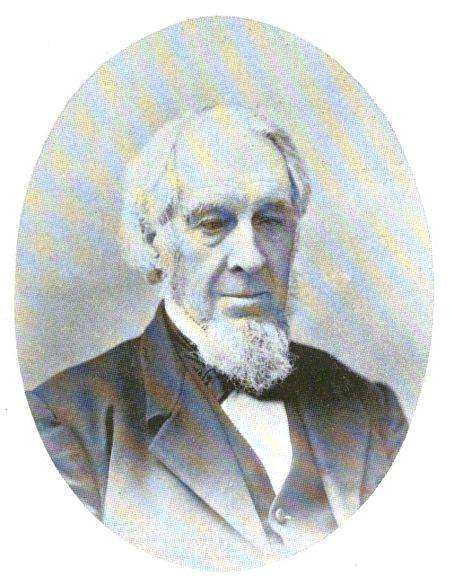 Eli Jones.
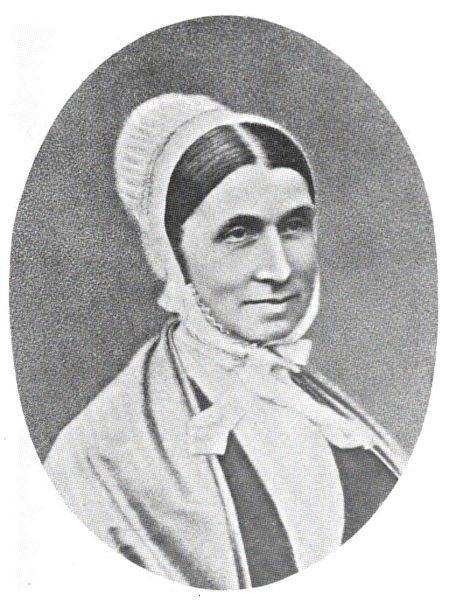 Sybil Jones.