An Account of the Hudson's Bay Company's Intercourse with the
Indians of the North-West Coast; with a Sketch of the Different
American Fur Companies, and their Dealings with the
Tribes of the Rocky Mountains.
In the year 1818, Mr. Prevost, acting for the United States, received Astoria
back from the British, who had taken possession, as narrated by Mr. Irving,
four years previous. The restoration took place in conformity with the treaty
of Ghent, by which those places captured during the war were restored to their
original possessors. Mr. Astor stood ready at that time to renew his enterprise
on the Columbia River, had Congress been disposed to grant him the necessary
protection which the undertaking required. Failing to secure this, when the
United States sloop of war Ontario sailed away from Astoria, after having
taken formal possession of that place for our Government, the country was left to
the occupancy, (scarcely a joint-occupancy, since there were then no Americans
here,) of the British traders. After the war, and while negotiations were
going on between Great Britain and the United States, the fort at Astoria had
remained in possession of the North-West Company, as their principal establishment
west of the mountains. It had been considerably enlarged since it had
come into their possession, and was furnished with artillery enough to have
frightened into friendship a much more warlike people than the subjects of old
king Comcomly; who, it will be remembered, was not at first very well disposed
towards the "King George men," having learned to look upon the "Boston
men" as his friends in his earliest intercourse with the whites. At this time
Astoria, or Fort George, as the British traders called it, contained sixty-five
inmates, twenty-three of whom were whites, and the remainder Canadian half-breeds
and Sandwich Islanders. Besides this number of men, there were a few
women, the native wives of the men, and their half-breed offspring. The situation
of Astoria, however, was not favorable, being near the sea coast, and not
surrounded with good farming lands such as were required for the furnishing
of provisions to the fort. Therefore, when in 1821 it was destroyed by fire, it
was only in part rebuilt, but a better and more convenient location for the headquarters
of the North-West Company was sought for in the interior.
About this time a quarrel of long standing between the Hudson's Bay and
North-West Companies culminated in a battle between their men in the Red
River country, resulting in a considerable loss of life and property. This affair
drew the attention of the Government at home; the rights of the rival companies
were examined into, the mediation of the Ministry secured, and a compromise
effected, by which the North-West Company, which had succeeded in
dispossessing the Pacific Fur Company under Mr. Astor, was merged into the
Hudson's Bay Company, whose name and fame are so familiar to all the early
settlers of Oregon.
At the same time, Parliament passed an act by which the hands of the consolidated
company were much strengthened, and the peace and security of all
persons greatly insured; but which became subsequently, in the joint occupancy
of the country, a cause of offence to the American citizens, as we shall see
hereafter. This act allowed the commissioning of Justices of the Peace in all
the territories not belonging to the United States, nor already subject to grants.
These justices were to execute and enforce the laws and decisions of the courts
of Upper Canada; to take evidence, and commit and send to Canada for trial
the guilty; and even in some cases, to hold courts themselves for the trial of
criminal offences and misdemeanors not punishable with death, or of civil causes
in which the amount at issue should not exceed two hundred pounds.
Thus in 1824, the North-West Company, whose perfidy had occasioned such
loss and mortification to the enterprising New York merchant, became itself a
thing of the past, and a new rule began in the region west of the Rocky Mountains.
The old fort at Astoria having been only so far rebuilt as to answer the
needs of the hour, after due consideration, a site for head-quarters was selected
about one hundred miles from the sea, near the mouth of the Wallamet River,
though opposite to it. Three considerations went to make up the eligibility of
the point selected. First, it was desirable, even necessary, to settle upon good
agricultural lands, where the Company's provisions could be raised by the Company's
servants. Second, it was important that the spot chosen should be upon
waters navigable for the Company's vessels, or upon tide-water. Lastly, and
not leastly, the Company had an eye to the boundary question between Great
Britain and the United States; and believing that the end of the controversy
would probably be to make the Columbia River the northern limit of the United
States territory, a spot on the northern bank of that river was considered a
good point for their fort, and possible future city.
The site chosen by the North-West Company in 1821, for their new fort,
combined all these advantages, and the further one of having been already
commenced and named. Fort Vancouver became at once on the accession of
the Hudson's Bay Company, the metropolis of the northwest coast, the center
of the fur trade, and the seat of government for that immense territory, over
which roamed the hunters and trappers in the employ of that powerful corporation.
This post was situated on the edge of a beautiful sloping plain on the
northern bank of the Columbia, about six miles above the upper mouth of the
Wallamet. At this point the Columbia spreads to a great width, and is divided
on the south side into bayous by long sandy islands, covered with oak, ash, and
cotton-wood trees, making the noble river more attractive still by adding the
charm of curiosity concerning its actual breadth to its natural and ordinary
magnificence. Back of the fort the land rose gently, covered with forests of fir;
and away to the east swelled the foot-hills of the Cascade range, then the mountains
themselves, draped in filmy azure, and over-topped five thousand feet by
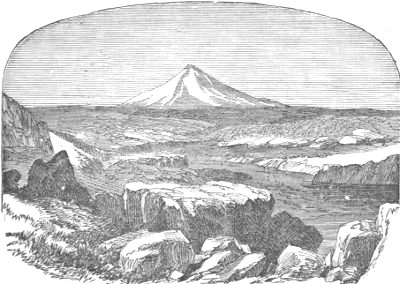
the snowy cone of Mt. Hood.
In this lonely situation grew up, with the dispatch which characterized the
acts of the Company, a fort in most respects similar to the original one at
Astoria. It was not, however, thought necessary to make so great a display of
artillery as had served to keep in order the subjects of Comcomly. A stockade
enclosed a space about eight hundred feet long by five hundred broad, having
a bastion at one corner, where were mounted three guns, while two eighteen
pounders and two swivels were planted in front of the residence of the Governor
and chief factors. These commanded the main entrance to the fort,
besides which there were two other gates in front, and another in the rear.
Military precision was observed in the precautions taken against surprises, as
well as in all the rules of the place. The gates were opened and closed at
certain hours, and were always guarded. No large number of Indians were
permitted within the enclosure at the same time, and every employee at the fort
knew and performed his duty with punctuality.
The buildings within the stockade were the Governor's and chief factors'
residences, stores, offices, work-shops, magazines, warehouses, &c.
Year by year, up to 1835 or '40, improvements continued to go on in and
about the fort, the chief of which was the cultivation of the large farm and
garden outside the enclosure, and the erection of a hospital building, large barns,
servants' houses, and a boat-house, all outside of the fort; so that at the period
when the Columbia River was a romance and a mystery to the people of the
United States, quite a flourishing and beautiful village adorned its northern
shore, and that too erected and sustained by the enemies of American enterprise
on soil commonly believed to belong to the United States: fair foes the
author firmly believes them to have been in those days, yet foes nevertheless.
The system on which the Hudson's Bay Company conducted its business was
the result of long experience, and was admirable for its method and its justice also.
When a young man entered its service as a clerk, his wages were small for several
years, increasing only as his ability and good conduct entitled him to advancement.
When his salary had reached one hundred pounds sterling he became
eligible to a chief-tradership as a partner in the concern, from which position
he was promoted to the rank of a chief factor. No important business was
ever intrusted to an inexperienced person, a policy which almost certainly prevented
any serious errors. A regular tariff was established on the Company's
goods, comprising all the articles used in their trade with the Indians; nor was
the quality of their goods ever allowed to deteriorate. A price was also fixed
upon furs according to their market value, and an Indian knowing this, knew
exactly what he could purchase. No bartering was allowed. When skins
were offered for sale at the fort they were handed to the clerk through a window
like a post-office delivery-window, and their value in the article desired,
returned through the same aperture. All these regulations were of the highest
importance to the good order, safety, and profit of the Company. The confidence
of the Indians was sure to be gained by the constancy and good faith
always observed toward them, and the Company obtained thereby numerous
and powerful allies in nearly all the tribes.
As soon as it was possible to make the change, the Indians were denied the
use of intoxicating drinks, the appetite for which had early been introduced
among them by coasting vessels, and even continued by the Pacific Fur Company
at Astoria. It would have been dangerous to have suddenly deprived
them of the coveted stimulus; therefore the practice must be discontinued by
many wise arts and devices. A public notice was given that the sale of it
would be stopped, and the reasons for this prohibition explained to the Indians.
Still, not to come into direct conflict with their appetites, a little was sold to
the chiefs, now and then, by the clerks, who affected to be running the greatest
risks in violating the order of the company. The strictest secrecy was enjoined
on the lucky chief who, by the friendship of some under-clerk, was enabled to
smuggle off a bottle under his blanket. But the cunning clerk had generally
managed to get his "good friend" into a state so cleverly between drunk and
sober, before he entrusted him with the precious bottle, that he was sure to
betray himself. Leaving the shop with a mien even more erect than usual,
with a gait affected in its majesty, and his blanket tightened around him to
conceal his secret treasure, the chuckling chief would start to cross the grounds
within the fort. If he was a new customer, he was once or twice permitted to
play his little game with the obliging clerk whose particular friend he was, and
to escape detection.
But by-and-by, when the officers had seen the offence repeated more than
once from their purposely contrived posts of observation, one of them would
skillfully chance to intercept the guilty chief at whose comical endeavors to
appear sober he was inwardly laughing, and charge him with being intoxicated.
Wresting away the tightened blanket, the bottle appeared as evidence that
could not be controverted, of the duplicity of the Indian and the unfaithfulness
of the clerk, whose name was instantly demanded, that he might be properly
punished. When the chief again visited the fort, his particular friend met him
with a sorrowful countenance, reproaching him for having been the cause of
his disgrace and loss. This reproach was the surest means of preventing another
demand for rum, the Indian being too magnanimous, probably, to wish to
get his friend into trouble; while the clerk affected to fear the consequences
too much to be induced to take the risk another time. Thus by kind and careful
means the traffic in liquors was at length broken up, which otherwise would
have ruined both Indian and trader.
To the company's servants liquor was sold or allowed at certain times: to
those on the sea-board, one half-pint two or three times a year, to be used as
medicine,—not that it was always needed or used for this purpose, but too strict
inquiry into its use was wisely avoided,—and for this the company demanded
pay. To their servants in the interior no liquor was sold, but they were furnished
as a gratuity with one pint on leaving rendezvous, and another on arriving
at winter quarters. By this management, it became impossible for them to
dispose of drink to the Indians; their small allowance being always immediately
consumed in a meeting or parting carouse.
The arrival of men from the interior at Fort Vancouver usually took place
in the month of June, when the Columbia was high, and a stirring scene it
was. The chief traders generally contrived their march through the upper
country, their camps, and their rendezvous, so as to meet the Express which
annually came to Vancouver from Canada and the Red River settlements.
They then descended the Columbia together, and arrived in force at the Fort.
This annual fleet went by the name of Brigade—a name which suggested a
military spirit in the crews that their appearance failed to vindicate. Yet,
though there was nothing warlike in the scene, there was much that was exciting,
picturesque, and even brilliant; for these couriers de bois, or wood-rangers,
and the voyageurs, or boatmen, were the most foppish of mortals when they
came to rendezvous. Then, too, there was an exaltation of spirits on their safe
arrival at head-quarters, after their year's toil and danger in wildernesses,
among Indians and wild beasts, exposed to famine and accident, that almost
deprived them of what is called "common sense," and compelled them to the
most fantastic excesses.
Their well-understood peculiarities did not make them the less welcome at
Vancouver. When the cry was given—"the Brigade! the Brigade!"—there
was a general rush to the river's bank to witness the spectacle. In advance
came the chief-trader's barge, with the company's flag at the bow, and the
cross of St. George at the stern: the fleet as many abreast as the turnings of
the river allowed. With strong and skillful strokes the boatmen governed their
richly laden boats, keeping them in line, and at the same time singing in chorus
a loud and not unmusical hunting or boating song. The gay ribbons and feathers
with which the singers were bedecked took nothing from the picturesqueness
of their appearance. The broad, full river, sparkling in the sunlight,
gemmed with emerald islands, and bordered with a rich growth of flowering
shrubbery; the smiling plain surrounding the Fort; the distant mountains,
where glittered the sentinel Mt. Hood, all came gracefully into the picture, and
seemed to furnish a fitting back-ground and middle distance for the bright bit
of coloring given by the moving life in the scene. As with a skillful sweep the
brigade touched the bank, and the traders and men sprang on shore, the first
cheer which had welcomed their appearance was heartily repeated, while a gay
clamor of questions and answers followed.
After the business immediately incident to their arrival had been dispatched,
then took place the regale of pork, flour, and spirits, which was sure to end in
a carouse, during which blackened eyes and broken noses were not at all uncommon;
but though blood was made to flow, life was never put seriously in
peril, and the belligerent parties were the best of friends when the fracas was
ended.
The business of exchange being completed in three or four weeks—the rich
stores of peltries consigned to their places in the warehouse, and the boats reladen
with goods for the next year's trade with the Indians in the upper country,
a parting carouse took place, and with another parade of feathers, ribbons, and
other finery, the brigade departed with songs and cheers as it had come, but
with probably heavier hearts.
It would be a stern morality indeed which could look upon the excesses of
this peculiar class as it would upon the same excesses committed by men in the
enjoyment of all the comforts and pleasures of civilized life. For them, during
most of the year, was only an out-door life of toil, watchfulness, peril, and
isolation. When they arrived at the rendezvous, for the brief period of their
stay they were allowed perfect license because nothing else would content
them. Although at head-quarters they were still in the wilderness, thousands
of miles from civilization, with no chance of such recreations as men in the
continual enjoyment of life's sweetest pleasures would naturally seek. For
them there was only one method of seeking and finding temporary oblivion of
the accustomed hardship; and whatever may be the strict rendering of man's
duty as an immortal being, we cannot help being somewhat lenient at times to
his errors as a mortal.
After the departure of the boats, there was another arrival at the Fort, of
trappers from the Snake River country. Previous to 1832, such were the dangers
of the fur trade in this region, that only the most experienced traders
were suffered to conduct a party through it; and even they were frequently
attacked, and sometimes sustained serious losses of men and animals. Subsequently,
however, the Hudson's Bay Company obtained such an influence over
even these hostile tribes as to make it safe for a party of no more than two of
their men to travel through this much dreaded region.
There was another important arrival at Fort Vancouver, usually in midsummer.
This was the Company's supply ship from London. In the possible
event of a vessel being lost, one cargo was always kept on store at Vancouver;
but for which wise regulation much trouble and disaster might have resulted,
especially in the early days of the establishment. Occasionally a vessel foundered
at sea or was lost on the bar of the Columbia; but these losses did not
interrupt the regular transaction of business. The arrival of a ship from London
was the occasion of great bustle and excitement also. She brought not
only goods for the posts throughout the district of the Columbia, but letters,
papers, private parcels, and all that seemed of so much value to the little
isolated world at the Fort.
A company conducting its business with such method and regularity as has
been described, was certain of success. Yet some credit also must attach to
certain individuals in its service, whose faithfulness, zeal, and ability in carrying
out its designs, contributed largely to its welfare. Such a man was at the
head of the Hudson's Bay Company's affairs in the large and important district
west of the Rocky Mountains. The Company never had in its service a
more efficient man than Gov. John McLaughlin, more commonly called Dr.
McLaughlin.
To the discipline, at once severe and just, which Dr. McLaughlin maintained
in his district, was due the safety and prosperity of the company he served,
and the servants of that company generally; as well as, at a later period, of
the emigration which followed the hunter and trapper into the wilds of Oregon.
Careful as were all the officers of the Hudson's Bay Company, they could not
always avoid conflicts with the Indians; nor was their kindness and justice
always sufficiently appreciated to prevent the outbreak of savage instincts.
Fort Vancouver had been threatened in an early day; a vessel or two had
been lost in which the Indians were suspected to have been implicated; at
long intervals a trader was murdered in the interior; or more frequently,
Indian insolence put to the test both the wisdom and courage of the officers to
prevent an outbreak.
When murders and robberies were committed, it was the custom at Fort
Vancouver to send a strong party to demand the offenders from their tribe;
Such was the well known power and influence of the Company, and such the
wholesome fear of the "King George men," that this demand was never resisted,
and if the murderer could be found he was given up to be hung according
to "King George" laws. They were almost equally impelled to good conduct
by the state of dependence on the company into which they had been
brought. Once they had subsisted and clothed themselves from the spoils of
the rivers and forest; since they had tasted of the tree of knowledge of good
and evil, they could no more return to skins for raiment, nor to game alone for
food. Blankets and flour, beads, guns, and ammunition had become dear to
their hearts: for all these things they must love and obey the Hudson's Bay
Company. Another fine stroke of policy in the Company was to destroy the
chieftain-ships in the various tribes; thus weakening them by dividing them
and preventing dangerous coalitions of the leading spirits: for in savage as
well as civilized life, the many are governed by the few.
It may not be uninteresting in this place to give a few anecdotes of the manner
in which conflicts with the Indians were prevented, or offences punished
by the Hudson's Bay Company. In the year 1828 the ship William and Ann
was cast away just inside the bar of the Columbia, under circumstances which
seemed to direct suspicion to the Indians in that vicinity. Whether or not
they had attacked the ship, not a soul was saved from the wreck to tell how
she was lost. On hearing that the ship had gone to pieces, and that the Indians
had appropriated a portion of her cargo, Dr. McLaughlin sent a message
to the chiefs, demanding restitution of the stolen goods. Nothing was returned
by the messenger except one or two worthless articles. Immediately an armed
force was sent to the scene of the robbery with a fresh demand for the goods,
which the chiefs, in view of their spoils, thought proper to resist by firing upon
the reclaiming party. But they were not unprepared; and a swivel was discharged
to let the savages know what they might expect in the way of firearms.
The argument was conclusive, the Indians fleeing into the woods.
While making search for the goods, a portion of which were found, a chief
was observed skulking near, and cocking his gun; on which motion one of the
men fired, and he fell. This prompt action, the justice of which the Indians
well understood, and the intimidating power of the swivel, put an end to the incipient
war. Care was then taken to impress upon their minds that they must
not expect to profit by the disasters of vessels, nor be tempted to murder white
men for the sake of plunder. The William and Ann was supposed to have got
aground, when the savages seeing her situation, boarded her and murdered the
crew for the cargo which they knew her to contain. Yet as there were no positive
proofs, only such measures were taken as would deter them from a similar
attempt in future. That the lesson was not lost, was proven two years later,
when the Isabella, from London, struck on the bar, her crew deserting her. In
this instance no attempt was made to meddle with the vessel's cargo; and as
the crew made their way to Vancouver, the goods were nearly all saved.
In a former voyage of the William and Ann to the Columbia River, she had
been sent on an exploring expedition to the Gulf of Georgia to discover the
mouth of Frazier's River, having on board a crew of forty men. Whenever
the ship came to anchor, two sentries were kept constantly on deck to guard
against any surprise or misconduct on the part of the Indians; so adroit, however,
were they in the light-fingered art, that every one of the eight cannon
with which the ship was armed was robbed of its ammunition, as was discovered
on leaving the river! Such incidents as these served to impress the minds of
the Company's officers and servants with the necessity of vigilance in their dealings
with the savages.
Not all their vigilance could at all times avail to prevent mischief. When
Sir George Simpson, Governor of the Hudson's Bay Company, was on a visit
to Vancouver in 1829, he was made aware of this truism. The Governor was
on his return to Canada by way of the Red River Settlement, and had reached
the Dalles of the Columbia with his party. In making the portage at this
place, all the party except Dr. Tod gave their guns into the charge of two men
to prevent their being stolen by the Indians, who crowded about, and whose
well-known bad character made great care needful. All went well, no attempt
to seize either guns or other property being made until at the end of the portage
the boats had been reloaded. As the party were about to re-embark, a
simultaneous rush was made by the Indians who had dogged their steps, to get
possession of the boats. Dr. Tod raised his gun immediately, aiming at the
head chief, who, not liking the prospect of so speedy dissolution, ordered his
followers to desist, and the party were suffered to escape. It was soon after
discovered that every gun belonging to the party in the boat had been wet,
excepting the one carried by Dr. Tod; and to the fact that the Doctor did carry
his gun, all the others owed their lives.
The great desire of the Indians for guns and ammunition led to many stratagems
which were dangerous to the possessors of the coveted articles. Much
more dangerous would it have been to have allowed them a free supply of these
things; nor could an Indian purchase from the Company more than a stated
supply, which was to be used, not for the purposes of war, but to keep himself
in game.
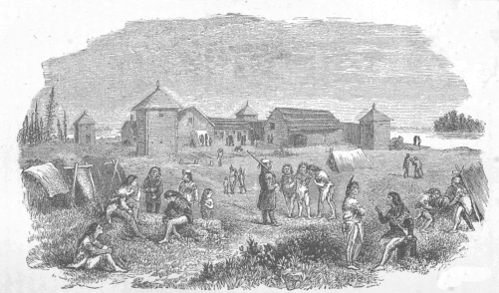
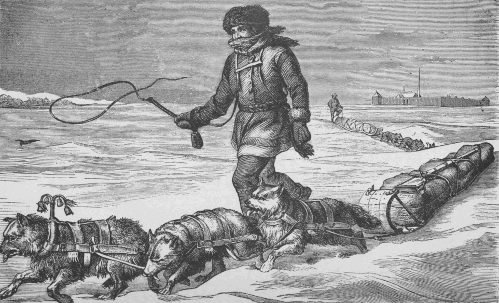
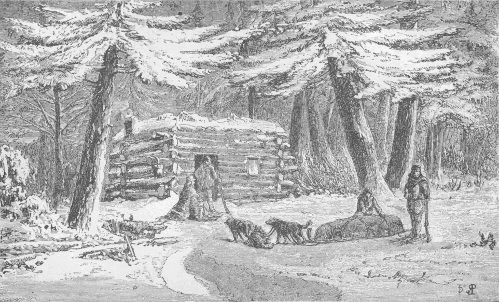
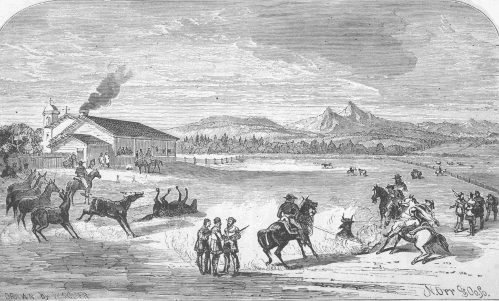
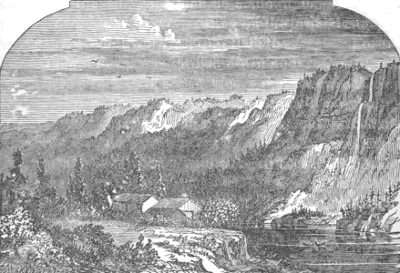
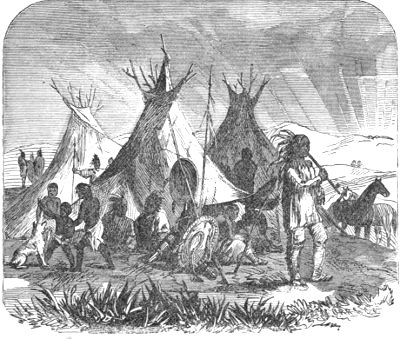
A STATION OF THE HUDSON'S BAY COMPANY.
Dr. McLaughlin was himself once quite near falling into a trap of the Indians,
so cunningly laid as to puzzle even him. This was a report brought to him
by a deputation of Columbia River Indians, stating the startling fact that the
fort at Nesqually had been attacked, and every inmate slaughtered. To this
horrible story, told with every appearance of truth, the Doctor listened with
incredulity mingled with apprehension. The Indians were closely questioned
and cross-questioned, but did not conflict in their testimony. The matter assumed
a very painful aspect. Not to be deceived, the Doctor had the unwelcome
messengers committed to custody while he could bring other witnesses
from their tribe. But they were prepared for this, and the whole tribe were as
positive as those who brought the tale. Confounded by this cloud of witnesses,
Dr. McLaughlin had almost determined upon sending an armed force to Nesqually
to inquire into the matter, and if necessary, punish the Indians, when a
detachment of men arrived from that post, and the plot was exposed! The
design of the Indians had been simply to cause a division of the force at Vancouver,
after which they believed they might succeed in capturing and plundering
the fort. Had they truly been successful in this undertaking, every other
trading-post in the country would have been destroyed. But so long as the
head-quarters of the Company remained secure and powerful, the other stations
were comparatively safe.
An incident which has been several times related, occurred at fort Walla-Walla,
and shows how narrow escapes the interior traders sometimes made.
The hero of this anecdote was Mr. McKinlay, one of the most estimable of the
Hudson's Bay Company's officers, in charge of the fort just named. An Indian
was one day lounging about the fort, and seeing some timbers lying in a heap
that had been squared for pack saddles, helped himself to one and commenced
cutting it down into a whip handle for his own use. To this procedure Mr.
McKinlay's clerk demurred, first telling the Indian its use, and then ordering
him to resign the piece of timber. The Indian insolently replied that the timber
was his, and he should take it. At this the clerk, with more temper than
prudence, struck the offender, knocking him over, soon after which the savage
left the fort with sullen looks boding vengeance. The next day Mr. McKinlay,
not being informed of what had taken place, was in a room of the fort with his
clerk when a considerable party of Indians began dropping quietly in until
there were fifteen or twenty of them inside the building. The first intimation
of anything wrong McKinlay received was when he observed the clerk pointed
out in a particular manner by one of the party. He instantly comprehended
the purpose of his visitors, and with that quickness of thought which is habitual
to the student of savage nature, he rushed into the store room and returned
with a powder keg, flint and steel. By this time the unlucky clerk was struggling
for his life with his vindictive foes. Putting down the powder in their
midst and knocking out the head of the keg with a blow, McKinlay stood over
it ready to strike fire with his flint and steel. The savages paused aghast.
They knew the nature of the "perilous stuff," and also understood the trader's
purpose. "Come," said he with a clear, determined voice, "you are twenty
braves against us two: now touch him if you dare, and see who dies first." In
a moment the fort was cleared, and McKinlay was left to inquire the cause of
what had so nearly been a tragedy. It is hardly a subject of doubt whether or
not his clerk got a scolding. Soon after, such was the powerful influence
exerted by these gentlemen, the chief of the tribe flogged the pilfering Indian
for the offence, and McKinlay became a great brave, a "big heart" for his
courage.
It was indeed necessary to have courage, patience, and prudence in dealing
with the Indians. These the Hudson's Bay officers generally possessed. Perhaps
the most irascible of them all in the Columbia District, was their chief,
Dr. McLaughlin; but such was his goodness and justice that even the savages
recognized it, and he was hyas tyee, or great chief, in all respects to them.
Being on one occasion very much annoyed by the pertinacity of an Indian who
was continually demanding pay for some stones with which the Doctor was
having a vessel ballasted, he seized one of some size, and thrusting it in the
Indian's mouth, cried out in a furious manner, "pay, pay! if the stones are
yours, take them and eat them, you rascal! Pay, pay! the devil! the devil!"
upon which explosion of wrath, the native owner of the soil thought it prudent
to withdraw his immediate claims.
There was more, however, in the Doctor's action than mere indulgence of
wrath. He understood perfectly that the savage values only what he can eat
and wear, and that as he could not put the stones to either of these uses, his
demand for pay was an impudent one.
Enough has been said to give the reader an insight into Indian character, to
prepare his mind for events which are to follow, to convey an idea of the influence
of the Hudson's Bay Company, and to show on what it was founded.
The American Fur Companies will now be sketched, and their mode of dealing
with the Indians contrasted with that of the British Company. The comparison
will not be favorable; but should any unfairness be suspected, a reference
to Mr. Irving's Bonneville, will show that the worthy Captain was forced to
witness against his own countrymen in his narrative of his hunting and trading
adventures in the Rocky Mountains.
The dissolution of the Pacific Fur Company, the refusal of the United States
Government to protect Mr. Astor in a second attempt to carry on a commerce
with the Indians west of the Rocky Mountains, and the occupation of that
country by British traders, had the effect to deter individual enterprise from
again attempting to establish commerce on the Pacific coast. The people
waited for the Government to take some steps toward the encouragement of a
trans-continental trade; the Government beholding the lion (British) in the
way, waited for the expiration of the convention of 1818, in the Micawber-like
hope that something would "turn up" to settle the question of territorial sovereignty.
The war of 1812 had been begun on the part of Great Britain, to
secure the great western territories to herself for the profits of the fur trade,
almost solely. Failing in this, she had been compelled, by the treaty of Ghent,
to restore to the United States all the places and forts captured during that
war. Yet the forts and trading posts in the west remained practically in the
possession of Great Britain; for her traders and fur companies still roamed the
country, excluding American trade, and inciting (so the frontiers-men believed),
the Indians to acts of blood and horror.
Congress being importuned by the people of the West, finally, in 1815, passed
an act expelling British traders from American territory east of the Rocky
Mountains. Following the passage of this act the hunters and trappers of the
old North American Company, at the head of which Mr. Astor still remained,
began to range the country about the head waters of the Mississippi and the
upper Missouri. Also a few American traders had ventured into the northern
provinces of Mexico, previous to the overthrow of the Spanish Government;
and after that event, a thriving trade grew up between St. Louis and Santa Fé.
At length, in 1823, Mr. W.H. Ashley, of St. Louis, a merchant for a long
time engaged in the fur trade on the Missouri and its tributaries, determined to
push a trading party up to or beyond the Rocky Mountains. Following up
the Platte River, Mr. Ashley proceeded at the head of a large party with horses
and merchandise, as far as the northern branch of the Platte, called the Sweetwater.
This he explored to its source, situated in that remarkable depression
in the Rocky Mountains, known as the South Pass—the same which Fremont
discovered twenty years later, during which twenty years it was annually traveled
by trading parties, and just prior to Fremont's discovery, by missionaries
and emigrants destined to Oregon. To Mr. Ashley also belongs the credit of
having first explored the head-waters of the Colorado, called the Green River,
afterwards a favorite rendezvous of the American Fur Companies. The country
about the South Pass proved to be an entirely new hunting ground, and
very rich in furs, as here many rivers take their rise, whose head-waters furnished
abundant beaver. Here Mr. Ashley spent the summer, returning to St.
Louis in the fall with a valuable collection of skins.
In 1824, Mr. Ashley repeated the expedition, extending it this time beyond
Green River as far as Great Salt Lake, near which to the south he discovered
another smaller lake, which he named Lake Ashley, after himself. On the
shores of this lake he built a fort for trading with the Indians, and leaving in it
about one hundred men, returned to St. Louis the second time with a large
amount of furs. During the time the fort was occupied by Mr. Ashley's men, a
period of three years, more than one hundred and eighty thousand dollars worth
of furs were collected and sent to St. Louis. In 1827, the fort, and all Mr.
Ashley's interest in the business, was sold to the Rocky Mountain Fur Company,
at the head of which were Jedediah Smith, William Sublette, and David
Jackson, Sublette being the leading spirit in the Company.
The custom of these enterprising traders, who had been in the mountains
since 1824, was to divide their force, each taking his command to a good hunting
ground, and returning at stated times to rendezvous, generally appointed
on the head-waters of Green River. Frequently the other fur companies, (for
there were other companies formed on the heels of Ashley's enterprise,) learning
of the place appointed for the yearly rendezvous, brought their goods to
the same resort, when an intense rivalry was exhibited by the several traders
as to which company should soonest dispose of its goods, getting, of course, the
largest amount of furs from the trappers and Indians. So great was the competition
in the years between 1826 and 1829, when there were about six hundred
American trappers in and about the Rocky Mountains, besides those of
the Hudson's Bay Company, that it was death for a man of one company to
dispose of his furs to a rival association. Even a "free trapper"—that is, one
not indentured, but hunting upon certain terms of agreement concerning the
price of his furs and the cost of his outfit, only, dared not sell to any other
company than the one he had agreed with.
Jedediah Smith, of the Rocky Mountain Fur Company, during their first
year in the mountains, took a party of five trappers into Oregon, being the
first American, trader or other, to cross into that country since the breaking
up of Mr. Astor's establishment. He trapped on the head-waters of the Snake
River until autumn, when he fell in with a party of Hudson's Bay trappers,
and going with them to their post in the Flathead country, wintered there.
Again, in 1826, Smith, Sublette, and Jackson, brought out a large number of
men to trap in the Snake River country, and entered into direct competition
with the Hudson's Bay Company, whom they opposed with hardly a degree
more of zeal than they competed with rival American traders: this one extra
degree being inspired by a "spirit of '76" toward anything British.
After the Rocky Mountain Fur Company had extended its business by the
purchase of Mr. Ashley's interest, the partners determined to push their enterprise
to the Pacific coast, regardless of the opposition they were likely to encounter
from the Hudson's Bay traders. Accordingly, in the spring of 1827,
the Company was divided up into three parts, to be led separately, by different
routes, into the Indian Territory, nearer the ocean.
Smith's route was from the Platte River, southwards to Santa Fé, thence to
the bay of San Francisco, and thence along the coast to the Columbia River.
His party were successful, and had arrived in the autumn of the following year
at the Umpqua River, about two hundred miles south of the Columbia, in
safety. Here one of those sudden reverses to which the "mountain-man" is
liable at any moment, overtook him. His party at this time consisted of thirteen
men, with their horses, and a collection of furs valued at twenty thousand
dollars. Arrived at the Umpqua, they encamped for the night on its southern
bank, unaware that the natives in this vicinity (the Shastas) were more fierce
and treacherous than the indolent tribes of California, for whom, probably,
they had a great contempt. All went well until the following morning, the
Indians hanging about the camp, but apparently friendly. Smith had just
breakfasted, and was occupied in looking for a fording-place for the animals,
being on a raft, and having with him a little Englishman and one Indian.
When they were in the middle of the river the Indian snatched Smith's gun
and jumped into the water. At the same instant a yell from the camp, which
was in sight, proclaimed that it was attacked. Quick as thought Smith
snatched the Englishman's gun, and shot dead the Indian in the river.
To return to the camp was certain death. Already several of his men had
fallen; overpowered by numbers he could not hope that any would escape, and
nothing was left him but flight. He succeeded in getting to the opposite shore
with his raft before he could be intercepted, and fled with his companion, on
foot and with only one gun, and no provisions, to the mountains that border
the river. With great good fortune they were enabled to pass through the remaining
two hundred miles of their journey without accident, though not without
suffering, and reach Fort Vancouver in a destitute condition, where they
were kindly cared for.
Of the men left in camp, only two escaped. One man named Black defended
himself until he saw an opportunity for flight, when he escaped to the
cover of the woods, and finally to a friendly tribe farther north, near the coast,
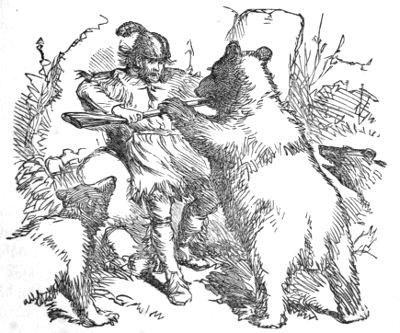
who piloted him to Vancouver. The remaining man was one Turner, of a very
powerful frame, who was doing camp duty as cook on this eventful morning.
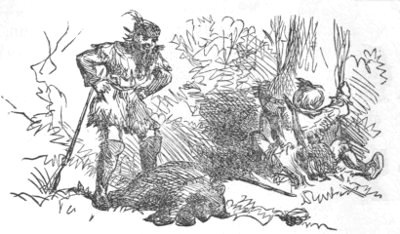
When the Indians rushed upon him he defended himself with a huge firebrand,
or half-burnt poplar stick, with which he laid about him like Sampson, killing
four red-skins before he saw a chance of escape. Singularly, for one in his extremity,
he did escape, and also arrived at Vancouver that winter.
Dr. McLaughlin received the unlucky trader and his three surviving men
with every mark and expression of kindness, and entertained them through the
winter. Not only this, but he dispatched a strong, armed party to the scene
of the disaster to punish the Indians and recover the stolen goods; all of which
was done at his own expense, both as an act of friendship toward his American
rivals, and as necessary to the discipline which they everywhere maintained
among the Indians. Should this offence go unpunished, the next attack might
be upon one of his own parties going annually down into California. Sir
George Simpson, the Governor of the Hudson's Bay Company, chanced to be
spending the winter at Vancouver. He offered to send Smith to London the
following summer, in the Company's vessel, where he might dispose of his furs
to advantage; but Smith declined this offer, and finally sold his furs to Dr.
McLaughlin, and returned in the spring to the Rocky Mountains.
On Sublette's return from St. Louis, in the summer of 1829, with men and
merchandise for the year's trade, he became uneasy on account of Smith's protracted
absence. According to a previous plan, he took a large party into the
Snake River country to hunt. Among the recruits from St. Louis was Joseph
L. Meek, the subject of the narrative following this chapter. Sublette not
meeting with Smith's party on its way from the Columbia, as he still hoped, at
length detailed a party to look for him on the head-waters of the Snake. Meek
was one of the men sent to look for the missing partner, whom he discovered
at length in Pierre's Hole, a deep valley in the mountains, from which issues
the Snake River in many living streams. Smith returned with the men to
camp, where the tale of his disasters was received after the manner of mountain-men,
simply declaring with a momentarily sobered countenance, that their
comrade has not been "in luck;" with which brief and equivocal expression
of sympathy the subject is dismissed. To dwell on the dangers incident to
their calling would be to half disarm themselves of their necessary courage;
and it is only when they are gathered about the fire in their winter camp, that
they indulge in tales of wild adventure and "hair-breadth 'scapes," or make
sorrowful reference to a comrade lost.
Influenced by the hospitable treatment which Smith had received at the
hands of the Hudson's Bay Company, the partners now determined to withdraw
from competition with them in the Snake country, and to trap upon the
waters of the Colorado, in the neighborhood of their fort. But "luck," the
mountain-man's Providence, seemed to have deserted Smith. In crossing the
Colorado River with a considerable collection of skins, he was again attacked
by Indians, and only escaped by losing all his property. He then went to St.
Louis for a supply of merchandise, and fitted out a trading party for Santa Fé;
but on his way to that place was killed in an encounter with the savages.
Turner, the man who so valiantly wielded the firebrand on the Umpqua
River, several years later met with a similar adventure on the Rogue River, in
Southern Oregon, and was the means of saving the lives of his party by his
courage, strength, and alertness. He finally, when trapping had become unprofitable,
retired upon a farm in the Wallamet Valley, as did many other
mountain-men who survived the dangers of their perilous trade.
After the death of Smith, the Rocky Mountain Fur Company continued its
operations under the command of Bridger, Fitzpatrick, and Milton Sublette,
brother of William. In the spring of 1830 they received about two hundred
recruits, and with little variation kept up their number of three or four hundred
men for a period of eight or ten years longer, or until the beaver were hunted
out of every nook and corner of the Rocky Mountains.
Previous to 1835, there were in and about the Rocky Mountains, beside the
"American" and "Rocky Mountain" companies, the St. Louis Company, and
eight or ten "lone traders." Among these latter were William Sublette,
Robert Campbell, J.O. Pattie, Mr. Pilcher, Col. Charles Bent, St. Vrain,
William Bent, Mr. Gant, and Mr. Blackwell. All these companies and
traders more or less frequently penetrated into the countries of New Mexico,
Old Mexico, Sonora, and California; returning sometimes through the mountain
regions of the latter State, by the Humboldt River to the head-waters of
the Colorado. Seldom, in all their journeys, did they intrude on that portion
of the Indian Territory lying within three hundred miles of Fort Vancouver,
or which forms the area of the present State of Oregon.
Up to 1832, the fur trade in the West had been chiefly conducted by merchants
from the frontier cities, especially by those of St. Louis. The old
"North American" was the only exception. But in the spring of this year,
Captain Bonneville, an United States officer on furlough, led a company of a
hundred men, with a train of wagons, horses and mules, with merchandise, into
the trapping grounds of the Rocky Mountains. His wagons were the first that
had ever crossed the summit of these mountains, though William Sublette had,
two or three years previous, brought wagons as far as the valley of the Wind
River, on the east side of the range. Captain Bonneville remained nearly
three years in the hunting and trapping grounds, taking parties of men into
the Colorado, Humboldt, and Sacramento valleys; but he realized no profits
from his expedition, being opposed and competed with by both British and
American traders of larger experience.
But Captain Bonneville's venture was a fortunate one compared with that
of Mr. Nathaniel Wyeth of Massachusetts, who also crossed the continent in
1832, with the view of establishing a trade on the Columbia River. Mr. Wyeth
brought with him a small party of men, all inexperienced in frontier or mountain
life, and destined for a salmon fishery on the Columbia. He had reached
Independence, Missouri, the last station before plunging into the wilderness, and
found himself somewhat at a loss how to proceed, until, at this juncture, he was
overtaken by the party of William Sublette, from St. Louis to the Rocky Mountains,
with whom he travelled in company to the rendezvous at Pierre's Hole.
When Wyeth arrived at the Columbia River, after tarrying until he had
acquired some mountain experiences, he found that his vessel, which was loaded
with merchandise for the Columbia River trade, had not arrived. He remained
at Vancouver through the winter, the guest of the Hudson's Bay Company,
and either having learned or surmised that his vessel was wrecked, returned to
the United States in the following year. Not discouraged, however, he made
another venture in 1834, despatching the ship May Dacre, Captain Lambert,
for the Columbia River, with another cargo of Indian goods, traveling himself
overland with a party of two hundred men, and a considerable quantity of merchandise
which he expected to sell to the Rocky Mountain Fur Company. In
this expectation he was defeated by William Sublette, who had also brought out
a large assortment of goods for the Indian trade, and had sold out, supplying
the market, before Mr. Wyeth arrived.
Wyeth then built a post, named Fort Hall, on Snake River, at the junction
of the Portneuf, where he stored his goods, and having detached most of his
men in trapping parties, proceeded to the Columbia River to meet the May
Dacre. He reached the Columbia about the same time with his vessel, and
proceeded at once to erect a salmon fishery. To forward this purpose he built
a post, called Fort William, on the lower end of Wappatoo (now known as
Sauvie's) Island, near where the Lower Wallamet falls into the Columbia. But
for various reasons he found the business on which he had entered unprofitable.
He had much trouble with the Indians, his men were killed or drowned, so that
by the time he had half a cargo of fish, he was ready to abandon the effort to
establish a commerce with the Oregon Indians, and was satisfied that no enterprise
less stupendous and powerful than that of the Hudson's Bay Company
could be long sustained in that country.
Much complaint was subsequently made by Americans, chiefly Missionaries,
of the conduct of that company in not allowing Mr. Wyeth to purchase beaver
skins of the Indians, but Mr. Wyeth himself made no such complaint. Personally,
he was treated with unvarying kindness, courtesy, and hospitality. As a
trader, they would not permit him to undersell them. In truth, they no doubt
wished him away; because competition would soon ruin the business of either,
and they liked not to have the Indians taught to expect more than their furs
were worth, nor to have the Indians' confidence in themselves destroyed or
tampered with.
The Hudson's Bay Company were hardly so unfriendly to him as the American
companies; since to the former he was enabled to sell his goods and fort on
the Snake River, before he returned to the United States, which he did in 1835.
The sale of Fort Hall to the Hudson's Bay Company was a finishing blow at
the American fur trade in the Rocky Mountains, which after two or three years
of constantly declining profits, was entirely abandoned.
Something of the dangers incident to the life of the hunter and trapper may
be gathered from the following statements, made by various parties who have
been engaged in it. In 1808, a Missouri Company engaged in fur hunting on
the three forks of the river Missouri, were attacked by Blackfeet, losing twenty-seven
men, and being compelled to abandon the country. In 1823, Mr. Ashley
was attacked on the same river by the Arickaras, and had twenty-six men
killed. About the same time the Missouri company lost seven men, and fifteen
thousand dollars' worth of merchandise on the Yellowstone River. A few years
previous, Major Henry lost, on the Missouri River, six men and fifty horses.
In the sketch given of Smith's trading adventures is shown how uncertain were
life and property at a later period. Of the two hundred men whom Wyeth
led into the Indian country, only about forty were alive at the end of three
years. There was, indeed, a constant state of warfare between the Indians
and the whites, wherever the American Companies hunted, in which great
numbers of both lost their lives. Add to this cause of decimation the perils
from wild beasts, famine, cold, and all manner of accidents, and the trapper's
chance of life was about one in three.
Of the causes which have produced the enmity of the Indians, there are
about as many. It was found to be the case almost universally, that on the
first visit of the whites the natives were friendly, after their natural fears had
been allayed. But by degrees their cupidity was excited to possess themselves
of the much coveted dress, arms, and goods of their visitors. As they had
little or nothing to offer in exchange, which the white man considered an equivalent,
they took the only method remaining of gratifying their desire of possession,
and stole the coveted articles which they could not purchase. When they
learned that the white men punished theft, they murdered to prevent the punishment.
Often, also, they had wrongs of their own to avenge. White men
did not always regard their property-rights. They were guilty of infamous
conduct toward Indian women. What one party of whites told them was true,
another plainly contradicted, leaving the lie between them. They were overbearing
toward the Indians on their own soil, exciting to irrepressible hostility
the natural jealousy of the inferior toward the superior race, where both are
free, which characterizes all people. In short, the Indians were not without
their grievances; and from barbarous ignorance and wrong on one side, and
intelligent wrong-doing on the other, together with the misunderstandings likely
to arise between two entirely distinct races, grew constantly a thousand abuses,
which resulted in a deadly enmity between the two.
For several reasons this evil existed to a greater degree among the American
traders and trappers than among the British. The American trapper was not,
like the Hudson's Bay employees, bred to the business. Oftener than any
other way he was some wild youth who, after an escapade in the society of his
native place, sought safety from reproach or punishment in the wilderness. Or
he was some disappointed man who, with feelings embittered towards his fellows,
preferred the seclusion of the forest and mountain. Many were of a class disreputable
everywhere, who gladly embraced a life not subject to social laws.
A few were brave, independent, and hardy spirits, who delighted in the hardships
and wild adventures their calling made necessary. All these men, the
best with the worst, were subject to no will but their own; and all experience
goes to prove that a life of perfect liberty is apt to degenerate into a life of
license. Even their own lives, and those of their companions, when it depended
upon their own prudence, were but lightly considered. The constant presence
of danger made them reckless. It is easy to conceive how, under these circumstances,
the natives and the foreigners grew to hate each other, in the
Indian country; especially after the Americans came to the determination to
"shoot an Indian at sight," unless he belonged to some tribe with whom they
had intermarried, after the manner of the trappers.
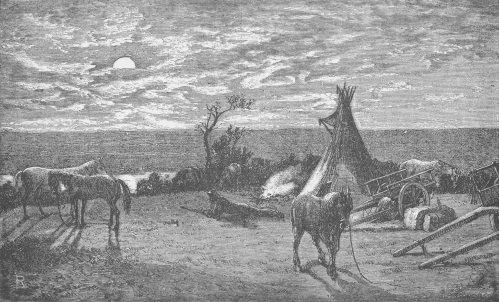
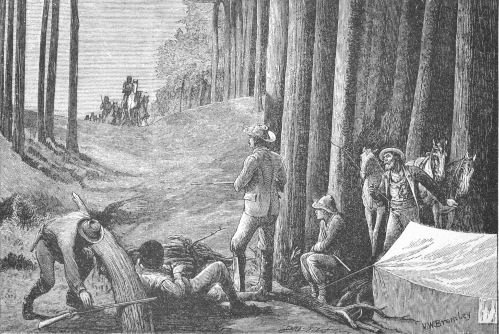
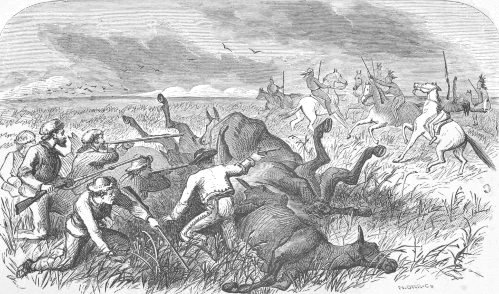
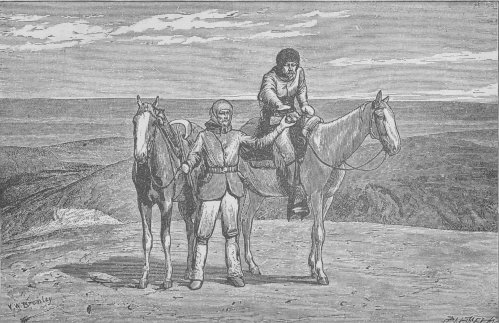
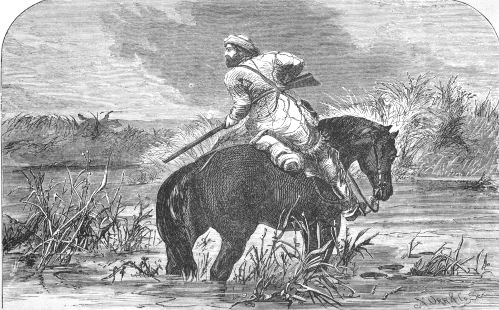
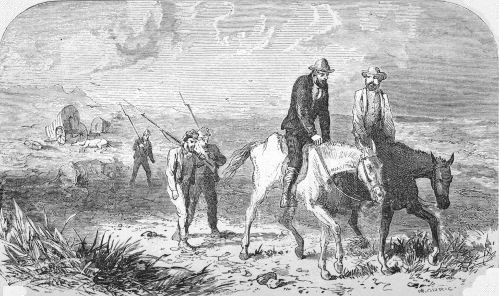
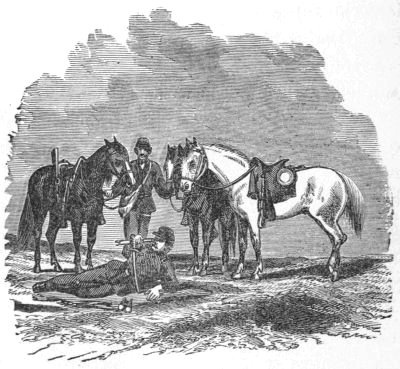
WATCHING FOR INDIAN HORSE-THIEVES.
On the other hand, the employees of the Hudson's Bay Company were many
of them half-breeds or full-blooded Indians of the Iroquois nation, towards
whom nearly all the tribes were kindly disposed. Even the Frenchmen who
trapped for this company were well liked by the Indians on account of their
suavity of manner, and the ease with which they adapted themselves to savage
life. Besides most of them had native wives and half-breed children, and were
regarded as relatives. They were trained to the life of a trapper, were subject
to the will of the Company, and were generally just and equitable in their dealings
with the Indians, according to that company's will, and the dictates of
prudence. Here was a wide difference.
Notwithstanding this, there were many dangers to be encountered. The
hostility of some of the tribes could never be overcome; nor has it ever abated.
Such were the Crows, the Blackfeet, the Cheyennes, the Apaches, the Camanches.
Only a superior force could compel the friendly offices of these tribes
for any white man, and then their treachery was as dangerous as their open
hostility.
It happened, therefore, that although the Hudson's Bay Company lost comparatively
few men by the hands of the Indians, they sometimes found them
implacable foes in common with the American trappers; and frequently one
party was very glad of the others' assistance. Altogether, as has before been
stated, the loss of life was immense in proportion to the number employed.
Very few of those who had spent years in the Rocky Mountains ever returned
to the United States. With their Indian wives and half-breed children, they
scattered themselves throughout Oregon, until when, a number of years after
the abandonment of the fur trade, Congress donated large tracts of land to
actual settlers, they laid claim, each to his selected portion, and became active
citizens of their adopted state.
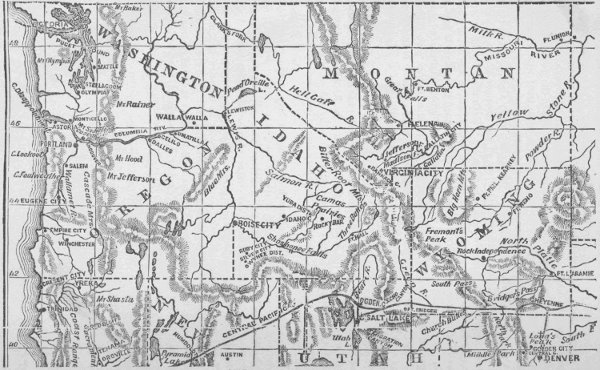
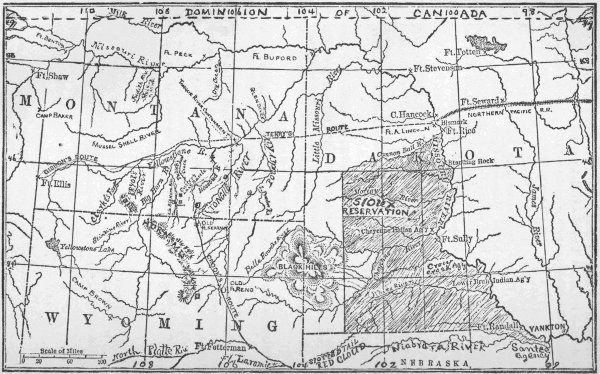
MAP OF THE FUR COUNTRY.