Service in the Trenches
Preparations for Entering Trenches
Preparing to enter upon a
period of service in the trenches
the company commander
makes a complete inspection
of the company which includes:
1. Inspection of rifles and ammunition.
2. Inspection of equipment, contents of packs,
intrenching tools, field glasses, wire cutters, first-aid
packets, emergency rations, gas helmets,
identification tags, canteens, clothing, etc.
3. Canteens to be filled with water.
4. Test bayonets, fix and unfix.
5. Have company fill magazines.
Inspection of Section
The company commander
precedes the company into
the trenches and makes a tour
and inspection of the section
assigned, which includes:
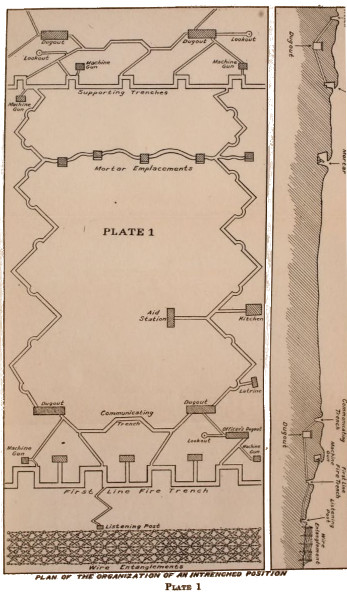
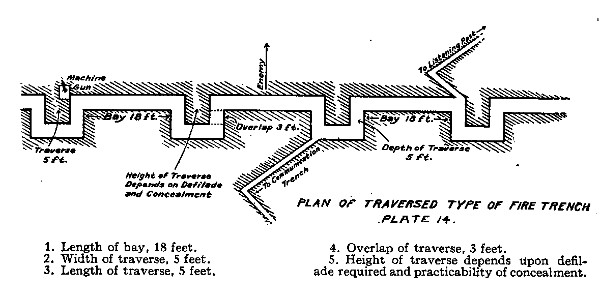
1. Layout of the trenches: fire trench, supervision
trench, communication trenches, machine-gun
positions, snipers' positions, listening and
observation trenches, dugouts, latrines, etc.
2. Locate telephones, reserve ammunition and
munitions depots, water supply, gas alarms,
tools and any trench accessories and utilities that
may be included in the section.
3. Get any information of the enemy that may
be of value from the outgoing company commander.
Tactical Disposition
The company commander
will then make his tactical
dispositions. In occupying
the trenches a certain section
of the line is assigned to each company. This
section contains so many bays of the trench.
The following dispositions are suggested as
meeting the requirements under our organization:
1. The company is organized into four platoons
of four squads each.
2. The section of the line assigned to the
company contains eight bays.
3. Support No. 1 consists of the first and second
platoons.
4. Support No. 2 consists of the third and
fourth platoons.
5. From Support No. 1: Two squads of the
first platoon occupy bays 1 and 2; two squads of
the second platoon occupy bays 3 and 4.
6. From Support No. 2: Two squads of the
third platoon occupy bays 5 and 6; two squads
of the fourth platoon occupy bays 7 and 8.
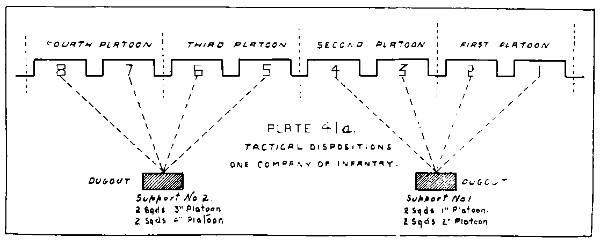
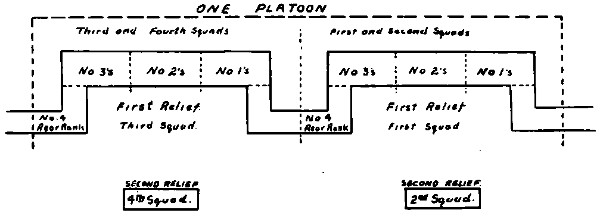
Plate 41f.
Tactical dispositions
One company of infantry.
7. Each squad establishes a double sentinel
post in the bay assigned to it and the remaining
members go into the squad shelters just in rear
of the bays. This gives three reliefs for a double
sentinel post and allows one extra man to be
utilized as "runner," etc.
8. The remainder of the company is established
in the company dugouts.
9. Depending upon the length of the tours of
duty of the company in the first line trenches,
the squads are changed according to a system
that will have to be varied to suit the occasion,
the squads in support taking their place in the
fire trench and those in the fire trench returning
to the support.
Going into the Trenches
Platoons enter by not more
than two squads at one time,
thus minimizing the danger
from shell fire. The platoon
commander will explain to his squad leaders the
extent of trench to be taken over and the action
to be taken in case they are caught under shell
fire or rapid fire while going up to the trenches.
A second in command in each squad will be
designated, so that if casualties occur among the
squad leaders the relief will proceed as previously
arranged.
The operation will proceed in silence. Rifles
must be carried so that they do not show over
the parapet. On reaching the fire trench the
men of the first relief are posted to relieve the
old detail and each man finds out any points
that may be useful from his predecessor on that
post.
Information to be Obtained
The platoon commander
confers with the commander of
the outgoing party and secures
all the information possible
about the position which includes:
1. Behavior of enemy during period preceding
relief, and any point in their line requiring special
information, e. g., enemy may have cut wire as
though preparing to attack.
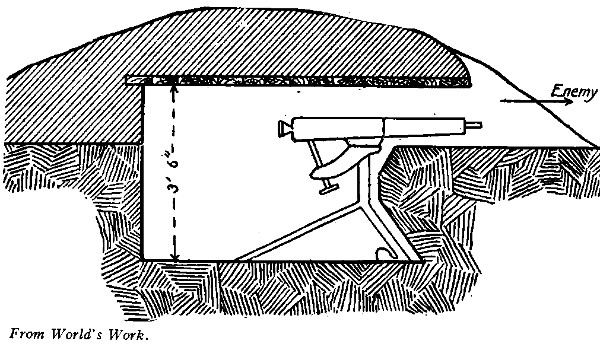
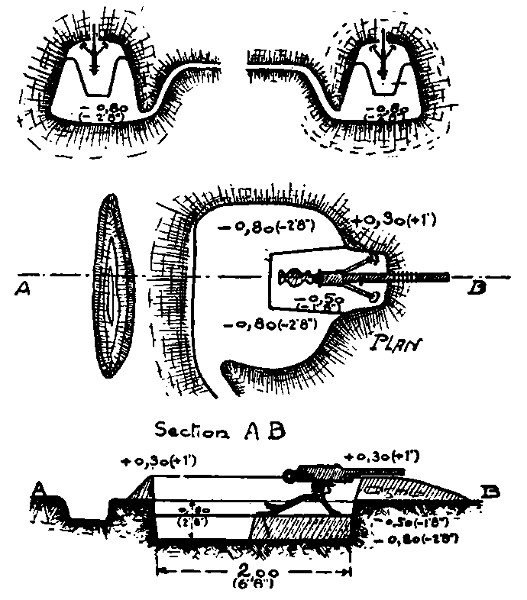
2. Machine-gun emplacement may be suspected
at some particular point.
3. Anything ascertained by patrols about
ground between firing lines, thus avoiding unnecessary
reconnaissance.
4. Any standing arrangements for patrols at
night, including point at which wire can best be
passed, ground to be patrolled, or place where
they can lie under cover.
5. Any parts of trench from which it is not safe
to fire. Such positions are apt to occur in winding
trenches, and are not always recognizable in
the dark.
6. Special features of trench, recent improvements,
work not completed, dangerous points (on
which machine guns are trained at night), useful
loopholes for observation.
7. Places from which food and water can be
safely obtained.
8. Amount of ammunition, number of picks,
shovels and empty sandbags in that section of
the line.
Information on these points cannot always be
given properly by word of mouth. Written notes
and plans should therefore be handed over to a
platoon commander taking over for the first
time.
Every man is required to see that he has a good
firing position for all directions. Section commanders
must satisfy themselves that men have
done this, and report. The whole line "Stands
to Arms" during the hour before dawn.
After dark, unless the moon is bright, rifles
should be left in firing position on the parapet.
All men not on sentry should keep rifles, with
bayonets fixed, in the trench.
Routine
1. Double sentinel posts are
established in each bay. They
are on post one hour at a time.
2. When the enemy's trench mortar detachments
are active, special sentinels will be posted
to give notice of coming bombs.
3. Every man in the platoon is to know:
(a) The location of the platoon reserve ammunition
and munitions.
(b) The location of latrines.
(c) The topography of the trenches in the
platoon section and the adjoining sections, including
the approaches. The location of the
accessory defenses, listening and observation
posts, machine-gun positions, snipers' positions,
trench mortar positions, etc.
(d) The tactical disposition in the sector and
the general disposition of the company.
(e) The location of loopholes.
(f) The places of especial danger in order that
he may stay away from them.
4. Rifles are inspected twice daily. Every precaution
is taken to keep the rifle and ammunition
free from mud.
5. There is a gas helmet parade daily.
6. Accurate sketches are made of the trench
and any addition or alteration entered on them.
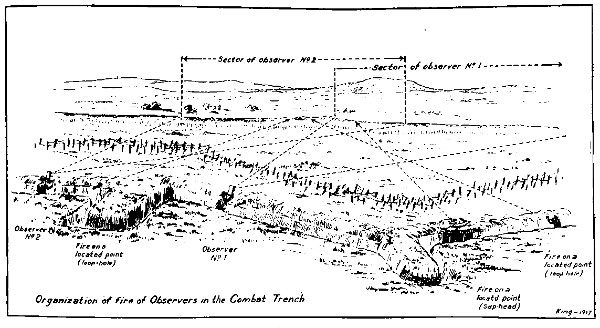
Plate 42.
Organization of fire of Observers in the Combat Trench
7. Loopholes are inspected at dusk.
8. Wire entanglements are inspected and repaired
under cover of darkness.
9. A log of events hour by hour should be kept
which shows every item of enemy activity and
the measures taken during the tour in the
trenches. This will be a valuable reference
when turning the trench over and will make a
record of the habits of the enemy that may be
most valuable as a guide for making plans to
circumvent him.
10. The police and sanitation of the trenches
will be carefully looked after.
11. Platoon commanders may divide the tour
of supervision of the platoon sector with the
squad leaders.
12. The whole company stands to arms during
the hour before dawn.
Observation
Observation of the enemy's
line should be continuous.
The observation and firing
system will be arranged so that all parts of the
enemy's line will be under observation and fire
at all times.
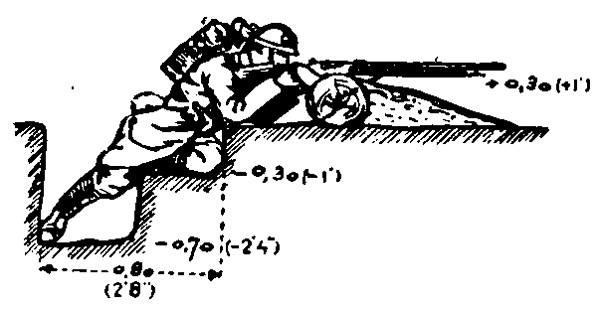
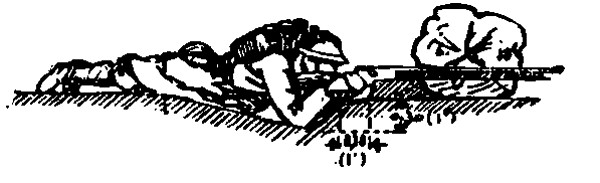
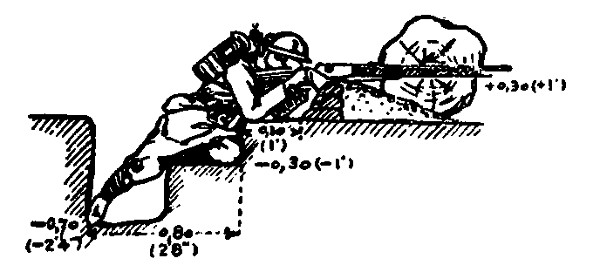
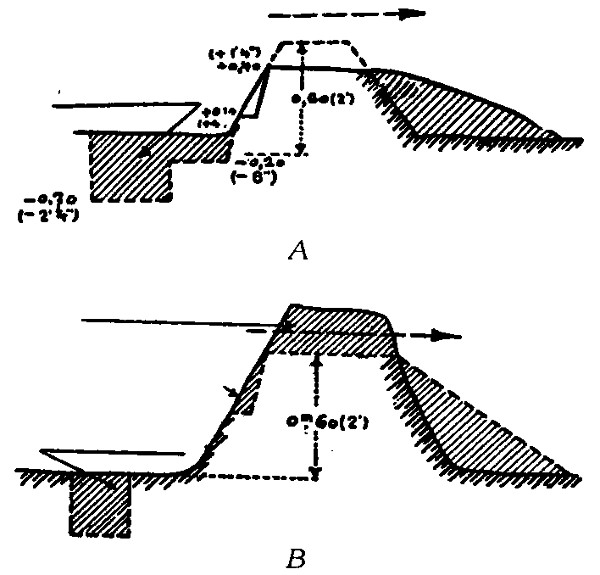
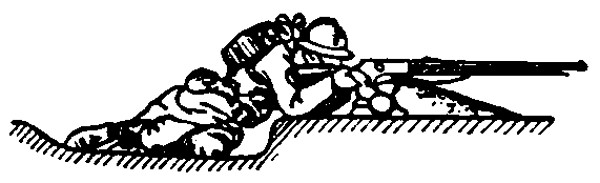
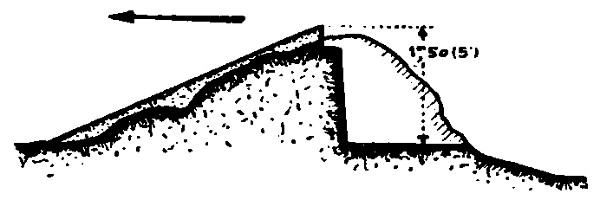
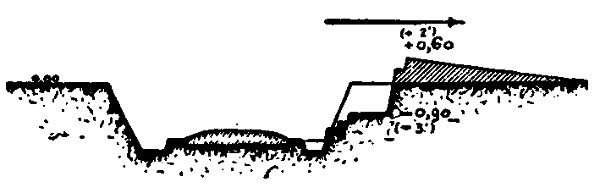
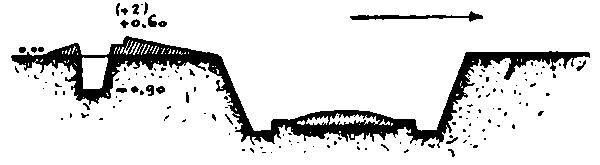
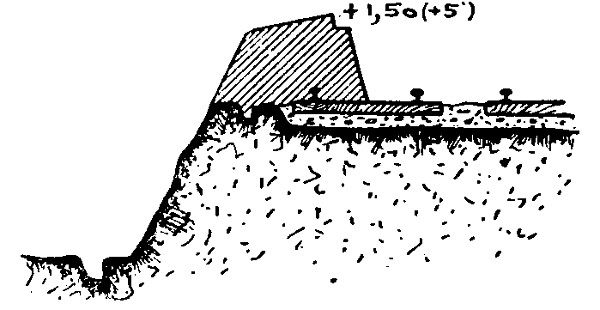
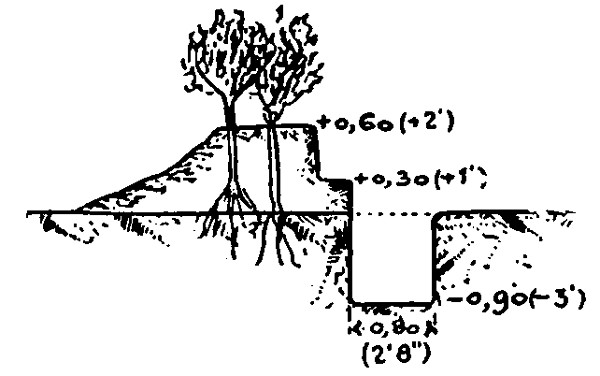
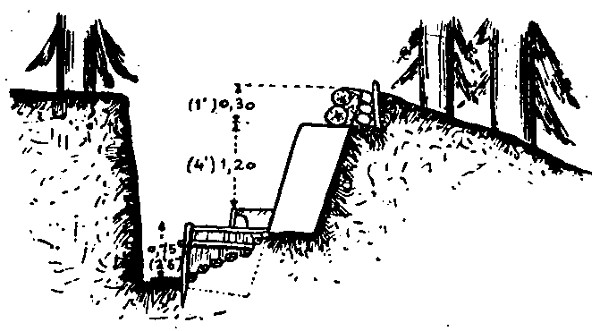
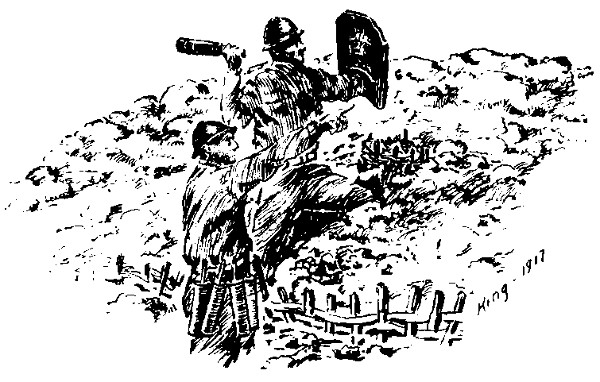
Plate 42 shows the arrangement in general.
The appliances for carrying it out are shown in
Plates 43, 44 and 45.
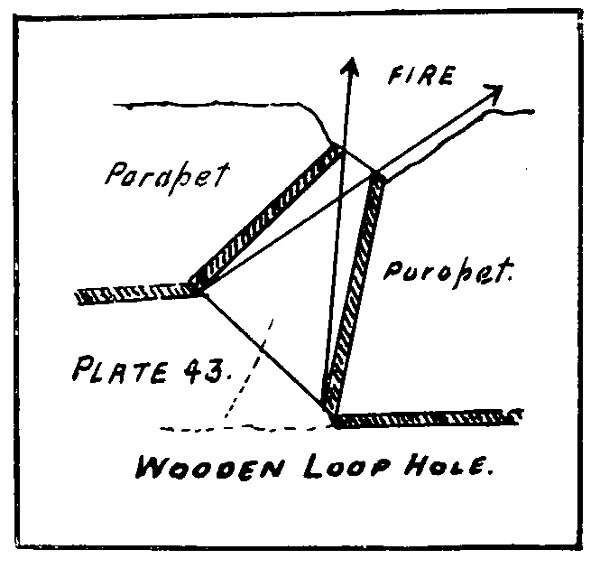
Plate 43.
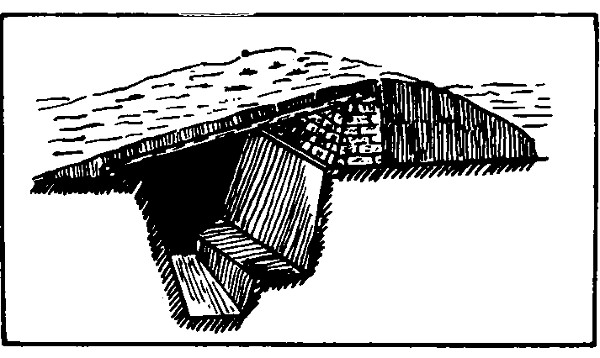
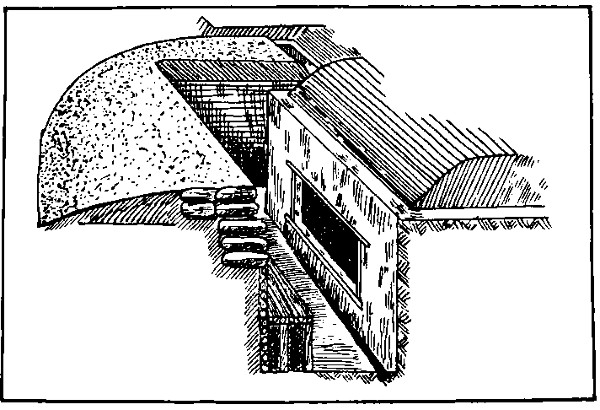
The observation is conducted through a small
loophole made by a stick through the parapet
or an iron tube run through and directed toward
the point to be observed. To conceal the exit
a few tufts of earth and grass are placed there
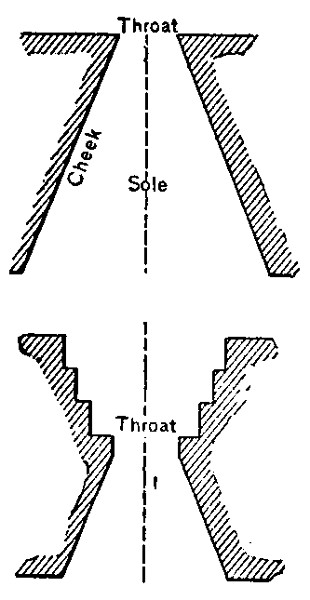
in an irregular manner. Steel loopholes may
also be employed for observation and firing
purposes. They may be arranged a yard or two
apart, so that one man observing through one
can direct his mate using the rifle at the other
so that he may bring fire to bear upon any
member of the enemy's force that exposes himself
at the point under observation.
The loopholes, both observation and firing, are
arranged slantwise in the parapet so that the
observer does not look straight to his front nor
does the firer fire in that direction.
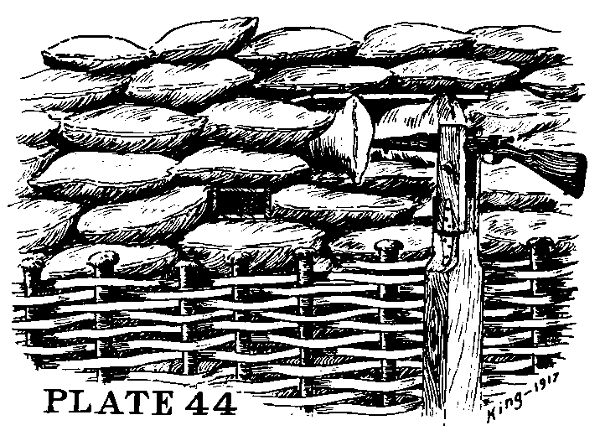
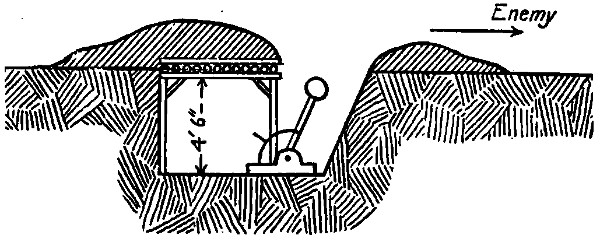
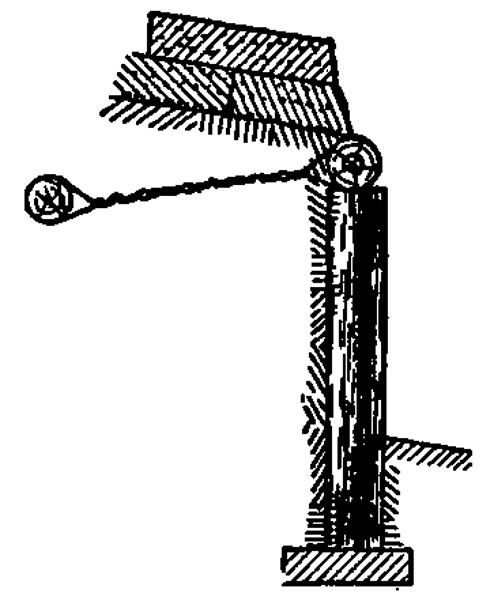
Plate 44.—Observation loophole and rifle firing rack.
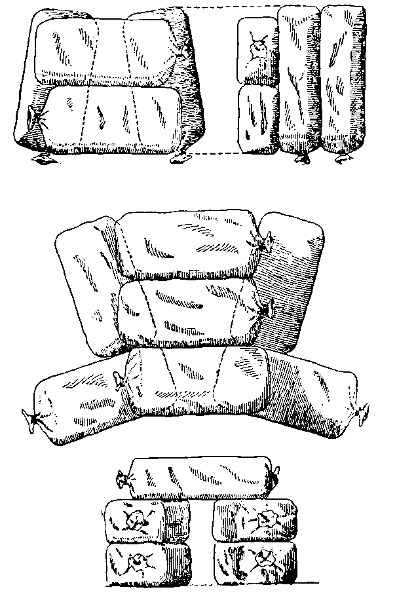
An aiming rack constructed so as to resist the
recoil of the rifle and not derange its aim on
firing may be arranged near the observation
loophole. When the enemy exposes himself all
that is necessary is a press on the trigger and the
bullet goes straight to its mark. Such an aiming
rack may be easily constructed, as shown in
Plate 44.
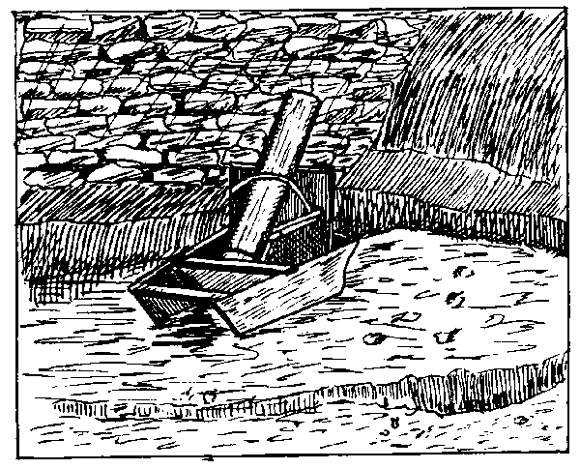
Observation of the enemy trenches may also
be effected by use of the periscope or, in the
absence of one of these, by a looking-glass in a
slanted position fastened to a stick planted at
the rear wall of the trench and protruding over
the parapet, to reflect his trenches. (See Plate 45.)
Field Glasses
The enemy's trench usually
appears completely deserted,
but on observing it through
field glasses you are astonished by the details
revealed. You will see, from time to time, the
eye of the enemy observer who shows himself
at the loophole, or any other activity that is
capable of being observed from the outside.
The observer watching through the field glasses
will soon become so familiar with the appearance
of the opposing trenches that he will be able to
detect immediately any alteration in the obstacles,
or changes that may be made, such as
the establishment of new listening or observation
posts, new sap heads, machine-gun emplacements,
etc.
Observers are charged especially with detecting
the location of machine-gun emplacements.
The examination should be so complete and
detailed as to prevent their existence without
their location being accurately known.
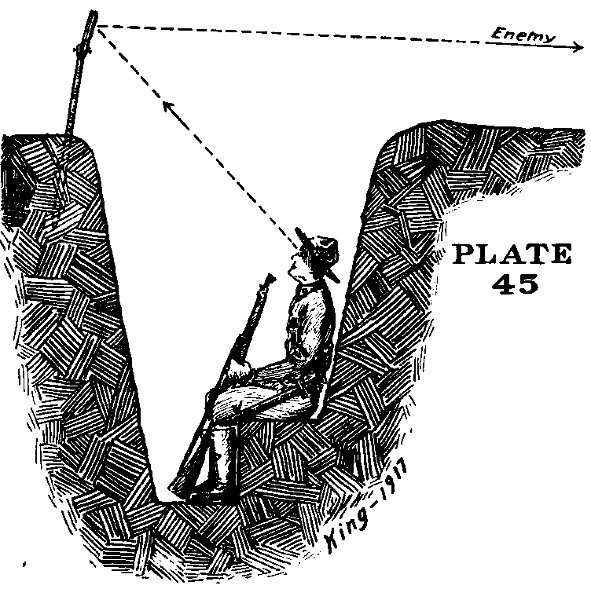
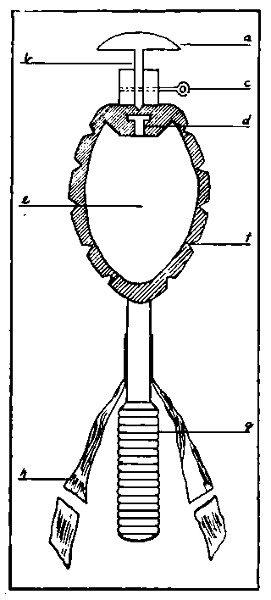
Plate 45.—Looking-glass periscope.
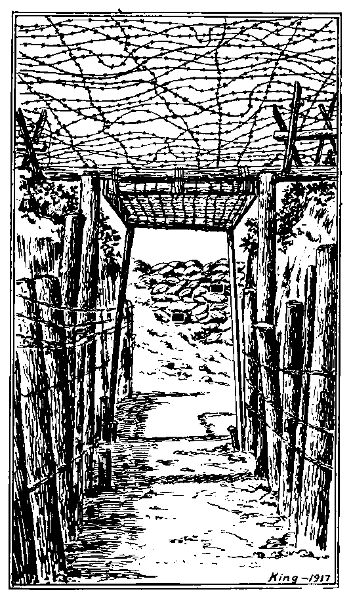
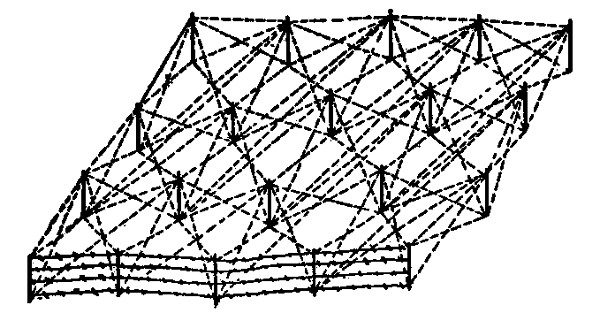
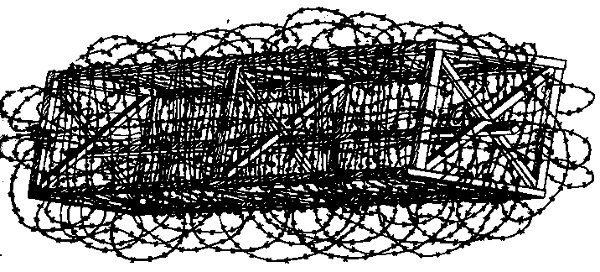
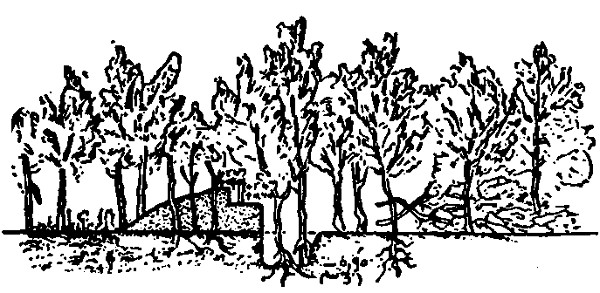
Plate 45a.—Trench showing wire overhead
cover and wire trapdoor obstacle. Machicoulis gallery in background.
Any observations of enemy activities, of any
nature whatever, are reported immediately so
that they may be passed on to the commander
whose unit is manning the trenches directly
opposite the same.
Loopholes should be screened at the rear by
a sandbag split and hung over them. They
should be carefully concealed to prevent their
location being discovered by the enemy. There
must be no alteration in the parapet where
they are located.
Snipers
The enemy's sojourn in the
trenches should be made as
disagreeable to him as possible.
He must be kept continually on the
alert. Our operations must be made a constant
menace to him. It is in this way that casualties
are effected and he is gradually worn out.
One of the best methods of accomplishing all of
the above is the employment of snipers, who are
specially selected and trained in this branch of
trench warfare.
The snipers are on duty all day, but they have
their nights in bed. They conduct their operations
in pairs and are given a definite post to
occupy and in exceptional cases may be given
a roving commission. The advantage of having
the same men regularly on the same post is that
they learn thoroughly the appearance of every
square foot of the ground included in their area
of observation and are able immediately to note
any change that may take place. They soon
learn where to look for the enemy and in fact
learn the habits, etc., of the enemy occupying
their sphere of observation.
The sniper must be an expert in:
1. The construction of loopholes by day and
by night.
2. The use of telescopic sights, field glasses,
periscopes and all optical contrivances designed
for observation purposes.
3. The selection of good positions for sniping.
4. Judging distances and estimating or measuring
ranges.
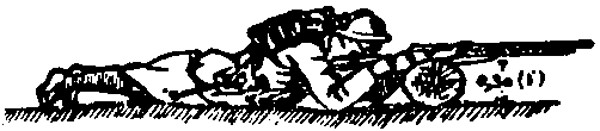
5. Rifle firing. He should be an expert
rifleman in order that full advantage may be
taken of the opportunities to inflict losses on
the enemy.
6. In trench warfare each pair of snipers
will be required to report each evening to the
company commander the result of their day's
operations.
What to Fire At
When the enemy makes his
attack you will generally fire
at those who appear in the
sector that has been allotted to
you to cover. You may, however, abandon
your target on your own initiative under the
following circumstances and fire:
1. On officers and noncommissioned officers.
These can be recognized by their gestures.
They are generally in the center of groups and
get up and start first. They should be disabled,
as this is the surest way of breaking up the attack.
2. At a group on the move. Fire should be
concentrated on an advancing group. The
time when the group is preparing to start its
rush may be indicated by rifles being raised
and the movements that take place along the
line. After a rush has started, look out for
the late comers trying to rejoin their comrades.
They make good targets.
3. When the enemy attempts to build up his
line to the front by a process of infiltration.
That is, by having single men crawl from one
point to the other, each man should be fired on
during his advance.
4. Fire will be immediately concentrated on
any machine gun that comes into action. With
the German gun prolonged firing heats the water
in the jacket to the boiling point and puffs of
steam are given off. Do not be deceived into
thinking that this necessarily gives away the
position of the gun, for this steam has been
piped to a distant place and allowed to escape
so as to draw fire that otherwise might be directed
on the real position of the gun.
5. On signallers or runners. These are carrying
information that will probably be of benefit
to the enemy's commander. You will appreciate
the necessity of preventing this.
6. On an enemy showing a flank. No opportunity
must be lost to fire upon an enemy that
exposes his flank. The fire of a single rifleman
down the flank may cause a whole line to retreat.
Use of Rifle Grenades
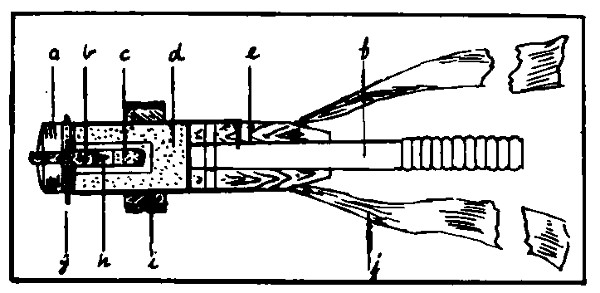
Rifle grenades are capable
of causing more losses to the
enemy than bombardment.
The rifle grenade arrives at
its destination unexpectedly without any noise;
it explodes before one has even time to get out
of the way. As it does not arrive at fixed hours
like the bombardment, the enemy cannot continually
avoid it by taking refuge in his dugouts
and shelters; when he is moving about a trench
which is subject to rifle grenading he must be
continually on the alert. This perpetual menace,
hour in and hour out, day in and day out, renders
his sojourn in the trenches extremely disagreeable.
Before rifle grenades are thrown careful observation
of the opposing trench must have been
made to determine the point where the grenade
is likely to do the greatest damage.
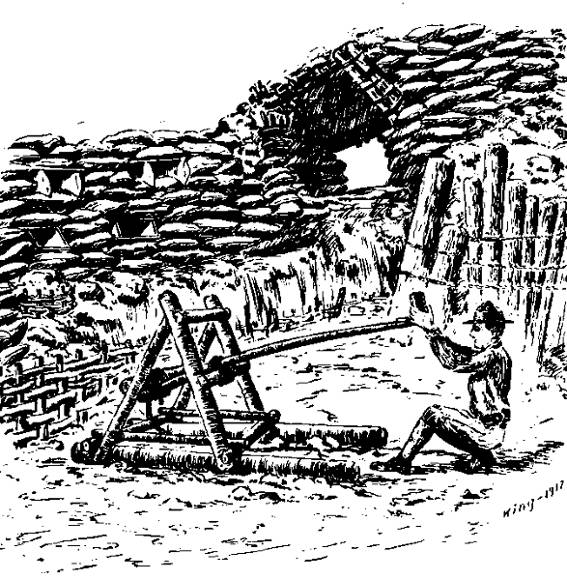
Rifles are placed in the aiming racks and the
grenades fired from time to time, day and night,
at moments when it seems propitious. In this
way a sentinel may be taken by surprise; a
noncommissioned officer or officer may be
caught unawares.
It should be remembered that we will probably
be able to throw twenty grenades to the
enemy's one. Advantage should always be
taken of this munitions superiority. Every man
of the enemy we can put out of action is one less
to kill us in the advance which will eventually
come. Sometimes the enemy will try to reply.
Here is where our munitions superiority comes
in again. We can fairly shower him with
grenades and make him take to his shelters.
It may be advisable to execute a sudden
burst of grenade fire. This is started by a
volley and followed by fire at will.
When the artillery has destroyed parts of the
enemy's trenches or makes breaches in his
obstacles by day he will endeavor to repair
them at night. He may be considerably annoyed
and losses inflicted upon him by a well-directed
shower of rifle grenades arriving at
points where his working parties are located.
To make this effective the rifle racks should be
placed in position and secured during the day
after trial shots have demonstrated conclusively
the direction and angle for them.
Shelling
You will be impressed by the
shells, especially the big ones.
The din and blast of the
explosions are, to say the least, terrifying. But
you will soon come to know that the shell often
makes more noise than it does harm and that,
after a terrific bombardment, by no means is
everybody destroyed.
How to Protect Yourself from Shells
The big shell, which is so
appalling, is only really dangerous
if it falls on the place
where a man is standing, because
the splinters rise in the
air. Fall down flat when the shell bursts.
Even if you are quite close, there is comparatively
little risk. Get up immediately after the
explosion, especially if you are 200 to 300 yards
away from the place where it burst. The
splinters do not fall for some time after the
explosion.
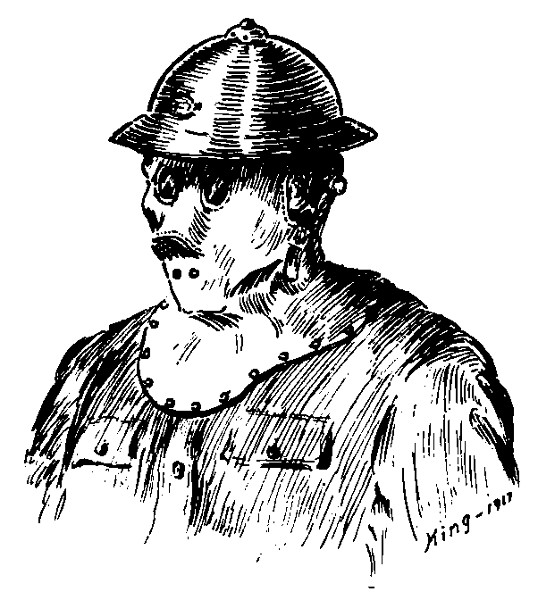
The steel helmets and the infantry pack will
furnish considerable protection from shrapnel
fragments and balls.
During the Combat
The safest place to avoid
the enemy's shell fire when
the attack has been launched
is close up to the enemy's
position, where the artillery fire has to cease for
fear of placing shells indiscriminately in his own
troops and ours. Some men, completely distracted,
lie down with their face to the ground.
They will be crushed where they lie. Artillery
fire, when it is violent, tends to throw the ranks
into confusion and disorder. You have only
ears for the roar of the approaching shell. You
slow down and attempt to seek cover where there
is no cover. The unit breaks up, and runs wild
or stops altogether. Disorder and confusion
means massacre.
March strictly in place. To the front is your
safest haven of refuge. Get hold of the frightened
ones and keep them in place. You will
need them to help you when you reach the goal.
In the Trenches
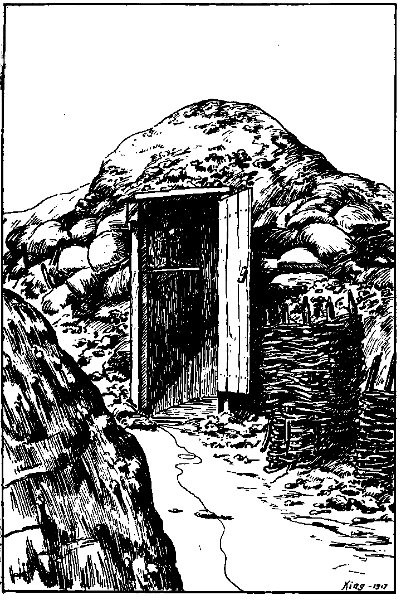
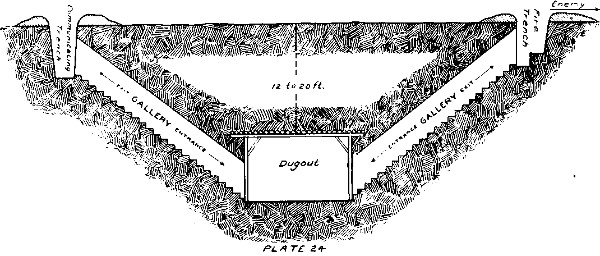
Dugouts with strong overhead
cover are provided for
your protection when not
actually required to man the trench. In some
places it may be possible to dig shelter caves and
shore up the roofs.
Scouting and Patrolling
To the Reader: You will find a wealth of information
on the methods to be employed by scouts
and patrols in a little book similar to this one in size,
entitled "Scouting and Patrolling," by the author of
this volume. Published and for sale by the United
States Infantry Association, Washington, D. C.
Price 50 cents, by mail, postpaid. Get your copy
now and prepare yourself for these important duties.
Scouting and patrolling to
the front is of greatest importance.
It is kept up both
day and night. The units
occupying the first line send out patrols whenever
necessary. They are frequently able to obtain
valuable information and at the same time serve
to counteract the enemy's efforts in this direction.
The patrols generally consist of a junior
officer or noncommissioned officer and from four
to six selected men. Their operations are conducted
in accordance with the situation and the
mission they are sent on.
Hand grenades are frequently carried for both
offensive and defensive operations. Grenade
patrols always carry them. The operations of
patrols may include:
1. Reconnaissance of sectors of the enemy's
position with a view to determining his dispositions
and arrangement of obstacles.
2. Making sketches of positions.
3. Capturing prisoners.
4. Opposing enemy patrols.
5. Harassing the enemy.
When the patrol goes out every man in the
sector of the firing line must be informed of such
fact and the possibility of its returning through
his post. It is not sufficient to simply notify the
men on post at the time the patrol goes out, as a
man cannot always be trusted to pass the information
on to his relief. Word should be
quietly taken along the line by the noncommissioned
officer in charge of the relief in person.
When the patrol is out, special instructions have
to be given with respect to firing. To cease
firing altogether is very undesirable. It arouses
the enemy's suspicions. A few trustworthy
riflemen are directed to fire high at intervals.
No lights are sent up while the patrol is out.
If the patrol is to remain stationary, similar
to the outguard of an outpost, communication
may be maintained by means of a string, spelling
out the messages by Morse code, two jerks
meaning a dash and one jerk meaning a dot.
Where night patrols have to remain out under
trying conditions special dugouts should be
reserved where they can rest upon their return.
Care of Arms
The infantryman's rifle is
his best friend. The personal
care that he gives to it is indicative
of his soldierness and discipline. Your
rifle must be kept in prime condition, otherwise
it may fail you at a critical moment. A canvas
breech cover that will protect the bolt and magazine
mechanism will be found a great advantage
when the rifle is not in use. Care must be taken
to exclude mud and dirt from the bolt mechanisms.
Do not put mud-covered cartridges into the
magazine. Wipe them off first. Arrange a
proper receptacle near your post for the storage
of your reserve ammunition. Be careful that
you do not clog the muzzle of the rifle with mud
and dirt. If fired in this condition it will ruin
the rifle. Be careful not to clog up the sight
cover with mud. Oil the rifle frequently with
good sperm oil. Half of the oilers in the squad
should be filled with oil and the other half with
Hoppe's No. 9 Powder Solvent.
Rifles must be carefully inspected daily by
platoon commanders and the men required to
work on them during the periods off post.
Care of Trenches
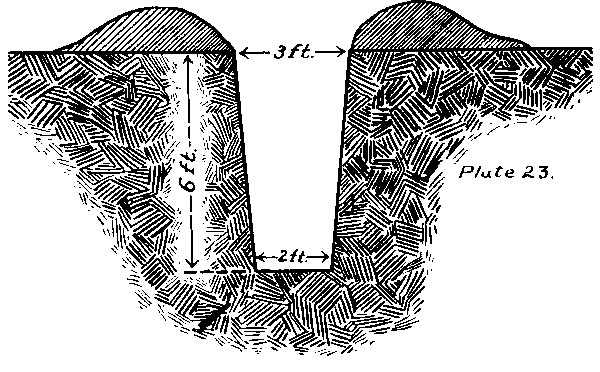
Repairs will have to be
made daily. The widening of
trenches in the making of
repairs should be strictly forbidden.
Under no circumstances must they be
altered in any manner except on the order of the
company commander.
Platoon commanders will go over every part of
the trench several times daily with the squad
leaders of the various sections and decide upon
the repairs and improvements to be made. A
complete and thorough police will be made
prior to being relieved. All refuse will be removed.
Fired cartridges will be disposed of, as
they might get imbedded in the trench floor and
hinder subsequent digging.
Each squad leader will be held strictly responsible
for the state of police of the section of
trench occupied by his squad.
Latrines
Latrines are located at convenient
points in the trenches.
For the men on duty in the
first line they are generally dug to the flank of a
connecting trench and connected therewith by a
passageway. Their location is plainly marked.
The rules of sanitation are even more strictly
observed in trenches than they are in soldier
camps. The trenches and passageways must not
under any circumstances be defiled. Latrines
should be kept clean and sanitary. They will be
carefully protected from flies. The free use of
chloride of lime daily is an absolute necessity.
Maps
A complete detailed plan of
our own trenches and as much
as is known of those of the
enemy opposite should be made, and be available
for study and to refer to in making reports.
Every bay of the trench should be numbered,
every traverse lettered. All junction points of
fire and communicating trenches, all dugouts,
all posts, mortar positions, machine-gun positions,
observation posts, and any points that it may be
necessary to refer to in reports should be designated
by numbers.
Frost Bite; Chilled Feet
The causes are:
1. Prolonged standing in
cold water or liquid mud.
2. Tight boots and leggings,
that interfere with the blood circulation.
Prevention
1. Before going into the
trenches wash the feet and
legs and dry them thoroughly.
The British Army has an issue of an anti-freeze
mixture which will probably be issued to our
troops also. The feet and legs should be rubbed
with it. Put on perfectly dry socks. An extra
pair of dry socks should be carried.
2. During the period of service in the trenches
the feet should be treated in this manner from
time to time.
3. When the feet are cold, hot water will not
be used for washing nor will they be held close to
a fire.
4. Rubber boots must be worn only in the
trenches. On no account must they be worn
while on reserve.
Trench Soldiers' Creed
To be of the greatest effectiveness in the trench
every soldier, personally and collectively, must
be able to adopt the following creed and live
up to it:
1. We are here for two purposes, to do as
much damage as possible to the enemy and to
hold our section of the line against all attacks.
We are doing everything in our power to accomplish
these missions. We realize that every
man of the enemy confronting us that is now
placed hors de combat will be there ready to
shoot us down when the assault takes place.
We realize also that if the enemy makes a lodgment
on our section of the line that it endangers
others and a costly counter attack may be
necessary. We will hold on.
2. With the means at hand and those we are
able to devise we will make the enemy's stay
in his trenches as uncomfortable and disagreeable
as possible. All of our utilities are being
utilized to the fullest extent and our various
detachments are organized and their tactical
operations are conducted with this object in
view.
3. We have done everything possible to
strengthen our line.
4. If, despite all the precautions we can take
and the hardest fight we are able to make, the
enemy succeeds in effecting a lodgment on our
section of the line, we will meet him with the
bayonet and fight to the last drop of our blood.
5. We are all familiar with the tactical dispositions
in our section of the line. Those of
us on the flanks connect up with the platoons
to our right and left. We know the route to
company and battalion headquarters and know
where the nearest support is located. We
know the position of our machine guns and the
sector they cover. We are in constant communication
with the observing posts that cover
our front, and our observing posts covering the
other platoons are in constant communication
with them.
6. We know the firing position assigned to us
and are familiar with the use to be made of the
accessories furnished us. We can fire over the
parapet at the foot of our wire entanglements to
repel night attack.
7. We will at all times be careful about needlessly
exposing ourselves. We appreciate the
fact that it is absolutely stupid to get killed or
wounded in the trench through negligence. By
so doing one has served no purpose and a soldier
cannot be replaced. Our leaders have warned
us of the especially dangerous places. We know
where they are and avoid them except when our
presence there is necessary as a matter of duty.
8. The sections of the enemy's line that we are
to cover with our fire have all been pointed out
and each of us is familiar with same. We have
located the enemy's loopholes and are doing
our best to keep them under fire.
9. We know our way and move noiselessly
about the trenches. When we enter and leave
it is with absolute silence.
10. We are doing our utmost to collect information
about the enemy, his defenses, his
activity, his movements, and especially his
night operations. All of this information we
transmit immediately to the platoon leader.
11. We know the best way to get over our
parapet to reach the enemy.
12. Our appliances for protection from gas
attacks are complete and ready for instant use.
We have our helmets on our persons ready to
put on. We are familiar with their use and have
confidence in their effectiveness. We will wait
for the signal to don our gas helmets (signal is
usually made by beating a gong, and care must
be taken to follow exactly the directions for
putting on the gas helmets; carelessness may
mean your disablement).
13. Our trenches are drained and every precaution
is being taken to keep the drains and
sump holes in condition to perform their functions.
14. We have rendered the parapets and
shelters throughout our sector bullet-proof, and
effective measures are being taken to prevent
them from caving in.
15. We are keeping our trenches sanitary and
clean; our reserve munitions are carefully stored
in their proper places ready for instant use.
Refuse is always placed in receptacles when it
can be carried away. We do not under any
circumstances litter up our trench floor. Our
empty shells are collected and sent to the rear.
16. Our rifles are our best friends. We keep
them clean, well oiled, and in readiness for
instant use. Our bayonets we have with us at
all times ready to be placed on the rifle. We
protect our rifle ammunition from the mud, as
we realize that muddy cartridges will clog the
breech mechanism and cause mal-function.
17. We are taking every precaution to prevent
"trench feet;" when practicable we take off
our shoes and rub our feet for 15 minutes each
day. We do not wear tight shoes and leggings
that tend to interfere with blood circulation.
We each have a pair of dry socks to put on. We
do not wear rubber boots except when it is absolutely
necessary.
18. We observe the orders regarding the
wearing of equipment.
19. We do not drink any water except that
from authorized sources. We replenish our
canteens whenever practicable.
In addition to the above the platoon commander
must be able to adopt the following and·
live up to them:
1. My sentries are posted in the proper places.
They are posted by noncommissioned officers.
They have the proper orders. No man is ever
on duty more than one hour at a time. I visit
them at frequent intervals.
2. I have a runner ready to carry a message
to company headquarters. I realize that any
information of the enemy that I may secure may
be of great importance at regimental and other
headquarters. I will therefore send it back with
the utmost dispatch.
3. I am familiar with the methods of communicating
with the artillery, of giving them
information and of asking them for support.
4. My patrols operating to the front at night
have been properly instructed and are doing
their duty effectively. All sentries in the trench
have been notified when they are out and cautioned
to look out for their return.
5. I have given complete and detailed instruction
covering what to do in case of gas attacks
and the sending out of the S. O. S. signal. I
have gas and attack messages already prepared
and ready to send after inserting the time and
place in them.
6. I know the name of every man in my platoon
and they all know me.
7. I am here to inflict as much damage as
possible on the enemy and to hold my part of
the line. I will do it!