Nearly all of the dicotyledons may be placed in one of two great
divisions distinguished by the character of the petals. In the first
group, called Choripetalæ, the petals are separate, or in some
degenerate forms entirely absent. As familiar examples of this group,
we may select the buttercup, rose, pink, and many others.
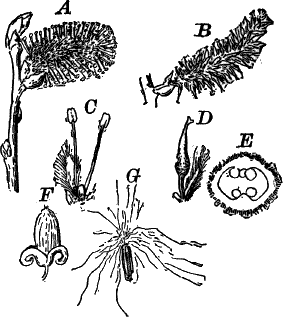
Fig. 96.—Iulifloræ. A, male; B, female
inflorescence of a willow, Salix (Amentaceæ), × ½. C, a single
male flower, × 2. D, a female flower, × 2. E, cross-section of the
ovary, × 8. F, an opening fruit. G, single seed with its hairy
appendage, × 2.
The second group (Sympetalæ or Gamopetalæ) comprises those
dicotyledons whose flowers have the petals more or less completely
united into a tube. The honeysuckles, mints, huckleberry, lilac, etc.,
are familiar representatives of the Sympetalæ, which includes the
highest of all plants.
The Choripetalæ may be divided into six groups, including twenty-two
orders. The first group is called Iulifloræ, and contains numerous,
familiar plants, mostly trees. In these plants, the flowers are small
and inconspicuous, and usually crowded into dense catkins, as in
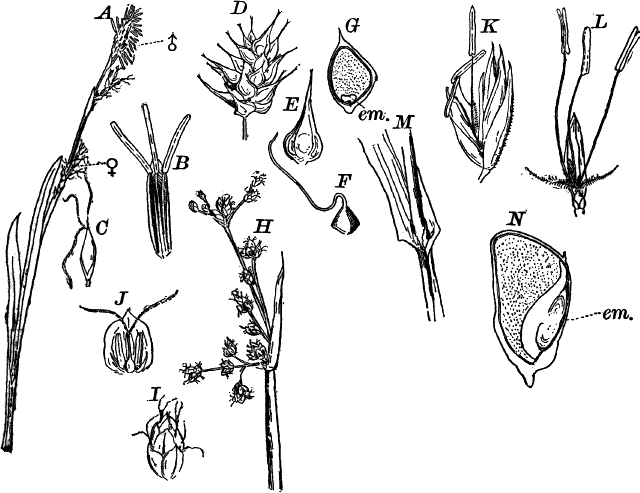
willows (Fig. 96) and poplars, or in spikes or heads, as in the
lizard-tail (Fig. 97, G), or hop (Fig. 97, I). The individual
flowers are very small and simple in structure, being often reduced to
the gynœcium or andræcium, carpels and stamens being almost always in
separate flowers. The outer leaves of the flower (sepals and petals)
are either entirely wanting or much reduced, and never differentiated
into calyx and corolla.
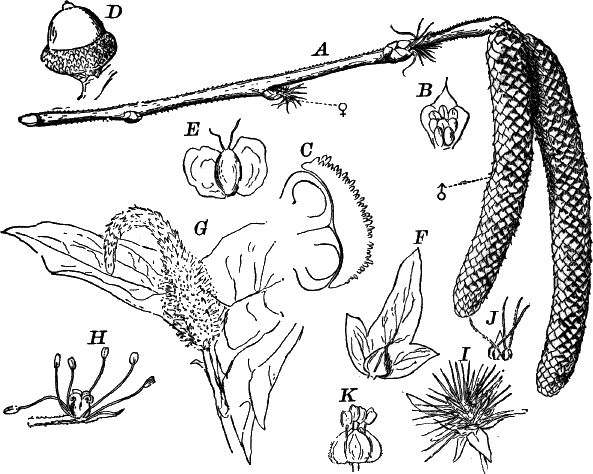
Fig. 97.—Types of Iulifloræ. A, branch of hazel,
Corylus (Cupuliferæ), × 1. ♂, male; ♀, female inflorescence. B,
a single male flower, × 3. C, section of the ovary of a female
flower, × 25. D, acorn of red oak, Quercus (Cupuliferæ), × ½.
E, seed of white birch, Betula (Betulaceæ), × 3. F, fruit of
horn-bean, Carpinus (Cupuliferæ), × 1. G, lizard-tail, Saururus
(Saurureæ), × ¼. H, a single flower, × 2. I, female
inflorescence of the hop, Humulus (Cannabineæ), × 1. J, a single
scale with two flowers, × 1. K, a male flower of a nettle, Urtica
(Urticaceæ), × 5.
In the willows (Fig. 96) the stamens are bright-colored, so that the
flowers are quite showy, and attract numerous insects which visit them
for pollen and nectar, and serve to carry the pollen to the pistillate
flowers, thus insuring their fertilization. In the majority of the
group, however, the flowers are wind-fertilized. An excellent example
of this is seen in the common hazel (Fig. 97, A). The male flowers
are produced in great numbers in drooping catkins at the ends of the
branches, shedding the pollen in early spring before the leaves
unfold. The female flowers are produced on the same branches, but
lower down, and in much smaller numbers. The stigmas are long, and
covered with minute hairs that catch the pollen which is shaken out
in clouds every time the plant is shaken by the wind, and falls in a
shower over the stigmas. A similar arrangement is seen in the oaks,
hickories, and walnuts.
There are three orders of the Iulifloræ: Amentaceæ, Piperineæ,
and Urticinæ. The first contains the birches (Betulaceæ); oaks,
beeches, hazels, etc. (Cupuliferæ); walnuts and hickories
(Juglandeæ); willows and poplars (Salicaceæ). They are all trees
or shrubs; the fruit is often a nut, and the embryo is very large,
completely filling it.
The Piperineæ are mostly tropical plants, and include the pepper
plant (Piper), as well as other plants with similar properties. Of
our native forms, the only common one is the lizard-tail (Saururus),
not uncommon in swampy ground. In these plants, the calyx and corolla
are entirely absent, but the flowers have both carpels and stamens
(Fig. 97, H).
The Urticinæ include, among our common plants, the nettle family
(Urticaceæ); plane family (Plataneæ), represented by the sycamore
or buttonwood (Platanus); the hemp family (Cannabineæ); and the
elm family (Ulmaceæ). The flowers usually have a calyx, and may
have only stamens or carpels, or both. Sometimes the part of the stem
bearing the flowers may become enlarged and juicy, forming a
fruit-like structure. Well-known examples of this are the fig and
mulberry.
The second group of the Choripetalæ is called Centrospermæ, and
includes but a single order comprising seven families, all of which,
except one (Nyctagineæ), are represented by numerous native species.
The latter comprises mostly tropical plants, and is represented in our
gardens by the showy “four-o’clock” (Mirabilis). In this plant, as
in most of the order, the corolla is absent, but here the calyx is
large and brightly colored, resembling closely the corolla of a
morning-glory or petunia. The stamens are usually more numerous than
the sepals, and the pistil, though composed of several carpels, has,
as a rule, but a single cavity with the ovules arising from the base,
though sometimes the ovary is several celled.
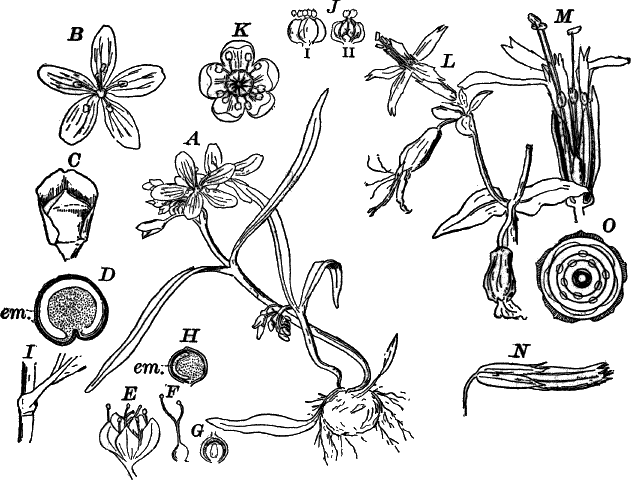
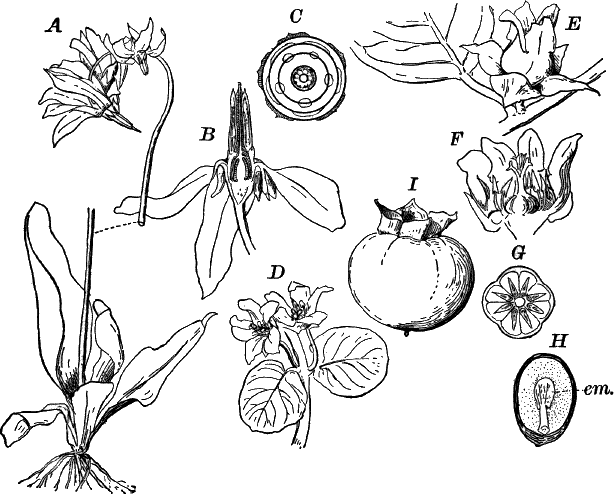
Fig. 98.—Types of Centrospermæ. A, plant of
spring-beauty, Claytonia (Portulacaceæ), × ½. B, a single
flower, × 1. C, fruit, with the sepals removed, × 2. D, section of
the seed, showing the curved embryo (em.), × 5. E, single flower
of smart-weed, Polygonum (Polygonaceæ), × 2. F, the pistil, × 2.
G, section of the ovary, showing the single ovule, × 4. H, section
of the seed, × 2. I, base of the leaf, showing the sheath, × 1. J,
flower of pig-weed, Chenopodium (Chenopodiaceæ), × 3: i, from
without; ii, in section. K, flower of the poke-weed, Phytolacca
(Phytolaccaceæ), × 2. L, fire-pink, Silene (Caryophyllaceæ),
× ½. M, a flower with half of the calyx and corolla removed, × 1.
N, ripe fruit of mouse-ear chick-weed, Cerastium
(Caryophyllaceæ), opening by ten teeth at the summit, × 2. O,
diagram of the flower of Silene.
The first family (Polygoneæ) is represented by the various species
of Polygonum (knotgrass, smart-weed, etc.), and among cultivated
plants by the buckwheat (Fagopyrum). The goose-foot or pig-weed
(Chenopodium) among native plants, and the beet and spinach of the
gardens are examples of the family Chenopodiaceæ. Nearly resembling
the last is the amaranth family (Amarantaceæ), of which the showy
amaranths and coxcombs of the gardens, and the coarse, green amaranth
or pig-weed are representatives.
The poke-weed (Phytolacca) (Fig. 98, K), so conspicuous in autumn
on account of its dark-purple clusters of berries and crimson stalks,
is our only representative of the family Phytolaccaceæ. The two
highest families are the purslane family (Portulacaceæ) and pink
family (Caryophylleæ). These are mostly plants with showy flowers in
which the petals are large and conspicuous, though some of the pink
family, e.g. some chick-weeds, have no petals. Of the purslane
family the portulacas of the gardens, and the common purslane or
“pusley,” and the spring-beauty (Claytonia) (Fig. 98, A) are the
commonest examples. The pink family is represented by many common and
often showy plants. The carnation, Japanese pinks, and sweet-william,
all belonging to the genus Dianthus, of which there are also two or
three native species, are among the showiest of the family. The genera
Lychnis and Silene (Fig. 98, L) also contain very showy species.
Of the less conspicuous genera, the chick-weeds (Cerastium and
Stellaria) are the most familiar.
The third group of the Choripetalæ (the Aphanocyclæ) is a very
large one and includes many common plants distributed among five
orders. The lower ones have all the parts of the flower entirely
separate, and often indefinite in number; the higher have the gynœcium
composed of two or more carpels united to form a compound pistil.
The first order (Polycarpæ) includes ten families, of which the
buttercup family (Ranunculaceæ) is the most
familiar. The plants of this family show much variation in the details
of the flowers, which are usually showy, but the general plan is much
the same. In some of them, like the anemones (Fig. 99, A), clematis,
and others, the corolla is absent, but the sepals are large and
brightly colored so as to appear like petals. In the columbine
(Aquilegia) (Fig. 99, F) the petals are tubular, forming
nectaries, and in the larkspur (Fig. 99, T) one of the sepals is
similarly changed.
Representing the custard-apple family (Anonaceæ) is the curious
papaw (Asimina), common in many parts of the United States
(Fig. 100, A). The family is mainly a tropical one, but this species
extends as far north as southern Michigan.
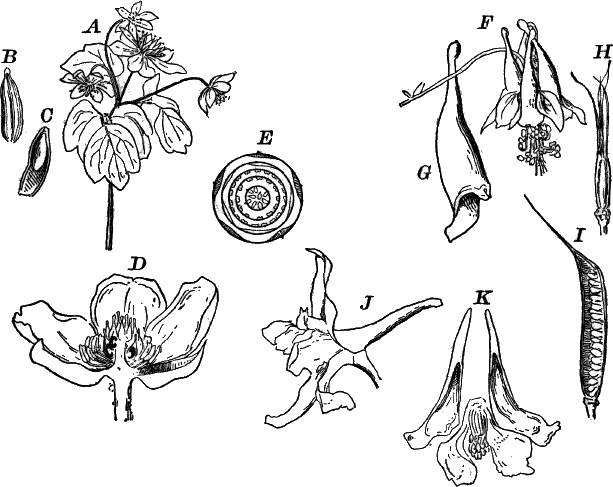
Fig. 99.—Types of Aphanocyclæ (Polycarpæ), family
Ranunculaceæ. A, Rue anemone (Anemonilla), × ½. B, a fruit,
× 2. C, section of the same. D, section of a buttercup flower
(Ranunculus), × 1½. E, diagram of buttercup flower. F, wild
columbine (Aquilegia), × ½. G, one of the spur-shaped petals, × 1.
H, the five pistils, × 1. I, longitudinal section of the fruit,
× 1. J, flower of larkspur (Delphinium), × 1. K, the four petals
and stamens, after the removal of the five colored and petal-like
sepals, × 1.
The magnolia family (Magnoliaceæ) has several common members, the
most widely distributed being, perhaps, the tulip-tree
(Liriodendron) (Fig. 100, C), much valued for its timber. Besides
this there are several species of magnolia, the most northerly species
being the sweet-bay (Magnolia glauca) of the Atlantic States, and
the cucumber-tree (M. acuminata); the great magnolia
(M. grandiflora) is not hardy in the northern states.
The sweet-scented shrub (Calycanthus) (Fig. 100, G) is the only
member of the family Calycanthaceæ found within our limits. It grows
wild in the southern states, and is cultivated for its sweet-scented,
dull, reddish flowers.
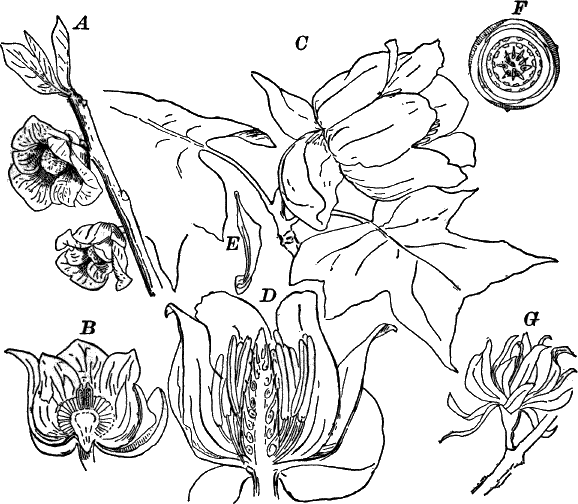
Fig. 100.—Types of Aphanocyclæ (Polycarpæ). A,
branch of papaw, Asimina (Anonaceæ), × ½. B, section of the
flower, × 1. C, flower and leaf of tulip-tree, Liriodendron
(Magnoliaceæ), × ⅓. D, section of a flower, × ½. E, a ripe
fruit, × 1. F, diagram of the flower. G, flower of the
sweet-scented shrub, Calycanthus (Calycanthaceæ), × ½
The barberry (Berberis) (Fig. 101, A) is the type of the family
Berberideæ, which also includes the curious mandrake or may-apple
(Podophyllum) (Fig. 101, D), and the twin-leaf or rheumatism-root
(Jeffersonia), whose curious seed vessel is shown in Figure 101,
G. The fruit of the barberry and may-apple are edible, but the root
of the latter is poisonous.
The curious woody twiner, moon-seed (Menispermum) (Fig. 101, I),
is the sole example in the northern states of the family Menispermeæ
to which it belongs. The flowers are diœcious, and the pistillate
flowers are succeeded by black fruits looking like grapes. The
flattened, bony seed is curiously sculptured, and has the embryo
curled up within it.
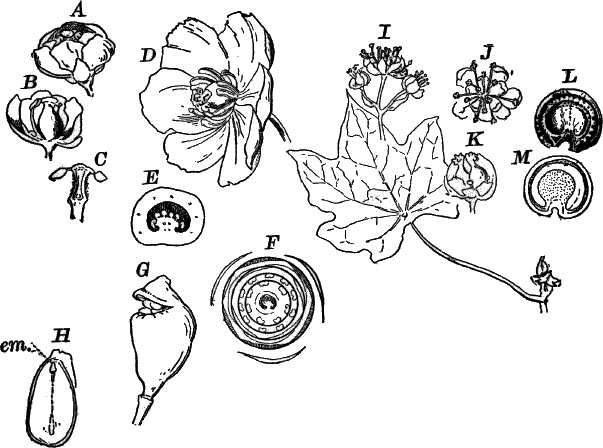
Fig. 101.—Types of Aphanocyclæ (Polycarpæ). A–H,
Berberidaceæ. A, flower of barberry (Berberis), × 2. B, the
same in section. C, a stamen, showing the method of opening, × 3.
D, flower of may-apple (Podophyllum), × ½. E, section of the
ovary of D, × 1. F, diagram of the flower. G, ripe fruit of
twin-leaf (Jeffersonia), opening by a lid, × ½. H, section of
seed, showing the embryo (em.), × 2. I, young leaf and cluster of
male flowers of moon-seed, Menispermum (Menispermeæ), × 1. J, a
single male flower, × 2. K, section of a female flower, × 2. L,
ripe seed, × 1. M, section of L, showing the curved embryo.
The last two families of the order, the laurel family (Laurineæ) and
the nutmeg family (Myristicineæ) are mostly tropical plants,
characterized by the fragrance of the bark, leaves, and fruit. The
former is represented by the sassafras and spice-bush, common
throughout the eastern United States. The latter has no members within
our borders, but is familiar to all through the common nutmeg, which
is the seed of Myristica fragrans of the East Indies. “Mace” is the
“aril” or covering of the seed of the same plant.
The second order of the Aphanocyclæ comprises a number of aquatic
plants, mostly of large size, and is known as the Hydropeltidinæ.
The flowers and leaves are usually very large, the latter usually
nearly round in outline, and frequently with the stalk inserted near
the middle. The leaves of the perigone are numerous, and sometimes
merge gradually into the stamens, as we find in the common white
water-lily (Castalia).
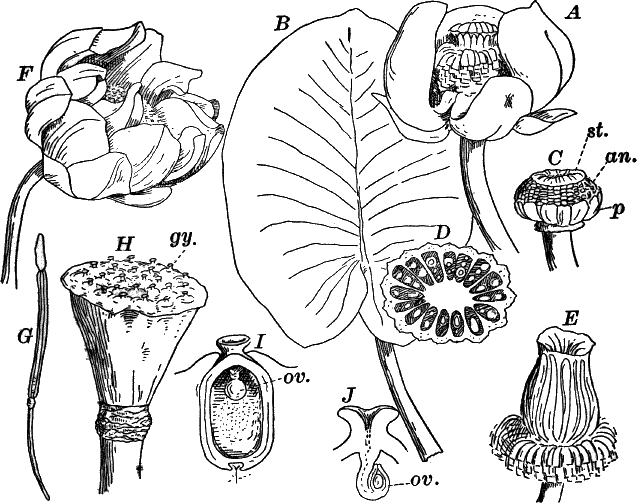
Fig. 102.—Types of Aphanocyclæ (Hydropeltidinæ).
A, yellow water-lily, Nymphæa (Nymphæaceæ), × ½. B, a leaf of
the same, × ⅙. C, freshly opened flower, with the large petal-like
sepals removed, × ½. p, petals. an. stamens. st. stigma. D,
section of the ovary, × 2. E, young fruit, × ½. F, lotus,
Nelumbo (Nelumbieæ). × ⅙. G, a stamen, × 1. H, the large
receptacle, with the separate pistils sunk in its surface, × ½. I,
section of a single pistil, × 2. ov. the ovule. J, upper part of a
section through the stigma and ovule (ov.), × 4.
There are three families, all represented within the United States.
The first (Nelumbieæ) has but a single species, the yellow lotus or
nelumbo (Nelumbo lutea), common in the waters of the west and
southwest, but rare eastward (Fig. 101, F). In this flower, the end
of the flower axis is much enlarged, looking like the rose of a
watering-pot, and has the large, separate carpels embedded in its
upper surface. When ripe, each forms a nut-like fruit which is edible.
There are but two species of Nelumbo known, the second one
(N. speciosa) being a native of southeastern Asia, and probably
found in ancient times in Egypt, as it is represented frequently in
the pictures and carvings of the ancient Egyptians. It differs mainly
from our species in the color of its flowers which are red instead of
yellow. It has recently been introduced into New Jersey where it has
become well established in several localities.
The second family (Cabombeæ) is also represented at the north by but
one species, the water shield (Brasenia), not uncommon in marshes.
Its flowers are quite small, of a dull-purple color, and the leaves
oval in outline and centrally peltate, i.e. the leaf stalk inserted
in the centre. The whole plant is covered with a transparent
gelatinous coat.
The third family (Nymphæaceæ) includes the common white water-lilies
(Castalia) and the yellow water-lilies (Nymphæa) (Fig. 102, A).
In the latter the petals are small and inconspicuous (Fig. 102, C,
p), but the sepals are large and showy. In this family the carpels,
instead of being separate, are united into a large compound pistil.
The water-lilies reach their greatest perfection in the tropics, where
they attain an enormous size, the white, blue, or red flowers of some
species being thirty centimetres or more in diameter, and the leaves
of the great Victoria regia of the Amazon reaching two metres or
more in width.
The third order of the Aphanocyclæ (Rhœadinæ or Crucifloræ)
comprises a number of common plants, principally characterized by
having the parts of the flowers in twos or fours, so that they are
more or less distinctly cross-shaped, whence the name Crucifloræ.
There are four families, of which the first is the poppy family
(Papaveraceæ), including the poppies, eschscholtzias, Mexican or
prickly poppy (Argemone), etc., of the gardens, and the blood-root
(Sanguinaria), celandine poppy (Stylophorum), and a few other wild
plants (see Fig. 103, A–I). Most of the family have a colored juice
(latex), which is white in the poppy, yellow in celandine and
Argemone, and orange-red in the blood-root. From the latex of the
opium poppy the opium of commerce is extracted.
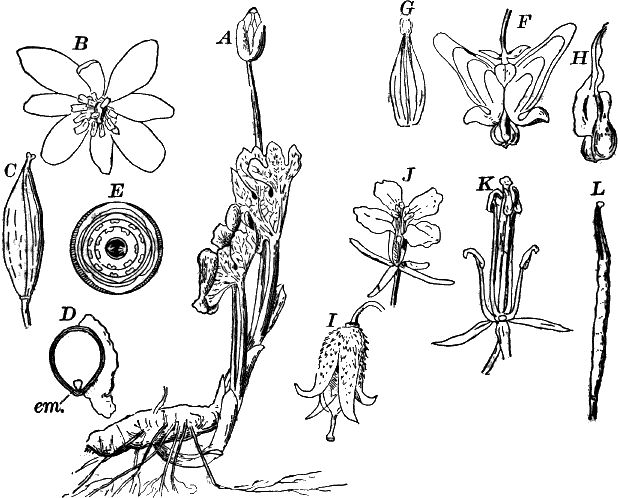
Fig. 103.—Types of Aphanocyclæ (Rhœdinæ). A,
plant of blood-root, Sanguinaria (Papaveraceæ), × ⅓. B, a single
flower, × 1. C, fruit, × ½. D, section of the seed. em. embryo,
× 2. E, diagram of the flower. F, flower of Dutchman’s breeches,
Dicentra (Fumariaceæ), × 1. G, group of three stamens of the
same, × 2. H, one of the inner petals, × 2. I, fruit of celandine
poppy, Stylophorum (Papaveraceæ), × ½. J, flower of mustard,
Brassica (Cruciferæ), × 1. K, the same, with the petals removed,
× 2. L, fruit of the same, × 1.
The second family, the fumitories (Fumariaceæ) are delicate, smooth
plants, with curious flowers and compound leaves. The garden
bleeding-heart (Dicentra spectabilis) and the pretty, wild
Dicentras (Fig. 103, F) are familiar to nearly every one.
Other examples are the mountain fringe (Adlumia), a climbing
species, and several species of Corydalis, differing mainly from
Dicentra in having the corolla one-sided.
The mustard family (Cruciferæ) comprises by far the greater part of
the order. The shepherd’s-purse, already studied, belongs here, and
may be taken as a type of the family. There is great uniformity in all
as regards the flowers, so that the classification is based mainly on
differences in the fruit and seeds. Many of the most valuable garden
vegetables, as well as a few more or less valuable wild plants, are
members of the family, which, however, includes some troublesome
weeds. Cabbages, turnips, radishes, with all their varieties, belong
here, as well as numerous species of wild cresses. A few like the
wall-flower (Cheiranthus) and stock (Matthiola) are cultivated for
ornament.
The last family is the caper family (Capparideæ), represented by
only a few not common plants. The type of the order is Capparis,
whose pickled flower-buds constitute capers.
The fourth order (Cistifloræ) of the Aphanocyclæ is a very large
one, but the majority of the sixteen families included in it are not
represented within our limits. The flowers have the sepals and petals
in fives, the stamens either the same or more numerous.
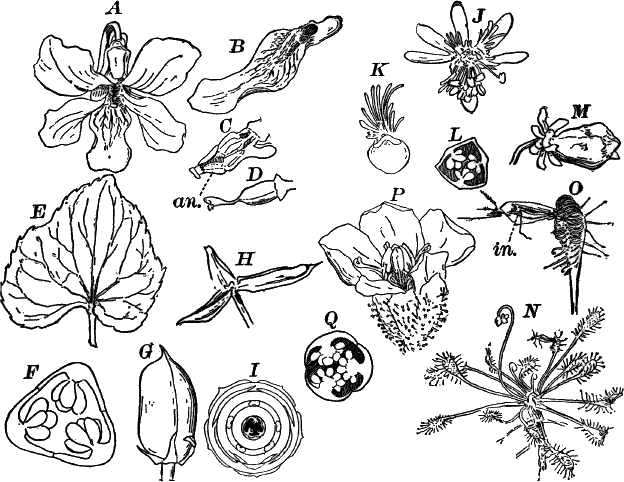
Fig. 104.—Types of Aphanocyclæ (Cistifloræ). A,
flower of wild blue violet, Viola (Violaceæ), × 1. B, the lower
petal prolonged behind into a sac or spur, × 1. C, the stamens, × 2.
D, pistil, × 2. E, a leaf, × ½. F, section of the ovary, × 2.
G, the fruit, × 1. H, the same after it has opened, × 1. I,
diagram of the flower. J, flower of mignonette, Reseda
(Resedaceæ), × 2. K, a petal, × 3. L, cross-section of the
ovary, × 3. M, fruit, × 1. N, plant of sundew, Drosera
(Droseraceæ), × ½. O, a leaf that has captured a mosquito, × 2.
P, flower of another species (D. filiformis), × 2. Q,
cross-section of the ovary, × 4.
Among the commoner members of the order are the mignonettes
(Resedaceæ) and the violets (Violaceæ), of which the various wild
and cultivated species are familiar plants (Fig. 104, A, M). The
sundews (Droseraceæ) are most extraordinary plants, growing in boggy
land over pretty much the whole world. They are represented in
the United States by several species of sundew (Drosera), and the
still more curious Venus’s-flytrap (Dionæa) of North Carolina. The
leaves of the latter are sensitive, and composed of two parts which
snap together like a steel trap. If an insect lights upon the leaf,
and touches certain hairs upon its upper surface, the two parts snap
together, holding the insect tightly. A digestive fluid is secreted by
glands upon the inner surface of the leaf, and in a short time the
captured insect is actually digested and absorbed by the leaves. The
same process takes place in the sundew (Fig. 104, N) where, however,
the mechanism is somewhat different. Here the tentacles, with which
the leaf is studded, secrete a sticky fluid which holds any small
insect that may light upon it. The tentacles now slowly bend inward
and finally the edges of the leaf as well, until the captured insect
is firmly held, when a digestive process, similar to that in Dionœa,
takes place. This curious habit is probably to be explained from the
position where the plant grows, the roots being in water where there
does not seem to be a sufficient supply of nitrogenous matter for the
wants of the plant, which supplements the supply from the bodies of
the captured insects.
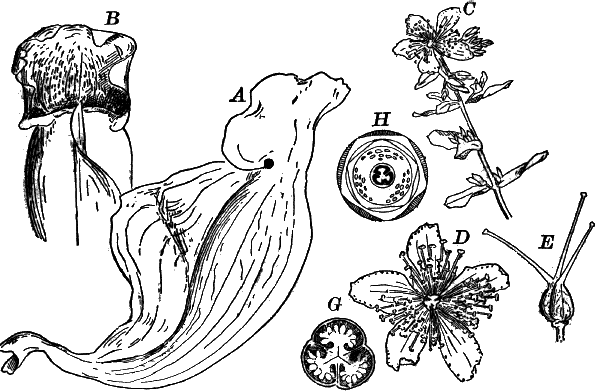
Fig. 105.—Types of Aphanocyclæ (Cistifloræ). A,
B, leaves of the pitcher-plant, Sarracenia (Sarraceniaceæ). A,
from the side; B, from in front, × ½. C, St. John’s-wort
(Hypericum), × ½. D, a flower, × 1. E, the pistil, × 2. G,
cross-section of the ovary, × 4. H, diagram of the flower.
Similar in their habits, but differing much in appearance from the
sundews, are the pitcher-plants (Sarraceniaceæ), of which one
species (Sarracenia purpurea) is very common in peat bogs throughout
the northern United States. In this species (Fig. 105, A, B), the
leaves form a rosette, from the centre of which arises in early summer
a tall stalk bearing a single, large, nodding, dark-reddish flower
with a curious umbrella-shaped pistil. The leaf stalk is hollow and
swollen, with a broad wing on one side, and the blade of the leaf
forms a sort of hood at the top. The interior of the pitcher is
covered above with stiff, downward-pointing hairs, while below it is
very smooth. Insects readily enter the pitcher, but on attempting to
get out, the smooth, slippery wall at the bottom, and the stiff,
downward-directed hairs above, prevent their escape, and they fall
into the fluid which fills the bottom of the cup and are drowned, the
leaf absorbing the nitrogenous compounds given off during the process
of decomposition. There are other species common in the southern
states, and a California pitcher-plant (Darlingtonia) has a colored
appendage at the mouth of the pitcher which serves to lure insects
into the trap.
Another family of pitcher-plants (Nepentheæ) is found in the warmer
parts of the old world, and some of them are occasionally cultivated
in greenhouses. In these the pitchers are borne at the tips of the
leaves attached to a long tendril.
Two other families of the order contain familiar native plants, the
rock-rose family (Cistaceæ), and the St. John’s-worts
(Hypericaceæ). The latter particularly are common plants, with
numerous showy yellow flowers, the petals usually marked with black
specks, and the leaves having clear dots scattered through them. The
stamens are numerous, and often in several distinct groups (Fig. 105,
C, D).
The last order of the Aphanocyclæ (the Columniferæ) has three
families, of which two, the mallows (Malvaceæ), and the lindens
(Tiliaceæ), include well-known species. Of the former, the various
species of mallows (Fig. 106, A) belonging to the genus Malva are
common, as well as some species of Hibiscus, including the showy
swamp Hibiscus or rose-mallow (H. moscheutos), common in salt
marshes and in the fresh-water marshes of the great lake region. The
hollyhock and shrubby Althæa are familiar cultivated plants of this
order, and the cotton-plant (Gossypium) also belongs here. In all of
these the stamens are much branched, and united into a tube enclosing
the style. Most of them are characterized also by the development of
great quantities of a mucilaginous matter within their tissues.
The common basswood (Tilia) is the commonest representative of the
family Tiliaceæ (Fig. 106, G). The nearly related European linden,
or lime-tree, is sometimes planted. Its leaves are ordinarily somewhat
smaller than our native species, which it, however, closely resembles.
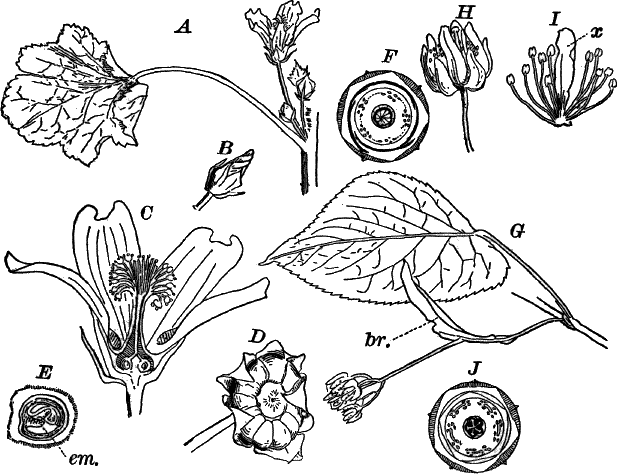
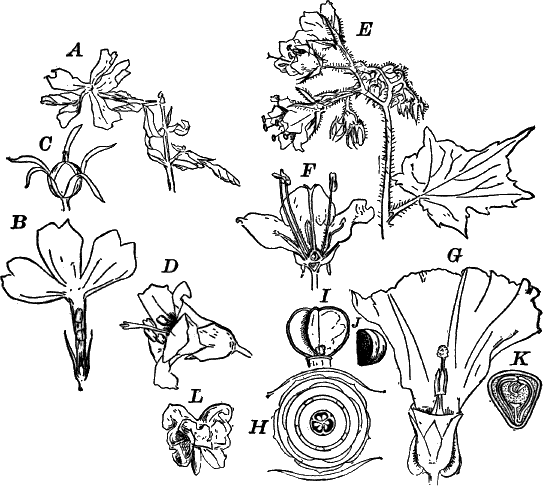
Fig. 106.—Types of Aphanocyclæ (Columniferæ). A,
flower and leaf of the common mallow, Malva (Malvaceæ), × ½. B,
a flower bud, × 1. C, section of a flower, × 2. D, the fruit, × 2.
E, section of one division of the fruit, with the enclosed seed,
× 3. em. the embryo. F, diagram of the flower. G, leaf and
inflorescence of the basswood, Tilia (Tiliaceæ), × ⅓. br. a
bract. H, a single flower, × 1. I, group of stamens, with
petal-like appendage (x), × 2. J, diagram of the flower.
The fourth group of the Choripetalæ is the Eucyclæ. The flowers
most commonly have the parts in fives, and the stamens are never more
than twice as many as the sepals. The carpels are usually more or less
completely united into a compound pistil. There are four orders,
comprising twenty-five families.
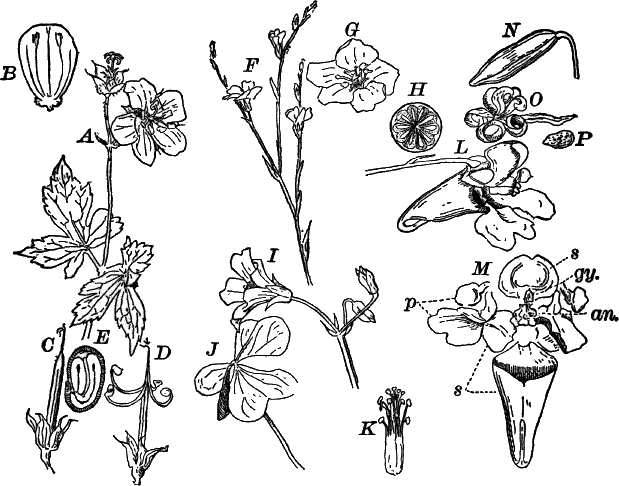
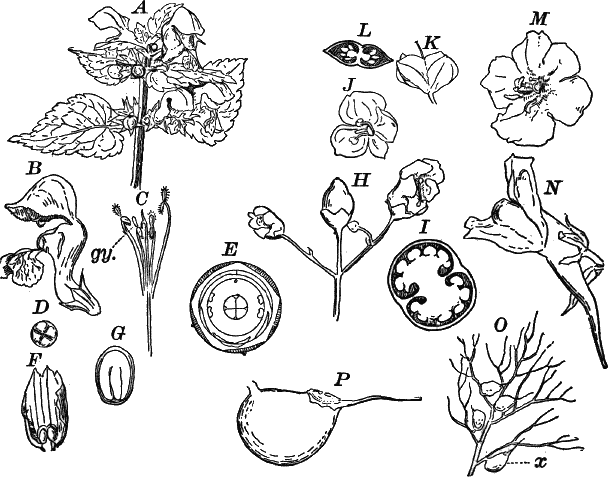
Fig. 107.—Types of Eucyclæ (Gruinales). A, wild
crane’s-bill Geranium (Geraniaceæ), × ½. B, a petal, × 1. C,
the young fruit, the styles united in a column, × ½. D, the ripe
fruit, the styles separating to discharge the seeds, × ½. E, section
of a seed, × 2. F, wild flax. Linum (Linaceæ), × ½. G, a
single flower, × 2. H, cross-section of the young fruit, × 3. I,
flower. J, leaf of wood-sorrel, Oxalis (Oxalideæ), × 1. K, the
stamens and pistil, × 2. L, flower of jewel-weed, Impatiens
(Balsamineæ), × 1. M, the same, with the parts separated. p,
petals. s, sepals. an. stamens. gy. pistil. N, fruit, × 1.
O, the same, opening. P, a seed, × 2.
The first order (Gruinales) includes six families, consisting for
the most part of plants with conspicuous flowers. Here belong the
geraniums (Fig. 107, A), represented by the wild geraniums and
crane’s-bill, and the very showy geraniums (Pelargonium) of the
gardens. The nasturtiums (Tropæolum) represent another family,
mostly tropical, and the wood-sorrels (Oxalis) (Fig. 107, I) are
common, both wild and cultivated. The most useful member of the order
is unquestionably the common flax (Linum), of which there are also
several native species (Fig. 107, F). These are types of the flax
family (Linaceæ). Linen is the product of the tough, fibrous inner
bark of L. usitatissimum, which has been cultivated for its fibre
from time immemorial. The last family is the balsam family
(Balsamineæ). The jewel-weed or touch-me-not
(Impatiens), so called from the sensitive pods which
spring open on being touched, is very common in moist ground
everywhere (Fig. 107, L–P). The garden balsam, or lady’s slipper, is
a related species (I. balsamina).
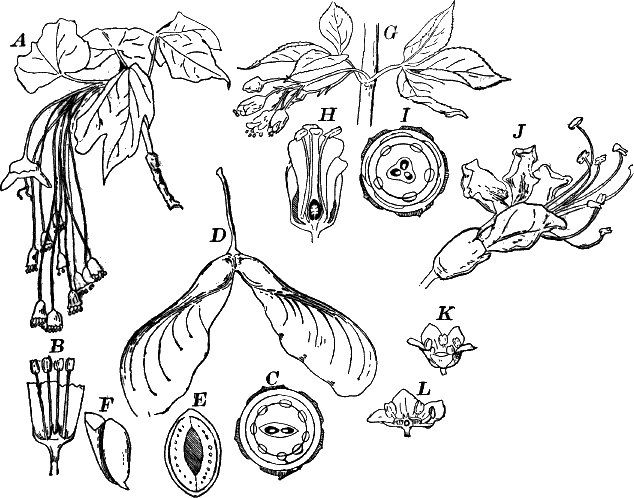
Fig. 108.—Eucyclæ (Terebinthinæ, Æsculinæ). A,
leaves and flowers of sugar-maple, Acer (Aceraceæ), × ½. B, a
male flower, × 2. C, diagram of a perfect flower. D, fruit of the
silver-maple, × ½. E, section across the seed, × 2. F, embryo
removed from the seed, × 1. G, leaves and flowers of bladder-nut,
Staphylea, (Sapindaceæ), × ½. H, section of a flower, × 2. I,
diagram of the flower. J, flower of buckeye (Æsculus), × 1½. K,
flower of smoke-tree, Rhus (Anacardiaceæ), × 3. L, the same, in
section.
The second order (Terebinthinæ) contains but few common plants.
There are six families, mostly inhabitants of the warmer parts of the
world. The best-known members of the order are the orange, lemon,
citron, and their allies. Of our native plants the prickly ash
(Zanthoxylum), and the various species of sumach (Rhus), are the
best known. In the latter genus belong the poison ivy
(R. toxicodendron) and the poison dogwood (R. venenata). The
Venetian sumach or smoke-tree (R. Cotinus) is commonly planted for
ornament.
The third order of the Eucyclæ, the Æsculinæ, embraces six
families, of which three, the horsechestnuts, etc. (Sapindaceæ), the
maples (Aceraceæ), and the milkworts (Polygalaceæ), have several
representatives in the northern United States. Of the first the
buckeye (Æsculus) (Fig. 108, J) and the bladder-nut (Staphylea)
(Fig. 108, G) are the commonest native genera, while the
horsechestnut (Æsculus hippocastanum) is everywhere planted.
The various species of maple (Acer) are familiar examples of the
Aceraceæ (see Fig. 106, A, F).
The fourth and last order of the Eucyclæ, the Frangulinæ, is
composed mainly of plants with inconspicuous flowers, the stamens as
many as the petals. Not infrequently they are diœcious, or in some,
like the grape, some of the flowers may be unisexual while others are
hermaphrodite (i.e. have both stamens and pistil). Among the
commoner plants of the order may be mentioned the spindle-tree, or
burning-bush, as it is sometimes called (Euonymus) (Fig. 109, A),
and the climbing bitter-sweet (Celastrus) (Fig. 109, D), belonging
to the family Celastraceæ; the holly and black alder, species of
Ilex, are examples of the family Aquifoliaceæ; the various species
of grape (Vitis), the Virginia creeper (Ampelopsis quinquefolia),
and one or two other cultivated species of the latter, represent the
vine family (Vitaceæ or Ampelidæ), and the buckthorn (Rhamnus)
is the type of the Rhamnaceæ.
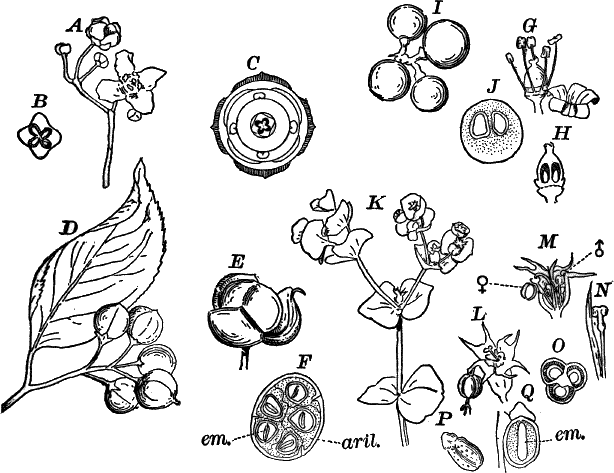
Fig. 109.—Eucylæ (Frangulinæ), Tricoccæ. A,
flowers of spindle-tree, Euonymus, (Celastraceæ), × 1. B,
cross-section of the ovary, × 2. C, diagram of the flower. D, leaf
and fruit of bitter-sweet (Celastrus), × ½. E, fruit opening and
disclosing the seeds. F, section of a nearly ripe fruit, showing the
seeds surrounded by the scarlet integument (aril). em. the embryo,
× 1. G, flower of grape-vine, Vitis (Vitaceæ), × 2. The corolla
has fallen off. H, vertical section of the pistil, × 2. I, nearly
ripe fruits of the frost-grape, × 1. J, cross-section of young
fruit, × 2. K, a spurge, Euphorbia (Euphorbiaceæ), × ½. L,
single group of flowers, surrounded by the corolla-like involucre,
× 3. M, section of the same, ♂, male flowers; ♀, female flowers.
N, a single male flower, × 5. O, cross-section of ovary, × 6. P,
a seed, × 2. Q, longitudinal section of the seed, × 3. em.
embryo.
The fifth group of the Choripetalæ is a small one, comprising but a
single order (Tricoccæ). The flowers are small and inconspicuous,
though sometimes, as in some Euphorbias and the showy Poinsettia
of the greenhouses, the leaves or bracts surrounding the inflorescence
are conspicuously colored, giving the whole the appearance of a large,
showy, single flower. In northern countries the plants are mostly
small weeds, of which the various spurges or Euphorbias are the most
familiar. These plants (Fig. 109, K) have the small flowers
surrounded by a cup-shaped involucre (L, M) so that the whole
inflorescence looks like a single flower. In the spurges, as in the
other members of the order, the flowers are very simple, being often
reduced to a single stamen or pistil (Fig. 109, M, N). The plants
generally abound in a milky juice which is often poisonous. This juice
in a number of tropical genera is the source of India-rubber. Some
genera like the castor-bean (Ricinus) and Croton are cultivated
for their large, showy leaves.
The water starworts (Callitriche), not uncommon in stagnant water,
represent the family Callitrichaceæ, and the box (Buxus) is the
type of the Buxaceæ.
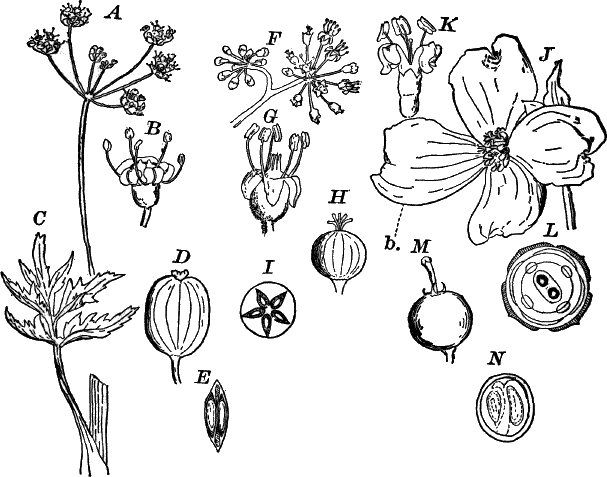
Fig. 110.—Types of Calycifloræ (Umbellifloræ).
A, inflorescence of wild parsnip, Pastinaca (Umbelliferæ), × ½.
B, single flower of the same, × 3. C, a leaf, showing the
sheathing base, × ¼. D, a fruit, × 2. E, cross-section of D.
F, part of the inflorescence of spikenard, Aralia (Araliaceæ),
× 1. G, a single flower of the same, × 3. H, the fruit, × 2. I,
cross-section of the H. J, inflorescence of dogwood, Cornus
(Corneæ). The cluster of flowers is surrounded by four white bracts
(b), × ⅓. K, a single flower of the same, × 2. L, diagram of the
flower. M, young fruit of another species (Cornus stolonifera)
(red osier), × 2. N, cross-section of M.
The last and highest group of the Choripetalæ, the Calycifloræ,
embraces a very large assemblage of familiar plants, divided into
eight orders and thirty-two families. With few exceptions, the floral
axis grows up around the ovary, carrying the outer floral leaves above
it, and the ovary appears at the bottom of a cup around whose edge the
other parts of the flower are arranged. Sometimes, as in the fuchsia,
the ovary is grown to the base of the cup or tube, and thus looks as
if it were outside the flower. Such an ovary is said to be “inferior”
in distinction from one that is entirely free from the tube, and thus
is evidently within the flower. The latter is the so-called “superior”
ovary. The carpels are usually united into a compound pistil, but may
be separate, as in the stonecrop (Fig. 111, E), or strawberry
(Fig. 114, C).
The first order of the Calycifloræ (Umbellifloræ) has the flowers
small, and usually arranged in umbels, i.e. several stalked flowers
growing from a common point. The ovary is inferior, and there is a
nectar-secreting disc between the styles and the stamens. Of the three
families, the umbel-worts or Umbelliferæ is the commonest. The
flowers are much alike in all (Fig. 110, A, B), and nearly all
have large, compound leaves with broad, sheathing bases. The stems are
generally hollow. So great is the uniformity of the flowers and plant,
that the fruit (Fig. 110, D) is generally necessary before the plant
can be certainly recognized. This is two-seeded in all, but differs
very much in shape and in the development of oil channels, which
secrete the peculiar oil that gives the characteristic taste to the
fruits of such forms as caraway, coriander, etc. Some of them, like
the wild parsnip, poison hemlock, etc., are violent poisons, while
others like the carrot are perfectly wholesome.
The wild spikenard (Aralia) (Fig. 110, F), ginseng, and the true
ivy (Hedera) are examples of the Araliaceæ, and the various
species of dogwood (Cornus) (Fig. 110, J–N) represent the dogwood
family (Corneæ).
The second order (Saxifraginæ) contains eight families, including a
number of common wild and cultivated plants. The true saxifrages are
represented by several wild and cultivated species of Saxifraga, the
little bishop’s cap or mitre-wort (Mitella) (Fig. 111, D), and
others. The wild hydrangea (Fig. 111, F) and the showy garden
species represent the family Hydrangeæ. In these some of the flowers
are large and showy, but with neither stamens nor pistils (neutral),
while the small, inconspicuous flowers of the central part of the
inflorescence are perfect. In the garden varieties, all of the flowers
are changed, by selection, into the showy, neutral ones. The syringa
or mock orange (Philadelphus) (Fig. 111, I), the gooseberry, and
currants (Ribes) (Fig. 111, A), and the stonecrop (Sedum)
(Fig. 111, E) are types of the families Philadelpheæ, Ribesieæ,
and Crassulaceæ.
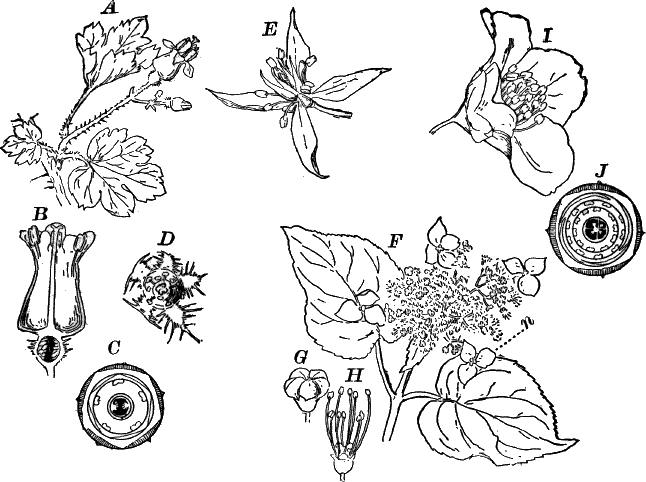
Fig. 111.—Calycifloræ (Saxifraginæ): A, flowers
and leaves of wild gooseberry, Ribes (Ribesieæ), × 1. B,
vertical section of the flower, × 2. C, diagram of the flower. D,
flower of bishop’s-cap, Mitella (Saxifragaceæ), × 3. E, flower
of stonecrop, Sedum (Crassulaceæ), × 2. F, flowers and leaves of
hydrangea (Hydrangeæ), × ½. n, neutral flower. G, unopened
flower, × 2. H, the same, after the petals have fallen away. I,
flower of syringa, Philadelphus (Philadelpheæ), × 1. J, diagram
of the flower.
The third order (Opuntieæ) has but a single family, the cacti
(Cactaceæ). These are strictly American in their distribution, and
inhabit especially the dry plains of the southwest, where they reach
an extraordinary development. They are nearly or quite leafless, and
the fleshy, cylindrical, or flattened stems are usually beset with
stout spines. The flowers (Fig. 112, A) are often very showy, so
that many species are cultivated for ornament and are familiar to
every one. The beautiful night-blooming cereus, of which there are
several species, is one of these. A few species of prickly-pear
(Opuntia) occur as far north as New York, but most are confined to
the hot, dry plains of the south and southwest.
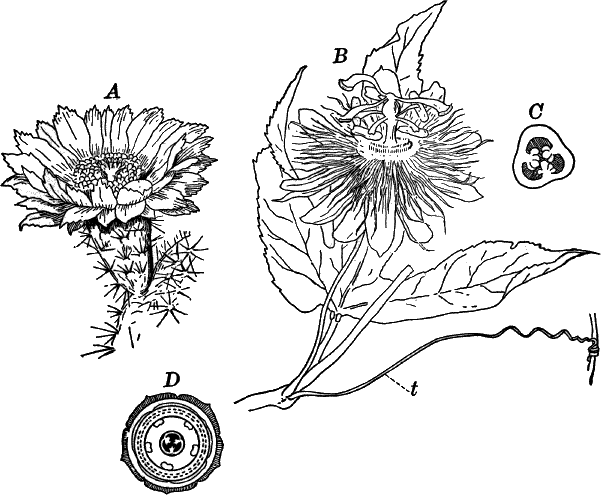
Fig. 112.—Calycifloræ, Opuntieæ (Passiflorinæ).
A, flower of a cactus, Mamillaria (Cactaceæ) (from “Gray’s
Structural Botany”). B, leaf and flower of a passion-flower,
Passiflora (Passifloraceæ), × ½. t, a tendril. C,
cross-section of the ovary, × 2. D, diagram of the flower.
The fourth order (Passiflorinæ) are almost without exception
tropical plants, only a very few extending into the southern United
States. The type of the order is the passion-flower (Passiflora)
(Fig. 112, B), whose numerous species are mostly inhabitants of
tropical America, but a few reach into the United States. The only
other members of the order likely to be met with by the student are
the begonias, of which a great many are commonly cultivated as house
plants on account of their fine foliage and flowers. The leaves are
always one-sided, and the flowers monœcious.[13] Whether the begonias
properly belong with the Passiflorinæ has been questioned.
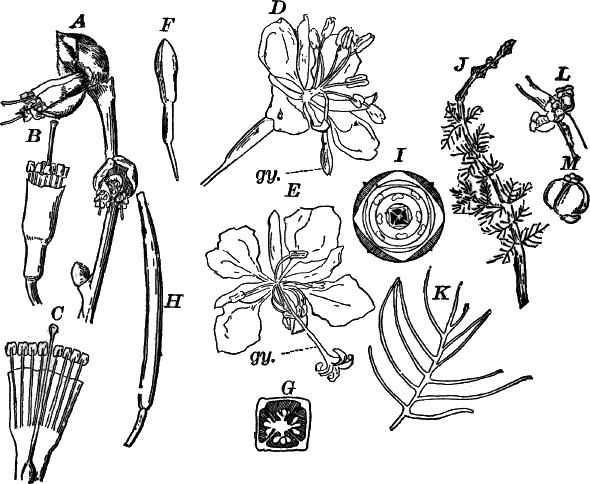
Fig. 113.—Calycifloræ (Myrtifloræ, Thymelinæ).
A, flowering branch of moosewood, Dirca
(Thymelæaceæ), × 1. B, a single flower, × 2. C,
the same, laid open. D, a young flower of willow herb, Epilobium
(Onagraceæ), × 1. The pistil (gy.) is not yet ready for
pollination. E, an older flower, with receptive pistil. F, an
unopened bud, × 1. G , cross-section of the ovary, × 4. H, a young
fruit, × 1. I, diagram of the flower. J, flowering branch of water
milfoil, Myriophyllum (Haloragidaceæ), × ½. K, a single leaf,
× 1. L, female flowers of the same, × 2. M, the fruit, × 2.
The fifth order (Myrtifloræ) have regular four-parted flowers with
usually eight stamens, but sometimes, through branching of the
stamens, these appear very numerous. The myrtle family, the members of
which are all tropical or sub-tropical, gives name to the order. The
true myrtle (Myrtus) is sometimes cultivated for its pretty glossy
green leaves and white flowers, as is also the pomegranate whose
brilliant, scarlet flowers are extremely ornamental. Cloves are the
dried flower-buds of an East-Indian myrtaceous tree (Caryophyllus).
In Australia the order includes the giant gum-trees
(Eucalyptus), the largest of all known trees, exceeding
in size even the giant trees of California.
Among the commoner Myrtifloræ, the majority belong to the two
families Onagraceæ and Lythraceæ. The former includes the evening
primroses (Œnothera), willow-herb (Epilobium) (Fig. 113, D),
and fuchsia; the latter, the purple loosestrife (Lythrum) and swamp
loosestrife (Nesæa). The water-milfoil (Myriophyllum) (Fig. 113,
J) is an example of the family Haloragidaceæ, and the Rhexias of
the eastern United States represent with us the family Melastomaceæ.
The sixth order of the Calycifloræ is a small one (Thymelinæ),
represented in the United States by very few species. The flowers are
four-parted, the calyx resembling a corolla, which is usually absent.
The commonest member of the order is the moosewood (Dirca)
(Fig. 113, A), belonging to the first of the three families
(Thymelæaceæ). Of the second family (Elæagnaceæ), the commonest
example is Shepherdia, a low shrub having the leaves covered with
curious, scurfy hairs that give them a silvery appearance. The third
family (Proteaceæ) has no familiar representatives.
The seventh order (Rosifloræ) includes many well-known plants, all
of which may be united in one family (Rosaceæ), with several
sub-families. The flowers are usually five-parted with from five to
thirty stamens, and usually numerous, distinct carpels. In the apple
and pear (Fig. 114, I), however, the carpels are more or less grown
together; and in the cherry, peach, etc., there is but a single carpel
giving rise to a single-seeded stone-fruit (drupe) (Fig. 114, E,
H). In the strawberry (Fig. 114, A), rose (G), cinquefoil
(Potentilla), etc., there are numerous distinct, one-seeded carpels,
and in Spiræa (Fig. 114, F) there are five several-seeded carpels,
forming as many dry pods when ripe. The so-called “berry” of the
strawberry is really the much enlarged flower axis, or “receptacle,”
in which the little one-seeded fruits are embedded, the latter being
what are ordinarily called the seeds.
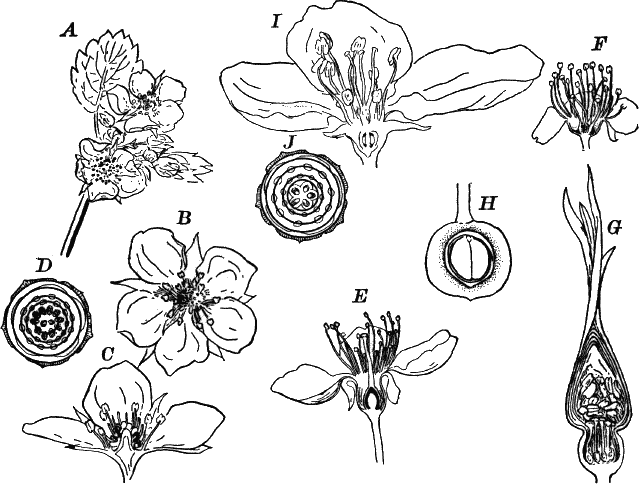
Fig. 114.—Calycifloræ (Rosifloræ). A,
inflorescence of strawberry (Fragaria), × ½. B, a single flower,
× 1. C, section of B. D, floral diagram. E, vertical section
of a cherry-flower (Prunus), × 1. F, vertical section of the
flower of Spiræa, × 2. G, vertical section of the bud of a wild
rose (Rosa), × 1. H, vertical section of the young fruit, × 1.
I, section of the flower of an apple (Pyrus), × 1. J, floral
diagram of apple.
From the examples given, it will be seen that the order includes not
only some of the most ornamental, cultivated plants, but the majority
of our best fruits. In addition to those already given, may be
mentioned the raspberry, blackberry, quince, plum, and apricot.
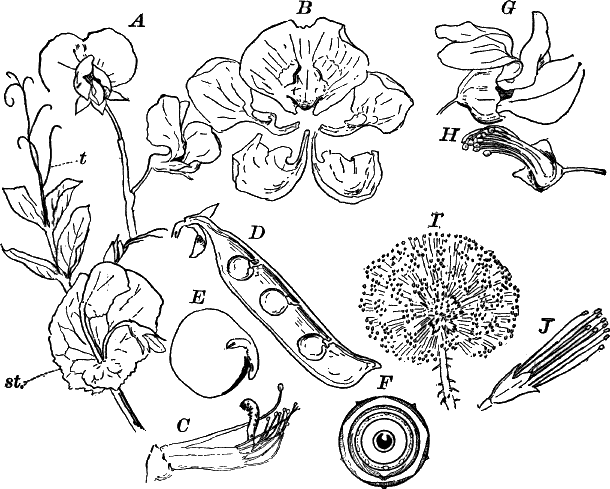
Fig. 115.—Calycifloræ (Leguminosæ). A, flowers
and leaf of the common pea, Pisum (Papilionaceæ), × ½. t,
tendril. st. stipules. B, the petals, separated and displayed,
× 1. C, flower, with the calyx and corolla removed, × 1. D, a
fruit divided lengthwise, × ½. E, the embryo, with one of the
cotyledons removed, × 2. F, diagram of the flower. G, flower of
red-bud, Cercis (Cæsalpinaceæ), × 2. H, the same, with calyx and
corolla removed. I, inflorescence of the sensitive-brier,
Schrankia (Mimosaceæ), × 1. J, a single flower, × 2.
The last order of the Calycifloræ and the highest of the
Choripetalæ is the order Leguminosæ, of which the bean, pea,
clover, and many other common plants are examples. In most of our
common forms the flowers are peculiar in shape, one of the petals
being larger than the others, and covering them in the bud. This
petal is known as the standard. The two lateral petals are known as
the wings, and the two lower and inner are generally grown together
forming what is called the “keel” (Fig. 115, A, B). The stamens,
ten in number, are sometimes all grown together into a tube, but
generally the upper one is free from the others (Fig. 115, C). There
is but one carpel which forms a pod with two valves when ripe
(Fig. 115, D). The seeds are large, and the embryo fills the seed
completely. From the peculiar form of the flower, they are known as
Papilionaceæ (papilio, a butterfly). Many of the Papilionaceæ
are climbers, either having twining stems, as in the common beans, or
else with part of the leaf changed into a tendril as in the pea
(Fig. 115, A), vetch, etc. The leaves are usually compound.
Of the second family (Cæsalpineæ), mainly tropical, the honey locust
(Gleditschia) and red-bud (Cercis) (Fig. 115, G) are the
commonest examples. The flowers differ mainly from the Papilionaceæ
in being less perfectly papilionaceous, and the stamens are almost
entirely distinct (Fig. 115, H). The last family (Mimosaceæ) is
also mainly tropical. The acacias, sensitive-plant (Mimosa), and the
sensitive-brier of the southern United States (Schrankia) (Fig. 115,
I) represent this family. The flowers are quite different from the
others of the order, being tubular and the petals united, thus
resembling the flowers of the Sympetalæ. The leaves of Mimosa and
Schrankia are extraordinarily sensitive, folding up if irritated.