COMMERCIAL ARITHMETIC.
212. In making the calculations which are necessary in commercial
affairs, no more processes are required than those which have been
explained in the preceding book. But there is still one thing
wanted—not to insure the accuracy of our calculations, but to enable
us to compare and judge of their results. We have hitherto made use of
a single unit (15), and have treated of other quantities which are made
up of a number of units, in Sections II., III., and IV., and of those
which contain parts of that unit in Sections V. and VI. Thus, if we are
talking of distances, and take a mile as the unit, any other length may
be represented,[31]
either by a certain number of miles, or a certain
number of parts of a mile, and (1 meaning one mile) may be expressed
either by a whole number or a fraction. But we can easily see that in
many cases inconveniences would arise. Suppose, for example, I say,
that the length of one room is ¹/₁₈₀ of a mile, and of another ¹/₁₇₄
of a mile, what idea can we form as to how much the second is longer
than the first? It is necessary to have some smaller measure; and if
we divide a mile into 1760 equal parts, and call each of these parts a
yard, we shall find that the length of the first room is 9 yards and
⁷/₉ of a yard, and that of the second 10 yards and ¹⁰/₈₇ of a yard.
From this we form a much better notion of these different lengths,
but still not a very perfect one, on account of the fractions ⁷/₉ and
¹⁰/₈₇. To get a clearer idea of these, suppose the yard to be divided
into three equal parts, and each of these parts to be called a foot;
then ⁷/₉ of a yard contains 2⅓ feet, and ¹⁰/₈₇ of a yard contains ³⁰/₈₇
of a foot, or a little more than ⅓ of a foot. Therefore the length
of the first room is now 9 yards, 2 feet, and ⅓ of a foot; that of
the second is 10 yards and a little more than ⅓ of a foot. We see,
then, the convenience of having large measures for large quantities,
and smaller measures for small ones; but this is done for convenience
only, for it is possible to perform calculations upon any sort
of quantity, with one measure alone, as certainly as with more than
one; and not only possible, but more convenient, as far as the mere
calculation is concerned.
The measures which are used in this country are not those which would
have been chosen had they been made all at one time, and by a people
well acquainted with arithmetic and natural philosophy. We proceed
to shew how the results of the latter science are made useful in
our system of measures. Whether the circumstances introduced are
sufficiently well known to render the following methods exact enough
for the recovery of astronomical standards, may be matter of
opinion; but no doubt can be entertained of their being amply correct
for commercial purposes.
It is evidently desirable that weights and measures should always
continue the same, and that posterity should be able to replace any
one of them when the original measure is lost. It is true that a yard,
which is now exact, is kept by the public authorities; but if this were
burnt by accident,[32]
how are those who shall live 500 years hence to know what was the
length which their ancestors called a yard? To ensure them this
knowledge, the measure must be derived from something which cannot
be altered by man, either from design or accident. We find such a
quantity in the time of the daily revolution of the earth, and also
in the length of the year, both of which, as is shewn in astronomy,
will remain the same, at least for an enormous number of centuries,
unless some great and totally unknown change take place in the solar
system. So long as astronomy is cultivated, it is impossible to suppose
that either of these will be lost, and it is known that the latter is
365·24224 mean solar days, or about 365¼ of the average interval which
elapses between noon and noon, that is, between the times when the sun
is highest in the heavens. Our year is made to consist of 365 days,
and the odd quarter is allowed for by adding one day to every fourth
year, which gives what we call leap-year. This is the same as adding ¼
of a day to each year, and is rather too much, since the excess of the
year above 365 days is not ·25 but ·24224 of a day. The difference is
·00776 of a day, which is the quantity by which our average year is too
long. This amounts to a day in about 128 years, or to about 3 days in
4 centuries. The error is corrected by allowing only one out of four
of the years which close the centuries to be leap-years. Thus,
a.d. 1800 and 1900 are not leap-years,
but 2000 is so.
213. The day is therefore the first measure obtained, and is divided
into 24 parts or hours, each of which is divided into 60 parts or
minutes, and each of these again into 60 parts or seconds. One second,
marked thus, 1″,[33]
is therefore the 86400ᵗʰ part of a day, and the following is the
MEASURE OF TIME.[34]
| 60 |
seconds |
are |
1 minute |
|
1 m. |
| 60 |
minutes |
” |
1 hour |
1 h. |
| 24 |
hours |
” |
1 day |
1 d. |
| 7 |
days |
” |
1 week |
1 wk. |
| 365 |
days |
” |
1 year |
1 yr. |
214. The second having been obtained, a pendulum can be
constructed which shall, when put in motion, perform one vibration
in exactly one second, in the latitude of Greenwich.[35]
If we were inventing measures, it would be convenient to call the length of
this pendulum a yard, and make it the standard of all our measures of
length. But as there is a yard already established, it will do equally
well to tell the length of the pendulum in yards. It was found by
commissioners appointed for the purpose, that this pendulum in London
was 39·1393 inches, or about one yard, three inches, and ⁵/₃₆ of an
inch. The following is the division of the yard.
MEASURES OF LENGTH.
The lowest measure is a barleycorn.[36]
| 3 |
barleycornsare |
1 inch |
1 in. |
| 12 |
inches |
1 foot |
1 ft. |
| 3 |
feet |
1 yard |
1 yd. |
| 5½ |
yards |
1 pole |
1 po. |
| 40 |
poles or 220 yards |
1 furlong |
1 fur. |
| 8 |
furlongs or 1760 yards |
1 mile |
1 mi. |
| Also |
|
| 6 |
feet |
1 fathom |
1 fth. |
| 69⅓ |
miles |
1 degree |
1 deg. or 1°. |
A geographical mile is ¹/₆₀th of a degree, and three such miles are one
nautical league.
In the measurement of cloth or linen the following are also used:
| 2¼ |
inches are |
1 nail |
1 nl. |
| 4 |
nails |
1 quarter (of a yard) |
1 qr. |
| 3 |
quarters |
1 Flemish ell |
1 Fl. e. |
| 5 |
quarters |
1 English ell |
1 E. e. |
| 6 |
quarters |
1 French ell |
1 Fr. e. |
215. MEASURES OF SURFACE, OR SUPERFICIES.
All surfaces are measured by square inches, square feet, &c.; the
square inch being a square whose side is an inch in length, and so on.
The following measures may be deduced from the last, as will afterwards
appear.
| 144 |
square inches are |
1 square foot |
1 sq. ft. |
| 9 |
square feet |
1 square yard |
1 sq. yd. |
| 30¼ |
square yards |
1 square pole |
1 sq. p. |
| 40 |
square poles |
1 rood |
1 rd. |
| 4 |
roods |
1 acre |
1 ac. |
Thus, the acre contains 4840 square yards, which is ten times a square
of 22 yards in length and breadth. This 22 yards is the length which
land-surveyors’ chains are made to have, and the chain is divided into
100 links, each ·22 of a yard or 7·92 inches. An acre is then 10 square
chains. It may also be noticed that a square whose side is 69⁴/₇ yards
is nearly an acre, not exceeding it by ⅕ of a square foot.
216. MEASURES OF SOLIDITY OR CAPACITY.[37]
Cubes are solids having the figure of dice. A cubic inch is a cube each
of whose sides is an inch, and so on.
| 1728 |
cubic inches are |
1 cubic foot |
1 c. ft. |
| 27 |
cubic feet |
1 cubic yard |
1 c. yd. |
This measure is not much used, except in purely mathematical
questions. In the measurements of different commodities various measures
were used, which are now reduced, by act of parliament, to one.
This is commonly called the imperial measure, and is as follows:
MEASURE OF LIQUIDS AND
OF ALL DRY GOODS.
| 4 |
gills are |
1 pint |
1 pt. |
| 2 |
pints |
1 quart |
1 qt. |
| 4 |
quarts |
1 gallon |
1 gall. |
| 2 |
gallons |
1 peck[38] |
1 pk. |
| 4 |
pecks |
1 bushel |
1 bu. |
| 8 |
bushels |
1 quarter |
1 qr. |
| 5 |
quarters |
1 load |
1 ld. |
The gallon in this measure is about 277·274 cubic inches; that is, very
nearly 277¼ cubic inches.[39]
217. The smallest weight in use is the grain, which is thus determined.
A vessel whose interior is a cubic inch, when filled with
water,[40]
has its weight increased by 252·458 grains. Of the grains so determined,
7000 are a pound averdupois, and 5760 a pound troy. The
first pound is always used, except in weighing precious metals and
stones, and also medicines. It is divided as follows:
AVERDUPOIS WEIGHT.
| 27 |
¹¹/₃₂ |
grainsare |
1 dram |
1 dr. |
| 6 |
|
drams, or drachms |
1 ounce[41] |
1 oz. |
| 16 |
|
ounces |
1 pound |
1 lb. |
| 28 |
|
pounds |
1 quarter |
1 qr. |
| 4 |
|
quarters |
1 hundred-weight |
1 cwt. |
| 20 |
|
hundred-weight |
1 ton |
1 ton. |
The pound averdupois contains 7000 grains. A cubic foot of water weighs
62·3210606 pounds averdupois, or 997·1369691 ounces.
For the precious metals and for medicines, the pound troy, containing
5760 grains, is used, but is differently divided in the two cases. The
measures are as follow:
TROY WEIGHT.
| 24 |
grainsare |
1 pennyweight |
1 dwt. |
| 20 |
pennyweights |
1 ounce |
1 oz. |
| 12 |
ounces |
1 pound |
1 lb. |
The pound troy contains 5760 grains. A cubic foot of water weighs
75·7374 pounds troy, or 908·8488 ounces.
APOTHECARIES’ WEIGHT.
| 20 |
grainsare |
1 scruple |
℈ |
| 3 |
scruples |
1 dram |
ʒ |
| 8 |
drams |
1 ounce |
℥ |
| 12 |
ounces |
1 pound |
lb |
218. The standard coins of copper, silver, and gold, are,—the penny,
which is 10⅔ drams of copper; the shilling, which weighs 3 pennyweights
15 grains, of which 3 parts out of 40 are alloy, and the rest pure
silver; and the sovereign, weighing 5 pennyweights and 3¼ grains, of
which 1 part out of 12 is copper, and the rest pure gold.
MEASURES OF MONEY.
The lowest coin is a farthing, which is marked thus, ¼, being one
fourth of a penny.
| 2 |
farthings are |
1 halfpenny |
½d. |
| 2 |
halfpence |
1 penny |
1d. |
| 12 |
pence |
1 shilling |
1s. |
| 20 |
shillings |
1 pound[42] or sovereign |
£1 |
| 21 |
shillings |
1 guinea.[43] |
|
219. When any quantity is made up of several others, expressed in
different units, such as £1. 14. 6, or 2cwt. 1qr. 3lbs., it is called
a compound quantity. From these tables it is evident that any
compound quantity of any substance can be measured in several different
ways. For example, the sum of money which we call five pounds four
shillings is also 104 shillings, or 1248 pence, or 4992 farthings.
It is easy to reduce any quantity from one of these measurements to
another; and the following examples will be sufficient to shew how to
apply the same process, usually called Reduction,
to all sorts of quantities.
I. How many farthings are there in £18. 12. 6¾?[44]
Since there are 20 shillings in a pound, there are, in £18, 18 × 20, or
360 shillings; therefore, £18. 12 is 360 + 12, or 372 shillings. Since
there are 12 pence in a shilling, in 372 shillings there are 372 × 12,
or 4464 pence; and, therefore, in £18. 12. 6 there are 4464 + 6, or
4470 pence.
Since there are 4 farthings in a penny, in 4470 pence there are 4470 ×
4, or 17880 farthings; and, therefore, in £18. 12. 6¾ there are 17880
+ 3, or 17883 farthings. The whole of this process may be written as
follows:
- £18 . 12 . 6¾
- 20
- 360 + 12 = 372
- 12
- 4464 + 6 = 4470
- 4
- 17880 + 3 = 17883
II. In 17883 farthings, how many pounds, shillings, pence, and
farthings are there?
Since 17883, divided by 4, gives the quotient 4470, and the remainder
3, 17883 farthings are 4470 pence and 3 farthings (218).
Since 4470, divided by 12, gives the quotient 372, and the remainder 6,
4470 pence is 372 shillings and 6 pence.
Since 372, divided by 20, gives the quotient 18, and the remainder 12,
372 shillings is 18 pounds and 12 shillings.
Therefore, 17883 farthings is 4470¾d., which is 372s.
6¾d., which is £18. 12. 6¾.
The process may be written as follows:
- 4)17883
- ——
- 12)4470 ... 3
- ——
- 20)372 ... 6
- £18 . 12 . 6¾
EXERCISES.
A has £100. 4. 11½, and B has 64392 farthings. If A receive 1492
farthings, and B £1. 2. 3½, which will then have the most, and by how
much?—Answer, A will have £33. 12. 3 more than B.
In the following table the quantities written opposite to each other
are the same: each line furnishes two exercises.
| £15 . 18 . 9½ |
15302 farthings. |
| 115ˡᵇˢ 1ᵒᶻ 8ᵈᵚᵗ |
663072 grains. |
| 3ˡᵇˢ 14ᵒᶻ 9ᵈʳ |
1001 drams. |
| 3ᵐ 149 yds 2ᶠᵗ 9 in |
195477 inches. |
| 19ᵇᵘ 2ᵖᵏˢ 1 gall 2 qᵗˢ |
1260 pints. |
| 16 ʰ 23ᵐ 47ˢ |
59027 seconds. |
220. The same may be done where the number first expressed is
fractional. For example, how many shillings and pence are there in ⁴/₁₅
of a pound? Now, ⁴/₁₅ of a pound is ⁴/₁₅ of 20 shillings;
⁴/₁₅ of 20 is
| 4 × 20 |
, or |
4 × 4 |
(110), or |
16 |
, |
| 15 |
3 |
3 |
or (105) 5⅓ of a shilling. Again, ⅓ of a shilling is ⅓ of
12 pence, or 4 pence. Therefore, £⁴/₁₅ = 5s. 4d.
Also, ·23 of a day is ·23 × 24 in hours, or 5ʰ·52; and ·52 of an hour
is ·52 × 60 in minutes, or 3ᵐ·2; and ·2 of a minute is ·2 × 60 in
seconds, or 12ˢ; whence ·23 of a day is 5ʰ 31ᵐ 12ˢ.
Again, suppose it required to find what part of a pound 6s.
8d. is. Since 6s. 8d. is 80 pence, and since the
whole pound contains 20 × 12 or 240 pence, 6s. 8d. is
made by dividing the pound into 240 parts, and taking 80 of them. It is
therefore £⁸⁰/₂₄₀ (107), but ⁸⁰/₂₄₀ = ⅓ (108);
therefore, 6s. 8d. = £⅓.
EXERCISES.
| ⅖ of a day is |
9ʰ 36ᵐ |
| ·12841 of a day |
3ʰ 4ᵐ 54ᔆ·624[45] |
| ·257 of a cwt. |
28ˡᵇˢ 12ᵒᶻ 8ᵈʳ·704 |
| £·14936 |
2ˢ 11ᵈ 3ᶠ·3856 |
221, 222. I have thought it best to refer the mode of converting
shillings, pence, and farthings into decimals of a pound to the
Appendix (See Appendix On Decimal Money).
I should strongly recommend the reader to make himself perfectly familiar with the modes
given in that Appendix. To prevent the subsequent sections from being
altered in their numbering, I have numbered this paragraph as above.
223. The rule of addition[46]
of two compound quantities of the same sort will be evident from the
following example. Suppose it required to add £192. 14. 2½ to £64. 13.
11¾. The sum of these two is the whole of that which arises from adding
their several parts. Now
| ¾d. + ½d. |
= |
⁵/₄d. |
= |
£0 . 0 . 1¼ |
(219) |
| 11d. + 2d. |
= |
13d. |
= |
0 . 1 . 1 |
|
| 13s. + 14s. |
= |
27s. |
= |
1 . 7 . 0 |
|
| £64 + £192 |
= |
|
= |
256 . 0 . 0 |
|
| The sum of all of which is |
£257. 8 . 2¼ |
|
This may be done at once, and written as follows:
- £192.14. 2½
- 64.13.11¾
- £257. 8. 2¼
Begin by adding together the farthings, and reduce the result to pence
and farthings. Set down the last only, carry the first to the line
of pence, and add the pence in both lines to it. Reduce the sum to
shillings and pence; set down the last only, and carry the first to the
line of shillings, and so on. The same method must be followed when the
quantities are of any other sort; and if the tables be kept in memory,
the process will be easy.
224. Subtraction is performed on the same principle
as in (40), namely, that the difference of two quantities is not altered by
adding the same quantity to both. Suppose it required to subtract
£19 . 13. 10¾ from £24. 5. 7½. Write these quantities under one another thus:
Since ¾ cannot be taken from ½ or ²/₄, add 1d. to both
quantities, which will not alter their difference; or, which is the
same thing, add 4 farthings to the first, and 1d. to the second.
The pence and farthings in the two lines then stand thus: 7⁶/₄d.
and 11¾d. Now subtract ¾ from ⁶/₄, and the difference is ¾ which
must be written under the farthings. Again, since 11d. cannot be
subtracted from 7d., add 1s. to both quantities by adding
12d. to the first, and 1s. to the second. The pence in
the first line are then 19, and in the second 11, and the difference
is 8, which write under the pence. Since the shillings in the lower
line were increased by 1, there are now 14s. in the lower, and
5s. in the upper one. Add 20s. to the upper and £1 to
the lower line, and the subtraction of the shillings in the second
from those in the first leaves 11s. Again, there are now £20 in
the lower, and £24 in the upper line, the difference of which is £4;
therefore the whole difference of the two sums is £4. 11. 8¾. If we
write down the two sums with all the additions which have been made,
the process will stand thus:
- £24 . 25 . 19⁶/₄
- 20 . 14 . 11¾
- Difference £4 . 11 . 8¾
225. The same method may be applied to any of the quantities in the
tables. The following is another example:
From 7 cwt. 2 qrs. 21 lbs. 14 oz.
Subtract 2 cwt. 3 qrs. 27 lbs. 12 oz.
After alterations have been made similar to those in the last article,
the question becomes:
| From |
7 cwt. 6 qrs. 49 lbs. 14 oz. |
| Subtract |
3 cwt. 4 qrs. 27 lbs. 12 oz. |
| The difference is |
4 cwt. 2 qrs. 22 lbs. 2 oz. |
In this example, and almost every other, the process may be a little
shortened in the following way. Here we do not subtract 27 lbs. from 21
lbs., which is impossible, but we increase 21 lbs. by 1 qr. or 28 lbs.
and then subtract 27 lbs. from the sum. It would be shorter, and lead
to the same result, first to subtract 27 lbs. from 1 qr. or 28 lbs. and
add the difference to 21 lbs.
226. EXERCISES.
A man has the following sums to receive: £193. 14. 11¼, £22. 0. 6¾,
£6473. 0. 0, and £49. 14. 4½; and the following debts to pay: £200
. 19. 6¼, £305. 16. 11, £22, and £19. 6. 0½. How much will remain
after paying the debts?
Answer, £6190. 7. 4¾.
There are four towns, in the order A, B, C, and D. If a man can go from
A to B in 5ʰ 20ᵐ 33ˢ, from B to C in 6ʰ 49ᵐ 2ˢ and from A to D in 19ʰ
0ᵐ 17ˢ, how long will he be in going from B to D, and from C to D?
Answer, 13ʰ 39ᵐ 44ˢ, and 6ʰ 50ᵐ 42ˢ.
227. In order to perform the process of Multiplication, it
must be recollected that, as in (52), if a quantity be divided into
several parts, and each of these parts be multiplied by a number, and
the products be added, the result is the same as would arise from
multiplying the whole quantity by that number.
It is required to multiply £7. 13. 6¼ by 13. The first quantity is
made up of 7 pounds, 13 shillings, 6 pence, and 1 farthing. And
| 1 farth. × 13 is |
13 farth. or |
£0 . 0 . 3¼ |
(219) |
| 6 pence × 13 is |
78 pence, or |
0 . 6 . 6 |
|
| 13 shill. × 13 is |
169 shill. or |
8 . 9 . 0 |
| 7 pounds × 13 is |
91 pounds, or |
91 . 0 . 0 |
| The sum of all these is |
£99 . 15 . 9¼ |
which is therefore £7. 13. 6¼ × 13.
This process is usually written as follows:
- £ 7 . 13 . 6¼
- 13
- £99 . 15 . 9¼
228. Division is performed upon the same principle as in (74),
viz. that if a quantity be divided into any number of parts, and each
part be divided by any number, the different quotients added together
will make up the quotient of the whole quantity divided by that number.
Suppose it required to divide £99. 15. 9¼ by 13. Since 99 divided
by 13 gives the quotient 7, and the remainder 8, the quantity is made
up of £13 × 7, or £91, and £8. 15. 9¼. The quotient of the first,
13 being the divisor, is £7: it remains to find that of the second.
Since £8 is 160s., £8. 15. 9¼ is 175s. 9¼d.,
and 175 divided by 13 gives the quotient 13, and the remainder 6; that
is, 175s. 9¼d. is made up of 169s. and 6s.
9¼d., the quotient of the first of which is 13s., and it
remains to find that of the second. Since 6s. is 72d.,
6s. 9¼d. is 81¼d., and 81 divided by 13 gives the
quotient 6 and remainder 3; that is, 81¼d. is 78d. and
3¼d., of the first of which the quotient is 6d. Again,
since 3d. is ¹²/₄, or 12 farthings, 3¼d. is 13 farthings,
the quotient of which is 1 farthing, or ¼, without remainder. We have
then divided £99. 15. 9¼ into four parts, each of which is divisible
by 13, viz. £91, 169s., 78d., and 13 farthings; so that
the thirteenth part of this quantity is £7. 13. 6¼. The whole process
may be written down as follows; and the same sort of process may be
applied to the exercises which follow:
- £ s. d. £ s. d.
- 13)99 15 9¼(7 13 6¼
- 91
- 8
- 20
- 160 + 15 = 175
- 13
- 45
- 39
- 6
- 12
- 72 + 9 = 81
- 78
- 3
- 4
- 12 + 1 = 13
- 13
- 0
Here, each of the numbers 99, 175, 81, and 13, is divided by 13 in the
usual way, though the divisor is only written before the first of them.
EXERCISES.
| 2 cwt. 1 qr. 21 lbs. 7 oz. × 53 |
= |
129 cwt. 1 qr. 16 lbs. 3 oz. |
| 2ᵈ 4ʰ 3ᵐ 27ˢ × 109 |
= |
236ᵈ 10ʰ 16ᵐ 3ˢ |
| £27 . 10 . 8 × 569 |
= |
£15666 . 9 . 4 |
| £7 . 4 . 8 × 123 |
= |
£889 . 14 |
| £166 × ₈/₃₃ |
= |
£40 . 4 . 10⁶/₃₃ |
| £187 . 6 . 7 × ³/₁₀₀ |
= |
£5 . 12 . 4¾ ²/₂₅ |
| 4s. 6½d. × 1121 |
= |
£254 . 11 . 2½ |
| 4s. 4d. × 4260 |
= |
6s. 6d. × 2840 |
229. Suppose it required to find how many times 1s. 4¼d. is
contained in £3. 19. 10¾. The way to do this is to find the number
of farthings in each. By 219, in the first there are 65, and in the
second 3835 farthings. Now, 3835 contains 65 59 times; and therefore
the second quantity is 59 times as great as the first. In the case,
however, of pounds, shillings, and pence, it would be best to use
decimals of a pound, which will give a sufficiently exact answer.
Thus 1s. 4¼d. is £·067, and £3. 19. 10¾ is £3·994, and 3·994
divided by ·067 is 3994 by 67, or 59⁴¹/₆₇. This is an extreme case, for
the smaller the divisor, the greater the effect of an error in a given
place of decimals.
EXERCISES.
How many times does 6 cwt. 2 qrs. contain 1 qr. 14 lbs. 1 oz.? and 1ᵈ
2ʰ 0ᵐ 47ˢ contain 3ᵐ 46ˢ?
Answer, 17·30758 and 414·367257.
If 2 cwt. 3 qrs. 1 lb. cost £150. 13. 10, how much does 1 lb. cost?
Answer, 9s. 9d. ¹³/₃₀₉.
A grocer mixes 2 cwt. 15 lbs. of sugar at 11d. per pound with 14
cwt. 3 lbs. at 5d. per pound. At how much per pound must he sell
the mixture so as not to lose by mixing them?
Answer, 5d. ¾ ¹⁵³/₉₀₅.
230. There is a convenient method of multiplication called
Practice. Suppose I ask, How much do 153 tons cost
if each ton cost £2. 15. 7½? It is plain that if this sum be multiplied by 153,
the product is the price of the whole. But this is also evident,
that, if I buy 153 tons at £2. 15. 7½ each ton, payment may be
made by first putting down £2 for each ton, then 10s. for each, then
5s., then 6d., and then 1½d. These sums together
make up £2. 15. 7½, and the reason for this separation of £2. 15
. 7½ into different parts will be soon apparent. The process may be
carried on as follows:
1. 153 tons, at £2 each ton, will cost
£306 0 0
2. Since 10s. is £½, 153 tons, at 10s.
each, will cost £15³/₂, which is
76 10 0
3. Since 5s. is ½ of 10s., 153 tons,
at 5s., will cost half as much as the same number at 10s.
each, that is, ½ of £76 . 10, which is
38 5 0
4. Since 6d. is ⅒ of 5s., 153 tons,
at 6d. each, will cost ⅒ of what the same number costs at 5s.
each, that is, ⅒ of £38 . 5, which is
3 16 6
5. Since 1½ or 3 halfpence is ¼ of 6d.
or 12 halfpence, 153 tons, at 1½d. each, will cost ¼ of what
the same number costs at 6d. each, that is, ¼ of £3 . 16 . 6, which is
0 19 1½
The sum of all these quantities is 425 10 7½
which is, therefore, £2 . 15 . 7½ × 153.
The whole process may be written down as follows:
| |
|
or what
153 tons
would
cost at |
|
| |
£153 0 0 |
|
£1 per ton. |
| £2 is 2 × £1 |
306 0 0 |
2 0 0 |
| 10s. is ½ of £1 |
76 10 0 |
0 10 0 |
| 10s. is ½ of £1 |
76 10 0 |
0 10 0 |
| 5s. is ½ of 10s. |
38 5 0 |
0 5 0 |
| 6d. is ⅒ of 5s. |
3 16 6 |
0 0 6 |
| 1½d. is ¼ of 6d. |
0 19 1½ |
0 0 1½ |
| Sum |
£425 10 7½ |
0 0 1½ |
ANOTHER EXAMPLE.
What do 1735 lbs. cost at 9s. 10¾d. per lb.? The
price 9s. 10¾d. is made up of 5s., 4s.,
10d., ½d., and ¼d.; of which 5s. is ¼ of
£1, 4s. is ⅕ of £1, 10d. is ⅙ of 5s., ½d.
is ¹/₂₀ of 10d., and ¼d. is ½ of ½d. Follow the
same method as in the last example, which gives the following:
| |
|
or what
1735 tons
would
cost at |
|
| |
£1735 0 0 |
|
£1 per ton. |
| 5s. is ¼ of £1 |
433 15 0 |
0 5 0 |
| 4s. is ⅕ of £1 |
347 0 0 |
0 4 0 |
| 10d. is ⅙ of 5s. |
72 5 10 |
0 0 10 |
| ½d. is ¹/₂₀ of 10d. |
3 12 3½ |
0 0 0½ |
| ¼d. is ½ of ½d. |
1 16 1¾ |
0 0 0¼ |
| by addition ... |
£858 9 3¼ |
£0 9 10¾ |
In all cases, the price must first be divided into a number of parts,
each of which is a simple fraction[47]
of some one which goes before. No rule can be given for doing this,
but practice will enable the student immediately to find out the best
method for each case. When that is done, he must find how much the
whole quantity would cost if each of these parts were the price, and
then add the results together.
EXERCISES.
What is the cost of
243 cwt. at £14 . 18 . 8¼ per cwt.?—Answer, £3629 . 1 . 0¾.
169 bushels at £2 . 1 . 3¼ per bushel?—Answer, £348 . 14 . 9¼.
273 qrs. at 19s. 2d. per quarter?—Answer, £261 . 12. 6.
2627 sacks at 7s. 8½d. per sack?—Answer, £1012 . 9 . 9½.
231. Throughout this section it must be observed, that the rules can be
applied to cases where the quantities given are expressed in common or
decimal fractions, instead of the measures in the tables. The following
are examples:
What is the price of 272·3479 cwt. at £2. 1. 3½ per cwt.?
Answer, £562·2849, or
£562. 5. 8¼. 66½lbs. at 1s. 4½d. per lb. cost £4. 11. 5¼.
How many pounds, shillings, and pence, will 279·301 acres let for if
each acre lets for £3·1076?—Answer, £867·9558, or £867. 19. 1¼.
What does ¼ of ³/₁₃ of 17 bush. cost at ⅙ of ⅔ of £17. 14 per bushel?
Answer, £2·3146, or £2. 6. 3½.
What is the cost of 19lbs. 8oz. 12dwt. 8gr. at £4. 4. 6 per
ounce?—Answer, £999. 14. 1¼ ⅙.
232. It is often required to find to how much a certain sum per day
will amount in a year. This may be shortly done, since it happens that
the number of days in a year is 240 + 120 + 5; so that a penny per day
is a pound, half a pound, and 5 pence per year. Hence the following
rule: To find how much any sum per day amounts to in a year, turn it
into pence and fractions of a penny; to this add the half of itself,
and let the pence be pounds, and each farthing five shillings; then
add five times the daily sum, and the total is the yearly amount.
For example, what does 12s. 3¾d. amount to in a year?
This is 147¾d., and its half is 73⅞d., which added to
147¾d. gives 221⅝d., which turned into pounds is £221.
12. 6. Also, 12s. 3¾d. × 5 is £3. 1. 6¾, which added
to the former sum gives £224. 14. 0¾ for the yearly amount. In the
same way the yearly amount of 2s. 3½d. is £41. 16. 5½;
that of 6¾d. is £10. 5. 3¾; and that of 11d. is £16. 14. 7.
233. An inverse rule may be formed, sufficiently correct for every
purpose, in the following way: If the year consisted of 360 days, or
³/₂ of 240, the subtraction of one-third from any sum per year would
give the proportion which belongs to 240 days; and every pound so
obtained would be one penny per day. But as the year is not 360, but
365 days, if we divide each day’s share into 365 parts, and take 5
away, the whole of the subtracted sum, or 360 × 5 such parts, will give
360 parts for each of the 5 days which we neglected at first. But 360
such parts are left behind for each of the 360 first days; therefore,
this additional process divides the whole annual amount equally among
the 365 days. Now, 5 parts out of 365 is one out of 73, or the 73d
part of the first result must be subtracted from it to produce the
true result. Unless the daily sum be very large, the 72d part will
do equally well, which, as 72 farthings are 18 pence, is equivalent
to subtracting at the rate of one farthing for 18d., or
½d. for 3s., or 10d. for £3. The rule, then, is
as follows: To find how much per day will produce a given sum per
year, turn the shillings, &c. in the given sum into decimals of a
pound (221); subtract one-third; consider the result as pence; and
diminish it by one farthing for every eighteen pence, or ten pence
for every £3. For example, how much per day will give £224. 14. 0¾
per year? This is 224·703, and its third is 74·901, which subtracted
from 224·703, gives 149·802, which, if they be pence, amounts to
12s. 5·802d., in which 1s. 6d. is contained
8 times. Subtract 8 farthings, or 2d., and we have 12s.
3·802d., which differs from the truth only about ¹/₂₀ of a
farthing. In the same way, £100 per year is 5s. 5¾d. per day.
234. The following connexion between the measures of length and the
measures of surface is the foundation of the application of arithmetic
to geometry.
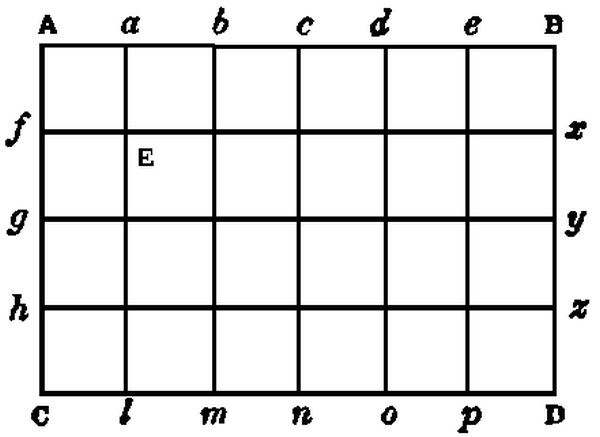
Suppose an oblong figure, a, b, c, d, as here drawn (which is
called a rectangle in geometry), with the side a b 6
inches, and the side a c 4 inches. Divide a b
and c d (which are equal) each into 6 inches by the points a,
b, c, l, m, &c.; and a c and b d
(which are also equal) into 4 inches by the points f, g, h, x, y, and
z. Join a and l, b and m, &c., and
f and x, &c. Then, the figure a b c d is
divided into a number of squares; for a square is a rectangle whose
sides are equal, and therefore a a f
e is square, since a a is of the same length as
a f, both being 1 inch. There are
also four rows of these squares, with six squares in each row; that
is, there are 6 × 4, or 24 squares altogether. Each of these squares
has its sides 1 inch in length, and is what was called in (215)
a square inch. By the same reasoning, if one side had contained
6 yards, and the other 4 yards, the surface would have
contained 6 × 4 square yards; and so on.
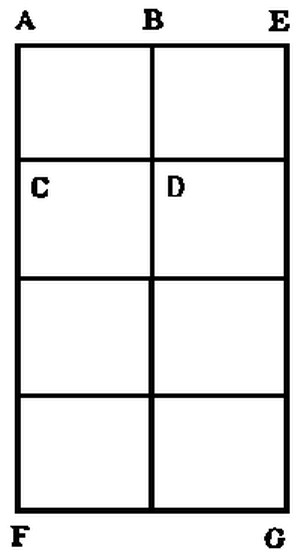
235. Let us now suppose that the sides of a b c d, instead of
being a whole number of inches, contain some inches and a fraction.
For example, let a b be 3½ inches, or (114) ⁷/₂ of an inch,
and let a c contain 2½ inches, or ⁹/₄ of an inch. Draw a e
twice as long as a b, and a f four times as
long as a c, and complete the rectangle a e f g.
The rest of the figure needs no description. Then, since a e
is twice a b, or twice ⁷/₂ inches, it is 7 inches. And since
a f is four times a c, or four times ⁹/₄ inches,
it is 9 inches. Therefore, the whole rectangle a e f g contains,
by (234), 7 × 9 or 63 square inches. But the rectangle a e f g
contains 8 rectangles, all of the same figure as a b c d; and
therefore a b c d is one-eighth part of a e f g,
and contains ⁶³/₈ square inches. But ⁶³/₈ is made by multiplying ⁹/₄ and
⁷/₂ together (118). From this and the last article it appears, that,
whether the sides of a rectangle be a whole or a fractional number of
inches, the number of square inches in its surface is the product of
the numbers of inches in its sides. The square itself is a rectangle
whose sides are all equal, and therefore the number of square inches
which a square contains is found by multiplying the number of inches in
its side by itself. For example, a square whose side is 13 inches in
length contains 13 × 13 or 169 square inches.
236. EXERCISES.
What is the content, in square feet and inches, of a room whose sides
are 42 ft. 5 inch. and 31 ft. 9 inch.? and supposing the piece from
which its carpet is taken to be three quarters of a yard in breadth,
what length of it must be cut off?—Answer, The content is 1346
square feet 105 square inches, and the length of carpet required is 598
feet 6⁵/₉ inches.
The sides of a rectangular field are 253 yards and a quarter of a mile;
how many acres does it contain?—Answer, 23.
What is the difference between 18 square miles, and a square of
18 miles long, or 18 miles square?—Answer, 306 square miles.
237. It is by this rule that the measure in (215) is deduced from
that in (214); for it is evident that twelve inches being a foot, the
square foot is 12 × 12 or 144 square inches, and so on. In a similar
way it may be shewn that the content in cubic inches of a cube, or
parallelepiped,[48]
may be found by multiplying together the number of inches in those
three sides which meet in a point. Thus, a cube of 6 inches contains 6
× 6 × 6, or 216 cubic inches; a chest whose sides are 6, 8, and 5 feet,
contains 6 × 8 × 5, or 240 cubic feet. By this rule the measure in
(216) was deduced from that in (214).
238. Suppose it required to find what 156 yards will cost, if 22
yards cost 17s. 4d. This quantity, reduced to pence,
is 208d.; and if 22 yards cost 208d., each yard costs
²⁰⁸/₂₂d. But 156 yards cost 156 times the price of one yard, and
therefore cost
| 208 |
× 156 pence, or |
208 × 156 |
pence (117). |
| 22 |
22 |
Again, if 25½ French francs be 20 shillings sterling, how many
francs are in £20. 15? Since 25½ francs are 20 shillings, twice the number of
francs must be twice the number of shillings; that is, 51 francs are 40
shillings, and one shilling is the fortieth part of 51 francs, or ⁵¹/₄₀
francs. But £20 15s. contain 415 shillings (219); and since 1
shilling is ⁵¹/₄₀ francs, 415 shillings is
| ⁵¹/₄₀ × 415 francs, or (117) |
51 × 415 |
francs. |
| 40 |
239. Such questions as the last two belong to the most extensive rule
in Commercial Arithmetic, which is called the Rule of Three,
because in it three quantities are given, and a fourth is required to
be found. From both the preceding examples the following rule may be
deduced, which the same reasoning will shew to apply to all similar cases.
It must be observed, that in these questions there are two quantities
which are of the same sort, and a third of another sort, of which last
the answer must be. Thus, in the first question there are 22 and 156
yards and 208 pence, and the thing required to be found is a number
of pence. In the second question there are 20 and 415 shillings and
25½ francs, and what is to be found is a number of francs. Write the
three quantities in a line, putting that one last which is the only
one of its kind, and that one first which is connected with the last
in the question.[49]
Put the third quantity in the middle. In the first question the
quantities will be placed thus:
22 yds. 156 yds. 17s. 4d.
In the second question they will be placed thus:
20s. £20 15s. 25½ francs.
Reduce the first and second quantities, if necessary, to quantities of
the same denomination. Thus, in the second question, £20 15s.
must be reduced to shillings (219). The third quantity may also be
reduced to any other denomination, if convenient; or the first and
third may be multiplied by any quantity we please, as was done in the
second question; and, on looking at the answer in (238), and at (108),
it will be seen that no change is made by that multiplication. Multiply
the second and third quantities together, and divide by the first. The
result is a quantity of the same sort as the third in the line, and is
the answer required. Thus, to the first question the answer is (238)
| 208 × 156 |
pence, or, which is the same thing, |
17s. 4d. × 156 |
. |
| 22 |
22 |
240. The whole process in the first question is as follows:[50]
- yds. yds. s. d.
- 22 : 156 ∷ 17 . 4
- 12
- 208 pence.
- 156
- 1248
- 1040
- 208
- 22)32448(1474¾d. and ¹⁴/₂₂, or ⁷/₁₁ of a farthing,
- 22 or (219) £6 . 2 . 10¾-⁷/₁₁.
- 104
- 88
- 164
- 154
- 108
- 88
- 20
- (228) 4
- 80
- 66
- 14
The question might have been solved without reducing
17s. 4d. to pence, thus:
- yds. yds. s. d.
- 22 : 156 ∷ 17 . 4
- 156(227)
- 22) £135 . 4 . 0(£6 . 2 . 10¾-⁷/₁₁ (228)
- 132
- 3 × 20 + 4 = 64
- 44
- 20 × 12 = 240
- 220
- 20 × 4 = 80
- 66
- 14
The student must learn by practice which is the most convenient method
for any particular case, as no rule can be given.
241. It may happen that the three given quantities are all of one
denomination; nevertheless it will be found that two of them are of
one, and the third of another sort. For example: What must an income of
£400 pay towards an income-tax of 4s. 6d. in the pound?
Here the three given quantities are, £400, 4s. 6d., and
£1, which are all of the same species, viz. money. Nevertheless, the
first and third are income; the second is a tax, and the answer is also
a tax; and therefore, by (152), the quantities must be placed thus:
£1 : £400 ∷ 4s. 6d.
242. The following exercises either depend directly upon this rule,
or can be shewn to do so by a little consideration. There are many
questions of the sort, which will require some exercise of ingenuity
before the method of applying the rule can be found.
EXERCISES.
If 15 cwt. 2 qrs. cost £198. 15. 4, what does 1 qr. 22 lbs. cost?
Answer, £5 . 14 . 5 ¾ ¹⁸⁵/₂₁₇.
If a horse go 14 m. 3 fur. 27 yds. in 3ʰ 26ᵐ 12ˢ, how long will he be
in going 23 miles?
Answer, 5ʰ 29ᵐ 34ˢ(²⁴⁶²/₂₅₃₂₇).
Two persons, A and B, are bankrupts, and owe exactly the same sum; A
can pay 15s. 4½d. in the pound, and B only 7s.
(6¾)d. At the same time A has in his possession £1304. 17 more
than B; what do the debts of each amount to?
Answer, £3340 . 8 . 3 ¾ ⁹/₂₅.
For every (12½) acres which one country contains, a second contains
(56¼). The second country contains 17,300 square miles. How much does
the first contain? Again, for every 3 people in the first, there are 5
in the second; and there are in the first 27 people on every 20 acres.
How many are there in each country?—Answer, The number of
square miles in the first is 3844⁴/₉, and its population 3,321,600; and
the population of the second is 5,536,000.
If (42½) yds. of cloth, 18 in. wide, cost £59. 14. 2, how much will
(118¼) yds. cost, if the width be 1 yd.?
Answer, £332. 5. (2⁴/₁₇).
If £9. 3. 6 last six weeks, how long will £100 last?
Answer, (65¹⁴⁵/₃₆₇) weeks.
How much sugar, worth (9¾d). a pound, must be given for 2 cwt. of tea,
worth 10d. an ounce?
Answer, 32 cwt. 3 qrs. 7 lbs. ³⁵/₃₉.
243. Suppose the following question asked: How long will it take 15 men
to do that which 45 men can finish in 10 days? It is evident that one
man would take 45 × 10, or 450 days, to do the same thing, and that 15
men would do it in one-fifteenth part of the time which it employs one
man, that is, in (450 ÷ 15) or 30 days. By this and similar reasoning
the following questions can be solved.
EXERCISES.
If 15 oxen eat an acre of grass in 12 days, how long will it take 26
oxen to eat 14 acres?
Answer, (96¹²/₁₃) days.
If 22 masons build a wall 5 feet high in 6 days, how long will it take
43 masons to build 10 feet?
Answer, (6⁶/₄₃) days.
244. The questions in the preceding article form part of a more general
class of questions, whose solution is called the Double Rule
of Three, but which might, with more correctness, be called the Rule
of Five, since five quantities are given, and a sixth is to be
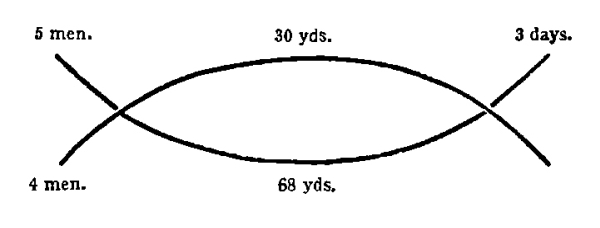
found. The following is an example: If 5 men can make 30 yards of cloth
in 3 days, how long will it take 4 men to make 68 yards? The first thing
to be done is to find out, from the first part of the question, the
time it will take one man to make one yard. Now, since one man, in 3
days, will do the fifth part of what 5 men can do, he will in 3 days
make ³⁰/₅, or 6 yards. He will, therefore, make one yard in ³/₆6 or (3 × 5)/30
of a day. From this we are to find how long it will take 4 men
to make 68 yards. Since one man makes a yard in
| 3 × 5 |
of a day, he will make 68 yards in |
3 × 5 |
× 68 days, |
| 30 |
30 |
| or (116) in |
3 × 5 × 68 |
days; and 4 men will do this in one-fourth; |
| 30 |
| of the time, that is (123), in |
3 × 5 × 68 |
days, or in 8½ days. |
| 30 × 4 |
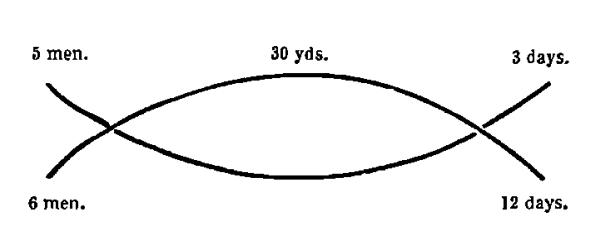
Again, suppose the question to be: If 5 men can make 30 yards in 3
days, how much can 6 men do in 12 days? Here we must first find the
quantity one man can do in one day, which appears, on reasoning similar
to that in the last example, to be 30/(3 × 5) yards. Hence, 6 men, in
one day, will make
| 6 × 30 |
yards, and in 12 days will make |
12 × 6 × 30 |
or 144 yards. |
| 5 × 3 |
5 × 3 |
From these examples the following rule may be drawn. Write the given
quantities in two lines, keeping quantities of the same sort under one
another, and those which are connected with each other, in the same line.
In the two examples above given, the quantities must be written thus:
SECOND EXAMPLE.
Draw a curve through the middle of each line, and the extremities
of the other. There will be three quantities on one curve and two on
the other. Divide the product of the three by the product of the two,
and the quotient is the answer to the question.
If necessary, the quantities in each line must be reduced to more
simple denominations (219), as was done in the common Rule of Three (238).
EXERCISES.
If 6 horses can, in 2 days, plough 17 acres, how many acres will 93
horses plough in 4½ days?
Answer, 592⅞.
If 20 men, in 3¼ days, can dig 7 rectangular fields, the sides of each
of which are 40 and 50 yards, how long will 37 men be in digging 53
fields, the sides of each of which are 90 and 125½ yards?
| Answer, 75 |
2451 |
days. |
| 20720 |
If the carriage of 60 cwt. through 20 miles cost £14 10s., what
weight ought to be carried 30 miles for £5. 8. 9?
Answer, 15 cwt.
If £100 gain £5 in a year, how much will £850 gain in 3 years and 8
months?
Answer, £155. 16. 8.
245. In the questions contained in this Section, almost the only
process which will be employed is the taking a fractional part of a
sum of money, which has been done before in several cases. Suppose it
required to take 7 parts out of 40 from £16, that is, to divide £16
into 40 equal parts, and take 7 of them. Each of these parts is
| £ |
16 |
and 7 of them make |
16 |
× 7, or |
16 × 7 |
pounds (116). |
| 40 |
40 |
40 |
The process may be written as below:
- £16
- 7
- 40)112(£2 . 16s.
- 80
- 32
- 20
- 640
- 40
- 240
- 240
- 0
Suppose it required to take 13 parts out of a hundred from £56. 13. 7½.
- 56 . 13 . 7½
- 13
- 100) 736 . 17 . 1½ ( £7 . 7 . 4 ¼ ¹/₄₁
- 700
- 36 × 20 + 17 = 737
- 700
- 37 × 12 + 1 = 445
- 400
- 45 × 4 × 2 = 182
- 100
- 82
Let it be required to take 2½ parts out of a hundred from £3
12s. The result, by the same rule is
| £3 12s. × 2½ |
, or 123 £3 12s. × |
5 |
; |
| 100 |
200 |
so that taking 2½ out of a hundred is the same as
taking 5 parts out of 200.
EXERCISES.
Take 7⅓ parts out of 53 from £1 10s.
Take 5 parts out of 100 from £107 13s. 4¾d.
Answer, £5. 7. 8 and ³/₂₀ of a farthing.
£56 3s. 2d. is equally divided among 32 persons. How much
does the share of 23 of them exceed that of the rest?
Answer, £24. 11. 4½ ½.
246. It is usual, in mercantile business, to mention the fraction which
one sum is of another, by saying how many parts out of a hundred must
be taken from the second in order to make the first. Thus, instead of
saying that £16 12s. is the half of £33 4s., it is said
that the first is 50 per cent of the second. Thus, £5 is 2½ per cent of
£200; because, if £200 be divided into 100 parts, 2½ of those parts are
£5. Also, £13 is 150 per cent of £8. 13. 4, since the first is the
second and half the second. Suppose it asked, How much per cent is 23
parts out of 56 of any sum? The question amounts to this: If he who has
£56 gets £100 for them, how much will he who has 23 receive? This, by
238, is 23 × ¹⁰⁰/₅₆ or ²³⁰⁰/₅₆ or 41¹/₁₄. Hence, 23 out of 56 is 41¹/₁₄
per cent.
Similarly 16 parts out of 18 is 16 × ¹⁰⁰/₁₈, or 88⁸/₉ per cent, and 2
parts out of 5 is 2 × ¹⁰⁰/₅, or 40 per cent.
From which the method of reducing other fractions to the rate per cent
is evident.
Suppose it asked, How much per cent is £6. 12. 2 of £12. 3? Since
the first contains 1586d., and the second 2916d., the
first is 1586 out of 2916 parts of the second; that is, by the last
rule, it is ¹⁵⁸⁶⁰⁰/₂₉₁₆, or 54¹¹³⁶/₂₉₁₆, or £54. 7. 9½ per cent,
very nearly. The more expeditious way of doing this is to reduce the
shillings, &c. to decimals of a pound. Three decimal places will
give the rate per cent to the nearest shilling, which is near enough
for all practical purposes. For instance, in the last example, which
is to find how much £6·608 is of £12·15, 6·608 × 100 is 660·8, which
divided by 12·15 gives £54·38, or £54. 7. Greater correctness may be
had, if necessary, as in the Appendix.
EXERCISES.
How much per cent is 198¼ out of 233 parts?—Ans. £85. 1. 8¾.
Goods which are bought for £193. 12, are sold for £216. 13. 4; how
much per cent has been gained by them?
Answer, A little less than £11. 18. 6.
A sells goods for B to the amount of £230. 12, and is allowed a
commission[51]
of 3 per cent; what does that amount to?
Answer, £6 . 18. 4¼ ⁷/₂₅.
A stockbroker buys £1700 stock, brokerage being at £⅛ per cent; what
does he receive?—Answer, £2. 2. 6.
A ship whose value is £15,423 is insured at 19⅔ per cent; what does the
insurance amount to?—Answer, £3033. 3. 9½ ²/₅.
247. In reckoning how much a bankrupt is able to pay his creditors, as
also to how much a tax or rate amounts, it is usual to find how many
shillings in the pound is paid. Thus, if a person who owes £100 can
only pay £50, he is said to pay 10s. in the pound. The rule is
easily derived from the same reasoning as in 246. For example, £50 out
of £82 is
| £ |
50 |
out of £1, or |
50 × 20 |
shillings, |
| 82 |
82 |
or 12s. 2½ ¹⁵/₄₁ in the pound.
248. Interest is money paid for the use of other money,
and is always a per-centage upon the sum lent. It may be paid either yearly,
half-yearly, or quarterly; but when it is said that £100 is lent at 4
per cent, it must be understood to mean 4 per cent per annum; that is,
that 4 pounds are paid every year for the use of £100.
The sum lent is called the principal, and the interest upon it is of
two kinds. If the borrower pay the interest as soon as, from the agreement,
it becomes due, it is evident that he has to pay the same sum
every year; and that the whole of the interest which he has to pay in
any number of years is one year’s interest multiplied by the number of
years. But if he do not pay the interest at once, but keeps it in his
hands until he returns the principal, he will then have more of his
creditor’s money in his hands every year, and if it were so agreed
will have to pay interest upon each year’s interest for the time during
which he keeps it after it becomes due. In the first case, the interest
is called simple, and in the second compound. The interest
and principal together are called the amount.
249. What is the simple interest of £1049. 16. 6 for 6 years and
one-third, at 4½ per cent? This interest must be 6⅓ times the interest
of the same sum for one year, which (245) is found by multiplying the
sum by 4½, and dividing by 100. The process is as follows:
| (230) |
(a) |
£1049 . |
16 . |
6 |
| |
a × 4 |
4199 . |
6 . |
0 |
| |
a × ½ |
524 . |
18 . |
3 |
(82) 100) 47,24 . 4 . 3(£47 . 4 . 10¹¹/₁₀₀
| (b) |
£47 . |
4 . |
10¹¹/₁₀₀ |
Int. for one yr. |
| b × 6 |
283 . |
9 . |
0⁶⁶/₁₀₀ |
|
| b × ⅓ |
15 . |
14 . |
11³⁷/₁₀₀ |
|
| |
£299 . |
4 . |
0³/₁₀₀ |
Int. for 6⅓ yrs. |
EXERCISES.
What is the interest of £105. 6. 2 for 19 years and 7 weeks at 3 per cent?
Answer, £60. 9, very nearly.
What is the difference between the interest of £50. 19 for 7 years at
3 per cent, and for 8 years at 2½ per cent?
Answer, 10s. (2½)d.
What is the interest of £157. 17. 6 for one year at 5 per cent?
Answer, £7. 17. 10½.
Shew that the interest of any sum for 9 years at 4 per cent is the same
as that of the same sum for 4 years at 9 per cent.
250. In order to find the interest of any sum at compound interest, it
is necessary to find the amount of the principal and interest at the
end of every year; because in this case (248) it is the amount of both
principal and interest at the end of the first year, upon which interest
accumulates during the second year. Suppose, for example, it is required
to find the interest, for 3 years, on £100, at 5 per cent, compound
interest. The following is the process:
| |
£100 |
|
|
First principal. |
| |
5 |
|
|
First year’s interest. |
| |
105 |
|
|
Amount at the end of the first year. |
| (249) |
5 . 5 |
|
Interest for the second year on £105. |
| |
110 |
. 5 |
|
Amount at the end of two years. |
| 5 . 10 . 3 |
Interest due for the third year. |
| 115 |
. 15 |
. 3 |
Amount at the end of three years. |
| 100 . 0 . 0 |
First principal. |
| 15 |
. 15 |
. 3 |
Interest gained in the three years. |
When the number of years is great, and the sum considerable, this
process is very troublesome; on which account tables[54]
are constructed to shew the amount of one pound, for different numbers
of years, at different rates of interest. To make use of these tables
in the present example, look into the column headed “5 per cent;” and
opposite to the number 3, in the column headed “Number of years,” is
found 1·157625; meaning that £1 will become £1·157625 in 3 years. Now,
£100 must become 100 times as great; and 1·157625 × 100 is 115·7625
(141); but (221) £·7625 is 15s. 3d.; therefore the whole
amount of £100 is £115. 15. 3, as before.
251. Suppose that a sum of money has lain at simple interest 4 years,
at 5 per cent, and has, with its interest, amounted to £350; it is
required to find what the sum was at first. Whatever the sum was, if we
suppose it divided into 100 parts, 5 of those parts were added every
year for 4 years, as interest; that is, 20 of those parts have been
added to the first sum to make £350. If, therefore, £350 be divided
into 120 parts, 100 of those parts are the principal which we want to
find, and 20 parts are interest upon it; that is, the principal is
£(350 × 100)/150, or £291. 13. 4.
252. Suppose that A was engaged to pay B £350 at the end of four years
from this time, and that it is agreed between them that the debt shall
be paid immediately; suppose, also, that money can be employed at 5 per
cent, simple interest; it is plain that A ought not to pay the whole
sum, £350, because, if he did, he would lose 4 years’ interest of the
money, and B would gain it. It is fair, therefore, that he should only
pay to B as much as will, with interest, amount in four years
to £350, that is (251), £291. 13. 4. Therefore, £58. 6. 8 must
be struck off the debt in consideration of its being paid before the
time. This is called Discount;[55]
and £291. 13. 4 is called the present value of £350 due four
years hence, discount being at 5 per cent. The rule for finding the
present value of a sum of money (251) is: Multiply the sum by 100, and
divide the product by 100 increased by the product of the rate per
cent and number of years. If the time that the debt has yet to run
be expressed in years and months, or months only, the months must be
reduced to the equivalent fraction of a year.
EXERCISES.
What is the discount on a bill of £138. 14. 4, due 2 years hence,
discount being at 4½ per cent?
Answer, £11. 9. 1.
What is the present value of £1031. 17, due 6 months hence, interest
being at 3 per cent?
Answer, £1016. 12.
253. If we multiply by a + b, or by a-b,
when we should multiply by a, the result is wrong by the fraction
of itself: being too great in the first case, and too small
in the second. Again, if we divide by a + b, where we should
have divided by a, the result is too small by the fraction
b/a of itself; while, if we divide by a-b
instead of a, the result is too great by the same fraction of
itself. Thus, if we divide by 20 instead of 17, the result is ³/₁₇ of
itself too small; and if we divide by 360 instead of 365, the result is
too great by ⁵/₃₆₅, or ¹/₇₃ of itself.
If, then, we wish to find the interest of a sum of money for a portion
of a year, and have not the assistance of tables, it will be found
convenient to suppose the year to contain only 360 days, in which case
its 73d part (the 72d part will generally do) must be subtracted from
the result, to make the alteration of 360 into 365. The number 360 has
so large a number of divisors, that the rule of Practice (230) may
always be readily applied. Thus, it is required to find the portion
which belongs to 274 days, the yearly interest being £18. 9. 10, or 18·491.
| 274 |
|
18·491 |
| 180 |
is ½ of 360 |
9·246 |
| 94 |
|
| 90 |
is ½ of 180 |
4·623 |
| 4 |
is ¹/₉₀ of 360 |
·205 |
| |
9)14·074 |
| |
8)1·564 |
| |
·196 |
|
|
|
13·878 = £13 . 17 . 7 Answer.
But if the nearest farthing be wanted, the best way is to take 2-tenths
of the number of days as a multiplier, and 73 as a divisor; since
m ÷ 365 is 2m ÷ 730, or (²/₁₀)m ÷ 73. Thus, in
the preceding instance, we multiply by 54·8 and divide by 73; and 54·8
× 18·491 = 1013·3068, which divided by 73 gives 13·881, very nearly
agreeing with the former, and giving £13. 17. 7½, which is certainly
within a farthing of the truth.
254. Suppose it required to divide £100 among three persons in such a
way that their shares may be as 6, 5, and 9; that is, so that for every
£6 which the first has, the second may have £5, and the third £9. It is
plain that if we divide the £100 into 6 + 5 + 9, or 20 parts, the first
must have 6 of those parts, the second 5, and the third 9. Therefore
(245) their shares are respectively,
| £ |
100 × 6 |
, £ |
100 × 5 |
and £ |
100 × 9 |
| 20 |
20 |
20 |
or £30, £25, and £45.
EXERCISES.
Divide £394. 12 among four persons, so that their shares may be as 1,
6, 7, and 18.—Answer, £12. 6. 7½; £73. 19. 9; £86. 6. 4½;
£221. 19. 3.
Divide £20 among 6 persons, so that the share of each may be as much as
those of all who come before put together.—Answer, The first
two have 12s. 6d.; the third £1. 5; the fourth £2. 10;
the fifth £5; and the sixth £10.
255. When two or more persons employ their money together, and gain
or lose a certain sum, it is evidently not fair that the gain or loss
should be equally divided among them all, unless each contributed the
same sum. Suppose, for example, A contributes twice as much as B, and
they gain £15, A ought to gain twice as much as B; that is, if the
whole gain be divided into 3 parts, A ought to have two of them and B
one, or A should gain £10 and B £5. Suppose that A, B, and C engage in
an adventure, in which A embarks £250, B £130, and C £45. They gain
£1000. How much of it ought each to have? Each one ought to gain as
much for £1 as the others. Now, since there are 250 + 130 + 45, or 425
pounds embarked, which gain £1000, for each pound there is a gain of
£¹⁰⁰⁰/₄₂₄. Therefore A should gain 1000 × ²⁵⁰/₄₂₅ pounds, B should gain
1000 × ¹³⁰/₄₂₅ pounds, and C 1000 × ⁴⁵/₄₂₅ pounds. On these principles,
by the process in (245), the following questions may be answered.
A ship is to be insured, in which A has ventured £1928, and B £4963.
The expense of insurance is £474. 10. 2. How much ought each to pay
of it?
Answer, A must pay £132. 15. (2½).
A loss of £149 is to be made good by three persons, A, B, and C. Had
there been a gain, A would have gained 4 times as much as B, and C as
much as A and B together. How much of the loss must each bear?
Answer, A pays £59. 12, B £14. 18, and C £74. 10.
256. It may happen that several individuals employ several sums of
money together for different times. In such a case, unless there be a
special agreement to the contrary, it is right that the more time a sum
is employed, the more profit should be made upon it. If, for example,
A and B employ the same sum for the same purpose, but A’s money is
employed twice as long as B’s, A ought to gain twice as much as B. The
principle is, that one pound employed for one month, or one year, ought
to give the same return to each. Suppose, for example, that A employs
£3 for 6 months, B £4 for 7 months, and C £12 for 2 months, and the
gain is £100; how much ought each to have of it? Now, since A employs
£3 for six months, he must gain 6 times as much as if he employed it
one month only; that is, as much as if he employed £6 × 3, or £18, for
one month; also, B gains as much as if he had employed £4 × 7 for one
month; and C as if he had employed £12 × 2 for one month. If, then, we
divide £100 into 6 × 3 + 4 × 7 + 12 × 2, or 70 parts, A must have 6 ×
3, or 18, B must have 4 × 7, or 28, and C 12 × 2, or 24 of those parts.
The shares of the three are, therefore,
| £ |
6 × 3 × 100 |
, £ |
4 × 7 × 100 |
, and £ |
12 × 2 × 100 |
| 6 × 3 + 4 × 7 + 12 × |
6 × 3 + 4 × 7 + 12 × 2 |
6 × 3 + 4 × 7 + 12 × 2 |
EXERCISES.
A, B, and C embark in an undertaking; A placing £3. 6 for 2 years, B
£100 for 1 year, and C £12 for 1½ years. They gain £4276. 7 How much
must each receive of the gain?
Answer, A £226. 10. 4; B £3432. 1. 3; C £617. 15. 5.
A, B, and C rent a house together for 2 years, at £150 per annum. A
remains in it the whole time, B 16 months, and C 4½ months, during the
occupancy of B. How much must each pay of the rent?[56]
Answer, A should pay £190. 12. 6; B £90. 12. 6; C £18. 15.
257. These are the principal rules employed in the application of
arithmetic to commerce. There are others, which, as no one who
understands the principles here laid down can fail to see, are
virtually contained in those which have been given. Such is what
is commonly called the Rule of Exchange, for such questions as the
following: If 20 shillings be worth 25½ francs, in France, what is £160
worth? This may evidently be done by the Rule of Three. The rules here
given are those which are most useful in common life; and the student
who understands them need not fear that any ordinary question will be
above his reach. But no student must imagine that from this or any
other book of arithmetic he will learn precisely the modes of operation
which are best adapted to the wants of the particular kind of business
in which his future life may be passed. There is no such thing as a set
of rules which are at once most convenient for a butcher and a banker’s
clerk, a grocer and an actuary, a farmer and a bill-broker; but a
person with a good knowledge of the principles laid down in this
work, will be able to examine and meet his own future wants, or, at
worst, to catch with readiness the manner in which those who have gone
before him have done so for themselves.