Relation of Species, Genus, Family, Order, etc.
929. Species.—It is not necessary for one to be a botanist in
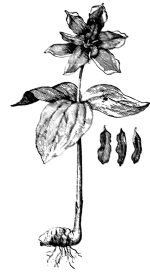
order to recognize, during a stroll in the woods where the trillium
is flowering, that there are many individual plants very like each
other. They may vary in size, and the parts may differ a little in
form. When the flowers first open they are usually white, and in age
they generally become pinkish. In some individuals they are pinkish
when they first open. Even with these variations, which are trifling
in comparison with the points of close agreement, we recognize the
individuals to be of the same kind, just as we recognize the corn
plants, grown from the seed of an ear of corn, as of the same kind.
Individuals of the same kind, in this sense, form a species. The
white wake-robin, then, is a species.
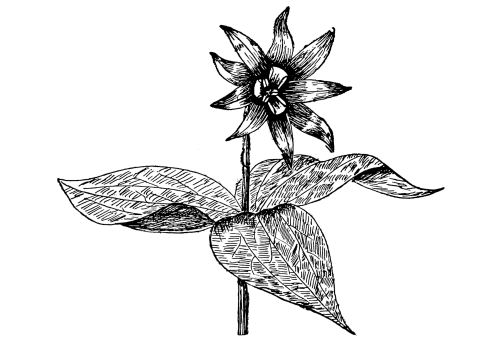
But there are other trilliums which differ greatly from this one. The
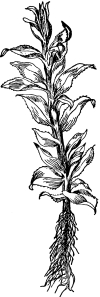
purple trillium (T. erectum) shown in fig. 495 is very
different from it. So are a number of others. But the purple trillium
is a species. It is made up of individuals variable, yet very like one
another, more so than any one of them is like the white wake-robin.
930. Genus.—Yet if we study all parts of the plant, the
perennial rootstock, the annual shoot, and the parts of the flower, we
find a great resemblance. In this respect we find that there are
several species which possess the same general characters. In other
words, there is a relationship between these different species, a
relationship which includes more than the individuals of one kind. It
includes several kinds. Obviously, then, this is a relationship with
broader limits, and of a higher grade, than that of the individuals
of a species. The grade next higher than species we call genus.
Trillium, then, is a genus. Briefly the characters of the genus
trillium are as follows:
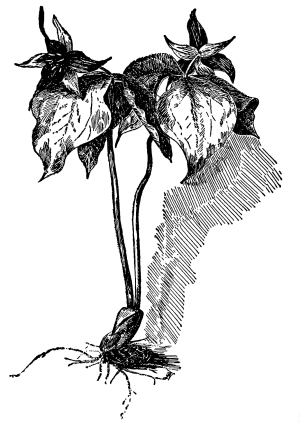
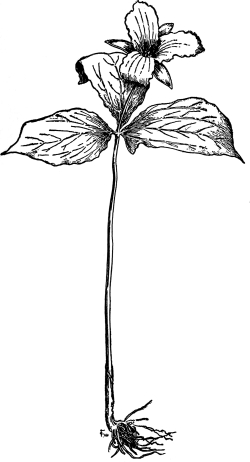
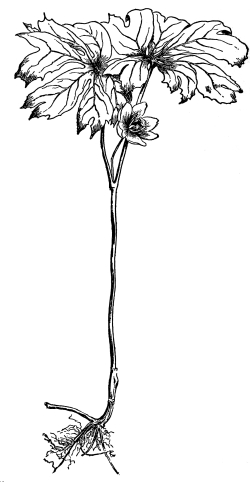
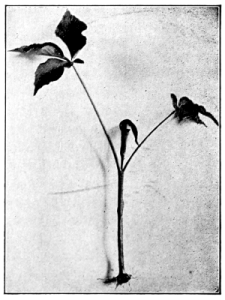
Fig. 495.
Trillium erectum (purple form),
two plants from one rootstock.
931. Genus trillium.—Perianth of six parts: sepals 3,
herbaceous, persistent; petals colored. Stamens 6 (in two whorls),
anthers opening inward. Ovary 3-loculed, 3-6-angled; stigmas 3,
slender, spreading. Herbs with a stout perennial rootstock, with
fleshy, scale-like leaves, from which the low annual shoot arises,
bearing a terminal flower and 3 large netted-veined leaves in a whorl.
Note.—In speaking of the genus the present usage
is to say trillium, but two words are usually employed in speaking of
the species, as Trillium grandiflorum, T. erectum, etc.
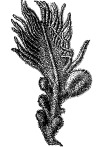
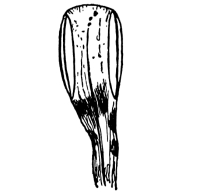
932. Genus erythronium.—The yellow adder-tongue, or dogtooth
violet (Erythronium americanum), shown in fig. 496,
is quite different from any species of trillium. It differs more from any of
the species of trillium than they do from each other. The perianth is of six
parts, light yellow, often spotted near the base. Stamens are 6. The ovary is
obovate, tapering at the base, 3-valved, seeds rather numerous, and the
style is elongated. The flower stem, or scape, arises from a scaly bulb
deep in the soil, and is sheathed by two elliptical-lanceolate, mottled
leaves. The smaller plants have no flower and but one leaf, while the
bulb is nearer the surface. Each year new bulbs are formed at the end
of runners from a parent bulb. These runners penetrate each year deeper
into the soil. The deeper bulbs bear the flower stems.
933. Genus lilium.—While the lily differs from either the
trillium or erythronium, yet we recognize a relationship when we
compare the perianth of six colored parts, the 6 stamens, and the
3-sided and long 3-loculed ovary.
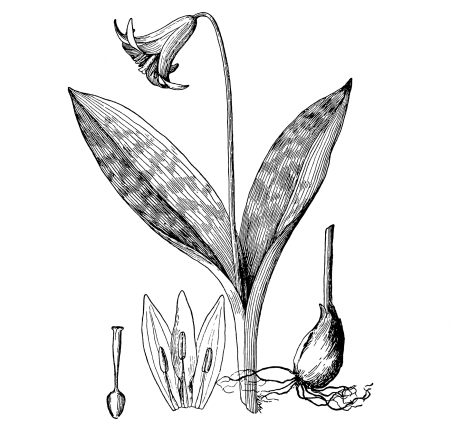
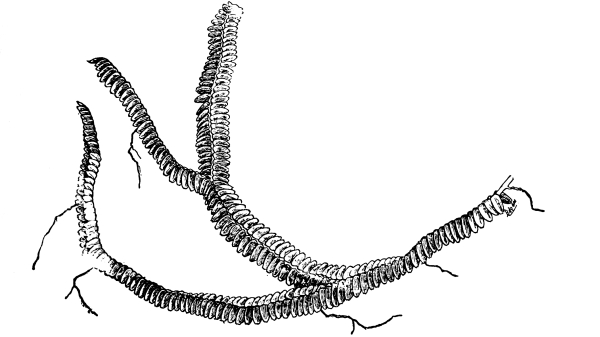
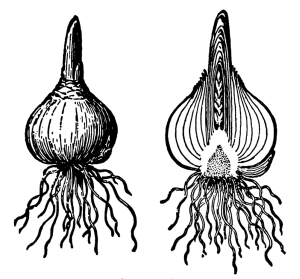
Fig. 496.
Adder-tongue (erythronium). At left below pistil, and three stamens
opposite three parts of the perianth. Bulb at the right.
934. Family Liliaceæ.—The relationship between genera, as
between trillium, erythronium, and lilium, brings us to a still higher
order of relationship, where the limits are broader than in the genus.
Genera which are thus related make up the family. In the case of
these genera the family has been named after the lily, and is the lily
family, or Liliaceæ.
935. Order, class, group.—In like manner the lily family, the
iris family, the amaryllis family, and others which show characters of
close relationship are united into an order which has broader limits
than the family. This order is the lily order, or order Liliales. The
various orders unite to make up the class, and the classes unite to
form a group.
936. Variations in usage of the terms class, order, etc.—Thus,
according to the system of classification adopted by some, the
angiosperms form a group. The group angiosperms is then divided into
two classes, the monocotyledones and dicotyledones. (It
should be remembered that all systematists do not agree in assigning the
same grade and limits to the classes, subclasses, etc. For example,
some treat of the angiosperms as a class, and the monocotyledons
and dicotyledons as subclasses; while others would divide the
monocotyledons and dicotyledons into classes, instead of treating each
one as a class or as a subclass. Systematists differ also in usage as
to the termination of the ordinal name; for example, some use the word
Liliales for Liliifloræ, in writing of the order.)
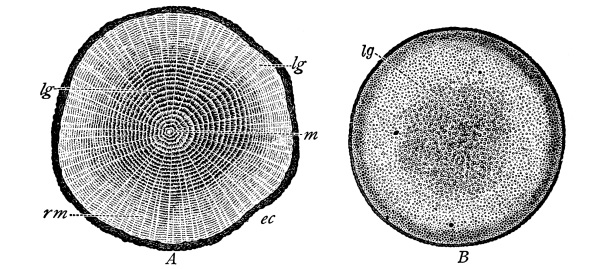
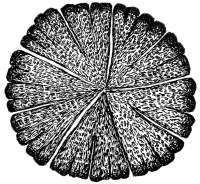
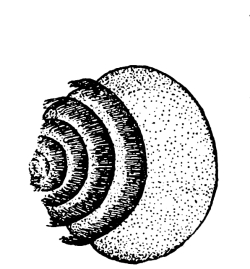
Fig. 497.
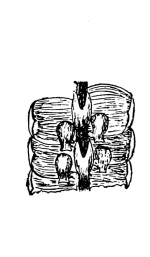
A. Cross-section of the stem of an oak tree thirty-seven years old,
showing the annual rings. rm, the medullary rays; m, the pith
(medulla).
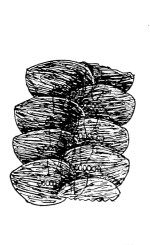
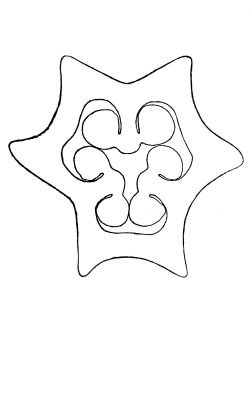
B. Cross-section of the stem of a palm tree, showing the
scattered bundles.
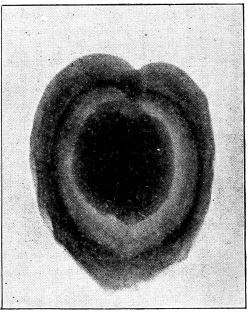
937. Monocotyledones.—In the monocotyledons there is a single
cotyledon on the embryo; the leaves are parallel-veined; the parts
of the flower are usually in threes; endosperm is usually present in
the seed; the vascular bundles are usually closed, and are scattered
irregularly through the stem as shown by a cross-section of the stem
of a palm (fig. 497), or by the arrangement of the bundles in the corn
stem (fig. 57). Thus a single character is not sufficient to show
relationship in the class (nor is it in orders, nor in many of the
lower grades), but one must use the sum of several important characters.
938. Dicotyledones.—In the dicotyledons there are two
cotyledons on the embryo; the venation of the leaves is reticulate;
the endosperm is usually absent in the seed; the parts of the flower
are frequently in fives; the vascular bundles of the stem are
generally open and arranged in rings around the stem, as shown in the
cross-section of the oak (fig. 497). There are exceptions
to all the above characters, and the sum of the characters must be considered,
just as in the case of the monocotyledons.
939. Taxonomy.—This grouping of plants into species, genera,
families, etc., according to characters and relationships is
classification, or taxonomy.
To take Trillium grandiflorum for example, its position in the system,
if all the principal subdivisions should be included in the outline,
would be indicated as follows:
- Group, Angiosperms.
- Class, Monocotyledones.
- Order, Liliales.
- Family, Liliaceæ.
- Genus, Trillium.
- Species, grandiflorum.
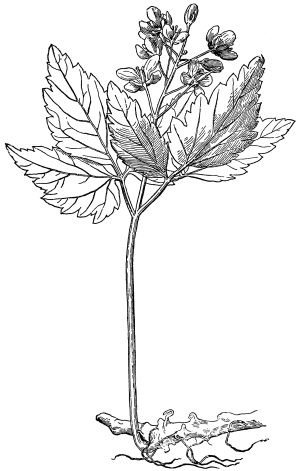
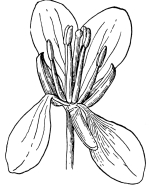
In the same way the position of the toothwort would be indicated as
follows:
- Group, Angiosperms.
- Class, Dicotyledones.
- Order, Papaverales.
- Family, Cruciferæ.
- Genus, Dentaria.
- Species, diphylla.
But in giving the technical name of the plant only two of these names
are used, the genus and species, so that for the toothwort we say
Dentaria diphylla, and for the white wake-robin we say Trillium
grandiflorum.
940. Kingdom and Subkingdom.—Organic beings form altogether two
kingdoms, the Animal Kingdom and the Plant Kingdom. The Plant Kingdom
is then divided into a number of subkingdoms as follows: 1st,
Subkingdom Thallophyta, the thallus plants, including the Algæ and
Fungi; 2d, Subkingdom Bryophyta, the moss-like plants, including the
Liverworts and Mosses; 3d, Subkingdom Pteridophyta, the fern-like
plants, including Ferns, Lycopods, Equisetum, Isoetes, etc.; 4th,
Subkingdom Spermatophyta, the seed plants, including Gymnosperms and
Angiosperms. Subkingdoms are divided into groups of lower order down to
the classes. So there are subclasses, subfamilies or tribes, subgenera,
and even subspecies. But taking the principal taxonomic divisions from
the greater to the lesser rank, the order would be as follows:
- Plant Kingdom.
- Subkingdom, Spermatophyta.
- Group (not used in a definite sense).
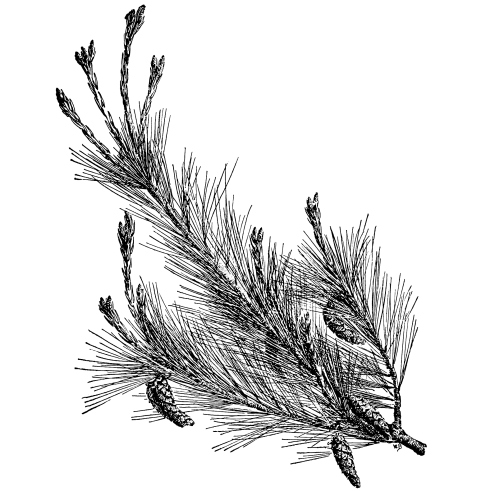
- Class, Gymnospermæ.
- Order, Pinales.
- Family, Pinaceæ.
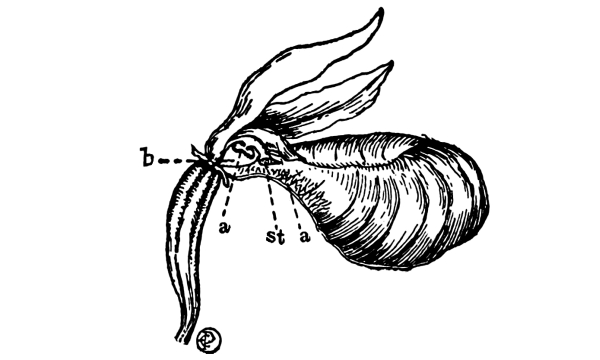
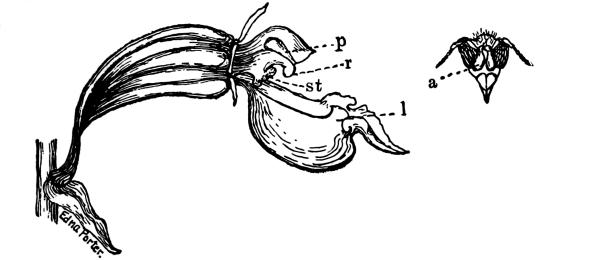
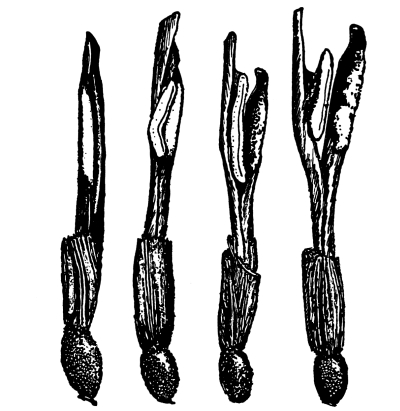
- Genus, Pinus.
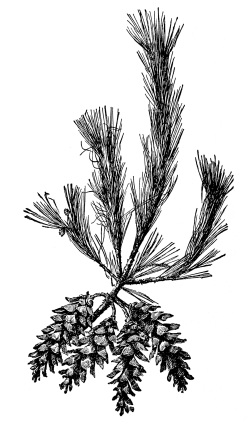
- Species, strobus, or, in full,
- Pinus strobus, the white pine.
Group Angiospermæ.
I. CLASS MONOCOTYLEDONES.
941. Order Pandanales.—Aquatic or marsh plants. The cattail
flags (Typha) and the bur-reeds (Sparganium), each representing a
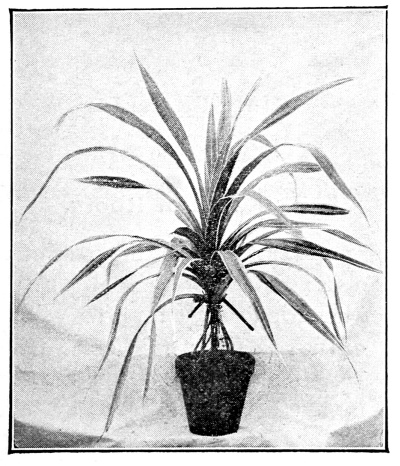
family. The name of the order is taken from the tropical genus Pandanus
(the screw-pine often grown in greenhouses).
942. Order Naiadales.—Aquatic or marsh herbs. Three families
are mentioned here.
The pondweed family (Naiadaceæ), named after one genus, Naias. The
largest genus is Potamogeton, the species of which are known as
pondweeds. Ruppia occidentalis occurs in saline ponds in Nebraska, and
R. maritima along the seacoast and in saline districts in the interior.
The water-plantain family (Alismaceæ) includes the water-plantain
(Alisma) and the arrow-leaves (Sagittaria).
The tape-grass family (Vallisneriaceæ) includes the tape-grass, or
eel-grass (the curious Vallisneria spiralis).
943. Order Graminales.—Two families.
The grass family (Gramineæ), the grasses and grains.
The sedge family (Cyperaceæ), the sedges.
944. Order Palmales, with one family, Palmaceæ, includes the
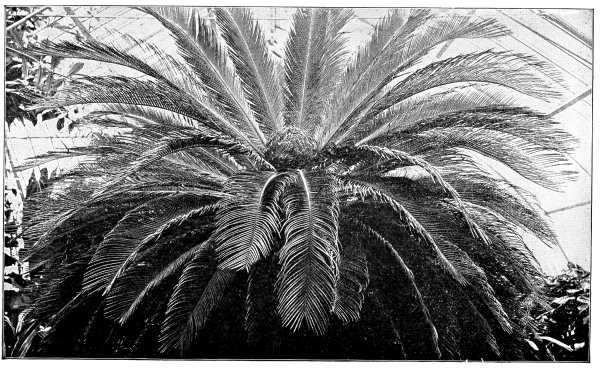
palms, abundant in the tropics and extending into Florida. Cultivated
in greenhouses.
945. Order Arales.
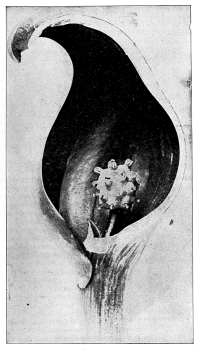
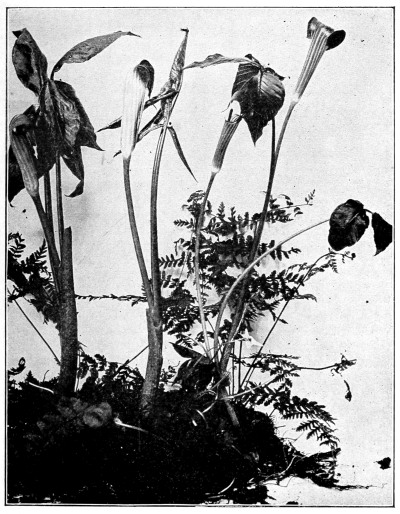
The arum family (Araceæ). Flowers in a fleshy spadix. Examples: Indian
turnip (Arisæma), sweet-flag (Acorus), skunk-cabbage (Spathyema).
The duckweed family (Lemnaceæ). (Examples: Lemna, Spirodela, Wolffia.
See paragraphs 51-53.)
946. Order Xyridales, from the genus Xyris, the yellow-eyed
grass family (Xyridaceæ). Species mostly tropical, but a few in North
America. Other examples are the pipewort family (Eriocaulaceæ, example,
Eriocaulon septangulare), the pineapple family (Bromeliaceæ, example,
the pineapple cultivated in Florida); the Florida moss or hanging moss
(Tillandsia usneoides); the spiderwort family (Commelinaceæ), including
the spiderwort (Tradescantia, several species in North America); the
pickerel-weed family (Pontederiaceæ), including the genus Pontederia in
borders of ponds and streams.
947. Order Liliales.—Some of the families are as follows:
The rush family (Juncaceæ, example, Juncus), with many species, plants
of usually swamp habit.
The lily family (Liliaceæ, examples: Lilium, Allium = Onion,
Erythronium, Yucca).
The iris family (Iridaceæ, examples: Iris, the blue-flag, fleur-de-lis, etc.).
The lily-of-the-valley family (Convallariaceæ, examples:
lily-of-the-valley, Trillium, etc.)
The amaryllis family (Amaryllidaceæ, examples: Narcissus, the daffodil;
Cooperia, in southwestern United States).
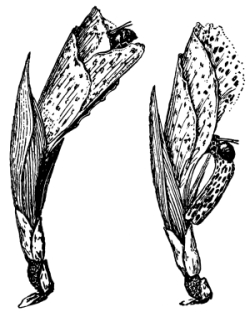
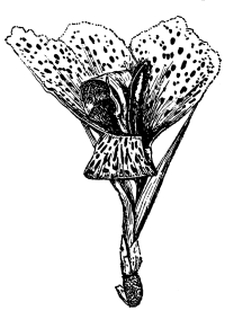
948. Order Scitaminales.—This order includes the large showy
cultivated Canna of the canna family.
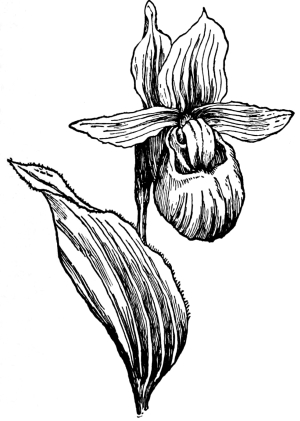
949. Order Orchidales. Example, the orchid family (Orchidaceæ)
with Cypripedium, Orchis, etc.
II. CLASS DICOTYLEDONES.
Series 1. CHORIPETALÆ. Petals wanting (Apetalæ, or
Archichlamydæ of some authors), or present and distinct from one
another (Polypetalæ, or Metachlamydæ).
950. Order Casuarinales, confined to tropical seacoasts
(example, Casuarina).
951. Order Piperales includes the lizard’s-tail family
(Saururaceæ), Saururus cernuus, lizard’s-tail, in the eastern United
States.
952. Order Salicales.—Shrubs or trees, flowers in aments.
Includes the willows and poplars (Salix and Populus of the willow
family, Salicaceæ).
953. Order Myricales.—Shrubs or small trees. Includes the
sweet-gale (Myrica gale) in wet places in northern United States and
British North America, Myrica cerifera forming thickets on sand dunes
along the Atlantic coast, and the sweet-fern (Comptonia peregrina = C.
asplenifolia) in the eastern United States in dry soil of hillsides.
954. Order Leitneriales.—Shrubs or trees. Includes the
cork-wood, Leitneria floridana (Leitneriaceæ).
955. Order Juglandales.—Trees, staminate flowers in aments. The
walnut family (Juglandaceæ, examples: walnut, butternut, etc. Juglans;
hickory, Hicoria = Carya).
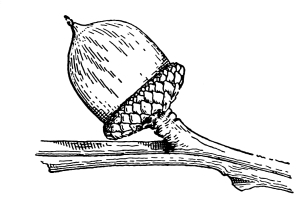
956. Order Fagales.—Trees and shrubs. Flowers in aments, or the
pistillate ones with an involucre which forms a cup in fruit, as in the
acorn of the oak.
The birch family (Betulaceæ, examples: Betula, birch; Corylus,
hazelnut; Alnus, alder, etc.).
The beech family (Fagaceæ = Cupuliferæ, examples: Fagus, beech;
Castanea, chestnut; Quercus, oak).
957. Order Urticales.—Trees, shrubs, or herbs. Examples: the
elm family (Ulmaceæ), the mulberry family (Moraceæ), and the nettle
family (Urticaceæ).
958. Order Santalales, herbs or shrubs, mostly parasitic.
The mistletoe family (Loranthaceæ), with the American mistletoe
(Phoradendron flavescens), parasitic on deciduous trees in the South
Atlantic, Central, and Gulf States (N. J. to Ind. Ter.).
The sandalwood family (Santalaceæ, example, the bastard toad-flax,
Comandra umbellata), widely distributed in North America.
959. Order Aristolochiales.—Herbs or vines with heart-shaped or
kidney-shaped leaves. The birthwort family (Aristolochiaceæ, example,
Aristolochia serpentaria, the Virginia snake-root, eastern United
States; wild ginger, or heart-leaf, Asarum canadense, eastern North
America.)
960. Order Polygonales.—Examples: the buckwheat family
(Polygonaceæ), including buckwheat (Fagopyrum), and numerous species
of Polygonum, known as smartweed, water-pepper, tear-thumb, bindweed,
knotweed, prince’s-feather, etc.
961. Order Chenopodiales.—Herbs. There are several families;
one of the largest is the goosefoot family (Chenopodiaceæ). The genus
Chenopodium includes many species, known as goosefoot, lamb’s-quarters,
etc. Here belong also the Russian thistle (Salsola tragus) and the
saltwort (S. kali). The former is sometimes a troublesome weed in the
central and western United States, naturalized from Europe. The latter
occurs along the Atlantic coast on seabeaches. Atriplex occurs in salty
or alkaline soil, also the glasswort (Salicornia herbacea), the bugseed
(Corispermum). The pokeweed family (Phytolaccaceæ), the Amaranth family
(Amaranthaceæ), the purslane family (Portulacaceæ, including the
purslane or “pursley,” Portulaca oleracea, and the spring-beauty,
Claytonia virginica), and the pink family (Caryophyllaceæ), belong here.
962. Order Ranales.—Herbs, shrubs, or trees. Examples are:
The water-lily family (Nymphæaceæ), with the yellow water-lily (Nymphæa
advena = Nuphar advena) and the white water-lily (Castalia odorata =
Nymphæa odorata).
The magnolia family (Magnoliaceæ), including the magnolias
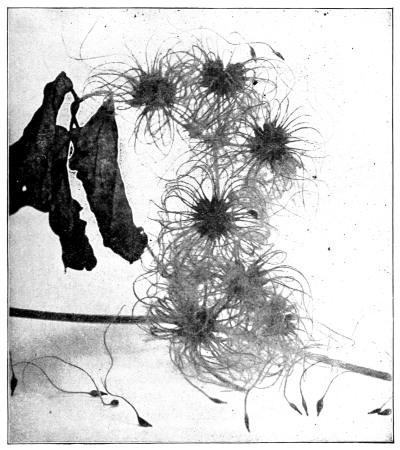
(Magnolia) and the tulip-tree (Liriodendron). The crowfoot family
(Ranunculaceæ), with the buttercups, hepatica, clematis, etc.
963. Order Papaverales.—Mostly herbs. Examples are:
The poppy family (Papaveraceæ), including the opium or garden poppy
(Papaver somniferum), the blood-root (Sanguinaria canadensis), the
Dutchman’s-breeches (Bicuculla cucullaria = Dicentra cucullaria),
squirrel’s-corn (Bicuculla canadensis = D. canadensis).
The mustard family (Cruciferæ), including the toothwort (Dentaria),
shepherd’s-purse (Bursa bursa-pastoris = Capsella bursa-pastoris), the
cabbage, turnip, etc.
964. Order Sarraceniales.—Insectivorous plants.
The pitcher-plant family (Sarraceniaceæ). Examples: Sarracenia
purpurea, the pitcher-plant, in peat-bogs, northern and eastern North
America.
The sundew family (Droseraceæ). Examples: Drosera rotundifolia, and
other sundews.
965. Order Rosales.—Herbs, shrubs or trees. Seventeen families
are given in the eastern United States. Examples:
The riverweed family (Podostemaceæ), containing the riverweed
(Podostemon).
The saxifrage family (Saxifragaceæ), containing a number of species.
Example, Saxifraga virginiensis.
The gooseberry family (Grossulariaceæ), including the wild and the
cultivated gooseberry.
The witch-hazel family (Hamamelidaceæ), including the witch-hazel
(Hamamelis), in eastern North America, and the sweet gum (Liquidambar
styraciflua).
The plane-tree family (Platanaceæ), with the plane-tree, or buttonwood
(Platanus occidentalis), eastern North America. (Other species occur in
western United States.)
The rose family (Rosaceæ), including roses, spiræas, raspberries,
strawberries, the shrubby cinquefoil (Dasiphora fruticosa), etc.
The apple family (Pomaceæ), including the apple, mountain-ash, pear,
June-berry (or shadbush, also service-berry), the hawthorns (Cratægus).
The plum family (Drupaceæ), including the cherries, plums, peaches, etc.
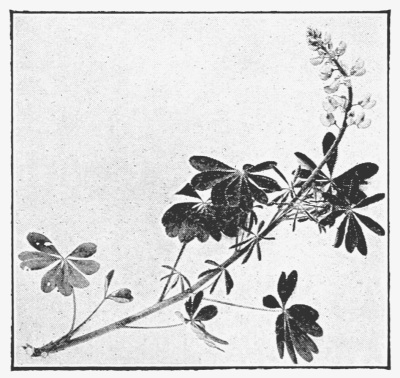
The pea family (Papilionaceæ), including the pea, bean, clover, vetch,
lupine, etc., a very large family.
966. Order Geraniales.—Herbs, shrubs, or trees. Nine families
in the eastern United States. Examples:
The geranium family (Geraniaceæ), with the cranesbill (Geranium
maculatum) and others.
The wood-sorrel family (Oxalidaceæ), with the wood-sorrel (Oxalis
acetosella) and others.
The flax family (Linaceæ). Example, flax (Linum vulgaris).
The spurge family (Euphorbiaceæ). Plants with a milky juice, and
curious, degenerate flowers. Examples: the castor-oil plant (Ricinus),
the spurges (many species of Euphorbia).
967. Order Sapindales.—Mostly trees or shrubs. Twelve families
in the eastern United States. Example:
The sumac family (Anacardiaceæ), containing the sumacs in the genus
Rhus. Examples: the poison-ivy (R. radicans), a climbing vine, in
thickets and along fences, in eastern United States. Sometimes
trained over porches. The poison-oak (R. toxicodendron), a low shrub.
Poison-sumac or poison-alder (R. vernix = R. venenata), sometimes
called “thunderwood,” or dogwood, is a large shrub or small tree, very
poisonous. The smoke-tree (Cotinus cotinoides) belongs to the same
family, and is often planted as an ornamental tree. The maple family
(Aceraceæ), including the maples (Acer).
The buckeye family (Hippocastanaceæ), including the horse-chestnut
(Æsculus hippocastanum), much planted as a shade tree along streets.
Also there are several species of buckeye in the same genus.
The jewelweed family (Balsaminaceæ), including the touch-me-not
(Impatiens biflora and aurea) in moist places. The garden balsam (Imp.
balsamea) also belongs here.
968. Order Rhamnales.—Shrubs, vines, or small trees. There are
two families, the buckthorn (Rhamnaceæ), the grape family (Vitaceæ),
including the grapes (Vitis), the American ivy (Parthenocissus
quinquefolia = Ampelopsis quinquefolia), in woods and thickets, eastern
North America, and much planted as a trailer over porches. The Japanese
ivy (P. tricuspidata = A. veitchii) used as a trailer on the sides of
buildings belongs here.
969. Order Malvales.—Herbs, shrubs, or trees.
The linden family (Tiliaceæ). Example, the basswood or American linden
(Tilia americana.)
The mallow family (Malvaceæ), including the hollyhock, the mallows,
rose of Sharon (Hibiscus), etc.
970. Order Parietales, with seven families in the eastern United
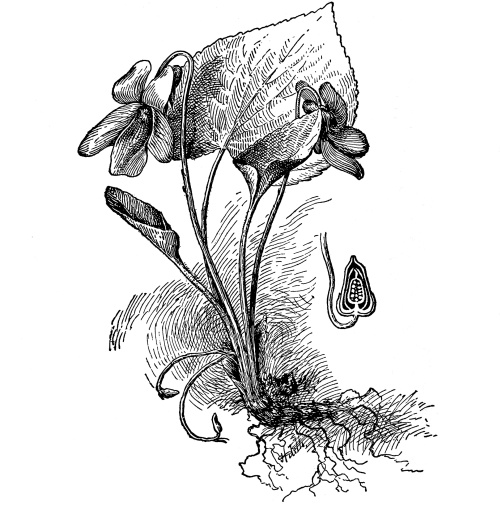
States. The St. John’s wort (Hypericum) and the violets each represent
a family. The violets (Violaceæ) are well-known flowers.
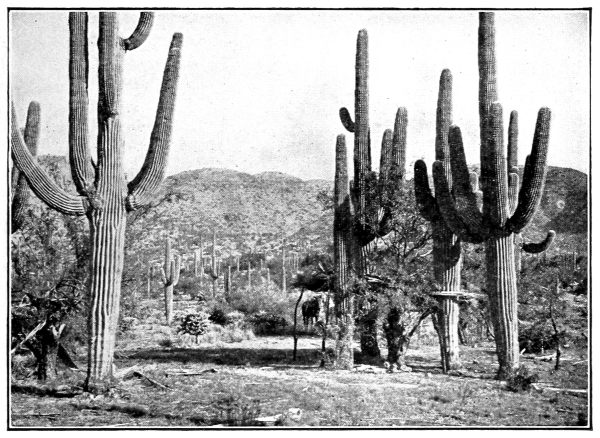
971. Order Opuntiales.—These include the cacti (Cactaceæ),
chiefly growing in the dry or desert regions of America.
972. Order Thymeleales, with two families and few species.
973. Order Myrtales.—Land, marsh, or aquatic plants. The most
conspicuous are in the evening primrose family (Onagraceæ), including
the fireweeds, or willow herbs (Epilobium), and the evening primrose
(Onagra biennis = Œnothera biennis).
974. Order Umbellales.—Herbs, shrubs, or trees, flowers in umbels.
The ginseng family (Araliaceæ). This includes the spikenards and
sarsaparillas in the genus Aralia, and the ginseng (or “sang”), Panax
quinquefolium.
The carrot family (Umbelliferæ). This family includes the wild carrot
(Daucus carota), the poison-hemlock (Cicuta), the cultivated carrot and
parsnip, and a large number of other genera and species.
The dogwood family (Cornaceæ). The flowering dogwood (Cornus florida),
abundant in eastern North America, is an example.
Series 2. GAMOPETALÆ (= Sympetalæ or Metachlamydæ). Petals
partly or wholly united, rarely separate or wanting.
975. Order Ericales.—There are six families in eastern United
States. Examples:
The wintergreen family (Pyrolaceæ), including the shin-leaf (Pyrola
elliptica).
The Indian-pipe family (Monotropaceæ), with the Indian-pipe (Monotropa
uniflora) and other humus saprophytes. (See paragraphs 182-191.)
The heath family (Ericaceæ). Examples: Labrador tea (Ledum), in bogs
and swamps in northern North America. The azaleas, with several
species widely distributed, are beautiful flowering shrubs, and many
varieties are cultivated. The rhododendrons are larger with larger
flower clusters, also beautiful flowering shrubs. R. maximum in the
Alleghany Mountains and vicinity, from Nova Scotia to Ohio and Georgia.
R. catawbiense, usually at somewhat higher elevations, Virginia to
Georgia. The mountain laurel (Kalmia latifolia) and other species rival
the rhododendrons and azaleas in beauty. The trailing arbutus (Epigæa
repens) in sandy or rocky woods is a well-known small trailing shrub
in eastern North America. The sourwood (Oxydendrum arboreum) is a tree
with white racemes of flowers in August, and scarlet leaves in autumn.
The spring or creeping wintergreen (Gaultheria procumbens) is a small
shrub with aromatic leaves, and bright red spicy berries.
The huckleberry family (Vaccinaceæ) includes the huckleberries
(example, Gaylussacia resinosa, the black or high-bush huckleberry,
eastern United States), the mountain cranberry (Vitis-Idæa vitisidæa
= Vaccinium vitisidæa) in the northern hemisphere; the bilberries and
blueberries (of genus Vaccinium); the cranberries (examples: the large
American cranberry, Oxycoccus macrocarpus and the European cranberry,
Oxycoccus oxycoccus, in cold bogs of northern North America, the latter
also in Europe and Asia).
976. Order Primulales.—Two families here. The primrose family
(Primulaceæ) contains the loosestrifes (Steironema), star-flower
(Trientalis), etc.
977. Order Ebenales.—Of the four families, the ebony family
(Ebenaceæ) contains the well-known persimmon (Diospyros virginiana) and
the storax family (Styracaceæ) with the silverbell, or snowdrop tree
(Mohrodendron carolinum).
978. Order Gentianales.—Herbs, shrubs, vines, or trees. Six
families in the United States.
The olive family (Oleaceæ) includes the common lilac (Syringa), the ash
trees (Fraxinus), the privet (Ligustrum).
The gentian family (Gentianaceæ) among other genera includes the
gentians (Gentiana).
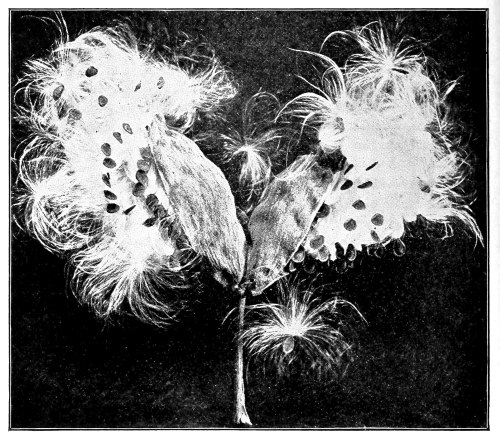
The milkweed family (Asclepiadaceæ) contains plants mostly with a milky
juice. Asclepias with many species is one of the most prominent genera.
979. Order Polemoniales.—Mostly herbs, rarely shrubs and trees.
Fifteen families in the eastern United States.
The morning glory family (Convolvulaceæ) includes the bindweeds
(Convolvulus), the morning glory (Ipomæa), etc.
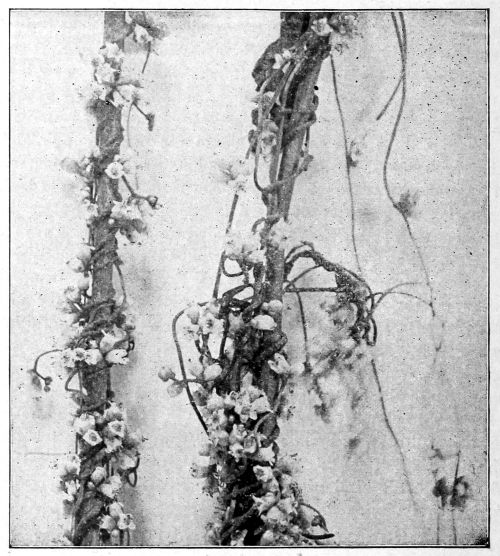
The dodder family (Cuscutaceæ) includes the dodders, or “love-vines.”
There are nearly thirty species in the United States. The stems are
slender and twine around other plants upon which they are parasitic
(see paragraph 179).
The phlox family (Polemoniaceæ). The most prominent genus is Phlox.
Over forty species occur in North America.
The borage family (Boraginaceæ) includes the heliotrope (Heliotropium),
the hound’s-tongue (Cynoglossum), the forget-me-not (Myosotis), and others.
The vervain family (verbenaceæ) contains the verbenas.
The mint family (Labiatæ) contains the mints (Mentha), skull-cap
(Scutellaria), dead-nettles (Lamium).
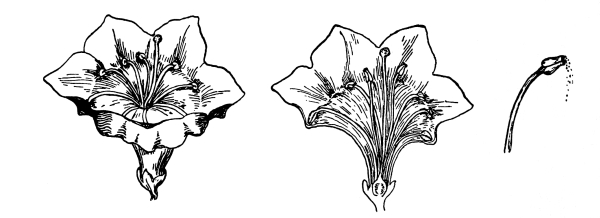
The potato family (Solanaceæ) includes the ground-cherry (Physalis),
the nightshades (Solanum), the tomato (Lycopersicon), tobacco (Nicotiana).
The figwort family (Scrophulariaceæ) includes the common mullein
(Verbascum), the monkey-flower (Mimulus), the toad-flax (Linaria),
turtle’s-head (Chelone), and many other genera and species.
The bladderwort family (Lentibulariaceæ) includes the curious bog or
aquatic plants with finely dissected leaves, and with bladders in which
insects are caught (Utricularia).
The trumpet-creeper family (Bignoniaceæ) includes the trumpet-creeper
(Bignonia), the catalpa tree, and others.
980. Order Plantaginales with one family (Plantaginaceæ)
includes the plantains (Plantago).
981. Order Rubiales with three families is represented by the
madder family (Rubiaceæ) with the bluets (Houstonia), the button-bush
(Cephalanthus), the partridge-berry (Mitchella), the bedstraws
(Galium), etc.
The honeysuckle family (Caprifoliaceæ) with the elder (Sambucus), the
arrowwoods and cranberry trees (Viburnum), the honeysuckles (Lonicera),
etc.
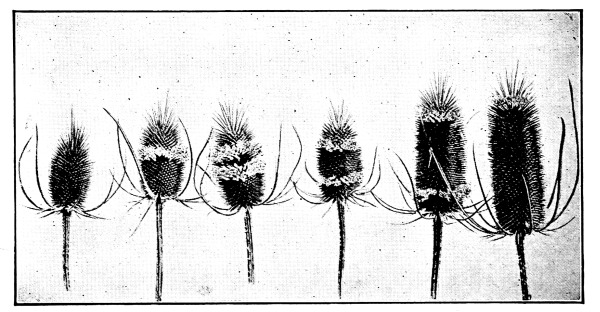
982. Order Valerianales with two families includes the teasel
family (Dipsacaceæ). Example, Fuller’s teasel (Dipsacus).
983. Order Campanulales with five families, the corolla usually
gamopetalous.
The gourd family (Cucurbitaceæ) includes the pumpkin, squash, melon,
and a few feral species. Example, the star-cucumber (Sicyos angulatus),
in moist places in eastern and middle United States.
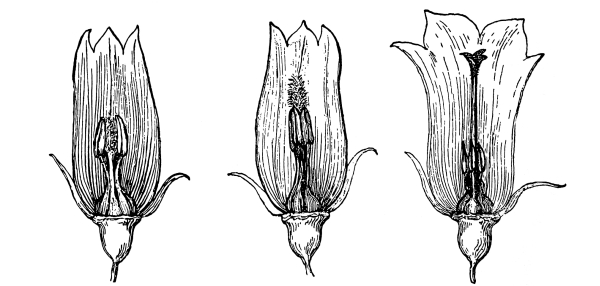
The bell-flower family (Campanulaceæ) includes the hare-bells or
bell-flowers (Campanula), the lobelias (example, Lobelia cardinalis,
the cardinal-flower), etc.
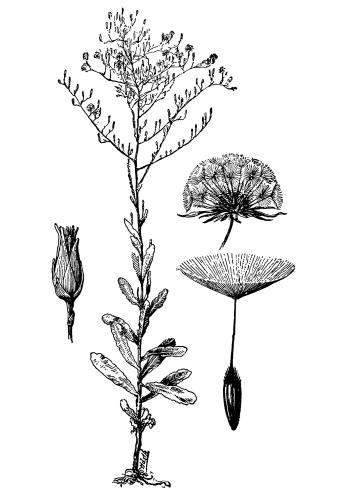
The chicory family (Cichoriaceæ) includes the chicory or succory
(Cichorium intybus, known also as blue-sailors), the oyster-plant or
salsify (Tragopogon porrifolius), the dandelion (Taraxacum taraxacum =
T. densleonis), the lettuce (Lactuca), the hawkweed (Hieraceum), and
others.
The ragweed family (Ambrosiaceæ) includes the ragweeds (Ambrosia), the
cockle-bur (Xanthium), and others.
The thistle family (Compositæ) includes the thistle (Carduus), asters
(Aster), goldenrods (Solidago), sunflowers (Helianthus), eupatoriums or
joepye-weeds, thoroughworts (Eupatorium), cone-flowers or black-eyed
Susans (Rudbeckia), tickseed (Coreopsis), bur-marigold or beggar-ticks
or devil’s-bootjack (Bidens), chrysanthemums, etc.