§ 17. If we immerse a strip of ordinary commercial
sheet zinc in dilute acid (say sulphuric acid 1 part
by measure, water 16 parts by measure[4]), we shall find
that the zinc is immediately acted on by the acid,
being rapidly corroded and dissolved, while at the same
time a quantity of bubbles of gas are seen to collect
around, and finally to be evolved at the surface of the
fluid in contact with the plate. Accompanying this
chemical action, and varying in a degree proportionate
to the intensity of the action of the acid on the zinc,
we find a marked development of heat and electricity.
If, while the bubbling due to the extrication of gas be
still proceeding, we immerse in the same vessel a strip
of silver, or copper, or a rod of graphite, taking care
that contact does not take place between the two
elements, no perceptible change takes place in the
condition of things; but if we cause the two strips
to touch, either by inclining the upper extremities so
as to bring them in contact out of the fluid like a
letter Λ, or by connecting the upper extremities
together by means of a piece of wire (or other conductor
of electricity), or by causing their lower
extremities in the fluid to touch, we notice a very
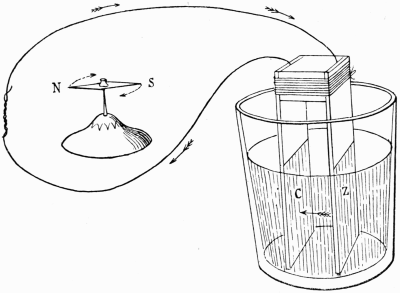
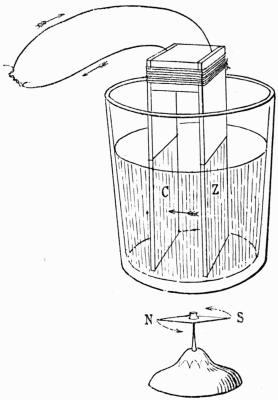
peculiar change. The extrication of bubbles around
the zinc strip ceases entirely or almost entirely, while
the other strip (silver, copper, or graphite) becomes
immediately the seat of the evolution of the gaseous
bubbles. Had these experiments been performed with
chemically pure metallic zinc, instead of the ordinary
impure commercial metal, we should have found some
noteworthy differences in behaviour. In the first place,
the zinc would have been absolutely unattacked by the
acid before the immersion of the other strip; and,
secondly, all evolution of gas would entirely cease when
contact between the two strips was broken.
As the property which zinc possesses of causing the
extrication of gas (under the above circumstances) has
a considerable influence on the efficiency of a battery,
it is well to understand thoroughly what chemical
action takes place which gives rise to this evolution of gas.
§ 18. All acids may be conveniently regarded as
being built up of two essential portions, viz.: firstly, a
strongly electro-negative portion, which may either
be a single body, such as chlorine, iodine, bromine, etc.,
or a compound radical, such as cyanogen; secondly,
the strongly electro-positive body hydrogen.
Representing, for brevity's sake, hydrogen by the
letter H., and chlorine, bromine, iodine, etc., respectively
by Cl., Br., and I., the constitution of the acids derived
from these bodies may be conveniently represented by:—
| H Cl | H Br | H I |
| ┗━━┛ | ┗━━┛ | ┗━━┛ |
Hydrochloric
Acid[5]. | Hydrobromic
Acid. | Hydriodic
Acid. |
and the more complex acids, in which the electro-negative
component is a compound, such as sulphuric
acid (built up of 1 atom of sulphur and 4 atoms of
oxygen, united to 2 atoms of hydrogen) or nitric acid
(consisting of 1 nitrogen atom, 6 oxygen atoms, and
1 hydrogen atom), may advantageously be retained
in memory by the aid of the abbreviations:—
| H2SO4 | | HNO6 |
| ┗━━━┛ | | ┗━━┛ |
Sulphuric
Acid[6]. | and | Nitric
Acid[7]. |
When zinc does act on an acid, it displaces the hydrogen
contained in it, and takes its place; the acid
losing at the same time its characteristic sourness and
corrosiveness, becoming, as chemists say, neutralized.
One atom of zinc can replace two atoms of hydrogen,
so that one atom of zinc can replace the hydrogen in
two equivalents of such acids as contain only one atom
of hydrogen.
This power of displacement and replacement possessed
by zinc is not peculiar to this metal, but is
possessed also by many other bodies, and is of very
common occurrence in chemistry; and may be roughly
likened to the substitution of a new brick for an old
one in a building, or one girder for another in an arch.
It will be well, therefore, to remember that in all
batteries in which acids are used to excite electricity
by their behaviour along with zinc, the following
chemical action will also take place, according to which
acid is employed:—
| Hydrochloric Acid | and | Zinc, | equal | Zinc Chloride | and | Hydrogen Gas. |
| 2HCl | + | Zn | = | ZnCl2 | + | H2 |
or:—
| Sulphuric Acid | and | Zinc, | equal | Zinc Sulphate | and | Hydrogen Gas. |
| H2SO4 | + | Zn | = | ZnSO4 | + | H2 |
Or we may put this statement into a general form,
covering all cases in which zinc is acted on by a compound
body containing hydrogen, representing the other
or electro-negative portion of the compound by X:—
Zn + H2X = ZnX + H2
the final result being in every case the corrosion and
solution of the zinc, and the extrication of the hydrogen
gas displaced.
§ 19. We learn from the preceding statements that
no electricity can be manifested in a battery or cell
(as such a combination of zinc acid and metal is called)
without consumption of zinc. On the contrary, we may
safely say that the more rapidly the useful consumption
of zinc takes place, the greater will be the electrical
effects produced. But here it must be borne in mind
that if the zinc is being consumed when we are not
using the cell or battery, that consumption is sheer
waste, quite as much as if we were compelled to burn
fuel in an engine whether the latter were doing work
or not. For this reason the use of commercial zinc, in
its ordinary condition, is not advisable in batteries in
which acids are employed, since the zinc is consumed
in such, whether the battery is called upon to do
electrical work (by placing its plates in connection
through some conducting circuit) or not. This serious
objection to the employment of commercial zinc could
be overcome by the employment of chemically purified
zinc, were it not that the price of this latter is so
elevated as practically to preclude its use for this
purpose. Fortunately, it is possible to confer, on the
ordinary crude zinc of commerce, the power of resisting
the attacks of the acid (so long as the plates are not
metallically connected; or, in other words, so long as
the "circuit is broken"), by causing it to absorb
superficially a certain amount of mercury (quicksilver).
The modes of doing this, which is technically known
as amalgamating the zinc, are various, and, as it is
an operation which every one who has the care of
batteries is frequently called upon to perform, the
following working details will be found useful:—
§ 20. To amalgamate zinc, it should first be washed
with a strong solution of common washing soda, to
remove grease, then rinsed in running water; the
zinc plates, or rods, should then be dipped into a vessel
containing acidulated water (§ 17), and as soon as
bubbles of hydrogen gas begin to be evolved,
transferred to a large flat dish containing water. While
here, a few drops of mercury are poured on each
plate, and caused to spread quickly over the surface
of the zinc by rubbing briskly with an old nail-brush
or tooth-brush. Some operators use a kind of
mop, made of pieces of rag tied on the end of a stick,
and there is no objection to this; others recommend the
use of the fingers for rubbing in the mercury. This
latter plan, especially if many plates have to be done, is
very objectionable: firstly, on the ground of health, since
the mercury is slowly but surely absorbed by the system,
giving rise to salivation, etc.; and, secondly, because any
jewellery, etc., worn by the wearer will be whitened and
rendered brittle. When the entire surface of the zinc
becomes resplendent like a looking-glass, the rubbing
may cease, and the zinc plate be reared up on edge, to
allow the superfluous mercury to drain off. This should
be collected for future operations. It is important that
the mercury used for this purpose should be pure.
Much commercial mercury contains lead and tin. These
metals can be removed by allowing the mercury to
stand for some time in a vessel containing dilute nitric
acid, occasional agitation being resorted to, in order to
bring the acid into general contact with the mercury.
All waste mercury, drainings, brushings from old plates,
etc., should be thus treated with nitric acid, and finally
kept covered with water. Sprague, in his admirable
work on electricity, says:—"Whenever the zinc shows
a grey granular surface (or rather before this), brush it
well and re-amalgamate, remembering that a saving of
mercury is no economy, and a free use of it no waste;
for it may all be recovered with a little care. Keep a
convenient sized jar, or vessel, solely for washing zinc in,
and brush into this the dirty grey powder which forms,
and is an amalgam of mercury with zinc, lead, tin, etc.,
and forms roughnesses which reduce the protection of the
amalgamation. Rolled sheet zinc should always be used
in preference to cast. This latter is very hard to amalgamate,
and has less electro-motive power[8]; but for rods
for use in porous jars, and particularly with saline
solutions, cast-zinc is very commonly used. In this
case great care should be taken to use good zinc
cuttings, removing any parts with solder on them, and
using a little nitre as a flux, which will remove a portion
of the foreign metals."
§ 21. Another and very convenient mode of amalgamating
zinc, specially useful where solid rods or masses
of zinc are to be used, consists in weighing up the
zinc and setting aside four parts of mercury (by weight)
for every hundred of the zinc thus weighed up. The
zinc should then be melted in a ladle, with a little tallow
or resin over the top as a flux. As soon as melted, the
mercury should be added in and the mixture stirred with
a stick. It should then be poured into moulds of the
desired shape. This is, perhaps, the best mode of
amalgamating cast zincs.
§ 22. Some operators recommend the use of mercurial
salts (such as mercury nitrate, etc.) as advantageous
for amalgamating; but, apart from the fact that
these salts are generally sold at a higher rate than the
mercury itself, the amalgamation resulting, unless a very
considerable time be allowed for the mercuric salts to
act, is neither so deep nor so satisfactory as in the case
of mercury alone. It may here be noted, that although
the effect of mercury in protecting the zinc is very
marked in those batteries in which acids are used as the
exciting fluids, yet this action is not so observable in the
cases in which solutions of salts are used as exciters;
and in a few, such as the Daniell cell and its congeners,
the use of amalgamated zinc is positively a disadvantage.
§ 23. If, having thus amalgamated the zinc plate of
the little battery described and figured at § 9, we repeat
the experiment therein illustrated, namely, of joining
the wires proceeding from the two plates over a suspended
magnetic needle, and leave them so united, we
shall find that the magnetic needle, which was originally
very much deflected out of the line of the magnetic
meridian (north and south), will very quickly return
near to its old and normal position; and this will be
found to take place long before the zinc has been all
consumed, or the acid all neutralised. Of course, this
points to a rapid falling off in the transmission of the
electric disturbance along the united wires; for had that
continued of the same intensity, the deflection of the
needle would evidently have remained the same likewise.
What, then, can have caused this rapid loss of
power? On examining (without removing from the
fluid) the surface of the copper plate, we shall find that
it is literally covered with a coating of small bubbles of
hydrogen gas, and, if we agitate the liquid or the plates,
many of them will rise to the surface, while the
magnetic needle will at the same time give a larger
deflection. If we entirely remove the plates from the
acid fluid, and brush over the surface of the copper
plate with a feather or small pledget of cotton wool
fastened to a stick, we shall find, on again immersing
the plates in the acid, that the effect on the needle is
almost, if not quite, as great as at first; thus proving
that the sudden loss of electrical energy was greatly due
to the adhesion of the free hydrogen gas to the copper
plate. This peculiar phenomenon, which is generally
spoken of as the polarisation of the negative plate, acts in
a twofold manner towards checking the electrical energy
of the battery. In the first place, the layer of hydrogen
(being a bad conductor of electricity) presents a great
resistance to the transmission of electrical energy from
the zinc plate where it is set up to the copper (or
other) plate whence it is transmitted to the wires, or
electrodes. Again, the copper or other receiving plate, in
order that the electric energy should be duly received
and transmitted, should be more electro-negative than
the zinc plate; but the hydrogen gas which is evolved,
and which thus adheres to the negative plate, is actually
very highly electro-positive, and thus renders the copper
plate incapable of receiving or transmitting the electric
disturbance. This state of things may be roughly
likened to that of two exactly equal and level tanks, Z
and C, connected by a straight piece of tubing. If Z be
full and C have an outlet, it is very evident that Z can
and will discharge itself into C until exhausted; but if C
be allowed to fill up to the same level as Z, then no
farther flow can take place between the two.
It is, therefore, very evident that to ensure anything
like constancy in the working of a battery, at least until
all the zinc be consumed or all the acid exhausted, some
device for removing the liberated hydrogen must be put
into practice. The following are some of the means
that have been adopted by practical men:—
§ 24. Roughening the surface of the negative plate,
which renders the escape of the hydrogen gas easier.
This mode was adopted by Smee in the battery which
bears his name. It consists of a sheet of silver, placed
between two plates of zinc, standing in a cell containing
dilute sulphuric acid, as shown at Fig. 5.
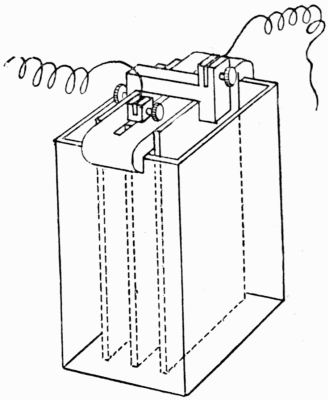
Fig. 5.
The silver sheet, before being placed in position, is
platinised; that is to say, its surface is covered (by electro-deposition)
with a coating of platinum, in the form
of a fine black powder. This presents innumerable
points of escape for the hydrogen gas; and for this
reason this battery falls off much less rapidly than the
plain zinc and smooth copper form. A modification of
Smee's battery which, owing to the large negative surface
presented, is very advantageous, is Walker's graphite
cell. In this we have a plate of zinc between two plates
of gas-carbon ("scurf"), or graphite. The surface of
this body is naturally much rougher than metal sheets;
and this roughness of surface is further assisted by
coating the surface with platinum, as in the case of
the Smee. The chief objection to the use of graphite is
its porosity, which causes it to suck up the acid fluid in
which the plates stand, and this, of course, corrodes the
brass connections, or binding screws.
Other mechanical means of removing the hydrogen
have been suggested, such as brushing the surface of the
plate, keeping the liquid in a state of agitation by boiling
or siphoning; but the only really efficient practical
means with which we are at present acquainted are
chemical means. Thus, if we can have present at the
negative plate some substance which is greedy of
hydrogen, and which shall absorb it or combine with
it, we shall evidently have solved the problem. This
was first effected by Professor Daniell; and the battery
known by his name still retains its position as one of the
simplest and best of the "constant" forms of battery.
The term "constant," as applied to batteries, does not
mean that the battery is a constancy, and will run for
ever, but simply that so long as there is in the battery any
fuel (zinc, acid, etc.), the electrical output of that battery
will be constant. The Daniell cell consists essentially
in a rod or plate of zinc immersed in dilute sulphuric
acid, and separated from the copper or collecting plate
by a porous earthen pot or cell. Around the porous
cell, and in contact with the copper plate, is placed a
solution of sulphate of copper, which is maintained
saturate by keeping crystals of sulphate of copper (blue
stone, blue vitriol) in the solution. Sulphate of copper
is a compound built up of copper Cu, and of sulphur
oxide SO4. When the dilute sulphuric acid acts on the
zinc plate or rod (§ 18), sulphate of zinc is formed, which
dissolves in the water, and hydrogen is given off:—
| Zn | + | H2SO4 | = | ZnSO4 | + | H2. |
| Zinc | and | sulphuric acid | produce | zinc sulphate | and | free hydrogen. |
Now this free hydrogen, by a series of molecular
interchanges, is carried along until it passes through the
porous cell, and finds itself in contact with the solution
of copper sulphate. Here, as the hydrogen has a greater
affinity for, or is more greedy of, the sulphur oxide, SO4,
than the copper is, it turns the latter out, takes its place,
setting the copper free, and forming, with the sulphur
oxide, sulphuric acid. The liberated copper goes, and
adheres to the copper plate, and, far from detracting from
its efficacy, as the liberated hydrogen would have done,
actually increases its efficiency, as it is deposited in a
roughened form, which presents a large surface for the
collection of the electricity. The interchange which
takes place when the free hydrogen meets the sulphate
of copper (outside the porous cells) is shown in the
following equation:—
| H2 | + | CuSO4 | = | H2SO4 | + | Cu. |
| Free hydrogen | and | copper sulphate | produce | sulphuric acid | and | free copper. |
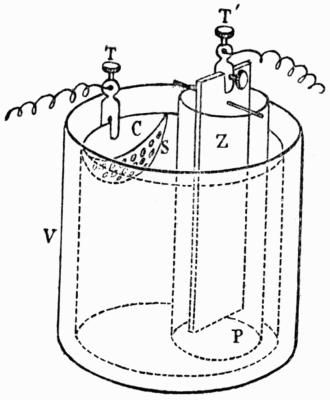
Fig. 6. Daniell Cell.
§ 25. The original form given to this, the Daniell
cell, is shown at Fig. 6, in which Z is the zinc rod standing
in the porous pot P, in which is placed the dilute
sulphuric acid. A containing vessel, V, of glazed earthenware,
provided with a perforated shelf, S, on which
are placed the crystals of sulphate of copper, serves
to hold the copper sheet, C, and the solution of sulphate
of copper. T and T' are the terminals from which the
electricity is led where desired.
In another form, the copper sheet itself takes the form
and replaces the containing vessel V; and since the
copper is not corroded, but actually increases in thickness
during action, this is a decided advantage. A
modification, in which the porous cell is replaced by
sand or by sawdust, is also constructed, and known as
"Minotto's" cell: this, owing to the greater thickness
of the porous layer, offers more resistance, and gives,
consequently, less current. By taking advantage of the
greater specific gravity (weight, bulk for bulk) of the
solution of sulphate of copper over that of water or
dilute sulphuric acid, it is possible to construct a battery
which shall act in a manner precisely similar to a
Daniell, without the employment of any porous partition
whatsoever. Fig. 7 illustrates the construction of
one of these, known as "Gravity Daniells."
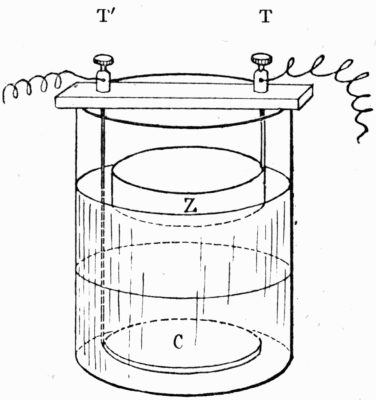
Fig. 7. Gravity Cell.
In this we have a plate, disc, or spiral of copper, C,
connected by an insulated copper wire to the terminal T'.
Over this is placed a layer of crystals of copper sulphate;
the jar is then filled nearly to the top with dilute sulphuric
acid, or with a strong solution of sulphate of zinc
(which is more lasting in its effects, but not so energetic
as the dilute sulphuric acid), and on the surface of this,
connected to the other terminal, T, is allowed to rest
a thick disc of zinc, Z. Speaking of these cells, Professor
Ayrton, in his invaluable "Practical Electricity,"
says:—"All gravity cells have the disadvantage that
they cannot be moved about; otherwise the liquids
mix, and the copper sulphate solution, coming into contact
with the zinc plate, deposits copper on it. This
impairs the action, by causing the zinc to act electrically,
like a copper one. Indeed, without any shaking, the
liquids mix by diffusion, even when a porous pot is
employed; hence a Daniell's cell is found to keep in
better order if it be always allowed to send a weak
current when not in use, since the current uses up the
copper sulphate solution, instead of allowing it to
diffuse." The use of a solution of zinc sulphate to act
on the zinc rod, or plate, is always to be preferred in the
Daniell cell, when long duration is of more consequence
than energetic action.
§ 26. There are many other bodies which can be used
in batteries to absorb the hydrogen set free. Of several
of these we need only take a passing notice, as the
batteries furnished by their use are unfit for electric bell
work. Of these we may mention nitric acid, which
readily parts with a portion of the oxygen (§ 18) and
reconverts the free hydrogen into water. This acid is
used as the "depolarizer"[9] in the "Grove" and in the
"Bunsen" cell. Another very energetic "depolariser"
is chromic acid, either in solution, in dilute sulphuric
acid, or in the form of potassic dichromate (bichromate
of potash: bichrome). As one form of chromic cell has
found favour with some bell-fitters, we shall study its
peculiarities farther on.
Another class of bodies which readily part with their
oxygen, and thus act as depolarisers, are the oxides of
lead and manganese. This latter oxide forms the basis
of one of the most useful cells for electric bell work,
namely: the one known as the "Leclanché." As the
battery has been, and will probably remain, long a
favourite, the next paragraph will be devoted to its
consideration.
§ 27. The Leclanché cell, in its original form, consists
in a rod or block of gas carbon (retort scurf: graphite)
standing in an upright porous pot. Around this, so as
to reach nearly to the top of the porous cell, is tightly
packed a mixture of little lumps of graphite and black
oxide of manganese (manganic dioxide: black wad),
the porous cell itself being placed in an outer containing
vessel, which usually takes the form of a square glass
bottle. A zinc rod stands in one corner of the bottle,
and is prevented from coming into actual contact with
the porous cell by having an indiarubber ring slipped
over its upper and lower extremities. The glass containing
vessel is then filled to about two-thirds of its height
with a solution of ammonium chloride (sal ammoniac) in
water, of the strength of about 2 oz. of the salt to each
pint of water. This soon permeates the porous cell and
reaches the mixture inside. The general appearance
of the Leclanché cell is well shown at Fig. 8.
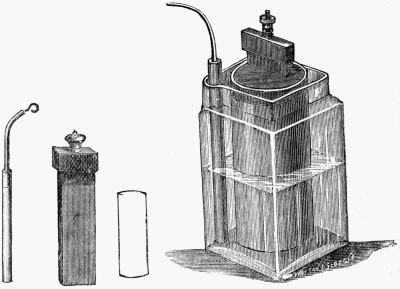
Fig. 8.
In order to ensure a large surface of contact for the
terminal of the carbon rod or plate, it is customary to
cast a leaden cap on the top thereof; and, as the porosity
of the graphite, or carbon, is very apt to allow the fluid in
the battery to creep up to and corrode the terminal, and
thus oppose resistance to the passage of electricity, the
upper end of the carbon, before the lead cap is cast on,
is soaked for some time in melted paraffin wax, at a temperature
of 110° Centigrade: that is somewhat hotter than
boiling water heat. This, if left on the outside, would
prevent the passage of electricity almost entirely; so
lateral holes are drilled into the carbon before the cap
is finally cast on. The action that takes place in the
Leclanché cell may be summarised as follows:—
When the zinc, Zn, is acted on by the ammonium
chloride, 2NH4Cl, the zinc seizes the chlorine and forms
with it zinc chloride, ZnCl2, while the ammonium, 2NH4,
is liberated. But this ammonium, 2NH4, does not escape.
Being electro-positive, it is impelled towards the negative
plate, and in its passage thereto meets with another
molecule of ammonium chloride, from which it displaces
the ammonium, in this wise: 2NH4 + 2NH4Cl = 2NH4Cl
+ 2NH4; in other words, this electro-positive ammonium
is able, by virtue of its electrical charge, to displace
the ammonium from the combined chloride. In so
doing, it sets the liberated ammonium in an electro-positive
condition, as it was itself, losing at the same
time its electrical charge. This interchange of molecules
goes on (as we saw in the case of the Daniell's cell, § 24)
until the surface of the carbon is reached. Here, as
there is no more ammonium chloride to decompose, the
ammonium 2NH4 immediately splits up into ammonia
2NH3 and free hydrogen H2. The ammonia escapes,
and may be detected by its smell; while the hydrogen
H2, finding itself in contact with the oxide of manganese,
2MnO2, seizes one atom of its oxygen, O, becoming
thereby converted into water H2O; while the manganese
dioxide, 2MnO2, by losing one atom of oxygen, is
reduced to the form of a lower oxide of manganese,
known as manganese sesquioxide, Mn2O3. Expressed
in symbols, this action may be formulated as below:—
In the zinc compartment—
Zn + 2NH4Cl = ZnCl2 + 2NH3 + H2
In the peroxide of manganese compartment—
H2 + 2MnO2 = Mn2O3 + H2O.
Ammonia gas therefore slowly escapes while this
battery is in action, and this corrodes all the brass work
with which it comes into contact, producing a bluish green
verdigris. If there be not sufficient ammonium chloride
in solution, the water alone acts on the zinc: zinc oxide
is produced, which renders the solution milky. Should
this be the case, more sal ammoniac must be added. It
is found that for every 50 grains of zinc consumed in this
battery, about 82 grains of sal ammoniac and 124 grains
of manganese dioxide are needed to neutralize the
hydrogen set free. It is essential for the efficient working
of this battery that both the manganese dioxide and
the carbon should be free from powder, otherwise it will
cake together, prevent the passage of the liquid, and
present a much smaller surface to the electricity, than if
in a granular form. For this reason, that manganese
dioxide should be preferred which is known as the
"needle" form, and both this and the carbon should be
sifted to remove dust.
§ 28. In the admirable series of papers on electric bell
fitting which was published in the English Mechanic,
Mr. F. C. Allsop, speaking of the Leclanché cell, says:—"A
severe and prolonged test, extending over many years,
has proved that for general electric bell work the
Leclanché has no equal; though, in large hotels, etc.,
where the work is likely to be very heavy, it may,
perhaps, be preferable to employ a form of the Fuller
bichromate battery. It is very important that the
battery employed should be a thoroughly reliable one
and set up in a proper manner, as a failure in the battery
causes a breakdown in the communication throughout
the whole building, whilst the failure of a push or wire
only affects that portion of the building in which the
push or wire is fixed. A common fault is that of
putting in (with a view to economy) only just enough
cells (when first set up) to do the necessary work. This
is false economy, as when the cells are but slightly
exhausted the battery power becomes insufficient;
whereas, if another cell or two had been added, the
battery would have run a much longer time without
renewal, owing to the fact that each cell could have
been reduced to a lower state of exhaustion, yet still the
battery would have furnished the necessary power; and
the writer has always found that the extra expense of
the surplus cells is fully repaid by the increased length
of time the battery runs without renewal."
§ 29. Another form of Leclanché, from which great
things were expected at its introduction, is the one
known as the "Agglomerate block," from the fact that,
instead of simply placing the carbon and manganese
together loosely in a porous cell, solid blocks are
formed by compressing these materials, under a
pressure of several tons, around a central carbon core,
to which the terminal is attached in the usual manner.
The following are some of the compositions used in the
manufacture of agglomerate blocks:—
No. 1.
| Manganese dioxide | 40 | parts. |
| Powdered gas carbon | 55 | parts. |
| Gum lac resin | 5 | parts. |
No. 2.
| Manganese dioxide (pyrolusite) | 40 | parts. |
| Gas carbon (powdered) | 52 | parts. |
| Gum lac resin | 5 | parts. |
| Potassium bisulphate | 3 | parts. |
These are to be thoroughly incorporated, forced into
steel moulds (containing the central carbon core) at a
temperature of 100° C. (212° Fahr.), under a pressure of
300 atmospheres, say 4,500 lbs. to the square inch.
No. 3.
Barbier and Leclanché's Patent.
| Manganese dioxide | 49 | parts. |
| Graphite | 44 | parts. |
| Pitch ("brai gras") | 9 | parts. |
| Sulphur | ⅗ | parts. |
| Water | ⅖ | parts. |
The materials having been reduced to fine powder,
and the proportion of water stated having been added,
are intimately mixed together by hand or mechanically.
The moist mixture is moulded at the ordinary temperature,
either by a simple compressing press, or by a press
in which two pistons moving towards each other compress
the block on two opposite faces; or the mixture
may be compressed by drawing, as in the manufacture
of electric light carbon. After compression, the
products are sufficiently solid to be manipulated. They
are then put in a stove, or oven, the temperature
of which is gradually raised to about 350° C. (about
662° Fahr.); a temperature which is insufficient to
decompose the depolarising substance (manganese
dioxide), but sufficient to drive out first the volatile
parts of the agglomerating material, and then to transform
its fixed parts in a body unattackable by the
ammonia of the cell. During the gradual heating, or
baking, which lasts about two hours, what remains of
the water in the agglomerate is driven off; then come the
more volatile oils contained in the pitch, and finally the
sulphur. The sulphur is added to the mixture, not as an
agglomerative, but as a chemical re-agent (and this is a
characteristic feature in the invention), acting on what
remains of the pitch, as it acts on all carbo-hydrides at
a high temperature, transforming it partially into
volatile sulphuretted compounds, which are expelled by
the heat, and partially into a fixed and unattackable
body, somewhat similar to vulcanite. The action of
the sulphur on the pitch can very well be likened to its
action on caoutchouc (which is likewise a hydro-carbon)
during the process of vulcanisation.
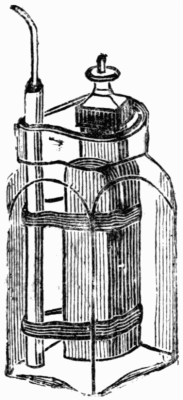
Fig. 9.
These agglomerate blocks, however prepared, are
placed in glass or porcelain containing vessels, as shown
in Fig. 9, with a rod of zinc, separated from actual
contact with the carbon by means of a couple of crossed
indiarubber bands, which serve at the same time to
hold the zinc rods upright. The exciting solution, as
in the case of the ordinary Leclanché consists in a
solution of ammonium chloride.
Among the various advantages claimed
for the agglomerate form of Leclanché over
the ordinary type, may be mentioned the
following:—
1st.—The depolarising power of the manganese
oxide is used to the best advantage,
and that, owing to this, the electro-motive
force of the battery is kept at the same
point.
2nd.—That, owing to the absence of the
porous cell, there is less internal resistance
in the battery and therefore more available current.
3rd.—That the resistance of the battery remains pretty
constant, whatever work be put upon it.
4th.—That, owing to the fact that the liquid comes
into contact with both elements immediately, the battery
is ready for use directly on being charged.
5th.—That the renewal or recharging is exceedingly
easy, since the elements can be removed together, fresh
solution added, or new depolarising blocks substituted.
But when this battery came to be put to the test of
practical work, it was found the block form could not be
credited with all these advantages, and that their chief
superiority over the old cell consisted rather in their
lower internal resistance than in anything else. Even
this is not an advantage in the case of bell work, except
when several bells are arranged in parallel, so that a
large current is required. The blocks certainly polarise
more quickly than the old form, and it does not appear
that they depolarise any more rapidly. Probably the
enormous pressure to which the blocks are subjected, in
the first two processes, renders the composition almost
impermeable to the passage of the fluid, so that depolarisation
cannot take place very rapidly. Another and
serious objection to these blocks is that, after a little
work, pieces break away from the blocks and settle on
the zinc. This sets up a "short circuit," and the zincs
are consumed whether the battery is in action or not.
The author has had no opportunity for making any
practical tests with the blocks prepared by process No. 3,
but he is under the impression that the blocks would be
even more friable than those prepared under greater
pressure.
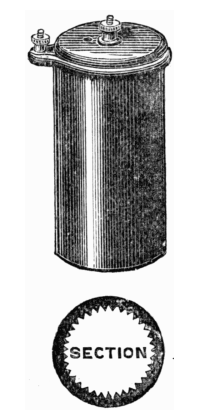
Fig. 10.
§ 30. A third form of Leclanché, and one which has
given considerable satisfaction, is the one known as
"Judson's Patent." This consists, as shown at Fig.
10, in a cylinder of corrugated carbon encased in an
outer coating of an insulating composition. Inside the
cell are two or more thin carbon sheets, cemented to the
sides of the cell by Prout's elastic glue, or some similar
compound, so as to leave spaces, which are filled in with
granular carbon and manganese. The surface of the
plates is perforated, so as to allow ready access to the
exciting fluid. The zinc rod, which is affixed to the
cover, stands in the centre of the cell, touching it at no
part. Owing to the very large surface presented by the
corrugations in the carbon, and by the perforated carbon
plates, the internal resistance of this form
of battery is very low; hence the current,
if employed against a small outer resistance,
is large. But this, except in the case of
bells arranged in parallel, is of no great
advantage.
§ 31. The ordinary form of Leclanché is
found in market in three sizes, viz., No. 1,
No. 2, and No. 3. Unfortunately, all makers
do not use these numbers in the same manner,
so that while some call the smallest, or
pint size, No. 1, others give this name to the
largest, or three-pint, size. No. 2 is always
quart size, and this is the one commonly
employed. When several cells are employed
to work a number of bells, it is well, in order
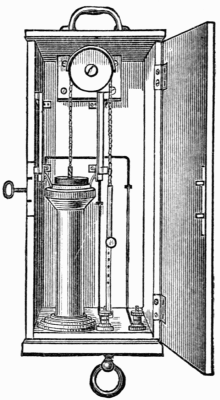
that they may not receive injury, that they be enclosed
in a wooden box. As it is necessary that the batteries
should be inspected from time to time, boxes are
specially made with doubled hinged top and side, so
that when the catch is released these fall flat; thus
admitting of easy inspection or removal of any individual
cell. This form of battery box is shown at Fig. 11.
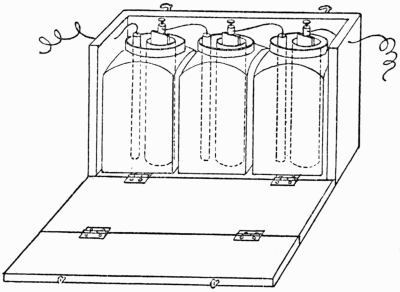
Fig. 11. Battery in Box.
§ 32. There are certain ills to which the Leclanché
cells are liable that require notice here. The first is
creeping. By creeping is meant the gradual crystallisation
of the sal ammonium up the inside and round
the outside of the glass containing jar. There are
two modes of preventing this. The first consists in
filling in the neck with melted pitch, two small funnel-like
tubes being previously inserted to admit of the
addition of fresh sal ammoniac solution, and for the
escape of gas. This mode cannot be recommended, as
it is almost impossible to remove the pitch (in case it be
required to renew the zinc, etc.) without breaking the
glass vessel. The best way to remove the pitch is to
place the cell in a large saucepan of cold water, and
set it on a fire until the water boils. The pitch is,
by this treatment, so far softened that the elements
can be removed and the pitch scraped away with a
knife.
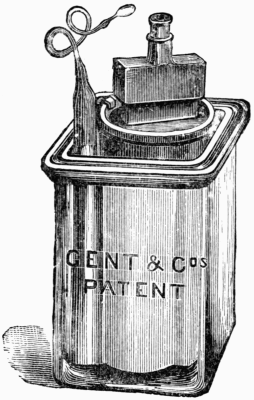
Fig. 12.
By far the better mode is to
rub round the inside and outside
of the neck of the jar with
tallow, or melted paraffin wax,
to the depth of an inch or
thereabouts. This effectually
prevents creeping and the consequent
loss of current. Messrs.
Gent, of Leicester, have introduced
a very neat modification
of the Leclanché cell, with a
view to obviate altogether the
evils deriving from creeping.
This cell is illustrated at Fig.
12, and the following is the
description supplied by the
patentees:—"All who have had experience of batteries in
which a solution of salts is used are aware of the difficulty
experienced in preventing it creeping over the outside of
the jar, causing local loss, and oftentimes emptying the
jar of its solution. Many devices have been tried to
prevent this, but the only effectual one is our patent
insulated jar, in which a recess surrounds the top of the
jar, this recess being filled with a material to which the
salts will not adhere, thus keeping the outside of the
jar perfectly clean. It is specially adapted for use in
hot climates, and is the only cell in which jars may
touch each other and yet retain their insulations. We
confidently recommend a trial of this cell. Its price is
but little in excess of the ordinary Leclanché." The
battery should be set up in as cool a place as possible,
as heat is very conducive to creeping. It is also
important that the battery should be placed as near
as convenient to the bell.
Sometimes the zincs are seen to become coated with
a black substance, or covered with crystals, rapidly
wasting away at the same time, although doing little or
no work; a strong smell of ammonia being given off at
the same time. When this occurs, it points to an
electrical leakage, or short circuit, and this, of course,
rapidly exhausts the battery. It is of the utmost importance
to the effective working of any battery that
not the slightest leakage or local action should be
allowed to take place. However slight such loss be, it
will eventually ruin the battery. This leakage may be
taking place in the battery, as a porous cell may be
broken, and carbon may be touching the zinc; or out of
the battery, along the conducting wires, by one touching
the other, or through partial conductivity of a damp
wall, a metallic staple, etc., or by creeping. If loss or
local action has taken place, it is best, after discovering
and repairing the faults (see also testing wires),
to replace the old zincs by new ones, which are not
costly.
§ 33. There is yet a modification of the Leclanché
which is sometimes used to ring the large bells in hotels,
etc., known as the Leclanché reversed, since the zinc is
placed in the porous pot, this latter being stood in the
centre of the stoneware jar, the space between the two
being packed with broken carbon and manganese
dioxide. By this means a very much larger negative
surface is obtained. In the Grenet cell, the porous cell
is replaced by a canvas bag, which is packed full of
lumps of graphite and carbon dioxide, a central rod of
carbon being used as the electrode. This may be used in
out-of-the-way places where porous cells are not readily
obtainable, but I cannot recommend them for durability.
§ 34. The only other type of battery which it will be
needful to notice in connection with bell work is one
in which the depolariser is either chromic acid or a
compound of chromic acid with potash or lime. Chromic
acid consists of hydrogen united to the metal chromium
and oxygen. Potassic dichromate (bichromate of
potash: bichrome) contains potassium, chromium, and
oxygen. If we represent potassium by K, chromium by
Cr, and oxygen by O, we can get a fair idea of its constitution
by expressing it as K2Cr2O7, by which it is
shown that one molecule of this body contains two atoms
of potassium united to two atoms of chromium and seven
atoms of oxygen. Bichromate of potash readily parts
with its oxygen; and it is upon this, and upon the
relatively large amount of oxygen it contains, that its
efficiency as a depolariser depends. Unfortunately,
bichromate of potash is not very soluble in water; one
pint of water will not take up much more than three
ounces of this salt. Hence, though the solution of
potassium bichromate is an excellent depolariser as long
as it contains any of the salt, it soon becomes exhausted.
When bichromate of potash is used in a cell along with
sulphuric acid and water, sulphate of potash and
chromic acid are formed, thus:—
| K2Cr2O7 | + | H2SO4 | + | H2O | = | K2SO4 | + | 2H2CrO4 |
| ┗━━━┛ | | ┗━━┛ | | ┗━┛ | | ┗━━┛ | | ┗━━━┛ |
| 1 molecule of bichrome. | & | 1 molecule of sulphuric acid. | & | 1 molecule of water. | give | 1 molecule of sulphate of potash. | & | 2 molecules of chromic acid. |
From this we learn that before the potassium
bichromate enters into action in the battery, it is
resolved into chromic acid. Chromic acid is now
prepared cheaply on a large scale, so that potassium
bichromate may always be advantageously replaced by
chromic acid in these batteries; the more so as chromic
acid is extremely soluble in water. In the presence of
the hydrogen evolved during the action of the battery
(§ 18) chromic acid parts with a portion of its oxygen,
forming water and sesquioxide of chromium, Cr2O3, and
this, finding itself in contact with the sulphuric acid,
always used to increase the conductivity of the liquid,
forms sulphate of chromium. The action of the
hydrogen upon the chromic acid is shown in the
following equation:—
| 2H2CrO4 | + | 3H2 | = | 5H2O | + | Cr2O3 |
| ┗━━━┛ | | ┗━┛ | | ┗━━┛ | | ┗━━┛ |
| 2 molecules of chromic acid. | & | 3 molecules of hydrogen. | give | 5 molecules of water. | & | 1 molecule of chromium sesquioxide. |
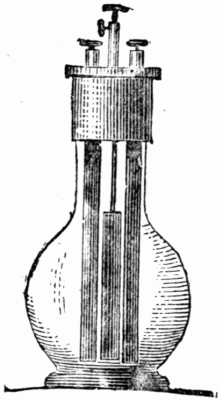
Fig. 13.
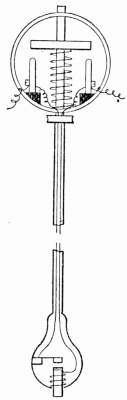
§ 35. The "bottle" form of the bichromate or chromic
acid battery (as illustrated at Fig. 13) is much employed
where powerful currents of short duration are required.
It consists of a globular bottle with a rather long wide
neck, in which are placed two long narrow graphite
plates, electrically connected to each
other and to one of the binding screws
on the top. Between these two plates
is a sliding rod, carrying at its lower
extremity the plate of zinc. This sliding
rod can be lowered and raised, or retained
in any position, by means of
a set screw. The zinc is in metallic
connection with the other binding screw.
This battery (which, owing to the facility
with which the zinc can be removed
from the fluid, is extremely convenient and economical
for short experiments) may be charged with either of
the following fluids:—
First Recipe.
Bichromate Solution.
Bichromate of potash (finely powdered) 3 oz.
Boiling water 1 pint.
Stir with a glass rod, allow to cool, then add, in a fine
stream, with constant stirring,
Strong sulphuric acid (oil of vitriol) 3 fluid oz.
The mixture should be made in a glazed earthern
vessel, and allowed to cool before using.
Second Recipe.
Chromic Acid Solution.
Chromic acid (chromic trioxide) 3 oz.
Water 1 pint.
Stir together till dissolved, then add gradually, with
stirring,
Sulphuric acid 3 oz.
This also must not be used till cold.
In either case the bottle must not be more than three
parts filled with the exciting fluid, to allow plenty of
room for the zinc to be drawn right out of the liquid
when not in use.
§ 36. The effects given by the above battery, though
very powerful, are too transient to be of any service
in continuous bell work. The following modification,
known as the "Fuller" cell, is, however, useful where
powerful currents are required, and, when carefully set
up, may be made to do good service for five or six
months at a stretch. The "Fuller" cell consists in an
outer glass or glazed earthern vessel, in which stands a
porous pot. In the porous pot is placed a large block
of amalgamated zinc, that is cast around a stout
copper rod, which carries the binding screw. This rod
must be carefully protected from the action of the fluid,
by being cased in an indiarubber tube. The amalgamation
of the zinc must be kept up by putting a small
quantity of mercury in the porous cell. The porous
cells must be paraffined to within about half an inch of
the bottom, to prevent too rapid diffusion of the liquids,
and the cells themselves should be chosen rather thick
and close in texture, as otherwise the zinc will be rapidly
corroded. Water alone is used as the exciting fluid in
the porous cell along with the zinc. Speaking of this
form of cell, Mr. Perren-Maycock says:—"The base of
the zinc is more acted on (when bichromate crystals are
used), because the porous cells rest on the crystals;
therefore let it be well paraffined,
as also the top edge. Instead of
paraffining the pot in strips all
round (as many operators do)
paraffin the pot all round, except at
one strip about half an inch wide,
and let this face the carbon plate.
If this be done, the difference in
internal resistance between the cell
with paraffined pot and the same
cell with pot unparaffined will be
little; but if the portion that is
unparaffined be turned away from
the carbon, it will make very nearly
an additional 1 ohm resistance. It
is necessary to have an ounce or so
of mercury in each porous cell, covering the foot of the
zinc; or the zincs may be cast short, but of large diameter,
hollowed out at the top to hold mercury, and
suspended in the porous pot. The zinc is less acted on
then, for when the bichromate solution diffuses into the
porous pot, it obviously does so more at the bottom
than at the top."
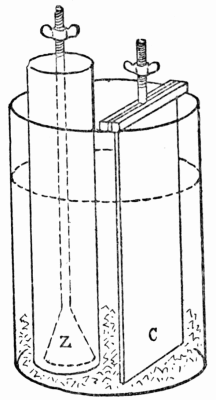
Fig. 14.
Fig. 14 illustrates the form usually given to the
modification of the Fuller cell as used for bell and
signalling work.
§ 37. Before leaving the subject of batteries, there
are certain points in connection therewith that it is
absolutely essential that the practical man should
understand, in order to be able to execute any work
satisfactorily. In the first place, it must be borne in
mind that a cell or battery, when at work, is continually
setting up electric undulations, somewhat in the same
way that an organ pipe, when actuated by a pressure
of air, sets up a continuous sound wave. Whatever
sets up the electric disturbance, whether it be the action
of sulphuric acid on zinc, or caustic potash on iron, etc.,
is called electromotive force, generally abbreviated E.M.F.
Just in the same manner that the organ pipe could give
no sound if the pressure of air were alike inside and
out, so the cell, or battery, cannot possibly give current,
or evidence of electric flow, unless there is some means
provided to allow the tension, or increased atomic motion
set up by the electromotive force, to distribute itself
along some line of conductor or conductors not subjected
to the same pressure or E.M.F. In other words,
the "current" of electricity will always tend to flow
from that body which has the highest tension, towards
the body where the strain or tension is less. In a cell
in which zinc and carbon, zinc and copper, or zinc and
silver are the two elements, with an acid as an
excitant, the zinc during the action of the acid
becomes of higher "potential" than the other element,
and consequently the undulations take place towards
the negative plate (be it carbon, copper, or silver).
But by this very action the negative plate immediately
reaches a point of equal tension, so that no current
is possible. If, however, we now connect the two
plates together by means of any conductor, say
a copper wire, then the strain to which the carbon
plate is subjected finds its exit along the wire and
the zinc plate, which is continually losing its strain
under the influence of the acid, being thus at a lower
potential (electrical level, strain) than the carbon, can
and does actually take in and pass on the electric
vibrations. It is therefore evident that no true "current"
can pass unless the two elements of a battery are
connected up by a conductor. When this connection
is made, the circuit is called a "closed circuit." If, on
the contrary, there is no electrical connection between
the negative and positive plates of a cell or battery,
the circuit is said to be open, or broken. It may be that
the circuit is closed by some means that is not desirable,
that is to say, along some line or at some time when and
where the flow is not wanted; as, for instance, the outside
of a cell may be wet, and one of the wires resting against
it, when of course "leakage" will take place as the
circuit will be closed, though no useful work will be done.
On the other hand, we may actually take advantage of
the practically unlimited amount of the earth's surface,
and of its cheapness as a conductor to make it act as a
portion of the conducting line. It is perfectly true that
the earth is a very poor conductor as compared with
metals. Let us say, for the sake of example, that damp
earth conducts 100,000 times worse than copper. It
will be evident that if a copper wire 1/20 of an inch in
section could convey a given electric current, the same
length of earth having a section of 5,000 inches would
carry the same current equally well, and cost virtually
nothing, beyond the cost of a metal plate, or sack of
coke, presenting a square surface of a little over 70 inches
in the side at each end of the line. This mode of completing
the circuit is known as "the earth plate."
§ 38. The next point to be remembered in connection
with batteries is, that the electromotive force
(E.M.F.) depends on the nature of the elements (zinc
and silver, zinc and carbon, etc.) and the excitants used
in the cell, and has absolutely nothing whatever to do
with their size. This may be likened to difference of
temperature in bodies. Thus, whether we have a block
of ice as large as an iceberg or an inch square, the temperature
will never exceed 32°F. as long as it remains
ice; and whether we cause a pint or a thousand gallons
of water to boil (under ordinary conditions), its temperature
will not exceed 212°F. The only means we
have of increasing the E.M.F., or "tension," or "potential,"
of any given battery, is by connecting up its
constituent cells in series; that is to say, connecting the
carbon or copper plate of the one cell to the zinc of the
next, and so on. By this means we increase the E.M.F.
just in the same degree as we add on cells. The accepted
standard for the measure of electromotive force is
called a VOLT, and 1 volt is practically a trifle less than
the E.M.F. set up by a single Daniell's cell; the exact
amount being 1·079 volt, or 1-1/12 volt very nearly. The
E.M.F. of the Leclanché is very nearly 1·6 volt, or
nearly 1 volt and 2/3. Thus in Fig. 15, which illustrates
3 Leclanché cells set up in series, we should get
| 1·6 | volt |
| 1·6 | " |
| 1·6 | " |
| 4·8 | volts |
as the total electromotive force of the combination.
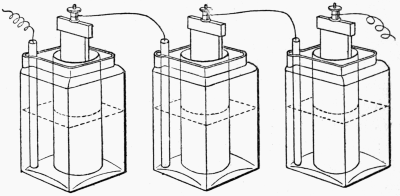
Fig. 15.
§ 39. The current, or amplitude of the continuous
vibrations kept up in the circuit, depends upon two
things: 1st, the electromotive force; 2nd, the resistance
in the circuit. There is a certain amount of resemblance
between the flow of water under pressure and
electricity in this respect. Let us suppose we have a
constant "head" of water at our disposal, and allow it
to flow through a tube presenting 1 inch aperture. We
get a certain definite flow of water, let us say 100
gallons of water per hour. More we do not get, owing
to the resistance opposed by the narrowness of the tube
to a greater flow. If now we double the capacity of the
exit tube, leaving the pressure or "head" of water the
same, we shall double the flow of water. Or we may
arrive at the same result by doubling the "head" or
pressure of water, which will then cause a double quantity
of water to flow out against the same resistance in
the tube, or conductor. Just in the same way, if we
have a given pressure of electric strain, or E.M.F., we
can get a greater or lesser flow or "current" by having
less or more resistance in the circuit. The standard of
flowing current is called an Ampère; and 1 ampère is
that current which, in passing through a solution of
sulphate of copper, will deposit 18·35 grains of copper
per hour. The unit of resistance is known as an Ohm.
The resistance known as 1 ohm is very nearly that of a
column of mercury 1 square millimètre (1/25 of an inch)
in section, and 41¼ inches in height; or 1 foot of No.
41 gauge pure copper wire, 33/10000 of an inch in diameter,
at a temperature of 32° Fahr., or 0° Centigrade.
§ 40. Professor Ohm, who made a special study of
the relative effects of the resistance inserted in the circuit,
the electromotive force, and the current produced,
enunciated the following law, which, after him, has been
called "Ohm's Law." It is that if we divide the number
of electromotive force units (volts) employed by
the number of resistance units (ohms) in the entire circuit,
we get the number of current units (ampères) flowing
through the circuit. This, expressed as an equation
is shown below:
E/R = C or Electromotive force/Resistance = Current.
Or if we like to use the initials of volts, ampères, and
ohms, instead of the general terms, E, R, and C, we
may write V/R = A, or Volts/Ohms = Ampères.
From this it appears that 1 volt will send a current
of 1 ampère through a total resistance of 1 ohm, since
1 divided by 1 equals 1. So also 1 volt can send a
current of 4 ampères through a resistance of ¼ of an
ohm, since 1 divided by ¼ is equal to 4. We can therefore
always double the current by halving the resistance;
or we may obtain the same result by doubling the
E.M.F., allowing the resistance to remain the same.
In performing this with batteries we must bear in mind
that the metals, carbon, and liquids in a battery do
themselves set up resistance. This resistance is known
as "internal resistance," and must always be reckoned
in these calculations. We can halve the internal resistance
by doubling the size of the negative plate, or what
amounts to the same thing by connecting two similar
cells "in parallel;" that is to say, with both their zincs
together, to form a positive plate of double size, and both
carbons or coppers together to form a single negative of
twice the dimensions of that in one cell. Any number
of cells thus coupled together "in parallel" have their
resistances reduced just in proportion as their number
is increased; hence 8 cells, each having a resistance of
1 ohm if coupled together in parallel would have a
joint resistance of ⅛ ohm only. The E.M.F. would
remain the same, since this does not depend on the size
of the plate (see § 38). The arrangement of cells in
parallel is shown at Fig. 16, where three Leclanché cells
are illustrated thus coupled. The following little table
gives an idea of the E.M.F. in volts, and the internal
resistance in ohms, of the cells mostly used in electric
bell work.
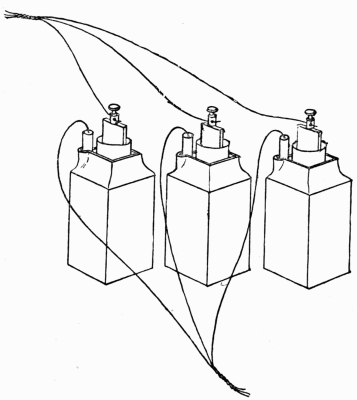
Fig. 16.
TABLE SHOWING E.M.F. AND R. OF BATTERIES.
| Name of Cell. | Capacity of Cell. | Electromotive
force in Volts. | Resistance
in Ohms. |
|---|
| Daniell | 2 quarts | 1·079 | 1 |
| Daniell Gravity | 2 quarts | 1·079 | 10 |
| Leclanché | 1 pint | 1·60 | 1·13 |
| Leclanché | 2 pints | 1·60 | 1·10 |
| Leclanché | 3 pints | 1·60 | 0·87 |
| Agglomerate | 1 pint | 1·55 | 0·70 |
| Agglomerate | 2 pints | 1·55 | 0·60 |
| Agglomerate | 3 pints | 1·55 | 0·50 |
| Fuller | 1 quart | 1·80 | 0·50 |
From this it is evident that if we joined up the two
plates of a Fuller cell with a short wire presenting no
appreciable resistance, we should get a current of (1·80
divided by 0·50) 3·6 ampères along the wire; whereas if a
gravity Daniell were employed the current flowing in
the same wire would only be a little over 1/10 of an
ampère, since 1·079/10 = 0·1079. But every wire, no matter
how short or how thick, presents some resistance; so we
must always take into account both the internal resistance
(that of the battery itself) and the external resistance
(that of the wires, etc., leading to the bells or
indicators) in reckoning for any given current from any
cell or cells.

![[cover image]](images/i_cover.png)