and a Chapter on Narrow Fabrics
Made on Knitting Machines
ByWilliam Davis, M.A.
This book originally appeared serially in TEXTILE WORLD
and has been republished in this form at
the urgent request of many readers.
BRAGDON, LORD & NAGLE CO. TEXTILE PUBLISHERS
334 FOURTH AVENUE NEW YORK
Copyright 1923 Bragdon, Lord & Nagle Co.
New York
Elastic and Non-Elastic Narrow Fabrics — Chapter I. — American Industry Started About 1860 — Attempts to Use Wide Looms — Straight Shuttle and Circular Shuttle Looms — Prevent Loom Vibration — Rack and Pinion Movement — Movement of Harnesses
Growth of Webbing Business—Attempts to Substitute Cut Products for
Individually Woven Webs Made on Gang Looms—Loom Setting
to Reduce Vibration—Capacity of Looms and Explanation
of the Various Motions That Are Employed
When we think of the discovery of rubber vulcanization and the effect
it has had on world affairs our minds naturally turn to the big
things, such as the automobile industry with its millions of rubber
tires in constant use. These may crowd from our notice a thousand and one
smaller things of importance. It is difficult to fully realize how many
comforts and conveniences we derive from rubber and not the least among
them is the multiplicity of woven fabrics which are used both for comfort
and convenience in a variety of ways and for innumerable purposes. It
is not only in such things as garters and suspenders, with which our minds
may first associate elastic webs, that these fabrics are used, but they find
employment in a variety of other products, which are growing more numerous
all the time. Today there are in operation thousands of looms and
braiders, in which many millions of dollars are invested and in the operation
of which, together with complementary machinery, about ten thousand
people are employed.
It was about the year 1840 when the idea of weaving threads of elastic
in connection with other materials was first conceived. After long experiments
this was accomplished in the very simplest form of weaving. New
ideas were from time to time introduced, and new uses found for the product,
until now it covers a large variety of both plain and fancy weaves,
and the multiplicity of uses are so varied that few realize them who are not
closely associated with the business.
It was not until about the year 1860 that elastic web weaving was
introduced into this country, although for a number of years previous
England and Germany, and also France in a small way, had found here
a market for their product, particularly in cords, braids and shoe goring,
which at that particular time was fast growing in popularity. About 1860,
a few looms which had been used, were brought over from England and
located at Easthampton, Mass., and the manufacture of shoe goring commenced.
The rubber thread required was for some time imported from
England. The business grew rapidly, and factories were established in a
number of cities, more particularly at Boston, Lowell and Brockton, Mass.,
Bridgeport, Conn., and Camden, N. J. An unfortunate labor dispute took
place about the year 1890, which developed into a long-drawn out strike,
ultimately precipitating friction between the shoe trade and the goring
web manufacturers, which finally ended in a positive boycott of this product
from which the trade has never recovered. Most of the looms which
were up to this time devoted to shoe goring have been remodeled and are
now used in the making of other types of elastic fabrics. In passing, it
may be interesting to note that some of the looms originally brought from
England 60 years ago are still in operation and doing excellent work along
other lines.
Attempts have been made from time to time to weave elastics on wide
looms, the cloth being divided at intervals by open spaces in the warps
at the front reed, at either side of which spaces binding threads were woven
in. These narrow strips were spaced in the front reed according to the
different widths which might be required, and could easily be changed to
meet the varying requirements by redrawing a few threads, inasmuch as
the whole weave was uniform throughout the full width of the cloth.
Between these spaces, but at a point away from the weaving line, were
arranged stationary knives by which the cloth was cut into the requisite
widths while it was being woven, and as it gradually passed by the knife
edges. These knives were so arranged that they could be adjusted to new
positions when it became necessary to change the widths of the individual
strips.
While this method was more economical than weaving individual webs
in gang looms, the labor cost being much less, the narrow webs produced
having the cut selvages lacked the finished appearance which the individually
woven webs had. And sometimes the binding threads would give way, so
that the fabrics were not well received by the trade, and ultimately the
demand for them died out.
Attempts were made to supersede the individually woven strips in
another direction by the use of two finely woven pieces of cloth, one to
form the back, and the other to form the face of the goods, with an elastic
substance mechanically stretched out and inserted between the two. These
different parts were calendered together and afterward cut into strips of
the desired widths. This method was not without many advantages. Strips
of different widths were easily made without the costly method of redrawing
the warps in the looms. An unlimited choice of both plain and fancy
fabrics could be used, having if desired distinctly different appearances
and constructions for face and back, and this alone opened up a wide range
of possibilities. The finished cloth lent itself admirably to fancy embossing
and printing and to various other forms of elaboration. But somehow
the trade did not take to it, and this also finally died out.
The trade ultimately settled down to the weaving of elastic goods of
all kinds, both plains and fancies, in gang looms, and the business has
steadily grown ever since along these lines.
The looms employed are very varied, inasmuch as the requirements
cover a wide range and new uses are constantly arising with new demands.
The simplest form of weaving is that employed on the making of webs
such as are mostly used for garters, and which are also used for many
other simple purposes in nearly every household. These webs are commonly
known as loom webs, lisles and cables. They are generally made
on plain, narrow, cam looms, some of which are capable of accommodating
as many as 56 pieces or strips at one time.
There are two distinct types of loom employed, one of which is known
as the straight shuttle and the other the circular shuttle loom. In the
former type, the straight shuttle, in traveling across the different spaces,
takes up more room than the circular shuttle, and thus somewhat curtails
the number of pieces which can be operated in the loom, limiting capacity
of production, and relatively increasing the cost. Very few of the straight
shuttle looms accommodate more than 36 shuttles, according to the width
of the goods required. The circular shuttles travel over a segment of a
circle and cross over each other’s tracks in their movement through the
shed, as shown in Fig. 1. This permits the crowding of the pieces of web
closer together, so that many more can be accommodated in the same loom
space than when the straight shuttle is used. This type sometimes runs
as high as 56 shuttles to the loom.
Fig. 1.—Circular Shuttle Webbing Loom
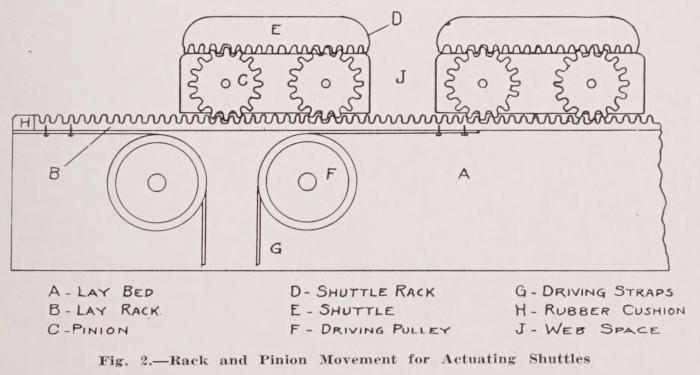
Fig. 2.—Rack and Pinion Movement for Actuating Shuttles
These looms often are speeded as high as 180 picks per minute. To
operate at this speed with so many pieces of web and make satisfactory
goods, free from thick and thin places through irregularities of speed or
variable momentum in running, a very heavy type of loom is necessary.
They should be erected on solid foundations so as to eliminate all possible
vibration. A solid concrete floor into which timbers have been properly
set so that the feet of the looms may be securely anchored into them is the
ideal way, but where this is not practicable at least heavy foundation timbers
for anchoring the loom feet to should be arranged. The frames of
the looms should be heavy; also the main driving shaft, which should have
wide bearings so as to prolong the life of the shaft at the wearing points
and obviate loose play in the boxes.
The crankshafts must also be very heavy and there should be enough
of them so as to rigidly withstand the repeated beat of the lay without
liability to take on any loose motion, which would be fatal to the production
of perfect goods. Weight and strength here is very essential, inasmuch
as it is not practical to get a direct line from the shaft to the lay
on account of the harness movement, and they must be built to drop below
the harnesses which form makes them subject to heavy strain at the beat
of the lay. They should also be made adjustable, each arm having a heavy
left and right threaded insert, so that the length of the weaving line may
be changed to meet the varying requirements of different webs. They
should also be constructed so that any wear may be taken up.
The lay itself must necessarily be very heavy. It is generally constructed
of several thicknesses of timber of different kinds, so as to avoid
any possibility of warping and shrinkage. The shuttles used are mostly
made of applewood. While they must run smooth and be free from the risk
of slivers they must at the same time be very light so as to be freely drawn
across the multiple of web spaces. It will be easily seen that the drawing
of so many shuttles over a space of about three times their length, at
possibly 180 picks per minute, carrying and delivering the necessary weft
to the webs, each thread of weft being checked to a certain extent by
friction springs, requires great care and thought in construction. Shuttle
wood must be thoroughly seasoned by age or it will not serve the purpose.
The shuttles themselves are very ingeniously constructed so as to
accommodate the greatest possible amount of filling, together with the
necessary space for springs to properly manipulate the tensions. Each
shuttle is bored through at either side so as to allow for the insertion of
a fine recoil spring, which is made fast at one end of the drilled hole at
the back of the shuttle. To the other end of the spring is attached a small
porcelain eye, through which is threaded the weft, making it possible to
govern and take up by the action of the spring the loose filling which is
thrown off as the shuttle passes and repasses through the shed. These side
recoil springs are not only useful for the taking up of the loose filling
but allow for a variety of threading up methods, so as to assist in the
governing of the tension of the weft at one or both sides of the web,
and thus afford a means of weaving the goods level. They aid in correcting
any tendency to long and short sided goods, of which we will say more
later.
At the back of the quill or shuttle spool is arranged another spring
on which is swivelled a porcelain device which presses against the quill,
and can be so regulated as to govern the tension. This spring is so
tempered that the most delicate adjustment of tension can be made.
The shuttles across the entire width of the loom are drawn to and fro by
what is known as the rack and pinion movement. (See Fig. 2). This method
has pretty generally superseded the old-time plan of rise and fall pegs. The
rack runs back and forth in a slot grooved in the top of the lay bed, A, the
entire length of the loom. To the rack is attached leather straps G, or heavily
woven fabric straps, with which the rack B is pulled to and fro at each pick
of the loom. The rack is of wood, having rounded teeth-paced approximately
one-third of an inch apart. Into the rack are meshed pinions C, two to carry
each shuttle E, the teeth of which are correspondingly spaced. The rack is set
into a wood carrier which is about one inch deep and one inch wide, and
the full length of the lay. The pinions are made of either raw hide or
paper fibre, and these pinions again mesh into a series of racks D, grooved
in on the under side of each shuttle, and thus drive the shuttle to and fro
across the web spaces J.
The constant travel of the driving rack running in the groove at the
top of the lay bed necessarily produces more or less wear at the bottom of
the rack. It therefore is advisable to place underneath this rack a false
bottom of wood of about ¼-inch thick, which after becoming worn by
constant use and contact with the ever-moving rack may be easily taken
out and replaced by a new one, thus keeping the rack and pinions and
shuttles at all times in proper mesh with each other.
The rack is drawn backwards and forwards by the before-mentioned
straps, which are passed over pulleys and are either fastened to the rack by
means of wood screws, or securely locked with a metal clamp designed for
this purpose. These straps are sometimes separated by a pair of cams set
on a shaft making one revolution to each two picks of the loom. The
power from these cams is first communicated to eccentrically-shaped wood
pulleys, moving backwards and forwards, which are so formed as to start
and stop the shuttles slowly, and to operate them at a higher rate of speed
during their passage through the middle of the shed. This movement is
necessary to avoid a too early entrance of the shuttle into the weaving
shed before the harness is properly settled, and also to soften the hammering
at the close of its travel so as to reduce the wear and tear.
It might be well to note here also that this hammering is also softened
by the placing of a piece of soft rubber H at each end of the rack run,
so that the rack strikes this soft cushion each time it goes home. While the
cam method has been extensively used to produce the kind of movement
most desirable for the travel of the shuttle, it has its drawback in the
momentum produced, which it is often found difficult to control.
The Crompton & Knowles Loom Works have designed a shuttle motion
which effectively governs the desired speeds in the travel of the shuttles
while they are entering, passing through, and leaving the shed, by a dwelling
movement operated by a series of gear wheels and oscillating slotted
rocker. It is absolutely positive in action and does away with the uncontrollable
and erratic movement so often met with in the cam drive.
Four-pick cams are all that are necessary to produce the plain webs
which are used for ordinary purposes. However, it is not the practice to
confine looms to the limitations of this capacity, but to put in either 8 or
12-pick cams. These, besides providing means to make the plain weave,
open up possibilities for a number of other weaves and combinations of
weaves, which add materially to the usefulness of the loom.
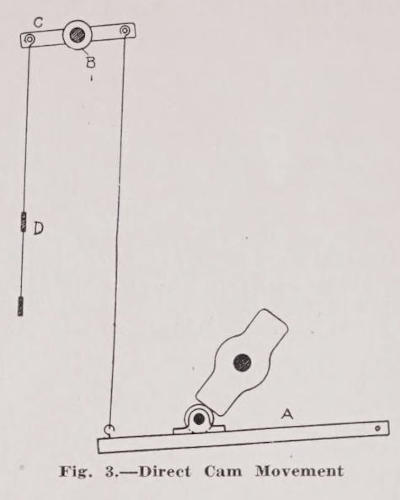
Fig. 3.—Direct Cam Movement
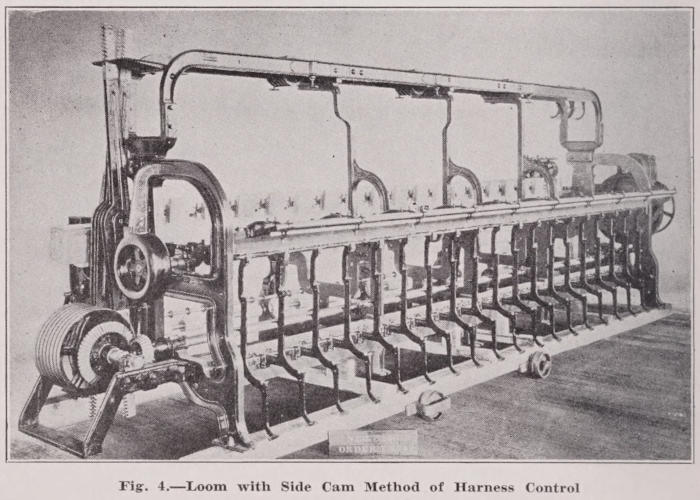
Fig. 4.—Loom with Side Cam Method of Harness Control
There are two distinct types of cam movements used in looms of this
character for the making of ordinary webs. One is known as the direct
cam drive, where the cams are fitted on a 4 to 1 shaft, as shown in Fig. 3,
which runs lengthwise of the loom and from which the power is communicated
to the harnesses through a series of levers A, rocking poles B, levers
C, and lifting wires to the harness D.
The other movement is known as the end-cam method, where a small
shaft is set at the end of the loom, running at right angles to the driving
shaft (See Fig. 4) from which it is driven by bevel gears. On this short
shaft are set the cams, usually 8 or 12 in number, which have a series of
grooves at their center so as to afford means of timing them in different
positions on a feather key which runs the full length of the shaft. These
cams operate what is known as the cam jacks, which may also be seen in
Fig. 4.
The jacks are hung at the middle and are moved backwards and forwards
by the cams, communicating movement to the various harnesses.
The harnesses are connected at both the top and bottom of the jacks.
This connection at both ends of the jacks makes it possible to run the looms
at a very high rate of speed, as there are no weights or springs to contend
with, which limits speed.
While the first described method of direct cams has some advantages
over the end cams, such looms are not nearly so economical to operate as
the end cams on account of the limited speed attainable. While the harnesses
are lifted by means of the cams they have to be pulled down by
weights or springs. The means of shed adjustment, however, enables the
attaining of a well graded shed. Furthermore, the cams themselves can
be so set on the shaft as to afford means of timing the movements of the
different harnesses so that excellent and easy shedding results may be
obtained. But the one great disadvantage is the limitation of the weaves
attainable, which limitation is largely overcome by the end-cam method.
When the direct cam movement is used, and where the goods being
woven are of such a character as to demand a very slow speed of the loom,
it is practicable to bring the harnesses down by weighting them with wide
flat weights of the requisite size. But where higher speed is required than
is advisable for weighted harnesses, springs are more desirable.
The simplest form of pulling do the harnesses is by the use of floor
blocks and direct springs. There is, however, a disadvantage in using the
direct spring on account of the pull increasing until the extreme lift of the
harness is reached, which necessarily increases materially the power expended
in operating same and makes an unnecessary strain. The better way
is to use what is known as spring jacks, which have an easier pull than the
direct spring inasmuch as the load eases off on the pull, diminishing from
the greatest pull at the start to the lightest pull at the extreme lift on the
lever, so that the load is uniformly distributed all through the movement
and less power is employed.
Chapter II. — Install Looms for Wide Range — Take-Up Motion — Tension on Rubber Warp — Let-Off Motion — Making Rubber Warps — Friction Let-Off
Looms Should Be Adapted to Make a Wide Variety of Goods—Take-Up
and Let-Off Motions—Making the Rubber Warps for Different
Classes of Web—Importance of Uniform Tension—Defects
from Uneven Tension and Chafing of Threads
The greatest care is necessary in planning out the details of the harness.
On account of the great length it becomes necessary that everything
possible be done to avoid any chance of warping or sagging,
for the least irregularity which may be developed will of course interfere
with the evenness of the shed. The harness frames must be made of the
very best stock obtainable, thoroughly seasoned, and absolutely straight
grained. Each frame must be supported at regular and frequent intervals
by stays or supports mortised in the runners. These stays are slotted at top
and bottom to receive the heddle bars and keep them accurately in line,
and thus prevent them from catching on the neighboring harness during
the operation of the shedding process.
It is necessary also that the top and bottom heddle bars be accurately
spaced so as to allow proper freedom for the heddles to ride easily on the
bars, and thus avoid any binding of heddles which would have a tendency
to crowd the warp stock together and prevent clearance of the shed. Steel
heddles are preferable to ones that bend and twist more or less and get
out of alignment. They are made from tempered steel which is very flexible
and they have round cornerless eyes that cannot possibly catch or chafe
the warp threads. They adjust themselves automatically to the frame and
cannot twist or bend while at work, and are made to accommodate themselves
to every conceivable kind of goods.
In installing looms for narrow elastic fabrics it is advisable to make
ample provision for creeling the warps necessary for the different fabrics
which may from time to time be required. In the manufacture of the
light single cloth garter webs, not more than two warps to the piece are
required, a face warp and a gut warp, and the temptation to save a little
in the initial cost possibly may suggest a limitation of creel spaces to
immediate requirements. Added expense may seem for the time being an
unnecessary burden. But very soon there may arise a call for other goods
which cannot be made within the limitations of the two bank creel; therefore
changes become necessary which are generally much heavier than first
cost would have been.
Nothing less than a five bank creel should be installed. Many times
the availability of six banks has solved knotty problems of warp division
to care for the various weaves and materials employed in some constructions.
If the entire capacity of the larger creel is not required when first
starting it will not be necessary to clothe all of it with levers, buttons, etc.,
which may be procured later. But by all means ample provision should be
made for the full frame work and supporting rods for same.
Another important consideration is to make proper provision for a
reliable take-up motion, so that the goods may be taken away from the reed
while weaving without any liability to variableness. This liability was
present in many of the earlier looms and exists in some of the mills
today. The old-time fine ratchet gear, even when provided with a number
of pawls, is always liable to erratic picking, which alone will ruin an
otherwise perfect piece of goods and materially change the cost of manufacturing.
A slight irregularity of picking may not be discernible in non-elastic
goods, which will be satisfactory so long as the variableness is not
easily seen and a reasonable average of picks per inch is maintained. But
in elastic goods, where the contraction takes place after they leave the
press rolls, every irregularity is revealed and intensified so there is no
room to take chances. The only safe way is to employ picking gears
making one tooth to each pick of the loom, and then to change the gears
when different picking becomes necessary.
In many of the existing looms there has been no adequate provision
made for the weaver to let the web back to the reed mechanically when a
joining becomes necessary through the breaking of the filling while weaving,
or where a quill may have run off unnoticed. It is almost impossible to
make a joining satisfactorily without proper mechanism being provided for
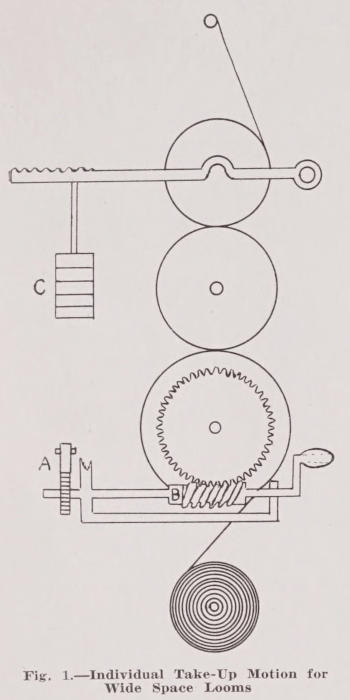
this purpose. In some of the slow running looms provision is made for
this by the operation of each set of rolls independently (see Fig. 1), by
means of the ratchet gear and pawl A and worm motion B. This plan
has the one disadvantage of taking up too much space between the individual
pieces. Where the fabric woven is say four or five inches wide, and
the space will admit, it is all that can be desired, and the individually
weighted rollers C associated with the motion are admirably adapted to
variable pressure.
For the very narrow elastic fabrics, which require considerable roller
pressure to hold the web snug and firm while weaving, and where it is
necessary to make very accurate joinings after a break has occurred, a better
movement is one in which the web roll is placed on the main take-up shaft
in the form of a sleeve. It is carried around by the shaft as it turns while
the goods are being woven, but can be released and turned both backwards
and forwards by a conveniently placed hand wheel, which operates a series
of differential gears. This movement is entirely independent of the movement
of the main take-up shaft drive.
Too much importance cannot be attached to properly controlling the
tension of the rubber warp. On its uniformity depends not only the
quality, but also the cost of the web. The greater the weight of slack
rubber woven into the web the more costly it becomes and the poorer the
quality. A very accurate sense of touch is required in testing the tension
of the rubber threads as they are being delivered into the goods.
The rubber warp requires the highest possible tension before breaking
or chafing of the thread takes place. Each rubber thread should be under
this high tension so that when the goods come through the press roll the
desired contraction will take place uniformly, and a flat piece of web will
be produced that will have plenty of life.
It must always be remembered that the individual threads of rubber
which constitute a rubber warp will act as a series of small springs, working
in unison with each other. Each one should have equal power to contract
the fabric at its own particular part. If any one of these strands
or springs is chafed and weakened, it lessens the contracting power, and
the result is that the weakened or less contracted part is of relatively
greater length than the parts where the rubber threads have retained their
full power.
Moreover, the appearance of the goods will be spoiled by the chafed
particles of rubber pricking through the face, particularly on the white
and lighter colored goods. Before such webs can be marketed they must be
subjected to a buffing operation to remove these dirty particles, which is
accomplished by passing them over a highly speeded, cloth covered roller,
which will remove the loose particles by friction and high velocity. But
this operation adds to the cost.
A high and uniform tension of the rubber warp is so important that
most manufacturers keep men specially employed in the testing of the
threads, instead of leaving this matter to the weavers. These testers acquire
such a keen sense of touch that they can obtain very economical and satisfactory
results. Talc or soapstone is freely used as a lubricant to reduce
the risk of chafing and breaking of the rubber threads. The warps are
arranged so as to allow the threads to pass through a bed of plush, loaded
with talc, which adheres to the rubber threads and makes them work very
smoothly. This is especially important in damp weather, which is the
worst condition for the weaving of elastic goods. At times factories have
stopped operations when the weather was especially humid.
Fig. 1.—Individual Take-Up Motion for Wide Space Looms
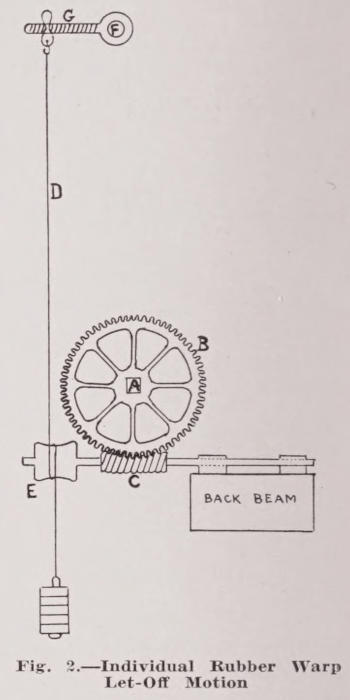
Fig. 2.—Individual Rubber Warp Let-Off Motion
When we remember that the front reed will pass by the rubber threads
possibly six or seven hundred times from their entrance into the shed to
their reaching the leaving line, it is not to be wondered at that chafing is
liable to take place. With all this liability of spoiling goods it becomes
readily apparent that any device employed to regulate such an important
feature as the tension of the rubber warps must be very sensitive and
dependable.
On looms making wide goods, and where space will allow, regulation is
accomplished by a worm and gear movement as shown in Fig. 2. The
iron rubber beam is threaded on to a square shaft A, at one end of which
a gear wheel B is fastened. In this gear is meshed the worm C, which is
operated by a heavy linen cord D passed twice around a pulley E. The
cord derives its movement from a rocking shaft F, on which there is fastened
a screw extension G, by which adjustment can be made so as to
deliver very accurately any amount from the rubber beam.
With this kind of movement, and in order to feed the thread uniformly
into the web, it becomes necessary to use mechanically made warps where
the same uniformity has been maintained in putting the warps on the beams.
The warps so made must come from the thread manufacturer in individual
warps, which are done up in chain form, each warp containing the requisite
number of threads.
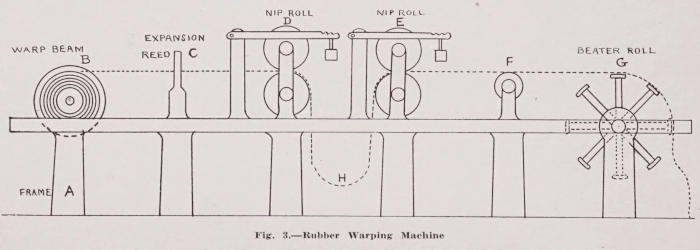
The machine used for making the warps, shown at Fig. 3, is mounted
on an iron frame A, which carries the power driven warp beam B. Behind
this is an open top expansion reed C, the dents of which are regulated to
open, coarse or fine by an internal spring which is regulated by a hand
wheel. This reed also has a screw sidewise adjustment for centering.
Behind the reed C are fixed two pairs of nip rolls, D and E, and an open
roller F, which is followed by a belt-driven beater roll G, used to beat the
threads out straight as they leave the chain.
The rubber warp is first laid on a cloth on the floor, under the beater
roll. The end is then passed over the beater roll G, over the open roll F,
through the two pairs of nip rolls D and E, over the expansion reed C, and
then looped to a leader on the rubber beam, where the knot is put in a
counter-sink on the beam barrel, so as not to interfere with the lay of the
warp. The section of the warp between the two pairs of nip rolls is
brought down in loop form, shown at H, and the nip rolls are then closed
while the warp is in this position. The two sets of nip rolls are speeded
alike and the rubber is always kept slack between the gripping points, so
that all threads passing through the last set of nip rolls, D, are perfectly
gauged in length and tension when passing through the reed C and on to
the beam B. The threads of rubber are under considerable tension, inasmuch
as the beam B is driven faster than the nip rolls D and E.
Where there is limited loom space, and where a small number of
threads are employed, as in the narrower garter fabrics, it is not as practical
to have the warps made mechanically, and for this reason they are not
likely to be put on the beams with as much uniformity of tension. In
such cases it becomes necessary to have some automatic device that will
correct any irregularities and maintain a uniform delivery throughout.
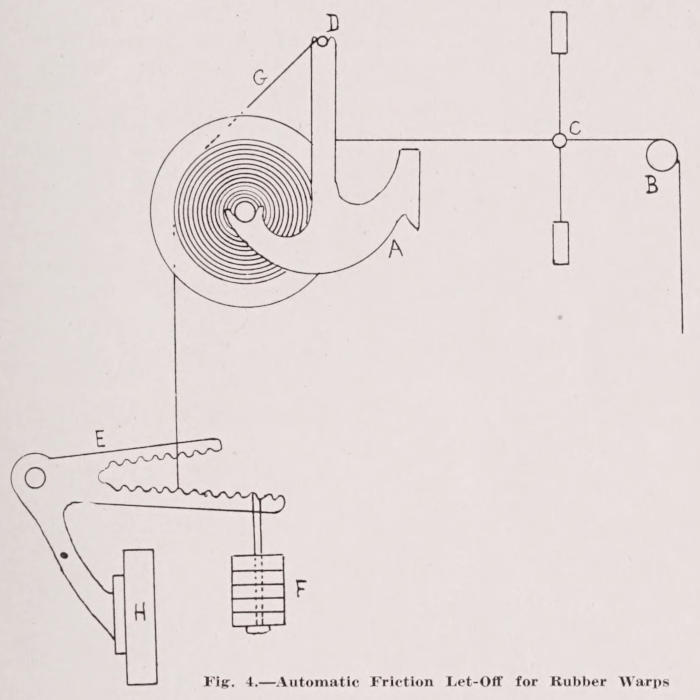
The device for doing this is shown at Fig. 4.
The warp carrier A is fastened to the back rail, which carries the
warp, over which is passed the friction cloth G which is hung from a rod
D. The friction cloth is fastened at the bottom to the graduated warp
lever E, which is bolted to the bottom rail H, as shown. The rubber
threads constituting the warp pass in a direct line to the harness C, and
then to the breast beam B. The lever E, and the weights F, allow for
proper adjustment of the friction cloth so as to keep the lever level as
the warp beam empties.
Fig. 3.—Rubber Warping Machine
In making the rubber warps for narrow fabrics such as garters and
suspenders, where the last described method of warp delivery takes place,
it is customary to work from an entire sheet of rubber, splitting it up
into the required sections or strips of the various sizes called for in the
warps. This splitting and warping process must be done in a long room
where the warp can be stretched out to its full length, if possible, after
it is unchained. These warps are usually about 60 yards long. The “head”
of the sheet, or the part where the cutting knife has not gone through, is
spread out flat on a series of hooks at the beaming machine and the tail
end is fixed securely on a strong hook at the other end of the room.
The requisite number of threads for the several warps which are to
be beamed are counted off and each different section is fastened to a beam.
The end knot is laid snugly in the counter-sink made in the beam barrel
for this purpose. A wide reed is used, covering the number of beams
operated in the machine, which is usually about four, and the threads are
reeded over spaces opposite the different beams. This reed can be moved
sidewise across the face of the beams and each warp properly centered so
as to keep the warp level. The operator then starts the beaming machine,
which may be operated either by hand or power, and the warps are wound
up. At the same time a helper walks towards the beamer carrying the
tail end of the warps and keeping the tension as nearly uniform as possible.
When the warps are all wound on the several beams, a lease is taken in
each of them in the ordinary manner, and each separate section is securely
fastened.
Fig. 4.—Automatic Friction Let-Off for Rubber Warps
Should floor space be limited, a horizontal reel is used, which is about
six feet long and about five feet in diameter. On this the sheet of rubber
is wound after being split in proper sections at the head end and divided
by a coarse reed, so as to be able to distribute the different sections all
across the reel. Each section can then be taken off the reel as required
for the beams. The tension of the threads is governed by a weighted leather
strap passed over the face of the reel.
Chapter III. — The Shedding Operation — The Overhead Dobby — Overshot Dobby — Importance of Dobby Harness — Construction of Simple Webs — Making a Good Selvage — The Lisle Web — French Web or Railroad Weave — Cable Web
Head Motion Looms and Dobbies for Making Fancy Effects—Tying Up
Harness—Construction of Loom Webs, Lisle Webs, French Web
or Railroad Weave and Cable Webs—Making Good
Selvages and Preventing Long-Sided Effect
So far we have mentioned only plain looms, or those limited to the
capacity of eight or twelve pick cams. Before we consider any of the
varied constructions relating to elastic webs it will be well to speak of
fancy looms. There are different types, adapted to a wide range of fancy
effects, but the fancy loom most generally used is what is known as the
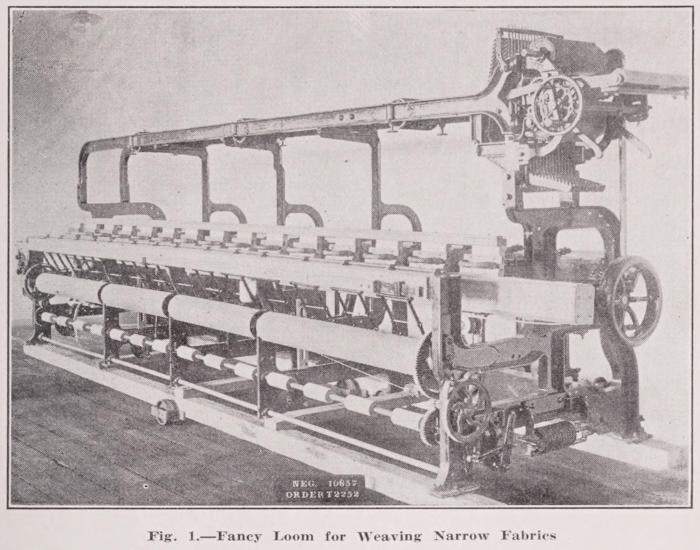
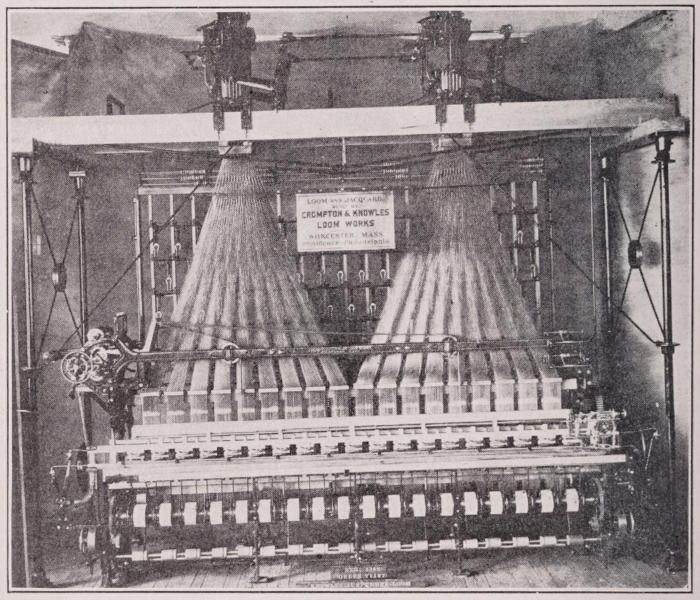
chain head, an example of which is shown at Fig. 1. Such looms are
usually of 18 and 24 harness capacity, and are operated by a figure chain
of the length required to produce the desired figure. Chains are made up
of a series of bars, one bar operating with each pick of the loom and
having on it space for a roller or sinker for each harness to be operated.
Wherever a roller is placed on the bar, the corresponding harness will
be raised, and wherever a sinker is used, the corresponding harness will be
dropped. A series of rollers following each other will hold the harness up,
and likewise a series of sinkers following each other will keep the harness
down, thus maintaining at all times an open shed.
The shedding operation is very simple. In the fancy head there are
two cylinders, each of which has gear teeth running the entire length.
These cylinders operate continuously in opposite directions. The teeth of
the cylinders do not go around the entire circumference as will be noticed
on the upper cylinder shown in Fig. 1, but there is a blank space provided
so as to allow for the engaging of the gear wheels brought into position at
the right time as the cylinders revolve.
Between the two cylinders are vibrator gears, one for each harness, and
to these gears are attached arms which are connected with the different
harnesses. These vibrator gears can be thrown into position by the chain
rollers or sinkers, so as to come in contact with the teeth of either the upper
or lower cylinder, and are so timed that they take their position at the
moment when the blank part of the cylinder presents itself. A vibrator
gear engaging the upper cylinder is turned so as to lift the harness connected
with it, while a vibrator gear engaging the lower cylinder drops that
particular harness. The harnesses stay in their relative positions until the
chain calls for another change.
Both cylinders and engaging gears are made of hard chilled steel, so
that wear and tear by hammering at the time of engagement are reduced to
a minimum. To further soften the engagement, the speed of the cylinder
is controlled by elliptical driving gears, which reduce the speed of travel
just at the moment when the engagement takes place.
The timing of the various movements of the head is so well controlled
that there is little risk of any part failing to maintain proper relationship
with the other parts. But in the event of any accident or breakage occurring
which interferes with the free motion of the head, such strain is taken care
of by a soft pointed set screw on the head driving shaft, which shears off
and so prevents further serious damage.
The capacity of the head is such that by careful arrangement of figures
and repeats it is quite possible to make several simple designs to run side
by side in the same harnesses and this is often done. Of this we may
write more later.
Fig. 1.—Fancy Loom for Weaving Narrow Fabrics
Fig. 2.—Double Index Dobby
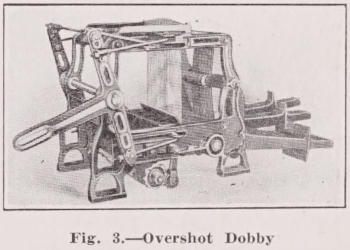
Fig. 3.—Overshot Dobby
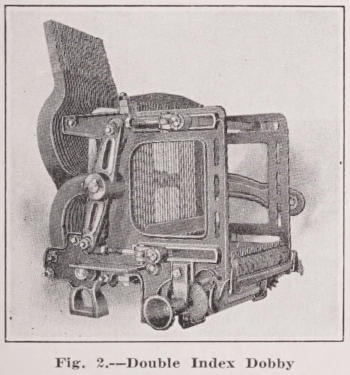
A popular machine for light fancy warp figures is the overhead dobby
shown at Fig. 2, which may be used as auxiliary either to the plain cam
loom or the fancy head loom. It is placed on a well braced, rigid frame and
built as high as convenient so as to reduce the angle of the harness strings.
It is driven directly from a two to one shaft, which may be either underneath
the loom or at the end, and is connected with a threaded adjustable
rod, which is attached to a slotted lever and can be adjusted to govern the
depth of the dobby shed.
It is customary to put two of these dobby machines over each loom, but
having only one main drive the two machines are coupled together and
work in unison. Such an arrangement has the double advantage of a less
acute angle at the harness tie-up, and also affords facilities for a distinctly
different pattern on either half of the loom. It minimizes the risk of the
harness threads cutting into the compart boards, and prolongs relatively the
life of the dobby harness. Furthermore it allows for a straight tie-up on
either machine so that there is no limitation to the length or character of
the design, as is often the case where two patterns are run together on the
same machine, or where point tie-ups are used, as would very likely be
necessary if only one machine was installed to cover different designs on
both halves of the loom. As we have previously stated it is not advisable
to limit capacity for the saving of a few dollars in the initial cost.
Another type of loom employed in the making of fancy goods is what
is known as the overshot loom. It is used for the introduction of a silk
weft figure effect, and is probably the most pronounced form of elaboration
introduced. It differs from the old rise and fall method in the economy of
operation. The overshot continues to weave the body of the goods right
along while the auxiliary shuttle is putting the silk figure in at the same
time. Not only is it economical in the respect of greater yardage, but the
method employed in binding the figure limits the use of silk to the actual
figure displayed, and does not carry the silk, which is the most expensive
material in the fabric, to the extreme selvage at every pick, as is the case
where the rise and fall method is employed.
In the overshot system a specially designed dobby, shown at Fig. 3, is
used for operating the lightly weighted threads of the binder warps. Two
pairs of knives are employed, one of each pair operating far enough to
raise the threads used in the binder warp to the level of the top main shed,
while the other one of each pair carries the threads which are used for
figure purposes to a higher level, so that the overshot shuttle may pass
under them. This occurs every alternate pick of the loom, the body shuttle
making two picks while the upper or overshot shuttle makes only one.
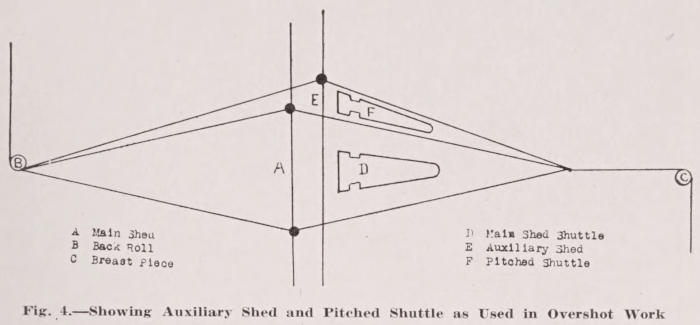
In levelling the harness, setting or timing of the loom, and making the
shed for overshot work, the plans followed are identically the same as in
ordinary single shuttle work, as the upper shuttle and upper shed are
distinctly auxiliary and subordinate to the main shed. The binder warp,
being necessarily but lightly weighted in its relationship to the upper and
lower cloths it is binding together, allows for the figure threads to be
strained out of their normal position, so that the upper shuttle may pass
under them. In order to conform to this strained position of the binder
figure threads, the upper shuttle must be acutely pitched downward at the
nose so as to get a good clearance, and thus avoid any binding in its
passages through the shed. This peculiar downward pitch of the shuttle
is very important and cannot be over emphasized. It is shown in Fig. 4.
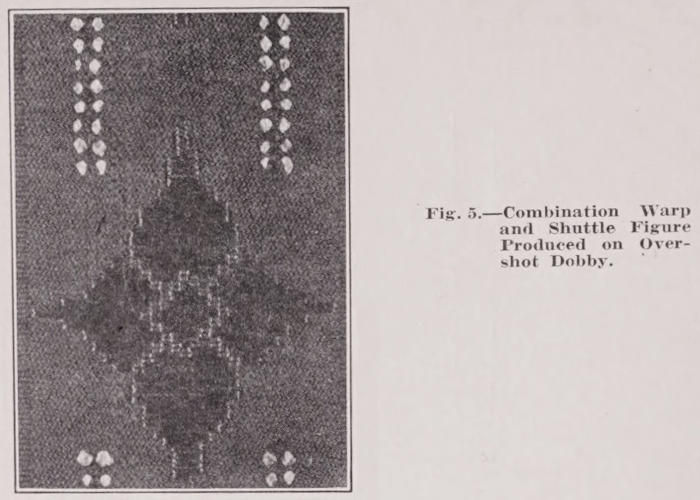
The overshot dobby is so constructed that a different set of draw
knives operate on each alternate pick of the loom, one on the binder lift
and the other on the rubber lift. This not only allows for a silk figure
made with the shuttle but affords facilities for the introduction of a warp
figure also, a combination which can often be made very effective, as shown
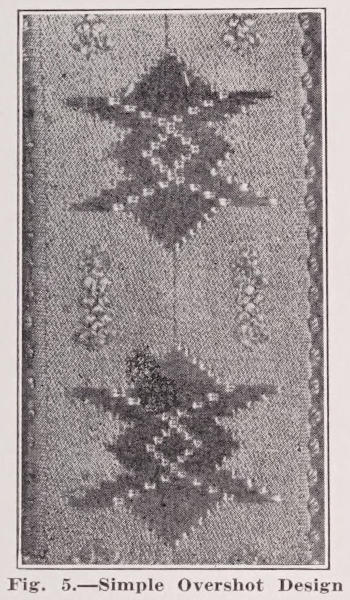
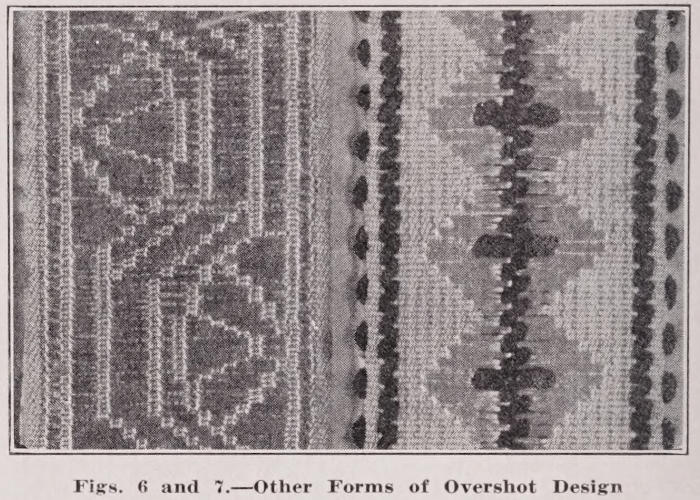
in Fig. 5.
Fig. 4.—Showing Auxiliary Shed and Pitched Shuttle as Used
in Overshot Work
Too much importance cannot be attached to the rigging of the dobby
harness. A 30/9 ply linen cord is desirable and a lingo of about 16 to the
pound. After deciding on the character of the tie-up required, and when
the harness has been threaded in the compart boards, the lingoes should be
looped on the strings, and then left to stand and settle for a couple of days
before leveling. It is better still to run the dobby machine for a few hours,
lifting all the harness and then dropping them, so as to settle the strings
and take out any kinks or loose places which are bound to exist in a highly
cabled linen cord of this character.
The labor required in the tying up and leveling of a string harness
suggests the advisability of great care in determining the tie-up to be used,
so that changes of pattern can be made easily without involving changes in
the tie-up. In order to prolong the life of the harness, in the adjustment
of which so much time and care must necessarily be spent, it is advisable to
apply a dressing of boiled linseed oil, which should be thoroughly worked
into the strings by running the harness for several hours, using one and
one change cards. This should be followed by a dusting of talc or soapstone,
which will add much to the smoothness of the finish.
To reduce the friction of the strings which operate in the several outside
compart boards, where the strain and wear are particularly acute, and
also to prevent the strings from cutting into the boards themselves, it is
good practice to fix strips of ground glass between the different rows of
strings, just above the compart boards. These strips of glass may be
threaded through drilled holes in the compart board frame.
Before enlarging further on details of fancy looms, it will be well to
retrace our steps and consider the construction of some of the simpler
forms of web, such as are made on what we have described as plain looms.
The webs best known, perhaps, are those such as are used for men’s
ordinary garter wear, and for cutting up to retail in the regular dry goods
and notions trade. They vary from one-quarter to 2 inches in width. There
are several distinct classes of these goods, the best known of which are the
loom webs, the lisles and the cables, all of which are of single cloth construction,
in which the filling is the main feature. There are generally two
cotton warps used in such goods, one of which is commonly called the binder
and weaves two up and two down, while the other is called the gut or filler,
and works with the rubber warp, one up and one down. The selvages of
these webs are made with the filling, which passes around a wire at each
pick, the wire remaining stationary while the web is taken away from it in
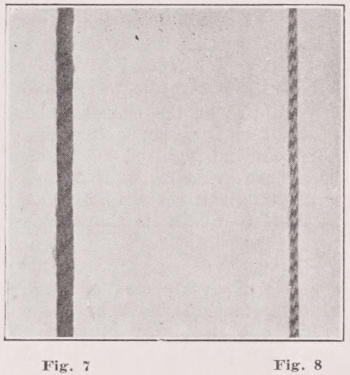
the process of weaving. An illustration of a loom web of this character is
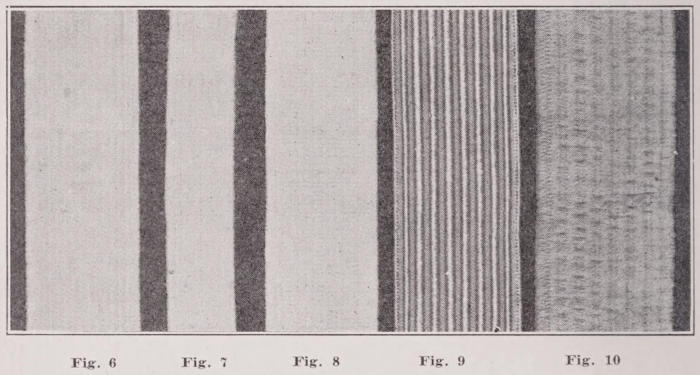
shown at Fig. 6. The draft and cam arrangement are shown at Fig. 6A.
Fig. 5.—Combination Warp and Shuttle Figure Produced on Overshot
Dobby.
Fig. 6 Fig. 7Fig. 8Fig. 9Fig. 10
It is customary in some factories to use only one harness to carry both
rubber and gut, inasmuch as the weaving of the two are the same and they
both go in the same cavity or pocket of the web. Where such a method is
employed there is always a tendency for the gut threads to get out of their
proper places, and to fall together in pairs at irregular points, which will
produce an objectionable “rowey” appearance in the goods. This will be
noticed more particularly in white and light colored webs.
Fig. 6A.—Harness Draft and Weave for Three-Quarter Inch Loom Web
Fig. 7A.—Harness Draft and Weave for One-Half Inch Lisle Web
Fig. 8A.—Harness Draft and Weave for Three-Quarter Inch French Web
Fig. 9A.—Harness Draft and Weave for Three-Quarter Inch Cable Web
In the harness draft shown, it will be seen that one harness is employed
for the rubber and one for the gut. It is thus possible to shed the gut
harness so as to open more than the rubber, having it travel both higher and
lower than the rubber harness at each alternate pick of the loom. By this
movement the gut threads will be kept in the desired position, and at the
same relative side of the rubber threads in each of the several pockets designed
to carry them both. If, from any unusual cause, any of the gut
threads get away from their proper places it is easy by this arrangement
of separation to lift the gut harness at any time, insert a thread of cotton
between the gut and rubber threads, and put them in their proper places
when commencing to weave again.
The weave employed in the making of webs of this kind, although of a
very simple character, involves a condition which does not favor a straight
well woven fabric unless great care is taken to offset troublesome tendencies.
The nature of the weave is such that at one pick the binder harness changes,
while on the next pick it remains open and does not change, the rubber and
gut harness changing only. The result of this movement is such that one
shed clears for the reception of the filling much better than the other, so
that at one side of the web the filling will hug the edge wire, shown at
W in Fig. 6A, while at the other side of the web the failure to get a good
clearance prevents the filling getting so snugly around the wire. Therefore,
as the web draws away from the edge wire in the process of weaving, the
tendency is for one selvage rubber cavity to be small, while the other is
large, which means that at the open side there is a freedom for contraction
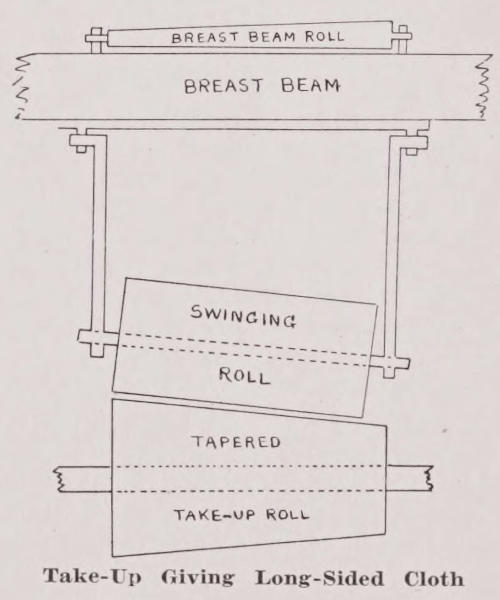
of the edge rubber which is not present at the other side, and a long-sided
uneven web is the result.
To counteract this it is essential that great care should be taken to
get a good clearance of the shed. The shed should be timed as early as
possible, so as to give every particle of fibre on the warp a good chance to
separate and clear itself. When space permits, the front reed should be
set slightly over on one side of the reed space, so as to create a little
longer pull on the filling as it draws from the shuttle on the open side,
and correspondingly eases up the draw of the filling on the other side.
The warp stock used, however, may be of such a character that the loose
fibre on it makes even these precautions ineffective altogether to counteract
the trouble, and it may then become advisable to put in a fine edge wire on
the open side of the web to offset the creeping tendency of the selvage
rubber thread when contraction takes place after the web comes through
the press rolls.
The feature which is aimed at, and which is most desirable in the
appearance of such goods, is a clean cut prominent rib at the rubber line,
and the avoidance of a flat paper-like look and feel of the web generally.
The prominence of the rib varies, of course, according to the size of the
rubber thread used, and the binder warp employed in dividing the same,
but even the very best of conditions may be spoiled if proper care is not
taken to get all the prominence of rib possible. Use as fine a binder warp
as is practicable, compensating for any loss of weight or excess of contraction
by using a heavier gut, which again of itself helps to fill in the
rubber cavity and thereby lends additional prominence to the rib. All the
weight possible should be carried on the binder warp up to a point of safety,
and care should be taken to get a very easy, uniform delivery of the warp
from the beam so as to avoid any erratic jerky movement of the warp lever.
The warp beams which are used on this delicate type of work should
be well balanced and true to center, and the flanges free from any
irregularity which would in any way interfere with the easy and uniform
operation of the warp lever.
The gut, which weaves in with the rubber thread, is used for the two-fold
purpose of giving additional body to the fabric and of regulating in a
measure the length of stretch in the goods. The more gut there is used,
the less becomes the power of contraction of the rubber warp, and the
shorter the stretch produced.
Aside from the fineness and body of the goods, the element of stretch
largely governs the market value of the fabric, so that good judgment and
great care must be exercised in the assembling of the different sizes of yarns
used. Weft, binder and gut all play their part in the governing of the
stretch, as also does the number of picks put in the goods. Any excess of
weight on the binder warp also materially reduces the stretch. In fact,
any one of these features, wrongly adjusted, may result in the difference
between the profit and loss.
In making the selvage of these goods a hard steel wire is used, around
which the filling passes at each pick. This wire, shown at W in Fig. 6A, is
highly tempered piano wire, of the very best quality obtainable. Sharpened
to a needle point at one end, with a loop turned at the other end, it is
fastened at the back of the loom by a cord which has an adjustable slip
knot, so as to be able easily and quickly to regulate the length of wire
running in the web. It is then passed through a harness heddle eye on the
rubber or gut shaft, and through a reed space next outside the selvage
rubber thread. The constant wear of this wire on the reed dent makes it
necessary to have this dent of hardened steel so as to withstand the constant
wear of the wire, which is always being crowded against the dent by the
nipping action of the filling as it draws against the wire in the process
of weaving, and the repeated beat at the same place in the dent at the
weaving line. In any event, after a short time the dents in the reed will
be cut so that it becomes necessary to frequently replace them with new
ones, and for this reason it should be so arranged that they can be easily
and quickly removed from and replaced in the reeds.
The lisle web, being perfectly plain, is similar in general character to
the loom web, except that it is made with high grade combed and gassed
yarns for the filling in place of cheaper stock used on the loom webs, and
is woven with four threads for the binder warp between each strand of
rubber, instead of two as in the loom web. The harness draft of the one-half
inch lisle web shown at Fig. 7, together with the weave, is shown at
Fig. 7A. The construction is as follows: Binder, 36 ends 80/2; gut, 8 ends
40/2; rubber, 10 ends 32s; reed, 21 dent; picks, 78 per inch; stretch,
75 per cent.
It will be seen that all the binder threads operate two up and two
down, but change at each pick in rotation, making the repeat every four
picks of the loom. In a weave of this character the changes of the harness
are distributed uniformly at each pick, thus making it much easier to get
uniform conditions on each selvage. It differs from the loom web in this
respect, where the alternating light and heavy pick has to be contended with.
Like the loom webs, prominence of the rib over the rubber thread is
the main feature aimed at in the general appearance of the fabrics, and
therefore everything possible should be done which will emphasize this. The
binder warp must be of fine yarns, and the warp must be weighted so as
to cut the warp line down sharp and clear up to a point of safety, being
careful at the same time not to go to excess so as to narrow in the goods
or cause undue chafing of the rubber warp. The yarn most generally used
for filling is 26-2 comber and gassed high grade stock, of about 15 turns per
inch. It should be a well-rounded lofty yarn so as to obtain all the
covering property possible. It should be spun with the utmost uniformity,
as the slightest irregularity in the yarn will be noticeable in the goods.
The dyeing and bleaching of the yarn used for filling is also of the
greatest importance. It is not an unusual occurrence to find otherwise
perfect goods made unmarketable as first class by the use of a filling
yarn which has not been properly processed. This faulty condition of the
yarn may be caused in a variety of ways; such as an irregular boil, poor
circulation of liquor in the kier, irregular drying, etc. Even when the
color appears to be perfect, poor processing will often prevent the smooth
running of the yarn from the shuttle, causing it to drag and thus create
irregular and crooked selvages which result in the repeated breaking of the
selvage rubber threads and ruin the goods.
The many difficulties of this character which were encountered when
skein yarn was more generally used for filling led to the introduction and
almost general use of warp yarns for filling purposes, inasmuch as the
method of processing the warp yarns gives results which are not nearly so
variable. Furthermore the long unbroken runs of thread obtainable by
quilling avoid the many knots which are present when using skein yarn.
Knots are unsightly and objectionable when appearing on the face of the
goods.
Chafed and broken edge rubber threads, however, are not always the
result of the conditions named, by any means, but may be caused by a
variety of other things. Not infrequently the edge wire may be weaving too
long in the web so as not to draw out freely. Sometimes it may be a bent
wire that causes the trouble, or it may be the rubber rolling around the
wire. Many times defects are caused by the edge wire having cut into
the dent, so that it has a file-like effect as the rubber thread passes by in
weaving. All these things require looking into, and when trouble comes
the cause should be found and not guessed at.
Another plain web which has attained considerable popularity, and
which is a kind of intermediate grade between the loom web and the lisle,
is what is known as the French web or railroad weave, shown at Fig. 8. In
almost all respects the general treatment of this web is the same as already
described, and it differs only in the draft, which is shown at Fig. 8A. It
allows for the use of a somewhat finer yarn than is generally employed in
the loom web, and the draft changes at every two cords, which gives it a
peculiar “rowey” appearance from which it derives the name of railroad
weave.
There is one feature associated with all these plain webs which it
might be well to speak of. The high tension at which it is necessary to
work the rubber warp, together with the light weight required on the cotton
warp and the crowding together of the picking, creates a tendency for the
goods to rebound at the front reed, accompanied by a backward and forward
sliding movement when passing over the rod at the breast beam. This
movement is liable to polish the goods, which is an objectionable feature.
To counteract this it is advisable to let the web pass over a small, felt-covered
wood tube, which revolves and responds to the movement of the
bounding web. In this way there is no friction to glaze or polish the web
and interfere with the bloom of the yarn. The same polish will occur as
the goods pass through the press rolls, unless they are felt covered.
The most popular web now made up into men’s garters is what is
known as the cable web, shown at Fig. 9. With the pronounced prominence
of the two-dent rib, which gives it a character peculiarly different from the
plain web, it is well adapted to this class of goods. Simple in appearance,
it nevertheless requires special care to manufacture, particularly when we
remember that it is not unusual to be required to make a finished stretch
of not less than 100 per cent. The harness draft and weave are shown at
Fig. 9A. The construction is as follows: Binder, 34 ends 80/2; Gut, 24
ends 20/2; Rubber, 18 ends 28s; Reed, 20 dent; Picks, 80 per inch;
Stretch, 100 per cent.
The filling, floating across the wide spaces under which lie the rubber
threads in pairs, is very easily thrown out of place, the result of which
may be an unsightly seersucker appearance, as shown in Fig. 10, which the
process of finishing aggravates rather than corrects.
Trouble may manifest itself by the filling over the ribs opening up and
allowing the gut threads to prick through. To prevent this objectionable
feature it is necessary to use a good quality of moderately soft yarn for
the gut, not necessarily of high grade stock, but a yarn which is uniformly
spun and not at all hard or wiry. As these goods are being woven and
on full stretch, the gut threads, of course, are perfectly straight and
accurate in line, but when contraction takes place, to probably one-half the
former length, these heavy threads, which form probably about 25 per
cent. of the weight of the entire web, should bend or fold uniformly and
dispose of themselves in such a manner as not to appear in any way on
the face of the web, snugly housed away in the several pockets or cavities.
If the yarn composing these gut threads is spotty or irregularly spun, this
uniformity of fold inside the pockets will be broken up and the appearance
of the face of the goods is likely to be marred by unsightly specks of
cotton pricking through, which can be both seen and felt.
Chapter IV. — Printed Filling — Bandage Webs — Frill Web on Cam Loom — Double Cloth Webs — Balance Between Back and Face — Care for Selvage
Elaboration of Honeycomb Effects by Parti-Dyed and Printed Fillings—Bandage
and Surgical Webs Made with Plain and Covered Rubber—Frill
Web Woven on Cam Looms—Double Cloths—Importance
of Securing Balance Between Back
and Face of Goods
Among the group of single cloth webs confined to the capacity of
plain looms, is what is commonly known as the honeycomb, shown
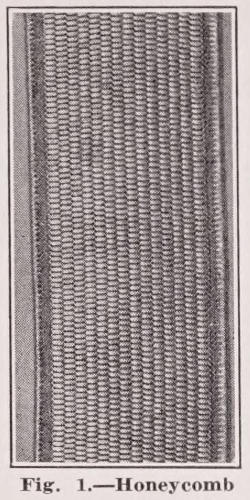
at Fig. 1 and Fig. 1A. This is generally made with silk, wood silk,
or schappe filling. The smooth filling floating over two cords gives the
web a smooth feel, there being no rib effect noticeable whatever, making it
well adapted for a fine trade. The warp lines are almost entirely hidden
by the filling, so that it is not practicable to introduce any sharp stripe
fancy effects, which can be done both in the plain web and the cable. The
honeycomb is thus confined to plain solid colors or such elaboration as can
be obtained from the filling.
Fancy effects are often secured by dyeing skein yarn in two or more
colors. Such yarns when woven in the goods produce alternating effects at
regular distances in different colors, such distances being governed by the
length of the dips and the width of the goods. The effects which can be
produced are quite varied. The simplest way of accomplishing this is to
use the regular 54-inch skein, having white or some light shade as a base,
and then dyeing a given portion of the skein another color. This process
is carried out by hanging the skeins on sticks placed in a rack at the
required distance above the color liquor, and then lowering them into the
vat and dyeing the immersed part in the usual manner.
Where cotton is used for the filling and more elaborate effects are
desired, long reeled skeins are used, sometimes 108 or 216 inches, which
have been reeled on specially designed collapsible reels. Such skeins are
not practicable to handle in the dye house in the manner already described.
Sections of such skeins are wrapped in heavy waterproof paper and tied
tightly, so that the dye liquor cannot penetrate that portion, and then the
whole is put in the liquor, when the exposed part only will be dyed.
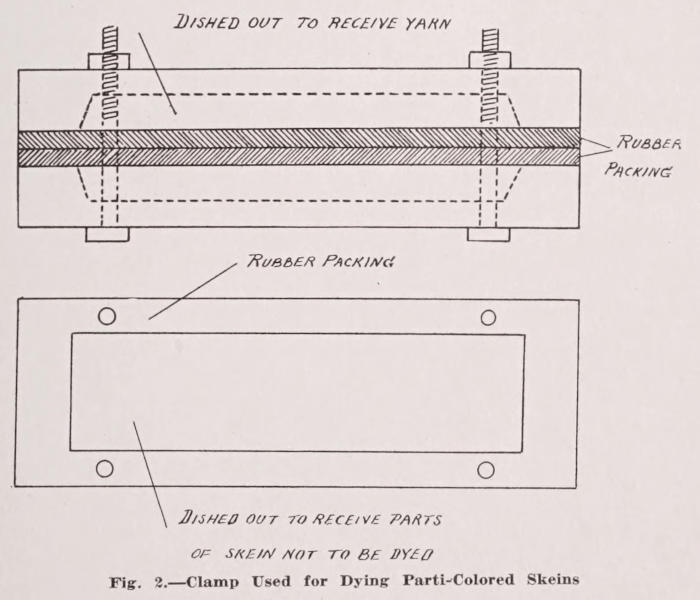
Then again sometimes wood clamps are used, like that shown at Fig. 2,
having a recess into which part of the skein is laid after being carefully
folded. The two halves are clamped together tightly in such a manner
that the dye cannot penetrate the clamped part of the skein while the part
left outside the clamp is dyed when the whole is immersed in the dye
liquor.
Another form of elaboration used in such goods is printing the skein
yarn used for the filling. This is done by using a machine having a pair
of fluted brass printing rolls, one of which is made to open on a hinge
like a gate so that a skein of yarn can be put around it. This roller is
then closed to its original position, so that with the two rollers parallel
and close together, and the skein of yarn hugged tightly between them, the
turning of the rollers imprints color on the skein. The skein is then taken
out and dryed before spooling. Different sets of rolls are used so as to
get fine and coarse effects and various colors are used in printing.
Where plaid or printed fillings are used for the elaboration of webs
of the honeycomb type, it is not unusual to introduce a couple of plain
cords in the center of the web, or possibly on either side, so as to break up
the flatness of the weave. This opens up the opportunity of using lines
of a different color in the warp which properly arranged will produce a
plaid-like effect.
Fig. 1.—Honeycomb
Fig. 1A.—Harness Draft and Weave for Honeycomb.
Fig. 2.—Clamp Used for Dying Parti-Colored Skeins
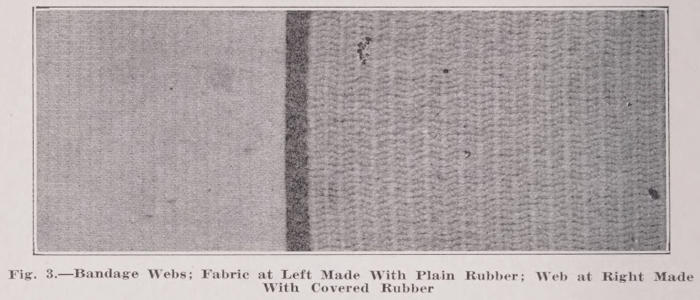
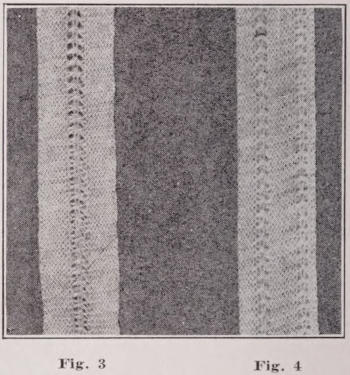
There is quite a large demand for surgical and bandage webs, Fig. 3,
in widths ranging from 2 to 4 inches. These webs are used for binding the
limbs and other purposes and are in the pure white or natural yarns. They
require to be made with a long soft easy stretch. An open reed of about 12
dents per inch is employed. Four threads are generally used for the binder,
weaving two up and two down. The goods are similar in construction to
a regular lisle web, except that the gut is omitted in order to get the easiest
possible movement.
Fig. 3.—Bandage Webs; Fabric at Left Made with Plain
Rubber; Web at Right Made With Covered Rubber
The yarn is generally the same quality and size for both warp and
filling, and is usually a soft spun 2-20s. The side of rubber is generally
about 38 or 40, with 40 picks per inch and a finished stretch of 100 per cent.
The use such webs are put to, necessitating as we have already said a soft
and sluggish stretch, prevents the use of a heavy rubber thread, the result
being that when the bandage is kept in close contact with the warm body,
the life of the fine rubber is of short duration.
This condition, and the open weave necessary to get the easy stretch,
have made it expedient to use in many of these goods strands of rubber
which have been covered with cotton threads before weaving. This process
not only prolongs the life of the web, but allows for even more open weaving,
the use of different weaves than would be possible where the uncovered
rubber thread is used, and the production of a fabric more suitable for
the purpose.
In order to get the soft easy stretch which is the most desirable
characteristic of a bandage web, and yet have the necessary width, it is not
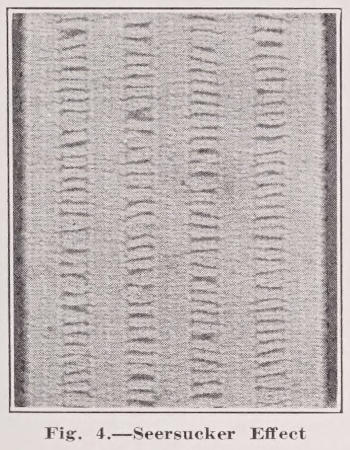
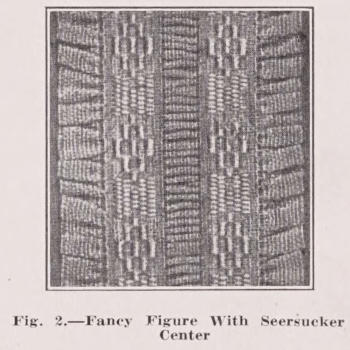
unusual to introduce a seersucker effect, as shown in Fig. 4, in sections of
the web so as to reduce the strong elasticity of the whole. In an ordinary
cotton cloth the seersucker or crinkle effect is usually produced by the use
of a separate warp of heavier yarn than the rest of the fabric, which warp
must be weighted differently and often a different weave is employed to
emphasize the contrast in the puckered seersucker effect.
In the elastic web all this special preparation is unnecessary. Wherever
the seersucker stripe is desired, strands of rubber are left out which of
course takes away from these portions that element which contracts the other
part of the web, and a seersucker effect is the result. Such stripes are
often used for the ornamentation of some webs by having narrow sections
introduced for border effects, or running down the center, and in fact they
may be employed in a variety of ways, inasmuch as they lend themselves
effectively to different forms of coloring, in relief to the main fabric.
Fig. 4.—Seersucker Effect
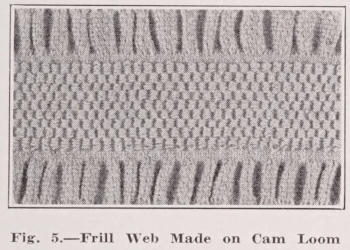
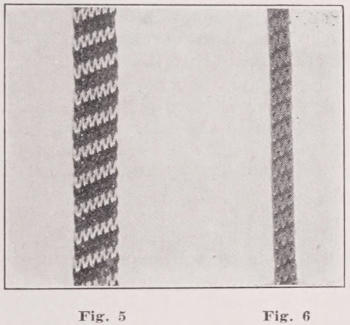
Fig. 5.—Frill Web Made on Cam Loom
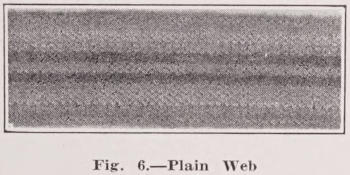
Fig. 6.—Plain Web
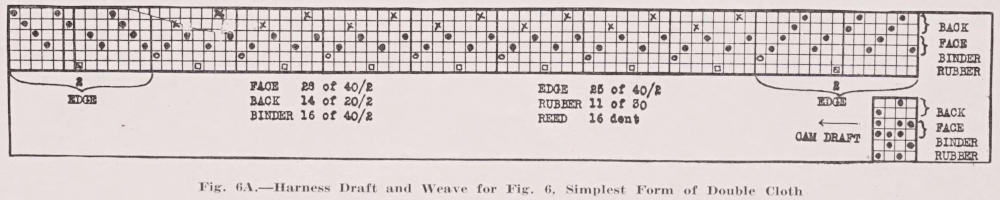
Fig. 6A.—Harness Draft and Weave for Fig. 6, Simplest Form of Double Cloth
In passing it might be well to note that where it is necessary to use
covered rubber threads special arrangements are required for making the
warps, as the covered thread cannot be handled like the ordinary thread.
The spools are placed in a rack which is required for each warp. Arrangements
have been made so that to each spool is attached a special head,
which can be weighted either by a lever brake or weight attached to a cord
running in a groove on the auxiliary head. By this arrangement uniform
delivery of the threads can be made to the warp beam so as to avoid any
puckering caused by irregular warping.
In single cloth webs as already stated, the scope for ornamental effects
is necessarily limited. The bulk of such webs, particularly those made with
a wire edge, are for the most part plain. There is a type of garter web,
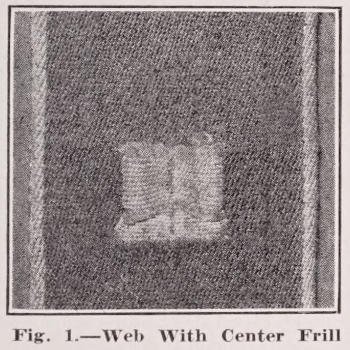
however, characterized as “frill” and shown at Fig. 5, which may be made
within the narrow limitation of cam looms, although the frill feature is more
generally used in connection with more elaborate fancy effects.
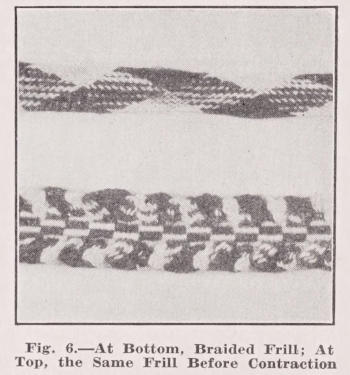
The frill part is practically a section of non-elastic of any desired
width woven on to a section of elastic, which likewise may be of variable
width. The strands of rubber used in the central section, being woven under
tension, contract this portion of the fabric after it leaves the press rolls.
The side sections having no rubber in them do not contract, but frill up
uniformly on either side of the web in regular fluted folds. No wire is
required for the selvage when a frill is made, and the tension of the filling
is adjusted so as to hug the outside threads of the frill warp and make a
neat selvage without narrowing it in beyond the width of the reed space
occupied by the warp.
The frill part must be on a separate warp, apart from the binder
threads which are used in the central section. The elastic section is made
in the regular manner already described for webs of four harness capacity.
The frill is likewise constructed from the same harnesses, but the draft is
so arranged that two of the harnesses are used for one frill and two for
the other. This arrangement is made in order that the filling may only be
bound in alternating picks on the frill part, whereas in the body it is bound
at every pick. This method makes the frill soft and pliable, so that it
readily responds to the contraction which takes place in the body part,
and thus makes for regularity in the formation of the folds.
Should an exceptionally fine frill be desired, the same two harnesses are
used for the frill at either side, and the filling is bound or woven in at
each passage of the shuttle. Wherever this method is employed, however,
it becomes necessary to use a much finer yarn for the frill warp, or a
fewer number of threads spread over the front reed in the frill. If such
precautions are not taken the frill will be harsh and stiff and will not fold
uniformly as the center contracts. It may even retard the desired contraction
of the body.
It is not advisable in making frill webs to use a regular front reed
having the same spacing of dents all across. There is a liability of getting
a coarse looking frill, showing up the marks of the reed dents. The plan
more desirable is to use a reed with the dents required for the frill part
of the fabric spaced very much finer than those used for the body, generally
in the ratio of two to one, so that the frill threads may be evenly distributed
in ribbon-like formation and not show the coarse lines of the dents.
Occasional calls are made for webs having a frill on one selvage only.
In this case it becomes necessary to use an edge wire on the side having
no frill, and exceptional care must be taken in this class of goods to produce
the proper balance. A soft frill is required and a limited contraction of
the body part.
Our remarks so far have been confined exclusively to single cloth webs
of a simple character, where, apart from the rubber and gut there is only
one warp used, and where both back and face of the web are alike. We
will now turn our attention to what are known as double cloth webs, where
two distinct cloths are woven, one for the face and one for the back, each
working independently of the other, but tied together by another warp
known as the binder, or else the two cloths interlock each other in such a
manner as to bind them together without the assistance of another warp.
By this method of weaving much thicker and heavier webs may be
produced with a limitation of elasticity which cannot be obtained by the
single cloth method. The weaves and materials employed in the face and
back of the goods may be identical, or weaves of a different character and
stock of different qualities, sizes and colors may be used. Fancy effects may
be used to embellish the face, while the back may be perfectly plain and
free from any coloring whatever.
There are certain features associated with the construction of double
cloth webs which make them entirely different to deal with. The different
weaves and the different stock employed necessitate splitting up the warps
into sections to accommodate such conditions. A separate warp is required
for both back and face and also one for the binder, which delivers a much
greater length of warp than either, necessitated by the character of the
weave used in binding the upper and lower cloths together. A separate
warp is also required for the gut, which goes in the web perfectly straight
and is shorter in length than any of the other sections. Such goods also
require a special warp for the selvage, so that in the simplest form of such
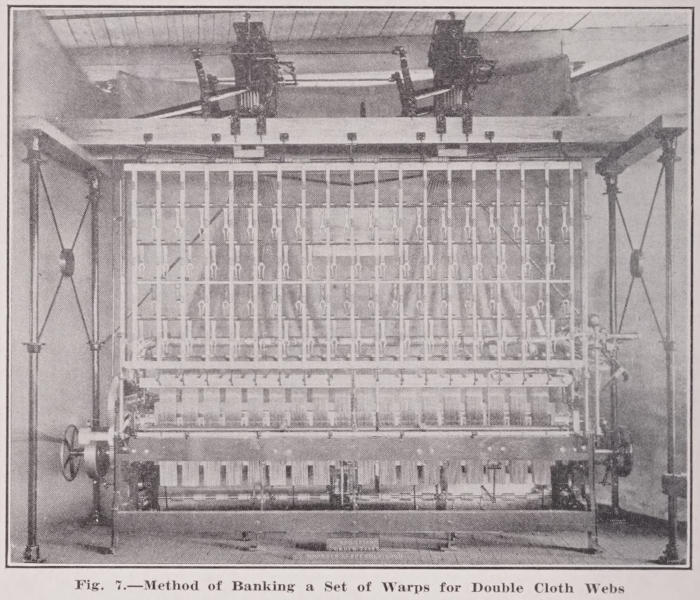
webs a bank of five warps is necessary. On fancy goods the introduction
of fancy warps may add to this number.
The element of a right balance between the back and face has to be
considered, and if care be not taken in the proper adjustment of the stock
the result may be that one side of the goods will assert control over the
other in such a manner as to prevent it lying flat and even. When such a
web is cut it will curl up so as to be almost uncontrollable. Such a condition
may arise from a variety of causes. If the weaves of the face and back
cloths are identical then it will be necessary to have the face and back
warps of the same size yarn or its equivalent. For instance, should the
face be a four-thread plain and 40/2 is used, and the back only two threads,
then the yarn used for the back warp must be 20/2 so as to equal the
four threads of 40/2 in the face. Should, however, the face be a more
open weave than the back, then an equal weight of yarn in both cloths
will not be right, and it will be necessary to use yarn of a heavier weight
for the face to compensate for the freedom of the more open weave and
effect a proper balance with the more tightly woven back. There can be
no fixed rule to apply to this, and only experience will indicate the proper
relationship between the two. In Figs. 6 and 6A are shown the simplest
form of double cloth, known as a plain web.
By carefully following the weave it will be seen that while the face
weaves 3 up and 1 down, and the back 1 up and 3 down, the filling will
appear both on the face and back of the goods as 1 up and 1 down. If
the binder was not there it would be a tubular web, having the same appearance
all around. The binder, however, intersects the upper and lower cloths
at each pick and binds the two together in one complete whole, while the
rubber lies between the two, each strand being separated by the interlocking
binder threads.
It becomes necessary in order properly to connect the upper and
lower cloths at their extreme edges to use a selvage warp, which as will be
seen in Fig. 6A is drawn in on all four face and back harnesses, and the
threads of which are arranged so as to complete the weave all around. To
do this it will be seen that there is an odd thread at one side, otherwise
the weave at this point would show two threads operating together next
to each other, and would break up the continuity of the weave.
Fig. 7.—Method of Banking a Set of Warps for Double Cloth Webs
The selvage plays an important part in the structure and weaving of
the web. It forms the pocket for covering in which lies the outside rubber
threads, and it must be so arranged that these threads can function properly
so as to make a piece of goods that will lie flat. In the first place the
yarn must be of such a size that with the proper number of threads employed
the selvage will contract uniformly with the body of the goods, so
that the web will not “frill” on account of a too heavy selvage, or “belly”
because it is too light.
The threads must be properly divided in the front reed so as to make
a good clearance for the filling, which otherwise would “nib” up and make
an unsightly selvage. Then again, a careful adjustment of the weight
carried on the selvage warp must be made so as to accommodate it to the
requisite tension of the filling as it is delivered from the shuttle, otherwise
the edge rubber threads will be liable to chafe and cut off when strained
out of proper alignment with the front reed. It will be observed in the
draft that two rubber threads are used in each selvage, which is necessary
in order to control the additional yarn used in the construction of the
selvage.
Chapter V. — Harness and Chain Draft — Use of Coarser Yarn — Use of Four Leaf Twill — Filling Fancy Effects — Stitch Fancy Patterns — Interchanging Figure and Face
Three Leaf Twill or Satin Face Woven in Conjunction with Plain Back—Position
of Back Rolls in Relation to Harness Shed—Use of Four
Leaf Twill—Filling Fancy Effects and Stitch Figures—Interchanging
Figure and Face
Turning our attention from plain webs to combination weaves, we
will take up what is popularly known as the three-leaf twill, or satin
face, woven in conjunction with a plain back. This is a type of web
not only used for suspenders, but employed extensively for corset
garter attachments also. A web of this character when properly constructed
has a smooth velvet-like face. The threads are uniformly distributed across
the width without showing any of the “rowy” effect from the binder warps,
which are completely hidden by the heavy pile produced by the float of
the face threads. When the contraction of the web takes place, these
floating face threads mass together in a velvet-like pile, not only producing
a smooth handling web but materially increasing the thickness. Such webs
are generally constructed with a six-thread face and a four-thread back,
and have what is termed a round edge, similar to the selvage used on a
plain web. This arrangement shows up the twill face by contrast and
gives the fabric a much finer appearance.
Fig. 1 shows the harness and chain draft of such a web, together with
the construction of a properly balanced web for standard goods of 1⅛
inches wide. It will be noticed that the face, consisting of 150 threads,
is split up into two warps of 75 threads each. This arrangement is
necessary in order properly to weigh them so as to get a good clearance in
the shed. The warp has to be divided likewise in the harnesses and put
on six harness frames, although the weave could be produced on three. It
would not be practicable to crowd 50 threads on one harness frame in the
narrow space available, as the harness eyes would shoulder and crowd too
much when changing.
In drawing-in this web, one face warp should be arranged so that the
threads are drawn on the first, third and fifth harnesses, and the other
face warp should be on the second, fourth and sixth. Such an arrangement
in the distribution of the warps makes it much easier on the mechanism,
and minimizes the risk of breakages. It is also important to make proper
divisions of the warps at the back rolls, inasmuch as some of the warps
have to be weighted heavily while others are only lightly weighted, and also
on account of the different take-up of the varied weaves.
The back rolls should be set in a graded position so as to prevent
undue friction of one warp against another. The binder warp should be
worked under the front roll on account of the extremely light weight this
must carry. Fig. 2 shows the proper position of the back rolls in relation
to the harness shed.
In a web of this character where the warp stock is somewhat crowded
in the front reed, there is always a tendency for a fibrous yarn to prevent
a perfect clearance in the shed, with a liability of producing occasional
floats through the shuttle skipping these threads. Such floats will pearl up
when the web contracts and make an imperfect face. This trouble may be
prevented by setting the back rolls a trifle higher than the breast beam rod,
so that the stock in the harness which is down will be slightly tighter than
that which is in the upper harness.
The chain draft is so arranged that the face harness will operate to
produce a twill which will be reverse to the twist of the yarn employed, and
thus reduce the prominence of the twill weave all possible. The filling yarn
should be soft, of about 15 turns per inch, and of good uniform quality, in
order to produce a nice selvage and not cut the rubber. The reed dent inside
the selvage rubber should be carefully twisted at an angle to conform to the
nipped in position to the rubber thread, so that the outside edge of the
dent will not cut the rubber when the reed beats against the goods at the
weaving line.
Fig. 1.—Three Leaf Twill, or Satin Face. Woven in Conjunction With a Plain Back
Fig. 2.—Showing Position of Back Rolls in Relation to Shed
A fine looking twill may be produced with a somewhat coarser face
yarn by using a five threaded face over a six-thread repeat. This is shown
in the harness draft at Fig. 3.
In non-elastic fabrics there are available a variety of twill and satin
weaves for the production of soft lustrous surfaces, but this is not so in
elastic webs, as the contraction of the goods after weaving would produce a
ragged, spongy surface. A float of three picks on the face is about the
limit it is practicable to go on an elastic web, with few exceptions, and
even this only in connection with fine picking.
A four leaf twill, however, can be used to great advantage when a
heavy body is desired, as for example what is known as “farmer’s web.”
These are usually made about two inches wide, and to further add to their
weight they have what is termed a cushion back, the weave of which is 7
down and 1 up. The use of these soft weaves on both face and back,
while giving the web great thickness on account of the deep velvet-like pile
produced, deprives it of much of its firmness. This condition is met by
the introduction of an auxiliary back warp, underneath the main back
warp, weaving 3 down and 1 up, which knits the upper and lower cloth
more firmly together, thus increasing the firmness of handles of the goods.
Fig. 3.—Five Thread Face Over 6 Dent Repeat
Another web among the plain loom products calling for passing mention
is that specially made for the police and fireman’s brace. While this
has a 7 down and 1 up cushion back similar to the farmer’s web, it differs
in having a smooth plain face in place of a twill. This arrangement of
combining a plain face with a cushion back necessitates selection of the
sizes of yarn used for the various warps so as to maintain a proper balance
of the different weaves employed in the face and back. Otherwise the goods
would curl up and it would be impracticable to cut them up for manufacture.
Consideration must also be given to the effect of padding the size
upon such goods in the finishing process, of which we will say more later.
All the webs so far described have been such as could be produced on
cam looms of various capacities. We will now turn our attention to what
are generally understood as fancy effects. It might be well to treat these
under two distinct headings. Those made with the shuttle, or what are
called filling patterns, and those made from the warp, or what are called
stitch patterns.
The figures or fancy effects produced by floating the filling over sections
of the warp show up the filling with increased luster in contrast to the
warp. They are confined to no particular character of design, and may
range from the simplest effect produced on the fancy harness loom or
dobby to the more elaborate jacquard design. The ground or body may be
either plain or twill, or any other acceptable weave suitable as a base for
figuring, while the filling may be of a contrasting color, either of silk or
cotton as desired. The figure or design may be made from the same shuttle
used for the ground or it may be made by an auxiliary shuttle, either used
as an overshot or rise and fall, according to the character of web desired.
Where the figure is made from the ground shuttle it is produced as a
sunken effect. It is made by burying sections of the face warp at intervals
so that in place of the face warp the filling is seen at these points. No
additional figure warps are required for this class of goods, and elaborate
designs are obtainable, although there is not the scope for cross coloring that
there is in the warp figure method.
When the design is made from the warp, the figure threads are made
to float on the face of the goods so that upon contraction of the web after
weaving, these floats pearl up in prominence above the level of the face,
and make what is termed a stitch figure.
Fig. 4.—Point Draw Stitch Figure
Fig. 4A.—Harness and Chain Draft for Fig. 4
It is not our purpose here to particularize in design, which is practically
unlimited, but only to refer to those features which govern the construction
and illustrate as necessary. In order to maintain a proper
balance where figures are introduced on single cloth weaves, it is necessary
to distribute the figure warp uniformly over both the face and back of the
goods so as to maintain a proper balance between the two. In the double
cloth webs the figure warp, when not appearing on the face of the goods,
is allowed to run straight between the upper and lower cloths, going in
the same cavity or pocket as the rubber threads, and it works at these times
as a gut. This, of course, in a measure interferes with the contraction
of the goods and has to be taken into consideration in the construction.
Here again we must note the effect of the contraction in piling up the
floating-figure threads, and the necessity of limiting the floats in making the
design so as to avoid any ragged appearance.
Fig. 5.—Interchanging Figure and Face
Fig. 5A.—Harness and Chain Draft for Fig. 5
Fig. 4 shows a design of this character, with the harness and chain
draft at Fig. 4A. In this particular web there are six harnesses used for
the main body and ten for the figure, which is a point draw. While the
figure is evenly distributed on the web, wherever it is not seen it is running
between the upper and lower cloths, as already described, and acting as
a gut.
In order to get a proper balance of the web it is necessary to put
gut threads into the two outer cords where no figure appears, which must
be equivalent in size to the figure threads employed in each of the 21 center
cords. If this is not done the web will contract unduly at the edges and
make it “belly.” The method here used of burying the figure between the
upper and lower cloths when not needed in carrying out the design, affords
opportunity for introducing additional warp threads of different colors, so
as to be able to bring up either one color or another as desired in a design.
As most of the fancy head looms have not more than 18 harnesses, it
will be seen that the scope of design in this class of loom is somewhat
limited, therefore much ingenuity is required to get elaborate designs from
such limited capacity. But careful study opens up a variety of methods
by which a big range of designs is possible.
Fig. 5 shows another type of design known as the “interchanging”
fancy in which the figure warp does not pile up above the surface as it
does in the stitch figure, but remains flat with the face of the web. The
harness and chain drafts are shown at Fig. 5A. In this character of design
a given number of face threads are duplicated by a like number of figure
threads, the same size of yarn being used for both. These face and figure
threads are drawn in duplicate harnesses and operated just reverse to each
other, so that when the figure is up at any particular part, the interchanging
face threads are down, and vice versa. The figure weaves only three picks
up on the chain draft, which is one face pick seen on the face cloth, and
this produces a perfectly flat web.
Another form of elaboration is shown in this web, known as the
“picot” edge. It is generally made of a well cabled thread of silk and is
woven in the selvage, being bound in for several picks and then allowed to
float outside, so that upon the contraction of the web it will pearl out in
small loops, adding much to the elaboration of the web.
Chapter VI. — Sunken Effects — Calculation for Figure Distribution — Cross Shot Weaving — Position of Rolls — Use of Different Stocks and Colors — The Overshot Method — Making Overshot Designs
Combination of Weaves in a Fine Web—Sunken Effects Made on Head
Motion and Jacquard Looms—Employment of More Than One
Bank of Shuttles—The Overshot Method—Use of Different
Colors and Grades of Stock—Binding Long Floats
A very effective combination of weaves in a fine web is seen at Fig. 1.
The middle of this web has for the face a 7 up and 1 down weave,
but the yarn and picking are fine. The yarn piles up just enough next
to the plain edge weave to set off the weaves in contrast to each other.
It will be noted that on either side of the silk figure there are two cords
with the binder thread left out between each, which further sharpens up
the contrast. The fancy effect is produced by the use of a heavy cabled
cord, the two outside threads being of reverse twist, so that when they
pearl up on contraction of the web, one turns to the right and the other
turns to the left, making an effective border.
An altogether different type of figuring is seen in Figs. 2 and 3.
Both of these webs illustrate what is known as the sunken effect. In both
cases the face is a three-leaf twill, which character of weave is most
effective in hiding the filling beneath it. Therefore, the figure may be
worked out in sharp contrast. In Fig. 2, which is made on a fancy head
loom, it will be noticed that the face threads on the fifth cord on either
side are left out in order to assist in the carrying out of the plaid effect
aimed at in the figure. It will also be seen that the face warp is striped in
color. The character of the figure is such that the major part of the face
warp is operated in one solid block, making it practicable to produce this
on harnesses worked on a chain loom.
In the web illustrated at Fig. 3, each thread is operated in the design
independently. Such designs are only producible on a jacquard loom.
But inasmuch as the threads used in forming the figure are confined to
the face warp, it is not necessary to operate the back or binder threads
from the jacquard. It is more convenient to have these worked from the
cams or fancy head in combination with the jacquard, for the reason that
a truer and clearer shed can be obtained.
Furthermore, by having the back harness and the jacquard operated
from two distinct movements it becomes possible to time them differently so
as to obtain better results in the clearance of the stock in the shed.
A 208 hook machine affords ample capacity for the making of these
goods, allowing for 26 rows of 8 hooks each, which will cover the requirements
of nearly all classes of web, giving an entire row to each cord.
Such arrangements will allow for six hooks for the face, one for the
binder and one for the gut on each row. Thus it will be practicable to
use different colored threads for the gut, which may be brought up in the
design in relief effects to the main figure as required.
In this type of figuring, calculation must be made to distribute the
figure uniformly so as to get a well balanced flat effect of the web. As
already stated, wherever the filling is shown, all the face stock at these
points is buried between the upper and the lower cloths, and is acting as
filler or gut in these places, preventing contraction. Should heavy blocks
be thus designed, the web would pucker up in an unseemly manner. The
filling used should be soft and uniformly spun, so that it will mass well
together and in a great measure prevent the buried face stock from
pricking through.
In designing webs of this character, calculations have to be made from
the web after it is woven and finished, otherwise the design may be out of
the desired proportion. A web may have 60 picks per inch on the breast
plate while weaving, but when contraction has taken place after going
through the press, it may have shrunk as much as 50 per cent. The
steaming and finishing process may further contract it another 10 per
cent. which might make the picks about 100 per inch. Of these only one-half
appear on the face and the other half on the back. Therefore 50
picks per inch will be the proportion in which the design should be made,
and paper scaled according must be used.
We have so far confined our remarks to webs made on single shuttle
looms. Turning our attention to the use of more than one bank of
shuttles we would first make note of what is known as the cross shot. This
is a form of weaving which largely increases the output and has in it the
further element of economy, inasmuch as by this method the rubber warp
can be worked at a much higher tension than by the single shuttle method.
In the construction of single shuttle webs, the rubber harness rises and
falls at each passage of the shuttle across the shed. This movement
creates a friction on the rubber thread at the harness eye and an added
friction at the front reed by its passing up and down in the dent. Friction
is still further increased by the backward and forward movement of the
lay, which makes two such passages to one made by the cross shot.
In the cross shot method, the rubber remains stationary, with no
upward and downward motion, which enables the rubber thread to be
stretched out to its extreme limit while weaving, with little danger of
chafing or breaking. Over and under this stationary rubber are two distinct
sheds, one making the upper and the other the lower cloth. These two fabrics
are stitched together by the binder warp, which travels up and down through
both of these sheds.
In order to keep all the warp threads uniformly tight while shedding,
it is necessary to run these under separate back rolls, fixed at different
heights, properly centering the upper and lower sheds with the harness
and breast beams.
Fig. 4 will explain the position of the various rolls in relation to the
breast beam. It will also show the peculiar formation of the shuttles used
for this type of weaving, both pointing to one common center, made
necessary by the character of the two sheds. The bow of the upper shuttle
must be tipped downwards, and the lower bank must be tipped upwards,
so as to reduce the friction of the shuttles all possible when they are
passing through the sheds.
The round edge or covering for the outside rubber threads is drawn in
the harness on the upper shed, and while being woven this cloth is pulled
around the rubbers by the tension of the filling which is carried in the
lower shuttle. This tension is greater than that carried in the upper shuttle,
and so asserts itself by pulling the edge cloth around the outside rubber
until it meets the back cloth weave. The upper and lower fillings are connected
by what are known as tie threads. These threads are drawn in the
harness at each side of the body warp, next to the edge, and are part of
the binder warp. They are operated from the binder harness, but are
only allowed to travel through the lower shed as far as the center of the
web, instead of going all through both sheds, as do the balance of the
binder warp. This movement is accomplished by the use of long looped
harness eyes, which only carry these particular threads through the one shed.
Fig. 1.—Effective Combination of
Weaves In a Fine Web
Figs. 2 and 3.—Sunken Effects
Fig. 1A.—Harness and Chain Draft for Fig. 1
Fig. 4.—Position of Rolls in Relation to Breast Beam for Cross Shot Weaving
The binder movement, extending through the two sheds, is formed by a
longer sweep from extra throw cams, or by the use of extended cam
jacks, or by a combination of both. The balance of these goods may be
regulated both by the warp and the filling, and any tendency towards curling
may be corrected by changing the weight of stock used on either.
The use of upper and lower fillings also allows for the use of different
grades of stock in either shuttle. Colors may be used to match the face
warps while white may be carried in the lower shuttle to match the back.
Silk or other expensive stock may be used for the face without changing
the character of the stock used for the back of the goods, which is not
practicable in single shuttle work.
All this of course makes it possible to reduce the cost, making this the
most economical web produced. In the making of shoe goring, a considerable
quantity of which is still used for inserts for house slippers, this
is a very popular form of weaving, allowing for the production of a face
having a velvet-like pile of the color to match the shoe leather, while
the back may be perfectly plain and white.
It is a method employed in combination with the jacquard, where
fancy figures may be obtained on the face, using the cam movement for
the back, binder and edge, the weave of which is the same for all of these
warps, being simply a one up and one down. In such a combination the
labor on the jacquard movement is much reduced, inasmuch as the travel
of the lingo is much shorter than is required when made in connection
with single shuttle.
The overshot method, which we have previously referred to, is another
form of double shuttle web which has in it elements of economy differing
from the cross shot but equally important. This kind of weaving is designed
as a substitute for silk jacquard webs, which it has to a great extent
supplemented. Before its introduction it was customary to use a slow
running “rise and fall” lay movement, when making a silk figure with the
shuttle, putting in one pick of silk filling to each two body picks, so that
the output of web was only about one-half of what is possible in overshot
weaving. In the old method the silk used to pass from edge to edge of
the goods at each pick of the figure shuttle, and where the figure did not
appear it was buried between the upper and the lower cloths.
In the overshot method the silk figure is bound down at the edge or
border of the figure and none of the silk is entirely buried out of sight.
In the overshot the body shuttle runs all the time, while the figure or silk
shuttle only runs with every alternate pick. The main body of the goods
is woven in every respect the same as in a single shuttle web, and it may
embrace all the weaves, such as plains, twills or fancies, which are common
to single shuttle weaving. Arrangements are made, however, for the
production of an auxiliary shed, by a movement which pulls certain threads
above the main shed, and while these are open to pass the extra shuttle
under them, and thus bind in the figure filling. The lower part of the
lay has straight shuttles, while the upper bank of shuttles is tipped down
to conform to the formation of the auxiliary shed they are designed to
pass through.
The binder threads from which the overshot figure is generally operated,
are weighted very lightly so that the individual threads will easily stand
the strain they will be subject to while making the auxiliary shed. The
Crompton & Knowles overshot dobby is generally used for this purpose.
This special machine is provided with two horizontal draw knives, operating
any or all of the 30 hooks, and is so arranged that the connected warp
threads may be lifted at either or both picks to the height of the main
shed, or to the additional height of the auxiliary shed.
Fig. 5.—Simple Overshot Design
Fig. 5A.—Draft for Fig. 5
In Fig. 5A is seen the draft of a simple overshot figure covering 23
hooks, which are operated from one knife drawing in unison with the
binder harness, while the other knife is operating on the alternate shed,
or the heavy pick, and working in unison with the rubber harness. It will
be noticed that in the overshot design both sides of the figure do not
operate alike, but follow one pick behind the other. This is so arranged
that the binder may come up at the right pick to properly bind down the
silk in the goods, and so avoid any irregularity or ragged appearance at
the border of the figure.
In making overshot designs, care must be taken not to have the silk
float too long, or it will give the goods a rough coarse appearance. Should
the design call for a long span over a number of cords, it will be necessary
to bind at intervals as shown in Fig. 5A, and at each succeeding pick to
break the order of the binding as may seem advisable. The stitch or warp
figure coming up at each side of the main figure, must be pegged on the
dobby chain to operate on the reverse knife to the overshot figure, so as to
work on the pick when the binder harness is down.
Figs. 6 and 7.—Other Forms of Overshot Design
Fig. 6 is an example of another form of overshot design, known as
the “matelasse.” In this the silk filling extends from side to side of the
web, as in the old form of jacquard, being bound down at different points,
the bindings forming the figure.
Fig. 7 shows still another form of overshot made by the operation of
the gut as figure instead of the binder, and which is worked on the heavy
pick instead of on the binder pick. This is done so that the intersecting
cords of face, which hide the silk at different points, can be raised in order
that the figure silk be hidden underneath it. To accomplish this, each of
these face threads is passed through slip leashes, which are operated from
the dobby. These slip leashes allow for the working of the face thread in
the main harness. At the same time it is possible to raise them to the
height of the upper shed so that the silk shuttle may pass under them.
Chapter VII. — Woven Shirred Effect — Novel Decoration at Edges — Lappet Weaving — Pearl Edge
Making Frills in the Middle of Goods—Woven Shirred Effects—Novel
Decoration at Edge of Fancy Frills—Lappet Weaving on Elastic
Fabrics Affords Opportunity for Elaboration at Small Cost—Production
of Pearl Edge—Special Fancy Drafts
Woven elastic fabrics are open to many forms of elaboration that
are not possible in non-elastic weaving. We have already made
mention of the frills woven at the outer edges of the goods, formed
by the fluting of non-elastic sections produced by the contraction of the
center part. This same effect may also be used in the center of the goods.
To accomplish this it becomes necessary to employ a distinct set of harnesses
to operate each half of the web, together with additional harnesses on
which the frill sections are drawn in.
The chain draft is arranged so that the shuttle is made to pass through
one-half of the web and a half section of the frill, and then return. The
shuttle then passes through the other half section of body and frill. The
operation is repeated continuously. Fig. 1 shows a sample of web in
which the frill is brought up for a distance and then buried inside the
goods for a short section. Fig. 1A gives the harness and chain draft.
Fig. 1.—Web With Center Frill
Fig. 2.—Fancy Figure With Seersucker Center
The weave used for producing a frill may also be used in the center of
the main body; it then produces a seersucker effect. At Fig. 2 there will
be seen an example of this, in combination with a figure on either side of
the seersucker, the figure part being bordered with a regular frill. The
insertion of this seersucker section lessens the number of rubber strands
used in the whole, and it therefore will be found advisable to use a somewhat
heavier size of rubber in the remaining cords to compensate for this.
The harness and chain draft for Fig. 2 are given at Fig. 2A.
Another example of an effective form of fancy elastic weaving may be
seen at Fig. 3, where the center or rubber part of the web is made to
imitate a shirred effect. In the regular method of shirring a piece of
plain elastic web is used, under tension, and is passed through a sewing
machine where a wider piece of ribbon or some other light non-elastic
material is stitched to it by a series of needles running side by side. When
the web contracts, upon being released from tension, the non-elastic part
forms in a regular fluting on the face of the web. At the same time the
remainder of the wider non-elastic section frills up on either side of the
elastic part.
Fig. 1A.—Harness and Chain Draft for Fig. 1
Fig. 2A.—Harness and Chain Draft for Fig. 2
The method of producing this effect direct upon the loom is done by
an interchange of weaves, first making a short section of single cloth
and then changing to a short section of double cloth weave. There
being no binder warp employed to knit the upper and lower cloths
together, the strands of rubber will lie between the two cloths so
formed. Upon the contraction of these strands of rubber the outer cloths
are thrown out, and appear as flutings on the web, while the side sections
in which there is no rubber will complete the frill effect. This woven
method has in it the advantage of making both sides of the web alike,
whereas in the stitched shirring the back of the goods is not so presentable
and unfits it for many uses. It also eliminates the added expense of
labor in assembling the different parts.
A novel form of decoration is seen at the extreme edge of the fancy
frill at Fig. 4. This may be produced by what is known as the draw-in
method. This effect was formerly produced by the use of additional banks
of shuttles in a rise and fall lay, but is now made by using two threads
of cabled silk coming from spools, these threads being worked by the
harness the same as a warp. They are very lightly delivered by a
delicately adjusted return spring arrangement. The threads are operated
on a special harness, being passed through the harness eyes outside of all
the other warp stock, and then through a dent in the front reed as far
away from the other stock as is desirable to form the size of the loop
required.
Fig. 3.—Woven Shirred Effect
Fig. 4.—Novel Edge Decoration
The harness used for these threads stands still a given number of
picks, and at regular intervals is brought down so that the draw-in
thread comes in contact with the shuttle filling, which then passes around it.
As the shuttle returns through the open shed, the filling or weft pulls the
easily running draw-in thread with it, until it comes in contact with other
warp threads, which the filling passes around, and so stops the further
progress of the draw-in thread into the shed. The thread at the same time is
carried around a wire which works in a dent next inside the one in which
the draw-in thread passes. Quite a variety of fancy effects may be
produced in this manner. Threads of different materials and colors may be
used and drawn across the face of the web at different points, and selvages
of a distinctly different color and character to the body of the goods
may be made.
Lappet weaving on elastic fabrics is a method which has not been
extensively used, probably on account of the limitations of design obtainable
by this style of weaving. Nevertheless, it affords opportunity for considerable
elaboration at a very small cost. The loom attachment which
permits the making of these patterns, which are somewhat similar to
embroidery, is known as the lappet motion. Wherever it has been used
it has been found to be serviceable. It can be attached either to a plain
loom or a fancy loom. It is a system of levers operated by a chain composed
of different sized balls, arranged according to the pattern desired.
On the loom lay are one or two slides running the full length of the
lay, which are moved laterally by the different sized chain balls. They can
also be raised and lowered as required by the design. Both these slides have
generally three needles for each suspender web, which are spaced at equal
distances apart, one or all of which may be threaded and used. When slides
are lowered into the web, the shuttle filling or weft passes over the yarn
which is carried in the needle eyes and binds it into the cloth. Then by
moving the slides backward and forward for succeeding picks, and each
time binding the thread into the cloth, the various lappet patterns are
produced.
Fig. 5.—Lappet Weaving
Fig. 6.—Broken Effect on Silk Frill
The figures are mostly irregular trailing patterns, as shown at Fig. 5,
and well adapted to narrow goods. Dots of different sizes and in different
positions may also be made, but it is not practical to get the finely
finished lines which can be obtained from other methods where there is
positive control of any particular warp threads or group of threads, as
for instance in jacquards and overshots.
The sliding bar of the lappet motion may vary slightly in its movements
so that the needles will not always pierce through at exactly the
same points at each repeat of the pattern, although the general design will
be maintained. The threads which feed the needles should be of good
clear ply material, free from slubs and irregularities, so that they will
pass freely through the needle eyes, and they should have enough turns to
enable them to withstand the friction resulting from the backward and forward
sliding movements of the lay passages. The yarn must be delivered
from independent spools, which work with perfect freedom, and measures
should be taken to control the stock by the use of delicate springs.
The material used for the lappet figure is perhaps best run from
grooved spools which are so weighted that they feed easily through the
needles at every forward movement of the lay.
An effective and inexpensive method of elaborating a silk frill is
found in what is known as the pearl edge. This adds much to the richness
of the goods, besides giving the appearance of greater width at slight
increase of cost. The pearl edge is produced by a series of fine steel edge
wires, which are carried in separate dents of the front reed outside of the
frill itself. Each wire is operated by a special harness which brings it into
the weaving lines as desired, so that the filling may pass around it and
make pearl loops at these particular places. It will be found necessary to
use hard steel dents in the front reed to work the wires in, otherwise the
dents will soon be cut from the constant wear of the wires.
A silk frill may also be much enriched by special fancy drafts. These
allow for the operation of groups of threads so that the filling passes over
and under them and show up the luster of the silk filling in blocks contrasting
with the more plainly woven parts. An example of this is shown
at Fig. 6.
Chapter VIII. — Designs in Sunken Effects — Jacquard Tie-Up — Weaving Buttonholes — Making Abdominal Belts — Printing Designs on Elastic Web
Designs Produced by Use of Jacquard in Connection with Cams or Head
Motion—Weaving Buttonholes in Webs—Manufacture of Surgical
Belts and Bandages—Combination Woven and Printed
Designs—Method of Printing
In previous articles we have confined our remarks to the production
of elastic fabrics on plain and fancy looms. These machines are more
or less limited in capacity, and the stock must be operated in groups of
threads. Considerable care is necessary in the selection of patterns best
adapted to these looms. In jacquard weaving each separate thread is controllable,
and the scope of pattern and design is limited only by the space
available on the face of the fabric.
Of course certain general rules, which have been laid down for the
production of designs on fancy looms, are applicable to the making of
jacquard designs. For example, where sunken effects are aimed at it is
necessary to uniformly distribute the buried stock, just as it is in the
fancy loom method; otherwise uneven or “cockled” web will result on
account of there being too much buried stock at some particular point,
which prevents uniform contraction.
Fig. 1 is an illustration of a pattern where the sunken effect is well
distributed. This pattern also shows the operation of two sets of figure
threads brought up alternately. Both warps are buried to allow the back
filling to appear in relief. This indicates the wide scope of design possible
on a single shuttle, which is almost unlimited.
Fig. 2 illustrates a double shuttle design which has a sunken warp
effect in connection with a silk figure. It also serves to illustrate the effect
of skein dyed silk for decorative purposes. Fig. 3 shows still another
type of double shuttle design, in which a parti-colored face warp lends
an entirely different effect to a design. Fig. 4 is an example of three
shuttle work where one shuttle is used for the ground, and two shuttles
for the silk figure.
It would be easy materially to enlarge on the various types of design
possible in jacquard weaving of elastic webs but this is not necessary. If
a straight tie-up is used the scope of design is almost unlimited. The
custom generally adopted is to operate the back, rubber and gut from chain
or cam harness, as the same movement of all these threads is maintained
continuously, and to operate the face and binder from the jacquard.
Fig. 5 is an illustration of a fully rigged jacquard suspender loom, having
two machines mounted on it, and with the back and rubber harness operated
by the fancy head.
Too much emphasis cannot be laid on the necessity for exercising the
greatest care in the jacquard tie-up and the leveling of the strings. As
already stated in a previous article, any failure in the initial arrangements
will result in constant trouble and faulty work. Mispicks and floats may
not be serious in many types of non-elastic fabrics, but in elastic webs a
float will so pearl up on construction that the goods will be ruined. Once
again, and of the greatest importance, measures should surely be taken to
have some form of screw adjustment for the raising and lowering of the
jacquard machines to compensate for expansion and contraction of the
strings, caused by changing atmospheric conditions.
Fig. 1 Fig. 2Fig. 3Fig. 4
Fig. 6.—Formation of Abdominal Belt
In the assembling and making up of narrow elastic fabrics, particularly
suspenders, it is often necessary to use buttonholes in the finished products.
Sometimes the buttonholes are cut and worked on the ordinary buttonhole
sewing machines, but on account of the difficulty arising in the controlling
of the strands of rubber when it is cut for working, a very unsightly
buttonhole often results. It has therefore been found advisable to weave the
buttonholes, particularly for what is known as the “Guyot” suspender,
where elastic pieces having buttonholes are used for the back ends, and
non-elastic straps, also having buttonholes, are used for the front straps.
The loom will automatically weave the buttonholes at any desired
place, and at the same rate of speed at which the plain part is woven.
This is accomplished by the use of two banks of shuttles, both of which are
running in the same direction at every pick of the loom, but only one of
which, (the upper) is engaged with the cloth while the plain part of the
goods is being woven, the other bank running “dead” underneath the goods
during the operation. When the buttonhole is about to be made, two distinct
sheds are formed and then the two banks of shuttles are engaged,
the upper bank on one half of the strap and the lower bank on the other
half, until the completion of the buttonhole. Then one shed is again
formed in place of the two, and the upper bank resumes the operation of
weaving the plain part of the strap.
Fig. 5—Jacquard Suspender Loom With Two Machines and Fancy Head
This process of changing from the single to the double shed is accomplished
by the use of a specially designed cam jack made in two sections,
to which are attached two harness frames, in each of which one side of
the strap is drawn. While weaving the plain part of the strap both sections
of the cam jack operate in unison, running side by side from the
same cam, but when the buttonhole is “called on” a device for spreading
apart each pair of cam jacks is operated, and the two sheds are then
formed. At the same time a lever movement changes the position of the
lay, so that the two banks of shuttles take new positions and properly
engage the two sheds.
Facilities are provided for governing the length of the straps and the
position and length of the buttonholes. When the lower shuttle is not
engaged in the buttonhole shed, the filling may run loosely beneath the
goods, and require trimming off between the buttonholes. This trimming
may be avoided by operating the center binder thread, putting the same
in a skeleton harness and giving it an extended shedding so that this
particular thread may be dropped below the main shed and allow the
lower shuttle to engage it. By this process the thread is bound in the
goods at every pick of the loom and does not need trimming.
The elastic back end, having a buttonhole in it, is also made on a special
loom, which has a “rise and fall” movement of the lay. It has a chain
fancy head with what is known as a Gem multiplier on it for regulating
the length of the plain part, so that one repeat of the plain weave can be
multiplied indefinitely and the buttonhole chain called on as desired.
In making up sections of elastic webs for various purposes, particularly
when required to be attached to garments, it is often found that the
joinings are bulky and unsightly on account of their thickness. A web is
made on the special loom just described of such character that it does
away with this objection. A section of plain web may be woven of any
desired length, and then another section made in which the upper and
lower cloth are woven separately for a given distance. After being taken
from the loom this double section is cut in the middle, so that the non-elastic
part may be used for attaching to the garment. When thus made
the rubber and binder lie “dead” between the two cloths, and are trimmed
off after the non-elastic part is cut in two.
There is a growing demand for webs of various characters for surgical
and orthopedic purposes. One of these which calls for special attention
is a web used in the manufacture of abdominal belts. The width
varies from about four inches, where it is used to support the back, to
about six inches at the part which is used for the support of the abdomen.
Such a web is constructed in the regular manner employed on plain
webs, except that it is woven in a deep front reed made to taper from top
to bottom, from fine to coarse. This reed is arranged in a reed pocket
attached to the lay bed, and is designed to slide up and down behind it.
Underneath the lay is an adjustable screw mechanism, which is so operated
that it can be made to remain stationary for a given length of time, and
then gradually work up and down in a given period. This allows a web
to be produced with a formation similar to that shown at Fig. 6.
The rubber cords lie close together while weaving the first narrow part,
and gradually spread while operating at the wide part, returning to their
original position for the other narrow end. If properly constructed the
goods will lie perfectly flat at the narrow ends, and the opening up of the
cords by the spreading of the reed dents at the wide center will give more
freedom to the individual strands of rubber in this section, which will cause
the goods to “belly” at this point. This rounding formation especially
adapts them for the purposes for which they are intended. Various modifications
of the taper web may be made in this manner, but the same general
plan is applicable to all.
The printing of designs on elastic web is a form of embellishment
which opens up large possibilities for variety of effect, and adds much to
the selling quality of many webs at slight additional cost. Moreover it
gives an opportunity for changing the character of many woven patterns
which may not have proved good sellers, but when printed will often become
the most popular patterns offered. A woven striped effect with a few
crossbars printed on, transforming it into a plaid, changes its character
entirely. Or a few dots distributed over a pattern hitherto undesirable
may make big changes in its selling qualities.
But apart from this the field of original design is practically unlimited.
The work is most satisfactorily accomplished by using oil inks of
various colors, making proper arrangements for the drying so that the
colors are absolutely fast. Colors should not be used which are more or
less fugitive and liable to spread in the process of finishing.
The goods, when printed, are run loosely in cans and allowed to stand
a reasonable time for proper absorption of the ink. They are then run
slowly through a heated chamber to set the colors, a number of strips
being put through the drying chamber at one time. The pattern rolls are
best made with the design raised on the face of the pattern, and the ink
uniformly distributed on the raised part. Care should be used to have
the set of the rolls so adjusted that the part where the figure does not
appear will not come in contact with the ink roll.
This method has proved better than using engraved rolls, besides being
less expensive. After the design is drawn it is photo-engraved on a plate
of a given length so that it may be shaped and fitted around the printing
roll, great care being taken to have the repeat properly connected, particularly
where the pattern is a continuous one without any break in the
design.
Fig. 7.—Diagram of Machine for Printing Elastic Fabrics
Fig. 7 is a sketch of a printing machine. The design roll A is five
inches in diameter and constructed of a number of thicknesses of maple
wood, glued and screwed firmly together, with the grain well crossed to
prevent shrinkage and warping. The design plate is carefully fitted
around and pinned securely to this roll. The rubber covered rolls B and
C carry the ink and are positively driven. The small roll D, while revolving
by frictional contact with roll C, is also vibrated sidewise by a cam-driven
lever E, so as to distribute the ink uniformly. The rolls are run
on steel centers and can be so adjusted as to center any given pattern
on the goods.
All the roll carriers are fitted in a taper groove which is planed to
the full length of the frame bed, so that the pressure of the different
rolls can be accurately adjusted. The machines are easily operated and
print 12,000 to 15,000 yards of web a day.
Chapter IX. — Selvage Under Special Control — Warping Machine — Quills for Shuttles — Care Required in Finishing — Finishing Machines — Allowance for Contraction — Acid in Goods
Making Warps for Elastic Fabrics—Quills for Use in Shuttles—Effect of
Finishing Processes Must Be Calculated from Beginning of Web
Construction—Details of Processes and Machines for
Different Styles of Goods—Care to Avoid Acid in
Goods—Rubber’s Reaction on Copper
The making of cotton warps for elastic fabrics, particularly for double
cloth webs, involves considerable thought and care in view of the
number of sections necessary for a properly constructed fabric, and
the different weaves employed. Owing to the contraction of the rubber,
it is essential at all times that the proper balance be maintained between
the face and the back of the goods.
This necessitates a uniform weight of stock where the weaves on the
face and the back are identical, no matter how the size of the yarns used
may vary, and a variable weight of stock where the weaves are different.
All this is determined by experimental work when establishing the grade.
These conditions necessitate separate warps for the face and back. Then
again the different weaves employed involve a variable length in the
take-up and this alone would make it impracticable to combine the various
weaves.
It is invariably the plan to use fine stock for the face and a coarser
material for the back. Of course it would not be practical to put these
together on the same beam. The crowded condition of material used
necessitates the further splitting of the face and back sections. The
binder, which takes up so much faster than any of the other yarns, also
requires a special warp.
The general appearance of the finished product being so dependent
upon the character of the selvage, it is advisable to have these threads under
special control, so that they may be treated in the best possible manner
to produce a satisfactory shed, and allow the filling to get a good
clearance. So as to secure a smooth well-rounded edge it is therefore
necessary to have this on a special beam.
It will be seen, therefore, that in an ordinary piece of double cloth
elastic web there will be required at least five warps: back, face, binder,
edge and gut. Figures and fancy effects will often necessitate auxiliary
warps. With very fine webs, having six threads to a cord, it is often found
necessary further to split up the face to obtain proper working conditions.
Figs. 1 and 1A show a six-cord web, together with warp calculations for
the goods.
The employment of so many warps to each strip of web, which are
automatically delivered by the friction let-off levers described in a previous
article, prohibits the use of warps where the threads are equally distributed
across the beam, as is the practice in wide fabrics, the method usually
being to tape them on the beams.
The required spools for the number of threads in the warp are put in
a creel, each thread passing under an electrically connected wire, which is
held out of contact by the running thread while the warp is making. If
the thread should break, the wire would drop and make an electrical
connection which would automatically stop the machine. Fig. 2 shows a
view of a warping machine such as is used for this work. They are
generally constructed so as to allow for two or four beams, all of which
may be run together or started, stopped or run individually, as required.
Fig. 1.—Six-Cord Web
Fig. 1A.—Harness and Chain Draft for Fig. 1
Each beam is friction driven so that a uniform speed is obtained in
the delivery of the yarn from the spools. Beams are also so arranged
that they will stop automatically on reaching a given size. Each warp
thread is passed through a pair of reeds, fitted with dead stops in the
center of alternating dent spaces, so that leases may be put in the warps
at fixed intervals to assist in keeping them straight in the looms.
In taping the warps on the beams, it is customary in some mills to run
the threads over a small steel flanged pulley about one and one-half inches
wide, which will keep each thread in its proper position and make the tape
absolutely straight and flat as it leads to the beam. A perfect fabric is
largely dependent upon how well the warps have been made, but it must
not be forgotten that a good warp may be spoiled by a poor beam.
Beam flanges should not lie flat against the warp creel standards,
but should be kept clear by the formation of the head near the barrel,
which should have enough prominence at this point to keep the flanges
clear, and thus reduce the friction to a minimum. The edges of the flanges
should be perfectly smooth so as to allow for uniform delivery by the
contact lever. Much of the beam abuse which occurs in many mills might
be avoided by provision being made for beam racks at convenient points.
Fig. 2.—Warping Machine
The making of proper quills for use in the shuttle is of no small
importance, for on this the evenness and uniformity of the selvage very
much depends. When flanged wood quills are used, the guides should be
carefully adjusted so that the filling is uniformly spread over the entire
length of the quill, allowing for perfect freedom at each end without
dragging. Quills should not be overloaded. In drum pressure quilling, the
automatic stop should be so arranged that the quill will be filled even
with the outer edge of the flanges and no more.
Should there be any tendency to hardness in the material used for
filling, it may be found advisable to run the thread over a plush pad on
which has been applied a light application of cocoanut oil, but great
care should be exercised not to overdo this as there is nothing so hurtful
to rubber goods as oil.
The quills should only be of sufficient length to allow for uniform
delivery from the shuttle without dragging at the ends. To assist in this
elongated shuttle eyes are preferable to round ones, so as to shorten the
angle at which the filling leaves the quill when running from the extreme
end. Thumb bits should be so adjusted that the delivery is uniform from
start to finish. The quill flanges should not lie flat against the sides of
the quill opening, but should be pointed at the ends so as to reduce the
friction. Quill wires should be of hard tempered steel and be perfectly
straight at all times. When it becomes necessary to run narrow goods in
wide spaces, recoil springs should be provided to gather up the loose filling.
The finishing of elastic fabrics is a process which demands great care,
and has to be taken into calculation from the beginning of the web construction.
Calculations must always be made as to what effect heat,
moisture and sizing will have upon the covered up elastic threads, confined
as they are in a multiple of small cavities and under high tension. As
soon as the softening influence of heat and steam operate upon the
covering of cotton yarn which confines these threads, the rubber strands
begin to assert themselves and contraction at once takes place. To what
extent this can go must be predetermined in fixing values, and a certain
degree of uniformity of contraction arranged for.
Webs which are perfectly flat and straight when taken from the
looms are liable to be transformed into unshapely products and completely
ruined by unsuitable finishing. For instance, take a web with a twill
center and a plain border which is apparently flat and satisfactory at the
loom. The effect of heat and steam upon such a web will be to contract the
soft woven center more than the harder woven plain border, which will
cause the web to be long-sided and curl. Such a condition must be
anticipated in the construction of the web and provision made to offset its
occurrence. Sometimes it must be met by a change in the size of some of
the yarns used, or number of threads employed at given points, or perhaps
added gut threads must be introduced to stop contraction in certain places.
It must always be remembered that we are dealing with a very much
alive element when we are finishing rubber goods, and that unexpected
results may at any time arise.
Finishing machines vary both in design and capacity, but the general
principle is the same in all. A series of drying cans are arranged for the
application of the sizing mixture. Some machines are laid out horizontally
and some are upright. In the longitudinal layout the machines are
more easily accessible in their different parts and under better control,
while the upright machines are more compact and occupy less floor space.
Fig. 3 shows a horizontal machine of the latest type. It has a drying
capacity of eleven cylinders, 24 inches wide, 36 inches in diameter, allowing
for a web contact of about 100 feet. These cylinders are arranged in two
decks so as to economize in floor space.
The goods first pass through a pair of independently driven circular
brushes, fixed at the feed end of the machine, to clear them from lint and
dirt before being steamed and dried. They next pass between two pairs of
nip rolls between which are fixed the steaming and sizing attachments.
The goods pass through dry high pressure steam which is confined in a
steam chest. They pass into and out of this chest through slots underneath
the cover. A trough carries the condensed steam away from the
goods and prevents dripping, otherwise they would be spotted.
Fig. 3.—Narrow Fabric Finishing Machine
The steam pressure must be carefully controlled so as to get uniform
shrinkage of the goods. The steaming process softens the cotton, and the
rubber threads, which are under considerable tension, gradually creep up
and contract the goods. The steaming also makes the web more absorbent
and thus prepares it for the size bath, through which it is passed under
submerged brass rollers. The size is kept at a uniform heat by steam
heated copper coils. The web then passes through the second pair of nip
rolls, which are worked under pressure so as to squeeze out the size
before the web reaches the drying cans.
The first of the dry cans is usually covered with cloth, so as to
absorb any size which may remain on the surface of the goods and allow
it to penetrate by further softening. As the goods continue to pass over
the hot cans a gradual process of contraction takes place. This contraction
is provided for by a corresponding regulation of the speed of the cans.
Intermediate expansion pulleys are provided for this purpose, so that
the speed adjustments can readily be made to meet the requirements of
different kinds of web.
The two pairs of front rubber nip rolls are likewise independently
driven, so as to provide for the shrinkage which takes place at the steam
box and size bath. At the delivery end of the machine the goods pass
through a set of nip rolls which are belt-driven from cone pulleys, so as
to be able to deliver the goods at the speed they leave the last drying
cans. From these last nip rolls, which are fixed quite high, they drop
into receiving cans or boxes.
Ten to twenty-five strips running side by side are finished at one time.
Adjustable guides are provided at different places on the machines to keep
the goods running in proper position. The speed of the machine is usually
governed by a Reeves transmission, and the delivery of the goods ranges
from 10 to 15 yards per minute, according to the requirements of finishing.
Three inches per yard is generally allowed for shrinkage, but this again
is determined by the goods. Neglect at any point in this process may so
interfere with the calculated shrinkage that values and costs are materially
changed.
New patterns and grades should be tested for shrinkage as soon as the
goods come from the loom, as short lengths made in sample looms are not
at all times reliable. Frequent tests are also advisable to see that original
conditions are maintained, as changes made by heat, steam and speed are
always liable to occur.
The immersing process is used mostly for single cloth garter webs.
Double cloth webs having a warp pile on the face are sized on the back
only. Exceptions are made on double cloth white webs used for the corset
trade, which are bathed with a very light size and often tinted in this
bathing process to the desired tone of white to match the cloths they are
to be associated with. Where the goods are sized on the back only the
effect of this has to be considered when they are constructed, and provision
made to maintain a proper balance under such conditions.
In frilled webs the elastic portion only is sized, so as not to interfere
in any way with the soft flutings of the frill. This is done by guiding
each strip over narrow pulleys which are run through the size bath. The
size accumulated on these pulleys is absorbed by the web passing over them.
The requirements of the trade are so varied, and the types of web so
numerous, that no formula for size is suitable for general use. Care must
be taken, however, to avoid any sizes containing acids. Results from the
use of such preparations may seem excellent at the machine but later on,
when the goods are made up and come in contact with metal parts, the
metal is quickly tarnished, and the result may be heavy claims for damage.
It may be well to note here that the sulphur used in the process of
vulcanizing the rubber has the effect of blackening the copper cans and the
rolls over which the goods must pass. This can be effectively prevented by
having the cans nickel plated, thus doing away with much risk of dirty
goods, and of constant scourings and washing of the different parts.
Fig. 4.—Narrow Fabric Singer
Provision should be made for sufficient depth in the sizing pans so that
they will hold a liberal supply of size. Replenishment should be made at
regular intervals and the heat maintained at a uniform temperature to
get satisfactory results. It is advisable to make provisions to travel the
web over the top of the machine for a distance after immersion in the
size bath, and before it strikes the hot cans, so as to allow for proper
absorption of the size.
All these details are best worked out by experience. Webs are generally
fed into the machine from racks after being properly wound up,
and great care must be taken to avoid any variable tension on the webs
when entering the machine.
On lisle webs, a process of gassing or singeing takes place prior to
finishing for the purpose of removing any fuzz or fibre from the goods.
Fig. 4 shows a gassing machine used for this purpose. It is run at a
high rate of speed and several strips are gassed at once. When the machine
is running the flames are close to the web, but upon the stopping of the
machine the flames are carried away out of contact. In gassing white and
colors, great care must be exercised to have the gas mixture correct and
free from any carbonizing effect on the goods.
Embossing Webs—Type of Construction and Design for Which Process is
Adapted—Braiding Flat Elastic Fabrics, Plain Cords for Athletics
and Airplanes, and Fancy Cords—How Sizes Are Indicated—Difference
Between Woven and Braided
Effects
The embossing of classic fabrics is a form of elaboration which is not
adapted for long stretch webs.
It has been confined mostly to goods of short stretch, suitable for
use in the manufacture of suspenders. In long stretch webs the patterns
will not stand out prominently for any length of time. After repeated
stretchings and wear, they lose much of the desirable sharpness of detail,
and become flat and indistinct. Twills and loose weaves of a similar
character should be avoided for embossing. The best results are obtained on
firm, closely woven plain webs which take the impress of the design with
clearness and retain it for a greater length of time.
In planning such work it is well to avoid designs which run for any
great length with the warp, and to select effects where the general run
of the design is at an angle to the direction of the warp threads, rather
than with them. This will prolong the life of the figure.
The process is similar to that used in embossing paper and leatheroid
goods. The machine must be heavy and made to stand considerable pressure.
It should be run slowly so as to allow the goods to get sufficient heat
while in contact with the embossing roll. The webs should pass through a
steam softening process just ahead of the embossing. This steaming is
done by having a perforated steam pipe confined in a covered box, the
web passing through slots at either side. It puts the goods in condition
to receive and retain the impress of the figure.
Figs. 1 and 2 show a machine used for embossing elastic fabrics. It
consists chiefly of a heavy frame A, a case hardened steel roll B on which
the design has previously been engraved, and a hard paper roll C. The
engraved steel roll B is heated with steam and may be subjected to heavy
pressure by turning the hand wheels D.
When putting in a new design and accompanying paper roll, it is
necessary to run the machine empty for a few hours, gradually applying
the pressure at the hand wheels in order to mesh the design into the paper
roll so as to get a strong impress on the goods. When moire-antique or
water effects are desired, the embossing rolls are engraved with straight
lines of the desired distance apart, and the goods are fed into the machine
after passing over irregularly formed rollers, which prevent them from
going through the machine straight. Fig. 3 is an example of this effect,
with the gros grain in the middle water-marked, and bordered with a
fancy effect not embossed.
The braiding of elastic fabrics is a simple process when compared with
weaving. It does not lend itself to any great variety of fancy effects,
but a great variety of elastic goods are braided, which serve many purposes.
Round cords are made in sizes from a single strand of rubber thread, such
as is used for the protection of eye glasses, to the covering of multiple
rubber threads for making a cord which may be one inch or more in
diameter. Some of these cords are used by professional athletes in
acrobatic work. Large quantities of heavy cord are now used for shock
absorbers in the manufacture of airplanes, and they are much used for
corset laces and doll cords.
Fig. 1.—Embossing Machine
Fig. 2.—End View
Fig. 3.—Embossed Water-Marked Effect on Middle stripe
Fig. 4.—At Top, Cord Used by Acrobats; At Bottom, Exercise
Cord In Two Colors
The braiding machines are small and compact, and are generally
operated in gangs on benches. One operator can care for many machines,
as they stop automatically when a thread breaks. Each machine may
consist of a variable number of spool carriers, according to the character
of the work they are engaged on. Carriers are made to travel around
cam-like grooves formed in the bed of the machine, being operated by a
chain of gears which propel them around a predetermined course. Gears
and slots are so arranged that the carriers are made to cross and recross
each other in their passage, so that the various threads of yarn carried
are plaited around the strands of rubber. The spools used on the carriers
are specially designed, and have a series of notches on the upper end,
into which a stop will drop upon the breaking of any of the different
covering threads, automatically stopping the machine.
The rubber is carried on a beam such as is used in weaving. These
beams are grooved on either side for receiving friction cords or belts, on
which are hung weights so as to govern the let-off of the beams and keep
the rubber at a high tension. The beams are hung on brackets underneath
the machines. If cords are being made, the rubber is delivered through a
central hole in the bed of the machine and fed up so that the covering
threads may be plaited around it. As there is no friction on the rubber
threads delivered in this manner (like the friction in weaving caused by
the repeated passage of the reed), the rubber can be worked at the
highest possible tension without fear of chafing or breaking, and economical
results in this respect are obtainable.
Fig. 5.—At Bottom. Flat Braid Contracted;
At Top, the Same Braid Before Contraction
Fig. 6.—At Bottom, Braided Frill; At
Top, the Same Frill Before Contraction
Where flat braids are made the rubber threads are passed separately
through different holes in the machine bed and the yarn is braided in and
out between these threads, binding them together side by side so that
they are flat as in a woven fabric. By this method each of the different
covering threads passes from one side of the flat web to the other, giving
them a diagonal direction across the fabric. This diagonal crossing and
recrossing of the covering threads allows for the introduction of different
colors, which produce a plaid-like effect.
In making the flat braid, when the individual rubber threads pass
through the separate holes on the outer part of the bed plate of the
machine, they all gather to one common center after they are through.
This causes the rubber threads, when they are at a very high tension, to
draw at a very acute angle at the edge of the hole, which necessitates
running them at a lower tension than is desirable for economy. It also
introduces a liability to break under the strain. In some mills this is cared
for by passing each thread over a small case hardened steel roller, thus
avoiding the friction at the edge of the hole.
The sizes of cords are determined by the Birmingham wire gauge as
follows (Diameters in decimal parts of an inch):
Size 1
.300
Size 2
.284
Size 3
.259
Size 4
.238
Size 5
.220
Size 6
.203
Size 7
.180
Size 8
.165
In sizing or measuring the cord, it is passed easily into the gauge, so
that it hugs the sides without crowding. Any cords made heavier than a
No. 1 are designated by fractions of one inch in eighths.
It becomes necessary in making heavy round cords, such as are used
by athletes and in the manufacture of airplanes, to have a very durable
covering over the strands of rubber. Such a covering is put on by using
double deck machines, where above the regular machine there is another
bed plate having a second set of carriers which travel around the braided
fabric coming up from the lower deck. In such cases the inner covering is
generally a cheap coarse material, while the upper deck of carriers braid
the outer covering around it, which is of a higher grade material, often a
highly glazed polished thread.
Machines are made of a variable number of carriers to suit goods of
different character that are required. Provision is made to carry the rubber
beam in hanging brackets underneath the machine, which are of sufficient
strength and firmness to carry the maximum weight necessary for governing
the rubber tension. Above the machine there is a gear-driven take-up
shaft, on which are tension rolls to govern the feed of the goods when
braiding. The speed of these rolls can be regulated by change gears of
various sizes. The goods are then fed on a belt-driven spool. On the very
heavy goods it is necessary to pass them through other press rolls to prevent
any slipping back when feeding from the braiders.
The wide range of goods of this character, covering so many varied
uses, makes it impracticable to particularize on any special construction.
In the making of braids and Vienna cords, the general methods are much
the same as those described for braiding the round cords, except that the
travel of the carriers is different and the strands of rubber are fed up
singly, instead of in a group, so that the carriers may pass in and out
between them. A different machine is required for the various widths and
number of strands of rubber used. Two carriers are required for each
strand of rubber used and one over. For example, an eight strand braid
requires 17 carriers, while a 10 strand requires 21, and so on. The width
of the braid may be further regulated by the contraction of the goods
determined upon and provided for in the take-up; also by the size and
character of the material used for covering.
On account of the diagonal formation of the covering threads when
braiding, it will be seen that variable contraction of the web will produce
variable widths. This is not so with a woven elastic fabric, inasmuch as
the weft lies straight across the web and therefore the same width is
maintained whether it is stretched or otherwise. In braiding, the threads
move both across and lengthwise of the fabric, taking the place of both
warp and filling, therefore increased contraction, no matter whether it is
produced from the use of heavier rubber, or changed material or take-up,
results in greater width, inasmuch as the lengthwise position of the threads
is brought into a new position which is more of a crosswise formation.
This diagonal lay of the covering threads opens up possibilities for
very effective plaid effects, but this is the limit of color elaboration. A
fancy frill effect may be obtained by the omission of rubber threads at
the outer edges.
Chapter XI. — Heavy Loom Required — Cone-Shaped Take-Up Roll — Woven in Three Widths — The Weave — Method of Reeding
WEAVING THE VAN HEUSEN COLLAR
Heavy Loom Required—How Long-Sided Effect and Folding Line Are
Obtained—Cloth Construction
Until recently the soft collar was cut and carved into shape from
plain piece goods. The patented Van Heusen collar has done away
with much of this, for from the loom is produced a fabric properly
shaped and formed for the purpose, and ready to be cut into suitable
lengths. It is adapted to various styles. Clumsy joinings are done away
with and a collar is produced which combines shape, comfort and appearance.
Much labor in collar manufacturing is also eliminated by this
method of production.
There have recently been quite a number of factories put on the
production of these goods, and at least one newly organized factory is
devoted exclusively to their manufacture. The main feature in the Van
Heusen collar is that it is woven in such a manner that when it leaves the
loom it is complete in respect of the cloth for the band and outer part,
with provision made for folding, thus doing away with any joining together
of the two parts as formerly.
The formation of a cloth having the novel quality of allowing for a
greater woven length at the outer edge of the collar than at the band,
properly graded throughout so as to meet all the requirements of a collar
in comfort and fit, at the same time providing for the insertion of the
scarf so that it will run easily, and also allowing for the production of a
variety of styles, calls for features in manufacturing that are different in
many respects from the making of a flat fabric.
The first essential is a loom of sufficient strength and firmness to withstand
the heavy beat of the lay resulting from packing in the filling, where
an aggregate weight of 1,000 pounds for each individual piece must be
carried. The looms which are now being used have from 12 to 16 pieces,
so that it will be seen that they must be very rigid indeed properly to
care for the weight carried on the combined pieces, and maintain uniform
picking. In order also to get the requisite shed opening, the strain on the
cams and cam jacks is severe, so that provision for ample strength at these
parts is essential.
The long-sided formation of the cloth is produced by the use of a cone-shaped
take-up roll, as shown in the illustration, which has a slope of 1
inch in 6 inches. Above this cone-shaped roll is hung a straight roll,
which swings freely to different angles, so as to take care of the slack
delivered to the take-up roll. It will be noticed that one leg of the
swinging roll is longer than the other, thus allowing the straight roll to set
in proper position over the cone.
At first thought it would seem advisable to provide a reverse cone-shaped
take-up roll, as shown in the illustration, which has a slope of 1
[Transcriber’s Note: It’s possible that a line of text was missing here
from the original printing, as the sentence doesn’t make complete sense]
the impracticability of such an arrangement and the straight roll with a
free movement as described is more desirable. It is also necessary, or at
least advisable, to use a slightly tapered roll on the breast beam, over
which the cloth passes.
The fabric woven is made in three widths, 4¼ inches, 4¾ inches and
5¼ inches, with the folding line in different positions in each width, so as
to provide for different styles. The great amount of stock employed over
these widths, and the difference in the take-up between one side of the
web and the other, makes it necessary to divide the warps into sections and
carry considerable weight on each, so as to obtain a perfect clearance in
the shed, and pack the filling in uniformly.
The weave employed is an ordinary double cloth plain, made with face,
back, binder and gut. It is necessary to have 2 back, 2 binder, 4 face and
4 gut warps. The accompanying table will show the number of threads
required in each warp, together with the weights carried on each one.
WARP DETAILS FOR VAN HEUSEN COLLAR
4¼ Inch
4¾ Inch
5¼ Inch
No. of Warps
Threads (60/2)
Weight Carried
No. of Warps
Threads (60/2)
No. of Warps
Threads (60/2)
Face
2
99
8
lbs. each
2
109
2
119
Face
2
82
7
lbs. each
2
92
2
104
Back
1
198
13
lbs. each
1
218
2
238
Back
1
164
12
lbs. each
1
184
2
208
Binder
1
99
10
lbs. each
1
109
1
119
Binder
1
78
7
lbs. each
1
88
1
100
Gut
2
99
8
lbs. each
2
109
2
119
Gut
2
78
7
lbs. each
2
88
2
100
It is essential that these warps be properly separated at the back
rolls; Use the first roll for two binder, second for 4 face, third for 2 back
and fourth for 4 gut. A 24 dent back reed should be used, which will
allow for 4 face, 4 gut, 2 back and 2 binders in each dent, which together
with the back roll separation of the different warps makes it convenient
to handle the various warp sections and keep the threads straight and
confined to the limitations of space available.
Take-Up Giving Long-Sided Cloth
The front reed used is a 40 dent, with one cord or seven threads to
each dent. In some mills, however, great advantage has been found in
using a 26½ dent front reed, drawing 10 threads in one dent and 11 in
the next, splitting between face and back, which makes the stock work
much easier, and relatively increases the output. Any tendency to “rowing”
caused by the dents in this coarser reed are completely hidden in the
bleaching process.
Harness Draft and Weave for Van Heusen Collar
The folding line between the neck band and the outer fold of the
collar is made by leaving out the binder and gut threads in four cords at
the desired point, only retaining the face and back threads. The position
of the folding line may be varied in each of the three standard widths to
meet the requirements of the manufacturer and according to the style
of the collar desired.
There are 104 picks per inch, counting at the folded line, as there are
more on the short side and less on the long side. High grade 60/2 C. P.
yarn is used throughout. The goods are woven in the gray and bleached
afterwards.
Knitted Narrow Fabrics — Plain Knitted Tube — Introduction of Fancy Stitch — Use for Trimmings — Patterns With Colored Yarns — Knitted Cords — Use of Core Thread
By William Davis, M.A.
Branch of the Knitting Industry That Presents Interesting Features—Yarn
Testing—Manufacture of Cleaners and Meat Bags, Coverings for
Wires and Cables, Fancy Stitch and Colored Effects for
Trimmings—Use of Core Thread to Give Strength
Knitting machine builders are remarkable for the new inventions
and adaptations they are constantly bringing out on their machines.
Several important concerns in this line have recently been active in
producing types to deal with the large trade now being done in narrow
fabrics for various purposes.
The ordinary circular knitting machine of small diameter has long been
recognized as a suitable means of making trials of new yarns to judge how
closely they match the original sample, because in knitting there is not the
necessity of elaborate warp preparation and loom mounting. The machine
generally employed for this purpose is an ordinary type of stocking knitter
containing 96 or 112 needles. If the machine is only to be employed as a
sampling machine it is by no means necessary to have a full stocking
machine, because in this work it is never necessary to use the ribber or
dial which is always supplied.
The work of sampling to shade is done in most weaving or spinning
factories and a narrow width plain stitch knitting machine is satisfactory
for the purpose. It is usually quite suitable to work the machine by hand,
owing to the small lengths required and the frequent changes necessary
when testing different colors and qualities.
The latch needle machine is much better for this purpose than the
bearded needle frame owing to the simplicity of loop formation and also
owing to the facility with which small or thick yarns can be made to give
good work on the machine with suitable adjustment of the stitch tensions.
It is also used as a means of producing samples of color, as the various
colors can be introduced rapidly one after the other on this machine.
This type of frame with the needles stationary, and revolving cams and
thread guide has from the first been recognized as the best adapted for
knitting gas mantles from ramie. The yarn is working in long lengths
on a narrow width circular knitting machine using the latch needle and
this fabric is afterwards cut into lengths according to the mantles being
produced. Mantles of different sizes can be obtained by using different
diameters of machines as supplied by machine builders for this purpose.
In most hardware establishments and department stores one sees woven
metal material knitted into fabric on such machines, and intended to be
used for cleaning pots and pans in household work. The wire has a sharp
edge so as to grip the matter to be removed. Knitting the metal material
into looped form enables the product to do its work with the greatest
efficiency.
Another side line of the knitting industry is the production of what
are known as meat bags, with which the carcasses of frozen and ordinary
mutton and beef are covered prior to transport. These bags are usually
made on circular knitting machines of large diameter using the latch needle,
and as the size of the yarn is fine compared to the set of the needles a
gauze-like character is obtained which allows free circulation of air as well
as affording a clean method of handling the meat and protecting it in the
course of transport on ship, train and truck.
Examples are given by the accompanying illustrations of a few products
of the narrow fabric branch of the trade. It will be evident at once what
an interesting field of application is afforded by this division of the knitting
industry. Fig. 1 shows a plain knitted fabric worked in circular form
on a knitting machine using the latch needle in which we have 40 needles in
the circumference, so that in this tube, front and back, are 40 stitches
shown here in flat form.
Fig. 1 Fig. 2
Fig. 3 Fig. 4
It is evident that this tubing can be used for the purpose of covering
wires and cables which slide inside the fabric. It has more elasticity than
woven fabric of similar form and is generally produced in a more simple
and direct manner. It should be pointed out, however, that this fabric is
susceptible to being torn and if it breaks at any point a little further strain
will cause it to unravel in a rapid manner. Thus it is clear that it cannot
be used by itself to any great extent in cases where great strain or pull will
be applied to it. Made in suitable materials, there is nothing to hinder
this tube from serving as lamp wicks.
Fig. 2 shows the same fabric with a fancy stitch introduced at one
needle on the cylinder of the knitting machine to produce what is known as
“tuck” work. In this work the needle in question is made to hold its thread
for one course without knocking over its loop, and takes a second thread on
the next course so that two threads are knocked over together, giving rise
to the effect shown in the middle of the illustration.
This effect is produced by inserting a needle at this point with a latch
which is longer than the other needle latches of the machine, with the result
that it does not knock over its stitches with the ordinary needles unless it
receives a specially deep draw down, which it gets every second course. All
the stitches made on this needle are double as compared with the single
stitches in the rest of the tube. In a machine with 20 needles in the circumference,
one needle would be inserted with this extra long latch to give a
tuck stitch right down the tube.
As regards the position of the fabric at which the tuck effect is made
to show, this is entirely a matter of arrangement in folding the tube.
According to the line of folding the tuck effect can be made to appear in
the middle or at the side.
Further examples of this style of narrow fabric are given in Figs. 3
and 4, made on the same diameter of machine. In Fig. 3 the tuck stitch
is made both front and back of the tape; that is, a long latch needle is
inserted in the cylinder every tenth needle so that there are two in the
circumference in place of the single line in Fig. 2. In Fig. 3 the second
vertical line of tucking stitches appears on the back of the fabric directly
under the line shown on the face, and this has the effect of making the
tuck stitch more pronounced.
Fig. 5 Fig. 6
Fig. 7 Fig. 8
In Fig. 4 it will be recognized that this idea is further developed by
having two vertical rows of tuck stitches showing on the face of the tube,
and these are supplemented by two others placed directly under them on
the other side of the fabric, thus giving a total of four long latch needles
in the circumference of the machine. To give the proper effect, the tube
as obtained from the machine has to be carefully pressed so as to show
the fancy effect at the correct place, for if the tube gets out of alignment
at any point, this will affect the form of the pattern.
In the knitting industry such pieces of tubing folded double are found
extremely useful in trimming garments, particularly in the circular or cut
trade, where so much depends on having articles tastefully ornamented at
a moderate cost. At present the manufacturer has often to buy these
touches of trimmings from the outside. The great advantage of doing the
work on his own premises and on his own machines is that he can install
such a machine at a very moderate cost and place among his ordinary knitting
machines at little or no extra cost for mechanics.
Several other examples are given herewith of the application of this
principle of the latch needle knitting machine for tubular fabrics suitable
for narrow tapes or ribbons. Fig. 5 illustrates a fabric produced on a
machine of still narrower dimensions, having only 12 needles in the circumference
of the machine. In this case the pattern effect is introduced
by having several feeds of thread in the circumference; three different
colors are employed and introduced in the order of one white, one black,
and one tan all the way down the fabric, thus giving rise to a style of
pattern which is very suitable for many purposes of the knitting manufacturer,
particularly of outer garments. There are three yarn feeds round
the circumference of this machine and every revolution of the machine
creates three courses in the three colors named.
It will be noted that this gives rise to a color effect showing at a
decided angle to the right, in place of being exactly horizontal, as would be
approximately the case in a machine of larger diameter. This is one of
the defects of all machines of this character where several feeds are used.
They create a decidedly spiral tendency and the color effects appear at an
angle. In many cases this is no disadvantage, but rather the reverse, as it
takes away the stiffness of the color scheme and produces attractive effects
in twill fashion similar to what can only be created in woven goods by the
aid of the corkscrew weave and an elaborate setting of the cloth.
Fabrics of the character shown in Fig. 5 are very useful for edging
parts of knitting coats, jumpers or vestings, these edgings giving a suitable
finish for the edges of the garment. In addition to the color feature, these
bands are often made in a tight tension so as to give a rigid cloth which
will strengthen certain parts at which extra pull is applied, enabling the
garment to retain its shape.
Fig. 6 gives a view of a narrow fabric made on a circular latch needle
knitting machine with only six needles in the cylinder. There are two
feeds, one supplying blue yarn to the needles and the other supplying
green, the pattern being alternate courses of green and blue. The material
is artificial silk and the cord, for it is nothing more, is employed for
threading through certain garments which have a kind of open trimming
through the spaces of which this cord is passed to complete the drawing
together of the part. Very often these drawing together cords are provided
with tassels at their extreme ends to afford a further ornamental
feature.
Fig. 7 gives another variation of this pattern produced on the same
machine where the courses alternate with each other in red and green.
This sample shows the facility with which new color blends can be produced
to match any color of ground garment. One bobbin is simply replaced with
another on the machine, or both may be changed. In this pattern again
a decided tendency is shown for the effect to run in the direction of the
right owing to the tendency to a spiral effect.
In some cases the cord made of the knitted fabric itself is too elastic
and lacks the tensile strength required for certain purposes. In this event
it is an easy matter to arrange that a center core thread be run into the
machine as the fabric is being knitted. The core thread is made of some
strong, non-elastic material and is arranged on a bobbin above the machine.
That material is drawn off its bobbin and passes down the center of the
circle of needles so that it is completely covered by the knitted fabric. Its
use considerably strengthens the cord and makes it suitable for certain
purposes for which it otherwise would not be satisfactory.
Fig. 8 shows a sample of an actual cord made on the same type of
machine where we have only four needles in the cylinder, these being worked
with two yarn feeds, one black and one white, giving a one and one black
and white effect in the cord. For this style it is necessary to have a core
thread of material which passes into the center of the tube as the knitting
proceeds. This makes the cord bulk larger and causes it to be quite round
in effect.
The smallest cord of this character is produced from one latch needle
by an arrangement such as is supplied with the Union Special sewing
machine, where the latch needle works by power, enters its loop and takes
the new thread, which it draws through the old one, thus making an endless
chain of loops in a very rapid manner. These strings are used as the
ground work of the ornamental edgings produced on this machine.