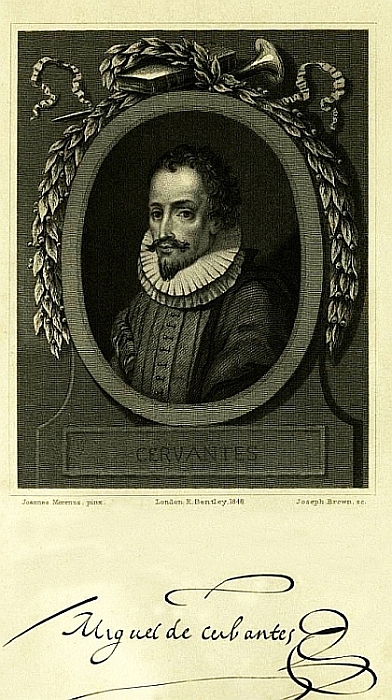
LIFE OF CERVANTES.
The History of Literature records numberless
instances in which genius, regarded with indifference
in its own time, has received only from
after generations the tribute of just appreciation.
Of this sort of contemporary neglect, and
posthumous honour, Cervantes is a remarkable
example; for even the popularity of Don Quixote
which, on its first appearance, met with unparalleled
success, did not materially better the
circumstances or elevate the position of its
author.
It is not very easy to reconcile this literary
success with the poverty with which Cervantes
struggled even to the latest period of his life,
and of which he oftener than once complains in
his writings; for it is a well-known fact that
though Don Quixote, in the lifetime of its
author, attracted an extraordinary share of public
attention, yet Cervantes remained poor and
neglected. Whilst the book was universally
read and admired, the author would appear to
have been a person of so little note, that his
early biographers did not even think it worth
while to put on record the name of his birth-place.
As if anxious to escape from the reproach
of knowing little or nothing of the man who
shed such lustre over their literature, the
Spaniards of the last century entered upon
diligent researches, with the view of elucidating
every fact connected with the life of Cervantes.
These investigations resulted in the
collection of a mass of interesting and curious
information, which De los Ríos, Pellicer, and
Navarrete have severally embodied in their
lives of the great writer. The warm discussions
which have at various times arisen out of the
doubtful question of Cervantes’ place of nativity
have been likened to the disputes of the
seven Greek cities, when contending for the
honour of having given birth to Homer.
Madrid, Seville, Valladolid and Esquivias by
turns claimed Cervantes as their own, until
the question was finally set at rest by his latest
and most trustworthy biographers. On the
authority of indisputable evidence it appears
that Miguel de Cervantes Saavedra was born
at Alcalá de Henares, in the year 1547. The
day of his birth is not known; but it has been
ascertained that he was baptized on the 9th of
October.
The family of Cervantes was of noble descent,
Father Sarmiento[5] states, that its earliest
members were settled in Gallicia, and that their
place of residence was within the Bishoprick
of Lugo. Their rank was that of Ricoshombres,
(grandees). Subsequently, a branch of the family
removed to Castile, and, in the Spanish annals
of the beginning of the thirteenth century, the
names Cervates and Cervantes are frequently
mentioned with honourable distinction. Gonzalo
de Cervantes, the founder of the branch
whence the great writer was descended, fought
gallantly at the storming of Seville, under
Ferdinand III., and was endowed with some
estates on the partition of the territories wrested
from the Moors. A descendant of Gonzalo de
Cervantes married a daughter of the house of
Saavedra, from which circumstance some members
of the Cervantes family added the name
Saavedra to their own. On the invasion of
South America by the Spaniards, the name of
Cervantes was carried to the New World by the
emigration of several members of the family.
In the beginning of the sixteenth century
we find a Juan de Cervantes filling the post
of Corregidor in the town of Ossuna. He
had a son named Rodrigo, who, in the year
1540, married Doña Leonora de Cortinas, the
daughter of a noble family residing in Barajas.[6]
Four children were the issue of this marriage.
The eldest was a son named Rodrigo; the
second and third, two daughters, named Andrea
and Luisa; and the fourth and youngest
child was Miguel, who subsequently became
illustrious in the annals of literature.
Miguel de Cervantes received from nature
a combination of mental endowments such as
rarely falls to the share of one individual. To
a lively fancy, and great power of inventive
genius, he united an extraordinary amount of
sound and discriminating judgment. Such
was his inherent fondness for reading, that in
his very earliest boyhood he was accustomed
to pick up all the little scraps of paper he might
find in the streets, and to employ himself in
perusing whatever happened to be written on
them. His gay and humorous disposition was
tempered by refined taste; and, to quote the
remark of his biographer, Antonio Pellicer, the
character of his mind altogether resembled
that ascribed by Horace to Lucilius.
Of the boyhood of Cervantes little is known,
beyond the few particulars here and there
scattered through his writings. Alluding to his
early taste for poetry, he says, in the Journey
to Parnassus:—“Even from my earliest years,
I loved the sweet art of graceful poesy.”[7]
In another of his works he tells us how, when
a boy, he was taken to a theatre, where he saw
Lope de Rueda act. That the performance of
that celebrated comedian and dramatist made a
powerful impression on his mind is evidently
shewn in his maturer years: it is not impossible
that his taste for dramatic literature
received its first impulse from the acting of
Lope de Rueda.
It would seem that Cervantes was destined
for one of the learned professions, and on attaining
a suitable age, he was sent by his
parents to the University of Salamanca, where
he remained for the space of two years. Some
of the lights and shades of his student life are
interwoven in the Novelas exemplares,[8] and also
in the second part of Don Quixote. The comic
interlude, called La Cueva de Salamanca, seems
also to have been suggested by some of the
author’s college adventures.
The first person who observed and fostered
the dawning talent of Cervantes in poetic composition,
was Juan López de Hoyos, who had
been his tutor before he entered the University.
It happened that Hoyos was commissioned
to compose a funeral poem on the occasion
of the death of Queen Isabel de Valois,
the Consort of Philip II.; and he transferred
some portions of this task to his pupils.
Hoyos wrote a narrative of the death and
funeral of the Queen,[9] and in that narrative
are inserted an elegy, a sonnet, and some redondillas,
by Miguel de Cervantes, who is
styled by his old tutor, “mi claro y amado discipulo,”—(my
clever and beloved pupil). At
this time Cervantes was twenty-one years of
age; and the praise bestowed on the first
effusions of his muse encouraged him to take a
loftier poetic flight. There is reason to believe
that about this period of his life he produced
Filena, a pastoral romance, in the style of
Montemayor and Gil Polo; but this, together
with most of his early productions, are now
lost; a few only being preserved in the Romancero
General.
The time soon arrived when the young
poet felt the necessity of directing his talents
and energies to the means of obtaining a livelihood;
for his father, though in circumstances
which enabled him to pay for his education,
was not sufficiently rich to maintain him. An
opportunity which placed it in his power to gain
some little emolument occurred in the year 1568,
when Cardinal Julio Acquaviva visited the
Court of Castile in the quality of Legate from
Pope Pius V. Cervantes entered the service of
the Cardinal, and in the same year accompanied
him to Rome. He filled the situation of Camarero,
which may be presumed to have been an
office partaking somewhat of a domestic character;
but it is a well-known fact that even young
Spanish nobles did not, at that period, disdain
to accept similar appointments in the households
of popes and cardinals. The desire of seeing the
world, or the prospect of gaining a powerful
patron and a good ecclesiastical appointment
were inducements for filling situations which
otherwise might have been considered degrading.
The vivid impressions produced by this
first great journey on the mind of Cervantes
are obvious even in the works of his later life.
In Persiles y Sigismunda he makes two pilgrims
wend their course through Valencia,
Catalonia, and Provence to Italy, the route by
which there is reason to infer he himself travelled
to Rome. The descriptions of scenery
in the production just named, bear the stamp
of personal recollections. That he was particularly
charmed with Catalonia, is evident
from the interesting sketches of scenery and
manners of that part of Spain, interspersed
through the Galatea, as well as from
those in the novel of Las dos Doncellas
and Don Quixote.
The residence of Cervantes in Rome, though
not long in duration, was permanent in his
remembrance. In his novel of the Licenciado
Vidriera he apostrophises Rome as the “sovereign
of the world and the queen of cities.”
“As the claws of the lion,” he adds, “denote
the animal’s bulk and strength, so may the
magnitude and power of Rome be judged by
her fragments of marble, her ruined arches,
her baths and her colonnades, her colossal amphitheatres,
and her river—that river which is
rendered sacred by the many relics and martyrs
buried beneath its waves.”
After the lapse of a short time, Cervantes
exchanged the tranquil occupations he pursued
in the service of his spiritual patron for the
more stirring duties of a soldier’s life.
That he always cherished a peculiar predilection
for military adventure is evident from
many observations scattered through his writings.
Like many of his countrymen in that
age, his taste seems to have disposed him to
the profession of arms no less than to that of
letters. Cervantes was of opinion that military
courage and literary talent are more
nearly allied than is generally supposed. In
Persiles he says,—“There are no better soldiers
than those who have been transplanted
from the field of study to the field of war.
There never has been an instance in which
students have taken up arms, that they have
not proved themselves to be the bravest and
best of soldiers, for when courage is joined to
genius, and genius is allied to courage, thereby
is formed a combination of qualities in which
Mars rejoices.”[10]
Cervantes entered the army as a private
soldier, and he served in one of the numerous
Spanish regiments then in Italy.[11] It would
appear that he was quartered either in Naples
or its vicinity. In 1571 the threatened incursions
of the Turks and the depredations of the
African corsairs disturbed the tranquillity of
the southern states of Europe, and once more
raised up a league of the Cross against the
Crescent. Pope Pius V. conjointly with Phillip
II. and the Republic of Venice, entered into
a coalition, and fitted out a combined fleet of
galleys for the subjugation of the common
enemy of Christendom. Marco Antonio Colonna
had the command of the Pope’s galleys;
those of King Phillip were commanded by
Giovanni Andrea Doria, and those of the
Republic by Sebastian Veniero. Don John of
Austria, son of the Emperor Charles V. was
appointed commander of the whole combined
squadrons.
Cervantes, with many other young Spaniards,
left Naples and proceeded to Messina,
then the mustering place of the combined
fleets. He enlisted in the corps of Diego de
Urbina, which sailed in Colonna’s galleys to
the Gulf of Lepanto, and he took part in the
celebrated battle fought there on the 7th of
October, 1571. During the voyage he had
suffered from a fever, and he had not recovered
when the action commenced. His commander
as well as his comrades recommended him to
remain quietly in his cabin; but this he
refused to do, declaring his wish to die in the
service of God and his King rather than to
save his life by ingloriously keeping aloof from
danger. He entreated that one of the most
exposed posts might be assigned to him. His
urgent desire was complied with; and it is
stated that he fought with more resolute courage
than any man on board the vessel. By
the fire of that galley alone it is said more
than five hundred Turks were killed. Cervantes,
who exposed himself to the fiercest assault
of the enemy, received three wounds from
arquebus balls, two entered his breast, and
the other so dreadfully shattered his left
hand that he subsequently had it amputated.
But so far from regretting this mutilation, he
prided himself on it, and regarded it as an
insignia of honour. In his preface to the
second part of Don Quixote, he declares that
he views his maimed hand as “a memorial
of one of the most glorious events that past
or present ages have seen, or that the future
can hope to see;[12] and,” he adds, “could an
impossibility be rendered practicable, and could
the same opportunity be recalled, I would rather
be again present in that prodigious action than
whole and sound without sharing in the glory
of it.”
The memorable 7th of October, 1571, was
to Cervantes like a ray of light beaming
through the clouds of his past recollections.
Even in the Journey to Parnassus, which he
wrote in his latter years, he says, alluding to
the battle of Lepanto, “My eye wandered over
the smooth surface of the sea, which recalled
to my memory the heroic exploit of the heroic
Don John; when aided by courage, and by a
heart throbbing for military glory, I had a
share (humble though it was) in the victory.”[13]
Cervantes was four and twenty years of age
when the Battle of Lepanto was fought. The
signal courage he displayed on that occasion
obtained for him the complimentary notice of
Don John of Austria. On the day after the
battle that Prince reviewed the combined fleet,
and visited the wounded, presenting to each
soldier who had particularly distinguished himself,
a sum of money over and above the
amount of his pay. Cervantes received from
the hand of the prince one of these honourable
gratuities.
The victory of Lepanto, though for a time
fatal to the Turks, was not succeeded by any
permanent advantage to the coalesced powers.
Sultan Selim speedily found a strong ally in
the dissentient spirit which prevailed among
the Christian rulers. By command of Philip
II. Don John returned to Messina, where the
victorious fleet was received with public
rejoicings. Cervantes, not yet recovered from
his wounds, was consigned to the hospital, and
he remained in Messina whilst most of the
troops were dispersed about in the interior of
Sicily. In the following year, his military
ardour being unabated, he joined another
expedition fitted out by the Chiefs of the
League, and sailed this time to the Archipelago.
He was present at the storming of Navarino;
but the expedition having failed in its object,
he once more returned to Messina.
The following winter was spent in preparations
for a new armament; but owing to the
secession of the Republic of Venice from the
league, the Spanish and Papal forces alone
were found insufficient for attacking the Turks;
and in consequence King Philip determined to
fit out an expedition against Tunis. The object
of the king was merely the dethronement of
Aluch Ali in favour of Muley Mahomet; but
John of Austria, to whom was entrusted the
command of the expedition, hoped to found
for himself an independent sovereignty in
Africa; and in furtherance of this object, the
pope promised his aid. No sooner did the
fleet appear within sight of Goletta than the
garrison retired from the fort and the inhabitants
of Tunis took to flight. A single
regiment then sufficed to take possession of
the fortress and the city; and there is good
reason to conjecture that Cervantes was in the
ranks of that regiment. Don John having
erected a new fort took possession of Biserta,
and leaving behind him a portion of his force
he returned once more to Sicily.
Cervantes, with the regiment to which he
belonged, proceeded to Sardinia, where he
remained during the winter of 1573 to 1574.
He was afterwards sent to Genoa, which was
then agitated by insurrectionary movements.
To quell those outbreaks, Don John
was on the point of leaving Lombardy, when
he learned that the Turks were actively assembling
their forces with the view of regaining
possession of Tunis and Goletta. Without
delay the prince embarked at Spezzia, with a
division of his troops, in which was
Cervantes. He proceeded first to Naples and
Messina, and then sailed for the African coast.
But the little armada had not advanced far on the
voyage, when a violent storm which threatened
destruction to the galleys drove them back
to the Sicilian shore. Meanwhile Goletta and
Tunis, after a gallant defence, were retaken by
the Turks, an event which at once crushed the
hopes of Don John of Austria.
Cervantes, with his regiment remained for
a time in Sicily, under the command of the
Duke de Sesa. It would appear that he was
afterwards removed to Naples, for he says in
the Journey to Parnassus, “that he paced the
streets of that city for upwards of a year.”[14]
There is, however, good reason for believing
that his time was not spent in idly pacing the
streets, but that during his stay in Naples, he
employed his intervals of respite from military
duty, in studying the Italian language and
reading the works of the best Italian writers;
for it is well known that he possessed an erudite
knowledge of the literature of Italy.
Urged by an irresistible desire to revisit his
native country, and probably dissatisfied with
the scanty recompense awarded to his military
services, Cervantes solicited leave to return to
Spain. His request was granted in a manner
highly gratifying to him, in the year 1575,
when Don John and the Duke de Sesa furnished
him with letters, recommending him to
the notice of King Phillip, as a man whose
courage had gained the respect of his officers
as well as of his comrades.
With a joyful heart Cervantes embarked in
the galley El Sol, accompanied by his brother,
Rodrigo, who had joined him in Naples. From
that port they both sailed on their return to
Spain. But the wished for happiness of
revisiting his native land was more remote
than was anticipated. On the 26th of September,
1575, the Sol was attacked by an
Algerine Corsair. After a brave resistance the
galley was captured, and all on board were
conveyed to Algiers. In the distribution of
the prisoners Cervantes fell to the share of
Dali-Mami, a Greek renegade, who, by reason
of his lameness, was surnamed “the cripple.”
The letters addressed to Phillip II., which
Cervantes carried with him, led Dali-Mami to
believe that his slave was a Christian knight of
distinguished rank; and he treated him with
the utmost rigour in the hope of extorting a
large sum of money for his ransom. But with
the fortitude which marked his character Cervantes
patiently endured his misery, whilst his
thoughts were occupied by schemes for effecting
his own liberation and that of his companions.
Having devised a plan of escape to
Oran, he prevailed on his friends to join him
in carrying it into effect. The fugitives succeeded
so far as actually to get away from
Algiers, when they were betrayed by a Moor
who had undertaken to be their guide. They
were conveyed back to their prison and confined
with more rigour than before. Cervantes
as the ringleader was treated with so much
severity, that as he afterwards observed, “he
learned in that school of suffering to have
patience under misfortune.”[15]
Two descriptions of labour were assigned
to the Christian captives in Algiers. Some
were employed in rowing the galleys and chebeques,
others, and these shared the hardest
lot, were kept within the city, in places called
the bagnios or baths, which were in reality prisons,
and which received their names from
the numerous baths they contained. Most of the
captives in the bagnios were the slaves of the
dey or king, but private persons were occasionally
permitted to send their slaves thither, especially
those who were expected to be ransomed;
the bagnios being considered the most secure
places of confinement. The slaves whose ransoms
were looked for, were not sent out to
labour like the rest: but they wore a chain
and, moreover, were wretchedly fed and clothed.
Of this number was Cervantes, whose
condition as a Spanish Hidalgo, gave his
master reason to hope that a large sum would
be offered for his liberation.[16]
A Spaniard who had passed some years of
slavery in Algiers, and who was ransomed in
the year 1639, by the monks of the Order of
the Santissima Trinidad, drew up, after his
return to Spain a narrative of his captivity.
He gives a curious description of the treatment
of the Christian slaves in Algiers, together
with details respecting the manners
and customs of the Moors. This narrative
has never been printed; but from a manuscript
copy of it in the Biblioteca Real at
Madrid, the following extracts have been
obtained.
“The Christians in Algiers,” says the
writer, “have four churches, in which mass is
performed. In my time there were twelve
priests who officiated daily. In the principal
church, which is situated within the King’s
Bagnio, and dedicated to the Santissima Trinidad,
there are five priests and a Provisor, appointed
by his Holiness. There are seven
brotherhoods (cofradías), and in each mass is
performed daily. Every day alms are begged
from the captives for the purchase of wax
tapers and altar decorations. Each priest receives
out of these alms one real and a half;
this with the money paid for masses is all the
priests have to subsist on. In the churches
the religious service is very properly performed,
and sermons are always preached.
The Christians are very ill-treated, especially
the priests, who are frequently pelted with
stones and dirt by the boys as they pass
through the streets. At this present time,
10th of March, 1639, Algiers contains 20,000
Christian slaves, 10,000 soldiers, and 1000
counsellors-of-war. These counsellors act as
judges in all trials relating to matters connected
with the army or navy; and they never
take longer than two days to deliberate on
any question. The inhabitants of Algiers,
both men and women, live very miserably.
Their principal food consists of rice and wheat
boiled, with a very small portion of salted
meat. Even the richest individuals do not live
much better. The daily food of the captives
consists only of a small loaf of bread. They
are treated very cruelly, especially by the Tagarinos,
the descendants of the Moors, expelled
from Spain. To force them to press their
friends for ransom, their daily tasks of labour are
augmented, and they are put in chains—the
strongest being sent to the galleys. In every
part of the city there are mosques, which the
women are not suffered to enter: some of
these mosques have a tower or minaret, on
which a flag is hoisted at noon, lowered at
one o’clock, and then hoisted again at dusk.
From these minarets the Moors call the
people to prayers. The most profound silence
prevails during worship in the mosques; no
one dares to speak or even to cough. The
prayers are short; and whilst they are repeated,
the people are squatted cross-legged on
the ground, at intervals rising up and then
bowing down to the earth. The mosques are
hung with great numbers of glass lamps; but
they have no other ornaments. The floors
are covered with mats, and the walls and
ceilings are arched. Within the mosques there
are orange trees, and alcoves for the Morabites,
who are held in high veneration; they receive
presents from the women, whose husbands,
strange to say, do not disapprove of this practice.
There is a religious festival on Friday
in every week. At their meals the Moors
place their food on the ground, without spreading
any cloth under the dishes, which are of
copper, tinned over; even the richer class do
not use utensils of silver. The out-door dress
of the women consists of long trousers, reaching
to the feet, and fastened round the ankles
by rings of gold or silver; their outward garment
consists of a large cloak enveloping
them from head to foot, and leaving only their
eyes uncovered. Their dress is decorous,
though their manners are not so. Within
doors they wear a long tunic, reaching to the
ankle, and made of rich damask, satin or silk;
they wear many rich jewels, consisting of
bracelets, necklaces, and earrings. Many of
these Moorish women are very beautiful; but
they indulge much in the habit of smoking.”
It happened that a Spaniard, who had been
for some time one of the fellow-captives of
Cervantes, having been ransomed, was suffered
to return to his native country. On his arrival
in Spain, he lost no time in conveying to the
father of Cervantes intelligence of the unhappy
condition of his two sons Rodrigo and Miguel.
The old man, without hesitation mortgaged his
little property, though by so doing he reduced
himself and the other members of his family
to a condition bordering on want, and having
raised a considerable sum of money he transmitted
it to Algiers. The two brothers were
thus placed in a condition to treat for their
liberation. But Dali-Mami demanded so high
a ransom for Miguel de Cervantes, that the
latter generously resigned his share of the
money sent from Spain, in favour of his
brother Rodrigo, who obtained his deliverance
in August, 1577. On his departure,
Rodrigo promised to spare no exertions for
making known the condition of the captives to
persons of influence in Spain, so that some
effectual measure might be adopted for their
liberation. It was proposed that a ship, despatched
from Valencia or from the Balearic
Islands, should cruise along the African coast,
keeping watch so as to be in readiness to receive
the captives whenever they might have an opportunity
of effecting their escape. Rodrigo
Cervantes carried with him, on his departure
from Algiers, a letter from one of the prisoners,
a Spanish nobleman, related to the house of
Alba;—this letter, it was hoped, would have
great weight in furthering the execution of the
enterprise. Cervantes had concocted the
scheme for the escape of himself and his
friends, and every preparation had been made
for enabling them to carry it into effect.
A little to the west of Algiers, there was a
garden, close to the sea shore. It was attached
to a villa belonging to Aga Hassan, then Dey
of Algiers. Hassan, who was a Venetian by
birth, had originally been the slave of the
celebrated Uchali. He turned Mahometan,
and his apostacy helped him to rise to wealth
and distinction in the Ottoman Empire. At
the time of the Battle of Lepanto, Aga Hassan
filled the high post of Captain-General of the
Turkish fleet, and he was afterwards elected
Dey of Algiers. This turbulent and cruel man
ruled his temporary sovereignty with a rod
of iron. His tyranny and barbarity were
exercised alike on Moors and Christians; for,
as Cervantes makes the captive in Don Quixote
remark, “he was the homicide of the whole
human race.” Era homocida de todo el género
humano.
Aga Hassan’s garden was under the care
and superintendence of a gardener, who was a
Christian slave and a native of Navarre.
Cervantes having made himself acquainted
with this man, induced him to make an excavation
under the garden in the form of a cave.
As early as February, 1577, some months prior
to the departure of Rodrigo Cervantes, this
excavation was in progress, and several Christian
slaves, who had escaped from bondage had
taken refuge in it. The number of the fugitives
gradually augmented, and in September
of the same year Cervantes himself succeeded
in eluding the watchful eye of his master, and
joining his friends in their subterraneous
retreat. He had accurately calculated the time
when the expected ship would near the African
coast. It did so on the 28th of September;
but stood off during the day, so as to keep
out of sight, and at night standing close in
shore, the vessel gave the signal to the captives.
This being unluckily observed by some
Moorish slaves, who happened to be on the
spot, they gave the alarm. The vessel immediately
put back, but shortly afterwards made
a second attempt to near the shore, which
ended in failure, and she was captured.
But this disaster, discouraging as it was,
did not subdue the hopes of Cervantes and
his companions, who determined to remain
in their hiding place to await another opportunity
for attempting their escape. But their
schemes were frustrated by the treachery of a
slave, who had been a renegade from Islamism
to Christianity, and whom the fugitives had
incautiously admitted to their confidence. This
slave, who was surnamed El Dorador, again
turned renegade, and by renouncing Christianity
entitled himself to the reward of his twofold
apostacy and treachery. The Dey, who
claimed all runaway slaves as his own, dispatched
a troop of soldiers to the garden. The
cave was searched and the fugitives captured.
The details of this event are related by
Father Diego de Haedo, a Spanish ecclesiastic,
who was contemporary with Cervantes, and
who wrote a history of Algiers. Alluding to
the seizure of the fugitives in the cave, Haedo
says, “The Dey’s emissaries took especial
care to secure Miguel de Cervantes, a Hidalgo
of Alcalá de Henares, who was the contriver of
the whole scheme.”[17] He then adds, “It was a
most marvellous thing that these Christians remained
hidden in the cave, without seeing the
light of day, some for five or six, and others for
so long as seven months;—sustained all that
time by Miguel de Cervantes; and this too at
the peril of his own life, for several times he
was on the point of being hanged, empaled, or
burnt alive, for the bold adventures by which
he attempted to restore his comrades to freedom.
Had his good fortune been equal to his
courage, enterprise and skill, Algiers would at
this day have been under Christian rule; for to
no less an object did his designs aspire. The
gardener, who was a native of Navarre, was
hanged by the feet. He was a very good
Christian. Of the incidents which occurred in
that cave, during the seven months that those
Christians remained within it—and of the
bold enterprises hazarded by Miguel de Cervantes—a
particular history might be composed.”[18]
Finding that himself and his friends were in
the power of their captors, and that it was fruitless
to attempt resistance, Cervantes at once
declared himself the sole contriver of the scheme,
and begged that, as he alone was guilty, the
whole punishment might devolve on him.
This avowal caused him to be put in chains,
and amidst the scoffs and insults of the populace,
he was conducted to the presence of Aga
Hassan. With fearful threats the tyrant
sought to intimidate him into a confession that
he had accomplices, and to denounce them; for
his object was to make it appear that Father
Jorge Olivar, the Redentor, or Slave Ransomer,
of the crown of Aragón, was implicated in the
affair. But Cervantes persisted in affirming
that no one could be accused but himself.
Nevertheless, the barbarous Hassan forthwith
condemned all the fugitives to death.
The unfortunate gardener was hanged, and
Cervantes and his friends would doubtless have
shared the same fate, but that, luckily for
them, Hassan’s cupidity triumphed over his
cruelty. The prospect of ransom money saved
the lives of the prisoners; but they were
thrown into one of the most loathsome prisons
in Algiers, and subjected to all sorts of privation
and misery.
But in spite of their bitter sufferings, the
captives, most of whom were Spaniards, did
not yield to despondency. Each one cheered
himself and his companions, by pleasant stories
and recollections of their dear native land.
The song and the dance, diversions ardently
loved by every Spaniard, were not wanting to
enliven the gloom of their prison-house. By
turns they recited or sang their old national
romances, and the heroic deeds of their ancestors
inspired them with courage. Their religious
festivals, too, were celebrated with all the ceremony
which circumstances admitted of, and
the prisoners even succeeded in getting up
some dramatic representations.[19]
In those palmy days of the Spanish drama,
the passion for histrionic performance had
taken firm root in the public mind. So popular
and universally admired were the comedies of
Lope de Rueda, that Spaniards, who had been
for years out of their native country, could recollect
and repeat by heart favourite passages
and scenes from them.
It is well known that Cervantes drew from
his captivity in Algiers the subjects of two
plays which he wrote at a subsequent period of
his life, and in which he depicts the sufferings of
the Christian slaves. In one, Los Baños de
Argel, a pastoral dialogue, (Coloquio Pastoril) is
introduced. It is stated to be from one of Lope
de Rueda’s comedies, and is curious from the
fact of its being in verse, whilst all the dramas, or
as they are called, comedias, of Lope de Rueda,
now extant, are in prose. The other play by
Cervantes, founded on the subject of Algerine
captivity, is entitled La Gran Sultana. The
heroine is a Spanish lady, Doña Catalina de
Oviedo, supposed to have been captured by
corsairs.
Undaunted by failure, Cervantes determined
on the first favourable opportunity to
renew his efforts to obtain his own deliverance
and that of his companions. Increasing difficulties
had no other effect than that of
strengthening his resolution to surmount them.
He felt an irresistible longing for that freedom,
which, to quote his own words, is “the
dearest gift which Heaven has bestowed on
man. For freedom,” he adds, “as well as for
honour, it is our duty to sacrifice life. Captivity,
on the other hand, is the greatest misfortune
which man can be doomed to bear.”
He gained over to his interests a Moorish
slave, whom he persuaded to convey a letter
from him to the Spanish governor of Oran.
The object of this communication was to facilitate
a plan for the liberation of himself and
three of his fellow-prisoners. The letter was
however intercepted, and the messenger, by
order of Hassan, was immediately shot. Cervantes,
as the writer of the missive, was sentenced
to receive two thousand stripes; and
only by the urgent and repeated intercession of
the Christians in Algiers, was the noble slave
saved from the infliction of that barbarous punishment.
The three Spaniards who were comprehended
in the projected plan of escape were
put to death; and the extension of Hassan’s
mercy to Cervantes may be attributed in a
great measure to the influence which an exalted
character exercises even on the most
uncivilized of mankind.
Another, and to all appearance, a more
practicable plan of escape, contrived in 1579,
was foiled by the treachery of a Dominican
monk. Hassan, to whom the design was disclosed,
affected at first to have no suspicion of
it; hoping by that means to ensure its detection.
The Christians, however, soon learned
that their project was discovered. A native of
Valencia, settled as a merchant in Algiers, had
promised to aid the escape of the prisoners.
This man spared no endeavours to prevail
on Cervantes to slip away furtively and unknown
to his companions. He even undertook
to convey him safely on board a vessel about to
sail for Spain; for knowing that the Moors
would resort to every extremity to extort
a confession, the merchant feared that
his own life and property might be endangered.
Cervantes had by this time broken from prison,
and was concealed in the house of a friend;
consequently he might with perfect ease and
safety have effected his escape on board the
ship in the manner proposed. But he would
not listen to the suggestion of deserting his
companions, and he quieted the apprehensions
of the merchant by the most solemn assurance,
that neither the fear of torture or death would
wring from him a word of avowal that could in
any degree compromise a friend. Meanwhile,
an order of the Dey was proclaimed
through the streets of Algiers, commanding
the Slave Cervantes to deliver himself up, and
warning those who might harbour him, that
they would incur the punishment of death.
The fugitive, anxious to screen his friends
from all risk, surrendered himself. Aga
Hassan, without a moment’s hesitation, ordered
him to be hanged. After his hands were
tied behind his back, and the rope put
round his neck, he was informed that he
might yet save his own life by the disclosure
of his accomplices. But, faithful to
that generosity of feeling, which was one of
the most prominent traits in his character,
Cervantes persisted in declaring that he
alone had wished to escape; but to avoid
being further pressed by questions, he named
as the accomplices of his design, four Spaniards
who had, some time previously, obtained their
liberation by the payment of ransom-money.
The intercession of an influential renegade,
who was an attached friend of Cervantes, induced
the Dey once more to spare his life; but
he was thrown into a dungeon of the Bagnio,
heavily fettered, and watched with the strictest
vigilance.
The next project conceived by Cervantes,
exceeded in boldness all that he had previously
concerted. It was of so wild and romantic a
character, that its reality might naturally warrant
disbelief, were it not authenticated by
trustworthy evidence. This scheme was nothing
less than the excitement of an insurrection
among the Christian slaves in Algiers, who
were to make themselves masters of the city,
and transfer it to the dominion of Phillip II.
Notwithstanding the rigorous nature of his imprisonment,
he contrived to take some steps
towards the execution of this bold enterprise.
Whether the project was thwarted by discovery,
or to what other cause its frustration was assignable
does not clearly appear. Certain it is,
however, that the Dey of Algiers regarded Cervantes
as the boldest and most ingenious of all
his Christian slaves. Father Diego de Haedo
relates, that so greatly did Aga Hassan fear
Cervantes, that he used to say, “he should
consider his slaves, his barks, and the whole
city of Algiers perfectly safe, could he but get
rid of that one-handed Spaniard!”
At length, the freedom so ardently sighed
for, and for the attainment of which so many
fruitless efforts had been made, was recovered,
at a time when even Cervantes himself, sanguine
as he was, had well nigh relinquished all hope
of ever again being restored to his country.
In the year 1580, Juan Gil and Antonio
de la Bella, two monks of the order of the
Santissima Trinidad, were sent from Spain to
Algiers; the former as Redentor, or slave ransomer,
for the Province of Castile, and the
latter in the same capacity for the Province of
Andalusia. The father of Cervantes was by
this time dead, and the family were left in
rather straitened circumstances;—nevertheless
they succeeded, by dint of great exertion,
in raising some money to assist in ransoming
their relative. Doña Leonora de Cortinas, the
mother of Cervantes, contributed two hundred
and fifty ducats;—and Doña Andrea de
Cervantes, his sister, gave fifty.[20] The family
naturally hoped that the high testimonials of
courage and merit, furnished in favour of Cervantes
by his former military comrades,
together with the letter of recommendation
from the Duke de Sesa to the king, would
gain the interest of the Court in his behalf.
But the appeals addressed to that high quarter
were responded to with only lukewarm interest,
and accordingly the Monks departed with a
sum very inadequate to the accomplishment of
the object of their mission, which was to obtain
the release of some of the principal captives.
Doña Leonora de Cortinas furnished the
Redentores with a description of her son,
setting forth that he was a native of Alcalá,
and the slave of Dali-Mami, the captain of
the Dey’s barks,[21] that he was thirty-three years
of age and had lost his left hand. A description
of himself given by Cervantes to the
authorities in Algiers is as follows—“A native
of Alcalá de Henares, aged thirty-one, of middle
height, having a thick beard (bien barbado),
disabled of the use of the left arm and wanting
the left hand; captured on board the galley
El Sol, when on his passage from Spain to
Naples, where he had been long in the service
of His Majesty.”[22]
The Redentores arrived in Algiers on the
29th of May, 1580. At that very time the
Dey was on the eve of resigning his authority
in favour of another Pacha, who was elected
to the government of Algiers. Hassan, who
had been recalled by the Sultan to Constantinople,
was preparing to return thither. Cervantes,
being one of the captives he intended
to take with him, was actually on board a
galley, and ready to sail for the Turkish capital,
when the slave ransomers arrived in Algiers.
There was no time to be lost, and negotiations
for the ransom were set on foot without a moment’s
delay. The amount demanded was
more than double the sum which the Redentores
were authorised to pay. However, Father
Juan Gil made up the deficiency by devoting
to the release of Cervantes a portion of the
money advanced by the friends of other captives,
who being then absent from Algiers,
their ransom could not be effected. The
Redentores pledged themselves to refund the
money on their return to Spain, and by these
arrangements, together with some abatement
in the demand of Aga Hassan, Cervantes
obtained his release on the 19th of September,
1580.
But joyfully as he hailed the prospect of
returning to his native land, he nevertheless
resolved, ere he should quit Algiers, to controvert
certain calumnies circulated against him,
which he conceived were calculated to impugn
his honour. The Dominican Monk, who
had betrayed the last plan formed by the
Spanish captives for their escape, and who had
thereby incurred the hatred of all the Christians
in Algiers, sought in revenge to cast on
Cervantes the odium of having caused the
failure of the enterprise. Cervantes, whose
nice sense of honour urged him to free himself
from even the slightest trace of suspicion,
appealed to the testimony of twelve of his
fellow captives, all of them men of high character
and members of noble Spanish families.
Their evidence refuted in the most complete
and satisfactory way the calumnious charges
of the Benedictine monk. They unanimously
declared that though there were many noble
Spanish cavaliers in Algiers, not one was more
distinguished for honourable and generous sentiment
than Miguel de Cervantes; and that he
had invariably manifested the sincerest interest
and sympathy for his countrymen and fellow-captives,
all of whom regarded him in the light
of a brother.
On the 22nd of October, 1580, after five
years of detention in Algiers, Cervantes embarked
for Spain. He had now before him the
cheering prospect of that happiness which he
himself has declared to be “one of the greatest
that can be enjoyed in this life;—the return to
one’s native country after prolonged captivity.”
“There is,” he adds, “no happiness like the
recovery of lost freedom.”[23]
On his return to Spain, about the end of the
year 1580, he repaired straight to Madrid, where
his mother and sister were then residing. The
reduced circumstances in which he found his
family determined him once more to try his
fortune as a soldier. At this time, Philip II.
was intent on completing his conquest of Portugal
by the acquisition of the rich colonial
dependencies of that kingdom. It had been
determined to maintain a Castilian army in
Portugal, for the purpose of preserving public
tranquillity, enforcing obedience to the authorities
of King Philip, and preparing the reduction
of the Azores or Terceras Islands. Rodrigo
Cervantes, who on his return from Algiers, had
resumed military service, was now in the army
of occupation in Portugal, and he was speedily
joined there by his brother Miguel.
In the spring of 1581, both the brothers
sailed from Lisbon in one of the ships of an
armament commanded by General Don Lope
de Figueroa. This armament was sent to the aid
of Don Pedro Valdez, who had been commissioned
to reduce the Azores Islands to the authority
of the Spanish crown. A misunderstanding
arose between Figueroa and Valdez, on
the subject of an attempted landing at Tercera,
and not being able to come to an agreement
they carried on their operations separately, and
after a short time both returned to Portugal.
The Spanish Government found reason to
suspect that the pretensions of Don Antonio,
Prior of Ocrato,[24] were secretly favoured by
France and England, and that the ships of those
powers, and especially those of France kept up
the spirit of rebellion in the Azores. Phillip
II., determined to repress these proceedings,
and to take measures for the protection of the
Spanish Galeones employed in transporting the
treasures of the colonies to the mother country.
He accordingly ordered several armaments
which had been for some time in preparation
in the maritime provinces of Spain, to assemble
in the Tagus. It was understood that a French
squadron had already put to sea with hostile
designs on the Portuguese dependencies; and
Phillip on receipt of this intelligence gave the
command of the Spanish naval force to the
celebrated Admiral Don Álvaro de Bazán,
Marques de Santa Cruz. The fleet, having on
board several regiments of infantry, sailed from
the Tagus on the 10th of July, 1582, and the
Spaniards soon fell in with the French squadron.
The result was an engagement in which the
French ships were dispersed or destroyed.
Cervantes states that he was himself engaged
in this action, together with his brother
Rodrigo, but he enters into no particulars respecting
it. Both the brothers likewise served
in the expedition which sailed from Lisbon in
the following year, 1583, under the command of
the Marques de Santa Cruz. The Spaniards
effected a landing at Tercera, on the 23rd of
June, and the result was the surrender of that
island. The submission of the rest of the
Azores speedily followed, and the partizans of
Don Antonio were finally put down. The
campaign being thus gloriously ended, Don
Álvaro de Bazán returned to Spain, and on the
15th of September, he entered Cádiz greeted
by signal demonstrations of popular triumph.
On the Atlantic, as well as in the Levant,
Cervantes had been an eye-witness of the
gallant achievements of the great naval hero of
Spain. As a soldier he had served under his
authority, as a philosopher, he had contemplated
his virtues; and he rendered to his glory a
poetic tribute of admiration and gratitude.
He wrote a sonnet on Don Álvaro de Bazán,
which was published by the Licentiate Cristobal
Mosquera de Figueroa, in the Comentarios de la
jornada de las Islas Azores. In Don Quixote, he
also pays an emphatic and well merited compliment
to the courage of the celebrated admiral,
in that passage where the captive describing
the storming of Navarino, says:—“In this
campaign, the galley called the Prize, whose
commander was a son of the famous corsair Barbarossa,
was taken by the captain galley, of
Naples, called the She-Wolf, commanded by
that thunderbolt of war, that father of the
soldiers,—that fortunate and invincible Captain
Don Álvaro de Bazán, Marques de Santa Cruz.”
During the time he remained with his regiment
in Portugal, Cervantes mingled freely in
society, and made himself familiarly acquainted
with the language as well as with the manners
and customs of the people of the country.
His society was sought, and wherever he went
he was kindly and hospitably received. That
his sojourn in Portugal impressed him with
pleasing and grateful recollections, is evident,
from the observations here and there scattered
through several of his works, especially Persiles.
Contrary to the prevailing taste of his countrymen,
(for the Spaniards usually entertain no
great partiality for the Portuguese language,)
Cervantes was charmed with it; pronouncing
it to be “a sweet and pleasing tongue,” (lengua
dulce y agradable). The people he characterizes
as agreeable, courteous, and generous. Speaking
of the women, he says, their beauty inspires
admiration and love, (la hermosura de las
mujeres admira y enamora). Lisbon, he calls a
great and famous city, and he declares that
Portugal may altogether be regarded as the
land of promise (tierra de promisión). With
such strong predilections in favour of the
country and everything belonging to it, it can
scarcely be matter of surprise that Cervantes
should have become enamoured of a Portuguese
lady, and that the attachment should have been
reciprocal. His biographers are silent respecting
the connections of this lady, nor do they
even mention her name; but all concur in
stating that the fruit of this attachment was a
daughter, who was known by the name of Doña
Isabel de Saavedra. This daughter was the
companion of Cervantes through all the vicissitudes
of his subsequent life, and after his
marriage she constantly resided under the same
roof with him and his wife.
On his return to Spain after the successful
issue of the Azores expedition, Cervantes’
pecuniary condition would seem to have been
very similar to that of Horace after the battle
of Philippi.[25] He found himself utterly destitute,
and had no means of subsistence save
such as he could procure by writing verses.
Heretofore his life had been pretty equally
divided between war and literature, “now
taking up the sword and now the pen,”[26]—like
many other eminent Spaniards of that age,
who were distinguished equally as soldiers and
writers. Even in the dungeons of Algiers, and
amidst the most stirring events of war, Cervantes
never wholly relinquished his love of literary
composition; and many of his sonnets, and
other little fugitive poems, bear evidence that,
in seasons of trial and suffering, he courted
the solace of the Muse. It has been conjectured,
and with much appearance of probability,
that many of the sonnets, canzonets,
and ballads introduced in the Galatea, were
composed amidst the active duties of the author’s
military career, and during the weary
hours of his captivity.
The Galatea was the first work which
Cervantes submitted to the press, and it was
published in 1584. It is a pastoral romance,
partly in prose, and partly in verse, in the style
of the Diana of Montemayor; but exhibiting
still greater resemblance to Gil Polo’s continuation
of Montemayor’s poem. Very little
ingenuity is shewn in the invention of the
fable; it is merely an insipid story of pastoral
life, in the affected and unnatural style so
much in fashion in the sixteenth century.
In this frame-work the author has grouped
together a rich collection of metrical compositions,
in all the various styles of versification
practised by the old Spanish and Italian poets.
“The story,” observes Bouterwek, “is merely
the thread which holds the beautiful garland
together; for the poems are the portions of the
work most particularly deserving of attention.
They are as numerous as they are various,
and should the title of Cervantes to rank
among the most eminent poets, or his originality
in versified composition be called in
question, an attentive perusal of the romance
of Galatea, must banish every doubt upon
these points.”[27]
Lope de Vega, and other contemporary
writers, have affirmed that the shepherdess,
who is the heroine of the romance, was not a
mere imaginary character; but that under the
name of Galatea Cervantes pourtrayed the
lady to whom he was subsequently married.
According to the same authorities, Cervantes
represented himself in the character of Ercilio,
“pastor en riberas del Tajo,”[28] who is enamoured
of Galatea, “pastora nacida en las
orillas de aquel río.”[29] It is also believed that
the pastoral names of Thyrsis, Damon, &c., are
merely fictitious denominations for several
of the most celebrated poets of his own
time.[30]
On the 12th of December, 1584, Cervantes
was united in marriage to Doña Catalina de
Salazar, a lady connected with a distinguished
Spanish family. She was the daughter of Don
Fernando de Salazar y Vozmediano, and of
Doña Catalina de Palacios. Doña Catalina
brought her husband some little fortune, upon
which the newly married couple lived as long
as it lasted. After his marriage, Cervantes definitively
left the army, and for a time fixed his
abode at Esquivias, in which town his wife’s
family resided.
The proximity of Esquivias to Madrid,
enabled him to make frequent visits to the
capital. There he formed acquaintance with
most of the distinguished Spanish writers of
the day, and he became a member of one of
those numerous literary academies which in
the reign of Charles V. were established in
Spain in imitation of those of Italy. About
this time Cervantes began to apply himself
zealously to dramatic composition. The taste
for theatrical amusements, then so popular in
Spain, rendered play writing a ready mode of
turning literary talent to profitable account.
But there is reason to infer that inclination no
less than the prospect of pecuniary gain,
prompted Cervantes to write for the stage;
and the complacency with which, at a subsequent
period of his life, he looked back to his
early comedies proves that he thought himself
entitled to no little distinction as a dramatic
author. That he should so far have mistaken
the true bent of his genius, is one of those unaccountable
fallacies of judgment, from which
even the shrewdest minds are not always
exempt. Those of his plays which in the
opinion of Cervantes himself possessed peculiar
merit, are of that class which was so popular
among the Spaniards of the sixteenth century,
and called Comedias de capa y espada.[31] In
his Viaje del Parnaso, alluding to these plays,
the author says—“If they were not my own I
should declare that they merit all the praise
they have obtained.” One of them, la Confusa,
he declares to be “a good one among the
best.”[32] La Confusa is one of the many dramatic
works of Cervantes, which there is reason
to fear are totally lost.
Bouterwek, whilst admitting the general
failure of Cervantes as a writer for the stage,
nevertheless declares that the high merits of
the tragedy of Numancia might well pardon
the self-deception under which the author
laboured in respect to the limits of his talent
in dramatic literature. “With all its imperfections,”
observes the celebrated German
critic, “the tragedy of Numancia is a noble
production, and, like Don Quixote, it is unparalleled
in the class of literature to which it
belongs. It proves that under different circumstances
the author of Don Quixote might
have been the Æschylus of Spain. The conception
is stamped by the deepest pathos
and the execution, at least taken as a whole, is
vigorous and dignified.”[33] The tragedy of
Numancia and the comedy of El Trato de
Argel (life in Algiers), were accidentally discovered
in manuscript about the end of the last
century; after having been supposed to be
irretrievably lost.
During the interval of his alternate residence
in Esquivias and Madrid, it is computed
that Cervantes must have written between
twenty and thirty dramatic pieces. Among
those successfully performed at the theatres
of Madrid were Los Tratos de Argel, La
Numancia and La Batalla naval. In these
pieces the author ventured to depart from
the forms of the old Spanish drama; and these
changes, together with other innovations he
introduced, were very favourably received by
the public.
But in spite of this partial success, the
scanty emolument he acquired by writing for
the stage, was inadequate to the maintenance
of his family; the more especially as his two
sisters were wholly dependent on him for support;
for his brother Rodrigo, who was still in
the army, was engaged in the wars in Flanders.
At this time the position of Cervantes was
peculiarly unfortunate and discouraging. He
was now upwards of forty years of age and
deprived of the use of one arm; and neither his
military services nor his literary labours had
obtained for him any adequate reward. These
considerations determined him to enter upon
some other career of occupation less precarious
than that which he had pursued since his retirement
from the army; and he thought himself
exceedingly lucky when an opportunity occurred,
which enabled him to escape from the
literary drudgery to which he had for some
years been doomed. To quote his own words,
he joyfully “laid aside the pen and relinquished
play writing.” (Abandonó la pluma y las
Comedias.)
Antonio de Guevara had just then been
appointed Commissary-General, (Proveedor-General),
for provisioning the Spanish armadas
fitted out for South America. This post was
one of considerable importance, and its extensive
and various duties required the aid of four
assistant commissaries. Through the influence
of Guevara, Cervantes was appointed to one of
the last-mentioned posts, and in April, 1589,
he removed to Seville to enter upon the duties
of his office.
It is probable that this change of residence
was not less agreeable to him than the change
of his occupation; for several members of the
respective families of Cervantes and Saavedra
were settled in Seville, then the most populous
and opulent city in Spain. It is a fact worthy
of mention, that two of these relatives of Cervantes
were distinguished for their literary
talent. The author of Don Quixote himself
renders an eulogistic tribute to Gonzalo Cervantes
de Saavedra, a famous soldier and poet;[34]
and Nicholas Antonio mentions another Cervantes
de Saavedra, who distinguished himself
as a writer. Both were Sevillians.
The subordinate post of assistant-commissary
in Seville would appear to have been
accepted by Cervantes, only as the stepping-stone
to something better; and he probably
counted on advancement through the patronage
of Guevara, and the influence of his own relatives,
who were persons of some consideration
in Seville. Accordingly, we find him, in May,
1590, petitioning the king for one of several
posts then vacant in South America. The
petitioner, without venturing to express a
preference for any particular appointment,
declares he shall be satisfied with any one of
which he may be considered worthy; his only
desire being to serve his king, as he had in the
earlier years of his life, and as his ancestors
had before him. That Cervantes, at this time,
found no great cause to rejoice in the prosperity
of his worldly affairs, is obvious in the
whole tone of the petition, which he concludes
with the declaration of his readiness to “embrace
the course of which many unfortunate
men in that city (Seville) have availed themselves;
namely, to proceed to South America,
that last refuge and asylum of despairing Spaniards.”[35]
The application for the South American
appointment not having been attended with
success, he continued in his post at Seville.
In the year 1595 Pope Clement VIII. canonized
St. Hyacinthus, in compliance with
the solicitation of the King of Poland. The
event was celebrated with great solemnity by
the Monks of the Dominican convent in Saragossa,
and certain poetical prize competitions
were proposed on the occasion. The subjects
for these competitions having been determined,
they were published in all the principal towns
of Spain. Cervantes was a successful candidate
for one of these prizes, which, from its nature,
might have been a more fitting reward for
domestic merit than for poetic talent: it consisted
of three silver spoons. The umpires, in
awarding this prize, styled the winner a son of
Seville, which circumstance, together with the
long residence of Cervantes in that city, may
explain how it came to be regarded as his
native place.
Other events occasionally called forth poetic
tributes from the author of Don Quixote during
his abode in Seville. In the year 1596, the
Earl of Essex made a descent on the Spanish
coast, took possession of Cádiz and sacked the
city. The gentlemen of Seville formed themselves
into a sort of Urban guard and marched
to the assistance of the neighbouring city.
Whether Cervantes enrolled himself in these
martial ranks does not appear; but the event
inspired his muse with several poetic effusions,
one of which is a sonnet preserved in manuscript
in the Real Biblioteca at Madrid. This
expedition of the English to Cádiz furnished
the subject of La Española Inglesa, one of the
Novelas which were written at a subsequent
period. On the death of Philip II., in 1598,
Cervantes was still in Seville, and he composed
a sonnet on the occasion which he himself
mentions favourably in the Viaje del Parnaso.
Cervantes must have resided in Seville for
the space of ten years uninterruptedly, with
the exception of little intervals spent in excursions
to neighbouring places in Andalusia, and
in one visit he made to Madrid. In addition
to his official occupations, he occasionally transacted
business of other kinds, and was sometimes
employed as a mercantile agent (agente
de negocios.) Though it may be fairly inferred
that these pursuits were not the most congenial
to his taste, and though they were of a nature
to repress rather than to encourage the excursiveness
of a poetic imagination, yet the
genius of Cervantes turned to fruitful account
even the plodding interval of his existence
which was spent in business in Seville. That
noble city, then the emporium of the wealth
of Spanish America, offered in the active life
and busy pursuits of its inhabitants a rich field
for the study of human nature. That no
object of interest, no trait of character or
manners peculiar to this part of Spain, escaped
the keen perception of Cervantes is shewn in
his novel of Riconete y Cortadillo, and in that
entitled, El Zeloso Extremeño. Those animated
pictures of Andalusian manners could only
have been drawn from actual observation. The
peculiar tone which pervades the writings of the
author’s latter years, and which distinguishes
them in a marked manner from his early productions;—the
graceful humour and delicate
irony of which he had so masterly a command,
may possibly be in a great degree assignable to
his residence in the province of Andalusia, and
his intercourse with its intelligent and lively
inhabitants.
An unfounded accusation, of which he was
the object, during his abode in Seville, caused
him no little annoyance. He had placed in
the hands of a Sevillian merchant, a sum of
money, which he had received in the course of
some transactions connected with his official
duties. The merchant had undertaken to lodge
this sum in the national treasury; but instead
of so doing, he appropriated the money to
himself and fled. Poor Cervantes, who was
unable to make good the sum from his own
means, was arrested and thrown into a jail on
the charge of embezzlement; and he was only
liberated on obtaining security for the repayment
of the lost money.
After the close of 1598, we find, during an
interval of four years, no clear intelligence
respecting the life of Cervantes. His early
biographers state, that about that period he
made a visit to La Mancha, and there wrote the
first part of his Don Quixote,[36] that work indeed
bears such unquestionable traces of familiar
acquaintance with the localities of La Mancha,
and with traditions, still preserved there, that
it cannot be doubted the author at some period
of his life must have made a lengthened sojourn
in that province. But though the time and
circumstances of his visit to La Mancha may
he hypothetical, there is every reason to infer
that in the interval during which his biographers
partially lose sight of him, Cervantes
planned and partly wrote his Don Quixote, that
bright gem in the literature of Spain.
After the death of Philip II., the Court
removed from Madrid to Valladolid, and in
1603 Cervantes became a resident of the latter
city. His removal thither appears to have been
influenced by two strong motives; one was to
facilitate the means of refuting certain calumnious
charges brought against him in Seville
and now renewed; and the other was to urge
on the attention of the government his claim
to reward for long public service. In the
first object he succeeded, but in the second
he failed; and consequently he was doomed
to continue in penury.
The first part of Don Quixote was published
in the year 1604,[37] and we have the authority
of Cervantes himself for the fact that it was
the first book he had written since he “laid
aside his pen,” on being installed in his
appointment at Seville. The eager interest
with which the work was immediately perused
by all classes of readers well warranted the
remark of the Duchess; “that it came forth
to the world amidst the approbation of the
public.”[38] The original idea which forms
the fundamental principle of the whole work
has frequently been the subject of critical
controversy; but it appears to have been more
accurately understood and defined by Bouterwek
than by any other critic. “It has often
been said,” remarks the Historian of Spanish
literature, “though the opinion has not, perhaps,
been duly weighed, that the worthy
Knight of La Mancha is the immortal representative
of all men of exalted imagination,
who carry the noblest enthusiasm to a pitch of
folly. This sort of exaggerated feeling may be
accounted for by the fact that with understandings
in other respects sound, they are unable
to resist the fascinating power of a self-deception
by which they are led to regard themselves
as beings of a superior order. None but an
experienced observer of mankind, endowed
with profound judgment,—and a genius to
whose penetrating glance one of the most interesting
recesses of the human heart had
been newly disclosed, could have seized the
idea of such a romance with energetic precision.
No one but a poet, and a man of wit,
could have thrown so much interest into the
execution of that idea, and no one but an
author who had at his disposal all the richness
and variety of one of the finest languages in
the world, could have invested such a work
with that classic perfection of style which gives
the stamp of excellence to the whole.”[39]
That the Ingenioso Hidalgo made his way
to court, and even attracted the notice of the
monarch, is shown by an anecdote which,
though often related, may be repeated here,
since it bears evidence to the general popularity
which attended the publication of the great
work of Cervantes. The anecdote is as follows:
“King Philip III. standing one day in the
balcony of his palace in Madrid, observed on
the opposite bank of the Manzanares, a student
who was earnestly engaged in reading a book.
At intervals the reader raised his eyes from
the volume, and striking his forehead with his
hand, burst into fits of laughter, and made
other movements indicative of extreme pleasure
and mirth. ‘That student,’ observed the King,
‘is either crazy, or he is reading the history of
Don Quixote.’ The King’s conjecture proved to
be correct, for some of the courtiers ascertained
on enquiry that it was the masterpiece of Cervantes
that occasioned the student’s merriment.”[40]
The first part of Don Quixote was dedicated
to Don Alonso López de Zuñiga y Sotomayor,
Duke de Bexar, a literary nobleman who was
ambitious to be thought the Mecænas of his
age and who patronised Cervantes, though
without extending to the poor author the generosity
which his wealth gave him the means
of exercising. It is related that the duke
was at first reluctant to receive the homage of
dedication offered by Cervantes. Under the
mistaken impression that the book was merely
one of those romances of chivalry then so
much in fashion, he was unwilling to lend the
sanction of his name to a work which he supposed
to be of that class. Cervantes requested
permission to read a chapter of the book to his
patron. The request was granted, and with this
specimen of the work the duke was so delighted
that he readily consented to accept a dedication,
which has transmitted his name to posterity.
The misapprehension of the Duke de Bexar
respecting the nature of the work prevailed for
a time among a portion of the public; and
some individuals of the educated class refrained
from reading it, under the supposition that it
was merely a narrative of romantic chivalrous
adventure. Others again, and these were the
unlearned, perused the book, and were pleased
with it, though without perceiving the delicate
vein of satire which constitutes its very
essence and spirit. Finding that his book
was read by persons who did not understand
it, and not read by some who were capable of
fully comprehending it, Cervantes devised a
plan for explaining its real nature and purpose;
and for rendering it an object of interest
to those who had regarded it with indifference.
This plan he carried out in a very
effective manner in the manuscript opuscule
which forms the principal subject of this
volume. Alluding to El Buscapié, Navarrete,
the author’s able Spanish biographer, styles it
una obra anonima, pero ingeniosa y discreta.
Cervantes was fifty-seven years of age
when he completed the first part of Don
Quixote; and it is a fact worthy to be mentioned,
that several of our eminent English
novelists have produced their best works in the
latter part of their lives. Fielding was between
forty and fifty when he wrote Tom
Jones. Richardson was somewhere about sixty
when he produced Clarissa; and Scott was upwards
of forty when he commenced Waverley.
These facts fully verify the observation of an
able literary critic, who says—“The world, the
school of the novelist, cannot be run through
like the terms of a university, and the knowledge
of its manifold varieties must be the
result of long and diligent training.”
The gleam of sunshine which dawned upon
Cervantes, through the popularity of his Don
Quixote, was partially overclouded by the
malignity of his literary rivals. Success
arrayed against him a host of enemies, whose
attacks annoyed him and disturbed his peace.
Many of these assailants were men of no
literary distinction, and their censure was
characterized merely by that petty envy which
finds pleasure in depreciating superiority of
every kind;—others, though actuated by unbecoming
jealousy, were nevertheless men of
talent. Several of them ranked among the
most distinguished poets of the time, for example,
Góngora, Christoval, Suárez de Figueroa,
and Estevan Manuel de Villegas.
The freedom of Cervantes’ literary criticisms
doubtless went far to draw upon him
the vengeance of a host of poets whose
vanity he had offended. It has frequently
been alleged that Lope de Vega arrayed himself
among the enemies of Cervantes; and that
eminent writer is accused of being the author of
a sonnet which predicted that the works of his
great rival would speedily find their way into
the kennel. But there is every reason to doubt
the justice of this imputation; Lope de Vega
renders due homage to his illustrious contemporary
in several passages of his works.
But these literary contests were not the
only troubles in which Cervantes was involved
during his abode in Valladolid: an affair of a
very serious nature, in which he innocently
became implicated, must have caused him more
annoyance than the assaults of his poetic adversaries.
This new misfortune was nothing less
than his apprehension on the charge of being
concerned in a homicide, committed by some
unknown person in a street affray.
The particulars of this affair, extracted
from the magisterial records of Valladolid, are
given at great length by the Spanish biographers
of Cervantes. They are too curious
to be passed over in silence, but without wearying
the reader with the details, the following
brief recapitulation of the principal facts may
be given:—
Don Gaspar de Ezpelete, a young gentleman
of Navarre, and a Knight of the Order of
Santiago, was in Valladolid in the year 1605.
He was a young man much devoted to pleasure,
and, according to a phrase then in fashionable
use in Spain as well as in our own country,
“he followed the Court.” He had probably
been attracted to Valladolid merely by
the festivities which had a short time previously
taken place there, in honour of the birth of the
young Infante, afterwards Phillip IV. On the
night of the 27th of June, 1605, Don Gaspar
was proceeding through the streets of Valladolid,
after having supped with his friend, the
Marquis de Falces, when he encountered a man
who accosted him rudely, and in consequence
a quarrel ensued. Both drew their swords,
and after interchanging a few passes, Don Gaspar
received a severe wound, and cried out for
help.
This occurrence took place near the foot
of a wooden bridge, (Puentecilla), which at
that period crossed the river Esgueva, and in
near proximity to the house in which Cervantes
and his family resided. This house, which
was let in separate suites of apartments, must
have been of considerable size, judging from
the number of its occupants, whose names appear
in the records of the judicial proceedings,
now about to be referred to. Among the fellow-lodgers
of Cervantes was Doña Luisa de
Montoya, the widow of the celebrated chronicler,
Esteban de Garabay; and her two sons
resided with her. On hearing the outcries in
the street, one of this lady’s sons, Don Luis de
Garabay ran down stairs, with the intention of
going out to ascertain the cause of the disturbance.
Before he could reach the street, he met
Don Gaspar de Ezpelete staggering into the
portal or porch of the house. He was bleeding
profusely, and holding his unsheathed sword in
his hand. Don Luis called Cervantes to assist
him, and they carried the wounded gentleman
to the apartments of Doña Luisa. It was
found that he had received a severe thrust in
the side. A surgeon immediately attended, and
the wound was dressed; but though every effort
was made to save him, Don Gaspar died in the
course of a few days.
This affair caused much sensation in Valladolid,
where it immediately became the subject
of magisterial investigation. The first evidence
submitted to the Alcalde, was the deposition of
Miguel de Cervantes. It was as follows:—
“The undersigned, Miguel de Cervantes,
having been sworn in due form, testifies that he
is upwards of fifty years of age,[41] and that he
lives in one of the new houses near the Rastro,
that he knew by sight a Knight of the Order
of Santiago, whose name, he understood was
Don Gaspar. That on the night of the 27th
of June, about eleven o’clock, the witness, being
then in bed, was disturbed by a great noise
in the street; that presently he heard Don
Luis de Garabay calling to him, and begging
he would come to his assistance; that on going
out the witness saw a wounded gentleman,
whom he recognized to be Don Gaspar. He
was helped up stairs, and, shortly after there
entered a surgeon (barbero) who dressed the
wound; the gentleman could not answer any
questions being scarcely able to utter a word.
All this I declare to be true, on my oath, and
I hereby sign this deposition.
“MIGUEL DE CERVANTES.”[42]
No evidence of any greater importance
was obtained from the testimony of the other
deponents, one of whom was Maria de Cevallos,
the maid-servant of Cervantes’ family, now consisting
of himself, his wife and daughter, with
the addition of his two sisters and a niece.
In course of the investigation some circumstances
transpired which, it would seem, led to
the inference that Don Gaspar, on the night
when he received his fatal wound, was on his
way to visit either the daughter or the niece
of Cervantes, or some other lady residing in
the same house with them. The ground of this
suspicion is not very clearly made out in the
depositions, but it was deemed a sufficient reason
for putting under arrest a considerable
number of persons, among whom was Cervantes,
his daughter, his niece, and one of his sisters.
They were imprisoned for a short time,
but after some further examination, they were
set at liberty and the Alcalde’s declaration
honorably acquitted them of any knowledge of
the circumstances which had led to the death
of Don Gaspar de Espelete.
On being liberated from his brief but vexatious
incarceration, Cervantes formally lodged
in the hands of the Alcalde, the effects of the
deceased gentleman, which had been placed in
his care. They consisted of his clothes, a little
money and some jewels which he wore on his
person. These articles are curiously described
in an inventory taken by one of the Alguazils.
The dress, which is stated to be the hábito de
noche (evening costume) of a fashionable cavalier
of the time, was composed of an under vest
of satin laced with gold, to which was fastened
the badge of the Order of Santiago, a doublet
also of satin with sleeves of taffety, black hose
ornamented with embroidery, and a cloak of
a kind of mixed cloth called mezcla. In the
pockets of the deceased were found seventy-two
reals, three small keys and two little bags,
(bolsillos), the one filled with relics and the
other containing a flint, a steel, and some tinder
(probably used in smoking). On his fingers
were two gold rings, one set with diamonds
forming an Ave Maria, the other set with emeralds;
suspended from his neck was a rosary
of ebony.
The court removed from Valladolid to
Madrid in 1606, and shortly after that time we
find Cervantes with his family settled in the
capital. The poor author’s worldly affairs were
in no respect improved, yet nevertheless he
continued to maintain his two sisters and his
niece, who had now became entirely dependent
on him: of his brother Rodrigo nothing is
known subsequently to the time when he left
Spain to join the army in Flanders. Between
Cervantes and his elder sister, Doña Andrea,
the most cordial affection always prevailed.
That lady had appropriated her little dowry to
the pious purpose of aiding the ransom of her two
brothers from Algiers, and when in her widowhood,
she fell into straitened circumstances,
Cervantes gave her and her daughter an asylum
in his home. They, together with the
younger sister of Cervantes, Doña Luisa, had
lived with him and his family in Seville and
Valladolid and they accompanied him in his
removal to Madrid.
With old age advancing upon him, Cervantes
now tranquilly resigned himself to the
penury which fate seemed to have irrevocably
assigned as his lot. In conformity with a custom
very common at that time, he enrolled
himself among the members of a religious fraternity,
that of the Franciscans of the third
class; and he sought in literary retirement to
forget the world’s ingratitude. He began to
prepare for the press some of the works, which
at previous periods had occasionally occupied
his pen. The Novelas Exemplares, (Moral or
Instructive Tales), several of which had been
written during the author’s residence in Seville
were published in 1612. These Novelas, which
have gained for Cervantes the title of the
Boccacio of Spain, are romances in miniature,
some serious, some comic, and all written in a
light conversational style. No compositions of
a similar kind had previously existed in Spanish
literature; and the author, to use his own expression,
opened a path (abierto camino) for
other writers to pursue.
Cervantes, who was prone to comment on
his own works, makes the following remarks
in alluding to the Novelas Exemplares. “I
was the first to write novels in the Spanish language;
for though many novels have been
printed in Spanish, they have all been translated
from foreign languages. These are my own:
I have neither copied nor stolen them. They
were engendered in my fancy, brought forth
by my pen; and they will grow in the fostering
arms of the press.”[43] The Novelas Exemplares
were speedily followed by the publication of
the Viaje del Parnaso (Journey to Parnassus),
a work which is regarded as one of
the most extraordinary productions of its
author. It is a satirical poem directed against
the false pretenders to the honours of the
Spanish Parnassus. In a prose Appendix
(Adjunta) to this poem, Cervantes directs
attention to some of his early dramatic
writings. He complains of the ingratitude of
actors and of the misjudgment of audiences, and
he mentions in commendatory terms some of
the plays he had written at a recent period.
He was evidently desirous once more to try his
fortune as a dramatic author; and above all to
have his plays successfully performed in the
theatres of the capital. But the managers
positively declined to bring his dramas upon the
stage; and in the hope of turning them to
some little profit, he offered a few to the bookseller
Villaroel for publication. Villaroel at
first hesitated, but at length offered a trifle for
the manuscripts, and the result was the publication
of the Ocho Comedias y Entremeses,[44] with
the celebrated Preface.
About this time the appearance of an extraordinary
literary production created a great
sensation throughout Spain. This was a pretended
continuation of Don Quixote, by a
writer who assumed the name of Avellaneda.
This production though not absolutely devoid
of talent has received from some critics more
approbation than it deserves. One marked
difference may be noticed as existing between
the great work of Cervantes and the spurious
production of his imitator; it is that the wild
fancies of Don Quixote are prepared by circumstances
likely to lead to them, in a mind subject
to such aberrations as that of the Knight of
La Mancha; whereas Avellaneda’s hero plunges
into all sorts of extravagance without any sufficient
cause. It is merely a narrative of marvellous
incidents, of a nature calculated to gratify
puerile taste; but the ingenuity requisite to
please the intelligent reader is totally wanting.
The work was translated into French by Le
Sage, who, as Mr. Prescott justly observes
“has given a substantial value to gems of little
price in Castilian literature, by the brilliancy
of his setting.”[45] The real name of the author
of this literary imposture, was never discovered.
He was supposed to be an Arragonian priest.
Instead of indulging in idle complaint or
bitter invective, Cervantes nobly resented this
injury by producing the second part of his
Don Quixote. This second part, which was
published in 1615, obtained even a greater
share of public approbation than that which had
greeted the first part. The proceeds derived
from the sale, could not have been inconsiderable,
and must have proved an acceptable
addition to the author’s pecuniary resources.
It is also ascertained that at this period his income
was augmented by the liberality of the
Count de Lemos and the Archbishop of Toledo,
whose friendship Cervantes, amidst all his misfortunes,
had secured; and there appears reason
to hope that his latter years were in some degree
exempt from the struggles which at various
times embittered the earlier periods of his life.
The leisure which his improved circumstances
afforded was employed in completing
some of his unfinished works, and in writing
those which he had previously only sketched in
outline. He gave the finishing touch to his
Galatea, and he produced several poetic works,
of which the romance of Persiles y Sigismunda
is the only one preserved. This poem, an avowed
imitation of the style of Heliodorus, was preferred
by the author himself to any of his other
works; a preference at variance with the unanimous
judgment of literary criticism. But with
all its faults, its paramount beauties must be
admitted;—and the writer, who at the age of
sixty-eight could produce so glowing a creation
of poetic fancy, may, to borrow Calderón’s
simile, be likened to a volcano, in which, beneath
a cap of snow, flow streams of fire.
Cervantes dedicated Persiles to his patron,
the Count de Lemos, in a prólogo or preface,
which is one of the most graceful pieces of
writing its author ever produced.
This poem was finished in the spring of
1616, at which time the declining health of
Cervantes began to excite the alarm of his
friends. Hoping to derive benefit from change
of air, he occasionally made visits to Esquivias,
where his wife’s family still resided. He went
on one of those excursions only a few days
prior to his death; and he himself related that
whilst returning home to Madrid, in company
with some friends, they were overtaken by a
student, who joined in their conversation, and
they all rode on together. This student, on
recognising Cervantes, greeted him with the
titles of, “Pleasant writer! the favourite of the
Muses!” (¡Escritor alegre! ¡el regocijo de las
Musas!). In the course of conversation, Cervantes
acquainted the student that he was suffering
from dropsy, and that he feared the
disorder would speedily reach a fatal crisis,
adding, as it were prophetically, he thought he
should not live beyond the following Sunday.
The malady speedily assumed so formidable
an aspect as to preclude all hope of
recovery. On the 18th of April, 1616, Cervantes
received extreme unction, and on the
day following he finished the dedicatory preface
to Persiles. When about to depart on
the long journey of death, his memory reverted
to some old Spanish coplas, which commence
with the words, “Puesto ya el pie en el estribo,”
(with one foot already in the stirrup). To
these quaint old lines, he playfully alludes in
the dedication of his last work, where, addressing
the Count de Lemos, he observes:—“These
old coplas, so popular in their day, may perhaps
come opportunely into this epistle, which
I might commence almost in the same words,
saying—
Puesto ya el pie en el estribo,
Con las ansias de la muerte,
Gran Señor, ésta te escribo.[46]
“Yesterday they gave me the extreme unction,
and to-day I write this.”
After an illness of seven months’ duration,
Cervantes expired on the 23rd of April, 1616,
in his sixty-ninth year. It is a curious fact,
and one that will not escape the observation of
the English reader, that Cervantes and Shakespeare,
two writers whose genius exhibits more
than one trait of resemblance, both died on
the same day.[47]
In conformity with his own desire, Cervantes
was interred in the Convent of the
Trinitarias, situated in the Calle del León, in
Madrid, in which street he himself resided at
the period of his death. The quiet and unostentatious
style of his funeral corresponded
with his humble circumstances, and no monument
or even inscription of any kind marks
the spot where the ashes of Cervantes repose.
EL BUSCAPIÉ.
Wherein is related what befel the author when
he travelled to Toledo, in company with a
student whom he met on the road.
It happened, once on a time, that being on
my way to Toledo, just as I was approaching
the Toledana Bridge, I descried advancing
towards me a student mounted on a most villainous-looking
nag. The poor animal was
blind of one eye, and not much better than
blind of the other; neither was he very sound
in the legs, if I might judge from the numerous
reverences he made as he wearily moved onward.
The student gravely saluted me, and I
with all due courtesy returned his greeting.
He spurred his poor nag with the intention of
advancing more expeditiously, but the miserable
animal was so worn out by old age and hard
usage, that it was piteous even to behold
him.
The rider whipped his horse, but the horse,
heedless of the blows, showed no disposition to
quicken his pace. He turned a deaf ear to all the
commands of his master, who, in truth, might
as well have shouted down into the depths of
the well of Airon, or up to the summit of
Mount Cabra.
This contest between horse and rider had
proceeded for some time, to my no small diversion,
when, at length, the descendant of
Babieca,[48] as though suddenly roused by the
severe treatment to which he was subjected,
seemed determined not to proceed another foot.
In proportion as he was urged to advance, he
appeared resolved to stand stock still, or, rather,
he shewed more disposition to go backward
than forward.
Thereupon the rider flew into a furious
rage, and began belabouring the unfortunate
horse without mercy, though, as it proved this
time, not without effect. Anticipating a smart
stroke of the whip, which the upraised arm of
his master was preparing to inflict, the animal
began to kick and plunge, and after two or
three curvets, both horse and rider came to the
ground.
I, seeing this mishap, pressed forward my
mule, which, by the bye, was anything but swift
footed. Having reached the spot where the
unlucky student lay rolling in the dust, and
uttering a torrent of imprecations, I quickly
dismounted, saying—“Compose yourself, señor,
and let me assist you to rise. These accidents
must be expected by persons who journey on
the backs of such crazy animals.”
“Crazy animals!” said he, “your’s appears
crazy enough; but I have only to thank the
high spirit and mettle of mine for bringing me
to this strait!”
Restraining my laughter as I best could,
and with as grave a face as I was able to put
on, I helped the fallen horseman to rise, which
was no easy matter, for he appeared to be much
hurt. Having got him upon his feet, I beheld
before me the strangest figure in the world.
He was short of stature, and on his shoulders
there was a graceful hump, which might be
likened to an estrambote,[49] tacked to a sonnet,
and which brought to my recollection the
stanzas in praise of hunch-backs indited by the
ingenious Licentiate Tamuriz.[A] His legs
were curved like two slices of melon, and his
feet were encased in shoes, twelve inches long;
and perhaps, without incurring any mistake, I
might assign to them even greater magnitude.
The student raised his hands to his head,
as if to assure himself that his pericranium had
sustained no fracture. Feeling the effects of
his fall, he turned to me, and, in a faint and
languid tone of voice, said, that since I was a
doctor (which he must have conjectured from
seeing that I rode on a mule),[50] he begged I
would tell him of some remedy to cure his
aching bones.
I returned for answer, that I was not a
doctor, but that even if I were as well skilled
in the knowledge of medicine as Juan de
Villalobos,[B] of the bygone time, or as Nicolo
Monardes, of the time present,[C] I could
prescribe for him no better physic than rest
and sleep; and I added, that as noontide was
advancing, the best cure for his aching bones
would be to recline for a while beneath the
shade of some trees which grew by the
road side. There I proposed we should seek
shelter against Apollo’s scorching rays, until,
less oppressed by heat and weariness, we might
each pursue our course.
“This is strange,” resumed the student in
the same doleful tone in which he had before
spoken. “Who could have imagined that by
reason of the vicious temper of that unruly
beast, the whole body of a bachelor of Salamanca
should be thus bruised from head to
foot! Mark me! I say of Salamanca, not of
Alcalá, where none but poor miserable fellows
graduate; but by so doing they lose all the
privileges and immunities enjoyed by Spanish
hidalgos at Salamanca. Alas! what a disaster
has befallen me. They told me at the inn that
I should find this horse restive and unruly.
Nevertheless, he is a fine animal. His smooth
sleek skin denotes his high breeding. How
finely shaped are his limbs, how black and
well rounded his hoofs, and so hollow and dry
underneath! His pasterns are short; neither
too high nor too low; thereby indicating
strength. His fore-legs are sinewy, and his
shins short and well formed; the knees firm,
smooth, and large. How full and fleshy are
his hind quarters, and how round and expanded
his chest. His nostrils are so wide and distended,
that one can discern the ruddy tint
within them. His mouth is large, and the
dilated veins are visible in every part of his fine
head.”[51]
Perceiving that my friend the bachelor was
preparing to extend still further the catalogue
of excellent qualities which were neither possessed
by his horse, nor by any of his horse’s
race, I cut the matter short by saying, very
composedly, “Pardon me, señor, if I cannot
descry in your horse any of the beauties and
merits which are so apparent to you. The
limbs which you admire, appear to me very ill
formed; the sleek skin you extol to the skies,
is covered with marks and cuts; and as to his
full black eyes, I wish I may lose my own eyes
if I see anything in them but the overflowing
of the vicious humours inherent in the nature
of the miserable beast.”
To these remarks, which were taken in no
ill part, my interlocutor rejoined with an air of
doubt and misgiving,—“Well, probably it may
be as you say, señor, and not as I have fancied;
but still you must admit, that though I may be
under a mistake, I have advanced nothing at
variance with reason; and if I think I perceive
what you cannot discern, my error may be
occasioned by short-sightedness, a complaint
from which I have suffered from my childhood,
and which, being increased by much reading and
no little writing, now afflicts me severely. You
must know, señor, that on my departure from
the inn, I had with me a very handsome pair
of spectacles, but this mischievous animal,
instigated, no doubt, by some demon that possesses
him, made five or six capers (I will not
be certain about the precise number), but by
one of them I was thrown into the river,
from whence I escaped with a good ducking
and the loss of my spectacles.”
So saying, the poor fellow heaved a sigh,
which seemed to come from his inmost soul;
then, after a brief pause, he said,—“But without
further delay, let us withdraw from the
burning sunshine, to the cool shade of those
broad spreading trees. There I may at least
find a truce to the miseries which have this
day beset me. We will tie the horse and mule
to the trunks of the trees, and let them for a
while feast on the grass which, in these parts,
affords plentiful pasture for flocks and herds.”
“Be it so,” said I, “and since fate ordains
that I am to have the happiness of enjoying
your company, here we will tarry until the
ardour of Phœbus shall be tempered by the
cool breezes of the coming evening.”
“I have,” pursued the bachelor, “brought
with me a couple of books wherewith to divert
the weary hours of travelling. Both of them
contain pleasant entertainment. The one consists
of spiritual poetry, better than that of
Cepeda.[52] The other is a book of plain prose;
and is written with no great judgment or skill.
Now had it so happened that instead of going
from Madrid to Toledo, we had been journeying
from Toledo to Madrid, I could have
shewn you two excellent books, which have
been sent to me as a present from Señor Arcediano.
These books are so full of knowledge,
and they treat of so many things that
are and may be in the world, that with their
help, a man may, without much trouble, become
wonderfully wise.”[D]
Having reached the umbrageous spot,
where we proposed to rest, we tied up the horse
and mule, and seated ourselves on mother-earth.
My companion then opened a leathern
bag, which contained the books he had spoken
of. The first he drew forth had for its title
Versos espirituales para la conversión del pecador
y para el menosprecio del mundo.[53]
“This is very sweet poetry,” observed I,
“and it is embued with a truly Christian spirit.
I knew the author of this book—he was a friar
of the order of Santo Domingo de Predicadores,
at Huete, and his name was Pedro de
Ezinas.[E] He was a man of genius, and of
much knowledge; qualities manifested in this
little work, and in many of his other writings,
which are circulated in manuscript, and are
much esteemed by the learned.”
“Nevertheless,” said the bachelor, “if I
may candidly give my opinion, there is one
thing which much offends me in this book. I
dislike to see the graceful and pious language
befitting to the Christian muse, mingled with
the profane phraseology of heathenism. Who
can be otherwise than displeased to find the
names of God, of the Holy Virgin, and of the
Prophets, in conjunction with those of Apollo
and Daphne, Pan and Syrinx, Jupiter and
Europa, Vulcan, Cupid, Venus and Mars?”
He next proceeded to tell me that Father
Ezinas, the author of the Versos Espirituales,
was himself very fastidious about matters much
less objectionable; and he related how annoyed
he was, whilst performing mass, by an
old woman, who, whenever the Padre repeated
the words Dominus vobiscum, devoutly muttered
in a croaking voice, Alabado sea Dios.[54] Father
Ezinas bore with this patiently, during
several days, but at length finding that the
venerable Celestina persisted in her devout
contumacy, he turned to her angrily, saying:—‘Truly,
my good woman, you have spent
your long life to little purpose, since you know
not how to respond to a Dominus vobiscum,
except by an Alabado sea Dios. Now do recollect
that though these are very good and
very holy words, yet they are unsuitable where
you apply them.’
“You are quite right, friend bachelor, in
your remarks on the Versos Espirituales of
Ezinas. The fault you have pointed out is very
objectionable; but with the exception of that
fault, the work is one of the best ever written
in Castilian verse, and for elevation of style, it
may fairly compete with the most esteemed
writings of the poets of Italy.”
“Well,” resumed the bachelor, “greatly as
you admire the verses of Ezinas, I must confess
that they are not so pleasing to me, nor do they
sound so harmoniously to my ear, as the poetry
of Aldana, or as that of an Aragonian writer,
named Alonzo de la Sierra.[F] The latter is a
most admirable poet, and his verses seem as if
dictated by Apollo and the Nine. But,” pursued
he, closing the volume of Ezinas, and
drawing forth the other book from his leathern
bag,—“here now is a work which, in my judgment,
is not worth two ardites.[55] It is full of
fooleries and absurdities;—a tissue of extravagant
improbabilities:—in short, one of those
works which have an injurious effect on the
public taste.”
So saying, he turned over a few leaves of
the book, and I, glancing my eye upon it, spied
on one of the pages, the words:—el ingenioso
hidalgo. For a moment I felt astounded, and
like one, who, by a sudden surprise, is deprived
of the power of utterance; but, soon recovering
my presence of mind, I said:—
“Pardon me, señor, this book which you
declare to be full of absurdity and nonsense, is
really very diverting; and instead of being injurious
in its tendency, is perfectly harmless.
It is a pleasant relation of some very amusing
adventures, and its author deserves to be commended,
for having hit upon such a device
for banishing from the republic of letters, the
absurd books of knight-errantry, with their
affected sentiment and bombastic phraseology.
Moreover, the author of this book is bowed
down by misfortunes more than by years; and
though he looks forward with hope to the reward
that may possibly hereafter crown his
labours, yet he is nevertheless disheartened to
see the world so pleased with folly and falsehood,
and to witness the annoyances and hindrances
thrown in the way of talent. In courts
and in palaces, and among the great and the
high-born, it has become the fashion to disesteem
men who follow the noble profession of
letters; and no arguments that can be advanced
against this misjudgment, are strong enough
to remove it. The consequence is, that when
by chance an author of talent gains any influence
by his writings, he is speedily cried down,
and his life becomes a course of vexation and
disappointment.”
“All persons,” said the bachelor, “do not
regard books of chivalry as fictions and impostures,
and their authors as inventors of
falsehood and foolery. Such books, though
not approved by sages, are nevertheless admired
and accredited by the mass of people.
There are even men of wisdom and good understanding
who put faith in the reality of the
valorous achievements of those knights-errant,
who used to sally from their homes in quest of
adventures; each devoutly repeating the name
of the lady of his thoughts, and invoking her
succour in the perils he was about to encounter,—perils
voluntarily sought by men who
could not behold a grievance without endeavouring
to redress it, or a wrong without attempting
to right it. Would to heaven! (and
these words he uttered with a sorrowful look),
that I could meet with some knight-errant who
would undertake to right my wrong,—I mean
my hump, which is a grievance I should like to
see redressed. But for that, and these unshapely
limbs, my shortness of stature, a superfluous
length of nose, a peculiar stare in my
eyes, and too great an expansion of mouth,—but
for these trifles, I should be one of the
most gallant-looking gentlemen in the world:
none would be more admired by the ladies, or
more envied by the men. My mother’s neighbours
used to tell her when I was a little child
that I was the living likeness of my father, who
was a brave soldier in the army of the invincible
emperor. He served in the war in
Flanders, fighting in all the hottest battles
and skirmishes; always the last to engage in
the attack, and the first to commence the
retreat. It happened one day that Captain
Luis Quijada, who held a command in the
Lombardy forces, perceiving my father partly
concealed behind a tree, thought he was a
spy, and ordered him to be seized. But my
father excused himself, saying that he was
watching the movements of the enemy’s infantry,
for he had learned from a wounded
Flemish soldier (one of the heretics), that the
enemy proposed, after a feigned retreat, to
make a sudden assault on our camp at its
weakest point. With this, and on the intercession
of some soldiers, who knew my father
to be a man of courage and honour, Captain
Luis Quijada pardoned him, on condition that
at daybreak—”
“Stay—stay! Señor Licentiate,” said I,
“whither are you straying? You were speaking
of the ingenious hidalgo, Don Quixote de la
Mancha, and, after fluttering like a butterfly
from flower to flower, you have wandered to
the heroic deeds of your father in the Flanders
war. Between the one subject and the other,
there is as much affinity as that existing
between Mingo Rebulgo and Calaynos.”[56]
To this the bachelor replied—“Such as I
am, God has made me. Aristotle, you know,
condemns taciturn people, and the old proverb
says:—‘against the silent man be on your
guard.’ Therefore I think it is well to be
talkative.”
“But, señor,” I presumed, “if you will do
me the favour to listen (this I said, observing
his loquacious disposition,) I would remind
you of another of our old Spanish proverbs,
which is al buen callar llaman sago.[G] And
there is another old saying, que dice el pandero
no es todo vero.”[57]
“Right,” answered the bachelor, “and no
doubt you have heard the proverb andando gana
la aceña que no estándose queda.[58] Therefore,
sir, with your good leave, I will relate to you
how my father came to be made a Captain.
“It happened one day during a violent
onset with the Flemish troops, that he was
going about the camp, seeking a convenient
place wherein he might take refuge (this, you
must know, was before I was born or even
begotten), for he thought it would be well to
preserve himself for greater deeds. Therefore,
he was looking about for a place of safety,
where, alike unobserved by the troops of the
Spanish camp and by those of the League, he
might save his life and person, as I have said,
for greater things.”
“Rather say for smaller things,” interrupted
I, “since he saved himself to become
your father. Now, seeing that you are so very
little, and that your father saved himself to
beget you, how can it be said that he saved
himself for greater things?”
To this my companion replied, that though
he knew himself to be very little, yet that he
was not so diminutive as some persons affected
to think him.
“But,” added he, pursuing his story, “you
must know that my father was going about the
camp in the way I have described, and seeing
that the two wings of the Imperial army were
hotly engaged with the enemy, he felt impelled
to lay his hand on his sword; a trusty weapon,
which, though it had been unsheathed, and had
seen daylight on several occasions of urgent
necessity, yet, on all those occasions, it had
modestly shrunk back into the scabbard unstained
with hostile blood. To tell all my
father’s valorous deeds in the battle, would be
a long and tedious tale; but the sum of his
prowess is well known to fame in my native
place, Villar del Olmo, and its environs. Laden
with upwards of thirty heads of the heretics
whom he had slain, he presented himself, after
the victory, to the illustrious emperor, who was
at that moment engaged in dictating to his
maestre de campo, Alonzo Vivas, the three
notable words of Julius Cæsar, which he
repeated in Spanish, altering the third, as
became a Christian prince, in this wise,—‘Vine,
vi y Dios venció.’[H] The emperor, elated with
his victory, and thinking it a fitting time to
distribute rewards, conferred on my father the
rank of captain. And though there were not
wanting malicious tongues to declare that my
father had cut off the heads from dead bodies, as
they lay on the field of battle, yet nevertheless
he was made a captain, in spite of the murmurs
of envious slanderers, who are at all times ready
to disturb the peace of the community; and in
truth, whether my father’s merits were great or
small, he did not think it advisable to make
them a matter of dispute.”
“Now,” said I, “since you have at length
brought your story to an end we will again
turn to this book called ‘Don Quixote.’ You
say it is full of absurdities and nonsense, but I
do assure you that some who have read it, pronounce
it to be as entertaining as any work
ever written in Spain, and they affirm that it is
full of humour and truth. True, it is sailing
with no very fair wind over the stormy ocean
of criticism; which is only one of the many
misfortunes that assail its author; but the
tardiness of the learned to approve this work,
may possibly redound to its future fame and
glory.”
“This book,” pursued my companion,
“which you say is so diverting, and written
with so reasonable and praiseworthy an object,
appears to me exceedingly silly and irrational.
Can anything be more absurd than the idea of
curing the taste for reading books of chivalry,
(which are objected to because of their falsehood
and extravagance) by the perusal of
another book still more false and extravagant?
Who can imagine a man so infatuated as to put
faith in the stories related in such books, and
at length becoming so crazy as to sally from
his home in quest of adventures, fancying himself
to be out and out a knight-errant; and
not even the many cudgellings he receives can
drive the insane notions from his head. When
did the luckless author ever see such lunatics
wandering at large through the world?”
Hereupon the bachelor ran into a string of
questions worthy of that most indefatigable of
questioners the lately defunct Almirante,[I] and
he wound up his interrogatories by saying, “Can
any one persuade himself into the belief that
Palmerius of England, Florindos and Floriandos
are to be seen going about armed cap-à-pie,
like the figures in old tapestry on tavern
walls?[J] I would advise this author,” pursued
he, “to cultivate for better objects the
talent he undoubtedly possesses, and to write
no more such stupid books as this Don Quixote,
which will never out-root from the popular
mind the vitiated taste for books of chivalry. I
would tell him all this and much more, for I am
not at a loss for words, neither am I wanting in
memory or information; and I feel a desire to
correct and castigate the faults of others, though
unluckily I cannot mend my own. Moreover,
you must know, that I am a philosopher, and
that I have studied in the new school of Doña
Oliva,[K] the knowledge of myself; and whosoever
acquires self knowledge, may be said to
possess no trivial attainment. Let me tell you,
moreover, that the doctrine of Doña Oliva is
not to be despised because it comes from a
woman; for there have been many women in
the world whose learning has entitled them to
respect and admiration. Without looking back
to remoter times, I may mention the recently
deceased Countess de Tendilla, the mother of
the three Mendozas, whose names will be proclaimed
to remote ages by the voice of
Fame.[L] Then there was Madama Passier,
whose rare genius and eloquence have been
swept away by death, like the vine by the keen
wind of October. In honour of her literary
attainments that lady was buried with pompous
funeral rites, and many learned men have
written elegies to her memory. There is a
book of letters by Madama Passier, full of
erudition and sound morality, which I would
recommend to the attention of the author of
Don Quixote.”[M]
“How, friend bachelor,” exclaimed I, “do
you deny that knights-errant are existing in
the world in this our age of iron? And does
your memory so far fail that you forget how
many persons implicitly believe all the extravagant
stories related in books of chivalry,—stories
which every one, down to the most
ignorant of the common people, know by heart?
Need I call to your recollection the mad exploits
of that famous knight, Don Suero de Quiñones,
who, with nine gentlemen, his companions, demanded
leave of the most high and puissant
King of Castile, John II. to rescue his liberty,
(held captive by a lady) by breaking three
hundred lances in the space of thirty days,
with certain knights and gentlemen who might
enter the lists against him. And surely you
must remember how the said knight, Don Suero
de Quiñones defended the Honroso Paso, near
the bridge of Orbigo; and how he was there
disburthened of the iron collar which he wore
every Thursday round his neck in token of servitude
and captivity. And with him fought in
defence of the pass, Lope de Estuñiga, Diego
de Bazán, Pedro de Nava, and other hidalgos,
to the number of nine, all of them devoted
knights-errant. They shivered lances with more
than seventy adventurers, who went thither to
prove their skill and prowess. Surely these
were knights-errant of real flesh and blood,
and not mere puppets. The conflict of the Paso
Honroso is narrated in a book written by a friar
named Pineda, who abridged it from an old
manuscript work.[N] Moreover, friend bachelor,
have you not heard of the adventure of the
Canon Almela, who was at the conquest of
Grenada, with two horsemen and seven followers
on foot? Such was his veneration for knight-errantry
and everything connected with it, that
he collected and preserved all sorts of old and
worthless objects, because he believed they had
belonged to certain renowned heroes of the days
of chivalry. He wore girded at his side a sword
which he affirmed had belonged to the Cid Ruy
Díaz.[O] This he said he knew from certain
letters inscribed on the sword, though, in fact,
those letters were perfectly illegible, and neither
he nor any one else could decipher
them.”
“All that you say is perfectly true, Señor
Soldado,” replied the bachelor; “and I have
only to observe that the events to which you
allude are all of old date. Without going quite
so far back, let us see what happened in the
time of the Emperor Charles V., who directed
a certain Bishop of Bordeaux, (and he would
have cared as little for saying the same to
Archbishop Turpin) to inform the King of
France that he had acted with rudeness and
discourtesy. Whereupon a messenger was
shortly after despatched from the said King of
France, and another from King Henry of
England, summoning the emperor to meet them
in the lists conformably with the laws of
chivalry. Now, I recollect having been told
by my father, (who was a man well versed in
these points of honour, though he did not
himself act upon them, for certain reasons of
his own,) that the great emperor finding himself
challenged with all the solemnity of the
laws of the duelo, took counsel of his cousin,
Don Diego, Duke del Infantado, as to the
course he ought to pursue.[P] Don Diego
advised him by no means to accept the challenge;
for seeing that the King of France
owed his majesty a large debt, the consequence
would be that all debts, known and acknowledged
would be settled by recourse to arms,
a thing at variance with reason and justice.
Rest assured that such absurd encounters have
no existence save in silly books of chivalry,
and in plays which in our time have been taken
from them, but which in the time of Lope de
Rueda, Gil Vicente, and Alonso de Cisneros
would not have been tolerated on the stage.”[Q]
“Nevertheless,” pursued my loquacious
companion, after a brief pause, “methinks I
should like to see a return of the good old days
of knight-errantry. How I should enjoy setting
forth some fine morning to the chase, with
hounds and huntsmen, dressed in the cuero,[59]
lined with squirrel skin, such as used to be
worn by great lords when they went a-hunting,
and with a horn slung round my neck. And
when in the thickets of the forest, suppose a
storm should come on, the wind blowing and
the rain pouring, and in midst of the darkness,
suppose I should lose my way in an
intricate place, where no one can venture to
penetrate for fear of the wild beasts that infest
it. And there, perchance, I meet a courteous
prince, comely and valiant, who like myself has
lost his way. The young prince may have left
his court and wandered unattended in quest of
adventures. He may be named the Knight of
the Griffin, or the Knight of the Red Scarf.
He is courteous and fair of speech, and seeing
in me a knight of noble comportment, he
kindly offers me consolation in my trouble.
And lo! all on a sudden there appears an ugly
little dwarf, who says, ‘Prepare, Knight of the
Griffin, or of the Red Scarf, (or whatsoever
surname he may bear,) prepare for the most
marvellous adventure that ever knight-errant
encountered. Know that the Princess Bacalambruna,
who by the death of her father,
Borborifon, (he of the wry nose,) has become
mistress of the fair castle whose white walls
rise in yonder plain, is deeply enamoured of
you, whom she regards as the model of perfection
in chivalry. When night draws her dark
mantle over the earth, wend your way to the
castle, whose gates will be open to receive
you; there the beauteous princess awaits your
coming.’
“With these words the hideous little dwarf
vanishes. Then let us suppose that the Knight
of the Griffin, addressing himself to me, declares
that he cannot go to the enchanted castle to
visit the princess, because he is in love with the
beauteous Arsinda, the daughter of King Trapobana
Quinquirlimpuz. Hearing this I determine
to go in his stead, and to present myself
to the lovely Princess Bacalambruna. Mounting
my fiery steed I gallop off, and speedily
reach the gates of the enchanted castle. I
enter without any one attempting to stop me,
and, what is still more strange, without any
one coming out to greet me, a thing quite at
variance with the laws of courtesy. We will
suppose that night has now set in, and I find
in the court-yard of the castle a torch ready
lighted. Straightway it places itself before my
eyes, and moves onward to light me. The
torch leading the way, and I following, I soon
find myself in a splendid palace, all glittering
with gold, silver, and precious stones. I enter
a sumptuous chamber, covered with a carpet of
silk, embroidered with gold, where I behold the
Princess Bacalambruna anxiously awaiting the
arrival of the Knight of the Griffin. She is
surprised and alarmed on beholding me, and
enraged at the disappointment, she rushes from
the chamber to give orders for my death. With
this, I appeal for succour to a malignant old
enchanter, who shews his malice by pretending
not to hear me. But my lucky star ordains
that a lady, on whom I never bestowed a
thought, though, on her part, she is deeply
enamoured of me, and who is one of the noblest
ladies in all the realm of Transylvania, (Mari
Hernández or Juana Pérez, by name,) at that
moment enters the apartment. Taking me by
the hand, she conducts me to the great hall of
the castle, where several fierce-looking men are
waiting in readiness to dispatch me. They are
about to draw their swords, but good fortune
once more befriends me, and Doña Mari Hernández
addresses them, saying,—
“‘Hold, Señores! this is not the knight whom
the princess has ordered you to put to death.
This is only a squire who is going to travel
across the seas. When the knight comes out
kill him.’
“With this the lady conducts me to the
castle-gate, where I mount my horse. The
lady heaves a deep sigh, and I promise to wed
her when I return to the castle, which, however,
in consideration of the danger I have so
narrowly escaped, I resolved never to do.
“Suppose that once more I set out to seek
my fortune, and that after journeying for a time
I arrive in a town where the lists are prepared
for a grand tournament. There I behold the
emperor and his daughter. The princess is
arrayed in rich brocade, and seated in a chair
of state adorned with jewels. She is frightfully
ugly, but in spite of that she has come to preside
at the tournament, flattering herself that
some adventurous knight will enter the lists to
compete for the possession of her superlative
charms. Seeing that no one is in a hurry to
offer, I propose to try my fortune. But at
sight of me the spectators immediately begin
to shout scoffingly,—‘Here comes the Knight
of the Hump—the flower of chivalry!’
“Undismayed, I spur my horse and gallop
into the lists, where I shiver a lance in the
presence of the emperor and his daughter.
Thereupon the princess falls in love with me,
and entreats her father’s leave to bestow upon
me her hand. The emperor consents, and
calling me to the platform, he rewards my
gallantry with the hand of the princess, who
has for her dower a kingdom, and for her
subjects a nation of dwarfs. Thus, from a
bachelor of Salamanca (and not of Alcalá), I
become nothing less than a king.”[60]
“Friend bachelor,” observed I, “for the
life of me I cannot comprehend how the just
and reasonable reply of the Duke del Infantado
to the invincible emperor, can warrant the
inference that knights-errant were at that
period banished from the world. On the contrary,
we know that Micer Oliver de la Marcha
was then living, though in a very advanced old
age. He was a knight of the court of the Duke
of Burgundy, Philip the Good, and he afterwards
figured in the court of the duke’s
daughter, Doña María, the consort of the
Emperor Maximilian, and mother of Philip the
Fair. This same Oliver de la Marcha married
Doña Juana, a daughter of the King of Castile,
and he wrote a book entitled El Caballero
Determinado, which like many of the romances
of chivalry then circulated, was very ingenious,
though full of extravagances. El Caballero
Determinado was written in French, from which
language it was translated by Don Hernando
de Acuña, who transferred it into very graceful
Castilian verse.[R]
“Moreover you must also recollect what is
related of Mario de Abenante, a Neapolitan
knight, who challenged another knight, Don
Francisco Pandon, also of Naples. Both
entered the lists furiously defying each other.
Don Francisco made a thrust at Mario’s horse,
and wounded the animal, so that he was well-nigh
falling. Mario was unconscious of his
danger until his uncle, who was within the lists,
beckoned him to dismount, which he did, and
then, with great alertness, he inflicted a wound
on the horse of his adversary. The animal
became restive, and began to kick and plunge
in such a manner that Don Francisco found
himself constrained to surrender. Mario’s
conduct on this occasion called forth severe
censure from all who witnessed it, and he was
declared to be a coward and a traitor. Neither
can you have forgotten other feats of knight-errantry
which have taken place in these present
times; as for example, that passage of
arms when a knight named Leres challenged
another named Martín López. Both met in
single combat in Rome, armed with lances and
cuirasses. In the midst of the conflict it happened
that the horse of Martín López stumbled
and fell. López was stunned by the fall, and
Leres, thinking it cowardly to strike his adversary
as he lay on the ground, was preparing to
dismount; but in so doing he also stumbled
and fell. Seeing this accident, Martín López,
with an effort, raised himself up, and fearing
lest fortune should not grant him such another
opportunity, he turned upon Leres, and
in that cowardly manner subdued him. Setting
aside all these events, you cannot but
recollect the happy journey of King Don
Philip II. (now in glory), who, when he was
Infante, travelled from Spain into his territories
in Flanders and Brabant. The whole history
is in print, as related by Juan Calvete de
Estrella.”[S]
“I know the book you speak of,” eagerly
interrupted the bachelor. “It is one of the
most entertaining that ever appeared since the
world has been the world, or at least since the
art of printing has been known. It contains
nothing but truth, and that cannot be said of
the writings of all historians, some of whom
give currency to falsehood by narrating events
which never took place.[T] My father was in
the suite of the Infante in that journey to
Flanders; but in consequence of an adventure
with a lady in which he became entangled, he
was forced to return in all haste to Spain. On
his road, he encountered more adventures than
ever befel that Monster of Fortune,[61] Antonio
Pérez.[V] Finally, he was returning home
angry and fretful, like one stung by an
asp——.”
Here I cut him short, for I was fearful that
he was preparing to enter upon one of his tedious
and inapt tales. So imitating the serpent,
which, with curious perversity, closes her
ears when she wishes not to hear the enchanter’s
voice, I pretended not to hear what he was
saying, and I thus proceeded,
“In Binche, as you probably know, sundry
knights who were in that town appeared in the
presence of the emperor Semper Augusto, and
the prince his son. They stated that a certain
enchanter, a foe to virtue and knight-errantry,
and one whom all accounts describe to have
been more malignant than Arcalaus,[U] and a
greater heretic than Constantino,[W] had taken
refuge in Gallia Belgica, and somewhere near
to the town of Binche.”
“Do you not recollect the name of that
enchanter?” eagerly interrupted the bachelor.
“No, on my faith, I do not,” replied I;
“but I doubt not he had a very hideous name;
like all those evil spirits whose mischievous
doings are narrated in books of chivalry. I
have heard of a certain author who, during
the space of several days, puzzled himself sorely
to fix on a name for an enchanter whom he
introduced into one of his stories. His object
was to find a pompous, high-sounding name,
which would be expressive of the enchanter’s
character. The author in question happened
one day to be visiting the house of a friend
where he and others were playing at cards.
During the game, the master of the house
calling to one of the servants, said,—‘Hola
Cœlio! trae aquí cantos!’—(Hola Cœlio! bring
hither some stones!)[62] These words fell with
such sonorous emphasis on the ear of our
author, that he immediately rose from the
card-table, and, without taking leave of his
friends, he straightway hurried home, where he
wrote down the name Traquicantos, with which
he baptized his enchanter....
“But to return to the magician of Binche,
of whom I was just now speaking. By his
fiendish arts he spread dismay among the
inhabitants of the neighbouring country, doing
all sorts of mischief, and threatening still greater
harm. The knights ascertained that the said
enchanter dwelt in a palace which, being continually
enveloped in a hazy cloud, was invisible
even to those who had the courage to seek to
discover it.[X] But it happened that a virtuous
princess, deeply versed in the occult sciences of
foresight and foreknowledge, seeing the mischief
wrought by the enchanter, declared that within
a certain lofty mountain-peak there was hidden
a sword possessing singular power, as was
denoted by the following lines inscribed on
it:—
“‘Whosoever shall draw forth this sword
from the stone within which it is hidden, will
terminate these evils, and dispel these enchantments;
and will restore to freedom the prisoners
now languishing in cruel captivity. Finally, he
will hurl to destruction the enchanter’s gloomy
castle, and he will, moreover, achieve many other
good deeds which, though not here declared, are,
nevertheless, promised and predestined.’
“The knights implored the emperor’s permission
to undertake this mighty adventure.
The permission was accorded, and the knights
passed two whole days in performing, in the
presence of the emperor and the prince, certain
crazy exploits similar to those we read of in
books of chivalry—those mischevous creations
of idle imagination. Now, I leave you to weigh
and consider (with the sound judgment which
must dwell in the mind of a Señor Bachelor of
Laws)[63] the fact that the said knights actually
performed these feats, or rather these fooleries,
and that they were approved by the emperor
and the prince Don Philip, who derived therefrom
much entertainment. And will it be said
that there are not other madmen in the world
besides the ingenious knight of La Mancha,
when such as these find favour in the eyes of
emperors and kings?[Y] But the fools so thickly
scattered through this Christian realm cannot
endure that the reading of this said book
Don Quixote should have the effect of convincing
the unlettered common people that romances
of chivalry are filled with improbabilities alike
adverse to reason and common sense. Therefore
it is that they attack the book with
such determined fury and perversity, picking
faults in it, and seeking to prove that there are
no persons in the world so mad as to put faith
in the reality of the stories related in books of
chivalry. But the courts of kings, to say nothing
of more humble places, are full of such
madmen, for courts are the birthplaces of madness
of every kind. These people say and do
all sorts of crazy things: they enter upon
insane enterprises to their own injury, and there
is no possibility of convincing them of their
errors. And these, forsooth, are the persons
who find fault with the illustrious knight Don
Quixote, the mirror not only of all crazy La
Manchians, but of all crack-brained Spaniards;
indeed, it may be said, that he is the clear
reflection of all madmen throughout the world.
For these reasons, instead of being depreciated,
the work deserves to be prized and esteemed
by all right-judging persons, inasmuch as it is
the only one of all the many stories of chivalry
that has been written with an honest and useful
purpose. After all, the delusions of Don
Quixote are less absurd than many things related
in those romances: and from time immemorial
there have been numberless lunatics in
the world who have not, in the general opinion,
been accounted mad. The laudable intention of
the author was to banish the false order of
knight-errantry, by the highly-seasoned dish of
diversion presented in his true history.”
Just as I uttered these words, the bachelor’s
unlucky nag, by a sudden leap, snapped the
reins by which he was fastened up; he had
taken a fancy to sport with the mule who,
tied to the trunk of an old oak, was quietly
reposing on the grass. The mule, however,
with becoming dignity, evinced her dislike of
such familiarity by several smart kicks. One
of them, aimed at the one eye of the poor horse
which still retained some little power of vision,
rendered it as blind as the other. In another
instant a severe kick laid him prostrate on the
earth, to all appearance bringing to an end the
miseries of the horse, and the falls of his rider.
At this unexpected disaster, and naturally
expecting that the poor animal, which lay struggling
and gasping, was about to draw his last
breath, the bachelor vented his grief in a torrent
of lamentations, at the same time bitterly
reproaching himself for the little caution he
had observed in securing the safety of the
precious jewel which he had probably hired
from the stables of Colmenares.[64] He began
to curse the hour when he had set out on his
luckless journey.
I, to console him, said, “After all, Señor
Bachelor, this misfortune has happened not
inopportunely. But a minute ago you were
observing that the book called Don Quixote
is full of absurd extravagances. Now, a truce
with your lamentations, and recall to your
memory that famous adventure of the Knight
of La Mancha when he encountered the most
disastrous of all his misfortunes—I mean when
he met with the Yangueses on his departure
from Chrysostom’s funeral, on which occasion
Rosinante had a narrow escape with his life.”
“Lléveme el Diablo!” exclaimed the bachelor
in a rage. “Truly I wish you and your
Don Quixote were a hundred leagues off. Since
the moment when I first set eyes on you, as
many disasters have beset me as though I were
under the ban of excommunication.” So saying,
he made an effort, though a vain one, to
raise up his horse, which was sorely hurt, and
now quite blind; at every tug of the reins he
slowly thrust forward one or the other of his
feet, with languid movements indicative of
expiring life.
Seeing that the disaster was past all remedy,
and that the sun, already receding over the
mountain-tops, was about to set in his ocean-bed,
I took a courteous leave of my luckless
companion. But he, wholly engrossed by his
great, albeit useless, efforts to raise up his
horse, neither heard my farewell, nor saw my
departure. There I left him, venting imprecations
and uttering complaints against his evil
star. I can even fancy that I hear him now.
What afterwards became of him I know not,
nor did I inquire. Mounting my trusty mule,
I forthwith pursued my way to Toledo, and
evening had set in when I entered the city gates.
I rode straightway to the house of one of
my friends, where I for a time took up my
abode. Turning over in my mind what had
occurred, I resolved to write this my adventure,
hoping thereby to undeceive the many persons
who fancy they see in the ingenious Hidalgo
Don Quixote, that which the ingenious Hidalgo
Don Quixote is not. Therefore I give to this
little book[65] the name of Buscapié, hoping that
they who seek to discover the foot with which
the Knight of La Mancha limps, may find (God
be praised) that he is not lame with either; but
that he stands stoutly and firmly on both, and
ready to enter into single combat with the
stupid and grumbling critics, who, like wasps,
buzz about to the injury of society.
And now, Friend Reader, if I have given
you some entertainment, or if any of the observations
I have made be worthy your remembrance,
I shall be much gratified, and may God
have you in his holy keeping.
(A). — (B). — (C). — (D). — (E). — (F). — (G). — (H). — (I). — (J). — (K). — (L). — (M). — (N). — (O). — (P). — (Q). — (R). — (S). — (T). — (V). — (U). — (W). — (X). — (Y).
“Which brought to my recollection
the stanzas in praise of hunch-backs,
written by the ingenious Licentiate Tamuriz.”
(Page 102).
Tamariz, who lived in the latter part of the
sixteenth century, is noticed in terms of encomium
by Don Argote de Molina, in his Discourse
on Castilian Poetry, which he published
with an edition of the old poem of the Conde
Lucanor. Don Adolfo de Castro mentions
having seen several works of Tamariz in manuscript,
and among them were several novels;
but of the stanzas alluded to in the text, he
states he has no knowledge.
“Even if I were as well skilled in the
knowledge of medicine as Juan de Villalobos
of the bygone time.” (Page 103).
The name of this celebrated physician was
Francisco, and not Juan, as Cervantes styles
him, apparently by mistake. Villalobos was a
native of Toledo, and one of the most distinguished
men of his age. He was a learned
and skilful physician, a profound philosopher,
and an elegant poet. He was physician to
King Ferdinand the Catholic, and afterwards
to the Emperor Charles V., in whose palace he
resided until the death of the Empress Isabel,
in the year 1539. The cause of the empress’s
death is, by some authorities, alleged to have
been a malignant fever, whilst others state that
she died in childbirth. But, be that as it may,
the event was a source of deep grief to Villalobos,
who reproached himself for not having
succeeded in saving her life. Having become
very dejected in spirits, he solicited and obtained
the emperor’s permission to remove from court.
In his retirement Villalobos employed himself
in writing several works on medical and
philosophic subjects. He conceived that the
services he had rendered to the Imperial family,
were but inadequately requited, and on this
subject he gave vent to his dissatisfaction both
in verse and prose. In one of his writings he
makes the following reflections in allusion to
the neglect with which he felt himself treated:
“Having served the court till the age of seventy,
I may say that my period of service has extended
to my death; for my remaining span of
existence can scarcely be called life, being
merely the endurance of the pains and miseries
of old age. I have studied and exerted my
faculties, not to enable poor labourers to wear
old men’s shoes, but to secure the blessings of
health to the greatest and best princes in the
world. And to this object I directed all my
thoughts and efforts, often passing anxious
nights without sleep, and many times only
resting my poor bones on the floor. Their
Majesties though knowing these facts which
they witnessed with their own eyes, neither
afforded me the opportunity of making my
fortune nor of securing a subsistence for my
son, which might easily have been done. This
neglect must be attributed to one or two causes,
or to both those causes conjointly. Either I
have not merited the reward to which I imagine
myself entitled, or those by whose advice and
information their Majesties were guided, forgot
me, remembering others more near to them
but whom perchance I preceded both in
priority of service as well as of age.”
Villalobos was the author of some notes
and commentaries on Pliny’s Natural History,
which were published, but many other works
which he wrote in Latin were never submitted
to the press. In noticing these works, he himself
says:—“Spanish printers will not print
Latin books unless the author himself defrays
the expense from his own pocket. And as I
am not a bookseller, I hold it to be a hardship
to study and labour in the production of the
work, and then to spend my money for the
advantage of those who after all will shew me
but little gratitude.”
In addition to his learning and scientific
attainments, Villalobos was distinguished for
his humorous and satirical disposition, a
quality which is conspicuous in his spirited
translation of the Amphytrion of Plautus.
Moratin observes, that no other translator has
so happily transferred to the Spanish language
the jests and humorous sallies of the great
comic dramatist of antiquity.
“Or a Nicolao Monardes of the present
time.” (Page 103).
Monardes was a native of Seville, and an
eminent physician in the time of Cervantes.
He was the author of several works on medicine
and natural history which enjoy well deserved
celebrity. The following are the titles
of a few of his most celebrated writings:—
“Primera Segunda i tercera partes de la
Historia Medicinal de las cosas que se traen de
nuestras Indias Occidentales que serven en
Medicina.” (First, second, and third parts of
the medical history of those objects, the growth
of our Western Indies, which are made use
of in medicine.)
“Tratado de la piedra Bezoar, i de la yerba
escuerzonera.” (Treatise on bezoar stone, and
on the poison of the toad.)
“Diálogo de las grandezas del hierro, i de
sus virtudes medicinales.” (Treatise on the
importance of iron and its medicinal properties.)
“Tratado de la nieve, i del beber frío.”
(Treatise on snow and on cold drinks.)
The Historia Medicinal, rendered Monardes
celebrated throughout Europe. It was translated
into Italian by Anibal Briganti di Chieti,
an eminent physician of the time, and the
translation was published in Venice, in the
year 1576. Carlo Clusio transferred it to the
Latin tongue, and published it at Antwerp, in
1574. An English translation by Mr. Frampton,
appeared in 1577, and a French one by
Antonio Collin, in 1619.
In the preface Monardes makes the following
observations: “From the new regions,
new kingdoms, and new provinces, which
Spaniards have discovered, they have brought
home with them new medicines and new
remedies for the cure of many diseases, which
if neglected, would prove incurable. These
things, though some few persons are acquainted
with them, are not known to every one; for
which reason I propose to treat in this work of
those substances, the products of our Western
Indies,[66] which are employed in medicine as
remedies against the diseases and infirmities to
which the human frame is liable. By this
means I may render no small service and
benefit to my contemporaries, as well as to
future generations, and my labours will serve as
a groundwork for those who may follow me,
and who may add their increased knowledge and
experience to mine. This city of Seville, being
the port for vessels coming from the Western
Indies, the products of those regions are
brought hither before they reach other parts of
Spain, so that we obtain here the earliest
knowledge and experience of them. In addition
to my own experience in the use of those
articles in the forty years during which I have
practised medicine in this city, I have carefully
collected information from those who have
brought them to Spain, and I have with great
assiduity and attention observed their effects
on many and various individuals.”
Though the works whose titles are quoted,
are the most celebrated writings of Monardes,
yet he is the author of many others on the
subject of Medicine. In the Biblioteca Hispana,
the learned Nicolás Antonio, gives a list of his
writings.
In the Museum of Gonzalo Argote de
Molina, at Seville, there is a portrait of
Monardes; and under a drawing of an Armadillo,
in the same collection, Monardes himself
wrote some lines of which the following is a
translation:—“This drawing is from an animal
in the Museum of Gonzalo de Molina of this
city; which museum contains a great number
of books on various subjects, together with
many kinds of animals, birds, &c., from Eastern
and Western India and other parts of the
world: also a great quantity of coins, antique
stones, and different kinds of arms which have
been collected together by dint of much curious
research and liberal expense.”
The Museum of Argote de Molina, at
Seville, was one of the first institutions of its
kind in Europe, and at that time probably the
only one existing in Spain.
“Now, had it so happened that instead
of going from Madrid to Toledo, we
had been journeying from Toledo to Madrid,
I could have shewn you two excellent
books, which have been sent to me as
a present from Señor Arcediano. These
books are so full of knowledge, and they
treat of so many things that are or may
be in this world, &c. (Page 109).”
Don Adolpho de Castro supposes that allusion
is here made to two curious old books,
respecting which he furnishes the following
bibliographical particulars:—
One of the first books printed in Spain
was entitled De Proprietatibus Rerum, originally
written in Latin, by Father Vicente de
Burgos, and afterwards translated into Castilian
by the author, under the title of Libro de
las Propiedades de las Cosas. It is described as
a “Natural History, which treats of the properties
of all things—a Catholic and very useful
work, containing much theological doctrine
in reference to God; and much moral and
natural philosophy in reference to his creatures—accompanied
by great secrets relating
to astrology, medicine, surgery, geometry,
music and cosmography, together with other
sciences, the whole in twenty books, as here
subjoined:—
“I. Of God and his essence. II. Of the
angels, good and bad. III. Of the soul. IV.
Of matter and element. V. Of man and
the parts of the human body. VI. Of ages.
VII. Of diseases. VIII. Of heaven, earth,
and the planets. IX. Of time. X. Of substance
and form. XI. Of the air and its
impressions. XII. Of birds. XIII. Of water.
XIV. Of the earth and mountains. XV. Of
the divisions of the world. XVI. Of stones
and metals. XVII. Of trees, plants, and
herbs. XVIII. Of minerals. XIX. Of colours,
smells and tastes. XX. Of numbers,
measures, weights, instruments and sounds.”
At the end of the work is the following
note:—
“Printed in the noble city of Toulouse, by
Henry Meyer of Germany, for the honour of
God, and of our Lord, and for the benefit of
many ignorant persons. Finished in the year
of our Lord, one thousand four hundred and
forty-nine, and the nineteenth day of September.”
This curious Encyclopædia was reprinted
some years afterwards. At the end of this second
edition are the following words:—
“Thus ends the Catholic and very useful
book of the properties of all things, translated
from the Latin into the Romance (Castilian)
language, by the Reverend Father Vicente
de Burgos, and now newly edited and reprinted
in the city of Toledo, by Gaspar de Ávila,
printer of books, at the cost and expense of the
most noble Juan Tomás Fabio Milanés, of
Segovia. Finished on the tenth day of July,
in the year one thousand, five hundred and
twenty.”
Hence there is no doubt that the Libro de
las Propiedades de las Cosas was originally
written in the Latin tongue, by Father Vicente
de Burgos, and after being translated into Castilian
by the author, it was a second time submitted
to the press, with the view of rendering
it more accessible to the mass of readers.
The dates of the Latin edition, and of the
first Castilian edition, were unknown to Nicolás
Antonio, who was also ignorant of the name of
the author of this work, to which, in the
Biblioteca Hispana, he affixes the word Anonimus.
Indeed, some of the most learned Spanish
Bibliographers appear to have known very little
about it. It is mentioned by the celebrated
Ambrosio Morales, in his narrative of the
journey he undertook in the year 1572, by
command of King Don Philip II.,[67] when
speaking of the MS. works he examined in the
monastery of the Order of San Geronimo de la
Mejorada, near Olmeda, says:—“De proprietatibus
rerum in Latin, and the same in Castilian;
very ancient and rare books.”
Father Vicente de Burgos concludes his
work with the following observations:—
“I here protest, as I affirmed at the beginning
of this work, that the facts mentioned
and contained in it, are not inferred by me,
but that I have cited the sayings and opinions
of learned saints and philosophers, who are allowed
to have been profoundly versed in the
subjects of which they treat. I have done this,
to the end that persons who, by reason of their
indigence, cannot obtain sight of many books,
may be made acquainted with the properties of
things mentioned in Holy Writ, by having
them all brought together in this one book.”
Don Tomás Fabio Milanés, at whose cost
the Libro de las propiedades de las cosas was
printed in 1529, in his dedication to Don Diego
de Ribera, Bishop of Segovia, says:—
“No little honour is due to the author by
whom this book was compiled, for though it
does not contain much new information proceeding
from himself; yet he has, on every
subject, given the best intelligence supplied by
ancient authors, and he has served up the
whole so free from errors and prejudiced
opinions, that it is at once savory to the taste,
and wholesome to the understanding.”
The other book supposed to be alluded to
by the bachelor in that passage of the text to
which the present note refers, is entitled Suma
de todas las cronicas del mundo. According to
some authorities, its author was Frai Diego
de Bérgano, and according to others, Filipo
Jacobo Bérgano. A translation from Latin into
Castilian, by Narcis Viñoles, was printed in
Valencia in the year 1510.
To these two old works, the one a sort of
Enciclopœdia, and the other a History of the
World from the time of the Creation, there is
reason to believe that Cervantes alludes in that
part of the Buscapié in which the student mentions
the two excellent books sent to him “as a
present from Señor Arcediana.”
“Pedro de Ezinas.” (Page 109).
Father Pedro de Ezinas, a monk of the
order of the Predicadores, in the Convent of
St. Domingo at Huete, was preparing to submit
several of his poems to the press when he suddenly
died. Some monks of his order, determined
on carrying out the intention of the
writer, and the poems were accordingly printed
under the following title, Versos espirituales que
tratan de la convercion del pecador, menosprecio
del mundo, y vida de Nuestro Señor, con unas
sucintas declaraciones sobre algunos pasos del
libro, compuestos por el Reverende Padre, Fray
Pedro de Ezinas de la orden de Santo Domingo.
En Cuenca en casa de Miguel Serrano de Vargas,
año de, 1597.
“Greatly as you admire the verses of
Ezinas, I must confess that they are not
so pleasing to me, nor do they sound so
harmoniously to my ear as the poetry of
Aldana, or that of an Aragonian writer
named Alonzo de la Sierra.” (Page 112).
Francisco de Aldana, the writer here alluded
to was honoured by his contemporaries with the
surname of the Divine. He had, however, but
little claim to that distinction, for his versification
is frequently inharmonious and his language
harsh. A collection of his poems was
published at Milan, in the year 1589, under the
following title, La primera parte de las obras
que hasta agora se han podido hallar del Capitan
Francisco de Aldana, Alcaide de San Sebastian,
el qual murio peleando en la jornada de Africa.
Agora nuevamente puestas en luz por su hermano
Cosme de Aldana gentil hombre del Rey Don
Felipe nuestro Señor, &c. The first part of the
works (hitherto found) of Captain Francisco de
Aldana, Alcalde of San Sebastian, who died in
battle in Africa. Now published by his brother,
Cosme de Aldana, Gentleman in the service
of King Don Philip, our Lord, &c.
“Al buen callar llaman Sago.” (Page 118).
The meaning of this proverb is that it is
wise to know when to hold one’s tongue. As
sabio, not sago, is the Spanish adjective meaning
wise, it has been conjectured that sago is a corruption
of some other word. This appears the
more probable, as the proverb, both in speaking
and writing is frequently quoted thus, “Al
buen callar llaman Sancho,” which literally
construed is, he who knows when to hold his
tongue is called Sancho, possibly in allusion to
King Don Sancho of Navarre, surnamed The
Wise. But be this as it may, the proverb
occurs in the poem of the Conde Lucanor, and
in other old Spanish writings with the word
Sago, as it is given by Cervantes in the Buscapié.
A shrewd French writer has observed that
proverbs are the wisdom of a nation, and with
equal truth it may be said that no people possess
so large a share of this sort of national
wisdom as the Spaniards. There is scarcely
one of their countless stock of every day proverbs
that is not a wise maxim founded on
experience and truth. Two classes of proverbs
with which the Spanish language abounds, viz.:
those embodying philosophic and medical maxims,
have furnished materials for two curious
old treatises, the one entitled La Filosofía vulgar,
by Juan de Mal Lara, published at Salamanca
in 1568, the other, La Medecina española
contenida en proverbios vulgares de nuestra
lengua[68] by Doctor Juan Sorapan de Rieros,
Granada, 1616.
In the preface to this last mentioned work,
the author states that he has opened a new
road, previously unknown to any author,
ancient or modern, Greek, Latin, or Spanish.
For though it is true that many have collected
proverbs and made comments on them, yet
no one has written a word on the proverbs of
the class to which this work refers: no one
has collected the Spanish proverbs relating to
medicine and formed upon them a system for
preserving human health. “I have,” he says, “been the
first to enter upon this new path, in which,
short and crooked though it be, the reader
will find all the essential knowledge transmitted
to us by the Arab and Greek masters
of rational medicine; the superfluous knowledge
being left to those who are disposed to
travel by the broad and even path which learning
has opened.”
“Inasmuch as it has been my wish to
exempt mankind from the prescription of the
physician, the spatula of the apothecary, and
the tape of the barber, I have deemed it expedient
to write this book in my mother tongue,
to render it more useful to my nation, in which
though there are many latinists, yet there are
many more romancistas;[69] and there is no reason
why the latter should not enjoy the benefit
of those old Spanish aphorisms on which I have
commented. These maxims coming as they do
from our forefathers ought to be venerated
instead of being despised; and to show that
this book is derived therefrom, I have given it
the title of Medecina Española. If among my
readers there should be any who despise their
genuine native language, they will find on the
margin in Latin, the substance of what is written
in the text, together with references to the
works of learned authors who have written on
the subject.”
“He presented himself after the victory
to the illustrious emperor, who was
at that moment engaged in dictating to
his Maestre de Campo, Alonzo Vivas, the
three notable words of Julius Cæsar, altering
the third as became a Christian
prince, &c.” (Page 120).
In the commentary on the war in Flanders,
by Luis de Ávila y Zuñiga,[70] the following
passage occurs:—
“This great victory (which terminated the
battle fought on the river Albis, on the 24th
of August, 1547), his Majesty attributed to
God, as a thing wrought by God’s hand, and
therefore he repeated those three words of
Cæsar, changing the third as became a Christian
prince, acknowledging the favour which
God conferred on him, Vine, vi y Dios venció.”
This and other allusions to Charles V.,
would seem to have given rise to the idea that
the Buscapié contained the avowal of Cervantes
that his principal object in writing
Don Quixote, had been to satirize certain acts of
the renowned emperor, no less extravagant than
those which are recorded of the knights-errant
of old. This idea, though wholly unfounded,
received some degree of confirmation from a
letter of Don Antonio Ruidiaz, published by
Vicente de los Ríos, in his Life of Cervantes.
In that letter Ruidiaz mentions having had an
opportunity of perusing a copy of the Buscapié,[71]
and that it appeared to him to be merely
a satire on several celebrated individuals,
among whom were the Emperor Charles V.,
and the Duke de Lerma. Cervantes, doubtless
means to censure the taste cherished by those
personages for chivalrous entertainments,
when, in allusion to the famous festivities
at Binche, he says in the Buscapié:—“The
knights actually performed these feats or rather
these fooleries, and they were approved by the
Emperor and the Prince Don Philip, who derived
therefrom much entertainment. And will it
be said that there are not other madmen in the
world besides the ingenious Knight of La
Mancha, when such madness finds favour in
the eyes of emperors and kings?”
But because Cervantes has here censured
Charles V.’s taste for chivalrous diversions, by
what process of reasoning is it to be inferred
that he intended Don Quixote as a satire on that
monarch? It may also be asked what acts in
the life of Charles V. bear any resemblance to
the achievements of the Knight of La Mancha?
Certainly none! yet, nevertheless, some able
critics have racked their ingenuity in endeavouring
to discover allusions where none exist.
On the other hand, it must be admitted
that in Don Quixote there is no lack of ridicule
and censure on many customs and abuses
which prevailed in the time of Cervantes. An
amusing satire on the Inquisition occurs in
vol. iv., where Don Quixote and Sancho are
overtaken and made prisoners by the duke’s
servants, who ever and anon address them
thus:—“Go on, ye Troglodytes! peace, ye
barbarians! pay, ye Anthropophagi! complain
not, ye Scythians! open not your eyes, ye muttering
Polyphemuses! ye carnivorous lions!”
&c. Thereby imitating the language which
the ministers of the holy tribunal were wont to
address to criminals, or presumed criminals.
Then follows the description of the auto de fe
which takes place when Don Quixote and
Sancho are conducted to the court-yard of the
castle, “around which about a hundred torches
were placed in sockets, and in the galleries of
the court there were more than five hundred
lights, insomuch that in spite of the night,
which was somewhat dark, there seemed to be
no want of the day.”
The arrangement of the place is minutely
described, and the seats allotted to the different
personages present at the auto are specified thus:
“On one side of the court a sort of stage or
platform was erected, and on it were two chairs.
On these chairs were seated two personages
(Minos and Rhadamanthus, the presiding
judges in Pandemonium), whose crowns on
their heads and sceptres in their hands denoted
them to be kings, either real or feigned.
And now, two great persons ascended the platform
with a numerous attendance whom Don
Quixote presently knew to be the Duke and
Duchess whose guest he had been:”—The
following passage is intended as a parody on
the cruel threats which the inquisitors held
out to criminals. “At this juncture an officer
crossed the place, and coming to Sancho, threw
over him a robe of black buckram, all painted
over with flames, and taking off his cap, put
on his head a pasteboard mitre three feet high,
like those used by penitents, and whispering in
his ear bade him not to open his lips because
if he did they would put a gag in his mouth
or kill him.” A little further on is depicted the
refinement of cruelty with which the Inquisition
excited the merriment as well as the terror
of the populace, by showing the criminals
dressed up in masquerade, and covered with
fantastic emblems and devices. “Sancho
viewed himself from top to toe, and saw himself
all covered with flames, but finding that
they did not burn him he cared not two ardites.
He took off his mitre and saw it all painted
over with devils; he then put it on again
saying within himself, well these flames do
not burn me, nor do these demons carry me
away. Don Quixote also surveyed him, and
though dismay suspended his senses, he could
not but smile to behold Sancho’s figure.” And
in the conclusion of the chapter, the scene
descriptive of the resurrection of Altisidora,
Cervantes evidently ridicules the fatuity of the
inquisitorial judges, who after having tormented
a prisoner into the confession of a crime of
which he was innocent, would gravely congratulate
themselves on having effected a conversion.
Those who wish to verify the truthfulness
of the satire dealt out by Cervantes on the
Autos de fe, may be referred to a work by a
learned Spanish writer, better known to foreigners
than to the author’s own countrymen.
It is entitled La Inquisicion sin Mascara, by
the late Don Antonio Puigblanch, published at
Cádiz, in the year 1811; the author screening
himself under the fictitious name of Natanael
Jomtob.[72]
Clemencin doubts whether, in painting
the burlesque scene in the duke’s court-yard,
Cervantes had any intention of ridiculing
the Inquisition; but his doubt is
grounded merely on the fact that Cervantes, in
several of his other works, eulogizes this barbarous
tribunal. However, in the chapter
of Don Quixote, above commented on,
Cervantes pays himself the compliment of saying
that all the arrangements for the pretended
resurrection of Altisidora were made “so to
the life, that there was but little difference
between them and reality.” His avowed aim
was to exhibit the inquisitors in no less ridiculous
a light than Don Quixote and Sancho,
for he makes the grave historian, Cid Hamet
Benengeli, observe, that “to his thinking the
mockers were as mad as the mocked.”—(Afirmando
que tiene para si ser tan locos los burladores
como los burlados.)
“Hereupon the bachelor ran into a
string of questions worthy of that most
indefatigable questioner, the lately defunct
Almirante.” (Page 122).
Our author no doubt here alludes to the
questions addressed by Don Fadrique Enríquez,
who filled the high post of Admiral of Castile,
to Luis de Escobar, a Franciscan Monk. Escobar
published, at Saragossa, in the year 1543,
the first volume of a work, entitled Preguntas
del Almirante, (Queries of the Admiral.) The
favour with which this volume was received by
some of the most learned men of the age, encouraged
the author to submit to the press a
second part, which terminates with a curious
paragraph, of which the following is a translation:—
“To the honour and glory of Our Lord
and Saviour, and of his blessed Mother Our
Lady, here ends the second part of the four
hundred replies to the Admiral of Castile, Don
Fadrique Enriques, and other persons answered
but not named by the author. To these are
added two hundred answers, which, with the
four hundred of the first part, and the four
hundred of this second part, complete one
thousand. This work was printed in the most
noble city of Valladolid (anciently called
Pincia.) Finished on the second of January
of this present year, MDLII.”
This work is a collection of replies, some in
verse, some in prose, written in answer to
questions addressed to the Padre Escobar by
various individuals. One of the principal interrogators
is Dr. Céspedes, who is distinguished
by the titles of medico famoso, clérigo
i catedrátigo in Valladolid. The names of
several monks and Spanish grandees are
attached to many of the queries, of which,
however, the majority emanates from the Almirante
de Castilla, and for that reason the book
is called, Preguntas del Almirante. These
questions relate chiefly to points of religion
and history, and some refer to matters connected
with medicine and the phenomena of
nature. The task of replying to many of
them must have put Escobar’s ingenuity and
learning to a severe test.
“Can any one persuade himself into
the belief that Palmerius of England,
Florindos, and Floriandos are to be seen
going about armed cap-à-pie, like the
figures in old tapestry on tavern walls?”
(Page 123).
The “History of Palmerin of England” is
one of the curious old books of chivalry once
popular in Spain. It is entitled, Libro del muy
esforzado caballero Palmerin de Inglaterra, hijo
del Rey Don Duardos, y de sus grandes provezas;
y de Floriano del Desierto su hermano;
con algunos del Príncipe Florendos hijo de Primaleon.
Toledo, año de MDXLVII.[73]
In the year following, a second part,
entitled, Libro segundo de Palmerin de Inglaterra;
en el cual se prosiguen y han fin los muy
dulces amores que tuvo con la Infanta Polinarda,
dando cima à muchas aventuras y ganando immortal
con sus muchos fechos, y de Floriano del
Desierto, con algunos del Príncipe Florendos.
Toledo, MDXLVIII.[74]
Nicolás Antonio makes no mention of
this edition of Palmerin of England. After
a time the two publications above-mentioned
became scarce, and a Portuguese translation of
the work, also published in the sixteenth century,
got into general circulation. This circumstance
caused the authorship of Palmerin
to be by some assigned to Don John II., King
of Portugal, and by others to the Infante Don
Luis, who claimed the right of succession to
the Portuguese crown in opposition to King
Philip II.
Neither Pellicer nor Clemencin, in their
Commentaries on Don Quixote, mention or
allude to the above-cited editions of Palmerin
de Inglaterra, which were the first that were
printed. Neither do one or the other mention
the name of Ferrer, the presumed author of
that celebrated book of knight-errantry. Cervantes,
when speaking of Palmerin de Inglaterra,
says:—“This palm of England should
be kept and preserved as a thing unique. A
case should be made expressly to contain it,
like that which Alexander found among the
spoil of Darius, and which the latter monarch
had appropriated to the preservation of the
works of the poet Homer.”
“Moreover, you must know that I am
a philosopher, and that I have studied in
the new school of Doña Oliva.” (Page
123).
The Doña Oliva, here alluded to, was a
woman of extraordinary talent and learning.
Her name was Doña Oliva de Nantes Sabuca
Barrera, and she was a native of the town of
Alcaraz. This extraordinary woman wrote a
curious work, entitled, Nueva filosofía de la
naturaleza del hombre, no conocida ni alcanzada
de los grandes filósofos antiguos, la cual mejora
la vida y salud humana.[75]
“This book,” says Doña Oliva, in her dedicatory
epistle to King Philip II. was “wanting
in the world, though of many others there are
more than enough. The facts contained
in this book, are not touched upon by Galen,
Plato or Hippocrates in their treatises on
human nature;—nor by Aristotle when he treats
of the soul and of life and death. Neither are
they mentioned by Pliny, Ælian, or other
naturalists of antiquity. It is as clear and as
obvious as the light of the sun that the old
system of medicine is erroneous in its fundamental
principles, inasmuch as the philosophers
and physicians of ancient times did not comprehend
the nature of the human frame, on
the right understanding of which medicine is
founded and has its origin. My petition is
that my system be tried only for the space
of one year: those of Hippocrates and Galen
have been tried for two thousand years, and
they have proved ineffectual and uncertain
in their results. This is evident every day
in cases of catarrh, fever, small pox, plague
and divers other diseases, against which the
old system furnishes no remedies; for out
of a thousand individuals who come into the
world, not more than three go out of it by
natural death. The rest die prematurely,
being carried off by diseases, for which medicine,
as practised on the old system, supplies
no remedies.”
Notwithstanding the bombastic and conceited
tone in which the Nueva Filosofía is
written, the work contains much useful information,
and medical science is indebted to the
authoress for some anatomical discoveries,
especially in relation to the nervous fluid.
“Without looking back to remoter
times, I may mention the recently deceased
Countess de Tendillo, the mother
of the three Mendozas.” (Page 124).
Cervantes here refers to the three celebrated
brothers Mendoza—Don Diego, Don Antonio,
and Don Bernardino.
The name of Diego de Mendoza is one of
the most illustrious in Spanish literature.
Bouterwek pronounces him to be the third
classic poet and the first prose writer of Spain.
Diego Hurtado de Mendoza was a native of Granada,
and was born about the beginning of the
sixteenth century. He was descended from one
of the most ancient families in Spain. His
parents destined him for the clerical profession,
and with that object he studied at the University
of Salamanca. Besides the classical languages
of antiquity, he made himself master
of Hebrew and Arabic, and he became well
versed in scholastic philosophy, theology and
ecclesiastical law. Whilst a student at Salamanca,
he wrote his celebrated romance of
Lazarillo de Tormes. The Emperor Charles V.,
perceiving that his talents might be advantageously
employed in public business, drew
him from his university studies and appointed
him imperial envoy to Venice. Whilst filling
this high post, Mendoza cultivated acquaintance
with the learned Italians of the age, and acquired
an extensive knowledge of Italian literature.
But greatly as he admired the Italian
poets, he preferred the ancients, and his especial
favourite was Horace.
Few poets have divided themselves between
literature and politics with so much ability and
success as Diego de Mendoza. Charles V. selected
him as the fittest person he could make choice of
to go to the Council of Trent. This commission
Mendoza executed in a manner perfectly satisfactory
to the Emperor. In the year 1547, Mendoza
appeared at the Papal Court as Imperial Ambassador,
and he was at the same time appointed
Captain-General and Governor of Sienna
and other strong places in Tuscany. The
repeated insurrections in that part of Italy
called for severe measures of repression. These
measures Mendoza adopted, and consequently
the Italians, who were not reconciled to the introduction
of Spanish garrisons, regarded him
as a tyrant, and repeated attempts were made to
assassinate him. But his intrepidity continued
unshaken, and he steadily governed Italy for
the space of six years, occupying himself, at
intervals, with his literary labours. At length,
the complaints raised against Mendoza induced
the Emperor to recall him to Spain, whither he
returned in 1554. He died at Valladolid, in
the year 1575.
Some very curious particulars, relating to
Diego de Mendoza, have been collected by
Don Adolfo de Castro from unpublished documents
in his possession. These documents
throw considerable light on the conduct and
policy pursued by that extraordinary man in the
discharge of his important functions in Italy.
It is well known how zealously Mendoza
exerted himself in the early sittings of the
Council of Trent. The Emperor Charles V.
had solicited the Pope to assemble that Council
with the view of effecting certain reforms in
the Church, and thereby preventing the dissatisfaction
of many of the Princes of Germany,
who, with their subjects, were beginning
to dissent from the Catholics on some points of
faith. Whilst, on the one hand, Charles waged
a war of fire and sword against the rebels of
the empire, he exerted, on the other hand, his
most strenuous efforts to prevail on the Pope
to allow the Church to meet in Council. But
so little inclination was manifested by the
Court of Rome to entertain the question of
reform, that the Council was not assembled till
the year 1545, and even then not without great
reluctance on the part of the Papal Government.
After a time the sittings of the Council
were transferred from Trent to Bologna;
the alleged reasons for this removal being that
the plague was reported to have broken out in
Trent, and that by reason of the war in Germany
the Council could assemble with greater
security in Bologna. But Mendoza, who by
this time filled the post of Ambassador from
Spain to the See of Rome, acted with great
sagacity and firmness. Before entering on his
appointment he shewed that he knew perfectly
well how to deal with the churchmen of that
age. In a conversation between him and his
friend, Juan de Vega, (his predecessor in the
ambassadorial post) de Vega said—“I warn
your Excellency that you must not expect to
find truth where you are going; for the principal
personages in that Court abjure it.”
“Then,” replied Mendoza, “they will meet
with their match, and for every falsehood they
tell me I will pay them back with two dozen.”
Many were the discussions and arguments
maintained between Mendoza and Paul III.;
for that Prelate was not on friendly terms with
the Emperor, Charles V., and he sought by all
possible means to interrupt the meetings of the
Council. Diego de Mendoza incessantly remonstrated
against this mode of proceeding,
and importuned his Holiness to desist from it.
One day, when he was more than usually
emphatic in his arguments, and unreserved in
his language, the Pope felt offended at the
freedom and boldness of his manner. Fancying
that sufficient respect was not rendered to
his presence, the Holy Father petulantly observed
to Mendoza,—“You forget where you
are, you speak as if you were at home in your
own house!” To this rebuke the Spanish Ambassador
returned for answer, “that he was a
Knight, and that his father had been one before
him, and as such he felt himself entitled
to repeat literally what his sovereign had commanded
him to say without fear of His Holiness,
though always desirous of observing the reverence
due to the Vicar of Christ; but that, as
the Emperor’s minister, he felt himself at home
and in safety wheresoever he chose to go.”
About this time the Pope had several interviews
with the Emperor, and though it was
currently reported that these interviews had
for their object to bring about peace between
the King of France (Francis I.) and
Charles V., yet it was well understood that
the sole object Paul had in view was that
of gratifying his desire of purchasing the
State of Milan. The Emperor urged immediate
payment of the money, which however
the Holy Father would not venture to disburse
for fear of being cheated. Charles, moreover,
wished to retain possession of the fortresses of
Milan and Cremona, but the Pope insisted that
the purchase should include both fortresses and
territories. However, the negotiations having
proceeded very far, and the Pope’s money
coming very opportunely to aid the Emperor in
his difficulties, it was found desirable to bring
the matter to a close, and the bargain was on
the point of being ratified. But Diego de
Mendoza, who had the Emperor’s real interests
at heart, and who was adverse to this bargain,
addressed to Charles V. an eloquent letter, full
of forcible reasoning against the sale of Milan,
and in consequence, Charles was induced to
break off the negotiations.
This letter, which is quoted by Sandoval, in
his History of Charles V., bears evidence of
Mendoza’s thorough acquaintance with the
Papal Court, and his accurate perception of the
character of Paul III. The following extract
will afford a good specimen of the style of this
curious epistle:—
“What prince, or man,” says Mendoza,
“ever offered greater offence to your Majesty?
Certainly none:—for a little reflection on past
events will enable even the blind to see that all the
injury that you have sustained from the French
was through his (the Pope’s) instigation and
scheming; and that all the mischief you may
expect from the Turks will have its origin in the
same source. And finally, what good service did he
ever render you willingly, and not on compulsion,
or for his own interest? Your Majesty
may rest assured that if the King of France
has three fleurs de lis in his ’scutcheon, the
Pope has six in his—and, what is more, he
has six thousand in his heart. Besides, he
will never see a safe opportunity of gratifying
his enmity, but that he will take advantage of it.
Much more reasonably may your Majesty trust
to the King of France in these affairs; for he
was born a Prince, and he will act like a
Prince, but the other is a man of low origin,
and though raised to the greatness which he
now holds, he will never cease to be what he is.
Does your Majesty require proof of this?
Behold his insolent effrontery; for after
having offended you as he has done, he is not
ashamed to appear in your presence—and he
even moreover makes demands, which he
would have no right to make, if he had ransomed
your Majesty from the Turk. The
cowardly fear which possesses him on seeing
you approach with an army, does not diminish
his evil and perverse feeling, or change his mischievous
designs. But he fears and suspects
every one; and since your Majesty has him
thus far in your power, I once more implore
you not to let the opportunity slip. Pay little
attention to him. Treat him as a man whose
safety and greatness depend on your will.”
Mendoza seized every opportunity that
presented itself to endeavour to open the eyes
of the Emperor to the schemes of Paul III.
In the year 1547, Peter Lewis Farnesio, Duke
of Placentia, was assassinated by some noblemen
who had joined a conspiracy which his
tyranny provoked. Farnesio was a natural
son of Paul III., who conferred on him the
dignities of Duke of Parma and Placentia,
Marquess of Novarra, Captain-General, and
Standard-Bearer to the Church. On the
occasion of Farnesio’s death, Mendoza wrote a
clever little work, entitled, Diálogo entre
Caronte y el ánima de Pedro Luis Farnesio,
hijo del Papa Paulo III.[76] Fenelon and
Fontenelle were not therefore, as is generally
supposed, the first who wrote dialogues of the
dead in one of the modern languages.
The two brothers of Diego de Mendoza,
were both eminent statesmen and writers.
Don Antonio succeeded Hernán Cortés, and
the Licentiate Luis Ponce in the Government
of Mexico; and he was the first Governor
who had the titles of Viceroy and Captain-General
of New Spain. From Mexico he
proceeded to Peru, where he also exercised the
vice-regal authority. Antonio de Mendoza is
the author of a work entitled, De las cosas
maravillosas de Nueva España. (On the
Wonders of New Spain.)
Don Bernardino de Mendoza was at once a
soldier, a statesman, and a poet. He also
wrote a history of the Spanish campaigns in
Flanders. (Historia de las guerras de Flandes.)
“There is a book of letters by Madama
Passier, full of erudition and
sound morality, which I would recommend
to the attention of the author of Don
Quixote.” (Page 124).
The volume here alluded to is entitled:
Cartas Morales del Señor Narveza traducidas
de lengua francesa en la española por Madama
Francisca de Passier, dirigidas al excelentísimo
Señor Don Pedro Enríquez de Acevedo, Conde
de Fuentes.[77]
The name of Francisca de Passier, is not
recorded as it deserves to be in the annals of
Spanish literature. The celebrated Nicolás
Antonio, makes no mention of her in the
Biblioteca hispana nova. Some few particulars
of her life are given by Doctor Francisco Garci
López, who published an edition of the Cartas
Morales. She was a native of Savoy, in which
country her father, a man distinguished for his
literary attainments, filled a government appointment.
She was a great linguist, and she
spoke and wrote several languages with perfect
fluency and correctness. “She spoke Castilian,”
says her biographer, Dr. López, “so correctly
and with such purity of accent, that to hear
her no one could have imagined she had been
born among the snowy mountains of Savoy,
but rather would have supposed her to have
been a native of Spain, and all her life accustomed
to the courteous conversation of noble
ladies and knights in royal palaces.” She died
before she had completed her nineteenth year.
Her husband, who was a Counsellor of State
to the Prince of Savoy, was inconsolable for
her loss, and a singular manifestation of his
grief was shown in the destruction, instead of
the preservation, of his wife’s papers, most of
which, after her death, he consigned to the
flames. At the urgent solicitation of Dr.
Garci López, he was however induced to spare
the manuscript of the Cartas Morales. The
funeral obsequies of Madama Passier which
are alluded to in the Buscapié, lasted nine days.
Several eloquent orations in Latin and French
were delivered at her interment, and many
elegies to her memory were composed in Latin,
French, and Spanish.
“The Battle of the Paso Honroso is
narrated in a book written by a Friar,
named Pineda, who abridged it from an
old manuscript work.” (Page 126.)
In Salamanca, in the year 1588, was published,
a curious old book of Knight-errantry,
entitled El Libro del Paso Honroso, defendido
por el excelente caballero Suero de Quiñones,
copilado de un libro antiguo de mano, por fray
Juan de Pineda, religioso del orden de San
Francisco.[78]
The petition addressed by Suero de
Quiñones to King John of Castile ran thus—“It
is just and reasonable that prisoners and
bondsmen should wish to recover their liberty.
Even so it is with me, your Majesty’s vassal
and subject, who have long been the captive of
a lady, in token of which captivity I wear
every Thursday round my neck a collar of iron.
This fact is notorious in your Majesty’s court
and throughout all this kingdom, as well as in
foreign parts, where my heralds have proclaimed
it. But now, most powerful Prince, I have in
the name of the Apostle St. James, devised a
plan for effecting my deliverance, in this present
year, of which this is the first day. My
proposal is to break three hundred lances, with
such knights and gentlemen as may accept my
challenge—breaking three with every and each
knight or gentleman who enters the lists;—the
first blood drawn to be counted as one lance
broken. The combats to be maintained during
fifteen days prior to the festival of the Apostle
St. James, (the guide and defender of your
Majesty’s subjects) and during fifteen days
after the said festival, unless my ransom be
accomplished before the expiration of that
period. The lists to be planted on the high
road, along which most persons pass on their
way to the city wherein is the Saint’s sacred
sepulchre,[79] and that it be certified to all the
foreign knights and gentlemen who may there
assemble that they will find at the place of
encounter, armour, horses, and above all lances
with points of such good Milan steel, that it will
require no light stroke to shiver them. And I
pray that it be notified to every virtuous lady of
rank, who may be in the vicinity of the scene
of combat, that she must summon a knight to
perform a passage of arms in her behalf, under
pain of forfeiting her right hand glove. All
these propositions I pray may be agreed to;—saving
two conditions, which are—that neither
your Royal Majesty nor the most noble Señor
Constable, Don Álvaro de Luna, take part in
these encounters.”
The petition having been assented to by the
King, Suero de Quiñones, accompanied by nine
knights his followers, set out on his romantic
enterprise. He proclaimed himself the defender
of the Honroso Paso of the Bridge of
Orbigo. Sixty-eight adventurers, and not
seventy as stated in the Buscapié, combated for
the conquest of the Honroso Paso, and Suero,
on being declared the victor, presented to the
Umpires of the Field a petition, which was
responded to in the following manner:—
“Virtuous Knight and Señor, we have heard
your proposition and appeal, and it appears to
us to be just. Considering that we ought no
longer to delay pronouncing our judgment, we
hereby declare that your arms have been triumphant
and that your deliverance has been
bravely purchased. And moreover, we hereby
notify to you, as well as to all others here
present, that of the three hundred lances
specified in your petition to the king there remain
only a few unbroken, and that there would
not be even those few, but that on several days
there could not be any passage of arms by reason
of no knights having presented themselves
to oppose the challenger. We accordingly decree
that you be released from the iron collar,
which we forthwith order the King-at-Arms, and
the Herald to remove from your neck; and
we declare that you have duly accomplished
your emprise, and that you are henceforth
delivered from bondage.”
In obedience to the command of the
Umpires, the King-at-Arms and the Heralds
descended from the platform and before the
eyes of all present, took from the neck of Suero
de Quiñones the iron ring which he wore as
the sign and token of his bondage.
The records of Spanish chivalry mention
numerous adventures, no less whimsical
and extravagant than that of the doughty
knight who was the hero of the Honroso Paso.—Several
instances of the same kind are narrated
by Hernán Pérez del Pulgar in his Claros
Varones de Castilla. (Illustrious men of
Castile).
“Have you not heard of the adventure
of the Canon Almela who was at the
conquest of Grenada, with two horsemen
and seven followers on foot. He wore
girded at his side a sword which he
affirmed had belonged to the Cid Ruy
Díaz.” (Page 126).
The individual referred to in the above passage
is Diego Rodríguez de Almela, who ultimately
attained the ecclesiastical dignity of Arcipreste
(Archpriest). He was a native of the city of
Murcia, and the author of some learned historical
works, one of which is entitled: El
Valerio de las estorias escolásticas é de España.—(The
Valerius of the Scholastic History and
of Spain). The first edition of this work is
exceedingly rare, and at its close appears the
following note.
“To the glory and honour of our Blessed
Savior and Redeemer, the printing of this
book, called El Valerio de las estorias escolásticas
é de España was finished in the noble
city of Murcia, by maestre Lope de la Roca,
a German and a printer of books, on Thursday
the sixth day of November, in the year one
thousand four hundred and eighty-seven.”
In the certificate of the King-at-Arms attached
to the royal letters patent conferring
the rank of nobility on Don Francisco Xavier
de Almela i Peñafiel, there is a paragraph relating
to the lineage of the Almela family. It
is there set forth that “Diego Rodríguez de
Almela, Canon of the Holy Cathedral Church
of Carthegena, Chaplain to the Catholic Queen,
and Her Majesty’s Chronicler, who served
personally with two esquires and six men on
foot at the conquest of Grenada, presented to
the Catholic King[80] the sword of the Cid Ruy
Díaz.”
“The Great Emperor finding himself
challenged with all the solemnity of the
laws of the duelo, took counsel of his
cousin, Don Diego, Duke del Infantado,
as to the course he ought to pursue.”
(Page 128).
The letter addressed on this occasion by the
Emperor to the Duke del Infantado, and the
Duke’s reply to it, are mentioned but not given
by Sandoval, in his History of Charles V.
These two letters are printed in an exceedingly
scarce work, entitled, Diálogos de contención
entre la milicia y la ciencia.[81] by Francisco
Núñez de Velasco. The following extract from
the Duke’s letter, precisely verifies that passage
of the Buscapié to which this note has
reference.
“Truly, Señor, it would be a fine example,
if the great debt which all the world knows is
due to you from the King of France, were to
be paid by a challenge to your imperial person.
Such a proceeding, if sanctioned by your Majesty,
would go far to establish throughout
your dominions a law to the effect that all
debts may be paid by recourse to arms; which
would tend more to the shedding of blood than
to the vindication of justice and mercy. All
this I write to your Majesty that you may
deliberate on my opinion, and I beg you will
be assured that if, on more mature reflection
I see reason to alter my opinion, I will forthwith
advise your Majesty thereof, with all the
fidelity I owe you. For this is a matter which
concerns my honour, together with that of
all the grandees of these realms.”
“Such absurd encounters have no
existence save in silly books of chivalry
and in plays which in our time have been
taken from them; but which in the time of
Lope de Rueda, Gil Vicente and Alonzo de
Cisneros, would not have been tolerated on
the stage.” (Page 128).
Cervantes highly appreciated the genius of
Lope de Rueda, who was a celebrated actor as
well as a dramatic writer. He styles him el
gran Lope de Rueda, insigne varón, &c. Some
curious particulars respecting Lope de Rueda
and the state of the Spanish stage in his time
are related by Cervantes in the Prólogo or Preface
to his Ocho comedias y ocho entremeses
nunca representadas,[82] from which the following
extract is translated—
“A short time ago, when I was in company
with some friends, our conversation turned on
play-writing, acting, and other matters connected
with dramatic representation. These subjects
were so ably discussed and criticised that in my
opinion it would have been difficult to meet
with more clever remarks. One of the questions
under consideration was to ascertain who
first stripped Spanish comedy of its swaddling
clothes, dressed it up, and arrayed it with ornament.
I, who was the oldest person in the
company, observed that I had a perfect recollection
of having seen Lope de Rueda act, and
that that extraordinary man was remarkable not
only for his talent as a writer, but also for his
power as an actor. He was a native of Seville,
and was by trade a gold-beater, that is to say,
his employment was making gold leaf for gilding.
He was an admirable writer of pastoral
poetry, and in that style of composition no one
either before his time, or unto the present day,
has surpassed him. When I knew him, I was
a mere boy, and therefore I could form no well
grounded judgment respecting the merit of
his writing; yet in my present mature age,
when I reflect on some of his verses which my
memory retains, I think the opinion I have
expressed is correct. Were it not for the fear
of going beyond the limits of this preface, I
would cite some of Lope de Rueda’s verses in
support of my opinion.
“In the time of that celebrated man, all
the apparatus of a theatrical manager could be
packed up in a sack. It consisted of four
shepherd’s dresses of white skin trimmed with
gilt leather, four beards and wigs, and four
shepherd’s staffs. The comedies were composed
of dialogues (after the manner of eclogues),
between two or three shepherds and a shepherdess.
The entertainment was augmented, or
rather spun out, by two or three interludes in
which sometimes a negro, sometimes a rufián,[83]
a fool, or a Biscayan were introduced.
All these four characters, and many others,
Lope de Rueda, acted in most excellent style,
and with the utmost truth to nature. At that
period there was no such thing as stage machinery;
no combats between Moors and
Christians either on foot or on horseback, no
figures rising up from trap doors, and seeming
as though they rose from the bowels of the
earth; no descending clouds in which spirits
and angels came down from Heaven. The
stage was constructed of four benches ranged
square-wise, and over them were laid a few
planks, by which means the stage was raised
about four spans above the ground. There
were no scenes, but an old curtain was hung
across the back part of the stage, and was
drawn by two cords from one side to the other.
A space behind the curtain served as a dressing-room
for the actors. The musicians also
stood there. They sang old romances, but
without guitar accompaniment. Lope de
Rueda died at Cordova, and out of respect for
his excellent character and great talent he was
buried in the cathedral of that city, between
the two choirs.”
Further particulars of the life of Lope de
Rueda may be found in Moratin’s Orígenes del
Teatro Español, and in El Teatro Español
Anterior a Lope de Vega, by Nicolás Böhl de
Faber.
Of the life of Gil Vicente, the Hispano-Portuguese
dramatist and comedian, who has
not inaptly been styled the Portuguese Plautus,
but little is known. No biographical accounts
of him furnish any authentic record either of
the date or the place of his birth. Some
describe him to have been a native of Guimaräes,
others assign Barcellos, and others Lisbon,
as his birth-place. Don Adolfo de Castro,
notices a fact which would appear to have
escaped the observation of Gil Vicente’s biographers,
both Spanish and Portuguese, viz.:
that he himself mentions his birth-place in one
of his Portuguese autos.[84] In that piece, one
of the characters steps forward and delivers a
sort of address commencing thus:—
Gil Vicente o autor
Me fez seu embaixador.[85]
Then follows a description of the condition
and calling of the author’s grandfather and
parents, and Alemtejo is mentioned as the place
of his nativity.
Bouterwek, who furnishes some particulars
relating to the life of this celebrated man,
says:—“There is reason to suppose that Gil
Vicente was born within twenty years of the
close of the fifteenth century. He first studied
the law, but speedily relinquished it, and devoted
himself wholly to the dramatic art. It
is not recorded whether he was a regularly
pensioned writer for the Court, but he was most
indefatigable in furnishing the royal family
and the public with entertainments suited to
the taste of the age. He constantly resided
at Court, where his poetic talents were held in
permanent requisition for the celebration of
spiritual as well as of temporal festivals, and no
dramatic writer in Europe was more admired
and esteemed than Gil Vicente. His early
productions were performed with approbation
at court in the reign of Emmanuel the Great,
but his reputation rose higher in the reign of
John III., and that monarch did not, in his
youthful years, scruple to perform characters
in the dramas of this favourite author. We
are not informed whether Vicente was himself
an actor, but he was the tutor of the most
celebrated actress of his age, viz.: his daughter
Paula.”[86]
Gil Vicente wrote the following epitaph on
his wife, to whom he was most affectionately
attached, and who was interred in the Franciscan
monastery at Evora.
Aqui jaez a muy prudente
Senhora Branca Becerra,
Mulher de Gil Vicente,
Feita terra.
Which may be thus literally construed:—
Here lies the most discreet,
Senhora Branca Becerra,
Wife of Gil Vicente,
Turned to clay.
Gil Vicente died in the year 1577, at Evora,
and his remains were interred beside those of
his wife, in the Franciscan monastery. He
wrote for his own tomb the following epitaph:—
O gran juizo esperando
Jazo aqui nesta morada,
Desta vida tao cauçado
Descançando.
(The great Judgment-day awaiting
Here, in this narrow dwelling-place,
After life’s weary course,
I am reposing.)
In an old collection of Gil Vicente’s works,
this epitaph is given with the addition of the
following lines:—
Preguntas-me quem fui eu?
Atenta bem pera ti,
Porque tal fui com’ a ti
E tal has de ser com’ eu.
E pois tudo a isto vem,
O lector de meu conselho,
Tomame por teu espelho:—
Olhame e olhate bem.
(Thou askest what I was,
Attend, lend ear to me;
That which thou art, I was,
What I am, thou wilt be.
Since all to this must come,
Reader, then counselled be,
As the mirror of thy doom,
Look! and look well on me!)
Alonso de Cisneros, a native of Toledo, a
famous actor of the sixteenth century, is less
known by his proper name than by the appellation
of el Tamborillo. He received this nickname
because it was a part of his theatrical
duty to beat a drum, which, according to the
old Spanish custom, was sounded in the street,
to announce that the performances were about
to commence, and that the public might assemble
in the theatre. It happened that this
drum disturbed the siestas of Cardinal Espinosa,
who was then officiating as President of
Castile, and who stood high in the favour of
Phillip II. The Cardinal, irritated by the annoyance,
and determined to get rid of it,
devised some unfounded pretext for ordering
Cisneros to quit Madrid.
This circumstance came to the ears of the
Infante Don Carlos, who used to be much diverted
by the comedian’s humour and drollery;
for at that time the Prince had withdrawn
from the court circle, on account of the mortification
he suffered from the favour shewn
by his father to Rui Gómez de Silva and
Cardinal Espinosa.
On hearing of the banishment of Cisneros,
and its cause, Carlos resolved on revenge. He
ordered the Captain of his Guard to beat four
drums daily, from two till five in the afternoon,
in front of the Cardinal’s residence. One day
when the Prelate went to pay a visit to the
palace, his unlucky star brought him face to
face with the Prince, who seizing him by his
rocket, and shaking him angrily, exclaimed,
“How now, priest!—do you dare to face me,
after having sent away Cisneros? By the life
of my father, I have a great mind to kill you!”
Espinosa would doubtless have been roughly
handled, but that, luckily for him, Philip II.
at that moment entered the apartment.
“Micer Oliver de la Marcha was then
living, though in a very advanced old age.
He wrote a book entitled, El Caballero
Determinado, &c.” (Page 135).
El Caballero Determinado, traducido de
lengua francesa en castellana, par Don Hernando
de Acuña, y dirigido al emperador D.
Carlos Quinto, Maximo, Rey de España nuestro
Señor.—En Anvers, en casa de Juan Steelsio.—Año
de MDLIII.[87]
“Cervantes,” observed Don Adolfo de Castro,
“has committed an anachronism in that
passage of the Buscapié, in which it is affirmed
that Oliver de la Marcha was living at the
period when Charles V. was challenged by the
King of France. He appears to have confounded
the author of the Caballero Determinado,
who lived in the reign of Ferdinand
and Isabella, with the translator of the work,
Hernando de Acuña, who was contemporary
with the Emperor, Charles V. But similar
errors are of frequent occurrence in the printed
works of Cervantes, as well as in the manuscript
of El Buscapié.”
“The whole history is in print as related
by Juan Calvete de Estrella.” (Page
137.)
The following is the title of the work here
alluded to—
El felicissimo viage del muy alto y muy
poderoso Príncipe don Felipe, hijo del Emperador
don Carlos Quinto Maximo, desde España à sus
tierras de la baja Alemaña, con la descripcion
de todos los estados de Brabante y Flandes,
escripto en quatro libros por Juan Calvete de
Estrella. En Anvers en casa de Martín Nucio,
1552.
(The happy journey of the most high and
powerful Prince Philip, son of the Emperor
Charles V., from Spain to his territories in
lower Germany;—together with a description
of all the states of Brabant and Flanders.
Written in four books, by Juan Calvete de
Estrella. Published at Antwerp by Martín
Nucio, 1552.)
“I know the book you speak of——.
It contains nothing but truth, and that
cannot be said of the writings of all historians,
some of whom give currency to
falsehood by narrating events which never
took place.” (Page 137.)
To the above passage, Don Adolfo de Castro
appends the subjoined note, which, though
bearing no direct reference to anything mentioned
in the Buscapié, is nevertheless sufficiently
curious to claim a place here.
“It cannot be doubted that many unfounded
statements, by dint of being frequently repeated,
come to be regarded as authentic historical
facts. An example of this kind which may be
here adduced had its origin in the Marques de
San Felipe’s Comentarios de la guerra de España,
e historia de Su Rey Felipe V. el animoso.[88] In
that work we find the following passage—‘On
the 24th of August, 1702, the combined English
and Austrian fleet appeared before Cádiz.
The vessels formed a line along the coast; some
anchoring in the sands, and others slowly plying
to windward. The Prince of Armstad, with
five hundred English, landed at Rota, and
the Governor of that town, after surrendering
the place without opposition, went over to the
enemy. His treachery was rewarded by the
title of Marques, conferred on him by the Emperor
of Austria. As soon as the Spaniards
regained possession of Rota, the Governor was
arrested. He was condemned to death and
hanged by order of the Marquis de Villadarias,
Captain-General of Andalusia.’
“Such is the Marquis de San Felipe’s account
of the taking of Rota, by the English; and it was
repeated by Fray Nicolás de Jesús Belando in
his history of the Spanish civil war of that
period.
“Don Tomás de Yriarte, in his lessons on
the History of Spain (Lecciones instructivas de
la Historia de España) relates the event in the
same manner as the two writers above-named,
adding that the Governor was hanged as a
traitor, rather than as a coward.
“Don Antonio Alcalá Galiano, in his recently
published History of Spain conforms, in
his account of the taking of Rota, with the
statements of the writers just noticed.
“And, lastly, to speak of myself,” pursues
Don Adolfo de Castro, “in the history of my native
city Cádiz, which I published in the year
1845, I adopted the accounts of the writers who
had preceded me, presuming them to be correct.
But it appears that all have been led into error
by the original misstatement of the Marquis
de San Felipe. The following is the true account
of the affair.
“The Governor and Military Commandant
of Rota was Don Francisco Díaz Cano Carillo
de los Ríos, who filled that post from the year
1690 to 1708, when he was appointed Corregidor
and Commandant of the City of Arcos.
The English did not land at Rota, but between
Rota and the Cañuelos. So far from taking
part with the enemy, the Governor of Rota
was desirous of putting the city in a state
of defence, for which object he applied for arms
and ammunition to the City of Cádiz and to
the Marquis de Villadarias, Governor of Andalusia.
But the required assistance not being
forthcoming, it was declared impossible to
defend Rota, and the Marquis de Villadarias
then ordered the Governor, with the few troops
he had, to withdraw from the town and proceed
to Sanlucar. This order he executed in a manner
perfectly satisfactory, and after the enemy
had left our shores he returned to Rota, where
he discharged the functions of governor until
the year 1708, when he was appointed corregidor
of Arcos. Such are the real facts of the case,
founded on documents of unquestionable authenticity,
which have been collected by the
Governor’s son, and published at Madrid in a
volume entitled, Díaz Cana Vindicado. Of this
publication two copies exist in Cádiz; the one
belongs to Señor Don Joaquim Rubio, and the
other is in my possession.”
“On the road he encountered more
adventures than ever fell to the lot of
that Monster of Fortune, Antonio Pérez”
(Page 138).
Antonio Pérez, Secretary of King Philip
II., fell into disgrace by engaging in an intrigue
with one of the King’s mistresses, and
after a series of misfortunes he was obliged to
fly to France. He was the author of many
able works, historical and political, several of
which have never been published.
“That remarkable man,” says Don Adolfo
de Castro, “who during his life was so luckless
as a statesman, has been, since his
death, no less unfortunate as an author, for
those of his works which have been printed in
foreign countries are full of errors. I have in
my possession MS. copies of the following
works of Antonio Pérez:”—
1. Relaciones i cartas. (“Narratives and
Letters.”) This manuscript is in 434 folios,
and was written some time in the beginning of
the seventeenth century.
2. Monstruosa vida del rey don Pedro de
Costilla, llamado comunmente el Cruel.[89] No
notice is taken of this history by the learned
Nicolás Antonio, nor by any writer, Spanish or
foreign, who has commented on the Life of
Antonio Pérez.
3. El conocimento de las naciones de Antonio
Pérez, Secretario de estado que fué del Señor Rey
D. Felipe II., discurso político fundado en
materia y razón de estado y gobierno, al Rey
N. S. D. Felipe III. de el estado que tenian sus
reinos y señorios, y los de sus amigos y enemigos
con algunas advertencias sobre el modo de proceder
y gobernarse con los unos y con los otros.[90]
This work was written in the month of
October, 1598, and Antonio Pérez addressed it
to Philip III. in the hope of conciliating the
favour of that monarch and obtaining permission
to return to Spain. It is one of the ablest
political essays of which the Spanish language
can boast, and it is to be regretted that it has
never been published.
4. Máximas de Antonio Pérez, Secretario
del Rey D. Felipe II. al Rey Enrique IV. de
Francia.[91]
Neither Nicolás Antonio nor any other
writer notices this work of the astute politician.
In these state maxims, which were written in
May, 1600, Pérez betrays the vexation he experienced
on finding Philip II. disinclined to
permit his return to Spain. In his Conocimento
de las naciones, Pérez intimates to King
Philip the designs of the King of France, and
the best mode of defeating them, and in his
maxims, addressed to Henry IV., he recommends
to that monarch various enterprises
hostile to the King of Spain.
5. Breve compendio y elogio de la vida del
Señor Rey D. Felipe II.[92] Nicolás Antonio and
other writers state that Antonio Pérez was the
author of this work. It is not an original production
but a translation by that eminent man,
and is extracted from a History of Henry IV.
of France, written in the French language by
Pedro Mateo.
“More malignant than Arcalaus.”
(Page 139).
Proper names terminating in us, as Arcalaus,
Arcus, and others, met with in books of
chivalry are not in accordance with the true
spirit of the Spanish language. In adopting
Latin words having the terminations us
and um, the Spaniards have transferred them
to their own language through the medium of
the ablative or dative case; thus from tetricus
they derive tétrico, from templum, templo, &c.
Don Adolfo de Castro observes that he recollects
only one proper name in which the
termination us is retained, namely, Nicodemus;
but the us is changed to os in the following
names;—Carlos for Carolus; Marcos for Marcus;
Longinos for Longinus, and some others.
Not only in proper names do we find the
terminations us and um converted into o, the
same change is observable in compound words;
thus cumsecum is converted into consigo; cumtecum
into contigo, &c.
The Latin termination has been preserved
in the word vade-mecum; and modern writers
have attempted to introduce several other
words of similar formation, such as album,
consideratum, ultimatum, and desideratum, but
these terminations are quite at variance with
the genius of the Castilian language.
“A greater Heretic than Constantino.”
(Page 139).
Cervantes here alludes to a Spanish Lutheran,
named Constantino Ponce de la Fuente.
This martyr to sincere religious faith is frequently
mentioned by the old Spanish historians,
and it may be presumed the few
scattered notices of his life here collected cannot
fail to interest the English reader.
In the beginning of the sixteenth century
great alarm was created in Spain by the
rapidly increasing number of Protestants. In
all the principal cities of the kingdom the
Jesuits zealously exerted themselves for the
discovery of heretics as the Protestants were
commonly termed. The crafty brotherhood
hoped by this means to recommend themselves
to the common people, and also to induce the
clergy to regard them as the strongest phalanx
on which the Romish Church could rely for
upholding the Catholic religion. In Seville,
the doctrines of Luther were secretly adopted
by many individuals distinguished for their
rank and intelligence, and he who laboured
most actively and earnestly for their propagation
was Dr. Constantino Ponce de la Fuente.
This celebrated man was a native of the city
of San Clemente de la Mancha, in the Bishoprick
of Cuenca, and he studied in the University
of Alcalá de Henares, with his friend
Dr. Juan Gil de Egidio. After quitting the
University, both took up their abode in Seville
where they commenced propounding the
doctrines of Luther, Calvin, and other reformers,
but with such well concerted secrecy
that so far from being suspected of heresy they
were regarded as most orthodox and exemplary
Catholics. The fame of Constantino’s learning
and talents induced several prelates to
invite him to reside in their respective dioceses.
The Bishop of Cuenca, was desirous of appointing
him magistral canon of his cathedral, and
he wrote several letters urging him to accept a
dignity for which he was so well fitted. But
Constantino declined the proffered honour
founding his refusal on reasons more or less
plausible; the real one however being that his
partiality for Lutheran doctrines made him
reluctant. Shortly after this, the Emperor
Charles V., appointed Constantino his Chaplain
of Honour, the duties of which post compelled
him to proceed to the Netherlands, where he
resided for a considerable time.
Immediately after his return to Spain he
was elected Magistral Canon of the Cathedral
of Seville where he commenced preaching.
His orations, in which Lutheran principles
were artfully veiled, and ingeniously interwoven
with Catholic doctrines, drew crowds
of listeners to the Cathedral. About this
time, the Jesuit Father Francisco de Borja,
happening to be in Seville, he went to the
Cathedral to hear from the lips of Constantino
one of those eloquent sermons, the
fame of which was resounding throughout
Spain. The Padre was startled on hearing
certain propositions, which in his opinion, were
anything but orthodox, and turning to some
persons near him, he repeated the line: Aut
aliquis latet error, equo ne credite Teucri.
Alarmed at Constantino’s popularity Borja
recommended Father Juan Suárez (then Rector
in Salamanca), to repair to Seville without
delay, and there to establish a House of the
Brotherhood of Jesus, for the purpose of checking
as far as possible the progress of Lutheran
opinions. Borja and other learned Jesuits
urged the Dominican Friars to attend in the
Cathedral whenever Constantino preached for
the purpose of noting any observations of
heretical tendency in his sermons, and reporting
thereon to the Inquisition. Fully aware
that he was an object of suspicion, Constantino
felt the necessity of holding himself on his
guard. On one occasion whilst descanting in
the pulpit on some disputed point of belief, he
began to fear that he was too freely unveiling
his opinions, and suddenly checking himself in
the midst of his discourse he said: Me robaban
la voz aquellas capillas. As he uttered these
words he pointed to the vaulted roofs of the
lateral Chapels pretending to the Catholic portion
of the congregation that an echo or some
other cause prevented him from rendering himself
audible, but in reality alluding to the Dominican
monks, whose presence he wished his
friends to understand, obliged him to be
cautious and reserved.[93]
Shortly after this Constantino took a step
which naturally excited great astonishment
among the Jesuits. He made a formal application
to be admitted as a member of the
College which the brotherhood had established
in Seville. Whether he took this step with
the view of evading the danger of rapidly
increasing suspicion; or whether he had conceived
the design of attempting to convert the
Jesuits to Protestantism, it is impossible to
determine, but it can scarcely be imagined he
was sincere in his wish to join the fraternity.
Father Santibañez, in his Historia de la
Compañïa de Jesús, furnishes the following particulars
relating to Constantino’s application
and its result.
“Constantino came to our college and discoursed
with Padre Bartolomé de Bustamante,
then exercising the functions of Provincial.
He declared that his mind was beginning to be disabused
of the world and its vanities; at the
same time he feigned the utmost contempt for
all mundane concerns, and expressed his wish to
retire wholly from them. He declared his resolution
to devote himself to religion, to do penance
for his sins, and to correct the vanity and
presumption of his sermons, by which he said
he had gained more applause to himself than
souls to God.—Several days elapsed, during
which the Fathers discussed together Constantino’s
proposition, but without coming to
any agreement on the question. In the
meanwhile Constantino’s frequent visits to our
college were observed, and it began to be
reported about that some secret scheme was
in agitation. These reports reached the
ears of the Inquisitor Carpio, and he desired to
make himself acquainted with the facts of
the case. He thought it best to address
himself privately to Father Juan Suárez, with
whom he was on friendly terms. Accordingly
he invited Suárez to dinner, and during the repast
he turned the conversation on matters concerning
the Jesuits. He asked several questions
respecting some of the probationers; which
questions Suárez answered; and thereupon the
Inquisitor said—
“‘I have heard that Doctor Constantino
proposes to join the society.’
“‘He has,’ replied the Padre; ‘but what of
that, señor, though his proposition has been
listened to and entertained, yet we have come
to no decision upon it.’
“‘He is,’ resumed the Inquisitor, ‘a person
of weight and influence, and much looked up
to by reason of his great learning;—yet I doubt
whether a man at his age, and one who has
always been accustomed to think and act
according to his own will and pleasure, could
easily submit to the restraints of a noviciate,
and to the rigour of monastic rules. Instead
of conforming to the regulations of your society
he will, on the plea of his own superior merit,
lay claim to, and possibly obtain some of those
dispensations so odious in religious communities,
whose high character can be maintained only by
the perfect equality of duties and privileges.
Believe me, when Constantino has fairly entered
your college, he will give much to get out of
it, and to bid you all farewell. To permit him
to remain there with exemptions, would be a
dangerous relaxation of the religious discipline
so inviolably maintained by your society. It is
by this sort of relaxation that monastic laws
lose their force, and thereby many congregations
suffer in the integrity of their principles. I assure
you,’ pursued the Inquisitor, ‘that it gives me
pain to communicate these doubts; but if the
affair concerned me as it does you, I would decline
Constantino’s proposition.’
“These words made a deep impression on
Father Juan Suárez, and they excited in his
mind suspicions which however he very artfully
concealed, and he calmly replied to Carpio—
“‘Your observations are perfectly just, most
reverend señor; the affair demands serious
counsel and deliberation. I shall think well on
what you have said.’
“Suárez then took leave of the Inquisitor,
and on his return to the College he related to
the Father Provincial (Bustamente) what had
taken place. The next time that Constantino
came to visit the College, Father Bustamente
gave a decided denial to his application for admittance,
and to check any unpleasant rumours
that might be spread by those who either knew
or suspected his object, the Father Provincial
begged that he would come to our college as
seldom as possible. Constantino departed
much disappointed and mortified, and shortly
after he was arrested by order of the Inquisition.”
Such are the details of this affair as given
by Father Santibañez, in his History of the
Jesuits; but he furnishes no clue whereby we
may arrive at any satisfactory conclusion respecting
the real object which Constantino had
in view. It still remains questionable whether,
by joining the Jesuits, he hoped to conciliate
the friendship of those bitterest persecutors of
the Lutherans; or whether, finding his own
doom sealed, he was desirous of bringing discredit
on the College, which, after his reception
might have been regarded by the Inquisition as
a cradle of Protestantism.
Some time after his arrest, and before the
investigation of his case had brought about any
result, an accidental circumstance occurred,
which clearly convicted Constantino of being a
Lutheran. A widow named Isabel Martínez
was declared guilty of heresy, and the Inquisition,
according to custom, issued an order for
the sequestration of her property. Through
the evidence of a treacherous servant, it was
ascertained that many of her valuables were
concealed in sundry coffers in the possession of
her son, Francisco Beltran. Accordingly Luis
Soltelo, an alguazil in the service of the Holy
Inquisition, was directed to proceed to the
house occupied by Beltran, and there to search
for the hidden goods. No sooner had the
alguazil entered the house, than Beltran, without
waiting till a question was addressed to
him, said, “Señor, there appears to be some
mistake here! You have doubtless been
directed to search my mother’s house, where
some things are concealed, and if you will
promise that no harm shall befal me for not
having revealed this matter sooner, I will show
you where the articles are hidden.” Without a
moment’s delay, Beltran conducted Soltelo to
the house of his mother, Isabel Martínez, and
taking a hammer, he forced open a trap door,
communicating with a cellar. In this cellar
were found hidden a great number of printed
books and manuscripts; the books were the
works of Luther, Calvin and other Reformers,
and the manuscripts were in the handwriting of
Constantino Ponce de la Fuente. When
denounced by the Inquisition, Constantino
knowing that his books and papers would go
far to convict him, had bethought himself of
this means of preventing them from falling
into the hands of his persecutors. With this
view he consigned them to the care of his
friend Isabel Martínez, a woman of virtuous
and honourable character and a Protestant.
But through the indiscretion of her son, both
she and Constantino were sacrificed. Soltelo,
not a little surprised at the booty he had unexpectedly
discovered, took possession of the
books and papers, at the same time telling
Beltran that the objects he had been sent to
search for, were his mother’s jewels and money.
Beltran was dismayed by this information,
and he then saw, when too late, the unfortunate
result of his precipitancy. Fearing lest he
might expose himself to danger by any further
attempt to conceal these valuables, he surrendered
them all into the hands of the alguazil Soltelo.
Constantino’s books and papers having been
conveyed to the Inquisition and examined, it
was found that the manuscripts were full of the
most decided Lutheran doctrines; treating of
the true Church, its spirit and character, and
declaring that nothing could be more remote
from it than the Church of Rome. Some of
these papers contained discussions on the Sacrament
of the Lord’s Supper, and the Sacrifice
of the Mass;—others treated of justification,
of pontifical bulls and decrees; of indulgences;
of rewards of grace and glory; of auricular
confession, and various other subjects respecting
which Catholics and Protestants are widely
at variance. To sum up all, Constantino called
purgatory, Una cabeza de lobo inventada por
los frailes para tener que comer.[94]
Constantino was now removed from the
place in which he had heretofore been confined,
and he was incarcerated in one of the secret
dungeons of the Inquisition. The manuscripts
were shown to him, and he acknowledged them
to be in his handwriting, adding that he fervently
believed all that they contained. The
Inquisitors urgently pressed him to disclose
who had been his coadjutors in disseminating
his doctrines in Seville; but all their endeavours
were vain. Constantino firmly refused to
betray his Protestant friends and associates.
After a lingering confinement in a damp subterraneous
cell, this noble-minded man was seized
with dysentery, which disease speedily terminated
his life. Mortified at finding their victim
thus wrested from their grasp, the Inquisitors
circulated among the public a report that
Constantino had terminated his own existence,
in order to evade the just punishment which
he knew awaited him.[95]
“The knights ascertained that the
said enchanter dwelt in a palace, which,
being continually enveloped in a hazy
cloud, was invisible even to those who had
the courage to seek to discover it.” (Page 140.)
In writing this passage Cervantes would
seem to have had in his thoughts the extravagantly
fantastic description of an enchanted
palace, which occurs in a romance called La
Genealogía de la Toledana discreta. Like the
invisible abode of the Magician of Binche,
this palace is represented as inaccessible. Its
huge columns were of transparent crystal with
capitals and bases of purest silver; and on the
highest point of its towering arches was a
lofty portal which none could enter save he
who knew the secret.[96] The First Part of the
Toledana Discreta was published in the year 1604,
but prior to the appearance of Don Quixote.
The Second Part was never published, and
possibly never written; for the satire dealt out
by Cervantes on books of chivalry might well
have deterred the author from the completion
of his task. Almost all the commentators on
Don Quixote state that the last book of chivalry
published in Spain, was La Crónica del Príncipe
Don Policisne de Boecia. But this is a mistake;
for the Genealogía de la Toledana discreta appeared
in 1604. The name of its author is
Eugenio Martínez, and it is one of the most
extravagant of the Spanish libros caballerescos.
“And will it be said that there are
not other madmen in the world besides
the ingenious Knight of La Mancha, when
such as these find favour in the eyes of
emperors and kings.” (Page 142).
A narrative of a visit made to the Netherlands,
by Philip II., (when Infante) in company
with his father, the Emperor Charles V., was
written by Don Calvate de Estrella. This
curious work contains an account of the festivities
at Binche alluded to by Cervantes in El
Buscapié. During those entertainments many
of the jousts and tournaments described in
books of chivalry were represented, and great
attention was bestowed on the accuracy of the
costumes, &c. The reader will find the title of
Estrella’s curious work quoted, at length, in
Note S, page 213.
THE END.