October 21st, London. It was not without a
sense of relief that we watched the hands of the
station clock move on to the stroke of six, heard
the train doors slam, and cast a last look at the
anxious little group of friends who clustered
round the carriage doors to bid us farewell and
God-speed.
To be quite frank, their cheering savoured
somewhat of mourning and much of admonition.
Were we not the tattered remnants of a once-flourishing
Red Cross detachment, whose energies
and equipment alike had been left behind at the
enforced evacuation of Ostend? Were we not
about to face all kinds of undreamed-of perils?
So they whispered to us; but as we relapsed
into our seats, to the accompaniment of a cheery
chorus of rag-times from the extensive répertoire
of the recruits in a neighbouring carriage, our
hearts beat hard with trepidation and anticipation
of the Great Unknown. After all, who were we
amongst the countless thousands clamouring to
"get out" to the scene of action?
Merely two Englishwomen, of none too much
experience and no too great age, whom it might
please Fate to carry into the scene of action, there
to play the smallest of parts and to be vouchsafed
an insight into the vagaries of war.
Southampton. It was a clear, still, moonlight
night when we reached Southampton, the docks
silent and darkened. Outside many ambulance
wagons awaited their turn to be loaded. The
hotel to which we had been recommended had
been commandeered as an embarkation office.
Moreover, Mr. N——, the clergyman who was
to have met us and finished the journey with
us, failed to turn up. So, after passport formalities,
we went straight on board.
All we carried by way of luggage was one
small hand-valise apiece, containing, besides
changes of underwear, the regulation Red Cross
caps, aprons, dresses—that uniform so effective
en masse, so unbecoming to the individual.
October 22nd, s.s. ——, 8 a.m. The cabins
were nearly all taken for the officers of the Irish
regiment crossing on the boat, so we passed a
more or less restless night in the saloon. As the
stewardess said: "We like to give the men the
best of everything. Who knows when they will
next sleep in a bed?" It makes one choke to see
these fine strapping fellows going out so cheerfully
to meet their fate. It is only then that one ceases
to think of war as a great game, and sees it as a
great slaughter!
When we set sail the mysterious blue, herald
of dawn, was over all, but we are entering Havre
harbour in a sea that is black and dreary and full
of forebodings.
Le Hâvre. The post office here might be in
Finsbury, the cablegram window in Leadenhall
Street, for Havre is full of British Tommies in
their smart new khaki and gilt numerals and
badges, and they walk up and down the streets
in twos and threes—very much at home, or
separately—equally lost.
When we landed at Havre the Rev. E——
N——, our khaki-clad parson, joined us; and,
having deposited our luggage at the station and
lunched, we wended our way to the British Consulate,
and British and French Red Cross offices,
in the hope of gleaning some news of the rest of
our party, who seemed to have vanished off the
face of the globe.
Our Red Cross uniform carries with it a
strange mixture of respect and suspicion—respect
for the noble symbol we bear, suspicion on account
of the many unlicensed people of somewhat doubtful
repute who have flooded the country since the
outbreak of war, perpetrating many indiscretions,
opening many uncalled-for charities—all under the
name of the Red Cross, with which, ten chances
to one, they have no connection at all.
To us, however, everybody is so kind and
courteous, and our parson, being a tall, white-haired
man of military bearing, and in appearance
much more like a general than a sky-pilot, commands
universal respect and salutes.
We decided to spend a night at Havre and
call early for news at the Consulate, and it was
then that my modicum of French and savoir-faire
in the ways of hotels and hotel proprietors
stood us in good stead, for the rest of the party
knew no word of French and appeared never before
to have travelled abroad.
At the Consulate we came across Lady ——,
one of the women we were seeking and who was
supposed to be seeking us. As we entered the
room a familiar voice rang out: "In the name of
the Belgian Government you can do anything"—and
we found ourselves face to face with the chic
little woman who, charming though she may be
at a London "at-home," is, we fear, liable to
give our Allies a false impression of English
women in war-time.
She has already courted notoriety quite successfully
in Belgium, where she would appear at the
most busy moment in the wards with a smile and
a "May I see round your hospital?" only to be
followed by her press-man with a camera. Seeing
she has never, to our knowledge, done a day's
work in the wards, we are growing tired of
her portraits in the daily papers and weekly
journals:
"Lady —— rendering valuable aid to a
severely wounded Belgian," or:
"A war heroine who is giving her services at
the front."
We retired early, but the incessant sounds of
coming and going made sleep impossible to me.
As the moon peeped through the open window
on to the restless form of my companion, I crept
out of bed and knelt by the embrasure. She
looked very young with her halo of fair hair, and
for the first time I realised how utterly alone we
were. It is odd how quickly people come into
one's life nowadays, become the most important
factor of existence, and, meteor-like, pass out of
one's ken, leaving nothing but a fast-dimming
memory to prove how large they once loomed
on the horizon. After all—war or no war—we
are absolute strangers, of different interests,
different education, different social standing. Yet
for weal or woe our lot is cast together. Only for
a moment these thoughts assailed me; then the
bigness of the Great Game in which we are to
play our parts drove all little personal feelings
away.
October 24th, Rouen. We arrived yesterday
in the wild-goose chase after the Mrs. C—— who
wired for us and was to have given us employment,
and are installed at a little hotel perched on
the top of the hill, from the windows of which
we can enjoy the old garden, gorgeous in its
autumn tints of brown, gold and green.
There being an over-sufficient number of well-equipped
hospitals here, as in Havre, we have not
bothered to inquire after work, but the Rev. E——
N—— has gone on to Paris, and so we spent the
day enjoying the sights of Rouen. Of the beauties
of the Gothic Cathedral of St. Ouen, of the smartness
of our Tommies, of the less solid but strikingly
lithe and businesslike-looking French soldiers, in
their historic and treasured red trousers and blue
coats, there is much to be said. Yet it is the
incongruity of the cosmopolitan crowd that is
most noteworthy.
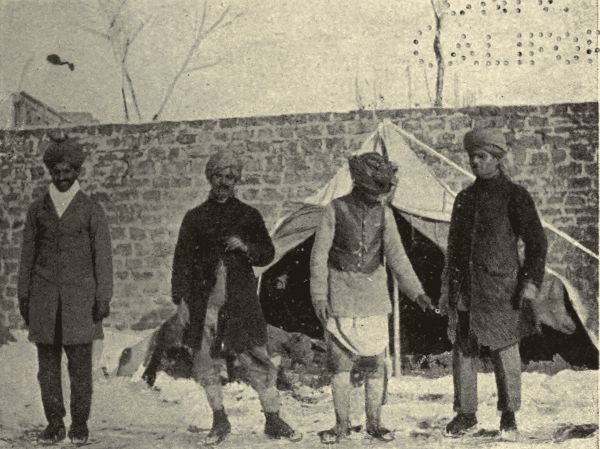
Dusky Zouaves, in wide pantaloons and
brilliant coatees, are to be seen on all sides—mostly
with bandaged limbs, be it noted—and
alongside swarthy Indian Mussulmans, clad in
khaki and topped with turbans. Side by side with
them go interpreters in mufti, Scottish soldiers in
tartans and covered kilts. Little French girls
walk past with R.A.M.C. badges and numerals
pinned across their shawls; Army nurses, in grey
and red; the usual crowd of dark Frenchwomen
in their sombre weeds.
Watching the seething mass of humanity on
the quay, the marching soldiers, the footsore,
homeless refugees, the motley crowd culled from
every conceivable race and every quarter of the
globe, it seems as if the Powers Above had decided
to abolish the distinction between east and west,
black and white, and weld together one race to
combat the oncoming Germans. For surely we
are pitted against a foe so strong in physique,
and so brave and cunning, that many years of
strenuous training and thrift will be required to
fit the united races to withstand his onslaught.
October 25th. Mr. N—— returned last night
from Paris armed with introductions to Lord
---- at Boulogne headquarters, where we are to
go, and the information that the Paris hospitals
are being steadily cleared.
All this time we have had very little news.
Since the fall of Antwerp on October 9th, and the
beginning of the Ypres-Armentières battle two
days later, we have had nothing but rumours to
subsist on, and these alternately wildly optimistic
and disquieting.
It seems so strange to think, while wandering
through the churches here, glorying in the leisure
to enjoy the exquisite contour of the Gothic arches,
the rich mediæval windows, the Renaissance
chapels, that to those enemies, who are proving
themselves such utter Vandals, we really owe so
much of our knowledge of Art and Architecture.
Can any cultured being who has at some time or
another associated with his art-loving foe, studied
his literature, perused Burckhardt, delved into the
depths of Faust's philosophy and the heights of
Zarathustra's madness; sat on Brunhilde's rock
or felt the Valkyrie riding past in the furious sweep
of the snowstorm; gazed from the heights of the
Black Forest into the unknown stretch of sky
beyond the blue hills with that yearning for
beautiful things engendered by a land endowed
by Nature with every gift; and, descending into
the darkening forests, realised the milieu which
inspired Grimm's "Fairy Tales" and Morgenstern,
and even the translators of Ibsen and
Jacobsen—can such a being fail to be nonplussed
at this huge upheaval?
October 26th, Train militaire. We are passing
through the lovely Norman country at a snail's
pace in a military train bearing French soldiers to
the front. Their distant "Marseillaise" sounds
less hearty than our Tommies' "It's a long way
to Tipperary," but then they already know the
devastation War has wrought in their homes; they
are the defenders of an invaded country.
The cost of our ticket to Abancour (military
rate, for our uniform amongst the French receives
the utmost consideration) is 1 franc 50 centimes.
After Abancour, it appears, there are no trains to
Boulogne, so how we are to get across the sixty
intervening miles no man knows!
Abancour, 7.30 p.m. We reached the neat
little model village of Abancour at dusk. It stands
on a wind-swept plain, over which the lowering
clouds are scurrying menacingly this evening.
Just as at Havre market women offered us flowers
"for the blessed Croix Rouge," so here the proprietor
of the post-card shop insists on giving us
pastilles de menthe to take on our journey.
Eu. This is the nearest point we can get to
Boulogne, and having knocked up the sleepy
hotel-keeper at 10 p.m. to obtain a night's lodging,
having made bovril for us all out of the tablets
some good friend had thrust into my travelling kit,
and served out rations of horse-flesh sandwiches and
nuts to make them savoury, I have at last tumbled
into my damp bed, wrapped in a travelling rug.
A dismal rain has set in, which brings to mind
the words of the secretary at the Rouen Consulate:
"When winter sets in the fighting must temporarily
cease. I know every inch of Belgium; know,
too, that no attack can be made on country so
sodden that every wheel sinks at least a yard into
the ground. Believe me, what the Germans have
they will hold—at least this winter. For Belgium
will be impregnable!"
October 27th. We arose at 5 a.m. to catch a
train bound towards Abbeville, and, after a refreshing
draught of black coffee in glasses, found
ourselves installed in the train, with the prospect
of staying there till 5 p.m. If we had wondered at
finding Eu well guarded on all sides, we no longer
did so when we learned that only a few weeks back
it was in enemy hands, and formed, in fact, the
German headquarters on the march on Paris.
Shortly before reaching Abbeville a young
Belgian soldier in the carriage next door put his
head in to inquire politely whether we were some
of the infirmières anglaises who had tended the
Belgian wounded in Ostend.
It appeared he recognised Miss A——, as soon
as she doffed her ugly felt uniform hat, as the
nurse who had dressed his wounded back the day
he was carried into the Casino hospital after the
Battle of Termonde.
His career, which he sketched delightedly for
our edification, perched on the arm of the window
seat, had been eventful, to say the least of it.
Aged 17, Fernand L——, of Brussels, together
with fifteen others of his school class of twenty,
joined the ranks as volontaires and served through
Namur. Captured by the Germans in a farmhouse
where he was scouting, he contrived to
escape and reach his native town, where the now
famous burgomaster, the valiant M. Max, got
his papers viséd. By asserting that he was only
fifteen years old, and therefore not liable to
military service, he finally reached Cherbourg,
and is now on his way back to the front, hoping
to join some regiment at Calais.
A charming boy, full of enthusiasm for the war
and the conviction that we shall soon be marching
into Berlin, his one regret, when he heard how the
hospital equipment had had to be abandoned to the
enemy, was that he had not helped himself to a
much-needed blanket.
"Had I but known," he exclaimed, "I would
have taken four!"
Fernand L—— was clad in a wonderful combination
of garments that he seemed to have
gleaned on his journeyings; most remarkable
amongst them were the green knitted socks and
pair of canvas shoes which some Good Samaritan
had given him at Ostend, in those days when even
the supply of anæsthetics was apt to run low.
Proudest of all was he of the fact that he had once
spent a few days in Liverpool to play in a football
match, which fact, he felt, bound him to his allies
more than any of the forced ties of war. His companion,
a few years his senior, who spoke seven
languages, was a good-looking youth with a radiant
smile. They had been together through various
escapades, and were full of the atrocities of the
Germans, which, alas! seem authentic enough.
Once when they were fleeing they had come to
a deserted village where a farmer gave them shelter.
His only daughter had been brutally mutilated and
murdered before her own parents because, in resisting
the embraces of an officer, she scratched
out one of his eyes.
"They cut off her breasts and carried away a
foot as a trophy," was the tale they told.
As they got out, the Belgians, in token of
gratitude, pressed into our hands the little paper
flags of the Allies that they were wearing and
buttons from their coats. Then, seizing a notebook
from my pocket, Fernand L—— inscribed
their names and addresses at Bruges, exacting at
the same time promises that we would call and see
them, or their families, on our way "to the Rhine
in a few months"!
The well-guarded lines, the ammunition trains,
the big guns and horses and other paraphernalia
of war—how real it all begins to seem!
At Abbeville, where we explored the shops and
camps and churches, a nasty rumour came through,
via two cavalry officers, that the Germans are at
Calais, and many of the townsfolk appeared at
their doors to bewail their fate.
On leaving every place of beauty one wonders
how long it will remain safe from the Vandals—one
leaves it with a sentimental longing to linger
for "one last look."
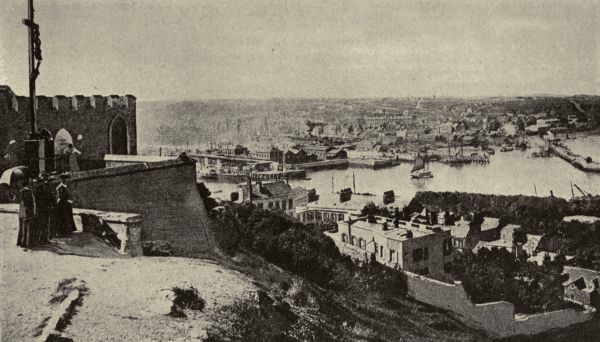
October 27th, Boulogne. The sky was a lurid
red as our train steamed into Boulogne, and an
evening mist hung over the town. On all sides
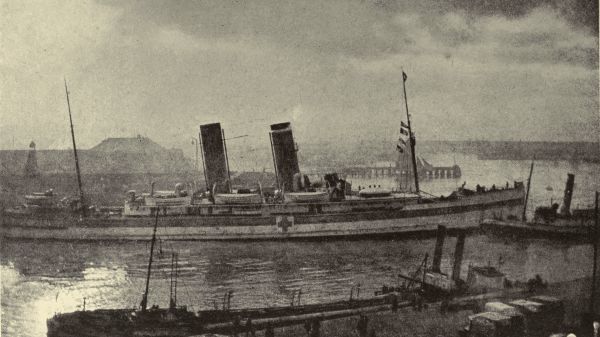
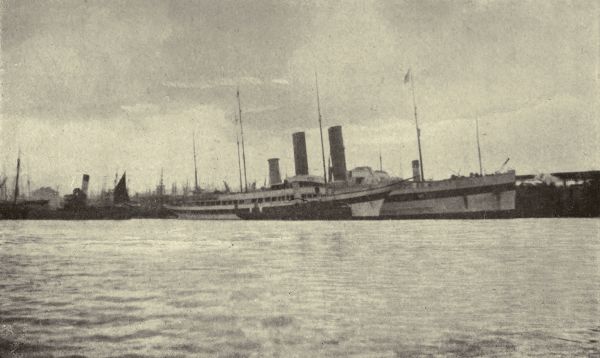
high masts rose into the sky; hospital ships, ambulance
trains, little fishing-smacks, one does not
know to which to give most attention. Everywhere
the population of picturesque fisherfolk in
their brown blouses gives way admiringly to the
Red Cross ambulances and officials who carry on
their work on such an enormous scale.
The journey had seemed long enough in spite
of its many incidents, as day by day we watched
the pretty though uninteresting fields slip by, or
restlessly paced the stations during the interminable
halts, with little food for thought, save vague
surmises as to the future, and little to eat save the
slightly bitter bread of the people and apples, the
only things obtainable at wayside stations already
ransacked by the hordes of hungry soldiers who had
passed through earlier; and oftentimes we had been
glad enough to descend from the carriages to refresh
ourselves at the station pumps, marked
"drinkable" or "non-drinkable," as the case
might be.
We had formed an odd trio. The tall, bent
figure of the clergyman, with his dreamy demeanour
and utter obliviousness of all things practical;
my commandant, a young woman who,
having spent most of her life at hospital work,
hailed every diversion from the same gleefully.
Everything to her was new, for she had never been
out of England before, and to a veteran traveller
her joy at the ways of this new country was extraordinarily
interesting. Thirdly, there was myself,
fresh from the salutary discipline of the wards
of a London hospital.
And now it is all over, that journey. The
destination is reached. The Unknown will soon be
revealed.
The Commissioner to whom we were directed
received us with open arms.
"Nurses—thank God!" was the exclamation
as we were turned over to the mercies of the billeting
officer, who designated an airy room overlooking
the quayside, on the third floor of the Red
Cross headquarters, for our use.
Yet it appears that in spite of the dearth of
nurses there are many formalities to be gone
through before we can begin work; and as only
nurses who have had three years' training in a big
London hospital are to be accepted (for is anything
but the best good enough for our fighting men?),
there may be some difficulty for probationers.
Thus, having deposited our bundles in our
billets, we were sent to see Lady —— at the hotel,
where she combines the duties of lady-in-waiting
to Queen Amélie of Portugal and organiser-in-chief
of the Red Cross nurses.
Here we learned for the first time of the
confusion that arises out of the fact that both
qualified nurses and members of the Voluntary Aid
Detachment are wearing the same uniform; we
heard, too, of the difficulties experienced by the
authorities to prevent unlicensed people organising
hospitals which they are unfitted to run.
As we wended our way back wearily through
the lighted, crowded streets teeming with life
(Miss A—— having signed a year's contract as
a trained nurse), something told me that this is
to be the scene of my activities too; that so long
as my betrothed is in France, Providence will let
me play my part.
On returning to headquarters we learned for
the first time the unpleasant function of the
Censor. All letters have to be left open, posted
in the military box, and, if they are to pass the
Censor, must contain no mention or description
of places, troops, ships, people we have met on
our journey, etc.
This is not merely a precaution against spies,
we are told, but a measure of prudence in regard
to false rumours; for men who have never got
farther than Boulogne, and never been within gunshot,
have been known to write home long tirades
about the bloody trenches in which they stand
all day, dodging fragments of shells and killing
Germans by the score!
October 28th. After breakfast this morning
we set out to see whether there were any letters
from home at the Consulate. On our way up the
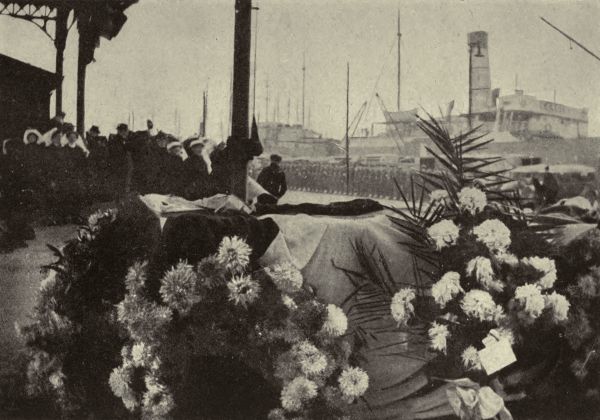
hill a funeral overtook us. There were four hearses
and seven coffins, each covered with a Union Jack,
which contrasted strangely with the weird-shaped
French funeral carriages and the drivers in costumes
like beadles with large three-cornered hats.
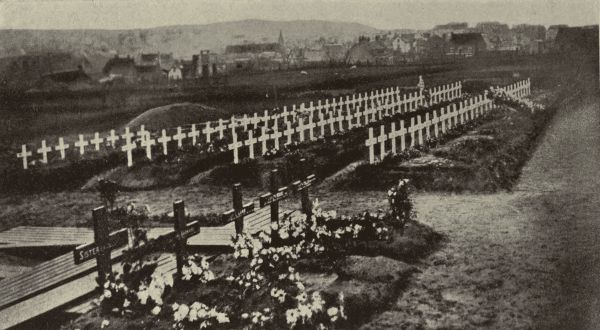
We followed the cortège a quarter of an hour
up the hill to the cemetery, where the newly
consecrated ground was full of freshly covered
graves.
The coffins were soon lowered, and as they lay
there in a row not an eye of the little group of
onlookers was dry.
The R.A.M.C. pall-bearers, the chaplain who
went through the service with a rapidity that
showed his familiarity with the job, a handful of
French peasants—that was all. And they laid
them to rest at the top of the hill, and only two
English nurses who never saw them could bear
the message of their last resting-place to their
homes. God! that such wanton destruction
should be.
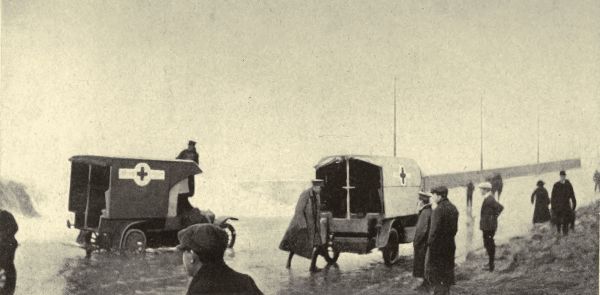
Opposite our window, as I write, the ambulance
men are deftly unloading a train and carrying their
sad, still burdens aboard the hospital ship on which
Miss A—— crossed from Ostend. All day long,
all night long, the wagons come and go. Funerals
pass, not one, but three, four, five at a time, followed
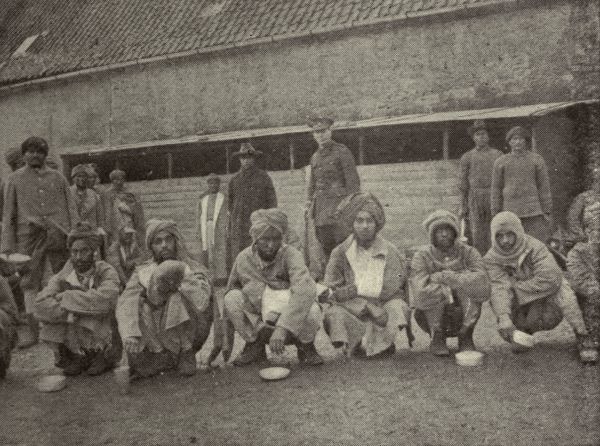
by orderlies; turbaned Sikhs and Gurkhas,
looking quaintly odd with their unaccustomed
shirts (gifts, no doubt, from some willing helpers
at home) hanging loose below their coats, like a
flounced skirt, and creating a perfect sensation
whenever they pass the simple peasant folk.
Later, we walked into Wimereux and took
snapshots of the wounded Tommies who thronged
the beach. They were mostly arm and leg cases,
and a cheery, if rough-looking, lot too, in their
bedraggled khaki, which, from the distance, was
scarcely distinguishable from the sands.
The Reverend E—— N—— has found plenty
to do, and is already taking work out of the overtaxed
Bishop's hands. I, in the meantime, am
making the best of my leisure and enjoying every
hour of the sunshine. "Father N.," as we call
the padre, got into conversation with an Army
veteran to-day at lunch, whose views were interesting.
"Do you think the Germans will get to
Calais?" he asked.
"Probably not; but if they do, they'll make
for here. This is the place they're after—as a post
for their submarines. And Heaven knows what
we shall do with our stores. It won't be possible
to get them away in time!"
About a mile along the quay we came upon
the debris of a camp with the fire still burning;
piles of reaping machines, traction engines and
carts, all bearing the names of English firms from
Manchester to Crouch End, lay alongside; and,
finally, in the distance there hove in sight the
French refugee ship which was blown up in the
Channel yesterday between here and Folkestone.
In the evening we joined a group of nurses
round the fire. They are pleasant girls just down
from Paris, where they did relieving work at some
of the hotel hospitals.
The Astoria in particular they describe as a
maze. "You go to get a drink of milk for a
patient, and when you've found the milk you've
lost your man and may hunt for hours, only to
find in the end that his need has already been
supplied," they say. Their assistants were culled
from the French nobility, whose unflagging efforts
to help are typical of France's indomitable spirit.
Amusing incidents often occur.
One doctor, on being much pressed, accepted
an invitation to tea with a well-known aristocratic
family, who assured him they were inviting people
who would be of especial interest to him. His
amusement on arriving may be pictured when he
found that the other guests consisted of a roomful
of wounded Tommies.
Another doctor, overwhelmed by the amount of
titles to whom he had been introduced, meeting a
nurse in the corridor, began wearily with:
"Look here, I say, now, are you a blooming
princess?" before he gave his orders!
In spite of the wonderful dirt and bad drainage
that reigns in the nurses' quarters, we must be
grateful, they say, for our accommodation. Nurses
aren't expected to require much, it seems. Someone
quoted the old chestnut from Punch of the
lady who, on being asked by the newly arrived
nurse in which room she was to sleep, exclaimed
in blank amazement:
"Oh, but I thought you were a trained hospital
nurse!"
October 29th. Let me tell the tale of No. ——
Stationary Hospital. It should go down to posterity
as a memorial of what British resourcefulness
may achieve, even if its existence was the
outcome of the proverbial British state of unpreparedness.
For what in the annals of History has
equalled the holocaust and chaos of modern warfare,
of which there was no precedent, of which
everything has had to be learned by the bitterest
experience?
Three days before we left England, at the beginning
of the fight for Calais, which continues to
grow more violent daily, a certain Major N——
found himself in charge of the wounded who were
being brought down by the thousand in trains, and
left helpless on their stretchers by the quayside to
await the arrival of the ever-busy hospital ships.
Already the C—— and I—— Hotels were
choc-à-bloc with wounded, who lay so close together
in the corridors that it was necessary to
climb over one stretcher to reach the next patient,
and often stand astride the pallets to dress the
wounds.
The Casino was opened, but in less time than
it takes to tell was as crowded as the others.
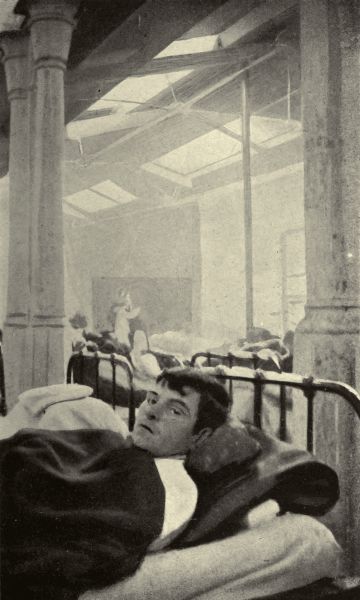
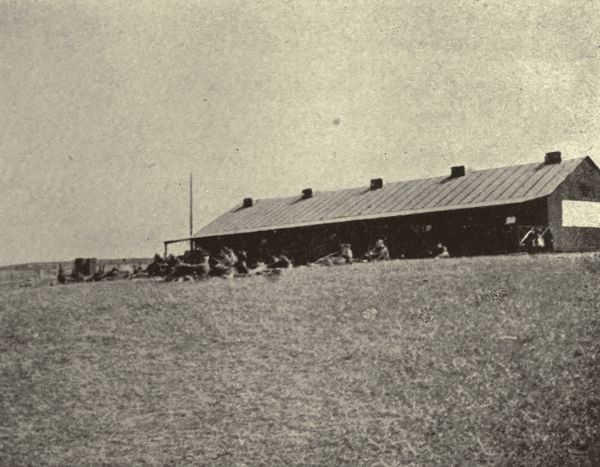
A disused sugar shed, a vast wooden barn whose
cracked cement floor is piled high with dust, whose
smashed glass roofing is besmirched with dirt, is
hardly an ideal site for a hospital, but it is the best
thing to hand, and the Major commandeered it,
and here, before the lumber had been cleared,
before the glass had been repaired or the walls
whitewashed, the wounded began to tumble in.
It wasn't much of a place, but it was out of the
torrential rain which had set in and bade fair to
continue, and it was less cold than the open air.
By day and night the orderlies worked, alternately
preparing the place and attending to the
wounded. A solitary English girl who happened
to be on the spot had volunteered her services, and
was doing her best single-handed in the wards.
One day the Major, walking on the quay, saw some
Red Cross nurses. They were the identical ones
we had met on their arrival from Paris. On hearing
they were waiting for their orders, and that
they were all qualified women, he commandeered
them, even as he had commandeered his barn.
Back they came to Headquarters to fetch more
assistance.
"Why don't you come too? It's a case of all
hands aboard!" said one. It was thus I came to
work at the first clearing station at the base. Such
was the stationary hospital when, laden with all
the loaves we could carry to supplement the ration
biscuits, we set to work in the "casualty ward"
this afternoon.
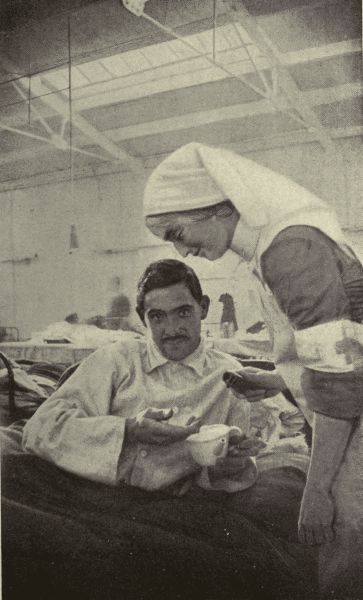
For the thousand wounded likely to come
through daily there are six fully-trained nurses
and myself, besides the male staff of R.A.M.C.
doctors and orderlies, and two or three Red Cross
surgeons and lady doctors.
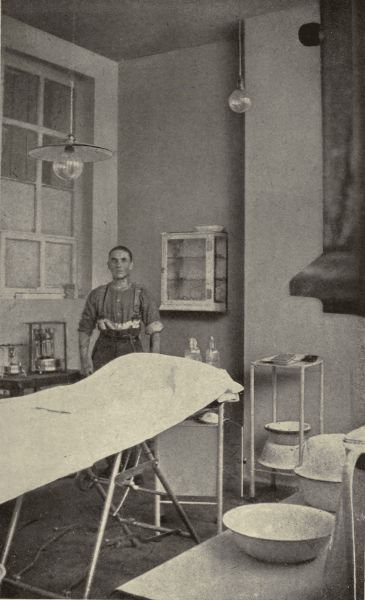
Ten beds and a number of sacks of straw form
the main equipment. Planks, supported by two
packing-cases, are the dressing-table. At one end
men are engaged in putting in three extemporary
baths, others whitewashing the walls.
A boatload had just left for England as I came
in, and we proceeded to get a meal for those who
remained. But it was a struggle to get sufficient
tea out of the orderlies, who had been working all
night and were dead beat. The men's delight at
the bread and old newspapers we had brought in
was incredible.
Those who were able to, clustered round
the solitary stove in the centre. Great rough,
bearded fellows, covered with mud from the
trenches in which they have lived for weeks, how
different they look from those who set out! The
worst cases lay on their stretchers as they had
arrived. One said simply, as I took him his tea,
"This is heaven, Sister."
A tall, dark man entered—the C.O., someone
said. "Take those two Germans down to the
boat," I heard him order. Then, turning to us,
"You'd better come to our mess-room and get
some tea yourselves," he said. "Four trainloads
are expected in shortly."
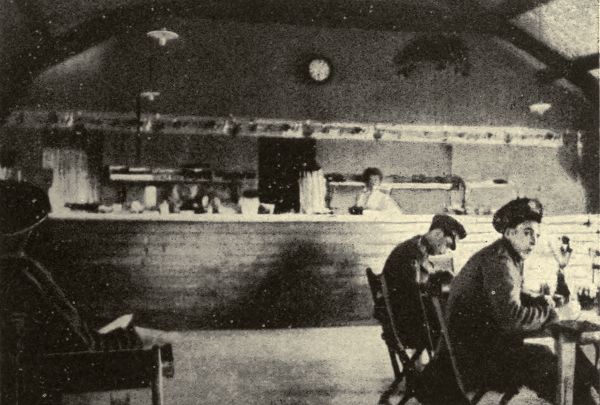
We trooped into the small sanctum dignified
by the name of "mess-room," where the Major's
orderly was busy preparing tea on a Primus stove.
There was no milk, but the bitter black beverage
out of the large tin mugs was welcome none the
less. Someone had secured a cake that we cut with
a sword as the cleanest thing present.
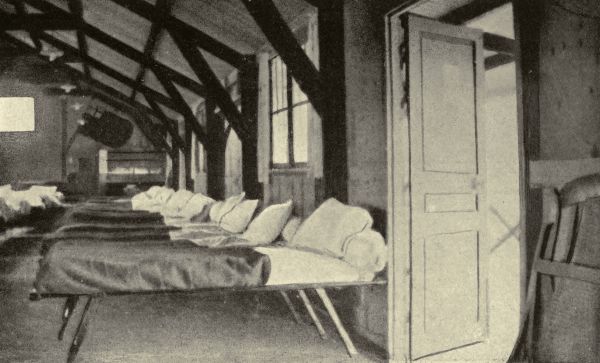
Next to the mess-room are the officers' quarters
(into which we were privileged to take one
glance)—small whitewashed cubicles furnished with
a camp bed, a shaving-glass about three inches by
six inches in size, and an old sugar-box converted
into a washstand.
Tea finished, we set to work to get "beds"
ready for the next batch, the first of the four trainloads
expected. Ten bedsteads for a thousand
men! It sounds almost incredible, but it is nevertheless
true; and although we are told that more
are expected at any moment, we have only wooden
pallets at present and a limited supply of blankets.
One to lie on, two for cover, a coat for a pillow
was the order of the day until a pile of mattresses
came in.
October 30th. We worked till midnight and
were on duty again by 7.30 this morning. From our
billets to the hospital is nearly half an hour's walk,
which, over the rough cobblestones in the blinding
rain, is hardly attractive. At any rate, it has the
advantage of clearing the haunting smell of the
gas-gangrene out of our nostrils. As we came on
duty this morning, laden with every old journal we
could find, a huge, burly Scotsman let himself
down from the ambulance train. We gave him a
newspaper, but he was inclined to talk. He is
the first man I've met so far who has signified his
longing to get back to the firing-line.
"While I've a limb left," he said, "I should
like to have a pot at the Germans. And I can fire
my machine as well with two fingers as with five—if
they'll let me."
The cause of his indignation was the mutilated
corpse of a Red Cross nurse they had found in a
little village where the Germans had been.
"God knows how far they'd dragged her round
with them, but she was horribly mutilated," he
said with a shiver. "I'm a big man, but our
major was bigger, yet neither of us could help
choking. And can ye wonder we want to get at
'em again?"
The worst part of the wounds is the fearful
sepsis and the impossibility of getting them anything
like clean.
"First time I've had my boots off for seven
weeks!" is the kind of exclamation that recurs all
day, as we literally cut them off. Hardly any of
the boots have been off for three weeks, with the
result that they seem glued on, whilst the feet are
like iron, the nails like claws.
Some of the men have not had their wounds
dressed since the first field dressing was applied, for
the simple reason that the rush on the hospital
trains makes it impossible to attend to any but the
worst cases, many of whom, as it is, are dying of
hæmorrhage, accelerated by the jolting on the
journey.
There is no time to do anything but the dressings,
and if we did want to wash the patients there
is nothing but the red handkerchiefs we hang
round the lights for shades by night, for towels
by day.
Water, especially boiling water, is at a premium,
as it all has to be fetched from outside where
the veteran cook stokes hard all day in the driving
rain, ladling us out a modicum into each bowl
from his cauldrons.
"I never thought to see such sights,"
exclaimed a nurse of thirty years' experience as
a new trainload came in. But we have no time
to think of our own sensations.
Fingerless hands, lungs pierced, arms and legs
pretty well gangrenous, others already threatening
tetanus (against which they are now beginning
to inoculate patients), mouths swollen beyond all
recognition with bullet shots, fractured femurs,
shattered jaws, sightless eyes, ugly scalp wounds;
yet never a murmur, never a groan except in
sleep. As the men come in they fall on their
pallets and doze until roused for food.
A few are enraged to madness at the sight of
a German.
"They fired on our Red Cross!" they cry.
"Burnt every man alive! Why do we treat
them so well?"
Quite a number of prisoners who had been
taken near Lille were brought into the clearing
station this morning. Being the only linguist
present, I was installed as interpreter. They were
in a horrible state of nerves, and asked when they
were likely to be killed.
One of them was nastily peppered about the
heart with shrapnel and asked: "When shall we
be shot?" I explained whilst dressing his wounds
that Britain is a civilised country, and, in contrast
to the Huns, does not hit a man when he is down.
Never shall I forget the look of relief on the man's
face.
"They told us we'd be tortured if you got us!"
he exclaimed.
Later on I was asked to send a card to his
mother. It was difficult to know what to say,
but "Your son, though a prisoner and wounded,
is safe and being well cared for," seemed to meet
the occasion. Suddenly without a word he seized
the scissors from my belt. Recalling tales of
vindictive prisoners, I stepped back. The precaution
was unnecessary, for the little Hun was
only cutting a button off his coat pocket.
"Hier, Sie haben ja nichts genommen"
("Here, you have not taken anything"), he exclaimed,
Teuton boorishness veiling the kindliness
as he handed me the "souvenir."
A strangely human incident occurred a little
later.
A group of Tommies were watching a Boche
having a bayoneted hand dressed. He spoke quite
good English, but was apparently too frightened
to answer any of their sallies. Presently, however,
he turned to me with a request that he might be
allowed to send a line to his wife to say he was
alive.
"'E's young to 'ave a wife, Sister," suggested
a lame man, the maintenance of whose large family
apparently proved a burden to him.
"'Ow old are yer? You?" he added, addressing
the prisoner.
The Hun pulled out an old letter-case and
abstracted the portrait of a pretty English-looking
girl in a garden arbour.
"My vife," he exclaimed. "She has seventeen
years, I nineteen. Ve was married two days
when I come away!"
In a moment the hostile crowd round him was
turned to one of sympathisers. "Poor beggar!
After all, he probably doesn't want to fight any
more than we do," said the lame man.
"No," replied the prisoner, and all the racial
antagonism of Saxon versus Prussian showed
itself in his words, "Ve Saxons not want war—ve
want peace—but they not ask us!"
October 31st. Who could believe, had they
not seen for themselves, the manifold horrors of
war? The vermin, against which there is no
coping, vermin that in ordinary times one never
saw. The men are alive with them, so are we,
a fact which necessitates a tremendous "search"
at every available opportunity. Even amputated
limbs are found to be crawling.
The girl who was working single-handed in
this barn until we arrived was walking along the
quay yesterday when a feeble voice called her from
a stretcher. It was her brother. He died in the
night, but she is on duty all the same.
All day long the rush continues. The question
"Shrapnel or bullet?" rings incessantly in our
ears as each man comes up to get his dressing done.
One boy of nineteen had no fewer than six
bullet wounds in one arm and two in each leg. It
took two of us an hour to dress his wounds, and
afterwards, as I washed his beardless face in
response to a gentle request, I could scarce refrain
from sending up a prayer of gratitude that my
own brothers are dead and not mutilated like
these boys.
Towards sunset I was called to the side of a
youthful Saxon already rigid with tetanus.
Through his clenched teeth he could still groan
to the orderly's command to lie still: "Ich kann
nicht still liegen" ("I can't lie still").
At seven o'clock (after nearly twelve hours'
work) we went home to dinner, and, it being our
turn to take night shift, were back again at our
posts, with clean aprons and a satisfied inner man,
two hours later. The orderly officer called for any
who had not yet had their second anti-typhoid
injection, and I, being one of them, was injected
on the spot.
During the long night, as we hurried from
patient to patient in the darkened cry-haunted
ward, covering the restless sleeping figures,
moving them into more comfortable positions,
with a prayer for each one's mother, I could screw
up no feeling of resentment towards the dying
Saxon boy, in spite of the cries of our men, but
only against that vile Prussianism that brought up
its children to regard rapine and slaughter as a
divine necessity. By midnight things were quiet
enough to allow us to cut up dressings as best we
might. By this time, owing to there not being
a chair in the place, I confess my legs were almost
giving way. Moreover, the injection took speedy
effect, and a stiffening arm and rising temperature
do not facilitate work of this kind. Frankly, I do
not think any of us will ever be as busy again, and
our one prayer was for strength to "carry on."
Many of the men were tormented by coughs that
kept the others awake. All we had to give them
was lukewarm water and the rinsings of a condensed
milk tin. (For euphony we called it
"milk.")
Those who could not sleep for vermin lit
cigarette after cigarette until their supply ran out.
At 2 A.M. we retired to the nurses' "bunk"—a
whitewashed, rat-ridden, ill-smelling partitioned
compartment, whose sole furniture consisted of
two shelves—until someone was inspired to fetch
the "dressing-table" (two empty boxes—oh, joy
of joys! upon which we took it in turns to sit)—and
a coke fire, on which we boiled eggs for our
midnight meal. Half-way through my egg the
orderly called me: "The prisoner can't last
much longer. Will you come and speak to him,
Sister?" It seemed as if the ward were one huge
battlefield, for cries greeted me on all sides. "Get
at 'em, lads!" shouted the burly Scot in the corner
as he urged forward his comrades in his sleep.
"Christ help us!" groaned an armless dragoon,
coming round from the anæsthetic.
I soothed the dying German as best I could
when the awful spasms came, and through his
clenched teeth he signified the pain in the
"kreuz" (small of the back). What could I say
but "Guter Junge—bleib still. Es dauert nicht
mehr lange!" ("Good boy—lie still. It will not
last long now!") With his remaining hand he
pressed mine as I wiped the pouring sweat
from his brow. After all, suffering is a great
leveller.
The orderly, an old South African campaigner,
looked at the light that began to flood the sky.
"They usually go West at this hour," he
remarked grimly, with a shudder. I shuddered
too; the place was alive with spirits.
For a moment we seemed to hear the sigh of
the departing, feel the rushing of many wings as
they brushed past. Then a gaunt, muffled figure
appeared at the door bearing a lantern, for all the
world like a hoary figure of "Time," and we
awoke to reality.
"I've brought down a trainload," he said.
"A round dozen of them are urgent cases and
must have beds."
Perforce we had to shift the sleeping forms on
to the concrete floor, all bruised and torn and
bleeding though they were, cutting shorter their
all too short rest.
An officer was brought in wounded in the
abdomen, but cheerfully talking of getting home.
He, too, passed away before eight o'clock.
From the nursing point of view the work is
most unsatisfactory, as disinfectants, to say
nothing of dressings, are continually at low ebb.
To-day the iodine ran out. One of the surgeons
came round and signified his intention to dress a
bad femur case. I had got together what things
I could when he called for iodine. There being
none to be had, he sighed resignedly, and with
"Then we will leave the dressings for the present,"
walked off, only to return an hour later with a
quantity he had found in the town.
Of course there can be no attempt at asepsis
in a place so ill ventilated, or, rather, not ventilated
at all, for there are no side windows, and,
although the skylight is sufficient for lighting
purposes, the ventilation is effected by means of
the excessively draughty entrances.
It is distinctly unhealthy, and the odours in
the place are indescribable and never to be forgotten.
There is no lavatory accommodation—although
latrines are situated along the quay,
whither the blind are led by the armless, the lame
carried on orderlies' backs.
Refuse of all sorts that cannot be burned in
the incinerator is disposed of in the sea, and it is
good to note that the sacks of straw are being
gradually replaced by real beds and the supply of
blankets is greatly augmented.
Unsatisfactory, too, from the nursing point of
view is the fact that the men pass through the
clearing station so rapidly that we seldom do the
same dressing twice; and though there are days
when, owing to rough seas or overladen boats, we
are able to watch the progress of the patients, for
the most part it is only the immovable cases that
remain, and the rest are hurried through, leaving
one wondering how they will get on.
Did I say hurried through? There is no need
to hurry the men who are to go home, for no
sooner is a boat announced than a general scramble
ensues, and they will leave their breakfast, clothing,
even their treasured trophies behind, in order
not to be late.
"Just a bit of 'ome, and we'll be twice as
strong for the next bit o' fightin'," they say.
There follows the inspection of labels (for each
man is labelled for his destination: blue for
England, yellow for Havre, white for a convalescent
depot), and sad indeed are the faces of
those to whom the medical officer has not vouchsafed
the coveted blue ticket.
Just as day dawned, with a last spasm, more
awful than the others, the little Saxon prisoner
died. As his close-clenched jaws relaxed the
orderly remarked: "Not bad-looking for a corpse,
Sister; must have been a pretty child!"
I asked for his corpse number, but it was not
to be found. In my heart I wished the boy's
mother could have known he died well cared for.
It is all very primitive; we have no screens to
hide what once was mortal from the others.
We came off duty at 10 A.M., just as another
batch of 1,100 men began to arrive, and on our
way home caught a glimpse of K. of K., who is
paying an incognito visit, as he stepped from a
destroyer.