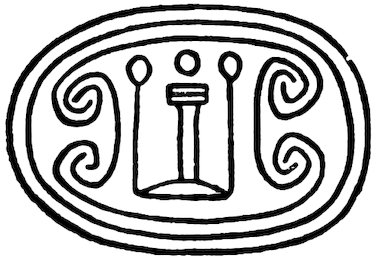
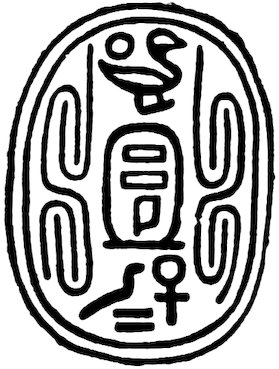
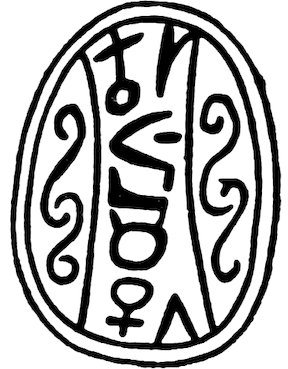
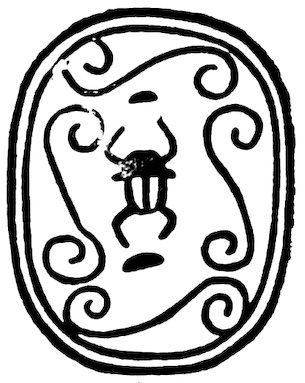
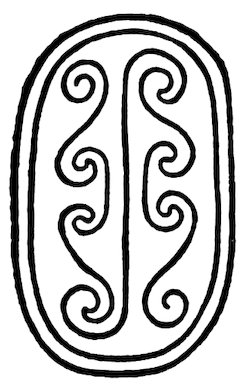
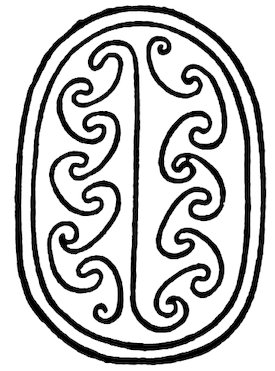
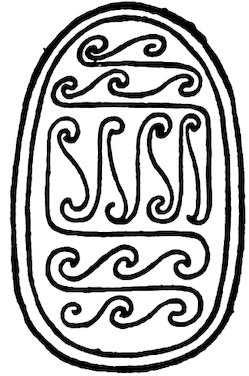
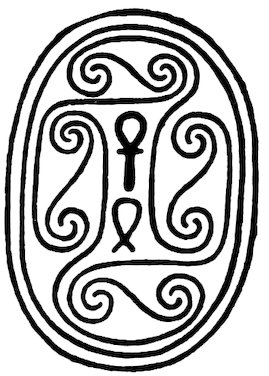
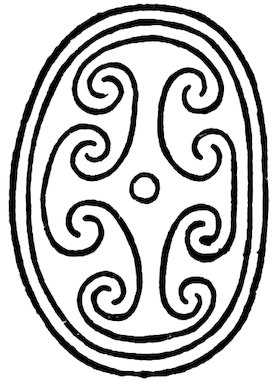
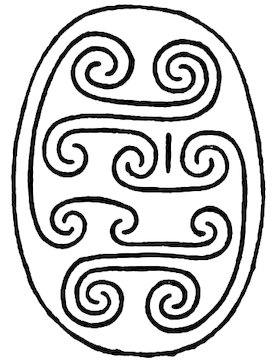
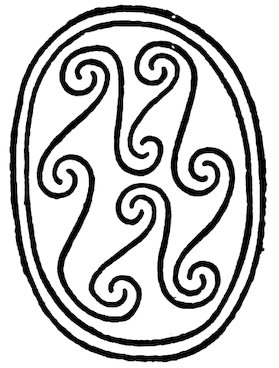
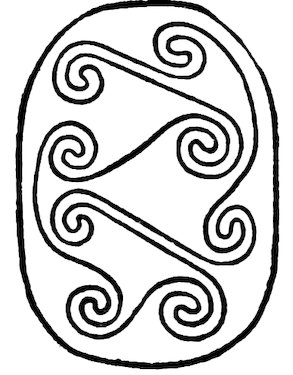
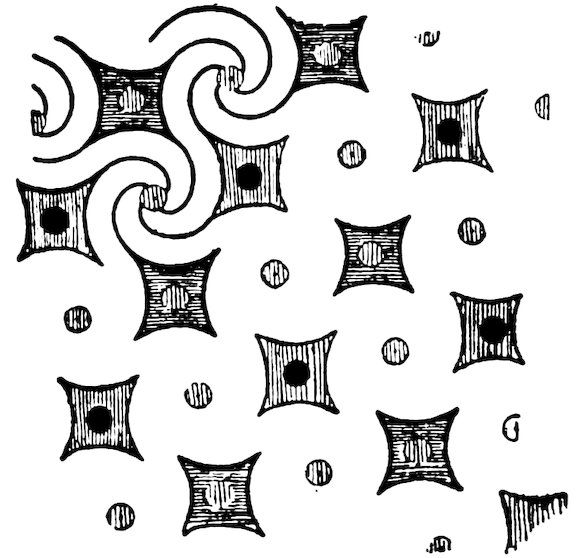
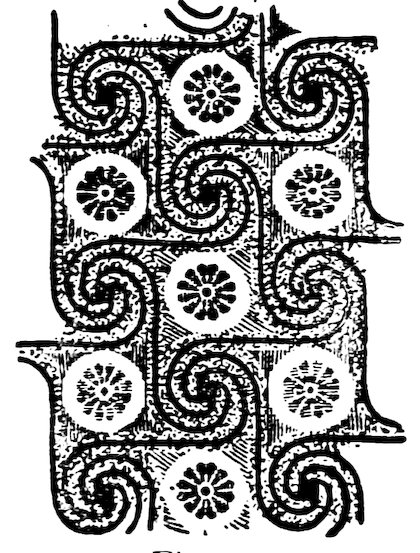
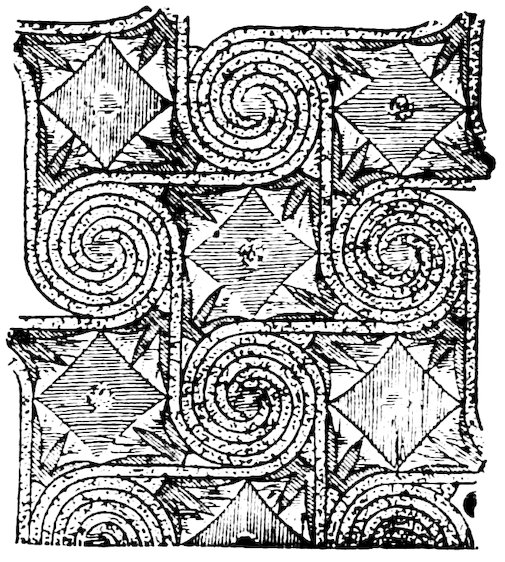
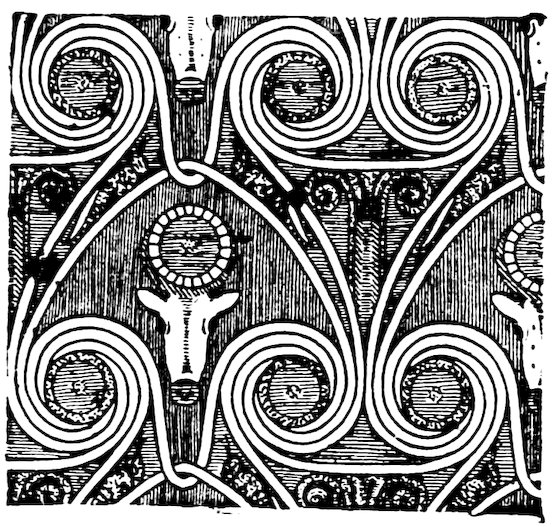
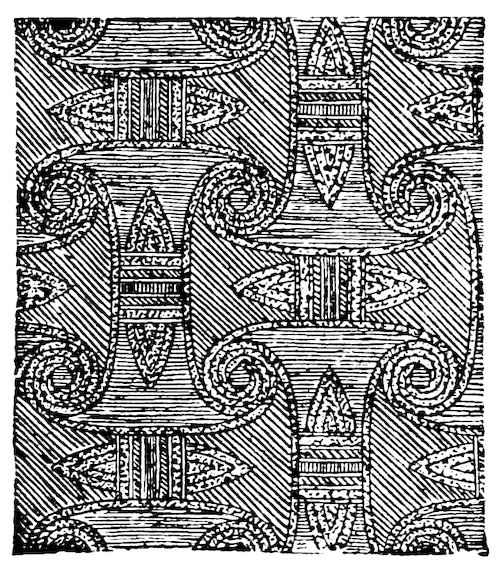
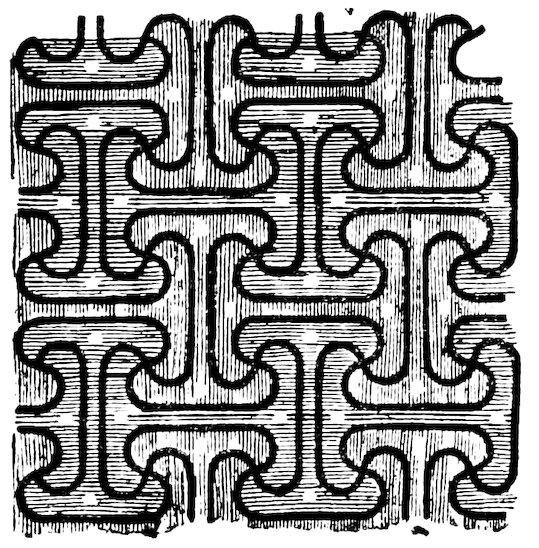
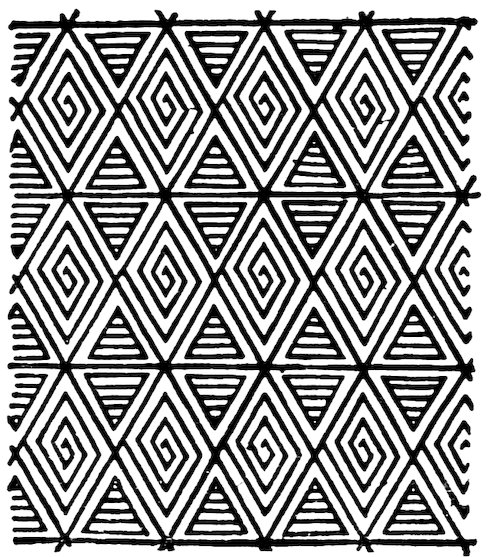
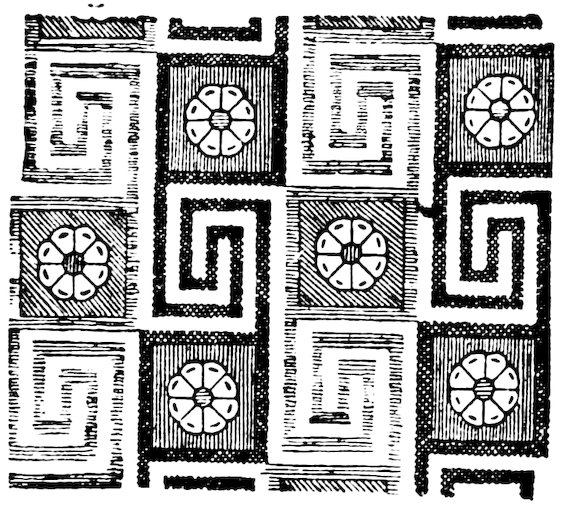
P. or Prisse. Prisse, Art; numbers refer to numbering in Edwards Library copy, plates being issued unnumbered.
P. Mon. Prisse, Monuments.
R. C. Rosellini, Mon. Civili.
R. S. Rosellini, Mon. Storici.
Schuck. Schuckhardt’s, Schliemann.
T. A. Tell el Amarna (Petrie).
Tanis. Tanis (Petrie)
W. M. C. Wilkinson, Manners and Customs.
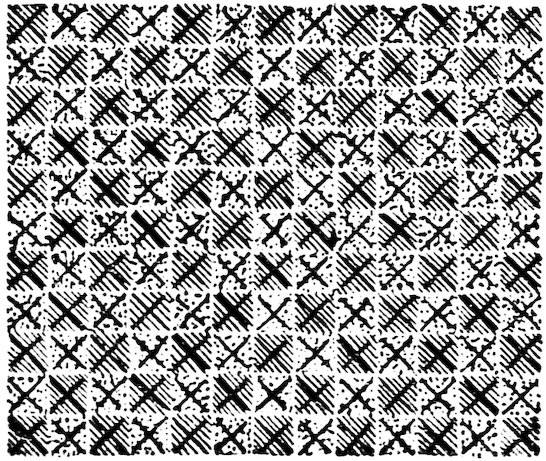
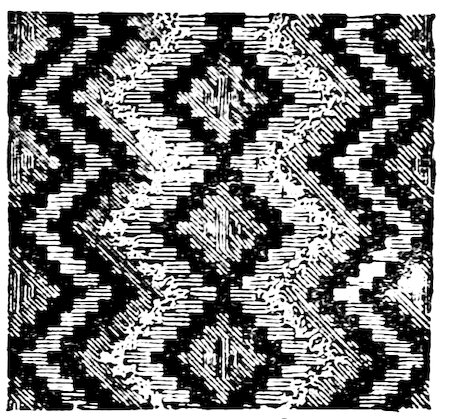
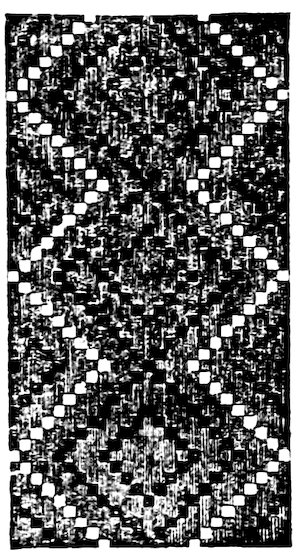
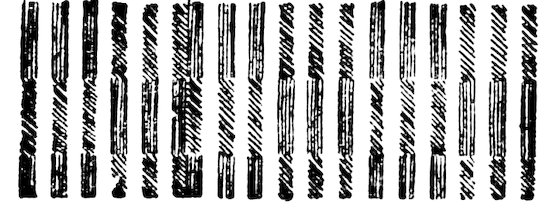
The shading of the figures is according to heraldic colours:
red, blue, green, purple, yellow
CHAPTER I THE SOURCES OF DECORATION
1
In dealing with the subject of decorative
art in Egypt, it is needful to begin by
setting some bounds to a study which might
be made to embrace almost every example of
ancient work known to us in that land. The
Egyptian treatment of everything great and
small was so strongly decorative that it is
hard to exclude an overwhelming variety of
considerations. But here it is proposed to
limit our view to the historical development
of the various motives or elements of decoration.
The larger questions of the æsthetic
scheme of design, of the meaning of ornament—symbolic
2or religious, of the value
and effect of colour, of the relations of parts,
we can but glance at occasionally in passing;
in another branch, the historical connection
of Egyptian design with that of other countries,
the prospect is so tempting and so
valuable, that we may linger a little at each
of these bye-ways to note where the turning
occurs and to what it leads. As I have said,
all Egyptian design was strongly decorative.
The love of form and of drawing was perhaps
a greater force with the Egyptians than
with any other people. The early Babylonians
and the Chinese had, like the Egyptians,
a pictorial writing; but step by step
they soon dropped the picture altogether
in favour of the easier abbreviation of it.
The Egyptian, on the contrary, never lost
sight of his original picture; and however
much his current hand altered, yet for four
or five thousand years he still maintained his
3true hieroglyphic pictures. They were modified
by taste and fashion, even in some cases
their origin was forgotten, yet the artistic
form was there to the very end.
But the hieroglyphs were not only a
writing, they were a decoration in themselves.
Their position was ruled by their
effect as a frieze, like the beautiful tile
borders of Cufic inscription on Arab architecture;
and we never see in Egypt the
barbarous cutting of an inscription across
figure sculptures as is so common in Assyria.
The arrangement of the groups of hieroglyphs
was also ruled by their decorative
effect. Signs were often transposed in order
to group them more harmoniously together
in a graceful scheme; and many sounds had
two different signs, one tall, another wide,
which could be used indifferently (at least in
later times) so as to combine better with the
forms which adjoined them. In short, the
4Egyptian with true decorative instinct clung
to his pictorial writing, modified it to adapt
it to his designs, and was rewarded by having
the most beautiful writing that ever existed,
and one which excited and gave scope to his
artistic tastes on every monument. This is
but one illustration of the inherent power
for design and decoration which made the
Egyptian the father of the world’s ornament.
In other directions we see the same
ability. In the adaptation of the scenes of
peace or of war to the gigantic wall surfaces
of the pylons and temples; in the grand
situations chosen for the buildings, from the
platform of cliffs for the pyramids at Gizeh,
to the graceful island of Philæ; in the profusion
of ornament on the small objects of
daily life, which yet never appear inappropriate
until a debased period;—in all these
different manners the Egyptian showed a
5variety of capacity in design and decoration
which has not been exceeded by any other
people.
The question of the origination of patterns
at one or more centres has been as disputed
as the origination of man himself from one
or more stocks. Probably some patterns
may have been re-invented in different ages
and countries; but, as yet, we have far less
evidence of re-invention than we have of
copying. It is easy to pre-suppose a repeated
invention of designs, but we are concerned
with what has been, and not with what might
have been. Practically it is very difficult, or
almost impossible, to point out decoration
which is proved to have originated independently,
and not to have been copied from
the Egyptian stock. The influences of the
6modes of work in weaving and basket-work
have had much to do with the uniformity of
patterns in different countries; apparently
starting from different motives, the patterns
when subject to the same structural influences
have resulted in very similar ornaments.
This complicates the question undoubtedly;
and until we have much more
research on the history of design, and an
abundance of dated examples, it will be
unsafe to dogmatise one way or the other.
So far, however, as evidence at present goes,
it may be said that—in the Old World at
least—there is a presumption that all the
ornament of the types of Egyptian designs is
lineally descended from those designs. Mr.
Goodyear has brought so much evidence for
this, that—whether we agree with all his
views or not—his facts are reasonably convincing
on the general descent of classic
ornament from Egyptian, and of Indian and
7Mohammedan from the classical, and even of
Eastern Asian design from the Mohammedan
sources. A good illustration of the
penetrating effect of design is seen in a most
interesting work on the prehistoric bronzes of
Minusinsk in Central Asia, near the sources
of the Yenesei river, and equidistant from
Russia and from China, from the Arctic
Ocean and from the Bay of Bengal. Here
in the very heart of Asia we might look for
some original design. But yet it is easy to
see the mingled influences of the surrounding
lands, and to lay one’s finger on one thing
that might be Norse, on another that might
be Chinese, or another Persian. If, then, the
tastes of countries distant one or two thousand
miles in different directions can be seen
moulding an art across half a continent, how
much more readily can we credit the descent
of design along the well-known historical
lines of intercourse. The same thing on a
8lesser scale is seen in the recent publication
of the prehistoric bronzes of Upper Bavaria;
in these the designs are partly Italic, partly
Mykenaean. If forms were readily re-invented
again and again independently, why
should we not find in Bavaria some of the
Persian or Chinese types? Nothing of the
kind is seen, but the forms and decoration
are distinctly those of the two countries from
which the ancient makers presumably obtained
their arts and civilisation. Yet again, to come
to historical times, the elegant use of the
angle of a third of a right angle so generally
in Arab art, is very distinct and characteristic.
Yet if patterns were continually re-invented,
how is it that no one else hit on this simple
element for thousands of years? The very
fact that the locality and date of an object of
unknown origin can be so closely predicted
by its style and feeling in design, is the best
proof how continuous is the history and evolution
9of ornament, and how little new invention
has to do with it—in short, how difficult
it is to man to be really original.
Now we can see a source for most of our
familiar elements of design in the decoration
which was used in Egypt long before any
example that is known to us outside of that
land. And it is to Egypt then that we are
logically bound to look as the origin of these
motives. If, then, we seek the source of
most of the various elements of the decoration
which covers our walls, our floors, our dishes,
our book-covers, and even our railway stations,
we must begin by studying Egypt.
As our object is the history and evolution
of the various elements of decoration, we
may classify these elements under four divisions.
There is the simplest geometrical
ornament of lines and spirals and curves, and
10of surfaces divided by these into squares and
circles. There is the natural ornament of
copying feathers, flowers, plants, and animals.
There is structural ornament which results
from the structural necessities of building and
of manufacture: these often result in the
perpetuation of defects or copies of defects,
like the circle stamped in the plain end of
meat tins which is made to imitate the
circular patch soldered on to the other end,
so trying to establish a balance of appearance.
Many architectural devices and difficulties
are perpetuated for us in this way long after
the original purpose has passed away; such
as the cylindrical bosses projecting from the
walls in Moslem architecture, which imitate
the projecting ends of pillars torn from ruins
and built into the wall, though rather too
long for the position. The origin and the
imitation can be seen side by side at Jerusalem.
Structural ornament is therefore
11often of the greatest historical value as
pointing to a condition of things that has
since vanished.
Lastly, there is symbolic ornament.
Some now claim most decoration as having
some symbolic or religious meaning; of
that I shall say nothing, as it is but an
hypothesis. But there is no question of the
symbolical intention of many constantly
repeated ornaments in Egyptian work, as
the globe and wings, the scarab, or the
various hieroglyphs with well-known meanings
which are interwoven into many
designs.
CHAPTER II GEOMETRICAL DECORATION — The Line. — The Spiral.
12
One of the simplest and the earliest
kinds of ornament that we find is the
zigzag line, which occurs on the oldest
tombs, 4000 B.C. So simple is this, that
it might be supposed that every possible
variety of it would be soon played out.
Yet, strange to say, two of the simplest
modifications are not found till a couple
of thousand years after the plain zigzag
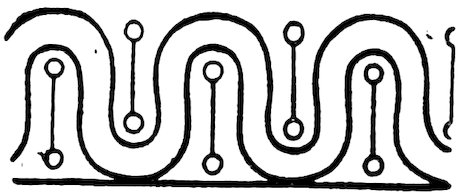
had been used. The wavy line in curves
instead of angular waves is not found till
the XVIIIth dynasty, or about 1500 B.C.;
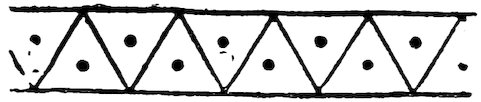
while the zigzag with spots in the spaces
13is equally late, and is generally foreign to
Egypt.
1.—VI. dyn., L.D., II. 98.
2.—IV. dyn., Mery, Louvre.
3.—V. dyn., Ptah-hotep, Perrot XIII.
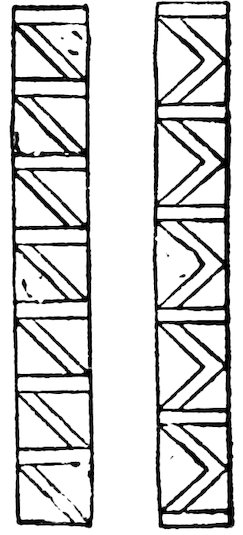
The plain repeated
zigzag line is used
down to late times, but generally with
variety in colour to give it interest. From
the earliest times this was symmetrically
doubled, so as to give a row of squares
with parallel borders;
or with repeated zigzag
borders in alternate
light and dark colours.
This same type lasted onward
to the XIXth dynasty
(belt Ramessu II. C.M.X.), and
is found, with the addition
of spots in the outer angles,
in the foreign dress of Shekh
Absha, at Benihasan, in the
XIIth dynasty.
14
4.—Prisse, Art. 84.
5.—L.D., II. 130.
A later stage was to repeat the squares
with varieties of colour;
and also to introduce
details into the squares,
and so make them compound
patterns, as in
the XVIIth dynasty at
El Kab, where the
sequence of the blue, green, and red lines
makes a brilliant effect from these simple
elements. Not only a square, but also a
hexagon, was worked into the same design.
This, from the nature of it, suggests a
rush-work screen, and
probably it was plaited
with rushes in three
directions, and hence
the production of this
particular angle. The
previous zigzag patterns
all suggest weaving; and in some in
Ptah-hotep’s tomb (Vth dyn.) closely woven
15and complex zigzag patterns are shown
which are evidently copied from textiles,
as we shall see further on in the chequer
patterns.
6.—XII. dyn. Amu dress.
7.—XVIII., Keft dress. C.M. cxcl.
8.—XX. Vase, C.M. cclix.
The use of spots for filling in corners was
foreign to the Egyptian. We first find it in the
garments of the Amu, or people of northern
Arabia, in the XIIth dynasty. Till then a spot
is never seen, except for the centre of a square;
but the Amu dresses
are covered with spots
in every space, and
even along the bars
and stripes of colour. The same is seen on
the later dresses of the Amu in the XIXth
dynasty, and also in the
dress of the Phœnicians,
or Keft people. It recurs
on the foreign vases
probably brought in from the Aegean; and
it is only found in Egyptian products
16during the XVIIIth dynasty, when foreign
fashions prevailed, though it is but rare
then. Hence we may fairly set aside
this use of spots as a foreign or Asiatic
element, akin to the filling in of spaces on
early Greek vases with rosettes and other
small ornaments.
9.—XVIII., P. I. xvii. 7.
10.—XVIII. Vase, R.C. lvii.
The zigzag line only became changed into
a rounded wavy line in the later time of
the XVIIIth dynasty.
This probably results
from the earlier patterns being all direct
copies of textiles which maintained rectilinear
patterns; but when the same came
to be used on pottery (as above), or on
metal work (shield border, L.D. iii. 64),
then curves were readily
introduced. On a golden
bowl repeated waves are
shown, deepened so as to receive further
figures.
17
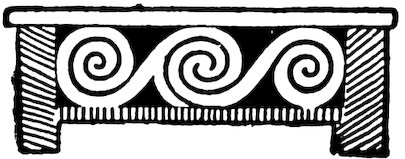
The spiral, or scroll, is one of the
greatest elements of Egyptian decoration;
it is only second to the lotus in importance,
and shares with that the origination
of a great part of the ornament of the
world. The source of the spiral and its
meaning are alike uncertain. It has been
attributed to a development of the lotus
pattern; but it is known in every variety
of treatment without any trace of connection
with the lotus. It has been said to
represent the wanderings of the soul; why,
or how, is not specified; nor why some
souls should wander in circular spirals,
others in oval spirals, some in spirals with
ends, others in spirals that are endless.
And what a soul was supposed to do
when on the track of a triple diverging
18spiral, how it could go two ways at once,
or which line it was to take—all these
difficulties suggest that the theorist’s soul
was on a remarkable spiral.
11.—F.P. coll.
19
12.—F.P.
13.—F.P.
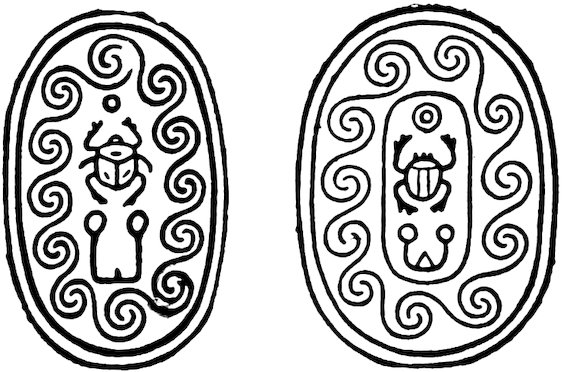
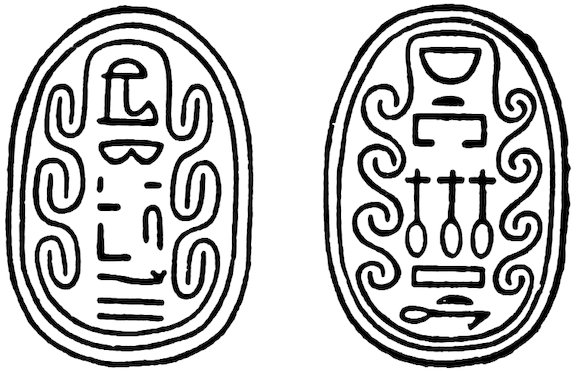
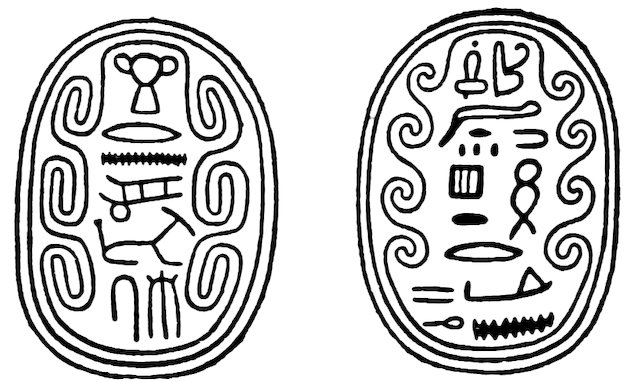
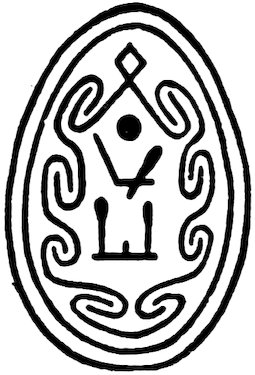
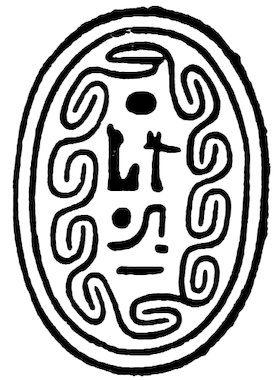
The subject of spirals fall into two
groups. The older group by far are the
scarabs, which contain spirals on a limited
and small field; the other group are those
continuous patterns on ceilings, furniture,
&c., which are capable of indefinite extension
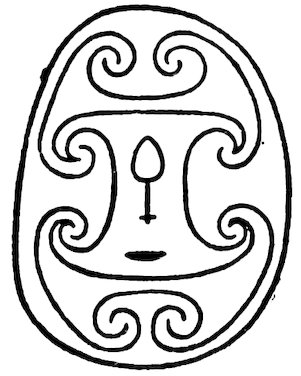
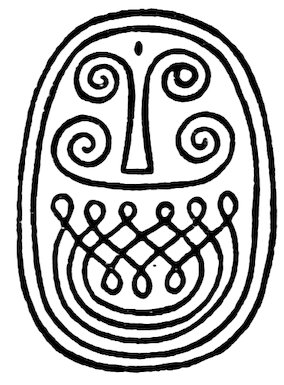
by repetition. As the scarabs
are far the older examples, there is a
presumption that spirals may have even
originated on scarab designs; and the
hesitating and simple manner of the
oldest instances on scarabs indeed seems
as if the engravers were merely filling a
space, and not copying any
well-known pattern. The
earliest that can be certainly
dated is one of
Assa, of the Vth dynasty, on which a
bordering line is interrupted at the ends
and turned in to fill the space on either
side of the name. From the cramped way
in which this is done, and the want of uniformity
in the spirals, it seems as if no
regular pattern were in view, but only the
need of avoiding an unsightly gap in the
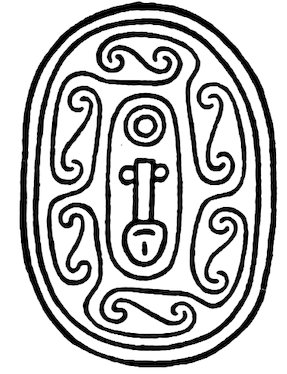
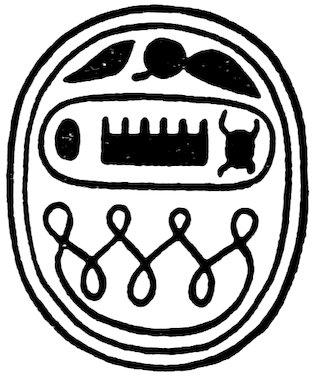
design. We next see spirals
used in the same way to fill
up at the sides of the inscription
on the scarabs of Pepy,
without any attempt to connect
them into a continuous pattern;
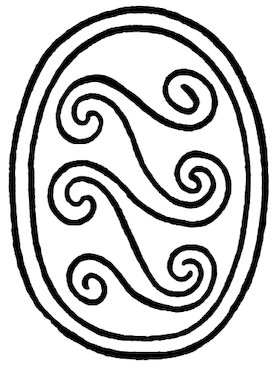
and on the scarabs of Ma·abra,
probably soon after, the same
loose spirals are seen thrown
in to fill up. In none of these
cases is the ornament anything but the
means of supplementing the required inscription;
nothing is arranged for the sake
20of it, and it is treated as a mere afterthought.
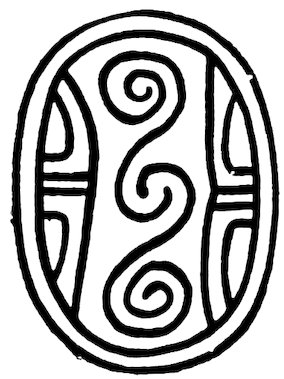
Nor is it until the XIIth
dynasty that any continuous spiral design
can be dated. For over a thousand years,
then, the spiral is only to be found as an
accessory on scarabs, a fact which strongly
suggests that it originated in this manner.
Before describing spirals further, it is
needful to settle some definite names for
their varieties. Where the lines are coiled
closely in a circular curve, as in Assa’s
scarab, they may be termed coils; where
lengthened out, as in Pepy’s, we may term
them hooks; where lengthy in the body
between the turns, as in Ma·abra’s, they
are rather links. Where the line is broken
at each spiral, as in all the above, it is a
chain of spirals; but where the same line
is maintained unbroken throughout it is
a continuous spiral, and these are found
in all varieties of coils, hooks, or links.
21Sometimes the continuous line has separate
ends, but more usually it is endless, returning
into itself. These terms will suffice
to distinguish the varieties, and enable us
to speak of a spiral with definiteness.
14.—Louvre.
15.—Ghizeh.
These detached spirals continued in use
in the XIIth dynasty, generally
as loose links, often not hooking
together, as in this of
Usertesen II. In the XVIIIth
dynasty this is still found as a
general surface ornament on the boat covers
of Hatshepsut at Deir al Bahri and on the
base of a Kohl vase in
the Ghizeh Museum.
Fig. 16. F.P. coll. Fig. 17.
But the spiral was developed,
apparently
under Usertesen I.,
into a chain of coils,
which are drawn
with great beauty
22and regularity. Such care indicates that
the design was a novelty, which was not
yet stereotyped and reproduced as a matter
of course. In no later reign were spirals
ever so beautifully and perfectly executed.
This type was revived under Amenhotep
II. (H. S. 1097). In about the XIIth
dynasty it was combined with the lotus in
perhaps the most perfect design
that remains on any scarab—a
continuous coil with
flowers and buds in the spaces.
18.—Turin.
19.—F.P.
But it was felt that the
spirals all round occupied too much of the
field, so the top and bottom were left free
for inscribing, and the ornament was limited
to the sides, as in this chain of
hook pattern of Usertesen I.
This design, with the line continued
around the top as well
as the base, was the staple
23decoration of the private scarabs of the
XIIth-XIIIth dynasties,
many of which
are of great beauty.
Both types are found,
but the hook pattern
is more usual than the coils.
Fig. 20. F.P. coll. Fig. 21.
Fig. 22. F.P. coll. Fig. 23.
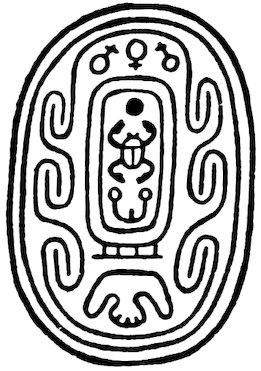
In the finest work, however, the line
is made endless, a
single continuous
line forming the
whole pattern, as
in the endless hook
pattern of Setmes, and the endless coil
pattern of Ptaherduen.
24.—Paris.
25.—F.P.
In the few spiral
scarabs of later
times the pattern is
not only placed at
the sides, but is
carried all round, as we see in that of
24Amenhotep I. and one of Ramessu II.,
which latter is the latest spiral pattern
known on scarabs.
26.—F.P. coll.
The long links were seldom used in
continuous patterns around scarabs,
as in this, but were more
usually employed for independent
spiral patterns without any
inscriptions.
27.—F.P. coll.
28.—K. x. 50.
29.—I. viii. 69.
30.—K. x. 28.
31.—K. x. 40.
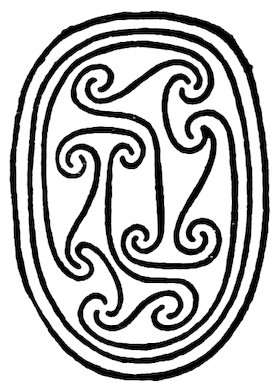
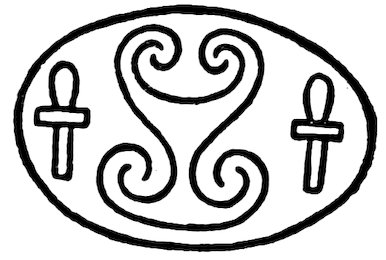
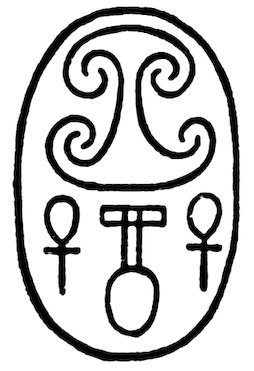
After serving as adjuncts to inscriptions,
the spirals became elaborated as sole patterns.
These are at
first a few simple
coils, as on one
which, from the side
pattern, can be dated
25to about the VIIIth dynasty. These, when
elaborated with more coils or links, sometimes
developed to great length.
32.—K. x. 17.
33.—F.P.
34.—I. x. 176.
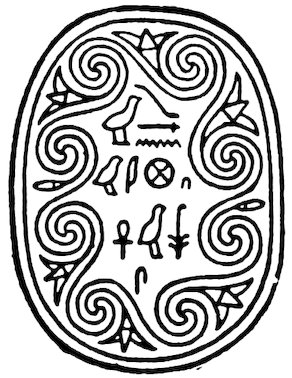
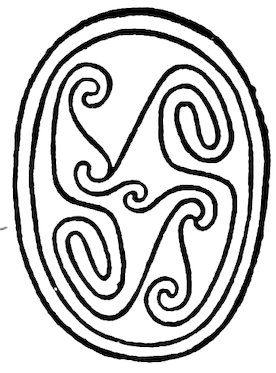
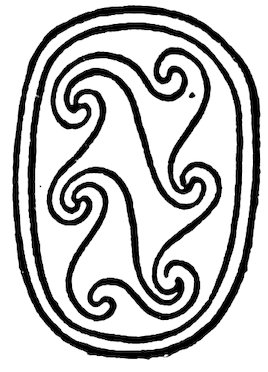
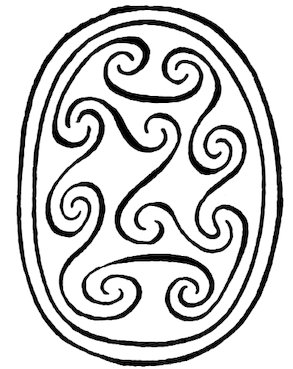
Such patterns required but little ingenuity,
and it is rather in the
design of continuous spirals that
the Egyptian showed his skill.
The problem was how to arrange
a number of coils in a symmetrical
system uniformly covering the
surface of the scarab, and yet to connect
them in a true series. This was done in
various ways, usually by introducing long
loop lines around the edge.
One of the simplest type is—
In another a cross
pattern is formed
which is entirely of
C coils, like frequent patterns
at Mykenae.
35.—F.P.
36.—F.P.
37.—F.P.
Others fill up by establishing a repeating
26pattern, which might be indefinitely
multiplied, as —
and the difficulty is
avoided on a large
silver scarab of early
date by
shortening the links to allow of
the connecting line passing the
ends.
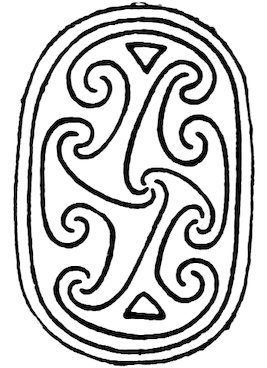
This difficulty of designing
good covering patterns out of true continuous
lines probably led to the evasion of
introducing false links. Thus what would
otherwise have been an opening in the
middle was barred across.
38.—I. x. 158.
39.—K. x. 27.
40.—K. x. 48.
41.—F.P.
42.—F.P.
Some beautiful effects were obtained by
27this false barring, which does not, at
first sight, catch
the eye, as in these
two examples.
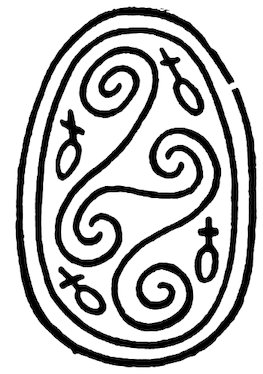
43.—F.P.
In the latter, two
complete lop-sided
spiral groups are joined by long false links
around the outside. Another favourite
device which often occurs is also
compounded of lop-sided groups,
or rather of a cross group, like
Fig. 43, with four false links
joining in the middle.
44.—I. x. 144.
45.—I. x. 155.
46.—F.P.
47.—Turin.
Some other devices did not
profess to cover the whole
field, as in Figs. 44 and 45;
and sometimes two separate
28lines of design were superposed, a single
element of the same design being found
as late as Tahutmes III.
The spiral had thus been greatly developed
as a detached ornament for a small
surface; but in architecture and furniture
it was required as a continuous decoration
on borders and on large surfaces. Hence
its development was in many ways different,
and—so far as we know—later by a whole
cycle of history than the development on
the scarabs. On those small objects it
started in the Vth dynasty, became fully
elaborated in the XIIth, is common in the
XIIIth, and only very occasionally found
in the XVIIIth, disappearing altogether in
the XIXth. On walls and furniture it is
rare in the XIIth dynasty, becomes usual
in the XVIIIth, flourishes in the XIXth
29and XXth, and is decadent in the XXVIth.
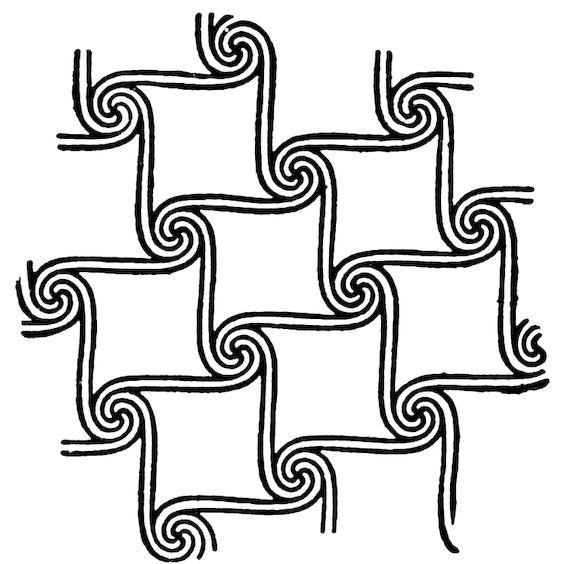
Fig. 48.
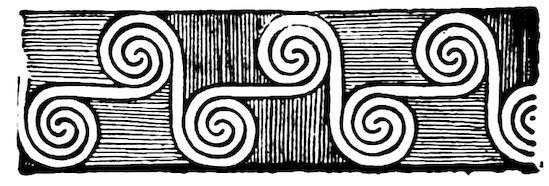
The simplest form in which it is found
is as a chequered pattern series of S
spirals, apparently on cloths thrown over
boat cabins. On Hatshepsut’s
boat the spirals
are close together
(Duem. XXI.); but
rather later, on the
boat of Neferhotep, they are spread with
chequers of red and blue between them
(W.M.C. lxvii.).
Fig. 49.
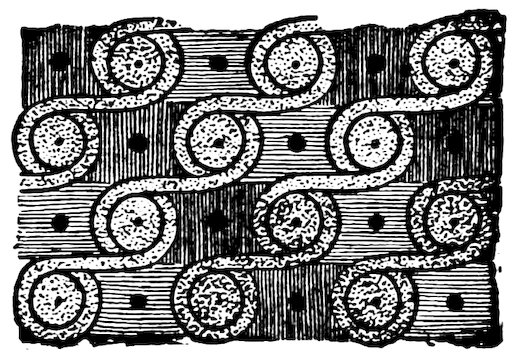
About the same period they appear as
a continuous coil pattern in relief on the
columns of the harim
well at Tell el Amarna.
The spiral in relief
being in yellow, it probably
was copied from a jewellery pattern
in which a strip of gold was twisted into
spirals, and the spaces filled with squares
30of coloured stones or pastes, judging from
the analogy of the inlaid capitals. This
example being earlier than most of the
spiral decorations of surfaces may thus
open our eyes to the meaning of some
such designs; and, in general, a close continuous
coil returning on itself may well
be a copy of a strip of sheet metal,
doubled, and rolled up.
The next stage is where continuous lines
of spiral patterns
are placed
side by side,
and other patterns
developed
in the spaces
between them.
Sometimes the
intervening
patterns become so complex as to overshadow
the mere spirals, as in the splendid
31ceiling of Neferhotep, in the XVIIIth
dynasty. And in this the far more complex
quadruple spiral begins to appear, as
we shall see presently.
The lines of spirals were not only placed
parallel, but were also
crossed. For some
reason this type was
never well developed,
but remained one of
the coldest and most
mechanical of all, looking
in the later stage of the XXVIth
dynasty like a most
debased wall paper.
But the glory of
Egyptian line decoration
was in the quadruple
spiral, of which
the most elementary
example is on a boat cover as late as the
32XXth dynasty (Ramessu IV.); though it
has passed through this stage long before
that time—if indeed this may not be regarded
as a degraded simplification of it.
It is also sometimes rhombic in plan.
From this was developed
a peculiar
pattern by the omission
of the lines
which define the spirals,
thus reducing it
to a system of rows
of hollow-sided quadrangles
without any
apparent connection.
The main development
of the quadruple
spiral was with
rosettes or lotus filling
the hollow squares.
This became a stock subject with the
33Egyptian, and from thence a main pattern
in other lands. The filling
in was either a flower
pattern or a rosette, which
might be either a flower
or a leather pattern, as we
shall notice further on.
The insertion also became
more complex, four lotus flowers being
placed in each angle of the hollow square;
and the spirals being
more heavily developed,
in order to gain enough
space for complexity in
the squares between
them. Such a system
could hardly be carried
further, but reached its limits; like the
limit of size in the Great Hall of Karnak,
where the columns occupy too large an
area in proportion to the clear space.
In another direction, however, the spiral
blossomed further, in
the parallel lines of
spiral pattern. These
became developed by
introducing link lines
so as to form a quintuple
spiral, which
was further complicated by lotus flowers
and buds in the hollows and recesses.
In this direction, again, the Egyptians
had reached the limit beyond which more
detail would be merely confusing. By careful
use of colour to separate the various
parts, these complex patterns remain clear
and pleasing in spite of their richness of
detail.
The quadruple spiral had, however,
another development, of C links, which is
rather too formal to be beautiful, and lacks
the flamboyant grace of the chains of
35spirals. Still it has a simple dignity,
related to the scarab
spirals rather than the
flowing surface patterns.
This became formalised
into a torturing kind of
design, which can only
be described as “cursedly
ingenious.” By simplifying the previous
pattern, a wave
was invented which
was equal in each
direction, and four of
these were crossed in
a manner which nothing
but bold colouring
could make intelligible.
The fret patterns are all modifications of
corresponding spirals. The cause of such
change is obviously the influence of weaving.
As early as the
Vth dynasty we find
a fret of rhombic form
in basket-work in the
screen behind the figure
of Ptah·bau·nefer, at
Gizeh. The angles
show that the plaiting was in three directions,
as we saw in the basket-work pattern
at Benihasan (Fig. 3). But frets in
general are very rare until a late period,
and they doubtless depend on the adaptation
of spirals to textiles. We see no
trace of the fret in the Mykenaean art, the
spiral there being figured on stone or
metal, while the women wore flounced
dresses with scale pattern. But in the
pre-Persian age fret pattern weaving in
borders was the standard design, as we
see on the coloured robes of the Parthenon
37statues; and immediately after that
the stiffest of square frets swarms over
Greek art, to the exclusion of the graceful
spirals and scroll borders.
The chains of links were copied in the
fret pattern with no difference except in
squaring up the
curves. The same
is true of the quadruple
spirals, which
appear likewise modified;
and this change
seems to have led to
another simplified form, which is on the
38same idea as the torturing design (Fig.
59), but which is less ingenious, and is
still possible as an ornament.
64.—Schuck. 256.
So far we have viewed only the course
of Egyptian design, nor can we travel far
outside of it within these pages. Moreover,
as it is dated before any other such
decoration in other countries, it is well to
view its course as a whole without confusing
it with the various fragments borrowed
from it by other lands. Yet we may well
turn now to see the beginning of the
course of European decoration at Mykenae,
and observe its close contact
with that of Egypt.
The spiral is the main
element of prehistoric
decoration in Greece;
the parallel chains of links
occur almost exactly as
we have already seen them in the pattern
39of Neferhotep, but omitting the inner details
added in the spaces.
65.—Schuck. 290.
The quadruple spiral is splendidly shown
in the ceiling of Orchomenos, with a lotus
flower in each space;
also as a simpler
form without any filling
in of the squares
on the grave stele
(Schuck. 146). While
even the ox head
with a rosette between the horns, in the
grand quintuple spiral pattern (Fig. 57),
is strangely paralleled by an ox head of
silver with a large rosette on the forehead
found at Mykenae (Schuck. 248).
In observing these equivalents it must
be noted that whole patterns with their
detail are taken over complete from Egypt.
There are none of the series of intermediate
steps which we have traced in the
40mother country; and where a simpler form
occurs it is known to be later, the grave
steles being after the age of the great
ceiling. Thus there is the surest sign of
a borrowed art, apart from the facts of the
exact resemblances we have noted. Of
course the Mykenaean designs are mostly
influenced by the taste of the race. Many
of them are strongly European, and might
be of Celtic or Norse work, as has been
shown by Mr. Arthur Evans; but the
source of the designs lies in the two
thousand years’ start which Egypt had
before Europe awoke.
A separate form of the spiral pattern is
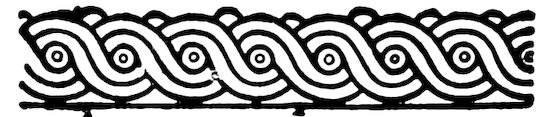
that used for borders, otherwise called the
wave or maeander, which merged into the
guilloche. Although the chain of coils on
the scarab borders in the XIIth dynasty
may be regarded as a wave border, yet no
example is known of this border on other
objects until the XVIIIth dynasty. At
that time it appears as often on foreign
objects as on Egyptian, and the only instance
of the guilloche is on foreign dress.
Hence this development of the spiral idea
may well be due more to the Aegean civilisation
than to that of Egypt. This will
agree with the occurrence
of the guilloche
on black pottery
from Kahun, which class, wherever it can
be dated, is found to belong to the
XIIth-XIIIth dynasty. The metal vases
shown on the monuments of the XVIIIth-XXth
dynasties are
mostly foreign tributes,
and on them the wave border is
42common, merging into a twisted rope border
which is also
found—though rarely—on
scarabs of the Middle Kingdom.
70.—R.C. lvii.
Fig. 71.
Fig. 72.
In Egyptian use this border is seldom
found. A box in the Louvre had a line
of long links; and a scroll edge appears to
the standard of Ramessu II. But more
usually the scroll is associated with the
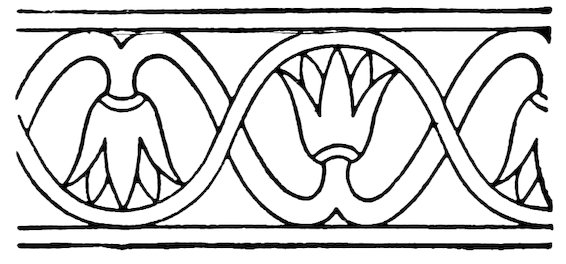
lotus, as in these—
The innumerable adaptations of this in
Greek and later designs are familiar enough
to us.
The influence of weaving has been very
great upon these wave borders. As I
43have before noticed, the woven borders,
reducing the pattern to a fret, are shown
on the pre-Persian statuary at Athens, and
precede the most common and oft-repeated
use of the fret or key pattern borders in
Greece, and thence in all classical, mediæval,
and modern times.
Another type of border, which may be
connected with this, is found in the Ramesside
age. As it occurs as stitching on
leather, and is well
adapted to quilting or
sewing bands together, it may well have
been derived from that; but it is also
found on metal work, with which it does
not seem to be connected by origin.
44
78.—P. and C. xiii.
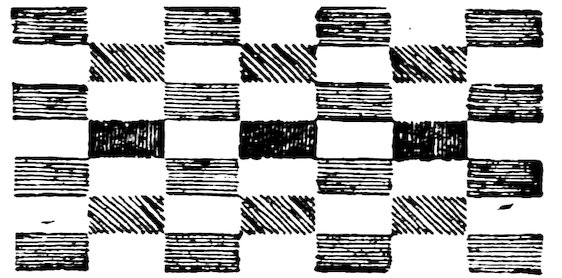
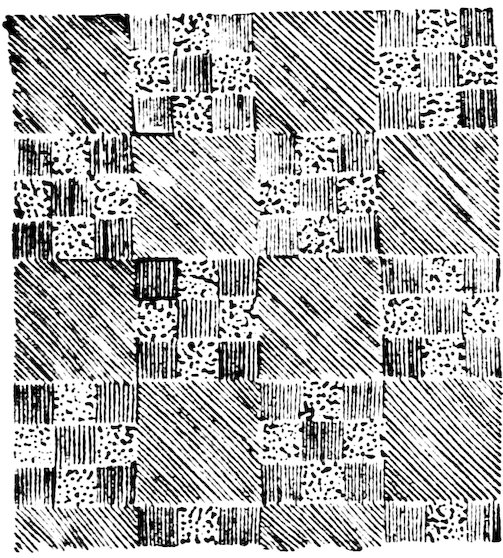
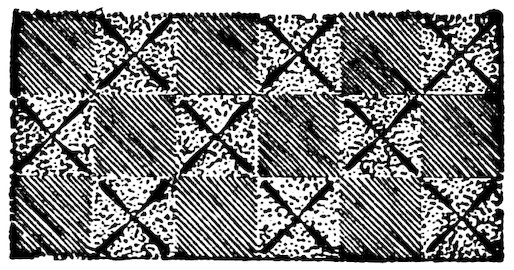
The source of chequer patterns is unmistakably
in plaiting and weaving. On the
oldest monuments the basket sign, neb, is
chequered in different colours; so are
also the baskets of farm produce carried
by the servants, as shown in the tombs.
The modern Nubian basket-work is well
known for the many patterns which it
bears like the ancient Egyptian. The
chequer pattern is found in every period
in Egypt, and is perhaps most common in
the latest forms on the sides of thrones in
the Ptolemaic age. In the Old Kingdom
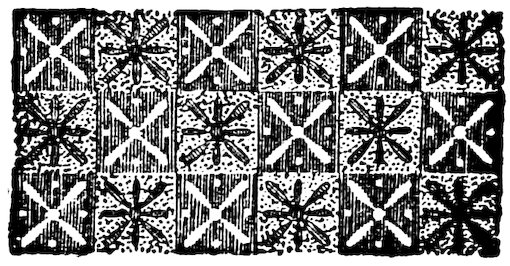
many varieties were in use. The plain
chequers of red or
black with white, the
squares filled with
black and red crosses
on a green and yellow
chequer; or diagonal
square patterns
45developed by lines of
chequers, which are often
not square but elongated,
thus forming general and
wide-spread patterns
which attract the eye on large
surfaces. These are best seen
in the tomb of Ptah-hotep
(P. and C. xiii.) and in that
of Peheniuka (L.D. I. 41),
both of the Vth dynasty,
Sakkara.
79.—P. and C. xiii.
80.—L.D. I. 41.
81.—L.D. II. 130.
In the Middle Kingdom we find chequers
covered with bars of
colour, red and green,
at Benihasan.
Under the empire
chequers are less
common owing to
the greater development
of more elaborate
46decoration. A pleasing variety was
formed by lengthening the squares, a
change doubtless copied from weaving,
where oblong squares serve to break the
monotony of the pattern.
83.—L.D. iv. 77.
In later ages of the Saitic and Greek
times the chequer is a common resource,
but is seldom treated
with originality or
grace, and we do not
find any new departure
or advance in
the mechanical execution
of the later examples.
One slight novelty was the
alternation of whole and divided squares
of colour, under Claudius.
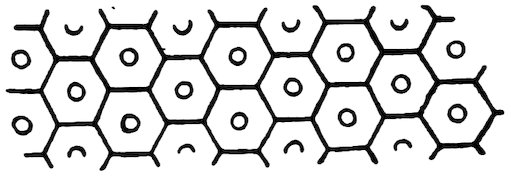
Somewhat analogous are the net-work
patterns. They seem to be probably
derived from stitch-pattern over dresses.
Though found in the XIIth dynasty they
47are not usual until the XVIIIth dynasty,
and they are generally on the dresses
of goddesses. A simple example is on
a horse-cloth of Ramesside
age, which
shows that these can
hardly represent long beads, but rather
stitching or quilting.
A more elaborate form
is on the dress of
Bast in the tomb of Seti I., in hexagons.
84.—R.S. lxxxii.
85.—C.M. ccxlii. cccx.
But this design rose to importance when
it was introduced as
an architectural element
in the decoration
of columns at Tell el Amarna. There
it is coloured yellow, and the spaces are
alternate red and blue.
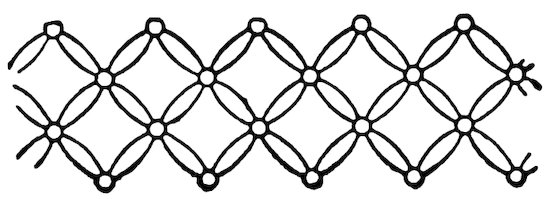
Fig. 86.
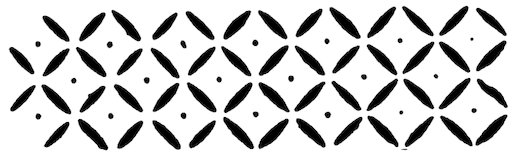
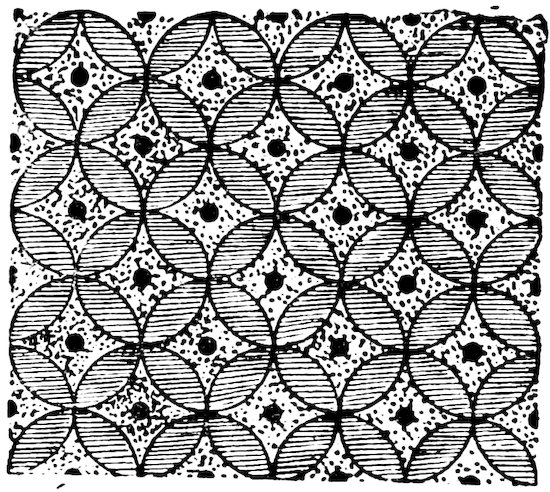
The Egyptians never used circles freely in
decoration; no examples are known before
the XVIIIth dynasty, and but few then.
The intersecting circles, forming a kind
of net-work, are
found in the XVIIIth
dynasty in blue on
a yellow ground; and
the same occurs in
black on blue and
red ground, in later
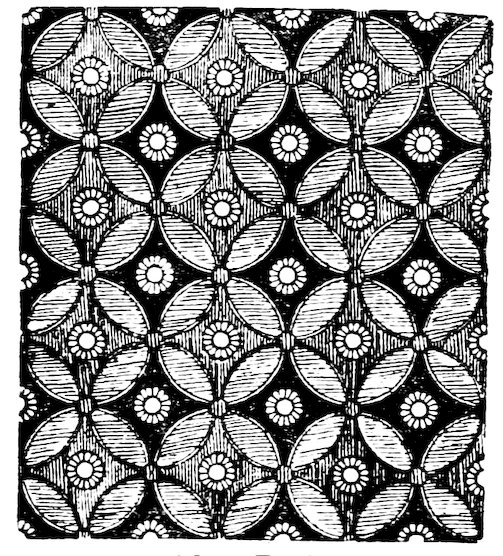
times (L.D. I. 41). Besides the rosettes
other patterns were introduced into the
spaces, which were coloured red and green
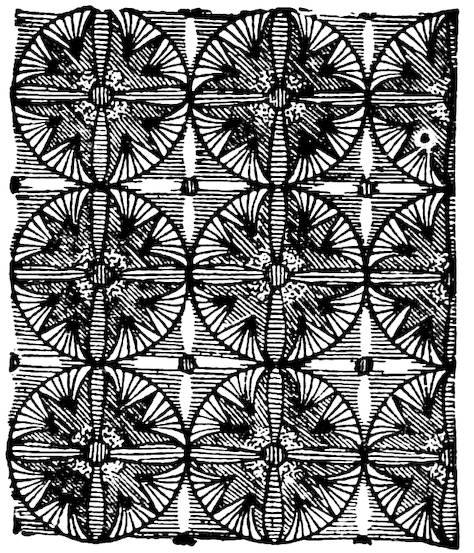
alternately. But the most beautiful type
was with contiguous circles not intersecting,
and each containing four lotus flowers.
49The circle, however, never became of importance,
probably because it was too stiff
and mechanical for the Egyptian, who delighted
in the waving spiral patterns and
the unlimited variety of lotus developments.
It is remarkable that there is not
a single example of the circle divided into
six, or with six segmental arms, which is
so common a motive in Assyria and Syria,
and which results so readily from stepping
the radius around the circle. This seems
to show that the Egyptian did not use
compasses at any time, but always worked
with a string and points. The absence of
a simple and self-evident motive like the
sixth of the circle is almost more striking
than a peculiar motive being present.
CHAPTER III NATURAL DECORATION
50
Though it might be supposed that
the imitation of natural forms would
be the earliest form of decoration, yet this
is not the case. On the contrary, we find
the geometrical forms of wave lines, and
chequers copied from weaving, and the
varieties of the spiral, were the first ornaments
of importance in Egypt; while the
natural forms of feathers and flowers were
not generally imitated till a later time.
One source of simple pattern that has
been little noticed is the feather, and the
variety of its forms. Fortunately we have
51these different forms shown unmistakably
as feathers on the coffins of the Antefs in
the XIth dynasty, before we find them in
common use elsewhere. Hence we can
have little doubt as to their real origin.
On these coffins the royal mummies are
figured as swathed around in protecting
wings, representing those of Isis at the
sides and of the vulture of Mut on the
head. The feathers have different forms
according to the part of the wing which
they occupy. Thus on one coffin we find
all of the following types of feathers:—
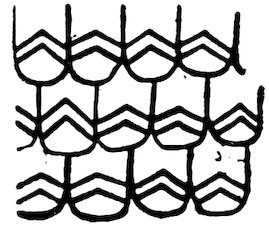
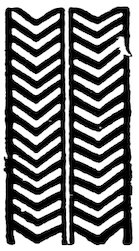
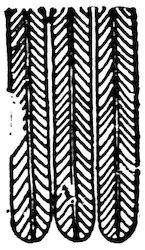
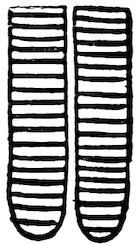
Fig. 90.
Fig. 91.
Fig. 92.
Fig. 93.
Fig. 94.
Now when we have thus been shown
the conventional types which were used to
represent feathers, we can identify these
again in many other places, where probably
52the original idea of feather work
was entirely lost; and we have a new
light on some representations not yet
understood.
95.—Amenhotep I. R.S. xxix.
96.—Amenhotep II. R.S. xxxvii.
On the kings of the XVIIIth-XXth
dynasty we often see a wide belt
covering the whole stomach, which
is decorated with what is commonly
called scale pattern. But this occurs
in scenes which are not at all warlike,
and where no defensive scale
armour is likely to be shown—Amenhotep
I. is seated as a god receiving
adoration after his
death; Amenhotep II. is
represented adoring Ra.
And in the second case
the pattern is identical
with the feathers on the
Antef coffin. The only
conclusion is that these
53represent belts of feather work worn
around the body to prevent chill, like the
voluminous waist shawl of modern Orientals.
Such a feather belt would be
admirable for lightness and warmth, but
that it is not scale armour is seen from
the absence of it in fighting scenes. On
the contrary, in the royal campaigning
dress another form of feather work is
seen in the large wings of feathers which
encircle the shoulders (Ramessu II., R.S.
lxxxi.).
This feather pattern is also very usual
on the sides of thrones, from the XVIIIth
dynasty down to the latest times. Here
again it is evident that it cannot be scale
armour; and a feather rug thrown across
the seat, in place of the fur rug otherwise
used, is a very likely thing to find in such
a position.
We may, then, take this pattern, when
54used on dress or on thrones, to represent
feather work. But in later times it is
also used on very incongruous objects.
As early as the XVIIIth dynasty the
feather pattern occurs around columns
as an architectural ornament (Tell el
Amarna), and with the characteristic marking
also about the XIXth
dynasty (P. 79); also on metal
work (vase, P. 97), where it
must be purely an artificial
marking.
It became elaborated under
Seti I., with markings upon it,
both on a dress of a god and
on a throne-cover. And it became
degraded into an unintelligible
pattern under Ramessu II.,
when it appears as the dress of
the god Amen.
In later times the same pattern was
55used on columns at Philæ, in an
inverted and very corrupt form.
100.—L.D. I. 108.
The other forms of feather
pattern shown on the Antef
coffin were also found later. But they
merge so readily into mere line patterns
that it is not likely that they were regarded
as feathers in their later use.
The V pattern is found on the columns
at Tell el Amarna, on belts of the kings
(L.D. III. 1), on painted wooden columns
(P. 73), on the harps of Ramessu III.
(P. 114), and many other places.
The use of flowers for ornament is so
natural that their occurrence in the
earliest times is what might be expected.
Yet but few flowers were adopted for
decoration. The lotus is far the commonest,
after that the papyrus, the daisy,
56and the convolvulus, together with the
vine and palm, almost complete the
material of vegetable designs. There is
also, however, what may be called a
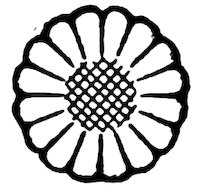
generic flower ornament—the rosette—which
is treated so conventionally that
it can hardly receive any precise name.
Sometimes in the XVIIIth dynasty it is
clearly a daisy, very seldom has it the
pointed petals of the lotus; and it fluctuates
between the geometrical and the
natural so as to defy details. One cause
of this is the evident effect of leather
work. The coloured leather funereal tent
of Isiemkheb, found at Deir el Bahri,
opens our eyes to a great deal. We
there see an elaborate design, descending
to long inscriptions of small hieroglyphs,
all worked by cutting and stitching of
leather. After this we can see in many
of the Egyptian designs the influence
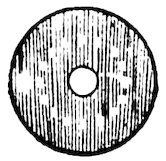
57of leather work; and nowhere is this
plainer than in the rosettes. The earliest
rosettes we know, those on the head-band
of Nefert, at the very beginning
of monumental history, are plain discs of
colour divided into segments by white
lines across them. These are discs of
leather secured by radiating threads; and
the same are seen in the XVIIIth
dynasty, more varied by concentric
circles of colours, probably successive
superposed discs stitched down
one over the other.
Another stitch ornament is seen on the
stuffs used for covering
thrones in the XXth
dynasty. There star
and cross patterns are
used which are evidently
stitch work or embroidery;
and in the spaces
58are discs of colour with white spots
around, probably pieces sewn on by
stitches round the edge. On a dress of
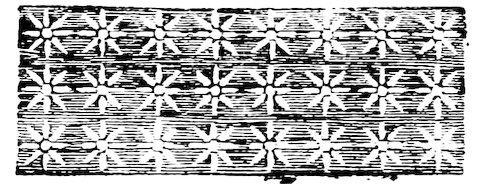
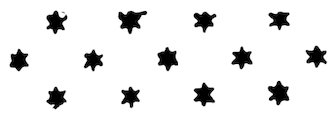
Ramessu II. also are little
six-pointed stars, which were
doubtless stitch work.
104.—R.S. lxxxiii.
Fig. 105.
There can be no doubt of the effect
that stitching has had on the use of
rosettes, but other varieties are probably
independent of that. The great series of
rosettes is in the moulded glazed ware
of Tell el Amarna; there several dozen
varieties are found, varying from four
petals to thirty-two. The more elaborate
of these have an unmistakable
daisy centre of yellow in the
midst of white petals, and this
indicates what was probably the flower
in mind for most of them.
The rosette is found in varied use.
On metal vases it is very general, and
59may either be a separate ornament of
beaten work riveted on, like the rosettes
on the silver ox head at Mykenae, or else
embossed repoussé in the metal. Carved
in wood or ivory, rosettes decorated the
furniture; and they are constantly found
as centre ornaments in square patterns,
and along borders with the lotus or other
subject.
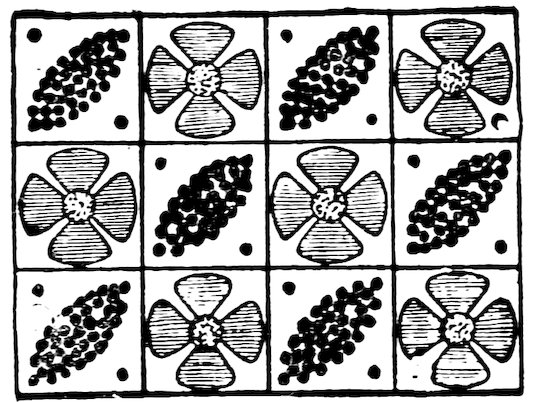
In patterns a frequent
form is only
four petals, or a cruciform
flower, as at
Benihasan in the
XIIth dynasty; and
this is varied by alternations
of square and diagonal arrangement.
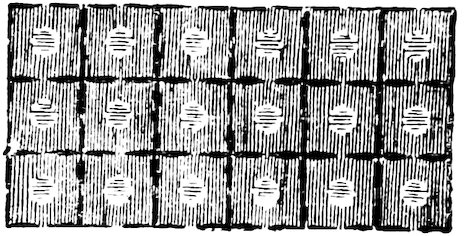
An allied pattern is the disc surrounded
by spots. This is very usual on early
Greek pottery, and is found on the Aegean
pottery also. This is very rarely seen in
pure Egyptian design, and only in the
XVIIIth dynasty, when Mykenaean influence
was strongest. On Neferhotep’s
ceiling two forms are found,
put between the horns of the bulls’
heads, like the rosette on the Mykenaean
ox head. Elsewhere it is
usually seen on the scarves of the
negroes as a characteristic decoration,
and on the dress of the Amu
(C.M. cclviii.). Hence it appears
to be distinctly a foreign ornament, like
the other spot pattern on a zigzag line.
Only three examples are published from
Egyptian decoration, and those may well
be due to foreign influence.
61We now reach the largest and most
complex growth of Egyptian ornament in
the lotus, so widely spread that some
have seen in it the source of all ornament.
Without going so far, we shall
find plenty in it to tax our reasoning and
imagination. If I prefer, in dealing with
this, to ignore the developments of it
seen outside of Egypt as aids to understanding
it, this is only because those
foreign examples are so much later that
they are a reflex of various Egyptian
periods, and cannot show anything certainly
as to the long anterior course of
development in Egypt itself.
The debated question of lotus and papyrus
disappears at once when we look at
the feathery head of minute flowers which
the papyrus bears. That some flower,
62such as a nelumbium, was confused with
the lotus seems, however, very likely.
There is no doubt that in ornament
different flowers were sometimes confused,
and their details mixed; hence it is of
no use for us to be too particular in
trying to separate them. We shall
therefore use the name lotus in general
without necessarily entering on botanical
reasons for and against it on each occasion.
112.—L.D. II. 33; I. 27.
113.—L.D. III. 68. XVIIIth dyn.
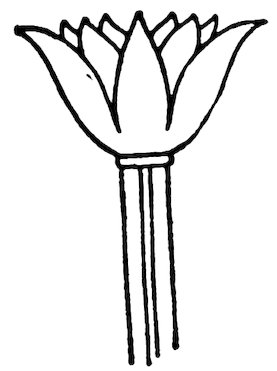
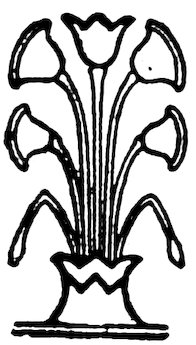
The oldest use of the lotus
was in groups of two flowers
tied together by the stalks;
such are found on the
prehistoric pottery at
Koptos, and on the
earliest tombs. But in later times
this became corrupted, and the
origin apparently forgotten, by
the XVIIIth dynasty.
The plain flower was also used very
early, as we see on the
head-band of Nefert at the
beginning of the IVth dynasty. And as
architectural ornament it appears as a
capital in wood of the Vth
dynasty in the tomb of Imery.
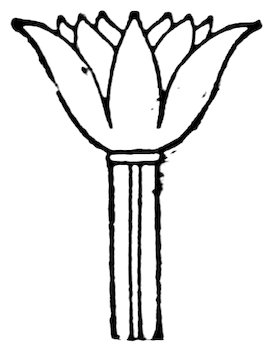
At Karnak there is a celebrated
pair of granite pillars, one with
the papyrus, the other with the
lotus; and this form, with the
sepals turned over at the end,
became the more usual in the
Empire
and later
times.
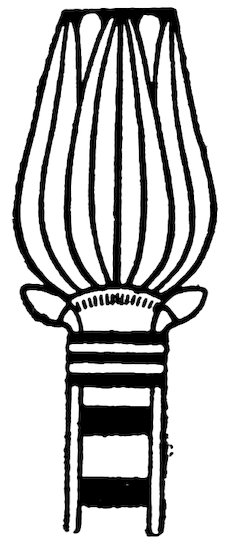
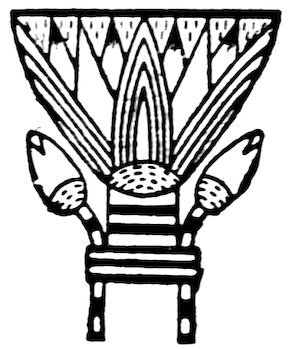
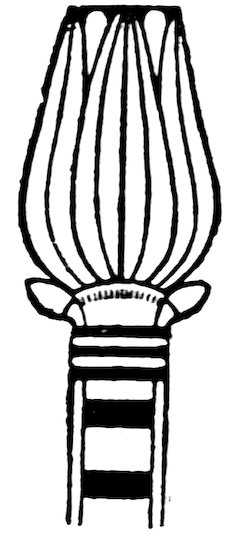
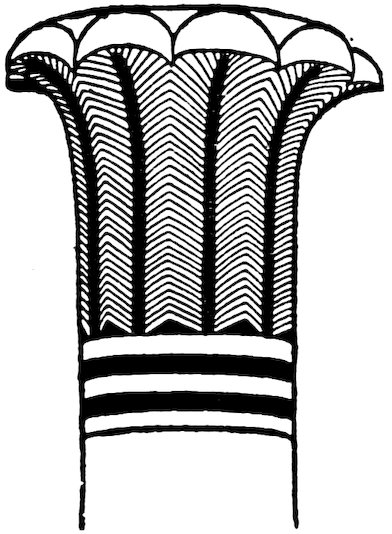
The variety of
lotus capital is very
great. The bud
capital and the
opened flower are
64both shown in the XVIIIth dynasty (tomb
of Khaemhat); and many composite, complicated,
and impossible combinations were
piled together in the decadent age of the
Ramessides.
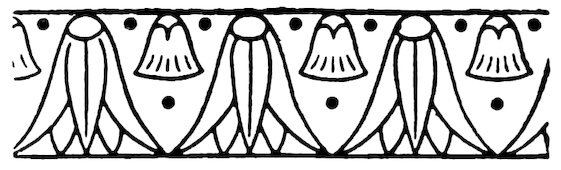
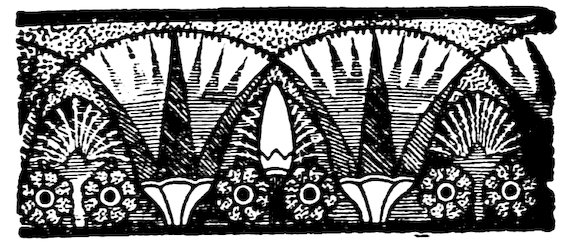
The lotus was also much used in repetition
as a border pattern, but not apparently
before the XVIIIth dynasty;
and usually it is in alternation with buds,
which fit harmoniously
into the curves between
the flowers. This line
of flowers and buds
was varied as flowers
and grapes, and appears
very often in
the XVIIIth dynasty.
65The flower and bud was further developed
in a mechanical
fashion, and we
can trace a continuous
series of forms
beginning in a flower
and bud pattern and modifying the intermediate
member,
until on reversing
the line we find that
something has been
evolved which is indistinguishable
from
the Greek palmetto alternating with the
lotus. The isolated anthemion, which is
so much like this, has probably a different
origin, as we shall soon see.
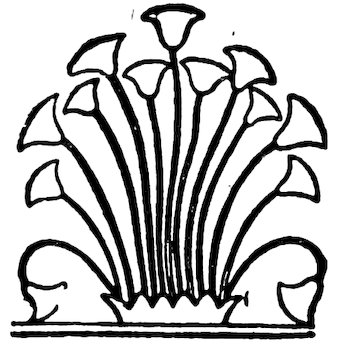
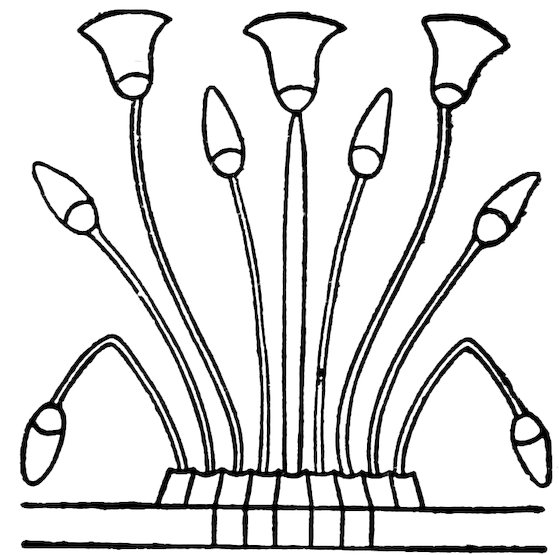
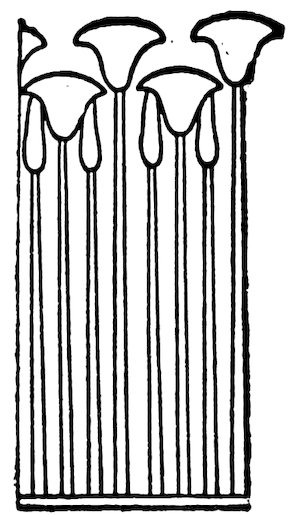
Beside using the separate flowers, the
whole plant was also a favourite subject
as a group. In the earliest days we find
66it entwined around the hieroglyph of
union, as we shall notice in considering
the hieroglyphs. In the XIIth
dynasty the plant appears as a
recurrent group in surface decoration;
though from the varying
form of the flower it might be
intended for lotus or papyrus.
127.—R.C. xciii.
128.—L.D. III. 109.
In the XVIIIth dynasty it
is more free, as might be
expected in the time of Akhenaten.
129.—R.S. lxxxiii.
It is also seen as a foreign
ornament on the
dress of a Syrian
slain by Ramessu II.
at Abu Simbel, but
in this case perhaps
the tufted papyrus is
intended. And in
place of the rounded group which is usual
67in the XVIIIth-XIXth dynasties we find
a different treatment
on the throne of Ramessu
III., in which
it is kept more as
a parallel pattern.
This parallelism became
general in later
times, and the Ptolemaic walls are ruled
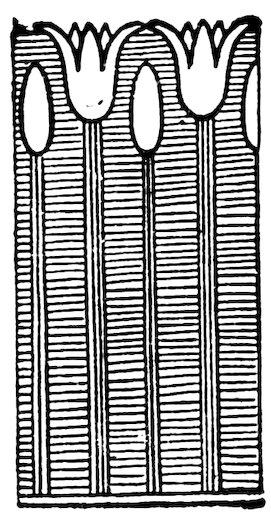
over with stiff friezes of lotus and bud.
These wall basements are
preceded by groups of flower
and bud in scenes, which are
of the same style,
as early as the
IVth dynasty, on
the tomb of Debuhen.
Here it may be the
papyrus; but in the Vth
dynasty, on a basket-work
screen, the lotus and bud is clearly shown.
68This pattern, however, is very seldom found
as a general architectural ornament until we
come down to the dull
sterility of the Ptolemaic
and Roman age.
Then the lower part of
each wall is uniformly
ruled with an endless
series of flowers and
buds on long stems in monotonous order.
We now come to the ornamental development
of the flower into a monstrosity,
which is only decorative and not natural,
and which requires some thought and comparison
to understand its origin.
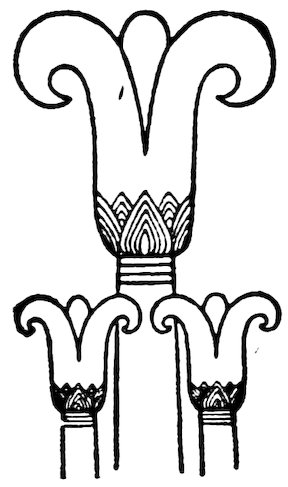
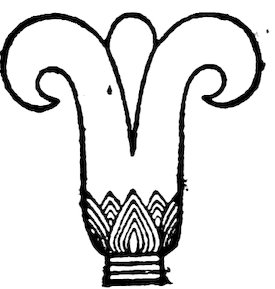
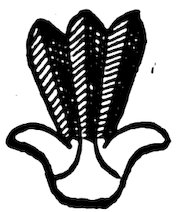
First there is the fleur-de-lys
type, with curled-over sides and
a middle projection. This has
not been yet explained satisfactorily;
but a principle which was first
69clearly formulated by Borchardt (A.Z.
xxxi. 1) will show the origin of this as
well as of the succeeding forms. The
Egyptian, it seems, consistently drew the
interior or top view of an object above
the side view. In short, they suppose
things to be seen in a bird’s-eye view,
and expressed that by drawing—for instance,
a cup—in side view and partly in
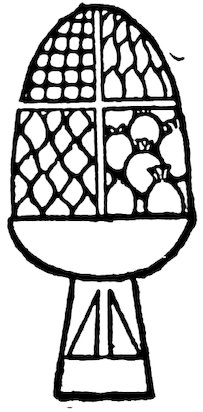
top view above that. A dish would be
drawn in side view, and a top
view of its compartments and
contents placed over it, and
the bunch of flowers that lay
on it is again placed over the
top view. Now on this principle
we can see that the projection in
the midst of the lotus flower is the third
sepal at the back of the flower, the fourth,
in front, being so foreshortened as to disappear
altogether.
135.—T.A. I.
70
136.—T.A. 368.
137.—T.A. 381.
138.—T.A. 388.
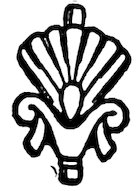
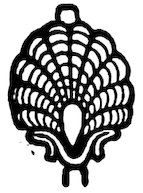
This view is further complicated by
showing not only some of the
four outer sepals, but also some
of the petals, usually three. Here
the near sepal is shown rising in
front, and then above these everted sepals
are three of the inner petals of the
flower. These might be increased
to five or seven, but were generally
an odd number; and they were at
last evolved to a fan of petals, in
which the treatment of the dish of
fruit just shown is exactly reproduced,
a side view of the flower
being crowned by a top view of it showing
the radiating petals in the interior.
71
139.—T.A. 375.
140.—T.A. 374.
So far we are on clear ground. Now
we come to a more complex form, which
has also not yet been explained. In the
XVIIIth dynasty (from which we must
mainly draw, as we have the long series
of varieties in the glazed ornaments of
Tell el Amarna) a strange form
appears, with reversed curling arms
above the calyx. Now we have
seen that a third sepal is shown
from the back of the flower, and the
fourth is omitted which lay in front. But
this was an imperfect flower, and so a
diagonal point of view was taken, in which
two sepals lay nearest and were seen in
side view, and the two behind them were
seen over them. Sometimes they
are curled alike, but more generally
they are curled different ways, the
nearer ones downwards, the further
ones upwards. Hence we get this very
mechanical form, which was greatly developed
in Assyrian and Greek types of
the pattern. If it can be proved that the
Assyrian tree pattern is earlier than this
development, we could then grant what
72seems a likely influence on the development
of this pattern. It was so
far removed from a natural view
that it soon became greatly varied
and amplified, as on a bracelet in
the Louvre.
In Assyria this became a staple design,
in which the top was greatly
increased at the expense of the
lotus sepals below; but still the
four sepals, two front and two
back, are shown. In the Greek designs,
however barbarous they may seem in comparison,
owing to their hopeless divergence
from any rational type, yet the
same elements remain, and the
four sepals can be traced below
the view of the petals in the
flower. Thus the anthemion
with its double curves is fully
accounted for, the lower and
73upper sepals being still distinguishable in
the two spirals on each side at the base
of it. The later changes of this necessarily
belong to Greek art, and we cannot
here follow them out.
Fig. 145.
A late development of the lotus in
Ptolemaic Egypt was with a
central spike through the face of
petals. As this spike rises from
the base, it appears to be the
front sepal rising before the petals.
Another variety in this pattern remains
to be noticed. On very many compound
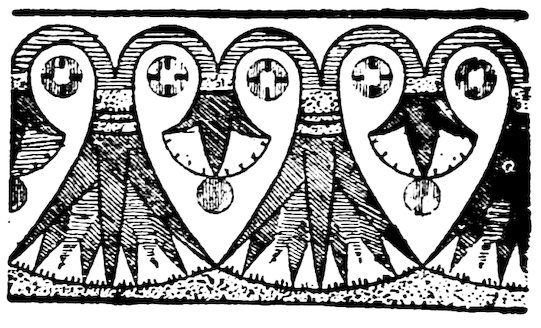
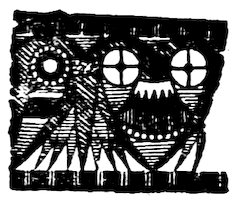
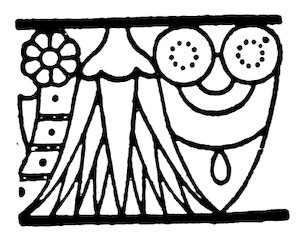
lotus patterns there is a pendant
from each end of the
side sepals. This does not
appear until the XVIIIth
dynasty on the monuments: it is then
sometimes single and sometimes double.
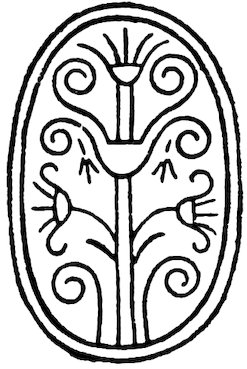
But here, as in the spirals, the scarab
type is an earlier stage than the architectural.
74On the architecture it is quite
unintelligible, and a mere conventional
monstrosity; while on a scarab
of green jasper—which from the
style and material seems certainly
to be before the XVIIIth
dynasty, and probably of the
XIIth—there is an already conventionalised
lotus group, with the four
sepals and inner petals already developed
into a sort of “tree pattern,” and the
lower two sepals have a pendant, partly
worn away, but clearly showing a triply-branching
line like a small lotus flower.
This is the earlier stage of this conventional
pendant; but even here, although
the pendant itself is rational, the position
of it is hard to explain. Probably we
must wait for some early scarab to clear
up the real origin of this curious and
puzzling form.
147.—F.P. coll.
75We have now traced the evolution of
the various forms of the lotus pattern in
Egypt, and seen how the main Assyrian
and Greek types of the palmetto and the
anthemion arose, which were confounded
together owing to their similarity.
Other plants were often confounded with
the lotus in decoration, by the ancients as
well as by moderns. We have noticed
some examples of this; and it is well
shown in the group of boat-builders, to
whom, apparently, bundles of papyrus with
lotus flowers are being brought, in the
IVth dynasty tomb of Shepseskau (L.D.
II. 12).
Much use was made of papyrus in the
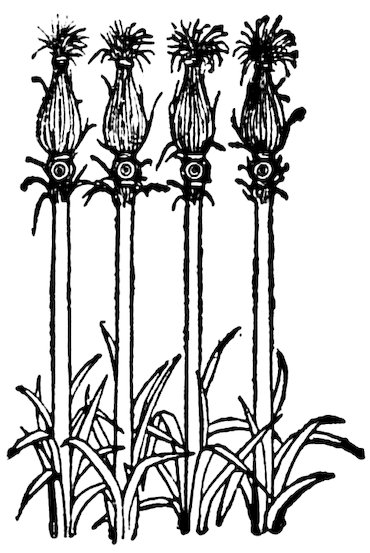
floral work of Tell el Amarna. On the
painted pavement groups of papyrus with
large red fluffy heads of seed vessels are
figured; and on the coloured tiles the
landscape view of the papyrus plant in
76strictly natural treatment is a frequent
subject. But these belong rather to
artistic than to ornamental work.
Fig. 148.
Fig. 149.
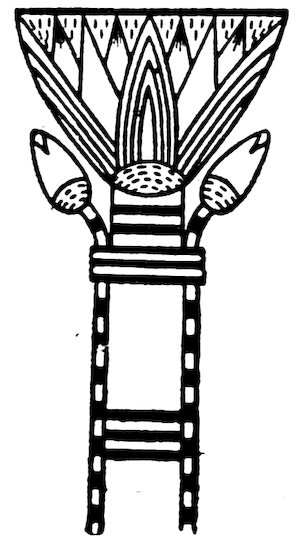
In architecture the lotus and papyrus
were largely used, in fact they form the
basis of columnar decoration as distinct
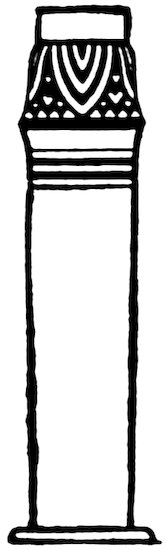
from that of pillars. The earliest figure
of a column that is known is as far back
as any dated monument we possess at the
beginning of the IVth dynasty; and there
it is fashioned as a stem and flower, probably
carved in wood. The
contracting connection with the
tenon above, in a bell form, on
the top of the flower, is the same
as columns of the VIth dynasty
(L.D. II. 111); and is the
source of the much later columns
of Tahutmes III. at Karnak,
77which otherwise seems to be an unaccountable
“sport.”
Fig. 150.
Fig. 151.
Fig. 152.
In the figures of
wooden columns in
the Vth and VIth
dynasties, the lotus
form prevails, as we
have already noticed, and here repeat.
In the Vth dynasty, in the
tomb of Ptahshepses at Abusir
the clustered papyrus stems are
a new feature; at Benihasan
they are well developed; and
they continued in use to the
XVIIIth dynasty. But a different
type then arose into predominance
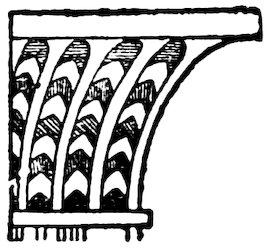
in the wide bell-topped lotus capitals,
and with long sheath-leaves around the
root; and this continued for several
dynasties. But this was displaced
by the elaborate composite capitals of
78Ptolemaic and Roman age, which were
made up of varied elements of incongruity.
Fig. 153.
The palm, though the most important
tree of the country, has had but little
effect on the architecture. There is not
a single example of columns copied from
a palm stem; and the only instances of
the imitation of the stem are in two or
three instances of copies of roofing beams.
The branches are not
copied on columns until
other subjects were well
used. In the XIIth
dynasty the imitation of
a bundle of palm branches
was made in the capitals,
and it became common in the XVIIIth.
Perhaps, however, as we shall see in
considering the hieroglyphs, the palm
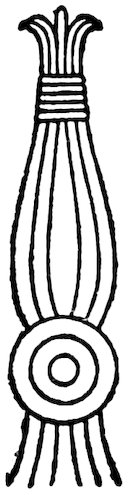
column originates with a bundle of palm-sticks
79bound together. It is strange
that the simple element of grouping
branches round a post should not have
been a very usual early motive. Was
the palm really common in early Egypt?
It does not enter into the hieroglyphs,
and it is seldom shown on monuments
till the XVIIIth dynasty; while grapes,
figs, and pomegranates all seem to have
been commoner than dates.
In late times not only the branches but
the fruit was sculptured; and at Esneh
and other Roman temples the bunches of
dates are carefully rendered.
The vine is one of the oldest cultivated
plants in Egypt, and all the designs
copied from it are based on the idea of
its climbing and trailing over the houses.
It appears mainly in the florid work
of the XVIIIth dynasty. The ceiling was
often painted of a golden yellow, with
80vine leaves and bunches of grapes hanging
from a trellis pattern which covers
it. At Tell el Amarna some fragments
found were very free
and natural, but in
the XXth dynasty it
became a stiff and
formal affair. (Tomb of
Aimadua, Ramessu X.).
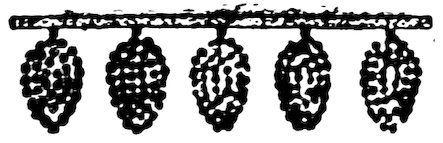
Bunches of grapes also formed favourite
pendants; as such they
are painted in rows
hanging from architraves
of wooden buildings (tomb of Ra, Amenhotep
II.); and frequently in blue glazed
ware bunches of grapes are
found of varying sizes, with
half of the upper part cut
away so as to affix them by
a peg-hole to a square wooden beam of
the ceiling.
81In the Greco-Roman decoration of capitals
the vine and grapes also appears, and is
often very beautifully treated, as at Esneh,
though essentially as a mere surface decoration,
and not as an organic element.
The convolvulus has scarcely, if at all,
been acknowledged as an Egyptian ornament.
Yet it often occurs during the
XVIIIth and XIXth dynasties. On a
coffin in the Ghizeh Museum a long trail
of convolvulus is beautifully modelled and
painted; and during the tide of naturalism
under Akhenaten the wild flowing stems
were a favourite element of decoration.
Subsequently the convolvulus is
often shown as a climber on the
lotus or papyrus stems in bouquets;
and though its leaves then have
been miscalled lotus buds, or “tabs,”
yet they are clearly intended for a
natural leaf of this climber, which
82is so common in the Egyptian fields.
Another field plant which played a
great part in the glazed decorations was
the thistle. This is naturally
painted on the glazed
tiles; and the glazed pendants
of necklaces and
wall decoration showed an
abundance of thistles with
green calices and purple
petals. But this, like the convolvulus, was
rarely used except during the beautiful
period of naturalism which was most developed
by Akhenaten.
Artificial combinations of flowers also
became used decoratively. We have just
instanced two examples from the great
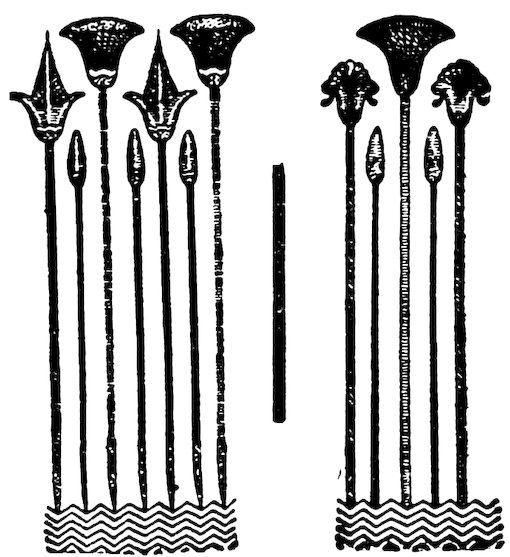
bouquets or staves of flowers which the
Egyptians used in ceremonies.
The garlands of flower petals which are
seen on the heads of women, or as collars,
83in the XVIIIth-XXth dynasties were also
placed around the water-jars; and hence
a painted pattern of garlands came to be
used on those jars.
Fig. 159.
In architecture also the garland came
into use, sometimes
carved on the stone
around the columns, sometimes made
in coloured glaze and inlaid in the surface.
160.—T.A. ix.
Wreaths of lotus
flowers and buds were
also represented around
the columns at Tell el Amarna.
The great pectorals, or breast-plates, of
successive strings of flowers and leaves
were prominent in the personal and
religious decoration. The sacred barks
of the gods were adorned with large and
complex breast-plates, probably made of
bronze, gilded and inlaid (L.D. III. 235).
84
161.—P. Mon. xlix. 2.
A small example of such
we have in London, with the
details all inlaid in gold. These
pectorals were also represented
on the later vases as a complete
whole.
85
162.—L.D. III. 76.
Turning now to the men and animals shown
in decoration, in the period of the Empire we
constantly see figures of captives introduced
to emphasise the power of the king. These
first appear in the great change which overcame
Egyptian art consequent upon the
Asiatic conquests. Before Tahutmes III. the
character and style of work continually recalls
that of the XIIth dynasty; but within one or
two generations a profound difference changed
for ever the nature of the art, and this is
reflected in the national handwriting, which
shows a similar break. Amenhotep II. appears
on his nurse’s knee with an emblematic
group of foreigners under his feet, while he
grasps cords tied to their necks; and in
the same spirit he is shown, when grown
up, as smiting at one blow a whole bunch
of captives whom he holds in his left
hand (L.D. III. 62; L.D. III. 61).
Tahutmes IV. similarly is seen seated on
his tutor’s knee, with his feet on a footstool
ornamented with prostrate captives
(L.D. III. 69). Amenhotep III. appears
with figures of a negro
and a Syrian bound to
the sam sign on the
sides of his throne, and
henceforward the
abasement of captives
was an essential idea
to Egyptians. But it should be remembered
that common as the notion was in
86late times, it is originally Asiatic and not
Egyptian; the king trampling on the
nations and making foes a footstool are
ideas not found in Egypt until the Semitic
conquests of Tahutmes III., though the
earliest figure of a sphinx trampling on a
captive is under the XIIth dynasty.
Fig. 163.
Under Akhenaten six various races are
represented on the sides of his great
balcony (L.D. III. 109), and the alternate
negroes and Syrians are painted on the
passage floors of his palace, or carved in
blocks of alabaster to be trodden under
foot. Down the various ages this
symbolism recurs in decoration
until in Ptolemaic and Roman
times every decent Egyptian had
captives painted on the soles of
his sandals in which he was
buried, so that for all eternity
he might tread down the Gentiles.
87
Fig. 164.
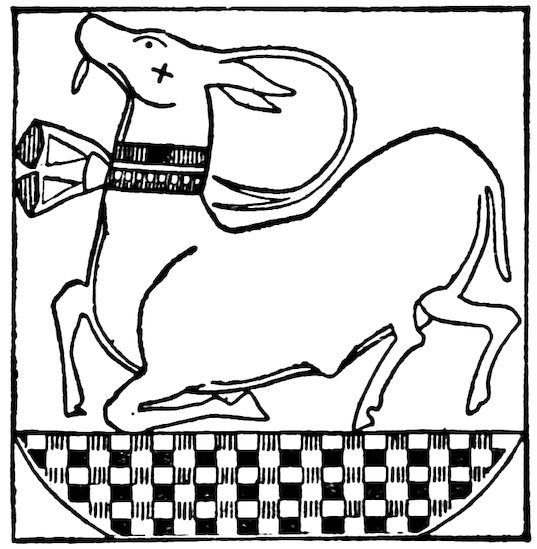
Among animals a favourite in decoration
was the ibex, but it
was not introduced till
the XVIIIth dynasty.
It often appears on
the finger-rings of
Akhenaten’s time, and
later upon the funeral
tent of Isiemkheb, ingeniously adapted to
fill a square space.
The bull or young calf was more frequently
introduced; on the wooden boxes
and trays it is shown as bounding in the
meadows, and it is continually used in the
groups of the painted pavement at Tell el
Amarna.
Birds are also a common subject for
decoration, though only dating from the
same period as the other animals. Besides
the symbolic or sacred use of the hawk
and vulture, the very secular duck was a
88favourite bird. On the great pavements
of Akhenaten it appears above every group
of plants.
Fig. 165.
On rings it is often engraved
fluttering above its nest; and in
the decadence of Egyptian art
in the XXth dynasty the incongruous
idea was adopted of
birds, eggs, and nests all upon
a ceiling.
The natural ceiling pattern adopted from
the early days of Egyptian art was of
golden stars on a deep blue
ground; not a dark daylight
blue, as in modern imitations,
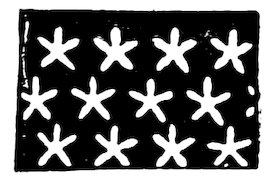
but a black night blue. These are always
five-pointed stars, with a circular spot,
usually of red, in the centre.
Fig. 166.
It is noticeable that the Egyptian views
89a star as surrounded by long streamers of
light; because to a long-sighted person, or
any one with proper spectacles, the stars
appear as points of light without radiations.
Hence it seems as if the Egyptians
were short-sighted people from the
early ages.
Fig. 167.—L.D. II. 19.
Fig. 168.
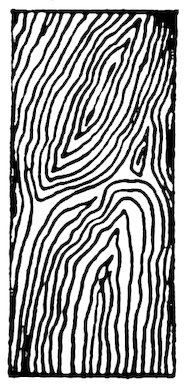
Lastly we may notice the base imitation
of nature in copying the grain of
wood, which we find done in the
earliest times of the IVth dynasty,
and continued down to the period
of the Empire. Stones were also
imitated by painting, and red granite
is frequently copied in the earlier days, on
the recessed doorways of tombs. In later
times vases of valuable stone were
imitated by painting over a pottery
vase, and such cheap substitutes
were commonly placed in the tombs.
These base imitations are of æsthetic
90interest as showing in what a different
manner the Egyptian viewed his materials
from that of our standpoint. He stuccoed
and painted over his hard stone statues;
it was enough for him to know that the
stone was hard and imperishable—he did
not need to see it always exposed. The
imitation of nature was the standpoint from
which he started, and he had no objection
to carry out that imitation with paint or
otherwise; our abstract standpoint of an
artistic effect which must never involve
falsity, but which may have little or nothing
to do with nature, was altogether outside
of his æsthetic.
CHAPTER IV STRUCTURAL DECORATION
91
In the persistence of certain forms which
were the direct result of the structure of
a building or object, we have a very considerable
source of decoration. In Greek
architecture many of the details are entirely
the product of wooden construction translated
into stone. The triglyphs, the imitation
of nail heads, of the ends of the poles
supporting the roofing, of the crossing of
beams at the coffers, are all details which
are retained as decoration long after they
ceased to have any structural meaning, owing
to an entire change of material. Such is
92structural decoration in its best known forms.
But the same principles equally apply to
Egyptian architecture; there the original
material was not sawn wood as in Greece,
but rather the papyrus and palm branch,
with the ever-present mud plastering and
mud bricks. The decorative details of the
stone architecture have come down from
this stage of building, translated point for
point into stone, just as the Greek translated
his wooden architecture into marble.
But pottery preceded stone in Egypt,
and one of the simplest of ornaments
arose from structural necessity. To this
day may be seen in the Egyptian pottery
yards bowls and jars held together by a
twist of rough palm fibre cord, while they
dry in the sun before baking. This accidental
marking by the rope in the wet
clay is seen on the pottery of all ages;
but it became developed as a pattern apparently
93in the twist or guilloche, which
may perhaps be rather derived from this
than from the chain of coils or wave
pattern.
169.—H.S. 383.
170.—Kahun Pot.
171.—L.D. II. 63.
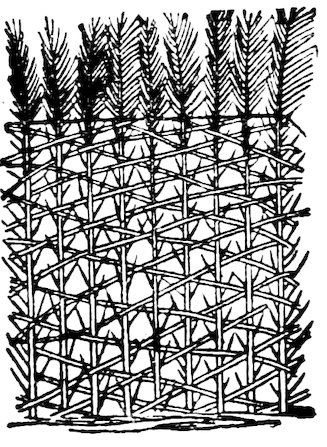
Basket-work was elaborately developed
in the Old Kingdom. There were beautiful
screens represented behind the figures
of the owners of the early tombs; they
might in some cases be matting instead
of basket-work, but others of the patterns
appear certainly to be of a rigid material.
In no case are they likely to be “mats
on which the kings stand,” as styled
by Owen Jones. Among the
various patterns of platting
which are readily developed,
squares, waves, zig-zags,
chequers, &c., there are some
94made by binding the fibres into bundles,
and so making a kind of open
work, which may well have led
to the pattern of connected
rhombs which is so usual on
Oriental pottery.
172.—L.D. II. 63.
173.—L.D. II. 17.
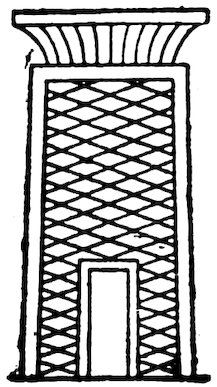
One of the most familiar early motives
is wooden framing. This is continually
imitated in the stone figures of doorways
in the tombs. The details of it show
that a frame or grate of joinery must
have been used for the
porch of large houses,
so as to admit light
and air while the door
was fastened. The
prevalence of such
wooden frames or lattices
in modern times in Egypt—known
as mushrabiyeh work—shows how suited
such a system is to the climate. Long
95after the use of stone was general the
frames were imitated, and the pattern survived
as a decoration. The same style
of framing was used in the upper part of
a house, with decorative
uprights of the
hieroglyph tat, and
was copied as a
fancy decoration in
furniture, as seen in a beautiful ivory carving
in the Louvre. This style survived
until the XVIIIth dynasty, when it is
seen in a tomb at Thebes (Amenhetop
II., Prisse Art) and at the temple of
Sedeinga under
Amenhotep III.
Fig. 175.
Fig. 174.—Ghizeh.
Much akin to this
wood framing is the panelling of the brickwork
which is seen in the earliest examples
96in Egypt, and is identical with the panelling
of walls in early Babylonia, one of
the indications of a common civilisation of
the two great valleys. This panelling
does not seem to have
lasted beyond the Old
Kingdom; there was
no trace of it found at Kahun or Gurob,
in the buildings of the XIIth and XVIIIth
dynasties, nor does it appear in any drawings
or imitations of buildings.
176.—P. M. vii. (plan).
Fig. 177.
One of the best known characteristics of
Egyptian architecture is the sloping face
of the walls and pylons. This is directly
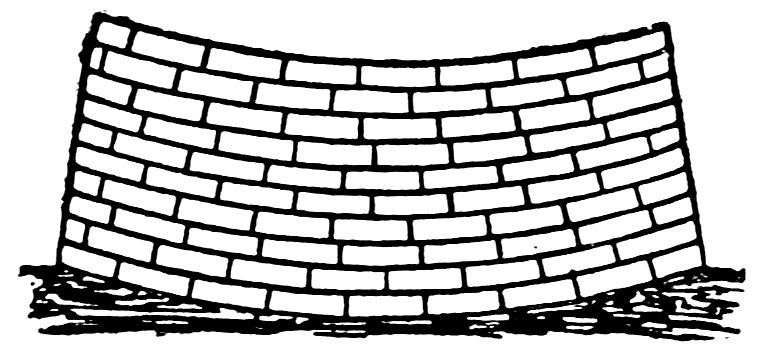
copied from brickwork. In order to give
more cohesion to a wall it was the custom
to build it on a
curved bed, so that
the courses all sloped
up outwards at the
outer corners. Thus the outer faces sloped
97inwards, and the wall had more stability.
So wedded were the builders to this
method, that where a long wall of a fort
or city was to be built they preferred to
begin with a row of towers of brickwork
thus arranged, and then to fill in the
spaces between them with more plain walling.
This slope of the walls was copied
in stone at the earliest time. The temple
of Sneferu at Medum has a slope on the
face of about 1 in 16, and it was continued
down to the very latest age of
Roman building.
178.—Perring. L.D. II. 44.
Another familiar feature is the roll or
torus down the corners of the buildings.
It is usually ornamented by
a pattern of binding. This—as
was well pointed out by
Professor Conway—is evidently
a bundle of reeds bound together,
and put down the angle of the
98plastering in order to preserve it from
breaking away. Such a construction was
an ugly necessity at first, but when stoneworking
arose it had become so familiar
that it was faithfully copied in stone as a
decoration, and continued to be so copied
for more than four thousand years, as long
as Egyptian architecture lasted.
Fig. 180.
Fig. 179.
99
181.—L.D. II. 112.
The well-known Egyptian cornice has
been so long taken for granted that it
might seem never to have
required an origin. Yet in
the villages of the
Fellahin to-day
palm cornices may
be seen in course
of development. A fence is
formed of palm-sticks, placed upright, and
stripped of leaves for some way up. The
tops are left bushy, and serve to prevent
men or animals climbing over the courtyard
wall. The upright sticks are tied
together by a rope near the top, or lashed
on to a cross line of sticks. The fence
is stiffened below by interweaving other
palm-sticks in both directions; and then
the whole is plastered with mud up to the
tie level. Here we have the cavetto
cornice being formed by the nodding tops
of the branches; and to clinch the matter,
the earliest representations of that cornice
are on figures of buildings which show
the crossed sticks of the fence below
the cornice. The ribbing of the cornice
is seen on the earliest examples, on Menkaura’s
sarcophagus in
the IVth dynasty (Perring),
in the Vth
dynasty (L.D. II. 44)
and the VIth (L.D. II. 112), and
100such was copied until late times. But in
the more decorative cornices of the
XVIIIth dynasty the ribbing was broken
up by cross lines,
sometimes curved
upward, sometimes
downward. These
cross lines must be a degradation of the
leaves of the palm branch. In later times
they are omitted, and the pattern becomes
simply striped.
182.—L.D. III. 115.
Fig. 183.
This cornice was copied in Syrian architecture,
in the plain form without ribbing,
as in the tomb at Siloam and the slabs
of Lachish; but it does not appear to
have ever taken root in Assyria, though
attempted there, nor is it known in Europe.
101
Fig. 184.
The other main type of Egyptian cornice
is what is known as the Khaker, from the
equivalent of the sign as a hieroglyph in
inscriptions. This only means “to cover”
or “to ornament,” and therefore refers to
the position of the decoration and not to
its origin. The clue to the real nature of
this decoration is given in a tomb of the
IVth dynasty (Ptah-hotep, L.D. II. 101.
b.), where we see the khaker ornament
not as a mere painting, but represented as
standing up solid around the tops of the
cabins of boats. It cannot therefore be
anything very heavy or solid, such as
spear-heads, as has been proposed. It
probably results in some way from the
construction of the cabins.
They must have had roofs
of very light material.
Papyrus was generally used
for building boats, and
therefore for cabins also,
most likely. This gives us
the clue to interpret it. Suppose a screen
of papyrus stems; the roofing stems tied
102on to the uprights; and the loose wiry
leaves at the head tied together, to keep
them from straggling over and looking
untidy. Here we have all the details
of the khaker ornament simply
resulting from structural necessity.
The leaves are gathered together at
the lower tying; there the end view
of the concentric coats of the papyrus
stems of the roof are seen as
concentric circles; above which the leaves
bulge out and are tied together near the
top. Though this structural decoration is
seen on the top of boat cabins as early
as the IVth dynasty, yet we have not
found it as decoration on a flat surface
until the XIIth. Then it is very common;
but its meaning became confused in
the XVIIIth dynasty, and in Ptolemaic
times it is seen in absurd positions, as
on a base, and on architraves above an
empty space, where no stems below it
were possible.
185.—Prisse 88.
103We have just mentioned one use of
reeds or papyrus in the torus roll on the
edge of buildings; but on interior decoration
we meet again with the same motive.
The borders of Egyptian scenes from the
earliest times are framed with a variety of
bindings; and so suitable did such bordering
seem that it was continued with but
little variation throughout all the history.
The oldest forms are—
186.—L.D. II. 43.
plain binding,
187.—L.D. II. 44.
a diagonal binding,
188.—L.D. II. 44.
or
189.—L.D. II. 54.
and crossed binding.
104
190.—L.D. II. 148.
191.—L.D. II. 132.
The latter became
modified into—
by the XIth dynasty, showing that its
meaning was already becoming forgotten.
But a modification of the tower ends
of this pattern in the XIIth dynasty
is difficult to understand; unless we
can look on it as an irregular winding
of the ends of the cord around
the reed bundle in place of the
regular crossing which is shown
above it.
192.—L.D. II. 115.
The modification of colours and arrangement
in the plain binding is interminable.
In the XVIIIth dynasty
we find
and in all ages a binding with a number
of lines between coloured spaces was
common
Fig. 196.
and on borders of architecture and statuary
thrones
CHAPTER V SYMBOLICAL DECORATION
106
The Egyptian who expressed all his
thoughts by a symbolical writing,
full of determinatives, was naturally much
given to symbolism in his decoration.
Not, however, that all his decoration was
symbolic in a recondite sense; the ever-present
lotus ornament was merely a thing
of beauty; the lotus was not a sacred
plant, it is not associated with any divinity
in particular, and only in one unusual instance
does it ever occur in the hieroglyphs.
The fanciful habit of Europe, in
seeing a hidden sense in every flower, was
107not akin to the simple and elementary
mind of the Egyptian. But certain striking
emblems he used continually; and one
of the earliest of these is the uraeus snake,
or cobra in his wrath, reared up with expanded
body ready to strike. The dignity
and power of the animal made it to be
an emblem of the king, or rather perhaps
of the royal power of death. That capital
punishment was used in Egypt is seen in
the Westcar Tales, which probably date
from the Old Kingdom, where a condemned
malefactor is ordered to be brought forth
for a magician to try his power in bringing
him to life when slain. The king, as
having the power of death, bore the uraeus
always on his head-dress; and from the
earliest days (at Medum) the royal court
of justice was adorned with a cornice of
uraei, implying that there resided the
royal right of judgment and of condemnation.
108This cornice seems, however, to
have been regarded as merely
royal in later times, and was
freely used to adorn any royal
structure, even a wooden summer-house
(Amenhotep II.); or the uraei formed a
band around columns (Akhenaten), or appear
as supporters of the royal cartouche
(P. 72), either plain (Ramessu
II.) or
winged
(Horemheb
L.D. III. 122).
A symbolism closely connected with this
is that of the globe and wings. This certainly
dates to the beginning of the monumental
age, as it is seen above
the figure of Khufu seated
on an amulet. In that instance
it is on too small a scale to show
the details; but in the next dynasty it
appears above Unas at Elephantine, with
the globe flanked by two uraei and two
wings. What the symbolism of it was we
have no direct information. But when we
consider that the wings are those of the
vulture spread out, as it appears on the
roofs of the passages as a protecting and
preserving maternal emblem, and the uraeus
is associated with it, we can hardly view it
as other than the same idea of the power
of life and death, of preservation and destruction.
But in this emblem it is not
the king who wields these powers, but Ra
the Sun, whose disc appears in the midst.
That the wings have thus the
meaning of protection is shown
by the globe with drooping
wings embracing the royal name, expressing
the protection given by Ra to the
king, without associating the deadly or
110punitive power of the uraeus. A curious
form of this emblem which
was common in the early
part of the XVIIIth dynasty
is with only one wing.
One of the most perfect and beautiful
examples of the
winged disc is on
the temple of Tahutmes III., but it continued
to be used down to the latest times
of Egyptian architecture as a lintel decoration.
In the XIXth dynasty an addition to
the symbolism appears; the horns of a
ram are added to the wings; sometimes
without the uraei (Ramessu I., L.D. III.
131), sometimes with the uraei (Ramessu
II., L.D. III. 204). These rams’ horns
can hardly be other than those of the
ram-headed god Khnum, “the maker” or
“modeller” of men. The idea then of
111the wings and horns is that Ra makes as
well as protects; and where the uraeus is
added it implies that Ra is creator, preserver,
and destroyer.
The vulture alone as the emblem of protection
is frequently figured with outstretched
wings across the ceilings of the
passages, particularly those of the royal
tombs of the XIXth dynasty. There is
perhaps no sight in the animal world more
imposing than one of these birds, stretched
out with a span of some nine or ten feet,
hanging in the air close overhead; it is
natural that it should have excited the
admiration of man, and not being hurtful
it readily came to be honoured as a type
of maternal care.
The scarab was another such typical
animal, rolling the pellet containing an egg
to a safe place where it buries it. Though
very common as an amulet for the living
and the dead, yet it is not often seen
in symbolical or decorative use otherwise.
With what idea the amulet was used we
do not know for certain. The scarab itself
is often figured as holding the disc of the
sun between its claws: and it is at least
possible that the symbolic idea of the
scarab as the maker or creator arose from
the burial of its ball being an emblem of
the setting of the sun, from which new
life will arise in due course. It occurs
with the wings extended and the disc
between the
claws as a
centre figure
in the space
of a ceiling pattern (Neferhotep, XVIIIth
dynasty), and on the border of the covering
of a shrine under Ramessu X., and
113is occasionally met with later in decoration.
The lion as a noble and royal animal
frequently figures in
the XVIIIth dynasty.
The Egyptians, with
their marvellous instinct
for taming every
animal they could find, actually trained
lions or leopards to live as domesticated
animals, with the same sort
of allowed wildness as modern
hunting dogs. The lion accompanied
the king in battle;
but in camp it lay down as peaceably as
an ox. It was frequently
carved on
the sides of the
thrones of the
XVIIIth-XXth
dynasties, and also
seated in pairs, facing or backing, on the
114temple walls, a usage reminding us of the
lion gate of Mykenae of the same age.
210.—L.D. III. 114
Fig. 211.
Some of the Egyptian divinities also appear
as symbolic ornaments.
The figures
of the goddess Maat
with spread wings
adorned the ark of
Amen-ra under Tahutimes
II.; and in
earlier times similar cherubic
figures stand guarding
the name of Antef V. on
a scarab.
Hathor also appears on various objects.
A mirror handle carved in wood during
the XIIth dynasty has the head of Hathor
(P. 1. xiii.); columns with heads of
Hathor, crowned with a shrine occupied
115by a uraeus, are found introduced by
Amenhotep III. in his temples at El
Kab and Sedeinga, and were copied by
Ramessu II. at Abu Simbel.
The similar head of Hathor
was frequently made in glazed
pottery as a pendant in the
time of Akhenaten. And in
later times these Hathor
headed capitals became usual
under the Ptolemies, as in the well-known
case of the portico of the great temple at
Dendera.
212.—L.D. I. 100.
Bes was one of the favourite popular
deities of the Egyptians; restricted to no
place in particular, every votary of music
and the dance patronised Bes. The little
statuette of a dancing girl with a Bes
mask on, besides an actual mask in cartonnage,
found at Kahun, show the popularity
of the god in the XIIth dynasty.
116In later times his figure is frequently seen.
At Tell el Amarna ornaments for necklaces
made in glazed pottery followed two
types of Bes, the god dancing with the
tambourine seen in side view, and the
earlier grotesque front view, with arms
akimbo. These familiar little figures continued
to be made till late times; and in
the Roman age Bes was elevated to
architectural dignity on the dies above
the columns at Dendereh in the small
temple of the Mammeisi.
Another and more artificial mode of
symbolical decoration was by means of
the hieroglyphic signs. Having a mode
of writing in which a single mark could
express an abstract idea, it was possible
to adapt writing to a purely decorative
117design. Even with alphabetic characters
this has been done, as in the elaborate
crossing patterns of the earlier Arab
period in Egypt, in which no untrained
eye would see anything but a complex
ornament.
213.—Ankh.
214.—Thet.
215.—Uas.
216.—Dad.
Four of the hieroglyphs most usually
worked into ornamental designs are
the ankh, a girdle, or symbol of life;
the thet, another form of girdle, with
longer bow-tie in front, which, as
always identified with Isis, may have
been a primitive feminine girdle,
the ankh being masculine; the
uas, a stick of authority, or
symbol of power; and the
dad, a row of columns, or
symbol of stability.
As early as the Old Kingdom
we find wooden framings, or lattices,
ornamented with dad signs; and
118this continued at least as late as Amenhotep
II. The dad also appears
in what is probably copied from
pierced woodwork, in a relief
at Qurneh of Ramessu I.
217.—L.D. III. 131.
Fig. 218.
The combination of thet dad uas, and of
ankh dad uas, is found in the XIIth dynasty
at Benihasan, apparently
carved in relief,
on the wooden panels
of a litter (R.C. xciii.). The same occur
similarly carved on the ebony doors of
Hatshepsut at Deir el Bahri. The
group begins to appear as an architectural
design early in the XVIIIth
dynasty, and continues down to Roman
times, especially on bases of scenes and
groups, thus forming a continuous border
of good wishes. The hieroglyphs, ankh,
dad, and uas, are all found on pendants for
necklaces, in the blue glazed pottery of
119the XVIIIth dynasty, and also combined
in one as a ring bezil. And the thet
girdle tie of Isis appears repeated as a
pattern, probably of pierced woodwork,
along the sides of a shrine of Tahutimes
III. at Semneh, and on the base of a
couch in the birth scene of Amenhotep
III. (R.S. xxxviii.). As funeral amulets
the thet, dad, and ankh occur commonly,
but that branch is outside of the subject
of decoration.
219.—Khafra.
120
220.—Khafra.
Another hieroglyph often appearing as an
ornament is the sam, or symbol of union.
The origin of it is yet unexplained. It
certainly is a column of some kind;
it has a well-marked capital and an
abacus. The capital is formed much
like the palm-leaf capital; and the
stem is clearly bound round, and
must therefore be composite. This
suggests that it might be a column of
palm-sticks bound together, with some
tops left projecting for ornament. Such
might well be more conventionalised at
the beginning of Egyptian sculpture in
the IVth dynasty than the other kinds of
capitals; and the immigrant race came
from the region of the palm, while the
lotus and papyrus only were reached by
them in Egypt itself. The base is a
main difficulty to explain. It might be
conventionalised clods of earth, with two
curled-over side branches of the palm;
but it has been so modified that we must
await more evidence. In any case the
stem is formed of several parts bound together,
and hence it was
very naturally adopted as
a symbol of union. It was
further grouped with two
plants, the stalks of which
were linked around it. It is always
121supposed that these symbolise northern
and southern Egypt, and that the group
means the union of all the land. Still it
is yet uncertain what plants are intended
to be represented, though on the throne
of Tahutimes IV. they are clearly lotus
and papyrus; but the evidence is too late
to be of much value. This group was a
favourite decoration from beginning to end
of Egyptian history. At the beginning of
the XIIth dynasty an addition was made
by placing a figure of Hapi or the Nile
on each side of the group (Tanis i. I.),
each figure holding one of the two plants.
As these figures were crowned, one with
the sign of south the other of north, they
point to the plants being emblems of the
south and north also. This group with
the figures is found as late as the XXth
dynasty (L.D. III. 237). Another design
came into fashion during the great foreign
122wars of the XVIIIth dynasty, representing
two captives, one negro, one Syrian,
bound back to back against the sam; thus
it symbolised not only the union of upper
and lower Egypt, but also of the northern
and southern races outside of Egypt.
Later on, four or even six such racial
types are figured as bound together.
UNWIN BROTHERS, LIMITED, THE GRESHAM PRESS, WOKING AND LONDON
METHUEN’S
GENERAL LITERATURE
A SELECTION OF
Messrs. Methuen’s
PUBLICATIONS
This Catalogue contains only a selection of the more important books published by Messrs. Methuen. A complete catalogue of their publications may be obtained on application.
ARMSTRONG (Anthony) (‘A. A.’ of Punch)
Warriors at Ease
Warriors Still at Ease
Percival and I
Percival at Play
Me and Frances
How to do ItEach 3s. 6d. net.
Livestock in Barracks
Illustrated by E. H. SHEPARD. 6s. net.
Two Legs and Four
Illustrated by René Bull. 5s. net.
BAIN (F. W.)
A Digit of the Moon
The Descent of the Sun
A Heifer of the Dawn
In the Great God’s Hair
A Draught of the Blue
An Essence of the Dusk
An Incarnation of the Snow
A Mine of Faults
The Ashes of a God
Bubbles of the Foam
A Syrup of the Bees
The Livery of Eve
The Substance of a DreamEach 3s. 6d. net.
An Echo of the Spheres10s. 6d. net.
BALFOUR (Sir Graham)
The Life of Robert Louis StevensonTwentieth Edition. 7s. 6d. net.
BARKER (Ernest)
National Character10s. 6d. net.
Greek Political Theory14s. net.
Church, State and Study10s. 6d. net.
BELLOC (Hilaire)
Paris8s. 6d. net.
The Pyrenees8s. 6d. net.
Marie Antoinette18s. net.
A History of England
In 5 Vols. Vols. I, II and III Each 15s. net.
On Nothing
Hills and the Sea
On Something
This and That and the Other
On
First and Last
On Everything
On Anything
Emmanuel Burden
A Picked CompanyEach 3s. 6d. net.
BIRMINGHAM (George A.)
A Wayfarer in Hungary
Illustrated. 8s. 6d. net.
Spillikins: Essays3s. 6d. net.
Ships and Sealing-Wax: Essays3s. 6d. net.
BLEEK (Dorothea F.)
Rock Paintings in South Africa
Illustrated. £2 2s. net.
BUDGE (Sir E. A. Wallis)
A History of Ethiopia: Nubia and Abyssinia
Illustrated. 2 vols. £3 13s. 6d. net.
CHESTERTON (G. K.)
Come to Think of It ... 6s. net.
G.K.C. as M.C.7s. 6d. net.
The Ballad of the White Horse3s. 6d. net.
Also Illustrated by Robert Austin. 12s. 6d. net.
Charles Dickens
Generally Speaking
All Things Considered
Tremendous Trifles
Fancies versus Fads
Alarms and Discursions
A Miscellany of Men
The Uses of Diversity
The Outline of Sanity
The Flying InnEach 3s. 6d. net.
A Gleaming Cohort2s. 6d. net.
Wine, Water and Song1s. 6d. net.
CLUTTON-BROCK (A.)
What is the Kingdom of Heaven?
Essays on Art
Shakespeare’s HamletEach 5s. net.
Essays on Books3s. 6d. net.
More Essays on Books
Essays on Life
Essays on Religion
Essays on Literature and Life
More Essays on ReligionEach 6s. net.
Shelley, the Man and the Poet7s. 6d. net.
CRAWLEY (Ernest)
The Mystic Rose
Revised and Enlarged by Theodore Besterman. 2 vols. £1 10s. net.
Studies of Savages and Sex
Edited by Theodore Besterman. 10s. 6d. net.
DAVIS (H. W. C.)
Europe from 800–17898s. 6d. net.
DERWENT (Lord)
Goya
Illustrated. 10s. 6d. net.
DUGDALE (E. T. S.)
German Diplomatic Documents, 1871–1914
Selected from the Documents published by the German Foreign Office.
In 4 vols. Vol. I, 1871–90. Vol. II, 1891–8. Vol. III, 1898–1910. Vol. IV, 1911–1914. Each £1 1s. net.
EDWARDES (Tickner)
The Lore of the Honey-Bee
Illustrated. 7s. 6d. and 3s. 6d. net.
Beekeeping for All
Illustrated. 3s. 6d. net.
The Bee-Master of Warrilow
Illustrated. 7s. 6d. net.
Bee-Keeping Do’s and Dont’s2s. 6d. net.
EINSTEIN (Albert)
Relativity: The Special and General Theory5s. net.
Sidelights on Relativity3s. 6d. net.
The Meaning of Relativity5s. net.
The Brownian Movement5s. net.
EISLER (Robert)
The Messiah Jesus and John the Baptist:
according to Flavius Josephus’ hitherto neglected ‘Capture of Jerusalem’ and other Jewish and Christian sources.
Translated by A. Haggerty Krappe.
Illustrated. Demy 8vo.£2 2s. net.
FIELD (G. C.)
Moral Theory6s. net.
Plato and His Contemporaries12s. 6d. net.
FYLEMAN (Rose)
Fairies and Chimneys
The Fairy Green
The Fairy Flute
The Rainbow Cat
Eight Little Plays for Children
Forty Good-night Tales
Fairies and Friends
The Adventure Club
Forty Good-Morning Tales
Seven Little Plays for Children
Twenty Tea-Time TalesEach 3s. 6d. net.
The Dolls’ House
Illustrated by Margaret Tempest. 5s. net.
Gay Go Up
Illustrated by Decie Merwin. 5s. net.
The Rose Fyleman Fairy Book
Illustrated by Hilda Miller. 10s. 6d. net.
A Garland of Rose’s: Collected Poems
Illustrated by René Bull. 8s. 6d. net.
GIBBON (Edward)
The Decline and Fall of the Roman Empire With Notes, Appendixes and Maps, by J. B. Bury.
Illustrated. 7 vols.
Demy 8vo.15s. net each volume.
Also, unillustrated. Crown 8vo.7s. 6d. net each volume.
GLADSTONE (Mary) (Mrs. Drew)
Her Diaries and Letters
Illustrated. £1 1s. net.
GLOVER (T. R.)
Virgil
The Conflict of Religions in the Early Roman Empire
Poets and PuritansEach 10s. 6d. net.
From Pericles to Philip12s. 6d. net.
GRAHAM (Harry)
The World we Laugh in: More Deportmental Ditties
Illustrated by ‘Fish’. Seventh Edition.5s. net.
Strained Relations
Illustrated by H. Stuart Menzies and Hendy6s. net.
The World’s Workers
Illustrated by ‘Fougasse’. 5s. net.
Adam’s Apples
Illustrated by John Reynolds. 5s. net.
GRAHAME (Kenneth)
The Wind in the Willows
Nineteenth Edition.7s. 6d. net.
Also illustrated by Wyndham Payne. 7s. 6d. net.
Also unillustrated. 3s. 6d. net.
See alsoMilne (A. A.)
HADFIELD (J. A.)
Psychology and Morals
Eighth Edition.Crown 8vo.6s. net.
HALL (H. R.)
The Ancient History of the Near East
Illustrated. £1 1s. net.
The Civilization of Greece in the Bronze Age
Illustrated. £1 10s. net.
A Season’s Work at Ur of the Chaldees.
Illustrated. £1 5s. net.
HEATON (Rose Henniker)
The Perfect Hostess
Decorated by A. E. Taylor7s. 6d. net.
Gift Edition, £1 1s. net.
HERBERT (A. P.)
Honeybubble & Co.6s. net.
Misleading Cases in the Common Law. With an Introduction by Lord Hewart. 5s. net.
More Misleading Cases. 5s. net.
Wisdom for the Wise
Illustrated by George Morrow. 5s. net.
The Wherefore and the Why
Illustrated by George Morrow. 3s. 6d. net.
The Bomber Gipsy3s. 6d. net.
The Secret Battle3s. 6d. net.
HOLDSWORTH (Sir W. S.)
A History of English Law Nine Volumes. £1 5s. net each.
HUDSON (W. H.)
A Shepherd’s Life
Illustrated. 10s. 6d. net.
Also unillustrated. 3s. 6d. net.
HUTTON (Edward)
Cities of Sicily
Illustrated. 10s. 6d. net.
Milan and Lombardy
The Cities of Romagna and the Marches
Siena and Southern Tuscany
Naples and Southern Italy
Illustrated. Each 8s. 6d. net.
A Wayfarer in Unknown Tuscany
The Cities of Spain
The Cities of Umbria
Country Walks about Florence
Rome
Florence and Northern Tuscany
Venice and Venetia
Illustrated. Each 7s. 6d. net.
INGE (W. R.), D.D., Dean of St. Paul’s
Christian Mysticism (The Bampton Lectures of 1899).
Sixth Edition.7s. 6d. net.
KIPLING (Rudyard)
Barrack-Room Ballads
255th Thousand.
The Seven Seas
186th Thousand.
The Five Nations
143rd Thousand.
Departmental Ditties
117th Thousand.
The Years Between
95th Thousand.
Four Editions of these famous-volumes of poems are now published, viz.:—
Crown 8vo.Buckram, 7s. 6d. net.
Fcap. 8vo.Cloth, 6s. net.
Leather7s. 6d. net.
Service Edition. Two volumes each book. Square Fcap. 8vo. 3s. net each volume.
A Kipling Anthology—Verse
Sixth Edition.
Leather7s. 6d. net.
Cloth6s. net and 3s. 6d. net.
Twenty Poems from Rudyard Kipling
486th Thousand.1s. net.
A Choice of Songs
Second Edition.2s. net.
LAMB (Charles and Mary)
The Complete Works
Edited by E. V. Lucas. Six Volumes. With Frontispieces. 6s. net each.
Selected Letters
Edited by G. T. Clapton. 3s. 6d. net.
The Charles Lamb Day Book
Compiled by E. V. Lucas. 6s. net.
LANKESTER (Sir Ray)
Science from an Easy Chair
Science from an Easy Chair:
Second Series.
Diversions of a Naturalist
Great and Small Things
Illustrated. Each 7s. 6d. net.
Secrets of Earth and Sea
Illustrated. 8s. 6d. net.
LINDRUM (Walter)
Billiards.
Illustrated. 6s. net.
LODGE (Sir Oliver)
Man and the Universe7s. 6d. net and 3s. 6d. net.
The Survival of Man7s. 6d. net.
Raymond10s. 6d. net.
Raymond Revised6s. net.
Modern Problems3s. 6d. net.
Reason and Belief3s. 6d. net.
The Substance of Faith2s. net.
Relativity1s. net.
Conviction of Survival2s. net.
LUCAS (E. V.)
The Life of Charles Lamb
2 Vols. £1 1s. net.
The Colvins and Their Friends£1 1s. net.
Vermeer the Magical5s. net.
A Wanderer in Rome
A Wanderer in Holland
A Wanderer in London
London Revisited (Revised)
A Wanderer in Paris
A Wanderer in Florence
A Wanderer in VeniceEach 10s. 6d. net.
A Wanderer among Pictures8s. 6d. net.
E. V. Lucas’s London£1 net.
Introducing London
Introducing ParisEach 2s. 6d. net.
The Open Road6s. net.
Also, illustrated by Claude A. Shepperson, A.R.W.S. 10s. 6d. net.
Also, India Paper. Leather, 7s. 6d. net.
The Joy of Life6s. net. Leather Edition, 7s. 6d. net.
Also, India Paper. Leather, 7s. 6d. net.
The Gentlest Art6s. 6d. net.
AndThe Second Post6s. net.
Also together in one volume. 7s. 6d. net.
Fireside and Sunshine
Character and Comedy
Good Company
One Day and Another
Old Lamps for New
Loiterer’s Harvest
Luck of the Year
Events and Embroideries
A Fronded Isle
A Rover I Would Be
Giving and Receiving
Her Infinite Variety
Encounters and DiversionsEach 3s. 6d. net.
Cloud and Silver
A Boswell of Baghdad
’Twixt Eagle and Dove
The Phantom Journal
Zigzags in France
Turning Things Over
Traveller’s LuckEach 6s. net.
French Leaves
Illustrated. 5s. net.
Roving East and Roving West5s. net.
Mr. Punch’sCounty Songs
Illustrated by E. H. Shepard. 10s. 6d. net.
‘The More I See of Men ...’
Out of a Clear Sky
If Dogs Could Write
‘... and such Small Deer’Each 3s. 6d. net.
The Pekinese National Anthem
Illustrated by Persis Kirmse. 1s. net.
See alsoLamb (Charles).
LYND (Robert)
It’s A Fine World5s. net.
The Green Man
The Pleasures of Ignorance
The Goldfish
The Little Angel
The Blue Lion
The Peal of Bells
The Money-Box
The Orange TreeEach 3s. 6d. net.
McDOUGALL (William)
An Introduction to Social Psychology10s. 6d. net.
National Welfare and National Decay6s. net.
An Outline of Psychology10s. 6d. net.
An Outline of Abnormal Psychology15s. net.
Body and Mind12s. 6d. net.
Character and the Conduct of Life10s. 6d. net.
Modern Materialism and Emergent Evolution7s. 6d. net.
Ethics and Some Modern World Problems7s. 6d. net.
MALLET (Sir C. E.)
A History of the University of Oxford
In 3 vols. Each £1 1s. net.
MAETERLINCK (Maurice)
The Blue Bird6s. net.
Also, illustrated by F. Cayley Robinson. 10s. 6d. net.
Our Eternity6s. net.
The Unknown Guest6s. net.
Poems5s. net.
The Wrack of the Storm6s. net.
The Burgomaster of Stilemonde5s. net.
The Betrothal6s. net.
Mountain Paths6s. net.
The Great Secret7s. 6d. net.
The Cloud that Lifted and The Power of the Dead7s. 6d. net.
Mary Magdalene2s. net.
MARLOWE (Christopher)
The Works. In 6 volumes. General Editor, R. H. Case.
The Life of Marlowe, by C. F. Tucker Brooke, and Dido.
Edited by the Same. 8s. 6d. net.
Tamburlaine, I and II.
Edited by U. M. Ellis-Fermor. 10s. 6d. net.
The Jew of Malta and The Massacre at Paris
Edited by H. S. Bennett. 8s. 6d. net.
MASEFIELD (John)
On the Spanish Main8s. 6d. net.
A Sailor’s Garland3s. 6d. net.
Sea Life in Nelson’s Time7s. 6d. net.
METHUEN (Sir A.)
An Anthology of Modern Verse
232nd Thousand.
Shakespeare to Hardy: An Anthology of English Lyrics
28th Thousand.
Each, Cloth, 6s. net.
Leather, 7s. 6d. net.
MILNE (A. A.)
By Way of Introduction6s. net.
Toad of Toad Hall
A Play founded on Kenneth Grahame’s ‘The Wind in the Willows.’ 5s. net and 2s. 6d. net.
Those Were the Days: Collected Stories 7s. 6d. net.
Not that it Matters
If I May
The Sunny Side
The Red House Mystery
Once a Week
The Holiday Round
The Day’s Play
Mr. Pim Passes ByEach 3s. 6d. net.
When We were Very Young
211th Thousand.
Winnie-the-Pooh
118th Thousand.
Now We are Six
119th Thousand.
The House at Pooh Corner
105th Thousand.
Each illustrated by E. H. SHEPARD. 7s. 6d. net.Leather, 10s. 6d. net.
The Christopher Robin Story Book.Third Edition.
Illustrated by E. H. SHEPARD. 5s. net.
The Christopher Robin Birthday Book
Illustrated by E. H. SHEPARD. 3s. 6d. net.
MILNE (A. A.) and FRASER-SIMSON (H.)
Fourteen Songs from ‘When We were Very Young’
Thirteenth Edition.7s. 6d. net.
Teddy Bear and Other Songs from ‘When We were Very Young’7s. 6d. net.
The King’s Breakfast
Third Edition.3s. 6d. net.
Songs from ‘Now We are Six’
Second Edition.7s. 6d. net.
More ‘Very Young’ Songs7s. 6d. net.
The Hums of Pooh7s. 6d. net.
Words by A. A. Milne.
Music by H. Fraser-Simson.
Decorations by E. H. Shepard.
MORTON (H. V.)
The Heart of London
27th Thousand.3s. 6d. net.
Also with Scissor Cuts by L. Hummel. 6s. net.
The Spell of London
20th Thousand.
The Nights of London
13th Thousand.Each 3s. 6d. net.
In Search of England
64th Thousand.
The Call of England
31st Thousand.
In Search of Scotland
86th Thousand.
In Search of Ireland
30th Thousand.Each illustrated. 7s. 6d. net.
The Soul of Scotland1s. net.
NEUBURGER (Albert)
The Technical Arts and Sciences of the Ancients
Translated by H. L. Brose.
Illustrated. £2 2s. net.
OMAN (Sir Charles)
A History of the Art of War in the Middle Ages, a.d. 378–1485
2 vols. Illustrated. £1 16s. net.
Studies in the Napoleonic Wars8s. 6d. net.
PERRY (W. J.)
The Origin of Magic and Religion
The Growth of CivilizationEach 6s. net.
The Children of the Sun£1 1s. net.
PETRIE (Sir Flinders)
A History of Egypt
In 6 Volumes.
Vol. I. From the Ist to the XVIth Dynasty
Eleventh Edition, Revised.12s. net.
Vol. II. The XVIIth and XVIIIth Dynasties
Seventh Edition, Revised.9s. net.
Vol. III. XIXth to XXXth Dynasties
Third Edition.12s. net.
Vol. IV. Egypt under the Ptolemaic Dynasty
By Edwyn Bevan. 15s. net.
Vol. V. Egypt under Roman Rule
By J. G. Milne.
Third Edition, Revised.12s. net.
Vol. VI. Egypt in the Middle Ages
By Stanley Lane Poole.
Fourth Edition.10s. net.
PONSONBY OF SHULBREDE (Lord)
English Diaries£1 1s. net.
More English Diaries12s. 6d. net.
Scottish and Irish Diaries10s. 6d. net.
RUTTER (Frank)
El Greco. Illustrated. £1 16s. net.
SELLAR (W. C.) and YEATMAN (R. J.)
1066 and All That
Illustrated by John Reynolds.
32nd Thousand.5s. net.
STEVENSON (R. L.)
The Letters Edited by Sir Sidney Colvin. 4 Vols. Each 6s. net.
SURTEES (R. S.)
Handley Cross
Mr. Sponge’s Sporting Tour
Ask Mamma
Mr. Facey Romford’s Hounds
Plain or Ringlets?
Hillingdon HallEach illustrated. 7s. 6d. net.
Jorrocks’s Jaunts and Jollities
Hawbuck GrangeEach illustrated. 6s. net.
TAYLOR (A. E.)
Plato: The Man and His Work£1 1s. net.
Plato: Timæus and Critias6s. net.
Elements of Metaphysics12s. 6d. net.
TILDEN (William T.)
The Art of Lawn Tennis
Revised Edition
Singles and DoublesEach illustrated. 6s. net.
The Common Sense of Lawn Tennis
Match Play and the Spin of the BallEach illustrated. 5s. net.
TILESTON (Mary W.)
Daily Strength for Daily Needs
Thirty-fourth Edition.3s. 6d. net.
India Paper. Leather, 6s. net.
TRAPP (Oswald Graf)
The Armoury of the Castle of Churburg
Translated by J. G. Mann.
Richly illustrated.
Limited to 400 copies. £4 14s. 6d. net.
UNDERHILL (Evelyn)
Mysticism.Revised Edition.15s. net.
The Life of the Spirit and the Life of To-day7s. 6d. net.
Man and the Supernatural7s. 6d. net.
Concerning the Inner Life2s. net.
The House of the Soul2s. net.
VARDON (Harry)
How to Play Golf
Illustrated. Nineteenth Edition.5s. net.
WAND (J. W. C.)
The Development of Sacramentalism6s. net.
A History of the Modern Church8s. 6d. net.
WILDE (Oscar)
The Works
In 16 Vols. Each 6s. 6d. net.
I. Lord Arthur Savile’s Crime and the Portrait of Mr. W. H.
II. The Duchess of Padua
III. Poems
IV. Lady Windermere’s Fan
V. A Woman of No Importance
VI. An Ideal Husband
VII. The Importance of Being Earnest
VIII. A House of Pomegranates
IX. Intentions
X. De Profundis and Prison Letters
XI. Essays
XII. Salome, A Florentine Tragedy, and La Sainte Courtisane
 red,
 blue,
 green,
 purple,
 yellow