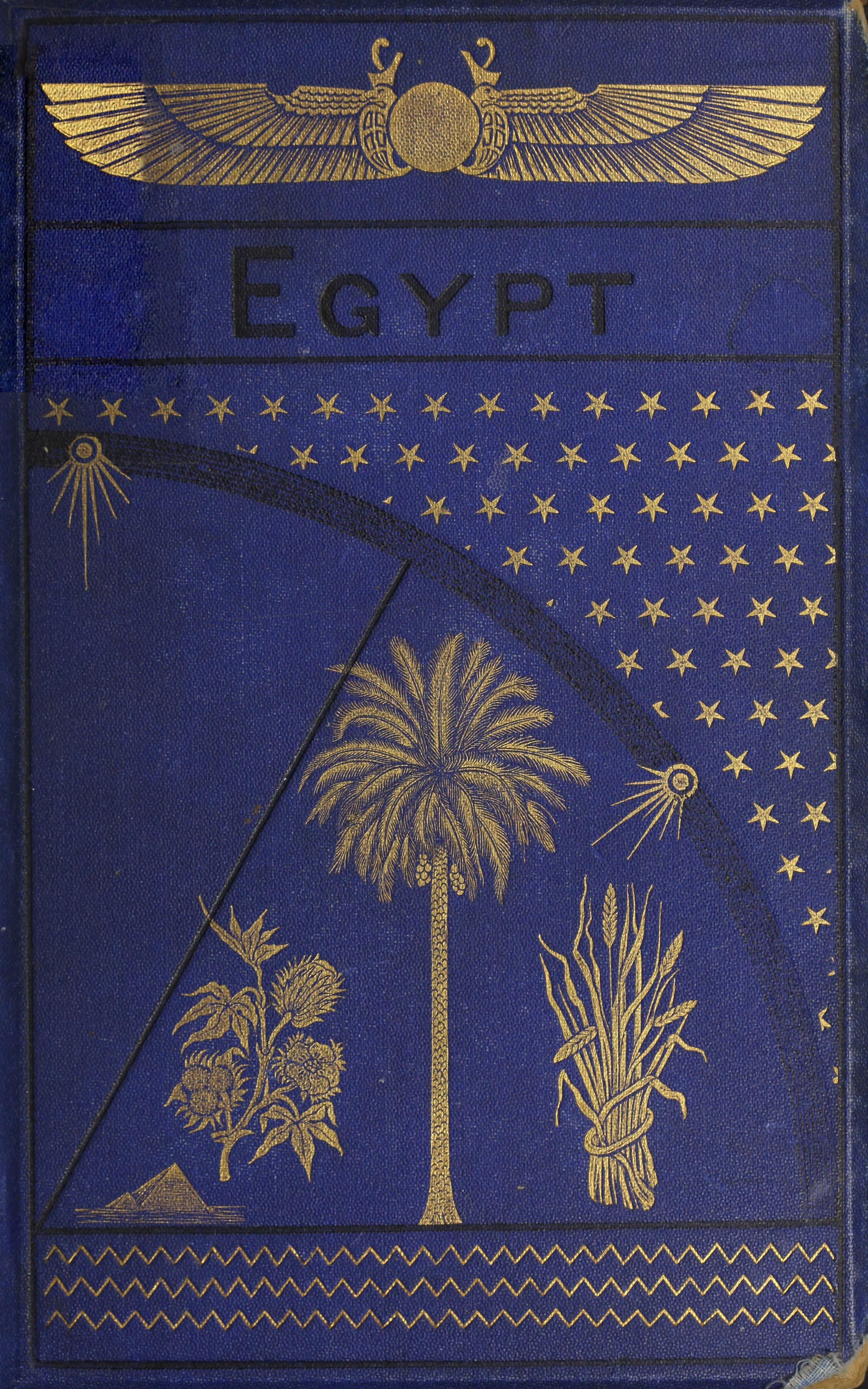
THE EXPLANATION OF THE COVER-PLATE. — BY THE SAME AUTHOR. — The Duty and Discipline of Extemporary Preaching. — A Winter in the United States : — A Month in Switzerland.
I have been given to understand that the cover-plate
of this volume needs some explanation: if so, it can now
only be inserted on an additional fly-leaf.
At the top is the familiar, winged, serpent-supported
globe of the old Egyptians. This, as every body knows,
is generally found over the main entrances of the temples,
and on the heads of mummy cases. In speaking on such
subjects we must not press words too far. But I believe it
may be taken for what we may almost call a pantheistic
emblem, compounded of symbols of three of the attributes
of Deity, as then imagined. The central globe, the sun,
represents the source of light and warmth, and, therefore,
of life. The serpents represent maternity. The wings,
beneath which the hen gathers her chickens, represent
protection. This is one interpretation.
There might have been, and doubtless were, contained
in the emblem other ideas, irrecoverable now by the aid of
the ideas that exist in our minds. At all events, theological
emblems, like theological terms, must vary in their
import from time to time, in accordance with the varying
knowledge of those who use them: for they can be read
only by the light of what is in the mind of the reader.
This emblem, therefore, may not always have stood to the
minds of the old Egyptians for precisely the same conceptions.
The above interpretation, however, probably contained
for them, for some millenniums, its main and most
obvious suggestions; suggestions which were for those
early days a profound, though easily read, exposition of
the relations of nature to man, and which are very far from
being devoid of, at all events, historical interest to the
modern traveller in Egypt.
For the lower division of the plate, the author of the
volume is responsible. It is meant to illustrate the statement
on page 15, that the agricultural wealth of Egypt
that is to say its history, results in a great measure from
the fact of its having a winter as well as a summer harvest.
The sun is represented on the right, at its winter altitude,
maturing the wheat crop, which stands for the varied
produce of the temperate zone; on the left, at its summer
altitude, maturing the cotton crop, which stands for the
varied produce of the tropical, or almost tropical, zone.
Both have been grown beneath the same Palm tree, which
symbolizes the region itself. The unusually erect Palm
tree in the plate, was cut from a photographic portrait of
one which we may trust is still yielding fruit, and casting
on the rock-strewn ground the shade of its lofty tuft of
wavy leaves, in the Wady Feiran, to the north-east of
Mount Sinai. The black diagonal line gives the equator
of the sky at the latitude of Cairo, which is taken, for
the purposes of the illustration, as the mean latitude of
Egypt. This is also indicated by the Pyramid.
The pathway of the sun is given as it is represented
on one of the finest and most precious monuments of old
Egypt in its proudest days—the wonderfully instructive
monolithic alabaster sarcophagus of the great Sethos,
Joseph’s Pharaoh, at all events the grandfather of the
Pharaoh of the Exodus. It is now in Sir John Soane’s
Museum in Lincoln’s Inn Fields (page 138). This firmamental
road way of the great luminary (the contemporary
explanation of the “firmament,” in our English version,
of the first chapter of the Pentateuch, the “stereõma” of
the Septuagint) is so sculptured on the sarcophagus, originally
it was also so coloured, as to indicate granite. The
granite—this I regret—cannot be brought out distinctly on
the plate.
The beneficent action of the mysterious river, which
made, and maintains Egypt, is suggested by the three wavy
lines, the old hieroglyphic for water.
The star-sown azure, which suggests the supernal expanse,
the most glorious, and the most instructive scene the
eye and the mind of man are permitted to contemplate, is
taken from the vaulted ceiling of the temple of Sethos and
Rameses at primæval This (page 100).
How deep is the interest with which these facts and
thoughts affect the mind!
EGYPT OF THE PHARAOHS AND OF
THE KHEDIVÉ
Second Edition.
C. Scribner & Co., New York.
Being Table-talk collected during a Tour through the late
Southern Confederation, the Far West, the Rocky Mountains,
&c.
John Murray, London.
Smith, Elder, & Co., London.
EGYPT OF THE PHARAOHS AND OF
THE KHEDIVÉ
BY
F. BARHAM ZINCKE VICAR OF WHERSTEAD AND CHAPLAIN IN ORDINARY TO THE QUEEN
HUMANI NIHIL ALIENUM
SECOND EDITION, MUCH ENLARGED,
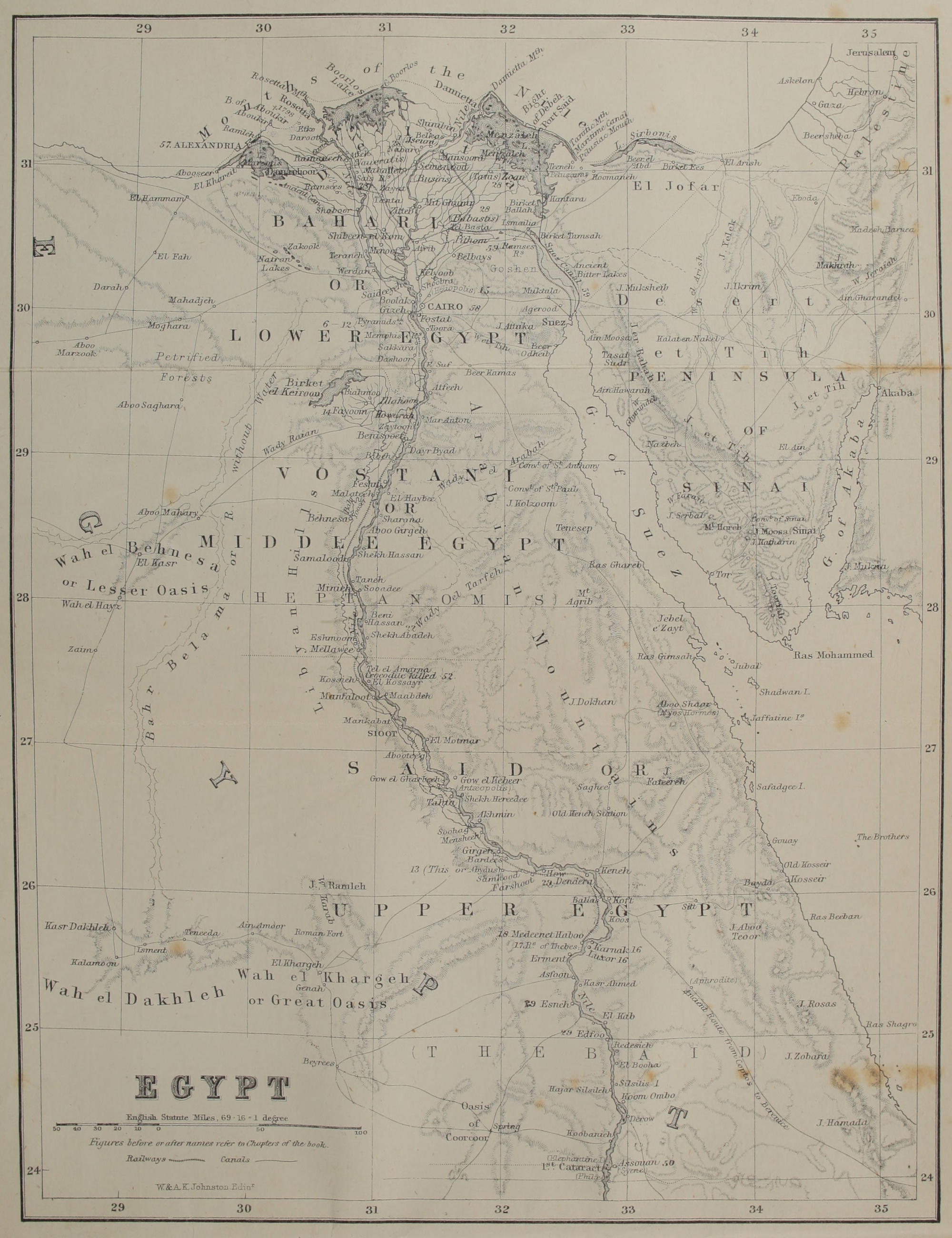
WITH A MAP
LONDON
SMITH, ELDER, & CO., 15 WATERLOO PLACE
1873
All rights reserved
DEDICATION
To my Stepson, Francis Seymour Stevenson
I Dedicate this Book
IN THE HOPE THAT ITS PERUSAL MAY SOME DAY
CONTRIBUTE TOWARDS DISPOSING HIM TO
THE STUDY OF NATURE AND OF MAN
SINGLY FOR TRUTH’S SAKE
PREFACE TO THE SECOND EDITION
The best return in my power for the favourable reception
the reading public, and many writers in the
periodical press, have accorded to this book, is to take
care that the Edition I am now about to issue shall be
as little unworthy as I can make it of the continuance
of their favour; though, indeed, this, which they have
a right to expect, is no more than I ought to be glad to
do for my own sake.
I have, therefore, carefully revised the whole
volume. In this revision I have, without omitting, or
modifying, a single statement of fact, or of opinion,
introduced as much new matter as nearly equals in bulk
a fourth of the old. These additions include a few
reminiscences of my Egyptian tour, which had not recurred
to me while engaged on the original work; but,
in the main, they consist of fuller developments of some
of its more important investigations and views.
As I find that several copies of the first edition
were taken off in the autumn, and early winter, by persons
who were about to proceed to Egypt, I have, for
the convenience of any, who, for the future, may be
disposed to use the work as a travelling companion in
the land of the Pharaohs and of the Khedivé, added
a map of the country and an index: the former, I trust,
will be found a good example of the accuracy of
Messrs. Johnston’s cartography.
Wherstead Vicarage: January 16, 1873.
INTRODUCTION
Those particulars of the History of Egypt, and of
its present condition, in which it differs from other
countries, are factors of the idea this famous name
stands for, which must be brought prominently into
view in any honest and useful construction of the idea.
Something of this kind is what the author of the
following work has been desirous of attempting, and
so was unable, as he was also unwilling, to pass by
any point, or question, which fell within the requirements
of his design. His aim, throughout, has been
to aid those who have not studied the subject much,
or perhaps at all, in understanding what it is in the
past, and in the present, that gives to Egypt a claim
on their attention. The pictures of things, and the
thoughts about them, which he offers to his readers,
are the materials with which the idea of Egypt has
been built up in his own mind: they will judge how
far with, or without, reason.
The work had its origin in a tour the author made
through the country in the early months of this year. It
consists, indeed, of the thoughts that actually occurred
to him at the time, and while the objects that called
them forth were still before him; with, of course, some
pruning, and, here and there, some expansion or addition.
They are presented to the reader with somewhat
more of methodical arrangement than would have
been possible had the hap-hazard sequence, in which
the objects and places that suggested them were
visited, been adhered to.
As he started for Egypt at a few hours’ notice, it
did not occur to him to take any books with him. This
temporary absence of the means of reference, and verification,
will, in some measure, account for the disposition
manifested throughout to follow up the trains
of thought Egyptian objects quicken in the beholder’s
mind. These excursus, however, as they will appear
to those who take little interest in the internal, and ask
only for the external, incidents of travel, have been
retained, not merely because they were necessary for
what came to be the design of the work, but also
because, had they been excluded, the work would have
ceased to be something real; for then it would not
have been what it professes to be, that is, a transcript
of the thoughts which the sights of Egypt actually gave
rise to in the authors mind.
Transcriber’s Note: The map is clickable for a larger version.
EGYPT
EGYPT OF THE PHARAOHS, AND OF THE KHEDIVÉ. — CHAPTER I. EGYPT AND THE NILE.
Quodque fuit campus, vallem decursus aquarum
Fecit.—Ovid.
The history of the land of Egypt takes precedence,
at all events chronologically, of that of its people.
The Nile, unlike any other river on our globe, for
more than the last thousand miles of its course, the
whole of which is through sandy wastes—the valley of
Egypt being, in fact, only the river channel—is not
joined by a single affluent. Nor, in this long reach
through the desert, does it receive any considerable
accessions from storm-water. From the beginning of
its history—that is to say, for more than five thousand
years, for so far back extend the contemporary records
of its monuments—Egypt has been wondering, and,
from the dawn of intelligent inquiry in Europe, all
who heard of Egypt and of the Nile have been desiring
to know what, and where, were the hidden sources of
the strange and mighty river, which alone had made
Egypt a country, and rendered it habitable.
Nowhere, in modern times, has so much interest
been felt about this earliest, and latest, problem of
physical geography as in England; and no people have
contributed so much to its solution as Englishmen.
At this moment the whole of the civilised world is
concerned at the uncertainty which involves the fate of
one of our countrymen, the greatest on the long roll of
our African explorers, who has, now for some years, been
lost to sight in the perplexing interior of this fantastic
continent, while engaged in the investigation of its
great and well-kept secret; but who, we are all hoping,
may soon be restored to us, bringing with him, as the
fruit of his long and difficult enterprise, its final and
complete solution.[1] Thoughts of this kind do not stand
only at the threshold of a tour in Egypt, as it were,
inviting one to undertake it, but accompany one
throughout it, deepening the varied interest there is so
much everywhere in Egyptian objects to awaken.
One of the first questions to force itself on the
attention of the traveller in Egypt is—How was the
valley he is passing through formed?
This is a question that cannot be avoided. It was
put to Herodotus, more than two thousand years ago,
by the peculiarities of the scene. He answered it
after his fashion, which was that of his time. It was,
he said, originally an arm of the sea, corresponding to
the Arabian Gulf, the Red Sea; and had been filled up
with the mud of the Nile. Those were days when, as
was done for many a day afterwards, the answers to
physical questions were sought in metaphysical ideas.
The one to which the simple-minded, incomparable, old
Chronicler had recourse on this occasion was that of a
supposed symmetrical fitness in nature. There is the
Red Sea, a long narrow gulf, a very marked figure in
the geography of the world, trending in from the south,
on the east side of the Arabian Hills. There ought therefore
to be on the west side of this range a corresponding
gulf trending in from the north: otherwise the Arabian
Gulf would be unbalanced. That compensatory gulf had
been where Egypt now is. The demonstration was
complete. Egypt must have been an arm of the sea,
which had been gradually expelled by the deposit from
the river. This argument, however, is not unassailable,
even from the fitness-of-things point of view. Had the
fitness-of-things been in this matter, and in this fashion,
a real agent in nature, it should have made the valley
of Egypt somewhat more like the Red Sea in width;
and it should also have interdicted its being filled up
with mud. It should have had the same reasons and
power for maintaining it, which it had originally for
making it. In this way, however, did men when they
first began to look upon the marvels of Nature with
inquiring interest, suppose that metaphysical conceptions,
creatures of the brain, were entities in Nature, and
would supply the keys that were to unlock her secrets.
‘Egypt is the gift of the Nile.’ But I believe that
it is the gift of the Nile in a much larger sense than
Herodotus had in his mind when he wrote these
words. It is the gift of the Nile in a double sense.
The Nile both cut out the valley, and also filled it up
with alluvium. The valley filled with alluvium is
Egypt. The excavation of the valley was the greater
part of the work. That it was formed in this way was
suggested to me by its resemblance to the valley of the
Platte above Julesburg, as it may be seen even from
a car of the Pacific Railway. You there have a wide
valley, like Egypt, perfectly flat, bounded on either
side by limestone bluffs, sometimes inclined at so precipitous
an angle that nothing can grow upon them,
excepting, here and there, a conifer or two; and sometimes
at so obtuse an angle that the slopes are covered
with grass. These varying inclinations reproduce
themselves in the bounding ranges of the valley of
Egypt. The Platte writhes, like a snake, from side to
side of its flat valley, cutting away in one place the
alluvium, all of which it had itself deposited, and transporting
it to another. It is continually silting up its
channel, first in one place, and then in another, with
bars and banks, which oblige the stream to find itself a
new channel to the right or left. The bluffs, though
now generally at a considerable distance from the river,
must have been formed by it, when it was working
sometimes against one, and sometimes against the
other side of the valley; and sometimes also for long
periods leaving both, and running in a midway
channel. Why should not the Nile have done the
same?
This supposition is supported by the fact that
when you have a soft cretaceous limestone, and rocks
that may be easily worn away, the valley of Egypt is
wide. When, as you ascend the stream, you pass at
Silsiléh into the region of compact siliceous sandstone,
the valley immediately narrows. And when you enter
the granite region at Assouan, there ceases to be any
valley at all. The river has not been able, in all the
ages of its existence, to do more than cut itself an
insufficient channel in this intractable rock. All this is
just what you would expect on the supposition that it
was the river that had cut out the valley.
We are sure, at all events, of one step in this
process. For there is incontrovertible evidence that,
in the historical period, the river flowed at a level
twenty-seven feet higher than it does at present, as far
down as Silsiléh. In several places, down to that point,
may be found the Nile alluvium, deposited on the contiguous
high ground at that height above the highest
level the river now reaches in its annual inundations.
There is, besides, the old deserted channel from a
little below Philæ to Assouan, into which the river
cannot now rise. Here, then, is the evidence of Nature.
We have also the testimony of man to the same
fact, contemporary testimony inscribed on the granite.
Herodotus tells us, that from the time of Mœris, the
Egyptians had preserved an uninterrupted register of
the annual risings of the Nile. This Mœris of the
Greeks was Amenemha III., one of the last kings of the
primæval monarchy, before the invasion of the Hyksos.
This register was preserved both in a written record,
in which the height of the inundation was given in
figures for each year, (this is what Herodotus mentions,)
and also in engraved markings on suitable
river-side rocks. Of these markings, we, fortunately,
have a series at Semnéh, in Nubia. Sesortesen II., the
father of Amenemha III., had conquered Nubia.
This event took place between two and three thousand
years before our era. To secure his conquest, he built
at Semnéh a strong castle on one of the perpendicular
granite cliffs, between which the Nile had cut its channel.
His son, not content with instituting the written
register Herodotus mentions, ordered that the height
of the inundation should, each year, be inscribed on
the granite cliffs of Semnéh, which had been fortified by
his father, and where an Egyptian garrison was kept.
This castle, little injured by time, is still standing.
Here was the most appropriate place for such a register.
It was the actual bank of the river; it was perpendicular;
it was indestructible; it measured all the water
that came into Egypt. Amenemha must have been
familiar with the place, for it was the custom of the
princes to accompany the king in war. Now, there
are thirteen of Amenemha’s inscriptions at this day on
this cliff. Each gives a deeply-incised line for the
height of the rising, and under it is an hieroglyphic
inscription, informing us that that line indicates the
height to which the river rose in such and such a year
of Amenemha’s reign. In every instance the date is
given. In the reign of Amenemha’s successor, the
invasion of the Hyksos took place, terminated the old
monarchy, and for four hundred years threw everything
into confusion. But, what we are concerned
with, is the fact that in the reign of this king and his
successor, the Nile rose, on an average, twenty-four
feet above the level to which it rises now.
Here, then, are two witnesses, Nature and Man.
The coincidence of their testimony is as clear and
complete as it is undesigned. It may, therefore, be
accepted as an undoubted fact, that the Nile is now
flowing from Semnéh to Silsiléh at a level lower by at
least twenty-four feet than it did at the date of the
inscriptions. Nature says there was a time when it
rose at least twenty-seven feet higher than at present,
for at that height it deposited alluvium. There is no
discrepancy in these three additional feet, though there
would have been something like a discrepancy had
Nature indicated three feet less than the markings.
The only question for us to consider is, how this
was brought about. It could have been brought about
only in one way, and that was by the river deepening
its channel. As far down as Silsiléh it had been flowing
at a higher level. Here there must have been a
cataract, or an actual cascade. Whatever the form of
the obstruction, the stream carried it away. And so,
again and again, working backwards, it ate out for
itself a deeper channel all the way up to Semnéh.
This is just how the Niagara river is dealing with its
channel. It has undertaken the big job of deepening
it, from Lake Ontario to Lake Erie, down to the level
of Ontario. The stone it has to work in is very hard
and compact. It has now done about half the work,
and every one sees that it will eventually complete it.
All that is required is time. The River Colorado, we
are told, runs for six hundred miles of its course in a
canon, a mile in perpendicular depth, all cut through
rock, and some of it granitic.
This is what the Nile did in the historic period for
at least two hundred miles of its course. It planed
down this part of its channel to a lower level, to what
may be called the level of Egypt. Why should it not
have done precisely the same work in the prehistoric
period for, in round numbers, the four hundred miles
from Silsiléh to Cairo, that is to say, for the whole
valley of Egypt? That is just what I believe it did.
Of course, there were aboriginal facilities which decided
it upon taking that course. There may also have been
greater depressions in some places than in others.
There was harder work here, and lighter work there.
The planing was carried on rapidly in one district, and
slowly in another. But I believe that, after making
whatever deductions may be thought proper for
aboriginal depressions, it is safe to conclude that the
valley of Egypt was, in the main, cut out by the Nile.
It did not begin to obtain its abrading power after the
reign of Amenemha III.
There may have been a cataract once at Cairo.
When this was carried away, another must have been
developed somewhere above its site, and so on backwards
all the way to Silsiléh, where we are sure that
there was once something of the kind. In a still
remoter past the river may not have come as far north
as Cairo, but may have passed through the Faioum, or
by the Natron Lakes, into the desert. This is a
question which, to some degree, admits of investigation.
The river would not always be bearing on the same
side of the valley. A little change in any part of the
channel, and which might result from any one of a
variety of causes, would deflect its course. It is so
with all rivers. These causes are always everywhere
at work. The river would thus be always shifting
from one side of the valley to the other; and, impinging
in turn on the opposite bounding hills, would always
be widening the valley.
The number of side canals, especially the Bahr
Jusuf, which, throughout almost the whole length of
the valley, is a second Nile, running parallel to the
original river, must, during the historical period, by
lessening the volume of water in the main channel,
have very much lessened its power of shifting its
course. But every one who voyages on the Nile will
become aware that this power is still very great. He
will often hear, and see, large portions of the incoherent
bank falling into the water. In many places he will
observe the fresh face of recent landslips. On the
summit of these slips he will occasionally have presented
to him interior sections of some of the houses
of a village which is being carried away by the stream.
On the fresh faces of recent slips I often observed
that the stratification was unconformable, and irregular.
This indicated that the sand and mud out of which the
alluvium had been formed, had not been deposited at
the bottom of a quiet lake-like inundation, but must
have been formed at the bottom of a running stream,
precisely in the same way as the sand-banks and mud-banks
of the existing channel are always at the present
time being formed. This irregular stratification is just
what we might expect to find in the alluvium of a
valley through which runs a mighty river, always restlessly
shifting its channel to the right, or to the left.
To experts in geology there will be but little, or
nothing, new in the above given account of the process,
by which the Nile formed Egypt. All river valleys
have been formed, more or less, by the action of running
water. It is, however, interesting both to those
who are familiar, and to those who are not, with such
investigations, to trace out the steps of the process, in
such a manner as to be able to construct a connected
view of as many of its details as can be recovered. In
any case this would be interesting; but here it has an
exceptional, and quite peculiar, interest, for it enables
us to picture to the mind’s eye how the whole of the
most historical country in the world was formed by the
most historical river in the world—a physical operation,
on which much that man has achieved, and, indeed, on
which what man is himself at this day, very largely depended.
Pictures of this kind are only one among the
many helpful contributions, which science can now
make to history.
I was not in Egypt during the time of the inundation;
I can, therefore, only repeat on the authority of
others, that for the first few days it has a green tint.
This is supposed to be caused by the first rush of
the descending torrents sweeping off a great deal of
stagnant water from the distant interior of Darfour.
This green Nile is held to be unwholesome, and the
natives prepare themselves for it by storing up, in
anticipation, what water they will require for these few
days. The green is succeeded by a red tint. This is
caused by the surface washing of districts where the
soil is red. The red water, though heavily charged
with soil, is not unwholesome. With respect to the
amount of red in the colour of the water of the inundation,
I found it stated in a work which is sometimes
quoted as an authority on Egyptian subjects,
that it is so great that the water might be mistaken for
blood. This I do not understand, as the soil this
water leaves behind has in its colour no trace of red.
By the time the water of the inundation reaches the
Delta, it has got rid of the greater part of its impurities.
This causes the rise of the land in the Delta to
be far slower than in Upper Egypt. In winter, when
the inundation has completely subsided, the water,
though still charged with mud, in which, however,
there is no trace of red, is pleasant to drink, and quite
innocuous. The old Egyptians represented in their
wall-paintings these three conditions of the river by
green, red, and blue water.
For myriads of years this mighty river has been
bringing down from the highlands of Abyssinia and
Central Africa its freight of fertile soil, the sole means
of life, and of all that embellished life, to those who
invented letters, and built Karnak. It is still as
bountiful as ever it was of old to the people who now
dwell upon its banks; but to what poor account do
they turn its bounty! How great is the contrast
between the wretchedness this bounty now maintains,
and the splendour, the wealth, the arts, the intellectual
and moral life it maintained four and five thousand
years ago!
The Egyptians have a saying, with which, I think,
most of those who have travelled in Egypt will agree,
that he who has once drunk the water of the Nile will
wish to drink it again.
CHAPTER II. HOW IN EGYPT NATURE AFFECTED MAN.
Continuo has leges, æternaque fœdera certis
Imposuit natura locis, quo tempore primum
Deucalion vacuum lapides jactavit in orbem.—Virgil.
The physical features, and peculiarities of a country
are one of the starting-points in the history of its
people. If we do not provide ourselves with a knowledge
of these matters before we commence our investigation
of what the people were, and did, the character
of the people, and of the events is sure very soon to
make us feel the want of it. It is so in a higher degree
with the history of the Egyptians, than with that of
any other people. They were, emphatically, a people
that stood alone; and the peculiarities of the people
were the direct result of the peculiarities of the country.
Its environment by the desert gave it that security,
which alone in early days could have enabled nascent
civilization to germinate and grow. It possessed also
a soil and climate which allowed its inhabitants to
devote themselves to some variety of employments
and pursuits, and so prevented their being all tied down
to the single task of producing food. The absence of
these two great natural advantages elsewhere placed
insurmountable difficulties in the way of advancement
in other parts of the world, so long as the arts by
which man battles with nature were few, and feeble;
and the organization of society in consequence only
rudimentary. So was it, for instance, in Europe, at the
time when Egypt was at the zenith of its greatness;
where, too, for long centuries afterwards, nothing could
have been done without the aid of slavery, which alone
made mental culture possible for the few at the cost of
the degradation and misery of the many. Egypt was
differently circumstanced. There one man might produce
food sufficient for many. The rest, therefore,
could devote themselves to other employments, which
might tend, in different ways, to relieve man’s estate,
and embellish life. In this matter the river and the
climate were their helpers. The river manured with
an annual warp, irrigated, cleaned, and softened the
land; and the climate, working harmoniously with the
river, made the operations of agriculture easy, speedy,
certain, and very productive. What in other countries,
and in later times, the slow advances in arts, and knowledge,
and in social organization, as the successive steps
became possible, brought about for their respective
inhabitants, Nature did, in a great measure at once,
and from the first, for the Egyptians.
Another of the early hindrances to advancement
arose out of the difficulties of communication, which
prevented either a military force from maintaining
itself away from home, or a single governing mind
from acting at a distance. Of course in matters of
this kind the effects of the want of sufficient means of
communication are greatly aggravated by the want of
foresight, and the distrust men have in each other,
which belong to such times and circumstances. Nothing
but the organization of tribes and cities can be
accomplished then. Egypt, however, had advantages
in the great and varied gifts of nature to which our
attention is now directed, which enabled her, in some
remote prehistoric period, to emerge from this politically
embryonic condition, and to form a well-ordered
and homogeneous state, embracing a population of
several millions, who were in possession of many of
the elements of wealth and power, and had attained
to a condition that would suggest, and encourage
culture. Of these advantages, that which came next
in order to the soil and climate, was that its good
fortune had conferred upon it a ready-made means of
communication, absolutely complete and perfect; no
part of the country, either in the valley of Egypt, or
in the Delta, being more than a few miles distant from
one of the most easily navigable rivers in the world.
And that nothing might be wanting, this advantage
was equalised to all by a provision of nature that,
at a certain season of the year, the descending current
of the river should, for the purposes of navigation, be
overbalanced by a long prevalence of northerly winds;
thus giving every facility, by self-acting agencies, to
both the up and the down traffic.
I may also observe that the river ran precisely in
that direction in which it could serve most effectually
as a bond of union, by serving most largely as a
channel of commerce. If its course had been along
the same parallel of latitude, that is, from East to
West, or reversely, then throughout its whole length
the productions of its banks would have been the
same. It would, therefore, have been of little use as
a means of commercial interchange. Where there was
no variety of productions there would have been no
commodities to exchange. But as its course was in the
direction of a parallel of longitude, its stream offered a
highway for the exchange of the varying products of the
different degrees of latitude it passed through. This
difference in the direction of their courses already constitutes
a vast difference in the comparative utility of the
streams of the Amazon and of the Mississippi; and
must ensure to them very dissimilar futures.
Another of the provisions that had been made for
the early progress of the country was something quite
unique: there was not by nature, and there could not
be constructed by man, a single strong place in the
whole of Egypt, such as would enable powerful and
ambitious individuals, or malcontent factions of the
people, to maintain themselves in independence of
the rest of the community, or to defy the government.
Nature had supplied no such places, and the conditions
of the country were such that they could not be formed.
This is a point which involves so much that I will
return to it presently.
It ought not to be unnoticed here, for it is one of
the important peculiarities of the country, that Egypt
yields both a winter and a summer harvest. The overflow
of the river, and the warmth of the winter sun
suffice for the former, which consists of the produce of
temperate regions; and artificial irrigation for the latter,
which consists of the produce of the tropics. This gives
it the advantage of the climates of two zones; the one
temperate and the other tropical; for, though it lies to
the north of the tropic, its winter, by reason of its
environment by the heat-accumulating desert, resembles
our summer, and its summer, for the same
reason, that of the tropics. Egypt is thus enabled to
exceed all other countries in the variety of its produce.
Both its wheat and its cotton are grown beneath its
palms. This variety of produce ought to contribute
largely to the wealth, and well-being of a country; and
it was, we know, a very considerable ingredient in the
greatness of the Egypt of the Pharaohs.
The characteristics of surrounding nature had
corresponding effects on the ideas, too, and sentiments
of the ancient Egyptians. We may, for instance, be
absolutely certain that had they lived in an Alpine
country, although they might have had the power of
commanding the requisite materials on easier terms,
they never would have built the Pyramids, for then an
Egyptian Pyramid would have been but a pigmy
monument by the side of nature’s Pyramids. But as
these structures stood in Egypt, when seen from the
neighbourhood of Memphis and Heliopolis, and throughout
that level district of country, they went beyond
nature. There they were veritable mountains; and
that is what the word means. There were no other
such mountains to be seen. In that was their motive.
Man had entered into rivalry with nature, and had outdone
nature.
So was it with one instance. And so was it on the
whole, generally. The guise in which nature presented
herself to the eye of the Egyptian was grand and
simple. Nature to him meant the broad beneficent
river; the green plain; the naked bounding ridge on
the right hand, and on the left; upon, and beyond
these the lifeless, colourless desert; above, the azure
depth traversed by the unveiled sun by day, and
illumined with the gleaming host of heaven by night.
Here were just five grand natural objects, and there
were no more. We rehabilitating to our mind’s eye the
scene, must add a sixth, the orderly, busy, thronging
community itself. But to them these five objects were
all nature. No dark forests of ancient oak, and pine;
no jutting headlands; no island-sown seas; no hills
watered from above, nor springs running among the
hills; no cattle upon a thousand hills; no shady valleys;
no smoking mountains. Just five grand objects; everywhere
just the same, and nothing else. Their thoughts
and sentiments could only have been a reflection of
nature (their mind as a glass reflected nature), and of the
instincts which the form of society nature had imposed
upon them gave rise to. And their acts could only have
been the embodiment of their thoughts and sentiments,
which must needs have been in harmony with surrounding
nature. And hence the character of the people,
which was grand and simple; but withal sensibly hard,
somewhat rigid and formal, without much tenderness,
and with little geniality; solid, grave, and serious.
Under such circumstances the individual was nothing.
There could be no Homeric Chieftains; no
Tribunes of the people; no eccentricities of genius.
The community was an organism, of which every
member had his special functions and purpose; a well-ordered
machine which did much work, and did it
smoothly.
This complete organization of society—it was what
the gifts and arrangements of nature had enabled them
to attain to—had brought them face to face with the
ideas of law and justice. But under their form of
society—and it has not been different under other
forms the world has since seen—it was understood
that some laws, which were necessary, were not good,
and that justice did not rule absolutely. We see—it
shows itself in all that they did—that their minds were
too thorough, and logical, to rest satisfied under these
contradictions; they therefore worked out for themselves
to its legitimate, and complete development the
old Aryan thought of a life beyond this present
existence: this was that western world of theirs, in
which no law would be bad, and in which there would
be no miscarriage of justice. And thus it came to be
that their doctrine of a future life was the apotheosis of
their social ideas of law, and justice, and right.
And nature encouraged them in this belief. Every
day they saw the sun expire in the western boundary
of the solid world; and the next morning rise again to
life. They saw also the mighty river always moving
on to annihilation in the great sea, just as the sun
sank every evening into the desert: but still it was
not annihilated. Its being was lost, and was recovered,
at every moment. It was ever dying, but equally it
was ever living. These two great phenomena of
nature (through our increased knowledge they teach
other lessons now) aided the idea which the working
of society was making distinct in their apprehension,
and confirmed them in the belief of their own
immortality. With the Egyptian also death would not
be the end: the renewal he beheld in the sun, and in
the river, would not fail himself.
The complete organization of the whole population
had been rendered possible by the peculiar advantages
of the country. The enterprising among the Pharaohs
availing themselves of this complete organization, and
of these peculiar advantages, were thereby enabled to
command the whole resources of Egypt, and to wield
the whole community at their will, as if it had been but
one man.
I reserved for separate and fuller consideration the
point that nature had nowhere provided Egypt with a
single spot where the ambitious, the discontented, or
the oppressed could maintain themselves; or to which,
we may add, they could even secede. In this respect
also, Egypt is quite unique. The configuration of the
country, combined with the absence of rain, brought
about this peculiarity. The valley of Egypt, speaking
roundly, is five hundred miles long, and five miles
wide, with a broad navigable river flowing through
the midst of it. The Government will always be in
possession of the river. It follows then that before
the disaffected can be drawn together in formidable
numbers at any rendezvous—for the distances they
would have to traverse would not admit of this—the
Government will be able to send troops by the river
in sufficient force to disperse them; or, at all events,
to prevent their receiving reinforcements.
A second reason is, that these handfuls of isolated
insurgents must always remain within reach of the
Government troops sent against them. They would
not be able to withdraw themselves from the flat, open
banks of the river; for there is nowhere vantage
ground they could occupy, except in the desert; and
there in twenty-four hours, that is before they could
be starved, they would by thirst be reduced to submission.
For, from the absence of rain, there are no
springs on the high ground; and from the same cause
the nitre accumulates in the soil to such a degree, as
to render the well-water brackish, and unfit for
drinking.
A third reason is the dependence of the agriculture
of Egypt on irrigation. The people, therefore, in any
neighbourhood cannot intermit their attention to their
shadoofs and canals for the purpose of insurrection,
or for any other purpose whatsoever. Were they to
do so starvation would ensue. The Government also,
being in possession of the river, could at any moment
stop the irrigation, by destroying the shadoofs and
canals, of a malcontent district.
Here, then, are three reasons, any one of which
would, singly, be sufficient to make the Government in
Egypt omnipotent. What conceivable chance, then,
can the people have, when all the three are, at all times,
combined against them? This explains much in the
past and present history of the country. Nature had
decided that in it there should be no strongholds for
petty potentates, no castles for freebooters, no mountain
fastnesses for untameable tribes, no difficult
districts to harbour insurgent bands; no possibility of
getting away from the bank of the river; no possibility
of withdrawing attention, for a time, from the most
artificial of all forms of agriculture. For long ages
the wandering Arab of the desert was the only
possible disturber of the peace of this exceptional
country. Nature first gave to it, in its singular endowments,
the means of union; and then eliminated
those physical obstacles to its realization which, elsewhere,
for long ages proved insurmountable. The
point to be particularly noted here is, that these
circumstances have ever given to the Government for
the time being every natural facility for uniting the
whole country into a single State, and ruling it
despotically.
The Delta is no exception, for the branches of the
river, and the canals by which this whole district is
permeated, and the absence of defensible positions,
reduce it, in respect to the points I have been speaking
of, to the same condition as that of the long narrow
valley above it.
A time may come when the moral force of public
opinion will outweigh, and overmatch these natural
facilities for establishing, and working a despotism;
but there is no indication in the existing condition of
the country of such a time being at hand. And that
this is the only force that can be of any effect in such
a country is demonstrated by its history. In the
remote days of its greatness there was in some sort a
substitute for it in the priestly municipal aristocracy,
or oligarchy, of each city. The priests were the
governing class, and supplied the magistracy. They
were an united and powerful body. Wealth, religion,
knowledge, the habitual deference of the people, made
them strong. They thus became, to some considerable
extent, a bulwark, behind which, in each separate city,
some of the rights of person and of property could
find protection from the arbitrary caprices of despotism.
In this way something that was in the mind of man
was at that time counterworking the consequences of
physical arrangements: and this only is the way in
which a country so circumstanced can be helped in the
future.
Nothing, however, of this kind is now at work in
modern Egypt. It has, therefore, but one ground for
the hope of escaping from the despotism which so heavily
oppresses it, and that is in the chance of external aid,
which means the chance that some European power
should assume the protectorate of the country. It
must, however, be a power in which public opinion is
in favour of liberty and political justice, and in which
the economical value of security for person and property
is understood. The Egyptians themselves
desire such a consummation. They know how blessed
to them would be the day which should relieve them
from the grinding and senseless exactions of an
oriental taskmaster, and place them under the sway
of good and equal laws. Their wish is that this
beneficent protector should be England. They almost
expect that it will be. I was asked, why do you not
come and take possession of the country? In Egypt
this appears the natural conclusion of existing conditions.
But a protectorate carried out thoroughly,
and unflinchingly, and entirely for Egyptian objects,
would be far better for both parties than simple
English possession. If we were to make a gain by
ruling the country, we should always be tempted to
go a little further. We should find it very difficult to
stop at any particular point, or to be clean-handed at
all, when everything was in our power.
The motives for interference are strong. How
saddening is it to the traveller to see the poor good-natured
Fellah, his naked limbs scorched by the
blazing sun, baling up the water from the river,
during the livelong day, for his little plot of ground;
and to think that all that will be left to him of its
produce will be barely enough to keep himself, and his
little ones, in millet-bread and onions; all the rest
having been cruelly swept away to support at Cairo
unused, and unuseable, palaces and regiments, and to
make a Suez Canal for the furtherance of the policy
of France, but for the naval and commercial benefit
of England, and to build sugar-factories for a trading
Khedivé. Of what benefit to the wretched cultivator
are all the bounties of Egyptian nature, and all his
own heavy moil and toil? This is one of the remorseless,
and purposeless oppressions done under the sun,
which it would be well that some modern Hercules
should arise in his might, and in his hatred of such
heartless and stupid injustice, to beat down, and make
a full end of. An Egypt, in which every man might
reap securely the fruit of his labour, would be a new
thing in the world, and a very pleasant thing to look
upon. At present, the riches of Egypt mean wealth
without measure for one man, and poverty without
measure for all the rest of the world.
The case of the poor Fellah is very hard: so also
is that of his palm-tree. It came into existence, and
grew up to maturity under great difficulties. It was
hardly worth while to give it space and water, and to
fence it round in its early days; for so soon as it could
bear a bunch of fruit, it was to be taxed. Why, then,
should the oppressed villager go to the cost of rearing
it? He would be only toiling for a domestic despot, or
foreign bond-holder. How many a palm-tree that might
now be helping to shade a village, and beneath which
the children might be playing, and the elders sitting,
has by this hard and irrational impost, been prevented
from coming into being. And of all the gifts of nature
to Egypt, this palm-tree is one of the most characteristic,
and of the most useful: its trunk supplies the people
with beams; its sap is made into a spirit; its fruit is
in some districts a most useful article of food, and
everywhere a humble luxury; baskets are made of the
flag of its leaf, and from the stem of the leaf beds,
chairs, and boxes; its fibres supply materials for ropes
and cordage, nets and mats; it has, too, its history in
Egypt, for its shaft and crown, first suggested to the
dwellers on the banks of the Nile, in some remote age,
the pillar and its capital. A wise ruler, whether his
wisdom was that of the head, or of the heart, would do
everything in his power to induce his people to
multiply, throughout the land, what is so highly useful,
and in so many ways. But the plan despotic wisdom
adopts is to kill the bird that lays the golden egg, and
by a process which shall at the same time cause as few
as possible of the precious kind to be reared for the
future.
Every traveller in the valley of the Nile, who can
think and feel, finds his pleasure, at the sight of the
graceful form of this beneficent tree, clouded by the
unwelcome recollection of the barbarous and death-dealing
tax that is laid upon it.
If, when the Turkish empire falls to pieces,
England should shrink from undertaking, on her own
sole responsibility, the protectorate of Egypt, the great
powers of Europe, together with the United States of
America, might, as far as Egypt is concerned, assume
the lapsed suzerainty of the Porte, and become the
protectors of Egypt conjointly.
CHAPTER III. WHO WERE THE EGYPTIANS?
Ex quovis ligno non fit Mercurius.
What were the origin and affinities of the ancient
Egyptians? To what race, or races, of mankind did
they belong? At what time, whence, and by what
route did they enter Egypt? The answer to these
questions, if attainable, would not be barren.
We have just been looking at the physical characteristics
of the country, and noting some of the effects
they must have had on the character and history of
the people. The inquiry now indicated, if carried to
a successful issue, will enable us, furthermore, to understand,
to some extent, what were the aboriginal aptitudes
the people themselves brought with them. These were
the moral and intellectual elements on which the
influences of nature had to act. The result was the
old Egyptian. He was afterwards modified by events
and circumstances, by increasing knowledge, and by
the laws and customs all these led to; but the two
conditions we are now speaking of were the starting-points,
and which never ceased to have much influence
in making this people feel as they felt, and enabling
them to do what they did. To have acquired, therefore,
some knowledge about them will be to have got possession
of some of the materials that are indispensable
for reconstructing the idea of old Egypt. We feel with
respect to these old historical peoples as we do about a
machine: we are not satisfied at being told that it has
done such or such a piece of work; we also want to
know what it is within it, which enabled it to do the
work—what is its construction, and what its motive
power.
Six thousand years before our own time may be
taken as the starting-point of the monumental and
traditional history of the old monarchy. This inquiry,
however, will carry us back to a far more remote
past.
There is but one way of treating this question:
that is, to apply to it the method we apply to any
question of science—to that, for instance, of gravitation,
or to any other: precisely the same method applied in
precisely the same way. We must collect the phenomena;
and the hypothesis which explains and accounts
for them all is the true one. This will act exclusively:
in establishing itself it will render all others impossible.
Other hypotheses, however, which have been, or
may be, entertained must not be passed by unnoticed,
in order that it may be understood that they do not
account for the phenomena; or, to put it reversely, that
the phenomena contradict them.
When history begins to dawn, the first object the
light strikes upon, and which for a long time alone
rears its form above the general gloom, is the civilization
of Egypt. It stands in isolation, like a solitary
palm by the side of a desert spring. It is also like
that palm in being a complete organism, and in producing
abundance of good fruit. All around is absolute
desert, or the desert sparsely marked with the useless
forms of desert life. On inquiry we find that this
thoroughly-organized civilization, fully supplied with
all the necessaries, and many of the embellishments
of life, and which is alone visible in the dawning light,
must have existed through ages long prior to the dawn.
It recedes into unfathomable depths of time far beyond
the monuments and traditions.
Some salient particulars at once arrest our attention.
The people, though African by situation, do not, at first
sight, strike us as possessing, preponderantly, African
affinities. If there be any, they are not so much moral,
or intellectual, as physical. They appear to be more
akin to the inhabitants of the neighbouring Arabian
peninsula, from which there is a road into Egypt.
But here also the resemblances are not great: even
that of language is far from conclusive. Their complexion,
too, is fairer. On neither side is there any
suspicion, or tradition of kindred. There is even deep
antipathy between the two. Their religion, again,
and religion is the summa philosophia—the outcome of
all the knowledge, physical and moral, of a people, is
unlike that of their neighbours. The Greeks, however,
and this is worthy of remark, thought it only another
form of their own. They were laborious, skilful, and
successful agriculturists; and there was no record of a
time when it had been otherwise with them. They
were great builders. They had always practised the
ordinary arts of life, spinning and weaving, metallurgy,
pottery, tanning, and carpentering. They had always
had tools and music. They had a learned and powerful
priesthood. Their form of government was that of
a monarchy supported by privileged classes, or of an
aristocracy headed by a king, and resting on a broad
basis of slavery, and a kind of serfdom. Their social
order was that of castes.
We cannot ascertain precisely at what point in
the valley this civilization first showed, or established
itself. Of two points, however, which are of importance,
we are sure. It did not descend the Nile from Ethiopia,
and it did not ascend it from the coast of the Delta.
It is true that Memphis was the first great centre of
Egyptian life of which we have full and accurate
knowledge. The founder, however, of the first historical
dynasty, and who appears to have made
Memphis his capital, came from This, or Abydos, in
Upper Egypt. We may almost infer from this that
Abydos was an earlier centre of Egyptian power than
Memphis.
The idea, then, of an unmixed African origin may,
I think, be at once and summarily dismissed.
Something may be alleged in support of a Semitic
origin. Where, however, we may ask, is the theory on
behalf of which nothing can be alleged? If it were so
it would never have come into existence. What we
have to consider in this, as in every doubtful or
disputed matter, is not what can be said in favour of
certain views, or what can be said against them, but
which way the balance inclines when the arguments on
each side have been fairly put into their respective
scales.
To begin, then, with the language, which is the
most obvious ground for forming an opinion in a matter
of this kind. It happens that in this case nothing
conclusive can be inferred from the language. First,
because in it no very decisive Semitic affinities have
been made out; and, secondly, because, had they been
found to be much more important than some have supposed
them to be, this would not of itself prove a preponderance
of Semitic blood.
Colour is rather adverse to the Semitic theory.
The Egyptian was not so swarthy as the Arab;
whereas, if he had been a Semite, he ought to have
been, at the least, as dark. In the wall-paintings a
clear red represents the complexion of the men, and a
clear pale yellow that of the women. In this clearness
of tint we miss the swartness of the Arab.
It is true he was darker than the Jew. Little,
however, can be inferred from this, for the Jews were
an extremely mixed people. Abraham came from
Haran, in Mesopotamia, and is called in Deuteronomy
a Syrian. He must, in fact, have been a Chaldean.
The wife of Joseph was a high-caste Egyptian. The
wife of Moses was a Cushite. And when the Israelites
went up out of Egypt ‘a mixed multitude’ went out
with them. This can only mean that in the multitude of
those who threw in their lot with them there was a great
deal of Semitic blood, through the remnant of the
Hyksos, which had been left behind when the great mass
of that people had been expelled from Egypt, and also
a great deal of Egyptian blood. From these sources,
then, were derived no inconsiderable ingredients for
the formation of what was afterwards the Jewish nation.
The great-grandmother of David was a Moabitish
woman. Solomon’s mother was a Hittite, and one of
his wives an Egyptian. And we know that a very
considerable proportion of conquered Canaanites were
eventually absorbed by their conquerors. No argument,
therefore, can be founded upon the complexion
of so mixed a people as the Jews.
In features, taking the sculptures and paintings for
our authority, the Egyptian was not a Semite. His
nostrils and lips were not so thin, and his nose was not
so prominent. In this particular, which is important,
he presents indications of a cross between the Caucasian
and the Ethiopian, or modern Nubian.
Their social and political organization—that of
castes, and of a well-ordered, far-extended state—was
completely opposed to Semitic freedom and equality,
in which the ideas of the tribe, and of the individual,
preponderated over those of the state, and of classes.
Religion is the interpretation of the ensemble. It
takes cognizance of the powers that are behind, or
within, visible external nature, and of the reciprocal
relations between these powers and man. The mind
of man is the interpreter. As is the interpreter so
will be the interpretation.
Now, from the hard simplicity of nature in the
Semitic region, or from the simplicity of life and
thought resulting from it, or from the early apprehension
by that part of the human family of the idea
of a Creator, or from other causes not yet made out
(though, indeed, it is the fact, and not the cause, that
we are now concerned with), there has always been a
disposition in the Semitic mind to think of God as one.
In the earliest indications we possess of their religious
thought each tribe, each city, almost each family,
appears to have had its own God. They never could
have created, or accepted, a Pantheon. The idea of
Polytheism was unnatural, illogical, repulsive to them.
The inference, therefore, is that in the large hierarchy
of heaven, which approved itself to the Egyptian
mind, there could be nothing Semitic. The religion,
the religious thought of Egypt, which so stirred the
whole heart, and swayed the whole being of the people
as to impel them to raise to the glory of their gods
the grandest temples the world has ever seen, was, in
its whole cast and character, an abomination to the
Semite.
Next after Religion, the most important effort of
the human mind is Law. Law is distinguishable from
Religion. It is not an effort to embrace and interpret
the whole, but a general and enforced application of
some of the conclusions of that interpretation to the
regulation of the conduct of men towards each other.
Its principles are those of justice and expediency, but
with very considerable limitations—not absolute justice,
but justice as then and there understood; and not in
every point and particular, but in those matters only in
which evidence is possible, and the observance also of
which can be enforced by penalties; nor absolute expediency,
but again, as it is then and there understood,
and limited to such matters as admit of being carried
out, and enforced, by public authority.
This, it is plain, may be regarded—and as a matter
of observation and history is still, and has in all times
been, regarded—either as something distinct from, or as
a department of, religion.
If treated as a part of religion, then either the
very letter itself of the law, or else the principles on
which it is founded, and of which it is an application,
must be accepted as from God. In the former case
God is regarded as the actual legislator, and sometimes
going a step further, as the actual executor of His
own law. In the latter case He is regarded, because
He is the primary source, at all events, of its principles,
as ultimately their guardian, and the avenger of their
violation.
The Semitic sentiment, looked upon law in the
former of these two lights. It formed this conception
of it, because the people held in their minds the
two ideas, that God was One, and that He was the
Creator. A people who have come to regard God as
one will necessarily concentrate on the idea of God all
moral and intellectual attributes. Out of this will arise
a tendency to exclude all merely animal attributes, and,
to a great extent, such phenomena as present themselves
to the thought as merely human—such, for instance,
as were the attributes of Mars, Venus, and Mercury.
God then, being the perfection of wisdom, justice, and
goodness, is the only source of law. He is, also, the
actual Lawgiver in right of His being the Creator.
The world, and all that it contains, is His. His will is
the law of His creation. The gods of Egypt, however,
like those of Greece, were not anterior to Nature, were
not the creators of Nature, but came in subsequently
to it, and were in some sort emanations from it; the
highest conception of them, in this relation, was that
they were the powers of Nature.
Now, in this important and governing matter of
law, the Egyptian mind did not take the Semitic view.
God appeared to the Egyptian, not so much in the
character of the direct originator, as in that of the ultimate
guardian of the law, in our sense of these words.
They had had kings who had been wise legislators,
and the complete punishment for violations of the law
would be in the life to come.
A review, then, of the whole field makes it appear
highly improbable that the Egyptians were Semites.
But if they were neither African nor Semitic, what
were they? There are not many alternatives to choose
from. The process soon arrives at a complete
exhaustion. They must have been—there is no other
possible race left—mainly Aryan: that is, of the same
race as ourselves.
There is no antecedent improbability in this.
That an Aryan wave should have reached the Nile
was, indeed, less improbable than that others, as was
the case, should have reached the Ganges and the
Thames. That one had not, would almost have
needed explanation.
That the Egyptians themselves had not the faintest
trace, either of a tradition, or of a suspicion, that it had
been so, is only what we might have been sure of.
No other branch of the race, from the Ganges to the
Thames, had preserved any record of their ancestors’
migrations, or any tradition of their old home, or of
their parentage. This only shows—which will explain
much—that the migration took place at so remote a
period, so long before the invention of letters, that we
feel as if it might have resulted from some displacement,
or variation, of the axis of our earth in the glacial
epoch.
That the complexion of the Egyptians is not so
fair as that of Europeans, is a remark of no weight.
Europeans may have become fairer by the operation
of causes analogous to those which made the Egyptians
darker. Among the Hindoos, the Brahman, who is
indubitably Aryan, is generally as dark as the Egyptian
was. The colour of the Egyptian may have been
heightened in precisely the same way as that of the
Brahman; first, by intermixture with the previous possessors
of the soil, and afterwards by exposure through
a long series of generations, with but little clothing, to
the floods of light and heat of a perennially cloudless
and all but tropical sun.
They might, on their arrival, have found an
Ethiopic race in possession of the valley of the Nile,
and having come from a distance with but few women,
may have largely intermarried with the conquered, and
displaced aborigines.
That there had been some intermixture may be
inferred from the complexion of the Egyptians, and
from the thickening of their features.
There is also a moral argument in favour of this
supposition in the fact that the Egyptians never, even
in their best days, showed repugnance to intermarriage
with the Ethiopians, or even to being ruled by
Ethiopian sovereigns. They followed Tirhakah and
Sabaco into Syria just as readily as they had followed
Sethos and Rameses. We see on the sculptures the
Ethiopian Queen of Amenophis.
Had the language been manifestly Aryan in its roots
and structure, this, under the circumstances, would
have been conclusively in favour of our supposition.
Its not being so is, however, not conclusive against
it. The Northmen, who invaded, and settled in Normandy,
abandoned their own language, and adopted
that of France. Again, the Norman invasion led to
a great modification of the language of England, but
the new tongue was not that of the invaders. Indeed,
it seems only in accordance with what might have been
expected—that the non-Aryan element in the people
having been so potent as, to a great extent, to cloud
the Aryan complexion, and coarsen the Aryan features,
the language which was ultimately formed, should not
have been, to any great extent, Aryan.
We find caste existing in Egypt from the earliest
times. This becomes intelligible on the supposition of
an Aryan origin. It is a parallelism to what took
place on the ground occupied in India by another, but
later, offset of this race. Caste could not develop itself
spontaneously in the bosom of an indigenous, and homogeneous
people. It is impossible to conceive such a
phenomenon under such circumstances. It must be
the result of two causes: foreign conquest, and pride of
blood. As to the former, we are sure that there could
have been no other means by which the Egyptians
could have been introduced into the valley of the Nile,
as they were not indigenous Africans; and as to pride
of blood, we know that this feeling exists so strongly
among Aryan peoples, that it may almost be regarded
as one of the characteristics of the race. It was natural,
therefore, that, wherever they came to dwell on
the same ground with a conquered and subject population
of a colour different from their own, they should
introduce this, or some equivalent, organization of
society. If they had found a dark race in Europe we
should have had caste in Europe; but here the hardness
of the struggle for existence in old times, aided by
the absence of difference in colour between the conquerors
and the conquered, made it impossible. In all
European aristocracies, whatever may have been their
origin, we can detect traces of this old Aryan disposition
towards exclusiveness founded on pride of blood.
In religion, which is for those times one of the
surest criteria of race, there was so close an approximation
of the gods, and of the whole system of Egypt,
to those of Greece, that, as has been observed already,
the Greeks supposed that the two were identical.
They were in the habit of speaking of the deities of
Egypt as the same as their own, only that in Egypt
they had Egyptian names. Of course, it is impossible
for any people to suppose that the religion of another
people is identical with its own, unless the fundamental
ideas of the two systems are the same. This similarity,
then, indicates that they were both offsets from the
same stock, and that they parted from the old home
after the fundamental and governing ideas of the
mythology they carried with them had been elaborated
there.
But in this matter we may go much further than
Greece. If we view all the Aryan religions collectively,
we shall find that the one idea that was the life-giving
principle in every one of the whole family was
the belief in a future life. The Hindoo and the
Persian, the Greek and the Roman, the Celt and
the Teuton, all alike, as if by a common instinct, agreed
in this. This, therefore, is distinctly Aryan, and no
religion from which it is absent could belong to that
race. How, then, and this is almost a crucial test,
does the religion of old Egypt stand in this matter?
Exactly as it ought to do, on the supposition that it
had an Aryan origin. This was its central, its formative,
its vital idea. It was this that built the thousand
mighty temples in which the living might learn those
virtues, and practise that piety, which would be their
passport to the better world to come. It was this that
embalmed the bodies of the dead, whose souls were
still alive. Without it the religion of old Egypt could
never have been a living force, nor anything but the
merest mummy of a religion. At all events, without
it, it could have had no origin in Aryan thought.
Another point to be considered is that of artistic
tastes and aptitudes. These are shown most conspicuously
in the architecture of a people, and the
subsidiary architectonic arts of sculpture and painting;
they may be followed also into the arts which minister
to the conveniences and embellishments of everyday
life, and which are chiefly exhibited in the style of the
dress of a people, and of the furniture of their houses.
Here, again, I think the working of the Aryan mind
is seen in old Egypt. Their ideas and tastes in these
matters were singularly in harmony with the ideas and
tastes that have in all ages developed themselves in
the bosom of Aryan communities wherever settled.
On the whole, our taste approves of what they did in
these applications of man’s creative power, the necessary
deductions having been made for the trammels which
the fixity of their religious ideas imposed upon them;
and for the fact that all that they did were but first
unaided essays, uncorrected by comparisons with the
arts of other people. When we consider what great
disadvantages in this respect they worked under, we
must come to the conclusion that no nation ever showed
so much invention, or more native capacity for art.
We cannot suppose that they borrowed from any other
people the idea of the pillar with its ornamented
capital; the arch; the ornamentation of buildings with
the sculptured and painted forms of man, of animals,
and of plants; the use of metallic colours; the art of
making glass; the forms of their furniture; the art of
embalming the dead; the art of writing; and a multitude
of other arts which were in common practice
among them in very remote times.
The same may be said of their aptitude for science,
which has ever been a distinct characteristic of Aryans,
and never of Semites. Science is a natural growth
among the former, and has appeared among the latter
only occasionally, and then evidently as an exotic.
The mechanics, the hydraulics, the geometry, the
astronomy, of the old Egyptians were all their own.
We also find among them evidences of a genius for
organization in a high degree, and of a singular power
of realizing to their thoughts, and of working for the
attainment of, very distant objects, both of which are
valuable peculiarities of the Aryan mind, and in both
of which the Semitic mind is markedly deficient.
One point more. Herodotus observes that the
Egyptians resembled the Greeks in being content each
of them with a single wife. On our supposition, this
is just what might have been expected. There are no
practices among mankind so inveterate as those connected
with marriage; and the ancient Egyptians,
having been an offset from the race of mankind which
had originally been monogamic, could not, although
they had long been settled in the polygamic region,
bring themselves to adopt polygamy. The primæval
custom of the race could not be unlearnt. We see,
too, from the sculptures that the affectionate relation
between husband and wife was rather of the European
than of the Asiatic pattern. The wife places her hand
on the shoulder, or round the arm of the husband, to
symbolize unitedness, attachment, and dependence.
This is done in a manner one feels is not quite in
harmony with oriental sentiment.
The last questions are—Where did they come
from? and, How did they get into Egypt? I have at
times thought that they came from the mouth of the
Indus, or from the Persian Gulf, and entered Egypt by
the way of the Red Sea. If Abydos was the first
centre of Egyptian power, and the balance of historical
argument inclines towards it, there seems to be no
other way of accounting for its having been so than
by supposing a landing at Myos Hormos, or Berenice,
as they were afterwards called. In one of those
harbours I can imagine the May Flowers of that old,
old world, hauled up upon the beach, and the stout
hearts, that had crossed in them the Indian Ocean,
preparing for their inland march across the desert hills
to the wondrous river. The distance is not great. On
the third day they will drink its water. The natives they
are to encounter are gentle, and industrious. They
will dispossess them of their land, and enslave them.
They will take their daughters for wives. They will
increase rapidly in their happy valley. The language
they brought with them will be lost, and a new language
formed by their descendants, which will be mainly that
of the people they subdued, and with whom they
intermarried. The religion, however, and the arts they
brought with them, they will never forget; and as the
centuries roll on, and they have increased greatly in
numbers, and come to have many goodly cities, and
much wealth, they will add largely both to their religion,
and to their arts. But by the time they have added
to their other arts that one which will enable them to
perpetuate the memory of events, so long a time will
have passed, that they will have lost all tradition of how
their first fathers came into the valley, and how they
possessed themselves of it. For them, therefore, the
history of Egypt will commence with the discovery of
letters; but for us, who are able to recover something
of the history of words, of races, and of mythologies,
it will reach back into far more distant tracts of time.
There is no reason which should lead us peremptorily
to decide against their having come by sea.
There is no antecedent improbability. The distant
voyages and settlements both of the Phœnicians, and of
the Normans, show what can be achieved in very small
vessels. Evidence to the same point was again
supplied by the insignificant capacity of many of the
vessels employed by some of our early trans-Atlantic
explorers, and circumnavigators. And in the spirit-stirring
and invigorating era of the Aryan migrations
we may believe that some enterprises of this kind were
undertaken. At all events, there is nothing to preclude
our believing that, in the prehistoric period, Indian and
Arabian vessels were wafted by the reciprocating
monsoons, to and fro, across the Indian Ocean.
Nor, indeed, are we at all obliged to suppose that those
vessels were of insignificant capacity.
But this entrance into Egypt must have taken place
at so remote a date that the physical features of that
part of the world might then have been somewhat
different from what they are now. The Dead Sea
might not then have been thirteen hundred feet below
the level of the Mediterranean, and the isthmus we
have just seen canalized might then have been navigable
water.
But it will make the point in question more distinct
if I endeavour to speak more precisely about it. The
immigration into Egypt could not possibly have been
an offset of the Aryan immigration into India, which
resulted in the formation of the Hindoo, or of its
westward outflow, which resulted in the formation of
the Greeks, Romans, and Teutons. These dispersions
must, we know, speaking broadly, have been contemporaneous.
Their date, however, as has been already
observed, was so remote that no one branch of the
race retained the slightest trace of a tradition of its
original seat, or of the way in which they themselves
came to their new home, or of any particulars of the
occurrence. We will suppose, then, that the event to
which they all belong, and of which each is a part,
occurred 10,000 years ago. I merely use these figures
to make myself intelligible. But the Aryan immigration
into Egypt belongs to a still more remote
epoch, and to another order of events. In the stratifications
of history its place is far lower down. It is a
part of what forms a distinct and more primitive
stratum. Again, for the purpose of making my
meaning distinct, I will say that it belonged to a series
of events which took place 15,000 years ago. The
peoples and civilization of Europe, as they now exist,
are to be traced back to the first-mentioned of these
two world-movements. To that which preceded it
may possibly be referred some fragments of a previous
condition of things in Europe which have been enigmas
to historians and ethnologists, as the Etruscans, the
Finns, the Laps, and the Basques. The Egyptians
may have been a part of that first original wave coming
down freely of their own accord into Egypt. Or they
may have been driven out of Persia, or from the banks
of the Indus, at the epoch of the rise and outflow of
the second wave. At all events, this is clear, that they
were no part of the second wave itself; because their
language was older than the Aryan tongue of that
epoch. And if, as appears probable, it was also older
than that of the Semitic peoples, they, too, must have
come into being after the Egyptians.[2]
CHAPTER IV. EGYPT THE JAPAN OF THE OLD WORLD.
Nec vero terræ ferre omnes omnia possunt.—Virgil.
Egypt was the Japan of the old world. While nature
had separated it from other countries, she had given it
within its own borders the means for satisfying all the
wants felt by its inhabitants. They acted on the hint.
Their general policy was to seclude themselves, to
which, however, their history contains some conspicuous
exceptions; and to exclude foreigners; which
policy, however, they, ultimately, completely reversed in
the reign of Psammetichus, as the Japanese have done
in our own day; and from the same motives. They
carried the mechanical arts, and all that ministers to
material well-being, to a high degree of perfection.
Like the Japanese, they did this with what they could
win from nature within the boundaries of their own
country, and under what we are disposed to regard as
very crippling disadvantages. Though, indeed, in
respect of absolute independence in the origination of
characteristic trains of thought, and of inventions,
Japan, on account of the connexion of its early civilization
with that of China, is estopped from entering
the lists against Egypt. The moral sentiments of the
Egyptians, and their social and domestic life, were
entirely their own: the results of the working of their
own ideas. It is this originality that makes them so interesting
and instructive a study of human development.
All their customs, and all that they did, were devised by
themselves to meet their own especial wants. They
were self-contained, and confident in themselves that
they would always be able to find out both what would
be best for them to do, and what would be the best way
of doing it.
Their success justified this self-reliance. All the
ordinary, and many of the more refined wants of man,
were supplied so abundantly, and in so regular and
well-ordered a fashion among them, that a modern
traveller would find no discomfort, and much to wonder
at and admire, in a year or two spent in such a country
as was the Egypt of Rameses the Great. He would,
indeed, be a very great gainer if he could find the
Egypt of to-day just what Egypt was three thousand
years ago.
There are no other moderately-sized countries in the
world so well prepared by nature for a system of
isolation, and self-dependence, as Japan and Egypt.
On a large scale China and the United States possess
the same advantage.
The action of free trade is to place all countries—even
those that may be able to produce but one commodity
the world wants, be it wool or labour, gold or iron,
or even the power of becoming carriers for others—on
the same footing of abundance as the most bountifully
supplied, but at the cost of self-dependence, which, in
its highest degree, means complete isolation. Free
trade equalizes advantages, making the advantage of
each the advantage of all. It does for the world on a
large scale what the free interchange of no inconsiderable
variety of domestic products did on a small scale
for old Japan of the modern, and for old Egypt of the
ancient, world.
With respect to the common arts of everyday life, I
think general opinion is somewhat in error, in the
direction of being unduly disparaging, as to the state
in which they were throughout the East, and on the
northern shores of the Mediterranean, at the period
which precedes the first glimmerings of history. I
believe that the knowledge of these arts was throughout
that large area spread very generally. Man has no
real tradition of the discovery of these arts any more
than he has of the acquisition of the domestic animals,
and of the most useful of the kinds of grain[3] and of
fruits he cultivates. What is to the credit of the
Egyptians is, that they carried the practice of them to
a high degree of perfection, and rendered them singularly
fruitful, and that they added to them much which
circumstances made it impossible they could have
borrowed from any other people. Everything done
in Egypt was invested with an Egyptian, just as
everything done in Japan has been with a Japanese,
character.
CHAPTER V. BACKSHEESH.—THE GIRL OF BETHANY.
And who will say ’tis wrong?—J. Baillie.
One meets few travellers in Egypt who do not speak
of the incessant demands for backsheesh as an annoyance,
and a nuisance. The word has become as
irritating to their temper as a mosquito-bite is to
their skin; and it is quite as inevitable. You engage a
boat, a porter, a donkey: in each case you pay two, or
three times as much as you ought; and in each case
the hand that has received your overpayment is again
instantly held out for backsheesh. While on the Nile
I gave one morning a cigar to the reis of the boat.
On walking away I heard his step behind me. I
turned back, and found that he was following me to
ask for backsheesh. I suppose what passed in his
mind was, either that I had discovered in him some merit
that entitled him to backsheesh, or that one who was
rich enough, and weak enough, to give a cigar, without
any provocation, would give even money to one who
asked for it. A friend of mine rode over a little boy.
The urchin, as he lay upon the ground writhing with
pain, and incapable of rising, held up his hand, crying
out, “I die now, give backsheesh!” An English
surgeon sees a man fall, and break his arm. He goes
to his assistance, and sets the broken limb. The man
asks for backsheesh. If the wayfarer who, as he was
journeying from Jerusalem to Jericho, had fallen
among thieves, had been an Egyptian, he would, while
the good Samaritan was taking leave of him, have addressed
to him the same request. An Arab helps you
up to the top of the Pyramid. You pay him handsomely,
and he is satisfied. You enter into conversation
with him, and he tells you that he is the
Hakem of his village; that he possesses so many
sheep, so many goats, so many asses, so many camels;
that the wife he married last, now two years ago, is
thirteen years old. You look upon him as a rich man,
but, while the thought is forming itself in your mind,
he holds out his hand, and asks for backsheesh.
There is, however, nothing in such requests that
need cause annoyance, or irritation. These children—whether,
or not, grown up, for they never arrive at
mental manhood—have nothing in their minds corresponding
to our ideas of pride, whether aristocratic, or
republican, of a kind that might dispose them to
regard such petitions as humiliating. What pride they
have is that of race and of religion, which suggests
to them the thought that to get money in this way is
only a justifiable spoiling of the unbelieving stranger.
They look, too, upon you as quite inexhaustibly rich,
while they are themselves, generally, very poor. And
if you are satisfied with their services—and they
certainly always endeavour to do their best; or if you
have any good-will towards them, with which they
credit you; how is this satisfaction, or good-will, to be
shown? It is ridiculous to suppose that words will
suffice. There is but one thing to do, that is
to give a little backsheesh. This rational way of
settling the matter is the way of the East. And of
old, too, we know that “the little present” figured
largely in the manners and customs of that part of the
world.
In Egypt, then, to blaze up with indignation at the
sight of a hand held out towards you, is to misunderstand
the people you are among. Moreover, indignation,
whatever may be the prompting cause, is very
un-Egyptian. I never met with one who had seen a
native lose his temper, under any circumstances, or
under any amount of provocation. You may abuse
him; you may even beat him; but he still smiles, and
is still ready to serve you. In this way he soon makes
you feel that you are in the wrong. One cannot be
angry with such people.
This ever-present idea of backsheesh may be turned
to some account. I found that the only way in which
I could extract a smile, or a word, from the native
women was to hold out my hand to them, and ask for
backsheesh. That the Howaji, as he rode by, should
turn the tables on them in this way, and invert the
natural order of things, by constituting himself the
petitioner, and elevating them to the position of the
dispensers of fortune, was enough to upset their gravity,
and loosen their tongues.
I had gone from Jerusalem to Bethany with a
young friend late from Harrow, great in athletics, and
full of fun and good spirits. We were on foot—for
who would care to go to, or return from, Bethany
otherwise? and, having arrived at the village, were
inquiring for what is shown as the tomb of Lazarus.
The women of the place soon collected round us. One
of them, in the first bloom of youth, looked like a
visitant to Earth, come to enable hapless mortals to
dream of the perfectness of Paradise. Her figure would
have given Praxiteles new ideas. Her face was slightly
oval; her features fine and regular; and her complexion
such as must be rare in an Arab girl, for her lips
were of a rich, if of a dusky, coral, and the rose envermeiled
her nut-brown cheeks. Her eyes thought. Her
beauty was about her as a halo of light. To look upon
her was fascination. My admiration was speechless.
Not so, however, my young friend’s; for, turning to
our dragoman, he said, ‘Ask that young lady if she is
married?’ My breath went from me at the sudden
indignation with which she fired up.
As she walked away, giving utterance, as she went,
to some angry Arabic, I looked into the faces of the
women about us. It was evident that they were impressed
with, and approved of, the propriety of her
conduct. It will, I thought, be long remembered, and
quoted, in the village as an example of the promptitude,
and decision, with which an Arab girl should guard
her reputation.
And now, I said to myself, we are in for it. She
will go and fetch her father, or a brother, or some relative
assumed for the occasion, and there will be a row. I suggested,
therefore, to my young friend, ‘that the tomb
was a transparent imposture; that it could only be an
excavation in the rock, made by some mediæval monk;
and that we should do better to go on, and look at
something else.’ And so we got away.
As we left the party of women, I gave them a little
more backsheesh than usual; and then told the dragoman
that we would leave the place at once, but not by
the road by which we had come.
We had just cleared the village, and I was congratulating
myself on our having got off so speedily,
when we encountered a flight of locusts. I soon
became absorbed in observing their ‘numbers numberless.’
They gave me, I thought, a new idea of multitude.
They blurred the sunlight almost like a cloud.
I began to capture some of them, which I now have
preserved in spirits.
While thus occupied, and with a feeling of wonder,
at the infinitude of living things around us, growing
upon me, the apprehensions I had lately felt, dropped
entirely out of my mind. In this way we went on.
When we had got about three-quarters of a mile from
the village we came to a turn in the mountain path, far
removed from any dwelling, and where all was solitude
and quiet. As we approached the corner, a young
woman stepped forward from behind a projecting rock,
and with a gracious look, and most engaging smile,
presented my young friend with a carefully-arranged
and beautiful bouquet.
Could my eyes be deceiving me? No. It was no
other than the exemplary young creature, who, only
half-an-hour back, had shown so much and such becoming
indignation.
My apprehensions, then, and precautions had been
unnecessary. But, in American phrase, ‘How dreffle
smart’ to combine, in so prompt and graceful a manner,
the credit of being good with the pleasure of being
good-natured. Could anything have been better
imagined in London, or Paris?
So it seemed. But honi soit qui mal y pense. True,
few can be as beautiful, few as keen-witted as the girl
of Bethany. But also true that none could have been
more free from thought of evil. ’Twas all for backsheesh.
And where two rupees are a marriage portion—so
much to them, and so little to us—whose heart would
condemn the bare-footed young tactician?
That day, as she returned to the village, her step,
I can think, was lighter than usual. Perhaps she did
not observe the mischief the locusts were doing to her
father’s little plot of wheat.
A few days afterwards, we were riding across the
hills from Bethlehem to Solomon’s Pools. Our path
lay by the side of the rude old aqueduct. This is
merely a trough of undressed stone, sunk to the level
of the surface of the ground, on the sides of the hills it
winds its way among, for about five miles, from the
Pools to the town. The sinking of the aqueduct just
to the level of the surface, was a way of saving it from
the risks of being knocked over, or of falling to pieces,
that was as wise as it was simple. If it had been
raised above the ground, or buried in it, whenever it
got out of order, the repair of damages would have
been difficult and costly. Originally it was carried on,
five miles further, to Jerusalem. We had, in our ride,
reached the spot where the large-hearted king (who,
like Aristotle, Bacon, and Humboldt, had seen that all
knowledge was connected) had, probably, his Botanical
Gardens, in which he cultivated some of the plants he
wrote about; and the genius loci had just brought into
my mind, his request, suggested to him, perhaps, by
the interest he took in the fruit he was growing up
here, ‘To be comforted with apples, for that he was
sick of love,’ when we came suddenly on a party of
women washing clothes. If the daughters of Bethlehem
were as good-looking in Solomon’s time as they are in
ours, it, we can imagine, must have strengthened his
favourable disposition towards the place; and may go
some way towards accounting for the aqueduct. Though,
indeed, this seems a little inconsistent with his preference
for apples. That, however, may have been only
a temporary feeling, or, it may have been the expression
of his latest and more matured experience.
But, as to those daughters of Bethlehem now in
the flesh, whom we had come upon, while so usefully
and creditably employed. They were much amused,
as it appeared, at having been caught in such an occupation,
and were laughing merrily. My young friend,
as might have been expected of him, endeavoured to
increase the merriment; this he did by leaning over his
saddle, and saying, ‘Ateeni bosa.’ Had he spoken in
English—though, of course, nothing of the kind could
ever have been said by him in our downright tongue—the
words would have been ‘Give me a kiss.’ The
one, to whom he appeared more particularly to address
himself, blazed up with instantaneous indignation, just
like the girl of Bethany. With angry glance, and fierce
tone, she exclaimed, ‘May your lips be withered first.’
But now I felt no apprehensions. My only thought
was, that if we came back the same way, and should,
by accident, find her alone, she would then, perhaps,
hold out her hand, and say, ‘Your lips are a garden of
roses: give backsheesh.’
CHAPTER VI. ANTIQUITY AND CHARACTER OF THE PYRAMID CIVILIZATION.
The riddle of the world.—Pope.
That the three great Pyramids of Gizeh were erected
by Chufu, Schafra, and Menkeres, the Cheops,
Chephren, and Mycerinus of Herodotus, we now know
with as much certainty as that we owe the Pantheon
to Agrippa, and the Coliseum to the Flavian
Emperors. We also know with equal certainty that
they were built between five and six thousand years
ago. From these Pyramids to the Faioum extends
along the edge of the desert a region of Pyramids,
and of circumjacent Necropoleis. Not far from an
hundred Pyramids have been already noted. These
were the tombs of royalty. The uncrowned members
of the royal family, the ministers of state, the priests,
and the other great men of the dynasties of the Old
Monarchy, lie buried around. Their tombs, excavated
and built in the rock, are innumerable. Some of them
reaching seventy feet, or more, back into the mountain
(the tombs of the New Monarchy at Thebes were
several times as large), are constructed of enormous
pieces of polished granite, most exquisitely fitted
together. Some are covered with sculptures and
paintings, traced with much freedom, and a grand and
pleasing simplicity. They describe the offices, occupations,
and possessions, and the religious ideas and
practices of those for whom they were constructed.
Great was the antiquity of Thebes before European
history begins to dawn. It was declining before the
foundations of Rome were laid. Its palmy days
ante-dated that event by as long a period as separates
us from the first Crusade. But the building of the
great Pyramids of Gizeh preceded the earliest traditions
of Thebes by a thousand years.
In this Pyramid region, and its Necropoleis, we
have a chapter in the history of our race, the importance
of which every one can comprehend. It is a
history which, while in the main it omits events, gives
us fuller, and more genuine and authentic materials
than any written history could give, for a complete
understanding of the everyday life, and arts of the
people. And the time for which it gives us this information
is so remote, that there is no contemporary
history of any other people, which we can compare
with it, or with which we can in any way bring it into
connexion. It has nowhere any points of contact. It
is a rich stream of history that runs through a barren
waste of early time, like the Nile itself through the
Libyan Desert, with a complete absence of affluents.
Having, then, made out the position of this epoch
with respect to general history, the next point is to
ascertain as distinctly as we can what were the arts,
the knowledge, the manners, the customs of the period,
that is of those who were buried in these Pyramids
and Necropoleis. When they lived, and what they
were, give to them their historic interest and importance.
The mere naked fact that the Great Pyramid was
built implies that at that, time, agriculture was so advanced,
and, in consequence, so productive, and that
society was so thoroughly organized, as to enable the
country to maintain for thirty years 100,000 men while
occupied in the unproductive labour of cutting and
moving the stones employed in its construction. To
which we must add the 100,000 men engaged for the
ten previous years upon the great causeway which
crossed the western plain, from the river to the site of the
Pyramid, and over which all the materials for the Pyramid
were brought. Modern Egypt could not do this. We
should find it an enormous tax even upon our resources.
There is also implied in the cutting and dressing
of this vast amount of stone, the supply of a corresponding
amount of tools; and as granite was at that
time used largely in the construction of some of the
tombs and Pyramids, it implies that those tools were
of the best temper.
It must also be remembered that some of these
Pyramids had crossed the Nile. The unwieldy and
ponderous stones of which they were constructed had
been quarried in the Arabian range, and brought
across the river to the African range on which the
Pyramids stand. What granite had been required had
been brought, the whole length of the valley, from
Syené. How much mechanical contrivance does this
imply! All these great blocks had to be lifted out of
the quarry, to be brought down to the river, carried
across, some even between five and six hundred miles
down the river, and then again across the cultivated
western plain to the first stage of the Libyan hills.
They had to be lowered into the boats and lifted out
of them. The inclined causeway was made of dressed
and polished blocks of black basalt, a kind of stone
extremely difficult to work. It was a mile in length.
And when the blocks for the Pyramid had at last
reached the further end of the causeway, they had to
be lifted into their place in a building that was carried
to a height of 480 feet. Herodotus mentions the
succession of machines by which they were elevated
from the bottom to the top. The mechanical
arrangements, then, must have been well planned and
executed.
In these great works we see that nothing was
overlooked, or neglected. Everything that could
happen was anticipated, and calculated with the utmost
nicety, and completely and successfully provided for.
This would, in itself alone, imply much accumulated
knowledge, and habits of mind which nothing but long
ages of civilization can give. No rude people can make
nice calculations, can summon before themselves for
consideration all the conditions of a problem, or take
precautions against what may happen thousands of
years after their time.
If, then, we look at these structures, such as we have
them now before our eyes, and work out in our minds
the conditions, both contemporary and precedent,
involved in the single fact of their having been built,
we see distinctly that we are not contemplating one of
the earlier stages, but a very advanced stage, of civilization.
All traces of the inception of the useful arts,
and of social organization, are utterly wanting. We
have before us a great community which, when seen
for the first time, appears, Minerva-like, full-grown
and completely equipped.
This is seen with equal distinctness in the representations
of the common arts, and of the ordinary occurrences
and practices of life, as we find them on the
tombs. They are such as belong to a civilized people.
Among the former we may instance the manufacture
of glass, and the enamelling of earthenware with coloured
glazes; and among the latter the making of inventories
of the property of deceased persons.
The religion, too, we see, had already attained its
full development. Its doctrines were matured, all its
symbols had been decided upon, and an order of men
had been set apart for the maintenance of the knowledge
of it, and for the celebration of its services.
The hierarchy also of society was now completely
established, and had been long unhesitatingly acquiesced
in. There are no indications here either of
growth, or of decay, or of any disposition to unsettle
anything. The order of society is received as the
order of Nature, is administered by a regular form of
government, and crowned by a splendid court.
But—and this is as surprising as anything we meet
with belonging to those times—they were already in
possession of their hieroglyphical method of writing,
and were using it regularly and largely in their monumental
records; and, which is still more significant,
had discovered how to form papyrus-rolls, that is to
say paper, for its reception. Nor is there any indication
of a time when their ancestors have been
without it. In this, as in the other matters I have
mentioned, there is no substantial difference between
the primæval monarchy, before the invasion of the
Hyksos, and the revived monarchy, which flourished
after the expulsion of the Hyksos.
From whence, then, did this remote civilization
come? Was it indigenous, or was it from abroad?
or, if derived from these two sources, in what degree
did each contribute? Is there any possibility of
recovering any of the early dates, or of at all measuring
roughly any of the periods of the early history?
I have already said something on these questions, and
shall return to them, whenever we shall have reached
any point, from which there may appear to be emitted
some ray of light which falls upon them.
CHAPTER VII. LABOUR WAS SQUANDERED ON PYRAMIDS, BECAUSE IT COULD NOT BE BOTTLED UP.
Faute de mieux.
It is essential to the right understanding of any age
that we have a general knowledge of its monetary and
economical condition. This, which in ordinary histories
is passed over with little or no notice, does, in truth,
largely affect the character of men’s works and deeds,
their manners and customs, and even their thoughts
and feelings. It had much influence on the history of
the old world: we see it distinctly at work in that of
the Roman Empire. And we are now beginning to
understand how largely it is influencing the course
of events amongst ourselves at the present moment.
With respect to the Pyramids, who was to build them,
the means by which they were to be built, and that
they were to be built at all, depended on the monetary
and economical condition of the Egypt of that day.
To elucidate this is to advance a step in the reconstruction
and revivifying of the period.
Herodotus tells us that he saw inscribed on the
Great Pyramid how many talents of silver (1,600 was
the number) had been expended in supplying the
hands employed on the work with radishes, onions,
and garlic. He says he had a distinct recollection of
what the interpreter told him on the subject. We
believe this, because he was no inventor of fables, but
an accurate and veracious recorder of what he saw
and heard. The idea of history—that is, of what is
properly called history, which is exclusive of intentional
deception and misrepresentation—was the uppermost
idea in his mind. The internal evidence of his
great, varied, and precious work demonstrates this.
There is, however, another reason for our believing
this particular piece of information he gives us about
the Great Pyramid, which is, that it is in strict accord
with what we know of the period to which his statement
belongs. Silver was at that time not coined
but weighed, and therefore, necessarily, the inscription
would speak of such a weight of silver, and not
of so many coins of a certain denomination. At that
time there were not in existence any coins of any
denomination. In the history of Joseph we have
frequent mention of money without any qualifying
terms; but on the one occasion in the narrative, where
it becomes necessary to speak precisely on the subject,
Joseph’s brethren do so by saying that their money
was in full weight. Money then, we may suppose, as
late as the time of the Pentateuch, was silver that was
weighed, and not coined. This is in accordance with
another statement of Herodotus, that the Lydians, the
most mercantile neighbours of the Greeks, were the
people who first coined money.
Now that the Egyptians had at this time no coined
money, proves that their taxes—as is very much the
case at this day with their chief tax, that on land—were
paid in kind. In an age when silver was so scarce
that the idea of coining it, for the purpose of giving
to it easy and general circulation, had not occurred,
and it was passing from hand to hand of the few
who possessed it by weight, the actual tillers of the
soil, always in the East, and not less so in Egypt
than elsewhere, a poor and oppressed class, could not
have had silver to pay their rents and taxes. The
wealth, therefore, of Pharaoh must have consisted
mainly of produce.
The next point is, that no profitable investments
for what silver, or precious things, a few might have
possessed, were known, or possible then. It was not
only that there were no Government stocks, and no
shares paying dividends, but that there was nothing
at all that could be resorted to for such purposes. If
a man had invested money in anything he would have
stood out before the world as a rich man, and so as
a man to be squeezed. Doubtless there was less of
this in Egypt than elsewhere in the East, but in those
early and arbitrary days there must have been, at times,
even in Egypt, somewhat of it. People, therefore, would
not, as a general rule, have invested had it been
possible. But it was utterly impossible, for the double
reason that there was nothing to invest, and nothing to
invest in.
What people invest is capital. Capital is bottled-up
labour, convertible again, at pleasure, into labour,
or the produce of labour. But in those days labour
could not be bottled up, except by a very few in the
form of silver ingots. In these days every kitchen-maid
can bottle up labour in the shape of coin, which
is barren bottling-up, and invest it in a saving’s bank
account, or in some other way, which is fruitful bottling-up.
I ask permission to use these incongruous metaphors,
one on the top of the other. Every grown-up
person in the kingdom can bottle up labour, and invest
it; and, as a matter of fact, there are few who, at one
time or other of their lives, do not. Some have succeeded
in doing it to such an enormous amount that
they might with the accumulated store build a Pyramid
greater than that of Cheops. It is, indeed, with the
labour that has been bottled up by private individuals
that we have constructed all our railways, docks, and
gas works, and with which we carry out all our undertakings,
great and small, in this country. There is no
limit to our capacity for bottling up labour. It is one
of our greatest exports; we send it all over the world,
to Russia, to America, to India, and to Egypt itself.
It is estimated that we store up somewhere about
150,000,000 pounds worth every year.
But in the time of Cheops nothing of this kind was
done, nor could it have been. It is true that the
nation could then produce a great deal more food than
it needed for consumption, but, at the end of the year,
it was none the richer. Its surplus labour had not
been fixed and preserved in a reconvertible form for
future needs. Its surplus production had not been
thus stored up for future uses. To repeat ourselves
there were, speaking generally, no ways open to
them for bottling up this surplusage either in the
temporarily barren, or in the continuously fruitful
fashion. But there were ways open to them by which
they might squander, or consume, their imperfect
chances. They might, for instance, throw away their
surplus food, and capacity for surplus labour, by doing
no productive work for a portion of the year. They
were engaged in this way in the long and numerous
festivals of their gods, in their funeral processions, and
other matters of this kind. The effect was the same
when they made military raids on their neighbours.
To this method also of using up their surplus labour
and food they had frequent recourse. To these
matters they were disposed more than ourselves,
because, unlike ourselves, they could not save what
they were thus squandering. Or they might spend
much of it in excavating, sculpturing, and painting
acres of tombs; or in piling up Pyramids; or in building
incredible numbers of magnificent temples. This
explains the magnitude and costliness of many of the
works, and undertakings, of the old world elsewhere, as
well as in Egypt. The point which it is essential to
see is, that they could not bottle up their surplus
labour of any kind in the time of Cheops; while with
us every form of surplus labour, even every odd half-hour
of every form of it, may be bottled up, and the
interest on what has been secured in this way may
itself also be secured in like manner. The only approach
to this among them was made by the king
when he built a treasury, which we know was sometimes
done by the Pharaohs, and locked up in it his
ingots of silver, and what gold, precious stones, and
costly stuffs he had acquired.
But this form of bottling up labour, and which only
one man in the kingdom could practise, had two objections.
It was of the utterly barren sort: it paid no
dividends. He had no enjoyment of any kind from
it. This was the first objection; and the other was,
that if it was continued too long—and this might be
the result at any moment—the man who was thus
hoarding up his treasures would prove to have been
hoarding them up for others, and not for himself; and
so he would get no particle of advantage from them.
What, then, was he to do? How was what he
had to be spent in such a manner as that he might
himself get something from it? How was he to have
himself the spending of it? A Pyramid is utterly
unproductive, and all but utterly useless. It is a
building that does not give shelter to any living thing,
in which nothing can be stored up, excepting a corpse,
and that cannot even be entered. Still it was of as much
benefit to the man who built it as leaving the surplus
labour, and food he had at his disposal, and the
valuables he had in his treasury, unused would be.
And those who built Pyramids had at their absolute
command any amount of labour, and any amount of
food. Here, then, was a great temptation to raise
monuments of this kind to themselves. What treasure
they had might as well be sunk in stones, as remain
bottled up barrenly. They would, at all events, spend
it themselves, and get for it an eternal monument.
They would have the pleasure of raising themselves
their own monuments. They would have the satisfaction
of providing a safe and magnificent abode for
their own mummies.
If they had had at home Egyptian Three per
Cent. Government Consols, or could have bought
Chinese, Hindoo, or Assyrian Five per Cent. Stocks;
or if the thought had occurred to them, which not long
afterwards did occur to their successors, of reclaiming
from the Desert, by irrigation, the district of the
Faioum; or if they had foreseen that in times to come
the Hyksos and the Persians might invade Egypt, and
that possibly a rampart from Pelusium to the metropolis,
such as was afterwards constructed, might assist
in keeping them in check in the Desert, where there
would be a chance of their perishing from thirst; or if
Egypt had been, like Ceylon, a country in which
mountain streams could be dammed up in the wet
season for irrigating the land in the dry; or, like
Yucatan, where enormous tanks for the storage of the
rainfall are indispensable; then it is evident that the
surplus labour and food, and the silver ingots in the
King’s treasury, would have been spent in some one
or other of these ways. But some of these things were
not possible in Egypt, and the time for thinking of the
others had not yet come. There was, therefore, no
alternative. It must be something as unproductive as
a Pyramid, or a temple. The intense selfishness of
man, such as he was in those early days, prevented his
having any repugnance to the idea of a Pyramid all
for himself: it rather, on the contrary, commended the
idea to his mind. And so it came about that the
Pyramids were built. The whole process is as clear
to us as it would be, had we ourselves, in some well-remembered
stage of a previous existence, been the
builders, and not Cheops and Chephren. We see
the conditions under which they acted, and the mental
process by which they were brought to the only conclusion
possible to them.
The question may be propounded—Why was there
given to these structures that particular form which
from them has been called the pyramidal? Mathematics
and astronomy have been summoned to answer
the question; and lately the Astronomer Royal for
Scotland has, in a large and learned work, endeavoured
to prove that the Great Pyramid of Gizeh was intended
to perpetuate for ever a knowledge of scientifically-ascertained
natural standards of weight, measure, and
capacity. If this was the purpose of the Great Pyramid,
will he allow an old friend to ask him—what,
then, was the purpose of each one of those scores of
other Pyramids that were constructed before and after
it? No two, probably, of the whole series were precisely
of the same dimensions, except, perhaps, accidentally.
All suppositions of this kind have their
origin in the unhistorical, or rather anti-historical
practice of attributing to early ages the ideas of our
own times. The first requirement for enabling one to
answer this question rightly is the power of, in some
degree, thinking with the thoughts of the men who
themselves built the Pyramids. Though, of course,
there is no more reason for doubting that every Pyramid
in Egypt was intended for a tomb and sepulchral
monument, just for that and for nothing else, than
there is for doubting that the Coliseum was built for
the spectacles of the amphitheatre, and London Bridge
for enabling people to cross the Thames.
Sir John Mandeville, the greatest English traveller
of the Middle Ages, and who, during his thirty-three
years of wandering in the East, had served in the
armies both of the Sultan of Egypt and of the Emperor
of China, writing between 1360-70, of what he had
seen about twenty-five years previously, tells us the
Pyramids were the granaries Joseph built for the
storage of the corn of the years of plenty. This is instructive:
it shows how readily in ages of ignorance—the
same cause still has, where it remains, the same
effect—men connect old traditions, particularly if there
be anything of religion about them, with existing
objects: being prompted to do this by a craving to
give distinctness, and a local habitation, to such traditions.
He anticipates and bars the objection that neither
he, nor anyone else, had inspected the interior of the
Pyramids, for the purpose of ascertaining whether they
were adapted for granaries, by telling us that they
were full of serpents. This is set down apparently
without any other design than that of recording a
curious fact, which it would be as well to mention.
And, doubtless, as far as the knight knew himself, he
had no other object. But in matters of this kind,
experience teaches us that such people do not know
themselves.
Here, then, we have an instance of the way in
which extremes meet. The old knight accepts his
theory without one jot or tittle of evidence in its
favour, and directly in the teeth of all that had ever
been recorded of the Pyramids. It is a theory which
allows at most seven years for their construction;
and which supposes them to have been designed for
a purpose which is flatly contradicted by their form,
and by all that is seen of their exterior, and known
of their interior; and, too, by the history itself. One
grain of science of any kind in the old knight would
have lost us the lesson to be drawn from his theory.
What he did was to yield to what was to him a
temptation. And this, and I say it with all due
deference, is precisely what the Astronomer Royal for
Scotland appears to have done. He, too, has yielded
to a temptation. The old knight, five centuries and
an half back, was tempted to find in these mighty
monuments the Biblical narrative; and he found it.
The modern Astronomer is tempted to find in them
most unexpected and surprising indications, facts, and
conclusions of profoundest science; and he finds them.
Each was tempted after his kind.
History, which had only an embryonic and potential
existence in the time of the old knight, and which even
now is only beginning to assume its proper form and
lineaments, and to become a living thing with power
to teach, to guide, and to save from error—formerly
what was taken for history often only misled—would
readily have enabled each of them to have escaped the
temptation that was besetting him.
It is worth noticing, by the way, that Mandeville
was one of the last who saw the original inscriptions
on the Great Pyramid. The construction of Sultan
Hassan’s Mosk, the materials for which were supplied
by the outer flakes of this Pyramid, was completed
about the middle of the fourteenth century. Mandeville
was in Egypt immediately before its commencement,
and mentions the inscriptions. Notices of them
are also to be found in several Arabian and other
writers of earlier date. These were what Herodotus
saw, and refers to. Some others, both in Greek and
Latin, had been added during the period of Ptolemaic
and Cæsarian domination. When the Father of
History saw, and had them interpreted to him, they
were more than 2,000 years old. The knight of St.
Albans, 1,700 years later, looked upon them in blank
ignorance. Here we have brought together, as it
were, in a single canvas, the primæval Egyptian, the
inquisitive Greek, and the adventurous Englishman.
What would not one now give to behold such inscriptions,
on such a building, and with such a history?
They had stood for nearly 4,000 years; and were
capable, probably, of standing 4,000 years more: at all
events, at this day, we might, certainly, be reading what
Cheops had inscribed, and Herodotus and Mandeville
had seen, if (we need not say anything about Sultan
Hassan) Mohamed had been less of an ignorant barbarian.
What destroyed these inscriptions, just as it
had overthrown a civilization it was incapable of reconstructing,
was the grand and luminous formula that
‘God is God, and Mohamed his Prophet.’ This,
which the true believer takes for a summary of all
knowledge, is, in fact, nothing but the profession and
apotheosis of all ignorance. It does excellently well
for Mecca, and still better for Timbuctoo. But, however,
as it is the summary of all knowledge, those who
utter it have attained (how easy then is the achievement)
the highest point man can reach. They can
have on intellectual sympathy, or moral connexion
with the ages that preceded its announcement. So
also the ages that are to come (why there should be
such ages does not appear) can never be, in anything,
one step in advance of them. God can never be anything
but God, and he never can have any prophet
but Mohamed: that is to say, men must never conceive
the idea of God otherwise than as Mohamed conceived
it. This was what destroyed the inscriptions Cheops
had placed on the Great Pyramid, and turned it into
a quarry for Mosks and palaces at Cairo.
Religion, however, sooner or later, has its revenge
on the theology which endeavours to confine it within
narrow and inexpansive limits of this kind. The day
comes when ‘the engineer is hoist with his own petard,’
that is, when the theology is strangled with its own
formularies. History, too, which theologies generally
ignore, has its revenge in pointing, as a warning, to
the indications, scattered throughout all lands, of their
former existence, and of the causes of their decay and
extinction. Religion is a living thing that, from time
to time, advances into a higher form. Theologies are
often only fossils of forms of religion that have passed
away.
But to return to our question: why was this particular
form given to these tombs and sepulchral monuments?
Of course, it was because this was the form
which presented itself to the minds of the men of those
times as the natural and proper form. But why did
a thought, which does not appear obvious and appropriate
to us, appear to them natural and proper? It
was because in the ages that had preceded the times
of the Pyramid builders, and which had left some of
the ideas that had belonged to them still impressed on
men’s minds, tools for quarrying and squaring stones
had been scarce; and it had resulted from this scarcity
of tools (sometimes it was an entire absence of them)
and from the corresponding embryonic condition of the
primitive ideas of art, that the tombs and sepulchral
monuments of those ages had consisted merely of a
shallow grave covered over with a pile of inartificially
heaped-up stones, or earth. That was all that the
natural desire in the survivors to perpetuate the
memory of the dead had found possible. Such was,
with the Aryan race, the primæval idea of a tomb and
sepulchral monument, throughout the whole Aryan
world. Cheops and Chephren, and their predecessors
for many generations on the throne of Egypt, had
acquired tools, and an unlimited supply of labour; but
they had not acquired new ideas about tombs and
sepulchral monuments. So when, with the vigour of
thought, and boldness of conception, that belonged to
a young world, conscious of its strength, they resolved
to construct such tombs and sepulchral monuments
as should endure while the world endured, no other
form occurred to them, excepting that of the simple
antique Aryan cairn. They wanted a tomb, and a
sepulchral monument, and nothing but a cairn could
be that. And so they built the cairns of Gizeh.
Solomon’s Temple indicated that it had been preceded
by a time during which the House of God had
been a tent; the marble Parthenon that it had been
preceded by a time during which the ancestors of its
architects had built with wood.
Suppose that it were discovered that in the language
of old Egypt the word for a sepulchral monument
meant literally a heap of stones, should we not be
justified by the known history of the power words have
over thought, in feeling certain that in those early
times there could not have been a man in Egypt
capable of forming any other conception of a sepulchral
monument? We have some little ground for
presuming that something of the kind was at work in
the minds of the builders of the Pyramids. The
force, that is to say, of words, as well as the force
of tradition, may have constrained them to adopt the
pyramidal form. At all events, we know that the
word pyramid may mean the mountain, perhaps the
mound, perhaps really the cairn, the heap of stones.
CHAPTER VIII. THE GREAT PYRAMID LOOKS DOWN ON THE CATARACT OF PHILÆ.
Now I gain the mountain’s brow,
What a landscape lies below!—Dyer.
There is some interest in the comparison contained in
the following figures. The Great Pyramid was originally
480 feet high. In consequence of the sacrilegious
removal of its outer courses by the Caliphs to provide
materials for the construction of the Mosk of
Hassan, and other buildings at Cairo, its height has
been reduced twenty feet, that is to 460 feet. It
stands at the northern extremity of the valley of
Egypt. The First Cataract is at the other, or southern
extremity. These two extreme points of the valley
are separated by a distance, following the windings of
the river, of 580 miles. Throughout this distance the
river falls on an average five inches a mile. This
gives an uniformly rapid stream. To ascend this
distance in a steamboat, such as are used on the Nile,
requires seven days of continuous work; no time
having been allowed for stoppages, except of course
during the night. I need hardly say that the voyage
is never accomplished in so short a time. But supposing
a week has been spent in the ascent of the river,
when, at the end of it, you land at the Cataract, you are
at very little more than half the height you had reached
when you were standing, at the beginning of the week,
on the top of the Pyramid. So it would be supposing
the Pyramid stood on the level of the river-bank,
instead of standing, as it does, on a spur of the limestone
ridge that overlooks the valley. To think, when
you are entering Nubia, that a building in the neighbourhood
of Cairo, so many hundred miles away, is
still towering nearly 240 feet above your head, and
that it has been there from an antiquity so remote
that, in comparison with it, the most ancient monuments
of Europe are affairs of yesterday, an antiquity
that is separated from our own day by more than 5,000
years, makes one feel that those old Egyptians understood
very well what they were about, when they
undertook to set for themselves a mark upon the
world, which should stand as long as the world endured.
Judging from what we still see of the casing at the top
of the Second Pyramid, we feel certain that, if the
destroying hand of man had not stripped off its
polished outer casing from the Great Pyramid, the
modern traveller would behold it precisely as it was
seen fifty centuries ago, when the architect reported to
Cheops the completion of the work.
I have been speaking of the relation, in respect of
height, of the Great Pyramid to the Cataract of Philæ
only; it may, however, be noticed, for the sake of
enabling the fireside traveller to picture more readily
to his mind the peculiarity of the hypsometrical features
of this unique country, that this Pyramid looks down,
and always from a relatively greater height, on every
part of the cultivated soil of the whole land of Egypt.
CHAPTER IX. THE WOODEN STATUE IN THE BOULAK MUSEUM.
Vivi vultus.—Virgil.
In the museum of Egyptian antiquities at Boulak, the
harbour of Cairo, is a wooden statue of an old Egyptian.
It was found in a tomb at Sakkara, and belongs to one
of the early dynasties of the old primæval monarchy.
It is absolutely untarnished by the thousands of years
it had been reposing in that tomb. There is no stain
of time upon it. To say that it is worth its weight in
gold is saying nothing: for its value is not commensurable
with gold. It is history itself to those who
care to interpret such history. The face is neither of
the oval, nor of the round type, but as it were, of an
intermediate form; the features and their expression are
just such as might be seen in Pall Mall, or in a modern
drawing-room, with the difference that there is over
them the composed cast of thought of the wisdom of
old Egypt. As you look at the statue intently—you
cannot do otherwise—the soul returns to it. The
man is reflected from the wood as he might have been
from a mirror.
He is not a genius. His mind is not full of that
light which gives insight. He cannot communicate to
others unusual powers of seeing and feeling. He cannot
send an electric shock through the minds and
hearts of a generation. He is no prophet whose lips
have been touched with fire, no poet whose words are
creations, no master of philosophical construction, no
natural leader of men.
And this piece of wood tells you distinctly not only
what manner of man he was not, but also exactly what
manner of man he was. How this Egyptian of very
early days thought, and felt, and lived, are all there.
He was accustomed to command. He was a man of
great culture. His culture had refined him. He was
conscious of, and valued his refinement. He was
benevolent on conviction and principle. It would
have been unrefined to have been otherwise. He was
somewhat scornful. He was very accurate in his
knowledge, his ideas, and statements. Very precise
in his way of thinking, and in all that he did. He
shrunk from doing a wrong, or from using an ill-placed
word, as he would have from a soiled hand. He was
as clean and neat in his thoughts as in his habits. He
was as obstinate as all the mules in Spain. Had there
been any other party in those days, he would have
belonged to the party of order; and, if things had
gone so far, he would not have shrunk from standing
by his principles; but he would not unnecessarily have
paraded them. If he had been called upon to die for
his principles, he would have died with dignity, and
with no sign of the thoughts within. In his philosophy
nothing so became firmness of mind as composure of
manner.
His servants respected him. They had never
known him do a wrong thing; and they had known
him do considerate things. But they did not like
him. They could not tell why, but it was because
they could not understand him. He was an aristocrat.
He cultivated and valued the advantages his position
had given him; and was dissatisfied with those whom
circumstances had forbidden should ever be like himself.
He saw that this feeling was inconsequential,
but he saw no escape from it, and this vexed his
preciseness and accuracy; and he combated the disturbing
thought with greater benevolence and greater
accuracy, and became more precise where preciseness
was possible. He was fond of art, of his books, and
of his garden. He was not unsocial, still, in a sense,
nature attracted him more than man; and he preferred
the wisdom of the ancients to that of the moderns.
Such was this Egyptian of between five and six
thousand years ago. He was the creation of a high
civilization. He could have been understood only by
men as civilized as himself. That he was understood
is plain, from this piece of wood having been endowed
with such a soul.
In the Boulak Museum is also a statue in diorite,
one of the hardest kinds of stone, carefully executed
and beautifully polished, of Chephren, the builder of the
second Pyramid, with his name inscribed upon it. The
features are uninjured, and are seen by us at this day
just as they were seen by Chephren and his Court 5,000
years ago. It was discovered by M. Mariette at the
bottom of the well, which supplied the water used for
sacred purposes in the sepulchral temple attached to
Chephren’s Pyramid. This statue must have been,
originally, erected in the temple; and we can imagine
that it was thrown into the well by the barbarous
Hyksos, or iconoclastic Persians, where it lay undisturbed
till brought again to light by M. Mariette.
Probably the well had been filled up with the rubbish
of demolitions contemporary with the overthrow of the
statue, and, having been thus forthwith obliterated, had
been lost to sight and memory to our day.
CHAPTER X. DATE OF BUILDING WITH STONE.
When time is old and hath forgot itself,
And blind oblivion swallowed cities up,
And mighty states characterless are grated
To dusty nothing.—Shakspeare.
Manetho tells us that in the reign of Sesortosis, a
king of the third dynasty, the method of building with
hewn stone was introduced. He reigned about 3,600
B.C. It will be observed that this date is about thirteen
centuries earlier than that assigned to the flood on
Archbishop Ushers authority, and which is placed on
the margin of our Bibles; and only between three and
four centuries subsequent to the date assigned, on the
same authority, to the creation of the world. To
examine, however, this date of Manetho’s for the
hewing and dressing of building stone, is now our
immediate object. A little investigation of the subject
will, I am disposed to think, show that it is inadmissible,
and that it must be thrown back to a very much
more remote antiquity.
Manetho made this statement in the time of the
Ptolemies. We are therefore, under the circumstances,
justified in supposing that the author of the date,
whether Manetho himself, or some earlier chronographer
to whom he was indebted for it, meant by it
little more than an acknowledgment, that he was not
acquainted with any stone buildings earlier than the
reign of Sesortosis. A question of this kind was then
very much what it is now, one of antiquarian research;
it being necessary then, as now, to collect the evidence
for its decision from the monuments. But if our
acquaintance with the monuments of the primæval
period is as extensive and profound as Manetho’s was,
or even more so; and if in addition, we have advanced
far beyond what was possible in his day in the direction
of universal history, we may be able to show that
there is some error in his date; or at all events may be
able to explain it in such a way, that it may be brought
into closer conformity with what is now known, than it
would seem to admit of, if taken literally.
It is, then, evident, that he was unacquainted with
any buildings of hewn stone earlier than the time of
Sesortosis. No surprise need be felt at this. Sesortosis
reigned more than 3,000 years before the time of
Manetho. Let us recall what is the effect of 3,000 years
upon ordinary stone buildings in a country that has,
during that period, been growing and prospering.
Our Saxon forefathers used stone largely in building.
One thousand years only have passed: and now
there is not a building in the country we can point to,
and say with certainty, that it was raised by their hands.
There are a few doubtful exceptions in the form of
church towers. But these, if authentic, are exceptions
of the kind which prove the rule: for when everything
else disappeared, they could have been preserved only
by a combination of chances so rare that it did not occur
in one out of ten thousand cases. It was much the
same after five hundred years had passed.
The Roman world was covered, in the time of
Constantine, with magnificent cities and villas. But
how many of the houses that were then inhabited are
now standing?
The reasons of this are evident. First, there is the
ever-acting disintegration of natural causes. Whatever
man erects upon the surface of the earth, nature is ever
afterwards busy in reducing to the common level.
Then comes fire, the best of servants, but the worst of
masters, which no dwelling-house can be expected to
escape for a thousand years. Earthquakes, too, and
war have, in any long series of years, to be credited
with much destructive work. These are all in the end
complete undoers of man’s handiwork. But I am disposed
to assign the greatest amount of obliteration to
the ever-changing fashions and wants of man himself.
The houses of one generation are not suited to the
tastes and requirements of the generations that succeed.
They must therefore be pulled down to make way for
what men wish to have. Perhaps, they become quarries
to supply the materials needed for the new buildings.
Those who act in this way are only doing what
their predecessors did, and what their successors will
do. Palaces, and the chief public buildings, in a city
are, from a variety of causes, transferred to new sites;
and the cities, of which they must be the centres, must
correlate themselves to the sites of the new buildings.
Or the capital, or city, itself, may, from, again, a variety
of causes, be transferred to an entirely new site. In
either case more or less of the old city is no longer
inhabited. Sometimes the old materials are wanted,
sometimes the ground upon which the deserted buildings
are standing is needed for cultivation.
If we sum up the effects of these causes, we cannot
expect that the contemporaries of the Ptolemies should
have found in Egypt any buildings dating from the
first period of the Old Monarchy, that is nearly four
thousand years old. They had before them the Pyramids,
which were then certainly more than three thousand
years old, and which, it is evident, had defied all
the destructive causes we have enumerated, simply on
account of their exceptional form and mass, and because
the enormous stones of which they were constructed
had been so nicely fitted together as to exclude moisture
and air; and so, because they found no earlier
buildings, and because the stones of these had been so
carefully and truly wrought, they assigned, as the commencement
of the practice of building with wrought-stone,
the reign of Sesortosis, that is, they carried it
back two hundred years beyond the date of the commencement
of the Great Pyramid.
This is altogether inadmissible. Men could not
pass in two hundred years from the first essays in cutting
stone to the grandest stone structure, and, in nicety
of workmanship, one of the most perfect instances of
stone joinery that has ever been erected. There were
great builders long anterior to this date of two hundred
years before the commencement of the Great Pyramid.
Some of the Pyramids themselves, and many of the
tombs, are older than the Pyramids of Gizeh, and even
than the time of Sesortosis. A Pyramid had been built
in the Faioum as far back as the first dynasty of all,
that of Menes himself. Their system of religion, and
their system of writing, had both arrived at their perfected
condition in the time of Menes; and each of
these two facts imply considerable advance in the art
of building, of course building with stone, of which there
were such ample materials everywhere throughout the
valley of Egypt. They could not have had a perfected
religion, such as was theirs, without temples. Nor is
it possible that they could have advanced to the art of
writing without having advanced previously as far as
the art of cutting and dressing stone. And this is more
obvious when we consider that the very peculiarity of
Egyptian writing grew partly out of the idea that its
characters were to be sculptured and incised on stone:
this is what is implied in its very name of hieroglyphics.
I do not imagine that the date we are considering
was a mere fiction. To invent history was not an
Egyptian custom. What might have been rightfully
assigned to the time of Sesortosis might not have been
rightly understood, and so came to be wrongly described.
They had hewn and built with stone centuries
before his time. But there was an architectural improvement
which must have commenced somewhere
about his reign, which we see perfected in the Pyramids,
and which the Egyptians ever afterwards retained, and
that was the practice of building with enormous blocks
of stone, cut and fitted together with the utmost care
and precision. We can accept Manetho’s statement,
when interpreted to mean this.
The Egyptians had already had a long national
existence. They were a very observant and thoughtful
people. Of all people of whom we know anything,
they had the strongest craving to leave behind them
grand, and, if possible, everlasting historical monuments.
But they observed that all buildings constructed
with small stones, sooner or later, but at all events, in
a few centuries, passed away without leaving a record.
They fell to the ground, or they were taken down to
supply materials for new buildings, or the stone they
were built of was burnt for lime. The consumption of
lime has always been great in Egypt; and although the
limestone mountains are not far from the river, and
throughout the greater part of the country seldom more
than two or three miles from it, old buildings have
always been made to supply much material for this
purpose. Mehemet Ali, notwithstanding that the limestone
ridges of Thebes were close by, threw down one
of the magnificent propylæa of Karnak to get lime for
some paltry nitre-works he was setting up in the neighbourhood.
To secure, then, as far as possible, their
great monuments and tombs against these causes of
decay and overthrow, they, at about the time of the
date we are discussing, changed their method of building,
and began to use such large stones, that it would
generally be less troublesome and costly to get new
stone at the quarries for building and for lime, than to
overthrow an enormous structure, which could not be
done without some machinery, and much tackle and
labour. But their ideas, and the knowledge and the
skill shown in these great buildings agree with other
considerations in obliging us to carry back the art of
building with hewn stone to a very remote epoch, far
beyond any contemporary monuments, and far
beyond Menes, whose name is the first to appear in
the annals of Egypt, and who must have reigned not
far from six thousand years ago. At this period, we
cannot now entertain any doubts on the subject, civilization
in Egypt was in a very advanced state; not very different,
indeed, from what we find it at the date of the
oldest of the still existing monuments. Upon the
earliest of these we see the public and private life of the
Egyptians sculptured and painted by their own hands.
This, of course, must have required long antecedent
periods of slow advance, for in this matter it is the
first, and not the later, steps which require most time.
No inference, in respect of the point before us,
can be drawn from the preservation of buildings standing
on such sites as those of Pæstum and Palmyra.
As soon as those cities began to decay, all temptation
to use the stones of old structures in the erection of
new ones, or to burn them for lime, completely ceased.
They became useless and valueless, and this it was that
saved them. During the four thousand years that had
elapsed between Menes and Manetho, Egypt had been
a populous country, generally in a state of prosperity,
and, during the whole of the time, building, which
often implies pulling down, had been actively going on:
every stone, therefore, in every old disused building
of the early dynasties was likely, in one way or another,
to have been reused. No one can suppose that in such
a country as ancient Egypt the pressure of this temptation
would be long resisted.
The object of these pages is to present to the reader
the thoughts on Egypt, as it was and as it is, which
arose in the author’s mind during a tour he made last
winter through the country. Among these thoughts,
as I intimated at the beginning of this chapter, a prominent
place is occupied by chronological questions, for
the dates of early Egyptian history do not accord with
those of the popularly-received system. It therefore
becomes necessary to revert to the grounds of that
system, as well as to examine and ascertain the particulars
of the chronology of Egypt.
In this indispensable department of primæval history
it is possible that we may have been misled by a very
natural misapprehension as to the character of the earlier
portions of the Hebrew Scriptures. We read them as
if they were addressed to ourselves, and as if their
object was historical. These are, both of them, erroneous
and misleading ideas. It is evident, on the face of
the documents, that their writers had in view no readers
excepting those for whose immediate behoof they were
composed, and no objects excepting religion and
patriotism. Their aim was to form the Israelites into
a people by the instrumentality of a Code, sanctioned
and enforced by religion. The writings, therefore,
necessarily lay a foundation for the religion, give an
exposition of it, and set forth the motives for its observance.
The Code is the point of view from which the
religion, and the formation of the people that from which
the Code, is to be regarded. History is no more their
object than science. They do, of course, contain a
part, and that a most important part, of the history of
mankind; for, in carrying out their aim, they give much
of the history of a people that was destined to have a
great, and permanent, and ever-growing effect on the
world. But it is important to observe that even this
they contain only incidentally. To us both their religious
aims, and their incidental history, give them a value
which cannot be over-estimated. We shall, however,
only fall into mistakes if we lose sight of their primary,
limited, Hebrew, religious purpose, and regard them as
universal history.
This is a question of broad as well as of minute
criticism—of the interpretation of the whole as well as
of particulars. Are these Scriptures to be regarded
as containing the religion and the history, limited to
the point of view of the religion, of one of the smallest
of all people, or as containing the whole primæval
history of man, in such a sense that nothing but what
appears to be in harmony with what has come to be
their popular interpretation, can be taken into consideration?
It was for many ages an unavoidable
mistake to entertain respecting them the latter assumption.
(That some of the elements of Hebrew religious
thought were subsequently taken up into the religious
thought of a very considerable portion of mankind
does not affect the question immediately before us.) It
maybe, precisely, the attempt to maintain this misconception
of their nature which is now causing so much
confusion of thought and ill-feeling. If regarded in
their true light, no documents of the old world are more
precious to us historically (I am not speaking of them
in any other sense now); for, to refer to that which is
the chief concern of man, if the great lesson of history
is to teach us that it has itself no meaning, purpose, or
value, excepting so far as it is the story of the intellectual
and moral growth of the race, and that this
double growth is the paramount object of national and
of individual life, then how precious and how luminous
a portion of history do these documents become!
But this value is very much lessened, and this light
obscured, by the determination to find in them, not a
part, but the whole of primæval history. The civilization
of Egypt, which reaches back into so remote a
past that the Pyramids were monuments of hoar antiquity
when Abraham saw them, and the civilization—perhaps
contemporary with the date of the Pyramids—which
existed on the banks of the Euphrates, the
Ganges, and the Yankse Kiang, must be made harmoniously
to find a place by the side of what is
recorded in the Hebrew Scriptures. So must the
mythology, and the moral and intellectual aptitudes of
the Aryan race of man. So must also the knowledge
to which we have attained of the history of our globe
itself, and of the succession of life upon it. This process
has already been passed through with respect to the
discoveries of astronomy. Against them there was a
long and fierce struggle. At last everybody admitted
both that what astronomers taught might be believed,
and that the Hebrew Scriptures did not teach astronomy.
There is no reason for confining to astronomy the rule
that was established in its favour. It must be extended
so as to include our knowledge of the greatness and
the remoteness of Egyptian civilization, and every
other kind of knowledge. We need not, and we must
not, so interpret the Hebrew Scriptures as to reject
on their authority, or even to feel repugnance to accept,
any clearly-established facts. To make this use of
them is to wrest them to a purpose for which it is clear
they were never intended.
Their historical value to ourselves is only an incident
and accident of their designed purpose: that was to teach
to the Israelites their code, and to give them motives
for observing it (which has come to be to us a part of
history), and not to teach history to us. The idea
of history, taking the word in the meaning it has
for us, did not exist then. It could not, indeed, have
existed then, for everything has its own place and
time, and the time for history had not come then.
First, the seed is deposited in the ground, then comes
the tender shoot, next the stem and blades, after that
the plant flowers; last of all comes the full corn in the
ripe ear. Those early days were the time when the
materials were in many places being collected, out
of which we have to construct human history. It is
fortunate for us that in those first times men did not
forestall the idea of history: that would have prevented
their attending singly to what they were
themselves doing, and to the thoughts that were at
work in their own minds.
CHAPTER XI. GOING UP TO THE TOP OF THE GREAT PYRAMID.
How fearful
And dizzy ’tis to cast one’s eyes so low:
The crows and choughs that wing the midway air
Show scarce so gross as beetles.—Shakspeare.
Of course you listen to anything people have to say
on a subject about which you are at the moment
interested. Here are some specimens of what I heard
about the Pyramids, when I was on the point of
visiting them. A gentleman, who had that day
returned from making the ascent, was, as he sat at the
table d’hôte, overflowing with his impressions. His
complexion and voice were somewhat womanly. As
might have been expected, he strongly advised that
everyone should attempt what he had himself just
accomplished. There was, however, some novelty in
the advantage, he thought, would result from the ascent,
as well as in the logical process by which it was to be
attained. ‘Go up,’ his words were, ‘go up by all
means. The religious effects are very good. Elevated
to so enormous a height above the earth, on so
vast and imperishable a structure, you feel deeply and
profitably the littleness, the feebleness of man.’
I asked the owner of a New York dry-goods
store, who was rushing over the world for the purpose
of adding to the stock of his ideas—a very creditable
effort in a man of his antecedents and occupation, and
who was now half-gray—what he thought of the
Pyramids? ‘Well,’ was his reply, ‘they are a
matter biggish. But I don’t think them much, for
we can have just as good Pyramids in Central Park,
New York, if we choose to spend the money to have
them. A Pyramid is nothing but dollars. How
many dollars do you say one would cost? Well,
we have got all these, and many more, to spare. We
have got the Pyramids in our pockets, and can set
them up any day we please.’
These are specimens (and additional instances might
be given) of the ideas of people who are eminently
estimable, and perfectly contented with themselves and
with the world. Indeed, in holding and expressing
them, they must think that their eyes are not quite as
other men’s; that they can penetrate a little further
beyond the surface of things. Yet one meets with
many a man quite as estimable, though perhaps not
quite so contented with himself and with the world,
who would be disposed to ask what good would his
life do him, if told that he must swop ideas with them.
The prospect would be as little attractive to him as
that of the exchange of his religion for the creed of an
ancient Briton, or Cherokee Indian. But variety is
pleasant; and the world is a big place with plenty of
room for honest folk of all sorts.
An acquaintance (I trust he will allow me to quote
him here), in whose mind at the moment artistic must
have preponderated over historical associations, standing
unawed, and even unmoved, in front of the Great
Pyramid, relieved his mind to me, by giving utterance
to the following piece of honest profanity:—
‘I can’t bring myself to take the slightest interest in
these Pyramids. They don’t possess one principle, one
element, one feature of architecture. They are nothing
at all but heaps of stones.’
On my first visit to the Pyramids of Gizeh it was
too windy for anyone but an Arab to think of making
the ascent. On my second visit the day was all one
could wish, and so four of our party went up to the top
of the Great Pyramid. It was my fifty-fourth birthday.
This seemed to myself rather a reason for not making
the effort. My climbing-days were done. But my
young friend, late from Harrow, and great in athletics,
thought differently. ‘You mustn’t give in yet,’ he
urged. ‘You must go up. It is what everyone
ought to do. What is the use of having come all this
way if you don’t go up? You will be sorry afterwards
if you don’t. One would come a long way to have a
chance of doing it.’ As this was very much like what
one used to think oneself some thirty, or so, years
since, the exhortation seemed reasonable and good.
We ought to endeavour to keep ourselves young in
body as well as in mind. We ought not to give in by
anticipation. It will be time enough when we can’t
help ourselves. And so I went to the top.
By the way a party for travel in Egypt, if pleasure,
not work, is the first object, may be a large one, and
need not be composed entirely of historians and philosophers.
All liberal pursuits and reasonable ways of
looking at things may be represented advantageously.
A naturalist and a geologist are almost indispensable.
A member of the Ethnological Society might, at times,
turn up worth his salt. A Liverpool, or Manchester,
man whose ideas are of commerce, manufactures, and
machinery; of the value of things, and how to do
things, would often serviceably recall speculation to
the standard of present utility. But by all means have
a young fellow late from Harrow, and still great in
athletics. He is always to the front, like a cork to the
surface of the water. He is never afraid of work, or
of roughing it. He is always good-tempered and
merry. Always glad to hear what has anything in it;
is impatient of twaddle, and can’t stand assumption.
Some day he will himself be an Egyptologer, or
geologist, or something of the kind. At present he is
tolerant, and allows these things to those who like
them. What he likes is a rousing gallop on the Sheik’s
horse, a girl that has no nonsense in her, a champagne
luncheon, a good cigar. Some things, and some chaps
he thinks slow, but the general rule is ‘all right.’ A
Nile party is the better for this ingredient. We
mediævalists must not be over-reasonable. He will
help us a little to keep this tendency in check. Besides,
we were once young ourselves, while our friend
was never, though we all hope he may live to be, an
old fogie.
Four of us went to the top together. But place
aux dames, and no young lady, from the days of Cheops,
better deserved the first place than she who, on an
early day in January, 1871, ascended his Pyramid with
eye as bright, and foot as sure, as a gazelle’s. If he
still haunts the mighty monument in which he was laid,
after having bent his people to its erection for fifty
years, he must have thought, as the Lily of the North
stood on its summit, that he was well repaid.
For ne’er did Grecian chisel trace
A Nymph, a Naiad, or a Grace
Of finer form, or lovelier face.
A foot more light, a step more true,
Ne’er from the heath-flower dashed the dew;
E’en the light hare-bell raised its head
Elastic from her airy tread.
My young friend, late from Harrow, and great in
athletics, was, of course, one of the four.
And so was an older friend of mine, with whom
and another lad, in the year 1836, each of the three
being then seventeen years old, I had gone, I believe,
the first open-boat cruise on our home rivers. We
started from Bedford and went to York and Hull, and
back again, 700 miles in an open boat, pulling it all
the way ourselves, and lying down in it at night to
sleep, accoutred as we were in Jersey frock and
canvas. During the whole expedition we cooked our
meals ourselves. From that boat we had looked
forward into the unknown world before us: I can still
recall the anticipations, visions, and resolves of that
time. Now, from the top of the Pyramid of Cheops,
we looked back on our course, so far, through the
world. Well, just like other people, we had had each
of us to make some discoveries for himself, and to pay
for his experience. But the fight had not been always
against either of us. On the whole we had not found
it a bad world. We were glad, after thirty years of the
chanceful life-battle, to meet again, on the summit of
the Great Pyramid, if not quite unscathed, yet not
crippled. I suppose we each thought that the time to
come could not be as pleasant as the interval had been
that separated our two excursions.
The Great Pyramid is built of extremely hard and
compact nummulitic limestone. The third was cased,
at all events, to half its height, perhaps completely,
with enormous blocks of granite. A few are still in
their places, but most of them have been thrown to
the ground. A small portion of the external casing at
the top of the Second Pyramid is still uninjured. It is
of so pale and fine a limestone that it looks as if it
were of polished white marble.
I found the best way of getting an impressive idea
of the enormous magnitude of these Pyramids was to
place myself in the centre of one side, and to look up.
The eye then travels over all the courses of stone from
the very bottom to the apex, which appears to pierce
and penetrate the blue arch above. This way of looking
at the Great Pyramid—perhaps it is a way which
exaggerates to the eye its magnitude unfairly—makes
it look Alpine in height, while it produces the strange
effect just noticed.
While making the ascent, the Hakem of the Arab
tribe, which supplies guides and assistance to travellers,
took the opportunity of a pause for breath to press
upon me the purchase of some old coins. I told him
I would look at them when we had done with the
Pyramid. ‘I am satisfied:’ he replied; ‘an Englishman’s
word is as good as his money.’
Many people shrink from ascending the Pyramid
from a fear of becoming dizzy and confused on seeing,
as they fancy they must, that they are up so high
without anything to hold on by. This sight need
never be seen. You are going up against the face
of the mountain; attend then to what you are doing.
Look where you are putting your feet, which you
must do, each step being three feet high, more or less
and you will never see once, from the bottom to the
top, how high you are above the earth, or that you
have no supports, except when you turn round on
sitting down to get breath, and when you reach the
summit. The same is true to a great extent even of
the descent, although your back is then turned to the
mountain. Attend to what you are about—that is, to
the place where you are going to set your foot—and
there will be nothing at all to make you dizzy.
One of the exhibitions of the place is that of an
Arab climbing from the bottom to the top and coming
down again, in what appears to the spectators, an
incredibly short space of time. The charge for the
performance is a few francs. As they are slim, long-legged,
active fellows, they are well-adapted for this
kind of thing. One who was proud of what he could
do in this way was challenged by my young friend to
a foot-race for half-a-crown. There was not an Arab
present but thought it would be a hollow thing. It
was not a hollow thing at all. But their man it was
who came in second, Harrow winning by a few yards.
CHAPTER XII. LUNCHEON AT THE PYRAMIDS—KÊF.
Mine eye hath caught new pleasures
Whilst the landscape round it measures.—Milton.
On our first visit to the Pyramids we had our luncheon
in the large granite tomb a little below, and to the
south-east of the Sphinx. One feels that there is an
incongruity, a kind almost of profanation, in using a
tomb, particularly such a tomb, for such a purpose.
Its massiveness, at all events, makes you conscious of
a kind of degeneracy in the present day. A sense of
unworthiness and littleness comes over you. What
business have we, who send our dead to heaven, and
have done with them, to disturb the repose of those
on whose sepulchres a fortune was spent, if not by
their relatives, at all events by themselves? But on
this occasion there was little choice. Outside the
sun was scorching, and the wind was high, and the
only alternative was the hotel. But that was impossible:
to be shut up in a hideous, plastered,
naked room of yesterday, within a few yards of the
Great Pyramid. One would rather go without one’s
luncheon for six months together than have to bear
the stings of conscience for having so outraged the
memory of Cheops and Chephren. And so we took
our luncheon that day in the tomb of one of the great
officers of the court of those old times.
It was formed entirely of enormous blocks and
monolithic piers of polished granite. I do not know
of how many chambers it consisted, for being considerably
below the level of the surrounding sand-drift,
and the roof having been entirely removed, a
few hours’ wind must always completely fill and obliterate
it. The Arabs then have to clear it out again.
When we were there four chambers were open. These
are all long narrow apartments. The one by which
we entered runs from west to east. At right angles
to this are two other apartments, their axes being from
north to south. The fourth we saw was at right
angles to the north end of these two parallel chambers.
It was in the southern extremity of the westernmost
of the two parallel chambers that our party took their
places. The comestibles were laid on a cloth spread
on the sand, with which the floor, to the depth
of some inches, was covered; the party reclined on
the sand around, or sat on blocks of granite arranged
for seats. The hungry Arabs perched themselves on
the brink of the tomb, waiting for the fragments of
the feast, like vultures. The pert popping of the
champagne corks again disturbed ones sense of the
fitness of things.
How was it possible to be there, and not feel the
genius loci? The whole of this edge of the desert,
from Gizeh to the Faioum, is one vast Necropolis.
The old primæval monarchy lies buried here; at Gizeh,
Sakkara, Dashour, Abusseir, and throughout all the
spaces between and beyond, to the Faioum. No other
empire has been so buried.
In this wide field of the dead how much of early
thought and feeling, and life is storied. How
much contemporary history in wood and stone, in
earthenware, and glass, and paint. Contemporary
history—not history composed, heaven save the
mark! centuries after the events, often by authors
(sometimes truly the authors of all they tell) who did
not understand their own time, often merely for bread
and cheese;—not composed twentieth-hand from writings
which, even at their original source and fountain-head,
were the work of men who were not agents in
what they endeavoured to record, and who, not knowing
truly the events, their causes, or their consequences,
were but ill qualified to write the record;—not composed
when the feelings and ways of thinking of the
time were no longer living things, but had died out,
and other thoughts and feelings come in their place,
and when what the writer had to construct had become
obscure by party prejudice in politics and religion, and
by social misunderstandings. Nothing of this kind
is here. What is here is contemporary history, presented
in such a form that it is the actual pressure and
embodiment of the heart and mind of each individual.
Here are the occupations he delighted in, the sentiments
that stirred him, the business that was the
business of his life, the clothes he wore, the furniture
he used, the forms religious thought had assumed in
his mind, the forms social arrangements had assumed
around him. No people have ever so written their
history. Here is a biography of each man as he knew
himself. Here every man is a Boswell to himself. It
is a nation’s life individually photographed in granite.
We sat after luncheon taking our kêf, apparently
absorbed in the contemplation of the little fantastic
wreaths of cloud formed by our cigars. But the few
remarks that were made showed that the thoughts of
most of us were occupied in resuscitating the past, and
repeopling the sacred terrain around with the grand
impressive ceremonies and funeral processions of five
thousand years back. What a scene must this have
been then. The mountains—for that is the meaning
of the Pyramids—not rugged and dilapidated as now,
but cased with polished stone, each with its temple in
front of it. The many smaller Pyramids that have
now disappeared, or are only seen as mounds of
rubbish, then acting as foils to their giant brethren.
Great Pyramids reaching all along the foot of the hills
as far as the eye could see towards the south: some
of these still figure in the landscape. The Sphinx was
standing clear of sand with a temple between his paws.
Everything was orderly, bright, and splendid. The
dark red granite portals of the thousand houses of
those, who slept in the city of the dead, were standing
out conspicuous upon the sober limestone area, unchequered
by a plant, unstained by a lichen. The
black basalt causeways traversed the green plain from
the silver river to the Pyramid plateau. The whole
scene was alive with those, who were visiting, and
honouring, the dead, and preparing their own last,
earthly resting-places. Above all was spread out
the azure field of the Egyptian sky.
The word kêf is used everywhere throughout the
East, from Constantinople to Cairo, to convey an idea,
that is not European. It is the idea of sensational
comfort combined with mental repose, produced by
the narcotic leaf, when used under circumstances, where
the comfort and the repose are felt. There is no kêf in
its use as you walk or drive, or even talk with the
usual effort and purpose. You must be seated, and in
a kiosk, or garden, or some pleasant place, where the
entourage feeds the fancy through the eye, spontaneously,
with delightful, and soothing images. You must not
be urging the mind to exert itself. Conscious mental
exertion, equally with bodily, is destructive of kêf.
The thoughts must be pleasant, and they must come,
too, of themselves, from surrounding objects. Bodily
sensations must be so lulled, and yet, at the same time,
so stimulated, as to be in perfect accord with the stream
of thought, that is languidly, and dreamily, floating
through the mind.
CHAPTER XIII. ABYDOS.
Series longissima rerum
Per tot ducta viros antiquæ ab origine gentis.—Virgil.
In descending the river we stopped at Bellianéh to
visit Abydos. It was from Abydos, the primæval This,
that Menes came, whose name stands first on the list
of Egyptian kings. From it also came the dynasty
that succeeded that of Menes. The great extent of
cultivable land—the valley here opening out to double
its usual width—gave space enough for a rich and
populous state, the rulers of which appeared to have
overpowered their neighbours, and, by consolidating
their conquests, to have formed an enduring monarchy.
As the great preponderance of population and wealth
was thenceforth in the Delta and Lower Egypt, the
head of the Delta became the centre of gravity, and
so, by natural causes, the centre of affairs, and the
site of the capital.
Was This, in Upper Egypt, the first seat of
Egyptian power, and if so, how came it to be so?
These are questions of much interest, the important
bearing of which on early Egyptian history has been
indicated already.
The landing-place at Bellianéh is overshadowed by
a grove of palms, the crowns of which are tenanted
by turtle-doves. Among the palms we saw that the
ground was covered with crude bricks, lately moulded,
and going through their first stage of desiccation. We
were soon surrounded by a crowd of bare-legged
idlers from the town, most of whom were boys.
We had the day before despatched a telegram to
the Governor of Bellianéh to request him to have
donkeys in readiness for our party. The telegram,
however, had not arrived; we, therefore, sent into the
town to collect the beasts our party would require.
Before long they came; but most of them were ill able to
carry even their own wasted weight. Few had bridles,
or anything that could have been mistaken for a
saddle: a piece of ragged cloth or matting, merely
intended to hide their distressing sores, was all that
was on most of them. The first I mounted sank to
the ground under the weight of ten stone ten. At
last, the three most impetuous of our party selected
the three least emaciated, and started for Abydos.
Later in the day our telegram arrived, and the
Governor immediately sent down to the landing
a dozen fairly-conditioned animals; but it was then too
late in the day for the rest of the party to undertake so
long a ride.
It was the 3rd of January. The wheat was about
two feet high, and the beans were in flower. The
word field would mislead. As we rode on, mile after
mile, there appeared to be no divisions of the land,
except the limits of the different kinds of grain
growing upon it. We crossed two or three large
canals by earthen bars, which had been thrown across
them. The use of these bars is, as soon as the river
begins to sink, to retain the water with which the
canals are then full. We also passed several villages.
At the first of these our dragoman engaged the
services of a stout young fellow, who came to accompany
us, provided with a heavy staff, about two inches
or a little more in diameter, and five feet in length. The
villagers about Abydos have a bad character, and are
occasionally troublesome, and this young fellow was
to be our escort and guide. We did not ride through
any of the villages on our way, for the road was always
made to skirt the outside of the walls. At the gate of
one we passed, we saw a woman and a lad seated on
the ground, playing at a game resembling draughts.
The board was marked out on the road, which had also
supplied the men, in the form of pieces of camel dirt.
The sight gave one a little shock. These poor
women, however, spend no small portion of their lives
in converting the raw material of this natural product
into manufactured fuel, and the whole of their lives in
the odour of its smoke.
In the open, by the roadside, we saw some rectangular
enclosures of about six yards by four. In each
of them a family was residing. I supposed they were
engaged in watching the crops. As these enclosures
consist of nothing but four thin screens, about seven
feet high, of wattled reeds, their inmates, if that is an
appropriate term, must sleep, wrapped in their burnouses,
beneath the stars. The reed fence can only
be intended to keep out the wind, the jackals, and the
eyes of curious passers-by; but Arabs do not mind
exposure at night as long as their heads are wrapped
up. I saw, at Assouan and Miniéh, several sleeping
in this way, in the open market-place, on their goods.
At Suez, being out at dawn, I saw in the Arab town
the men sleeping outside their huts on a morning
when the mercury had sunk to freezing point. With
us Europeans, the first thought is to keep the feet
warm. About this extremity of his personal domain
the Arab is heedless. His care, like the nigger’s, is
for his head—-just as the Esquimaux dog, when sleeping,
covers his nostrils with his bushy tail, or the pig
buries his snout in the straw, so does the Arab, when
he makes himself up for the night, envelope his whole
head in some thick wrapper. Is this a consequence of
his practice of never having his head uncovered during
the day? I suppose they are none the worse for
breathing and rebreathing the same air all night, with
the exception of the little that may filter through the
wrapper.
The rubbish mounds of Abydos are, by their
height, and the extent of ground they cover, infallible
witnesses to the importance of the old primæval city.
From among these mounds two grand structures of the
days of Sethos and Rameses have been disinterred.
One is a palace, the joint work of father and son.
That the genius of Egypt was, as might have been
expected at this culminating era of its glory, advancing,
and full of invention, is seen in the ceilings of the
halls of this palace: they are vaulted. These vaulted
roofs, however, are not arches of construction, but
formed by placing the enormous slabs of sandstone,
of which the roof is made, not with their broad, but
with their narrow, faces on the plane of the ceiling.
This gave a roof of vast thickness, from which the
vault of the roof was excavated. The colouring of
these roofs, as of all the decorations of these two
grand buildings at Abydos, is remarkably good and
well preserved.
The other building, which was dedicated to Osiris,
who was supposed to have been buried here, was once
his most sacred and frequented temple. It was much
enlarged and embellished by the great Rameses. The
inner walls of the sanctuary were encrusted with
alabaster, which still remains. I saw nowhere else
Egyptian work in purer taste, nor sculptures so well
preserved, both in form and colour. One might have
supposed that some of them had been chiselled and
coloured last week. I observed a figure of the great
king so absolutely untouched by time, that the colour
of every bead in his necklace, or collar, is quite fresh.
It was here that was found the celebrated tablet of
Abydos, which Rameses put up in the temple of
Osiris, inscribed with the names of all the kings who
had preceded him. This and its fellow tablet, placed
at Karnak by Tuthmosis III., about two hundred
years before the time of Rameses, are invaluable, as
they show that the records preserved by the priests in
writing, of which we have transcripts in the dynasties
of the priest Manetho, and in the Turin papyrus, are
in accord with the monuments. The monumental
evidence, it may be observed, is of two kinds.
Speaking generally, it is absolutely contemporary—the
record having been sculptured in the lifetime of the
man, the memory of whose actions, possessions, and
thoughts it preserved. There are, however, in these
two tablets of Karnak and Abydos, most precious
exceptions to the contemporaneousness of the monumental
history. How strong and clear was the historical
sentiment in the mind of these old Egyptians!
We not only find each generation endeavouring to perpetuate
a knowledge of its own day, but, in the fourteenth
and sixteenth centuries before the Christian era,
we find Egyptian kings endeavouring to transmit to
posterity the names, and the order of their predecessors.
This tablet of Abydos is one of the glories of our
National Museum.
The cemeteries of Abydos were very extensive.
Their extent grew out of the wish, very generally felt
among well-to-do and educated Egyptians, to be laid
themselves where Osiris, the judge of all, had once
been laid.
As I have intimated, the site of This may, perhaps,
cast some faint ray of light on the question of how, and
where, the first ancestors of the Egyptians had entered
Egypt. It throws, however, a flood of light on the
question of the antiquity of Egyptian civilization.
We have seen that in Egypt, in consequence of the
absence, or scantiness of rain, there are no springs, and
that another consequence of this want of rain is that
the nitre, which the soil collects from the air, is not
dissolved and washed away, but accumulates to such
a degree as to render the water of the wells, which has
percolated from the river through the soil, brackish,
and unfit for drinking. Now the distance of This, in a
direct line from the river, is seven miles and a half;
if, then, we put these points together, we shall see in
them another argument for the extreme antiquity of
Egyptian civilization, besides those drawn from the
use of writing, the mythology, and from the absence
of anything like a beginning in the history of the
useful arts, and of their social arrangements. The
combined force of these arguments amounts to a
demonstration that civilization was not in its infancy
six thousand years ago, at the era of the Thinite
dynasties.
Here is the form of this contributory to the demonstration.
An uncivilized people would undoubtedly
have placed their town on the banks of the river, close
to the water. But a people among whom labour is
organized, and who will be willing because they are
civilized, to go to a great deal of trouble and expense
for an adequate object, instead of giving up much good
land for a large city, and on a site, too, where it would
be troubled by inundations, would prefer to build it
at a distance from the river, where the land was not
suitable for cultivation, and where it would be safe
from inundations. But in order to do this they must
cut a canal seven and a half miles long at the least,
and so bring the water of the river to the city. These
thoughts the Egyptians had, and this work they
accomplished, in the ages which preceded Menes. No
savage, or semi-savage people would have entertained
this scheme of the canal, or would have carried it out.
The site of This is thus alone strong evidence of a
very advanced contemporary civilization, no one can
tell how many centuries before the time of Menes; but
at least for a sufficient tract of time to allow of the
growth of a powerful state, capable at last in his time
of imposing a dynasty on Egypt. The first cities in
Egypt must have been on the banks of the river; or
in places where the háger was near the bank. The
first comers did not cut canals seven and a half miles
long at least; and none but a people already powerful
could protect such a canal, upon which their existence
depended. The people, then, were already civilized
and powerful who placed their city on such a site as
that of This.
There were kings in Egypt, we may be sure, before
Menes. The Egyptians themselves spoke of his predecessors
as ‘the deceased,’ that is, those human
rulers whose names had been lost. It was in the
time of these prehistoric, we may even say premythical
kings, that this This Canal, and indeed, probably, that
the great Bahr Jusuf Canal itself, which is throughout
Egypt a second Nile, were constructed. There were,
therefore, at that day, men who were as great in
hydraulic engineering as any who came after them, but
who yet lived at so remote a time, that no trace of them
could be found even in the far-reaching and tenacious
traditions of Egypt. If the Bahr Jusuf, which passed
by This, was older than the city, so much the better
for our argument.
CHAPTER XIV. THE FAIOUM.
Opera basilica.—Bacon.
The history of the reclamation of the Arsinoite nome,
or department, now the Faioum, would, if it had been
preserved, or could be recovered, throw much precious
light on the antiquity and power of the civilization of
the primæval monarchy. But the simple fact that its
details had been lost, even in the remote days of
Theban learning and magnificence, when Egypt was
at the summit of its greatness and glory, possesses of
itself much historical value, for it shows at how much
earlier a day the great undertaking had been carried
out; and that, as we know, by such a system of
hydraulic works, the newly-won district, too, having
been adorned with such cities and buildings, as
leave no doubt about the high character of its (were it
not for the remains of these works and structures)
prehistoric civilization.
The Faioum is, geographically, a basin formed by
a depression in the Libyan range, about sixty miles
to the south of the Pyramids of Gizeh. The basin is
about the size of Oxfordshire, or Surrey, that is to say,
it contains about 750 square, miles. More than 100 of
these may be occupied by the Birket el Keiroon, a
natural lake, which forms its northern and western
boundary. This large piece of water resembles a rude
crescent, with its convex side to the north and north-west,
and its concave side to the south and south-east.
On the former side the contiguous desert rises into a
hilly ridge; this boundary being in fact an offset of the
African range. The other side of the lake looks upon
the dry and shelving descent of the basin, which, from
its southern summit down to the edge of the water, has
a fall of about 100 feet, being about fifteen miles across.
There are considerable discrepancies as to the precise
amount of this fall; some measurements making it
more, and some less than the 100 feet here given.
When things were in their natural state, undisturbed
by man, the Birket el Keiroon was a lake, as it
is now. In those days, as in our own, it was supplied
with water, just as the pool within the enclosure of
Karnak, and other pools, and all the wells in Egypt,
by natural infiltration; for the water of the river percolates
readily through the porous strata, and flows
into any sufficiently deep depressions, or excavations.
The existence of the oases also in the desert must be
accounted for in this way.
The Bahr Jusuf Canal had, at some unrecorded
date, been brought along the foot of the Libyan range.
Starting from Diospolis Parva, by the air-line forty
miles below Thebes, it had traversed the whole of the
rest of the valley; then, passing through the Delta, it
had reached the sea, somewhere in the neighbourhood
of modern Alexandria; a distance, again, in the air-line
of 400 miles; though, of course, this falls very far
short of giving the measure of its ceaseless sinuosities.
This Grand Canal of old Egypt now carries off about
a twenty-eighth part of the water that passes over the
cataract of Philæ. In its course it flows along the
depressed range that forms the eastern boundary of
the Faioum. In this depressed range there is a ravine
through which in early days, at the season of the
inundation, some of the overflow of the Bahr Jusuf
found its way to the top level of the Faioum. It is
not easy now, to decide whether it got through naturally
at first, or whether the ravine was canalized to
enable it to pass through. At all events it is evident
that, if there had originally been a natural passage, it
was levelled and enlarged by man availing himself of
natural fissures and depressions. But however this
might have been, the inundation having found its way
on to the upper level of the Faioum, appears to have
formed there an immense morass.
The first condition, then, of the district had been a
dry desert, precisely resembling any other part of
the desert, except that it slanted from what may be
spoken of as the rim of its mussel-shell-like depression
down to the spring-fed Birket el Keiroon. Its second
condition, that now before us, is what was brought
about by the water of the inundation, that had in some
way or other been let into the district: it formed
wherever it was retained, and chiefly on the upper
plateau, a vast extent of morasses. We have the
evidence of geology for the former—for we see that
the original surface of the district consisted of thin
layers of limestone, alternating with layers of clay—and
of tradition for the latter.
We now come to the third, which is the historical,
stage. By a series of enormous dykes, some of them
several miles in length, the enclosed space having a
breadth also of some miles, the inflowing water was
confined to certain portions of the upper plateau; perhaps
the whole of the upper plateau was by these
means formed into a lake. The water thus retained
and secured, was amply sufficient for the perennial
irrigation of the whole of the descent reaching from
the upper southern plateau down to the Birket el
Keiroon, and for a district to the west and south, and,
when the effects of the inundation began to be exhausted
in the valley of Egypt, for the contiguous
departments of Memphis and Heracleopolis. In this
way the creation of the Faioum, the most fertile province
in Egypt, was far from being the whole of the
benefit derived from these vast waterworks.
The lake, or series of connected lakes, formed on
the summit of the plateau may have been twenty miles
long, and two or three wide. This was the famous
Lake Mœris. The water was made to enter the lake
by a channel, which probably commenced at the modern
Howarah, and was drawn off for irrigation outside the
Faioum by a channel which appears to have passed out
at Illahoun. In each of these a sluice was constructed.
The extreme costliness of opening and shutting these
sluices shows that they must have been enormous
structures: but this was only in proportion to the vast
volume of water that passed through them. To fill
such lakes during the time of the high water of the
inundation nothing less than a considerable river would
have sufficed. We can only think it very much to the
credit of these primæval engineers that they managed
such sluices at all. Nothing like either the slatts, or
the locks, on some of our rivers for holding back the
water, would have answered their purpose. They
wisely made the channel for letting out the water quite
distinct from that for letting it in; for, if one of the
sluices got out of order, then the other might be used
while the damages of the injured one were being repaired.
In a matter of life and death to so many it
would not have done at all to have had only one string
to their bow.
But to revert to the gains of these vast hydraulic
constructions. An entirely new department had been
added to Egypt. It was called the Arsinoite, or Crocodilopolite
nome, from Arsinöe or Crocodilopolis, its
capital; and turned out, from its more thorough exposure
to air than was possible in the valley of Egypt,
the richest and most productive part of the kingdom.
Its produce was better and more varied. For the six
low-water months also during which the stored-up
treasure of its great lake flowed back into the valley, it
maintained the irrigation of the contiguous river-side
departments. Some of the canals of India may have
done as much, but no work of man was ever grander
in its conception, more completely successful in all it
aimed at achieving, or of greater and more undoubted
utility. It must have brought into being, and kept in
existence, more than 500,000 souls in the department
it created, and in those whose productiveness it increased;
for we are speaking of land which, we must
remember, was not cultivated as our farms, or even as
our gardens are, and which produced never less than
two crops a year; and which not being inundated, as
the land in the valley, but irrigated, and warped, regularly,
and at will, all the year round, was capable of
yielding three crops annually. Every square foot of
ground in the Faioum, all the conditions of warmth,
fertility, and moisture being always present, was kept
working, at the highest power, through every hour of
the twelve months.
In Lake Mœris the crocodile abounded, having
come in with the water. It thus became to the inhabitants
of the nome the symbol of the life-giving water;
and, having become to their minds the representative
of that upon which everything depended, as had been
the case with other symbols, it was held sacred, and
eventually worshipped. Just so in the lower departments
outside, where they had once had too much water,
and which had not become inhabitable till the water
had been drained, and dyked off, and regulated, not the
crocodile, but the ichneumon, the enemy of the crocodile,
had, by an analogous process, become an object
of worship. They had suffered from water, and could
only with difficulty keep it from overwhelming their
lowlands; and so they made a symbol, for the idea of
regulating water that encroached and was destructive,
of that which was supposed to destroy what their
neighbours had made a symbol of water itself. Here
was a symbol upon a symbol. But these were people
who thought in hieroglyphics; and to get to an understanding
of what they meant we must translate their
hieroglyphical modes of thought and expression into
our own direct modes.
This lake so abounded in fish—more than twenty
species were found in it—that the daily take, during
the six months the water was flowing out, was sold for
a talent of silver, about two hundred pounds of our
money. During the time the water was flowing in the
average of the amounts of the daily sales was the third
of a talent. The king gave these proceeds of the lake
fisheries to the queen for pin-money. The quantity of
fish taken was so great that there was at times a difficulty
in pickling and drying it.
Herodotus describes Lake Mœris as 450 miles
in circumference. These figures are probably not
those of an ignorant copyist, but what the historian
himself set down in his original manuscript, for he gives
the measurement in schœni as well as in stadia. The
statement, of course, is an impossibility, for the true
Lake Mœris could not have been more than twenty
miles in length, or more than four in width. No one
can suppose that Herodotus is here drawing a long
bow to astonish his countrymen with a traveller’s tale.
If he had been at all capable of doing anything of
this kind, he never could have written a book of such
value as all competent judges have ever assigned to
his great work; and whatever he might have written
would soon have fallen into deserved contempt. It
has occurred to me that we may explain his figures by
supposing that he meant them to give the circumference
of the whole water-system of the Faioum. On
the southern ridge of the mussel-shell he saw the great
Lake Mœris; along its northern side he saw what we
distinguish by the name of Birket el Keiroon; he saw
the eastern extremities of the two connected by a broad
canal, and in like manner their western extremities;
and throughout the intervening descent he found a
complete network of irrigating canals. As he makes
no separate mention of the Birket el Keiroon, the
probability is that he considered it to be a part of
Lake Mœris. Regarding, then, the two lakes as part
of the same plan, and as equally the work of man, and
finding them so intimately connected with canals, he
looked upon the whole as one lake enclosing the cultivated
Faioum, and so he speaks of the whole under
a single name, and gives a measurement of the circumference
of the whole as that of Lake Mœris. What
he says of the difficulty he had in understanding what
had become of the earth raised in excavating the lake
would apply to Birket el Keiroon, supposing it to have
been artificially formed. This is almost a demonstration
of his having regarded it as a part of Lake Mœris.
Of course there could have been no difficulty of this
kind with respect to the true Lake Mœris, for that had
not been formed at all by excavation, but by dykes: it
was a great dam, or series of dams, and the earth required
for the construction of the dykes was all the
earth that had been moved. The difficulty, therefore,
here must have been just the very opposite to that
which occurred to Herodotus, because, before the water
of the inundation had deposited any or much mud in
the district, the problem the engineer had to solve was,
where he was to get sufficient earth from to make the
dykes.
Some travellers have spoken of the broad belt of
shingly gravel on the south side of Birket el Keiroon,
as a phenomenon that needs explanation. They ask—Where
is the fertile soil that ought to be there?
The answer, I suppose, is—That it may be found precisely
where it ought to be, that is, at the bottom of
the Birket el Keiroon. At times a great deal of water
has passed through the canals, as formerly from Lake
Mœris itself, into the Birket el Keiroon. This must
have been very great on the occasion of such a mishap
as a break in the dykes, which doubtless occurred at
times, especially when things were going out of order.
The beach, therefore, of the Birket el Keiroon has
been very variable, having often been very considerably
advanced. To whatever point the water rose,
so far the wash of the waves, breaking on the beach,
would float off the light particles of soil, and transport
them to the quiet bottom of deep water. What there
would be a difficulty in explaining would be, not the
absence of, but the finding of Nile-mud soil in this belt
that margins the Birket el Keiroon.
In some parts of the old bed of the now dry Lake
Mœris we find deposits of Nile-mud sixty feet thick.
Again, this is what might have been expected. The
water of the inundation flowed into the lake heavily
charged with mud. The lake was still water. The
sediment, therefore, was speedily deposited at the
bottom. This process was repeated every year. Say
that a film of the fourth of an inch was deposited each
year from Amenemha to Strabo, the whole of the sixty
feet will be accounted for. But this deposition of mud
must also have been going on during the antecedent
unrecorded centuries of the morass-period.
This will also account for something more, that is,
for the disuse and obliteration of the lake. The mud
had at last taken the place of the water. The dykes
had not been made of any great height at first, but, as
the soil rose both within and on the outside, they had,
in the course of two thousand years, been frequently
raised correspondingly. Of course, the bed of the Nile,
like that of the Po, gradually rises, but the amount
of this rise is not great, and would bear but a small
proportion to the rise of the bottom of the lake. Lake
Mœris, therefore, contained in itself, as so many natural
lakes have done, a suicidal element. What made it a
lake was destined to make it one day, what it has long
been, dry land. This was, from the first, only a question
of time. Water could, of course, again at this day
be dammed up upon the site of the old lake, but only
by taking it from the river at a higher point than of
old; higher, that is to say, than the inlet of the Bahr
Jusuf Canal at the old Diospolis Parva; for instance,
it might be necessary to take it now from above the
Cataract of Philæ, though, indeed, if that could be
engineered, we cannot suppose that it would pay, for
the Faioum, including the bed of the old lake, is pretty
well irrigated now, though, of course, it has no storage
of water for the needs of the adjacent river-side lands.
It is obvious that we must connect with these vast
and scientifically-carried-out hydraulic works of the
Faioum, the registration of the height of the annual
inundation Herodotus mentions, and of which we have
still existing evidence in the rock-cut records at
Semnéh, we referred to in our first chapter. He says
this registration was commenced in the time of Mœris.
Now Mœris was that Amenemha III., who constructed
these great reservoirs of the Faioum, and after whom
they were ever afterwards called. The connexion
between the yearly marking of the height of the rising
at Semnéh, in Nubia, and the reservoirs of the Faioum
might have been that the register at Semnéh was a
detective apparatus for showing how much water ought
each year to have been brought into the reservoirs;
it would also indicate what was the need for irrigation
in the contiguous departments outside the Faioum;
and thus be a guide for the regulation of the amount
of water that ought to be let out each year.
In the waterworks of the Faioum there was a grand
utility with which our thought is more than satisfied:
in the Labyrinth was seen the architectural glory of the
newly-created province; it was the greatest construction
of the old Monarchy: the Pyramids had been a
rude introduction to it; and it suggested to the younger
monarchy the chief structures of Karnak. If we could
now behold it, as it stood at the time when the Hyksos
broke into Egypt to become its masters for between
four and five centuries, we should regard it as one of
the most historically interesting and instructive buildings
ever erected in the world.
Its primary conception had been that of a place of
assembly for the Parliaments of old Egypt. At that
time one court, to which were attached 250 chambers,
half being above, and half below ground, appears to
have been assigned to each of the twenty-seven departments
of the kingdom. Each of these chambers was
roofed with a single stone slab. No material but stone
had been used throughout the structure. Its pillars
were monoliths of red granite, and of a limestone so
white as to have been mistaken for Parian marble, and
of so compact a texture as to receive a good polish.
The sculptures of the courts and chambers were
singularly bold and good. Those of each court, and
its connected chambers, had reference to the history,
the peculiarities, and the religion of the department to
which it had been assigned. Besides the chambers
were numerous halls, porticoes, and passages. The
area of the roof, composed of the enormous slabs just
mentioned, may have formed the actual place of
assembly for the collected deputies of the departments.
On the north side stood the Pyramid in which was
buried Amenemha III., who, if he had not originally
designed the Labyrinth, had, at all events, been its chief
constructor, for his scutcheon is frequently found in the
existing remains. This Pyramid was cased with the
white limestone used in the Labyrinth itself. The
dimensions of the figures sculptured upon it were
unusually large. This form having been incorporated
into the general design, for it was placed in front of the
north, which was the open side, must have gone some
way towards breaking the monotony of the horizontal
and perpendicular lines of the Labyrinth itself.
Herodotus saw it after its partial restoration by the
Dodecarchs. They had restored twelve of its courts,
one for each of themselves. Those were days of
decadence, when what would contribute to the greatness,
not of the kingdom, but of the individual ruler,
was the governing idea in royal minds. It had first
fallen into decay, because into disuse, during the long
period of Hyksos occupation; and on the rise of the
new monarchy the place of assembly had been removed
to Thebes, where Sethos had constructed his grand
hypostyle hall for that very purpose. It had, therefore,
at the time when the twelve kings took it in hand, been
disused and dilapidated for a period of between fifteen
and twenty centuries, probably for as long a time as
has elapsed from the days of Augustus to our own day.
In that long period we can imagine to what an extent
it had been resorted to as a quarry for limestone, and
building materials. This will account for the restorations
of the twelve kings having been so considerable,
that Herodotus speaks of them as having been the
builders of the structure he saw.
Above two thousand years more have since elapsed,
the whole of which have been years of neglect, and
wilful dilapidation; and sad, indeed, is now the state of
the grand building, once the grandest in all the world,
upon which men had bestowed so much labour and
thought, and of which those, to whom it belonged, had
been so proud. An Arab canal has been carried
through the centre of it. What remains is buried in
the rubbish-heaps formed by its own overthrow and
destruction. Still, there must be much within and
beneath those heaps that might be disinterred. The
whole ought to be carefully and critically examined.
It is evident that these remains, from their extent and
their connexion with the old monarchy, of which the
original structure was the chief and most historical
monument, are the most promising of all fields for
Egyptological investigation.
CHAPTER XV. HELIOPOLIS.
A sense of our connexion with the past vastly enlarges our
sympathies, and supplies additional worlds for their
exercise.—Edinburgh Review.
In going to Heliopolis I turned out of the way a few
steps to look at the old sycamore many a pilgrim
visits in the belief that Joseph and Mary, and the young
Child, during their flight into Egypt, rested in its shade.
There is no intimation that the Holy Family went
beyond Pelusium, or Bubastis. To have gone so far
would satisfy the requirements of the sacred narrative.
As they were poor, probably they did not go far into
the land, except that it might have been in the exercise
of Joseph’s trade: though indeed I cannot imagine
any one in Egypt, except a Jew, employing a Jewish
carpenter. Of course, of the Jews who went down into
Egypt there would be some who would be desirous of
visiting Heliopolis, the On of Genesis, which was very
interestingly connected with Jewish history; and, therefore,
it is just possible the Holy Family may have gone
so far.
But as to this tree. If one of its kind could possibly
have lived so many centuries in Egypt, which is
highly improbable, even under all the circumstances
most favourable for the supply of water and protection
from the wind, it would have required an oft-repeated
miracle to have saved it from the axe during the
many long periods of disorder Egypt has passed
through since Joseph’s sojourn. The wood of a large
tree is, in Egypt, too tempting at such times to be
long spared.
I do not know the date of the first mention of
this tree, but I think two hundred and fifty years would
amply satisfy all the appearance of age it presents.
Pococke, from whom I may observe in passing, that a
great deal of the information, and many of the learned
references contained in several modern works on Egypt,
have been borrowed without acknowledgment, and in
some cases taken verbatim, tells us that at the date of
his visit, which was in 1737, a tree, I conclude the one
still standing, was shown by the Copts as the one that
afforded shelter to the Holy Family; but that the
Latins denied its genuineness, affirming that they had
cut down the true tree, that is to say, the one that had
previously done duty in supplying a visible object for
the legend, and had carried it to Jerusalem. This
was probably false. Supposing it, however, to be
true, it was a discreditable act, such as you might have
expected from such monks.
But we have arrived at the tree. It at once
appears that the feelings of some of the party are too
deep for utterance. On these occasions knowledge
and reason have to fight, against something or other,
a battle that is lost often before it is begun. Belief
is so much more natural and pleasant than iconoclasm.
If you would but let yourself alone—of course you
say nothing that would disillusion other people—their
devout and heart-contenting imaginations would be
reflected in yourself. As it is, you cannot help
feeling the contagion. The upshot of the matter is,
you are not altogether satisfied with your own unbelief,
nor at all benefited by your half disposition to
participate in the belief of your friends. As to the
believer, his emotions are every way pleasant and
satisfactory to himself.
But what took me to On was not to see the
tree, but that I might stand before the Obelisk of
Osirtasen, the oldest obelisk in Egypt, which has been
pointing to the sky now for more than four thousand
years—from the days of the old monarchy, previous to
the invasion of the Hyksos. To them we may feel
thankful for having allowed it to stand; and there was
no International in those days. It had been erected
for some centuries, when Abraham came down into
Egypt. Joseph and Moses, who had both been admitted
to the Priest Caste, and were learned in all the wisdom
of the Egyptians, stood before it, and read the inscription,
word for word, as the erudite Egyptologer reads
it this day. Thales, Solon, Pythagoras, and Plato all
studied here. Heliopolis was then the most celebrated
university in the world for philosophy and science.
Strabo was shown the house in which Plato had
resided. Herodotus found the priests here in better repute
for their learning than any elsewhere in Egypt. All
these, and a host of other well-known Greeks, Romans,
and Jews resided and studied here, during the
many centuries of its renown. They all visited again
and again, and walked round and deciphered, or had
deciphered to them, the inscription on each side of
this spit of granite. In those days it seemed to them
a wonderful monument of hoar antiquity—far beyond
anything that could be seen in their own countries.
Everything they then saw at Heliopolis has been reduced
to mounds of rubbish now, excepting this single stone.
What a halo of interest invests it! Who would not
wish to see it? Who can be unmoved as he looks
upon it? Fifty centuries of history, and all the wisdom
of Egypt are buried in the dust under his feet. You
shift your position, and then smile at yourself—a sort
of feeling had come upon you that you were obstructing
the view of Joseph, or of Herodotus; that you
were standing in the way of Plato, or of Moses.
But though the carking tooth of time has in no
way set its mark on the monument of Osirtasen, a
small fly has for the present obliterated, on three sides
of it, the record he placed upon them. It has done
this by filling up the incised hieroglyphics with its mud-cells.
Whether it be a mason-wasp, or a bee, I was
unable to discover, the cells being out of reach. I saw
the same temporary eclipse of the sculptures and hieroglyphics
going on at Dendera and elsewhere. The
venom of this little insect is, I was told, equal to what
I saw of its impudence.
The drive to Heliopolis is well worth taking on its
own account. I found by the wayside a greater variety
of culture, and of plants, than elsewhere in Egypt;
oranges, lemons, ricinus, (which, with its spikes of red
flowers and broad leaves, is, here, a handsome plant,)
cactuses, vineyards, olive-trees, Australian eucalyptuses,
and many other trees and plants.
Before I went to Heliopolis I asked a Scotchman
I found myself seated next to at dinner one day at the
table d’hôte, whether it was worth one’s while to go?
‘I will tell you just how it is,’ he replied. ‘I have
been there. There is nothing to see; but it will give
you a pleasant afternoon. It is like going out a
fishing. The day is fine. The country looks well.
You have a pleasant friend, and a good luncheon, with
cigars and whisky. You come home without having
seen a fish; but you are not dissatisfied with yourself
for having gone.’ Having again met this gentleman
after I had been there, he asked me how I had liked
Heliopolis? He seemed so thoroughly satisfied with
his own matter-of-fact, and very intelligible, way of
regarding the world, and all it contains, that I refrained
from telling him what I had thought. In his
presence I almost doubted whether any pearls, excepting
his, were not counterfeits: at all events, I was
sure they would appear so to him. This, however,
was but a momentary misgiving. There are some
other sorts which, though not so common, are quite
as genuine as his; perhaps, too, (but when one writes
in English this must not be said without expressions
of humility, and of readiness to receive correction,)
they may have been formed by animals, the ingredients
of whose food were somewhat more varied
than is the case with the ordinary mollusk. But, be
this as it may, those that are of the rarer sort have the
advantage that, while they do not in the least interfere
with the enjoyment of the sunshine, the pleasant scene,
the friend, the good cigar, and the old whisky (perhaps
rather giving depth to the enjoyment, because refining
it), they are in themselves, and even without these
agreeable adjuncts, a source of never-failing enjoyment.
They are, as was said of such things long ago, as good
for the night as for the day. They go with us into
the country, and accompany us on our travels. It
may, however, be objected to them that, in this
country, they generally make their possessor unpractical,
and leave him poorer, except in ideas, than they found
him. There is no denying that it is so here, very often.
Is the reason of this that our governing class, whether
we interpret those words to mean the class from which
our legislators, and administrators, have hitherto very
generally been taken, or the class that put them in their
places, that is, the shopocracy (can we hope anything
better from our new governing class, that of the
British artizan?) have cared but little for these things?
Influences of this kind have made us a money-worshipping
people—not that we have loved money more
than other people, but that money has had too much
power amongst us—so that too many of us, like my
Scotch acquaintance, have learnt to pooh-pooh everything
which does not fetch money—that is to say,
nature and history, which are the materials out of
which truth is constructed; and art, poetry, philosophy,
and science, which are the construction itself:
everything but money, and what will bring money
in the market. And so, too, it came about that
our highest education was merely a form of classicism
accommodated to a narrow and shortsighted
theology: what both nature and history might have
taught would have been inconvenient, or, be that as
it may, was not needed.
We know that in certain exceptional cases (they
ought not to be so very exceptional) a man may
possess the world that is to come, as well as the world
my Scotch acquaintance had so tight a grip of. This
is a difficult thing to do: on our system, and with our
ideas, a very difficult thing; still one that may be
done. The difficulty, however, appears to be very
considerably increased, when the attempt is made to
add to these two the possession of the world that has
been. It is hard to keep two balls up in the air, and
going, at the same time; but, to add a third, and to
attend to all three properly, to give each its own due
space and time, and to get them all to work harmoniously
together, is a feat that reveals a very un-English
mind, but still it is the master-mind. What were the
performances of Egyptian Proteus to this? By turns
he was many things, but here is a man who, at one and
the same time, has three souls, and lives three lives.
It is so, however, only in appearance: the interpretation
of the Parable is that the man has passed mentally
out of the flat-fish stage of being, in which sight is
possible only in one direction; and has reached the
higher stage in which it is possible to look in every
direction; and so to connect all that is seen all around,
as that the different objects shall not reciprocally
obscure, but illumine each other.
CHAPTER XVI. THEBES—LUXOR AND KARNAK.
For all Egyptian Thebes displays of wealth,
Whose palaces its greatest store contain:
That hundred-gated city that sends forth
Through every gate an hundred cars of war,
Well horsed, well manned.—Homer’sIliad.
Luxor, Karnak, and Thebes, are three fragments
of the hundred-gated city of Homer. The landing,
to which you moor your boat, is about two hundred
yards from the great temple of Luxor. The open
space, between the landing and the temple, is a slight
acclivity, and is completely covered with sand. To the
right and left of the open space are the mean buildings
of the modern town. Those on the right cluster round
and conceal the greater part of the temple, leaving
only a grand colonnade visible from the water, at the
further side of the open sandy acclivity. As you enter
this colonnade, and stand in the roofed hall among the
mighty pillars that support the roof, a feeling comes
over you that you have shrunk to the dimensions and
feebleness of a fly. The oldest sanctuary, of which
there are any remains still standing here, was built by
Amenophis III., who belonged to the dynasty that
expelled the Hyksos. It was now seen that Thebes
would be a safer capital than Memphis, which was
too near the Semitic border. The close connexion
also that had now been formed with Ethiopia, sometimes
being that of its complete subjection, made a
more southern capital desirable. The erection of the
splendid temple of Amenophis indicates the complete
triumph of the new policy. This took place about
four thousand years ago. Rameses the Great, the
most magnificent and prolific architect the world has
ever seen, was not satisfied with the original structure.
Following the example of his father, Sethos, he conceived
a plan for investing Thebes with a grandeur and
a glory that none of the Empires, that have grown to
greatness during the thousands of years that have
passed since his day, have done anything to rival, or
approach. And this plan he carried out to a successful
completion. Part of it was the architectural connexion
of Luxor and Karnak. For this purpose it was
necessary to give additional height and massiveness to
Luxor. This he did by attaching to the extremity of
the temple of Amenophis, nearest to Karnak, a grand
court, enriched externally with colossal statues of
himself and two obelisks; one of which is now standing
where he placed it; the other is in the Place de la
Concorde at Paris. Having made the Temples of
Luxor and Karnak, by their height and massiveness,
their lofty courts, propylæa and obelisks, reciprocally
conspicuous and imposing from each other, the direct
connexion was effected by a broad straight road, or
street, nearly two miles in length, guarded on either
side by a row of sphinxes. Some of these, at the
Karnak end of the connecting street, still remain;
they are ram-headed. Fragments of others are found
in the débris nearer Luxor.
Along the line of this old street, which, however,
except at its northern end, is quite obliterated by
rubbish mounds, cultivation, and palm-groves, you ride
to Karnak. As you pass no houses by the way the
distance seems great. Here was for many centuries
the splendid centre of the most splendid city in the
world. On nothing like it did the sun shine. The
dwelling-houses, many of them Diodorus tells us four,
some even five, stories high, were, we may be sure,
not allowed to approach so near as to interfere with the
solemnizing effect of the long dromos of sphinxes.
This effect was the very object of these avenues of
sphinxes and colossi, which were prefixed to the temples.
They shut out the world as the worshipper
approached the temple, and prepared his mind for the
services and the influences of the house of God.
The area of the sacred enclosure at Karnak was a
square of about 2,000 feet each way. The enclosing
wall is still everywhere traceable. In some parts it is
but little injured by time. There were twenty-six
temples within the enclosure. It was a city of temples.
The axis of the main series points across the river to
the gorge of the valley, in the Libyan hills, at the
head of which were placed the tombs of the kings.
Another series of temples reached down to the south-west
entrance of the enclosure, where was the termination
of the Luxor-Karnak street. These two series of
temples may be roughly described as close and
parallel to the north-eastern and north-western sides
of the enclosure. The rest of the space was filled
with more or less detached structures.
Here was, if not the sublimest—for the mass and
simplicity of the Great Pyramid may contest that—yet
certainly the most magnificent architectural effort ever
made by man. What prompted it? At what did it
aim? Of course it was the embodiment of an idea,
and that idea was, in its simplest expression, the same
as the idea contained in the Greek temple, and the
Christian cathedral. It was the glorification of the
builders conception of the Deity. The difference in
the structures, in their fashion and effect, arose out of
the differences in the conceptions these people had
respectively formed of the Deity. In the conception
of the Egyptian awe was the predominant feature.
Whatever else Deity might be, awfulness was its first
attribute. Beauty, if at all, came in a comparatively
low degree. With the Greeks and the Christians it
was very different. The gods of the Greeks were
connected with and took delight in Nature. The God
of the Christians was the author of Nature. With
them, therefore, the recognition, the creation, and the
exhibition of what was beautiful, formed a part of the
service of God. They felt that in religion a sense of,
and the sight of, the beautiful dispose to love. The
Egyptian beholder and worshipper was not to be
attracted and charmed, but overwhelmed. His own
nothingness, and the terribleness of the power and
will of God, was what he was to feel. The soul of
the Greek, and of the Christian, was to be elevated, not
crushed; to be calmed, to be harmonized. One was
the work of minds in which the instinct of freedom
was operative; the other of minds which felt the
powerlessness, the helplessness of man in the face of an
unchangeable iron order alike of Nature and of society.
Moreover, as we have already seen, in Egypt
Nature herself did not originate and nurture the
thought of beauty. In Egypt were no rocky, moss-margined
streams, no hanging woods, no shady groves,
no lovely valleys. The two paramount objects in
Nature, as they presented themselves to the eye and
the thought of the Egyptian, suggested to him absolute
power on the part of Nature, and absolute dependence
on the part of man. These two objects were a singularly
dull and monotonous river, but without which the
Egyptian world would be a desert, and the scorching
sun, but without which all would be darkness and death.
They did everything. Without them everything was
nothing.
These stupendous structures, then, expressed the
feebleness of the worshipper by magnifying the power
of the object of his worship. They awed him, as was
intended, into a sense of personal nothingness, while
they called into being and fed a sense of irresistible
power, external to man, the idea of which the peculiarities
of everything Egyptian gave rise to. Moral
ideas, engendered by the structure and working of
Egyptian society, and ideas of the physical forces
which were ever before them, and to which they felt
their subjection, were entangled in their minds in an
inextricable knot, and that knot was their religion.
On the walls of these stupendous structures is
written and sculptured the history, as well as the religion,
of Egypt, from Osirtasen I., who reigned four
thousand five hundred years ago, down to the Roman
Augustus: these are the earliest and the latest names
inscribed on the lithotomes of Karnak. The included
space of time embraces the two last dynasties of the
primæval monarchy; the Hyksos period; the whole of
the new monarchy, when Egypt rose to its zenith of
power, glory, art, wealth, and wisdom; the domination
of Persia; the Ptolemaic sovereignty; and a part
of the Roman rule. None inscribed so much history
on these walls as the two mightiest of Egyptian conquerors
and builders, Sethos, and the stronger son
of a strong father, his successor, Rameses the Great.
These two Pharaohs themselves made more history
than all who had gone before them; and none who
followed them attained to their eminence. The buildings
they erected are history, as much as their conquests.
The Coliseum is a part of Roman history. Its
magnitude and its purpose are history. It tells us
that Cæsar could issue a decree that all the world
should be taxed; that Cæsar found it necessary to
dazzle and amuse the populace; that the amusements
of the populace were brutal; that amusement, not
religion, was the order of the day. So in the stones
of Karnak we see the plunder and the tribute of Asia
and Ethiopia. Many a city had been made a desolate
heap, and many a fair region had been ravaged, and
the silver and the gold collected, and the surviving
inhabitants swept into the Egyptian net, and carried
away captive into Egypt, to assist in building the
grand hypostyle Court of Karnak, the grandest hall
ever constructed by man. In the direction of the
axis of the connected series of temples this hall is
170 ft. long. Its width is 329 ft. It is supported by
one hundred and thirty-four columns. The central
twelve are 62 ft. high in the shaft, and 36 ft. in
circumference. The remaining one hundred and
twenty-two columns are 42 ft. in height, and 28 ft. in
circumference. The lintel stone of the great doorway
is within 2 in. of 41 ft. in length. Every part of
the walls, the pillars, and the roof is covered with
coloured sculptures cut by the chisel of history, and
of religion, which, however, as far as we are concerned,
belongs to history. The purpose of this hall was to
provide a fitting place for the great religious diets of
the nation. It must have appeared to the thoughts
of those times that the gods had assisted the king—who
was already becoming their associate—in designing
and erecting such a structure. We, however, are
aware that no people can imagine, or undertake such
structures, unless they are inspired with the sentiment
that they are the greatest among the nations, and at
the head of the world. Great things—it is more true
of literature than of architecture, but it is true of everything—are
not done by imitation but by inspiration,
and nothing inspires great things but greatness itself.
To the north-west of this stupendous and overpowering
hall is an hypæthral court 100 ft. longer, and
of the same width of 329 ft. A double row of columns
traverses its central avenue. It has corridors on each
side. It was left incomplete. This is plain from the
enormous pyramidal propylons, by which it is entered,
never having been sculptured. None who came after
the Great Rameses were able to rise to the height of
his conceptions. In the unsculptured walls of these
propylons are the sockets, drilled, horizontally, through
their whole thickness, for holding the beams which
supported the lofty staffs for the flags which were used
on great occasions. These lofty towers and these
far-seen flags connected the temples of Karnak with
the temples on the western bank of the river, and with
the funeral processions to the catacombs of the kings
in the opposite valley of the Libyan range, just as the
south-western propylons, and the dromos of sphinxes,
connected them with Luxor.
Though the name of Sesortosen, or Ositarsen I.,
is the first that appears on this series of temples, it
would be a mistake to suppose that the date of the
greatness of the city must be taken from his reign.
This is impossible, for he was the founder of the
dynasty which came from Thebes. Thebes, therefore,
in his time—4,500 years ago—had become sufficiently
powerful to give a dynasty to Egypt. And
when we look at its site, the island in the river, the
great extent of fertile land on the east bank, with no
inconsiderable extent also on the west, and the convenient
approach of the Libyan Hills to the river side,
we see that this was a spot designed by nature for one
of the great cities of old Egypt. It was great under
the old monarchy, and gave to the country the two
last dynasties of that first monumentally-known period
of its history. During the succeeding 400 years of
the Hyksos domination, a cloud of almost impenetrable
darkness settled down upon it, as upon everything else
Egyptian. It rose under, and with the new monarchy.
The disadvantages of the site of Memphis, and the
conveniences of that of Thebes, had been discovered.
It, therefore, now became unreservedly the repository
of all the glories, and the chief shrine of the religion
of the country. The spoils of war, the tribute of
subject nations, the rent of the royal demesne, which
comprised one-third of the land of Egypt, were spent
here. Next to the court came the numerous and
wealthy body of the priests; and they, too, were
chiefly—though they had also other sources of income—supported
by the rents of their estates. Besides
these there was the official class, which again we know
was numerous and wealthy. Trade also must have
largely contributed to the wealth of Thebes; for it
was the emporium for the camel-borne produce of
the interior of the continent, and for the water-borne
commerce with Egypt of the East Coast of Africa,
of Arabia, and of India. We may form an estimate
of the extent of this trade from the magnificence of
the Temples, which, of old times, in the East was
generally proportionate to the amount and value of
the commerce carried on under their protection. From
these sources the growth and splendour of the new
capital were fed for many centuries. We see from the
tombs that in its best days the wealthy were not afraid
to use, and to display, their wealth. The arts that
embellish life, and which had been inherited from the
old monarchy, made great advances. Society developed
tastes and arrangements not altogether unlike those
of our own time.
At last the thunder-cloud, which had long been
gathering in the north-east, drifted down to Egypt, and
the storm burst upon it. The Persian had come.
And the grand old ship went to pieces. In Asia the
days of Sethos and of Rameses had never been forgotten.
The gods, that had in their arks gone up with
them to battle and to victory, were now defaced and
dishonoured. The temples which had been built by the
captives, and with the spoils brought out of Asia, were
now sought for at Karnak, and dilapidated. The
ruthless work the Egyptians had done was repaid ruthlessly.
It was delightful to the soul of the Persian,
now that his opportunity had come, to job the iron
into the soul of the Egyptian.
But such a civilization as that of old Egypt takes a
great deal of killing. It is the working of a thoroughly
organized community in which every man is born to
his work, has natural instructors in his parents and
class, and so knows his work by a self-acting law of
Society, which possesses the regularity and precision
of a law of Nature. It survived the Persians. It
Egyptianized the Greeks. It was not stamped out by
the Romans. Christianity gradually enfeebled, absorbed,
and metamorphosed it. At last came the Mahomedan
flood, and swept away whatever germs might have
even then remained of a capacity for the maintenance
of a well-ordered and fruitful commonwealth.
CHAPTER XVII. THEBES—THE NECROPOLIS.
Hæc omnis, quam cernis, inops inhumataque turba est.
... Hi, quos vehit unda, sepulti.
Nec ripas datur horrendas, ac rauca fluenta
Transportare prius quam sedibus ossa quierunt.—Virgil.
Hitherto we have been on the eastern bank: we now
pass to the western. Here we find an historical
museum, unequalled by anything of the kind to be
seen elsewhere, in variety of interest, and in completeness.
Nothing in the world, except the Pyramid
region, approaches to it. There the old primæval
monarchy lies entombed; here, in the western quarter
of the capital of the younger monarchy, and which has
now appropriated to itself the name of Thebes, we
have the catacombs of the kings, the tombs of the
queens, the tombs of the priests, of the official class,
and of private persons; the wonderful temple-palace
of Medinet Haboo; the Memnonium, or rather Rameseum,
again, temple and palace; the old but well-preserved
Temple-palace of Cornéh, together with the
remains of several temples; the vocal Memnon, and
its twin Colossus. These form a gallery of historical
objects, and of records of the arts, of the manners
and customs, and of the daily life of one of the grandest
epochs of Egypt. How can a few indications and
touches convey to those who have not seen them,
any true or useful conception of the objects themselves,
or of the thoughts they give rise to in the mind of
the traveller who stands before them, and allows them
to interpret to him the mind of those old times? They
are contemporary records in which he sees written,
with accompanying illustrations, chapter after chapter
of old world history, anterior to the days of Rome,
Greece, and Israel.
The tomb of the great Sethos, Joseph’s Pharaoh,
of his greater son, Rameses II., and of Menophres, in
whose reign the Exodus took place, are all here.
The tomb of Sethos reaches back 470 feet into the
limestone Mountain, with a descent of 180 feet.
Coloured sculptures cover 320 feet of the excavation.
The exact point to which the sculptures had been
carried on the day of his death, is indicated by the
unfinished condition of the work in the last chamber.
The walls had been prepared for the chisel of the
sculptor, but the death of the king interrupted the
work. The draughtsman had sketched upon them, in
red colour, the designs that were to be executed. His
sketch had been revised by a superintendent of such
works, who had corrected the red outlines with black
ink, wherever they appeared to him out of proportion,
or in any way defective. The freedom and decision
with which the outlines were drawn exceed probably
the power of any modern artist’s or designer’s hand.
These sketches are quite as fresh as they were the day
they were made. You see them just as they were
outlined, and corrected for the sculptor, more than 3,000
years ago. It would be worth while going to Egypt
to see them, if they were the only sight in Egypt.
In this, and several others among the royal tombs,
we find symbolical representations of the human race.
The Egyptians, the people of the North, of the East,
and of the South, are indicated by typical figures.
This is meant to convey the idea that Pharaoh was
virtually the universal monarch. If he had not felt
this, Karnak would never have been built, nor, I will
add, for the sake of the contrast, as well as the concatenation,
would a humble East Anglian Vicar have
spent last winter on the Nile.
The sculptures in these tombs may be divided
under three heads. First, there are those which
describe events in the life of the occupant of the tomb.
Then there are scenes from common daily Egyptian
life, in which he took such interest as to desire to have
representations of them in his tomb. Lastly, there
are scenes which illustrate what was supposed would
occur in the future life of the deceased.
In the tomb which bears the name of Rameses III.,
there are several chambers right and left of the main
gallery, in each of which is represented, on the walls,
some department of the royal establishment. The
king’s kitchen, the king’s boats, his armoury, his
musical instruments, the operations carried on upon his
farms, the birds, and the fruits of Egypt, and the sacred
emblems; the three last symbolizing fowling, gardening,
and religion. It is possible that the king may have
buried here those of his household who presided over
these departments; each in the chamber designated
for him by the representations, on the walls, of what
belonged to his office. If it were not so, of what use
were the chambers? they could hardly have been excavated
merely to place such pictures upon them.
As this Rameses III. was one of the warlike
Pharaohs, and had, like his great namesake, led
successfully large armies into Asia, we cannot suppose
that he had these scenes of home-life sculptured and
painted in his tomb, either because he had nothing
else to put there, or because the subjects they referred
to were more congenial to his tastes than the pomp
and circumstance of glorious war. He must, therefore,
as far as we can see, either have been acting
under the motive just mentioned, which, however, I
cannot regard as a perfectly satisfactory suggestion;
or he must have been influenced by some thought of
what he would require in the intermediate state while
lying in the tomb. Was there an idea that the
mummy would, for a time, take delight in contemplating
those scenes and objects, the fruition of which
had contributed to its happiness during the earthly
life?
What we see in the tombs of the priests and
officials almost leads us to the conclusion that these
representations had not, necessarily, a direct and
special reference to what had once been the occupations
of the inmates of the tomb, but were placed on the
walls merely as pictures, precisely as we hang upon
the walls of our houses such pictures as please us.
There was nothing in the aspects of the country which
could have led the old Egyptians to wish to depict
scenery. There were no charming bits of Nature, no
world of changeful cloud-scapes, no suggestive winter,
spring, or summer scenes. Nor, again, was the turn
of their minds dramatic, or such as might have led
them to desire to reproduce in pictures those human
scenes which would recall the workings of passion
or the poetry of life; and, indeed, their style of art
would hardly have enabled them to deal with such
subjects. They thus appear to have been confined to
hard literal matter of fact representations of the arts of
ordinary life, of Egyptian objects, of funeral processions,
and of what, according to their ideas, would take place
in the next world. With these they decorated their
walls. It was Hobson’s choice. They had nothing
else for the purpose. They may have had a special
inducement to represent the common arts of life, such
as cabinet-making, glass-blowing, weaving, pottery, etc.,
because they took a very intelligible pride in contemplating
their superiority to the rest of the world in these
matters, which, at that time, when an acquaintance
with them was regarded as a distinction, were thought
much more of than was the case afterwards, when all
the world had attained to proficiency in them.
That these kinds of representations were sometimes
looked upon merely as ornamental, or as such
as any deceased Egyptian might contemplate, while in
the mummy state, with satisfaction, may be inferred
from the fact, that it eventually became a common
practice for an Egyptian to purchase, or to take possession
of a tomb that had been sculptured and painted
for others, and even used by them, with the intention
of having it prepared for himself: though, probably,
this would not have been done in the early period of
Egyptianism, when it was proud and pure. He merely
erased the name of the original occupant, and substituted
for it his own. He did not feel that there was
anything to render the pictures that had been designed
by, and for, another, inappropriate to himself. We
know, too, that the pictures were often those of trades
it was impossible the deceased could have practised;
still they were pictures of Egyptian life it would be
pleasing to contemplate. We had rather contemplate
an historical picture, a tableau de genre, or a landscape,
but as they had no idea of such things, and as civilization
was then young, and the simplest trade was
regarded with pleasure for its utility, and as a proof of
what is called progress, everybody was at that time of
day pleased with its representation. Though we have
entirely lost this feeling, I believe uneducated people
would still, at the present day prefer, because it would
be more intelligible to them, a picture representing the
work of some trade to a landscape, or historical piece.
Of course the delight an Egyptian felt in such representations
did not in the least arise from his being uneducated,
but from a difference in his way of thinking
and feeling; and in a difference in what art could then
achieve. In short, these representations were meant
either for the living, or for the dead. In either case,
to give pleasure, either to the beholder, or to the supposed
beholder, must have been their object.
The valley, which contains the tombs of which I
have been speaking, was devoted to the sepulture of
the kings of the nineteenth and twentieth dynasties.
The greater part of them were found open, and had, in
the times of the Ptolemies, been already rifled. Their
desecration, and the injuries they received, ought probably
to be attributed to the Persians. I have already
said something about the extent and the sculptures of
the catacomb of Sethos. The chamber, containing the
sarcophagus of this great Pharaoh, had been so carefully
concealed, that it fortunately escaped discovery down
to our own time. Belzoni, in his investigation of this
tomb, finding that a spot which a happy inspiration led
him to strike, returned a hollow sound, had the trunk
of a palm-tree brought into the gallery, and using it as
a ram, battered down the disguised wall. This, at once
revealed the chamber which, for more than four
thousand years, had escaped Persian, Greek, Roman,
and Arab intrusion. In the midst of this chamber
stood the royal sarcophagus. This sarcophagus, one
of the most splendid monuments of Egypt in its best
days, was of the finest alabaster, covered with the
most beautiful and instructive sculptures. Who can
adequately imagine the emotions of Belzoni at that
moment? It had been reserved for him to be the first
to behold, to be the discoverer, of what had escaped
the keen search of so many races of spoilers and
destroyers, the finest monument of the greatest period
of Egyptian history. That monument is now in Sir
John Soane’s Museum, in Lincoln’s Inn Fields.
In the valley to the west of this are some of the
tombs of the preceding, the eighteenth, dynasty, that
which drove the Hyksos out of Egypt. They have,
however, been so dilapidated that not much is to be
learnt from them.
Behind the great temple-palace of Medinet Haboo
are the tombs of the queens and princesses. These,
too, have been much injured; and have, at some period,
subsequent to that of their original appropriation, been
used for the sepulture of private persons.
Along the foot of the hills, from the tombs of the
queens to the entrance of the Valley of the Kings,
is one vast Necropolis for the priests, the official class,
and wealthy private individuals. All these fall within
the New Empire. Among them, however, are found
some instances of royal interments, but they belong
to the Old Empire. When we talk of the New
Empire we must not forget its date: its palmiest days
belong to the time of the Exodus and of Abraham’s
visit to Egypt.
As I rode through this city of the dead, visiting
the tombs which possessed the greatest interest, I
endeavoured, as I had done in the Necropolis of the
Pyramids, to recall its pristine state; to see it as it
was seen by those who constructed and peopled it.
The tombs were then everywhere along the Háger,
that is, on the first rise or stage of the desert, above
the cultivated land. Here, as generally throughout
Egypt, vegetable life, and the soil which supports it,
do not extend one inch beyond the height of the
inundation, which brings the soil as well as the water.
The stony desert, and the plant-clothed plain touch with
sharp definition, each maintaining its own character to
the last, just as the land and sea do along the beach.
From this line of contact to the precipitous rise of
the hills there is a belt of irregular ground. In
some places this belt is a rocky level or incline, in
others it is broken into rocky valleys, but always
above the cultivated plain. The whole of it is
thoroughly desert, and all of it ascends towards the
contiguous range. It is everywhere limestone, and
generally covered with débris from the excavations,
and from the hill-side. Such is the site of this great
Necropolis.
In the days when Thebes was the capital, the
whole of this space was covered with the entrances to
the tombs. Some of these entrances were actual
temples. Some resembled the propylons of temples.
Some were gateways, less massive and lofty, but still
conspicuous objects. In every tomb were its mummied
inmates. They were surrounded by representations
in stone, and colour, of the objects and scenes
they had delighted in during life. Their property,
their pursuits, what they had thought and felt, what
they had taken an interest in, and what they had
believed, were all around them. Objects of Nature, objects
of art, objects of thought, had each assumed its
form in stone. Each was there for the mummy to contemplate.
These were true houses for the dead.
Houses built, decorated, and furnished for the dead.
In which, however, the dead were not dead; but were
living in the mummied state. We have rock-tombs
elsewhere; but where, out of Egypt, could we find
another such city? It is a city excavated in the
rocky plain, and in the mountain valleys. It consists
of thousands of apartments, spacious halls, long galleries,
steps ascending and descending, and chambers
innumerable. It is more extensive, more costly, more
decorated, than many a famous city on which the sun
shines. It is peopled everywhere with its own inhabitants;
but among them is no fear, or hope—no love
or hatred—no pleasure or pain—no heart is beating—no
brain is busy.
As we wander about these mansions of the dead
we feel as Zobeide did when she found herself in the
spell-bound city. The inhabitants are present. Everything
they used in life is present. Life itself only is
wanting. Everything has become stone.
The largest of the tombs now accessible is that
of Petamenap, a Royal Scribe. It is entered by a
sunken court, 103 feet in length by 76. This was once
surrounded by a wall, in which was a lofty gateway,
the two sides of which are still standing. This court
leads to a large hall, which is the commencement of a
long series of galleries, apartments, and side chambers—all
excavated in the solid rock. Omitting the side
chambers, and measuring only the galleries and apartments
they passed through, the excavations of this
single tomb extend to a length of 862 feet. The area
excavated amounts to nearly 24,000 square feet, or an
acre and a quarter. These are Sir Gardiner Wilkinson’s
measurements, which have been accepted by
Lepsius, who also himself carefully inspected the
tomb. The whole of the wall-space gained by these
excavations, which are actually more than one-third
of a mile in length, is covered throughout with most
carefully-executed sculptures, in the most elaborate
style of Egyptian art. It is worth noticing that this
tomb of a private individual exceeds in dimensions,
costliness, and magnificence all the royal tombs—of
course, excepting the Great Pyramids—with which we
are acquainted.
We may infer, from the costliness of these tombs,
and from the length of time it must have taken to
excavate and adorn them, that the Egypt of the time
to which they belong, was a wisely-ordered kingdom,
in which, to a very considerable extent, not the arbitrary
caprice of kings and governors, but law was
supreme. At that time the scene of such a history
as that of Naboth could not have been in Egypt. It
must for long ages have been, in the very important
matter of a man’s doing what he pleased with his own,
in a very unoriental condition. This tomb of Petamenap,
and thousands of others, more or less like it, could
only have been constructed where, and when, subjects
may acquire great wealth, and display it with safety.
We may also infer, from the size of the city under
the new monarchy, and the wealth of its inhabitants,
from their mode of living, their tastes and pursuits,
and from the state of the arts which ministered to the
convenience and adornment of their lives—upon all
of which points this Necropolis gives inexhaustible,
and absolutely truthful evidence; that a great part of
the wealth of Thebes was drawn from precisely the
same source as that of Belgravia—that is, from the
rent of the land.
An abundance of minor matters, but full of historical
interest and instruction, may be gleaned from
the same source. We find, for instance, that 3,350
years ago the principle and the use of the arch were
familiar to the Egyptians; for there are several arches
of that date in the tombs. Glass-blowing was practised.
The syphon was understood, and used. In
their entertainments the presence of both sexes was
usual; and perfumes and flowers were on these occasions
regarded as indispensable. The shadoof, the
simplest and most effective application of a small
amount of power to produce a considerable result, was
as universally at work on the banks of the river, and
of the canals, as at the present day; indeed, we cannot
doubt but that it was much more so. But it is unnecessary
to add here to these particulars.
CHAPTER XVIII. THEBES—THE TEMPLE-PALACES.
Cur invidendis postibus, et novo
Sublime ritu moliar atrium?—Horace.
We will now, having left the tombs, turn our attention
to the temples. Some we find upon the edge of the
Háger, others a little way back upon it. The greater
number of those that were once here have been completely
razed to the ground, nothing now remaining of
them except fragments of statues, the foundations of
walls, and the bases of pillars; all of which are buried
in rubbish heaps. There are, however, some singularly
interesting exceptions which demand particular notice.
Fortunately, though it hardly looks like chance, the
temple-palaces of Sethos, of the great Rameses, and of
Rameses III., are still standing. These were built by
the two great conquerors of the nineteenth, and the
great conqueror of the twentieth dynasties. Why did not
other Pharaohs erect similar structures? The reason
is not far to seek. It is here present in the case of
these three kings, and is absent from the cases of other
kings. The funds necessary for such structures had to
be procured by looting Asia, and a great part of the
work had to be done by captives taken in war. And
we know that at this time it was the custom for those
kings of Egypt, who contemplated great works, to
begin their reigns with raids into Asia, for the express
purpose of collecting the gold and the slaves that
would enable them to carry out their designs. It was
the good old rule, the simple plan, that those should
take who had the power. These great and famous
expeditions, in truth, were only imperial slave hunts,
and imperial brigandage, in which not petty tribes of
African negroes, but the (for those times) civilized
nations of Asia, and not a few travellers, but the inhabitants
of great cities and kingdoms, were the victims.
These great builders, administrators, and soldiers, who
believed of themselves that they had already been received
into the hierarchy of heaven, could not have
understood in what sense they could have done ill in
building themselves a wide house, and large chambers,
and ceiling it with cedar, and painting it with vermilion;
though they doubtless would have thought
that it would have been ill, even for an Egyptian
Pharaoh, to build his house by unrighteousness, and
his chambers by wrong, to use his neighbour’s service
without wages, and to give him not for his work. But
how any question of unrighteousness and wrong could
arise between Pharaoh and strangers, people who were
not Egyptians, would have been something new and
incomprehensible to Pharaoh. I once asked a fisherman’s
boy who was unconcernedly breaking up a basketful
of live crabs to bait his father’s dab-nets, if it was
not cruel work that he was about? ‘No,’ he replied,
‘because it is their business to find us a living.’ Somewhat
in the same way did Pharaoh think of the outside
world; and in much the same way, too, did he treat it,
when he wished to build himself a temple-palace. In
these temple-palaces one hears the groans, and sees the
blood, of those who were broken up alive to build
them.
There are no buildings in the old world so full of
actually written and pictured history as these three
temple-palaces, for each of them contains records of the
achievements and life of the builder, as they were
regarded by himself, and of his religion, as it was
understood by himself. The grandest of the three
is the Memnonium, or, as it ought to be called, the
Rameseum. Here lived the great Rameses. He
designed it, built it, and made it his home. He built
it after his great Asiatic campaigns. How often here
must he have fought his battles o’er again.
The Rameseum bears the same relation to all the
other buildings of old Egypt that the Parthenon does
to all the other remains of Greek architecture. It was
built at the culminating point of Egyptian art and
greatness. The conception was an inspiration of a
consciousness of excellence and power. Everything
here is grand, even for Egypt; the lofty propylons, the
Osirid court, the great halls, and, above all, the colossal
statue of the king seated on his throne, a monolith of
red granite, weighing nearly 900 tons, and which is
now lying on the ground in stupendous fragments, its
overthrow having been probably the work of the
vengeful Persians. Nothing can exceed the interest
of this grand structure. It included even a spacious
library, on the walls of which were sculptured figures of
the god of letters, and of the god of memory. Over
the door by which it was entered was the famous inscription,
‘The medicine of the mind.’ And this more
than three thousand years ago: and yet we may be
sure that it did not contain the first collection of books
that had been made in Egypt, but only the first of
which we have any record. We know that they had
been keeping a regular register of the annual rising
of the Nile then for nearly a thousand years, and that
their written law ante-dated this library by between
two and three thousand years. Both of these facts, to
some degree, indicate collections of books. By a concurrence
of happy chances, which almost make one
regret that a grateful offering can no longer be made to
good fortune, papyrus-rolls have been found dated
from this library, and in the Háger behind have been
discovered the tombs of some of the Royal librarians.
The temple-palace, at Cornéh, of Sethos, the
father of Rameses, though built with all the solidity of
Egyptian architecture in its best days, is a very much
smaller structure than the Rameseum. What remains
of it is in very good preservation. It stands about
a mile to the north-west of the latter building, some
little way back in the Háger, and on somewhat higher
ground, near the entrance of the Valley of the Kings.
On one of the sphinxes belonging to it are inscribed
the names of all the towns in the Delta Sethos conquered.
This is an important record, as it shows
either that the Semites had been able to some extent
to re-establish themselves in the Delta, or that they
had never been thoroughly subjugated, in that part of
the country, before the time of Sethos. The work,
however, was now done thoroughly, for from this time
we do not hear of any troubles that can be assigned to
them. The sculptures on the walls of this palace are
in the freest and boldest style. They relate chiefly to
religious acts and ceremonies. As Sethos was the
designer and builder of the chief part of the stupendous
hypostyle Hall of Karnak, it was not because his architectural
ideas were less grand than those of his son
that his palace was so much smaller. I can imagine
that the reason of this was that he was desirous that
none of his attention and resources should be diverted
from his great work, which was enough of itself to tax
to their utmost all the powers both of the king and of
the kingdom. It raises him in our estimation to find
that his greatest work was not his own palace, but the
hall in which the ecclesiastical diets of Egypt (of course
the members were priests) were to be held; for though
he was a Pharaoh, and a conquering Pharaoh too, he
could see that the kingdom was greater than the king,
and that to do great things well one thing must be
done at a time.
A little to the south of the Rameseum is the third
of these temple-places. It is that of the third Rameses.
This, though not so grand and pure in style as the
Rameseum, has been better preserved. Upon it, and
within it, are the ruins of a Coptic town. The crude
brick tenements perched on the roof, and adhering
to the walls of the mighty structure, reminded me of
the disfigurements of the obelisk of Heliopolis, and of
the propylons of Dendera, by the mud-cells which
insect architecture had plastered over them. So wags
the world. Squalid poverty had succeeded to imperial
splendour. But the same fate had waited upon both.
The towers of kings, and the hovels of the poor, are
now equally desolate and untenanted. One of the
courts of the palace had been metamorphosed by the
Copts of the neighbourhood into their church. From
the expense which must have been incurred in effecting
this transformation it is evident that they once formed
here a numerous body. The community, however,
has entirely disappeared from this place, and nothing—absolutely
nothing—has come in its stead. They
say in the East that where the Turk sets his foot grass
will not grow; but this is true of El Islam generally.
It is great at pulling down and destroying, but not
equally great at reconstructing.
The Christian church and the Egyptian temple are
alike deserted. The old Egyptian and the Coptic
Christian have both completely vanished from this scene.
It is curious as we stand here, with equal evidence before
us of the equal fate of both, to observe how little
people think about the fate of the latter in comparison
with what they think about the fate of the former; and
yet there are, at all events, some reasons to dispose
us favourably, and sympathizingly, towards our Coptic
co-religionists. If the causes of the feeling could be
analyzed, would it be found to have arisen from a half-formed
thought that there was no gratitude to be felt
to the poor Copt for anything he had done, and that
the world had no hope of anything from him? Or
would it be because there is really little to interest the
thought in the fortunes of a community, of which we
know little more than that, by having changed the law
of liberty into a petrified doctrine, they had gone a
long way towards committing moral and intellectual
suicide?
In one of the private apartments of this temple-palace
of Rameses III. the sculptures represent the
king seated on a chair, which would not be out of
place at Windsor, or Schönbrunn. His daughters are
standing around him, offering him fruit and flowers,
and agitating the air with their fans. He amuses himself
with a game of drafts, and with their conversation.
Somewhat in advance of these temple-palaces of
the two Rameses, stand on the cultivated plain the two
great colossi of Thebes. The space between them is
sufficient for a road or street. The easternmost of
the pair is the celebrated vocal Memnon of antiquity.
It is covered with Roman inscriptions placed upon it
by travellers, who were desirous of leaving behind
them a record of the fact, that they had not been disappointed
in hearing the sound. That was an age
when the love of the marvellous, combined with
ignorance of what nature could, and could not, do, prepared,
and predisposed men, for being deceived. There
can be no doubt how the sound was produced. There
is in the lap of the seated figure an excavation in which
a priest was concealed, who, when the moment had
arrived, struck a stone in the figure, of a kind which
rang like brass. The Arabs now climb into the lap in a
few seconds, and will for a piastre produce the sound
for you at any hour of the twenty-four you please. The
Emperor Hadrian heard three emissions of the sound
on the morning he went to listen. This is a compliment
we are not surprised to find the statue paid to the
ruler of the world.
This colossus was erected by Amunoph III., a
name which, by an easy corruption, the Greeks transformed
into Memnon, just as they changed Chufu into
Cheops, Amenemha into Mœris, and Sethos into
Sesostris.
Behind these colossi stood a temple which had
been erected by the same Amunoph. Nothing now
remains of this temple but its rubbish heap, and its
foundations. It was, however, once connected, architecturally,
with the temple he had built at Luxor, on
the other side of the river. The street that connected
them was called Street Royal. This was the
line Sethos, and the two Rameses, must always have
taken, in going from their palaces on the western
bank to Luxor and Karnak on the eastern side. It
must have been about three miles in length. The line
of this Royal Street is marked by the two still standing
colossi. The fragments of a few others have
been found. Those that remain are sixty feet in
height. This must have been a grand street, with the
two temples at its two ends, and part of it, at all
events, consisting of a dromos of such figures.
I have already mentioned that a sphinx-guarded
street, about two miles long, ran from Luxor to
Karnak. I have also pointed out that the north-west
angle of the great enclosure of Karnak was
connected, to the eye, with the temples of the western
Háger. The precise spot upon the Háger where a
temple had been made conspicuous to the eye from
Karnak, was what is now called Assassef. Of course
from Assassef the lofty structures of Karnak were in
full view. In order to place the temple at Assassef
reciprocally in view to the spectator standing at
Karnak, it was necessary to remove a part of the
natural rock wall of the eastern side of the valley of
Assassef, and this had been done. The distance
from Karnak to Assassef is somewhat over three miles.
From this point temples and temple-palaces were
continuous along the edge of the Háger, in front of
the Necropolis, as far as the western extremity of the
Royal Street. Thus was completed the grand Theban
Parallelogram. The circuit of the four sides measured,
I suppose, about ten miles. It included every one of
the great structures of Luxor, Karnak, and Thebes.
There can be no doubt but that the lofty propylæa, and
obelisks of Luxor and Karnak were intended to be
seen from a distance. As the site of Thebes was, of
itself, somewhat elevated above the sites of Luxor and
Karnak, there was no occasion for obelisks at Thebes;
as also they would have been backed by the mountains
to one looking from the other side of the river, they
would have been inconspicuous, and therefore this
architectural form was not used at Thebes: though,
indeed, I believe no instance remains to show that it
was ever used on that side of the valley, on which the
sun set.
The structural connexion of all the mighty, magnificent
buildings throughout these ten miles was the
grand conception of Rameses the Great, of which I
spoke some way back. There never were, we may be
quite sure, ten such miles, elsewhere, on the surface of
this earth. It is rash to prophesy, but we may doubt
whether there ever will be ten such miles again. We
may, I think, say there will not be, unless time give
birth to two conditions. The first of the two is, that
communities should become animated with the desire
to do for themselves what these mighty Pharaohs did
for themselves in the old days of their greatness; and
as man is much the same now that he was then, and
as private persons are capable of entertaining the same
ideas as kings, there is no à priori reason against the
possibility of this. The second condition is, that
machinery should eventually give us the power of
cutting and moving large blocks of stone at a far
cheaper rate than is possible, with that already mighty
assistant, at present. For, as the world does not go
back, we may be sure that myriads of captives, and of
helpless subjects, will never again be employed in this
way. It is quite conceivable that the mass of some
community may come to feel itself great, the feeling
being in the community generally, and not only in the
individual at its head; and should they at the same
time entertain the desire that the magnificence of their
architecture should be in proportion to, and express,
the greatness of their ideas and sentiments, then the
world may again see hypostyle halls as grand as that
of Karnak, and magnificence equal to that of the
Osirid Court of the Rameseum: with, however, the
difference that they will be constructed by, and for, the
community. In this there would be no injury in any
way to any one, and there would be nothing to regret,
for those who had raised such structures, and were in
the habit of using them, would perhaps on that account
be less likely to be mean, and little, in the ordinary
occurrences of life. At all events there would be
nothing demoralizing in making machinery the slave
to do the heavy drudgery required in their construction.
There is one source of interest which belongs to
the study of the antiquities of Egypt in a higher
degree than to the study of the antiquities of any other
country. Every object on which the eye may rest,
whether great or small, from the grandest architectural
monument down to a glass bead, is thoroughly,
and genuinely Egyptian. Not a tool with which the
compact limestone, or intractable granite was cut; not
a colour with which the sculptures or walls were decorated;
not a form in their architectural details; not a
thought, or practice, or scene the sculptures and
paintings represent, was, as far as we know, borrowed,
or could have been borrowed, from any neighbouring
people. The grand whole, and the minutest detail,
everything seen, and everything implied, was strictly
autochthonous; as completely the product of the
Egyptian mind, as Egypt itself is of the Nile.
CHAPTER XIX. RAMESES THE GREAT GOES FORTH FROM EGYPT.
Why, then the world’s mine oyster,
Which I with sword will open.—Shakspeare.
Rameses the Great was the Alexander of Egypt.
His lot was cast in the palmiest days of Egyptian
history. He was the most magnificent of the
Pharaohs. None had such grand ideas, or gave them
such grand embodiment. He carried the arms of
Egypt to the utmost limits they ever reached. As one
stands at Karnak, Thebes, and Abydos, before the
sculptures he set up, and reads in them the records of
his achievements, and of the thoughts that stirred within
him, the mind is transported to a very distant past—but
though so distant, we still may, by the aids we
now possess, recover much of its form and features.
Let us then endeavour to construct for ourselves some
conception of his great expedition from the materials
with which the monuments and history supply us.
Egypt is very flourishing. Pharaoh has an army
of 700,000 men and great resources, and so he
becomes dissatisfied at remaining idle in his happy
valley. There is a wonderful world up in the north-east.
He would like to be to that world what we
might describe as an Egyptian Columbus and Cortez
in one. He wishes to signalize the commencement of
his reign with some achievement that will be for ever
famous. But these distant people have never wronged
him: they had never burnt his cities, or driven off his
cattle. If they have ever heard of the grandeur of
Egypt, they can hardly tell whether it belongs to this
world of theirs, or to some other world. Considerations,
however, of this kind do not affect him.
But there are many difficulties in his way. The
very first step of the proposed expedition will carry his
army into a desert of some days’ journey. How is this
desert to be crossed? That is disposed of by the
answer that his father Sethos, and even some of the
predecessors of Sethos on the throne of Egypt, had
crossed it.—But how is his army to be supported in
that unknown world beyond? How are provisions to
be procured, for they cannot be supplied from Egypt?
The people they will invade can support themselves;
what they have must be taken from them, and war
must be made to support itself.—But supposing all
goes well as they advance, how shall they ever get
back, with their arms worn out, and their ranks thinned,
and with a vengeful foe barring their return with fortified
places, and swarming upon them from every side?
They must, on their outward march, raze all these fortified
places, and make as clean a sweep as they can of
the population of the countries they pass through.—And
how shall the Egyptians live when Nature shall assail
them with frost and snow? Will their linen robes be
then sufficient? They must do what they can. They
will be able to take the woollen garments of the
enemies they destroy. The difficulties, then, could
not deter him. He must see this great and wonderful
world outside. He must flaunt his greatness in its
face. He must collect the treasures and the slaves
that will be required for building the mighty temples
and palaces he contemplates. These monuments he
must have; and he will record upon them that he did
not, in raising them, tax and use up Egyptians.
And so it becomes a settled thing that he and his
armies shall go forth from Egypt. It would not have
been the East had not the host, with which he was to
go forth, been a mighty one—as God’s army, the
locusts, for multitude. Everything must be on a grand
scale; and everything must be foreseen and provided
for, as is the custom of the wise Egyptians.
Then began a gathering of men, of horses, of
chariots, of asses, such as had never been seen on the
earth before—as much greater than other gatherings
as the Pyramids were greater than other buildings.
In those mighty structures they had had an example,
now for a thousand years, of the style and fashion in
which should be carried out whatever Egypt undertook.
Day and night were the messengers going to
and fro on the bank, and on the river. Many new
forges were put in blast, many new anvils set up.
Never had the sound of the hammer been so much
heard before, never had been seen before so many
buyers and lookers-on in the armourers’ bazaars. There
were canvas towns outside the gates of Thebes, of This,
of Memphis, and of other great cities. Never had so
many horses been seen picketed before; men wondered
where they all had come from. On the river there
were boats full of men, and boats full of grain, to people
and to feed the canvas towns. Never had the landing-places
been so crowded before. Many a river trader,
in those days, had to drop away from his moorings
against the bank, to make room for the grain-boats and
the troop-boats of the great king. Never had the
temples been so full before: never had there been so
many processions, and so many offerings. The gods
must be propitiated for the great expedition: it must
be undertaken in their names. Mightier temples and
richer offerings must be promised for the return of the
king and of the host, when they shall bring back victory.
Many said in those days of preparation, ‘The gods be
with the king and with his armies.’ Many said in
their hearts, ‘Who can tell? The gods had made
Egypt great, but would they go forth from Egypt?
The king was as a god, but could he do all things?’
This was an issue that could not be forecast.
Such was the talk of many in the mud-built villages,
as well as in hundred-gated Thebes, in old Abydos, in
discrowned Memphis, and in all the cities of all the
gods—for every god had his own city. Nothing else
had much interest, either in the mansions of the rich,
or in the hovels of the poor. The wives and daughters
of the people—while in the evening they walked down
to the river-side with their water-jars, or, when the sun
was down, clustered together at the street-corners and
at the village-gate, sitting on the ground—had never
tarried before so long at those watering-places, those
gates, and those street-corners. And all the while the
musterings and the preparations went on like the work
of a machine, for the king had the whole people well
in hand, and he bent all Egypt to the work as if it had
been one man.
And everything is now complete. The last processions
and offerings have been made. The aid of
the gods has been promised. The priests had thought
that Egypt, at all events, would be secure, whatever
might befall those going forth; that no abiding evil
consequences could ever ensue to the country itself.
In this they knew not the future. If all should not go
well, Egypt, they deemed, could spare some of her
soldier caste, and that her priests would in that
take no hurt. As to the stranger, no matter what
his thirst for vengeance, it never would be slaked in
Egypt.
And now the host has reached Pelusium, the place
which, under the name of Abaris, had been fortified so
strongly on the expulsion of the Hyksos. This was
the great rendezvous. In that neighbourhood the
several army-corps had been assembling for the last
two or three months. And now it is near the end of
winter. Water will still be found in the wadies of
Mount Cassius; and they will be in time to reap for
themselves the harvests of Syria; and, as the season
goes on, of the countries further to the north. At last
they advance into the desert, and the host is brought
together for the first time. Never before had been
seen such a host. All the might and all the glory of
Egypt are there; all the discipline and all the forethought.
These Egyptians, who are so fond of colour
and of flags at home, have not gone forth to show
themselves to the world without this bravery. The
desert cannot be seen for the myriads of men and
animals that cover it. It has become as gay as a
flower-garden. The bright sun is glinting from untarnished
arms.
And so they crossed the desert, and got among the
cities which were afterwards known as the cities of the
Philistines, the cities of the Plain of Sharon. And
now commenced their cruel work. Their two great
objects were to provide themselves with supplies; and
then to sweep away everything, both fortified places,
and men capable of bearing arms, that might impede
their return, they knew not when, or how. These
people had never troubled Egypt, but most of them
were akin to the hated Hyksos. No justification
was needed, but that would justify anything. The
Egyptian host must take all it wanted, though those
from whom they take it perish; and they must leave
neither foe, nor pretended friend, behind. And so they
went on, clearing off everything, man and beast, fenced
city and corn-field. It was done ruthlessly. Their
swords and spears were seldom dry. You see on the
sculptures the king set up when he returned home,
how he treated the people whose countries he passed
through, for this was not an expedition against enemies,
but against the tribes and nations whose countries he
chose to pass through and desolate.
And so they went on. They swept over the Plain
of Esdraelon, and they passed up by Lebanon and
Damascus into Armenia. They then overran Persia
and Media. At last they reached Bactria, the district
of which modern Bokhara is now the capital. Here
they effected a lodgment, which kept this region in
subjection and tributary to them for some generations.
It is curious that in this remote and almost inaccessible
centre of Asia the Greeks also in after times succeeded
in establishing themselves, and were able to maintain
the position they had acquired in it for several centuries.
This was the Egyptians’ extremest point to
the East. They now turned their faces westward,
and, having overrun Asia Minor, they crossed into
Thrace. From Thrace they appear to have endeavoured
to make the circuit of the Euxine. This brought
them into collision with the Scythians, whom they defeated.
Among those peoples whose cities he destroyed,
and whose country he ravaged, Rameses had probably
taken no especial notice of the Persians. They, however,
were the people who were destined to retaliate
the wanton and enormous cruelties of the undertaking,
in the success of which he saw only the establishment
of the glory and power of Egypt. In the days of their
empire they will not only repay Egypt for this expedition,
but they will also follow the footsteps of Rameses
through Asia Minor, across the Bosphorus into Thrace,
and through Thrace, and across the Danube, into
Scythia. But from the wide inhospitable steppes they
will not bring back the barren victories—no others
could be obtained there—which will enable the
Egyptians to boast that the achievements of Darius
had not equalled those of Rameses.
At the eastern end of the Black Sea, in the district
known to the Greeks by the name of Colchis, Rameses
left a detachment of his army for the purpose of
permanently occupying a position. Those thus left
behind established themselves on the spot; and long
afterwards, by their practice of the rite of circumcision,
their language, complexion, and hair, retained
the evidence of their origin. As their hair was woolly
and their skin black, they must have been detached
from the Ethiopian contingent of the army.[4]
Everywhere throughout this great raid Rameses
set up statues and tablets with inscriptions upon them
to commemorate his achievements, making many of
them insulting to the people he had conquered, and
whose countries he had devastated. One of these
inscriptions remains to this day on the living rock
to the north-west of Damascus, near the mouth of the
river the Greeks called Lycus, and which is now known
by the name of El Kelb. Upon it are still legible
the names of Rameses and of the gods Ra (the sun),
and Ammon, whom especially he served, as the gods
of his great capital, Thebes.
And so, after nine years of such warfare as we
have been describing, he returns to favoured and
protected Egypt, to thank Ra and Ammon for the
favour and protection they had vouchsafed to him,
and for all the mighty deeds they had enabled him to
do, and to preserve for ever the memory of those
deeds on the walls of their temples. He brings back
with him much treasure, the spoils of the nations, and
multitudes of captives. Both this treasure and these
captives he uses up upon the temples, and upon the
monuments, palaces, and cities, he now builds.
Without any possible provocation, and without any
advantage to himself, if the wear and tear of his own
kingdom be weighed in the balance against the spoil
and the slaves he brought home, he had, like a lava
torrent, passed over what were then some of the
fairest portions of the world. His swarthy, bloodthirsty,
destroying host must have appeared to the
inhabitants of those countries like the legions of the
lower world let loose. This was too dreadful a work
even for those times ever to be forgotten.
And it was remembered some centuries afterwards,
when the tables were turned, and Egypt was invaded
by Cambyses. In the Persian army were contingents
from many people who had treasured up the memory
of what Rameses the Great had on this expedition
done to their forefathers, and of what several of the
successors of Rameses on the throne of Egypt had in
like manner done to many of the peoples of Asia.
The day of reckoning came, and the reckoning was
fearfully exacted. We see the marks, remaining on
the temples to this day, of the retributive fury of the
Persians against the gods of Egypt.
CHAPTER XX. GERMANICUS AT THEBES.
Tanquam tabula naufragii.—Bacon.
While I was at Thebes the account often recurred to
me which Tacitus gives of the visit of Germanicus to
the monuments of that city. He was, being then
about thirty years of age, the most accomplished and
popular prince the family of the Cæsars produced.
His many civic and martial virtues had attracted to
him the eyes and the hearts of the world. These
high expectations, however, his foul murder speedily
and cruelly extinguished. The attention he bestowed
on the historical monuments of Egypt enhances the
regard we feel for him.
How many ingredients of interest would a picture
combine which presented to us the young Cæsar
standing, as the historian describes him, in the temple-palace
of Rameses, by the side of the great kings
prostrate granite colossus, attended by his Roman
suite, and some of the elders of the Egyptian priests,
who are explaining to him the records on the monuments.
A pendant to it, which would possess sufficient
connecting points and contrasts of interest, would be a
picture of his adoptive ancestor, the great Dictator, in
the Palace of the Ptolemies, dallying with the Calypso
of the Nile.
Here is the passage from Tacitus’s Annals I had in
my mind. ‘It was in the Consulate of M. Silanus
and L. Norbanus that Germanicus visited Egypt. He
gave out that he wished to see to the affairs of the
province, but his real object was to make himself
acquainted with its antiquities.... Starting from
Canopus, and ascending the Nile, he reached the vast
remains of Thebes. Enormous structures were still
standing, covered with hieroglyphics, which chronicled
the bygone grandeur of Egypt. One of the oldest and
most distinguished of the priests was ordered to interpret
to him the record. He told him that it stated
that the population of the country had, at that old
time to which it referred, been able to supply an army
of 700,000 men of the military age; and that, with
that army, King Rameses had conquered Libya,
Ethiopia, Media, Persia, Bactria, and Scythia; and
the whole of Syria and Armenia, and of the neighbouring
Cappadocia. That he had then added to his
empire all between the coast of Bithynia on one side,
and that of Lycia on the other. They also read the
amounts of tribute he had imposed on each nation;
the weights of silver and of gold; the number of
horses, and of different kinds of arms; the offerings
to be made to the temples of ivory and of incense,
and the quantity of corn, and of various kinds of
vessels. The totals were not less magnificent than
those now imposed by Parthian violence, or Roman
might.
‘There were also other wonders to which
Germanicus directed his attention. Among these were
the stone figure of Memnon, which, when struck by the
rays of the rising sun, emits a sound resembling the
human voice; the Pyramids, which had, in a region of
drifting and hardly passable sands, been raised by the
rivalry and wealth of kings to the height of mountains;
lakes that had been excavated for the storage of the
overflow of the Nile; perplexing intricacies and inexplorable
recesses, which in no direction could be penetrated
by those who might wish to enter them. After
he had visited these sights he went to Elephantiné and
Syené, the gate formerly of the Roman Empire, which,
however, has now been extended to the Red Sea.’
One would much like to know how Tacitus got
these particulars of the Prince’s Egyptian tour.
Romans were in the habit of keeping diaries, and we
cannot doubt but that the practice was followed by one
so accomplished and thoughtful as Germanicus. Was
it then from the journal of the Prince himself? The
family might have allowed the historian to make use of
it for the purposes of his forthcoming work. Or was
it from the journal of some unconscious Russell of the
Prince’s suite? Or had Tacitus himself accompanied
the Prince?
It may be worth noticing that the account the priests
gave to Germanicus of the conquests of Rameses the
Great was substantially the same as that which had
been given to Herodotus four centuries and a half
earlier. It was the same record, read from the same
lithotome. Of course, Herodotus gives to him the
name, by which he was known among the Greeks, of
Sesostris.
All these monuments of early Egyptian history—for
the remains of even the Labyrinth are still sufficient to
enable one to make out the plan of the structure—our
English Prince had an opportunity, a few years back, of
seeing very much in the condition in which the Roman
Prince saw them 1,850 years ago. The Empire which
the world was expecting would have, under him, its
eternal foundations strengthened, is now, like the Egypt
he was studying, a thing of the past. We may be
permitted to entertain the double hope, that such
precious records of mans history may, for other thousands
of years yet to come, escape the common fate of
man’s works, and still not outlive the empire of their
later visitor.
CHAPTER XXI. MOSES’S WIFE.
Black, but such as in esteem
Prince Memnon’s sister might beseem.—Milton.
Whilst at Assouan we received an intimation from
the Governor that, if agreeable, he would, at a certain
hour in the afternoon, present himself to our party. It
was impossible that anything in the world could give
us greater pleasure. And so at the appointed time he
arrived, attended by a kavass and a pipe-bearer. The
former he left on the bank, the latter came on board
with him. The Governor turned out to be quite as
black as a Guinea negro, but there the resemblance
ended. His face was a good, rather long oval, and his
features as fine as those of a Greek Apollo. Off a
straight forehead he had a straight nose with a thin
nostril. There was no trace of coarseness about his
mouth. His skin was as smooth, and soft, and thin as
that of an Arab girl. He was above six feet in height,
and clean-limbed. His build conveyed the idea of
strength combined with lithesome, panther-like agility;
though, as he sat leisurely smoking his pipe, and sipping
his coffee, he did not at all look like a man who
was ever in a hurry. His manners were easy and
dignified, full of grace and smiles. He was very intelligent,
and readily answered any questions that were
put to him through the dragoman about the condition
of the people, and of the country. He had been born
at Assouan, and had never been out of the neighbourhood.
I regret now that I did not ask him some
questions about his parentage. I suppose his mother,
at least, must have been a Nubian, or Abyssinian.
The colour of his complexion indicated rather the
former, his features perhaps the latter. Possibly there
had been much mixture of blood in his family for some
generations, perhaps through odalisque channels; for
the children of odalisques and of regular wives are
treated as equals. An European might have made a
companion, or friend, of this man, a footing upon which
he never could place himself with a negro.
I have given the above account of our visitor for
an historical purpose. We find that some of the
queens of Egypt were black. So must have been the
wife of Moses. Their physical and mental characteristics,
then, I suppose, must have resembled those of
the Governor of Assouan.
CHAPTER XXII. EGYPTIAN DONKEY-BOYS.
Alas! regardless of their doom,
The little victims play:
No sense have they of ills to come,
No care beyond to-day.—Gray.
The donkey-boys, the gamins of Egypt, are a quick-witted
and amusing variety of the species. They are
never sulky, or stupid. A joke is not lost upon them,
and it is pleasing to see their supple features lighting
up at its recognition. They often originate something
of the kind themselves. The detection of their attempted
exactions, and little villanies, is to them a
source of merriment that is inexhaustible.
They have picked up some English. What they
have acquired they teach each other, and are always
on the look-out to add, from the talk they have with
their customers, a word or two more to their small
store. I was sometimes asked by the bare-legged
urchin running by my side to teach him English. At
Benihassan, having one of these volunteer scholars
who was asking the English for all the objects we
passed, I found it was some time before he could
pronounce the ns at the end of the word beans, with a
single emission of breath. We were passing through
a bean-field. He endeavoured to get over his difficulty
by the introduction of a vowel, making the word
beanis. I had observed that the Arabs at the Pyramids
dealt with the word sphinx in precisely the same
way, disintegrating the x, and introducing an i, thus
making it sphinkis. So the captain of our boat, being
unable to utter the letters cl without the intervention
of a vowel, changed the name of one of our party from
Clark into Kellark. The English expression best
known and most used in Egypt is ‘All right.’ With
some this represents the whole language, and, with the
requisite variations in tone and gesticulation, does duty
on all occasions. I heard one evening a sailor on
board the boat giving another sailor a lesson in our
noble tongue. The whole lesson consisted of the two
phrases, ‘All right,’ and ‘D⸺d rogue.’
At Karnak the donkey-boy, who happened one day
to be with me, asked me to teach him something. I
told him he must first say something himself in
English, that I might be able to adjust my instruction
to his proficiency. Without a moment’s hesitation he
gave the following specimen of his attainments in the
language. It may also be taken as a specimen of the
progress his youthful wits had made in the civilized
art of flattery. ‘English man come see Karnak say,
“Very fine! glorious!” French man come see Karnak
say, “G— d⸺.”’ Had I been a Frenchman,
the national imprecation would have been assigned to
its rightful owner.
The following day the youngster whose beast I
was riding to the same place, after having endeavoured
to palm off upon me some Brummagem scarabs, took
from his bosom a half-fledged dove, and holding it up
by its wings said with a merry grin, ‘Deso bono
antico.’ Italians abound in Egypt, and many of the
natives in the towns have picked up these three Italian
words. ‘Bono’ and ‘non bono’ are in universal use.
At Thebes, where the rides to the catacombs of
the Kings, and in the opposite direction to the tombs
of the Queens, are long, and in the hot desert, you will
probably be attended, in addition to the donkey-boy,
by a girl with a water-jar on her head. The endurance
of these little bodies surprises one. The same
girl accompanied me two days consecutively, from
about 10 A.M. till 4 P.M., running, bare-footed, over the
pointed and angular broken stones of the desert, in the
blazing sun, keeping up with the donkey, and holding
all the time the water-jar on her head with one hand.
She had opportunities for resting when we were inspecting
tombs, and when we were taking our luncheon.
To an European she would have appeared about fourteen
years of age, perhaps she was eleven. She would
have made a very pretty water-colour figure, with her
clear yellow ivory-smooth skin, large liquid black eyes,
snow-white teeth, coral lips and necklace of the same;
the brown gooleh on her head, and her hand raised to
support it. She might have stood for her portrait,
either at the moment when, replacing the water-jar on
her head with one hand, she was holding out the other,
with an imploring smile on her face, for backsheesh;
or as, with a grateful and satisfied smile, she was depositing
the piastre in her bosom. Her smooth, yellow
complexion had in it more of the crocus than of the
nut, probably because she had more of old Egyptian
than of Arabic blood in her veins, through, perhaps,
some sword-converted descendant of those Copts,
who had constructed their church in one of the courts
of the neighbouring temple-palace of Medinet Habou.
As to the water she carried, it had been dipped out of
the muddy river, and having been churned all day on
her head in the sun, could have possessed no merit
beyond that of moistening a parched mouth and throat.
As to myself, I had no need of the little body’s water-jar.
On these occasions happy is the man whom
nature has so compounded, or his manner of life so
trained, that he can go a dozen hours together without
feeling, or fancying himself, tired, hungry, or thirsty.
Those who are always craving for a bottle of beer, and
are only made more heated by the draught, are not so
much their own masters as they might have been.
I fell in with an amusing specimen of the Arab
village girl, at Benihassan. I had been to the tombs
that are known by the name of this place. They are
cut in the rock of the hill-side, and are as interesting
and instructive as any to be found elsewhere in Egypt,
both architecturally and pictorially. They contain some
arched ceilings, though not of construction, but excavated
in that form, and sixteen-sided piers, each face
being slightly concaved, and closely resembling the
Doric style. The illustrations, on the walls, of Egyptian
life in the remote days of the primæval monarchy,
to which these paintings belong, are varied and curious.
They have unfortunately been somewhat injured, not
so much, however, by time, as from the tombs having
been used for human habitation. As I was riding
back from an inspection of these antique monuments,
an Arab girl, not of the crocus, but of the nut-brown
tint, attached herself to me, and was very pressing for
backsheesh. Having for some time held out against
her petition, she suddenly sprang forward a few paces,
and threw herself on the ground, exactly in the donkeys
path, and became violently convulsed with a storm of
uncontrollable agony. In her convulsions she shrieked,
and threw dust on her head. I rode on, apparently
without taking any notice of the victim of overwhelming
disappointment. In a few moments she was up
again, and again at my side with the same petition. A
few moments later she enacted a second time the scene
of distracted agony. But finding that one’s flinty heart
was not moved in the way expected by these harrowing
performances,
With Nature’s mother-wit, and arts well known before,
for the remainder of the way she ran alongside, still
holding out her hand, but now all open sunshine and
winsome smiles. Her whole simple being was so
entirely bent to the one point of getting a piastre, that
the little exhibition had an interest one was unwilling
to terminate.
Those who have hitherto seen only the muddy-red
skins, and leathery mulattoes of the western world,
will be surprised at finding the soft, smooth browns
and yellows of the east so pleasing. They may almost
come to think that these are the most natural complexions
both for man and woman; and that in this
matter the white of our lilies is—but such a heresy is
inconceivable—rather the defect than the perfection of
colour.
The Cairo donkey-boy shows some sense of fun in
the names he keeps in store for his donkey. If the
man whose custom he desires to secure appears to be
an American, the donkey will, perhaps, be recommended
under the name of Yankee Doodle: ‘No
donkey, sir, like it in all the world.’ If an Englishman,
it may become Madame Rachel: ‘a donkey that is
beautiful for ever.’ This will be inappropriate to the
gender of the beast; but that is a matter of no consequence.
If a Frenchman—the French are very unpopular
in Egypt—it will assume the name of Bismarck:
‘a very strong donkey that can go anywhere.’
This must be meant to repel a badly-paying customer,
or it may be used to attract a German.
The unmercifulness of these boys to their donkeys—travellers
would do well to discourage it—arises
partly from a wish that the present engagement should
be got through as quickly as possible, in order that the
boy and donkey may be ready for another, and partly
from a wish that you should think so well of the
donkey’s pace as to be induced to hire it again. You
see what is passing in their little minds, by their frequently
asking you whether the donkey is not a good
one. Should they carry their way of making their
poor beasts appear good too far for your humanity, it
may be allowable to administer to them the means for
understanding that you think the donkey ill-used, and
the boy bad, and that, for this purpose, it is the stick
that is good. Theoretically, they may not disagree
with you, for they hear at home a saying that the stick
came down from heaven—by which is inculcated on
the youthful mind the lesson that it is a great gain to
get off a payment that is demanded of one, by submitting,
instead, to the bastinado.
With this single exception of unmercifulness, I
have nothing to say against these juvenile Mustaphas
and Mahommeds. They are always smiling, and
never tired. I had one run by my side from Bellianéh
to Abydos and back, which, I suppose, must be seventeen
miles. They will gladly do you any little service
they can, carrying anything for you, or running a long
way to get you what you may want—of course, for a
few piastres. When we had got on board the steamer
at Ismailia, and were on the point of starting for Port
Saïd, my companion found that he had left his binocular
at the hotel. He told a donkey-boy, who happened
to be at hand, to ride off, as fast as he could go,
to the hotel, and ask for the instrument. The boy
went, and brought it back as quickly as his donkey
could carry him. Had he been dishonestly inclined,
he might have ridden home with it, for he knew that
the steamer was on the point of starting. With this
probable piece of honesty in my mind, on the following
day, while rowing about the harbour of Port Saïd, I
asked the Arab boatman what his father had taught
him. Had he taught him to be honest? ‘Yes, he
had.’ Had he taught him to speak the truth? ‘No,
he had not.’ And small blame to him for the omission,
seeing that deception and endurance are the only
means the people have for meeting the never-ending
exactions of every one in authority.
CHAPTER XXIII. SCARABS.
His quondam signis, atque hæc exempla secuti,
Esse apibus partem divinæ mentis, et haustus
Ætherios dixere.—Virgil.
It would have been strange, indeed, if the Egyptians,
who were so sharp-sighted in detecting what, from
their point of view, appeared to be the fragments of
Deity scattered among the lower animals—bird,
beast, fish, reptile, and insect—had failed to observe
what we regard as the instincts of the common
Egyptian beetle.
Few people visit Egypt without bringing back an
antique scarab or two. They are to be found everywhere
throughout the country; and yet it must be nearly
two thousand years since one of these antiques was
carved, or moulded. In what vast numbers, then, must
they have been manufactured by the old Egyptians.
The scarab is also as common in their hieroglyphics as
it is in the rubbish-mounds of their old cities. These
facts give us the measure of the impression the habits
of the insect made upon them.
It is one of the commonest out-o’-door insects in
Egypt. At the season for depositing its eggs it
alights upon the bank of the river, where the soil is still
moist, about the consistency of tough dough, or clay
sufficiently trodden for brick-making. Upon this it
lays its eggs, arranging them closely together. It
then forms the spot on which it has laid them into a
perfect sphere, by adding clay to the top of it, and
cutting away the earth around and beneath it.
The sphere being thus completed, it thrusts the extremities
of its two inward curved hind legs into the
opposite sides of it, and by pushing backwards gives
to it a revolving motion; the inserted points of its
hind legs forming the axis on which it revolves. In
this way it pushes and rolls it back to the edge of the
desert, often a long way off.
Who could be so dull as not to see in this sphere,
full of the seeds of life, a perfect symbol of this terrestrial
globe, formed by creative wisdom and energy,
and everywhere fraught with the quickening germs of
endlessly manifold being? And so the beetle became
the symbol of the Creator.
But when the symbol of the Creator, with his
burden, the symbol of the life-containing globe, had
arrived at the edge of the desert, it there excavated a
gallery a foot or two deep—a catacomb, a grave—into
which it descended. What divine forethought in thus
foreseeing the effects of the damp, and of the
inundation! and these primæval observers had not
extinguished thought on these subjects by labelling such
acts as instincts, and then putting them away on a shelf
of the mind. This work, also, of the insect did not
escape them. It had, as it seemed, buried itself.
It thus, at all events, sanctioned their mode of burial:
though, perhaps, it had previously taught them where,
and how, to bury—in the dry desert, in excavated
galleries. It was in this way the young world learnt.
What they thought was what they had seen.
But there was another lesson, or rather series of
lessons, which, through its wondrous transformations,
this beetle taught the old Egyptians. To begin at
the beginning: the first period of its existence it
passed in a drear subterranean abode, with feeble senses,
narrowly circumscribed powers, unloved and unloving,
ungladdened by pleasant sights, only terrified by the
unintelligible voices that at times reached it from the
sun-lit world above; its best pleasure to eat dirt;
its only employment to grow into fitness for future
changes.
Having dragged out the time apportioned to that
first base condition, it was translated into the second.
Nature’s hand swathed it into a chrysalis. Movement
now ceased. Food could no longer be taken. The
avenues of the senses were closed. The functions
of life were put in abeyance. But life itself was not
extinguished; it was only suspended while new
transformations were being effected to qualify the insect
for its perfected existence.
At last, when all was completed, from the swathed-up
chrysalis burst forth a marvellously furnished
body. What had painfully crawled in the earth, now
spurned the earth, and flew to and fro, at its will, in the
air. It had passed into another and totally different
stage of being; and, too, into a new world where life
was bright and free. And, besides, it was now full of
Divine sagacity, such as became its new life.
All this was nature’s triptych in illustration of the
three stages of man’s being. The earth-born, dirt-fed
grub represented the first, the earthly stage, during
which man is the slave of toil and suffering, the victim
of grovelling cares, the sport of ever-recurring accidents—a
knot of troubles and incapacities, in which, however,
are concealed the precious germs of eventual
glory and blessedness.
The chrysalis was an explanation, which he that
ran might read, of the conditions and purpose of the
mummy period, that middle stage, without cares,
or wants, or enjoyments; the long undreaming sleep,
during which the incapacities of the first stage are
transforming themselves into the capacities and powers
of the last. It was so with the chrysalis: and they
believed, and taught, that it would be so with the
mummy, the first stage of whose course was now
closed; and for that reason it was that they embalmed
his body into a human chrysalis.
The winged insect bursting from the cerements of
its suspended, into the happy freedom of its new aërial
life, was a type, addressed by nature to the eye, and
through the eye to the understanding, to prefigure
the soul of man, at last emancipated from all earthly
and fleshly hindrances, soaring to the empyrean
regions of eternal day, for the full enjoyment of its
predestined glory, for which—all that had gone before
having been the long and troublous discipline—it is
now completely equipped. In that last transformation
from the chrysalis to the winged insect was an assurance
in nature’s handwriting of the resurrection from
the mummy condition, in a higher form, and with
enlarged endowments.
What volumes of profoundest doctrine, what
revelations in this little beetle! For thought was not
yet ossified, as in after times, into those rigid forms,
with which neither history nor our own experience
is unfamiliar, and which oblige men to reject
obstinately, and to denounce loudly, everything that
does not support the existing settled system; but was
still growing vigorously, and assimilating freely what
it fed on: and so the eye and heart were still open to
the lessons of nature.
The reason, then, why in modern Egypt you give
an Arab boy no more than a piastre, or two, for an
antique scarab, is that when men began to observe and
think, six thousand, perhaps twice six thousand years
ago, the Egyptian beetle taught the Egyptians much.
Therein was the reason why they loved to have the
stones of their rings and seals cut into the form of this
beetle. For this reason it was that they used it for
amulets: there was much of the divinity in it. This
was why it became a favourite object for bearing an
inscription that was to commemorate a royal hunt,
or a royal marriage. Probably a scarab, with
an inscribed record of the event, was sent to all
who had been present on the occasion. There are
such now in our British Museum. It was for these
reasons that the scarab with expanded wings was laid
on the mummy. And I can imagine their having been
used in many other ways, as New Year’s gifts, as
wedding presents, as mourning rings, such as were
customary here a generation or two back; as tickets of
admission to festivals and funeral processions, and even
as tokens of membership in sacred guilds and other
associations, each bearing its appropriate inscription,
containing, of course, the name of some God; for
that was a sanction that was sought for everything
that was done in Egypt.
CHAPTER XXIV. EGYPTIAN BELIEF IN A FUTURE LIFE.
All that are in the graves shall come forth: they that have done good
unto the resurrection of life; and they that have done evil unto the resurrection
of damnation.—St. John.
The ancestors of the Egyptians, when they entered
the valley of the Nile, did not come either empty-handed,
or empty-headed. They brought with them
their looms, their ploughs and seed-corn, and their
sheep and cattle: for what they had been used to in
the old home was what they would wish to have in
the new. They did this whether they came by land or
by sea. None of the first European settlers in the
New World found any difficulty in carrying with them
their live stock across the broad and stormy Atlantic.
They brought with them also, and which was of more
importance than all the rest, their belief in an after
life. We are as certain of this, whether they came
in ten, or twenty thousand years ago, as we are that,
at a geological epoch so remote from the present time
that the organized life of the Earth has since been
changed again and again, there were winds and tides,
and sunshine and rain. Every branch of the Aryan
family, from the Ganges to the Thames, participated
in this belief; it had, therefore, existed among them at
a date anterior to their dispersion. It occupied in their
organized thought the position the vertebrate skeleton
does in the animal organization. It was the governing
idea. Everything contributed to it, or was deduced
from it: either, went to feed it, or grew out of it.
Those races of animals which have not arrived at
vertebration are the lowest forms, with the fewest
specialized organs: still they appear to have a kind of
tendency towards it, or virtual capacity for it. Just so
of the mental condition of some portions of our race
with respect to this idea of a future life. There are
some whose thought is so rudimentary that it has
never yet grown into this form; but they are the lowest
minds: still, even they have a kind of tendency
towards it, and of capacity for it—though, indeed,
several such tribes and people have died out without
ever having attained to it. And so will it be with
many of those who, at the present day, are in this
condition. They will be swept away by those who
possess the higher form of organized thought, without
their ever reaching this point in the progress of moral
and intellectual being.
If the question be asked—Why we do ourselves
believe in a future life?—the answer is—That we
believe in it for the same reason that Homer and
Virgil, Cheops and Darius, Porus, Arminius, and
Galgacus believed in it—that is to say, because our
remote, but common ancestors, had passed out of the
state in which thought is chaos, and had reached the
state in which thought has begun to organize itself;
and because the vertebral column of the form in
which it had with them begun to organize itself was
belief in a future state. None of all of us, whether
dwellers on the banks of the Ganges, the Thames, or
the Nile, could any more get rid of, or dispense with,
or act independently of, that formative column of
thought, than our animal constitution could of its
formative column of bone. Belief in God, in moral
distinctions, in personal responsibility, in the supremacy
of intelligence—that is to say, that it is intelligence
which orders, and co-ordinates God, the universe,
and man, would all be powerless and unmeaning,
were it not for this belief in a future life. These, and
others beliefs may feed and support it; but it acts in,
and through them, and gives them their chief value.
It puts man in permanent relation with God, and the
universe. Hitherto with us nothing else has done this.
Without it these other beliefs would have been mere
chaotic elements of thought.
We must see this in order that we may understand
the life, the mind, and even the arts of the ancient
Egyptians. Nothing about them is intelligible if their
belief in a future life is lost sight of; for this it was
that made them what they were, and enabled them to
do what they did. The connexion with it of their
greatest achievement is close and evident. As an
instrument of human progress, language, of course,
takes precedence of everything. Nothing would be
possible without it. But, if man had stopped short at
the acquisition of language, not much would have been
gained. Something more was needed, and that something
was the art of writing, which is that extension
of the uses of language, without which no serviceable
amount of knowledge could have been attained, or
retained. Without this little could have been done.
With it everything became possible. The further we
advance by its aid, the longer, and the broader, and the
more glorious are the vistas that open before us.
Now, of this we are certain, that the ancient Egyptians
discovered this art. The idea of the possibility
of speaking words to the mind through the eye, and
rendering thought fixed, and permanent, and portable,
and transmissible from generation to generation, of
committing it, not to the air, but to stone, or, still
better, to paper, first occurred to the Egyptians. And
they were the first to give effect to the idea, which
they did in their hieroglyphic form of writing, out of
which afterwards grew the hieratic and demotic forms.
It is impossible to exaggerate the importance of this
discovery. It contained in its single self the possibility
of the whole of science, art, law, religion, history, beyond
their merest rudiments, which were all that would have
been attainable without it. It contained all this as
completely as the acorn contains the oak. Where,
and what would any and every one of them now be
were it not for that discovery? Indeed, what does it
not contain? There are now 31,000,000 souls within
the United Kingdom, had it not been for that discovery
probably there would not have been 3,000,000. Neither
the readers nor the writer of this book would have
existed. None of the existing population of Europe
would have seen the light. Other combinations would
have taken place. Europe would be sparsely tenanted
by tribes of rude barbarians—only a little less rude in
its favoured southern clime. The New World would
be still unknown. On the day some Egyptian priest,
perhaps at This, thought out a scheme for representing
words and sounds by signs, Christianity, the
British Constitution, and the steam-engine became possible.
With respect to so great, so all-important a discovery,
one on which the destinies of the human race
so entirely depended, every particular of its history
must be deeply interesting. Of one particular, however,
at all events, we are certain: we know where it
had its birth. And this is what has made so many in
all times desire to visit Egypt. It was that they
wished to see the land of those who had conferred this
much-containing gift upon mankind—not all of them
seeing this distinctly, yet having a kind of intuition
that the wisdom of the Egyptians was a mighty
wisdom to which civilization, through this discovery,
owed itself.
We know, too, another particular, and that is, that
this discovery was first used for sacred and religious
purposes; and it must have been invented for the
purposes for which it was first used. We can imagine
what prompted the thought that issued in the discovery.
We can trace out what it was that set the
discovering mind at work. It must have been some
idea in Egypt that was more active, and so more productive
than ideas that were stirring in men’s minds
elsewhere. It must have been some need in Egypt
that spurred men on more than the needs felt elsewhere.
And this idea could only have been that of the future
life; and this need that which arose out of this idea,
the need of recording the laws it prompted, and the
ritual which grew out of it; and of aiding, embellishing,
and advancing in their general laws, their religious
observances, their arts, and what afterwards became
their science and their history, the whole life of the
people which was struggling to rise into higher conditions,
more worthy of their great idea.
But we must give some account of what the
Egyptian doctrine of the future life actually was.
Fortunately, in the Book of the Dead, we have for its
historical reconstruction the identical materials the old
Egyptians had for its construction in their own moral
being. This Book of the Dead was one of their
Sacred Scriptures. Its contents are very various and
comprehensive, and are quite sufficient to give us a
distinct idea of what we are in want of here. It is divided
into 165 sections. Its object is to supply the man, now
in the mummy stage of existence, with all the instructions
he will require in his passage to, and into, the future
world. It contains the primæval hymns that were to
be sung, and the prayers that were to be offered, as
the mummy was lowered into the pit of the catacomb
or grave; and the invocations that were to be used
over the mummy, the various amulets appended to it,
and the bandages in which it was swathed. These
bandages had great mystical importance. Some of
them have been unrolled to the length of 1,000 yards;
and we are told that there is no form of bandage
known to modern surgery of which instances may not
be found on the mummies.
What has now been mentioned forms, as it were,
the introductory part of the book. The rest is devoted
to what is to be done by the mummy himself on his
passage to, and entrance into, the unseen world. It
taught him what he was to say and do during the days
of trying words, and on the occasion of the great and
terrible final judgment. An image of the rendering of
this awful account had already been presented to the
eyes of the surviving friends and neighbours at the
funeral. It was a scene in which the mummy had
often taken part himself in the days of his own earthly
trial. The corpse, on its way to the grave, had to
pass the sacred lake of the nome, or department.
When it had reached the shore there was a pause in
the progress of the procession, and forty-two judges,
or jurymen, stood forward to hear any accusations that
any one was at liberty to advance against the deceased.
If any accusation could be substantiated to the satisfaction
of the judges, whether the deceased were
the Pharaoh who had sat on the throne, or a poor
peasant or artizan, the terrible sentence, to an Egyptian
beyond measure terrible, was passed upon him, that
his mummy was to be excluded from burial. The awful
consequence of this was 3,000 years of wandering in
darkness, and in animal forms.
But, supposing that the mummy had passed this
earthly ordeal, he was then committed to his earthly
resting-place; and this Book of the Dead, either the
whole, or what was deemed the most essential part of
it, was placed on, or in the mummy case: sometimes
it was inscribed on the sarcophagus. These were the
instructions which were to guide him on the long, dread,
difficult course upon which he was about to enter. He
will have to appear in the hall of two-fold Divine
Justice—the justice, that is, which rewards as well as
punishes. Osiris, the judge of the dead, will look on,
as president of the court. He will wear the emblem
of truth, and the tablet breast-plate, containing the
figure of Divine Justice. The scales of Divine Justice
will be produced. The heart of the mummy will be
placed in one scale, and the figure of Divine Justice
in the other. The mummy will stand by the scale
in which his heart is being weighed. Anubis, the
Guardian of the Dead, will watch the opposite scale.
Thoth, who had been the revealer to man of the divine
words, of which the Sacred Books of Egypt were
transcripts, will be present to record the sentence.
The book contains, for the use of the mummy, the
forty-two denials of sin he will have to make in the
presence of this awful court, while his heart is in
the balance, and the forty-two avenging demons, all
ape-faced, symbolizing man in the extremity of degradation,
with reason perverted and without conscience,
and each with the pitiless knife in his raised hand, will
be standing by, ready to claim him, or some part of him,
if the balance indicates that the denial is false. These
forty-two denials have reference to the ordinary duties
of human life, such as all civilized people have understood
them; though, of course, as might have been
expected, the forms of some of these duties are
Egyptian, as, for instance, that of using the waters of
the irrigation fairly, and without prejudice to the rights
of others: an application to the circumstances of
Egypt, of the universally received ideas of fairness
and justice, which the working of human society must,
everywhere, give birth to. The denials also include,
as again we might be sure they would, the mummy’s
observance of Egyptian ceremonial law.
There is still a great deal more in the book. The
mummy will have to achieve many difficult passages
before he can attain the empyrean gate, through which
those who have been found true in the balance, for
that is the meaning of the Egyptian word for the
justified, are at last admitted to the realms of pure and
everlasting light. This gate is the gate of the Sun,
and this light is the presence of the Sun-god. There
will be many adversaries that will be lying-in-wait for
him, seeking to fasten charges of one kind or another
upon him, and to destroy him. The book tells him
how he is to comport himself, and what he is to do, as
each of these occasions arise. There are certain halls,
for instance, through which he will have to pass.
These halls he will find inhabited by demons, but they
are a necessary part of the great journey. And the
entrance to them he will find barred and guarded by
demon door-keepers. Here mystical names and words
must be used, which alone will enable the mummy to
get by these demon door-keepers, and through these
demon-inhabited halls. These names and words of
power he will find in the book. We here have traces
of the thought of primitive times, when men regarded
with wonder, deepening into awe, the supposed mysterious
efficacy of articulate sound.
One demon, in particular, will endeavour to secure
the mummy’s head. In a hellish place he must cross,
a net will be spread to entangle him. He will have to
journey through regions of thick darkness, and to confront
the fury of the Great Dragon. He will have to go
through places where he may incur pollution; through
others where he may become subject to corruption. He
will have to submit to a fiery ordeal. He will have to
work out a course of carefully and toilsomely conducted
husbandry, the harvest of which will be knowledge.
He will have to obtain the air that is untainted, the
water that is of heaven, and the bread of Ra and Seb.
The book will give him all the needful instructions on
these, and on all other matters where he will require
guidance.
Bunyan’s Pilgrims Progress enables us to understand
this Book of the Dead. The aim of both is the
same. Each presents a picture of the hindrances and
difficulties, both from within and from without, and of
the requirements and aids of the soul, in its struggle
to attain to the higher life. The Egyptian doctrine
places the scene in the passage from this life to the
next. The Elstow tinker places it, allegorically, in this
life. But this is a difference that is immaterial. The
ideas of both are fundamentally the same. The consciousness
to which they both appeal is the same. The
old Egyptian of 5,000 or 6,000 years ago received the
teaching of his book on precisely the same grounds as
we ourselves at this day receive the teaching of the
Pilgrim. With how much additional authority does this
discovery invest these ideas! The mind must be more
or less than human that arrays itself against what has,
so overwhelmingly, approved itself semper, ubique, et
omnibus.
The antiquity of the book is very great. Portions
of it are found on the mummy cases of the eleventh
dynasty. This shows that it was in use 4,000 years
ago. But this was very far from having been the date
of its first use; for even then it had become so old
as to be unintelligible to royal scribes; and we find
that, in consequence, it was at that remote time the
custom to give together with the sacred text its interpretation.
All collections of Egyptian antiquities contain
copies of this book, or of portions of it. Several are
to be seen in our British Museum. Of course this
abundance of copies results from the nature of the
book, and the use to which it was put. It was literally
the viaticum, the itinerary, the guide and hand-book,
the route and instructions, for the mummy to and
through that world, from which no traveller returns.
Each of its sections is accompanied by a rubric, and
generally illustrated by a vignette, directing, and showing
the mummy, how the section is to be used.
I know nothing more instructive and more touching
in human history than one of these old Egyptian
Books of the Dead, with its doctrine, its invocations, its
hymns, its prayers, its instructions, its rubrics, its illustrations.
All its images are of the earth earthy. How
could it be otherwise? The soul that has kept all the
commandments, that has been tried in the balance and
not found wanting, that has fought the good fight to
final triumph through all the dangers, and temptations,
and pollutions, that beset its path, reaches at last only
a purer ether and eternal light.
It is easy to endeavour to dismiss all this with
cold indifference, or with a cheap sneer. But those
who placed this book by the side of a departed relative
had hearts that were still turned towards those they
could never any more behold in the flesh. All their
care and thought were not for themselves. And, too,
they believed in right and truth, in justice and goodness.
And because they believed in them, they believed
also in a world and in a life of which those
principles would be the law.
CHAPTER XXV. WHY THE HEBREW SCRIPTURES IGNORE THE FUTURE LIFE.
Veritas filia temporis.—Bacon.
It is impossible to become familiar with the monumental,
and other, evidences of the position, which the
idea of a future life held in the religious system, and in
the minds and lives of the Egyptians, without finding
one’s self again and again occupied with the inquiry—Why
the Mosaic Dispensation rejected it?[5] To pass
over a matter of this kind is to reject it. If a code
makes no reference whatever to the idea of inheritance,
but provides for the appropriation and distribution of
the property of deceased persons in such a manner that
the idea of inheritance does not at all enter into the
arrangement, as, for instance, appropriating it all to the
State, or distributing it all among the inhabitants of
the neighbourhood, it is clear that the author of the
code rejected the ordinary, and natural ideas of inheritance.
In this way the Mosaic Dispensation rejects the
idea of a future life, an idea which was the backbone of
organized thought in Egypt, and among all Aryan
people. It does not reject it in the sense of saying
that it is false, but in the sense of omitting it as unsuitable
for the purposes it has in view. It adjourns the
consideration of it to another day, and to other conjunctures
of circumstances.
But this is only a part of the wonder. Solomon,
one of whose wives was an Egyptian princess, and who
possessed so inquiring a mind that it is absolutely
impossible he could have been unacquainted with the
idea, nowhere in what has survived of his ethical, philosophical,
religious, poetical, or practical writings, thinks
it worth even a passing reference. On the contrary,
like his father David, he emphatically speaks of
death as the end. The former had asked whether God
shows His wonders among the dead? Or whether
the dead shall rise up again and praise Him? Shall
His loving kindness be showed in the grave, or His
righteousness in the land where all things are forgotten?
The wisdom of the latter promised length of these
subsolar days only.
Our surprise, already great, is carried to a still
higher point on discovering that, for the six centuries
which followed the time of Solomon, the Hebrew
prophets, men of the profoundest moral insight, and
whose very business it was to put before their countrymen’s
minds every motive which could have power to
induce them to eschew evil, and to do good, pass over in
their teaching, just as Moses, David, and Solomon had
done before them, this paramountly influential, and to
us morally vital idea.
If one had been called upon to give an à priori
opinion on the subject, it would have seemed, I think,
utterly impossible that such an omission could have
been made at the beginning, considering the nature of
the work that had to be done; or, if for some exceptional,
but decisive, reason it had been made at first,
that it could have been maintained throughout. We
must remember that the word throughout here applies
to the whole course of a national literature, embracing
history, legislation, philosophy, poetry, morals, and,
above all, religion through a range of a thousand years.
The idea was all that time all about the people, and
those who contributed to their literature, in Persia, in
Egypt, and in Asia Minor. In Europe every tribe of
barbarians, and of semi-barbarians, and every civilized
people, possessed it. It was the source of their
respective religions. It made them all what they were.
But in this all-embracing, vigorous, and long-sustained
literature of the Hebrews it has no place. It might,
for some special reason, have been excluded at one
epoch, but why through all? It might, for some special
reason, have been ill-adapted to some departments of
Hebrew thought, but why to all? And the manner is
as singular as the fact of the rejection. It is simply
passed over in silence. No reference is made to it. It
is not discussed. It is not denounced. It is not ridiculed.
It is not insisted on: that is all.
Here, then, is an historical problem than which few
can be more curious and interesting. We may not yet
be in a position to answer it completely, but it is
evident that the first step towards doing this is to set
down all the reasons that appear to us possible, and to
weigh each with reference to the mind, and the circumstances,
of the times. We may not be able to divine
all the reasons, or, indeed, the right one, but still this is
the course that must be pursued.
The right answer will depend to a considerable
extent on dates, that is to say, on the preceding and
contemporary history; on ethnological facts; and on
a right appreciation of the mental condition of the
people. We shall have to ascertain the date of the
Exodus; who the Hebrews were, or, to be more precise,
who the Israelites were; and what were the
popular beliefs, and forms of thought, that bore on the
question before us. With respect, then, to the date of
the Exodus, we shall, if we confine ourselves to the
Hebrew accounts, find the inquiry beset with great
difficulties. It is evident, from their character, that
those accounts were intended primarily for religious,
and not for historical, purposes. Had history been
their object, we should have had some Egyptian names;
the absence of which, however, from the records,
alone throws some light on their purpose. The name,
for instance, of the Pharaoh under whom the Exodus
took place is not given, nor the name of the Pharaoh,
whose minister Joseph was, nor that of the Pharaoh,
who reigned when Abraham came down into Egypt,
nor, indeed, of one of the kings, who reigned during
the sojourn of the Israelites in Egypt. Nothing is
told us of the internal condition of the country, with
the single exception of the success of Joseph’s plan for
enabling Pharaoh, in a time of famine, to become the
actual proprietor of the whole of the land of Egypt,
save what was held by the priests; nor is anything
told us of its external history, notwithstanding that
that was its most eventful and important period: for
Egypt happened, just at that particular time, to be—having
recently culminated in the very zenith of its
power—the wonder, the terror, and the glory of the
Eastern world. It was the period, which had seen the
conclusion of the long struggle between the Egyptians
and their Semitic invaders; a struggle in which the
latter, having at first been victorious, had overthrown
the native dynasty, got complete possession of the
country, and ruled it for some centuries, but had in
the end been expelled. This struggle, which had terminated
when the connexion of the Israelites with
Egypt commenced, was followed by a period of unexampled
greatness and prosperity. To it belong the
reigns of Sethos, whose minister Joseph was, and
of Rameses II., the son of Sethos, and the oppressor
of the children of Israel. These two greatest of
Egyptian conquerors, both of them, overran Syria,
and the neighbouring countries: the latter carrying his
devastations even as far as Persia and Asia Minor.
They had permanently occupied positions on the
Euphrates; and were keeping open their communications
with them through the sea-side plains to the
west, and through the countries to the north, of the
district the Israelites conquered, and took possession
of. Sethos had been a great builder, but Rameses
was the greatest builder the world has ever seen. All
the chief structures at Karnak, Thebes, Abydos, and
in a multitude of other places in the Delta, as well
as in Upper Egypt, and even in Nubia, were his
work. What he had done in this way was so far in
advance of all that had ever been done before, that
it must have been the talk of all that part of the world.
Of all these great names and great events, no mention
whatever is made in the Hebrew Scriptures, although,
during the sojourn, Egypt was actually the scene of the
sacred history. The omission is very similar to that
which is the subject of this chapter, and almost as
difficult to explain. If, then, we were confined to the
Jewish accounts, it would be impossible for us to assign
to the date of the Exodus its place in the history of
Egypt. There is, however, one name occurring
incidentally in the account of the oppression, which, in
conjunction with monumental evidence, enables us to
fix precisely this indispensable date—so precisely as that
we are sure that it took place in the reign of Menephthah,
or Menophres, the son of the great Rameses,
and the grandson of Sethos. I shall reserve the
demonstration of this till I have occasion to mention
the Canal of Rameses.
I said that the date of the Exodus has an important
bearing on the inquiry of why the doctrine of a
future life was excluded from the Mosaic Dispensation:
it has this importance, because it enables us to know
what had been going on in that part of the world for
some time immediately preceding the promulgation of
that Dispensation. Knowing the date, we know
that reciprocal barbarities, such as this age can fortunately
form but a feeble conception of, had for centuries
been the order of the day between the Egyptians and
the Semites. At last the Egyptians had got completely
the upper hand, and had driven out the main body of
the Semites from their country, had devastated in a
most sweeping, and ruthless manner neighbouring
countries, and most frequently and most completely
those parts of Syria which soon afterwards fell into the
hands of the Israelites. If we can form but a feeble
conception of the barbarities of those times, we can
perhaps form only a still less adequate conception of
that which prompted them—the gluttonous hatred that
animated these two races towards each other. No
amount of blood, no form of cruelty on any scale, could
satiate it. There is nothing in the practices, the
history, the religion, of the modern world which
enables us to understand their feelings. We see much
evidence of them on the Egyptian monuments, and some
indications of them in the Hebrew Scriptures; and
these, of course, must be translated, not in accordance
with our ideas, but with the ideas of those times.
Every shepherd was an abomination to the Egyptians.
The Hebrews took the opposite view, and regarded the
first tiller of the ground as the first murderer. The
Hebrews might not eat with the Egyptians, for that
was an abomination to them.
It is the date, which enables us, in some measure, to
understand the feelings that underlie these statements.
The next question is, who were the Israelites?
We are now regarding the question singly from the
historical point of view, just as we should the question
of who were the Lydians, the Etruscans, the Dorians,
or any other people of antiquity? There is no question
but that they were substantially a Semitic people,
mainly of the same race, and of the same dispositions
and capacities as the other branches of the Semitic
stock, as for instance, the Phœnicians, and the Moabites
of the old, and the Arabs of the modern world. It is
clear, however, and this is a point of some importance,
that they were not of unmixed Semitic blood. Abraham
came from Ur of the Chaldees, and was therefore
a Chaldean, whatever that appellative stood for at
that time. The Hebrew Scriptures describe him as a
Syrian. He can, therefore hardly be regarded as of
pure Semitic descent. Furthermore, when the people
left Egypt they must have had in their veins a large
infusion of Egyptian, that is old Aryan blood, somewhat
mixed with Ethiopian. This must have been
the case, because during their sojourn in Egypt there
had been no disinclination among them to intermarry
with Egyptians. Joseph had had for his wife a high-caste
Egyptian woman, Amenath, the daughter of
Potipherah, priest of On; and the wife of Moses is
called a Cushite, or Ethiopian woman. Besides this,
we are told that when the people—their blood being
already mixed in this way with that of the semi-Aryan
Egyptians—went up out of Egypt, there went out with
them a mixed multitude, which can only mean Egyptians,
who cast in their lot with them, or a remnant of
the Hyksos, who had stayed behind at the time of the
expulsion of the main body, or the descendants of the
Asiatic captives of Sethos and Rameses, and their
predecessors. I need not go to the Egyptian accounts.
The above facts will be sufficient for our present purpose.
They enable us historically to understand the
people. They were of mixed descent, of very composite
blood. The preponderant element was Semitic,
but that had been enriched by large additions of better
blood; still, however, not to such an extent as to
efface, or even to any decisive degree alter the Semitic
characteristics. The mental capacity and vigour, the
apprehensiveness and receptiveness of the people, had
been increased, but still they were in the main Semitic;
in language, in sentiment, in cast and direction of
thought.
At that particular juncture, then, in the history of
that part of the world to which our attention has just
been recalled, Moses had to deal with the material we
are examining. Still limiting our inquiry to historical
objects, historically investigated, what he had to do at
that time was to make these mixed and unpromising
materials into a people—a work that was from first to
last entirely a moral one: as hard a task as was ever
undertaken, the very idea of which has no place in the
minds of us moderns. He was thoroughly aware of
the difficulty of his task. Had it ever been heard
before, and, after some thousands of years, we may
add, has it ever been heard since, of a nation taken out
of another nation, and, according even to the Hebrew
accounts, the object of which is not historical, taken
chiefly from the servile class of another nation, and yet
welded into a true people, with the strongest, the most
enduring, and the most distinctive characteristics?
What material was ever more unlikely? And yet
was ever success more complete? A scion, not a
vigorous and healthy offset, but a bruised sprout, was
so planted, and surrounded with such influences, as
that it took good root, grew vigorously, sent forth
strong and spreading branches, and bore, and even
still bears, its own peculiar fruit. Nowhere in Europe
in these days, except it may be to some extent in
northern Germany, is any attempt made to fashion in
this way the mind, and sentiments, and instincts of a
people, which, and not the amount of population, or of
wealth, is what truly constitutes a people.
Why, then, did Moses, in this great attempt, omit
entirely the one thought we consider the most potent
of all? His object was to make a people. It was
not primarily to reveal a religion. We come to this
conclusion from an observation of the facts, from an
analysis of the Dispensation, and from taking into
account the principle, that religion is for man, and not
man for religion. But a nation, especially such a
nation as he contemplated, is made only by moral and
intellectual means. The revelation, therefore, of a
religion was not at all an accident, or in any sense
something which might be, according to circumstances,
included in, or excluded from, his plan. It was a
necessity—a necessary part of the one means for the
one object. These materials could not have been
made into a people without a code, nor could there
have then been a code without a religion. The
question, then, before him was not simply—as is generally
supposed—to promulgate a religion, but to make
the mass of living integers before him into a nation by
a code, sanctioned by a religion. The religious part of
the question, therefore, was limited to the consideration
of what form of religion would best effect this?
One indispensable requisite was that it must be a religion
that would never take them back in thought and
heart to Egypt. With Egypt he must break utterly
and for ever. This was a most difficult task. The
thoughts of the people went back to the flesh-pots of
Egypt. They remembered the fish, and the leeks, the
onions, the cucumbers, and the melons they had eaten
in Egypt; but, more than all this, they remembered
the palpable and intelligible religion, the magnificent
and touching ceremonies and processions, the awe-inspiring
temples—all that had satisfied at once the
eye, the heart, and the thought, while they had sojourned
in, and served the gods of, Egypt. They even
recurred to the worship of the bull Mnevis, the divinity
of Heliopolis—Joseph’s On—at the very foot of Sinai.
Everything, therefore, that could recall Egypt and its
religion, everything that might present a point of
contact between the thoughts, the worship, the lives of
the new people and of their old masters, was to be
studiously avoided. The dividing lines must everywhere
be deep and sharp—there must be no bridges
from one to the other. So it must be. But the doctrine
of the future life was the very kernel—the heart
itself—of the religion of Egypt. There was, therefore,
no choice; this must be utterly abandoned and excluded:
to admit it would be to admit Osiris, the judge
of the souls deceased this world, his assessors, and his
array of avengers, and the whole apparatus of the lower
world. As to Heaven, too, or the place of the blessed,
the Egyptians had already appropriated the sun, which,
in that material age, must have appeared as the best—indeed,
the only suitable—locus in quo. That was
already peopled with Egyptians; and it could, therefore,
be no heaven for the Hebrews—for Semites. Or,
if they were, in the end, to inhabit the same heaven,
sympathy for the Egyptians, and for their ideas, would
be kept alive; and, if so, then the design of forming a
peculiar people, separate and distinct from all other
people, must be abandoned. It would be impossible
to carry it out.
This view of the reason for the omission of the great
doctrine has in it, I think, some truth, though it is far
from being the whole truth. Moses may have seen
clearly that it would have been impossible to carry out
his paramount object if this doctrine was allowed a
place in his system; but this view falls short of what is
required. It does not account for the whole of the
fact. It does not account, for instance, for the doctrine
not having been admitted into the system in after times—and
no explanation can be complete, or satisfactory,
which does not include that. We know, also, that
Moses did not reject absolutely everything that was
Egyptian. He retained, for instance, circumcision, and
the Egyptian division of the lunar month into four
weeks of seven days each, etc.
Another conceivable supposition is that, if the
doctrine of a future life had been admitted, it was foreseen
that the priestly caste, instead of remaining the
ministers and servants of the congregation, would have
become its masters, as in Egypt; and that the law
would then have been wrested into an instrument for
giving them undue power and domination. It would
have given them the lever for moving this world at
their pleasure, and for their own behoof; and so its
primary object, which was a moral and political one,
would have become only secondary to the maintenance
of a dominant privileged class. This supposition, when
applied to those early times, is not, as the history of
Egypt shows, altogether an anachronism; and it is
evident that dangers of this kind were foreseen, and,
to some extent, provided against. We see an indication
of this in the intentional absence, during the
earlier periods of the history of the nation, of monarchical
institutions, which, in those times, were,
externally and politically, almost necessary, and, consequently,
almost universal in the outside world. We
trace, also, this thought in the comment made on their
adoption, when it had become impossible any longer to
dispense with them. And, again, in the fact that the
Prophets, who were the authorized expositors and
maintainers of the law, were not Priests. But of this
supposition, also, we must say that it does not explain
the whole of the phenomenon—for there were periods
when, notwithstanding the amount of truth and force
contained in the reason it suggests, the great doctrine
might have been, but was not, introduced.
Or was it, and this I propose as a third conjecture,
that the Hebrews were too unimaginative a people to
realize in thought the conception of a future life?
And, therefore, was this one instance, amongst others,
of the progressiveness of the Revelation, which had
spoken in one mode to the fathers, and which spoke
afterwards—of course, within certain intelligible limitations—in
a diverse manner to their descendants?
This progressiveness every one is aware of; but I
do not think that the Hebrew was quite so unimaginative
as the supposition implies. The Semitic race
is imaginative in its way. It is, and was, a gross
race; which, of course, implies grossness of imagination;
but we can hardly suppose that the Hebrew
of old would have been less capable of imagining
a future Paradise than the modern Arab; though,
we may be sure, it would have assumed, like his,
very much of an earthly character; and that earthly
character would not have been of the highest and
most refined kind. Feasting, for instance, would have
been an ingredient in the future bliss of a healthy
and hungry people, who, in this world, had very
little to eat. And here it would be interesting to
ascertain what, on this subject, was the belief of the
Phœnicians, Canaanites, Moabites, and ancient Arabians.
It is to the point, also, to remember that the Hebrew
system had a Paradise. It was, however, one which
came at the beginning, and not at the end, of all
things. It was, also, an earthly Paradise. In this I
see implied contradictions to the Egyptian doctrine
on this subject. And I believe that there are other
similarly implied contradictions without direct references;
and that there are such points of allusive
protest, and of intended contrast, is of importance.
For instance, I am disposed to think that the comment
on the Ten Commandments—‘these words ... and
no more’ is an implied contradiction of the
Divine authority of the Forty-two Commandments,
with reference to which the Egyptian believed that he
should be tried at the Day of Judgment; an article of
Egyptian faith, with which Moses, and the people who
were listening to him, must have been quite familiar;
and which could hardly, at that moment, have been
absent from their minds. But as to the supposition
before us, I think, to whatever extent we may be able
to allow it to be true in itself, we shall still be unable to
accept it, just as was the case with the two others we
considered before it, as a sufficient cause for the
phenomenon we are now investigating.
But I have not yet exhausted all the light that can
be brought to bear on this difficulty. I can see a fourth
solution. It occurred to me at Jerusalem. I there said
to myself, ‘Let us endeavour to look at it in the
form in which it appears to have presented itself to the
Divine Master. He “brought life and immortality to
light” to His countrymen, and, in the highest sense, to
us. He must, while engaged in this work, have seen
clearly the very difficulty that is now before us. It
was, in fact, the difficulty that directly, or in its logical
consequences, stood up before Him on all occasions
of His teaching. How, then, did He meet it? How
did He deal with it?’ I will now proceed to propound
the answer, that this way of contemplating the difficulty
evolved in my mind.
I assumed that the first step towards finding the
way to the true answer to our question was to ascertain
what was precisely the work Moses had been called
to do, and what were the conditions under which he
had to do it. In order to reach a right understanding
of these matters, it was necessary to know the date at
which his work was done. Without that we should
have been quite unable to reconstruct in our minds the
conditions under which he had done his work; the
very chief of which were the nature and composition
of the human materials, out of which he had to form
a people, which was his great task. A similar process
must here be repeated with respect to the work of
Christ: we must now make out distinctly what it was
that He had to accomplish, and what were the obstacles
in the way of His accomplishing it.
Hitherto we have been endeavouring to make out
what had to be done at the first establishment of, and
throughout, the old Dispensation; and we have summoned
before us, successively, three reasons, which
might be imagined, and alleged, for the omission in
that Dispensation of one particular doctrine we might
have expected to find in it. This we did with a constant
reference to the times, circumstances, and conditions
of the work. We saw, however, that not one of
those reasons is sufficient and admissible. Not one
explains all the phenomena. What, therefore, we are
endeavouring to get sight of is still in obscurity. The
answer sought has not yet been found. What we now
propose to do, still for the purpose of obtaining this
answer, is to recall what He taught, and what arguments
He used, Who ‘brought life and immortality to
light;’ and how in doing this He dealt with what Moses
had taught, and with what he had not taught; and how
He dealt with the thoughts that were in the minds of
the people He was addressing. If this inquiry shall
enable us to see that it was, precisely, the doctrine of
the future life (what Moses had abstained from teaching)
which overturned the old Dispensation (what he
had taught); and at the same time to see how, and why,
it had this effect, then we shall know why Moses, and
the Prophets, had not taught it.
Fifteen hundred years had elapsed since Moses’s
day. What we have to set before our minds, now, is
the conditions under which the new work had to be
done. It was new, because it cancelled, or supplemented,
what was old. It did both. How did it do
it? What were the difficulties it had to contend with?
What were the obstacles that stood in its path, and had
to be surmounted? Of course, they must have been
the creation of the foregoing state of things. Let us,
then, be sure that we understand the antecedent times
and events.
The object of Moses had been to form a people, in
the ordinary sense of these words; a people, that is to
say, who would be well-ordered at home, and able to
hold their own among their neighbours. For this purpose
a code was the first necessity, and, indeed, it
might effect all that was required. But even a somewhat
superficial acquaintance with the history of those
fifteen centuries shows us that this code must come
from God. That was a necessity. A law from man
would, at that time, have been useless, and even inconceivable.
There was, however, no difficulty about a
law from God. In the spontaneous apprehensions of
the people, at that time, God was the source of all law,
directly and immediately, as distinctly as He is to our
apprehensions the source of all law, mediately and ultimately.
We must make out the effect of this difference.
Theirs was the case in which the intervention of God
is not confined to principles, it being left to human
legislators to apply those principles; but it was the case
in which He gives, necessarily, the letter of the statute.
Of this it is the natural, and logical, sequence, that He
should be the administrator and executor of His own
law, even of what we call civil and criminal law. Human
agency, when employed, was employed only mechanically,
in the same way as a famine, or pestilence.
There was nothing in the mind of the people that could
dispose them to reject this conclusion, for they had
already accepted the premises. They saw God standing
behind the law—which is regulative of society;
and dictating its letter; and, because they saw this,
they could not, also, but see Him standing behind the
course of events, and bringing about the rewards and
punishments the law required.
But, furthermore, it is evident that law, civil and
criminal, must be executed here in this life. This is a
concern of existing human societies that must be attended
to. The more instantaneously punishment
overtakes the offender the better. The more completely,
then, will the very object of the law be carried
out, that which is the whole of its raison d’être. It
always has been so all over the world. To be effective,
to answer its purpose, to do what it aims at doing, its
action must be certain, speedy, visible. Punishment
has two political objects, to rid society of those who
are disturbing it, and to strike terror into, and so deter,
those who might be disposed to disturb it. The object
of law, therefore, can not be attained without present, immediate
punishment. The more immediate the better.
It has been so everywhere, and always. Moses’s law,
therefore, required the sanction of direct, immediate,
mundane rewards and punishments, just like any other
code.
We see, then, at once, that there was no absolute
need for future rewards and punishments. We can
even already imagine that they would have had a
weakening and disturbing effect upon the system: at
all events, we shall eventually find that they were, precisely,
as a matter of fact and history, the very solvent
that was used, designedly, for the very purpose of disintegrating
and destroying it. As it was a system of
statute law, what was needed was that the offender
should be punished here at once. Moses had no concern
with the world to come, or with the unseen world
at all, excepting so far as it could further his great
object. No code of civil and criminal law, that ever
was heard of, could be maintained, if it relegated the
punishment of the offender to a future life. And,
furthermore, as God was the primary giver of the law,
and the actual source of it, so must He be the actual
executor of it: it was His own law. This was intelligible,
and logical. And furthermore, it was in perfect
harmony both with the physics and the metaphysics
of those ages, among the learned and the
unlearned alike. To their apprehension everything
good in nature, in society, and the mind of man, came
direct from God. God’s arm, therefore, was ever
bared, and visible. Every offence had its penalty,
whether the offence of an individual, or of the nation;
and that penalty was visibly exacted at the time, that
is to say, in this life. The idea of future rewards and
punishments would have been antagonistic to this.
It would have been an element of confusion and weakness.
There was no place for it. It was practically
and logically and philosophically excluded. The one
thing that was paramount, and indispensable, was
thoroughly attended to. What would have acted
injuriously on that imperious necessity was set aside.
All this is clear abstractedly. And in the concrete
history it comes out with perfect distinctness. During
the fifteen hundred years the law is in force, we have
not one syllable about a doctrine of a future life. It
was so, because it was absolutely logical, and quite
natural, that it should be so. Nothing else could
account for the fact. It was just what ought to have
been the case. It was excluded not so much designedly
as spontaneously. There was no more place
for it in the teaching of the Prophets than there had
been, originally, in the code itself, because it would
have been destructive of the system they were expounding
and enforcing. It could not, therefore, have
occurred to them to teach it.
But at last, for certain reasons, the time has come
for teaching it. What now, therefore, we have to do
is to mark the way in which the law was dealt with
in order that it might be taught. The object of the
Light of the World was not, as that of the code of
Moses had been, to form a people, in the ordinary
sense of those words, that is, to make and maintain in
the world that political organism we call a nation, but
to form a peculiar people, that would belong to all
nations. His kingdom was not to be as the separate
kingdoms of the world, but an universal kingdom, constructed
out of all the kingdoms of the world. It would
differ from the ordinary kingdoms of the world in the
source, in the purview, and in the object of its law. It
would reject everything, however necessary for national
purposes, which conflicted with the idea of the universal
brotherhood of mankind, the only conceivable principle
for an universal voluntary society; and its law, for obvious
reasons, would not be a written law. It would
not require that its members should pay taxes, though
it would require that they should tax themselves to
satisfy the claims of fraternity. Nor would it require
that they should fight. God would not be to them
the Lord of hosts, but the universal Father. The
working of the community would give no occasion for
the use of arms. It would be composed of Jews,
Greeks, and Scythians; of bond and free; of all
peoples, kindreds, and languages. Nothing could bind
together this unlocalized society but their morality.
And the only sanction, looking at mankind generally,
for the morality of an unlocalized society, would be the
rewards and punishments of a future life. The principles,
therefore, of an universally applicable system of
morality, binding together a people taken out of all
nations, must be made the law of this peculiar people,
this unworldly, universally-diffused community; and
they must believe in the rewards and punishments of a
future life. Their law must find both its source, and
its sanction, in themselves, that is to say, in what they
felt, and believed: whereas both the source and the
sanction of the old law had been ab extra.
We can see no way in which this could have been
done except by terminating that part of the old system
which made the letter of every statute, that is to say,
the whole organization of society, and every provision
of every kind for the maintenance of that organization,
of Divine institution; and which, therefore, required
that God should execute His own law Himself, here,
in this life. Here were two ideas, distinct, but necessarily
connected, and now they must be annulled, both
of them. Both the legislation, and the enforcement of
it, must be transferred from God to the State. Indeed
the State—it had been Greek, and now it was Roman—had
already got them absolutely into its own hands.
The old law had now no existence, except on sufferance,
and that only to a limited extent. Legislation
could never again be got out of the hands into which
it had fallen; and it was, in itself, far better that it
should remain in them. Of course it could not have
been so with God’s people of old time: but for the
future it ought not to be, and it could not be, otherwise.
Henceforth God would be the source in men’s
hearts of the principles only of right. Legislators
must, themselves, apply those principles to the varying
circumstances and needs of their respective times and
countries. They must also themselves provide means
for enforcing the observance of their applications of
these principles. But, of course, though this might
answer roughly the purposes of human societies, it
would be altogether imperfect and inadequate as a
machinery either for fairly and completely rewarding
and punishing individuals, or for making men good,
or for keeping the heart pure, and gentle, and loving.
All this must still result from the relation in which
man feels that he stands towards God. Man could
have little to do with these matters in his fellow man.
This world, in which ‘some rise by sin, and some by
virtue fall,’ was clearly not the place for the perfect
adjustment of compensations and retributions. The
balance for weighing the things that are seen cannot be
exactly trimmed here. How, then, could there be any
pretence of weighing the more important things, those
that set in motion the whole life, that cannot be seen?
This necessitated a future life. The world had passed
into a state in which heaven-sent, heaven-administered
codes were impossible. But religion itself had not become
impossible. It would, however, be obliged henceforth
to address itself to what God has willed should
be the general conscience of mankind, and to find its
sanction in what God has enabled man to anticipate of
a life to come. This was a higher form of religion. It
belonged to higher conditions of humanity.
What was now required was not that law, or that
the principles and foundations of law, should be overthrown;
but, on the contrary, that those principles of
morality, that are universal, and are commonly recognized
among mankind, should be made, with the most
searching and binding force, the law of the new society;
and that the sanction of this law should be changed
from the present to the future life. Much that had
necessarily been incorporated in the Mosaic Dispensation,
because needed for its limited, national, mundane
purpose, must now be held to have answered its
purpose, and to be terminated as far as the new, universal,
society was concerned. Everything that was
special belonged to this head; and, à fortiori, everything
that was exclusive, and so conflicted with the universal
law, which was, above all things, a law of brotherhood.
It could be nothing else. In this view, the mother
idea of Christianity is the substitution, as the rule of
individual life, of the universal natural law for the positive
written, municipal law of the Hebrews, and of
every other people. It has no written law of its own.
It appeals to the unwritten law, which is inscribed not
on tables of stone and brass, but on the fleshly tables
of the heart; that is to say, to what is in man. And
this, we may observe in passing, it is, which enables it
to live and grow, and to develop, and accommodate
itself to every increase of knowledge, and to the
advancing conditions of society.
Still local mundane governments must be maintained;
and this also would require a law. Law was,
therefore, henceforth divided into two parts: that
which is universal, natural, unwritten, which God
reveals to men’s hearts, and for the observance of
which they will hereafter be accountable to God;
and that which is shaped by the wisdom and the folly,
the knowledge and the ignorance, the necessities, the
circumstances, and the interests of human legislators,
and of separate, often hostile, nations. For this latter
men would be accountable, primarily, to the State. The
State would enact, and must administer and execute
it. Only in cases in which the State was Christian
(none such then existed, but the time might come when
the kingdoms of the world would be the kingdoms of
Christ and of God), would the principles of the municipal
law not conflict with the principles of the divine,
universal law. But even in cases where they were
in conflict, the Christian, as human society is ordained
of God, would, as a matter of conscience, even when
not of right and reason, submit to it. This, however,
would be understood as having its limits, for there would
be cases in which we must obey God and not man.
(These ideas, by the way, neither condemn nor
commend to us the principle of the establishment of
national Churches. That is a question of times, of
circumstances, and of expediency. We can imagine
conditions under which the advantages of such an
arrangement, and others, under which the disadvantages
would preponderate. Of course, at the time of
the promulgation of the religion, the idea of anything
of the kind was impossible. What has been before us
has, however, obviously a bearing on the questions of
what establishments, where they exist, should teach,
and of how they should enforce their teaching.)
As to the law, for which a man would be accountable
to God, that would be taught him by God. The
knowledge of it and the desire to fulfil it would result
from the working of a Divine Spirit within his heart.
The teaching of that Spirit would be always in harmony
with the knowledge to which man had been
enabled to attain, and with the social conditions to
which he had been raised. That knowledge and these
conditions are progressive. So, therefore, would be
the teaching of this Spirit. We know in what mode
it spoke, in old times, through prophets and holy men;
and what it was, at a later period, in the words of
Christ, Whom God sent. Under the Mosaic Dispensation
it had promulgated municipal law, which requires
in all cases, and had required, in an especial degree,
in the case of so rude a people as the Hebrews, immediate
rewards and punishments; and this, under the
circumstances, the most important particular of these
being that God was Himself executing the law, here
and now, had excluded the doctrine of a future life.
Under the Christian Dispensation it promulgated
natural, universal, unlocalized law, and so required the
doctrine of a future life; and this necessitated the
abrogation of the doctrine that God is Himself executing
the law, here and now.
The argumentative position and aims of the Divine
Master can not be understood, unless these differences
are attended to. He taught that His kingdom was not
of this world. It could not have been so taught by them
of old time. He taught that men must render unto
Cæsar the things that are Cæsar’s. Formerly it could
only be taught that God was all in all. When these,
and many other similar statements of Christ and of His
Apostles are interpreted in accordance with the then
existing condition of the chosen people and of the
world, we see that they involve the entire abandonment
to the civil power of the whole domain of positive
legislation, and of the entire and unqualified right of
maintaining such legislation; of course, without at all
exempting legislators or magistrates from obedience, in
the exercise of their legislative or executive functions,
to the principles of right, and from ultimate accountability
to God. The authority of the old civil and
criminal code having thus been transferred from God
to man, that of the ceremonial code followed the same
rule: though, indeed, these are distinctions which were
hardly recognised in early times. The law was not
hereby absolutely and necessarily abrogated, but only
the idea that it is imposed, enforced, and maintained
by God in this life. That was the idea which had
given its form and character to the old Dispensation,
and upon which it had been founded, and to which the
multitude, learned and unlearned, clung, because they
could not understand either how polity, religion, or
morality could be maintained without it, or how, in
these matters, there could be any advance. What,
therefore, the promulgators of the new Dispensation had
to show was that the abandonment of these old ideas
about law was not tantamount to the abandonment of
law itself. Man did not cease to be accountable, and
accountable to God. The old form of law, as a heaven-originated
code, and for that reason containing religion,
was abolished; but a higher and better form of law was
substituted for what had been abolished. The thing
intended could now be fulfilled more completely than
before. An expansion and elasticity were given to it,
which might enable it to keep pace with every enlargement
of our moral consciousness, and of our purest and
loftiest aspirations. It was exalted, perfected, and
made of universal application. What, though necessary
in its day, had, all along, been crippling, distorting,
and obscuring it, was now annulled. What was abolished
was the old letter, and its sanction; the old heaven-sent,
heaven-administered, heaven-executed code. Life
and immortality could not be preached, nor understood
if that were maintained. What was not abolished, but
to which a freer and more enlarged course was given,
was the living and life-giving Spirit: the consciousness
of right that is in man. That had been in bondage
under the old letter. It must now be emancipated:
otherwise it would die altogether. There was now, in
the observance of that old letter, a veil over their
hearts. That must be torn away, and then life and
immortality would become distinctly visible. True,
henceforth, man would not have to give an account
here, in this life, to God, receiving his punishment or
reward in this life very imperfectly: the perception,
however, of this would make visible the necessity of
his having to give an account in the world to come, in
an after life, when not a few overt acts, which are all
that can be attended to in this world, and those few
only very inadequately either rewarded or punished,
but when even every word and every thought, as well
as deed, could be called into judgment; when everything
could be fully revealed and known; and exact
recompense and retribution assigned.
In this way were things revealed, some of which had
been kept secret from the chosen people throughout the
whole of their national existence, and some of which
had been kept secret from all people from the foundation
of the world. In this way would every scribe,
who was fully instructed unto the kingdom of heaven,
bring forth out of his treasures things new as well as old.
This was the connexion and the opposition of the two
Dispensations. Divine wisdom was justified in both.
We have now before us the very pith and marrow
of His teaching. It is not in this world, as it had been
taught by them of old time, that God’s assize is held.
It was not because those Galilæans, whose blood
Herod had mingled with their sacrifices, had been
greater sinners than other Galilæans, that they had
suffered those things; nor had those eighteen, on
whom the Tower of Siloam had fallen, been sinners
above other men that dwelt in Jerusalem. Then
follows the Parable of the Unfruitful Fig-tree, which,
instead of being destroyed, was spared again and
again. God’s arm is not now ever bare, and visible,
to execute judgment on the evil-doer. The Parable of
the Wheat and the Tares is to the same purpose, only
more explicitly. What! does not God punish now as
of old? Is the Almighty’s arm shortened? Can He
allow the wicked to prosper in the earth? The answer
is the end, the day of account and settlement, is not
now. The meaning of the prosperity of the wicked is
not that they are being set in slippery places, in order
that they may be suddenly and fearfully cast down.
For the present God does allow the tares to grow
together with the wheat. There was more in this than
met the ear. Let him whose ears have understanding
hear it. For them it had an inner, an historical, and
in the religious order, both a destructive and a reconstructive
meaning: and so we might go on with other
forms of the great lesson. The affliction the poor
blind man laboured under was not a judgment—neither
he nor his parents had sinned. This is not the life for
judgment. And so does God make His rain to fall on
the land of the just and of the unjust, and His sun to
shine on the good and on the bad indifferently. The
rich man, though most undeserving, had possessed, and
enjoyed, undisturbed, and to the full, all of good that
this world can give; while Lazarus, though most deserving,
had suffered, without any mitigation, all of
evil this world could inflict. The balance of condition
and desert had not been adjusted in any sense, or
degree, here, but was completely and thoroughly in
the after-life. It had not so been taught by them of
old time, nor could it have been. Such teaching was
directly subversive of—and, as a matter of historical
fact, did subvert—the old doctrine, for the indispensable
sanction of that law was its immediate execution
here in this world. Then God could only make His
rain to fall, and His sun to shine, on the land of the
just; and must withhold them from the land of the
unjust. It could have been maintained by no other
teaching. But now that the complete execution of the
law was removed from this world, a foundation was
thereby laid for the establishment of the great, but
omitted, doctrine; and, together with it, of its corollary
of time and motive for repentance being in God the
reason, and for man the use, of this forbearance and
of this even-handed goodness.
The above statements contain, I submit, the fundamental
governing ideas of Christ’s teaching, as it is set
before us in the Gospels. No surprise need be felt at
finding that these ideas are not presented in the sacred
documents categorically. The reasons for their not
having been so propounded were quite insurmountable.
It is enough that they are the substance of
them. That we should clearly apprehend that it is
so, is necessary to a right understanding of the documents,
of the religion they offer to the world, and of
the history of the religion. They will, also, often
show, by an easy and sure test, what doctrines of
particular Churches are excrescences on the religion of
Christ, and what are contradictions to it.
So also was it with the teaching of St. Paul. He
made the enlightened moral consciousness of man the
source of the law of religion, as distinguished from
municipal law; and he taught that the sanction for this
heart-inscribed law exists in the rewards and punishments
of a future life. For this reason the resurrection
was his cardinal doctrine; for, if there be no resurrection,
he had but little, in what would be the sentiments
and opinions of the mass of mankind on these
subjects, to support and enforce his teaching. It is
evident that he could not have maintained either of
these two points, if he had maintained that the old
Dispensation was of perpetual obligation. With respect
to it, all he could maintain was, that, morally and practically,
it had its legitimate issue in what he was teaching.
Logically and implicitly, its requirements had
necessitated its contradicting both his two above-mentioned
great points. At all events, with respect to
both, it had taught something very different from what
he was teaching. To the conjoint consideration of
what it had formerly taught, and what he had to teach
now, he addressed himself; and we find that all that
he said upon these subjects was in perfect accord
with what had been said, and implied, by his Divine
Master.
II. And, now that we have collected our facts, let us
proceed to combine them into a regular and synoptical
argument. If, in my endeavour to establish them, I
may have been too concise, I beg the reader to call to
mind the title of this work. These are matters which,
here, I can neither pass over altogether, nor yet treat
as fully as I might think desirable.
For the purpose, then, of his great work—that of
forming a people, the municipal law (this we must
endeavour to separate in thought from the religion)
had occupied in the mind of Moses the first place.
The subordination of the religion to the law is evident,
because the object and use of the religion were to
sanction and enforce the law. Law is nothing, unless
there be force to maintain it. In ordinary cases, the
requisite force is found in the majority, or in the
strongest class, or in an individual stronger than the
community. In this case it was sought ab extra: the
religion was to supply it. In the dispensation that was
to be the place, and the use, of the religion. It had
no ulterior, nor collateral, objects; because it did not
include in its purview the future life. These ideas
belong to an early stage of knowledge, and of thought,
in which municipal law and religion are inextricably
entangled. We, at this time, are able to disentangle
them; and, while keeping them in thought distinct
from each other, to make out, in any case that may be
before us, in what relation they are standing towards
each other.
But municipal codes have always required, and
must, from their very nature and purpose require, immediate
rewards and punishments. This is common
to them all. Moses, as a legislator, had little, or no,
concern with anything else. His code, however, required
them in a somewhat greater degree than others,
because it was to be applied to a singularly rude and
intractable people; and where the code is in advance
of the general manners and sentiments of a people, as
was his, speediness and severity of punishment are
needed especially. So would it have been with his
code had it been merely as others are. On that supposition
he would probably, just as other legislators
have done, and for the same reasons, have abstained
from putting forward the sanction of future rewards
and punishments. As far as his business and object
were concerned, they would have introduced considerations
which, while they were irrelevant, would also
have been confusing; and must have weakened the
appropriate sanction of his law, which was so essentially
his main reliance, that he could not afford to risk its
being at all weakened. Indeed, we see that it was a
great object in the code to intensify the sense of the
severity, and of the speediness of its punishments.
So it would have been, if the code he delivered
had been as other codes. On that supposition, he
would, probably, have confined himself to the rewards
and punishments of this world. There was, however,
one supreme peculiarity which distinguished his from
all the municipal codes of civil and criminal law people
in this part of the world have ever had to do with;
that was that it came direct from God. And it came
in such a manner and sense, that it required that God
should see, more or less immediately, to its execution.
It was His law in such a sense that He must be its
executor. This meant that God did actually superintend
the distribution of the rewards and punishments
it required.
This was a structural necessity. At all events it
was recognized as such, and was logically carried
out in the system.
It will enable us to see this more clearly, if we
consider in what way, and on what footing, could have
been introduced the doctrine of future rewards and
punishments, had they been superadded to these immediate
ones, the distribution of which was superintended
by God, and which Moses was compelled to
insist on. It could, as far as we can imagine, have
been done only in one or other of the two following
ways. Either he, and the Prophets after him, must
have said, and this was what they did say: ‘This is
God’s law; and God rewards and punishes all violations
of it here in this world; so that you get, here and now,
the rewards and punishments He Himself assigns to
your actions, and which He Himself actually apportions.
But,’ they must then have gone on to add, ‘you will
have the same process repeated in a future world.’
Had this been announced, it would have been equivalent
to saying, that the Omniscient and Omnipotent
Judge having, according to His own law, unerringly
tried, and adequately compensated, every act, would
repeat the process a second time. That is to say, that
every case, having been already adjudicated upon, without
any possibility of error, or of insufficiency of award,
or of miscarriage of any kind, would be adjudicated
upon again by the same Judge, who had in the first
instance known every particular, and had, in accordance
with His own law, thoroughly dealt with it. No man
in his right mind could have propounded such a system:
and in these matters Orientals, down to the very bottom
of society, are far more logical than ourselves. Jesus
precisely, because He taught that the transgressor is not
tried by God in this world, could teach that he would
be tried by God in the world to come. But this was
just what Moses, and the prophets, could not say, because
their system rested on the opposite assumption.
Or, and this is the only alternative, they must
have said, ‘This is God’s law; and He executes it here.
But though it is God’s business, and in God’s hands,
still, notwithstanding, it is executed in a very incomplete
and insufficient way. Many escape punishment;
and many do not get rewarded at all. And those who
are rewarded and punished here, are rewarded and
punished in very inadequate measures. In every instance
there may be, indeed there is, more or less of a
miscarriage of justice. But there will be future rewards
and punishments, which with set all this right.’ Suppose
this had been what had been said; and then see
what would have been the consequences. It would
have suggested to every man the thought, even the
hope, that he might escape in part, perhaps altogether,
in this life, the punishment of any crime he
was contemplating. But what was most vitally needed
was, that is should be seen, and felt, by the people, that
punishment would be quite unerring, and as severe as
unerring. This way of introducing the doctrine would
have been thoroughly illogical; and not more illogical
than, morally and politically, bad in its effects. It
would have been illogical, because it would have been
in direct contradiction to the idea, that it was God
who was seeing to the execution of His own law: a
point that was as clear to the people as that intelligence
governs the universe is to us; and which was
the very thought that gave authority and force to the
law. And it would have been morally, and politically,
bad in its effects, because the vicious, and the ill-disposed,
and the would-be criminals of all kinds, are
not withheld from doing evil so much by the fear of
punishment in the world to come as by fear of punishment
here in this world. Nothing encourages them so
much in their evil courses as the expectation of present
impunity. And this was peculiarly applicable to the
people for whom Moses legislated. They were, throughout
the whole of the earlier part of their history, ever
ready to forget and abandon God; and their temper
required, in the highest degree, immediate punishments.
Neither, therefore, could the doctrine have
been introduced by Moses in this fashion.
Looking, then, at the circumstances, I cannot
imagine how the two systems, of present and of future
rewards and punishments, could have been taught
together under the old heaven-given, heaven-administered,
heaven-executed law. A choice had to be
made between teaching, on the one hand, what was
logical and in conformity with the instinctive beliefs
of the people, and might prove to be politically sufficient;
and, on the other hand, what, equally in whatever
way it might have been put, would have been
glaringly illogical and full of contradiction, and could
only have caused confusion of ideas, and enfeeblement
of the system. This brings me to the conclusion that
it was the doctrine that God was seeing to the execution
of His own law, in this world and in this life;
this law being also, at the same time, a code of municipal
law; which in the main decided Moses in making
his choice, that is, in leading him to restrict the sanction
of his law to what was mundane and immediate.
The three other conceivable reasons we at first
examined, and rejected as being inadequate to account
for all the phenomena, might have had, and perhaps
had, some weight in influencing his decision; but
that decision was, I believe, arrived at mainly on the
ground of the reasons I have just now been pointing
out. No legislator could have overlooked them; and
they must have presented themselves with peculiar
force to the mind of Moses. They were reasons, too,
the force of which was never at all abated as long as
the Dispensation continued in existence: just as they
had affected the teaching of Moses, so did they the
teaching of the Prophets.
So was it at the origin of, and so was it throughout,
the old Dispensation. It is the object and the character
of the Dispensation which explain to us the
omission. If, then, we were to conclude our inquiry
at this point, we might feel pretty well satisfied that we
had discovered what we were in search of. But we
will proceed farther, because by so doing we shall find
what will confirm our discovery.
At last the time came when the old Dispensation,
though still apparently maintained, and in force, had,
in reality, through the progress of events, been completely
worked out, both in respect of its moral effects
and of its sanction. It had been intended for a certain
condition of things; the world had advanced into a
totally different condition; and the spontaneous teaching
of the new condition of the world brought conviction
to every enlightened mind, that the old state of
things could never be reverted to any more than manhood
can revert to childhood.
The old Dispensation had been worked out
morally, because it had issued in a narrow and dead
formalism. Another reason was, that the human heart
had begun to repudiate exclusiveness, which had been
one of the requirements of the old Dispensation, and
to catch glimpses of, and to yearn for, universal fraternity.
A higher form of religion and of morality
could now be imagined, indeed was suggested by the
condition and the circumstances of the world, and was
seen to be within men’s reach—a morality, and a
religion, which would take their start from the idea
and sentiment of the brotherhood of mankind. And
in morality and religion, as soon as anything better
begins to appear, that which is not so good, ex rerum
naturâ, and ex vi terminorum, begins to lose its hold,
to decay, and to cumber the ground.
And as respected its sanction, as well as its morality,
had the old Dispensation been worked out.
Centuries of foreign domination, and that of Rome was
now the apparently immovable order of the world, had
rendered impossible the supposition that the law was
being executed, here and now, by God. For that supposition
national independence was the primary, and
one absolutely indispensable, condition. But God was
no longer supreme, administratively and executively,
among His own people. That position was now occupied
by the Roman Governor. Under these circumstances,
a new religion, in the old form of statute law,
and supported by the old sanction of immediate rewards
and punishments, the execution of which was superintended
by God, might conceivably have been at that
time promulgated, though with certainty of failure,
from Imperial Rome, but not from subject and provincial
Jerusalem. That was inconceivable. For
these reasons, then, it was that the new Dispensation
could not be cast, as the old had been, in the mould of,
and be made dependent on, statute and municipal law.
The same conclusion resulted also from the fact that it
was foreseen that it must be of its very nature and
essence that it should embrace all people, whatever
their statute and municipal law might be. That this
feeling was springing up, coupled with the fact that
the old Dispensation was evidently worked out, both
morally and in respect of its sanction, is the meaning
of the statement that the fulness of time had come.
It was evident, therefore, that no further use could be
made, either at the present, or, as far as could then be
seen, for the future, of the sanction of immediate rewards
and punishments, which fall entirely within the sphere
of statute and municipal law. The only rewards and
punishments the new doctrine could resort to, as
sanctions, must be those of a future life.
It was to this state of things that the teaching of
the Saviour was addressed. And as His teaching
grew out of, was founded upon, and was logically
deducible from, the existing state of things, to see this
will also be to see why what He taught had not been
taught fifteen hundred years earlier.
The old Dispensation could not be revivified. It
was indeed the very reverse of desirable to revivify it.
It could not even be maintained. If it was not dying,
it was because it was dead. It had been good for its
own day; but it was now an anachronism that was
both undesirable and impossible.
The new doctrine, then, not being able to cast itself
into the form of municipal law, must appeal to the
enlightened consciousness of man. Neither could it
have any municipal sanctions. The only sanction at
that time, and thenceforth, imaginable was that of
future rewards and punishments.
Still the old Dispensation stood in the way. It
was, without being at all adapted to existing requirements,
occupying the ground, and hindering the erection
of the structure that was to take its place. It
must, therefore, be got rid of.
Under the conditions of the case, that could be
done only argumentatively. But what process of
reasoning would serve the purpose? We cannot see
any way in which it could have been done, except the
one in which it was done. The Author of the new
Dispensation addressed Himself to the establishment
of the proposition, that God is not, here and now, the
Executor either of the municipal law, or even of that
which would be the law of the new Dispensation. The
end is not yet. It was a corollary to this, which did
not escape observation, that the municipal law is Cæsar’s
concern, that is to say, that it falls within the sphere of
the State.
Everything Jesus said in establishment of His
main proposition, and by implication of its corollary,
was in direct contradiction to the fundamental ideas of
Mosaic Dispensation. In fact, the direct opposites of
His proposition, and of its corollary, were the old
Dispensation itself in its simplest expression: the
whole of that Dispensation, just as it stood at work
amongst God’s people, and just as it is presented to us
in its authentic documents, being only the concrete
enlargement, or organized embodiment of these opposites,
with a view to the maintenance, under existing
conditions, of the order of society.
The reason why Christ denied and disproved the
proposition that God is the Executor, here, in this
life, of His own law—the proposition of which the old
Dispensation was an expansion—was that it hindered
the perception of, and barred Him from teaching the
doctrine of future rewards and punishments. Moses
had seen precisely the same point, only reversely: for
he had seen that the doctrine of future rewards and
punishments would have barred him from teaching that
God is the Executor here, in this life, of His own law.
He, therefore, and the Prophets after him, had not
taught it. Christ was restricted to the promulgation
of a law which is not directly, but mediately, from God;
the mediate stage being the moral consciousness of
man; and, therefore, if we may so put it, He had no
choice but to insist on the demonstration of the fact
that God does not Himself directly execute the moral
law here, for His not executing it here is the only
logical basis of the doctrine of a future life. And He
had no choice but to establish the doctrine of a future
life, for the rewards and punishments of that life are
the only sanctions of the law written in the heart. And,
again, He had no choice but to promulgate that
unwritten law, for it alone could be the law of His
kingdom—of the kingdom of heaven as distinguished
from the kingdoms of the world.
First, then, an examination of the position and
aims of Moses, and of the means at his disposal, or, at
all events, which he was led to adopt for effecting his
work, tells us why he did not teach the doctrine of a
future life. And then we see that Christ could not
logically teach this doctrine, till He had undone that
part of the work of Moses which had been a bar to
his teaching it. The work of Moses, when analyzed
and questioned, gives, itself and alone, the answer we
are in search of. The work of Christ, when similarly
analyzed and questioned, confirms the answer the work
of Moses had already given. It makes clearer what
was clear enough before.
In order that the intellectual, or scientific structure
of morality and of religion might stand, instead of
collapsing, and be enlarged, and rendered more commodious,
and be made suitable to the new conditions and
requirements of the world, Christ had to take out a
part of the foundations of Moses, and to substitute
other foundations for them. The foundations He took
out were what had hindered Moses from teaching the
great doctrine. Having taken these out He could, as
He did, insert the great doctrine in their place as a
foundation for the new religion. He abrogated the
two ideas, that God does, in this world, give and
execute the municipal law. Those two ideas being
indispensable for the work Moses had to do, contain
the reason why the Hebrew Scriptures ignored the
future life.
The supersession of the old by the new Dispensation
is, at all events, an historical fact; and if our
explanation of that fact is satisfactory in the historical,
it cannot be unsatisfactory in the religious, order;
because all truth, which is only the ascertained order
of the world, or sequence and relation of things and of
events, is coherent and beneficent. The following are
the particulars of the fact, and all of them appear to be
sufficiently intelligible:—The law of the old Dispensation
had been regarded as given and executed by God.
Under the mental conditions of the times, it could not
have been regarded otherwise; and that view of it was
true in a general and absolute sense, because everything
in the universe and on this earth is a link in the
order of things, which is aboriginal and external to
man. The existence of the material universe itself, of
this world of ours, of all natural phenomena, of man,
of the order of society, and, therefore, of law, and of
the execution of law, are all, in this sense, from God.
It was true also in a relative and particular sense,
because the human mind was then, and especially was
it so throughout the East, in that state in which no
conception has as yet been formed either of the existence
and action of general laws in nature and in human
society, or of the spontaneity and freedom, within certain
limits, of human action. Everything, therefore, is
unavoidably and honestly referred to God, and in an
especial degree the giving and execution of the law.
And so did it continue in after times, so long as the
Dispensation stood, with respect to everything that
was said or done on its behalf, or that in any way bore
upon it. Every word that every prophet uttered in
exposition, enlargement, or support of it, was regarded
by the congregation, and, too, by the prophet himself,
as coming from God; and every event also that
occurred in connexion with it was brought about by
God. At that epoch—we have in our hands the evidence
for the period of the Homeric poems—it was so
in Greece. And, doubtless, it was so then in Italy and
all over Europe. Such ideas belong to a certain stage
in mental progress, the stage in which the world was
then. This was the natural philosophy, this was the
metaphysics of those times.
But to go on, in chronological order, with the
particulars of the general fact: at last advancing
knowledge and the progress of events began to give
form to the ideas of order in nature, and of spontaneity
and freedom, within certain limits, in man. The collapse
of their own Theocracy, and their long subjection
to Greeks and Romans, had obliged the Hebrews to
understand the latter of these ideas. For those, therefore,
among them who could understand facts it was
an impossibility any longer to suppose that God was
the sole, immediate, originator and executor of the law.
In the minds of all such, the intellectual supports upon
which that idea had rested had been completely cut
away from beneath it. Still there was, but now removed
back a step, an Originator and Governor of the
universe, and of all that it contains, and of the moral
sense among its other phenomena. This moral sense,
therefore, must henceforth be the ground of religion;
for that could not be found any longer in municipal
law, which had become to their enlarged experience
only a human manifestation of the divinely-ordained
working of society. There was a Divine purpose and
element in it; but in the results were blended so many
elements of human error and wrong, especially when
men were legislating, not for, or through inspiration
from, the idea of God, but for themselves, and through
the inspiration of their own supposed interests, as was
the case with the heathen, that those results could not
be accepted as the frame of religion. The moral sense
must, therefore, be recognized, called forth, instructed,
enlightened, purified, strengthened, and appealed to;
and all this with a constantly understood reference to
the knowledge of the day and to the existing conditions
of society. But there could be no sanction for
this moral sense excepting that of future rewards and
punishments. They, therefore, must be recognized.
They must be brought to the front. Belief in them
must be laid in men’s minds as a foundation—the
only foundation, with the mass of mankind—for the
desired structure.
This implied that the idea that God gives and
executes here the law must be abandoned. And with
it must go the idea of His maintaining by any means
of this kind a kingdom of this world, such as the old
Jewish polity had been. Thenceforth God’s kingdom
would be within. Its law would be found, in the moral
sense, in the conscience, in the moral consciousness of
the God-respecting, and so of the God-taught, individual.
The old kingdom had been external; the new
would be internal. It would come without observation.
Its citizenship would not be of this world. This is the
interpretation of those chapters in the history of religion
which are contained in the whole range of the old,
and in the inception of the new, Dispensation.
God has ordained progress in human affairs. We
are sure of this, for history demonstrates it. Those
affairs mean ultimately, in their highest form, morality
and religion, towards the perfecting of which further
approximations are ever from time to time being made;
and these successive approximations are the steps of
true progress. The most conspicuous instance of this
progress, in the historical period, is Christianity itself.
Progress means, when we look backward, a lower
precedent condition of things just as much as it does,
when we look forward from any point, a higher subsequent
condition. Of any particular time, it means
what was, in the progressive order of things, possible
under the circumstances of that time. That was what
was ordained for that time. The Mosaic Dispensation,
therefore, was just as much ordained of God as the
Christian, and the Christian as much as the Mosaic.
Each, looking at the contemporary condition of the
world, was from God in the same sense, and on analogous
grounds. Moses was not wrong in allowing
facilities for divorce. Under the circumstances, polygamy
was one of them, he was right. Just so with
his abstention from using the sanction of the rewards
and punishments of the future life. The promulgator of
the old Dispensation, we may suppose, felt and understood
that mankind would attain, in some coming time,
to a higher law than that which he was himself delivering,
when he spoke of a Prophet like himself, that is,
a moral legislator, who would some day arise, and to
whom it would be the duty of God’s people to hearken.
Christianity did not contemplate the abolition of slavery.
Yet its abolition was a logically and morally right deduction
from, and evolution of, Christianity. It was
done rightly on Christian principles. If (for argument’s
sake) the world should ever grow to a higher moral
condition than that apparently contemplated by the
first promulgators of Christianity, that would be no
proof that Christianity had not been ordained of God
as a step in the foreseen and appointed progress of
humanity. Just the contrary. It was necessary for
that condition, which would not have been possible
without it. So was it with the old Dispensation.
It may, in passing, be noticed that the foregoing
argument appears to throw some light on the much-vexed
question of the historical relation of the New
Testament to the Old. It, also, almost brings one to
suspect that there must be some error in that teaching
which supposes that in respect of the doctrine of a
future life, and of the closely connected doctrine of
Divine Interposition, particularly of a retributive character,
in the ordinary course of human affairs the two
are in perfect accord. Of course, they are in accord,
though, it would seem, not in the way popularly taught.
Their accord consists in the fact that each treats these
doctrines in the way that was logically necessary for
its own objects. Its own requirements, which were very
much those of the knowledge and circumstances of the
times, is the point of view from which each regards them.
Here I would ask leave to remark that doctrines,
or different ways of stating some particular doctrine,
which, from some points of view, or to some minds,
appear discordant and contradictory, may, from
other points of view and to other minds, appear
quite the reverse: that is to say, in a higher and
profounder sense they may be eminently accordant.
It is so, for instance, I believe, with the doctrines, or
doctrine, for it may be only the same idea stated
reversely, of a Particular Providence and of General
Laws. Our popular theologians on one side, and our
men of science on the other, speak of the two as irreconcilably
hostile, and exclusive of each other. But
is there not an eminence, higher than that occupied by
either of these two classes of expositors, from which
the two doctrines are seen to be identical? Does
not, in fact, the doctrine of general laws imply, and
necessitate prevision of, and provision for, every particular
case that has ever arisen, that is now arising,
and that ever will arise? If so, then, it contains implicitly
the doctrine of a Particular Providence. And
does the doctrine of a Particular Providence at all
imply that God ever acts otherwise than in conformity
to the dictates of complete knowledge, perfect wisdom,
unvarying justice, and unfailing goodness? If so, then,
it contains implicitly the doctrine of General Laws.
The two doctrines, therefore, must be mutually inclusive.
Each presupposes the other. In fact, the two
are one and the same thing.
If, in some points, the preceding statements and
conclusions do, at all, diverge from anything that is
popularly taught on the subjects to which they refer,
there need be no attempt here to gauge and discuss
such divergences. Because all that the inquiry that has
been before us calls upon me to consider, in a work
of this kind, is the higher question (which, in fact,
embraces, and is decisive of, the minor ones) of what
in this matter is historically true. We have been
endeavouring to ascertain the right interpretation, and
the real connexion of some particulars in the history of
our religion, regarded as a part of general History.
That the conclusions we may be brought to have an
important bearing on morality and religion themselves,
which are the chiefest concerns of mankind, ought to
have the effect of making us only more careful, and
more determined, in our search for the truth. We
are all agreed that truth, together with the effects it
has on men’s hearts and lives, is, or at all events
ought to be, religion: not what any person, or persons,
at the present time think, or at any past periods may
have thought; but, as far as is attainable, the truth,
the whole truth, and nothing but the truth. We owe
no fealty to anything else. Any error in this matter,
just like any mistake in the statement of an arithmetical
problem, must vitiate every step that follows. If
any mistakes exist in the data, either of the arithmetical,
or of the religious, problem, it cannot be worked out
to any useful conclusion. From the beginning it was
apprehended that religion was the truth. In this sense
it was that it was described as ‘the Knowledge of God.’
In no other sense can it be ‘the Inspiration of Gods
Spirit.’ We, at this day, looking back over the pages
of History, can see that wherever this knowledge was
clouded, or something else mistaken for it, the result
was bad; and, as far as it went, destructive of religion.
However venerable any mistakes may be, and however
useful they may appear, supposing there are such
mistakes, it is our interest, as well as our duty, to rid
ourselves and the world of them as speedily and as
completely as possible.
I hardly need say that there is nothing in the
foregoing argument, or in any of the remarks that have
arisen out of its course, which militates against the ideas,
that God has so ordered the course of this world as
to show on which side He is; and that He has made
doing right to be good in itself and good in its general
and final consequences; and doing evil to be evil in
itself, and evil in its general and final consequences.
In fact, as much is assumed in the argument.[6]
But, however, if the discussion we have been passing
through supplies a true and complete solution of
the interesting question this chapter propounds, and I
cannot but think that it does, then one of its consequences
will be, (though, indeed, it is a consequence in
which the world will not, now, take much interest) that
Bishop Warburton’s much-bruited Theory of the Divine
Legation of Moses—as a schoolboy I rejected it, but
could not then answer it—will prove to be but an
Escurial in the air. That the Mosaic Dispensation
made no use of the Doctrine of a future life does not
prove that it was upheld by a daily renewed miracle.
With contemporary and subsequent history before us,
we can see that the omission was originally made on
logical and administratively wise grounds.
We ask permission for one remark more. It will
be observed that the foregoing disquisition assumes to
some degree that there is a logical basis for belief in
a future life. It is the argument which arises in the
bosom of social development. It is not precisely the
same process of thought as that which appears to have
first implanted the idea in the mind of the Aryan:
that was, in some measure, founded on a sentiment,
which arose from the bosom of nature. But, however,
the old Aryan sentiment which, though a sentiment,
had its logic, combined with the distinctly logical argument,
founded on the recognition and eternity of justice,
which there is no possibility of working out on the
stage of this world, where the same act carries one
man to the gallows and another to the throne, and
which argument social development makes palpable
and intelligible, will satisfy many minds and must
have weight with every mind. That something, and
even that much, can be said on the other side, is a
remark of no weight. It is merely an assertion that,
in this respect, the question before us does not differ
from other moral and religious questions. The same
observation may be made of every one of them; for
this is a world, as all must see, in which belief, just
like virtue itself which is the matured fruit of belief,
can be the result only of a right choice, after honest
deliberation, between conflicting considerations. This
is of its very essence. The great argument, however,
itself, and everything that depends upon it, are lost to,
and obscured by, those who have persuaded themselves,
and are endeavouring to persuade others, to accept
precisely what Christ overthrew, and which He overthrew
precisely that He might establish belief in the
future life.
I have dwelt on the question of this chapter, not on
account of its intrinsic interest, although that is great,
but because it is a necessary part of the survey of old
Egypt. The history of Egypt must include some
account of the influence it had upon the world; and a
great part of that influence had to pass through, and be
transmitted onward by, the Hebrews. It was imperative,
therefore, in a work of this kind, that some attempt
should be made to obtain a true conception of the
relations of Israel to Mizraim; and the most essential
part of those relations is that which is intellectual,
moral, and religious. This appears to be the only
intelligible meaning that can be attached to the reference
‘out of Egypt have I called my son’: His capital
doctrine was what had been the capital doctrine of
Egypt. If, however, the reference was not intended
to have any meaning in the intellectual, moral, and
religious order, this passing comment is non-suited and
must be withdrawn. But, whatever may be the value
of the explanation I have been just attempting to give
of the particular question that has been before us, the
fact itself remains, standing forth on the long records
of history as one of the most important they contain,
that, while the belief in future rewards and punishments
was the motive power of morality and religion
in Egypt, among a neighbouring people, who had in
some sort been a secession from Egypt, and always
continued to be more or less affected by it, morality and
religion were able, under most adverse circumstances,
to maintain themselves for fifteen centuries without
any formal or direct support from this belief.
Verily we are debtors to the Jew for the great
lesson contained in this fact. Another religion—that
one indeed which at the present day commands the
greatest number of believers—does, as some of its own
doctors tell us, leave open, to a considerable extent,
this question of future rewards and punishments, contenting
itself with teaching that virtue is its own
sufficient reward; and that should it have any consequences
in a life to come they cannot be evil: and the
bearing of this evidence on the point before us is not
unimportant. Those, however, who are in the habit
of passing by unheeded what more than 300,000,000
of the human family have to say on such questions,
will not think it immaterial what the Jews believed.
And never had any people more unclouded faith
in the eternity and ultimate mundane triumph of
truth, of right, and of goodness than the Jews, although
they seldom had any thought, and then only very
dimly; that they should themselves participate in, or
witness that triumph: they lived and died in the
faith of it, never having been supported and strengthened
by the sight of it, but only by the desire to see
it: the better condition, which was to make perfect
theirs, having been reserved for other times. Never,
however, were any people more ready to sacrifice
everything, even to life itself, in proclaiming, and
endeavouring to carry out, what they believed. It was
this that prompted, and made successful, the Asmonæan
insurrection against Greek domination; and which
afterwards impelled them to challenge single-handed
the world-Empire of Rome. Contemporary history,
like much that has been written subsequently, did not
understand, indeed quite misunderstood, their motives,
and what was stirring within them; and so failed to
do them the honour they deserved for their heroic
efforts to prevent the extinction of their religion and
morality. We, however, can now, at the same time,
both do them justice, and acknowledge our obligations
to them, for having taught us that the moral sentiments
have such deep root in man’s nature; and can maintain
so vigorous an existence by their own inherent power,
without aid from other-world hopes and fears, and
against all of force or seduction with which this world
can assail them. This, I submit, throws light upon
much that, at the present day, and amongst ourselves,
stands somewhat in need of proof and distinctness.
It shows, I think, that there are in our composite
mental and bodily constitution principles, or laws, of
morality, which, as they are indestructible, and capable
of maintaining themselves, and of acting vigorously,
under even the most adverse circumstances, must be
regarded as inseparable and essential parts of our being.
This fact in the natural history of morality may be
illustrated by an analogous fact in the natural history
of language. A man cannot but use language, and he
cannot but use it in conformity with certain rules and
laws. He cannot alter one law of language any more
than he could invent a new language: he can even
hardly add a single word, deliberately and designedly,
to an existing one. And he must not only use language
in conformity with its natural laws, but he must also use
that particular form of it which the working of general
laws has developed, necessarily, both for him, and in him.
Just so is it with morality. Indeed, the parallel is so
complete as to lead one to suspect that morality must to
some considerable degree be dependent upon language.
Man seems to invent it; and so he does in a certain
sense. But, however, he cannot help inventing it; and
he must invent it in conformity with certain laws. Over
these he has no control: for though he must use, yet he
does not invent, or originate, them. That falls within
the sphere of a Higher Power. In some form or other,
better or not so good, and in some measure, more or
less, morality is a congenital necessity of our being,
and if society be fairly and wisely dealt with (but of
this when we speak of the wisdom of Egypt, and again
in our summing up) there are grounds for disposing us
to believe that moral, and not animal instincts, may in
any people be made the lords of the ascendant.
It will be enough to say here that extremes, then,
appear in some sense to have met. We believe just
as distinctly as the Jew, or as the Egyptian, that the
law came from God; that in it God speaks within us,
and through us; and that our part is to hearken to, to
bow down before, and obey the Divinity. This involves
morality, religion, responsibility, conscience.
They saw this through moral intuition. We see it
also through history and science. The primæval
intuition, and the modern demonstration, constructed
out of the materials with which our hoards of experience
and observation have supplied us, are in perfect
accord. Intuition prior to knowledge, and accumulated
knowledge reasoning out the problem, have both
arrived at the same conclusion: and so we have
sufficient grounds for believing that no other conclusion
is possible; and that what history has demonstrated
to be inseparable from the working of society, and
from the being of man, will endure as long as society
and as man shall endure.[7]
CHAPTER XXVI. THE EFFECT OF EASTERN TRAVEL ON BELIEF.
Ignorance is the curse of God,
Knowledge the wing whereby we fly to Heaven.—Shakspeare.
The question that I find has been most frequently put
to me since my return home is—What effect travel in
the East has on belief?
What the effect may be in any case will, of course,
depend on what were the ingredients and character of
the belief. If, for instance, a traveller makes the discovery
that old Egypt was far grander, far more civilized,
and far more earnest than the mention of it in the
Hebrew Scriptures had led him to suppose, he will
receive a shock; or if a man finds the agricultural
capabilities of the greater part of Syria utterly unadapted
to English methods of farming, and has no
idea of other methods; and if, furthermore, he is
ignorant of the ways in which commerce can maintain
a large population anywhere, he will receive another
shock. We can imagine that such persons will ever
afterwards affirm that the effects are bad. They were
bad in their own minds, and they cannot see how they
can be good in any other mind.
We will take these two instances first. Suppose a
different kind of traveller, one who had previously
arrived at some not altogether inadequate conceptions
of the mind, and of the greatness of old Egypt. He
had also observed the fact that these things are not
dwelt on in the Hebrew Scriptures, and had formed
some opinion as to the cause of the omission. Then
he will receive no shock from what he sees in the
monuments of the greatness of Egypt, and of the
evidently high moral aims of its religion. Suppose,
again, that he had quite understood that he should not
see the same kind of agriculture in Syria as in Suffolk;
and that when he was among the hills he had found,
often to a greater extent than he had expected, that
formerly every rood of ground had been turned to
account; it is true, in a very un-English manner, but
still in a manner well adapted to the locality; that terraces
had been formed wherever terraces could be
placed; that corn, figs, olives, vines had been grown
on these terraces (on some hills the actual summit is
still a vineyard), and that, where the ground was not
suitable for terracing, it had been depastured by flocks
and herds; and that there is evidence that many hills
must have been clothed from the bottom to the top with
olives. And suppose also that he was quite aware
that populous cities could have been maintained by
trade and commerce in Judæa just as easily, to say
the least, as were Palmyra and Petra in the wilderness.
Then he will receive no shock from the un-English
agricultural aspects of Syria. Instead of any disagreeable
sensation of that kind, he will see in the present
desolation of the country interesting and instructive
evidence of a change in the channels of commerce, and
a demonstration of the sad fact that where the Turk
sets his foot, although he is a very good fellow, grass
will not grow.
But to go on with the discoveries that cause shocks.
With many Jerusalem is the great stumbling-block.
If, however, we can imagine a traveller visiting the
Holy City with sufficient historical knowledge to
enable him to recall in a rough way the city of David
and of Solomon, we may be quite certain that he will,
as far as that part of the subject goes, receive no shock
from the modern city. The same, too, I believe, may
be said, to a very great extent, even of the city of
Herod. One who can rightly imagine what that city
was externally will not, I think, be disappointed at the
sight of modern Jerusalem. I am not now speaking of
the Greek traders, the Roman soldiers, the Pharisees,
and Sadducees, who might have been seen in the
streets, but of the city itself. It must be seen from the
Mount of Olives, and I submit that the grand Mosk of
Omar, as beheld from that point, is a far more imposing
structure, architecturally, than the temple of
Herod was likely to have been, which, when seen from
a distance, being in the Greek style of architecture,
was, probably, too much wanting in height to produce
any very great effect. The Mosk combines great
height with variety of form, for there are the curves of
the dome as well as the perpendicular lines of the walls
and great windows. The dwelling-houses, too, of the
modern city must, with their domed stone roofs be
more imposing than those of the old city. The
cupolas and towers of the churches, and the minarets
of the mosks are additional features. The walls also
of the modern city are lofty, massive, and of an excellent
colour; and I can hardly think that those of
old Jerusalem could have added more to the scene.
Herod’s Palace, and the greater extent of his city are
probably the only particulars in which what has passed
away was superior to what is seen now. As looked at
from the mount of Olives this day, the city does not
appear to contain a single mean building. History,
then, will again save the traveller from receiving a
shock at the sight of the outward appearance of
Jerusalem; or if it must be felt, will much mitigate its
force.
The traveller, however, might be one who had
never rambled so far as the field of history, and was
only expecting to find in the Christians of Jerusalem,
that is, in the specimens of the Greek and Latin communions
there, living embodiments of the Sermon on
the Mount; but instead of this, finds littlenesses,
frauds, formalism, animosities, dirt. Of course, he
receives a shock; and this is, perhaps, the commonest
shock of all. But the fault was in himself: he ought
to have known better than to have allowed himself to
indulge in such unlikely anticipations.
Every one, then, of these shocks was unnecessary
and avoidable.
And now let us look at another order of suppositions.
Suppose the traveller is desirous of understanding
something about the efforts that have been
made to interpret, and to shape man’s moral and
spiritual nature under a great, and, on the whole, progressive
variety of circumstances, out of which has
arisen, from time to time, a necessity for enlarging and
recasting former conclusions, so as to include the
results of the new light, and to adapt ideas and practices
to new circumstances: then what he sees of the
East, and of its people, will help him mightily in
understanding what he wishes to understand. We
are supposing that he has limited his expectations to
certain clearly-defined objects, such, for instance, as the
observation of what now can be seen, that will throw
light on the history of the people, whose record is in
the Sacred volume, on what kind of people they were,
and how it came to pass that they became what they
were; and on what it was in the natural order that
made their minds the seed-bed for the ideas, with
which, through their Scriptures, we are all more or less
familiar; and on what there was in the people that
made the moral element more prominent and active in
their civilization than in that of Greece and Rome:
that is to say, if his objects are strictly limited to what
can be investigated and understood by what one sees
in the East, because it is the investigation and understanding
of what may be seen in the Eastern man, and
in Eastern nature; then I think that travel in Egypt
and Syria will not cause any shocks or disappointments.
On the contrary, I think the traveller will feel, on his
return home, that he has brought back with him some
light, and some food for thought, he could not have
obtained elsewhere.
As to myself: for of course I can only give my
own experience; and equally, of course, it is only that
that can be of value, should it happen to possess any,
in what I may have to say on this question: I now
feel, as I read the sacred page, that I understand it in
a way I never did before. It is not merely that I can,
sometimes, fit the scene to the transactions—that is
something; but that, which is more, I am better able
to fit the people to the thoughts, and even to understand
the thoughts themselves. The interest, therefore,
and possibly the utility, too, of what I read is
increased for me. I have seen the greater simplicity
of mind of these oriental people. I have seen that the
moral element in them is stronger, either relatively to
their intellect, or absolutely in itself—I know not which—and
obtains more dominion over them than over our
beef-eating, beer-drinking, and indoor-living people;
that the idea of God is more present to them than to
us, and has a more constant, and sometimes a deeper,
power over them.
Observations of this kind enable one to see and
feel more clearly what was in the minds and hearts of
the old Orientals. This is true of the whole of
Scripture, from the first page to the last; but in an
especial manner is it true of the Psalms and of the
Gospels. Before I visited the East I saw their
meaning through the, to a certain extent, false medium
of modern English thought. Elements of feeling and
meaning, which before were unobserved and unknown,
now stand out clear and distinct. I seem to be conscious
of and to understand, in a manner that would
have been impossible before, the depth and the exaltation
of feeling of the Psalms, and their wonderful
didactic beauty, the result, clearly, of the feelings that
prompted them, rather than of the amount and variety
of knowledge they deal with. The simplicity, the
single-mindedness, the self-forgetting heartiness of the
morality of the Gospel, also, I think, gains much from
the same cause. I think, too, that I understand now,
better than I did before, the fierce tone in which the
Prophets denounced existing wrongs, and their unfaltering
confidence in a better future.
And as it is in great matters and on the whole,
so is it in small particulars. For instance, I heard a
tall bony half-grey Syrian Arab, in whose mind I had
but little doubt that the thought of God was ever
present, cursing the God of the Christians. It had
never crossed his mind that the God of the Christians
was the same as the God of the Mahomedans. Here
was the persistence to our own day of the old exclusive
idea.
A poor native Christian at Jerusalem told me that he
believed the holy places were not known now, because,
in these days, men were not worthy of such blessed
knowledge. The old idea again of the superior holiness
of past times. And so one might go on with a
multitude of similar instances.
I will here give a tangible and distinct example of
the change in one’s way of looking at things, and of the
consequent change in feeling, which travel in the East
actually brought about in one’s mind, naturally and
without any effort, just by allowing the trains of thought
that spontaneously arose to take their own courses, and,
in combination with pre-existing material, to work themselves
out to their own conclusions.
Formerly I never read the account of the deception
Jacob practised on his father at the instigation of his
mother, and at the expense of his brother; or the imprecations
of the 109th Psalm; or the account of the way
in which David, for the purpose of appeasing God
(Who was supposed to be terribly afflicting an innocent
people for the mistaken zeal on His behalf of a deceased
king), gave up seven innocent men, sons and grandsons
of Saul, to be hanged by those whom Saul had sought
to injure; without wishing, as I believe almost everybody
does, every time he hears these passages read,
that, by some process of beneficent magic, they could
be made to vanish from the Sacred Volume, and be
heard of and remembered no more for ever. But now
they appear to me in quite a different light, and I regard
them with quite different sentiments. Now I am very
far indeed from wishing that they could be made to
vanish away. I have been among people who are, at
this moment, thinking, feeling, and acting precisely in
the way described in those passages; and so I have
come to regard them as containing genuine, primitive,
historical phases of morality and religion, and as giving
to the record, and just for this very reason, no small
part of its value. This primitive morality, which has
been kept alive all along, or to which men have again
reverted, in the East, belongs to the stage in which
subtilty, although it may, as in the instance before us,
palpably mean deception, has not yet been distinguished
from wisdom; when men think they are serving God
by being ready to inflict any and every form of suffering,
and even, if it were possible, annihilation itself, on the
man who rejects, or who does not support, their ideas of
morality and religion; and when the current conception
of responsibility is made to include the family and descendants
of the evil-doer. These very misconceptions and
aberrations are in conformity to the existing sentiments
and daily practice of the modern Oriental. With him
deception is a perfectly legitimate means for obtaining
his ends; nor, in his way of thinking, is any infliction
too severe for misbelievers and blasphemers of the
Faith; and in the custom of blood-feuds the innocent
descendants of the man who shed blood are answerable
for the misdeed of their forefather. These, then, and
similar mistakes, the contemplation of which is so painful
to us, were honestly made, and were even consequences
of deliberate and careful efforts to act up to
moral ideas under the conditions and in conformity
with the knowledge of the times.
I have thus come to see that morality and religion,—and
this includes my own morality and religion—are,
in no sense, an arbitrary creation, but a world-old
growth. Thousands of years ago they were forming
themselves, in some stages of their growth, on the
hill of Zion, as they had been previously in earlier
stages on the banks of the Nile, and as they did
subsequently in the grove of the Academy, on the seven
hills of Rome, and in the forests of Germany. This
has been brought home to me by actual acquaintance
with people whose morality and religion are different
from my own—the difference very much consisting in
the fact that they are still in the early stage to which
the ideas in the passages referred to belong. To associate
and to deal with people who are mentally in the
state, which the old historic peoples were in, is to have
the old history translated for you into a language you
can understand. What I now find in myself was once,
in its earlier days, just what I find described in those
passages. My morality and religion, which are my
true self, have passed through that stage; that is to
say they were once in the stage of the Patriarch and
of the Psalmist. Virtually, I was in them. My more
perfect condition, therefore, must share the blame
which mistakenly appears—this is a mistake into which
unhistorical minds fall—to belong only to their more
imperfect condition. Both are equally parts of the
same growth. I now look upon these earlier stages of
my moral being as I do upon my own childhood. To
speak of the ideas, or of the acts of the Patriarch, or of
the Psalmist as, perhaps, I might have been disposed
to speak of them formerly would, I now feel, be to
blaspheme my own parentage. I look with a kind of
awe on the failure—so shocking and so intelligible—of
their efforts to find the right path upon which, through
a long series of such efforts, I, their moral offspring, and
heir, have at last been brought. Now I link myself to
the past, and I feel the power and the value of the
bond. Now I know that my religion and morality are
not a something or other of recent ascertainable date;
a something or other that has come hap-hazard; even
that might, conceivably, never have been. They are
something, I know, that appertains to man; that came
into being with him, indeed that is of his very being;
that has grown with his growth, and strengthened
with his strength; and which accumulating experience
and enlarging knowledge have, all along, ever been
purifying, broadening, deepening. I see distinctly,
now, that they rest on foundations in man himself,
which nothing can overthrow or shake. A conviction
is brought home to me that I am standing on an everlasting
rock. Formerly there might have been some
lurking germ of suspicion or misgiving that I was
standing on ground that was not quite defensible.
Universal history, rightly understood, dissipates these
enfeebling misgivings, and generates that invaluable
conviction. It is a conviction which nothing can
touch, for it rests on incontrovertible facts and unassailable
reasonings; and which are such as will justify a
man in expending his own life, and in calling upon
others to do the same, for the maintenance and advancement
of morality and religion.
And this connexion with the past appears to give
a prospective as well as retrospective extension to my
being. If I am in the past, then, by parity of reason,
I am equally in the future. As my moral and intellectual
being was, in this way, forming itself before I
was in the flesh, it will continue, in the same way, the
same process after I shall have put off the flesh. The
dissolution of the body will not affect what existed
before the assumption of the body.
These thoughts I did not take with me to the East,
or, if I did, they had at that time only a potential
existence in my mind as unquickened germs. It was
what I saw and felt in the East that gave them life and
shape. At all events, I brought them back with me as
recognized and active elements of my mental being.
I am aware that there are some on whom the sight
of the diversities observable among different peoples
in moral and religious ideas has an effect the very contrary
to that which I have been describing. Instead
of helping them to bring their knowledge on these
subjects into order, and giving them solid foundations
to rest the structure upon, it appears in them only to
make confusion worse confounded, and to render more
incapable of support what had in them little enough
support before. But may not this arise from the fact
that the true idea of history does not exist in the minds
of these persons? For I suppose that just as true
science infallibly generates the craving, and, as far as it
reaches, the successful effort, to harmonize all nature,
so does true history the craving, and, as far as it reaches,
the successful effort, to harmonize all that is known of
man. One man observes differences in moral ideas,
and thence infers that it is impossible to arrive at any
fixed and certain conclusions on such subjects. Another
man observes the same differences, but observing at
the same time that they are those of growth and development,
thence infers that the principle of which
they are the growth and development must be as real
and certain as anything in the earth beneath, or in
the heaven above.
There is no difficulty in understanding the prepotency
these ideas must have in modifying and forming
a man’s conceptions of duty and of happiness.
I have, then, no commiseration for those who
receive the kind of shocks we spoke of at the beginning
of this chapter. If a man goes to the East with
anti-historical and unreasonable expectations, there is
nothing in the East, or the wide world, that can, so far
as his expectations go, be of any use to him. Wherever
he comes upon truth it will shock him. Nor do I
think that travel in the East will be of advantage to
the man whose minute apprehension is incapable of
taking in anything higher than points of Zulu criticism.
This is the criticism of people who, like those kraal-inhabiting,
skinclad philosophers, are all for small
particulars, and who appear to labour under a congenital
incapacity for large views, and for general ideas.
According to their logic, the best established general
proposition in contingent matter is not only utterly false,
but even inconceivable, if they can adduce a single case,
or point even, in which it fails. If one of this sort
were to find a burr on your clothes, he would be unable
to see your clothes for the burr; or if he were to
go so far beyond the burr as to form any opinion about
your clothes, it would be that they were bad clothes,
because of the burr. I have known a person of this
kind so perverse, that if you had told him that his
wife and children had been burnt to death on the first-floor
of a house, the intelligence would have had no
effect upon him, if he chanced to suppose that you were
inaccurate, and were calling the ground-floor the first-floor.
He would be incapable of attending to the
intelligence you had brought him, till this had been
rightly understood, and set right. Till that had been
done, he would be unable to think of anything else, or
talk of anything else. Such is the mind of the Zulu
critic. Still, however, there is a place for him, and he
is of use in the general scheme.
But my late excursion to the East not only led to
the question which stands at the head of this chapter
having frequently been put me, and which may be
regarded as illustrative of the mental condition of an
educated stratum of society amongst us, but it also led
to my obtaining the following illustration of the mental
condition of the uneducated class amongst us.
Shortly after my return I had the following conversation
with one I knew to be a good specimen of that
class—an honest, conscientious, religious soul.
‘They tell me, sir, you have been a long away off.’
‘Yes, neighbour, I have been to Jerusalem.’
I thought Jerusalem might touch a chord, but was
not sure that Egypt would.
‘What! Jerusalem, sir?’ with great surprise.
‘Yes: Jerusalem.’
‘Now, sir, you have surprised me. I did not know
that there was such a place as Jerusalem in the world.
I had always thought that Jerusalem was only a Bible
word.’
CHAPTER XXVII. THE HISTORICAL METHOD OF INTERPRETATION.
God who at sundry times, and in divers manners, spake in times past
to the Fathers.—Epistle to the Hebrews.
It belongs very closely to our subject to determine
in what sense the Hebrew Scriptures are to be interpreted,
because, if the popular interpretation is to be
maintained at every point, Egyptology, and a great
deal more of what eventually must, and now ought to
be, used in the construction of religious thought, will
continue for a time to be deemed in popular opinion,
and to be represented by its guides, as hostile to religion.
I would, then, submit that, if universal history is
to be aided at all by the Hebrew Scriptures, or if they
are to be applied to any historical purpose whatever, they
must be interpreted according to the received canons
of historical criticism.
Those who deny this accept, in so doing—if they
are logical and consistent—one or other of two alternative
consequences: either that all contemporary and
antecedent history is contained in the interpretation
they put upon the sacred records—that is, in what
at present happens to be the popular interpretation—so
that nothing that is not contained in, or deducible
from, or in harmony with, that interpretation is to be
received as history; or else that history has nothing
at all to do with the documents, or the documents with
history.
There are, however, other people, not less learned
nor less desirous of attaining to the truth, who are
completely incapable of accepting either of these two
alternatives. They value the Holy Scriptures too
highly to treat them in this way. They believe that,
though their primary object was not historical, they
contain much history of many kinds, and of great
value. History of events, of the human mind, of
conscience, of religion—much of the history, in one
word, of man, or of humanity; but, furthermore, they
believe—and in this lies the gist of the controversy—that
what they contain on any one, and on all
of these subjects, is to be ascertained only by critical
investigation. The single historical question with
them is, when the documents have been rightly interpreted,
what do they really contain?
They believe that the purpose, the character, and
the contents of the documents, alike, preclude the idea
of fraud and deception. The thought of the existence
of any thing of the kind in them had its birth, naturally
and unavoidably, in the popular interpretation. A false
and ignorant interpretation was met by a false and
ignorant attack. It could not have been otherwise;
for both belong to the same age. No one, then, can
be deceived by these documents, excepting those who
interpret them ignorantly and wrongly. It is a question
of interpretation. A false interpretation has surrounded
them with difficulties, and in a great measure
destroyed with multitudes their utility and their credit.
The true interpretation will remove these difficulties;
and where mischief has been done, restore their credit
and utility.
But there appears to some a preliminary question:
that of the right of interpretation. About this there,
however, can be no real question at all, even among
those who support what we call the popular interpretation.
How can they deny to others the right they
claim for themselves, of adopting the interpretation that
appears to them most in accordance with truth and
fact? The third, the twelfth, the sixteenth, and all
other centuries, had a right to interpret the document
in the way which at the time seemed true. The nineteenth
century has the same right. The men of other
times interpreted it according to the combination of
knowledge, and of ignorance, that was in them. We
must do the same.
Let us see, then, what is the difference between the
popular, and the historical methods of interpretation.
Proximately we shall find it very great; ultimately not
much. But the point before us will not be fully understood
until it be seen in a distinct concrete instance.
The popular method goes on the assumption that the
modes of thought, and the modes of expression of
early ages, and of other races of men, must be accepted
by us in the sense in which we must take anything
addressed to ourselves by a contemporary author.
This, the historical method tells us, is an impossibility.
It has been rendered impossible by subsequent advances
in knowledge, in the generalization of ideas,
and in language through a larger use of general and
abstract terms. The historical method says that
archaic modes of thought, and modes of expression,
must be translated into our modes of thought, and our
modes of expression.
I will now give an instance that will include both.
In those early times men had not been trained, as we
have been, by ages of culture, to think abstractedly.
They could only think, if we may so express it, concretely.
It was necessary that a palpable image of
what was meant should be before their minds. This
was what made idolatry so attractive to the people
Moses led up out of Egypt. It was so to all the
young world, and is so still to all who are in the infancy
of thought. And it was so in a pre-eminent
degree with those Moses had to deal with, for they
had been mentally degraded below even the level of
the times, by the hard slavery in which they had been
kept for some generations. Even among our own
labouring class this inability to think abstractedly is
very conspicuous. Their want of intellectual training,
their ignorance, their life of toil, their poverty of language,
particularly of abstract and general forms of
expression, are the cause of it. They can never tell you
what they themselves said, or what anybody else said,
except in a dramatic form. With them it is always ‘I
said,’ and ‘he said;’ in each case the very words being
given. They cannot indicate the purport of what was
said by the general, or abstract, form of expression that
a man consented, or hesitated, or refused compliance,
or remonstrated, &c. General forms of thought and
expression are beyond them. Nor will they, for they
cannot, tell you simply that a thing was done: instead
of this they must tell you every step of the process.
That which is very remarkable, in this nineteenth
century, in one class, amongst ourselves, was a law, a
necessity, of thought among those with whom Moses
had to deal.
As a foundation, then, for the theocratic system he
was about to establish, he had to announce the idea,
not perhaps altogether new to some of those who had
come out of Egypt, but one to which the thought of
Greece and Rome was never conducted, that God was
the Creator. Suppose, then, that he had contented
himself, as we might, at this day, with stating it in
that abstract form. We may be absolutely certain that
the statement would have fallen dead on the ears of
the people, to whom he had to address himself. They
could not have taken in the idea. No effect whatever
could thus have been produced upon them. He was
therefore obliged, not as a matter of choice, but of
necessity, to present the idea to them in the concrete.
That is, to give them a series of pictures of creation.
This, he had to say, was the picture of things before
creation begun. This was what was done first. This
was what was done next. And so on throughout the
whole. And this was what was said at each act of
creation. When the idea was presented to them in
this concrete, dramatic form, they could understand it,
and take it in. It was the only mode of thought, and
the only mode of expression, that were possible then.
When translated into modern modes of thought, and
modern modes of expression, they simply mean God is
the Creator. Nothing more. Those who would press
them further, do so because they are not acquainted with
the difference between archaic, rude, uncultured modes
of thought and expression, and those of minds that
have received culture, and been benefited by the slowly
maturing fruits of ages of culture.
This method of historical criticism offers similar
explanations of much besides these first chapters of
Genesis. It tells us that good, and true, and God-fearing
men, and who were moved by a holy spirit,
which they described as coming to them ab extra (in
which their metaphysics, if erroneous, were honestly
so) could hardly in those times have thought, or expressed
themselves otherwise than as they did; and
that if, through some realization of the Egyptian idea
of the transmigration of souls, they had returned to
earth, and were now amongst us, with precisely the
same yearnings for justice, truth, and goodness they
had been moved by in those primitive days, they would
not express themselves now as they did then, but as
we do. Their metaphysics would have become the
same as ours. But in either case there would be no
difference in their meaning.
It is evident, by the way, that the historical method
of interpretation differs also, in the effect it has on the
feelings and practice, from the popular interpretation
of the present day, and of former times. It is evident,
for instance, that it could not lead a man to denounce
the mythology and religion of Egypt, the aims of which
were distinctly moral, as the invention of devils. The
old popular methods of interpretation, also, naturally
sanctioned the persecution of those who differ from us
in religion, as they did at the time of the Crusades;
and of those who differ from us only in interpretation,
as in the case of the treatment of the Vaudois; and in
the still more shocking case of the creation and maintenance
of the Inquisition, one of the most dreadful
episodes in human history. The historical method,
however, suggests nothing of the kind. It can regard
such extravagancies only as contradictions of the meaning
and purpose of religion.
But to go back to the contrast between the popular
and the historical methods of interpretation as applied
to the particular instance I selected, that of the first
chapters of the Book of Genesis. Some little time
back I met with the following illustration of the errors
into which we must fall, if we feel ourselves obliged to
take them precisely in the sense that would belong
to their words, had they been addressed by a living
writer to ourselves. There happened to be an equestrian
circus exhibiting in the neighbouring town. The
gardener who was in my service at the time had
rather an inquisitive mind; and the word equestrian,
which occurred in the posters that announced the
performance, puzzled him; and as he did not like to
give his money without knowing what it was for, he
asked me what the word meant. I told him it meant
an exhibition in which horses bore a part, and that the
word was derived from equus, the Latin name for a
horse.
‘No,’ he exclaimed, ‘that can’t be right.’
‘Yes,’ I rejoined, ‘it is so.’
‘No;’ he continued, ‘it is impossible; because we
are told that when the animals were created they were
all brought to Adam, and that whatsoever he called
each, that was the name thereof. So horse must be
the name of the animal all over the world for ever.
Being an animal, it can have only one name: the name
Adam gave it.’
Argument was useless. For him to have been
persuaded of anything that contradicted his literal
interpretation would have been to abandon belief in
the authenticity of the book.
Here then we have the popular method actually at
work. We see the whole process. And the way in
which it demonstrated to my gardener that equus could
not possibly be Latin for horse, is much the same as
the way in which some other conclusions have been
arrived at, with which everybody is familiar, but with
which very few people are satisfied.
The attempt to get over the difficulties of the
literal method, in the instance that was just now before
us, by abandoning it at one point only, that of the
meaning of the word ‘day,’ has three disadvantages.
First that of abandoning a principle while loudly and
energetically professing to maintain it. Secondly that
of addressing itself to one particular, and not to the
whole of the subject. And, thirdly, that of being, in
itself, surpassingly preposterous. For who ever did
doubt, or could doubt, that in the place referred to, the
word ‘day’ means, and was intended to mean, the
space of our twenty-four hours? Is not this the meaning
attributed to the word in the reference made to the
first chapter of Genesis in the Decalogue? And are
we not told, in the body of the narrative itself, with the
most emphatic iteration, that the period of time intended
by the word is what is comprised in the evening and
morning?
On the other hand the historical method of interpretation
explains satisfactorily, both why the work is
divided into days, and why the constituent parts of
each day are spoken of. This was done, because to
do so was in conformity with archaic modes of thought
and expression.
In this there is nothing forced or strained. Above
all it is perfectly true. It also explains everything.
The attempt to place all we know of the stratification
of our earth, of the series of changes that have
been effected in the relations of the sea and land, and
in extinct Floras and Faunas, on the further side of
‘the beginning’ of the first verse of this first chapter
of Genesis, is equally portentous. Here again, all the
difficulties of the narrative are left wholly unexplained,
and the student is referred to an arbitrary, and contextually
impossible, assumption, and told that it contains
a sufficient answer to every objection. This
interpretation makes the explicit statements of the
subsequent account direct contradictions to the (by the
supposition) implicit meaning of the first verse. One
cannot but think that those who propound an interpretation
of this kind have no suspicion of the mischief
they are doing. It is impossible that its worse than
hollowness could, in any case, escape detection one
moment beyond the time that a man, who has but a
very small store of knowledge, begins to think. And
then, as all experience proves, the revulsion that ensues
against such teaching (and revulsions of this kind generally
reach the subject itself also, on behalf of which
such teaching is advanced) is out of all proportion to
the gain—and what kind of gain is it?—temporarily
secured from ignorant and unthinking acquiescence.
Of course, the word ‘beginning,’ just like the word
‘day,’ and all the rest of the narrative, was intended to
be taken by the rude people to whom the pictures of
which the narrative is composed were submitted, precisely
in the sense in which it was always taken by
them; that is to say in the sense in which plain words
are taken by plain people. And then arises the question
we have been considering, How is all this to be
taken by ourselves?
As our ideas rest on a different basis, that of scientific
demonstration, we can acknowledge, in respect of
any particular, that we are ignorant, either of the modus
operandi, or of the time required for the operation, or
of both. But Moses could not do this: he could deal
with these matters only in conformity with the requirements
of his purpose, and with the facts of the times.
CHAPTER XXVIII. THE DELTA: DISAPPEARANCE OF ITS MONUMENTS.
Seest thou these great buildings? There shall not be left one stone
upon another that shall not be cast down.—St. Mark.
The respective fortunes of the monuments of Upper
Egypt and of the Delta have been very different.
In the Delta there was a large number of populous
and wealthy cities. Five of them—Tanis, Bubastis, Sais,
Mendes, and Sebennytus—were of sufficient importance
to have given rise to dynasties; and, therefore, each
had, in turn, become the capital. So many great cities
were probably never before arrayed on so small an
area. The duster of flourishing commercial and
manufacturing towns in the Low Countries, offers
the nearest approach to it in modern times. These,
however, were supported primarily by manufactures
and trade, while those of the Delta were supported
primarily by agriculture. The base of the Delta along
the air line, from Canopus to Pelusium, was not 140
miles, while its two sides, from its apex to those cities,
were only about 100 miles in length.
Every one of these numerous cities of the Delta
had its grand temple—some more than one. Many
were, even for Egypt, of unusual extent and massiveness.
They were generally built of the finest granite. At
Tanis there was a temple of this kind. It had been
erected by the great Rameses. In one respect, at all
events, more had been done for it than for any other
temple in Egypt, for it was enriched by at least
ten obelisks. In its construction granite had been
largely used. As Rameses built with sandstone at
Karnak, Luxor, and Thebes, which were different
quarters of his great capital, and where he must have
wished to make the chief display of his magnificence,
why was he not content with it in the Delta? We
here find him using a far more costly material, and one
which he had to fetch from a greater distance than the
sandstone quarries of Silsiléh. The only imaginable
reason is, that he desired to build for eternity, and that
he was afraid that the sandstone he was employing in
Upper Egypt might, in a long series of years, feel the
effects of the damp in the Delta, at all events to such
an extent as that the sculptures might suffer. The
sandstone is remarkably hard and compact, and he was
satisfied with it in the dry climate of Upper Egypt;
but he had misgivings as to its power of resistance to
the climate of Lower Egypt; and therefore, that he
might not incur any avoidable risk, he went, in the
Delta, to the additional expense of employing granite
from Assouan.
And now a word or two about the city itself. This
Tanis had from very early days, as we now know,
been conspicuously connected with the history of
Egypt. The importance of the place had been recognized
in the days of the old primæval Monarchy, for we
find in it traces of Sesortesen III., a mighty Pharaoh
of the XIIth Dynasty, and whose name is found at the
other extremity of the land on the Theban temples.
Its position it was that gave it this importance, for it
was on the flank of all invaders from the North or
East; and, too, on the very spot where there were
more facilities for establishing a stronghold than anywhere
else in Egypt. Being on the Tanitic branch of
the Nile, and not far from its mouth, it could receive supplies
and reinforcements both by the river, and by sea;
and being behind the Pelusiac branch, it could make
that its first line of defence against an enemy coming
across the desert, who as he would be without boats,
and would find no materials for constructing them in
such a district, would have but a very slight chance of
effecting the passage of the river. As the city was also
placed in the low district which now forms Lake
Menzaléh, it, doubtless, was in the power of its defenders
at any time to lay the surrounding country under
water. The forces collected in this strong position,
would, if themselves strong enough, be able to attack an
invader, while yet in the desert; or, if this were thought
more advisable, to fall either on his flank or rear, as he
advanced along the Pelusiac branch.
In the Hebrew Scriptures the place is called ‘the
Field of Zoan.’ Sân is its present name, and Zoan is
probably a nearer approach to the old Egyptian form
than the Greek Tanis. The expression of ‘the Field
of Zoan’ was, of course, meant to be descriptive of the
character of the surrounding country. There would
have been nothing appropriate in speaking of the Field
of Memphis, or of Thebes. It indicated that the
district had been originally, as it is again at the present
day, composed of pools and marshes, just what our
fens once were, but that by a system of dykes and drains
it had been reclaimed. And so, just as we might talk
of the Fen of Boston, they talked of the Field, we
should say the Fen, of Zoan.
Such having been the character and position of
Tanis, it does not surprise us that it was made the royal
residence, and in some respect, the capital, in the time
of the Hyksos. Not only was it the nearest point to
their old home, from which they might at times be glad
to receive some assistance, but as it commanded the
road into Egypt they had themselves so successfully
traversed, they would naturally wish by strengthening
the defences of the place, and residing there themselves,
to use it as a bar against any who might make
a similar attempt. More traces of these conquerors are
found here than anywhere else in the land. And it is
very interesting to see in these traces that they adopted,
just as we might have expected, the religion of Egypt;
and yet that they did not, in so doing, abandon that of
their old home. For there is evidence that they placed
by the side of the temples of the gods of Egypt, temples
to Set or Soutekh, the Egyptian name of the Assyrian
Baal. This was the obvious compromise of the
opposing difficulties that beset them in this matter.
They could not abandon their own morality; and, on
the other hand, the conquerors and the conquered could
never become one people as long as their moral ideas
and sentiments were different. Of course the Gods,
and the services of religion, were the external embodiment
and representation of these ideas and sentiments.
On the expulsion of the Hyksos we find the history
of the Great Pharaohs of the XIXth Dynasty closely
connected with Tanis. Its magnificent temple, as we
have already mentioned, was built by Rameses the
Great. Meneptha, his son, was holding his court here
at the time of the Exodus; and it must have been
with the militia of the neighbourhood, where a considerable
force of the military caste was settled, that he
pursued the fugitive Israelites. We are, therefore, prepared
to find that at last it became the actual recognized
capital of Egypt. This was brought about under
the XXIst Dynasty. It had come to be seen that
under existing circumstances Thebes was no longer
the best position from which the country could be
guarded and governed. It was now the opposite extremity
of the country that needed all the vigilance
that could be exercised, and where should be placed
the head quarters of the military power of the
Empire.
We now come to Bubastis. The great temple of
this famous city, of which Herodotus gives a minute
account, and which appeared to him more finished and
beautiful than any other structure in Egypt, was nearly
a furlong in length, and of the same width. It was
built throughout of granite. Its sculptures also bear
the name of the great Rameses. It was placed on a
peninsula, formed in an artificial lake in the middle of
the city. The isthmus leading to the sacred enclosure
was a strip of land between two parallel canals from
the Nile. Each of them was 100 feet wide. They
fed the lake which completely surrounded the temple,
with the exception of the isthmic entrance. The width
of the lake was 1,400 feet. Along the sides of the
isthmus were rows of lofty evergreen trees. As the
ground on which the city stood had been raised by
the earth excavated from the bed of the lake, and by
other accumulations, to a considerable height above
the temple enclosure, the spectator looked down on
the temple of red granite, the green trees, and the
water from all sides. We can understand Herodotus’s
preference for this temple. Most of the particulars of
his description and measurements can still be traced
out. Of the temple itself, however, only a few scattered
stones remain, but these are sufficient to show of what
materials, and by whom, it was built.
It was to Bubastis that the XXIInd Dynasty transferred
the seat of Government. Almost all the names
of this Dynasty are Assyrian. The strange apparition
of these names is accounted for by the probable supposition
that its founder was a military adventurer, who,
while stationed in this city, had become connected by
marriage with the Royal Family. This semi-foreign
House occupied the throne for a little more than a
century and a half, when Tanis again became the
capital under the XXIIIrd Dynasty.
The temple of Sais could not have been inferior,
in extent, or in costliness, to those either of Tanis, or
of Bubastis. It was built partly of limestone and partly
of granite. Here were buried all the kings of the
Saite Dynasty. Herodotus dwells upon its magnificence.
Its propylæa exceeded all others in dimensions. It, too,
had its lake, on which were celebrated the mysteries
of the sufferings of the martyred Osiris. Like the
temple of Tanis, it had its obelisks, and, besides, several
colossi and androsphinxes. The margin of its sacred
lake was cased with stone; but its chief ornament was
a shrine composed of a single block of granite, in the
transport of which, from Elephantiné to Sais, two
thousand boatmen had been employed for three years.
This shrine was 31 feet long, 22 broad, and 12 high.
The lake, but without the stone casing of its margin,
and the site of the temple remain, but every other
trace of all this magnificence has almost entirely
disappeared.
The last Capital of Egypt, in which the wealth,
culture, and glory of the old Pharaohnic Empire were
completely revived, and exhibited to the world, was
Sais. This revival took place under the XXVIth Dynasty;
and, fortunately for us, was witnessed and
described by the Greeks. Absolutely, and in itself,
the country, probably, was then quite as great in all
the elements of power as it ever had been in the
palmiest days of the famous times of old; but, relatively,
the sceptre had departed from Egypt. The
arts which minister to and maintain civilization, and
endow it with the ability to organize, wield, and
support large armies, had travelled to the banks of the
Euphrates, and from thence were spreading over the
highlands of Media and Persia. By a law of nature
civilization first germinated, and bore its precious fruit,
in the teeming South, but by a right of nature Empire
belongs to the enduring and thoughtful North. History
contains the oft-repeated narrative of the fashion in
which those, who have successively received the gift,
have successively repaid it by subjugating the donors.
The Assyrians had already, taking advantage of the
disturbed state of the country during the XXVth Dynasty,
looted all the great cities of Egypt, from Migdol
to Syené. But where prosperity does not depend on
the use and profits of accumulated capital, but on the
annual bounty of Nature, recovery is very rapid. And
to this bounty, which was larger and more varied in
Egypt than anywhere else in the world, by reason of
its winter as well as summer harvest, there had now
been superadded the unbought gains resulting from her
having been allowed to become what nature had intended
her to be, that is, the centre for the interchange
of the commodities of Asia, including India, of Africa,
and of Europe.
Sais was placed on the Canopic, the most westerly
branch of the river, at a distance of about forty miles
from the sea; between which and it was Naucratis,
where the Greeks had been allowed to establish a
factory and emporium. In the city also of Sais itself
a quarter was assigned to them, where they were governed
by their own laws, administered by magistrates
selected from among their own body. As Psammetichus,
the founder of the Saite Dynasty, had been raised
to the throne, and was maintained upon it, mainly by
the aid of Greek mercenaries, we can hardly suppose
that this contiguity of the city he made his Capital to
the source from which so much of his support was
derived, was accidental. It was in accordance with his
policy towards the Greeks that he granted a Factory to
every other nation which was desirous of maintaining
one, giving to all equal liberty to trade in the land.
From the same motive he had his children taught Greek.
Facts of this kind imply the complete reversal of
the old national policy of seclusion. The Government,
and it must have been seconded by the general approval
of the people, saw that seclusion could no longer
be maintained, while at the same time the opposite
system was offering to the country very great advantages;
and so, just as is the case at the present day
with the Japanese, the requirements of the new conditions
were speedily and unreservedly accepted. The military
caste, however, whose susceptibility was offended
at the employment of, and still more at the preference
which was shown to, a large body of Greek mercenaries,
was an exception to the general acquiescence. To the
number of 240,000 they seceded from Egypt; and,
having been well received in the now rival country of
Ethiopia, were settled in a fertile tract of land which
was bestowed upon them in the neighbourhood of
Meroé.
Necho, the son and successor of Psammetichus, was
desirous of pushing the new commercial policy of his
Father to its utmost limits. With this view, he undertook
to adapt for navigation, and to prolong to the head
of the Arabian Gulf, an old canal, that had for many
centuries connected Bubastis with Lake Timsah, in
order that every impediment to the traffic of the Indian
Ocean with the Mediterranean might be removed.
He had carried this great work as far as the Bitter
Lakes, when, from some military, or perhaps for an
agricultural, reason, he abandoned the work, after
having expended upon it the lives of 120,000 of the
Fellahs of those times. Herodotus saw the Docks
which, as a part of this plan, he had constructed on the
Red Sea.
The only incident in the History of Geographical
Discovery which can be set by the side of the great
achievement of Columbus, is this Necho’s circumnavigation
of Africa. These two enterprises resemble
each other not only in hardihood, grandeur, and success,
but also in being equally instances of the happy
way in which the scientific, and even the semi-scientific,
imagination at times divines the truth, or the real
nature of things. The truth, indeed, appears to possess
not only some power of suggesting itself, but also of
compelling the mind, to which it has suggested itself, to
undertake the demonstration of its being the truth.
It would be unfair to the Father of History to make
mention of this famous undertaking in any words but
his. “Libya itself,” he says, “enables us to ascertain
that it is everywhere surrounded by water, except so
far as it is conterminous with Asia. The Egyptian
King, Necho, was the first we know of who demonstrated
this. He did it in this wise: when he had
abandoned the attempt to dig the Canal from the Nile
to the Arabian Gulf, he despatched a squadron manned
by Phœnicians, with instructions to sail on till they got
back into the Northern (Mediterranean) Sea, through
the Pillars of Hercules; and in this way to return to
Egypt. These Phœnicians, then, having set sail from
the Erythrœan (Red) Sea, entered on the navigation
of the Southern Sea (the Indian Ocean). When the
autumn came, they would draw up their vessels on the
beach, and sow what land was required, wherever they
might happen to be at that point of the voyage. They
would then wait for the harvest, and when they had
got it in, would again set sail. In this way two years
were spent; and, in the third year, having doubled the
Pillars of Hercules, they returned to Egypt. They
said what I cannot believe, though some, perhaps, may,
that while they were sailing round Libya, they had the
sun on their right hand. So was first acquired a knowledge
of the contour of Libya.”
Necho also pursued the policy of his Father in
attempting to recover for the Double Crown of the then
reunited Upper and Lower Egypt, the Asiatic dependencies,
of which the Assyrians had despoiled it. For
nine and twenty years had Psammetichus been barred
in the first step of this enterprise by the obstinate
resistance of Ashdod, which had thus sustained, as
Herodotus observes, the longest siege then known to
History. At last, however, it had succumbed; and
being now, again, in the hands of the Egyptians, the
old line of march into, and through, Syria was open,
and Necho set out for the re-conquest of the old
provinces. He could not deem that his Egypt was the
Egypt of Tuthmosis and Rameses, unless what they
had held along the maritime plain of Syria, and back to
Carchemish on the Euphrates, and which had been—more
or less completely—in subjection to Egypt during
the intervening nine centuries, with the exception of
the short period of Assyrian supremacy, had been
recovered. As might have been expected, he could
not see that, though Nineveh had fallen, its power had
only been transferred to Babylon; and that behind
Babylon was being organized the Empire of the still
more energetic Persians, which was soon to overshadow
all that part of the world. It was, in truth, only wasting
his resources to retake Carchemish: he should
have attacked Babylon itself. Nothing was gained if
its power was not destroyed. But, however, as he
advanced along the maritime plain, with which the
Egyptians had been familiar from time out of mind,
Josiah, we know, attempted to stop him at Megiddo,
where he was defeated and slain.
The Hebrew Prophets of these times saw as clearly,
as we do now, that the course of events had transferred
the constituents of power from the Nile to the Euphrates;
and so they became the uncompromising instigators of
this anti-Egyptian policy. Of course it would have
been wise in Josiah to have remained quiet: his best
policy would have been that of “masterly inactivity.”
Necho, however, as it happened, having easily crushed
him, did not allow himself to be diverted from his main
object by the tempting facility thus offered to him for
at once taking possession of the Kingdom of Judah,
but continued, as rapidly as he could, his advance to the
Euphrates. Having reached Carchemish, and provided
sufficiently, as he thought, for the permanent re-occupation
of all that had thereabouts “pertained to Egypt,” he
returned home; and, by the way, settled, without any
resistance having been offered to him, the conditions of
the subjection of the Kingdom of Judah.
At this juncture Egypt must have deemed that all
was recovered, and that everything was again, and
would continue to be, as of old. Isaiah, however, and
Jeremiah, and the other Prophets of the time were right;
for the Babylonians were not long in expelling the
Egyptians from Asia.
Necho was succeeded by his son Psammis; and he
by the Apries of Herodotus, the Pharaoh Hophra of the
Hebrew Scriptures. Egypt is still very rich and
prosperous, and so he makes another attempt for the
recovery of the dominion of Western Asia. In this
effort he attacked Phœnicia both by sea and land. Still
no change, or vacillation, is perceptible in the utterances
of the Hebrew Prophets. They at all events are not
misled, or dazzled, by the riches and greatness of
Egypt. Ezekiel sees, just as Isaiah and Jeremiah had
seen, that the valley of the Nile can no longer be the
seat of Empire; and that the capacity for acquiring it
had passed into the hands of their North-Eastern
neighbours.
In the reign of Amasis, the successor of Apries,
“Egypt,” as Herodotus tells us, “reached the very
acmé of its prosperity. Never before had the river
been more bountiful to the land, or the land to those
who dwelt in it. It contained 20,000 inhabited cities.”
Such was the Egypt Amasis marshalled against this
invading host of Persia. But to no purpose: the single
and signal defeat his son sustained at Pelusium, the
very threshold of the land, gave to Cambyses the whole
country. From that day to this Power has continued
the Northward course it had then commenced; and,
consequently, there has been no resurrection for the
first-born of civilization, the inventress of Letters, and of
Political Organization, and of so many of the arts that
better man’s Estate, and embellish life. This, to some
extent, hides from our view the fact that we are, greatly,
what we are at this day, because Egypt had been what
she was in the prehistoric times.
At Sais and Bubastis were held two of the great
annual religious Assemblies and Festivals of the Egyptians.
It naturally occurs to us to ask, why at these
two cities of the Delta, and not at primæval This, royal
Memphis, or imperial Thebes? The answer that first
occurs is that these two then modern Capitals may have
been selected in order to bring them into repute, and
invest them with an importance, they would not otherwise
have possessed. This supposition, however, is, to
some extent, negatived by the known antiquity, at all
events, of Bubastis, and by the remark of Herodotus
that the Egyptians were the first of mankind to
institute these religious gatherings and fêtes: we are,
therefore, precluded from imagining that their chief
celebrations of this kind dated only from the Bubastic
or Saite Dynasties. We can also see that the people
of Upper Egypt, all of whom dwelt on the actual bank
of the river, would be more disposed to come down the
stream to the Delta, than the people of the broad Delta
would be to ascend the stream to This or Thebes.
These great annual Feasts answered several important
purposes. They impressed the same religious ideas
on all who participated in them; and this contributed
much to national, as well as to religious, unity and
amalgamation. By their tone also of gladness, festivity,
and licence they temporarily lightened the yoke of an
austere religion, and provided a recognized vent for
some very natural, and not unhealthy, impulses of our
common humanity. Just what the Saturnalia were to
the ancient Roman, and what the Carnival is to his
modern representative, the Feast of Bubastis was to the
old Egyptian for some thousands of years before the
name of Rome had been heard on the seven Hills. The
reader may form his own opinion on this point by
turning to the account of the Festival given by one who
four centuries and a half before our era was travelling
through Egypt, and who we may be pretty sure himself
witnessed what he thus describes. “While those, who
are about to keep the Feast, are on the way to Bubastis,
this is what they do. The men and women go
together; and there is a large number of both sexes in
each boat. Some of the women are provided with
castanets, and some of the men with pipes, upon which
they perform throughout the whole of the voyage.
The rest of the men, and of the women, accompany them
with singing, and with clapping their hands. When,
as they sail along, they have reached any city, having
made fast their boat to the bank, some of the women
do what has been already mentioned, while of the rest
some assail the women of the city with loud cries and
scurrilous jibes, others dance, and others stand up, and
make immodest exhibitions. They go through these
performances at every river-side city. When they
have reached Bubastis they keep the feast with
unusually large offerings, and there is a greater consumption
of grape wine at this feast than in the
remainder of the whole of the twelve months. The
number of men and women who are brought together
on this occasion, for the children are not reckoned,
reaches, as the Egyptians themselves say, to 700,000
souls.”
I will append his account of the Feast at Sais.
“When the people are assembled at Sais for the
solemnity, on a certain night everybody lights a great
number of lamps, in the open air, in a circle round his
house. The lamps are cups full of oil mixed with
salt. The wick rests on the surface, and burns all
night. This is called the Feast of Lamps. All Egyptians
who happen not to be present at the gathering,
wherever they may be, light lamps; and thus there is
an illumination not only in Sais, but throughout the
whole of the country. A religious reason is given to
account for this particular night having been thus
honoured by illumination.” He does not give the
reason; but as we know that the Festival was in honour
of Neith, the Egyptian Athena or Minerva, or of Osiris,
we may suppose that the old Egyptians were the first
to use light shining in darkness as the symbol of the
mind-illuminating power of the Divine Spirit.
A few fragments of granite, in the mounds of the
old city, are all the remains of the former greatness of
Sebennytus.
Only six miles, however, from Sebennytus are the
rubbish-heaps of Iseum. Here are the ruins of a most
stately temple, every stone in the walls and roof of which
was an enormous block of granite. No other material
had been used. So regardless had been its builders of
cost, that throughout the greater part of the structure
they had sculptured this intractable adamant in unusually
high relief. But though it had been thus massively
constructed of imperishable materials, and decorated
with such lavish expenditure, it was so completely
wrecked, that now the traveller finds in its place merely
a heap of stones. What had been the temple is there,
but not one stone has been left standing on another.
And so we might go on throughout the whole
Delta. Every few miles would bring us to the site of
a city that once was great—the distinguishing feature
of the greatness of which had been its temple. The
peculiarity of them all was that the material chiefly
used in their construction was granite. In most cases,
the very materials of which the temples were constructed
have utterly disappeared, though the spot on
which each stood is still easily distinguishable. In
some few cases, where the temple was of unusual
extent—Iseum is the most conspicuous instance of
this—considerable proportions of the materials remain,
but even there everything has been thrown down, and,
as far as possible, destroyed.
The reason generally given for this, in every case,
utter ruin, and in most cases complete disappearance
of the monuments of antiquity throughout the Delta
is, that the climate being rendered comparatively
moist by the contiguity of the sea, has not been so
favourable to their preservation as the drier climate of
Upper Egypt has proved to the monuments of that
district. The difference in the hygrometrical condition
of the air, and the rain that falls occasionally in the
Delta, will not account, I think, for the effect that has
been produced. The climate of Gizeh is not very
different from that of the actual Delta, and here five
or six thousand years have not in the least affected the
original casing at the top of the Second Pyramid. The
obelisk that had been standing for very nearly two
thousand years on the very beach at Alexandria, and
which for the previous two thousand years had stood
at the apex of the Delta, has not been affected to such
an extent as would contribute, in any appreciable
degree, I will not say to the overthrow, but to the
injury, of any building ever raised by an Egyptian
architect. And yet at Alexandria these supposed disintegrating
influences are at their maximum, and are
aided by the salt-impregnated drift from the sea in the
case of this obelisk, which has, notwithstanding, outlived
for so long a period every temple and palace
throughout the Delta, after having witnessed the erection
of every one of them. If it had a tongue, it
would, I think, tell us that it was not the climate that
had been the destroyer, but man.
The decree which the Emperor Theodosius issued
at the instance of the Archbishop and Christians of
Alexandria, to authorize the destruction of the great
temple of Serapis in that city, shows what was probably
the cause of the first overthrow of the temples of the
Delta. As long as they stood, it was thought there
would be priests to minister in them, and worshippers
to frequent them. And in those days of religious
faction-fights, we know that they were frequently used
as fortresses. We might say that the way to meet
these difficulties was to trust to the imperishableness
of truth, and to the sure decay of falsehood; but whatever
we might do, we certainly should not destroy the
historic monuments of a glorious antiquity. They,
however, had not our ideas on these subjects; and,
moreover, were blinded by the dust and smoke of the
battle that was raging around them; and so they acted
on the principle that was afterwards formulated to the
north of the Tweed, that the way to get rid of the
rooks is to pull down the nests.
When the overthrow of a temple had been once
effected, we may be quite sure that all the limestone
that could be found in it would be very soon sent to
the kiln. A great deal of lime is used in Egypt for
walls, and for plastering; and everywhere throughout
the country, even in places where the stone might be
had for the quarrying, the Arab has preferred the
stones of old tombs and temples to the somewhat more
costly process of cutting what he wanted from the
living rock. Mehemet Ali, while constructing his
paltry nitre-works at Karnak, although the mountain
on the opposite bank was of limestone, to get what of
this material was requisite for his purpose, destroyed
one of the historic propylons within the sacred
enclosure. In the pyramid district, often with the
limestone under their feet and all around them, it has
been the common practice to calcine the, to us, precious
sculptured and painted stones from the tombs. And
in this the modern Arab is only following the example
of the old Egyptian, and of all other people who
wanted the materials of unused buildings close at
hand. We may, therefore, be sure that, a few centuries
after the overthrow of these temples of the
Delta, all the limestone that could be picked out of
their ruins was consumed in this way.
We have seen, however, that the chief material
employed in the construction of the grandest of them
was not limestone, but granite. This was utterly indestructible
by the climate; and yet, in some places, it
has entirely vanished as completely as the limestone;
and has in the rest been much diminished. The same
cause, I believe, has brought about the disappearance
of both. As was done with the limestone, so has it
happened to the granite: it has been used for whatever
purposes it was adapted. The smaller pieces, as may
frequently be seen, have been carried off for building
material; and the larger pieces have been turned to
account in the way in which we find that fragments of
the granite colossus of Rameses the Great at Thebes
have been employed, that is to say, as millstones for
grinding, and mortars for pounding corn. In the alluvial
Delta the old buildings were the only quarries.
All the phenomena of the case are thus accounted
for. Every one must wish that these imposing historic
monuments of a great past had been preserved to our
times. We feel as if those who threw them down, and
those who afterwards employed their displaced, but still
sacred, stones for their own petty purposes, had done
to ourselves, and to the civilized world, an irreparable
wrong. It may, however, mitigate our indignation, to
remember that the former acted under a misapprehension
of the nature and requirements of their cause; and
that we ought not to be hard upon the poor Arab for
having done what popes and cardinals did, when, to
build palaces for themselves, they pulled down, with
sacrilegious hands, the monuments of old Rome.
This destruction of tombs and temples has in Egypt
been going on always. Of late years, indeed, there
has been an increased demand for building materials,
in consequence of some portion of the Khedivé’s
numerous loans having been spent in public works, and
in giving employment to a great many people who
have had to build houses for themselves: the work of
destruction, therefore, is now advancing at a greater rate
than it ever did before. Many can confirm this from
their own observation. Every one who revisits the
country sees how rapidly and completely the stones of
newly-opened tombs have disappeared. He saw them
a few years ago: now he hears that they have been
sent to the kiln.
CHAPTER XXIX. POST-PHARAOHNIC TEMPLES IN UPPER EGYPT.
Cui bono?—Cicero.
The Ptolemaic temple of Edfou, unlike those of the
Delta, has suffered little from the injuries either of
time, or of man. It is substantially, both internally
and externally, in the state in which it was two thousand
years ago, when the inhabitants of the great city of
Apollo passed in procession between its stately
propylons, and entered its great court, to hear hymns
sung in praise of, and to witness offerings made to, the
child Horus, and the Egyptian Venus, or, as she is
described in an inscription on the walls, “the Queen of
men and of women,” to whom the temple was dedicated.
The external walls are complete, so are all the
chambers, halls, corridors, and courts within, even to
the monolithic granite shrine. The well, too, to which
you descend by a flight of steps, is still full of water.
I seldom found a temple without its well. Many had
lakes also annexed to them for ornament, for the performance
of religious ceremonies, as that at Sais for
the mysteries of Osiris, or for the boat procession in
the funeral function, as at Thebes; or, in addition to
these objects, to strengthen the defensive position of
the temple. We know that this was a purpose for
which the temples were used: in fact, each had its own
trained and armed militia: and it is impossible to look
upon such a structure as this temple of Edfou without
perceiving that the idea of having a stronghold was
included by the builder in his original design. The
height and massiveness of the surrounding wall were
such as to make either battery, or escalade, impossible,
and there were no apertures left in it by which entrance
could be effected. In fact, the temples gave the priests,
and government, in every city an impregnable citadel,
and one against which no exception could be taken,
however strong it was made, for was it not all done for
the glory of the gods of the city? And so the people
were tricked into assisting to forge their own chains.
Thoughts of this kind arise in your mind as you pass
through the courts and galleries, ascend the propylons,
and walk upon the roof of this magnificent fortress
temple. Some of the sculptures on the walls, representing
a royal boat procession on the river, enable us
to picture to ourselves how the last of the Ptolemies,
the Circe of the Nile, appeared on these occasions.
Here, too, is an inscription of much interest, for it
gives some account of several estates belonging to the
temple.
At Dendera the greater part of the work, and of
the sculptures, belong to the Roman period. The
Egyptian architect now receives through the Roman
governor of the province, his instructions from, and
reports back their execution to, the banks of the Tiber.
On the walls we read the names of Augustus and of
his four successors in the Empire, Tiberius, Caligula,
Claudius, and Nero. On an older part of the structure
occurs the name of the Egyptian son of the greatest
of the Cæsars, together with his mother’s, the great
Egyptian enchantress. In the Ptolemaic temple also
at the south-west angle of the enclosure at Karnak,
both these names are repeated several times. In each
case the name is accompanied with what is meant for a
sculptured portrait of this famous lady. In the fulness
and roundness of the face there is some resemblance to
the features with which Guido embodies his idea of
her in his celebrated picture. His intuitive perception
of refined and enduring voluptuousness has thus
proved true to nature.
But, though at Dendera the existing buildings are
modern, dating from a little before and after the
Christian era, yet the site is as old as any in Egypt.
An inscription has been found by which we are
informed that a temple was completed on this spot by
Apappus (that is to say, perhaps three thousand years
before Christ), which had been commenced three or
four hundred years previously by Cheops, the builder
of the Great Pyramid. (We may ask, by the way,—How
does this agree with the legend that he closed
the temples?) And that eighteen hundred years after
the foundation of the temple by Cheops, that is one
thousand five hundred years before Christ, the structure
which Apappus had completed was reconstructed by
Tuthmosis III.
At Esné is another of the great post-Pharaohnic
temples of Upper Egypt. What has been disinterred
here belongs also to the Roman period. The list of
inscribed names includes Tiberius, Germanicus, Vespasian,
Trajan, Adrian, Antoninus, and Decius. The
last is of the date 250 A.D., and is the latest instance
yet found of the name of a Roman emperor on an
Egyptian temple, inscribed in hieroglyphics. Here,
too, has been found the shield of Tuthmosis III. We
may infer, therefore, that the work of the Roman
period now standing was placed, as at Dendera, upon
the site of a temple erected by this great Pharaoh of
the eighteenth dynasty. Perhaps, as the excavations
here have not yet extended beyond what may be
regarded as merely the front of the temple, some of
the older structure may hereafter be brought to light
from beneath the still undisturbed mounds behind.
These three temples of Edfou, Dendera, and Esné,
to which some others in Upper Egypt may be added,
are of great value historically. They enable us to
understand what was the condition of Egyptian art,
and, to some extent, in what condition the Egyptians
themselves were in the Greek, and in the Roman period.
From the time of Menes to the time of Decius we see
that they possessed the same language, the same arts,
the same style of art, the same method of writing, the
same mythology, and the same social arrangements.
The mind is almost overwhelmed at the contemplation
of such stability in human affairs. With this vast tract
of time, spread over four thousand years, we are
acquainted historically. Of the period that preceded
it we have no monuments, and know nothing historically.
What we know, however, of the historical
period enables us to infer with confidence that
the period which preceded it, and in which all this
knowledge, all these arts, and these aptitudes were
acquired, this mythology constructed, and this social
organization, possessing so much vitality and permanence,
grew into form, and established itself, could
not possibly have been a short period.
The antiquity of the sites of Dendera and Esné,
and perhaps also of Edfou, must have contributed
largely towards the eventual preservation of their
temples. When a temple had for some thousands of
years been standing on the same site, the surrounding
city necessarily rose very much above it. This rise
would be more rapid in Upper Egypt than in the
Delta from merely natural causes, for the yearly deposit
of soil is far greater in that part of the valley which
first receives the then heavily mud-charged waters of
the inundation. When, therefore, these cities were
overthrown or deserted, the deep depressions, in which
the temples stood, were soon filled from the rubbish
of the closely surrounding mounds; and the temples,
thus buried, were preserved. Both at Dendera and
Esné the very roofs are below the level of the mounds,
and nothing can be seen till excavations have been
made, in which the temples are found complete. It
was almost the same at Edfou also.
Wherever, too, the temples were constructed not of
limestone, but of sandstone, there was, in the comparative
uselessness of their material, another cause at work
in favour of their preservation. Probably, however,
that which most effectually of all contributed to this
result was the circumstance that from the time when
these temples were built, that is to say, throughout
the Greek, Roman, and Saracenic periods, the upper
country has never been prosperous, or made the seat of
government. That has always established itself in
the Delta. It has been a consequence of this that in
Upper Egypt, that is in the district to which our
attention has been just directed, there has been little or
no occasion for building: it was not, therefore, worth
while to pull down these temples at the time they were
standing clear, or to disinter them after they had been
buried in the rubbish heaps of the cities in which they
had stood, for the sake of the building materials they
might have supplied.
CHAPTER XXX. THE RATIONALE OF THE MONUMENTS.
Jamque opus exegi, quod non Jovis ira, nec ignes,
Nec poterit ferrum, nec edax abolere vetustas;
... nomenque erit indelebile nostrum.—Ovid.
It was for us a piece of great good fortune that the
mighty Pharaohs of old Egypt felt to an heroic, almost
sublime, degree the narrow, selfish, oriental desire to
perpetuate their names, and the memory of their greatness.
Of course, this was connected very closely with
the traditional, primitive idea that great kings were
not as other men. They were of the materials of
which gods had been made. Were they not, indeed,
already objects of worship to their subjects? Were
they not already received into the family of the gods?
It is to these feelings that we are indebted for the possession
of one of the earliest—and not least interesting—chapters
in the records of our race. We have at this
day precisely what, four or five thousand years ago,
they deliberately contrived means for our having; and
we have it all written in a fashion which indicates,
through the very characters used, much of the artistic
peculiarities, and even of the moral condition, and of the
daily life, of those who inscribed it. There is nothing
in the history of mankind which combines such magnitude,
such far-reaching design, and such wise provision
of means for the purpose in view, crowned, as time has
shown, with such complete success. Some circumstances
and accidents, such as the climate of the
country, the materials with which they had to work,
and the point the arts they had to employ had then
reached, happily conspired to aid them; but this does
not deprive them of the credit of having turned everything
they used to the best account with the utmost
skill, and the most long-sighted sagacity.
The question they proposed to themselves was—How
the memory of their greatness, and of their
achievements, might be preserved eternally. There
was the method we know was practised by the
Assyrians, the Persians, and the Hebrews. They
might have caused to be recorded what they pleased in
chronicles of their reigns, written in whatever was the
ordinary character, and on whatever were the ordinary
materials. There can be little doubt but that this was
done. Such records, however, did not give sufficient
promise of the eternity they desired. All materials
for writing were perishable. Great national overthrows
might occur, and all written documents might be
destroyed. The language in which they were written
might change, and even the memory of it die out.
Written documents, too, in order that the record might
be preserved, must be transcribed. Here were opportunities
for omissions and alterations. These objections
were conclusive against trusting exclusively to written
documents. We can now see that if the old Pharaohs
had relied only on such records as these, very little
would at this day be known about them, or ancient
Egypt. What we now know would have occurred,
fully justifies their prescience: just as well as we know
now, after the event, what would have been, they knew,
before the event, what would be.
They, therefore, devised another method—that both
of inscribing, and of sculpturing, on stone what they
had to record. This was a material which might be so
used as to be practically imperishable. What was written
on this would not require to be rewritten from time to
time. The work might be so done as to bid fair to
survive national overthrows. It might be read by any
man’s eyes, although the language of Egypt might be
lost. The sculptures, at all events, would be partially
understood.
But in order to secure the advantages which might
be found in the adoption of this method, certain conditions
were necessary, a want of foresight, or neglect of
which would render the attempt futile. The building
on which the records were to be engraved, and
sculptured, must be of such a size as to supply
sufficient wall-space for the whole of the chronicles of
the king’s reign, and for all the scenes, religious or
secular, he might wish, from their connexion with
himself, to depict and perpetuate. This, it is obvious,
would necessitate very large buildings. They must,
also, be so constructed as to be able to withstand all
the accidents, and adverse circumstances, to which they
might, in the course of ages, be exposed. No buildings
that men had hitherto considered most solid and
magnificent would fulfil these conditions. They all in
time, from one cause or another, had become dilapidated.
A double problem was thus presented to them: first,
how to get sufficient wall-space, and then to get this
sufficiency on buildings exempt from all the ordinary,
and even most of the extraordinary, chances of
destruction. The first was easily answered. The
building—or if it be a tomb, the excavation—must
be enlarged to the required dimensions. The second
was more difficult. They answered it by the
character they gave to the architecture. The smaller
the stones of which a building is constructed, the
smaller its chances of longevity: the larger its stones,
the greater its chances. The stones, for instance,
might be so small, that any one who, in times when the
building might be deprived of all natural guardians,
happened to want such pieces, might carry them off
on his donkey, or, if larger, on his camel, to burn for
lime, or to use for the walls of a house or enclosure.
Stones, even of considerable size, might easily be
thrown down, and cut up, to serve the purposes of those
who could command the amount of labour always at
the disposal of any well-to-do person; but it was
possible to imagine stones used of so great a size that
it would require such expensive tackle, and so many
hands, to throw them down, that it would be as cheap,
in most instances, to go directly to the quarry, and cut
out for one’s self what was wanted. It was, too,
hoped that there would be some indisposition to destroy
such grand structures, for massiveness appeals to the
thought of even the most uninstructed. Now, this was
just what the Pharaohs of old Egypt foresaw, and
acted on. They built with stones, which could not be
removed, except by those who could command something
like the amount of labour, machinery, and funds
they themselves employed in raising them, and who
might find it profitable to employ their resources in
this way. The wisdom of the prevision was proved
when the Persians were in complete possession of the
land, and in their iconoclastic zeal, and hatred of the
religion of Egypt, would, if they could have readily
managed it, not have left one stone upon another in
any temple throughout the Valley of the Nile.
This method of building also reduced to a
minimum the number of joints. This was, in more
ways than one, a great gain. Many joints would have
interfered very materially with the sculptures and
wall-writing; and to have these in as perfect a form as
possible was the great object. That the masonry had
many joints would also, sooner or later, have led to the
displacement of stones, which would have mutilated
the record; and eventually have brought about the ruin
both of it, and of the building itself. When we see how
careful Egyptian architects were in making the joints
as fine as possible, so that the stones of a building are
often found to be as accurately fitted together as if it
were jewellers’ work, and not masonry; and when we
observe that the further precaution is sometimes taken
of covering the joints of the roof with stone splines, in
order to minimize the corroding effects of air and wet,
we may be sure that they would be predisposed to adopt
a style of building, which would very much reduce the
number of joints.
The thoughts and motives I have been attributing
to these old builders will account for another fact, that
needs explanation. The ancient Egyptians were
familiar with the principle, and use of the arch. We
find in the temple-palace of the great Rameses a crude
brick arch, every brick of which contains his name.
On the same grounds we must assign another brick
arch in this neighbourhood to Amunoph, one of the
great builders of the preceding dynasty. There are, too,
frequent instances of it in tombs of a still earlier date;
but we do not find it in their grand structures. There is
no difficulty in divining the reason. It was unsuitable to
the purpose they had in view. For the reasons I have
given they had decided on using enormous blocks of
stone. Arches thus heavily loaded would have been subject
to unequal subsidence, which would have been derangement—probably,
destruction—to them; and they
knew that the arch, in consequence of the lateral thrust,
is a form of construction that never sleeps. Hence
their conception and formation of a style—for they did
not borrow it—which was confined to horizontal and
perpendicular lines.
That it was their intention to use their walls for
historical and descriptive sculptures and writing,
precisely in the same way in which we use a canvas
for a picture, or a sheet of paper for writing, or
printing, is undoubted, because every square foot of
space of this kind they had created, in the great buildings
they erected, is invariably used in this way. And that
this, and the other motives I have assigned, decided
them in employing such enormous blocks of stone, is
equally undoubted, because they are obvious reasons,
and no other reason can be imagined for inducing
them to go to so much expense. The size of the
building was decided by the amount of wall-space they
required for the records they wished to place upon it;
and the size of the stones by their estimate of what
would be sufficient to ensure their record against the
destroying hand, both of time and of man. Had
the arts of printing, and of making cheap durable
materials to print upon, been known in those days,
these monuments would never have been constructed:
the motive would have been wanting.
Two methods were used for presenting the record
to the eye, hieroglyphical writing and sculpture. Here,
again, the idea that originated the monument is manifested.
Those who could not understand the writing
would be able to understand, at all events, the sculptures.
The time might come when none would
understand the writing, then the sculptures might still
be depended on confidently for supplying the desired
record. If the object was any other than that of
securing an eternal record, why adopt these two
methods? If it had been merely decoration that was
in their thoughts, the sculptures would have been
enough.
The question has often been asked—Why the rock
tombs of the kings, and of others, were excavated to
such a surprising extent? Their extent presents so
much difficulty to some minds, that one of our best
known engineers, who is also quite familiar with them,
tells me that he cannot believe but that they were
originally merely stone quarries; and that the kings, and
sometimes wealthy subjects, finding them ready made,
converted them into tombs. We may, however, be
quite sure that the Egyptians never would have gone
up into the mountains to the valley of the kings, to
quarry limestone in descending galleries, two or three
hundred feet long, when every step that they had taken
for the previous two or three miles had been over
limestone equally good. Nor would they have made
such multitudes of quarries subterranean, and of precisely
the dimensions and character that fitted them for tombs.
What, indeed, was the fashion in which they worked
their quarries, we see at Silsiléh, and elsewhere. The
true answer is that they made these sepulchral excavations
of such enormous extent for just the same reason
that they constructed their temples and palaces of such
vast dimensions. They would not have answered the
purpose for which they were wanted had they been less.
Wall-space was required for recording all that an active
prince in a long and eventful, or prosperous, reign had
done; and all that he wished to be known about himself,
his pursuits, his amusements, and his relations to the
gods. And just as, if it had been possible to put it all
in print, a great deal of paper would have been needed,
so, when put in hieroglyphics and sculptures, there was
required a proportionate amount of wall-space. So
also with private individuals. If Petamenap could
have written memoirs of himself, and had a thousand
copies struck off, and sent one to be deposited in each
of several great public libraries, he would have been
content with less than three-quarters of a mile of wall-space
in his tomb. Under the circumstances, then,
what we find is just what we might have expected.
There is nothing wonderful, considering the motive, in
the extent of these excavations. The excavated tombs
of Jews, Edomites, Greeks, Etruscans, and many other
people were not larger than was necessary for the
becoming interment of the corpse. If the Egyptians
had had only the same object, and no other, their
excavations would have been of the same size.
Of course the idea of suggesting the greatness
of the gods by the greatness of the houses
that had been built for them, and of regarding
the temple as an offering, which became worthy
of its object in proportion to its vastness and
costliness, could not have been wanting in Egypt.
Nor could there have been wanting among the priest
class the additional idea that the greatness of the
temple is reflected on those who minister in, and direct
its services. All this may be readily acknowledged;
still such ideas will not justify, or account for the
unusual dimensions of these temples, or for the still
more unusual dimensions of the stones of which they
are constructed. Everything has a reason. And in
an especial degree must particulars of this kind, which
involved so great an expenditure of time and labour,
have had a distinct and sufficient reason; and that
could have been no other than the one I have assigned
for them. Of course, the vast dimensions of the rock-tombs
must be considered in conjunction with the vast
dimensions of the temples. What made the rock-tombs
of Egypt larger than other rock-tombs made
the temples of Egypt larger than other temples: and
that was the desire of their excavators and builders to
secure a vast expanse of wall-space fit for such mural
sculptures, paintings, and inscriptions as we now find
upon them.
The obelisks, also, come under the same category.
They were books, on which were inscribed the particulars
those who set them up wished them to record.
Herodotus mentions that stelæ and figures, both with
inscriptions, were set up by Sesostris (Sethos and
Rameses in one) in Syria, Asia Minor, and elsewhere.
The object in view here also was, of course, mainly to
have something to write upon. Where the commander-in-chief
of a modern army would use a gazette, or
posters, for his manifestoes, Sesostris inscribed what he
had to say to the people of the country on the face of
a rock, or upon a statue of himself he had set for that
purpose.
CHAPTER XXXI. THE WISDOM OF EGYPT, AND ITS FALL.
So work the honey-bees,
Creatures that by a rule of nature teach
The act of order to a peopled kingdom.—Shakspeare.
As day after day we wander about on the historic
sites of old Egypt, among the temples and tombs,
and endeavour to comprehend their magnitude and
costliness, the thought and labour bestowed on their
construction, and the ideas and sentiments embodied
and expressed in the structures themselves, and in the
sculptures placed upon them, we are brought to understand
that never in any country has religion been so
magnificently maintained. Israel had but its single
temple; here, however, every city of the land—and no
land had a greater number of great cities—had erected
a temple, and often more than one, which was intended
not so much for time as for eternity. One third of the
land of Egypt was devoted to the support of the priesthood.
The payments also made by the people for the
services of religion must have amounted to large
yearly aggregates. The spoils of Asia and Africa
were, as well as the royal revenues, appropriated, in a
large proportion, to religious purposes. Pharaoh was
himself a priest, and his palace was a temple. Both
law, as then understood, and commerce, as then carried
on, were outworks and supports of religion. The
sacred books, in which everything that was established
and taught was contained, had the sanction of heaven.
And the religion the people professed was not around
them and before them only: it was also in their hearts.
Their motives were drawn from it, their actions had
reference to it, and their whole life was framed upon
it. It had inspired literature, created art, organized
and legislated for society, made commerce possible,
and built up an empire; and no form of religion had
or, we may add, has ever, for so long a period of
time, made men what they were; for, from the time
of Menes, at least, to that of Decius, it had been doing
this work.
At last a day came when life suddenly left the
organism—for religion is an organism of thought. It
was dissolved into its primal elements; and a new
organism having been constructed out of them in combination
with some other elements recently accrued, the
new took the place of the old. That so much had been
said and done on its behalf and in its name; that it
had borne so much good fruit; that it had had so
grand an history; that it had been believed in, and
been the source of the higher life to a great people for
so many thousand years, were all powerless to save it.
But here the Muse of History whispers to us that
it is not enough that we have seen in the monuments
the evidence of the existence, of the greatness, and of
the overthrow of this religion, but that we must also
endeavour to make out what it was that had maintained
it, and what it was that overthrew it; and then what
are the lessons its maintenance and its overthrow contain
for ourselves.
It is useless to turn to the history of Egypt, or of
any other country, merely to satisfy an empty curiosity
or to feed a barren—and often a mischievous—love of
the marvellous. The legitimate aim, and—if it be
reached—the precious fruit of such studies, is to
enable ourselves to make out the path along which
some portion of mankind travelled to the point it
reached, and to see how it fared with them by the way;
what hindered, and what promoted, their advance; to
ascertain what they did, how they did it, and what
effects the doing of it had: and all this in order that
haply thereby some serviceable light may be thrown
on our own path and position. This is the only way
in which we can properly either form opinions, or
review the grounds of opinions already formed, on
many subjects in which we are most concerned: for
these are subjects with respect to which the roots of
opinion are for us laid in history.
First then—What was the cause of this long life,
this stability of the religion of Egypt? The primary
cause was that, as we have seen, it was thoroughly in
harmony with the circumstances and conditions of the
Egypt of its time. It had thoroughly and comprehensively
grasped those circumstances and conditions.
It had, with a wise simplicity, interpreted them, and
adapted itself to them. But that was not all. In a
manner possible at that time it had made itself the
polity and the social life, as well as the religion, of the
nation; and having done this—that is, having absorbed
and taken up into itself every element of power—it
gave to itself a fixed and immutable form. The physical
characteristics, too, of the country, while, as we
have seen, they made despotism inevitable in the
political order, could not have been favourable to any
kind of intellectual liberty. Thenceforth, all fermentation,
or disposition to change, in political and social
matters, and too in manners and customs, and even
in art and thought, became impossible: for all these
things go together. The natural condition, therefore, of
Egypt became one of fixity and equilibrium: there was
no tendency to move from the status quo, or even to do
anything in a way different from that, in which men
had done it, or to feel in a manner different from that,
in which men had felt for, at least, four thousand years.
What were now the instincts of the people were all in
the opposite direction. It appeared as if Egypt had
never been young, and could never become old; as if
it had never had a beginning, and could never have
an end. Time could not touch it. Society worked
with the regularity of the sun and of the river.
This will show us, too, why it did not spread.
This religion, and this system, which were so
admirably adapted to the existing conditions and
natural circumstances of Egypt, were not adapted to
the conditions and circumstances of other countries. If
the world had been composed, physically and morally,
only of so many possible Egypts, so that the discovery
of new regions might have issued only in the addition
of new Egypts to those already known, then the
temples of Abydos, Memphis, Heliopolis, and Karnak
would still be crowded with the devout worshippers of
the gods of old Egypt, and so would the temples of
thousands of other cities. The ideas in the minds of
these worshippers would still be the ideas which had
existed in the minds of Sethos and Rameses, and the
Egyptians of their day—neither better nor worse—and
they would have been propagated, and would continue
to be propagated, to the other Egypts of the world.
But, fortunately, the world is not a repetition of
Egypts, nor of anything else; and so an insuperable
barrier existed, in the very nature of things, to prevent
the outflow of Egyptianism into other lands.
But what was it that overthrew it in its own home,
where it was so strong? We may infer that it will
probably be something, not that was spontaneously
generated within, but that came from without. And
so it was. But what was that something? It was
not force. That the Persians had tried, and it had
been powerless. Nor could the dominion of foreign
laws and customs at the summit of society overthrow it:
that has, elsewhere, sapped and undermined domestic
institutions; but in Egypt it, too, was powerless,
as was demonstrated by ages of Greek and Roman rule.
Nor did the religion of old Egypt fall because it
had aimed in a wrong direction. By their religion I
mean their philosophy of the whole, their purposed
organization of the entire domain of experience, and
observation, and thought, including in its range the invisible
as well as the visible world. Its object had been
the moral improvement of man. Though, of course,
from this statement some very damaging deductions
must be made; for it had not aimed equally at the
moral improvement of all, that is to say, of every
man because he was a man. It had failed here because
it had had another co-ordinate aim, necessary for those
times: the maintenance of the social, intellectual, and
material advantages of a part of the community at the
expense of the rest. This was, though necessary,
immoral or, at all events, demoralizing. Still, however,
it made the present only a preparation for the higher
and the better life. The things that are now seen
it regarded as the ladder, by which man mounts to
the things that are not yet seen, which alone are
eternal realities. Of these aims and doctrines of the
religion every man’s understanding and conscience
approved. Without this approval the religion could
not have maintained itself.
Neither did it fall because the civilization of Egypt
had at last, after so many thousands of years, worn
itself out. There were no symptoms of the life
within it having become enfeebled through time, or
from anything time had brought. The propylons, the
enclosing wall, the monolithic granite shrine, the
mighty roof-stones, the sculptures of the Ptolemaic
Temple of Edfou, and the massive monolithic granite
shaft of the pillar raised at Alexandria to the honour
of Diocletian, prove that, down to the last days of
this long period, they could handle, as deftly as ever
their forefathers had done, masses of stone so ponderous
that to look at them shortens our breathing;
and which they sculptured and polished in the same
way as of old. The priests who explained the sculptures
of Thebes to Germanicus were lineally the
descendants of those who had formed the aristocracy,
and had supplied the magistracy, and the governing
body of Thebes, and of Egypt, under Rameses the
Great, under Cheops, under Menes. Nor can we
suppose that any such amount of moral, or intellectual
degeneration had been brought about, as might not
easily have been recovered by the restitution of the
old conditions of the country. The Egyptian system,
which left so little to the individual, seemed to provide,
just as they had taken care that their great buildings
should, against whatever contingencies might arise.
It still had in itself the capacity for rising, Phœnix-like,
into new life.
So would it have been had Egypt been able to
maintain its old insulation. The day, however, for
that had gone by. It now formed a part of the general
system of the civilized world; and, looking at it in its
relations to other people, we discover in it elements of
weakness, immorality, and effeteness; and these precisely
it was that, under the then existing circumstances,
caused its fall. The state of things that had arisen
could have had no existence during the four thousand
years, or more, it had passed through. What that state
of things was, and how it acted, is what we have now
to make out distinctly to our thoughts.
If the mind of man had been incapable of advancing
to other ideas, and the heart of man incapable
of higher moral sentiments, than the ideas and sentiments
that had been in the minds and hearts of Sethos
and Rameses, and the Egyptians of their day, then
all things would have continued as they had been.
But such has not been, is not, and, we may suppose,
will never be, the condition of man on this earth.
Ideas and sentiments are powers—the greatest powers
among men. And there were ideas and sentiments
yet to come which were higher generalizations than
those of old Egypt, and which, therefore, were instinct
with greater power. Knowledge, and corresponding
moral sentiments, had been the power of old Egypt,
but now they were to be confronted by profounder
knowledge, and more potent moral sentiments. The
Egyptians, however, had put themselves into such a
position that they could not add the new light to the
old, or graft the scion of the improved vine upon the
old stock. The only result, then, that was possible
was that that which was stronger and better must
sweep away that which was not so strong or so good,
and take its place. It must be a case, not of amalgamation,
but of substitution.
The old Egyptians, in order to perpetuate, and render
available their knowledge, and to bring out immediately,
and fully, its working power, had swathed both it, and
society, in bands of iron. In doing this they had seen
clearly what they wanted, and how to produce it.
They knew that morality only could make and maintain
a nation; and that within certain limits morality
could be created, and shaped, and made instinctive.
They knew precisely what morality they wanted for
their particular purpose, and how they were to create
this, and shape it, and how they were to make it
instinctive. In this supreme matter they did everything
they wanted to do. This, this precisely, and nothing
else, was the wisdom of Egypt.[8] It was the greatest
wisdom any nation has ever yet shown. It took in
hand every individual in the whole community, and
made him what it was wished and needed that he should
be. If we do not understand these statements the
wisdom of Egypt is to us a mere empty phrase. If we
do understand them, the phrase conveys to us the profoundest
lesson history can teach; and at the present
juncture, when the foundations of social order are
being shifted, a transference of political power taking
place, new principles being introduced, and old ones
being applied in a new fashion, and in larger measures,
it is, of all the lessons that can be found in the pages
of history, the one that would be of most service to
ourselves.
They knew that they could make the morality they
required instinctive. If they could not have done this
the whole business would have been with them, as it
proved with so many other people, a more or less well-meant,
but still only a melancholy fiasco. They did,
however, thoroughly succeed in their great attempt,
and this is what we have now to look into.
First we must get hold of the fact that morality is
instinctive. The moral sentiments are instincts engendered
in our suitably prepared physical and mental
organization by the circumstances and conditions of
the life of the community; this is the spontaneous
self-acting cause; and then, secondarily,—this, however,
has ultimately the same source and origination—by
the deliberate and purposed arrangements established
by governing mind, that is, by laws and religion,
the formal embodiments of that mind. They are
instincts precisely in the sense in which we apply the
word to certain physio-psychal phenomena of the lower
animals. They are formed among mankind in the same
way, with, as we have just said, the additional cause
of the foreseen and intended action of those regulations,
which are suggested by the working of human
societies, and which are devised, and designedly introduced,
by an exercise of the reasoning faculties. They
are transmitted in the same way, act in the same way,
and are modified, extinguished, and reversed in the
same way. Whatever, for instance, may be predicated
of the maternal instinct in a hen may be predicated of
the maternal sentiment in the human mother, and vice
versâ, due allowance having been made for modifying
conditions, for there are other instincts in the human
mother, (for instance, that of shame at the dread of the
discovery of a lapse from virtue,) which may enable her
to overpower and extinguish the maternal sentiment—a
state to which the hen, through the absence of other
counteracting instincts, and from defects of reason, can
never be brought. This is true of all the moral sentiments
from the bottom to the top of the scale. The
necessities of human life, and chiefly the working of
human society, have originated every one of them. This
accounts for every phenomenon belonging to them that
men have observed and commented on, and endeavoured
to explain; as, for instance, for their endless
diversity, and yet for their substantial identity; for their
universality; for their apparent foundation in utility;
for their apparent origination in the will of the Creator;
for their apparent innateness; and for their apparent
non-innateness. They are diverse, they are identical,
they are universal, they are founded on utility, they
originate in the will of the Creator, they are innate,
they are non-innate, in the sense in which instincts
generated by the necessities of human life, and the
working of human societies (everywhere endlessly
modified by times and circumstances, yet substantially
the same), must possess every one of these qualities.
A volume might be written on the enlargement and
proof of this statement. The foregoing paragraph
will, however, I trust, make my meaning sufficiently
clear.
By an instinct I mean an impulse, apparently
spontaneous and involuntary, and not the result of a
process of reasoning at the time, disposing one to feel
and act in a certain regular manner. Observation and
experience have taught us that dispositions of this kind
in any individual may have been either created in
himself, or received transmissively from his parents,
having in the latter case been congenital. On the
ground of this distinction instincts may be divided
into the two classes of those which have been acquired,
which are generally called habits, and of those that
have been inherited, which are generally called instincts.
This division, however, has respect only to that which
is unessential and accidental, because that which brings
any feeling, or act, into either class is that it originated
in an impulse that arises, on every occasion that
properly requires its aid, regularly, and without any
apparent process, or effort, of reason. It is founded on
an apparent difference in origination, but primarily the
origination in both members of the division must have
been the same. In this particular these moral conditions
may be illustrated by an incident, or accident, of
the property men have in things; an estate is not the
less property because its possessor acquired it, nor
is another the more so because he inherited it from
his predecessors. And just as we distinguish between
the unessential circumstances that a property has been
acquired by a self-made man, or that it has been
inherited, so do we between these two divisions of
instinct. It is, however, clear that a habit is merely an
acquired instinct, and an instinct an inherited habit.
That the thing spoken of should be habitual, that it
originated in a certain regular impulse, and not in a
conscious exercise of the reasoning faculties at the time;
and that the impulse to which it is attributable arises
regularly whenever required, and produces, on like
occasions, like acts and feelings, are the essential points.
How the dispositions were acquired in cases where
they are not hereditary, though a most interesting and
important inquiry, and one upon which the old Egyptians
would have had a great deal to tell us, is not
material to the point now before us. In whatever way
the dispositions may have been acquired, the feelings
and acts resulting from them are instinctive. As a
matter of fact, instincts may be acquired in many ways,
as, for instance, through the action of fear, hope, law,
religion, training, and even of imitation. A generalization
which would include far the greater part of these
causes is one I have already frequently used—that of
the working of society. Perhaps still more of them
may be summed up in the one word knowledge. What
a man knows is always present to him, and always
putting constraint upon him, disposing him to act in
one definite way, conformably to itself, and regularly,
instead of in any one of ten thousand other possible
ways. This, sooner or later, issues in the habit which
is inchoate instinct, and at last in the instinct which is
hereditary habit. The hereditary habit, however, is
still reversible.
It was just because the Egyptians observed a multitude
of these social, family, and self-regarding instincts
in the lower animals, who possessed each those necessary
for itself, without the aid of speech or law, or
other human manifestations of reason, that they made
them the symbols of the attributes of divinity.
That they had designedly studied the whole of this
subject of instinct carefully and profoundly, and that
their study of it had been most successful and fruitful,
are as evident to us at this day as that they built the
Pyramids and Karnak. We see the attractiveness the
study had for them in the fact that they had trained
cats to retrieve wounded water-fowl, and lions to
accompany their kings in war, and assist them in the
chase; and that they recorded in their sculptures and
paintings that they had thus triumphed over nature,
obliterating her strongest instincts, and implanting in
their place what they pleased. This tells us, as distinctly
as words could, the interest they took in the
subject, and the importance they attached to it; and
that they had formulated the two ideas, first that instincts
can be created and reversed, and then that everything
depends upon them. All this had been consciously
thought out, and worked out by them; and was as
clear to their minds as the axioms of political economy
are to our modern economists.
The Egyptians then deliberately undertook to make
instinctive a sense of social order, and of submission to
what was established, and a disposition to comply with
all the ordinary duties of morality as then understood,
and which were set forth in the forty-two denials of sin
the mummy would have to make at the day of judgment.
All this they effected chiefly by their system of
castes; and by the logical and practical manner in
which they had worked out, and constructed, their
doctrine of the future life; and had brought it to bear
on the conduct, the thoughts, and the sentiments of
every member of the community: and they effected it
most thoroughly and successfully.
And now we must advance a step further, and note
some of the incidents that belonged to, and consequences
that ensued on, what they did. We must
bear in mind that their times were not as our times. The
means they had to work with, the materials they had to
work upon, and the manner in which they were obliged
to deal with their means and their materials, necessitated
the construction of an inelastic and iron system. This
was necessary then and there. Like all the oriental
systems, it altered not, and could not alter; and being
thus inexpansive and unaccommodating, it besides, in
its institution of castes, involved injustice at home; and,
in its being for Egyptians alone, exclusiveness towards
the rest of the world, which was, in a sense, the denial
of the humanity of all who were not Egyptians. Being
settled once for all, it abrogated human freedom. It
rejected and excluded all additional light and knowledge;
it denied all truth, excepting that to which it
had itself already attained: that is to say, however
good it may have been for its own time, it eventually,
when brought into contact with a differently circumstanced,
and advancing world, made immorality, injustice,
falsehood, thraldom of every kind, and ignorance,
essential parts of religion. This it was that caused its
overthrow.
Let us separate from the list just given of the
elements of its eventual weakness, one which was
peculiar to those early times, and the history of which
is very distinct and interesting: it is that of national
exclusiveness. We can see clearly enough how this
instinct of repulsion arose. Those were times when
the difficulties in the way of forming a nation were
great. Tribes and cities that had always been hostile
to one another, and populations composed of conquerors
and the conquered, were the materials that had to be
compacted in a homogeneous body, animated by one
soul. Not cementing, but the most violently dissevering,
traditions alone exist. No community of interests is felt.
The instincts of submission to law have not been formed;
every man is for doing what is right in his own eyes,
or at most in the eyes of the few, who feel and think as
he does. Communications are difficult. A common
literature does not exist to inspire common sentiments.
It seems almost impossible, under such circumstances,
out of such elements, to form a nation: but unless this
be done, all good perishes. On no other condition can
anything good be maintained. This is the one indispensable
condition. Here, then, is a case in which the
feeling of exclusiveness, if it can be created, will go
very far towards bringing about what is needed. It
can bind together; it is the sentiment of sundering
difference from others, the corollary to which is the
sentiment of closest unity among themselves. It is
then good and desirable: it must by all means be
engendered and cherished. The governing and organizing
mind of the community sees this. Efforts
therefore are made to establish it as a national instinct.
In Egypt these efforts were made with complete
success. At first Egypt had been a region of independent
cities: the instincts that had arisen out of
that state of things had to be obliterated. A feeling
also of intense dislike to their Hyksos neighbours had
to be created. All this was done. They were brought
to feel that they were a peculiar people, separate from
the rest of the world. That they were not as other
people. They had no fellow-feeling towards them.
They shrank from them. They hated them. It was
quite agreeable to their feelings to ravage, to spoil, to
oppress, to put to the sword, to degrade, to insult, to
inflict the most cruel sufferings on, to make slaves of,
to sacrifice to their gods, those who were not Egyptians.
This moral sentiment—in us it would be
destructive of morality—had originated in, and been
fed by, their circumstances; and had been shaped and
strengthened by their institutions deliberately designed
for this purpose. It had become habitual. It was,
taking the word literally, an Egyptian instinct. We
can imagine a very different condition of the moral
atmosphere of the world: such, indeed, as it is about
ourselves in the Europe of the present day. The sentiment
of nationality has everywhere been formed. It
can maintain itself without any assistance. What is
needed is not something that will separate peoples, but
something that will bring them to act together. The
instinct of exclusiveness, of repulsion, will lead only to
troubles, to hostile tariffs, to wars. No good, but only
evil, can come of it. Whatever will promote friendliness
and intercourse, and prevent their interruption, must be
cherished. The old instinct of exclusiveness has now
become a mistake, an anachronism, a nuisance, a sin.
Everybody sees that what is wanted is the sentiment
of universal brotherhood. This, therefore, in its turn,
comes to be generally understood, and to some extent
to be acted on. That is to say, a moral instinct has
been reversed: the old one, which did good service in
its day, is dying out; and that which has come to be
needed, and so is superseding it, is its direct opposite.
And now we must follow this sentiment of national
exclusiveness and repulsion into the neighbouring
country of Israel. There we find that it had been
quite as necessary, probably even more necessary
than in Egypt. It had been engendered by the same
process, and for the same purpose. Between these
two peoples the feeling was reciprocated with more than
its normal intensity. Their history accounts for this.
But now it was to be abrogated in both, and its
abrogation in Egypt was to come from Israel. And
what we have to do here is to note the steps by which
this great moral revolution was brought about.
Fifteen hundred years had passed since the night
when the Hebrew bondman had fled out of Egypt, or,
as the Egyptian annals described the event, had, at
the command of the gods of Egypt, been ignominiously
cast out of the land. They had ordered his
expulsion, so ran the record, because he was the
incurable victim, and the prolific source, of a foul
leprosy. This was the evil disease of Egypt that
bondman never forgot. Those fifteen hundred years,
from the days of the making of the brick for which no
straw had been given, and from the building of Pithom
and Ramses, had been very chequered years. In that
time the fugitive people had had to pass through many
a fiery furnace of affliction. Their old task-masters
had again, as others, too, had done, set their heel upon
them.
During that long lapse of time what a stumbling-block
to the Hebrew mind must have been the good
things of Egypt: its wealth, its splendour, its power, its
wisdom; even its abundance of corn and its fine linen:
all that this world could give given to the worshippers
of cats and crocodiles. Egypt must have occupied in
the Hebrew mind much the same place that is held in
the minds of many of ourselves by the existence of
evil. It was a great fact, and a great mystery. Something
which could neither be denied, nor explained,
which it is unpleasant to be reminded of, and which
had better be kept altogether out of the thoughts of
the simple. The Hebrew “was grieved at seeing the
Egyptian in such prosperity. He was in no peril of
death. He was strong and lusty. He came not into
misfortune, neither was he plagued like other men.
This was why he was so holden with pride, and overwhelmed
with cruelty. His eyes swelled with fatness,
and he did even as he lusted. He spake wicked blasphemy
against the Most High. He stretched forth
his mouth unto the heavens, and his tongue went
through the world. The people fell before him, and
he sucked out from them no small advantage.” Such
was the aspect in which the prosperity of Egypt presented
itself to the mind of the Hebrew. “He sought
to understand it, but it was too hard for him.” How
grand, then, how noble, and for us how absolutely
beyond all price, is the reiterated assertion of the
Hebrew prophets, even in the worst and darkest times
of this long and trying period, of the ultimate triumph
of right; of a new heavens and a new earth, that is, of
a time when mundane societies would be animated by
diviner principles; and, pre-eminently, by those of universal
inclusion and concord.
At last came a large instalment of what many
preachers of righteousness had anticipated, and had
desired to see, but had not seen. That they had anticipated
it under such adverse circumstances, and had
lived and died in the faith of it, is one of the chief
contributories to the historical argument for natural
morality. What they had anticipated came about, however,
in a manner and from a quarter of which they
could have had no foresight. Beyond the Great Sea
in the distant West, a city, whose name Isaiah could
never have heard, and which was not even a name in
the days of Rameses, and for many centuries after his
time, had grown into an empire, in which had come
to be included the whole civilized world. All nations
had been cast into this crucible, and were being fused
into one people. Egyptians, Hebrews, Greeks, were
each of them the children of a more ancient, and, in
some respects, of a higher and better civilization; but
they, like all the rest, had been absorbed into the world-embracing
dominion, and were powerless within it,
except so far as ideas give power. Every people was
now being brought face to face with all other people,
and into union and communion with them. The way
in which the religions of the world were thus made
acquainted with each other acted as a confutation of
each in particular, or rather of its external distinctive
mythology. We can form no adequate conception of
what the effect must have been. They were all alike
discredited. The exclusiveness of each was confuted
by the logic of facts. It was out of this conjuncture of
circumstances that arose the new idea and sentiment
of the brotherhood of mankind. What had hitherto
everywhere obscured the view of it was now falling
into decay; and what must suggest it had been
established.
And no people had been so thoroughly disciplined
for receiving this idea as the Jews. They had been
brought into closest contact with Egyptians, Assyrians,
Persians, and other oriental people; and it had been
that kind of contact which obliges men to understand
what other people think. And after they had received
this hard schooling from their neighbours, they had
been brought into the same kind of contact with Greek
thought. They had been obliged to take into their
consideration the knowledge, and the ways of thinking,
of the Greeks. They had even been to a great extent
compelled to learn their language. Some of the writers
of the New Testament, it is clear, had been taught
Greek, just as we may be taught French; and Homer,
it is evident, had been the school-book employed in
teaching them the language. And now, together with
all the rest of the world, they had become members of
the universal empire of Rome. All this would have
led to nothing except obliteration and absorption, as it
did elsewhere, if the Jews had been like other people.
They were incapable, however, of succumbing in this
way, because they had ideas and moral sentiments that
were, in some important respects, truer, and stronger,
and better than those of their conquerors and oppressors.
Hence originated the idea of their conquerors
that they were the enemies of the human race. It was,
then, for this reason, because, being indestructible and
unassimilable, they had been obliged to consider the
meaning and worth of other peoples’ ideas, and of facts,
that Jerusalem came to be the definite spot upon which
the fruitful contact of the different integers of the East
with each other, and of East with West, of Europe
with Asia, actually took place. Here were collected, as
into a focus, the knowledge and the circumstances
which would engender the new sentiment that was to
reverse the old one. The old one had been that of
narrow exclusiveness. It could not have been otherwise.
The only one that could be engendered by the
new knowledge, and the new circumstances, was one of
universal inclusiveness: not the idea of a peculiar
people, such as the Egyptians had regarded themselves,
but its very opposite, that of the universal brotherhood
of mankind. We see the embryo of the thought
endeavouring to assume form at Rome, at the very time
that it was being preached with the sharpest and
clearest definition at Jerusalem. But it never could
have assumed its proper, clear, distinct form at Rome,
because morality would always there have been hazy
and corrupt, and inextricably entangled with ideas
of self and dominion. In Jerusalem only, the one
true home of single-purposed morality, could it assume
its true shape, pure and undefiled. When the words
were uttered, “Ye all are brethren,” the idea was
formulated. That was the moment of its birth. It
then took its place in the moral creation, a living form,
with life, and the power of giving life; with power to
throw down and to build up. This was the new commandment,
the seminal idea of the new religion, and
Jerusalem was the seed-bed, prepared for it by the long
series of antecedent events, where it must germinate
first. When that had been done, scions from it might
be taken to other localities. But it is plain that, as
moral instincts die hard, Jerusalem is also precisely
one of the spots in which the new sentiment will meet
with the most determined and violent antagonism; nor
will it ever find there general reception, or, indeed, so
much reception as among other races, where the instinct
of repulsion had not been so completely and firmly
established.
The new sentiment had to be evoked from man’s
inner consciousness, as it was acted upon and affected
by the new order of things. This could not be done
until the authority of this inner consciousness had been
recognized. This means a great deal. What it had
come to regard as true and good was to be religion, as
distinguished from written law, which is imposed by
the State, has convenience and expediency for its
object, and is limited in its purview by the necessities
of its application, and by the ignorance and low sentiment
of public opinion. The Christ-enlightened, God-taught,
pure conscience is a better and higher and
more searching rule of life than any legislation. That
would only drag conscience and life down again to the
common level. To make that religion would be
making Cæsar God: an evil necessity that had, to
some extent, inhered in the Old Dispensation. It
would kill conscience, which aims higher, goes deeper,
and sees farther than written statutes and enactments,
however well meant, or wisely drawn. The new
religion, therefore, stood aloof from, and placed itself
above, all existing legislation, except in the sense of
submitting to it, and obeying it as a social and political
necessity. But though it submitted itself to, and
obeyed, it could not receive, a written code as the rule
of life. While, therefore, it recognized the rights and
necessities of the kingdoms of this world, it found in
man’s conscience the law of a kingdom not of this
world. The polity it created was not of them. It was
God’s kingdom among men. The kingdoms of the
world might at some future time become the kingdoms
of God, but at present Cæsar and God were distinct
powers, and represented distinctly different applications
of the principles of right. Cæsar’s application was
partial only, and, moreover, full of corruption; God’s
was all-embracing and incorrupt.
The day of trial had been long in coming, but it
had come at last; and what we have been recalling to
the reader’s mind was what the wisdom of Egypt had
to confront now. It was the apotheosis of the ideas
men could now attach to the words, Truth, Freedom,
Justice, Goodness, Knowledge, Humanity. These
were of God, and made man one with God. The
time, then, had come for the Hebrew bondman to be
revenged: for the Hebrew invasion of Egypt. We
may contrast it with the old Egyptian invasions of
Syria, and with the Hyksos invasion of Egypt. It
was of a kind of which the organized wisdom of Egypt
could have formed no anticipation; and against which
the temples and the priesthood of Egypt were as
powerless as heaps of stones, and dead men. It was
an invasion of ideas which could now be understood,
and of sentiments which could now be felt; and which
were better than any the priests, and priest-kings of old
Egypt had in their day felt or understood; and the feeling
and the understanding of which would utterly
abolish the system they had maintained. These ideas
and sentiments had been proclaimed in the cities and
villages of Judea and Galilee as the new commandment,
as the fulfilment of all religion. The whole
Roman world was ripening for their reception. They
were carried down into Egypt in the thoughts and
hearts of those who had received them. They spread
from mind to mind, and from heart to heart. The
fugitive bondman, the cast-out leper had returned; but
he had now come to bestow a glorious liberty, to communicate
the contagion of regenerating ideas and sentiments,
and of a larger and better humanity. The
Hyksos had again come down into the old Nile land;
but this time they came not to oppress, not to exact
tribute, but to break bonds, and to enrich, and to place
men on a higher level than they had occupied before.
This was an invasion to which Egypt, in all its thousands
of years of national life, had never yet been exposed.
Invasions of this kind can be very rare in the history
of nations, and in the history of the human race; but
if, when they do come, minds are prepared for them,
they are irresistible. And so it was now with old
Egypt. The old order of things passed away, and the
new order of things came in its place. The priesthood,
with all their lore, their science, their wisdom, their
legitimacy of at least four thousand years, their
impregnable temple-fortresses, their territorial supremacy,
the awful authority with which a religion so old,
that the memory of the world ran not to the contrary,
invested them, passed away like a morning mist.
The whole system fell, as the spreading symmetrical
pine-tree falls, never to burst forth again into new life—the
overthrow having killed the root, as well as all
that had grown from the root. Even the very Houses
of the Gods which, as the thought of the days of Rameses
had phrased it, had been built for myriads of
years, passed away with it, excepting the few which
have been preserved to tell the history of what once
had been.
All had been overthrown: but the Christian ideas
and sentiments, which had done the work, were too
grand and simple for Egypt, where the most inveterate
of all instincts was for the mind to be swathed.
And so the new revelation was soon obscured. The
reaction came in the forms of asceticism and theology.
But asceticism and theology are not religion; or,
at all events, not such religion as can inspire much
nobility of soul, or which has any power and vitality,
except under the circumstances which created it: and
so this, too, fell; and the religion which superseded it—that
of the Egypt of to-day—is, in its simplest
expression, a reversion to the old oriental idea, which
seems always to have been a necessity there, of
authoritative, unchangeable legislation, combined, however,
with the Christian idea of the brotherhood of
mankind. The form in which the Christian idea has
been incorporated into it is that of an universal religion,
which gives no sanction to exclusive pretensions, either
of nationality, or of caste.
It is natural for the traveller to wish that he could
behold Egypt in its old world order and glory; but
he must console himself with the reflection that what
perished was what deserved to perish—what had become
narrow and false; and that what was good, true,
and wise, including the lessons Egypt’s history teaches,
survived the crash. Of all that we are the inheritors.
The fortunes and the future of the Christian idea
and sentiment of the brotherhood of mankind, which
gave the new doctrine so much of its power to overthrow
the wisdom of old Egypt, interests and concerns
us all. From the days of its first triumphs down to our
own day it has been actively at work in Europe.
Through all these centuries it has been gaining strength.
The first logical deduction from it which, like its parent,
becomes a sentiment as well as an idea, is that
of universal equality, for if all are brothers, then none
is greater or less than another. The flower with which
this offshoot blossoms is that of humanity. Under
the old exclusive systems, which placed impassable
barriers between peoples, cities, and tribes; and then
between the classes of the same community; and had
therefore, said to human hearts, ‘So far may you go,
and no further; beyond this you need not—you
ought not—to feel pity; beyond this hatred and repulsion,
the sword, the torch, the chain are only to
be thought of;’ the idea of humanity had been impossible:
but when all men are recognized as in essentials
equally men, that which makes them men assumes the
definite form of this idea. ‘Honour all men’—that
is, do all in your power to elevate every one you may
come in contact with, and nothing that has a tendency
to degrade any human being, whatever may be his
complexion, blood, caste, or position—was, we know, a
very early injunction.
The greatest outward and visible achievement of
the idea and sentiment of the brotherhood of mankind
was the abolition of slavery and serfdom. This was
effected very slowly. We are, however, rather surprised
that so Herculean a labour should ever have been
achieved by it at all. When we consider the inveteracy
and the universality of the institution; that it was the
very foundation on which society was, almost everywhere,
built; that it was everywhere the interest of the
governing part of the community, that is, of those who
had power in their hands, to maintain it; that, in the
early days of the new idea, it never soared so high as
the thought of so great an achievement; and yet find,
notwithstanding, that the old institution has fallen
everywhere; that no combination of circumstances has
anywhere been able to secure it; we begin to understand
the irresistible force of the idea. This was the
greatest of all political and social revolutions ever
effected in this world.
The manifestations of the sentiment we are now
thinking of have been very various, in conformity with
the circumstances of the times, and the condition of
those in whom it was at work. Some centuries ago it
came to the surface in Jacqueries and Anabaptist
vagaries. Now for some three generations it has been
seen in volcanic operation in French outbreaks and
revolutions. It is the soul of American democracy. It
is at this moment working, like leaven in a lump of
dough, in the hearts and minds of all Christian communities.
There is no man in this country but feels
its disintegrating, and reconstructing force. Every
village school that is opened, every invention and discovery
that is made, every book, every newspaper that
is printed, every sermon that is preached, aids in propagating
it. Its continued growth and spread gradually
deprive governing classes of heart, thus betraying them
from within, and of a logically defensive position in the
forum of what has now come to be recognized as public
opinion. It is at this day the greatest power among
men. The future, whatever it is to be, must be largely
shaped by it.
Here the study of the wisdom of old Egypt teaches
us much. One most useful lesson is that stability in
human societies can be attained; but that, as the constitution
and sentiments of European societies are
now very different from the state of things to which the
wisdom of Egypt was applied, we must give to our
efforts a form and character that will be suitable to
our altered circumstances. The method they adopted
was that of eliminating the elements of political and
social change, by arranging society in the iron frame
of caste, and by petrifying all knowledge in the form of
immutable doctrine. We cannot do this, and it would
not be desirable for us to do it, if we could. The
obvious advantages of the Egyptian method were
that, under the then existing circumstances, it secured
order and quiet; and that it assigned to every man his
work, and taught him how to do it. Its disadvantages
were that ultimately it repressed all higher moral progress,
denied all new truths, and consecrated what had
become falsehood and injustice. It was also worked,
though with a great immediate gain of power, from
thorough organization, yet with a great waste of the
highest form of power, for it altogether overlooked
natural aptitudes, and, quite irrespectively of them,
decided for every man what he was to be, and what he
was to do. We cannot suppose, on the one hand, that
there are no other methods of securing social order
and stability than these; nor, on the other hand, that
American democracy and Chinese mandarinism have
exhausted all alternatives now possible. This, however,
is a problem we shall have to consider for ourselves.
Here it will be enough for us to see that, even if it were
within our power to attain to stability by the Egyptian
application of the Egyptian method, the result would
still be subject to the limitation of the rise of new ideas,
and even of the propagation, more widely throughout
the community, of existing ideas. These are absolutely
irresistible. There is nothing under heaven, especially
in these days of rapid and universal interchange and
propagation of thought, which can arrest their progress.
Their elements pervade the moral atmosphere, which
acts on our moral being, just as the air, we cannot but
breathe, does on our bodily constitution.
We may also learn from this history that progress,
about which there has been so much debate—some
glorying in it, some denying it,—is an actual positive
historic fact. What we have been reviewing enables
us, furthermore, to see precisely in what it consists. It
does not consist in the abundance of the things we
possess, nor in mastery over nature. We may continuously
be overcoming more and more of the hindrances
nature has placed in our path; we may be
compelling her to do more and more of our bidding;
we may be extorting from her more and more of her
varied and wondrous treasures; but all this, in itself,
possesses no intrinsic value. It is valuable only as a
means to something else. The old Egypt of the
Pharaohs might, conceivably, have possessed railways,
power-looms, electric telegraphs, and yet the old Egyptian
might have been, and might have continued to be
for four thousand years longer, very much what he
was in the days of Sethos and Rameses. The modern
Egyptian possesses all these things, and the printing-press
besides, and yet is inferior, under the same sky,
and on the same ground, to his predecessors of those
old times. The end and purpose of material aids,
and of material well-being, are to strengthen, and to
develop, that which is highest, and best, and supreme
in man—that which makes him man. Otherwise it is
only pampering, and rendering life easy to, so many
more animals. The difference would be little whether
this were done for so many such men, or for so many
crocodiles and bulls. That which is supreme in man—which
makes a man a man—is his intellectual and
moral being. If this has been strengthened, enlarged,
enriched, progress has been made; he has been raised
to a higher level; his horizon has been extended; he
has been endued with new power. History and observation
show that without some amount of material
advancement, intellectual and moral advancement is
not possible, and that all material gains may be turned
to account in this way. This is their proper place—that
of means, and not of ends. They are ever placing
larger and larger proportions of mankind in the position
in which intellectual and moral advancement
becomes possible to them. That, then, to which they
contribute, and which they make possible, is their true
use and purpose. Whoever makes them for himself
the end, dethrones that within himself, the supremacy
of which alone can make him a true man. Every one
who has done anything towards enriching, and purifying,
and strengthening the intellect, or the heart of man,
or towards extending to an increased proportion of the
community the cultivation and development of moral
and intellectual power, has contributed towards human
progress.
The greatest advance that has been made in the
historic period was the implanting in the minds of men
the idea, and in their hearts the sentiment, of the
brotherhood of mankind. The idea and sentiment of
responsibility dates back beyond the ken of history.
Our observation, however, of what is passing in rude
and simple communities, where social arrangements and
forces are still in an almost embryonic condition, leads
us to suppose that it is an instinct developed by the
working, the necessities, and the life of society. To
our own times belongs the scientific presentment of
the idea of the cosmos, which, though a construction
of the intellect, affects us also morally. Who can
believe that even the oldest of these ideas is bearing
all the fruit of which it is capable, and—that it will
have no account to give of even better fruit in the
future than it has ever produced in the past? How
wide then is the field, in the most advanced communities,
for moral and intellectual, the only truly human,
progress! How impossible is it to foresee any termination
of this progress!
CHAPTER XXXII. EGYPTIAN LANDLORDISM.
Is there anything whereof it may be said, See, this is new?
It hath been already of old time which was before us.—Eccles.
Landlordism, or the territorial system, which gives,
generally throughout a country, the ownership of the
land to one class, and the cultivation of it to another,
who pay rent for it, is often spoken of as something
peculiarly English. We hear it said that this divorce
of ownership from cultivation is unnatural. That it is
bad economically, and worse politically. That attachment
to the land, the great element of stability in
political institutions, hardly exists under it. On the
other side it is urged that it is a great advantage to a
community to possess in its bosom a large class, far
removed from the necessity of working for its support,
which is, therefore, better able to set to other classes
an example of refinement, and of honourable bearing;
and of which many members will naturally desire to
devote themselves to the service of the state, and of
their respective neighbourhoods. We argue the point,
as if the landlordism of England were almost something
sui generis. This is a mistake. The same system
was developed, only more designedly and methodically,
throughout Egypt more than three thousand years ago.
There the whole acreage of the country was divided
into rectangular estates. One third of these was
assigned to the king, and the remaining two thirds, in
equal proportions, to the priestly, and to the military
castes. These estates were generally cultivated by
another order of men, who, for the use of the land,
paid rent to the owners.
It is a curious fact, that the Egyptian farmer paid
the same proportionate rent which is paid by the
British farmer of the present day. Rent in Egypt three
thousand years ago, was one fifth of the gross produce.
The circumstances of Egypt, of course, almost exclude
the idea of average land, for any one acre anywhere
was likely to be as good as any other acre anywhere
else, all being fluviatile alluvium similarly compounded.
And all were subject to much the same atmospheric
conditions. There could therefore be the same rent
for the whole kingdom. But if the land did anywhere,
from some exceptional cause, produce more or less,
this was met by the system of paying a fifth. With
respect to this country, however, we must talk of
averages. The average gross produce of average
farms is here, I suppose, estimated in money, about
eight pounds an acre; and the average rent of such a
farm is about thirty-two shillings an acre. Just one
fifth. Exactly the proportion that was paid, as rent for
the land they occupied, by the tenants of Potiphar,
Captain of the Guard, and of Potipherah, Priest of On,
Joseph’s father-in-law. The same rent was paid by
the occupiers of the farms on the royal demesne to
Pharaoh himself.
It may also be worth while noticing how similar
circumstances produced in those remote times, and produce
in our own, similar tastes and manners. Those
old Egyptian landlords were not altogether unlike their
English representatives. There are traces in them of
a family likeness. They were much addicted to field-sports.
You see this everywhere in the sculptures and
paintings. You find there plenty of scenes of fowling,
fishing, and hunting; of running down the gazelle, and
spearing the hippopotamus; of coursing and netting
hares; and of shooting wild cattle with arrows, and of
catching them with the lasso. They had their fish-ponds
as well as their game-preserves. They had, too,
their game laws. They were fond of dogs and of
horses. They kept very good tables. They gave
morning and evening parties. They amused themselves
with games of skill and chance. They thought
a great deal of their ancestors, as well they might, for
a thousand years went but for little in the date of the
patents of their nobility. They built fine houses, and
furnished them handsomely. They paid great attention
to horticulture and arboriculture.
If the estates in Egypt were all of the same size as
the military allotments mentioned by Herodotus, and
the probability is that they were, they must have been
about ten acres each. This may be reckoned as fully
equal to thirty acres here; for in Egypt the land is all
of the best description, and is manured every year by
the inundation; and two crops at least can every year
be secured from it, the cultivation being almost like
that of a garden under irrigation. This would be
ample for those who cultivated their land themselves.
Those who let it for a fifth would of course get that
proportion of every crop. The man therefore who had
forty-two estates, as we find it recorded of an old
Egyptian on his tomb, had a very considerable income.
It would be interesting to know how he came to
acquire so many estates; whether by inheritance, by
purchase, or by favour of the Crown; whether there
were any statutory limits to the acquisition of landed
property; and whether provisions were made for dispersing
a man’s accumulations at his death: for
instance, supposing he had received several estates
from the Crown, was he merely a life-tenant without
power of absolute disposal, the estates reverting at his
death to the Crown? What was the rule of distribution
generally followed in their wills? How was
the property of an Egyptian, who died intestate,
disposed of?
CHAPTER XXXIII. CASTE.
Ne sutor ultra crepidam.
In old Egypt, where we find the earliest development
of Aryan civilization, every occupation was hereditary.
In the United States, where we have its most recent
development, no occupation is hereditary. In Egypt
a man’s ancestors from everlasting had practised, and
his descendants to everlasting would have to practise,
the same business as himself. In the United States
it is a common occurrence for the same man to have
practised in succession several businesses.
With respect to ourselves, it is a trite remark that
in this country legislation is the only work that is
designedly made hereditary. It is, however, obvious
that this is an instance which is subject to considerable
limitations, both as to its hereditary character, and as to
its actual extent. For our legislator caste is always
receiving into its ranks recruits from outside, and its
legislative power is only a power that is exercised
co-ordinately with that of an unhereditary chamber.
Circumstances, not positive institution, except indirectly,
have hitherto made our agricultural labourers very
much of a caste. Those who are engaged in this kind
of work are generally descended from those who have
for many generations been so employed. Multitudes
of the class, however, escape from it; and every village
school that is at work amongst us is supplying means of
escape from it for many of those whose horizon it
enlarges.
The clergy of the Established Church to a great
extent form a caste, but without hereditary succession.
This caste character of the clergy is a result of their
segregation from secular employments, and of their
corporate perpetuity.
Serfdom had, in mediæval Europe, a similar effect,
which was, at the same period, felt at the other
extremity also of society, through the institution of
feudal nobility.
But the most widely-spread form of the institution
was that which now appears to us the most hideous of
all human institutions, that of slavery. Still we cannot
pronounce it unnatural, for we find it, at certain stages
of their development, among all races of men; and even
constituting a regular part of the economy of certain
insects. In Europe it is difficult to believe that some
of the early advances of society could have been made
without its aid. It belongs to that stage when wealth,
which gives the leisure which makes any degree of
intellectual culture possible, can only be secured by
binding down the many to compulsory toil for the few,
and giving to them all that the many can produce in
excess of the absolute necessaries of existence. The
Homeric chieftain was the product of this arrangement.
So were the highly-cultured Greeks of the age of
Pericles. It was the same with the governing class
in the period of Roman greatness. It is, in one view,
a very complete form of the institution, because it
embraces every member of the community, from the
top to the bottom. It divides society into two castes,
assigning to one leisure, culture, the use of arms,
government; to the other, denying them all participation
in these advantages and employments, it assigns
absolute subjection, labour, and bare subsistence. The
history of this institution is very instructive. It shows
how, in human affairs, circumstances rule and decide
the question of expediency; and even that it is impossible
to predicate of matters of this kind good or evil
absolutely. Here, at all events, is something (it is,
in fact, the very mould in which a community is cast,)
which at one time builds up society, and at another
overthrows it; which at one time is the cause and
instrument of progress, and at other times retards, or
reverses it; which, under some conditions, is not unfavourable
to morality, and is under others immoral and
demoralizing.
Of all these arrangements, then, we may suppose
that they were, in their respective times, necessary and
useful. They appear to belong to early and transitional
stages of society, and not, if there be, or ever is
to be, such a state, to its maturity. They mean either
that every member of society is not yet fit to be trusted;
or that society cannot yet afford to endow all its members
with freedom and power, and that, under such circumstances,
more or less rigid restriction is an indispensable
condition of life and growth.
The abolition of slavery is the recognition, morally
and logically—though, of course, not always practically
and politically: it must, however, always work in this
direction—of the axioms ‘that all men are created
equal; that they are endowed by their Creator with
certain inalienable rights; and that among these are
life, liberty, and pursuit of happiness.’
In India the word for caste signifies colour. The
castes are the colours. This connects the institution
with conquest. Probably in Egypt it had the same
origin. We have seen that it might have had. But
this could not have maintained it through thousands
of years. Nothing could have given it such vitality
but its utility. Benefit of clergy is evidence of there
having been a period in the history of modern Europe
when only a very limited class was educated, and so it
became the sole depository of the knowledge of the
times. As there was such a period in the history
of those who had inherited the arts of Greece and
Rome, and among them an easy style of writing, it
could not have been otherwise in old Egypt. The
difficulties of maintaining knowledge must at that time
have been very great; and, as all knowledge was more
or less connected with religion (religion, indeed, then
meaning the organization of the knowledge of the community
for the regulation of its life and action), it naturally
fell into the keeping of the priests, who could see
no advantage in communicating it to the profane vulgar.
It was their patrimony, their inheritance. This
at once preserved it, and constituted its guardians a
caste. The existence of one such caste would make
the general introduction of the system throughout the
community natural and easy. It was obviously in such
times the best way of maintaining the knowledge of
every art, as well as of religion itself. It also endowed
society with a fixity and order nothing else could impart
to it. Every man in the community was born to a
certain definite condition and occupation, of which
nothing could divest him, and which he never could
abandon. This utterly extinguished all motives for,
and almost the very idea of, insurrections and revolutions.
Such a state of society had, of course, certain
easily-seen disadvantages, but it also had certain very
considerable advantages. The chief of these was that
just adverted to, that society, having paid the penalty
of the restrictions and losses the system imposed,
advanced with internal peace and order. These, when
the system had once been disturbed, could never again
be attained till society had arrived at the opposite,
that is the Chinese or American, extreme, in which
there is abolished, as far as possible, every vestige of
the old system, even what might be called the natural
and uninstituted caste of the ignorant. Caste throughout
from top to bottom, or caste nowhere, equally
ensures domestic quiet. All between, every form of
the partial application of the system, carries within
itself the germs of social disquiet, dissatisfaction, and
disorder. The history of all countries has been hitherto
very much a history of caste. This is a point which
has not been sufficiently kept in sight. The picture of
social order maintained in ancient Egypt for several
thousand years, as in India, astonishes us. Universal
caste explain the phenomenon. There was nothing
in the bosom of those great communities to suggest
recourse to arms, except the occasional occurrence of
religious innovations, or of dynastic rivalries.
CHAPTER XXXIV. PERSISTENCY OF CUSTOM IN THE EAST.
Meddle not with them that are given to change.—Book of Proverbs.
Every traveller in the East is struck with the obstinate
persistency of forms of expression even, as well as of
customs, he meets with. In bargaining in the Khan
Khaleel Bazaar, at Cairo, for an amber mouthpiece for
a pipe, I had to go through the very dialogue which
passed between Ephron and Abraham. I objected to
the price. ‘Nay, then,’ replied the modern Hittite,
‘I give it thee. Take it, I give it thee.’ At last the
price was agreed upon, and he took his money. Some
time afterwards, at Jaffa, I noticed that a roguish
hanger-on for odd jobs at the hotel was using precisely
the same words, in an attempt he was making
to get a friend I was with to give him for a box of
oranges ten times the price they were selling at in the
market, only a couple of hundred yards off. I was
struck with the coincidence, and, on mentioning the
matter to one familiar with the ways of the East, I
learnt that this pretended gratuitous offer of the article
represented a regular recognized stage in the form of
bargaining. For three thousand years, at all events,
it has been in stereotype.
Marriages are arranged now, as was that of Isaac
and Rebekah, without the principals having seen each
other.
Women in the East to-day wear the veil just as
they did in the time of the Patriarchs.
The shoes are still taken off on entering holy
places. The worshipper, in praying, still turns his face
in the direction of the great sanctuary of his religion.
“Jezebel stimmied her eyes.” So the Septuagint
version has it. This translation was made at Alexandria
by Jews. Their own wives and daughters
had made them familiar with the practice, and with
the word technically used to express it; and they very
naturally and properly adopted the technical term in
their translation. They again used it in the parallel
passage of Ezekiel. The rendering in our English
Bible of this incident in Jezebel’s last toilet is misleading.
It makes her “paint her face.” This suggests the
rouge-pot and the cheeks, instead of the kohl-stick and
the eyes. On the monuments we see that the ladies of
old Egypt had the same practice. In the streets of the
Cairo of to-day you find that the ladies of modern
Egypt have retained it. The object of the practice is
two-fold—to give prominency to the eyes, the most
expressive feature, and to make the complexion of the
face, by the effect of the contrast with the thus deepened
darkness of the eyes, appear somewhat fairer.
The history of Joseph, I might almost call it the
Josephead, the more distinctly to indicate my meaning,
wears very much the appearance of an episode in a
great national epic cycle, which had been handed down
from the legendary age, and which must have been, as
is still the case with oriental romances, in form prose,
though in style and spirit full of dramatic force and
poetry. I can imagine the men and children sitting at
the tent-door, and the women within, to hear its recital.
Just such histories are now recited daily throughout the
East. While their incidents interest and entrance the
imagination, they teach history, morality, and religion.
How pleasingly do the high moral aims of this story of
Joseph, so simple and natural, so true and profound,
contrast with the frivolous, mawkish, false, sensational
sentimentality of the modern novel! Its ideas, style,
form, and colouring supply almost a collective illustration
of the obstinate persistency we are noticing in
everything oriental. With the exception of slavery,
which, in deference to the ideas and feelings of the
Christian world, has lately been abolished by law in
Egypt—though I understand the law is very imperfectly
observed—this history may be read to-day just
as if its object were to give a picture of the thought,
feelings, and practices of modern Egyptian life. If its
dialogue, and all its minutiæ of detail, were heard for
the first time at the date of the Exodus, it would still
possess a very remote antiquity. It is, however, curious
that we have every particular of Joseph’s adventure
with Potiphar’s wife in the story of the ‘Two Brothers,’
the only Egyptian romance we have recovered, and the
papyrus manuscript of which is somewhat older, at
least, than the Exodus; for it was written, or edited, by
Kagabu, one of the nine literati attached to the household
of Rameses the Great, for the instruction of the
crown-prince, Meneptha, in whose reign the Exodus
took place.
Jusuf, by the way, is one of the commonest names
in Egypt. Among others of this name I met with was
a lad, the most beautiful boy I saw in the East, who
had been, I was told, donkey-boy to the Prince of
Wales at Thebes, and who served me in that capacity
on one of my visits to Karnak. Abraham, Isaac, and
Jacob, Moses, David, and Solomon, of course in their
Arabic forms, are all very common names. They must
have been introduced at the time of the Mahomedan
invasion, unless the Christian invasion had brought
them in some centuries earlier.
The modern Egyptians’ ideas of unclean things and
persons, of the obligation of washing hands before
meals, and their practice, while eating, of sitting round
the dish and dipping into it, were, we know, very much
the same among the Hebrews.
The serpent charmer still charms the adder, as in
the Psalmist’s day, with neither more nor less of wisdom.
It was an enactment of the law given by Moses,
that if a poor man pawned his clothes, they should be
returned to him at sunset, that he might have something
to sleep in. So is it with the modern Arab; he passes
the night in the clothes he had worn during the day.
Hospitality, the treatment of women, the relation
of the sexes, respect for age and for learning, belief in
dreams, the arbitrary character of the government,
indifference to human suffering, absence of repugnance
to take human life, and, indeed, almost all that goes to
constitute what is distinctive in the life of a people, is
the same now in the East as it was in the earliest days
of which we have any record. Some differences, however,
and not unimportant ones, are obvious at a glance—as,
for instance, that in the organization of society, and
the well-being of its members, there has been great
and lamentable retrogression. For this our good
friends, the Turks, are in no small degree responsible.
The perpetual change among Europeans in great
things as well as in small—in manners and customs, in
social ideas and practices, in dress, in laws, in ideas and
forms of government—indicate the operation of widely
different influences.
CHAPTER XXXV. ARE ALL ORIENTALS MAD?
They hear a voice you cannot hear.
They see a hand you cannot see.—Tickell.
A friend of mine who has resided much among
Orientals, and is very familiar with their ways of
thinking and acting, is in the habit of affirming that he
never had dealings with any one of them without soon
discovering in him a loose screw. Every mother’s son
of them, he thinks, is, to some degree, and in some way
or other, mad. The meaning of this I take to be that
their way of looking at, and estimating things, and
feeling about them, is different from ours. They see
what we cannot, and cannot see what we can. This is,
I believe, very much a question of religion.
In the world of spirit a religion is a real, organic,
living, acting entity. It animates, it subdues, it pervades,
it colours, it guides men’s minds and hearts.
They breathe it. They feed upon it. They are what
it makes them. Now our religion is characterized by
liberty. It leaves men to construct their own polities,
and to devise for themselves the laws they are to live
by. It obliges them to understand that they are the
arbiters and the architects of their own fortunes. It
leaves them free, from age to age, to battle about, and
to construct their own theology, with the certainty that
whether the same or different forms are used, it will
always in the end be adjusted to the ideas of the age,
and even of the individual. It appeals to men’s own
ideas of God, which vary as knowledge advances; and
to the sense mankind have of what is just, and merciful,
and lovely, and of good report. It does not define
these things, for it supposes that the ideas of them are
in man. It makes the light that is within the measure
of duty. One of the general results of such a religion
is, that it renders men capable, and desirous, too, of
thinking. It produces within them an habitual desire
to see things as they are, and to conform their feelings
and their conduct to realities.
The system which is most diametrically opposite to
this is that which the Oriental has adopted. He has
no liberty of any kind. He must think, and feel, and
live in accordance with, and every detail of his inner
and outer life must be conformed to, what were the
ideas of the Arab barbarians of twelve centuries ago.
This is the procrustean bed on which the mind of every
Oriental is laid. This, then, is what my friend’s
nineteenth-century Christianity, or, if you prefer it, his
nineteenth-century ideas and feelings, have been
brought into contact with—the ideas and feelings of
Arab barbarians of twelve centuries ago. It would be
somewhat surprising if he did not perceive something
of lunacy in the minds of such people.
What struck me in the Oriental was a kind of
childishness. Both men and women appeared to be
only children of a larger growth. There was an
expression of childishness in their features, and there
were very perceptible indications of a corresponding
condition of their minds. It looked like moral and
intellectual arrest. The manhood of the mind had
never been called into exercise, and had, in consequence,
become aborted. They never think. Why
should they? All truth of every kind has already
been fully revealed to them. To question what they
have received, or to endeavour to attain to more,
would be impious. They have hardly any occasion to
act, for is it not Allah who directly does everything as
it pleases Him, on the earth beneath, as well as in the
heaven above?... There is in them a softness of
expression which could not co-exist with activity, and
firmness, and largeness of brain. Child-like, they
believe anything and everything. The more wonderful,
and the more contradictory to nature it may be, the
more readily do they believe it. They have no idea
of extorting the secrets of nature. What good would
it do them to seek to know anything or everything?
Allah will reveal what He pleases, and when. Such
knowledge would not promote their happiness. Their
idea of blissfulness is that of the Arab of the Desert.
Shade and rest. Plashing fountains and delightful
odours. Lovely houris. This is not the stuff that
makes men.
Nature also works against them. Much time is
needed for the acquisition and digestion of knowledge,
and for the growth of the moral and intellectual faculties
to what we regard as their full stature. The time,
however, allotted to them for these sovereign purposes
is very short. Where girls are married women at
eleven, what time can there be for the mind to mature
itself? Compare this with the many years of deliberate
culture amongst ourselves. What can be done by the
age of eleven? What should we be if our mental
culture and growth ended at that age? But in their
case it is so with half the community—the mothers;
and so also with the other half—the fathers, only in a
somewhat less degree. Of the negroes of the interior
Sir Samuel Baker observes that the little children are
quick enough, but that mental development appears to
have ceased by the age of fourteen. I observed, and
heard from several Americans that they had observed,
something of the same kind in the negro schools of the
United States. Up to an age not quite so advanced as
that Sir S. Baker speaks of, the coloured children appear
to be as quick as the children of the whites; but beyond
that point they begin to fall behind. Their apprehensiveness
appears to have exhausted itself. This must
doom the black race in the United States, in their
struggle with the whites for the means of subsistence, to
extinction. Just so, too, must his prematurity always
place the Oriental, in the struggle between nations, at
a disadvantage in comparison with the European. In
him Nature does not allow herself the time for doing
what ought to be done.
CHAPTER XXXVI. THE KORAN.
An quicquid recipitur ad modum recipientis recipiatur.—Lemma.
With respect to the Koran, the Orientals are at this
day in the position into which, as respects our Holy
Scriptures, an attempt was made to bring our forefathers
in the days of mediæval scholasticism. They
believe that in their sacred volume is contained all
knowledge, either explicitly or implicitly. We have
long abandoned definitively this idea. We have come
to understand that the New Testament announces itself
only as a moral revelation; and of that gives only the
spirit, and not the letter; that is to say, that it does not
profess to give, and, as a matter of fact, does not contain,
a definite system of law, but the principles only which
should regulate such a system. It leaves us, therefore,
to go not only for our astronomy to astronomers, and
for our geology to geologists, but also for our municipal
law to jurists and legislators, so long as what they propound
and enact is not at discord with Christian principles.
The Mahomedan, however, has not this liberty,
for the Koran professes to contain an all-embracing
and sufficient code. It regulates everything. This is
very unfortunate; or, whatever it was at first, it has,
in process of time, come to be very unfortunate;
for it makes the ideas—what we must regard as
the ignorance rather than the knowledge—of a more
than half-savage Arab of the seventh century the rule
by which everything in law, life, and thought is to be
measured for all time.
While I was in the East I was full of commiseration
for the people I saw bound hand and foot in this way.
They are handsome, clean-limbed fellows, and quick-witted
enough. There is in them the making of great
nations. Power, however, is an attribute of mind, and
mind cannot work unless it be free. While I commiserated
them, I saw no hope for them. The evil
they are afflicted by appears not to admit of a remedy;
because while, for men who have advanced so far as
they have, it is intellectual suicide to be faithful to such
a religion, to be unfaithful to it has hitherto proved to
be moral suicide.
Their ideas and sentiments on all the ordinary concerns
and events of life, and, in short, on all subjects, are
the same in all, all being drawn from the same source.
So also are even their very modes of expression. There
is a prescribed form for everything that occurs; of
course, not drawn, in every instance, first-hand from the
Koran, but, at all events, ultimately from it, for these
expressions are what have come to be adopted by the
people universally, as being most in harmony with the
spirit and ideas of the Book. The words to be used
at meetings and at partings, under all circumstances;
the words in which unbecoming acts and sentiments
are to be corrected and acknowledged; the words, in
short, which are appropriate to every occasion of life,
are all prescribed, and laid up in the memory, ready
for use. God’s name is rarely omitted in these formulæ,
reference being made sometimes to one of His attributes,
sometimes to another, as the occasion may
require. Sometimes a pious sentiment is to be expressed;
sometimes a pious ejaculation will be the correct
thing. But everybody knows what is to be said on
every occurrence, great or small, of life.
Learning the Koran by heart is education. It is
for this that schools are established. Reading, writing,
and arithmetic are de luxe, or for certain occupations
only. History and science, of course, have no existence
to their minds.
They treat the material volume itself, which contains
the sacred words, with corresponding respect.
For instance, when carrying it they will not allow it to
descend below the girdle. They will not place it on
the ground, or on a low shelf. They will not, when
unclean, touch it. They will not print it for fear of
there being something unclean in the ink, the paper, or
the printer. They will not sell it to any unbelievers,
even to such partial unbelievers as Jews or Christians.
And in many other ways, indeed in every way in their
power, they endeavour to show how sacred in their
eyes is the Book.
In principle and effect it makes no great difference
whether the letter of the Sacred Text be exclusively
adhered to, or whether it be supplemented by more or
less of tradition, and of the interpretations and decisions
of certain learned and pious Doctors of the Law. The
latter case, as far as the view we are now taking of the
action of the system is concerned, would be equivalent
only to the addition of a few more chapters to the
Sacred Text. The existing generation would equally
be barred from doing anything for itself. If the laws
of Alfred, or of Edward the Confessor, had been preserved
and accepted by ourselves as a heaven-sent
code, incapable of addition or improvement; or if the
laws of either had been received, with an enlargement
of certain traditions, interpretations, and decisions—we
should, in either case, equally have lost the practice
and the idea of legislating for ourselves: that is to
say, we should have lost the invigorating and improving
process of incessantly discussing, adapting, and
endeavouring to perfect our polity and our code: so
that what is now with us the self-acting and highest
discipline of the intellect, and of the moral faculty,
would have been transformed into the constant and
most effectual discipline for their enfeeblement and
extinction.
CHAPTER XXXVII. ORIENTAL PRAYER.
Like one that stands upon a promontory,
And spies a far-off shore where he would tread,
Wishing his foot were equal to his eye.—Shakspeare.
Prayer is still in the East, just what it was of old
time, a matter of prescribed words, postures, and
repetitions. This, however, is only what it is on the
outside, and it is not the outside of anything that
keeps it alive, but what is within. It is there we must
look for what gives life. We shall be misled, too,
again, if in our search for life in this practice we suppose
that what prompts it in Orientals must be, precisely,
the same as what prompts it in ourselves. Our
manifestation of this instinct is somewhat different
from theirs. Prayer with them is the bringing the
mind into close contact with the ideas of infinitude—infinite
power, infinite wisdom, infinite goodness. It
calls up within them, by an intense effort of the imagination,
their idea of God, just as the same kind of
effort calls up within ourselves any image we please.
The image called up, whatever it may be, produces
certain corresponding sensations and emotions. But
none can produce such deep emotions as the idea of
God: it moves the whole soul. It is the ultimate
concentrated essence of all thought. The man who is
brought under its influence is prostrated in abasement,
or nerved to patient endurance, or driven into wild
fanaticism. It calms and soothes. It fills with light.
It puts into a trance. Mental sensations may be
pleasurable just as those of the body, and the deeper
the sensation the more intense the satisfaction. In
their simple religion these attributes of God are really,
as well as ostensibly, the nucleus, the soul, of the
matter. All things else are merely corollaries to and
deductions from them—matter that is evidently very
subordinate. Theirs is a religion of one idea, the idea
of God. And the calling up within them of this idea
is their prayer.
Or we may put this in another way. We may say
that prayer is with them the conscious presentation to
their minds of certain ideas, and the prostration of their
minds before them—namely, the ideas of the different
forms of moral perfectness, the idea of intellectual perfectness
or complete knowledge, and the idea, belonging
to the physical order, of perfect power. Their conception
of these ideas is, of course, not identical with ours, but
such as their past history, and the existing conditions
of Eastern society, enable them to attain to. We can
separate this effort of theirs into two parts. First, there
is the creation in the mind of these ideas of the several
kinds of perfectness; and then there is the effect the
holding of them in the mind has on the mind itself.
That effect is the production in themselves of a
tendency towards making these forms of moral being,
such as they have been conceived, instinctive sentiments,
and instinctive principles of action.
In this view prayer is with the Oriental, the effort
by which he both forms the conception of what is good,
and actually becomes good; both, of course, in accordance
with the measure of what is possible for him.
But why, it may be asked, should he do this? All
men who have lived in organized societies have done
it; though, indeed, the character of the act has not
in all been so distinctly moral as it is with the Oriental.
Still it has been a natural ladder by which individuals
and communities, and mankind generally, have mounted
from lower to higher stages of moral being. It has
been the natural means by which the moral ideas, which
the working of the successive stages of social progress
suggested, have been brought into shape, purified, disseminated,
and made universal and instinctive. As
respects the community everybody understands that
its peace, and order, and even that its existence, very
much depend on there being a general unanimity in
moral ideas and sentiments throughout all its classes
and members. And it has always been perceived that
the most effectual way of bringing this about is that all
should have the same object of worship—that is to say,
that the prayers of all should be the same. Formerly,
when these things were more studied than they are now,
this was regarded as the one paramount way. Fellow-citizens
then were those who worshipped the same Gods
in the same temples; aliens were those who worshipped
other Gods. There could be no citizenship where
there was a diversity of prayers; for that gave rise to,
and implied, a diversity of moral standards. And with
respect to the individual, the spontaneous working of
what is within has pretty generally revealed to him
that this moral effect of prayer is his highest personal
concern. He regards it as the advancement of his
truest self; for, if he is not a moral being, he cannot tell
in what he differs, specifically, from the lower animals;
and prayer, he knows it is, which has been the chief
means for keeping alive, and nurturing, and bringing
into form, his moral being. It gives birth, form, permanence,
and vitality to moral aspirations.
To dwell for a moment longer on the subject, looking
still at the same fact, but now from a somewhat different
point of view. The object of their prayer has been the
highly compound abstraction of all, but more especially
in the moral order, that would, according to their ideas
and knowledge, contribute towards the upholding and
building up of a human society. We see indications of
this elsewhere besides among Orientals. In a democracy
wisdom and counsel in the general body of the community
are necessary, and so at Athens was worshipped
the Goddess of Wisdom. The maintenance and enlargement
of Rome depended on the sword, and so the god
of Rome was the God of War. The martial spirit and
martial virtues were necessary to them. When concord
became necessary, a temple was erected to Concord.
This also explains the deification of living Egyptian
Pharaohs, and of living Roman emperors. Each was
in his time the “præsens deus” of society. What was
done was done by their providence. Their will was
the law of society, and its regulative power.
Even revealed religion is not exempt from this
necessity. When the existence of the Hebrew people
depended on the sword, Jehovah was the Lord of
Hosts, the God of Battles. He taught the hands to
war, and the fingers to fight. He gave them the
victory over all their enemies round about. He it was
Who made them a peculiar people—that is to say, Who
brought about within them the sentiment of national
exclusiveness; and Who, in short, made them zealous
of all the good works that would maintain society under
its existing conditions and circumstances. At the
Christian epoch, when the chief hope of the world was
in peace and order, He was regarded as the institutor
of civil government; and as having made all people of
one blood, so that there could be no ground for anything
exclusive. As men’s ideas changed, the substance of
their prayers changed correspondingly. To deny these
facts is to deny both history, and the plain, unmistakable
announcements of the Sacred Volume. And to reject
the grand, simple, instructive explanation universal
history thus gives is to refuse to accept that view of the
working of providence in human affairs, which God
submits to our consideration, just as He does the order
and the mind of the visible material world. It is, in
fact, to refuse to be taught of God.
But to return to the modern Egypto-Arabs. To
us there appears to be very little, surprisingly little, in
their minds. They have but little thought about political
matters, no thoughts about history, no thoughts
about the knowledge of outward nature. Their ideas,
then, of God, which are the summary of their religion,
obtain full sway over them. Prayer is the continual
exhibition of them to their minds. It stirs and keeps
alive their hearts and souls. While these ideas are
acting upon them they are conscious of an unselfish,
and sublime, exaltation of their moral, and intellectual
being.
With us Prayer has somewhat of a different aspect,
both as to its immediate source, and even, apparently,
in some degree, as to its substance. It is not always
primarily, or mainly, an attempt to bring our inmost
thought into contact with the pure and simple idea of
God. It almost seems as if something had occurred
which had interposed an insulating medium between
our hearts and that idea, which cannot now, as of old,
directly reach our hearts, and generate within them
its own forms of moral perfectness. Much of our Prayer
is prompted by the thought of our own wants, and of
our own sins; and so has something of a personal, and
of a selfish character. Still, perhaps, this is ultimately
the same thing. It may be only an indirect way of
reaching the same point. It is, evidently, a perpetual
reminder of our moral requirements, and a perpetual
effort to form just and elevated conceptions of those
requirements. This mode of culture quickens the
moral sentiments, raises them to the level of their
immediate purpose, and makes them distinct, vigorous,
ever-present, and instinctive.
What has been said will explain why Orientals pray
in set forms of words. Words represent ideas; and the
Prophet, or the Saint, whose mind is in a state of extraordinary
religious exaltation, and the general thought
of religious teachers and of religious people, can, of
course, better imagine the attributes of Deity, and clothe
what they imagine in more appropriate words, than
ordinary people could. It is, therefore, better to take
their words than to leave the matter to the ignorant,
the unimaginative, and the dead in soul. Under their
system of unchangeable forms all become alike animated
by the best ideas, presented in the most suitable words.
This will explain why they practise repetitions. With
their method it is a necessity.
Short forms, composed of as few ideas as a piece of
granite is of ingredients, and as inelastic and inexpansive,
and those forms incessantly repeated, could
not affect us in the way of prayer; but they mightily
affect the Oriental. They are both the frame in which
his mind and life are set, and the spring upon which
they are wound up. In short, and in truth, these ideas
are the seminal germs which fecundate, legitimately, the
moral capabilities of his nature, which, if unquickened by
their contact, either will become aborted; or, by having
been brought into contact with other illegitimate ideas,
will give birth to abnormal, and more or less pernicious
developments.
CHAPTER XXXVIII. PILGRIMAGE.
He hath forsaken his wife and children, and betaken himself to a
pilgrim’s life.—Bunyan’sPilgrim’s Progress.
The pilgrimage to Meccah occupies a large place in the
thoughts, and is the great event in the life of every
true believer; and where the faith is so elementary, so
much reduced to the very simplest expression of belief,
all are believers. The great event of the year at
Cairo, is the return of the caravan of pilgrims from
Meccah. The whole city is moved. Many go out to
welcome back the happy saints. At no other time are
men, or women, so demonstrative. In these days, no
Christian people, except the lower classes in Russia,
have the ideas which produce these emotions. No
others are, speaking of the bulk of the people generally,
in the pilgrim condition of mind. There was,
however, a time when, in this matter, we were all alike.
The pilgrim staff and shell were then as common, and
as much valued, in England as elsewhere.
We now ask how these ideas came to exist in men’s
minds? An equally pertinent question is how they
became extinct? The answer to either will be the
answer to both. A little vivisection, which may be
practised on the mind of the modern Arab, will reveal
to us the secret. On dissecting it we find that it is
in that state in which the distinction between things
moral and spiritual on the one side, and things physical
on the other, has not yet been made. These two
classes of ideas are in his mind in a state of intimate
fluid commixture. There is a vast difference here
between the mind of the Arab and that of the European,
excepting of course from the latter a large part
of the Greek communion, and some small fractions of
the most behindhand of the Latin. With us these two
classes of ideas have become disentangled, and have
separated themselves from each other. Each has
crystallized into its own proper form, and retired into
its own proper domain. Hence it is that the idea of
the value of pilgrimages still holds its ground amongst
them, but has disappeared from amongst us.
It belongs to precisely the same class of ideas as
the belief that if a man drinks the ink, with which a
text of the Koran has been written, dissolved in a cup
of water, he will be thereby spiritually benefited; that
bodily uncleanness injuriously affects the soul; that
having eaten some particles of dust from the Prophet’s
tomb makes you a better man; or to take the process
reversely, that the thoughts of an envious or covetous
man (the evil eye), will do you some bodily hurt; or
that Ghouls and Afreets—creatures of your mind—feed
on dead bodies, and throw stones at you from the
house-top. When our Christian ancestors were in the
same stage of mental progress, similar beliefs, or rather
confusions of ideas, some precisely the same, were
manifested in them. A great advance has been made
when men have come to see that what defiles is not
what goes in at the mouth, but what comes from the
heart. This has a wide application; at all events men,
when it is seen, go no more pilgrimages.
I went up to Jerusalem with the ideas about
pilgrimages I have just set down stirring in my mind.
My object in going was that I might be enabled the
better to understand history by making myself acquainted
with the very scenes on which it had been
enacted. I wished to become familiar with those
peculiar local aspects, and influences of nature, which
had gone some way towards forming the character of
those who had made the history, and which had, indeed,
themselves had in this way much to do with
the making of it. Nothing could be further from the
pilgrim condition of mind. I believe, however, that
I did not come away with my (as some would call it)
cold-blooded philosophy quite untouched. True, I
turned with repugnance from the scenes that presented
themselves around the supposed Holy Sepulchre. I
felt commiseration, mingled in some sort with respect,
for the prostrations, the tears, the hysterical sobs of
the poor Greek, Armenian, and Latin pilgrims. I
contemplated them for a time, till feelings of pain preponderated,
which, as I turned away, were exchanged
only for feelings of disgust as I saw the priests, and
thought of their frauds, their greed, their indifference,
their dirt, and their mutual animosities. I again had
to repress the same feelings in the Garden of Gethsemane,
when I found it in possession of some unusually
begrimed monks, who had enclosed it with a
wall ten feet high, and without a single opening through
which the eye could catch a glimpse of the interior;
and who only admitted you in the hope of backsheesh.
Still the pilgrim feeling grew upon me. I had crossed
the Brook Kedron to a place where there had been a
garden; I had stood in what had been the courts of
the temple, and where had been the temple itself; I
had looked on the goodly stones of the substructures
of the temple, I had beheld the city from the Mount
of Olives. In my walks round the walls I had stood
on the rock, somewhere at the north-west angle, where
the Light of the world had sealed His truth with His
life-blood. Imagination on the spot had recalled the
particulars of the scene. Day by day I was conscious
that the pilgrim feeling was gaining strength within
me. And now that I am quietly at home again, I can
hardly persuade myself but that I am in a different
position from what I was in before: I can hardly think
that I am just as other men are—that all this is nothing.
I have trodden the same ground, I have been warmed
by the same sun, and I have breathed the same air,
as He. I have looked on the same objects, and they
have impressed on my brain the same images as on
His.
But we must get over these pilgrim feelings—we
must not allow ourselves to be juggled and cheated by
the old confusion of things physical with things spiritual.
It is not poetry to put the chaff for the corn. There
is no talisman like truth. He is not there: nor are
we the nearer to Him for being there. He still exists
for us in His words. The thought, the spirit that is
in them we can take into our hearts and minds. This
is truly to be very near to Him; this is to be one with
Him. This is a pilgrimage all can go, and which really
saves.
CHAPTER XXXIX. ARAB SUPERSTITIONS.—THE EVIL EYE.
Many an amulet and charm
That would do neither good nor harm.—Hudibras.
The traveller in Egypt, who observes what is before
him, and feels an interest in conversing with the
natives, will have many opportunities for learning
something about their superstitious or religious ideas—for,
of course, much that with them is religion with
us would be superstition—such as their belief in
charms and amulets, and in the beneficial, or remedial
efficacy of utterly irrelevant acts and prescriptions.
This is a large—indeed, almost an inexhaustible—subject,
because it pervades their whole lives,
influencing almost everything they do, and every
thought that passes through their minds. Whenever
an Arab wishes to attain to, or to escape from, anything,
his method of proceeding is not to use the means—or
if he does, not to be content with them—which, in the
nature of things, would lead to the desired result, but
to depend either entirely, or, at all events, as a
collateral means, on something else which can have no
possible bearing on his object, but which, in consequence
of the presence in his mind of certain ideas,
and the absence of certain others, he thinks will have,
or ought to have, some impossible effects.
Among Egyptians—it is so with all Orientals,
there is an universal belief in the potency of the Evil
Eye. If any one has looked upon an object with
envious and covetous feelings, evil will ensue; not,
however—and this is the heart and the peculiarity of
the superstition—to the covetous or envious man, but
to the coveted or envied object. I will attempt
presently to explain this inversion of moral ideas. A
mother in easy circumstances will keep her child in
shabby clothes, and begrimed with dirt, in order that
those who see it may not think it beautiful, and so
cast an envious or covetous eye upon it. Some kenspeckle
object is placed among the caparisons of a
handsome horse or camel, that the eye of the passer-by
may be attracted to it, and so withdrawn from the
animal itself. The entire dress of a Nubian young lady
consists of a fringe of shredded leather, two or three
inches deep, worn round the loins. On the upper edge
of this fringe two or three bunches of small white
cowrie shells are fastened. The traveller might, at
first,—and, probably, generally does,—suppose that
this is merely a piece of coquetry, inspired by the desire
to attract attention. The truth is the reverse. The
white shells against the ebon skin are, it is true,
intended to attract attention—not at all, however, in
the way of coquetry, but from the opposite wish that
the eye of the passer-by may be attracted to the shells,
and thus that the wearer may herself escape the effects
of the coveting, Evil Eye.
There is the same motive in the adoption by
women of gold coins as ornaments for the head. Let
the eye be attracted to that coveted and precious
object, and diverted from the face. So, also, with the
use of the veil; and so with many other preventive
devices.
But as the source of the mischief is in the heart of
the beholder, prevention may go further, and may dry
up, if the effort be wisely made, the source of the evil
at the fountain-head. This is to be done by so
disciplining men’s minds, as that they shall habitually
refrain from looking on anything with envious, or
covetous thoughts. The method they have adopted for
effecting this desirable change in the heart is to make
it a point of religion, and of good manners, that a man
shall so word his admiration as, at the same time, to
express renunciation of any wish to possess the beautiful,
or desirable object before him that belongs to another.
He must not express his admiration of it simply. It
would be reprehensible for him to say of a beautiful
child, or dress, or jewel, or garden, or anything that
was another’s, ‘How charming!—how beautiful!’ He
must associate his admiration with the idea of God,
and with the acknowledgment, that he submits to the
behest of God that has given it to another. This he
does by saying, ‘God’s will be done (Mashallah),’ or
by some similar expression. If he should so far forget
propriety as to express himself otherwise, the bystanders
would recall him to good manners, and a
proper sense of religion in the matter, by reproving
him.
But supposing all these preventive measures of
strategy, religion, and politeness have failed, and the
Evil Eye, notwithstanding, must needs alight on some
object, what is to be done then? The only resource
is in the recognized counter-agents. These are of two
kinds—those which have a prophylactic, and those which
have a remedial efficacy. To the first belong some
selected texts of the Koran, or the whole of the sacred
volume, which must be enclosed in a suitable receptacle,
and hung about the neck of the person to be
protected. A little piece of alum has the same effect.
Some have recourse to the ninety-nine titles of the
Deity; others prefer the titles, equal in number, of the
Prophet. These may be kept in the house, as well as
about the person. Lane has an interesting chapter on
Arab superstitions, from which we may gather that the
names of the Seven Sleepers of Ephesus, and of their
dog, and the names of the few paltry articles of furniture
left by the Prophet, have great potency.
But supposing these, and other such prophylactics
have failed, as must sometimes happen, in averting the
Evil Eye, nothing remains then but the use of antidotes.
One that commends itself to general adoption is, to
prick a piece of paper with a pin, to represent the
eye of the envious man, and then to burn it. Another
that is equally efficacious is, to burn a compound of
several pinches of salt stained with different colours,
and mixed with storax, wormwood, and other matters.
But I need not pursue this part of a single subject any
farther: what has been said will be enough to show
what are their ideas as to the ways in which the Evil
Eye is to be combated.
And now for the explanation I would venture to
offer of what is to us the strangest part of the matter, that
such a belief as this of the Evil Eye should have had any
existence at all, because it involves the immoral idea that
all the suffering falls on the innocent victim, and that there
is no retribution for the guilty cause of the mischief.
This I am disposed to think has been brought about
by the facts and experience of life in the East. There
the Evil Eye has always had a very real, and fearful
significance; and people have done very wisely in
endeavouring to guard against it. It never would have
done in that part of the world, nor would it do at this
day in Cairo, or anywhere else, even down to the most
secluded village, for one to flaunt before the world
what others might covet, or envy him the possession
of. The simple plan there has ever been, that those
should take who have the power, and that those only
should keep who are not known to possess. A man
who had a beautiful wife, or child, or costly jewel, or a
showy horse, or camel, or anything good, if it were
observed, and known, would at any time, in the East,
have been pretty sure to lose it, and perhaps with it
his own life into the bargain. This of course has been
a master-fact in forming the manners and customs of the
people. Hence their ideas about the Evil Eye. What
befel Uriah and Naboth, has befallen many everywhere.
Hence the wisdom of keeping good things out
of sight, and of diverting attention from them. Hence
the belief that the evil is for the innocent possessor, and
not for the wicked envier, or coveter. The methods
adopted for obviating its effects are, of course, merely
the offspring of fear acting on ignorance.
I need not give any further illustrations of this
condition of the Arab mind. A general statement
will now be sufficient. Every evil that flesh is heir to,
every ailment, every as yet unsatisfied yearning, every
loss, every suffering, has its appropriate treatment, all
being of the same character as that which prescribes,
for some moral obliquity in A’s mind, that B should
burn a piece of alum, or of storax, purchased on a
particular day. Some of these practices are laughable,
some disgusting. Some that are of the latter class
recall Herodotus’s story of the means to which King
Phero, in the days of old Egypt, had recourse for the
recovery of his sight.
It is cheap to laugh at these ideas and practices,
but we have ourselves passed, in this matter, through
the same stage. We had our day of such remedies,
when we attempted to cure diseases, and to dispel evil
influences with charms and amulets; and to ensure
success by having recourse to the luck that was supposed
to be in days, and things, and names, and places.
The memory of all this has not, even yet, completely
vanished from amongst us. The echo of it may still
at times be heard. The history of all people shows
that these things contain the germ of the empirical art
of medicine. The first step in real progress is the
abandonment of the idea that disease is the irreversible
decree of heaven, or of fate. The second stage, that
in which the Orientals now are, is the metaphysical
treatment of disease—that which assumes that each
disease is to be met by something which, from some
fancied analogy, or fitness, or antagonism, it is supposed
ought to counteract it. This is futile in itself,
but not in its ulterior consequences, for it issues eventually
in the discovery of the true remedies. In time,
if circumstances favour, the subject comes to be treated
scientifically. Every ailment is then deliberately examined,
with the view of discovering in what it actually
consists; and remedies are applied which, in accordance
with the known laws and properties of things, it is
reasonably hoped will check its growth or remove it.
It is curious to observe, while we are on this
subject, that homœopathy is only a reversion to old
ways of thinking. Its foundation is a metaphysical
dictum that like cures like. And its practice that these,
or some other, globules will in each case produce artificially
the desired disease, is as contrary to the
evidence of the senses, and the known properties of the
globules, as anything to be found in Arab therapeutics.
CHAPTER XL. ORIENTAL CLEANLINESS.
Wash and be clean.—II. Kings.
On the subject of cleanliness, Orientals’ ideas are the
very reverse of what, to a time within the memory of
the present generation of Englishmen, we entertained.
Our idea used to be that it meant a clean shirt; theirs
is that it means a clean skin. The Mr. Smith, who,
some forty years ago, obtained, during his University
career, his differentiating epithet from his practice of
changing his linen three times a day, would probably,
from unfamiliarity with the bath, have been regarded
by Orientals, as might many a beau of that, and of
the preceding generation, as an insufferably dirty
fellow. The annoyance Thackeray represents an old
lawyer in chambers as feeling at the daily splashings of
the young barrister over his head, and his inability to
imagine how sanity of mind, or body, could be compatible
with such a practice, fix the date, now about
thirty years ago, when our manners and customs were
changing on this point.
The old oriental ideas, which go so much further
towards satisfying the requirements of the case, are still
carefully maintained. In order that they may become
habitual and universal, they have been made imperative
by religion. The when, the where, and the how have
all been prescribed. The shaving also of the head,
the plucking out of hair, the use of depilatories, and
circumcision, which is practised even by the Christian
Copts, are customs which, though not imposed by
religion, are generally observed, because they contribute
to the same object as their frequent and scrupulous
ablutions.
With these practices we must class their ideas
about the uncleanness of dead bodies, and the defilement
contracted by contact with them; for, of course,
the idea of defilement had its origin in the fear of
what might engender, or convey disease.
The persistent oriental aversion to knives and forks
may be connected with this subject. The disinclination
to use them may arise out of an uncertainty as to
whether they may not have contracted defilement,
which might sometimes mean the power of conveying
infection. The leprosy of the East, and the cutaneous
diseases of that part of the world—almost all the
diseases mentioned in the Old Testament are more or
less of this kind—are at the bottom of these ideas and
practices. On the whole, we can have no doubt but
that, if they were as uncleanly, and careless about these
matters, as a large portion of our own population, the
range of many bad diseases—climate and meagreness
of diet being their predisposing causes—would be very
greatly extended. As things, however, are, it is
pleasing to observe how carefully all classes in the East
attend, in their way, to personal cleanliness. The
poorest, even those who cannot afford a change of
clothes, do not appear to neglect it. The stoker of an
Egyptian steamer does not look like a stoker throughout
the whole of the twenty-four hours; nor would, if
there were such people, an Egyptian chimney-sweeper
never be seen without the grime of his work.
It must have been for reasons of the kind I have
referred to (though doubtless religious grounds were
imagined for the practice, for those were times when
there was no other way of thinking about or of putting
such matters) which led the Egyptian Priesthood to
abstain, in their own persons, from the use of woollen
garments. Habiliments of this material, from their
condition not being readily ascertainable by the eye,
and from their not being chilly to the skin when
saturated with perspiration, are less likely to be frequently
washed than those which are made of vegetable
fibres. It is much the same with silk and leather.
We know that in the Middle-Ages, woollens, which
were then very much in use next to the skin, were not
very frequently washed, though the soap which would
have thoroughly cleansed them, had then been known
for centuries, for it had been an old invention of the
Germans, among whom the Romans had found it in
use. The same negligence we may be sure had
existed to an equal, or greater, extent in all the old
world. At that time the washing, especially, of woollens
was costly, and could only have been insufficiently
accomplished. The Egyptians, we know, used alkaline
preparations for rendering soluble the animal matter
their clothes had contracted by being worn, that is to
say for washing them. They were probably also
acquainted with the solvent and detergent properties of
the animal appliance which the Emperor Vespasian was
bantered for having excised. We may suppose this
because its washing power is referable to the alkaline
matter contained in it, which was just what they were
in the practice of collecting for washing their clothes;
and also because the supply derived from the camel
was known to be particularly effective for this purpose.
In passing, the unsavoury tax just referred to was imposed
as a method of making the scourers, so large
and important a trade at Rome that they had their own
quarter of the city, pay for licences to carry on their
business, in such a manner that in each case the cost of
the licence should be proportioned to the amount of
business carried on. This was effected by taxing the
chief material employed in the trade. The impost
must have been productive, for it was retained as an
item of Roman excise for two centuries. These were
means, however, which were never likely to have been
turned to much account, anywhere, by the mass of the
people. The consequences, of course, would be serious.
The animal matter that accumulated, and was decomposed
in such clothing, so used, must to some extent
have been reabsorbed through the pores of the skin;
and so have been the fruitful source of cutaneous, and
other disorders. Probably this was the very cause why
our forefathers were visited so frequently by the plague,
and jail fevers. The priests of old Egypt quite understood
how prejudicial to health, particularly in that
climate, are all practices of this kind; and they felt
that it behoved them, as the teachers of the people, to
set an example of cleanliness in such matters. To do
this was also pleasing to their thought, because it symbolized,
and appeared to have some connexion with,
the analogous virtue of moral purity; and so they imposed
on themselves the ceremonial observance of
abstaining from woollen garments. There could be no
question about the perfect cleanness, such as became
a Priest, of their robes of glistening white linen. This
was a lesson to every eye. Such were the thoughts
and practices of men, on these subjects, in the valley of
old Nile, at least six, no one can tell how many more,
thousand years ago.
Orientals’ regard for cleanliness I said is shown in
their way, because, as might have been expected of
ceremonial practices, it does not extend beyond the
letter of the law; the object and spirit of the law, as is
usual in such cases, having been lost sight of. The
letter of the law is compatible with untidiness and dirt
in their houses, and does not exact anything from
children, who are as yet too young for religious
observances. Their houses, therefore, and children
are singularly untidy and dirty. Why make burdens
unnecessarily severe? Why go beyond the letter?
If they submit to the law in what it directs, surely
they may indemnify themselves by compensatory
neglect in what it does not direct. This element of
feebleness and failure is inherent in all religious systems
which undertake to think for the whole community in
every matter. It is as conspicuous in Romanism as in
Mahomedanism. The letter killeth: the spirit it is
that giveth life. Up to a certain point, but it is one
that is soon reached, they elevate and give light.
When that point has been reached, they arrest and
abort moral growth, and extinguish light.
CHAPTER XLI. WHY ORIENTALS ARE NOT REPUBLICANS.
That grass does not grow on stones is not the fault of the
rain.—Oriental Proverb.
It seems strange that Republicanism should never have
commended itself to the minds of Orientals. Some of
the conditions to which they have been subjected, and
some of their ideas ought, one might have thought, to
have engendered the wish to give a trial to this form
of polity. Socially, ideas of aristocratic exclusiveness
have little weight with them, and, politically, none at
all. The expression of ‘taking a man from the dung-hill
and setting him among princes’ is old, and represents
an old practice; and it is a proceeding with which
they are to this day in their government, and the
hierarchy of office, quite familiar. This ultra-democratic
idea of the equal fitness, even for the highest
places, of men taken from any class in society, offends
none of their sentiments, or instincts. They would not
be shocked at seeing one who had begun life as a
donkey-boy, or a barber, so long as he was an Arab,
or Osmanlee, and a true believer, raised to be a Pasha.
Then, too, no people in the world have suffered so
much, and so long, from their respective governments
as the Orientals have from their despotic monarchies,
administered by a descending series of hardly responsible
governors. And as to general manners and ideas,
there is probably a greater amount of uniformity in
the East among all classes, than is to be found elsewhere.
One might have supposed that all this, at one
time or another, sooner or later, would have disposed
them to take refuge in Republicanism. We have,
however, no instance of the idea having been entertained.
It seems as if they had no capacity for
apprehending it, for the account Herodotus gives us of
the proposal to democratize the Government of Persia
is a transparent Greek fable. At all events, taking
the story as we have it, the mover was unable to find
a seconder for his proposal.
This phenomenon in their history surprises us: it
is, however, their history which enables us to understand
it, and to understand it completely. They never
possessed a legislature. This, which every little Greek
city possessed, which was the very soul of Greek political
life, and has ever been, more or less, a necessity of
European political life, never could have been known
in the East. There the idea never had any place in
men’s minds; or, if it had, was aborted in the embryo
stage, and never saw the light. In short, with them a
legislature was an impossibility; for, as their laws have
always been a revelation from God, any attempt to
legislate would have been nothing less than a direct
and formal denial, and renunciation of their religion.
In their systems, therefore, there has been room
only for the administrative, and executive departments
of government. These, of course, are secondary. With
that which was first and highest, and regulative of the
whole, man had nothing at all to do. Under such a
state of things the administrative, and executive would
naturally fall into the hands of those who were best
acquainted with the law, that is, of those who were its
constituted guardians, as priests, elders, doctors of the
law, &c., and of those who in any way, by force or
favour, could attain to power and office. Here is no
place for republican, or democratic ideas. The whole
ground in every man’s mind is pre-occupied with ideas
that are antagonistic to them. If Orientals had had
to make their own laws, Republicanism would have
been as common in the East as in the West; perhaps
more so.
In the Mosaic polity, though it was in some respects
very favourable to democracy, we see the absence of
the legislative function leading necessarily in the end to
a monarchy; the monarchy having been preceded by a
rude exercise of administrative and executive functions,
based in the main on such moral and intellectual qualifications
as the system required. That the people in
general assemblies, or through any other machinery,
should take into their own hands the management of
their own affairs was an idea that never at any time
appears to have occurred to them. It was alien to their
system to imagine that the will of the people was the
source of power, or that law was the best reason of the
community made binding on all.
One can hardly understand, without some personal
observation, and thinking out what has been observed,
how completely these oriental systems extinguish liberty
in every matter. Not only do they deny to nations
the right to frame their laws in conformity with the
varying needs of times and circumstances, but they
even abrogate the liberty of the individual to exercise
his own judgment with respect to almost everything
he has to do, and almost to say, throughout life. Law
being a fixed immutable thing, it becomes unavoidable
but that customs and manners should be equally fixed
and immutable. The extent to which this is carried
is, till one has witnessed it oneself, something difficult
to believe, indeed to comprehend. Every thought and
emotion must be swathed up in a certain prescribed
form of words. The mummy of an Egyptian of the
old times tightly bandaged, stiff and lifeless, is the
image of the modern Egyptian’s mind. He has no
kind of freedom. He is but a walking and breathing
mummy. Everything in the political, social, moral,
and intellectual order has been arranged and settled
for everybody; and everybody thoroughly and completely
accepts the whole settlement, because it comes
to him from God, because it is the same to all classes
and individuals as to himself, and because the reasons,
and, as far as they go, the advantages, of the settlement
are obvious, and commend themselves to his
understanding. In no mind, therefore, is there anything
to give rise to the germ of a desire to disturb the
settlement. Here, then, there is nothing which can
cause the idea of political liberty to germinate. Let
the seed be sown again and again, it will fall always
upon the rock.
CHAPTER XLII. POLYGAMY.—ITS CAUSE.
Presto maturo, presto marcio.—Italian Proverb.
The traveller is struck with the various ways in which
the relation of the sexes, that obtains throughout the
East, has modified the manners, and customs, and the
whole life, of the people. Female society is impossible.
Women are not seen in the Mosks at times of prayer;
and, we are told, are seldom known to pray at home,
never having been taught the ceremonies requisite for
prayer. One may walk through a crowded street and
not see a woman among the passers by. A woman
cannot, in the regular order of things, see the man who
is to be her husband, or hold any converse with him,
till the marriage contract is executed, and she has
entered his house. Nor after marriage can she, with
the exception of her father and brothers, have any
social intercourse with men. One cannot but ask
what it is that has given rise to manners, and customs,
so opposite to all we deem wise and desirable in this
matter. We see at a glance that they are the offspring
of distrust and jealousy, and of a distrust and
jealousy, which, though unfelt by ourselves, exist in a
high degree among Orientals. What, then, is it that
gives rise in them to these unpleasant feelings? It
must be some fact which not only has the power of
producing all this distrust and jealousy, drawing after
them consequences of sufficient reach to determine the
whole character of the relations of the sexes to each
other, but it must also be something that is peculiarly
their own. Now, all these conditions are fulfilled by
polygamy, and by nothing else.
The fact that a man may possess a plurality of
wives, and as many odalisques as he can afford, and
may wish to have in his establishment, is the one element
in oriental life to which everything else must
accommodate itself. Reverse the case, and, setting
aside exceptional instances, consider what, on the ordinary
principles of human conduct, would be the general
working of the reverse of the practice. What would
be the state of things, and the customs and manners,
which would naturally arise, if the wife had to retain
the affection of a plurality of husbands? Would not,
in that case, each woman, supposing they had the power
of establishing, and enforcing, what regulations they
pleased, take very good care that their husbands should
have as little as possible to do with other women?
Would the singular wife allow the plural husbands to
see, or converse with, any woman but herself? Would
she not confine them in the men’s apartments?
Would she allow them to go abroad unveiled? The
distrust and jealousy the women, under such arrangements,
would feel, have, under existing arrangements,
been felt by the men. They have acted on these feelings,
and hence have been derived the manners and
customs of the East in this matter.
There is nothing in the objection that all do not
practise polygamy. All may practise it, and that is the
condition to which the general manners and customs
must adjust themselves. What all recognize as right
and proper, and what all may act upon, is what has to
be provided for.
But we have not yet got to the bottom of the
matter. Certain manners and customs may be seen
clearly to be the consequences of a certain practice:
the subject, however, is not fully understood till we
have gone one step further, and discovered what gave
rise to the practice. The attempt is often made to
dispose of this question offhand, by an assumption
that passion burns with a fiercer flame in the East than
in the West. This is what a man means when you
hear him talking of the cold European, and of the fiery
Arab; the supposed excessive warmth of the constitution
of the latter being credited to the fervour of the
Eastern sun. There is, however, no evidence of this
in the facts of the case, nor does it account for them.
If this is the true explanation, we ought to find polyandry
practised as well as polygamy. But there is no evidence
that this flame burns with a fiercer heat in Asia than in
Europe. The probability is that it is what may be
called a constant quantity.
In investigating this, just as any other matter, what
we have to do is to ascertain the facts of the case, and
then to see what can be fairly inferred from them.
Now, undoubtedly, the main fact here is that there is
a certain polygamic area. It is sufficiently well defined.
It embraces North Africa, Egypt, Arabia, Syria, and
Persia. I do not mean that polygamy has never been
practised elsewhere. Like all other customs it may
have been carried beyond its proper boundaries: we
know that it has been. What I mean is that the area
indicated is, and ever has been, its true and natural
home. The monogamic area of Europe is equally
distinct. Asia Minor is an intermediate, indeterminate
region, which, though it is an outlying peninsula of
Asia by situation, approximates more closely to Europe
in its general features.
Now this polygamic area has one pervading, predominant,
physical characteristic: it is a region of dry
sandy deserts; or, rather, it is one vast sandy desert,
interspersed with habitable districts. This renders its
climate not only exceptionally dry, but also, from its
comparative cloudlessness, exceptionally bright, which
is not an immaterial point, and, too, exceptionally
scorching. An excess, then, of aridity, light, and heat,
is its distinguishing peculiarity. These influences are
all at their maximum in Arabia, which is in every way
its true heart and centre; and, in particular, the seed-bed
and nursery of the race best adapted to the region,
and which, at last, flooded the whole of it with its
blood, its customs, and its laws. These are all
thoroughly indigenous, and racy of the soil—as much
its own proper product and fruit as the date is of the
palm, or the palm itself of the region in which it is found.
But of the woman of this region. It is an obvious
result of the aridity of the air, its almost constant heat,
and of the floods of light with which everything living
is ceaselessly bathed, and stimulated, that she is, in
comparison with the woman of Europe, forced into
precocious development, and maturity, and consequently,
which is the main point, and, indeed, the
governing element in the matter, into premature
decline and decay. To signalize one particular that is
external and visible, this climate appears to expand, to
dry, to wither, to wrinkle the skin with a rapidity,
and to a degree, unknown in our more humid and
temperate regions. A woman, under these trying
influences, is soon old. Between nine and ten is the
age of womanhood. Marriage even often takes place
at this age, or soon after. She is quite at her best at
fifteen; decay is visible at twenty; there are signs of
age at twenty-five.
Men, too, from reasons easily explained, marry
much younger there than is customary—I might say
than is possible—with us. Our civilization is based on
intellect far more than theirs; and it takes with us
a long time for a youth to acquire the knowledge
he will find requisite in life. School claims him, with
those who can afford the time, till he is eighteen; and
with many the status pupillaris is continued at the
university for three years longer: and no one would
think that even then the age for marriage had arrived.
And here, again, much more is required for supporting
life through all ranks of society. This is another prohibition
against a young man’s marrying early. He
must first work himself into a position, in which he will
have the means of maintaining a family in the way
required here, or wait till he has a fair prospect of being
able to do so. All this requires time; but in the East,
where wants are few, and not much knowledge is needed,
a youth may marry very early. I saw at Jerusalem
the son of the Sheik of the Great Mosk of Omar, who
was then, though only a lad of sixteen years of age,
already married to two wives.
And so it follows that, in this region, before men
have attained to even the prime of life, their wives are
getting old. A necessary consequence of this must be
that polygamy will come to be as natural as marriage
itself. It has, at all events, been so hitherto.
The facilities for divorce which law and custom
provide in these countries (all that is needed is a writing
of divorcement) are a result of the same causes: they
are, in fact, a corollary to the practice of polygamy.
They enable both the man and the woman to escape
from what, under the system of polygamy, must often
become an insupportable situation, and have the practical
effect of making marriage only a temporary arrangement.
Indeed, sometimes even before the marriage
contract is entered into, the law of divorcement is discounted
in this way by the mutual agreement of both
parties.
That ‘age cannot wither her’ is, then, precisely
the opposite of being a characteristic of the Arab, or
even of the oriental, woman. Had it been otherwise
with them, polygamy would never have been the practice
over this large portion of the earth’s surface.
In our cold, humid, dull climate opposite conditions
have produced opposite effects. Here the woman
arrives slowly at maturity; and, which is the great
point, fights a good fight against the inroads of age.
Man has no advantage over her in this respect. And
when she is marriageable, she is, not a child of ten
years of age, but a woman of twenty, with sufficient
knowledge, and firmness of character to secure her
own rights. The consequence, therefore, here is that
men have felt no necessity for maintaining a plurality
of wives; and if they had wished for it, the women
would not have allowed them to have it. Voilà tout.
Nature it is that has made us monogamists. No
religion that has ever been accepted in Europe has
legislated in favour of the opposite practice, because it
was obvious, and all men were agreed on the point,
that monogamy was most suitable to, and the best
arrangement for, us. The exceptional existence of the
Arabic custom in European Turkey is one of those
exceptions which prove a rule.
Suppose that, in the evolution of those ups and
downs to which our earth’s surface is subject, it is
destined that the waves of the ocean shall again roll
over the vast expanse of the Sahara, which, as things
now are, is one of Nature’s greatest factories for desiccated
air. Then every wind that will blow from the
west, or the south-west, over the present polygamic
area, will be charged with moisture, and will bring
clouds that will not only give rain, but will also very
much diminish the amount of light which is now poured
down upon it. Suppose, too, something of the same
kind to have been brought about with respect to the
great Syro-Arabian desert. Northerly and easterly
winds will then also have the same effect. What now
withers will have become humid. There will be no
more tent life. Better houses will be required, more
clothing, more food, more fuel. Men will not marry
so early. Women will not get old so soon. Polygamy
will die out of the region. Religion will be so modified
as to accept, to hallow, and to legislate for the new
ideas, which the new conditions and necessities will
have engendered. Religion will then forbid polygamy.
CHAPTER XLIII. HOURIISM.
Married, not mated.
There are some aspects and incidents of the subject
of the preceding chapter which, though one would
prefer passing them by unnoticed, cannot be omitted
from an honest attempt to sketch the peculiarities of
Eastern life. For instance, in the Christian heaven
they neither marry, nor are given in marriage. Of this
everybody approves: at all events one never met, or
heard of, a Christian who wished it otherwise. In the
Mahomedan heaven, however, those who have kept
the faith, and lived holy lives, will be rewarded with
houris, damsels whose earthly charms have been
perfected for the hareems of Paradise. This article
of his faith is of such a nature, that it colours all the
believer’s conceptions not only of the life that is to come,
but also of the life that is now. The vision of these companions,
as bright as stars, and as many in number, is
so attractive, and so engrossing, that all other thoughts
of Paradise die out of the mind and heart by the side
of it. It is enough. It is Paradise. And if so, then
the houris of earth are the Paradise of earth.
I have been told by men who have resided long in
the East, and have had good opportunities for knowing
the people well, that the facts of life there have conformed
themselves to this anticipation. The houris
of earth are the end-all and be-all of oriental life.
Unlike anything amongst ourselves, it is with a view
to them that even the arrangements of oriental houses
are designed. No wonder men think they cannot
make too much of, or guard too carefully, this treasure,
for what more can heaven itself give them? Each,
therefore, at once makes for himself in this matter, as
far as his means allow, a present Paradise. The
Sheik of the Great Mosk of Omar at Jerusalem introduced
me to his son, a lad of sixteen, who was, as I have
lately mentioned, already the master of two houris. It
is said at Cairo that this part of the present Khedivé’s
household does not at all fall short of what might be
expected of the ruler of Egypt. To oriental thought
there is nothing incongruous, nothing unbecoming, in
their prophet, the chosen recipient of the Divine mind,
and of all men the most absorbed in holy things,
having been a matrimonial pluralist.
This is the very opposite to a sentiment with which
the European world has been made familiar: the
sentiment that husband, or wife, cannot be loved,
except at the expense of the love of God; that it
would be well if love were no worse than of the earth
earthy; that those who do life-long violence to this
master sentiment of our youthful nature, who trample
upon it, and endeavour to extinguish it, and who put
in its place such feelings as minds, that do this despite
to nature, can alone originate, are better, and purer,
and holier, than those who accept the duties, and
cares, and happinesses of wedded life. It is strange
that these ideas, which, through a natural reaction, had
their birthplace in the East, are now most alien to
oriental modes of thought.
Orientals are not more luxurious than ourselves.
The difference is that their luxury is directed more
exclusively to one object; and that that one object is of
such a nature as to make their luxury more enervating
than ours. Their luxury is houris, and all that appertains
to them; and all that contributes to investing their
society with a halo of sensuous delights; gorgeous
apartments; plashing fountains; shady, and colour-enamelled
gardens; exquisite odours. Our universal
luxury does not relax the fibre of our minds, and
bodies, as much as their one particular luxury does
theirs.
We may bring ourselves to understand, to some
extent, how this system acts on Orientals by picturing to
our thought how it would act on ourselves. Take the
first fifty men you meet in the Strand, or see coming out
of a Church. Look into their faces, and endeavour to
make our what you can about them from their appearance.
They are evidently most of them married men.
This means with us that their bark of life, as respects
one most important matter at all events, is now moored
in harbour. Hope and fortune are words that, in this
matter, have no longer any meaning for them. They
have accepted the situation, and have ceased to think
about houris. Each has taken his wife for better, for
worse; for sickness and for health, till death shall part
them. Their thoughts are now about their business,
their families, their pursuits, their society. But what
a change would come over the spirit of their dreams,
if each could have as many houris as he pleased, and
could afford, of one kind or another, houris ever fair
and ever young; and could dismiss at any moment
any he wished, for any reason, to be rid of, by the
simple form of a writing of divorcement: no more
trouble in it than in making an entry in one’s pocket-book,
and as exclusively one’s own affair; and could
dismiss some without even this small formality of the
writing of divorcement. Under such circumstances
the houri question, which now has no place in the
thoughts of one of these worthy members of society,
would straightway occupy in the minds of many of
them the first place of all. It would then become
necessary that a complete end should be put to many
things that no harm comes from now. These staid
and respectable gentlemen would soon find that houris
must be excluded from Churches, as Orientals have
found that they must be from Mosks, during the time
of Divine Service, because, under the new system, it
would be impossible for them to be devout when
surrounded with houris. Neither could houris be
any longer domestic servants in our fashion. Houris
also must be excluded from society. Nor would it be
admissible for houris to appear in public, or anywhere,
except in the presence of their lords, with unveiled
faces. A little exercise of the imagination enables us
to see what the metamorphosis would be in ourselves.
And on the Oriental the effects of the system are even
greater, because he has no political life, less pre-occupation
from business than we have, and none of those
pursuits, and employments for the mind, which our
education, and the state of knowledge amongst us give
rise to here.
As we were returning to Cairo by the river, we
passed the corpse of a woman floating on the water.
Every European of the party felt pity for her fate, and
for her fault. Had it been possible we would gladly
have given sepulture to these dishonoured remains of
our common humanity, from which the Divine inmate
had been expelled so cruelly. Such sentiments, however,
are unintelligible to the Arab mind. The dogs
and the vultures, they think, will give sepulture good
enough to one who has brought disgrace so stinging
on father, brothers, and husband. No pity have they
for the fallen. No consciousness of failings of their own.
This is evil. But perhaps it might be more evil to
care for none of these things. Indifference might be
worse than hardness. Indifference would mean moral
decay and rottenness. Hardness here is moral indignation,
kindling up into an uncontrollable flame, which
burns up, like stubble, all other feelings. These are
simple-minded people, and they feel strongly within
their narrow range of feelings.
Something perhaps might be said in extenuation of
the fault of this poor frail one, whose punishment, if it
were not greater than her fault, was still the extremest
man can inflict. What agonizing moments must those
last ones have been when, not weakened by slow
disease, nor broken by days spent in long imprisonment,
but fresh from her home, in the flower of youth
and Nature’s pride of strength, with the blood quick
and warm, she was being dragged away to the dark
river, and by those God had made nearest and dearest
to her. Her brothers are foremost in the work. There
is not a heart in all the world, except, perhaps, of one
whom she dare not think of now, that is touched with
pity for her. Brothers are turned to worse than tigers,
for they never did to death their own kin, or even their
own kind.
But under such a system there will be some, among
those who have wealth and leisure more than enough,
who must fall. Women, like men, are only what the
ideas in their minds make them. Every idea that is
implanted, or springs up in the mind, may be regarded
as a living thing. It has the attributes of life. It
roots itself in the brain; it feeds, and assimilates what
it feeds on; it grows; it ramifies; it bears fruit: it propagates
itself after its kind; it carries on the Darwinian
conflict for life with other ideas. If not killed itself,
it may kill them. It may develop itself abnormally.
It may get possession of an undue proportion of the
ground.
These are general properties. But each particular
idea has also, precisely as the various species of plants
have, its own special properties. Some are beneficent,
and these are beneficent in various ways. Some are
poisonous, and these are poisonous in various ways.
Some bear little fruit, some much. Some are serviceable
to all, some only to a few. Some are feeble, some
strong. Some are bitter, some sweet. Some burn,
some soothe. Some are beautiful, some unsightly.
Some can stand alone, some need support.
Every brain is a world any of these may grow in,
and in which some must grow. For the seeds of some
are carried about in the air. The seeds of others circulate
in the blood. Others come from the heart.
Some also are the growth of good seeds deposited in
the mind by human intention and care.
What, then, are the ideas which have been
implanted, or have somehow come to exist, in the minds
of these inmates of the hareem? As a rule they have
been taught nothing. Not even their religion. They
have not been permitted to enter a Mosk at the time
of prayer. All the ideas which get established in the
minds of educated women in our happier part of the
world, through some religious instruction, through some
acquaintance with history, or art, or science, or poetry,
or general literature, have never had a chance in the
minds of the ladies of Cairo. They were left to those
ideas, the germs of which float about in the air, or
circulate in the blood, or come from the heart. And
the only air that could convey ideas to them was that
of the hareem; first of the hareem in which they were
brought up, then of the hareem in which they must
pass the remainder of their days. They have never
breathed, and will never breathe, any other air. And
as to the ideas, the germs of which are in the blood,
and which come from the heart, they never had any
chance of regulating them. Womanhood came upon
them at the age of ten. Many were married at twelve.
Why, before it could have been possible, had the
attempt been made, for them to receive the ideas that
come from religion, literature, poetry, science, art, or
history, the germs that come from the blood, and from
the heart, had got possession of the whole ground, and
had absorbed all the nutriment the ground contained.
There was no room for, nor anything to feed, any other
ideas: for them time was necessary, and that, precisely,
was the one thing it was impossible to have.
No wonder, then, that the lords of the hareem
suppose the ground incapable of producing anything
better. Under the circumstances perhaps they are
right. Hence comes their thought that a woman is a
houri, a toy: nothing more. But a toy that is very
liable to go wrong: perhaps they are right again under
the circumstances: and so must be carefully guarded.
All experience, however, teaches that there is nothing
so difficult, almost so impossible to guard. This is a
case in which no bars or sentinels can save the shrine
from profanation, unless the goddess within herself
will it. The supple and soured guardians, too, are
often useless; often, indeed, the intermediate agents in
the very mischief they were to guard against. And
so the toy goes wrong. And then it must be ruthlessly
crushed. The men have their business, their money-making,
their ambition, their society, their religion.
In their minds all these implant counteracting ideas.
And yet all these we are told are with them sometimes
feeble in comparison with the ideas that come from the
blood. How, then, can we wonder that the frailer, and
more susceptible minds, being absolutely deprived of
all counteracting influences, should at times become the
victims of their susceptibility and frailty? Nor need
we be surprised that, when detected, their brothers, and
fathers, and husbands should avail themselves of the
permission, given both by law and custom, to wipe out
their disgrace, by putting out of sight for ever the
cause of it. Disgrace they feel keenly; and pity is not
one of their virtues.
CHAPTER XLIV. CAN ANYTHING BE DONE FOR THE EAST?
Well begun is half-done.
Can the oriental mind be roused into new life and
activity? Can it be made more fruitful than it has
proved of late, in what conduces to the well-being of
communities, and of individuals? I see no reason
why Egypt and Syria should not, in the future, as they
did in the past, support populous, wealthy, and orderly
communities, which might occupy a creditable position,
even in the modern world, in respect of that moral and
intellectual power, which is the distinguishing mark of
man. But what might bring about this desirable
result among them could only be that which has brought
it about among other men.
The first requisite is security for person and property.
No people were ever possessed of this without
advancing, or were ever deprived of it without
retrograding. The pursuit of property is the most
universal, and the most potent of all natural educators.
It teaches thoughtfulness, foresight, industry, self-denial,
frugality, and many other valuable, if secondary
and minor virtues, more generally and effectually than
schools, philosophers, and religions have ever taught
them. But where the local Governor, and the tax-collector
are the complete lords of the ascendant, the
motive to acquire property is nearly killed; and where
it does in some degree survive, it has to be exercised
under such disadvantages, that it becomes a discipline
of vice rather than of virtue. Such, for centuries, has
been the condition, under the rule of the Turk, of these
by nature, in many respects, highly-favoured countries.
The first step, then, towards their recovery must be to
give them what they never have had, and never can
have, we may almost affirm, under Eastern despots,
perfect security for person and property. That would
alone, and in itself, be a resurrection to life. It would
lead on to everything that is wanted.
An auxiliary might be found in (which may appear
to some equally, or even more prosaic) a larger and
freer use of the printing press, that is, of books and
newspapers. This would, of course, naturally, and of
itself, follow the security just spoken of. It would,
however, be desirable in this fargone and atrophied
case, if some means for the purpose could be discovered,
or created, to anticipate a little, to put even the
cart before the horse, and to introduce at once, I will
not say a more extended use, but the germ of the use,
of books and newspapers. I am afraid the effort would
be hopeless, as things are now; and I know it would
spring up of itself, if things were as they ought to be.
Still the effort might be made. It is the only useful
direction in which there appears to be at present an
opening for philanthropic work.
And, to speak sentimentally, what country has a
more rightful claim to the benefits of the printing press
than Egypt? It is only the modern application of the
old Egyptian discovery of letters. To carry back to
Egypt its own discovery, advanced some steps farther,
is but a small acknowledgment that without that discovery
none of our own progress, nor much, indeed, of
human progress of any kind, would ever have been
possible. There are a printing press, and even a kind
of newspaper at Cairo, and, of course, at Alexandria;
and at Jerusalem it is possible to get a shopkeeper’s
card printed. But what is wanted is that there should
be conferred on the people, to some considerable proportion—if
such a thing be possible—the power of
reading; and that there should be awakened within
them the desire to read. No efforts, I think, would be
so useful as those which might have these simple aims.
The great thing is to stir up mind. Great events and
favouring circumstances do this naturally, by self-acting
and irresistible means; and literature is one of the spontaneous
fruits of the stirring of mind they give rise to.
And the work does not stop there; for literature re-acts
on the mental activity which produced it. It stimulates
to still greater exertions; and, what is more, it guides
to right, and useful, and fruitful conclusions. Perhaps
it is hopeless to attempt to get literature to do its work,
when the conditions which are requisite for producing
a literature are absent, but the attempt might be made.
There is nothing else to do now.
This process is seen clearly enough in history.
Look at Athens. Its greatness produced its literature;
and its literature supported and advanced its
greatness. Public life, of course, at Athens was such
that many things there gave increased power to literature;
and some in a way acted as substitutes for it.
The public assemblies, the administration of justice,
the schools of philosophy, the theatres, were to the
Athenians, to a great extent, what books and newspapers
are to us. They were a machinery by which
the thought and knowledge of those who, more or less
to the purpose, could think, and who had knowledge,
were brought into contact with the minds of all; so that
all were put in the way of thinking, and of attaining
knowledge for themselves; and were obliged, to some
extent, to do it: and thus the thought and the knowledge
of the best men became the thought and the
knowledge of all, or were, at least, submitted to the
attention of all. And so knowledge went on increasing,
and thought went on achieving fresh conquests, and
Greece became the Holy Land of mind.
Every one can see how large a share in producing
the mental activity of the Americans must be assigned
to books and newspapers. Facts, and men’s thoughts
about these facts, are each day laid before the minds
of a greater proportion of the population in the United
States than elsewhere. Take away this apparatus for
awakening and guiding thought, and their wonderful
mental activity would disappear. As it is, all the
counteracting influences of the rough and hard life
most of them have to live cannot repress it. Suppose
as large a proportion of our own population could read,
and that they were treated in the same way—that is
to say, that an equal amount of seed was deposited in
their minds, and an equal amount of light, air, and
warmth poured in—then I doubt not but that we should
see, down even to the lower strata of society, an equal
amount of mental activity.
This is a wide and fruitful subject. It is by the
aid of this Egyptian discovery of letters, and of letters
only, no one other thing beneath the sun being, without
it, of any use in this matter, that the better thought,
which is the thought of a few, sometimes originally
of a single mind only, gains the upper hand of the
inferior thought, which is the thought of the many;
that error, which naturally commends itself to the
ignorant, is slowly and painfully demonstrated to be
error; and that many forms of injustice, notwithstanding
their hoar antiquity, the memory of man
never having run to the contrary, are shown at last
to be inhumanities. It is by their aid, and their
aid only, that an inch of good ground gained to-day, is
not lost to-morrow, but kept for ever; that hints are
treasured up till what they hinted at is discovered;
that what has been observed by one man is set alongside
of what has been observed by another, till at last
the fruitful conclusion grows out of the connected
view; that the experience of individuals, and of generations,
is stored up for those who are to come after;
that the spark kindled in a single mind becomes a
common light. All this must be despaired of without
printed records, statements, and discussions, without
books, without newspapers; and the more largely these
means for arriving at, and conveying knowledge are
used, the greater is the effect of them. If the effect is
so much when the seed is sown in ten thousand minds,
it will be proportionately greater when it is sown in ten
millions.
Nothing else has done in this matter for any people,
and nothing else will do for the Egyptians and Syrians.
Their circumstances, over which we appear to have no
control, may make the effort barren; but there is nothing
else we can do for them. It is ‘the one way of salvation’
for the state in which they now are. Nothing
else can bring them to see except printed discussion,
in which what is gained is retained, and what is discredited
dies away, that for one disease the dung of
a black dog is not a sovereign remedy, nor for
another the dung of a white cow; and that the
only preservative against the Evil Eye is the security
good laws, well administered, give to person and
property.
As to ourselves, had it not been for the assistance
we received from letters we should still have here the
Druid, or some one or other of his congeners, offering
human holocausts to the accompaniment of the
approving shouts of frantic multitudes; and we should
still be, at this day, as far from the ideas of liberty of
thought, and of humanity, as Galgacus was from the
conception of the steam-engine, or of the electric
telegraph.
The restorative, I have been prescribing, is one
which must be designedly, and, when designedly, can
never be very widely, applied. Another, however,
there is, which will come spontaneously, and have a
very diffusive effect. Its germs are now quickening in
the womb of time. It is that of the outflow of western
capital to the East, accompanied by those to whom it
will belong, or who will be needed for the superintendence
and direction of its employment. There
is plenty the West wants which the East can supply:
cotton, silk, wool, hides, wheat, maize, beans, peas,
dried fruits, oil, &c. And, in return, the East will take
iron, copper, gold, silver, clothing, pottery, &c. The
only point that is uncertain is that of time. The trade
of the East has once already been taken possession of
by Europe. Two thousand years ago it was everywhere
in the hands of the Greeks. The same kind
of thing will be seen again. But this time the invasion
will consist of Englishmen, Germans, Frenchmen, and
Italians; amongst whom the irrepressible Greek will
reappear. But the future trade between the East and
the West will differ widely from the old in the amount
of commodities to be produced, and moved, and
exchanged. That will be such as modern capital only
could deal with, and railways and steamboats transport.
Of the dawning of the day for the expansion of this
commerce to its natural dimensions I think there are
some indications even now. The railway is beginning
to penetrate into the East. It will, before long, be seen
that much we are in want of can be produced there, at
a profit, by the employment of our capital, its employment
being superintended by Europeans. Security
to person and property will accompany the employment
of capital. And then the civilization of the East
will be rehabilitated, with a life and activity it never
had in the glorious days of old. The rule then was
that some one district was to conquer, devastate, and
plunder all the rest; so that, at one time, only one
locality, almost only one city, could be great and prosperous.
Looking back over the past we are misled by
observing the traces only of what was mighty and
magnificent; for wretchedness, degradation, and suffering
leave no monuments. The prosperity, however,
that is coming will be diffusive, and universal; for it
will be supported not by arms, loot, and extortion, but
by capital, peace, knowledge, and industry.
CHAPTER XLV. ACHMED TRIED IN THE BALANCE WITH HODGE.
A man’s a man for a’ that.—Burns.
You do not go through Egypt without comparing the
village Achmed, who is so often at your side, with poor
Hodge, whom you left at home, but who, nevertheless,
is often in your thoughts. You ask which of the two
is better off; and which is, after all, the better man?
And you ask yourself these questions not without some
misgivings, for you are pleased with Achmed, and now
that you are free from work and care, and with the
glorious world unfolding itself before you, you are
disposed, when you are reminded of him, to feel more
pity than usual for poor Hodge.
They both work alike on the land all their days.
The former for the Khedivé, the latter for farmer Giles.
Each of them is at the bottom of the social hierarchy
to which he belongs. These, however, are points of
resemblance only in words: the things the words stand
for in the two cases are very different. In fact, there
are no resemblances at all between them.
It is now winter. Hodge turned out this morning
long before daylight. The ground was hard frozen;
but by-and-by it will all be snow-slush. He had to
look after his horses, and get down, before people began
to stir, to the town, five or six miles off, for a load of
manure. Or, perhaps, he did not get up quite so long
before daylight to-day. It would have been of no use,
for he is now working in a wet ditch, up to his ankles
in mud all day long, facing a hedge bank. This is a job
that will take him three or four weeks. It is winter
work, in out-of-the-way fields; and no one will pass in
sight all day. He will eat his breakfast of bread and
cheese, alone, seated on the damp ground, with his
back against a tree, on the lea-side; and his dinner of
the same viands, in the same place, and with the
same company.
And what will he be thinking about all day? He
will wish that farmer Giles would only let him have
one of those old pollards on the hedge-bank. He could
stay and grub it up after work of moonlight nights. It
would give a little firing, and his missus would be glad
to see it come home. Things are getting unneighbourly
dear, and he will hope that farmer Giles will
raise his wages a shilling, or even sixpence a week. But
he has heard talk of lowering wages. Times are very
hard, and folk must live. He will hope that baby will
soon be better; but it always was a poor scrinchling.
He will hope his wife may not be laid up this winter,
as she was last. That was a bad job. He got behind
at the mill then. Tom and Dick have been without
shoes ever since, and he can’t say how the doctor’s
bill is ever to be paid. He will wish he could buy a
little malt to brew a little beer. He shouldn’t make it
over-strong. He doesn’t hold with that. He will
think it can’t be far off six o’clock. He will wish they
had not done away with the old path across Crab-tree
Field. It used to save him many a step, going and
coming. He minds that field well, because when he
was scaring crows in that field—he must have been
going eight years old then—the parson came along the
path, and he asked the parson, ‘Please, sir, what’s
o’clock?’ and the parson gave him sixpence. It was
the first sixpence he ever got, and it was a long time
before he got another. He always says the parson
gave him that sixpence, because when the parson said,
‘What, boy, have you pawned your watch?’ he kind
of laughed. He minds, too, that the corn came up very
slow that year. It was cold times. Perhaps that was
why he asked, What’s o’clock?
Poor fellow, in his life there is plenty of margin
for wishes and hopes. As he trudges home you see
that his features are weather-beaten and hard. It
would not be easy to get a smile out of them; and, if
it did come, it would be rather grim. His back is
bent; his gait is slouchy; his joints are beginning to
stiffen from work and rheumatism.
His life is dreary and hard, and so is his wife’s.
She, too, is up before daylight; and her candle is
alight some time after he has laid down his weary
limbs, and sleep has brought him forgetfulness. She
has some odd things to do which must be done, and
which she had no spare minutes for during the day.
She is now seated for the first time since five o’clock
in the morning, with the exception of the short intervals
when she snatched her humble meals. She has,
unassisted, to do everything that is done in that house,
and for that family of six or seven in all. She has
to keep the house, the children, and her husband tidy.
She has a weekly wash, daily repairs, daily cooking,
weekly baking; to buy all that is wanted; to look after
the sick baby, and the other children; and to look in
occasionally on her sick neighbour.
The earth is a large place, but I believe that
nowhere else on the earth’s surface can a harder-worked
couple be found than Hodge and his wife.
And what makes their hard lot still harder is the
fact that they are the only workers who never have a
fête or a holiday. Our climate is such that neither in
mid-winter, nor in mid-summer, need labour be intermitted;
and our agriculture is so conducted that it
cannot. The consequence is that Hodge is held to
labour all the year round. And, if he could now and
then be spared, nature here imposes upon him so many
wants, and so inexorably exacts attention to them, that
he could not afford a day’s idleness from the time when,
being about eight years old, he began to scare crows,
till the day when, worn out with toil and weather, he
will be laid in the churchyard: he must be in harness
every day, and all day long.
If, then, this couple have some failings (how could
it be otherwise?) be to those unavoidable failings a
little kind. Think, too, that it would be strange if
such a life did not engender some virtues, and to those
virtues be fair and appreciative. They are not afraid
of any kind, or of any amount, of work. They don’t
see much use in complaining. They let other folk
alone. They are self-reliant within their narrow sphere.
They think there must be a better world than this has
been to them. In the meantime they are thankful that
they can work, and earn their own, and their children’s,
bread.
And here we have the true nursery of the nation.
The schooling is hard, but without it we should not be
what we are. It forms the stuff out of which Englishmen
are made. It is the stuff that has made America
and Australia, and is giving to our language and race
predominance in the world. Our mental and bodily
fibre is strengthened by having had to pass through
the Hodge stage.
And now we have to set Achmed by the side of
Hodge. Poor Hodge! How can there be any comparison
between things so dissimilar? Achmed is a
child of the sun, that sun his forefathers worshipped,
and whose symbol he sees on the old temples. Every
day of his life, and all day long, he has seen him,
Not as in northern climes, obscurely bright,
But one unclouded blaze of living light,
pouring floods of light and gladness about him, as he
pours floods of life into his veins. The sunshine without
has created a kind of sunshine within. It has saved
him from working in slushy snow, and in wet ditches,
and from all unpleasant skyey influences. It has given
him plenty of fête-days and holidays. It has made his
muscles springy, his joints supple, his step light, his
eye and wits and tongue quick. As to the rest, he
might almost think that he had no master over him.
He works when and how he pleases. Still he is not
without his troubles. The Khedivé, and his people,
will take all that his land produces, except the doura,
the maize, the cucumbers, and the onions that will
be barely sufficient to keep himself and his family
alive. All the wheat and the beans must go. And
he will get bastinadoed into the bargain. But about
that he doesn’t trouble himself much. It always was
so, and always will be so. Besides, is it not Allah’s will?
After all his wants are not great. He scarcely requires
house, fuel, or clothing. And to-day Achmed’s donkey
has been hired by the howaji, from whom he hopes
to extort two rupees. Two piastres would be plenty,
but he wants the rupees particularly just now, for he
has a scheme for divorcing his present wife, as she
is getting rather old for him, and marrying a young
girl he knows of in the village; and this, one way
or another, will cost him two or three pounds. And
so he is more smiling, and more attentive to the
howaji, than usual.
There is however, one point of resemblance:
they both end the day in the same fashion. They
light their pipes, and take their kêf. Achmed, at
these times, appears to be breathing a purer and less
earthly ether than Hodge; but that is his manner. It
may be that his thoughts are less of the grosser things
of earth, the first wants of life, than Hodge’s. But
who knows? Perhaps they may be only of divorcing
the old wife, and fetching home the young one.
Hodge, I believe, has the greater sense of enjoyment
as the soothing narcotic permeates his hard overstrained
fibres. Sometimes there is a half-formed thought in
his mind that he is doing his duty manfully, without
much earthly notice or encouragement.
On the whole, then, I am glad to have made the
acquaintance of Achmed. I like him well. I shall
always have agreeable recollections of him. He is
pleasant to look at; pleasant to deal with, notwithstanding
his extortions; pleasant to think about.
But I have more respect for Hodge. He has nothing
to say for himself. If he is picturesque, it is not after
the received fashion. If his life contains a poem, it is
not one that would be appreciated, generally, either in
the Eastern, or the Western, Row. He has, however,
a stout, and withal a good heart. One ought to be the
better for knowing something of his unobtrusive manly
virtues. Achmed has a gust for pleasure, in which
matter he has had some training. He is a merry fellow
who will enliven your holiday. Hodge’s spiriting lies
in a different direction.
CHAPTER XLVI. WATER-JARS AND WATER-CARRIERS.
The pitcher may go to the well often, but comes home broken at
last.—Old Proverb.
Every drop of water that has ever been used for
domestic purposes—the waterworks of Cairo and
Alexandria are innovations only of yesterday—has, with
the exception of the small quantity conveyed in goat-skins
by men, been brought up out of the river
and canals by women. Their custom has been to
carry it on their heads in large earthen jars, called
goollehs. These are so large that they are capable of
being formed into rafts, which you often meet upon
the river, with two men upon each steering and
punting them along. This is the way in which they
are taken from the places, where they are manufactured,
to be distributed to the towns and villages
along the banks of the stream. Each weighs when
full, as near as I could tell by lifting one, about forty
pounds. Wherever you may be you see the women
trooping down to the river-bank with these jars on
their heads to fetch water. Arrived at the water’s
edge, each woman tucks her short and scanty skirts
between her legs, and, walking a step or two into the
stream, fills her goolleh. She then faces round to the
bank, and sets it down on the ground. The next
move is to face back again to the stream, and wash
her feet. When ready to depart she receives the
assistance of the one who will go next into the water
in placing the full jar on her head. The last of the
troop has no assistance. With forty pounds weight
on their heads they walk up the steep bank, and,
perhaps, a mile or two off to the village, making as
light of it as if it were no more than a chignon. The
practice of carrying these weights on the head gives an
erectness to the figure, and a prominency to the chest,
which nothing else could produce.
Though I have at times smoked out a cigar while
watching an incessant stream of these women coming
down to, and going up from, the watering-place, I never
heard one speak to another. I suppose they reserve
what they have to say till they can say it unobserved
by the bearded sex. Nor did I ever see one of them
cast a glance upon a stranger. I quite believe what a
native told me of them—that it would be regarded as
a portent, if one of the very poorest class were in the
least to commit herself in this way. I once saw one of
my companions—a tall, good-looking young fellow—walk
up to a damsel as good-looking as himself, who
had filled her goolleh, and set it on the edge of the
stream till she had washed her feet. As she turned
round for it, he lifted it for her, and placed it on her
head. I narrowly watched her face. She ought to have
been somewhat taken by surprise, for she knew not
that he was behind her; but of this there was no
indication. She did not look at him, or move a feature:
there was no apparent consciousness of any one being
present. The instant the jar was on her head, she
walked away just as she would have done, had it been
her sister who had lifted it for her.
One is astonished at the mountains of broken
crockery, or pottery, which mark the sites of the
ancient cites. That well nigh all the water used in
Egypt, for so many thousands of years, has had to be
carried in these earthen jars—for there is no wood in
Egypt to make bowls and buckets—and that the
cooking utensils of the mass of the people must be
made of the same fragile material—for Egypt, except
in times of unusual prosperity, has no metals cheap
enough for this purpose—will account for no inconsiderable
part of the accumulations. These shards
have gone a long way towards forming the barrows in
which lie buried Abydos, Memphis, Esné, Edfou,
Thebes, Dendera, and scores of other places. The
importance, in its day, of any one of these ages-ago-effaced
cities may be roughly estimated by observing
the magnitude of the barrow in which it is buried.
The mounds at Alexandria—and even already at
modern Cairo—are of surprising dimensions. Had
they brought up the water from the river in wooden
buckets, which would have decayed, or had they cooked
in metal utensils—the materials of which, when they
became unserviceable for cooking, would have been
turned to some other account—these mounds would
have been less conspicuous objects than they are now.
CHAPTER XLVII. WANT OF WOOD IN EGYPT, AND ITS CONSEQUENCES.
The trees of his forest shall be few, that a child may write
them.—Isaiah.
Egypt has no woods or thickets. It would hardly
possess a single tree without the care of man. The
few it has would soon perish if that care were intermitted.
Even the palm, which we regard as the tree
of the desert, cannot exist unless it be supplied with
water. The species of the trees one meets with commonly
in Egypt do not exceed half-a-dozen. They are
the large-leaved acacia, the small-leaved thorny acacia,
the tamarisk, a variety of the Indian fig, the palm, and,
occasionally in Upper Egypt, the dôm palm.
From this dearth of wood follow several obvious
consequences, which may be worth noting. First, all
the houses of the lower class, that is, of the great mass
of the people of Egypt, must be built of crude, or sun-dried
brick. There is no wood for posts and planks,
or to burn brick for such folk as they. This obliges
them to live in houses that are singularly mean; and,
according to our ideas, insufficient for their purpose.
They can only have a ground-floor, for no ceilings can
be made without wood. Nor, for the same reason,
can they have any roofs, there is no wood for rafters.
Nor, if they could manage to get the rafters, would
they be able to get the fuel for burning the tiles. It
follows that only a part of what ought to be the roof
can be covered in, and that in the rudest way, for
protection against what heaven may send in the way
of heat, or cold, or wet. This partial covering is very
ineffectual. It consists of a few palm-leaves, or of the
stalks of the millet and maize, laid horizontally from
wall to wall; upon this wheat and barley straw is generally
piled till it has been consumed by the donkeys,
goats, camels, and buffaloes. Such is the rule; a real
serviceable roof being the exception. These roofless
low walls, which are the house, must also be floorless,
for there is no wood either for plank-flooring, or for
burning floor-bricks. Then what does duty for the
floor must be dust. This makes every house a flea-preserve.
A further consequence is, that within these floorless,
roofless, windowless, doorless mud enclosures
there can be no such thing as furniture—nothing to sit
upon, nothing to stow anything away in, nothing to
put anything upon; not a cupboard, a chair, or a table.
But this matters little to a people who can always sit,
and sleep on the dry ground; and who have nothing to
stow away. Everywhere I saw men, and sometimes
even women, sleeping out of doors, even in mid-winter.
The same cause obliged the old Egyptians also to
build, for all classes, with little, or no, wood. We have
just seen that the rubbish heaps of their cities are so
vast as in many instances to have completely buried the
temples, which, together with many objects of Egyptian
art, have thus been preserved for us. Of course this
could not have occurred had wood been as largely used
by them, as it is by ourselves, in domestic and public
architecture. This was, also, one cause of the massiveness
and grandeur of their style of architecture.
But the consequences on the life and habits of the
people of this dearth of wood are not yet exhausted.
It also puts difficulties in the way of their cooking
their food. For instance, they cannot bake their bread
as often as they would wish. A family may not have
fuel enough to admit of the recurrence of this expenditure
of it more frequently than perhaps a dozen times
in the year. In order, therefore, to keep their bread
sweet, they have to cut it into thin slices, and dry it in
the sun. And to obtain a sufficiency of fuel, for even
these restricted uses, they have to collect carefully, and
to turn to account, everything that can be made to
burn. As I have mentioned elsewhere, their chief
resource for this purpose are the contributions they
very thankfully receive from their herbivorous animals.
A great part of the time of the women is spent in
manufacturing this material into combustible cakes.
And a shockingly dirty process it is. The raw material
is deposited in a hole in the ground, together with
a great deal of water. A woman, seated on the ground,
on the brink of the hole, stirs up the material and
water with her bare arms, which are immersed to
beyond the elbow. This stirring is continued till a
smooth fluid mixture has been produced, which is then
left in this state, for the water to evaporate, and to
drain off through the ground. When the material has
in this way arrived at a sufficiently tough consistency
it is made into thin cakes, which are set in the sun to
dry. When this has been effected, they are stored
away for use. As might have been expected, in the
apportionment of domestic duties, this manufacture
generally falls to the lot of the more ancient dames.
Those, who are curious in tracing up to their
sources the customs, and practices, of different people,
may refer many other things that they will see, and
some that they will not see, in Egypt, to this dearth of
wood. In agriculture no carts, or vehicles of any kind,
are used: there is no wood of which they might be
made. It is, therefore, cheaper that everything should
be carried on donkeys and camels. Here, when you
see a tree, you are looking on what may be transformed
into an essential part of the instrument of transportation.
The cart, or waggon, and the animals that are
to draw it, together form the complete instrument. In
Egypt, when you see a bundle of chopped straw, and a
field of lucern, you are looking on all, out of which the
Egyptian means of land transportation are to be
created. In Egypt, when a donkey has any shoes,
they consist merely of a piece of flat iron, the size of
the bottom of the hoof, cut out of a thin plate. It is
easy to cut this out, but it would be expensive, where
fuel is so scarce, to forge a shoe. This list might be
very largely increased.
Nor are we here in England, three thousand miles
off, unaffected by the niggardliness of nature to Egypt
in this matter. The country possesses railroads, steamboats,
and sugar, and other, factories on a large scale,
but no fuel to create for them motive power. This
must come from without, and it is all supplied from
English collieries, and brought in English vessels. In
return for it we get no insignificant portion of the
produce of the valley of the Nile. How strangely are
things concatenated. The rains that fall in the highlands
of Abyssinia, and in equatorial Africa, are grinding
down pebbles in the channels of mountain torrents,
and washing away the vegetable mould, and transporting
their infinitesimal water-borne particles to Egypt,
for the purpose of giving employment to the coal-miners
of Durham, and to the weavers of Manchester. The
intelligence and industry of England turn to account,
through the medium of Egypt, the evaporation that
takes place on the Indian and South Atlantic oceans.
Such are the working and interworking of the physical
and mental machinery of this world of ours: or rather,
perhaps, we have here some slight indication of what
they will one day become.
CHAPTER XLVIII. TREES IN EGYPT.
Divisæ arboribus patriæ.—Virgil.
Vegetation is the garb of nature; and no description
of any region can pretend to completeness till the
trees—the most conspicuous part of the vegetation—have
been brought into view. In Egypt as each specimen
of the few species of trees commonly met with
(the species may be counted on the fingers of one hand)
must be carefully looked after to be kept alive, every
particular tree comes to be regarded as beautiful, and
valuable. The knowledge the traveller has of this
care and regard, which have been bestowed upon them,
enhances the interest with which he beholds them.
Besides, the trees of Egypt are entitled to a place in
any description of the country, for the additional
reason, that on its level plain they are the most marked
and pleasing objects on which the eye rests. A work,
therefore, that aims at giving anything like a picture
of Egypt, must bring out, with some little distinctive
prominency, the characteristics of each species.
Among the trees of Egypt, the first place is held
by the palm. On landing at Alexandria you find it
around the city in abundance, and throughout the
country you are never long out of sight of it. It is
seen to most advantage from the river against the sky.
It appears most in place when, in sufficient numbers to
form a grove, it overshadows some river-side village.
You there look upon it as the beneficent friend and
coadjutor of the poor villagers. You know that it
gives them much they could not get elsewhere, and
which they could ill spare—shade, boxes, baskets,
cordage, thatch, timber, and the chief of their humble
luxuries, in return for the protection and water they
have given to it. We often hear it spoken of as the
queen of the vegetable world. I had rather say that
it is a form of grace, and beauty, of which the eye
never tires.
The tree usually employed in forming avenues,
where shade is the first object, is the broad-podded
acacia. The distinguishing feature in this is the largeness
and abundance of its singularly dark green leaves.
Its foliage, indeed, is so dense, that no ray of sunlight
can penetrate through it. The effect is very striking.
In one of these avenues, that has been well kept, you
will find yourself in a cool gloom, both the coolness,
and the gloom, being such that you cannot but feel
them, while you see the sun blazing outside. The
road from Boulak to the Pyramids of Gizeh is planted
the whole way with these trees. For the first two or
three miles they are of some age, and, having now met
overhead above the road, the shelter, even at mid-day,
is complete. For the rest of the way the trees are not
older than the Prince of Wales’s visit, they having
been planted along the sides of the road that was on
that occasion made to do him honour, in Eastern
fashion. No tree more easily establishes itself, or
grows more rapidly, if sufficiently watered. All that
is required is to cut off a limb, no matter how large,
or from how old a tree, and to set it in the ground.
If it be supplied with water it grows without fail. This
acacia is the lebekh of the natives.
Another tree used in avenues, and which grows to
a greater height and with larger limbs than the lebekh,
is the Egyptian sycamore. It is a species of the
Indian fig. The largeness of its limbs enables you to
see the whole of its skeleton. The skeleton of the
lebekh is concealed by the multiplicity of its branches,
and the density of its foliage. There is a fine specimen
of this sycamore in the first Nubian village, on the way
from Assouan to Philæ, and another equally good
on the bank of the river just opposite Philæ. Trees
of this kind have more of the appearance of age than
others in Egypt. Their bark is of a whitish colour,
and their large branches are covered with little leafless
spur-like twigs, of a dingy black, on which are produced
their round green fruit, about as big as bantams’
eggs. These spur-like processes on the branches are,
I suppose, the homologues of the descending aërial
roots of its congener, the banyan-tree of India, of
which latter also I saw one or two good specimens in
gardens in Egypt. It was from the imperishable wood
of the sycamore that the ancient Egyptians made
their mummy cases. The fine old avenue from
Cairo to Shoobra, three miles in length, is composed
of generally good specimens of this tree, intermingled
with the acacia, lebekh, and here and there a few
tamarisks.
The tree which approaches nearest to the ability to
support itself in Egypt, without man’s aid, is the tamarisk.
It is a tree that drinks very little, and takes a
great deal of killing. You see it growing as a stunted
shrub in the nitre-encrusted depressions of the desert
in the neighbourhood of Ismailia, and elsewhere, where
it can only very occasionally be refreshed by a stray
shower. Wherever it can get the little moisture, with
which it is satisfied, it becomes a graceful tree.
The thorny small-leaved acacia gives but little
shade. It produces a small yellow flower, which is a
complete globe, and has a sweet scent. It is in flower
at Christmas. If this is the acanthus of Herodotus,
its wood must have been largely used when he was in
Egypt for the construction of the river boats, which
were often of very great capacity.
The dôm palm is occasionally seen in Upper Egypt.
The first I fell in with was at Miniéh. That, I believe,
is the most northerly point at which it is found. Its
peculiarity is that, when the stem has reached a few
feet above the ground, it bifurcates. It then has two
stems and two heads. When these two stems have
grown out to the length of a few feet they, too, each
of them, bifurcate, following the example of the parent
stem. There are now four stems with heads. Another
repetition of the process gives eight, and so on. In
fact, it is a branching palm, and every branch is a complete
palm-tree. The whole is a cluster of palm-trees
on one stock.
These are all the trees one notices in travelling
through the country. The list is soon run through,
but I saw that an attempt was being made to add to
the list. In the neighbourhood of the Viceroy’s
palaces I found two species of Australian eucalyptus.
They appeared to approve of the soil and climate, and
gave promise of soon becoming fine trees. They do
well at Nice, and will probably do better in Egypt.
Every one of the trees I have mentioned remains,
in Egypt, in full foliage throughout the winter.
CHAPTER XLIX. GARDENING IN EGYPT.
The Garden of God.—Ezekiel.
That horticulture was a favourite occupation among
the ancient Egyptians is shown abundantly by their
sculptures and paintings. Representations of gardens
are so common, that we may infer that no residence,
of any pretensions, was considered complete without
one. We even see that rare and interesting plants,
brought from Asia and Ethiopia, each with a ball of
earth round the roots, carefully secured with matting,
formed at times a part of the royal tribute. The very
lotus, which may be regarded as, among flowers, the
symbol of Pharaohnic Egypt, is now supposed to have
been an importation from India. In this matter, as in
every other respect, the country has sadly retrograded.
Their style of gardening was stiff and formal.
Straight lines were much affected. Angles did not
displease. Basins, or pools, of water were de rigueur.
Every plant, or tree, was carefully trimmed, and
trained. It could not have been otherwise. This was
all settled for them by the aspects of Egyptian nature,
the character of their religion, and their general
manners and customs. As is the case among modern
Orientals, flowers were not valued so much for their
form and colouring, as for their odour.
The European of to-day, as he looks upon the
sculptured and painted representations of Egyptian
gardens of three or four thousand years ago, at
which date his own ancestors were living in caves,
from which their ancestors had expelled races of
animals now extinct, finds that, notwithstanding the
barbarism of his ancestors, and the recentness of his
civilization, there have come to be reproduced in himself
ideas and sentiments, which were giving grace and
finish to the highly organized society which had been
established then, no one can tell for how long a period,
on the banks of the Nile. At all events he beholds in
these Egyptian gardens a curious instance of an interesting
and instructive similarity between the two; for
he sees that the Egyptian of that day, just like the
Englishman of to-day, took pleasure in watching, and
controlling, the life and growth of plants; in tending
them, because they tasked, and were dependent on, his
thought and care; in making them minister to a refined
and refining taste for the beautiful; and in creating by
their aid, within the limits in such matters assigned to
man, a kind of artificial nature.
Of course all sub-tropical, and many tropical, trees
and plants do well here, if only they be regularly
supplied with water. I never saw more interesting
gardens, on a small scale, than those of S. Cecolani at
Alexandria, and of the American Consul at Port Saïd.
The same may be said of the garden of the Viceroy at
his Gezeerah palace. In them you will find the plants
we keep in stove houses doing well in the open air,
and many of them in flower at Christmas, or soon after.
In the first-mentioned of these gardens I saw very
beautiful specimens of the Norfolk Island pine, about
thirty feet high, growing luxuriantly. There was also
a species of solanum, which, if I knew its Christian
name, I would commend to the attention of those who
are endeavouring to produce, in their English gardens,
something of a sub-tropical effect. It was about ten
feet high, and was so regularly filled up with branches,
as to have a completely symmetrical, a somewhat dome-like,
form. Its leaves were large, rough, and prickly.
At the extremity of each twig, or lesser branch, was a
large branching spike of purple flowers. The individual
flowers in the spikes of bloom were about the
size of the flower of its relative, the common potato, and
similar in shape. It was a most effective shrub. I
never saw one more so.
It is generally supposed amongst us that our English
gardens are quite unrivalled. They may be in the
thought, care, and money bestowed upon them; but in
variety of interest they are very inferior to Egyptian
gardens. These may contain all the plants we consider
most beautiful and most worthy of artificial heat; which,
too, may be grouped with bamboos, palms, Indian figs,
bananas, cactuses, daturas, poinsettias nine or ten feet
high, and many other plants and trees one would go
some way to see growing with the freedom and luxuriance
they exhibit in this bright, winterless climate, in
which the transparent sunlight is never the mere
mocking garb of a withering Liebig-extract of East
wind.
CHAPTER L. ANIMAL LIFE IN EGYPT.—THE CAMEL.
An omne corpus habeat suum ubi?—Lemma.
In representing the natural scene animal must be associated
with vegetable life. The two, in their double
relation first to each other, and then to the peculiarities
of the region that has shaped their characters, constitute
the chief features of the natural panorama. A picture,
that would exhibit this in a manner suitable to the object
of these pages, will not require either complete comprehensiveness,
or much minuteness of detail: such a
method of treating the subject would belong to science.
What is here required is that those forms only should
be signalized which possess in their beauty, numbers,
utility, history, or in some way or other, what will
interest everybody. They must, in short, be regarded
here rather from the human than from the scientific
point of view.
The form, then, which first attracts the eye of the
traveller in Egypt, is the camel, which, strange enough,
the ancient Egyptians, either from an antipathy to the
animal, or from some other cause unknown, excluded
from their paintings and sculptures. If this antipathy
originated in religious ideas, was it because the
animal appeared to them, as we may easily suppose it
might, preternaturally unclean? Or was it because it
presented itself to them as the companion, and servant,
of their hated Semitic neighbours? But whatever
may have been the reason of their repugnance to it,
their descendants, who, however, are at least equally
the descendants of their Semitic neighbours, do not
participate in the feeling. No sooner are you landed
at Alexandria than you have the camel before you.
Previously, while you were yet on the way, it had
occupied a place in your anticipations of the East; and,
now that it meets you at every turn, you are never
weary of looking at it.
As it steps by you mark its wide, deliberate, noiseless
stride. You observe that the head of the tall slim
Arab who walks by its side only reaches half way up
its shoulder. Its long neck is elevated and stretched
forward. It neither seeks, nor flinches from notice.
In its eye there is no wonder, or eagerness, or fear.
It is carrying its head horizontally, with its upper lip
drawn down. In this drawn-down lip, and in its whole
demeanour, there is an expression of contempt—of contempt
for the modern world. You can read its thoughts,
‘I belong,’ it is saying to itself, for it cares nothing
about you, still you can’t help understanding it, ‘I
belong to the old world. There was time and room
enough then for everything. What reason can there
be in all this crowding and hastening? I move at a
pace which used to satisfy kings and patriarchs. My
fashion is the old-world fashion. That world did well
enough without railways and telegraphs. Before the
pyramids were thought of it had been settled what
my burden was to be, and at what pace it was to be
carried. If any of these unresting pale-faces (what
business have they with me?) wish not to be knocked
over, they must get out of my way. I give no notice
of my approach; I make way for no man. What has
the grand and calm old world come to! There is
nothing anywhere now but noise, and pushing, and
money-grubbing.’ And every camel that you will
meet will be going at the same measured pace, holding
its head in the same position, with the same composed
look, drawing down its lip with the same contempt, and
soliloquizing in the same style.
In Alexandria this anachronism of an animal appears
to be chiefly employed in carrying goods to and
from the harbour, and in bringing forage into the city.
This consists mainly of fresh-cut lucern, the historical
forage-plant of the East, and of chopped straw—always
chopped, and always carried in rope nets made of the
fibres of the palm. It is always the same, because in
the East there are never two ways of doing anything.
As to this chopped straw, it is difficult to say how it
comes to pass that the small fractions of it do not fall
through the large meshes of the rope net; and that the
net itself, with its contents, always retains the same
rectangular form. These rope nets are used also on
the river for forming the stacks of chopped straw one
sees floating down the stream on boats.
On leaving Alexandria for Cairo you begin to see
the camel in the fields. In that first journey in Egypt
everything is new, and strange, and interests. Sometimes
he is at plough, with a buffalo, or cow, or ass, for
a mate. Sometimes he is tethered in a piece of lucern.
From the absence of enclosures all animals are tethered
in Egypt.
In Cairo you see more camels than in Alexandria.
They stalk along in Indian file, not swerving an inch
from the direct line, full in the middle of the street.
In Jerusalem I counted as many as two-and-twenty in
line, all roped together, tail and head. This is necessary
there, where the streets are so narrow, that if the
train of beasts were not thus vertebrated into the form
of a single reptile, it would be impossible to keep them
together. They bring into Cairo, besides forage, all
the wood, and fuel, and grain consumed in the city, and
the stone, too, that is used for building. All Cairo has
in this way been carried on camels’ backs.
As you ascend the river you are never long without
seeing a camel, or a string of camels, on the bank. As
you look up at them, for at the season when you are
in Egypt the river has subsided many feet, their long
legs and long necks, seen from your boat against the
sky, appear longer than they have been really made
by nature, and you think that you are looking upon
some arachnoid creatures, of the megatherium epoch,
moving along the bank. At Siout, where the caravan
road from Darfur, through the great Oasis, strikes the
Nile, I saw a whole kafileh of camels that had just
arrived. They were all down on the ground, on their
bellies, a hundred or more of them, and filled the great
market place. Their owners were busy taking off and
inspecting their precious loads. It was to us a strange
scene as we threaded our way through the midst of
them. Some made an angry noise, and snapped at us
with their ugly mouths. I know not what disturbed
their equanimity. They might have been, by the grace
of nature, exceptionally malcontent; or it might have
been the sight of the Frank dress, or the absence of the
odour of the Arab dress, that irritated them.
Camels, like horses, are of many colours, black,
white, mouse-colour of varying shades, and rusty red
of varying shades. The coat, indeed, of all domesticated
animals, dogs, cats, horses, cattle, donkeys, pigs, as also
the feathers of our gallinaceous poultry, and even the
human hair, appear to acquire a tendency to vary into
these colours; of which, however, in the camel none
are glossy and bright. As they do not lie on their
sides, their packs and saddles are often left on all night.
I have seen a long string of camels at midnight all resting
on their bellies on the ground, and all still saddled, just
as they had been during the day. The long manger,
out of which they were eating their chopped straw, was
also laid on the ground; and so was the Arab in charge
of them. The fire, too, by which he was sleeping,
was fed, like his camels, with chopped straw.
The camel is one of the cheapest of all means of
land carriage. Its load is six hundredweight. In Syria
you frequently see their loads lying in the middle of
the road, while the animals themselves have been let
go on the hill, or the roadside waste, to pick up a feed
from the almost sapless and often thorny bushes; this
costs nothing. One driver manages several, and his
keep costs little. This, and the original cost of the
animal, are all the outgoing in the half-desert tracts
through which the caravans generally make their way.
He lasts in work eighteen or twenty years.
At Assouan, for the first time in ascending the
river, you find that you are expected yourself to mount
a camel, for the ride across the bit of desert to Philæ.
For weeks you have been observing that the Arab on
his back is jerked forward at every stride, and so you
say, perhaps, to yourself, ‘Now for a ride on a camel;
but I wonder whether my vertebræ will be dislocated.
I wonder whether I shall be able to sit with my legs
crossed over the creature’s neck! Perhaps I shall be
pitched off as he jerks himself up from the ground!’
All that are for hire are down on their bellies on the
bank. You jump on the one that has the best saddle,
because you argue that the man, who can afford the
best saddle, can probably afford the best beast; and
that it would be unreasonable to put a good saddle on
a bad beast. You jump on jauntily, as if you had been
to the manner born. As you are crossing your legs
before the front crotch of the saddle, up goes the beast.
You are jerked forward, and get a dig in the stomach
from the front crotch. Then you are jerked backwards,
and get a dig from the hind crotch in your back. You
steady yourself, and think those digs might have been
bad, but so far all right. You observe that you are
very high up in the air. The earth seems a long way
off. But now for the desert on a camel.
A slender-limbed Nubian lad, to show his zeal, and
that he is up to his work, immediately begins to beat
the beast with a long stick. You don’t like the pace,
and so you think him an imp of darkness, or the near
relative of an African monkey. You submit for a few
minutes, but the tossings up (you have no stirrups, and
your legs are crossed) and the jerks backwards and forwards
are bad, and you don’t know how far it will go,
and so you call out, ‘You little Afreet, leave the beast
alone!’ This is said with a sweep of your stick towards
him. He dodges off with a grin. You are not disposed
to laugh. Ina moment he is back again like a fly.
He will keep his camel up to the front if he can. But
you soon get accustomed to the swing. As you notice
that the desert is strewn with sharp angular pieces of
granite of all sizes, some jutting through the sand,
some lying loose on the surface, you again feel, as you
did at first, that you are very far up above the earth.
The sun is blazing overhead. A thermometer on the
sand registers 140 degrees. There is, however, a
pleasant breeze. You are not long in getting to Philæ.
You are surprised that the distance has been done in so
short a time. You get back to Assouan in the evening
not at all dissatisfied with your ride on a camel. The
next day you repeat the same journey in the same
way. It has lost its novelty, and you take it as a
matter of course, and even expect to find it pleasant.
You go as much for the sake of a second day on a camel
as for Philæ itself. You now wish you could spare
time for a trip to the great Oasis on camel-back. Ever
afterwards you talk of the camel with an air of authority,
as if you had been bred in tents.
CHAPTER LI. THE ASS.—THE HORSE. — The Horse.
The asses be for the king’s household.—II. Samuel.
The camel is, of course, the most characteristic feature
of the animal life of the East. The ass comes next. The
camel has no known history, except in connexion with
man; for there is not sufficient evidence to justify the
belief, that he has ever been seen, in a state of nature,
on the elevated deserts of Central Asia; where one
cannot but suppose that it would be impossible for
him to exist, during the winter, in the open. But the
ass once was free, and some tribes to this day retain
the primæval freedom in their aboriginal Eastern home.
All, however, of the race the ordinary traveller now
sees are the slaves of man. Though in the order both
of utility and picturesqueness the ass comes after the
camel, still he deserves prominent notice, for he is
everywhere—in the field, in the village, in the city.
In Egypt ubiquity is one of his attributes. Universal
adaptation, out of which his ubiquity grows, is another.
He is the mount of the rich, and of the poor, of man,
woman, and child. His lot varies, as does the lot of
those he serves. The rich man’s ass is a lordly beast. In
size, he is far ahead of anything of his kind we see
here at home. His coat is as smooth and glossy as a
horse’s—the face, of course, having been put on by the
scissors as well as by grooming. His livery is shiny
black, satiny white, or sleek mouse-colour. I never
saw one of the dingy red of his Poitou brethren. He
carries a grand saddle, resplendent with many-coloured
fringes, and with a wondrous stuffed pommel of red
morocco, eight or more inches high, like a bolster laid
before you. The head and reins are decorated. It is
a magnificent get-up, and the animal himself is worthy
of it all. Many of this sort cost more than a hundred
pounds. His hide has never been chafed, nor his
spirit broken by ill-usage. He is always left as
nature made him, and is not vicious withal. I saw
one, at a rich man’s door at Alexandria, so like an
unusually fine cob pony, that it took the friend, who
happened to be with me, and myself a second look to
assure ourselves that he was an ass. He might, however,
not have been an Egyptian, for I never saw
another at all like him in form or colour. He was of
a dark rusty dun.
Such are high caste donkeys. There are, however,
low caste donkeys—very low, indeed, and these are far
the most numerous. Whatever is good in the appearance,
and happy in the lot, of their well-placed brothers
is reversed in theirs. They are poor men’s slaves—a
proverbially miserable condition even, as Homer tells
us, in the heroic days of Hellas. Puny, unkempt, ill-fed,
overloaded, overworked, with shocking raws on
their flanks and backs, which never cease through life
to wring and rack, till they can be burdened and
beaten no more, what a blessed consummation must it
be for them, when they are pushed off the path, or
driven out of the gate, to feed the dogs and vultures—a
feast, indeed, which would, to these guests, be a
grievous disappointment, had not long experience
taught them to be, on such occasions, very moderate
in their expectations.
The thought of the life-long sufferings of these
âmes damnées of the humble fellow-workers of man
troubles my recollections of the East. I used to
flinch from the sight of one of them—a sight as common
as disturbing. I feel now, as I then knew that I
should feel always, that either in this world, though its
currents are so corrupt, or in that which is to come,
where the offence will stand in its true light, retribution
must overtake me for having used poor beasts of
this kind, though not yet fallen into quite the lowest
depths. That it was up the country, where nothing
else could be got, much as I wish for something to
palliate the act, cannot, I know, be admitted as a
justification. While my heart was bleeding at the sight
of these sufferings, I could find no anodyne but the old
Egyptian belief in the transmigration of souls. The
poor wretches must, I tried to think, be expiating the
crimes of a former life. They once were rich Legrees,
or devout bankers, who had robbed widows and
orphans, or holy fathers, who had kept eunuchs to
sing the praises of the Creator.
What a benefactor would he be who could satisfy
us on this point—who could demonstrate the thing to
us. We should then no longer be maddened at the
thought of the iniquities of man, nor harrowed at the
sight of the sufferings of the brute. The one would
cancel the other.
Little need be said of the horse in Egypt. He is not
remarkable there for size or beauty, nor does he obtrude
himself much on the traveller’s notice. Out of Cairo
and Alexandria he is not frequently seen, and in those
cities he generally appears in harness, drawing, always
in pairs, the multiform public vehicles which have been
culled, one would suppose, from all parts of Europe.
He is seldom seen in good condition, unless he comes
from the stable of the Viceroy, or of some grandee, a
governor or pasha, or of some rich European resident.
Taking the whole country, the number of them in good
case would thus not be great. He suffers from his
double competition with the ass and the camel; and
from the absence, except in a few towns, of the use of
wheeled vehicles. He is also affected injuriously by
the dearness of his keep, compared with that of his
competitors for man’s favour; barley and clover being
indispensable for him. All this reduces him to the
degrading position of selling for less than, at present
not half as much as, a good donkey. A fair horse might
have been purchased last spring for twenty, or even
fifteen pounds. He is seldom more than fourteen
hands high. With a tall Arab on his back, he looks
too small for a cavalry horse. It is his great merit to
be better than he looks. He is very docile, very
hardy, and can go through a great deal of work.
Trotting is not one of his paces. Egypt used to have
a celebrated breed of horses of its own, but that is now
nearly extinct.
CHAPTER LII. THE DOG.—THE UNCLEAN ANIMAL.—THE BUFFALO.—THE OX.—THE GOAT AND THE SHEEP.—FERÆ NATURÆ. — The Unclean Animal. — The Buffalo. — The Ox. — The Goats and the Sheep. — Feræ Naturæ.
Nobis et cum Deo et cum animalibus est aliqua communitas.—Lactantius.
The dog has, in the East, been spurned from the companionship
of man. He is no longer allowed to guard
a master’s property, or to be the playfellow of his
children. He has been expelled from the home, and
the door has been closed against him; every contumely
has been heaped upon him; religion has pronounced
him unclean, and his contact double defilement.
But centuries of ill-usage have not obliterated
nature. He cannot divest himself of his old, hereditary,
unreasoning feelings of eternal dependence, and fidelity.
Man has, it is true, with injurious harshness, renounced
the compact first indented in some distant age, perhaps
in some remote northern clime; but the dog neither
makes retort, nor claims his liberty. He remains faithful
to his part of the broken bond. Only let him be near
his old master, allow him no more companionship than
to see him pass by, and he will bear all the scorn, and all
the hardnesses, of his cruel lot, and will ever be forward
to do him any service, however unhonoured. And so
it is that he has become homeless and masterless, the
scavenger, and the knacker, of eastern cities.
Among wild animals, every individual, or if the
species be gregarious, every association of individuals,
has its own beat, which is as much its own property as
a landed estate is the property of its human owner. In
this we have the germ, and the rationale, of the human
developments of the natural necessity, and idea of
property. Each of these beats is an appropriated
hunting ground. Any outsider who appears within
its limits is an invader, and is treated as such. So
it is with the dogs of a large eastern city. They
are divided into associations, and each association
occupies its own district of the city. If a dog sets his
foot beyond the boundaries of his own district, he is instantly
attacked by those whose district he has invaded.
An alarm is given, and all concerned rush to drive off
the intruder, who is often seriously mauled. These
raids, and their repulses, generally take place at night.
To sybarite travellers, and to those who take no interest
in the life of the world around them, the canine
uproar caused in these affairs is simply insufferable.
The growling is certainly very harsh: you might think
it issued from the throats of packs of hyænas. Many
of these dogs are badly wounded, we may infer, from
one another’s teeth in these night rows, because if such
results do not ensue, for what earthly purpose do they
make all this uproar? It would then be made out
of pure cussedness, which one cannot believe of them.
I never saw a bitch with more than two pups—seldom
with more than one. I supposed some inhabitant
of the district had knocked the rest of the
family on the head, to prevent the pack becoming too
numerous.
If a dog in the interior of the city makes himself
disagreeable, he is taken up by the scruff of the neck,
and carried outside the city. He is never known to
return again to his old haunts: in fact, he is unable to
do so, being always hindered by those in possession
of the intervening districts from passing through them.
He thus remains on the outside of the city, an outcast
from the dog community, a pariah among dogs, for the
rest of his days.
They never show any disposition to molest one in
the day-time; at night, however, it is always necessary
to go about provided with a good stick, for they will
then scarcely ever allow a Frank to pass without assailing
him, if not with their teeth, at all events with their
tongues. The town dogs are about the size of our
English pointers, but with longer coats, generally of a
yellowish colour. The tail is somewhat bushy. The
village dogs are larger and much fiercer. They are
dark brown or black. Their size, courage, and social
position improve as the river is ascended. I met a
Scotchman, who carried his dislike, and fear, of these
ill-used animals so far, that he never went out, night or
day without a revolver, or a kind of fire-arm, of German
manufacture, which goes off without a report. He
boasted of the hecatombs he had slain—perhaps more
had been maimed than slain—during his residence in
the country. At one time he had cleared off so many
in the quarter of the city in which he was living, that
the natives, inferring from the number of dead dogs
found in the neighbourhood of his house that it was his
doing, laid a complaint against him before the cadi for
canicide. He was admonished to abstain for the future
from taking the life of, or wounding, useful and unoffending
animals.
Although the Arab can give the dog no place in
his affections, nor allow him the smallest familiarity,
yet in his treatment of him you may trace the working
of a sort of compassionate kindliness. He sets up for
him water-troughs about the city; and I often observed
a poor man, as he ate his scanty meal, throw a morsel
to a canine mendicant, probably, and if so not misthinkingly,
in the name of God.
The unclean animal often divides with the dogs the
scavengering of the towns. The part assigned him is
the part the dogs’ stomachs will not allow them to
undertake. Outside the city a herd of swine is generally
to be seen on the filth-heap. It was there I saw
them, at Alexandria, Jerusalem, and elsewhere. A few
solitary stragglers only are met with in the streets. Of
all that is hideous-looking, and hideously filthy, I never
beheld anything worse than these eastern town pigs:
long-snouted, long-legged, long-haired, ridge-backed,
mangy, bespattered with grime. I could hardly have
supposed that there had been in the nature of things
such disgusting organisms. A sense of loathing sickens
you as you see them. But we must not be hard on the
helpless brute: is it not more shocking that man,
endowed with large discourse of reason, with sovereign
power to distinguish wrong from right, the lord, the
soul, the very blossom of this visible world, bid to look
with the inward eye, as he has been enabled to do with
the bodily eye, onwards and upwards, should, notwithstanding,
still make himself a hog, morally a scavenger?
And this position has been forced by necessity on the
swine of the East—they did not turn to it from choice.
Christian travellers in the East, who will eat swine’s
flesh, buy it from the Greeks. That it was sold by a
Greek is no guarantee that it is food for a dog. Day
after day I saw at Jerusalem a Greek boy tending a
herd of swine on the filth-heap outside the Jaffa gate.
Hard by, against the wall, were sitting a row of noseless,
toothless, handless, footless lepers. It was a sight,
this combination of animal and human debasement, to
make one shudder. But as to those ordure and garbage
consuming organisms on the filth-heap: the chemistry
of nature can work wonders, but those wonders have a
limit. It cannot transmute that filth into human food.
As well might you dine on a rat taken from a sewer,
or a vulture caught in the ribbed cavity of a camel it
was busy in eviscerating. It were all one to sup with
the ghouls.
In this matter it is entirely, from first to last, a
question of climate, and, through climate, of vegetation.
In this part of the world we have a moist climate, and,
as a consequence, we have woods, supplying acorns,
beech-mast, and other sylvan fruits; and the same
cause gives us grassy meadows, and clover-fields, where
pigs can graze. And we have abundance of roots and
corn, and much refuse garden-stuff; which all comes
to this, that in these latitudes nature and man supply
the pig, all the year round, with abundance of clean and
wholesome food. In the East nature has withheld
every one of these gifts. There are no woods, no
meadows; and for him no roots, no fruits. Throughout
Egypt, with the small exception of some uncultivated
marshes in the Delta and Faioum, there is not
a mouthful of food for pigs. They must, therefore,
become scavengers of towns, or make their exit altogether
from the scene. People are very poor in these
parts; and those among the Greeks whose poverty
suggests to them the idea of making a few piastres by
keeping pigs cannot, of course, be well off. The supposition,
then, that such people will always buy corn,
costly to them, and of which they are in need themselves,
for pigs that other people are to eat, is Utopian.
America could not have been settled without the
pig; but then the pig has in America a perennial feast
of good things. It is the pig’s paradise. The country
is under forest. Wood-nuts, and wild fruit of several
sorts, are everywhere. Peaches, and maize, and many
other things good enough for his betters, are in inexhaustible
abundance. Here in England it is one of
the luxuries of having a little bit of land, that you never
need be without pig, in one form or another, in the
house. Besides it is the only animal a cottager can
keep. Nothing else is within his reach. Liebig tells
us, too, that for those who are exposed to the cold and
damp climate of this part of the world, no food is so
suited as bacon; and the more oleaginous the better.
In the East the law-givers were right who made
religion ban piggy. They could not reason with the
multitude on a point of this kind. They could not
make distinctions and exceptions. When you have to
do with a hungry stomach reason does not go for much.
Of course they did not take into consideration the
opposite circumstances of other parts of the world.
What would be good for us here was no concern of
theirs.
The buffalo, if it were only for his uncouthness,
ought not to be unnoticed here. He has, however,
another claim to a place in our picture, from his so
frequently coming into view. He is hardier, and
heavier, than the ox, and has, therefore, to a great
extent, taken its place both at the plough, and at the
water-wheel. The Egyptian buffalo has no resemblance
to the brawny-shouldered, shaggy-maned, clean-legged,
American prairie bison, injuriously miscalled a buffalo.
What our Egyptian’s hairless, slate-coloured carcass is
most like is that of some ill-shaped primæval pachyderm.
You would hardly take him for a congener of the ox,
even after you had noticed his horns; such horns as
they are, for they are so reflexed, and twisted, as to give
you the idea that something must have gone wrong
with them, till you find that they are alike in all. The
little buffalo calf, by the side of its ugly, dull, soulless
dam, seems a far more creditable piece of nature’s
handicraft. You can hardly believe that a few months
will metamorphose it into such ugliness.
Of the existing ox so little is seen that nothing
need be said here, except that it is a diminutive specimen
of its kind; and that it gives dry, stringy beef. It
was different in the time of the old Egyptians. They
had (what had they not?) a polled breed as well as
long-horns, and also some breeds that were curiously-marked.
But both bull and cow were then divine. The
latter was sacred to Athyr, the Venus of Egypt. The
former was worshipped as the symbol of strength, and
of the generative powers of nature; and, besides, his
quiet rumination suggested the idea of the sufficiency,
and wisdom, of reflective meditation. Since they ceased
to be divine the couple have much degenerated.
In Egypt the goats and the sheep, as is the case
with their betters, are not separated from each other. In
outward appearance, too, as respects size, colour, shape,
and coat, there is not much difference between them, nor
is there much difference between their mutton. This is
not an instance, as some have suggested, of evil communications
having corrupted good mutton, but the result of
similarity of food. The Egyptian sheep have no mountain
wild thyme, and no short sweet herbage to crop.
The weeds, and the dry acrid plants on the edge of the
desert, are all that Nature provides for them, and these
they have to divide with the goats. The sourness of
the food is what imparts to the mutton its twang; and
then their wool is long and oily, and this oiliness
of the wool must aid the ill effects of the food. I
found, however, little reason to complain of the
mutton, when I compared it with the beef. The
goats supply the greater part of the milk, and of the
butter, used in the country. Goats’ butter is as white
as paper; in this respect resembling the butter of the
cows of the American prairies. Neither sheep nor
goats are larger than an ordinary-sized Newfoundland
dog. They are generally of a rusty black, or smutty
red colour.
As to the Feræ Naturæ, Egypt offers little cover
or feeding-ground for them. I saw none but jackals
and foxes. They can, therefore, have no place in a
traveller’s sketch of the country. The crocodile is all
but extinct below the cataract. The steamboat it is,
which in this part of the river, is scaring it away.[9]
Formerly, both the crocodile and the hippopotamus
appear to have disported themselves even in the Delta.
CHAPTER LIII. BIRDS IN EGYPT.
The cawing Rooks, and Kites that swim sublime
In still repeated circles, screaming loud,
The Jaye, the Pie, and e’en the boding Owl
Have charms for me.—Cowper.
In the picture of Nature the birds’ place must not be
left quite in blank. The first to greet you in Egypt
are two familiar home companions. As you near the
harbour of Alexandria—and even sometimes before
you sight the land—the wagtail comes on board, and,
without a moment lost in reconnoitring, begins to look
about the deck for crumbs. He flirts his tail as usual.
Here, in our bird-persecuting part of the world, it
means that he is on the alert; but on the deck of the
steamer, that is entering the harbour of Alexandria, it
means, ‘All right. I am not afraid: I am quite at
home. Every one here is glad to see me, and I am
glad to see you. Here no boys throw stones at me.’
Every flirt of his tail sends a little ripple of pleasure
over your heart.
On entering Alexandria your only thought is of
what is new and strange: the last that would occur
to you would be that you were about to encounter an
old friend. But the first object that meets your eye, as
you step through the custom-house gate into the street,
is a very old cosmopolitan friend you left in London a
few weeks back—the house sparrow. ‘What!’ you
exclaim. ‘You here, you ornithological gamin?’
As you go by rail to Cairo, and as you ascend the
river, you are never long out of sight of a mud-built
village. The saddest and sorriest of habitations for
men and women are these Egyptian villages I have
ever anywhere seen. West India negro huts are better-furnished
abodes. Their best-lodged inhabitants are
the pigeons. The only storey that is ever raised above
the ground-floor—which is of the ground as well as on
it—is the dovecot. This, therefore, is the only object
in a village which attracts the eye of the passer-by.
In the Delta the fashion appears to be to raise a rude
roundish mud tower, full of earthenware pots for the
pigeons to breed in. These are inserted—of course,
lying horizontally—in the mud of which the tower is
built. In Upper Egypt these towers have assumed the
square form, about twelve feet each side. Three or
four tiers of branches are carried round the building
for the pigeons to settle on; these are stuck into the
wall, and as the branches depart from the straight line,
each according to its own bent, each belt of branches
presents a very irregular appearance. No village is
without its dovecotes. From the summit of the propylæa
of the grand Ptolemaic temple of Edfou, I counted
about forty of these dovecotes on the tops of the mud
hovels below me. The number of domestic pigeons in
Egypt must be several times as great as that of the
population. I suppose if they kept pigs they would
not keep so many pigeons. They must consume a
great quantity of corn—more, perhaps, than would be
required for the pigs of a pig-eating population as large
as that of Egypt.
In going up the river from Cairo, the first birds that
put in their appearance are the pelicans. They are
generally in parties of eight or ten. They are fishing,
in a line across the stream. They always keep
out of gun-shot. They loom large, showing about the
size of swans, and, as seen from a distance, of the colour
of cygnets. They do not care to go more than about
two hundred miles above Cairo.
All up the river you see herons of several species:
like their English congeners, they are patient watchers
for passing fish; and when watching, more or less solitary.
The wet sand and mud banks are thronged with
countless mobs of ducks of various kinds, of geese, and
of other aquatic birds. Experience has taught them
also how far guns carry.
As to the geese, you frequently hear and see overhead
large flights of them. Sometimes as many as
four or five flocks are in sight at one time. They are
going to and from their feeding grounds. When aloft
they are generally in some figure; but very far from
always, as some say, in the form of a wedge. Perhaps
the figure in which they place themselves depends on
the currents of wind where they are. If they are
driving against the wind, the wedge would of course
be the best figure for them to move in; but if they are
going down the wind a line one deep would be better,
as it would give the full help of the current to every
individual of the flock; and this is a figure they are
often seen in. In the lately disinterred temple of
Serapis, between the dilapidated pyramids of Sakkarah,
and the marvellous catacomb of the sacred bulls, I saw,
in painted relief, a scene which tells us how geese were
fattened in old Egypt. Men are seated at each end of
a table which is covered with pellets, probably of some
kind of meal. Each man has a goose in his lap, down
the throat of which he is cramming one of these pellets.
The priests of Serapis liked their geese fat.
In the neighbourhood of Siout I saw several flocks
of flamingoes on the wing. As they approached with
the sun upon them, they showed like discs of silver,
supported on black wings. When they had passed,
the eye was charmed with their backs of rosy pink.
Among the land birds the commonest in the village
palm groves are the Egyptian turtle-dove, and the
hopoe. Where there are so many pigeons you might
expect a great many hawks: these you see of several
species. Larks are everywhere in the fields. You
frequently fall in with bevies of quail, and with plovers.
A small owl is common: I heard and saw it during the
day-time, in the tamarisks near the pool in the sacred
enclosure of Karnak, and elsewhere.
Our English rook—it has a wide range, being a
denizen of Africa as well as of every part of Europe—appears
among the birds of Egypt. My bedroom at
Zech’s, late Shepheard’s, Hotel at Cairo was off the
back gallery, looking across a road on to a large garden.
Exactly opposite the window was the sakia which supplied
the garden with water. The creaking and shrieking,
every morning, of its lumbering wooden wheel
whilst it was being worked by a patient, plodding
bullock, was far from unpleasant to one who wished to
become acquainted with the sights and sounds of Egypt.
In this garden were many palms. These were tenanted
by a colony of rooks. I was, day after day, interested
in noting that they had just the same bearing and manners
as their English relatives. Like them, they sought
the society of man, and seemed to watch his doings with
the same kind of satisfied observation, accompanied
with the same harsh cries, expressive of security and
confidence. They were in every respect quite undistinguishable
from our London rooks, and those that
affect our rural homesteads. I looked upon them with
the thought that just as we, at this day, are pleased with
their social and familiar ways, so must, many thousand
years ago, have been the old Egyptians.
The banks of the river are full of bird life, as
every bird in Egypt must daily come to the river to
drink.
CHAPTER LIV. THE EGYPTIAN TURTLE.
Cum ventre humano tibi negotium est, qui nec ratione mitigatur, nec
prece ullâ flectitur.—Livy.
It is hard lines for an Egyptian turtle when he once
gets turned on his back in Aboukir Bay. After that,
for the remaining term of his natural life, it is all
Ramadan with him, after sunset as well as after sunrise.
He is carried to Alexandria, and sold there, if a fine
well-grown reptile, for half a sovereign: the smaller
reptiles go for less. He is put on board a P. and O.
boat, and carried to Southampton, all the way on his
back, for another half sovereign. Add to this whatever
one may have to pay for his railway journey, and you
may take him home with you, and two or three more
with him for your friends, at no great cost. Though
perhaps it would be hardly worth while to give a
turtle to one who knows no other way of having him
cooked than converting him into soup.
Something ought to be done, and might be done
to mitigate their long fast from Aboukir Bay to
London. At sea, gourmandizing is the order of the
day; but the turtle on board are famishing all the
while. It might not be ill done, if those, whose only
occupation is eating, and then eating again, were to
give a thought to the difference in this matter between
themselves and those of their fellow-travellers who are
getting nothing at all to eat. It makes the matter
worse that we inflict starvation on the very creature
we are contemplating as a feast for ourselves. It is
no justification to say, learnedly, that Chelonians can
dispense with food for long periods. It is bad for all
concerned. It is morally hardening to those who
inflict unnecessary suffering, and to those—the passengers
on the P. and O. boats—who witness its effects,
progressing regularly from day to day. As the poor
wretches lie on their backs—there were about fifty on
board the boat I came home by—you see that the
plastron, that is the name the belly shell goes by, is
changing its shape. At first it is convex. It gradually,
as the fasting is prolonged, loses its convexity, and
becomes flat. This must be bad, but there is worse
yet to come. Times goes on, and what had become
flat, begins to sink, and becomes concave. The fifty
owners of these shrinking and subsiding stomachs must
have found the process very pinching: and the more
so as they had nothing else in particular to think about
while lying all this time on their backs. The alterations
of shape they have been passing through measured
their sufferings. They had never themselves done anything
so bad to what they had fed on. How could
they without reason?
CHAPTER LV. INSECT PLAGUES.
Who can war with thousands wage?—Percy’sReliques of Ancient Poetry.
As to the insect plagues of Egypt, I found the mosquitoes
alone annoying. Had I been in the country in
the summer or autumn, my experience would, I have
no doubt, have been different. And as to the mosquitoes,
I found them seriously annoying only at Alexandria.
At one time I had my face, hands, and ankles
very badly bitten. My own carelessness, however, was
the cause of this, for I was at that time in the habit of
reading and writing at night with open windows. This
was giving my bloodthirsty assailants, who had been
attracted by the candle, every facility. They had free
ingress, and found their victim off his guard and exposed
to their attacks. At Zech’s hotel at Cairo, I found
no mosquitoes. In going up the river I had a chasse
every night, before I turned in, to clear off the few that
might be in my berth. I generally found one or two.
Herodotus mentions the use by the Egyptians of the
mosquito net.
In a Belgravian hotel I have been badly bitten,
and by a larger, blacker, and more venomous kind of
mosquito than those that forced themselves on my
notice in Egypt. On the same occasion I saw ladies
who were suffering so much from their attacks that
they were obliged to have recourse to medical treatment.
This ferocious species is supposed to have
been imported to Thames-side in some one or other of
the earlier stages of insect existence, through the medium
of the water-tanks of our West African palm-oil
traders.
It is curious that fleas, which so abound in Egypt,
are not found in Nubia. Many insects are very local:
but one is surprised at finding such a cosmopolite as the
flea conspicuously absent in a country, which might have
been supposed especially adapted to his manners and
customs. In Egypt, as has been the case elsewhere,
I often felt industrious fleas at work upon me; but I
am not aware that a flea ever yet succeeded in biting
me. Others I heard complaining much of them.
The boat in which I went up the river had just
been painted, and so I saw nothing in it of the Egyptian
bug; but I heard that they abounded in other boats. I
found the Hotel d’Europe, at Alexandria, and Zech’s,
at Cairo, quite free from them.
The domestic fly is about as troublesome in Egypt
in winter as it is in this country in autumn.
CHAPTER LVI. THE SHADOOF.
He shall pour the water out of his buckets.—Book of Numbers.
In Egypt, where mythology, manners and customs,
writing, and all the arts appear never to have had a
period of infancy, or of adolescence, but to have come
into being all in a perfected state and all together, it
is hard to say what is older than other things. It is so
with everything Egyptian; and so, of course, with the
shadoof, the machine used in raising water, by human
labour, for irrigating the land. It is the oldest machine
with which we are historically acquainted: though, of
course, it implies the use of the plough, which, as well
as the hoe, must have been brought into the valley of
the Nile by the immigrant ancestors of the Egyptians.
Mechanically, the shadoof is an application of the
lever. In no machine which the wit of man, aided by
the accumulations of science, has since invented, is the
result produced so great in proportion to the degree of
power employed. The lever of the shadoof is a long
stout pole poised on a prop. The pole is at right angles
to the river. A large lump of clay from the spot is
appended to the inland end. To the river end is suspended
a goat-skin bucket. This is the whole apparatus.
The man who is working it stands on the edge
of the river. Before him is a hole full of water, fed
from the passing stream. When working the machine,
he takes hold of the cord by which the empty bucket
is suspended, and, bending down, by the mere weight of
his shoulders dips it in the water. He then rises, with
his hand still on the cord. His effort to rise gives the
bucket full of water an upward cant, which, with the
aid of the equipoising lump of clay at the other end
of the pole, lifts it to a trough into which, as it tilts on
one side, it empties its contents. The man continues
bending down and rising up again in this manner for
hours together, apparently without more effort than
that involved in these movements of his body. What
he has done has raised the water six or seven feet
above the level of the river. But if the river has
subsided twelve or fourteen feet, it will require another
shadoof to be worked in the trough into which the
water of the first has been brought. If the river has
sunk still more, a third will be required before it can
be lifted to the top of the bank, so as to enable it to
flow off to the fields that require irrigation. I sometimes
saw as many as twenty series of shadoofs at
work, two or three in each series, within a range of half
a mile. The poor fellows who work them are, except
for the barest decency, completely divested of every
article of clothing: an almost invisible loin cloth, and
a tight-fitting cotton skull-cap, are the whole of their
apparel. They work all day in the wet, and in the sun.
As the materials for the shadoof—the pole, the prop,
the skin, and the clay—are all to be had on the spot,
the poor fellah is able, in a few minutes, to set up a
machine that is of great service to him, at little or
no cost.
The other machine used in Egypt for raising water
is called the sakia. This is the Persian water-wheel.
It is a large wheel with a continuous row of jars
arranged on its tire, something like the buckets of a
dredging-machine. These jars dip up the water as the
wheel revolves, and empty it, as the further revolution
of the wheel brings their mouths downwards, into a
trough. It is worked by bullocks, or buffaloes. A few
years back there were many more of these at work than
there are at present. A murrain, or rinderpest, having
destroyed the cattle, the fellahs were obliged to take
their place, and revert to the old shadoof of the early
Pharaohnic times.
CHAPTER LVII. ALEXANDRIA.
Wide will wear. Narrow will tear.
Ancient Alexandria left its mark on the world. Its
history, however, appears to connect it rather with
great names than with great events. Fancy is pleased
with the picture of the greatest of the Greeks, Philip’s
godlike son, Aristotle’s pupil, who carried about with him
his Homer in a golden casket, the Conquistador of Asia,
and the heir of the Pharaohs, tracing, with the contents
of a flour-bag, the outlines of the nascent city, which
was to bear his name of might, and to sepulchre his
remains.
The trade of Phœnicia revived in its harbours, and
on its quays. It became the Heliopolis, as well as the
Thebes, of Hellenic Egypt. Even the Hebrew part
of the population caught the infection of the place,
and showed some capacity for philosophy and letters.
Here it was that their sacred Scriptures were, in the
Septuagint translation, first given to the educated world.
And Plato, too, was soon more studied in the schools
of Alexandria than in his native Greece.
Here fell the Great Pompey. And here, in pursuit
of him, came the Cæsar, who bestrode the world like
a Colossus; to be followed in our own time by the
only modern leader of men, whose name, if he had
possessed the generous magnanimity of the two captains
of Greece and Rome, history might have bracketed
with theirs.
Here ‘the unparalleled lass,’ rather, perhaps, of
the greatest of poets than of history, having beguiled
to his ruin the soft triumvir, preferred death to the
brutalities of a Roman triumph.
Matters, however, of this kind—and they might be
multiplied—are only bubbles on the surface. They
interest the fancy, but have no effect on the great
current of events. We, at this day, are neither the
better nor the worse for them. But of the theology of
Alexandria we must speak differently. It is through
that that it affected, and still affects, the whole of Christendom.
Sixteen hundred years have passed, and
Alexandrian thought still holds its ground amongst us.
It would help us to a right understanding of what
this thought was, and how it came to be what it was,
if we knew something about the city, the times, the
country, and the mental condition of its inhabitants.
Alexandria, like Calcutta and New Orleans, having
been called into existence by the requirements of commerce,
had been obliged, for the sake of a harbour,
to accept a singularly monotonous and uninteresting
site. This alone must have had much influence on the
cast of thought of its inhabitants. All who visit it will,
I think, feel this. One cannot imagine a healthy and
vigorous literature springing up in a place where
Nature has neither grandeur nor beauty. Being mainly
a commercial city, its inhabitants—as must be the
case in all large commercial cities in the East—were
composed of many nationalities. They had brought
with them their respective religions and literatures,
as well as manners and customs. It also contained
the most brilliant Greek Court in the world, in which
we might be certain that Greek inquisitiveness, and
mental activity, would not be extinguished. This
will account for the libraries and the schools of
Alexandria.
We must understand why it never could become
anything in the world of action. It was not because
the Egypt of the Ptolemies was inferior to the Egypt
of the Pharaohs. It might have been its superior in
every particular of power and greatness, and yet have
been unable to do anything in the outer world. What
kept it quiet was a consciousness of moral and intellectual
inferiority to the people time had at last educated
and organized on the northern shores of the Mediterranean.
The mental activity of the Alexandrians was all
connected with their libraries and schools. The work
they did belongs to a condition of mind which can
use libraries and schools, but which really originates
nothing. It was all work upon other people’s work.
They never produced anything of their own. They
never could have had an Æschylus, or an Aristophanes;
a Thucydides, or an Aristotle. The genius
that can originate implies vigour, freedom, individuality,
irrepressible impulse—in two words, expansive
humanity. Nothing of this kind could have been the
growth of Alexandria. The possession it was of these
qualities which made the Greeks original, and great in
everything they undertook: in art, in war, in government,
in colonization, in philosophy, in poetry, in
history. The genius which showed itself in their
literature was only the same genius which showed
itself in other forms and directions, as needs required:
which showed itself in everything Greek. Alexandria
could not have produced a Pericles, or a Phidias, or an
Alexander, any more than a great writer. It would
have taken the same mental stuff to make one of these,
as to make a poet, an historian, or a philosopher. They
all work with the same motive power. The main
conditions, too, are the same in all. It is the object
only to which the work is directed that varies. The
Greeks were, emphatically, men. It was this that made
them creative. Humanity was the soul of everything
they created; the stamp upon everything they did;
and this it is that gives to their work its eternal value.
The mind of Alexandria was a parasitical plant.
It fastened itself on the work of others; and endeavoured
to extract from it what they had already
assimilated, and which its own limited capacities disqualified
it from extracting, first hand, for itself from
the rich store-house of Nature. It could live upon
their work, and turn it to its own narrowly-bounded
purposes. For instance, the Greek language had been
perfected by the long series of generations who had
used it, and who had known nothing of grammars
and dictionaries: but at Alexandria it was studied
for the sake of the grammar and of the dictionary.
Homer had been loved in the Greek world, because
he spoke, as a man, to men’s hearts and imaginations.
He was valued at Alexandria, not for his poetry—the
men and women he had created—but because he
supplied a text to comment on. So with the divine
dreams of Plato: their use, at Alexandria, was that
they supplied some materials for the construction of
systems.
It was exactly in this spirit that the Gospel was
laid on the dissecting tables of Alexandria. The
object proposed was to set up a skeleton to be called
Christian Theology; and to inject and arrange certain
preparations, to be called Christian doctrines. Here
was a strange perversion. Never were the uses to
which a thing had been ingeniously turned so thoroughly
alien to its real nature and design. The
objects of the Gospel were moral and religious. Its
appeals were addressed to the ordinary conscience, and
to the ordinary understanding: in them its philosophy
is to be found. But the systematizers of Alexandria
had no taste for dealing with such materials. The
Christian religion, as presented to us in their theology,
has not one particle of the Gospel in it: no heart, no
soul; no human duties, no human motives—nothing
human, nothing divine. It is something as hard, and
as dry, as a mummy; and would be as dead, were it
not for its savage, truculent spirit. It is an attempt to
construct a material god, mechanically, of body, parts,
and passions—the Egyptian passions of the day; such
as burnt, volcanically, in the hearts of the crocodile
haters, and crocodile worshippers, of Ombos and
Tentyra, and impelled them to eat each other’s still
quivering flesh, and drink each other’s blood hot. The
watch-word, the source, the main-spring, of Christ’s
religion, the one word that fulfils it, is absent from this
travesty of it.
This anatomical Christianity, in which there is no
Gospel, this systematic divinity, in which there is
nothing divine, this mechanical theology, which contradicts
the idea of God, Alexandria had the chief
hand in inflicting on the world, and a grievous infliction
they were. Christendom is still suffering from it. It is
the anatomy of a body from which the heart, the blood,
the flesh, the muscles, all that rendered it a living
power, and made it beautiful and beneficent, have been
removed. It is the systematization of a Hortus Siccus.
It is a theology that kills religion, in order that it may
examine it. The religion that is fixed and formulated;
a matter of definitions, and quantitive proportions; that
can be handled, and measured, and weighed; that can
be taken to pieces, and put together again by a monk
in his cell, just as if it were a Chinese puzzle; cannot
be the living growth of minds whose knowledge is ever
being extended, and of consciences that are ever
becoming more sensitive. It cannot indeed, as far as
these things go, be a religion at all. A religion, though
burdened with them, and perpetually dragged by them
into the sphere of formalism, controversy, and passion,
may, and will, live on in spite of them; for nothing
can kill religion: still the two are antagonistic and
incompatible.
The Alexandrian theologians interpreted Christianity
in accordance with the criticism, the knowledge,
the ignorance, the mind, and the conscience of their
day. They could hardly have done otherwise. They
came from caves in the desert, and from old tombs, and
they returned to them for fresh inspiration. They had
a right to interpret things according to the light that was
in them. So have we. Our light, however, is somewhat
different from theirs. ‘The New Commandment’ was
not one that at all commended itself to their sepulchral,
troglodytic minds. It finds no place in their creeds.
We, however, give it the first place in ours. The
perfect law of liberty was unintelligible to them: their
only thought about it was to make it impossible: to us
it is as necessary as the air we breathe. They held
that man is for the creed: we that the creed is for man.
Which is right makes much difference.
For the traveller who is desirous of seeing the
present in connexion with the past, Alexandria has
many other reminiscences. Homer mentions the Isle
of Pharos, which formed the harbour. On this classic
rock Ptolemy Philadelphus built a magnificent lighthouse
of white marble. This was reckoned one of the
seven wonders of the world. Its name, which was
borrowed from the rock on which it had been placed,
has passed into most of the languages of Europe, as
the appellative of these useful structures. We, however,
who employ them more largely than any other
people, and who have in our Eddystone the finest and
most interesting structure of this kind in the world,
built under widely different conditions from those of
the tideless middle sea, very properly give to them a
name of our own.
The causeway, three-quarters of a mile in length,
which was formed for the purpose of connecting
Ptolemy’s Pharos with the mainland, having been
enormously expanded, in the course of two thousand
years, by the same process, which, in the same period,
has raised the present to more than twenty feet above
the original level of Rome, is now the Frank quarter
of the city. The whole of this space must, therefore,
in the time of Homer, and down to the time of
Alexander, have been under water.
The city, having become the capital of Egypt,
grew rapidly in population, wealth, and splendour.
The Ptolemies disposed of the revenue of Egypt,
which had now become the chief entrepôt of the commerce
of the world; and they spent it with no niggard
hand in embellishing their capital. Few great cities
have had so large a proportion of their space occupied by
magnificent public buildings. Nothing, however, need
be said here of its palaces, theatres, and temples, except
that they were worthy of the city which filled the first
place in the cities of the Greek world, and in the
universal empire of the Cæsars was second only to
Rome.
Pompey’s Pillar, as the inscription upon it informs
us, was erected in honour of Diocletian.
Cleopatra’s Needle had originally stood at Heliopolis,
where it had been set up by Thuthmosis III.,
and afterwards seen by Joseph and Moses. It was
transplanted from Heliopolis to Alexandria by one of
the Roman Emperors, after the time of Cleopatra. It
had been cut from the granite quarries of Syené. It
has, therefore, travelled from the John o’Groat’s House
to the Land’s End of Egypt.
Its deservedly world-famous library recurs to every
one who thinks about Old Alexandria. No other
library had ever such a history. It was founded two
hundred and eighty-three years before the Christian
era; that is to say, before Rome had entered on her
Punic wars. While those wars were raging the
Alexandrians must, within the walls of this library,
have canvassed the news of the day with much the
same feelings with which we were ourselves, but just
now, talking over the last intelligence from Sedan and
Metz, from the Loire and the Seine. In the Greek
world a public library had never before been heard of.
It was connected with a great mass of buildings called
the Museum, which was a kind of institution for the
promotion of study, discussion, and learning. Eventually
it contained 700,000 volumes. Of these 400,000
were at the Museum; the remainder were in a building
connected with the great Temple of Serapis. With
the Ptolemies the enrichment of this library was
always a great concern. They dispersed their collectors
wherever books were to be obtained; and were ready
to pay the highest price for them. It was the boast of
the city that the library contained a copy of every
known book. At last it was overtaken by the fate
which awaits all the works of man. In Cæsar’s attack
on the city the great library of the Museum was
accidentally burnt. The library, therefore, which is
supposed to have been destroyed by the command of
the Caliph Omar, could only have contained the books,
that might have remained to his time, of the inferior
library of the Serapeum. This we know had been
very much dilapidated by neglect, and in other ways,
during the intervening seven centuries of occasional
violence, and of constant decay. One, however, is
hardly disposed to acquiesce in the opinion on this
subject of the historian of the Decline and Fall of the
Roman Empire; for, among so large a collection of
books, there must, one would suppose, have been
some precious works of antiquity, which we should
now value highly, but which were then lost to us irreparably.
While we regard with reverence this great library,
both for the antiquity of the date of its establishment,
and for the useful and noble purposes it was intended
to serve, those of perpetuating, and of extending, knowledge,
we should be guilty of an injustice if we were
to forget that it was not the first institution of its kind.
The idea of establishing a public library, which the
Ptolemies deserve much credit for carrying out
liberally and thoroughly, had nothing original in it
in one country, at all events, of the world, and that
one was Egypt. Eleven centuries before their time,
as we have already seen, the Great Rameses, in his
temple-palace at Thebes, had erected a public library.
The walls of it are still standing. We need not repeat
what we have said elsewhere about the sculptures on
its walls, the inscription over its doors, the manuscripts
dated from it still in existence, and the tombs of its
librarians. This was done more than three thousand
years ago. Perhaps, then, other ideas and practices,
we may be in the habit of regarding as modern, were
also familiar to the Egyptians of that remote day.
Those times, indeed, may, in some not unimportant
matters, be virtually nearer to us than the times of our
Edwards and Henries.
CHAPTER LVIII. CAIRO.
Mores hominum multorum, et urbes.—Horace.
Just as the interest of Alexandria belongs to what we
call antiquity, so does Cairo derive the whole of its
interest from existing sources. I say what we call
antiquity, for by that word we mean the classical
period of Greece and Rome; but this classical period
is, in reality, only the connecting link between our
modern world and the old primæval world of Egypt;
it is thus the true middle ages of universal history;
while true antiquity is the domain of Pharaohnic Egypt.
But as to Cairo: El Islam is of the things that now
are, and Cairo was never anything but a Mahomedan
city. Its most interesting memories are of the mighty
Saladin, who fortified it, and preferred it to all other
cities. It is the true capital of Arabdom. Not its
holy city, but its Paris. Its history is all of Caliphs
and Khedivés.
But the first thing to understand about any famous
city is how it came to be where it is. Cairo is where
it is, because Memphis was where it was. Its site is
the natural centre of Egypt. It occupies, by the dispensation
of Nature, the place in Egypt which the
heart does in the human body. Being situated at the
apex of the Delta, it commands the axis of communication
throughout the whole of the upper country, and
all the divergent lines of communication which traverse
the Delta. He who establishes himself here has cut
the country in two; and can concentrate all its resources,
or assail any point, at his will. It is the vital centre.
Just so was it with Memphis under the old Monarchy,
and the Hyksos, and during the subsequent history.
No sooner had an invader got a firm footing here than
the rest of the country was prostrate, and helpless.
The master of Cairo is the master of Egypt.
The city is situated on the right bank of the
river, at the foot of a spur of the Mokattam, or Arabian,
range of hills. In order to get drinkable water it was
necessary that it should be placed so low as that the
water of the river might be brought into it. The
reader is now aware that there are no springs in Egypt,
and that the water of the wells, from the nature of
the soil, is brackish and undrinkable. There is, however,
in the citadel of Cairo a well of sweet water; the
well is sunk through the limestone, of course to somewhat
below the depth of the height on which the
citadel stands; and so it came to suggest to me the
thought that, if borings were made of sufficient depth
to pass completely through the nitrous alluvium of the
valley, and to perforate the subjacent strata, it might
be possible to find water fit for drinking anywhere, and
everywhere. It might not often be worth while to go
to this expense, because in most places it would still
be cheaper to get water from the river; but it would
be interesting to ascertain whether or no good water
could be obtained in this way. If so, there would then
be one small matter, at all events, which had escaped
the sagacity of the old Egyptians.
But to return to the site of Cairo: the level ground,
on which it stands, beginning at Boulak, its harbour on
the river, reaches back about a mile, where it is met
by the high ground, which enters the city at the south-east
angle. On this point stands the citadel commanding
the city. The hills of the range which throws
out this spur are seen rising, to a considerable height,
on the east of Cairo. They are utterly devoid of vegetation;
and being of about the colour of the sand of the
desert (they are of limestone), they glare in the sun, and
are very striking and conspicuous objects in the scenery
of the place. Wherever you leave the city, except at
its north-west angle, and in the direction of the river,
you enter at once on the absolute desert.
There is no view in Egypt to be compared with
that from the Citadel of Cairo. The city, with all its
oriental picturesqueness, is at your feet. Domes and
minarets are everywhere. You look over it, and your
eyes rest sometimes on the green culture, sometimes
on the drab desert of Egypt. Beyond, stretching away
till it is lost in the haze of distance, is the Valley of
Egypt. Through it winds old Nile. It is closed on
either side by the irregular ranges of the Libyan and
Arabian hills. You know that these pass on through
Egypt into Nubia, as the boundaries of the valley.
Beyond the river, at the distance of eight or nine
miles, on the lower stage of the Libyan range, stand
the Great Pyramids of Gizeh. Further off, at about
double the distance from you, stand the older Pyramids
of Abouseir. Seen from no other point are the
Pyramids so impressive. There they stand, at the
entrance of the valley, and have stood for more than
five thousand years, to tell all who might come down
into Egypt of its greatness and glory. They have none
of the forms, or features, of architecture. They are
mountains, escarped for monuments, by Titan’s hands.
And a little further on are the mounds of Memphis.
There lived the men—one would give something to
see a day of the life of that old world—who imagined,
and made these mountains. You remember that all
you saw of them at Memphis was a colossal statue
prostrate on the ground. As you look now on the
Pyramids you understand that Colossus. These Titan
builders felt themselves more than men.
You think how pleasant it would be to sit here, on
the parapet of the citadel, inhaling the calumet of
memory and imagination; your dear friend, however,
who is with you, and who is the most patient and best
fellow living, has had enough of it; and he summons
back your thoughts from their flight into the far-off
tracts of antique time, by a proposal to take another
look at the Khan Khaleel Bazaar. As you move
away you tell him, to be revenged, ‘that history, like
religion, has no power over those who have no imagination;
or an imagination furnished only with the
images of their own sight-and-self-bounded world.’
‘Nonsense,’ he replies; and you find yourself again
jostling your way through the narrow, crowded, irregular
streets of Cairo, upon an ass, with a little swarthy
urchin running before you to clear your path. And
though everybody seems to submit to him, and to
attend readily to his shouts of ‘Right,’ ‘Left,’ ‘Mind
your legs,’ you will always have to keep a sharp look-out
yourself. You will often be brought to a standstill.
There are no trottoirs. The people on foot,
the camels, and donkeys, are all jumbled up together.
The projecting loads on the camels’ sides seem almost
arranged for giving you a lick on the head, and knocking
you off your ass.
At last you emerge from the side streets into the
Mouské. This is the main artery of the city, and here
is the full tide of Cairene life. It is now between four
and five o’clock, and the tide is at the top of the flood.
The street is straight, and, for a Cairene street, wide
enough; the crowd is great; but here everybody, as a
matter of course, endeavours to make way for everybody.
What you first notice is the abundance of
colour. The red tarboosh is perhaps the commonest
covering for the head. The turbans vary much; some
are of white muslin; some of coloured shawls. The
variety of dress is great. Nineteen-twentieths of the
passers-by are clad in some form or other of Oriental
costume. Their complexions vary as much as their
dress. There is every shade, from the glossy black
of the Nubian to the dead white of the Turk. The
predominant colours are the different shades of
yellowish brown which have resulted from the varying
degrees of intermixture of Arabs and Copts. Here,
at home, the men being at work during the day, it
often happens that there are as many women in the
street as men. In Cairo the former are often entirely
wanting in the street scene, and are never seen in a
large proportion. In stature the men are almost always
above what we call the middle height, well proportioned,
and never fat or pursy, like our beef-eating and beer-drinking
people. Their features are regular and
pleasing. Their bearing staid and dignified.
There are in the crowd men with water-skins and
water-jars. For some insignificant coin—there are
four hundred paras in a shilling—they sell drinks to
thirsty souls. There are hawkers of bread, of fish, of
vegetables, of dates, of oranges, and of a multitude
of other matters. These articles are generally cried,
if not in the name of the Prophet, still with some pious,
or, if not so, then with some poetical, formula. Perhaps
a carriage of the Viceroy passes containing some
of the ladies of the hareem. They will be escorted by
two black guardians of the hareem on horseback, one
on each side of the carriage, and preceded by two
runners carrying long wands, and dressed in spotless
white, with the exception of their red fezes and gaily-coloured
shawls. The latter they use as sashes.
Each will have cost them fifteen pounds, or more.
When you have become accustomed to the people
in the streets, you look at the people in the shops; of
course not the Frank, but the native shops. These
are merely recesses in the walls of the houses, which
form the street. The merchant, or shopkeeper, seldom
lives in the house, in the ground floor of which his
shop is situated, but generally somewhere at a distance.
He has no shopmen, or assistants. The recess, in
which he carries on his business, if large, is about in
space a cube of ten or twelve feet. It has no door or
windows, but is closed with shutters, which the shopkeeper
takes down when he comes to do business. He
puts them up whenever he wants to go to Mosk, or
elsewhere. When his shop is open for business he will
be seen seated, cross-legged, on the floor in front of
his goods. Every shop being a dark hole, and having
its owner seated in front of it, reminded me of a
prairie-dog village, where every hole has a prairie-dog
seated in front of it, much in the same way; and, too,
on the look out. These traders appear to have no
Arab blood in them, but to be Greeks, Jews, Turks,
Syrians, anybody and everybody except the people of
the country. Many of them have an unhealthy appearance.
Few of them are good-looking.
As to the houses, what most frequently attracts the
eye is the carved wood lattice of the windows. The
first floor is frequently advanced beyond the ground-floor.
The archway of the door is, in the better class
of houses, often ornamented with carved stone-work;
and the door itself decorated with a holy text—reverently;
perhaps, also, with some lurking idea
of excluding evil influences.
But this style of building is now becoming obsolete;
and the new houses in and around the Esbekeyeh, and
between the Esbekeyeh and Boulak, are being built in
the Frank style. The Viceroy has here, for the space
of about a square mile, laid out broad macadamized
streets, with broad trottoirs on each side, as if he were
contemplating an European city. Not much, however,
with the exception of these roadways, has yet been
done towards carrying out his grand designs, except
around the Esbekeyeh. This is the grand place, or
square, of Cairo. It now contains a public garden, that
would be an ornament worthy of any great European
city. It is well lighted with gas made from English
coal. As you go to the opera—for there is an opera,
too, in Cairo—and return after it is over to your hotel,
you are glad of the light; but you are, at the same
time, conscious of a little sentimental jar. You did
not go to Egypt to find coal gas, and London gas-lamp-posts
in the city of Saladin, and of the Caliphs,
and in the land of the Pharaohs. You are no longer
surprised that the new houses are built in the Frank
style.
The Mosks of Cairo may be counted by the
hundred. Some have great historical interest; some
great artistic merit; some are the great schools of the
country.
The old Mosks of Cairo throw much light on the
history of the pointed arch, particularly the oldest of
them all, that of Ahmed Ebn e’ Tooloon; which, however,
is in so ruinous a condition that it is no longer in
use. Its date, as recorded in two Cufic inscriptions on
the walls, is 879 A.D.—that is to say, three hundred
years before the pointed arch was adopted in this
country. It is very improbable that this Mosk of
Tooloon was the first building in which it was used,
because it is not introduced here hesitatingly, as would
have been done had it been struggling for recognition,
but is boldly and firmly carried out in every part of the
structure, and even with some combination of the horseshoe
shape, as if it were a form with which the architect
had become so familiar that he had even begun to
modify it. So great a change in construction, and in
the effects produced by form, must have had to fight
for some time against previously-established forms.
We may, therefore, safely decide that its introduction
reaches further back than the date just given.
This is saying that the world is indebted for it to
Saracenic thought, and taste. This need not surprise
us, because at that time there was no other
people whose thought was so prolific; and theirs was
prolific because it had been aroused to effort by their
great achievements. Just as we learn to walk by
walking, and to talk by talking, so do men learn how
to do great things by doing great things. Other
Cairene Mosks continue this history of the pointed
arch.
The Mosk of Sultan Hassam has features that are
worth noticing. Few buildings exhibit greater freedom
of design, which comes, I suppose, of that depth of
feeling, which is able to break the fetters of thought.
Such a structure could have been the product only of
a time when mind was deeply moved, and had become
conscious of its power. Men knew then what they
wanted, and believed in themselves, that they could
satisfy their want. In such times servile imitations, and
reproductions are impossible. They do not express what
all feel. They do not supply what all are asking for.
In this Mosk the porch, the inner court, the astonishing
height of the outer wall, springing from the declivity
of the hill-side, all the details, and the whole general
effect, show that those who built it were conscious of
real, deep aspirations, and were not acting under
factitious ones; and that they were conscious also of
possessing within themselves the power of giving form
to their aspirations. It interprets to us the mind of
its builders. They were full of vigour, and self-reliance.
They yearned to give expression, in forms
of beauty, and grandeur, to what was stirring within
them.
As I was thus communing, historically, with the
intense Mahomedan feeling, which had given a voice
to every stone in the building, I was interrupted by
another voice, but it was one of a kind, which, we may
presume, will never have a thought of clothing itself
in forms of beauty, and grandeur. ‘Look,’ it said to
me, ‘up there at those crosses.’ ‘No,’ I replied.
‘It is impossible. There can be no crosses here.’
The objects I was invited to look at crown the cornice
of the central, hypæthral court. They bear some kind
of resemblance to fleurs de lis. ‘Yes,’ the voice continued.
‘Any one can see now just how it all is.
These are the old places from which those ritualists
get their mediæval crosses, and all that kind of thing.’
The great Mosk of El Azar is the university of
Egypt, and of the surrounding countries. The foreign
students are divided according to nations. Those of
Egypt according to the provinces they come from. The
cycle of religion, law, science, and polite learning, as
these words are understood in the East, is here taught.
Some come merely to qualify themselves for professions,
or occupations, in which what they may acquire here
will be needed. Others come with the intention, as
was contemplated in our own universities, of life-long
study.
Some of the tombs of the Memlook, and of other
dynasties, that have ruled modern Egypt, are good
examples of oriental taste, and feeling. These tombs
are generally connected with Mosks. This connexion
was intended to add dignity to the tomb, and to
enhance its sacredness. The Mosk and tomb together
are regarded as the monument of the deceased prince.
The desire to honour the dead has, in many of these
monuments, produced admirable work, the beauty of
which is proportionate to the depth of the desire which
prompted it. Sad, however, is it to see such beautiful
work now falling into decay. New dynasties in the
East care nothing for the monuments of the dynasties
that preceded them.
The money spent in building the utterly useless
Mosk of Mohamed Ali in the citadel would have put
into repair all these monuments, which abound not
more in exquisite work than in historical interest; and
which, then, would have been secured to the world for
some centuries longer at least. But nothing of this
kind can be expected of Orientals. To repair and
maintain the monuments of past generations is not an
idea that has ever commended itself to their minds.
People build there to show forth their own greatness,
and to perpetuate their own names. If, therefore, I
have money to spend on wood and stone, why should
I so spend it as to perpetuate another man’s name,
and to set forth the greatness of some other builder?
For this is what I should do if I repaired his Mosk,
or palace. Would it not be wiser for me to spend it
in perpetuating my own name, and setting forth my
own greatness?
To us there occurs the thought of the historical
value of the monuments of the past. This, however,
is not an idea than can have any place in the mind of
an Oriental. He has no conception of the historical
value of anything; nor has he any idea of what history
itself is. There can be no history where there is
no progress; and his religion, by settling everything
once for ever, excludes from his mind the idea of
progress, and with it goes the idea of history.
But still, from our point of view, it is a waste of
money and labour to build when you might repair.
To repair is cheap, to build is costly. But this is
precisely what commends the Oriental practice to the
Oriental’s mind. That it will cost much money, and
much labour pleases him. In matters of this kind,
ideas of prudence and utility have no place. An
hundred kings of England, we can imagine, occupying
in succession Windsor Palace, and preferring it, simply
on account of its antiquity, to anything they might be
able to build themselves. Every one of them would
think it a folly to entertain the idea of building another
palace. But every Khedivé of Egypt, just like every
King of Nineveh, must build a new one.
Private houses in Cairo appear to be in the same
predicament as the Mosks. None are kept in a
state of repair. Everything is either being built, or
is falling into decay.
Every other Englishman you meet in Cairo, and
it is more or less so throughout the East, has some
story to tell you of the rapacity, and roguery of the
bazaars. The complaint is made somewhat in the
following style:—‘What do you think of that slippered,
and turbaned old villain, of whom I bought this
amber mouthpiece, and this kafia, having had the
conscience to ask me four napoleons for each of them?
I was not going to be done in that way, so I said to
him, “You shocking cormorant, I’ll give you four
napoleons for the two: not one para more. Four
napoleons is my figure.” “Four napoleons!” he said,
with a shudder, “I give you the things for nothing.
Take them away with you.” And he pretended to put
them into my hand. But I showed him the money.
He could not stand the sight of the gold; and so you
see I have got the amber, and the silk, at a fair price?’
Well: perhaps you have; or, perhaps, you have given
too much for them, after all. But your story is no
proof that the old fellow in slippers and turban was a
rogue. It is you who do not know the circumstances
and the customs of the country: and in this matter
theirs differ from ours. With us there is so much
competition in trade, that all the leaning is the other
way. Every trader wishes to attract by the lowness
of his prices. But still, here as there, the rule is to
buy as cheap, and sell as dear as you can. This is the
rule on which the slippered, and turbaned old fellow
acts. He knows, though it is very hard for him to
admit the idea—yet he admits it without understanding
how it can be so—that you are travelling for your
amusement. He, therefore, infers that you must have
plenty of money to spare: otherwise you could not
be travelling in this way. You want this kafia, or
mouthpiece. There is no regular market-price, where
there is so little competition. So he will try to get for
it as much as he can. Small blame to him for that.
When you command the market at home for any article,
what do you do yourself? You ask for it what you
can get, without reference to cost price. You sell a
good weight-carrying hunter at a fancy price. You
sell a piece of land to a neighbour at an accommodation
price. If you can’t get what you asked at
first, you abate something, and take less. He does
the same.
You go into a shop anywhere in Italy, say a bookseller’s,
and ask the price of a book. ‘So many lire,’ he
replies: several more than he intends to take. He
will receive it, if you give it; but he does not expect
you to give it. He is very fond of a little talk; and to
have a little talk with you is an agreeable addition to
the pleasure of selling the book. You call this, contemptuously,
chaffering; or, angrily, cheating. It is
detestable to you, but the reverse of detestable to the
Italian bibliopole. You are annoyed at it. He can’t
understand why.
But to go back to our friend in the slippers and
turban. The seat he invites you to take, and the coffee
and pipe he offers to you, imply that he supposes you
will not give what he asks at first; and that the price
ultimately agreed upon will be the result of a long negotiation.
He is in no hurry; nor, as I can show, is he
without conscience. I bought a pair of bracelets of
one Mohammed Adamanhoury, in the Khan Khaleel.
I had liked the appearance of the bracelets, and I
had asked the price. It did not occur to me at
the moment that I was in Cairo, or perhaps what
was the regular practice in transactions of this sort
in Cairo. Perhaps I had fallen into this temporary
oblivion, because the conversation and bearing
of Mohammed were pleasant. I had brought
him a little souvenir from an Englishman who had
travelled throughout Syria with him, and knew
his many estimable qualities. Mohammed’s beard was
just beginning to be grizzled with age, so he had had
time to see the world, and to know it. His complexion
was fair for Egypt, a pale yellowish brown.
His features, singly, and in their general expression,
were good. His shawl-turban, and shawl-sash, and
all his get up were unexceptionable. His voice and
manner were as smooth as oil. His style of conversation
perceptibly flowery and complimentary; but that
is the manner of his people. I should myself of all
things have liked to have travelled through the East
with him. It would have been very pleasant at the
time; and not unpleasant afterwards to be one’s self
remembered, and talked of, as he talked of my friend
whom, a year or two back, he had accompanied in his
wanderings. But about the bracelets: I had given,
without hesitation or comment, what he asked. A
friend, I was travelling with, finding me at his shop,
and seeing what I had bought, would like to have a
pair of the same kind of bracelets. He asked the price.
I told him. ‘No,’ interposed Mohammed, addressing
himself to my companion, ‘your friend gave all I asked;
and, therefore, I must name a less price to you.’ Conscience
is then not extinguished utterly in those who
ask, at first, for the goods they are selling more than
the cost price, plus the legitimate profit (if there
be such a thing as legitimate profit). Mohammed
Adamanhoury of the Khan Khaleel is my demonstration.
CHAPTER LIX. THE CANALIZATION OF THE ISTHMUS.
Sic vos non vobis.—Virgil.
I went from Cairo to the Suez Canal by the new
branch railway from Zakazeek to Ismailia. The original
direct line from Cairo to Suez has been abandoned
on account of the expense both of working the
inclines over the intervening high ground, and of
supplying a line through the desert with water, a
great part of which had to be carried in skins on
camels’ backs.
As you pass along the rails you see, in the occurrence,
here and there, of patches of alluvial soil in the
desert, indications of former cultivation. This cultivable
soil must have been created by the water of the old
Bubastis Canal. You see, also, that cultivation is now
re-establishing itself all along the Sweet Water Canal,
which supplies the towns and stations of the Suez
Canal with drinking water as it did, from the first and
throughout its excavation, the army of fellahs that was
employed on the work. The fact is that there is a
great deal of argillaceous matter in what appears to be
merely the grit, and siliceous sand, of the desert:
all, therefore, that is requisite, in many places, for at
once rendering it fertile is a sufficiency of water.
The history of the canalization of the desert is full
of interest. The earliest attempt of the kind with
which we are acquainted is that ascribed to the Great
Rameses. That first Canal was between fifty and sixty
miles in length. It left the Nile at Bubastis, and
reached the neighbourhood of Lake Timsah. Upon
it Rameses built his two treasure cities Pithom, and
Ramses, mentioned in the first chapter of Exodus.
By treasure cities is probably meant strongly-fortified
places, in which were caravanserais for the trade with
Asia, and large depôts of the warlike materials kept in
store by the king for his Asiatic campaigns. That
they could have been treasure cities, in the ordinary
acceptation of the word treasure, is impossible. That
would not have been kept on the most exposed border
of the kingdom; and the treasury of Rameses must
have been at Thebes, his capital, at the other extremity
of Egypt. Herodotus, and others mention Pithom. The
site of Ramses, though its name occurs nowhere, excepting
in Exodus, has been ascertained by the discovery
of a granite statue of Rameses, between the figures of
the two gods, Ra and Atmu, with the name of the king
several times repeated in the inscription upon it. This
was found at the time of the French expedition.
Rameses must have been worshipped in his own city;
and his being placed between these two gods, in this
piece of sculpture, shows that it belonged to a temple.
The mound, therefore, of rubbish from which was disinterred
this group of figures in which the king is
presented as an object of worship, must be the débris
of the city of Ramses. There is no doubt about the
site of Pithom.
Especial interest is attached to these cities. We
know that the Israelites were employed in building
them: and, as it seems probable that the cities and Canal
were parts of a single plan, we may suppose that the
Israelites were forced to labour in the construction of
the Canal also. Of this a part, that near Bubastis,
still remains in use. With how much interest then
does it become invested, when we feel that we may
regard it as the possible, even as the probable, work of
the people Moses led out of Egypt. At all events we
can stand on the ruins of the cities they built with the
certainty that here was the scene of their labours. But
something more remains to be said. We have in this
first chapter of the history of the canalization of the
isthmus an ascertained date, which enables us to fix the
date of the exodus. The oppression took place in the
reign of the Pharaoh who preceded the one to whose
reign the exodus belongs. As then the oppression
took place in the reign of the builder of Pithom and
Ramses, the exodus must have occurred in the reign of
his son, and successor, Menophres.
The extension of the cultivated soil of Egypt was
only a secondary object in the construction of this
Canal. Its main object was to strengthen that side of
Egypt which was exposed to invasion from the dreaded
and hated Hyksos. One of the greatest works of the
great Rameses was the covering the whole of Egypt
with a network of waterways in connexion with the
river. These Canals, or wet-ditches had a double
purpose. They would greatly extend the supply of
water, in exact proportion to which was the capacity of
Egypt for supporting life; and they would also have
an invaluable defensive utility, for they would render it
impossible for a mounted army, such as that of their
north-eastern neighbours would be, to overrun the
country. This Canal, then, branching off from the
Nile at Bubastis, and running out for sixty miles into
the desert, with the strong cities of Pithom and
Ramses upon it, would be the first check to an invading
army, which would have either to turn the
Canal, or to sit down in the desert before those cities.
The history, therefore, of the canalization of the desert
begins with a work, the first object of which was
national defence, and which also greatly promoted the
(in its case) secondary object of national extension.
To create a means of communication between the two
seas is not a purpose we are under any necessity for
ascribing to the designers of this first Canal.
We have spoken of Rameses as its constructor, and
the reasons for assigning it to him are amply sufficient,
still it may be as well to remember that it might have
dated far back beyond his time. The Egyptians had
been great then for more than a thousand years in
Canal making. This implies familiarity with the art
of taking levels, and with other branches of hydraulic
engineering. The Bahr Jusuf Canal, which ran parallel
to the river throughout almost the whole of the valley
of Egypt, and was many times as great a work as this
Pithom-Ramses Canal, had been constructed at so
remote a time that all tradition of its date and construction
had been lost. Amenemha, under the old
primæval monarchy, had carried out enormous hydraulic
works in the Faioum; and Menes, the first human
name in Egyptian history, had been great in this
department of engineering; for he had, at Memphis,
given a new channel to the Nile itself. There would,
therefore, have been no difficulty whatever in this particular
Canal we are now speaking of having been
constructed many ages before the time of the great
Rameses; and the district through which it passed was
one to which attention must have been directed from
very early days, both for the purpose of strengthening
it against any sudden inroad, and because it was the
necessary base of operations in all Egyptian invasions
of Asia. It is, however, easy to wander about in the
region of possibilities; what we know with certainty is
that this Canal existed in the time of Rameses, that he
fortified it, and that he had the credit of having constructed
it.
There is no evidence that he seriously entertained
the project of connecting the Nile with the Red Sea
by the prolongation of the Canal. Some such idea must
have occurred to so sagacious a people as the Egyptians
of that day, and they would have found no difficulty in
carrying it out. They made, however, no attempt of the
kind. The reason is on the surface. Defence was what
people were then thinking about, and a through water-way
would only have been making a road for their
enemies; and it would have been one, of which Arabs,
as they have always shown a certain kind of aptitude
for maritime affairs, and as the inlet to it might have
been easily reached by sea, would not have been slow
in availing themselves. There can be no reasonable
doubt that there was, at that date, a great deal of
commerce, on the Indian Ocean, and, therefore, on the
Red Sea; indeed, we may be pretty sure that the
annual number of clearances in and out of Aden in the
time of Rameses would not be looked upon as insignificant
at the present day.
Perhaps also the reason given by Aristotle had
some weight. It was known that the level of the Red
Sea was higher than that of the Bitter Lakes; the
influx, therefore, of the salt water, which might take
place through the Canal, if it were extended to the sea,
might, it was feared, overwhelm a great deal of land
which had lately been brought into cultivation by aid of
the fresh water of the Canal from Bubastis.
The date of the first Canal, supposing it to be no
earlier than the time of Rameses, was the fourteenth
century before our era. It was still in use in the time
of Herodotus, being then about one thousand years
old. Necho, who planned and carried out the expedition
that circumnavigated Africa, and who of all the
Pharaohs was the one most disposed to maritime
enterprise, was naturally inclined to the idea of connecting
the Red Sea and the Mediterranean by some
system of internal navigation. But whatever his
designs were, he does not appear to have gone further
in their execution than the extension of the Canal of
Rameses, which had then been in existence at least
seven hundred and fifty years, as far as the Bitter
Lakes. Herodotus was informed that he abandoned
the enterprise on having been told by an oracle that he
was working for the barbarians.
Darius, in the time of the Persian occupation of
Egypt, carried out the grand idea to its completion, by
extending the work of Rameses and Necho to the Red
Sea. As there had, all along, been an apprehension of
the effect upon cultivation of admitting into the land
the salt water, we find, as we might have anticipated,
that it was not allowed a passage into the Bitter Lakes,
but was kept back by a lock. The connexion of the
Red Sea and the Mediterranean by an unbroken
water-way was now complete. A vessel might leave
the Red Sea at the modern Suez, or somewhere in
that neighbourhood, and enter the Mediterranean at
the Pelusiac mouth of the Nile. This through communication
was in actual use in the time of Herodotus.
Darius’s completion of the work followed Necho’s
extension at an interval of about a century.
The ensuing century and a half was a period of
troubles and decadence. We are, therefore, not surprised
to hear that when Alexander the Great entered
Egypt, he found the Canal no longer open. A larger
expenditure may have been required to keep up the
banks, and to dredge out the sand that was always
drifting into the channel, than could have been commanded
in such times; and so it had been neglected
and had become impassable.
Another century elapses; order and prosperity
have been restored to Egypt; and Ptolemy Philadelphus
re-opens the connexion of the Bitter Lakes
and the Red Sea. He did not clear out the old Canal
of Darius which had been blocked up, and abandoned,
but cut a fresh one. He had it constructed of
sufficient width and depth to allow ships of war to
pass from the Sea to the Lakes, intending to carry it
through, on the same scale, to the Mediterranean.
But this magnificent project had to wait two thousand
years for its realization. It is, however, possible that
Ptolemy did not contemplate the direct route. If his
war-vessels could have found water enough in the
Bubastic branch, he would of course have contented
himself with enlarging, and deepening the Bubastic
Canal. We are told that his design was that of a
Canal 100 feet in breadth, and 40 feet in depth. The
latter appears incredible, because unnecessary. He
built Arsinöe, the modern Suez, at the Red Sea
terminus of his Canal, at which he constructed locks to
exclude the salt water, and retain the fresh.
There was also a second Canal from the Nile to
the neighbourhood of Lake Timsah in the mid-desert.
It was known by the name of the Emperor Trajan.
It left the river at Babylon—possibly the Babylon
from which the first Epistle of St. Peter is dated—a few
miles to the south of the site of modern Cairo. It
thus received its supply of water from a higher level
than the Canal of Rameses. It watered a new district
in its passage through the desert.
The Canals are now lost to sight for several
centuries. At last, 644 A.D., they are again rescued
from the obscurity into which they had fallen by the
Caliph Omar, who repaired, and restored them to use.
About a century after his time they were again
destroyed.
There was then nothing new in the idea, or in the
fact, of a water communication between the two seas.
The old Egyptians had fully debated the question of
whether it was better to have, or not to have it. If
they had thought it advisable to undertake it, they
would have engineered it in the completest manner, and
on the grandest scale. They, however, rejected the plan
from motives of policy. The idea was actually carried
out, and through communication kept up by Persians,
Greeks, Romans, and Saracens. Apropos, then, to the
recent opening of the Suez Canal, we may say that
the thing itself is more than two thousand years old:
the idea more than three thousand.
That it is direct, that is one hundred miles in
length, instead of indirect, which made the navigation
nearly double that length, is the difference, and
the gain.
The only absolutely new point is that it is a salt
water, and not a fresh water Canal; and with respect
to this, I think we may feel certain that if old Rameses,
or Necho, had engineered it, instead of M. Lesseps, it
would not, in this respect, have been as it is. They
would have decided in favour of fresh water, because
they could then have constructed it at half the cost;
and would, furthermore, by so doing, have had a
supply of water in the desert, sufficient for reclaiming
a vast extent of land, which would have more than
repaid the whole cost of construction. Instead of
cutting a Canal deep in the desert at an enormous
cost, they would, as it were, have laid a Canal on the
desert. This they would have done by excavating
only to the depth requisite for finding material for its
levées, and for the flow of the water which was to be
brought to it from some selected point in the river. It
is evident that this kind of Canal might have been
made wider, and deeper, than the present one at far
less cost. The river water would then have filled the
ship Canal, just as it now does the sweet-water Canal
parallel to it. The sweet-water Canal now reaches
Suez. A sweet-water ship-Canal might have done the
same. As far as navigation is concerned, the only
difference would have been that locks would have been
required at the two extremities, such as Darius, and
Ptolemy had at Arsinöe. These locks would have
been at Suez, and at the southern side of Lake
Menzaléh.
But the diminution in the cost of construction, say
8,000,000l., instead of 16,000,000l., would not have
been the chief gain: that would have been found in
the fact that the Canal would have been a new Nile in
a new desert. It would have contained an inexhaustible
storage of water to fertilize, and to cover with life, and
wealth, a new Egypt. Though, indeed, not new historically;
for this would only have been the recovery
from the desert of the old Land of Goshen, and the restoration
to it, by precisely the same means as of old, of
the fertility it had possessed in the days of Jacob
and Rameses.
It was natural that the French should have been
the most prominent supporters of this scheme. Every
Frenchman appeared to come into the world with the
idea in his mind that France, by the order and constitution
of Nature, was as fully entitled to Egypt as she
was to the left bank of the Rhine; and that nothing but
an unaccountable combination of envy and stupidity,
withheld the human race, especially those to whom
these fair portions of the earth belonged, from recognizing
the eternal truth, and fitness of this great idea.
Here we had a gauge for measuring the moral sense of
the educated portion of the French nation. As to the
Canal, their idea appears to have been that they were
only making improvements in a glorious property, the
reversion of which must be theirs. It would give
them, too, such a footing in the country, and such materials
for the manufacture of pretexts, and claims, that
it would enable them, almost at their will, to expedite
the advent of the day when the reversion would fall to
them.
I heard, while I was in Egypt, that the Imperial
charlatan of France had been behaving towards us in
the matter of Egypt in the friendly and straightforward
manner it appeared he had been behaving in the matter
of Belgium. Our discerning friend, and staunch ally, I
was told, had been confidentially exhorting the Viceroy
to disregard English policy and advice, and to prepare
for asserting his independence of the Sultan. Only
let Egypt become an independent kingdom, and then
there would be a clear field for the realization of the
grand French idea M. Guizot declared, some thirty
years ago, no Frenchman could ever abandon. Under
such circumstances, nothing could be more easy than
at any moment to find, in the affairs and management
of the Canal, grounds for a quarrel, that is to say, for
taking possession of the country: though perhaps the
world, taught by history, would predict that the attempt
would not succeed. The plan was to have things
ready for turning to account, at any moment, any
opportunity that might arise.
The catastrophe of the last twelve months would
have prevented my making any such remarks as the fore
going, were I now thinking of making them for the first
time. In that case they would have appeared too much
like being wise after the event; and too much, also, like
being hard on those who are down. I feel myself,
however, at liberty to make them now, for in so doing
I am only repeating what I ventured to predict in print
four years ago (the fact even then for some years
having been manifest to many), that the rôle of the
Latin race was played out. People said to me, ‘What
can you mean? The French have the largest revenue,
and the finest army in Europe, and their military
glory is untarnished.’ My answer then was, that the
French army appeared to have been changed into a
Prætorian guard; and that the French nation appeared
to have lost the moral instincts which compact a
population into a people. Among those instincts, the
sense of right and justice, the absence of which we have
just been noticing, holds the first place: without it the
formation and maintenance of political society are impossible.
There are three towns on the Canal: Port Saïd,
which is almost entirely French; Ismailia, which is so
to a great extent; and Suez, which has a French
quarter. At these places I heard that the French were
far from popular; that they are regarded as arrogant,
and illiberal in their dealings with the Arabs they
employ; and vicious to a degree which offends even the
tolerant natives, who trouble themselves very little about
the morality of unbelievers. It would require some
familiarity with the life of these places to know how
far such accusations are true: they are only set down
here because they are current among the non-French
part of the population. Certainly, however, at Port
Saïd some things are paraded which in most other
places an attempt is made to keep out of sight. But
Port Saïd is the Wapping of the Canal. This town is
built on a reclaimed sand-bar. The hotel is better
than one would have expected. The Place, Place
Lesseps it is called, is ambitiously large. In some
parts of the town the stenches make you feel bad: of
course on a low sand-bar there can be no drainage. It
seems to do a considerable trade in pilgrims: those we
saw were chiefly Russians. On being introduced to
the American Consul—he appeared to be an Italian—he
offered to show me his garden. It proved well
worth seeing. It contained a good collection in a
small space, of African, Australian, and Brazilian
plants. Many, that with us require almost constant
stove-heat, were flowering here, in January, in the open
air. Among the inhabitants, as at Ismailia, are to be
found many of the (in the East) ubiquitous Greeks.
Ismailia is very preferable every way to Port Saïd.
It is in the heart of the desert, and on the shore of a
considerable lake. I can imagine a not unprofitable,
or over dull, month spent here by a man who finds a
pleasure in coming in contact with strange sorts of
people; and who also takes an interest in natural history
and botany; for the natural history and botany of such
a place must be very peculiar. It must, too, be pre-eminently
healthy, for it combines the pure air of the
desert with that of the sea-shore, for such is now the
shore of Lake Timsah. It has a pretty good hotel, a
place yclept Champollion, a French bazaar, a promenade,
an Arab town, a good house surrounded by a
garden belonging to M. Lesseps, and a more ambitious
one surrounded by sand, built by the Khedivé, at the
time of the opening of the Canal, for the Empress of
the French, and his other Royal visitors. Ismailia
might also be made the head-quarters for a great
deal of very interesting Egyptological inquiry. Within
easy distances are Pelusium, the Abaris of the
primæval monarchy, Arsinöe, Pithom, Ramses, and
Heroonpolis. Persians, Greeks, and Romans alike
left their marks on this neighbourhood. Here, too,
was the Goshen of the children of Israel. It would be
interesting also to ascertain how far into what is now
desert reached the land that was then cultivated; and
what, relatively to the sea and river, was the level of
the bottom of the old Canal.
Suez is in a state of rapid decay. Many houses
are untenanted. This has been caused by the diversion
of the traffic. What formerly passed through the town
now passes by it on the Canal. Here, again, the hotel
is good. Its Hindoo waiters are to be preferred to the
Italian waiters of Alexandria and Cairo. They are
clean, quiet, and alert. Nature seems to have fitted
them for the employment, but perhaps you might think
they have heads for something better.
I was two days in passing through the Canal from
end to end. For this purpose I chartered at Suez,
jointly with two friends who happened to be with me,
a small steamer. It was an open boat that might have
held four passengers. The crew consisted of three men.
The distance is about one hundred miles. Herodotus
gives it very accurately when he says that the Isthmus
has a width of one thousand stadia.
To one who is on the look out for beautiful scenery
and stirring life, the two days’ steaming from Suez to
Port Saïd will not give much pleasure. As long as
you are on the actual Canal, you pass along a straight
water-way between two high banks of sand. The sky
overhead is the only additional object in Nature.
There is no vegetation. There are but few birds.
There is no animal on the banks, or insect in the air.
At long intervals there are small wooden shanties for
watering stations. A great many dredging machines
are passed. Some are at work; but the greater part of
them are rusting, and rotting. They are large floating
structures, moved and worked by steam. Each of
them costs between five and six thousand pounds.
Their business is to dredge up the mud, or sand from
the bottom of the Canal to a lofty stage which each
carries, a little above the level of the bank. From this
elevation what is dredged up is run down on an incline
to the point on the bank where it is to be deposited,
and there shot out. They are called mud-hoppers.
They are hideous-looking objects; of all the works of
man that float the most unsightly: but they are what
you here see most of. You occasionally have the excitement
of meeting a small steamer, carrying some
official on the business of the Canal, or for his own
pleasure. The officials have quite a fleet of these little
steamers: almost every one his own. The rarest object
on the Canal is that for which it was constructed: a
vessel of one, or two, thousand tons passing through
it. On the first day we saw three. This was a good
day. On the second day, our good luck, and that of
the Canal, continuing, we saw the same number. But,
as the wind was fresh, two of the three had got
aground: of these two one was an English troop ship
with a regiment for India on board. Three little
steam tugs were hauling away at each. It is difficult
to say how large vessels, drawing within an inch or
two of the greatest depth of water, and which is to be
found only in the mid-channel, can manage to keep
out of trouble: the margin for inattention, bad steering,
for not making proper allowance for wind, &c., being
not far from nil. There are mooring posts all the way
along to enable one ship to make fast while another
goes by. The company’s regulations give them the
power of blowing up a vessel they consider hopelessly
grounded.
But you are not always in a straight watercourse,
between two high mounds of sand. The two Bitter
Lakes, and the Lakes Timsah and Ballah, are passed
through, and cover nearly half the distance. In the
large Bitter Lakes you are pretty nearly out of sight of
land. A glass shows you that there is a slight rise in
the ground along their shores, upon which are seen,
here and there, stunted tamarisks, more like shrubs
than trees. The bed of these lakes, before the water
was admitted, was full of detached trees of this species.
They grew larger on the lower ground. The tops of
some are still seen in and above the water. If, therefore,
you leave the channel which is buoyed out for
you, you stand a chance of being snagged. I take it
for granted that in old time when none but sweet water
from the Nile, brought by the Bubastis and Babylon
Canals, was admitted to this district, much land now
under salt water, and much more in the neighbourhood,
was then under cultivation.
The evaporation from the surface of the Bitter
Lakes, as might be expected in the hot dry desert, is
enormous. This I was told had perceptibly affected
the climate, making it more cloudy, and more inclined
to occasional showers. Of course, whatever effect it
has had, must be in this direction; but seeing how
small a proportion these lakes bear to the contiguous
seas, I am disposed to think the amount of this effect
very slight. There is, however, another effect of this
rapidity of evaporation, which we may measure, and
weigh, and which is felt by the fish. It increases the
proportion of salt in the water to such an amount, that
in summer one gallon of water yields thirteen ounces
of salt: a gallon of Dead Sea water yields eighteen
ounces. This, last summer, killed almost all the
different species of fish that had come into the lakes
the previous autumn, on the first opening of the connexion
with the two seas. I was told that at that
time, the surface of the water was covered with the
dead. It is believed that some species proved, by surviving,
that they possessed a power of resisting a degree
of saltness they had never been exposed to before.
Lake Timsah is a large natural basin in the very
centre of the Isthmus. As its area is much less than
the Bitter Lakes, while its shores are higher, and more
irregular, it possesses an approach to something like a
kind of picturesqueness you might not have been
expecting. In this midland harbour we found a fleet of
large vessels: some of them men-of-war; some even
ironclads. A sense of surprise comes over you at
seeing not only a pleasing expanse of water in the
thirsty, scorching waste (how one wishes it were fresh
water), but in addition a fleet of mighty ships in the
mid-desert.
The traffic of the Canal is increasing rapidly; and,
I think, for obvious reasons must go on increasing,
till it has absorbed the whole of the traffic of Europe
with Asia. At first people were not prepared for it.
They had not the data requisite for their calculations,
and so they would hardly have been justified in building
steamers in advance of the demonstration of the
practicability, and advantages of the route. That
demonstration is now complete: and I suppose there
are now very few sailing vessels being built in this
country, or anywhere else, for trading with the East.
This part, therefore, of the question, may, I take it for
granted, be regarded as settled. I saw one of the P.
and O. boats, the Candia, passing through the Canal.
The whole of its fleet must eventually make use of it.
The only wonder is that they do not do so at once;
for, while they are hesitating, multitudes of other
steamers, built for the India and China trade, and in
which every improvement for economizing coal, and
for the convenience and comfort of the passengers, has
been adopted, have been put upon the line of the
Canal. And as the majority of passengers object to
the trouble and expense of being hurried overland from
Suez to Alexandria, a great many of the old customers
of the P. and O. Company, and of travellers who
would have been glad to use the boats of so well-known
a concern, are now going by these new boats which
take the through route. And this is only what the P.
and O. Company must, like the rest of the world, come
to at last. Their delay is only driving the custom
into the hands of their rivals. It is in fact creating,
and maintaining those rivals. When, however, they
have taken to the Canal, this single company will pay
for its use more than 100,000l. a year: for they will be
bound to despatch, as they do now, a vessel each way
each week. The tonnage of their vessels will not be
less than two thousand. The Canal charges are 8s. a
ton, so much for each berth for passengers, and some
other items, which together bring up the total to not
far short of 10s. a ton. This on a vessel of not less
than 2,000 tons, will not be less than 1,000l.[10] Each
way this will have to be paid. But it is what others
are doing; and it will be, on the whole, a gain over the
present system of land-transport, for passengers and
cargo from Suez to Alexandria, and vice versâ; and
practically, whatever it may be on paper, at no loss of
time.
For the Canal to take 100,000l. a year from one
company would seem a great deal: but it is a sum that
is soon absorbed in the expenses of so big a concern.
I understood that at the beginning of this year: it was
February when I was there: they were taking about
1,000l. a day. This was a great advance on what had
been done previously; but it implies only one ship of
2,000 tons through in the twenty-four hours. And is
very far short of what is indispensable for completing
and keeping up the works. This at present demands
3,000l. a day, or about 1,000,000l. a year. It seems
imperative that, even if a few more inches are not
added to the depth of water, the deep mid-channel
should be widened.
The traffic is increasing so fast, and it is so certain,
that all who can come this way will, that we may believe
that the Company, whether the existing one, or some
new company to which the existing one may be obliged
to sell the concern, will somehow or other find the
means for carrying out the necessary completions, and
for maintaining the affair; but it is hard to believe
that, even if every keel that cuts the Indian Ocean
were, going and coming, to take this route, anything
could remain over for dividend in the lifetime of the
present shareholders; for even should a dividend be
declared, the incredulous world will surmise that it is
paid, not because there are net profits to justify it, but
with a view to enabling the Company to raise loans
needed for necessary completions, for which the revenue
would be inadequate.
It is natural to ask of what advantage to Egypt is
this Canal? We might answer, and perhaps rightly,
that if the Isthmus had been divided by the wand of a
magician, and the Canal thus made at the cost of a
word, or of the waving of a hand, presented to the
country, the advantage would not have been very considerable.
But we will take things as they are: Suppose
the case of the P. and O. boats. They have
hitherto discharged everything at Suez, and at Alexandria;
and their passengers and cargo have been
carried across Egypt. We will suppose that the cost
of this operation has been for each boat 1,000l. The
whole of this 1,000l. has been left in Suez and Alexandria.
It was so much toll paid to Egypt for so much
work done in helping passengers and cargo through.
But how would it stand with the same boats going
through the Canal? We will suppose that they will
pay precisely the same amount. But the question is,
into whose hands will it go? Primarily to the account
of the Company. If it should so happen that the
concern has reached the point of paying dividends, a
great portion will then be remitted to Europe for dividends.
From that Egypt will derive no benefit; nor
from that portion of the salaries of officials they may
save, and remit to Europe; nor from what will be paid
in Europe for materials, and machinery. The officials,
too, being Europeans, and always in the end returning
to Europe with their families, will not at all increase, or
improve, the human capital, or human stock, of the
country. In fact, Egypt would gain little except from
the small amount of native population that would be
brought into being to supply the food, and some of the
other wants of the officials, and others employed on the
Canal. Some of these latter also, being natives, must
be reckoned as part of the gain accruing to Egypt.
With these small exceptions, Egypt is no more benefited
by English ships passing through the Canal, than
it would be by a flock of wild geese flying over the
Isthmus.
But the question which concerns us is, of what use
will the Canal be to ourselves? To us it will be of
very great use. First to our commerce. As our
trade with the East is taking this route as fast as
steamers—which alone can pass through the Canal and
Red Sea—can be substituted for sailing-vessels, there
can be no doubt but that, on the whole, it is advantageous
for them. For this trade all kinds of sailing-vessels
are now antiquated. That it would have been
better to have left things as they were, the owners of
these sailing-vessels will naturally think: but this is
a rococo thought. The P. and O. Company also will, of
course, have to accommodate their business to the new
order of things. This will be costly and inconvenient
to them: and they, too, will grumble; and, for a time,
endeavour to fight against necessity. The world,
however, will not be convinced with the logic of either;
nor will they be convinced themselves with their own
arguments.
The new order of things is superseding the old
only for one reason, and that reason is that the preponderance
of advantages is on its side. It does not
claim the advantage in every respect. So much for
the commercial side of the question, as far as we are
concerned.
It is manifest that for Southern, and Central Europe
the Canal is, in proportion to the amount of their trade,
a still greater advantage than to ourselves. It will be
a great lift to Marseilles; and even in a higher degree
to some port on the Adriatic, whichever it may be that
will be found most convenient for Central Europe. It
may be Trieste. It may be Venice. It is a question
of harbours, railways, and policy conjointly considered.
If it be Venice, the channel from the sea to the quays
of the Grand Canal will have to be deepened. If the
German provinces of the Austro-Hungarian empire
should eventually gravitate towards Northern Germany,
it will, I suppose, be Trieste. Or, should a mid-European
railway be completed from Hamburg to
Constantinople, much of the traffic of East with West
may again be attracted to the quays of the old world’s
Imperial centre.
But there is for us another question besides the
commercial one: that is the naval one. Suppose
England at war with some maritime power. It is
obvious that in these times it would be impossible for
us to protect our vast eastern commerce on the open
ocean. But if the whole of this commerce be carried
on through narrow seas it may be possible. These
narrow seas for the whole distance is precisely what
the Canal gives us. After having left the extreme
point of China, where we have the naval station of
Hong Kong, our trade will enter the Straits, where
we have Singapore. It will then pass by Ceylon,
another naval station. Here, whatever may be coming
from Calcutta and Madras will join the main stream.
It will then be forwarded to Aden, which will guard
the Red Sea; and which is, in fact, the key of the
Canal. Malta will make the Mediterranean safe. The
short remainder of the voyage will be to a great extent
protected by Gibraltar, and Plymouth. Nothing could
be more complete. The Canal gives us the very thing
we want: a defensible route. From a naval point of
view, a defensible route is a great gain; but very far
from being all the gain. The whole trade with Europe
of India, China, and the Straits, and a great part of
that with Australia must take the line of the Canal;
and all of it must be carried in ocean steamers; that is
to say, four-fifths of all these steamers will belong to
England. This will give to us a fleet of ocean steamers
outnumbering those of all the rest of the world combined;
and these will always be at our disposal for, to
say the least, the transport of troops, and of the
materials of war. Of the remaining fifth a large proportion
will be built in this country, as our resources
and arrangements for the construction of iron ships and
marine engines are superior to those of any other
country.
If, then, it should prove that this forecast of the
advantages of the Canal to us in war is correct, it would
seem to follow that, in time of war, we should be under
the necessity of holding it ourselves; or, at all events,
of occupying its two extremities. We should be obliged
to take care that neither an enemy blocked it up, nor a
friend permitted it to go out of repair.
CHAPTER LX. CONCLUSION.
Beatus qui intelligit.—Book of Psalms, Vulg.
No one can see anything in Egypt except what he
takes with him the power of seeing. The mysterious
river, the sight of which carries away thought to the
unknown interior of the great Continent, where solar
heat, evaporation, and condensation are working at
their highest power, giving birth abundantly to forms
of vegetable and animal life with which the eye of
civilized man has yet to be delighted, and instructed;
the lifeless desert which has had so much effect in
shaping, and colouring, human life in that part of the
world; the grand monuments which embody so much
of early thought and earnestness; the contrast of that
artistically grand, morally purposed, and wise past with
the Egypt of to-day; the graceful palm, and the old-world
camel, so unlike the forms of Europe; the winter
climate without a chill, and almost without a cloud; all
these are certainly inducements enough to take one to
Egypt; but how differently are they seen and interpreted
at the time by the different members of the
same party of travellers; and with what widely different
after-thoughts in each!
And just as many of us are dissatisfied with life’s
journey itself, if we can find no object in it, so are we
with the travel to which a fraction of it may have been
devoted, if it be resultless. Should we, when we look
back upon it, be unable to see that it has had any issues
which reach into our future thought and work, it seems
like a part of life wasted. For, whatever a man may
have felt at the time, he cannot, afterwards, think it is
enough that he has been amused, when the excitement
of passing through new scenes is over, and he is again
in his home,—that one spot on earth where he becomes
most conscious of the divinity that is stirring within
and around him, and finds that he must commune
closely with it.
But as to particulars: that which is most on the
surface of what Egypt may teach the English traveller
is the variety of Nature. It has not the aspects of the
tropics, in which the dark primæval forest, and tangly
jungle, are the predominant features; yet its green
palmtufted plain, and drab life-repelling desert, are a
great contrast to our still hedge-divided corn-fields,
and meadows; to our downs, and heaths, and hills, and
streams; and so are its clear sky, and dry atmosphere
to our clouds and humidity. To see, and understand
something about such things ought, in these days, to
be part of the education of all who can afford the time
and money requisite for making themselves acquainted
with the riches of Nature; which is the truest, indeed
the only, way to make them our own. In saying this,
I do not at all wish to suggest the idea that in variety,
and picturesqueness of natural beauty, the scene in
Egypt is superior to what we have at home. The
reverse is, emphatically, the case. Every day I look
upon pleasanter scenes than any Egypt can show:
scenes that please the eye, and touch the heart more.
Nature’s form and garb are both better here. So, too,
is even the colour of her garb. To have become
familiar, then, with the outer aspects of Egypt, is not
only good in itself, as an addition to our mental gallery
of the scenes of Nature, but it is good also in the
particular consequence of enabling us to appreciate
more highly the variety and the beauty of our own
sea-girt home.
Of course, however, the source of deepest interest
in any scene is not to be found in its outer aspect, but
in its connexion with man. If we regard it with the
thought of the way in which man has used, modified,
and shaped it, and of how, reversely, it has modified,
and shaped man, how it has ministered to his wants,
and affected the form, and character of his life; or if
we can in any way associate it with man, then we
contemplate it from quite another point of view, and
with quite different feelings. Indeed it would almost
seem as if this was the real source of the interest we
take even in what we call the sublime and beautiful in
nature. Man was only repelled from snow-capped
mountains, and stormy oceans, till he had learnt to
look upon them as the works of Intelligent Mind akin
to his own. Conscious of intelligence within himself,
he began to regard as grand and beautiful, what he had
at length come to believe Supreme Intelligence had
designed should possess these characteristics. This is,
perhaps, the source of the sentiments of awe, and
admiration, instead of the old horror, and repugnance,
with which we now contemplate cold and inaccessible
barrier Alps, and angry dividing Seas. To Homer’s
contemporaries, who believed not that the gods had
created the visible scene, but that, contrariwise, they
were posterior to it, and in some sort an emanation
from it, the ocean was only noisy, pitiless, and barren.
And the modern feeling on these subjects has, of late,
been greatly intensified, and become almost a kind of
religion, since men have come to think that they have
discovered that these grand objects were brought into
being by the slow and unfailing operation of certain
general laws which they have themselves ascertained.
So that now, to some extent, they have begun to feel
as though they had themselves assisted at their creation:
they stood by, in imagination, as spectators,
knowing, beforehand, the whole process by which Alps
and Oceans were being formed. That they were able
to discover the laws and the steps by which Omnipotent
Intelligence had brought it all about, alone and
sufficiently demonstrates the kindredness of their own
intelligence. It is the association of these ideas with
natural objects that causes the present enthusiastic
feeling—almost a kind of devotion—they awaken
within us, and which would have been incomprehensible
to the ancients, and even, in a great measure,
to our forefathers. They seem like our own works.
They were formed by what is, in human degree and
fashion, within ourselves. We know all about them;
almost as if we had made them ourselves.
Regarded, then, in this way, it is not the object
itself merely that interests, but the associations connected
with it. Not so much what is seen, as what is
suggested by what is seen. The object itself affects us
little, and in one way; the interpretation the mind puts
upon it affects us much, and in quite a different way.
In this view there are reasons why the general landscape
here, at home, should be more pleasing to us
than it is in Egypt. It is associated with hope, and
with the incidents and pictures of a better life than
there is, or ever has been, in Egypt. I have already
said that the natural features are not so varied and
attractive there as here; their value to us, in this
respect, consisting in their difference. But what I now
have in my mind is the thought of the landscape as
associated with man; and in this other respect also I
think the inferiority of Egypt great.
The two pre-eminently grand and interesting scenes
on this kind in Egypt, where our Egyptian associations
with man’s history culminate, I have already endeavoured
to present to the imagination of the reader.
They are the scene that is before the traveller when
he stands somewhere to the south-east of the Great
Pyramid, looking towards Memphis, and commanding
the Necropolis in which the old Primæval Monarchy is
buried, the green valley, the river, and the two bounding
ranges; or, to take it reversely, as it appears when
looked at from the Citadel of Cairo; and the scene, for
this is the other one, which is presented to the eye,
again acting in combination with the historical imagination,
from the Temple-Palace of the great Rameses
at Thebes, where you have around and before you
the Necropolis, and the glories of the New Monarchy.
What, then, are the thoughts that arise in the mind
at the contemplation of these scenes? That is precisely
the question I have been endeavouring to answer
throughout the greater part of the preceding pages.
My object now, as I bring them to a close, is somewhat
different; it is to look at what we have found is
to be seen in Egypt from an English point of view;
with the hope that we may thus be brought to a better
understanding, in some matters, both of old Egypt and
of the England of to-day. This will best be done by
comparing with the Egyptian scenes, which are now
familiar to us, the English scene which in its historical
character, and the elements of human interest it contains,
occupies, at this day, a position analogous to that
which they held formerly. These are subjects that are
made interesting, and we may say intelligible, more
readily and completely by comparisons of this kind
than by any other method. Anatomical and philological
comparisons do this for anatomy and philology, and
historical comparisons will do the same for history.
We shall come to understand Egypt not by looking at
Egypt singly and alone, but by having in our minds, at
the time we are looking at it, a knowledge of Israel,
Greece, Rome, and of the modern world. Each must
be set by the side of Egypt.
We will come to ourselves presently. We will take
Israel first. It proposed to itself the same object as
Egypt, that of building up the State on moral foundations,
only it had to do its work under enormous
disadvantages. Considering, however, the circumstances,
it attained its aims with astonishing success.
We must bear in mind how in the two the methods of
procedure differed. So did their respective circumstances.
Egypt had the security which enabled it
freely and fully to develop and mature its ideas and its
system. This precious period of quiet was no part of
the lot which fell to Israel. It had to maintain itself
and grow up to maturity under such crushing disadvantages
as would have extinguished the vitality of any
other people, except perhaps of the Greeks, the periods,
however, of whose adolescence and manhood were also
very different from those of Israel. At those epochs
of their national life they had freedom, sunshine, and
success. Israel, on the contrary, had then, and almost
uninterruptedly throughout, storm and tempest; overthrows
and scatterings. The people never were long
without feeling the foot of the oppressor on their necks.
Still they held on without bating one jot of hope or
heart; and by so doing made the world their debtors,
just as did the Egyptians, the Greeks, and the Romans.
Regarding the point historically, we cannot say that
one did this more than another; for, where all are
necessary, it would be illogical to affirm that one is
greater or less than another. Neither the seeing nor
the hearing, we are told, can boast that it is of more
importance than the other; for, were it not for the
seeing, where would be the hearing? and, were it not
for the hearing, where would be the seeing? In the
progress of man the ideas, and principles, and experience
contributed by each of these constituent peoples
of humanity were necessary: and if the contribution of
any one had been wanting, we should not be what
actually we are; and that something that we should be
then would be very inferior to what we are now. We
could not dispense with the gift of any one of the four.
Egypt gave letters, and the demonstration of the fact
that morality can, within certain limits, be deliberately
and designedly shaped and made instinctive. Greece
taught the value of the free development of the intellect.
Rome contributed the idea of the brotherhood of
mankind, not designedly, it is true, but only incidentally,
though yet with a glimmering that this was its mission.
Without Rome we might not yet have reached this
point. Israel taught us that, if the aims of a State
are distinctly moral, morality may then be able to
maintain itself, no matter how great the disadvantages,
both from within and from without, under which
the community has to labour; and even when morality
is unsustained by the thought of future rewards and
punishments: a lesson which has thrown more light on
the power the moral sentiments have over man’s heart
than perhaps any other fact in the history of our race.
I bow down before the memory of the old Israelite
with every feeling of the deepest respect, when I
remember that he abstained from evil from no fear of
future punishment, and that he laid down his life for
truth and justice without any calculation of a future
heaven. In this view the history of the world can
show no such single-minded, self-devoted, heroic
teachers as the long line of Hebrew Prophets. They
stand in an order quite by themselves. Socrates
believed that it would be well with him hereafter.
They did not touch that question. Sufficient unto
them was the consciousness that they were denouncing
what was false and wrong, and that they were proclaiming
and doing what was true and right.
We will now turn to the Greeks. The interest with
which they contemplated the antique, massive, foursquare
wisdom of Egypt is well worthy of consideration.
It is true they did not get much from Egypt, either in
the sphere of speculation or of practice: still for them
it always possessed a powerful attraction. The reason
why it was so is not far to seek. The Egyptians had
done great things; and they had a doctrine, a philosophy
of human life. This was that philosopher’s stone the
Greek mind was in search of. And they inferred from
the great things done by the Egyptians (and this was
not a paralogism) that there must be something in
their doctrine. In fact, however, they learnt little from
Egypt: for if it was the cradle, Greece itself was the
Holy Land of Mind. Nor was it possible that they
could learn much from it, for the two peoples looked
upon society and the world from quite different points
of view. Greece acted on the idea that in political
organization, and in the well-being of the individual,
man is the arbiter and the architect of his own fortune.
Egypt acted on the supposition that these things rested
on an once-for-all heaven-ordained system. Greece
believed that truth was to be discovered by man
himself, and that it would, when discovered, set all
things right; and that freedom, investigation, and
discussion were the means for enabling men to make
the needed discovery. Egypt thought that truth had
been already communicated; and that freedom, investigation,
and discussion could only issue in its overthrow.
What Greece regarded as constructive, Egypt regarded
as destructive. It could not therefore learn much from
Egypt.
Rome we will now set by the side of Egypt. It
will bring the two into one view sufficiently for our
purpose, if we endeavour to make out what Germanicus
must have thought of old Egypt, when he
was at Thebes. He must often have compared it
with Rome; in doing which he could, of course, only
view it with the eyes of a Roman. And the time for
such a comparison had arrived, for the work of Rome,
and the form and pressure of that work upon the
world, were then manifesting themselves with sufficient
distinctness. What he was in search of was light
that would aid him in governing the Roman world.
Probably he came to the conclusion that the wisdom
of Egypt could be but of very little use to him.
The aim of Egypt had been all-embracing social
order, maintained by morality, compacting the whole
community into a single organism, in which every
individual had his allotted place and work, neither
of which he could see any possibility of his ever
abandoning, or even feel any desire to abandon.
Egyptian society had thus been brought, through every
class and member, to do its work with the regularity,
the smoothness, the ease, the combined action of all its
parts, and the singleness of purpose of a machine. I
need hardly repeat that they had understood that the
morality by which their social order was to be maintained
must be instinctive, and that they had made it
so. The difference between them and other people in
this matter was, that they had understood distinctly
both what they wanted for their purpose, and how to
create what they had wanted. Germanicus must have
been aware, if he had seen this point clearly, that no
government could frame the general morality of the
Roman Empire; and that the single moral instinct
upon which he would have to depend, if he could
create it, must be the base and degrading one of
obedience and submission brought about by fear. No
attempt could be made, in the world he expected to
be called to govern, to cultivate an all-embracing
scheme of noble and generous, or even of serviceable,
morality. Much, indeed, of what was best would
have to be repressed, and stamped out, as hostile and
subversive; as, for instance, the sentiment of freedom,
and the consciousness that the free and full development
of a mans inner being (in a sense the Athenian
and the Christian idea) is the highest duty. He
would have to provide not for what would encourage
his future subjects to think for themselves, and to
make themselves men, but for what would indispose
them to think for themselves, and would make them
only submissive subjects. He had to consider how many
abundant and virulent elements of disorder, discontent,
and corruption could be kept down: under such a
system an impossible task. These evil growths of
society had, each of them, been reduced to a manageable
minimum, spontaneously, by the working of
the Egyptian system; but, under the circumstances of
the Roman world, they were inevitably fostered and
developed. The application, however, of the Egyptian
system to that world was out of the question and
inconceivable. So, here, Egypt could give him no
help. It could not show him how he could eliminate
or regulate these evils. He would not be able to get
rid of the elements of discord and discontent in the
Egyptian fashion, by creating such instincts of order
and submission as would dispose every man to accept
the position in which he found himself as the irreversible
appointment of Nature. Nor, again, would he be
able to counteract social corruption, in the Egyptian
fashion, by making virtue the aim of the state, of
religion, and of human life.
There were also two other problems to the solution
of which he would have to attend. How was the ring
of barbarians that beleaguered the Empire to be kept
in check? and how was the enormous military force
that must be maintained for the internal, as well as the
external, defence of the Empire to be prevented from
knowing, at all events from using for its own purposes,
its irresistible, unbalanceable power? For doing every
thing of every kind he had to do, he had but one
instrument, and that was force, law being degraded
into the machinery through which that force was to
act; and being also itself at discord with much that
was becoming the conscience of mankind, that is, at
discord with its own proper object. He could make
no use of the Egyptian instruments, those, namely, of
general morality, of religion, and of fixed social order.
The task, therefore, that was before him, however
strong the hand and clear the head might be which
would have to carry it out, was ultimately hopeless.
For one of two things must happen: either men must
rebel against the order he would have to maintain, and
overthrow it, or it must corrupt and degrade men.
For, in the long run, nothing but law and religion,
both in conformity with right reason, and aiming at
moral growth, can govern men; that is to say, government
must aim at human objects, to be attained by
human means. Men, of course, can be controlled
otherwise, as, for instance, by armed force, the only
means that would be at the disposal of Germanicus;
but then the product is worthless. Egypt, therefore,
could give him no assistance. It could only tell him that
the task before him was to him an unattainable one.
It was not the one the Egyptians had taken in hand,
nor could it be carried out by Egyptian means. A
great fight had to be fought out in the bosom of
Roman society, and under such conditions that its
progress and issue would be the ruin and overthrow of
society, as then constituted.
We all know that the man who, in a period of
dearth, withholds his corn for a time, is thinking only
of himself, though it eventually turns out that what he
did was done unintentionally for the benefit of the community:
a law, above and beyond him, had been
working through him, and shaping his selfish act so
that it should contribute to the general good. So was
it with the Roman Empire. It subjugated and welded
together all people merely to satisfy its own greed,
but in so doing it had further unfolded and advanced
the world-drama of human history. When it had
played out its part, it was seen that that part could not
have been dispensed with, because, though so hard for
those times, it was essential to the great plot, for it
was that that had given birth to, and brought to maturity,
the sentiment of the unity and brotherhood of
mankind.
And now at last we come to ourselves. All, including
Egypt, have become teachers to us. We are
the inheritors of the work of all. To us—and how
pleasant is it to know this—the wisdom even of old
Egypt is not quite a Dead Sea apple, something pretty
to look at, but inside only the dust of what had been
the materials of life. We can feel our connexion with
Egypt, and that we are in its debt; and we shall not
be unworthy of the connexion, and of the debt (a true
debt, for we are benefited through what they did), if we
so make use of them as that those who shall come
after us shall have reason to feel that they, too, are, in
like manner, debtors to ourselves. Inquiries of this
kind enable us to discover what are the historical,
which means the natural and actual, bases of our own
existing civilization.
What we now have to do is to compare ourselves
with old Egypt. Things of this kind become more
intelligible when made palpable to sense by being
taken in the concrete. We have looked on the scenes
in Egypt which are invested with an interest that can
never die, because it is an interest that belongs to the
history of humanity. By the side of them we must
set the scene in the England of to-day, which holds
the analogous position. Of course it must be in
London. And as it must be in London I know no
better point at which we can place ourselves than on
the bridge over the Serpentine, with our back upon
Kensington, so that we may look over the water, the
green turf, and the trees to the towers of the old
Abbey and of the Palace of Westminster. The view
here presented to us is one which obliges us, while
looking at it, to combine with what is actually seen
what we know is lying behind and beyond it. It is
not a scene for which an otiose glance will suffice,
because it is precisely the connexion between what is
before the eye, and what is to be understood, that
gives it its distinguishing interest.
What is immediately before you, in its green luxuriance
of turf and leaf, is peculiarly English; you might
imagine yourself miles away from any city, and yet you
are standing in the midst of the largest collection of
human beings ever brought together upon the earth:
what is around you is hardly more the capital of England
than of the world. Strange is it to find yourself
in the midst of such an incomprehensible mass of
humanity, and yet at the same time in the midst of a
most ornate scene of natural objects—water, trees, turf.
Just as in the Egyptian scenes, where the interests of
its history are brought to a focus, the preponderant
objects presented to the eye are graves and temples
in the desert, which tell us of how religious and sombre
a cast was the thought of the Egyptians, who could see
nothing in the world but God, and could regard life
only in connexion with death; so here, too, we find,
as we take our stand in the midst of this English
world-capital, that we can see nothing of it; that it is
hid from our eyes by the country enclosed within it.
This alone tells us something about the people. It
intimates to us that those who have built this world-wonder
have not their heart in it; that it is against the
grain for them to be here: they do not love it: they do
not care to make it beautiful: that, unlike their Latin
neighbours, they are not a city-loving people; that the
first and strongest of their affections are for the green
fields, the wavy trees, and the running streams; and
that they have, therefore, reproduced them, as far as
they could, in the midst of the central home of their
political life, to remind them of what they regard as the
pleasanter and the better life. But it is strange that
this very fondness for rural life is one of the causes
that have contributed to the greatness of this city. It
has been the love of Nature, and the hardihood of
mind and body the people have acquired in their
country life, which have disposed them to go forth to
occupy the great waste places of the earth; and so have
helped in enabling the Nature-and-country-loving English
race to build up an Empire, out of which has
grown this vast, but from the spot where we are standing
in the midst of it invisible, city.
Each also of the two great buildings, whose towers
are seen above the trees, has much to tell us about
ourselves. There is the old Abbey, reminding us of
the power religion has had and will ever have over us,
though not now in the Egyptian fashion of something
that has been imposed upon us, but rather of something
that is accepted by us; and of our determination that
it shall not be constructed out of the ideas and fixed
for ever in the forms which belong to ages that, in
comparison with our own really older and riper times,
had something to learn, and not everything to teach.
It is precisely the attempt to invest Christianity with
Egyptian aims and claims, fixity and forms, which is
arraying men’s minds and hearts against it; and, in
some parts of Christendom, making the action of
society itself hostile to it. It is this attempt which is
in a great measure depriving it of the attractiveness
and power it possessed in its early days when it was
rightly understood: though then it was, necessarily,
not only a private care, but one that had also to strive
hard to maintain its existence against the fierce and
contemptuous antagonism of the collective force of the
old pagan form and order of society. If men are now
turning away from what they once gladly received, it
can only be because what is now offered to them has
ceased to be what it was then—the interpretation, and
expression, and the right ordering, of all that they
knew, and of the aspirations of their better nature.
The phenomenon is explained, if we have reason for
believing that men then regarded Christianity as an
honest organization of knowledge, thought, and morality,
for the single purpose of raising and bettering human
life, but now regard it as, in some measure, their
priestly organization for the purpose, primarily, of maintaining
priestly domination, through the maintenance
of a system which was the growth of widely different
times and circumstances.
It cannot be seen too clearly, or repeated too often,
that Christianity did not originate in any sense in
priestly thought, but was, on the contrary, a double
protest against it, first in its own actual inception,
which included a protest against priest-perverted Judaism,
and antecedently in the primary conception of
the previous dispensation, which included a protest
against priestly Egyptianism; so that neither in itself,
nor in its main historical source, could it originally have
had any priestly or ecclesiastical, but only broadly
human and honestly moral aims.
This will, by the way, assist us in forming a right
estimate of the character of that argumentum ad ignorantiam
we have heard so much of lately, that Protestantism
is only a negation of truth, and an inspiration
of the Principle of Mischief. Looking back along the
line of our own religion, we find that Moses, speaking
historically, was the first Protestant; and that the
Saviour of the World was, in this respect also, like
unto him. As, indeed, have been, and will be, more
or less, in the corrupt, but though corrupt, yet still, on
the whole, advancing currents of this world, all who are
wise and good, and who have the courage of their
wisdom and goodness. It will also assist us to understand
that religion does not mean systematic Theology
and organized priestly domination, which are its
degeneration, and into which the ignorance and carelessness
of the mass of mankind, and the short-sightedness
of some, and self-seeking of others, of its constituted
expounders are tending always to corrupt it; but that
it means, above all things, the ideal theory of perfect
morality and virtue, combined with the attempt to work
it out practically in human life, so far as is possible,
under the difficulties and hindrances of this world,
supported by the good hope of its actual complete
realization in a better world to come.
The history of old Egypt is very much the history
of the character, working, and fate of the priestly perversion
(as we must regard it now) of religion, even
when the attempt is made, as it was in that case,
honestly, and without any violation or contradiction of
the original principles and aims of the religion. As
respects the modern world, the lamentable and dangerous
consequences of this perversion of religion are to
be traced, in some form or other, in the actual moral
and intellectual condition of perhaps every part of
Christendom. We see indications of them amongst
ourselves in individuals, and even in classes. The
legitimate action of religion has been in many cases
not merely neutralized and lost, but directly reversed.
It ought to generate the instincts that contribute to the
order, the unity, the building up of society; whereas,
by aiming at ecclesiasticism, and endeavouring to retain
what is at variance with its own true purpose, it has
given rise to unavowed repugnances, to fierce antagonisms,
to repulsion of class from class, and even among
some of hatred to the very order of Society; that is to
say, it has produced instincts that contribute, and that
most energetically, to disorder, disunion, and the overthrow
of Society; proving the truth of the saying that
nothing is so bad as the corruption of that which is
best. Religion is the summa philosophia which interprets,
harmonizes, systematizes, and directs to the
right ordering of Society, and of the individual, all
knowledge from whatever source derived, all true and
honest thought, all noble aspirations, all good affections.
Development and growth ever have been, and
ever must be, a law of its existence: nothing else can
maintain its continuity. And as, notwithstanding this
necessity of development, its end and aim must all the
while, and for ever, be one and the same, development
and growth do not and cannot mean the overthrow of
religion, as some have told us, and will continue to tell
us, but, on the contrary, the enlargement and strengthening
of its foundations, and the better ordering and
furnishing of the superstructure.
The very name of the building before us—The
Abbey—reminds us that, as far as we ourselves are
concerned, we have accepted and acted on the principle
of development, adaptation, and correction in our
religion. The old name, belonging to a past order of
things, is evidence that this principle has once been
applied; and so it supplies us with a ground for hope
that it will be applied again, whenever a similar necessity
may arise. History, indeed, assures us that this
must be done always, sooner or later, for in all ages
and places the religion of any people has ever been, in
the end, what the knowledge of the people made it;
but it makes a great difference whether what has to be
done be done soon, or whether it be done late. If the
former, then the continuity of growth and development
is not interrupted. If the latter, then there intervenes
a long period of intellectual and moral anarchy, of
religious and irreligious conflict. The consequences
and the scars of the conflict are seen in what is established
eventually. It is found that some things that
were good have perished; and that some that are not
good have become inevitable.
By the side of the old Abbey rise the towers of the
Palace of Westminster—a new structure on an old site.
That which first occurs to the beholder, who has old
Egypt in his thoughts, is its inferiority in artistic effect
to the stupendous but simple grandeur of the Egyptian
Priests’ House of Parliament in the hypostyle Hall of
Karnak, with its entourage of awe-inspiring temples, its
vast outer court, and its lofty propylons. In that
hall he had felt that its great characteristic was not so
much its grandeur as its truthfulness to its purpose, of
which there is not one trace to be found in the home
of our great National Council, which one might survey
carefully, both internally and externally, without obtaining
the slightest clue for enabling him to guess for
what purpose it was designed. But how grand, I
hesitate to say how much grander, is the history which
the site, at all events, of the building we are looking at
brings into our thoughts. It has not indeed numbered
the years of the Egyptian Panegyries. They might
have counted theirs by thousands, while our Assembly
counts its by hundreds. And we must also remember
that they assisted at the birth, and watched by the
cradle, of political wisdom. True they swathed the
infant in the bands of a fixed religious system; but,
then, they could not have done otherwise; and what
they did, under the restrictions and limitations which
times and circumstances imposed upon them, was,
notwithstanding, good and precious work; and we
comparing that work of theirs with much that has
since been done, and is now doing, see that, though it
was crippled and distorted at every step by their evil
necessities, it was done wisely, and well, by men who
clearly understood what they wanted to do, and how it
was to be done. Our Parliament had to do its work
under very different and even opposite conditions.
This island—indeed, this part of the world—was not an
Egypt where none but corporations of priests and
despotic rulers could be strong. We could not, on the
contrary, be without chieftains’ strongholds, and strong
towns, too. While, therefore, with us the armed
possessors of these strong places accepted religion, they
could resist and forbid ecclesiastical encroachments,
and could thus save Society, through saving the State,
from ecclesiastical domination. They were strong and
free, and so could nurture freedom, instead of standing
by and looking on while it was strangled and buried
out of sight. They were, too, the heirs of Israelite,
Greek, Roman, and German traditions; and these they
could keep alive, even without quite understanding
them, until the day came when they might be carried
out more fully and harmoniously; and more might be
made of them than had been possible even in the days,
and in the countries, which had given them birth. That
has been the slow but glorious rôle in human history
of these English Parliaments, of which that Palace of
Westminster at which you are looking is the shrine: a
spot most sacred in human history, and which will be
closely interesting to the generations that are to come
when time shall have forgot the great Hall of the
Panegyries of Egypt; for the History of the freedom
of Religion, of Speech, and of the Press, of Commerce,
and of political and almost of human freedom itself, is
the History of these English Parliaments.
The History, then, of these two buildings throws
much useful light on the history of the later phases of
the progressive relations to each other of the State and
of the Church; and of the rights, the duties, the proper
field, and the legitimate work of each. The questions
involved in these points have been answered very
differently at different times, in accordance with the
varying conditions of society: but the answers given
have, on the whole, been such as to assist us in understanding
two particulars of importance: first, that the
character of the relation of the two to each other among
any given people, and at any given time, is dependent
on the conditions of society, then and there; on the
point knowledge has reached; the degree to which it
has been disseminated; and on the course antecedent
events have taken. (The relation, at any time established,
does, of course, re-act on the conditions which
gave rise to it, and so has some effect in shaping, and
colouring, their character in the proximate future.) And,
in the second place, that there is observable, throughout
History, if its whole range be included in our view,
a regular evolution and ever-growing solution of the
great question itself.
All the peculiarities, and particulars of the history,
of these two buildings, such, for instance, as that they
stand side by side, and yet are quite distinct from one
another; that the Ecclesiastical building is very old,
very ornate, and imposing, and was very costly; and
that the Civil building is modern, but on an old site;
that it too was costly, and is very ornate and imposing,
and in its ornamentation and aspects affects somewhat
the Ecclesiastical style; that they are in the hands of
distinct orders of men belonging to the same community;
that the work carried on in them is quite
distinct, and yet that ultimately their respective work is
meant to contribute, by different paths, and with different
sanctions, to the same end, that is to say, the bettering
of man’s estate—all this symbolizes with sufficient exactness
the history and character of the conflicts, and of
the relations, past and present, of the Church and of
the State amongst ourselves.
I am here taking the word Church in its widest,
most intelligible, and only useful sense—and which is
the interpretation history puts on the phenomena the
word stands for—that of the conscious organization
of the moral and intellectual forces and resources of
humanity for a higher life than that which the State
requires and enforces. It is untrue, and as mischievous
as untrue, to talk of Religion—that is, the effect on men’s
lives of the doctrine which the Church has elaborated—as
if it were something apart, something outside the
natural order of things, something up in the air, something
of yesterday, which has no root in man’s nature,
and the history of which is, therefore, not coincident
with the history of man. Like every thing else of
which we have any knowledge, it is the result of certain
causes. And in the case of this effect, of which the
Church is the personal embodiment, the affiliation is
distinct and palpable. Poetry and Philosophy are as
much manifestations of it, as what we call Religion,
when we are employing the word in its popular, restricted
signification. They do, indeed, so entirely
belong to it that there could be no advance in Religion,
I might almost say no Religion at all, without them.
And, conversely, Religion supplies to the bulk of mankind
all the Poetry and Philosophy that will ever be
within their reach. Poetry (which uses Art as one of
its instruments of expression), dealing with things both
objectively, as they appear to address themselves to us,
and subjectively, as they are seen through the medium
of our own sentiments; and Philosophy, dealing with
the ensemble of things as they are in themselves—the
two, working in these ways, and endeavouring to
organize sentiment and knowledge, or, in other words,
human thought and the world of external facts, for the
sovereign purpose of nurturing and developing our moral
being, if they do not give rise to Religion, yet have, at
all events, largely contributed towards expanding,
purifying, and shaping it. Every one can see how
Philosophy and Poetry contributed each its part to the
construction of the Old Dispensation. It is equally plain
that Christianity originally rested on a profoundly
philosophical view of the Old Dispensation, considered
in connexion with the then new conditions of the world.
And it was, precisely, because the view taken was so
profound, because it went so completely to the bottom
of all that then and there had to be dealt with, that it
was felt and seen to be thoroughly true. For the same
reason it was as simple as it was true. And it was
because it was so entirely in accord with man’s nature
and history, and with the conditions on which the
world had then entered, that it was understood to be,
and received as, a Revelation from God. This was
the internal evidence. And in the old Classic world,
which we can now contemplate ab extra, and without
prepossession, we see that the only teachers of Religion
were first Poetry, and then Philosophy: at first mainly
the former, and afterwards mainly the latter. And thus
were they the means by which the outer world, at all
events, was prepared for Christianity.
If, then, we take the word Church in the sense I
am now proposing (and I am concerned here only with
the interpretation History gives of the phenomenon),
it will help us to understand how it happens that
every Church, at certain stages in its career, comes
into conflict with the State, or the State with the
Church; and, too, how it happens that, at certain conjunctures,
the action of the State, as it is, is to
restrict and to thwart the action of the Church, as it
should be; and why it is that, in the end, the latter
must always carry the day. It will also lead us to
think that in the future the Clergy will not have the
entire decision of religious questions; but that, strange
as it may sound to us, the Poet, the Historian, and
the Philosopher will, sooner or later, be able to make
their ideas felt in the discussion and shaping of these
matters. It has been so in the past; and we may suppose
that it will be so again in the future. Even now
the lay Prophet has no insignificant auditory, and it is
one that it is growing rapidly in every element of
influence. We have no reason for believing that the
world will be content to leave, for ever, its own highest
affair in the hands of those only whose function, as
understood and interpreted, at present, by the majority
of themselves, is to witness to what were the thoughts
of their own order, in an age when that order thought
for mankind; and did so, sometimes, not in complete
accordance with the common heart, conscience, and
aspirations of mankind, certainly not with what they
are now, but rather with what the Church supposed
would complete and strengthen its own system; at all
events, always in accordance with the insufficient
knowledge, sometimes even with the mistaken ideas,
of times when the materials supplied by the then existing
conditions of society, and by the then state of
knowledge, for the solution of the problem, were not
the same as those supplied by our own day.
In old Egypt—under the circumstances it could not
possibly have been otherwise—the Church administered,
and was, the State: the State was contained
within it. The distinction between things civil and
things religious had not emerged yet. This fact deeply
modified the whole being of the Church. Its resultant
colour thus came to be compounded of its own natural
colour and of that of the State. This primæval phase
can never again recur. The increase and dissemination
of knowledge; the idea and the fact of civil as
opposed to ecclesiastical, we may almost say of human
as opposed to divine legislation, and the now
thoroughly well ascertained advantage of the maintenance
of civil order by civil legislation, have made
the primæval phase, henceforth, impossible among
Europeans, and all people of European descent. We
may add, that it has, furthermore, become impossible
now on account of the higher conception that has been
formed of the duty and of the work of the Church itself.
The Middle Ages present to our contemplation the
curious and instructive picture of a long-sustained effort,
made under circumstances in many respects favourable
to the attempt, and which was attended by a very considerable
amount of success, to revert to and to re-establish
the old Egyptian unspecialized identity of the
two. This effort was in direct contradiction to the
relation in which the early Christian Church had placed
itself to the State; though, of course, it was countenanced,
apparently, by the early history of the Hebrew
Church, which, like that of Egypt, had necessarily
embraced, and contained within itself, the State, in the
form and fashion that had belonged to the requirements
of those times. That it had been so with it, however,
only shows, when we regard the fact, as we can
now, historically, that society, there and then, was in
so rudimentary a condition, that its two great organs
of order, progress, and life had not yet been specialized;
the ideas and means requisite for this advance not
having been at that time, among the Hebrews, in existence.
The State, here, amongst ourselves, had, throughout
the whole of this middle period, been asserting that it
had a domain in which it was supreme; that the Church
had usurped a great part of this domain, and was still
endeavouring to extend its usurpations; and that there
could be no peace till the whole of this usurped ground
had been recovered. At last the State became sufficiently
enlightened and strong to establish its supremacy
in the domain it claimed; and to estop the Church
from its usurpations. This was a great gain. The
work, however, was very far from having been completed.
What was done, though much, was in truth
only a beginning. What further was required was
that the State should forthwith address itself to the
discharge of the high and fruitful duties that belonged
to the position it had assumed. But the fact was that
it did not yet fully and clearly perceive either what
had become its own sphere, rights, and duties, or what
had become the sphere, rights, and duties of the Church.
Some, indeed, of the conceptions it formed on these
points were entirely erroneous, as both the teaching
of History—now better understood—and the inconveniences,
the evils, and the necessities of our present
condition have since demonstrated. The correction
of these errors is a very important part of the task of
the present generation. The unsettled character of the
actual relation of the State and of the Church to each
other, and the resultant uneasiness and tenderness felt
by each, and the way in which, by these causes, each is
at present crippled for much good it might be doing,
are to be attributed to these errors. These are matters
in which History is our only guide and interpreter.
A knowledge of the origin, nature, aims, and fortunes
of this long conflict in past times, enables us to understand
its present position, and to foresee its future
course. We are at a certain point in a chain of events:
and nothing throws light on the events that are
coming except the events that have been now evolved.
When ideas, through their having been traditional
for many generations, have got a strong hold on men’s
thoughts and feelings, it is impossible to break away
from them, and in some matters to face in the very
opposite direction, at a moment. Ideas grow, and
decay: they are not subject to instantaneous transformations,
like the figures in a kaleidoscope. This
explains the partial acquiescence by the State in the
theory that the Church was only the State acting in
another capacity: as it were a committee of the whole
House for some politically necessary objects; and with
an authority that must be maintained. There was
merely a colourable amount of truth in this. Practically,
and relatively to the condition society had reached, it
was a mistake; and one that was unworkable in every
particular. The Church, whatever might have been
the case in the early stages of society, is not now the
State in another capacity. It has ceased to have now
any directly political objects. It has no authority in
the sense in which the State has: the authority of the
State being such as can be enforced by pains and
penalties, and by physical constraints; whereas the
authority of the Church is only that of moral and of
intellectual truth—as much as, and no more than, it
claimed eighteen hundred years ago. In this matter its
present advantages are that it has not to contend for
existence against hostile established religions, and a
consequently hostile tone of morality and of society;
for what is now generally recognized, in the moral
order, is precisely its own principles.
The logical and practical issue of this mistake was
the mischievous conclusion that the teaching of all
morality, including that which is necessary for the
order and well-being of modern societies, must be left
exclusively to the Church; and that the State must
confine its own action to the repression of crime, and
to the protection of person and of property; and this
only by the way of punishment. Now each of these
two propositions has, in a certain sense, and from a
certain point of view, though not those belonging to
these times, enough plausibility to enable a kind of
defence of it to be set up; but, at the same time, each
contains such an amount of real falsity to the existing
circumstances and conditions of society, as to issue in
incalculable mischief both to the State and to the
Church; both in what it has caused, and is causing, to
be done, and in what it has hindered, and is hindering,
from being done.
This was a mistake which assigned to the Church
work, which what have now become its constitution, its
real objects, and the means and forces at its disposal,
incapacitate it from doing; and which led the State to
abdicate what is now its highest, and really paramount,
function. It put both the Church and the State in a
wrong position, and on a wrong path. It enfeebled,
depraved, and shackled both. It brought them into
inevitable conflict with each other. It made them both
aim at what could never be more than very imperfectly
attained by the means they were respectively endeavouring
to employ. Its results were confusion,
anarchy, and failure. Hence came about the neglect
by the State of national education. And hence the
claims of the Church to educate the nation. Hence
the fierce contradictions to these claims, expressed in a
blind demand, as if that were the only way of effectually
contradicting them, for secular education, that is to say,
for the exclusion of morality from education, and its
limitation to an acquaintance with the instruments of
knowledge, plus a little physical instruction. This
would make things far worse than they are at present.
It would be prohibiting the acquisition, by those who
are now the depositories of power, of the knowledge
and sentiments requisite for its right use. It would be
creating, and setting at work, in the midst of us, the
most efficient machinery imaginable for the general
demoralization of the community. It would be going
some way towards transforming the commonwealth
into an aggregation of wild beasts, but of wild beasts
possessed of knowledge and reason. The concession
of this by the State would be the renunciation of its first
and most imperative duty. Hence, in short, all the
imbroglio and the evils of the present situation of this
great question; and all the misunderstandings and hot
conflicts between those on the one hand, whom logic,
working with wrong data, has made secularists, but to
the exclusion of secular morality, the chief point of all,
and, on the other hand, those whose fealty to what is
highest and best, and should be supreme in man’s
nature, even when regarded only as a political animal, has
obliged them to enrol themselves as supporters of (I am
afraid we must say internecine) denominational teaching
in the education of the people. It is obvious that, as
it is the duty of the State to regard the community as
a single family, and to endeavour to bring its members
to act harmoniously together, it would be better, both
theoretically and practically, to exclude the inculcation
of these differences from the Schools of the State: that,
if it must come, would come with less evil from the
denominations themselves.
But truth, reason, right, and History must in the
end triumph. It is the duty of the State, and we
rigidly exact from it the performance of it, to punish
and repress crime: it must, therefore, be its duty, but
this we will not allow it to perform, to teach that kind of
morality which manifestly has a tendency to prevent
the commission of crime. The evil is done when the
crime has been committed: à fortiori, then, it is better
to prevent than to punish it. It is the duty of the
State, and we energetically insist on its being discharged
effectually, to protect person and property: à fortiori,
then, it must be its duty to teach that morality which
shall dispose men to respect the rights of person and of
property. It is the duty of the State to do what it can,
within its own sphere, to promote the well-being of its
members; we may presume, then, that it is its duty to
teach that morality which shall have a tendency, above
every thing else the State can do, to secure this great
object. How can it be argued that the State does
rightly and wisely in neglecting the one means which
stands first in the order of nature, and which is emphatically
the most efficient, for bringing about its
great paramount object? To deny that the means for
doing this duty are within its sphere, is to deny that it
has any duty at all, except that of punishing. Possibly
such means may not be within the sphere, as some
define it, of the political Economist. But, though a
Statesman ought to be a political Economist, he ought
to be something besides. And it may be very bad
political Economy to allow in these days the mass of
the people to be vicious. This may, in the highest
degree, be destructive of wealth. But, at all events,
what the Statesman has to lay his measures for is the
well-being of the community, of which wealth is only
one ingredient; and which, too, may be so distributed,
and so used, and productive of such effects and influences,
looking at the community generally, as on the
whole not to promote its well-being. At all events,
man, even when regarded in his social capacity
exclusively, does not live either by, or for, bread alone.
The present condition of society is never to be lost
sight of. And the two most prominent elements of its
present condition are the general diffusion, throughout
all classes, of political power, which almost means that
the decision of political questions has been entrusted to
the most ignorant and uninstructed, because they are
the most numerous, part of the community; and the
fact that every member of the community is now required
to think, and to act, and to take charge of, and
to provide for himself. Here are two reasons, which
have made it as much the duty of the State to teach,
as to repress, and to punish; for knowledge, and this
means pre-eminently moral knowledge, has become
quite as necessary to it for self-preservation. Though,
indeed, punishment is a mode of teaching, and the
policeman and the magistrate are a kind of teachers;
but it is as unreasonable, as suicidal, to have recourse
to no other mode of teaching, and to no other kind of
teachers.
I think, then, that none but unstatesmanlike Economists
will deny that it is the duty of the State to see
to the education of the whole people. The Egyptian
Priest, and the Hebrew Prophet, never made, nor could
have made, a mistake of this kind; to their apprehension
the right training of the people was the paramount
duty of a Government—the very purpose and object for
which it existed. This must, amongst ourselves, be
given mainly in schools established everywhere. We
have now at last got so far as to attempt their general
establishment. The schools, however, are only machinery;
and the great question is, what kind of work this
machinery is to do? and the State will not discharge
properly its duty in this all-important matter, if it does
not take care that the schools shall teach the morality
indispensably required, under existing conditions, for
the well-being of society. This morality means the
principles of Justice, Truth, Temperance, Honesty,
Manliness, Forbearance, Considerate Kindliness, Industry,
Thrift, Foresight, Responsibility. These are
political and social, and perhaps also economical, necessities
of modern communities. They are now the first
great wants of society. Speaking generally, they can
be taught to the masses of the people, and to the whole
people, best, and, in fact, only by the State. Every
one, I think, must be ready to acknowledge, that if the
State, during the last fifty years, had seen to their
having been taught, so far as schools and early training
could have taught them, to the population of this
country, we should be in a widely different position—all
the difference being on the right side—from that in
which we are at this day.
It is just because the State has made, at best, only
half-hearted attempts to do any part of this work, and
has even at times loudly proclaimed that it saw
that it was not its duty to undertake it, that is to say
that it was its duty to renounce its most important
duty, that that part of the community in which the
moral instinct predominates, has turned to Church
organizations, and called upon them to undertake it.
And this is a reason why many of this class have been
attracted to that particular branch of the Church which
advances, most loudly, the most unqualified claims to
the superintendence of the whole domain of morality,
not making any distinction between that which is social,
civil, and political, and that which belongs to the higher
sphere of the spiritual life. Had the State seen its duty
in this great matter, and endeavoured to act up to it,
nothing of this kind would, or could, have occurred.
On the contrary: the wisest and best part of the community
would have supported it in carrying out what
it had undertaken, with their whole heart and soul.
Of course it is a mistake to look to the Church
for this kind of work. Neither the Church of Rome,
nor any other Church, either in this, or in any other,
country, has the means necessary for enforcing this
kind of teaching, or even for bringing it home, generally,
to the bulk of the population, that is to say to the
very part of it which most needs it. Nor under any
conjuncture of circumstances, which can be imagined
as possible, will they have the means for doing it. And
even further, if the powers necessary for the purpose
could be conferred upon them, it would be putting
them in a false position to call upon them to undertake
this mundane, political work. Besides that, the false
positions into which events and circumstances have
already, more or less, brought all Churches, have so
damaged their credit with large proportions of the
population, in all the foremost nations of the world, as
that their teaching of this kind would not, generally,
be received, would even be strenuously resisted; and
it would still further weaken them, were they to attempt
to teach these things for these purposes. It
would bring them before the world as mere instruments
of national police—a position that is now so utterly and
glaringly at discord with the purpose and idea of a
Church, that its assumption would go a long way towards
obscuring altogether in men’s minds that purpose,
and that idea; far too much in that direction having
been done already. We know how disastrous an effect
the assumption, to some extent, of this position has
had, in this and other countries, on some branches of
the Church. This is true now, and will continue to be
so, till the Church shall have become an organization
in which all of us, laity as well as clergy, women as
well as men, who shall be animated by the desire for
the higher moral and spiritual life, shall find ready for
us places and work; and until, in this matter, the first
effort amongst us shall not be to secure this-world
power, and social and political position, which must
always be accompanied by separations and antagonisms,
and is demoralizing, and destructive of the very idea of
a Church; but to reform and improve, and to lift
above the world; an effort which is actively and fruitfully
moral, and of the very essence of the work of a
Church. This is truly spiritual work.
Taking things, then, as they are, any Church would
be but a bad and inefficient teacher of the political, we
may even call it the secular, kind of morality we are now
thinking about. While every one can see that, as it is an
affair of the State, and comes within its sphere, and is
useful for its purposes; and as it is the duty, and the
interest, of the State to teach it; and as the State has,
and alone has, the power of teaching it, it might be well
and properly taught by the State. But it may also be
remarked that no Church can afford to give to this
work of the State the first place in its thoughts and
efforts. Every branch of the Church, from the greatest
down to the least, must be occupied, primarily, by its own
necessities. Self-preservation is the first law of nature,
in the case of Churches as well as of every thing else
that has life. The first care, therefore, as things now
are, of every Church must be to maintain and enforce
its own system; and, as part of the same effort, to
weaken those whose systems are opposed to its own.
This, however disguised, must be a main object with all
of them. That it is so, is very disastrous for Churches;
still it is a necessity of their present position. And the
efforts that arise out of this necessity can, at the best,
be only non-moral: in truth, one cannot but think that
they must generally be demoralizing, and even immoral:
at all events, they can only be made at the expense of
the higher morality, which is the true domain of the
Church. But, however much this point may be controverted,
the other is an obvious fact, and incontrovertible,
that no Church has the power of teaching to the
community, and this is especially true of the most
numerous and least instructed part of the community,
that morality which is now necessary for the well-being
of political societies. In this matter there is a wide
difference between past and present times. Formerly
this teaching, however desirable it might have been,
was not indispensable under the old restrictive and
paternal systems of society. All that has now passed
away. We have drifted from those moorings, and out of
those harbours. Our population has been agglomerated
into large masses; and these masses have been put into
a position to exercise the power which resides in
numbers. Every one, too, is now called upon, and this
is a most important element in the consideration of
what ought to be done, to take care of himself. No
class is now put in charge of another class. The moral
training, therefore, which these conditions require has
become the paramount object and first duty of the
State; and, one way or another, perhaps the highest
personal mundane interest of every member of the
community; and all would do well to demand from the
State the discharge of this duty.
That the State should awake to a sense of its duty
in this matter, and act up to that awakened sense,
would be no encroachment on the domain of the Church.
In so doing, indeed, it would set free, and strengthen,
the Church for its own proper work. The State cannot
do the work of the Church, any more than the Church
can do the work of the State. Each has now, distinctly,
marked out for it its own sphere, its own aims,
its own rights, and its own duties. The world is
rapidly advancing to a correct understanding of all this.
Each should, properly, by attending to and doing its
own work, help the other. Each is necessary to the
other. The morality the State has charge of is that
which, obviously, contributes to the right ordering and
prosperity of the commonwealth generally, and of its
members individually. It is such as can be expounded,
and made intelligible to all and acceptable to many.
Much of it too can be enforced on all. Not, of course,
in the old Egyptian fashion, but in a fashion which
is in accord with the conditions of modern societies.
There can be few things more mistaken and ridiculous
than to urge that the Master of a School, because
he is a layman, cannot teach such morality as the State
requires for its own maintenance, and for the well-being
of its members. He is just as capable as the Minister
of Religion, or as any body else, of learning his own
proper work. The point that really needs to be seen
clearly is that the proper work of the State School
Master, and of the Minister of Religion, so differ, as
that each is incapable of teaching fully and rightly what
ought to be taught by the other. The Minister of
Religion puts himself quite in a false position, and
contradicts the idea of his office, when he undertakes
the work of the State; and the School Master goes out
of his way, and passes beyond the work of the State,
when he enters on the ground of the Minister of
Religion. From the time that civil societies existed,
or that men had come to act from a sense of duty, all
well disposed Fathers of families, not excluding Masters
of Schools, have deemed themselves qualified to teach,
and have taught, with more or less success, to their
children such ethics as they themselves had attained to
a knowledge of, and thought desirable. Let any one
refer to the duties I just now enumerated, as socially
and politically necessary in these days; and, when he
has considered what they are, will he be disposed to
assert that a man of ordinary intelligence, the business
of whose life it is to teach, whose attention has been
particularly directed to this subject, and who has
studied it with the knowledge that he must teach it,
will, after all, be unable to teach it? Or would any
teacher, with that list in his hand, say that it never
would be in his power to give lessons on each of the
heads it contains; and to see that the practice of the
pupils corresponded with what he taught? If the
Clergy could do this, why not the Masters of Schools?
The fact, however, is that the Clergy cannot, and that
the Masters of Schools can.
Nothing else that is taught in Schools can be taught
so naturally, so easily, and so surely. Almost everything
that occurs, or that is done, supplies ground for
a lesson on the subject. In nothing else that we have
to teach do we find a foundation laid for our teaching
already, as it is here, in the instinctive moral sentiments
which have, some how or other, come to be, or, if not,
which may be made to be, a part of the pupil’s nature.
The discipline, too, of life here again aids the teacher in
a manner, which is not the case in anything else he has
to teach. The Ethics the State requires may be taught,
as the occasion in any, and each, case will suggest
to the teacher, either practically, or dogmatically, or
scientifically; either with a reference at the moment to
the principle of utility, or to the voice of conscience, or
to experience. Lessons of this kind may also be set
forth in Parables, or illustrative stories: a large proportion
of the reading lessons now used in Schools have
this aim. Nor would there be many who would object
to reference being made, in the teaching of the State
School-Master, to the Religious ground, that is to say,
to the future life: though of course it is manifest that
this would belong rather to the teaching of the Church
and of the Minister of Religion. Practically, however,
that is with respect to the substance and form of the
virtues taught, there would be no antagonism between
the two: for even with respect to Charity, which
Religion elevates above Justice, the layman would still
have something to say in the same sense, for he would
show that the kindliness, and consideration for others, he
taught supplemented and went beyond Justice. Indeed,
what antagonism could there be, seeing that our ideas
of the several virtues, wherever they differ from what
Aristotle or Cicero would have taught, are what our
Religion has made them to all of us alike? The chief
difference, indeed, I can make out would be a very
small one, for it would be the importance the lay-teacher
would have to assign to industry and thrift, secondary
virtues of which popular Religion does not take much
notice: an oversight which, of course, arises out of
popular misapprehensions, such, for instance, as those
we are all familiar with in respect of the purpose and
character of the present life, of the meaning of faith,
and of the teaching of Jesus Christ on the subject of
Divine interposition in the current affairs of life.
But, however, this little difference, though indeed
it happens to be one that must ultimately disappear,
for it arises out of a misconception, will help us to
understand the difference between the morality the
State requires and that which the Church presents to
us. The former is limited to what is useful politically
and socially, and for mundane purposes; while
that of which the Church has charge (there being
ultimately no real contradiction between the two) consists
of the same principles, only purified, elevated, and
rendered more fruitful by the action of higher motives.
It is that which is in thought perfect; the morality
of the kingdom of God, that is of those who have
been brought to understand that they have a citizenship
which is not of this world, and whose conversation is
above. It is that morality which is cast in the mould
of the ideas we endeavour to form of the moral attributes
of the Deity; or rather the application of that to
our own present condition: its members endeavour to
form God within themselves. This cannot be enforced.
The idea of constraint contradicts its nature. Its
motives are found in men’s spontaneously engendered
conceptions of moral perfection; and in the hope of a
future life, which alone can supply a stage and conditions
suitable for the complete realization of such conceptions.
The rights of the Church are those of
humanity to complete freedom in its effort to advance
and purify its ideal of the moral and spiritual life.
This has been its work from the beginning, though in
the early stages of society it embraced the State, and
has subsequently often, during the struggles of the
State to establish its independence, been in conflict
with it: sometimes one, sometimes the other, sometimes
both having been in the wrong: all this History
explains. Its true position is to be in advance of the
State. It elaborates and diffuses that interpretation of
man’s nature, and position, and of the knowledge man
has attained to, those conceptions of virtue and that
morality which the State, following in the wake of the
Church, adopts in its own degree and fashion, and
makes in such degree and fashion the aims and principles
of its legislation. Every virtue, however elementary
and indispensable, according to our ideas, might once
have been beyond the power and the ken of the State.
We can imagine such a condition of things, as that,
during its continuance the State would have been
unable to enforce and inculcate the principles of common
honesty, and even of responsibility. It may
once have been so here, just as it is still, to this day, in
Dahomey. Scientifically, the condition of Dahomey
is as much a part of the subject as the condition of
England. The question is, what has brought about the
difference? The answer is the Church—the Church
that was in Egypt, that was in Israel, that was in
Greece, that was in Rome, that was in the forests of
Germany, that has been, and is, amongst ourselves.
The Church has, all along, been going before and shaping,
little by little and step by step, higher and clearer
conceptions of right, and of duty, and of life; and the
State has followed, little by little and step by step,
accepting and adopting what the Church had made
possible for it. Its position has generally been, and ex
rerum naturâ it must be so, behind the Church. This
is seen distinctly in the early days of Christianity. The
Church was then working out, and diffusing, much that
the State afterwards recognized and acted upon. This
is their true relation to each other. It is not merely
that the nation, organized for its immediate mundane
wants, is the State, and that humanity, organized for
the needs of its higher life, is the Church; but that,
besides this, in the progress of society and of humanity,
each is indispensable to the other. Universal History
tells us this: and from universal History, in a matter
of this kind, there is no appeal. And what universal
History tells us the History, as far as it goes, of the
two famous buildings before us confirms.
And now we must take off our thoughts from the
two great organizations of society, whose action and
interaction have all along been at work in shaping
our political, social, and moral growth, and making us
what we are, symbols of which, in the two buildings
before us, we have been looking upon, and must turn
our thoughts to the great million-peopled city itself, of
the existence of which we are reminded, at the spot
where we have taken our stand, chiefly by a few lordly
mansions, glimpses of which we catch, here and there,
through the trees. What variety of life is stirring
within its widely differing regions! How much energy
and power, and how much waste of power, and neglect
of opportunity, are there! What principles are struggling
into existence! What principles are dying out!
What a conflict of principles is going on! We shall
think not only of the lordly mansions environing the
parks that are spread out before us, but equally of the
commercial city on the banks of the river, and of the
moiling and toiling, the rough and gin-drinking myriads
of the manufacturing quarters of this world-capital.
We shall, in our thoughts, set by the side of what is
refined, and intellectual, and energetic, what is frivolous
and enfeebled, what is rough, and degraded, and vicious.
We shall become sensible of the uncertainties, as well
as of the power, of the great intellectual and moral
organism that is at work all around us.
How much is there that is good and hopeful in all
classes, and how much in all that is evil, and evil
enough almost to cause despondency! How vast and
complex is the whole! Your thought enables you to
understand that the railway and the telegraph have
made the city in which you are standing the centre of
English business and life, in a manner that was impossible
formerly; and more than that, for the ocean
steamers and electric cables have made it the centre of
the business of the world. How does the imagination,
when stirred by the suggestions of the scene, picture to
itself the fashion in which are peopled the decks and
saloons of the great steamships that are hurrying, outward
and homeward, on all seas and oceans, to carry
out the plans that have been originated and matured
here! You think, too, of the countless messages that
are flashing to and fro, beneath those seas and oceans,
every moment, for the same purpose. Here is the
heart of the world. The life-sustaining blood, in the
form of human thought, and which carries along in
itself the elements of construction as well as of life, is
ever going forth from this heart, and coming back to
it again. How many tens of thousands of steam-engines,
in as many mines and factories, are throbbing
and working to supply the wants, and maintain the
wealth, of this manifold Babylon we have built. Of
this wealth we see an exhibition here every day; for
this is the spot for the daily parade of one of its
braveries. How have the corn-fields and meadows of
this island been solicited year by year to yield more
and more, and how widely have Australian and
African wildernesses been peopled with flocks and
herds, for the enlargement of this wealth. This has on its
surface only a material aspect. It is true that its first
and most obvious result is to give wealth, and the
enjoyment of wealth; and that neither of these are
necessarily and in themselves good: for if wealth lead
only to the self-bounded fruition of wealth it is deadening,
corrupting, and degrading: and of this there is in
the city around you much. But, however, this is not
all its effect. It has given to many minds culture and
leisure, which they have devoted to advancing the
intellectual wealth of man; and it has produced many
who have devoted themselves, according to the light
that was within them, and prompted by the noblest
impulses of our nature, to the improvement of the moral
condition of those with whom they come in contact.
Which of the two preponderate, the good or the bad
effect of the sum of all that is going on, we need not
attempt to estimate here. But to whichever side the
balance may incline at the present moment, we believe
that the bad will perish, as it has done in past times,
and that the good only will survive—for only what is
good and true is eternal.
And now we turn from the many who are wealthy
to the greater many who are poor, and are carrying on
a painful struggle for bare existence, in this vast assemblage
of humanity: and here, too, we find mingled
with what there is of good much that is evil. Here,
as with the wealthy, are aims that are unwise, springing
from misleading instincts which society has, carelessly
and ignorantly, allowed to be formed in its bosom, and
which tend in the individual to unhappiness and degradation,
and in society itself to disorder and subversion.
All this must be taken in by the mind in order that
the scene before us may be rightly understood. We
could not interpret the scenes of old Egypt till we
had formed some conception of what old Egypt was,
and we must endeavour to do the same for our corresponding
English scene. It is in this way only that
the study and understanding of old Egypt can be of
any use to us. It is only when we understand both
that we are in a position to ask the question whether
old Egypt has anything to teach us.
It tells us that the aims of society must be moral;
and that the morality required can, within certain
limits, be created and shaped, and made instinctive,
where society itself honestly wishes and intelligently
endeavours to do it. But as we look upon old Egypt
we see that the morality we need is not precisely what
they imagined and established, and that we are precluded
from attempting to establish what we want in
the fashion of old Egypt. Theirs was a system of
constraint, ours must be a system of freedom. Theirs
was a system that concentrated its highest advantages
on a few, ours must be a system that opens its advantages
to all. We must present what we have to offer in such
a form that men will voluntarily accept it for themselves
and for their children, and allow it to shape them. If
we see distinctly what we have to do, and the conditions
under which we have to do it, this will be in
itself the achievement of half our work. Their method
was to devise a system, in strict conformity to the conditions
of the problem as it then stood, and place it as
a yoke upon society. They could do that: we cannot.
Our method must be accepted freely by society, and by
the individual. We, too, must devise a system in strict
conformity to the conditions of the problem as it now
stands; and it must be such as approves itself to the
understanding and the conscience of the men of these
times. The successful fulfilment of the first requirement
will, probably, include the second.
Egypt, Israel, Greece, Rome, each did the work
that had been allotted to it. What we have to do is
not to repeat what any one of them did. That, indeed,
we could not do; and, if we could, it would be of no
use to us. Imitations at all times, but more particularly
when circumstances differ, are worthless and disorganizing.
And yet what each of them did was necessary
for us. The work we have to do now is a great advance
upon theirs, and is to be done under very different
conditions from theirs, but is so connected with theirs
that we cannot dispense with their foundations, or with
the principles they worked with. We need them all,
but we must use them in the way our work requires.
When men came to build with stone, they did not
abandon all the principles of construction they had
worked out for themselves during the time they had
built with wood. Those principles were right as far as
they went. They were not all bad, and worthless, and
inapplicable to the new material and its grander possibilities.
What had to be done was to incorporate
the new principles that were needed with those from
among the old that would still be serviceable. The
purpose and object of building, whatever the materials
might be, continued one and the same. And so, now
that we have come to use glass and iron largely in
architecture, the same process is again repeated. Some
new principles may be introduced, but we do not
discard all the old ones. Just so is it with the social
fabric.
The great and governing differences in our case
are that what we have to do is to be done for all, and
that this is accompanied with the condition of not
partial, but universal freedom. It never was so with
any of the old peoples. And though our work is new
in some of its conditions, and such as, in its reach
and variety, was never dreamt of by the four great
teacher nations of antiquity, there is no more reason
for our failing in it than there was for their failing in
theirs. That it is to be done is, in some sort, proof
that it may be done. Indeed, there is apparently more
reason for our success than there was for theirs. We
have their experience; and in the principles of universal
freedom, and universal justice, we have more to commend
what ought to be done now to men’s hearts and
understandings then they had. Freedom, knowledge,
truth, justice, goodness; these must be our aims, our
means, our statecraft, our religion. We do not go off
the old tracks. They all converge into our path. And
so we find that we are advancing, having history for
guide, through new conditions, into a richer and better
life, placed within the reach of an ever increasing proportion
of the community.
The greatest, perhaps, of the advantages that will
be found in our wealth is that it will enable us to
confer on every member of the community such knowledge
and such training as shall have an hopeful, perhaps
a preponderant, tendency towards making instinctive,
at all events in the minds of the greater number,
a rational use of the freedom they already possess, and
the love and practice of truth, justice, and goodness.
Though, indeed, when we look at the educational
efforts of Saxony, of Switzerland, and of New England,
we are almost brought to fear that this great and necessary
work will be undertaken more readily and intelligently,
and done sooner and better, among people, who
have less of the material means for carrying it out than
ourselves. In saying this, I do not at all mean that we
should confine our efforts merely to what they have
done, for they have, to a great extent, omitted that
morality which I consider the main point of all; but
that we should be much better than we are, if we had
done as much as they, with their very inferior means,
have already accomplished.
In Egypt submission and order; in Israel, though
labouring under most cruel disadvantage, during its
better days belief in and devotion to right, and during
its latter days the determination to maintain at any
cost its morality and religion; at Athens the appreciation
of intellectual culture; in the Roman Empire, by
the mere working of its system, the idea of the supremacy
of the law, and the sentiment of the brotherhood
of mankind—were made instinctive. Why should we
despair of doing as much for what we need? Our
task, indeed, though so much grander, and promising
so much more fruit than theirs, does not appear as
hard as theirs. If it be beyond our powers, then
modern society is but a fermenting mass of disorder
and corruption. It cannot be so, however; for if it
were, then the long course of History would now have
to be reversed. All the progress of the Past, and all its
hard-won achievements, would prove without purpose;
and there would remain for us only to despair of truth,
of right, of religion, and of humanity itself.
FOOTNOTES
[1] This was written in 1871. It was in the following year, that is, in
the interval between the first and the second edition of this work, that the
Livingstone-search Commissioner of the ‘New York Herald’ found the
great African explorer.
[2] Some, I am aware, are disposed to answer the question of this Chapter
by ascribing to the Egyptians a Turanian origin. The following appear
to be the steps in the process, by which they endeavour to reach this
conclusion. There was, in remote times, on the banks of the Euphrates,
a Priest Class, which, on the supposition that in its sacred and literary
language, there are some traces of the early Turanian form of speech,
might have had a Turanian origin. (Though, indeed, a Priest Class is
rather an eastern Aryan, or even a Semitic, than a Turanian phenomenon.)
This Priest Class, thus conceivably Turanian, might, conceivably,
have had some ethnological connexion with the Priest Caste of
Egypt. (There is, however, nothing to lead us to suppose that its antiquity
was as great as that of the Priest Caste of Egypt.) Therefore the
Egyptians might have had a Turanian origin. To put the argument
abstractedly: We may imagine two presumable possibilities; the first
of which possesses little probability, and the second still less; and then
by the juxta-position of the two reach a desired conclusion. In other
words, some degree of probability will be the product of the multiplication
of the non-probability of a first assumption by the improbability of a
second. This is the form of argument by which probability is inferred
from the accumulation of improbabilities.
Of course, there is no saying what discoveries the future may have in
store; but, in the present state of knowledge, it seems an unlikely supposition
that Arts, Science, Law, Philosophy and Religion were, aboriginally,
Turanian.
[3] It is a curious fact that the inhabitants of the Lake-villages of
Switzerland cultivated, in the prehistoric period, as may be seen in the
Zurich collection of objects from the sites of these villages, the same
variety of wheat—that which we call Mummy, or hen-and-chickens wheat—as
the old Egyptians. Did the first immigrants into Europe, of whom
we may suppose that we have some historical traces, for the Etruscans
may have been, and the Laps, Finns, and Basques may still be, surviving
fragments of their settlements, bring with them this variety of wheat at
the same time that another swarm from the same Central Asian hive were
taking it with them to the Valley of the Nile.
[4] I am led to propound this conjecture from a desire to render intelligible
what Herodotus says of their hair and skin; for we know, both
from the old paintings and from the existing mummies, that the true
Egyptian’s skin was not black, and that there was no kink in his hair.
It is impossible then to take his statement as it stands; and I can
imagine no other way of correcting it.
The difficulty here I conceive to be of just the reverse kind to that
which meets us in his statement, that the circumference of Lake Mœris
was 450 miles; and which, therefore, in the chapter on the Faioum, I
endeavoured to render intelligible by just the reverse process, that is to
say, by suggesting that, while we suppose he is speaking of the Lake only,
he is really speaking of the whole of a vast system of artificial irrigation,
of which the lake was the main part. Here he is speaking of a part of
the Egyptian population, only he puts what he says in such a way that
we suppose that he is speaking of the whole of it.
I will take the opportunity of this note to propound an explanation of
Homer’s having sent Jupiter, and all the gods, to Oceanus, to feast, for
twelve days, with the irreproachable Ethiopians. We immediately ask, Why
with the Ethiopians? Why are they irreproachable? What have they
got to do with Oceanus? Why to feast? Why for so long a period?
Why all the gods? The light, in which things are viewed in this book
enables us to see an answer to each of these questions.
Homer, we know, was acquainted with the magnificence of Thebes.
In his time, and for many centuries before, the Phœnicians had, through
commercial intercourse, been closely connected with the Greeks; having,
during the whole of that time, been an autonomous dependency, or dependent
ally, of the Egyptians, who, in going to and from their head-quarters
on the Euphrates, had kept open a line of communication through Phœnicia.
The Phœnicians, therefore, must have had a great deal to tell the Greeks
about the marvellous greatness of Egypt, the chief ingredient in which
was the magnificence of Thebes. There was plenty of time for all this
to be thoroughly talked over. Sethos and Rameses, the great Theban
builders, had preceded Homer’s day by four or five centuries. And, as
such things never lose in telling, Homer’s contemporaries must have had
no very inadequate—we now know that they could hardly have had
exaggerated—conceptions of the temples and wealth of Thebes. He mentions
the great amount of its military population; its hundred gates,
which, as no traces of walls of fortification for the city have been found,
meant, probably, the propylons of the temples; and its vast wealth. He
knew probably that Egypt consisted of an Upper and of a Lower Egypt,
and that the inhabitants of the Upper country were darker, and that in
the extreme south, as then understood, the complexion became quite
black; and so, to distinguish them from the maritime Egyptians, he calls
them Ethiopians. He uses the same word as an epithet of dark objects,
as of wine and bronze. And here among these Ethiopians was the
wondrous Thebes. When the Phœnicians had told the inquisitive Greeks
of its mighty temples, and of its incalculable wealth, they must have
described its commerce, the source, to a very considerable extent, of its
greatness. For centuries it had been the emporium of the trade of India,
Arabia, and Africa. This, and its position in the supposed extreme south,
to Homer’s mind, connected it with the outer, world-surrounding ocean.
What was told to him, and to his contemporaries, of the tides and monsoons
of the Indian Ocean, suggested to them, and most aptly, only the
idea of a stream. They heard of tides on the Atlantic also; hence his
mighty stream of circum-ambient ocean. As to the trade of Thebes, all
international wholesale trade in those times, and in that part of the
world, was carried on in the courts and sacred enclosures of temples.
The greatness of the temples was, in some measure, an indication of
the greatness of the trade. The great festivals were, in substance, only
great fairs. Trade was then under the guardianship of Religion. Society
was not yet sufficiently organized for the protection of trade: for such a
purpose the civil power could hardly as yet be said to exist. Religion
alone had either the wisdom, or the power, to enforce fair dealing, or to
ward off violence. At the season, therefore, that the great annual caravans
arrived from the interior, and the easterly monsoons wafted the
merchandise and products of Arabia and India to Egypt, to be bartered
for those of Africa (and the caravans were doubtless so arranged as that
their arrival synchronized with that of the ocean-borne traffic), there were
great processions and feasts at the temples. Religion then put on its
most imposing aspect. We have now only to recall the number of temples
in the sacred enclosure at Thebes (this enclosure itself meant order and
protection), and then we shall have all the materials requisite for enabling
us to understand every particular of Homer’s statement. Jupiter goes to
the Ethiopians, because he was the chief god of Thebes. But there are
temples enough for all the gods, and so they all accompany him. Here
they meet, we see why, Oceanus. It is a great festival of many days.
This is intelligible. We see why these Ethiopians are irreproachable. In
an age of piracy and violence they enforce, with all the authority of
Religion, the order, fair dealing, and abstinence from all kinds of violence,
and ensure the security, necessary for trade; and which had made the
trade they were protecting and fostering the greatest, at that time, in the
world. Their singular irreproachableness might be measured by their
unparalleled prosperity, and their unparalleled prosperity accounted for
by their singular irreproachableness; and both might be explained by
their profound and all-embracing piety. This made them irreproachable.
This made them prosperous. This ensured the presence of all the gods
at their twelve days’ Feast.
[5] Throughout this chapter I distinguish between the idea, and the
doctrine, of a future life. There may be some traces of the idea in the
Old Testament; though I believe that they are not so numerous, or so
distinct, as many suppose. And what there may be of this kind is certainly
counterbalanced by the general tenor of the documents with respect to
this subject, and by some distinct statements in the opposite sense.
What I affirm is, that there is no trace of a doctrine of a future life. A
doctrine on such a subject is a categorical averment of it, unmistakably
announced, and unmistakably used as a motive for shaping the whole
life. Of such an averment, so used, I assert, and endeavour to account
for, the absence.
[6] It has been pointed out to me by a reader of the first edition of this
book, that there is a great similarity between the above paragraph and a
passage in Bishop Butler’s Analogy. But as I have not seen that great
work since my Oxford days, now thirty-two years ago, I think I may be
allowed to leave it standing with an acknowledgment of unconscious
reminiscence.
[7]Note.—After the foregoing Chapter was in type, it occurred to me to
apply the light of the fact it accounts for to some prominent particulars of
the Old Testament. Here are a few of the results: Moses gives as a reason
for our first parents having been driven out of Paradise, that God desired
to preclude the possibility of their eating of the fruit of a certain tree,
whereof if they were to eat they would become immortal; and that He
afterwards carefully guarded the tree from them by Cherubims, and a
flaming sword that turned every way. This was to prevent their
becoming immortal. Previously, too, God had threatened that, if they
disobeyed a certain commandment, they should become incapable of
immortality (for the context shows that this was the meaning intended);
and, on their disobedience, God had passed on them the sentence that
they should return to the dust out of which they had been made. There
can be no reasonable doubt but that in this part of the introductory
history a foundation is designedly laid for the absence of the doctrine of
a future life from the dispensation; and objections to its absence
answered by anticipation. Popular hermeneutics, however, are incapable
of explaining these particulars, notwithstanding the significant prominency
assigned them in the narrative.
Again, on the theory of the popular interpretation, we can see no
reason why Isaiah should have placed the ultimate suppression of evil,
and the complete triumph of good, on this earth. That would be of no
advantage to the generation to which he had to address himself; and it
would be an arrangement that would give nothing to those who had borne
the heat and burden of the day, and everything to those who had done
nothing. The difficulty, however, vanishes, when we remember that he
had no doctrine of a future life, or of any other stage than this earth for
man. Everything, therefore, that was to be brought about, must be
brought about on this earth, and during this earthly life, which were all.
Our fact also accounts for the conspicuous, and otherwise inexplicable,
want of proselytizing zeal in the old Israelites. They quite
believed that the best thing for man was the knowledge of God; but
they had no disposition to communicate this knowledge. The reason was
that the advantages of this knowledge were temporal. Had, therefore,
Jehovah been brought to give protection, wealth, and strength to their
neighbours, with whom they were generally in a state of hostility, it
would have been a hurt to themselves. So soon as the objects of religion
became moral only, and not of this world, Israelites had
abundance of zeal for making proselytes among their neighbours.
Doubtless other particulars will occur to the reader, which, like
those I have just noted, are explicable only by the aid of the direct
opposite to that which the popular interpretation assumes, this direct
opposite being, in fact, the most prominent and distinctive of the
peculiarities of the dispensation.
[8] Moses was learned in all the wisdom of the Egyptians.—Acts vii. 22.
[9] In ‘Land and Water,’ of February 3rd, 1872, may be found an interesting
account of the way in which D. (Lord Ducic) stalked, killed,
and ultimately secured the sunken carcass of one of the few stragglers
that may now occasionally be seen to the north of the cataract. It was a
full-grown specimen, and, as the evidence of its stomach proved, a child-eater.
Jure occisus est. The scene was 3° 32´ north of the cataract.
[10] M. de Lesseps has lately raised these charges 50 per cent., having
made the discovery that the chargeable tonnage of a steamship includes
the space required for engines and fuel. As well might he, after having
charged a sailing vessel for its cargo-space, assess at so much more the
scantling of its spars, and the spread of its canvas. At all events this
method of charging is not after the fashion in which he himself originally
interpreted those terms of the concession, which fix the rate at which
ships using the Canal may be charged.
LONDON: PRINTED BY
SPOTTISWOODE AND CO., NEW-STREET SQUARE
AND PARLIAMENT STREET
SELECTION FROM NOTICES BY THE PRESS OF Egypt of the Pharaohs and of the Khedivé .
By the Rev. F. BARHAM ZINCKE.
‘We have in this volume a thoughtful, almost exhaustive, treatment of a
subject too often handled by mere dilettante writers, who dismiss as unworthy
of notice the problems with which they are unable to cope.... We heartily
commend Mr. Zincke’s delightful book as a fresh pleasure to the thoughtful
reader.’—Spectator.
‘A more independent and original volume of Egyptian travel than at this
time of day we should have thought possible. Mr. Zincke has a quickness of
eye, a vigour of judgment, and a raciness of style which place him far above
the ordinary run of travellers.... Readers will lose much if they do not
make some acquaintance with this truly remarkable volume.’—Literary
Churchman.
‘Each chapter takes some one topic, treats it in sharp, piquant style, and
generally throws some new light upon it, or makes it reflect some new light
upon something else. If these bright and sparkling pages are taken as containing
suggestions to be worked out for oneself and accepted or rejected in
the light of more mature knowledge, they will be found full of
value.’—Guardian.
‘Mr. Zincke speaks like a man of rare powers of perception, with an
intense love of nature in her various moods, and an intellectual sympathy
broad and deep as the truth itself.’—Saturday Review.
‘A very pleasant and interesting book.... Mr. Zincke tells his readers
exactly such facts as they would wish to know. The style
is captivating.’—Westminster Review.
‘A series of brilliant and suggestive essays.’—Examiner.
‘Mr. Zincke’s personal observations, original remarks, and practical views
make him worthy of being consulted by all who desire to have something
more than a picturesque and sentimental description of the peculiarities
belonging to modern Egypt.’—Illustrated London News.