Towards the end of the summer of 1906 I received a letter from
Mr. F. A. Mumby, of the Daily Graphic, asking me if I knew
if Joseph Fletcher, the “Posh” of the
“FitzGerald” letters, was still alive. All
about me were veterans of eighty, ay, and ninety! hale and
garrulous as any longshoreman needs be. But it had never
occurred to me before that possibly the man who was Edward
FitzGerald’s “Image of the Mould that Man was
originally cast in,” the east coast fisherman for whom the
great translator considered no praise to be too high, might be
within easy reach.
My first discovery was that to most of the good people of
Lowestoft the name of the man who had honoured the town by his
preference was unknown. A solicitor in good
practice, a man who is by way of being an author himself, asked
me (when I named FitzGerald to him) if I meant that FitzGerald
who had, he believed, made a lot of money out of salt! A
schoolmaster had never heard of either FitzGerald or Omar.
It was plain that the educated classes of Lowestoft could help
me in my search but little. So I went down to the harbour
basins and the fish wharves, and asked of “Posh” and
his “governor.”
Not a jolly boatman of middle age in the harbour but knew of
both. “D’ye mean Joe Fletcher, master?”
said one of them. “What—old Posh? Why
yes! Alive an’ kickin’, and go a
shrimpin’ when the weather serve. He live up in
Chapel Street. Number tew. He lodge theer.”
So up I went to Chapel Street, one of those streets in the old
North Town of Lowestoft which have seen better days. A
wizened, bent, white-haired old lady answered my
knock, after a preliminary inspection from a third-floor window
of my appearance. This, I learnt afterwards, was old Mrs.
Capps, with whom Posh had lodged since the death of his wife,
fourteen years previously.
“You’ll find him down at the new basin,”
said the old lady. “He’s mostly there this time
o’ day.”
But there was no Posh at the new basin. Half a dozen
weather-beaten shrimpers (in their brown jumpers, and with the
fringe of hair running beneath the chin from ear to
ear—that hirsute ornament so dear to East Anglian
fishermen) were lounging about the wharf, or mending the
small-meshed trawl-nets wherein they draw what spoil they may
from the depleted roads.
All were grizzled, most were over seventy if wrinkled skin and
white hair may be taken as signs of age. And all knew Posh,
and (oh! shame to the “educated classes!”) all remembered Edward FitzGerald.
The poet, the lovable, cultured gentleman they knew nothing
of. Had they known of his incomparable paraphrase of the
Persian poet, of his scholarship, his intimacy with Thackeray,
Tennyson, Carlyle, the famous Thompson, Master of Trinity, they
would have recked nothing at all. But they remembered
FitzGerald, who has been called by their superiors an eccentric,
miserly hermit. They remembered him, I say, as a man whose
heart was in the right place, as a man who never turned a deaf
ear to a tale of trouble.
“Ah!” said one of them. “He was a
good gennleman, was old Fitz.” (They all spoke
of him as “old Fitz.” They thought of him as a
“mate”—as one who knew the sea and her moods,
and would put up with her vagaries even as they must do.
His shade in their memories was the shade of a friend, and a
friend whom they respected and loved.) “That was a
good day for Posh when he come acrost him.
Posh! I reckon you’ll find him at Bill Harrison’s if
he bain’t on the market.”
“Posh” was no fancy name of the poet’s for
Joseph Fletcher, but the actual proper cognomen by which the man
has been known on the coast since he was a lad. Most east
coast fishermen have a nickname which supersedes their registered
name, and “Posh” (or now “old Posh”) was
Joseph Fletcher’s.
Bill Harrison’s is a cosy little beerhouse in the lower
North Town. It is called Bill Harrison’s because Bill
Harrison was once its landlord. Poor Bill has left house
and life for years. But the house is still “Bill
Harrison’s.”
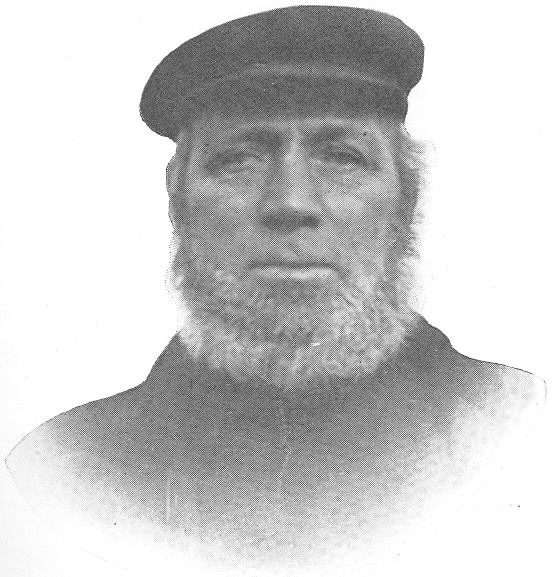
Here I found Posh. At that time, little more than a year
ago, I wrote of him as “a hale, stoutly-built man of over
the middle height, his round, ruddy, clean-shaven face encircled
by the fringe of iron-grey whiskers running round from ear to ear
beneath the chin. His broad shoulders
were held square, his back straight, his head poised firm and
alert on a splendid column of neck.”
Alas! The description would fit Posh but poorly now.
“Yes,” said he. “I was Mr.
FitzGerald’s partner. But I can’t stop to
mardle along o’ ye now. I’ll meet ye when
an’ where ye like.”
I made an appointment with him, which he failed to keep.
Then another. Then another, and another. I lay wait
for him in likely places. I stalked him. I caught
stray glimpses of him in various haunts. But he always
evaded me.
I think old Mrs. Capps got tired of leaning her head out of
the third-floor window of No. 2 Chapel Street, and seeing me
waiting patiently on the doorstep expectant of Posh.
At length I cornered him (from information received) fairly
and squarely at the Magdala House, a beerhouse in
Duke’s Head Street, two minutes’ walk from his
lodgings.
I got him on his legs and took him down Rant Score to Bill
Harrison’s.
“Now look here,” said I. “What’s
the matter? You’ve made appointment after
appointment, and kept none of them. Why don’t you
wish to see me?”
Posh shuffled his feet on, the sanded bricks. He drank
from the measure of “mild beer” (twopenny), for which
he will call in preference to any other liquid.
“Tha’ss like this here, master,” said
he. “I ha’ had enow o’ folks a
comin’ here an’ pickin’ my brains and
runnin’ off wi’ my letters and never givin’ me
so much as a sixpence.”
“Oho!” I thought. “That’s where
the rub is.”
I gave him a trifling guarantee of good faith, and his face
brightened up. Gradually I overcame his reserve, and
gradually I persuaded him that I did not seek to
rob him of anything. I’m a bit of a sailor myself,
and I think a little talk of winds, shoals, seas, and landmarks
did more than the trifling guarantee of good faith to establish
friendly relations with the old fellow.
But he made no secret of his grievance, and I tell the tale as
he told it, without vouching for its accuracy, but confident that
he believed that he was telling me the truth. And, if he
was, the man referred to in his story, the man who robbed him to
all intents and purposes, is hereby invited to do something to
purge his offence by coming forward and “behaving like a
gennleman”—upon which I will answer for it that all
will be forgiven and forgotten by Posh.
“Ye see, master,” said Posh, “that was a Mr.
Earle” (I don’t know if that is the correct way of
spelling the name, because Posh is no great authority on
spelling; but that’s how he pronounced
it) “come here, that’ll be six or seven year ago, and
he axed me about the guv’nor, and for me to show him any
letters I had. He took a score or so away wi’m, and
he took my phootoo and I told him a sight o’ things,
thinkin’ he was a gennleman. Well, he axed me round
to Marine Parade, where he was a stayin’ with his lady, and
he give me one drink o’ whisky. And that’s all
I see of him. He was off with the letters and all, and
never gave me a farden for what he had or what he l’arnt
off o’ me. I heerd arterwards as the letters was sold
by auction for thutty pound. I see it in the paper.
If he’d ha’ sent me five pound I’d ha’
been content. But he niver give me nothin’ but that
one drink. And ye see, master, I didn’t know as
yew worn’t one o’ the same breed!”
I have endeavoured to trace these letters, and to identify
this Mr. Earle. Mr. Clement Shorter has been kind enough to
do his best to help me. No record can
be found. And to clinch matters, Dr. Aldis Wright (whom I
cannot thank enough for all his kindness to me in connection with
this volume) tells me that he has never been able to find out
where the letters are or who has them. One thing is
certain: the person who took advantage of Posh’s ignorance
will not be able to publish his ill-gotten gains in England so
long as any copyright exists in the letters. For no letter
of FitzGerald’s can be published without the consent of Dr.
Aldis Wright, and he is not the man to permit capital to be made
out of sharp practice with his consent. I have heard
rumours of certain letters to Posh being published in America,
with a photograph of Posh and Posh’s
“shud.” They may have been published under the
impression that they were properly in the possession of the
person holding them. I know nothing of that, nor of what
letters they are, nor who published
them, nor when and where they were issued. But I do know
what Posh has told me, and if the volume (if there is one) was
published in America by one innocent of trickery, here is his
chance to come forward and explain.
I was glad to see that Posh no longer numbered me among
“that breed.” But I was no longer surprised at
the difficulty I had experienced in getting to close quarters
with the man. From that time on he was the plain-speaking,
independent, humorous, rough man that he is naturally. He
has his faults. FitzGerald indicates one in several of his
letters. He is inclined to that East Anglian characteristic
akin to Boer “slimness,” and it is easy enough to
understand that the breach between him and his
“guv’nor” was inevitable. The marvel is
that the partnership lasted as long as it did, and that that
refined, honourable gentleman (and I doubt if any one was ever
quite so perfect a gentleman as Edward FitzGerald)
was as infatuated with the breezy stalwart comeliness of the man
as his letters prove him to have been.
As all students of FitzGerald’s letters know, the
association between FitzGerald and Posh ended in a separation
that was very nearly a quarrel, if a man like FitzGerald can be
said to quarrel with a man like Posh. But Posh never says a
word against his old guv’nor’s generosity and
kindness of heart. He puts his point of view with emphasis,
but always maintains that had it not been for other
“interfarin’ parties” there would never have
been any unpleasantness between him and the great man who loved
him so well, and whom, I believe in all sincerity, he still loves
as a kind, upright, and noble-hearted gentleman.
And as Posh’s years draw to a close (he was born in
June, 1838) I think his thoughts must often hark back to the days
when he was all in all to his guv’nor. For evil
times have come on the old fellow. He is no longer the
hale, stalwart man I first saw at Bill Harrison’s.
A little before the Christmas of 1906 he was laid up with a
severe cold. But he was getting over that well, when, one
Sunday, a broken man, almost decrepit, came stumbling to my
cottage door.
“The pore old lady ha’ gorn,” he said.
“She ha’ gorn fust arter all. Pore old
dare. She had a strook the night afore last, and was dead
afore mornin’.”
Into the circumstances of his old landlady’s death, of
the action of her legal personal representatives, I will not go
here. It suffices to say that Posh and the other lodgers in
the house were given two days to “clear out” and that
I discovered that the old fellow had been sleeping in his shed on
the beach for two nights, without a roof which he could call his
home. Thanks to certain readers of the Daily Graphic
and to the members of the Omar Khayyám Club, I had a fund in hand for
Posh’s benefit, and immediately put a stop to his
homelessness. Indeed, he knew of this fund, and that he
could draw on it at need when he chose. But I believe the
old man’s heart was broken. He has never been the
same man since. The last year has put more than ten years
on the looks and bearing of the Posh whom I met first. But
his memory is still good, and I was surprised to see how much he
remembered of the people mentioned in the letters published in
this volume when I read them through to him the other day.
He cannot understand how it is that these letters have any
value. He tells me he has torn up “sackfuls on
’em” and strewn them to the winds. The actual
letters have been sold for his benefit, and I think that
FitzGerald would be pleased if he knew (as possibly he does know)
that his letters to his fisherman friend, have proved a stay to
his old age.
I have done my best to give approximate dates to the
letters, and where I have succeeded in being absolutely correct I
have to thank Dr. Aldis Wright, whose courtesy and kindliness,
the courtesy and kindliness from a veteran to a tyro which is so
encouraging to the tyro, have been beyond any expression of
thanks which I can phrase. I hope that the letters and
notes may help to make a side of FitzGerald, the simple human
manly side, better known, and to enable my readers to judge his
memory from the point of view of those old shrimpers by the new
basin as a “good gennleman,” as a
noble-hearted, courageous man, as well as the more artificial
scholar who quotes Attic scholiasts in a playful way as though
they were school classics. Every new discovery of
FitzGerald’s life seems to create new wonder, new
admiration for him; and there are, I hope, few who will read
without some emotion not far from tears
the sentence in his sermon to Posh.
“Do not let a poor, old, solitary, and sad Man (as I
really am, in spite of my Jokes), do not, I say, let me waste my
Anxiety in vain. I thought I had done with new Likings: and
I had a more easy Life perhaps on that account: now I
shall often think of you with uneasiness, for the very reason
that I had so much Liking and Interest for you.”


