The aged Tsar was dying, and his three sons and three daughters were
standing round his bed. He had yet strength to give his last commands,
which were extraordinary.
'It is my will, O my sons,' he said, 'that you give my daughters in
marriage to the first suitors that come to demand them. Question me not,
but fulfil to the letter this, my last injunction. If you fail, my curse
will fall upon you.'
These were the Tsar's last words before he died. It was approaching the
hour of midnight when he passed away; and, when the dawn found his sons
and daughters weeping for grief, they were startled by a dreadful noise.
Came a loud beating against the palace gates, and instantly an awful
tempest sprang up around the palace. Peal on peal of thunder roared, and
vivid lightning flashed. The whole place rocked and swayed and trembled
to its foundations. Then above the fearful din came a loud voice: 'In
the name of a King, open the gates!'
'Do not open!' cried the eldest brother.
'See to it that you do not open!' insisted the younger one. But the
youngest disregarded them both, and rushed to the gates.
''Tis I will open!' he flung back to them as they followed at his heels.
'Though the earth dissolve, what have we to fear? We have done no
wrong!'
With this he flung the gates wide. There was no one there, but a
sizzling light moved in towards them, and, out of the heart of it came a
clear, cold voice:
'I have come to demand the hand of your eldest sister in marriage.
Forbid me not. I await your consent, but, if you refuse, it will be at
your peril.'
The eldest brother answered at once, without a glance at the other two:
'It is unheard of! I cannot see you; I do not know you; who is to know
where or how you will bestow my sister? I might never see her again.' He
turned to the younger one and added, 'What say you, brother?'
'For my part, I will not consent,' replied he readily. 'I like not these
signs of ill omen.'
Then they both turned to the youngest.
'What say you, little brother?'
He was quick to answer:
'I obey my father, and counsel you to do the same. It is not that I fear
his curse, but I love him, and will obey his wish.'
Without waiting for any reply he ran within, and soon returned, leading
his eldest sister by the hand.
'Here,' said he, offering her to the unseen visitant, 'in accordance
with the custom of my country and the dying wish of my father, I give
you my sister for your wedded wife. May she be faithful to you.'
The Princess was then taken by an invisible hand and led away; and, as
she stepped across the threshold of the palace gates, a tremendous clap
of thunder burst overhead; the lightning flashed again, and the whole
earth rocked at the sound and sight of it; and, at terror of it, the
courtiers who had gathered round fell on their faces and prayed for
deliverance with all their might.
When the sun rose, the palace was still astir. None had slept, so none
had dreamed; therefore, when eyes met eyes, the truth was known: a
terrible thing had happened, but none knew how it had happened. All
sought to find some clue to explain the disappearance of the eldest
Princess, but there was no clue to the midnight mystery of the thing.
And on the second night the same terrible thing occurred again. The
palace was stormed by thunder and lightning till its foundations
quaked. Then, above all, came another commanding voice: 'Open the gates
immediately—in the name of a King!'
Again the elder brother demurred, and again the youngest admitted the
invisible but powerful applicant, and bestowed upon him the second
sister.
'I trust she will be loyal and faithful to you,' he said; and, as she
stepped over the threshold, the elements roared like a great lion
glutting on his prey. And still, to the courtiers who stood by, the
mystery of the thing was greater than their fear of the quakings of the
earth and the sudden gasps of icy air that smote them.
Again, on the third night, while the youngest sister, who was very
proud, was preparing to reject a suitor promised by her brothers, a
greater storm than ever swept up about the palace, and, to hear it, one
would have thought that half the world were rolling down a hill. It was
terrific, and still more terrific was a voice that cried: 'Open these
gates, in the name of a King who comes on his own business!'
As before, the two elder brothers demurred, but the youngest was more
obedient to his father's dying wish. He bestowed the youngest sister
upon the first to seek her hand. And, as she stepped over the threshold,
the whole palace trembled and fluttered as if disturbed by the wings of
a thousand giant eagles.
The two elder brothers mourned and grieved for their sisters, saying
they were lost for ever. How could they see them again? How could they
visit them? They were gone—swallowed up in the invisible.
'It is not so,' said the youngest. 'We have fulfilled our father's
command. We have done no wrong; though the skies fall down, what have we
to fear? Follow me forth: we will go and search for them!'
And so, not knowing what had befallen their sisters, nor whom they had
married, they set out to search far and wide for them.
After journeying for some days, they reached a wild, inhospitable
country, where, in a mighty forest so dense they could see neither the
sun by day nor the stars by night, they lost their way. But still they
pushed on, hoping to find an outlet. At last, after wandering for days,
they came at sunset to a small lake, where they prepared to pass the
night.
The eldest watched while the two younger brothers slept.
In the middle of the night, while his brothers slept soundly, he was
gazing upon the waters of the lake, watching the moonbeams play with the
ripples stirred by the soft night wind, when he saw a great black head
appear on the surface and rapidly approach the shore where he was
standing. Presently, as the monster emerged from the water, he found
himself face to face with a great alligator rushing upon him to devour
him.
Like lightning he drew his sword and smote the alligator between the
eyes, cleaving its head in one mighty stroke. Then, when it had ceased
its death struggles, he cut off both its ears and placed them in his
haversack.
As his brothers still slept he resolved to say nothing about the matter,
and, to this end, he rolled the carcase of the alligator down the
shelving shore into the water, where it sank like lead. At sunrise he
roused his brothers, and, with few words, they resumed their wandering.
After three days struggling through the forest, they came to another
lake, where they camped for the night. This time the second brother
watched, while the eldest and the youngest slept.
And he, too, had a strange adventure, but more terrible than that the
eldest brother had encountered. At midnight the waters of the lake began
to move, and a great alligator with two heads emerged and came up on the
shore. Then, with both mouths wide open and his long sharp teeth
gleaming in the moonlight, the monster rushed at the watcher and the
sleepers. But the watcher sprang forward, sword in hand, and dealt two
terrific blows, one on each head, killing the alligator instantly. Then
he cut off the four ears and placed them in his haversack, and rolled
the huge carcase back into the lake. As the eldest brother had done, he
kept the matter to himself, and let his brothers sleep on.
In the morning he aroused them, and they all set out again on their
wandering.
During that day they came to the edge of the forest, but only to find a
vast desert before them. Their hearts sank within them, but, nothing
daunted, they set forth, saying one to the other, 'There is no desert
that has no boundaries. We shall come to the other side.'
But for three whole days they journeyed on, and all was still desert as
far as the eye could see; and their food and water were exhausted, and
they were sore distressed. Then, as they saw that the desert had no end,
they cried to God to deliver them. And it seemed that the haze of the
desert lifted, and they saw before them a lake, calm and peaceful. On
its shore they would spend the night.
Having refreshed themselves from its waters, and eaten of some luscious
fruits that grew upon its margin, they made their camp; and this time
the youngest brother watched while the other two slept.
And he, also, had an adventure, but far more terrible than either of his
brothers had encountered. As they were sleeping soundly, and he was
looking at the still surface of the lake, something heaved up out of the
depths and swam rapidly towards him. When it came up out of the water he
saw that it was a monstrous alligator, with three heads. As it advanced
upon him, with all three mouths wide open, ready to devour him and his
sleeping brothers, he sprang to meet it, and, with three mighty strokes
like flashes of lightning, severed the three heads from the body. Then
he cut off the six ears and placed them in his haversack. As the other
two brothers had done, he, also, kept the matter to himself.
It was not yet dawn, and the fire was burning low. In order to replenish
it the young Prince went into the surrounding desert to look for fuel.
After searching for some time in vain, he mounted a rock and looked
around; and there, not very far away, he saw the gleam of a fire. He ran
towards it, knowing he should find some fuel. But, when he arrived at
the place where the fire was burning, he found the glare of it came from
within a large cave. Creeping forward cautiously, he peered in, and saw
a strange sight. The fire was blazing in the middle of the floor, and
round it sat nine giants, eating the flesh of human beings, whose limbs
they drew from a huge cauldron over the fire.
Horrifying was this sight to the Prince. He made up his mind to trick
the giants. He advanced boldly into the cave and gave them greeting.
'Good-morrow, my friends,' he cried jauntily; 'I've been searching for
you everywhere.'
'Good-morrow, friend!' replied the biggest of the giants. 'And, if
you're indeed one of us, you will, of course, join us in our feast, and
then help us in our search for more.'
'With every pleasure!' cried the Prince; 'indeed, I need hardly thank
you for the kind invitation, since I am at all times ready to assist you
in your hunting expeditions. I have a rare tooth for the flesh of
mortals, and the bigger they are the better I like them.'
The giants looked at one another and grunted approvingly. Then said the
chief: 'Since you are with us, what is your name?'
'I am Nine Man Mord,' replied the Prince, taking the name of that hero
of a far land who had slain nine men in so many strokes of his sword. 'I
have journeyed from the North and have come to dwell among you, and be
one of you.'
They were all astonished, for they had heard wonderful stories of Nine
Man Mord; and they seemed to forget that they themselves were nine.
'Come, Nine Man Mord!' they cried; 'come, sit and eat with us.'
Readily the Prince took his place among them; but, though it seemed to
them that he ate of the human flesh, he did not really do so. While
pretending to eat, he told them such tales of his adventures in the far
country that none of them noticed he was not eating, but disposing of
the flesh cunningly, sometimes by throwing it behind him, and again by
offering a tit-bit to one or another in token of friendship.
When the feast was over, the giants rose and stretched themselves.
'Now,' said the biggest one, 'we'll go a-hunting. There's always
to-morrow's feast to be thought of. We go, O Nine Man Mord, to the
Tsar's city. There is still good flesh to be got there, though we have
been feeding on it for many, many years. And, I may tell you, as the
prey is not so plentiful as it used to be, it affords all the better
sport in the taking.'
'I'm with you,' replied the Prince, 'and, maybe, I can show you a trick
or two.'
So they set out and journeyed together—the nine giants and the
Prince—till they came to the outskirts of a large and beautiful city.
Here, in the surrounding forest, the giants plucked up two great trees
by the roots, and took them to the city walls, where they placed one
tree as a ladder.
Then the chief giant said to the Prince: 'O Nine Man Mord, climb by this
to the top of the wall, and then we will pass the other tree up to you
so that you can fix it as a ladder on the other side for all of us to
descend by.'
The Prince climbed the tree-ladder; and, when he had reached the top of
the wall they pushed the other tree up to him.
'Now,' he called down, 'I don't quite know how you want it placed. Will
one of you come up and show me?'
In answer to this the chief himself climbed up and swung the tree over
roots first, while he held and steadied it by its topmost branches. At
this moment the Prince, unseen by the others, drew his sword, and, with
one stroke, hewed off the giant's head. It fell within the city walls,
and, in another second, the headless body went tumbling after it.
'Now,' he cried down to the others, 'it's all fixed, and your chief has
gone down. Come up one by one, and I will hold the tree for you, and
steady it, so that you can reach the ground quickly.'
And they came up one by one; and, one by one, off went their heads; and
they, and their bodies after them, reached the ground very quickly. Then
he climbed down the tree, and over the piled carcases of the nine
giants, and made his way into the city.
It was true what the giants had said; for, although the sun had not yet
risen, signs were not wanting that the city, if not deserted, was very
thinly inhabited. The streets were neglected; the houses for the most
part were falling to decay; and though, no doubt, those who remained—if
any—feared a visit from the man-eating giants, still no watch was set,
and the Prince, as he made his way through the streets, saw no one.
At last, as he went on, he espied a high tower, and, at one of its
windows, there was a light. He made his way to this tower, and quickly
ran up the stairs leading to the room that contained the light. At last,
seeing its rays through the crack of the door, he turned the handle and
entered.
A strange sight met his gaze as he stood a moment on the threshold. It
was a splendid apartment of velvet and gold, magnificently decorated;
but what immediately riveted his eyes was the figure of a beautiful
princess sleeping upon a richly furnished couch. She was lovely to look
upon; and, as he advanced into the room, he could see nothing but her.
Presently, however, a hiss greeted his ears; and, looking up, he was
startled to see a huge snake lying on the ledge above the couch, with
its arched neck bent down ready to strike the sleeping girl.
With a loud cry the Prince tried to attract its attention; then, as it
raised its head, he snatched his dagger from his belt, and, with one
blow, pinned its head to the wall.
'Hold wood! Hold dagger!' he cried, releasing the hilt. 'None can draw
that blade from the wall but him who planted it there!'
Then, without waking the beautiful maiden, he stole from the room and
went back over the city wall, and beyond, till he came again to the
giants' cave, where he quickly gathered some fuel and hurried back to
his brothers, whom he found still sleeping. When he had set the fire in
a blaze, he watched till the hour of sunrise, and then woke them with a
loud cry:
'Arouse ye, my brothers; the day is here!'
But he told them nothing of his adventures of the night.
When they set out they came very soon to a high-road that led to the
gates of the Tsar's city. Now it was the daily practice of the Tsar to
walk in the ways of the city for an hour after sunrise, and bewail the
death of those of his people who had perished by the hands of the
giants, and also to pray fervently that his own daughter would never so
perish. So it was that on this same morning he came, by his wanderings
through empty streets, to the part of the wall where the tall
tree-ladder was standing; and, as he drew near, he saw with amazement
the great bodies of the giants lying on the ground, each with his head
severed from his body.
When the Tsar saw this he raised his hands to high heaven and cried,
'This is a great day, for the giants are all slain!' And the people, who
still remained to him, hearing his cry of joy, came running, and
gathered about him, praying that God would preserve the mighty one who
had done this astonishing deed. They were still praising the unknown
hero, when some attendants came running swiftly from the palace, to tell
the Tsar that a great snake had almost succeeded in killing the
Princess.
At this he hastened back and made his way to the room in the tower where
the Princess was lying asleep; and there he found the snake pinned to
the wall by a dagger. At once he took the hilt in his hand and tried to
drag it from the wall, but, to his great wonder, it resisted all his
efforts.
On this, seeing the great strength of the hero who had planted the
dagger there, and knowing that none but he could have the strength to
remove it, he ordered a proclamation to be issued throughout the whole
kingdom: that, if the man who had killed the nine giants and pinned the
head of the snake to the wall with his dagger, would come and draw his
dagger forth again, he would be rewarded with splendid gifts and receive
the Princess in marriage.
Far and wide went this proclamation, but the Tsar, to make doubly sure,
posted a thousand officials at as many inns on the great high-roads that
connected the city with the outlying parts of the kingdom. And these
officials' duty was to question travellers, and learn whether they had
met, or heard of, any such hero as he who had killed the giants and
transfixed the snake. Rewards were offered to any who could supply
information, and punishments were held out to those who concealed it.
Now it so happened that the three Princes, in their search for their
sisters, chanced to rest at an inn on one of the high-roads; and, when
they had finished supper, they fell into conversation with an
interesting stranger—a courtly man of cities, with manners that are
only learnt in kings' palaces. He begged to be allowed to call for
wine,—which in those days was no offence,—and, as they drank their
toasts, he fell to narrating his wonderful exploits in a far-off
kingdom—so far-off, indeed, that imagination alone could reach it, and
no other traveller could ever return to tell a different tale.
After describing some heroic combats the stranger at last remarked, 'And
what may be the doughty deeds that you young heroes have set to your
credit?'
At this the eldest brother told how he had slain the alligator; and, to
vouch for the truth of his story, showed the two ears he had preserved,
placing them before the stranger.
When the unknown had applauded his story the younger brother told how he
had slain the alligator with two heads, and threw down on the table
the four ears as evidence.
The stranger applauded more loudly than before, and then turned to the
youngest brother; but he remained silent.
'Come,' said the stranger, coaxing him; 'your brothers have performed
great exploits: have you not followed their example?'
Then the young Prince replied: 'I am only young; but, now I think of it,
I did kill an alligator once, myself. It was a rather ferocious beast
in its way, and had three heads; but I managed to—well, here are its
ears.' And he threw the six ears on the table.
At this his two brothers were as much astonished as the stranger; for,
though he was the youngest, he had done the bravest deed. The
official—for such was the stranger—then begged the young Prince to
tell of his other exploits. So the hero told how he had slain the
giants. This was enough for the official: he sprang up and hastened away
to the palace, where he informed the Tsar that he had found the mighty
hero for whom every one was searching.
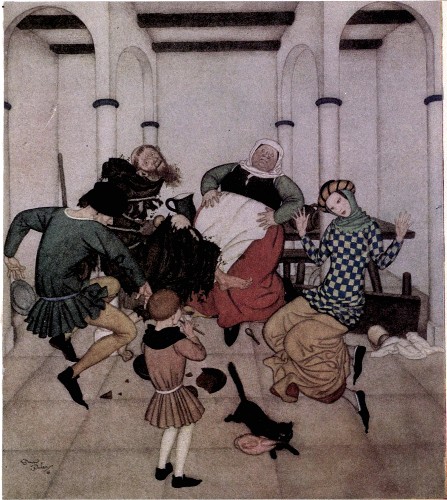
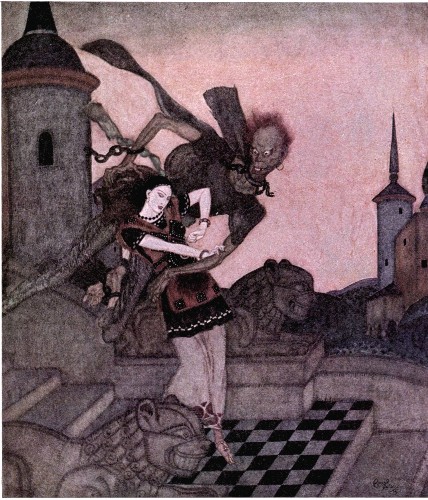 THE STORY OF BASHTCHELIK
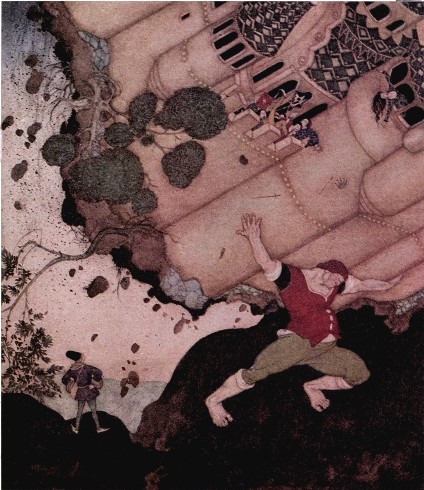
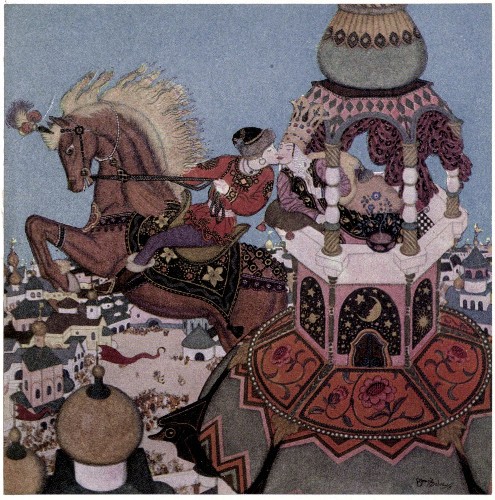
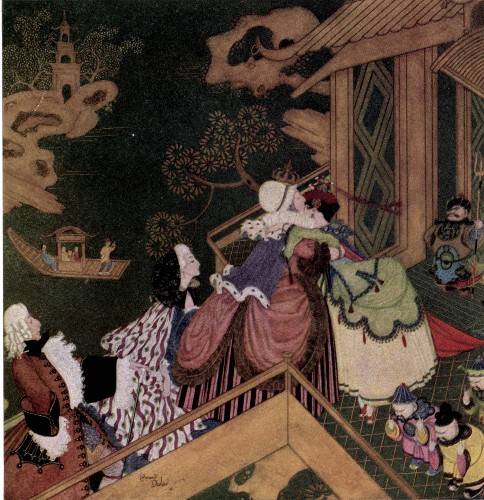
The Prince, looking out, saw him snatch up the Princess ... and soar
rapidly away.
See page 108
The Tsar was delighted; and having rewarded the official, sent for the
Princes in all haste. When they arrived, he bade them tell all they had
been through, and listened to their adventures with all attention. And,
when they had finished, he turned to the youngest brother and said:
'Your exploits, young sir, are the most extraordinary of all I have
heard. But all of you follow me to the tower; I would make
certain—quite certain!'
Beckoning the three brothers to follow him, he led the way; and,
finally, they reached the room where the youngest had pinned the snake's
head to the wall.
The couch was empty, but the snake and the dagger were still there, just
as the young Prince had left them.
Then said the Tsar, addressing the eldest: 'Draw forth the dagger!'
The eldest brother seized the hilt, and put forth all his strength; but
the dagger did not move.
Then said the Tsar: 'It is so. Let your younger brother try.'
His words were obeyed; but the dagger was immovable.
Then said the Tsar: 'It is so. Let the youngest try.'
His words were obeyed. The youngest Prince took the hilt, and, with a
mighty wrench, tore it from the wall; then, as he restored it to its
sheath at his side, the snake fell at his feet.
'It is so!' said the Tsar. 'It was your hand saved my daughter's life. I
will give her to you in marriage, and you shall be my Prime Minister.'
Then, to the two elder Princes, he said: 'If you would prefer to remain
with your brother in my country I will bestow two ladies of the land
upon you for wives, and give you suitable castles to live in.'
But, though the youngest accepted the Tsar's offer with a proud
pleasure, the other two excused themselves with thanks, saying that it
was only right for their brother to remain, but, for themselves, their
duty was to carry out the quest for their lost sisters.
The Tsar honoured their refusal, and, having given orders that they
should be escorted from the city with every mark of royal favour, bade
them farewell; and they departed the richer by two asses laden with
gifts of gold and silver and precious stones. Shortly afterwards, the
youngest Prince and the Princess were married; and the whole city
rejoiced for three days with great celebrations.
But the Prince, much as he loved his wife, soon began to blame himself
for accepting this great happiness so easily when the quest of his lost
sisters was his first duty. On this account he began to pine, and the
Princess could not comfort him.
One day, when his grief threatened to sink him in remorse, the Tsar came
to him with a bunch of nine keys in his hand, and said: 'My son; I am
going forth to the hunt; but you remain, and, with these keys, you may
open some delights while I am absent.'
Then he took him and showed him the doors of nine rooms of the palace,
assuring him he would find great joy in the first four, a more hidden
joy in the next three, and, in the eighth, a summing up of all the joys
in the four and the three; but—the ninth he must not enter; for, what
was there, no man could endure.
When the Tsar had gone to the hunt, the young Prince opened the doors
one by one, and he was truly amazed at what was revealed to him. The
first four led him to all the delights of earth; the next three to all
the delights of heaven; and the eighth to the Great Joy of Earth and
Heaven in one.
And now he stood at the door of the ninth.
'What is here?' said he. 'What is here that is denied me? I have slain
the three-headed alligator; I have hewed off the heads of nine giants; I
have vanquished the serpent that encircles the world, and rescued the
Princess from his lowering fangs. Surely the Tsar is testing me! Come
what may, I will enter at this door; for he who does not go on, slides
back.'
With this he selected the key; and, inserting it in the lock, opened the
ninth door, and entered. What an unexpected sight was there! The joys of
the four, the three, and the eighth—were they at last bound up in
this?—this man with the strength of the under-world in his limbs, the
strength of the mid-world in his set face, and the strength of the skies
in his calm gaze beneath tortured brows?
There, before him, was a man, bound, it seemed, by all the bonds of the
universe. His legs were encircled with bands of iron, which, at their
fastenings into the floor, were rusted. His hips and loins were bound
with lead. A copper girdle held his breast. A silver band enthralled his
tongue and hands, and what seemed like a spider's web of thin,
light-blue wire encircled his body and gathered itself in a circlet of
the same woven material upon his brows. Truly, if ever a man was fast
bound, this man was; for, in addition to all these things, there was a
ring of gold round his neck, and from it extended thick cables of
platinum, which were firmly riveted into four strong beams, one in each
corner of the room. Around him, on the eight sides of the room, were
open windows revealing all the joys of the eight chambers; but the man
was bound in the centre.
And, as the Prince looked upon him, the captive gasped, 'O young man,
for the love of God, bring me a cup of water from yonder fountain; and
I, in return, will give thee another life.'
The Prince at once drew him the draught from the nearest fountain,
thinking the while that it would be good to have a life to spare. Then,
when the chained captive had drunk the water eagerly, the two looked at
one another.
'What is your name?' asked the Prince.
'My name is Bashtchelik, which, as you know, means "real steel."'
'Farewell, then, Bashtchelik; I hear the hoof-beats of the Tsar's horses
in the distance.' And he turned towards the door.
'Nay, leave me not!' cried Bashtchelik, and then he implored him: 'Give
me a second cup of water, and I will give you a second life.'
The Prince drew him another cup of water and handed it to him with a
good heart, thinking, as it was returned to him empty, that a second
life was well worth having. Then, hearing the approach of the Tsar more
distinctly, he bade farewell a second time and turned away; but the
captive again besought him.
'O mighty one!' he cried; 'do not leave me. I know thee, I know thy
name; I know thy noble deeds. Twice hast thou given me to drink; I pray
thee, do it yet a third time and I will give thee a third life.'
Hastily the Prince filled the cup and gave him to drink, for the Tsar
and his company were now at the gates, and he knew not how to face him.
But, before he could gain the door, he heard a crash behind him; and,
looking back, he saw that the captive had broken his bonds and stood
free. Then, before one could say it had happened, he had loosed a great
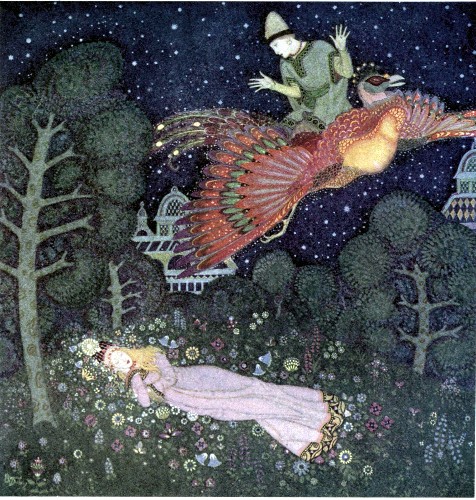
pair of wings from his sides, and rushed through the doorway. The
Prince, looking out, saw him snatch up the Princess, his wife, from the
terrace of the Palace, and soar rapidly away.
Ere the beating of wings was lost in the distance, the Tsar came in and
demanded to know why the ninth room was open and the captive gone. The
Prince then explained everything, and begged the Tsar not to be angry.
'He broke his bonds,' he said, 'and has gone, taking my wife—the
daughter that you gave me—away with him. But give me leave, and I will
find her and kill Bashtchelik.'
'Alas!' replied the Tsar, 'you have done a rash thing. You know not this
man. I lost the best part of a whole army in capturing him. What can you
do, my son?'
'I will go forth and seek him,' replied the Prince without wavering. 'If
he is stronger than I, then you will see neither me nor my wife again;
but, if I prevail, we will return to you.'
So the Prince set forth on his quest; and after three days' journey, he
came to a beautiful city. And, as he rode beneath the walls of a
castle, he heard a voice from a window high in the tower, calling to
him. He drew rein and dismounted; then, as he advanced into the
courtyard, a girl came running towards him.
'O my brother!' she cried; 'you have come at last!'
It was his eldest sister whom he had found so easily. They embraced and
kissed, and then she led him into the castle.
'And your husband?' he asked as they stepped aside into a dimly-lighted
antechamber; 'who and what is he?'
'He is the Dragon King,' she replied in a whisper; 'and he is no friend
of my brothers. Yet I will hide you, and then ask him what he would do
if you sought me out.'
That evening, when the Dragon King came home on whirring wings, there
was no sign of either the Prince or his charger. Yet he raised his
nostrils in the air and sniffed.
'I smell a human being,' he said. 'Confess, woman; who is it?'
'No one,' replied she. But he was certain about the matter, saying that
his senses had never yet deceived him, though a woman might.
'That is nought,' said she. 'But, tell me; if my brothers came to look
for me, how would you take it?'
'If your eldest brother came here,' replied the Dragon King, 'I would
eat him raw. Your second brother I would stew gently over a slow fire,
or, if he were nice and fat, I should roast him to a turn; but your
youngest brother—him I would spare.'
Then said she, 'O King, my youngest brother, who is your brother-in-law,
is here in your castle. I will summon him.'
It was a great meeting between the young Prince and the Dragon King. One
would have thought that they had known each other for years. They
embraced and wished each other health and long life; and then they sat
down to a sumptuous banquet quickly brought in by winged attendants, who
were evidently of the uneducated dragon classes;—indeed, though richly
attired, they looked like slaves.
In the course of conversation the Prince happened to mention that he was
on the track of one Bashtchelik, who had run off with his wife against
her will.
'Bashtchelik!' exclaimed the Dragon King. 'My dear brother, I beseech
you, seek him not. This kingdom itself put out five thousand strong, and
took him unawares. But he escaped by a trick, gave battle to ten
thousand of my picked dragons, fought his retreat to the mountains, and
so escaped triumphant. Man to man—you against Bashtchelik—you cannot
hope to win. If you will go back to your home, I will give you an escort
and three asses laden with gold.'
'Three asses laden with gold!' said the Prince. 'I thank you much, but I
have better than that: I have three lives, which I won from Bashtchelik
himself. I will seek him and reclaim my wife.'
The Dragon King wondered at his words; then, plucking a feather from his
wing, he said, 'You are determined, and I wish you well. Take this
feather, and, if at any time you want my aid, burn it and I will come to
you instantly with ten thousand chosen dragons.'
The Prince thanked him, and placed the feather in his girdle. The next
morning he took leave of his sister and the Dragon King, and set out in
search of Bashtchelik.
He left the city and crossed a desert, where he endured fatigues and
encountered perils; but still, by his strong right arm, he preserved his
three lives. Then, at last, he came to a city; and, as he took the
mainway of it, the same thing happened as before. It was a woman's voice
calling from a castle tower: 'O Prince! Dismount and come in hither!'
Again he made his way into a courtyard, and again he was met by a
woman—his second sister—who greeted him with joy. Soon she led him
into her boudoir, and immediately he asked: 'My sister, who is your
husband?'
'He is the Eagle King,' said she.
Then, as it had happened with the Dragon King, so it happened with the
Eagle King. He came whirring home from a great height, and, by the
artfulness of his wife, he met and embraced the young Prince; for,
though the Eagle King would have pecked out the livers of the elder
brothers, he was glad to meet the youngest. A feast was spread, and,
afterwards, the talk led on to Bashtchelik.
'Bashtchelik!' cried the Eagle King. 'Young man, will you listen to me?
Once we battered him with ten thousand pairs of wings and assailed him
with ten thousand beaks, but he triumphed. For one man to go up against
him is as a thistledown attacking a whirlwind. Do nought. Stay with me:
I will give you all you desire.'
But, as the Prince held fast to his purpose, the Eagle King plucked a
feather from his wing and gave it him.
'If you are in sore straits,' he said, 'burn this feather, and, on the
instant, I will come to your aid with ten thousand eagles.'
Then the Prince, thanking the Eagle King, set forth once more. And, in
his further journeying, he again came to a city, and heard, beneath a
castle wall, a woman's voice calling to him.
It was his youngest sister. She also contrived to bring him face to face
with her husband, the Falcon King, who warned him strongly against
Bashtchelik, and gave him a feather from his wing in case of need.
After a long search and many adventures, the Prince at last found his
wife, standing at the mouth of a large cave. She was much surprised to
see him, and ran forward to embrace him. He then told her all he had
done since their parting, and she clung to him in great joy.
'Now, dear wife,' he said at last; 'now that I have found you, we will
go together to your father's palace.'
'But Bashtchelik!' she exclaimed.
'Bashtchelik is not your husband,' he replied; 'I am your husband.'
'Yes, yes; but if we flee, beloved, Bashtchelik will surely follow us.
His rage would be terrible, and I should lose you for ever, and find a
frightful punishment.'
'Nay, nay; I am your husband, and I will protect you; come!' Then he
added to himself, 'She does not know I have three lives now, and I doubt
whether Bashtchelik could kill me three times.'
So they fled together. But, some hours later, Bashtchelik returned from
hunting and found the Princess had gone. From some footprints outside
the cave he gleaned that she had not gone alone, and instantly guessed
that her husband had carried her off. With a cry of rage he sprang into
the air, and began to fly round the cave at terrific speed, and in
ever-widening circles.
The sun was low down on the Western horizon when the Prince, riding hard
with his wife on the saddle-bow, heard a whirring sound in the sky and
looked up.
'Hasten!' cried the Princess in alarm; 'it is Bashtchelik. If we can
reach the shelter of yonder forest he may not see us.'
But hardly had she spoken when an angry cry from afar fell on their
ears. Bashtchelik had seen them—seen her long, yellow hair floating on
the breeze and gleaming like gold in the rays of the setting sun. He
swerved and swooped downwards, and, madly as they rode for the edge of
the forest, he was upon them by the time they reached the outskirts.
Alighting on the ground, he tore the Princess from the Prince's arms,
and cried out in sorrowful anger, 'O Prince, I gave you three lives out
of gratitude to you, but, if you attempt to steal your wife again, I
will kill you.' And with this he mounted in the air with the Princess,
and soon disappeared in the distance, leaving the Prince lost in wonder
at the suddenness of it all.
Nevertheless he was not to be beaten. He returned to the cave under
cover of night, and, having concealed his steed, crept forward and hid
himself near the cave, to wait until Bashtchelik should go forth to the
hunt.
And he was not disappointed. Soon after the sun rose, Bashtchelik came
out from the cave, bearing his bow and arrows, and went in search of
prey. Then, when he was out of sight, the Prince dashed into the cave,
took his wife and rode away with her. But again ere sunset they heard
the whir of wings; and again Bashtchelik snatched the Princess from the
Prince's arms. And this time he placed an arrow on his bowstring and
drew it to the full.
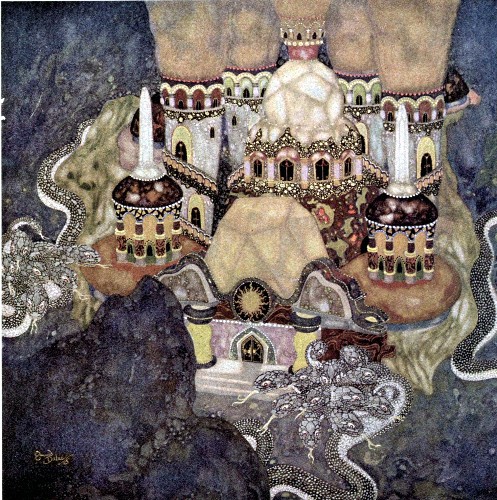 THE STORY OF BASHTCHELIK
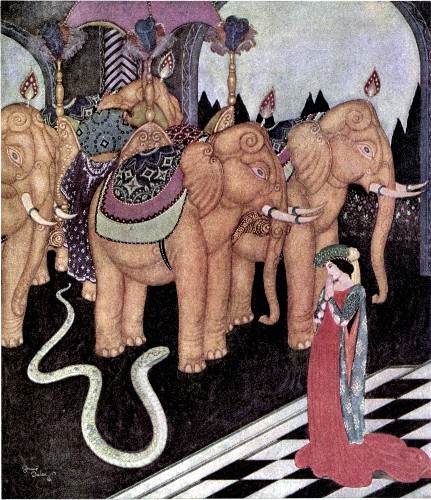
The Palace of the Dragon King.
See Page 109
'O Prince,' he said, 'I give you your choice: will you die by arrow or
sabre?'
'By sabre,' said the Prince, feeling for his own.
'Nay, nay!' returned Bashtchelik, relenting. 'Because I gave you three
lives, I pardon you a second time; but, if you attempt to steal your
wife again, I shall slay you without a thought.'
But the Prince, as he watched Bashtchelik fly away with his wife, was
not daunted. 'I wish he would stay to fight, said he; 'but maybe he will
next time, for I shall certainly take her again.'
And he did. And again they were overtaken. On this occasion it was
nowise different, save that when Bashtchelik forgave the Prince it was
in angry and threatening tones, before bearing the Princess away.
Having failed three times, the Prince rode sadly homewards. But he had
not gone far when he bethought him of the three feathers given him by
his brothers-in-law, and of their promises of help. He reined in his
steed, and turned and galloped back. He would beard Bashtchelik in his
cave, and then give battle, with three armies at his call, if,
perchance, this powerful foe should seem to prevail.
When he reached the cave it was an hour after sunrise. He leapt from his
steed and entered without knocking. There was a fire burning within, and
his wife sat by it with her head on her hand, thinking. She sprang up at
the sound of his footstep.
'You!' she cried. 'Ah! my beloved, you are in unseemly haste to quit
this life, since you come for me a fourth time.'
'Listen to me,' he said; 'for you are my wife, and none shall keep you
from me.' Then he showed her the three feathers, and explained to her
that they were pledges of help in time of need. He placed them in her
hand, and gave her also the burning-glass he used for kindling a fire,
and said: 'Do not burn them until you see the combat is going against
me. He will certainly follow us, but, this time, I think he will fight.'
The Princess seemed to agree to his wish, and, soon afterwards, they set
out and rode rapidly away.
It was high noon when they heard the whir of wings and knew they were
followed. Bashtchelik approached at a great speed, and they saw his
sabre flashing in the sun. The Prince drew rein and dismounted; then,
drawing his weapon, he advanced to meet his foe. But, ere their sabres
clashed, the Princess, fearful for her husband's life, had taken the
burning-glass and pinned the sun's rays to the feathers. A tiny curl of
blue smoke arose, and then they burst into flame.
Instantly—ere yet the heart could beat twice—there was a shrill chord
of three sounds, and as many colours shimmered like lightning in the
air. Then as the feathers blazed, came dragon hosts upon the plain;
flaming eagles flocked in; and the Falcon King with his myriads swooped
down. Bashtchelik was surrounded on three sides, but he dealt a mighty
stroke at the Prince's heart; and then, seeming invincible, fought his
way through with much slaughter and gained the side of the Princess.
Before she knew it she was caught up, and Bashtchelik was bearing her on
rapid wings away.
But the Prince? Among the thick of the slain the three kings—his
brothers-in-law—found him dead! But they took thought together as to
how they might recall him to life, and at last decided to send for some
water from the Jordan. They summoned three of the swiftest dragons and
asked how long it would take to fetch it. 'Half an hour!' said the
first. 'Ten minutes!' said the second; but the third said at once, 'Nine
seconds!'
So they dispatched him; and, like a flash, he winged his fiery flight,
returning in nine seconds with the water from the Jordan. With this they
bathed the Prince's wounds, and they healed up at once; and lo, he rose
up alive and well, but with only two lives left to him.
'Venture not again,' was the counsel of the three kings. 'Go not forth
against Bashtchelik, for he is perfect steel, the mightiest of all; and
none can conquer him: he has all Force behind him.'
But the Prince would not accept their words of warning. 'Force is not
the strongest thing,' he said. 'Force is hard as steel, yet it can be
overcome by the will of Love, which is so soft that it melts at a touch.
In that I go forth again to conquer Bashtchelik, and regain my wife.'
They could not restrain him, but, ere he went, they counselled him
again: 'Since you are willing to risk all, you must go; but think not
that by mighty blows you can conquer Bashtchelik. Get speech with your
wife, and bid her learn from him, by a woman's wit, wherein the secret
of his strength lies. Then come and tell us; and, with that knowledge,
we can help you to slay him.'
The Prince agreed, and parted from them. Making his way very cautiously
to the cave, he waited till Bashtchelik had gone forth to the hunt, and
then entered and found his wife, and bade her glean from Bashtchelik the
secret of his strength. Then he returned to his place of concealment.
That evening, when Bashtchelik returned to the cave, the Princess
praised his great strength and flattered him mightily upon it.
'Tell me, I pray thee,' she said at last, 'wherein thy great strength
lieth, and wherewith thou mightest be bound; for'—with a laugh—'I
would fain bind thee with my hair.'
Bashtchelik laughed, well pleased at her words. 'Wouldst thou know it?'
said he. 'My strength is in my sword; were that taken from me I should
then be weak, and be as another man.'
The Princess then bowed down before his sword and did homage to it, and
sang a great song of joy that all power on earth was in the sword. But,
on hearing this, Bashtchelik laughed, and laughed again, saying,
'Foolish one! my real strength lies no more in my sword than in its
scabbard.'
'Then,' said she, 'thou hast mocked me. Tell me, I pray thee, wherein
thy strength lieth.'
'In my bow and arrows,' replied he. And at once the Princess bowed down
and did homage to his bow and arrows, singing their praise: how swift
their flight through the air, how true their aim, how deadly their
piercing points.
But Bashtchelik laughed again, and again, and again.
'Foolish one!' said he. 'My real strength lies not in my bow, nor in my
arrows. But, tell me, why do you seek to know the secret of my
strength?'
'Because I am a woman; and was there ever a woman who loved a man and
did not want to know his secret?'
'Ay—to know it, and to impart it to others.'
'Nay, nay; to know it is enough. Tell me, I pray thee, and tell me
truly, wherein the secret of thy great strength lieth.'
At this he was much distressed, and, thinking that the Princess believed
her husband dead, he hoped at last to win her love; and so he told her.
'Listen to me,' said he. 'Far away in a high tableland in the interior
of this country there is a mountain reaching up to the sky, and rooted
far down into the earth. In a spot of that mountain—in a den where a
serpent lies asleep—there is a fox, and in its heart there hides a
bird. That bird is the storehouse of my strength. One flutter of its
wings would scatter a whole army; one beat of its heart would shake the
whole world—if the fox so willed it. But the will of the fox is over
mine, and what strength I have comes from the bird through the will of
the fox. And that fox is the hardest thing in the world to catch: it can
take any shape it likes. So, now, you know all.'
'You have told me truly?'
'I do not laugh: I have told you truly.'
Then the Princess dallied with him, giving ear to his tales of terror
and triumph. But, when he had supped and fallen asleep, she stole out
and told the Prince all about it. And he, bidding his wife farewell,
rode off in haste to tell his brothers-in-law. When they heard his news
they called up their forces—the dragons, the eagles, the falcons—and
proceeded forthwith against the mountain on the high tableland.
By certain signs the Prince discovered the den of the sleeping serpent,
and there they surprised the fox, who, seeing the vast array on the
sides of the mountain and on the plain, quickly took refuge in flight.
But a host of eagles and falcons tore after him and overtook him near a
great lake. Here he changed himself into a duck with six wings, and
dived and disappeared. Presently, far away on the lake, they saw him
reappear on the surface, and rise from the water, and wing his way up
into the clouds. Immediately the dragons gave chase, and the eagles and
falcons strove to encircle the swift-winged bird. Finally, seeing no way
of escape, the duck swooped to earth, and changed again into a fox. Then
the pursuers pounced and caught him.
The three kings then consulted together and decided to cut open the fox
and take its heart out. This was soon done; then they built a great fire
and threw the heart into it. And, as it burned, they saw a bird fly from
it through the flames and fall scorched at their feet. Now, as they
gazed upon it, it changed rapidly, growing in size and altering in
shape, until at last there lay before them the body of Bashtchelik, his
wings all burnt and his body charred.
So this monster perished, and the Prince regained his long-lost bride.

 SNEGOROTCHKA