New original cover art included with this eBook is granted to the public domain.
BY
DAVID MASSON
PROFESSOR OF ENGLISH LITERATURE IN THE UNIVERSITY OF EDINBURGH
LONDON AND EDINBURGH
ADAM AND CHARLES BLACK
1892
PREFATORY NOTE
The following Papers, though in their collected state
they have a certain continuity of general subject, were
written at different times and for different purposes.
One is a modified reprint of an article which appeared
in the Westminster Review as long ago as 1856.
Seven of the others were contributed, at intervals
within the last twelve years, to Macmillan’s Magazine,
The Scotsman, or The Scots Observer, and are reprinted
now with courteous permission. The remaining
five are from manuscript of various dates since
1867, and are now published for the first time. An
occasional small recurrence of fact or of phrase in
the series may be excused in consideration that the
Papers, thus written separately, may still be read
separately.
QUEEN MARY’S EDINBURGH [1] — I.—QUEEN MARY’S RETURN TO SCOTLAND, AUGUST 1561 — II.—PLAN AND FABRIC OF THE TOWN IN 1561 — III.—THE EDINBURGH POPULATION IN 1561
1
On a clear day the inhabitants of Edinburgh, by merely
ascending the Calton Hill or any other of the familiar
heights in or around their city, can have a view of
nearly the whole length of their noble estuary, the
Firth of Forth. To the right or east, its entrance
from the open sea, between the two shires of Fife and
Haddington, is marked most conspicuously on the
Haddingtonshire side by a distant conical mound,
called Berwick Law, rising with peculiar distinctness
from the northward curve of land which there bounds
the horizon. It is thither that the eye is directed if it
would watch the first appearance of steamers and ships
from any part of the world that may be bound up the
Firth for Edinburgh by its port of Leith. Moving
thence westward, the eye can command easily the
twenty miles more of the Firth which these ships
and steamers have to traverse. The outlines of both
shores, though the breadth between them averages
twelve miles, may be traced with wonderful sharpness,
pleasingly defined as they are by their little bays and
promontories, and by the succession of towns and
fishing villages with which they are studded. Of these,
2Musselburgh on the near side marks the transition
from the shire of Haddington to that of Edinburgh;
after which point the Firth begins to narrow. Just
below Edinburgh itself, where its port of Leith confronts
the Fifeshire towns of Kinghorn and Burntisland,
with the island of Inchkeith a little to the right
between, the breadth is about six miles. There the
main maritime interest of the Firth ceases, few ships
going farther up; but, for any eye that can appreciate
scenic beauty, there remains the delight of observing
the continued course of the Firth westward to Queensferry
and beyond, a riband of flashing water between
the two coasts which are known prosaically as those of
Linlithgowshire and West Fifeshire, but which, in
their quiet and mystic remoteness, look like a tract of
some Arthurian dreamland.
While something of all this is to be seen on almost
any day from any of the eminences in or near Edinburgh,
it is only on rare occasions that it can be all
seen to perfection. Frequently, even in sunny weather,
when the sky is blue above, a haze overspreads the
Firth, concealing the Fifeshire shore, or blurring it
into a vague cloud-like bank. Sometimes, on the
other hand, when there is little sunshine, and the day
seems rather sombre in the Edinburgh streets, the
view of the Firth and of the other surroundings of the
city from any of the higher spots is amazingly distinct
to the utmost possible distance, though with the
distinctness of a drawing in pen and ink. Worst of
all the atmospheric conditions for a survey of the Firth,
or of the scenery generally, from Edinburgh, is that of
the thick, dull, drizzling, chilling, and piercing fog or
mist, called locally a haar, which the easterly wind
brings up at certain seasons from the sea. Up the
3Firth this haar will creep or roll, converting the whole
aerial gap between the opposed shores into a mere
continuous trough of seething and impenetrable mist,
or of rain and mist commingled, drenching the Fifeshire
hills on the one side, enveloping all Edinburgh
on the other, and pushing itself still westward and
inland over the higher and narrower reaches of the
estuary, till the aforesaid tract of gleaming Arthurian
scenery is absorbed into the long foggy gloom, and
even Alloa and Stirling feel the discomfort. No
chance then, from any height near Edinburgh, of
seeing the ships and steamers in any part of their
course from the mouth of the Firth to the port of
Leith. If any there be, they are down in the vast
abysm of mist, at anchor for safety, or piloting their
Leithward course slowly and cautiously through the
opaque element, with bells ringing, horns blowing, and
now and then a boom from the cannon on the deck to
warn off other vessels or ascertain their own whereabouts.
So even during the day; but, when the haar
lasts through the night, and the opaque gray of the air
is deepened into an equally opaque black or umber, the
confusion is still greater. The sounds of fog-signals
from the bewildered vessels are incessant; the shore-lights
from the piers and landing-places can throw their
yellow glare but a little way into the turbid consistency;
and, if any adventurous vessel does manage to warp
herself into port in such circumstances, it is with
excited vociferation and stamping among those on
board, and no less hurry-skurry among the men ashore
who assist in the feat. Happily, an Edinburgh haar
at once of such dense quality and of long duration is
a rare occurrence. April and May are the likeliest
months for the phenomenon, and it passes usually
4within twenty-four hours. It may come later in the
year, however, and may last longer.
Just after the middle of August 1561, as we learn
from contemporary records, there was a haar of unusual
intensity and continuance over Edinburgh and all the
vicinity. It began on Sunday the 17th, and it lasted,
with slight intermissions, till Thursday the 21st. “Besides
the surfett weat and corruptioun of the air,”
writes Knox, then living in Edinburgh, “the myst
was so thick and dark that skairse mycht any man espy
ane other the lenth of two pair of butts.” It was the
more unfortunate because it was precisely in those
days of miserable fog and drizzle that Mary, Queen of
Scots, on her return to Scotland after her thirteen
years of residence and education in France, had to
form her first real acquaintance with her native shores
and the capital of her realm.
She had left Calais for the homeward voyage on
Thursday the 14th August, with a retinue of about
120 persons, French and Scottish, embarked in two
French state galleys, attended by several transports.
They were a goodly company, with rich and splendid
baggage. The Queen’s two most important uncles,
indeed,—the great Francis de Lorraine, Duke of Guise,
and his brother, Charles de Lorraine, the Cardinal,—were
not on board. They, with the Duchess of Guise
and other senior lords and ladies of the French Court,
had bidden Mary farewell at Calais, after having
accompanied her thither from Paris, and after the
Cardinal had in vain tried to persuade her not to take
her costly collection of pearls and other jewels with
her, but to leave them in his keeping till it should be
seen how she might fare among her Scottish subjects.
But on board the Queen’s own galley were three others
5of her Guise or Lorraine uncles,—the Duke d’Aumale,
the Grand Prior, and the Marquis d’Elbeuf,—with M.
Damville, son of the Constable of France, and a
number of French gentlemen of lower rank, among
whom one notes especially young Pierre de Bourdeilles,
better known afterwards in literary history as Sieur de
Brantôme, and a sprightly and poetic youth from
Dauphiné, named Chastelard, one of the attendants of
M. Damville. With these were mixed the Scottish
contingent of the Queen’s train, her four famous
“Marys” included,—Mary Fleming, Mary Livingstone,
Mary Seton, and Mary Beaton. They had been her
playfellows and little maids of honour long ago in
her Scottish childhood; they had accompanied her
when she went abroad, and had lived with her ever
since in France; and they were now returning with
her, Scoto-Frenchwomen like herself, and all of about
her own age, to share her new fortunes.
It is to Brantôme that we owe what account we
have of the voyage from Calais. He tells us how the
Queen could hardly tear herself away from her beloved
France, but kept gazing at the French coast hour after
hour so long as it was in sight, shedding tears with
every look, and exclaiming again and again, “Adieu, ma
chère France! je ne vous verray jamais plus!” He
tells us how, when at length they did lose sight of
France, and were on the open sea northward with a
fair wind, there was some anxiety lest they should be
intercepted, and the Queen taken prisoner by an
English fleet. In the peculiar state of the relations
between England and Scotland at the time, this was
not an impossibility, and would hardly have been
against the law of nations. There had been some
angry correspondence between Elizabeth and Mary
6respecting the non-ratification by Mary of a certain
“Treaty of Edinburgh” of the previous year, stipulating
that she would desist from her claim to Elizabeth’s
throne of England. Elizabeth had consequently refused
Mary’s application for a safeguard for her homeward
journey; and there was actually an English squadron
in the North Sea available for the capture of Mary if
Elizabeth had chosen to give the word. But, though
the English squadron does seem to have waylaid the
French galleys, and one of the transports following the
galleys was taken and detained for some reason or
other, the galleys themselves, by rapid sailing or by
English sufferance, threw that danger behind, and
approached the Scottish coast in perfect safety. What
then astonished Brantôme, and what he seems to have
remembered all his life with a kind of horror in association
with his first introduction to Queen Mary’s native
climate and kingdom, was the extraordinary fog, the
si grand brouillard, in which they suddenly found
themselves. “On a Sunday morning, the day before
we came to Scotland,” he says, “there rose so great a
fog that we could not see from the stern to the prow,
much to the discomfiture of the pilots and crews, so
that we were obliged to let go the anchor in the open
sea, and take soundings to know where we were.”
Brantôme’s measure of time becomes a little incoherent
at this point; and we hardly know from his language
whether it was outside the Firth of Forth altogether,
or inside of the Firth about Berwick Law, that the fog
caught them, if indeed he remembered that there was
such a thing as an estuary at all between the open sea
and Leith. He distinctly says, however, that they
were a whole day and night in the fog, and that he
and the other Frenchmen were blaspheming Scotland
7a good deal on account of it before they did reach
Leith. That, as other authorities inform us, was
about ten o’clock in the morning of Tuesday the 19th.
The Leith people and the Edinburgh people were
quite unprepared, the last intimation from France
having pointed to the end of the month as the probable
time of the Queen’s arrival, if she were to be expected
at all. But the cannon-shots from the galleys, as they
contrived to near Leith harbour, were, doubtless, a
sufficient advertisement. Soon, so far as the fog
would permit, all Leith was in proper bustle, and all
the political and civic dignitaries that chanced to be
in Edinburgh were streaming to Leith. Not till the
evening, according to one account, not till next morning,
according to another, did the Queen leave her
galley and set foot on shore. Then, to allow a few
hours more for getting her Palace of Holyrood, and
her escort thither, into tolerable readiness, she took
some rest in the house in Leith deemed most suitable
for her reception, the owner being Andrew Lamb, a
wealthy Leith merchant. It was in the afternoon of
Wednesday, the 20th of August, that there was the
procession on horseback of the Queen, her French
retinue, and the gathered Scottish lords and councillors,
through the two miles of road which led from Leith to
Holyrood. On the way the Queen was met by a
deputation of the Edinburgh craftsmen and their
apprentices, craving her royal pardon for the ringleaders
in a recent riot, in which the Tolbooth had
been broken open and the Magistrates insulted and
defied. This act of grace accorded as a matter of
course, the Queen was that evening in her hall of
Holyrood, the most popular of sovereigns for the
moment, her uncles and other chiefs of her escort with
8her, and the rest dispersed throughout the apartments,
while outside, in spite of the fog, there were bonfires
of joy in the streets and up the slopes of Arthur Seat,
and a crowd of cheering loiterers moved about in the
space between the palace-gate and the foot of the
Canongate. Imparting some regulation to the proceedings
of this crowd, for a while at least, was a
special company of the most “honest” of the townsmen,
“with instruments of musick and with musicians,”
admitted within the gate, and tendering the Queen
their salutations, instrumental and vocal, under her
chamber-window. “The melody, as she alledged, lyked
her weill, and she willed the same to be continewed
some nightis after.” This is Knox’s account; but
Brantôme tells a different story. After noting the
wretchedness of the hackneys provided for the procession
from Leith to Holyrood, and the poorness of
their harnessings and trappings, the sight of which, he
says, made the Queen weep, he goes on to mention the
evening serenade under the windows of Holyrood as
the very completion of the day’s disagreeables. The
Abbey itself, he admits, was a fine enough building;
but, just as the Queen had supped and wanted to go
to sleep, “there came under her window five or six
hundred rascals of the town to serenade her with vile
fiddles and rebecks, such as they do not lack in that
country, setting themselves to sing psalms, and singing
so ill and in such bad accord that there could be
nothing worse. Ah! what music, and what a lullaby
for the night!” Whether Knox’s account of the
Queen’s impressions of the serenade or Brantôme’s is
to be accepted, there can be no doubt that the matter
and intention of the performance were religious. Our
authentic picture, therefore, of Queen Mary’s first
9night in Holyrood after her return from France is that
of the Palace lit up within, the dreary fog still persistent
outside, the bonfires on Arthur Seat and other vantage-grounds
flickering through the fog, and the portion of
the wet crowd nearest the Palace singing Protestant
psalms for the Queen’s delectation to an accompaniment
of violins.
Next day, Thursday the 21st, this memorable
Edinburgh haar of August 1561 came to an end.
Arthur Seat and the other heights and ranges of the
park round Holyrood wore, we may suppose, their
freshest verdure; and Edinburgh, dripping no longer,
shone forth, we may hope, in her sunniest beauty.
The Queen could then become more particularly
acquainted with the Palace in which she had come to
reside, and with the nearer aspects of the town to
which the Palace was attached, and into which she
had yet to make her formal entry.
Then, as now, the buildings that went by the general
name of Holyrood were distinguishable into two portions.
There was the Abbey, now represented only
by one beautiful and spacious fragment of ruin, called
the Royal Chapel, but then, despite the spoliations to
which it had been subjected by recent English invasions,
still tolerably preserved in its integrity as the famous
edifice, in Early Norman style, which had been
founded in the twelfth century by David I., and had
been enlarged in the fifteenth by additions in the later
and more florid Gothic. Close by this was Holyrood
House, or the Palace proper, built in the earlier part
10of the sixteenth century, and chiefly by James IV., to
form a distinct royal dwelling, and so supersede that
occasional accommodation in the Abbey itself which had
sufficed for Scottish sovereigns before Edinburgh was
their habitual or capital residence. One block of this
original Holyrood House still remains in the two-turreted
projection of the present Holyrood which
adjoins the ruined relic of the Abbey, and which contains
the rooms now specially shown as “Queen
Mary’s Apartments.” But the present Holyrood, as
a whole, is a construction of the reign of Charles II.,
and gives little idea of the Palace in which Mary took
up her abode in 1561. The two-turreted projection
on the left was not balanced then, as now, by a similar
two-turreted projection on the right, with a façade of
less height between, but was flanked on the right by a
continued chateau-like frontage, of about the same
height as the turreted projection, and at a uniform
depth of recess from it, but independently garnished
with towers and pinnacles. The main entrance into
the Palace from the great outer courtyard was through
this chateau-like flank, just about the spot where there
is the entrance through the present middle façade;
and this entrance led, like the present, into an inner
court or quadrangle, built round on all the four sides.
That quadrangle of chateau, touching the Abbey to
the back from its north-eastern corner, and with the
two-turreted projection to its front from its north-western
corner, constituted, indeed, the main bulk of
the Palace. There were, however, extensive appurtenances
of other buildings at the back or at the side
farthest from the Abbey, forming minor inner courts,
while part of that side of the great outer courtyard
which faced the entrance was occupied by offices
11belonging to the Palace, and separating the courtyard
from the adjacent purlieus of the town. For the
grounds of both Palace and Abbey were encompassed
by a wall, having gates at various points of its circuit,
the principal and most strongly guarded of which was
the Gothic porch admitting from the foot of the
Canongate into the front courtyard. The grounds so
enclosed were ample enough to contain gardens and
spaces of plantation, besides the buildings and their
courts. Altogether, what with the buildings themselves,
what with the courts and gardens, and what
with the natural grandeur of the site,—a level of deep
and wooded park, between the Calton heights and
crags on the one hand and the towering shoulders of
Arthur Seat and precipitous escarpment of Salisbury
Crags on the other,—Holyrood in 1561 must have
seemed, even to an eye the most satiated with palatial
splendours abroad, a sufficiently impressive dwelling-place
to be the metropolitan home of Scottish royalty.
The town itself, of which Holyrood was but
the eastward terminus, corresponded singularly well.
Edinburgh even now is, more than almost any other
city in Europe, a city of heights and hollows, and
owes its characteristic and indestructible beauty to
that fact. But the peculiarity of Old Edinburgh was
that it consisted mainly of that one continuous ridge
of street which rises, by gradual ascent for a whole
mile, from the deeply-ensconced Holyrood at one end
to the high Castle Rock at the other, sending off on
both sides a multiplicity of narrow foot-passages, called
closes, with a few wider and more street-like cuttings,
called wynds, all of which slope downward from the
main ridge in some degree, while many descend from
it with the steepness of mountain gullies into the
12parallel ravines. Whoever walks now from Holyrood
to the Castle, up the Canongate, the High Street,
and the Lawnmarket, walks through that portion of
the present “Old Town” which figures to us the main
Edinburgh of Queen Mary’s time, and is in fact its
residue. But imagination and some study of old maps
and records are necessary to divest this residue of its
acquired irrelevancies, and so to reconvert it into the
actual Edinburgh of three hundred years ago. The
divisions of the great ridge of street from Holyrood to
the Castle were the same as now, with the same
names; but objects once conspicuous in each have
disappeared, and the features of each have been otherwise
altered.
The first part of the long ascent from Holyrood
was the Canongate. Though occupying nearly half
of the whole, and in complete junction with the Edinburgh
proper up to which it led, it was a separate
“burgh of regality,” which had formed itself, as its
name implies, under the protection of the abbots and
canons of Holyrood. By virtue of that original, it was
not yet included in the municipal jurisdiction of the
Edinburgh Magistrates and Town Council, but held
out under a magistracy of its own. Hence some
characteristics distinguishing this lower part of the
ascent from the rest. The old Canongate was by no
means the dense exhibition of dingy picturesqueness
now known as the Canongate of Edinburgh, with repulsive
entries and closes on both sides, leading to
cages of crammed humanity of the poorer sort, or to
inner recesses of bone-yards, pipe-clay yards, and the
like. It had the sparseness and airiness of a suburb
of the Court. The houses, whether of stone or partly
of wood, were pretty thickly put together, indeed,
13along the immediate street-margins, with the inevitable
access to many of them by entries and closes, but did
not go so deeply back on either side as not to leave
room for pleasant gardens and tracts of vacant ground
behind. A paved and causewayed street, ascending
continuously between two rows of houses, of irregular
forms and varying heights, but few of them of more
than three storeys; other houses at the backs of these
to some little depth all the way, reached by closes from
the street, and generally set gablewise to those in
front; and, behind these again, garden grounds and
grassy slopes and hollows: such was the ancient
Canongate. In token of its claims to be a separate
burgh, it had its own market cross, and, near this, its
own Tolbooth or prison and council-house. The
present Canongate Tolbooth, though an antique object,
is only the successor of the older Canongate Tolbooth
of Queen Mary’s time.
The ending of the Canongate and beginning of
the High Street of Edinburgh proper was at a cross
street, the left arm of which, descending from the
ridge into the ravine on that side, was called St.
Mary’s Wynd, while the arm to the right was called
Leith Wynd. Here, to mark more emphatically the
transition from the smaller burgh into the greater, one
encountered the separating barrier of the Nether Bow
Port. It has left no trace of itself now, but was a
battlemented stone structure, spanning the entire
breadth of the thoroughfare, with an arched gateway
in the middle and gates for admission or exclusion.
That passed, one was in the lower portion of the High
Street, called specifically the Nether Bow. Here, it
was not merely the increasing breadth of the thoroughfare
and the increasing height of the houses that
14showed one had come within the boundaries of the
real civic and commercial Edinburgh. No such
sparseness of building now as in the Canongate; no
mere double fringe of houses to a short depth, with
entries and closes ending in gardens and vacant
ground; but a sense of being between two masses of
densely-peopled habitations, clothing the declivities
from the ridge to their lowest depths on both sides,
and penetrable only by those courts and wynds of
which one saw the mouths, but the labyrinthine intricacy
of which in the course of their descent baffled
conception.
The same sensation accompanied one on advancing
still upwards into the middle and broadest part of the
High Street. Here the street had much the same
striking appearance as now. One saw a spacious incline
of oblong piazza, rather than a street, lined by
buildings, some of solid stone throughout and very
tall, others lower and timber-fronted, all of quaint
architecture from their basements to their peaked
roofs and chimneys, and not a few with “fore-stairs,”
or projecting flights of steps from doors on the first
floor down to the causeway. It was here, too, that
the lateral fringes of habitation down the steep alleys
were of greatest width. That on the right was
stopped only at the bottom of the ravine on that side
by a lake called the North Loch, while that on the
left, after reaching the bottom of the other ravine,
mingled itself there with an independent and very
aristocratic suburb that had grown up in the ravine
itself, under the name of the Cowgate, as a southern
parallel of relief to the main Edinburgh of the ridge
above. This low-lying, aristocratic suburb, though
accessible from the piazza of the High Street by the
15wynds and closes on the southern side, did not come
easily into the cognisance of a stranger that might be
exploring the piazza itself. He had enough to arrest
his attention where he was. One difference between
the old High Street and the present, despite their
general resemblance, consisted in a huge obstruction,
now removed, which interrupted the old High Street
at its very midmost point, immediately above the
Town Cross. Just above the spot now marked in the
causeway as the site of this Town Cross, and beginning
exactly where the great church of St. Giles protrudes
its complex pile on the left and raises into the sky its
remarkable tower and open octagonal crown of stonework,
there stood in the old High Street a stack of
lofty masonry, stretching up the centre of the street
for a considerable way, and leaving only a gloomy and
tortuous lane for pedestrians along the buttresses of
the church on one side, and a somewhat wider channel,—called
the Luckenbooths,—for shops and traffic, on
the other. The lower portion of this obstructive stack
of masonry belonged to the Luckenbooths, and was
included in the name, the basement being let out in
shops or stalls for goods, while the upper floors were
parcelled out as dwellings. The higher and larger
portion, separated from the lower by a narrow suture
called “The Kirk Stile,” was nothing less than the
famous Heart of Midlothian itself, or Old Tolbooth,
which had served hitherto as the prætorium burgi, at
once the jail of Edinburgh, its Town Council House,
the seat of the Supreme Courts of Justice for Scotland,
and the occasional meeting-place of a Scottish Parliament.
Little wonder if one lingered round this core
of the High Street and of the whole town. The
channel of the Luckenbooths on one side of the street,
16the lane between the Tolbooth and St. Giles’s on the
other, and the cross passage or Kirk Stile, were worth
more than one perambulation, if only on account of
their amusing interconnection; at the back of St.
Giles’s Church, overhanging the Cowgate, was St.
Giles’s Churchyard, the chief cemetery of the town;
and the Tolbooth alone might well detain one by its
look and the interest of its associations. In 1561 they
were voting it to be too old and decayed, if not too
unsightly, for the various and important purposes
which it had hitherto served; and within a few months
from our present date there was to be an order for its
demolition, and for the erection of another building
more suitable for those purposes, and especially for
the accommodation of the Lords of Council and
Session. But, though they did then begin to take it
down, and though a “New Tolbooth” or “Council
House” was built near it in the same part of the High
Street, the old or original Tolbooth escaped its doom,
and was left standing after all. A little re-edified, it
was to survive its more modern substitute, and to be
known till 1817 as at least the Jail of Edinburgh and
real old Heart of Midlothian. Some persons still
alive can remember it.
The Tolbooth having been passed, one was again
in an open piazza of tall or tallish houses, nearly as
broad as the former piazza, but farther up the incline,
and known indifferently as the High Street above the
Tolbooth or as the Lawnmarket. Here, also, one
could not but note the number of the closes and wynds
on both sides, plunging down the house-laden slopes
with break-neck precipitancy from the vertebral street.
At the head of this piazza, however, where it began to
narrow, and where there was an obstruction across it
17in the form of a clumsy building called the Butter
Tron or Weigh-House, there was one offshoot to the
left of greater consequence than any mere wynd or
close. This was the West Bow, a steep zigzag or
spiral kind of street of antique houses, bringing one
down to the deeply-sunk Grassmarket or Horsemarket,
i.e. to a large square space opening out from the end
of the Cowgate, and convenient for the country people
coming into the town with cattle. Refraining from
this descent by the West Bow, and keeping still to the
vertebral street, one reached the last portion of the
long causewayed and inhabited ridge. This was the
Castle Hill, a narrowish continuation of the High
Street, so steep as to require climbing rather than
walking, but up which, nevertheless, there was still a
plentiful straggling of houses, perched anyhow, with
closes and paved yards reticulating what lateral depth
of earth they could cling to, and with views of dizzying
profundity from their back windows.
All civic Edinburgh thus left behind, and a military
portal having been passed, one entered the precincts
of the Castle itself,—the high, rocky stronghold which
was more ancient than anything recognisable as most
ancient in the Edinburgh beneath, which indeed had
fostered that Edinburgh into its first existence and
growth, and in which there were relics of days older
than those of Malcolm Canmore and David I., older
than the infancy of Holyrood Abbey. After the long
walk upwards between the two lines of close-packed
houses, with perpetual mouths of mere wynds and
closes for a whole mile, it was something to emerge
into the open air, even in the battlemented exterior
esplanade or courtyard of this Castle, slanting up the
hillside to the moat and drawbridge. It was more to
18be allowed to pass the drawbridge and the other
defences, and so to pursue the winding, rock-hewn
track by which one mounted to the fortified aggregate
of guard-houses, store-rooms, and royal towers, heaved
together on the cliff-bound summit. What a platform
then to stand on, beside the cannon, in any of the
ledges of the embrasured parapet! The feeling for
scenery, they say, had not been much developed in
the sixteenth century; but no more in that century
than in this could any human eye have gazed with
indifference on the vast panorama of Scottish land and
water that burst into the vision from Edinburgh’s
Castle Rock. To the north there were villages and
farmsteads dotting the range of fields towards the
Firth which is now covered with the streets of the
New Town, and beyond these always the unwearying
loveliness of the face of the Firth, with the boundary
of the Fifeshire hills; to the west, the near Corstorphines,
and over these also a tract of varied country,
fading away up the course of the Firth into a purple
suggestion of Stirling and the first spurs of the Highlands;
to the south, the Braids and the Pentlands,
hiding the pastoral territory of the Esks and the
Upper Tweed, with its sleepy stretch towards the
Borders and England. Scores of castles and keeps,
each the residence of some nobleman or laird of distinction,
could be counted within this sweep of the eye,
north, west, and south, over the immediate vicinity of
Edinburgh. But, if one’s interest were still rather in
the town itself, it was the eastward glance that would
help most to complete and define the previous impressions.
The whole sea-approach to Edinburgh by the
Firth was now splendidly visible, with the already
described curve of the hither coast from Berwick Law
19to Leith; the road from Leith to Holyrood was plainly
discernible; and the Canongate and Edinburgh could
be looked down upon together, and seen in connected
shape and ground-plan.
However slight the defences of the Canongate and
Holyrood, Edinburgh proper, it could now be seen,
was carefully enclosed and bastioned. On the north
side, the North Loch, washing the base of the Castle
Rock and filling the valley through which the railway
now runs, was sufficient protection; but all the rest
of the town was bounded in by a wall, called the
Flodden Wall. It had been constructed mainly in the
panic after the battle of Flodden in 1513 to supersede
an older and less perfect circumvallation, but had been
much repaired and modified since. It started from
the east end of the North Loch and ran thence along
Leith Wynd and St. Mary’s Wynd, crossing the High
Street at the Nether Bow Port, and so shutting out
the Canongate; it then went so far south as to include
the whole of the Cowgate and some space of the
heights beyond the ravine of the Cowgate; and the
west bend of its irregular rectangle, after recrossing
this ravine a little beyond the Grassmarket, riveted
itself to the Castle Rock, on its most precipitous side,
at the head of the High Street. There were several
gates in the circuit of the wall besides the Nether Bow
Port, the chief being the Cowgate Port, which was
also to the east, the Kirk of Field Port (afterwards
Potter Row Port) and Greyfriars Port (afterwards
Bristo Port), both to the south, and the West Port, just
beyond the Grassmarket and the sole inlet from the
west. When these gates were closed, Edinburgh
could rest within herself, tolerably secure from external
attack, and conscious of a reserve of strength in the
20cannon and garrison of the dominating Castle. Even
if the town itself should yield to a siege, the Castle
could hold out as a separate affair, impregnable, or
almost impregnable, within her own fortifications.
Successful assaults on Edinburgh Castle were among
the rarest and most memorable accidents of Scottish
history.
Such having been the fabric or shell of Edinburgh in
1561, what was the contained life?
The entire population, the Canongate included,
was probably less than 30,000; but, confined as this
population was within such strait limits, obliged to
accommodate itself to one such ridgy backbone of
principal street, with off-going wynds and closes and
but one considerable and low-lying parallel, and having
to make up, therefore, by the vertical height of the
houses for the impossibility of spreading them out, its
compression of itself within the houses must have been
exceedingly dense. As the political capital of the
nation, the seat of Government and of the Central
Law Courts, Edinburgh not only counted a number of
families of rank among its habitual residents, but drew
into it, for part of every year at least, representatives
of the Scottish nobility, and of the lairds of mark and
substance, from all the Lowland shires. Only a few
of the greatest of these, however, had town mansions
of their own, with any semblance of sequestered
approaches and adjuncts, whether in the Canongate
or the Cowgate. The majority of the nobles and
lairds from the country, as well as of the habitual
21residents of highest rank and means, such as the
Senators of the College of Justice, had to be content
with the better portions of those several-flatted or
many-flatted tenements,—insulæ they would have been
called in ancient Rome, but “lands” was and is the
special Edinburgh word for them,—which rose at the
sides of the High Street or in the wynds and closes
that ran thence down the slopes. Distributed through
the same “lands” were the families of the “merchants”
and the “craftsmen,” the two denominations that composed
between them the whole body of the burghers
proper. There was a chronic rivalry between these
two denominations in the elections to the Town
Council and in the management of affairs generally.
The “merchants,” whose business was ship-owning,
the export and import of goods, and the sale of the
imported goods at first hand, affected the superiority
on the whole. There were individuals among the
“craftsmen,” however, as opulent as any of the
“merchants.” This was particularly the case with
the craft of the goldsmiths, always a prominent craft
in Edinburgh, and there, as in London, combining
the trade of money-lending with the more especial arts
of gold-working, silver-working, and jewellery, and
so allying itself with the merchants and their transactions.
Among the other “crafts,” all regularly incorporated
in brotherhoods, and each with its annually
elected head, called the “deacon” of that craft, were
the skinners or leather-dressers, the furriers, the
wobsters or weavers, the tailors, the bonnet-makers,
the hammermen or smiths and armourers, the waulkers
or cloth-dressers, the cordiners or shoemakers, the
wrights, the masons, the coopers, the fleshers or
butchers, the baxters or bakers, the candle-makers,
22and the barbers or barber-surgeons. Printing had
been introduced into Edinburgh in 1507; and there
had been a lingering of the craft in the town ever
since by patents or permissions, but on the very
smallest scale. To the “merchants” and “craftsmen”
and their families there have to be added, of course,
the numerous dependents of both these classes of the
burghers, called in the simple language of that time
their “servandis.” Under that name were included
not only the domestic servants of the wealthier
merchants, but also their clerks and business assistants,
and the journeymen and apprentices of the master-craftsmen,
the last a very unruly portion of the community
and known collectively as “the crafts-childer.”
Imagine all these domiciled, as was then the habit,
with their masters, and stowed away somehow, “up
and down in hole and bore,” as one old document
phrases the fact, in the workshops and “lands.” Even
then there remains to be taken into account the
miscellany of small retail traders, in shops and stalls,
which such a town required, with the peripatetic
hucksters of fish and other provisions, and the rabble
of nondescripts, living by erratic and hand-to-mouth
occupations, and hanging on about the hostelries. All
these too were “indwellers” in Edinburgh, and housed
in the wynds and closes in some inconceivable manner.
Moreover, as we learn too abundantly from the old
burgh records, actual vagrants and beggars, whether of
the able-bodied and turbulent variety, or of the cripple,
diseased, and blind, soliciting alms by obstreperous
whining and by the exhibition of their deformities,
swarmed in Old Edinburgh with a persistency which
all the police efforts of the authorities, with examples
of scourgings and hangings for several generations,
23had been unable to repress or diminish. Where they
lived in overcrowded Edinburgh only St. Giles’s
steeple could now tell.
The overcrowding had its natural consequences.
The sanitary condition of most European towns in the
sixteenth century, the best English towns included,
was incredibly bad; Scottish towns generally were
behind most English towns in this respect; but Old
Edinburgh had a character all her own for perfume
and sluttishness. It could hardly be helped. Impressively
picturesque though the town was by site and
architecture, its populousness and its structural arrangement
were hardly compatible with each other on terms
of cleanliness. Individual families, within their own
domiciles in the various “lands,” might be as tidy as
their cramped accommodations would permit; but the
state of the common stair in each “land,”—and in the
taller lands it was a dark stone “turnpike” ascending
in corkscrew fashion from flat to flat,—depended on
the united tastes and habits of all the families using it,
and therefore on the habits and tastes of the least
fastidious. It was worse in the wynds and closes. Not
only did all the refuse from the habitations on both
sides find its way into these, generally by the easy
method of being flung down from the windows overnight;
but the occupations of some of the ground-floor
tenants, butchers, candle-makers, etc.,—added contributions
heterogeneously offensive. Hardly a close
that had not its “midding” or “middings” at its foot
or in its angles. For generations the civic authorities
had been contending with this state of things and
uttering periodical rebukes and edicts for cleansing.
There were two kinds of occasions on which these
cleansing-edicts were apt to be most stringent and
24peremptory. One was the expected arrival of some
illustrious stranger, or company of strangers, from
England or from abroad. Then the inhabitants were
reminded of the chief causes of offence among them,
and put on the alert for their removal, so as not to
shame the town. More strenuous still were the exertions
made on any of those periodical outbreaks of the
Plague, or alarms of its approach, of which we hear so
frequently in the annals of Edinburgh, as of other
towns, from the fourteenth century to the seventeenth.
Then the authorities did bestir themselves, and the
inhabitants too. But, after such occasions of spasmodic
sanitary effort, there always came the relapse;
and, though there was a standing order obliging each
householder to see to the tidiness of his own little bit
of precinct, the general apathy and obtuseness prevailed.
It was providential when the heavens themselves
interfered, and some extraordinary deluge of
rain sent torrents down the closes.
Fortunately, the population did not need to remain
within doors, or in the obscurities of the wynds and
closes, more than it liked. It could pour itself out of
doors into the main street; and it did so daily with a
profusion beyond all modern custom. Any morning
or afternoon about the year 1561 the High Street of
Edinburgh, from the Castle to the Canongate, must
have been one of the liveliest and most bustling
thoroughfares in Europe. Need we cite, for witness,
that chapter in The Abbot in which Scott takes
occasion to describe it, just about this date, when he
brings young Roland Græme for the first time into
Edinburgh under the convoy of Adam Woodcock
the falconer? Scott is so excellent an authority in
such matters that his account may pass as hardly less
25authentic than that of a contemporary. We can see,
with Roland Græme, the populace “absolutely swarming
like bees on the wide and stately street”; we can
see the “open booths projecting on the street,” with
commodities of all sorts for sale, and especially
Flanders cloths, tapestry, and cutlery; we can pick
out in the crowd its most representative figures, such
as the “gay lady, in her muffler or silken veil,”
stepping daintily after her “gentleman usher,” or the
group of burghers standing together, “with their short
Flemish cloaks, wide trousers, and high-caped doublets.”
Nor are we much surprised when there come upon the
scene the two parties of richly dressed aristocratic
gallants, with their armed retinues of serving-men,
meeting each other with frowns in the middle of the
causeway, and immediately falling upon each other in
a desperate tulzie or street fight, in vindication of their
right of way, and of the hereditary feud between their
families. Scott required such a tulzie for his story, and
therefore brought it in where it suited him best. But,
though Edinburgh was famous for its tulzies or causeway-fights
between noblemen and lairds at feud, they
were hardly everyday occurrences. Once a week or
once a month was about the rate in real history. For
greater authenticity, therefore, we may seek glimpses
of the High Street of Old Edinburgh in Scottish
literature of earlier date than the Waverley Novels.
The Scottish poet Dunbar has left us two pieces
picturing very distinctly the Edinburgh of 1500–1513,
which he knew so well. He calls it “our nobill toun,”
as if patriotically proud of it all in all; but it chances
that in both the poems he is more sarcastic than
complimentary. One is an express address of objurgation
to the merchants of Edinburgh for their disgraceful
26neglect of the “nobill toun” and its capabilities.
Why, he asks, do they let its streets be overrun by
beggars, so that “nane may mak progress” through
them; why do they let the fairest parts be given up
to “tailyouris, soutteris, and craftis vyle”; why do
they let the vendors “of haddocks and of scaittis,”
and minstrels with but two wearisome tunes, which
they repeat eternally, go everywhere bawling up
and down? He complains more particularly of the
High Street. He speaks of the projecting fore-stairs
there as making “the houssis mirk”; he declares
that at the Cross, where one should see “gold and
silk,” one sees nothing but “crudis and milk,” and
that nothing is sold in all the rest of that lower piazza
but poor shellfish or common tripe and pudding; and
he is positively savage on the state of the blocked
isthmus between the two piazzas beside St. Giles’s
Church and the Tolbooth. There, where the merchants
themselves most resort, and where the light is held
from their Parish Kirk by the stupid obstructions
which they permit, they are hampered in a malodorous
honeycomb of lanes, which may suit their tastes for
exchange purposes, but is hardly to their credit!
To these particulars about the High Street from one
of the poems we may add, from the other, linen hung
out to dry on poles from the windows, cadgers of
coals with wheeled carts, cadgers of other articles with
creels only slung over their horses, and dogs and boys
in any number running in and out among the carts and
horses. All in all, Dunbar’s descriptions of Edinburgh
are satirical in mood, and sum themselves up
in this general rebuke to the Edinburgh merchants
in the first of the two poems—
27Why will ye, merchants of renown,
Lat Edinburgh, your noble town,
For laik of reformatioun,
The common profit tine and fame?
Think ye nocht shame
That ony other regioun
Sall with dishonour hurt your name?
This is hardly the Edinburgh of subsequent
romance, as we see it in Scott’s Abbot; but that
Scott had good warrant for what he wrote there,
other than his own imagination, appears from a supplement
to Dunbar furnished by Sir David Lindsay.
The Edinburgh which Sir David Lindsay knew
was the Edinburgh of a later generation than Dunbar’s,
say from 1513 to 1555; and, whether from this lapse
of time or from difference in the tempers of the two
poets, Sir David Lindsay’s Edinburgh is liker
Scott’s than Dunbar’s. Thus, in one poem of
Lindsay’s,—
Adieu, Edinburgh! thou heich triumphant town,
Within whose bounds richt blithefull have I been,
Of true merchánds the root of this regioun,
Most ready to receive Court, King, and Queen!
Thy policy and justice may be seen:
Were dévotioun, wisdom, and honesty
And credence tint, they micht be found in thee.
In another of his poems he describes Edinburgh
on a gala day, when there was a procession through
its High Street, such as he himself, as Lyon King
of Arms, might have marshalled. The occasion
was the entry into Edinburgh in May 1537 of
Magdalene, daughter of Francis I. of France, the
young bride of James V.; and the dirge-like form
of the description,—that of an indignant address to
Death,—is accounted for by the fact that the poet
is looking back on the splendours of her welcome
28into the Scottish capital when the too swift close
of her fair young life, only a few weeks afterwards,
had turned them into matter of mournful recollection,—
Thief! Saw thou nocht the great preparatives
Of Edinburgh, the noble famous town?
Thou saw the people labouring for their lives
To mak triumph with trump and clarioun:
Sic pleasour never was in this regioun
As suld have been the day of her entrace,
With great propinis given to her Grace.
Thou saw makand richt costly scaffolding,
Depaintit weell with gold and silver fine,
Ready preparit for the upsetting;
With fountains flowing water clear and wine;
Disguisit folks, like creatures divine,
On ilk scaffold, to play ane sindry story:
But all in greeting turnit thou that glory.
Thou saw there mony ane lusty fresh galland,
Weell orderit for ressaving of their Queen;
Ilk craftisman, with bent bow in his hand,
Full galyartly in short clothing of green;
The honest burgess cled thou suld have seen,
Some in scarlot, and some in claith of grain,
For till have met their Lady Soverane;
Provost, Bailies, and Lordis of the town,
The Senatours, in order consequent,
Cled into silk of purpur, black, and brown;
Syne the great Lordis of the Parliament,
With mony knichtly Baron and Banrent,
In silk and gold, in colours comfortable:
But thou, alas! all turnit into sable.
Syne all the Lordis of Religioun,
And Princes of the Priestis venerable,
Full pleasandly in their processioun,
With all the cunning Clerkis honourable:
But, theftuously, thou tyrane treasonable,
All their great solace and solemnities
Thou turnit intill duleful dirigies.
29Syne, next in order, passing through the town,
Thou suld have heard the din of instruments,
Of tabron, trumpet, shalm, and clarioun,
With reird redoundand through the elements;
The Heralds, with their aweful vestiments;
With Macers, upon either of their hands,
To rule the press with burnist silver wands.
This outgoes Scott himself for the possible pomp
of Old Edinburgh, and is poetically authentic. Later
records, however, enable us to tone down Lindsay’s
description of the High Street on a great gala day
by the sight of it on any ordinary market day.
Since the reign of James III., it appears, there
had been an authorised distribution of the markets
for different kinds of commodities through prescribed
parts of the town, with the general effect that, while
live stock and such bulkier commodities as wood and
fodder were sold and bought only in the Grassmarket
and its low-lying purlieus, the markets for all other
commodities were divided mainly between the two
piazzas of the High Street, each having its own
“tron” or weighing apparatus. Of late years, however,
there had been encroachments by each piazza
on the market rights of the other, with a good deal
of mutual complaint and bad feeling. We hear
more particularly that, about 1559, in consequence
of temporary dilapidations in the lower piazza by
recent English and French ravagings of the town,
the upper piazza, or High Street above the Tolbooth,
had drawn into it far more than its statutory share
of the market traffic. The complaints of this by
the inhabitants of the lower piazza had been such
that the Provost, Bailies, and Council passed an order
on the subject, which may be read in Dr. Marwick’s
admirable Extracts from the Burgh Records. “Upoun
30consideratioun of the thraing of mercattis abone the
Over Tolbuth, and that the passage upon all mercat
dayis is sa stoppit be confluence of peple that nane
may pas by are uther, as alsua upoun consideratioun
that the saidis landis and fore-tenementis be-eist
Nudryis Wynde [i.e. in the lower piazza] ar almaist
desolait and nocht inhabitit, beand the fairest and
braidest parts of the toun, for laik of merkattis and
resort of peple thairto”: it was decreed that in all
time coming the markets for hides, wool, and skins
should be specifically in the lower piazza. For a
while the order took effect; but, by the “procurment
of certane particular personis having thair landis
abone the Tolbuth,” the upper piazza had again
obtained the advantage. Things seem to have rectified
themselves eventually; but about 1561 there was still
this war of the markets between the two piazzas, with
a continued overthronging of the upper.
Whether in one of the piazzas or in both, one has
but to imagine the litter that would be left on market
days, and to add that to the litter disgorged into the
street upwards from the closes, or flung down into the
street from the fore-stairs, to see that a good deal
of Dunbar’s earlier description must be allowed to
descend through Lindsay’s intermediate and more
gorgeous one, as still true of the ordinary Edinburgh
of the date of Queen Mary’s return.
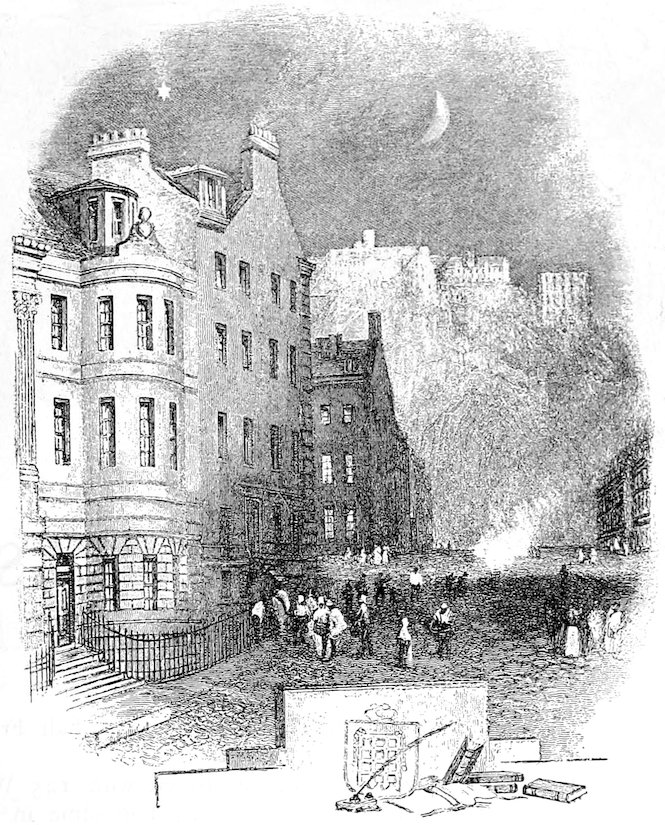
No one really knows a city who does not know it
by night as well as by day. Night obscures much
that day forces into notice, and invests what remains
with new visual fascinations, but still so that the
individuality of any city or town is preserved through
its darkened hours. Every town or city has its own
nocturnal character. Modern Edinburgh asserts herself,
31equally by night as by day, as the city of heights
and hollows. From any elevated point in her centre
or on her skirts, if you choose to place yourself there
latish at night, you may look down upon rows of lamps
stretched out in glittering undulation over the more
level street spaces; or you may look down, in other
directions, upon a succession of tiers and banks of
thickly edificed darkness, punctured miscellaneously
by twinkling window-lights, and descending deeply
into inscrutable chasms. More familiar, and indeed
so inevitable that every tourist carries it away with
him as one of his most permanent recollections of
Edinburgh, is the nightly spectacle from Princes
Street of the northern face of the Old Town, starred
irregularly with window-lights from its base to the
serrated sky-line. Perhaps this is the present nocturnal
aspect of Edinburgh which may most surely suggest
Old Edinburgh at night three hundred years ago.
For, though we must be careful, in imagining Old
Edinburgh, to confine ourselves strictly and exactly
to as much of the present Edinburgh as stands on
the ancient site, and therefore to vote away Princes
Street, the whole of the rest of the New Town, and
all the other accretions, this aspect of the Old Town
at night from the north cannot have changed very
greatly. A belated traveller passing through the
hamlets that once straggled on the grounds of the
present New Town, and arriving at the edge of the
North Loch, in what is now the valley of Princes
Street Gardens, must have looked up across the
Loch to much the same twinkling embankment of
the High Street and its closes, and to much the
same serrated sky-line, lowering itself eastward from
the shadowy mass of the Castle Rock. If the traveller
32desired admission into the town, he could not have
it on this side at all, but would have to go round
to some of the ports in the town-wall from its commencement
at the east end of the North Loch. He
might try them all in succession,—Leith Wynd Port,
the Nether Bow Port, the Cowgate Port, the Kirk
of Field Port, Greyfriars Port, and the West Port,—with
the chance of finding that he was too late for
entrance at any, and so of being brought back to his
first station, and obliged to seek lodging till morning
in some hamlet there, or else in the Canongate.
He could perform the whole circuit of the walls,
however, in less than an hour, and might have the
solace, at some points of his walk, of night views
down into the luminous hollows of the town, very
different from his first view upward from the North
Loch.
While the belated traveller was thus shut out,
the inhabitants within might be passing their hours
till bed-time comfortably enough, whether in the
privacy of their domiciles, or in more or less noisy
loitering and locomotion among the streets and wynds.
If it were clear moonlight or starlight, the wynds, and
especially the stately length of the High Street, would
be radiantly distinct, and locomotion in them would
be easy. But even in the darkest nights the townsmen
were not reduced to actual groping through their town,
if ennui, or whim, or business, or neighbourly conviviality
determined them to be out of doors. Not
only would they carry torches and lanterns with them
for their own behoof, especially if they had to find
their way down narrow closes to their homes; not
only were there the gratuitous oil-lights or candlelights
from the windows of the fore-tenements in
33the streets and wynds, sending down some glimmer
into the streets and wynds themselves; but, by public
regulation, the tenants of the fore-stair houses in the
principal thoroughfares were bound to hang out, during
certain hours of the evening, lamps for the guidance of
those that might be passing. One has to remember,
however, that people in those days kept very early
hours. By ten o’clock every night Auld Reekie
was mostly asleep. By that hour, accordingly, the
house-lights, with some exceptions, had ceased to
twinkle; and from that hour, save for bands of late
roysterers here and there at close-mouths, and for
the appointed night-watches on guard at the different
ports, or making an occasional round with drum and
whistle, silence and darkness reigned till dawn.
The Provost of Edinburgh in 1561 was Archibald
Douglas of Kilspindie, a well-known laird of the great
kin of the Angus Douglases. He had held the office
continuously by annual election since 1553, with only
two years of break. The four Bailies under him,
answering to the Aldermen of an English town, were
David Forster, Robert Ker, Alexander Home, and
Allan Dickson, all merchant-burgesses. It would
be possible, I believe, even at this distance of time,
to give the names of as many as 1000 or 1500
other persons of the population, with particulars
about not a few of them. In a town of such a size
all the principal inhabitants must have been perfectly
well acquainted with each other, and must have been
known, by figure and physiognomy at least, to the
rest of the community. We will name at present
but one other inhabitant of the Edinburgh of 1561,
who must have been about the best known of all.
This was John Knox, the chief minister of the town,
34and the stated preacher, always on Sundays and often
on week-days, in the great Church of St. Giles. His
house, or the house of which he occupied a portion,
if not then that very conspicuous projecting house
of three storeys in the Nether Bow which visitors to
Edinburgh now go to see as having been his, was
certainly somewhere in that neighbourhood. From
this point of what we have called the lower piazza of
the High Street there is a direct view upwards to St.
Giles’s Church, about 300 yards distant; and the walk
in the other direction, down the Canongate, to Holyrood
Abbey and Palace, is perhaps about twice as
much. Divide a half-mile of sloping street into three
equal parts, and Knox’s residence in Edinburgh, the
house in which he sat on the day of young Queen
Mary’s return among her Scottish subjects in August
1561, is to be imagined as just one-third down such a
slope from the great Church of St. Giles, with the
other two-thirds descending thence continuously,
houses on both sides, to the Palace in which Mary had
taken up her abode. Mary and Knox were to meet
ere long.
ROBERT ROLLOCK AND THE BEGINNINGS OF EDINBURGH UNIVERSITY [2]
35
The University of Edinburgh dates its existence
from the year 1582, when James VI. was sixteen
years of age and had been for fifteen years King
of Scotland. Till that time there had been but
three universities in Scotland,—that of St. Andrews
(1413), that of Glasgow (1454), and that of King’s
College, Aberdeen (1494). The want of a university
in the metropolis had been long felt. Especially
after the Reformation, people residing in or near
Edinburgh had begun to think it a hardship that
they had to send their sons over to St. Andrews,
or away to Glasgow, or as far off as Aberdeen, to
complete their education. Why should not Edinburgh
have a university for itself? The Magistrates and
Town Council of Edinburgh were particularly zealous
in the project; and, as far back as the reign of Mary,
they had, with the Queen’s sanction, taken some
steps towards carrying the project into effect. They
had fixed on the site of the intended new College.
It was the site on which the University now stands,
but was then a kind of suburb of gardens and straggling
buildings, partly old church edifices, known by the
36name of St. Mary in the Fields, or, more shortly,
Kirk o’ Field. They had purchased a certain right
of property here; and here, accordingly, amid the
old tenements that have been long swept away, as
well as in the gardens and bits of green field which
covered what is now the thoroughfare of South Bridge
Street, we are to fancy the Edinburgh magistrates
and ministers of Queen Mary’s reign, and perhaps
John Knox himself, pottering about sometimes in
their afternoon walks, looking at this and that, and
anticipating the College that was to be established.
But years passed on, and there were difficulties
in the way. Funds were wanting, and there was
strenuous opposition from the already existing universities;
and, before any college-building could arise
on the site of Kirk o’ Field, that site had been
made unexpectedly memorable by one of the ghastliest
of deeds. It was close to what is now the south side
of the University quadrangle that there stood the
fatal tenement in which Darnley was lodged on his
return from Glasgow when he was recovering from
the small-pox, and the explosion of which by gunpowder,
on the night between the 9th and 10th of
February 1567, hurled his corpse and that of his
servant over the adjacent town-wall, and left Mary
a widow. With other thoughts, therefore, than of
the intended seat of learning, for the uses of which
the ground had been partly purchased when this
tragedy blackened it, must the citizens of Edinburgh
for many a year afterwards have sauntered hereabouts
in the evenings. But shocks of the kind are transient;
and, when, in the quieter though still agitated days
of King James, certain liberal citizens began to
move anew for the foundation of the much-needed
37university,—chief among whom were Mr. James
Lawson, Knox’s successor as minister of Edinburgh,
Mr. William Little, afterwards Lord Provost, and his
brother, Mr. Clement Little, an Edinburgh lawyer,—there
was no dream of any other site for it than
that which had been already chosen. With creditable
quickness the Town Council proceeded to convert
the long-cherished design into a reality. Masons
and carpenters were set to work; and, what with
the patching-up of old buildings already on the
ground, what with the erection of frugal additions,
a kind of make-shift beginning of a College was at
last knocked together. A charter from King James,
dated “Stirling, 14th April 1582,” made all right.
It empowered the Lord Provost, Magistrates, and
Town Council of Edinburgh to found and gradually
complete within the city what should be to all intents
and purposes a true University, or Studium Generale.
King James, as has been said, was then still in his
boyhood. His unhappy mother was in the fourteenth
year of her captivity in England.
A material fabric for lodging the University of
Edinburgh having been thus roughly provided, all
that was further necessary was to procure teachers.
There are now between thirty and forty chairs in the
University of Edinburgh; but it is not to be imagined
that the Magistrates and Town Council of Edinburgh
had to make that number of appointments in 1582 in
order that their new College might begin operations.
They were content with a much smaller equipment.
They merely looked about for one qualified man to
begin with; and, when they had got him, they could
consider the institution fairly launched. This may
require a little explanation.
38The Charter of the new College contained provisions
for its being eventually a university of complete
dimensions, with not only a General Faculty or Faculty
of Arts (then usually called the Faculty of Philosophy),
but also the three special or professional Faculties
of Theology, Law, and Medicine. But, though the
Magistrates and Town Council looked forward, no
doubt, to the attainment of this perfection by the
University at some time or other, they were not so
ambitious at first, and, indeed, had to accommodate
their aims to the meagreness of their means. They
thought that, if they succeeded in founding the general
faculty, or Faculty of Arts, the most important part
of their work would be done, and the rest might
gradually follow. They gave all their attention at
first, therefore, to the one Faculty of Arts. To set
up this Faculty alone would, according to recent
ideas of what is essential to its equipment, require
at least seven appointments. Since 1858 the professorships
of Latin, Greek, Mathematics, Natural Philosophy,
Logic and Metaphysics, Moral Philosophy,
and Rhetoric and English Literature have been,
as it were, the Seven Golden Candlesticks of the
Arts Faculty in the University of Edinburgh,—the
seven chairs in that faculty privileged coequally
above the rest in the curriculum for graduation. In
those old days, however, there was no notion that
even as many as seven separate candlesticks were
needed. Latin was pre-eminent as the sine qua non
for all the rest. It was the language in which all
the formal instruction within every university was
then given, and with which, so far as concerned the
power of understanding it, speaking it, and to some
extent writing it, all students were supposed to be
39acquainted before they commenced their university
course. Further, in the other subjects, which were
all taught through this medium of Latin, there was
no such division of labour as at present. Mathematics
and Natural Philosophy had not then attained such
dimensions in the world of knowledge, nor were
Moral Philosophy and Rhetoric so extricated from
Logic and Metaphysics, nor was proficiency in any
or all of those subjects deemed so incompatible with
a competent knowledge of Greek, but that one and
the same professor could be expected to take students
through the whole series of studies by himself. Now
it would be but a sad jumble of superficialities that
would result from such a system of individual professorships
of everything; but in those days the totum
scibile had not come to be so monstrous or heterogeneous
an aggregate but that it might be supposed
capable of being carried with tolerable compactness
under one able man’s hat, and of being taught by
such a man more or less effectively by means of a
series of established Latin text-books. The supposition,
though absurd enough even then, was the less
absurd because the subjects were made to follow
each other in a regular order through a university
course of four years. The professor began in his
first year with the simpler subjects, and then carried
the same students, in their second, third, and fourth
years, through the more difficult subjects, until, at
the end of the fourth year, he had fitted them for
their graduation, or, as it was called, their “laureation,”
in Arts. By this method, it will be seen, the number
of Arts professors in every university required to
be but four at the most,—each professor making his
four years’ round with the same students till he had
40seen them made Masters of Arts, and then returning
to receive a new class of freshmen or entrants with
whom to repeat his round. In fact, in each of the
already established universities of Scotland there were
four such principal Arts professors, or Philosophy
professors. In some universities, it is true, there
were special professors in addition, relieving the
general professors of particular kinds of work; but
the four general or circulating professors were the
essential complement of the Arts Faculty. They
were called “regents,” by way of distinction.
It will be obvious now that, though the newly-founded
University of Edinburgh required at least
four Philosophy professors or regents before even its
Arts Faculty could be considered fully equipped, yet
one regent was enough to start with. All that was
necessary was that one fit professor should be ready
to receive the first set of students that should present
themselves. For the first year this single professor
could do the whole of the University work; and
only when he had carried his students through the
first year of their course, and had to pass on to the
second year with them, would it be necessary to
appoint a second regent, to follow him with the new
set of students who would then come to the University
doors. The third regent might be appointed
the year after that, and the fourth not till a year
later.
All this the Magistrates and Town Council of
Edinburgh, anxious for the success of the new
institution, but bound to be careful of expenses, had
calculated beforehand. It was, of course, a most
serious question with them who should be the first
regent. No one could tell how much depended on
41that. A bad appointment might wreck the University
at the outset.
Fortunately, through the recommendation of that
same Mr. James Lawson, Knox’s successor in the
ministry of Edinburgh, who had already had so
much to do with the founding of the University,
the Magistrates and Town Council selected a man
whose appointment neither the City nor the University
had any cause afterwards to regret. This was Mr.
Robert Rollock,—the Rev. Robert Rollock would
be now the designation,—then one of the Philosophy
professors in the University of St. Andrews. He
was a Stirlingshire man by birth, had been educated
at St. Andrews, was twenty-eight years of age, and
had already won good opinions among those who
knew him. A deputation having been sent to
St. Andrews to invite him to the new post, he came
to Edinburgh in September 1583 to offer himself for
inspection; and on the 14th of that month an agreement
was signed between him and the Lord Provost,
Magistrates, and Town Council. Rollock, on his part,
agreed to “enter to the Colledge newly foundit within
the burgh,” and to “exerce the office of the Regent
of the said Colledge, in instructioun, governament, and
correctioun of the youth and persones whilk sall be
committed to his chairge,” faithfully attending always
to the rules and injunctions to be given him by the
Provost, Bailies, and Council; “for the whilkis causis”
they, on their part, “binds and oblesis thame and
their successoris thankfullie to content and pay to the
said Mr. Robert the soume of fortie pundis usual
money of this realme, at twa termis in the yeir,
Candlemes and Lammes, be twa equall portionis,
and sall susteine him and are servand in their ordinar
42expensis.... Attour [i.e. moreover] the said Mr.
Robert sall repare and have, for his labouris to be
takin in instructing everie bairne repairing to the
said Colledge, yearly, as followis: to wit, fra the
bairnes inhabitants of the said burgh, fortie schillings,
and fra the bairnes of uthers, nocht inhabitants therein,
three pundis, or mair as the bairnes parentis please
to bestow of their liberalitie.” Further prospects of
remuneration and promotion were held forth to Mr.
Rollock, and there was every disposition to make him
comfortable.
An original portrait of Rollock now hangs in
the Senate Hall of Edinburgh University. It is
but a poor specimen of the painter’s art, and it
does not suggest that Mr. Rollock can have been
an Apollo. It exhibits, however, a very distinct
physiognomy,—a physiognomy so distinct, so unlike
anybody’s else, that, were Mr. Rollock to reappear
any afternoon now in the Canongate or in Princes
Street, there would be no difficulty in recognising
him. The complexion, as the portrait tells us, and
as we learn from a contemporary biographic sketch
of him, was ruddy, or ruddy with a mixture of white
(colore rubido cui candor quidam admistus); and the
hair and beard,—both cut short, so as to give a character
of round compactness to the head,—were of reddish
hue (comâ subrufâ). The biographic sketch, which
is by one who knew him well, adds that he was of
middle stature and of rather weakly health, and bears
testimony to his piety, conscientiousness, peaceful disposition,
and pleasant sociability.
It was on the 1st of October 1583 that this
round-headed, reddish-haired man, of Stirlingshire
birth, but of St. Andrews training, opened the
43first session of the University of Edinburgh by an
address delivered in the public hall of the new
premises in the presence of a crowded audience of
citizens and others. Next day, when he received
the students who came to enroll themselves in the
first class in the new University, their number, what
with those supplied by Edinburgh itself, what with
those attracted from other parts of the country, was
found to be far greater than had been anticipated.
Very soon, however, it appeared that this was not
altogether a cause for congratulation. The motley
body of the entrants had not been manipulated by
Rollock for more than a week or two when he had
to marshal them into two divisions. A considerable
number had broken down in Latin,—were found to
be so ill-grounded in that indispensable preliminary
that it was hopeless to go on with them as members
of the first University class proper, the teaching of
which had to be through the medium of Latin. To
meet this exigency Rollock proposed to the Town
Council that they should at once appoint a second
regent, and that this regent should have committed
to his charge all who were backward in Latin,
to be formed into a preparatory or Humanity class,
and drilled as such for a year, while he himself
should go on with the others in the first proper Arts
or Philosophy class. Were that done, then, next
year, when he himself should be carrying on his
students into the second class, the other regent might
form those that had been kept back, and qualified newcomers
with them, into a properly sequent first class;
and so the routine would be established. The advice
was adopted; and, on Rollock’s recommendation, the
person chosen to be Humanity teacher in the meantime,
44and second regent in regular course, was a
Mr. Duncan Nairne, a young man from Glasgow
University. Thus all was arranged; and the work
of the first session of the University of Edinburgh
proceeded,—Rollock teaching his “Bajans,” and Nairne
following with the ragged troop whom he was working
up in Latin to fit them for the “Bajan” class of
next year.
The “session” in each of the Scottish universities
extended then over ten, or even eleven, months of
every year, i.e. from the beginning of October to,
or well into, August. The practice was for the
students, or a proportion of them, to reside within
the University walls; and, though this practice soon
fell into disuse in Edinburgh, it held good at first
so far that at least some of the students were boarded
and lodged in some rough fashion within the College.
The original regulation also was that students
should wear academic costume; but against this
regulation Edinburgh opinion seems from the first
to have set its face most determinedly. It was
never really obeyed.
The infant years of the University were years of
trial and rough usage. In the jars between the
different political factions round the young King, and
struggling for the possession of him, the infant institution
was much shaken and disturbed. The Magistrates
and Town Council, however, did their best; and
Rollock was persevering and judicious. The severest
interruption to his labours came in his second session,
or 1584–5. That session had been begun with good
prospects, the property of the College having been
increased by a royal grant, and by a collection of about
300 volumes bequeathed by Mr. Clement Little to
45form the nucleus of a college library. Rollock was
proceeding, accordingly, with his second or semi class;
and Nairne, having worked up the laggards by this
time, was teaching his first class of Bajans. But in
the course of the winter Edinburgh was visited by that
scourge, “The Plague,” of the frequency of the visits
of which in those times, and their paralysing effects
on industry of all kinds, no one can be aware who
is not versed in the old annals of English and
Scottish cities. In May 1585, most of the students
having already dispersed, it was necessary to stop the
session entirely. This would not have mattered so
much, had not the alarm of the Plague continued into
the following session. That session, the third in the
history of the University, ought to have begun in
October 1585; at which time, as Rollock would then
have been carrying his students into their third or
bachelor class, and Nairne would have been carrying
his into their second or semi class, a third regent would
have had to be appointed, to undertake the new class
of freshmen. But it was not till February 1586, or
four months after the proper beginning of the session,
that the College was reopened, and then it was deemed
best not to attempt a new Bajan class at all that year,
but simply to go on with the semies and bachelors.
Even in this arrangement there came a difficulty.
Scarcely were the classes begun when the promising
young Mr. Duncan Nairne died, and, in order that the
semi class might be carried on at all, the Town
Council had to elect a professor in his room. They
chose Mr. Charles Lumsden, a young man who had
been one of Rollock’s pupils at St. Andrews. The
services of this, the third regent or Professor of Philosophy
in the University, did not, however, outlast the
46remainder of the session in which he had been
appointed. A College professorship was not then a
post of such attraction that it could be thought strange
that Mr. Lumsden should resign it when, in the following
October, he received a call to be minister of
Duddingston parish. By his resignation at that
moment, however, the College would have been left
crippled, had not two new regents been at once
appointed. These new regents, chosen by competitive
trial out of six candidates, were Mr. Adam Colt
and Mr. Alexander Scrimgeour. The last of these,
Scrimgeour, took charge of the new class of entrants
or Bajans; as there had been no class of Bajans in
the former year, the semi class was this year a blank;
the former pupils of Lumsden and Nairne, now in the
third or bachelor class, were entrusted to Mr. Colt;
and Rollock himself, proceeding with the pupils who
had already been continuously in his charge for three
years, carried them through the last or magistrand
class.
In August 1587, six months after the execution of
Queen Mary at Fotheringay, the fourth session of
Edinburgh University was brought to a close by the
first act of laureation or graduation in its annals.
Forty-seven of Rollock’s pupils, who had remained with
him steadily through the entire four years, were then
made masters of arts,—a larger number than was to be
seen at any subsequent graduation for more than half
a century. The signatures of the forty-seven are still
to be seen in the preserved graduation-book, appended
to a copy of that Scottish Confession of the Reformed
Faith to which it was the rule that all graduates should
swear everlasting fidelity. Several of the names are
those of persons afterwards of some note in Scotland.
47To three of them is affixed in the graduation-book, in
later handwriting, the dreadful word Apostata, signifying
that those three disciples of Rollock afterwards
apostatised from the Protestant religion.
Having thus followed Rollock through one complete
cycle of his regency or professorship in Arts, one
would like to know something as to the nature and
methods of his teaching. On this head the information
is as follows:—He began, as we have seen, by
testing his students in the indispensable Latin. But,
though ability to read ordinary Latin authors, to write
in Latin, and also to speak Latin in some fashion and
understand spoken Latin, were prerequisites to his
course, the business of that course itself included
necessarily much reading in particular Latin classics,
whether for their matter or for their style. Very soon
in his first class, however, he attacked Greek, teaching
it from the grammar upwards, until easy Greek authors
could be read. Greek was continued, for its own sake,
into the second and third years of the course; but the
chief business of those years, and of the fourth, was
“Philosophy,” as divided into Logic, Ethics, and Physics.
In each of these departments the philosophical teaching
consisted chiefly of expositions of Aristotle. Whether
in the original Greek, or, as is more probable, in Latin
versions, Rollock, we are expressly told, read Aristotle
daily with his pupils, beginning with the Organon
Logicum, and then going through the Nicomachean
Ethics and the Physics. The Physics came probably
in the last year, and in this year also (for mathematics
and physical science were then usually delayed till the
end) certain additions to Aristotle: to wit, the principles
of Arithmetic, a sketch of the Anatomy of the
human body, Astronomy as taught in the then standard
48treatise of Joannes a Sacro Bosco De Sphæra, and
finally Geography. Conceive the routine so sketched;
conceive the steady plodding on day after day, for
some hours every day, through four sessions of ten or
eleven months each; and conceive also the disputations
in Latin among the students themselves every Saturday,
and the express catechisings of them in religion on
Sundays: and you will have an idea of what it was to
be under Rollock in the first years of the University of
Edinburgh.
A still more minute account of what constituted the
curriculum of study in the Faculty of Arts during the
first age of the University is furnished by an abstract
of the “Order of Discipline” in the University, drawn
up in the year 1628. One cannot be sure that in
every particular this “Order of Discipline” accords
with what had been the practice of Rollock; but, as
the abstract professes to be mainly a digest of rules
and customs that had been already in force, it probably
describes substantially the scheme of teaching introduced
by Rollock and bequeathed by him to his
successors. The scheme may be tabulated thus:—
First Year: Latin, Greek, and the Elements of Logic—(1) Latin:
Exercises in turning English into Latin and in translation from
Latin; with readings in Latin authors, chiefly Cicero. There seems
also to have been practice in Latin verse-making. (2) Greek: The
Greek Grammar of Clenardus; Readings in the New Testament, in
the Orations of Isocrates, and, for poetry, in Phocylides, Hesiod,
and Homer; also translation of Latin themes into Greek, and of
Greek into Latin. Passages of the Greek authors read were got by
heart, and publicly recited on Saturdays. (3) Logic: This was
reserved till near the end of the session, and Ramus was the author
used.—There were disputations on Saturdays, and catechisings on
Sundays.
Second Year: Recapitulation of previous studies, with Rhetoric,
Logic, and Arithmetic—(1) Recapitulation: For the first month, with
a final examination in Greek. (2) Rhetoric: Talæus’s Rhetoric (a
49short and very flimsy compend on the figures of speech, with
instructions in delivery), and portions of other manuals, such as
Cassander’s Rhetoric and Aphthonius’s Progymnasmata (a collection
of specimens of Greek composition to illustrate various styles);
also oratorical exercises by the students themselves. (3) Logic:
Perphyry’s Introduction to Aristotle’s Organon, and then, in the
Organon itself, the Categories, the Prior Analytics, and portions of
the Topics and the Sophistics. (4) Arithmetic: towards the end of
the session.—Disputations and declamations on Saturdays, and catechisings
on Sundays.
Third Year: Recapitulation of previous studies, with Hebrew
Grammar, Logic, Ethics, and Physical Science—(1) Recapitulation:
This went back upon the Greek, and included examinations in
Rhetoric and in Logical Analysis. (2) Hebrew Grammar: taught
apparently from the beginning of the session. (3) Logic: The two
Books of Aristotle’s Posterior Analytics. (4) Ethics: The first,
second, half of the third, and the fourth and fifth Books of
Aristotle’s Ethics. (5) Physical Science: Aristotle’s Acroamatics,
taught partly textually, partly in compend, followed, at the close of
the session, by a descriptive sketch of Human Anatomy.—Disputations
on prescribed theses on Saturdays, and theological instruction
on Sundays.
Fourth Year: Recapitulation of previous studies, with Astronomy,
Cosmography, and other portions of Physics, and Disputations and
other preparations for the Laureation. Among the books used in
this year were the Sphæra of Joannes a Sacro Bosco, the books of
Aristotle De Cælo, De Ortu, De Meteoris, and De Anima, and
Hunter’s Cosmography. Atlases and the celestial globe were also
in requisition, and the most notable constellations were pointed out
in the heavens themselves. But much of the work of this session
consisted in logical disputations in the evenings, whether among the
magistrands, or between them and the third year’s men.—On
Sundays, instruction in Dogmatic and Polemical Theology.
To return to Rollock personally:—We have spoken
of him hitherto as only the first regent or Arts professor
of Edinburgh University. In reality, however, since
February 1586, when he was in his third session and
had Nairne as his single fellow-regent, he had borne,
along with his regency, the higher dignity of the
Principalship,—the Town Council having concluded
that the time had come for the institution of such an
office in the University, and for Rollock’s promotion
50to it. Accordingly, when Rollock had the satisfaction
of seeing the forty-seven students who had gone
through their full four years’ curriculum with him made
Masters of Arts, he was not only senior Regent, but
also Principal of the University, with a right of superintendence
over Colt and Scrimgeour, the other two
regents. But no sooner had this first Edinburgh
graduation taken place than there was a further
change. Rollock, satisfied with having taken one
class of students through the full course of four years,
resigned his regency or Arts professorship, in order to
become Professor of Divinity. As it was desirable
that those of the new graduates and others who might
be going forward to the Church should have the
means of a theological education within Edinburgh,
this was a natural arrangement. It amounted to the
institution, though on a small scale, of a Theological
Faculty in the University, in addition to the general
Faculty of Arts or Philosophy. The Theological
Faculty was represented solely by Rollock, who was
also Principal of the University; while the Arts or
Philosophical Faculty was represented for the time in
Colt, Scrimgeour, and a third regent, Mr. Philip
Hislop, one of Rollock’s recent graduates, appointed
to the place which Rollock had just left vacant. In
1589, however, Mr. Charles Ferme, also one of
Rollock’s graduates, was added to the staff of regents,
so as to complete the number of four, necessary for
the full conduct of the Arts classes.
No need to narrate here the rest of Rollock’s life
in detail. Enough if we imagine him going on for ten
years more in the exercise of the double duties of his
Professorship of Theology and his Principalship in
the infant University. As Professor of Theology, he
51may be said to have founded the Divinity School of
Edinburgh. He trained up assiduously, not only by
his lectures on Dogmatic and Polemical Theology,
but also by his personal influence, the first ecclesiastics
whom the University of Edinburgh gave to the Kirk
of Scotland. Some of these attained subsequent distinction,
and, remembering Rollock with reverence,
carried his name into the next generation. Nor was
his Principalship a sinecure. He visited the Philosophy
classes, gave special lectures to them on
Theology, and kept them and the regents to their
work. Add to this much exertion beyond the bounds
of the University. For a time he delivered Sunday
evening sermons to crowded congregations in the
East Kirk of St. Giles, by way of volunteer assistance
to the four city ministers; and, latterly, when these
four were increased to eight, and a division of the
city-pastorate was made into eight districts or parishes,
the full ministerial care of one of these city-charges
was entrusted to Rollock. It was an anxious time,
too, in the politics of the Kirk. King James had
begun those efforts of his for the subversion of the
Presbyterian constitution of the Kirk, as it had been
established by statute in 1592, in which he was to
persevere so unflinchingly through the remainder of
his resident reign in Scotland, though it was not till
he removed to England, and could act upon his native
kingdom from the vantage-ground of his acquired
English sovereignty, that the results were fully seen
in the abolition of the Presbyterian constitution of the
Kirk altogether and the substitution of Episcopacy.
Already in Rollock’s time all Scotland was in anxious
agitation in consequence of this anti-presbyterian
policy of the King and the vehement resistance to it
52offered by the majority of the Scottish clergy and of
the Scottish people. Rollock himself, as a public man
and leading Edinburgh minister, had to take his part
in the controversy. It was a mild part, it would seem,
and not entirely satisfactory to the more resolute
Presbyterian spirits, but truthful and characteristic.
Without following him, however, over this dangerous
ground, farther than to say that he was Moderator of
the General Assembly held at Dundee in 1597, at
which the King was present in person and there were
some not unimportant attempts at a compromise, let us
pass on to the year 1599, the last year but one of the
sixteenth century.
Rollock was then in his forty-fourth year. He
could look back on his services in connection with
Edinburgh University as the most important work of
his life. He had seen fifteen sessions of that University
begun and ended, during four of which he had
been senior regent or Arts professor, and during the
remaining eleven Principal and Professor of Theology.
He had seen eleven graduations and a total of 284
Edinburgh Masters of Arts sent forth by these graduations
into the world. The University, it is true, remained
still but a fragment of what a complete university
ought to have been. It contained as yet no Faculty
of Law and no Faculty of Medicine. For education
in these professions Scottish students had still to resort
to foreign universities, as indeed they had to do for
more than a century yet to come. But it was something
to have established a Theological Faculty and a
Faculty of Arts. The Theological Faculty was still
represented entire in Rollock’s own person; but in
the Arts Faculty, on which the University depended
most, he had seen thirteen regents after himself
53appointed. The tenure of office of most of these had
been vexatiously short, drawn off as they had been by
the more tempting emoluments of parish-charges and
the like; but the four who were now in office as regents,—Mr.
Henry Charteris, Mr. Charles Ferme, Mr. John
Adamson, and Mr. William Craig,—were all graduates
of the University itself, and therefore all Rollock’s
own men. Moreover, the Arts Faculty had just been
increased by the institution of a separate Professorship
of Humanity, distinct from the four rotating regencies.
To this professorship, the first holder of which was a
certain excellent Mr. John Ray, fell a part of the work
that had formerly been assigned to the regents of the
first and second classes: viz. instruction mainly in
Latin, but also in elementary Greek and the rudiments
of rhetoric. Such was the staff of Edinburgh University
as Rollock left it. Though yet but in the prime
of manhood, he had been long in ill-health, and was
now suffering from a painful and incurable disease.
There are affectionate details of his death-bed doings
and sayings: how he sent messages to the King, how
the ministers and leading citizens of Edinburgh visited
him, what advices he gave them, what pious ejaculations
he uttered, and how, in especial, he spoke of the
University of his love, and recommended it to the care
of those who had the power to promote its interests.
On the 9th of February 1599, the sixteenth session of
the University being then in progress, he breathed his
last. There was a great concourse of citizens of all
ranks at his funeral, and all over Scotland the rumour
ran that the nation was poorer by the loss of the
eminent Rollock. Verses in Latin, Greek, and
English, by old pupils and others, were showered upon
his grave. He left a widow, whom the Magistrates
54and Town Council of Edinburgh pensioned; and
a daughter, posthumously born, was also provided
for. In deference to his dying injunctions, the
Town Council appointed Mr. Henry Charteris, his
favourite pupil, and then one of the regents, to be his
successor in the principalship and in the professorship
of Divinity.
Looked back upon now through the dense radiance
of the subsequent history of the University of Edinburgh,
expanded as that University has been in the
course of centuries into its present four-facultied completeness,
each faculty of larger dimensions than
Rollock could ever have dreamt of, and each with its
memories of scores or hundreds of more or less shining
celebrities that have belonged to it in past generations,
Rollock himself, it must be admitted, dwindles into a
mere telescopic star. That he is remembered at all
now is due mainly to the fact that he was the first president
of one of the most important institutions of the
Scottish nation, and charged with the affairs of that
institution in its struggling commencement, its “day
of small things.” This in itself would be something.
Many men have merited well of society simply because
they have performed diligently the routine duties of
the office they chanced to hold, and so have woven
something of their own personality, though it may be
hardly distinguishable afterwards, into the context of
passing affairs and exigencies. Is this all, however,
that we can say of Rollock? Not quite. Though the
best of him is probably imbedded in the beginnings of
the University of Edinburgh, and much of that even
in the unrecorded beginnings, he has left some
memorials of himself besides. His writings, all or
nearly all of a theological nature, some published
55during his life, and others edited after his death by
admiring friends, are so considerable in bulk that even
the selection of them reprinted by the Wodrow Society
fills two thick volumes. The more important and
formal of them were dogmatic treatises or analytical
Latin commentaries on portions of Scripture, some of
which were of sufficient ability, after their kind, to have
won recognition from Beza and other foreign theologians.
More interesting, however, now are the specimens
that remain of Rollock’s popular sermons in the vernacular
English, or rather the vernacular Scots, of his
day. Two extracts from one of these sermons will
enable us to know Rollock somewhat more intimately,
and will give an idea at the same time of the tastes of
the Edinburgh folks of those days in the matter of
pulpit oratory.
Understand that the text of the discourse is 2 Cor.
v. 1, 2, running thus in the old version then in use:
“For we knaw that, gif our earthly hous of this
tabernacle be destroyit, we have a buylding given
of God; that is, a house nocht made with hands,
bot eternall in the heavens. For therefore we
sigh, desiring to be clothed with our hous whilk
is from heaven.” The thoughts suggested by
this text being those of the evanescence of the
present life and the aspiration after another life of
higher expansion, Rollock’s handling of them takes
this form:—
“The Apostle having spoken this, that his eye was set on that
hevinly glory, it micht have been said, ‘Thou settis thine eye upon
ane life above; bot tak heid, Paul! Thou sall die in the mean
time; is not life and deith twa contrares? thou mon die, and that
body of thine mon be dissolvit. Luikis thou ever to rise again?
thinkis thou any other thing bot to be disappointed of life? Luikis
thou that that body of thine, being dissolvit in dust, sall rise again
56to glory?’ This is are fair tentatioun, and sundry thinkis efter this
maner.... Leirne ane lesson here. Ye see, while ane man is
luiking to hevin, he will not be without tentatioun,—nay, not Paul
himself, nor nae other man nor woman that hes their conversatioun
in hevin. And the special tentatioun of him wha wald fain have
life is deith, and the dreidful sicht of deith; and deith is ever in his
eye. He was never born bot deith will tempt him, deith will be
terrible to flesh and blude; and, when he is luiking up to that licht
and glory in hevin, it will come in betwixt his eye and the sicht of
hevin, as it were ane terrible black cloud, and some time will twin
[sunder] him and that licht of hevin. As, when ane man is luiking
up to the sun, ane cloud will come in on ane suddenty and tak the
sicht of the sun frae him, sae when ane man is luiking up to the
Sun of Richteousness, Christ Jesus, that cloud of deith will come
in and cleik [catch] the sicht of Christ frae him. This is our estate
here, and there is nane acquainted with hevinly things bot he will
find this in experience as Paul did. But what is the remedy? In
the first word of the text that we have read he says ‘we knaw,’ that
is, ‘we are assured’; for the word imparts ane full assurance, and
faith, and are full persuasion. Then the remedy aganis this tentatioun
of deith is only faith, ane full persuasion and licht in the mind
of the knawledge of God in the face of Christ, with ane gripping
and apprehension thereof. This is the only remedy.”
“Thou mon have ane warrand of thy salvation in this life, or
ellis I assure thee in the name of God thou sall never get to hevin.
It is ane strait way to come to hevin, and it is wonder hard to get
the assurance of it: it is nae small matter to get ane assurance of
life everlasting efter death. Then luik what warrandis this man
Paul had, that thou may preis to have the like. The first ground
of his assurance is in this second verse. ‘For,’ says he, ‘this cause
we sigh, desiring to be clothed’ (to put on as it were ane garment).
Wherewith? ‘With our house whilk is frae hevin.’ Thir [these] are
his wordis. Then his first warrand and ground of his assurance is
ane desire of that samin glory. What sort of desire? Ane earnest
desire, with siching and sobbing; not ane cauld desire, but day and
nicht crying and sobbing for life. Trowis thou sae easily to get
hevin that can never say earnestly in thy heart, ‘God give me that
hevinly life!’ Na, thou will be disappointed; it is the violent that
enters in hevin (Matt. xi. 12), as ye will see ane man violently thring
[squeeze] in at are yett [gate]. Thou that wald gang to hevin, make
thee for thringing through while [until] all thy guttis be almaist
thrustit out. Paul, in the viii. chapter to the Romans, the 22 and
23 verses, usis thir argumentis againis those wickit men that cannot
sich for hevin. First he takis his argument frae the elementis, the
senseless and dumb creaturis, wha sobbis and groanis for the revelation
of the sonnis of God. O miserable man, the eirth sall condemn
57thee; the flure thou sittis on is siching, and wald fain heave that
carcase of thine to hevin. The waters, the air, the hevinis, all
siching for that last deliverance, the glory apperteinis to thee; and
yet thou is lauchand. What sall betide thee?”
There is evidence here that Rollock cannot have
been merely a stiff scholastic and pedagogue, but was
a man of some real, if coarsish, fervour of heart, of
whom it might be expected that he would have the
power on occasion of putting his hand on the shoulders
of any promising youth among his pupils, and doing
him good by some earnest words of moral and spiritual
stimulus. On the whole, however, the impression
from the sermons and the other writings is that he was
by no means a man of such extraordinary calibre
intellectually as it was desirable, and perhaps possible,
that the University of Edinburgh should have had for
its first regent and principal, the shaper of its methods
and its tendencies from the outset. High forms of
study and speculation were then asserting themselves
in the intellectual world of the British Islands, the
influence of which had never reached Rollock, or to
which, in his place and circumstances, he remained
necessarily impervious. His administration of the
University could only be according to the lights in
which he had himself been educated, and which he
brought with him from St. Andrews. What if the
Town Council of Edinburgh, instead of sending to St.
Andrews for Rollock to be the first head of the new
University, had invited their neighbour, Napier of
Merchiston, to the post? He was Rollock’s senior by
five years, the one man in all Scotland supremely fitted
for the post; and, as he was to outlive Rollock eighteen
years, how different might have been the infancy of
the University had he been in Rollock’s place! But
58Napier was a layman and a laird; and the heavens
would have fallen on the Edinburgh Town Council of
1583, as indeed they would have fallen on any subsequent
Edinburgh Town Council till 1858, if they had
thought of choosing any one but an ecclesiastic for
the University Principalship. Besides, it is possible
that the Laird of Merchiston, a man of many acres,
and the owner and inhabitant of one of the finest
turreted mansions near Edinburgh, would have regarded
the offer as a joke.
It is in accordance with our estimate of Rollock all
in all that, though, among the students sent forth
from the University of Edinburgh during his Principalship,
there were some who distinguished themselves
subsequently by their force and hard-headedness in the
routine affairs of the Scottish Kirk and State, we do
not find any among them whom the historian of the
higher thought and literature of Britain cares to
remember now. Among the 284 Masters of Arts who
left the University before Rollock died, the most
memorable are perhaps these: Henry Charteris and
Patrick Sands, pupils of Rollock’s own regency, and
his successors in the principalship; Alexander Gibson
of Durie, afterwards a judge of the Court of Session;
James Sandilands, afterwards commissary of Aberdeen;
Thomas Hope, afterwards Sir Thomas Hope, and of
celebrity as a lawyer and as King’s Advocate; David
Calderwood, the Presbyterian historian of the Kirk;
and Robert Boyd of Trochrig, sometime minister in
France, and afterwards Principal successively of the
Universities of Glasgow and Edinburgh. To these
may be added, as memorable on another ground, John
Ruthven, Earl of Gowrie, and his brother Alexander
Ruthven, the two young chiefs or victims of the
59mysterious Gowrie conspiracy of 1600. The elder
brother, a favourite of Rollock’s, was a graduate of
1593, and the younger graduated in 1598. Other
names of some interest to the Scottish literary antiquarian
may be found in the list of the Edinburgh
graduates of Rollock’s time, but hardly one now interesting
to the general British muses. But, indeed, Scotland
had then entered on a period of her history during
which the higher and more meditative muses found
themselves dismissed from her territory for a while.
Precisely at the time when the University of Edinburgh
was founded, the age of Scotland’s richest outburst in
all forms of a thoroughly native literature had come to
an end,—closed, we may say, by the deaths of Knox
and Buchanan, save that in Napier of Merchiston there
was one peculiar survivor. From that date onwards
through the whole of the seventeenth century the
energies of Scotland were to be locked up all but continually
and exclusively in one protracted business of
political and ecclesiastical controversy. From that
date, accordingly, the successive batches of graduates
sent forth from the four Scottish Universities,—or
rather, we should now say, from the five Scottish
Universities, for the University of Marischal College,
Aberdeen, was added as a fifth in 1593,—were
absorbed, as clerics, lawyers, soldiers, and what not,
into the service of a troubled social element requiring
labours that left little sap in them for literary delights
or for purely speculative exertions. Exceptions, of
course, there are; and the two most notable of these
belong to the University of Edinburgh. Drummond
of Hawthornden was a graduate of that University in
1605, six years after Rollock’s death. Robert Leighton,
so dear to Coleridge as one of the finest Platonic spirits
60among the British theologians of the seventeenth
century, was an Edinburgh graduate of 1631, and was
Rollock’s sixth successor in the Principalship of the
University, and known for ten years in that capacity
before they induced him to become Bishop and Archbishop.
KING JAMES’S FAREWELL TO HOLYROOD [3]
61
It is a Saturday evening in Holyrood,—the evening
of Saturday, the 26th of March 1603. All is dull and
sleepy within the Palace, the King and Queen having
retired after supper, and the lights in the apartments
now going out one by one. Suddenly, hark! what
noise is that without? There is first a battering at
the gate, and then the sound of a horse’s hoofs in
the courtyard, and of a bustling of the palace servants
round some late arriver. It is the English Sir Robert
Cary, brother of Lord Hunsdon. He had left London
between nine and ten o’clock in the forenoon of the
24th; he had ridden as never man rode before, spur
and gallop, spur and gallop, all the way, through that
day and the next and the next, the two intervening
nights hardly excepted; and here he is at Holyrood
on the evening of the third day,—an incredible ride!
His horse, the last he has been on, is taken from him
all a-foam; and he himself, his head bloody with a
wound received by a fall and a kick from the horse
in the last portion of his journey, makes his way
staggeringly, under escort, into the aroused King’s
presence. Throwing himself on his knees before
his half-dressed Majesty, he can but pant out, in
his fatigue and excitement, these words in explanation
62of the cause of his being there so unceremoniously:
“Queen Elizabeth is dead, and your Majesty is King
of England.”
It was the most superb moment of King James’s
life. He was in the thirty-seventh year of his age,
and had been King of Scotland for nearly thirty-six
years; but through the last twenty of these,—or, at
all events, ever since February 1586–7, when the
captivity of his mother came to its tragical close
at Fotheringay,—his constant thought had been of
the chance he had of being one day King also of
England. Latterly the chance had grown into a
probability; but it had never become a certainty.
Although, according to all ordinary legal construction
of the case, his hereditary claim to the English succession
was paramount, there were impediments in the
way. There were vehement objections to him on
the part of large sections of the English community;
and that especial and official recognition of his claims
which might have gone far to overcome these objections,
or to neutralise them, had remained wanting.
Queen Elizabeth herself had, or was supposed to
have, the right of nominating her successor; but,
though her relations to James through the whole
of his Scottish reign had been condescendingly kindly,—though
she had been in the habit of sending him
letters of semi-parental advice, and sometimes of
rebuke, in his minority, and had then and since
shown her interest in him by allowing him a regular
annual pension of English money, of no great amount
but very welcome to him as a substantial supplement
to his scanty Scottish revenues,—she had always
resisted his importunities in what was with him the
all-important matter of his succession to her crown.
63Her declaration on that subject had been tantalisingly
postponed; and James had been obliged to content
himself with secret negotiations with such of her
English statesmen and courtiers as might be able
to persuade her to some distinct decision in his
favour while there was yet time, or, if that should
not be accomplished, might have influence themselves
in bringing about the event which she had
left undetermined. Such negotiations round the imperious
old queen, clinging to life and sovereignty
as she did, and regarding as little better than treason
all speculation as to what would be after her death,
were necessarily perilous; but they had been going
on for some time, with the result that a party had
been formed in the English Court favourable to
the succession of King James, should circumstances
make it possible. At the centre of this party was
Secretary Sir Robert Cecil, Elizabeth’s chief minister
since the death of his father, the great Lord Burleigh,
in 1598.
Elizabeth died in her palace at Richmond, in the
seventieth year of her age, about three o’clock in the
morning of Thursday the 24th of March 1602 (so
in the English reckoning, but in the Scottish it was
1603), after an illness of some days, during the first
four of which she lay in great pain on cushions, and
partly delirious, refusing to go to bed or to take any
food. Her Councillors, Secretary Cecil and Archbishop
Whitgift among them, had been in attendance
from the first; and they had contrived, on the day
before her death, while she was lying speechless in
the bed into which they had at last forced her, to
extract a sign from her which intimated her consent
that James should be her successor, or which they
64found it convenient to construe to that effect. No
sooner was she dead than there was a meeting of
the Council in an apartment near that in which the
corpse lay, to draft a proclamation of James as the
new sovereign, and to take other measures necessary
in the crisis. Secrecy was essential for a few hours;
and, as the palace was full of people, including the
weeping court-ladies and others not of the Council,
there were orders that the gates should be shut, and
that no one should be permitted either to leave the
palace or to enter it without special warrant.
One person managed to evade the order and get
in. This was the Sir Robert Cary of whom we have
just heard. He was then a man of about forty-three
years of age, and well known at Court, both from
his high family connections and on his own account.
His father, the late Lord Hunsdon, had been distinguished
among Elizabeth’s councillors by being
related to her by cousinship; his brother, the present
Lord Hunsdon, was now of the Council; and a
sister of his, Lady Scroope, was one of the Queen’s
ladies-in-waiting. His own services in the Queen’s
employment had been very various and had extended
over many years. Among diplomatic missions on
which she had sent him in his youth had been several
to King James in Scotland; and latterly he had
been in charge of one of the English wardenships
on the Scottish Borders, and conspicuous for his
vigour in the garrisoned defence of those northern
parts of England against the cattle-lifting raids of
their rough Scottish neighbours. While in this
post, he had incurred the Queen’s disfavour by
marrying,—a fault which she always resented in
any of her courtiers; and for a while she had refused
65to see him or speak with him. He had contrived,
however, to pacify her in a skilfully obtained interview;
and that cloud had blown over. Hence, having
come south on furlough from his wardenship just
about the time when the Queen was seized with her
fatal illness, and having taken lodgings in Richmond
to await the issue, he had been admitted easily enough
into the dying Queen’s presence. “When I came to
Court,” he tells us, “I found the Queen ill-disposed,
and she kept her inner lodging; yet she, hearing of
my arrival, sent for me. I found her in one of her
withdrawing chambers, sitting low upon her cushions.
She called me to her. I kissed her hand, and told
her it was my chiefest happiness to see her in safety,
and in health, which I wished might long continue.
She took me by the hand, and wrung it hard, and
said ‘No, Robin, I am not well,’ and then discoursed
with me of her indisposition, and that her heart
had been sad and heavy for ten or twelve days;
and in her discourse she fetched not so few as forty
or fifty great sighs. I was grieved at the first to
see her in this plight; for in all my lifetime before
I never knew her fetch a sigh, but when the Queen
of Scots was beheaded.” This interview was on the
night of Saturday, the 19th of March; and it was
within the next day or two that, learning from his
sister that the Queen had become worse and worse,
and that there was no hope of her recovery, and
remembering his friendly intercourse with the Scottish
King on former occasions, he despatched a letter to
James announcing the condition of affairs at Richmond,
and resolved moreover that, when the Queen
was actually dead, he would be himself the first
man to carry the great news to Edinburgh. Once
66again he was in the death-chamber. It was on
the day before the Queen’s death,—that Wednesday,
the 23d of March, on which, lying speechless
in bed, she gave the sign which Cecil and the other
councillors construed as they desired. Among those
who stood by her bedside on the evening of that
day, while Archbishop Whitgift prayed with her
several times in succession, was Sir Robert Cary.
It was late, he tells us, when the group broke up,
and the Queen was left to die, with only her waiting-women
around her. Sir Robert had then gone to
his lodgings in the town, and had given instructions
that he should be called at the proper moment.
Accordingly, about three o’clock on the following
morning, when he knew for certain that the Queen
was dead, he was at the palace gate. The porter
had just received his orders not to admit any one
that was not privileged; and even the bribe with
which Sir Robert had already primed that official
would not have been enough, had not one of the
councillors, who chanced to be at the gate at the
time, taken the responsibility of passing him in.
He made his way through the chamber in which the
weeping ladies were to that in which the councillors
were assembled and were drafting their documents.
His brother, Lord Hunsdon, and his sister, Lady
Scroope, being already in his confidence, and his
purpose having been guessed by Cecil and the rest,
he found that they were very angry with him, and
were making arrangements of their own for the
necessary despatches to Edinburgh. In fact, they
laid hold of him, told him he must remain where he
was till their pleasure should be known, and, to show
that they were in earnest, sent peremptory fresh
67orders to the porter that no one was to be allowed
to pass the gates except the servants that were to
be sent presently to get ready the coaches and horses
for the conveyance of the councillors themselves to
Westminster. For an hour or so, Sir Robert walked
about in the palace chagrined and disconcerted. He
had got in with difficulty; but his exit seemed impossible.
Bethinking himself at last, he went to
the private chamber of his brother, Lord Hunsdon.
His lordship, overpowered with the fatigues of the
preceding days, was asleep, but was soon roused,
and willing to assist. The two went together to
the porter’s gate, where the Council’s servants were
just making their egress to bring the horses and
coaches. The porter could not prevent a great
officer like Lord Hunsdon from going out with
them; but he stopped Sir Robert. It needed some
exertion and some angry words from Lord Hunsdon
to cow the man; but this was accomplished, and Sir
Robert, to his great relief, found himself outside the
gate in the raw air of the dim March morning.
Not even yet were his difficulties over. Speeding
from Richmond as fast as he could, he was in
Westminster by himself, and in a friend’s house
there, some time before the Lords of Council arrived
in their coaches. Learning, however, after they had
arrived, that they were holding a meeting in Whitehall
Gardens to make final arrangements for the
proclamations of the new sovereign both in Westminster
and in the City, he thought it might be as
well to try again whether they would employ him
for the service on which he had set his heart. He
sent them word, therefore, that he was in town, and
was waiting their pleasure. It was now past nine
68o’clock, and the proclamations were to be at ten.
The answer of the Council was a request to Sir
Robert to come to them immediately; and, as it
was conveyed with a kind of intimation that he would
find them perfectly agreeable now to his proposal, he
hastened to attend them. He was actually between the
outer and the inner gate of Whitehall for this purpose,
when a word sent out to him by a friendly councillor
made him aware that the Council were deceiving
him, and that, if he appeared among them, he would
be laid fast. Then he hesitated no longer. Giving
the Council the slip, and not staying for the proclamations
or for anything else, he took horse at once,
somewhere near Charing Cross, and was off for his
tremendous ride northwards. He himself tells us
the successive stages of his ride. He was at Doncaster
that night, a distance of 155 miles from London; next
night he reached a house of his own at Witherington
in Northumberland, about 130 miles from Doncaster;
leaving Witherington on Saturday morning, he accomplished
some 50 miles more before noon that
day, bringing him to Norham, close to the Tweed;
after which there were still about 65 miles of that
Scottish portion of his ride which lay between
Norham and Edinburgh. He had hoped to be
at Holyrood House before supper-time; but his
dizziness and loss of blood from the fall from his
horse in this last portion of his journey delayed
him, as we have seen, for an hour or two.
After his first abrupt salutation of King James
in Holyrood that Saturday night, there was naturally
a longish colloquy between them. In the course of
this colloquy the King’s first excitement of joy was
damped for a moment by the reflection that the
69messenger had come of his own motive merely,
and without letters from the English Privy Council.
The production of a sapphire ring by Sir Robert
removed, he tells us, all doubts. The ring, it appears,
had been thrown to him out of one of the windows of
Richmond Palace, just before he left, by his sister
Lady Scroope; and one account makes it out that it
had been a gift by King James himself to Queen
Elizabeth, and that Lady Scroope took it off the
withered finger of the Queen after her death, to
serve as a token that could not be mistaken. Sir
Robert’s own account does not quite imply this,
but may be so interpreted. All the members of the
Hunsdon family, one gathers, were known to King
James as having been for some time active in his
interest. It was late before the colloquy ended, and
Sir Robert was dismissed by the King for his much-needed
rest of some days, in or near Holyrood, in
charge of the Master of the Household, and under
care of a surgeon.
Next day was Sunday; and, whatever whispers
of the great event there may have been round King
James himself in Holyrood, it does not appear that
there was any hint of it that day among the congregations
of the lieges in the Edinburgh churches. It is
hardly possible that on the following day, when the
proclamations of the new sovereign were palpitating
northwards through England, with huzzas from town
to town, in the very track of Sir Robert’s ride (he had
himself ordered them in Northumberland), the community
of Edinburgh could still have remained ignorant
of what had happened. There could be no public
recognition of it, however, till the arrival of the
authorised envoys from the English Privy Council;
70and they did not arrive,—the laggards!—till the
morning of Tuesday, the 29th of March. They
were Sir Charles Percy, brother of the Earl of
Northumberland, and Thomas Somerset, Esq., one
of the sons of the Earl of Worcester; and they
brought with them two documents. One was a
copy of the Proclamation of King James that had
been made in London and Westminster on the
24th. It was certified by the signatures of the
Lord Mayor of London, the Archbishop of Canterbury,
Lord Chancellor Egerton, and twenty-seven more
of the noblemen, prelates, and knights of the English
Council; and it opened thus—“Forasmuch as it hath
pleased Almighty God to call to his mercy out of
this transitory life our Sovereign Lady, the high and
mighty princess, Elizabeth, late Queen of England,
France, and Ireland, by whose death and dissolution
the Imperial crowns of these realms foresaid are
now absolutely, wholly, and solely, come to the high
and mighty prince, James the Sixth, King of Scotland,
who is lineally and lawfully descended from the body
of Margaret, daughter of the high and renowned
prince, Henry the Seventh, King of England, France,
and Ireland, his great-great-grandfather,—the said
Lady Margaret being lawfully begotten of the body
of Elizabeth, daughter to King Edward the Fourth,
by which happy conjunction both the Houses of York
and Lancaster were united, to the joy unspeakable of
this kingdom, formerly rent and torn by long dissension
of bloody and civil wars,—the same Lady Margaret
being also the eldest sister of Henry the Eighth,
of famous memory, King of England as aforesaid:
We therefore, the Lords Spiritual and Temporal of
this realm, being here assembled, united and assisted
71with those of her late Majesty’s Privy Council, and
with great numbers of other principal gentlemen of
quality in the kingdom, with the Lord Mayor, Aldermen,
and Citizens of London, and a multitude of other
good subjects and commons of this realm, thirsting
now after nothing so much as to make it known
to all persons who it is that, by law, by lineal succession,
and undoubted right, is now become the only
Sovereign Lord and King of these imperial crowns,
to the intent that, by virtue of his power, wisdom,
and godly courage, all things may be provided for
which may prevent or resist either foreign attempts
or popular disorder, tending to the breach of the
present peace or to the prejudice of his Majesty’s
future quiet, do now hereby, with one full voice,
and consent of tongue and heart, publicly proclaim
that the high and mighty prince, James the Sixth,
King of Scotland, is now, by the death of our late
Sovereign, Queen of England, of famous memory,
become also our only lawful and rightful liege lord,
James the First, King of England, France, and
Ireland, Defender of the Faith.” The other document
was a missive letter to King James, signed
by nearly the same persons, and expressing their
profound allegiance to him individually, and their
desire to see him in England as speedily as possible.
It contained, however, this paragraph:—“Further,
we have thought meet and necessary to advertise
your Highness that Sir Robert Cary is this morning
departed from hence towards your Majesty,
not only without the consent of any of us who
were present at Richmond at the time of our late
Sovereign’s decease, but also contrary to such
commandment as we had power to lay upon him,
72and to all decency, good manners, and respects
which he owed to so many persons of our degree;
whereby it may be that your Highness, hearing by
a bare report of the death of our late Queen, and
not of our care and diligence in establishing of your
Majesty’s right here in such manner as is above
specified, may either receive report or conceive doubts
of other matter than (God be thanked) there is cause
you should: which we would have clearly prevented
if he had borne so much respect to us as to have
stayed for our common relation of our proceedings
and not thought it better to anticipate the same;
for we would have been loth that any person of quality
should have gone from hence who should not, with
report of her death, have been able to relate the just
effects of our assured loyalties.” Both documents
were read that day in the Scottish Privy Council
in Edinburgh; and their purport was published for
the general information.
What commotion in Edinburgh through the next
few days! The King’s leave-taking had to be hurried;
and it was on Sunday the 3d of April that, rising from
his place in St. Giles’s Church after the sermon, he
made what had to pass as his farewell speech to all
his Scottish subjects. It was a speech intended to
console them for their grievous loss. “There is
no more difference,” he said, “betwixt London and
Edinburgh, yea, not so much, as betwixt Inverness
or Aberdeen and Edinburgh; for all our marches
are dry, and there be no ferries betwixt them”; and,
after dilating somewhat further on the undeniable
fact of the geographical continuity of his new kingdom
with his old, he mentioned one of its probable consequences.
“Ye mister [need] not doubt,” he said
73in conclusion, “but, as I have a body as able as any
king in Europe, whereby I am able to travel, so I
sall visie you every three year at the least, or ofter
as I sall have occasion.” On Tuesday, 5th April,
all being ready for his departure, there was the long
procession, amid thunders of cannon from the Castle,
which conducted him out of Edinburgh towards
Berwick, there to begin the very leisurely tour through
the northern and midland counties of England by
which he came to London early in May. Many
Scottish lords and gentlemen were in his retinue,
but none of the royal family. The Queen, Prince
Henry, and the Princess Elizabeth were to follow
soon; and Prince Charles, afterwards Charles I.,
then a rickety child in his third year, and unfit
to travel, was to remain in Scotland for about a
year longer, under the charge of Lord and Lady
Fyvie, afterwards known as Earl and Countess of
Dunfermline.
From and after the 5th of April 1603 Holyrood,
though not quite left to the rats, was no longer the
home of royalty. King James’s parting promise that
he would revisit his native kingdom at least once every
three years passed out of his mind; and not till 1617,
fourteen years after the ecstatic delight of his removal
to the banks of the Thames, did he find it worth while
to recross the Tweed. Holyrood, with the other royal
palaces of Scotland, was then refurbished for his temporary
accommodation; but with that exception, and the
further exception of two subsequent visits of Charles I.
to Edinburgh, there was to be no sight of a sovereign
face for many a day in the towered edifice under Arthur
Seat. For Scotland as a whole, indeed, the five-and-thirty
years which intervened between 1603 and 1638
74may be described as that period of her history during
which, though still retaining a nominal apparatus of independent
autonomy, in the shape of a resident Scottish
Privy Council and an occasional meeting of a Scottish
Parliament, she was governed essentially and in the
main from London through the post. “This I must say
for Scotland, and may truly vaunt it,” said King James
in a speech of rebuke to his somewhat troublesome
English Parliament on the 31st of March 1607: “here
I sit and govern it with my pen; I write, and it is
done; and by a clerk of the council I govern Scotland
now,—which my ancestors could not do by the sword.”
The words were perfectly true; and they remained
true for his son and successor, Charles I., till that point
in his reign when the soul of Scotland flashed out
again in her “National Covenant,” electrifying the dormant
Puritanism of England, and initiating the great
Seventeenth Century Revolution in all the British
Islands.
It is so long ago now, and so much has happened
between, that one almost forgets to ask what became
of Sir Robert Cary. Should there be any interest in
that subject, however, here are the facts in brief:—Though
appointed by King James, before he left
Edinburgh, to be one of the gentlemen of his bedchamber,
and promised further promotion, he did not
at first benefit so much as he had expected from his
signal piece of service to that King. After accompanying
the King to England, he lost even his place in the
bedchamber, and, probably from the grudge which
Secretary Cecil and the other English councillors still
owed to him, was kept otherwise in the background
for some time. Gradually, however, he recovered
favour. His first considerable rise was when Lord
75and Lady Dunfermline brought the sickly Prince
Charles into England. Sir Robert Cary’s wife was
then selected as the fittest person to succeed Lady
Dunfermline in the charge of the delicate boy; and
the honour to Sir Robert and his wife was the less
envied them because it was generally expected that
the boy would die in their hands. But he grew up
under their careful tending, with evident improvement
of his health year after year from his fifth year to his
eleventh; and this ensured their future fortunes. Queen
Anne always stood their friend, and influenced the King
in their favour; Prince Henry, while he lived, treated
them with respect; and after Prince Henry’s death
in 1612, when Prince Charles became heir-apparent
in his room, who but Sir Robert Cary could be the
chief man about the heir-apparent and the chamberlain
of his household? There were ups and downs still;
but Sir Robert and his wife had gifts and pensions,
saw their sons and daughters suitably married, and
found themselves in the English peerage at last. In
1621 Sir Robert became Baron Leppington. This
was his last honour from King James; but in March
1626, at the coronation of Charles I., he was created
Earl of Monmouth. He was then about sixty-six
years of age; and he lived in that dignity till 1639,
when he died at the age of about eighty. His
Memoirs, written by himself, were first published
from the manuscript in 1759.
PROPOSED MEMORIAL TO DRUMMOND OF HAWTHORNDEN. [4]
76
It is two centuries and a half since Drummond of
Hawthornden died; but he is still one of the most
interesting figures in Scottish history. “A genius the
most polite and verdant that ever the Scottish nation produced”
was the character given of him in 1656 by Milton’s
nephew and pupil, Edward Phillips, in the preface
to a collective edition of Drummond’s poems brought
out in London that year under Phillips’s editorial care.
Very possibly the words are Milton’s own; for Phillips
derived his notions of poetry from Milton, and there is
other evidence of Milton’s familiarity with the poetry
of Drummond. At all events the words are singularly
exact for their purpose. They imply, it is true, an
imperfect recollection, if not a total ignorance, of the
previous wealth of Scottish poetry, represented in such
predecessors of Drummond as Barbour, James I.,
Henryson, Dunbar, Gavin Douglas, and Sir David
Lindsay; but, even had Phillips’s recollection of these
been clearer and stronger than it was, his selection of
the words “polite” and “verdant” as descriptive of
those characteristics of Drummond’s genius which were
surest to strike Englishmen would not have been so
much amiss, while for the range of Scottish time
actually within Phillips’s retrospect at the moment the
wording of the eulogy was perfect.
77The famous series of the older Scottish poets had
come to an end on the death of Lindsay just before
the Reformation; and from that time it seemed as if
the Literary Muses had all but vanished from Scotland,
dispossessed and superseded by quite another order of
Muses, if that name can be stretched so as anyhow
to include them,—the rougher and angrier Muses of
vexed national questions, and especially of the Kirk
Controversy. Call them Muses or what else you will,
they were very momentous powers, and he is but a
feeble Scot who will speak of them with contumely,
or will ignore the great effects for Scotland and for all
Britain that came out of their turmoil. Not the less it
is depressing to Scottish patriotism nowadays to remember
how long the turmoil lasted, how all-engrossing
it was, and how much of native faculty and aspiration
of the finer, deeper, and quieter sorts it must have
stifled and extinguished. For the first twenty years
after the Reformation there is the compensation,
indeed, of the oratory and pre-eminent prose energy
of Knox, and of the great literary fame and exquisite
Latinity of Buchanan; but from the year 1580 onwards
till 1725, or thereabouts, what a long tract of sterility
in the literary annals of Scotland! Through that century
and a half England prodigiously surpassed her
former self, first astonishing the world by the outburst
of her Elizabethan splendours, and then continuing the
astonishment by the rich and varied literary activity of
three succeeding ages, the latest of which was that of
the Queen Anne wits. Scotland, on the other hand,
had sunk incredibly below the promise of her former
self. The Scottish pre-Reformation poets had been
comparable, or more than comparable, with the very
best of their English coevals, Chaucer alone deducted;
78but, when the literary historian, leaving the crowded
series of lustrous names, from those of Spenser, Bacon,
and Shakespeare at one end, to those of Dryden and
Pope at the other, which represent the literature of
South Britain between 1580 and 1725, seeks in North
Britain for equivalents, what does he find? No equivalents
in the highest degree; but, at the utmost, if he
mixes any strictness of conscience with his kindliness,
only such an exception here and there to the general
sterility that, if it is of the racy vernacular sort, it can
be noted apart with pleasure on that account, or, if it
is cognate with anything in the English series, it can
be moved along that series till the proper interstice is
found into which it can be fitted.
One indubitable exception, the exception in chief,
was Drummond of Hawthornden. Born amid a people
almost wholly absorbed in their Kirk controversy, it
had somehow happened that here was one Scot whose
ideal of life differed from the common. Of a meditative
and philosophical temperament from his boyhood, a
lover of books, art, and music, and with his tastes in
such matters educated by foreign travel and by a
familiarity with the recent English Elizabethan literature
which must have been then excessively rare in
North Britain, he had no sooner become Laird of
Hawthornden by his father’s death in 1610 than,
abjuring all other occupations, he schemed out for
himself that life of studious leisure which suited him
best, and for which there could not, in all Scotland,
have been a more beautiful home than the leafy dell of
his lairdship and habitation:—
“Dear wood, and you, sweet solitary place,
Where from the vulgar I estranged live.”
Here, accordingly, it was that, between 1610, when he
79was in his twenty-fifth year, and 1625, when he was
in his fortieth, he wrote at intervals, and uniformly in
that southern English which he foresaw was thenceforward
to be the general literary tongue of the British
Islands, most of the poems by which he is now remembered.
The quantity altogether was not large,
and the pieces were all short individually; but the
quality was genuine. No such poetry of artist-like
delight in beauty of scenery, the soft and luscious in
colour, form, language, and sound, pervaded at the
same time by such a fine and high vein of pensive
reflectiveness, had appeared in Scotland for many a
day. This was at once recognised among his own
countrymen; but the poems, or the rumour of them,
went beyond Scotland. Before the close of the reign
of the Scottish King James in England, Drummond
was certainly the one man living in Scotland who was
thought of by the London men of letters round the
Court of that King as belonging, by right of real
merit, to the poetic brotherhood of the reign. A
London Scot or two, it is true, having the advantages
of proximity and of Court connection, did divide with
Drummond the applauses of the London circle of
critics for Scottish merit in English verse-making;
but, if the vote had been seriously taken, it was to
Drummond that the competent judges would have
sent the laurel. Hence, indeed, some of the most
memorable incidents in Drummond’s biography.
Hence it was that the Elizabethan veteran Michael
Drayton entered into such loving correspondence with
him, addressing him “my dear, noble Drummond”;
hence it was that, when any eminent Londoner
chanced to make a tour in Scotland, he was sure to
seek an introduction to Drummond; and hence that
80immortal visit of the great Ben Jonson himself, when
he was Drummond’s guest in Hawthornden for a
whole week in the winter of 1618–9, entertained Drummond
with all the gossip of London for thirty years
back, stunned him with loud talk about everything, and
drank an immensity of his wine. Phillips’s encomium
of 1656, when Drummond had been seven years
dead, only expressed, one can see, an opinion already
formed while Drummond was still alive, and in the
prime of his manhood.
The encomium included, or ought to have included,
more than Drummond’s performances in verse. His
fine and verdant genius is no less discernible in his
prose writings. His little essay entitled “A Cypress
Grove” is a piece of prose so superlatively excellent
that one wonders how it should be so little known,—why,
in fact, it should not have had a prominent place
in all professed collections of the flowers of English
seventeenth-century prose. For high-toned philosophic
thoughtfulness, ingenuity of artistic phantasy, musical
beauty of style, and perfection of literary taste and
finish, there is nothing superior, of the same length, if
anything quite equal, in all Sir Thomas Browne, or
in all Jeremy Taylor. That essay was published in
1623, as an adjunct to one of his volumes of poems;
and, though there is a good deal of other and later
prose from Drummond, it is mainly of a character less
readable now, and less acceptable in some quarters
where it may still receive attention. For the quæstiones
vexatæ did at last coil themselves round Drummond,
and in his later years, in his own despite, he had to
become a polemical politician. King James had been
succeeded by King Charles; on the 23d of July 1637
Jenny Geddes hurled her stool in St. Giles’s; and
81Scotland then passed into that trebly troubled period
of her always troubled history which, commencing
with her own defiance to Charles and Laud in her
National Scottish Covenant, and proceeding thence to
her alliance with the English Parliamentarians in the
Solemn League and Covenant, includes Montrose’s
brief year of Royalist outblaze and anti-Covenanting
triumph, and all the rest of the chequered sequel till
the English Republicans brought Charles to the block.
No Scot through that long agony was permitted to
be neutral; if any one had tried, he would have been
torn from his retirement, and obliged to declare himself.
Drummond did declare himself, and it was on
what was then, and still is, among his countrymen,
the unpopular side. In a series of prose tracts,
circulated surreptitiously, some of them of the nature
of satirical squibs, he advocated views of Scottish
politics which were very much those of Montrose and
the Hamiltons. Even where this may be remembered,
in a general way, to his discredit now, there is much,
however, in the tracts themselves to arrest the unfavourable
judgment and turn it into respect. Their
literary ability and clever wit may count for little with
those who resent their purport; but there are passages
of high-minded and eloquent earnestness that must
startle any reader in such a context. While inculcating
upon his countrymen an effete and impracticable
political philosophy of passive obedience, and while
indicating a preference on Drummond’s own part for
something of that florid Anglican ecclesiasticism
against which his countrymen were fighting, he flings
out to the right and to the left remonstrances much
needed on both sides, and especially a doctrine of
religious toleration far beyond the apprehension of
82either, or of the time generally. Laud he virtually
shoves aside as an interloper; and, on the whole, the
substance of the tracts, in one of the two directions to
which they were addressed, is like a message to
Charles that he had been unfortunately wrong in his
Scottish policy from the first, inasmuch as Scotland
always had been Scotland, was Scotland still, and
could not be drilled by any mortal force against her
own will into anything else. Here, in fact, Drummond
reveals his very heart. A disciple though he was of
the English Elizabethans in literature, deploring the
low condition of Scottish literature in comparison, and
practising in his own writings the accepted book-English
of the south, he was yet thoroughly a Scot
by his strongest personal and private affections. No
Scot of his generation more fond of the antiquities and
legends of his country, or more learned in that kind
of lore; his chief pastime all through his life was in
researches into Scottish records and family genealogies
back to Malcolm Canmore and beyond; and his
special recreation amid the troublesome party-pamphleteering
of his later years was the composition
of his History of the Five Jameses. This was not
published till some years after his death, and, though
of some interest as a specimen of the silvering effect
of his ornate English upon very savage matters, is the
poorest of all his writings in respect of real worth.
But what of that other relic of Drummond, if it be
really his, which did not come to light till thirty years
after his decease, and then in the surprising form of a
piece of broad Fifeshire farce in dog-Latin hexameters,
entitled Polemo-Middinia inter Vitarvam et Nebernam,—i.e.
“The Midden-Fecht between Tarvet and Newbarns”?
If that really is Drummond’s (which is
83possible, or even probable, though not absolutely
certain), it is one excellent feather more in his cap.
It would be proof positive that the stately and pensive
Laird of Hawthornden was a typical Scot also, no less
than Dunbar and Lindsay before him, or Burns after
him, in the Scottish faculty of uproarious fun, and
could give and take, when he chose, with any Newhaven
fishwife, or any Gilmerton carter, in their own
roughest vocabulary.
The tradition of Drummond has come down pretty
vividly from his own time to the present. This, however,
is perhaps less due to continued acquaintance
with his writings than to certain aiding circumstances.
Few names of literary celebrity, as Charles Lamb
used to remark, are so delightful to pronounce as
“Drummond of Hawthornden”; and in England, so
far as Drummond has been kept in mind at all, it seems
to have been chiefly by this conserving efficacy of his
gracefully-sounding name. In Scotland, and especially
in the vicinity of Edinburgh, the aids in recollecting
him have been of a stronger kind:—
“Who knows not Melville’s beechy grove,
And Roslin’s rocky glen,
Dalkeith, which all the virtues love,
And classic Hawthornden?”
When Scott wrote these lines, ninety-one years ago,
the reputation of the valley of the Esk for scenic
beauty and picturesqueness, and the fashion of holiday
peregrinations to it, on that account and on account of
the attractions of its historical associations, by the
citizens of Edinburgh or by tourists visiting Edinburgh,
had already been fully formed. The reputation and
the fashion have been kept up ever since, and
Drummond’s memory has had the benefit. Whatever
84the other attractions of the valley of the Esk and its
neighbourhood, the twin pre-eminence among them
has belonged to Roslin and Hawthornden; and hence
it has happened that hundreds and thousands who had
never read a line of Drummond’s, and knew but
vaguely in what century he lived, have looked admiringly
at the cliff-socketed and quaintly gabled and
turreted edifice, partly built by himself and partly of
more ruinous antiquity, where he had his dwelling,
have walked round it in the grounds where he once
walked, have descended as he used to descend into the
leafy dell of the river beneath, and so have taken into
their minds some image of the man by the memory of
whom the place has been consecrated.
Hawthornden is in the parish of Lasswade; and it
is in the churchyard of Lasswade, two miles from the
Hawthornden mansion, that one sees the bit of old
masonry, called the Drummond Aisle, and once a
portion of the church itself, within which is Drummond’s
grave. Did he foresee that this would be his resting-place,
or was he only writing metaphorically, when he
penned the lines, now perhaps the most frequently
quoted piece of his verse, giving instructions for his
epitaph? His most intimate friend and correspondent
through his life was Sir William Alexander of Menstrie,
eventually Earl of Stirling and Secretary of State for
Scotland,—one of those London Scots above mentioned
who divided for a while with Drummond in London
literary circles the palm of the primacy in Scoto-British
poetry. There was no jealousy between them on that
account; on the contrary, Alexander, as a man of high
Court influence, regarded himself as standing in a
relation of patronage to Drummond, while Drummond,
acknowledging this relation, and proud of it, looked up
85to Alexander and admired him hugely. Their friendship,
nevertheless, was as close and affectionate as
ever bound two men together, and in their letters to
each other they always, to signify this, called themselves,
in the fashion of the pastoralists, Alexis and
Damon. Well, it was in the year 1621, or thereabouts,
that Drummond, then only about thirty-five years of
age, but hardly recovered from a severe illness which
had brought him to the doors of death and left him in
a mood of melancholy depression, sent a sonnet to
Alexander, containing these lines:—
“Amidst thy sacred cares and courtly toils,
Alexis, when thou shalt hear wandering fame
Tell death hath triumphed o’er my mortal spoils,
And that on earth I am but a sad name,
If thou e’er held me dear, by all our love,
By all that bliss, those joys, Heaven here us gave,
I conjure thee, and by the Maids of Jove,
To carve this short remembrance on my grave:—
‘Here Damon lies, whose songs did sometime grace
The murmuring Esk: may roses shade the place!’”
In the memorial to Drummond now proposed by
the influential committee of which Lord Melville is
chairman it is intended that this instruction shall be
obeyed as faithfully as possible. The bushing of roses
round the grave was but a wish, and a bushing of roses
round the Drummond Aisle in Lasswade Churchyard
is unfortunately not practicable in that situation. But
there may be some decoration of the little aisle containing
the grave; and on the wall, whether in the interior
or outside, there may be a medallion of Drummond
or other commemorative sculpture, with room for his
own words of epitaph. That, most properly, is to be
the first object, the primary object, of the committee
that has been formed for the promotion of the memorial.
86Should the amount of the subscriptions, however,
permit something more, the precise form of the addition
may be matter for consideration. Should there
be a bust or other piece of monumental sculpture
besides that which is to decorate the sepulchre at
Lasswade, surely Edinburgh is the place for that
supplement, and, within Edinburgh, perhaps St.
Giles’s Cathedral. For was not Drummond one of
the earliest alumni of Edinburgh University; was not
his donation of books to the University, which is still
kept apart in the University Library under the name
of The Drummond Collection, a special testimony of his
regard and affection for the University in its infancy,
and for the whole city; all through the years of his
residence at Hawthornden must not the seven miles of
road between Hawthornden and Edinburgh have been
his most familiar ride or walk; every other week must
he not have been actually in Edinburgh for hours and
days together, visiting his Edinburgh relatives and
friends, seen in colloquy with some of them on the
causey of the old High Street near St. Giles’s Church,
and known to have his favourite lounge in that street
in the shop of Andro Hart, bookseller and publisher,
just opposite the Cross?
Although the increase among us of late of the
practice of such commemorative tributes to eminent
personages of the past has provoked cynical criticism
in some quarters, it is really one of the creditable signs
of our time. The more numerous the objects of
interest to any nation in its own history, or in history
generally, in times preceding the bustle of the present,
the richer the mind of that nation, and the higher its
capabilities. Even the range of time to which it will
go back for worthy objects of interest must count for
87something in the reckoning. The recent is only the
departing present, and has so left its residues in the
present, whether of admirations or of animosities, that
participation in testimonies of regard for public men
remembered as having recently moved amidst us
signifies little more with many than sensitiveness to the
common duties of present social life, or sometimes even
of present political partisanship. To be susceptible of
the commemorative instinct with respect to objects and
persons removed from ourselves by a generation or
two, or a century or two, is a rarer thing, and implies
a larger and finer endowment of historical knowledge
and feeling.
ALLAN RAMSAY [5]
88
In the reign of Queen Anne there were the stirrings
of a literary revival in Scotland. No name connects
itself more distinctly with this interesting phenomenon
than that of Allan Ramsay.
Born in 1686, of humble parentage, in the village
of Leadhills, in the wild inland parish of Crawfordmuir
in Lanarkshire, and educated in the ordinary
fashion at the parish school there, Ramsay was
brought to Edinburgh in 1701, when he was in
his fifteenth year, and was apprenticed to a periwig-maker.
The statement sometimes made that he
began life as a barber is therefore incorrect. The
crafts of the barber and the wig-maker were then
distinct. Wig and periwig are one and the same
thing, and both are derived, it seems, though one
would hardly suppose so, from the Latin pilus, hair.
Thus,—Latin, pilus, hair; old Italian, pilucca, a mass
of hair or head of hair; this, still in old Italian, corrupted
into perucca; whence the French perruque; that
word adopted into English, but generally twirled into
periwig to make it native; from which word periwig
if you lop off the peri, the sole remnant of the original
pilus, you have the mere twirl or termination wig,
standing as a substantive word and answering the
whole purpose. Now a wig-maker, periwig-maker,
89or perruquier, was no mean tradesman in those old
times, extending from the middle of the seventeenth
century to near the end of the eighteenth, when it
was the strange custom, in all civilised European
countries, for people to wear artificial heads of hair,
not as mere substitutes for the natural growths in
cases of necessity (which had been a usage everywhere
from time immemorial), but as fashionable
adornments of bulging volume and fantastic device.
An essay might be written on the fact that there
was such a wig-wearing age in Europe, nearly the
same in range of time in every country of that
continent; in which essay it might be plausibly
argued that there was an inherent congruity between
the strange wig-wearing habit and the intellectual
and spiritual characteristics, and consequently the
literary capabilities and products, of the age distinguished
by the habit. One can hardly conceive
Addison or Dr. Johnson, for example, without a wig,
or Wordsworth, or Byron, or Sir Walter Scott,
with one.
Be that as it may,—and there are curious intricacies
in the speculation,—Allan Ramsay not only belonged
to the wig-wearing age in Scotland, but was brought
up to the business of wig-making and wig-dressing
for the Edinburgh lieges. It was no bad employment
in a population of between 30,000 and 40,000 inhabitants,
including resident noblemen and lairds,
and a good many professional men and merchants,
all of whom wore wigs, and liked them to be
handsome. Accordingly, when, in or about the year
1708, or just after the Union, young Ramsay, having
concluded his apprenticeship, started in business for
himself, in some shop in the High Street, or one
90of its offshoots, his prospects were fair enough.
Skipping four years, and coming to the year 1712,
when he was twenty-five years of age, we find him
just married to the daughter of a respectable Edinburgh
lawyer, and in very comfortable circumstances otherwise.
It was then that he was beginning to be known
in the cosy society of old Edinburgh as not only
an expert wig-maker but also something besides.
“Whenever fame, with voice of thunder,
Sets up a chield a warld’s wonder,
Either for slashing folk to dead,
Or having wind-mills in his head,
Or poet, or an airy beau,
Or ony twa-legged rary-show,
They wha have never seen’t are busy
To speer what-like a carlie is he.”
The words are Ramsay’s own, by way of preface in
one of his poems to an account of his personal
appearance and general character. The description,
though not written till 1719, will do very well for
1712:—
“Imprimis, then, for tallness, I
Am five feet and four inches high;
A black-a-viced, snod, dapper, fallow,
Nor lean nor overlaid with tallow;
With phiz of a Morocco cut,
Resembling a late man of wit,
Auld-gabbit Spec., wha was sae cunning
To be a dummie ten years running.
Then, for the fabric of my mind,
’Tis mair to mirth than grief inclined:
I rather choose to laugh at folly
Than show dislike by melancholy,
Well judging a sour heavy face
Is not the truest mark of grace.”
Elsewhere, more briefly, he describes himself as
“A little man that lo’es my ease,”
91and again as one who much enjoyed, in good company,
“An evening and guffaw.”
This kind of pleasure he was in the habit of enjoying
more particularly in one of those many clubs into
which the citizens of dense Auld Reekie then distributed
themselves for the purposes of conviviality. It consisted
of about a dozen kindred spirits calling themselves
“The Easy Club,” professing literary tastes,
and making it a rule that each of them should be
known within the club by some adopted name of
literary associations. Ramsay’s first club-name was
“Isaac Bickerstaff,” but he changed it after a while
for “Gavin Douglas.” There is a significance in
both names, and in the exchange of the one for the
other.
Through Ramsay’s apprenticeship, and also after
he had set up in business for himself, he had been
a diligent reader of all accessible books. Recollecting
what books were then accessible to one in his circumstances,
we can see, however, that his readings had
been mainly in two directions. In the first place,
there was the current English or London literature
of his own time, or as much of it as was wafted to
Edinburgh in the shape of the last or recent publications,
in prose or verse, by Defoe, Prior, Swift, Steele,
Colley Cibber, Addison, Rowe, Aaron Hill, Gay, and
others of the Queen Anne wits; among whom is not
to be forgotten the youthful Pope, then rising to the
place of poetic supremacy that had been left vacant
by Dryden. Of Ramsay’s cognisance of this contemporary
English literature of the south, his admiration
of it, and enjoyment of it, there is abundant
evidence. He had become aware, however, of another
92literature, indigenous to his own Scotland, though
lying far back, for the most part, in an obscure
Scottish past. Through Watson’s Collection of Comic
and Serious Scots Poems, Ruddiman’s edition of Gavin
Douglas’s Translation of Virgil, and Sage’s edition
of Drummond of Hawthornden, he had been attracted
to the old Scottish poets, finding in them a richness of
antique matter that came home to his heart amid all
his readings in Steele, Pope, and Addison:—
“The chiels of London, Cam., and Ox.,
Hae raised up great poetic stocks
Of Rapes, of Buckets, Sarks, and Locks,
While we neglect
To shaw their betters. This provokes
Me to reflect
On the learn’d days of Gawn Dunkell:
Our country then a tale could tell;
Europe had nane mair snack and snell
At verse or prose;
Our Kings were poets too themsell,
Bauld and jocose.”
In this double direction of Ramsay’s literary likings,—his
respectful obeisance to the literary merits of his
London contemporaries, and his fonder private affection
for the old poets of his Scottish vernacular,—we
have the key to his own literary life.
Between 1712 and 1718, or between Ramsay’s
twenty-sixth and his thirty-third year, just when
the reign of Queen Anne was passing into that of
George I., the Edinburgh public became more and
more alive to the fact that they had a poet among
them in the guise of a wig-maker. A number of
little pieces of verse, with Ramsay’s name attached,
came out in succession in the form of humbly printed
leaflets, some of them with the sanction of “The
93Easy Club,” as having been originally written for that
convivial fraternity, but others independently, when
that club had ceased to exist. On examining these
earliest pieces of Ramsay, one finds that, while some
of them are satires or moralisings in a rather crude
English, in imitation of the London poetry then in
vogue, the best are occasional poems in the colloquial
Scotch of Ramsay’s own day, suggested by local
incidents, characters, and humours. In these he was
evidently connecting himself as well as he could
with the broken chain of those older vernacular poets
to whom he looked back with so much interest. We
can even detect those predecessors of his in this
broken chain whom he took more immediately for
his models. They were the two later Semples of
Beltrees,—Robert Semple (1595–1659), the author
of “The Piper of Kilbarchan,” and his son Francis
Semple (died about 1685), author of “Fye, let us
a’ to the bridal,” “Maggie Lauder,” and other Scottish
songs. Not that these were poets of anything like
the dimensions of the older Dunbar, Gavin Douglas,
and Lindsay, but that they had exhibited the literary
capabilities of the Scottish tongue in that more recent
and less archaic stage from which one might make
a fresh start. That he had still a hankering, however,
after the greater and older Scots was shown by the
boldest, and in point of length most considerable,
of his attempts at authorship during the time now
under notice. This was the publication, in 1717,
of a new edition of the old Scotch poem, in complex
rhyming stanzas, called Christ’s Kirk on the Green,
attributed by some to King James V., and by others,
with utter improbability, to the poet-king James I.
To the original of this old poem of Scottish humour,
94the language of which is so difficult that it had puzzled
previous editors, there was added a continuation by
himself, in the form of a second canto, carrying on
the story; and, the demand having been such that
another edition was called for in the following year,
he then added a third canto. Ramsay was no philologist,
and his edition of the old poem was of no value
for scholars; but his appreciation of the poetic merit
of the old piece must have been beyond the common,
and his two cantos of continuation were something
of a feat. “Nothing so rich,” says a modern critic,
“had appeared since the strains of Dunbar or Lindsay”;
and of the opening of the third canto the same critic
says that it is “an inimitable sketch of rustic life,—coarse,
but as true as any by Teniers.” The judgment
is perhaps too favourable; but this venture
of Ramsay’s in the archaic Scotch deservedly increased
the reputation he had won by his easier
and shorter pieces in the ordinary colloquial Scotch
of his own day, and by some of their English companions.
Before the year 1718, when Christ’s Kirk on the
Green appeared with its completed continuation, Ramsay
had begun to combine the business of bookselling with
that of wig-making. For this purpose he had transferred
himself and his family to a house in the High
Street, just opposite Niddry’s Wynd, for which he had
adopted the sign of “The Mercury”; and it was
from this house that the completed edition of the
old poem was published. The house still stands,
now numbered 153 in the street, glass-fronted to a
great extent in the two storeys above the basement,
and with the old stone stair of entrance to these
storeys, but bereft of an upper storey and attics
95which once belonged to it and gave it a more imposing
look. To understand, however, the dignity of
the house and its situation in Allan Ramsay’s days,
one has to remember that the Edinburgh of those
days consisted all but entirely of that one long
descending ridge or backbone of edifices from the
Castle to Holyrood of which the High Street proper
was the main portion. One must remember further
that the High Street was not then the continued clear
oblong from the Lawnmarket to the Netherbow which
we now see, but that up a portion of the middle of it,
along the face of St. Giles’s Church, there ran an
obstructive block of buildings,—consisting of the Old
Tolbooth or “Heart of Midlothian” at the upper
end, and a tall pile of dwelling-houses and shops,
called the Luckenbooths, at the lower end,—the effect
of which was to choke the traffic at that part, and
divide it between a narrow tortuous foot-passage
along the buttresses of the church on the one side
and a somewhat wider causey for vehicles on the
other. Now, as Ramsay’s new house was a good
way below this obstruction, and in that open space
of the High Street where there was plenty of room
to breathe, it was in an excellent position for bookselling
or any similar business. There was actually
a temptation for a citizen lingering in this spot to
ascend Allan Ramsay’s stone stair to have a look at
the books on sale, especially if he could have his
wig dressed at the same time. That this was possible
we have Ramsay’s own word. It is generally represented
in memoirs of him that he had given up wig-making
when he entered his new shop of the Mercury
opposite to Niddry’s Wynd, and there took to bookselling;
but these lines, appended to the description
96of his personal appearance and character in the poem
already quoted, settle the question—
“Say, wad ye ken my gate of fending,
My income, management, and spending?
Born to nae landship,—mair’s the pity,—
Yet denizen of this fair city,
I make what honest shift I can,
And in my ain house am good-man;
Which stands in Ed’nburgh’s street the sun-side.
I theek the out and line the inside
Of mony a douce and witty pash,
And baith ways gather in the cash.”
Ramsay remained in this house in the High Street
about eight years. They were busy and prosperous
years. During the first three of them, or from 1718
to 1721, he continued to send forth miscellaneous little
pieces, some in English but most in Scotch, in sheets
or half-sheets, to be bought separately. There were
songs, satirical sketches and squibs, elegies, metrical
epistles to friends or to public persons, odes on Edinburgh
events or on such national occurrences as the
collapse of the South Sea Bubble, and a few essays in
a more general and serious vein, chiefly in the English
heroic couplet, such as The Morning Interview, Tartana
or the Plaid, and Content. The sheets or half-sheets
were bought eagerly. It was at this time, indeed,
according to the tradition, that the good-wives of
Edinburgh were in the habit of sending out their
children, with a penny or twopence, to buy “Allan
Ramsay’s last piece,” whatever it might be. His
popularity, however, did not rest on such humble
demonstrations of liking. He was now one of the
most respected of the citizens of Edinburgh, spoken of
universally among them as their poet, and on terms
of personal intimacy with the most distinguished of
them. He had become a notability even beyond the
97bounds of Edinburgh,—through the south of Scotland,
if not yet in all Scotland. His name had even been
carried to London, with the effect of some vague notion
of him among the English wits there as a poet in the
colloquial Scotch possessing all the north part of the
island by himself. This recognition of him in the
south seems to have begun about the year 1720, and
to have been occasioned by a little Scottish pastoral
elegy, entitled Richy and Sandy, which he had written
on the death of Addison in the previous year. The
“Richy” of this piece is Sir Richard Steele, and the
“Sandy” is Mr. Alexander Pope; and they are represented
as two fellow-shepherds of the famous deceased
bewailing his loss in a colloquy. Steele and Pope
could hardly avoid hearing of such a thing; and,
indeed, pirated copies reached London, and there was
a reprint of the elegy there from Lintot’s press, with
the Scotch dreadfully mangled. It seems to have
been with a view to prevent such piracy and misprinting
of his productions in future, as well as to confirm
his reputation by putting all his writings before the
public in permanent form, that Ramsay, in the course
of 1720, sent out subscription papers for a collected
edition of his works. The appeal was most successful;
and in July 1721 the collected edition did appear, in a
handsome quarto volume, of about 400 pages, with the
title Poems by Allan Ramsay, “printed by Mr.
Thomas Ruddiman for the Author.” The “Alphabetical
List of Subscribers” prefixed to the volume
contains nearly 500 names, most of them Scotch, but
with a sprinkling of English. Among the Scottish
names are those of nearly all the Scottish nobility of
the day, in the persons of seven dukes, five marquises,
twenty-one earls, one viscount, and twenty-three lords,
98while the columns are crowded with the names of the
best-known baronets, knights, lairds, judges, lawyers,
merchants, and civic functionaries in and round about
Edinburgh and in other parts of Scotland. Among
the few names from England one reads with special
interest, besides that of the literary Scoto-Londoner
“John Arbuthnot, M.D.,” these three,—“Mr. Alexander
Pope,” “Sir Richard Steele” (for two copies), and
“Mr. Richard Savage.” The volume was dedicated
to the Ladies of Scotland in a few gallant and flowery
sentences; and there was a preface, addressed specially
to the critics, full of shrewd sense, and showing
Ramsay’s command of an easy and light style of
English prose.
Another distinction of the volume was a portrait of
the author, excellently engraved after a painting by an
Edinburgh artist-friend. It represents a youngish
man, with a bright, knowing, clever face, a smallish
and sensitive nose, and fine and lively eyes. One
observes that there is no wig, or semblance of a wig,
in the portrait, but only the natural hair, closely cropped
to the shape of the head, and surmounted by a neat
Scotch bonnet, cocked a little to one side. As it is
impossible to suppose that a man who lived by making
wigs did not wear one himself, the inference must be
that, in a portrait which was to represent him in his
poetical capacity, the wig was rejected by artistic
instinct. In later portraits of Ramsay it is the same,
save that the small Scotch bonnet is superseded in
these by a kind of cloth turban of several folds. In
proof that this deviation in the portraits from the
usual habit of real life was suggested by artistic instinct,
one may note that there is the same deviation in the
portraits of most of the other real British poets of the
99wig-wearing age. Pope, Prior, Gay, and Thomson all
appear in their portraits with something like Allan
Ramsay’s turban or night-cap for their head-dress;
and it descended to the poet Cowper.
Very likely, however, about the date at which we
are now arrived, Allan Ramsay, though he still continued
to wear a wig when off poetic duty, had ceased
to make wigs for others. The collected edition of his
poems had brought him 400 guineas at once, worth
then about 1000 guineas now; and his bookselling,—including
now a steady sale of that volume in a
cheaper edition for the general public, and also the
sale of the new pieces of an occasional kind which he
continued to issue in separate form as fast as before,—was
becoming a sufficient trade in itself. By the year
1724, at all events, when he had added a considerable
number of such stray occasional pieces to those bound up
in the collected volume, he seems to have been known
in the little business world of Edinburgh no longer as
“wig-maker,” but simply as “bookseller,” or sometimes
more generally as “merchant.” Two enterprises of
that year, both in the way of editorship rather than
authorship, must have occupied a good deal of his time.
These were The Tea Table Miscellany: A Collection
of Choice Songs, Scots and English, and The
Evergreen: A Collection of Scots Poems wrote
by the Ingenious before 1600. The first, originally
in two volumes, but subsequently extended to four,
was a collection of what might be called contemporary
songs of all varieties, with the inclusion of floating
popular favourites from the seventeenth century,
deemed suitable, according to the somewhat lax
standard of taste in those days, for musical eveningparties
in families, or for companies of gentlemen by
100themselves. The purpose of the other, as the title
indicates, was more scholarly. It was to recall the
attention of his countrymen to that older Scottish
poetry which he still thought too little regarded by
furnishing selected specimens of Henryson, Dunbar,
Kennedy, Scott, Montgomery, the Wedderburns, Sir
Richard Maitland, and others certainly or presumably
of earlier centuries than the seventeenth. The intention
was creditable, and the book did good service,
though the editing of the old Scotch was inaccurate
and meagre. In reality, Ramsay’s exertions for the
two publications were not merely editorial. The Tea
Table Miscellany, when completed, besides containing
about thirty songs contributed by “some ingenious
young gentlemen” of Ramsay’s acquaintance,—among
whom we can identify now Hamilton of Bangour,
young David Malloch, a William Crawford, and a
William Walkinshaw,—contained about sixty songs of
Ramsay’s own composition. Similarly, among several
mock-antiques by modern hands inserted into The
Evergreen, were two by Ramsay himself, entitled The
Vision and The Eagle and Robin Redbreast.
The time had come for Ramsay’s finest and most
characteristic performance. More than once, in his
miscellanies hitherto, he had tried the pastoral form in
Scotch, whether from a natural tendency to that form
or induced by recent attempts in the English pastoral
by Ambrose Philips, Pope, and Gay. Besides his
pastoral elegy on the death of Addison, and another
on the death of Prior, he had written a pastoral dialogue
of real Scottish life in 162 lines, entitled Patie and
Roger, introduced by this description:—
“Beneath the south side of a craigy bield,
Where a clear spring did halesome water yield,
101Twa youthfu’ shepherds on the gowans lay,
Tending their flocks ae bonny morn of May:
Poor Roger graned till hollow echoes rang,
While merry Patie hummed himsel a sang.”
This piece, and two smaller pastoral pieces in the same
vein, called Patie and Peggy and Jenny and Meggie,
had been so much liked that Ramsay had been urged
by his friends to do something more extensive in the
shape of a pastoral story or drama. He had been
meditating such a thing through the year 1724, while
busy with his two editorial compilations; and in June
1725 the result was given to the public in The Gentle
Shepherd: A Scots Pastoral Comedy. Here the
three pastoral sketches already written were inwoven
into a simply-constructed drama of rustic Scottish life
as it might be imagined among the Pentland Hills,
near Edinburgh, at that time, still within the recollection
of very old people then alive, when the Protectorates
of Cromwell and his son had come to an end and
Monk had restored King Charles. The poem was
received with enthusiastic admiration. There had
been nothing like it before in Scottish literature, or in
any other; nothing so good of any kind that could be
voted as even similar; and this was at once the critical
verdict. It is a long while ago, and there are many
spots in Edinburgh which compete with one another
in the interest of their literary associations; but one
can stand now with particular pleasure for a few
minutes any afternoon opposite that decayed house in
the High Street, visible as one is crossing from the
South Bridge to the North Bridge, where Allan
Ramsay once had his shop, and whence the first copies
of The Gentle Shepherd were handed out, some
day in June 1725, to eager Edinburgh purchasers.
102The tenancy of this house by Ramsay lasted but a
year longer. He had resolved to add to his general
business of bookselling and publishing that of a circulating
library, the first institution of the kind in
Edinburgh. For this purpose he had taken new premises,
still in the High Street, but in a position even
more central and conspicuous than that of “The
Mercury” opposite Niddry’s Wynd. They were, in
fact, in the easternmost house of the Luckenbooths, or
lower part of that obstructive stack of buildings, already
mentioned, which once ran up the High Street alongside
of St. Giles’s Church, dividing the traffic into two
narrow and overcrowded channels. It is many years
since the Luckenbooths and the whole obstruction of
which they formed a part were swept away; but from
old prints we can see that the last house of the
Luckenbooths to the east was a tall tenement of five
storeys, with its main face looking straight down the
lower slope of the High Street towards the Canongate.
The strange thing was that, though thus in the very
heart of the bustle of the town as congregated round
the Cross, the house commanded from its higher
windows a view beyond the town altogether, away to
Aberlady Bay and the farther reaches of sea and land
in that direction. It was into this house that Ramsay
removed in 1726, when he was exactly forty years of
age. The part occupied by him was the flat immediately
above the basement floor, but perhaps with that
floor in addition. The sign he adopted for the new
premises was one exhibiting the heads or effigies of
Ben Jonson and Drummond of Hawthornden.
Having introduced Ramsay into this, the last of
his Edinburgh shops, we have reached the point where
our present interest in him all but ends. In 1728,
103when he had been two years in the new premises, he
published a second volume of his collected poems,
under the title of Poems by Allan Ramsay, Volume
II., in a handsome quarto matching the previous
volume of 1721, and containing all the pieces he had
written since the appearance of that volume; and in
1730 he published A Collection of Thirty Fables.
These were his last substantive publications, and with
them his literary career may be said to have come to a
close. Begun in the last years of the reign of Queen
Anne, and continued through the whole of the reign of
George I., it had just touched the beginning of that of
George II., when it suddenly ceased. Twice or thrice
afterwards at long intervals he did scribble a copy of
verses; but, in the main, from his forty-fifth year
onwards, he rested on his laurels. Thenceforward he
contented himself with his bookselling, the management
of his circulating library, and the superintendence
of the numerous editions of his Collected Poems, his
Gentle Shepherd, and his Tea Table Miscellany that
were required by the public demand, and the proceeds
of which formed a good part of his income. It would
be a great mistake, however, to suppose that, when
Allan Ramsay’s time of literary production ended, the
story of his life in Edinburgh also came to a close,
or ceased to be important. For eight-and-twenty
years longer, or almost till George II. gave place to
George III., Ramsay continued to be a living celebrity
in the Scottish capital, known by figure and physiognomy
to all his fellow-citizens, and Ramsay’s bookshop
at the end of the Luckenbooths, just above the
Cross, continued to be one of the chief resorts of the
well-to-do residents, and of chance visitors of distinction.
Now and then, indeed, through the twenty-eight
104years, there are glimpses of him still in special connections
with the literary, as well as with the social,
history of Edinburgh. When the English poet Gay,
a summer or two before his death in 1732, came to
Edinburgh on a visit, in the company of his noble
patrons, the Duke and Duchess of Queensberry, and
resided with them in their mansion of Queensberry
House in the Canongate,—now the gloomiest and
ugliest-looking house in that quarter of the old town,
but then reckoned of palatial grandeur,—whither did
he tend daily, in his saunterings up the Canongate,
but to Allan Ramsay’s shop? One hears of him as
standing there with Allan at the window to have the
city notabilities and oddities pointed out to him in the
piazza below, or as taking lessons from Allan in the
Scottish words and idioms of the Gentle Shepherd, that
he might explain them better to Mr. Pope when he
went back to London.
Some years later, when Ramsay had reached the
age of fifty, and he and his wife were enjoying the
comforts of his ample success, and rejoicing in the
hopes and prospects of their children,—three daughters,
“no ae wally-draggle among them, all fine girls,” as
Ramsay informs us, and one son, a young man of
three-and-twenty, completing his education in Italy
for the profession of a painter,—there came upon the
family what threatened to be a ruinous disaster. Never
formally an anti-Presbyterian, and indeed regularly to
be seen on Sundays in his pew in St. Giles’s High
Kirk, but always and systematically opposed to the
unnecessary social rigours of the old Presbyterian
system, and of late under a good deal of censure from
clerical and other strict critics on account of the
dangerous nature of much of the literature put in
105circulation from his library, Ramsay had ventured at
last on a new commercial enterprise, which could not
but be offensive on similar grounds to many worthy
people, though it seems to have been acceptable
enough to the Edinburgh community generally.
Edinburgh having been hitherto deficient in theatrical
accommodation, and but fitfully supplied with dramatic
entertainments, he had, in 1736, started a new theatre
in Carrubber’s Close, near to his former High Street
shop. He was looking for great profits from the
proprietorship of this theatre and his partnership in its
management. Hardly had he begun operations, however,
when there came the extraordinary statute of
10 George II. (1737), regulating theatres for the future
all over Great Britain. As by this statute there could
be no performance of stage-plays out of London and
Westminster, save when the King chanced to be
residing in some other town, Ramsay’s speculation
collapsed, and all the money he had invested in it was
lost. It was a heavy blow; and he was moved by it
to some verses of complaint to his friend Lord
President Forbes and the other judges of the Court of
Session. While telling the story of his own hardship
in the case, he suggests that an indignity had been
done by the new Act to the capital of Scotland:—
“Shall London have its houses twa
And we doomed to have nane ava’?
Is our metropolis, ance the place
Where langsyne dwelt the royal race
Of Fergus, this gate dwindled down
To a level with ilk clachan town,
While thus she suffers the subversion
Of her maist rational diversion?”
However severe the loss to Ramsay at the time,
it was soon tided over. Within six years he is found
106again quite at ease in his worldly fortunes. His son,
for some years back from Italy, was in rapidly rising
repute as a portrait-painter, alternating between
London and Edinburgh in the practice of his profession,
and a man of mark in Edinburgh society on
his own account; and, whether by a junction of the
son’s means with the father’s, or by the father’s means
alone, it was now that there reared itself in Edinburgh
the edifice which at the present day most distinctly
preserves for the inhabitants the memory of the
Ramsay family in their Edinburgh connections. The
probability is that, since Allan had entered on his
business premises at the end of the Luckenbooths,
his dwelling-house had been somewhere else in the
town or suburbs; but in 1743 he built himself a
new dwelling-house on the very choicest site that
the venerable old town afforded. It was that quaint
octagon-shaped villa, with an attached slope of green
and pleasure-ground, on the north side of the Castle
Hill, which, as well from its form as from its situation,
attracts the eye as one walks along Princes Street,
and which still retains the name of Ramsay Lodge.
The wags of the day, making fun of its quaint shape,
likened the construction to a goose-pie; and something
of that fancied resemblance may be traced even now
in its extended and improved proportions. But envy
may have had a good deal to do with the comparison.
It is still a neat and comfortable dwelling internally,
while it commands from its elevation an extent of
scenery unsurpassed anywhere in Europe. The view
from it ranges from the sea-mouth of the Firth of
Forth on the east to the first glimpses of the Stirlingshire
Highlands on the west, and again due north
across the levels of the New Town, and the flashing
107waters of the Firth below them, to the bounding
outline of the Fifeshire hills. When, in 1743, before
there was as yet any New Town at all, Allan Ramsay
took up his abode in this villa, he must have been
considered a fortunate and happy man. His entry
into it was saddened, indeed, by the death of his
wife, which occurred just about that time; but for
fourteen years of widowerhood, with two of his
daughters for his companions, he lived in it serenely
and hospitably. During the first nine years of those
fourteen he still went daily to his shop in the
Luckenbooths, attending to his various occupations,
and especially to his circulating library, which is said
to have contained by this time about 30,000 volumes;
but for the last five or six years he had entirely
relinquished business. There are authentic accounts
of his habits and demeanour in his last days, and
they concur in representing him as one of the most
charming old gentlemen possible, vivacious and
sprightly in conversation, full of benevolence and
good humour, and especially fond of children and
kindly in his ways for their amusement. He died on
the 7th of January 1758, in the seventy-second year
of his age, and was buried in Greyfriars Churchyard.
Ramsay had outlived nearly all the literary celebrities
who had been his contemporaries during his
own career of active authorship, ended nearly thirty
years before. Swift and Pope were gone, after Gay,
Steele, Arbuthnot, and others of the London band,
who had died earlier. Of several Scotsmen, his
juniors, who had stepped into the career of literature
after he had shown the way, and had attained to
more or less of poetic eminence under his own
observation, three,—Robert Blair, James Thomson,
108and Hamilton of Bangour,—had predeceased him.
Their finished lives, with all the great radiance of
Thomson’s, are wholly included in the life of Allan
Ramsay. David Malloch, who had been an Edinburgh
protégé of Ramsay’s, but had gone to London and
Anglicised himself into “Mallet,” was about the
oldest of his literary survivors into another generation;
but in that generation, as Scotsmen of various ages,
from sixty downwards to one-and-twenty, living,
within Scotland or out of it, at the date of Ramsay’s
death, we count Lord Kames, Armstrong, Reid,
Hume, Lord Monboddo, Hugh Blair, George
Campbell, Smollett, Wilkie, Blacklock, Robertson,
John Home, Adam Smith, Adam Ferguson, Lord
Hailes, Falconer, Meikle, and Beattie. Such of these
as were residents in Edinburgh had known Allan
Ramsay personally; others of them had felt his
influence indirectly; and all must have noted his
death as an event of some consequence.
The time is long past for any exaggeration of
Allan Ramsay’s merits. But, call him only a slipshod
little Horace of Auld Reekie, who wrote odes, epistles,
satires, and other miscellanies in Scotch through
twenty years of the earlier part of the eighteenth century,
and was also, by a happy chance, the author of
a unique and delightful Scottish pastoral, it remains
true that he was the most considerable personality
in Scottish literary history in order of time after
Drummond of Hawthornden, or, if we think only
of the vernacular, after Sir David Lindsay, and
that he did more than any other man to stir afresh
a popular enthusiasm for literature in Scotland after
the Union with England. All in all, therefore, it
is with no small interest that, in one’s walks along the
109most classic thoroughfare of the present Edinburgh,
one gazes at the white stone statue of Allan Ramsay,
from the chisel of Sir John Steell, which stands in
the Gardens just below the famous “goose-pie villa.”
It looks as if the poet had just stepped down
thence in his evening habiliments to see things
thereabouts in their strangely changed condition.
By the tact of the sculptor, he wears, one observes,
not a wig, but the true poetic night-cap or turban.
LADY WARDLAW AND THE BARONESS NAIRNE [6]
110
In 1719 there was published in Edinburgh, in a tract
of twelve folio pages, a small poem, 27 stanzas or 216
lines long, entitled Hardyknute, a Fragment. It was
printed in old spelling, to look like a piece of old
Scottish poetry that had somehow been recovered;
and it seems to have been accepted as such by those
into whose hands the copy had come, and who were
concerned in having it published. Among these were
Duncan Forbes of Culloden, afterwards Lord President
of the Court of Session, and Sir Gilbert Elliott of
Minto, afterwards Lord Justice-Clerk; but there is
something like proof that it had come into their hands
indirectly from Sir John Hope Bruce of Kinross,
baronet, who died as late as 1766 at a great age, in
the rank of lieutenant-general, and who, some time
before 1719, had sent a manuscript copy of it to Lord
Binning, with a fantastic story to the effect that the
original, in a much defaced vellum, had been found, a
few weeks before, in a vault at Dunfermline.
The little thing, having become popular in its first
published form, was reproduced in 1724 by Allan
Ramsay in his Evergreen, which professed to be “a
collection of Scots Poems wrote by the ingenious
111before 1600”; but it there appeared with corrections
and some additional stanzas. In 1740 it had the
honour of a new appearance in London, under anonymous
editorship, and with the title “Hardyknute, a
Fragment; being the first Canto of an Epick Poem:
with general remarks and notes.” The anonymous
editor, still treating it as a genuine old poem, of not
later than the sixteenth century, praises it very highly.
“There is a grandeur, a majesty of sentiment,” he
says, “diffused through the whole: a true sublime,
which nothing can surpass.” It was but natural that a
piece of which this could be said should be included by
Percy in his Reliques of Ancient English Poetry, published
in 1765. It appeared, accordingly, in the first
edition of that famous book, still as an old poem and
in antique spelling; and it was reprinted in the
subsequent editions issued by Percy himself in 1767,
1775, and 1794, though then with some added explanations
and queries.
It was through Percy’s collection that the poem first
became generally known and popular. Even there,
though in very rich company, it was singled out by
competent critics for special admiration. But, indeed,
good judges, who had known it in its earlier forms,
had already made it a favourite. The poet Gray
admired it much; and Thomas Warton spoke of it as
“a noble poem,” and introduced an enthusiastic reference
to it into one of his odes. Above all, it is
celebrated now as having fired the boyish genius of
Sir Walter Scott. “I was taught Hardyknute by
heart before I could read the ballad myself,” he tells
us, informing us further that the book out of which he
was taught the ballad was Allan Ramsay’s Evergreen
of 1724, and adding, “It was the first poem I ever
112learnt, the last I shall ever forget.” In another place
he tells us more particularly that it was taught him out
of the book by one of his aunts during that visit to his
grandfather’s farmhouse of Sandyknowe in Roxburghshire
on which he had been sent when only in his
third year for country air and exercise on account of
his delicate health and lameness, and which he remembered
always as the source of his earliest impressions
and the time of his first consciousness of existence. He
was accustomed to go about the farmhouse shouting out
the verses of the ballad incessantly, so that the Rev.
Dr. Duncan, the minister of the parish, in his calls for
a sober chat with the elder inmates, would complain of
the interruption and say, “One may as well speak in
the mouth of a cannon as where that child is.” Hardyknute,
we may then say, was the first thing in literature
that took hold of the soul and imagination of Scott;
and who knows how far it may have helped to determine
the cast and direction of his own genius through
all the future? Afterwards, through his life in Edinburgh,
Ashestiel, and Abbotsford, he was never tired
of repeating snatches of the strong old thing he had
learnt at Sandyknowe; and the very year before his
death (1831) we find him, when abroad at Malta in
the vain hope of recruiting his shattered frame, lamenting
greatly, in a conversation about ballad-poetry, that
he had not been able to persuade his friend Mr. John
Hookham Frere to think so highly of the merits of
Hardyknute as he did himself.
What is the piece of verse so celebrated? It must
be familiar to many; but we may look at it again.
We shall take it in its later or more complete form, as
consisting of 42 stanzas or 336 lines; in which form,
though it is still only a fragment, the conception or
113story is somewhat more complex, more filled out, than
in the first published form of 1719. The fragment
opens thus:—
“Stately stept he east the wa’,
And stately stept he west;
Full seventy years he now had seen,
With scarce seven years of rest.
He lived when Britons’ breach of faith
Wrocht Scotland mickle wae;
And aye his sword tauld, to their cost,
He was their deadly fae.
High on a hill his castle stood,
With halls and towers a-hicht,
And guidly chambers fair to see,
Whare he lodged mony a knicht.
His dame, sae peerless ance and fair,
For chaste and beauty deemed,
Nae marrow had in a’ the land,
Save Eleanour the Queen.
Full thirteen sons to him she bare,
All men of valour stout;
In bluidy fecht with sword in hand
Nine lost their lives bot doubt:
Four yet remain; lang may they live
To stand by liege and land!
High was their fame, high was their micht,
And high was their command.
Great love they bare to Fairly fair,
Their sister saft and dear:
Her girdle shawed her middle jimp,
And gowden glist her hair.
What waefu’ wae her beauty bred,
Waefu’ to young and auld;
Waefu’, I trow, to kith and kin,
As story ever tauld!”
Here we see the old hero Hardyknute in peace in the
midst of his family, his fighting days supposed to be
over, and his high castle on the hill, where he and his
lady dwell, with their four surviving sons and their
one daughter, Fairly Fair, one of the lordly boasts of
114a smiling country. But suddenly there is an invasion.
The King of Norse, puffed up with power and might,
lands in fair Scotland; and the King of Scotland,
hearing the tidings as he sits with his chiefs, “drinking
the blude-red wine,” sends out summonses in haste
for all his warriors to join him. Hardyknute receives
a special message.
“Then red, red grew his dark-brown cheeks;
Sae did his dark-brown brow;
His looks grew keen, as they were wont
In dangers great to do.”
Old as he is, he will set out at once, taking his
three eldest sons with him, Robin, Thomas, and
Malcolm, and telling his lady in his farewell to her:—
“My youngest son sall here remain
To guaird these stately towers,
And shoot the silver bolt that keeps
Sae fast your painted bowers.”
And so we take leave of the high castle on the hill,
with the lady, her youngest son, and Fairly fair, in it,
and follow the old lord and his other three sons over
the moors and through the glens as they ride to the
rendezvous. On their way they encounter a wounded
knight, lying on the ground and making a heavy
moan:—
“‘Here maun I lie, here maun I die,
By treachery’s false guiles;
Witless I was that e’er gave faith
To wicked woman’s smiles.’”
Hardyknute, stopping, comforts him; says that, if
he can but mount his steed and manage to get to his
castle on the hill, he will be tended there by his lady
and Fairly fair herself; and offers to detach some of
his men with him for convoy.
115“With smileless look and visage wan
The wounded knicht replied:
‘Kind chieftain, your intent pursue,
For here I maun abide.
‘To me nae after day nor nicht
Can e’er be sweet or fair;
But soon, beneath some drapping tree,
Cauld death sail end my care.’”
Farther pleading by Hardyknute avails nothing;
and, as time presses, he has to depart, leaving the
wounded knight, so far as we can see, on the ground
as he had found him, still making his moan. Then,
after farther riding over a great region, called vaguely
Lord Chattan’s land, we have the arrival of Hardyknute
and his three sons in the King of Scotland’s
camp, minstrels marching before them playing pibrochs.
Hardly have they been welcomed when the battle
with the Norse King and his host is begun. It is
described at considerable length, and with much
power, though confusedly, so that one hardly knows
who is speaking or who is wounded amid the whirr
of arrows, the shouting, and the clash of armour.
One sees, however, Hardyknute and two of his sons
fighting grandly in the pell-mell. At last it is all
over, and we know that the Norse King and his
host have been routed, and that Scotland has been
saved.
“In thraws of death, with wallert cheek,
All panting on the plain,
The fainting corps of warriors lay,
Ne’er to arise again:
Ne’er to return to native land;
Nae mair wi’ blythesome sounds
To boist the glories of the day
And shaw their shinand wounds.
On Norway’s coast the widowed dame
May wash the rock with tears,
116May lang look ower the shipless seas,
Before her mate appears.
Cease, Emma, cease to hope in vain:
Thy lord lies in the clay;
The valiant Scats nae reivers thole
To carry life away.
There, on a lea where stands a cross
Set up for monument,
Thousands full fierce, that summer’s day,
Filled keen war’s black intent.
Let Scots, while Scots, praise Hardyknute;
Let Norse the name aye dread;
Aye how he foucht, aft how he spared,
Sall latest ages read.”
Here the story might seem to end, and here perhaps
it was intended at first that it should end; but in
the completer copies there are three more stanzas,
taking us back to Hardyknute’s castle on the high
hill. We are to fancy Hardyknute and his sons
returning joyfully thither after the great victory:—
“Loud and chill blew the westlin wind,
Sair beat the heavy shower;
Mirk grew the nicht ere Hardyknute
Wan near his stately tower:
His tower, that used with torches’ bleeze
To shine sae far at nicht,
Seemed now as black as mourning weed:
Nae marvel sair he sich’d.
‘There’s nae licht in my lady’s bower;
There’s nae licht in my hall;
Nae blink shines round my Fairly fair,
Nor ward stands on my wall.
What bodes it? Robert, Thomas, say!’
Nae answer fits their dread.
‘Stand back, my sons! I’ll be your guide!’
But by they passed wi’ speed.
‘As fast I have sped ower Scotland’s faes.’
There ceased his brag of weir,
Sair shamed to mind oucht but his dame
And maiden Fairly fair.
117Black fear he felt, but what to fear
He wist not yet with dread:
Sair shook his body, sair his limbs;
And all the warrior fled.”
And so the fragment really ends, making us aware
of some dreadful catastrophe, though what it is we
know not. Something ghastly has happened in the
castle during Hardyknute’s absence, but it is left
untold. Only, by a kind of necessity of the imagination,
we connect it somehow with that wounded
knight whom Hardyknute had met lying on the
ground as he was hurrying to the war, and whom
he had left making his moan. Was he a fiend, or
what?
It is quite useless to call this a historical ballad.
There was a reference, perhaps, in the author’s mind,
to the battle of Largs in Ayrshire, fought by the
Scots in 1263, in the reign of Alexander III., against
the invading King Haco of Norway; and there is
a Fairly Castle on a hill near Largs which may have
yielded a suggestion and a name. But, in truth, any
old Scottish reign, and any Norse invasion, will do
for time and basis, and the ballad is essentially of
the romantic kind, a story snatched from an ideal
antique, and appealing to the pure poetic imagination.
A battle is flung in; but what rivets our interest is
the hero Hardyknute, a Scottish warrior with a
Danish name, and that stately castle of his, somewhere
on the top of a hill, in which he dwelt so splendidly
with his lady, his four sons, and their sister Fairly
fair, till he was called once more to war, and in which
there was some ghastly desolation before his return.
Such as it is, we shall all agree, I think, with Gray,
Warton, Scott, and the rest of the best critics, in
118admiring the fragment. It has that something in
it which we call genius.
It seems strange now that any critic could ever
have taken the ballad for a really old one, to be dated
from the sixteenth century or earlier. Apart from the
trick of old spelling, and affectation of the antique in a
word or two, the phraseology, the manner, the cadence,
the style of the Scotch employed, are all of about the
date of the first publication of the ballad, the first
quarter of the eighteenth century. The phrase “Let
Scots, while Scots, praise Hardyknute,” and the phrase
“And all the warrior fled,” are decisive; and, while
there might be room for the supposition that some
old legend suggested the subject to the author, the
general cast of the whole forbids the idea that it
is merely a version of some transmitted original.
Suspicions, indeed, of the modern authorship of
Hardyknute had arisen in various quarters long before
any one person in particular was publicly named as
the author. That was first done by Percy in 1767,
in the second edition of his Reliques, when he gave
his reasons for thinking, from information transmitted
to him from Scotland by Sir David Dalrymple, Lord
Hailes, that the ballad was substantially the composition
of a Scottish lady, who had died in 1727,
eight years after it had first appeared in its less
perfect form, and three years after it had appeared with
the improvements and the additional stanzas. That
lady was Elizabeth Halket, born in 1677, one of the
daughters of Sir Charles Halket of Pitfirran in
Fifeshire, baronet, but who had changed her name
to Wardlaw in the year 1696, when she became the
wife of Sir Henry Wardlaw of Pitreavie, also a
Fifeshire baronet. All subsequent evidence has
119confirmed the belief that this Lady Wardlaw was
the real author of Hardyknute, though, to mystify
people, it was first given out by her relatives as an
ancient fragment. This was the statement more
especially of the already-mentioned Sir John Hope
Bruce of Kinross, who was one of her brothers-in-law.
Of Lady Wardlaw herself we hear nothing more
distinct than that she was “a woman of elegant
accomplishments, who wrote other poems, and practised
drawing and cutting paper with her scissors, and
who had much wit and humour, with great sweetness
of temper.” So we must be content to imagine her,—a
bright-minded and graceful lady, living in Fifeshire,
or coming and going between Fifeshire and Edinburgh,
nearly two centuries ago, and who, while attending
to her family duties and the duties of her station,
could cherish in secret a poetic vein peculiarly her
own, and produce at least one fine ballad of an ideal
Scottish antique. This in itself would be much.
For that was the age of Queen Anne and of the
first of the Georges, when poetry of an ideal or
romantic kind was perhaps at its lowest ebb throughout
the British Islands, and the poetry most in repute
was that of the modern school of artificial wit and
polish represented by Addison and Pope.
But this is not all. In the year 1859 the late Mr.
Robert Chambers published a very ingenious and
interesting essay entitled “The Romantic Scottish
Ballads: their Epoch and Authorship.” The ballads
to which he invited critical attention were the particular
group which includes Sir Patrick Spens, Gil Morrice,
Edward Edward, The Jew’s Daughter, Gilderoy,
Young Waters, Edom o’ Gordon, Johnnie of Braidislee,
Mary Hamilton, The Gay Goss Hawk, Fause Foodrage,
120The Lass of Lochryan, Young Huntin, The Douglas
Tragedy, Clerk Saunders, Sweet William’s Ghost, and
several others. With but one or two exceptions, these
were first given to the world either in Percy’s Reliques
in 1765, or in the subsequent collections of Herd
(1769), Scott (1802), and Jamieson (1806); but, since
they were published, they have been favourites with
all lovers of true poetry,—the “grand ballad” of Sir
Patrick Spens, as Coleridge called it, ranking perhaps
highest, on the whole, in general opinion. There is a
certain common character in all the ballads of the
group, a character of genuine ideality, of unconnectedness
or but hazy connectedness with particular time
or place, of a tendency to the weirdly, and also of a
high-bred elegance and lightsome tact of expression,
distinguishing them from the properly historical
Scottish Ballads, such as the Battle of Otterbourne,
or the Border Ballads proper, such as Kinmont
Willie, or the homely rustic ballads of local or family
incident of which so many have been collected.
Hence the distinctive name of “romantic,” usually
applied to them.
Respecting these ballads the common theory was,
and still is, that they are very old indeed,—that they
are the transmitted oral versions of ballads that were
in circulation among the Scottish people before the
Reformation. This theory Mr. Chambers challenged,
and by a great variety of arguments. Not only was
it very suspicious, he said, that there were no ancient
manuscripts of them, and that, save in one or two
cases, they had never been heard of till the eighteenth
century; but the internal evidence, of conception,
sentiment, costume, and phraseology,—not in lines
and passages merely, where change from an original
121might be supposed, but through and through, and
back to the very core of any supposed original,—all
pointed, he maintained, to a date of composition not
farther back than the beginning of the century in
which they first came into print. He maintained
farther that they all reveal the hand of some person of
superior breeding and refinement, with a cultivated
literary expertness and sense of the exquisite, and that,
just as the difference of age would be seen if one of
them were placed side by side with an authentic piece
of old Scottish poetry of the sixteenth century, so
would this other difference of refined or cultured
execution be at once seen if one of them were placed
side by side with a genuine popular ballad of lowly
origin, such as used to please in sheets on street-stalls
and in pedlars’ chap-books. Farther still, in all
or most of the ballads concerned, there are, he argued,
traces of feminine perception and feeling. And so,
still pressing the question, and noting the recurrence
of phrases and ideas from ballad to ballad of the group,
not to be found in other ballads, but looking like the
acquired devices of one and the same writer’s fancy,—some
of the most remarkable of which recurring ideas and
phrases he chased up to the ballad of Hardyknute,—he
arrived at the conclusion that there was a “great likelihood”
that all or most of the ballads he was considering
were either absolutely the inventions of Lady
Wardlaw of Pitreavie, or such complete recasts by her
of traditional fragments that she might be called the
real author. He would not advance the conclusion as
more than a “great likelihood,” and he allowed that
it might be still controverted; but he cited in its
favour the fact that so high an authority as Mr. David
Laing had previously intimated his impression that
122Hardyknute and Sir Patrick Spens were by the same
hand.
Were Mr. Chambers’s conclusion to be verified, it
would be a sore wrench to the patriotic prejudices of
many to have to abandon the long-cherished fancy
of the immemorial, or at least remote, antiquity of
so many fine Scottish favourites. But what a compensation!
For then that Lady Wardlaw whom we
can already station, for her Hardyknute alone, as undoubtedly
one woman of genius in the poverty-stricken
Scotland of the beginning of the eighteenth century,
would shine out with greatly increased radiance as the
author of a whole cycle of the finest ballad-pieces in
our language, a figure of very high importance in
Scottish literary history, a precursor or sister of
Burns and of Scott. For my own part, I would willingly
submit to the wrench for a compensation so splendid.
I am bound to report, however, that Mr. Chambers’s
speculation of 1859 was controverted strenuously at
the time, has been pronounced a heresy, and does not
seem to have been anywhere generally accepted. It
was controverted especially, within a year from its
appearance, in a pamphlet of reply by Mr. Norval
Clyne of Aberdeen, entitled “The Scottish Romantic
Ballads and the Lady Wardlaw Heresy”; and I
observe that Professor Child of America, in his great
Collection of English and Scottish Ballads, pays no
respect to it, treats it as exploded by Mr. Clyne’s
reply, and expressly dissociates Sir Patrick Spens and
other ballads of the class from Hardyknute. It may
be enough, in these circumstances, merely to intimate
my opinion that the controversy is by no means
closed. There were shrewder and deeper suggestions,
I think, in Mr. Chambers’s paper of 1859 than Mr.
123Clyne was able to obviate; and, having observed that
most of the lore on the subject used by Mr. Clyne in
his reply, his adverse references and quotations included,
was derived from Mr. Chambers’s own Introduction
and Notes to his three-volume edition of
Scottish Songs and Ballads in 1829, I cannot but
presume that Mr. Chambers had all that lore sufficiently
in his mind thirty years afterwards, and found nothing
in it to impede or disconcert him then in his new
speculation. Apart, however, from the special question
of Lady Wardlaw’s concern in the matter, Mr. Chambers
seems to me to have moved a very proper and necessary
inquiry when he started his theory of the comparatively
recent origin of all or most of the Scottish
Romantic Ballads. In what conception, what kind of
language, does the opposite theory couch itself? In
the conception that, besides the series of those literary
products of past Scottish generations, the work of
learned or professional writers, from the time of
Barbour onwards, that have come down to us in books,
or in old manuscript collections like that of Bannatyne,
there was always a distinct literature of more lowly
origin, consisting of ballads and songs recited or sung
in Scottish households in various districts, and orally
transmitted from age to age with no names attached
to them, and indeed requiring none, inasmuch as they
were nobody’s property in particular, but had “sprung
from the heart of the people.” Now, this phrase,
“sprung from the heart of the people,” I submit, is, if
not nonsensical, at least hazy and misleading. Nothing
of fine literary quality ever came into existence, in any
time or place, except as the product of some individual
person of genius and of somewhat more than average
culture. Instead of saying that such things “spring
124from the heart of the people,” one ought rather to say
therefore that they “spring to the heart of the people.”
They live after their authors are forgotten, are repeated
with local modifications, and so become common property.
It is, of course, not denied that this process
must have been at work in Scotland through many
centuries before the eighteenth. The proof exists in
scraps of fine old Scottish song still preserved, the
earliest perhaps the famous verse on the death of
Alexander III., and in lists, such as that in The
Complaint of Scotland, of the titles of clusters of old
Scottish songs and tales that were popular throughout
the country in the sixteenth century, but have perished
since. The very contention of Mr. Chambers respecting
Sir Patrick Spens and the other ballads in question
was that the fact that there is no mention of them in
those old lists is itself significant, and that they have a
set of special characteristics which came into fashion
only with themselves.
If Lady Wardlaw was the author of those ballads,
or of some of them, we have lost much by her secretiveness.
We have been put in a perplexity where
perplexity there ought to have been none. The
cause, on her part, was perhaps less a desire for
mystification than an amiable shrinking from publicity,
dislike of being talked of as a literary lady. This
was a feeling which the ungenerous mankind of the
last century,—husbands, brothers, uncles, and brothers-in-law,—thought
it proper to foster in any feminine
person of whose literary accomplishments they were
privately proud. It affected the careers of not a
few later Scottish women of genius in the same
century, and even through part of our own. Passing
over several such, and among them Lady Anne
125Barnard, the authoress of Auld Robin Gray, let
me come to an instance so recent that it can be
touched by the memories of many that are still
living.
In the year 1766, seven years after the birth
of Burns, and five before that of Scott, there was
born, in the old house of Gask in Strathearn, Perthshire,
a certain Carolina Oliphant, the third child
of Laurence Oliphant the younger, who, by the death
of his father the next year, became the Laird of
Gask and the representative of the old family of
the Oliphants.
They were a Jacobite family to the core. The
Laird and his father had been out in the Rebellion
of 1745; they had suffered much in consequence
and been long in exile; and not till a year or two
before the birth of this little girl had they been
permitted to return and settle on their shattered
estates. They were true to their Jacobitism even
then, acknowledging no King but the one “over
the water,” praying for him, corresponding with
him, and keeping up the recollection of him in
their household as almost a religion. Carolina was
named Carolina because, had she been a boy, she
was to have been named Charles, and she used to
say that her parents had never forgiven her for having
been born a girl. But two boys were born at last,
and there were sisters both older and younger; and
so, among Oliphants, and Robertsons of Struan, and
Murrays, and other relatives, all Jacobite, and all
of the Scottish Episcopal persuasion, Carolina grew
up in the old house of Gask, hearing Jacobite stories
and Highland legends from her infancy, and educated
with some care. The mother having died when this,
126her third, child was but eight years of age, the Laird
was left with six young ones. “A poor valetudinary
person,” as he describes himself, he seems, however,
to have been a man of fine character and accomplishments,
and to have taken great pains with his children.
King George III., hearing somehow of his unswerving
Jacobitism and the whimsicalities in which it showed
itself, is said to have sent him this message by the
member for Perthshire: “Give my compliments, not
the compliments of the King of England, but those
of the Elector of Hanover, to Mr. Oliphant, and tell
him how much I respect him for the steadiness of
his principles.”
Somewhat stately and melancholic himself, and
keeping up the ceremonious distance between him
and his children then thought proper, the Laird of
Gask had those liberal and anti-morose views of
education which belonged especially to Scottish nonjuring
or Episcopalian families. A wide range of reading
was permitted to the boys and the girls; dancing,
especially reel-dancing, was incessant among them,—at
home, in the houses of neighbouring lairds, or at
county-balls; in music, especially in Scottish song,
they were all expert, so that the rumour of a coming
visit of Neil Gow and his violin to Strathearn, with
the prospect it brought them of a week extraordinary
of combined music and reel-dancing, would set them
all madly astir; but the most musical of the family
by far was Carolina. She lived in music, in mirth,
legend, Highland scenery, and the dance, a beautiful
girl to boot, and called “the Flower of Strathearn,”
of tall and graceful mien, with fine eyes, and fine
sensitive features, slightly proud and aquiline. And
so to 1792, when her father, the valetudinary laird,
127died, some of his children already out in the world,
but this one, at the age of twenty-six, still unmarried.
For fourteen years more we hear of her as still
living in the old house of Gask with her brother
Laurence, the new Laird, and with the wife he brought
into it in 1795,—the even tenor of her existence broken
only by some such incident as a visit to the north
of England. During this time it is that we become
aware also of the beginnings in her mind of a deep
new seriousness, a pious devoutness, which, without
interfering with her passionate fondness for song
and music, or her liking for mirth and humour and
every form of art, continued to be thenceforth the
dominant feeling of her life, bringing her into closer
and closer affinity with the “fervid” or “evangelical”
in religion in whatever denomination it appeared.
All this while, or for the greater part of it, there
was an engagement between her and a half-cousin
of hers, Captain Nairne. He was of Irish birth,
but of the Scottish family of the Perthshire Nairnes,
and heir, after his elder brother’s death, to the Nairne
peerage, should that peerage, which had been attainted
after the Jacobite Rebellion of 1715, be ever revived.
Of that there seemed no hope, and Captain Nairne’s
fortunes and prospects were of the poorest. Not till
the year 1806, therefore, when he was promoted to
the brevet rank of Major, and obtained the appointment
of Assistant-Inspector-General of Barracks in
Scotland, were the betrothed cousins able to marry,
she then in her fortieth year, and he nine years older.
Their married life of four-and-twenty years was
spent almost wholly in Edinburgh. Residing first
in a cottage in one of the suburbs of the town, they
were known for a good while there as a gentleman and
128lady of slender means, but distinguished family connections,
having an only son, of delicate constitution,
whom they were educating privately, and on whose
account they lived in a rather retired manner, cultivating
a few select friendships, but not going much into
general society. Ravelston House, at the foot of
the Corstorphine Hills, of which Mrs. Nairne’s younger
sister became mistress in 1811 by her marriage with
the then Keith of Ravelston, was one of the few
places in which Mrs. Nairne and her husband were
regularly to be seen at parties. Though this and occasional
meetings elsewhere must have brought her into
talking acquaintance with Scott,—in whose life Ravelston
House was so dear and familiar that it became the
suggestion of his castle of Tullyveolan in Waverley,—there
is no evidence of any intimacy between the two;
nor does Mrs. Nairne’s name once occur, I think, in
Lockhart’s Life of Scott, full though that book is of
allusions to persons and things memorable in Edinburgh
while the great wizard was its most illustrious
inhabitant. One of the many kindly acts of Scott’s
life, however, had some influence on the fortunes
of Mrs. Nairne. During the visit of George IV.
to Edinburgh in 1822, Scott took occasion to suggest
to him that the restoration of the attainted Jacobite
families to their titles would be a graceful and popular
act of his reign, and the consequence was a Bill for
the purpose which passed Parliament and received
the royal assent in 1824. Thus, at the age of sixty-seven,
Major Nairne became Baron Nairne of Nairne
in Perthshire, and his wife, at the age of eight-and-fifty,
Baroness Nairne. It seems to have been about
this date, or shortly afterwards, though I am not quite
sure, that they had a temporary residence in Holyrood
129Palace. At all events, I have been informed that at
one time they had apartments there.
In 1830, six years after the recovery of his title,
Lord Nairne died. This broke Lady Nairne’s domiciliary
tie to Edinburgh. She removed first to the
south of England, to be with some of her relatives;
thence to Ireland, where she lived a year or two; and
thence in 1834 to the Continent, on account of the
ill-health of her son, the new Lord Nairne, then a
young man of six-and-twenty. For the next three
years, she, her son, and her widowed sister Mrs.
Keith, moved about, through France, Switzerland,
Italy, and Germany, mainly for the recreation and
recruiting of the sickly young Lord, who, however,
died at Brussels in December 1837, in his thirtieth
year, and was there buried.
The widowed Baroness, thus childless and lonely
in the world, continued to live abroad for a year or
two longer, chiefly in Germany and in Paris. Her
consolations in her bereavement were in correspondence
with her nephews and nieces at home, in readings in
religious and other good books, in her interest in
Christian missions and other movements of Protestant
Evangelism, and in secret acts of charity in aid of
such missions and movements, or in relief of private
distresses. A foreign waiting-maid, who was long
in her service abroad, described her afterwards in
these words: “My lady was as near to an angel as
human weakness might permit.” But she was not
to die abroad. In the year 1843, just after the
Disruption of the Scottish Church,—in which event,
though she remained a loyal Scottish Episcopalian
as before, her interest was remarkably deep,—she
was persuaded to return to Scotland and take up
130her residence once more at Gask: not now in the
old house in which she had been born, but in the
new mansion that had been built by her nephew,
James Blair Oliphant, then Laird of Gask. Here
she lived two years more, in the serene piety of
a beautiful old age, and in deeds, every week or
every day, of benevolence and mercy. She was
able to visit Edinburgh once or twice; and it was
there, in the year 1844, that she consulted Dr.
Chalmers, whom she admired greatly and with whom
she had already been in correspondence, as to fit
objects for such charitable donations as her thrift
enabled her to spare. She gave him, besides other
smaller sums, the £300 which enabled him to accomplish
the object he had then most at heart by acquiring a
site for the schools and church he had resolved to plant,
and did plant, amid what he called the “heathenism”
of the West Port, in the very labyrinth of closes in
that rank neighbourhood which had been made hideous
by the Burke and Hare murders of 1828. Dr. Chalmers
alone knew of the gift; no one else. A few months
more of invalid existence at Gask House, with failing
memory, and somewhat paralytic, and the saintly lady’s
life was over. She died October 27, 1845, in the
house of Gask, at the age of seventy-nine. Her
remains rest in a chapel near that house, erected for
Episcopal service on the site of the old parish church,
in the midst of the scenery of her native Strathearn,
which she loved in life so well.
That this woman had ever written a line of verse
was a secret which she all but carried to the grave with
her. And yet for fifty years, no less, people all round
her had been singing her songs and talking about
them with admiration, and phrases from them had
131become household words throughout Scotland, and
some of them were universally spoken of as the finest
Scottish songs, the songs of keenest and deepest
genius, since those of Burns.
At how early a period in her life she, who could
sing songs so well and who knew so many, may have
tried to write one, we cannot tell; but it was in or
about the year 1793, when Burns was in the full flush
of his fame, and his exertions for improving and
reforming Scottish Song by providing new words for
old airs had kindled her enthusiasm, that she penned
her first known lyric. It was called The Pleughman,
and was written to be sung by her brother at a dinner
of the Gask tenantry. Having been successful in that
form, it was afterwards circulated by him, but with
every precaution for keeping it anonymous. Had Burns
lived a year longer than he did, he might have heard
not only of this Pleughman, but also of another song
from the same unknown hand that would have touched
him a thousand times more, as it has touched all the
world since,—The Land o’ the Leal. That song was
written, it is believed, by Carolina Oliphant in 1797,
when she was in her thirty-second year. Had the
fact been known, how she would have been honoured
and pointed at everywhere, all her life after, wherever
she went! But the secret was kept; The Land o’ the
Leal came to be attributed to Burns, and was printed
at last in editions of Burns as indubitably his; and
the true authoress came into Edinburgh, to live in that
city, close to Scott, for four-and-twenty years; and
through all that time he, who would have limped across
the room with beaming eyes to single her out in chief
had he been aware of the reality, remained ignorant
that the handsome, but no longer young, lady whom
132he sometimes met at Ravelston had any other distinction
than that of being the sister-in-law of Sandy Keith,
and the wife of Major Nairne, Assistant-Inspector-General
of Barracks. Yet this very time of her
residence in Edinburgh as Mrs. Nairne was the time
also, it appears, of the production of not a few additional
songs of hers, some of them nearly as popular,
with all or most of which Scott must have been
familiar. Here particularly it was that in 1821, as we
learn from the slight memoirs of her now extant, she,
in concert with a small committee of other Edinburgh
ladies, all sworn to secrecy, became a contributor,
under the name of “Mrs. Bogan of Bogan” or under
other aliases, to a collection of national airs, called The
Scottish Minstrel, brought out in parts by Mr. Robert
Purdie, a music-publisher of the city. She continued
to contribute; and the work was completed in six
volumes in 1824, the year in which she became
Baroness Nairne. Mr. Purdie himself never knew
who this valuable contributor to his collection was,
nor did any one else out of the circle of her most
intimate lady-friends. Her own husband, Lord Nairne,
I am credibly informed, remained ignorant to his dying
day that his wife had been guilty of song-writing or of
any other kind of literary performance. Nor was
silence broken on the subject through the subsequent
fifteen years of Lady Nairne’s widowhood. Away in
England, Ireland, or abroad, through thirteen of those
years, she would still pen a little Scottish lilt occasionally,
when some feeling moved her; and so till, returning
to Scotland in her old age, with no one knows
what memories of private sadness under her semi-aristocratic
reticence and her gentle Christian faith,
she lingered out her last year or two, and then died.
133Her secretiveness as to the authorship of the songs
that might have made her famous when living was
preserved to the last. Just before her death she had
consented that a collective edition of them should be
published, but without her name. Two months after
her death, when Dr. Chalmers thought himself absolved
from his promise of secrecy as to the name of the donor
of the £300 for his church and schools in the West
Port, he announced at a public meeting that the donor,
then in her grave, had been “Lady Nairne, of Perthshire.”
Even he cannot have then known of any other
title of hers to regard; for, if he had, and if I know
Dr. Chalmers, he would have added, with all the
emotion of his great heart, “authoress of The Land o’
the Leal.” It occurs to me sometimes that in that
very year 1844, when this Scottishwoman of genius
was on her last visit to Edinburgh, and in occasional
conferences with Dr. Chalmers in his house in
Morningside, I might myself have seen her in his
company or neighbourhood. But, with the rest of the
world, I knew nothing then of her literary claims; and,
when I read or heard The Land o’ the Leal, I thought
the words were by Burns.
Only since 1846, the year after Lady Nairne’s
death, can she be said to have taken her place by name
in the literature of her country. In that year, her surviving
sister Mrs. Keith thinking there could be nothing
wrong now in letting the truth be known, there appeared
the projected collective edition of the songs in
the form of a thin folio, with this title-page: “Lays from
Strathearn, by Caroline, Baroness Nairne, Author
of ‘The Land o’ the Leal,’ etc.: Arranged, with
Symphonies and Accompaniments, for the Pianoforte,
by Finlay Dun.” In a subsequent edition several
134pieces that had been omitted in this one were added;
and now perhaps the most complete collection of the
songs is that edited by Dr. Charles Rogers in 1869
in a small volume containing the words without the
music, and having a memoir prefixed. The number
of pieces there printed as Lady Nairne’s is ninety-eight
in all.
What strikes one first on looking at the ninety-eight
is the variety of their moods and subjects, the
versatility of mind they exhibit. There are Jacobite
songs; and, what is remarkable in one brought up in
Jacobite sentiments and traditions, there are songs of
sympathy with Knox, the Covenanters, and the old
Scottish Presbyterians and Whigs, the very contradictories
of Scottish Jacobitism. Then there are lovesongs,
satirical songs, humorous songs and songs of
Scottish character and oddity, nonsense songs and
songs of philosophic “pawkiness” and good sense,
songs of scenery and places, and songs of the most
tearful pathos. A few are of a distinctively religious
character. Passing from matter or subject to quality,
one may say that there is a real moral worth in them
all, and that all have that genuine characteristic of a
song which consists of an inner tune preceding and inspiring
the words, and coiling the words as it were out of
the heart along with it. Hence there is not perhaps
one of them that, with the advantage they have of
being set to known and favourite airs, would not please
sufficiently if sung by a good singer. Apart from this
general melodiousness or suitability for being sung, the
report for all of them might not be so favourable; but,
tried by the standard of strict poetic merit, about
twenty or twenty-five of the whole number, I should
say, might rank as good, while eight or ten of these
135are of supreme quality. Would not this, though
written by a woman, serve for the rallying of a thousand
men for any cause, right or wrong?
“The news frae Moidart cam yestreen
Will soon gar mony ferly,
For ships o’ war hae just come in
And landit Royal Charlie.
Come through the heather, around him gather;
Ye’re a’ the welcomer early;
Around him cling wi’ a’ your kin;
For wha’ll be King but Charlie?
Come through the heather, around him gather,
Come Ronald, come Donald, come a’ thegither,
And crown your rightfu’, lawfu’ King!
For wha’ll be King but Charlie?”
And what a birr and sense of the situation in the
song on Charlie’s entry into Carlisle preceded by a
hundred pipers, though that, on the whole, is not
one of the best:—
“Dumfoundered, the English saw, they saw;
Dumfoundered, they heard the blaw, the blaw;
Dumfoundered, they a’ ran awa, awa,
From the hundred pipers an’ a’, an’ a’.
Wi’ a hundred pipers an’ a’, an’ a’,
Wi’ a hundred pipers an’ a’, an’ a’,
We’ll up and gie them a blaw, a blaw,
Wi’ a hundred pipers an’ a’, an’ a’.”
Then, in the way of humorous character-sketching,
what can surpass the Laird o’ Cockpen, or the
immortal John Tod? So well known are these
throughout Scotland that it would be absurd to quote
them if only Scottish readers were concerned; but,
for the convenience of other readers, here they are,
each entire:—
THE LAIRD O’ COCKPEN.
“The Laird o’ Cockpen, he’s proud and he’s great:
His mind is ta’en up wi’ the things o’ the state:
He wanted a wife his braw house to keep:
But favour wi’ wooin’ was fashious to seek.
136Doun by the dyke-side a lady did dwell;
At his table-head he thocht she’d look well:
McClish’s ae dochter o’ Claverse-ha’ Lea,—
A pennyless lass wi’ a lang pedigree.
His wig was weel pouther’d, and as guid as new;
His waistcoat was white, and his coat it was blue;
He put on a ring, a sword, and cock’d hat:
And wha could refuse the Laird wi’ a’ that?
He took the gray mare and rade cannilie,
And rapp’d at the yett o’ Claverse-ha’ Lea:
‘Gae tell Mistress Jean to come speedily ben;
She’s wanted to speak wi’ the Laird o’ Cockpen.’
Mistress Jean she was makin’ the elder-flower wine:
‘And what brings the Laird at sic a like time?’
She put aff her apron, and on her silk goun,
Her mutch wi’ red ribbons, and gaed awa’ doun.
And, when she cam ben, he bowed fu’ low;
And what was his errand he soon let her know:
Amazed was the Laird when the lady said ‘Na,’
And wi’ a laich curtsey she turned awa’.
Dumfoundered he was, but nae sigh did he gie:
He mounted his mare, and he rade cannilie;
And aften he thocht, as he gaed through the glen,
‘She’s daft to refuse the Laird o’ Cockpen!’”
JOHN TOD.
“He’s a terrible man, John Tod, John Tod;
He’s a terrible man, John Tod.
He scolds in the house; he scolds at the door;
He scolds in the vera high road, John Tod;
He scolds in the vera high road.
The weans a’ fear John Tod, John Tod;
The weans a’ fear John Tod:
When he’s passing by, the mithers will cry:—
‘Here’s an ill wean, John Tod, John Tod;
Here’s an ill wean, John Tod.’
The callants a’ fear John Tod, John Tod;
The callants a’ fear John Tod:
If they steal but a neep, the laddie he’ll whip;
And it’s unco’ weel done o’ John Tod, John Tod;
And it’s unco’ weel done o’ John Tod.
137And saw ye nae wee John Tod, John Tod?
O saw ye nae wee John Tod?
His bannet was blue, his shoon maistly new;
And weel does he keep the kirk road, John Tod;
And weel does he keep the kirk road.
How is he fendin’, John Tod, John Tod?
How is he fendin’, John Tod?
He’s scourin’ the land wi’ a rung in his hand,
And the French wadna frichten John Tod, John Tod;
And the French wadna frichten John Tod.
Ye’re sun-brint and battered, John Tod, John Tod;
Ye’re tautit and tattered, John Tod:
Wi’ your auld strippit coul, ye look maist like a fule,
But there’s nous i’ the lining, John Tod, John Tod;
But there’s nous i’ the lining, John Tod.
He’s weel respeckit, John Tod, John Tod;
He’s weel respeckit, John Tod:
He’s a terrible man; but we’d a’ gae wrang
If e’er he sud leave us, John Tod, John Tod;
If e’er he sud leave us, John Tod.”
Again, in another key, how would Edinburgh, how
would Newhaven, how would all the coasts of the
Forth, like to lose that famous song of the fisherwomen,
written long ago for Neil Gow, and sent
to him anonymously for the purposes of his concerts?
“Wha’ll buy my caller herrin’?
They’re bonnie fish and halesome farin’.
Wha’ll buy my caller herrin’,
New drawn frae the Forth?
When ye were sleepin’ on your pillows,
Dreamed ye aught o’ our puir fellows,
Darkling as they faced the billows,
A’ to fill the woven willows?
Buy my caller herrin’,
New drawn frae the Forth.
Wha’ll buy my caller herrin’?
They’re no brocht here without brave darin’:
Buy my caller herrin’,
Hauled through wind and rain.
138Wha’ll buy my caller herrin’?
Oh! ye may ca’ them vulgar farin’:
Wives and mithers, maist despairin’,
Ca’ them lives o’ men.”
Yet in another strain take this little advice of ethical
wisdom, which, simple though it is, might have been
written by Goethe:—
“Saw ye ne’er a lanely lassie,
Thinkin’, gin she were a wife,
The sun o’ joy wad ne’er gae doun,
But warm and cheer her a’ her life?
Saw ye ne’er a weary wifie,
Thinkin’, gin she were a lass,
She wad aye be blithe and cheery,
Lightly as the day wad pass?
Wives and lasses, young and aged,
Think na on each other’s state:
Ilka ane it has its crosses;
Mortal joy was ne’er complete.
Ilka ane it has its blessings;
Peevish dinna pass them by;
But, like choicest berries, seek them,
Though amang the thorns they lie.”
Another and another still might be quoted, each with
its peculiarity, hardly any two alike; and I am not
sure but some of those that would be selected as of
the highest quality were among the earliest. Certainly
among the very earliest was that with which Lady
Nairne’s name will ever be most fondly associated,
though even that can hardly be called a song of her
youth. While there is death in the world, and the
heart will think of what may be beyond death, or the
tears will come at the thought of parting with loved
ones, or at the memory of their vanished faces in the
mystic musings of the night, will not this song,
wherever the Scottish tongue is spoken, be the very
music of resignation struggling with heart-break?—
139“I’m wearin’ awa’, Jean,
Like snaw-wreaths in thaw, Jean,
I’m wearin’ awa’
To the land o’ the leal.
There’s nae sorrow there, Jean;
There’s neither cauld nor care, Jean;
The day is aye fair
In the land o’ the leal.
Our bonnie bairn’s there, Jean;
She was baith gude and fair, Jean;
And oh! we grudged her sair
To the land o’ the leal.
But sorrow’s sel’ wears past, Jean;
And joy’s a-comin’ fast, Jean,
The joy that’s aye to last
In the land o’ the leal.
Then dry that tearfu’ e’e, Jean;
My soul langs to be free, Jean;
And angels wait on me
To the land o’ the leal.
Now, fare ye weel, my ain Jean!
This warld’s care is vain, Jean;
We’ll meet and aye be fain
In the land o’ the leal.”
In quoting this song I have given the words as it
has been universally voted, by men at least, that
they should be accepted. Lady Nairne wrote “I’m
wearin’ awa’, John,” meaning the song to be the
supposed address of a dying wife to her husband;
and so the words still stand, with other differences
of text, in the authentic original. I know not by
what warrant the change was introduced; though,
for my own part, I join in the vote for adopting
it, and so making the song the address of a dying
husband to his wife. Had there been such a various
reading in the text of one of the odes of Horace,
what comments there would have been upon it,
what dissertations! But, though the song of The
Land o’ the Leal is more touching than any in Horace,
140the modification of its original form has passed
hitherto without much comment. The most obvious
comment perhaps is that, whatever Jean may produce,
it will be appropriated by John, if he likes it, to his
own use.
EDINBURGH THROUGH THE DUNDAS DESPOTISM [7]
141
Will anybody give us a history of Scotland from the
year 1745 onwards to the present time? It is not
likely that anybody will. For it is precisely from the
year 1745 that Scotland ceases to have that sort of
history which, according to our ordinary ideas of
history, it is easy or necessary to write.
Some forty years before that time, Scotland had
parted with her independent autonomy by the Treaty
of Union. There was an end of “an auld sang”; and
the smaller country, though nominally only united to
the larger, was virtually, for purposes of general
history, incorporated with it. Scotsmen have recently
been complaining that Literature has not even paid
Scotland the poor compliment of remembering the
fact of her union with England so far as to use the
word “Britain,” then specially provided by law as the
designation of the composite kingdom, but has gone
on speaking of “England” and “English History,” as
if the linking of the smaller country to the larger had
produced no change of fact worth commemorating by
a change of name. The practice is as unscholarly as
it is unconstitutional, and is a recent and violent
142departure from the established usage of the best
English writers of the eighteenth century and the
earlier part of the present. But the continuity of
English life was too little disturbed perhaps by the
mere admission into the Parliament at Westminster of
sixteen peers and forty-five members for counties and
burghs from the other side of the Tweed, to make
it reasonable to expect that all Englishmen would for
ever thenceforth keep to the correct and legal usage,
employing the words “England” and “English” only
in their proper historical senses, but saying “Britain,”
“British,” “Britannic,” etc., whenever the aggregate
unity should be in view. It was actually proposed,
in the first draft of an inscription to be engraved on
a public memorial to a famous statesman recently
deceased, to include among his mentioned distinctions
that of his having been “twice Prime Minister of
England”; and the absurdity had to be stopped by
pointing out that for several ages there had been no
such office or entity anywhere in the world. Even
patriotic Scottish writers,—for example, Sir Archibald
Alison,—have given way to the habit of using the word
“England” for the conjunct community oftener than
the legal word “Britain.” Apart, however, from all
controversy in the matter of names, it is plain that
from the date of the Union Scotsmen themselves
have considered their national history, in all ordinary
senses, as then concluded. Our text-books of Scottish
History close at the year 1707. For about forty years
after that date, indeed, Scotland contrived by vigorous
exertions to make her separate existence still felt.
The fierce flutter of the tartans in the two Rebellions of
1715 and 1745 drew the historians hurriedly back to
her after they thought they had done with her; and so
143it is not uncommon in books of Scottish History to find
the narrative continued, by way of appendix, as far as
to 1745. But then the historian takes his final leave.
With the furious Cumberland and the Government
whom Cumberland served, he scatters the tartans for
the last time; he breaks up the Highlands by forts
and roads; he abolishes hereditary jurisdictions; he
grubs up, so to speak, all the roots and relics of the old
Scottish autonomy which since the Union had been
left in the ground and had proved troublesome; and,
when he turns his back on Scotland again, it is with
an assurance that he will never be recalled, and that
from that hour all on the north side of the Border will
be, like cleared land, left quiet and fallow. Scotland
is, then, thought of as but a part of Great Britain.
And yet, in another sense, what do we see? Why,
that this very period of the historical non-existence of
Scotland is the period of her most energetic, most
peculiar, and most various life! What Scotland was
in the world before 1745 is as nothing compared with
what, even purely as Scotland, she has been in the
world since 1745. Till 1745 she was cooped up
within herself, a narrow nation leading a life of intense
internal action; and the most thrilling facts of her
history,—such as the Wars of Independence against
England, and the Presbyterian Reformation under
Knox,—were of a kind the contemporaneous interest
of which was confined within her own bounds. Even
after the Union of the Crowns in 1603, it was only
indirectly and collaterally, as in the Scottish episodes
of the Great Civil War and its sequel, that the influence
of Scotland in general history became very
notable. But since 1745 the Scottish element has
visibly acquired a proportion in the general mass of
144things which it never had before. Not only since
that period has Scotland still stood where it did,
inhabited by the same race of men, living on according
to their old habits, and the same in all respects, their
lost autonomy excepted; not only, therefore, has
there been a distinct history of Scottish society since
that time, capable of being written by itself, if any one
chose to take up the subject: but the circumstance
that at that time Scotland burst its bounds has reacted
on its history, so as vastly to increase its dimensions,
and in many ways also to vary its character. Since
1745, Scotland has quadrupled her population. The
commercial prosperity of Scotland, with all that this
involves, dates from the same period. It is since that
period that Scotland has sent forth most of that series
of eminent men who have left their names memorable
in the various walks of active and industrial life, at
home and abroad. From that period, with some allowance
for those numerous Scottish thinkers who taught
philosophy in the European Universities in earlier
centuries, dates the rise and development of what is
known as the Scottish Philosophy. From that period,
still more conspicuously, dates the manifestation of Scottish
intellect, in any degree compelling attention beyond
Scottish limits, in the departments of literature and art.
Before 1745, if we except the poet Thomson (for only
recently have English literary historians reverted with
any adequate interest to the older poetry and other
literature of the real Scottish vernacular), Scotland had
not given birth to a single poet or other man of letters
able to command distinct recognition by his English
contemporaries. It was precisely about this time,
however, that such men as Hume and Smollett, and
Robertson and Adam Smith, and Blair and Kames,—all
145of them born after the Union, and most of them between
the two Rebellions,—began that literary activity
of the Scottish mind which, kept up by such of their
immediate successors as Burns, Henry Mackenzie, and
Dugald Stewart, has been continued, with ever-increasing
effect, to our own time, by writers whose name is
legion. In short, however we look at the matter, it is
a remarkable fact that the most productive period of
the History of Scotland is that which has elapsed since
Cumberland tore the last relics of autonomy out of her
soil, and left her, passive and Parliamentless, to the
mere winds and meteors.
One reason why, despite this interesting progress
of Scottish society since 1745, the Scottish history
of the intervening period has not been written is
that, according to our common notions, only where
there is autonomy can there be proper history. It is
over parliaments, monarchs, and seats of government,
with an occasional excursion after embassies or in
the route of armies to great battle-fields, that the
Muse of History hovers; where there is no parliament,
monarch, or seat of government, and no embassy or
march of armies to make up for the want, she finds
it unnecessary to stay, and thinks it sufficient if she
leaves other and minor muses as her substitutes.
Hence, as we have said, the Muse of History left
Scotland in 1707, and returned only hastily and on
compulsion to attend to the Highland Rebellions.
Whatever claim on her attention Scotland since that
time has possessed she considers herself to have
amply satisfied by hovering over the Parliament of
Westminster, as the centre of British interests in
general, or by following those trains of military and
international action, emanating from that centre, in
146which Scotsmen have had part side by side with
Englishmen and Irishmen. The task of recording
purely Scottish events in their sequence during the
last hundred and fifty years,—of taking note of all
the flitting social phenomena of which during that
period the land north of the Tweed has been the
scene,—has accordingly devolved on the muse of
individual biography, aided by the muse of economical
dissertation and statistics; and it seems somewhat
problematical, as has been said, whether the materials
which these subordinate muses have gathered, in the
shape of miscellaneous lives of remarkable Scotsmen
since 1745, and miscellaneous sketches of Scottish life
and society since then, will ever be organised into a
regular History. To a writer capable of combining
the scattered elements of interest lying in such
materials the thing would certainly be possible.
Of the various recent works having anything of
the character of contributions to a history of Scottish
society during the period in question, the richest by
far, both in fact and in suggestion, are the two which
bear the name of the late Lord Cockburn. Rich
enough in this respect was his Life of Jeffrey published
in 1852; but richer still are the Memorials of his
Time, now published posthumously.
Lord Cockburn was born in 1779, and died in
1854. Consequently, it is not over the whole of the
period under notice, but only over seventy years of
it, that his reminiscences could in any case have
extended. In fact, however, the period over which
they do extend is still more limited. The Memorials
begin about the year 1787, when the author was a
boy at school, and they do not come farther down
than 1830. We think, too, that all readers of the
147volume will agree with us in regarding the earlier
portion of it,—that which contains Lord Cockburn’s
recollections of the time of his boyhood and youth,—as
by far the most interesting. Nowhere else is
there such a vivid and racy account of the state of
Scottish society from about 1790 to about 1806.
Fixing on the latter year, and remembering that
Lord Cockburn’s recollections refer chiefly to Scottish
society as it was represented in Edinburgh, we have
in these “Memorials,” therefore, the best text possible
for our present paper.
First of all, the Memorials, taken in connection
with the Life of Jeffrey, bring more distinctly before
us than had ever been done previously, or, at all
events, since the time of the Reform Bill agitation, the
anomalous system of polity by which Scotland was
governed not so very long ago. Such a system of
polity, maintained so quietly and with such results, was
probably never seen elsewhere under the sun. Nominally,
Scotland was under a free representative government;
but actually she was under the absolute rule of
a single native. Ever since the Union of 1707, when
the Scottish autonomy ended and Westminster became
the seat of the one Imperial Government for England
and Scotland together, that Government, except in a
few instances when attempts were made to rule Scotland
directly by English methods, and the attempts
raised storm and whirlwind, had found it convenient to
entrust the sole management of Scottish affairs to a
single minister, who, by his Scottish birth and connections
on the one hand, and his connections with the
Cabinet and the Parliament at Westminster on the other,
could act as a kind of responsible middleman. Knowing
the character and habits of his countrymen, he
148could carry out the intentions of Government in Scotland
far better than Government could do for itself;
and, by his command of the Scottish votes in Parliament,
he could serve the Cabinet in British and
Imperial questions so effectively as to be able to dictate
to it in all purely Scottish questions. This kind of
depute-sovereignty, or rule by contract, was long
exercised in Scotland by the powerful Whig family of
Argyle. During the Whig and Tory alternations of
the early part of the reign of George III., however,
the sovereignty was shifted from the Argyle family to
others, till at last, about the time of the formation of
the ministry of the younger Pitt in 1783, it settled
permanently in the Tory family of Dundas, whose
patrimonial property as lairds, and whose professional
craft as lawyers, connected them more immediately
with Edinburgh.
For two centuries or more these “Dundases of
Arniston,” as they were called and are still called,
had been an important family in the politics and the
jurisprudence of Scotland. Since the Restoration four
of them in succession had been on the Scottish Bench,
two of these in the supreme place on that Bench: viz.
Robert Dundas, Lord President of the Court of Session
from 1748 to 1753, and his eldest son, Robert Dundas,
Lord President of the same from 1760 onwards. It
was in a younger brother of this last that the family
was to start up into its highest distinction. This was
Henry Dundas, known afterwards as 1st Viscount
Melville. Born in 1741, and educated at the University
of Edinburgh, he had betaken himself, like so
many of his ancestors, to the profession of the Law,
and had already become eminent at the Scottish Bar,
when, having been sent to the House of Commons as
149member for Edinburghshire, he began in 1774 his
career of Parliament-man and party-politician. It was
the time of the Tory administration of Lord North;
and, having gradually fallen into rank with the supporters
of that administration, he was appointed under
it in 1775 to the office of Lord Advocate of Scotland.
He had held this office through the remainder of Lord
North’s administration, and also through the brief
Rockingham and Shelburne ministries of 1782–83,
latterly with the Treasurership of the Navy in addition,
but had resigned office in April 1783 on the formation
of the Coalition Ministry of North and Fox. He had
been observing with admiration the steady conduct of
the youthful Pitt through so many shiftings of the
political scenery; the youthful Pitt had also been
observing him; they had found an unusually strong bond
of attachment to each other in their common fondness
for port wine and their coequal powers of consuming
it in large quantities; and so it happened that, on the
break-up of the Coalition Ministry in December 1783,
and the formation of a new and more lasting ministry
under Pitt himself, it was to Dundas that Pitt looked
chiefly for help and comradeship. Pitt was then
but four and twenty years of age, while Dundas was
in his forty-third year; but through all the future
Premiership of the younger man, and indeed through
all the rest of his life, Dundas was to be his most
trusted colleague, his alter ego.
From 1783 to 1806 this Henry Dundas, the
colleague of Pitt, was virtually King of Scotland.
When the history of Scotland during that period shall
come to be written, this will be recognised and he will
be the central figure. All in all, though within a
narrower field, he was as remarkable a man, as able a
150man, as either Pitt or Fox; and his life, from the
absoluteness with which it was identified with the
career of his native country during so long a period,
possesses elements of biographical interest which theirs
want. Both Lord Brougham and Lord Cockburn have
sketched the character of this important man, of whom,
in their youth, Scotsmen were continually speaking as
subjects speak of their liege lord. In the House, says
Lord Brougham, he could not be called an orator; he
was “a plain, business-like speaker,” and “an admirable
man of business.” Personally, Lord Brougham adds,
he was of “engaging qualities”; “a steady and determined
friend”; “an agreeable companion, from the
joyous hilarity of his manners”; “void of all affectation,
all pride, all pretension”; “a kind and affectionate
man in the relations of private life”; “in his
demeanour hearty and good-humoured to all.” Lord
Cockburn, as became a nephew speaking of an uncle,
is even more enthusiastic in his descriptions. “Handsome,
gentlemanlike, frank, cheerful, and social,”
says Lord Cockburn, “he was a favourite with most
men, and with all women”; “too much a man of
the world not to live well with his opponents when
they would let him, and totally incapable of personal
harshness or unkindness.” “He was,” continues
Lord Cockburn, “the very man for Scotland at that
time, and is a Scotchman of whom his country may
be proud.” Such was the Henry Dundas in whom,
partly because of those personal qualifications, the
entire management of Scottish affairs was vested
through the seventeen closing years of last century and
the first five or six years of the present. This era of
Scottish history may, in fact, be remembered by the
name of The Dundas Despotism.
151What was the method of the despotism? It
was very peculiar, and at the same time very simple
and natural. Mr. Dundas, sitting in the House of
Commons, first as member for the shire of Edinburgh,
but from 1787 onwards as member for Edinburgh
itself, was a leading power in the Pitt Administration.
On joining that administration he had not resumed
his old office of Lord Advocate (which was given
to his friend Hay Campbell), but had been content
with resuming his former post of the Treasurership
of the Navy; to which were subsequently added in
succession the Presidency of the Board of Control
for Indian Affairs (i.e. the Ministry for India), the
Home-Secretaryship, the Secretaryship for War, and
the First Lordship of the Admiralty. It was perhaps
as Minister for India that he most usefully distinguished
himself in his capacity as a British statesman. But
it was in his other capacity as sovereign minister for
Scotland that he laboured most characteristically.
Continually going and coming, shuttle-wise, between
London and Edinburgh, he was known to carry all
Scotland in his pocket. His colleagues, on the one
hand, made Scotland entirely over to him; and he,
on the other, contracted to keep Scotland quiet for
them, and to give them the full use of the united
Scottish influence in Parliament. His means, as
regarded his countrymen, were very efficient. They
consisted, apart from the mere power of his own
tact and talent, in the uncontrolled use of patronage.
The population of Scotland at that time did not exceed
a million and a half,—a population in which, according
to the ordinary calculation, there could not be more
than about three hundred and fifty thousand adult
males. This was a nice little compact body to keep
152in order, and not above one man’s strength, if he
had offices enough at his disposal. But it was not
even necessary to deal with all this little mass directly.
There was no popular representation in Scotland.
Fifteen out of the five-and-forty Scottish members
of the House of Commons were members for burghs;
and these were elected by the town-councils, who were
themselves self-elected, and nearly permanent. Nay,
the Edinburgh town-council alone returned a member
directly; the other burgh-members were for “districts
of burghs,” and were elected by delegates from
the various town-councils included in the several
districts. The county constituencies, on the other
hand, who elected the thirty county members, did
not exceed fifteen hundred or two thousand persons
for all Scotland. Accordingly, Government, through
Dundas, had only to deal directly with an upper two
thousand or so, including the town-councils,—a body
not too large, as Lord Cockburn says, to be held
completely within Government’s hand. Gratitude
for places conferred, fear of removal from place,
and hope of places to be obtained for themselves
and their relations or dependents, were the forces
by which they were held. Nobody could get a place
or could hold a place except through Harry Dundas;
and he had places enough at his disposal to give
all the necessary chance. There was, first, all the
patronage of Scotland itself, including judgeships,
sheriffships, professorships, clerical livings, offices of
customs and excise, and a host of minor appointments,
all within the control of Dundas, to be distributed
by him according to his personal knowledge, or
the representations of his friends. Then there were
commissions in the army and navy, appointments
153in the India service, medical appointments, and posts
in the various departments of the public service in
England,—all excellent as openings for young Scotsmen
who could not be provided for at home, and in
the patronage of which Dundas had his full share by
official right or as a member of the general Ministry.
The political faith of Scotland was, therefore, simply
Dundasism; and it was in a great measure the result
of Dundas’s own political position that this Dundasism
was equivalent to Toryism. As the colleague and
friend of Pitt, the member of a government whose
main feeling was hatred to the French Revolution,
and to everything at home that savoured of sympathy
with that Revolution, Dundas willed that his subjects
should be Tories; and they were. At last Toryism
became the ingrained national habit. Lord Cockburn
describes feelingly the utter political abjectness of
Scotland during the Dundas reign. As in England,
so in Scotland, “everything rung and was connected
with the Revolution in France; everything, not this
or that thing, but literally everything, was soaked
in this one event.” But in Scotland, more than in
England, horror of the French Revolution and of
every doctrine or practice that could be charged with
the remotest suspicion of connection with it, became
the necessary creed of personal safety. To resent
every idea of innovation or of popular power,—nay,
every recognition of the existence of the people
politically,—as blasphemy, Jacobinism, and incipient
treason, was the same thing as allegiance to Dundas;
and this, again, was the same thing as having any
comfort in life. Hence, three-fourths of the entire
population, and almost all the wealth and rank of
the country, were of the Tory party; and no names
154of abuse were hard enough, no persecution was harsh
enough, for the daring men, consisting perhaps of
about a fourth of the middle and working classes,
with a sprinkling of persons of a higher grade, who
formed the small Opposition. Though the opinions of
these were of the most moderate shade of what would
now be called “liberalism,” the slightest expression
of them was attended with positive risk. Spies were
employed to watch such of them as had any social
position; in several cases there were trials for sedition,
with sentences of transportation; and only the impossibility
of finding grounds for indictment prevented
more. The negative punishment of exclusion from
office, and from every favour of Government and
its supporters, was the least; and it was universally
applied. Burns nearly lost his excisemanship for too
free speaking; and a letter is extant, addressed by
him to one of the commissioners of the Scottish
Board of Excise, in which, without denying his
Liberalism, he protests that it is within the bounds
of devout attachment to the Constitution, and implores
the commissioner, as “a husband and a father” himself,
not to be instrumental in turning him, with his
wife and his little ones, “into the world, degraded
and disgraced.” Part of the poet’s crime seems to
have been his having subscribed to an Edinburgh
Liberal paper which had been started by one Captain
Johnstone. This Johnstone was imprisoned after the
publication of a few numbers; and the very printer
of the paper, though himself a Tory, was nearly ruined
by his connection with it. No subsequent attempt
was made during the Dundas reign to establish an
Opposition newspaper. From 1795 to as late as
1820, according to Lord Cockburn, not a single public
155meeting on the Opposition side of politics was, or
could be, held in Edinburgh. Elections of members
of Parliament, whether for burghs or for counties, in
Scotland, were a farce: they were transacted quietly,
by those whose business it was, in town-halls or in
the private rooms of hotels; and the people knew
of the matter only by the ringing of a bell, or by
some other casual method of announcement. Abject
Toryism, or submission to Dundas and the existing
order of things, pervaded every department and every
corner of established or official life in Scotland,—the
Church, the Bench, the Bar, the Colleges and Schools;
and so powerfully were any elements of possible
opposition that did exist kept down by the pressure
of organised self-interest, and by the fear of pains
and penalties, that the appearance at last from the
Solway to Caithness was that of imperturbable political
stagnation.
Once, indeed, a crisis occurred which put the
Scottish people nearly out in their calculations. This
was in March 1801, when Pitt resigned office, and
Dundas along with him, and a new ministry was
formed under Pitt’s temporary substitute, Mr.
Addington, afterwards Lord Sidmouth. Dundas
out of power was a conception totally new to the
Scottish mind,—an association, or rather a dissociation,
of ideas utterly paralysing. “For a while,” says Lord
Brougham, “all was uncertainty and consternation;
all were seen fluttering about like birds in an eclipse
or a thunderstorm; no man could tell whom he
might trust; nay, worse still, no man could tell
of whom he might ask anything.” Dundasism,
which had hitherto meant participation in place and
patronage, now seemed in danger of losing that
156meaning; and the bulk of the Scottish population
feared that they might have to choose between the
name and the thing. They were faithful to Dundas,
however; and they were rewarded. The Addington
ministry, which had come into power principally to
conclude peace with France by the Treaty of Amiens,
came to an end after that Treaty had been rendered
nugatory by the recommencement of the war; and
in May 1804 Pitt returned to the helm. Dundas,
who had in the interim been raised to the peerage
by the title of Viscount Melville, then resumed his
place in his friend’s cabinet, to yield his Parliamentary
service thenceforward in the Upper House, and official
service mainly in the First Lordship of the Admiralty.
Scotland then rolled herself up comfortably once more
for her accustomed slumber,—the only difference being
that her bedside guardian had to be thought of no
longer as her Harry Dundas, but less familiarly now
as her Lord Melville. So for another year; but then
what a reawakening! It was in April 1805 that, in
consequence of the report of a Committee of the
House of Commons that had been appointed for the
investigation of alleged abuses in the naval service,
the Whigs, through Mr. Whitbread as their spokesman,
opened an attack on Lord Melville on charges of
malversation of office, and misappropriation of public
moneys, during his former Treasurership of the Navy,
either directly, or by collusion with his principal financial
subordinate. The attack grew fiercer and fiercer, as
well as more extensive in its scope; and, although it was
evidently inspired mainly by the political vindictiveness
of a party made furious by long exclusion from office,
it became more formidable from the fact that some
of Pitt’s own friends either abetted it fully or thought
157that the irregularities in account-keeping which had
been disclosed ought not to pass without Parliamentary
censure. Pitt reeled under such a blow at once to
his private feelings and his administration; and, after
doing his best to resist, he had to consent that Lord
Melville should quit office, and that Lord Melville’s
name should be struck off from the list of His Majesty’s
Privy Council till the charges against him were
formally and publicly tried. The trial was to be in
the shape of an impeachment before the House of
Lords. Before it could come on Pitt was dead. He
died on the 23d of January 1806; and the longexcluded
Whigs had then their turn of power for
somewhat more than a year in what is remembered
as the Fox and Grenville ministry,—a name accurate
only till the 13th of September 1806, when Fox
followed his great rival to the grave, and Lord
Grenville became Premier singly. It was in April
and May 1806, when this Fox and Grenville ministry
was new in office, that the great trial of Lord
Melville in Westminster Hall was begun and concluded.
The charges against him had been formulated
into ten articles; and he was acquitted upon all the ten,—unanimously
on the only one which vitally impeached
his personal integrity, by overwhelming majorities on
five of the others, and by smaller but still decisive
majorities on the remaining four. On the whole, it
was a triumphant acquittal; and it was received as
such throughout Scotland,—where, at one of the
dinners held in honour of the event by the jubilant
Scottish Tories, there was sung a famous song beginning
with this stanza:—
“Since here we are set in array round the table,
Five hundred good fellows well met in a hall,
158Come listen, brave boys, and I’ll sing as I’m able
How innocence triumphed and pride got a fall.
But push round the claret,—
Come, stewards, don’t spare it;
With rapture you’ll drink to the toast that I give:
Here, boys,
Off with it merrily:
‘Melville for ever, and long may he live!’”
Melville did live for some time longer, restored to
his place in the Privy Council, and rehabilitated in
honour, but never again in office, hardly caring to
concern himself further with politics, and spending his
last years mainly in Scotland. He died on the 27th
of May 1811, in the seventieth year of his age.
That system of the government of Scotland by
proconsulship of which he had been so conspicuously
the representative did not by any means die with him.
It was continued, with variations and modifications,
through those successive ministries of the later part of
the reign of George III. and the whole of the reign
of George IV. which fill up the interval between
the death of Pitt and the eve of the Reform Bill; nay,
not only so continued, but continued with the accompanying
phenomenon that it was still a Dundas that
exercised, occasionally at least, what did remain of the
proconsulship. Robert Dundas, 2d Viscount Melville,
who died as late as 1851, was a member of most of
the successive administrations mentioned, from Perceval’s
of 1809–12, through Liverpool’s of 1812–27, to
Canning’s and the Duke of Wellington’s of 1827–30,
holding one or other of his father’s old posts in these
administrations, and so or otherwise maintaining the
hereditary Dundas influence in Scottish affairs while
Toryism kept the field. But, while this prolongation
of the Dundas influence in the second Lord Melville
159is not to be forgotten, it is the father, Henry Dundas,
1st Lord Melville, that has left the name of Dundas
most strikingly impressed upon the history of Scotland,
and it is the stretch of two-and-twenty years
between 1783 and 1806, during which this greatest of
the Dundases exercised the proconsulship, that has to
be remembered especially and distinctively in Scottish
annals as the time of the Dundas Despotism.
“The Dundas Despotism!” O phrase of fear,
unpleasing to a modern ear! What a Scotland that
must have been which this phrase describes! A
country without political life, without public meetings,
without newspapers, without a hustings: could any
endurable existence be led in such a set of conditions,—could
any good come out of it?
Incredible as it may seem, there is evidence that
the Scottish people did contrive, in some way or other,
to lead not only an endurable but a very substantial
and jolly existence through the Dundas Despotism,
and that not only a great deal of good, but much
of what Scotland must now regard as her best and
most characteristic produce, had its genesis in that
time, though the exodus has been later. The various
liberties of the human subject may be classified and
arranged according to their degrees of importance;
and a great many of them may exist where the liberty
of voting for members of parliament and of openly
talking politics is absent. So it was in Scotland
through the reign of Henry Dundas and his Toryism.
The million and a half of human beings who then
composed Scotland, and were scattered over its surface,
in their various parishes, agricultural or pastoral, and
in their towns and villages, went through their daily
160life with a great deal of energy and enjoyment, notwithstanding
that Dundas, and the lairds and the
provosts and bailies as his agents, elected the members
of parliament and transacted all the political business
of the country; nay, out of the lairds and the bailies
themselves, and all the business of electioneering, they
extracted a good deal of fun. What mattered it to
them that now and then some long-tongued fellow who
had started a newspaper was stowed away in jail, or
that an Edinburgh lawyer like Muir was transported
for being incontinent in his politics? Could not people
let well alone, obey the authorities, earn their oatmeal,
and drink their whisky in peace? Few of Scott’s
novels come down so far as to this period of Scottish
life, and it has not been much described in our other
literature of fiction; but till lately there were many
alive who remembered it, and delighted in recalling its
savageries and its humours. O the old Scottish times
of the lairds, the “moderate” ministers, the provosts and
the bailies!—the lairds speaking broad Scotch, farming
their own lands, carousing together, seeing their
daughters married, and writing to London for appointments
for their sons; the “moderate” ministers making
interest for their sons, preaching “Blair and cauld
morality” on Sundays, and jogging to christenings or
to Presbytery dinners through the week; the provosts
and bailies in their shops in the forenoon, or meeting
in the morning at their “deid-chack” after a man was
hanged! Every considerable town then had its hangman,
who was frequently a well-to-do person that sold
fish or some such commodity. And then, all through
society, the flirtations, the friendships, and the long
winter evenings at the fireside, with the cracks between
the “gudeman” and his neighbours, and the alternative
161of a hand at cards or a well-thumbed book for the
young folks! What stalwart old fellows, both of the
douce and of the humorous type, oracular and respected
in their day, and whose physiognomies and maxims
are still preserved in local memory, lived and died in
those days and made them serve their turn! Nay, of
the Scotsmen who have been eminent in the intellectual
world, what a number belong by their birth to the
reign of Dundas, and were nurtured amid its torpid
influences! Burns closed his life in the midst of
it; Dugald Stewart and James Watt lived through
it; Scott, Jeffrey, Chalmers, Wilson, Hamilton, and
Carlyle are all, more or less, specimens of what it
could send forth. Vixere fortes ante Agamemnona:
there was pith in Scotland before there was Parliamentary
Reform.
Naturally it was in Edinburgh that the various
elements of Scottish life at this time were seen in their
closest contact and their most intimate union or antagonism.
It was here that Dundas lived when he
was in Scotland; and here were the central threads
of that official network by which, through Dundas,
Scotland was connected with the English Government.
Edinburgh was then still the chief city of
Scotland, even in population; for, though now Glasgow
has far outstripped it in that particular, then the
two cities were happy in numbering little more than
80,000 each. At least, in the census of 1801 Edinburgh
stands for 82,000, or almost exactly neck to
neck with Glasgow, which stands for 83,000. Dundee,
which came next, reckoned but 29,000; Aberdeen,
27,000; and Leith and Paisley each about 20,000.
Few other Scottish towns had a population of more
than 10,000.
162Was there ever another such city to live in as
Edinburgh?
“And I forgot the clouded Forth,
The gloom that saddens heaven and earth,
The bitter east, the misty summer,
And gray metropolis of the North.”
One regrets that this is all that our noble Laureate’s
experience of Edinburgh enabled him to say. The
east winds do bite there fearfully now and then, and
blow a dust of unparalleled pungency in your eyes
as you cross the North Bridge; but, with that exception,
what a city! Gray! why, it is gray, or gray and
gold, or gray and gold and blue, or gray and gold and
blue and green, or gray and gold and blue and green
and purple, according as the heaven pleases, and you
choose your ground! But, take it when it is most
sombrely gray, where is another such gray city? The
irregular ridge of the Old Town, with its main street
of lofty antique houses rising gradually from Holyrood
up to the craggy Castle; the chasm between the
Old Town and the New, showing grassy slopes by
day, and glittering supernaturally with lamps at night;
the New Town itself, like a second city spilt out of the
Old, fairly built of stone, and stretching downwards
over new heights and hollows, with gardens intermixed,
till it reaches the flats of the Forth! Then
Calton Hill in the midst, confronted by the precipitous
curve of the Salisbury Crags; Arthur Seat looking
over all like a lion grimly keeping guard; the
wooded Corstorphines lying soft away to the west,
and the larger Pentlands looming quiet in the southern
distance! Let the sky be as gray and heavy as the
absence of the sun can make it, and where have
163natural situation and the hand of man combined to
exhibit such a mass of the city picturesque? And
only let the sun strike out, and lo! a burst of new
glories in and around. The sky is then blue as
sapphire overhead; the waters of the Forth are clear
to the broad sea; the hills and the fields of Fife are
distinctly visible from every northern street and window;
still more distant peaks are discernible on either
horizon; and, as day goes down, the gables and
pinnacles of the old houses blaze and glance with the
radiance of the sunset. It is such a city that no one,
however familiar with it, can walk out in its streets
for but five minutes at any hour of the day or of the
night, or in any state of the weather, without a new
pleasure through the eye alone. Add to this the
historical associations. Remember that this is the
city of ancient Scottish royalty; that there is not a
close or alley in the Old Town, and hardly a street
in the New, that has not memories of the great or the
quaint attached to it; that the many generations of
old Scottish life that have passed through it have left
every stone of it, as it were, rich with legend. To an
English poet all this might be indifferent; but hear
the Scottish poets:—
“Edina! Scotia’s darling seat!
All hail thy palaces and towers!”
was the salutation of Burns, when first brought from
his native Ayrshire to behold the Scottish capital.
“Mine own romantic town,” was the outburst of Scott,
in that famous passage where, after describing Edinburgh
as seen from the Braids, he makes even an
English stranger beside himself with rapture at the
sight:—
164“Fitz-Eustace’ heart felt closely pent;
As if to give his rapture vent,
The spur he to his charger lent,
And raised his bridle hand,
And, making demi-volte in air,
Cried, ‘Where’s the coward that would not dare
To fight for such a land?’”
Here, though it is an Englishman that is supposed to
speak, it is a Scotsman that supplies the words; but
there can be no such objection in the case of the
following lines from a sonnet, entitled “Written in
Edinburgh,” by Tennyson’s friend, Arthur Hallam:—
“Even thus, methinks, a city reared should be,
Yea, an imperial city, that might hold
Five times a hundred noble towns in fee ...
Thus should her towers be raised; with vicinage
Of clear bold hills, that curve her very streets,
As if to indicate, ’mid choicest seats
Of Art, abiding Nature’s majesty,—
And the broad sea beyond, in calm or rage
Chainless alike, and teaching liberty.”
At the time with which we are concerned this city
had the advantage of containing, as has been said,
only about eighty thousand people. For comfortable
social purposes, that is about the extreme size to
which a city should go. The size of London is overwhelming
and paralysing. There can be no intimacy,
no unity of interest, in such a vast concourse. Ezekiel
might be preaching in Smithfield, Camberwell might
be swallowed up by an earthquake, and the people of
St. John’s Wood would know nothing of either fact
till they saw it announced in the newspapers next
morning. Hardly since the days of the Gordon Riots
has London ever been all agitated simultaneously.
In Ancient Athens, on the other hand, we have an
illustration of what a town of moderate size could be
and produce. That such a cluster of men as Pericles,
165Socrates, Æschylus, Sophocles, Euripides, Aristophanes,
Plato, Phidias, Alcibiades, Xenophon, and
others,—men of an order that we only expect to see
now far distributed through space and time, nantes
rari in gurgite vasto,—should have been swimming
contemporaneously or nearly so in such a small pond
as Athens was, and that this affluence in greatness
should have been kept up by so small a population for
several ages, seems miraculous. The peculiar fineness
of the Hellenic nerve may have had something
to do with the miracle; but the compactness of the
place,—the aggregation of so many finely and variously
endowed human beings precisely in such numbers
as to keep up among them a daily sense of mutual
companionship,—must also have had its effect. In
“Modern Athens” the conditions of its ancient namesake
are not all reproduced. To say nothing of any
difference that there may be in respect of original
brain-and-nerve equipment between the modern and
the ancient Athenian, “Modern Athens” is, unfortunately,
not a separate body-politic, with separate
interests and a separate power of legislation. There
are no walls now round the Edinburgh territory;
nor have the Edinburgh people the privilege of
making wars and concluding treaties with even the
nearest portions of the rest of Great Britain. They
cannot meet periodically on the Castle Esplanade to
pass laws for themselves in popular assembly, and
hear consummate speeches beginning “O men of
Edinburgh.” But, with many such differences, there
are some similarities. Everybody in Edinburgh knows,
or may know, everybody else, at least by sight; everybody
meets everybody else in the street at least once
every day or two; the whole town is within such convenient
166compass that, even to go from one extremity of
it to the other extremity, there is no need to take a cab
unless it rains. It is a city capable of being simultaneously
and similarly affected in all its parts. An
idea administered to one knot of the citizens is as
good as administered to the whole community; a joke
made on the Mound at noon will ripple gradually to
the suburbs, and into the surrounding country, before
the evening. If such is the case even now, when the
population is over 260,000, must it not have been still
better when the population was only 80,000, and that
population was more shut in within itself by the
absence as yet of telegraphs and railroads?
Moreover, the eighty thousand people who were
in Edinburgh when Henry Dundas ruled Scotland
were people of a rather peculiar, and yet rather
superior, mixture of sorts. There never has been any
very large amount of trade or of manufacture in Edinburgh,
nor much of the wealth or bustle that arises
from trade and manufacture. For the roar of mills
and factories, and for a society ranging correspondingly
from the great millionaire uppermost to crowds
of operatives below, all toiling in the pursuit of wealth,
one must go to Glasgow. In Edinburgh the standard
of the highest income is much lower, and the standard
of the lowest is perhaps higher, than in Glasgow; nor
is wealth of so much relative importance in the social
estimate. Roughly classified, the society of Edinburgh
in the days to which we are now looking back consisted,
as the society of Edinburgh still consists, of an
upper stratum of lawyers and resident gentry, college
officials, and clergy, reposing on, but by no means
separated from, a community of shopkeepers and
artisans sufficient for the wants of the place. Let
167us glance at these components of the society of Old
Edinburgh in succession:—
First, The Lawyers and Resident Gentry.—These
two classes may be taken together, as to a certain
extent identical. From the time of the Union, such of
the old nobility of Scotland as had till then remained
in their native country, occupying for a part of the
year the homely but picturesque residences of their
ancestors in the Old Town of Edinburgh, had gradually
migrated southwards, leaving but a few families of their
order to keep up their memory in the ancient capital
of Holyrood and St. Giles. In the room of this
ancient nobility, and, indeed, absorbing such families
of the old nobility as had remained, there had sprung
up,—as might have been expected from the fact that
Edinburgh, though it had parted with its Court and
Legislature, was still the seat of the supreme Scottish
law-courts,—a new aristocracy of lawyers. The lawyers,—consisting,
first, of the judges as the topmost persons,
with their incomes of several thousands a year, and
then of the barristers, older and younger, in practice
or out of practice, but including also the numerous
body of the “Writers to the Signet” and other law-agents,—are
now, and for the last century or two have
been, the dominant class in the Edinburgh population.
From the expense attending education for the legal
profession, the members of it, till within a time comparatively
recent, were generally scions of Scottish
families of some rank and substance; and, indeed, it
was not unusual for Scottish lairds or their sons to
become nominally members of the Scottish bar, even
when they did not intend to practise. The fact of the
substitution of the legal profession for the old Scottish
aristocracy in the dominant place in Edinburgh society
168is typified by the circumstance that the so-called
“Parliament House,”—retaining that name because
it enshrines the hall where the Estates of the Scottish
Kingdom held their meetings during the last eighty
years of the time when Scotland had no Parliaments
but her own,—is now the seat of the supreme Scottish
law-courts, and the daily resort of the interpreters of
the laws in these courts. Any day yet, while the
courts are in session, the Parliament House, with its
long oaken ante-room, where scores of barristers in
their wigs and gowns, accompanied by writers in
plainer costume, are incessantly pacing up and down,
and its smaller inner chambers, where the judges on
the bench, in their crimson robes, are trying cases,
is the most characteristic sight in Edinburgh. Even
now the general hour of breakfast in Edinburgh is
determined by the time when the courts open in the
morning; and, dispersed through their homes, or at
dinner-parties, in the evening, it is the members of the
legal profession that lead the social talk. In the old
Dundas days it was the same, with the addition that
then the lawyers were perhaps more numerous in proportion
to the rest of the community than they are
now, and were more closely inter-connected by birth
and marriage with the Scottish nobility and lairds.
Of hardly less importance socially was the Academical
Element. As Edinburgh possesses a University,
as its University has long been in high repute, and as,
by reason of the comparative cheapness of board and
education in Edinburgh, many families, after a residence
in England or the Colonies, have been attracted
thither for the sake of the education of their sons, or,
without going thither themselves, have sent their sons
thither, the business of education has always been
169prominent, if not paramount, among the industries of
the city. The teachers of the public and of other
schools have always formed a considerable class
numerically, as well as in rank; while to the University
professors, partly from the higher nature of
their teaching-duties, partly from the traditional
dignity conferred on them by the great reputation
of some of their body in past times, and partly from
some superiority in their emoluments, there has
alway been accorded a degree of social consideration
not attached to the same function anywhere out
of Scotland. The reputation of the Medical School
of Edinburgh, in particular, has always invested the
professors in the Medical Faculty of the University
with special distinction; and, as these professors have
been generally also at the head of the medical practice
of the city, the Medical element, and with it the
Scientific element, in Edinburgh society have from
times long past been, to a considerable extent, in
union with the professorial.
In all Scottish cities The Clergy have, from time
immemorial, exercised an amount of social influence not
willingly allowed to any other class of persons. This
arises partly from the same causes which give the clergy
influence in other parts of Britain, but partly from the
peculiar affection of the Scottish people for the national
theology with which they have been saturated through
so many centuries of clerical teaching. In Edinburgh,
in consequence of the perpetuation there of relics of
that old Scottish aristocracy which never was completely
brought into subjection to Presbytery, and in
consequence of the presence in society of a distinct
intellectual element in the lawyers, the clergy have not
perhaps had, relatively, the same weight as in other towns.
170Still they were powerful even in the old Edinburgh of the
Dundas rule. At the very least, a negative respect was
paid to them by the preservation throughout the place of
an external Presbyterian decorum and strictness; and in
all houses “the minister” was treated with distinction.
Add to this that there generally were among the
Edinburgh clergy men possessing claims to respect in
addition to those belonging to their profession. Some,
even in that age of “Moderatism,” were remarkable
for their eloquence and zeal as preachers and as pastors;
others had literary pretensions; and others were
professors in the University as well as parish clergymen.
More, indeed, than now, the professorial and the
clerical elements were then intermixed in Edinburgh.
Perhaps, however, that which gave the greatest dignity
to the clerical or ecclesiastical element in Edinburgh
was the annual meeting in that city, every May, of the
General Assembly of the Church of Scotland. In the
history of Scottish society since the Union there is,
perhaps, no one fact of greater importance than the
regular and uninterrupted succession of those annual
“General Assemblies” in Edinburgh for the discussion
of the affairs of the National Church. Let an Englishman
fancy that during the last two centuries there had
been no Parliament in England, no meetings of the
House of Lords or of the House of Commons, but
that regularly during that period there had been annual
convocations of representatives of the whole body of
the English Clergy, together with such leading members
of the laity as churchwardens or the like from all
the English parishes, and that these convocations had
sat ten days in every year, discussing all public
matters in any way bearing on the Church, and
making laws affecting the entire ecclesiastical organisation
171of England, and he will have an idea of the
extent to which the national history of Scotland since
her union with England is bound up in the records of
her “General Assemblies.” The General Assembly,
in fact, from the year 1707 to the Disruption of the
Scottish Church in 1843, was, to some extent, a
veritable Parliament, in which, though the secular
Parliament had been abolished, the united people of
Scotland still saw their nationality preserved and
represented. All through the year the clergy individually,
in the thousand parishes or so into which
Scotland was divided, managed their own parochial
affairs with the assistance of select laymen called
elders; these clergymen, again, with some of their
elders, held frequent district meetings, called “presbyteries,”
in order to regulate by deliberation and voting
the church affairs of their districts; there were still
larger meetings, periodically held, called “provincial
synods”; but the grand rendezvous of all, the supreme
court of appeal and ecclesiastical legislation, was the
annual General Assembly in Edinburgh. The time
of its meeting was one of bustle and excitement.
Black coats swarmed in the streets; the Assembly
was opened with military pomp and circumstance by
a Lord High Commissioner representing the Crown;
this Commissioner sat on a throne during the meetings,
and held levees and dinner-parties in Holyrood Palace
all through the ten days; the clergy, with lay representatives,
some of whom were usually noblemen or
baronets, deliberated and debated during those ten
days, under a president of their own choosing called
the “Moderator”; the proceedings were in parliamentary
form, and the decisions by a majority of
votes; and in many cases,—as in trials of clergymen
172for moral or ecclesiastical misdemeanour,—barristers
were called in to plead professionally, as they did in the
secular law-courts. As was natural in a deliberative
assembly almost all the members of which were of the
speaking class, the speaking was of a very high order,—far
higher, indeed, than has ever been heard in these
later days in the British Parliament; while at the
same time there was ample opportunity for the
exercise of business talent and of all the tact and skill
of party-leadership. Much of the general politics of
Scotland took necessarily the form of church politics;
and, indeed, the connections between church politics
and state politics were pretty close. The vast majority
of the clergy were adherents of Dundas in general
politics, and bent on swaying church polity in the same
direction; while the small minority of “Evangelicals”
or “High-Fliers,” as they were called, corresponded
to the proscribed “Liberals” in secular politics. The
leading clergymen of both parties were to be found in
or near Edinburgh.
Respecting the Mercantile and Artisan classes it
need only be repeated that they were by no means
separated by any social demarcation from the fore-mentioned
classes, but were intertwined with these by
family-relationships, and often also by the sympathies
belonging to superior natural intelligence and superior
education. Booksellers and printers were more numerous
in Edinburgh proportionally than in any other
British town.
In a population of such dimensions, composed as
has been described, there was necessarily a good deal
of leisure; and leisure leads to sociability. Edinburgh
in those days was one of the most sociable towns in
the world. By that time “society,” in the conventional
173sense, had, with a few lingering exceptions,
shifted itself out of the Old Town into the New, or
into the suburbs; and, with this change, there had
been a considerable change of manners. Much of the
formality, and at the same time much of the coarseness,
of an older stage of Scottish life had been
civilised away,—the absurd etiquette of the old
dancing assemblies, for example, and the more monstrous
excesses of hard drinking. But the convivial
spirit, and many of the old convivial forms, remained.
Dinner parties were frequent; and the old custom
of “toasts” and “sentiments” by the hosts and the
guests over their wine was still in fashion. Lord
Cockburn’s description of those dinner parties of his
youth is one of the best passages in his book. But
it is on the supper parties that he dwells with most
evident affection. There were various kinds of supper
parties: the oyster supper at taverns, the bachelor
supper in lodgings, and the real domestic supper, to
which both sexes were invited; which last Lord
Cockburn vaunts as a delightful institution of Edinburgh,
which the advancing lateness of the dinner-hour
had unhappily superseded. In short, in every
form and way, from the set dinner party, with its
immense consumption of claret, in the houses of the
more wealthy, to the homely tea parties of gentlewomen
of moderate means, living in the suburbs of
the Old Town, or in flats in the New Town, and
the roystering suppers of young men, where culinary
deficiencies were compensated by good humour
and the whisky punch, people were in the habit of
incessantly meeting to spend the evenings together.
Lord Cockburn mentions, as illustrative of the continuance
of those sociable habits of the Edinburgh
174folks to a somewhat later period than that with which
we are immediately concerned, the fact that for a great
many years after his marriage, which was in 1811, he
had not spent above one evening in every month, on
the average, in solitude, i.e. without either being out as
a guest, or having friends with him at home. Even
Sydney Smith, though not native and to the manner
born, and, with his English tastes, more fastidious in
his ideas of conviviality, retained to the last a pleasant
recollection of those Edinburgh hospitalities, as experienced
by him during his stay in Edinburgh from
1797 to 1802. “When shall I see Scotland again?”
he says in one of his letters: “never shall I forget
the happy days passed there, amidst odious smells,
barbarous sounds, bad suppers, excellent hearts, and
the most enlightened and cultivated understandings.”
Sydney Smith’s allusion to “the enlightened and
cultivated understandings” he encountered amid such
roughish surroundings, suggests the mention of what
was, all in all, the most characteristic feature of Edinburgh
society at the close of the eighteenth century
and the beginning of the nineteenth—its intellectualism.
In a community composed in so large a measure of
practitioners of the learned professions, it was inevitable
that there should be more of interest in matters
intellectual than is common, more of a habit of reasoning
and discussion, more play and variety in the choice
of topics for conversation. What mattered it that
many of the most intellectual men and women gave
expression to their ideas in broad Scotch? Ideas may
be expressed in broad Scotch, and yet be the ideas of
cultivated minds; at all events, it was so then in Edinburgh,
where many excellent lawyers, University professors,
and medical men kept up the broad Scotch in
175their ordinary conversation, though the majority had
gone over to the English in all save accent, and some
were sedulous in trying to Anglicise themselves even
in that. But, whether the dialect was English or
Scotch, there was a great deal of very pleasant and
very substantial talk. True, in Sydney Smith’s
recollection of the conversation of the Edinburgh
people at the time he moved among them, two great
faults are specified. It ran too much, he records, to
that species of jocosity, perfectly torturing to an
Englishman, which the Scotch themselves called wut;
and it also ran too much, he records, into disputation
and dialectics. “Their only idea of wit,” he says,
speaking of the Scotch generally, but of the Edinburgh
people in particular, “or rather of that inferior
variety of the electric talent which prevails occasionally
in the North, and which, under the name of
wut, is so infinitely distressing to people of good
taste, is laughing immoderately at stated intervals.”
And again—“They are so imbued with metaphysics
that they even make love metaphysically: I overheard
a young lady of my acquaintance, at a dance
in Edinburgh, exclaim, in a sudden pause of the
music, ‘What you say, my lord, is very true of love
in the abstract, but——,’ here the fiddlers began
fiddling furiously, and the rest was lost.” This is
somewhat unfair. Wut, in its place, is as good as wit,
and may be a great deal heartier. As practised in
the north, it corresponds more with what is properly
humour. It consists in a general openness to the
ludicrous view of things, a general disposition to call
each other Tam and Sandy, a general readiness to
tell and to hear Scottish stories the fun of which lies
in the whole series of conceptions (often too local) that
176they call up, rather than in any sudden flash or quip at
the close. At all events, the Scotch like their wut,
and find it satisfying. As for the dialectics, there is,
perhaps, too much of that. The excess in this direction
is due, doubtless, in part to the omnipresence of
the lawyers. But wut and dialectics make a very
good mixture; and, dashed as this mixture is and
always has been in Edinburgh with finer and higher
ingredients, there has been no town in Britain for the
last century and a half of greater deipnosophistic
capabilities, all things considered.
One element which Englishmen who do not know
Edinburgh always imagine as necessarily wanting in it
never has been wanting. Whether from the influence
of the lawyers, and of the relics of the old Scottish
baronage and baronetage, acting conjointly as a counterpoise
to the influence of the clergy, or from other
less obvious causes, there has always been in Edinburgh
a freer undercurrent of speculative opinion, a
tougher traditional scepticism, a greater latitude of
jest at things clerical and Presbyterian, than in other
Scottish towns. From the early part of the eighteenth
century, when Allan Ramsay, Dr. Archibald Pitcairn,
and others, did battle with the clergy in behalf of
theatrical entertainments and other forms of the festive,
there has never been wanting a strong anti-clerical
and even free-thinking clique in Edinburgh society;
and towards the end of the century, when David
Hume and Hugo Arnot were alive or remembered,
no city in Britain sheltered such a quantity of cosy
infidelity. Of hundreds of stories illustrative of this,
take one of the mildest:—Pitcairn, going about the
streets one Sunday, was obliged by a sudden pelt of
rain to take refuge in a place he was not often in,—a
177church. The audience was scanty; and he sat down
in a pew where there was only another sitter besides,—a
quiet, grave-looking countryman, listening to the
sermon with a face of the utmost composure. The
preacher was very pathetic; so much so that at one
passage he began to shed tears copiously, and to use
his pocket-handkerchief. Interested in this as a
physiological phenomenon for which the cause was
not apparent, Pitcairn turned to the countryman, and
asked in a whisper, “What the deevil gars the man
greet?” “Faith,” said the man, slowly turning
round, “ye wad maybe greet yoursel’ if ye was up
there and had as little to say.” Pitcairn was the
type of the avowed Edinburgh infidel; of which class
there were not a few whose esoteric talk when they
met together was of an out-and-out kind; but the
countryman was the type of a still more numerous
class, who kept up exterior conformity, but tested all
shrewdly enough by a pretty tough interior instinct.
Indeed, long after Pitcairn’s time, a kind of sturdy
scepticism, quite distinct from what would be called
“infidelity,” was common among the educated classes
in Edinburgh. Old gentlemen who went duly to
church, who kept their families in great awe, and who
preserved much etiquette in their habits towards each
other, were by no means strait-laced in their beliefs;
and it was not till a considerably later period, when a
more fervid religious spirit had taken possession of the
Scottish clergy themselves, and flamed forth in more
zealous expositions of peculiar Calvinistic doctrine
from the pulpit than had been customary in the days
of Robertson and Blair, that evangelical orthodoxy
obtained in Edinburgh its visible and intimate alliance
with social respectability. Moreover, even those who
178were then indubitably orthodox and devout by the
older standard were devout after a freer fashion, and
with a far greater liberty both of conduct and of
rhetoric, than would now be allowable in consistency
with the same reputation. There is no point on which
Lord Cockburn lays more stress than on this. “There
is no contrast,” he says, “between those old days and
the present that strikes me so strongly as that suggested
by the differences in religious observances,
not so much by the world in general, as by deeply
religious people. I knew the habits of the religious
very well, partly through the piety of my mother and
her friends, the strict religious education of her
children, and our connection with some of the most
distinguished of our devout clergymen. I could
mention many practices of our old pious which would
horrify modern zealots. The principles and feelings
of the persons commonly called evangelical were the
same then that they are now; the external acts by
which these principles and feelings were formerly
expressed were materially different.”
Among the differences, Lord Cockburn notes in
particular the much laxer style, as it would now be
called, in which Sunday was observed by pious
people and even by the most pious among the clergy.
There seems also to have been more freedom of
speech, in the direction of what would now be called
profane allusion, among the admittedly pious. One
of the gems of Lord Cockburn’s book is his portrait
of one venerable old lady, a clergyman’s widow, sitting
neatly dressed in her high-backed leather chair, with
her grandchildren round her, the very model of silver-haired
serenity, till one of her granddaughters, in
reading the newspaper to her, stumbled on a paragraph
179which told how the reputation of a certain fair one at
the court of the Prince Regent had suffered from some
indiscreet talk of his about his own relations with her,
but then starting up, and exclaiming, with an indignant
shake of her shrivelled fist,—“The dawmed villain!
does he kiss and tell?” There were not a few
old ladies of this stamp in Edinburgh in Lord
Cockburn’s boyhood and youth; some of whom
survived far into the present century, too old to
part with their peculiarities, even to please the
clergy. “Ye speak, sir, as if the Bible had just
come oot,” said one such old lady, who lingered
long in Edinburgh, to a young clergyman who was
instructing her on some point of Christian practice
on which she was disposed to differ from him. The
continuation in the society of Edinburgh of a considerable
sprinkling of such free-speaking gentlewomen
of the old Scottish school, intermingled with as many
of the other sex using a still rougher rhetoric, imparted,
we are told, a flavour of originality to the convivial
conversation of the place for which there is now no
exact equivalent.
Presided over by such seniors, the young educated
men of the time did not stint themselves in the choice
or the range of their convivial topics. They discussed
everything under the sun and down to the centre.
Who has not heard of the Speculative Society of
Edinburgh, founded in 1764 in connection with the
University, and kept up from that time to this by
successive generations of students; of which Lord
Cockburn says that it “has trained more young
men to public spirit, talent, and liberal thought,
than all the other private institutions in Scotland”?
Between 1780 and 1800 this society was in all its
180glory, discussing, week after week, as its minutes
inform us, such topics as these:—“Ought any permanent
support to be provided for the poor?”
“Ought there to be an established religion?” “Was
the execution of Charles I. justifiable?” “Should
the slave trade be abolished?” “Has the belief in
a future state been of advantage to mankind, or
is it ever likely to be so?” “Is it for the interest
of Britain to maintain what is called the balance
of Europe?” Here surely was scepticism enough
to keep thought alive; and that such questions,
discussed not only in the Speculative Society, but
also in minor associations of the same kind, and
carried doubtless also, with other more scientific
topics, into private assemblages, should have been
ventilated in Edinburgh at that day, shows that, even
under the Dundas Despotism, there was no lack of
intellectual freedom.
It is but a continuation of what we have been
saying to add that the old Edinburgh of those defunct
decades had already an established reputation as a
literary metropolis. The rise of the literary reputation
of Edinburgh may date, for all purposes except such
as shallow present scholarship would call merely
antiquarian, from the time when Allan Ramsay set up
his circulating library in the High Street, and supplied
the lieges furtively with novels, plays, and song-books,
including his own poems. This was about the year
1725, when his countryman, Thomson, was publishing
in London the first portion of his Seasons. Thomson
himself, and his contemporaries or immediate successors,
Mallet, Smollett, Armstrong, Meikle, Macpherson, and
Falconer, all rank in the list of literary Scots; but
they were Scoti extra Scotiam agentes, and had, most
181of them, but an incidental connection with Edinburgh.
The poets Robert Blair and James Beattie, the philosopher
Reid, and the theologian and critic Dr. George
Campbell, were not only literary Scots, but literary
Scots whose lives were spent on their own side of
the Tweed; but, with the exception of Blair, none
of them were natives of Edinburgh, and even Blair
did not live there. After Ramsay, in short, the
early literary fame of Edinburgh is associated with
the names of a cluster of men who, born in different
parts of Scotland, had, from various chances, taken
up their abode in Edinburgh, and who resided there,
more or less permanently, during the latter half of
the eighteenth century. The most prominent men
of this cluster were these:—David Hume (1711–1776),
known as a philosophical writer since the year 1738,
and who, though he spent a good many years of his
literary life in England and in France, was for the last
twenty years of it, and these the most busy, a resident
in Edinburgh; Hume’s senior and survivor, Henry
Home, Lord Kames (1696–1782), one of the judges
of the Court of Session, still remembered for the
contrast between the coarse Scottish facetiousness of
his manners and the studied fineness of his writings;
the learned and eccentric Burnet, Lord Monboddo
(1714–1799), also a judge of Session, at whose Attic
suppers in the Old Town all the talent and beauty
of Edinburgh were for many years regularly assembled;
the pompous but sensible Dr. Hugh Blair (1718–1799),
Professor of Belles Lettres in the University, and
one of the clergymen of the city; his more celebrated
colleague, Dr. Robertson the historian (1722–1793),
Principal of the University, and likewise one of the
city clergymen; the minor historical writers and
182antiquarians, Tytler of Woodhouselee (1711–1792),
Dr. Henry (1718–1790), Lord Hailes (1726–1792),
Dr. Adam Ferguson (1724–1816), and Dr. Gilbert
Stuart (1742–1786); the poet John Home, author
of the tragedy of Douglas (1722–1808), once the Rev.
Mr. Home, but long bereft of that title, and known
since 1779 as a retired man of letters in Edinburgh;
the illustrious Adam Smith (1723–1790), settled in
Edinburgh during the last twenty years of his life
in the post of commissioner of customs; the hardly
less illustrious Dugald Stewart (1753–1828), elected
Professor of Mathematics in the University as early
as 1774, but thence transferred in 1785 to the chair
of Moral Philosophy, where he completed his fame;
and, lastly, not to overburden the list, the novelist
and essayist Henry Mackenzie (1745–1831), an
acknowledged literary celebrity ever since 1771,
when he had published his Man of Feeling. In
a class by himself, unless we choose to associate
him with the Creeches, Smellies, and other “wuts”
of a lower grade, whose acquaintance Burns made in
his leisure hours during his first visit to Edinburgh in
1786, we may mention Burns’s immediate predecessor
in the poetry of the Scottish vernacular, the unfortunate
Robert Fergusson (1751–1774). He was a native of
Edinburgh, and his brief life was squandered in its
taverns.
It was by virtue of the residence in the Scottish
capital through the latter half of the eighteenth century
of this cluster of men,—a tolerably brilliant cluster,
it will be admitted,—that the city first assumed that
position of literary rivalry with London which the
names of Scott, Jeffrey, and Wilson enabled it to maintain
for thirty or forty years longer. And here we may
183be permitted, parenthetically, a remark on a subject of
some interest to Scotsmen generally. A not unfrequent
question is whether Edinburgh will continue to maintain
her former activity as a literary capital, or whether
in literature, as in other things, the tendency is not
to absolute centralisation in London. A little fact
involved in the list of names just given is of some
pertinence in relation to this inquiry. Let the list be
examined, and it will be found that hardly one of the
men mentioned in it as having begun the literary
celebrity of Edinburgh was professionally a man of
letters. They were all lawyers, or clergymen, or
university professors, or retired gentlemen who had
posts and pensions. Even poor Fergusson the poet
owed his living to his industry as copying-clerk to a
lawyer. In this respect the literary society of Edinburgh
at that date contrasts with that of London.
Johnson, Goldsmith, and most of their set were
writers by profession; and it was chiefly by such
professional writers that the literary reputation of
London was then supported. Nay, whenever a
Scotsman of that time was led by circumstances to
adopt literature as an occupation, it will be observed
that, almost of course, he migrated into England, and
attached himself to the skirts of the literary world of
London. There was there a literary market, whereas
in Edinburgh there were merely so many resident
citizens who were at the same time authors.
Thomson, Mallet, Smollett, Macpherson, and many
other Scots of less note connected with the British
literature of the last century as writers by profession,
betook themselves necessarily to London as their
proper field. Hence a difference between the literary
society of Edinburgh and that of London, not indicated
184in the mere fact that the one city was the
Scottish, and the other the English, capital. The
literary society of Edinburgh did consist chiefly of
authors of Scottish birth, but there might have been
Englishmen in it without essentially changing its
character; and, on the other hand, the literary society
of London included Scotsmen and Irishmen as well
as Englishmen. The difference, therefore, was not so
much that the one society consisted of Scottish and
the other of English elements. It was rather that the
one consisted of men independently resident in the
place as lawyers, clergymen, and what not, and
employing their leisure in literature, while the other
consisted, to far greater extent, of authors by profession.
This difference is pointed out by one of the
old Edinburgh set itself, as serving to account for
what he considered the greater geniality and cordiality
of the habits of that set in their intercourse with
each other in comparison with the contemporary
habits of London literary society under the dogmatic
presidency of Johnson. “Free and cordial communication
of sentiments, the natural play of good
humour,” says Henry Mackenzie, in his memoir of
his friend John Home, “prevailed among the circle of
men whom I have described. It was very different
from that display of learning, that prize-fighting of
wit, which distinguished a literary circle of our
sister country of which we have some authentic and
curious records.” And the reason, he thinks, lay in
the different constitutions of the two societies. “The
literary circle of London was a sort of sect, a caste
separate from the ordinary professions and habits of
common life. They were traders in talent and
learning, and brought, like other traders, samples of
185their goods into company, with a jealousy of competition
which prevented their enjoying, as much as
otherwise they might, any excellence in their competitors.”
There is some truth in this, though it
is expressed somewhat carpingly; and even at the
present day the remark may be taken as describing a
certain difference which the Edinburgh “wuts” think
they see between themselves and the London “wits.”
But may not the fact under notice have some bearing
also on the centralisation question? If from the first,
and at the very time when the literary reputation of
Edinburgh was at its height, Edinburgh was not a
centre of professional literary industry, then,—despite
the subsequent establishment of important newspapers
and some important periodicals in the city, and the
generation in it by their means of some amount of
professional literary industry,—it is hardly likely that
it can long resist with visible success the tendency
which threatens to centralise British literary industry
of that sort mainly in London. If, indeed, in literature,
as in other kinds of production, the manufacture might
be carried on at a distance from the market, the
tendency might be resisted; in other words, authors
might live in Edinburgh and the publishing machinery
might be in London. In literature, however, less than
in most trades, is such an arrangement possible. But
let not Edinburgh despair. Only let her still have
within her, as hitherto, a sufficient number of the
right kind of persons, distributed through her official
appointments, or in other ways habitually resident,
and it is pretty certain that books of all varieties will
continue to be shot out from her at intervals, some of
them the more valuable perhaps because they will not
have been made to order.
186To return to our more immediate subject:—It
will enable us more distinctly to conceive the state of
Edinburgh society ninety or ninety-five years ago if
we enumerate the more important of the individuals,
old and young, who then figured in it. In doing so, it
will be well to fix on some one year, at which to take
our census. For various reasons the year 1802 may
be selected. It was the first year of the short peace,
or “armed truce,” which intervened between the two
wars with France; it was the first year, also, of that
short and perplexing interregnum in home affairs
during which Addington was prime minister and Pitt
and Dundas were out of office.
Few of the intellectual chiefs of the former generation
were now alive in Edinburgh. David Hume and
the poet Fergusson had been dead more than a quarter
of a century; Kames and Gilbert Stuart for nearly
twenty years. Dr. Henry, Adam Smith, the physician
Cullen, Blacklock, Lord Hailes, the elder Tytler of
Woodhouselee, and Robertson the historian, had disappeared
more recently, and were still remembered.
Fresher still was the local recollection of Lord
Monboddo, Dr. Hugh Blair, the chemist Black,
whose death had occurred in 1799, and of such minor
celebrities as the Rev. Dr. Macknight and Dr.
Alexander Carlyle of Inveresk. Of nearly all these
men Lord Cockburn could remember something,
either as having known them domestically in his
boyhood, or as having watched them taking their
daily walk in the “Meadows”; and it was one of
the gratifications of his after-life to think that, while
privileged to live into the splendours of a new age,
he had been born early enough to see the departing
skirts of the old. Some remnants of the old age,
187however, did survive as connecting links between it
and the new. Home, the author of “Douglas,” was
alive in 1802, an infirm veteran of eighty, with flashes
of his former spirit in him, and still capable of his
claret. Another survivor was Dr. Adam Ferguson,
two years the junior of Home and much of an
invalid, but with fourteen years of life still before
him. Henry Mackenzie, called “The Man of Feeling,”
but as shrewd a man of the world as there was in
Edinburgh, was another of the veterans,—fifty-seven
years old, but destined to reach the age of eighty-six.
Dugald Stewart was verging on his fiftieth year, and
his philosophical reputation was still on the increase.
To these survivors in the world of philosophy and
letters add, as notables in the department of science,
Robison, the Professor of Natural Philosophy, and
Playfair, the Professor of Mathematics, and, as the
ablest remaining specimens of the old Edinburgh
clergy, Dr. John Erskine and Sir Henry Moncreiff.
Passing into the miscellaneous society amid which
those men moved, and which they linked intellectually
with the past, we may distribute their Edinburgh
contemporaries of the year 1802 into three categories:—(1)
The Old Worthies.—This category includes a
considerable number of surviving citizens, belonging,
by their age, habits, and costume, to the same past
generation as the notabilities above named, and many
of them, indeed, older than the younger notabilities
of that list. Most conspicuous among them were
the old dons of the Parliament House; of some of
whom Lord Cockburn gives wonderful portraits.
The awful Braxfield was dead; but his successor on the
bench, David Rae, Lord Eskgrove,—more familiarly
known as “Esky,”—was keeping the Parliament House
188in a constant roar with the daily rumour of his last
absurdities. What a blessing for a moderately-sized
community to have at its heart such a preventive
against insipidity, such a clove or cassia-bud of all-diffusive
relish, as this famous Lord Justice-Clerk
Esky; whom Lord Cockburn once heard sentence a
tailor to death for the murder of a soldier in these
terms,—“Not only did you murder him, whereby
he was berea-ved of his life, but you did thrust,
or push, or pierce, or project, or propell the le-thall
weapon through the belly-band of his regimen-tal
breeches, which were his Majes-ty’s,” and of whom
Lord Cockburn further vouches that his customary
formula of address to a criminal in concluding the
sentence of death was,—“Whatever your religi-ous
persua-shon may be, or even if, as I suppose, you be
of no persua-shon at all, there are plenty of reverend
gentlemen who will be most happy to show
you the way to yeternal life.” Of the rest of the
fifteen judges, the most remarkable for their talents
and their character were the Lord President Hay
Campbell, Lord Glenlee, Lord Hermand, Lord
Meadowbank the first, and Lord Cullen. After
Esky, Hermand was the most notorious oddity of
the bench. At the bar, the witty Harry Erskine,
and Charles Hay, afterwards Lord Newton, might
be ranked among the older men. Coevals of these
dons of the Parliament House, were Andrew Dalzel,
the Professor of Greek in the University, and Dr.
Finlayson, the Professor of Logic; with whom may
be mentioned the simple-hearted Dr. Adam, Rector
of the High School, the Rev. Dr. Struthers, a distinguished
preacher of the Secession Church, and the
veteran bookseller Creech. (2) The Middle-Aged
189Men.—Taking this class to include all who, while
old enough to have obtained some standing in life,
were still not past their maturity, we may enumerate
in it such leading lawyers as Robert Dundas of
Arniston (nephew of the great Dundas, and promoted
to the office of Chief Baron of the Exchequer in 1801,
after having been Lord Advocate for twelve years),
and Robert Blair, Charles Hope, Adam Gillies, John
Clerk of Eldin, David Cathcart, and David Boyle,
all of whom subsequently rose to the Bench; Malcolm
Laing, then also an advocate, but subsequently better
known as an antiquarian and historian; James Gibson,
Writer to the Signet, afterwards Sir James Gibson
Craig; the Presbyterian clergyman, Dr. John Inglis,
and the Rev. Archibald Alison of the Scottish Episcopal
Church; in the medical profession, Dr. Andrew Duncan,
Dr. James Gregory, and Dr. John Bell; and, among
miscellaneous residents, Nasmyth, the portrait painter,
and George Thomson, the correspondent of Burns.
(3) Young Edinburgh.—Here also the Bar had the
preponderance. Reckoning among the juniors at the
bar all who had been called after 1790, one has to
include these in the list,—John Macfarlan, Archibald
Fletcher, Walter Scott, William Erskine, Thomas
Thomson, George Cranstoun, George Joseph Bell,
James Grahame, James Moncreiff, Francis Jeffrey,
Francis Horner, J. A. Murray, John Richardson,
Henry Cockburn, and Henry Brougham. Of this
group of young advocates, all afterwards locally eminent,
some had already revealed the faculties which were
to make them known far beyond the precincts of the
Parliament House. Brougham was about the youngest
of them, being then only in his twenty-third year; but
he was the recognised dare-devil of the whole group,
190the most vehement of the orators of the Speculative,
and the terror of old Esky. “That man Broom or
Broug-ham,” Esky used to say, “is the torment of
my life.” Older than Brougham by a year, Horner
was already a leader among his associates by the
solid strength and integrity of his character. Jeffrey
was in his twenty-ninth year, a married young barrister,
waiting for briefs. Scott, then also married and past
his thirtieth year, was more comfortably settled: he
was Sheriff of Selkirkshire, had some practice at the
bar, and had already some literary reputation by
metrical translations from the German, a few Scottish
ballads, and his edition of The Border Minstrelsy. But
the bar did not include all the young talents. Among
the hopes of the medical profession were John Allen,
John Thomson, and Thomas Brown, the future meta-physician.
Leyden, the poet and linguist, was then
one of the rising stars of Edinburgh; and Thomas
Campbell, whose Pleasures of Hope had been for
three years before the public, was for the time a
resident. Nor was a sprinkling of English residents
wanting, to exchange ideas with so many fervid young
Scots, and banter them about their dialect and their
prejudices. Had not the philosophic Lord Webb
Seymour chosen Edinburgh for his home; and was
not Sydney Smith there on his memorable visit?
Finally, if any one in Edinburgh wanted to have his
portrait splendidly painted, to whom could he go but
to Henry Raeburn? Or, if any one wanted information
about books which old Creech, or Miller, or Bell and
Bradfute could not give, from whom was he so likely
to obtain it as from the energetic and ambitious young
bookseller, Archibald Constable?
Looking down in fancy on the sea of 80,000 heads
191which in the year 1802 constituted the population of
Edinburgh,—some gray with age, many wigged and
powdered, and many more wearing the brown or light
locks of natural youth,—it is on the above-named
sixty or seventy that the instructed eye now rests as
the most conspicuous in the crowd. But the instructed
eye sees something more than the mere mass of heads,
with here and there one of the conspicuous sixty. It
sees the mass swaying to and fro,—here solid and
restful, there discomposed and in motion, and the
conspicuous heads unequally distributed amid the
wavering parts. In other words, the society of Edinburgh
in 1802, like every other society before or since,
presented the phenomenon of division into two parties,—the
party of rest and conservation, and the party of
change or progress. The main fact in the history of
Edinburgh at that time was that an incessant house-to-house
battle was going on in it between old Scottish
Toryism and a new and vigorous Scottish Whiggism.
Numerically, the Tories were immensely in the majority,
and the Whigs were but in small proportion.
But it is not by the numerical measure in such cases
that History judges or portions out her interest. The
party that is largest may be the lump, and that which
is smallest may be the leaven. So it was most remarkably
in the Edinburgh of 1802. To any one surveying
the society of Edinburgh then, with something of
that knowledge which we now possess, two facts would
have seemed significant: first, that, though the majority
were on the Tory side, most of the conspicuous
heads were on the Whig side; secondly, and still more
obviously, that among the conspicuous heads the
Whigs claimed nearly all the young ones. If, for
example, Toryism could claim a full half of the veterans
192that have been named, the potent old chiefs of the
Parliament House included, yet even of those veterans
a few, such as Erskine, Dugald Stewart, Playfair, old
Dr. Adam, and Sir Henry Moncreiff, were Whigs; if
among the middle-aged Toryism was equally strong,
yet here also Whiggism could count representatives in
Gillies, Clerk of Eldin, Malcolm Laing, and the resolute
James Gibson; and, if still, after surveying those
two classes, there had been any doubt which of the
two political parties had the higher pretensions intellectually,
it was only necessary to descend among the
young and adolescent to see that among them at least
Whiggism had most recruits. Of the younger men of
Edinburgh then entering life who afterwards rose to
be something in the world’s eye, Scott alone, remarks
Lord Cockburn, was unmistakably a Tory. The
exception is certainly a weighty one; and there are
some,—myself among them,—who would willingly take
one Walter Scott at any time as a sufficient offset
against a Jeffrey, a Horner, a Sydney Smith, a
Brougham, an Allen, a Thomas Brown, and a Tom
Campbell, all put together. If the standard of judgment,
however, is to be that of the right and the wrong in
politics, this will hardly be now the general opinion.
We do not now associate Whiggism with any idea
of the heroic. But in the year 1802 one had to judge
otherwise. Whiggism all over Britain, but especially
Scottish Whiggism, then required some courage, some
spirit of self-sacrifice, in its adherents. The actual
creed of the Scottish Whigs was moderate enough. It
consisted in believing that there were a great many
remediable abuses in the Scottish political and administrative
system, that the people had too little power
and the lairds too much, that the Revolution in France
193had not been unmitigated madness, that at any rate
the dread of its effects on this country had been
monstrously exaggerated, and that, on the whole, the
policy of Fox and his associates was a policy to be
supported in preference to that of his rival, Pitt. The
creed, we say, was moderate; and it was, undoubtedly,
in large measure, true. What made it heroism to hold
to it was that the holding of it involved serious personal
consequences,—exclusion from all share in the good
things going, and even, to a considerable extent, from
popular confidence and favour; with no prospect either
(for who could tell when George III. might die, or
how his son might act when he came to the throne?)
that this state of things would soon end. That in such
circumstances so many men in Scotland, and especially
so many men of the legal profession, should have
maintained the obnoxious creed, and maintained it
with such tenacity and mutual fidelity in spite of all
temptation, is a fact of which Scotland may well be
proud. As a body, the Scottish Whigs of 1802 seem
to have been as courageous and pure-minded a set of
men as there were in Great Britain. Theirs, in the
most literal sense, was “the substance of things hoped
for, the evidence of things not seen.” Most creditable
of all, perhaps, was the persevering Whiggism of
so many of the younger men. Beating their heels
idly in a particular corner of the Parliament House,
where no agents came to them with briefs, and whiling
away the rest of their time with essays and debates
in the Speculative Society, ambitious dreams in secret,
convivial meetings at each others’ houses, and eternal
jokes about Esky, those light-hearted young Whig
lawyers had not even that sense of social consequence
to support them which their seniors on the same side
194of politics could feel as an inspiration. They formed
a little band by themselves, cherishing their Whiggism
for its own sake, and not even visited by much countenance
from their Whig seniors. And yet upon them,
to a greater extent than they or their seniors were
aware, depended the future history of Scotland.
The moving force in Scottish society at that time
was consciously possessed by the Whigs. Though by
far the smaller party numerically over Scotland as a
whole, they could not but feel that they must eventually
win. The great want of the party hitherto had
been some voice or organ, some public means of
proclaiming collectively the views which they entertained
individually, of propagating these views in
new quarters, and of exhibiting them again and again
in contrast with those of their opponents. No such
means of utterance existed. The senior Edinburgh
Whigs had been in the habit of dining together on
Fox’s birthday, on which occasions constables were
stationed at the doors by the authorities to take down
the names of the guests as they entered; they also
occasionally fought their opponents on a temporary
local question. This, however, was all; and Scottish
Whiggism, though working as a social ferment, had
no organisation and no flag. The year 1802,—the
country then, as we have seen, in the lull of the brief
peace with France, and Pitt and Dundas out of office,—was
a time when it began to seem possible to supply
this want. “Events,” says Lord Cockburn, “were
bringing people into somewhat better humour.
Somewhat less was said about Jacobinism, though
still too much; and sedition had gone out. Napoleon’s
obvious progress towards military despotism
opened the eyes of those who used to see nothing
195but liberty in the French Revolution. Instead of
Jacobinism, Invasion became the word.” In short,
though the old habits and all the old abuses still
remained, the state of the public mind was such that
it became more easy to establish a means for publicly
attacking them and advocating reform.
Whence was the expected demonstration to come,
and what form was it to take? Where in Scotland
was the standard of Scottish Whiggism to be first
raised, and who was to step forth as the standard-bearer?
Scotland had recently lost one man who, had he
lived till 1802, might have been called on to act this
part. Six or eight years before, when it was most
dangerous to be a Scottish Whig,—when to be too
zealous a Scottish Whig, unless one were powerfully
connected, meant to run a risk of trial for sedition,—there
had not been a more daring Whig in Scotland
than the poet Burns. True, he was a Whig, as he
was everything else, after an uncovenanted fashion of
his own, which did not keep touch with any of the
current definitions of Whiggism; but, for all that, he
was, and he called himself, a Scottish Whig. “Go on,
sir,” he wrote from Dumfries, in the end of 1792, to
the Whig, or rather Whig-Radical, editor of the shortlived
Edinburgh Gazetteer, to which he had become a
subscriber: “Go on, and lay bare, with undaunted
heart and steady hand, that horrid mass of corruption
called politics and statecraft. Dare to draw in
their native colours those ‘calm-thinking villains
whom no faith can fire,’ whatever be the shibboleth
of their pretended party.” This was Whiggism and a
vast deal more; but the following song, written at the
same time, or not long after, shows that, all in all, as
196matters then stood, it pleased Burns to be known as
a Whig of the Fox school:—
“Here’s a health to them that’s awa,
Here’s a health to them that’s awa;
And wha winna wish guid luck to our cause,
May never guid luck be their fa’!
It’s guid to be merry and wise,
It’s guid to be honest and true,
It’s guid to support Caledonia’s cause
And bide by the buff and the blue.
Here’s a health to them that’s awa,
Here’s a health to them that’s awa;
Here’s a health to Charlie, the chief o’ the clan,
Although that his band be sma’!
May liberty meet wi’ success!
May prudence protect her frae evil!
May tyrants and tyranny tine in the mist,
And wander their way to the Devil!”
Had Burns lived till 1802, who knows to what his
politics might have led him? He would then have been
still only in his forty-fourth year; and what fate more
imaginable for him, had he been still alive, than that, deprived
of his gaugership, or throwing it up, he should
have left Dumfries for Edinburgh, and, associating himself
there with the many who would have welcomed him,
and with whom, whatever their rank, there was no
fear that his relations would have ever been other than
those of perfect equality, he should have become the
editor, mayhap, of a Whig newspaper? If so, who
can doubt that prose would have become easier to him,
that he would have been a power among the Scottish
Whigs, and that his influence would have been felt, in
his new character, by them and by the nation? Ah! and,
had he lived on through all their coming struggles,
would he not have been but seventy-three years of
age at the time of the passing of the Reform Bill; and,
197in gratitude to him as a veteran Whig and ex-editor,
might not his fellow-citizens at last have returned him
to the House of Commons as the senior colleague of
young Macaulay?—“Profanation! profanation!” is
the cry that will rise to all Scottish lips on the mere
muttering of such a fancy. Nature herself had been
of that opinion. Burns had died in 1796, in the thirty-eighth
year of his age, a broken-down exciseman, in
Dumfries; and he was to be remembered to all eternity,—thank
God!—simply as Robert Burns.
The required party-standard was raised by the
young Whigs of Edinburgh. It was in Jeffrey’s
humble domicile, in an upper storey in one of the
houses of Buccleuch Place, that, on one memorable day
in the year 1802, Sydney Smith first started the idea
of a new periodical, combining literature with politics,
to be published quarterly, and kept up by contributions
from the teeming minds of the members of the Speculative
Society. No sooner said than done: Constable
at once undertook the publication; and on the 10th of
October 1802 the first number of the Edinburgh
Review saw the light. For a number or two the
editorship was the joint-occupation of Sydney Smith,
Jeffrey, Horner, Brougham, and a few others,—Sydney
Smith officiating in chief; but, on Smith’s
return to London soon afterwards, the management
fell exclusively on Jeffrey.
The establishment of the Edinburgh Review, as all
the world knows, was the beginning of a new era in the
history of British politics. For a while, indeed, it was
rather as a power in the general thought and literature
of the country than as a direct force in politics that
the new organ made itself felt. For its success in the
latter function circumstances for the first two or three
198years were not very propitious. The war with France
having been renewed in 1803, and the Addington
ministry having resigned in May 1804, and Pitt having
then resumed the Premiership with Dundas (now
Lord Melville) as again his principal colleague and
at the head of the Admiralty, not only were the
Scottish Tories once more in a mood of placid satisfaction
over this change, and over the prospect which
it brought of a reassured term of the Dundas proconsulship
in Scotland; but the very occasion of the
recall of Pitt to power, the very nature of the business
in which Pitt and Dundas had to exert themselves,
tended for the time to a modification, or at least a
postponement, of party differences. Napoleon was
now Emperor of the French; what he threatened now
was an actual invasion of Britain; how could party
differences continue operative in any virulent degree
in face of such a common danger?
Party differences did subside for the while. All
over the island Whigs and Tories alike were in a ferment
of volunteering and drilling for resistance to the
French when they should land; and was it not a
Whig admiral that, having won for all Britain the
glory, willingly bequeathed to a Tory Government
the usufruct, of the great battle of Trafalgar? People
were at no leisure to listen with sufficient attention
at such a time to expositions of the superiority of
Whig principles, even from such an organ as the
Edinburgh Review.
In 1806, however, the face of things was suddenly
altered. The death of Pitt in the January of that year,
when his second administration was already tottering
under the blow inflicted upon it by the impeachment
of Lord Melville, brought it to an abrupt close; and
199the Whigs, no less to their own surprise than to that of
the country, found themselves again in power, after an
interval since their last real experience of that ecstasy
which could be spanned by the memory only of old
people then living. The accession to office of the
Whig ministry of Fox and Grenville was startling
enough, even had there been no especially Whiggish
acts to correspond. But, during the thirteen months of
the Fox and Grenville ministry (January 1806—March
1807), there were acts to correspond, over and above
the prosecution of the Melville Impeachment to its
conclusion. As places fell vacant, Whigs were appointed
to them; an attempt was made to open negotiations
for peace with Napoleon; and various measures of
domestic reform were introduced into Parliament.
To the Scottish Tories it was as if chaos had come
again. Could they have foreseen that the crisis was
to be so short,—could they have foreseen that the new
Whig ministry, after having been weakened by the
death of Fox in September 1806, would be able to
struggle on but for six months more, and that then
the Whigs would be driven back into their accustomed
place as a minority in opposition, with another
quarter of a century of uninterrupted Tory administration
for Britain, and of a modified Dundas rule
in Scotland, to intervene before they should again rise
to supremacy,—it is possible that the consternation
would have been less. But this at the time could not
have been foreseen. The accession of the Whigs to
power, and their retention of it during a whole year,
were a rude awakening to men who had been asleep;
and from that moment Toryism had bad dreams.
The crisis was powerfully felt in Edinburgh; and
all that remains for us in this paper is to move forward
200from 1802 to 1806, for a glance at the state of Edinburgh
in this latter year, when the effects of the
crisis there were most acute.
As was natural, the mere lapse of time, independently
of the special events that had been happening,
had produced some changes. Of the seniors, both
of the Whig and of the Tory party, that have been
noted as alive in 1802, some had been removed by
death; and, by these and other deaths, those who in
1802 had occupied junior positions in their respective
parties found themselves promoted to higher places,
and to more active concern in party affairs. Among
the Tories of the Parliament House the most active
heads, besides Robert Dundas of Arniston as Chief
Baron of Exchequer, were Hope, now Lord Justice-Clerk
in the place of old Esky, and Blair, afterwards
Lord President; but among the younger men who acted
with these there was no one whose name stood higher,
or whose Toryism was more enthusiastic, than Scott.
During the four years that had elapsed since 1802 his
literary reputation had been gradually rising; and the
publication in 1805 of his Lay of the Last Minstrel
had given him rank among the most popular poets
of his age, and diffused among his countrymen
for the first time some adequate conception of the
nature and the measure of his genius. His literary
celebrity had not been without its effect on his worldly
circumstances; for, besides retaining his Sheriffship,
he was now settled for life in the Clerkship of the
Court of Session. Very similar to the position which
Scott thus held among the Edinburgh Tories in 1806
was the position which Jeffrey then held among the
Edinburgh Whigs. The active heads of the Whig
party in the Parliament House were such seniors as
201Harry Erskine, John Clerk of Eldin, and Adam
Gillies. On the accession of the Fox and Grenville
Ministry to office, Erskine had become Lord Advocate,
Clerk had been made Solicitor-General, and Hay,
another of the older set of Whig lawyers, had been
raised to the bench. But, under those men, Jeffrey
was now a person of far more consequence than he
had been in 1802. Then he was only a rising junior
in that set of independent young Whigs whom their
elders were disposed rather to slight than to encourage;
but his rapidly increasing distinction at the Bar, not
to speak of the distinction accruing to him from the
fame of the Edinburgh Review, had broken down
the reserve of his seniors and compelled them to yield
him due respect. Had Horner and Brougham
remained in Edinburgh, they and Jeffrey might have
been a kind of triumvirate, dividing among them the
increased consideration which was now accorded to
the younger portion of the Whig bar. But Horner
and Brougham, as well as Allen and others of the
little band of 1802, had by this time migrated to
London, whence they kept up their connection with
Edinburgh chiefly by correspondence and by contributions
to the Review; and, as Cockburn and Murray
had not yet attained a standing at the bar equal to
Jeffrey’s, there was no doubt as to his individual
supremacy among the younger resident Edinburgh
Whigs.
Scott and Jeffrey: these names represent, therefore,
the heartiest Toryism of Scotland and its most
hopeful and opinionative Whiggism, as they stood
opposed to each other in Edinburgh society in the year
1806. Remembering this, and with the well-known
portraits of the two men in our minds, we can read the
202following passage in Lockhart’s Life of Scott with a
new sense of its significance:—
“Scott’s Tory feelings appear to have been kept in a very excited
state during the whole of the short reign of the Whigs. He
then, for the first time, mingled keenly in the details of county
politics—canvassed electors—harangued meetings; and, in a
word, made himself conspicuous as a leading instrument of his
party. But he was, in truth, earnest and serious in his belief that
the new rulers of the country were disposed to abolish many of
its most valuable institutions; and he regarded with special jealousy
certain schemes of innovation with respect to the courts of law and
the administration of justice which were set on foot by the crown-officers
for Scotland. At a debate of the Faculty of Advocates
on some of these propositions he made a speech much longer than
he had ever before delivered in that assembly; and several who
heard it have assured me that it had a flow and energy of eloquence
for which those who knew him best were quite unprepared. When
the meeting broke up, he walked across the Mound, on his way to
Castle Street, between Mr. Jeffrey and another of his reforming
friends, who complimented him on the rhetorical powers he had
been displaying, and would willingly have treated the subject-matter
of the discussion playfully. But his feelings had been
moved to an extent far beyond their apprehension. He exclaimed
‘No, no—’tis no laughing matter; little by little, whatever your
wishes may be, you will destroy and undermine, until nothing of
what makes Scotland Scotland shall remain.’ And, so saying, he
turned round to conceal his agitation—but not until Mr. Jeffrey
saw tears gushing down his cheek,—resting his head, until he
recovered himself, on the wall of the Mound.”
Edinburgh in 1806 is painted for us in that incident.
Of the two men seen standing together on the Mound,
under the tall clump of old houses which still on that
spot arrests the eye of the visitor, the stalwart fair-haired
one, leaning his head on the wall to conceal his
tears, is the genius of the Scottish past, while his less
moved companion, of smaller stature, with dark keen
features and piercing hazel eyes, is the confident spirit
of the Scottish future. There was, indeed, one element,
then in making for the Scottish future, no representation
of which was discernible in Jeffrey, and which was not
203logically involved in any ostensible form of Scottish
Political Whiggism. This was that fervour of a revived
Evangelicism in Theology the effects of which on the
national character and the national polity of Scotland
have been so strikingly visible through the last two
generations and more. But this was a manifestation
of later date, which even the closest observer of 1806
could hardly have pre-imagined. The traditional
germ existed in Sir Henry Moncreiff; but the full
development was to come with the combative Calvinistic
and Presbyterian energy of Andrew Thomson,
and the grander and richer genius of Thomas
Chalmers.
THE LAST YEARS OF SIR WALTER SCOTT [8]
204
After the death of Sir Walter Scott in 1832, a private
journal of his, extending over the greater part of the
last seven years of his life, and consisting of two
thick vellum-bound volumes of close writing, carefully
clasped and locked, came into the hands of his son-in-law
Lockhart, to be used at his discretion for the
biography of his great relative. Accordingly, when
that biography was published in 1837, the last portion
of it contained a large selection of extracts from this
Diary. Naturally, however, the matter in many places
being of a kind which it would have been premature
then to make public, it was only a selection that could
be given by Lockhart. For more than half a century,
therefore, the original manuscript volumes have remained
at Abbotsford, waiting for the time when it
should be judged fit to make that more complete
publication of their contents which Scott himself had
contemplated as inevitable at some time or other.
The time has now arrived; and one of the most
interesting literary events of the present season is the
publication, by Mr. David Douglas of Edinburgh, of
the great Sir Walter’s Journal in perfect form and
with all requisite annotations.
205The Journal is a record, in the first place, of
indomitable manliness, and of prodigious industry.
When it was begun, in November 1825, Scott was at
the very height of his enormous prosperity and popularity.
He had not advanced far in it, however,—had
not, in fact, got through the first month of his entries
in it,—when there came upon him the ominous signs
of that commercial crash in which he and his fortunes
were to be overwhelmed. In several entries, day
after day, there are anticipations of this disaster, mixed
with still struggling hopes that it might be averted;
but by the middle of January 1826 all hope had ceased,
and he was a ruined man. “Skene, this is the hand
of a beggar,” was his salutation in his room in Castle
Street, at seven o’clock in the morning of one of those
cold January days, as he held out his hand to the
confidential friend whom he had asked to call upon
him at that early hour that they might consult over the
news. All that he had possessed was swept away;
and he was liable for debts, as it turned out, to the
amount of about £130,000.
It is at this point that one may turn back, if one
chooses, to the retrospect of that in Scott’s previous
life for which, amid boundless admiration of him otherwise,
strict opinion will probably always pronounce
him blameworthy. What but his worldly ambition, it
is asked, what but his passion for money-making on
such a large scale as might enable him to practise
lavish social hospitalities, and to found and support a
hereditary Scottish lairdship of high rank and name,—what
but this had led him to be dissatisfied with his
merely literary earnings, and to link the pursuits and
pleasures of authorship with the activities and anxieties
of a clandestine partnership in hazardous forms of
206commerce? From one jotting in his Diary it would
appear as if, in this matter, even the ruin in which he
found himself at last had not taught him real repentance.
Quoting a saying of a defunct old Scottish
worthy which had been reported to him in these words,—“No
chance of opulence is worth the risk of a competence,”—he
appends this comment: “It was not
the thought of a great man, but perhaps that of a
wise one.” Evidently, the ruling passion in Scott
had not yet been killed; and, had the hazards of his
previous life been still to run, he would have dared
them all over again.
More satisfactory it is to leave that retrospective
question, and to read the story which the journal tells
of his unparalleled exertions to right himself with the
world, and with his own sense of honour, to the last
farthing of his huge responsibilities. For a while,
indeed,—the new shock of his wife’s death having
come upon him in the very midst of the first troubles
of his ruined condition, and his ability to sustain the
load of his distresses being at the same time impaired
by serious ill-health and frequent and intense bodily
pains,—it is as if the downfall had been complete.
Gloom seems to have settled on his spirits; and,
though he bears a brave face to the world, we see him,
in hours when he was alone, depressed secretly by
crowding recollections of his happy past in comparison
with the woeful present, and sunk sometimes in mere
sobbings and tears. Gradually, however, he rouses
himself; and what is it that we see then? Either
still at Abbotsford, when his official duties in the Court
of Session will allow him to leave town (for, by a
family-prearrangement, he had still a life-rent tenure
of Abbotsford, and could sequester himself there, when
207he chose, on a greatly reduced establishment), or else
in one or other of those Edinburgh residences to which
he removed after his house in Castle Street had been
sold,—first, lodgings in North St. David Street, then
a furnished house in Walker Street, and finally a house
in Shandwick Place,—we see the widowed veteran
struggling on in the vast enterprise to which he had
set himself of the discharge ultimately of all his debts,
dashing cares aside as well as he could, and, though
liable still to solitary hours of melancholy and to
interrupting worries with lawyers and creditors, yet
always pen in hand, and working, working, working.
Extend the view over the six years from 1826 to 1831,
and what a prolonged labour of Hercules! The
voluminous Life of Napoleon Bonaparte; the novel of
Woodstock; the double series of “The Chronicles of
the Canongate,” including The Two Drovers, The
Highland Widow, The Surgeons Daughter, and The
Fair Maid of Perth; the separate extra novels of
Anne of Geierstein, Count Robert of Paris, and Castle
Dangerous; the quadruple series of The Tales of a
Grandfather, with a collateral History of Scotland;
the Letters on Demonology and Witchcraft; the completion
and publication of the verse-dramas called The
Doom of Devorgoil and The Ayrshire Tragedy; a
collective edition of the Miscellaneous Prose Works;
the commencement of the author’s magnum opus, as
it was termed, in the shape of the revised and annotated
reissue of the whole of the Waverley Novels:
these, together with a number of more casual performances,
such as the Malachi Malagrowther Letters and
contributions to Reviews, formed the astonishing total
of Scott’s literary achievements during those six years,
in addition to the previous total at which the world
208had already wondered. What it is most pleasing now
to observe in the progress through this dense forest of
labour, as it is recorded month after month in the
Diary, is the evidence there furnished of Scott’s elasticity
of spirits, and of his ready resumption of his old
habits of generous sociability, in exact proportion to
the success of his exertions. It is as if the immense
mass of his debts had stood before him as a huge
black rock, and as if, on beholding portion after portion
of this rock blasted away by the successive charges of
dynamite, large or small, which he was able to insert
into its clefts in the shape of successive deposits of new
money-earnings,—now, as in the case of his Life of
Napoleon, a £10,000 or so at once, and again a more
moderate sum of £1000 or £2000 only,—he watched
each explosion, and each fall of detached slab or block,
with a gleeful “Hurrah! the whole big brute will be
down at last!” And, as he thus became himself again,
Abbotsford became itself again,—its old hospitalities
renewed in as frank and gallant a fashion as was
consistent with proper economy in the circumstances,
and relays of visitors arriving, and sometimes occupying
his working-time too inconsiderately, while at other
times it was his happiness to scribble on uninterruptedly,
through whole mornings or whole rainy days, with
no other recreation than a trudge through his plantations,
accompanied by his dogs, and leaning on the
arm of his faithful Tom Purdie. In Edinburgh the
revival of his old habits in the prospect of his
retrieved fortunes was much the same. Though he
had not now such accommodation for his own hospitalities
there as had been afforded by his former house
in Castle Street, Edinburgh society could delight in
the full possession of him once more after his temporary
209seclusion and eclipse. At select dinner-parties, or in
other evening gatherings, he was present again hardly
less often than had been his previous custom,—the
life of every such company still by his overflowing
good humour and endless stock of anecdotes and
good stories; and, through the day, as he limped
along Princes Street, on his way to or from the
Parliament House, all heads were turned to look at
him,—a greater and more popular Sir Walter than
ever, now that it was no longer a mere accepted
conjecture that he was the author of the Waverley
Novels, but the mask had been thrown aside and
the secret had been publicly divulged. He records,
by the way, in his Diary, that it was a real addition
to his comfort when they presented him with a key
of the Princes Street Gardens, then a private property
of the Princes Street householders, so that he might
walk to or from the Parliament House on soft velvet
turf, amid quiet green shrubbery, and thus lessen the
trouble caused by his stiffened joints and the increasing
pain of his lameness. Nor was it within the circuit
of Edinburgh only, or at Abbotsford only, that there
was restored sunshine round his path. We hear of
occasional excursions to the country seats of Scottish
friends of his north of Edinburgh; and twice we
follow him on leisurely posting journeys into England,
for the purpose of a week or two in London again,
and a round of calls and engagements in the busy
whirl of London society. Once he crosses the
Channel, revisits Paris, and spends some time amid
the gaieties of that capital. Hardly from the entries in
his Diary relating to those journeys,—so modest
always are his mentions of himself,—should we
learn what a pressure of admiring curiosity, rising
210sometimes into tumults of enthusiasm and applause,
gathered about him wherever he went. Whosoever
else might be present,—ambassador, statesman, peer,
scion of royalty, or even (as happened several times)
the great Duke of Wellington himself,—it was always
to Sir Walter Scott in chief, the contemporary memoirs
tell us, that the eyes of the assembly were turned.
New veneration for him, by reason of the diffused
knowledge of the heroic contest which he had begun
and was still maintaining with adverse fortune, mingled
now, it seems, with all the former feelings which his
name and recollections of his writings called up; and
for thousands on thousands, whether at home or abroad,
he was the most interesting man in all Europe.
What need to continue this sketch farther? The
rest is known, in a general way, to every one. He
had reached his sixtieth year,—not absolutely victorious
as yet over the whole of the mass of debt against
which he had been exerting himself, but with absolute
victory within sight if he should live but a few years
longer,—when it became evident that no such extension
of his life was to be looked for. Signs of
premature old age had become manifest in the complete
whitening of his hair and the worn aspect of his
visage; there had been distinct premonitions of failing
powers in the inferior literary quality of some of his
later productions; and three paralytic or apoplectic
seizures in rapid succession, the last in April 1831,
finished the process of wreck. A journey to the
Mediterranean was recommended; and thither he
went,—conveyed first to London by land, and then,
by sea-voyage in a Government frigate, to Malta.
From Malta, which he reached late in November
1831, he removed, about the middle of December,
211to Naples; whence the proposal was that he should
pass northwards through the rest of Italy, visiting
Rome and other famous Italian cities. All in vain!
He grew worse and worse; brain and speech lost
their normal functions; his restlessness and impatience
became ungovernable. The Mediterranean, Italy,
Rome, blue skies and classical cities,—what are they
all to me?
Give me back one hour of Scotland;
Let me see it ere I die.
They conveyed him back by slow stages, seeing this
and that continental sight on his homeward-route,
but hardly knowing what he saw. He was in London
again for a week or two in June and July 1832,
attended medically in a hotel in Jermyn Street.
Brought thence by sea to Edinburgh, he passed a
night, a day, and another night, in a hotel in St.
Andrew Square, in a state of utter unconsciousness;
and on the 11th of July they took him to Abbotsford.
On their way thither through the old familiar scenery
he began to recognise places and objects, and to
mutter their names,—Gala Water, Buckholm, Torwoodlee;
and, when they approached Abbotsford
itself, and he caught sight of its towers, he sprang
up in such a state of excitement that they could
hardly hold him in the carriage. “Ha! Willie
Laidlaw! O man, I have often thought of you,”
were his first words, after his old friend and amanuensis
Laidlaw, who was waiting in the porch, had assisted
the rest in carrying him into the house, and seating
him in a chair in the dining-room. The return of
consciousness which this recognition signified became
more and more marked, at least at intervals, in the
212two months and ten days through which he still
lingered. He talked with those of his family
who were about him, could be shifted from room
to room or even wheeled in a Bath chair through
parts of his grounds, and could listen to readings
and seem to take an interest in them. Once he
insisted on being placed at his writing-table, with
paper, pens, and ink before him in the accustomed
order, and wanted to be left to himself; but, when
the pen had been put into his hand and his fingers
refused to hold it, tears trickled down his cheeks,
and he gave up the attempt. There were, as often
in such cases of brain-paralysis, some days of almost
frantic vehemence, when it was painful to be near
him; but these were succeeded by a feeble quietude
and a gradual ebbing-away of life. On the 21st
of September 1832, with the ripple of the Tweed
heard by those who stood round his bed, Sir Walter
Scott, then only in the sixty-second year of his age,
breathed his last.
In the Diary itself the narrative of those closing
years of Scott’s life is broken short at the point
where they were bringing him back from Italy as
a dying invalid. The last few months are a total
blank in the Diary; where, indeed, the entries for
the later years of the included seven are scantier
and more intermittent than those for the earlier.
But it is not solely as an exact autobiographic record
of the incidents of so many memorable years of a
memorable life that the Diary is now of interest.
Implicated in that main interest, and catching the
attention of the reader again and again as he advances
through the pages, are certain recurring particular
informations as to Scott’s character and ways which
213possess an independent interest, and may be reverted
to separately.
Bound up, for example, with the proofs furnished by
the Diary of Scott’s prodigious literary industry, there
is plenty of minute information as to his habits of composition
and his rate of composition. I do not like
that word “composition” in any such application,
thinking it a miserable word for the description of the
process by which a great writer marshals the contents
of his mind and commits them to paper; but the word
is current, and may serve for the nonce. Well, Scott’s
rate of composition was about the fastest known in the
history of literature. Of all his predecessors in the
literary history of the British Islands, Shakespeare
seems to have been the likest to him in this particular
of fluent facility and swiftness of production. “His
mind and hand went together,” is the well-known
report concerning Shakespeare by his literary executors
and editors: “his mind and hand went together, and
what he thought he uttered with that easiness that we
have scarce received from him a blot in his papers.”
One has an impression, however, that Shakespeare,
with all his facility when he had the pen in his hand,
had it less constantly in his hand, was less “eident”
in the use of it (as our good northern phrase goes),
than Scott,—whether because he had less actual need
to be “eident,” or because verse, which was Shakespeare’s
main element, is intrinsically more difficult,
takes more out of a man in a given time, and so is less
favourable to “eidency,” than the prose element in
which, latterly, Scott worked all but exclusively. At
all events, “eidency” and “facility” taken together, the
result, in the mere matter of quantity, was larger from
Scott’s industry than from Shakespeare’s. But it is with
214the “facility” that we are now concerned, and with the
proofs of this “facility” which are furnished by the
Journal in particular. The mere look of the handwriting
is one of these,—that rapid currente calamo
look, without hesitation, and with hardly an erasure,
stoppage to point, or any such thing, and with the
words almost running into each other in their hurry,
which is familiar to all who have seen facsimile reproductions
of any portions of the copy of Scott’s novels,
when they were written with his own hand, and not
dictated. That, however, is a characteristic common
to all his writings; and the specific interest of the
Diary in this connection is that it gives us definite
information as to the amount of writing per day which
Scott usually got through in his currente calamo style.
In entry after entry there is note of the number of
pages he had prescribed to himself as a sufficient day’s
“task” or “darg,” with growls when for any reason he
had fallen short of it, and smiles of satisfaction when
he had exceeded it; and from one entry we ascertain
that his maximum per day when he was in good vein
was eight pages of his own close manuscript, making
forty pages of the usual type in which his copy was set
up by the printers. One can compute the difference
between that rate and any other rate of which one may
happen to have knowledge or experience; but there is
no need to conclude that Scott’s rate is to be passionately
desired or universally aimed at, or that, because
it suited Scott, it would suit others. On the contrary,
one sees some disadvantages, even in Scott’s own case,
counterbalancing the advantages of such extreme
rapidity. He was aware of the fact himself; and he
once quotes, with some approbation, an admirable
maxim of Chaucer on the subject:—
215“There n’ is no werkman, whatsoever he be,
That may both werken well and hastily.”
That Scott was an exception,—that he was, like
Shakespeare, one of those workmen who could work
both well and hastily,—was owing doubtless to the
fact that, in this also resembling Shakespeare, he
brought always to the act of writing a mind already
full of matter, and of the very kinds of matter required
for his occasions. One has but to recollect the extraordinary
range and variety of his readings from his
earliest youth, the extraordinary range and variety also
of his observations of men and manners, and the extraordinary
retentiveness of his memory, to see that never
since he had begun authorship could he have had to
spin, as so many have to do, the threads of his ideas
or imaginations out of a vacuum. At the same time,
and this notwithstanding, there is something more to
be said, when the comparison is between Scott as an
exceptionally rapid worker and Shakespeare as the
same. Scott had a standard of the kind of matter that
would answer for the purposes of his literary productions;
and, though a very good standard, it was lower
than Shakespeare’s standard for his writings. When
Shakespeare was in the act of writing, or was meditating
his themes by himself in the solitude of his chamber,
or in his walks over the fields, before he proceeded to
the act of writing, we see his mind rolling within itself,
like a great sea-wash that would rush through all the
deeps and caverns, and search through all the intricacies,
of its prior structure and acquisitions,—so ruled
and commissioned, however, that what the reflux should
fetch back for use should not be any wreckage whatsoever
that might be commonly relevant and interesting,
but only things of gleaming worth and rarity, presentable
216indeed to all, but appreciable in full only by kings and
sages. Hear, on the other hand, in Scott’s own words,
the definition of what satisfied him in his dealings with
the public. “I am sensible,” he wrote, “that, if there
be anything good about my poetry, or prose either,
it is a hurried frankness of composition which pleases
soldiers, sailors, and young people of bold and active
disposition.” That Scott was grossly unfair to himself
in this under-estimate will be the verdict now of
universal opinion; and I shall have to touch again
upon that point presently. Meanwhile there is one
other difference to be noted between the two men in
respect of that very circumstance of their marked
similarity in one characteristic which has led us to view
them together. Shakespeare’s boundless ease and
fluency in writing did not prevent perfection in his
literary execution. His grammar, with all its impetuosity
and lightness of spring, is logical and accurate to
the utmost demands of the most fastidious English
scholarship; and, though he would have repudiated
with scorn the name “stylist,” invented of late as a
title of literary honour by some of our critics, and it
would be profane to think of him under that execrable
and disastrous appellation, he wrote always with the
sure cunning of a disciplined artist in verbal expression,—an
artist so highly self-disciplined that his art in
such matters had become an instinct. Scott’s habitual
style, on the other hand,—his style when he is not
strongly moved either by vehement feeling or by high
poetic conception,—is a kind of homely and comfortable
slipshod, neglectful of any rule of extreme accuracy,
and careless even of the most obvious grammatical
solecisms. It is not exactly with reference to this
difference between himself and Shakespeare that there
217occurs in one passage in his Diary a protest against
being compared with Shakespeare at all. But the
protest is worth quoting. “Like Shakespeare!” he
exclaims, noticing the already formed habit of this
perilous comparison among his most ardent admirers
in his own lifetime,—“like Shakespeare! Not fit to
tie his brogues!” It was the superlative of compliment
on Scott’s side; but its very wording may be
construed into a certain significance in connection with
that point of dissimilarity between the two men to
which I have just adverted. Shakespeare never wore
“brogues.” In our present metaphorical sense, I
mean; in the literal sense, I would not be sure but
he may have found such articles convenient quite as
often as Scott did. There were muddy roads about
Stratford-on-Avon as well as about Abbotsford.
It would be wrong not to mention, however briefly,
the confirmation furnished by the Journal of all our
previous impressions of Scott’s high excellence among
his fellow-men, not only in the general virtues of
integrity, honour, courage, and persevering industry,
but also in all those virtues which constitute what we
call in a more particular sense goodness. “Great and
good” is one of our common alliterative phrases; and
it is a phrase which we seem to require when we
would characterise the kind of human being that is
entitled to supreme admiration. We feel that either
adjective by itself would be inadequate in such a case,
but that the doubling suffices. Another of our alliterative
phrases, nearly the same in meaning at root, is
“head and heart.” Only when there is a conjunction
in a human being of what we call “heart” with what
we call “intellect” are we quite satisfied even in cases
of ordinary experience; and only when there is the
218conjunction of “great heart” with “great intellect” do
we bow down with absolute veneration before this man
or that man of historical celebrity. Common and
simple though this word “heart” is, there is a world
of unused applicability in it yet in many directions.
In the criticism of literature, for example, it supplies a
test that would make havoc with some high reputations.
There have been, and are, writers of the most
indubitable ability, and of every variety of ability, in
whose writings, if you search them through and
through, though you may find instruction in abundance,
novelties of thought in abundance, and amusement
in abundance, you will find very little of real “heart.”
There is no such disappointment when you turn to
Scott. Benevolence, charitableness, tolerance, sympathy
with those about him in their joys and their
sorrows, kindly readiness to serve others when he
could, utter absence of envy or real ill-will,—these are
qualities that shine out everywhere in his life and in
the succession of his writings, and that receive, though
they hardly need, additional and more intimate illustration
in his Journal. Positively, when I contemplate
this richness of heart in Scott, and remember also how
free he was all through his life from those moral
weaknesses which sometimes accompany and disfigure
an unusually rich endowment in this species of excellence,—for,
born though he was in an old Scottish age
of roughish habits and not over-squeamish speech, and
carrying though he did the strong Scottish build of
that age, and somewhat of its unabashed joviality, to
the very last, his life was exemplary throughout in
most particulars of personal conduct,—positively, I
say, with all this in my mind, I can express my feeling
about Scott no otherwise than by declaring him to
219have been one of the very best men that ever
breathed.
Of the interest of the miscellaneous contents of
the book, as including individual incidents in Scott’s
life, sketches of the physiognomies and characters of
his Edinburgh contemporaries and London contemporaries,
descriptions of scenes and places, curious Scottish
and other anecdotes, literary criticisms, and expressions
of Scott’s opinions on public questions and on
men and things in general, no adequate idea can be
formed except from itself. As to Scott’s opinions on
all the various questions, public or private, on which
he had occasion to make up his mind and express
what he felt, we may venture on one general remark.
They are shrewd opinions, and often or generally just,—the
judgments of a man of strong natural sagacity,
and mature business-experience, adhering in the main
to use and wont, but ready for an independent consideration
of exigencies as they arose, and for any
clear and safe improvement. Even in politics, though
his partisanship in that department was obdurate,
avowed, unflinching, and sometimes uproarious, his
shrewdness in the forecast of what was possible, or his
private determination in favour of what he thought
just and desirable, led him sometimes,—especially
where Scottish nationality was concerned, and the
Thistle seemed to be insulted,—into dissent from his
party, and the proclamation of opinions peculiarly his
own. It is when we leave the plain ground of such
practical and everyday questions, and either ascend to
those higher levels, or descend to those deeper, at
which the human intellect finds its powers more hardly
tasked,—it is then that we observe what is usually
reckoned a defect in Scott in comparison with many
220who have been far inferior to him in other intellectual
respects. There was little in his mind of what may
be called the purely noetic organ, that faculty which
speculates, investigates, deals with difficult problems
of science or philosophy, and seeks in every subject
for ultimate principles and a resting-ground of final
conclusions. He either refrained from such exercises
of mind entirely, or was content with proximate and
easily accessible axioms. Even in literary criticism,
where he might be supposed to have been most at
home, it is sagacious extempore judgments that he
offers, honest expressions of his own immediate likings
or dislikings, rather than suggestions or deductions
from any code of reasoned principles. So in matters
of higher and more solemn concern. From that
simpler kind of philosophy which has been defined as
a constant Meditation of Death Scott did not refrain,
because no good or serious man can. There is
evidence in his Journal that in his solitary hours he
allowed himself often enough to lapse into this profoundest
of meditations, and rolled through his mind
the whole burthen of its everlasting mysteries. But
the inscrutable for Scott, in this subject as in others,
began at a short distance from his first cogitations or
his inherited creed. “I would, if called upon, die a
martyr for the Christian Religion,” he writes once in
his Diary; and no one can doubt that the words were
written with the most earnest sincerity. But, when
we interpret them duly by the light of other passages,
and of all that we know independently, it is as if we
saw Scott standing upright with flushed face and
clenched hands, and saying to those about him who
might want to trouble him too much on so sacred a
subject,—“This is the faith that has been transmitted
221to us from far-back generations; this is the faith in
which millions of abler men than I am, or than you
are, have lived and died; I hold by that faith, without
seeking too curiously to define it or to discuss its
several tenets; and, if you come too near me, to pester
me with your doubts and questionings, and new
inquiries and speculations, and all the rest of your
clever nineteenth-century metaphysics, I warn you
that the soul of all my fathers will rise in me, and I
shall become dangerous.” In plainer words, on this
subject, as on others, it was in Scott’s constitution to
rest in that kind of wisdom which declines thinking
beyond a certain distance.
Here, again, and in a new connection, we come
round to Shakespeare. In him, no one needs to be
reminded, the noetic faculty existed in dimensions
absolutely enormous, working wonderfully in conjunction
with his equally enormous faculty of imagination,
and yet with the incessant alertness, the universal
aggressiveness, and the self-enjoying mobility, of a
separate mental organ. Hence those glances from
heaven to earth and to the underworld which earth
conceals, those shafts of reasoned insight into the roots
of all things, those lightning gleams of speculation to
its last extreme, that wealth of maxims of worldly
prudence outrivalling and double-distilling the essence
of all that is in Bacon’s Essays, those hints and reaches
towards an ultimate philosophy both of nature and of
human life, which have made Shakespeare’s writings
till now, and will make them henceforth, a perennial
amazement. Well, after what has just been said of
Scott, are we bound, on this account, to give up the
customary juxtaposition of the two men? Hardly so,
I think; for there is a consideration of some importance
222yet in reserve. I will introduce it by a little
anecdote taken from the Journal itself.
People are still alive who have had personal
acquaintance with Miss Stirling Graham,—the lady
who died as recently as 1877 at the venerable age of
ninety-five years, and who, some fifty or sixty years
before that, was famous in Edinburgh society for what
were called her mystifications. These consisted in her
power of assuming an imaginary character (generally
that of an old Scottish lady), dressing up in that character,
appearing so dressed up unexpectedly in any
large company in a drawing-room, or even in the
private study of some eminent lawyer or judge, and
carrying on a long rigmarole conversation in the
assumed character with such bewildering effect that
her auditor or auditors were completely deceived, and
supposed the garrulous intruder to be some crazy
eccentric from a country-house or some escaped madwoman.
It was on the 7th of March 1828 that Sir
Walter Scott witnessed, in the house of Lord Gillies,
after dinner, one of those “mystifications” of Miss
Stirling Graham; and he describes it in his Journal
thus:—“Miss Stirling Græme, a lady of the Duntroon
family, from whom Clavers was descended, looks like
thirty years old, and has a face of the Scottish cast,
with a good expression in point of good sense and
good-humour. Her conversation, so far as I have
had the advantage of hearing it, is shrewd and
sensible, but noways brilliant. She dined with us,
went off as if to the play, and returned in the character
of an old Scottish lady. Her dress and
behaviour were admirable, and her conversation
unique. I was in the secret, of course, and did my
best to keep up the ball; but she cut me out of all
223feather. The prosing account which she gave of her
son, the antiquary, who found an auld wig in a slate-quarry,
was extremely ludicrous; and she puzzled
the Professor of Agriculture with a merciless account
of the succession of crops in the parks around her
old mansion-house. No person to whom the secret
was not entrusted had the least guess of an imposture,
except one shrewd young lady present, who
observed the hand narrowly, and saw that it was
plumper than the age of the lady seemed to warrant.”
From a note appended to this entry by Mr. Douglas
we learn what Sir Walter said to Miss Stirling Graham
on this occasion, by way of complimenting her on her
performance after it was over. “Awa’, awa’!” he
said; “the Deil’s ower grit wi’ you.” There was, he
saw, something supernatural in her when she was in
the mood and attitude of her one most congenial
function. All the gifts that were latent in the shrewd
and sensible-looking, but noways brilliant lady, flashed
out upon others, and were revealed even to herself, in
the act of her personations.
With the lesson in our minds which this little story
supplies, we may return to the matter of Scott’s
reputed deficiency in the speculative or purely noetic
faculty:—Noetic faculty! Noetic fiddlestick! This
faculty, with a score of others perhaps for which our
meagre science of mind has no names, you will find in
Scott too, if you know how to look for them. When
and where would you have looked for the noetic faculty
in Nelson? Not, certainly, as he was to be seen in
common life, a little man of slouching gait, with his
empty right arm-sleeve pinned to his breast, and
gravely propounding as an unanswerable argument in
his own experience for the immateriality of the soul
224the fact that, though there was now an interval of half
a yard from the stump of his lost arm and the place
where his fingers had been, he could still sometimes
feel twitches of rheumatism in those merely spectral
finger-tips. No! but see him on his own great wooden
three-decker, as he was taking her into action between
the enemy’s lines, when the battle-roar and the battle-flashes
had brought the electric shiver through his
veins, and he stood among his sailors transmuted into
the real Nelson, seamanship incarnate and a fighting
demigod! So, with the necessary difference for the
purpose now in view, in the case of Scott. His various
faculties of intellect were involved inextricably somehow
in that imaginative faculty which he did possess,
and also in enormous degree, in common with Shakespeare.
When Scott was engaged on any of his
greater works,—a Lay of the Last Minstrel, a Marmion,
a Lady of the Lake, a Waverley, a Guy Mannering,
an Antiquary, an Old Mortality, a Heart of Midlothian,
an Ivanhoe, or a Redgauntlet,—when he was
so engaged, and when the poetic phrenzy had seized
him strongly,—then what happened? Why, then that
imaginative faculty which seemed to be the whole of
him, or the best of him, revealed itself somehow as not
a single faculty, but a complex composition of various
faculties, some of them usually dormant. This it did
by visibly splitting itself, resolving itself, into the
multiplicity of which it was composed; and then the
plain everyday man of the tall upright head, sagacious
face, and shaggy eyebrows, was transmuted, even to
his own surprise, into a wizard that could range and
speculate,—range and speculate incalculably. It was,
I say, as if then there were loosened within him, out
of his one supposed faculty of phantasy, a simultaneous
225leash of other faculties, a noetic faculty included, that
could spring to incredible distances from his ordinary
self, each pursuing its appropriate prey, finding it,
seizing it, sporting with it, and coiling it back obediently
to the master’s feet. In some such way, I think,
must be explained the splendour of the actual achievements
of Scott’s genius, the moderate dimensions of
his purely reasoning energy in all ordinary circumstances
notwithstanding. His reasoning energy was
locked up organically, let us say, in his marvellous
imagination. And so, remembering all that Scott has
left us,—those imperishable tales and romances which
no subsequent successes in the British literature of
fiction have superseded, and by the glamour of which
his own little land of brown heath and shaggy wood,
formerly of small account in the world, has become a
dream and fascination for all the leisurely of all the
nations,—need we cease, after all, from thinking of
him in juxtaposition, due interval allowed, with
England’s greatest man, the whole world’s greatest
man, of the literary order, or abandon the habit
of speaking of Sir Walter Scott as our Scottish
Shakespeare?
CARLYLE’S EDINBURGH LIFE [9] — PART I.—1809–1818 — PART II.—1818–1822 — PART III.—1822–1828
226
Early in November 1809 two boys walked together
from Ecclefechan in Dumfriesshire to Edinburgh, to
attend the classes in the University there. The distance,
as the crow flies, is about sixty miles; and the
boys took three days to it. The elder, who had been
at College in the previous session, and therefore acted
as the guide, generally stalked on a few paces ahead,
whistling an Irish tune to himself. The younger, who
was not quite fourteen years of age, and had never
been out of Dumfriesshire before, followed rather
wearily, irritated by the eternal Irish tune in front of
him, but mainly given up to his own “bits of reflections
in the silence of the moors and hills.” The elder of
the two boys was a Thomas Smail, afterwards of some
note as a Burgher minister in Galloway; the younger
was Thomas Carlyle.
Of the arrival of the two boys in Edinburgh on the
9th of November 1809, after their third day’s walk of
twenty miles, and of Carlyle’s first stroll, that afternoon,
under Smail’s convoy, through some of the main streets,
to see the sights, one may read in his own Reminiscences.
What he remembered best of that first stroll
was the look of the Old High Street, with St. Giles’s
227Kirk on one side and the old Luckenbooths running
up the middle in its broadest part, but chiefly the
amazing spectacle to which he was introduced when
Smail pushed open a door behind St. Giles’s Kirk, and
he found himself in the outer house of the Court of
Session, amid the buzz of the lawyers and others
walking up and down, with the red-robed judges hearing
cases in their little throned enclosures.
Content with the description of that first stroll, he
leaves us to imagine how, in the first days and weeks
of his residence in the city, he gradually extended his
acquaintance with it by further rambles, and by inspection
of this and that interesting to a young stranger.
The task is not difficult. The lodging which Smail
and he had taken between them was, he says, “a clean-looking,
most cheap lodging,” in the “poor locality”
called Simon Square. The locality still survives under
that name, though hardly as a square any longer, but
only a poor street, at the back of Nicolson Street, on
the left hand as one goes southwards from the University,
and accessible most directly by an arched passage
called Gibb’s Entry. From that obscure centre, by
walks from it in the mornings, and returns to it during
the day and in the evenings, we can see the little
Dumfriesshire fellow gradually conquering for himself
some notion of the whole of that Edinburgh into which
he had come. It was the old Edinburgh, of less than
100,000 inhabitants, which we think of so fondly now
as the Edinburgh of Scott before his novels had been
heard of and when his fame depended chiefly on his
poems, of Jeffrey in the early heyday of his lawyership
and editorship of the Edinburgh Review, and of the
other local celebrities, Whig and Tory, immortalised
in tradition and in Cockburn’s Memorials.
228It was chiefly of the externals of the city that the
boy was making his notes; for the living celebrities,
as he tells us, were hardly even names to him then.
Scott and Jeffrey, he says, may have been in the peripatetic
crowd of wigged and gowned lawyers he had
seen in the hall of the Parliament House on the day of
his arrival; but the only physiognomy he had marked
there so as to know it again was that of John Clerk of
Eldin. A reminiscence which I have heard from his
own lips enables me, however, to connect his first days
in Edinburgh with the memory of at least one Edinburgh
worthy of a still elder generation. It was on
the 18th of December 1809, or just six weeks after
Carlyle’s arrival in Edinburgh, that the well-known
Dr. Adam, Rector of the High School, died; and I
have heard Carlyle tell how the event impressed him,
and how he went to see the funeral procession of the
old scholar start from the High School yard at the
foot of Infirmary Street. With a number of other
boys, he said, he hung on by the railings outside, looking
in upon the gathered assemblage of mourners.
He seemed to remember the scene with peculiar vividness;
for, after picturing himself as a boy hanging on
by the High School railings, and watching the incidents
within, he added, “Ay me! that moment then, and
this now, and nothing but the rushing of Time’s
wings between!”[10] He had a liking to the last for
229old Dr. Adam. I have heard him say that any Scotsman
who was at a loss on the subject of shall and will
would find the whole doctrine in a nutshell in two or
three lucid sentences of Dr. Adam’s Latin Grammar;
and I had an idea at the time that he had used this
brief precept of Dr. Adam’s little book in his own early
practice of English.
At the date of Dr. Adam’s death Carlyle had
been for six weeks a student in the University, with
pupils of Dr. Adam among his fellow-students on the
same benches. One can see his matriculation signature,
“Thomas Carlyle,” in his own hand,—a clear
and good boyish hand, differing considerably from
that which he afterwards wrote,—in the alphabetically
arranged matriculation list of the Arts Students of the
session 1809–10. It is the sixth signature under the
letter C, the immediately preceding signature being
that of a Dumfries youth named “Irvine Carlyle”
(spelt so, and not “Irving Carlyle,”) of whom there
is mention in the Reminiscences. It is clear that
the two Carlyles were drawn to each other by
community of name and county, if not by kin, and
had gone up for matriculation together.
The College of those days was not the present
complete quadrangle, but a chaotic jumble of inconvenient
old class-rooms, with only parts of the present
building risen among them, and finished and occupied.
The classes which Carlyle attended in his first session
were the 1st Humanity Class, under Professor
Alexander Christison, and the 1st Greek Class,
230under Professor George Dunbar. From an examination
of the records I find that among his class-fellows
in both classes were the aforesaid Irving Carlyle, and
Lord Inverurie, afterwards seventh Earl of Kintore,
and that among his class-fellows in the 1st Greek
Class was the late venerable Earl of Wemyss, then
Lord Elcho. Neither from the records nor from the
Reminiscences can anything be gathered of the history
of the two classes through the session, or of the place
taken in each by the young Dumfriesshire boy
among the medley of his fellow-students, from 150 to
200 in number. The Latin class-room, we do learn
from the Reminiscences, was a very dark room, so
that Professor Christison, having two students of
the name of Carlyle, never succeeded in distinguishing
the one from the other; which was all the harder,
Carlyle thought, because the other Carlyle, Mr. Irving
Carlyle, was not only different physically, being “an
older, considerably bigger boy, with red hair, wild
buck teeth, and scorched complexion,” but was also
the worst Latinist in the whole class. Carlyle himself
had been so well grounded in Latin at Annan School
that probably he could have held his own in the class
even against Dr. Adam’s pupils from the Edinburgh
High School. To the end of his life, at all events,
he was a fair Latinist. To Greek he never in later
life made any pretence; and whatever Greek he did
learn from Dunbar,—which can have been but small
in quantity,—must have faded through disuse. He
retained, however, a high admiration for the Elementa
Linguæ Græcæ of Dr. James Moor of Glasgow,—which
was, I suppose, the Greek grammar then used
in Dunbar’s class,—thinking it the very best grammar
of any language for teaching purposes he had ever seen.
231While we know so little of Carlyle’s Greek and
Latin studies in his first University session, it is
something to know that he was a pretty diligent reader
of books that session from the College Library.
Having examined a dusty old folio of the library
receipts and outgoings, which chances to have been
preserved, I am able to report that Carlyle had duly
paid, before December 1809, his deposit or security
of one guinea, entitling him to take books out, and
that, in that month and the succeeding month of
January 1810, he had out the following books, in
parcels or in succession, in the following order:—Robertson’s
History of Scotland, vol. ii.; Cook’s
Voyages; Byron’s Narrative, i.e. “the Hon. John
Byron’s Narrative of the Great Distresses suffered
by Himself and his Companions on the Coast of
Patagonia, 1740–6”; the first volume of Gibbon;
two volumes of Shakespeare; a volume of the
Arabian Nights; Congreve’s Works; another volume
of the Arabian Nights; two volumes of Hume’s
England; Gil Blas; a third volume of Shakespeare;
and a volume of the Spectator. This is a sufficiently
remarkable series of volumes for a boy of fourteen to
have had out from the College library; and other
books from other libraries may have been lying at
the same time on the table in the small room in
Simon Square which he shared with Tom Smail.
What is most remarkable is the run upon books
of voyages and travels, and on classic books of
English literature, or books of mere literary amusement,
rather than on academic books. Clearly
there had been a great deal of previous and very
miscellaneous reading at Ecclefechan and Annan,
with the already formed result of a passion for reading,
232and very decided notions and tastes as to the kinds
of books that might be worth looking after. But how,
whether at Ecclefechan or in Annan, had the sedate
boy been attracted to Congreve?
At the close of Carlyle’s first college session in
April 1810 he returned to Ecclefechan. He was
met on the road near the village, as he tells us so
touchingly in his Reminiscences, by his father, who had
walked out, “with a red plaid about him,” on the chance
of seeing Tom coming; and the whole of the vacation
was spent by him at home in his father’s house. It
is not, therefore, till the beginning of the session
of 1810–11 that we again hear of him in Edinburgh.
He then duly matriculated for his second session,
his signature again standing in the alphabetical Arts
matriculation-list immediately after that of his namesake
“Irving Carlyle” (now spelt so). His classes
for this session were the 1st Mathematical Class,
under Professor John Leslie, and the Logic Class,
under Professor David Ritchie; and I have found
no note of his having gone back that year, or any
other, for a second course of Latin from Professor
Christison. In the 1st Mathematical Class, consisting
of seventy students, he had again Irving Carlyle
on the benches with him; in the Logic Class, consisting
of 194 students, the same Irving Carlyle was one
of his fellow-students, and the late Earl of Wemyss
was another. What he made of the Logic Class we
have not the least intimation; and it is only by
inference that we know that he must have distinguished
himself in the Mathematical Class and given evidences
there of his unusual mathematical ability. As before,
however, he found variation, or diversion, from his
work for the classes by diligent reading in his lodgings.
233Between Saturday the 1st December 1810 and Saturday
9th March 1811, I find, he took from the University
library the following books in the following order:—Voyages
and Travels, the 15th volume of some collection
under that name; a volume of Fielding’s works;
a volume of Smollett; Reid’s Inquiry into the Human
Mind; a book called Scotland Described; two more
volumes of Fielding’s works; Locke’s Essay in folio;
another volume of Fielding; a volume of Anacharsis,
i.e., of an English Translation of the Abbé Barthélémy’s
Travels of Anacharsis the Younger in Greece during
the middle of the Fourth Century before the Christian
Era; and a volume of some translation of Don
Quixote. His choice of books, it will be seen, is
still very independent. Reid’s Inquiry and Locke’s
Essay connect themselves with the work in the Logic
Class; but the other volumes were evidently for mere
amusement. Whether it was still in the lodging in
Simon Square, and with Smail for his chum, that
these books were read, is uncertain. His comradeship
with Smail continued, indeed, he tells us, over two
sessions; but the lodging may have been changed.
It was still, doubtless, somewhere near the University.
For the session of 1811–12 the Matriculation Book
is not alphabetically in Faculties, but general or mixed
for the three Faculties of Arts, Law, and Medicine.
There were 1475 students for those three Faculties
conjointly; and “Thomas Carlyle, Ecclefechan,” appears
among them, his matriculation number being
966. That session, his third at the University, he
attended the 2d Greek Class, under Dunbar, the
2d Mathematical Class, under Leslie, and the Moral
Philosophy Class, under Dr. Thomas Brown. In
the Greek Class, which consisted of 189 students,
234he had among his class-fellows the late venerable
Sir Robert Christison, Sir Robert’s twin-brother,
Alexander Christison, the late Earl of Wemyss again,
his brother, the Honourable Walter Charteris, a
Thomas Murray from Kirkcudbrightshire, afterwards
a well-known citizen of Edinburgh, the inextinguishable
Irving Carlyle, and an Andrew Combe, whom I
identify with the subsequently well-known Dr. Andrew
Combe, the brother of George Combe the phrenologist.
In the Mathematical Class, which numbered forty-six,
there were several Dumfriesshire students besides
himself; and it was in this 2d Mathematical Class,
if the tradition is correct, that Carlyle took the first
prize,—another Dumfriesshire youth, who lived in the
same lodging with him, taking the second. I have
turned with most interest, in this session, to the
“List of Students attending Dr. Thomas Brown’s
Class,” preserved in the peculiarly neat, small handwriting
of Dr. Brown himself. It was the second
session of Brown’s full tenure of the Professorship
of Moral Philosophy in succession to Dugald Stewart,
and the fame of his lectures was at its highest. The
class consisted of 151 students; and among them,
besides Carlyle and his inseparable Irving Carlyle,
and a Robert Mitchell and a Paulus Aemilius Irving,
both from Dumfriesshire, there were Duncan McNeill,
afterwards Lord Colonsay, his brother, John McNeill,
Sir Andrew Agnew, David Welsh, afterwards Dr.
David Welsh and Professor of Church History, and
a James Bisset from Aberdeenshire, whom I identify
with the late Rev. Dr. Bisset of Bourtie. Some of
these were outsiders, already in the Divinity or Law
Classes, who had returned to the Moral Philosophy
Class for the benefit of Dr. Brown’s brilliant lectures,—notably
235young David Welsh, who had already attended
the class for two sessions, but was full of
enthusiasm for Brown, whose biographer and editor
he was to be in time. Carlyle, I am sorry to say,
was not one of the admirers of the brilliant Brown.
Over and over again I have heard him speak of
Brown, and always with mimicry and contempt, as
“a finical man they called Brown, or sometimes
Missy Brown, that used to spout poetry.” This can
hardly have been out of disregard for metaphysics as
such, for he had much respect for Dugald Stewart,
the then retired professor. The dislike seems to
have been partly personal, partly to the new kind
of highly ingenious metaphysics which Brown was
trying to substitute for the older and more orthodox
Scottish Philosophy of Reid and Stewart. At all events,
it is worthy of note that those brilliant lectures of
Thomas Brown, which James Mill and John Stuart
Mill admired so much in their published form, regarding
them as an introduction to much that is best in
modern British Philosophy, had no effect, in their
actual delivery, on the hard-headed young Carlyle,
but fell upon him as mere dazzle and moonshine.
As Carlyle tells us incidentally that he was in
Edinburgh in the summer of 1812, it is to be supposed
that he spent less of that vacation than usual in his
Dumfriesshire home. I find also that he matriculated
rather late in our books for the session of 1812–13,
his name not appearing in the first or main matriculation
list, but only in a supplementary list, and then
as “Thomas Carlyle, Hoddam, Dumfriesshire.” His
father had by that time given up his trade of mason,
and had left Ecclefechan to try a small farm in the
neighbourhood. The number of students matriculated
236that year in the three faculties of Arts, Law, and
Medicine, was 1503; and Carlyle’s matriculation
number was 1403. The classes in which he was
enrolled for that session, his fourth and last in Arts,
were Leslie’s 2d Mathematical Class (attended a
second time, we may suppose, for such higher instruction
as might be fit for very advanced students),
and the Natural Philosophy Class, under Professor
John Playfair. In this last session, accordingly, as
a student only of Mathematics and Physics, with no
distraction towards either Classics or Mental Philosophy,
Carlyle may be said to have been in his
element. He worked very hard in both classes, and
distinguished himself in both. My own impression,
from talks with him on the subject, is that he was,
by acknowledgment of professors and fellow-students,
easily supreme in both. Leslie’s second class that
year numbered but forty-one students, and it was
natural that his most distinguished student in two
previous sessions should now be familiar with him
and receive his especial notice. Certain it is that
of all the Professors of Edinburgh University in
Carlyle’s time Leslie was the only one of whom he
spoke always with something of real gratitude and
affection. The affection was mixed, indeed, with
a kind of laughing remembrance of Leslie’s odd,
corpulent figure, and odd rough ways; and he would
describe with particular gusto the occasional effects
of Leslie’s persistent habit of using hair-dyes, as when
a streak of pink or green would be observable amid
the dark-brown or black on those less accessible
parts of his head where the chemicals had been
too liberally or too rashly applied. But he had a
real esteem for Leslie’s great abilities, and remembered
237him as a man to whose mathematical instructions, and
to whose private kindness, he owed much.——A
greater Hero with him in Pure Mathematics than even
Leslie, I may mention parenthetically, was the now
totally-forgotten John West, who had been assistant-teacher
of Mathematics in the University of St.
Andrews for some time from about 1780 onwards,
and of whom Leslie, Ivory, and all the other ablest
mathematicians sent forth from that University, had
been pupils. Of this man, whom he knew of only
by tradition, but whom he regarded as, after Robert
Simson of Glasgow, the most original geometrical
genius there had been in Scotland, I have heard him
talk I know not how often. He would sketch West’s
life, from the time of his hard and little-appreciated
labours at St. Andrews to his death in the West
Indies, whither he had emigrated in despair for some
chaplaincy or the like; he would avow his belief that
Leslie had derived some of his best ideas from that
poor man; and he expressed pleasure at finding I
knew something of West independently, and had a
copy of West’s rare Elements of Mathematics, published
in 1784. That book, obsolete now, was, I have no
doubt, a manual with Carlyle while he was studying
Mathematics in Edinburgh University, as I chance to
know it had been with Dr. Chalmers at St. Andrews
in his earlier mathematical days.——Of Leslie’s
colleague, the celebrated Playfair, formerly in the
Mathematical Chair, but since 1805 in that of Natural
Philosophy, Carlyle had a less affectionate recollection
personally than of Leslie. Sharing, I believe, the
common opinion of Playfair’s great merits, and minutely
acquainted with the facts of his life, as indeed he was
with the biographies of all persons of any mark with
238whom he had come into contact, he rather resented
a piece of injustice which he thought Playfair had
done to himself. There were 131 students in the
Natural Philosophy Class in 1812–13; and Carlyle,
as he assured me, was single in that whole number
for having performed and given in every one of
all the prescribed exercises, mathematical or other.
Another Dumfriesshire student, who came next to him,
had failed in one, and that the most difficult. Naturally,
at the end of the session, he expected that his
certificate would correspond to his distinction in the
class; and it was of some consequence to him that
it should. But, when he called at Playfair’s house
for the certificate, and it was delivered to him by
a man-servant, he was a good deal disappointed.
The usual form of the wording for a good student
was to the effect that the Professor certified that
so-and-so had attended the class in such and such
a session and had “made good proficiency in his
studies.” In Carlyle’s case there was a certain
deviation from this form, but only to the effect that
he had attended the class and that the Professor
“had reason to know that he had made good proficiency
in his studies.” I can remember Carlyle’s laugh
as he told me of this delicate distinction; and I
have always treasured the anecdote as a lesson for
professors. They ought to be very careful not only
in noting talent on the benches before them, but also
in signifying what they have noted, if only because,
as in Playfair’s case, they may be sometimes entertaining
an angel unawares, and some angels have severe
memories.
We have thus brought Carlyle to the summer of
1813, when he had completed his Arts course in the
239University of Edinburgh, and was in the eighteenth
year of his age. Though qualified, according to the
present standard, for the degree of M.A., he did not
take it; but in that he was not in the least singular.
In those days hardly any Edinburgh student ever
thought of taking a degree in Arts; as far as Edinburgh
University was concerned, the M.A. degree had
fallen into almost complete disuse; and not till within
very recent memory has it become customary again.
After his course in Arts, therefore, Carlyle, with 95
per cent of those of his contemporaries who had
passed the same course, was in the position merely of a
virtual M.A., who had obtained the best education in
Literature, Science, and Philosophy that the Edinburgh
University could afford. His own estimate of the
worth of that was not very high. Without assuming
that he meant the university described in Sartor Resartus
to stand literally for the Edinburgh University
of his own experience, we have seen enough to show
that any specific training of much value he considered
himself to owe to his four years in the Arts classes in
Edinburgh University was the culture of his mathematical
faculty under Leslie, and that, for the rest, he
acknowledged merely a certain benefit from having
been in so many class-rooms, where matters intellectual
were professedly in the atmosphere, and where he
learnt to take advantage of books. “What I have
found the University did for me,” he said definitely
in his Rectorial Address of 1866, “is that it taught
me to read, in various languages, in various sciences,
so that I could go into the books which treated of
these things, and gradually penetrate into any
department I wanted to make myself master of, as I
found it suit me.” Similarly, in his Sartor Resartus,
240he made Teufelsdröckh declare that his chief benefit at
the University had been from his private use of the
University library. “From the chaos of that library
I succeeded in fishing up more books perhaps than
had been known to the very keepers thereof. The
foundation of a literary life was hereby laid: I
learned, on my own strength, to read fluently in
almost all cultivated languages, on almost all subjects
and sciences.” This may describe Carlyle’s own use
of the University library all in all, but hardly his use
of it during the four years of his Arts course. Only in
Latin and French, and to some small extent in Greek,
could he then have ranged beyond English in his
readings; nor can his readings, in whatever language,
have been then so vast and miscellaneous as Teufelsdröckh’s.
We have seen, on the irrefragable evidence
of preserved registers, what were the books, numbering
between twenty and thirty volumes in all, which he actually
took out from the University library in the first two
winter-sessions of his course; and, though the series is
very interesting, with some signs even of oddity, it contains
hardly a book that the librarians would have had
any difficulty in “fishing up.” I regret that, from the
destruction or at least the disappearance of the library
registers for a considerable lapse of years immediately
after Carlyle’s second session, I am unable to exhibit
his readings in his third and fourth sessions. The
list for those two sessions, when he was passing from
his sixteenth year to his eighteenth, and had been
bitten by mathematics and physical science, would
doubtless have been even more interesting, and probably
more extensive and various, than that for the two
sessions preceding. That he did continue to be a very
diligent reader from the College library I positively
241know. He used to draw a ludicrous picture of the
library accommodations of those days, when the books
were in one of the surviving old buildings on one side
of the present quadrangle. As I understood him, the
students came at definite hours, and ranged themselves
in queue in some passage, or at some entry, waiting for
the opening of the door, and perhaps battering at it
when the sub-librarian inside was dilatory. He was a
sulky gentleman, of Celtic blood and stout build, who
regarded the readers as his natural enemies; and,
when he did open the door, he generally presented
himself in rear to the impatient crowd, taking care to
bend his body at the final moment so as to administer
one last impediment of contempt for the entrants and
send some of them sprawling. That was the kind of
encouragement to reading, by Carlyle’s account, that
he and other University students had in those days.
To the end of his life he was all but savage in his
resentment of difficulties thrown in the way of access
to books by those who had charge of them; and the
great Panizzi of the British Museum came in for a
good deal of his wrath in private on this account.
“Entertaining an angel unawares” is the phrase
I have used to indicate the relations of Carlyle’s
teachers in the University to the then unknown
young man that sat in their class-rooms. In fact,
Carlyle, when he left the University in 1813, a
virtual M.A., aged seventeen years and four months,
was already potentially the very Carlyle we now
revere, in consequence of his subsequent life, as one
of the greatest and noblest spirits of his generation.
Not yet at his full stature (which, when I knew him
first in his yet unbent manhood, was over five feet
eleven inches), and of thin, lean, rather gaunt frame
242(he told me himself he had never weighed more than
about ten stone), he was a youth of as great faculty,
as noble promise, as Scotland had produced since
her Burns, born in 1759, and her Scott, born in
1771. This, or something very little short of this,
seems to have been already recognised by those
who knew him intimately. They were not many;
for he was of peculiarly proud, shy, and reserved
ways, if not even morose and unsocial. Poverty
also kept him back. It was not for an Ecclefechan
lad, chumming with one or two others in like circumstances
in a poor lodging in Simon Square, or some
other Old Town locality, and receiving his meagre
supplies from home, to mix much with general
Edinburgh society. The celebrities of that society,
indeed, were no longer strangers to him by name
or sight, as they had been on his first Edinburgh
walk with Smail in 1809. He mentions particularly
that Jeffrey’s face and figure had been quite familiar
to him since 1811 by visits to the Parliament House;
and the same visits, or walks in Princes Street, must
have made him familiar with the face and figure
of Scott, and the faces and figures of not a few
others that were among the civic somebodies of their
time. But it was by sight only, and by no more
introduction than he had to Arthur Seat or Holyrood
House, that he knew those important personages;
and into the circles in which they moved he had
never entered. Even the Professors of the University,
if we except Leslie, seem to have been known to him
only by their aspects in college or the vicinity.
Further, his acquaintanceships among his fellow-students
do not appear to have been numerous.
He is not known to have been a member of any
243of the literary and debating societies which in those
days, as in these, were so important an appendage
to the apparatus of lectures, class-rooms, and library,
and which draw young men together so congenially
for the exchange of ideas, the exercise of oratory,
and the formation of lasting friendships between
kindred souls. His habits were those of solitary
reading and musing, with intercourse only with a
few companions, clannishly selected for the most
part from among the Dumfriesshire or Galloway
lads who could claim him as their district-compatriot,
whose families he knew, and with one or other of
whom he had made his pedestrian journeys homewards
at the ends of the sessions. Smail has now vanished
from his side; and we hear chiefly of James Johnstone,
afterwards schoolmaster of Haddington, the Robert
Mitchell already mentioned as one of his fellow-students
in the Moral Philosophy class, a Thomas
Mitchell, afterwards one of the classical masters in
the Edinburgh Academy, and the Thomas Murray
already mentioned as having been with him in the
2d Greek class. To these has to be added, on
the faith of certain extant letters, a certain clever
and whimsical fellow-student of the name of Hill,
who used to delight in signing himself “Peter Pindar.”
In the circle of these, and of others whose names are
forgotten, young Carlyle, at the time of his leaving
college, was already an object of admiration and
respect passing all that is ordinary in such cases
of juvenile camaraderie. Intellectually and morally,
he had impressed them as absolutely unique among
them all,—such a combination of strength of character,
rugged independence of manner, prudence, great
literary powers, high aspirations and ambition, habitual
244despondency, and a variety of other humours, ranging
from the ferociously sarcastic to the wildly tender, that
it was impossible to set limits to what he was likely to
become in the world.
The proofs are extant in documents of a date
only a few months in advance of our present point.
On the 1st of January 1814, the above-mentioned
Hill, who seems to have been the freest and most
jocose in his style of address to Carlyle, and had
nicknamed him “The Dean” or “The Doctor,” by
some implied comparison with Dean Swift, wrote
to him as follows.—“You mention some two or
three disappointments you have met with lately.
For shame, sir, to be so peevish and splenetic!
Your disappointments are trifles light as air when
compared with the vexations and disappointments
I have experienced.” Again, in a letter dated
the 9th of May in the same year, he begins:—“Dear
Doctor, I received yours last night; and a scurrilous,
blackguardly, flattering, vexing, pernickety, humorous,
witty, daft letter it is. Shall I answer it piecemeal,
as a certain Honourable House does a speech from
its sovereign, by echoing back each syllable? No;
this won’t do. Oh! how I envy you, Dean, that
you can run on in such an off-hand way, ever varying
the scene with wit and mirth, while honest Peter
must hold on in one numskull track to all eternity,
pursuing the even tenor of his way, so that one of
Peter’s letters is as good as a thousand.”[11] More
significant and serious is the following from one of the
preserved letters to Carlyle by his friend Thomas
Murray, the date “July 27,” and presumably of the
245year 1814:—“I have had the pleasure of receiving,
my dear Carlyle, your very humorous and friendly
letter, a letter remarkable for vivacity, a Shandean
turn of expression, and an affectionate pathos, which
indicate a peculiar turn of mind, make sincerity
doubly striking, and wit doubly poignant. You
flatter me with saying my letter was good; but
allow me to observe that among all my elegant
and respectable correspondents there is none whose
manner of letter-writing I so much envy as yours.
A happy flow of language, either for pathos, description,
or humour, and an easy, graceful current of
ideas appropriate to every subject, characterise your
style. This is not adulation; I speak what I think.
Your letters will always be a feast to me, a varied
and exquisite repast; and the time, I hope, will
come, but I trust is far distant, when these, our
juvenile epistles, will be read and publicly applauded
by a generation unborn, and the name of Carlyle at
least will be inseparably connected with the Literary
History of the Nineteenth Century.”[12] Strangely
enough, Carlyle’s answer to this letter has survived,
and it is no less memorable:—“Oh Tom!” it says,
“what a foolish flattering creature thou art! To talk
of future eminence in connection with the Literary
History of the Nineteenth Century to such a one
as me! Alas! my good lad, when I and all my
fancies and reveries and speculations shall have been
swept over by the besom of oblivion, the Literary
History of no century will feel itself the worse. Yet
think not, because I talk thus, I am careless about
literary fame. No, Heaven knows that, ever since
I have been able to form a wish, the wish of being
246known has been the foremost. O Fortune! thou
that givest unto each his portion on this dirty
planet, bestow, if it shall please thee, coronets
and crowns, and principalities and purses, and
pudding and power, upon the great and noble and
fat ones of the earth; grant me that, with a heart
of independence, unyielding to thy favours and
unbending to thy frowns, I may attain to literary
fame,—and, though starvation be my lot, I will smile
that I have not been born a King.”[13]
Brave words these from the moody lad we saw, not
five years ago, plodding up to Edinburgh from Ecclefechan,
hardly fourteen years of age, with Tom Smail for
pilot. From these words, and from the letters from
Hill and Murray with which they connect themselves,
we learn two things which I think we should have
hardly known otherwise. One is the fact of Carlyle’s
decisive passion for literature at this early period of
his life, and of his reputation then among his intimates
for great powers and acquirements of the purely
literary kind. My own fancy, confirmed by one particular
talk I had with him during a walk along the
Thames Embankment and in the Temple Gardens,
had rather been that the passion for literature came
latish in his case, and that his original bent had been
wholly the mathematical. He certainly did tell me
that he had not cared much for poetry, or thought
much about matters verbal, till the enthusiasm of an
older companion, who used to recite Campbell’s lyrics
247and dwell with ecstasy on their beauties, came as a
revelation to him and set him on fire with a similar
passion. My mistake must have been in post-dating
the reminiscence. He must have referred, I now see,
not to so late a period as that of his college life in
Edinburgh, but to the previous days of his mere boyhood
in Ecclefechan and at Annan school. Indeed,
we have already seen, in the list of his readings from
the college library in his first two sessions, that he
must have brought with him to the University some
strongly formed literary tastes and likings of Ecclefechan
and Annan origin. Connecting this piece of
evidence with that of the just-quoted letters of himself
and his friends in 1814, we are entitled, I think, now
to assume the literary stratum to have been the deeper
and more primitive in Carlyle’s constitution, and the
mathematical vein to have been a superposition upon
that. At all events, it is clear that in 1814, when he
had concluded his Arts course in the University, it
was for his literary powers that he was the wonder of
his little circle, and it was on those powers that he set
most store himself. For the letters reveal to us yet a
second contradiction of what we might have supposed
otherwise. No man was ever more contemptuous of
fame, and especially of literary fame, than Carlyle was
in conversation in his later life. The very phrase
“desire for fame,” or any synonym for it, if used in his
presence as the name of a worthy motive to exertion
of any kind, would have provoked his most scathing
scorn. He had no patience for “that last infirmity of
noble mind,” and would have regarded even such a
designation for the feeling as much too honourable.
Yet, as we have seen, he had not escaped the malady
himself. Call the ambition after fame by the homeliest
248name of sarcasm you please,—call it the measles of
budding genius,—and the fact, on the evidence of
Carlyle’s own confession, is that the attack in his case
had been even more severe than it had been in the
case of Burns, much more severe than we know it to
have been in the case of Scott, and quite as severe as
the records show it to have been in the case of young
Chalmers. The condition of his mind, in his nineteenth
year, with all his moodiness, all his self-despondency,
was that of settled literary ambition, an appetency after
literary distinction all but enormous. That this rested
on honest consciousness of his own extraordinary
powers, and was accompanied by a resolve, as deep as
was ever in any young man’s heart, that the fame for
which he craved should be won, if won at all, only by
noble and manly methods, there is no room for doubt.
There we see him standing, an unknown youth, teeth
clenched and face determined, fronting the world, and
anticipating his own future in it, with something of
that feeling which, call it what we may, and smile at it
as any one may in the retrospect, has probably, by
God’s own ordinance, filled every great and honest
heart at the outset of a great career:—
Lay the vain impostors low!
Blockheads fall in every foe;
Splendour comes with every blow;
Let me do or die.
Meanwhile the near future was not very inspiring.
Hardly by any wish of his own, but in deference to
the fond hopes of his father and mother, and to those
social necessities which made the clerical career the
only natural and possible one in those days for an
educated Scottish youth from the humbler ranks,
Carlyle had proceeded to qualify himself for the
249ministry. Not, however, for the ministry in that Nonconforming
communion, called “the Burgher Seceders,”
to which his parents belonged, but, apparently with no
objection on their part, in the Established or National
Scottish Church.[14] Now, the regular qualification for
the ministry of the Scottish Church in those days, after
a student had passed his Arts course in the University,
consisted in further attendance for four winter-sessions
in the Divinity Hall of one of the Universities, for
instruction in Theology, Hebrew, and Church History,
and for the delivery of so many trial-discourses, one in
Latin and the rest in English, at appointed intervals.
But, to accommodate students whose means made it
difficult for them to reside in town during four consecutive
winters, there was a device of “partial sessions,”
by which a certain small amount of personal appearance
in the Divinity Hall, if protracted over six sessions,
and duly signalised by delivery of the required discourses,
was accepted as sufficient. By the former
plan, Carlyle, entering the Divinity Hall in Edinburgh
in the session 1813–14, immediately after his last
session in Arts, would have been a qualified probationer
250or preacher in the Scottish Church, and eligible for a
fixed parochial charge, in 1817, i.e. in his twenty-second
year. The other plan, however, permitting him to
find some occupation out of Edinburgh, if it could be
had, and so to spare his parents further expense in his
education, was altogether the more convenient. His
connection with Edinburgh was not yet over; but it
was to be continued only in the form of such occasional
visits through six years as might enable him to pass as
“licentiate” or “probationer” in 1819, i.e. in his twenty-fourth
year. That, however he may have reconciled
it to his ambition or to his conscience, was his immediate
worldly outlook.
Divinity students did not need to register in the
general Matriculation Book of the University, as the
Arts, Medicine, and Law students did; and so we
have not that means of tracing Carlyle’s connection
with the University during his Divinity course. Another
Thomas Carlyle, indeed, is found in the matriculation
lists and in the Arts classes, just after our Carlyle
had left those classes; but he is a Thomas Carlyle
from Galloway, and is probably the person to whom
Carlyle refers angrily as his troublesome double-goer,
about whom and himself mistakes were constantly
occurring, from this early period in the lives of both,
on even to the time when this Thomas Carlyle was
an “Angel” in the Irvingite Church and an author
of books, and took the precaution of distinguishing
himself always on his title-pages as “Thomas Carlyle,
Advocate.” It is in the special Divinity Hall Registers
that we should look now for our Carlyle. Unfortunately,
these Registers are defective. I have not found
a list of the Divinity Hall students for 1813–14, though
I believe it must have been in that session that Carlyle
251entered himself in the books of Dr. William Ritchie,
the chief Divinity Professor, as going on nominally
in the Divinity course, if not attending lectures. The
only sessions in which I do find his name registered
are those of 1814–15 and 1817–18, both times as
“Thomas Carlyle, Hoddam,” and both times as one
of 183 students then attending the Divinity Hall.
Whether this means that his attendance in those
two sessions amounted to something more real than
in those in which his name is not found, I cannot
determine, though I should like to be able to do so.
It would be a pleasure to me to know to what real
extent Carlyle attended the lectures of Dr. Ritchie
in Divinity and of Dr. Hugh Meiklejohn in Church
History; and it would be a greater pleasure to me
to know whether he ever sat in the Hebrew class-room
and was called up by Dr. Alexander Brunton
to read a bit from the Hebrew Bible. For I had
the fortune to be a disciple of this “Rabbi Brunton”
myself in the same Hebrew class a great many years
afterwards, when he was a very old gentleman, a
wonder of antique clerical neatness in his dress, and
with a great bald head, and large, pink, bland face,
which it did one good to look at. That was all
the good you got, however; for, though he professed
to teach Hebrew in two sessions, with the elements
of Chaldee and Syriac, and, I think, Arabic in addition,
the amount of linguistic instruction he gave, or was
capable of giving, was as if you had boiled ten chapters
of the Hebrew Bible in the same kettle with three
or four leaves of Hebrew and Chaldee grammar,
and drunk the concoction in a series of doses. Carlyle
on Rabbi Brunton’s benches would have been a picture
for my fancy worth a thousand; and I wish now I
252had asked him whether he did attend the Hebrew
class. Once I spoke to him of Brunton’s predecessor
in the Hebrew chair, Dr. Alexander Murray, a real
linguist, and one of the finest minds of his time in
Scotland, as any one may see who will read his letters
published in that most delightful of recent books of
literary anecdote, Archibald Constable and his Literary
Correspondents, edited by the late Thomas Constable.
This fine scholar and thinker had died in 1813, after
having held the Hebrew chair only one year; and
Brunton, who had been a rival candidate with him,
had stepped into his place. That had been in the
last year of Carlyle’s Arts course, and he retained no
more than a vague recollection of Murray’s figure as
seen about the College.
What makes it all the likelier that Carlyle did
begin his Divinity course in 1813–14, and did give
some attendance in the Divinity Hall that session,
is that he informs us in his Reminiscences that he
was in Edinburgh in May 1814, and was among
the audience in the General Assembly of the Kirk
for that year, when he heard Jeffrey plead, and Drs.
Hill and Inglis, and also Dr. Chalmers, speak. The
annual meeting of the General Assembly in May
was then, as it is now, a great affair; and it would
have been the most natural thing in the world for a
young student of Divinity, fresh from his first session
at the Hall, to be in the gallery of the Assembly, to
see the physiognomies of the leaders, Moderate or
Evangelical, and to hear the debates. If he had
resided in Edinburgh through the preceding session,
the probability is that he had teaching engagements
which helped to pay his expenses. We do not,
however, hear definitely of any such teaching employment
253in Edinburgh in 1813–14, but only that, later
in 1814, he applied for the vacant mathematical
mastership in his own school of Annan, won the
post by competition in Dumfries, and settled in Annan
to perform the duties.
The Annan mathematical mastership lasted about
two years, or from the autumn of 1814 to the autumn
of 1816, bringing Carlyle from his nineteenth year
to his twenty-first. His receipts were between £60
and £70 a year; and he boarded in the house of
Mr. Glen, the Burgher minister of Annan, where he
read prodigiously at nights in all sorts of books,
latterly sitting up till three in the morning over
Newton’s Principia. But, though the Glens were
pleasant, kind people, and he was not far from his
father’s house, and had two or three good friends
in the neighbourhood,—one of them the Rev. Henry
Duncan of Ruthwell, a man of many accomplishments,
and the real founder of Savings Banks,—he found
himself, on the whole, “lonesome, uncomfortable,
and out of place.” His character among the Annan
people was that of “morose dissociableness,” and he
detested his school-work.
The two visits which he paid to Edinburgh in
the course of the two years were bright interruptions
in his dull routine. The first was about the Christmas
of 1814, only a few months after he had gone to
Annan. His purpose was to read the first of his
trial-discourses in the Divinity Hall,—that being, as
we have supposed, his second session in Divinity,
and one of the two sessions in which, as we have
seen, his name occurs in the Divinity Hall lists.
The discourse was an English sermon on the text
(Psalm cxix. 67): “Before I was afflicted I went
254astray; but now have I kept Thy Word.” It was,
he says, “a very weak, flowery, and sentimental piece,”—which
we may believe if we like. The second visit
was in the Christmas-time of 1815, for the delivery
of his second discourse, a Latin exegesis on the
question, “Num detur Religio Naturalis?” (“Is a
Natural Religion possible?”) This too, he supposes,
was “weak enough,” though the writing of the Latin
had given him some satisfaction, and there had been
some momentary pleasure in “the bits of compliments
and flimsy approbation from comrades and professors”
which greeted this performance, as indeed had been
the case with the previous year’s sermon. But this
visit of the Christmas of 1815 was memorable to him
for something more than the delivery of his exegesis.
That trouble off his mind, he was taking a holiday
week, and looking up old Edinburgh acquaintances;
and it was one night, when he was in Rose Street,
sitting rather silently in the rooms of a certain Waugh,
a distant cousin of his own, and his predecessor in
the Annan mastership, that the door opened, and
there stepped in Edward Irving, accompanied by
an Edinburgh mathematical teacher named Nichol.
Carlyle had once seen Irving casually long before
in the Annan schoolroom, when Irving called there
as a former boy of the school, home from the University
with prizes and honours; he had heard much
of Irving since,—especially of his continued University
triumphs and his brilliant success in schoolmastering,
first in the new academy he had set up in Haddington,
and more recently in a similar academy at Kirkcaldy;
but this was their first real meeting. It was, as
Carlyle tells us, by no means promising. Irving, in
a somewhat grandiose way, asked Carlyle this and
255that about what was going on in Annan. Carlyle,
irritated a little by his air of superiority, answered
more and more succinctly, till at last to such questions
as “Has Mrs. —— got a baby? Is it a son or
daughter?” his answers were merely that he did
not know. “You seem to know nothing,” said Irving,
after one or two rebuffs of the kind. “To which,”
says Carlyle, “I, with prompt emphasis, somewhat
provoked, replied, ‘Sir, by what right do you try
my knowledge in this way? Are you the grand
inquisitor, or have you authority to question
people and cross-question at discretion? I have had
no interest to inform myself about the births in
Annan, and care not if the process of birth and
generation there should cease and determine altogether.’”
There might be worse subjects for a
painter than this first meeting between Irving and
Carlyle. The very room in Rose Street, I suppose,
still exists, and there would be little difficulty in
imagining the group. On one side, staggering from
the blow he has just received, we see the Herculean
Irving, three-and-twenty years of age, with coal-black
hair, and handsome and jovial visage, despite his
glaring squint; seated on the other side we see the
thinner and more bilious figure of the stripling Carlyle,
just after he has delivered the blow; and Waugh
and Nichol stand between, looking on and laughing.[15]
256The next meeting of Carlyle and Irving was in
Annan about six months afterwards. In the interval
the Kirkcaldy people, many of whom were dissatisfied
with Irving’s conduct in the new academy there, and
especially with the severity of his discipline among the
young ones, had resolved on resuscitating their regular
or Burgh School; and, on the recommendation of
Professors Leslie and Christison, Carlyle had been
offered the mastership of that school. If Carlyle
accepted and went to Kirkcaldy, it would thus be as
Irving’s rival. The meeting, therefore, might have
been awkward but for Irving’s magnanimity. He
invited Carlyle cordially to be his guest in the preliminary
visit he meditated to Kirkcaldy for the purpose
of inquiry; said that his books were at Carlyle’s service,
that two Annandale men must not be strangers in
Fifeshire, etc. Accordingly, when Carlyle did accept
the appointment, and transfer himself from Annan to
Kirkcaldy in the autumn of 1816, the two became
inseparable. They were the David and Jonathan of
Kirkcaldy town; and one of the pleasantest parts of
Carlyle’s Reminiscences is his description of those
Kirkcaldy days, from 1816 to the end of 1818, when
257he and Irving were constantly together, walking on
the Kirkcaldy sands, or making Saturday excursions
to Fifeshire places round about, or boating expeditions
on the Firth, or longer rambles in holiday time to the
Lochlomond country and the West, or to their native
Dumfriesshire by Moffat and the Yarrow. Irving
was by this time a licensed preacher in the Scottish
Church; and Carlyle attended him in his occasional
preachings in Kirkcaldy or the neighbourhood, or
accompanied him to hear other preachers,—once, for
example, to Dunfermline to hear Dr. Chalmers. This
was the time too of some memorable incidents of more
private mark in the lives of the two young men. It
was the time of Irving’s intimacy with the Martins of
Kirkcaldy Manse, and of his engagement to a daughter
of that family, though his heart was with the Jane
Welsh who had been his pupil at Haddington; and
it was also the time of Carlyle’s frustrated first love,—the
object of which was a Margaret Gordon, an orphan
girl, then residing in Kirkcaldy with her widowed
Aberdeenshire aunt. Though it is with the Edinburgh
connections of Carlyle during his two years at Kirkcaldy
that we are concerned here, I cannot refrain
from this episode of his acquaintance with Margaret
Gordon.
This girl, interesting long ago to all inquirers into
Carlyle’s biography as the nameless original of the
“Blumine” of his Sartor Resartus, has become even
more interesting since the revelation of her name and
the description of her by Carlyle himself in his Reminiscences.
Even this description, however, falls far
short of the impression made by that fragment of her
own farewell letter to Carlyle which Mr. Froude published
in his Nineteenth Century article on Carlyle’s
258Early Life. Nothing finer than that letter has come
to light, or ever can come to light, in all Carlyle’s
correspondence:—
“And now, my dear friend, a long, long adieu! One advice;
and, as a parting one, consider, value it. Cultivate the milder
dispositions of your heart. Subdue the more extravagant visions
of the brain. In time your abilities must be known. Among
your acquaintance they are already beheld with wonder and
delight. By those whose opinion will be valuable they hereafter
will be appreciated. Genius will render you great. May virtue
render you beloved! Remove the awful distance between you
and ordinary men by kind and gentle manners. Deal gently with
their inferiority, and be convinced they will respect you as much,
and like you more. Why conceal the real goodness that flows in
your heart?... Again adieu! Pardon the freedom I have
used; and, when you think of me, be it as of a kind sister, to
whom your happiness will always yield delight, and your griefs
sorrow.... I give you not my address, because I dare not promise
to see you.”
Valuable as an additional attestation of the enormous
impression made by Carlyle upon all who came near
him even at this early date, and of the prodigious
expectations entertained of his future career, these
words reveal also such a character in the writer herself
as almost to compel speculation as to what might have
happened if she had become his wife. That there was
real affection on both sides is evident. The obstacle
was partly in circumstances. In the opinion of her
aunt and guardian, and of others, Margaret Gordon,
who, though the daughter of a poor colonial, and left
with little or nothing, was one of the aristocratic family
of the Aberdeenshire Gordons, could hardly marry a
Kirkcaldy schoolmaster. But perhaps some dread on
her own part, arising from those perceptions of the
harder side of his character which she communicated
to himself so tenderly and frankly, may have aided in
the separation. Her subsequent history could be told
259in some detail by persons still living. She became the
wife of Alexander Bannerman of Aberdeen, a man of
note in the commerce of that city, and of a family of
old standing and landed estates in the shire. There
were traditions of him in his youth as “Sandy Bannerman,”
one of the wild Maule of Panmure and Duke of
Gordon set, who filled the north with their pranks;
but my own recollection of him in his more mature
days is of the staid and highly respectable Alexander
Bannerman, latterly Sir Alexander Bannerman, who
was long the Whig M.P. for Aberdeen, and in that
capacity was very attentive to the interests of the city,
and very kind to old pensioners and the like who had
any grievances or claims on the Government. The
Whigs promoted him at last to a colonial governorship;
and I think he died in that post. I might have seen
Carlyle’s “Blumine” myself when she was Lady
Bannerman, if only when she drove through the streets
of Aberdeen to grace one of her husband’s elections;
but I have no recollection that I ever did.
To my surprise, Carlyle did not seem indisposed to
talk of the “Blumine” episode in his life at Kirkcaldy.
He used to make inquiries about the Aberdeenshire
Bannermans; and he once sketched the whole story to
me, in a shadowy way and without naming names
(though I then knew them for myself), but dwelling
on various particulars, and especially on those casual
meetings with his first love in her married state which
he has described in his Reminiscences. Though he
talked prettily and tenderly on the subject, the impression
left was that the whole thing had become “objective”
to him, a mere dream of the past. But fifty
years had then elapsed since those Kirkcaldy days
when Margaret Gordon and he were first together.
260Among Carlyle’s Edinburgh connections in the
Kirkcaldy days, one comes to us in a book form. It
was in 1817 that Professor Leslie, not yet Sir John
Leslie, brought out the third edition of his Elements of
Geometry and Plane Trigonometry, being an improvement
and enlargement of the two previous editions of
1809 and 1811. The geometrical portion of the volume
consists of six books, intended to supersede the traditional
six books of Euclid, and containing many propositions
not to be found there. The seventeenth
proposition of the sixth book is the problem “To
divide a straight line, whether internally or externally,
so that the rectangle under its segments shall be equivalent
to a given rectangle.” The solution, with diagrams,
occupies a page; and there is an additional page
of “scholium,” pointing out in what circumstances the
problem is impossible, and calling attention to the
value of the proposition in the construction of quadratic
equations. So much for the text of the proposition at
pp. 176–177; but, when we turn to the “Notes and
Illustrations” appended to the volume, we find, at p.
340, this note by Leslie:—
“The solution of this important problem now inserted in the
text was suggested to me by Mr. Thomas Carlyle, an ingenious
young mathematician, formerly my pupil. But I here subjoin
likewise the original construction given by Pappus; which, though
rather more complex, has yet some peculiar advantages.”
Leslie then proceeds to give the solution of Pappus,
in about two pages, and to add about three pages of
further remarks on the application of the problem to
the construction of quadratics. The mention of Carlyle
by Leslie in this volume of 1817 is, I believe, the first
mention of Carlyle by name in print; and it was no small
compliment to prefer, for text purposes, young Carlyle’s
261solution of an important problem to the old one that
had come down from the famous Greek geometrician.
Evidently Carlyle’s mathematical reputation was still
kept up about the Edinburgh University, and Leslie
was anxious to do his favourite pupil a good turn.[16]
More personal were the connections with Edinburgh
which Carlyle still kept up by visits from Kirkcaldy,
either by himself or with Irving. As it was not much
to cross the Firth on a Saturday or occasional holiday,
such visits were pretty frequent. Carlyle notes them,
and the meetings and little convivialities which he and
Irving had in the course of them with nondescript and
clerical Edinburgh acquaintances, chiefly Irving’s, here
and there in Edinburgh houses and lodgings. Nothing
of consequence came of these convivialities, passed
mostly, he says, in “gossip and more or less ingenious
giggle,” and serving only to make Irving and him
feel that, though living in Kirkcaldy, they had the
brighter Edinburgh element close at hand. One
Edinburgh visit of Carlyle’s from Kirkcaldy deserves
particular record:—“On one of these visits,” he says,
“my last feeble tatter of connection with Divinity
Hall affairs or clerical outlooks was allowed to snap
itself and fall definitely to the ground. Old Dr.
Ritchie ‘not at home’ when I called to enter myself.
‘Good!’ answered I; ‘let the omen be fulfilled.’”
In other words, he never went back to Dr. Ritchie,
and ceased to be a Divinity student. Such is the
account in the Reminiscences, confirmed by a private
note in Carlyle’s hand, published in Mr. Froude’s
article:—“The theological course, which could be
262prosecuted or kept open by appearing annually,
putting down your name, but with some trifling fee,
in the register, and then going your way, was,” he
says, “after perhaps two years of this languid form,
allowed to close itself for good. I remember yet
being on the street in Argyll Square, Edinburgh,
probably in 1817, and come over from Kirkcaldy
with some intent, the languidest possible, still to put
down my name and fee. The official person, when
I rang, was not at home, and my instant feeling was,
‘Very good, then, very good; let this be finis in the
matter.’ And it really was.” This is precise enough,
but perhaps with a slight mistake in the dating. The
name, “Thomas Carlyle, Hoddam,” as we have seen,
does stand in the register of the Edinburgh Divinity
Hall students for the session 1817–18, its only previous
appearance in the preserved lists being in 1814–15,
though it is likely he had begun his Divinity course in
1813–14. It must, therefore, have been after 1817
that he made the above-mentioned call on Dr. Ritchie
in Argyll Square. The probability is that it was late
in 1818, in anticipation of the coming session of
1818–19.
From the year 1818, when Carlyle was two-and-twenty
years of age, the Church of Scotland had lost the
chance of seeing him among her clergy. In his
Reminiscences he speaks of his dropping off as but
the natural, and in a manner accidental, termination
of the languid, half-willing, half-reluctant, state of
mind in which he had himself always been on that
subject of his clerical calling which his parents had
263so much at heart. There can be little doubt, however,
that stronger forces were at work.
In Kirkcaldy he had been reading omnivorously,
not only laying Irving’s library under contribution, but
getting over books from the Edinburgh University
library as well. Bailly’s Histoire de l’Astronomie was
one of those received from Edinburgh; and among
those from Irving’s library he mentions “Gibbon,
Hume, etc.,” besides a number of the French classics
in the small Didot edition. He dwells on his reading
of Gibbon, informing us that he read the book with
“greedy velocity,” getting through a volume a day, so
as to finish the twelve volumes of which Irving’s copy
consisted in just as many days. He adds:—“It was,
of all the books, perhaps the most impressive on me
in my then stage of investigation and state of mind.
I by no means completely admired Gibbon, perhaps
not more than I do now; but his winged sarcasms,
so quiet and yet so conclusively transpiercing and
killing dead, were often admirably potent and
illuminative to me.” In one of the most intimate
conversations I ever had with Carlyle he spoke even
more distinctly of this his first complete reading of
Gibbon in Kirkcaldy. The conversation was in his
back-garden in Chelsea, and the occasion was his
having been reading Gibbon, or portions of him,
again. After mentioning, rather pathetically, as he
does in his Reminiscences, his wonder at the velocity
of his reading in his early days as compared with the
slow rate at which he could now get through a book,
he spoke of Gibbon himself in some detail, and told
me that it was from that first well-remembered reading
of Gibbon in twelve days, at the rate of a volume a
day, that he dated the extirpation from his mind of the
264last remnant that had been left in it of the orthodox
belief in miracles. This is literally what he said, and
it is of consequence in our present connection. The
process of extirpation can hardly have been complete at
the moment of the call on Dr. Ritchie,—else the call
would not have been made; but there can be no doubt
that it was not mere continued languor that stopped
Carlyle in his clerical career. There were the beginnings
in his mind of the crash of that system of belief
on which the Scottish Church rested, and some adherence
to which was imperative on any one who would
be a clergyman of that Church in any section of it then
recognised or possible.
Although he kept that matter for the present to
himself, not admitting even Irving yet to his confidence,
the fact that he had given up the clerical
career was known at once to all his friends.[17] It was
a sore disappointment, above all, to his parents; but
they left him to his own course, his father with admirable
magnanimity, his mother “perhaps still more
lovingly, though not so silently.”
It was another disappointment to them, about the
same time, to know that he had resolved to quit the
Kirkcaldy schoolmastership. His relations with the
Kirkcaldy people, or with some of them, had not been
absolutely satisfactory, any more than Irving’s; both
had “got tired of schoolmastering and its mean contradictions
265and poor results,” and had even come to
the conclusion “Better die than be a schoolmaster for
one’s living”; and in the end of 1818 they had both
thrown up their Kirkcaldy engagements and were
back in Edinburgh to look about for something else.
Irving, then twenty-six years of age and comparatively
at ease in the matter of pecuniary means, had preachings
here and there about Edinburgh to occupy him,
and the possibility of a call to some parish-charge at
home, or heroic mission abroad, for his prospect.
Carlyle, just twenty-three years of age, was all at sea
as to his future, but had about £90 of savings on
which to rest till he could see light.
The six months or so from December 1818 to the
summer of 1819 form a little period by itself in the
Edinburgh lives of Irving and Carlyle. They lodged
in the Old Town, not far from each other. Carlyle’s
rooms were at No. 15 Carnegie Street, in the suburb
called “The Pleasance”; Irving’s, which were the
more expensive, were in Bristo Street, close to the
University,—where, says Carlyle, he “used to give
breakfasts to intellectualities he fell in with, I often
a guest with them.” Irving also renewed his connection
with the University by attending Hope’s Class of
Chemistry, which was always in those days the most
crowded of the classes by far, and the Natural History
Class under Jameson. I find no proof of any similar
attendance on any University Class by Carlyle through
the session 1818–19; but we learn from Mrs. Oliphant’s
Life of Irving that he was for this session a member
of a certain Philosophical Association which Irving
had started “for the mutual improvement of those who
had already completed the ordinary academic course.”
It was one of those small and ephemeral societies of
266which there have been so many in the history of the
University, distinct from the larger and more famous
societies,—such as the Speculative, the Theological, the
Dialectic, and the Diagnostic,—which established themselves
permanently, and still exist. We hear a little
of Irving’s doings in the semi-academic brotherhood,
especially of an essay which he read to them; but of
Carlyle’s doings, if there were any, we hear nothing.
The mere membership, however, was a kind of continued
bond between him and his Alma Mater through that
session; and we can imagine also some renewed intercourse
with Professor Leslie, and an occasional dropping
in, as an outsider, at one or other of the class-rooms, to
hear a stray lecture. Meanwhile, he found no occupation.
Irving, besides his preachings, had an hour or
two a day of private mathematical teaching, at the rate
of two guineas a month per hour; but nothing of the
sort came to Carlyle. Once, indeed, recommended by
Nichol, the mathematical schoolmaster of whom we
have already heard, he did call on a gentleman who
wanted mathematical coaching for some friend; but
the result was that the gentleman,—whom he describes
in the letter as “a stout, impudent-looking man with
red whiskers,”—thought two guineas a month “perfectly
extravagant,” and would not engage him. In
these circumstances, and as his weekly bills for his
lodgings and board amounted to between 15s. and
17s.,—which he thought unreasonable for his paltry
accommodations, with badly-cooked food, and perpetual
disturbance from the noises of a school overhead,—he
resolved to leave Edinburgh, for a time at least, and
return to his father’s farmhouse at Mainhill.
On the 29th of March 1819 he intimated this
intention in a letter to his mother thus:—“A French
267author, d’Alembert (one of the few persons who
deserve the honourable epithet of honest man),
whom I was lately reading, remarks that one who
has devoted his life to learning ought to carry for
his motto ‘Liberty, Truth, Poverty,’ for he who fears
the latter can never have the former. This should
not prevent one from using every honest effort to
attain to a comfortable situation in life; it says only
that the best is dearly bought by base conduct, and
the worst is not worth mourning over. We shall
speak of all these matters more fully in summer; for
I am meditating just now to come down to stay a
while with you, accompanied with a cargo of books,
Italian, German, and others. You will give me
yonder little room, and you will waken me every
morning about five or six o’clock. Then such study!
I shall delve in the garden too, and, in a word,
become not only the wisest, but the strongest, man
in those regions. This is all claver, but it pleases
one.”[18]
It seems to have been about June 1819 that the
migration from Edinburgh to Mainhill was carried into
effect. It is thus mentioned in one of Irving’s letters
from Bristo Street to the Martins of Kirkcaldy:—“Carlyle
goes away to-morrow, and Brown the next
day. So here I am once more on my own resources,
except Dickson, who is better fitted to swell the
enjoyment of a joyous than to cheer the solitude of a
lonely hour. For this Carlyle is better fitted than
any one I know. It is very odd indeed that he
should be sent for want of employment to the country.
Of course, like every man of talent, he has gathered
268around this Patmos many a splendid purpose to be
fulfilled, and much improvement to be wrought out.
‘I have the ends of my thoughts to bring together,
which no one can do in this thoughtless scene. I
have my views of life to reform, and the whole plan
of my conduct to new-model; and, into all, I have
my health to recover. And then once more I shall
venture my bark upon the waters of this wide realm;
and, if she cannot weather it, I shall steer west, and
try the waters of another world.’ So he reasons
and resolves; but surely a worthier destiny awaits
him than voluntary exile.”[19]
Within a few weeks after the writing of this letter,
viz. on a late Sunday in July 1819, there occurred the
incident which was to lead to Irving’s own removal
from Edinburgh, and affect the whole future course of
his life. This was his appearance in the pulpit of St.
George’s church, by the friendly arrangement of Dr.
Andrew Thomson, the minister of that church, in order
that Dr. Chalmers, then on a visit to Edinburgh, and
looking out for an assistant to himself in his great
Glasgow church and parish of St. John’s, might have
a private opportunity of hearing Mr. Irving and judging
of his fitness.
Let the autumn of 1819 be supposed to have
passed, with Carlyle’s studies and early risings in his
father’s house at Mainhill in Dumfriesshire,[20] and those
269negotiations between Irving and Dr. Chalmers which
issued in the definite appointment of Irving to the
Glasgow assistantship. It was in October 1819 that
this matter was settled; and then Irving, who had
been on a visit to his relatives in Annan, and was on
his way thence to Glasgow, to enter on his new duties,
picked up Carlyle at Mainhill, for that walk of theirs
up the valley of the Dryfe, and that beating-up of
their common friend, Frank Dickson, in his clerical
quarters, which are so charmingly described in the
Reminiscences.
Next month, November 1819, when Irving was
forming acquaintance with Dr. Chalmers’s congregation,
and they hardly knew what to make of him,—some
thinking him more like a “cavalry officer” or “brigand
chief” than a young minister of the Gospel,—Carlyle
was back in Edinburgh. His uncertainties and speculations
as to his future, with the dream of emigration
to America, had turned themselves into a vague
notion that, if he gave himself to the study of law, he
might possibly be able to muster somehow the two or
three hundreds of pounds that would be necessary to
make him a member of the Edinburgh Bar, and
qualify him for walking up and down the floor of the
Parliament House in wig and gown, like the grandees
he had seen there in his memorable first visit to the
place, with Tom Smail, ten years before. For that
object residence in Edinburgh was essential, and so he
had returned thither. His lodgings now seem to be
no longer in Carnegie Street, but in Bristo Street,—possibly
in the rooms which Irving had left.
No portion of the records relating to Carlyle’s
connection with our University has puzzled me more
than that which refers to his law studies after he had
270abandoned Divinity. From a memorandum of his
own, quoted by Mr. Froude, but without date, it
distinctly appears that he attended “Hume’s Lectures
on Scotch Law”; and Mr. Froude adds that his
intention of becoming an advocate, and his consequent
perseverance in attendance on the “law lectures” in
the Edinburgh University, continued for some time.
Our records, however, are not quite clear in the matter.
In our Matriculation Book for the session 1819–20,
where every law student, as well as every arts student
and every medical student, was bound to enter his
name, paying a matriculation-fee of 10s., I find two
Thomas Carlyles, both from Dumfriesshire. One,
whose signature, in a clear and elegant hand, I should
take to be that of our Carlyle at that date, enters himself
as “Thomas Carlyle, Dumfries,” with the addition
“5 Lit.,” signifying that he had attended the Literary
or Arts Classes in four preceding sessions. The
matriculation number of this Thomas Carlyle is 825.
The other, whose matriculation number is 1257, enters
himself, in a somewhat boyish-looking hand, as
“Thomas Carlyle, Dumfriesshire,” with the addition
“2 Lit.,” signifying that he had attended one previous
session in an Arts Class. Now, all depends on the
construction of the appearances of those two Carlyles
in the independent class-lists that have been preserved,
in the handwritings of the Professors, for that session
of their common matriculation and for subsequent
sessions. Without troubling the reader with the
puzzling details, I may say that the records present an
alternative of two suppositions: viz. either (1) Both
the Thomas Carlyles who matriculated for 1819–20
became law students that session; in which case the
“Thomas Carlyle, Dumfriesshire,” notwithstanding the
271too boyish-looking handwriting, and the gross misdescription
of him as “2 Lit.,” was our Carlyle; or
(2) Only one of the two became a law student; in
which case he was the “Thomas Carlyle, Dumfries,”
or our Carlyle, using “Dumfries” as the name of his
county, and correctly describing himself as “5 Lit.”
On the first supposition it has to be reported that
Carlyle’s sole attendance in a law class was in the Scots
Law Class of Professor David Hume for the session
1819–20, while the other Carlyle was in the Civil Law
Class for “the Institutes” that session, but reappeared
in other classes in later sessions. On the second
supposition (which also involves a mistake in the
registration), Carlyle attended both the Scots Law
Class and the “Institutes” department of the Civil
Law Class in 1819–20, and so began a new career of
attendance in the University, which extended to 1823
thus:—
Session 1819–20: Hume’s Scots Law Class, and Professor Alexander
Irving’s Civil Law Class (“Institutes”).
Session 1820–21: Irving’s Civil Law Class (“Pandects”), and Hope’s
Chemistry Class (where the name in the Professor’s list of his
vast class of 460 students is spelt “Thomas Carlisle”).
Session 1821–22: No attendance.
Session 1822–23: Scots Law Class a second time, under the new
Professor, George Joseph Bell (Hume having just died).[21]
272With this knowledge that Carlyle did for some
time after 1819 contemplate the Law as a profession,—certain
as to the main fact, though a little doubtful for
the present in respect of the extent of time over which
his law studies were continued,—let us proceed to his
Edinburgh life in general for the five years from 1819
to 1824. He was not, indeed, wholly in Edinburgh
during those five years. Besides absences now and
then on brief visits, e.g. to Irving in Glasgow or elsewhere
in the west, we are to remember his stated
vacations, longer or shorter, in the summer and autumn,
at his father’s house at Mainhill in Annandale; and
latterly there was a term of residence in country
quarters of which there will have to be special mention
at the proper date. In the main, however, from 1819
to 1824 Carlyle was an Edinburgh man. His lodgings
were, first, in Bristo Street, but afterwards and more
continuously at No. 3 Moray Street,—not, of course,
the great Moray Place of the aristocratic West End,
but a much obscurer namesake, now re-christened
“Spey Street,” at right angles to Pilrig Street, just off
Leith Walk. It was in these lodgings that he read
and mused; it was in the streets of Edinburgh, or on
the heights on her skirts, that he had his daily walks;
the few friends and acquaintances he had any converse
with were in Edinburgh; and it was with Edinburgh
and her affairs that as yet he considered his own future
fortunes as all but certain to be bound up.
No more extraordinary youth ever walked the
273streets of Edinburgh, or of any other city, than the
Carlyle of those years. Those great natural faculties,
unmistakably of the order called genius, and that unusual
wealth of acquirement, which had been recognised
in him as early as 1814 by such intimate friends as
Murray, and more lately almost with awe by Margaret
Gordon, had been baulked of all fit outcome, but were
still manifest to the discerning. When Irving speaks
of them, or thinks of them, it is with a kind of amazement.
At the same time that strange moodiness of
character, that lofty pride and intolerance, that roughness
and unsociableness of temper, against which
Margaret Gordon and others had warned him as
obstructing his success, had hardened themselves into
settled habit. So it appeared; but in reality the word
“habit” is misleading. Carlyle’s moroseness, if we
let that poor word pass in the meantime for a state of
temper which it would take many words, and some of
them much softer and grander, to describe adequately,
was an innate and constitutional distinction. It is worth
while to dwell for a moment on the contrast between
him in this respect and the man who was his immediate
predecessor in the series of really great literary Scotsmen.
If there ever was a soul of sunshine and cheerfulness,
of universal blandness and good fellowship,
it was that with which Walter Scott came into the
world. When Carlyle was born, twenty-four years
afterwards, it was as if the Genius of Literature in
Scotland, knowing that vein to have been amply provided
for, and abhorring duplicates, had tried almost
the opposite variety, and sent into the world a soul no
less richly endowed, and stronger in the speculative
part, but whose cardinal peculiarity should be despondency,
discontentedness, and sense of pain. From his
274childhood upwards, Carlyle had been, as his own
mother said of him, “gey ill to deal wi’” (“considerably
difficult to deal with”), the prey of melancholia,
an incarnation of wailing and bitter broodings, addicted
to the black and dismal view of things. With all his
studies, all the development of his great intellect, all
his strength in humour and in the wit and insight
which a lively sense of the ludicrous confers, he had
not outgrown this stubborn gloominess of character, but
had brought it into those comparatively mature years
of his Edinburgh life with which we are now concerned.
His despondency, indeed, seems then to have been at its
very worst. A few authentications may be quoted:—
April, 1819.—“As to my own projects, I am sorry, on several
accounts, that I can give no satisfactory account to your friendly
inquiries. A good portion of my life is already mingled with the
past eternity; and, for the future, it is a dim scene, on which my
eyes are fixed as calmly and intensely as possible,—to no purpose.
The probability of my doing any service in my day and generation
is certainly not very strong.”[22]
March, 1820.—“I am altogether an —— creature. Timid,
yet not humble, weak, yet enthusiastic, nature and education have
rendered me entirely unfit to force my way among the thick-skinned
inhabitants of this planet. Law, I fear, must be given
up: it is a shapeless mass of absurdity and chicane.”[23]
October, 1820.—“No settled purpose will direct my conduct,
and the next scene of this fever-dream is likely to be as painful as
the last. Expect no account of my prospects, for I have no prospects
that are worth the name. I am like a being thrown from
another planet on this terrestrial ball, an alien, a pilgrim among its
possessors; I have no share in their pursuits; and life is to me
a pathless, a waste and howling, wilderness,—surface barrenness,
its verge enveloped under dark-brown shade.”[24]
March 9, 1821.—“Edinburgh, with all its drawbacks, is the
only scene for me. In the country I am like an alien, a stranger
and pilgrim from a far-distant land. I must endeavour most
sternly, for this state of things cannot last; and, if health do but
275revisit me, as I know she will, it shall ere long give place to a
better. If I grow seriously ill, indeed, it will be different; but,
when once the weather is settled and dry, exercise and care will
restore me completely. I am considerably clearer than I was, and
I should have been still more so had not this afternoon been wet,
and so prevented me from breathing the air of Arthur Seat, a
mountain close beside us, where the atmosphere is pure as a
diamond, and the prospect grander than any you ever saw,—the
blue, majestic, everlasting ocean, with the Fife hills swelling gradually
into the Grampians behind; rough crags and precipices at our
feet, where not a hillock rears its head unsung; with Edinburgh
at their base, clustering proudly over her rugged foundations, and
covering with a vapoury mantle the jagged, black, venerable masses
of stonework that stretch far and wide, and show like a city of
Fairyland.... I saw it all last evening when the sun was going
down, and the moon’s fine crescent, like a pretty silver creature as
it is, was riding quietly above me.”[25]
Reminiscence in 1867.—“Hope hardly dwelt in me ...; only
fierce resolution in abundance to do my best and utmost in all honest
ways, and to suffer as silently and stoically as might be, if it proved
(as too likely!) that I could do nothing. This kind of humour,
what I sometimes called of “desperate hope,” has largely attended
me all my life. In short, as has been indicated elsewhere, I
was advancing towards huge instalments of bodily and spiritual
wretchedness in this my Edinburgh purgatory, and had to clean
and purify myself in penal fire of various kinds for several years
coming, the first and much the worst two or three of which were
to be enacted in this once-loved city. Horrible to think of in
part even yet!”[26]
What was the cause of such habitual wretchedness,
such lowness of spirits, in a young man between his
five-and-twentieth and his seven-and-twentieth year?
In many external respects his life hitherto had been even
unusually fortunate. His parentage was one of which
he could be proud, and not ashamed; he had a kindly
home to return to; he had never once felt, or had
occasion to feel, the pinch of actual poverty, in any
sense answering to the name or notion of poverty as
it was understood by his humbler countrymen. He
276had been in honourable employments, which many of
his compeers in age would have been glad to get; and
he had about £100 of saved money in his pocket,—a
sum larger than the majority of the educated young
Scotsmen about him could then finger, or perhaps ever
fingered afterwards in all their lives. All this has to be
distinctly remembered; for the English interpretations
of Carlyle’s early “poverty,” “hardships,” etc., are sheer
nonsense. By the Scottish standard of his time, by
the standard of say two-thirds of those who had been
his fellows in the Divinity Hall of Edinburgh, Carlyle’s
circumstances so far had been even enviable.
The cause of his abnormal unhappiness was to be
found in himself. Was it, then, his ill-health,—that
fearful “dyspepsia” which had come upon him in his
twenty-third year, or just after his transit from Kirkcaldy
to Edinburgh, and which clung to him, as we
know, to the very end of his days? There can be no
doubt that this was a most important factor in the case.
His dyspepsia must have intensified his gloom, and
may have accounted for those occasional excesses of his
low spirits which verged on hypochondria. But, essentially,
the gloom was there already, brought along with
him from those days, before his twenty-third year,
when, as he told the blind American clergyman Milburn,
he was still “the healthy and hardy son of a
hardy and healthy Scottish dalesman,” and had not yet
become “conscious of the ownership of that diabolical
arrangement called a stomach.”[27] In fact, as Luther
maintained when he denounced the Roman Catholic
commentators as gross and carnal fellows for their persistently
physical interpretation of Paul’s “thorn in the
277flesh,” as if there could be no severe enough “thorn”
of a spiritual kind, the mere pathological explanations
which physicians are apt to trust to will not
suffice in such instances. What, then, of those spiritual
distresses, arising from a snapping of the traditional
and paternal creed, and a soul left thus rudderless
for the moment, which Luther recognised as the
most terrible, and had experienced in such measure
himself?
That there must have been distress to Carlyle in
his wrench of himself away from the popular religious
faith, the faith of his father and mother, needs no
argument. The main evidence, however, is that his
clear intellect had cut down like a knife between him
and the theology from which he had parted, leaving
no ragged ends. The main evidence is that, though
he had some central core of faith still to seek as a
substitute,—though he was still agitating in his mind
in a new way the old question of his Divinity Hall
exegesis, Num detur Religio Naturalis?, and had not
yet attained to that light, describable as a fervid,
though scrupulously unfeatured, Theism or Supernaturalism,
in the blaze of which he was to live all his
after-life,—yet he was not involved in the coil of those
ordinary “doubts” and “backward hesitations” of
which we hear so much, and sometimes so cantingly,
in feebler biographies. There is, at all events, no
record in his case of any such efforts as those of Coleridge
to rest in a theosophic refabrication out of the
wrecks of the forsaken orthodoxy. On the contrary,
whatever of more positive illumination, whatever of
moral or really religious rousing, had yet to come, he
appears to have settled once for all into a very definite
condition of mind as to the limits of the intrinsically
278possible or impossible for the human intellect in that
class of considerations.
Yet another cause of despondency and low spirits,
however, may suggest itself as feasible. No more in
Carlyle than in any other ardent and imaginative young
man at his age was there a deficiency of those love-languors
and love-dreamings which are the secrets of
many a masculine sadness. There are traces of them
in his letters; and we may well believe that in his
Edinburgh solitude he was pursued for a while by the
pangs of “love disprized” in the image of his lost
Margaret Gordon.
Add this cause to all the others, however, and let
them all have their due weight and proportion, and it
still remains true that the main and all-comprehending
form of Carlyle’s grief and dejection in those Edinburgh
days was that of a great sword in too narrow a
scabbard, a noble bird fretting in its cage, a soul of
strong energies and ambitions measuring itself against
common souls and against social obstructions, and all
but frantic for lack of employment. Schoolmastering
he had given up with detestation; the Church he had
given up with indifference; the Law had begun to
disgust him, or was seeming problematical. Where
others could have rested, happy in routine, or at least
acquiescent, Carlyle could not. What was this Edinburgh,
for example, in the midst of which he was
living, the solitary tenant of a poor lodging, not even
on speaking terms with those that were considered her
magnates, the very best of whom he was conscious of
the power to equal, and, if necessary, to vanquish and
lay flat? We almost see on his face some such defiant
glare round Edinburgh, as if, whatever else were to
come, it was this innocent and unheeding Edinburgh
279that he would first of all take by the throat and compel
to listen.
Authentication may be again necessary, and may
bring some elucidation with it. “The desire which,
in common with all men, I feel for conversation
and social intercourse is, I find,” he had written to
a correspondent in November 1818, “enveloped in
a dense, repulsive atmosphere, not of vulgar mauvaise
honte, though such it is generally esteemed, but
of deeper feelings, which I partly inherit from
nature, and which are mostly due to the undefined
station I have hitherto occupied in society.”[28] Again,
to a correspondent in March 1820, “The fate of one
man is a mighty small concern in the grand whole
in this best of all possible worlds. Let us quit the
subject,—with just one observation more, which I
throw out for your benefit, should you ever come
to need such an advice. It is to keep the profession
you have adopted, if it be at all tolerable. A young
man who goes forth into the world to seek his
fortune with those lofty ideas of honour and uprightness
which a studious secluded life naturally
begets, will in ninety-nine cases out of the hundred,
if friends and other aids are wanting, fall into the
sere, the yellow leaf.”[29] These feelings were known
to all his friends, so that Carlyle’s despondency over
his poor social prospects, his enormous power of
complaint, or, as the Scots call it, “of pityin’ himsel’,”
was as familiar a topic with them as with his own
family.
No one sympathised with him more, or wrote
more encouragingly to him than Irving from Glasgow;
280and it is from some of Irving’s letters that we gather
the information that certain peculiarities in Carlyle’s
own demeanour were understood to be operating
against his popularity even within the limited Edinburgh
circle in which he did for the present move.
“Known you must be before you can be employed,”
Irving writes to him in December 1819. “Known
you will not be,” he proceeds, “for a winning,
attaching, accommodating man, but for an original,
commanding, and rather self-willed man.... Your
utterance is not the most favourable. It convinces,
but does not persuade; and it is only a very few (I
can claim place for myself) that it fascinates. Your
audience is worse. They are, generally (I exclude
myself), unphilosophical, unthinking drivellers, who
lie in wait to catch you in your words, and who
give you little justice in the recital, because you
give their vanity or self-esteem little justice, or even
mercy, in the encounter. Therefore, my dear friend,
some other way is to be sought for.”[30] In a letter
in March 1820 Irving returns to the subject. “Therefore
it is, my dear Carlyle,” he says, “that I exhort
you to call in the finer parts of your mind, and to
try to present the society about you with those more
ordinary displays which they can enjoy. The indifference
with which they receive them [your present
extraordinary displays], and the ignorance with which
they treat them, operate on the mind like gall and
wormwood. I would entreat you to be comforted
in the possession of your treasures, and to study
more the times and persons to which you bring
them forth. When I say your treasures, I mean
not your information so much, which they will bear
281the display of for the reward and value of it, but
your feelings and affections; which, being of finer
tone than theirs, and consequently seeking a keener
expression, they are apt to mistake for a rebuke of
their own tameness, or for intolerance of ordinary
things, and too many of them, I fear, for asperity
of mind.”[31] This is Margaret Gordon’s advice over
again; and it enables us to add to our conception
of Carlyle in those days of his Edinburgh struggling
and obstruction the fact of his fearlessness and aggressiveness
in speech, his habit even then of that lightning
rhetoric, that boundless word-audacity, with sarcasms
and stinging contempts falling mercilessly upon his
auditors themselves, which characterised his conversation
to the last. This habit, or some of the forms
of it, he had derived, he thought, from his father.[32]
282Private mathematical teaching was still for a while
Carlyle’s most immediate resource. We hear of two
or three engagements of the kind at his fixed rate of
two guineas per month for an hour a day, and also
of one or two rejected proposals of resident tutorship
away from Edinburgh. Nor had he given up his
own prosecution of the higher mathematics. My
recollection is that he used to connect the break-down
of his health with his continued wrestlings with
Newton’s Principia even after he had left Kirkcaldy
for Edinburgh; and he would speak of the grassy
slopes of the Castle Hill, then not railed off from
Princes Street, as a place where he liked to lie in
fine weather, poring over that or other books. His
readings, however, were now, as before, very miscellaneous.
The Advocates’ Library, to which he
had access, I suppose, through some lawyer of his
acquaintance, afforded him facilities in the way of
books such as he had never before enjoyed. “Lasting
thanks to it, alone of Scottish institutions,” is his
memorable phrase of obligation to this Library; and
of his appetite for reading and study generally we
may judge from a passage in one of his earlier
letters, where he says, “When I am assaulted by those
feelings of discontent and ferocity which solitude
at all times tends to produce, and by that host of
miserable little passions which are ever and anon
attempting to disturb one’s repose, there is no
method of defeating them so effectual as to take
them in flank by a zealous course of study.”
283One zealous course of study to which he had set
himself just after settling in Edinburgh from Kirkcaldy,
if not a little before, was the study of the
German language. French, so far as the power of
reading it was concerned, he had acquired sufficiently
in his boyhood; Italian, to some less extent, had
come easily enough; but German tasked his perseverance
and required time. He was especially diligent
in it through the years 1819 and 1820, with such a
measure of success that in August in the latter year
he could write to one friend, “I could tell you much
about the new Heaven and new Earth which a
slight study of German literature has revealed to
me,” and in October of the same year to another,
“I have lived riotously with Schiller, Goethe, and
the rest: they are the greatest men at present
with me.” His German readings were continued,
and his admiration of the German Literature grew.
Was it not time that Carlyle should be doing
something in Literature himself? Was not Literature
obviously his true vocation,—the very vocation for
which his early companions, such as Murray, had
discerned his pre-eminent fitness as long ago as
1814, and to which the failure of his successive
experiments in established professions had ever since
been pointing? To this, in fact, Irving had been
most importunately urging him in those letters, just
quoted, in which, after telling him that, by reason
of the asperity and irritating contemptuousness of
his manner, he would never be rightly appreciated by
his usual appearances in society, or even by his splendid
powers of talk, he had summed up his advice in the
words “Some other way is to be sought for.” What
Irving meant, and urged at some length, and with
284great practicality, in those letters, was that Carlyle
should at once think of some literary attempts, congenial
to his own tastes, and yet of as popular a kind
as possible, and aim at a connection with the Edinburgh
Review and Blackwood.
Carlyle himself, as we learn, had been already,
for a good while, turning his thoughts now and then
in the same direction. It is utterly impossible that a
young man who for five years already had been writing
letters to his friends the English style of which moved
them to astonishment, as it still moves to admiration
those who now read the specimens of them that have
been recovered, should not have been exercising his
literary powers privately in other things than letters,
and so have had beside him, before 1819, a little stock
of pieces suitable for any magazine that would take them.
One such piece, he tells us, had been sent over from
Kirkcaldy in 1817 to the editor of some magazine in
Edinburgh. It was a piece of “the descriptive tourist
kind,” giving some account of Carlyle’s first impressions
of the Yarrow country, so famous in Scottish
song and legend, as visited by him in one of his
journeys from Edinburgh to Annandale. What became
of it he never knew, the editor having returned
no answer.[33] Although, after this rebuff, there was no
285new attempt at publication from Kirkcaldy, there can
be little doubt that he had then a few other things by
him, and not in prose only, with which he could have
repeated the trial. It is very possible that several specimens
of those earliest attempts of his in prose and
verse, published by himself afterwards when periodicals
were open to him, remain yet to be disinterred from
their hiding-places; but two have come to light. One
is a story of Annandale incidents published anonymously
in Fraser’s Magazine for January 1831, under the
title “Cruthers and Jonson, or the Outskirts of Life:
a True Story,” but certified by Mr. William Allingham,
no doubt on Carlyle’s own information, to have
been the very first of all his writings intended for the
press.[34] The other is of more interest to us here, from
its picturesque oddity in connection with Carlyle’s early
Edinburgh life. It is entitled “Peter Nimmo,” and was
published in Fraser’s Magazine for February 1831, the
next number after that containing Cruthers and Jonson.
Within my own memory, and in fact to as late as
1846, there was known about the precincts of Edinburgh
University a singular being called Peter
Nimmo, or, by tradition of some jest played upon him,
286Sir Peter Nimmo. He was a lank, miserable, mendicant-looking
object, of unknown age, with a blue face,
often scarred and patched, and garments not of the
cleanest, the chief of which was a long, threadbare,
snuff-brown great-coat. His craze was that of attending
the University class-rooms and listening to the
lectures. So long had this craze continued that a
University session without “Sir Peter Nimmo” about
the quadrangle, for the students to laugh at and
perpetrate practical jokes upon, would have been an
interruption of the established course of things; but,
as his appearance in a class-room had become a horror
to the Professors, and pity for him had passed into a
sense that he was a nuisance and cause of disorder,
steps had at last been taken to prevent his admission,
or at least to reduce his presence about college to a
minimum. They could not get rid of him entirely,
for he had imbedded himself in the legends and the
very history of the University.——Going back from
the forties to the thirties of the present century, we
find Peter Nimmo then already in the heyday of his
fame. In certain reminiscences which the late Dr. Hill
Burton wrote of his first session at the University, viz.
in 1830–31, when he attended Wilson’s Moral Philosophy
Class, Peter is an important figure. “A dirty,
ill-looking lout, who had neither wit himself, nor any
quality with a sufficient amount of pleasant grotesqueness
in it to create wit in others,” is Dr. Hill Burton’s
description of him then; and the impression Burton
had received of his real character was that he was
“merely an idly-inclined and stupidish man of low
condition, who, having once got into practice as a
sort of public laughing-stock, saw that the occupation
paid better than honest industry, and had cunning
287enough to keep it up.” He used to obtain meals,
Burton adds, by calling at various houses, sometimes
assuming an air of simple good faith when the
students got hold of the card of some civic dignitary
and presented it to him with an inscribed request for
the honour of Sir Peter Nimmo’s company at dinner;
and in the summer-time he wandered about, introducing
himself at country houses. Once, Burton had
heard, he had obtained access to Wordsworth, using
Professor Wilson’s name for his passport; and, as he
had judiciously left all the talk to Wordsworth, the
impression he had left was such that the poet had
afterwards spoken of his visitor as “a Scotch baronet,
eccentric in appearance, but fundamentally one of the
most sensible men he had ever met with.”[35]——Burton,
however, though thus familiar with “Sir
Peter” in 1830–1, was clearly not aware of his real
standing by his University antecedents. Whatever
he was latterly, he had at one time been a regularly
matriculated student. I have traced him in the University
records back and back long before Dr. Burton’s
knowledge of him, always paying his matriculation-fee
and always taking out one or two classes. In the
Lapsus Linguæ, or College Tatler, a small satirical
magazine of the Edinburgh students for the session
1823–24, “Dr. Peter Nimmo” is the title of one of the
articles, the matter consisting of clever imaginary extracts
from the voluminous notebooks, scientific and
philosophical, of this “very sage man, whose abilities,
though at present hid under a bushel, will soon blaze
forth, and give a very different aspect to the state of
literature in Scotland.” In the session of 1819–20,
288when Carlyle was attending the Scots Law Class,
Peter Nimmo was attending two of the medical
classes, having entered himself in the matriculation
book, in conspicuously large characters, as “Petrus
Buchanan Nimmo, Esquire, &c., Dumbartonshire,”
with the addition that he was in the 17th year of
his theological studies. Six years previously, viz. in
1813–14, he is registered as in the 8th year of his
literary course. In 1811–12 he was one of Carlyle’s
fellow-students in the 2d Mathematical Class under
Leslie; and in 1810–11 he was with Carlyle in the 1st
Mathematical Class and also in the Logic Class. Peter
seems to have been lax in his dates; but there can be
no doubt that he was a known figure about Edinburgh
University before Carlyle entered it, and that the whole
of Carlyle’s University career, as of the careers of all
the students of Edinburgh University for another generation,
was spent in an atmosphere of Peter Nimmo.
What Peter had been originally it is difficult to make
out. The probability is that he had come up about the
beginning of the century as a stupid youth from Dumbartonshire,
honestly destined for the Church, and that
he had gradually or suddenly broken down into the
crazed being who could not exist but by haunting the
classes for ever, and becoming a fixture about the University
buildings. He used to boast of his high family.
Such was the pitiful object that had been chosen
by Carlyle for the theme of what was perhaps his first
effort in verse. For the essential portion of his article
on Peter Nimmo is a metrical “Rhapsody,” consisting
of a short introduction, five short parts, and an epilogue.
In the introduction, which the prefixed motto, “Numeris
fertur lege solutis,” avows to be in hobbling
measure, we see the solitary bard in quest of a subject:—
Hand in bosom,—jaw, except for chewing, ceased to act?
Matters not, so thou have ink and see the Why and How;
Drops of copperas-dye make There a Here, and Then a Now.
Must the brain lie fallow simply since it is alone,
And the heart, in heaths and splashy weather, turn to stone?
Shall a living Man be mute as twice-sold mackerel?
If not speaking, if not acting, I can write,—in doggerel.
For a subject? Earth is wonder-filled; for instance, Peter Nimmo:
Think of Peter’s “being’s mystery”: I will sing of him O!
In the first part Peter is introduced to us by his
physiognomy and appearance:—
Thrice-loved Nimmo! art thou still, in spite of Fate,
Footing those cold pavements, void of meal and mutton,
To and from that everlasting College-gate,
With thy blue hook-nose, and ink-horn hung on button?
Six more stanzas of the same hobbling metre inform us
that Peter is really a harmless pretender, who, for all
his long attendance in the college-classes, could not
yet decline τιμή; after which, in the second part, there
is an imagination of what his boyhood may have been.
A summer Sabbath-day, under a blue sky, in some
pleasant country neighbourhood, is imagined, with
Peter riding on a donkey in the vicinity, and meditating
his own future:—
Dark lay the world in Peter’s labouring breast:
Here was he (words of import strange),—He here!
Mysterious Peter, on mysterious hest:
But Whence, How, Whither, nowise will appear.
Thus meditating on the “marvellous universe” into
which he has come, and on his own possible function
in it, Peter, caught by the sight of the little parish-kirk
upon a verdant knoll, determines, as the donkey canters
on with him, that God calls him to be a priest. His
transition from Grammar School to College thus
accounted for, the third part sings of his first collegeraptures
290in three stanzas. In the fourth part he is
the poor mendicant Peter who has become the
Wandering Jew of the University, and whose mode of
living is a problem:—
Where lodges Peter? How his pot doth boil,
This truly knoweth, guesseth, no man;
He spins not, neither does he toil;
Lives free as ancient Greek or Roman.
Whether he may not roost on trees at nights is a
speculation; but sometimes he comes to the rooms of
his class-fellows. The fifth part of the rhapsody tells
of one such nocturnal visit of his (mythical, we must
hope) to the rooms of the bard who is now singing:—
At midnight hour did Peter come;
Right well I knew his tap and tread;
With smiles I placed two pints of rum
Before him, and one cold sheep’s-head.
Peter, thus made comfortable, entertains his host with
the genealogy of his family, the far-famed Nimmos,
and with his own great prospects of various kinds, till,
the rum being gone and the sheep’s head reduced to a
skull, he falls from his chair “dead-drunk,” and is sent
off in a wheel-barrow! The envoy moralizes the
whole rather indistinctly in three stanzas, each with
this chorus in italics:—
Sure ’tis Peter, sure ’tis Peter:
Life’s a variorum.
Verse, if we may judge from this grim specimen,[36]291was not Carlyle’s element. Hence, though he had not
yet abandoned verse altogether, and was to leave us a
few lyrics, original or translated, which one would not
willingly let die, it had been to prose performances
that he looked forward when, on bidding farewell to
Kirkcaldy, he included “writing for the booksellers”
among the employments he hoped to obtain in Edinburgh.
Scientific subjects had seemed the most
promising: and among the books before him in “those
dreary evenings in Bristo Street” in 1819 were
materials for a projected life of the young astronomer
Horrox. Irving’s letter of December 1819 was the
probable cause of that attempt upon the Edinburgh
Review, in the shape of an article on M. Pictet’s
Theory of Gravitation, of which we hear in the Reminiscences.
The manuscript, carefully dictated to a young
Annandale disciple who wrote a very legible hand,
was left by Carlyle himself, with a note, at the great
Jeffrey’s house in George Street; but, whether because
the subject was not of the popular kind which Irving
had recommended, or because editors are apt to toss
aside all such chance offers, nothing more was heard
of it.
This was in the cold winter of 1819–20; and, to
all appearance, Carlyle might have languished without
literary employment of any kind for a good while
292longer, had he not been found out by Dr. David
Brewster, afterwards Sir David. The Edinburgh
Encyclopædia, which Brewster had begun to edit in
1810, when he was in his twenty-ninth year, and
which had been intended to be in twelve volumes,
thick quarto, double-columns, had now, in 1820,
reached its fourteenth volume, and had not got farther
than the letter M. Among the contributors had been,
or were, these: Babbage, Berzelius, Biot, Campbell the
poet, the second Herschel, Dionysius Lardner, Lockhart,
Oersted, Peacock of Cambridge, Telford, and
other celebrities at a distance; besides such lights
nearer at hand as Brewster himself, Graham Dalzell,
the Rev. Dr. David Dickson, Sir Thomas Dick Lauder,
the Rev. Dr. Duncan of Ruthwell, Professor Dunbar,
the Rev. Dr. John Fleming, the Rev. Dr. Robert
Gordon, David Irving, Professor Jameson, the Rev.
Dr. John Lee, Professor Leslie, and the Rev. Dr.
Andrew Thomson. This was very good company in
which to make a literary début, were it only in such
articles of hackwork as might be intrusted conveniently
to an unknown young man on the spot. The
articles intrusted to Carlyle were not wholly of this
kind; for I observe that he came in just as the poet
Campbell had ceased to contribute, and for articles
continuing the line of some of Campbell’s. Lady Mary
Wortley Montagu, Montaigne, Montesquieu, Montfaucon,
Dr. Moore, Sir John Moore, were his first six,
all under the letter M, and all supplied in 1820, with
the subscribed initials “T.C.”; and between that year
and 1823 he was to contribute ten more, running
through the letter N, and ending in the sixteenth
volume, under the letter P, with Mungo Park, William
Pitt the Elder, and William Pitt the Younger. It
293was no bad practice in short, compact articles of
information, and may have brought him in between
£35 and £50 altogether,—in addition to something more
for casual bits of translation done for Brewster. More
agreeable to himself, and better paid in proportion,
may have been two articles which he contributed to
the New Edinburgh Review, a quarterly which was
started in July 1821, by Waugh and Innes of Edinburgh,
as a successor to the previous Edinburgh
Monthly Review, and which came to an end, as might
have been predicted from its title, in its eighth number
in April 1823. In the second number of this periodical,
in October 1821, appeared an article of 21 pages by
Carlyle on Joanna Baillie’s Metrical Legends, to be
followed in the fourth number, in April 1822, by one
of 18 pages on Goethe’s Faust.
Even with these beginnings of literary occupation,
there was no improvement, as far as to 1822 at least,
in Carlyle’s spirits. “Life was all dreary, ‘eerie,’” he
says, “tinted with the hues of imprisonment and impossibility.”
The chief bursts of sunshine, and his
nearest approaches to temporary happiness, were in
the occasional society of Irving, whether in visits to
Irving in Glasgow, or in the autumn meetings and
strolls with Irving in their common Annandale, or in
Irving’s visits now and then to Edinburgh. It was in
one of the westward excursions, when the two friends
were on Drumclog Moss, and were talking together in
the open air on that battle-field of the Covenanters,
that the good Irving wound from Carlyle the confession
that he no longer thought as Irving did of the
Christian Religion. This was in 1820.
More memorable still was that return visit of
Irving to Edinburgh, in June 1821, when he took
294Carlyle with him to Haddington, and introduced him,
at the house of the widowed Mrs. Welsh, to that lady’s
only child, Jane Baillie Welsh. Irving’s former pupil,
and thought of by him as not impossibly to be his wife
even yet, though his Kirkcaldy engagement interfered,
she was not quite twenty years of age, but the most
remarkable girl in all that neighbourhood. Of fragile
and graceful form, features pretty rather than regular,
with a complexion of creamy pale, black hair over a
finely arched forehead, and very soft and brilliant black
eyes, she had an intellect fit, whether for natural faculty
or culture, to be the feminine match of either of the
two men that now stood before her.——Thirty years
afterwards, and when she had been the wife of Carlyle
for four-and-twenty years, I had an account of her as
she appeared in those days of her girlhood. It was
from her old nurse, the now famous “Betty”; to whom,
on the occasion of a call of mine at Chelsea as I was
about to leave London for a short visit to Edinburgh,
she asked me to convey a small parcel containing some
present. The address given me was in one of the little
streets in the Old Town, on the dense slope down from
the University to the back of the Canongate; and, on
my call there to deliver the parcel, I found the old
Haddington nurse in the person of a pleasant-mannered
woman, not quite so old as I had expected, keeping a
small shop. Naturally, she talked of her recollections
of Mrs. Carlyle before her marriage; and these, as
near as possible, were her very words:—“Ah! when
she was young, she was a fleein’, dancin’, licht-heartit
thing, Jeannie Welsh, that naething would hae
dauntit. But she grew grave a’ at ance. There
was Maister Irving, ye ken, that had been her
teacher: and he cam aboot her. Then there was
295Maister——[I forget who this was]. Then there
was Maister Carlyle himsel’; and he cam to finish
her off, like. I’m told he’s a great man noo, and unco’
muckle respeckit in London.”——That was certainly
a memorable day in 1821 when there stood
before the graceful and spirited girl in Haddington
not only the gigantic, handsome, black-haired Irving,
whom she had known since her childhood, but also
the friend he had brought with him,—less tall than
Irving, of leaner and less handsome frame, but with
head of the most powerful shape, thick dark-brown
hair several shades lighter than her own, and an
intenser genius than Irving’s visible in his deep eyes,
cliff-like brow, and sad face of a bilious ruddy. It was
just about this time that Irving used to rattle up his
friend from his desponding depths by the prophecy of the
coming time when they would shake hands across a brook
as respectively first in British Divinity and in British
Literature, and when people, after saying “Both these
fellows are from Annandale,” would add “Where is
Annandale?” The girl, looking at the two, may
have already been thinking of Irving’s jocular
prophecy.
A most interesting coincidence in time with the first
visit to Haddington would be established by the dating
given by Mr. Froude to a memorandum of Carlyle’s
own respecting a passage in the Sartor Resartus.
In that book, it may be remembered, Teufelsdröckh,
after he has deserted the popular faith, passes
through three stages before he attains to complete
spiritual rest and manhood. For a while he is in the
state of mind called “The Everlasting No”; out of
this he moves on to a middle point, called “The Centre
of Indifference”; and finally he reaches “The Everlasting
296Yes.” The particular passage in question is
that in which, having long been in the stage of “The
Everlasting No,” the prey of the most miserable and
pusillanimous fears, utterly helpless and abject, there
came upon him, all of a sudden, one sultry day, as he
was toiling along the wretched little street in Paris
called Rue Saint Thomas de l’Enfer, a kind of miraculous
rousing and illumination:—
“All at once, there rose a thought in me, and I asked myself:
‘What art thou afraid of? Wherefore, like a coward, dost thou
for ever pip and whimper, and go cowering and trembling?
Despicable biped! what is the sum-total of the worst that lies
before thee? Death? Well, death; and say the pangs of
Tophet too, and all that the Devil and Man may, will, or can do
against thee! Hast thou not a heart; canst thou not suffer
whatso it be; and, as a child of freedom, though outcast, trample
Tophet itself under thy feet, while it consumes thee? Let it
come, then; I will meet it and defy it!’ And, as I so thought,
there rushed like a stream of fire over my whole soul; and I
shook base Fear away from me for ever. I was strong, of unknown
strength; a spirit, almost a god. Ever from that time, the temper
of my misery was changed: not Fear or whining Sorrow was it;
but Indignation and grim fire-eyed Defiance. Thus had the
Everlasting No (das Ewige Nein) pealed authoritatively through
all the recesses of my Being, of my Me; and then was it that
my whole Me stood up, in native God-created majesty, and with
emphasis recorded its Protest. Such a Protest, the most important
transaction in Life, may that same Indignation and Defiance,
in a psychological point of view, be fitly called. The Everlasting
No had said, ‘Behold, thou art fatherless, outcast, and the Universe
is mine (the Devil’s)’; to which my whole Me made answer:
‘I am not thine, but Free, and for ever hate thee!’ It is from
this hour that I incline to date my Spiritual New-birth, or Baphometic
Fire-baptism; perhaps I directly thereupon began to be a
Man.”
In the memorandum of Carlyle’s which Mr. Froude
quotes, he declares that, while most of Sartor Resartus
is mere symbolical myth, this account of the sudden
spiritual awakening of the imaginary Teufelsdröckh in
the Rue St. Thomas de l’Enfer in Paris is a record of
297what happened literally to himself one day in Leith
Walk, Edinburgh. He remembered the incident well,
he says in the memorandum, and the very spot in
Leith Walk where it occurred. The memorandum
itself does not date the incident; but Mr. Froude,
from authority in his possession, dates it in June 1821.
As that was the month of the first visit to Haddington,
and first sight of Jane Welsh, the coincidence is striking.
But, whatever was the amount of change in
Carlyle’s mind thus associated with his recollection of
the Leith Walk incident of June 1821, it seems an
exaggeration to say, as Mr. Froude does, that this was
the date of Carlyle’s complete “conversion,” or spiritual
“new birth,” in the sense that he then “achieved
finally the convictions, positive and negative, by
which the whole of his later life was governed.” In
the first place, we have Carlyle’s own most distinct
assurance in his Reminiscences that his complete spiritual
conversion, or new-birth, in the sense of finding
that he had conquered all his “scepticisms, agonising
doubtings, fearful wrestlings with the foul and vile
and soul-murdering mud-gods,” and was emerging from
a worse than Tartarus into “the eternal blue of Ether,”
was not accomplished till about four years after the
present date: viz. during the year which he spent at
Hoddam Hill between 26th May 1825 and 26th May
1826. In the second place, it would be a mistake to
suppose that the spiritual change which Carlyle intended
to describe, whether in his own case or in Teufelsdröckh’s,
by the transition from the “Everlasting No,”
through the “Centre of Indifference,” to the “Everlasting
Yes,” was a change of intellectual theory in
relation to any system of theological doctrine. The
parting from the old theology, in the real case as well
298as in the imaginary one, had been complete; and, though
there had been a continued prosecution of the question
as to the possibility of a Natural Religion, the form
in which that question had been prosecuted had not
been so much the theoretical one between Atheism or
Materialism on the one hand and Theism or Spiritual
Supernaturalism on the other, as the moral or practical
one of personal duty on either assumption. That the
“theory of the universe” which Carlyle had adopted
on parting with the old faith was the spiritualistic one,
whether a pure Theism or an imaginative hypothesis
of a struggle between the Divine and the Diabolic, can
hardly be doubted. No constitution such as his could
have adopted the other theory, or rested in it long.
But, let the Theistic theory have been adopted however
passionately and held however tenaciously, what a
tumult of mind, what a host of despairs and questionings,
before its high abstractions could be brought
down into a rule for personal behaviour, and wrapt
with any certainty or comfort round one’s moving,
living, and suffering self! How was that vast Inconceivable
related to this little life and its world; or was
there no relation at all but that of merciless and irresistible
power? What of the origin and purpose of
all things visible, and of man amid them? What of
death and the future? It is of this course of mental
groping and questioning, inevitable even after the
strongest general assumption of the Theistic theory,
that Carlyle seems to have taken account in his description
of a progress from the “Everlasting No” to the
“Everlasting Yes”; and what is most remarkable in
his description is that he makes every advance, every
step gained, to depend not so much on an access of
intellectual light as on a sudden stirring at the roots of
299the conscience and the will. Teufelsdröckh’s mental
progress out of the mood of the “Everlasting No” is
a succession of practical determinations as to the conduct
of his own spirit, each determination coming as
an inspired effort of the will, altering his demeanour
from that moment, and the last bringing him into a
final condition of freedom and self-mastery. The
effort of the will does indeed diffuse a corresponding
change through the intellect; but it is as if on the
principle, “Henceforth such and such a view of things
shall be my view,”—which is but a variation of the
Scriptural principle that it is by doing the law that
one comes to know the gospel.
The Leith Walk incident, accordingly, is to be
taken as the equivalent in Carlyle’s case to that first
step out of the “Everlasting No” of which he makes
so much in the biography of Teufelsdröckh. It was
not by any means his complete conversion or emancipation,
but it was a beginning. It was, to use his own
words, a change at least “in the temper of his misery,”
and a change for the better, inasmuch as it substituted
indignation and defiance for what had been mere fear
and whimpering. His mood thenceforth, though still
miserable enough, was to be less abject and more stern.
On the whole, if this construction of the Leith Walk
incident of June 1821 does not make so much of it as
Mr. Froude’s does, it leaves enough of reason for any
Edinburgh youth, when he next chances to be in that
straggling thoroughfare between Edinburgh and Leith,
to pause near the middle of it, and look about him.
The spot must have been just below Pilrig Street,
which was Carlyle’s starting-point from his lodgings in
Moray Street (now Spey Street) on his way to Leith.
There was, at all events, no very obvious change
300in Carlyle’s mood and demeanour in Edinburgh in
the latter part of 1821. His own report in the
Reminiscences is still of the dreariness of his life, his
gruff humours, and gloomy prognostications. But,
corroborated though this report is in the main by
contemporary letters, it would be a mistake, I believe,
to accept it absolutely, or without such abatements
as mere reflection on the circumstances will easily
suggest. It is impossible to suppose that Carlyle,
at this period of his life or at any other, can have
been all unhappy, even when he thought himself
most unhappy. There must have been ardours and
glows of soul, great joys and exhilarations, corresponding
to the complexity of nervous endowment that
could descend to such depths of sadness. From
himself we learn, in particular, how the society of
Irving, whether in their Annandale meetings, or in
Irving’s visits to Edinburgh, had always an effect
upon his spirits like that of sunrising upon night or
fog. Irving’s letters must have had a similar effect:
such a letter, for example, as that from Glasgow in
which Irving had written, “I am beginning to see
the dawn of the day when you shall be plucked
by the literary world from my solitary, and therefore
more clear, admiration,” and had added this
interesting note respecting Dr. Chalmers: “Our
honest Demosthenes, or shall I call him Chrysostom?—Boanerges
would fit him better!—seems to have
caught some glimpse of your inner man, though he
had few opportunities; for he never ceases to be
inquiring after you.”[37]
Whether such letters brought Carlyle exhilaration
or not, there must have been exhilaration for him,
301or at least roused interest, on Irving’s own account,
in the news, which came late in 1821, that Irving
was not to be tied much longer to the great Glasgow
Demosthenes and his very difficult congregation. After
two years and a half of the Glasgow assistantship to
Dr. Chalmers, there had come that invitation to the
pastorship of the Scotch Church, Hatton Garden,
London, which Irving received as exultingly, as he
afterwards said, as if it had been a call to the Archbishopric
of Canterbury. He passed through Edinburgh
on his way to London to offer himself on
probation to the little colony of London Scots that
thought he might suit them for their minister; and
Carlyle was the last person he saw before leaving
Scotland. The scene of their parting was the coffee-room
of the old Black Bull Hotel in Leith Street,
then the great starting-place for the Edinburgh
coaches. It was “a dim night, November or December,
between nine and ten,” Carlyle tells us; but Mrs.
Oliphant’s Life of Irving helps us to the more precise
dating of December 1821, a day or two before
Christmas. They had their talk in the coffee-room;
and Carlyle, on going, gave Irving a bundle of cigars,
that he might try one or two of them in the tedium
of his journey next day on the top of the coach.
Who smoked the cigars no one ever knew; for
Irving, in the hurry of starting next morning, forgot
to take them with him, and left them lying in a
stall in the coffee-room.
That meeting at the Black Bull in Leith Street,
however, was to be remembered by both. Irving had
gone to London to set the Thames on fire; Carlyle
remained in Edinburgh for his mathematical teaching,
his private German readings, his hackwork for Brewster’s
302Edinburgh Encyclopædia, and the chances of
continued contributorship to the New Edinburgh
Review. Thus the year 1821 ended, and the year
1822 began.
By Carlyle’s own account, and still more distinctly
by the evidence of other records, the beginning of
the year 1822 was marked by a break in his hitherto
cloudy sky. How much of this is to be attributed
to the continuance of the change of mental mood
which has to be dated from June 1821, and associated
with the Leith Walk revelation of that month, one
can hardly say. One finds causes of an external
kind that must have contributed to the result.
One was the Charles Buller engagement. Carlyle’s
dating of this very important event in his life is
rather hazy. In his Reminiscences he gives us to
understand that, after his parting with Irving at the
Black Bull in Edinburgh, just before the Christmas
of 1821, he lost sight of Irving altogether for a while,
and was chagrined by Irving’s silence. He thought
their correspondence had come to an end; accounted
for the fact as well as he could by remembering in
what a turmoil of new occupation Irving was then
involved in London; and only came to know how
faithful his friend had been to him all the while when
the Buller tutorship at £200 a year emerged, “in the
spring and summer of 1822,” as the product of Irving’s
London exertions in his behalf. In reading this
account, one fancies Irving already established in
London, In fact, however, as Mrs. Oliphant’s Life
of Irving makes clear, Irving’s journey from the
303Black Bull to London in December 1821 had been
on a trial visit only. He was back in Glasgow early
in February 1822,—whence, on the 9th of that month,
he wrote a long letter to his “dear and lovely pupil,”
Miss Jane Welsh, sending it under cover to his friend
“T. C.” in Edinburgh, because he was not sure but
she might be then in Edinburgh too; and it was not
till July 1822, and after some difficult negotiation,
that Irving, ordained by his native Presbytery of
Annan, took his farewell of Glasgow and the West
of Scotland, and settled in London definitely. The
good turn he had done Carlyle in the matter of the
Buller tutorship must have been done, therefore, in
his preliminary London visit of January 1822, within
a month after his parting from Carlyle at the Black
Bull, and before Carlyle’s cigars, if Irving had taken
them with him, could have been smoked out. It
must have been in those January weeks of his probationary
preachings before the Hatton Garden people
that Irving, moving about as a new Scottish lion in
the drawing-room of the English Stracheys of the
India House, was introduced to Mrs. Strachey’s sister,
Mrs. Buller, and, after some meetings with that lady,
helped her in a “domestic intricacy.” This was that
her eldest son, Charles Buller, a very clever and high-spirited
boy, of about fifteen years of age, “fresh from
Harrow,” but too young to go to Cambridge, was
somewhat troublesome, and she and her husband
were at a loss what to do with him. Irving’s advice
had been to send the boy for a session or two to the
University of Edinburgh, and to secure for him there
the private tutorship of a certain young literary man,
Mr. Thomas Carlyle, whom Irving knew thoroughly
and could highly recommend. Mrs. Buller must
304have been a rapid lady, for the thing was arranged
almost at once. Carlyle had been communicated
with; and he had accepted the tutorship on the
terms stipulated by Irving. It must have been on
an early day in the spring of 1822 that he made
that call at the house of the Rev. Dr. Fleming in
George Square, to receive his new pupil, Charles
Buller, with Charles’s younger brother Arthur, on
their arrival in Edinburgh, and had that first walk
with them by the foot of Salisbury Crags, and up
the High Street from Holyrood, of which there is such
pleasant mention in the Reminiscences. Dr. Fleming,
a fellow-contributor with Carlyle to Brewster’s Encyclopædia,
and a much respected clergyman of Edinburgh,
had interested himself greatly in Irving’s
London prospects, and had tried to smooth the
way for him by letters to London friends; and it
was in his house in George Square that the two
English boys were to board,—Carlyle coming to them
daily from his lodgings in Moray Street. He had
already, before the arrival of the boys, he tells us,
entered Charles Buller in Dunbar’s “third Greek
class” in the University. The information agrees
with the University records; for in the matriculation-book
of the session 1821–22 I find one of the very
latest matriculations to have been that of “Charles
Buller, Cornwall,” and I find him to have been all
but the last student enrolled for that session in
Dunbar’s senior class. This of itself would imply
that Carlyle’s tutorship of the boys must have begun
in February 1822; for, as the University session ends
in the beginning of April, it would have hardly been
worth while to enroll the young Buller in a class after
February. The tutorship was a settled thing, therefore,
305while Irving was still in Glasgow, and it had
been going on for some months before Irving’s
permanent removal to London. Carlyle himself seems
to have become aware of the haziness of his dating
of the transaction; for he inserts, by way of afterthought,
a dim recollection of one or two sights of
Irving somewhere shortly after the Black Bull parting,
and of talks with him about the Buller family while
the tutorship was in its infancy. Anyhow, the Buller
tutorship, with its £200 a year, was “a most important
thing” to Carlyle in “the economies and practical
departments” of his life at the time; and he owed
it “wholly to Irving.” The two boys, Charles Buller
especially, took to their new tutor cordially at once,
and he cordially to them; and there were no difficulties.
In the classics, indeed, and especially in Greek, Charles
Buller, fresh from his Harrow training, was Carlyle’s
superior; but Carlyle could do his duty for both the
boys by getting up their Latin and Greek lessons
along with them, teaching them as much mathematics
as they would learn, and guiding them generally into
solid reading, inquiry, and reflection.
Another gleam of sunshine in Carlyle’s life early
in 1822, or what ought to have been such, was the
correspondence with Haddington. Since the visit of
the previous June that had gradually established itself,
till it had become constant, in the form of “weekly or
oftener sending books, etc., etc.,” with occasional
runs down to Haddington in person, or sights of Miss
Welsh, with her mother, in Edinburgh. How far
matters had gone by this time does not distinctly
appear; but there is some significance in the fact that
Irving, writing from Glasgow to Miss Welsh immediately
after his return from the trial-preachings before
306the Hatton Garden congregation in London, had sent
the letter through “T. C.” The impression made by
that letter, as it may be read in Mrs. Oliphant’s Life
of Irving, certainly is that Irving’s own feelings in the
Haddington quarter were still of so tender a kind that
the advancing relations of “T. C.” to the “dear and
lovely pupil” were not indifferent to him. Doubtless
there were obstacles yet in the way of any definite
engagement between Carlyle and the young lady who
was heiress of Craigenputtock,—criticisms of relatives
and others who “saw only the outside of the thing”;
but the young lady “had faith in her own insight,”
as she afterwards told Miss Jewsbury, and was likely
to act for herself. Meanwhile, to be “aiding and
directing her studies,” and have a kind of home at
Haddington when he chose to go there on a Saturday,
was surely a tinge of gold upon the silver of the Buller
tutorship.
Moreover, Carlyle’s occupations of a literary kind
were becoming more numerous and congenial. “I
was already getting my head a little up,” he says,
“translating Legendre’s Geometry for Brewster; my
outlook somewhat cheerfuller.” All through the preceding
year, it appears from private letters, he had been
exerting himself indefatigably to find literary work.
Thus, in a letter of date March 1821 to an old college
friend: “I have had about twenty plans this winter in
the way of authorship: they have all failed. I have
about twenty more to try; and, if it does but please
the Director of all things to continue the moderate
share of health now restored to me, I will make the
doors of human society fly open before me yet, notwithstanding.
My petards will not burst, or make
only noise when they do. I must mix them better,
307plant them more judiciously; they shall burst, and
do execution too.”[38] Again, in a letter of the very
next month: “I am moving on, weary and heavy-laden,
with very fickle health, and many discomforts,—still
looking forward to the future (brave future!)
for all the accommodation and enjoyment that render
life an object of desire. Then shall I no longer play
a candle-snuffer’s part in the great drama; or, if I do,
my salary will be raised.”[39] From Mr. Froude we
learn that one of the burst petards of 1821 had been
the proposal to a London publishing firm of a complete
translation of Schiller’s Works. That offer having
been declined, with the twenty others of which Carlyle
speaks, the only obvious increase of his literary engagements
at the time of the beginning of the Buller tutorship
in 1822 consisted, it would appear, in that connection
with the New Edinburgh Review of which
mention has been already made, and in the translation
of Legendre which he had undertaken for Brewster.
But there was more in the background. There is
significance in the fact that his second contribution to
the New Edinburgh, published in April 1822, when
the Buller tutorship had just begun, was an article on
Goethe’s Faust. The German readings which had
been going on since 1819 had influenced him greatly;
and he was now absorbed in a passion for German
Literature. Schiller, Goethe, and Jean Paul were the
demigods of his intellectual worship, the authors in
whose works, rather than in those of any of the same
century in France or Britain, he found suitable nutriment
for his own spirit. He had proposed, we see, to
translate the whole of Schiller. Of his studies in
308Goethe and their effects we have a striking commemoration
in the passage of his Reminiscences where he
tells of that “windless, Scotch-misty, Saturday night,”
apparently just about our present date, when, having
finished the reading of Wilhelm Meister, he walked
through the deserted streets of Edinburgh in a state
of agitation over the wonders he had found in that
book. Henceforth, accordingly, he had a portion
of his literary career definitely marked out for him.
Whatever else he was to be, there was work enough
before him for a while in translation from the German
and in commentary on the great German writers for
the behoof of the British public. There were but three
or four men in Britain competent for that business,
and he was one of them.
The translation of Legendre’s Geometry for Brewster
deserves a passing notice. Though not published till
1824,—when it appeared, from the press of Oliver and
Boyd of Edinburgh, as an octavo of nearly 400 pages,
with the title Elements of Geometry and Trigonometry;
with Notes. Translated from the French of A. M.
Legendre, Member of the Institute, etc. Edited by
David Brewster, LL.D., etc. With Notes and
Additions, and an Introductory Essay on Proportion,—it
was begun by Carlyle in 1822, and continued to
occupy him through the whole of that year. His
authorship of this Translation remained such a secret,
or had been so forgotten, that the late Professor De
Morgan, specially learned though he was in the
bibliography of mathematics, did not know the fact,
and would hardly believe it, till I procured him the
evidence. It was one day in or about 1860, if I
remember rightly, and in the common room of University
College, London, that De Morgan, in the
309course of the chats on all things and sundry which
I used to have with him there, adverted to the
Legendre book. He knew, he said, that Brewster
himself could not have done the translation; but he
had always been under the impression that the person
employed by Brewster had been a certain Galbraith,
a noted teacher of mathematics in Edinburgh. Recently,
however, he had heard Carlyle named as
the man; and, being very doubtful on the point,
he wanted very much to be certain. To back my
own statement, I undertook to obtain an affidavit
from head-quarters. “Tell De Morgan,” said Carlyle,
when I next saw him, “that every word of the book is
mine, and that I got £50 for the job from Brewster;
which was then of some consideration to me.” He
went on to speak, very much as he does in the Reminiscences,
of the prefixed little Essay on Proportion,
retaining a fond recollection of that section of the
book,—begun and finished, he says, on “a happy
forenoon (Sunday, I fear)” in his Edinburgh lodgings,
and never seen again since he had revised the proof.
De Morgan, who had some correspondence on the
subject with Carlyle after I had conveyed Carlyle’s
message, paid it a compliment afterwards in his
Budget of Paradoxes, by calling it “as good a substitute
for the Fifth Book of Euclid as could be given
in speech”; and a glance at the Essay in the volume
itself will confirm the opinion. It fills but eight
printed pages, and consists of but four definitions
and three theorems, wound up with these concluding
sentences:—“By means of these theorems, and their
corollaries, it is easy to demonstrate, or even to
discover, all the most important facts connected
with the Doctrine of Proportion. The facts given
310here will enable the student to go through these
Elements [Legendre’s] without any obstruction on
that head.”
The Translation of Legendre, with this Essay
on Proportion, was Carlyle’s farewell to Mathematics.
To the end of his life, however, he would talk with
great relish of mathematical matters. Once, in the
vicinity of Sloane Street, when I mentioned to him
a geometrical theorem which Dr. Chalmers had confided
to me, with the information that he had been
working at it all his life and had never accomplished
the solution, Carlyle became so eager that he made me
stop and draw a diagram of the theorem for him on the
pavement. Having thus picked up the notion of it,
he branched out, in the most interesting manner, as we
walked on, into talk and anecdote about mathematics
and mathematicians, with references especially to Leslie,
West, Robert Simson, and Pappus. A marked similarity
of character between Carlyle and Chalmers was
discernible in the fact that they both avowed a strong
personal preference for the old pure geometry over the
more potent modern analytics. “In geometry, sir,
you are dealing with the ipsissima corpora,” Chalmers
used to say; and Carlyle’s feeling seems to have been
something of the same kind.
There was a variation of Carlyle’s Edinburgh
existence, not altogether disagreeable, when the seniors
of the Buller family followed the two boys, and made
Edinburgh for some time their residence. They took
up house in India Street, giving dinners and seeing a
good deal of company; and Carlyle, while continuing
his lessons to young Charles and Arthur, was thus a
good deal in India Street, observing new society, and
becoming acquainted with Mr. Buller senior, the
311sprightly Mrs. Buller, and their third and youngest
child, Reginald. As he makes this advent of the
Bullers to Edinburgh to have been “towards the
autumn” in 1822, we are able to connect it with
another advent.
It was on the 15th of August 1822, after several
weeks of enormous expectation, that George IV.
arrived in Edinburgh, welcomed so memorably on
board his yacht before landing by Sir Walter Scott;
and thence to the 29th, when his Majesty took his
departure, all Edinburgh was in that paroxysm of
loyal excitement and Celtic heraldry and hubbub of
which Sir Walter was the soul and manager, and
a full account of which is to be found in his Life
by Lockhart. It is hardly a surprise to know that
what the veteran Scott, with his great jovial heart,
his Toryism, and his love of symbols, thus plunged
into and enjoyed with such passionate avidity, tasking
all his energies for a fortnight to make the business
a triumphant success, the moody young Carlyle, then
a Radical to the core, fled from in unmitigated disgust.
He tells us in his Reminiscences how, on seeing the
placard by the magistrates of Edinburgh, a day or two
before the King’s arrival, requesting all the citizens
to appear in the streets well-dressed on the day of his
Majesty’s entry, the men in “black coats and white
duck trousers,” he could stand it no longer, and
resolved to be absent from the approaching “efflorescence
of the flunkeyisms.” The tutorial duties with
the Bullers being naturally in abeyance at such a time,
and rooms in Edinburgh being so scarce that the use
of Carlyle’s in Moray Street was a welcome gift
to his merchant friends, Graham and Hope, who were
to arrive from Glasgow for the spectacle, he himself
312was off for a run in Annandale and Galloway before
his Majesty made his appearance; and he did not return
till all the hubbub of the fortnight was “comfortably
rolled away.” I have heard him describe this flight of
his from George IV., and from the horrors of that
fortnight of feastings, processionings, huzzaings, and
bagpipings, round his Majesty in Edinburgh, at more
length and in greater detail than in the passage
incidentally given to the subject in the Reminiscences;
and one of the details may be worth relating:—On
the first stage out of Edinburgh he put up for the
night at some village inn. Even at that distance the
“efflorescence of the flunkeyisms” from which he had
fled seemed to pursue him; for the talk of the people
at the inn, and the very papers that were lying about,
were of nothing but George IV. and the Royal Visit.
Taking refuge at last in his bedroom, he was fighting
there with his habitual enemy, sleeplessness, when, as
if to make sleep absolutely impossible for that night,
there came upon his ear from the next room, from
which he was separated only by a thin partition, the
moanings and groanings of a woman, in distress with
toothache or some other pain. The “oh! oh!” from
the next room had become louder and louder, and
threatened to be incessant through the whole night,
so that each repetition of it became more and more
insufferable. At last, having knocked to solicit attention,
he addressed the invisible sufferer through the
partition thus: “For God’s sake, woman, be articulate.
If anything can be done for you, be it even to ride
ten miles in the dark for a doctor, tell me, and I’ll
do it; if not, endeavour to compose yourself.” There
ensued a dead silence, and he was troubled no more.
The Edinburgh University records show that
313“Charles Buller, Cornwall,” matriculated again for the
session 1822–3 (one of the very earliest students to
matriculate that year, for he stands as No. 8 in a total
of 2071 matriculations), and that he attended the 2nd
Latin class, under Professor James Pillans, who had
succeeded Christison as Humanity Professor in 1820.
A later name in the matriculation list (No. 836) is that
of “Arthur Buller,” who had not attended the University
with his brother in the previous year, but now
joined him in the 2nd Latin class, and also took out
Dunbar’s 2nd Greek class. In the same matriculation
list of 1823–3 (No. 21), as entering the University for
the first time, and attending Pillans’s 2nd Latin class
with the two Bullers, appears “John Carlyle, Dumfriesshire.”
This was Carlyle’s younger brother, the future
Dr. John Carlyle, translator of Dante, and the only
other of the family who received a University education.
He had been for some time a teacher in Annan
School, in succession to his brother; and, as he was
to choose the medical profession, his present attendance
in the Arts classes was but preliminary to attendance
in the medical classes in the sessions immediately
to follow. He lodged, as the Reminiscences tell us,
with his brother, in the rooms in Moray Street, Pilrig
Street.
The winter of 1822–3 was passed by Carlyle in the
Edinburgh routine of his daily walks from those rooms
to the house of the Bullers in India Street, his tutorship
of the two young Bullers and other intercourse
with the Buller family and their guests, and his own
German and other readings and literary efforts and
schemings. It was in that winter, and not at the
earlier date hazily assigned in the Reminiscences, that
the cessation of correspondence with Irving became a
314matter of secret vexation to him. The good Irving,
now in the full whirl of his activity with the Hatton
Garden congregation and of the London notoriety to
which that led, was too busy to write; and it was only
by rumour, or by letters from others, that Carlyle heard
of Irving’s extraordinary doings and extraordinary
successes in the metropolis, of the crowds that were
flocking to hear him in the little Scotch chapel, and of
the stir he and his preachings were making in the
London fashionable world. “People have their envies,
their pitiful self-comparisons,” says Carlyle, admitting
that the real joy he felt at the vast and sudden effulgence
of his friend into a fame commensurate with his
powers was tempered by a sense of the contrast
between himself, still toiling obscurely in Edinburgh,
a “poor, suffering, handcuffed wretch,” and the other
Annandale fellow, now so free and glorious among the
grandees on the Thames. There was, he adds, just a
speck of another feeling. Would Irving be able to
keep his head in the blaze of such enormous London
popularity? Had he strength enough to guide and
manage himself in that huge element with anything
like the steadiness that had characterised the behaviour
of the more massive and more simple-hearted Chalmers
in Glasgow? This feeling, he seems to hint, was
increased rather than lessened when Irving’s first
publication came into his hands,—the famous Orations
and Arguments for Judgment to Come, by which, early
in 1823, the cooler and more critical world was enabled
to judge of the real substance of those pulpit-discourses
which were so amazing the Londoners. Meanwhile,
as Irving himself was still silent, Carlyle could only
plod on at his own work. It seems to have been late
in 1822, or early in 1823, that, having closed his
315contributions to Brewster’s Encyclopædia, and got the
Legendre translation off his hands, he set himself to
his Life of Schiller.
If, however, the Life of Schiller was begun in
Edinburgh, it was not finished there. The University
session of 1822–3 over, and the spring and summer of
1823 having come, the Bullers, with that aptitude for
change of residence which characterises retired Indians
and people with plenty of money, had removed to the
mansion of Kinnaird in Perthshire, situated on the
river Tay, some miles to the north of Dunkeld.
Carlyle and his tutorship of young Charles and Arthur
Buller had, accordingly, been transferred thither. He
must have been there early in June 1823; for a letter
of his is extant, dated from Kinnaird House on the
17th of that month, in which he describes his first sight
of Dunkeld and its old cathedral, with Dunsinane
Hill, and the position of old Birnam Wood in the
neighbourhood, and his thoughts in those spots of
“the immortal link-boy” that had made them famous.
The same letter gives an interesting glimpse of his
own mood in the first month of his Tayside residence
with the Bullers. “Some time hence,” he says to his
correspondent, Thomas Mitchell, “when you are seated
in your peaceful manse,—you at one side of the
parlour fire, Mrs. M. at the other, and two or three
little M.’s, fine chubby urchins, hopping about the
carpet,—you will suddenly observe the door fly open,
and a tall, meagre, careworn figure stalk forward, his
grave countenance lightened by unusual smiles in
the certainty of meeting a cordial welcome. This
knight of the rueful visage will, in fact, mingle with
the group for a season, and be merry as the merriest,
though his looks are sinister. I warn you to make
316provision for such emergencies. In process of time
I too must have my own peculiar hearth; wayward
as my destiny has hitherto been, perplexed and
solitary as my path of life still is, I never cease to
reckon on yet paying scot and lot on my own footing.”[40]
From the Reminiscences, where we learn that he was
at this time persevering with his Life of Schiller,
we have his later recollection of those summer and
autumn months, and on into late autumn, in Kinnaird
House:—
“I was nightly working at the thing in a serious, sad, and totally
solitary, way. My two rooms were in the old mansion of Kinnaird,
some three or four hundred yards from the new, and on a lower
level, overshadowed with wood. Thither I always retired directly
after tea, and for most part had the edifice all to myself,—good
candles, good wood fire, place dry enough, tolerably clean, and such
silence and total absence of company, good or bad, as I never
experienced before or since. I remember still the grand sough of
those woods, or, perhaps, in the stillest times, the distant ripple of
the Tay. Nothing else to converse with but this and my own
thoughts, which never for a moment pretended to be joyful, and
were sometimes pathetically sad. I was in the miserablest dyspeptic
health, uncertain whether I ought not to quit on that account, and
at times almost resolving to do it; dumb, far away from all my loved
ones. My poor Schiller, nothing considerable of a work even to
my own judgment, had to be steadily persisted in, as the only protection
and resource in this inarticulate huge wilderness, actual and
symbolical.”[41]
It was in October 1823 that the first part of
Schiller’s Life and Writings appeared, without the
author’s name, in the then celebrated London Magazine
of Messrs. Taylor and Hessey. It was the most
important of the metropolitan magazines of that time,
counting among its contributors, since its foundation
in 1820, such writers as Charles Lamb, Hazlitt, Allan
Cunningham, the Rev. Henry Francis Cary, Hamilton
317Reynolds, Bryan Waller Procter, Thomas Noon Talfourd,
young Thomas Hood, and De Quincey. The
admission of Carlyle into such company, the opening
of such a London connection at last, ought to have
been some gratification to him in his recluse life at
Kinnaird; and, doubtless, it was, to a far greater
extent than he could remember when he wrote the
Reminiscences. He does vaguely mention there that,
though his own judgment of the merits of his performance
was not very high, he had compliments from the
editor of the magazine,—i.e., we must suppose, from
Messrs. Taylor and Hessey, who were their own
editors, unless indeed young Thomas Hood, who was
a kind of assistant editor, was the medium of the communication.
What is more important is that the Life
of Schiller, if not all in the editor’s hands complete
when the first part appeared, must have been reported
as complete, or as approaching completeness, in
Carlyle’s own hands at Kinnaird. This, accordingly,
fixes October 1823, or thereabouts, as the date of his
passing on from Schiller to the new work which he
had prescribed for himself as a sequel, viz. the Translation
of the Wilhelm Meister. It must have been in
one of those nocturnal sittings in the late autumn of
1823 in the old mansion of Kinnaird, amid “the grand
sough of those woods” outside, when his Schiller
manuscript lay finished beside him, and he had Goethe
before him, that there happened that “Tragedy of the
Night-Moth” which he has commemorated in one of
his metrical fragments—
“’Tis placid midnight; stars are keeping
Their meek and silent course in heaven;
Save pale recluse, for knowledge seeking,
All mortal things to sleep are given.
318But see! a wandering night-moth enters,
Allured by taper gleaming bright;
A while keeps hovering round, then ventures
On Goethe’s mystic page to light.
With awe she views the candle blazing
A universe of fire it seems
To moth-savante with rapture gazing,
Or fount whence life and motion streams.
What passions in her small heart whirling,
Hopes boundless, adoration, dread?
At length, her tiny pinions twirling,
She darts, and,—puff!—the moth is dead.”
Carlyle’s own distinct statement in the Reminiscences
is that Irving had encouraged him in the Life
of Schiller, and had “prepared the way” for it in the
London Magazine. How is this to be reconciled with
his repeated references to the total cessation of correspondence
between himself and Irving from the date
of Irving’s definite settlement in London to that week,
“late in autumn 1823,” when Irving, having married
Miss Martin of Kirkcaldy, was on his marriage-jaunt
with her in Scotland, and generously determined to
pass near Kinnaird, so as to pick up his old friend
and have a day or two of his society? One might
have thought that it was in this renewed meeting of
the two friends in Irving’s honeymoon jaunt that there
came from Irving the suggestion of the London Magazine
as a place for the Schiller, or the intimation that
he had already arranged for it and knew it would
be welcome there. This supposition, however, will
not cohere with the date of Irving’s marriage. It
took place at Kirkcaldy on the 13th of October 1823,
after the number of the London Magazine containing
the first part of the Schiller had been out for a fortnight;
and Irving’s marriage-tour in Scotland lasted
319through the rest of that month and the whole of
November. There must, therefore, have been renewed
correspondence between Irving and Carlyle,
with arrangements about the Schiller, some while
before October 1823, though Carlyle’s memory had
become hazy about that matter too. It is pleasant
to be sure of the main fact,—which is that it was
to the ever-friendly Irving that Carlyle owed this
second great service of his introduction to the London
Magazine, just as he had already owed him the Buller
tutorship.
The winter of 1823–4 seems to have been passed
wholly at Kinnaird. At least, there was no re-appearance
of the Bullers in Edinburgh that winter, and
no re-attendance that winter of Charles Buller or
his brother Arthur in any of the classes of Edinburgh
University. What we gather from the Reminiscences
is that, towards the end of the winter, the Bullers had
begun to weary of Kinnaird life, and indeed of life
in Scotland, and were meditating a return to England,
possibly for ultimate settlement in Cornwall, but certainly
with a view to London as their intermediate
head-quarters. He hints also that they had by this
time been a good deal exercised by the moodiness
and miserable bad health of the strange tutor they
had with them, and whom they respected and admired
so much. Might it not be the best arrangement
that he should go for a month or two to his native
Annandale to recruit his health, and then rejoin
them in London, there again to take charge of his
pupils?
Taking leave of Kinnaird with that understanding,
Carlyle, it appears, rode, either directly thence or
very soon afterwards from his father’s house at Mainhill,
320all the way to Edinburgh, to consult a doctor
about his dyspepsia. Was it chronic, and incurable
except by regimen? or could it be removed by
medical treatment? “It is all tobacco, sir; give up
tobacco,” was the physician’s answer; on which
Carlyle’s comment is that, having instantly and
absolutely followed the advice, and persevered for
“long months” in total abstinence from tobacco,
without the slightest sign of improvement, he came
to the conclusion that he might as well have ridden
sixty miles in the opposite direction, and poured his
sorrows into the “long hairy ear of the first jackass”
he met, as have made that ride to Edinburgh to
consult the great authority. This story of the tobacco
consultation was a favourite one with Carlyle in later
days. I have heard it from him several times, with
two additions to what appears in the Reminiscences.
One was that, the doctor having asked him whether
he could give up tobacco, “Give it up, sir?” he replied;
“I can cut off my left hand with an axe, if that should
be necessary!” The other was an account of his
months of probation of the new no-tobacco regimen.
The account took the form of a recollection of himself
as staggering for months from tree-trunk to tree-trunk
in a metaphorical wood, tobaccoless and dreary, without
one symptom of benefit from his self-denial, till at
last, sinking at the foot of one of the tree-trunks, and
seeing a long clay and a tobacco-pouch providentially
lying on the turf, he exclaimed “I will endure this
diabolical farce and delusion no longer,” and had a
good smoke then and there once more, in signal of
reverting for ever to his old comfort. Tobacco and
a very little good brandy, he used to say to the end
of his life, were the only two drugs in the whole
321pharmacopœia that he had found of any real utility
to the distressed human organism.[42]
It was during the two or three spring months of
1824, spent at Mainhill in Dumfriesshire, under the
care of that “best of nurses and of hostesses,” his
mother, that the Translation of Wilhelm Meister was
finished. It was in the June of the same year that,
having revised the proofs of the three volumes of
that book for Messrs. Oliver and Boyd of Edinburgh,
who had agreed to be the publishers, as they were
also of his translation of Legendre’s Geometry, and
having run up to Edinburgh himself with the last
proofs and the preface, and received from Messrs.
Oliver and Boyd £180 for the labour, and having
taken a farewell at Haddington the purport of which
may be guessed, he embarked in the Leith smack
322that was to carry him to London. He was then in
his twenty-ninth year, and it was his first visit to
the Great Babylon. The second part of his Life of
Schiller had appeared in the number of the London
Magazine for January 1824; but the rest had still
to be published, and would probably appear in
the magazine when he was himself in London and
had formed personal acquaintance with the editorial
powers. Copies of the Wilhelm Meister from the
press of Messrs. Oliver and Boyd would follow him
from Edinburgh; and it would thus be as the
anonymous author of the Life of Schiller and of the
Translation of Wilhelm Meister that he would first
step into London literary society. For the rest, his
prospects were utterly undefined. Whether he should
remain in London permanently, or return to Scotland,
depended on events not yet calculable. All that was
certain was that the Buller tutorship would still be
his anchorage for a time in London, as it had been
for the last two years in Scotland, and that he had
Irving’s house for his London home so long as he
might choose. It was, in fact, to Irving’s house in
Myddelton Terrace, Islington, where Irving and his
wife were living as a newly-married couple, that
Carlyle was to steer himself after the Leith smack
had landed him in London river.
From this point there is a break of two years
and four months in Carlyle’s life, during which he
had nothing to do with Edinburgh. The incidents
of that interval may be filled in briefly thus:—
323Nine Months in London and Birmingham (June
1824–March 1825).—Residing with the Irvings at
Islington, or in lodgings near them, Carlyle in those
months made his first acquaintance with London, and
with various persons in it of greater or less note.
Introduced at once to the Stracheys, and to the
then celebrated Mr. and Mrs. Basil Montagu of
Bedford Square, it was through them, or otherwise
directly or indirectly through Irving, that he saw
something of Coleridge, Charles Lamb, Allan Cunningham,
Bryan Waller Procter, Crabb Robinson,
and others of literary name, besides such commercial
London Scots of Irving’s congregation as Sir Peter
Laurie, Mr. William Hamilton, and Mr. Dinwiddie,
and the young English manufacturing chemist, Mr.
Badams of Birmingham. After Mrs. Strachey and
the queenly Mrs. Basil Montagu, his most valued
new friends in this list, he tells us, were Procter,
Allan Cunningham, and Badams. This last, indeed,
under pretext of putting him on a regimen that would
cure his dyspepsia, lured him away to Birmingham
for three months; which three months of residence
with Badams in Birmingham, and of rambles with
Badams hither and thither in Warwickshire and
sights of Joe Parkes and other Birmingham notabilities,
have to be interpolated therefore in the general bulk
of the London visit. There was also a trip to Dover,
in the company of the Stracheys and the Irvings, with
a run of some of the party, Carlyle one of them, to
Paris, for ten days of Parisian sight-seeing. Altogether,
the London visit had been so successful
that, when the tutorial engagement with the Bullers
came to an end in the course of it,—which it did from
the impossibility of an adjustment of Carlyle’s views
324with Mrs. Buller’s ever-changing plans,—the notion
among his friends was that he could not do better
than remain in London and take his chances as a
London man of letters. The concluding portions
of his Schiller had appeared in the London Magazine
during the first months of his visit; and before
the end of 1825 the five portions into which the
work had been cut up for magazine purposes had
been gathered together, and published by Messrs.
Taylor and Hessey in the form of an octavo volume,
with the title The Life of Friedrich Schiller, bringing
the author £100. It was during his stay in London
also that he received his first communication from
Goethe, in the form of a brief letter of thanks for
a copy of the Translation of Wilhelm Meister which
had been sent to Weimar some months before. But,
though things seemed thus to conspire in favour of
the detention of Carlyle in London, he had made up
his mind to the contrary; and in March 1825 he
turned his back upon the great city, and was on
his way once more to his native Dumfriesshire.
Nineteen Months of Dumfriesshire Farm-life
(March 1825–October 1826):—For about two months
Carlyle was at his father’s farmhouse of Mainhill,
near Ecclefechan, resting from his return-tour through
England, and preparing for the adventure which he
had planned. This was an attempt at tenant-farming
on his own account in that neighbourhood. A letter
of his to Mrs. Basil Montagu, of date May 20, 1825,
is still from Mainhill; but on the 26th of that month
he entered on the possession of the adjacent little
farm of Hoddam Hill, which he had taken on lease
from his father’s landlord, General Sharpe,—“a neat,
compact little farm, rent £100,” with “a prettyishlooking
325cottage.” Here for a whole year he lived,
nominally a tenant-farmer, as his father was, and
close to his father, but in reality entrusting the
practical farm-work to his brother Alick, while he
himself, with his mother or one of his sisters for
his housekeeper, delved a little for amusement, rode
about for health, and pursued his studies and literary
tasks,—chiefly his projected translation of Specimens
of German Romance for the bookseller Tait of Edinburgh.
There were letters to and from his London
friends; there was once a sight in Annan of poor
Irving, whose London troubles and aberrations were
by this time matters of public notoriety; there were
visits to and from neighbours; but, on the whole,
the year was one of industrious loneliness. Though
he tells us but little of it, what he does tell us enables
us to see that it was a most important and memorable
year in his recollection. Perhaps in all Carlyle’s life
no other year is so important intrinsically. “I call
that year idyllic,” he tells us, “in spite of its russet
coat.” This is general; but he gives us vital
particulars. It was the time, he distinctly says, of
his complete spiritual triumph, his attainment once
and for ever to that state of clear and high serenity,
as to all the essentials of religion and moral belief,
which enabled him to understand in his own case
“what the old Christian people meant by conversion,”
and which he described afterwards, in the Teufelsdröckh
manner, as the reaching of the harbour of the “Everlasting
Yes” at last. The word happiness was no
favourite one in Carlyle’s vocabulary, with reference
to himself at least; but he does not refuse even
this word in describing his new mental condition
through the year at Hoddam Hill. What he felt,
326he says, was the attainment of “a constant inward
happiness that was quite royal and supreme, in
which all temporal evil was transient and insignificant.”
Even his bodily health seemed to be improving;
and the effect extended itself most manifestly
to his temper and disposition towards others. “My
thoughts were very peaceable,” he says, “full of
pity and humanity as they had never been before.”
In short, he was no longer the moody, defiant, mainly
despondent and sarcastic Carlyle he had been, or
had seemed to be to superficial observers, through
the past Edinburgh days, but a calmer, wiser, and
more self-possessed Carlyle, with depths of tenderness
under all his strength and fearlessness,—the
Carlyle that he was to be recognised as being by
all who knew him through the next twenty years
of his life, and that indeed he continued to be
essentially to the very end. To what agency does
he attribute this “immense victory,” as he calls it,
which he had thus permanently gained over his own
spirit in this thirtieth year of his age, passed at
Hoddam Hill? “Pious musings, communings silent
and spontaneous with Fact and Nature in those
poor Annandale localities,”—these, including the
sound on Sundays of the Hoddam kirk-bell coming
to him touchingly from the plain below, “like the
departing voice of eighteen centuries,” are mentioned
as accounting for much, but not for all. “I then felt,
and still feel, endlessly indebted to Goethe in the
business. He, in his fashion, I perceived, had
travelled the steep rocky road before me, the first
of the moderns.” Not to be forgotten either, as
that which tinged the year to perfection in its “idyllic”
character, was the flitting across the scene of the
327presence that was dearest to him. His pledged bride,
no longer at Haddington, but residing with her
relatives in Nithsdale, made her first visit to his
family in this year; they rode about together for
ten days; and the future was arranged. After exactly
one year at Hoddam Hill, a difference with General
Sharpe, his father’s landlord and his own, led to the
giving up of the Hoddam farm and of the Mainhill
farm at the same time, and to the transference
of the whole Carlyle family to Scotsbrig, a much
better farm, out of General Sharpe’s territories, but
still in the vicinity of Ecclefechan. This was in
May 1826. At Scotsbrig, however, Carlyle remained
little more than four months; for, “as turned out,”
he married and went to Edinburgh in the following
October.
Carlyle was now for the first time an Edinburgh
householder. Comely Bank, where he had his domicile
for the first eighteen months of his married life,
is a single row of very neat houses, situated in a quiet
road leading from the north-western suburb of Edinburgh
to Craigleith Quarry, and uniting itself there
with the great Dean Road, which has started from the
west end of the city at a considerably higher level.
The houses lie back a little from the footpath, within
railings, each house with its iron gate and little strip
of flower-garden in front, while each has a larger bit
of walled garden behind. The entire row,—though
within a walk of two minutes from the dense suburb
328from which it is detached, and of not more than fifteen
minutes from the fashionable heart of the city, by the
steep slopes of streets ascending from that suburb,—has
even yet a certain look of being out in the open.
There are fields before the windows, and there is a
stretch of fields to the back; and fifty years ago there
must have been less of incipient straggling of other
buildings in the neighbourhood than there is now.
Carlyle’s house was No. 21, the last but two at the
outer or country end of the row. His natural daily
walks thence, when they were not into town up the
steep sloping streets spoken of, would be to Craigleith
Quarry and the Corstorphine Hills, or past these on
the great road towards Queensferry, or aside northwards
to the beautiful strip of the shore of the Firth of
Forth between Cramond and Granton.
No contemporary record yet accessible gives so
distinct a general idea of Carlyle’s state of mind and
mode of life during his eighteen months at Comely
Bank as the following portion of a letter of his to Mrs.
Basil Montagu, dated on Christmas Day 1826, or just
after he had settled there:—
“Of my late history I need not speak, for you already know it: I
am wedded; to the best of wives, and with all the elements of
enjoyment richly ministered to me, and health—rather worse than
even it was wont to be. Sad contradiction! But I were no apt
scholar if I had not learned long ago, with my friend Tieck, that
‘in the fairest sunshine a shadow chases us, that in the softest music
there is a tone which chides.’ I sometimes hope that I shall be
well: at other times I determine to be wise in spite of sickness, and
feel that wisdom is better even than health; and I dismiss the lying
cozener Hope entirely, and fancy I perceive that even the rocky land
of Sorrow is not without a heavenly radiance overspreading it, lovelier
than aught that this Earth, with all its joys, can give. At all events,
what right have we to murmur? It is the common lot: the Persian
King could not find three happy men in the wide world to write the
names of on his queen’s tomb, or the Philosopher would have
recalled her from death. Every son of Adam has his task to toil at,
329and his stripes to bear for doing it wrong. There is one deadly
error we commit at our entrance on life, and sooner or later we must
lay it aside, for till then there is neither peace nor rest for us in this
world: we all start, I have observed, with the tacit persuasion that,
whatever become of others, we (the illustrious all-important we) are
entitled of right to be entirely fortunate, to accumulate all knowledge,
beauty, health, and earthly felicity in our sacred person, and to pass
our most sovereign days in rosy bowers, with distress never seen by
us, except as an interesting shade in the distance of our landscape....
But I must descend from life in general to life in Edinburgh.
In spite of ill-health, I reckon myself moderately happy here, much
happier than men usually are, or than such a fool as I deserves to
be. My good wife exceeds all my hopes, and is, in truth, I believe,
among the best women that the world contains. The philosophy of
the heart is far better than that of the understanding. She loves
me with her whole soul, and this one sentiment has taught her much
that I have long been vainly at the schools to learn. Good Jane!
She is sitting by me knitting you a purse: you must not cease to
love her, for she deserves it, and few love you better. [Mrs.
Carlyle and Mrs. Montagu had never yet met, but are here considered
as already fast friends, through Carlyle’s talks with each about the
other.] Of society, in this Modern Athens, we have no want, but
rather a superabundance; which, however, we are fast and successfully
reducing down to the fit measure. True it is, one meets with
many a Turk in grain among these people; but it is some comfort
to know beforehand what Turks are, have been, and for ever will
be, and to understand that from a Turk no Christian word or deed
can rationally be expected. Let the people speak in the Turkish
dialect, in Heaven’s name! It is their own, and they have no other.
A better class of persons, too, are to be found here and there,—a
sober, discreet, logic-loving, moderately well-informed class: with
these I can talk and enjoy myself; but only talk as from an upper
window to people in the street; into the house (of my spirit) I cannot
admit them; and the unwise wonderment they exhibit when I
do but show them the lobby warns me to lose no time in again
slamming-to the door. But what of society? Round our own
hearth is society enough, with a blessing. I read books, or, like the
Roman poet and so many British ones, ‘disport on paper’; and
many a still evening, when I stand in our little flower-garden (it is
fully larger than two bed-quilts) and smoke my pipe in peace, and
look at the reflection of the distant city lamps, and hear the faint
murmur of its tumult, I feel no little pleasure in the thought of ‘my
own four walls’ and what they hold. On the whole, what I chiefly
want is occupation; which, when ‘the times grow better’ or my own
‘genius’ gets more alert and thorough-going, will not fail, I suppose,
to present itself. Idle I am not altogether, yet not occupied as I
330should be; for to dig in the mines of Plutus, and sell the gift of
God (and such is every man’s small fraction of intellectual talent) for
a piece of money, is a measure I am not inclined to; and for invention,
for Art of any sort, I feel myself too helpless and undetermined.
Some day,—oh that the day were here!—I shall surely speak out
those things that are lying in me, and give me no sleep till they are
spoken! Or else, if the Fates would be so kind as to show me—that
I had nothing to say! This, perhaps, is the real secret of it
after all; a hard result, yet not intolerable, were it once clear and
certain. Literature, it seems, is to be my trade; but the present
aspects of it among us seem to me peculiarly perplexed and uninviting.
I love it not: in fact, I have almost quitted modern reading:
lower down than the Restoration I rarely venture in English. Those
men, those Hookers, Bacons, Brownes, were men; but, for our
present ‘men of letters,’ our dandy wits, our utilitarian philosophers,
our novel, play, and sonnet manufacturers, I shall only say, May the
Lord pity us and them! But enough of this! For what am I that
I should censure? Less than the least in Israel.”
The mood here, though philosophic, pensive, and
critical, is on the whole even cheerful, and accords
undeniably with what we should expect from his
own statement as to the remarkable change of spirit
that had been effected in him during the late idyllic
year at Hoddam Hill. It accords also with all that
I have been able to learn independently of Carlyle
in those now distant days of his early married life.
From two persons in particular I have had intimate
accounts of his habits and demeanour in the Comely
Bank period. One was the late Rev. David Aitken,
D.D., once minister of a Scottish country parish, but in
the later part of his life resident in Edinburgh. He
was a relative of the Carlyles, and had seen a great deal
of them in their own house, and at the tables of various
friends, in those old Edinburgh days. His report
was that perhaps the most observable thing about
Carlyle then was the combination of extraordinary
frankness, a habit of speaking out most strikingly
and picturesquely whatever was in his mind, with
331the most perfect command of temper in meeting
objections, evading attempted slights or provocations
to anger, or changing the subject when opposition
was becoming noisy, or the opponent was evidently
a fool. Again and again Dr. Aitken had observed
this, and wondered at Carlyle’s tact and suavity,
especially when he had propounded something startling
to commonplace people, and the expression on the
faces of some of his auditors was “Who are you
that dare thus advance notions discomposing to your
seniors?” To the same effect is the information
I had from another Edinburgh friend of Carlyle in
those days, the late Dr. John Gordon. He was
most methodic in his arrangement of his time, Dr.
Gordon informed me, always reserving the solid hours
of the day for his literary work in Comely Bank,
but very accessible and sociable in the afternoons
and evenings. To Dr. Gordon I definitely put the
question, “Was he gloomy and morose, or noted
for asperity and sarcastic bitterness in talk?” The
answer was: “Not a bit of it, not a bit of it; the
pleasantest and heartiest fellow in the world, and
most excellent company.” It is evident that, whether
from more smiling circumstances, or from that drill
in self-control which had been imposed upon him
by his experience at Hoddam Hill, he was a considerably
different being now, in his social demeanour and
aspects, from what he had been some years before,
when Irving had thought it necessary to remonstrate
with him on his fitful and forbidding manners with
strangers. But, indeed, they mistake Carlyle utterly
who do not know that to the end, with all his
vehemence in indignation and invective, and with
a stately dignity of manner which repelled irreverent
332familiarity, and with which the most impudent
did not dare to trifle, there was a vast fund in him of
what could be described as the homeliest and most
genial good-fellowship and the richest old Scottish
heartiness. It was not only his faculty of humour,—though
those who have never heard Carlyle’s laugh,
or known how frequently it would interrupt the gathered
tempests of his verbal rage and dissipate them in
sudden sunburst, can have no idea of his prodigious
wealth in this faculty, or of the extent to which it
contributed to the enjoyment and after-relish of every
hour spent in his society. I have heard the echoes
of Sloane Street ring with his great laugh many and
many a night between ten and eleven o’clock, and
more than once have had to stop by a lamp-post till
the grotesque phrase or conception had shaken me to
exhaustion in sympathy with him and the peal had
ended. But better still was the proof of the depths
of pleasant kindliness in his nature, his power of being
actually happy himself and of making others happy,
in some of those evening hours I have spent with him
in the well-remembered dining-room in Chelsea. Then,
both of us, or one of us, reclining on the hearth-rug,
that the wreaths of pipe-smoke might innocently ascend
the chimney, and Mrs. Carlyle seated near at some
piece of work, and public questions laid aside or his
vehemences over them having already subsided for
that evening, how comfortable he would be, how simple,
how husbandly in his looks round to his wife when
she interjected one of her bright and witty remarks,
how happy in the flow of casual fireside chat about
all things and sundry, the quoting of quaint snatches
of ballad or lyric, or the resuscitation of old Scottish
memories! This mood of pleasant and easy sociability,
333which always remained with him as one into which he
could sink when he liked out of his upper moods of
wrath and lamentation, must have been even more
conspicuous and common, more nearly habitual, in
those Comely Bank days when he felt himself for the
first time a full citizen and householder of the Modern
Athens, and was not disinclined to friendly intimacy
with the other Athenians. Then, as always, the basis
of his nature was a profound constitutional sadness,
a speculative melancholy, in the form of that dissatisfaction
with all the ordinary appearances and courses
of things, that private philosophy of protest and nonconformity,
which made him really a recluse even
when he seemed most accessible and frank. His
talk with most of the Edinburgh people, even when
apparently the friendliest, was therefore, as he told
Mrs. Montagu, like talk from an upper window to
people passing in the streets; and into the real
house of his spirit few were admitted farther than
the lobby. But he had at least disciplined himself
into all the requisite observances of good-humoured
courtesy, and learnt to practise in his own demeanour
the maxim he had about this time thrown into verse:—
“The wind blows east, the wind blows west,
And there comes good luck and bad;
The thriftiest man is the cheerfulest;
’Tis a thriftless thing to be sad, sad;
’Tis a thriftless thing to be sad.”
What he lacked most, as he told Mrs. Montagu,
was a fit occupation. His four volumes of Specimens
of German Romance, consisting of translations from
Musæus, La Motte Fouqué, Tieck, Hoffman, Jean
Paul, and Goethe, with biographical and critical
notices of these authors, had been already printed,
334and stored in Ballantyne’s warehouses, before he had
settled in Comely Bank, and were published by Tait
early in 1827. As they had been done originally
on commission, they may have brought something
more considerable in the way of payment than if
they had been a voluntary labour. But, when these
were out, what was he to do next? Fortunately,
that question was soon answered.
It was in the spring of 1827 that, by means of a
friendly letter of introduction sent from London by
Mrs. Montagu’s son-in-law, Procter, alias “Barry
Cornwall,” Carlyle formed his memorable acquaintance
with Jeffrey. The incidents of that acquaintance,
from Carlyle’s first call on Jeffrey in George Street
with Procter’s note, when Jeffrey received him so
kindly, and said “We must give you a lift,” on to
the ripening of the acquaintance by Jeffrey’s calls at
Comely Bank, his pretty gallantries and wit-encounters
with the fascinating young bride, and the frequent
colloquies and amicable little disputations between
Jeffrey and Carlyle in Jeffrey’s leisurely rides to his
country-house at Craigcrook, or in that picturesque
old mansion itself, have all been immortalised in the
Reminiscences. Nowhere is there such a sketch of
Jeffrey in our literature, such perfect portraiture and
appreciation of that celebrated man; and the only
question that remains is whether Carlyle has quite
done justice there to Jeffrey’s kindness to himself. No
doubt he wrote with a strict conscience, and knew
better what he was about than readers can now know
for him. Still one does carry away an impression that
very seldom has there been so much attention by a
celebrity of fifty-three years of age to a rising junior,
or so much of care in befriending him practically,
335as the good Jeffrey bestowed, in 1827 and for some
subsequent years, on a young man of letters so
utterly different from himself in character, so intractable
to his Whig teaching, and so wrapt up in a certain
foreign and unintelligible Mr. Goethe. Something of
this feeling, indeed, does appear in many passages of
Carlyle’s sketch, as when he says: “Jeffrey’s acquaintanceship
seemed, and was for the time, an immense
acquisition to me, and everybody regarded it as my
highest good fortune.” And no wonder. From
being a mere translator from the German, or writer of
hack articles in obscure places, Carlyle became a contributor
to the Edinburgh Review. In June 1827, or
within a month or two after his introduction to Jeffrey,
appeared his first article in the Review, Jean Paul
Friedrich Richter, in twenty pages; and in the very
next number, in October 1827, appeared his more full
and elaborate article, in forty-eight pages, entitled
State of German Literature. They caused, as he tells
us, “a sensation among the Edinburgh buckrams,”
and were widely criticised in the newspapers, with the
effect of setting “many tongues wagging” about the
strange fellow in Comely Bank to whom Jeffrey had
given such unusual licence of innovation on the established
doctrines of the Review, and who was trying to
found a school of “German Mysticism.” At all events,
people who liked that kind of matter and were interested
in German Literature knew thenceforth where to
apply; and, a so-called Foreign Review and Continental
Miscellany having been started in London, Carlyle was
eagerly invited to contribute. In the first number of
this new periodical, in January 1828, appeared his Life
and Writings of Werner, in forty-seven pages; and in
the second number, in April 1828, his Goethe’s Helena,
336in forty pages. These two articles in the Foreign
Review, with the two already contributed to the Edinburgh,
form the whole of Carlyle’s known writings
during the Comely Bank period.
One of the most interesting men in Edinburgh
during Carlyle’s eighteen months at Comely Bank was
Sir William Hamilton. The name of Sir William, and
his reputation for universal erudition and for devotion
to philosophy and metaphysics, had been known to
Carlyle from the later days of his studentship in Edinburgh
University. In then passing the house where
Sir William lived, and seeing the light burning in Sir
William’s room late at nights, he would think to himself:
“Ay, there is a real scholar, a man of the right
sort, busy with his books and speculations!” Since
then he had formed some slight personal acquaintance
with Sir William by meetings with him in the Advocates’
Library; but it was after the settlement in
Comely Bank in 1826, when Sir William was thirty-eight
years of age, and had been nominally for five
years Professor of History in Edinburgh University,
that the acquaintanceship reached the stage of familiarity.
Carlyle has commemorated it in a few pages contributed
to Professor Veitch’s Memoirs of Sir William
Hamilton, published in 1869, thirteen years after Sir
William’s death. “I recollect hearing much more of
him,” Carlyle there writes, “in 1826 and onward
than formerly: to what depths he had gone in study
and philosophy; of his simple, independent, meditative
habits, ruggedly athletic modes of exercise,
fondness for his big dog, etc. etc.: everybody seemed
to speak of him with favour, those of his immediate
acquaintance uniformly with affectionate respect. I
did not witness, much less share in, any of his
337swimming or other athletic prowesses. I have once
or twice been on long walks with him in the Edinburgh
environs, oftenest with some other companion,
or perhaps even two, whom he had found vigorous
and worthy: pleasant walks and abundantly enlivened
with speech from Sir William.” He proceeds
to describe a peculiarity of Sir William’s talk,
when, in expounding some difficult point perfectly
lucid to himself, he would say “The fact is,” and then,
after plunging for a while through a tough jungle of
words and distinctions, would repeat “The fact is,”
and so go on again, without ever quite succeeding in
clutching “the fact” so as to bring it out to his satisfaction.
There is also an account of a debate on
Craniology between Sir William and Mr. George
Combe one evening at a great meeting of the Royal
Society of Edinburgh, when Sir William, in Carlyle’s
opinion, utterly demolished Combe and his phrenology
by exhibiting two skulls, one the skull of a Malay
murderer and the other the skull of George Buchanan,
and showing that by the phrenological measurements
the Malay murderer was much the superior man.
That presence of Carlyle in the Royal Society rooms
seems, however, to have been on a winter visit to
Edinburgh a year or two after the time of his residence
in Comely Bank. That he knew those rooms by more
attendances in them than one I am positively certain;
for he recollected the excellent and rare quality of the
tea that, from some exceptional opportunity of correspondence
with China, used then to be served to
members and visitors of the Edinburgh Royal Society
after the business of the meetings.
Another Edinburgh acquaintanceship of the Comely
Bank time was that with John Wilson, the everfamous
338“Christopher North.” He had been lord of
Blackwood since 1817, and since 1820 the admired
and adored of all the youth of Edinburgh University,
for his magnificent mien and stature, and the legends
of his feats of strength, pedestrianism, and pugilism,
no less than for his eloquent prelections in the Moral
Philosophy professorship. To know the great Wilson
by his figure and face as he strode, yellow-haired and
white-hatted, along Princes Street or George Street,
was a mere privilege of being in the same city with
him. You could not miss him if you were in either of
those streets, and on the outlook for him, any three
days in succession; and once seen he was in your
memory for ever. That amount of cognisance of
Wilson in Edinburgh had been Carlyle’s, as everybody
else’s, for not a few years; but it was now, in Wilson’s
forty-second or forty-third year, and Carlyle’s thirty-second
or thirty-third, that they first met in private
and shook hands. It was in the rooms of the Dr.
John Gordon already mentioned as one of Carlyle’s
most intimate friends of those days. Carlyle once
described to me the meeting, and how late they sat,
and in what a glory of talk, though the details had
been forgotten, they spun out the hours, not without
hospitable aids on the table, whether of the foreign
ruby and amber sorts or of the more potent native
crystal. It was so very late, or rather such early
morning, before they parted, I heard afterwards from
Dr. Gordon himself, that, when Wilson rose and threw
open the window, clear daylight had come, and the
birds were singing. Regular to strictness as were
Carlyle’s habits always, and obliged as he was to such
strictness by the state of his health, he would venture
now and then on such exceptionally late conviviality
339on sufficient occasion or in fit company, and did not
find himself any the worse for it. Other instances of
it are within my knowledge, when he sat for long
hours with far humbler companions than Christopher
North, and was the life and soul of their little symposium.[43]
De Quincey had not made Edinburgh definitively
his home in 1827 and 1828; but, his connection with
Blackwood having then begun, he was a good deal
in Edinburgh through those years, astray for reasons
of finance from his family in Grasmere, and quartered
with his friend Wilson, or in Edinburgh lodgings of
his own. In recollection of his severe review of
Carlyle’s Translation of Wilhelm Meister in the
London Magazine for August and September 1824,
there was considerable shyness on his part in meeting
Carlyle now; but, a meeting having happened somehow,
and that disagreeable recollection having been
sunk, no one was a more welcome visitor to Carlyle
and his wife in Comely Bank than the weird little
Opium-eater. The passage in the Reminiscences in
which Carlyle gives his own and Mrs. Carlyle’s
impressions of De Quincey as they then knew him
reveals on the whole, with all its qualifications of
critical estimate, a lingering regard to the last for
De Quincey as one of the most remarkable British
men of genius in his generation; and there is perfectly
conclusive evidence that in the Comely Bank days
his regard for De Quincey was something still higher
and more affectionate. But, indeed, all through those
days Carlyle’s literary sympathies, politically a Radical
340sui generis though he was, and the protégé though
he was of the Whig potentate Jeffrey, were rather
with that Tory set of Edinburgh intellectualities of
whom De Quincey was one, and of whom Wilson
in Blackwood was the public chief, than with Jeffrey’s
more narrow-laced clientage of the Blue-and-Yellow.
His acquaintance with Lockhart, who had been in
London since 1826 as editor of the Quarterly Review,
can hardly date from this period; but among those
I have heard him speak of as Edinburgh friends
of his, almost certainly of this period, was the accomplished
George Moir, then one of the young
Tory lawyers of literary note about the Parliament
House, and afterwards Professor of Belles Lettres
in the University. How many other persons, Whig
or Tory, distinguished or undistinguished, came about
him in Comely Bank, who can tell now? Miss
Jewsbury, indeed, in her notes of Mrs. Carlyle’s talks
with her, is very comprehensive and summary on
that subject. “Whilst they were in Edinburgh,”
says Miss Jewsbury of Carlyle and his wife, “they
knew everybody worth knowing: Lord Jeffrey was
a great admirer of hers, and an old friend; Chalmers,
Guthrie, and many others.” Miss Jewsbury is all
wrong in her dates here. Guthrie was then a young
man living totally unheard of in his native Forfarshire,
and not yet even a parish minister; and the great
Chalmers, who had left Glasgow and its excitements
in 1823 for the quiet leisure of the Moral Philosophy
Professorship at St. Andrews, can have been but
an occasional visitor to Edinburgh from that date
till 1828, when they invited him to the more national
post of the Professorship of Theology in Edinburgh
University. Carlyle’s distinct statement in the Reminiscences
341is that, after his casual meetings with Chalmers
in Glasgow in Irving’s company in 1820 and 1821,
he “never saw him again” till May 1847, when the
noble old man, in his final visit to London a week
or two before his death, called upon him, and sat
an hour with him, in his house in Chelsea.
More precious by far to Carlyle than all the
acquaintanceships Edinburgh afforded, or could afford,
was his correspondence with Goethe. It was to this
great intellect, this German soul of light and adamant,
now verging on his eightieth year, and whom he was
never to behold in the flesh, that his thoughts turned
incessantly in his domestic musings in Comely Bank,
or in his walks anywhere, with or without Jeffrey,
between Arthur Seat and the Corstorphines.
Besides the four Review articles of 1827 and 1828,
there had appeared, since that Translation of Wilhelm
Meister in 1824 which Goethe had acknowledged in
the note from him received by Carlyle in London,
the Life of Schiller in 1825, and the Specimens of
German Romance in 1827, this last completing the
translation of the Meister by the addition of the
“Meister’s Travels” to “Meister’s Apprenticeship.”
These had been sufficient texts for new communications
between the sage at Weimar and his Scottish
admirer; and such accordingly there had been. Already
there had been a beginning of the series of
graceful little presents from Mrs. Carlyle to Goethe
and from Goethe to Mrs. Carlyle of which we hear
in the Goethe-Carlyle story as a whole; and there
had been more letters between the two men. Nay,
Carlyle and his writings had become a topic of frequent
talk with Goethe in Weimar. It was on Wednesday,
the 25th of July 1827, for example, that Goethe,
342having just received a letter from Sir Walter Scott,
dated from Edinburgh on the 9th of that month, in
reply to a letter of compliment and admiration which
he had addressed to Scott circuitously in the preceding
January, used these memorable words to Eckermann,
after showing him Scott’s letter and expressing his
delight with it:—“I almost wonder that Walter Scott
does not say a word about Carlyle, who has so
decided a German tendency that he must certainly
be known to him. It is admirable in Carlyle that,
in his judgment of our German authors, he has
especially in view the mental and moral core as
that which is really influential. Carlyle is a moral
force of great importance: there is in him much
for the future, and we cannot foresee what he will
produce and effect.” To the same purport were
Goethe’s words on again speaking to Eckermann about
Carlyle some time afterwards,—“What an earnest
man he is! and how he has studied us Germans!
he is almost more at home in our literature than
we ourselves.”
Goethe’s surprise at Scott’s silence about Carlyle
was an acute thrust, though made a little in the dark.
Who does not regret to have it to say now that
Carlyle never exchanged a word with Sir Walter?
Yet this is the fact. That man of men in Edinburgh,
of greater importance and interest to her than all her
other celebrities put together, remained a stranger
to the fellow-citizen that was worthiest to know him
and that would fain have known him well. How did
this happen?
Any time for the last fifteen or sixteen years
Carlyle had, of course, been familiar with the stalwart
figure of Scott, as he might be seen in the legal crowd
343in the Parliament House, or in his slow walk homewards
thence, by the Mound and Princes Street, to
his house in Castle Street. Further, it must have
been in the Comely Bank days that Carlyle and his wife,
when they chanced now and then to be in Princes Street
together, would bestow those more particular glances
of curiosity on Scott’s approaching figure of which
I have heard Carlyle speak. The little dogs that
were passing would jump up, they observed, to fawn
on the kindly lame gentleman whom they knew by
instinct to be a friend to all their species; and Scott,
they observed, would stoop to pat the animals, or
would look down on them benevolently from beneath
his shaggy eyebrows. Observing this so admiringly
more than once, why should they themselves have
had to pass the great man on such occasions without
interchange of personal greetings?
Recently, it is true, circumstances had been less
propitious than formerly for access to Scott by persons
desiring his acquaintance. When Carlyle and his wife
took up house in Edinburgh, that fatal year for Scott
was just closing in which there had come the sudden
crash of his fortunes. This, followed by the death
of Lady Scott, had converted him into a lonesome
and bankrupt widower, incapable any longer of his
customary hospitalities in Castle Street, and indeed
bereft of that house, as of all else, for the behoof
of his creditors, and toiling to redeem himself by
his Life of Napoleon and other colossal drudgery
in lodgings in North St. David Street. But that
crisis of his downfall had passed; and the year 1827
had seen him more like himself, and domiciled again,
more in household fashion, first in Walker Street, and
then in Shandwick Place. There had been the great
344Theatrical Fund Dinner in Edinburgh on the 23d of
February 1827, when Sir Walter was in the chair,
and when, in responding to the toast of his health, he
divulged formally, amid plaudits such as had never been
heard in that hall before, the already open secret that
he was the sole author of the Waverley Novels. Later
in the same year the voluminous Life of Napoleon
was published, with the first series of the Chronicles
of the Canongate besides, and the Tales of a Grandfather
had been begun. Any time, therefore, shortly
before or shortly after that month of July 1827 when
Goethe was so much gratified by the receipt of Scott’s
letter, there was nothing but the most untoward fate
to hinder such a meeting between Scott and Carlyle
as would have been pleasant to both. Untoward
fate did intervene, however, and with almost diabolic
malignity. The story is as follows:—
Struck with the anomaly that two such men should
be living together in Edinburgh without knowing
each other, Goethe himself had taken very special
pains to put the matter right. On the 1st of January
1828, resuming his correspondence with Carlyle after
a break of some months, he sent off from Weimar
a letter to Carlyle about various matters then in
discussion between them, but chiefly to announce that
it was to be followed speedily by a box containing
several parcels of presents. Most of the presents
were to be for Carlyle himself or Mrs. Carlyle, in
the form of volumes or sets of volumes selected for
them; but one of the parcels was to consist of six
bronze medals, respecting which Carlyle was requested
to take some special trouble. “I send also six
medals, three struck at Weimar and three at
Geneva,” Goethe wrote; “two of which please
345present to Sir Walter Scott, with my best regards;
and, as to the others, distribute them to
well-wishers.” A fortnight afterwards, i.e. on the
15th of January, the box was duly dispatched from
Weimar; but not till the 12th of April did it reach
the Carlyles at 21 Comely Bank, though they had
received the letter announcing it about two months
before. On being opened, it was found to contain,
besides the promised medals and other parcels, all
neatly and separately packed, another letter from
Goethe by way of continuation of the former post-letter.
“If you see Sir Walter Scott,” were the
first words of this second missive, “pray offer him
my warmest thanks for his valued and pleasant
letter, written frankly in the beautiful conviction
that man must be precious to man. I have also
received his Life of Napoleon; and during these
winter evenings and nights I have read it through
attentively from beginning to end.” Then follows
an expression at some length of Goethe’s enjoyment
of the great book and high appreciation of its merits.
These are characterised glowingly and yet carefully;
and altogether the criticism was calculated to please
Scott extremely, and to be received by him as a
most friendly acknowledgment of his attention in
having sent a copy of his Life of Napoleon to his
great German contemporary. What interests us,
however, is Goethe’s obvious purpose in having
made Carlyle the medium of communication between
himself and Scott. He wanted to bring the two
men together; and with what delicacy of courteous
invention he had manœuvred for his object! It was
Carlyle that was to deliver to Scott the two medals
intended as Goethe’s recognition of Scott’s supremacy
346in the Literature of Great Britain; and it was Carlyle
to whom Goethe sent his first impressions of Scott’s
latest large work, and that in a manner almost amounting
to an injunction that they should be reported to
Scott textually.
If Goethe’s purpose failed, it was not through
any fault or negligence on Carlyle’s part. On the
13th of April 1828 he wrote the following letter
to Sir Walter:
Edinburgh: 21 Comely Bank:
13th April 1828.
Sir,—In February last I had the honour to receive a letter from
Von Goethe, announcing the speedy departure from Weimar of
a packet for me, in which, among other valuables, should be found
“two medals,” to be delivered, mit verbindlichsten Grüssen, to Sir
Walter Scott. By a slow enough conveyance this Kästchen, with its
medals in perfect safety, has at length yesterday come to hand, and
now lays on me the enviable duty of addressing you.
Among its multifarious contents, the Weimar Box failed not to
include a long letter,—considerable portion of which, as it virtually
belongs to yourself, you will now allow me to transcribe. Perhaps
it were thriftier in me to reserve this for another occasion; but,
considering how seldom such a Writer obtains such a Critic, I cannot
but reckon it a pity that this friendly intercourse between them
should be anywise delayed.
[Carlyle here extracts from Goethe’s second letter, in the original
German, the whole of the portion relating to Scott’s Napoleon.]
With regard to the medals,—which are, as I expected, the two
well-known likenesses of Goethe himself,—it could be no hard matter
to dispose of them safely here, or transmit them to you, if you
required it, without delay; but, being in this curious fashion
appointed as it were Ambassador between two Kings of Poetry,
I would willingly discharge my mission with the solemnity that
beseems such a business; and naturally it must flatter my vanity
and love of the marvellous to think that by means of a Foreigner
whom I have never seen I might now have access to my native
Sovereign, whom I have so often seen in public, and so often wished
that I had claim to see and know in private and near at hand.
Till Whitsunday I continue to reside here, and shall hope that
some time before that period I may have opportunity to wait on you,
and, as my commission bore, to hand you these memorials in person.
Meanwhile I abide your further orders in this matter; and so, with
347all the regard which belongs to one to whom I, in common with other
millions, owe so much, I have the honour to be, sir, most respectfully
your servant,
Thomas Carlyle.
Besides the two medals specially intended for you, there have
come four more, which I am requested generally to dispose of
amongst “Wohlwollenden.” Perhaps Mr. Lockhart, whose merits
in respect of German Literature, and just appreciation of this its
Patriarch and Guide, are no secret, will do me the honour to accept
of one, and direct me through your means how I am to have it
conveyed?
As the wording of this letter shows, Carlyle was
aware when he wrote it that Sir Walter was not then
in Edinburgh. He had gone off, exactly ten days
before, i.e. on the 3d of April, for a tour in England,
and a plunge once more, partly on business and partly
for mere pleasure, into the world of London. It would
have been better if Carlyle had delayed till he came
back; but, thinking the matter too important for that,
he had gone, it would appear, to Scott’s house, then
in Shandwick Place, ascertained his London address,
and seen the letter dispatched. That it did reach
Scott in London is certain; for the autograph is
still extant, with the London post-mark of 17th April
1828 upon it, just as Scott must have had it in his
hands that day in the house of his son-in-law Lockhart
in Regent’s Park. He must have glanced at it carelessly,
however,—so carelessly as hardly to have
mastered its purport; for in his jottings in his Diary
for that day, where he would naturally have taken
note of so interesting an occurrence as a new message
from Goethe, there is no mention of it whatever.
The omission is explained perhaps by one phrase
which does occur among those jottings. “In this
phantasmagorical place the objects of the day come
and depart like shadows” were the words with which,
trying to record in his journal late that night the
348incidents of an unusually busy day,—beginning with
a round of forenoon and afternoon calls, and ending
with a dinner at Samuel Rogers’s and an appearance
afterwards at an evening party at Lady Davy’s,—he
almost gave up the attempt as hopeless, so difficult
was it to recall coherently what one had done or
seen during any twelve hours in such a vast and
brain-dizzying place as London. Carlyle’s letter,
delivered to him that morning, or possibly lying
on his table for him at the moment of his writing
those words, may have been one of the “objects”
that had slipped his cognisance. And, if so that
day, the chance was poor enough of its being remembered
sufficiently on any subsequent day during
the rest of Scott’s stay in the great metropolis.
Day after day till the 26th of May, as the Journal
shows, there was a continued succession of lionisings
for him in the shape of calls on him from notabilities,
dinners in his honour, applications to him to sit
for his portrait or his bust, etc. etc. One of the
dinners was with his Majesty King George IV.
himself; another was at the Duchess of Kent’s,
where he was presented to “the little Princess
Victoria,” and looked at her with keen interest,
wondering whether the little lady, then not nine
years of age, had yet been made aware of her
great destiny; several times he was with the Duke
of Wellington; and of the other celebrities whom
he saw, or among whom he moved, in the course
of his stay,—statesmen, bishops, lawyers, men of
letters, artists, etc.,—he could keep no complete
reckoning. For a man in the fifty-seventh year
of his age the whirl of such a series of London
excitements might not, in ordinary cases, have been
349too much; but Sir Walter had been obviously in
failing health already for the last year or two, and
there had been symptoms even, recognisable by
himself and his Edinburgh friends, of jaded mental
energy. In his case the £250 which, as he tells
us, his visit to London cost him, may not have
been the only damage. Little wonder, at all events,
that one of his letters from Edinburgh, even though
it contained a message from Goethe, should have
escaped his attention.
Meanwhile Carlyle was growing anxious about the
fate of the letter. On the 18th of April, five days
after he had sent it to Scott, he had written to Goethe,
informing him that this had been done. “To Sir
Walter Scott, who is at present in London,” the
letter said, “I have already written, announcing so
delightful a message, and even transcribing for him
what you say of his Life of Napoleon: a friendly
criticism which, from such a quarter, must gratify
him highly”; and, after a sentence or two more on
the subject of that criticism, these words were added:
“Ere long I expect to see Sir Walter and present to
him your medals in person.” The expectation was
never to be fulfilled. Week after week had passed,
and no reply to his first letter had been received, when
the Whitsunday term arrived at which, as he had
informed Scott, he was to leave Edinburgh. In these
circumstances he addressed a brief note to Scott,
referring to his former letter, and explaining that, as
he could not now hope for the honour of presenting
the Goethe medals in person, he had left them in
charge of Mr. Jeffrey, who would doubtless deliver
them to Sir Walter on the first convenient opportunity.
This note, dated the 23d of May, was, in fact, written
350in Jeffrey’s own house in Moray Place, where Carlyle
and his wife were residing for a few days by invitation
before their departure for Craigenputtock. They had
left Comely Bank a day or two before, had sent on
their furniture to Craigenputtock in carts, and were to
follow immediately themselves.
The note must have reached Sir Walter on the
27th of May, the very last day of his stay in London.
Leaving London that day, as his journal shows, he
began the homeward journey through the middle and
northern English counties which was to bring him to
Abbotsford on the 2d of June, and thence to Edinburgh
on the 4th of June. The Carlyles were then
gone; and any acknowledgment that Carlyle could
now receive of either of his two missives could only
be by letter from Sir Walter in Edinburgh to Craigenputtock.
Something of the sort seems to have been
expected by Carlyle; for it was not till the 25th of
September that he wrote that first of his letters to
Goethe from Craigenputtock in which he told Goethe
of the ending of the business of the medals. “Sir
Walter Scott,” he then wrote, “has received your
Medals several months ago,—not through me directly,
for he had not returned to Edinburgh when I left it,
but through Mr. Jeffrey, our grand ‘British Critic’;
to whom, as I learn, Sir Walter expressed himself
properly sensible of such an honour from one of his
masters in Art.” This leaves no doubt that the
medals actually came into Sir Walter’s hands as soon
as he had returned to Edinburgh; and the only
question that remains is how it could have happened
that the two letters from Carlyle heralding the medals,
and connected with them so vitally, received no
acknowledgment, and so that Goethe’s design of bringing
351Carlyle into contact with Sir Walter Scott was
miserably frustrated.
To this day the affair remains somewhat of a mystery.
That Scott, the largest-hearted of men, the kindliest,
the most courteous, the most attentive to every punctilio
of business or of social etiquette, should have
deliberately, of his own accord, left such letters
unanswered, it is next to impossible to suppose; and
it is hardly less difficult to suppose that, if any one had
tried to prejudice him against Carlyle in connection
with them, he would have allowed the interference to
prevent him from doing what was independently
proper. All things considered, one must revert, I
think, to the opinion already suggested by the fact that
there is no mention in Scott’s journal during his weeks
in London either of the Carlyle letters or of the
message they conveyed from Goethe. In the bustle
and hurry of his London engagements, and then of his
leave-taking for his return journey to Scotland, he had
never, we are to conclude, read the letters, or at all
events the first and principal one, with sufficient attention
to apprehend the contents, and so, having set them
aside on their first receipt, had forgotten all about
them. To be sure, the medals were ultimately
delivered to him by Jeffrey; but one can imagine that
they were delivered in a casual manner, and without
such explanation of the relative circumstances as might
have brought the missing letters to his recollection and
caused him to look for them. What is certain is that
they lay among his papers, to be found there after his
death, and are still preserved. That Lockhart had
read them is proved by a reference in his Life of Scott.
So slight is the reference, however, and so vaguely
worded, that it told virtually nothing. Not till the
352publication in 1887 of the Correspondence between
Goethe and Carlyle, edited by Mr. C. E. Norton, was
any real light thrown on the subject; and not till the
appearance in 1890 of The Journal of Sir Walter
Scott from the Original Manuscript, edited and published
by Mr. David Douglas of Edinburgh, and containing
a copy of Carlyle’s first letter to Scott, were the
facts fully revealed.[44]
The removal of Carlyle from Edinburgh to
Craigenputtock, while connecting itself rather remarkably
353with the abortive issue of Goethe’s attempt to
introduce him to Sir Walter Scott, is of such importance
otherwise in his biography that a word or two as
to the causes and circumstances may not be superfluous.
Carlyle’s later memories of the eighteen months, or
more strictly nineteen, spent in Comely Bank, are
summed up by him in the Reminiscences in one doleful
sentence. “Comely Bank,” he says, “except for one
darling soul, whose heavenly nobleness, then as ever
afterwards, shone on me, and should have made the
place bright (ah me, ah me! I only now know how
noble she was!), was a gloomy intricate abode to me,
and in retrospect has little or nothing of pleasant
but her.” So far as this is not a picture tinged, like
all the rest of his life, by the final darkness in which it
was painted, and to be corrected by the facts as they
are otherwise ascertained, the reference may be to the
causes which made him suddenly give up his Comely
Bank house and remove himself again from Edinburgh.
These, there can be no doubt, were economical perplexities.
Thrift, frugality, abhorrence from debt or
extravagance, was always one of Carlyle’s characteristics;
and he had found the expenses of married life
in Edinburgh beyond his means. On this point some
light can be thrown by information from himself, and
an annexed calculation.
He told me once of a ride of his into Dundee, in
the dusk of evening, with £300 in his pocket, all he
had in the world, and of a certain nervousness that
came over him, in consequence of the disturbed state of
the times and the roughness of the neighbourhood, lest
he should be attacked and robbed. The story had no
special significance for me at the moment, save that I
354wondered what Carlyle could have been doing so far
north out of his usual track as Dundee. It seems to
me now, however, that the date must have been the
spring of 1824, when he parted with the Buller family
at Kinnaird House, on his way southwards, to recruit
himself, if possible, for meeting them again in London
and there resuming the tutorship. Dundee or Perth
would then be a likely station on his southward
journey; and he had been in the receipt by this time
of two years of his salary from the Bullers. On that
supposition, remembering that his intermediate receipts
before his marriage and settlement in Edinburgh had
been £180 for his Wilhelm Meister, together with
something further of the Buller salary for resumption
of duty in London,—but that there had been expenses
for his nine months in London and Birmingham, some
loss in the year’s farming speculation at Hoddam Hill,
and the necessary costs of his removal and marriage,
and of furnishing the house in Comely Bank,—we
may fairly conclude that he cannot have begun housekeeping
in October in 1826 with more than a clear
£100 or so. His literary earnings in the next eighteen
months, if the whole of his remuneration for the
German Romance fell in then, may have been about
£300 for that work, together with about £150 for his
four articles in the Edinburgh and the Foreign Review.
Compute the expense of the Comely Bank household,
rent included, as necessarily not less than about £300
a year; and it will be seen that, in the beginning of
1828, Carlyle may well have felt that if he remained in
Edinburgh he was in danger of running aground.
He had been anxious, in fact, to obtain some post
of fixed and certain income that would relieve him from
precarious dependence on the press. Two such chances
355had offered themselves. The new “University of
London” (now “University College, London”) had
been founded in 1826; and in the course of 1827 the
authorities of the new institution had been looking
about for professors, in view of the opening of the
classes for teaching in October 1828. Carlyle had
thought that the Professorship of English Literature
would suit him and that he would suit it, and had hoped
that Jeffrey’s influence with Brougham might secure him
the post. Then, while that matter was still pending,
there was the still more desirable chance of the succession
to Dr. Chalmers in the Moral Philosophy Professorship
at St. Andrews. It was known in January 1828 that
Dr. Chalmers was to be removed to Edinburgh; candidates
were already in the field for the succession, the
gift of which was with the Professors of St. Andrews;
and Carlyle is found in that month making very energetic
exertions as one of them. A letter of his to
Procter in London is extant, dated the 17th of that
month, explaining the circumstances, informing Procter
that Jeffrey is his mainstay in the business, and that
he may “also reckon on the warm support of Wilson,
Leslie, Brewster, and other men of mark,” and requesting
a testimonial from Procter and one from Mr. Basil
Montagu.[45]
356Both projects having failed, and the certainty having
come that he must depend still on his earnings by
literature, his resolution was taken. Away in his
native Dumfriesshire, but in a much more wild and
solitary part of it than his previous residences of Mainhill,
Hoddam Hill, and Scotsbrig, was his wife’s little
property of Craigenputtock, worth from £200 to £250
a year. It was not in his wife’s possession as yet,—her
mother, Mrs. Welsh, having a life-interest in it;
but, besides the farmhouse upon it, occupied by the
357farmer who rented it, there was another and superior
house, the humble mansion-house of the property, with
sufficient appurtenances of garden, stabling, etc. Why
not remove thither? One could live there at half the
cost of living in Edinburgh, and yet have excellent
milk, poultry, eggs, etc., of one’s own, a horse to ride
on, and healthy moors to scamper over! Jeffrey and
others thought Carlyle mad in making such a proposal;
but late in May 1828, as we have seen, it was carried
into effect.
Here, then, in Carlyle’s thirty-third year, his Edinburgh
life properly ends, and there begins that extraordinary
Craigenputtock period of six years, the literary
products of which were five more articles for the Edinburgh
Review, six more for the Foreign Review, three
articles for the Foreign Quarterly Review, one for the
Westminster Review, about a score of contributions of
various lengths to Fraser’s Magazine, several little
papers elsewhere, and, above all, the Sartor Resartus.
There were, indeed, two considerable breaks in the
six years of Craigenputtock hermitship. One was
that second visit to London, from August 1831 to
April 1832, in which he heard of his father’s death,
and in which, while endeavouring to get his Sartor
Resartus published in book-form, he added Leigh
Hunt, young John Stuart Mill, and others, to the
number of his London acquaintances. The other
was in the winter of 1832–33, when he and his wife
were again in Edinburgh for some months, renewing
old ties. That winter in Edinburgh, however,—just
after the death of Scott, and some months after
358the death of Goethe,—furnishes nothing essentially
new in the way of incident. Then, in the summer of
1834, when Carlyle was in his thirty-ninth year, and
his Sartor Resartus was appearing at last by instalments
in Fraser’s Magazine, there was the great final
migration to London, beginning the forty-six years of
Carlyle’s life that were to be associated for ever with
No. 5 (now No. 24) Cheyne Row, Chelsea. During
those forty-six years there were, of course, frequent
trips to Scotland, with chance returns for a few days
to Edinburgh. Most memorable of all was the visit
to Edinburgh in April 1866, for his installation in the
Rectorship of Edinburgh University. Of that visit,
perhaps the crowning glory of his old age, and reconnecting
him so conspicuously with Edinburgh at the
last, but saddened for him so fatally by the death of
his wife in his absence, I have not a few intimate
recollections; as also of those later, almost furtive,
visits now and again in his declining autumns, to his
eightieth year and beyond, when his real purpose was
pilgrimage to his wife’s grave in Haddington Church,
and he would saunter, or almost shuffle, through the
Edinburgh streets as a bowed-down alien, disconsolate
at heart, and evading recognition. Any such recollections
may be reserved. All that is properly the Edinburgh
Life of Carlyle has been described here.
CHARLES KIRKPATRICK SHARPE [46]
359
To as late as the winter of 1850–51 there was to be
seen occasionally in the streets of Edinburgh an old
gentleman, very peculiarly attired in a faded surtout
of utterly antique fashion, with a large and bulging
cravat round his throat, the lower curls of a light-brown
wig visible between his hat and his smooth
and still ruddy cheeks, pumps on his thread-stockinged
feet instead of shoes or boots, and in his hand a
green silk umbrella. This, you were told, if you
did not know it already, was Charles Kirkpatrick
Sharpe. The mere name probably conveyed some
information to you; and on a little inquiry you could
learn more. For nearly forty years, you could learn,
he had been one of the notabilities of Edinburgh:
resident since about 1843 in his present house, No.
28 Drummond Place, where he lived in a recluse
manner, with a wonderful museum of antiquities and
artistic curiosities about him; but remembered for his
more active connection with Edinburgh society in that
prior period, between 1813 and 1840, when his house
had been in No. 93 Princes Street.
It was mainly in this Princes Street portion of
360Kirkpatrick Sharpe’s Edinburgh life, bringing him
from the thirty-third year of his age to the sixtieth,
that he had made his reputation. A strange and
mixed reputation it was. A zealot in Scottish
antiquities and editor of some Scottish historical
books, an occasional scribbler also in other and semi-private
ways on his own account, a dilettante in art
and collector of pictures and engravings, a facile
master of the pencil in portrait and whimsical caricature,
a Tory of the most pronounced old type and hater
of everything Whiggish in the past or the present,
he was notorious above all as a Sir Mungo Malagrowther
redivivus, delighting in scandalous anecdote
and reminiscence, and in a habit of cynical sarcasm
on all sorts of persons, living or dead. A special
distinction of a large segment of this portion of his
life, you could not fail to be told, had been his intimacy
with Sir Walter Scott. The death of Scott in 1832,
removing as it did the one man whose companionship
he had always prized most, and whose influence on
him had been strongest, had, in fact, turned the rest
of his life in Edinburgh into a comparative blank.
Still in friendly enough relations, however, with some
of the best-known of Scott’s survivors in the literary
society of Edinburgh, especially Thomas Thomson,
David Laing, and Robert Chambers, and admitting
to his acquaintance now and then a junior of kindred
antiquarian tastes, such as Hill Burton, he had continued
to prefer “New Athens,” as he liked to call
it satirically, to any other home. And so, quitting
No. 93 Princes Street in 1840, he had, after a brief
intervening habitation somewhere in the Old Town,
taken up his final abode, in 1843, as has been said,
in No. 28 Drummond Place, becoming more and
361more of an invalid and a recluse there, till at last
he had shrunk into that “lean and slippered pantaloon,”
or rather that old gentleman in the antique blue surtout
and light-brown wig, who is remembered as Charles
Kirkpatrick Sharpe by most of those now living in
Edinburgh that can remember him at all. He was
not so very old a gentleman, either; for, when he
died in March 1851, he had not quite completed his
seventieth year.
The best sketch of Kirkpatrick Sharpe in his prime
is that given in Lockhart’s Life of Scott, in the form
of an extract from Scott’s Diary, under the date of
Sunday, the 20th November 1825. It chanced that
William Clerk and Kirkpatrick Sharpe had dined
with Scott that day in his house in Castle Street;
and the Diary, after describing Clerk, thus describes
the other:—
“Charles Kirkpatrick Sharpe is another very remarkable man.
He was bred for a clergyman, but never took orders. He has
infinite wit, and a great turn for antiquarian lore, as the publications
of Kirkton, etc., bear witness. His drawings are the most fanciful
and droll imaginable,—a mixture between Hogarth and some of
those foreign masters who painted temptations of St. Anthony
and other grotesque subjects. As a poet he has not a very strong
touch. Strange that his finger-ends can describe so well what he
cannot bring out clearly and firmly in words. If he were to make
drawing a resource, it might raise him a large income. But, though
a lover of antiquities, and therefore of expensive trifles, C. K. S.
is too aristocratic to use his art to assist his revenue. He is a very
complete genealogist, and has made detections in Douglas and
other books on pedigree, which our nobles would do well to suppress
if they had an opportunity. Strange that a man should be curious
after scandal of centuries old! Not but Charles loves it fresh and
fresh also; for, being very much a fashionable man, he is always
master of the reigning report, and he tells the anecdote with such
gusto that there is no helping sympathising with him,—a peculiarity
of voice adding not a little to the general effect. My idea is that
C. K. S., with his oddities, tastes, satire, and high aristocratic
feelings, resembles Horace Walpole; perhaps in his person also
in a general way.”
362This description, which C. K. S. must have himself
read on its first appearance in Lockhart,[47] had to serve
as a sufficient account of him for the general public
so long as he lived, except in so far as it might be
filled up by impressions from his own writings.
After his death there were obituary sketches of him,
of course, in the Edinburgh newspapers; and he
figured posthumously, under the thin disguise of
“Fitzpatrick Smart, Esq.,” as one of the typical
Edinburgh bibliomaniacs so cleverly described by
Hill Burton in his Book-Hunter, published in 1862.
Not till 1869, however, was there any adequate
commemoration of him. In that year there was
published by Messrs. Blackwood a sumptuous large
quarto entitled Etchings by Charles Kirkpatrick
Sharpe, with Photographs from Original Drawings,
Poetical and Prose Fragments, and a Prefatory
Memoir. The volume sufficed in every respect for
those who still felt an interest in Kirkpatrick Sharpe
and his memory, save that it contained hardly any
representation of his extensive epistolary correspondence.
The defect has been amply supplied in
the two large new volumes now before us. The
Memoir which they contain is substantially a reproduction
of that in the now scarce volume of 1869;
but they consist chiefly of a selection of Kirkpatrick
Sharpe’s preserved letters, and of letters to him,
through the long period of fifty-two years extending
from 1798 to 1850. The careful editor, Mr. Allardyce,
has erred rather by excess than by defect in his
selection. A good many of the letters of Sharpe’s
363correspondents which he has thought worth giving
might well have been spared. With that exception,
however, the editing is admirable; and in the main, the
collection is as variously amusing, and here and there
as startlingly and laughably odd, as anything of the
kind that has been published in Great Britain for
many a day.
By far the largest proportion of the letters belong
to what has been hitherto the least known period
of Kirkpatrick Sharpe’s life: to wit, the period
preceding his definite settlement of himself in
Edinburgh in 1813. From these, together with
Mr. Bedford’s prefixed Memoir, we obtain the
following facts:—
Born in 1781, at Hoddam Castle, in Dumfriesshire,
the third son of Charles Sharpe, Esq., of
Hoddam, and with a pedigree, both on the father’s
side and on the mother’s, of specially marked connections
with some of the oldest houses of the Scottish
aristocracy, and some of the most memorable events
of Scottish history, the boy had grown up to his
sixteenth year, one of a large family of well-educated
brothers and sisters, imbibing the family tastes, and
strongly influenced also by the traditions and legends
of the antique family-dwelling itself, and of the
adjacent scenery of that old West Border region.
Drawing, howsoever learnt, must have been one
of his earliest accomplishments; and one of the most
interesting memories of his boyhood was that, in
consequence of his father’s friendly relations with
the poet Burns, he himself had seen and spoken
with the poet familiarly more than once. It was
in the winter after the poet’s death that Kirkpatrick
Sharpe added to his home education by attending
364a class or two in the University of Edinburgh. The
intention for the time, however, being that he should
become an English clergyman, he was sent, in 1798,
at the age of seventeen, to Christ Church, Oxford.
Mainly here we see him for the next eight years,
taking his B.A. degree in 1802 and his M.A. in
1806, and meanwhile forming intimacies with a select
number of his young College and University coevals.
Chief among these were Earl Gower, afterwards Duke
of Sutherland, Viscount Newtown, afterwards Earl
of Lanesborough, Lord Lewisham, afterwards Earl
of Dartmouth, the Rev. J. J. Conybeare, afterwards
Oxford Professor of Poetry, Mr. R. A. Inglis, afterwards
the well-known Sir Robert Inglis, and Elijah
B. Impey, son of the famous Indian Chief-Justice
Impey. In the society of these, and of other young
Oxonians, he seems to have made a strong mark,
and to have been greatly liked,—a dandyish young
fellow, but with eccentric ways and bookish tastes,
a very shrill voice and abundant sarcasm in the
use of it, no end of knowledge of art subjects, and
an inimitable power of portrait-sketching and caricaturing.
Incidents of the same college period at Oxford
were some contributions by Sharpe to the Anti-Jacobin,
and the beginning of his acquaintance with
Scott, first by correspondence, and then personally.
Through the next seven years, when he was passing
out of his twenties into his thirties, we see him, though
he still kept up his connection with Oxford and was
occasionally in residence there, yet moving about a
good deal,—sometimes at Hoddam, sometimes in
Edinburgh, sometimes in London, but with frequent
visits to the country-houses of his aristocratic friends.
His habits of letter-writing were now at their briskest;
365and among his correspondents through those seven
years, besides the Oxonian friends already mentioned,
none of whom forgot him wherever he was, one notes
the Margravine of Anspach, and her son, the Hon.
Keppel Craven, the Marchioness of Stafford, the
Countess of Dalkeith, the Count de Gramont, the
Marchioness of Queensberry, Lady Charlotte Campbell
(afterwards Lady Charlotte Bury), Miss Campbell
of Monzie, and the Duchess of Buccleuch. What
ended this desultory life of wandering and fashionable
acquaintance-making in England was the death of
Kirkpatrick Sharpe’s father in 1813. The lairdship
of Hoddam having then descended to the eldest son,
General Matthew Sharpe,[48] the old Hoddam household
was broken up, and Kirkpatrick Sharpe, at the age of
thirty-two, began, on an allowance from his brother,
that long residence in Edinburgh which has been
sketched sufficiently already.
If we were to regard Kirkpatrick Sharpe as a
kind of Scottish Horace Walpole, it would not be
because his correspondence furnishes, to anything
like the same extent as Walpole’s, a continuous comment
of gossip on what was most central in the
history of his time. Even the Edinburgh portion
of it will disappoint, if what is looked for in it is
a record of the most important occurrences in Edinburgh
366through the time traversed. Some of the
most notable persons in the society of Edinburgh,
and even in its literary society, between 1813 and
1851, are either barely mentioned or not mentioned
at all. The truth is that Kirkpatrick Sharpe moved
through the world in a track, or in a series of tracks,
determined by a few affinities of his own constitution,
which led him sometimes into social companionship,
but at other times left him stranded, and at leisure
to find amusement in counting over the stray beads
of past memories. Hence, though his correspondence
does contain a good deal of historical gossip at intervals,
its chief interest will be missed by those who
read it only for that kind of recompense, and do not
also find pleasure in it as a revelation of Kirkpatrick
Sharpe himself.
Kirkpatrick Sharpe was, as we have hinted, a born
Sir Mungo Malagrowther. From his first youth,
whether in consequence or not of some constitutional
peculiarity, such as might be supposed to be indicated
by his thin and shrill voice,—by the bye, Sir Walter,
when he introduces the original Sir Mungo in his
Nigel, expressly notes that the voice of that original
was “high-pitched and querulous,”—the lad of elegant
accomplishments from Hoddam Castle was marked by
a disposition to snarl at things, express shrill and
sarcastic views of things, ventilate the absurdest little
momentary animosities. In the very first of his letters,
which is of date November 1798, and announces to
his mother his entry into Christ Church College, his
description of the young men of the college he has yet
seen is that they “are all ugly, conceited, and putting
themselves in postures like Mr. Don, and have the
worst legs I ever beheld, crooked thirty different ways,
367east, west, north, south, that it is a very shame to be
seen”; and in a later letter the Rev. Dr. Cyril Jackson,
the head of the college, is described as “an inspired
swine.” These irreverences and causticities, characteristic
from the first of the conversation and the letters
of a young fellow of indubitable natural talent otherwise,
and of gentlemanly tastes and belongings, must,
in fact, have been one cause of that zest for his society
when it could be had, and for continued epistolary
intercourse at other times, which was felt by so many
of his college comrades of the most aristocratic set,
and communicated by them to the seniors of their
families. In English country-houses, and among
great ladies, what more privileged person than the
weak-voiced young Kirkpatrick Sharpe, with his witty
cynicisms and budget of queer stories? And so to
the end, with only the difference made by change of
residence back to Scotland, increasing age, and increasing
carelessness in dress,—always a privileged person,
just because he was recognised as so amusing a Malagrowther.
Here, from the abundance in the volumes
before us, are a few of his characteristic Malagrowtherisms,
arranged in the chronological order of their
subjects:—
Character of the Countess of Mar, his own ancestress.—“Her good
qualities were not proportioned, as is generally the case, to her rank.
She basked all her life in the beams of royalty, with a pension from
the Crown, and yet cultivated the Kirk, and hounded out her whelps
to bark and bite in favour of the Solemn League and Covenant.”
Milton.—“I think Milton’s Paradise Lost a heap of blasphemy
and obscenity, with, certainly, numberless poetical beauties. Milton
was a Whig, and in my mind an Atheist. I am persuaded his poem
was composed to apologise for the Devil, who certainly was the first
Whig on record.”
Mrs. Siddons.—“I met Mrs. Siddons at dinner one day, just
before the death of her spouse,—’twas at Walter Scott’s,—and you
cannot imagine how it annoyed me to behold Belvidera guzzle
368boiled beef and mustard, swill streams of porter, cram up her nose
with handfuls of snuff, and laugh till she made the whole room
shake again.”
Madame de Stäel.—“Her face was that of a blackamoor attempted
to be washed white. She wore a wig like a bunch of withered
heather, and over that a turban which looked as if it had been put
on in the dark; a short neck, and shoulders rising so much behind
that they almost amounted to a hump. With all this ugliness all
the airs of a beauty,—for ever tormenting her shawl into new draperies,
and distorting her fingers as you see them in the ridiculous
French portraits by Mignard and his followers.”
Queen Caroline.—“Her eyes projected, like those of the royal
family. She made her head large by wearing an immense wig; she
also painted her eyebrows, which gave her face a strange, fierce look.
Her skin,—and she showed a great deal,—was very red. She wore
very high-heeled shoes, so that she bent forward when she stood or
walked: her feet and ankles were dreadful.”
Shelley.—“We have lately had a literary sun shine forth upon us
here [at Oxford], before whom our former luminaries must hide their
diminished heads,—a Mr. Shelley, of University College, who lives
upon arsenic, aquafortis, half-an-hour’s sleep in the night, and is
desperately in love with the memory of Margaret Nicholson.”
The Rev. Dr. M’Crie.—“The villainous biographer of John
Knox.” “That villain, Dr. M’Crie.”
The Rev. H. Philpotts (afterwards Bishop of Exeter).—“A
hideous fellow of the name of Fillpot.”
Sir Walter Scott:—(1) First Sight of Scott at Oxford in 1803.—“The
Border Minstrel paid me a visit some time since on his way
to town, and I very courteously invited him to breakfast. He is
dreadfully lame, and much too poetical. He spouts without mercy,
and pays compliments so high-flown that my self-conceit, though a
tolerable good shot, could not even wing one of them.” (2) Opinion
of the Waverley Novels in 1839, seven years after Scott’s death.—“As
to Sir Walter’s harmless romances,—not harmless, however, as
to bad English,—they contain nothing: pictures of manners that
never were, are, or will be, besides ten thousand blunders as to
chronology, costume, etc. etc., which must mislead the million who
admire such captivating comfits.”
Rachel and Jenny Lind.—“I have seen and heard Misses Rachel
and J. Lind. The Jewess has a good voice,—far inferior, however,
to that of Mrs. Siddons,—but an ungraceful and often vulgar action.
As to Miss Jenny, she sings very prettily; but her highest note is a
downright squall, and the buzz like a bee she can make (I have
heard boys in Annandale do something like it) is a trick,—not
music.”
369These are specimens of what may be called the
Malagrowtherism of Kirkpatrick Sharpe’s disposition,—his
readiness to snarl and snap at everything; but
they leave unrepresented the two special forms of
his Malagrowtherism which strike one most constantly
and startlingly in his correspondence. Like Swift,
one of his constitutional resemblances to whom was an
extreme personal fastidiousness,—an extreme sensitiveness
to anything about himself that was offensive to
eye, ear, or nostril,—he tended, in a most inordinate
degree, in his writings and letters, as if by revenge
against this constitutional nicety, to descriptions and
imaginations of the physically nasty; and, like Swift
also, and probably from some similar radical cause, he
tended, in a most inordinate degree, to sexual allusions,
and to all scandals and speculations of the sexual order.
Illustrations will not be expected here, but will be
found in sufficient number in the volumes which Mr.
Allardyce has edited. Mr. Allardyce has been a bold
editor; for there are in the volumes passages of both
the specified kinds that verge on the bounds of what
many people nowadays might regard as the unpublishable.
Some of these passages, it is curious to observe,
occur in letters to Sharpe’s lady-correspondents; one or
two of whom, it is also curious to remark, do not seem
at all discomposed, but even,—those were the days of
the Regency!—reciprocate with due elegance. The
worst of the matter is that poor Sir Walter himself,
honest man! does not escape uninvolved. In one or
two frank moments, knowing his friend’s tastes, he had
sent him communications which he thought would suit
them; and lo! these now in printed black and white!
Hurrah for old Peveril all the same! What can ever
smirch him?
370It would be wrong to leave our readers with the
impression that Charles Kirkpatrick Sharpe was
nothing more than a Sir Mungo Malagrowther of the
first half of the present century. At the back of his
Malagrowtherism, as appears from plenty of testimony
in these volumes, there was much gentlemanly courtesy,
a good deal of kindliness and willingness to oblige, a
highly cultivated critical judgment in minute matters of
art and literature, a sensitiveness to whatever of the
fine and poetical in Scottish tradition he could discern
amid the gross and scandalous, and, most especially, a
real sense of humour. In this last particular his fondness
for little scraps of whimsical or nonsensical verse
may be taken as a sure sign. There must have been
some heart of intrinsic fun in the man who could go
about in the streets, or sit alone in his room, repeating
to himself, as we know he did, such scraps as these:—
“Yours till death, till death doth come,
And shut me up in the cold tum.”
“What is impossible can’t be,
And never, never comes to pass.”
“Hey, the haggis o’ Dunbar,
Fatharalinkum feedle;
Mony better, few waur,
Fatharalinkum feedle.”
Above all, we must remember how many attached
friends Kirkpatrick Sharpe had drawn around him in
the course of his life, and how all that survived of the
earliest of these kept up their liking for him, and an
affectionate intercourse with him, to the last. In
September 1831, when the dying Scott was departing
on his final journey to the Mediterranean in quest of
health, almost the last friend he wrote to was his
“Dear Charles”: and the letter contained these words—“I
371should like to have shaken hands with you, as
there are few I regret so much to part with. But it
will not be. I will keep my eyes dry if possible, and
therefore content myself with bidding you a long,
perhaps an eternal, farewell.” That, surely, is a testimony
by itself. All in all, then, need we wonder at
the rumour that there are some persons in Edinburgh
now so peculiarly tempered, or so ill-satisfied with
their present mercies, that they would be willing to
exchange any three or four of those whom they are
pleased to characterise as the more insipid present
celebrities of the town for the re-apparition among us
of that crabbed old gentleman who was to be seen
forty years ago in the Edinburgh streets, with his light-brown
wig, faded blue surtout, ribbon-tied pumps, and
green silk umbrella?
JOHN HILL BURTON [49]
372
Dr. Hill Burton used to be a little annoyed by
the praises bestowed on him for his Book-Hunter.
He had written books far more laborious and important,
he thought; and why should the public,
why should his own friends even, be always paying
him such special compliments on account of a mere piece
of literary bye-play?
The feeling was natural on Dr. Burton’s part;
and it is certainly not to this casual production
of his, published originally in 1862, that one would
now point as the most solid exhibition of his
powers. Yet the public were not wrong in their extraordinary
fondness for The Book-Hunter. Not only was
it a book of deliciously amusing matter, such as one
prays for on a dull evening or a rainy day; but it
was pervaded, in an unusual degree, by the flavour
of the author’s own peculiar character. If not the
most valuable of Dr. Burton’s writings, it is the most
thoroughly Burtonian. Hence a real propriety in
the form of the present republication. If any one
of Dr. Burton’s books was to be converted, by the
care of his publishers, into a memorial of himself,
373and set forth, therefore, in all the beauties of quarto
size, thick ribbed paper, wide margins, and gilt
binding, and with the accompaniments of a portrait,
illustrative vignettes, and a prefixed biography, which
could it be but The Book-Hunter? Messrs. Blackwood
have done well in perceiving this, and in
making reaccessible such a famous book about books,
unfortunately so long out of print, in a new edition
devised so expressly, in the first place, for book-lovers
of very æsthetic tastes and correspondingly superior
purses.
No need at this time of day to revert to the
book itself for description of the richly humorous
variety of its contents, or for specification of the
parts that are most fascinating and memorable. No
need either to point out the errors into which the
author sometimes fell in his hurry, and some of which
remain in the present text,—as, for example, the
extraordinary blunder of making Gilbert Rule “the
founder and first Principal of the University of
Edinburgh.” We prefer attending to what is really
the most important, as well as the most charming,
feature of distinction between this new edition of
The Book-Hunter and the older and smaller editions.
Biographic sketches of Dr. Burton, some of them
in the shape of obituary notices, have already made
the public acquainted with the main facts of his
life; but there has been no such full, intimate, or
interesting account of him as that furnished in the
“Memoir of the Author” which opens the present
volume, and bears the signature of his widow,
“Katharine Burton.” Consisting of no fewer than
104 pages, and sketching the whole life with sufficient
continuity, and with a pleasant abundance of personal
374detail, it is exactly the kind of biographical introduction
that one would desire to see prefixed to the most
characteristic work, or to the collected works, of any
deceased author. We should have been grateful for
so much information about Dr. Burton and his habits
in whatever form it had been communicated; but the
form itself deserves praise. Although there has been
evidence of Mrs. Burton’s literary ability and skill
in former writings of hers, in none of them has she
been more successful than in this. The style is easy;
and the narrative is managed throughout with an
admirable combination of fidelity to fact, dutiful
affection for the subject, and artistic perception of
what is historically significant, or racy, or picturesque.
One is struck, also, by the frank candour of the
writer, her abstinence from exaggeration, her resolution
that Dr. Burton should be seen in her pages exactly
as he was. In two or three passages this honesty
of the writer, so rare in biographies by relatives,
comes upon the reader with the effect of a surprise.
In the first portion of the Memoir we are with
young Burton in Aberdeen, where he was born in
1809, and where he mainly resided till 1830. We
see him in his boyhood and early youth, growing
up hardily among the quaint and old-fashioned
domesticities of his maternal relatives, the Patons
of Grandholm, or moving about between the two
almost contiguous towns, the main Aberdeen and
the smaller Old Aberdeen, that share the mouths
of the Dee and the Don. By-the-bye, why does
Mrs. Burton lavish all her affection on Old Aberdeen,
calling it “a sweet, still, little place,” and dilating
on the charms of its college and cathedral and antique
streets, while she has nothing more to say for New
375Aberdeen than that it is “a highly prosperous
commercial city, as utterly devoid of beauty or interest
as any city under the sun”? About Old Aberdeen
all will agree with her; but who that really knows
the Granite City will agree with her about the New?
Is it nothing to be able to walk along the whole
length of her noble Union Street, whether on fair
summer mornings, when the sun is shining, or again
in the frosty winter nights, when the eye is held
by the undulating perspective of the lamps, and the
very houses glitter keenly in the starlight, and the
aurora borealis is seen dancing at its best in the
northward sky over the chasm from Union Bridge?
Is it nothing to saunter down by the bustling quays
and ship-yards, and thence to the extreme of the
harbour, where the great out-jutting pier of stonework
commands the miles of breakers and of sandy beach
to the left, and spikes the wrath of the German
Ocean?
To young Burton, at all events, these and other
sights and experiences of his native city were by no
means nothing. Familiar, like all other Aberdonians,
with the quiet little old town of the Don, he was a
nursling more peculiarly of the new town of the Dee,—historically
the older town, after all. It was at the
Grammar School of New Aberdeen that he received
his first instruction in Latin; and, when he passed to
the University, it was not to King’s College in Old
Aberdeen, but to the amorphous hulk of a building,
off the Broadgate, in the New Town, then famous as
Marischal College and University, where Dugald
Dalgetty had been educated long before him. For
a while, indeed, it seemed as if Burton was to be a
denizen of New Aberdeen all his days. Hardly had
376he left the University when he was apprenticed to
an Aberdeen writer, and began the drudgery of officework,
with a view to being an Aberdeen writer himself.
Two passions, however, had already been developed
in him, which made the prospect of such a life unendurably
irksome. One was a passion for rambling
about the country. To the last Dr. Burton was an
indefatigable pedestrian, thinking nothing of a walk
of fifty or even sixty miles in a day, over any tract
of country and in any kind of weather; and the habit,
Mrs. Burton tells us, and proves by letters, had been
formed in his boyhood. Nothing more common with
him then than to set off, in the holiday season, with
a pound in his pocket, accomplish some incredible
distance on that sum in the Aberdeenshire, Banffshire,
or Morayshire Highlands, and reappear, draggled
and footworn, when the sum was spent. His other
passion was for literature. Letter-writing he disliked,
and avoided as much as he could; but for every
other purpose he had always a pen in his hand.
Heaps of early manuscript of his, Mrs. Burton informs
us, are yet extant, conspicuously weak in the spelling,
but showing an extraordinary versatility of taste in
the matter. He wrote verse as well as prose, drama
as well as narrative, but had a special propensity
to terrific prose-stories of the blood and murder sort.
There were newspapers in Aberdeen, and even a
magazine, at that date; and, where editors were
so good-natured and not over-burdened, it was not
difficult for a clever young scribbler to get a percentage
of his writings into print. The Memoir does not
give us particulars; but Aberdonian legend still
preserves the memory of those old days when young
Burton, young Joseph Robertson, young Spalding,
377and others, began their literary lives together, and
had no higher ambition as yet than astonishing the
Devanha and being read in the Gallowgate.
Released, by happy chance, from his detested
Aberdeen writership, Burton came to Edinburgh in
November 1830, at the age of one-and-twenty, and
was able, by passing some forms of examination,
which seem to have been easier and more rapid
than the corresponding forms now, to qualify himself
at once for the Scottish Bar. He was called in 1831;
and from that date he was a citizen of Edinburgh,
never leaving it save for one of his country rambles,
or for an occasional visit to London or the Continent.
From that date, too, his membership of the Bar leading
to little or no practice, but only to more and more
distinct recognition of him as one of the Whig
politicians of the Parliament House, literature was
his avowed profession.
The fifty years of Burton’s Edinburgh life are
sketched for us in Mrs. Burton’s Memoir with chronological
and topographical precision. The substance is
as follows:—
The thirteen years of his continued bachelorship,
from 1831 to 1844, when he was domiciled with his
mother and sister, first in Warriston Crescent, and
then in Howard Place, with a little summer cottage
at Brunstane, were a period of extraordinary and
most varied literary industry, chiefly anonymous.
He wrote for newspapers and reviews; he wrote
schoolbooks and other compilations; he wrote no
one knows what or how much. “Dr. Burton’s whole
resources at this time,” we are informed, “were
derived from his pen.”
It was the same during the five years of his first
378married life, from 1844 to 1849, when he and his wife
resided in Scotland Street, and then in Royal Crescent,
his mother and sister having taken up house by themselves,—not
at Brunstane, which was given up about
this time,—but at Liberton Bank. It was during
those five years, however, that, while still engaged
in a great amount of miscellaneous hackwork, he
emerged into independent authorship in his Life and
Correspondence of David Hume, his Lives of Lord
Lovat and Duncan Forbes of Culloden, his Benthamiana,
and his Political and Social Economy,—the
last written for the Messrs. Chambers. This was
the time, too, of his fullest relish for general
companionship, his most frequent appearances at
Edinburgh dinner tables, and perhaps his highest
reputation for humorous sociability and powers of
table talk.
The sad death of his wife in 1849, leaving him
a widower in his fortieth year, with three young
daughters, produced a change in that respect from
which he never quite recovered. He was all but
shattered by the blow, and went about for a time
broken-hearted, shunning all ordinary society, and
finding relief only in aimless walks by night and
day, and in strenuous and solitary work. Through
the whole of his widowerhood, in fact, he remained
very much of a recluse, living laboriously with his
children and his books, first in Castle Street and
then in Ann Street, and having intercourse only
with a few intimates: such as Joseph Robertson, John
Ritchie, Alexander Russel and other Scotsman friends,
and Professor Cosmo Innes. With the last of these,
especially, he was in the habit of taking long Saturday
and Sunday walks; which ended generally in his dining
379with the Innes family, the one guest at their table in
Inverleith Row, of a Saturday or Sunday evening.
This, we believe, was the time of the beginning of
his important connection with Blackwood’s Magazine,
as it was certainly of the publication of his Narratives
from Criminal Trials in Scotland, his Treatise of the
Law of Bankruptcy in Scotland, and his History of
Scotland from the Revolution to the Extinction of the
last Jacobite Rebellion. His appointment in 1854
to the Secretaryship of the Scottish Prisons Board,
with a salary of £700 a year, made his circumstances
easier, and at the same time provided him with that
regular occupation in official business for so many
hours every day which he thought desirable for any
man of letters. The appointment caused him to remove
to a largish, semi-rural house in Lauriston Place,
backing on the Meadows, the site of which is now
occupied by the Simpson Memorial Hospital.
In August 1855 he married his second wife,—the
daughter of his friend Cosmo Innes, and writer of the
present Memoir. As is natural, she devotes a considerable
proportion of the Memoir to recollections of
the subsequent six-and-twenty years of her husband’s
life. Till March 1861 they remained in Lauriston
Place,—where three more children were born to Dr.
Burton, a son and two daughters; but in that month
they entered on the tenancy of Craighouse, a quaint
old-sixteenth century fortalice, near the Braid Hills,
and two miles out of Edinburgh, on which they had
set their hearts, partly for the charm of its own ruinous
picturesqueness, partly for its historical associations
with the reigns of Queen Mary and James VI., and
partly on account of the singular beauty of the views
in its vicinity. Here, having reduced the ruin into
380habitable and pleasant order, they lived till 1878, on
the verge of the Edinburgh world, and sufficiently
close to it for the daily business purposes of such an
inveterate pedestrian as Burton, but still so much out
of it that the recluse evening habits into which he had
settled could be interrupted only when he chose,
whether by the reception of a friend or two now
and then under his own roof, or by the still rarer
accident of a visit to some friend’s house in town.
Incidents of those seventeen years at Craighouse,
besides the birth of his seventh child and youngest
son, were his honorary graduation as LL.D. by the
University of Edinburgh, his election to the membership
of the Athenæum Club in London, his appointment
to the dignity of the Historiographership-Royal
for Scotland, and his honorary graduation as D.C.L.
by the University of Oxford. These honours were
successive acknowledgments of that growth of his
literary reputation which had attended the appearance
of such results of his continued industry for Blackwood
as his Book-Hunter and his Scot Abroad, but, above
all, the publication of his completed History of Scotland
in eight volumes. Hardly had this last, his
largest, work been finished when he projected his
History of the Reign of Queen Anne.
That work, however, prosecuted slowly and intermittently,
and requiring visits to London and to the
Continent for its preparation, was not concluded in
Craighouse, but in another country house, called
Morton House, at the foot of the Pentland Hills,
to which he was reluctantly obliged to remove in
1878, when a new speculation affecting the future
property of Craighouse and its neighbourhood dispossessed
him from that much-loved home. The
381last three years of his life, marked by the publication
of his History of the Reign of Queen Anne, in three
volumes, and then, as if in final farewell to authorship
of any kind, by the sale of his library, were spent in
this Morton House; and here he died in 1881. As
he had by that time retired from his official duties
in connection with the Prisons Board, and had few
business occasions for being in Edinburgh, he was
even more of a recluse at Morton than he had been
before. Many of the younger Edinburgh generation,
however, that knew nothing of him personally in his
prime, must have a vivid recollection of casual glimpses
of him in those still recent years, when his stooping,
eccentric figure, very untidily dressed, and with the
most battered and back-hanging of hats, would be
seen pushing rapidly along Princes Street, or some
other thoroughfare, with a look that seemed to convey
the decided intimation: “Don’t stop me; I care for
none of you.” But, if you did have a meeting with
Burton in circumstances that made colloquy possible,
he was the most kindly of men in his rough and
unsophisticated way, with a quantity of the queerest
and most entertaining old lore, and no end of good
Scottish stories.
For the filling-out of this mere chronological
scheme with the particulars that make it lively and
interesting, the reader must go to Mrs. Burton’s
own pages. She has judiciously interwoven her
own narrative with a selection from the simple and
chatty letters which, with all his dislike of letter-writing,
he did punctually send to his family whenever
he chanced to be absent from them. Of her account
of his domestic habits, and of the singular honesty
which tempers, as we have said, her affectionate
382estimate of his character all-in-all, the following
sentences, strung together from different parts of
the Memoir, will be a sufficient specimen here:—
“His defect in conversation was that he was a bad listener.
His own part was well sustained. His enormous store of varied
information poured forth naturally and easily, and was interspersed
with a wonderful stock of lively anecdotes and jokes. But he always
lacked that greatest power of the conversationalist, the subtle ready
sympathy which draws forth the best powers of others. He was
invaluable at a dull dinner-table, furnishing the whole frais de la
conversation himself.... His mode of life at that time [during his
residence at Lauriston Place and at Craighouse] was to repair to the
office of the Prison Board, in George Street, about eleven. He
remained there till four, and made it a matter of conscience neither
to do any extra-official writing nor to receive visits during those
hours.... Returning from his office to dinner at five, he would,
after dinner, retire to the library for twenty minutes or half-an-hour’s
perusal of a novel as mental rest. His taste in novels has been
already described. Although he would read only those called
exciting, they did not, apparently, excite him, for he read them as
slowly as if he was learning them by heart. He would return to
the drawing-room to drink a large cup of extremely strong tea, then
retire again to the library to commence his day of literary work
about eight in the evening. He would read or write without cessation,
and without the least appearance of fatigue or excitement, till
one or two in the morning.... Constitutionally irritable, energetic,
and utterly persistent, Dr. Burton did not know what dulness or
depression of spirits was. With grief he was indeed acquainted, and
while such a feeling lasted it engrossed him; but his spirits were
naturally elastic, and both by nature and on principle he discouraged
in himself and others any dwelling on the sad or pathetic aspects of
life. He has said that the nearest approach he had ever felt to low
spirits was when he had finished some great work and had not yet
begun another.... John Hill Burton can never have been handsome,
and he so determinedly neglected his person as to increase
its natural defects. His greatest mental defect was an almost entire
want of imagination. From this cause the characters of those nearest
and dearest to him remained to his life’s end a sealed book....
Dr. Burton was excessively kind-hearted within the limits placed by
this great want. To any sorrow or suffering which he could understand
he craved with characteristic impatience to carry immediate
relief; and the greatest enjoyment of his life, especially of its later
years, was to give pleasure to children, poor people, or the lower
animals. Many humble folks will remember the bunches of flowers
383he thrust silently into their hands, and the refreshment he never
failed to press on their acceptance in his own peculiar manner. He
was liberal of money to a fault. He never refused any application
even from a street beggar.... No printer’s devil or other chance
messenger failed to receive his sixpence or shilling, besides a comfortable
meal.... Many of the ‘motley crew’ along with whom
Dr. Burton received his education fell into difficulties in the course
of their lives. Application from one of them always met with a
prompt response. To send double the amount asked on such
occasions was his rule, if money was the object desired. In his
earlier life he would also spare no trouble in endeavouring to help
these unfortunates to help themselves. As he grew older he was
less zealous, probably from being less sanguine of success, in this
service.”
The illustrations that accompany the Memoir
deserve a word. The portrait of Dr. Burton, etched
by Mr. W. B. Hole, A.R.S.A., after a photograph,
and representing him walking away, with a book
in his hand, from an old book-stall near Candlemaker
Row, is done to the life, slightly tidied perhaps in
the look of the costume, but catching his gait and
the keen expression of his eyes and face with wonderful
fidelity. Very faithful and pleasing, also, are the
vignettes of Craighouse Avenue and Craighouse itself,
the view of a nook in the library of Craighouse, and
the vignette of Dalmeny Churchyard, where Dr.
Burton lies buried, all drawn by his daughter Miss
Rose Burton, and engraved by her sister Miss E. P.
Burton.
DR. JOHN BROWN OF EDINBURGH [50]
384
Since the last session of our University, Edinburgh
has lost two of her citizens of literary mark. Dr.
John Brown died, in his house in Rutland Street, on
the 11th of May, in the seventy-second year of his
age; and his friend, Dr. William Hanna, died in
London on the 24th of the same month, aged seventy-three.
They were both buried in Edinburgh. As I
had the honour of knowing them both well, I cannot
let the present occasion pass without asking you to
join with me in remembering them affectionately. I
could say much to you of Dr. Hanna, the son-in-law
and biographer of Dr. Chalmers. I could dwell on
the merits of his Life of that great man and of his
other well-known works, and on his fine liberality of
intellect and the keen and warm geniality of his Scoto-Irish
heart. In this place, however, it is naturally of
Dr. John Brown that I feel myself entitled to speak at
some length. He was, in a sense, during the latter
part of his life, peculiarly our Edinburgh man of letters,
the man most fondly thought of in that character by
many people at a distance. They had begun, long
before his death, to call him “The Scottish Charles
385Lamb”; and the name is applied to him still by
English critics.
Born at Biggar in Lanarkshire, in 1810, the son of
the Secession minister of that town, and of a family
already in the third generation of its remarkable distinction
in the Scottish religious world as “The
Browns of Haddington,” our friend came to Edinburgh
in 1822, when he was twelve years old. His father
had then removed from Biggar, to assume that pastorate
of the Rose Street Secession Church in this city in
which, and subsequently in his ministry in the Broughton
Place Church, and in his Theological Professorship in
connection with the Associate Synod, he attained his
celebrity. When I first knew Edinburgh there was
no more venerable-looking man in it than this Dr.
John Brown of Broughton Place Church. People
would turn in the streets to observe his dignified
figure as he passed; and strangers who went to hear
him preach were struck no less by the beauty of his
appearance in the pulpit, the graceful fall of the silver
locks round his fine head and sensitive face, than by
the Pauline earnestness of his doctrine. At that time,
the phrase “Dr. John Brown of Edinburgh,” if used
in any part of Scotland away from the metropolis,
would have been taken as designating this venerable
Calvinistic clergyman, and not his son.
The son, meanwhile, it is true, was becoming well
enough known within Edinburgh on his own account.
Having been educated at the High School and the University,
and having chosen the medical profession, and
been apprenticed for some time to the famous surgeon,
Syme, he had taken his degree of M.D. in 1833, and
had then,—with no other previous medical experience
out of Edinburgh than a short probation among the
386sailors at Chatham,—settled down permanently in
Edinburgh for medical practice. From that date,
therefore, on to the time when I can draw upon my
own first recollections of him,—say about 1846,—there
had been two Dr. John Browns in Edinburgh, the father
and the son, the theological doctor and the medical
doctor. It was the senior or theological doctor, as I
have said, that was then still the “Dr. John Brown of
Edinburgh” par excellence, and the name had not
transferred itself to the younger with its new signification.
He was then about thirty-six years of age,
with some little practice as a physician; and my
remembrance of him at that time is of a darkish-haired
man, of shorter stature than his father, with fine soft
eyes, spirited movement, and very benignant manner,
the husband of a singularly beautiful young wife, and
greatly liked and sought after in the Edinburgh social
circles in which he and she appeared. This was
partly from the charm of his vivid temperament and
conversation, and partly because of a reputation for
literary ability that had been recently gathering round
him on account of occasional semi-anonymous articles
of his in newspapers and periodicals, chiefly art-criticisms.
For the hereditary genius of “The Browns of
Haddington” had, in this fourth generation of them,
turned itself out of the strictly theological direction, to
work in new ways. While Dr. Samuel Brown, a
younger cousin of our Dr. John, had been astonishing
Edinburgh by his brilliant speculations in Chemistry,
Dr. John himself, in the midst of what medical practice
came in his way, had been toying with Literature.
Toying only it had been at first, and continued to be
for a while; but, by degrees,—and especially after
1847, when the editorship of the North British Review,
387which had been founded in 1844, passed into the hands
of his friend Dr. Hanna,—his contributions to periodical
literature became more various and frequent. At
length, in 1858, when he was forty-eight years of age,
and had contributed pretty largely to the periodical
named and to others, he came forth openly as an author,
by publishing a volume of what he called his Horæ
Subsecivæ, consisting mainly of medical biographies
and other medico-literary papers collected from the
said periodicals, but including also his immortal little
Scottish idyll called “Rab and His Friends.” His
father had died in that year, so that thenceforward,
if people chose, the designation “Dr. John Brown
of Edinburgh” could descend to the son without
ambiguity.
And it did so descend. For eleven years before
that appearance of the first collection of his Horæ
Subsecivæ, with “Rab and His Friends” included in
it, I had been resident in London, and I remained
there for seven years more. During all those eighteen
years, therefore, my direct opportunities of cultivating
his acquaintance had ceased; and, while I could take
note through the press of the growth of his literary
reputation, it was only by hearsay at a distance, or by
a letter or two that passed between us, or by a glimpse
of him now and then when I came north on a visit,
that I was kept aware of his Edinburgh doings and
circumstances. Not till the end of 1865, when I
resumed residence in Edinburgh, were we brought
again into close neighbourhood and intercourse. Then,
certainly, I found him, at the age of five-and-fifty, as
completely and popularly our “Dr. John Brown of
Edinburgh” in the new sense as ever his father had
been in the old one. His pen had been still busy in
388newspapers and periodicals, the subjects ranging away
more and more from the medical; another volume of
his Horæ Subsecivæ, or collected articles, had been
published; and some of his papers, selected from that
volume or its predecessor, or taken more directly from
the manuscript, had been brought out separately, in
various forms, under the discerning care of his friend
and publisher, Mr. David Douglas, and had been in
circulation almost with the rapidity of one of the serial
parts of a novel by Dickens. Of both his Minchmoor
and his Jeems the Doorkeeper more than 10,000 copies
had been sold; his Pet Marjorie had passed the sale
of 15,000 copies; and Rab and His Friends was
already in its 50th thousand.
With all this applause beating in upon him from
the reading public, in Scotland, in England, and in
America, there he still was in his old Edinburgh surroundings:
a widower now for some years, domesticated
with his two children, and more solitary in his
habits than he had been; but to be seen walking along
Princes Street of a forenoon, or sometimes at some
hospitable dinner-table of an evening, always the same
simple, wise, benevolent, lovable, and much-loved Dr.
John. And so for sixteen years more, and to the very
end. The sixties crept upon him after the fifties, and
the white touch of the first seventies followed, and the
vivid darkish-haired Dr. John of my first memory had
changed into the bald-headed and spectacled veteran
you may see in the later photographs,—the spectacles
before his fine eyes if he were looking to the front, but
raised over the placid forehead if he were looking
downwards at a print or a book. But these changes
had come softly, and with a mellowing rather than
withering effect; and, as late as last winter, what
389veteran was there in our community whose face and
presence in any company was more desired or gave
greater pleasure? If a stranger of literary tastes
visited Edinburgh, about whom did he inquire more
curiously, or whom was he more anxious to see, if
possible, than Dr. John Brown? We knew, most of
us, that his calm face concealed sorrows; we remembered
his long widowerhood; we were aware too of
the occasional glooms and depressions that withdrew
him from common society; but, when he did appear
among us, whether in any public gathering or in more
private fashion, how uniformly cheerful he was, how
bright and sunny! It has been stated, in one obituary
notice of him, that his medical practice declined as his
literary reputation increased. I doubt the truth of the
statement, and imagine that the reverse might be
nearer the truth. To the end he loved his profession;
to the end he practised it; to the end there were not
a few families, in and about Edinburgh, who would
have no other medical attendant, if they could help it,
than their dear and trusted Dr. John. My impression
rather is that he was wrapt up in his profession more
and more in his later days, using his pen only for a
new trifle now and then as the whim struck him, and
content in the main with the continued circulation of
his former writings or their reissue in new shapes.
It was on the 12th of April in the present year, or only
a month before his death, that he put the last prefatory
touch to the first volume of that new edition of his
Horæ Subsecivæ in three volumes in which his complete
literary remains are now accessible.
The title Horæ Subsecivæ, borrowed by Dr. John
from the title-pages of some old volumes of the minor
English literature of the seventeenth century, indicates,
390and was intended to indicate, the nature of his writings.
They are all “Leisure Hours,” little things done at
times snatched from business. There are between
forty and fifty of them in all, none of them long,
and most of them very short. It is vain in his
case to repeat the regret, so common in similar cases,
that the author did not throw his whole strength
into some one or two suitable subjects, and produce
one or two important works. By constitution, I
believe, no less than by circumstances, Dr. John
Brown was unfitted for large and continuous works,
and was at home only in short occasional papers.
One compensation is the spontaneity of his writings,
the sense of immediate throb and impulse in each.
Every paper he wrote was, as it were, a moment of
himself, and we can read his own character in the
collected series.
A considerable proportion of his papers, represented
most directly by his Plain Lectures on Health addressed
to Working People, his little essay entitled Art and
Science, and his other little essays called Excursus
Ethicus and Education through the Senses, but also
by his Locke and Sydenham and others of his sketches
of eminent physicians, are in a didactic vein. Moreover,
they are all mainly didactic on one string. When
these papers are read, it is found that they all propound
and illustrate one idea, which had taken such strong
hold of the author that it may be called one of his
characteristics. It is the idea of the distinction or
contrast between the speculative, theoretical, or scientific
habit of mind, and the practical or active habit. In
medical practice and medical education, more particularly,
Dr. John Brown thought there had come to be
too much attention to mere science, too much faith
391in mere increase of knowledge and in exquisiteness of
research and apparatus, and too little regard for that
solid breadth of mind, that soundness of practical
observation and power of decision in emergencies,
that instinctive or acquired sagacity, which had been
conspicuous among the best of the older physicians.
As usual, he has put this idea into the form of
humorous apologue:—
A DIALOGUE.
Scene.—Clinical wards of Royal Infirmary. The Physician
and his Clerk loquuntur.
John Murdoch, in the clinical ward with thoracic aneurism of
the aorta, had at his bedside a liniment of aconite, etc. Under
the stress of a paroxysm of pain, he drank it off, and was soon
dead.
Physician.—Well, Sir, what about Murdoch? Did you see
him alive?
Clerk.—Yes, Sir.
Physician.—Did you feel his pulse?
Clerk.—No, Sir.
Physician.—Did you examine his eyes?
Clerk.—No, Sir.
Physician.—Did you observe any frothing at the mouth and
nose?
Clerk.—No, Sir.
Physician.—Did you count his respirations?
Clerk.—No, Sir.
Physician.—Then, Sir, what the d——l did you do?
Clerk.—I ran for the stomach-pump.
Dr. John was never tired of inculcating this
distinction; it is the backbone of almost all those
papers of his that have been just mentioned, and it
reappears in others. In his special little essay called
Art and Science he formulates it thus:—
392IN MEDICINE
Science
Looks to essence and cause.
Is diagnostic.
Has a system.
Is post-mortem.
Looks to structure more than function.
Studies the phenomena of poisoning.
Submits to be ignorant of nothing.
Speaks.
Art
Looks to symptoms and occasions.
Is therapeutic and prognostic.
Has a method.
Is ante-mortem.
Looks to function more than structure.
Runs for the stomach-pump.
Submits to be ignorant of much.
Acts.
Now, in the particular matter in question, so far
as it is here represented, we should, doubtless, all
agree with our friend. We should all, for ourselves,
in serious illness, infinitely prefer the attendance of
any tolerable physician of the therapeutic and prognostic
type to that of the ablest of the merely diagnostic
type, especially if we thought that the genius
of the latter inclined him to a post-mortem examination.
Hence we may be disposed to think that Dr. John
did good service in protesting against the run upon
science, ever new science, in the medicine of his day,
and trying to hark back the profession to the good
old virtues of vigorous rule of thumb. What I detect,
however, underneath all his expositions of this possibly
salutary idea, and prompting to his reiterations of it,
is something deeper. It is a dislike in his own
nature to the abstract or theoretical in all matters
whatsoever. Dr. John Brown’s mind, I should say,
393was essentially anti-speculative. His writings abound,
of course, with tributes of respect to science and
philosophy, and expressions of astonishment and
gratitude for their achievements; but it may be
observed that the thinkers and philosophers to whom
he refers most fondly are chiefly those older magnates,
including Bacon, Newton, Locke, and Bishop Butler
among the English, whose struggle was over long
ago, whose results are an accepted inheritance, and
who are now standards of orthodoxy. All later drifts
of speculative thought, and especially the latest drifts
of his own day, seem to have made him uncomfortable.
He actually warns against them as products of what
he calls “the lust of innovation.” This is a matter
of so much consequence in the study of Dr. John
Brown’s character that it ought not to be passed
over lightly.
There can be no doubt that his dislike of the
purely speculative spirit, and especially of recent
speculation of certain kinds, was rooted in some
degree in the fine devoutness of his nature, his unswerving
fidelity to his inherited religion. The
system of beliefs which had been consecrated for
him so dearly and powerfully by the lives and example
of his immediate progenitors was still substantially
that with which he went through the world himself,
though it had been softened in the course of transmission,
stripped of its more angular and sectarian
features, and converted into a contemplative Religio
Medici, not unlike that of his old English namesake,
the philosopher and physician of Norwich. Like
that philosopher, for whom he had all the regard of
a felt affinity, he delighted in an O altitudo!, craved
the refuge of an O altitudo! in all the difficulties
394of mere reason, and held that in that craving itself
there is the sure gleam for the human spirit of the
one golden key that unlocks those difficulties. A
difference, however, between him and old Browne
of Norwich is that he had much less of clear and
definite thought, of logical grasp of prior propositions
and reasonings, with which to prepare for an altitudo,
justify it, and prop it up. Take as a specimen a
passage relating to that very distinction between Art
and Science which he valued so much:—
“It may be thought that I have shown myself, in this parallel
and contrast, too much of a partisan of Art as against Science, and
the same may be not unfairly said of much of the rest of this volume.
It was in a measure on purpose,—the general tendency being counteractive
of the purely scientific and positive, or merely informative,
current of our day. We need to remind ourselves constantly that
this kind of knowledge puffeth up, and that it is something quite
else that buildeth up. It has been finely said that Nature is the
Art of God, and we may as truly say that all Art,—in the widest
sense, as practical and productive,—is His Science. He knows all
that goes to the making of everything; for He is Himself, in the
strictest sense, the only maker. He knows what made Shakespeare
and Newton, Julius Cæsar and Plato, what we know them to have
been; and they are His by the same right as the sea is His, and
the strength of the hills, for He made them and His hands formed
them, as well as the dry land. This making the circle for ever
meet, this bringing Omega eternally round to Alpha, is, I think,
more and more revealing itself as a great central, personal, regulative
truth, and is being carried down more than ever into the recesses of
physical research, where Nature is fast telling her long-kept secrets:
all her tribes speaking, each in their own tongue, the wonderful
works of God,—the sea saying ‘It is not in me,’ everything giving
up any title to anything like substance, beyond being the result of
one Supreme Will. The more chemistry, and electrology, and life,
are searched into by the keenest and most remorseless experiment,
the more do we find ourselves admitting that motive power and force,
as manifested to us, is derived, is in its essence immaterial, is direct
from Him in whom we live and move, and to whom, in a sense quite
peculiar, belongeth power.”
This is fine, it is eloquent, it is likeable; but one cannot
call it lucid. Indeed, if interpreted literally, it is
395incoherent, for the end contradicts the beginning.
“Abstain from excess of theory or speculation,” it
substantially says, “for theory and speculation, when
prosecuted to the very utmost, lead to a profound religiousness.”
This is the only verbal construction of the
passage; but it is the very opposite of what was meant.
It is much the same with Dr. John Brown in smaller
matters. If he wants a definition or a distinction on
any subject, he generally protests first against the desire
for definitions and distinctions, maintaining the superiority
of healthy practical sense and feeling over mere
theory; then he produces, in his own words, some
“middle axiom,” or passable first-hand notion on the
subject, as sufficient for the purpose if anything theoretical
is wanted; and then he proceeds to back this
up by interesting quotations from favourite and accredited
authors. In short, Dr. John Brown lived in
an element of the “middle propositions,” the accredited
axioms, on all subjects, and was impatient of reasoning,
novelty of theory, or search for ultimate principles. It
is but the same thing in another form,—though it
deserves separate statement,—to say that he disliked
controversy. He shrank from controversy in all
matters, social as well as intellectual; was irritated
when it came near him; and kept rather on the conservative
side in any new “cause” or “movement”
that was exciting his neighbourhood. Perhaps the
most marked exception in his writings to this disposition
to rest in existing social arrangements, and also to
his prevailing dislike of speculation, was his assertion
of his unhesitating assent to that extreme development
of Adam Smith’s doctrines which would abolish the
system of state-licensing for particular professions, or
at all events for the profession of Medicine. He
396advocates this principle more than once in his papers,
and he signifies his adherence to it in almost the last
words he wrote. “I am more convinced than ever,”
he says in the prefatory note to the collected edition of
his Horæ Subsecivæ, “of the futility and worse of the
Licensing System, and think, with Adam Smith,
that a mediciner should be as free to exercise his
gifts as an architect or a mole-catcher. The public
has its own shrewd way of knowing who should
build its house or catch its moles, and it may quite
safely be left to take the same line in choosing its
doctor.” This is bold enough, and speculative
enough; but the fact is that this acceptance of the
principle of absolute laissez-faire, or non-interference
of the state, or any other authority, in Medicine, or in
any analogous art or craft, was facilitated for him by
his hereditary Voluntaryism in Church matters, and
indeed came to him ready-made in that form. What
is surprising, and what corroborates our view of the
essentially non-theoretical character of his intellect, is
the unsystematic manner in which he was content to
hold his principle, his failure to carry it out consistently,
his apparent inability to perceive the full sweep of its
logical consequences. Thus, to the words just quoted
he appends these,—“Lawyers, of course, are different,
as they have to do with the state, with the law of the
land.” Was there ever a more innocent non sequitur?
If any one may set up as a curer of diseases and make
a living in that craft by charging fees from those who
choose to employ him, why may not any one set up as
a lawyer, and why may not I select and employ any
one I please to plead my cause in court, instead of
being bound to employ one of a limited number of
wigged and gowned gentlemen?
397If, then, it was not in theory or speculation that
Dr. John Brown excelled,—and that there was no
deficiency of hereditary speculative faculty in his
family, but much the reverse, is proved not only by
the theological distinction of his predecessors in the
family, and by the brilliant career of his cousin, Dr.
Samuel Brown, but also by the reputation among us
at this moment of his still nearer relative, the eminent
Philosophical Chemist of Edinburgh University,—in
what was it that he did excel? It was in what I may
call an unusual appreciativeness of all that did recommend
itself to him as good and admirable. In few
men has there been such a fulfilment of the memorable
apostolic injunction: “Whatsoever things are true,
whatsoever things are honourable, whatsoever things
are just, whatsoever things are pure, whatsoever things
are lovely, whatsoever things are of good report,—if
there be any virtue, and if there be any praise,—think
on these things.” The context of that passage shows
that what was enjoined on the Philippians was a habit
of meditative and ruminative appreciation of all that
was noteworthy, of every variety, within accredited
and prescribed limits. Dr. John Brown was a model
in this respect. Within the limits of his preference for
the concrete and practical over the abstract and theoretical,
he was a man of peculiarly keen relish for anything
excellent, and of peculiar assiduity in imparting
his likings to others.
His habit of appreciativeness is seen, on the small
scale, even in such a matter as his appropriation and
use of pithy phrases and anecdotes picked up miscellaneously.
“‘Pray, Mr. Opie, may I ask what you
mix your colours with?’ said a brisk dilettante
student to the great painter. ‘With brains, sir,’ was
398the gruff reply.” Having met this story in some
Life of the painter Opie, Dr. John Brown had fastened
on it, or it had adhered to him; and not only did he
hang one whole paper on it, entitled With Brains,
Sir, but he made it do duty again and again in other
papers. At times when Dr. Chalmers happened to be
talked to about some person not already known to him,
and was told that the person was a man of ability,
“Yes, but has he wecht, Sir, has he wecht?” was his
common question in reply; and, as Dr. John Brown
had also perceived that it is not mere cleverness that
is effective in the world, and that weight is the main
thing, he was never tired of bringing in Dr. Chalmers’s
phrase to enforce that meaning. When Dr. John
wanted to praise anything of the literary kind as being
of the most robust intellectual quality, not food for
babes but very “strong meat” indeed, he would say
“This is lions’ marrow.” As he was not a man to
conceal his obligations, even for a phrase, we learn
from him incidentally that he had taken the metaphor
originally from this passage in one of the pieces of the
English poet Prior:—
“That great Achilles might employ
The strength designed to ruin Troy,
He dined on lions’ marrow, spread
On toasts of ammunition bread.”
Dr. John had a repertory of such individual phrases
and aphorisms, picked up from books or conversation,
which he liked to use as flavouring particles for his
own text. He dealt largely also in extracts and
quotations of greater length. Any bit that struck
him as fine in a new book of verses, any scrap of
old Scottish ballad not generally known, any interesting
little poem by a friend of his own that he had
399seen in manuscript, or any similar thing communicated
to him as not having seen the light before, was apt
to be pounced upon, stamped with his imprimatur,
and turned into service in his own papers, as motto,
relevant illustration, or pleasant addition. His fondness
for quotation from his favourite prose authors
has already been mentioned. In fact, some of his
papers are little more than patches of quotations
connected by admiring comments. In such cases it
is as if he said to his readers, “How nice this is,
how capital! don’t you agree with me?” Sometimes
you may not quite agree with him, or you may wish
that he had thrown fewer quotations at you, and had
said more on the subject out of his own head; but
you always recognise his appreciativeness.
On the larger scale of the papers themselves the
same appreciativeness is discernible. Take first the
papers which are most in the nature of criticisms.
Such are those entitled Henry Vaughan, Arthur H.
Hallam, Thackeray’s Death, Notes on Art, John Leech,
Halle’s Recital, and Sir Henry Raeburn. Whether
in the literary papers of this group, or in the art
papers, you can see how readily and strongly Dr.
John Brown could admire, and what a propagandist
he was of his admirations. If Henry Vaughan the
Silurist, the quaint and thoughtful English poet of
the seventeenth century, is now a better known figure
in English literary history than he was a generation
ago, it is owing, I believe, in some measure, to Dr.
John Brown’s resuscitation of him. So, when Tennyson’s
In Memoriam appeared in 1850, and all the
world was moved by that extraordinary poem, who
but Dr. John Brown could not rest till he had
ascertained all that was possible about young Arthur
400Hallam, by obtaining a copy of his “Remains in
Verse and Prose,” privately printed in 1834, with
a memoir by the author’s father, Hallam the historian,
and till he had been permitted to give to the public,
in liberal extracts from the memoir, and by quotation
from the pieces themselves, such an authentic account
of Tennyson’s dead friend as all were desiring? The
paper called Thackeray’s Death, though the only paper
on Thackeray now to be found among Dr. John
Brown’s collected writings, is by no means, I believe,
the only paper he wrote on Thackeray. If there
was a Thackeray-worshipper within the British Islands,
it was Dr. John Brown of Edinburgh. Thackeray
was his greatest man by far, after Scott, or hardly
after Scott, among our British novelists,—his idol,
almost his demigod; he had signified this, if I mistake
not, in an article on Thackeray while Thackeray’s
fame was still only in the making; and the particular
paper now left us is but a re-expression of this high
regard for Thackeray as an author, blended with
reminiscences of his own meetings with Thackeray
in Edinburgh, and testimonies of his warm affection
for the man. Another of his chief admirations was
Ruskin. I can remember how, when the first volume
of the Modern Painters appeared, the rumour of it ran
at once through Edinburgh, causing a most unusual
stir of interest in the new book, and in the extraordinary
“Oxford Graduate” who was its author; and I am
pretty sure now that it was Dr. John Brown that had
first imported the book among us, and had enlightened
Dr. Chalmers and others as to its merits. There is
no article on Ruskin among the collected papers;
but there are frequent references to him, and his
influence can be discerned in all the Art-criticisms.
401These Art-criticisms of Dr. John Brown, however,
are hardly criticisms in the ordinary sense. No
canons of Art are expounded or applied in them.
All that the critic does is to stand, as it were, before
the particular picture he is criticising,—a Wilkie, a
Raeburn, a Turner, a Landseer, a Delaroche, a Holman
Hunt, or, as it might happen, some new performance
by one of his Edinburgh artist-friends, Duncan, Sir
George Harvey, or Sir Noel Paton,—exclaiming “How
good this is, how true, how powerful, how pathetic!”
while he attends to the direct human interest of the
subject, interprets the story of the picture in his
own way, and throws in kindly anecdotes about the
painter. It is the same, mutatis mutandis, for music,
in his notices of pieces by Beethoven and others,
as heard at Halle’s concerts. His most elaborate
paper of Art-criticism is that entitled John Leech.
It is throughout a glowing eulogium on the celebrated
caricaturist, with notices of some of his best cartoons,
but passing into an affectionate memoir of the man,
on his own account and as the friend of Thackeray,
and indeed incorporating reminiscences of Leech and
Thackeray that had been supplied him by a friend
of both as material for a projected Memoir of Leech
on a larger scale. If not in this particular paper,
at least here and there in some of the others, the
query may suggest itself whether the laudation is not
excessive. One asks sometimes whether the good
Dr. John was not carried away by the amiable fault of
supposing that what happens to be present before one
of a decidedly likeable kind at any moment, especially
if it be recommended by private friendship, must be
the very nonsuch of its kind in the whole world.
Another query forced on one is whether there did
402not sometimes lurk under Dr. John’s superlative
admiration of a chief favourite in any walk an antipathy
to some other in the same walk. It is told of Sir
Philip Francis, the reputed author of Junius, that,
when he was an old man, he gave this counsel to a
promising young member of the House of Commons
whom he had heard deliver a speech distinguished by
the generosity of its praises of some of his fellow-members,—“Young
man, take my advice; never
praise anybody unless it be in odium tertii,” i.e.
“unless it be to the discredit of some third party.”
No man ever acted less in the spirit of this detestable,
this truly diabolic, advice than Dr. John Brown; and
one’s question rather is whether he did not actually
reverse it by never attacking or finding fault with
any one unless it were in laudem tertii, to the increased
credit of some third party. Whether he was so actuated,
consciously or unconsciously, in his declaration of
irreconcilable dislike to Maclise, and his exceptionally
severe treatment of that artist, I will not venture to
say; but I can find no other sufficient explanation
of his habitual depreciation of Dickens. His antipathy
to Dickens, his resentment of any attempted comparison
between Dickens and Thackeray, was proverbial among
his friends, and amounted almost to a monomania.
While, as will have been seen, Dr. John was by no
means insensible to impressions from anything excellent
coming from besouth the Tweed, it was naturally in
his own Scotland, and among the things and persons
immediately round about him there, that his faculty
of appreciation revelled most constantly. With the
majority of his literary fellow-countrymen that have
attained popularity in Scotland during the last fifty
years, he derived many of his literary instincts from
403the immense influence of “Scotticism” which had been
infused into the preceding generation, and is seen,
in his choice of themes, following reverently in the
wake of the great Sir Walter. He reminds one
somewhat of Aytoun in this respect, though with a
marked Presbyterian difference. Most of his papers
are on Scottish subjects; and in some of them, such
as his Queen Mary’s Child-Garden, his Minchmoor, the
paper called The Enterkin, that entitled A Jacobite
Family, and that entitled Biggar and the House of
Fleming, we have descriptions of Scottish scenes and
places very much in the spirit of Sir Walter, though
by no means slavishly so, with notes of their historical
associations, and recovery of local legends, romances,
and humours. In a more original vein, though also
principally Scottish, are those papers which may be
described as memoirs and character-sketches in a
more express sense than the three or four already
referred to as combining memoir with criticism. By
far the most important of these is his Memoir of his
own Father, in supplement to the Life of his Father
by the Rev. Dr. John Cairns, and published under
the too vague title of Letter to John Cairns, D.D. It
is a really beautiful piece of writing, not only full
of filial affection, and painting for us his father’s life
and character with vivid fidelity, but also interesting
for its reminiscences of the author’s own early years,
and its sketches of several eminent ministers of the
Scottish Secession communion whom he had known
as friends of his father. The paper entitled Dr.
Chalmers, though not particularly good, attests the
strength of the impression made by that great man
on Dr. John Brown, as on every one else that knew
Dr. Chalmers. Better, and indeed fine, though slight,
404are Edward Forbes, Dr. George Wilson, The Duke of
Athole, Struan, and Miss Stirling Graham of Duntrune.
On the whole, however, the most characteristic papers
of the Memoir class are those of Medical Biography,
including Locke and Sydenham, Dr. Andrew Combe,
Dr. Henry Marshall and Military Hygiene, Our
Gideon Grays, Dr. Andrew Brown and Sydenham,
Dr. Adams of Banchory, Dr. John Scott and His Son,
Mr. Syme, and Sir Robert Christison. Sydenham was
Dr. John Brown’s ideal of a physician, and his account
of that English physician and of his place in the
history of medicine is of much value. The medical
profession is indebted to him also for his warm-hearted
vindication of those whom he calls, after Scott, “Our
Gideon Grays,”—the hard-working and often poorly
paid medical practitioners of our Scottish country
villages and parishes,—and for the justice he has
done to such a scholarly representative of that class
as the late Dr. Adams of Banchory, and to such
recent medical reformers as Dr. Andrew Combe and
Dr. Henry Marshall. Especially interesting to us
here ought to be the obituary sketches of Syme and
Christison, so recently the ornaments of the Medical
School of Edinburgh University. He threw his whole
heart into his sketch of Syme, his admiration of whom,
dating from the days when he had been Syme’s pupil
and apprentice in surgery, had been increased by
life-long intimacy. I may therefore dwell a little on
this sketch, the rather because it reminds me of
perhaps the only occasion on which I was for some
hours in the society of Syme and Dr. John Brown
together.
In the autumn of 1868, Carlyle, then Lord Rector
of our University, and in the seventy-third year of
405his age, was persuaded, on account of some little
ailment of his, to come to Edinburgh and put himself
under the care of Professor Syme for surgical treatment.
Syme, proud of such a patient, and resolved
that he should have his best skill, would hear of
no other arrangement than that Carlyle should be
his guest for the necessary time. For a fortnight
or more, accordingly, Carlyle resided with Syme in
his beautiful house of Millbank in the southern suburb
of our city. Pains were taken to prevent the fact
from becoming known, that Carlyle might not be
troubled by visitors. But one day, when Carlyle was
convalescent, there was a quiet little dinner party at
Millbank to meet him. Besides Syme and Carlyle,
and one or two of the members of Syme’s family,
there were present only Dr. John Carlyle, Dr. John
Brown, and myself. It was very pleasant, at the
dinner table, to observe the attention paid by the
manly, energetic, and generally peremptory and
pugnacious, little surgeon to his important guest,
his satisfaction in having him there, and his half-amused,
half-wondering glances at him as a being
of another genus than his own, but whom he had
found as lovable in private as he was publicly
tremendous. There was no “tossing and goring of
several persons” by Carlyle, in that dining-room at
all events, but only genial and cheerful talk about
this and that. After dinner, we five went upstairs
to a smaller room, where the talk was continued,
still more miscellaneously, Syme and Carlyle having
most of it. That very day there had been sent
to Carlyle, by his old friend David Laing, a copy
of the new edition which Laing had just privately
printed of the rare Gude and Godly Ballates by the
406brothers Wedderburn, originally published in 1578;
and Carlyle, taking up the volume from the table,
would dip into it here and there, and read some
passages aloud for his own amusement and ours.
One piece of fourteen stanzas he read entire, with
much gusto, and with excellent chaunt and pronunciation
of the old Scotch. Here are three of the
stanzas:—
“Thocht thow be Paip or Cardinall,
Sa heich in thy Pontificall,
Resist thow God that creat all,
Than downe thou sall cum, downe.
“Thocht thow be Archebischop or Deane,
Chantour, Chanslar, or Chaplane,
Resist thow God, thy gloir is gane,
And downe thow sall cum, downe.
“Thocht thow flow in Philosophie,
Or graduate in Theologie,
Yit, and thow fyle the veritie,
Than downe thow sall cum, downe.”
Most pleasant of all it was when, later in the evening,
we moved to the low trellised verandah on the south
side of the house, opening on the beautiful garden of
flowers and evergreens in which Syme took such delight.
It was a fine, still evening; and, as the talk went on in
the open air, with the garden stretching in front of us
and the views of the hills beyond, only with the accompaniment
now of wreaths of tobacco-smoke, Syme,
who disliked tobacco, was smilingly tolerant even of
that accompaniment, in honour of the chief smoker.
For more than twelve years after that evening,
which I remember now like a dream, Carlyle was still
in the land of the living, advancing from his seventy-third
year to his eighty-sixth; but hardly a year of the
twelve had elapsed when the great surgeon who had
407entertained him, and who was so much his junior, was
struck by the paralysis which carried him off. It is
from Dr. John Brown that we have this touching
record of Syme’s last days:—
“I was the first to see him when struck down by hemiplegia. It
was in Shandwick Place, where he had his chambers,—sleeping and
enjoying his evenings in his beautiful Millbank, with its flowers, its
matchless orchids and heaths and azaleas, its bananas and grapes
and peaches: with Blackford Hill,—where Marmion saw the Scottish
host mustering for Flodden,—in front, and the Pentlands, with
Cairketton Hill, their advanced guard, cutting the sky, its ruddy
porphyry scaur holding the slanting shadows in its bosom. He was,
as before said, in his room in Shandwick Place, sitting in his chair,
having been set up by his faithful Blackbell. His face was distorted.
He said—‘John, this is the conclusion’; and so it was, to his, and
our, and the world’s sad cost. He submitted to his fate with manly
fortitude, but he felt it to the uttermost,—struck down in his prime,
full of rich power, abler than ever to do good to men, his soul
surviving his brain, and looking on at its steady ruin during many
sad months. He became softer, gentler,—more easily moved, even
to tears; but the judging power, the perspicacity, the piercing to
the core, remained untouched. Henceforward, of course, life was
maimed. How he bore up against this, resigning his delights of
teaching, of doing good to men, of seeing and cherishing his students,
of living in the front of the world,—how he accepted all this only
those nearest him can know. I have never seen anything more
pathetic than when, near his death, he lay speechless, but full of
feeling and mind, and made known in some inscrutable way to his
old gardener and friend that he wished to see a certain orchid which
he knew should be then in bloom. The big, clumsy, knowing
Paterson, glum and victorious (he was for ever getting prizes at the
Horticultural), brought it,—the Stanhopea Tigrina,—in without a
word. It was the very one,—radiant in beauty, white, with a brown
freckle, like Imogen’s mole, and, like it, ‘right proud of that most
delicate lodging.’ He gazed at it, and, bursting into a passion of
tears, motioned it away as insufferable.”
To have been such a chronicler of the excellent
as Dr. John Brown was required more than endowment,
however extraordinary, in any mere passive
quality of appreciativeness. It required the poetic
eye, the imaginative faculty in its active form, the
power of infusing himself into his subject, the discernment
408and subtlety of a real artist. Visible to some
extent in his criticisms of books and pictures, and also
in his memoirs and character-sketches, and in a still
higher degree in those papers of local Scottish description,
legend, and reminiscence to which I have already
referred,—Queen Mary’s Child Garden, Minchmoor,
The Enterkin, A Jacobite Family, and Biggar and
the House of Fleming,—this rising of sympathetic
appreciation into poetic art and phantasy appears most
conspicuously of all in those papers or parts of papers
in which the matter is whimsical or out of the common
track. Perhaps it is his affection for out-of-the-way
subjects, evident even in the titles of some of his
papers, that has led to the comparison of Dr. John
Brown with Charles Lamb. Like that English
humourist, he did go into odd corners for his themes,—still,
however, keeping within Scottish ground,
and finding his oddities, whether of humour or of
pathos, in native Scottish life and tradition. Or
rather, by his very appreciativeness, he was a kind
of magnet to which stray and hitherto unpublished
curiosities, whether humorous or pathetic, floating
in Scottish society, attached themselves naturally,
as if seeking an editor. In addition to the illustrations
of this furnished by the already-mentioned
papers of Scottish legend, or by parts of them, one
may mention now his paper entitled The Black
Dwarf’s Bones, that entitled Mystifications, his
Marjorie Fleming or Pet Marjorie, his Jeems the
Doorkeeper, and the quaint little trifle entitled Oh!
I’m wat, wat. In the first three of these Dr.
John Brown is seen distinctly as the editor of previously
unpublished curiosities. There were relics
of information respecting that strange being, David
409Ritchie, the deformed misanthropist of Peeblesshire,
who had been the original of one of Scott’s shorter
novels. These came to Dr. John Brown, and he
strung them together, extracts and quotations, on a
thread of connecting narrative. Again, having had
the privilege of knowing intimately that venerable
Miss Stirling Graham of Duntrune who is the subject
of one of his memorial sketches, and who used to
reside in Edinburgh every winter till within a few
years of her death in 1877 at the age of ninety-five,
who but Dr. John Brown first persuaded the venerable
lady to give to the world her recollections of her
marvellous dramatic feats in her earlier days, when
she used to mystify Scott, and Jeffrey, and Lord
Gillies, and John Clerk of Eldin, and Count Flahault,
and whole companies of their contemporaries in Edinburgh
drawing-rooms, by her disguised appearances
in the dress and character of an eccentric old Scottish
gentlewoman; and who but Dr. John immortalised
the tradition by telling her story over again, and
re-imagining for us the whole of that Edinburgh
society of 1820–21 in which Miss Stirling Graham
had moved so bewitchingly? Ten years before
that, or in December 1811, there had died in Edinburgh
a little girl of a family with whom Scott
was particularly intimate, and who lived near him.
She was but in her ninth year; but for several years
she had been the pet and wonder of her friends,
for her childish humours and abilities, her knowledge
of books and poetry, the signs of a quaint
genius in her behaviour, and in her own little exercises
in prose and in verse. Many a heart was sore,
Scott’s for one, we are told, when poor little “Pet
Marjorie” died; and no one that knew her ever
410forgot her. One sister of hers, who survived her
for seventy years, cherished her memory to the
last like a religion, and had preserved all her childish
and queerly spelt letters and journals, with other
scraps of writing, tied up with a lock of her light-brown
hair. To these faded letters and papers
Dr. John Brown had access; and the result was
his exquisitely tender Pet Marjorie or Marjorie
Fleming,—the gem in its kind among all his papers,
and perhaps the most touching illustration in our
language of Shakespeare’s text, “How quick bright
things come to confusion!” Here, as in some other
cases, it may be said that Dr. John Brown only
edited material that came ready to his hand. Even
in that view of the matter, one could at least wish
that there were more such editing; but it is an
insufficient view. He had recovered the long-dead
little Marjorie Fleming for himself; and the paper,
though consisting largely of quotations and extracts,
is as properly his own as any of the rest. But, should
there be a disposition still with some to distinguish
between editing and invention, and to regard Mystifications
and Marjorie Fleming as merely well-edited
curiosities of a fascinating kind, no such distinction
will trouble one who passes to Jeems the Doorkeeper.
A real person, as the writer tells us, sat for that sketch
too, and we have a portrait of the actual Jeems who
officiated as his father’s beadle in Broughton Place
Church; but with what originality and friskiness of
humour is the portrait drawn, and how fantastically
the paper breaks in the end into streaks of a skyward
sermon! There is the same quaint originality, or
Lamb-like oddity of conglomerate, in the little fragment
called “Oh, I’m wat, wat,” and in one or two
411other trifles, with similarly fantastic titles, which I
have not named.
There is no better test of imaginative or poetic
faculty in a man than susceptibility to anything verging
on the preternaturally solemn or ghastly. Of the
strength of this susceptibility in Dr. John Brown’s
nature there are evidences, here and there, in not a
few of his writings. Take for example the following
reminiscence, in his paper entitled Thackeray’s Death,
of a walk with Thackeray in one of the suburbs of
Edinburgh:—
“We cannot resist here recalling one Sunday evening in
December when he was walking with two friends along the Dean
Road, to the west of Edinburgh,—one of the noblest outlets to any
city. It was a lovely evening,—such a sunset as one never forgets:
a rich dark bar of cloud hovered over the sun, going down behind
the Highland hills, lying bathed in amethystine bloom; between
this cloud and the hills there was a narrow slip of the pure ether, of
a tender cowslip colour, lucid, and as it were the very body of
heaven in its clearness; every object standing out as if etched upon
the sky. The north-west end of Corstorphine Hill, with its trees
and rocks, lay in the heart of this pure radiance; and there a wooden
crane, used in the quarry below, was so placed as to assume the
figure of a cross: there it was, unmistakable, lifted up against the
crystalline sky. All three gazed at it silently. As they gazed, he
gave utterance, in a tremulous, gentle, and rapid voice, to what we
all were feeling, in the word ‘Calvary!’ The friends walked on
in silence, and then turned to other things.”
Even a more remarkable example is that furnished
by the paper entitled “In Clear Dream and Solemn
Vision.” The paper purports to be the record of a
singular dream, dreamt by a man whom Dr. John
Brown counted among his friends, and of whose
great abilities, powers of jest and whimsical humour,
and powers of a still higher kind, there are yet recollections
in the lawyer-world of Edinburgh,—the late
A. S. Logan, Sheriff of Forfarshire. I prefer here to
tell the dream in my own words, as it has remained
412in my memory since I first heard it described many
years ago. This I do because, while the version of it
I have so retained came to me originally from Dr.
John Brown himself, it seems to me better than the
version subsequently given by him in his own paper,
attenuated as it is there by explanations and comments,
and by the insertion of a weak metrical expansion
of it by Logan himself.
The Dream may be entitled The Death of Judas,
and was as follows:—The dreamer seemed to be in a
lonely, dreary landscape somewhere, the nearer vicinity
of which consisted of a low piece of marshy ground,
with dull, stagnant pools, overgrown with reeds. The
air was heavy and thick: not a sound of life, or sight
of anything indicating human presence or habitation,
save that on the other side of the marshy ground from
the dreamer, and near the margin of the pools and
reeds, was what seemed to be a deserted wooden hut,
the door half-broken, and the side-timbers and rafters
also ragged, so that through the rifts there was a
dim perception of the dark interior. But lo! as the
dreamer gazed, it appeared as if there were a motion of
something or other within the hut, signs of some living
thing in it moving uneasily and haggardly to and fro.
Hardly has one taken notice of this when one is aware
of a new sight outside the hut,—a beautiful dove, or
dove-like bird, of spotless white, that has somehow
stationed itself close to the door, and is brooding there,
intent and motionless, in a guardian-like attitude. For
a while the ugly, ragged hut, with the mysterious
signs of motion inside of it, and this white dove-like
creature outside at its door, are the only things in the
marshy tract of ground that hold the eye. But,
suddenly, what is this third thing? Round from the
413gable of the hut it emerges slowly towards the marshy
front, another bird-like figure, but dark and horrible-looking,
with long and lean legs and neck, like a crane.
Past the hut it stalks and still forward, slowly and with
loathsome gait, its long neck undulating as it moves,
till it has reached the pools and their beds of reeds.
There, standing for a moment, it dips down its head
among the reeds into the ooze of one of the pools;
and, when it raises its head again, there is seen
wriggling in its mouth something like a small, black,
slimy snake, or worm. With this in its mouth, it stalks
slowly back, making straight for the white dove that is
still brooding at the door of the hut. When it has
reached the door, there seems to be a struggle of life
and death between the two creatures,—the obscene,
hideous, crane-like bird, and the pure, white innocent,—till,
at last, by force, the dove is compelled to open
its throat, into which its enemy drops the worm or
snake. Immediately the dove drops dead; and at
that same instant the mysterious motion within the hut
increases and becomes more violent,—no mere motion
now, but a fierce strife and commotion, with nothing
distinctly visible or decipherable even yet, but a vague
sense of some agony transacting itself in the dark
interior within the loop-holed timbers and rafters, and
of two human arms swung round and round like flails.
Then, all at once, it flashed upon the dreamer what he
had been beholding. It was Judas that was within
the hut, and that was the suicide of the Betrayer.
Every author is to be estimated by specimens of
him at his very best. Dr. John Brown had a favourite
phrase for such specimens of what he thought the very
best in the authors he liked. Of a passage, or of a
whole paper, that seemed to him perfect in its kind,
414perfect in workmanship as well as in conception, he
would say that it was “done to the quick.” The
phrase indicates, in the first place, Dr. John Brown’s
notions of what constitutes true literature of any kind,
or at least true literature of a popular kind, as distinct
from miscellaneous printed matter. It must be something
that will reach the feelings. This being presupposed,
then that is best in any author which reaches
the feelings most swiftly and directly,—cuts at once,
as it were, with knife-like acuteness, to the most
sensitive depths. That there are not a few individual
passages scattered through Dr. John’s own
writings, and also some entire papers of his, that
answer this description, will have appeared by our
review of his writings so far as they have been yet
enumerated. In such papers and passages, as every
reader will observe, even the workmanship is at its
best. The author gathers himself up, as it were; his
artistic craft becomes more decisive and subtle with
the heightened glow of his feelings; and his style,
apt to be a little diffuse and slipshod at other times,
becomes nervous and firm.
Of whatever other productions of Dr. John Brown’s
pen this may be asserted, of whatever other things
of his it may be said that they are thus masterly
at all points and “done to the quick,” that supreme
praise must be accorded, at all events, to the two
papers I have reserved to the last,—Rab and his
Friends and Our Dogs. Among the many fine and
humane qualities of our late fellow-citizen it so
happened that love of the lower animals, and especially
of the most faithful and most companionable of
them, was one of the chief. Since Sir Walter Scott
limped along Princes Street, and the passing dogs
415used to fawn upon him, recognising him as the friend
of their kind, there has been no such lover of dogs, no
such expert in dog-nature, in this city at least, as was
Dr. John Brown. It was impossible that he should
leave this part of himself, one of the ruling affections of
his life, unrepresented in his literary effusions. Hence,
while there are dogs incidentally elsewhere in his writings,
these two papers are all but dedicated to dogs.
What need to quote from them? What need to describe
them? They have been read, one of them at least,
by perhaps two millions of the English-reading population
of the earth: the very children of our Board
Schools know the story of Rab and his Friends. How
laughingly it opens; with what fun and rollick we
follow the two boys in their scamper through the
Edinburgh streets sixty years ago after the hullabaloo
of the dog-fight near the Tron Kirk! What a sensation
on our first introduction, in the Cowgate, under the
South Bridge, to the great Rab, the carrier’s dog,
rambling about idly “as if with his hands in his
pockets,” till the little bull-terrier that has been baulked
of his victory in the former fight insanely attacks him
and finds the consequence! And then what a mournful
sequel, as we come, six years afterwards, to know the
Howgate carrier himself and his wife, and the wife is
brought to the hospital at Minto House, and the
carrier and Rab remain there till the operation is over,
and the dead body of poor Ailie is carried home by her
husband in his cart over the miles of snowy country
road, and the curtain falls black at last over the death
of the carrier too and the end of poor Rab himself!
Though the story, as the author vouches, “is in all
essentials strictly matter of fact,” who could have told
it as Dr. John Brown did? Little wonder that it has
416taken rank as his masterpiece, and that he was so
commonly spoken of while he was alive as “The
author of Rab and His Friends.” It is by that story,
and by those other papers that may be associated with
it as also masterly in their different varieties, as all
equally “done to the quick,” that his name will live.
Yes, many long years hence, when all of us are gone,
I can imagine that a little volume will be in circulation,
containing Rab and his Friends and Our Dogs, and
also let us say the Letter to Dr. Cairns, and Queen
Mary’s Child-Garden, and Jeems the Doorkeeper, and
the paper called Mystifications, and that called Pet
Marjorie or Marjorie Fleming, and that then readers
now unborn, thrilled by that peculiar touch which only
things of heart and genius can give, will confess to
the charm that now fascinates us, and will think with
interest of Dr. John Brown of Edinburgh.
LITERARY HISTORY OF EDINBURGH — A GENERAL REVIEW [51] — I — II.
417
The Literary History of Edinburgh, in any special
sense, may be said to have begun in the reigns of
the Scottish Kings James IV. (1488–1513) and James
V. (1513–1542.) There had been a good deal of
scattered literary activity in Scotland before,—all,
of course, in manuscript only,—in which Edinburgh
had shared; but it was not till those two reigns,—when
Edinburgh had become distinctly the capital
of the Scottish Kingdom, and was in possession of
a printing-press or two,—it was not till then that
Edinburgh could claim to be the central seat of
the Scottish Muses. What was there anywhere
over the rest of Scotland in the shape of new literary
product that could then compete with the novelties
that came from that cluster of “makars” and men
of genius,—Dunbar, Gavin Douglas, and Sir David
Lindsay the three best remembered of them,—whose
habitual residence was in Edinburgh, and whose
figures were to be seen daily in the picturesque
long slope of the High Street and the Canongate
which connects the ancient Castle with the venerable
Holyrood?
418From the Edinburgh of the two reigns mentioned
we pass to the Edinburgh of the Regencies for the
infant and absent Queen Mary, of Queen Mary’s
own short resident reign, and of the beginnings of
the reign of James VI. Through this period, carrying
us from 1542 to about 1580, Edinburgh still maintained
her metropolitan distinction in literature, as
in other things; though with the enormous difference
imported into literature, as into other things, by the
Reformation struggle and its consequences. Lindsay,
the last of the bright poetic triad of the two bygone
reigns, survived far into the Reformation struggle,—in
which indeed he was a champion of the first mark and
importance on the Protestant side; and, though he
died before the conclusive Reformation enactment
of the Scottish Estates in 1560, he had lived long
enough to know personally, and as it were to put
his hands on, those who were to be the foremost
intellects of Scotland in her new and Protestantised
condition. When John Knox and George Buchanan
returned from their Continental exile and wanderings
to spend their veteran days in their native land,—Knox
with his already acquired reputation by English
theological writings and pamphlets, and Buchanan with
the rarer European fame of superb Latinist and
scholar, poetarum sui sæculi facile princeps, as his
foreign admirers already universally applauded him,—where
could they settle but in Edinburgh? For
thirteen years, accordingly, Knox was minister of
Edinburgh and her most powerful citizen, writing
industriously still, while he preached and directed
Scottish politics; and it was in Edinburgh, in 1572,
that he died and was buried. Of Buchanan’s life
after his return to Scotland, portions were spent at
419St. Andrews or in Stirling; but Edinburgh had
most of him too. It was in Edinburgh that he
published his Baptistes, his De Jure Regni apud
Scotos, and others of his writings in verse or in prose;
and it was in an Edinburgh lodging that he died in
1582, after having sent to the press the last proof-sheets
of his Rerum Scoticarum Historia, or Latin
History of Scotland. Recollect such minor Edinburgh
contemporaries of those two, of literary repute of one
kind or another, as Sir Richard Maitland, Robert
Pont, Thomas Craig, and the collector George Bannatyne,—not
forgetting that before 1580 Edinburgh had
glimpses of the new force that was at hand for all
Scotland, literary as well as ecclesiastical, in Andrew
Melville,—and it will be seen that, though the Reformation
had changed notably the character of the intellectual
pursuits and interests of the Scottish capital,
as of Scotland generally, yet there had been no real
interruption so far of that literary lustre of the town
which had begun with Dunbar at the Court of James
IV. In fact, the first eighty years of the sixteenth
century may be regarded (the pre-Reformation authorship
and the post-Reformation authorship taken together)
as one definitely marked age, and the earliest,
in the literary history of Edinburgh. It was an age
of high credit in Scottish literary history all in all.
Scotland was then no whit inferior to contemporary
England in literary power and productiveness. On
the contrary, as it is admitted now by the historians
of English Literature that in the long tract of time
between the death of Chaucer and the appearance
of Spenser it was in Scotland rather than in England
that the real succession to Chaucer was kept up
in the British Islands, so it must be admitted that
420it was in the last eighty years of that long period
of comparative gloom in England that the torch
that had been kindled in Scotland was passed there
most nimbly and brilliantly from hand to hand.
From 1580 onwards there was a woeful change.
“Let not your Majesty doubt,” Napier of Merchiston
ventured to say to James VI., while that King was
still Sovereign of Scotland only, but after he had
shown his own literary ambition in his Essayes of
a Prentise in the Divine Art of Poesie and other
Edinburgh publications, “let not your Majesty doubt
that there are within your realm, as well as in other
countries, godly and good ingines, versed and
exercised in all manner of honest science and
godly discipline, who by your Majesty’s instigation
might yield forth works and fruits worthy of
memory, which otherwise, lacking some mighty
Mæcenas to encourage them, may perchance be
buried with eternal silence.” The augury, so far
as it was one of hope, was not fulfilled. Through
the last forty-five years of the reign of James, and
then through all the rest of the seventeenth century,
including the reign of Charles I., the interregnum of
the English Commonwealth and the Oliverian Protectorate,
the Restoration reigns of Charles II., and
James II., and the reign of William and Mary,—through
all that long period, the greatest and richest
in the literary annals of England, the time when she
made herself the astonishment of the nations by her
Elizabethan splendour in Spenser, Bacon, Shakespeare,
and their many contemporaries, and then by the succession
to these in the great series of which Hobbes,
Milton, Jeremy Taylor, Bunyan, Dryden, and Locke
were the chiefs,—what had Scotland to show in comparison?
421In the first section of the period Napier
of Merchiston himself and Drummond of Hawthornden,—a
pair well worthy of attention, and both of them
specially Edinburgh men; but after these only or
mainly a straggle of mediocrities, or of lower than
mediocrities. A tradition, it is true, in Arthur Johnston
and others, of an excellent Scottish Latinity
in discipleship to Buchanan,—the more the pity in so
far as this prevented a free and brave exercise of the
vernacular; the apparition here and there, too, of
a spirit of finer quality among the ecclesiastics, such
as Rutherford and Leighton, or of an individual
book of mark, such as Baillie’s Letters or Stair’s Institutes;
but, for the rest, within Scotland, and without
tracking any continuation of the old race of the Scoti
extra Scotiam agentes, only such small mercies as a
Mure of Rowallan, a Semple of Beltrees, or a Cleland,
among the versifiers, or, in prose, a Hume of Godscroft,
a Spotswood, a Sir Thomas Urquhart, or a Sir
George Mackenzie!
What was the cause of this poverty? The loss
of the benefits of a resident Scottish kingship, consequent
on the removal of the Court to England in
1603, may have had some effect. No chance after
that of Napier’s desired agency of a mighty royal
Mæcenas in Holyrood for stirring the Scottish
“ingines.” A more certain cause, however, is to
be found in the agonising intensity with which,
through the whole of the century and a quarter
from 1580 onwards, the soul and heart of
Scotland, in all classes of the community alike,
were occupied with the successive phases of the
one vexed question of Presbytery-versus-Episcopacy
in Church government, and its theological and political
422concomitants. It was in the nature of this controversy,
agitated as it was with such persevering, such life-or-death
vehemence, in Scotland, to strangle all the
ordinary muses. Here, however, lies the historical
compensation. There are other interests in a nation,
other duties, than those of art and literature; and
he would be but a wretched Scotsman who, while
hovering over the history of his country in the
seventeenth century and noting her deficiencies then
in literary respects in comparison with England,
should forget that this very century was the time
of the most powerful action ever exerted by Scotland
in the general history of the British Islands, and that,
when the great British Revolution of that century
was over, its accounts balanced, and the residuum
of indubitably successful and useful result summed
up, no little of that residuum was traceable to
Scotland’s obstinate perseverance so long in her
own peculiar politico-ecclesiastical controversy, and
to what had been argued or done in the course
of it, on one side or the other, by such men as
Andrew Melville, Alexander Henderson, Argyle,
Montrose, Claverhouse, and Carstares. But it is
on Scottish Literature that we are now reporting,
and for that the report must remain as has been
stated. From Dan to Beersheba, from Hawick to
Thurso, all through the Scottish century and a quarter
under view, very few roses or other flowers, and not
much even of happy thistle-bloom!
A revival came at last. It came in the beginning
of the eighteenth century, just after the union of Scotland
with England in the reign of Queen Anne, when
the literary succession to Dryden in England was
represented by such of the Queen Anne wits and their
423Georgian recruits as Defoe, Matthew Prior, Swift,
Congreve, Steele, Addison, Gay, and Pope. It was
then that, from a group of lingering Scottish literary
stagers of the antique type, such as Bishop Sage, Dr.
Pitcairn, Pennicuik, Fletcher of Saltoun, Wodrow,
and Ruddiman, there stepped forth the shrewd Edinburgh
periwig-maker who was to be for so many
years the popular little Horace of Auld Reekie, not
only supplying the lieges with such songs and poems
as they had not had the like of for many a day, but
actually shaking them again into some sense of the
importance of popular books and of a taste for lightsome
reading. Yes, it was Allan Ramsay,—the placid
little man of the night-cap that one sees in the white
statue of him in Princes Street,—it was he that was
the real reviver of literature and of literary enthusiasm
in Scotland after their long abeyance. He was
conscious of his mission:—
“The chiels of London, Cam., and Ox.
Hae reared up great poetic stocks
Of Rapes, of Buckets, Sarks, and Locks,
While we neglect
To shaw their betters. This provokes
Me to reflect
On the learn’d days of Gawn Dunkell:
Our country then a tale could tell:
Europe had nane mair snack and snell
In verse or prose:
Our kings were poets too themsell,
Bauld and jocose.”
He combined, as we see here, the two passions of
a patriotic and antiquarian fondness for the native
old literature of Scotland, the all but forgotten old
Scottish poetry of the sixteenth century, and an eager
interest in what his English contemporaries in the
south, the “chiels of London,”—to wit, Prior, Addison,
424Pope, Gay, and the rest,—had recently done, or were
still doing, for the maintenance of the great literary
traditions of England. How strong was his interest
in those “chiels of London,” how much he admired
them, appears not only from their influence upon him
in his own special art of a resuscitated Scottish poetry
in an eclectic modification of the old vernacular, but
also in the dedication of so much of his later life to the
commercial enterprise of an Edinburgh circulating
library for the supply of his fellow-citizens with all
recent or current English books, and in his less successful
enterprise for the introduction of the English drama
by the establishment of a regular Edinburgh theatre.
In short, before Allan Ramsay’s death in 1758, what
with his own example and exertions, what from the
stimulus upon his countrymen independently of the
new sense, more and more consciously felt since the
Union, of an acquired partnership with England in all
that great inheritance in the English speech which had
till then belonged especially to England, and in the
common responsibilities of such partnership thenceforward,
Scotland was visibly holding up her head
again. Before that date there had appeared, in
Ramsay’s wake, some of the other forerunners of that
famous race of eighteenth-century Scottish writers who,
so far from giving cause for any continuance of the
imputation of the literary inferiority of Scotland to
England, were to command the respect of Europe by
the vigour of their co-operation and rivalry with their
English coevals.
Without taking into account Lady Elizabeth Wardlaw,
whose noble poetic fragment of Hardyknute was
made public by Ramsay, and whose influence on
the subsequent course of specially Scottish literature
425by that fragment, and possibly by other unacknowledged
things of the same kind, remains yet to be
adequately estimated, one notes that among those
juniors of Ramsay who had entered on the career of
literature after him and under his observation, but who
had died before him, were Robert Blair, James
Thomson, and William Hamilton of Bangour. David
Malloch, once an Edinburgh protégé of Ramsay’s, but
a naturalised Londoner since 1723, and Anglicised
into Mallet, was about the oldest of Ramsay’s Scottish
literary survivors, and does not count for much. But,
when Ramsay died, there were already in existence, at
ages varying from full maturity to mere infancy, more
than fifty other Scots who are memorable now, on one
ground or another, in the British Literary History of
the eighteenth century. Some of these, such as
Armstrong, Smollett, Mickle, and Macpherson, migrated
to England, as Arbuthnot, Thomson, and Mallet had
done; others, such as Reid, Campbell, and Beattie,
are associated locally with Aberdeen, Glasgow, or some
rural part of Scotland; but by far the largest proportion,
like Allan Ramsay himself, had their homes in
Edinburgh, or were essentially of Edinburgh celebrity
by all their belongings. Kames, David Hume, Monboddo,
Dr. Robert Henry, Dr. Hugh Blair, Dr.
Thomas Blacklock, Principal Robertson, John Home,
Adam Smith, Dr. Adam Ferguson, Lord Hailes,
Hutton, Black, Falconer, Professor Robison, James
Boswell, George Chalmers, Henry Mackenzie, Professor
Playfair, Robert Fergusson, Dugald Stewart,
and John Pinkerton: these, with others whom their
names will suggest, were the northern lights of the
Scottish capital through the half-century or more in
which Dr. Johnson wielded the literary dictatorship of
426London, and he and Goldsmith, and, after they were
gone, Burke and Gibbon, were seen in the London
streets. Greater and smaller together, were they not
a sufficient northern constellation? Do not we of
modern Edinburgh still remember them now with a
peculiar pride, and visit, out of curiosity, the houses in
the Old Town squares or closes where some of them
had their dwellings? Do not traditions of them, and
of their physiognomies and habits, linger yet about the
Lawnmarket, the High Street, the Canongate, the
Parliament House, and the site of our University?
Was it not the fact that in their days there were two
recognised and distinct centres or foci of literary production
in Great Britain: the great London on the
banks of the Thames being one; but the other 400
miles farther north, in the smaller city of heights and
hollows that stood ridged beside Arthur Seat on the
banks of the Forth? And so, not without a track of
enduring radiance yet, vanishes from our gaze what we
may reckon as the third age of the Literary History of
Edinburgh.
A fourth was to follow, and in some respects a still
greater. It was in July 1786 that there was published
the first, or Kilmarnock, edition of the Poems of Robert
Burns; and it was in the winter of that same year that
the ploughman-poet paid his memorable first visit to
Edinburgh. On one particular day in the course of
that visit, as all know, Burns encountered, in the house
of Dr. Adam Ferguson, a lame fair-haired youth, of
fifteen years of age, upon whom, in the midst of other
company, his eyes were led, by a happy accident, to
fix themselves for a moment or two with some special
interest. This was young Walter Scott. In the
same week, or thereabouts, it was that another Edinburgh
427boy, two years younger than Scott, standing
somewhere in the High Street, and staring at a man
whose unusual appearance had struck him, was told by
a bystander that he might well look, for that man was
Robert Burns. This was young Francis Jeffrey.
What a futurity for Edinburgh in the coming lives of
those two young natives of hers, both of whom had
just seen the wondrous man from Ayrshire! In 1802,
when Burns had been dead for six years, Scott, already
the author of this or that, was collecting the “Minstrelsy
of the Scottish Border”; and in the end of the same year
appeared the first number of the Edinburgh Review,
projected in Jeffrey’s house in Buccleuch Place, and of
which, after its third number, Jeffrey was to be the sole
editor. Pass thence to 1832, the year of Scott’s death.
How enormous the accession in those thirty years to
all that had been previously illustrious in the literary
history of Edinburgh! On the one hand, all the marvellous
offspring of Scott’s creative genius, the novels as
well as the poems; on the other, all Jeffrey’s brilliant
and far-darting criticisms, with those of his associate
reviewers, from Horner, Brougham, and Sydney Smith,
to the juniors who succeeded them. In any retrospect
of this kind, however, criticism pales by the side of
creation; and it is in the blaze of the completed life of
the greater of the two rising stars of 1802 that the
present Edinburgh now necessarily recollects and reimagines
the Edinburgh of those thirty following years.
It is not for nothing that the very central and supreme
object in the architecture of our present Edinburgh
is the monument to Sir Walter Scott,—the finest
428monument, I think, that has yet been raised anywhere
on the earth to the memory of a man of letters. The
Edinburgh of the thirty years from 1802 to 1832 was,
is, and will ever be, the Edinburgh of Sir Walter
Scott. All persons and things else that were contained
in the Edinburgh of those thirty years are thought
of now as having had their being and shelter under
the presidency of that one overarching personality.
When these are counted up, however, the array should
be sufficiently impressive, even were the covering arch
removed. The later lives of Henry Mackenzie,
Dugald Stewart, and Playfair, and of the Alison of
the Essays on Taste; the lyric genius of the Baroness
Nairne, and her long unavowed songs; the rougher
and more prolific muse of James Hogg; Dr. M’Crie
and his historical writings; all the early promise of
the scholarly and poetical Leyden; some of the earlier
strains of Campbell; Dr. Thomas Brown and his
metaphysical teachings in aberration from Dugald
Stewart; Mrs. Brunton and her novels; Mrs. Johnstone
and her novels; Miss Ferrier and her novels;
the too brief career of the philologist Dr. Alexander
Murray; much of the most active career, scientific
and literary, of Sir David Brewster; the Scottish
Record researches of Thomas Thomson, and the
contributions of Kirkpatrick Sharpe, and many of
those of David Laing, to Scottish history and Scottish
literary antiquities; the starting of Blackwood’s Magazine
in 1817, and the outflashing in that periodical
of Wilson as its “Christopher North,” with his coadjutor
Lockhart; all the rush of fame that attended the
“Noctes Ambrosianæ” in that periodical, with the
more quiet popularity of such particular contributions
to its pages as those of David Macbeth Moir; the
429first intimations of the extraordinary erudition and
the philosophic power of Sir William Hamilton; the
first years of the Edinburgh section of the life of
Dr. Chalmers; the first tentative residences in Edinburgh,
and ultimate settlement there, in connection
with Blackwood and other periodicals, of the strange
English De Quincey, driven thither by stress of livelihood
after trial of London and the Lakes; the somewhat
belated outset, in obscure Edinburgh lodgings,
and then in a house in Comely Bank, of what was to
be the great career of Thomas Carlyle; the more precocious
literary assiduity of young Robert Chambers,
with results of various kinds already in print; such are
some of the phenomena discernible in the history of
Edinburgh during those thirty years of Scott’s continuous
ascendency through which there ran the
equally continuous shaft of Jeffrey’s critical leadership.
Nor when Scott died was his influence at an end.
Edinburgh moved on, indeed, after his familiar figure
had been lost to her, into another tract of years, full
of continued and still interesting literary activity, in
which, of all Scott’s survivors, who so fit to succeed
him in the presidency, who called to it with such
acclamation, as the long-known, long-admired, and
still magnificent Christopher North? In many respects,
however, this period of Edinburgh’s continued
literary activity, from 1832 onwards, under the presidency
of Wilson, was really but a prolongation, a kind
of afterglow, of the era of the great Sir Walter.
Not absolutely so. In the Edinburgh from which
Sir Walter had vanished there were various intellectual
developments, various manifestations of literary power
and tendency, as well as of social energy, which Sir
Walter could not have foreseen, which were even
430alien to his genius, and which owed little or nothing
to his example. There were fifteen years more of
the thunders and lightnings of the great Chalmers;
of real importance after a different fashion was the
cool rationality of George Combe, with his physiological
and other teachings; the little English De Quincey,
hidden away in no one knows how many Edinburgh
domiciles in succession, and appearing in the Edinburgh
streets and suburbs only furtively and timorously when
he appeared at all, was sending forth more and more
of his wonderful essays and prose-phantasies; less
of a recluse, but somewhat of a recluse too, and a
late burner of the lamp, Sir William Hamilton was
still pursuing those studies and speculations which
were to constitute him in the end the most momentous
force since Hume in the profounder philosophy of
Great Britain; and, not to multiply other cases, had
there not come into Edinburgh the massive Hugh
Miller from Cromarty, his self-acquired English
classicism superinduced upon native Scandinavian
strength, and powdered with the dust of the Old
Red Sandstone?
Not the less, parallel with all this, ran the transmitted
influence of Sir Walter Scott. What we may
call the Scotticism of Scott,—that special passion for
all that appertained to the land of brown heath and
shaggy wood, that affection for Scottish themes and
legends in preference to all others, which he had
impressed upon Scottish Literature so strongly that
its perpetuation threatens to become a restriction and
a narrowness, was the chief inspiration of many of
those Scottish writers who came after him, in Edinburgh
or elsewhere. One sees a good deal of this in
Christopher North himself, and also in Hugh Miller. It
431appears in more pronounced form in the long-protracted
devotion of the good David Laing to those labours
of Scottish antiquarianism which he had begun while
Scott was alive and under Scott’s auspices, and in
the accession to the same field of labour of such later
scholars as Cosmo Innes. It appears in the character
of many of those writings which marked the advance
of Robert Chambers, after the days of his youthful
attachment to Scott personally, to his more mature
and more independent celebrity. It appears, moreover,
in the nature of much of that publishing enterprise
of the two Chamberses jointly the commencement
of which by the starting of Chambers’s Edinburgh
Journal in the very year of Scott’s death is itself
a memorable thing in the annals of Edinburgh; and
it is discernible in a good deal of the contemporary
publishing activity of other Edinburgh firms. Finally,
to keep still to individuals, do we not see it, though in
contrasted guises, in the literary lives, so closely in contact,
of John Hill Burton and William Edmonstoune
Aytoun? If we should seek for a convenient stopping-point
at which to round off our recollections of the
whole of that age of the literary history of Edinburgh
which includes both the era of the living Scott and
the described prolongation of that era, then, unless we
stop at the death of Wilson in 1854, may not the death
of Aytoun in 1865 be the point chosen? No more
remarkable representative than Aytoun to the last
of what we have called the afterglow from the spirit
of Scott. Various as were his abilities, rich as was
his vein of humour, what was the dominant sentiment
of all his serious verse? What but that to which he
has given expression in his imagined soliloquy of the
exiled and aging Prince Charlie?—
432“Let me feel the breezes blowing
Fresh along the mountain side!
Let me see the purple heather,
Let me hear the thundering tide,
Be it hoarse as Corrievreckan
Spouting when the storm is high!
Give me back one hour of Scotland;
Let me see it ere I die.”
In our chronological review of the literary history
of Edinburgh to the point to which it has thus been
brought, there has been, it will have been observed,
the intervention of at least one age of poverty in what
would else be a pretty continuous show of plenty.
There are among us some who tell us that we are
now in an age of poverty again, a season of the lean
kine of Pharaoh’s dream. Ichabod, they tell us, may
be now written on the front of the Register House;
and Edinburgh is living on her past glories! As
this complaint was raised again and again in previous
times to which its application is now a matter of surprise,
may we not hope that its recurrence in the present
is only a passing wave of that feeling, common to
all times, and not unbecoming or unuseful, which
underestimates, or even neglects, what is near and
round about, in comparison with what is old or far
off? The question whether Edinburgh is now despicable
intellectually in comparison with her former self,
like the larger question, usually opened out from this
smaller one, and pressed along with it, whether Scotland
at large is not intellectually poor in comparison
with her former self, is really a question of statistics. As
a certain range of time is requisite to form a sufficient
basis for a fair inventory, perhaps we ought to wait a
little. When one remembers, however, that among
those who would have to be included in the inventory,
433inasmuch as they dropped out from the society of
Edinburgh considerably after that year 1865 which
has been suggested as a separating point between
the defunct past and the still current, are not only
such of the older and already-named ornaments of
Edinburgh as David Laing, Cosmo Innes, William
and Robert Chambers, and Hill Burton, but also
such individualities of later conspicuous mark as
Alexander Smith, Alexander Russel, and Dr. John
Brown, then, perhaps, there might be some confidence
that, if one were to proceed to the more delicate business
of comprising in the list all that suit among the
living, together with those of whom there is any
gleam “upon the forehead of the town to come,” the
total would exhibit an average not quite shameful.
Perhaps, however, as has been said, it is too soon yet
to begin to count.
Those who believe in the literary decadence of
Edinburgh naturally find the cause to some extent
in the increasing centralisation of the commerce of
British Literature universally in London. They point
to such facts as that the Edinburgh Review has long
ceased to be an Edinburgh periodical, that some
Edinburgh publishing firms have transferred their
head-quarters to London, and that other Edinburgh
publishing firms are understood to be meditating a
similar removal. Now, in the first place, is there not
here some exaggeration of the facts? London, with
its population of four or five millions, is so vast a
nation in itself that the fair comparison in this matter
should not be between London and Edinburgh, but
between London and the whole of Scotland; and,
if it were found that the amount of book-production
in Edinburgh were even one-twentieth of that of
434London, the scores between the two places would
then, in proportion to their bulks, be about exactly
equal. I cannot pretend to have used all the available
means for the computation; but, in view of some facts
before me, I should be surprised if it turned out that
Edinburgh did not come up to her proportional mark.
Edinburgh possesses, at all events, a most flourishing
printing industry. The printing of Edinburgh is celebrated
all the world over; a very large proportion
of the books published in London are printed in
Edinburgh. That is something; but what of publishing
business? From the Edinburgh Directory of
this year, I find that among the booksellers of the
city there are 62 who are also publishers. As against
these 62 publishing houses in Edinburgh there ought,
in the proportion of the bulks, to be about 1260
in London; but from the London Directory of last
year I find that the number of London publishing
houses was but 373,—i.e. that London, in proportion
to its size, has only about one-third of the publishing
machinery of Edinburgh. The mere relative numbers,
however, do not suffice for the comparison; for may
not the proportionally fewer London houses have been
doing a much larger amount of business, and may not
the publishing machinery of Edinburgh have been
lying comparatively idle? Well, I do not know; but
the recent publishing lists of our Edinburgh houses
show no signs of declining activity. The completed
Ninth Edition of the great Encyclopædia Britannica,
for example, has been wholly an Edinburgh enterprise,
and a new edition of another Edinburgh Cyclopædia
is now running its course. Where Edinburgh falls
most obviously behind London at present is perhaps
in the dimensions of her journalism and her apparatus
435of periodical literature. Blackwood’s Magazine and
Chambers’s Edinburgh Journal exist still; but other
literary periodicals, once known in Edinburgh, are
extinct, and one can recollect the time when there
were more newspapers in Edinburgh than there are
now. Those, however, were the days of twice-a-week
newspapers or once-a-week newspapers; and in the
present daily journalism of Edinburgh one has to
observe not only the unprecedented amount of energy
and writing ability at work for all the ordinary requirements
of newspapers, but also (a very noteworthy
feature of Edinburgh journalism in particular) the
increasing extent to which, by frequent non-political
articles and continual accounts of current books, it is
annexing to itself the functions hitherto performed by
magazines, reviews, and other literary miscellanies.
But, suppose that, all these appearances notwithstanding,
it should be made out that the publishing machinery
of Edinburgh is scantier and slacker than it was, there
is another consideration yet in reserve. The real
measure of the present or the future literary capabilities
of Edinburgh, or of Scotland generally, is not the extent
of the publishing machinery which either Edinburgh,
or Scotland generally, still retains within herself, but
the amount and worth of the actual or potential
authorship, the literary brain and ability of all kinds,
that may be still resident within the bounds of
Edinburgh or of Scotland, wheresoever the products
are published. Those who are so fond of upbraiding
the present Edinburgh more especially with the former
literary distinction of Edinburgh in the latter half
of the eighteenth century,—the days of Hume, Adam
Smith, Robertson, and others,—seem to be ignorant
of a most important fact. The publishing machinery
436of Edinburgh in those days was very poor; and
the chief books of those Edinburgh celebrities were
published in London. That there came a change
in this respect was owing mainly, or wholly, to one
man. His name was Archibald Constable. Of this
man, the Napoleon of the British publishing trade of
his time, and of such particular facts in his publishing
career as his bold association of himself with the
Edinburgh Review from its very outset, and his
life-long connection with Scott, all have some knowledge
from tradition. But hear Lord Cockburn’s
succinct account of him in general. “Constable,”
says Lord Cockburn, “began as a lad in Hill’s shop,
and had hardly set up for himself when he reached
the summit of his business. He rushed out, and took
possession of the open field, as if he had been aware
from the first of the existence of the latent spirits
which a skilful conjurer might call from the depths
of the population to the service of literature. Abandoning
the old timid and grudging system, he stood out
as the general patron and payer of all promising
publications, and confounded not merely his rivals
in trade, but his very authors, by his unheard-of
prices. Ten, even twenty, guineas a sheet for a
review, £2000 or £3000 for a single poem, and
£1000 each for two philosophical dissertations, drew
authors from dens where they would otherwise have
starved, and made Edinburgh a literary mart, famous
with strangers, and the pride of its own citizens.”
These words of Lord Cockburn’s are too high-flown,
in so far as they might beget wrong conceptions of what
was or is possible. But, recollecting what Constable
did,—recollecting that it was mainly his example and
success that called into being those other Edinburgh
437publishing firms, contemporary with his own or subsequent,
which have maintained till now the place won
by him for Edinburgh in the commerce of British
literature,—recollecting also how largely he led the
way in that enormous change in the whole system
of the British book trade, now almost consummated,
which has liberated publishers from the good old
necessity of waiting for the authors that might come
to them, one by one, with already-prepared manuscripts
under their arm, the fruit of their careful private
labours on self-chosen subjects, and has constituted
publishers themselves, to a great extent, the real
generators and regulators of literature, projecting
serials, manuals, sets of schoolbooks, and whatever
else they see to be in demand, and employing literary
labour preferably in the service of these enterprises
of their own,—recollecting all this, may we not
speculate on what might be the consequences in the
present Edinburgh of the appearance of another
Archibald Constable? The appurtenances are all
ready. One has heard complaints lately of the dearth
in Edinburgh of those materials in the shape of
collections of books which would be requisite for the
future sufficiency of the city as a manufactory of such
kinds of literature as admit of being manufactured.
That is a sheer hallucination. Next to London, and
perhaps to Oxford, Edinburgh has the largest provision
of books of any city in the British Empire. There
are at this moment 800,000 volumes,—say close on a
million,—on the shelves of the various public or
corporate libraries. Much remains to be done towards
making all this wealth of books in Edinburgh as
available as it might be; and there ought to be no
rest among us till that particular advance is made
438towards an ideal state of things which shall consist
in the conversion of the present noble library of the
Faculty of Advocates into the nucleus of a great
National Library for all Scotland. But, even as things
are, why be indolent, why not utilise our implements?
Doubt not that in the present Edinburgh and in the
present Scotland, as in other parts of Her Majesty’s
dominions, there are, as Napier of Merchiston phrased
it, “good ingines, versed and exercised in all manner
of honest science,” who, if they were to bestir themselves,
and especially if there were another Archibald
Constable in the midst of them, would find plenty of
excellent employment without needing, unless they
chose, to change the territory of their abode!
THE END
Printed byR. & R. Clark, Edinburgh.
1. From The Scotsman of 18th, 19th, and 21st August 1886.
2. Written, and in part delivered, as an Introductory Lecture to
the Class of English Literature in the University of Edinburgh in the
Session 1867–8.
6. Written in 1883, as a lecture for the Class of English Literature
in the Edinburgh Association for the University Education of Women.
7. Reprinted, with some modifications, from the Westminster
Review for Oct.–Dec. 1856; where it appeared, with the title “Edinburgh
Fifty Years Ago,” in the form of an article on Lord Cockburn’s “Memorials
of Edinburgh,” then just published.
8. Opening Address to Session 1890–1 of The Philosophical Institution
of Edinburgh.
9. From Macmillan’s Magazine for November and December 1881
and January 1882.
10. Another incident which he told me of his first boyish saunterings
about Edinburgh is more trivial in itself, but of some interest as showing
his observant habits and sense of humour at that early age:—For some
purpose or other, he was going down Leith Walk, the long street of
houses, stone-yards, and gaps of vacant space, which leads from Edinburgh
to its sea-port of Leith. In front of him, and also walking
towards Leith, was a solid, quiet-looking countryman. They had not
gone far from Edinburgh when there advanced to them from the opposite
direction a sailor, so drunk that he needed the whole breadth of the
footpath to himself. Taking some umbrage at the countryman, the
sailor came to a stop, and addressed him suddenly, “Go to H——,”
looking him full in the face. “’Od, man, I’m gaun to Leith,” said the
countryman, as if merely pleading a previous engagement, and walked
on, Carlyle following him and evading the sailor.
11. Quoted by Mr. Froude in his article, “The Early Life of Thomas
Carlyle,” in the Nineteenth Century for July 1881.
13. Printed in an appendix to Mr. Moncure D. Conway’s Memoir of
Carlyle (1881), with other fragments of letters which had been copied
from the originals by Mr. Alexander Ireland of Manchester, and which
Mr. Ireland put at Mr. Conway’s disposal. The date of this fragment
is “August 1814”; and, as it is evidently a reply to Murray’s letter of
“July 27,” I have ventured to dissent from Mr. Froude’s conjectural
addition of “1816?” to the dating of that letter.
14. The first secession from the National Presbyterian Church of Scotland,
as established at the Revolution, was in 1733, when differences
on account of matters of administration, rather than any difference of
theological doctrine, led to the foundation by Ebenezer Erskine of the
dissenting communion called The Associate Presbytery or Secession
Church. In 1747 this communion split itself, on the question of the
obligation of the members to take a certain civil oath, called The
Burgher’s Oath, into two portions, calling themselves respectively the
Associate or Burgher Synod and the General Associate or Anti-Burgher
Synod. The former in 1799 sent off a detachment from itself called
the Original Burgher Synod or Old Light Burghers, the main body
remaining as the Associate Burgher Synod; and it was to the second
that Carlyle’s parents belonged, their pastor in Ecclefechan being that
Rev. Mr. Johnston to whose memory Carlyle has paid such a tribute of
respect, and whose grave is now to be seen in Ecclefechan churchyard,
near Carlyle’s own.
15. This is not the first passage at arms on record between a Carlyle
and an Irving. As far back as the sixteenth century, when Irvings
and Carlyles were even more numerous in the West Border than
they are at present, and are heard of, with Maxwells, Bells, Johnstons,
and other clans, as keeping those parts in continual turmoil with their
feuds, raids, and depredations, it would happen sometimes that a
Carlyle jostled with an Irving. Thus, in the Register of the Privy
Council of Scotland, under date Aug. 28, 1578, we have the statement
from an Alexander Carlyle that there had been a controversy “betwix
him and Johnne Irvin, callit the Windie Duke.” What the controversy
was does not appear; but both parties had been apprehended by Lord
Maxwell, then Warden of the West Marches, and lodged in the
“pledge-chalmer,” or prison, of Dumfries; and Carlyle’s complaint is
that, while the said John Irving had been released on bail, no such
favour has been shown to him, but he has been kept in irons for twenty-two
weeks. This Alexander Carlyle seems to be the same person as
a “Red Alexander Carlyle of Eglisfechan” heard of afterwards in the
same Record, under date Feb. 22, 1581–2, as concerned in “some
attemptatis and slauchter” committed in the West March, and of
which the Privy Council were taking cognisance. On this occasion
he is not in controversy with an Irving, but has “Edward Irving of
Boneschaw,” and his son “Christie Irving of the Coif,” among his
fellow-culprits. Notices of the Dumfriesshire Carlyles and Irvings,
separately or in company, are frequent in the Register through the
reign of James VI.
16. I have been informed, however, that Leslie must have misconceived
Carlyle when he took the solution as absolutely Carlyle’s own. It is to
be found, I am told, in an old Scottish book of geometry.
17. A letter of Carlyle’s among those contributed by Mr. Alexander
Ireland to Mr. Conway’s Memoir proves that the momentous reading
of Gibbon was before Feb. 20, 1818; and in a subsequent letter in the
same collection, of date “July 1818,” he informs his correspondent,
“I have quitted all thoughts of the Church, for many reasons, which it
would be tedious, perhaps [word not legible], to enumerate.” This
piece of information is bedded, however, in some curious remarks on the
difficulties of those “chosen souls” who take up opinions different from
those of the age they live in, or of the persons with whom they associate.
See the letter in Mr. Conway’s volume, pp. 168–170.
18. Quoted in Mr. Froude’s article, “The Early Life of Carlyle,” in
the Nineteenth Century for July 1881.
19. Mrs. Oliphant’s Life of Irving (1862), i. 90, 91.
20. My impression now is that it was this autumn of 1819 in his
father’s house that Carlyle had in his mind when he talked to me once
of the remembered pleasures of certain early mornings in the Dumfriesshire
hill-country. The chief was when, after a saunter out of doors
among the sights and sounds of newly awakened nature, he would
return to the fragrant tea that was ready for him at home. No cups of
tea he had ever tasted in his life seemed so fragrant and so delicious as
those his mother had ready for him after his walks in those old Dumfriesshire
mornings.
21. But for the phrase “Hume’s Lectures once done with, I flung the
thing away for ever,” quoted by Mr. Froude as from “a note somewhere,”
I should, on the evidence of handwriting, etc., have decided
unhesitatingly for the second and more extensive of the two hypotheses.—The
attendance on the Chemistry Class, which would become a fact
if that hypothesis were correct, would be of some independent interest.
With Carlyle’s turn for science at that time, it was not unlikely. I may
add that, from talks with him, I have an impression that, some time or
other, he must have attended Professor Jameson’s class of Natural
History. He had certainly heard Jameson lecture pretty frequently; for
he described Jameson’s lecturing humorously and to the life, the favourite
topic of his recollection being Jameson’s discourse on the order Glires
in the Linnæan Zoology. Though I have looked over the Matriculation
Lists and also the preserved class-lists pretty carefully from 1809 to
1824, it is just possible that Carlyle’s name in one of Jameson’s class-lists
within that range of time may have escaped me. The only other
Professor, not already mentioned in the text, that I remember to have
heard him talk of was Dr. Andrew Brown, Professor of Rhetoric and
Belles Lettres; but him he knew, I think, only by occasional dropping
in at his lectures.
22. Carlyle to a correspondent, in one of Mr. Ireland’s copies of letters:
Conway, p. 178.
32. The best account I ever had of Carlyle’s father was from an
intelligent elderly gentleman who, having retired from business, amused
himself one session, somewhere about or after 1857, by attending my
class of English Literature in University College, London. He was
from Dumfriesshire originally, and had known all the Carlyle family.
He spoke more of Carlyle’s father than of Carlyle himself; and his
first words to me about him were these:—“He was a most extraordinary
man, Carlyle’s father: he said a thing, and it ran through
the country.”——Carlyle often talked to me of his father, and always
in the tone of the memoir in his Reminiscences, though I did not
then know that he had any such memoir in writing. “He was a
far cleverer man, my father, than I am or ever shall be,” was one
of his phrases. He dwelt on what he thought a peculiar use by his
father of the Scottish word gar, meaning “to compel,” as when he
was reluctant to do a thing that must be done, and ended by saying
he must “just gar himsel’ do it.” The expression was not new to
me, for it is to be heard farther north than Annandale; but it seemed
characteristic.—Of the strong and picturesque rhetoric of Carlyle’s
father I remember two examples, told me, I think, by Mrs. Carlyle.
Once, when he was going somewhere in a cart with his daughters on
a rainy day, he was annoyed by the drip-dripping into his neck from
the whalebone point of one of the umbrellas. “I would rather sit a’
nicht in my sark,” he said, “under a waterspout on the tap of ——”
[some mountain in the neighbourhood, the name of which I forget].
Once, when his son, of whom he had become proud, was at home in
a vacation, and a pious old neighbour-woman who had come in was
exciting herself in a theological controversy with the Divinity student
on some point or other, he broke out, “Thou auld crack-brained
enthusiastic, dost thou think to argue wi’ our Tom?”
33. The substance of the paper must have been retained in Carlyle’s
memory, for he described to me once with extraordinary vividness his
first sight of the Vale of Yarrow as he struck it in one of his walks to
Annandale. It was a beautiful day, and he had come upon a height
looking down upon the stony stream and its classic valley. As he stood
and gazed, with something in his mind of Wordsworth’s salutation,
“And this is Yarrow!”, up from the valley there came a peculiar,
repeated, rhythmical sound, as of clink—clink—clink, for which he
could not account. All was solitary and quiet otherwise, but still the
clink—clink—clink rose to his ear. At last, some way off, he saw a
man with a cart standing in the bed of the stream, and lifting stone after
stone from it, which he threw into the cart. He could then watch
the gesture of each cast of a stone in among the rest, and note the
interval before the clink reached him.—The Yarrow songs were familiar
to Carlyle; and among the many scraps of old verse which he was fond
of quoting or humming to himself in his later years I observed this in
particular:—
“But Minstrel Burn cannot assuage
His grief while life endureth,
To see the changes of this age,
Which fleeting time procureth;
For mony a place stands in hard case
Where joy was wont beforrow,
With Humes that dwelt on Leader braes,
And Scotts that dwelt on Yarrow.”
34. See the article Some Fifty Years Ago in Fraser’s Magazine for
June 1879, by Mr. Allingham, then Editor of the Magazine.
35. Dr. Hill Burton’s Reminiscences of Professor Wilson, published in
Wilson’s Life by Mrs. Gordon, ii. 25.
36. Peter Nimmo: A Rhapsody is duly registered among Carlyle’s
anonymous contributions to Fraser’s Magazine in Mr. Richard Herne
Shepherd’s Bibliography of Carlyle (1881). Should any one entertain
doubts, even after such excellent authority, a glance at the prose preface
to the thing, signed O. Y. (“Oliver Yorke”), in Fraser for February
1831, will remove them. After specifying Edinburgh University as
Peter’s local habitat, and estimating the enormously diffused celebrity
he has attained by his long persistence there, the preface proceeds: “The
world itself is interested in these matters: singular men are at all
times worthy of being described and sung; nay, strictly considered,
there is nothing else worthy.... The Napoleon, the Nimmo, are
mystic windows through which we glance deeper into the hidden ways
of Nature, and discern under a clearer figure the working of that inscrutable
Spirit of the Time, and Spirit of Time itself, who is by some
thought to be the Devil.” There may remain some little question as
to the date of the Rhapsody. That it was written by Carlyle in Annandale
seems proved by the phrase “in heaths and splashy weather” in
the prologue. The date may have been any time before 1831; but
before 1821 seems the most likely.
37. Quoted by Mr. Froude in his Nineteenth Century article.
38. Mr. Ireland’s copies of early Carlyle Letters, in Mr. Conway’s
Memoir, p. 185.
42. Carlyle’s habit of smoking had begun in his boyhood, probably at
Ecclefechan before he came to Edinburgh University. His father, he
told me, was a moderate smoker, confining himself to about an ounce of
tobacco a week, and so thoughtfully as always to have a pipe ready
for a friend out of that allowance. Carlyle’s allowance, in his mature
life, though he was very regular in his times and seasons, must have
been at least six times as much. Once, when the canister of “free-smoking
York River” on his mantelpiece was nearly empty, he told me
not to mind that, as he had “about half-a-stone more of the same
upstairs.”—“Another tobacco anecdote of Carlyle, which I had from
the late G. H. Lewes, may be worth a place here. One afternoon,
when his own stock of “free-smoking York River” had come to an end,
and when he had set out to walk with a friend (Lewes himself, if I
recollect rightly), he stopped at a small tobacco-shop in Chelsea, facing
the Thames, and went in to procure some temporary supply. The
friend went in with him, and heard his dialogue with the shopkeeper.
York River, having been asked for, was duly produced; but, as it was
not of the right sort, Carlyle, while making a small purchase, informed
the shopkeeper most particularly what the right sort was, what was its
name, and at what wholesale place in the city it might be ordered.
“O, we find that this suits our customers very well,” said the man.
“That may be, Sir,” said Carlyle; “but you will find it best in the long
run always to deal in the veracities.” The man’s impression must have
been that the veracities were some peculiar curly species of tobacco,
hitherto unknown to him.
43. There does not seem to have been much direct intercourse between
Wilson and Carlyle after the meeting mentioned, though there were
cordial exchanges of regards between them, and some incidental compliments
to Carlyle in Blackwood.
44. As the dates in this sentence will suggest, the last few paragraphs,
narrating the story of Goethe’s frustrated attempt to bring Scott and
Carlyle together, did not appear in the paper as originally published in
Macmillan, but are an insertion into the present reprint made possible
by the information furnished by the two recent publications named. I
did, indeed, give an outline sketch of some such affair as it had hung in
my memory from talk either with Carlyle himself or with his brother
Dr. John Carlyle. But the sketch was hazy, and I now find that it
was inaccurate in some points.—Scott and Carlyle, I may here add,
were once together in the same room in Edinburgh in a semi-private
way. The fact has been communicated to me by Mr. David Douglas,
the editor of Scott’s Journal, who had it from Dr. David Aitken, already
mentioned in this paper as an intimate friend of Carlyle’s in the Comely
Bank days. The scene of the meeting was the shop of Mr. Tait, the
publisher, then in an upper floor in Hanover Street. Carlyle and Mr.
Aitken, who had been walking in Princes Street, turned aside for a call
at Mr. Tait’s. While they were there and talking with Mr. Tait, Scott
came in,—well known to both by sight. “Mr. Tait, have you got a copy
of Horace at hand? I want to make a quotation,” were Scott’s words
on entering. The book having been brought,—a handsome quarto, Dr.
Aitken remembered,—Scott sat down with it in his lap, and began to
turn over the leaves, Carlyle and Mr. Aitken standing a little way off
meanwhile, and Carlyle continuing his talk with Mr. Tait. Soon, as if
attracted by the voice or by something said, Scott began to look up, the
volume still resting in his lap. Several times he raised his eyes in the
same fashion from the book to the two strangers, or to the one who was
talking. The expression, as Dr. Aitken interpreted it in recollection,
was as if he were saying to himself: “He is a kenspeckle-looking chiel
that; I wonder who he is.”—The date of this encounter I do not know.
If it was after the affair of the Goethe medals and the unanswered
letters (and that is not impossible if we suppose some occasion for a
brief visit from Craigenputtock to Edinburgh in 1829 or 1830), one can
imagine with what studious aloofness from his great senior Carlyle would
comport himself in the accidental interview.
45. From the Correspondence between Goethe and Carlyle, edited by
Mr. Charles Eliot Norton, we learn that Carlyle had, on the same day
on which he wrote this letter to Procter, written to Goethe soliciting a
testimonial from him for the same occasion. The testimonial was sent
from Weimar, but not till the 14th of March; and it came too late to be
of use. A copy of the original German, with an English translation, is
printed in Mr. Norton’s volume. It is a document of five pages, and
perhaps the most unbusiness-like thing ever sent in the shape of a testimonial
on behalf of a candidate for a Scottish Professorship. It begins
thus:—“True conviction springs from the heart; the Soul, the real
seat of the Conscience, judges concerning what may be permitted and
what may not be permitted far more surely than the Understanding,
which will see into and determine many things without hitting the right
mark. A well-disposed and self-observant man, wishing to respect
himself and to live at peace with hims}elf, and yet conscious of many
an imperfection perplexing his inner life, and grieved by many a fault
compromising him in the eyes of others, whereby he finds himself disturbed
and opposed from within and from without, will seek by all
methods to free himself from such impediments.” Then follow two
paragraphs of continued remarks on the intellectual or literary life in
general; after which the testimonial becomes more specific, thus:—“It
may now without arrogance be asserted that German Literature has
effected much for humanity in this respect,—that a moral-psychological
tendency pervades it, introducing not ascetic timidity, but free culture
in accordance with nature, and a cheerful obedience to law; and therefore
I have observed with pleasure Mr. Carlyle’s admirably profound
study of this Literature, and I have noticed with sympathy how he
has not only been able to discover the beautiful and human, the good
and great, in us, but has also contributed what was his own, and has
endowed us with the treasures of his genius. It must be granted that
he has a clear judgment as to our Æsthetic and Ethic writers, and, at
the same time, his own way of looking at them, which proves that he
rests on an original foundation and has the power to develop in himself
the essentials of what is good and beautiful. In this sense, I may
well regard him as a man who would fill a Chair of Moral Philosophy
with single-heartedness, with purity, effect, and influence, enlightening
the youth entrusted to him as to their real duties, in accordance with
his disciplined thought, his natural gifts, and his acquired knowledge,
aiming at leading and urging their minds to moral activity, and thereby
steadily guiding them towards a religious completeness.”—When one
imagines the probable effects on the minds of the St. Andrews Principal
and Professors of 1828 of such a testimonial from the German sage,
known to them so dimly, and perhaps in ways that made them suspicious
of him, one’s impression is that, if they had been thinking of appointing
Carlyle, the presentation of this testimonial would have been likely to
stop them. Never having been presented, it can have done no harm.
46. Review, in The Scots Observer (now The National Observer), 15th
December 1888, of “Letters from and to Charles Kirkpatrick Sharpe,
Esq. Edited by Alexander Allardyce. With a Memoir by the Rev.
W. K. R. Bedford. In two volumes. Edinburgh: William Blackwood
and Sons.”
47. Lockhart, in his quotation from the Diary as here given, omitted
a line or two. The complete text may be now read in Mr. Douglas’s
edition of the entire Diary in 1890.
48. This is the “General Sharpe” from whom Carlyle’s father had a
lease of his farm of Mainhill from 1815 onwards, and from whom
Carlyle himself rented the house and grounds of Hoddam Hill for his
one year’s experiment of farming-life in 1825–26. See the Reminiscences
for the story of Carlyle’s quarrel, and then his father’s also, with their
landlord, caused mainly by his “arbitrary high-handed temper, used to a
rather prostrate style of obedience, and not finding it here.” Both father
and son gave up their leases in 1826, the father protesting “We can
live without Sharpe and the whole Sharpe creation,” and saying he would
“rather go to Jerusalem seeking farms, and die without finding one,”
than remain under such a landlord.
49. From The Scotsman of 18th November 1882; where it appeared
as a review of “The Book-Hunter, etc. By John Hill Burton, D.C.L.,
LL.D., Author of A History of Scotland, The Scot Abroad, The Reign
of Queen Anne, etc. A New Edition: with a Memoir of the Author.
William Blackwood & Sons, Edinburgh and London.”
50. From Macmillan’s Magazine for February 1883. The main portion
of the paper was delivered as a lecture in the University of Edinburgh
on Tuesday, October 24, 1882; and there are reasons for retaining
the familiarity of the lecture form in the reprint.
51. From The Scotsman of 8th and 9th November 1889. This paper
is purposely placed last in the volume, as containing necessarily a
recapitulation of portions of the matter of some of the preceding.
In Two Volumes, post 8vo, cloth, 888 pages, containing 102 Illustrations and 4 coloured Plans, price 25s.
THE REMAINS
OF
ANCIENT ROME
BY
J. HENRY MIDDLETON,
SLADE PROFESSOR OF FINE ART, DIRECTOR OF THE FITZWILLIAM MUSEUM, AND FELLOW OF KING’S COLLEGE, CAMBRIDGE
CONTENTS.
VOL. I.
CHAP.
I., II.
Site of Rome, and Roman Methods of Construction and Decoration.
III.
Prehistoric Period and Time of the Kings.
IV., V.
The Palatine Hill.
VI., VII.
The Forum Romanum and its adjacent Buildings.
VIII.
The Capitoline Hill.
IX.
The Architectural Growth of Rome.
VOL. II.
I.
The Imperial Fora.
II.
The Circi of Rome.
III.
Theatres in Rome.
IV.
The Amphitheatres of Rome.
V.
Roman Baths.
VI.
The Forum Boarium and the Campus Martius.
VII.
Various Temples and other Buildings.
VIII.
Tombs and Honorary Monuments.
IX.
Triumphal Arches.
X.
The Water Supply of Rome.
XI.
Roads and Bridges of Rome.
XII.
The Walls of Aurelianus.
General Index.
In extra crown 8vo, cloth, 384 pages, Illustrated, price 7s. 6d.
OUR LIFE
IN
THE SWISS HIGHLANDS.
BY
JOHN ADDINGTON SYMONDS,
AND HIS DAUGHTER MARGARET.
CONTENTS.
Davos in Winter.
Davos in the Olden Days.
Snow, Frost, Storm, and Avalanche—Notes.
Chiavenna in April.
Catching a Marmot.
Vignettes in Prose and Verse.
Summer in the Prättigau.
Among the Orchards of Tyrol.
Melchior Ragetli; or, The Life of a Swiss Porter.
Swiss Athletic Sports.
Tobogganing on a Glacier.
Hay Hauling on the Alpine Snow.
A Four Days’ Sleigh-Drive.
A Page of my Life.
Bacchus in Graubünden.
Winter Nights at Davos.
Epilogue.
ADAM AND CHARLES BLACK,
LONDON AND EDINBURGH.
In Two Vols., quarto, half-bound morocco, gilt tops, price Eight Guineas.
KAY’S ORIGINAL PORTRAITS
AND
Caricature Etchings.
A SERIES OF THREE HUNDRED & SIXTY-ONE PLATES OF WELL-KNOWN EDINBURGH CHARACTERS.
WITH BIOGRAPHICAL SKETCHES AND ANECDOTES.
(REDUCED FROM THE PLATE.)
“Forming a complete record of the public characters of every
grade and kind, including many distinguished strangers, who made a
figure in Edinburgh for nearly half a century.”—Dr. Robert Chambers.
“It is a great treat to look over the two portly quartos in which
the groups and single figures have been preserved.”—Glasgow Herald.
N.B.—The Plates have been destroyed, so that no further impressions can be taken.
LORD COCKBURN’S HOUSE AT BONALY.
MEMORIALS OF HIS TIME.
By HENRY COCKBURN,
One of the Judges of the Court of Session in Scotland.
In One Volume, Crown 8vo, with Portrait. Price 5s.
CRAIGCROOK, LORD JEFFREY’S SEAT NEAR EDINBURGH.
LIFE OF FRANCIS JEFFREY.
By LORD COCKBURN,
One of the Judges of the Court of Session in Scotland.
In One Volume (uniform with above), Crown 8vo, with Portrait. Price 5s.
ADAM & CHARLES BLACK.
SCOTT’S HOUSE, 39 CASTLE STREET, EDINBURGH.
THE
LIFE OF SIR WALTER SCOTT.
By J. G. LOCKHART.
In 10 volumes, Fcap. 8vo (uniform with the 48 volume edition of the
Novels), with 20 Engravings after Turner.
PRICE, HALF-BOUND, 35s., OR IN CLOTH, 30s.
NARRATIVE EDITION.
Abridged from the above by J. G. Lockhart. With Prefatory Letter
addressed to the Right Hon. W. E. Gladstone, by James R. Hope
Scott, of Abbotsford, Q.C.
IN ONE VOLUME, CROWN 8vo, PRICE 6s.
AUTHOR’S EDITIONS
THE
WAVERLEY NOVELS.
COMPLETE SETS:
1. Price £1: 1s. Sixpenny Edition, in 4 vols., 8vo, half French
morocco.
2. Price £1: 17s. Pocket Edition, Illustrated with 125 Wood
Engravings, in 25 vols., 12mo, cloth. The same in limp
Cape morocco, price: £3: 3s.
3. Price £2: 8s. Twelve Volume Edition, printed from the
plates of the Centenary Edition, Illustrated with Steel
Frontispieces and Woodcuts. Crown 8vo, cloth.
4. Price £2: 10s. Two Shilling Edition, reprinted from the Plates
of the Centenary Edition, Illustrated with Frontispieces and
Vignettes. 25 vols., Crown 8vo, cloth.
5. Price: £3: 3s. Half-Crown Edition, printed from the Plates of
the Centenary Edition, Illustrated with Steel Frontispieces and
Vignettes. 25 vols., Crown 8vo, cloth, gilt top. The same
may be had in half ruby Persian calf, or in half blue morocco.
6. Price £4: 4s. Centenary Edition, with Additional Notes,
Illustrated with 158 Steel Plates. In 25 vols., Crown 8vo,
cloth. The same may be had in half-calf.
7. Price £6. Roxburghe Edition, Illustrated with 1600 Woodcuts
and 96 Steel Plates. In 48 vols., Fcap. 8vo, cloth,
paper label; or in half French morocco, price £8: 8s.
SCOTT’S “OWN ROMANTIC TOWN.”
In Two Handsome Volumes, medium quarto, bound in cloth, price 25s.
MEMORIALS OF EDINBURGH
IN THE OLDEN TIME.
NEW AND ALMOST RE-WRITTEN EDITION
By SIR DANIEL WILSON, LL.D., F.R.S.E.
President of the University of Toronto.
Illustrated with 41 Plates of Old Edinburgh houses, 100
Wood Engravings, etc., and an ancient bird’s-eye view of
Edinburgh in 1647, by Gordon of Rothiemay. Forming a
permanent and authoritative record of the local antiquities,
traditions, and historical associations of the Scottish Metropolis.
(A few Copies on hand-made paper, royal quarto, price Three Guineas.)
“Produced in a manner that leaves nothing to be desired.”—Scotsman.
“The Bibliophile will value it as much for its material excellence as
the antiquary for its quaint lore.”—Glasgow Herald.
DE QUINCEY’S HOUSE, LOTHIAN STREET, EDINBURGH.
THE COLLECTED WRITINGS
OF
THOMAS DE QUINCEY,
“THE ENGLISH OPIUM-EATER.”
NEW AND ENLARGED EDITION.
Edited by DAVID MASSON, M.A., LL.D.,
Professor of Rhetoric and English Literature in the University of Edinburgh.
WITH PORTRAITS AND OTHER ILLUSTRATIONS.
In 14 Volumes, with General Index by H. B. Wheatley. Crown
8vo, cloth, price 50s.; or in separate volumes, price 3s. 6d.
each.
“Professor Masson’s edition is the model of what an edition should be.”
The Athenæum.
In crown 8vo, cloth, Price 3s. 6d.
The Church of Scotland.
A SKETCH OF ITS HISTORY.
By the Rev. PEARSON M‘ADAM MUIR,
Minister of Morningside, Edinburgh.
New Edition, with Notes and Index.
PRESS NOTICES.
“Likely to be of permanent value.”—Scotsman.
“It cannot fail to be welcomed in its new form, for it is a most
conscientious work in itself, and the publishers have done everything
for it that paper and type and binding can do.”—Expository Times.
“We have rarely had Church History presented to us in so
attractive a manner.”—The Modern Church.
It is a book that every one who is interested in the history of Christianity in his country
should have.”—The Scottish Pulpit.
“This charming little history.”—Review of the Churches.
“Many will be glad to have it in this form, and we can recommend it as suitable for a Christmas
present or for a gift-book at any time.”—Church of Scotland Mission Record.
“The history of the Church of Scotland is a deeply interesting one—we might almost say
romantic. However it might be told, it would be sure to enlist the attention of readers; but when,
in addition to that, we have the history presented by so able and interesting a writer as the Rev.
Mr. Muir, we can confidently expect a wide circulation for this edition.”—Scottish Church.
“It is written in admirable style, and gives a very interesting sketch of the story of the
Scottish Church.”—The Critical Review.
“A work which has already won its way with the public.”—National Church.
“The best historical primer possessed by any Church.”—Scottish Standard.
WORKS by the late Rev. Dr. ALEXANDER RALEIGH.
Quiet Resting-Places and other Sermons. 12th
Edition. Crown 8vo, price 5s.
From Dawn to the Perfect Day. Crown 8vo, 5s.
The Little Sanctuary. Third Edition. Crown 8vo, 4s. 6d.
The Book of Esther; its Practical Lessons and Dramatic
Scenes. Fcap. 8vo, price 4s. 6d.
The Way to the City, and other Sermons. Second
Edition. Crown 8vo, price 5s.
Rest from Care and Sorrow. Fcap. 8vo, price 3s. 6d.
Thoughts for the Weary and Sorrowful. Second
Edition. 3s. 6d.
The Story of Jonah. Fcap. 8vo, price 4s. 6d.
RALEIGH (Mrs. Alexander). Studies in the Unseen.
Second Edition. Fcap. 8vo, price 3s. 6d.
Records of the Life of the late Dr. Raleigh.
By Mrs. Raleigh. Fcap. 8vo, price 3s. 6d.
“That monument of learning and enterprise.”—Review of Reviews.
THE
ENCYCLOPÆDIA
BRITANNICA.
A Dictionary of Arts, Sciences, and General
Literature.
In Twenty-four Volumes of 850 pages each, and Index.
ILLUSTRATED WITH PLATES, COLOURED MAPS, AND WOOD ENGRAVINGS.
Price in Cloth extra, gilt top, £37, and in Half-morocco, or Half-russia, £45: 6s.; also to be had in Tree calf.
Price of Separate Volumes, 30s. in Cloth, or 36s. in Half-Russia; the Index, Cloth, 20s., Half-Russia, 26s.
Price of Separate Parts (4 in each Volume), Sewed, 7s. 6d.
Full particulars, with specimen pages, will be found in the
Detailed Prospectus, which may be obtained on application
to the Publishers.
ADAM & CHARLES BLACK.
TRANSCRIBER’S NOTES
Silently corrected obvious typographical errors and variations in spelling.
Retained archaic, non-standard, and uncertain spellings as printed.