Even thus, methinks, a city reared should be,
Yea, an imperial city that might hold
Five times a hundred noble towns in fee,
And either with their might of Babel old,
Or the rich Roman pomp of empery,
Might stand compare, highest in arts enrolled,
Highest in arms, brave tenement for the free
Who never crouch to thrones, nor sin for gold.
Thus should her towers be raised; with vicinage
Of clear bold hills that curve her very streets,
As if to vindicate, ’mid choicest seats
Of Art, abiding Nature’s majesty;
And the broad sea beyond, in calm or rage
Chainless alike, and teaching liberty.
Arthur Hallam, Sonnet to Edinburgh.
TOWARDS the end of the eighteenth century, Edinburgh, “a picturesque,
odorous, inconvenient, old-fashioned town,” as Mr. Robert Chambers
describes it, had become densely over-populated. Seventy thousand
inhabitants lived, breathed, and had their being within its confined
area. The quaint and impressive site of this “city set on a hill,”
however, did not admit of an easy extension of its boundaries. Fields
and braes lay to the north, open and ready, blazing with whins and
sunshine, and swept over by the fresh winds off the sea—a perfect El
Dorado for the stifling and cramped inhabitants to look at from the
high windows of the eyries in the dark obscurities of their closes and
wynds. But, between the city and this fair open country, there lay a
deep chasm filled by the Nor’ Loch; and so Edinburgh remained in its old
state, a city straggling down the ridge from the Castle to Holyrood,
with St. Giles’s Church and the Tolbooth standing in the centre of this
street and blocking its breadth, and all the teeming wynds and closes
leading from it, and with the lower-lying Cowgate over the ridge to the
south, terminating in the Grassmarket beneath the Castle Rock.
“Everything,” says Mr. Robert Chambers, “was on a homely and narrow
scale. The College—where Munro, Cullen, and Black were already making
themselves great names—was to be approached through a mean alley, the
College Wynd. The churches were chiefly clustered under one roof; the
jail was a narrow building, half filling up the breadth of the street;
the public offices, for the most part, obscure places in lanes or dark
entries. The men of learning and wit, united with a proportion of men of
rank, met as the Poker Club in a tavern, the best of its day, but only
a dark house in a close.... The town was, nevertheless, a familiar,
compact, and not unlikable place. Gentle and

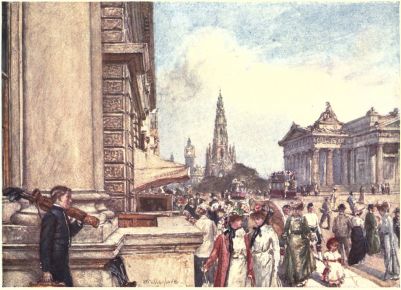 PRINCES STREET FROM THE STEPS OF THE NEW CLUB
The spectator is looking east towards the Scott Monument, which rises in
the centre of the picture; to the right of the monument is a portion of
the Royal Institution, while to the left is the tower of the North
British Railway Hotel, with the top of the Nelson Monument appearing
over the window shade. Down the steps of the New Club a page boy is
carrying golf clubs. The time is a sunny afternoon in September.
simple living within the compass of a single close, or even a single
stair, knew and took an interest in each other. Acquaintances might not
only be formed, Pyramus-and-Thisbe fashion, through party walls, but
from window to window across alleys, narrow enough in many cases to
allow of hand coming to hand, and even lip to lip.... The jostle and
huddlement was extreme everywhere.” And the overcrowding!
“A country gentleman and a lawyer, not long after raised to the Bench,
lived with his wife and children and servants in three rooms and a
kitchen. A wealthy goldsmith had a dwelling of two small rooms above his
booth, the nursery and kitchen, however, being placed in a cellar under
the level of the street, where the children are said to have rotted off
like sheep.”[55] Edinburgh citizens came to consider the highest storeys
in their tall “lands” the most desirable; and the tale is told of one
old Edinburgh gentleman who, on a visit to London, expressed pleased
surprise that the top flat where he had perched himself was the cheapest
in the house. On being gently enlightened that this was in consequence
of its being also the least thought of, he replied that he kent fine
what gentility was, and after having lived sixteen storeys up all his
life, was not going to come down in the world.
The first efforts at extension of the town were due to a private
commercial speculation. The open country beyond the Nor’ Loch and the
“Lang Dykes” was inaccessible till an Act of Parliament could be passed
and drastic measures taken; and, where Acts of Parliament are
necessary, progress is slow. Whilst time was passing, and others were
talking and scheming for the public good, a builder named George Brown
saw that the tide had come in his affairs, and took it at the flood and
made his fortune. He built, with stones from Craigmillar Quarry, two
squares of substantial dwelling-houses. The first built and bigger of
these was George Square, whose site had formerly been part of the park
of Ross House, the suburban residence of the Lords Ross, where
later—after 1753—the famous George Lockhart of Carnwath had lived. The
smaller square, Brown Square, was built after the first had proved a
success, and several of the houses in it been taken by well-known
citizens. George Square is still, though hemmed in by poor localities on
three sides, a favourite place of residence, with a pleasant garden in
the centre, and “the Meadows” near at hand. Here it was, at number 25,
that Scott’s father lived, and part of Scott’s boyhood was spent. Brown
Square has not survived socially, though it, too, has had its notable
residents. It was from Brown Square that Lord Glenlee, the last person
to use a sedan-chair in Edinburgh, used to sally forth in wig and cocked
hat, in knee-breeches and silk stockings and buckled shoes; and in Brown
Square there once lived the author of “The Flowers of the Forest,” Miss
Jeanie Elliott of Minto, one of the many gifted Jacobite ladies of
Jacobite Edinburgh. These two squares formed a little southern colony by
themselves, confined their hospitalities to themselves, and, in fact,
as the Scottish phrase says, “kept themselves to themselves.”
At last, in 1767, the Act of Parliament for extending the city over the
northern fields was passed, and the North Bridge was built from the High
Street across the valley. And then, suddenly, as with the touch of a
magician’s wand, the beginnings of the New Town of Edinburgh came into
being: stately squares and noble buildings, wide, broad streets that put
London thoroughfares to shame, graceful curved terraces and crescents;
all the cold dignity of unlimited grey stone—stone pavements, stone
roads, stone houses; and, nestling in every crevice of the stone, the
green of the invaded country. New Edinburgh, like Jonah’s gourd, sprang
up in a night, to shade many a prophet.
And who wielded the magician’s wand? The name of Lord Provost Drummond
ought to be remembered in Edinburgh, of which, like a veritable Dick
Whittington, he was six times Lord Provost. He was a man of public
spirit and large enterprise, who brought dignity on himself and his
office and his city. The New Town dates from his Provostship. At first,
however, as all pioneers must do, he saw men look askance at the
triumphs of his energy. He was probably called extravagant, and accused
of squandering public money. “The scheme was at first far from popular,”
Mr. Robert Chambers tells his readers. “The exposure to the north and
east winds was felt as a grievous disadvantage, especially while houses
were few. So unpleasant even was the North Bridge considered, that a
lover told a New Town mistress—to be sure only in an epigram—that
when he visited her he felt as performing an adventure not much short of
that of Leander. The aristocratic style of the place alarmed a number of
pockets, and legal men trembled lest their clients and other employers
should forget them, if they removed so far from the centre of things as
Princes Street and St. Andrew Square. Still, the move was unavoidable,
and behoved to be made.”[56]
And then the bees swarmed.
Those of the Scottish nobles whom the Union had left in the capital took
their persons and their households across the valley to the New Town,
and left their family mansions and their family traditions behind them
in the Old. All the legal dignitaries—Lord President, Lord Justice
Clerk, Lord Advocate, Dean of Faculty, Solicitor-General, Lords of
Council and Session—all those “carls” whom James VI. had made “lairds,”
accompanied by the “carlins” whom he had declined to make “leddies”; the
advocates, the “writers”; all the old Scottish “gentry,” the wealthy
burghers: all hurried out of their closes and took up their residences
in the big new houses across the Nor’ Loch.
Nature, however, abhors a vacuum, and so do landlords; and the deserted
High Street and Canongate filled up rapidly with humbler citizens. “The
Lord Justice Clerk Tinwald’s house possessed by a French teacher, Lord
President Craigie’s house by a rouping wife or saleswoman of old
furniture, and Lord Drummore’s house left by a chairman for want of
accommodation; ... the house of the Duke of Douglas at the Union, now
possessed by a wheelwright!”[57]
David Hume was one of the bees who swarmed. He was buzzing busily on the
third floor of a house in James’s Court with (what was particularly
characteristic of Edinburgh houses of that period, but perhaps not so
appealing to Hume as to some others) two little oratories, one off his
dining-room and one out of his drawing-room. But neither the oratories
nor the view to the north from his windows had the power to retain him.
He spread his wings and alighted on the west corner house on the south
side of St. Andrew Square. When his house at the corner was almost the
only one in the street leading from Princes Street to St. Andrew Square,
and before the names of the New Town streets had been inscribed on them,
Dr. Webster, a humorous minister, wrote in chalk on the great sceptic’s
dwelling “Saint David’s Street.” Hume’s old servant ran indignantly to
her master to tell him; but Hume was a humorist too. “Weel, weel,
Janet,” he said, “never mind. I am not the first man of sense that has
been made a saint of.”
St. David Street it remains to this day.
Sir Laurence Dundas built himself a house in St. Andrew Square, but lost
it in play to General Scott, a noted gambler, who staked £30,000 against
it. Sir Laurence retained his house, however, by building General Scott
another mansion-house, “Bellevue,” which for long stood in the centre
of Drummond Place.
Along the line of the present Princes Street had formerly been the “Lang
Gait,” or “Lang Dykes,” a rough road through rough country, where
Claverhouse had clattered angrily towards the Highlands at the head of
his troopers. This had been the scene of many a footpad robbery and
murder, and many lovers’ evening strolls; but, when the New Town was
built, it gradually was feued out, from east to west; and along it were
built a single line of houses looking right across the valley and up
towards the Old Town. It was proposed to call this—the principal street
of New Edinburgh—“St. Giles Street,” after the patron saint of
Edinburgh, which would have been a very appropriate name, and a slight
offer of amends to the Saint for the insult offered to his effigy when
the rude-minded rabble ducked it in the Nor’ Loch in the first days of
the Reformation. However, George III. objected. “Hey, hey—what, what?
St. Giles Street! never do! never do!” No doubt to Londoners the name
might awaken associations with a neighbourhood unknown beyond London;
but George III. showed some ignorance of Scottish history, for the
district of St. Giles in London owes its name to the founder of a leper
hospital—Maud, daughter of Malcolm Canmore and Queen Margaret, who,
when Queen of England, evidently sometimes felt a little homesick and
very patriotic, and bestowed on her charity the name of the patron saint
of Edinburgh.
And what became of the Nor’ Loch? The citizens had no longer to swim
across it two at a time on a collier’s horse, as had the Hamiltons after
the “Cleanse the Causeway” battle. The Nor’ Loch, formed in 1450 when
first Edinburgh was walled, had done its duty and had its day, and was
drained; and its place—now well-kept gardens—was for long a boggy
morass. Across this morass some Lawnmarket shopkeepers were accustomed
to make their way to investigate the progress of the new city; and, as
the ground was marshy and muddy, they laid a few planks across to form a
foot-bridge. George Boyd, a dealer in tartan, called “Five o’clock,” in
jocular allusion to his bandy legs, seems to have been particularly
impressed by the plank bridge; and, when some loose earth from a quarry
fell on it and made the bridge more secure, his mind, which worked
better than his legs, caught at the suggestion that the earth flung out
by the builders from the foundations of the New Town might form a bridge
across the valley. The suggestion was adopted, and the earth, to the
amount, it has been calculated, of about two million cartloads, was
deposited and a great mound formed in the valley of the Nor’ Loch, just
below the centre of the High Street; and “Geordie Boyd’s brig” became
“the Earthen Mound,” and so continued to be called until well on in the
nineteenth century. So, indeed, one well-known and venerable Edinburgh
citizen still speaks of it.
And this is how, within about forty years of its first conception, the
New Town of Edinburgh spread itself over the plain and superseded the
crumbling cluster of seven centuries. And this is how modern Edinburgh
presents that curious spectacle, unknown in any other town, of two
distinct divisions, divided topographically as well as historically and
socially—Old Edinburgh and New Edinburgh.
Benevolence, charitableness, tolerance, sympathy with those about
him in their joys and their sorrows, kindly readiness to serve
others when he could, utter absence of envy or real
ill-will,—these are qualities that shine out everywhere in his
life and in the succession of his writings.... Positively, when I
contemplate this richness of heart in Scott, and remember also how
free he was from those moral weaknesses which sometimes accompany
and disfigure an unusually rich endowment in this species of
excellence ... positively, I say, with all this in my mind, I can
express my feeling about Scott no otherwise than by declaring him
to have been one of the very best men that ever breathed.
Professor Masson’s Edinburgh Sketches and Memories.
IT is easy to trace Sir Walter Scott’s Edinburgh life from door to door.
The house in the College Wynd, in which, on August 15, 1771, he was
born, was pulled down in his lifetime. Sir Walter once pointed out its
site to Mr. Robert Chambers during one of their walks together, and told
him that his father had “received a fair price for his portion of it”;
and, when Mr. Chambers naturally suggested that more money might have
been made and the public much more gratified had Scott’s birthplace been
retained to be shown,—“Ay, ay,” said Sir Walter, “that is very well;
but I am afraid I should have required to be dead first, and that would
not have been so comfortable, you know.”
The home of his boyhood and youth, 25 George Square, still stands,
looking exactly the same to-day as it did then. Here the little lame boy
lived, and regretted the country life at Sandyknowe among dogs and sheep
and legends; and the troubles of life began for him as he limped
backwards and forwards to the High School, or sensitively shrank from
the rough tyranny of his elder brother; and the triumphs of life fired
him as he took his share in the street “bickers” between the High School
boys and the rough lads of Potterrow, or as he gained fame in the High
School yard as a story-teller. It was under his parents’ roof in George
Square that Scott lived all the years from those schoolboy days till he
was a young man of many friendships, and slovenly dress and deep
feelings and enthusiasms, studying law in deference to his father’s
wishes, but thinking his own long thoughts during his rambles over
Blackford Hill and the country round Edinburgh; and at home, in his
father’s house, giving full play to his fancies in the safety of his own
small den in the sunk basement, where he was surrounded by “more books
than shelves,” where he hoarded collections of Scottish and Roman coins,
and where he had proudly crossed a claymore and a Lochaber axe over a
little print of Prince Charlie. But perhaps the fondest
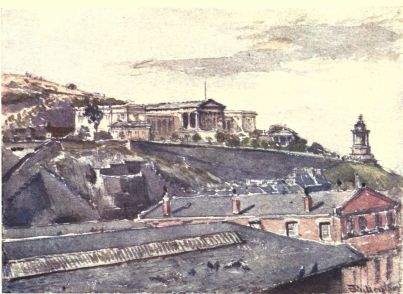 THE HIGH SCHOOL AND BURNS’S MONUMENT FROM JEFFREY STREET
To the left of the picture, over a roof in the foreground, appears part
of the tunnel of the North British Railway, above which rises that fine
classic building, the (modern) High School. It stands on the southern
slope of the Calton Hill, a portion of which is seen to the extreme
left. On the extreme right is the monument to Robert Burns.
treasure in that den was a certain china saucer which,—possibly unknown
to the father upstairs,—the young Cavalier kept hung on the wall, and
whose tale he no doubt often unfolded to his friends. Once upon a time
Mrs. Scott’s curiosity had been roused by the visits, night after night,
of a mysterious stranger, who came in a sedan-chair and a cloak, and
remained closeted with her husband in his business-room till long after
the household had retired. Mr. Scott preserved a stern reticence; but
woman’s wit found out a way. One night, very late, when the house was
silent in sleep, Mrs. Scott entered the business-room with a smile and
two cups of tea, and the hospitable suggestion that, as they had sat so
long, they might be glad of some refreshment. The stranger proved to be
a richly dressed man, who bowed, took one of the cups, and drank it. But
Mr. Scott, turning aside, neither drank his tea nor introduced his
guest. Presently, returning from showing the stranger out, he took the
empty cup, and, throwing up the window-sash, flung it out into the
night, with the now famous words, “Neither lip of me nor mine comes
after Murray of Broughton’s.”[58]
It was here, in this small den on the sunk floor of 25 George Square,
that Jeffrey found Scott when he called on him the evening after he had
asked to be introduced to him at the Speculative Society, where young
Scott had read a paper on “Ballads”: and Jeffrey evidently did not
extend his approval of Scott and of the paper on Ballads to this sunk
den,—or was it that Scott had no command of hospitalities in his
father’s house?—for they sallied forth together and supped at a tavern.
No doubt, before they went, Jeffrey had looked round curiously at the
treasures of his new acquaintance, and had been told how the “Broughton
saucer” had come by its widowed condition.
It was decided that Scott should become an advocate, and he and his
friend Clerk—a friendship made in the High School days, to last through
life—read for the Bar together. Poor Scott, with his open-air nature
and his dreamy enthusiasms, how he hated the drudgery! But he buckled to
it; and every summer morning for two summers he used to walk from George
Square to the house of his friend Clerk, “at the extremity of Princes
Street, New Town,” arriving at seven o’clock, to rouse his sleepy
fellow-student to an examination of Heineccius’s Analysis of the
Institutes and Pandects and Erskine’s Institutes of the Law of
Scotland. It speaks well for Clerk that their friendship did last.
They were called to the Bar together; and together, when the ceremony
was over, they stood about in their wigs and gowns in the great hall,
till at last Scott whispered to Clerk, imitating a farm servant-lass
waiting at the Cross to be hired, “We’ve stood here an hour by the Tron,
hinny, and de’il an ane has speered our price.” Before the Court rose,
however, Scott had earned his first guinea,—and he spent it on a silver
taper-stand for his mother.
It was all in Edinburgh—all his “supreme moments.” Was it not in a
shower of rain in Greyfriars’ Churchyard that he met his first love?
Greyfriars’ Churchyard in a shower of rain, after a sermon; and Scott
offered her his umbrella, and together they walked home under it.
Probably it was a very shabby umbrella, for Scott was slovenly in his
dress in those days. What did it matter? There were more walks—more
talks. Presently Scott’s father thought it right to warn the other
father, for Scott was but a dependent youth; and, moreover, his love had
been given to the daughter and heiress of Sir John and Lady Jane Stuart
Belches of Invermay, and in those days in Scotland every shade of rank
was considered. Did Scott ever know what his father had done? Still the
romance went on, till the day when Scott rode home from Invermay back to
Edinburgh, and “the iron entered into his soul.” A long ride through the
beloved Scottish Highlands—
Never the time and the place and the loved one all together.
She married Sir William Forbes of Pitsligo. Of course she did. Had it
not been ordained since the beginning of time that she who had won the
first love of Walter Scott was to marry another? Who knows her story?
Who, for the matter of that, knows his? Who has measured the influence
on his life?
It was in Edinburgh that Scott’s youth passed, and that most of the
happenings took place that went to the making of him. In Edinburgh was
clustered his group of friends: Clerk (afterwards the original of
“Darsie Latimer”); Thomas Thomson, the legal antiquary; John Irving;
Adam Ferguson; George Cranstoun (afterwards Lord Corehouse); George
Abercromby (Lord Abercromby); Patrick Murray of Simprim; Patrick Murray
of Auchtertyre; and, most congenial of all to Scott’s own nature,
Erskine, the son of a Scottish Episcopalian clergyman of good family,
and the only Tory, save Scott himself, among the set of young Whigs then
predominant at Parliament House.
In those days Scott indulged in many rambles to the Borders or the
Highlands, to interesting neighbourhoods and historic houses and worthy
hosts; but it was from one of these excursions that he returned to
Edinburgh to see the execution of Watt the republican; and it was in the
Edinburgh theatre that he assisted to break the heads of a band of young
Irish rowdies who howled and hooted during the National Anthem; and it
was in Edinburgh that he haunted the vaults below Parliament House among
hoards of MSS. and deeds, and came up again steeped in dust and lore to
be made a curator of the Advocates’ Library, with Professor David Hume
and Malcolm Laing the historian as his colleagues.
Scott’s first serious attempt at verse was a rhymed translation of
Bürger’s Lenore. It was written when he was four-and-twenty, and was
done under the inspiration of hearing that Mrs. Barbauld, then on her
first visit to Edinburgh, had read aloud Taylor’s then unpublished
version of it at a party at Dugald Stewart’s. Scott, already deeply
interested in German literature, was fired; and one morning before
breakfast he brought his translation to show to his friend Miss
Cranstoun.
Walter Scott was not without women friends. Miss Cranstoun, to whom he
brought his poem before breakfast, had already been his confidante in
his love-story. Of his young kinswoman, the wife of the head of his
family, Hugh Scott of Harden,—who was a daughter of Count Brühl
Martkirchen, Saxon Ambassador at the Court of St. James’s, and Almeria,
Dowager Countess of Egremont—he says that she “was the first woman of
real fashion that took him up.”
It was about this time also that Scott’s martial ardour and patriotism
found vent in helping to organise the Scottish Light-horse Volunteers,
in preparation for the expected French Invasion. When, therefore, in his
twenty-sixth year, he brought home to Edinburgh the little half-French
bride to whose dark prettiness and novel vivacity he had fallen a victim
whilst a fellow-visitor at a watering-place, she found a warm welcome
awaiting her from a large and various circle of friends, all devoted to
her young husband, and sharing with him one or other of his
enthusiasms,—military or literary, antiquarian or sporting. Among these
must not be forgotten Skene of Rubislaw, whose friendship with Scott
began in a mutual love for German literature, and ended only with death.
Scott took his young wife first to lodgings in George Street, his house
at 10 South Castle Street not being quite ready; and the following
summer he hired that first and humblest of those three country homes
near Edinburgh where his happiest days were spent, a pretty cottage,
with a garden and a paddock, at Lasswade. It is still standing and
unchanged. Here and at Castle Street the young people lived comfortably
on their combined incomes for many years, and made themselves and their
friends happy with much simple and inexpensive hospitality. At Lasswade
it was that they formed friendships with the neighbouring great houses
of Melville and Buccleuch; that they were near—as the country counts
near—to Scott’s old friends the Clerks of Penicuik and Tytlers of
Woodhouselee, and Henry Mackenzie, the “Man of Feeling,” who lived at
Auchendinny. And it was at the Lasswade cottage that Wordsworth and his
sister Dorothy arrived before breakfast on the morning of September 17,
1803. Scott was then writing the Lay of the Last Minstrel, and read
the first four cantos to Wordsworth. He walked with his guests to
Roslin, and afterwards met them for the famous days in the Border
country, where he was Sheriff. Hogg’s first celebrated visit was paid at
Castle Street. It was in the drawing-room there that the Ettrick
Shepherd, feeling sure he “could never do wrong to copy the lady of the
house,” lay down at full length on the sofa opposite hers. It was here
that he “dined heartily and drank freely and, by jest, anecdote, and
song, afforded plentiful merriment.” It was here that, as the hour grew
later, his enthusiasm showed itself in a descending warmth of
appellations for his host, who, first “Mr. Scott,” became “Shirra,” and
then “Scott,” “Walter,” and, finally, “Wattie”; and the “plentiful
merriment” must have reached its culmination when Mrs. Scott was
addressed as “Charlotte.”
When Thomas Campbell published his “Pleasures of Hope,” Walter Scott was
an enthusiastic admirer of his fellow-poet. “I have repeated these lines
so often on the North Bridge that the whole fraternity of coachmen know
me by tongue as I pass. To be sure, to a mind in sober, serious,
street-walking humour, it must bear an appearance of lunacy when one
stamps with the hurried pace and fervent shake of the head, which
strong, pithy poetry excites.”
Oh days of enthusiasms and strong feelings! Nowadays, we are all jaded
with travel, and washed over with the neutral tint of cosmopolitanism,
and as insipid as bread and water. No Scott stamps and rolls his head to
the rhythm of his thoughts on the North Bridge; no Scott protests out of
his full heart against the innovations of Whiggery, and leans his brow
against the wall of the Mound, unashamed if his tears be seen by a
jesting Jeffrey, and tells him, “No, no—’tis no laughing matter; little
by little, whatever your wishes may be, you will destroy and undermine,
until nothing of what makes Scotland Scotland shall remain!”[59]
When Scott’s worldly prospects were very prosperous, when he was Sheriff
of Selkirk, and the author of the successful Lay of the Last Minstrel,
and a contributor to the Edinburgh Review, under the editorship first
of Sydney Smith and then of Jeffrey, he was an established citizen of
Edinburgh, in his second house in Castle Street—“poor 39”—as he lived
to call it. Here were his most brilliant days spent,—here, and at
Ashestiel, the picturesque farm on the banks of the Tweed which
superseded the Lasswade cottage, and then at Abbotsford, the proudest
home of all. But 39 Castle Street remained his town home through all the
brilliant and wonderful years, till the financial crash came in 1826. It
was here that Joanna Baillie paid a visit of a week or so,—here that
Crabbe stayed,—here that every one of worth or want found a ready
welcome. The dining-room in 39 Castle Street!—what scenes and what
voices have its walls seen and heard! Here all Scott’s famous dinners
took place, including those Sunday ones “without silver dishes” to his
intimates—Mrs. Maclean of Torloisk and her daughters; his school friend
Clerk; Kirkpatrick Sharpe of caustic humour and scandalous memory; Sir
Alexander Boswell of Auchinleck, “Bozzie’s” son, and author of “Jenny
dang the weaver”; Sir Alexander Don of Newton; William Allan, the
artist; and many others. It was here he had his orderly “den” behind the
dining-room, with its many books, its big writing-table, its two
armchairs, the staghound on the floor, and the cat safely atop the
book-ladder, and one picture—the beautiful, sad face of Graham of
Claverhouse, who, as Scott said, “foully traduced” by Covenanting
historians, “still passed among the Scottish vulgar for a ruffian
desperado.”
It must have been in the window of this study that Scott sat writing
night after night, when the son of William Menzies, living at his
father’s house in George Street, looked across from the back windows of
their house to the back of Scott’s, when, at a gathering of “gay and
thoughtless” young men, mostly advocates, he asked one to change places
with him that he might not see a hand that fascinated his eye. “It never
stops—page after page is finished and thrown on that heap of MS., and
still it goes on unwearied—and so it will be till candles are brought
in, and God knows how long after that.... I well know what hand it
is—’tis Walter Scott’s.”
It was in this self-same study that an attempt was made on Scott’s life
by a man named Webber, whose literary efforts Scott had befriended.
Webber had taken to drinking, and a sudden mad resentment against Scott
filled his unhinged mind. In this study Scott suddenly found himself
confronted by a madman with firearms, insisting on a duel then and
there; and it was only because of Scott’s absolute self-control and
courage that the great man’s life did not end in the year 1818. He
suggested that a duel in the house might disturb the ladies of the
family and had better be postponed till after dinner; and then, locking
up the pistols, he calmly brought Webber into the dining-room, and,
whilst they dined with an unconscious hostess, Scott sent for the young
man’s friends.
It was to Castle Street that Scott walked home across the Mound leaning
on his daughter’s arm, his own trembling, speaking not a word all the
way, on the day after the Scottish Regalia had been discovered. It was
owing to Scott’s representations to his friend the Prince Regent that
the Commission had been appointed to examine the Crown Room in the
Castle, and the long-lost Regalia had been brought to light. The next
day he and his fellow-commissioners had brought the ladies of their
families to view it, and Sophia Scott had been so wrought upon by the
sight that she had turned faint, and was drawing back from the group
when she heard her father’s voice, “something between anger and
despair,” exclaim, “By God, no!” and turned to see that one of the
Commissioners had been, in play, about to put the Scottish crown on the
head of a young girl present. The father and daughter walked home
together in silence, with a new sympathy between them.
It was of this very year, 1818, that Lockhart said: “At this moment, his
position, take it for all in all, was, I am inclined to believe, what no
other man had ever won for himself by the pen alone. His works were the
daily food, not only of his countrymen, but of all educated Europe. His
society was courted by whatever England could show of eminence. Station,
power, wealth, beauty, and genius, strove with each other in every
demonstration of respect and worship, and—a few political fanatics and
envious poetasters apart—wherever he appeared, in town or country,
whoever had Scotch blood in him, ‘gentle or simple,’ felt it move more
rapidly through his veins when he was in the presence of Scott.”[60]
Lockhart goes on to say that, “descending to what many looked on as
higher things,” the annual profits of Scott’s novels alone had been for
several years not less than £10,000, and his Castle of Abbotsford was
being built, and “few doubted that ere long he might receive from the
just favour of his Prince some distinction in the way of external rank,
such as had seldom before been dreamt of as the possible consequences of
mere literary celebrity.”
On February 2, 1820, Scott took Prince Gustavus Vasa, and his attendant,
Baron Polier, who were spending some months in Edinburgh, to the window
over Constable’s shop in the High Street, to hear George IV. proclaimed
King at the site of the Cross. Here Scott lamented to the Prince the
“barbarity of the Auld Reekie Bailies,” who had removed the historic
Cross; and when the exiled Prince broke down on hearing the National
Anthem sung by the crowd, Scott drew Lockhart away into another window,
whispering: “Poor lad! poor lad! God help him!”
Scott’s friend and admirer the Prince Regent once King, the distinctions
came. In 1820 Scott went to London to receive the baronetcy which, as
Lord Sidmouth had told him, it had been the Prince Regent’s desire to
confer on him. Whilst in London he sat to Sir Thomas Lawrence for his
portrait for the King, and to Chantrey for his bust, and the degree of
D.C.L. was offered him by both the English Universities. Three Edinburgh
distinctions were conferred on him. He was elected President of the
Royal Scottish Society; he was first President of the Bannatyne Club,
which he had founded; and he was appointed Professor of Ancient History
to the Royal Scottish Academy. Those years were his most active time as
a citizen as well as an author, for he was chairman of nearly every
public meeting, or charity, or educational scheme in the town. Every day
must have seen him limping along Princes Street, recognised by all,
coming from Parliament House, or his meetings, or his printer’s; perhaps
one of a group talking eagerly, pausing to disperse at the door of some
bookshop or on the steps of a club, or at the corner of Castle Street.
Many a head must have turned to gaze after the rugged familiar figure;
many a whisper to child or stranger must have followed him, “There,
look! That is Sir Walter Scott!”
In August 1822 George IV. paid his state visit to Edinburgh, and stayed
a fortnight in the capital of the ancient kingdom. This fortnight was
perhaps the proudest and most brilliant of Scott’s life,—“his supreme
moment”—and again it was in Edinburgh. The Tories, their dream of
Jacobitism dead with the Cardinal of York, were more personally loyal
than the Whigs; and Scott, most tory of Tories, was loyalest of the
loyal. It was his influence that had brought about the royal visit, and
on him devolved all the arrangements; and for weeks Castle Street was
like a green-room, filled by all the actors in the great play. When the
day came and in the rain the King’s yacht cast anchor in Leith
Roads—where Mary Stuart’s galleys had in the mist cast anchor on a
bygone August day—Scott rowed alongside and boarded the Royal George.
The King toasted him in native whisky; and Scott, in his enthusiasm,
asked leave to keep the glass. He put it, carefully wrapped up, in his
deep coat-tail pocket, and went home holding the skirt of his coat
carefully in front of him. Alas for the vanity of human wishes! At
Castle Street he found that Crabbe the poet had chosen this inopportune
season to arrive unexpectedly on a visit. Scott, ever hospitable,
welcomed him warmly, and promptly sat down beside him; and crash!—the
glass was smashed to atoms.
At six next morning, Queen Street—that sober terrace!—saw Sir Walter
Scott clad in Campbell tartans at a muster of the Celtic Club; and a
little later an inimitable scene took place in the dining-room of 39
Castle Street. Scott had hospitably brought some half-dozen Celts home
to breakfast; and, on entering the room himself from his study, he
discovered Crabbe, the dapper English clergyman, punctiliously neat and
decorous in his black clothes and buckled shoes, standing surrounded by
huge kilted and plaided Highlanders, like a sleek spaniel surrounded by
collies. To Scott’s amazement, the tongue in which all were endeavouring
to exchange ideas proved to be French; for Crabbe, as ignorant as an
Englishman can be about Scotland, had heard the Gaelic; and, judging the
strangely garbed men to be foreigners, and addressing them amiably in
French, had been promptly taken by them for a French abbé.
Throughout all the busy fortnight Scott was the centre of everything.
Daily he dined at Dalkeith Palace,[61] and attended the King at the
levées and drawing-rooms at Holyrood, at St. Giles’s Church on Sunday,
at the performance by Murray’s company of Rob Roy, and at the banquet
given by the Magistrates to the King at the Parliament House. It was
Scott who organised the great procession from Holyrood to the Castle in
copy of the “Riding of the Parliament.” And, as Lockhart points out in
his Life of Scott, it was due to Scott’s Celtic ardour that in all the
arrangements the kilts and pipes were made so prominent that King George
became impressed with the false idea that Scotland’s glory rested on
them alone, and that he showed this by giving as his one toast at the
banquet: “The Chieftains and Clans of Scotland, and Prosperity to the
Land of Cakes.” Perhaps it dates from this that the English to this day
think the kilt the national—if not the usual—dress of the Scot, and
that Punch makes Highlanders talk lowland Scotch, and Scotsmen speak
Gaelic. But some results of the King’s visit—also due to Sir Walter
Scott’s influence—were better. The King knighted Adam Ferguson,
Deputy-Keeper of the Regalia, and Raeburn, the Scottish
portrait-painter; and Mons Meg was returned from the Tower, after much
correspondence; and the Scottish peerages forfeited in 1715 and 1745
were restored.
Four years later, Scott sent for his old friend Skene of Rubislaw. It
was a cold January morning—seven o’clock—when Skene arrived, and
Scott’s greeting to him was: “My friend, give me a shake of your hand:
mine is that of a beggar.” The crash had come. Offers of assistance
poured in—from his children, from the principal banks of Edinburgh,
from friends high and low. Scott, hearing that Sir William Forbes the
banker, his old rival in love, was foremost in wishing to help, wrote in
his diary: “It is fated our planets should cross, though, and that at
periods most interesting for me. Down—down—a hundred thoughts.”
No help was accepted. “This right hand shall pay it all,” he said. That
eident hand!...
Two months later he left Castle Street. “So farewell, poor 39.... Ha
til mi tulidh.”[62] Two months later he went all alone to lodgings, in
North St. David Street, and heard next day of Lady Scott’s death at
Abbotsford. And so—first there, and then next winter alone with his
youngest daughter in a furnished house in Walker Street, and finally at
No. 6 Shandwick Place,—Sir Walter Scott worked himself to death in
Edinburgh to pay his debts: perhaps more loved and honoured than even in
the days of his prosperity.
Sir Walter Scott has often been compared to Shakespeare. Be that as it
may, in what he has done for Scotland he may even better be compared to
Napoleon; for, as Napoleon found France shattered and in chaos, and
lifted her to the pinnacle of power, so Scott came at an epoch in
Scotland’s history when her “flowers were a’ wede awa’,” and raised her
again to her place among the nations. And what he did was accomplished,
not by over two hundred battles, but by twenty-nine novels.
And the days of auld lang syne.
Burns.
SOCIAL Edinburgh of yesterday,—that is to say, the social life of
Edinburgh from the death of Sir Walter Scott to the death of Queen
Victoria,—what does it imply? It means all the life of Edinburgh during
those seventy years, all the individual lives lived in Edinburgh, and
what each one did towards pushing the world onwards. And what hundreds
of names rise in the memory—names of all sorts and conditions of men,
“thick as the leaves in Vallombrosa”! It means also the shifting scenery
in the background of all those lives—a piling up of noble architecture
against the cloudy Scottish sky; a running up of numberless “long
unlovely streets”; a constant pulling down of dear, dirty, historic
dwellings; an occasional restoration of some ancient building; a
widening out of all the suburbs. It means many statues in the streets of
those who once were alive in them. It means the intersection of the
heart of the beautiful city by gleaming lines of rail, and overhead by
gleaming telegraph and telephone wires; it means the light of
electricity flashing suddenly through the town, and the old gas-lamps
burning dimly, and then put out for the last time; it means railway
whistles and cable tramway bells; it means smoke rising from miles and
miles of cold grey streets. But it is still the smoke of domestic fires,
as in the days when Gavin Douglas, waking on a winter morning in 1512,
“bade beit the fire and the candel allicht,” and not the smoke of
belching chimneys of commerce. Edinburgh, as befits her intellect,
prints and publishes; and, as befits her climate, she brews and distils;
and the streams that flow down her valleys towards the Firth of Forth
pass on their way many mills that provide paper for printers and
authors; but farther than this she declines to go.
During Scott’s lifetime there were living in Edinburgh a remarkable
cluster of men; and some of those who, as young men, had been his
fellow-citizens, survived him right on until past the middle of the
century, and wrote their names large in the annals not only of Edinburgh
but of the world, before they too in their turn passed away. In
literature, during Scott’s lifetime, there was the immortal Baroness
Nairne, of the “weel-kent” Jacobite and Episcopalian family, the
Oliphants of Gask. Baroness Nairne, while she lived and when she
died,—during the meetings she must have had with Scott at the house of
her sister, Mrs. Keith of Ravelston,—was all the time the unavowed
author of some of the best-loved and best-known of our national songs.
There were Jeffrey the critic, Lord Cockburn, Henry Mackenzie, the “Man
of Feeling,” Hogg, the Ettrick Shepherd, Campbell the poet, M‘Crie, the
historian and biographer of Knox, Dugald Stewart, and his antagonist,
Dr. Thomas Brown, Sir William Allan, the artist, Sir Henry Raeburn, the
great Scottish portrait-painter, Miss Ferrier, the novelist, Dr.
Alexander Murray, the philologist, Kirkpatrick Sharpe of the bitter
tongue, and David Laing, the kindly antiquary. In 1817 Blackwood’s
Magazine had been started in Tory rivalry to the Whiggism of Jeffrey’s
Edinburgh Review; and in 1832, the very year of Scott’s death, William
and Robert Chambers began the publication of Chambers’s Edinburgh
Journal. Robert Chambers—who may be regarded, in virtue of his
long-unacknowledged Vestiges of Creation, as the forerunner of
Darwin—had, as a boy of twenty, written his inimitable Traditions of
Edinburgh. The compiling of the Traditions had brought him at once
under the astonished and delighted notice of Scott, and begun a
friendship between them, resulting in many walks all about Edinburgh,
and many talks—also all about Edinburgh. After Scott’s death there were
in Edinburgh many notabilities. There was a brilliant literary coterie
scintillating in the Blackwood Saloon: Professor Wilson, “Christopher
North”; Scott’s son-in-law, Lockhart; Professor Wilson’s son-in-law,
Professor Aytoun, the writer of those stirring national ballads that
have thrilled so many Scottish hearts; Hogg, enticed from his Ettrick
pastures into the turmoil of Noctes Ambrosianæ; Dr. Moir, known as
“Delta.” These names are associated with the early days of Blackwood,
as are those of Lord Jeffrey, Lord Brougham, and Lord Cockburn with the
early days of the Edinburgh Review. Sir William Hamilton was living at
16 Great King Street; and somewhere in Edinburgh, invisible as a
microbe, but as far-reaching in achievement, there was the quaint little
figure of De Quincey. In one of a row of small houses in Comely Bank, on
the north-west outskirts of the city, lived Thomas Carlyle. Among the
judges were Lord Jeffrey and Lord Cockburn, survivors of the Whig party
of Scott’s days, and Lord Neaves, a staunch Conservative. Chiefest among
the Presbyterian Scottish clergy was the great Dr. Chalmers, and grouped
with him were Dr. Cunningham, Dr. Guthrie, and Dr. Candlish. Chiefest
among the Episcopalian Scottish clergy was the much-loved Scotsman, Dean
Ramsay, author of Reminiscences of Scottish Life and Character.
In 1842 Queen Victoria paid her first royal visit to her Scottish
capital. She came, like George IV., by sea, and arrived at Granton on
September 1—most opportunely, for it was St. Giles’s Day. In the
following year, 1843, a great event occurred in the history of the
Church of Scotland, and the scene of its enactment was St. Andrew’s
Church in George Street, Edinburgh. No nation, it is said, knows
anything of what lies north of it. France knows nothing about England:
England’s ignorance in all regarding Scotland is supreme. Ask the
average Englishman what is meant by “the Disruption,” and he will stare
at you. And yet the Disruption was the outcome of a controversy that
agitated Scotland for years, a controversy strong enough to split the
Church of Scotland into two. Three years after the Disruption, the
“Philosophical Institution” was founded, and this was an event in the
history of intellectual and social Edinburgh that can best be valued
when it is remembered that among the first presidents were such men as
Lord Macaulay, Lord Brougham, Thomas Carlyle, and Adam Black, and that
among the first lecturers who came to Edinburgh by invitation of the
Philosophical were Dickens and Thackeray, Anthony Trollope and Charles
Kingsley, and Ruskin, who so roundly abused our New Town architecture.
Through the second half of the century, social Edinburgh was proud of
such men as Sir James Y. Simpson, the discoverer of the anæsthetic
properties of chloroform; Dr. John Brown, the author of Rab and his
Friends; Hugh Miller, the geologist, author of Old Red Sandstone;
Alexander Smith, the poet; John Skelton, the essayist and historian;
Alexander Russel, the witty editor of the Scotsman; Dr. John Hill
Burton, the Historiographer-Royal; and Skene, his successor in that
office, who was the son of Sir Walter Scott’s old friend. George Combe
lived in Edinburgh until 1858; and in the University, besides those
already named, were Sir David Brewster, Sir Robert Christison, Professor
Syme, John Goodsir, Lyon Playfair, and Professor Tait. And does not the
whole of Listerian surgery date from Edinburgh? And is not Lister’s own
great original “spray,” though long since superannuated, still the
glory of an Edinburgh Infirmary ward? Through the last hours of
yesterday, Edinburgh was familiar with the picturesque figure of
Professor Blackie in his plaid, with his beautiful old face framed in
its silver hair, and his joyous Celtic exuberance and enthusiasms that
so often startled the sober Scot. He, too, is gone.
When, in 1884, Edinburgh University, “the Town College,” celebrated her
Tercentenary, and invited all the greatest celebrities of Europe to
attend it, the streets of the sober grey city were for one wondrous week
illuminated by flashes of academic colours and faces of foreign poets
and soldiers, foreign men of science and statesmen, foreign historians
and philosophers, foreign theologians and artists; Englishmen,
Canadians, and Americans; Frenchmen, Germans, and Austrians; Russians,
Italians, and Greeks. It was a week of compliments and fireworks, of
lions and lionising, when every one who wished saw his own special
Shelley plain, and he stopped and spoke to him; and then all the great
European savants went away again, the richer by another honorary degree,
and left Edinburgh to calm down again, the richer by another memory.
The town itself has changed greatly since the days when Cockburn,
Jeffrey, and Horner stood in Queen Street and listened to the corncrake
in the fields stretching between them and the sea. It has changed since
they lamented the cutting down of the trees round “Bellevue,” the
beautiful house of General Scott, in the centre of Drummond Place. It
has changed since the “Highland Lady” spent the winters of her girlhood
there, attended the routs and balls, and walked in Princes Street
attired in a white gown, a pink spencer, yellow tan boots with dangling
tassels, and a deep-poked bonnet with three tall white ostrich feathers
held aloft by the wind. The men and women who felt Edinburgh their own
during the first half of last century would scarcely find their way
about it to-day; they would wander through vast tracts of busy streets
where for them were green fields and yellow whins, and discover further
indentations of the country in new suburbs embracing fragments of old
villages, or enclosing in a new street some ancient castle or homestead.
Merchiston Castle, for instance, the home of the Napiers, a hoary and
battlemented old keep, now stands within a walled garden among modern
villas; and the fine old turreted dwelling of Chiesley of Dalry is now
imbedded in mean streets, and saved from ignominy, and kept clean and
orderly, by being an Episcopalian Training College. The various new
buildings that have sprung up during the Victorian era to decorate or to
deface the city are of course too numerous to mention; but a few of them
are closely connected with the social life of Edinburgh yesterday. “It
is not for nothing that the very central and supreme object in the
architecture of our present Edinburgh is the monument to Sir Walter
Scott,” writes the author of Edinburgh Sketches and Memories; “the
finest monument, I think, that has yet been raised anywhere on the earth
to the memory of a man of letters.”[63] It stands on the green velvet
of the grass of Princes Street Gardens, noblest in the long line of
statues of Edinburgh’s notable citizens, facing the gayest and most
crowded thoroughfare of the modern city; but through its fine Gothic
arches one sees the old town Scott loved so well.
The University New Buildings have considerably enlarged the University
itself; and the M‘Ewan Hall has been further added to it by the
generosity of Mr. William M‘Ewan, and the Students’ Union by the efforts
of the ladies of the University and the town; and Mr. Andrew Carnegie
has given Edinburgh its splendid Public Library.
In 1879 there was consecrated the great Cathedral Church of St. Mary,
then the largest ecclesiastical building that had been built in Britain
since the Reformation.[64] The Cathedral was built by endowment of the
Misses Walker, and the architect was Sir Gilbert Scott. It stands at the
west end of Edinburgh, and its grounds include Old Coates House, one of
the two or three houses that stood beyond the Nor’ Loch in the days
before the New Town was thought of.
In 1887 the National Portrait Gallery in Queen Street was presented to
Edinburgh by the late Mr. J. R. Findlay; and though many of the
portraits of our
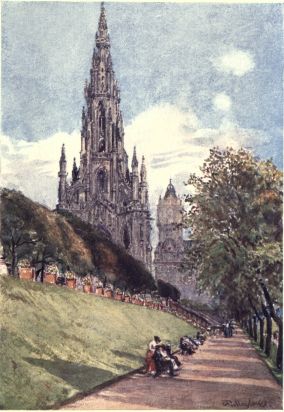 SIR WALTER SCOTT’S MONUMENT FROM THE EAST PRINCES ST.
GARDENS
SIR WALTER SCOTT’S MONUMENT FROM THE EAST PRINCES ST.
GARDENS
On the higher level above the green slope lies the part of the Gardens
fronting Princes Street. The monument gains in height viewed from this
lower level. The tower in the distance is that attached to the North
British Railway Hotel.
great dead, like the faces of our great living, have gone to London, yet
there is now a goodly collection of national portraits in the capital of
Scotland. And there must not be forgotten the greatest building of
all—if building it can be called—that has been achieved near Edinburgh
during yesterday: the Forth Bridge, the highest bridge in the world,
finished in 1890, with its monster claws planted firmly on either side
of the Firth of Forth, just where Queen Margaret and Malcolm Canmore
used to be ferried to and fro on their journeyings between Edinburgh
Castle and Dunfermline Palace.
It is not only by the building of new edifices that wealthy citizens
have generously endowed Edinburgh; there is another form of patriotism
which seeks to restore the old, and two such inestimable benefits have
been conferred not only on Edinburgh, but on all who visit her, and who
venerate the past. In 1883 the late Mr. William Chambers restored with
reverence and taste the Church of St. Giles, which had been half ruined
by ruthless vandalism in 1829, and in 1892 the late Mr. Thomas Nelson
restored magnificently the splendid old hall of the Castle, the scene of
so many banquets and so many Parliaments, and of not a few
tragedies.[65]
The Tropics vanish; and meseems that I
From Halkerside, from topmost Allermuir
Or steep Caerketton, dreaming gaze again.
Far set in fields and woods, the town I see
Spring gallant from the shadow of her smoke,
Cragged, spired, and turreted, her virgin fort beflagged.
R. L. Stevenson.
Robert Louis Stevenson, remembering his Edinburgh days, must have
remembered three homes and many haunts. There was his parents’ town
house, 17 Heriot Row; there was his grandfather’s manse at Colinton, set
low in the old village graveyard by the river; and there was little
Swanston, rented by his parents many years as a country residence,
nestling in a little hollow high up on the edge of the Pentlands.
During all Stevenson’s Edinburgh days from his eighth year 17 Heriot Row
was his home proper. Heriot Row, one of the pleasantest resident streets
in Edinburgh, is, like all Edinburgh resident streets, a row of grey
stone houses built in absolute uniformity. It is built on the northern
slope of the New City, parallel with the three large main
streets,—Princes Street, George Street, and Queen Street,—but below
them, and is a single row of houses with an open outlook, facing the
green trees and turf of the gardens that stretch between Heriot Row and
Queen Street above. It was in the nursery facing the gardens and looking
up to the dignified dwellings of Queen Street through the trees that the
little fretful invalid child was soothed by his faithful Calvinistic
nurse, Alison Cunningham, and that on summer evenings, after he had gone
to bed, he lay listening to “grown-up people’s feet” on the street
below, and watching the birds in the trees.
Till yesterday, when electricity turned night into day, the lamplighter
used to go quickly at evening along the Edinburgh streets with his
ladder, fix the hook at the end of it into the cross-bar of each
lamp-post in turn, run up, lift off the glass top, and light the lamp.
Every small street urchin in Scotland knows the cry of “Leerie, Leerie,
licht the lamps!”—and the little town child, in his cosy Edinburgh
nursery, counted himself very lucky to have a lamp-post just before the
front door of his home, and used to sit until his tea was ready and
watch for “Leerie” posting down the street with his ladder and his
light.
The grandfather Balfour’s manse at Colinton was associated with holidays
when all the young cousins played in the dark, shabby, homelike rooms,
or, “sin without pardon,” broke the branches and got through a breach
in the garden wall, and so to the joys of the river.
It is all there to-day: the damp old harled manse beside the parish
church; the graveyard with its ancient tombs and the great iron
coffin,—memento of the days of “resurrectionist” terror; the great
swirling brown river under the magnificent trees of Colinton Dell; even
the “weir with its wonder of foam,” and the old mill with the “wheel in
the river.” It is one of the prettiest spots round Edinburgh, cool and
quiet, with the reflections of the branches on the brown, foam-flecked
surface of the deeper pools; and, close to the village end of the Dell,
where the tall, wonderful cedars stand high against the sky above the
manse and the church, there is a little fragment of ruin half-hidden
among the trees on the steep bank, and tradition speaks vaguely, but
suggestively, of a forgotten hermit and his cell.
The village itself is changed since Stevenson knew it. There is now a
little double line of railway passing through, and an occasional train
puffs out of a rocky tunnel into a little station, and presently
proceeds on its leisurely way up the valley. The old parts of Colinton
remain in picturesque patches, but round them has blossomed forth a
community of red-roofed, gabled houses, with quaint latticed windows,
and every shade of “harled” walls. They face every way; but whichever
way they face they command lovely views, seen through the clear, brisk
Midlothian air, across fields under the rule of the famed Midlothian
farming, and to the grand range of the Pentlands, with the beautiful,
richly-coloured valley between, and overhead a Scottish sky of great
fleecy clouds and deep blue vistas.
Of Stevenson it may be submitted that he was a wandering sheep who did
not love the fold; and his Picturesque Notes, for all their literary
value, are tinged with the Calvinism he learnt at his nurse’s knee, and
inhaled unconsciously in his native air, and that glooms his outlook
even whilst he is most jeeringly observant of its effects on others. He
was not happy in Edinburgh. But, underlying all the sarcasm, all the
sneers, all the bitterness and fretfulness—whether directed at
convention, custom, clothes, creeds, or climate—one seems to hear the
cry of despairing indignation of youth lacking its birthright of
strength and health.
It is pleasanter to think of Stevenson playing the truant from the
University, in his country haunts amid whins and whimsies, than of his
facing a “downright meteorological purgatory” in the “draughty
parallelograms” of the city. Every inch of the Pentlands, of Blackford
Hill, of the Braids, of “classic Hawthornden” and all the valley of the
Esk, of the windings of the Water of Leith and of the shores of the
Firth of Forth—all of it was known to the youthful Stevenson, known so
well and so faithfully that he could describe it afterwards from the
Tropics. But especially dear and homelike must the Pentlands have been
to him—the Pentlands, where the old manse of his boyish holidays lies,
and where “Little Swanston” of his later years still nestles in the
trees beside one of the most picturesque villages in Scotland, within
half-an-hour’s walk from Edinburgh. All the ground between Colinton and
Swanston is historic. Had the countryside kept a diary, the first leaves
would have been inscribed in Roman characters; for here was once a Roman
town, though all that now remains of the conquering race of the old
world is a little Roman bridge, and the great unhewn Battlestone
standing huge and awesome alone in a field, and telling of the battle
fought here, centuries ago, between the Picts and the Romans. A few
hundreds of pages farther on in the diary would come the stern words of
the persecuted Covenanters, who were encamped near here before the
battle of Rullion Green.
All this romance and lore was known to Stevenson and loved by him, as
well as he knew and loved the cry of the sea-gulls as they circled
overhead, or followed the plough with loud cries of hunger. Often must
the young Stevenson, with his strange face and long hair and his
eccentric garb, have climbed the steep hill road, past “Hunter’s Tryst,”
five hundred feet above sea-level, where, it is told, Allan Ramsay laid
the scenery of the Gentle Shepherd,[66] and where the members of the
Six Feet Club used to meet in the little roadside inn which Sir Walter
Scott and the Ettrick Shepherd both knew well. The quiet cart-road to
Swanston leads out of this road, a little beyond the sharp turn at
“Hunter’s Tryst,” and before the
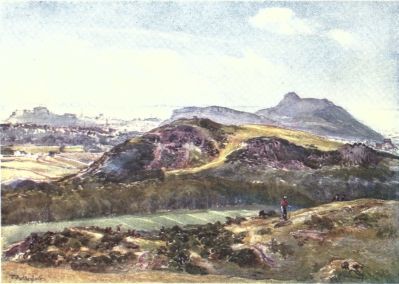 ARTHUR’S SEAT FROM THE BRAID HILLS
In the immediate foreground is a portion of the Braid Hills; farther on
the Blackford Hill with the shelter on its highest point, and at the end
of the slope to the right the New Royal Observatory. To the left are
part of Edinburgh, the mass of the Castle, and the shores of Fife. The
Salisbury Crags and “Lion” of Arthur’s Seat are above all.
cross-roads at Fairmilehead. It leads yet another hundred feet higher, a
gentle ascent between fields and pastures, and across a tiny trickling
burn fringed with willows, to the green slopes at the foot of
Caerketton, one of the Pentland range. Passing a big open cart-shed,
many empty carts, a cottage or two, cackling poultry, and a barking dog,
you come to Swanston, the garden gate open, giving a most alarming view
of a very modern and grotesque effigy of Tam o’ Shanter—usually taken
for a statue of Stevenson—which is set on a rockery half-way up the
little drive. All this is visible and prominent; but the village lies
hidden behind the house; and Swanston Cottage, Stevenson’s home, is a
little to one side, on the slope of the hill, and remains unseen,
especially in spring or summer when the trees are full of leaf. Swanston
itself, now a farm, was originally a grange belonging to some
neighbouring religious house, probably Currie, and is a fine old stone
building, its tall gabled side having the characteristically Scottish
“crow steps.” The road continues, a mere cart track, in front of the
garden wall, and curls round at the back to some modern cottages, “stane
sclated”; and here it ends, as if unwilling to betray that a few steps
farther on is one of the prettiest villages in Scotland—a rustic group
of thatched and harled homesteads, with here and there fenced-in gardens
of old-fashioned flowers, and all set round about an irregular patch of
village green and Swanston Burn, beside which play the little healthy,
bonny Scottish bairns, “like tumbled fruit in grass.”
The inhabitants of this village remember Stevenson well. They thought he
was “daft.” His fame has not yet impressed them. “Ay, he was much aboot
the place,” an old dame will say, indifferently. “But, whenever the wind
was in the east, he would be off to his grandfather’s at Colinton,” a
hale and sturdy old man will add.
“He was much aboot the place.” To the Stevenson lover this is its charm
to-day—above the bleating of the lambs, above the delight of the
wholesome air, above the tones and tints of thatch against the hill or
of wood reek against the sky. And yet, to Stevenson, it was all these
things that charmed, and that he recollected so tenderly when he lay
slowly dying in far-away Samoa: the barking of the sheep-dog and the
voice of the shepherd in the grey early morning, and the pure air that
was “rustically scented”—all the sights and sounds so dear to the
country-lover. And yet, climb up a little among the whins and the
pastures behind his home, and turn—and there lies Edinburgh below you,
painted like a picture in the haze of smoke and sunshine.
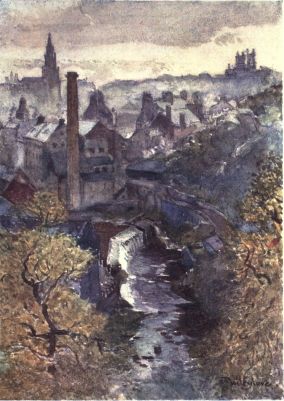 THE WATER OF LEITH FROM DEAN BRIDGE
We are looking west up stream, towards the sun setting behind
Corstorphine Hill. Above the waterfall is a distillery with its chimney
pointing to the Dean U.F. Church. On the right of the picture are the
two towers of the Orphan Hospital.
Life holds not an hour that is better to live in: the past is a tale that is told,
The future a sun-flecked shadow, alive and asleep, with a blessing in store.
Swinburne.
IN Edinburgh, at whatever other hour of the day the resident or tourist
may let his mind dwell in the past, at one o’clock he will always be
brought back to the present moment; for at one o’clock the gun goes off
at the Castle, and horses and men and women that are gun-shy are greatly
startled, and every one pulls out his watch. But, except precisely at
one o’clock, it is as impossible to exist in Edinburgh without living in
the past as it would be to walk along Princes Street without seeing the
Castle. We are a little archaic in Edinburgh. Yet there are other things
of the present that you may notice after you have set your watch to
Greenwich time by the one-o’clock gun. Princes Street is gay with shop
windows under awnings, with the big bow-windows of the Clubs, with many
hotels; and now there are bigger and newer hotels to east and to west,
at the railway stations. And Princes Street is full of a constant stream
of traffic, plying in the wide street between the one broad pavement on
the north side and the row of statues along the green sward and the
blazing flower-beds in the beautiful gardens opposite: cable cars with
noisy bells, motor cars, carriages, bicycles, electric broughams,
station lorries, hansom cabs, and the crawling “char-a-bancs,” with
their scarlet-coated drivers, picking up passengers for the Forth Bridge
or Roslin. But still the north-east wind takes the liberty of blowing
from the Forth among all these modern innovations, and whirling an
unwary hat or a too-lightly-held newspaper high into the air.
As the wind is unchanged in temper, so are the natural features
unchanged in beauty; and the views of the city, “from a’ the airts the
wind can blaw,” are pictures to gladden the artist or the poet. There is
the “Marmion view” from the south,—the view that Scott loved and Turner
painted,—but with a denser massing of suburb than they saw, reaching
right up to the furzy knoll where Marmion stood. Here is the Castle in
all its majesty, with the Grassmarket and Cowgate huddled picturesquely
under its precipices, and the old dark descending spine of the High
Street, with St. Giles’s open crown over the roofs, and then all the
maze and glitter of a newer world, with its many domes and steeples, and
the Forth beyond.
This is from the south; but, seen from the western roads and heights,
the city is even more striking. As you drive to the Forth Bridge along
the fine old coach road to Queensferry,—the very road along which
Jonathan Oldbuck and his companion drove in their journey in The
Antiquary—you pass an occasional farm-house with mellow stacks about
it and a smoky throat, and you must remember you are “within a mile of
Edinburgh toun,” where “Bonny Jockie, blythe and gay, kissed sweet Jenny
making hay.” Here, turn your head and you will see the dark mass of
Arthur’s Seat lifted up in the air, and upon its western wall the
fretted outline of the city and the Castle Rock, seeming not painted but
actually engraven like some old hieroglyphic.
To view Edinburgh from the north, you must journey over the Forth Bridge
and look across from the Fife coast opposite. From the wooded “haughs”
between Aberdour and Burntisland, Edinburgh, seen through a veil of
green summer leaves across six miles of rough bright blue, seems painted
in air, a scene of magic loveliness not to be excelled in all the
idyllic world of romance or dream. In the nearest foreground the little
island of Inchcolm with its tiny golden strand and ruined monastery;
farther out to sea Inchkeith’s lighthouse ringed with a fringe of foam;
and, beyond, a world of heights and hollows: Arthur’s Seat and the rigid
uncurved slant of the Salisbury Crags, and the gabled intricacy of the
Old Town, stretching from the hollow up to the black mass of rock on
which the Castle glooms in mid-air, and then the New Town fantastically
domed and steepled in the low foreground, and the white-columned summit
of Calton Hill. Down at the water’s edge, between the Forth and this
fairy show, are the dusky roofs and docks and shipping of Granton and
Leith. Away to the west, the dwindling Forth is spanned by the arches of
the monster bridge; and beyond it stretch the woods of Dalmeny and
Abercorn. In the far east, where the Forth has widened to the sea, are
the outjutting headlands, and on one of them is the curious cone called
Berwick Law; while, behind all, for a background, the distant Pentlands
slope to the south in softest purple.
Dear to the heart of the resident is the view seen as one comes down the
Mound on a winter’s afternoon at sunset, when the Castle stands dark
against the glorious red of the western sky, and Princes Street, her
lamps and her windows all alight, looks like a jewelled necklace.
But of all views of Edinburgh the most mystically beautiful is that seen
from the Calton Hill by night. The city is close about you; but in the
darkness there is isolation. Across a gulf of impenetrable gloom there
is spread a panorama of heights and depths, beaded by a myriad of
lights, with those in the depths seeming to be reflected from those in
the heights, like a starry sky seen in a deep pool. And, as you encircle
the hill, you find always some new phantasy of light and gloom, until on
the side towards the Firth there seems to be a stretch of flat black
country garlanded with lights that dip and rise with every bend of the
land down to the lip of the sea; and all round the coast every
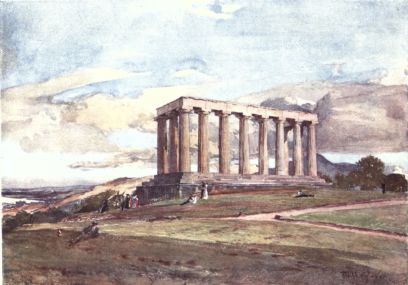 THE NATIONAL MONUMENT ON CALTON HILL
This noble monument represents a partial reproduction of the Parthenon
on the Acropolis at Athens. In the picture the spectator is supposed to
be looking at the north-west angle of the Temple, showing the eight
columns of the west front and two on the north side. On the left of the
picture is a glimpse of the Firth of Forth, while to the right, behind
the columns, rises Arthur’s Seat.
point and pier and headland is studded with coloured sea-lights; and far
out in the measureless mid-Firth flashes the great Eye of the revolving
light of Inchkeith.
Brave the “sharp sops of sleet and snipand snaw,” and come to Edinburgh
in winter, and you will find all the residents at home and busy: the Law
Courts sitting; the University at work; a regiment, with khaki coverings
to their kilts, quartered at the Castle, and tramping through the town
in rhythm to the tune of the pipes; and all the gaiety of balls and
dinners and theatres in the evening hours. Risk the keen blast of the
east wind, and come to Edinburgh in April, and you will be able to
attend the Graduation in Arts at the M‘Ewan Hall,—in the character
of an honorary graduate if you deserve it. Come in May, and you will
find the streets thronged with black-coated ministers and elders from
every parish in Scotland; for the Assemblies will be sitting, and the
Lord High Commissioner will be holding semi-royal state at Holyrood.
Come in autumn, as you always will; and it will be to find the long rows
of stately stone dwellings left tenantless, and their appalling
regularity and monotony rendered even more appalling by the brown paper
that fills the windows, and by the boarding that is up before the doors.
But the shop windows will be full of tartans for your edification, and
you will find your cabman able to tell you all you want to know. At any
other season Edinburgh is a hospitable city, and it is growing every day
a more cosmopolitan one. English residents have altered national ways;
ruthless hands are tearing down our beautiful old stone houses, and
building tenements in their places; and soon—too soon—all Scottish
traits will be lost.
But the Castle Rock cannot be levelled. It was there, in the mist and
the rain, before Edinburgh began; and it will be there, in the mist and
the rain, when Edinburgh has ceased to be.
A,
B,
C,
D,
E,
F,
G,
H,
I,
J,
K,
L,
M,
N,
O,
P,
Q,
R,
S,
T,
U,
V,
W.
Abbotsford, 138, 141, 145
Abercromby, George (Lord), 134
Adamson, Bishop (1584), 55
Advocates’ Close, 72, 73
Albany, Duke of, brother of James III., 13-14
Alexander II., 46
Alexander III., 9, 17, 24
Allan, Sir William, 138, 149
Alnwick Castle, 6
Anchor Close, 75, and note
Angus, Earl of, called “Archibald Bell-the-Cat,” 48, 49
Angus, Earl of, 15 note, 50, 88
Anne of Denmark, wife of James VI., 71, 102
Argyle, Marquis of, 15-16, 80
Arran, Earl of, 88, 89
Arthur’s Seat, 23, 27, 36, 38, 165
Ashestiel, 138
Assembly Rooms (Old Edinburgh), 73, 74, 75
Auchinleck, Lord, his caustic saying concerning Dr. Johnson, 110
Ayala, Don Pedro de, ambassador from Ferdinand and Isabella of Spain to the Court of James IV., 28, 29
Aytoun, Professor, 149
Bailie Fyfe’s Close, 74, 77
Baillie, Joanna, 138
Balcarres, Countess of. See Hyndford’s Close
Balfour, Dr., grandfather of R. L. Stevenson, 157
Bannatyne Club, the, 142
“Banner of Blue,” 14
Barbauld, Mrs., 134
Barnard, Lady Anne (née Lindsay), 62, 77
Bastian, servant of Mary, Queen of Scots, 40
Baxter’s Close, 70
Beaton, Cardinal, 50, 76
Beaton, James, Archbishop of Glasgow, 88-89
Beattie, the poet, 108
Beaufort, Jane, wife of James I., 11-12, 25-26
“Begbie murder,” the, 77
Belches of Invermay, Sir John and Lady Jane, and their daughter, Scott’s first love, 133
“Bell-the-Cat.” See Angus
Bell’s Wynd, 73, 74
Bernham, David de, Norman Bishop of St. Andrews (1243), 46
“Bible Close,” 78
Bishops of Edinburgh (Established Episcopalian), 54
Bishop’s Palace. See Whitehorse Close
Black, Adam, 151
Black, Professor, 120
Blackford Hill, 130, 159
Blackfriars Street, formerly Wynd, 40, 76, 88, 109
Blackie, Professor, 152
Blackwood’s Magazine, 149
Blair, Dr., 108
Borthwick, Master Gunner to James IV., 27
Boswell, Sir Alexander, his verses on Miss Nicky Murray, 73-74, 138
Boswell, James, 68, 100, 108-109, 110
Boswell, Mrs., 108-109
Bothwell, Adam, Bishop of Orkney, 40, 71-72
Bothwell, Earl of, 39, 40, 41, 66, 71
“Bow-head Saints,” the, 96-97
Boyd, George. See Mound
Boyd’s Close, 82 note, 107-108
Braid Hills, the, 159
Brantôme, Sieur de, 36, 37
Brewster, Sir David, 151
Bristo Street, 113
Brodie’s Close, 70
Brougham, Lord, 150, 151
Brown, George, builder of George Square and Brown Square, 122
Brown, Dr. John, 151
Brown, Dr. Thomas, 149
Brown Square, 122
Bruce, King Robert the, 9, 10, 18, 42, 83
Bruce, Marjory, daughter of King Robert the Bruce, 42
Buchan, Earl of, 108
Buchanan, George, 50, 91, 92-93
Burnet, Miss, 112, 114
Burns, Robert, lodges in Baxter’s Close, 70, 75;
his triumphant reception in Edinburgh, 111-113;
meeting with Scott, 113;
“Clarinda and Sylvander,” 113-114;
Edina, Scotia’s darling seat, 114-115
Burton, Dr. John Hill, 151
Byers’ Close, 71-73, and 71 note
Byers of Coates, John, 71 note
Caledonian Hunt, the, and Burns’s Poems, 112-113
Calton Hill, 46;
the view from, 166
Campbell, Thomas, 137, 149
Candlish, Dr., 150
Canongate, the, 24, 62, 63, 64, 67, 78-82, 100, 101, 105, 106, 124
Cant’s Close, 76
Carberry Hill, battle of, 41, 66
Carey, Sir Robert, 41-42
Carlyle, Dr., of Inveresk, 107
Carlyle, Thomas, 150, 151
Carnegie, Andrew, 154
“Castell of Maydens,” 5
Castle, the, 3-21;
story of Malcolm Canmore and Queen Margaret, 5-8;
Queen Margaret’s Chapel in, 5, 7, 9, 15, 16;
“Frank’s Escalade,” 10;
besieged by Henry IV. of England, 11;
the “Black Dinner” (1440), 12-13, 17;
story of the Duke of Albany, 13-14;
James VI. born in the Palace of, 15;
Jacobites imprisoned in, 16;
the Great Hall of, 16-18, 155;
the Regalia, 18-20, 140;
“Mons Meg,” 20-21, 144;
mentions of, 23, 24, 26, 69, 86, 120;
the “one-o’clock gun,” 163, 164, 165, 166, 167, 168
Castle Street, 135, 136, 137 note, 138, 139, 142, 143, 145
Cathedral (St. Giles’s). See St. Giles, Church of
St. Mary, 71 note, 154
Chalmers, Dr., 150
Chambers’s Edinburgh Journal, 149
Chambers, Robert, 19, and note, 20, 54, 72, 73, 74, 81, 119-121, 129;
his writings, and his friendship with Scott, 149
Chambers, William, 61, 155
Charles I., 18, 41, 42, 43, 54, 82, 94
Charles II., 19, 43, 58, 65, 95
Charles Edward Stuart (Prince Charlie), 43-44, 99, 130, 131 note
Chepman, Walter, earliest Scottish printer, 27, 47, 48, 49 note
Chiesley of Dalry, 153
Christison, Sir Robert, 151
“Christopher North.” See Wilson
Church of St. Giles. See St. Giles
“Clarinda” (Mrs. M‘Lehose), 113-114
Claverhouse, Graham of, 126, 138
“Cleanse the Causeway,” 66, 88-89, 127
Clerks of Penicuik, the, 98, 132, 133, 136, 138
Closes and Wynds of Edinburgh, 62-82, 88, 95-96, 99, 100, 105, 106, 108, 109, 120, 129
Coalstoun, Lord, story of, 72-73
Coates House, 71 note
Cockburn, Lord, 149, 150
Cockburn, Mrs., 100
Colinton, 156, 157, 158, 160, 162
College Wynd, 106, 120, 129
Combe, George, 151
Comely Bank, 150
Constable, Thomas, 141
Court of Session, 85
Covenanters, the, 59, 96, 160
Cowgate, the, 40, 64, 87, 88, 90, 91, 95, 96, 120, 164
Crabbe, George, 138, 143
Craig, Lord, 113
Craigie, Lord President, 124
Craigmillar, 144 note
Craigmillar Quarry, 122
Crail, 35
Cranstoun, George (Lord Corehouse), 134
Cranstoun, Miss, 134, 135
Creech’s Land, 105
“Crochallan Fencibles,” 75, 112
Cromwell, Oliver, banquets in the Hall of the Castle, 18;
stays at Moray House, 79-80;
enters Edinburgh after the battle of Dunbar, 58
Cross, the City, 31, 43, 58, 98, 132, 141
Cullen Professor, 120
Cunningham, Alison, 157
Cunningham, Dr., 150
Cunyie House (the Scottish Mint), 76
Currie, 161
Dalkeith, 30, 144
Dalmeny, the woods of, 166
Darnley, Earl of, 38-39, 39-40, 42, 76
David I., 23-24, 46
David II., and David’s Tower in the Castle, 10
Dawney Douglas’s Tavern, 75, 112
Deacon Brodie. See Brodie’s Close
Defoe, 104-105
“Delta.” See Moir
De Quincey, 150
Dick of Prestonfield, Sir Alexander, 109
Dickens, Charles, 151
Disruption, the, 150-151
Don of Newton, Sir Alexander, 138
Donald Bane, 7
Douglas, Duchess of, 108
Douglas, Duke of, 125
Douglas, Gavin, 27;
account of, 48-50, 87-89, 148
Douglas, Lady Jane, 70
Dowie’s Tavern, 112
Drummond of Hawthornden, 29, 94, 104
Drummond, Lord Provost, 123
Drummond Place, 125, 126, 152
Drummore, Lord, 124-125
Drumsheugh, the ancient forest of, 23, 31, 46
Duddingston, 100
Dunbar, William, 28, 29, 31, 87
Dundas, Sir Laurence, 125
Dundonald, Earl of, 70
Dunfermline, 4, 6, 8, 155
Edgar, second son of Malcolm Canmore, 7
Edinburgh made an Episcopal See (1633), 54
Edinburgh Courant, 104
Edinburgh Review, 137 and note, 149
Edward I. of England, 9, 24, 46, 50
Edward II. of England, 25, 46
Edward “the Confessor,” 5
Eglintoun, Susanna, Countess of, 75, 98-100
Eglintoun, Lord, 98-99
Elizabeth, Queen of England, 42
Elliott of Minto, Miss Jeanie, 122
Erskine, friend of Scott, 134
Erskine, Henry, Advocate, 108
“Ettrick Shepherd,” the. See Hogg
Fairmilehead, 161
Falkland, 11, 35
Fergusson, Professor, 113, 134
Fergusson, Robert, 112
Ferrier, the family of, 112, 114
Ferrier, Miss, 149
Findlay, John Ritchie, 154
Firth of Forth. See Forth
Fleming of Cumbernauld, Sir Malcolm, 12, 13
Flodden, battle of, 31-33, 35, 49 note;
the Flodden Wall, 62, 87
Forbes of Pitsligo, Sir William, and Burns, 112
Forbes of Pitsligo, Sir William, and Scott, 133, 145
Forbes, William, first Established Episcopal Bishop of Edinburgh (1634), 54
“Fore-stairs,” 65, 66, 76
Forth (river, and Firth of), 3-4, 5, 7, 8, 21, 35, 36, 46, 155, 159, 165, 166, 167
Forth Bridge, the, 4, 155, 164, 165, 166
Fortune’s Tavern, 75-76
Franklin, Benjamin, 107
Gay, John, 81, 105-106
General’s Entry, 113
George I., 16
George III., 98, 99, 126
George IV., 141, 142
George Square, 122, 130, 131
George Street, 135, 139, 150, 157
Glammis, Lady, 14-15, and note
Glenlee, Lord, 122
“Golden Charter,” 14
Goldsmith, Oliver, 73, 106
Goodsir, Professor John, 151
“Goose Pie, the,” 98
Gordon, Duchess of, 76-77, 112
Gordon of Haddo, Sir John, 58
Grange, Lord, 74
Granton, 150, 166
Grassmarket, the, 15, 97, 120, 164
Gray of Pittendrum, Lord, and Lady, 68-69, and note
Great King Street, 150
Greyfriars’ Church and Churchyard, 51, 96, 133
Gustavus Vasa, Prince, 141
Guthrie, Dr., 150
Haddington, first Earl of (“Tam o’ the Cowgate”), 90-92
“Haddo’s Hole,” in St. Giles’s, 58, 59
Hailes, Lord, 108
Hall, the Rev. Mr., Presbyterian divine (1603), 53
Hamilton, Sir William, 150
Hart, Andro, 94
Hawthornden, 94, 109, 159
Hay, James, story of, 96
“Heart of Midlothian,” 63. See also Tolbooth
Henry III. of England, 9
Henry IV. of England, 11
Henry VII. of England, 30
Henry VIII. of England, 35, 37, 46, 50
Henry, Prince, eldest son of James VI., 41
Heriot, George, 90-91
Heriot Row, 156, 157
High School, the (in Old Edinburgh), 71, 92, 130
High Street, the, 62, 76, 77, 80, 88, 90, 94, 96, 105, 108, 123, 124, 127, 141, 164
“Highland Lady,” the, 153
Hogg, James (the “Ettrick Shepherd”), 136-137, 149, 160
Holbein, his miniature portrait of James IV., 29
Holyrood, 18, 22-44, 47, 53, 62, 63, 64, 65, 70, 76, 84, 91, 109, 120, 144, 167;
legend of the founding of the Abbey, 23;
Abbey burnt by Edward II., 25;
in reign of James IV., 26-33;
in reign of James V., 33-35;
in reign of Queen Mary, 35-41;
Charles I. christened at, 41;
and crowned at, 42;
rebuilt by Charles II., 43;
Abbey Church restored by James VII., 43;
Prince Charlie at, 43-44;
the Abbey desecrated and destroyed, 44
Home, John, 107
Hope, Sir Thomas, King’s Advocate, 34, 95
Homer, Francis, 52
Hume, David, 68, 71, 100-101, 109, 125
Hunter’s Tryst, 160
Huntly, Earl of, 39
Hyndford’s Close, 76, 77
Inchcolm, 165
Inchkeith, 109, 165
Irving, John, 134
Isles, Lord of the, story of, in 1429, 25-26
Jack’s Land, 101
Jacobites imprisoned in the Castle, 16
James I., 11, 12, 22, 26, 84
James II., 17, 26, 85, 86
James III., 14, 26, 68, 85
James IV., 16, 19, 26, 27, 28, 29, 30, 31, 32, 33, and note, 37, 38, 42, 49 note, 66, 87
James V., 14, 18, 33, 35, 85, 87, 88, 89
James VI., 15, 18, 41-42, 43, 52, 53, 71, 85, 90, 91, 92, 93, 94, 102-103, 104, 124
James VII., 43, 95
James’s Court, 68, 70, 101, 108, 125
Jeffrey, Lord, 131-132, 137, and note, 138, 149, 150
“Jenny Geddes,” 45, 54-58, 59
“Jock o’ Sklates.” See Mar, Earl of
Jonson, Ben, 104
Johnson, Dr., 68, 82 note, 100, 107-109, 110, 111
Kames, Lord, 108
Keith of Ravelston, Mrs., 148
Kemp, architect of the Scott Monument, 154 note
Kennedy, Bishop, 85-86
Kennedy, Sir Archibald, 98
Kincaid, Alexander, publisher, 107
Kingsley, Charles, 151
Kirkaldy of Grange, 52
Knox, John, 38, 49 note, 50, 51, and note, 52, 55, 61;
his house, 65, 77, 90, and note;
his grave, 65, 149
Krames, the, 53
Lady Stair’s Close, 68-70, 105
“Laigh Council House,” the, 91
Laing, David, 106, 149
Laing, Malcolm, 134
Lands, the (in Old Edinburgh), 62-82, 85, 87, 88, 89, 90, 91, 95, 99, 100, 101, 103, 105, 107, 108, 112, 113
Lang Dykes (called also Lang Gait), 121, 126
Lasswade, Scott’s cottage at, 136
Laud, Archbishop, his Service-Book, 55, and note, 56
Lauder, 48
Lauder of Blyth, Sir Alexander, 49
Lawnmarket, the, 62, 63, 68, 69, 127
Leith, 13, 14, 20, 26, 27, 34, 36, 97, 104, 142, 166
Leslie, Alexander, the Covenanting General, 18
Leven, Earl of, 76
Libberton’s Wynd, 112
Library, Advocates’, 96, 134;
Public, 95, 154;
Signet, 91
Lindores, Abbey Church of, 52
Lindsay, Earl of, 41
Lindsay, Sir David, 34, 89
Linlithgow, 35
Lister, Lord, 151-152
Lockhart of Carnwath, George, 122
Lockhart, John Gibson, 140, 141, 144, 149
“Logy, Maister Leonard,” 33 note
Lord of the Isles. See Isles
Lorn, Lord (1650), 80
Loudoun, Earl of, 69
Luckenbooths, the, 105
Macaulay, Lord, 151
M‘Crie, Thomas, 149
M‘Ewan, William, 154
M‘Ewan Hall, the, 154, 167
Mackenzie, Sir George, 76, 95-96
Mackenzie, Henry (“the Man of Feeling”), 149
Maclean, of Torloisk, Mrs., and her daughters, 138
Macmorran, Bailie, 71
Madeleine, first wife of James V., 34, 44, 94
Malcolm Canmore, 4, 5-8, 35, 126, 155
Mansfield, Earl of, 74
Mar, Earl of, 18;
Earl of Mar called “Jock o’ Sklates,” 92
Margaret, Saint, Queen of Scotland, second wife of Malcolm Canmore, 5-8, 9, 15, 16, 24, 126, 155
Margaret, daughter of Henry III. of England, betrothed to Alexander III., 9
Margaret of Denmark, wife of James III., 26
Margaret Tudor, wife of James IV., 30, 35, 37, 50, 66, 87
“Marmion view,” the, 164
Mary of Gueldres, wife of James II., 26, 86
Mary of Lorraine (Mary of Guise), second wife of James V., and Regent of Scotland, 35, 50, 51, 89-90
Mary, Queen of Scots, 5, 8, 15, 18, 35-41, 50, 52, 66, 76, 84, 143
Maud, daughter of Malcolm Canmore and Queen Margaret, 126
Maxwell of Monreith, Lady, and her daughters, 76-77
Meadows, the, 122
Melrose, dwelling of the Abbots of, 76, 95
Melville, Andrew, 93
Menzies, William, anecdote concerning Scott and son of, 138
Merchiston Castle, 93, 153
Miller, Hugh, 151
Mint, the Scottish. See Cunyie House
Moir, Dr. (“Delta”), 150
Monboddo, Lord, 112
“Mons Meg,” 20-21, 144
Montrose, Marquis of, 59, 69, 80, and note
Moray House, account of, 79-80
Morocco Close, 78
Mound, the, formation of, 127;
and Sir Walter Scott, 137, 139;
view from, 166
Munro, Professor, 120
Murray, Dr. Alexander, 149
Murray of Auchtertyre, Patrick, 134
Murray of Broughton, 131, and note
Murray of Henderland, Mrs., 108
Murray, Miss Nicky, 74, 77
Murray of Simprim, Patrick, 134
Murray, manager of the Theatre Royal, 144
Myllar, Andro, 27
Mylne’s Court, 68
Mylne, John, Royal Master Mason, 43
Mylne, Robert, Royal Master Mason, 68
Mylne, Robert, F.R.S., Royal Master Mason, account of, 74-75, and note
Nairne, Baroness, 100, 148
Nairne Lodge, 100
Napier of Merchiston, 93
National Portrait Gallery, 154
Neaves, Lord, 150
Nelson, Thomas, 155
Netherbow Port, the, 62, 63
Newark, Lord, Covenanting General, 98
Niddry’s Wynd, 74
Nor’ Loch, 26, 51, 69, 120, 124, 126-127
North Bridge, the, 123, 137
Old Assembly Close, 73
“Old Kirk, the” (in St. Giles’s), 51
Oliphants of Gask, the, 100, 148
“Outer Tolbooth,” the, 49 note
Panmure’s Close, 100
Paoli, the Corsican, 68
Parliament House, 65, 72, 81, 85, 134, 142, 144
Paterson, John, Bishop of Edinburgh, 82
Pembroke, Earl of (Shakespeare’s friend), 103
Pentlands, the, 156, 159, 161, 166
Philosophical Institution, the, and its first Presidents and Lecturers, 151
Playfair, Lyon (Lord Playfair), 151
Poker Club, the, 75, 76, 120
Pope Innocent IV. (and St. Margaret), 8
Pope Julius II. (and James IV)., 19
Potterrow, 79, 100, 113, 130
Preston Aisle, the (in St. Giles’s), 47
Preston of Gorton, William, 47
Priestfield (now Prestonfield), 27, 109
Primrose, James, Viscount, 69
Princes Street, 124, 125, 126, 132, 142, 153, 154, 157, 163, 164, 166
Printing in Edinburgh in the reign of James IV., 27
Queen Street, 143, 152, 154, 157
Queensberry, Duchess of (“Kitty”), 81, 105
Queensberry House, 79;
tragedy in, 80-81
Queensberry, Marquis of, 81
Queensferry Road, view of Edinburgh from, 165
Raeburn, Sir Henry, 144, 149
Ramsay, Allan (the poet), 74, 97-98, 99, 105-106, 107, 160
Ramsay, Allan (the artist), 98, 108
Ramsay, Dean, 150
Ramsay, General, 98
Randolph of Strathdon, Sir Thomas, 10
Regalia, the Scottish, 18-20, 140, 144
Riccio, David, 15, 38-39
Richard II. of England, 46
Riddle’s Close, 70, 101
Robertson, Principal, 108, 109
Ronsard (the French poet), 34
Rose, Abernethy, Bishop of Edinburgh, 54
Rosebery, the Earl of, 68
Rosehaugh Close, 95-96
Roslin, Boswell takes Dr. Johnson to, 109;
Scott takes Wordsworth to, 136, 164
Ross, the Lords, and Ross House, 122
Rothesay, the Duke of, eldest son of Robert III., 11
Royal Scottish Academy, 142
Royal Scottish Society, 142
Rullion Green, battle of, 59, 160
Ruskin, John, 151
Russel, Alexander, 151
Ruthven, Earl of, 41
St. Andrew’s Church in George Street, 150
St. Andrew Square, 124, 125
St. Cecilia’s Hall, 74-75
St. David Street, 125, 145
St. Giles, Church of, 24, 27, 45-61, 63, 65, 72, 86, 87, 94, 120, 144, 155, 164
St. John Street, 107
Salamander Land, 105
Salisbury Crags, 26, 165
Sandilands’ Close, 85
Scott, Anne, 145
Scott, General, 125-126, 152
Scott, Sir Gilbert, 154
Scott of Harden, Hugh, 135
Scott, Lady, wife of Sir Walter Scott, 135, 137;
death of, 145
Scott, Mr. and Mrs., parents of Sir Walter, 131
Scott, Sophia, 140
Scott, Sir Walter, 11, 20, 65, 69-70, 113, 129-146, 147, 160;
his homes in and near Edinburgh, 135-139, 141, 143, 145;
his later places of residence, 145;
his circle of friends, 148-150;
the Scott Monument, 153-154
Scottish Regalia. See Regalia
Scougall, John, artist, 73
“Seven Sisters of Borthwick,” 20, 27
Simpson, Sir James Y., 151
Shakespeare, 5;
was he in Edinburgh? 103
Shandwick Place, 145
Sharpe, Kirkpatrick, 138, 149
Shoemaker’s Land, 78
Six Feet Club, 160
Skelton, John, 151
Skene of Rubislaw, 135, 145
Skene, W. F., 151
Smith, Adam, 100
Smith, Alexander, 151
Smith, Sydney, 138
Smollett, Tobias, 107
Solway Moss, battle of, 35
South Gray’s Close, 76
Spottiswoode, Archbishop, 56
Stair, the Earl of, 69
Stair, Lady, and Lady Stair’s Close, 68-70
Stamp Office Close, 75-76, 99
Steele, Richard, 105
Stevenson, Robert Louis, 77, 78, 156-162
Stewart, Dugald, 149
Strichen’s Close, 76, 95
Stuart, Sir John (the “Black Knight of Lorn”), 12
Swanston, 156, 159-160, 161
Syme, Professor, 151
Tait, Professor, 151
“Tam o’ the Cowgate.” See Haddington, Earl of
Taylor, “the Water Poet,” 64, 104
Telfer, Mrs., of Scotstoun, 107
Tercentenary of the University, 152
Thackeray, 151
Thomson, Thomas, legal antiquary, 133
Tinwald, Lord Justice Clerk, 124
“Tolbooth Kirk, the” (in St. Giles’s), 51 note
Tolbooth, the, 53, 59, 63, 65, 69, 80, 155 note
Topham, Captain, 73, 109-111
Trollope, Anthony, 151
Tron Church, the, 132
“Tulzie,” a, 66
Turgot, Bishop, 6, 7, 8
Tweeddale Close, 77
Tytlers of Woodhouselee, the, 136
Union, the (1707), 64, 76;
Treaty of, 80, 81
Union, the Students’ University, 154
United Free Assembly Hall, 90
University, the, 85, 92, 109, 111, 120, 151, 152, 154, 159, 167
Vasa, Prince Gustavus, and the Baron Polier, 141
Victoria, Queen, her first visit to Edinburgh (1842), 147, 150
Volunteers, the Scottish Light Horse, 135
Walker Street, 145
Wallace, Sir William, 9, 24
Warbeck, Perkin, at the Court of James IV., 28
Watt, the Republican, 134
Webber, his attempt on Scott’s life, 139
Weir, Major, and his sister Grisel, 96-97
West Bow, 97
West Port, 92
Whiteford, Sir John, 112
Whiteford, Miss, 114
Whitehorse Close, 54, 81-82, and 82 note
Whitehorse Inn. See Boyd’s Close
Wilson, Professor (“Christopher North”), 149
Wishart, Chaplain to Montrose, and afterward Bishop of Edinburgh, 59
Wood, Sir Andrew, 27-28
Wordsworth and his sister Dorothy visit Scott in 1803, 136
World’s End Close, 76
Wynds (of Edinburgh). See Closes
THE END
Printed by R. & R. Clark, Limited, Edinburgh.
Books by Rosaline Masson
In Our Town.
“A romance of Edinburgh which will captivate even a degenerate
Southerner.”—Guardian.
“A graceful and touching love-story, grafted on much interesting and
detailed description of her city of Edinburgh.”—Illustrated London
News.
“Full of the atmosphere and legal life of modern
Edinburgh.”—Literature.
“Lovers of Edinburgh, and all exiled Scots will joy over In Our
Town.”—Outlook.
“Miss Masson knows her Edinburgh thoroughly—its sets, its prejudices,
its pride; and she touches them all gently, wittily, and
thoughtfully.”—Ladies’ Field.
“Something of the persistent persuasiveness of delightful Jane
Austen.”—Glasgow Herald.
“A book of more than passing interest.”—Spectator.
[Hodder & Stoughton.
Leslie Farquhar.
“The most attractive Scotch novel we have read for a long
while.”—Standard.
“A book which in respect of its strength and its beauty of diction, its
excellent portrayal of a wide range of character, and its workmanlike
construction—not the least essential of the novel—deserves to take a
high place in modern fiction.”—Scotsman.
“Not since William Black’s pen was laid aside has so much of the colour,
fragrance, and feeling of Western Scotland been rendered in print....
The story would appear to be the outcome of a moving realisation of all
that makes the Highlands what they are to the poetic sense, of which the
author of A Princess of Thule was perhaps the best modern
interpreter.”—Glasgow Herald.
“Seldom since William Black gave us of his best has the land of moss and
fell and deer forest been better painted in words.”—St. James’s
Budget.
“Well-written story of Scotch county society.”—Times.
[John Murray.
The Transgressors.
“Those who know their Edinburgh well will doubtless recognise many
among the portraits of its great and popular men here given; and
those who do not will be glad of this opportunity of obtaining a
glimpse into the life of a city whose culture runs on such
different lines to those familiar to Englishmen.”—Guardian.
“The book is all about Edinburgh life and Edinburgh people as they
are to be seen to-day by anybody who has eyes to see them ...
introduces its readers to several typical Edinburgh households ...
full of little bits of the streets of Edinburgh.”—Scotsman.
“The charm of the book is in its intimate sketches of Edinburgh
society. Miss Masson seems to know it in every phase, and hits off
its characteristics with a sure and kindly hand.”—Sketch.
[Hodder & Stoughton.
Lives of Pollock and Aytoun. (Famous Scots Series.)
“Has managed to invest the story of Pollock, whose Course of Time
is practically unknown to the present generation, with a good deal
of interest.”—Literature.
[Oliphant, Anderson & Ferrier.
A Departure from Tradition, & other Stories.
“Brisk little stories these, with a pleasant dash of sentiment and
plenty of fun.”—Tablet.
[Sands & Co.
My Poor Niece, and other Stories.
“Eminently artistic.”—Daily Chronicle.
[Oliphant, Anderson & Ferrier.
Use and Abuse of English.
“A guide which is the pithiest, clearest, and handiest that we have
yet seen. One could find no livelier companion for a railway
journey than this booklet; it will easily go into the pocket, and
will amply repay close study.”—Aberdeen Free Press.
[James Thin, Edinburgh.
BONNIE SCOTLAND
PAINTED BY SUTTON PALMER
DESCRIBED BY A. R. HOPE MONCRIEFF
Containing 75 Full-Page Illustrations in Colour
SQUARE DEMY 8vo. GILT TOP
PRICE 20s. NET
Edition de Luxe (limited impression), price 2 guineas net
“HAPPY ENGLAND,” by Mrs. Allingham, the England of sunshine, flower
gardens and lovely rural scenes, which the summer of 1904 has shown to
be no mere memory but actual fact, is now to be followed by BONNIE
SCOTLAND, the next volume in Messrs. Black’s series of Beautiful Books
illustrated in colour.
Mr. Sutton Palmer is the artist, and his style is not unlike Mrs.
Allingham’s in its careful drawing and regard for detail, while he, too,
has an eye for colour as is exemplified in his sketches of brown hills
and purple heather, and in the glimpses of the indigo colouring of the
deep lochs. Both artists are alike also in having elicited Mr. Ruskin’s
praise of their work.
It was the heartfelt wish of Robert Burns to “make a beuk for poor auld
Scotland’s sake”; he succeeded better than he knew. And Sir Walter
Scott, a quarter of a century later, by publishing “The Lady of the
Lake” and the “Waverley Novels,” became the Columbus of the Highlands,
making the people and their country known to Englishmen. In BONNIE
SCOTLAND the scenery familiar to many from Scott’s verbal descriptions
will become real to the eye, and even those who know not Scotland cannot
fail to feel the charm of this wonderful land of which Mr. Menpes has
said: “Take the finest bit of Switzerland and the finest bit of Norway,
dip them in water and you have Scotland.” And again, “It is the chief
charm of Scotland that one sees everywhere such rich, deep, stirring
colour.”
Mr. A. R. Hope Moncrieff, himself a Scot, who contributes the
letterpress, has not written merely descriptive matter. He has given an
outline of Scotland’s salient features, and glimpses of her history,
national church, and literature, lightened by the entertaining
reminiscences and anecdotes of one who has travelled widely and is able
to judge his countrymen at their proper worth. In fact, this is a book
that will have to take its place in the library of every lover of
Scotland.
PUBLISHED BY
ADAM AND CHARLES BLACK, SOHO SQUARE, LONDON, W.
SCOTTISH
LIFE AND CHARACTER
PAINTED BY H. J. DOBSON, R.S.W.
DESCRIBED BY WM. SANDERSON
Containing 20 Full-Page Illustrations in Colour Facsimile
PRICE 7s. 6d. NET
Many volumes and countless articles have been written about Scottish
life and character, while the grand and beautiful in the scenery of
Scotland have been reproduced in numerous ways, from the rough wood-cut
to the latest colour process, but in the present book the hard-beaten
path is departed from, and some of the less familiar pictures of
Scottish life are represented. Mr. Henry J. Dobson, R.S.W., has devoted
much of his life to placing on canvas those humble Scottish interiors
which are fast disappearing, and, though his work in this direction is
well known to art lovers, the present reproduction in colours of twenty
of his paintings will receive a wide welcome. The quiet, grey tones of
the interiors, and the life-like portraits of the inmates, will recall
to many the old country life in Scotland, when time to them was still
young. The letterpress, which has been written by Mr. Wm. Sanderson,
editor of the Border Magazine, deals in a pleasing way with many
varied phases of Scottish life which, like the illustrations, will be
sure to awaken cherished memories of the past in the hearts of many
readers.
PUBLISHED BY
ADAM AND CHARLES BLACK, SOHO SQUARE, LONDON, W.
A. & C. BLACK’S LIST OF BOOKS ILLUSTRATED IN COLOUR. AUTUMN, 1904
IN THE SAME SERIES
ALL WITH PAGE ILLUSTRATIONS IN COLOUR
EACH 20s. NET
“Of all God’s gifts to the sight of man, colour is the holiest, the
most Divine, the most solemn.”—Ruskin.
PAINTED BY SUTTON PALMER
DESCRIBED BY A. R. HOPE MONCRIEFF
BONNIE SCOTLAND
CONTAINING 75 FULL-PAGE ILLUSTRATIONS IN COLOUR
TEXT BY MARCUS B. HUISH
BRITISH WATER-COLOUR ART, ETC.
CONTAINING 60 OF THE KING’S PICTURES
PAINTED BY ROSE BARTON
FAMILIAR LONDON
CONTAINING 61 FULL-PAGE ILLUSTRATIONS IN COLOUR
PAINTED BY A. S. FORREST
DESCRIBED BY S. L. BENSUSAN
MOROCCO
CONTAINING 74 FULL-PAGE ILLUSTRATIONS IN COLOUR
BY HELEN ALLINGHAM
TEXT BY MARCUS B. HUISH
HAPPY ENGLAND
CONTAINING 80 FULL-PAGE ILLUSTRATIONS IN COLOUR
“All men completely organized and justly tempered enjoy colour; it
is meant for the perpetual comfort and delight of the human
heart.”—Ruskin.
BY MORTIMER MENPES
TEXT BY DOROTHY MENPES
VENICE
CONTAINING 100 FULL-PAGE ILLUSTRATIONS IN COLOUR
BY MORTIMER MENPES
TEXT BY DOROTHY MENPES
THE DURBAR
CONTAINING 100 FULL-PAGE ILLUSTRATIONS IN COLOUR
BY MORTIMER MENPES
TEXT BY DOROTHY MENPES
JAPAN
CONTAINING 100 FULL-PAGE ILLUSTRATIONS IN COLOUR
BY MORTIMER MENPES
TEXT BY DOROTHY MENPES
PARIS
CONTAINING 75 FULL-PAGE ILLUSTRATIONS IN COLOUR
PAINTED AND DESCRIBED BY R. TALBOT KELLY
EGYPT
CONTAINING 75 FULL-PAGE ILLUSTRATIONS IN COLOUR
BEAUTIFUL BOOKS
IN THE SAME SERIES
ALL WITH PAGE ILLUSTRATIONS IN COLOUR
EACH 20s. NET
BY NICO JUNGMAN
TEXT BY BEATRIX JUNGMAN
HOLLAND
CONTAINING 76 FULL-PAGE ILLUSTRATIONS IN COLOUR
PAINTED BY HENRY B. WIMBUSH
DESCRIBED BY EDITH F. CAREY
THE CHANNEL ISLANDS
CONTAINING 76 FULL-PAGE ILLUSTRATIONS IN COLOUR
DESCRIBED BY SIR MARTIN CONWAY
PAINTED BY A. D. M‘CORMICK
THE ALPS
CONTAINING 70 FULL-PAGE ILLUSTRATIONS IN COLOUR
PAINTED BY COLONEL R. C. GOFF
DESCRIBED BY MRS. GOFF
FLORENCE
CONTAINING 75 FULL-PAGE ILLUSTRATIONS IN COLOUR
PAINTED BY JOHN FULLEYLOVE, R.I.
DESCRIBED BY E. W. THOMAS
OXFORD
CONTAINING 60 FULL-PAGE ILLUSTRATIONS IN COLOUR
BY CAPT. S. E. ST. LEGER
WAR SKETCHES IN COLOUR
CONTAINING 165 ILLUSTRATIONS (50 IN COLOUR)
EACH 20s. NET
BY MORTIMER MENPES
TEXT BY DOROTHY MENPES
WORLD’S CHILDREN
CONTAINING 100 FULL-PAGE ILLUSTRATIONS IN COLOUR
BY MORTIMER MENPES
TEXT BY DOROTHY MENPES
WORLD PICTURES
CONTAINING 500 ILLUSTRATIONS (50 IN COLOUR)
BY MORTIMER MENPES
TEXT BY DOROTHY MENPES
WAR IMPRESSIONS
CONTAINING 99 FULL-PAGE ILLUSTRATIONS IN COLOUR
BY AUGUSTINE FITZGERALD
TEXT BY SYBIL FITZGERALD
NAPLES
CONTAINING 80 FULL-PAGE ILLUSTRATIONS IN COLOUR
PAINTED BY JOHN FULLEYLOVE, R.I.
DESCRIBED BY THE REV. JOHN KELMAN, M.A.
THE HOLY LAND
CONTAINING 92 FULL-PAGE ILLUSTRATIONS, MOSTLY IN COLOUR
TEXT BY JOSEPH GREGO
CRUIKSHANK’S WATER-COLOURS
CONTAINING 68 FULL-PAGE FACSIMILE REPRODUCTIONS IN COLOUR
ILLUSTRATED IN THE SAME STYLE AS THE 20s. SERIES
PRICE 7s. 6d. NET EACH
PAINTED BY JOHN FULLEYLOVE, R.I.
TEXT BY MRS. A. MURRAY SMITH
WESTMINSTER ABBEY
CONTAINING 21 FULL-PAGE ILLUSTRATIONS IN COLOUR
BY GORDON HOME
YORKSHIRE COAST AND MOORLAND SCENES
CONTAINING 32 FULL-PAGE ILLUSTRATIONS IN COLOUR
BY OLIVER GOLDSMITH
THE VICAR OF WAKEFIELD
CONTAINING 13 FULL-PAGE ILLUSTRATIONS IN COLOUR BY AN EIGHTEENTH-CENTURY
ARTIST
BY C. LEWIS HIND
ADVENTURES AMONG PICTURES
CONTAINING 24 ILLUSTRATIONS (8 IN COLOUR, 16 IN BLACK AND WHITE)
PAINTED AND DESCRIBED BY GORDON HOME
INNS OF COURT
In preparation
CONTAINING 20 FULL-PAGE ILLUSTRATIONS IN COLOUR
PAINTED BY JOHN FULLEYLOVE, R.I.
TEXT BY ROSALINE MASSON
EDINBURGH
CONTAINING 21 FULL-PAGE ILLUSTRATIONS IN COLOUR
PAINTED BY H. J. DOBSON
TEXT BY WM. SANDERSON
SCOTTISH LIFE AND CHARACTER
CONTAINING 20 FULL-PAGE ILLUSTRATIONS IN COLOUR
PAINTED AND DESCRIBED BY MRS. WILLINGHAM RAWNSLEY
THE NEW FOREST
CONTAINING 20 FULL-PAGE ILLUSTRATIONS IN COLOUR
BY LADY BUTLER
PAINTER OF “THE ROLL CALL”
LETTERS FROM THE HOLY LAND
CONTAINING 16 FULL-PAGE ILLUSTRATIONS IN COLOUR BY LADY BUTLER
BY W. EARL HODGSON
TROUT FISHING
CONTAINING A MODEL BOOK OF FLIES IN COLOUR
PRICE 5s. NET
BY SIR WALTER SCOTT
THE LADY OF THE LAKE
CONTAINING 50 FULL-PAGE ILLUSTRATIONS—EIGHT BEING IN COLOUR FROM
ORIGINAL WATER-COLOUR DRAWINGS BY SUTTON PALMER, AND THE REST IN BLACK
AND WHITE FROM PHOTOGRAPHS.
WHISTLER AS I KNEW HIM
BY MORTIMER MENPES
SQUARE IMPERIAL 8vo., CLOTH, GILT TOP (11 × 8-3/4 INCHES)
CONTAINING 125 FULL-PAGE ILLUSTRATIONS IN COLOUR AND TINT OF WHISTLER
OIL-COLOURS, WATER-COLOURS, PASTELS, AND ETCHINGS
ORDINARY EDITION
PRICE 2 POUNDS NET
EDITION DE LUXE
PRICE 5 GUINEAS NET
WITH FULL-PAGE ILLUSTRATIONS IN COLOUR
BOOKS FOR BOYS AND GIRLS
PRICE 6s. EACH
BY S. R. CROCKETT
RED CAP TALES
STOLEN FROM THE TREASURE-CHEST OF THE WIZARD OF THE NORTH
CONTAINING 16 FULL-PAGE ILLUSTRATIONS IN COLOUR BY SIMON HARMON VEDDER
ANIMAL AUTOBIOGRAPHIES
BY G. M. A. HEWETT
THE RAT
BY G. E. MITTON
THE DOG
Others in preparation
EACH CONTAINING 12 FULL-PAGE ILLUSTRATIONS IN COLOUR
GULLIVER’S TRAVELS
CONTAINING 16 FULL-PAGE ILLUSTRATIONS IN COLOUR BY S. BAGHOT DE LA BERE
BY HARRIET BEECHER STOWE
UNCLE TOM’S CABIN
CONTAINING 8 FULL-PAGE ILLUSTRATIONS IN COLOUR, AND MANY OTHERS IN THE
TEXT
BY JOHN BUNYAN
THE PILGRIM’S PROGRESS
CONTAINING 8 FULL-PAGE ILLUSTRATIONS IN COLOUR BY GERTRUDE DEMAIN
HAMMOND
BY P. G. WODEHOUSE
WILLIAM TELL TOLD AGAIN
CONTAINING 16 FULL-PAGE ILLUSTRATIONS IN COLOUR BY PHILIP DADD
BY C. E. MITTON
CHILDREN’S BOOK OF LONDON
CONTAINING 12 FULL-PAGE ILLUSTRATIONS IN COLOUR BY JOHN WILLIAMSON
BY THE REV. R. C. GILLIE
THE STORY OF STORIES
CONTAINING 32 FULL-PAGE ILLUSTRATIONS
BY THE REV. R. C. GILLIE
THE KINSFOLK AND FRIENDS OF JESUS
CONTAINING 16 FULL-PAGE ILLUSTRATIONS IN COLOUR AND SEPIA
PUBLISHED BY A. & C. BLACK, SOHO SQUARE, LONDON, W.