Larger versions of most illustrations may be seen by right-clicking them
and selecting an option to view them separately, or by double-tapping and/or
stretching them.
New original cover art included with this eBook is granted
to the public domain.
J. W. ARROWSMITH (London) Ltd. 6 Upper Bedford Place, Russell Square, London
The First Editionof this book was printed
on Hand-made Paper (Medium 8vo) and
consisted of 265 numbered copies, of which
250 were for sale. It was published in
March, 1924.
This, The Second Edition(Crown 8vo),
was also published in March, 1924.
Printed in Great Britain by J. W. Arrowsmith Ltd., 11 Quay Street, Bristol
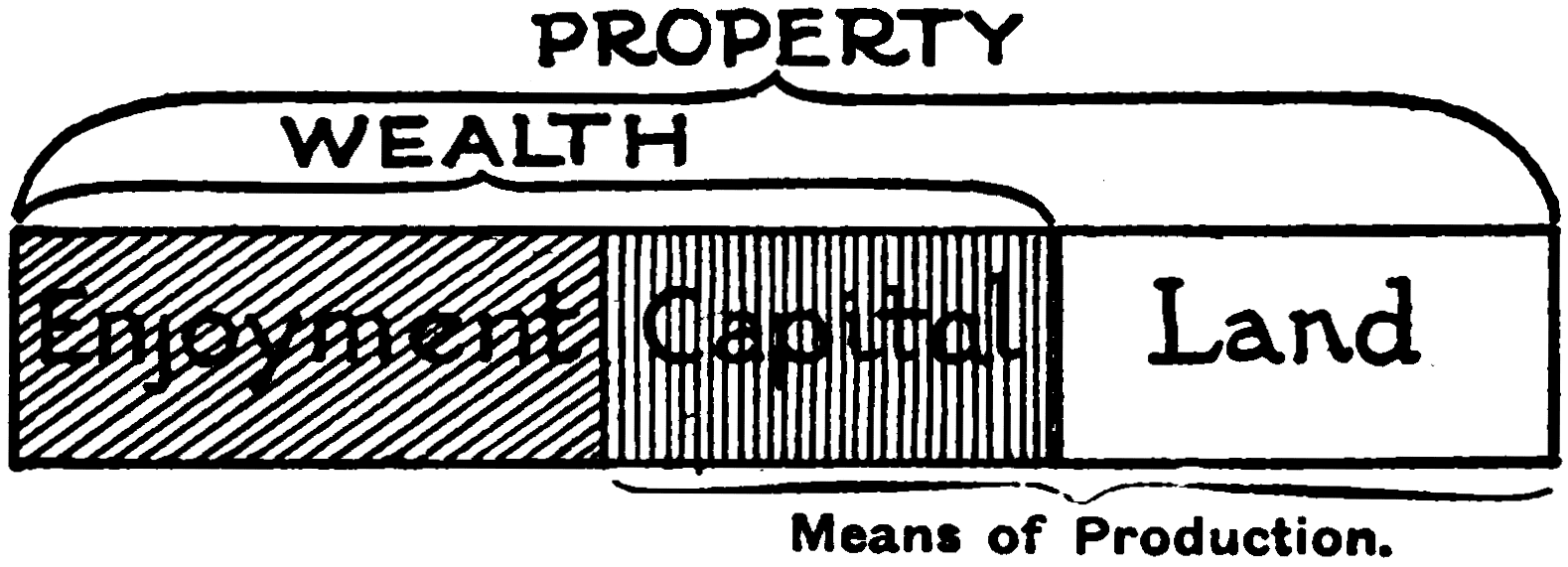
Economics is the name which people have come
to give to the study of Wealth. It is the study by
which we learn how Wealth is produced, how it
is consumed, how it is distributed among people,
and so on. It is a very important kind of study,
because it often depends upon our being right
or wrong in Economics whether we make the
whole State poorer or richer, and whether we make
the people living in the State happier or not.
Now as Economics is the study of Wealth, the
first thing we have to make certain of is, What
Wealth is.
I WHAT IS WEALTH?
The Economic definition of Wealth is subtle and
difficult to appreciate, but it is absolutely essential
to our study to get it clear at the outset and keep
it firmly in mind. It is through some muddlement
in this original definition of wealth that nearly all
mistakes in Economics are made.
First, we must be clear as to what Wealth is not.
Wealth is never properly defined, for the purposes
of economic study, by any one of the answers a
person would naturally give off-hand. For instance,
most people would say that a man’s wealth was
the money he was worth. But that, of course, is
nonsense; for even if there were no money used
his possessions would still be there, and if he had a
house and cattle and horses the mere fact that money
was not being used where he lived would not make
him any worse off.
Another and better, but still a wrong, answer is:
“Wealth is what a man possesses.”
For instance, in the case of this farmer, his house
and his stock and his furniture and implements
are what we call his “wealth.” In ordinary talk
that answer will do well enough. But it will not
do for the strict science of Economics, for it is not
accurate.
For consider a particular case. Part of this man’s
wealth is, you say, a certain grey horse. But if
you look closely at your definition and make it
rigidly accurate, you will find that it is not the
horse itself which constitutes his wealth, but something
attaching to the horse, some quality or circumstance
which affects the horse and gives the horse what is
called its value. It is this Value which is wealth,
not the horse. To see how true this is consider
how the value changes while the horse remains the
same.
On such and such a date any neighbour would
have given the owner of the horse from 20 to 25
sacks of wheat for it, or, say, 10 sheep, or 50 loads of
cut wood. But suppose there comes a great
mortality among horses, so that very few are left.
There is an eager desire to get hold of those that
survive in order that the work may be done on
the farms. Then the neighbours will be willing
to give the owner of the horse much more than 20
or 25 sacks of wheat for it. They may offer as much
as 50 sacks, or 20 sheep, or 100 loads of wood. Yet
the horse is exactly the same horse it was before.
The wealth of the master has increased. His horse,
as we say, is “worth more.” It is thisWorth,
that is, this ability to get other wealth in exchange,
which constitutes true Economic Wealth.
I have told you that the idea is very difficult to
seize, and that you will find the hardest part of the
study here, at the beginning. There is no way of
making it plainer. One has no choice but to master
the idea and make oneself familiar with it, difficult
as it is. Wealth does not reside in the objects we possess,
but in the economic values attaching to those objects.
We talk of a man’s wealth or a nation’s wealth,
or the wealth of the whole world, and we think at
once, of course, of a lot of material things: houses
and ships, and pictures and furniture, and food and
all the rest of it. But the economic wealth which
it is our business to study is not identical with
those things. Wealth is the sum total of the values
attaching to those things.
That is the first and most important point.
Here is the second: Wealth, for the purposes of
economic study, is confined to those values attaching
to material objects through the action of man, which
values can be exchanged for other values.
I will explain what that sentence means.
Here is a mountain country where there are
few people and plenty of water everywhere. That
water does not form part of the Economic wealth
of anyone living there. Everyone is the better
off for the water, but no one has wealth in it. The
water they have is absolutely necessary to life,
but no man will give anything for it because any
man can get it for himself. It has no value in
exchange. But in a town to which water has to be
brought at great expense of effort, and where the
amount is limited, it acquires a value in exchange,
that is, people cannot get it without offering something
for it. That is why we say that in a modern
town water forms part of Economic Wealth, while
in the country it usually does not.
We must carefully note that wealth thus defined
is NOT the same thing as well-being. The mixing
up of these two separate things—well-being and
economic wealth—has given rise to half the errors
in economic science. People confuse the word
“wealth” with the idea of well-being. They say:
“Surely a man is better off with plenty of water
than with little, and therefore conditions under
which he can get plenty of water for nothing are
conditions under which he has more wealth than
when he has to pay for it. He has more wealth
when he gets the water free than he has when he
has to pay for it.”
It is not so. Economic wealth is a separate thing
from well-being. Economic wealth may well be
increasing though the general well-being of the people
is going down. It may increase though the general
well-being of the people around it is stationary.
The Science of Economics does not deal with true
happiness nor even with well-being in material things.
It deals with a strictly limited field of what is called
“Economic Wealth,” and if it goes outside its own
boundaries it goes wrong. Making people as happy
as possible is much more than Economics can
pretend to. Economics cannot even tell you how
to make people well-to-do in material things.
But it can tell you how exchangeable Wealth is
produced and what happens to it; and as it can tell
you this, it is a useful servant.
That is the second difficult point at the very
beginning of our study. Economic Wealth consists
inEXCHANGEABLEvalues, and nothing else.
We must be as clear on this second point as we
have made ourselves upon the first, or we shall
not make any progress in Economics. They are
both of them unfamiliar ideas, and one has to go
over them many times before one really grasps
them. But they are absolutely essential to this
science.
Let us sum up this first, elementary, part of our
subject, and put it in the shortest terms we can
find—what are called “Formulæ,” which means
short and exact definitions, such as can be learnt
by heart and retained permanently.
We write down, then, two Formulæ:
1. Wealth is made up, not of things, but of
economic values attaching to things.
2. Wealth, for the purposes of economic study,
means ONLY exchange values: that is, values
against which other values will be given in exchange.
II THE THREE THINGS NECESSARY TO THE PRODUCTION OF WEALTH—LAND, LABOUR AND CAPITAL — 1. Land. — 2. Labour. — 3. Capital. — POINTS ABOUT CAPITAL.
You will notice that all about you living beings
are occupied in changing the things around them
from a condition where they are less to a condition
where they are more useful to themselves.
Man is a living being, and he is doing this kind of
thing all the time. If he were not he could not
live.
He draws air into his lungs, taking it from a
condition where it does him no good to a condition
where it keeps him alive. He sows seed; he brings
food from a distance; he cooks it for his eating.
To give himself shelter from the weather he moulds
bricks out of clay and puts them together into houses.
To get himself warmth he cuts down wood and
brings it to his hearth, or he sinks a shaft and gets
coal out of the earth, and so on.
Man is perpetually changing the things around
him from a condition in which they are less useful
to him into a condition where they are more useful
to him.
Whenever a man does that he is said to be creating,
and adding to, Human Wealth: part of which is
Economic Wealth, that is Wealth suitable for study
under the science of Economics.
Wealth, therefore, that thing the nature and
growth of which we are about to study, is, so far
as man is concerned, the result of this process of
changing things to man’s use, and it is through
looking closely at the nature of this process that
we get to understand what is necessary to it, and
what impedes it, and how its results are distributed
among mankind.
We must next go on to think out how wealth
is so produced. We have already seen what the
general statement on this is: Wealth is produced
by man’s consciously transforming things around
him to his own uses; and though not everything
so transformed has true Economic Wealth attaching
to it (for instance, breathing in air does not produce
Economic Wealth), yet all Economic Wealth is
produced as part of this general process.
Now when we come to examine the Production
of Wealth, we shall find that three great separate
forces come into it; and these we shall find to
be called conveniently “Land,” “Labour” and
“Capital.”
Let us take a particular case of the production
of Economic Wealth and see how it goes forward.
Let us take the case of the production of, say, 100
sacks of wheat.
A man finds himself possessed of so much land,
and when he sets out to produce the 100 sacks of
wheat, the following are the conditions before him.
There are natural forces of which he takes
advantage and without which he could not grow
wheat. The soil he has to do with has a certain
fertility, there is enough rainfall to make the seeds
sprout, and so on.
All these natural forces are obviously necessary
to him. Though we talk of man “creating” wealth
he does not really create anything. What he does
is to use and combine certain natural forces of
which he is aware. He has found out that wheat
will sprout if it is put into the ground at a particular
season, and that he will get his best result by
preparing the ground in a particular manner, etc.
These natural forces are the foundation of the whole
affair.
For the sake of shortness we call all this bundle
of natural forces (which are the very first essential
to the making of wealth) “LAND.” This word
“Land” is only a conventional term in Economics,
meant to include a vast number of things beside
the soil: things which are not Land at all; for
instance, water power and wind power, the fertility
of seed, the force of electricity, and thousands of
other natural energies. But we must have some
short convenient term for this set of things, and
the term “Land” having become the conventional
term in Economic Science for all natural forces, it
is now the useful and short word always used for
them as a whole: the reason being, I suppose,
that land, or soil, is the first natural requisite for
food—the most important of man’s requirements,
and the place from which he uses all other natural
forces.
We say, then, that for the production of wealth
the first thing you need is the natural forces of the
world, or “Land.”
But we next note that this possession of natural
forces, our knowledge of how they will work, and our
power of combining them, is not enough to produce
wealth.
If the farmer were to stand still, satisfied with
his knowledge of the fertility of the soil, the quality
of seed, and all the rest of it, he would have no
harvest. He must, as we have said, prepare the
land and sow the seed: only so will he get a harvest
at the end of his work. These operations of human
energy which end in his getting his harvest are
called “LABOUR”: that is, the application of
human energy to natural forces. There are no
conditions whatsoever under which wealth can be
produced without natural forces or “land;” but
there are also no conditions whatsoever under which
it can be produced without “labour,” that is, the
use of human energy. Even if a man were in such
a position that he could get his food by picking it
off the trees, there would still be the effort required
of picking it. We say, therefore, that all wealth
comes from the combination of LAND and LABOUR:
That is, of natural forces and human energy.
At first sight it looks as though these two elements,
Land and Labour, were all that was needed; and
a very great deal of trouble has been caused in the
world by people jumping to this conclusion without
further examination.
But if we look closely into the matter we shall
see that Land and Labour alone are not sufficient
to the production of wealth in any appreciable
amount. The moment man begins to produce
wealth in any special fashion and to any appreciable
extent, a third element comes in which is as
rigorously necessary as the two others; and that
third element is called CAPITAL.
Let us see what this word “CAPITAL” means.
Here is your farmer with all the requisite knowledge
and the natural forces at his disposal. He
has enough good land provided him to produce a
harvest of 100 sacks of wheat if he is able and
willing to apply his manual labour and intelligence
to this land. But he must be kept alive during the
many months required for the growth of the wheat.
It is no use his beginning operations, therefore, unless
he has a stock of food; for if he had not such a
stock he would die before the harvest was gathered.
Again, he must have seed. He must have enough
seed to produce at the end of those months one
hundred sacks of wheat. So we see that at the
very least, for this particular case of production,
the natural forces about him and his own energies
would not be of the least use to the production of
the harvest unless there were this third thing, a
stock of wheat both for sowing and for eating.
But that is not all. He must be sheltered from
the weather; he must be clothed and he must
have a house, otherwise he would die before the
harvest was gathered. Again, though he might
grow a very little wheat by putting in what seed he
could with his hands into a few suitable places
in the soil, he could not get anything like the harvest
he was working for unless he had special implements.
He must prepare the land with a plough; so he
must have a plough; and he must have horses to
draw the plough; and those horses must be kept
alive while they are working, until the next harvest
comes in; so he must have a stock of oats to feed
them with.
All this means quite a large accumulation of wealth
before he can expect a good harvest: the wealth
attaching to clothes, houses, food, ploughs, horses
for a year.
In general, we find that man, when he is setting
out on a particular piece of production of wealth,
is absolutely compelled to add to his energies, and
to the natural forces at his disposal, a third element
consisting of certain accumulations of wealth made
in the past—an accumulation of food, clothing,
implements, etc.—without which the process of
production could not be undertaken. This accumulation
ofALREADY-MADE WEALTH, which is thus
absolutely necessary to production, we call CAPITAL.
It includes all kinds of wealth whatsoever which
man usesWITH THE OBJECT OF PRODUCING FURTHER
WEALTH, and without which the further wealth could
not be produced. It is a reserve without which the
process of production is impossible. Later on we
shall see how very important this fact is: for every
healthy man has energy, and natural forces are
open to all, but capital can sometimes be controlled
by very few men. If they will not allow their
capital to be used, wealth cannot be produced by
the rest; therefore those who, by their labour,
produce wealth may be driven to very hard conditions
by the few owners of Capital, whose leave is
necessary for any wealth to be produced at all.
But all this we must leave to a later part of our
study. For the moment what we have to get clearly
into our heads are these three things: (1) Natural
Forces, (2) Human Energy, and (3) Accumulated
stores and implements, which are called, generally,
for the sake of shortness: LAND, LABOUR and
CAPITAL. In the absence of any one of these
three, production of Wealth is impossible. All
three must be present; and it is only the combination
of all three which makes the process of producing
economic values possible.
There are three important things to remember
about Capital.
1. The first is that what makes a particular
piece of wealth into capital is not the kind of object
to which the economic value attaches, but the
intention of using it as capital on the part of the
person who controls that object; that is, the
intention to use it for the production of future wealth.
Almost any object can be used as capital, but no
object is capital, however suitable it be for that
purpose, unless there is the intention present of using
it as capital. For instance: One might think that
a factory power engine was always Capital. The
economic values attaching to it, which make an
engine worth what it is are nearly always used for
the production of future wealth, and so we come to
think of the engine as being necessarily capital simply
because it is an engine, and the same is true of
factory buildings and all other machinery and all
tools, such as hammers and saws and so on.
But these things are not capital in themselves;
for if we do not use them for the production of
future wealth they cease to be capital. For instance,
if you were to put the engine into a museum, or to
keep a hammer in remembrance of someone and
not use it, then it would not be capital.
And this truth works the other way about. At
first sight you would say, for instance, that a diamond
ring could not be capital: it is only a luxurious
ornament. But if you use it to cut glass for mending
a window it is capital for that purpose.
2. The second important thing to remember
about Capital is that, being Wealth, it is at last
consumed, as all other Wealth is. Capital is consumed
in the process of using it to make more Wealth, and
as it is consumed it has to be replaced, or the process
of production will break down. Take the case of
the farmer we gave just now. He had to start, as
we saw, with so much Capital—horses and a plough
and a stock of wheat and a stock of oats, etc.;
and only by the use of this capital could he procure
his harvest of 100 sacks of wheat at the end of
the year; but if he is going on producing wheat year
after year he must replace the wastage in his
capital year after year. His stock of wheat for
food and for seed will have disappeared in the year;
so will his stock of hay and oats for keeping his
horses. His plough will be somewhat worn and
will need mending; and his horses, after a certain
time, will grow old and will have to be replaced.
Therefore, if production is to be continuous, that
is, if there are to be harvests year after year, each
harvest must be at least enough to replace all the
wastage of capital which goes on during the process
of production.
3. The third thing to remember about Capital
is that Capital is always the result of saving: That
is, the only way in which people can get Capital is
by doing without some immediate enjoyment of
goods, and putting them by to use them up in creating
wealth for the future. This ought to be self-evident;
but people often forget it, because the person who
controls the capital is very often quite a different
person from the person who really accumulated it.
The owner of the capital is very often a person who
never thinks of saving. Nevertheless, the saving
has been done by someone in the past, and saving
must go on the whole time, for if it did not the
Capital could not come into existence, and could not
be maintained once it was in existence.
Suppose, for instance, a man inherits £10,000
worth of Capital invested in a Steamship Company.
This means that he has a share in a number
of hulls, engines, stocks of coal and food, and
clothing for the crews, and other things which have
to be provided before the steamships can go to sea
and create wealth by so doing.
All this capital has been saved by someone.
Not by the man himself; he has merely inherited
the wealth—but by someone.
Someone at some time, his father or whoever
first got the capital together, must have forgone
immediate enjoyment and put by wealth for future
production, or the capital could not have come into
existence. Thus, if the first accumulator of the
capital had used his wealth for the purchase of a
yacht in which to travel for his amusement, the
labour and natural forces used in the production of
that yacht would have made wealth consumed in
immediate enjoyment, and it would not have been
used for future production as is a cargo ship.
In the same way this capital, once it has come
into existence in the shape of cargo ships and stocks
of coal and the rest, would soon disappear if it
were not perpetually replenished by further saving.
The man who owns the shares in the Steamship
Company does not consciously save year after year
enough money to keep the capital at its original
level.
Nevertheless, the saving is done for him. The
Directors of the Company keep back out of the
total receipts enough to repair the ships and to
replenish the stocks of coal, etc., and they are thus
perpetually accumulating fresh capital to replace
the consumption of the old. How true it is that all
Capital is the result of saving by someone, somewhere,
we see in the difference between countries that do a
lot of saving and countries that do little. Savages
and people of a low civilisation differ in this very
much from people of a high civilisation. They want
to enjoy what they have the moment they have it,
and they lay by as little as possible for the future;
only just as much as will keep them going. But in
a high civilisation people save capital more and
more, and so are able to produce more and more
wealth.
Now let us sum up in some more Formulæ
what we have learnt so far.—
1. All production of Wealth needs three things:
(a) Natural forces, (b) Human energy, and (c) an
Accumulation of wealth made in the past and used
up in future production.
2. These three are called, for shortness: (a) Land,
(b) Labour, (c) Capital.
3. The last, Capital, (a) depends for its character
on the intention of the user, (b) is consumed in
production, (c) is always the result of saving.
III THE PROCESS OF PRODUCTION
You have seen how the production of wealth takes
place through the combination of these three things,
LAND, LABOUR AND CAPITAL, and you have
also seen how the wealth so produced consists not
in the objects themselves, but in the economic
values attached to the objects.
Now we will take a particular instance of
wealth and show how this works out in practice
and what various forms the production of wealth
takes.
Wealth, as we have seen, arises from the transposing
of things around us from a condition where
they are less to a condition where they are more
useful to our needs.
Let us take a ton of coal lying a thousand feet
down under the earth and no way provided of
getting at it. A man possessing that ton of coal
would not possess any wealth. The coal lying
in the earth has no economic value attaching
to it whatsoever. It has not yet entered the
process whereby it ultimately satisfies a human
need.
A shaft is sunk to get at that coal, and once the
coal is reached a first economic value begins to
attach to it. Next, further labour, capital and
natural forces are applied to the task of hewing
the coal out and raising it to the surface. This
means that yet more economic values are attached
to the ton of coal. These we express by saying
that the ton of coal at the bottom of the mine, just
hewed out, is worth so much—say 15/-; and
later at the pit head is worth so much more—say
£1. But the process of production of wealth is
not yet completed. The coal is needed to warm
you in your house, and your house is a long way
from the pit head. It must be taken from the pit
head to your house, and for this transport further
labour, natural forces and capital must be used,
and these add yet another economic value to the
coal.
We express this by saying that the ton of coal
delivered (that is, at your house) is worth not £1,
which it was at the pit head, but £1 10s.; and in
this example we see that transport is as much a
part of the production of wealth as other work.
We also see a further example of the truth originally
stated that wealth does not consist in the object
itself but in the values attached to it. The ton of
coal is there in your cellar exactly the same (except
that it is broken up) as it was when it lay a thousand
feet under the earth with no way of getting to it.
In your cellar it represents wealth. In possessing
it you are possessing wealth to the amount of 30s.
You could exchange it against 30s. worth of some
other thing, such as wheat. But the wealth you
thus possess is not the actual coal, but the values
attaching to the coal. These economic values are
being piled up from the very beginning of the
process of production until the process of consumption
begins.
Here is another case which shows how the process
of production will add values to a thing without
necessarily changing the thing itself.
Suppose an island where there is a lot of salt in
mines near the surface, but with very poor pasture
and very little of it; most of the soil barren and the
climate bad. On the main-land, a day’s journey
from the island, there is good soil and pasture and
a good climate, but there is no salt. Salt is a
prime necessity of life, and it comes into a lot of
things besides necessaries. To the people of the
main land, therefore, salt, which they lack, is of
high value. To the people of the island it is of
low value, for they can get as much of it as they
want, with very little trouble. Meanwhile, meat
is of very high value to the people of the island, who
can grow little of it on their own soil, while it is
of much less value to the people of the main-land,
who have plenty of it through their good pastures
and climate. Here we have, let us say, 100 tons of
salt in the island and 100 tons of meat on the main-land.
A boat takes the 100 tons of salt from the
island to the main-land and brings back the meat
from the main-land to the island. Here wealth has
been created on both sides, although no change
has taken place in the articles themselves except
a change in position. Both parties, the islanders
and the main-land people, are wealthier through the
transaction, and this is a case where exchange is
a direct creator of wealth, and the transport effecting
the exchange is a creator of wealth.
Strictly speaking, everything done to increase
the usefulness of an object right up to the moment
when consumption begins is part of the production
of wealth. For instance, wealth is being produced
from the moment that wheat is sowed in the ground
to the moment when the baked loaf is ready for
eating, and the wealth expressed by the loaf, that
is, the values attaching to it, are made up by all
the processes of adding values from the first moment
the seed was sown. When you eat a sixpenny
loaf you are beginning to consume values created
by the sowing of the wheat and its culture and its
harvesting and grinding, and the working of the
flour into dough, and the baking, and created by
every piece of transport in the process, the carting
of the sheaf into the rick, the carting thrashed wheat
to the mill, the taking of the flour to the baker,
the taking of the baked loaf to your house, and
even the bringing of the loaf from the larder to your
table. Every one of these actions is part of the
production of wealth.
There is attaching to the process of the production
of wealth a certain character which we appreciate
easily in some cases, but with much more difficulty
in others. We have already come across it in
discussing Capital. It is this:
All wealth is consumed.
This is universally true of all wealth whatsoever,
though the rate of consumption is very different in
different cases.
The purpose of nature is not the purpose of man.
Man only creates wealth by a perpetual effort
against the purpose of nature, and the moment his
effort ceases nature tends to drag back man’s
creation from a condition where it is more to a
condition where it is less useful to himself.
For some sorts of wealth the process is very rapid,
as, for instance, in the consumption of fuel, or in
the wasting of ice on a hot day. Man with an
expenditure of his energy and brains applied to
natural forces, and by the use of capital, has caused
ice to be present under conditions where nature
meant there to be no ice—a hot summer’s day.
He has brought it from a high, cold place far away;
or he has kept it from the winter onwards stored
in an ice house which he had to make and to which
he had to transport it; or he has made it with
engine power. But the force of nature is always
ready to melt the ice when man’s effort ceases.
The moment man’s effort ceases, deterioration,
that is, the consumption of the wealth present, at once
begins. And this truth applies at the other end
of the scale. You may make a building of granite,
but it will not last for ever. The consumption is
exceedingly slow, but it is there all the same. And
whether the consumption takes place in the service
of man (as when fuel is burnt on a hearth) or by
neglect (as when a derelict house decays) it is always
economic consumption.
We may sum up in the following Formulæ:—
1. Transport and Exchange, quite as much as
actual work on the original material, form part of
the Production of Wealth.
2. All Wealth is ultimately consumed: that is,
matter having been transposed by man from a
condition where it is less to a condition where it is
more useful to himself, is dragged back from a
condition where it is more to a condition where it
is less useful to himself.
IV THE THREE PARTS INTO WHICH THE WEALTH PRODUCED NATURALLY DIVIDES ITSELF—RENT, INTEREST, SUBSISTENCE — 1. Subsistence. — 2. Interest. — 3. Rent.
We now come to that part of Economics which
has most effect upon human society, and the understanding
of which is most essential to sound politics.
It is not a difficult point to understand. The only
difficulty is to keep in our minds a clear distinction
between what is called economic law, that is, the
necessary results of producing wealth, and the moral
law, that is the matter of right and wrong in the
distribution and use of wealth.
Some people are so shocked by the fact that
economic law is different from moral law that they
try to deny economic law. Others are so annoyed
by this lack of logic that they fall into the other
error of thinking that economic law can override
moral law.
You have to be warned against both these errors
before you begin to approach the subject of Rent,
Profit and Subsistence. Only when we have worked
out the principles of these three things can we come
back again to the apparent clash between economic
law and moral law, the understanding of which is
so very important in England to-day.
The motive of production is to satisfy human
needs, and the simplest case of production is that
of a man working for himself and his family as a
settler in a new country. He cuts down wood and
brings it where it is wanted; he builds a hut and a
bridge with it; he stacks it ready to burn for fuel.
The wealth he thus produces by his labour goes to
him and his, and because the labour he has to expend
is what impresses him most about the process, he
calls the wealth produced at the end of it: “Wealth
produced by his labour.” He thinks of his labour
as the one agent of the whole affair, and so it is
the one immediate human agent; but, as we have
seen, there are two other agents as well. His mere
labour (that is, the use of his brain and his muscles)
would not have produced a pennyworth of wealth,
but for two other agents: Natural Forces (or Land)
and Capital. And we shall find when we look into
it that the wealth he thus produces and regards
as one thing is also really divided into three
divisions: one corresponding to each of the three
agents which produce wealth.
Being a settler living by himself and possessing
his own land and his own implements, he controls
all he produces and does not notice the three divisions.
But three divisions there are none the less present
in all wealth produced anywhere, and these three
divisions do not correspond to the moral claim
man has to the result of his labour. They are
divisions produced by the working of economic
law, which is as blind and indifferent to right and
wrong as are the ordinary forces of nature about us.
These three divisions are called RENT, INTEREST
(or Profit) and SUBSISTENCE. In order to see
how these three divisions come about we must take
them in the order of Subsistence first, then Interest,
then Rent.
In any civilisation you will find a certain amount
of things which are regarded as necessaries. In
any civilisation it is thought that human beings
must not be allowed to sink below a certain level,
and a certain amount of clothes of a certain pattern,
a certain amount of housing room and fuel, and a
certain amount of food of a certain kind are thought
the very least upon which life can be conducted.
Even the poorest are not allowed to fall below that
standard. This does not mean that no one is
allowed to starve or die of insufficient warmth.
It means that any particular civilisation (our own,
for instance, or the Chinese) has its regulation
minimum and lets men die rather than fall below
it. This “certain amount,” below which even the
poorest people’s livelihood is not allowed to fall,
is called THE STANDARD OF SUBSISTENCE.
Most people when they first think of these things
imagine that there is some very small amount of
necessaries which, all over the world, and at all
times, would be thought absolutely essential to
man. But it is not so. The standard set is always
higher than the mere necessity of keeping alive
would demand.
For instance, we in this country put into our
standard of necessity clothes of a rather complicated
pattern. We should not tolerate the poorest people
going about in blankets. They must have boots
on their feet, which take a lot of labour and material.
We should not tolerate the poorest people going
about barefooted, as they do in many other
countries, nor even with sandals. It is not our
custom. They may die of wet feet through bad
leather boots and bad, thin clothing of our
complicated pattern, but they must not wear
wooden shoes or walk barefoot or go about in
blankets.
Again, we do not live on anything at random,
but upon cooked meat and a certain special kind of
grain called wheat. There are some grains much
cheaper than wheat; but our custom demands
wheat even for the poorest, if there is not enough
wheat there is a famine, and famine is preferred by
society to the giving up of the wheat standard.
Again, we insist upon even the poorest having a
certain amount of protection against the weather
in the way of houses, which must be up to a certain
standard. We do not tolerate their living in holes
in the ground or mud huts.
One way and another we have set up a certain
standard of subsistence even for the poorest; and
every community in history has, at all times, lived
under this idea of aMINIMUM STANDARD OF SUBSISTENCE.
This is so true that people will suffer
great inconvenience, even to famine, as I have said,
rather than give up the standard of subsistence.
When people are too poor to afford this least amount
of what we think necessaries effort is made to supply
them by doles or a poor rate, or something of that
kind; but the standard is not abandoned.
Well, this Minimum Standard of Subsistence is
the first division in the Wealth produced. The
prosperous man, tilling his own land and possessed
of his own capital, consumes, of course, much more
than the bare standard of subsistence would allow.
He eats more food and better food, and has more
and better clothes and house room and fuel and
the rest than the mere standard of subsistence of
his civilisation demands. Nevertheless, even in
his case the standard of subsistence is there. It
is a minimum below which, if things went wrong,
he would not fall. Ask him to fall below it and
he would simply fail to do so. He would try to
produce that minimum amount of wealth in some
other way, or if he could not do that he would
die.
This “Standard of Subsistence,” which is to
be found in its various shapes in every civilisation,
may be called “The Worth While of Labour.”
Human energy would not be forthcoming, the work
would not get done, unless at the very least the
person doing the work got this Standard of
Subsistence. In England to-day it is set for a
man and his family at something like 35s. to 40s.
a week. One way and another, counting for
allowance in rent and overtime and so on, even the
poorest labourer gets that, and if he did not get it
labour would stop. Our civilisation would run
to famine and plague rather than go below this
minimum.
Another way of putting it is this: Under the
standard of subsistence in our civilisation in England
a man must, on the average, produce something
like £2 worth of economic values a week, otherwise
it is not worth while living, not worth while going
on.
I say “on the average.” A great many people,
of course, produce nothing. But there must be
an average production of that amount to keep
society going at all, merely in labour, that is, in
human energy and brains. As a fact, of course,
the average production is much higher. But it
could not fall to less than this without the production
of wealth gradually coming to an end.
It is very important to recognise this principle
in Economics, for it is nearly always misunderstood,
and it makes a great difference in our judgment
of social problems. You often hear people speaking
as though the subsistence of their fellows might
fall to any level so long as they had so much weight
of food and amount of warmth as would keep them
alive. But it is not so. Every society has its own
standard, and will rather have men emigrate or die
than fall below it: and that standard is the basis
of all production. It must be satisfied or production
ceases.
Now, if this “Worth While of Labour” was all
that had to be considered, things would be a great
deal simpler than they are. Unfortunately, there
is another “worth while” from which one cannot
get away, and which makes the second division in
the produce of wealth. This is the “Worth While
of Capital”: called “Profit” or “Interest.”
We must be careful not to mix up “Interest on
Money,” that is, the word “interest” in its ordinary
conversational use, with true economic interest.
Interest on money does not really exist. It is
either interest on Real Capital (machines, stores,
etc.) for which the money is only a symbol, or else
it is usury, that is, the claiming of a profit which
is not really there; and what usury is exactly we
shall see later on. The thing to remember here is
that there is no such thing in Economic Science
as Interest on Money.
We have seen that Capital cannot come into
existence unless somebody saves. We have also
seen that since it is always being consumed and
must be replaced, the saving has got to go on all
the time, if the production of wealth (to which capital
is necessary) is to continue.
Now, as you will see in a minute, capital cannot
be accumulated without some motive. You only
accumulate capital by doing without a pleasure
which you might have at a certain moment, and
putting it off to a future time. You go without
the immediate enjoyment of your wealth in order
to use it for producing further wealth. That means
restraint and sacrifice.
But restraint and sacrifice require some motive.
Why should a man, or a society, do without a
present enjoyment if the sacrifice is not to be
productive of future good?
What happens is this: A man says: “On my
present capital I can produce so much wealth. If
I accumulate more capital I shall, in the long
run, have a larger income. I will therefore forgo
my present pleasure. I will add to my capital
and have more income in the future through my
present self-restraint.” Or again: “If I don’t
keep up my capital by continual saving to replace
what is consumed in production I shall gradually
get less income.”
But here comes in a very important law of
Economics called “The Law of Diminishing Returns.”
After a certain point, capital as it accumulates,
does not produce a corresponding amount of extra
wealth. It produces some more, but not as much
in proportion. For instance, if you till a field
thoroughly with the use of so many ploughs and
horses and so on, you will get such and such a
return. If you add a great deal more capital in
the shape of food for more labourers and more
tillage till you treat the land as a sort of garden,
you produce more wealth from that field; but though
you may have doubled your capital you will not have
doubled your income. You will only have added
to it, say, half as much again. If you were to double
your capital again, making four times your original
amount, using a lot more food for labourers and
a lot more implements, you would again have a
larger produce, probably, but perhaps only double
your original amount: Four times the original
amount of capital, and only twice, say, the old
income.
So the process goes on; and in all forms of the
production of wealth this formula applies, and is
true: “The returns of increasing capital, so long
as the method of production is not changed, get greater
in amount, but less in proportion to the total capital
employed.”
Men developing a certain section of natural
forces get 10 per cent. on a small capital, perhaps
5 per cent. on a larger one; on a still larger one only
2½ per cent., and so on, if they apply that capital
to the same section of natural forces and in the same
manner.
Well, this advantage which a man gets by adding
to his capital at the expense of present enjoyment
can be measured.
For instance, a man owning a farm and tilling it
himself gets a harvest of 1,000 sacks of wheat. In
order to get this result he must have capital at the
beginning of every year—ploughs and horses, and
sacks of grain and what not—worth altogether
10,000 sacks of wheat. His income, in wheat, is
one-tenth of his capital. Every ten sacks of capital
produces him an income of one sack a year. He
says to himself: “If I were to plough the land
more thoroughly and put on a lot more phosphates
and slag and get new, improved machinery I
might get another fifty sacks a year out of the land,
but this new capital will have to be saved.”
He carefully saves on every harvest, exchanging
the wheat for the things he needs in the way of
new capital, until, after a few years, the implements
and the phosphates and slag and the rest on his land,
and all his other capital is worth much more than
it used to be.
Instead of being worth only one thousand sacks,
his capital is now worth two thousand sacks, and he
gets the reward for his putting by and doing without
immediate enjoyment in the shape of a larger
harvest. But though he has doubled his capital
he has not doubled his income. Instead of the
old income of 100 sacks of wheat he is now getting
150 sacks of wheat. Thus though his income is
larger, the proportion of that income to the total
capital is less. For 1,000 sacks of capital he got
100 sacks of wheat at harvest; but now for 2,000
sacks of capital he only gets 150 sacks at the harvest.
Or (as we put it in modern language), his income
is no longer 10 per cent. on his capital, but 7½ per
cent. only. He has a larger income, but it is
smaller in proportion to the capital invested.
Now, although the 2,000 of capital invested is
thus bringing him in a smaller proportion of income
than the old 1,000 did, he thinks it worth while:
because he is at any rate getting more income;
150 sacks instead of only 100. But there must
come a time when he will no longer think it worth
while to go on saving. Supposing he finds, for
instance, that after taking all the trouble to
accumulate and apply to his land capital to the
value of 10,000 sacks of wheat, he gets only 200
sacks, that is 2 per cent. annual reward for all
this saving, he will not think it good enough,
and he will stop saving. The point where he stops,
the return below which he does not think it worth
while to save, marks the minimum profits of capital.
A man is delighted, of course, to have more profit
than this if he can. But the point is, he will not
take less. Rather than make less than a certain
proportion of income to his capital he will stop
saving, and spend all he has in immediate enjoyment.
It is this obvious truth which makes the second
great division in the produce of wealth. You must,
as we have seen, produce enough to keep labour
going. That is, you must produce enough to satisfy
the standard of subsistence in your society; but
you must also produce enough more to keep capital
accumulating. You must produce, over and above
subsistence, whatever happens to be the amount
of profits for which capital will accumulate in any
particular society (with us, to-day, it is about
5 per cent.).
It is very important to observe that this second
division, Profit, or Interest, must always be present,
no matter how the capital is owned and controlled,
no matter who gets the profit.
Some people have thought that if you were to
take capital away from the rich men who now own
most of it and to give it to the politicians to manage
for everybody, this division, Profit, would disappear.
But it is not so. The people who were managing
the capital for the benefit of everybody would have
to tell the electors that they could not have all the
wealth produced to consume as they chose: a certain
amount would have to be kept back, and people
would only consent to have a certain amount kept
back on condition that they got an advantage in
the future as a reward of their immediate sacrifice.
Even if you had a Despot at the head of the State
who cared nothing for people’s opinions, this division
of profit would still be there; for it would be mere
waste to accumulate capital at a heavy sacrifice
to himself and his subjects, unless it produced a
future reward.
If the Despot said, “This year you must do without
half your usual amount of leisure and without half
your usual amounts, pay double for your cinemas
and for your beer, and all that in order to earn
one hundredth more leisure and amusements next
year,” it would be found intolerable.
So it comes to this: There are always present
in the process of production two agents, Capital and
Labour, and each of these must have in one form
or another its “Worth While,” otherwise it won’t
go on. You must satisfy the “Worth While of
Labour” and you must satisfy the “Worth While
of Capital.” If you do not, labour stops working
and capital stops accumulating, and the whole
business of production breaks down.
(Of course, we must be careful to distinguish between
the case of a private man increasing his investments and
the general increase of capital as applied to an unchanging
area of natural forces. John Smith having £1,000 invested
at 5 per cent. can save another £1,000 and another and
many more, and still get 5 per cent. But that is because
he is saving and makes up for others wasting, or because
his saving is so small a proportion of the total Capital of
Society that it has no appreciable effect. But if the total
Capital of Society be thus increased the Law of Diminishing
Returns eventually comes into play.)
We arrive through this at the third division, Rent.
Under some circumstances the “Worth While
of Labour” and the “Worth While of Capital”
can just barely be earned, and no more. Under
those circumstances production will take place,
but under worse circumstances it will not.
For instance, where there is very light, sandy soil
near a heath a man finds that by putting a thousand
pounds of capital on to a hundred acres of land
he can get his bare subsistence and £50 worth of
produce over: 5 per cent. on his capital. It is
worth his while to cultivate that land, just barely
worth his while. He also possesses land on a
still more sandy part over the boundary of the
heath itself. He calculates that if he were
laboriously to save another £1,000 and take in 100
acres of the new, worse land, he would make the
bare subsistence of the labour employed upon it,
but only £10 extra, that is, only 1 per cent. on his
new capital. He would say: “This is not worth
while,” and the too-sandy bit of land would go
uncultivated.
When the conditions are such that the capital
and labour applied to them just get their worth
while and no more, those conditions are said to be
“on the margin of production,” which means that
they are the worst conditions under which men in
a particular society will consent to produce wealth
at all. Put them on conditions still worse, and
they will not produce.
Now the existence of this Margin of Production
creates the third division in Wealth, which is called
RENT.
Rent is the surplus over and above the minimum
required by labour and capital out of the total produce.
(We must be careful, as we saw in the case of
“Interest” not to confuse true economic Rent with
“Rent” in the conversational sense. Thus what
is called “the rent” of a house is part of it
true economic rent, but part of it interest on the
accumulated or saved wealth, the Capital of its
bricks and mortar and building.)
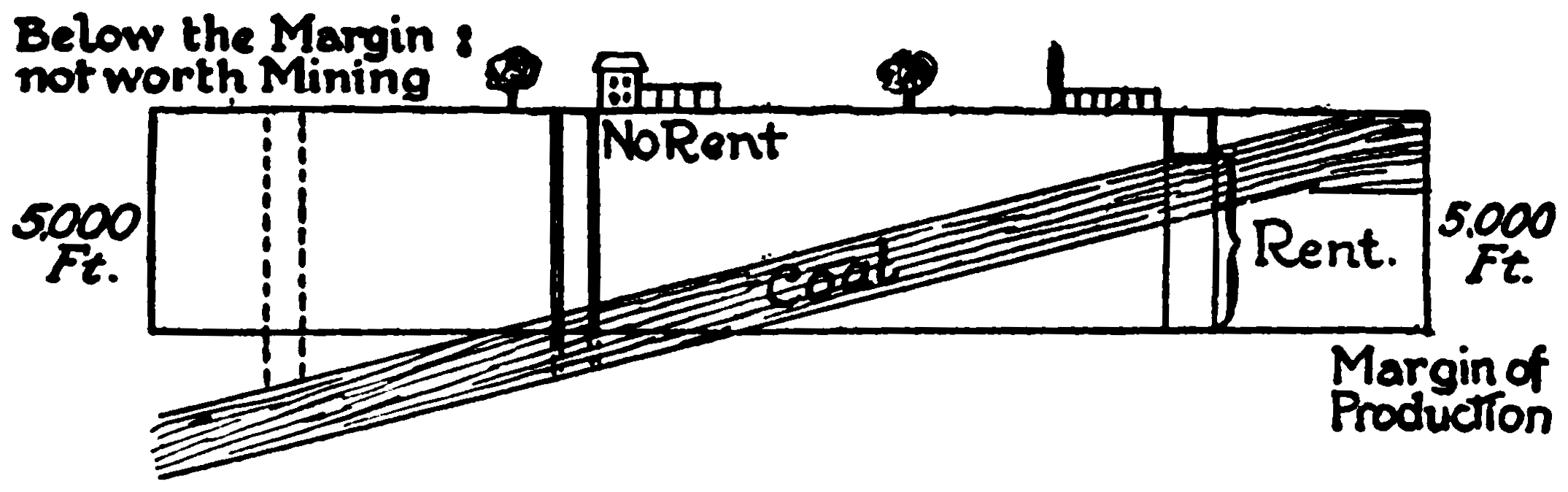
Take the case of a seam of coal, which at one
end of its run crops out on the surface, a couple of
miles on is only 1,000 feet below the surface, but
dips down gradually until, within twenty miles,
it is 10,000 feet below the surface.
Under the conditions of the society in which the
coal is being mined, and in the state which the
science of mining has reached, it is found that,
at a depth of 5,000 feet, this seam is just worth
while mining: that is, the capital which has to be
accumulated for sinking the shafts and bringing
the miners up and down from their work, and raising
the coal to the surface, and providing subsistence
for the miners at their work, just barely gets the profit
below which it would not be worth while to use it.
A shaft sunk at this depth, for instance, and the
machinery and stores cost £10,000, and when
you get the coal to the surface that coal will pay
the standard of subsistence of the labourers and
leave £500 profit for capital; that is, 5 per cent.
Capital will not accumulate if it gets less than
5 per cent. Labour will not be exercised if it
gets less than its standard subsistence; therefore,
the coal which lies farther along the seam, deeper
than 5,000 feet, will be left untouched. It is not
“worth while” to sink a shaft to try and get it.
It is “below the Margin of Production.”
What happens to the coal in the places where it
gets nearer and nearer to the surface? Obviously,
it is better worth while to sink shafts there than it
is at 5,000 feet. You only want the same amount
of labour for cutting the coal out, whether it is
5,000 feet below the surface or 2,000, and you want
much less capital and labour in sinking the shafts
and bringing the coal to the surface and getting
the miners up and down. There is, therefore, a
surplus. Thus with a shaft only 2,000 feet deep
you need, say, only £5,000 worth of capital to get
£500 worth of coal over and above the subsistence of
the labourers. 5 per cent. on £5,000 is £250—so in
that case there is a benefit of an extra £250 after the
“worth while” of Capital and Labour are satisfied.
Over and above what is just the “worth while” of
capital and labour for getting the coal you have in
the shallower mines extra value, and that extra
value gets larger and larger as the distance of the
coal from the surface gets less and less. The
deepest mine is on what we call “the margin of
production.” It is just worth while to work it.
The surplus values in all the shallower mines are
called RENT. If a landlord owned the coal in
quite a shallow part where it was within a
thousand feet of the surface, he could say to the
labourers and the owners of capital who were
coming to dig it out: “The mine which is working
at 5,000 feet is just worth your while. If you work
here at 1,000 feet you will have a great deal more
than 5 per cent. on your capital, and the subsistence
of labour is just the same. All this extra amount of
values, however, I must have, otherwise you shall
not work my coal.”
Since the Capitalists are content to accumulate
capital for a return of 5 per cent. and the labourers
to work for their subsistence, the extra amount is
paid to the landlord. If one set of people refuse
to pay it, there will always be another set of people
who will be content to pay it and this extra amount
or surplus is called “Economic Rent,” which is
something, of course, much more strictly defined
than, and different from, what we call Rent in
ordinary conversation.
Or again, take three farms of equal area but
varying fertility. Each requires £1,000 capital to
stock it and five labourers to work it. The £1,000
capital demands £50 a year profit. The five labourers
need £500 in a year to meet their standard of
subsistence. The poorest farm raises just £550
worth of produce a year. The next best raises
£750, and the best one £950 worth. Then there is
no economic rent on the first; it lies on the “margin
of production.” There is £200 economic rent a
year on the second, and £400 on the third.
* * * * *
We can sum the whole thing up and say that on
the mass of all production there are three charges:
1. First, the charge for the subsistence of labour.
2. Next, the charge of profits, or interest, for the
reward of capital, that is, of saving, and lastly
3. In varying amounts, rising from nothing at
the margin of production, to larger and larger amounts
under more favourable circumstances, the surplus
value called Economic Rent.
These three divisions are always present whenever
wealth is produced. The same man may get all
three at once, as happens when a farmer works
good land which is his own. Or again, when one
man owns the fertile land and another man provides
the capital, and yet another man provides the labour,
the three divisions appear as three incomes of
Labourer, Farmer and Landlord receiving separately
Wages, Profit and Rent. Whether these divisions
appear openly, paid to different classes of men, or
whether they are concealed by all coming into the
same hands, they are present everywhere and always.
That is a fixed economic law from which there is
no getting away.
Always remember that these economic laws are
in no way binding in a social sense. They are not
laws like moral laws, which men are bound to obey.
They are certain mathematical consequences of
the very nature of wealth and its production, which
men must take into account when they make their
social arrangements. It does not follow because
Rent or Interest are present that such and such
rich men, or the State, or the labourers, have a right
to them. That is for the moralist to decide; and
men can in such matters make what arrangements
they will. All economic science can tell us is how
to distinguish between the three divisions, and to
remember that they are inevitable and necessary.
But we must wait until a little later on to discuss
social rights and wrongs under Applied Economics
and continue here for the present to confine ourselves
to the Elements of economic law alone.
V EXCHANGE
EXCHANGE is really only a form of production,
as we saw in the illustration of the island with salt
and the main-land with meat. When the exchange
of the things is of advantage to both parties it creates
wealth for both, and profitable exchange is, therefore,
when it takes place, only the last step in a general
chain of production.
But Exchange is so separate an action that students
of Economics have agreed to treat it as a sort of
chapter by itself, and we will do so here.
The characteristic of Exchange is that you take
a thing from a place where it has less value to a
place where it has more value, thus adding an
economic value to the thing moved and so creating
wealth. In the same transaction you bring back
something else against it, which has more value
in your own place than it had in the place from
which you took it, that is again adding an economic
value and therefore creating wealth. We saw how
this was in the case of the salt and the meat, and
so it is with thousands upon thousands of exchanges
going on all over the world.
For instance, we in England have grown fond of
drinking tea in the last 200 years. But our climate
will not allow us to grow tea. Tea can only grow
in a very hot country.
Now in very hot countries specially heavy labour
upon metal work is not to be expected. Men are
not fit for it. But in this cool climate men are fit
for it, and also men here have through long practice
become very skilful at working metal: smelting iron,
for instance, and making it up into machines.
Therefore, there is a double advantage to us and
to the people who live in the hot countries where
tea is grown if we exchange. We send them metal
things that we have made and which are useful
to them, and which they could hardly make
themselves, or only with very great difficulty (and,
therefore, at a great expense of energy), and we get
from them tea, which we could not grow here
except in hot houses: that is, at much more expense
of energy than is needed in the countries where
tea grows naturally out of doors.
When there are present two or more objects of
this kind, such that the exchange of them between
two places will benefit both parties, we may speak
of “a potential of exchange,” stronger or weaker
according to the amount of mutual advantage
derived.
This word “potential” you will not find yet in
many books, but it is coming in, for it is a very
useful word. It is taken by way of metaphor from
Physical Science. When there is a head of water
over a dam, or a current of electricity of such and
such an intensity, we talk of the “potential” and
measure it. For instance, we say this electrical
current is double the potential of that, or the head
of water working such and such turbines is at
double the potential of another head of water in
the neighbourhood. In the same way we talk of
a “potential” of exchange, meaning a tendency
for exchange to arise between two places or people
because it is of mutual benefit to both.
Potentials of exchange come into existence not
only through difference of climate or differences of
habit, but also through what is called the
Differentiation of Employment, which is also called
Division of Labour.
Thus two countries may be both equally able to
produce, say, metal work and silk fabrics, and yet
if one of them concentrates on getting better and
better at metal work and the other on getting
better and better at silk fabrics, it may well be
that both will benefit by separating their jobs and
exchanging the results. And this is true not only
of two countries, but of individuals and groups.
The cobbler does not make his own clothes. He
makes boots, and by learning his trade and getting
used to it makes them much better and in a much
shorter time than other men could, and therefore
makes a pair of boots with less expense of energy,
that is, cheaper, than another man would. The
tailor can say the same thing about making clothes.
So it is to the advantage of the cobbler to exchange
his extra boots against the extra clothes the tailor
has made.
In general: intelligent societies always tend to
build up a very wide-spread system of exchange,
because intelligent people tend to concentrate
each on the job that suits him best, and also because
intelligent people discover differences of climate
and soil and the rest which may make exchange
between two places a mutual advantage for both.
It is indeed a great mistake to do as some modern
people do, and put Exchange in front of Production.
Thus you hear people talking as though the trade
a country does, the total amount of its exports and
imports, were the test of its prosperity, whereas
the real test of its prosperity is what it has the power
to consume, not what it manages to exchange.
But still, though it comes at the end of Production
and must never be made more important than the
whole process of Production, Exchange is present
universally wherever there is active production of
Wealth. Thus the group of people who build ships
are really exchanging what they make against
the produce of other people who make clothes and
grow food and build houses, and the rest of it;
and in a highly-civilised country like ours much
the greater part of the wealth you see consumed
around you has gone through many processes of
exchange.
There are a few elementary Formulæ concerning
Exchange which it is important to remember.
1. There is a Potential of Exchange, that is,
exchange tends to take place, when of two objects
the proportionate values are different in two different
communities.
It is not very easy to understand the meaning
of this until one is given an example. Supposing a
ton of coal from England to be worth £2 by the time
it is delivered in Cadiz, and supposing that making
a dozen bottles of wine in England, with all the
apparatus of hot-house grapes and the rest of it,
came to £5 of expense. Supposing that in Cadiz,
from the small coal mines near by, they can produce
coal at only £1 a ton, but on account of their
climate they can produce a dozen of wine for a
shilling. Then you get this curious situation:
It pays the exporting country, England, to sell
coal in Cadiz at less than its English economic value,
and to import the wine from Cadiz. It pays your
English owner of coal, although the values attaching
to it by the time it has got to Cadiz are £2 a ton, to
sell a ton of coal there for only £1, and to exchange
that against the wine of Cadiz, and bring that back
to England. At first sight it sounds absurd to say
that selling thus at a lower value than the cost of
production and transport can possibly be profitable.
But if you will look at it closely you will see that it
is so.
If the Englishman had tried to make his wine
at home it would have cost him £100 to make
twenty dozen bottles, but when he has sold his
coal at Cadiz for £1 he can with that £1 buy twenty
dozen of wine and bring it back to England. He
is much the wealthier by the transaction, and so
is the man at Cadiz. The Cadiz man could have
spent his energies in digging out a ton of coal near
Cadiz instead of importing it, but the same energies
used in making wine produce enough wine to get
him rather more coal from England.
2. The second Formula to remember about
Exchange is this: Goods do not directly exchange
always one against the other, but usually in a much
more complicated way, by what may be calledMultiple Exchange.
Of course, the vehicle by which this is done is
a currency, or money, which I will explain in a
moment; but the point to seize here is that exchange
is just as truly taking place when there is no direct
barter of two things but a much longer and
complicated process.
For instance, a group of people called a Railway
Company in the Argentine want a locomotive.
A locomotive can be produced cheaper and better,
that is, with less expenditure of energy for the
result, in England than in the Argentine. But
on the other hand, England wants to import tea.
Now the Argentine grows no tea. What happens?
How does England get the tea? That locomotive
goes out to the Argentine. An amount of wheat
sufficient to exchange against the locomotive goes
against it, not to England, but to Holland, a country
which, like us, has to import a lot of wheat. As
against the wheat sent to Holland, the people in
Holland send, say, the cheeses which they make
so well, on account of their special conditions, and
the consignment goes to Germany. The Germans
send out a number of rails equivalent to the number
of cheeses and of the wheat and of the locomotive,
as they are very good at making rails, and have
specialised on it. But they do not send the rails
to Holland. They send them to some Railway
Company which has asked for them in Egypt. The
Egyptian people send out an equivalent amount of
cotton, which they can grow easily in their climate,
and this cotton goes to mills in India, and against
it there comes an equivalent amount of tea, but
the tea does not go back to Egypt. It goes to
England.
There you have a circle of Multiple Exchange in
which everybody profits by the exchange going on,
although it is indirect. In the same way, of course,
it is true that all of our domestic exchanges at home
are multiple. If I write a book which people want
to read, whereas I want not books but several
other things, boots and fuel and furniture, I do not
take my books round to the man who provides boots
and to the one who provides fuel and to the one
who provides furniture. I go through the process
of selling my book to a publisher, and through an
instrument he gives me, called a cheque (I will
explain this when we come to the point of money),
I can obtain boots and fuel and furniture to the
amount of the value of the books of mine which my
publisher will sell. Yet when exchange is thus
highly indirect and multiple it is just as much
exchange as though I went and bartered one book
for one pair of boots with the cobbler.
3. The third thing to remember about Exchange
is of the utmost importance, because it has given rise
to one of the biggest discussions of our English
politics. The Formula runs thus:—
Other things being equal, the greatest freedom of
exchange in any given area makes for the greatest
amount of wealth in that area.
It ought to be self evident, but it is astonishing
how muddled people get about it, when they become
confused over details and cannot see the wood for
the trees. It ought, I say, to be self-evident that
if you leave Exchange quite free, anybody being
at liberty to produce what he can produce best,
and exchange it for things which other men can
produce better than he, both parties will tend to
be the richer by such freedom and the wealth of
the whole country will be greatest when all exchanges
in it are thus left free to be worked by the sense of
advantage.
If there were a law, for instance, preventing
me from buying etchings, or preventing Jones, the
etcher, from buying books, Jones would have to
write his own books (or do without them, which
is what he would do), and I should have to etch
my own etchings, which would be exceedingly poor
compared with the wonderful etchings of Jones.
We are obviously both of us better off if we are left
free to exchange what we can each make best. And
so it is with all the countless things made in a State.
This principle applies not only to a particular
nation but to the whole world. If you left the whole
world free to exchange the whole world would be
the richer for it. And any interference with
exchange between one nation and another lessens
the total possible amount of wealth there might
be in the world.
So far so good; and, as I have said, such a truth
ought to be self-evident. But here there comes
in a misunderstanding of its application, and that
misunderstanding has made any amount of trouble.
It is so important that I must give it a separate
division to itself.
VI FREE TRADE AND PROTECTION
Nations, as we know, put up tariffs against goods
which come from abroad: That is, their Governments
tax imports of certain goods and thereby
interfere with the freedom of exchange. For
instance, the French have a tax of this kind upon
wheat. Wheat grown in France will cost, let us
say, £1 a sack, but the Argentine can send wheat
to France at an expense of only 10s. a sack, because
the land there is new, and for various other causes.
If the wheat from the Argentine were allowed to
come in freely, and the French to export against it
things which they can make more easily than wheat
they would have more wheat at a less total expense;
but they prefer to put a tax of ten shillings upon
every sack, that is, to put up a barrier against
the import of wheat from abroad, and so keep up
the price artificially at home.
When a nation does this with regard to any object
that may be imported, if the object can also be
produced within the nation (which it nearly always
can) it is said to protect that object, and the system
of so doing is called Protection. The word arose
from the demand of certain trades to be “protected”
by their Governments without considering whether
it was for the good of the whole nation or not. It
obviously would be a very nice thing for people
who breed sheep, for instance, in this country,
if all mutton coming from the Colonies were taxed
at the Ports, while the mutton grown inside the
country were not taxed; for in this way the value
of the mutton would rise in England, and the rise
would benefit the sheep owners. But it would
be at the expense of all the other people who did
not grow sheep, and who would have to pay more
for their mutton.
As opposed to this system of Protection, and
interfering with international exchange by a tariff,
intelligent people a long lifetime ago began to
agitate for what they called “FREE TRADE,”
that is the putting of no tariff on to an import,
or at least no tariff high enough to give an artificial
price to the producer of the same thing at home.
Thus, when England was completely Free Trading
(which it was until the war) there was a tariff on
tea; but that was not Protection, for those who
would try to grow tea here would have to grow it
in hot houses and at an enormous expense, and the
tax on tea, though heavy, did not make it anything
like so dear as to make it worth while to produce
tea here.
Another principle of Free Trade was that if it
was thought advisable to put a tariff on to anything
coming into the country which could be produced
in the country, then you would have to put what
was called “an equivalent excise” on the thing
produced at home. For instance, in order to get
revenue, one might put a tax of a 1d. on the pound
on sugar coming from Germany, but, according to
the doctrine of Free Trade, you must put a similar
excise (that is, a home tax of 1d. on the pound)
upon any sugar produced in England. If you did
not do that you would be benefiting the sugar
manufacturer in England at the expense of all other
Englishmen, which would be unjust and also make
England less wealthy because it would be inducing
Englishmen to make sugar by offering them a reward
and so take them away from some production for
which they were better fitted.
This idea, that Free Trade must necessarily be
of advantage to everybody, and that it was only
stupidity or private avarice which supported
Protection, was very strong in England, and, in
the form you have just read, it seems beyond
contradiction.
But if you will look closely at Formula No. 3
written in the last division on page 59 you will see
that there is a fallacy hidden in this universal
Free Trade theory. It is perfectly true that free
exchange over any area tends to make the wealth
of all that area greater, and if the area include the
whole world, then free exchange all over the whole
world, that is, complete Free Trade, would make the
world as a whole richer.
But it does not follow thatEACH PARTof the area
thus made richer is itself enriched. That is the
important point which the Free Trade people missed,
and it is this which supports, in some cases, the
argument for Protection.
If we allow free exchange everywhere throughout
England, England as a whole will, of course, be the
richer for it; but it is quite possible that Essex will
be the poorer. If we allow Free Trade throughout
all Europe, Europe will be the richer for it; but it
is quite possible that some particular part of Europe,
Italy or Spain, may be made poorer by the general
process, and as they don’t want to be poorer they will
by Protection and tariffs cut themselves off from the
area of free exchange.
There are conditions where an interference with
free exchange over the boundaries of a particular area
make that area richer: when those conditions
exist, there is what is called an Economic Reason
for Protection.
So we may sum up and say that the theory of
universal Free Trade being of benefit to the world
as a whole is perfectly true. If we are only considering
the world, and do not mind what happens to some
particular area of the world, then the case for Free
Trade is absolute. But if we mind a hurt being
done to some particular area, such as our own
country, more than we mind the hurt done to the
world as a whole, then we should look at our
particular conditions and see whether our country
may not be one of those parts which will be drained
of wealth by Free Trade and will be benefited by
artificially fostering internal exchanges.
In the second part of this book I will go into
this again, and show how the discussion arose in
England and what the arguments are for and
against Universal Free Trade, and how true it is
that a sound economic argument for Protection
exists.
VII MONEY
When people begin exchanging by bartering
goods one against another they at once find that
there is an awkward obstruction to this kind of
commerce; at least, they find it the moment there
are more than two of them. It is this: That the
person they are nearest to for the striking of a
bargain may not want, at the moment, the particular
thing they have to offer, but something else which
a third party has who is not present.
For instance: John is a hunter who has a surplus
of skins to offer. He can get skins easier than
other people. William, farming good soil, has
surplus wheat to offer, and Robert, living near a
wood and skilled as a woodman, has extra wood to
offer. John wants wood. He takes one of his
furs to Robert and says: “I will give you this
fur for a cartload of wood.” But Robert may
answer, “I don’t happen to want a fur just now.
What I do want is a sack of wheat.”
Either no transaction will take place on account
of this hitch, or one of these two things will happen:
Robert will take the fur from John and give him his
cartload of wood, and will then take the fur over to
William, and see whether William wants a fur in
exchange for some wheat. Or John, very much
wanting the wood, will go to William, and if
William wants a fur, will exchange it for wheat;
then John will take the wheat back to Robert, and
exchange it for the wood that he wants.
That is the sort of complicated and clumsy come-and-go
that will be continually happening even
with quite a few exchangers, and with quite a small
number of articles. When it came to a great number
of exchangers and a great number of articles the
trouble would grow impossible and exchange would
break down.
But things arrange themselves thus: It is soon
found that one of the things which are being
exchanged is easier to carry than the rest, and
perhaps lasts longer and also can be easily used
in small or large amounts. For instance, in the
case of our three producers, John, William and
Robert, wheat might easily appear in this character.
People always want wheat sooner or later. It keeps
well. It is not very difficult to transport, and you
can divide it into quite small amounts, or lump it up
in large amounts.
So the chances are that when any of the three
wanted to benefit by getting rid of some of his
surplus produce he would get into the habit of taking
wheat in exchange, even if he did not want it for
the moment. For he would say to himself: “I
can always keep it by me and then exchange it
against somebody else’s produce when that somebody
else happens to want wheat”. Soon you would
find each one of the three would be keeping a little
wheat by him for the purpose of saving tiresome
journeys to effect complicated double exchanges,
and the wheat so used by all three of them would
be in effect MONEY. It would be used as a common
medium of exchange to facilitate the disposal of
goods one against the other, without the elaborate
business of making special barters, after long search.
Mankind has found, in most cases, that where a
very large number of articles were being exchanged
two in particular naturally lent themselves to this
particular use, and those two were GOLD and
SILVER. They have also used bronze, and even
iron and in some places rare shells, and all sorts of
other things. But gold and silver came to be for
nearly all mankind, and are now for all civilised
mankind, the objects which most naturally are used
as money.
The reason for this is as follows:
The thing which naturally becomes money out
of all the things that are exchanged will be that
which best combines a certain number of qualities,
some of which we have already mentioned, and of
which here is a list.
1. It must be portable, that is, a large weight
of it must take up little room, so that quite
considerable values can be taken easily from place
to place—for money has to be always moving from
one to another to effect purchases and sales.
2. It must be easily divisible, for one is always
wanting to use it in all sorts of amounts, very little
and very large.
3. It must keep. That is, it must not deteriorate
quickly, or it would have very little use as Money.
4. It must be of an even quality, so that, wherever
you come across it, you may count on its being pretty
well always the same, and therefore weight for weight
of the same value.
5. It must be more or less stable in value. It
would be difficult to use as money some object
which was very plentiful at one moment and
suddenly scarce at another; very cheap this year,
and very dear next year—such as are, for instance,
agricultural products depending upon the season.
Now of all objects Gold and Silver best fulfil
all these requirements. Precious stones are more
portable, value for value. A £1,000 worth of
diamonds takes up less space and is less heavy than
a £1,000 worth of gold. And precious stones are
fairly stable in value and also keep very well; but
they are not easily divisible. Again, they are
not of the same standard value in all cases. They
vary in purity. But gold and silver have all the
qualities required. Gold hardly decays at all
through the passage of time, and silver very little;
and each, but especially gold, is valuable for its
bulk, and its value is fairly stable, and each is
easily divisible and can therefore be presented in
any amount, from a tenth of an ounce to a hundred
pounds weight.
So, by the mere force of things, Gold and Silver
became the Money of mankind. People kept gold
and silver by them in order to effect their exchanges,
and very soon a producer did not feel himself to
be exchanging at all (in the sense of exchanging
goods against goods), but thought of the affair as
Buying and Selling. That is, of exchanging his
produce, not against other produce, but against
gold and silver, with the object of later re-exchanging
that gold and silver for other things that he needed.
Money, once thus established, is called A MEDIUM
OF EXCHANGE and also CURRENCY or THE
CIRCULATING MEDIUM. It is called “currency”
and “circulating” because it goes its round through
society, effecting the exchanges, and this running
around or circulating gives it its name: “That
which is current” from the Latin for “running.”
That which “circulates” from the late Latin word
for “going the rounds.”
When gold and silver become the money of
mankind it is important to be able to tell at once
the exact amounts you are dealing with. This,
under simple conditions, is done by weighing; but
it is more convenient to stamp on separate bits of
metal what weight there is in each, and that is
called “coining the metal.” All that a Government
does when it makes a sovereign is to guarantee that
there is so much weight of gold in the round disc
of metal which it stamps.
Money does not only fill this main function of
being a medium of exchange, that is, of making a
vast quantity of complicated exchanges possible,
it also has great social value as a measurer or
standard, and soon after money comes into use
men begin to think of the economic values of
things in terms of money: that is, in what we call
“Prices.”
All things which men produce are fluctuating
the whole time in value. There is now rather
more of one article, and now rather less. A sack of
barley at one moment will exchange exactly against
a sack of wheat, and then in a few weeks against
rather less than a sack of wheat. Meanwhile, where
it used to fetch a lamb in exchange it may, in a
few months, need two sacks for a lamb; and so
with all the hundreds and thousands of other
objects. When we have money the whole mass
of transactions is referred to the current medium,
and that is of immense social value. For no one
could keep in his head all the changing exchange
values of a multitude of articles one against the
other, but it is easy to remember the exchange values
against one standard commodity, such as gold.
And whatever the exchange value is in gold we
call the price of the article.
For instance, when you say that a house is worth
£500, that that is the “price” of the house, you
mean that the amount of gold you would have to
exchange to get it is about Ten Pounds weight of
the metal. And when you say that the price of
a ticket to Edinburgh is £4, you mean that the
service of taking you to Edinburgh in the train will
be exchanged against about an ounce of the metal
gold.
* * * * *
I now come to a most difficult point about money
and prices which is rather beyond the elements of
Economics, but which it is important to have some
idea of, though it is very difficult.
There is a very interesting study in Economics
called “The Theory of Prices,” showing why all
prices on the average (what is called “General
Prices,” that is the value of all goods in general
as measured against gold) sometimes begin to go
up and at other times go down: Why goods as a
whole begin to get dearer and dearer in gold money,
or cheaper and cheaper. It is a complicated piece
of study, and people dispute about it. But the
general rules would seem to be something like this:
The exchange value of things against gold, or the
value of gold, against the things for which it exchanges
(that is prices) is made up of two things: First,
the amount of gold present to do the work of
exchange; Secondly, the amount of work you can
make it do in exchange: The pace at which you
can get it to circulate. It is obvious that one piece
of gold moving rapidly from hand to hand will do
as much work in helping exchanges to be carried
out as ten pieces moving ten times more slowly.
If, for any reason, the total amount of gold
becomes suddenly smaller or suddenly larger, or
if the pace at which it is used changes very quickly,
then prices fluctuate violently.
Supposing you could, in a night, take away half
the gold in circulation. Then, of course, the
remaining gold would become much more valuable.
In other words, prices would fall. For if an ounce
of gold is rarer and more difficult to get than it
was, it will exchange against, that is, “buy” more
than it did; this means that “the price of things
has fallen.” We used to say, for instance, that
a quarter of wheat was worth an ounce of gold.
But if we suddenly change the amount of gold so
that gold becomes much rarer and more valuable,
perhaps an ounce of gold will buy not one quarter
but two. The price of one quarter used to be
an ounce of gold. Now the price is only half an
ounce of gold. Wheat has become cheaper in
proportion to gold, and “prices,” that is, values
measured in gold, in money, have fallen.
The same thing would happen if you did not
lessen the amount of gold in circulation but made
the circulation much more sluggish. The amount
of gold in circulation would be the same, but as it
went its rounds more slowly it would be more
difficult to get a certain amount of gold in any
one place at any one time.
Prices, then, depend upon the actual amount of
money that is present to do the work, and the pace
at which it is made to go the rounds: or (to put
it in technical terms), on the amount of the currency
and its “efficiency in circulation.”
Now, there is in the human mind a very strong
tendency to keep prices stable. We think of them
by a sort of natural illusion as though they were
absolute fixed things. We think of a pound, and
a shilling, and five pounds as real, permanent,
unchanging values. If we find that quite suddenly
five pounds will buy a great deal more than it used
to, or quite suddenly a great deal less, if we are met
by a sudden and violent fluctuation in prices of
this kind, our minds tend, unconsciously, to bring
things back, as much as possible, to the old
position; and I will show you how this tendency
works in practice.
Supposing a very great deal of gold, for some
cause, were to disappear. People suddenly find prices
falling very rapidly. A man with a £1,000 a year
can buy twice as many things, perhaps, as he used
to buy. On the other hand, a man with anything
to sell can only get half the amount he used to
get. For gold has become rarer, and therefore
more valuable as against other things.
What is the result? The result is a very rapid
increase in the pace at which the gold circulates.
Every purchaser feels himself richer. The gold
is tendered for a much larger number of bargains,
and though the mind, by this illusion it has of
gold value as a fixed thing, cannot bring the actual
gold back, what it can do is so to increase the second
factor, Efficiency in Circulation, as largely as to make
up for the lack of gold; and under the effect of
this prices will gradually rise again. In the same
way, if the mass of current medium by some
accident becomes suddenly increased that should
lead to an equally sudden rise in prices; but the
unconscious tendency of the human mind to keep
prices stable sets to work at once. Efficiency in
Circulation slows down, the new large amount of
currency works more sluggishly, and, though prices
rise, they do not rise nearly as much as the influx
of money might warrant.
We see, therefore, that the factor in the making
of prices called “Efficiency in Circulation” works
like a sort of automatic governor, tending to keep
prices fairly stable; but of course it cannot prevent
the gradual changes, and sometimes it cannot
prevent quite sharp changes, as we shall see a little
later on. For the moment, the interesting thing
to note about Efficiency in Circulation is that
we owe to this factor in prices the creation of paper
money.
If, with only a certain stock of gold to work on,
business rapidly and largely increases, if a great
many more things are made and exchanged, then,
as the gold will have a lot more work to do—and
so become more difficult to obtain in any one time
or place—that should have the effect, of course,
of making it more valuable, that is, of lowering
prices.
Now with the beginnings of modern industry,
about a hundred and fifty years ago, a vastly greater
number of things began to be made than had ever
been made before, and the number of exchanges
effected multiplied ten, twenty and a hundredfold.
The stock of gold, though it was increased in the
nineteenth century by discoveries in Australia and
California, and later in South Africa, would have
been quite unable to cope with this flood of new work,
and prices would have fallen very much indeed,
had it not been for the creation of Paper Money.
Paper money was a method of immensely increasing
Efficiency in Circulation.
This is how it worked.
A Bank or a Government (but especially the Bank
of England, with the guarantee of the Government)
would print pieces of paper with the words: “I
promise to pay to the bearer of this Five Pounds.”
Anyone who took one of these pieces of paper
to the Bank of England could get Five Golden
Sovereigns. But since this was publicly known,
people were willing to take the piece of paper instead
of the five sovereigns.
If you sold a man a horse for fifty pounds, you
were just as willing to take ten five pound notes
for him as fifty sovereigns. They were more
convenient to carry, and you knew that whenever
you wanted the actual gold you had only to go
to the bank and get it.
Because people were thus willing to be paid in
paper instead of in the actual gold, a large number
of notes could be kept in circulation at any one time,
and only a small amount of gold had to be kept in
readiness at the Bank to redeem them. In practice
it was found that very much less gold than the
notes stood for was quite enough to meet the
notes as they were brought in for payment. Much
the most of the note circulation went on going the
rounds, and in normal times it took a long time for
a note on the average to be brought back to the
Bank.
You can see that this dodge of paper money
had the effect of increasing the total amount of
the current medium in practice, and of greatly
increasing its Efficiency in Circulation. Moreover,
it made the Efficiency in Circulation very elastic,
because in times of quiet business, more notes would
go out of circulation and be paid into the bank,
while in time of active business more notes would
go on circulating.
So long as every note was redeemed in gold every
time it was brought to the bank, so long as the promise
to pay was promptly kept, the money still remained
good; the paper currency did not interfere with the
reality of the gold values, there was no upsetting of
prices, and all went well.
Unfortunately, Governments are under a great
temptation, when they have exceptionally heavy
expenses, to falsify the Currency. People get so
much in the habit of trusting the Government
stamp on paper or metal that they take it as part
of nature. What the Government is really doing
when it coins a sovereign is giving a guarantee
that this little disc of yellow metal contains 123
grains of gold with a certain known (and small)
amount of alloy to make the gold hard. When the
Government has to pay a large amount in wages,
or for its Army and Navy, or what not, it is tempted
to put in less gold and more alloy and keep the
old stamp unchanged, and that is called “Debasing
the Currency.”
For instance, the Government wants a hundred
tons of wheat to feed soldiers with, and the price
of wheat in gold at that moment is Ten Sovereigns
a ton. It says to a merchant, “If you will give me
a hundred tons of wheat, I will give you a thousand
sovereigns.” But when it comes to paying the
thousand sovereigns, instead of giving a thousand
coins with 123 grains of gold in each, it strikes a
baser coin with only a hundred or less than a hundred
grains in each, and pays the merchant with these.
It is a simple form of cheating and always effective,
because the merchant thinks the sovereign is genuine.
Only when these bad sovereigns get into circulation
they naturally find their level in gold; for people
begin to test them, and find that they have not
got as much gold in them as they pretend to have.
Then, of course, prices as measured in this new
base coin rise. If the Government wants to buy
another hundred tons of wheat it must offer more
than a thousand of the base coins; it must offer,
say, thirteen hundred of them. But again it is
tempted to put even less gold into the coins with
which it pays for the second lot of wheat, and so
the coin gets baser and baser, until at last, perhaps,
a sovereign will not really be worth half what it
pretends to be. Governments in the past have
done this over and over again, but it was not until
our time that the worst form of debasing the
coinage came in.
It came in as a result of the Great War, and we
are all suffering from it to-day. This last and
worst form of debasing coinage worked, not through
cheating about the metal, but through a trick played
with paper money.
Before the war, if you got a Five Pound note
saying “I promise to pay Five Pounds” the promise
was kept and the five golden sovereigns were there
for you whenever you went with your note to the
bank and asked for them; but when the Government
had these very heavy expenses to meet on account
of the war, they first began making difficulties about
paying when people brought their paper to the bank,
and at last stopped paying altogether. At the same
time, they did everything they could to get the gold
out of private people’s hands and to make them
use paper money instead. The consequence was
that, people being so accustomed to think of a paper
guarantee of the Government exactly as though it
were real money, readily took to the new notes and
used them as money, thinking of these wretched
bits of paper exactly as though they were so many
golden sovereigns. The Government could go on
printing as many bits of paper as it liked, and they
would still be used as though they were real money.
So long as the amount of paper printed was not
more than would have been printed when the notes
were redeemable, and when the currency was on
a true “Gold Basis,” no harm was done; but of
course it paid the Government to go on printing
a great many more notes than that, because, when
it could make money thus cheaply, it could pay
for anything, however great the expense; but at
the cost, of course, of debasing the currency more
and more.
This kind of money, forced upon people, pretending
to be the same as real money but actually without
a Gold Basis, is called Fiat1 money, and that is
the kind of money the whole world has to-day,
except those countries which did not take part in
the Great War, and the United States which did
not ever give up its gold basis.
Of the different European fighting countries,
however, ours did best in this matter. We are
still living on Fiat money, and we have much more of
it than we ought to have. But the French have
more in proportion, so that prices measured in their
money are now (1923) more than three times what
they would be in gold. The Italians are worse
off still. With them it is four times. With the
Germans it is millions of times, and their currency
has quite gone to pieces; a paper coin in Germany
is worth (at the time I write, October, 1923) ten
million times less than the real metal coin which
it is supposed to represent.
This is one of the very worst things that has
happened on account of the war, for as the money
now being used all over Europe is not real money,
no one feels certain whether he can get his debts
really paid, or whether his savings are safe, or
whether a contract made for a certain payment
a few months hence will be really fulfilled or not.
A man may lend a thousand francs or marks or
pounds for a year, and then at the end of the year,
when he is to be paid back, he may be paid in coin
which has got so much worse that he is really
receiving only half or a tenth or a thousandth of
the real value he lent. A man in Germany sells
a hundred sheep for so many marks, to be paid for
in a month; and at the end of the month the marks
will only buy ten sheep!
This piece of swindling, which has been the
note of the last five years, is the first point we have
touched on so far where a problem in Economics
and the study of economic law brings one up
against questions of right and wrong.
It is morally wrong for the Government to swindle
people out of their property by making false money.
What is the way out, allowing for Economic Law?
It is morally wrong that some men should starve
while other men have too much: allowing for
Economic Law, what is the way out of such evils?
As you go on in the study of Economics you
find quantities of questions where you have to
decide whether economic laws render possible
political actions which you would very much like
to undertake, and which seem right and just.
Many such actions, though one would like to undertake
them, cannot be undertaken because our study
of Economics has shown us that the consequences
will be very different from what we hoped.
On the other hand, a great many people try to
get out of what it is their duty to do politically by
pleading that Economic Law prevents it.
Before ending these notes, then, we must go into
the main questions of this kind, and see what there
is to be said, in the light of economic knowledge,
for our present system of society, which is called
Capitalism; for other systems in the past such
as Slavery; for Private Property; for the various
theories of Socialism; for and against Usury,
and so on.
It is necessary to go into these points even
in the most elementary book on Economics,
because the moment one begins the practical
application of one’s economic science these questions
at once arise; to answer them rightly is the most
important use we can make of economic knowledge.
Part II POLITICAL APPLICATIONS
INTRODUCTION
So far I have been putting down the elements of
Economics just as one might put down the elements
of Arithmetic. But Economics have, just like
Arithmetic, a practical application: if it were not
for this, there would be no real use in studying
Economics at all.
For instance: we find out, when we do the
elements of Arithmetic, that solid bodies vary with
the cube of their linear measurements. That is the
general abstract principle; but the use of it is in
real life when we come (for instance) to measuring
boats. We learn there from Arithmetic that, with
boats of similar shape, a boat twice as long as
another will be eight times as big; it is also by
using the elements of Arithmetic that we can keep
household accounts and do all the rest of our work.
It is precisely the same with Economics. We
are perpetually coming upon political problems
which Economics illustrate and to which economic
science furnishes the answer—or part of the answer—and
that is where the theoretical elements of
Economics have practical importance.
For instance: once we know the elementary
economic principle that rent is a surplus, we
appreciate that it does not enter into cost of
production. We do not try to make things cheaper
by compulsorily lowering rent. Or, again, when
we have learned the nature of money we can
appreciate the dangers that come from using false
money.
In these political applications of Economics we
also come upon what is much more important than
mere politics, and that is the question of right and
wrong. We see that such and such a thing ought to
be so as a matter of justice; but we may blunder,
as many great reformers have blundered, in trying
to do the right thing and failing to do it, because
we have not made a proper application of our
economic science. And the opposite is also true:
that is, a knowledge of Economics prevents their
being wrongly applied by those who desire evil.
Many men take refuge in the excuse that, with the
best will in the world, they cannot work such and
such a social reform because economic science
prevents their doing what they know to be right.
If we know our Economics properly we can refute
these false arguments, to the great advantage of
our own souls and of our fellow-men.
For instance: it is clearly our duty to-day to
alleviate the fearful poverty in which most
Englishmen live. A great many people who ought
to know better say, or pretend, that economic laws
prevent our doing this act of justice. Economic
laws have no such effect; and an understanding of
Economics clears us in this matter, as we shall see
later on.
We have hitherto been following the statement
and examination of economic laws: that is, the
theoretical part of our study and its necessary
foundation. Now we go on to the practical part,
or “Applied Economics,” which is the effect of
those laws on the lives of men.
Before leaving this Introduction I think it is
important to get quite clear the difference between
what is called “theoretical” study and the practical
application of such study. People are very often
muddle-headed about this, and the more clearly
we think about it the better.
A theoretical statement is a statement following
necessarily and logically from some one or more
known first principles. Thus, we know that two
sides of a triangle are longer than the third, so we
say it follows theoretically that a straight road from
London to Brighton is quicker motoring than
going round by Lewes. But the number of first
principles at work in the actual world is indefinitely
large. Therefore one must test any one theoretical
conclusion by practice: by seeing how it works.
Because, side by side with the one or two first
principles upon which our theory is built, there
are an indefinitely large number of other first
principles which come into play in the real world.
Thus there is, in motoring, the principle that speed
varies with road surface. So the way round by
Lewes may be quicker than the straight road if
it has a better surface. There is yet another
principle that speed is checked by turnings in the
road, and it may prove that on trial the two ways
are about equal.
Or again: we know that the tidal wave is raised
on either side of the earth, and that there is, therefore,
about twelve hours of even ebb and flow,
six hours each on the average and taking the world
as a whole: because the earth takes twenty-four
hours to go round.
But if you were to act upon that first principle
only in any one part of the world, and to say without
testing the thing in practice, “I can calculate the
tide theoretically,” you would very often wreck
your ship. For many other principles come into
play in the matter of the tide besides this twelve-hour
period. In one case the tide will be delayed
by shoals or by the current of a river. In another
there may be two or three tides meeting. In a
third the sea will be so locked that there will be
hardly any tide for many hours, and then a rush
at the end—and so on.
Now it is just the same with Economics. Your
economic first principle makes you come to such
and such a theoretical conclusion. But there are
a lot of other first principles at work, and they may
modify the effect in practice to any extent. When
people object to “theoretical dreaming,” as they
call it, they mean the bad habit of thinking that
one conclusion from one particular set of first
principles is sufficient and will apply to any set of
circumstances. It never does. One has always
to watch the thing in practice, and see what other
forces come in.
In the political applications of economic science
we have to deal with the effect of human society
upon economic law. For instance: economic law
tells us that, given a certain standard of living for
labour—the “worth while” of labour—and a certain
minimum profit without which capital will not
accumulate—the “worth while” of capital—there
is, as we have seen, a lowest limit of production;
a set of conditions below which production will
not take place. Land which is below a certain
standard of fertility will not be farmed; a vein of
metal below a certain standard of yield will not
be mined under such and such social conditions.
But all circumstances in which production has
greater advantages than this lowest limit produce a
surplus value called “Rent.” That is an economic
law, and it is always true.
But it does not follow that the owner of the land,
for instance, will get the full economic rent of the
land. There may be customs in society, or laws,
by which he is compelled to share with the tenant.
The theoretical economic rent is there all right,
but one cannot deduce from this truth that the
landlord will necessarily and always get the whole
of it. And so it is with every other political
application.
* * * * *
Having said so much by way of Preface, let us
turn to the particular problems, and first of all
consider the idea which underlies all practical
economic conclusions, the idea of Property.
The very first governing condition of economic
production and distribution in the real world is
the condition of control. Who controls the process
of production in any particular Society? Who
in it owns (that is, has the right and power to
use or leave idle, to distribute or withhold) the
means of production, the stores of food and clothing,
and houses and machinery? On the answer to
that question depends the economic structure of
a society. This control is called Property, and as
the first thing we have to study in practical
Economics is the character of Property, we will
make that the first division of our political
applications.
PROPERTY The Control of Wealth
All the political application of Economics—that
is, all the application of Economic Science to the
conduct of families in the State—turns on The Control
of Wealth, and of the things necessary to make
wealth.
The first thing to grasp is that someone must
control every piece of wealth if it is to be used to
any purpose. Every bundle of economic values in
the community must be under the control of some
human will; otherwise those pieces of wealth
“run to waste,” that is, are consumed without use
to mankind. For instance, a ton of threshed
wheat represents a bundle of economic values. It
represents a piece of wealth equivalent, in currency
measure, to say £16. If no one has the right to
decide upon its preservation and use, when and
how it is to be kept dry and free from vermin, when
and how it is to be ground and the flour made
into bread, then it will rot or be eaten by rats,
and in a short time its economic values will have
disappeared. It will be worthless. The £16 worth
of wealth will have been “consumed without use”;
in plain language, wasted. But if wealth were all
wasted humanity would die out. So men must, of
necessity, arrange for a control of all wealth, and this
they do by laws which fix the control of one parcel
of wealth by one authority, of another by another;
men make laws allowing such control by some
people and preventing attempted control by other
people not authorised. This lawful control over
a piece of wealth we call Property in it.
* * * * *
Thus, the coal in your cellar which you have
bought is by our laws your property. It is for you
to burn it as you want it and when you choose.
If another person comes in and takes some of it
without your leave, to burn it as he chooses, he is
called a thief and punished as such. The coal in
the Admiralty Stores is State property. The State
has the right to decide into what ships it is to be
put and how and when it is to be burnt, and so on.
But whether the control is in private hands such
as yours, or in the naval authorities who are officers
of the State, control there must always be.
When people say that they want to “abolish
property,” or that “There ought to be no property,”
they mean Private property: the right of individuals,
or families, or corporations to control wealth.
Property in the full sense, meaning the control of
wealth by someone, whether the State, or private
individuals, or what not, is inevitable, and is
necessary in every human society. So, granting
that property must exist, we will first examine the
various forms it may take.
At the beginning of our examination we noticed
that wealth, owned and controlled by whoever it
may be—the State, or an individual, or a
corporation—is of two kinds. There is the
wealth which will be consumed in enjoyment and
the wealth which will be consumed in producing
future wealth.
The wealth which will be consumed in producing
future wealth is, as we have seen, called Capital.
For instance: if a man has a ton of wheat and
eats half of it while he is doing nothing but taking
a holiday, or doing work which has some moral
but no material effect—that is not Capital. But
if he uses the other half to keep himself alive while
he is ploughing and sowing for a future harvest,
and keeps a little of it for the seed of that harvest,
all that he so uses is Capital. Since control of wealth
is necessary, no matter of what kind the wealth be,
it is clear that there must be property not only
in what is about to be consumed in enjoyment
but also in Capital. Someone, then, must own
Capital.
But here comes in a very important addition. The
fertility of land, space upon which to build, mines
of metal, water power, natural opportunities of
any kind and natural forces, though they are not
wealth,2 are the necessary conditions for producing
wealth. Someone, therefore, must control these
also: someone must have the power of saying,
“This field shall be ploughed and sown thus and thus.
This waterfall must be made to turn this turbine
in such and such a spot, and the power developed
must be applied thus and thus.” For if no one
had such power the fertility of the land, the force of
the stream, would be wasted.
Property, therefore, extends over two fields, one
of which is itself divided into two parts. A.—It
extends over natural forces. B.—It extends over
wealth, and, in the case of B, wealth, it extends
over B.1 wealth to be used for future production
(which kind of wealth, when it is so used, is called
Capital), and also B.2 wealth which is going to be
consumed without the attempt to produce anything
else: consumed, as the phrase goes, “in enjoyment.”3
Natural forces may be grouped, as we
have grouped them in the first part of this book,
under the conventional term “Land.” So Property
covers Land and Capital, as well as Wealth to be
consumed without the attempt to produce other
wealth. You may put the whole thing in a diagram
thus:—
In studying the social effects of Property it is
convenient to group together Land and that part
of wealth which is used for further production and
is called Capital, and to call the two “the means of
production”: because, in a great many social
problems the important point is not who owns the
Capital separately or the land separately, but who
owns the whole bundle of things which constitute
the “Means of Production,” without which no
production can take place.
For instance: Supposing a man owns a hundred
acres of fertile land, that is his property, and though
we call it wealth in ordinary conversation it is not
real wealth at all. It is only the opportunity for
producing wealth. If no one worked on that land,
if no one even worked so little as to take the trouble
of picking fruit off the trees or cutting the grass or
looking after animals on it, it would be worth
nothing. Supposing another man to own the stores
of food and the houses and the clothing necessary
for the livelihood of the labourers on the land, and
also the horses and the ploughs and the stores of
seeds necessary for farming, then that man owns the
Capital only. But to the labourers the important
thing is that someone else owns the “Means of
Production,” without which they cannot live, and
they are equally dependent whether one or many
control or own the Means of Production in any
particular case. Their condition has for its main
character the fact that they do not own the “Means
of Production.”
Labour must be kept going. That is, human
energy, for producing wealth from land, while it is
at work, waiting between one harvest and another,
will consume part of the stores of food and some
proportion of the housing (which is a perishable
thing, though it only perishes slowly) and of the
clothing, and of the seed, etc. So we have to examine
the various ways in which labour (which is not wealth)
and land (which is not wealth) and capital (which
is wealth) may be controlled.
There are three main types of human society
which differ according to the way in which control
is exercised over these three factors of Labour,
Capital and Land. These three types are:—
1. The Servile State: that is, the state in
which the material Means of Production are the
property of men who also own the human agents
of Production.
2. The Capitalist State: that is, the state in
which the material Means of Production are the
property of a few, and the numerous human agents
of Production are free, but without property.
3. The Distributive State: that is, the state
in which the material means of Production are
owned by the free human agents of Production.
There is also a fourth imaginary kind of state
which has never come into being, called the Socialist
or Communist State. We will examine this in its
right place, but the only three actual states of which
we know anything in history and can deal with
as real human experiences, are these three just
described: the Servile State, the Capitalist State,
and the Distributive State.
But, before going farther, we must get hold of
a very important principle, which is this:—
The nature of an economic society is not determined
by its arrangements being universal, that is,
applying without exception to all the families of
the State, but only by their applying to what is
calledThe Determining Numberof the families of
the State: that is, in so great a proportion as to
colour and give its form to the whole society.
No one can exactly define the amount of this
“determining number,” but we all know in practice
what it means. For instance: we say the English
are a tall race, from 5½ to 6 feet high. But that
does not mean necessarily that the majority of the
people are over 5½ feet. You have, of course, to
exclude the children, and there are a great number
of very short people and a few very tall people.
It means that the general impression conveyed when
you mix with English people—the size of the doors
and the implements with which men work, and the
clothes that are produced, and the rest of it—turn
upon the general experience that you are dealing
with a race of about that size—5½ to 6 feet. Or again,
you say that the determining number or proportion
of our society speaks English. That does not mean
that they all speak English. Some are dumb; some
speak Welsh or Gaelic. Many speak with such
an accent that others with a different accent find
it difficult to understand them. Yet it is true to
say that the society in which we live speaks English.
Now it is exactly the same with the economic
conditions of society. You may have a society
in which there is a certain number of slaves, and
yet it is not a slave-owning society, because the
number of free men is so great as to give a general
tone of freedom. Or you have, as we have in
England, a great deal of property owned by the
State—barracks and battleships and arsenals, some
of the forests, and so on—but we do not say that
England is economically a State-owned society,
because the determining proportion of property
is not owned by the State but by private people.
The general effect produced is one of private ownership
and not of State ownership.
One more principle must be set down before we
go farther, and that is that almost any society
is mixed. A society of which the determining
proportion is slave-owning will yet certainly have a
proportion of free men; for if it did not there would
be no one to own the slaves. In the same way
what is called a Capitalist Society, which I will
describe in a moment (and which is the society
in which we now live in England) has a great number
of people not living under purely capitalist conditions.
It is mixed.
But, though only a determining number is required
to mark the character of a particular society, and
though every society is mixed in its character, it
remains true that all societies we know of, in the
past or the present, fall into one of these three
groups—the Servile (that is, slave-owning), the
Capitalist, and the Distributive.
The definition of these three systems is as
follows:—
1. In the Slave-owning Society, or SERVILE
STATE, a certain minority owns a determining amount
of the wealth and also of land—that is, the means
of production (land and capital) and the wealth
ready for consumption in enjoyment. The rest
of the community is compelled by positive law to
give its labour for the advantage of these few
owners; and this rest of the community are, by
economic definition, (whether they call themselves
by the actual name or not) slaves: that is, they
can be compelled to work for the owners, and can
be punished by law if they do not work for the
owners.
2. In the CAPITALIST STATE a determining number
of the families or individuals are free; that is, they
cannot be compelled by positive law to work for
anybody. They are at liberty to make a contract.
Each can say to an owner of land or capital: “I
will work for you for so much reward, such and such
a proportion of the wealth I produce. If you will
not give me that I will not work at all,” and no
one can punish him for the refusal.
But the mark of the Capitalist State is that a
determining amount of land and capital is owned
by a small number of people, and that the rest
of the people—much the greater number—though
free, cannot get food or housing or clothing except
in so far as the owners of these things (that is, of
the means of production) choose to give it them.
In such a state of society the people who own
nothing, or next to nothing, are free to make a
contract and to say: “I will work on your farm”
(for instance) “if you will give me half or three-quarters
of the harvest. If you will not, I will
not work for you.” But this contract is bound by
a very hard condition, for if they push their refusal
to the limit and continue not to work they will
starve, and they will not be able to get housing
against the weather or clothes to wear.
We are living to-day, in England especially, in
such a Capitalist State. In such a state the free
men who contract to sell their labour often have a
certain very small proportion of things on which
they can live for a short time. They have a suit
of clothes and perhaps a little money with which
they can purchase a few days’ livelihood—some of
them more, some of them less. But the tone or
colour of the society is given by the fact that the
great majority, though free, are dispossessed of the
means of production, and therefore of livelihood, and
that a small minority controls these things.
The word “Capitalism” does not mean that
there exists capital in such a society. Capital
exists in all societies. It is a necessary part of human
society and of the production of wealth, without
which no society can live at all. The word
“Capitalism” is only “shorthand” for the condition
we have just described: a condition where capital
and land are in few hands though all men are free.
3. The DISTRIBUTIVE STATE is a state in which
a determining number of the citizens, a number
sufficient to colour the habits, laws and conditions
of the whole society, is possessed of the means of
production, as private property, divided among
the various families. The word “distributive” is
an ugly, long word, only used for want of a better;
but the reason that we have to use such a tiresome
word is an odd and paradoxical reason well worth
grasping. The Distributive State is the natural
state of mankind. Men are happiest in such
conditions; they can fulfil their being best and are
most perfectly themselves when they are owners
and free. Now whenever you have natural and
good conditions, not only in Economics but in any
other aspect of life, it is very difficult to find a
word for it. There is always a word ready for odd,
unnatural conditions: but it is often difficult to
find a word for conditions normal to our human
nature. For instance: we have the words “dwarf”
and “giant,” but we have no similar common,
short word to describe people of ordinary stature.
So it is with the Distributive State. We have
to use an ugly new word, because men more or less
take for granted this state of affairs in their minds,
and have never thought out a special word for it.
However, a name it must have; so let us agree
to call that kind of society in which most men are
really free and dignified and full citizens, not only
possessing rights before the law, but owning, so that
they are at no other man’s orders but can live
independently, “The Distributive State.”
Then we have these three main types of Society
within human experience: the Servile, the Capitalist,
the Distributive.
To put these three estates clearly before our
minds, let us describe the kind of thing you would
see in any one of the three.
In the Servile State, as you travelled through the
country, you would most ordinarily see working on
the fields men who were the slaves of a master. That
master would own the land and the seed, and the
food and the houses, and the horses and ploughs
and everything, and these men you would see working
would be compelled to work for their master, and he
would have the right by law to punish them if they
did not.
If you were in a Capitalist State (as we are in
England) the men you would see working would,
as a rule, be earning what are called “wages,” that
is, an allowance (actually of money but immediately
translated into food and clothes and house-room and
the rest), which allowance would be paid to them at
fairly short intervals, and without which they could
not live. The ploughs and horses with which they
would be working, the seed they would be sowing,
the houses they lived in would be the property of
another man owning this capital, and therefore
called The Capitalist. If you asked any one of
these men who were working whether he were
compelled to work by law he would indignantly
tell you that he was not. For he is a free man;
his wages are paid him as a result of a contract;
he has said: “I will work for you for so much,”
and no one could compel him to work if he did not
choose to work. But in this state of society a man
without capital must make a contract of this sort
in order to live at all. He is not compelled by law
to work for another, but he is compelled by the
necessity of living to work for another.
Lastly, if you were travelling through a
Distributive State (Denmark is the best example of
such a state in modern Europe) you would find that
the man working on the land was himself the owner
of the land, and also of the seed and of the horses
and the houses, and all the rest of it. He would
be a free man working for his own advantage and
for nobody else’s. He would also have a share in
the factories of the country and be a part owner
in the local dairies, sharing the profit of those dairies
where the milk of many farms is gathered together,
turned into butter and cheese, and sold.
This is what we mean by the three types of State.
In each you would find many exceptions, but each
has its determining number—of slaves in the one
case, wage earners in the other, and independent
men in the third.
* * * * *
We will now take each of these three kinds of
State separately and see the good and evil of them
and what the consequences of them are.
THE SERVILE STATE
The Servile State is that which was found among
our forefathers everywhere. It is the Servile State
in which we Europeans all lived when we were pagan
two thousand years ago. For instance: In old
pagan Italy before it became Christian, or in old
pagan Greece—both of them the best countries in
the world of their time and both of them, as you
know, the origins of our own civilisation—most
of the people you would have seen working at
anything were slaves, and above the slaves were
the owners: the free men.
Since we are talking of the political applications
of political economy, we have to consider human
happiness, which is the object of all human living;
and when we talk of “advantage” or “disadvantage”
in any particular economic state
we mean its greater or less effect on human
happiness.
The great disadvantage of the slave-owning
state is clearly apparent: in it the mass of men
are degraded: they are not citizens: they cannot
exercise their own wills. This is so evident and
great an evil that it must be set against all the
advantages we are about to notice. Slavery is
a most unhappy condition in so far as it wounds
human honour and offends human dignity; and
that is why the Christian religion gradually dissolved
slavery in the process of many centuries: slavery
is not sufficiently consistent with the idea of man’s
being made in the image of God. Slavery can also
be materially unhappy, if the masters are cruel or
negligent. The great mass of slaves in such a
society might be, at the caprice of their masters,
very unhappy; and under bad phases of those
societies they were very unhappy.
But we must not be misled by the ideas that have
grown up around the word “slave” in the modern
mind. Because we have no one in England to-day
who is called a slave and bought or sold as a slave,
and no one is yet compelled by law to work for
another man, therefore we regard slavery as
something odd and alien; and because it is natural
to dislike things which are odd and alien, unaccustomed,
we think of slavery as something simply
bad.
That is a great mistake. The Servile State had—and,
if it comes back, will have again—two great
advantages: which were personal security and
general stability.
Personal security means a condition in which
everybody, master and man, is free from grave
anxiety upon the future: can expect regular food
and lodging and a continuance of his regular way
of life.
General stability means the continuance of all
society in one fashion, without the violent ups and
downs of competition and without the friction of
unwilling, constantly interrupted labour—as in
strikes and lock-outs.
In the Servile State work always got done and
was done regularly. The owners knew “where
they were.” With so much land and so many
slaves they were sure of a certain average annual
produce. On the whole it was to the advantage
of a man to keep his slaves alive and fairly well
fed and housed. Also, the human relation came
in, and a man and his slave, in the better and
simpler forms of the Servile State, would often
be friends and were usually in the same relation
as people are to-day with their dependents. For
instance: in well-to-do houses of the Servile State
we know from history that certain slaves were
often the tutors of the children, and thus had a
very important and respectable position, and there
were other slaves who acted as good musicians and
architects and artists. There was always the
feeling of a fixed social difference between slave
and free, but this did not necessarily nor perhaps
usually lead to great unhappiness.
This stability and security which slave-owning
gave to all society (to the owned to some extent,
and to the owners altogether) also produced a very
valuable effect, which is, the presence of leisure.
Because revenue was fairly certain, because this
kind of arrangement prevented violent fluctuation
of fortune, competition in excess, and the rest of it,
therefore was there a considerable proportion of
people at any time who had ample opportunity for
study, for cultivating good tastes, for writing
and building well, and judging well, and—what is
very important—for conducting the affairs of the
State without haste or the panic and folly of
haste.
One alleged economic disadvantage of slave-owning
must be looked at narrowly before we leave this
description of the Servile State.
One often hears it said that slave labour is less
productive than free labour, that is, labour working
at a wage under Capitalism. People sometimes
point to modern examples of this contrast, saying
that places like the Southern States of America,
where slave labour was used a lifetime ago, were less
productive than the Northern States, where labour
was free. But though this is true of particular
moments in history, it is not generally true. Free
labour working at a wage under the first institution
of capitalism—when, for instance, a body of
capitalists are beginning to develop a new country
with hired free men to work for them—will be full
of energy and highly productive. But when what
is called “free labour”—that is, men without
property working by contract for a wage—gets into
routine and habit, it is doubtful whether it is more
productive than slave labour. It is accompanied
by a great deal of ill-will. There is perpetual
interruption by strikes, and lock-outs,4 and the
process of production cannot be as minutely and
absolutely directed by the small and leisured class as
can slave labour. There is no reason why a free man
working for another’s profit should do his best. On
the contrary, he has every reason to work as little
as possible, while a slave can be compelled to work
hard.
But whether slave labour be more or less productive
is not so important as the two points mentioned
above, of advantage and disadvantage. The disadvantages,
as we have seen, are (1) that it offends our
human love of honour and independence, degrading
the mass of men, and (2) that it is so terribly liable
to abuse in the hands of cruel or stupid owners,
or in conditions where great gangs of slaves grow
up under one owner who can know nothing about
them personally and is therefore indifferent to their
fate. The advantages are security and stability,
running as a note throughout society and showing
themselves especially in the leisure of the owning
classes, with all the good fruits of leisure in taste,
literary and artistic. It was a society based on
slavery which produced what is perhaps the best
fruit of leisure, and that is the profound and fruitful
thinking out of the great human problems. All
the great philosophy and art of the ancients was
worked out by the free owners in the slave-owning
states, and so was the best literature ever made.
THE CAPITALIST STATE
The Capitalist State is that one in which though
all men are free (that is, though no one is compelled
to work for another by law, nor anyone compelled
to support another), yet a few owners of the land
and capital have working for them the great mass
of the people who own little or nothing and receive
a wage to keep them alive: that is, a part only of
the wealth they produce, the rest going as rent
and profit to the owners.
The Capitalist State is a recent phenomenon
compared with the great length of known recorded
history. It is a modern phenomenon produced by
our white race alone, by no means covering the
whole of that race, nor the most of it, but of great
interest to us in England because we alone are, of
all nations, an almost purely capitalist society.
Here again we can tabulate the advantages and
disadvantages.
The chief moral advantage of Capitalism as
compared with the Slave-owning State is that every
man, however poor, feels himself to be free and to
that extent saves his honour. He may be compelled
by poverty to suffer a very hard bargain;
he may see himself producing wealth for other men,
of which wealth he is only allowed to keep a portion
for himself. To that extent he is “exploited,”
as the phrase goes. He feels himself the victim of
a certain injustice. He remains poor in spite of all
his labour, and the man for whom he works grows
rich. But, after all, it is a contract which the free
workman has made, and he has made it as a citizen.
If those who own nothing, or next to nothing, in
a capitalist state (this great majority is technically
called in economic language “the proletariat”)
organise, they can bargain, as our great Trade
Unions do, with the few owners of their means of
livelihood and of production, and be fairly certain,
for some little time ahead, of a reasonable livelihood.
Another advantage of Capitalism, purely economic,
is the effectiveness of human energy under this system,
at least, in the first part of its development. We spoke
of this in the last section.
But the disadvantages are very grave indeed.
Under Capitalism the capitalist himself acts
competitively and for a profit. He does not, like
the slave-owner, direct a regular, simple machine
which works evenly year in and year out. He is
perpetually struggling to rise; or suffering, through
the rise of others, a fall of fortune. He is always
on the look-out to buy labour as cheaply as he can
and then to sell the product as dearly as he can.
There is thus a perpetual gamble going on, the
owners of Capital rapidly growing rich and poor
by turns and a general insecurity gradually poisoning
all the owning part of society. A far worse insecurity
affects the propertyless majority. The Proletariat—that
is, the mass of the State—lives perpetually
under the fear of falling into unemployment and
starvation. The lash urging the workman to his
fullest effort is this dread of misery. At first that
lash urges men to intense effort, but later it destroys
their energy. Capitalism was marked by nothing
more striking when it first arose than by the
immense expansion of wealth and population which
followed it. In every district which fell under the
capitalist system this expansion of total wealth
and of total population could be observed; and
England, which has become completely capitalist,
had in the hey-day of its Capitalism—up to the
present generation—a more rapid rate of expansion
in wealth and population than any other ancient
people. But already the tide has turned, and
the inhumanity of such a life is beginning to breed
everywhere an ill-ease and revolt which threaten
our civilisation.
The disadvantages of Capitalism are, in the long
run, so great that now, after not more than a lifetime
of complete Capitalism, and that in only one
State—the English State—nearly everybody is
profoundly discontented with it and many people
are in violent rebellion against it. This grinding
and increasing insecurity which attaches to the
Capitalist system is killing it. No one is safe for
the morrow. Perpetual competition, increasing
with every increase of energy, has led to a chaos
in human society such as there never was before.
The mass of the people, not being slaves, cannot
be certain that they will be kept alive. They live
in a state of perpetual anxiety as to whether their
employment will continue; while among the owners
themselves the same anxiety exists in another
form. The competition among them gets more and
more severe. The number of owners gets less, and
even the richest of them is more insecure than were
the moderately rich of a generation ago. All society
is like a boiling pot, with individuals suddenly coming
into great wealth from below and then dropping
out again; the whole State suffers from an
increasing absence of leisure and an increasing
turmoil.
There is, then, this very grave disadvantage of
insecurity everywhere, and particularly for the mass
of the people, who live under permanent conditions
of insecurity; nearly all the wage-earners have had
experience at some time, longer or shorter, of
insufficiency through unemployment. Capitalism
leaves free men under a sense of acute grievance
(which they would not feel if they were slaves,
accustomed to a regular and fixed status in society),
and, what is worse, Capitalism in its later stages
need not provide for the livelihood of the mass of
citizens, and, in effect, does not so provide.
The magnitude of these evils is obvious. A man
who is a free man, a citizen, able in theory to take
part in the life of the State, equal with the richest
man before the law, yet finds himself living on a
precarious amount of necessaries of life doled out as
wages week after week; he sees his labour exploited
by others and suffers from a sense of injustice and
oppression. The wealth of the small, owning, class
does not seem a natural adjunct to its social position,
as it does in the slave-owning state; for there is
no tradition behind that class; it has no “status,”
that is, no general respect paid to it as something
naturally—or, at any rate, traditionally—superior
to the rest of men. Many a modern millionaire
capitalist, exploiting the labour of thousands of
his fellows, is of a lower culture than most of his
labourers; and, what is more, he may in a few
years have lost all his economic position and have
been succeeded by another, even baser than himself.
How can the masses feel respect for such a man in
such a position of chance advantage?
It is inevitable that a moral evil of this sort
should make the whole State unstable. You cannot
make of great differences in wealth between citizens
a stable state of affairs, save by breeding respect for
the owners of great wealth. But the more the
turmoil of Capitalism increases the less respect
these owners of great wealth either deserve or
obtain: the less do they form a class, and the
less do they preserve traditions of any kind. And
yet it is under these very conditions of Capitalism
that there is a greater disparity of wealth than
ever the world knew before! It is clear that society
in such a condition must be as unstable as an
explosive.
So much for the first great disadvantage of
Capitalism, chaos. But the second main disadvantage—the
fact that Capitalism in its later
stages ceases to guarantee the livelihood of the
people—is a little less easy to understand. Indeed,
most people who discuss Capitalism, even when they
strongly oppose it, seem unable to grasp this second
disadvantage—so let us examine it closely.
I have said that Capitalism, in its later stages,
does not provide for the maintenance of the mass of
the people.
To see how true this is, consider an extreme case.
Supposing one man were to own all the means
of production, and supposing he were to have in
his possession one machine which could produce in
an indefinite amount all that human beings need
in order to live. Then there would be no economic
reason why this one man should provide wealth for
anyone except himself and his family. He might
turn out enough things to support a few others
whom he wanted for private servants or to amuse
him, but there would be no reason why he should
support the masses around him.
Now it is true that we have not yet come, under
Capitalism, to so extreme a case. But the moral
applies, though modified, to Capitalism in its last
stages, when very few men control the means of
production, when machinery has become very
efficient, and when the great mass of people are
dependent upon employment by the capitalist for
their existence.
Consider that it is of the essence of Capitalism to
keep wages down, that is, to buy labour cheap.
Therefore, the labourer who actually produces, say,
boots cannot afford to buy a sufficient amount of
the boots which he himself has made. The capitalist
controlling the boot-making machinery, when he
has provided himself with a dozen pair of boots,
and the working classes of the community with such
boots as their wages permit them to buy, must
either try to sell the extra boots abroad (and that
outlet can’t last long) or stop making them. He has
restricted the home market by the necessity of cheap
labour, and you have the absurd position of men
making more goods than they need, and yet having
less of those goods available for themselves than they
need: the labourer producing, or able to produce,
every year enough clothing for ten years, and yet
not being able to afford sufficient for one: the
labourer producing or able to produce ten good
overcoats, yet not able to buy one.
So under Capitalism in its last stages you have
the abnormal position of millions of men ready to
make the necessaries of life, of machinery ready
to produce those necessaries, of raw material standing
ready to be worked up by the machinery if only
labourers could be put on, and yet all the machinery
standing idle, the wealth not being produced, and
the mass who could produce it going hungry and
ill-shod and badly clothed. And the more Capitalism
develops the more that state of things will develop
with it.
Now this gradual lessening of purchasing power
on the part of the working masses under Capitalism
is the destruction of the home market. Low wages
make great masses of English bootmakers unable
to buy all the boots they would. Therefore the
capitalist who owns the boot-making machinery
must try to sell his surplus abroad. But the foreign
countries, as they grow capitalist, suffer from the
same trouble: property being badly distributed
and the wage-earners kept as low as possible, their
power to buy foreign goods also diminishes. Thus
you have gradual destruction of the foreign market.
You get in the long run the full working of what
we will call the “Capitalist Paradox,” which is that
Capitalism is a way of producing wealth which, in
the long run, prevents people from obtaining the
wealth produced and prevents the owner of the
wealth from finding a market.
There is no doubt that, on the balance, the disadvantages
of Capitalism have proved, even after
its short trial, overwhelmingly greater than the
advantages.
Capitalism arose in small beginnings rather more
than 250 years ago. It grew strong and covered the
greater part of the community (in England, at least)
about 100 years ago. It came to its highest
development in our own time; and it is already
doomed. People cannot bear it any longer. Future
historians looking back upon our time will be
astonished at the immense productivity of Capitalism,
the enormous addition to wealth which it made,
and to population, in its early phases; but perhaps
they will be still more astonished at the pace at which
it ran down at its end. Urged by the extreme
human suffering, moral and material, which
capitalism now produces, remedies have been proposed,
the chief of which is generally called Socialism,
or, in its fully developed form, Communism.
But before we talk of this supposed remedy,
which has never been put into practice (it is an
imaginary state of things) we must describe the
third form of state—the Distributive State.
THE DISTRIBUTIVE STATE
A state of society in which the families composing
it are, in a determining number, owners of the land
and the means of production as well as themselves
the human agents of production (that is, the people
who by their human energy produce wealth with
those means of production), is probably the oldest,
and certainly the most commonly found of all
states of society. It is a state of society which you
get all through the East, all through Asia, and in
all the primitive states we know. It is the state
to which men try to return, as a rule, after they
have blundered into any other, though the first state
we described—the Servile State—runs it very close
as a thing suitable to human nature; for we know
that the Servile State did also last for centuries
quite normally and stably in the Pagan past.
The reason men commonly adopt the Distributive
form of society, and tend to return to it if they
can, is that the advantages it presents seem greater
in most men’s eyes than its disadvantages.
The advantages are these:—
It gives freedom: that is, the exercise of one’s
will. A family possessed of the means of production—the
simplest form of which is the possession of
land and of the implements and capital for working
the land—cannot be controlled by others. Of
course, various producers specialise, and through
exchange one with the other they become more
or less interdependent, but still, each one can
live “on his own”: each one can stand out, if
necessary, from pressure exercised against him by
another. He can say: “If you will not take my
surplus as against your surplus I shall be the
poorer; but at least I can live.”
Societies of this kind are not only free, but also,
what goes with freedom, elastic—that is, they
mould themselves easily to changed conditions.
The individual, or the family, controlling his or
its own means of production, can choose what
he will do best, and can exercise his faculties,
if he has sufficient knowledge, to the best
advantage.
This arrangement also gives security, though not
as much security as the Servile State. Men in this
position of ownership are not in dread of the
immediate future. They can carry on. They may,
if they choose, make a reserve of their produce
to carry them over moments of difficulty. For
instance, they will probably have each a reserve of
food to carry them over a bad harvest or some
natural disaster. Further, it is found in practice
that societies of this kind continue for centuries
without much change. They go on for generations
with a property well divided among them and
everybody free, so far as economic situation is
concerned. No such society has ever been destroyed
except by some great shock; and so long as every
shock can be warded off, this system of having the
land and the means of production controlled by the
mass of the citizens as private owners is enduring.
There are districts of Europe to-day where the
system has continued from beyond the memory
of man. Such a little state as Andorra is an
example, and many of the Swiss valleys. Further,
when the system has been laboriously reconstructed,
when the mass of families who used to be dispossessed
have been again put into possession of land and the
means of production, we find that the state arrived
at is stable.
The best example of that sort of reconstruction
to-day is to be found in Denmark, but you
have it also in a less marked fashion in most
parts of France and in most of the Valley of
the Rhine, in Belgium and Holland, in Norway,
and in many other places. Wherever it has been
settled it has taken root firmly.
The disadvantages of such a system are, first,
that though in practice it is found usually stable,
yet in theory it is not necessarily stable, and in
practice also there are some communities the social
character of which is such that the system cannot be
established permanently.
It is obvious that, with land and the means of
production well distributed among the various
families, a few may by luck or special perseverance
and cunning, tend to buy up the land and implements
of their less fortunate neighbours, and nothing will
prevent this but a set of laws backed up by strong
public opinion. In other words, people must desire
this state of society, and desire it strongly in order
to maintain it; and if the desire for ownership and
freedom is weak this distributive arrangement will
not last.
In the absence of special laws, and a public opinion
to back them, the idler or the least competent or
least lucky of the owners will gradually lose their
ownership to the more industrious or the more
cunning or more fortunate.
Another disadvantage which has often been pointed
out is that a state of society of this sort, though
usually stable and enduring, falls into a routine
(that is, into a traditional way of doing things),
which it is very difficult to change. The small
owner will not have the same opportunities for
travel and for wide experience as the rich man has,
and he will tend to go on as his fathers did, and
therefore when some new invention arises outside
his society he will be slow to adopt it. In this way
his society becomes less able to defend itself from
predatory neighbours and goes under in war. For a
society of this kind is unfitted to the discovery of
new things. Contented men feel no special spur
to discover or to act on such discovery. That is
why we find societies in which land and all the other
means of production are well distributed among
the greater part of the families of the State becoming
too conservative—that is, unwilling to change even
for their own advantage.
This, of course, is not universally true. For
instance: no society in Europe has made more
progress in agriculture than the Danish society
of small owners. But, take the world all over,
this kind of state is usually backward, that is,
slow to take up improvements in production
and to avail itself of new discoveries in physical
science.
There is also another disadvantage which the
Distributive State has when it is in competition
with a Capitalist State, or even a Servile State,
and that is the difficulty of getting a very large number
of small owners to put their money together for any
great purpose. The small owner will probably have
less opportunities for instruction and judgment than
the few directing rich men of a Capitalist or Servile
State, and even if he is, on the average, as well
educated as these rich men in neighbouring states,
it will be more difficult to get a great number of
small owners to act together than to persuade a few
large owners to act together. Therefore highly
Capitalist States, such as England, will be found more
enterprising than less Capitalist States in their investments
and commerce. They will open up new
countries more rapidly, and will get possession of
the best markets.
Lastly, this disadvantage attaches to the
Distributive State—that it is not so easy in it to
collect great funds for war or for national defence,
or for any other purpose, as it is in a Capitalist
or Servile State. You cannot tax a Distributive
State as highly as you can tax a Capitalist State.
The reason is obvious enough. A family with,
say, £400 a year finds it terribly difficult—almost
impossible—to pay out £100 a year in taxation.
They live on a certain modest scale to which all
their lives are fitted, and which does not leave
very much margin for taxation. If you have
a million such families with a total income of
£400 millions you may collect from them, say,
a tenth of their wealth in a year—£40 millions—but
you will hardly be able to collect a quarter—£100
millions.
But another society with exactly the same
amount of total wealth, £400 millions a year,
only divided into very rich and very poor, a
society in which there are, say, 1,000 very rich
families with £300,000 a year each, and a million
families with rather less than £100 a year each,
is in quite a different situation. You need not tax
at all the million people with a hundred a year
each, but the rich people, who between them have
£300,000,000 a year, can easily be taxed a quarter
of their whole wealth; for a rich man always has
a much larger margin, the loss of which he does not
really feel.
By a very curious paradox, which it would take
much too long to go into in detail, but which it is
amusing to notice, this power of taxing a very
highly capitalist community is one of the things
which is beginning to handicap our Capitalist
societies to-day against the Distributive societies.
It used to be all the other way, and it seemed
common sense that countries where you could levy
large sums for State purposes of war or peace would
win against countries where you could not levy
such sums for public purposes. But the fact
that you can tax so very highly a society of a
few rich and many poor has been shown in the
last few years to have most unexpected results.
The very rich men pay all right; but the drain
on the total resources of the wealth of the State
weakens it.
The money raised by taxation is spent on
State servants—many of them inefficient and
idle.
Since it is so easy to raise large sums, there
is a temptation to indulge in all sorts of
expensive State schemes, many of which come to
nothing. And this power of easy taxation, which
was a strength, becomes a weakness.
No one suspected this until taxation rose to
its present height, but now it is clearly
apparent; and we in England might perhaps be
in a better way later on if there had been as
much resistance to high taxation here as there
has been in countries where property is better
distributed.
SOCIALISM
It remains to deal with a certain remedy which
some people have imagined would get rid of all the
disadvantages of Capitalism once and for all. This
remedy is called Socialism, and Socialism, as we
shall see in a moment, must mean ultimately
Communism.
No one has ever succeeded in putting this remedy
for the evils of Capitalism into practice, and (though
the matter is still very much disputed) it looks
more and more as though no one would ever be
able to put it into practice.
We have seen what the evils of Capitalism were
and how they have exasperated nearly everyone
who has become subject to a capitalist state of
society. There is the increasing insecurity which
everybody feels—all the Proletariat and many of
the Capitalists as well—whilst there is the necessary
tendency of Capitalism to leave a larger and larger
proportion of people unproductive, not making the
wealth which is necessary for their support, and
therefore either kept in idleness by Doles out
of the wealth which is still produced (a process
which cannot go on for ever) or starving. Pretty
well everyone wants to get rid of these evils and to
get out of the Capitalist system, and this idea of
Socialism which we are going to examine seemed,
when it was first put forward, an easy and obvious
shortcut out of the Capitalist muddle. When we
have looked into it, we shall see how and why
Socialism does not, in practice, turn out to be a
shortcut at all, but a blind alley.
* * * * *
Ever since men began to live in societies and
to leave records, you will find the poorer people,
when their poverty became intolerable, clamouring
for a division of the wealth which the more
fortunate enjoy.
That is the main, obvious remedy to inequality
of wealth; to divide it up again. But such a scheme
has nothing to do with Socialism, and must not be
mistaken for Socialism.
The Socialist theory was invented, or at any rate
was first put clearly, by a man of genius, Louis
Blanc, who was Scotch on his father’s side and
French on his mother’s. He lived rather less than
a hundred years ago and the scheme which he and
those around him started was this:—
The Officers of the State were to own all the Means
of Production—machinery and land and stores of
food, etc.—and they alone should be allowed to
own it. Individuals and families and corporations
might consume that portion of produced wealth
allotted them by the State after it had been produced,
but they might not use it for making future wealth.
Any wealth used for the making of future
wealth, that is, Capital in any form, was to
be handed over to the officers of the state;
and all land and natural forces were to be
owned for ever by the State. That scheme is
Socialism, and from that principle all Socialist ideas
flow.
In this way, it was claimed, there would be no
division of society into Capitalists and Proletarians,
no chaos of competition with its alternating riches
and ruin; insecurity would be done away with,
and insufficiency as well. Everyone in the country
would be a worker, the State itself would be the
Universal Capitalist. So there would be no struggle
of capitalists going up and down one against the
other, and no unemployment or lack of necessaries
for anyone.
Among the energetic and keen set of men who
surrounded Blanc in Paris was a certain Mordecai,
who wrote under the name his father had assumed,
that of “Marx.” He wrote (in German) a very
long and detailed book describing the whole scheme,
as well as describing the evils of Capitalism, and
showing how this scheme would remedy those evils.
His book was pushed forward by the people who were
converted to the idea, and that is why the theory
of Socialism is now often called “Marxism.”
For instance: the coal-mines and all the machinery
of the coal-mines and the houses in which the miners
live and the stores of food and the clothing, etc.,
which keep the miners alive while the coal is being
mined, that is during the process of production—all
these, which now belong to capitalists who make
a profit out of the miners’ labour, would then belong
to the State, which would allot the coal produced
to all who needed it. So it would be with all farms,
farming implements, and cattle and horses and the
stores of food and clothing and houses necessary
to the labourers on the land during the process of
production. So it would be with all stone-quarrying
and timber-felling, and carpentry and brick-making
for the continued production of the houses necessary
to the producers during production. So it would
be with all corresponding material for making cloth
for clothing. So it would be with everything which
was made in the whole country. The officers of
the State would share out the wealth produced,
so that it would be consumed by all the citizens,
and there would be an end to the exploitation of
one man by another and to the uncertainty of living.
Communism is simply that form of Socialism
in which all that is thus shared out by the State
would be shared equally, the State giving every
family an equal share in proportion to the numbers
of people which had to be supported in the family,
from one upwards.
The reason I have called Communism the logical
and only possible ultimate form of Socialism is
that there could be under Socialism no reason for
any other form of distribution.
Some time ago certain Socialists used to try
to get out of this necessity for Communism, so as
not to frighten rich people with their proposals for
reform. They would say to a man who was making,
say, £5,000 a year because he owned a lot of capital
and land and had rents and profits coming to him
from the work of his labourers: “You will have
just as much under Socialism, for we recognise
what a superior kind of person you are, and when
the State shares out its wealth among its citizens
it will give you as much as you have now, leaving
the same difference between rich and poor, only
seeing to it that the poor always at least have
enough to live on. Where we give one ticket to
the labourer to claim out of the common stores
what he wants for a week we will give you fifty
tickets, so that you will get fifty times as much if
you like.” But of course this was nonsense, and was
soon discovered to be nonsense. With everybody
working for the State under orders all would
naturally claim equality, and there would be no way
of preventing their getting an equal share except
force. In justice, supposing a Socialist state to
arise, there could be only the Communist form of it.
This scheme has never been put into practice,
and when we look closely at it we shall discover,
I think, why it never will be put into practice.
The reason it cannot be put into practice is
this: Although we use the words “the State” this
mere idea means in practice real men who act as
officials to represent the State. Actual men with
their varying characters, good and bad, lazy and
industrious, just and unjust, have got to undertake
the enormous business first of running
production in the interest of all, next of distributing
the resultant wealth equally to all.
Now there are two qualities in man which make
action of this sort break down. The first is that
men love independence—they like to feel themselves
their own masters. They like therefore to own,
so that they may do what they like with material
things. The next is that men like to get as much
as possible of good things. Both these feelings are
universally true of the human race. You will
find exceptional people, of course, who are just
as contented with a little as with a great deal, and
you will find exceptional people who do not care
about independence or about owning, and who are
quite willing to be run by other people, or to give
up all possession for the sake of some special way of
living: that is, there is a comparatively small
number of men and women who, in order to live
free from responsibility, or in order to devote
themselves to religion or to some form of study and
contemplation, will give up all property and have
the material side of their lives administered for
them. But men and women in general will both
want to get all they can of good things with the least
possible exertion in the getting of them, and they
will also desire freedom to exercise their own wills
and deal with material objects as they choose.
Now the Socialist scheme requires both these
very strong emotions, common to all mankind, to
be suppressed. The people who run the State—that
is the politicians—are to be absolutely just
(although there is no one to force them to be just),
they are to forget all personal wishes and to think
of nothing but the good of those whose labour they
direct and among whom they share out the wealth
that is produced. We know by experience that
politicians are not angels of this sort. It is absurd
to imagine that men coveting public office (and living
the life of intrigue necessary to get it) would suddenly
turn into unselfish and devoted beings of this ideal
kind. You cannot give this enormous power to men
without their abusing it.
The second force making against the establishment
of Socialism is still stronger. You will never get
the run of men and women contented to live their
whole lives entirely under orders. In exceptional
moments a large part of individual freedom will be
given up to the necessity of the State—as during
the Great War; for if the State did not survive
the individual’s life and that of his children would
not be worth living. The individual in abnormal
crises goes through a great deal of suffering for a
moment in order that he and his should have less
pain in the long run. But even in such crises a
large part of liberty remains to him. Under Socialism
he would have none. He would have to do what he
was told by his task-masters, much more than even
the poorest labourers now have to do what they are
told by task-masters. And there would also be this
difference: that everyone would be in that situation
and there would be no way out. Not a part of life,
nor so many hours a day, but the whole of life,
would be subject to orders given by others. This,
humanity would certainly find intolerable.
That is why, I think, Socialism has never been
put into practice and never can be put into practice.
There have been attempts at it, but even when they
are sincere and not the mere product of alien
despotism they break down. As in Russia to-day,
where, whether the Jew adventurers who seized
power were sincere or mere tyrants, they have,
in spite of their attempt at seizing all the soil and
keeping the peasants dependent on them, been
compelled at last to let nearly all the nation live
as owners tilling their own land.
It is no reply to this to say that the State always
has owned, and actually can and does own, some
part of the means of Production (such as the Post
Office and certain forests and lands here in England,
and, abroad, most mountain land, all mines and
much else) and direct them with success. The
point of Socialism—the one condition necessary
to its existence—is that the State should own
all the means of Production that really count.
Between the normal exercise of a partial function
and the abnormal exercise of a universal function
is all the difference between plus and minus.
A partial State ownership working in a society
the determining character of which is private
ownership is an utterly different thing, even
an opposite thing to general State ownership
determining the character of Society and allowing
only exceptional private ownership. Socialism can
only be (a) good (b) possible when men desire,
and are at ease in, the latter kind of state; that is,
desire and are at ease in complete forgetfulness
of self coupled with justice as men ruling, and
complete surrender of personal honour and freedom
and appetite as men ruled.
INTERNATIONAL EXCHANGE
International exchange is not really different
from the domestic exchanges which go on within
a nation. The foreigner who has some product of
his own to exchange against a product of ours
deals as a private man with other private men, and
if you could see all the exchanges of the world going
on you would not distinguish between the character
of an exchange, say, between Devonshire and
London and one between London and the Argentine.
The Devonshire man grows wheat, which he sells
perhaps in a London market, and buys manufactured
products which a merchant in London provides.
The farmer in the Argentine does much the same
thing, sells wheat and receives in exchange what
manufactures he needs, precisely as though he were
living in Devonshire instead of abroad. He does
not trade with “England,” but with a particular
merchant or company in England.
But there are certain points about international
trade which one must get clear unless one is to
make mistakes in the political problems arising out
of it.
In the first place, international trade is always
subject to a certain interference which domestic
trade does not suffer. All countries have a tariff,
that is a set of taxes upon a great number of the
articles coming in from abroad. Even those
countries which, as England did until quite lately,
believe in leaving their citizens on equal terms with
foreign competitors and have gone in for complete
free trade, examine all goods at the port of entry
or at special points on the frontier, both in order
to raise revenue and to keep out undesirable goods,
such as certain drugs; nor does any country allow
all things to come in unexamined, lest forbidden
things should come in unobserved. Moreover, it
is important to measure the nature and volume of
a nation’s foreign trade, and this cannot be done
without stopping things at the ports or frontiers
and examining them.
In general, international trade differs from
domestic trade first of all in this—that it always
has to pass through an examination at the frontiers
through which it enters. It also differs from
domestic trade in that it has to use another currency.
Even when all countries have a gold currency,
there are certain small fluctuations in the exchange
values of the different currencies. For instance:
before the war the English pound was worth in
gold about 25¼ French francs, but you hardly
ever had this “Parity” (as it is called) exact. The
franc would fluctuate slightly against the sovereign—sometimes
above, sometimes below “Parity” by
a penny, or even sometimes more than a penny,
one way or the other. With many countries whose
currency was not in a good condition the fluctuations
would be more violent, and of course since the
war, now that so many nations no longer have a
gold currency at all, but a fictitious paper currency,
the value of one currency against another fluctuates
wildly. Within a year you could get only 50 francs
for an English sovereign and then a little later as
much as 80 francs.
Within one country exchanges can be simply
conducted by counting all values in the currency
of the country; but international trade, involving
the use of two or more currencies, cannot be so
simple.
There is also a third point in international trade
which must be understood, and which proceeds from
the very fact that international exchanges do not
essentially differ from the exchanges which take
place within the same country, and that is the fact
that exchanges are not simple contracts between
two parties, but follow a whole chain of contracts,
covering a great number of parties.
We saw, in the first part of this book, that exchange
even within one country, was not simple barter
but multiple exchange.
In domestic exchange a farmer sells his wheat
to a broker, but does not purchase a lorry from the
same buyer: he receives money from the buyer,
and with that money buys a lorry, say, a month
later. But what has really happened is a whole
chain of exchanges in between the wheat and the
lorry—a miller has bought the wheat from the
broker, a baker the flour from the miller, and so
on until towards the end of the chain a caster has
sold castings to a motor maker who has assembled
them and sold the lorry to the farmer.
It is the same with international exchanges; as
we saw in the earlier part of this book. There is
an international chain of exchanges.
The total number of units engaged in this
international chain may be as large as you like;
there may be ten or fifty or a hundred links
before it is complete. But the universal principle
holds that imports and exports usually balance.
Whatever you import from abroad into a country
you must, as a general rule, pay for by exporting an
equivalent set of values created within your own
country. But there are certain exceptions to this
rule which are sometimes lost sight of.
In the first place, the imports and the exports
need not all be what are called “visible” imports
and exports. Many of them may be, and some
always are, “invisible.” The most obvious example
of these are “freights,” that is, sums paid for the
carriage of goods between one country and another.
Thus, in the old days before the war you would
find England importing more than she exported,
and one of the principal reasons for the difference
was that the imports were mostly brought in English
ships. Thus if a man in the Argentine were sending
50 tons of wheat to England worth £500, England,
after a long chain of trade with many countries,
including the Argentine, would be exporting values
against this £500 worth of wheat, which would be
worth, say, not £500, but only £450. The difference
of £50 was made up by the cost of bringing the
wheat from the Argentine to England in an English
ship. In other words, £50 worth of the total
£500 worth of wheat stood for the sum which the
man in the Argentine had to pay to the English
sailors to bring his wheat over the sea.
Further, a wealthy or strong country very often
levied tribute upon a poorer or weaker one, and this
tribute might take several forms. There was the
tribute of interest upon loans. If English bankers
had lent to people in Egypt a million pounds with
interest at forty thousand pounds a year Egyptian
production would have to export to England, either
directly or roundabout through the chain of trade,
forty thousand pounds’ worth of goods, against
which England had not to send out anything.
Another form of tribute—though a small one—is
that paid in pensions. A man having worked
all his life in the Civil Service in India (for instance)
would retire upon a yearly pension of a thousand
pounds a year; but this pension was levied upon
the taxpayers of India, and if the man came to
live in England and spent his pension there—as
nearly all of them did—it meant that India had
to export a thousand pounds’ worth of goods every
year to England, against which England sent
nothing back.
In the same way the shareholder in some works
or firms situated in a foreign country would, if he
lived in England, cause an import to come in
equivalent to his dividends or profits, and against
that England would send out nothing.
But the point to remember is, that the mere volume
of trade (that is, the total of things imported and of
things exported) is no indication of the wealth or
prosperity of the country importing and exporting.
A country may be very wealthy, although it is
doing hardly any international trade, because it
may be producing within its own boundaries a great
deal of wealth of a kind sufficient to nearly all, or
all, its needs. Again, of international trade (and it
is exceedingly important to remember this, because
most people go wrong on it) nothing increases the
wealth of a country except the imports.
It ought to be quite clear, especially in the case
of an island like Great Britain, that it loses what it
sends out and gains what it brings in. Yet people
get muddled about even this very simple proposition,
because the individual trader thinks of his
transactions as an individual sale. He does not
consider the nature of trade as a whole. The
individual trader, for instance, who makes locomotives
and exports them, gets paid, let us say,
£10,000 for each locomotive. In point of fact
this means that in the long run he or someone else
in England will exercise £10,000 worth of demand
for foreign goods. But the individual trader does
not usually think of that; he thinks only of his
own transactions, and he would be very much
surprised if he were told that his sending the
locomotive abroad was, regarded in itself, and
apart from the import which it assumed, a loss to
the country of £10,000 worth of wealth.
You often hear people in political arguments
talking as though the falling off of exports from a
country were a bad thing and the increase of imports
also a bad thing. It cannot be so in the long run.
The excess of imports over exports is the national
profit on the whole of its foreign transactions, and
any country which is exporting regularly more than
it imports is paying tribute to foreigners abroad,
while every country which regularly imports more
than it exports is receiving tribute.
Of course, if you consider only a short period of
time, the falling off of exports may be a bad sign;
for it may mean that the corresponding imports
will not be gathered. If in this country we saw our
exports regularly falling year by year we should
be right to take alarm, for this would almost certainly
mean that a corresponding falling off in imports
would sooner or later take place also, and that
therefore our total wealth would be diminished.
But considered over a sufficient space of time, it
is obvious that the excess of imports over exports
is a gain and that the excess of exports over imports
is a loss.
One last thing to remember about international
trade is that the very different importance of foreign
trade to different countries makes the foreign politics
of nations differ equally. A country which can
supply itself with all it needs is free to risk its foreign
trade for some other issue. A country importing
its necessities cannot risk the loss of such trade, for
it is a matter of life and death. The United States
is in the first position. It has within its own
boundaries not only all the minerals it needs, but
also all the petrol and all the raw material for
making cloth, and all the leather for boots, and all
the rest of it. But a country like England is in
quite a different position. We only grow half the
meat we need and about one-fifth of the corn.
Therefore it is absolutely necessary for us to have a
foreign trade. If all the foreign trade of the
United States were to be destroyed to-morrow, the
United States, though somewhat poorer, would
still be very rich and able to carry on without the
help of anyone else. But if our foreign trade were
destroyed there would be a terrible famine and
most of us would die.
Nations differ very much in this respect, but of
all nations Great Britain is that which is most
vitally interested in maintaining a great foreign
trade, and next after Great Britain Belgium is
similarly interested, for Belgium also needs to
import four-fifths of its bread-stuffs. Almost every
country except the United States must have some
foreign trade if it is to live normally. For instance:
France, though largely a self-sufficing country, has
no petrol. It has to buy its petrol abroad and
must export goods to pay for that import. Nor
has it quite enough coal for its needs, and, before
the war, it had not nearly enough iron. Italy has
no coal, no petrol and no iron to speak of—not nearly
enough for its needs. And so it is with pretty well
every nation in Europe. But of all nations our
own and Belgium—our own particularly—are in
the most need of maintaining a large foreign trade.
This affects all our policy, it is the root of both
the greatness and peril of England. It also tends
to make English people judge the wealth of foreigners
by the volume of their trade, and that is a great
error.
FREE TRADE AND PROTECTION AS POLITICAL ISSUES
In this matter of international trade there rose
up, about a hundred years ago, a great political
discussion in England between what was called
Free Trade and what was called Protection.
This discussion is still going on and affecting the
life of the country, and it is important to understand
the principles of it, for we have here one of the chief
applications of theoretical Political Economy to
actual conditions.
I dealt with this subject briefly in the first part
of this book under “Elementary Principles,” but I
return to it here in more detail because it has given
rise, in political application, to the most important
economic discussion in modern England.
The Free Traders were those who said that
England would be wealthier, as a whole, if there were
no restriction upon exchange at all, whether internal
or external. A man having something to exchange
with his English neighbour was, of course, free to
exchange it without any interference; but the
Free Trader’s particular point was that a man having
something to exchange with a foreign purchaser
should be equally free to exchange it, without
any interference at the ports in the way of export
duty taxing the transaction. In the same way he
said that the foreigner should be perfectly free
to send here any goods he had to exchange against
ours, and should neither be kept out by laws nor
restricted by special import duties at the ports.
“In this way,” said the Free Traders, “we shall
get the maximum of wealth for the whole country.”
The Protectionists, on the other hand, said:
“Here are a lot of people engaged on a particular
form of production in England. Those who have
their capital in it are making profits, those who own
the land on which the capital is invested are getting
rents, and the working people are getting wages.
The foreigner, having special advantages for this kind
of production, which make him able to produce this
particular thing more cheaply than we can, brings
in that cheaper produce and offers it for sale to
Englishmen. The people to whom it is offered for
sale will, of course, buy the foreign stuff because
it is cheaper. The result will be that the English
people who have invested their capital in producing
this particular thing—that is, who have got implements
together and buildings, and the rest, suitable
for producing this thing—will be ruined. It will
not be worth their while to go on, for no one will
buy their goods. Their profits will be extinguished,
and their capital will decay to nothing. The rents
on the land they occupy will also disappear, and,
what is worst of all, the large population which live
on wages produced by this kind of work will starve
or have to be supported, idle, by other people.
Their power of producing wealth will be lost to
England. Therefore, let us tax this cheap foreign
import so that our production at home shall be
protected. Let us tax the foreign goods as they come
in, so that the cost of producing abroad, with this
tax added, comes to at least as much as the cost of
producing the same stuff at home. In this way it
will still be worth while for our people at home to go
on producing this kind of thing. The Englishman
at home will be just as ready to buy his fellow-citizen’s
produce as the foreigner’s, for the price of
each will be the same.”
The Protectionist even said: “Let us make
this tariff so high that the foreign goods are sold
at a disadvantage—that is, let the tax on the
foreign goods be such that, added to the cost of
production abroad, they cannot be sold in England
save at a higher price than the English goods. In
this way only the English goods will be bought here
and the home industry will flourish as it did before.”
Such were the two political theories, standing
one against the other.
Now let us look into the economic principles
underlying these two opposing parties, and see which
of them had the best of the argument.
We have already seen, in the first part of
this book, the elementary economic principle that
Exchange is only the last stage in the process of
production.
And we have also had fixed the principle that
freedom of exchange tends to produce a maximum of
wealth within the area to which it applies, and that
interference with freedom of exchange tends to
reduce the total possible wealth of that area. This
is so obvious that all the great modern nations are
careful to let exchange be as free as possible within
their own boundaries.
Goods can be freely exchanged without interference
all over the United States and all over Great
Britain and all over France, etc., because if you were
to set up tolls and interferences with exchange
within the country the total wealth of the country
would necessarily be diminished.
Now the Free Traders extended this principle
to foreign trade. They said: “If the foreigner
comes to us with something which he can sell to us
cheaper than we can make it ourselves that is an
advantage to us, and it is short-sighted to interfere
with it under the idea that we are benefiting
the existing trade which is threatened by foreign
competition. For it means that we are producing
something with difficulty which we could get with
much less work if we turned our attention to things
which we can produce with ease. Or, again, it
means that with the same amount of work devoted
to things we make well and exchange against the
foreigner’s goods we shall get much more of the
things which the foreigner can make more easily
than we can.”
If we take a concrete example we shall see what
the Free Traders’ argument means.
Supposing people in this country had never heard
of foreign wine, but had to make their wine out of
their own grapes grown in hot-houses, and at great
expense, the wine coming, let us say, to £1 a gallon.
Meanwhile we are producing easily great quantities
of coal because we have great coal-mines near the
surface. We come to hear of people living in another
climate who can grow grapes easily in the open,
who need much less labour and capital to ripen them
than we do in our artificial way in hot-houses, and
who can therefore send us wine at 10s. a gallon.
Then we can get for each £1 worth of labour
and capital twice as much wine as we got before.
Instead of wasting our time artificially growing
grapes in hot-houses to make our wine, let the
people who used to work in the hot-houses become
coal-miners, so that more coal may be produced
and this extra coal exchanged for foreign wine. A
pound’s worth of labour and capital in coal will
get us 2 gallons of wine from the foreigner when
the same amount of labour and capital used in making
the wine ourselves would only get us one gallon.
Let the capital that used to keep up the hot-houses
be spent in developing mines, and we shall find as
a result that we are as rich as ever we used to be in
coal and richer in wine. Our total wealth will be
increased.
In the particular case of the English dispute
about Free Trade and Protection not wine but a
much more important thing was concerned, namely
food; and that was what gave the political discussion
its practical value and made it so violent. It is also
because food was in question that the Free Traders
won, and that England was, for a whole lifetime,
up to the Great War, a Free Trade country—that
is, a country allowing all foreign produce to come in
and compete on equal terms with home produce.
This country, at the beginning of the discussion
a hundred years ago, was already producing great
quantities of manufactured goods: cloth and
machinery, ships and so on. It also produced on
its fields the wheat and meat and dairy produce
with which it fed itself. But as the population
increased the amount of food being produced on
the soil of England, though getting larger in the
total, got smaller in proportion to the rapidly
increasing population. Therefore there was a danger
of its getting dearer. The Free Traders said: “Let
foreign food come in free. If it is produced in climates
where for the same amount of labour you can get
more wheat and more meat and more dairy produce
then, of course, many of our agricultural people
will have to give up working on the land. But they
can take to manufacturing, and the total amount of
food which the English will get for so much labour
on their part will be greater. Where an agricultural
labourer working an hour, for instance, can get a
pound’s weight of food, the same man working one
hour in a factory will get, say, by exchange of the
manufacture against foreign food, two pounds of
food, if we allow all foreign food to come in
free.”
These Free Trade arguments look, when they
are first studied, not only simple and clear, but
unanswerable, and indeed most educated men—nearly
all educated men—in Queen Victoria’s reign,
thought they were unanswerable, and that Protectionists
here at home (who were no longer allowed
to put their theories into laws) and Protectionists
abroad who had kept up tariffs against foreign
trade, were simply ignorant and foolish men who did
not properly understand the elements of Economic
Science.
To see whether the Free Traders were right or
wrong in these ideas, let us next turn to the arguments
with which the Protectionists met them.
These arguments were of two kinds:—
(a) There were Protectionists who said: “We
cannot follow all these elaborate abstract discussions
about a science called Economics; we are practical
men with plenty of common sense and experience,
and all we know is that if the foreigner comes in
free we shall be ruined. He can sell his wheat at
such a price that our farmers will lose on it. Our
labourers will leave the land, the rents paid to our
landlords will vanish. You will thus ruin English
wealth altogether.”
(b) There was another kind of Protectionist who
said: “You Free Traders take for granted, and
depend upon, one capital point, to wit, that the labour
now employed in a particular form of production,
and the capital employed in it, both of which will be
destroyed by Free Trade, can be used more profitably
in some other form of Production. But we, the
Protectionists, say that, in the particular case in
question, they would not be used more profitably.
We say that, in point of fact, things being as they
are, the national character being what it is, the
arrangements of our English society and its traditions
being what we know them to be, the ruined industry
will go on getting worse and worse, artificially
supported by relief from the community outside it,
the farmer losing year after year and still hanging
on, the land going back to weeds and marsh, the
buildings falling down, and so forth. We say that,
though it may theoretically be possible to use in
other ways the labour and capital thus displaced,
in practice you will destroy more wealth than you
will create.”
These two kinds of arguments on the Protectionist
side are still to be heard everywhere to-day.
It ought to be perfectly clear to anyone who
thinks about the matter at all that argument (a)
was nonsense, for people and capital driven out of
an industry ill suited to our present conditions are
not thereby destroyed. They may very well find
employment producing more total wealth in another.
But argument (b) was a good argument if the
statement about the impossibility of changing from
one trade to another were in practice true. The whole
discussion really turned upon the last point.
Unfortunately for the Protectionists, those who
defended their cause in this country nearly all used
argument (a), and were very properly derided as
fools by the Free Traders. Argument (b) was only
used by a comparatively small number of thoughtful
men and they were under this disadvantage—that
they were arguing with regard to a possible
or probable future with no past experience to guide
them, and that many years must pass before it
could be discovered whether, in practice, what they
said was true or false; whether in practice the ruin
of English agriculture would diminish the well-being
of England as a whole or not.
Further, the population continued to increase
at a great rate, and that all in the towns and on the
coal-fields. Our manufacturing productions went
up and up and up, the total wealth of the country
enormously increased, and these processes hid and
made to seem insignificant the corresponding decay
of the fields. We had no need for Protection in
any domestic manufactured goods; we had begun to
use coal before anybody else; we had developed
machinery before anybody else. The only thing
which there could be any point in protecting was
agriculture, and that would have meant dearer food
for the wage-earners in the towns.
The great consequence was that Free Trade won
hands down, and for a long time all its opponents,
however distinguished or reasonable, were laughed
at.
But if we wish to be worthy students of Economic
Science we cannot dismiss the quarrel so simply.
There is such a thing as a strong economic argument
in favour of Protection in particular circumstances.
The practical proof of this truth is the immense
increase in wealth which took place in the German
Empire during the thirty years before the Great
War, which increase exactly corresponded with a
highly protective tariff. The same thing happened
in the United States at the same time. But the
theoretical argument in favour of Protection is
much better, because the increase of wealth in
Germany and the United States under Protection
might be due to other causes, whilst it can be shown
by reason that Protection itself, in particular cases,
increases the total national wealth. With the proof
of this I will end the present chapter.
We have seen that the following formula is true:—Freedom
of exchange tends to increase the total amount
of wealth of all that area which it covers.
But what gives the argument for Protection,
in special cases, its value is, as we saw on page 64, a
second Formula equally true. Though freedom of
exchange tends to increase the total wealth of an
area over which it extends, yet it does not tend to
increase the wealth of every part of that area. Therefore,
if a part of the area over which freedom of
exchange extends finds itself impoverished by the
process, it may be enriched by interfering with
freedom of exchange over the boundaries of its own
special part.
Therein lies the whole argument for Protection in
particular cases.
Let us take for example three islands, two close
together and one far away and prove the case
by figures.
Fig. 1.Fig. 2.
We will number them A, B, C. Island A is full of
iron ore. Island B is full of coal. Island C is also
full of iron ore, like No. A, but it is a long way off.
Iron ore naturally comes to the coal area to be
smelted, because, being heavier, it can be carried
in smaller bulk. It is cheaper to bring iron ore to
coal than coal to iron ore. If all three islands belong
to the same realm what will happen is quite clear.
Island B will import iron ore from Island A and will
smelt it and turn it into pig-iron and steel and iron
manufactures of all kinds, while Island C, a long way
off, will remain unused. We will suppose the climate
of No. C to be bleak, the soil bad, and the people
there, since they cannot sell their iron ore on account
of the distance at which they stand, make a very poor
livelihood out of grazing a few cattle.
Let us suppose that the amount of iron ore
imported every year by No. B from No. A is worth
£10 million. This of course has to be paid for.
In other words, Island No. B has got to export
manufactured goods in iron and steel back to Island
No. A as payment for the iron ore which No. B
imports for smelting. It also has to pay for the
freight on the iron ore from No. A, that is, for the
cost of bringing it over the sea to No. B. Let us
suppose this cost to be one million. The total
value of the iron goods produced on No. B, after
being smelted with the coal of No. B, is, let us
say, £30 million. Of this, £11 million goes back
for the cost of carrying the ore from Island No. A
and for its purchase. Meanwhile we may neglect
economic values of Island No. C, because the few
wretched inhabitants and their handful of cattle
hardly count.
Here, then, we have a wealth of £30,000,000 in
manufactured iron goods, of which £10,000,000
goes to Island No. A and £19,000,000 to Island No. B,
and £1 million to whoever carries the ore in ships.
If you were estimating the wealth of the whole
realm made up of the three islands, A, B and C, you
would say: “The wealth of these people consists
in manufactured iron and steel goods. It is
equivalent to £30,000,000 a year, of which some
£10,000,000 is revenue to Island A and £19,000,000
is revenue to Island B and £1 million earned in
freights. The wealth of Island C is negligible.”
Well and good.
Now supposing the political conditions to change.
Islands B and C belong to one realm in future but
Island A has become a foreigner. The realm to
which Islands B and C belong turns Protectionist
and sets up a barrier in the shape of a tariff against
iron ore coming from abroad. We have seen that
the cost of carrying iron ore from No. A to No. B
was £1,000,000. No. C being much farther away
from No. B, let us say that the cost of carrying is
£5,000,000, but it is carried by subjects of the realm.
The tariff put up by the realm to which Island B and
C belong is what is called “prohibitive”—that is,
it is so high that it keeps the iron ore of No. A out
altogether, and the smelters on Island No. B are
bound to get their iron ore from that distant Island C.
Let us see what happens.
Island No. B has now got to pay a freight, that is,
cost of bringing the iron ore, five times as much as
it used to be. Instead of paying £11,000,000 for
its ore (£10,000,000 at the mine and £1,000,000
for carriage) it is now paying £15,000,000 (£10,000,000
at the mine and £5,000,000 for carriage). It still
makes £30,000,000 worth of goods a year, but it
only has £15,000,000 left over for its own income,
instead of the £19,000,000 which it used to have.
It is thus impoverished.
But Island C, from having hardly any income at all,
has now an income of £10,000,000 a year. Island
A is ruined. Protection has put the getting of the
ore under unnatural conditions. It has compelled
the coal-owners to go much farther off for their
ore than they need have done under Free Trade.
The total wealth of all three islands altogether
is less than it used to be by £4,000,000, for they
are adding £4,000,000 extra to the cost of getting
the raw material. But the total combined wealth
of B and C, even if they pay foreign ships to bring the
ore, is now greater than it used to be under the old
Free Trade. No. B has £15,000,000; No. C has
£10,000,000—the total is £25,000,000. If they pay
their own sailors to bring the ore it is £30,000,000.
Under the old conditions the total of B and C alone
was only £19,000,000. Island A is ruined and the
total wealth of the whole system is less, but the
Protectionists of the realm, which now only
includes B and C, are quite indifferent to that.
They are thinking of the wealth of their common
country, and are indifferent to the ruin of others,
and their policy is increasing the wealth of their
common country at the expense of foreigners.
In that example lies the argument for Protection.
If Island C could do something other than mine ore,
if it had other forms of wealth, or by ingenuity or luck
could discover some new fields in which its activities
might develop, then the argument for Protection in
this case would break down. Island B would say:
“Let me get my iron ore cheap from the foreigner
in Island A, and do you, on Island C, develop (let
us say) dairy farming, or something else which I
cannot do and which Island B cannot do. In that
way we shall all three benefit, and the common
realm, consisting of Island B and Island C, will be
richer than ever. Island B will have all its old
profit of £19,000,000 (instead of being reduced to
£15,000,000), and Island C can well develop a dairy
produce of more than £7,000,000.”
One ought to be able to see quite clearly from
an example like this how true it is that the argument
in favour of Protection applies to particular cases
only, and turns entirely upon whether an undeveloped
part of the energies of the community can be turned
into new channels or not.
We have an excellent, though small, example
to hand in England to-day. The English people
have to send abroad about £4 worth of goods every
year per family for pig-meat, that is, bacon and
hams and the rest. There is no reason why they
should do this. They could produce the pigs on
their own farms without drawing a single person
from the factories and keep this mass of manufactured
goods for their own use. The reason we
are in this state in the matter of pig-meat
is that our agriculture has generally got into such
a hole that people will not bestir themselves to
produce enough pigs. So here is a definite case
in point, and only experiment could show whether
Protection would pay here or would not pay.
Protection ought to take the form of saying:—
“Any pig-meat from abroad must pay such and
such a sum per pound at the ports as it enters.”
This would raise the price of pig-meat in England
somewhat. If it raised the price to such an amount
that the English people as a whole had to pay £2
more a family, and if at that increased rate of price
agricultural people could be stimulated into feeding
the right amount of pigs and taking the necessary
trouble to keep the supply going, then the total wealth
of the community would be increased £2 per family.
Even if the price had to increase till each family
on the average paid £3 more, or £3 10s. 0d. more,
it would still be of advantage to the nation on
condition that the higher price really did make the
farmers breed enough pigs, without lessening their
production of other things. But if, when the charge
on the community had risen to £4 per family, it
did not stimulate the production of pigs in this
country sufficiently to supply the market, then your
Protection of Pigs would be run at a loss.
BANKING
During the last two hundred and fifty years
there has arisen, among other modern economic
institutions, the institution of Banking.
It has origins much older; indeed, people did
something of the kind at all times, but Banking as a
fully developed institution grew up in this comparatively
short time: since the middle of the
seventeenth century. It began in Holland and
England and spread to other countries.
Like other modern institutions, it only became
really important in the latter half of this period,
that is, during the last hundred years or so; quite
recently—in the last fifty years—it has become of
such supreme importance by the mastery it has
got over the whole commonwealth that everybody
ought to try to understand its character. The
Power of the Banks comes to-day into the lives of
all of us and largely affects the relations between
different nations. Indeed, it has become so
powerful quite lately that one of the principal
things we have to watch in politics is the enmity
which the power of the Banks has aroused and the
way in which that power is being attacked.
The essential of banking lies in these two combined
ideas: (1) that a man will leave his money in custody
of another man when that other man has better
opportunities for keeping it safe than he has; (2)
that the money so left in custody may be used by
the custodian of the money without the real owner
being very anxious what is being done with it, so
long as he is certain to get it when he wants it.
The putting together of these two ideas—which
are ideas naturally arising in everybody’s mind—is
the origin of all banking, and the moral basis
upon which banking reposes.
A man has £1,000 in gold. He has to travel or
to go abroad on a war, or is not certain of the safety
of so large a sum if it is kept in his house. He
therefore gives it into the custody of a man whom
he can trust, and who, on account of special circumstances,
can keep it more securely than he himself
can. What the owner of the £1,000 wants in the
transaction is to be certain of getting a part or the
whole of his money whenever he may need it. He
does not want the individual pieces of money. So
long as he can get the value of them or of part of
them at any moment from the man to whom he gave
custody of the original sum he is satisfied.
A good many other people feel the same necessity.
The man who has special opportunities for looking
after all their sums of money collects them together
and has them in his strong box in safe keeping.
Those who have acted thus would be very angry if
they found their money had been lost, or that when
they came to ask for £20 or £100 out of their thousand
pounds—needing such a sum for the transactions
of the moment—the man in whose custody the whole
lay was unable to let them have the £20 or £100
required. But so long as the depositor (as he is
called, that is, the man who hands over his money
for safe custody) finds himself, in practice, always
getting the whole or any part of his deposit on
demand, he is content; and will not be annoyed
to find that the person in whose custody he left the
money has been using it in the meantime.
For instance: I might leave £1,000 in gold in
the custody of someone who is better able than I
to prevent its being stolen. I am saved all the
trouble of looking after it, and I can call on a part
of it or all of it whenever I like. If there were only
myself leaving it thus with one friend, and it was a
particular transaction between us two, that friend
would be acting wrongly if he were to take my £1,000
and buy a ship with it, say, and do trade. No
doubt he would earn a profit, and could say to me
when I came back for £100 of it: “I am sorry that
I cannot give you your £100, but I have used the
money, without telling you, to buy a ship. The
ship will earn a profit of £200 at the end of the year,
and then you can have back your £100 if you like,
and if you press me, I will even sell the ship and
you shall have back the whole of your £1,000.”
In that case I should naturally answer: “No
one gave you leave to use my money. You have
embezzled it, and you have acted like a thief.”
But when a very great number of men entrust
their money in this fashion, and do not specially
stipulate that it should be left untouched, when
there is a sort of silent understanding that, if whenever
they want it, the money will be forthcoming,
then they do not ask too closely what has been done
with the whole of the sum in the custodian’s hands.
For if very many people are thus “banking” their
money with one safe custodian only a certain
proportion will at any one time want their money,
and the rest can be used without danger of the
“banker’s” failing to meet any particular demand.
Thus banking, that is, the use of other peoples’
money, arises and becomes a natural process because
it is of mutual advantage. The Banker can earn
profits with that average amount of money which
always remains in his hands, the depositors have
their money safely looked after and may even share
in the profit.
A hundred men, let us say, have given £1,000
each into the hands of such a custodian, who has
come to be called their “Banker.” The total sum
of money in this man’s hands is £100,000. It is
found in practice, over the average of a number
of years, that this hundred men do not “draw”
upon (that is, ask for their money to be paid out
to them by) their banker more than to the extent of,
let us say, £100 every month each, and it is also
found that, while they need this £100 to pay wages
or bills or what not, they also come back with the
money they earn (say, £120 per month, on the
average) and give it back to their banker for safe
keeping. In several years of this practice the banker
discovers that he must have about 100 times £100,
that is £10,000, in free cash to meet the demands
upon him, and that he gets rather more put into
his custody in the same period of a month, year in
and year out. It follows that he always has about
£90,000 in gold doing nothing the whole time. He
says to himself: “Why should I not use this money
to buy instruments of production—ships or ploughs,
or machinery or what not—and produce more
wealth? It will not hurt those who have deposited
it with me, for I have found that, on the average,
they never want more than a tenth of their money
out at the same time (and they are also perpetually
paying in more money to me—so that they and I
are quite safe), and if I make a good profit by the
use of the things I shall have bought with this
£90,000 I can offer them part of the profit. So
we are both benefited.”
That is what the banker began by doing at the
very origins of this institution of banking. It was
a little odd. It was not quite straightforward.
But the depositors, most of them, knew what was
going on, and at any rate did not protest. And if,
when a profit was made out of their combined money,
they got some of that profit, they were glad enough
to see that their money had been put to some use and
that they had become richer by its use; while if they
had kept it to themselves in scattered small amounts
it would not have made them any richer.
In England we can trace the origins of a great
many banks, and of the fortunes of their owners,
proceeding along these lines. For instance: there
was a family of silversmiths rather more than two
hundred years ago. They had a shop in which silver
objects were bought and sold, and they also had
gold plate to buy and sell. They had strong-boxes in
which these things were kept, and they paid money
to men who guarded these strong-boxes. It was
a natural thing for people to go to this shop and
say: “I have here a thousand pounds in gold which
is not very safe at home. Will you look after it
for me, on condition of course that I may call for
any amount of it when I want it and what will
you charge for your trouble?” The silversmiths
said: “Yes, we will do this, we will charge nothing,”
and in that way they got hold of very large sums
which people left with them. They found, as we
have just seen, that in practice, year after year, only
a certain amount of the sums were required of them
at any one time, and rather than leave the big
balance lying idle they used it for buying useful
things which would produce more wealth. They lent
the money sometimes to the State for its purposes,
that is, to the King of the time. Sometimes they
employed it in other ways which earned a profit.
The people who left the money with them always
found that they could get back whatever they wanted
when they asked for it, and they were content.
That is how banking arose.
Another example of which I know the history and
which is very interesting is that of a squire in the
West of England who lived rather less than two
hundred years ago and has given his name to one of
our great banks still existing to-day. This squire
was a rich man who had many friends coming to
his table. He had the reputation of good judgment
and his friends would say: “I will leave this sum
of money in your custody,” for they knew that he
would be able to put it to good use and give them
part of the profit. Thus, looking after the money
of neighbours, he came to look after the money of
a great many people whom his neighbours recommended,
and at last had hundreds of “clients,”
as the phrase went—that is, of people who would
leave their money with him, knowing that he would
earn a profit both for himself and for them; at the
same time the money would be safely kept, and
they might call for a portion of it whenever they
wanted it.
From such origins the banking system gradually
extended until, about a hundred years ago, or rather
more, every rich family in this country had a considerable
sum of money left at a bank, and paid
into the banker’s coffers further sums of money
which they received. Each had a book of accounts
with the bank showing exactly how much had been
put in and therefore how much they could “draw”
upon. At first the clients, or depositors, would
“draw” some portion of their money which they
might immediately need by way of a letter. Thus,
if their banker’s name was Mr. Smith, they would
write this note: “To Mr. Smith. Please pay my
servant who brings this letter £20 out of the £1,000
which I left with you the other day.” They would
sign this letter and send the servant with it; the
banker would give the £20 to the servant and the
servant would give a receipt against it.
That was the origin of what are nowadays called
“cheques.” The letter giving authority for the
messenger to draw the money grew more and more
formal and was drawn up more and more in the
same terms to save trouble. Then the bankers
would have the forms printed, so that the client
who wanted to draw would have the least possible
trouble. If you look at a cheque to-day you will
see that it is nothing but the old letter put into
the simplest terms. At the head of the cheque
is the name of the bank; then there is the word
“Pay,” and after that the client adds the sum which
he wants paid and signs his name to prove that it
is really he who is entitled to have the sum and who
is asking for it. The words “or bearer” are sometimes
printed after the word “Pay,” so that anyone
bringing the cheque for the client can get the money
for him.
But to prevent people using these pieces of paper
to get money without having the right to it the word
“order” was more often substituted for the word
“bearer”; and this word “order” means that the
owner, who is drawing his money out, says: “Do
not pay it to me; pay it to this other person whom
I desire to receive the money and whose name I
have mentioned above, who will sign to show that
his order for payment has been met.”
For instance: I have £1,000 deposited with my
banker, Mr. Smith. I write a letter: “Pay £20
to John Jones or order.” This means: “Do not,
dear Mr. Smith, send the money back to me, but
give it to Mr. Jones who will bring this letter with
him, or, if he cannot come himself, will send a signed
letter order that it should be paid to him.” At
the beginning of the system, Mr. Jones, to whom
I gave the cheque, would write a little letter saying:
“Dear Mr. Smith, Mr. So-and-So, who banks with
you, has given me the accompanying letter by
which I can get £20 of his by my order. I therefore
send you this letter to tell you that whoever brings
this cheque bears my order to give the money
to him.” He signs the letter “John Jones” and
the banker hands over the money to whomever it
may be that brings the letter for John Jones.
In process of time the thing was simplified.
In place of the letter came the shortened form,
the cheque, and you wrote: “Pay £20 to John Jones
or order,” and John Jones, instead of sending a letter
signed by himself, merely put his signature at the
back of the cheque. This was called “endorsement,”
which is a Latin form of the English meaning
“putting one’s name on the back of anything.”
A cheque “endorsed” with the name “John Jones,”
that is, with John Jones’s name signed on the back
of it, was paid by the bank to whomever John Jones
might send to receive the payment. My cheque
asking for £20 to be paid to John Jones having fulfilled
its object, and the £20 being paid to whomever
John Jones had sent after he had “endorsed”
that cheque, the cheque was said to have been
“honoured” by the bank. The word “honoured”
meant that the bank had admitted that I had the
money banked with them, and that they were bound
to hand it over on seeing my signature asking that
it should be handed over.
The convenience of cheques used in this way
for business was obvious. If I owed a man £20
and I had £1,000 with my banker, instead of having
to draw out twenty sovereigns myself and take
them to him, all I had to do was to write out a
cheque to the order of this man, who would endorse
it and get the money.
Now as banking grew and came to deal with more
and more people, it was probable that this man,
Jones, would have a banking account too with
somebody. If Mr. Smith was not his banker, then
Mr. Brown would be. As we have seen, people
not only drew out money from the original sum they
had deposited at the bank, they also paid in money
as they got it, on account of the convenience of
having it looked after safely. So when John Jones
got my cheque for £20, he often did not get the
actual cash from my banker, Mr. Smith, but simply
gave in the cheque, endorsed by him, to Mr. Brown,
his banker, and said: “Get this from Mr. Smith,
the other banker, and add it to the sum which I
have banked with you, Mr. Brown.” The banker
Brown did this, and the cheque which I had originally
signed in favour of John Jones, having gone the
rounds, was sent back to me to prove that the
transaction was complete.
As banking continued to grow this system took
on a vast extension. Thousands and thousands of
people paid, and were paid, by cheques, of which
only a small part were turned into cash, and of which
much the greater part were paid into the bankers’
offices and then settled by the bankers among
themselves.
After many years of this system it became
apparent that the enormous transactions, thousands
of cheques all crossing each other daily in hundreds
of ways, could be simplified by the establishment
of what came to be called the “Clearing House.”
Thus, suppose three bankers—Mr. Smith, Mr.
Brown and Mr. Robinson. I bank with Mr. Smith,
and sign a cheque in favour of Mr. Jones who banks
with Mr. Brown, because I owe Jones a bill which
I can thus pay. I also sign a cheque in favour of
Mr. Harding (that is, to the order of Mr. Harding),
to whom I also owe money. He banks with Mr.
Robinson. Meanwhile Harding perhaps owes money
to Jones and pays him a cheque ordering Mr.
Robinson (Harding’s banker) to pay Jones a sum
of money. Jones hands this over to his banker,
Mr. Brown. At the end of a certain time—say, a
month—the three bankers, Smith, Brown and
Robinson, get together and compare the various
cheques they have received. It is obvious that a
great many will cancel out.
For instance: I have given Jones a cheque for
£20 which Mr. Smith, my banker, has to pay to
Mr. Brown, Jones’s banker. But Mr. Brown has
a cheque of Mr. Harding’s asking Mr. Robinson
to pay £20 to Jones, and Jones has given that to
Brown too. Meanwhile Jones has given me a cheque
later on, for something which he owed me, of £10.
The bankers compare notes and see that Smith need
not pay £20 to Brown, and then ask Brown for £10.
It is simpler to pay the difference only. Mr. Smith
hands to Mr. Brown what is called the “balance.”
The difference between £10 and £20 is £10, and Brown
hands over £10 to Smith. At the end of another
month perhaps it is Robinson, Harding’s banker,
who finds that on comparing notes he has a balance
against him of £10 to Brown: and so on.
When dozens of bankers came to be established
with thousands of clients, or “depositors,” the
convenience of this system was overwhelming.
There would perhaps be in a week as many as
10,000 cheques out, and instead of having to make
10,000 separate transactions of paying from Brown
to Smith, Smith to Robinson, Robinson back to
Brown, and so on, through dozens of bankers, the
cheques were compared and only the balances were
paid over—or, as the phrase goes, “cleared.”
The Clearing House was the place where all the
cheques of different banks were put in at regular
intervals and compared one with another, so as to
see what balances remained over, owing by
particular bankers to others.
Meanwhile, as the banking system grew, most of
the ready money in the community came into the
hands of the bankers. There was a perpetual coming
and going, and paying in and paying out, but there
was always among the bankers as a community
a very large sum of money lying untouched, a sort
of reservoir. It was nearly always very much more
than two-thirds of the whole amount which the banks
could be called on to pay. That is, the depositors
never wanted a third of their deposits out at any
one time. The art of a banker, therefore, consisted
in knowing how to purchase with this idle money
left in their hands fruitful objects for producing
future wealth, in other words, “investing” it in
“capital enterprises,” but always prudently keeping
a large reserve ready to meet any demands which
their depositors might suddenly make upon them.
So far so good. The banking system up to this
point in its development was an advantage to the
community and to individuals. It enabled a large
number of small sums which could not be used
very well separately to be collected together for
big enterprises.
A thousand people, depositing a thousand
pounds each, left a million pounds in the hands
of the bankers, of which much more than half
a million could be used at any time for “development,”
that is, for buying instruments with which
to develop natural resources. The nation would be
richer if a deep shaft were sunk and coal were got
out of the earth, but it would cost half a million
to make that mine. No one of the thousand small
depositors could have undertaken such a task:
the bank, using all their monies together, could
undertake it—and did so.
The banking system thus rapidly increased the
wealth of the country, and that was all to the good.
People meanwhile felt their money to be secure, and
they had the great advantage of being able to draw
cheques for payments they had to make to those
to whom they owed money, and of receiving cheques
for money due to them instead of perpetually
handling and carrying about large sums in metal—the
whole passing through the bank and helping
to keep this reservoir of wealth perpetually filled and
available for use in investment.
That state of affairs lasted to within the memory
of men now living, and, as I have said, the banking
system during that time was an advantage to everybody.
There was nothing to be said against it.
But then came (as there comes upon every human
institution after a certain time) a further phase of
development, in which the institution of banking
produced certain perils and evils. Those perils and
evils are increasing, and are producing the antagonism
to the banks and to their power which everybody
is beginning to express to-day, all over Europe and
America, and which we must understand if we are
to follow modern political economy. I will show
you how these evils in the Banking system arose.
A man having £1,000 in the bank could draw
upon it up to the total amount. He could sign a
cheque for £100 and then for £500 (making £600)
and then for another £400. Supposing he put
nothing in during that time, he would have exhausted
the whole of what he had in his bank; he would have
come to an end of what is called, in the terms of
banking, his “balance.” There, you might think,
was an end of his power to draw cheques. He had
got back all his money, so the bank and he had
nothing more to do with each other. At first, of
course, that was the regular state of affairs. A man
could draw out all that he had in the bank, but no
more. It seems common sense.
But the banks had plenty of other people’s money
lying about which had not been drawn out, and
much of which had not yet been invested in capital
enterprises, such as mining, or what not. They
would say to the man who had once put £1,000 into
their hands and who had now drawn it all out:
“You still want to carry on your business; but you
have exhausted all the money you had with us.
You will probably want to borrow some money
to tide you over until the time when further sums
begin to come in to you through what you sell
in your business. We are prepared to lend you
money out of what we have to use from other
people’s deposits. You will pay a certain ‘interest’
upon it (that is, so much a year on each hundred
pounds we lend you—say £5 a year for every £100),
and you shall pay us back when you can.” The
bank accompanied this offer with the right to draw
further cheques to, say, another thousand pounds,
which the bank would “honour”—that is, for
which the bank would pay out money which did
not really belong to their client but was lent to him
by the bank out of other people’s balances. And
this extra amount, which the bank thus allowed
their client over and beyond what was his own money
was, and is, called an “over-draft.”
At first, before the banks would allow anybody an
“over-draft” (that is, a loan), they required the
borrower to give security. He had to leave with them
gold or silver plate or a mortgage upon his land,
so that if, in the long run, he found himself unable
to pay back, the banker, could sell the security
and recoup himself.
But it was obviously convenient and useful when
a client was in a big way of business to grant him
an “over-draft” from time to time although he
had no security to offer. The bank said to itself:
“Here is a merchant making very large profits
every year. It takes him some time to get his
money in from the foreigners to whom he sells goods
oversea, but he is bound to get it sooner or later.
So, without asking him for any security (for perhaps
he has no plate or title deeds or what not to give),
it is still well worth our while to let him have an
over-draft (that is, a loan) out of the other people’s
money. He will pay us interest upon it, we shall make
a profit, and when the foreigners pay him he will
be able to pay us back.”
In this way the banks became on all sides lenders
of money to persons without security, and it became
exceedingly important to any trader whether he
could or could not get the banks to back him up in
this fashion.
The thing went farther. A man might have no
capital at all, but a good idea. He might have
discovered, for instance, a mine of copper-ore in
some colony. He would come to the banks and say:
“I have not the money to pay labourers to dig for
this ore, but if you will advance the money to me
and go shares in the profit the ore can be got out.”
The banks would look at the “proposition,” as it
is called, and if they thought it a good thing they
would advance the money and share the subsequent
profits with the borrower. All over the world the
banks were thus “financing,” as it is called, every
kind of enterprise.
The system went farther still—and here it is
that we come upon the modern trouble. Hitherto
when they gave an over-draft to anybody, whether
with or without security, or even when they gave
a loan to a man who had no capital at all, and
“backed” him in his enterprise which they thought
likely to prove successful, they had used the money
which other clients had left with them. But it
occurred to the banks after a certain time that there
was no need to use anybody else’s money at all.
They could themselves offer to honour the cheques
of the man to whom they lent the money, without
having any real money with which to pay those cheques.
Why was this? It was because, with the growth
of the banking system, hardly any of the payments
were, by this time, actually made in gold. Real
money only passed in a very small degree. Of
the myriad transactions all but a tiny proportion
were “instruments of credit.” Just as a bank-note
issued by the Bank of England is a promise to pay
in gold, and yet a promise to pay a million pounds
in bank-notes could always be made with much
less than a million real pounds to redeem the notes
so the banks could create paper money, or its
equivalent, in the form of over-drafts. If they said
to a man who had no money deposited with
them: “We will honour your cheques up to
£1,000” what they were really doing was increasing
the paper currency to the extent of £1,000. They
were issuing promises to pay, exactly like bank-notes,
knowing that of the total amount out only
a small proportion at any moment would be required
in real money.
There was a check on this system of creating new
artificial paper money by the banks (for this is what
it came to), and the check consisted in the control
of the Government over the National Bank—in
England the Bank of England. There was a law
preventing the Bank of England from issuing more
than a certain number of notes in proportion to the
gold lying behind them, and the private banks
could not issue over-drafts, or loans, indefinitely,
because they could not get more than a certain
amount of paper money from the Bank of England
to meet the payments they had to make, and
the Bank, in its turn, could not issue more than
a certain proportion of paper money against its
gold.
So ultimately the amount of real money, the gold,
in the hands of the banks, both national and private,
acted as a check upon this creation of false money
by the banks. But when gold payments ceased
with the Great War that check broke down, and
even if gold payments had not ceased, the power of
the banks thus to “create” as it is called,—in
other words, their power to say to any individual
enterprise: “You shall or you shall not have your
cheques honoured: you shall or you shall not carry
on”—gave them an immense and increasing power
over the community.
That is why the revolt against the banking system
and its control over our lives in the modern state
since the war is becoming so formidable.
It has two chief forms against which men protest.
1. The bankers can decide, of two competitors,
which shall survive. As the great majority
of enterprises lie in debt to the banks—that is,
carrying on with loans allowed them by the banks
working with money made by the banks—any one
of two competing industries can be killed by the
bankers saying: “I will no longer lend you this
money. I ‘call it in’—that is, ask for it to be paid
at once. But I will not exercise the same pressure
upon the man who is competing against you.”
This power makes the banks the masters of the
greater part of modern industry. It is argued that
the banks do not act from caprice, and will naturally
only back a sound enterprise and only ruin an
unsound one. That is, on the whole, true. But
still, those who command them have the power,
if they like, to act from caprice, and whenever
you give a few human beings great power of this
sort over millions of others it tends to be abused.
2. The banks, especially in England, are all
in one combination and keep detailed information
upon all of us. Not only have they control over
industry through their power to make or withhold
the money which they alone can now create and hand
out to those they favour, but they also keep indexes
of detailed information as thorough and widespread
as those of any Government office. They have a
secret service more widespread and powerful than
that of the State, and this hidden power of theirs,
though private and concealed knowledge, irritates
plain men more and more. People feel that they are
not free, and that the banking system, which is
international in essence, is a universal and hidden
master.
Therefore all over the world to-day people are
saying: “The banking system, and the few men
who direct it, are altogether too powerful. They
control our lives. They are beginning to control
the public policy of the State, especially in England,
and there ought to be a national authority superior
to them and keeping them in order.”
A great many schemes have lately been on all
sides proposed to establish such a superior authority.
Thus, we have in England a very powerful movement
in favour of what is called the “Douglas Scheme
of Credit,” and of course the Socialists, with their
ideas of State control of everything, would also put
an end to the private power of the banking system.
Then there are those who want to have a
strong King who would be able to override any
lesser power in the State, including the bankers.5
But the points to seize in understanding the political
economy of our time are those I have just been
describing to you: what the banking system is,
how it arose, how unnaturally powerful it has become,
and why a universal revolt is arising against it.
There will be a struggle inevitably between the
banking, or financial, interest and the people all
over civilised countries: but no one can tell which
will win. In industrial countries the odds are in
favour of the banks, or financiers. In peasant
countries against them.
NATIONAL LOANS AND TAXATION
Every country must, to carry on its national services,
raise taxes from its citizens, and those taxes, though
levied in money, translate themselves, of course,
into goods, that is, economic values attached to
material objects.
We say that the State “raises,” say, a hundred
million pounds in taxation from its citizens a year,
for “State Purposes”; and when you come to
look into what is actually got by the State and how
the State uses what it has got, it means that the
State levies so many boots and so much bread, and
so much housing material and so much clothing,
and spends this again in maintaining State servants,
that is, in clothing and housing and feeding soldiers
and policemen, and civil servants and school teachers,
and so on.
But in the modern world, and for the last two
hundred years or so, nearly all states have also had
to raise taxation in order to pay interest upon the
State loans.
A State loan, or national debt, arises in this way.
The State needs a great quantity of goods for a
particular purpose—usually for the very unproductive
purpose of waging a war. It has to get
a lot of metal for its munitions and guns, and
quantities of food to feed the soldiers, and coal to
transport them. Now there are two ways in which
a state gets these. The first is to get the whole
amount, as it is needed, directly from the people,
by a very heavy tax levied at the time. That was
what was done for hundreds of years before the
second method was attempted. The king of a
country, wishing to wage war, would ask his
subjects for contributions, and he could not wage
war upon a scale more than these contributions
would meet.
But about two hundred years ago there began
(and since then has very largely increased), the second
method, which is that of national loans.
The State is, let us say, taking in ordinary taxation
from its citizens about one-tenth of their produce.
Suddenly it finds itself involved in a much higher
expenditure, amounting to, say, half the produce
of the country. If it asked for half the produce
right away as a tax people might refuse to pay it,
or it might make the policy of the State—the war,
for instance, which the Government wanted to wage—so
unpopular that the State could not pursue that
policy or wage that war. So the Government had
recourse to borrowing from the citizens, promising
to pay, to those who lent, interest in proportion
to what they borrowed, as well as the capital itself.
Thus they would take in taxation for a war money
from a farmer equivalent to ten loads of wheat;
but they would also borrow from him one hundred
loads of wheat, promising to give him as interest
five loads of wheat every year for any number of
years until they should ultimately pay back the
whole hundred loads as well.
When these national loans began the Governments
honestly intended to pay back what they borrowed.
But the method was so fatally easy that, as time
went on, the debt piled up and up until there could
be no question of repaying it: all the State could
do was to pay the interest out of taxation. It
remained indebted to private rich men for the
principal, that is, the whole original sum, and
meanwhile, through further wars, this hold of the
rich men upon all the rest of the community
perpetually increased.
The “National Debt”—as it came to be called—remained
a permanent institution, in connection
with which all the citizens had to be taxed in order
to provide interest for the rich lenders. Latterly
these burdens of national debt have become overwhelming,
and at the present moment about a
twelfth of everything that English people produce
is taken from them and handed over as interest to
the comparatively few wealthy residents in England
and abroad who lent great sums to the Government
during the war.
It is true that whenever a loan is raised the Government
provides not only interest but what is called
a “sinking fund”—that is, an extra amount of
taxation every year which is dedicated to paying
back the whole of the loan slowly. But long before
a loan is paid off some new occasion arises compelling
the Government to borrow again on a large scale,
and the total debt perpetually increases.
The result is that all the great modern European
nations are now loaded with a debt really larger
than any of them can bear, and that therefore they
have all taken steps to lighten that burden by various
tricks not at all straightforward. Some of them
pay back in money which appears the same as the
money which they borrowed, but which has a very
different value. They have borrowed for a war,
say, £1,000, representing 100 tons of wheat. Then
they debase the currency, so that a sum still called
£1,000 will only buy 20 tons of wheat, and in this
way they can pretend to pay the lender back,
although they are really cheating him of four-fifths
of what he lent. Two countries, Germany and
Russia, have pushed this so far that the lenders
are now not really paid anything at all. A man who
lent the German Government, for carrying on the
war, money which during the war would have bought
a million tons of wheat, is now (October, 1923)
paid back in money called by the same name but
able only to purchase a tenth of a ton—which is
the same as saying that he is not paid back at all.
Of all European countries that fought in the war
our own has been the most honest in this matter,
but even in England a man who lent the equivalent
of 1,000 sheep, say, and who was promised interest
at the rate of 50 sheep a year, is only getting 25 sheep
a year on account of the change in the value of
money.
In this matter of loans we must distinguish
between internal loans and external loans. An
internal loan is borrowed from one’s own people.
It involves taxing and impoverishing one set of
citizens in order to pay interest to and enrich another
set. But the country as a whole is no poorer. An
external loan is borrowed from foreigners, and the
interest on it is dead loss to the country. Also, it
cannot be paid in debased currency. A government
can cheat its own nationals by paying them in false
money. But it has to pay foreign lenders in real
money. A foreign loan is real. It must be (as a
rule) paid in gold. England thus pays millions
a year to America.
Now from State loans let us turn to State taxation,
which has to-day for its most permanent object
the payment of interest on internal and external
loans.
How does the State tax its citizens?
Taxation levied by the State is divided into two
kinds—called direct and indirect.
Direct taxation is the taxation levied upon the
money which the person who pays it has at his
disposal.
For instance: If you have £1,000 a year and the
State makes you declare that and then taxes you
£100 every year, that is direct taxation.
Indirect taxation takes the form of levying a tax
on the manufacturer of an article or on the importer
of an article, which tax he passes on to the person
who consumes it, by an addition to the price of the
article. Thus, when you buy a pound of tea or a
bottle of wine you are paying indirect taxation.
The price which you paid for the tea is so much
for the real value of the tea and so much more
(though you do not feel or know it at the time)
which has been paid on the tea as it came into
England at the ports. The brewers who make
beer have got to pay the Government so much for
every gallon they make, and this is passed on to
the people who buy the beer by an extra amount
put on to the price.
The wisest men who have discussed how taxes
should be levied laid down four rules which,
unfortunately, no Government has kept to as it
should. It is worth while knowing those rules,
because they are a guide to what good taxation
should be.
These rules are:—
1. A tax should fall in such a fashion that it
is paid most easily.
For instance: it is much easier to pay £100
a year in small sums which fall due at frequent
intervals than to pay the whole £100 upon demand
in one lump.
2. The tax should be so arranged that the cost
of collecting it should be as slight as possible.
For instance: if I put a tax upon everyone who
crosses a particular bridge, I shall have to appoint
and pay someone to collect the tax at the bridge,
and I shall probably have to pay inspectors to go
round and see that these bridgemen do their duty
and do not cheat. If I tried to levy a tax of this
kind on a great many bridges that are not much
used the cost of collecting would be very high
compared with the revenue produced. But if I
put a tax on every cheque issued by a bank, that
tax is collected with hardly any expense. All the
Government has to do is to say that no cheque will
be valid unless it carries a stamp. The banks
stamp all their cheques with this stamp, and when
they sell a cheque book to a customer they take
the value of the stamps from him. All the Government
has to do is to find out the number of cheque
books issued, and ask for the money from the
banks.6
3. Taxes are better in proportion as they fall on
unnecessary things rather than on necessary things.
It is much better, obviously, to make people pay
for their luxuries than for their necessities. It is
oppressive to make people pay for their necessities,
which even the very poor must have, and it is
juster and altogether better to make people pay
for things which they need not have. Thus, when
the tax was first levied upon tea it was a tax upon
a luxury, for only rich people then drank tea.
But to-day, when the poorest people must drink
it, it is unjust to tax it, for it is a necessity.
Unfortunately, it is very difficult to keep to this
rule in any modern country, because the amount
of taxes required is so large that unless one taxes
the necessities one will not get enough money for
the requirements of the State: thus tea and sugar,
beer and tobacco, all of them necessities of the
poorest people, are enormously taxed. Our poor
people in England are much more heavily taxed
than any people in the world.
4. Taxes should fall proportionately to the wealth
of the taxed, that is, the sacrifice should be equally
felt by all. This rule is easy enough to keep when
taxation is light. For a very slight tax on poor
men—who are the vast majority of the State, suffices
to bring in the small revenue needed, and a severe
tax on rich men is but an addition. But when
taxation must be heavy to meet the requirements
of the State—say more than a twentieth of poor
men’s incomes—then the rule is difficult to keep.
For either you get insufficient revenue if you spare
the poor, or you must tax the poor on a scale which
no increase of the taxation on the rich can really
equal. When taxation is too heavy, you must
either ruin the rich or crush the poor. And that is
why heavy taxation has destroyed so many States.
5. The last rule about taxation is that it should
be certain; and this means that the State should be
certain of getting what it ought to get, and that
the people who pay should know what they have
to pay and not be left in doubt and anxiety.
For instance: the tax on tobacco in this country
is a certain tax. It is levied on a comparatively
small number of ships’ cargoes which enter the
country with tobacco, because we do not grow
tobacco in England, and the sum which the importers
pay is automatically passed on to the purchasers.
The State knows by experience how much tobacco
the people will buy in the country in the year, and
the people who buy tobacco know what they mean
to spend, and can, if they choose, ascertain how
much of this goes in taxation. But the same tax
on tobacco in France is not a certain tax, because
the French grow a lot of their own tobacco—in
fact, most of it. The people who grow tobacco
naturally try to hide the total amount of their
crop from the Government inspectors, and a great
number of these inspectors have to be going about
the whole time actually counting each leaf on each
plant and rummaging in the bins to see that none is
gone.
An example of a most uncertain and unjust tax
for the taxpayer in our own country is the Income
Tax, because it is difficult to prevent unfixed
people from hiding their profits or from concealing
from the tax collectors amounts which they have
earned. Also the honest citizen with an established
and known position can be bled to the full, while
the rogue and adventurer, the speculator and dealer
escapes. But it is a certain tax from the point of
view of the Government, because they know on
the average what a penny on the Income Tax will
produce one year with another, and are not concerned
with justice but with a calculable revenue.
Before we leave this discussion it is worth while
mentioning an odd idea which a few very earnest
and active people have got hold of, called the “Single
Tax.”
It is really much more a part of the theory of
Socialism than a system of taxation. Still, as it
has come to be called the “Single Tax” we will
treat it under that head.
The idea of the single tax is this:—Rent, or the
surplus value of a site, whether it be due to the
extra fertility of farm land or to the extra convenience
of town land, is, say the Single Taxers,
not the product of the individual who owns the land.
If I own a barren piece of heath on which I cannot
get any rent for agriculture, and then a railway is
built passing through it and a station is built on
the heath, many town workers who want to live
in the country will take houses which will be built
near this station and live in these houses, running
up and down from town for their work. In a few years
this barren heath which brought me in nothing will
be bringing in many thousands a year, for a little
town will have sprang up, and I shall be able to
charge rent to all the people who live there upon
my land.
The Single Taxers say that, since I did nothing
towards making the extra value, but that extra
value has been made by the growth of population
and by the activity of the whole community, I have
no right to these rents. In the same way they say
that I have no right to the rent of a very fertile
field compared with a bad field which pays little or
no rent, because it was not I that made the soil
fertile.
So they propose that all the rents of the country
should be levied as a tax. They say that no other
taxes are needed. If I have money from dividends
in an industrial concern I can keep all that without
paying any taxes on it, and I can be let off taxes on
tobacco and drink and everything else of that
sort. But anything I get as rent for land I must
pay over to the State. I may still be allowed to
call myself the owner of the land, but I must be
taxed an equivalent to the rent which it produces.
These people have never been able to apply their
theory, and the reason is pretty clear. It would
work most unjustly, considering that people buy and
sell land just as they do any other commodity, and
that a man who had put all his money into rents
in land would be ruined by this system, while
another man with exactly the same amount of money,
who had put it into a business, would go scot free.
If you were starting a new country it might be
possible to begin with the Single Tax system, but
even then you would be up against the fact that
people like owning land because such ownership
gives them independence. But at any rate it is
theoretically possible to apply this system in a new
country. In an old country it is quite out of the
question.
THE SOCIAL (OR HISTORICAL) VALUE OF MONEY — 1. The actual purchasing power of the currency. — 2. The number of purchasable categories. — 3. The purchasing value of the whole community.
There is a special point in Economics which has
been very little dealt with, or rather not properly
dealt with at all, and which you will find interesting
as a new piece of study, because it will help you to
understand history as nothing else will: and that
point is the Social (or Historical) Value of Money.
You read how, in the past, the King of England,
wishing to wage a great war, managed to raise,
say, a hundred thousand pounds; and how that
was thought a most enormous sum: whereas
to-day, for the same sized army, we should need
thirty times as much. You read how Henry VIII.
suppressed the Monastery at Westminster which
had an income of four thousand pounds a year,
and how this income was then regarded as something
very large indeed—much as we to-day
regard a half million a year or more—the income of
some great shipping company. You read how the
National Debt later on actually reached one million,
and people trembled lest the State could not bear
the burden.
Yet here we are to-day, raising hundreds of
millions yearly in taxation, spending thousands of
millions in our wars.
What is the explanation of this apparently totally
different meaning of money in different times?
It puzzles nearly everybody who reads history
intelligently, and it wants explanation. Most
attempts to explain it have failed, or have been very
insufficient; some of them quite vague, as: “The
value of money was very different in those days
from what it is now.” Or: “Money was then at
least ten times as valuable as now” (whereas it
is clear from the chronicle that it was enormously
more valuable!) Sentences like that leave the
unfortunate reader as much in the dark as he was
before. We need a more precise explanation, and
that I think can be given.
There are three things which, between them, decide
the social value of money at any period, and unless
we consider all three we shall go wrong. The
reason why most people have gone wrong in trying
to solve the problem—or have abandoned it—is
that they only consider the first of the three. These
three things are as follows:—
1. The actual purchasing power of whatever is
used as currency—in our case, for nearly the whole
of European history, gold7: the amount of wheat
and leather and building materials and all the rest
of it, which so much weight of gold (say an ounce)
will purchase at any time. This varies in different
periods according to the amount of gold present in
circulation, and its efficiency in circulation. We
saw how these were the factors of price, that is, of
the purchasing power of money, when we spoke
of money earlier in the book.
2. The number of kinds of things which money can
be used to buy in any society—or, to put it in learned
words, “the number of categories of purchasable
economic values.”
3. The economic scale of the community, that is,
the number of its citizens and the amount of its
total wealth at a given time.
When we go into the full meaning of all these
three things we shall see how, in combination, they
make up the social value of money at any time,
and why that value differs so very much between
one historical period and another.
Given the same currency (and in Western Europe
it has, for all practical purposes, been gold for the
last two thousand years), we can measure the
purchasing value of such and such a weight of gold
in any period by what is known as the Index Number
of that period.
The Index Number is a thing important to
understand, because it comes into a great deal of
modern discussion as well as historical discussion;
for instance: wages are nowadays largely based
upon an Index Number.
A particular year is taken, say the year 1900,
and the records of what various commodities were
fetching in gold in the market during that year are
examined. Thus it is found that an ounce of gold
in that year would buy (let us say) four hundred
pounds weight of wheat, 600 pounds weight of barley,
80 pounds weight of bacon, 80 gallons of beer, a
quarter of a ton of pig iron, and so on. A list is
drawn up of all the principal commodities which
are used in the community. Suppose that 100
such commodities are taken and between them make
up by far the great part—say seven-eighths—of all
the values commonly consumed in that community.
The next thing to do is what is called to “weight”
each commodity, for it is evident that a commodity
which is very largely bought—such as bread—must
count more in estimating the purchasing power of
money than a commodity of which very much less
is used—such as tin.
According to the value of each commodity used
in any one period of time (say a year) the various
commodities are “weighted.” Thus you count
bread (let us say) as twelve times more important
than lead, because the value of the bread used in the
community for one year is twelve times as much as
the value of the lead used in the community during
that year. Then let us suppose that the value of the
leather used is three times that of the lead, the value
of the iron five times, etc. You put against each
commodity these “weight” numbers.
Next you find out what an ounce of gold would
purchase of each of those commodities in that
particular year. For instance: you find it would
purchase a quarter of a ton of lead, 400 pounds
weight of bread, and so on, only you multiply
by your weight number the use of gold in each
particular article. For instance: you count the
gold used in buying bread as twelve times more
important than the gold used in buying lead.
You then add up all the prices measured in an
ounce of gold in your column; you divide by the
number of items in your column, each multiplied
by its weight number, and the result is that your
ounce of gold for the year 1900 will be found to
have a certain average purchasing power which you
call, for the sake of further application, arbitrarily,
“100.”
Then you take another year, say 1920, and you
find what the ounce of gold would purchase in the
same conditions, similarly weighted, in the year
1920. You discover that the ounce of gold on the
average in 1920 would only purchase half the weight
of stuff it purchased in 1900. In other words, prices
have doubled, or, what is the same thing, gold has
halved in value. You put down for the year 1920
the figure “200,” which means that average prices
are twice as great as they were in 1900, and the
economist’s way of saying this is: “With the
year 1900 as a base, the Index Number for 1920 is
200.”
In the year 1921 he makes the calculation again,
and finds that prices have fallen, that is, gold has
become rather more valuable as compared with other
things, and prices are only three-quarters more than
they were in 1900. The economist writes down:
“The Index Number for 1921 is 175, with the prices
of 1900 as a base.” He goes back to 1880 and finds
that in 1880, after making a similar calculation,
an ounce of gold would on the average buy five
pounds of material where in 1900 it could only buy
four. In other words, prices are lower in 1880
by one-fourth. So he writes down: “The Index
Number for 1880, with 1900 as a base, is 75.”
These Index Numbers taken for each year with a
particular year as a base, or year of reference,
show the fluctuations in the purchasing value of
gold.
To make the process clearer, we will take a simple
instance and imagine a community in which there
were only three things purchased on a large scale
by the citizens—wheat, bacon, and iron. We take
for our year of reference, let us say, the year 1880,
and we find that an ounce of gold would purchase
one ton of wheat, half a ton of iron, and a quarter
of a ton of bacon. But the amount spent on wheat
was ten times the amount spent on bacon and
twenty times the amount spent on iron.
You add up the twenty tons of wheat, the half
ton of iron and the half ton of bacon—half a ton
of the latter because twice as much is spent on it
as is spent on iron, and therefore though it is half
the price of iron you must double the amount,
because twice as much is bought.
You get 21 tons. To buy this 21 tons of stuff
3 ounces of gold were needed. You divide the
21 tons by 3, and you get 7 tons of material on the
average.
Next, as you are taking this particular year for
a “base” (or year of reference) you call the 7
“100,” so that you may compare in percentages
the rise or fall of prices in other years. You then
do exactly the same thing with these three staple
commodities in another year—say 1890—and you
find that your ounce of gold purchases no longer
7 tons of stuff, but 14 tons of stuff. Taking the year
1800 as your base number, you will see that the
Index Number for 1890 is “50.”
Then you do the same thing for the year 1920, and
you find that with the same ounce of gold you can
only purchase 3½ tons of stuff. 7 is to 3½ as 100 is
to 200, so the Index Number for 1920 will be 200
as compared with the base year—or year of reference—which
is 1880.
You cannot use the Index Numbers without
knowing what your base year is and what average
prices were in that base year, but, having settled
that, your Index Number is nothing more than
a statement of average prices, or again, the average
purchasing power of a fixed weight of gold in the
various epochs you examine.
In reality the calculating of an Index Number
involves a great many more difficult points than
these, and of course the number of commodities
taken is very much more than three; but that is the
method in its general outline, and if you go over it
carefully I think you will not find it difficult to
understand.8
The first thing, then, in finding out the social
value of money at any historical period is to find
out the purchasing value of a given weight of gold—say,
one ounce. Supposing we are comparing
the time when Henry VIII. dissolved the monasteries
and took their wealth (1536–9) with our own time,
before the War, when our currency was still normal
and in gold, you will find that with 100 as your
base for prices in 1536–9 the Index Number of 1913
is, according to different calculations, somewhere
between 2,000 and 2,400. I have gone into it
myself very carefully, and I make it out to be at
least 2,400 (though historians some time ago, who had
not gone into it very fully, used to make it lower);
that is, where one ounce of gold would purchase the
things which Englishmen regarded as their staple
commodities in 1536, 24 ounces of gold would be
necessary to-day.
That is the first thing you have to consider when
you are comparing the social value of money at that
time with the social value of money in our own
time. You multiply right away by 24. You hear,
for instance, that a man had £100 a year paid him
by the King for looking after the garrison at Dover.
You translate it into modern money, and say that
he had £2,400 a year paid him in our money.
Most people stop there, and that is why they get
their answer to the problem all wrong. In reality
the social value of money then was very much more
than 24 times what it is now, and £100 a year under
Henry VIII. meant a great deal more than what
£2,400 means now.
In order to see how true this is we have to consider
the next two points which I mentioned.
Suppose you put a man into a little primitive place
like Andorra (which is a tiny independent state shut
off from the world in a valley of the Pyrenees), and
he is paid there £1,000 a year. He cannot live
in a house with more than a small rental, because
there are no big houses to be had. Everybody lives
in simple, little houses. He cannot spend his money
on many things. There are no roads, no use for a
motor car; no railways, so he cannot spend money
on railway fares; no theatres or cinematographs—none
of the hundred things which we have here
on every side. He can buy bread and meat, and
wine and clothing, and very little else—for there is
nothing else to be bought. In other words, the
number of sets of things (that is what the word
“categories” means—“sets of things”) on which
he can spend money is a great deal less than what
it would be in London. A man with £1,000 a year
in London and a family to keep is, of course, very
much better off than a labouring man, but still he
is not rich, as rich people use the term. He will live in
a house for which he must pay perhaps £200 a year,
counting rent and taxes. Then he will—he usually
must—travel, and that will cost him perhaps £50
a year. Then his friends will expect to meet him
and he must have them at his house, and he will
have to spend a good deal in postage and telegraphing—and
so on. The man in Andorra with £1,000 a
year simply would not know what to do with it.
He would be so “well off” that he would have a
very large surplus—more than half—to give away,
or to help other people with, or to save and invest.
But exactly the same sort of man, with the same
ideas and bringing-up and necessities, put down in
London would certainly not be able to save a penny
of his £1,000 a year.
So we see that the social value of £1,000 a year in
Andorra is very different from the social value of
the same sum in London. Some people might be
inclined to laugh at this difference, and to say:
“Oh, yes! but the man in London could, if he
liked, save, simply by not spending on those various
categories, as you call them.” Yes; he as an
individual might choose to live an odd life of his
own and not do what other people do. But Society
as a whole—that is, all the community round him—in
London is, as a fact, spending upon those various,
very numerous, categories, while in Andorra he
does not, for he cannot, spend upon them; they
are not there to be purchased. Therefore it is true
that the social value of the same sum, with the same
index number, is on the average very much higher
in Andorra than in London.
You cannot give this difference precisely in figures
as you can an index number, because nobody can
precisely calculate the number of categories nor the
respective importance of each, but the least knowledge
of history shows you that in Henry VIII.’s
time, in 1536, the number of categories was very
much smaller than it is to-day. So the man to whom
Henry VIII. paid £100 a year as salary for looking
after one of his castles, though the purchasing
value of his income—the amount of rye or pork or
what not that he could buy with it—was what we
should call to-day £2,400 a year, had a much higher
income relatively to the people of the time than has
a man with £2,400 a year to-day. He counted much
more than a man to-day counts who has five thousand
a year.
But this second point is not all. There is again
a third point, as we have seen, and we must next
turn to that.
The third factor in the making up of the social
value of money is the relation of any sum to the
total wealth of the whole community. That of
course depends upon two things: the average of
wealth of each family in the community, and the
number of those families.
Supposing, for instance, with things at their
present prices, you consider two communities:
(1) the people of Iceland, (2) the people of Australia.
In both countries you can get pretty much the same
amount of stuff for an ounce of gold, and though
there are less categories of purchasable things in
Iceland than in Australia, yet most of the things a
civilised man requires can be got in Iceland—at least
in the capital, or can be imported there by the
inhabitants if they need them or can afford to pay
for them. Both communities are of our own race
and of much the same standard of culture and the
same idea of how one should live. But Iceland has
only four thousand families, and these families are
poor for the most part. Australia has a million
families, that is, 250 times as many, and they are
much richer than the families in Iceland on the
average. There are much worse differences of rich
and poor in Australia than there are in Iceland.
There are far more miserable and starving people
in Australia than there are in Iceland; but the
average wealth of a family in Australia is much higher
than that in Iceland.
Now suppose that the Government of Iceland
were to want to build a new harbour for the capital,
which is on the sea, and in order to get the money
were either to confiscate the wealth of certain
rich people or to tax all the people—supposing it
wanted, for instance, £400,000 in order to complete
the work. And supposing the people of Australia
similarly wanted to build a harbour and also
wanted £400,000 to be got in the same way.
The index number is the same in both places. An
ounce of gold will roughly purchase the same amount
of things in both places, for the index number at any
moment is much the same all over the white world,
measured in gold, and we may imagine the categories
of purchasable things to be much the same in both
places. Yet the social value of the £400,000 is
quite different in Iceland from what it is in Australia.
In Iceland it means taking an average of £100 from
each of the poor families—if you get it by taxation—or
the confiscation of all the wealth of the very
few rich men there may be. But in Australia it
means no more than the taking of about 8s. from each
family, and that from an average family income
much higher than the average family income in
Iceland. Under this heading the social value of
£400,000 in Iceland is enormous and in Australia
is small. If Iceland tried to build such a harbour
it could hardly do so. The economic effort would
be very great, and if it succeeded it would fill a big
place in the history of the island. In Australian
history it would pass almost unnoticed.
Now let us add the influence of all these three
points together, and we shall see that there is a vast
difference between the social value of money in the
time of Henry VIII., when the monasteries were
dissolved, and the social value of the same amount
of money to-day. We shall see, for instance, why
the King, taking away the annual revenues of the
Monastery of Westminster and keeping them for
himself, made such a prodigious splash, although
the actual amount in pounds, or weight of gold, in
which the income of Westminster Abbey could then
be measured was only £4,000 a year. In the first
place, you must multiply by 24, so that the actual
income or annual purchasing value in wheat, beef,
rye, pork, beer, which was confiscated, was nearly
£100,000 in our money. Then you must remember
that it took place in a community where there
was a very much smaller number of purchasable
categories; that is, where people had a very much
small number of “sets of things” upon which to
spend money.
And, lastly, you must remember that it took place
in an England the population of which was hardly
more than a sixth—some people would say it
was hardly more than a tenth—of to-day’s, and that
population actually a great deal poorer on the average
than the present population of England. It is
true that there was not then the great herd of
starving or half-starving people which we have to-day
in England, and that labouring people were then
much better off than they are now; but, on the other
hand, there was nothing like the same number of
very rich people, and therefore the average family
income was much smaller. Put all that together,
and it is clear what a tremendous business the
confiscation of this one Abbey meant. It was
somewhat as though the Government to-day were
to confiscate one of the smaller railway companies,
or to take away the rentals now paid by a
northern manufacturing town to the great landlords
owning the soil, and put the money into its own
pocket.
From this example of the confiscation of the
Abbey of Westminster you can argue to all the other
expenditure of the time—expenditure on armies
and navies, and so on—and in this way you can see
how, why and in what degree the social value of money
differs between one period and another.
It is most important to get this point in Economics
clear in your mind if you are reading history, because
it helps to explain all manner of things which
otherwise puzzle one in the past.
USURY
Usury, the last subject but one on which I am
going to touch in this book, is one which modern
people have almost entirely forgotten, and which
you will not find mentioned in any book on Economics
that I know. Yet its vital importance was recognised
throughout all history until quite lately, and it is
already forcing itself upon modern people’s notice
whether they like it or no. So it is as well to understand
it betimes, for it is going to be discussed very
widely in the near future.
All codes of law and all writers on morals from
the beginning of anything we know about human
society have denounced as wrong the practice of
Usury.
They have recognised that this practice does grave
harm to the State and to society as a whole, and
must, therefore, as far as possible, be forbidden.
Now what is Usury, and why does it thus do
harm?
Modern people have so far forgotten this exceedingly
important matter that they have come to
use the word “usury” loosely for “the taking of
high interest upon a loan.” That is very muddled
thinking indeed, as you will see in a moment. The
character of Usury has nothing to do with the taking
of high or low interest. It is concerned with something
quite different.
Usury is the taking of any interest whatever upon anUNPRODUCTIVEloan.
A man comes to you and says: “Lend me this
piece of capital which you possess” (for instance,
a ship, and stores of food with which to feed the
sailors during the voyage of the ship). “Using this
piece of capital to transport the surplus goods from
this country over the sea and to bring back foreign
goods which we need here I shall make a profit so
large that I can exchange it for at least one hundred
tons of wheat. The voyage there and back will
take a year.”
You naturally answer: “It is all very well for
you to make a profit of one hundred tons of wheat in
one year by the use of my ship and of my stores of
food for sailors who work the ship, but what about
me? I grant you ought to have part of this profit
for yourself, as you are taking all the trouble.
But I ought to have some, because the ship and stores
of food are mine; and unless I lent them to you
(since you have none of your own) you would not
be able to make that profit by trading of which
you speak. Let us go half shares. You shall have
fifty tons of wheat and I will take fifty, out of the
total profit of one hundred tons.”
The man who proposed to borrow your ship agrees.
The bargain is struck, and when the year is over
you make a fifty tons profit of wheat on your
capital.
That is the earning of interest on a productive
loan.
There is nothing morally wrong about that
transaction at all. It does no one any harm. It
does not weaken the State or society, or even hurt
any individual. There is a sheer gain due to wise
exchange (which is equivalent to production);
everybody is benefited—you that own the capital,
the man who uses it, and all society, which benefits
by the foreign exchange. Supposing your ship and
stores of food were worth a hundred tons of wheat,
then your profit of fifty tons of wheat is a profit
of fifty per cent., which is very high indeed. But
you have a perfect right to it: your capital has
produced a real increase of wealth to that extent.
If your capital be worth ten times as much, then your
profit is only five per cent. instead of fifty. But
your moral right to the fifty per cent. is just
as great as your moral right to the five per cent.
No one can blame you, and you are doing no
harm.
Now supposing that, instead of coming to ask you
for the loan of your ship, the man came and asked
you for the loan of a sum of money which you
happened to have by you and which would be
sufficient to buy and stock the ship. It is clear
that the transaction remains exactly the same.
The loan is productive. He makes a true profit,
that is, there is a real increase of wealth for the
community, and you and he have a right to take
your shares out of it—you because you are the owner
of the capital, and he because he took the trouble
of organising and overlooking the expedition.
These are examples of profit on a productive
loan.
Now suppose a man to come to you if you were
a baker and say: “Lend me half a dozen loaves.
My family have no bread and I cannot see my way
to earning anything for a day or two. But when I
begin to earn I will get another half dozen loaves
and see that you are not out of pocket.” Then if
you were to reply: “I will not let you have half
a dozen loaves on those terms. I will let you owe
me the bread for a month if you like, but at the end
of the month you must give me back seven loaves”:
that would be usury.
The man is not using the loan productively;
he is consuming the loaves immediately. No more
wealth is created by the act. The world is not the
richer, nor are you the richer, nor is society in general
the richer. No more wealth at all has appeared
through the transaction. Therefore the extra loaf
that you are claiming is claimed out of nothing.
It has to come out of the wealth of the community—in
this particular case out of the wealth of the man
who borrowed the loaves—instead of coming out
of an increment or excess or new wealth. That is
why usury is called “usury”—which means:
“wearing down,” “gradually dilapidating.”
It is clear that if the whole world practised usury
and nothing but usury, if wealth were never lent to
be used productively, but only to be consumed
unproductively, and yet were to demand interest
on the unproductive transaction, then the wealth
that was lent would soon eat up all the other wealth
in the community until you came to a situation
in which there was no more to take. Everyone
would be ruined except those who lent; then these,
having no more blood to suck, would die themselves,
and society would end.
As in the case of the ship, it matters not in the
least whether the actual thing, the loaves of bread,
are lent, or money is lent with which to buy them.
The test is whether the loan is productive or not.
The intention of Usury is present when the money
is lent at interest on what the lenderKNOWSwill be
an unproductive purpose, and the actual practice
of usury is present when the loan, having as a fact
been used unproductively, interest is none the less
demanded.
As in every other case of right and wrong whatsoever,
there is, of course, a broad margin in which
it is very difficult to draw the line. A man guilty
of usury and trying to excuse himself might say,
even in the case of food lent to a starving man:
“The loan may not look directly productive, but
indirectly it was productive, for it saved the man’s
life and thus later on he was able to work and produce
wealth.”
The other way about (though there is not much
danger of that nowadays), a man trying to get out
of interest on a productive loan might say in many
cases: “The loan was not really productive.
It is true I made a profit on it, but that profit was
not additional wealth for the community. It only
represented what I got out of somebody else on a
bargain.”
In this margin of uncertainty we have only
common sense to guide us, as in every other similar
case. We know pretty well in each particular
example we come across whether a loan is productive
of not; whether we are borrowing or lending for
a productive purpose, or for a charitable or luxurious
one, or for one in every way unproductive.
The proof that this feeling about usury is right
is to be found in the private conduct of individuals
in their social relations. If a poor man in distress
goes to a rich friend and borrows ten pounds, he
pays it back when he can; and the rich man would
think it dishonourable to charge interest. But if a
man borrowed ten pounds of one for the purpose of
doing something which was likely to increase its
value, and we knew that this was his purpose, we
should have a perfect right to share the results with
him, and no one would think the claim dishonourable.
Usury, then, is essentially a claim to increment, or
extra wealth, which is not there to be claimed. It
is a practice which diminishes the capital wealth of
the needy and eats it up to the profit of the lender;
so that, if usury go unchecked, it must end in the
absorption of all private property into the hands of
a few money brokers.
Now, these things being so, the nature of usury
being pretty clear, and both the moral wrong of it
and the injury it does to society being equally clear,
how is it that the modern world for so long forgot all
about it, and how is it that it is forcing itself upon
the attention of the modern world again in spite of
that forgetfulness?
I will answer both of those questions.
The wrong and the very nature of usury came to be
forgotten with the great expansion of financial
dealings which arose in the middle and end of the
seventeenth century—that is, about 250 years ago—in
Europe. In the simpler times, when commercial
transactions were open and upon a comparatively
small scale, and done between men who knew each
other, you could pretty usually tell, as you can in
private life, whether a loan were a loan required
for a productive or an unproductive purpose. The
burden of proof lay upon the lender. It was no
excuse in lending a man money to say: “I did not
know what he wanted to do with it, so I charged
him 10 per cent., thinking that very probably he
was going to use it productively.” The courts
of justice would not admit such a plea, and they were
quite right. For under the simple conditions of the
old days the judge would answer: “It was your
business to know. A man does not come borrowing
money unless he is in either personal necessity or
has some productive scheme for which he wants
to use the money. If you thought it was a productive
scheme you would certainly have asked him about
it in order to share the profits, and the fact that you
did not trouble to find out whether it were productive
or no shows that you are indifferent to the wrong
of usury, and willing to do that wrong under the
pretence that it was not your business to inquire.”
The attitude of the law on money-lending in the
old days was very much what it is to-day with regard
to certain poisonous chemicals which may be used
well or ill. The seller of those chemicals has to ask
what they are going to be used for, and is responsible
if he fails to inquire. In the same way the old
Christian law said a lender was bound to find out if
his loan were intended for production or not. If the
law had not done this, then usury would have been
universal and would have eaten up the State, to the
profit of the few people who lent out their money:
as it is doing now.
But as trade became more and more complicated
and much larger and lost its personal character,
as the banking system arose on a large scale and
great companies with any number of shareholders,
and as it became impossible to lay the weight of
proof upon the lender—when, indeed, most lenders
could not know for what their money was being
lent, but only that they had put it into some financial
institution with the object of fructifying it—then
the opportunity for Usury came in, and it soon
permeated all commerce.
Suppose a man to-day, for instance, to put money
into an Insurance Company. It pays him, let us say,
5 per cent. interest on his money. He does not know,
and cannot know—no one can know—exactly how
that particular bit of money is being used. It is
merged in the whole lump of the funds the Insurance
Company has to deal with. A great deal of it will
be used productively. It will go to the purchase
of steam engines and stores of food, ships, and so on,
which in use increase the wealth of the world;
and the money spent in buying these things has a
perfect right to profit and does no harm to anyone
by taking profit. But a certain proportion will be
used unproductively. The original investor knows
nothing about that, and even the managers of the
company know nothing about it.
A client comes to them and says: “I want a loan
of a thousand pounds.” They are quite unable,
under modern conditions, to go into an examination
of what he is going to do with it. He gives security
and gets his loan. He may be a man in distress
who gets it in order to pay his debts, or he may be
a man who is going to start a business. The company
cannot go into that. It has to make a general rule
of so much interest upon what it lends, under the
implied supposition, of course, that the loan is
normally productive. But the borrower can use
it unproductively, and often does and intends to
do so.
Thus, with a very large volume of impersonal
business, the presence of usury is inevitable. But
though inevitable, and though therefore the practice
of it, being indirect and distant, cannot be imputed
to this man or that, usury inevitably produces its
disastrous effects, and the modern world is at last
coming to feel those effects very sharply.
A few pence lent out at usury some twenty centuries
ago would amount now, at compound interest,
to more wealth than there is in the whole world;
which is a sufficient proof that usury is unjust and,
as a permanent trade method, impossible.
The large proportion of usurious payments which
are now being made on account of the impersonal
and indirect character of nearly all transactions, is
beginning to lay such a burden upon the world as a
whole that there is danger of a breakdown.
If you keep on taking wealth as though from an
increase, when really there is no increase out of
which that wealth can come, the process must,
sooner or later, come to an end. It is as though you
were to claim a hundred bushels of apples every year
from an orchard after the orchard had ceased to bear,
or as though you were to claim a daily supply of
water from a spring which had dried up. The
man who would have to pay the apples would have
to get them as best he could, but by the time the
claim was being made on all the orchards of the world,
by the time that usury was asking a million bushels
of apples a year, though only half a million were
being produced, there would be a jam. The interest
would not be forthcoming, and the machinery for
collecting it would stop working. Long before
it actually stopped, of course, people would find
increasing difficulty in getting their interest and
increasing trouble would appear in all the commercial
world.
Now that is exactly what is beginning to happen
to-day after about two centuries of usury and
one century of unrestricted usury. So far we have
got out of it by all manner of makeshifts. Those
who have borrowed the money and have promised
to pay, say, 5 per cent., are allowed to change and
to pay only 2½ per cent. Or, by the process of
debasing currency, which I described earlier in this
book, the value of the money is changed, so that a
man who has been set down to pay, say, a hundred
sheep a year, is really only paying 50 or 30 sheep
a year. A more drastic method is the method of
“writing off” loans altogether—simply saying:
“I simply cannot get my interest, and so I must
stop asking for it.” That is what happens when a
Government goes bankrupt, as the Government of
Germany has done.
If you look at the Usury created by the Great War,
you will see this kind of thing going on on all sides.
The Governments that were fighting borrowed
money from individuals and promised interest upon
it. Most of that money was not used productively:
it was used for buying wheat and metal, and
machinery and the rest, but the wheat was not used
to feed workmen who were producing more wealth.
It was used to feed soldiers who were producing
no wealth, and so were the ships and the metal and
the machinery, etc. Therefore when the individuals
who had lent the money began collecting from the
Government interest upon what they had lent
they were asking every year for wealth which simply
was not there, and the Governments have got out
of their promise to pay a usurious interest in all
sorts of ways—some by repudiating, that is saying
that they would not pay (the Russians have done
that), others by debasing currency in various degrees.
The English Government has cut down what it
promised to pay to about half, and by taxing this it
has further reduced it to rather less than a third.
The French Government, by inflation and by
taxation, have reduced it much more—to less
than a fourth, or perhaps more like a sixth or
an eighth.
The Germans have reduced it by inflation to
pretty well nothing, which is the same really as
repudiating the debt altogether.
So what we see in a general survey is this:—
1. Usury is both wrong morally and bad for
society, because it is the claim for an increase of
wealth which is not really present at all. It is
trying to get something where there is nothing
out of which that something can be paid.
2. This action must therefore progressively and
increasingly soak up the wealth which men produce
into the hands of those who lend money, until at
last all the wealth is so soaked up and the process
comes to an end.
3. That is what has happened in the case of
the modern world, largely through unproductive
expenditure on war, which expenditure has been
met by borrowing money and promising interest
upon it although the money was not producing any
further wealth.
4. The modern world has therefore reached a
limit in this process and the future of usurious
investment is in doubt.
Though these conclusions are perfectly clear, it
is unfortunately not possible to say that this or
that is a way out of our difficulties; that by this
or that law we can stop usury in the future and can
go back to healthier conditions. Trade is still
spread all over the world. It is still impersonal
and money continues to be lent out at interest
unproductively, with the recurring necessity of
repaying the debt and failing to keep up payments
which have been promised. Things will not get
right again in this respect until society becomes as
simple as it used to be, and we shall have to go
through a pretty bad time before we get back to
that.
ECONOMIC IMAGINARIES — FOOTNOTES
I am going to end with a rather difficult subject
on which I hesitated whether I should put it into
this book or no. If you find it too difficult leave
it out; but if you find as you read that you can
understand it it is worth going into, because it is
quite new (you will not find it in any other book),
and it is very useful in helping one to understand
certain difficult problems which have arisen in our
modern society and which have become a danger
to-day. This subject is what I call “Economic
Imaginaries.”
An imaginary is a term taken from mathematics,
and means a value which appears on paper but has
no real existence. It would be too long and much
too puzzling to explain what imaginaries in mathematics
are, but I can give you a very simple example
of what they are in Economics. They mean economic
values or lumps of wealth which appear on paper
when you are making calculations, so that one
would think the wealth was really there, but which
when you go closely into their nature you find
do not really exist.
The first example I will give you is that of a man
who, having a large income, gives an allowance
to his son living somewhere abroad. Supposing a
man in England has £10,000 a year, and he has put
his son into business in Paris, but because the young
man has not yet learned his business, and is still
being helped from home, he allows that son £1,000
a year to spend.
When the Income Tax people go round finding
out what everybody has they put down the rich
man in England, quite rightly, as having £10,000
a year, and when the value of all incomes in England
is assessed, i.e., when a table is drawn up showing
what the total income of all Englishmen is, this
man appears, quite properly, as having £10,000 a
year. But when the people in France make a
similar assessment, to find out what the incomes are
of all the people living in France, the rich man’s
son in Paris appears as having £1,000 a year. So
when the assessments of England and France are
added together and some Government economist is
calculating what the total income of the citizens of
both countries may be, that £1,000 a year appears
twice. One of these appearances is an economic
imaginary. In other words, by the method of
calculation used, £1,000 every year appears on the
total assessment of England and also of France,
making £2,000 of £1,000. The extra £1,000, though
appearing on paper, does not really exist at all:
it is an “Economic Imaginary.”
This is the simplest case of an economic imaginary.
It is the case overlap, or counting of the same money
twice, and we may put down this case in general
terms by saying: “Every unchecked overlap
creates an economic imaginary to the extent of that
unchecked overlap.”
It looks so simple that one might say, “Well,
surely everybody would notice that!” But it is
very much the other way—even in this simple case.
The more complicated society becomes, the more
payments there are back and forth, allowances and
pensions and all sorts of arrangements which grow
up with increased travel and means of communication
and, in general, with the development of society,
the more these overlaps come into being and remain
unchecked, that is, uncorrected, the greater number
there are in which people are not aware that there
is an overlap, or if it is an overlap do not remember
to mention it, or if they do mention it are not believed.
In general the more society increases in complexity
the more this kind of economic imaginary by mere
overlap increases in proportion to the total real
wealth, and the more the total “assessment” of
the community is exaggerated.
I will give you one instance, to prove this, which
is very striking and which happened in my own
experience. A man I knew gave in his income tax
returns a few years ago. He had a secretary at
home to whom he paid a fairly large salary, and he
also used a secretary in town. Their salaries came
out of money which he had earned in business but
appeared in his taxable general income, for he was
not allowed to take it off as an expense. Meanwhile,
both the secretary in the country and the secretary
in town were paying tax on their salaries, though they
came out of a total income which had already paid
taxes, and anyone making an assessment of the
total income of England would certainly have
written down from the official books: “Mr. Blank,
so much a year; his secretary A—, so much a year;
his secretary B—, so much a year,” and added up
the total. Yet it is clear that the money put down
to A and B was imaginary.
I cannot tell you the thousands of ways in which
this simple case of overlapping goes on in modern
England, for it would be too long to explain, and
I have only given you very simple instances, but
you may be certain that the economic imaginaries
of this kind form at least a quarter of the supposed
income of the country.
If there were no other form of imaginaries than
this it would be very simple to understand them,
and perhaps allow for them in making an estimate
of total wealth. Unfortunately, there are any
number of different forms much more difficult to
seize and cropping up like mushrooms everywhere
more and more in a complicated and active society.
For instance: you have (2) the economic imaginary
due to luxurious expenditure.
All over the world where you have rich people
spending money foolishly they are asked, for things
that they buy, prices altogether out of keeping with
the real value of the things. If you go into one of
the big hotels in London or Paris and have a dinner
the economic values you consume are anything from
a quarter to a tenth of the sum you are asked to
pay. Thus people who buy a bottle of champagne
in this sort of place pay from a pound to thirty
shillings. The economic values contained in a bottle
of champagne, that is the economic values which
are built up by the labour of all sorts which has
been expended in producing it, come to about
two shillings and sixpence. So when people pay
from a pound to thirty shillings for a bottle of
champagne they are paying from eight to twelve
times the real economic values which are destroyed
in consumption. There is an extra margin of
anything from seventeen shillings and sixpence to
twenty-seven shillings and sixpence, which is an
economic imaginary in that one case alone. And
remember that this economic imaginary goes the
rounds. It appears in the profits of the hotel-keeper,
which are assessed in the total national
income for taxation. It appears in the rent for
his hotel, since a man will pay much more rent for
a house in which he can get people to pay these sums
than for a humbler hotel of the same size and of
the same true economic value in bricks and mortar.
It appears in the rates which the hotel pays to the
local authorities, and which in their turn appear in
the income of humble officials living in the suburbs.
That economic imaginary created by the silly person
who is willing to pay from a pound to thirty shillings
for a thing worth two shillings and sixpence appears
over and over again in the various assessments of
the country.
Here is another case (3): economic imaginaries
due to inequality of income.
Supposing you have a thousand families with
£1,000 a year each; that is, a total income among
them of £1,000,000 a year. Supposing you put
up for competition among those families a very
beautiful picture which everybody would like to
have; painted, say, by Van Dyck. None of these
people with £1,000 a year each could afford to
give more than a certain sum for the picture, and
probably, when they had competed for it, it would
fetch no more than £100. An official estimating
that community would say that it had £1,000,000
a year income, such and such values in houses, etc.,
and that there was a picture present worth £100,
and all that would go down in his estimates or
“Assessment.”
Now supposing all but two of these thousand
families to be impoverished by having to pay rents
and interest to these two men. Supposing they were
all reduced to just under £500 a year, and that the
balance of £500,000 were paid to those other two.
Then each of these would have £250,000 a year.
The Van Dyck is put up for auction in this community.
The poor families, of course, have no show
at all. Not one of them can afford more than £50
at the most, however much he wanted the Van Dyck.
But the two rich men can compete one against the
other recklessly. They have an enormous margin
of wealth with which to do what they like, and the
Van Dyck between them may be rushed up to
£50,000.
There is not a penny more of real wealth in
the community than there was before. Yet your
Government assessor would come down and assess
the community in a very different fashion from the
way in which he would have assessed the first community.
He will put down the total income at
£1,000,000, and the houses, furniture, etc., at so
much, and he will add: “Also a Van Dyck valued
at £50,000.” Of course in real life, where are great
differences of income, this sort of thing is multiplied
by the thousand. It is another example of the
way in which, as communities get more complicated
in a high civilisation, economic imaginaries appear.
I am only introducing this subject as a very simple
addition to this little book, and I will not multiply
instances too much, though one might go on giving
examples almost indefinitely.
Here, then, is a last one (4): economic imaginaries
due to the confusion between services and economic
values attached to material things.
We saw at the beginning of this book that wealth
did not consist in things, such as coal, chairs, tables,
etc., but in the economic values attached to those
things; that is, their added use for the purposes of
human beings up to the point where they were
beginning to be consumed. We saw how the coal
in the earth has no economic value, how it begins
to be of value when it begins to be mined, and how
each piece of additional labour put into it to bring
it nearer to the point of consumption adds to its
economic value, until at last, when it gets into your
cellar, from being worth nothing a ton (when it was
still in the earth) it is worth thirty shillings or forty
shillings a ton.
But when people assess wealth for the purpose
of taxation, and in order to find what (in their
judgment) the total yearly income of a nation is,
they count not only the economic values attached
to things consumed by the nation, but also
services.
For instance: if Jones is a good card player, the
rich man Smith may pay him £500 a year to live
in his house and amuse his loneliness by perpetually
playing cards with him. I knew a case of a man
in South Wales who did exactly that. It is an
extreme case, but we all of us, all day long, are paying
money for services which do not add economic
values to things at all, and which yet must appear
in assessment.
All the money I earn by writing is of this kind.
Now assessment of these services creates an
enormous body of economic imaginaries, and to
show you how they may do so I will give you an
extreme and ludicrous case.
Supposing two men, one of whom, Smith, has a
loaf of bread, and the other of whom, Brown, has
nothing. Smith says to Brown: “If you will
sing me a song I will give you my loaf of bread.”
Brown sings his song and Smith hands over the
bread. A little later Brown wants to hear Smith
sing and he says to him: “If you will sing me a
song I will give you this loaf of bread.” A little
later Smith again wants to have a song from Brown.
Brown sings his song (let us hope a new one!) and
the loaf of bread again changes hands and so on
all day.
Supposing each of these transactions to be recorded
in a book of accounts. There will appear in Smith’s
book: “Paid to Brown for singing songs two
hundred loaves of bread,” and in Brown’s book:
“Paid to Smith for singing songs two hundred loaves
of bread.” The official who has to assess the national
income will laboriously copy these figures into his
book and will put down: “Daily income of Smith, 200
loaves of bread. Daily income of Brown, 200 loaves
of bread. Total 400 loaves of bread.” Yet there is
only one real loaf of bread there all the time! The
other 399 are imaginary.
Now with a ludicrous and extreme example of
this sort you may say: “That is all very well as
a joke, but it has no bearing on real life.” It has.
That is exactly the sort of thing which is going on
the whole time in a highly-developed economic
society. I go to a matinee and pay 10s. for a man
to amuse me. He goes off himself in the evening
and pays 10s. to hear a man sing at a concert.
Next morning that man (I sincerely hope) buys
one of my books, and a big part of the price is
not paid for the economic values attaching to
the material of it, but for the services of writing
it, which is not a creation of wealth at all. The
publisher pays me my royalty, and I spend part
of it in looking at an acrobat in a music hall.
The acrobat pays 10s. to keep up his chapel; and
the minister of the chapel, in a fit of fervour,
pays a subscription of 10s. to a political party.
And so on. Here is a short chain of economic
imaginaries: 50s.—five ten-shilling notes—all
appearing one after the other in the assessment
of the national income and corresponding to no real
wealth.
It is exactly the same thing in principle as
the case of the two men singing for one loaf of
bread. And the same principle applies to the
expenditure of rates and taxes. A great part of this
expenditure goes in empty services, not in services
which add economic values to things.
We must, of course, distinguish between two things
which many of the older economists muddled up.
A thing may be of the highest temporal use to
humanity in the production of happiness, such as
good singing, or of high spiritual value, such as good
conduct, and yet that thing must not be confounded
with economic values. When one says, for instance,
that good singing, or a good picture, or a good book
has no economic value, or only a very slight material
economic value (the best picture ever painted
has probably not a true economic value of more
than 20s. outside its frame, unless the painter used
expensive paints or a quite enormous canvas) one
does not mean, as too many foolish people imagine,
that therefore one ought not to have good singing,
or good pictures, or the rest of it.
What is meant is that the examination of
any one set of things must be kept separate
from the examination of another, and when
you put down the money spent on these things
as though it represented real economic values
you are making a false calculation.
Well, this is only a hint of quite a new subject in
Economics, which I have put in at the end in the
hope that it may be of some value to you. Meditate
upon it. As societies get more and more luxurious,
more and more complicated, more and more
“civilised” (as we call it), so do these economic
imaginaries grow out of all proportion to the real
wealth of the society. If on the top of their growth
you suddenly impose high taxation, based upon your
assessment, you may think that you are only taking
a fifth or a third or a fourth of the whole community’s
real yearly wealth, when in reality you are taking
a half or more than a half. And this is probably
the main reason why so many highly developed
societies have broken down towards the end
of their brilliance through the demands of
their tax-gatherers who worked on assessment
inflated out of all reality by a mass of economic
imaginaries.
FINIS
1 From the Latin word “Fiat” = “Let it be so.” As
though the Government had said: “This is not a piece
of gold, only a piece of paper. But I say it is to be taken
as gold. So I order. Let it be so.”
2 It is important to keep our ideas rigidly clear on
this point. You can exchange a piece of fertile land for
some set of values. Yet it is not wealth. It is not matter
transposed from a condition where it is less useful to a
condition where it is more useful to man. See the definitions
in the first chapter, “What is wealth?”
3 “Enjoyment” does not mean, in this connection,
pleasure, happiness. It is a conventional phrase to mean
“consumption not directed to the making of further
wealth?” Thus the wealth consumed at a boring dinner
party is consumed in “enjoyment.”
4 A Strike is a modern English word (only used where
the English language is spoken), and signifying the refusal
of the Free labourers to sell their labour for the amount
hitherto given. They cease work, thereby interrupting
the profits of the Capitalist who furnishes them with food,
clothing, etc., in the shape of wages. They do so in the
hope of compelling him, by loss of profits during their
idleness, to pay them more.
A Lock-out is a modern English word now used all over
the world to signify an action of the Capitalist refusing
to pay his workmen what they have hitherto received,
and hoping to starve them into accepting lower wages
by “locking them out” of his factory until they submit.
Strikes are only possible when the labourers have
accumulated some capital on which to live during the
struggle. This they accumulate by contributions to the
common fund of a “Trades Union” while still in employment.
A Lock-out is only possible from the fact that such
funds are small and soon exhausted.
5 In theory Parliament is stronger than the banks, but
Parliament no longer counts as a real governing power.
The banks are far more powerful than Parliament.
6 This very sensible tax was invented by Disraeli in
England about a lifetime ago.
7 Silver and gold were used together, but gold alone
will serve as a test.
8 A simple daily example of an amateur index number
is the housewife’s idea of “cost of living.” She finds that,
for the purchase of her home, a great deal of bread, a
little butter, more cheese, so much for clothing, rent, etc.,
40s. to-day go about as far as 20s. in 1913 before the war.
In other words she is “taking 1913 as a base and establishing
an index number of 200 for 1923.”
Wealth, production of, three necessary factors in, Land, Labour and Capital, 15–26.
Punctuation, hyphenation, and spelling were made
consistent when a predominant preference was found
in the original book; otherwise they were not changed.
Simple typographical errors were corrected; unbalanced
quotation marks were remedied when the change was
obvious, and otherwise left unbalanced.
Illustrations in this eBook have been positioned
between paragraphs and outside quotations. In versions
of this eBook that support hyperlinks, the page
references in the List of Illustrations lead to the
corresponding illustrations.
Footnotes, originally at the bottoms of the pages that referenced them,
have been collected, sequentially renumbered, and placed near the end of
the book, just before the index.
The index was not checked for proper alphabetization
or correct page references.
Page 164: “Island B cannot do.” perhaps should be “Island A cannot do.”
Read Economics For Helen (1924) by Hilaire Belloc — Full Text Online Free | Open Old Books