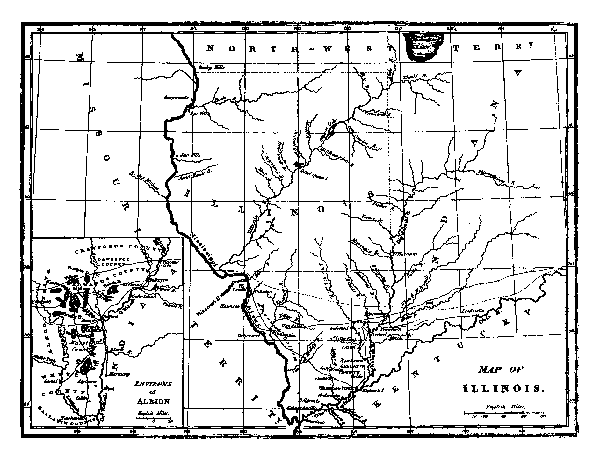
June 5th, 1820.
As I was much pressed to write to many of my friends
in England, to give them my opinion of emigrating to
America, and as I promised to write to several, to give
them my sentiments of America, and of my situation here;
I will now endeavour to give them the best description in
my power of our voyage and journey to this place, and
how I am now situated, and of my future prospects.
As to the propriety of any person's leaving England, I
must decline giving any advice on the subject.
{2} As I was conscious but little information could be
conveyed in the short space of a letter to any particular
friend, I shall, therefore, present them, (that is, all those
who requested me to write to them,) with some extracts
from my Journal.
We left Killinghurst about noon, on April 29, and
arrived at Portsmouth in the evening. Our party consisted
of nine persons, including Mr. C. and a female
servant.
30th. Our luggage, in a waggon, arrived at Portsmouth
at noon, and we got a permit from the Custom-House, and
embarked it on board a vessel for East Cowes, in the Isle
of Wight, where it arrived in the evening, but too late to
enter it at the Custom-House. We slept at East Cowes.
May 1st. Entered our luggage at the Custom-House,
and were ourselves examined, {3} and afterwards put our
luggage on board the brig Resolution, of Newcastle,
Captain Clarke. From that time till the 9th, we were
employed in procuring provisions and conveniencies for
our voyage, and in stowing our luggage, &c. When about
noon, the wind and tide being favourable, we sailed from
East Cowes; but before we reached the Needles' rocks, the
wind and tide both failed, and we cast anchor for a short
time; but the wind again rising, we passed them, and before
dark got a few miles to the westward. The pilot left
us as soon as we had passed the Needles, and so did some
friends of the passengers. They gave us three cheers at
parting, which was returned by firing a salute with some
small arms on board. The same was done at West Cowes,
when we heaved our anchor.
The brig Resolution was of five hundred tons, and had
seventy-one passengers on board, a small cargo of salt,
the luggage of the passengers, to a considerable amount,
{4} with the following live stock: a bull, two cows, a calf,
three horses, with pigs, dogs, fowls, and ferrets. Mr.
Pittis, who chartered the Resolution, with Mr. Edney, his
son-in-law, and their families, occupied the cabin, but
their young man slept in the fore part of the steerage, with
the young men of the other parties. The females of my
family, with myself, and some other passengers, occupied
the hind part of the steerage, divided into ten separate
births, with two bed-places in each birth; they were six
feet square, and about five feet nine inches high.
10th. In the afternoon, part of the coast of Dorsetshire
in sight.
11th. A great swell of the tide, and much sea-sickness
on board; Berry-Head in Devonshire in sight in the morning,
and land near Plymouth seen in the evening.
12th. Land seen in the morning, the last we saw of
England; as the wind was north and north-west we stood
to the southward, and it prevented our touching {5} at the
Land's End, as our captain intended.
13th. We supposed ourselves opposite to the Land's
End about noon.
15th. A good wind from the south-east, but the ship
rolling much during the night; most of the passengers got
but little rest. Weather fine, but cold.
16th. Being Sunday, two of the passengers read some
chapters from the Testament, and a sermon.
22d. A good shower of rain, just as we had got our
bedding on deck to air it. In the evening, I observed, for
the first time, the water at the bows of the vessel to look
like sparks of fire.
23d. Being nearly in the latitude of the Western Isles,
many on board were on the look-out for them, in the
hopes of getting some fish and fruit, and sending letters
to England; but we were disappointed, as we saw nothing
of them.
24th. The ship's carpenter tried a girdle {6} made of
tin, and water tight, called a life-preserver; he found he
could not sink, but at the same time he could not make
any way in the sea with it on.
25th. Early in the morning we got sight of the island
of St. Mary's; it was seen at a great distance. We had
seen no land since the 12th, when we last saw the coast
of Cornwall. In the afternoon, we passed the island 15
or 18 miles to the north of us, so we did not get any fruit,
to the great disappointment of many on board.
27th. The sea ran high, and once cleared the fore-part
of the vessel of every thing that was moveable. When the
waves broke over the deck, some of the passengers generally
got a wetting, which caused a hearty laugh from
those who escaped.
29th. At noon, by observation, we were in latitude 33
deg. 58 min. north, which is three degrees south of Cape
Henry, at the entrance of Cheasepeake Bay, to which we
were bound. The weather warm, though not more so
than a fine May-day in {7} England, although we were
upwards of a thousand miles south of it.
30th. Some of the passengers bathed, till one of them
got stung in the leg by a sea-nettle, or what the sailors
called a Portuguese man of war; he was in great agony,
but by rubbing it with vinegar, the pain abated.
June 6th. There were four ships in sight in the morning,
and in the afternoon another was seen, and, at four
o'clock, she sent a boat, with an officer and five men.
They proved to be Russians, from a frigate of thirty-six
guns, the Kamtschatka, from Kamtschatka, and the
north-west coast of America; they had been round Cape
Horn in their way out, and returned by Manilla, the Cape
of Good Hope, and St. Helena, where only the captain
was suffered to land. The inhabitants know but little of
Bonaparte, as the governor was extremely jealous of all
intercourse with his prisoner; most that they knew of him
was from the English newspapers. {8} The officer
eagerly enquired for news from Europe, they having been
out two years. We gave him some English newspapers,
and he in return took some letters for our English friends,
as they intended to touch at some port in England, before
they proceeded to Russia. The officer was regaled in the
captain's cabin, and the men were treated with plum-pudding
and strong beer, but they refused to taste it, till
one of the passengers had first partaken of it; they then
seemed to relish it extremely well. Some large fish and
porpoises were seen round the ship, and two rifles were
fired at them, without effect. A sea-snake was also seen
in the evening, it appeared to be six or seven feet long.
7th. We saw some sea-weed that had much the appearance
of the tops of dead juniper bushes, with many small
berries on them; we took some pieces out of the sea, and
found many little crabs in them, and a few small shrimps;
the crabs from a quarter to two inches long. Most of
the {9} passengers were now in good health. A pleasant
evening, and the young people had a dance on the
deck.
8th. Some dolphins taken by the sailors, with hooks
and lines; they were from 18 to 30 inches long, and very
beautiful fish. I bought one of the small ones, it weighed
six or seven pounds, and proved very good eating.
9th. A small Swedish brig, the Dryade, sent a boat to
enquire for a surgeon, their captain being ill; our surgeon
went on board, and afterwards sent some medicines, for
which, through a speaking trumpet, their captain thanked
ours. They took some letters from us for England, as
they proposed going thither, before they proceeded to
Copenhagen. Our water being got very bad, it caused a
little commotion on board, as there was but little water
belonging to the captain. The passengers were found
water by the person who chartered the Resolution; and
the badness of {10} the water appeared to be occasioned
by its being put into foul casks.
13th. Many flying fish seen; they flew from twenty to
thirty yards at a time, some of them about the size of a
herring, and others not larger than a chafer; when they
rose near the vessel, the water that ran from them, had
the appearance of a white string behind them; and when
it ceased, they dropt into the sea again.
14th. We made 186 miles in 24 hours, being a great
deal more than we had sailed, in the same space of time,
since we left Cowes.
23d. We had a strong gale that blew down one of our
sails.
26th. In the evening the main-sail boom broke, and
spoiled a dance just began on deck. The accident was
owing to the sailor at the helm being intoxicated, and
letting the vessel get out of her course.
27th. All eagerly looking out for the gulf stream. In
the evening we saw a sea-gull; {11} these birds are said
never to fly far from land.
30th. We had a rough windy night, and it continued
stormy through the day, and about six o'clock we had a
tempest that split one of our sails. About noon we saw a
ship that proved to be the Commodore Rogers, a pilot
vessel of Baltimore, and from her we received a pilot,
who informed us that Cape Henry, at the entrance of
Cheasepeake Bay, was distant 25 miles. But a storm
coming on, the wind changed just as we had sight of land,
supposed to be Smith's Island, just at the entrance of the
bay; this was the first land we saw after we lost sight of
the island of St. Mary's.
July 1st. A wet night: we got upwards of 20 miles from
Cape Henry. In the evening we again stood out to sea,
the wind against us.
2d. In the evening, it being calm, we anchored two
miles from Cape Henry light-house, and one mile and a
half from the shore; which was very low land and covered
{12} with trees to the water's edge, mostly pines of a barren
appearance, resembling a furze hedge in the poor heaths
of England. We had a good view of the shores for several
miles. The weather being pleasant, there was a dance
on deck; and as the night was calm and the moon shone
brightly, it was kept up till a late hour.
3d. The captain and some passengers went on shore
in a boat; when they returned, they brought on board a
branch of wild vine, with some small grapes on it, a bough
of myrtle, and some honeysuckles like the trumpet one
in leaf and flower. They likewise brought some crab
fish, of different sorts, unlike any I had ever seen before;
one of them had a long tail, and was much larger than
the rest; this the pilot called a sea-crab. They also
brought a few sea-shells. The land, near the light-house,
very sandy and barren, mostly covered with woods, composed
chiefly of pines and a few oaks. The very little
that was cultivated, was Indian corn.
{13} Cape Henry light-house is built of wood, and stands
on the west side of the bay of Cheasepeake, and is in latitude
37 degrees north, longitude 85 degrees west. The
bay, at its entrance, is upwards of 20 miles wide. On
the opposite side is Cape Charles. At one o'clock we
entered the bay opposite the mouth of James River.
4th. In the night there was a riot with the sailors; they
quarrelled amongst themselves and with the captain; it
was owing to the former having drank too freely; it was
happily made up without any effusion of blood: I was in
bed at the time, and heard nothing of it. We were much
disappointed in not reaching Baltimore by this day, as it
was the anniversary of American independence, and, as
such, is always kept as a high holiday. We much wished
to see their manner of celebrating it, but, for this year, we
were disappointed in so doing.
5th. A little before day-break the mate discovered a
comet. The bay much narrower, and both banks full
in view, the land {14} much higher than before, and
covered with trees. Early in the morning, the captain
and some passengers went on shore, on the west side of
the bay. They went four miles through the woods; but
little cultivated land; wheat mostly harvested; Indian corn
just come into ear; tobacco in a green state. The land
poor, the woods mostly pines with a few oaks, &c. The
country round was thinly peopled, no towns, villages,
churches, or mills, for many miles. It is in Maryland,
and the land is mostly cultivated by negro slaves, of
whom they saw several, and their habitations. They
shot a sea-eagle, as large as a goose, with very long wings,
the quills of which were too hard for pens. They also
shot a bird something like an English blackbird, except
that the wings were crimson. They likewise killed a small
dove, and were informed many wild ducks frequented the
creeks in winter; and heard of two men killing a hundred
and ten in one day. They brought on board some ripe
cherries, and some apples nearly so; they saw great quantities
{15} of the latter; also peaches and nectarines in a
green state. They saw a few sheep, oxen, and cows, but
no horses, oxen being worked instead of horses.
6th. We anchored near Kent Island, said to be good
land, but we could see but little of it. At eight o'clock
we again proceeded, and at ten got sight of Baltimore,
eight or ten miles distant. As we approached Baltimore
the bay became narrower, and the land, on both sides, so
very low, the trees seemed to grow out of the water. The
country more cultivated, and the people employed in getting
in their harvest. We met a large steam vessel, and
passed her at about twenty yards distance. There were
two chimnies, from which issued a large quantity of
smoke, a wheel on each side forced her forward; the forecastle
was much like a common ship; the stern was covered
with a canvas awning, to shelter the passengers from
sun or rain; it was open on the sides: she moved along very
majestically.
{16} Shortly after, a surgeon came on board, to examine
the health of the passengers and crew; he expressed much
satisfaction at their appearance. He was a venerable
looking old man, of about 70 years of age, and a native of
Britain.
At three o'clock we anchored near Fell's Point, Baltimore,
and in the evening went on shore; but returned on
board to sleep. The weather fine and very hot.
7th. At noon we went to the Custom-House to enter our
luggage; in the afternoon some of our fellow-passengers,
with ourselves, engaged a house at Fell's Point, at 10 dollars
per month.
8th. We removed to our house, and hired a cart to take
our luggage from the vessel, at 25 cents a load. Paid at
the Custom-House, 37 dollars, 75 cents; expences, one
dollar, 40 cents.
Trade at Baltimore extremely dull, and paper credit
very bad, except some few banks.
Accounts are kept in dollars and cents; {17} a dollar is of
the value of 4s. 6d. English; but in Maryland and Pennsylvania,
it is called 7s. 6d.; in New York, 8s.; and in
all the western country, 6s.; but it is of equal value in all
the states; it is the shilling that differs; 100 cents make a
dollar; a cent is a trifle more than an English half-penny.
Dollars are divided into halves, quarters, eighths, and sixteenths,
thus 100 cents make a dollar, 50 cents half a
dollar, 25 cents a quarter of a dollar, 12½ cents the eighth
of a dollar, and 6¼ cents the sixteenth of a dollar. The
shillings are different, as follows:—
|
1s. is |
|
The dollar |
| Illinois, Virginia, Kentucky, &c. |
16⅔ cents |
—— |
6s. 0d. |
| Pennsylvania, Maryland, &c. |
13⅓ cents |
—— |
7s. 6d. |
| New York, &c. |
12½ cents |
—— |
8s. 0d. |
These different denominations of the parts of a dollar
are troublesome to strangers, and might be avoided, by
counting in dollars and cents only; as there are no shillings
in America, but only dollars, halves, quarters, eighths, and
sixteenths, mostly Spanish coin, and some 10 and 20 cent
{18} pieces of American and Spanish coin. Cents and half
cents of copper are used in the eastern, but not in the
western states; few cents being to be found west of the
mountains.
The morning after we were settled at Baltimore, we
opened some of our packages, and found them in good
order. In the afternoon, I took a walk with a person I
had known in England; he went to purchase some milch
cows; we went three or four miles through the woods, to a
Mr. Slater's, who had a 100 oxen and cows, of good size
and shape, but of different sorts; his stock ran mostly in
the woods, as he had but little cleared land. When we
arrived, we found Mr. Slater with his men cutting wheat
in a field of 25 or 30 acres; the wheat was of good quality,
but not a large crop, not more than 14 or 16 bushels per
acre. They cut it with scythes, some follow to tie it up
and set it up in heaps, rather than shocks; the cutting,
binding, and setting up, all done in a very slovenly manner.
The wheat, {19} after Indian corn, was ploughed in ridges
of about four feet wide, and sown before the Indian corn
was got in, a practice very common in America; and the
stalks of Indian corn cut down in the winter or spring, and
left in the wheat. The land, a poor clay, very wet in
winter. As Mr. Slater purposed bringing his cows to
Baltimore market, the next day we returned, and passed
his house, a very good brick building, pleasantly situated,
having a fine view of the bay of Baltimore, a quarter of
a mile distant. The out-houses and negroes' houses
much out of repair. The manure was but little attended
to, being scattered in all directions, although the soil stood
so much in need of it. We saw one field of very poor oats
and some weak Indian corn. The orchard contained
much fruit, apples, peaches, and late cherries, the early
ones were over. We had a fine view of the bay and part
of the city; and the mouth of the Patapses River and a
fort near it;75 and the {20} numerous vessels sailing up
and down the bay.
We passed a fishing party of ten or twelve; they were
taking some refreshment on the shore; one of the gentlemen
was a native of England; but his parents left Cornwall
when he was an infant: we took some whiskey and
water with them. The woods we passed resembled English
pleasure grounds, except there was a greater variety
in the trees and shrubs. In this walk a greyhound dog
that accompanied us, attracted much notice from all we
met; few of whom had ever seen one before. One of the
passengers in the Resolution brought over some ferrets;
they also excited much attention, and a person wished to
purchase one, to go into a collection of animals, and offered
a great price for it; but no bargain was made when we left
Baltimore. I have never seen or heard of any other ferrets
in America.
There are many new buildings in Baltimore, and some
now going on. Baltimore {21} street is a noble one, wide,
straight, and of great length, crossed at right angles by
many other good streets; Baltimore-street running east and
west, the cross streets north and south. As the city was
planned before the buildings had made much progress, it is
very regular, and should the plan ever be completed, it
will be a large and noble city. There are some good shops,
(in America called stores), but not equal to those of London.
As no burial grounds, butcher's shops, or slaughter
houses, are allowed in the city or at Fell's Point, many of
them are on a hill, north east of Fell's Point. There are
three burial grounds, all badly kept, one belonging to the
catholics; I did not learn to what sects the other two belonged.
The butcher's shops are on the top of the hill,
in an airy situation; here they kill their meat, and carry
it to the daily markets. At some distance from the burial
grounds, there is a noble looking hospital, some rope walks,
and brick yards.
{22} Across the top of the hill, some intrenchments were
thrown up during the late war, to stop the progress of the
British troops when they landed near Baltimore, but they
did not advance so far as these intrenchments.
A man on the hill with porter for sale recommended it
as of good age, it having been brewed three whole days.
Malt liquor not much drank, except by the English.
Towards the north-west, the land better than to the
north-east, but still poor and rocky. Yet there is a great
variety of soils in and near Baltimore. I was informed
by a person who belonged to the society of Friends, that
he had lived here a great many years, and had been concerned
in most of the buildings; he said he believed there
was not so convenient a place for building a city in the
universe, as far as regards the finding the materials on the
spot. Trees of many sorts grew where the city now
stands, fit for building; {23} free-stone in great plenty;
also shells and lime-stone for mortar; abundance of sand
and clay, that made excellent bricks. The land being uneven,
it required some labour to form the streets, but as
most of the little hills were composed of sand or free-stone,
a great part of them came into use, and the remainder
served to raise the streets against the bay.
I was informed, there were thirty thousand inhabitants
or upwards, but the number did not increase as during
the war.
Trade being bad, most of the new buildings at a stand,
to the great disappointment of many of the emigrants
from Europe. But to those who came in the Resolution,
it was of no great moment, as we most of us intended
going westward before we left England, and not to stop
in the sea-ports; and there were but few mechanics on
board. Several vessels with emigrants arrived a short
time before us, and there were three a few days after us;
amongst them, one small American vessel from Havre
with a {24} hundred and sixty-nine English, chiefly from
Portsmouth and its neighbourhood; fifty-four days from
Havre to New York, where some of them landed; the remainder
came on to Baltimore, which place then contained
many emigrants in want of work; some without money to
take them up the country; and some with no inclination
to go up; and some without either. A person who comes
to America is most likely to succeed by moving from the
sea-ports, they being very full of people. Labourers in
agriculture, and many trades, are sure of work in the
western country; but some from Europe have very erroneous
opinions of America, in thinking that, when they
arrive, they shall find every thing without any trouble;
others think they cannot ask too much for their labour. I
have known men dissatisfied with 6s. per day, who in
England must have worked much harder for 2s.
Many hackney-coaches and one-horse carts for hire,
with very fine horses in {25} them, much better than the
horses for the same purposes in England. The horses
have much blood in them, and would not disgrace a nobleman's
carriage; those that bring provisions to market
are of the same description, light and active, and would
make good hunters. The hackney-coaches are open on
the sides, on account of the heat of the climate, with
leather curtains, to let down in wet weather; the drivers
principally negroes. But the carmen mostly English,
Scotch, or Irish, but most of the latter.
The person with whom I went to Mr. Slater's, purchased
of him at the market two cows and calves for 71
dollars, (15l. 19s. 6d.), the cows young and very kind, and
when fat, might weigh about 560 lbs. each; the calves
eight or ten days old.
There is a market for horses and beasts, &c. twice a-week
at Baltimore, and one every day, except Sunday,
there and at Fell's Point, but there are two on Saturday,
one in the morning, the other in the {26} evening, at each
place, for the sale of flour, meal, meat, fish, butter, cheese,
vegetables, and fruit, consisting of pine-apples and cocoa-nuts
from the West Indies. Sweet and water-melons,
apricots, peaches, prunes, plums, limes, lemons, oranges,
cherries, currants, whortleberries, blackberries, fox-grapes,
apples, pears, earth-nuts, and walnuts. The fruit in general
good and reasonable; and vegetables the same, with
the exception of cabbages, and they were very dear, owing
to the dry season. Pine-apples 3¼d.
Fell's Point has many pumps, but few of them possess
good water; there was one near us a very good one, called
Jackson's pump. The badness of the water, its low situation,
and the quantity of stagnant water, were, I think,
the chief, if not the only causes of the fatal fever that broke
out soon after we left it; nay, I rather suppose it had
commenced before we quitted it, as many people were
ill, and some died most days during our stay. But the
city {27} standing higher, with good springs, it is much
healthier.
The first Sunday after our arrival, we went to the
episcopal church, the building was lofty, light, and airy,
with five stoves to warm it in winter; the pews were painted
a light colour, with mahogany coloured rails. The service
much as in England. The psalms for the day, or a selection
at the choice of the minister. Prayers for the president
and general government, instead of the king, &c.
There was a fine organ. The congregation was a very
genteel one, and as the heat was great, all the ladies used
fans, mostly made of feathers. In the afternoon there
was a thunder-storm and some rain, preceded by a very
high wind, for about ten minutes; and as the weather had
been extremely dry, the dust was driven in such clouds, as
almost to make it totally dark. Much colder in the evening;
and some of us went to the Methodist meeting; it
was numerously attended, the manner much the same as in
{28} England; the preacher, who had a strong voice, made
the most of it. Towards the close of the service, two
men, each with a bag at the end of a long stick, made a
collection for the minister, &c.; and while they were so
employed, a man with a long beard, and a leather girdle
about his loins, (as the prophet Elijah), stood up, and
begged to say a few words. First, he reproved the minister
for taking money, and then declared himself a preacher
sent from God to warn the world of its wickedness, and
to inform the people, that before the crop of the year 1818
was consumed, "Time should be no more." I sat very
near him, and he stood on one of the seats, that he might
be heard the better, but he spoke so rapidly, I could not
hear all he said, but I heard him reprove the minister, and
all present; at length he was persuaded to sit down, and
the preacher again went on. It being late we went home,
as did some others. This man was deranged, constantly
attending the markets, preaching and {29} prophesying the
end of the world. He was often surrounded by a large
concourse of people, to hear him; but few, if any, gave
any credit to his testimony. He often got insulted by the
crowd, but the magistrates did not interfere, but left him
to do or say what he pleased. Some of our party went to
the African meeting. There are many different religions
in Baltimore, and all appear to live together in great harmony.
As there is no religion established by law, all are
equal in this respect, except the poor negroes, who are not
allowed to attend divine worship with the white inhabitants.
And although I disapprove of slavery in every
point of view, in none so much as in their not being allowed
to worship the Almighty with the other inhabitants, I
think the treatment of the slaves at Baltimore was mild,
but still they were slaves, and at the mercy of their owners,
if fellow-creatures and Christians can be called the property
of others. But thank God, I never yet considered
any person had that right; {30} and as that was my opinion,
I could not settle in a slave state, to disgrace myself
and family by the horrid practice of slave keeping.
On the 15th there was a very heavy thunder-storm, the
thunder was extremely loud, attended by heavy rain,
the streets near us looked like rivers; indeed, when the
rain ceased, the boys waded in the one before our house
for some time. I was informed by several of the inhabitants,
that they had seldom heard such thunder, or seen
such rain before. This evening, and two other evenings,
we had a very disagreeable scene in an alley near us. It
was that of an Irish howl or wake, in which the mourners
made a dreadful noise, crying and howling; we could hear
them enquire, "Why their dear sister died;" "whether
she wanted any thing;" "whether her friends were unkind
to her," &c. &c. As the mourners made pretty free with
whiskey, the noise increased as the night advanced. The
watch several times {31} ordered them to be quiet, and
they always obeyed for a short time, but soon began again.
Many of the principal people in Baltimore are Catholics,
as well as numbers of the lower order of Irish, many
of whom were recently arrived from Ireland. Irishmen
are numerous every where in the States, but I am informed
generally of a higher description than those in Baltimore
and in the sea-ports.
One of our company, going out one morning before it
was light, to call some of his fellow-passengers to go for a
day's shooting, was taken into custody by the city-watch,
and taken to the watch-house, but finding he was a stranger,
he was liberated; he staid till day-light, and then called
his companions and went out, but found no game.
The Americans are not reserved in their manners, they
do not scruple asking a stranger any question, nor do they
appear to mind answering any that may be asked {32}
them. Many of them seemed to like the English amongst
them very well, others are more jealous of strangers. On
the 14th, I put some letters in the post for England, for
which I paid 18¾ cents., about 10d. each. I saw a beggar
in Baltimore street, the first I saw in America. We did
not purchase any fruit, although it was very cheap, on
account of its being unwholesome for people just arrived
from Europe.
As I could not settle all my business, several who came
over with us, and had been residing in the same house,
left us on the 17th for Pittsburg; they hired a waggon to
take them and their luggage, for four dollars and a quarter
per hundred pounds weight. As they purposed going to
the English settlement in the state of Illinois, we expected
to see them when we got there; but they stopped at Evansville
in Indiana, and hearing of an English settlement ten
miles distant,76 they went there; and I have seen nothing
of them since, except one, who has arrived at Wanborough.
{33} In one of my walks, I saw upwards of twenty very
fine red and white oxen, belonging to a butcher on the
hill above Fell's Point, fine and clear in their horns,
though most of the beasts I have seen in America are
rather thick in their horns; they were very fat, and might
weigh from 600 lbs. to 700 lbs. each, of the value of from
30 to 35 dollars each.
As we understood it was difficult for large boats to go
from Pittsburg to Wheeling, the water being low, we
agreed with a Mr. Merchant, for the carriage of ourselves
and luggage to the latter place, a distance of 280 miles,
for the sum of 350 dollars, (78l. 15s.); this was for nine
people, and upwards of 6000 lbs. of luggage. We had
two waggons, with six horses and one driver to each waggon;
the manner of travelling in them is very different
from that of England. Here they are hired to take passengers,
luggage, goods, &c. to any part of the United
States, by the 100 lbs. weight. The drivers look after
their own horses,— {34} buying hay, Indian corn, chopped
straw, ground rye, &c. at the taverns. Looking after
their own horses prevents their setting out early in the
morning, so they take their breakfasts before they commence
their journey. They then travel till noon, when
they stop for a short time, and then go on till sun-set or
after; therefore they have no time in an evening to clean
their horses. The waggons are lighter than English
waggons, with a pole instead of shafts. The drivers ride
the left-wheel horse, with reins to the other two pair;
they seldom walk, and when they do, they always mount
should a bad piece of road, or a difficult log-bridge come
in their way, as they can see to guide their horses much
better than when on foot. A trough is screwed behind
the waggon, containing a small mattress, a blanket or
two rolled up, and a water-pail. When stopping to bait,
or for the night, the trough is placed on the pole of the
waggon, and the horses are tied up to it, where they stand
in all weathers. They mostly water {35} their horses out
of their pails, seldom letting them go into the water to
drink, if ever so convenient.
Having settled all my money transactions, and got our
luggage ready, we took leave of our fellow-passengers, not
expecting ever to see them again; and in the afternoon
of the 22d of July we left Baltimore. The country but
little cultivated, but many fruit trees; for some distance
from Baltimore, the land poor and stony; we first took a
turnpike road, but soon quitted it. We saw many waggons
to and from Baltimore to the westward. We had
our own bedding with us, which we generally made use
of at the taverns, never hiring more than one or two beds.
The weather very hot.
23d. Breakfasted at the tavern, charge for nine breakfasts,
a gallon of tea the evening before, beds, &c. 4 dollars
31¼ cents., nearly (19s. 6d.) We passed this day a
poor, rocky, hilly country, many huckleberries in the
woods, 23 miles to a {36} tavern, where we slept. Wheat
and rye mostly harvested. Hay, some housed, and some
cutting; it was timothy grass, and extremely ripe; it was
put up in very small ricks, and not thatched. The fences
were of rails, laid on each other in a zig-zag form,
thus,  ; having laid one row, they begin
again on the first, and rise up from six to nine rails high;
which make a strong fence against all sorts of cattle. The
expense of a rail fence is not great where timber is plentiful.
The price of cutting and splitting rails is from 3s.
to 4s. 6d. a hundred. Generally a hundred, laid eight
rails high, will make about six rods of fence, so that including
cutting, casting, and putting up, the expense may
average at 14d. a rod.
; having laid one row, they begin
again on the first, and rise up from six to nine rails high;
which make a strong fence against all sorts of cattle. The
expense of a rail fence is not great where timber is plentiful.
The price of cutting and splitting rails is from 3s.
to 4s. 6d. a hundred. Generally a hundred, laid eight
rails high, will make about six rods of fence, so that including
cutting, casting, and putting up, the expense may
average at 14d. a rod.
24th. We were charged for breakfasts, beds, &c. 3 dollars
31¼ cents. We passed through a country similar to
that on the preceding day, till near the town of Liberty,
40 miles from Baltimore, a small neat place, of fifty or
sixty houses. This was {37} the first town or village we
had passed, by the road we came. From Liberty to
Frederic town, a much better country; Frederic town is a
large place, with many good brick buildings in it.77 It is
said to be the largest town in the States, that does not lie
on a navigable river. From thence to Elders town, soil
pretty good. This day we travelled 22 or 23 miles. We
now mostly provided our own dinners and suppers, and
took our breakfasts at the taverns. These breakfasts consisted
of several of the following articles: chickens, hams,
veal-cutlets, beef-steaks, roast pork, and several sorts of
fish; various kinds of hot bread, viz. wheat and corn
bread, buck wheat cakes, and waffles, a sort of soft cake,
said to be of German origin; butter, honey, jelly, pickles,
apple-butter, and the following dried fruits: peaches,
cherries, apples, &c. And for one of these breakfasts
they generally charged us 25 cents, (1s. 1½d.) In the
above, I should have included tea or coffee.
{38} 25th. We travelled, a hilly country, to Trap town,
a very small place, mostly of log-houses. From near Trap
town, to the Potomac river, it still continued rocky. We
passed 2 or 3 miles, up the side of the river, along a very
sandy road, the river to our left, and some very high rocks
on our right; many of which had, at different times, rolled
down into the river. On the south side of the river, was
a high ridge of rocky hills, and the sun shining on them;
and, as we were passing through a deep sandy road, the
heat was more intense than I had ever felt it before. The
Potomac river is upwards of 250 yards wide, but shallow
at the time we passed it, and full of large rocks. We saw
some people fishing, in canoes, but what kind of fish they
were fishing for, we did not learn. Many papaw trees
on the banks of the river: as we approached near to Harper's
Ferry, the rocks on our right rose to an immense
height; we passed close under one, much larger and higher
than St. Paul's church, London. {39} We were told it was
a quarter of a mile high; but this, I think, was an exaggeration.
Some small pines and cedars grew on these
rocks; the cedars, on the highest points of them. We
crossed the Potomac at Harper's Ferry,78 in a ferry-boat;
one waggon and its horses passed over at a time, the river
was so full of rocks, it was difficult for the ferryman to
find a passage for their boat. The river, at the ferry, was
about 200 yards wide; we passed it just above its junction
with the Shadanoak.79 We had now entered the State of
Virginia; hitherto we had been travelling in Maryland.
We saw many large birds on the river, but of what sort
we did not learn, but supposed them to be fish-eagles.
At Harper's Ferry, there is a manufactory of fire-arms, at
which many of our countrymen were employed. I saw
eight or ten of them, and they informed me there were
about sixty men, women, and children; but as it was Sunday,
they were most of them walking out. Four miles
from this place, we stopped {40} for the night, at Brick
Mill tavern; here was a mill of five stories high, but short
of water in a dry season, and this was the case when we
were there. We passed a mill two days before, seven
stories high, with more than fifty sash windows, the water-wheels
more than twenty feet high, said to be well supplied
with water at all seasons of the year. This day we travelled
19 miles.
26th. We proceeded 4 miles, through a hilly country,
to Charles town,80 Virginia, a long place of eighty or a
hundred houses, mostly of wood, but some good brick
ones. A small creek, at the end of the town, then nearly
dry; the land tolerably good. Here I saw a small
piece of flax; it was the first I saw; but we had passed
three or four small pieces of tobacco, very well cultivated,
being planted in squares, at eighteen or twenty inches
apart. At noon, we stopped at Cook's tavern, during a
storm of thunder and rain, and afterwards proceeded up
a rocky hill, of good limestone land, {41} on which there
were the best farmhouses and out-buildings, and the most
manure we had hitherto seen. Dung, in this country, is
but little attended to in general; indeed, they seem to try
who shall get rid of it with the least trouble. At Brick
Mill, the stable was placed over the mill stream, the horses
standing on a plank floor; indeed, where there are stables,
the horses stand on plank floors, without litter; but generally,
through the country we passed, they tied them up
in the open air in a road, or any other place. As this hill
lies high, the corn on it was rather backward; the wheat
and rye were cut, but not harvested; the former, as fine as
any I ever saw. The road from Harper's Ferry is situated
high, and we were now on what is called the South,
or Blue Mountains.81 Leaving the hill, we passed some
woods down a road more rocky, if possible, than ever, to
a small clear river, about twenty yards wide, and eighteen
inches deep. There were some fine springs where we
passed the river; {42} then, for two miles, through a country
uncommonly sterile, covered with scrubby pines, to a
new tavern, where we intended to sleep. But some words
arising between one of our drivers and the mistress of the
tavern, we went forward half a mile to another; this tavern
miserably dirty, and the accommodations uncommonly
bad. On some of our party complaining, the landlord
told us, he was sorry we came to his house, as he liked
people to be satisfied or stay away. This was, by far, the
most filthy tavern we ever met with; in fact, it was but
little preferable to an English pig-sty. This day we only
travelled 15 or 16 miles.
27th. We provided the greater part of our breakfast,
not much wishing to partake of the landlord's accommodations.
We then went forward, through a poor country,
till we passed some woods, and then into some good limestone
land, but much encumbered with large rocks; some
of them upwards of 100 yards long, many yards wide, and
{43} some feet above the surface of the earth. What with
these rocks, and the stumps of trees, full one-fourth part
of the land could not be cultivated. A great deal of very
stout wheat and rye cut, but remaining on the ground; it
was cut very high from the ground, in a very slovenly manner,
and set up in large heaps, almost without form. We
had seen but few oats, and no barley, since we left Baltimore;
the oats not good. Indian corn in general slight,
owing to the drought. The after-crop of clover short,
but well set, the first cut had been mostly stout and very
ripe; the meadow grass now cutting, and also very ripe.
The hay ricks, we had passed, extremely small, with little
or no covering. Small ricks are most convenient to the
Americans, as they do not cut their hay, but begin at the
top, and so continue taking off till the rick is gone, a little
waste not being much regarded. We passed a little fallow
land, but it is not common to make fallows for wheat, as
by keeping the Indian corn {44} ploughed between, it is
left in a good state for wheat or rye. A negro was ploughing
for turnips, on some land, where a slight crop of flax
had grown this summer; the land very kind for once
ploughing. This negro said, some very elegant potatoes
grew on this land last year. They plough with a light
swing-plough, and use two horses, except when ploughing
between their Indian corn, and then they only use one.
They do not generally use harrows, but when they do, they
are made with wooden teeth; nor have I any where in
America seen iron tined ones, except in the English Prairie.
They use a large hoe to cover in their corn: I have not seen
a roller in this country.
Near this, we saw some mulberry and plum-trees. We
then passed a creek, and afterwards some hilly pine woods;
soil very barren till near Pew's town, a small place, mostly
log houses. Here we saw some buck wheat just come up;
we had seen some before equally backward, and {45} we
were told, it was common to sow it after a crop of wheat or
rye was taken off the ground. The gardens here better
kept than most we had seen, but these were far from
neat. In the afternoon, we met two droves of fat beasts,
from the south branch of the Potomac river, going to
Baltimore. The first, a drove of handsome fat oxen and
heifers; the other, a larger one, all oxen, young and handsome,
but not so fat as the first, some of which were too
fat for the hot weather. These beasts only travel mornings
and evenings, often stopping to graze, and going but
a short distance in a day; they do not lose so much flesh
as might be expected in so long a journey. Just as we had
passed the last drove, we had a heavy storm of thunder
and rain, so that we got wet through, but our clothes were
nearly dry by the evening, when we stopped at Mr. Dent's
tavern, at a place called, "the Pine Hills." Here our
accommodations were excellent; our progress {46} this
day was 16 miles; the weather warm in the morning, but
colder after the rain.
28. Early in the morning I looked over Mr. Dent's
garden. It was pretty good land, though most that lay
round it was very barren. This garden was kept in tolerable
good order, and had a little manure bestowed on it.
There was some fine water-melons, nearly ripe, a few small
horse-beans; I had not seen any before, and these were
very weak; but there were some turnips, just come up,
that looked well.
The evening before, a poor old man begged for a lodging.
Mr. Dent ordered him into the house, and gave him
a hot supper, and provided a bed for him; and on his going
off early in the morning, Mr. Dent seemed to blame himself
for not giving him a dram before he started. This
was the second beggar we saw in America. After breakfast,
we paid 3 dollars 31¼ cents, and left the tavern well
pleased with our accommodations and our landlord; {47}
and then proceeded through a sterile mountainous country.
There were pines and cedars on the hills, and large oaks
and chesnuts in the valleys. We afterwards went down
a long rocky valley, with a small stream of water running
in it, which we crossed ten or twelve times in our progress
down. We then came to a more open country, and the
stream was lost in a larger one, thirty or forty yards wide;
very shallow at that time, and the bed of it full of rocks.
In the afternoon, we met a drove of 120 oxen, from the
State of Kentucky, for the Baltimore and Philadelphia
markets. They were large kind beasts, mostly young, not
over fat, except two or three, which were very fat indeed;
one was equal to any beast I ever saw, and might weigh
upwards of 1200 lbs. weight. But most of them would
weigh from 600 to 800 lbs.; they were chiefly red and
white, but not all of one breed.
We saw a partridge fly from a tree, the first game we saw,
though we had now advanced {48} 120 miles into the country.
We were told pheasants, turkeys, and deer, were
plentiful in many places, but we had not seen any. We
saw many huckleberries, and some fern; this was the first
fern we saw, but we afterwards saw much of it on the
mountains: some of this fern had stalks of a bright mahogany
colour. The fern on the east of the mountains,
grew like the English, on poor land; but in the State of
Illinois, at least, where I have been, it generally denotes
a good soil; and the same may be said of beech trees, on
the banks of the Ohio, the richer spots are often covered
with a heavy growth of them; and in the western country,
beech land is called excellent. In the evening, we reached
Mr. Vannosdeln's tavern, in a poor high country; his
garden was in a much better state than any we had seen
before. He gave us a fine water-melon, but none of us
relished it much, as it was the first we had ever tasted, nor
was it quite ripe.
29th. We paid at Mr. Vannosdeln's {49} excellent tavern,
3 dollars 33 cents.; and went on to Springfield town,82
through a barren country, called the South Branch Mountain.
We passed the south branch of the Potomac river,
forty yards wide, shallow when we crossed it, but sometimes
it rises to a great height. After passing the river,
we went up its bank close under a ridge of hills, and many
fragments of the rocks had rolled down into the river, and
large masses hung over our heads that threatened to bury
us as we passed. Some large sycamore-trees lined the
banks of the river; these trees always grow on land liable
to be overflowed, and are the same that are called plane-trees
in England. The red or water-maple most resembles
the sycamore of England, but scarcely any tree or plant is
exactly the same. Cedars and pines grow mostly on the
tops of rocky hills; the latter are of several sorts, pitch,
spruce, and white; the first a little like the Scotch fir;
the last, much resembles the Weymouth pine; but the
spruce bore but little {50} similarity to any I had ever seen.
There was a large sort of berry that our drivers called
gooseberries, but totally unlike the fruit of that name I
had been accustomed to; but as they were not ripe, we
did not taste them. Leaving the banks of the river, we
passed a small mill, and followed the course of its stream
up a valley till we reached Springfield town, a place of
forty log-houses, and stopped at Mr. Piper's tavern. The
weather being extremely hot, the country hilly, and the
roads bad, we only travelled 16 or 17 miles.
30th. Early in the morning I walked round the town,
and went into a tan-yard; the owner was an old man, 48
years since from Ireland. He told me he was not troubled
with excisemen. He bought his bark mostly by the cord,
but sometimes by the hundred pounds weight, price half
a dollar. Only the body and the large limbs are barked.
The bark is shaved, but not chopped, before it is sold to
the tanners; it is ground in a kind of coffee-mill.
{51} At this place, I saw a few sheep of the Leicestershire
breed, very poor. Mr. Piper's tavern was a neat
log-house, lined with pine boards, and ceiled with the
same. We left this place for Frankfort, a small place
of near forty log-houses. We then passed Patterson's
Creek,83 thirty yards wide, but not deep. The land near
it much overrun with pennyroyal, of which we had seen
much during our journey, and also a great deal of mint;
in many of the small streams which we passed, it grew in
a very luxuriant manner; we frequently gathered some of
the latter, and put it into the water we drank, to take off
its rawness, and found it far more palatable for so doing.
Most of the briers we had passed were of the scented kind,
and they continued from Baltimore to the Allegany Mountains,
a distance of more than 150 miles; but on the mountains,
and on the west side of them to Wheeling, and from
thence to the Prairies, a distance of 1100 miles, I did not see
one scented one, but {52} many that were not. From
Patterson's Creek, a short distance, to Crisepsburg's town,
a very small place of log-houses;84 and soon afterwards
reached the north branch of the Potomac river, 200 yards
wide, rocky, and not deep. The land, on the banks of
the river, much better than any we had seen of late.
Having crossed the river, we were again in the State of
Maryland. The country between this place and Harper's
Ferry, which we passed on the 25th, all in the State of
Virginia. From the north branch of the Potomac river,
we passed a very hilly country, to a new road, called the
National Turnpike.85 This road is to extend from Cumberland
on the Potomac, to Wheeling on the Ohio, a distance
of more than 120 miles; the first 62 miles, from Cumberland
to Union town, on the west side of the Allegany
Mountains, was just finished, and is a good road, though
hilly. The road west from Union town to Wheeling, was
begun in many places, and many men were employed on
{53} it when we passed along it. This grand national road
is intended to connect all the western country with the seat
of government, as there is water communication from
Cumberland to the city of Washington, on the east by the
Potomac, and from Wheeling on the Ohio, with the States
of Kentucky, Tennessee, Alabama, Louisiana, Mississippi,
Missouri, Ohio, Indiana, Illinois, and all the western country,
by the means of the Ohio, Mississippi, Missouri,
Cumberland, Tennessee, and other rivers. This national
road is free, as there are no gates on it; for as it was made
by the nation, so it is to be kept in repair by it. We
entered this road, five miles west of Cumberland, and soon
after stopped at Mr. Carter's tavern, called "the Travellers'
Rest," at the foot of the Allegany Mountains.
We had lately seen fewer fruit-trees, and much less fruit
on them, except on the apple-trees, these being generally
well hung. Blackberries had been very plentiful all the
way, and so they continued over the mountains. {54} I
ate large quantities of them, liking them much better
than I did the cherries, of which we often had plenty
given us: these blackberries were much better than any I
had before tasted.
We saw but few birds on our journey; woodpeckers of
several sorts, a handsome yellow bird, something like a
goldfinch, a few crows, and some small birds, much like
tom-tits. As my youngest daughter was carrying some
flowers in her hand, a humming bird settled on them, it
made her start, thinking it was a large insect; it was not
larger than a chafer, but a beautiful bird.
The country, from Harper's Ferry, mostly rocky to the
mountains, generally of slate, but some limestone, free
stone, and coarse marble. Most of the valleys had
streams of water and good springs. The soil, chiefly
poor, but well watered. But little cultivated land, and
much of that only partly cleared of trees. They grub up
the underwood, and most of the small {55} trees; they then
either cut down the large ones, within three feet of the
ground, and leave the stumps standing, or else chop them
round the stems, and take off a small strip of bark, which
kills them, leaving them to decay, and fall down of themselves.
It is common to see eight or ten acres of land, in
cultivation, with some hundreds of dead trees standing in
it. They collect the small trees, underwood, and roots,
into heaps, and then burn them; and thus the fire often
communicates itself to the standing trees, running up to
the top of the highest of them, leaving them half burnt.
These trees have a very dismal appearance at first, but
people get reconciled to it in time. It is much the quickest
method of clearing land for corn, as it enables a man
to begin with very little strength of money, men, and
horses. The hogs, on the mountains, were not so handsome
as those nearer Baltimore, being in general badly
kept.
In our journey thus far, we had seen but {56} few gardens,
and those indifferently kept; they contained a few
peas, parsnips, carrots, onions, shalots, sweet, and other
potatoes, lettuce, and a large flat sort of cabbage, with a
few sorts of herbs. Our landlord, Mr. Carter, had a farm
of 700 acres; 100 cleared, the rest in a state of nature.
31st. We proceeded, by the turnpike road, up a valley
of the mountains; the road good. As we ascended, we
found vegetation much later; the blackberries not ripe, a
little rye not cut, oats quite green, no wheat or Indian
corn to be seen. A few gooseberry-bushes, no fruit on
them; some strawberry-plants; I had noticed a few raspberry-bushes,
the fruit small and hard, of a dark red colour.
A great variety of wild flowers, almost all new to me.
Much timber in the hollows of the mountains, oak, chesnut,
and pine; the pines of an immense height. I measured
one that was cut in making the turnpike; it was
102 feet to the broken top, and there it was seven inches
in diameter. {57} Some that were standing appeared
much longer; I thought the highest, at least, 140 feet high.
The oaks and chesnuts were also very high, but they
grew too close together to be very large, but many of them
might contain from 50 to 150 feet of solid timber. Many
thousands of trees, that were cut for making the turnpike,
lay rotting by the sides of it, besides the vast quantities of
dead trees in the woods. This day only, we passed some
thousand loads of timber, thus decaying. I believe I
have seen more timber in this wasting state, than all the
growing timber I ever saw in my life in England. We
saw no heath on the mountains, nor have I ever seen or
heard of any in America.
In the forenoon, we passed a village of good houses,
most part of them lately built: a flour and saw mill, and
a noble tavern, the Globe; it equalled many English inns
in outward appearance. We stopped to dinner at a poor
log-tavern, but the landlord was building a new log one,
on a large scale. Here we saw a poor little negro {58} boy,
he was a cripple; the landlord had bought him some
months before, out of a drove of negroes going westward
for sale. The landlord treated him with great humanity,
and the child seemed as much attached to him, as he could
have been to his own relations. I was much pleased to
see a poor negro child so well treated, but as to buying or
selling human beings, I utterly abhor it. In the evening,
we arrived at Mr. Kimberley's tavern; here we took
our supper, our provisions being now exhausted. In the
forenoon, it was extremely hot; in the afternoon, a little
thunder and rain, and afterwards much colder: we travelled
seventeen miles, mostly up hill, the road good, but
rough, the stones being laid on rather large.
August 1st. Having breakfasted, and paid five dollars,
we set out and crossed the little Yougany or Cressing
river,86 by a new stone bridge of one arch of 76 feet span,
and very high. We passed many ridges and small valleys;
but little cultivated land, a small quantity of rye cut;
only one piece {59} of wheat, nearly ripe. Oats here form
the chief crop, some nearly ripe, others just coming out in
haw. A little Indian corn, but we were told the summers
on the mountains were too short for it to ripen; and,
therefore, they only planted a little to cut green. Some
healthy-looking apple trees in the valleys, but with little
fruit on them, owing to the spring frosts being later than
usual. Some new land bringing into cultivation, potatoes
or fallows first. The oats and potatoes, much better on
the mountains, than those seen between them and Baltimore;
indeed, the land in the hollows of the mountains
was much better than a great deal of that we had passed
before we arrived at the foot of them, but backward, the
winters being severe, and the springs late.
We called at a cabin, to get some bread, where we found
a woman with six small children; she said her husband
worked 40 miles off, and only came home once in two or
three weeks; they lived in this place {60} before the turnpike
was begun, four years since; no stores nearer than
six or seven miles. They procured most of their tea,
coffee, whiskey, and other necessaries from the waggons,
that traded to, and from Baltimore, to the westward. She
said, she had never been molested in this lonely situation.
She was born in the state of Jersey, but near Philadelphia.
Her great grandfather of the name of Wood, emigrated
from England, being oppressed with tithes, he being a
Quaker; he founded a small town in the state of Jersey,
and called it Woodbury, after his own name, and the place
he left in England, which was Bury. But whether it was
a town, village, or farm, she did not know, only, that it
was in Gloucestershire.
Sixteen miles from the Little Cressing or Yougany,
we came to the Big Cressing, and the small town of
Smithfield, placed in a very romantic situation.87 It had
three taverns, viz. a stone house, the Globe; a frame one,
the Rising Sun; and a good {61} log one, the Yougany;
and about twenty other houses, mostly of logs. A noble
stone bridge over the river, the centre arch ninety feet
span, said to be the largest in the United States. The
Yougany is one of the head streams of the Monongahela.
Leaving the river, we followed the course of a small
stream, to the Elephant tavern, kept by Major Paul, (late
in the American service), where we slept. This town is
noted as a waggon house; there were eight stopped there
at the time we were there, mostly drawn by six horses
each, and none less than five.
At noon this day, we passed the line between the states
of Pennsylvania and Maryland,88 and found ourselves in
a state where slavery is not admitted; but still negroes
were treated with much contempt, as we witnessed at
Major Paul's. A negro drove one of the waggons, that
stopped for the night; he was not allowed to sit at table
with any one, but had a table to himself: I believe he was
a free negro, but of this I am not certain. We had come
seventeen {62} miles, weather very hot, with much thunder
at a distance, but no rain. Mr. Paul's house was surrounded
by some of the best meadows we had then seen
in America;89 the hills inclosed them on both sides, and
the valleys were narrow.
2d. We advanced up a valley for a great distance, and
passed a mine of coal; it lay twelve or fifteen feet below
the surface of the earth; the veins about three feet thick;
several hundred bushels lay dug; it had a strong sulphureous
smell. We afterwards passed over a large flat, of
thin, weak, black, wettish soil, covered with dwarf alders
and large weeds; a little of this land cleared and planted
with potatoes, they looked well. What little timber there
was, was short and scrubby.
We now again ascended, and at length reached the top
of Laurel Hill, the last ridge of the mountains. Much
laurel on this eminence, resembling the Portugal laurel.
Here we had the first, and a most extensive view of the
west side of the mountains. {63} As the air was clear,
we could see objects distinctly; much cleared land in sight,
and many fine springs; indeed, they were numerous all
over the mountains, but there were but few houses. This
day we descended gently down the hill; the road was steep
and winding. As we advanced, the timber increased in
size, mostly oak, and towards the bottom it was immensely
large. From the summit to the town of Monroe,90 at the
foot of the hill, is full three miles, most of the way very
steep. Monroe was two years old, named in honour of
the president of the United States. It contains two large
stone taverns, and about twenty log houses, and a saw
mill on a small stream near it. Much land cleared of
timber and laid down to grass, of a better sward than any
I saw east of the mountains. From Monroe to Union
town, two miles; here we stopped for the night.91 I
passed a meadow between these towns, it was of timothy
grass, and higher than any I ever saw before; it was not
so thick on the ground as {64} I have seen English meadow
grass, but a most productive crop. This day our waggons
were separated a considerable distance, the first reached
Union at sunset, the other not till two hours after. We
came twenty-one miles.
3d. We had now entered the western country, but we
were still in the old settled part of it, Union town having
been built more than thirty years. It is a large place,
mostly of brick buildings; it has a bank, twelve or fourteen
taverns, a flour, a saw, and a carding mill, on a small
stream near the town. On this stream there were some
good meadows, but in a bad state, there being many docks
and other weeds in them. The Indian corn luxuriant; a
great many orchards, with a good show of apples in them.
Paid charges for supper, beds, and breakfast, 4 dollars 75
cents, (1l. 1s. 4½d. sterling.)
From Union town, the turnpike was only begun at
different places, but many men were employed on it.
Near the town, the {65} land was of good quality. We
afterwards passed a rocky ridge of hills, perhaps a spur
of the mountains. Here the land was rather poor, a clay
on a slate-rock; but many fine orchards well stored with
good apples, and some morello-cherries still on the trees.
A woman, at a small cabin, offered us some, if we would
take the trouble to gather them; we took two or three
pounds; they were small but palatable, being very ripe.
But cherries, in general, are not so good as in England,
as the Americans seldom bud or graft any fruit-trees, only
planting the stone. Land better as we approached
Brownsville, on the Monongahela.92 Brownsville is a
thriving place, with some iron-works: at high water many
people embark here for Pittsburg. As the national road
crosses the Monongahela at this place, there is a bridge
to be built over the river; it was about 300 yards when we
forded it, but it is much wider when the water is high.
From the river we went six miles, mostly through woods,
to the Golden Lion Tavern. {66} A woman milking her
cow, on the side of the road, gave us some milk, and
offered us some apples, of which there were large quantities
in their orchard. She said they purchased their farm for
2700 dollars, 900 of which they paid down at the time,
and the remainder by instalments, most of which were
now paid; and when the whole were paid, she would not
give a cent to call King George her uncle. A large wooden
building, by the side of the road, in ruins, and a new
stone-chapel, belonging to the Methodists, built to supply
the place of the old one. Here the Methodists are numerous:
we passed a wood on the east side of the mountains,
where a camp-meeting had recently been held; these
meetings often continue four or five days, during which
they have prayers four times a day.
4th. I proceeded on foot to Pittsburg, having some
business to transact there, the rest went on towards
Wheeling; I should have left the national road at Brownsville,
as I was there at an equal distance from {67} Pittsburg.
I went five or six miles through a poor country, to
Bentleyville;93 a place with several taverns, a large public
school, a grist and a saw mill on a very large creek, then
low, but much subject to floods in wet weather. I then
went two miles up a valley, full of sugar-maple trees,
most of them had been tapped for procuring the sweet
liquor to make sugar. February, in general, is the month
for making it; they catch the sap in wooden troughs, and
most of them are left under the trees from one season to
another. After leaving this valley, at a little distance, I
entered the road from Brownsville to Pittsburg; here I
first saw some water-meadows, although I had passed
many pieces of land that might easily have been irrigated.
The water was taken along the side of the hill for some
distance; it was not done in a good manner, yet still it was
a great improvement: I have seen but few water-meadows
since. I slept at a tavern, five or six miles from Pittsburg.
This day I travelled twenty-five miles.
{68} 5th. I reached Pittsburg at nine o'clock in the
morning, after having crossed the Monongahela in a ferry-boat,
for which I paid three cents. Having concluded my
business at the bank, I took a walk round the town: it is
a large place with upwards 7000 inhabitants. It is well
situated for trade on the Ohio, at the junction of the
Monongahela and Allegany rivers. A large bridge is
nearly finished over the Monongahela, and another partly
built over the Allegany; both these bridges have stone-piers
above high water-mark, but the remainder of them
is of wood. The bridge, that was nearly finished, was
divided into four passages; two for carriages and horses,
the other two for foot passengers. Contrary to the English
practice, each takes the right-hand side; so there is no
meeting on the bridge, as there are two passages for coming
out, and two for going into Pittsburg. These passages
are covered over, with holes in the sides to admit air and
light. As the whole is covered, the bridge is kept dry in
{69} all weathers, and the timber is prevented from rotting.
They are longer and higher than London-bridge, at least
at the ends, being quite level. The streets are laid out in
straight lines, from the Monongahela to the Allegany
rivers, and crossed by others mostly at right angles.
There are many handsome brick-buildings, but there are
also a great number of log and frame-houses. There are
several places of public worship, a large market house,
several banks, numerous taverns, and large stores; yards
for building steam and other boats. Several steam ones
were building, and others laid up, the water being too
low for them or large flat-bottom boats to get down the
river, when I was there. Trade of all kinds extremely
dull. Owing to the quantity of iron-works, it has a black
and dismal appearance; and from the account I had heard
of it, I was, on the whole, rather disappointed in Pittsburg.
It was a desert until about the year 1756, when the French,
from Canada, built a fort near it.94 But a few {70} years
after it was taken by the British, and the name of Du
Quesne changed to Pittsburg. From that time till the
revolutionary war it was held by them, and during that
war it increased much, being made a place for the manufactory
of arms. Yet as the Indians remained near it for
some years, they were very troublesome; but now they
are removed to a greater distance, except a few, who are
settled near, and have adopted the manners of the Americans.
It will always be a place of considerable consequence
from its situation. It is 1100 miles from the
mouth of the Ohio, and more than 2000 from New
Orleans. Steam-boats, in high water, come from New
Orleans to Pittsburg, in seventy or eighty days; but from
the latter to the former place in much less time.
Having purchased a new rifle for 18 dollars, and taken
a place in the Wheeling stage for Washington, for which
I paid 2 dollars 50 cents; I supped and slept at {71} the
Pittsburg Hotel; charge for supper and bed 50 cents.
August 6th. I left Pittsburg, in the stage, before day-light,
and crossed the Monongahela, by the new bridge.
Then up a very steep hill, the passengers all walking; we
passed a very rough country, for nine or ten miles, to a
tavern, kept by the driver of the stage, where we breakfasted;
they charged us 2s. 3d. each, instead of the usual
charge of 1s. 1½d., yet our fare was very indifferent.
From this tavern to Cannonsburg,95 eight miles; the country
still rough, but better as we approached this town.
Here is a college, a large brick-building, where most of
the principal people of Pittsburg send their sons to finish
their education. This town was begun twenty years since
by a Mr. Cannon. It is pleasantly situated on the side
of a steep hill. From this town, seven miles, to Washington
(Pennsylvania), along a rough road with many log-bridges;
but some of my fellow passengers, from the state
of Kentucky, called them corderoy. The {72} stage-coach
was very different from an English one, it was much more
like a light waggon; it was covered at the top, but open on
the sides, with leather curtains to let down in case of rain
or cold. The road being rough, we could not keep these
curtains down, as there was no sort of fastenings to them;
and as it rained very hard several times, we got wet. We
were much crowded with luggage; the seats were placed
across the carriage, and the luggage under them. At
Washington we dined, and I drank some spruce-beer (for
the first time in my life), and I found myself very unwell
from it. I left the room, and went into the air; in a few
minutes I was better; but as the stage still stood at the
door, I did not return for about twenty minutes, when I
found they had changed coaches, and were gone. I endeavoured
to recover my money, but there was no bookkeeper
to be found.
Wishing to rejoin my family at Wheeling, I set off on
foot; the afternoon was excessively hot. The road was
good for {73} the first ten miles, to Claysville, a new town.96
Then six miles of hilly country to Alexandria;97 here I
took some refreshment, and again set forward: near this
place I left the state of Pennsylvania, and again entered
the state of Virginia. Then six miles farther to a tavern,
where I intended to sleep; but the house being full, they
recommended me to go two miles farther on. It was very
dark, and thundered much; when I arrived at this tavern
I could not make any of the family hear, but I roused
two or three great dogs, and I was again forced to proceed.
My road lay up a long valley, part of the national
road to Wheeling. I passed over several large stone-bridges,
but partly finished; at length it began to rain, and
I put up at the first building I could find; it proved to be
a stable. This day I travelled twenty-five miles by the
stage, and about the same distance on foot.
7th. From my lodgings, in the stable, I proceeded up a
valley to some houses, and enquired the way to Wheeling.
I found I {74} was in the right road, and that it was only
seven miles distant. I found much excellent land on the
sides of a creek; the meadows were particularly so: I saw
twelve small hay-ricks in one large meadow. The Indian
corn was much larger than any I had before seen.
I met the two men who had driven our waggons; from
them I learnt where my family were, and that they had
settled with them for the carriage of our luggage. It is
but justice to them to say, we had every reason to be satisfied
with their conduct during our journey; Marchant, in
particular, was in his manners much above his station in
life. At seven o'clock I reached Wheeling.98
After breakfast we entered into an agreement with
Messrs. Knox and Pemberton, of Wheeling, for the conveyance
of ourselves and luggage to Louisville, in Kentucky,
600 miles, for 50 dollars, on condition we should
help to navigate the boat down the river. We hired a
horse and dray, for a dollar and {75} a half, to convey our
luggage on board, and paid one dollar for the room where
our goods were lodged. We laid in some provisions for
our voyage, as we expected to sail in the afternoon, but a
thunder storm coming on, we stopped till the next morning:
we slept in the ark or flat boat. There were twelve
tons of store-goods, for Cincinnatti and Louisville, besides
our luggage of about three tons. The ark was about 36
feet long and 10 feet wide, with a fire-place in the centre; it
was covered with boards, as a protection from the weather.
Wheeling is a thriving place, with some iron-works.
As the national road is to terminate at this place, it bids
fair to rival Pittsburg in the trade of the western country.
In a dry time it has greatly the advantage of Pittsburg,
being nearly a 100 miles lower down, and below the
shallowest parts of the Ohio. At any rate, the great
road for all the western country, crossing the Ohio at this
place, will always add much to its importance. The
country round {76} Wheeling is very fine, and I have seen
no part of America I should like better than the valley
above it. But all the land is taken up, and sells for a high
price; and, what is still worse, it is situated in a slave-state,
where every thing is done by the negroes, while the
whites look on.
8th. At break of day we sailed, or rather floated, from
Wheeling; Mr. Pemberton went part of the way with us,
and a Mr. Ferris had the charge of the boat and the store-goods:
these two gentlemen boarded with us. The wind
being against us, we made but little progress, although we
rowed the greater part of the day. We passed several
islands in the river: the banks were steep and high, the
country very hilly, and mostly covered with timber; the
flats of the river generally cleared, and planted with
Indian corn. The land would be too rich for wheat,
were it not flooded in the winter and spring. We passed
many small cabins, several of them were on the banks.
We only advanced 20 miles this day, {77} and anchored
on the Ohio side: the right, or north-west side of the river,
is the state of Ohio; the state of Virginia lies on the left,
or south-east side. The weather very warm.
9th. The land much as yesterday, except that the hills
lay farther back. In the evening we anchored on the
same side, 46 miles from Wheeling. We landed, and
went to a cabin for some milk, where we purchased five
chickens for fifty cents.
10th. We proceeded with caution, the morning being
misty, as there are many sunk trees in the river sometimes.
A man we had seen the evening before, came to
us and offered to sell his skiff, as he was near his journey's
end; I purchased his skiff, and an old iron shovel, for two
dollars; Mr. C. bought of him a hand-saw, for thirty-seven
and a half cents. As soon as we had paid him, he went
off into [the] woods; from that, and other circumstances,
we then concluded he had stolen them. Mr. Pemberton
took the skiff and followed {78} him on shore, but could
see nothing of him. Mr. Pemberton purchased five large
melons for half a dollar, but as we had not been accustomed
to melons, we could eat but little of them; but
after a few days, most of us could eat them without sugar
as well as the Americans. We passed Sistersville, a small
place of Virginia.99 The wind being in our favour we
made 30 miles.
11th. We passed the mouth of the Little Muskingham
river, thirty or forty yards wide, but very low. About
four miles lower down we anchored at the Great Muskingham,
close by the town of Marietta,100 of about a hundred
houses, many of them good brick-buildings. There are,
also, between thirty and forty houses on the other side of
the Muskingham. Marietta is well situated for trade;
but being subject to floods, it does not appear to increase
at all rapidly. It contains two meeting-houses, a bank,
several taverns, a jail, a stream-mill, and several rope-walks.
Ship-building is {79} carried on, on a small scale;
some years ago, a ship of a hundred and twenty tons was
built here, fit for the sea, although nearly 2000 miles from
it by the Ohio and Mississippi rivers. The country, between
the Great and Little Muskingham, very hilly; but
the bottoms, on the Ohio and Great Muskingham, particularly
rich land. The latter river runs far across the
state of Ohio, from north to south; it is upwards of two
hundred yards wide at its mouth. We were informed
some English families were settled at the back of Marietta,
but we did not see any of them; I have since heard that
one of our fellow-passengers in the Resolution is residing
there. Mr. Pemberton did not proceed any farther with
us, he having business at Marietta. We proceeded four
miles, when Mr. Ferris landed, and went to see his mother
and brothers, who lived two or three miles back from the
river. Whilst he was gone, I landed, with one of my sons,
on the Ohio side; we walked a short distance into the {80}
country; the soil excellent, but not much of it cultivated.
Some apple and peach orchards, containing vast quantities
of fruit; there were more peaches than I ever saw before;
single trees had bushels on them. In the afternoon we
passed the town of Parkersburg, in the state of Virginia,
at the mouth of the Little Kenaway, fifty or sixty yards
wide.101 There is a ferry established here. We made 20
miles, and after we anchored we laid in some lines, and
caught a cat-fish; it weighed six or seven pounds, and
was excellent eating. As they have no scales, they are
stripped like eels; they are often taken of a large size;
they sometimes weigh a hundred pounds; they take their
name from having whiskers like a cat.
12th. Passed the mouth of the Little Hockhocking, near
thirty yards wide.102 The Ohio is here wider than at
Wheeling. We passed several islands in the river, some
of them cultivated. Generally the houses on the banks
were of logs, but there were {81} some good brick and
frame ones; some large orchards. We met several keel-boats
going up the river, drawn by eight or ten men to
one boat; sometimes they push them up the river with
long poles, and at other times, when the wind is favourable,
make use of a sail. At almost every house we passed on
the banks of the river, there was either a skiff or a canoe.
We saw some large wild ducks. About noon we passed
the mouth of the great Hockhocking river, fifty or sixty
yards wide; this river runs through the State of Ohio, between
the Scioto and Muskinghum rivers. It is said to
be navigable to Athens, forty miles up. I landed and
went to a cabin to purchase provisions. The owner told
me a bad fever prevailed at Cincinnatti, and cautioned me
against going there: being newly settled, he had nothing
to spare. In the afternoon we passed the town of Belleville,
in Virginia, a very small old place. This evening
we anchored on the Ohio side. Some of my {82} family
crossed over to the other side, and bought six chickens for
50 cents (2s. 3d.) This day we advanced twenty-five
miles; weather extremely hot.
13th. We were detained some time by anchoring on
some rocks over-night, and the water had fallen a few
inches in the night; we got out of the boat, and pushed it
into deep water. The banks were high and rocky, some
of the rocks had the appearance of an old castle. We
passed several islands and sand-banks, the current always
much brisker near them than where the river is
wider. The country more settled at some distance back
than on the banks of the river, as it is said to be more
healthy. In the afternoon we passed the falls of Letart;103
these falls are only a sharp run over some rocks for near
half a mile; nowise dangerous, even in low water, to those
acquainted with the navigation of the river, but to strangers
a little so. In high water there is only a sharp run, sometimes
hardly perceptible. There is a floating {83} mill on
these falls, it had then most of the grist-work; the other
mills for many miles standing still for want of water.
We could not procure any flour, they being fully employed
in grist-work. We afterwards landed at several cabins
to get some butter; but there was not any to be had, being
almost all new settlers, many of them in the Spring.
Seven or eight miles below the falls, we anchored for the
night, after making about twenty-six miles.
14th. The moon shining brightly, we started soon after
midnight; the banks high and rocky until we passed an
island, when the country became more level and open.
In the forenoon the country again more hilly, with many
veins of pit-coal under the rocks; some of them opened,
and some coal lay dug on the sides of the river. In the
afternoon we passed the mouth of the Great Kenhaway;
there are some salt-works on this river, and much salt is
sent from thence to many towns on the Ohio.104 This
river comes from the south, through {84} part of Virginia.
Point Pleasant is situated near the Big Kenhaway; it is a
small town, and does not appear to flourish.105 A great
battle was fought here when it was first settled, between
the Americans and Indians, in which neither party had
much cause for triumph. About four miles below we
came to the town of Galliopolis, in Ohio.106 It is pleasantly
situated on a high bank that is never overflowed. This
town was first settled by a colony of French, in 1790; but
having bought their land of speculators, their titles were
not so good as they wished, and some of them left it; but
many of the inhabitants are still French and other Europeans,
and some Americans. It contains two places of
public-worship, a post-office, a large court-house, a printing-office,
a market-house, some good stores and taverns,
and about a hundred houses of brick, frame, and log. On
a green of good land, near the town, a motley flock of
sheep was feeding; many of them had a rotten appearance.
I was told they {85} belonged to the inhabitants, who kept
them in common. The green on which they were was
good sound land; but as they had free access to the river-banks,
they often fed on herbage that was frequently under
water. I was much pleased with the situation of Galliopolis;
more so than with any place I had seen west of
the Allegany Mountains. We made thirty-two or three
miles; the heat intense, with a little rain in the evening.
15th. Started by moon-light and got six or seven miles
by day-light, and four or rather more afterwards; till the
wind being against us, we anchored on the Virginia side.
I landed, and went through the woods to a poor log-cabin;
but could get no provisions or fruit. The inhabitants
looked extremely miserable; they had a female negro-slave,
that appeared to do what little was done. The soil very
rich; but little of it cultivated, and that little very badly.
The trees in the woods I passed through were sycamore,
ash, honey-locust, {86} poplar, buck-eye, black walnut,
beech, and sugar-maple, &c. Many of the trees were
overrun with grape vines. The black walnut and sugar-maple
trees were larger than any I had before noticed.
Most of the sugar-maple trees had places chopped in
them to let out the sap, instead of being tapped. Many
of the troughs that were used last Spring were still remaining
under the trees. After dinner the wind shifted, and
we proceeded for a short time; but a thunder-storm coming
on we again anchored, as do most of the flat boats or arks,
for fear of being driven on shore, as the wind is generally
high at the commencement of a tempest. We had but
little wind or rain, and therefore again proceeded. We
passed an ark sunk in the river, and also the Little Guyandot
river, forty yards wide; and then went over a very rapid
part of the river. After dark we anchored on the Virginia
side, with a store-boat and a light ark that contained
a rather numerous family of English from {87} the neighbourhood
of Manchester, going, like ourselves, to look for
a home in the western country. The master of the store-boat
was also a fellow-countryman; he had been settled
a short time at Marrietta, but now purposed going further
westward. He had freighted his boat with store-goods
and fruit, to pay his expenses down the Ohio. He intended
settling in the neighbourhood of Cincinnatti, or of
going down to the State of Indiana. He said that, in
April last, near a thousand boats of different descriptions
passed Marietta going westward; most of them with emigrants,
and but few of them Europeans, it being too early
for them to come from Europe, Spring being generally the
season they leave their native countries. We almost daily
saw boats with Europeans, chiefly from England or Ireland.
Numerous skiffs had passed us since we left Wheeling, and
we afterwards saw many more. The wind being against
us, we only advanced about twenty-four miles. Weather
much colder.
{88} 16th. Started two hours before sun-rise; the hills
lower, and lay farther back from the river. We passed the
mouth of the Great Guyandot,107 and the town of Bordenton,
a small place which is situated near it. At dusk we
passed Big Sandy river, 200 yards wide, it rises in the
Allegany Mountains, and runs east and north-east, separating
the States of Virginia and Kentucky for more than
200 miles. This day we made twenty-six miles.
17th. Towards noon we reached Greenup, in Kentucky,
a small place;108 here we staid some hours to get our pump
repaired. Here I conversed with a native of Kent, who
had resided fourteen years in America, three or four of
which he had spent at this place. He said he was doing
well in his business as a cabinet-maker and carpenter.
He informed me much confusion prevailed here in regard
to the titles of land, owing to the lots having been entered
without the boundaries of each individual being distinctly
marked out; so that land was often {89} claimed by two or
more individuals.109 Indeed disputes frequently occur in
the old States of America, in regard to the titles of land,
as the first settlers often took it without any title. Others
obtained grants for a certain space from some river, or
other given mark; but as the country was but little known
at the time of these grants, they often clash with each
other, and many boundaries yet remain to be settled. In
the greater part of the new States the country is first surveyed,
and then laid out in sections of a mile square; but
this I shall mention hereafter. We left this place late in
the afternoon, and anchored a few miles below, on the
Ohio side. We ran twenty-two or three miles. Weather
temperate.
18th. Passed the Little Sciota, a small stream of Ohio.
At noon we reached the town of Portsmouth, in Ohio, at
the mouth of the Big Sciota;110 a considerable stream, said
to be navigable upwards of two hundred miles towards
the north. Portsmouth {90} is an improving place, containing
a court-house, a bank, several good taverns and
stores, with more than one hundred houses, many of them
of brick: we could get but few provisions here. Alexandria
is situated opposite, on the other side of the Sciota;
it is a small place. We found change at these towns very
scarce; what there was, was mostly cut-money; that is,
when change is wanted they often cut dollars, half-dollars,
and quarter-dollars, into smaller pieces, with an axe or
chisel; and some of them are so expert and honest, as to
make five quarters out of a dollar. We advanced twenty-two
or three miles this day.
19th. We passed a very swift riffle without any danger.
About three miles farther on, we were in danger of losing
our boat on Twin Riffle, by not going towards the Kentucky
side soon enough; but by hard rowing, we got over
with only five or six inches to spare. These riffles are
occasioned by the water's running rapidly over {91} a
rough hard bottom; they resemble the Falls, only they are
much less. We saw many wild ducks while passing this
riffle; I believe they often feed on these sharp runs, as I
noticed they generally frequented them. A little below,
we saw three hunters with several dogs; they had just
killed a fine young deer in the river, and were skinning it
on the bank. We bought a hind-quarter, it weighed fifteen
or sixteen pounds, for 50 cents, (2s. 3d.) sterling. The
quarter was as much as we could consume while good, the
weather being so extremely hot, or we might have had the
whole deer for a dollar. In the afternoon we passed a
bad riffle, called Bush Riffle, opposite a creek of the same
name. This riffle was full of sunk logs, that made it difficult
to pass, as the river was so low; at high water these
riffles are not perceptible. We passed Salt Creek, Ohio.
Some saline-works here; also a small town, of which I did
not learn the name. As we floated after dark, the ark
got stuck on a sand-bank, {92} in the middle of the river;
but some of us getting out into the water, we pushed it off,
and then anchored on the Ohio side.
This day we made about twenty-six miles, according to
the "Pittsburg Navigator,"111 also by our pilot's account;
but I believe the Ohio has never been surveyed or measured,
except that on the Ohio side the land has been
surveyed and laid out into sections, from the upper part
of the State of Ohio to the mouth of the Ohio river. But
the lines running north and south, and east and west, make
many small fractions on the edge of the river that have
never been measured very correctly, so as to know the exact
length of it. We often went in a very circular direction;
much more so than the banks; and as the river is full half
a mile wide, we sometimes stood nearly right across it,
as an ark is difficult to keep out of the current, should it
get too near it when the draught is strong. Thus the
measurement of the {93} banks of this river cannot be
accurate, in the distance it takes to navigate it.
20th. Passed the Manchester Islands;112 and a little below
a town of the same name, a small place of about
thirty houses. Two of our company landed, opposite the
islands, on the Kentucky side. A woman, where they
went for milk, gave them some peaches, nearly ripe; she
told them they had only apples and peaches for their pigs,
a hundred and forty in number. She said they did not
get fat on this diet, nor did they expect them to thrive
much till the beech-masts fell. Beech the prevailing
timber, except on the banks of the river; there mostly
sycamore, water-maple, and willows. In the afternoon
we reached the town of Maysville, in Kentucky;113 it is
frequently called Limestones, from a small creek of that
name that here empties itself into the Ohio. Maysville
is a considerable place, and enjoys a good trade with the
back country. It lies high; but part of it is subject to
floods from the {94} creek. Much good building going
forward. A large ferry-boat, worked by horses, plies
between Maysville and a small town opposite; it takes
over passengers, horses, carriages, and stock; as a road
on the opposite side takes most of the land-travellers
through the state of Ohio,114 that cross so low down as this
place. We sent a letter from here, that reached Godalming,
in Surrey, in fifty-seven days; but letters from
England are usually three months in reaching the Prairies,
and sometimes much longer. This day twenty miles: the
weather sultry, with much thunder, but no rain. The
river falling very fast.
21st. Passed Ripley, a new town of Ohio: it seems likely
to thrive.115 A gentleman who had joined us at Maysville,
and my eldest son, went on shore near this place. My
son purchased two quarts of milk, for which they charged
him 25 cents: he demanded his money again, and offered
to return the milk; this they refused; {95} he then gave
them, as he called it, a good blowing up, and came on
board in a very bad humour, not being at all pleased with
his bargain.
We afterwards passed a small place, on the Ohio side,
of only seven or eight houses, although laid out before
Ripley. In the afternoon we passed the town of Augusta
in Kentucky; it appears a flourishing place.116 It was built
to rival Maysville in the back-country trade, and it is
likely to come in for a full share of it, as the roads are said
to be much better than in the rear of Maysville. A considerable
deal of land brought into cultivation in its
neighbourhood: some round hills cleared quite to their
tops, and planted with Indian corn, the growth of which
seemed to bespeak a good soil. These hills have a fine
appearance from the river. In the evening we passed
the town of Mechanicsburg (Ohio), a small place, mostly
of log-houses. At dark we anchored on {96} the Kentucky
side; our progress twenty-five or six miles.
22d. Much rain during the night; and as the ark was
far from being weather-proof, we got very wet in our beds.
At noon we anchored near the towns of Richmond117 and
Susanna (Ohio); they are rising places, containing several
taverns and stores. A great deal of land round these
towns laid down in grass: the soil rich. But few gardens,
and these much neglected; the weeds seven or eight feet
high, and completely concealed the vegetables. This day
we only made thirteen or fourteen miles, and anchored on
the Kentucky side. The weather much colder. After we
got to bed, two men and a boy came close to us, and began
fishing, by torch-light, striking the fish with a gig, or grig,
like a dung-prong, with barbed points: I believe they had
also some hooks and lines over the sides of their canoe.
After fishing about two hours, they anchored, and hung
their fish over the {97} side of their canoe, and went on
shore and made a fire to dry themselves; then spreading
some small boughs under a tree, they laid down till daylight.
23d. At dawn the fishers offered us some cat-fish, of
between thirty and forty pounds weight each, for 25 cents
a piece, but as we had a store of provisions we did not
purchase any. They then started for Cincinnatti with
their fish. At sun-rise we also proceeded, the wind much
against us. After going four miles we passed a large
steam-boat a-ground, and had been for some time, and
must so remain till the water should rise three or four feet;
this did not occur till after Christmas. Soon after we
passed a new town, of a few houses, its name I did not
learn. We then went over some sand-bars where the
water was very shallow; the wind rising, we put in close
to the Kentucky side, where the water was deeper, and
most of us going on shore, we hauled our boat along, with
a towing line, for about two miles. We passed the town
{98} of Columbus, at the mouth of the Little Miami.118
This river crosses the state of Ohio, from the north, and is
sometimes upwards of 100 yards wide. Columbus is a
small old place, with but few good buildings. Late in
the afternoon we reached the city of Cincinnatti; and, with
great difficulty, anchored close to four steam-boats that
were laid up, the water being too shallow for them to go
up and down the river. We had about 14,000 lbs. weight
of store goods, on board the ark, to be left at this place.
Cincinnatti is the capital of the state of Ohio,119 and is
situated in the richest part of the state, seven miles below
the Little Miami, and twenty miles above the Great
Miami. Much of the country, between these rivers,
brought into culture for a considerable distance from the
Ohio; and land sells very high, from five to a 100 dollars
per acre. The city is extensive and the buildings are
increasing. It is a noble looking town, by far the best I
have seen in the western country. It is built on {99}
ground rising to a great height from the river. The
streets cross each other at right angles. It has several
large woollen and cotton manufactories; some glass and
iron-works, also a steam-mill, built on a limestone rock,
close to the water; the walls of this noble mill are of stone;
it contains nine stories, and is upwards of a 100 feet high.
The machinery is said to be good, and will manufacture
700 barrels of flour weekly, that is, upwards of 500 sacks.
It is represented to have cost 120,000 dollars, or 27,000l.
sterling in erecting.
The streets of Cincinnatti are very wide; and the stores
well stocked with European, East and West Indian, and
American merchandize, but in general dear. Articles of
dress are much dearer than at Baltimore; yet the principal
inhabitants are very gay in their appearance, particularly
the ladies, who are equally so with those of London. But
the females of the middle and lower orders, though
gaily dressed, often go without shoes and stockings;
indeed, most of the {100} females in the western country
go without them, at least in the summer, and some
of the English women, of the lower class, follow their
example.
Trade very dull and paper credit extremely low, the
banks issue notes as low as 6¼ cents, less than 3½d.; but
these notes are far from being current with strangers, nor
were the large ones in good credit, being much below the
value of state notes or specie. No copper money to be
seen here. There are two large market houses, one in
the upper, and one in the lower part of the town; there is
a daily market held alternately at one of them. It was
the upper market day when we were there; it was well
supplied, and most articles were good and cheap, but the
tradesmen perfect Jews in their dealings. Meat from 6
to 10 cents per pound; bacon from 8 to 12½ cents a pound;
flour from 4 to 5 dollars per barrel, of 196 lbs., average
less than 6s. a bushel; very fine peaches for 6¾d. per peck;
melons in vast quantities, both sweet and {101} water, the
latter of immense size, weighing from ten to twenty pounds
each, for 6¾d. Poultry and eggs very reasonable.
The number of inhabitants supposed to be upwards of
12,000, from every part of the Union, and from most of
the countries of Europe. Many English, Irish, and Scotch
amongst them. I heard of some being there, that I knew,
but I did not see any of them. There is a ferry-boat,
worked by horses, between Cincinnatti and the towns of
Newport and Coverly;120 these towns, in Kentucky, lie
opposite to Cincinnatti, and are separated from each other
by the mouth of the Licking; a considerable stream, of
Kentucky, during the winter, but very low in dry weather.
The streets of these towns are laid out to correspond with
those of Cincinnatti, so that at the upper part of the city
you see the streets of Newport and Coverly, without perceiving
the river between them, and thus the whole appears
but one town.
There is a fort at Newport, with an {102} arsenal of
arms, and a magazine for gun-powder; and a garrison of
the states' troops are kept here in case of a war with the
Indians, as the Indian territories are within 100 miles to
the north. We saw some of these troops, they were good
looking; their uniform blue.
Newport contains some good houses, and near it there
is a large building, in the castle style, belonging to General
Taylor, the proprietor of the town.
Coverly is newly laid out, the building but just begun:
these two towns may contain about 100 houses.
24th. In the afternoon, having laid in a few provisions
for our voyage, we prepared to go off, but found some
honest person had made free with the oars belonging to
our skiff, and also with a skiff belonging to some person
of Cincinnatti. We saw two men go off, about 10 o'clock
the night before, with a skiff, but supposed it belonged to
them, nor did we know they had borrowed our oars; but
this did not detain us {103} long, as we made some more
with some boards we had on board. We went about
eight miles, and then anchored on the Ohio side of the
river. I found myself troubled with very bad boils, that
continued for several days; in other respects I was in
perfect health, as was the whole of our party. The gentleman,
who joined us at Maysville, left us at Cincinnatti.
25th. We passed the mouth of the Big Miami, a considerable
stream of Ohio, the boundary between that state
and Indiana, at least at its mouth; as a meridian line runs
from the middle of the mouth of this river north, to a
parallel line, from the south end of Lake Michigan. This
river is 200 yards wide at its mouth, and is navigable for a
considerable distance up the country. We saw a waggon
with four horses, also six or seven men and women fording
it, the water up to their middles, and the current so strong
they could hardly stand against it. We passed Petersburg,121
a small place in Kentucky, and also a little {104}
town of Indiana, its name unknown to us. We only made
20 miles. Mr. C. shot two turkey-buzzards at one shoot.
These birds are of great utility in a warm climate, as they
live on carrion; and should you see several of these birds
hovering about, you may be certain something is dead
near. I understand, that on the Mississippi river, people
are liable to a fine of several dollars for killing one of them.
Nor is there any temptation to destroy them, having so
strong a scent as scarcely to be bearable, and any thing
only just touching them retains a very strong smell for
some time. The quills of their wings are larger than those
of a goose, and too hard to write with.
The hills on the river lower with round tops. Some
tobacco on the Kentucky side, but none on the other; it
is never cultivated on an extensive scale except in the
slave states. In the free states cotton and tobacco are
only raised for home consumption.
{105} 26th. We passed Lories Island, and afterwards a
small town of Kentucky; its name we did not learn. The
river banks much lower, and the bottoms much wider, as
the hills were further back. Not many houses on the
banks. We saw some wild ducks, woodpeckers, and
snipes. We advanced twenty-two miles; weather warm.
27th. The country less cultivated. About noon we
landed at Fredericksburg, in Kentucky, a place of about
forty log-houses; we purchased some butter at eighteen
cents per pound. At dusk we passed the Kentucky, a
river of the state of the same name, and navigable some
distance up the country. After dark we passed Vevay
and New Switzerland,122 and soon after got stuck on a sand
bank; some of us got into the water and turned the ark
round, and then we floated off again, and about midnight
anchored. This day, twenty-five miles. I regretted passing
Vevay after it was dark, as I much wished to land to
inspect the vineyards belonging to a Swiss colony settled
{106} there, who cultivate the vine on a considerable scale,
in the manner of their native country. In the twilight
we had a glimpse of their vineyards, but too far off to see
much of them. I have since learnt that a few Swiss
emigrants settled at New Switzerland in 1805, and in 1810
they had eight acres planted with vines, and in full bearing,
and from which they made two thousand four hundred
gallons of wine, then said to be very good. Since that
time their vineyards are considerably extended, but their
wine of an inferior quality. They also cultivate wheat,
Indian corn, hemp, and flax. They are represented to be
a sober, industrious people, and much respected in the
country. They speak the French language, most of them
having come from the frontiers adjoining France.
28th. We landed at Port William,123 Kentucky, a small
place, and procured some very excellent bread. As we
proceeded slowly I landed on the Indiana side, and went
to two or three cottages; at one of {107} them I got a peck
of fine peaches, for which the inhabitants would not take
any money. They were hardly ripe, but made very good
puddings; as the settlements were new, none of the trees
were six years old. At one cabin a man showed me a tree
on which there was then growing at least a bushel of
peaches; he had planted the stone from which this tree
sprung in the spring of 1816. We landed at a cabin in
Indiana, where there were a few vines cultivated after the
Swiss method; viz. in rows about six feet each way, and
tied up to a stick four or five feet high. I was told their
appearance promised a productive crop, but a heavy
shower of rain prevented my examining them. The soil
was rich, but very broken. Only made sixteen miles; the
weather showery, and much colder.
29th. Early in the morning we reached the town of
Madison in Indiana,124 capital of the county of Jefferson,
of sixty or seventy houses, a mixture of brick, frame, and
log; {108} it has a steam-mill, &c. The country less
settled, and on the banks a much less number of horses,
cows, sheep, pigs, geese, &c. to be seen. This day we
made thirty miles or upwards.
30th. Both sides of the river more hilly, and but little
land brought into culture. In the forenoon we passed an
island eighteen or twenty miles above Louisville; the river
much wider, the banks lower, with but little space between
them and the hills. We passed another island twelve
miles above Louisville, and, after sun-set, anchored opposite
a small town of Indiana.
Many new places are continually springing up on the
bank, and numbers of them soon go to decay, having
nothing to recommend them except the opinion of the
proprietors. These are often a set of speculators, who
purchase land and attempt to puff it off as one of the best
spots in the western country; in short, in the whole world.
A speculator like those is a nuisance wherever he sets his
foot.
{109} 31st. Passed six mile islands; keeping between
them we got sight of Louisville, which at that distance
had a fine appearance. We could see far beyond it, as
the country below the falls is very flat for many miles.
The wind rising, we anchored four miles above it, and
some of us went to it by land. Louisville is a considerable
town of Kentucky, at the head of the Falls of the Ohio.125
Many boats unload here for the back country, others stop
here to get a pilot to take them over the Falls, and sometimes
at low water to get part of their lading carried by land
to below the Falls. It possesses some manufactories, and
is a place of considerable trade, and with the exception of
Cincinnatti, is by far the best town I have seen in the
western country. It is seven hundred and six miles by
water from Pittsburg, and by the course of the river near
fourteen hundred miles from New Orleans. The river,
opposite Louisville, is a mile wide, being bent back by an
island and a chain of rocks that runs {110} through the
river. These rocks are the cause of the Falls, as they
pen back the water about twenty-two feet above the level
of the flat country below. The town of Jeffersonville lies
opposite,126 on the Indiana side, and many boats stop there
for a pilot. We did not visit it, but we were informed it
was an elegant place, of a hundred and forty houses.
The best boat channel to pass the Falls is on the Indiana
side, it is called the Indian shoot; the next is called the
middle, and the other the Kentuckian shoot; the last was
dry when we were there. In high water they may all be
passed without danger, but in a dry season, as when we
passed, it requires a skilful pilot, and even then is attended
with some danger. Some English from Puttenham in
Surrey, near Godalming, passed these Falls during the
night in a small skiff, without perceiving any of them, the
water being then very high. In the morning they enquired
how far they had to the Falls, and could hardly
{111} be persuaded they had passed them. There is an
opposition between the towns of Louisville and Jeffersonville,
as to making a canal for vessels to pass the Falls by
the means of locks, each wanting it on their side, as most
of the traffic would of course be on that side where the
canal was.
As we returned to our boat, we passed the stump of a
sycamore, lately cut, that three feet from the ground
measured eleven feet one way and ten feet the other; the
tree was gone, so we could not ascertain the length of it,
but the trees on the banks were of an immense size. In
the evening we anchored within a mile of Louisville.
Made only seven miles; weather very warm.
Sept. 1st. Early in the morning we anchored at the
mouth of Bear Grass Creek, that joins the Ohio on the
upper side of Louisville. The store goods were here unloaded,
to the amount of ten thousand pounds weight. I
purchased the ark of Mr. Ferris for twenty-five dollars,
and {112} hired two men for eighteen dollars and their
board, to take us to Shawnestown, in Illinois, a distance
of near three hundred miles. One man was an Englishman,
the other a Scotchman. Having trimmed our boat,
we expected to go over the Falls in the evening, but the
pilot having another boat to take over first, he did not
return till too late for us to go over, so we remained at
Louisville all night. We purchased a few articles for our
voyage, but we should have done better, if we had bought
more at Cincinnatti, instead of afterwards doing it at
Shawnestown; but the difference was not very material.
The heat very oppressive, and in the evening, for the first
time, we were annoyed by mosquitoes. We saw great
quantities of rats; the quay where we lay was much infested
with them. They were most likely brought from
Europe, as they are the same as the English rat. I have
not seen one at the Prairies, but there being plenty on the
Ohio; and I suppose on the Wabash, {113} most likely we
shall soon receive a visit from them.
2d. Soon after sun-rise our boat proceeded to go over
the Falls. Mr. Ferris was so kind as to go with it; Mr.
C. and my eldest son also went. We hired two more
men, besides the two going to Shawneetown, as our boat
drew twelve inches of water, and there were only fifteen
or sixteen inches for some distance over the Falls in the
middle, and less, if ever so little on either side. The rest
of us walked to below the Falls. They rowed the ark
some distance up the stream on the Kentucky side, and
they then crossed into the middle shoot, and proceeded to
Shippingport, a small town of Kentucky, at the end of
the Falls.127 They passed them with perfect safety, except
that the rocks cut the rope of the skiff by which it was
tied to the ark, and it was lost on them. We breakfasted
at Shippingport, in company with Mr. Ferris, with whom
we settled all accompts; he then took leave of us, and {114}
returned to Louisville on foot, purposing to walk to Wheeling.
It is but justice to Mr. Ferris to say, he was very
obliging during the time he was with us, and most attentive
to the care of the boat and the store goods committed
to his charge.
We started, and soon passed an island where we got a
hard rap on some rocks; we now found we had lost our
pilot with Mr. Ferris; both our new men were much
intoxicated, and this they most times continued to be afterwards,
whenever they could get liquor; Thomas, the
Englishman, in particular. We landed at New Albany,128
a small town of Indiana, and procured a few provisions
which were short at Louisville and Shippingport, and at
every other place we touched at till we reached Shawneetown,
most of the bacon, pork, &c. having been sent off
to New Orleans in the spring. We came thirteen or fourteen
miles. In the evening the mosquitoes were very
troublesome.
3d. We found our ark had sprung {115} a leak from
hitting on the rocks yesterday, so that we were obliged to
be frequently pumping. The country below New Albany
less settled than above, but most on the Indiana side.129
At noon we passed Salt river; it crosses Kentucky from
north to south, and in a wet season, at least, it is navigable
a good distance. We afterwards passed Otter creek, and
found the country more cultivated; and at dusk, Doe
creek; our progress thirty miles. We purchased at Louisville
"The Pittsburg Navigator," to serve instead of a pilot.
We found much difference, in regard to distances, between
the book and the accounts we received on the river;
but the directions respecting sand-banks and islands we
found pretty correct; and these were of some use to us.
4th. At ten o'clock, we reached the town of Northampton,
in Indiana; a place of twenty-five or thirty log-houses.
We landed for some whiskey; for our men would do nothing
without, and but little with too {116} much of it.
The river narrower than above Louisville, and the current
brisker; this was generally the case where the river was
narrow, as by islands, sand-banks, &c. In the evening
we passed Little Blue river and two islands. Thirty miles
this day.
5th. At nine o'clock we passed the Big Blue river, sixty
or seventy yards wide; it rises in the north of Indiana, and
runs south and south east, till it enters the Ohio, eighty-seven
miles below Louisville. The country much resembles
that below Wheeling, rocky, and the hills close
to the river, first on one side then on the other. We landed
at several cabins to procure provisions, but found them
very scarce, most of the settlements being new. We met
a keel-boat, the people on board greatly in want of provisions;
they applied to us, but our stock was too low to
supply them with any. At dark we passed Flint island,
without any difficulty; this is said to be a bad place. We
made about thirty miles.
6th. At nine o'clock we reached Rome, {117} the capital
of Perry county,130 a town of Indiana, laid out in 1818;
about twenty houses built, and building; a stone jail begun,
the second floor laid with solid logs, ten or twelve
inches thick, the roof not put on. We purchased sixteen
pounds of very lean beef for a dollar; it was killed the
evening before, and salted immediately, yet such was
the heat of the weather it was scarcely eatable. No
bacon, pork, or vegetables to be procured. A garden is
the last thing that is thought of by the generality of the
Americans. We landed at several cabins and procured
a few small potatoes, and some ears of green Indian corn,
(here called roasting ears,) but we boiled them; they ate
something like green peas, but not quite so good. We
bought an old skiff for a dollar, to supply the place of the
one we lost on the Falls. Our progress nearly seventeen
miles.
7th. We started at sun-rise, as we generally did, but the
wind was so much against us we were obliged to anchor
at eight {118} o'clock, at Clover creek. We landed in
Indiana, and got near a bushel of peaches for ten-pence.
Here we saw some children setting off to school; one boy
came to the cabin to light his segar, that he might take a
whiff going along to school. The men smoke segars, and
many of the women (at least the married ones) pipes; we
frequently saw women nursing their children with pipes
in their mouths. And we often saw them washing on the
banks of the rivers, as there is plenty of drift-wood. It
saves the trouble of carrying fuel and water; and it is
colder on the banks of rivers than near their cabins.
Most of the women were surrounded by a number of
young children; indeed, the first thing that strikes a
traveller on the Ohio is the immense number of children,
many of them almost naked. They do not appear healthy;
but they look happy, rolling in the water and dirt. We
often saw very little boys swimming in the river, sometimes
leading others that could not walk: thus {119} the dread
of water wears off while they are very young: I never heard
of any of these children being drowned.
At ten o'clock we again set forward till two o'clock,
when we passed Doe creek; the wind still getting higher,
we anchored till near sun-set, when we again floated on.
We found it was often the case for the wind to rise or sink
with the sun; and that it was almost always from the south,
south west, or west; and very seldom from the north, or
east; and as the Ohio runs towards the south west, it was
but seldom in our favour. And from what I have heard
and read, the wind is generally the same as we found it;
and this is the reason why vessels are so long descending
the Ohio and Mississippi rivers, at least in low water.
At high water they descend much more rapidly, as the
current is then a great deal swifter, and the wind makes
but little difference. But vessels with sails, often proceed
as quickly up the Ohio as those do that float down; so
that the advantage that is lost one way is {120} gained the
other. This day only seven miles.
8th. At day light we grounded on a sand bar for a few
minutes; and at eight o'clock reached Troy, a small town
of Indiana; and afterwards passed Anderson's river, from
fifty to sixty yards wide.131 The wind rising, obliged us
to anchor a short distance below. I landed on the Indiana
side, and walked three or four miles down the bank. I
found a little cabin, situated on a small plantation, surrounded
on all sides with high rocks, except against the
river. The soil was so rich that the Indian corn was the
largest I have ever seen; the owner said, it was eighteen
feet high, but I think he made the most of it. I picked
up a stick about six feet long, and, by measuring it with
that and my own height, I should judge the highest of it
was from fourteen to sixteen feet. There were great
quantities of beans, pompions, and melons, running on
and between the corn, all very luxuriant; in short, much
larger than I ever {121} saw before or since. I then went
to the next cabin; most of the way very rocky, but there
the country more open; the owner was winnowing wheat,
by the wind without any fan. The wheat was very coarse;
it was sown in the spring; he said the land on the river was
too rich for wheat, and subject to floods in the winter and
spring; and when sown in the spring subject to rust or
blight. But Indian corn came to high perfection. I saw
a bear skin hanging up to dry; he informed me the country
some distance back was rough and unsettled, and
abounded with bears, wolves, deer, racoons, opossums,
polecats, and other wild animals; and that they had frequently
hunting parties. I asked him if a wounded bear
was not a dangerous animal; he said he had frequently
wounded them, and never saw one attempt to turn. He
had, during the course of his life, killed more than a hundred.
In their hunting parties they have always some
stout dogs with them; but, he said, it was common for one
man to {122} go alone, but never without dogs. Here I
tasted the ripe fruit of the pawpaw or papaw, an extremely
rich fruit, in flavour something like a pine-apple.
I did not relish it; this they told me was often the case at
first tasting it, but when accustomed to it people were
fond of it. We did not see any more of these trees on
the Ohio, but my son and Mr. C. saw a great many of
them on the Wabash, in their voyage up that river. From
this cabin I walked two miles, mostly through woods, to
another; no provisions to be procured here, the people
being newly settled. In this walk I passed fourteen or
fifteen wild turkeys, in a field. As they only gently
walked into the woods, I did not suspect they were wild
ones; but mentioning them at the cabin, I was told there
were no tame turkeys for many miles, but plenty of wild
ones.
We returned to our ark, but, the wind continuing high,
we could not proceed. At sunset we had a heavy tempest;
the storm increased after we were a-bed. The {123}
thunder and lightning, and the wind equally strong, and
afterwards the rain poured down in torrents; and, driven
on by the winds, came into our ark in every direction; so
that most of us got completely wet in our beds. It continued
for an hour, and was, by far, the most awful storm
I ever knew. It made our ark shake very much, as we
lay in shallow water, the wind driving us against the sand;
but we were in no danger of being driven on shore, as the
water shallowed very gradually, and we were a considerable
distance from the bank. We had no large trees near
us; and indeed it is advisable to avoid anchoring, during
a thunder storm, near heavy timbers, as old trees frequently
then fall.
9th. In the morning we set forward; afterwards some
of us landed in Kentucky, and went about a mile to a
horse-mill, where we procured some flour and vegetables.
We continued on the river banks for near five miles; the
country mostly in a state of nature. In the afternoon we
{124} went to a cabin, and purchased some provisions;
here we saw a small piece of land planted with cotton, just
beginning to ripen. The person who belonged to it was
from South Carolina; he said this cotton was as good, if
not better, than that in Carolina. But most I have heard
speak on the subject, say that the southern cotton is much
better than that on the Ohio; and that it will not pay for
raising in Kentucky, Indiana, and Illinois, except a little
for home use. In the evening we passed some very high
rocks named "The Lady Washington," and near them
the small town of Rockport, in Indiana.132 We met with
a bad sand-bar, that took us two hours strong exertion to
get over. This day twenty-five miles. Weather warm
and pleasant; mosquitoes a little troublesome.
10th. Soon after day-light we passed Yellow Banks, but
we did not see the town. We afterwards passed an island,
called in the "Pittsburg Navigator," number seventy.
In the evening the men landed, at a small place {125} in
Indiana, to get some whiskey, but none to be had, to the
great disappointment of our two men, who did not stay to
learn the name of the place, but came away in a great
rage because there was no whiskey to be had. This was
pleasing intelligence to us, as they had been very troublesome
when in liquor, especially Thomas. About thirty
miles this day.
11th. We had a little rap from a log sunk in the river,
and twice we got a-ground before sun-rise. Very early in
the morning we passed Green river, 200 yards wide, navigable
for many miles; it rises far up in Kentucky; it runs
west and south west. At sun-rise we passed Green island,
and at eight o'clock reached Evansville,133 Indiana; it is
the county town of Vanderburg; it is not three years old.
It is situated near Pigeon creek, a middling size stream in
winter, but nearly dry in summer. There is a settlement
of English emigrants eight or ten miles back from Evansville,
called Saundersville.134 Several of our fellow-passengers
{126} in the Resolution had reached it about a week
before, and are now settled there. This morning I first
noticed cane growing on the banks; it is an evergreen, and
much sought after by cattle in the winter. In the afternoon
we reached the town of Hendersonville, or Red
Banks, capital of Henderson county, Kentucky.135 There
are about 100 houses, a jail, a court-house, some large
tobacco warehouses, and a steam-mill, &c. &c. Here we
procured some bread, but no meat to be had. It is situated
on a high bank, above high-water mark. The size of
the apple-trees showed it had been settled some years.
There is much tobacco cultivated in the country to the
back of it, and sent to distant markets; but I saw none
on the banks of the river. This day 26 miles by water,
but very few by land, the river making nearly a circle.
The weather extremely hot at night, and much tormented
with sand-flies and mosquitoes; the stings of the latter
made some of my family swell, and produced great {127}
itching, which, if rubbed, occasioned small sores, and
made them much worse.
12th. At ten o'clock the wind obliged us to anchor a
little above Diamond island. We landed in Indiana, but
found no cabins. The woods mostly oak, sugar-maple,
hiccory, with but little underwood; a few hazels without
nuts; we had seen but few hazels on the river or any where
else, except once near the mountains. Near mid-night,
one of the men and myself being up, we discovered something
near us, which we took for a log, and began pulling
from it, when we found our mistake; it was a bear swimming
in the river; he came close to that part of the boat
where I was standing, and then made off up the river in
great haste. We could hear him blow in the water longer
than we could see him. Made this day 16 or 17 miles.
We continued floating till near two o'clock, when we
stuck on the top of a fallen tree, and we were obliged to
cut off a bough before we could extricate the ark.
{128} 13th. Passed Straight island, and afterwards Slim
island; near it we saw a large flock of pelicans, perhaps
near eighty; they were on a sand bar; they were larger
than a swan, and of a heavy appearance. Some of us
went on shore, in Indiana, and purchased some peaches,
pompions, and three fowls for 2s. 6d., which were paid
for in English silver, with which they seemed much pleased,
saying they should keep it for a curiosity. They said two
little boys, a short time before, killed a large bear in the
river, with the paddles of their canoe, having first almost
drowned him by rowing round him. At seven o'clock we
grounded close to the Wabash island, one mile above the
mouth of the Wabash, after coming about 24 miles.
14th. At day-light we got off the sand-bar and passed
the mouth of the Wabash, a large river that separates the
states of Indiana and Illinois for many miles.136 Having
passed this river, we had Kentucky on the left, and Illinois
on the right. When we {129} reached Browns' Island,
five miles from the Wabash, and four from Shawneetown;
the wind obliged us to anchor on the left side, close to
three large flat boats, loaded with flour, bacon, whiskey,
tobacco, horses, and pine and cherry planks, for the
Orleans' market. They had been 24 days from the falls
of Louisville to this place, owing to the state of the water.
This day we only came nine miles.
15th. In the morning we moved opposite to Shawneetown,
and anchored close to some rocks, amongst keel-boats,
arks, &c., some of them for sale. Many disembark
here to go by land to Kaskaskia, and St. Louis, on the
Mississippi river; and some for the English settlement at
the Prairies. It is subject to floods, and that retards its
growth. It is the nearest inhabited spot below the mouth
of the Wabash, and in the neighbourhood of the United
States Saline works, where about 300,000 bushels of salt
are made annually. It is the county town of Gallittin,
and has a land office for the {130} sale of the government
lands, situated in the south east part of the state of the Illinois;
extending 80 or 90 miles from the Ohio river towards
the north; these united causes draw many to it, and make
it a brisk place. There is a bank called the "Bank of
Illinois," in good repute, many stores, and several taverns;
the principal one, the Steam-boat Hotel, kept by Mr.
Hobson from the north of England. There are about 80
houses, mostly of wood, and a wooden jail. The situation
of the town is handsome; but being surrounded by
low land, that is liable to be inundated, it is rather unhealthy,
at least it was so when we were there. We paid
off our two men, who soon hired themselves to go with a
keel-boat to Nashville, in Tennessee, 200 miles up the
Cumberland.
16th. We still remained in our ark, but landed to get
some beef, but were too late except for the head and
tongue, for which they charged 1s. 1½d.; they killed three
beasts the evening before, but all the beef {131} was gone
by seven o'clock in the morning; price from three to four
and a half cents a pound: the beasts young but not half fat.
Having thus completed our second voyage in safety, we
set out to look for a conveyance to the English Prairie,
but could not hear of any. I forgot to mention, that, on
the ninth of September, whilst I was on shore, those in the
ark were offered peaches at 25 cents per bushel, or if they
would take five bushels they should have them for a dollar.
17th. In the morning we agreed with Captain Hagan,
master of a keel-boat belonging to Vincennes, to take our
luggage to the mouth of the Bonpas, about 11 miles from
the English Prairie; for the sum of 37½ cents per hundred
weight. He agreed to take it at 6000 lbs. without weighing,
which came to 5l. 1s. 3d. We could not agree for a
waggon to convey us to the Prairies, as I thought they
demanded too much.
We took a walk, and just above the town {132} saw a
cypress swamp. The cypress is a singular tree, having
a great many conical knobs growing round it, at some
distance from the stem; they are called cypress knees, and
are sometimes used for pails and bee-hives. This tree, at
a distance, resembles the yew, but it is not an evergreen.
The country round not much settled.
18th. We purchased a few articles to take with us, as
we understood they were difficult to be procured at the
Prairies; they consisted of an iron oven, some articles
of grocery, &c. Many of the store-keepers were very
obliging, but the boatmen the very reverse; a rough set
of men, much given to drinking whiskey, fighting, and
gouging, that is, they fight up and down, trying to put out
each others eyes with their fingers and thumbs, and sometimes
biting off each others noses or ears. A man, who
resides near me, had the top of his nose bitten off, in one
of these brutal frays, some years since. This is their
common manner of fighting; but it is said that the neighbourhood
{133} is improving in buildings and manners.
19th. This was the Sabbath, but not much observed at
Shawneetown, there being no place of public worship.
The Methodists sometimes hold meetings in a private
house, but they are not well attended. There was much
drinking and fighting, nor was work wholly laid aside, as
we saw several teams out.
20th. I sold our ark for 14 dollars, but gave our skiff in
the bargain; the purchaser was going to New Orleans,
with fruit and vegetables.
21st. We removed our luggage from the ark, to Mr.
Hagan's keel-boat. Captain Hagan had been waiting for
some salt from the Saline, but as it did not arrive he would
not wait any longer for it; as the water kept falling, he was
afraid he should not get up the Wabash if he staid much
longer. They went off at three o'clock with our luggage,
and a small quantity of salt. Mr. C. and my second son
went {134} with them. They took some provisions with
them. The rest of us took our dinner and supper at Mr.
Hobson's hotel, and slept there. The next day we intended
to commence our journey on foot towards the
Prairies, although the news just received from thence was
unfavourable, that of three deaths, the wife of an Irish
gentleman, and two Englishmen. Report said, much
sickness prevailed at the Prairies, but this we had heard all
the way from Wheeling, of most of the places in advance of
us; but, except at Shippingport and Shawneetown, we
found none at any place we called at. We, therefore, concluded
this might be the case at the Prairies; and, even
should the report be correct, we should be no better off
by remaining where we were, as many of the inhabitants
at Shawneetown were ill.
22d. Having procured some directions from Mr. Hobson
concerning our road, at ten o'clock we commenced
our journey; we first went through some low rich land,
{135} mostly woods. The country not much settled; after
walking 10 miles, we stopped at a cabin, and procured
some water to make us some tea; this we had brought with
us. From this cabin the soil not so good, and but few
habitations. On the right of the road there was a marsh;
this, most probably, had formerly been the bed of the
Wabash. The heat being very great, and the road close,
my daughters were greatly fatigued, and their feet being
very sore they nearly gave out. In the evening we reached
Robinson's or Boon's Mill, otherwise Newhaven, 18 miles
from Shawneetown. We found the people at the tavern
too ill to take in travellers, but we procured a lodging at
the mill. The master and mistress from home on account
of ill health; some servants were left at home to take care
of the house and business; however, we fared pretty well.
Newhaven is situated on the Little, and three miles from
the Great Wabash. There is a grist and saw mill, and
another large one building, {136} but for what purpose I
did not learn; a tavern, and three or four other houses, comprise
the whole of the town. The situation is unhealthy,
owing to the mills penning back the water so much as to
make it stagnant, the land being low between Newhaven
and the Great Wabash.
23d. We passed the Little Wabash on the mill dam, it
was only a few inches wide on the top, but slanting two or
three feet to the water on the upper side, and ten feet or
more on the lower side to the water. The water was low,
and I did not much like crossing a river, near 100 yards
wide, on so narrow a bridge; besides, some of the top was
broken away, and there we had to crawl on the slanting
timber. But most of my family did not appear to be
alarmed. We proceeded slowly, my daughters' feet being
very tender. At noon we stopped at the Rev. Samuel
Slacum's to dinner; here we met four English and Scotch
gentlemen, who had left Shawneetown the afternoon
before. After dinner {137} we proceeded with them to the
Big Prairies, 12 miles from Newhaven. At the entrance
of the Prairies we separated, there being too many of us
to hope to be accommodated at one tavern; we procured
a lodging at the house of Mr. Hamilton, in the middle of
the Prairie. The Big Prairie is a fine-looking place; and
as we had been travelling generally surrounded by woods,
it looked pleasant to see an open plain, of several miles
extent in each direction. Just as we reached Mr. Hamilton's,
I found a small land tortoise of about five inches
over; the shell was strong, and beautifully clouded. I
had never seen one before, or heard there were any in
America; but I have seen several since.
Mr. Hamilton had only Indian corn bread, and as we
had not been accustomed to it, we did not relish it; but he
gave us some good fresh pork, and we had every reason to
speak well of our treatment. Mr. Hamilton did not keep
a tavern or boarding-house, but only occasionally lodged
{138} travellers. It is customary, when travelling in America,
to get a lodging at the first house we come to in an
evening, for which a charge, (generally a reasonable one,)
is made. Mr. Hamilton informed me, this Prairie had
been settled eight or nine years; that the soil was very
fertile but unhealthy, being surrounded by ponds and
swamps. Warm, but no musquetoes.
24th. We arose before day-light, intending to go some
distance to breakfast, and to travel leisurely in the middle
of the day. We went two miles, through the Prairie, and
joined the company we had parted with the preceding
evening, and proceeded to the house of Captain Phillips,
eight miles to breakfast. Our road was chiefly through
woods, and part of it lay through the Hurricane-track,
that is where a strong wind, some years back, opened a
passage through the woods for a mile in breadth, and some
hundred of miles in length; I have heard, from the upper
part of the state of Ohio, to the Mississippi river, or {139}
beyond it. This Hurricane-track is a great harbour for
wild animals and game, as it keeps a large tract of country
unoccupied. But as the hunters generally set fire to the
weeds, &c. in the autumn, many of the trees are burnt;
but, in other places, they lie on each other, and mostly in
one direction. Mr. Phillips is a native of Ireland, an
officer in the American service, a distiller of whiskey, a
farmer, and a cattle dealer. After breakfast our road lay
through woods, the country not much cultivated, to Mr.
Paine's tavern at Bonpas, a place of six or seven houses, a
quarter of a mile from the Big Wabash. The land fertile,
and the timber extremely fine near the Bonpas; but much
of the land we had passed this day was of very middling
quality. Walked 17 miles, the weather not so warm, and
no mosquetoes. Here we were informed, that the three
deaths we had heard of at the Prairies all proceeded from
different causes, and not from any prevalent disorder
raging there.
{140} The town of Bonpas not likely to thrive, at least
at present, as Oxford is laid out about a mile from it, at
the mouth of the Bonpas, on the banks of the Big Wabash;
and thus it is better situated for the trade of the Wabash,
and equally so for that of the country; for should the Prairies
ever be fully settled, their spare produce must find a
market by this river, and one of these towns is the only
place they can get to it.
25th. After breakfast we went on towards the Prairies;
after walking two miles we took the wrong road, being deceived
by the marks on the trees, viz. three notches, the
road to Palmyra being marked the same. We afterwards
inquired and got into the right road; passing through the
woods we found many dwarf hazles, with vast quantities
of nuts on them; and we soon loaded ourselves with them.
We called at a cabin, and there found the gentlemen who
had been our companions for the last two days, but we
left them there. Two {141} of them are since settled in
the English Prairie. About half a mile from the cabin
we passed a small Prairie, and soon entered the woods
again, and then some barrens. A barren is land nearly
destitute of timber, but much overrun with scrubby underwood.
A great deal of the land we had passed from
Bonpas was good, and some of the timber very fine: I
thought these barrens a poor sample of the country.
After passing these barrens for more than a mile, we got
sight of the Prairies. We first entered the long Prairie,
and crossed one corner of it; then passed a small strip of
timber, and then entered the English Prairie towards the
east corner. Here we had a fine view towards the south-west
and north-west, and it was extremely pleasant to see
so much open land, with a few trees scattered over it. As
we advanced, we saw some men making hay for Mr.
Flowers, of Albion; the grass was coarse, and very ripe.
We saw some large hay-ricks made in the English manner.
Mr. Flowers's {142} flock, of more than 200 hundred sheep,
were feeding near the road. I went and looked at them;
they were poor and coarse, of different sorts, having been
collected from the several places, and on the whole an indifferent
flock. We saw the houses of Mr. Flowers and
Mr. Birkbeck, and we entered the enclosures of the latter,
about a mile from his house. There was a good deal of
his land fenced in, but a piece of fallow, of upwards of 20
acres, was all I saw of cultivation. It was towards evening
when we reached Mr. Birkbeck's house; we met with
a friendly reception from him and his family; we supped
with them, and slept at a cabin near.
Having arrived at the end of our journey, I have ceased
to keep a regular journal.
On reviewing a journey of this length, we find we have
much to thank the Almighty for, in conducting us in safety
to the end of it, and in preserving us in health through
such changes of climate and difference {143} of diet. As
we did not leave England till the 9th of May, it was late
in the season for crossing the Atlantic ocean; our ship
sailed badly too, and the wind, as is usual in the summer,
was from the south and west; and thus it took us 58 days
to reach Baltimore from Cowes. Yet, with the exception
of sea-sickness, we were all in perfect health. At Baltimore,
we remained 16 days; here most of us had a slight
bowel-complaint, but we left it perfectly recovered; yet at
Fell's Point, where we resided, a very malignant fever
broke out while we were there, or, at least, very shortly
after we left it. In our journey, of 16 days, from Baltimore
to Wheeling, 280 miles, we met with no accident of
any kind, and our health continued equally good. In 38
days, from Wheeling to Shawneetown, 906 miles, we had
no accident or sickness of any kind, although, from Louisville
to Shawneetown, we had two very drunken and
troublesome boatmen {144} to deal with. At the latter
place we staid seven days, and still continued well, though
many of the inhabitants were ill. Four days more took
us to the Prairies, where we had the satisfaction of arriving
well, and of finding the settlement was healthy, there
being only two or three people unwell with agues. In our
journey, if we asked the road, we received the best information
in the power of the person of whom we inquired
to give us. The Custom-house officers, who did not neglect
their duty, behaved with great civility. Mr. Macgan,
a native of Ireland, of whom we took a house in Baltimore,
behaved in a most friendly manner, as did his wife
also. The men who drove our waggons I have before
spoken highly of, but not more so than they deserved.
The same is due to Mr. Ferris, and his employer, Mr. Pemberton.
The tavern-keepers were very civil, but not so
polite as in England, but I must not forget Mr. Dent and
Mr. Vannosdeln; {145} in short, we met with as good
treatment as we should in a tour through England; but
the manners of the Americans are more rough than those
of Englishmen.
For several days I looked over the surrounding land with
the intention of purchasing some. I found there were several
quarter-sections belonging to the Congress, (as the
public land is here called,) but these quarters were not in
very good situations; and I had the offer of some entered
land, some on which there were a few improvements, and
some in its natural state. The first I had offered was at
Birks' Prairie, four miles south-west of Wanborough. It
belonged to Mr. Jeremiah Birks, the first settler in that
prairie, and named after him.137 Mr. Birks was from
home, and his father-in-law, Hugh Collins, Esq. showed
me the land; there were upwards of twenty acres of Indian
corn, the rest all wood-land, except two or three acres of
prairie; the land rich, but rather wet. Mr. Collins, who
lived near, also offered me his land; it was a {146} quarter-section,
that is, a hundred and sixty acres. Fifteen or
sixteen acres were fenced in, fifty acres prairie, the rest
wood-land; this land drier than the other, but not so well
timbered; that enclosed was partly wood-land and partly
prairie, with some dead trees on it. He also offered me
his crop and stock, and on the 30th of September I purchased
it for nine hundred and forty dollars—two hundred
and eleven pounds ten shillings; he received seven
hundred of the dollars, and two hundred and forty were
due at the land-office. My purchase included on the land
two cabins, a stable, a well partly dug, nine acres of Indian
corn, from which I had upwards of four hundred bushels;
more than three hundred bushels of pompions; a small
quantity of cotton; some shalots, and some small beans,
much like French beans.138 The live stock consisted of
three cows, three calves, three sheep, upwards of thirty
pigs, and a considerable deal of poultry: I afterwards
bought of him a heifer for four dollars.
{147} Mr. C. and my son arrived on the first of October
with our luggage, in three waggons, from the mouth of
the Bonpas river, or rather creek; for in a dry time it
hardly runs, but in the winter it is a tolerably large stream.
By their account they had rather a rough trip up the Wabash.
The day they left Shawneetown they did not reach
the Wabash, but entered it the next day; the water was
so low they proceeded very slowly. The crew of the
keel-boat were mostly Canadian Frenchmen from Vincennes;
they soon consumed their own provisions, likewise
those belonging to Mr. C. and my son; and as there
were but few habitations on the river banks, they were
forced to land and hunt for a living; they killed a few
geese and some turkeys; these they were obliged to eat
without bread, but once they procured a few potatoes at
a cabin. In four or five days they reached Harmonie in
Indiana, and procured a fresh supply of provisions and
some whiskey, of which the crew made pretty free till it
was {148} gone. Two days from Harmonie took them to
the Bonpas, and in two more they arrived at the prairies, in
health, and the luggage in good order. They described
the Frenchmen as much the same as those of Europe,
merry, good-natured, and thoughtless, enjoying the present
moment, with but little thought for to-morrow. They
lived on their provisions till they were gone, and then, in
a manner perfectly good-natured, gave part of that they
procured in hunting to their companions.
On the second of October, there was a game of cricket
played at Wanborough by the young men of the settlement;
this they called keeping Catherine Hill fair,139 many
of the players being from the neighbourhood of Godalming
and Guildford, &c.
On the third of October, I set out to walk to Shawneetown;
I lost my way in the course of the day, by taking the
road to {149} Carmi,140 this road being marked the same as
the other; and went about four miles wrong before I discovered
my mistake, but by inquiring I got directed right.
Before sunset I reached the house of Mr. Slocum, thirty-four
miles from Wanborough, where I slept. Very early
in the morning I reached the Little Wabash, and forded
it below the mill, the water nowhere higher than my
knees. I arrived at Mr. Hobson's at two o'clock, twenty-four
miles from Mr. Slocum's. On the following morning
I settled with Mr. Collins, and also with the
land-office, by paying up the remainder of the money due
on the land. As Mr. Sloo, the register of the land-office,
was from home, Mr. Collins was forced to sign the transfer
of the land to me before a justice, (here called an esquire,)
and also to get the county clerk's signature, and the county
seal put to it, signifying the magistrate is a regular one
for that county. But its being done before the register of
the land-office saves all this trouble and expense. I returned
{150} to Newhaven to sleep. The next morning
I bought of my landlord a horse for seventy dollars; I applied
to a store for a saddle and bridle, but neither was
to be procured; at length the landlord found the bit of
an old bridle, and we made a rein with some tow; so I
mounted and set forward. Towards evening it began to
rain very fast, and I stopped at the house of Mr. M., sixteen
miles from Wanborough. He was one of the first
settlers in this part of the country; he had lived nine or ten
years in the Illinois; most part of the time where he now
resides; but he had been driven off three times by the
Indians. He was once shot through the thigh by a rifle-ball,
as he was in a house one evening with seven or eight
others. One of his companions was killed: the Indians
fired through the holes between the logs; they soon put out
their light, and the Indians did not enter the house, of
which, he said, they were very glad, as they were not well
armed to receive them; having only three rifles and as {151}
many axes. The reason why so many of them were together
was, they had sent off their wives and children,
and they were met to shell some corn to take with them,
intending to remove the next day. These back-woodsmen
have a strong dislike to the Indians, and having
been brought up with sentiments of antipathy towards
them from their childhood, many of them declare they
should not mind shooting an Indian more than a wild cat
or racoon. Some of the back-woodsmen have been following
the Indians from the frontiers of Virginia, North
and South Carolina, and Georgia, through the States of
Kentucky, Tennessee, Ohio, Indiana, and Illinois, without
being much more settled than the Indians themselves.
Mr. M. said, the Indians had not disturbed him for some
years, and he did not think he should go again to molest
them.
About a week afterwards I made a purchase of 162
acres, of Mr. Samuel Anderson, for 480 dollars, 108l.
sterling. This {152} land was also at Birks' prairie, one
mile north from the other; it was all prairie, except 40 or
50 acres of wood-land. It lies well to cultivate, and by
some is called as good a quarter section as any on the prairie;
but I prefer my first purchase, and think it was much
cheaper. On the 13th I settled at the land-office at Shawneetown,
but not having the transfer signed by the county
clerk of Edwards county, I could not send the certificate
on to Washington for the President's signature. A certificate,
with the land-office receipt, being sent to Washington,
a patent is made out, and signed by the President of
the United States, which is a complete title. I sent the
transfer from Mr. Anderson to me to Palmyra,141 the county
town of Edwards county, and got the county clerk's signature;
for this I paid 75 cents, 3s. 4½d. And on the 30th
I again visited Shawneetown, and lodged my two certificates
at the land-office, to be sent on to Washington for the
President's signature. On my return {153} I had a most
disagreeable journey, owing to the fires in the woods, that
filled the air so full of smoke, that the sun could scarcely
be seen through it. In the autumn, (here called the fall,)
the hunters always set fire to the grass and weeds, for the
benefit of hunting. These fires do much damage to the
woods, and sometimes to the plantations; but clear the
country of weeds, and destroy much of the harbour for
wild beasts.
Thus having purchased all the land I intend to buy at
present, and having taken the cabin we lodged in on our
arrival at Wanborough, I purpose to remain here at least
for some time, and to take in a few boarders, as such a
house is much wanted. But part of my family have removed
to Birks' prairie.
I shall now take a short survey of the state of
Illinois, and the country round the prairies; with some
account of its animal and vegetable productions, agriculture,
&c. &c.
The state of Illinois, where I have {154} pitched my
tent, is one of the youngest of the states, as it has been a
state only about two years. But some parts of it have
been settled upwards of 100 years; near Vincennes, the
town of Kaskaskia, and a few other places near the Mississippi
river. These settlements were formed by the
French, from Upper Canada.142
In 1783 it was settled this part of the country belonged
to the United States; from that time till within a very few
years, the Americans made but few settlements in Illinois,
but of late many have been formed. And the inhabitants
amounting to more than 60,000, it was raised into a state;
and admitted into the union, as the 21st state. Three
others have since been admitted, viz. Missouri, Alabama,
and Main, so that the union now consists of 24 states,
whereof 13 were the original ones, and two formed from
them, Vermont and Main; and nine new ones, namely,
Kentucky, Tennessee, Alabama, Mississippi, Louisiana,
{155} Missouri, Ohio, Indiana, and Illinois; also a large
tract of country equal in extent to all the 24 states, under
the names of Michigan, North Western, Mississippi, and
Missouri territories. These immense territories extend
from the gulf of Mexico towards the Spanish territories;
and north and westward to the rocky mountains and the
Pacific Ocean; north eastward towards Canada and the
Lakes.
The state of Illinois had its boundaries established by an
act of congress. The Ohio river washes its southern border
for 160 miles, from the mouth of the Wabash to the junction
of the Ohio and Mississippi rivers, and separates
it from the state of Kentucky. The Mississippi river
bounds its western side to the rocky hills, in latitude 41
deg. 50 min. north, a distance, by the river, of 600 miles;
and separates it from the state of Missouri. The Wabash
washes its eastern border, from its mouth to near
Fort Harrison,143 where the division line leaves the river,
and runs due north till {156} it reaches 41 deg. 50 min.
north, and separates it from Indiana. An imaginary line,
from east to west, in latitude 41 deg. 50 min. north, divides
it from the north western territory. The length of
the Illinois state, from north to south, is more than 300
miles; and its mean breadth upwards of 200 miles. Its
southern point, the mouth of the Ohio river, is in latitude
36 deg. 57 min. north. It is calculated to contain 52,000
square miles, or 33,280,000 acres, which is nearly as large
as England and Wales. Its present population is estimated
at 70,000, but it is fast increasing. It is well situated
as to navigation, the Wabash running on its eastern side
240 miles. The Ohio, on its southern, 160; and the Mississippi,
on its western side, upwards of 600 miles. The
noble river, the Illinois, runs through the state upwards
of 300 miles, and the Kaskaskia 150; besides many other
considerable streams, as the Mine, Sagamond, Demi
Quain, Seseme Quain, Fox River, Plein, and Theakiki;
these two last {157} form the Illinois river.144 The rest
of these rivers, with some others, fall into the Illinois,
which river runs into the Mississippi 200 miles above the
mouth of the Ohio, and 20 above the Missouri river.
Au Vase, or muddy river, and Wood river, also fall into
the Mississippi; as does Rocky river, 300 yards wide: this
is the largest river on the western side of Illinois, except
the Illinois river, which is more than 400 yards wide.
The rivers emptying into the Ohio are but few and small,
but the Saline is much noted for its salt-works; it enters
the Ohio about 15 miles below Shawneetown. On the
eastern side of the state are several rivers that run into
the Big Wabash, and are of considerable note; such as
Rejoicing, Duchat, Mascoutin, Embarres, Little Wabash,
and some others.145 The Big Wabash is 300 yards wide
at its entrance into the Ohio, in latitude 37 deg. 20 min.
north. There are some small lakes towards the north part
of the state; and the northern boundary-line is supposed
to touch the {158} south end of Lake Michigan; but this
line has not yet been run, so that it is not certain.
This state contains more prairie land (prairie means
meadow-land) than any, if not as much as all the other
states east of the Mississippi, but very little, if compared
with the west side of that river. The land on the Missouri
being mostly prairie for many hundred miles. The prairies
of Illinois vary in size from a few acres, to one called
the Grand Prairie, which is upwards of 200 miles in length,
and from 20 to 30 in breadth. I have been informed, by
a person who lives in the Long Prairie, an arm of the grand
one, that he has been 25 miles along his own prairie,
but had never seen the Grand Prairie; but understood
he was near it. The arm comes within 10 miles of the
English prairie, but on the other side of the Little
Wabash, to the north-west of the English prairie. The
English prairie was first called Boltinghouse prairie, from
a young man of that name, who was killed by the Indians
a few {159} years ago. It is situated towards the east side
of the state, about 45 miles, almost due north, from the
mouth of the Big Wabash; so that it lies about 38 deg. 26
min. north latitude; and about five miles east of the Little
Wabash, and about 10 miles north-west, from the nearest
point of the Big Wabash, which is at the mouth of the
Bonpas. It may, I suppose, be five miles by four, but
of a very irregular figure, and may contain 16 square miles,
that is, about 10,000 acres. It is one of the largest prairies
near which the English are settled, but there are some in
many others, namely, Village, Long, Bonpas, Burnt, Bushy,
French Creek, and some others, and Birks: this last is
long and narrow, with several arms to it, and, I suppose,
it may contain nearly 4000 acres. The irregular form of
the prairies makes it difficult to ascertain accurately their
size; but the prairies enumerated above, take one with
another, are, I suppose, as large as Birks. Long Prairie,
here mentioned, is not the arm of {160} the Grand Prairie
noticed before. All these prairies are situated between
the Bonpas to the east, and the Little Wabash to the west,
and are separated from each other by woods; but in many
places are nearly contiguous, and some of them, I believe,
do join. They are destitute of timber, except a few strips
on the water-courses, and a few groves in them. They
produce a coarse grass, which although full of weeds, and
the stalks of many large flowers, the cattle seem fond of it:
it is made into hay, and eaten by them during the winter.
Mr. Birkbeck's settlement, called Wanborough, is situated
at the north-west corner of the English Prairie, and
contains 25 cabins, a tavern, a store or two, and several
lodging houses; and several carpenters, bricklayers, brick-makers,
smiths, wheelwrights, and sawyers; also a taylor
and butcher.
A horse or ox mill is building, a malt-house planned
out, and a new brick building for a tavern, and several
new houses {161} began. As water is scarce, there are
some more wells digging. Mr. Birkbeck, in July,
found a tolerable good spring, by digging only six feet,
about 300 yards from his house; but several of the wells
lately dug have but little water in them.
Mr. Birkbeck's house is situated south of the village, a
frame and log building of good size; it stands pleasantly,
and commands a fine view of the prairie.
The building lots, at Wanborough, are some of five,
and others of two and a half acres, laid out, like most of
the American towns, in streets that cross each other at
right angles, running north and south; the cross ones east
and west. The lots are in the woods, but a considerable
quantity of the wood is now cleared.
Albion, Mr. Flower's settlement, lies two miles east of
Wanborough; it is also situated in the woods, a little north
of the English Prairie. It has about 20 cabins, a place of
worship, a market-house, two taverns, two stores, a surgeon,
several carpenters, brick-makers, {162} bricklayers,
wheelwrights, smiths, sawyers, and a shoemaker. Several
wells have lately been dug in and near it, but water
is still scarce.
Mr. Flower's house is to the south-east of Albion, a
large log-building, well placed to enjoy the prospect of the
prairie.
Many cabins are built round the prairies, but mostly
just in the woods. The English that do not reside in the
two villages, are scattered round the different prairies,
mostly in single cabins.
About four miles to the east of Albion, at Bonpas-bridge,
there is a saw-mill lately built, but it is not yet got
to work, having had the mill-dam carried away by a flood
in February. I believe it is a place very short of water;
it is the property of Messrs. Le Serre and Grutt, late of
Jersey or Guernsey, I do not know which: it has a tavern
and store also.
The country round us is not well watered but very
healthy. The creeks in the woods and prairies dry up
in a dry season, {163} except a few deep holes that are
shaded by trees; nor are there many of the wells that possess
good springs. As the weather has been very dry ever
since the first of April, water is now (August the sixth) extremely
low in most of the wells and creeks; but there are
some wells that still afford a good supply; and some of the
large holes in the creeks have plenty of water in them.
The soil found in digging wells, is, first, a vegetable mould,
next loamy clay, then sand-stone, and lastly clay-slate,
through which no one has yet penetrated, though some
have dug 50 or 60 feet without finding water. Many are
of an opinion, that, if the clay-slate was once dug through,
water would be found in great abundance underneath;
others, that pit-coal lies below the clay-slate. I am rather
of the latter opinion, and my reason for so thinking is,
that very thin veins of coal have frequently been found in
the clay-slate; and on the bank of the Little Wabash,
where the country is considerably lower, there are {164}
large mines of coal. The water that is found in the wells,
mostly rises between the sand-stone rocks, but often in
too small quantities to be of much service for domestic
uses. I have dug two; one at Wanborough, the other at
Birks' Prairie; the first is 11 feet deep, it has but little
water: the latter is quite without, though 23 feet down to
the slate-rock. As most of the wells dug out in Birks'
Prairie have produced water, I have begun another, at
some distance from the cabin, that promises to afford a
good supply: the two I have finished cost me about 15
pounds. I have stopped a creek at Wanborough that has
supplied us with water for many uses. Our well, though
very short of water, has been very convenient; we let meat
down in the bucket, it prevents the flies getting at it, and
keeps it much better than any safe in this hot climate.
The clay-slate lies from 5 to 30 feet below the surface
of the earth. No lime-stone near us; a little free and soap
{165} stone; but sand-stone is the prevailing stone for
many miles round us. A well at Birks' Prairie is strongly
tinctured with glauber salts, and another with sulphur.
And there are several salt-licks: a salt-lick is a place where
the earth is strongly impregnated with salt; horses, cattle,
and pigs often frequent them, and the earth is worn away
in a great degree by their licking it. It is supposed by
some, that salt-water might be obtained by digging at
these places, from which salt might be made, but no one
has yet attempted it. These places were first used by the
buffaloes, that some years ago used to frequent the prairies:
a man, who resides at Birks' Prairie, informed me, that
eight or nine years since, he often visited the Prairies, as
he was then employed, with many others, during a war
with the Indians, to be on the look-out for them, and then
he often saw both elks and buffaloes, but they were not
numerous. As the country became settled, they moved
off to the large prairies, to the {166} north and west. Deer
at that time were in vast quantities, and in these expeditions
they lived mostly on venison; sometimes for a fortnight
or three weeks at a time without any bread. And I
have been told, by the first English settlers, that deer were
much more numerous in 1818, than they now are 1820.

The buildings round us being chiefly of logs, I will give
the best description in my power of a log-cabin; as I could
form no idea of it till I saw one, that was at all like it.
They are of various widths, lengths, and heights, but
generally only one story high. The usual shape a long
square, some are made of round, and others of hewn logs.
In building a cabin, suppose 30 feet long and 20 wide;
first, two logs, 30 feet long, are placed on the ground on a
level, and about 18 feet from each other, these two logs
are then notched in, near their ends, for a few inches; and
then two more logs of 20 feet long, having their undersides
also notched, are laid on the two first, forming {167}
a long square of the following figure, about
26 feet long, and 16 feet wide on the inside.
One square being thus formed,
they next proceed to place on two more of
the longest logs on the sides, notched as before, and then two
of the shortest, as before; this they continue till the building
is nine or ten logs high on each side, when the two last
cross-logs are laid on three or four feet longer than the
other cross ones; this is to form a sort of eaves to drip the
logs; two more of the longest logs are then laid on, and
this completes the upright of the building. Two cross-logs,
cut slanting at the ends, are next placed on, just the
length of the width of the building, and then two more of
the side-logs on the cross-logs, but not to the end of them
by some distance; then two more, cut slanting at the ends,
are placed just to reach to the last side-logs; thus drawing
in the sides, till the side-logs meet in a point at the top
of the building. {168} A cleft piece of a tree is next
placed on the outer end of the long cross-logs, and pegged
on to prevent the cleft boards from sliding off, this is
done on each side of the building. The whole is then
covered with cleft-boards, (here called clap-boards;) they
are about four feet long and six inches wide, laid on nearly
double, so as to cover the joints; the boards at the top of
the cabin on one side come a little over those on the other.
When the roof is thus covered, some poles are laid along
the building to keep the boards on; these poles are kept
at about three feet distance from each other, by some short
pieces of wood placed on the boards, to keep up the
weight-poles as they are called. When they have done
thus far, they call the cabin "raised." But no door-place,
window, fire-place, floor, or ceiling is yet made, nor is the
house very close on the sides, but looks something like a
bird-cage. Next a door-place, of the usual size, is cut
through the logs, and two pieces of wood are nailed or
pegged up to the ends of the sawed logs, to keep them in
{169} their places, and to serve for door-posts; frequently
two doors are made opposite to each other. The windows
are made in the same manner as the door-places. The
chimney is generally placed at the end of the building,
and is made as follows: first, four or five logs are cut out
the same as for a door-place, of what width people chuse,
and then some logs are cleft and placed in the following
form on the outside,  so that the ends of them are
let in between the ends of the end-logs of the cabin that
were sawed. The cleft-logs are thus continued, till they
rise as high as the logs that were sawed out. The chimney
is then carried up thus,
so that the ends of them are
let in between the ends of the end-logs of the cabin that
were sawed. The cleft-logs are thus continued, till they
rise as high as the logs that were sawed out. The chimney
is then carried up thus,  exactly in the form of
the cabin, but of much smaller logs, till it rises above the
roof of the building; it is drawn in and made smaller
from the bottom to the top. It is then chunked, that is,
cleft pieces of wood are driven in between the logs, to fill
up the open places. The next thing to be done, is to mud
the cabin on the outside {170} between the logs; that is,
it is plastered with loam or clay: this is sometimes done
on the inside also, but more frequently cleft boards are
pegged on to cover the joints on the inside. A few pieces
of timber are next laid to lay the floor on, which is most
commonly made of cleft-logs, hewn smooth on one side,
and notched a little on the under side to lie level on the
sleepers or joists. A ceiling is then made; some small
saplings are cut and put in between the side-logs of the
building, just under the roof, about three feet apart; and
these ceiling joists are then covered with cleft boards,
beginning at one end of the cabin, and laying a line across
the end on the two joists, and then another row with
their ends just resting on the first; and this is continued
till the whole is covered. Most times the chimney is
walled up several feet on the inside, the stones are laid in
loam or clay instead of mortar; and above the wall it is
plastered on the inside, and sometimes on the outside to
the top of the chimney. The hearth is {171} made of
stone or clay. The doors are generally made of cleft
boards, nailed or pegged on some ledges, with wooden
hinges, made in the following manner. A piece in the
back part of the door is left longer than the door, and
enters a hole in the sill; and at the top of the door a piece
is also left to rest against the top of the door-place, which
is covered with a piece of wood, either nailed or pegged
over it. The windows are always sash ones; the usual
size of the glass is eight inches by ten; the windows are
sometimes made to open with hinges, and others to slide
backwards and forwards, while others take out and in.
When the doors are made of sawed boards they have eight
or ten panes of glass in them, and then it is seldom there
is any other window in the cabin. A porch is often made
before the cabin, the whole length of it, and covered with
cleft boards; which cost seventy-five cents a hundred, cutting
the trees and cleaving out; they are always made from
large trees, mostly the black {172} oak. Cabins are frequently
made double; that is, two are built from 10 to
20 feet a-part, with a roof laid over the space between
them. A shelter like this is very convenient, and, in the
summer, it is more comfortable than a close room in so
warm a country.
exactly in the form of
the cabin, but of much smaller logs, till it rises above the
roof of the building; it is drawn in and made smaller
from the bottom to the top. It is then chunked, that is,
cleft pieces of wood are driven in between the logs, to fill
up the open places. The next thing to be done, is to mud
the cabin on the outside {170} between the logs; that is,
it is plastered with loam or clay: this is sometimes done
on the inside also, but more frequently cleft boards are
pegged on to cover the joints on the inside. A few pieces
of timber are next laid to lay the floor on, which is most
commonly made of cleft-logs, hewn smooth on one side,
and notched a little on the under side to lie level on the
sleepers or joists. A ceiling is then made; some small
saplings are cut and put in between the side-logs of the
building, just under the roof, about three feet apart; and
these ceiling joists are then covered with cleft boards,
beginning at one end of the cabin, and laying a line across
the end on the two joists, and then another row with
their ends just resting on the first; and this is continued
till the whole is covered. Most times the chimney is
walled up several feet on the inside, the stones are laid in
loam or clay instead of mortar; and above the wall it is
plastered on the inside, and sometimes on the outside to
the top of the chimney. The hearth is {171} made of
stone or clay. The doors are generally made of cleft
boards, nailed or pegged on some ledges, with wooden
hinges, made in the following manner. A piece in the
back part of the door is left longer than the door, and
enters a hole in the sill; and at the top of the door a piece
is also left to rest against the top of the door-place, which
is covered with a piece of wood, either nailed or pegged
over it. The windows are always sash ones; the usual
size of the glass is eight inches by ten; the windows are
sometimes made to open with hinges, and others to slide
backwards and forwards, while others take out and in.
When the doors are made of sawed boards they have eight
or ten panes of glass in them, and then it is seldom there
is any other window in the cabin. A porch is often made
before the cabin, the whole length of it, and covered with
cleft boards; which cost seventy-five cents a hundred, cutting
the trees and cleaving out; they are always made from
large trees, mostly the black {172} oak. Cabins are frequently
made double; that is, two are built from 10 to
20 feet a-part, with a roof laid over the space between
them. A shelter like this is very convenient, and, in the
summer, it is more comfortable than a close room in so
warm a country.
Many cabins, belonging to the Americans, have no
ceiling nor windows, and some of them have no floor,
nothing but the bare earth; and some are not mudded,
but open on all sides. Locks to doors are nearly unknown,
but wooden bolts are common with the English: many of
the American houses have only a latch, and some have
not even that.
A double cabin, with a 20-feet porch between, with floor
and ceiling, finished as above described, may be built for
the sum of 150 dollars, 33l. 15s., or something less. But
with ceiling, floor, and doors, made of sawed boards, will
come, I suppose, to near 50l. Sawing comes very high,
being 9s. per hundred feet; but the sawyers cut {173} down
the trees and go with the horses that draw them to the
pit.
The cabin I inhabit first consisted of a double one, with
a porch 20 feet wide between them: this I have since converted
into two rooms; the end rooms are of logs, the
centre ones of frame and board, with a brick chimney.
At the back of the cabin I have added a cellar, &c.
Smoke-houses are very common, and built much as
dwelling-houses, only slighter, and not often mudded.
Some cross-pieces are put on the joists to hang the bacon
on. I have built one; it cost 23 dollars; it is about eighteen
feet square and nine feet high. We are obliged to
cut our flitches asunder, as we have not sufficient height
above the fire. Old wood, nearly rotten, is best for drying
bacon, as it makes much smoke and but little strong
fire. The fires are kept burning a considerable length of
time, as bacon, in this warm climate, requires to be well
dried, to keep. The Americans, do not, in general, I
think, allow sufficient {174} salt. The average price of
salt near three pence per pound; bacon from eight to
twelve and a half cents per pound; in summer it is sometimes
rather higher; now (August) from ten to twelve and
a half cents.
Farm-buildings are not yet numerous. Corn-cribs are
built the same as cabins, except that they are placed on
logs, so as to stand hollow for some distance from the
earth; the bottom is made of cleft pieces, laid pretty close.
They are built of different lengths and widths, but about
six feet on the inside is deemed wide enough, as corn will
dry in them better than if wider. The roof is only drawn
in on one side, which two lengths of boards will cover.
As they lay the top pretty flat, they most times take off
the greater part, or the whole of the boards, when filling
them with Indian corn ears, as they only gather the ears.
When full, or the whole growth of the year is put in, the
boards are put on, and the weight poles again laid on.
Should a heavy {175} shower, or even a set rain, come on
whilst the corn-crib is filling, as the bottom and sides are
not close, not being mudded, it will soon dry out again
without damaging the corn. I had one built, for 15 dollars,
that will hold upwards of 600 bushels of corn in the
ear. I suppose, it would hold near 1000 bushels of cleared
corn. The Americans never shell theirs till it is wanted
for use or market; but most of what is sold, is in the cob or
ear. They measure it by barrels; that is, they fill an old
flour-barrel, then shell and measure it, and from the produce
of it they calculate on the whole number of barrels
sold.
Cow and pig pens, with cart and waggon lodges, are yet
scarce. When pigs are shut up for fatting, it is common to
make a fence for them of rails, in the same manner as for
fields; sometimes one corner is covered over for a lodging
place for them, but it is more common for them to be left
to the mercy of the winds and weather. But as they are
hardy animals, and accustomed {176} to hard living and
lodging, it does not appear to hurt them. There are but
few cattle-yards and sheds; and the cattle are mostly left
abroad in winter, with no shelter but what the leafless trees
afford. I have seen no barn in any part of the English
settlement, although several of our American neighbours
grew some wheat last year. A person at Birks' Prairie
has built a threshing-floor, to which he purposes adding
a barn. Mr. Birkbeck, Mr. Flower, and other wheat-growers
of this year, have put up their wheat, in the fields
where it grew, in very small stacks, with little or no covering;
this I think hazardous to the wheat, but the Americans
say no: but they do not stand on trifles; however,
time will show.
I have seen barns at a distance from the English settlement,
that would hold, perhaps, six loads of wheat, (forty
bushels to the load,) in the straw, supposing it to yield
tolerably well; with a large threshing-floor, for threshing
or treading out the {177} grain with horses. One similar
to these might be built for a hundred dollars (twenty-two
pounds ten shillings).
There are no granaries or store-houses except corn-cribs,
a few poultry-houses, mostly built the same as the
cabins; as are stables also, but they are sometimes carried
higher, to allow room for a hay-loft; some have a rack,
but this is not common among the Americans, as, generally,
they only have a manger, which is frequently made
out of a hollow tree, the ends being stopped with wood or
clay.
I shall now proceed to give a short description of the
domestic and wild animals. Most of the horses are of
Spanish origin; they are light and clean, but not very
handsome; their coats are fine, when kept up and well
cleaned, but this is seldom the case; active, but not good
in the collar, being too light for heavy draught. I have
bought three since my arrival, for two hundred and ten
dollars (forty-seven pounds five shillings): the first {178}
was six years old, for which I gave seventy dollars; the
second eight years, sixty dollars; and the last four years
old, eighty dollars. The first and the last very good bargains,
but the other a very indifferent one, as she has
given me much trouble, for she will leap any rail-fence
like a greyhound dog. Times being dull, horses are getting
cheaper; but still they are much dearer than any
other kind of stock. Oxen and cows are now more
plentiful, but hitherto they have been fetched from the
states of Indiana and Kentucky. They are of various
sorts, but on the whole pretty good; some of them are
handsome, and with a little care and expense an excellent
breed might be raised. The price of beef from four
to six cents a pound; it is now selling at five cents, but
expected to be soon cheaper. Calves are not often killed.
Cows are generally suffered to run in the woods, and
return to their calves mornings and evenings, when they
are partly milked, and the calves have the remainder of
the milk. If {179} calves are killed or die, the cows often
go dry for the remainder of the season, as it is very difficult
to get the cows to come home to be milked; and as
many of them take a long range, it is troublesome to find
them. The price of veal nearly the same as beef. A
good cow and calf may be had for from sixteen to twenty
dollars.
Besides the cows and calves I bought of Mr. Collins, I
purchased nine beasts of a drover from Kentucky, for
eighty-four dollars and a half (2l. 2s. 3d. each); my stock
now consists of sixteen beasts, of different ages, and three
calves. I shall not increase my number till we get water
in the fall, as new cattle are apt to stray for want of it.
We often give them salt; a handful will do for twelve or
fifteen. If given twice a-week, it is said to be wholesome
for stock of all kinds, and I concur in this opinion. The
reason I have heard why stock require salt in this country,
is, that being at so great a distance from the ocean, there
is no salt in the air, as in countries nearer the sea. I {180}
believe they give their beasts salt on the shores of the
Atlantic; and as it is there said to be serviceable to them,
perhaps salt is beneficial to cattle in all situations, at least
in hot climates. Beasts are much lighter here than in
England, as their flesh is not so firm as in a colder country;
the difference, perhaps, one-sixth or one-seventh part, in
two beasts of the same size.
No great quantity of butter, and but little cheese, has
been made in this settlement. Mr. Birkbeck has lately
begun a dairy of twenty cows; he intends to make cheese;
the dairy is managed by a woman from the New England
States. He has weaned fourteen or sixteen of his calves,
and his cows appear to keep well together. As Mr.
Birkbeck has much land under fence, and some of it sown
with timothy grass, and several good wells, and some
creeks running through his enclosures, I hope he will soon
establish a good cheese-dairy. The present price of
butter is twelve cents and a half; but during the {181}
winter it was twenty-five cents, and difficult to be procured.
Cheese is now sixteen cents.
Beasts, sheep, and pigs are all marked in their ears, by
cutting and notching them, in all possible directions and
forms, to the great disfigurement of many of them; yet
these marks are absolutely necessary in this wild country,
where every person's stock run at large; and they are not
sometimes seen by their owners for several months, so that
without some lasting mark it would be utterly impossible
to know them again. Most people enter their marks with
the clerk of the county in which they reside, and no person
is then allowed to use the same marks, if living in the
same county, and within five miles of the person who has
previously entered the same marks. The county clerk's
fee for entering a mark is twelve cents and a half. And
no person is allowed to dispute his marks with another
of the same marks, unless his are also entered at some
county office.
{182} The sheep of this country, and indeed of the whole
of America, as far as I have seen, are mean, when compared
to those of England. They are of different sorts,
but much mixed. If I can judge of their origin, I think
the Lincolnshire and Welsh sheep are the nearest to their
original breeds; but many of them have had a little
Merino blood mixed with them of late years. I have seen
no sign of the South-down sheep. There are but few
sheep at the prairies, and the greater part of them are
very mean ones. But there a few good Merinoes, and
some few others tolerable; but in general they are coarse,
with very hollow coarse wool; and there are some that
have a hairy kind of wool. Nor do I think sheep will be
of much service in this part of the country, till more land
is brought into culture, and laid down in cultivated grasses,
as prairie grass is of a coarse nature, and will not bear
much feeding, as it is apt to die if eaten down very bare.
Few of the American flocks exceed {183} twenty; but
most of those who keep a few, shut them up at night to
protect them from the wolves. Bears, I believe, never
destroy sheep, at least I never heard of it.
The Americans keep sheep for the sake of their wool,
which is manufactured into various articles of clothing;
and at most of their cabins you may see carding, spinning,
and weaving going forward; for to give the American
women their due, many of them are truly industrious, as
they manufacture most parts of their dress; and as they
grow the cotton, flax, and wool, it comes reasonable.
These Americans hold mutton in the utmost contempt,
and I have heard them say, people who eat it belong to the
family of wolves. And many of them, who in the summer
are sometimes short of meat, when their bacon is exhausted,
would live on corn-bread for a month, rather than eat an
ounce of mutton, veal, rabbit, goose, or duck. Their dislike
arises from prejudice, {184} as many of them have
never tasted these things. But I have heard a few of
them say they like mutton; but even if fond of it, they will
never purchase it, for fear of the scoffs of their neighbours.
I do not intend to keep any sheep till I am better prepared
for them. Wool sells, on a small scale, for half a
dollar a lb., without much regard to its fineness, which is
the reason why sheep are higher than mutton, as a sheep
of fifty lbs. weight will fetch from two dollars fifty cents
to three dollars; whereas, at five cents per lb., the very
top price for mutton, the same sheep would only fetch
two dollars fifty cents. Very few sheep are therefore killed
here, as the butcher cannot afford to sell for five cents per
lb., the same as beef, as their skins are of little or no value.
Fat for candles sells high, ten cents a lb., twice the price
of meat.
Pigs are numerous, being easily raised: they are of
various sorts; but many of them {185} are of a sandy
colour, and some with wattles; that is, a piece of flesh,
about two inches long and half an inch thick, growing out
on their cheeks. They are of middling size, but from
very hard keep, they do not rise to much weight. It is
not uncommon for one person to have from sixty to a hundred
running in the woods, and left to shift for themselves,
except giving them now and then a little salt. During
the summer, when grass and herbs are dry, and before
the masts begin to fall, it is almost impossible to describe
how excessively poor they are. Most of them run till
they are two, and sometimes three years old, before they
are killed; and, in general, they have but little fattening.
Some years, when there is a large quantity of acorns,
hiccory-nuts, &c., they are said to get good pork. A hog
of two hundred lbs. weight is here called a fine chunk of a
fellow, and few exceed that weight; though many, if well
kept and made fat, would weigh three hundred lbs. weight,
{186} and some of them are large enough to weigh four
hundred lbs. weight. They do not, in general, produce
many at a time; I do not recollect I ever saw more than
nine, and this number is very unusual. We frequently
lose some, as the bears and wild cats make free with them.
Many of the Americans tie a bell round the neck of one
of their old hogs, to keep the gang, as they call it, together.
It is also common to bell horses and cows, when running
at large. The price of pigs varies very much: it is generally
very low; but much dearer in September and October
than in any other part of the year, as the masts are then
near falling. Pork last year from four to five dollars per
hundred lbs. weight, which, on an average, is less than
two-pence halfpenny a lb.; and in Indiana it was cheaper
than with us. Pigs are generally killed by the seller, and
after they are scalded, they are carried to the buyer, as it
is very difficult to drive wild pigs in a country like this.
And as to the fattening bestowed on them, it only {187}
enables them to run much faster than ever they could before.
A farrier and cow-leech are here nearly unknown, as
most people doctor their own horses and cattle; they are
subject to many disorders unknown in England, particularly
to sore mouths; it first comes in the tongue, and proceeds
towards the throat. The first mare I purchased
was taken with it soon after I had her; I was on a journey;
I found it first by her foaming much at the mouth; I examined
her tongue, and found it was getting a little sore.
I had heard of a remedy for this complaint, and I determined
to apply it as soon as possible. I called on Mr.
Slocum, whom I knew, and procured some alum and
copperas, and pounding a small quantity of each, I tied
it in a rag round the bit of my bridle, and when I got
home I renewed the application. As horses with this
disease can seldom eat corn, I tied mine up out of doors
on a piece of timothy grass, and gave her as many pompions
as {188} she would eat. Once a-day I put on her
bridle, as before, and kept it on an hour. She soon got
well, without losing any flesh; but many horses that have
had it have been reduced almost to skeletons before they
were cured, and some have died of it. I think it is a very
dangerous disorder if neglected at first; and it is catching,
by horses eating at the same manger. Some cows and
pigs have caught it by eating the remainder of the corn
left by horses. Some geese likewise had it. The fret is
sometimes fatal. I have not seen one broken-winded, and
but very few blind horses in America.
The poultry are—fowls, geese, and ducks; I have seen
but few turkeys or guinea-fowls. Fowls are in very great
abundance, and now sell for 12½ cents, (6¾ d.) A dozen
of eggs is, generally, the price of one chicken. Geese and
ducks are kept by the Americans for the sake of their
feathers, and not for sale or to eat. They pick them six
or eight times in a year, nearly naked {189} except their
wings; they look extremely bad for some time after they
are picked, but, in the summer, they get full feathered in
about a month. I last year saw some very naked late in
November. We have not picked ours, at which the
Americans express much surprise, as the feathers are
their only motive for keeping them. The geese are, I
think, finer flavoured than in England, as they are not so
strong tasted.
Fowl-feathers the Americans do not save, but scald
their fowls to fetch them off. Geese and duck feathers
are 50 cents per pound. We brought several beds with us,
and we have purchased three since we have been here;
they cost us 5l. 12s. 6d. each; it is, therefore, cheaper to
buy them here than to bring them from England; but a
person might, perhaps, have some time to wait before any
could be procured, as, I believe, not ten beds have been
offered for sale, in this settlement, since September last.
I have now given an account of all the {190} live stock,
with the exception of dogs and cats; the latter we find
very useful, having plenty of mice; and as to dogs we have
a numerous collection of every size, sort, and colour, lap-dogs,
I believe, only excepted; and as we have no dog-tax
in this country, we much miss that useful thing.
The woods and prairies contain the following wild
animals (but there are but few of those that are most
dangerous);—viz. bears, wolves, panthers, wild-cats,
foxes, opossums, racoons, ground-hogs, ground-squirrels,
tree or common squirrels, deer, buffaloes, elks, beavers,
otters, and rabbits. Bears and wolves are not numerous;
but the latter, sometimes, kill pigs and sheep; a person at
Birks' Prairie lately lost several sheep by the wolves. I
have never heard of a wolf being killed, but I have frequently
heard them howl of a night, and sometimes near
us. Parties are frequently formed to hunt the bears, and
some are often killed; yet I have never seen one, except
that one in the Ohio. Their skins sell from one to two
{191} dollars. Of panthers I have seen nothing, and
heard but little; a noted hunter told me, he had followed
hunting steadily (an American phrase) for twenty years,
and had never seen one; but that others, who had hunted
but little, had sometimes killed one. It is said to be a
very fierce animal.
Wild cats are often destructive to young pigs; it is a bold
animal, about twice the size of the common cat. Foxes
are very scarce; I saw one near Robertson's Mill, it was
much like an English fox. Racoons are numerous, and
frequently destroy poultry; my sons have killed several;
they are larger than a large cat; their skins, when good,
sell for 25 cents each. Opossums are plentiful, and also
destructive to poultry. They are easily taken, as they
will not run away; but they are hard to kill, and often get
away after they are left for dead.
The pole-cat is an offensive animal, and some dogs will
not touch them, and those that do are frequently obliged
to put their noses into the earth to get rid of the scent;
{192} they are not so numerous as the two last mentioned.
Ground-hogs are scarcer; I have seen but one; it was
larger than a large cat; it had a large head, that a little
resembled the head of a pig; in colour like an English
badger; the legs very short, with long strong claws. It
was fat, and said to be good eating; the person who had
it did not eat it, but stripped it for the sake of its skin,
which he was going to tan, to make shoes for his wife.
He put it into some very strong lye, to take off the hair,
and afterwards he intended to put it into a vat with some
oak-bark. I have seen several of the Americans tanning
hides and skins, in a trough made from a large tree, the
inside hollowed out, and the skins put in and covered
with some small pieces of oak-bark and water. These
troughs are covered to keep off the sun and rain. I do
not know how long they are in tanning their skins, but I
have not, any where in America, seen any good leather
of their own manufacturing.
{193} Ground-squirrels are handsome little animals,
mostly running on the earth, fallen trees, and rails, and
are as mischievous as rats. Tree-squirrels are of two or
more sorts, and are eaten here. A party of eight Americans,
in May this year, had a squirrel hunt, for a trifling wager.
They were equally divided, and started at day-light with
their rifles; and that party which produced most squirrels
by the middle of the next day, was to win the wager.
They each took a different ground to hunt on, each had a
man to attend him to see all was fair. Three of them
hunted on and near my land. I knew them all; and I
saw one of them several times during the hunt; he was of
the winning side, he killed 41; the whole number killed
by his party was 152; by the other, 141; total 293. Although
more than 100 squirrels were killed on my farm
and near it, it did not appear greatly to lessen them.
Deer are not very numerous. I suppose, I have seen
about 100, but never more than {194} five or six together.
I bought several in the winter, the greater part without
their skins, at one dollar each, but one or two higher; one
weighed more than 100 lb. weight. They generally weigh
from 60 lb. to 100 lb. A good skin is worth 50 cents: their
horns, though large, are of no value here.
To the north of us there are buffaloes and elks; also
beavers and otters on the rivers.
Rabbits are tolerably plentiful, smaller than the English
rabbit; their skins are weaker, and their flesh is not so
white, but it is more moist and tender. They do not
burrow in the earth, but when hunted run into the hollow
trees, so that an axe is necessary in rabbit hunting. The
weakness of their claws is, I suppose, the reason they do
not burrow in the earth.
I before mentioned picking up a land-tortoise in my
journey to the Prairies, but tortoises are not numerous
by any means. I have never seen one more than seven
{195} inches over. Their shells are hard, strong, and
beautifully clouded. I kept one several days in a tub; it
had a young one, about an inch over; but somebody overturned
the tub, and I lost my tortoises. There are a few
moles, much like the English.
We have the following reptiles; namely, rattle-snakes,
copper-heads, black, garter, and water-snakes; and a great
quantity of frogs in wet places, and they make a great noise
in a warm evening, but in a dry season we see or hear but
little of them.
A few rattle-snakes and copper-heads are sometimes
seen, but I have not heard of any person or animal being
hurt by them.
The black, water, and garter-snakes, all said to be
harmless: the black snakes are often six feet long. I
have heard of their twining themselves round a man's leg
so hard that he could scarcely move. I have seen many
of them, and two dead rattle-snakes. But wild beasts
and reptiles are but little more thought of or dreaded than
in England.
{196} The birds are turkeys, turkey-buzzards, prairie-fowls,
quails, pigeons, doves, wild-geese, wild-ducks,
wood-cocks, snipes, blackbirds, mocking-birds, red-birds,
yellow-birds, humming-birds, wipperwills, blue-jays, paroquets,
larks, wood-peckers, black-martins, and a few other
small birds. But birds are not so numerous as in England;
some of them have very beautiful plumage, but not
many of them are birds of song.
Turkeys are of a large size; we bought many during the
winter for 25 cents each. At that time they were, in
general, thin, but in the spring they get very fat; we bought
one in April that weighed more than 20 lb. for 1s. 8¼ d.
Prairie-fowls visit us in cold weather, but go to the north
in the summer. They are nearly as large as a pheasant,
and quite as heavy; they are short legged, their
colour brown, with some feathers that look like ears.
They are sometimes difficult to get near, but in severe
weather they are very dull; their flesh is dark, but extremely
palatable: they are a kind of grouse.
{197} Quails are here called partridges; they are small,
and uncommonly fine flavoured. Pigeons are sometimes
in immense flocks, smaller than the wild pigeons, but
larger than the tame ones of England. A great number
of doves, much like turtle doves.
Wild geese frequent the Prairies in a wet season; they
much resemble some I saw at the Earl of Egremont's, at
Petworth, in Sussex. Wild ducks also, in a wet season,
larger than English wild-ducks. There are woodcocks
and snipes on the creeks.
Blackbirds,—often seen in large flocks, much like starlings.
Mocking-birds;—all I know of them is, they mock
the notes of others. Red-bird,—a most beautiful scarlet
bird, the size of a blackbird. Yellow-bird,—a handsome
yellow bird with dark wings. Humming-birds are scarce;
I mentioned one on our journey. Wipperwill, or whip-poor-will,
or wippervill,—a brown bird that is named from
the cry it makes, of "whip-poor-will;" it is generally
heard of an evening in spring and summer.
{198} Paroquets are the same as are seen in cages in
England,—a mischievous bird.146 Blue-jays are a very
noisy busy bird. The larks are much larger than those
of England; but the most common birds are wood-peckers,
of many sorts.
The Americans frequently fix boxes on poles, or on the
cabin, in which the black-martins build. I have seen
them begin their nests in a few minutes after the boxes
were fixt up.
Having given a short account of the animal, I shall now
proceed to the vegetable, productions of this country; and,
first, begin with the different sorts of natural grasses.
Prairie-grass,—a very coarse strong grass; cattle are fond
of it, but feeding or mowing it soon destroys it. Nimble-will,—a
kind of fiorin-grass, or running couch-grass; it
springs up in land that is fed bare of prairie-grass; cattle
do not much like it.
Crab-grass comes on ground that is cultivated, (a soft
kind of meadow-grass,) {199} likely to succeed as a
meadow-grass for hay.
Yard-grass comes on land that has been much trodden;
it is something like cock's-foot-grass, except the seed.
Horses and cattle are fond of it, and, I think, it will
answer as a cultivated grass, as it bears drought. Buffalo-clover
resembles white-clover, but does not run on the
ground; the leaf as large as red-clover. Cattle will eat
it, if cut and given them, but they are not fond of it, as I
have often seen bunches of it left where the other wild
grasses have been eaten bare. The seed, like clover-seed,
but chiefly of a pale yellow. There are a few other sorts
of wild grasses, but I do not know their names or qualities;
I believe they are of no great value.
Red or white-clover I have not seen; but I have heard
there are some small patches of the latter in the prairies.
Both sorts are said to be extremely pernicious to horses,
cattle, and pigs. I have not seen trefoil, rye-grass, saintfoin,
and cock's-foot, {200} or any English grass, with the
exception of a little lucern, just come up, which I think
likely to succeed. Saintfoin and cock's-foot are, in my
opinion, most likely to answer, and bear the heat of the
climate, of any English grasses.
The grass that is most commonly cultivated here, is
timothy-grass. It belongs to the English meadow-grass,
but grows here to a larger size; it does not appear to be a
good pasture-grass.
Blue-grass is highly prized, but as a pasture-grass is, I
believe, unknown in England. It resembles young rye-grass
more than any other English grass; the seed is much
like fiorin seed: cattle are fond of it. It comes early in
the spring, and dies early in the fall. Timothy and blue-grass
are the only sorts cultivated near us; but I think
yard-grass would improve our pastures, as it keeps green
much longer than blue-grass. In my opinion, crab-grass
would answer well for pasture-grass in moist situations.
{201} But little cultivation amongst the English settlers
took place till this year, but most of the Americans raised
some Indian corn from their first settling; and this year a
little wheat, oats, &c. This year, perhaps, 200 acres of
wheat have been harvested in the different prairies; that
which was sown in good time, and with good seed, produced
a productive crop, and of good quality; but as good
seed-wheat was difficult to be obtained last season, many
were forced to put up with such as they could procure, and
some from Vincennes and Indiana turned out very bad:
those who sowed it had but little come up; and the wheat
at spring being very thin on the ground, it branched out
in a very extraordinary manner. I heard from several
people, to whom I think credit might be given, that, in
cutting a piece of wheat, they found a root that had 66
ears of corn on it; and that 40 and upwards were very
common. I went over the field, after the wheat was cut,
and saw many of the stems {202} of an immense size, but
I did not count any of them. The wheat was, however,
much too thin; it was blighted with the black and red
blight, and of little value. I have been much surprised
with the smallness of the quantity of wheat and oats sown
per acre, and yet found the corn, (or as it is here called,
grain,) thick enough on the ground. One bushel of wheat,
or two of oats, is the quantity usually sown, and I have
seen wheat thus sown too thick. I suppose the dryness
of the seed, newness of the land, and its kindness in working,
are the causes of so much less seed being required
than I had been accustomed to.
Most of the wheat sown in 1819 by the Americans, was
after Indian corn: it was sown before the corn was gathered,
and plowed in between the rows of corn; it was sown in
September or early in October. They sowed some after
oats or flax, and for some they made fallows. That they
sowed after the three last, was generally better than that
after Indian-corn, when sown in {203} good time. Most
of the backward wheat was touched with the blight, more
or less, chiefly according to its thickness on the ground.
I have not yet heard of any being thrashed for sale near us;
but 75 cents per bushel is expected to be the price for good
wheat. Most of that sown by the English, was after
fallows; they having, in general, no other land to sow it on.
The price given for reaping this year was about 11s. 3d.
an acre, where paid in money; but some was cut to receive
three bushels of wheat per acre, and some was cut by the
day. The Americans usually help each other to cut their
wheat, as they are fond of company when at work: this
they return at some future time in the same way.
I believe much more wheat will be sown this autumn
than last, possibly a double quantity. As I did not buy
my land till October, and none of it being prepared for
wheat, I could not sow any with a prospect of success if
I could have {204} obtained seed wheat. This year, I
think of sowing a few acres; probably, six or seven. I
have bespoke some seed-wheat of the bearded kind; this
is generally sown in this neighbourhood, and said to answer
the best of any sort.
But few oats sown, as seed was not to be procured for
money for many miles; but I think sufficient to raise seed
for another year. I did not try much to get any seed, as
I wished to see how they succeeded, particularly on new
prairie-land. I have bespoke some seed for next year.
The oats I have seen this year were but indifferent; they
were much hurt by the dry weather, and the quality of
them was bad. I think they will never be much cultivated
in this country, unless it be on new prairie-land;
and that for the sake of mellowing it, to prepare it for a
crop of wheat or Indian corn another year.
The Americans reap and bind their oats the same as
wheat, and stack them in very small stacks, without any
covering. I have {205} heard no price for oats lately,
but 37½ cents was the price per bushel some time ago.
Wheat was begun cutting this year about the 20th of
June, and oats the 26th of July. I believe no barley has
yet been cultivated near us, nor have I seen any growing
any where in America; but I saw some winter barley in
a barn, at Harmonie, in Indiana, and I understood some
was cultivated by the Harmonic society, for the purpose
of making malt. I hope to procure a little seed barley
and rye the next time I go to Harmonie.
I have seen no rye or peas near us, except garden peas,
which do not grow so strong as in England, but yield well.
I saw some fit to gather on the 10th of May; how early they
were planted I do not know. Vegetation is much quicker
here than in England. Some peas I planted on the 1st
of April, were quite ripe for seed by the middle of June;
and French-beans were also fit for seed in June. There
was some snow and a smart frost, with scarce {206} any
thing green on the 1st of April, yet on the 6th of May there
were ripe strawberries in Birk's Prairie.
Flax is cultivated, on a small scale, by most of the
Americans near us, for home-use. It is sown in April;
and after the flax is pulled, the land is often ploughed and
sowed with turnips, about the end of July or the beginning
of August: this year, the land was too dry to plough it at
that time.
I have seen no buck-wheat at the Prairies, with the
exception of about 20 rods of my own. I dug a piece of
prairie-land to sow it on; part of it had some hazle-brush
on it; and where it was grubbed, it looks well, but where
it was only dug it is but indifferent; however, I hope to
raise enough for seed another year: I sowed it the 5th of
July.
Cotton is planted in rows, near four feet apart, the end of
April or the beginning of May. It soon comes up, and
at first looks much like buck-wheat, except that the {207}
leaves are larger, and it continues to grow much like it,
only it has a larger blossom. Some round pods are afterwards
formed, as large as a fine walnut in its husk. When
ripe, the pods burst open, and the cotton then appears
like white wool. When they gather it, the cotton contains
many seeds, about the size of a large pea, either blue
or green. The seeds are so light, it is very troublesome
to separate them from the cotton by hand. Where it is
cultivated on a large scale, they have machines to clear
it from the seeds, which, I believe, are of no value only
to plant again. I planted a little this year, but rather
too late, and, as the weather was dry at the time, but
little of it came up. It now looks pretty well, and is in
full blossom. Here it seldom exceeds two feet in height,
but in the southern states, it grows much higher. A
dry soil is said to suit much better than richer land. I
have heard, from those who came from South Carolina
and Georgia, that it is there common to see several hundred
{208} acres of it in one field; and from one to six
hundred negroes working together, in the planting and
gathering season. One thousand pounds of cotton, in
the seed, is a good average crop. I suppose it will lose
half of its weight in getting out the seeds; therefore, about
500 lbs. of cleaned cotton is thus raised per acre. I think
half that quantity is as much as we can raise, as we are
not warm enough for cotton.
Some few Americans, near us, raise tobacco in small
quantities, for home consumption. It is thought the land
round us is as good for tobacco as in any part of the
United States. I have a little of it in my garden; but, as
the first I sowed failed, it is rather backward. The seed
is sown in February or March, and transplanted in June,
in rows like cabbages; it requires to be kept very clean.
I know but little of the manner of curing it, but understand
it is attended with some difficulty, at least to strangers.
{209} Hemp is cultivated in this country, but I have not
seen any in this neighbourhood, with the exception of a
few rods of my own; I brought the seed from the Big
Prairie, as I thought a small quantity would be useful for
lines, &c.
I now come to the most important article of this country's
growth, I mean Indian corn, which, with the Americans,
is cultivated on a far more extensive scale than any
thing else; and, I believe, it is rising much in the estimation
of the Europeans, except as a bread corn. The corn I took
of Mr. Collins was on new Prairie-land, thin on the
ground, had been badly cultured, and much injured by
cattle and pigs getting into it; yet I had very near 50
bushels per acre. I have heard of 132 bushels per acre,
but from 60 to 80 is considered a good crop. The husks
that cover the corn-ears, and the flags or leaves, are all
good for fodder. Horses, cattle, and sheep, all seem as
fond of it as of the best {210} hay. Horses and cattle
will eat part of the stalk after the corn is ripe; but in a
green state, they, and pigs, will eat it all up. Horses and
pigs will eat the corn, and leave the cob or inside of the
ear; but cattle will eat inside and all. The time of planting
is from April to the middle of June; the middle of May
is considered the most proper season. It is planted in
rows, of about four feet in each direction; and after it is
up they plough between the rows, first one way, and in a
week or two in the other direction; a third ploughing is
sometimes given to it. An extremely light plough, drawn
by one horse, is used. Between the corn they hoe up the
weeds left near the corners that escape the plough; so
that the land is made very clean. Generally two or three
plants are left at each angle. Pompions are often planted
at the angles with the corn, but only in every fifth or sixth
row, and at some distance apart in the rows. They also
plant a small {211} kind of French-bean with part of their
corn, the stalks serving instead of sticks for the beans to
run on.
There are several sorts of Indian corn, and of different
colours; namely, white, red, yellow, mixt, &c. A small
sort of yellow corn is ripe much sooner than most of the
other sorts, but yields a smaller produce. White and
yellow are the most common sorts, but there are several
kinds of these. A good ear of corn contains from 14 to
20 rows, and from 40 to 50 grains of corn in each row.
A hundred middling ears of corn will yield a bushel of
clear corn. The Americans live mostly on corn-bread;
the English eat but little of it. I have now growing 12
acres of it; it is in general very stout, but, from the dryness
of the season, I do not expect it will yield well. I
planted some of it six feet between the rows, and the
plants near three feet apart, as I wished to keep it particularly
clean and in good order for wheat; and so
ploughed it all one way, and ran a harrow {212} between
the rows. I do not see but it comes on as well as that I
planted on the square. I have not seen any corn near us
so large as mine; much of it is upwards of twelve feet
high. It was planted between the 10th and 20th of May,
but the weather being dry, it did not come up very soon.
The green ears are eaten boiled or roasted, the latter
mostly by the Americans, who call all green ears roasting
ears. The price of corn last fall was mostly 50 cents a
bushel delivered, and now 50 cents in the place. But
near us there is very little to be procured at any price.
On the Wabash, where the country has been longer settled,
it is lower and plentiful. It is gathered in October and
November, when they only take off the ears; but as the
ears are covered with a large husk, they carry them as
they are to the corn-crib, and then all the neighbours collect
together to help to husk it, and put it into the corn-crib.
This is a high day with the Americans, and is
called a Husking Frolic; plenty of whiskey {213} is generally
to be found at one of these frolics. I never was
present but at one; I suppose there were near forty
people present; I did not stop, but I understood it concluded
with a dance. We did not make any frolic in
husking our corn, but did it ourselves; but the Americans
seldom do any thing without having one. Thus, they
have husking, reaping, rolling frolics, &c. &c. Among
the females, they have picking, sewing, and quilting
frolics. Reaping frolics, are parties to reap the
whole growth of wheat, &c. in one day. Rolling frolics,
are clearing wood-land, when many trees are cut down,
and into lengths, to roll them up together, so as to burn
them, and to pile up the brushwood and roots on the
trees. I think this one is useful, as one man or his
family can do but little in moving a large quantity of
heavy timber. Picking cotton, sewing, and quilting frolics,
are meetings to pick cotton from the seeds, make
clothes, or quilt quilts; in the latter, the American women
pride {214} themselves. Whiskey is here too in request,
and they generally conclude with a dance.
Raisings, are a number of men getting together to raise
a piece of building, that is, to lift the logs on each other;
this is practised by the English as well as the Americans;
nor is whiskey here omitted.
Pompions, or pumpkins, is another highly prized production
of this country; they often grow to an immense
size, and weigh from 40 to 60 lbs. I have heard of a
single vine that, in 1818, grew a load of pumpkins. It
grew in the Big Prairie, about 30 miles to the south of us,
on some rotten chaff, where some wheat had been trodden
out the year before. I find they do best where the ground
is moved or very mellow to run on, as they strike root at
every joint as they run. A load is forty bushels; I have
never seen them measured, but I judge from the waggons
I have seen them in. I last year sold three waggon loads,
in the place, at four dollars {215} a-load. Cattle of all
descriptions, pigs, and poultry, are fond of them; but
all prefer the inside and seeds to the outside. They make
good sauce and excellent pies, and are much eaten here;
they are sliced and dried for winter use, for pies and sauce.
They will keep till the frosts come, but will soon rot when
frozen. At Major Phillips's, I once tasted some molasses
made from them, and liked them very much, not being so
sweet as the real molasses, but very pleasant flavoured.
Swede turnips but little known here; a person who resides
at Birk's Prairie, sowed an acre in May, on a piece
of land that had been in cultivation for two or three years;
they are thin on the ground, but seem likely to be of a good
size, notwithstanding the dryness of the season. They
have been twice hoed, but were sown on one ploughing
only.
Common turnips are sometimes sown after a crop of
flax; the time of sowing the beginning of August, but many
of the {216} Americans are very particular as to the age
of the moon, in this and many other things; and if they
should be put by in doing it, they will not do it that year,
as many of them are very superstitious, having great
faith with regard to the moon's age, &c. Hoeing turnips
is not practised by them.
Broom-corn; the seed is much like the seed of crop-weed:
it is planted in rows on the sides of corn-fields, and
is frequently ploughed between. It resembles Indian corn,
but is slighter. I have seen it upwards of ten feet high,
the corn comes on the top of it, on long slender fibres that
unite at the stalk. The corn is useful for poultry, and
the stalks or fibres make excellent brooms, the same as
carpet-brooms. I have a large quantity of it growing at
Birk's Prairie. Many of the English have none; and as
brooms are much wanted, I shall soon dispose of all I
have to spare.
We have some uncommonly fine hops in the woods,
and in some of the prairies; {217} we found them very convenient
for making yeast. They are of the white-bine
sort, like the grape-hop of England. I intend to plant a
few hills in the spring, as I can get plenty from the woods;
and I have saved a few seeds, to see if it will improve them
or not. They usually grow on the sides of creeks, and
on low rich bottoms that are not liable to be flooded,
that is always on the best soil.
The wild flowers of the prairies are numerous, and
many of them are beautiful; and there is a succession of
them from April to October or November. Most of them
are new to me, and as I am no botanist I can give but a
poor description of them. I have noticed the following,
but not exactly like those of England: sun-flowers, goldenrod,
larkspurs, sweet-williams, pinks, lilies, blue cowslips,
roses, briers, persicaries, and violets, white, blue, and
yellow, but without scent.
My daughters brought some flower-seeds from England,
but few of them grew; {218} some of them came up, but
did not in general flourish. Stocks, sweet-peas, &c. were
weak; on the contrary, princes-feathers and convolvulus
grew stronger than in England. Mignonette grew, but
not very strong, nor was the scent so fine or powerful;
which, I believe, is generally the case with flowers in America:
this I attribute to the heat of the climate. But the
prairie-roses, balm, here called bergamot, and sassafras-wood,
are exceptions, and have all powerful scents.
I have seen sun-flowers near twelve feet high, and I
have heard in Ohio they plant them for the seed, from
which they extract oil; and there are some in the prairies,
from which turpentine distils, in the same manner as
from fir-trees. I have also seen growing, in some gardens
near us, a plant from which an oil may be extracted, like
castor-oil. I had some marigold plants that came into
blossom, of a very pale colour, and did not produce any
seed.
{219} There are many small flowering shrubs that are
new to me, in the woods and prairies.
The herbs I have met with are balm, horehound, pennyroyal,
fennel, coriander, peppermint, and spearmint; but
the last two are scarce; sage is extremely plentiful, but
unlike English sage of any kind. I have not seen any
thyme or wormwood.
The following trees and herbs are used in medicine—snake-root,
gentian, genseng, Columbia-root, and sumach,
and sassafras trees.
We found many morels in the spring, but the weather
has been too dry for mushrooms, and I have seen but few.
Most of the weeds are new to me; and I believe to most
of the Americans they are but little known, as this part
of the country is almost as little known to the American
settlers as to the European, and many of its productions
differ from those to the eastward or southward. I have
seen a few docks, sow-thistles, plaintain, dunghill-weed,
{220} and water-pepper; but land in cultivation here is
easily kept clear of weeds.
I have seen no sweet potatoes; but Irish, or common potatoes,
grow tolerably in a wet season, but in a dry summer
come to little. The early ones are planted in April, but
those intended for winter use not till June; but neither
will answer this season. In this year, at different times,
I have planted about sixty rods, but I shall have but little
more than the seed again. They are not so good here as
in England; their present price is fifty-five cents a bushel,
and not many to be procured for that. Last fall they were
from thirty-three to fifty cents. Very few parsnips or
carrots; but they are said to be good in a wet season.
Indian corn ears, I have before said, are eaten as a vegetable.
Small beans, of the kidney kind, are cultivated by the
Americans; they are generally planted to climb on the
corn, and are of many sorts, and different colours. There
are some dwarf ones, {221} called bunch-beans, and they
all appear to do better than in England. I brought some
scarlet-runners, and some dwarf ones with me; the climate
appears too warm for the former, the latter succeeded
much better. Beans and vegetables require to be planted
thinner here than in England, that the earth may be moved
between them, as they then receive much more benefit
from the heavy dews of this country than when the
ground is hard. Here are a few Indian peas in growth,
leaf and blossom, much like a kidney-bean; the pods are
very long, and contain from nine to sixteen peas in each;
but they resemble but little either peas or beans. I had
a very few given me; and when first planted they grew
but slowly, but afterwards rapidly.
Cabbages grow well; the Americans plant a large backward
sort, and make but one sowing and planting out in
a year. In the fall they dig them up and bury them in
the ground, or rather, they plant them underneath {222}
it; as they dig a deep trench, and set a row of cabbages
with their roots in it, then, bending the outward leaves
over the top of the cabbage, cover them with earth, and
thus preserve them, in the most severe frosts of this country.
I believe, the great heat of the sun in the day, falling
on the frozen vegetables, is the principal cause of their
dying, as it completely scorches every thing that is green.
Broad-beans fail in a great measure; they may sometimes
succeed, but, I believe, the seed again is the usual crop.
Onions are two years coming to perfection; the first
year they are sown very thick, and the next they are transplanted,
at about eight inches apart, when they grow to a
middling size. Prairie onions are common in moist situations,
and are very good early in the spring, but soon get
hard; the root is very small. As they come up early in the
spring before other vegetables, cows eat them with great
{223} avidity, and it gives their milk and butter a disagreeable
flavour; this lasts for two or three weeks.
Shalots grow to great perfection, and are planted by
the Americans in preference to onions.
I have a few asparagus plants that look well; I have
heard they succeed admirably more to the eastward.
Here the plants are all young. Squashes are a sort of
gourd frequently boiled for sauce, and much relished by
many. There are a variety of gourds, but, I believe, of
little use, except one sort, which has a hard rind or shell,
which serves for many uses; as bottles, pans, ladles, and
tunnels. Their form is round, tapering off towards the
tail. By cutting off the end next the tail, a bottle is
formed; the pulp and seeds may be easily shaken or washed
out, and the top being flat, it will stand upright. By cutting
off the neck, a pan or jar is made. By cutting a slice
from one side it makes a ladle, much used to lade water
with, and to drink out {224} of; and, lastly, by cutting off
the top, and the end of the neck near the tail, a tunnel is
formed: they hold water well, and will last a considerable
time.
Cucumbers grow well, and, I believe, are more wholesome
than in England, and far more productive.
Parsley and radishes thrive; and, I believe, lettuce, but
I have seen but few of them; horse-raddish is very scarce.
Capsicum is cultivated for seasoning soups, &c.
The woods round the prairies are not so thick, nor the
timber so large, as on the river bottoms, but they contain
a great variety of trees; viz. oak of many sorts, as, white,
black, red, post, swamp, laurel, pin, Spanish, and blackjack,
and some others; three kinds of hiccory; two of ash;
two of elm; two of maple; black-walnut, cherry, sycamore,
persimon, gum, hack-berry, cotton-wood, mulberry, serve,
honey-locust, sassafras, dog-wood, crab, &c. On the
creek bottoms, coffee-berry, poplar, pecan, white walnut,
&c. &c. The undergrowth {225} in the woods is, hazel,
spice-wood, red-bud, haws, sumach, plum, and brambles.
Willows grow on the water-courses.
The woods and prairies produce many fruits; some of
them excellent, others but indifferent: I will briefly describe
them. The grape-vines run over the tallest trees in
a very extraordinary manner, sometimes reaching from the
ground to the boughs of trees forty or fifty feet high, without
touching the bodies of the trees. I suppose they must
have first fixed to the boughs when the trees were very
young, and continued growing with them; otherwise I
cannot think how they could reach so great a height without
support. These vines are of so strong a nature, that
I have frequently seen them fixed on a high sweep to draw
water from wells, some of them 30 feet deep, and they
seem to answer as well as a rope. This method of drawing
water is common with the Americans near us, and is
the same that is practised by the market-gardeners in the
neighbourhood of London. {226} There are several sorts
of grapes, but not in general very good; soon after our
arrival we found some, nearly dried to raisins, good eating,
and we used some for tarts and sweet-sauce. I suppose
they would make wine, with sugar; but I do not
know that any one has tried the experiment. Pomegranates
grow on a vine much like a cucumber, the size of an
orange or rather larger: a beautiful fruit, of a yellow or
orange colour, of a most fragrant smell, but I have never
tasted one; they are said to be most delicious when preserved.
There are many sorts of sweet melons, and much
difference of size in the various kinds. I have only noticed
musk, of a large size; and nutmeg, a smaller one; and a
small pale-coloured melon of a rich taste; but there are
other sorts with which I am unacquainted. Watermelons
are also in great plenty, of vast size; some, I suppose,
weigh twenty pounds: they are more like pumpkins,
in outward appearance, than melons; they are round or
oblong, generally green, {227} or a green and whitish colour
on the outside, and white or pale on the inside, with
many black seeds in them; very juicy; in flavour, like a
rich water; not sweet and mawkish, but cool and pleasant.
After people are accustomed to them, they generally prefer
them to sweet melons; they are considered extremely
wholesome in warm climates, as they quench thirst, and
are not feverish.
Persimon is a fruit many people are fond of; it is something
like a medlar. Papaws, or pawpaws, grow in clusters
of three or four on a shrub 20 feet high; the fruit is
three inches long and about an inch thick; in shape something
like a cucumber, of a yellow colour; in flavour something
like a pine, but not so rich. Strawberries nearly the
same as scarlets, excellent, and in some places in great
abundance. We one day gathered more than a peck of
beautiful strawberries in my orchard, and we got a great
many at other times: they made excellent pies. Raspberries
are small and {228} dry. Cherries grow in
bunches, the same as currants, very small and bitter.
May-apple is a yearly plant, of only two leaves; the stalk
one foot high; the fruit the size of a small apple, of a
straw-colour, with some small seeds; very pleasant tasted.
Plums are mostly small and sour; but there are some whose
flavour resembles that of a gooseberry. I have before
remarked on the excellence of the blackberries. The
elderberries are fine, but generally eaten by the birds as
soon as coloured. Pecan is a sort of walnut, said to be
the finest nut in this country. White-walnut, or butter-nut,
and black-walnut, are not so good as the English
walnut. Hazel-nuts are in vast quantities; the shells hard,
but the kernels good. I have some earth-nuts growing in
my garden; the green of them something like clover, or
rather lucern; they blow with a small yellow blossom: I
planted them in rows, and earthed them like potatoes;
they have two kernels inclosed in a husk, about one inch
long, and as large round.
{229} Fruit, and all other trees, are of much more rapid
growth here than in England. There are not many
orchards yet planted, and none of them yet come to bear
much, as the oldest settlement round the prairies has not
been made more than four years. I planted, in March
and April, a hundred and twenty apple, twenty-five
peach, and eight cherry trees; the summer having been
so dry, it has killed many of my apple and cherry trees,
but my peach-trees are all alive. I suppose, I have
about hundred live trees. I have some peach-trees, two
years old, to put out in the autumn.
Having thus fulfilled my promise, by a brief description
of the animal and vegetable productions, I will now
mention a few particulars respecting the land. The soil
is a light vegetable mould, of no great depth in general;
the under soil is a fat loam or clay, of considerable depth,
that retains moisture, and prevents the land from burning.
The land is easy of culture, much more so than any I was
ever accustomed {230} to, and dry enough to plough in
a day after heavy rain; this is the case with most of the
land round the prairies. Prairie land is hard to break up
the first time, and requires four horses to do it effectually,
it being so full of strong roots; in particular, one, called
red-root, that runs a great deal: and, in moist places,
there is a small shrub, named white-root, which must be
grubbed up before it can be ploughed; and sometimes there
is a little brushwood, of different sorts, to clear off. Land
planted with corn is attended with some trouble the first
year of breaking it up, as the furrows are too tough to
work with a plough, but it is managed with a hoe. When
it has been thoroughly broken up, in a wet or dry season,
it will work well; but it is injurious to work it in very wet
weather. The land differs, in several particulars, from
any I ever saw before: if used with wheel-carriages, in wet
weather, it retains no sign of ruts for any length of time;
and, although the soil is light, it is firm to walk on; as it
contains but {231} little sand, and that little of so fine a
grain, as scarce to be found to grit, if handled ever so
closely.
The roads are all natural roads, yet always free from
ruts, and perfectly smooth when dry. I have heard the
land round us is much like some in Lincolnshire; but of
this I cannot judge, as I never was there. I never found
any land in Surry that hoed or dug so light as this does,
when it has once been well broken up. The colour of
it is rather brown, but much blacker when wet; and in
appearance it bears the most resemblance to peat-mould,
of any soil I ever saw in England.
Many of the people here have been extensive travellers;
and to have resided in three or four states, and several
places in each state, is not uncommon. A man, who
boarded a short time at my house, said, he was born in
Old Virginia; that he removed, with his father, over the
mountains into New Virginia, but left his father before he
was twenty; that he married, and took up {232} his abode
in the wild parts of South Carolina, and built a cabin, the
first in that part of Carolina. People settling round him,
he sold his land, and removed into Kentucky; and on the
land he disposed of in Carolina, a town soon sprang up
of 300 houses and seven large stores. In Kentucky he
staid some years; but settlers arriving and seating themselves
near him, he again moved off into the wild part of
Indiana, near Rockport, where he now resides; but
expressed a wish to come into the Illinois, as, he said, the
country round him was not healthy for cattle.
A person who lives in Birks' Prairie, who has been
there four years, and who has planted a small orchard, had
a few apples last year, the first he ever grew, although he
had planted six orchards before the present one. His
wife says she has had twelve children, but never had two
born in one house; and does not remember how many
houses they have inhabited since they were married: yet
they think they are now fixed {233} for life; but several of
their sons are gone to the Red River, 700 miles to the south-west.
Since I have been here, I have travelled more than
I ever did in the same space of time in England. In a
journey I took to Palmyra, to record my own and my sons
cattle-marks, I saw a muster of Edwards' county militia,
near Bonpas bridge. They amounted to several hundred
men, under the command of Colonel Jourdan; there were
five or six companies, but much the largest one was from
our township, under Captain Cadwalleder Jones. The
militia, at this muster, did not cut a very warlike appearance,
being all drest in their customary clothes, except
some of the officers, who had uniforms. They all find
their own arms, mostly rifles; a few had fowling-pieces,
and a very few only sticks. There are four musters, besides
this general yearly one, of the whole county. Captain
Jones's company mustered in the English Prairie, on
the 1st of April, upwards of one hundred strong, from a
township, where, {234} four years before, there were not
six families in the whole township.
I have been several times to Shawneetown, and in these
journeys I have lodged at the houses of a clergyman, a
judge, a colonel, a justice, and a captain. First, at the
Reverend S. Slocum's, a clergyman and justice; next, at
Major Pomeroy's, late a judge in the state of Indiana; at
Captain, now Major Phillips's; and lastly, at Colonel
Williams's, a native of Wales, but he left it when an infant,
with his father. He is a colonel in the militia.
In February, accompanied by my wife and two gentlemen
from the English Prairie, I paid a visit to Harmonie.
We set out late in the day, and only reached Bonpas that
night; here we found the waters of the Big Wabash so
much out we could not get to the ferry, but were told we
might go to another, 10 miles lower down the river. This
we did, by passing a slue, or bayou (that is, where the
water breaks out over a low place, and again enters the
river several {235} miles lower down), on a drift-wood
bridge, formed of fallen trees and drifted together; our
horses swimming the bayou: two of the horses ran away,
as soon as they were over the bayou, and obliged our companions
to walk three or four miles before they could catch
them. Mrs. W. and myself were well loaded with their
saddles, bridles, great coats, blankets, and saddle-bags.
We caught their horses near the ferry, and passed the Big
Wabash, in the ferry-boat, and had a watery road to Harmonie,
which we reached at dark. In passing some
woods, we saw some sugar-maple trees that were tapped,
with the liquor then running into some troughs; we dismounted,
and had a good draught or two of the liquor; it
was pleasant-tasted.
Harmonie belongs to a society of Germans, here called
Dutch, under the direction of Mr. Rapp. This society
first took its rise in Germany, but being opposed by the
Lutheran clergy, they emigrated to America, and settled
in Pennsylvania; but {236} removed to this place, in Indiana,
five or six years since. Here they have purchased
some hundred acres of land: much is now cleared, but a
great deal still remains in a state of nature. This society
now consists of upwards of eight hundred members; they
carry on many branches of business; amongst which are
carpenters, wheelwrights, smiths, tanners, saddlers and
harness-makers, shoe-makers, linen and woollen manufacturers,
curriers; distilleries, malt and brew-houses, two
water-mills, and one steam one.
They have planted a considerable number of acres with
apple and peach trees; and several acres of vineyards, from
which they make a small quantity of wine, not of the best
quality. They have 2000 sheep, and a large quantity of
stock of every description. Their store-goods are of very
considerable value, and report estimates their property at
1,000,000 of dollars: this belongs to the society in general,
as they have all things in common, like the Apostles; {237}
and their society is said to be formed on that part of Scripture.
Each lives at his own house; but all dine at the same
hour, and, I believe, all take their meals in the same manner.
Most of them only speak German, and divine service
is performed in that language: the Reverend George
Rapp is their priest; but their business is carried on in
the name of his son Mr. Frederick Rapp; all accompts
being made in the name of F. Rapp only. Many of the
buildings are of logs; but there are some good brick houses,
and a neat frame-church painted white, with a large
clock. There are many brick-buildings going on; and
the log-cabins are so placed, that they will serve for outhouses
to the new brick-houses. Each cabin has a small
garden to it; most of them are in good order, much more
so than American gardens generally are. I understand
brick-houses are built for those to whom the lot falls,
without any regard to persons; with the exception of
Mr. Rapp, who has a {238} large one. The tavern,
stores, and a few others, are also brick.
The next day the tavern-keeper showed us the manufactories,
distilleries, malt and brew-houses, steam, corn,
and fulling mills; also a large barn, in which was a powerful
eight-horse threshing-machine, with a winnowing one
attached to it, so that the grain was cleaned at one operation.
Many men were employed putting up the wheat
and taking away the straw. Near the barn there was a
capacious granary, that would contain some thousand
quarters of grain. We saw more than fifty women and
girls breaking flax in the streets, and all seemed fully employed.
They are a most industrious people; but the
greater part of them are not very enlightened. We staid
two nights, and on the third morning set out for the prairies;
one of the gentlemen, who accompanied us to Harmonie,
we left there; and on our return a fine journey we
had of it. As the water had risen much, we could {239}
not reach the ferry by the same road we went by, but were
forced to climb a steep hill much over-run by brush-wood;
nor was the descent on the other side much better. We
reached and passed the ferry: here we found the water
had risen so much, as to have carried away the drift-wood
bridge we had crossed in our road out, so that we could
not proceed home that way. We then had the choice of
returning to Harmonie, and remaining there till the water
abated, which might be a fortnight or more; or agree with
the ferryman to take us and our horses, nine miles down
the river, and land us on the side of a pond, below the
bayou, and just above another that there runs out of the
river and continues out some miles. For this the man demanded
eight dollars, and with this extravagant demand
we were under the necessity of complying. We proceeded
briskly down the river, and soon reached the entrance of
the pond; where we found some large trees stumped down
to keep back the fish. It took us two hours {240} to move
the trees before we could enter the pond; but we at length
got in, and rowed up above the bayou; where we landed,
and proceeded through a wild country for some miles.
We passed many small slues, and an hour after sunset
reached the house of Major Phillips, only five miles west
of Harmonie; but, I think, we made thirty miles of it, as
we left Harmonie at eight o'clock in the morning. Here
we slept, and the next day reached home, having only
twenty-two miles to go. In March I visited it a second,
and in May a third time, when I took a nearer road; the
water was now low; it was not any where deep enough to
swim my horse, but in two places nearly so.
The Wabash, at the ferry, is, I think, as wide as the
Thames at London Bridge. In my two journeys I saw
a great number of wild-ducks and pigeons on the banks of
the Wabash; although a bad shot, I think if I had had a
gun, I could have killed a great many. I was much pleased
with the appearance of the gardens at this season, {241} at
Harmonie. They were in excellent order, and filled with
a variety of vegetables and fruit-trees; and some of them
contained some beautiful flowers. Among the fruit-trees,
I observed wild plum-trees grafted with prunes.
In July, I went again, and crossed the Big Wabash, by a
new ferry, near the mouth of the Bonpas. The land on
the Indiana side is extremely low, and I went four miles
through the woods, before I saw a house, or any kind of
cultivation. Some cane, an evergreen, grew the greater
part of the way; it is the only evergreen in this part of the
State, save mistletoe; but I have heard there are pines in
the north of the Illinois. I saw in these wilds numbers of
turkeys. As I approached Harmonie, I met their plow-teams,
sixteen in number, just entering a field of wheat-stubble;
I was much pleased with their appearance, all
the horses looking well; nor did I see one blemish in the
thirty-two horses.
I took a look at their vineyards; part {242} of the vines
were trained on frames, and part tied up to small poles;
there was a good show of grapes on many of them. The
vineyards are on a steep hill, and planted round the hill,
so as to have several different aspects. Trees are laid
to keep the earth from washing down. The paths between
the trees are sown with blue-grass.
As I returned from the vineyards to the town, I met
their milch-cows going out to field; I counted eighty-seven,
most of them were but indifferent cows, with a few good
ones mixed with them. The dress of the Harmonites is
uncommonly plain, mostly of their own manufacturing.
The men wear jackets and pantaloons, with coarse hats.
The women a kind of jacket and petticoat, with a particular
kind of skull-cap, and a straw hat made peculiarly
flat.
There is a hat-manufactory, both of fur and wool hats;
they also make their straw ones. As this society do not
marry, I suppose they must depend on emigration from
Germany to keep up their number; as the {243} Americans
are not likely to join them, as most of them regard them
with jealousy, on account of their engrossing most of the
business of this part of the country.
I will now give a slight and very brief sketch of the
American character; but in speaking of our American
neighbours, it must be recollected, that the greater part
of them are backwoodsmen. Mr. Collins, of whom I
bought some land, behaved in the most honourable manner,
for which I shall ever respect him. Mr. Anderson,
of whom I purchased my other farm, I never saw; Mr.
Birkbeck transacting the business while I was at Shawneetown.
My family have several American neighbours at
Birks' Prairie, from whom they have received the most
friendly treatment; and those with whom I have had dealings,
have been uniformly civil and obliging. As we live
at the entrance of Wanborough, we have frequently the
first offer of game and other provisions brought for sale,
and whether we buy or not, we never receive the {244}
slightest incivility from them. In selling, they always take
care to ask enough, as they can fall their price with a good
grace; in short, they are Jews in this respect, nor are they
very punctual in their payments.
Most of them are well acquainted with law, and fond of
it on the most trifling occasions: I have known a law-suit
brought for a piggin or pail, of the value of 25 cents. (1s.
1½d.) Another failing in their character is drunkenness;
and they are extremely quarrelsome when intoxicated.
Many of them are sometimes truly industrious, and at
other times excessively idle. Numbers of them can turn
their hands to many things, having been accustomed to
do for themselves in small societies. They are a most
determined set of republicans, well versed in politics, and
thoroughly independent. A man who has only half a
shirt, and without shoes and stockings, is as independent
as the first man in the States; and interests himself in the
choice of men to serve his country, as much as the {245}
highest man in it, and often from as pure motives,—the
general good, without any private views of his own. Most
of them are from the south, from North and South Carolina,
Georgia, and Tennessee; and though now living in
a free State, they retain many of the prejudices they imbibed
in infancy, and still hold negroes in the utmost contempt;
not allowing them to be of the same species of
themselves, but look on negers, as they call them, and
Indians, as an inferior race of beings, and treat them as
such.
Those of whom I purchased my farms, and some others,
are moved off to the Red River, 700 miles to the south-west,
and, as I have said before, many of our neighbours
are true backwoodsmen, always fond of moving: there are
others, who wish to sell their land, with its improvements,
to go to the Sagamond river, 150 miles towards the north-west.
This river runs into the Illinois river, and the
country near it is highly spoken of, as to soil, timber, and
water. {246} They have but few diversions amongst
them except hunting and shooting, here both called hunting;
they use rifles, and many of them are excellent shots.
In this employment or amusement, they spend much of
their time, and depend partly on what they kill in making
a livelihood.
I will now mention something of the religion of this part
of the United States. At Albion, there is a place of worship
in part of the market-house, in which divine service
is performed every Sunday in the forenoon; prayers and
a sermon are read by one of the inhabitants. I twice
attended; the service was from the church of England,
with some variations: I think they style themselves Unitarians.
At Wanborough, a Baptist held meetings at his
own house, but few of the inhabitants attended them. An
American of the Methodist persuasion, who resides near
Wanborough, holds meetings at his house; but none of the
English, and but few of the Americans ever frequent
them. Many {247} people wished for a place of worship;
but being of different religions, it was some time
before there was one established; but in April 1820, it was
agreed to have public worship at Wanborough; and on
Sunday, the 25th of April, divine service was first held in a
log-cabin, that was built for a school-room. Prayers from
the service of the church of England, with a few omissions,
were read by one of the inhabitants, and a sermon by another.
This meeting was well attended, and has been continued
every Sunday, in the forenoon, at eleven o'clock;
and those of the church of England and Quakers both
frequent it. It was proposed to erect a brick meetinghouse,
and a subscription was set on foot, in May, but
falling short of the estimate, it was agreed to continue the
use of the present room, till a sufficient sum can be collected
for a brick one. There is a piece of ground set
apart for a burial-ground, and several persons have been
interred in it; three since I have been here.
{248} There have been four or five weddings, and five
or six births, so that the English have rather increased,
exclusive of new arrivals from Europe.
At Albion there have been several marriages, births,
and deaths.
The Americans most commonly bury their dead near
the place where they die, and erect a small pale fence round
the grave, to prevent its being disturbed. I believe it is
seldom they have any service read over them, except the
Methodists, who have prayers at their funerals.
As there is no church established by law, of course there
are no tithes. I was much struck at Baltimore, to find
in what harmony people of different religions lived together,
and I have since had no reason to alter my opinion.
I have had much conversation with Baptists, Methodists,
and Quakers. They all expressed much charity for those
of other sects, although most of them seemed to have a high
opinion of their own.
I will now give a few of my reasons for {249} my fixing
in the Illinois. I set out with the intention of visiting it,
and had my luggage with me. In my journey, from Baltimore
to Wheeling, I saw but few places I should like to
settle at, till near Wheeling. I was much pleased with
the country a few miles above it, but that being in a slave
State, I could not think of settling there; besides, the land
was taken up: this was the case with many of the most
desirable situations on the Ohio river; and I had no opportunity
of seeing the interior of the States of Ohio and
Indiana, but, I understood, much of the best parts of
them were occupied.
When I reached the Prairies, I was greatly pleased to
find myself in an open country, with a great deal of pretty
good land for sale, at a low rate, and not very distant from
water-carriage: and having the offer of some of the first
selected quarter-sections, at a small advance of price, in
an extremely healthy situation, containing both wood and
prairie, with {250} some of it brought into cultivation, I
took a situation much to my satisfaction, and still remain
well pleased with it.
Our land is not so rich, nor the timber so large as on
the river-bottoms; but it will bear as good wheat, corn,
and grass, as a person would wish; besides having that
great advantage, health. It is true we are not so well
watered as in some situations, yet through an unusually
dry and hot summer, our stock have found plenty of
water, in some creeks, about a mile below us, and have
done uncommonly well. Our having plenty of open prairie-land,
for pasture or breaking up, is, in my estimation, far
preferable to clearing of woodland, which is attended with
much trouble and expence. Had I removed to the west
side of this State, on the Mississippi river, I might, perhaps,
have found as good or better land, and nearer water-carriage;
but, by all accounts, not so favourable to health.
Then the expence of getting my luggage there would
have been considerable, and I should, {251} most probably,
have been surrounded by total strangers: it is
true, I knew but few at the prairies, but I had heard
of many of them; and here my family were not quite in
the midst of people they had never seen or heard of,
as they would have been, in almost every other part of
America.
There is an English settlement in Indiana, about ten
miles back from Evansville, I have heard, better watered,
and nearer markets than we are; but it is in the woods,
and the land is inferior to ours. This is the account I have
received of it, but I know nothing, only from the report
of those who had no interest in either settlement. I have
no personal knowledge of Mr. Hornbrook, or Mr. Maidlow,
the heads of that settlement; and should any person
see my account of this part of the country and come to
America, I would advise him to see both settlements
before he fixed in either. But I do not invite any one to
leave England and come hither; for, although well pleased
with the exchange of countries myself, another {252} might
not be so. And many Englishmen, if they were to come
here, would be much disappointed, as there is no want of
tradesmen. A man with some property, and a large
family, may, perhaps, do better here than in England;
and a person with a considerable property might here
lay the foundation of a noble fortune for his descendants,
provided he laid out his money with caution, and
lived on a moderate establishment. But this is not
the country for fine gentlemen, or those who live in a
grand style, nor for tradesmen at present; but hard-working
people, who are sober, may do well, and settle their
families in a plain way.
On the 7th August we had an election in this county,
for the following offices, (in conjunction with Wayne
county, formerly part of Edwards county):147—one member
of congress, one member of the senate, and two members
of the assembly of the State of Illinois; one sheriff,
three county commissioners, and a coroner for Edwards
county.
{253} The State of Illinois returns one member to congress,
but it is supposed it will shortly return two; the
number of the members depending on the population of
the State. There were two candidates for congress,
namely, Daniel P. Cooke, the present member, and Mr.
K. Kane;148 as Mr. Cooke had given general satisfaction,
it is supposed Mr. Kane did not expect to come in at this
election, but that he might be known at another, as a second
member to congress. As the counties are divided
into districts, there is an election in each district, all held
on the same day. In ours there were 168 people who voted,
but not all for every office. Mr. Cooke had 136 votes,
Mr. Kane 18; so there remained 14 who did not vote for
a member of congress. Here every person, who has attained
the age of 21 years, has a vote; and there can be
no perjury, as there is no oath required. All strangers
or emigrants from Europe, or elsewhere, have a vote, if
resident six months before the election. There was but
{254} one vote refused, and that was of a person under
age.
Three judges are appointed by the magistrate to receive
the votes, which each person delivers in writing to the
judges, who have two assistants to record the names of
the voters, as they deliver in their lists, as the voters do
not sign their names to the lists. When a list is delivered
to the judges, it is folded up and put into a locked box,
by a hole in the lid, and there remains till six o'clock in
the evening, when the election closes; and afterwards the
box is opened, and the votes are counted up.
There were three candidates for the senate, seven or
eight for the assembly, and the same number for county
commissioners, two for sheriff, also two for coroner.
The voters for a member of congress are from all the
counties of the state of Illinois; but for the senate and
assembly, from the counties of Edwards and Wayne only;
and for county commissioners, sheriff, and coroner, from
Edwards county {255} only; Wayne county choosing its
own coroner, &c.
I think there are about twelve districts in Wayne and
Edwards county where elections were held. I was present,
in the evening, at the opening of the box and counting
up the votes. The two assistants to the judges had each
a paper with the names of the several candidates written
thereon, one of the judges took out a list, and proclaimed
aloud the names of the candidates mentioned therein,
and then delivered the list to the other judges, who retained
the same. And the assistants each entered the
votes against the name of the candidate voted for, in the
following form:—
"D. P. Cooke: Congress.149
 ."
."
When a vote is told out, one of the assistants calls out
"One," "two," "three," "four," or "tally," and so continues
till the whole number is counted out. When the
box that contains the lists is empty, the {256} number of
names of the voters kept by the assistants is compared
with the lists, to see if they agree. And then all the lists,
and one of the papers with the candidates' names, and
the number of voters, are again locked up in the box, and
kept by the judges in case of a scrutiny. But the other
papers with the names of the voters, &c. are sent to the
county seat; where all the districts send their lists, and
from these a general one is made out, and those candidates
who have the highest number of votes are elected to their
respective trusts.
The election was held at the house of Allen Emerson,
Esq., a mile west of Wanborough, in an arm of Birks'
Prairie.
One unpleasant circumstance is the paper currency of
this part of the United States, and it requires some experience
to know what notes to take. The paper money
is of two kinds, called land-office and current money;
land-office money is bank paper that will pass at the land-office,
but this money frequently changes. Current-money
{257} is bank-paper that will pass in trade, but is
not payable at the land-office, and is often from 10 to 20
per cent. below the value of land-office money. It is
common to make a price according to the sort of money
to be paid, and there are some articles in most stores that
are only sold for land-office money.
The United States bank notes and silver are mostly
sought for, as the credit of that bank is better than that of
any other, and they will sometimes bear a premium of two
per cent. above the price of silver, as notes are more convenient
to send to the eastern states to pay for merchandise,
&c.
But there are many people who prefer silver, and I find
I can purchase many articles a great deal more reasonable
with silver than with the best paper money.
I have never yet lost but one dollar-note, nor have I
discounted a single one. Discounting of notes is called
shearing, and is sometimes much practised.
As I have before described the boundaries {258} of
the state of Illinois, and mentioned most of the rivers in
it, I will now attempt to show you our situation with regard
to other places; but having no map of the Illinois, I
shall place them according to the best accounts I have
heard of them, but I do not pretend to be exact as to distances,
&c. I have, however, been more particular on
the east side of the state, as that shows our situation with
regard to the Wabash rivers, and also our road to Shawneetown
on the Ohio, to Harmonie and Princetown in the
state of Indiana. And northward, by Palmyra, the seat
of justice for Edward's county, to Vincennes in Indiana.
My map should extend much further to the left or west
side, as Kaskaskai town is upwards of 100 miles west, and
Coffee Island only 18 miles east of Wanbro'; but the
country between Wanbro' and Kaskaskai is but little
settled, and much of it is prairie or open land.
Kaskaskai is at present the seat of the legislature of
Illinois; but its next meeting {259} is expected to be at
the town of Vandalia,150 on the Ochka river, as being a
more central situation; that place, or rather spot of land,
was fixed on for the seat of government, for the Illinois,
two years ago. The country near it was then a wilderness,
with a single cabin inhabited by a person of the
name of Vandalia. A town is now laid out, and much
building begun. The town lots sell very high. One
thousand dollars and upwards for the best lots of only
a few rods of land.
Vandalia, by the Ochka, Kaskaskai, and Mississippi
rivers, has a water communication with New Orleans, the
grand outlet of all the western country.
I will now mention a few of the places of most note at
present, and those reported likely to rise into notice.
Kaskaskai is at this time of most consequence in the
state, and is said to be situated in the richest spot of land
in the United States, called the American Bottom, but is
said to be unhealthy; and the {260} removing the seat of
government to Vandalia has much checked the growth of
the town. It has a land-office for the sale of public land:
it is six miles in a direct line from the Mississippi river.
A road from it runs through the state of Illinois, to Vincennes
in Indiana: this lies higher than it is placed in my
map.
The inhabitants are many of them of French origin, as
it was first settled by the French from Lower Canada.
There are also several villages on the Mississippi river,
that were also settled by the French many years ago; and
the inhabitants still speak the French language, and profess
the Roman Catholic religion. But within the last
ten years, many Americans are settled amongst them, and
the English language begins to be spoken.
By an order of congress a road is to be surveyed from
Wheeling, on the Ohio, through the states of Ohio, Indiana,
and Illinois, to the mouth of the Illinois river, or near it,
and to the town of St. Louis on {261} the Missouri river.151
This road is expected to pass by or near to Cincinnatti,
Vincennes, and Vandalia, and to go about 30 miles north
of the English Prairie.
Shawneetown, I have noticed before, as a place likely to
be of some consideration, notwithstanding its low situation.
Golconda is a town, on the Ohio river, upwards of 30
miles below Shawneetown; said to be a thriving place, as
many people cross the Ohio from the lower parts of the
states of Kentucky and Tennessee, for St. Louis, and the
Missouri states.
America is a new town, near the junction of the Ohio
and Mississippi rivers; being out of the reach of the floods,
and in a good situation for trade; it is a rising place, and
people are fast settling at it.
Edwardsville, near the Mississippi river, has a land-office.
I never heard the place highly spoken of.152
Carmi, on the Little Wabash, is an unhealthy place, and
so is Newhaven, a few miles further down the same river;
and, I {262} believe, most low situations on sluggish
streams are so.
Palmyra, though placed on a high sandy bank of the
Wabash, a county town, and settled six years since, does
not contain more than twelve houses, and not more than
half of them inhabited, owing to its being so unhealthy;
this arises from some rocks that lie in the bed of the river,
some distance below it, and by thus penning the water
back it becomes stagnant. I saw a man who said he
came there six years before, with several others; that most
of them were taken ill soon after their arrival; that they
then removed about three miles into the fork, between the
Wabash and White rivers, but their illness increasing,
they returned to Palmyra, and continued there for twelve
months, during which time most of his family continued
very unwell; he then removed with them into a prairie, a
few miles to the north, where he had remained ever since;
where they recovered, and continued in good health.
{263} Oxford is a fine situation for a town, being on a
high bank of the Wabash, that is never inundated; the
land good, and the timber fine, with some springs of
excellent water. The road from it to the prairies is a good
natural road, there being no creeks of any account between
them and Oxford; as it is on the Wabash, and near the
Bonpas river; it is well situated for trade; but this I have
mentioned before. Bonpas possesses many of the same
advantages, and is near a mile from it.
Carlisle is a town on the road from Shawneetown to
Kaskaskai; its inhabitants are mostly English. The
greater part of the land round it is rich prairie land, and
report says it is likely to succeed well.153
In the state of Illinois there are a great number of other
towns of late date, but I know nothing of them. Towns
are often rising up in this new country, as almost every
person, who imagines he has a good site for one on his
land; has it surveyed and laid out for a town, and offers
the lots {264} for public sale. Many of these speculations
are extremely wild, and often fail, but those that succeed
are a source of great profit to the proprietors. As a lot
of half an acre of land, that cost the purchaser one
dollar, frequently sells from 50 to 500 dollars, and in a
few instances much higher.
As Edwards' county is very large, it is expected to be
divided; and should a division take place, it is supposed
the county-town will be near the prairies, for the southern
division; and for the northern division, in some of the
prairies to the north of Palmyra, as most of the inhabitants
dislike Palmyra for the county seat, as it is situated on the
eastern side of the county, besides its being so unhealthy.
Shawneetown, is the seat of justice for Gallatin county.
Carmi, for White county.
Fairfield, for Wayne county.
Palmyra, for Edward's county.
Many of the American towns are named {265} from
Scripture, Ancient and Modern History; and many of
them are French, viz. Mount Carmel, Lebanon, Galliopolis,
Athens, Herculaneum, Troy, Greece, Paris, Madrid,
Vienna, Newport, York, Venice, Terre Haute, St. Louis,
Vincennes, Illinois, &c. &c.
In surveying the land on the north side of the Ohio
river, a point was taken on the river, and a line run from
that point due north, till it reached the north side of the
United States, as far as the Indian title to the land was
extinct. This line was called the first principal meridian,
and was begun somewhere in the state of Ohio. The second
principal meridian, I believe, was in the state of
Indiana; and the third principal meridian, in the state of
Illinois, at the mouth of the Ohio. This third meridian
was first run north till it reached the Indian boundary line,
about seven miles to the north of the English Prairie.
And the land was laid out into ranges of six miles wide, on
the east and west side of the meridian {266} line; these
ranges running from the Ohio river to the Indian boundary
line, and the ranges are called first, second, third; and
range east or west, as the case may be.
Next the ranges were ran into townships, six miles wide,
beginning at the Indian boundary, called the base line,
the townships running the width of the ranges, and the
first line of townships from the base line is called town
one. The second line town two, and so on to the Ohio
river.
The townships are then laid out in sections of one mile
square; thus a township contains six square miles, and
thirty-six sections in each township: they are named section
one, two, three, and so on. If the sections are in the
woods, they are marked near the corners on the trees, and
if in the prairies by stakes.
They are offered for sale in quarter sections, of a hundred
and sixty acres; and are called north-east, north-west,
south-east, and south-west quarters.
{267} When a part of the country is surveyed and
offered for sale, notice is given in the public papers, for
some months previous, with the time and place of sale.
At the sale the lots are put up, beginning with the lowest
number, at two dollars per acre; and if there be no bidder,
another lot is put up, and so continued till the sale is
ended. If a bidding be made the lot is sold; if more than
one bidder, then the highest is the purchaser. He must
then pay down one fourth part of the purchase money,
one fourth more at the end of two years, one fourth more
at the end of three years, and the remaining fourth at the
end of four years; and if it be not then paid the land reverts
to the government, and the money paid down forfeited.
At the time of sale the purchaser receives a certificate
of the quarter purchased, and of the money paid
thereon, with the times of payment of the other instalments.
These instalments bear interest, from the day
of purchasing, at six per cent., but if they be paid on or
{268} before they respectively become due, no interest is
demanded thereon. But should the payment be delayed,
only one day, after it becomes due, interest is demanded
from the day of sale. If a person at the time of sale
should pay the whole of the instalments, after the first, he
receives eight per cent. discount on the sum so paid, according
to the length of time of each instalment; or if at
any time before the instalments are due, discount is allowed
according to time.
As many people, who have speculated in land, have let
their interest run, much will be due at the end of four years;
but should the instalments and interest be paid on the
day the last instalment becomes due, the interest will be
saved on the fourth instalment; but four years' interest
are due on the second and third instalments, that is 38
dollars 40 cents, but one day later will make it 57 dollars
60 cents.
If not paid at the end of four years, I have reason to
think some time is allowed {269} before the land reverts
to the government. But the interest still runs on till the
day of payment; and if the arrears be not paid, the land
and all its improvements, if any, return to the government.
The above was the plan on which the public lands were
disposed of; but by an act of congress passed last spring,154
a new plan has been adopted, and took place on the 1st
of July, by which all credit on public land is done away,
and the price reduced to 1 dollar 25 cents per acre, or
200 dollars for a quarter-section; that is, for land that has
been offered by public auction.
I have every reason to conclude, that much remains
due on the land entered in most of the western states,
and some will, most probably, be forfeited to government,
as much of it was entered on speculation, and still
remains in a state of nature.
The alteration in the price of land, the large quantities
lately offered for sale, with the shortness of money, will,
I think, prove {270} extremely hurtful to some of the large
speculators; but, in my opinion, will in the end be beneficial
to the country at large, as it will oblige those who
enter land to bring it into cultivation, instead of taking
up large quantities, as it will now require a greater capital
to speculate than it has hitherto done. Many of the
speculators calculate to sell again without paying any of
the instalments, after the first deposit, but some of them
are now greatly dispirited, and would be happy to dispose
of their land on almost any terms, at least to recover
what it at first and since has cost them.
I will now endeavour to give a small sketch of the plan
of the survey of the country near us, and likewise of the
township in which we live.
From the third principal meridian, which begins at
the mouth of the Ohio river, and runs north to the Indian
boundary, called the Base Line, there is one range to {271}
the west called Range 1, West of the 3d Principal Meridian;
eleven ranges east, called Range 1, 2, 3, 4, 5, 6, 7, 8, 9,
10, 11, East of the 3d Principal Meridian; and three
ranges, called Range 12, 13, 14, West of the 2d Principal
Meridian; this survey was continued from the State of
Indiana, and met the survey from the 3d Meridian at
Range 11 East, which was the reason Range 11 was so
narrow, and is called a fractional range.
The townships run from east to west, beginning at the
Base Line; the upper line of townships, called Town 1,
the second line Town 2, and so on down to Town 15, near
the mouth of the Ohio; and the Townships and Ranges
are called as follows; suppose at Albion, as marked in the
map, in looking on the top is seen Range 10 and Town 2,
East of the 3d Principal Meridian: or at Carmi, on the
Little Wabash, Range 10, Town 5, East of the 3d Principal
Meridian: or at Golconda, on the Ohio River, Range
6, Town 12, {272} East of the 3d Principal Meridian.
The Townships are each six miles square, and are divided
in sections of one mile square, 36 of which make a Township,
and are marked and numbered as in the plate.
The Township, Range 10, East of the 3d Principal Meridian,
Town 2, South of the Base Line, contains the
whole of the English Prairie, most of Birks' Prairie, and
a small part of Burnt and Long Prairie.
I live near the corner of section ten, the place marked
J. W., and the dots from thence through section three and
two, show the road to Albion; and those through sections
nine, eight, seventeen, and nineteen, mark the road to
my farm, in the south east quarter of section nineteen.
My other farm is in the north-west quarter of section
eighteen. Albion is in sections one and two; Wanborough
is in section three.
Sections two, five, twenty, twenty-three, thirty, and
thirty-three, in all townships, may be entered in half
quarter-sections, {273} that is, in eighty acres; but in the
other sections not less than a quarter can be entered.
Owing to the land being uneven, some sections will a
little exceed 640 acres, and the overplus is always put to
the north-west quarter. The sixteenth section, in every
township, is not sold, but reserved for the support of a
public school. But this section in Town 2, is of little
value, as much of it is very wet; but let the sixteenth section
be good or bad, it is always reserved for school-land,
because it is nearly central, should a school ever be opened
in that township.
A few years back the United States obtained, by treaty
with Indiana,155 a considerable space of country, to the
north of the base line; and in 1819, a new survey was
made to the north of us, and the land was put up by
auction in December, and in February and April last, to
the amount of near a million of acres; but the greater
part of it remains unsold, at the land-offices of Shawneetown,
Edwardsville, and Kaskaskia. {274} I have heard
this land is good; it is partly prairie and partly woodland;
not remarkably well watered, and remote from water-carriage.
It is represented as too much settled for backwoodsmen,
and too remote for Europeans.
In our journey, I frequently mentioned the state of the
weather: I will now give a short account of it, from recollection,
since our residence here. It was generally dry
and hot till the end of October; November dry, temperate,
and pleasant; this continued till the 14th of December,
then wet and cold. January intensely cold, except from
the 6th to the 10th, the thermometer sometimes as low as
eight degrees below zero, or forty degrees below the freezing
point; but this was only when the sun was set, as it
is much warmer in the day than night; in this respect,
much more so than in England. The Americans told us,
it was the toughest spell of cold they ever knew. The
snow was at least eighteen inches on a level. The middle
and end of February warm and showery; March generally
{275} dry, but colder than the preceding month. On the
first of April a heavy fall of snow, and a few following
days cold, the rest of April dry; and after the middle as
warm as July in England. May variable, hot, temperate,
and even cold, but mostly dry. June hot and dry, except
a few thunder showers. On the 4th of July a moderate
rain, the rest of the month extremely hot and dry; and
now, (August the 15th,) the thermometer stands nearly
up to 100 degrees. The Americans say, they never
knew so little rain as in the last thirteen or fourteen
months.
With a few remarks on the country I left, and the one
I reside in, I shall now conclude.
England has the advantage in climate, both in summer
and winter; and people of large property may have better
attendance in England than here. Clothing, furniture,
and many articles of convenience and comfort are cheaper,
and in greater abundance in England than with {276} us.
And, it is true, many young men, who have visited the
western country, have been dissatisfied at first, for want
of society and amusements, and the difficulty of procuring
comfortable places to board and lodge at; with the inconveniences
attending getting their clothes made, washed,
&c.: females being scarce with the European settlers, as
three or four men have arrived to one woman. But after
a short time, the greater part of them get reconciled to the
country.
I should like to see the climate of this country more
temperate, both in summer and winter, particularly the
latter; as the cold is extremely severe, but of short duration.
And if we had some running streams, it would be
much pleasanter in the summer to us, and more beneficial
to the cattle.
With regard to water for the stock, during the summer;
in some places there has been great want of it, as most of
the creeks have been dried up, and some of the cattle of
the English Prairie went off to the Bonpas {277} and Little
Wabash. But at Birks' Prairie they have done well for
water, as most of the creeks of English and Birks' Prairie
unite a mile below the south-end of the latter in the woods,
and it is there called the big creek, and it is never dry;
and from this creek some of the inhabitants of Birks'
Prairie fetch all their water in a dry season. But few of
these Americans will ever dig a well, and some of those
that do soon lose it again for want of welling up. Among
the English, there are now a number of wells, and many
of them have now a good supply of water. When there
are a few more dug, and a few ponds made, I think the
prairies will be pretty well supplied with water, both for
domestic use and cattle; but it will be difficult to extend
it to any manufacturing purpose. This year, great drought
has prevailed, from the 1st of April to the 20th of August;
but in the last week we have had three good showers, each
of several hours' continuance, so that the creeks run again,
and the earth is got {278} well soaked; and, I hope, there
will be plenty of water for the remainder of the summer.
As the first part of it was so dry, we had no buffalo gnats,
and but few prairie flies or musquetoes; but a great quantity
of common flies, and they, I believe, are numerous
all over America, at least we found them so all the way
from Baltimore.
When better cabins are built, and we get a little accustomed
to the climate, I hope much of the inconveniences
we feel from the difference will be over, as we continue to
enjoy as good health as we ever did in England. We here
take three meals a day,—breakfast of bacon, beef, eggs,
butter, honey-bread, with tea and coffee: dinner, some
sort of pudding, with meat or game, and water to drink:
supper the same as breakfast. I never liked my living
in England better than I do here, and I am quite reconciled
to the loss of beer or cider at dinner. But I expect
beer will be plentiful enough in a few years, and cider at
some future period. Brandy, rum, {279} and wine can be
procured, and whiskey is in great plenty; and too much
of it is drank by many. Beer, peach-brandy, and persico,
are also frequently to be purchased. Tea, coffee, sugar,
spices, &c. &c. to be procured at the stores, and most
articles of clothing; the latter dear. We have most kinds
of mechanics, so that we can have many sorts of furniture
made; and we have black walnut and cherry-tree
wood to make it with; these trees are in great abundance,
and we have other sorts for building.
Although I am well pleased with the exchange of countries,
I hope no one will leave England on account of my
being favourable to America, as I should be extremely
sorry if any person came here, for any thing I have said
in praise of this country, as, perhaps, another might not
be so fortunate, or so well pleased with it as I am; and
the trouble and the expense of moving so many miles
is both considerable. It cost us nearly three hundred
pounds, for nine people, including our luggage of 6000 lb.
{280} weight. We were longer than many in performing
our journey, as we took our luggage on with us; whereas
many came forward and left their luggage to follow them
by different conveyances, and many of them had great
difficulty and expense to get it again; and some had it
much damaged, and others never received it at all. We
lived very economically on our journey; and, on the whole,
I cannot find any party came so cheap as we did, considering
the quantity of luggage we had: our expenses
amounted to thirty-three pounds each.
Some few who had no luggage reached this place from
England for twenty-seven pounds each; but it cost others,
including their luggage, forty pounds and upwards. But
of those who came cabin-passengers, I suppose, the expenses
exceeded fifty, exclusive of their luggage.
Here a man with a family may get a good living, in a
plain way, and leave his children in a situation to do the
same. But money is too scarce for a man to get rich by
farming, as produce is low and labour high, so that {281}
it will not do to hire much; but what a man and his own
family do themselves turns to good account; for though
produce is low, yet here a man has no rent, tithes, poor-rates,
or taxes of any sort worth mentioning. My taxes,
for 320 acres of land, amount to the sum of four dollars
eighty cents, a trifle less than 1l. 1s. 8d. sterling; this for
a year's tax to the government and State.
I think that partly cultivation, and part raising of stock,
will answer much better than sowing a large quantity of
corn; as stock is reared without much trouble or expense,
but cannot be wintered without some hay and corn at
present. Corn is best; but when the country comes to be
more cultivated, timothy-hay will hold a high place, in a
prairie farmer's estimation, for winter use. I think turnips,
carrots, and mangel-wurzel are too expensive in the
present state of the country; but pumpkins are of great
service for the first part of the winter, and are raised at a
{282} trifling expense. I have heard that rye, sown in
July, amongst Indian corn, yields much feed after the
corn is ripe, and also early in the spring. And that land
so sown is in good order for Indian corn, after the rye is
fed off in April, but I have not seen any rye near us.
I have now, I think, given an account of every thing
that can be interesting to any one, and a great deal more
than will be so to many people; but before I left England,
I heard numerous enquiries made as to the most minute
circumstances; and, having begun an account for the entertainment
of a few friends, I have noted many trifling
occurrences, to give them an idea of our situation, manner
of living, and the customs in this remote country. And
as we are among the true back-woodsmen, some of whom
are much like the late celebrated Colonel Daniel Boone,
always wishing to live remote from society, many customs
here must be different from those of my native country,
and new to many of {283} my old friends; and I hope the
foregoing account will at least give some information, on
many subjects they may wish to be acquainted with.
Though I hope no person will leave England to come
here, from any thing I have said, yet should any one from
our old neighbourhood come to us, I will endeavour to
give him all the assistance in my power, as to choice of
situation, &c.
Wanborough, Aug. 29. 1820.
P.S. As I have no opportunity to send this account to
England at present, I will add a little more to it.
I have seen some wheat thrashed on the earth in dry
weather; it was afterwards put into a cabin, in the chaff;
it seemed to me a very slovenly manner of doing it; but
as there was little or no sand where it was thrashed, perhaps
the wheat may not be gritty.
Wheat is much easier thrashed here than in England,
owing to the dryness of the {284} climate. I saw some
thrashed without untying the sheaves, and the straw was
quite clean. I was informed a man could thrash fifteen
bushels of that wheat a-day; it appeared to yield well.
Wheat and other grain damage much sooner, in wet
weather, in this country, than in England, from the greater
heat of the climate. Indian corn, on the contrary, will
remain out the greater part of the winter, and sustain but
little damage from the weather. I saw some, near us, that
was left out most part of last winter, and was not greatly
hurt, except from birds. This field was much frequented
by prairie fowls, and some other birds, during a great
snow in January last, and the greater part of the corn was
eaten by them.
Sept. 1. No bustle to-day as in England, as we have no
Game Laws, and the time of sporting lasts from the 1st of
January to the last day of December; as every person has
a right of sporting, on all unenclosed land, for all sorts of
wild animals {285} and game, without any licence or qualification
as to property. The only qualifications required
here are a good rifle and a steady hand and eye.
Many of the Americans will hardly credit you, if you inform
them, there is any country in the world where one
order of men are allowed to kill and eat game, to the exclusion
of all others. But when you tell them that the
occupiers of land are frequently among this number, they
lose all patience, and declare, they would not submit to
be so imposed on. Here, if game do a farmer any mischief,
he may destroy it by night or by day, in any manner
he may choose, without fear of fines or penalties; and
he is in no danger of offending his neighbour by so doing.
And if he should kill any game, he may dispose of it by
public or private sale, if so inclined. Nor are there here
any Excise Laws; a person may make beer, leather, spirits,
soap, candles, &c. &c. and not be troubled with excisemen;
he {286} may likewise turn auctioneer, or any other
calling, without a licence.
I have just finished walling up my well, at Birks' Prairie;
the water rose so fast we had some difficulty to do it. As
some of the earth gave way, it took a large quantity of
stones, I suppose from twelve to fifteen loads. At the
depth of 23 feet, we found a small vein of coal about three
inches thick, just above the slate-rock. In digging this
well we found no sand-stone above the clay-slate rock, as
is generally the case. The water had, in the first place,
a slight taste of sulphur, but it wears off, and is now much
better flavoured; it stands sixteen feet deep. It cost 100
dollars (22l. 10s.)
Some began sowing wheat a fortnight ago, but there is
but little sown yet.
We have had large flocks of pigeons, from the north,
almost continually passing over us for the last week.
Sept. 25. This day has completed our {287} first year's
residence in the prairies, and between fourteen and fifteen
months in America; during which time, my family have
been in as good health as I ever knew them, for the same
length of time, in England. Although much sickness has
prevailed, in many parts around us, among the American
settlers, the Europeans, on the contrary, have generally
enjoyed very good health, with the exception of a few,
who have had agues, from which they are now recovered.
This, I think, may be owing to their different manner of
living, as many of the Americans eat but two meals a-day,
and sometimes but one, while the Europeans eat three
times a-day. The change of climate must, of course, be
greater to us than to them.
I lately saw a young pointer-dog, belonging to Mr. R.
Birkbeck, that had three days before been bitten by a
rattle-snake, in two places in the nose. A person present
killed the snake, and cut it open, and rubbed some of the
fat on the wounds, and afterwards {288} bathed them
with sweet oil, and gave the dog some castor-oil. When
I saw it its throat was a little swollen, but otherwise the
dog was well. This is the only instance I have met with,
or heard of, of any thing being hurt by any reptile.
As trade is dull, and money scarce, in America, we
find the times at the Prairies also dull. But there are several
new buildings going forward at Wanborough; viz.
a malt-house, a brewhouse, a horse-mill, on an improved
principle, (that is, an inclined plane,) and a distillery for
making whiskey; there are likewise half-a-dozen men employed
in making bricks for another year.
I have not seen one Indian, although there have been
several at Wanborough at different times, since I have resided
there, but I have always been from home at the time.
I see the American settlers understand the culture of
this country better than the Europeans, and I mean generally
to follow the rules of the former, unless where {289}
I see a great defect in their practice; and should I depart
from their plan, I shall do it at first on a small scale, to
try if my method is preferable to theirs; as I always observed
in England, that when a person removed from one
part of the country to another, he almost always adopted
the practice of that neighbourhood, however different to
the one he had before been accustomed to.
An agricultural society was established last year, in
the State of Illinois, and Mr. Birkbeck made president.
It held its first meeting at Kaskaskia; but whether there
has been any other meeting I do not know.
I have just received the patents of my farms, from the
city of Washington, where they had been sent for the
president's signature. They are complete titles, of a short
and simple form. The following is a copy of one of
them:—
"To whom these presents shall come, greeting.
"Know ye, that John Woods, assignee of Hugh Collins,
of White county, Illinois, having deposited, at the general
land office, a certificate of the register of the land office at
Shawneetown; whereby it appears, that full payment has
been made, for the south-east quarter of section nineteen;
in township, two south; of range, ten east; containing 160
acres of the lands directed to be sold at Shawneetown, by
the acts of Congress relative to the disposal of the public
lands in Illinois. There is granted to the said John
Woods, the quarter section of land above described; to
have and to hold the said quarter section of land, with the
appurtenances, unto the said John Woods, his heirs and
assigns, for ever. In testimony whereof, I have caused
these letters to be made patent, and the seal of the general
land office to be hereunto {291} affixed. Given under my
hand, at the city of Washington, the eighteenth day of December,
in the year of our Lord one thousand eight hundred
and nineteen, and of the independence of the United
States, the forty-fourth.
[Seal.]
By the President,
James Monroe.
Josiah Meigs, Commissioner of the
General Land Office.
Recorded Vol. ii. page 445."
I received the above, from the land office of Shawneetown,
free of all expence. By the number 269 at the beginning,
is meant the number as it stands in the Shawneetown
land-office books; and it is also mentioned where to
find the entry of it in the general land office books, so that
it is easy to find the title of any land that has been sold
at any time by the United States' government.
We have had but few emigrants from England this
summer; but there is a family or two on the Ohio coming
on, and {292} some more are expected from the eastward.
And several at the Prairies intend returning to England,
during the winter, to bring back their families with them
in the spring.
With regard to the language of this country, I have
found no difficulty to understand any of the Americans
I have met with, a few words only excepted. I have seen
several from England, that came from a distant part from
that in which I resided, that I have had far more trouble
to understand. Yet the manner of discourse among the
true Back-woods-men is rather uncouth to an English ear.
I will attempt to give a specimen of it, in a conversation
between two of them, who meet each other on the road;
one an Esquire, the other a Judge.
Esq. Well, Judge, how do you do ? I hope you are well.
Judge. Well, Squire, I am tolerably bad. How do
you do?
Esq. Well, I am a heap better than I was; but I have
been powerfully sick lately.
{293} Judge. But, Squire, you have a powerful chance
of plunder on your creature. What are you going to do
with it?
Esq. Well, I am going to town with a tolerable chance
of plunder, to get it carded at the mill.
Judge. Well, so you have got your wool to be carded;
I could not calculate what truck you had got.
Esq. Well, I fancy you have been to town. How goes
times there?
Judge. Times are dull; I calculated to sell my creature
there, and then when I got home, to turn in and earn
some money to get me another.
Esq. Well, as you could not trade away your creature,
you must turn in and work as well as you can. I also
must turn in, and build a cabin or two, to raise a little
cash.
Judge. Well, Squire, have you done any hunting
lately? I have followed it steadily for some time.
Esq. Well, Judge, I also have hunted {294} steadily;
and I calculated to make a heap of money of my truck,
but I have got none.
Judge. Well, what truck have you got, to trade away
to make money?
Esq. I have got a few beefs, and a tolerable chance of
corn.
Judge. Well, I also have got some beefs, and a powerful
chance of corn, and some wool, that I must toat to
town and trade away.
Esq. Well, Judge, I must go on and toat my truck to
mill, and then get right strait home.
Judge. Well, I must also get on, as my woman is powerfully
sick and weak, and I am fetching her some whiskey.
Esq. Well, but Judge, where did you get your creature?
It is a powerfully fine looking one.
Judge. Well, Squire, mine is a great little horse, I
bought him of our general; but I must be going; farewell.
Well begins most sentences. Plunder {295} and truck
include almost every thing. A horse is generally called
a creature. Beefs are cows. Toat means to carry any
thing. Strait and turn in, are words they frequently use.
Woman,—they always call their wives their women.
Many of them, instead of saying yes, make a sort of noise,
like "him, him," or rather like pronouncing "m, m,"
with the mouth shut.
In this remote part of America, judges, generals of
militia, colonels, captains, and esquires, are not generally
men of property or education; and it is usual to see them
employed in any common kind of labour. Yet I have
seen men among them that possess very good abilities;
far from ignorant, and much better informed than could
be expected from their appearance.
Oct. 2. This day was kept at Wanborough, as last year,
instead of Catherine Hill fair; but as some of the young
men were gone to a county court at Palmyra, there was
no cricket-match, as was intended, only a game of trap-ball.
There have been {296} several cricket-matches this
summer, both at Wanborough and Birk Prairie; the Americans
seem much pleased at the sight of the game, as it
is new to them.
The acorns of the white-oak are now falling, and very
fine indeed they are; but the weather is too hot and dry
for the swine to thrive as well as usual. The acorns of
the other sorts of oak not yet ripe, nor are they in so large
quantities as the white-oak, except on the post-oak. The
white-oak acorns are much larger than any I ever saw in
England. The post-oak most resembles the English oak
in growth, leaf, &c. The acorns of the other sorts of oaks,
differ much from each other, in size and quality.
26th. I have finished sowing wheat this day. I have
only sown six acres, after Indian corn, potatoes, and buck-wheat;
but I intend to get ready a larger quantity of land
another year. Wheat is always sown dry in this country,
and I have never heard of any smut.
I was lately at an auction, of a little live {297} stock and
household furniture, belonging to a person leaving this
neighbourhood. The auctioneer was no less a person
than a justice of the peace, and he was an excellent auctioneer.
The terms of sale much the same as in England,
except three months' credit on all purchases above three
dollars, on giving bond and security. But the most striking
contrast in this sale from an English one, was, the
auctioneer held a bottle of whiskey in his hand, and frequently
offered a dram to the next bidder. As I made
some biddings, I was several times entitled to a sip out of
the bottle. And though I much dislike the taste of whiskey,
I took a sip for the novelty of the thing. But I
found the auctioneer had taken good care to keep his
company sober, by lowering his whiskey considerably
with water. As I only purchased a small lot, under three
dollars value, I had no need to give bond and security;
nor did I stop to see their manner of giving it.
Nov. 15. The weather is much colder {298} now than
at the same season last year, but it is extremely variable.
One day lately, at noon, the thermometer stood at 65
degrees, and the next morning was down to 17 degrees;
a difference of 48 degrees in less than 20 hours;
almost as great a difference as you experience between
July and December. These sudden changes are unpleasant,
but I do not find them very unhealthy, as colds
are much less frequent here than in England; and, with
the Americans, chilblains seem to be unknown.
A short time since, near a dozen of the inhabitants of
the Prairies went to a court at Palmyra, and a few days
after their return, most of them were taken seriously ill,
but none of them died; while those who remained at home
continued in health.
Dec. 8. Most people are busy getting in their Indian
corn; the crop much slighter than last year, as the dry
weather injured the early, and the early frosts the late
corn. I have housed mine, and shall not have more than
30 bushels per acre; not more than {299} half an average
crop, on land of that quality. Nor is the corn so sound
and fine as last year.
9th. As I shall have an opportunity to send this to-morrow,
I must hasten to conclude, as quickly as possible,
with a short statement of the present situation of affairs
in this neighbourhood. I have hitherto avoided saying any
thing on the disagreement between Mr. Birkbeck and Mr.
Flowers. Reports are so contradictory, and I have heard
so much on both sides of the question, that I am quite at
a loss to judge of the merits of the quarrel. Nor do I
think it is an easy thing to get at the true origin of it; and
could I do so, I have no wish to become a party therein.
This unfortunate dispute was the cause of two settlements
near each other, and most of those who arrived for sometime
either joined one side or the other, which increased
the difference. But after a time, as more settlers arrived,
they considered they had nothing to do with the quarrel
between these two {300} gentlemen, and settled in the
prairies round, and in the woods towards the mouth of the
Bonpas. Thus this disagreement was the reason of scattering
the English emigrants for some miles round. But
if this had been the only effect, it had been of no consequence,
as many of the settlers so dispersed, have procured
as good situations as they would otherwise have done.
But the evil of two villages so near each other has been
great; for had they been united, there would have been
better taverns, stores, &c. In point of situation and
water, Wanborough, in my estimation, has the advantage;
but Albion, at present, appears most likely to succeed
best. Whatever was the origin of this quarrel, it has been
the cause of a much worse name being given to the settlement,
in the English Prairie, than it really deserves. For
the land is in general pretty good, such as in England
would be called rich; as it is capable of producing, in
abundance, corn, hay, fruit, vegetables, &c. &c.; and the
woods and prairies are pleasant and healthy.
{301} Bees are numerous in the woods, but mostly at a
distance from us; honey is plentiful, and now sells for 75
cents a gallon. There are some bees kept in hives, the
same as in England, and the same sort; and so are the
wild ones; they are in hollow trees, and when a swarm is
found, they cut down the tree to get at the honey, and
sometimes a swarm has several gallons. The Americans
often go a great distance in quest of bees, camping out for
many nights together. Six weeks ago a party of sixteen,
on horse-back, went through Wanborough, towards the
north, and seven or eight days after, two of them came
back in the morning, almost dead with cold, as there was
a severe frost, and they had camped out. They had been
about 40 miles, and had met but poor success, having
only found four gallons between the two. They said,
they lived on the Ohio river, upwards of 50 miles south-east
of us. They had been out ten days, and during that
time they had not seen a bed. But others frequently
{302} succeed much better, and collect a large quantity
of honey in these bee-hunting expeditions.
The fires in the fall of 1819 were much greater than
usual, as every thing was so excessively dry, and much
mischief was done to the woods and plantations; my rail
fences caught fire, but the damage was trifling. For
several days we could scarcely see the sun at noon-day,
the air being so full of smoke, and people, whose eyes
were weak, were much annoyed by it.
It was supposed, that these fires extended many hundred
miles. This year, on the contrary, there has scarcely been
any fires in the woods or prairies, as the weather of
late has been much wetter than last year.
Although the last summer was drier than the preceding
one, and the number of settlers greatly increased, and a
much greater quantity of stock, than in 1819, yet as many
more wells were dug, water was not so scarce; and I have
every reason to expect, that, should the next, or any future
{303} year, prove ever so dry, there will be much less want
of water than there was this year.
I mentioned before, one of my son's neighbours had a
thrashing-floor, and intended to add a barn to it, which
he has now done; and, I believe, it is the only barn within
some miles of us. I have not yet seen it, but my eldest
son informed me, that it is 20 feet square on the inside,
about 16 feet high to the roof. It is built of solid logs,
and covered with cleft boards. There were between
thirty and 40 people employed in raising the logs, as they
were uncommonly large, and all lifted up by main strength,
without aid from pullies, &c.
At Baltimore, I saw one old woman begging in the
streets, and in our journey, of upwards of twelve hundred
miles, from thence to the prairies, I also saw one old man
apply for relief, and the manner of his treatment I have
mentioned on the 28th of July. These two are the only
beggars I have seen in America; from this I am led
{304} to conclude, that there is much less misery in this
country than I had been in the habit of seeing in England,
at least as to beggars.
We have had some difficulty in getting some of our
letters from England, from their being directed near
Shawneetown or Princetown, as all letters are left at the
post-office of the town where they are directed near. The
best direction is, English Prairie, Edward's County, Illinois
State, North America.
I would advise those who write to their friends in this
remote country, to say but little of public affairs, (unless
any thing of great consequence has just occurred,) as
such news is always sure to reach us through the public
prints; but to fill their letters with local intelligence, as it
is extremely interesting to us to hear of our old friends and
neighbours, and any little circumstance relating to them.