The political discussion, which has been going on for
years between the British government and that of the
United States, in regard to the boundary which defines
their respective portions of the Oregon territory, has turned
upon this distant region a large share of public attention,
and has won for it an interest which will increase in proportion
to the advances of civilization and commerce within
its borders. But it becomes an object of much deeper
interest in the eyes of the philanthropist and Christian,
when we look to the efforts which have been made, and
which are still continued, in order to diffuse the blessings
of religious truth among {14} its benighted inhabitants. To
the Catholic, especially, does this remote country present
the most pleasing scenes for contemplation, and by this
reason we have been induced to lay before the reader, a
brief account of its discovery and settlement, and of the missions
undertaken for the spiritual welfare of its inhabitants.
Oregon territory is that important part of North America
which extends from the 42d to the 50th degree of N. latitude,
and from the Rocky Mountains to the Pacific Ocean.[115]
It is bounded on the north by the Russian possessions,
and on the south by California; forming a kind of parallelogram,
about seven hundred and fifty miles in length
and five hundred in breadth, and containing 375,000
square miles.
There appears no reason to doubt of the Spaniards
having been the first to visit this country.[116] The documents
we possess, and the tradition of the natives, concur
to render this opinion incontestible. According to them
a vessel made its appearance south of the Columbia river
before 1792, and there is still living among them a woman
whose father was one of the crew attached to the vessel,
and whose mother belonged to the tribe of the Kilamukes.[117]
When we add to this that crucifixes have been {15} found
in their hands transmitted to them from their ancestors,
that the island of Vancouver still exhibits the ruins of
colonial habitations, that the strait which separates it
from the mainland bears the name of Juan Fuca, and
that the country itself is contiguous to California, where
the Spanish missionaries had penetrated nearly two hundred
years before, we cannot but look upon the Spaniards
as the discoverers of Oregon.
After the voyage of Captain Cook in 1790, by which
it was ascertained that the sea along the N. W. coast of
America abounded in otters, this region was visited by
vessels from almost every part of the world. The people
of the United States were not behind others in enterprise;
in 1792, Captain Gray sailed up an unknown river of that
country, to the distance of eighteen miles, and the stream
has since retained the name of Columbia, from the ship
which he commanded. In leaving the river, Captain
Gray passed the vessel of Captain Vancouver, who also
navigated the Columbia river about one hundred miles,
to the point which bears his name. In 1793 the country
was visited by Sir Alexander McKenzie, after discovering
the river which retains his name.[118] In 1804, Messrs. {16}
Lewis and Clark were commissioned by the United States
to explore the sources of the Columbia, and they descended
the river as far as Gray’s Bay. A few years after, in 1810,
Mr. Astor fitted out two expeditions to Oregon, for the
purpose of securing the interest of the fur-trade in those
parts. The party that had embarked by water arrived
first, and erected a fort called Astoria, about nine miles
from the mouth of the Columbia.[119] The company of
the North-West (English) also considered the fur-trade
of Oregon as well worthy of attention, and they immediately
despatched an agent by land for the purpose of securing
it; but he arrived at Astoria several months after the first
expeditions from the United States.
During the war of 1812, a British vessel sailed to the
Columbia, in order to take possession of Astoria and its
treasure; but the captain was cruelly disappointed in
discovering that the place was already held by an agent
of the North-West Company, who had purchased it in
anticipation of the future war with the United States.[120]
The Canadians who had settled there under its original
owners, were employed by the new proprietors, and their
numbers increased in proportion as the Company extended
its {17} operations. In this way the country was visited
in every direction, and many of the Indian tribes heard
from them of the Catholic religion and the worship of
the true God. In 1821, the North-West and Hudson
Bay Companies united their interests, and gave a new
impulse to the fur-trade. Mr. John McLaughlin, who
went to Oregon in 1824, was chiefly instrumental in promoting
the prosperity of the country.[121] He added to the
business posts, and gave employment to a greater number
of Canadians and Iroquois. They commenced at the
same time the cultivation of wheat. One of the settlers
having undertaken, in 1829, to till the soil in the valley
of Willamette, his example was soon followed by others,
and the colony became so numerous that in 1834 an application
was made to Dr. Provencher, Vicar Apostolic of
Hudson Bay, to procure a clergyman for the service of
the people.[122] The colonists, however, did not succeed
in obtaining a favorable answer to their petition, until
the following year, when two clergymen were appointed
for the mission; but, owing to the arrival of a Methodist
preacher and of an Episcopalian minister in Oregon,
the former in 1834, and the latter in 1837,[123] the departure
of the Catholic clergymen was considerably {18} delayed.
Rev. Mr. Demers went as far as the Red River in 1837, and
arrangements having been made for himself and fellow-laborer
to pass into Oregon the following year, Rev. F. N.
Blanchet left Canada at the appointed time, and joined
his companion at Red River, whence they both started
on the 10th of July, and after a perilous journey of between
four and five thousand miles, and the loss of twelve of
their fellow-travellers in the rapids of Columbia River,
they arrived at Fort Vancouver, the 24th of November,
of the same year.[124] On their route the two missionaries
were treated with the utmost courtesy by the traders
whom they met, and at Vancouver they were received
with every demonstration of respect by James Douglas,
Esq., who commanded that post during the absence of
Mr. McLaughlin in England.[125] On seeing the missionaries
at length among them, the Canadians wept for joy,
and the savages assembled from a distance of one hundred
miles, to behold the black gowns of whom so much had
been said.
Before we follow the ministers of God in their apostolic
labors, we shall allude as briefly as possible to the aspect
of the country, to the difficulties and dangers it presents
to the missionary, {19} and to its commercial and agricultural
resources.
We shall observe, in the first place, that the Columbia
River stretches from its mouth about 290 miles to the
east, as far as Fort Walla Walla; it then takes a northerly
direction 150 miles, to Fort Okanagan; thence it extends
170 miles easterly to Colville. Fort Vancouver, the principal
post in Oregon, is situated in 45° 36′ N. latitude,
about one hundred miles from the mouth of the Columbia,
and on its western bank, in ascending the river.
The Willamette is a tributary of the Columbia, falling
into it four miles below Vancouver on the opposite side.
Twenty miles up the stream is a cascade of about twenty-five
feet, and thirty miles further is a Canadian establishment,
which in 1838 numbered twenty-six Catholic
families, besides the settlers from the United States. The
residence of the Methodist minister was ten miles higher
up.[126] The River Cowlitz falls into the Columbia thirty
miles below Vancouver, on the same side. Forty-five
miles from its mouth is seen the establishment which
bears its name. Four Catholic families resided here on
the arrival of the missionaries. From this place to {20}
Nesqualy at the southern extremity of Puget Sound,
the distance is nearly seventy miles, and it is equally far
from the latter point to the island of Whitby.[127] Two
days’ journey further north will bring you to the River
Frazer, on which Fort Langley is situated.[128] This river
falls into Puget Sound or the Gulf of Georgia.
The mission of St. Mary’s among the Flatheads is ten
days’ journey from Colville, towards the south-east, and
about five hundred miles from Vancouver.[129] The most
distant to which Mr. Demers has penetrated as yet,
is Bear Lake in New Caledonia,[130] seven hundred miles
from Vancouver. The reader may form some idea of
the almost insurmountable difficulties to be encountered
by our two missionaries, in visiting their various posts,
so widely distant from each other, especially in a country
overrun in every direction by lofty mountains. These
mountains generally extend from north to south. From
the Valley of Willamette are seen three elevated peaks,
which have the form of a cone, and are covered with perpetual
snow; hence called Snowy Mountains. One of
them Mt. St. Helena, stands opposite Cowlitz to the
east, and for some years past has been noted for its
volcanic {21} eruptions.[131] Besides the rivers we have
mentioned, there are several others, the principal of which
are the Clamet, Umpqua, and the Chikeeles.[132] The Columbia
is navigable as far as the cascade, fifty-four miles
above Vancouver.
The immense valleys in Oregon Territory, covered
with extensive and fertile prairies, follow the course of
the mountains from north to south, and are crossed
in different directions by rivulets bordered with trees.
They easily yield to the plough, and though the first crop
is not very abundant, the second is generally sufficient
to repay the labor of tillage. The soil is for the most part
fertile, particularly in the south. Every kind of grain
is successfully cultivated near Cowlitz, Vancouver, in
the Willamette Valley, and further south. The same
may be said of the neighborhood of Fort Walla Walla,
Colville; the mission of St. Mary’s; the mission of the
Sacred Heart, of St. Ignatius, and St. Francis Borgia,
among the Pend-d’oreilles; of St. Francis Regis, in the
valley to Colville; of the Assumption and the Holy Heart
of Mary, {22} amongst the Skalsi. Other districts that are
not tillable, afford an excellent pasture for cattle.
As to the climate of Oregon, it is not so severe as might
be supposed from its elevated latitude. The snow never
falls to a greater depth than three or four inches in the
lower portions of the territory, and seldom remains long
on the ground. When the snows, after having accumulated
on the mountains and their vicinity in consequence
of extreme cold, begin to melt, and the heavy rains supervene,
the plains around are covered with water, and sometimes
considerable damage is caused by the inundation.
The rains commence in October, and continue until March
with little interruption. The very cold weather lasts only
for a few weeks. In the month of June the Columbia
always overflows its banks, from the thaw which takes
place on the mountains, and every four or five years its
waters rise to an extraordinary height, and do much injury
in the vicinity of Vancouver.
Until the year 1830, the Territory of Oregon was thickly
settled by numerous tribes of Indians; but at that period
the country bordering on the Columbia was visited by
a fatal scourge which carried off nearly two-thirds of
{23} the inhabitants.[133] It showed itself in the form of
an infectious fever, which threw the individual into a
state of tremor, and produced such a burning heat throughout
the body, that the patient would sometimes cast himself
into the water to obtain relief. The population
of entire villages was cut off by this terrible pestilence.
Other villages were burnt in order to arrest the infection
which would have arisen from the pile of dead bodies
that were left unburied. During this fearful visitation,
which attacked the colonists as well as the natives, Dr.
McLaughlin displayed the most heroic philanthropy,
in his laborious attention to the sick and dying. The
Indians superstitiously attributed this scourge to a quarrel
between some agents of the Hudson Bay Company and
an American captain, which led the latter to throw a
species of charm into the river by way of revenge. The
fever, however, made its appearance annually, though
in a less malignant form; and the inhabitants have discovered
both its preventive and its remedy. The smallpox
is the principal disease that alarms the natives; they are
in continual dread of it, and imagining that they have
a short time to live, they no longer build the large and
convenient cabins to {24} which they were formerly accustomed.
Notwithstanding the ravages above mentioned,
the population of Oregon amounts to nearly 110,000 souls,
residing chiefly in the north. This part of the country,
fortunately, escaped the diseases which decimated the
inhabitants of Willamette and the Columbia, and still
rages from time to time in the south.
The tribes of this territory differ much in character
and personal appearance. The savages who frequent the
coast, especially towards the north, are of a much more
barbarous and ferocious temperament than those of the
interior; nor are they less dissimilar in their manners,
customs, language, and external features. The tribes
and languages are almost as numerous as the localities.
From twenty-five to thirty different idioms have
been distinguished among them, a circumstance which
increases in no small degree the labors of the missionary.
In the interior of the country, the natives are of a mild
and sociable disposition, though proud and vindictive;
intelligent though inclined to indolence. Their belief
in the immortality of the soul consists in admitting a
future existence, happy or unhappy, that is, a state of
plenty or want, according to the merits or demerits of
{25} every individual. The morals of this savage race
can scarcely be termed corrupt, considering their very
limited means of “enlightenment.” They have distinct
ideas of right and wrong, and recognize many leading
principles of the natural law. Theft, adultery, homicide,
and lying, are condemned as criminal, and if polygamy
is tolerated, it is not approved; it is principally confined
to the chiefs, by way of maintaining peace with the
neighboring nations. Laxity of morals is far short of
what might be supposed inevitable, in their rude and
uneducated state. Modesty, indeed, would require more;
but its rules are for the most part respected. But little
intercourse is carried on among young persons of different
sex, and even in regard to matrimonial unions, the engagement
is arranged by the parents of the parties. When
a man of comfortable means takes to himself a wife, he
is obliged to compensate the parents of the latter by
considerable presents. But upon the death of the woman,
these presents may be reclaimed. If in consequence of
harsh treatment she puts an end to her existence, the
circumstance reflects disgrace upon the husband, who
is compelled, in this case, to propitiate her parents by
additional gifts.
{26} Most of the work among these savages is performed
by slaves, who are well treated, except in case of
old age or other inability, when they are left to perish of
want. Besides those who are born in this unhappy state,
there are others who become so, by the fortunes of war.
All prisoners are considered slaves by their conquerors,
though, in general, only their children experience this
hard lot. Wars are sometimes engaged in for the express
purpose of acquiring slaves, which is considered a
great advantage among the savages. The white population
have little to fear from their attacks, except on the
northern coast, where life is far from being safe, and
where the natives, in some cases anthropophagi, do not
hesitate to feast upon the flesh of their prisoners.
Throughout the whole country, the habitations of the
Indians are rather huts than houses, from fifteen to twenty-five
feet long, proportionably wide, and verging into a
conical form. Cross pieces of wood are suspended in
the interior for the purpose of drying their salmon and
other articles of food. Fire is kindled on the ground
in the centre of the cabin, the smoke escaping through
the roof above. The dress of the Indians is not more
recherché than their {27} dwellings. Formerly they clothed
themselves very comfortably and neatly, with the furs
which they possessed, but since the trade in skins has
become so extensive, the natives of Oregon are much
worse provided for in this respect, and the poor can
scarcely protect themselves against the severity of the
seasons. To this circumstance, in part, is attributed
the decrease of the population, which has been observed
within a few years past. Hunting and fishing are the
resources on which the Indian depends for subsistence.
His principal food is salmon, sturgeon, and other kinds
of fish, with the ducks, wild turkeys and hares, in which
the country abounds. The fruits of spontaneous growth,
and particularly the root of the cammas, also afford them
nourishment.[134]
Among the aborigines of Oregon there is no trace of
any religious worship. They have a belief which consists
in certain obscure traditions;[135] but no external forms
of religion are visible among them. The juggler exercises
his {28} profession, though it is almost universally
done in behalf of the sick, for the purpose of curing them.
If he fail in his attempt, he is suspected of having used
some evil influence, and is made to pay the forfeit of his
supposed offence. Though nearly all these tribes, of
whom we are speaking, possess no particular form of
worship, they are naturally predisposed in favor of the
Christian religion, especially those who live in the interior.
We shall find the most ample evidence of this in the
sequel of our narrative.
At the period when the two Catholic missionaries
arrived in Oregon territory, the Hudson Bay Company
possessed from ten to twelve establishments for the fur-trade,
in each of which there was a certain number of
Canadians professing our holy faith, and in addition to
these there were twenty-six Catholic families at Willamette,
and four at Cowlitz. It is easy to imagine to how many
dangers they had been exposed of losing their faith,
deprived as they were of religious instruction and of every
external incentive to the practice of piety, and surrounded
by individuals who were not inactive in their efforts to
withdraw them from the fold of Catholicity.
The Methodist missionaries had already formed {29}
two establishments, one in the Willamette, where they had
a school, and another about fifty miles from the cascade.
An Anglican minister, who resided at Vancouver two
years, left it before the arrival of the Catholic clergy.
The Presbyterians had a missionary post at Walla Walla,
and among the Nez-percés, and in 1839 they established
a third station on the river Spokane, a few days’ journey
south of Colville.[136] In 1840, the Rev. Mr. Lee brought
with him fellow-laborers for the vineyard, with their
wives and children, and a number of husbandmen and
mechanics. It was a real colony. The preachers stationed
themselves at the most important posts, as at
Willamette Falls, the Clatsops below fort George, and
Nisqualy, and thence visited the other settlements: they
even penetrated as far as Whitby.[137] Nothing short of
the most arduous toil and constant vigilance on the part
of the Catholic clergymen, could have withdrawn so many
individuals from the danger of spiritual seduction. Our
two missionaries were indefatigable in their exertions,
almost always journeying from one post to another, to
begin or to consolidate the good work they had in view.
{30} Vancouver was the first place that experienced
the happy influence of their apostolical zeal. Many of
the settlers had lost sight of the religious principles they
had imbibed in their youth, and their wives were either
pagans in belief, or, if baptized, but superficially acquainted
with the nature of that holy rite. In this state of things,
which had given rise to many disorders, the missionaries
found it necessary to spend several months at Vancouver,
and to labor with united energies in instructing
the people, baptizing children, performing marriages,
and inspiring a greater respect for the Christian virtues.
With this view they remained at Vancouver until the
month of January, 1839, when Mr. Blanchet visited the
Canadians at Willamette. It would be difficult to describe
the joy which his arrival awakened among them. They
had already erected a chapel seventy feet in length, which
was dedicated by the missionary under the invocation
of St. Paul. His ministry at this place was attended with
the most signal success. Men, women and children,
all seemed to appreciate the presence of one who had
come, as a messenger from Heaven, to diffuse among
them the {31} consolations of religion. Before his departure,
Mr. Blanchet rehabilitated a good number of
marriages, and baptized seventy-four persons. In April he
started for Cowlitz, where he remained until the latter
end of June. Here also his efforts were most successful.
He had the happiness of instructing twelve savages of
Puget sound, who had come from a distance of nearly
one hundred miles in order to see and hear him. It was
on this occasion he conceived the idea of the Catholic
ladder, a form of instruction which represents on paper
the various truths and mysteries of religion in their chronological
order, and which has proved vastly beneficial
in imparting catechetical instruction among the natives
of Oregon.[138] These twelve Indians having remained
at Cowlitz long enough to acquire a knowledge of the
principal mysteries of our faith, and to understand the
use of the ladder which Mr. Blanchet gave them, set about
instructing their tribe as soon as they returned home, and
not without considerable success; for Mr. Blanchet, the
following year, met, in the vicinity of Whitby island, with
several Indians who had never seen a priest, and yet were
acquainted with the sign of the cross, and knew several
pious canticles.
{32} While Mr. Blanchet was at Cowlitz,[139] his fellow-laborer
visited Nisqualy, where he found the savages
in the best dispositions. Having but a short time, however,
to pass among them, he merely laid the foundation
of a more important mission, and returned to Vancouver
by the month of June,—the time when the agents from
New Caledonia, Upper Columbia, and other different posts
assemble there to deposite their furs. After spending a
month at Vancouver, availing himself of the favorable
opportunity for instruction which the concourse of visitors
afforded, he set out for Upper Columbia, where he
visited Walla Walla, Okanagan and Colville,[140] baptizing
all the children that were brought to him in the course
of his journey. He spent three months in this excursion,
during which Mr. Blanchet attended to the wants of the
faithful at Vancouver, Willamette, and {33} Cowlitz.
Though these stations afforded ample occupation for
a missionary, Mr. B. paid another visit to Nisqualy, where
he was again met by a considerable number of savages
from Puget sound, who hastened to Nisqualy as soon
as they heard of his arrival, and listened with joy and
profit to the words of life.
In October the two missionaries met at Vancouver,
which was their place of residence through the courtesy
of James Douglas, Esq., and on the 10th of the same
month they again separated, Mr. Blanchet starting for
Willamette, and Mr. Demers for Cowlitz. Their object
was to spend the winter months at these points in the
further instruction of their flocks. During the first year
they baptized three hundred and nine persons. The
following spring Mr. Demers visited the Chinouks, a
tribe living below fort George.[141] From the Chinouks
he repaired to Vancouver, to meet the concourse of
traders who assemble there in the month of June, after
which he set out for his stations at Walla Walla, Okanagan
and Colville, as he had done the preceding year. About
this time Father De Smet, S. J., was sent on a visit by
his superior to the Flathead Indians, who had implored
this favor by repeated deputations from their country to
{34} the bishop of St. Louis. He found, to his great
surprise, that Oregon already possessed two Catholic
missionaries; he wrote to Mr. Demers, informing him
that he would return to St. Louis, according to the order
of his superiors, to procure further aid for the promising
missions of the Rocky Mountains.
Mr. Blanchet having visited the people at Nisqualy, was
soon called away by a special embassy from the Indians
of Puget sound, who requested his ministry. It was on
this occasion at Whitby that he met with the savages
already acquainted with certain practices of the Catholic
church, though they had never seen a missionary.[142] His
labors among the Indians at this place were most consoling.
A large cross was erected as a rallying-point, many children
were {35} baptized, and two tribes, who were at war
with each other, were reconciled. The Catholic ladder
was passed from one nation to another, and all prayed
to be instructed still more fully in the truths of salvation.
After baptizing one hundred and four persons, the missionaries
returned to Vancouver, and thence repaired to
their respective stations during the winter season. A wide
field was here opened to their zeal, not only among the
catechumens who solicited baptism, but among the settlers,
who were anxious to repair by their fervor the neglect
of former years. In the summer of 1840 the Columbia
was visited by Captain Belcher, from England, for the
purpose of surveying the river.[143]
In the spring of 1841, Mr. Demers, after giving the
usual mission at Vancouver, went to Nisqualy, and with
the aid of Indian guides penetrated as far as Fort Langley
on the river Fraser. Here he was surrounded by an immense
number of savages, to whom he announced without
delay the tidings of salvation. His appeal was not in
vain, all permitting their children to be baptized, and
soliciting the residence of a priest among them. Seven
hundred children received, on this occasion, the sacrament
{36} of regeneration. While Mr. Demers was thus
occupied in gathering the first fruits of the mission at
Puget sound, Mr. Blanchet was equally engaged at Willamette,
Vancouver, Cowlitz and the Cascades. At the
last mentioned place several children were baptized,
and a number of adults instructed in the faith.
During the year 1841, Oregon Territory was visited
by two expeditions, one from England under Sir George
Simpson,[144] and the other from the U. States, under the
command of Captain Wilkes.[145]
{37} Faithful to his word, Father De Smet returned
among the Flatheads in the autumn of the same year,
accompanied by the Rev. Fathers Point and Mengarini,
and three lay brothers.[146] The mission of St. Mary’s
was at once established, and the most abundant harvest
collected, (see Indian sketches).[147] About the same time
Messrs. Blanchet and Demers retired to their usual
winter stations, where they had the pleasure of learning
that two other missionaries, Messrs. John B. Bolduc and
Ant. Langlois had {38} set out from Canada to join them
in their labor of love.[148] During the winter, Mr. Blanchet
narrowly escaped a watery grave, in ascending the river
Willamette on a visit to his friend Mr. Demers. In the
spring of 1842, Father De Smet unexpectedly made his
appearance at Vancouver, after a providential escape from
shipwreck, in descending the river Columbia. Fortunately
he had left the barge in which his fellow-travellers and
his baggage were; and by this means he was saved, while
his effects and five of his companions were swallowed
up in the rapids.[149]
The three missionaries met together, first at Willamette,
and then at Vancouver, and formed their plans for a
concert of action in the great work of evangelizing the
natives of Oregon. The Indians of New Caledonia had repeatedly
asked for Catholic missionaries, and Mr. Demers
started for that country. Having embarked in a boat of the
Hudson Bay Company, he reached his destination after
a travel of two months. The journey, though fatiguing,
was most consoling in its results. He was received by the
savages with open arms, and it is impossible to describe
the ardor with which they drank in the words of heavenly
life as they fell from his {39} lips. The Indians in
this region appear to be no less predisposed to receive
the truths of Christianity than the Flatheads, who have
evinced a peculiar propensity to virtue.
While Mr. Demers was so successfully occupied among
the tribes of New Caledonia, Father De Smet was bending
his steps back to St. Louis, to procure additional laborers
for the mission. Two clergymen, the Rev. Fathers De Vos
and Hoeken,[150] with three lay brothers, were immediately
sent out, but they did not reach their destination until
the autumn of 1843. Mr. De Smet was at the same time
despatched to Europe, to make further provision for the
conversion and civilization of Oregon. In this way Mr.
Blanchet found himself charged with the care of all the
stations, except those among the Flatheads, and upper
Indians of the Columbia, and was continually moving
about to meet the wants of the various missions. Fortunately
Messrs. Langlois and Bolduc, after a journey of
one year since their departure from Canada, arrived at
Willamette on the 16th of September. They at once set
themselves to work, Mr. Langlois remaining at Willamette
during the winter season, while Mr. Blanchet was at
Vancouver, {40} and Mr. Bolduc at Cowlitz. In the
spring of 1843, Mr. Demers returned from New Caledonia,
much exhausted by the labors he had undergone, and
the privations he had suffered during his journey; but
these causes were not capable of diminishing his missionary
ardor. His fellow-laborers and himself found ample
occupation, during the summer months, at the three
principal stations, and in fact such was the call upon
their services at these posts, and in the vicinity, in consequence
of the increasing numbers of their flock, that they
were unable to visit the more distant points, and were
obliged to defer to a later period the execution of their
design, for some time contemplated, of forming a mission
at Whitby.
In addition to his numerous cares, Mr. Blanchet undertook
the erection of an academy at Willamette, for which
funds had been given by a Mr. Joseph Laroque of Paris,
and which is called St. Joseph’s College, in honor of that
gentleman.
A teacher of French, and another of the English language,
were employed in the institution, which was opened
in the month of October, and numbered from the very
commencement {41} twenty-eight boarders. Rev. Mr.
Langlois, who attended to the Willamette mission, also
superintended the Academy.
About a year after, a public examination of the students
was held, and the inhabitants who attended, appeared
much gratified at the progress made by the pupils in the
study of French and English, in writing, arithmetic, and
other branches.
In the spring of 1844, Mr. Blanchet withdrew Mr.
Demers from Cowlitz and placed him at the Falls or
Oregon City, an important post, which contained already
sixty houses. The parsonage where Mr. Demers resided
could not be rented at less than ten dollars a month. Mr.
Bolduc remained at Cowlitz, and Mr. Blanchet went
from one station to another, to ascertain and provide
for the wants of the different localities.
During the vacation of the college Mr. Blanchet remained
at Willamette, to replace Mr. Langlois, who had
set out upon a visit to the Jesuit fathers, among the Flatheads,
with a view to obtain some assistance for his school.
Mr. Demers was at this time at Vancouver. The missionaries,
not aware of Mr. De Smet’s voyage to Europe,
had been long and anxiously awaiting his arrival in
Oregon. About fifteen {42} months had elapsed since his
departure for the east, and the vessel of the Hudson
Bay Company, which had reached Oregon in the spring,
brought no intelligence respecting his movements. Under
these circumstances, Mr. Blanchet and his companions
began to be alarmed, when, in the midst of their apprehensions,
the indefatigable Jesuit made his appearance suddenly
at Vancouver, about the beginning of August. On the
9th of January, he had left Belgium, with four priests,
Rev. Fathers Accolti, Nobili, Ravalli, and Vercruysse
and Huybrechts a lay brother,[151] and six religious ladies of
Notre Dame of Namur, and after doubling Cape Horn the
vessel touched at Valparaiso and Lima, for the purpose
of obtaining some information regarding the entrance of
the Columbia River and to leave a part of a cargo.[152]
Not having received a satisfactory answer to their inquiries,
they set out again for the north, and continued their
course until they found themselves in latitude 46° 19′, and
longitude 123° 54′. Here the captain passed three days
in discovering the mouth of the river, which was at length
made known to him by the sight of a vessel going out.
Though it was growing dark, he immediately despatched
an officer towards the sail to make inquiries concerning
{43} the mode of entering the Columbia; but he did
not return with the required information, and the
captain, being thrown upon his own resources, at once
made preparations for entering the river, and proceeded
from east to west through a channel altogether
unknown to him. It was the 31st of July, feast of
St. Ignatius of Loyola. As he advanced, by the soundings,
he found that the vessel was in very shallow water,
having only two and a half feet under her keel, although
at a considerable distance from the mainland.
At this moment, the safety of the vessel and crew seemed
hopeless; but while shipwreck was staring them in the
face, they fell unexpectedly into deeper soundings; the
bar was crossed, and two hours after, the vessel anchored
off Fort George or Astoria.[153] {44} Mr. Blanchet and the
people of Willamette no sooner heard of Mr. De Smet’s
arrival at Vancouver than they hastened to meet him.
The good father and the colony that accompanied him,
were received with every demonstration of civility by Dr.
McLaughlin and Mr. Douglas, who also tendered one
of the company’s boats to convey the missionary band
to Willamette. Their journey to this place was a real
triumph, such was the joy and excitement produced among
the inhabitants by the accession of these new laborers
to the vineyard. The sisters [of] Notre Dame soon occupied
the building which had been undertaken for their
purposes, and in the month of December it was opened
as a boarding academy for girls. Father De Smet, about
the same time, directed his course towards the Flatheads,
Father Devos having come to supply his place in the
south. The labors of the Jesuits among the tribes of the
north have been crowned with the most abundant success.
In 1842, a new mission, the Sacred Heart of Jesus, was
founded about eight days’ journey south of St. Mary’s.[154]
In addition to the increased resources {45} which the mission
received in 1844, we must mention also the arrival of
two other Jesuit Fathers and one lay brother, who went
to Oregon, by the way of the Rocky Mountains.[155]
Such was the state of the country, and such the progress
of religion among the natives and colonists, when Mr.
Blanchet received letters from Canada in November last,
informing him that, upon the application of the Fifth
Provincial Council of Baltimore, he had been appointed
Vicar Apostolic of Oregon Territory, and that bulls to
that effect, dated the 1st December, 1843, had been despatched
to him. He was immediately solicited by his
fellow-laborers to accept the charge, and at first determined
to go to California for the ceremony of consecration.
But desirous of obtaining a further reinforcement
for his extensive mission, he concluded to visit Europe.
Having appointed Rev. Mr. Demers his Vicar General
and administrator of the Vicariate during his absence, he
left Vancouver towards the end of November, arrived on
the 22d of May at London, and thence embarking for
this country the 4th of June, in the Cunard line of
steamers, he reached Canada on the 24th of the same
month, after a journey of more than 22,000 miles. Mr.
Blanchet recently received {46} the episcopal consecration in
Montreal, and has gone to Europe on business connected
with his mission. Six thousand savages brought within the
fold of the Christian church, form, indeed, but a small
number among the 100,000 who inhabit that immense
region; but this success, achieved in a few years, by a
missionary force so limited, and compelled to grapple
with so many difficulties, is a bright and consoling evidence
of what can and will be accomplished by those who have
been commissioned to “go and teach all nations.”
On the 1st of December, 1843, his Holiness, Gregory
XVI, erected Oregon Territory into an Apostolic Vicariate,
and the Rev. Francis N. Blanchet, was appointed to the
episcopal charge of this extensive mission. His consecration
took place in Montreal, C. E., about the middle
of the year 1844. He immediately repaired to Europe,
with a view to increase the resources of his mission, and
to devise means for promoting the interests of religion
in Oregon. At his request, and by a recent act of the
Holy See, the Territory of Oregon, from the 42d to the
54th degree of N. latitude, has been divided into eight
diocesses, viz: Oregon City, Nesqualy, Vancouver’s Island,
and Princess Charlotte, {47} on the coast, and Walla Walla,
Fort Hall, Colville, and New Caledonia, in the interior.
These diocesses form an ecclesiastical province, of which
Oregon City is the Metropolitan See. For the present,
only three bishops are appointed for the province, viz:
those of Oregon City, Walla Walla, and Vancouver’s Island,
who will have a provisional jurisdiction over the
other diocesses. The episcopal districts of Vancouver’s
Island, Princess Charlotte, and New Caledonia, are not
included within the territory belonging to the United
States. The Rt. Rev. Modest Demers, one of the missionaries
that visited Oregon in 1838, has been charged
with the See of Vancouver’s Island, and the administration
of the two other districts in the British portion of the
territory. The region within the limits of the United States
embraces the five other diocesses above-mentioned.
This district is under the jurisdiction of the Rt. Rev.
F. N. Blanchet, who has also the administration of Nesqualy.
This diocess is under the charge of the Rt. {48} Rev.
Magloire Blanchet, who was consecrated in Montreal,
on the 27th of September, 1846. He has also the present
administration of Fort Hall and Colville.[156]
The following clergymen are engaged in the missions
of Oregon:—
- Rev. Accolti, Michael,
- ” De Smet, Peter J.,
- ” De Vos, Peter,
- ” Hoecken, Adrian,
- ” Joset, Joseph,
- ” Mengarini, Gregory,
- ” Nobili, John,
- ” Point, Nicholas,
- ” Ravalli, Anthony,
- ” Vercruysse, Aloysius,
- ” Langlois, Anthony,
- ” Bolduc, John Baptist,
Who are all, with the exception of the last two, members
of the Society of Jesus.
Archbishop Blanchet lately embarked from Europe,
on his way to Oregon, with ten secular priests and two
regulars, three lay brothers of the Society of Jesus, and
seven female religious, for the wants of the mission. The
total number of clergymen is twenty-six.
{49} Our information is not sufficiently detailed, to
allow us to present the religious statistics of the different
diocesses into which Oregon has been divided. We
can only state in general, that since the year 1845, several
new stations have been formed, new churches erected,
and a large number of the aborigines of various tribes
converted to the true faith.
The state of religion is as follows: there are eighteen
chapels, viz.: five in the Willamette Valley; St. Paul’s
Cathedral; St. Mary’s at the Convent of the Sisters; St.
Francis Xaverius’ Chapel; the new Church in the Prairie;
St. John’s Church in Oregon City; one at Vancouver; one
at Cowlitz; one at Whitby; four in New Caledonia, to
wit: at Stuart’s Lake, at Fort Alexandria, at the Rapids,
and at the Upper Lake; St. Mary’s Church among the Flatheads;
the Church of the Sacred Heart among the Pointed-Hearts;
the Church of St. Ignatius among the Pend-d’oreilles
of the Bay; the Chapel of St. Paul among the Kettle-Fall
Tribe near Colville. The following are stations of
1846, where chapels are to be erected, to wit: St. Francis
Borgia among the Upper Kalispels; St. Francis Regis
in Colville Valley; St. Peter’s at the great Lakes of the
Columbia; the Assumption {50} among the Flatbow
Indians; the Holy Heart of Mary among the Koetenais.
The institutions that have been commenced in Oregon,
consist: 1st, of the school of St. Mary’s among the Flatheads;
2d, of a college at St. Paul’s, Willamette; and
3d, of an academy for girls at the same place, under the
charge of six sisters of Notre Dame. Other establishments
are soon to be commenced.
The total number of Indians in the territory is about
110,000, of whom upwards of 6,000 have been converted
to the true faith. The number of Catholics among the
Canadians and settlers amounts to about 1,500.
To Mr. Cayenne.
Cowlitz, 15th Feb., 1844.
Sir,—Nearly a year has elapsed since I had the satisfaction
of addressing you. During that period, I have
made many new excursions, of which I now intend giving
you an account.
From the observations made by the first English navigators
who visited the coasts of America towards the
north of the Columbia River, it appears that the territory
bearing the same name, was formerly discovered and
peopled by Spaniards. Even at the present day, we find
ruins of birch edifices, constructed for the purpose of drawing
the savage nations to the knowledge of the gospel.
Among the natives, relics have been found attesting this
fact; a certain tribe has possessed for ages a brazen crucifix,
bearing the appearance of great antiquity, when, how,
and by whom it was brought thither, none can tell. It
is probable it {52} may have been introduced at that
period, when the Spaniards seized on California, and
formed a settlement on Vancouver’s Island, separated
from Terra Firma by the strait of Juan de Fuca.[157] Gray
discovered the Columbia River; Vancouver ascended it to
the point whereon is built the fort that bears his name,
and took possession of the surrounding country.
The vast territory extending between the Rocky Mountains
and the Pacific Ocean is divided into two zones,
differing in their climate, soil and productions. The
line of separation runs parallel to the coasts of the South
Sea, from which it is distant about 200 miles. Less woody
than the regions of the West, the eastern part rises into
table-land, which forms the basis of the Mounts Hood,
St. Helena, Reignier, and Baker.[158] The summits of
these mountains rise to the height of 15 or 16,000 feet,
and are crowned with eternal snow. Last year, Mounts
St. Helena and Baker became volcanoes. The latter,
within the last few months, has undergone considerable
changes on the side where the crater was formed.
In the oriental zone the climate is dry and salubrious;
in winter as well as summer, rain is very rare. Snow
never covers the earth {53} more than a foot deep; no
marshy land is to be found; and the air being neither
foggy nor misty every species of fever is totally unknown.
In the inferior part, from October to March, the rains
are continual; thick clouds envelope the atmosphere,
and hide the sun for entire weeks. When the vapours
no longer obscure the air, a mild and vivifying heat is
diffused around. This winter has been quite remarkable
by the small quantity of rain. During the greater part
of February and the beginning of March, the weather
was delightful, we could have imagined ourselves in May.
The grass was verdant in the meadows, and strawberries
were in full bloom.
In March, rain seldom falls; a glowing sun reanimates
nature, which soon appears in her gayest attire. Wheat
sown in autumn surpasses in April, that which we are
accustomed to behold in Canada in the month of June.
During summer, the weather is clear and sultry, sometimes,
however, thick clouds gather around, and appear
as if they would burst in torrents over our heads, but they
are soon dissipated without thunder, and without shedding
on the earth a drop of that moisture which she seems to
require to perfect her harvest.
{54} In June, the rivers, swollen by the melted snow,
inundate the plains, and increase the stagnant water
formed by the rains of winter. The vapors arising from
the influence of a meridian sun, cause fever and ague,
which are more frequent when the rivers overflow their
banks. This malady reigns throughout the country
from the end of August to the middle of October, and
persons once attacked generally suffer from its baneful
effects for several years; and as I have not escaped this
year, I have every reason to dread a recurrence in the
future. You could scarcely credit the relation of the
terrible ravages which this epidemic causes among the
numerous tribes inhabiting the shores of the Columbia.
Entire camps have been swept away by this fatal scourge.
When the savages find themselves attacked by it, they
hasten to plunge into the cold rivers, and die immediately.
The whites with proper attention baffle the distemper.
I informed you last year, that I intended opening a
mission at Puget Sound; and hoped, if possible, to reach
Vancouver’s Island; this project has been executed, and
I will now give you a few details.
To attain this object, I thought it better not {55} to
go alone on the island; no priest had as yet trodden the
soil, and the savages were little familiarized with the
whites. Happily, the Hon. Hudson Bay Company was
about constructing a fort at the southern extremity of
the island. Mr. Douglas, the director of this expedition,
generously invited me to take my passage on board his
vessel. Most willingly did I accept the kind offer, and
quitted Cowlitz 7th of March, for Shwally.[159] The Steamboat
Beaver awaited us some days; for, having several
preparations to make, we did not get on board before
the morning of the 13th. After having pursued our
course during the day, towards evening we cast anchor
in still water, at a place named Pointe Perdrix, formed
by a projection of the Isle Whitby.[160] Fishing lines were
soon prepared, and we had the satisfaction of procuring
an excellent dinner for the next day. We caught a quantity
of beautiful fish, not unlike the cod of Canada, some
of them were four feet in length.
The waters of Puget Bay are richly stocked; salmon
abound, and form one of the principal resources of the
natives. In July, August and September, more are taken
than can be consumed. A small fish, peculiar to the
north-western {56} coast is here found; it comes up the
rivers in spring, and contains such a quantity of oil, that
when dried and lit by the tail it burns like a candle. From
this fish the savages extract excellent oil, which they use
for seasoning their food.[161] Early on the 14th we raised
anchor and directed our course towards Juan de Fuca
Strait. We landed, and after having visited a small
camp of savages, belonging to the Tribe of Klalams,[162]
we bore away for the southern point of Vancouver’s Island,
whither we arrived about 4 o’clock in the afternoon.[163]
At first, only two canoes were perceived; but, after a discharge
of cannon, we saw the natives issuing from their
haunts and surrounding the steamboat. Next morning,
the pirogues (Indian boats) came from every side. I
went on shore with the commander of the expedition and
the captain of the vessel; having received unequivocal
proofs of the good-will of the Indians, I visited their village
situated six miles from the port, at the extremity of the
bay.
Like the surrounding tribes, this one possessed a little
fortress, formed by stakes enclosing about 150 square
feet.[164] The inhabitants endeavor to secure themselves
in this manner from the incursions of the Toungletats,
a powerful {57} and warlike tribe; one part of which encamps
on Vancouver’s Island, the other on the continent,
north of Frazer’s River.[165] These ferocious enemies enter
the villages by night, massacre all the men, and carry
off the women and children whom they reduce to slavery.
On my arrival, all the tribe, men, women and children,
assembled to shake hands with me; a ceremony which
these savages never omit. They repaired to the great
lodge belonging to their chief, where I spoke to them
concerning the existence of a God, the Creator of all things;
of the recompense promised to good actions, and the
eternal chastisements which await the commission of crime.
My instructions were often interrupted by the harangues
of my auditors. The following one may prove interesting:
“Chief, listen to my words; ten years ago, I heard that
there was a Master above, who hated evil; and that among
the French, men were to be found who taught the knowledge
of this Master. I also heard that men of this description
would come to our home. Since that time,
my heart, which was formerly very wicked, has become
good; I no longer do evil; and since you are come, all
hearts are filled with joy.”
{58} Another day, whilst I was speaking of baptism,
and recounting to them that several nations had caused
their children to be baptized, a man arose and said: “Thy
words are good, but we have been told that all who were
baptized among the Kwaitlens, and the Kawitskins (near
Frazer River), died immediately;[166] however, since thou
sayest it is a good thing, we believe thee. If the sacred
water will cause us to see the Great Master after death,
baptize all our camp; perform this charity, for they nearly
all die.” I promised I would return the following Sunday,
and confer the sacrament.
My arrival being noised abroad, several neighboring
nations came hither in crowds. Saturday, the 18th, was
employed in constructing a kind of repository, whereon
to celebrate mass the ensuing morn. Mr. Douglas gave
me several of his men to aid in the work. Branches of
fir-trees formed the sides of this rustic chapel; and the
awning of the boat, its canopy. Early Sunday morning,
more than twelve hundred savages, belonging to the three
great tribes, Kawitskins, Klalams, and Isanisks, were
assembled in this modest sanctuary.[167] Our commander
neglected nothing that could render the ceremony imposing;
he gave me liberty to {59} choose on board, all
that could serve for its decoration. He assisted at the
mass with some Canadians, with two Catholic ladies.
It was in the midst of this numerous assembly, that, for
the first time, the sacred mysteries were celebrated; may
the blood of the Spotless Lamb, fertilize this barren land,
and cause it to produce an abundant harvest. This
being the day fixed for the baptism of the children, I repaired
to the principal village accompanied by all who
had assisted at the divine service. On arriving, I was
again compelled to present my hand to about 600 persons.
The children were arranged along the sea-coast; I
distributed to each a small piece of paper with a name
written thereon; and immediately commenced the ceremony.
It was about ten o’clock in the morning, and I did
not finish before night, the new Christians numbered 102.
Though much exhausted, I was obliged to walk two leagues
to rejoin the steamboat.
According to the plan traced out for our voyage, we
were to remain here but a few days; and then continue
our course from fort to fort, until we arrived at the Russian
establishment at Sitka,[168] but the little vessel bearing the
provisions, came not. This delay grieved me {60} much,
for the grand vicar had communicated to me his intention
of establishing at the beginning of summer, a mission
in Whitby Isle, and also of employing me in this work
of zeal. Fearing I would not return in time if I delayed
my departure, I resolved immediately to retrace my steps.
I purchased a canoe, and engaged the chief of the Isanisks
and ten of his men to conduct me direct to Whitby Isle.
I quitted Vancouver the 24th of March, bearing with
me the most lively sentiments of gratitude towards the
commander of the expedition and Captain Brotchie, for
all their kind and delicate attentions. The sea was calm,
but the atmosphere clouded; luckily, I took with me a
compass, otherwise I should have strayed from my course,
having twenty-seven miles to traverse. The first day
we reached a little island between the extremity of Vancouver
and the continent where we passed the night.[169]
My Indians, having shot a sea-wolf, made a great feast.
You would scarcely believe how much a savage can
devour at a repast; but if he is voracious in time of plenty,
he knows how to fast several successive days without enduring
much fatigue.
The 25th there arose a strong north-westerly breeze.
The rowers, before quitting the coast, {61} ascended a
hill to ascertain if the sea was much agitated in the middle
of the strait; they were some time before they could decide
the point; at last they declared, that with the aid of a sail,
we might brave the danger. A mast was prepared, a
blanket affixed to it, and thus equipped we confided ourselves
to the mercy of the waves. Towards three o’clock
we landed at the isle of Whitby; not, however, without
experiencing some danger.
A great number of savage Klalams and Skadjats came
to meet us; I knew, by reputation, the chief of the Skadjats,
and asked to see him.[170] They replied that he had left
two days previously, to meet me at Vancouver’s island.
His two sons presented themselves; one of them, pressing
my hand, said, “My father, Netlan, is not here, he is
gone to Ramoon (this is the name of the southern point
of Vancouver’s island); when he learns thou art here he
will soon return. He will be delighted if thou wilt remain
among us, for he is tired saying ‘Mass’ every Sunday, and
preaching to these people.” Later, I was informed that
his Mass consisted in explaining to the savages of his
tribe the chronological history of religion (traced on a
map), in teaching them to make {62} numberless signs
of the cross, and singing a few canticles with the Kyrie
Eleison.
I pitched my tent near the cross planted by Mr. Blanchet
when he first landed in the island, in 1840. The next
morning all the camp of the Skadjats surrounded me to
hear the word of God. You may form some idea of the
population of this tribe when I tell you, that I gave my
hand to a file of 650 persons, besides 150 others who had
passed the night near my tent not included in this number:
and nearly all the old men and women, besides the children,
had remained in their huts. After the instruction, several
canticles were chanted in such full chorus that the sound
was deafening.
Several parents had begged me to baptize their children.
I repaired to the village and requested to see all the
children, under seven, who had not received the grace of regeneration.
Not one was forgotten; there were 150 present.
The ceremony took place in a little meadow, surrounded
by lofty and antique fir-trees. It was not 12 o’clock when
I began the administration of the sacrament, and I did
not finish before sun-set. The day was most beautiful,
but the ardent rays of the sun, joined to the want of a
substantial breakfast, caused me to {63} suffer much by
a violent headache. The 27th, the chief of the Skadjats
declared to me that I ought not to be lodged in a cotton
house (under a tent); “for this reason,” added he, “to-morrow
thou must tell me in what place we shall construct
thee an abode, and thou wilt see how powerful is the effect
of my words when I speak to my people.” Beholding
the good-will of the chief, I pointed out a little eminence.
Immediately afterward I saw two hundred workmen,
some having hatchets to fell the trees, others preparing
to remove them; four of the most skilful undertook the
arrangement of the edifice. In two days all was terminated,
and I found myself installed in a house 28 feet
long by 25 in width. The wood was rough, the roof
covered with cedar-bark, and the interior overlaid with
rush mats. During the week I gave them several instructions,
and taught them some canticles—for without
singing, the best things are of little value; noise is
essential to their enjoyment.
I had terminated the exercises of the mission, when
several savages arrived from the continent; as soon as
they perceived me, they cast themselves on their knees,
exclaiming, “Priest, priest, during four days we have
travelled to {64} behold thee, we have walked night and
day, and have scarcely tasted any food; now that we
see thee our hearts are joyful, take pity on us; we have
learned that there is a Master on high, but we know not
how to speak to him. Come with us, thou wilt baptize
our children as thou didst those of the Skadjats.” I was
moved by these words, and would willingly have followed
them to their forests, but it was impossible to do so, my
intended arrival having been announced at Skwally. I
quitted these good Indians the 3d April; during my abode
among them I experienced nothing but consolations which
surpassed all my expectations.
By this relation you will perceive, sir, that the savages
of Puget Bay show much zeal for religion, yet they do
not understand the full extent of the term. If to be
a Christian it were but necessary to know some prayers,
and sing canticles, there is not one among them who would
not adopt the title; but a capital point still to be gained
is, a reformation of morals. As soon as we touch this
chord, their ardor is changed into indifference. In vain
the chieftains harangue their inferiors; how can they
expect to make any impression where they are themselves
the more guilty!
{65} I do not mistrust Divine Providence, but I may
say, without exposing myself to illusion, that our best
hopes are centred in the tribes inhabiting the coasts
of the ocean, or which are settled at the mouth of the
numerous tributaries.
Sir, I have the honor to remain,
Your very humble and obedient servant in Jesus Christ,
J. B. Z. Bolduc,
Apostolical Missionary.
Sainte Marie du Willamette, 9th October, 1844.
My Dear Brother,—On the 28th July, after a tedious
navigation of nearly eight months, we came in sight of the
Oregon Territory. Oh! with what transports of delight
we hailed these long-desired shores. What heartfelt thanksgivings
burst from every tongue. All, with one accord,
entoned that magnificent hymn of praise, the “Te Deum.”
But these moments of happiness were not of long duration;
they were succeeded by others, of deep anxiety, as the
remembrance of the perils yet to be encountered flashed
upon our minds. We were approaching the “Columbia.”
The entrance into this river is difficult and dangerous, even
for seamen provided with good charts; and our captain,
unable to procure any, was, we know, entirely unacquainted
with the rocks and breakers, which, at this season, render
it almost impracticable.
We soon perceived Cape Disappointment,[171] which seems
to point out to travellers the course {67} they are to pursue.
It was growing late, and the captain resolved to steer
out into the open sea, to avoid the danger of running
aground during the night. As the vessel moved slowly
onward, leaving the shore in the distance, we stood upon
deck, contemplating from afar the high mountains and
vast forests of Oregon. Here and there we could distinguish
the clouds of smoke curling upwards from the huts
of our poor Indians. This aspect filled my very soul
with indescribable emotions. It would be necessary to
be placed in the same position, to understand fully what
were then our feelings. Our hearts palpitated with joy
as we gazed on those boundless regions, over which were
scattered so many abandoned souls—the young, the
aged—dying in the shades of infidelity, for want of missionaries;
an evil which we were about to alleviate, if
not for all, at least for a great number.
The 29th all the fathers celebrated the Holy Sacrifice,
wishing to offer a last violence to heaven, and force, as
it were, a benediction on our mission. The morning
was dark and gloomy: so were our spirits. About 10
o’clock the sky cleared, and allowed us to approach, with
caution, the vast and fearful mouth of the {68} Columbia.
We soon discovered immense breakers, several miles in
extent—the infallible sign of a sand bank. The shoals
crossed the river, and seemed to oppose an invincible barrier
to our entrance. This sight filled us with consternation.
We felt that to attempt a passage would be exposing ourselves
to an almost certain death. What was to be done?
What become of us? How extricate ourselves from so
perilous a situation?
On the 30th our captain, from the topmast, caught
the glimpse of a vessel, slowly rounding the Cape, on
its way out of the river. This cheering sight was in a
moment snatched from our eager view by an intervening
rock, under the shade of which it cast anchor, to await
a favourable wind. Its appearance, however, led us to
conclude that the passage of the river was yet practicable,
and we hoped to be directed by its course. About 3
o’clock the captain sent the lieutenant, with three sailors,
to sound the breakers, and seek a favorable opening for
our entrance on the morrow, which happened to be the
31st July, feast of the great “Loyola.” This auspicious
coincidence re-animated our hopes, and roused our drooping
courage. Full of confidence in the powerful protection
of our {69} glorious founder, we prostrated ourselves,
and fervently implored him not to abandon us in our
extreme need. This duty accomplished, we hastened
on deck, to await the return of the shallop. It was not
until 11 o’clock that their little vessel came alongside
the “Indefatigable.” No one dared interrogate the sailors,
for their dejected countenances foreboded discouraging
tidings. However, the lieutenant assured the captain
that he had found no obstacle, and that he had passed
the bar the preceding night, at 11 o’clock, with five
fathoms (30 feet) of water. Immediately were the
sails unfurled, and the “Indefatigable” slowly resumed
her majestic course, under the favor of a rising breeze.
The sky was serene, the sun shone with unwonted brilliancy.
For a long time we had not beheld so lovely a
day; nothing but the safe entrance into the river was
wanting, to render this the most beautiful day of our
voyage. As we approached, we re-doubled our prayers.
All appeared recollected, and prepared for every event.
Presently our wary captain gave orders to sound. A
hardy sailor fastened himself to the side of the vessel,
and lowered the plummet. Soon was heard the cry,
“Seven fathoms.” At intervals the cry was repeated:
“Six fathoms,” {70} “Five fathoms.” It may be imagined
how our hearts palpitated at each reiteration. But when
we heard the thrilling cry of “Three fathoms,” all hope
vanished. At one moment it was thought the vessel would
be dashed against the reefs. The lieutenant said to the
captain, “We are between life and death; but we must
advance.” The Lord had not resolved on our destruction,
but He wished to test the faith of his servants. In a few
moments the tidings of four fathoms roused our sinking
spirits: we breathed once more, but the danger yet impended
over us; we had still to sail two miles amidst
these fearful breakers. A second time is heard the chilling
cry of “Three fathoms!” “We have mistaken our route,”
exclaimed the lieutenant. “Bah!” exclaimed the captain,
“do you not see that the Indefatigable passes over everything?
Keep on.” Heaven was for us; otherwise, neither
the skill of our captain, nor the sailors’ activity, could
have rescued us from inevitable death. We were amidst
the southern channel, which no vessel had ever crossed.
A few moments after we learned that our escape had been
miraculous.
Our vessel had, at first, taken the right course for
entering the river, but, not far from its mouth, the Columbia
divides into two branches, {71} forming, as it were,
two channels. The northern, near Cape Disappointment,
is the one we should have followed; the southern is not
frequented, owing to the tremendous breakers that obstruct
its entrance over which we had passed, the first, and
probably the last. We also learned, that the deputy of
Fort Astoria, having descried our vessel two days before,
hastened, with some savages, to the extremity of the cape,
and endeavored, by means of large fires, hoisted flags,
and the firing of guns, to warn us of danger. We had,
indeed, perceived these signals, but without suspecting they
were intended for us. God, no doubt, wished to show
us that he is sufficiently powerful to expose us to peril,
and to withdraw us from it unharmed. Glory to His
holy name! glory, also, to St. Ignatius, who so visibly
protected his children on this, his festal day.
About 4½, a canoe approached us: it contained Clatsop
Indians, commanded by an American resident of the
coast.[172] The whoop of these wild men of the forest much
astonished our fathers, and the sisters of Notre Dame.
The only word we could distinguish was “Catche,” which
they vociferated countless times. Our captain made them
a sign to approach, and permitted them to {72} come
on board. The American immediately accosted me, and
spoke of our perilous situation, saying, that he would
have come to our aid, but his Indians refused to brave
the danger. The Indians, on their side, endeavored by
signs to make us comprehend how great had been their
terror, for, at every moment, they expected to see our
vessel dashed into a thousand pieces. They had wept
for us, convinced, that without the intervention of the
“Great Spirit,” we could never have escaped the dangers.
Verily, these brave savages were not mistaken. All
who know the history of our passage affirm the same;
they cease not to congratulate us on so miraculous an
escape.
The second visit we received, was from some Tchinouks,
a small tribe, inhabiting the immense forests of the northern
shore. The Clatsops, whose number amounts to not
more than one hundred and fifty men, occupy the southern
shore. The Tchinouks inhabit three villages beyond
the forest. The men wrap themselves in blankets when
they appear before the “whites,” and are excessively
vain of their collars and ear-rings. Their disposition is
extremely sociable, and we found it necessary to be on
the reserve, to prevent their too great familiarity. {73}
They are content, provided they be not driven away, and
they require no further attention paid them. They are
of a peaceable temper, and, as their wants are easily supplied,
they lead an inactive and indolent life. Fishing
and the chase form their sole occupation. Game abounds
in their forests, and their rivers are teeming with salmon.
After providing for their daily wants, they spend entire
hours motionless, basking in the sun; it is needless to add,
they live in the most profound ignorance of religion. These
are the Indians who have the custom of flattening their
children’s heads.
The following morning we perceived a small skiff
making its way towards us. It belonged to Mr. Burney,
the gentleman who, in our recent danger, had acted so
friendly a part.[173] He accosted us with the utmost kindness,
and invited us to return with him to Fort Astoria,
of which he is the Superintendant, that his wife and children
might have the pleasure of seeing us. Persuaded, that
after so tedious a voyage, the visit would be agreeable
to all parties, I readily consented. Whilst this hospitable
family were preparing dinner we made a little excursion
into the neighboring forest. We were in admiration of
the immense height and prodigious {74} bulk of the fir
trees, many of which were two hundred feet high, and four
and a half in diameter. We beheld one which measured
forty-two feet in circumference.
After a ramble of two hours, Mr. Burney re-conducted
us to the fort.
In a second promenade several of our company greatly
admired the tombs of the savage. The deceased is placed
in a sort of canoe, or hollow trunk of a tree; the body is
then covered with mats or skins; and the savage entombing
consists in thus suspending the corpse to the branches
of trees, or exposing it on the banks of the river. In one
place we saw about twelve of these sepulchres; they are
ordinarily found in places of difficult access, the better
to secure them from the rapine of wild beasts.[174] Not
far from this cemetery one of our fathers, more curious
than the others, wandered a little distance into the woods;
he speedily hastened back, apparently in a panic, saying
that he had seen the muzzle of a bear, which did not look
very tame.
I set out for Fort Vancouver the 2d August, wishing
to reach there before my companions, that I might inform
the Rev. Mr. Blanchet of our happy arrival. As to our
fathers, the remainder {75} of their voyage may be summed
up in few words. On the 3d and 4th their vessel was
almost stationary, for want of a favorable wind. At a
glance, their three days’ voyage might be measured. Towards
evening a gentle breeze sprung up, and thus permitted
them to pursue their course. In a few hours they
passed the rocks, extending the distance of six leagues.
They were then enabled to keep the centre of the river,
where the numerous windings of the stream compelled
them to make continual manœuvres.
In this place the river is most magnificent: the smooth
polished surface of the waters—the rapid current, almost
concealed from view by the contraction of its rocky
bed—the sullen roaring of the waterfalls and cascades—produce
upon the mind an effect of sublimity and
grandeur not to be described. One is never weary admiring
the richness, beauty, and variety of these solitary
regions. The shores on either side are bordered by lofty
forests, and crowned with thickly-wooded forests. It is
more especially in the forest that the grand, the picturesque,
the sublime, the beautiful, form the most singular
and fantastic combinations. From the loftiest giants
of the forest down to the humblest {76} shrubs, all
excite the spectator’s astonishment. The parasites form
a characteristic feature of these woodlands. They
cling to the tree, climb it to a certain height, and then,
letting their tops fall to the earth, again take root—again
shoot up—push from branch to branch—from tree
to tree, in every direction—until tangled, twisted, and
knotted in every possible form, they festoon the whole
forest with drapery in which a ground-work of the richest
verdure is diversified with garlands of the most varied
and many-colored flowers. In ascending the Columbia
we meet, from time to time, with bays of considerable
extent, interspersed with handsome little islands, which,
thrown, as it were, like groups of flowers and verdure,
present a charming spectacle. Here the painter should
go to study his art—here would he find the loveliest
scenery, the most varied and brilliant coloring. At every
step the scene becomes more ravishing; the perspective
more noble and majestic. In no other part of the world
is nature so great a coquette as here.
At length, on the 5th August, the vessel arrived at Fort
Vancouver, about 7 o’clock in the evening. The governor,
an excellent and truly pious man, together with his lady,
and the most {77} respectable personages of the place,
were assembled on the shore to receive us. As soon as
the ship had cast anchor we landed, and hastened to the
fort, where we were received and treated with all possible
cordiality. Here we were obliged to tarry eight days,
for the Rev. Mr. Blanchet, who did not arrive till the
12th, not having received my letter, informing him of
our arrival. No sooner was he aware of it than he
hastened to join us, bringing with him a considerable
number of parishioners. He had travelled the entire
night and day, and we were delighted to meet this indefatigable
clergyman. Though so comfortably situated at
the fort, yet we were anxious to arrive as soon as possible
at the place destined us by Divine Providence. The
pious religious likewise sighed after their convent home
of Willamette. Monsieur Blanchet accordingly made the
necessary arrangement for our departure, and we left
Fort Vancouver on the 14th.
An affecting adieu awaited us. Our worthy captain
stood upon the shore. The emotion was sensibly felt
by each one of us. For eight months we had shared the
same dangers, and so often stood together, gazing in the
very face of death: could we then restrain the parting
{78} tear, which seemed to gush from the fountain of the
heart, as we remembered his kindness.
Our little squadron consisted of four canoes, manned
by the parishioners of Mr. Blanchet, and our own sloop.
We sailed up the river, and soon entered the Willamette,
whose waters flow into the Columbia.
As night approached we moored our vessels and encamped
upon the shore. There, grouped around the fire,
we partook of our evening meal. The night was calm
and serene—all nature was hushed in profound silence—all
invited us to repose; but the swarms of musquetoes
with which these woods abound, prevented our slumber.
The religious, to whom we had yielded the tent, suffered
equally with those who had nothing but the star-spangled
canopy of heaven above them. You will not, consequently,
be surprised, that the night appeared somewhat long,
and that the morning’s dawn found us on foot. It was
the festival of the glorious Assumption of the Mother of
God, which, in these regions, is usually solemnized on
the following Sunday. Aided by the religious, I erected
a small altar. Mr. Blanchet offered the Holy Sacrifice,
at which all communicated.
Finally, the 17th, about 11 o’clock, we came {79} in
sight of our dear mission of Willamette. Mr. Blanchet
charged himself with the transportation of our baggage.
A cart was procured to conduct the religious to their
dwelling, which is about five miles from the river. In
two hours we were all assembled in the chapel of Willamette,
to adore and thank our Divine Saviour, by the
solemn chanting of the Te Deum, in which all hearts
and lips joined with lively emotion.
Early in the morning of Sunday, the 18th, the day
on which the Assumption is celebrated here, we saw the
Canadian cavaliers arriving in crowds with their wives and
children, whom they had brought from great distances,
to assist at the solemn services of the church.
At 9 o’clock all were arranged in perfect order in the
church; the men on one side, the women on the other.
The Rev. Mr. Blanchet celebrated the August Sacrifice,
assisted by twenty acolytes. The piety of his parishioners
contributed much to our edification.
On arriving at the mission of St. Paul, of Willamette,
we proceeded at once to the residence of the Very Rev.
Mr. Blanchet, who received us with the greatest kindness,
and immediately placed at our disposal everything
on {80} the place. My first care was, to seek some convenient
locality where, according to the plan of our
Very Rev. Father General, a mother mission could be
established. For this purpose I made several unsuccessful
excursions into the adjacent country. The most
eligible situations were already occupied. The Methodists,
indeed, offered to sell me their Academy, which is
a sufficiently large and handsome house, but entirely
destitute of wood and arable land.[175] In this perplexity
Mr. Blanchet relieved me, by a generous and disinterested
offer. He proposed to examine the property belonging
to the mission, and take such portions of it as I
should judge most proper for our projected establishment.
We accordingly set out on this new excursion;
but we had scarcely proceeded two miles when we came
to a point uniting every desirable advantage. Picture
to yourself an immense plain extending as far as the eye
can reach; on one side the snowy crests of the gigantic
Hood, Jefferson, and St. Helena (the three highest peaks
of Oregon), towering majestically upwards, and losing
themselves in the clouds; on the east a long range of
distant hills, their blue-tinged summits melting, as it were,
into the deep azure of the sky; on the west the {81} limpid
waters of two small lakes, on whose beautiful shores the
beaver, the otter, and the musk-rat, sport in careless
security, heedless of our presence. The elevation on
which we were standing, gradually sloping downward,
and forming a charming amphitheatre, extended to the
borders of one of the lakes. I hesitated not a moment
in selecting this spot for the mother mission. The sweet
recollections of our first establishment on the Missouri
returned to my mind; and the remembrance of the rapid
progress of the Mission of St. Stanislaus, near St. Ferdinand,
whose branches now extend over the greater part
of Missouri, Ohio, Louisiana, reaching even the Rocky
Mountains, and penetrating to the eastern boundary of
America, led me to breathe a fervent prayer, that here,
also, might be formed a station, whence the torch of faith
would diffuse its cheering light among the benighted tribes
of this immense Territory. We have also a fine view
of the Willamette River, which, in this place, makes a
sudden bend, continuing its course amidst dense forests,
which promise an almost inexhaustible supply of materials
for the construction of our mission house. In no part
of this region have I met with a more luxuriant growth
of pine, fir, elm, {82} oak, buttonball, and yew trees.
The intervening country is beautifully diversified with
shadowy groves and smiling plains, whose rich soil yields
abundant harvests, sufficient for the maintenance of a
large establishment. Besides these advantages, there are
a number of springs, on one side of the hill, one of which
is not more than 100 feet from the house, and it will
probably be of great use hereafter.[176] Having now made
choice of the locality, we commenced without delay the
erection of the buildings. The first thing to be done
was to clear the ground by cutting away the under-brush
and isolated trees, after which, with the aid of the inhabitants,
we constructed three wooden buildings, covered
by a single roof of 90 feet; these were to serve as workshops
for the brother blacksmith, carpenter, etc.
Besides these, a house, 45 by 35 feet, is now under
way. It is to be two stories, and will be the dwelling-house
of the missionaries.
We arrived in the Oregon Territory during the prevalence
of a disease (bloody flux) which was considered
contagious, though the physicians attributed it to the
unwholesome properties of the river-water. Numbers of
savages fell victims to it, especially among the Tchinouks,
{83} and the Indians of the Cascades, large parties
of whom encamped along the banks of the river, on their
way to Vancouver, to obtain the aid of a physician. Those
who could not proceed were abandoned by their friends;
and it was truly painful to see these poor creatures
stretched out, and expiring on the sand. The greater
part of our sailors, and three of the sisters, were attacked
by the pestilence; the Rev. Father Accolti also experienced
its terrible effects; for myself, I was obliged to keep my
bed during 15 long days, and to observe a rigorous diet.
But the captain of our vessel was the greatest sufferer.
The disease attacked him so violently, that I seriously fear
he will never again return to the cherished family—the
affectionate wife and children of whom he used daily
to speak with so much tenderness. He was a worthy
man—an experienced and skilful navigator; I esteemed
him highly, although I could not forbear blaming him
for the little courage he had shown in repressing the profane
language of one of the passengers, who, from the
time of his embarkation until we landed him at Fort Vancouver,
had never ceased to offend our ears by his horrid
oaths. The Almighty has denounced his curse against
the blasphemer; {84} and sooner or later it will fall upon
him. Poor “Indefatigable,” I tremble for thy fate.
The winter was rapidly approaching, and, notwithstanding
my weak state, I could not resist my pressing
desire to visit, once more, my dear Indians of the mountains,
who, on their side, await my return with the greatest
impatience, as I was informed by the Rev. F. Mengarini,
who had come to meet me.[177] To-day I shall have the
happiness to set out for the Rocky Mountains.
I am, &c.,
P. J. De Smet.
P. S.—On the 9th September the good sisters commenced
instructing the women and children, who were
preparing for their first communion. As their house was
not yet habitable, they were obliged to give their instructions
in the open air. In three days’ time they had already
19 pupils, from 16 to 60 years of age, all of whom came
from a distance, bringing with them provisions for several
days, and sleeping in the woods, exposed to all the inclemencies
of the weather. It is easy to conceive by this
how eager these poor people are for instruction. Each
day the sisters devote six hours to teaching {85} them
the usual prayers, and manner of making the sign of the
cross. On one occasion, it was discovered that a woman had
remained two days without food; the dogs had devoured
her little provision, and, lest she should miss the instruction,
she was unwilling to go home for another supply.
24th.—The convent having as yet neither doors nor
sashes, owing to the scarcity of mechanics, some of
these good Sisters were seen endeavoring to handle
the plane, others glazing, painting the windows and
doors, &c. They were the more ardently desirous for
the completion of their new habitation, as already
thirty Canadian pupils had been offered them; and thus
would they be enabled to procure the means of giving
a gratuitous support and protection to the hapless orphans
of the forests. These poor children, rescued from their
destitute condition, and placed under the benign care of
the kind Sisters, would enjoy the blessings of a Christian
education, and become, one day, co-operators in the
mission. But, to effect this, and to realize the cheering
hopes it holds forth, funds must be raised to provide the
necessary clothing for the orphans, as the profits arising
from the school will not be more than sufficient to defray
{86} the expenses of their board. I here give you the
brilliant prospectus of their Academy. Per quarter, 100
lbs flour, 25 lbs pork, or 36 of beef, 1 sack of potatoes, 4
lbs hogs’ lard, 3 gallons peas, 3 doz. eggs, 1 gallon salt,
4 lbs candles, 1 lb tea, 4 lbs rice.
The Sisters took possession of their convent in the
month of October; a few days after, their chapel was
solemnly consecrated by the Rev. Mr. Blanchet; and
they have since enjoyed the happiness of assisting every
day at the Holy Sacrifice of the Mass, offered up at their
simple altar by one of the missionaries, stationed at St.
Francis Xavier.[178] They have also twice had the consolation
of presenting at the table of the Lord the little
band of fervent neophytes, whom they had prepared with
so much care, for this solemn action. This success, in so
short a time, has induced us to conceive the project of
founding another house of this order in the village of
Cuhute.[179] Monsieur Blanchet and Father De Vos think,
that the departure of the Protestant ministers, on account
of their fruitless labors, renders this an auspicious moment
for the establishment of a religious house. The station of
Willamette would furnish occupation sufficient for twelve
Sisters, but unfortunately they are but six in number.
{87} We learn with pleasure that it is the intention
of Monseigneur Blanchet to visit Europe immediately
after his consecration, in order to obtain, if possible, twelve
more of these zealous and devoted religious, for the mission.
God grant he may succeed; and that the want of
pecuniary means may not oppose an insurmountable obstacle
to the generous sacrifice, which, we are all well-assured,
the pious Sisters of the Congregation of Notre
Dame are disposed to make again in our behalf.
At the Foot of the Great Glaciere, one of the Upper Sources of the Athabasca River, May 6th, 1846.
Monseigneur,—I am late, but not forgetful of my duty
and promises, for I will remember the many obligations
I have contracted, and the happy hours I passed, when
travelling in your paternity’s company. I now come
to redeem them, by troubling you with a dozen Rocky
Mountain letters,[180] including a narrative of my last year’s
excursions and missions among several Indian tribes; of
what I have seen and heard; and of what happened, as
I was travelling along. I hope my letters may be consoling
to you, and serve as a proof that the work of God
is progressing among the long-benighted children of the
Oregon desert, and among the lonely tribes on the northern
waters of the great Mackenzie River. Four priests from
Red River will soon find ample employment in the dreary
regions of the Hudson Bay Territory. How lamentable
it is, that the great western desert alone, extending from
the States to the eastern {89} base of the Rocky Mountains,
and south to the Mexican lines, should be lying waste.
This would, indeed, present an extensive field to the zeal
of Catholic missionaries; and, from my personal observations,
and those of all the priests who have passed this
desert, their efforts would be crowned with the greatest
success. Indians are, in general, carelessly judged and
little known in the civilized world; people will form their
opinions from what they see among the Indians on the
frontiers, where the “fire water,” and all the degrading
vices of the whites have caused the greatest havoc. The
farther one penetrates into the desert the better he finds
the aborigines; and, in general, I found them most willing
and anxious to receive religious instruction, and to hear
the good tidings of salvation.
A bishop, and two or three priests, who would make
it their business to visit the different tribes of this vast
land, remaining among each of the tribes a reasonable
and sufficient time to instruct the Indians, would most
certainly meet with the most abundant harvest; the scalping-knife
might thus soon be laid aside, and where the Indian
war-whoop has for centuries resounded, might be heard
in its stead, {90} the canticles and praises of the true and
only living God. The idea of collecting and settling
these wandering nations, would, in my humble opinion,
be impossible, or, at least, a very slow work. The Indians
might be made good Christians, and still continue, at
the same time, to lead a hunter’s life, as long as buffalo
and deer will supply their wants.
Nothing, but the interest I feel for these poor people,
and the assurance I have that they will find a patron and
friend in your paternity, make me bold enough to make
an appeal to you in their favor, so that a speedy remedy
may be applied to the existing and most distressing want
of this large district of the United States. Thousands
of whites are well cared for and are straying from the
true path—the Indians have likewise souls to be saved,
redeemed by the Saviour’s precious blood, and thousands
of these bereft children are most anxious to enjoy the
salutary blessings with which their white brethren are
favored.
I remain, with the greatest esteem and respect, recommending
myself at the same time to your holy sacrifices
and prayers.
Your very humble and obedient servant in Christ,
P. J. De Smet, S. J.
St. Francis Xavier, Willamette, June 20th, 1845.
Right Rev. Bishop,[181]
Sir,—In the beginning of February, I set out to visit
our different settlements and stations, and to form new
ones among the neighboring tribes of our reductions.
The entire surface of this region was then covered with
snow, five feet deep; and I was compelled to go from
the Bay of Pends-d’oreilles to the Horse Plain, in a bark
canoe, a distance of 250 miles.[182]
I was among my dear Flatheads and Pends-d’oreilles[183]
(ear-rings) of the mountains, during the Paschal time,
and had the great consolation of finding them replete
with zeal and fervor in fulfilling the duties of true children
of prayer. The solemn feast of Easter, all the Flatheads
at St. Mary’s devoutly approached the most blessed sacrament
during my mass; and about three hundred Pends-d’oreilles,
(the greater number adults), belonging to the
station of St. Francis {92} Borgia,[184] presented themselves
at the baptismal font. Five chiefs were among the number;
the most distinguished are Stiettiedloodsho, or chieftain
of the Tribe Valiant; Selpisto, the head chieftain, and
Chalax, that is to say the White Robe, surnamed the Juggler
or great medicine man.[185] The word medicine man,
in their language, is synonymous with juggler.
How consoling it is to pour the regenerating waters of
baptism on the furrowed and scarified brows of these
desert warriors,—to behold these children of the plains
and forests emerging from that profound ignorance and
superstition in which they have been for so many ages
deeply and darkly enveloped; to see them embrace the
faith and all its sacred practices, with an eagerness, an
attention, a zeal, worthy the pristine Christians.
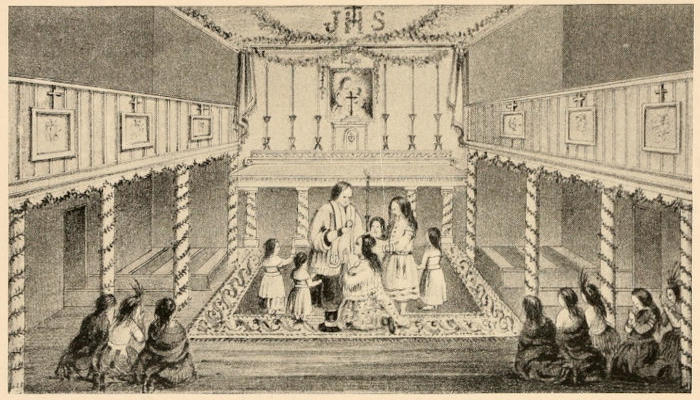
Interior of St. Mary’s Church, Flat-head Mission: Communion at Easter
(See Letter 4th)
Were I to give you the history of these chiefs, I should
greatly exceed the limits I have proposed. Suffice it to
say, that these heroes of the Rocky Mountains have been
for years the terror of their enemies. Chalax had acquired
great celebrity as a juggler, and in predicting future events;
if we may credit the Kalispels and the whites who have
travelled in company with him, these prophecies have
been verified. {93} He indicated the day, the place, and
the number of Blackfeet who would attack their camp.
Having interrogated him relative to this affair, he, with
great simplicity and candor, replied: “I am called the
Great Doctor, yet, never have I given myself up to the
practices of juggling, nor condescended to exercise its
deceptions. I derive all my strength from prayer; when
in a hostile country, I address myself to the Master of
life, and offer Him my heart and soul, entreating him
to protect us against our enemies. A voice had already
warned me of coming danger; I then recommend prudence
and vigilance throughout the camp; for the monitory voice
has never deceived me. I have now a favor to request:
the mysterious voice calls me by the name of Chalax, and,
if you will permit, I desire to bear that name until my
death.” I willingly consented, and then explained to him
the ceremony of the White Garment he was about to
receive, in the holy sacrament of baptism. To the name
of Chalax I affixed that of the Prince of the Apostles.
This is the same chief, who on my first visit to the
mountains, aided by only sixty men, sustained during five
days, an obstinate struggle against 200 lodges of Blackfeet,
whom he put to flight, {94} leaving on the ground eighty
men, whilst among the Flatheads only one man was
wounded. He died three months after.
With regret I parted from these good Indians, and my
beloved brothers in Jesus Christ, the Rev. Fathers Mengarini,
Zerbinati, and four coadjutor brothers; who are
laboring with indefatigable zeal in this portion of our
Lord’s vineyard.
As the snow was fast disappearing, the Kalispels of the
bay were awaiting my arrival. I re-entered my fragile
canoe, guided by two Indians, and made all possible haste
to descend Clarke’s River. You may judge of its impetuosity
when I inform you, that we were sixteen days ascending
the river, and but four in descending the same. On
returning to the bay, accompanied by Rev. Father Hocken
and several chiefs, my first care was to examine the lands
belonging to this portion of the Tribe of Kalispels, and
select a fit site for erecting the new establishment of St.
Ignatius.[186] We found a vast and beautiful prairie, three
miles in extent, surrounded by cedar and pine, in the
neighborhood of the cavern of New Manrese,[187] and its
quarries, and a fall of water more than two hundred feet,
presenting every advantage {95} for the erection of mills.
I felled the first tree, and after having taken all necessary
measures to expedite the work, I departed for Walla Walla,
where I embarked in a small boat and descended the
Columbia, as far as Fort Vancouver. The melting of
the snow had occasioned a considerable freshet, and our
descent was very rapid. The place was indicated to me
where a few months previously, four travellers from the
United States had miserably perished, victims of their
own temerity and presumption. When advised to provide
themselves with a guide, they answered they had no need
of any; and when warned that the river was dangerous
and deceptive, the pilot, with a scoffing boast, replied, “I
am capable of guiding my barge, were it even across the
infernal gulf.” The monitor wished them a fortunate
voyage, but at the same time trembled for their fate,
saying: “This pilot is not a native Indian, he is not an
Iroquois, nor even a Canadian.” The turbulent stream
soon engulfed its presumptuous and daring victims. They
steered out into the midst of the river, and in an instant
the canoe was borne along with the rapidity of lightning,
leaving in its train a thick foam, caused by the violent
plying of oars. Approaching the rapids, {96} they fearlessly
hurried onward—alas, their fate was soon to be
decided. Drawn by the eddy into the centre of a whirlpool,
vainly they struggled to extricate themselves—they
beheld the dread abyss yawning to receive its prey! Yet,
an instant, the ill-fated barge twirled upon the surface,
and then sank, amidst the despairing shrieks of the helpless
crew, which the roaring waves rendered the more appalling,
whilst the dismal sounds re-echoing from shore to shore,
proclaimed the new disaster of the “Columbia.” Soon
the waters resumed their wonted course, and left no trace
of the sad catastrophe. This fatal spot might appropriately
be designated, Presumptive’s Rapids; doubtless, it
will be a lesson to future boasters, not to venture, without
pilot or guide, upon this formidable tributary of the western
ocean.
After a prosperous voyage of five days, I debarked at
Vancouver, where I had the happiness of meeting Father
Nobili, who, during eight months, had applied himself
to study the Indian language, while he exercised his
sacred ministry among the Catholics of the fort and the
Indians of the neighborhood. More than a tenth of the
latter had been swept off by a mortal disease; happily,
they all had the consolation {97} of receiving baptism
before they expired.
Father Nobili accompanied me in a Tchinouk canoe,
up the beautiful River of Multonomah or Willamette,
a distance of about sixty miles, as far as the village of
Champois,[188] three miles from our residence of St. Francis
Xavier. On our arrival all the fathers came to meet us,
and great was our delight in being again reunited after
a long winter season. The Italian fathers had applied
themselves chiefly to the study of languages. Father
Ravalli, being skilled in medicine, rendered considerable
services to the inhabitants of St. Paul’s Mission; for
every dwelling contained several sick. Father Vercruysse,
at the request of Right Rev. Bishop Blanchet, opened
a mission among the Canadians who were distant from
St. Paul’s, and he succeeded in causing them to contribute
to the erection of a new church, in a central location.
Father De Vos is the only one of our fathers of Willamette
who speaks English. He devotes his whole attention
to the Americans, whose number already exceeds 4,000.
There are several Catholic families, and our dissenting
brethren seem well disposed; many among them are eager
to be instructed in the Catholic faith.
{98} Nowhere does religion make greater progress, or
present brighter prospects for the future, than in Oregon
Territory. The Very Rev. Mr. Demers, Vicar General
and Administrator of the diocess in the absence of the
bishop, is preparing to build a brick cathedral. There is
now being built, under his superintendence, a fine church
at the Falls of Willamette, where, three years ago, was
commenced the first town of Oregon.[189] This rising village
numbers more than 100 houses. Several lots have
been selected for a convent and two schools. A Catholic
church has been erected at Vancouver.
The Convent of the Sisters of Notre Dame is fast progressing,
and it will be the finest building of Willamette.
The church is eighty feet long, and proportionably wide;
it is under the invocation of the Blessed Virgin. The
religious have already fifty boarders. The Bishop’s College,
under the management of the Very Rev. Mr. Bolduc, is
very prosperous. The number of pupils has augmented;
forty young men, chiefly Metis, are receiving a Christian
education. Some years ago, a church was erected at
Cowlitz, and the inhabitants are now preparing to construct
a convent under the direction of Rev. Mr. Langlois.
{99} Our residence of St. Francis Xavier is completed;
it will hereafter serve for a novitiate and seminary, to
prepare young men for the missions.
Measures, which I trust will be realized, have been
taken by our fathers for visiting, during this year, the
numerous tribes inhabiting the Pacific coast north and
south of the Columbia; where, already, the visits of the
bishop and his grand vicar have been so productive of
favorable results. The 17th Feb., 1842, Bishop Blanchet
thus wrote to the Bishop of Quebec: “God has deigned
to bless our labors, and to fructify the divine word. The
adorable name of Jesus has been announced to new nations
of the north. Mr. Demers bent his steps to Fort Langley
on Frazer’s River, in which place he administered baptism
to upwards of 700 children. Many of them already
enjoy the precious fruits of regenerating grace.”
In my preceding letters, I gave you the details of our
missions among the mountains of the higher Oregon; of
the conversion of two tribes, the Flatheads and the Cœurs-d’Alène
or Pointed Hearts; of the first communion of
the latter, and conversion of several Kalispels of the Bay,
on the solemn festival of Christmas. From {100} 1839,
when the mission was established, to July, 1845, the reverend
Canadian missionaries baptized 3,000 persons. The
number of Catholics residing at the different stations of
the Hon. Hudson Bay Co. in Oregon, together with the
colonists of the same nation, amounts to several hundreds.
By adding to these 2857 baptized since 1841 in the different
mountain missions, it gives us a total of more than 6,000
Catholics in Oregon. The diminutive grain of mustard
is fast extending far and wide its branches, over this once
sterile and neglected region. In the month of June, Father
Nobili, accompanied by a brother novice, left Willamette
to visit the tribes of New Caledonia. The Very Rev.
Mr. Demers saw the following named tribes: Kameloups,
the Atnans or Shouwapemot, the Porteurs or Ltavten,
which names vary according to the different places
where the tents are pitched.[190] They affix the word ten
which signifies people, i. e., Stelaoten, Nashkoten, Tchilkoten,
Nazeteoten.[191] Rev. Mr. Demers had the consolation
of baptizing 436 children among these tribes.
Such has since been the fervor and zeal of these poor
Indians; who, though deprived of a priest, have built three
churches, hoping that a {101} nepapayattok, or father would
settle among them.
Many Catholics reside in the different forts of this
country. The honorable gentlemen of the Hudson Bay
Co., although Protestants, were strongly interested in favor
of these savages, and did all in their power to facilitate
the introduction of a clergyman into this portion of their
jurisdiction.
I have the honor to be, with the most profound respect
and esteem, Monseigneur, your most humble and obedient
servant in Jesus Christ.
P. J. De Smet, S. J.
Kalispel Bay, Aug. 7th, 1845.
Monseigneur,—A few days after the departure of Father
Nobili, who obtained a place in a barge belonging to the
Hon. Hudson Bay Co., I started from St. Francis Xavier’s
with eleven horses laden with ploughs, spades, pickaxes,
scythes, and carpenters’ implements. My companions were
the good Brother McGill,[192] and two metis or mongrels.
We encountered many obstacles and difficulties among
the mountains, owing to the cascades formed by the water,
which, at this season, descends on every side in torrents,
and with irresistible fury upon the rocks, over which we
were compelled to cross. In the narrow valleys between
these mountains, the rhododendron displays all its strength
and beauty; it rises to the height of fifteen or twenty feet.
Entire groves are formed by thousands of these shrubs,
whose clustering branches entwine themselves in beautiful
green {103} arches, adorned with innumerable bouquets
of splendid flowers, varying their hues from the pure white,
to the deepened tint of the crimsoned rose.
Our path was strewed with the whitened bones of horses
and oxen, melancholy testimonies of the miseries endured
by other travellers through these regions. We passed
the foot of Mt. Hood, the most elevated of this stupendous
chain. It is covered with snow, and rises 16,000 feet
above the level of the sea.[193] Capt. Wyeth, on beholding
this ridge from the summit of the Blue Mountains, thus
speaks of it in his journal:—“The traveller on advancing
westerly, even at the distance of 160 miles, beholds the
peaks of the Cascade Mountains. Several of them rise
16,000 feet above the level of the sea. Every other natural
wonder seems to dwindle, as it were, into insignificance
when compared to this.”[194] From one single spot I contemplated
seven of these majestic summits extending
from north to south, whose dazzling white and conic form
resemble a sugar loaf.
We were twenty days going from Willamette to Walla
Walla, across desert and undulating lands, abounding
in absinthium or wormwood, cactus, tufted grass, and
several species of such {104} plants and herbs as are chiefly
found in a sterile and sandy soil.
Game is scarce in these latitudes; however, we found
large partridges and pheasants, aquatic fowls, small birds
of various kinds, hares and rabbits. Salamanders swarm
in sandy places, and armadilloes are not rare in the vicinity
of the great Dalles. Fort Walla Walla is situated in latitude
46° 2′, and longitude 119° 30′. The sandy neighborhood
of this settlement likens it to a little Arabia. The
River Walla Walla pours its waters a mile distant from
the fort. The lowlands, when watered, are tolerably
fertile, and produce maize, wheat, potatoes, and pulse
of every kind. Cows and hogs are easily raised, and
horses abound in this part of the country.
Having already spoken to you of the desert Nez-Percé
and Spokane, I have nothing further to add relative to
this dreary region. On advancing easterly towards the Blue
Mountains, we find beautiful and fertile plains, interspersed
with limpid and wholesome streams. The valleys are
picturesque, covered with luxuriant prairies, and forests
of pine and fir. The Nez-Percé Kayuses inhabit these
delightful pastures.[195] They are the most wealthy tribes
in Oregon; {105} even some private families possess 1500
horses. The savages successfully cultivate potatoes, pease,
corn, and several kinds of vegetables and fruits. No situation
affords finer grazing for cattle; even in winter they
find an abundance, nor do they need shelter from the
inclemency of the weather. Snow is never seen, and the
rains are neither destructive nor superabundant.
About the middle of July, I arrived safely with all
my effects, at the Bay of Kalispels. In my absence the
number of neophytes had considerably increased. On
the feast of the Ascension, Father Hocken had the happiness
of baptizing more than one hundred adults. Since
my departure in the spring, our little colony has built
four houses, prepared materials for constructing a small
church, and enclosed a field of 300 acres. More than
four hundred Kalispels, computing adults and children
have been baptized. They are all animated with fervor
and zeal; they make use of the hatchet and plough, being
resolved to abandon an itinerant life for a permanent
abode. The beautiful falls of the Columbia, called the
Chaudières,[196] in the vicinity of Fort Colville, are distant
two days’ journey from our new residence of St. Ignatius.
From eight to nine hundred savages were {106} there
assembled for the salmon fishery. I repaired thither
in time to spend with them the nine days preceding the
feast of our holy founder. Within the last four years,
considerable numbers of these Indians were visited by
the “black-gowns,” who administered the sacrament of
baptism. I was received by my dear Indians with filial
joy and tenderness. I caused my little chapel of boughs
to be placed on an eminence in the midst of the Indians’
huts, where it might not inaptly be compared to the pelican
of the wilderness surrounded by her young, seeking with
avidity the divine word, and sheltering themselves under
the protection of their fostering mother. I gave three
instructions daily; the Indians assisted at them with great
assiduity and attention.
Last year, the feast of St. Ignatius proved for me a day
of danger, trial, and uneasiness. I love to recall it to
my mind, for it terminated joyfully, and so gloriously, that
I know my companions can never forget it, and they will
return lasting thanks to the Almighty, for the display of
His mercy. Without a chart or any knowledge of the
mouth of the Columbia, we traversed, as if borne on angels’
wings, this formidable river. This year, I passed the
feast {107} of St. Ignatius amidst many occupations, but
they were of such a nature as to console the missionary’s
heart, and repay him a hundred-fold, for the trifling privations,
pains, and fatigues he endures.
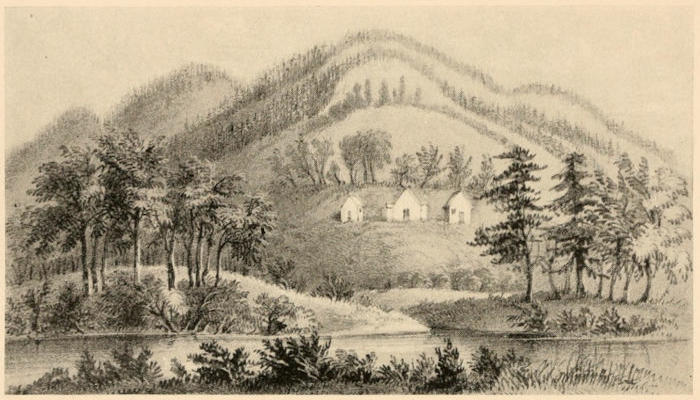
Mission of St. Ignatius at Kalispel Bay, among the Pends d’Oreilles
(See Letter 5th)
More than one hundred children were presented for
baptism, and eleven old men borne to me on skins, seemed
only awaiting regenerating waters, to depart home and
repose in the bosom of their divine Saviour. The eldest
among them, apparently about one hundred, and blind,
addressed me in the following pathetic words:—My
life has been long on earth, and my tears have not ceased
to flow; even now I daily weep, for I have beheld all my
children and early associates disappear. I find myself
isolated among my own nation, as if I were in a strange
land, thoughts of the past alone occupy me, and they are
of a mournful and bitter nature. Sometimes I find consolation
in remembering that I have avoided the company
of the wicked. Never have I shared in their thefts, battles
or murders. This blessed day, joy has penetrated the
inmost recesses of my soul; the Great Spirit has taken
pity on me, I have received baptism, I return him thanks
for this favor, and offer him my heart and life.
{108} A solemn mass was celebrated, during which
the Indians chanted canticles in praise of God. The
ceremonies of baptism followed, and all terminated in the
most perfect order, to the great delight and gratification
of the savages. It was indeed a most imposing spectacle,
all around contributed to heighten the effect. The noble,
and gigantic rock, the distant roar of the cataracts breaking
in on the religious silence of that solitude, situated on an
eminence overlooking the powerful Oregon River, and on the
spot where the impetuous waters freeing themselves from
their limits, rush in fury, and dash over a pile of rocks,
casting upwards a thousand jets d’eau, whose transparent
columns reflect, in varied colors, the rays of the dazzling sun.
There were besides the Shuyelphi or Chaudière Indians,
the Sinpoils, the Zingomenes and several Kalispels, accompanied
me in the capacity of singers and catechists.[197]
I gave the name of St. Paul to the Shuyelphi nation,
and placed under the care of St. Peter the tribe inhabiting
the shores of the great Columbia lakes, whither Father
Hocken is about to repair, to continue instructing and
baptizing their adults. My presence among the Indians
did not interrupt their fine and abundant {109} fishery.
An enormous basket was fastened to a projecting rock,
and the finest fish of the Columbia, as if by fascination,
cast themselves by dozens into the snare. Seven or eight
times during the day, these baskets were examined, and
each time were found to contain about 250 salmon. The
Indians, meanwhile, were seen on every projecting rock,
piercing the fish with the greatest dexterity.
They who know not this territory may accuse me of
exaggeration, when I affirm, that it would be as easy to
count the pebbles so profusely scattered on the shores,
as to sum up the number of different kinds of fish, which
this western river furnishes for man’s support; as the
buffalo of the north, and deer from north to east of the
mountains, furnish daily food for the inhabitants of those
regions, so do these fish supply the wants of the western
tribes. One may form some idea of the quantity of
salmon and other fish, by remarking, that at the time
they ascend the rivers, all the tribes inhabiting the shores,
choose a favorable location, and not only do they find
abundant nutriment during the season, but, if diligent,
they dry, and also pulverize and mix with oil a sufficient
quantity for the rest of the year. Incalculable shoals
of {110} salmon ascend to the river’s source, and there
die in shallow water. Great quantities of trout and carp
follow them, and regale themselves on the spawn deposited
by the salmon in holes and still water. The following
spring the young salmon descend towards the sea, and
I have been told, (I cannot vouch for the authenticity,)
that they never return until the fourth year. Six different
species are found in the Columbia River.[198]
I left Chaudière or Kettle Falls, August 4th, accompanied
by several of the nation of the Crees to examine
the lands they have selected for the site of a village. The
ground is rich and well suited for all agricultural purposes.
Several buildings were commenced; I gave the name of
St. Francis Regis to this new station, where a great number
of the mixed race and beaver hunters have resolved to
settle, with their families.[199] The 6th I traversed the high
mountains of the Kalispels, and towards evening reached
the establishment of St. Ignatius. The Rev. Fathers
Hocken and Ravalli, with two lay brothers, superintend
this interesting little settlement. These fathers likewise
visit the different neighboring tribes, such as the Zingomenes,
Sinpoils, Okinaganes, the stations of St. Francis
{111} Regis, of St. Peter, and that of St. Paul, the Flat-bows,
and the Koetenays.[200] I purpose visiting these two
tribes, who have never yet had the consolation of beholding
a “black gown” among them. All these tribes comprehend,
on an average, about five hundred souls.
I am, with profound respect and esteem,
Your lordship’s most obedient servant,
P. J. De Smet, S. J.
Station of the Assumption, Arcs-a-plats, August 17th, 1845.
Monseigneur,—The 9th of August I continued my route
towards the country of the Arcs-a-plats. The roads were
still inundated by the great freshet. I preferred ascending
the Clark or Flathead River, in my bark canoe, and
sent my horses across the forests bordering the river,
to await me at the great lake of the Kalispels.[201] I had
here a very agreeable and unexpected interview; as we
approached the forests, several horsemen issued forth in
tattered garments. The foremost gentleman saluted me by
name, with all the familiarity of an old acquaintance. I
returned the gracious salutation, desiring to know whom
I had the honor of addressing. A small river separated
us, and, with a smile, he said, “Wait until I reach the
opposite shore, and then you will recognise me.” He
is not a {113} beaver hunter, said I to myself; yet under
this tattered garb and slouched hat, I could not easily
descry one of the principal members of the Hon. Hudson
Bay Co., the worthy and respectable Mr. Ogden. I had
the honor and good fortune of making a voyage with him,
and in his own barge, from Colville to Fort Vancouver,
in 1842; and no one could desire more agreeable society.[202]
It would be necessary for you to traverse the desert, to
feel yourself insulated, remote from brethren, friends, to
conceive the consolation and joy of such an rencounter.
Mr. Ogden left England in the month of April last, accompanied
by two distinguished officers. It was a source
of great pleasure to receive recent news from Europe.
The Oregon question appeared to me somewhat alarming.
It was neither curiosity nor pleasure that induced these
two officers to cross so many desolate regions, and hasten
their course towards the mouth of the Columbia. They
were invested with orders from their government to take
possession of “Cape Disappointment,” to hoist the English
standard, and erect a fortress for the purpose of securing
the entrance of the river, in case of war.[203] In the Oregon
question, “John Bull,” without much talk, attains his
{114} end, and secures the most important part of the
country; whereas “Uncle Sam,” displodes a volley of
words, inveighs and storms! Many years have been
passed in debates and useless contention, without one
single practical effort to secure his real or pretended rights.
The poor Indians of Oregon, who alone have a right to
the country, are not consulted. Their future destiny
will be, undoubtedly, like that of so many other unfortunate
tribes, who, after having lived peaceably by hunting and
fishing, during several generations, will finally disappear,
victims of vice and malady, under the rapacious influence
of modern civilization.
The route from the great Kalispel lake to the Arcs-a-plats,
or Flatbow country, is across dense forests, and
much obstructed by fallen trees, morasses, frightful
sloughs, from which the poor horses with much difficulty
extricate themselves; but, having finally surmounted all
these obstacles, we contemplate from an eminence a
smiling and accessible valley, whose mellow and abundant
verdure is nourished by two lovely lakes, where the graceful
river of the Arcs-a-plats or McGilvray, winds in such
fantastic beauty, that it serves to make the weary traveller
not only forget his past dangers, but {115} amply compensates
him for the fatigues of a long and tiresome
journey.[204]
This section of the valley of Arcs-a-plats greatly resembles
the two valleys of the Pointed Hearts; same
fertility of soil, lakes, pastures, willow and pine groves;
elevated mountains covered to the very summit with
dense forests of trees, low lands, in which the towering
cedar displays all its majesty and splendid foliage; and,
as Racine says:—
“Elevent aux cieux
Leurs fronts audacieux!”
The river is, in this place, deep and tranquil; moving
along with a tardy pace until aroused from its inertness
by the universal thaw; it then descends with such astounding
impetuosity that it destroys the banks, and in its
furious course, uproots and bears along trees, fragments
of rocks, &c., which vainly oppose its passage. In a
few days the entire valley is overflowed, and it presents
to view immense lakes and morasses, separated by borders
of trees. Thus does the kind providence of God, assist
his poor creatures who inhabit these regions, by the liberality
with which he ministers to their wants.
{116} These lakes and morasses, formed in the spring,
are filled with fish; they remain there inclosed as in
natural reservoirs, for the use of the inhabitants. The
fish swarm in such abundance that the Indians have no
other labor than to take them from the water and prepare
them for the boiler. Such an existence is, however, precarious;
the savages, who are not of a provident nature,
are obliged to go afterwards in quest of roots, grain, berries
and fruits; such as the thorny bush which bears a sweet,
pleasant, blackberry; the rose-buds, mountain cherry,
cormier or service berry, various sorts of gooseberries
and currants of excellent flavor; raspberries, the hawthorn
berry, the wappato, (sagitta-folia,) a very nourishing,
bulbous root; the bitter root, whose appellation
sufficiently denotes its peculiar quality, is, however,
very healthy; it grows in light, dry, sandy soil, as also
the caious or biscuit root.[205] The former is of a thin
and cylindrical form; the latter, though farinaceous and
insipid, is a substitute for bread; it resembles a small
white radish; the watery potatoe, oval and greenish, is
prepared like our ordinary potatoe, but greatly inferior
to it; the small onion; the sweet onion, which bears a
lovely flower resembling the {117} tulip. Strawberries
are common and delicious. To this catalogue I could
add a number of detestible fruits and roots which serve
as nutriment for the Indians, but at which a civilized
stomach would revolt and nauseate. I cannot pass over
in silence the camash root, and the peculiar manner in
which it is prepared. It is abundant, and, I may say,
is the queen root of this clime. It is a small, white, vapid
onion, when removed from the earth, but becomes black
and sweet when prepared for food. The women arm
themselves with long, crooked sticks, to go in search of
the camash. After having procured a certain quantity
of these roots, by dint of long and painful labor, they
make an excavation in the earth from twelve to fifteen
inches deep, and of proportional diameter, to contain the
roots. They cover the bottom with closely-cemented
pavement, which they make red hot by means of a fire.
After having carefully withdrawn all the coals, they cover
the stones with grass and wet hay; then place a layer
of camash, another of wet hay, a third of bark overlaid
with mould, whereon is kept a glowing fire for fifty, sixty,
and sometimes seventy hours. The camash thus acquires
a consistency equal to that of the jujube. {118} It is
sometimes made into loaves of various dimensions. It
is excellent, especially when boiled with meat; if kept
dry, it can be preserved a long time.[206]
As soon as their provisions are exhausted the Indians
scour the plains, forests, and mountains, in quest of game.
If they are unsuccessful in the chase, their hunger becomes
so extreme, that they are reduced to subsist on moss,
which is more abundant than the camash. It is a parasite
of the pine, a tree common in these latitudes, and hangs
from its boughs in great quantities; it appears more suitable
for mattresses, than for the sustenance of human
life. When they have procured a great quantity, they pick
out all heterogeneous substance, and prepare it as they
do the camash; it becomes compact, and is, in my opinion,
a most miserable food, which, in a brief space, reduces
those who live on it to a pitiable state of emaciation.[207]
Such are the Arcs-a-plats. They know neither industry,
art, nor science; the words mine and thine are scarcely
known among them. They enjoy, in common, the means
of existence spontaneously granted them by Nature; and
as they are strangely improvident, they often pass from
the greatest abundance to extreme scarcity. {119} They
feast well one day, and the following is passed in total
abstinence. The two extremes are equally pernicious.
Their cadaverous figure sufficiently demonstrates what
I here advance. I arrived among the Arcs-a-plats in
time to witness the grand fish festival, which is yearly
celebrated; the men only have the privilege of assisting
thereat. Around a fire fifty feet long, partially overlaid
with stones of the size of a turkey’s egg, eighty men
range themselves; each man is provided with an osier
vessel, cemented with gum and filled with water and fish.
The hall where this extraordinary feast is celebrated is
constructed of rush mats, and has three apertures, one
at either extremity for the entrance of guests; the middle
one serves for transporting the fish. All preparations
being completed, and each man at his post, the chief,
after a short harangue of encouragement to his people,
finishes by a prayer of supplication to the “Great Spirit,”
of whom he demands an abundant draught. He gives the
signal to commence, and each one armed with two sticks
flattened at the extremity, makes use of them instead of
tongs, to draw the stones from the embers, and put
them in his kettle. This process is twice renewed, and
in {120} the space of five minutes the fish are cooked.
Finally, they squat around the fire in the most profound
silence to enjoy the repast, each trembling lest a bone
be disjointed or broken,—an indispensable condition (a
sine quâ non) of a plentiful fishery. A single bone broken
would be regarded as ominous, and the unlucky culprit
banished the society of his comrades, lest his presence
should entail on them some dread evil.
A species of sturgeon which measures from six to ten,
and sometimes twelve feet in length, is taken by the dart
in the great lake of Arcs-a-plats.[208]
Since my arrival among the Indians, the feast of the
glorious Assumption of the Blessed Virgin Mary has ever
been to me a day of great consolation. I had time to
prepare for the celebration of this solemn festival.
Thanks be to the instructions and counsels of a brave
Canadian, Mr. Berland,[209] who for a long time has resided
among them in the quality of trader, I found the little
tribe of Arcs-a-plats docile, and in the best disposition
to embrace the faith. They had already been instructed
in the principal mysteries of religion. They sang canticles
in the French and Indian tongues. They number
about ninety families. I celebrated the first Mass ever
offered in their {121} land; after which ten adults already
advanced in age and ninety children received baptism.
The former were very attentive to all my instructions.
In the afternoon, the erection of the cross was as solemn
as circumstances would admit. There was a grand salute
of ninety guns, and at the foot of the lowly standard of
the God-Saviour, the entire tribe made a tender of their
hearts to Him, with the promise of inviolable attachment
to all the duties of true children of prayer, availing themselves
of this occasion to renounce the remains of their
ancient juggling and superstition. The cross was elevated
on the border of a lake, and the station received the beautiful
name of the Assumption. Under the auspices of this
good Mother, in whose honor they have for many years
sung canticles, we hope that religion will take deep root
and flourish amidst this tribe, where union, innocence,
and simplicity, reign in full vigor. They ardently desire
to be taught agriculture, the advantages of which I have
explained, and promised to procure the necessary seed
and implements of husbandry.
I have the honor to be, monseigneur, your most humble
and obedient servant in Jesus Christ,
P. J. De Smet, S. J.
Ford of Flat-Bow River,[210] Sept. 2d, 1845.
Monseigneur,—The Flat-bows and Koetenays now form
one tribe, divided into two branches. They are known
throughout the country by the appellation of the Skalzi.—Advancing
towards the territory of the Koetenays we were
enchanted by the beautiful and diversified scenery. We
sometimes traversed undulatory woods of pine and cedar,
from which the light of day is partially excluded. We
next entered sombre forests, where, axe in hand, we
were forced to cut our way and wind about to avoid
hosts of trees that had been levelled by the autumnal
blasts and storms. Some of these forests are so dense
that, at the distance of twelve feet, I could not distinguish
my guide. The most certain way of extricating one’s-self
from these labyrinths, is to trust to the horse’s sagacity,
which, if left unguided, will follow the track of other animals.
This expedient has saved me a hundred times.
{123} I cannot refrain from communicating to your
lordship the gloomy and harrowing thoughts which
imagination conjures up in these dismal regions. The
most fearful apprehensions dismay the bravest heart and
cause an involuntary shudder, as some dire apparition of
a bear or panther stalks in fancy before the mind, whilst
groping our way amidst these dark and frightful haunts,
from which there is no egress. We caught a transitory
glimpse of many charming spots covered with vegetation
as we pursued our winding path near the river, wherever
it deviated from its natural course. At a place called
the Portage, the river crosses a defile of mountains, or
rather of precipitous and frightful rocks; and the traveller
is compelled, for the distance of eight miles, to risk his life
at every step, and brave obstacles that appear, at first
sight, insuperable.[211]
Whatever can be imagined appalling seems here combined
to terrify the heart—livid gashes of ravines and
precipices, giant peaks and ridges of varied hue, inaccessible
pinnacles, fearful and unfathomable chasms filled with
the sound of ever-precipitating waters, long, sloping and
narrow banks, which must be alternately ascended, and
many times have I been obliged {124} to take the attitude
of a quadruped and walk upon my hands; often during
this perilous passage did I return fervent thanks to the
Almighty for his protection from impending danger. Amid
these stern, heaven-built walls of rocks, the water has
forced its way in varied forms, and we find cataracts and
whirlpools engulfing crags and trees, beneath their angry
sway. Whilst the eye rests with pleasure on the rich
and russet hues of distant slopes, upland turf and rock-hung
flower—the ear is stunned by the confused sounds
of murmuring rills, rushing streams, impetuous falls,
and roaring torrents.
An extensive plain at the base of the Portage mountain
presents every advantage for the foundation of a city.
The mountains surrounding this agreeable site are majestic
and picturesque. They forcibly recalled to my memory
the noble Mapocho Mountains that encompass the beautiful
capital of Chili (Santiago). Innumerable little rills,
oozing from the mountain’s stony bosom, diffuse a transparent
haze over the valleys and lower slopes. The
fine river Des Chutes comes roaring down and crosses
the plain before it joins its waters to the McGilvray, which
tranquilly pursues its course.[212] The quarries and forests
appear inexhaustible; and having remarked {125} large
pieces of coal along the river, I am convinced that this
fossil could be abundantly procured. What would this
now solitary and desolate land become, under the fostering
hand of civilization? Indeed, the entire tract of the
Skalzi seems awaiting the benign influence of a civilized
people. Great quantities of lead are found on the surface
of the earth; and from the appearance of its superior
quality, we are led to believe there may be some mixture
of silver.[213]
Poor, unfortunate Indians! they trample on treasures,
unconscious of their worth, and content themselves with
the fishery and chase. When these resources fail, they
subsist upon roots and herbs; whilst they eye, with tranquil
surprise, the white man examining the shining pebbles
of their territory. Ah! they would tremble, indeed, could
they learn the history of those numerous and ill-fated
tribes that have been swept from their land, to make
place for Christians who have made the poor Indians
the victims of their rapacity. After a few days’ journey
we arrived at the Prairie du Tabac, the usual abode of
the Koetenays.[214] Their camp is situated in an immense
and delightful valley, bounded by two eminences, which, from
their gentle and regular declivity, covered with {126} smooth
pebbles, appear to have originally bounded an extensive lake.
On my arrival, I found about thirty lodges of Koetenays;
hunger had forced many families to cross the great mountain.
They came in quest of the buffalo, elk, antelope,
and stag. I was received with every demonstration of
joy and filial affection by those who remained in the
lodges. They hailed me with a long and boisterous discharge
of musketry. Several showed me their journal,
consisting of a square stick on which they had notched
the number of days and weeks elapsed since I abode with
them in the neighborhood of the great lake Teteplatte.[215]
They had computed forty-one months and some days.
Mr. Berland had exerted his zeal to maintain the
Koetenays and their brethren in the good dispositions
in which I had the consolation of finding them. Since
my last visit they have followed, to the very letter, all
they remembered of my recommendations. I was obliged
to decide some controversial points, which they had misinterpreted
or misapprehended. They habitually assembled
for morning and evening prayer, continued the
practice of singing canticles, and faithfully observed the
Sabbath precept.
{127} On the feast of the Holy Heart of Mary I sang
High Mass, thus taking spiritual possession of this land,
which was now for the first time trodden by a minister
of the Most High. I administered the Sacrament of Baptism
to one hundred and five persons, among whom were
twenty adults. An imposing ceremony terminated the exercises
of the day. Amidst a general salute from the camp,
a large cross was elevated. The chiefs, at the head of
their tribe, advanced and prostrated themselves before
that sacred ensign, which speaks so eloquently of the
love of a Man-God, who came to redeem a fallen race.
At the foot of that sacred emblem, they loudly offered
their hearts to him who has declared himself our Master,
and the Divine Pastor of souls. This station bears the
name of the Holy Heart of Mary. One of our Fathers
will soon visit the two branches of this tribe.
Though these poor people were much in want of food,
they pressed me to remain some days amongst them, whilst
they listened with avidity to my instructions relative to
their future conduct. After my departure they divided
into small bands to go in search of provisions among the
defiles of the mountains.
The 30th August I bade adieu to the Koetenays. {128}
Two young men of their tribe offered to conduct me to
the country of the Black-feet, and a third Indian, an expert
hunter and good interpreter, completed the number of
my little escort. I then journeyed on towards the sources
of the Columbia.—The country we traversed was highly
picturesque and agreeably diversified by beautiful prairies,
from which poured forth spicy odors of flower, and shrub,
and fresh spirit-elating breezes, smiling valleys and lakes,
surrounded by hoary and solemn pines, gracefully waving
their flexible branches. We also crossed magnificent
dark Alpine forests, where the sound of the axe has never
resounded; they are watered by streams which impetuously
rush over savage crags and precipices from the range
of mountains on the right.[216] This stupendous chain
appears like some impregnable barrier of colossal firmness.
I am, with every sentiment of the most profound respect,
your lordship’s humble and obedient servant in Jesus Christ,
P. J. De Smet, S. J.
Head of the Columbia, September 9th, 1845.
All hail! Majestic Rock—the home,
Where many a wand’rer yet shall come,
Where God himself from his own heart,
Shall health, and peace, and joy impart.
[217]
Monseigneur,—The 4th September, towards noon, I found
myself at the source of the Columbia. I contemplated
with admiration those rugged and gigantic mountains
where the Great River escapes—majestic, but impetuous
even at its source; and in its vagrant course it is undoubtedly
the most dangerous river on the western side of the
American hemisphere. Two small lakes from four to
six miles in length, formed by a number of springs and
streams, are the reservoirs of its first waters.[218]
I pitched my tent on the banks of the first fork that
brings in its feeble tribute, and which we behold rushing
with impetuosity over the inaccessible rocks that present
themselves on {130} the right. What sublime rocks! How
varied in shape and figure! The fantastic in every form,
the attractive, the ludicrous, and the sublime, present
themselves simultaneously to the view; and by borrowing
ever so little the aid of the imagination, we behold
rising before our astonished eyes, castles of by-gone chivalry,
with their many-embattled towers—fortresses, surrounded
by their walls and bulwarks—palaces with their domes—and,
in fine, cathedrals with their lofty spires.
On arriving at the two lakes, I saw them covered with
swarms of aquatic birds—coots, ducks, water-fowl, cormorants,
bustards, cranes, and swans; whilst beneath
the tranquil water lay shoals of salmon in a state of exhaustion.
At the entrance of the second lake, in a rather
shallow and narrow place, I saw them pass in great numbers,
cut and mutilated, after their long watery pilgrimage
among the rapids, cataracts, valleys, and falls; they continue
this uninterrupted procession during weeks and months.[219]
Perhaps I shall scarcely be believed when I affirm that
the salmon fish are quarrelsome. I witnessed with surprise
the sharp and vengeful bites they mutually inflicted.
These two lakes {131} form an immense tomb, for they
there die in such numbers as frequently to infect the whole
surrounding atmosphere.
In the absence of man, the grey and black bear, the
wolf, the eagle, and vulture assemble in crowds, at this
season of the year. They fish their prey on the banks
of the river, and at the entrance of the lakes;—claws,
teeth and bills serving them instead of hooks and darts.
From thence, when the snow begins to fall, the bears,
plump and fat, resume the road back to their dens in
the thick of the forests, and hollows of rocks, there to
pass the four sad wintry months in complete indolence,
with no other pastime or occupation, than that of sucking
their four paws.
If we may credit the Indians, each paw occupies the
bear for one moon,(a month,) and the task accomplished,
he turns on the other side, and begins to suck the second,
and so on with the rest.
I will here mention, en passant, all the hunters and
Indians remark that it is a very uncommon incident for
a female bear to be killed when with young, and, notwithstanding,
they are killed in all seasons of the year. Where
they go—what becomes of them during the period
{132} they carry their young—is a problem yet to be
solved by our mountain hunters.
When emigration, accompanied by industry, the arts
and sciences, shall have penetrated into the numberless
valleys of the Rocky Mountains, the source of the Columbia
will prove a very important point. The climate is
delightful; the extremes of heat and cold are seldom
known. The snow disappears as fast as it falls; the
laborious hand that would till these valleys, would be
repaid a hundred fold. Innumerable herds could graze
throughout the year in these meadows, where the sources
and streams nurture a perpetual freshness and abundance.
The hillocks and declivities of the mountains are generally
studded with inexhaustible forests, in which the larch
tree, pine of different species, cedar and cypress abound.
In the plain between the two lakes, are beautiful springs,
whose waters have re-united and formed a massive rock
of soft sandy stone, which has the appearance of an immense
congealed or petrified cascade. Their waters are
soft and pellucid; and of the same temperature as the
milk just drawn from the cow.[220] The description given
by Chandler of the famous fountain of Pambouk Kalesi,
on the ancient Hieropolis of {133} Asia Minor, in the
valley of Meander, and of which Malte Brun makes mention,
might be literally applied to the warm springs at the
source of the Columbia.[221] The prospect unfolded to
our view was so wonderful, that an attempt to give even
a faint idea of it, would savor of romance, without going
beyond the limits of fact.
We contemplated with an admiring gaze, this vast slope,
which, from a distance, had the appearance of chalk, and
when nearer, extends like an immense concreted cascade, its
undulating surface resembling a body of water suddenly
checked or indurated in its rapid course.
The first lake of the Columbia is two miles and a half
distant from the River des Arcs-a-plats, and receives
a portion of its waters during the great spring freshet.
They are separated by a bottom land.[222] The advantages
Nature seems to have bestowed on the source of the
Columbia, will render its geographical position very important
at some future day. The magic hand of civilized
man would transform it into a terrestrial paradise.
The Canadian! Into what part of the desert has he
not penetrated? The monarch who rules at the source
of the Columbia is an honest emigrant {134} from St.
Martin, in the district of Montreal, who has resided for
twenty-six years in this desert. The skins of the rein
and moose deer are the materials of which his portable
palace is composed; and to use his own expressions, he
embarks on horseback with his wife and seven children,
and lands wherever he pleases. Here, no one disputes
his right, and Polk and Peel, who are now contending
for the possession of his dominions, are as unknown to
our carbineer, as the two greatest powers of the moon.
His sceptre is a beaver trap—his law a carbine—the
one on his back, the other on his arm, he reviews his numerous
furry subjects the beaver, otter, muskrat, marten,
fox, bear, wolf, sheep, and white goat of the mountains,
the black-tailed roe-buck, as well as its red-tailed relative,
the stag, the rein and moose deer; some of which respect
his sceptre—others submit to his law. He exacts and
receives from them the tribute of flesh and skins. Encircled
by so much grandeur, undisturbed proprietor of
all the sky-ward palaces, the strong holds, the very last
refuge which Nature has reared to preserve alive liberty
in the earth—solitary lord of these majestic mountains,
that elevate their icy summits even to the clouds,—Morigeau
(our Canadian) {135} does not forget his duty as a
Christian. Each day, morning and evening, he may be
seen devoutly reciting his prayers, midst his little family.
Many years had Morigeau ardently desired to see a
priest; and when he learned that I was about to visit the
source of the Columbia, he repaired thither in all haste
to procure for his wife and children the signal grace of
baptism. The feast of the Nativity of the Blessed Virgin,
this favor was conferred on them, and also on the children
of three Indian families, who accompany him in his
migrations. This was a solemn day for the desert! The
august sacrifice of Mass was offered; Morigeau devoutly
approached the Holy Table;—at the foot of the humble
altar he received the nuptial benediction; and the mother,
surrounded by her children and six little Indians, was
regenerated in the holy waters of baptism. In memory
of so many benefits, a large cross was erected in the
plain, which, from that time, is called the Plain of the
Nativity.
I cannot leave my good Canadian without making an
honorable mention of his royal cuisine a la sauvage.
The first dish he presented me contained two paws of
a bear. In Africa, {136} this ragout might have given
some alarm; in effect, it bears a striking resemblance to
the feet of a certain race. A roast porcupine next made
its appearance, accompanied by a moose’s muzzle; the
latter I found delicious. Finally, the great kettle containing
a sort of hotch-potch, or salmagundi, was placed in the
midst of the guests, and each one helped himself according
to his taste.
Some remains of beef, buffalo, venison, beavers’ tails,
hare, partridges, &c., made an agreeable, substantial, famous
soup.
I am, monseigneur, your most humble and obedient
servant in Jesus Christ,
P. J. De Smet, S. J.
Foot of the Cross of Peace, September 15th, 1845.
“——Here
Poplars and birch trees ever quivering played,
And nodding cedars formed a vagrant shade;
On whose high branches, waving with the storm,
The birds of broadest wings their mansion form;
The jay, the magpie, the loquacious crow,
And soar aloft and skim the deeps below.
Here limpid fountains from the clefts distil,
And every fountain forms a noisy rill,
In mazy windings wand’ring down the hill.”
Monseigneur,—We bade adieu to the Morigeau family
on the 9th, and to their companions of the chase, the
Sioushwaps.[223] We quitted the upper valley of the Columbia
by a small footpath, which soon conducted us to a
narrow mountain defile, where the light of day vanished
from view, amidst the huge, bold barriers of colossal
rocks. The grand, the sublime, the beautiful, here form
the most singular and fantastic {138} combinations.
Though gray is the prevailing color, we find an immense
rock of porphyry, or white-veined granite. Here and
there, from the fissures of the rock, or wherever there
is a handful of dust, the heavy and immortal pine enroots
itself, adding its gloomy verdure to the variegated hues
of the torpid rocks. These circuitous paths often present
the most ravishing and picturesque vistas; surrounded
by colossal walls, the greatest diversity and most beautiful
scenery in nature is spread out before the eye, where the
plush and cedar rise majestically in these venerable woods,
the graceful poplar waves on high its emerald plumes,
and fights its battles with the howling storm, whilst over
the precipitous and jagged rocks, the scarcely-waving
pine fills the brown shade with religious awe. The birch
springs from an earth carpetted with moss, and shines like
magnificent silver columns, supporting diadems of golden
autumnal leaves, amidst the redolent purple-berried juniper
and azure turpentines, of these humid dells and forests.
After a day’s journey through these primeval scenes,
we reached the banks of the river Arcs-a-plats, where
innumerable torrents rush headlong, with a thousand
mazes from the mountain’s {139} brow, and in their union
form this noble river. From afar is heard the deafening
and continuous sound of its own dashes, as it traverses
a rocky bed with extraordinary rapidity. We crossed
the river in order to attempt the passage of another defile,
still more wonderful, where the waters of the Vermillion
have forced an opening.[224] Here, everything strikes the
eye; all is wild sublimity, in this profound but turbulent
solitude. Projecting mountains rise like holy towers
where man might commune with the sky;—terrible precipices
hang in fragments overhead—the astounding
noise of the deep-tongued waves, in their unconfined flow,
resembles that of the angry tempest, sweeping wild and
free, like the spirit of liberty. Now the breaking waves
play low upon the rock-ribbed beach, and madly plunge
into an abyss—anon it returns foaming to its sedgy
bed, apparently sporting with the sedges for diversion—falling
from slope to slope, from cascade to cascade,
passing in its course a long train of rapids—now concealing
itself under the tufted foliage of cedar and pine—again
pouring its brilliant and crystalline waters into
a capacious basin, as if to take breath before quitting
the ravine, and {140} finally precipitating its wandering
course with renovated vigor.
From this almost impenetrable forest issues a harmonious
sound. ’Tis the whistling or lowing of the noble stag,
calling its companion. The moose, the most vigilant
of animals, gives the signal of alarm. He has heard the
crackling branch—he has inhaled the hunter’s deadly
breath; a confused noise is heard from the mountain;
the sportsman raises his eager eye to its summit, and
scans a flock of rein-deer perched upon the snow; they
are startled at the approach of man; in an instant they
are lost among the inaccessible pinnacles, the
“Palaces where Nature thrones
Sublimity in icy halls.”
We often catch a glimpse of the graceful forms and nimble
feats of the roe-bucks, as they caper and gallop, or tarry
an instant to look around, with their lancet ears distended
to catch every sound; these wild, forest stragglers resume
their course, and finally penetrate into the sombre forest.
Flocks of wild goats gambol carelessly and tranquilly
beside herds of mountain sheep above overhanging precipices
and peaked rocks, chequered by patches of snow,
far beyond the reach of human footsteps.
{141} A monstrous animal, the grey bear, which replaces
on our mountains, the African lion, is not content with
growling and menacing the intrepid venturer, who dares
infringe on his cavernous dominions, but grinds his teeth,
expressive of his rage. Suddenly, a well-aimed gun-shot
forces him to make a lowly reference; the formidable
beast rolls in the dust, biting the sand saturated with
his blood, and expires.
The ordinary music of the desert is, the shrill cry of
the panther, and the howling of the wolf. The diminutive
mountain hare, six inches high, and whose biography
has not yet found a place in natural history, amuses itself
amidst the stony rubbish, and exhibits wonderful activity;
whilst his neighbor, the lubberly porcupine, clambers up,
seats himself upon a branching cypress and gnaws the
bark. He views the eager huntsman with a careless and
indifferent air, unconscious that his tender flesh is regarded
as a most delicious morsel. The industrious beaver,
like a wary sentinel, warns his family of man’s approach
by striking the water with his tail. The muskrat, or
musquash, plunges immediately into the water. The
otter quits his sports and slides upon his belly among
the reeds—the timid squirrel leaps from bough to {142}
bough, until it reaches the topmost shade of the cypress;
the marten jumps from tree to tree, and buries itself in
the foliage—the whistler and weasel repair to their respective
domicils:—a precipitous flight alone saves the
fox his rich silvery pelisse—the badger, or the groundhog,
too remote from his dwelling, digs the sandy soil,
and buries himself alive, to avoid pursuit—his magnificent
skin is destined to adorn the loins of an Indian—it
requires the joint efforts of two men to force him
from his hiding place, and to kill him.
The evening previous to our egression from the blind
mazes of this tangled wood, our eyes were recreated by
a ravishing scene. When it presents itself after a disastrous
combat, the spectacle consoles the afflicted heart of
the savage warrior. From the mountain’s top we contemplated
the “dance of the manitous or spirits, and the
glorious entrance of departed champions into the country
of souls.” Vast columns of light varying in splendor,
appeared to divert and balance themselves in the heavens:—some
of perpendicular form; others resembling undulatory
waves; now concealing, now exhibiting themselves
under diversified aspects until the entire hemisphere
seemed brilliantly {143} illuminated. All these masses
united at the zenith, and then separated under a variety
of forms.
Mysterious, solemn, cold and clear,
Their steps majestic rise,
Like barriers round this earthly sphere,
Like gates of Paradise.
Well may imagination faint
Before your sacred blaze,
And baffled science fail to paint
The source of heaven-lit rays.
The aurora borealis, is a phenomenon which I always
contemplate with mingled admiration and pleasure. All
that is seen, all that is heard in this unfathomable solitude,
is both agreeable and instructive. It strikes, captivates,
and elevates the mind towards the Author of nature.
Mirabilia opera Domini!
After much fatigue, labor, and admiration, on the 15th
we traversed the high lands separating the waters of Oregon
from those of the south branch of the Sascatshawin, or
the ancient Bourbon river, so called before the Canadian
conquest by the British.[225] It is the largest tributary of
the Winnepeg, which flows into Hudson’s Bay by the
River Nelson, 58 deg. north latitude.[226]
{144} The Christian’s standard, the cross, has been
reared at the source of these two rivers: may it be a sign
of salvation and peace to all the scattered and itinerant
tribes east and west of these gigantic and lurid mountains.
On the cypress which serves for constructing the cross,
the eagle, emblem of the Indian warrior, perches himself.
The huntsman aims—the noble bird lies prostrate, and
even in his fall, seems to retain his kingly pride. It so
forcibly recalls to memory the beautiful lines of the illustrious
Campbell, that I quote them in full:—
Fallen as he is, the king of birds still seems
Like royalty in ruins. Though his eyes
Are shut, that looked undazzled on the sun,
He was the sultan of the sky, and earth
Paid tribute to his eyrie. It was perched
Higher than human conqueror ever built
His bannered fort....
... He cloved the adverse storm
And cuffed it with his wings. He stopped his flight
As easily as the Arab reins his steed,
And stood at pleasure ’neath heaven’s zenith, like
A lamp suspended from its azure dome;
Whilst underneath him the world’s mountains lay
Like mole-hills, and her streams like lucid threads.
We breakfasted on the bank of a limpid lake at the
base of the “Cross of Peace,” from whence {145} I have
the honor of dating my letter, and of giving you the renewed
assurance of my profound respect and veneration;
recommending to your fervent prayers, in a special manner,
this vast desert, which contains so many precious souls
still buried in the shades of death.
Monseigneur, your very humble and devoted servant
in Jesus Christ,
P. J. De Smet, S. J.
Camp of the Assiniboins, Sept. 26th, 1845.
“Here bloomy meads with vivid greens are crown’d,
And glowing violets throw sweet odors round.”
Monseigneur,—By a steep declivity we entered a rich
valley, agreeably diversified by enamelled meads, magnificent
forests, and lakes—in which the salmon-trout
so abound, that in a few minutes we procured sufficient
for an excellent repast. The valley is bounded on either
side by a succession of picturesque rocks, whose lofty
summits, rising in the form of pyramids, lose themselves
in the clouds. The far-famed Egyptian monuments of
Cheops and Cephren dwindle into nought, before this
gigantic architectural cliff of nature. The natural pyramids
of the Rocky mountains seem to deride the artificial
skill of man; they serve as a resting place for the
clouds that come hither to seek repose, and to encircle their
giant brows. The Lord’s omnipotent {147} hand has laid
the foundations—he has permitted the elements to form
them, and in every age they proclaim His power and glory!
We emerged from this delightful valley, on the 18th of
September, after a three days’ excursion, and recommenced
our mountainous peregrination, which presented
nothing but obstacles and contusions, both to men and
horses. For the space of six hours we were compelled
to trace our route across fragments of broken rocks, through
an extensive and parched forest, and where millions of
half-consumed trees lay extended in every direction.
Not a trace of vegetation remained, and never had I contemplated
so dismal and destructive a conflagration!
We reached the River des Arcs or Askow, in the evening,
and pitched our solitary tent upon the shore.[227] Here
we discovered some vestiges of a savage party. Five days
previous, nine lodges of Indians had encamped upon
the very spot. We made a careful search, and my guides
imagined they were the formidable Black-feet![228] We,
the same day, saw two smokes at the extremity of the
plain over which these barbarians had travelled. My
companions seemed to hesitate, as we drew near the
vicinity {148} of these fearful Black-feet. They recounted
to me their inauspicious dreams, and wished to deter me
from proceeding. One said: “I saw myself devoured
by a wild bear;” another, “I saw ravens and vultures,
(ill-omened birds), hovering over the head of our father;”
a third saw a bloody spectacle. I gave them, in my turn,
the history of one of my sentries, the archetype of vigilance,
courage and simplicity.
“Midst the dark horrors of the sable night
(No idle dream I tell nor fancy’s strain)
Thrice rose the red man’s shade upon my sight,
Thrice vanished into dusky air again.
With courage high my panting bosom swells,
Onward I rushed upon the threatening foe,
When, hark! Horrific rise the spectre’s yells
He points the steel and aims the fatal blow;
Guard, sentinel! to arms! to arms! to arms!
Indians! Indians! my voice swelled loud and deep:
The camp is roused at dread of my alarms,
They wake and find—that I am sound asleep!”
They were greatly amused at the recital of his imaginary
fancies, and seemed to understand how little import I
attached to such visions. “Happen what may,” said
they, “we shall never quit our father until we see
him in a place of safety.” This was precisely what I
desired. I could not, however, deceive myself. {149}
I had finally entered a land, the theatre of so many sanguinary
scenes. I was now on the very confines of these
barbarous people, from which, possibly, I should never
return! It not unfrequently happens, that, in their unbridled
fury when they hear some relative has been killed,
the Black-feet despatch the first stranger they meet, scalp
him—and then abandon to the wolves and dogs, the
palpitating limbs of the unfortunate victim of their vengeance,
hatred, and superstition. I declare to you, I
was beset by a thousand disquietudes concerning the
fate that awaited me. Poor nature! this timid and fragile
meus homo is sometimes terrified. He would wish to
look back and listen to dreams. My longing desires
repeated incessantly—Advance! I placed my whole
confidence in God—the prayers of so many fervent
souls encouraged and re-animated me; I resolved not
to be deterred by an uncertain danger. The Lord can,
when he pleases, mollify these pitiless and ferocious hearts.
The salvation of souls is at stake, and the preservation
of the mission of St. Mary’s depends on my proceeding;
for there, the incursions of the Black-feet are very frequent.
What consideration could deter me from a project {150}
which my heart had cherished, since my first visit among
the mountains?
The 19th and 20th, we followed the tracks of our unknown
predecessors, and they appeared more and more
recent. I despatched my two guides to reconnoitre, and
ascertain whom we were so closely pursuing.—One of
them returned the same evening, with the news that he
had found a small camp of Assiniboins of the forest; that
they had been well received; that a disease reigned in
the camp, of which two had lately died, and that they
expressed great desire to see the Black-gown. The following
morning we joined them, and journeyed several
days in company.
The Assiniboins of the forest do not amount to more
than fifty lodges or families, divided into several bands.[229]
They are seldom seen in the plains; the forest is their
element, and they are renowned huntsmen and warriors.
They travel over the mountains and through the woods,
over the different forks and branches of the sources of
the Sascatshawin and Athabaska. Agriculture is unknown
to this tribe; they subsist exclusively on small animals,
such as big-horns, goats, bucks; but especially on the
porcupine, which swarms in this region. When pressed
by {151} hunger, they have recourse to roots, seeds, and
the inner bark of the cypress tree. They own few horses,
and perform all their journeys on foot.
Their hunters set out early in the morning, kill all the
game they meet, and suspend it to the trees, as they pass
along,—their poor wives, or rather their slaves, often
bearing two children on their backs, and dragging several
more after them, tardily follow their husbands, and collect
what game the latter have killed. They had a long file
of famished dogs, loaded with their little provisions, etc.
Every family has a band of six to twelve of these animals,
and each dog carries from 30 to 35 lbs. weight. They
are the most wretched animals in existence; from their
tender-hearted masters and mistresses they receive more
bastinados than morsels, consequently they are the most
adroit and incorrigible rogues to be found in the forest.
Every evening we find it necessary to hang all our property
upon the trees, beyond the reach of these voracious dogs.
We are even compelled to barricade ourselves within our
tents at night, and surround them with boughs of trees;
for, whatever is of leather, or whatever has pertained
to a living being, these crafty rogues bear away, and devour.
You will say I have little charity {152} for these
poor brutes—but be not astonished. One fine evening,
having neglected the ordinary precaution of blocking
up the entrance of my tent, I next morning found myself
without shoes—with a collarless cassock—and minus
one leg to my culottes de peau!!! One of the chiefs
of this little camp recounted to me, that last winter, one
of his nation, having been reduced to extreme famine,
(and such cases are not rare,) had eaten successively,
his wife and four children. The monster then fled
into the desert, and he has never been heard of since.
The Oregon missionary, Rev. Mr. Bolduc, related
in his journal, that at Akena, one of the Gambia Isles,
he saw an old dame, who, having had eight husbands, had
eaten three of them, during a time of famine!! I add
this last fact to give you a reverse to the above horrible
picture.
The Assiniboins have the reputation of being irascible,
jealous, and fond of babbling; in consequence of these bad
qualities, battles and murders are not unfrequent among
them, and of course continual divisions. Every evening I
gave them instruction, by means of an interpreter. They
appeared docile, though somewhat timorous: for they
had frequently been visited {153} by persons who defamed
both priests and religion. I rendered all the little services
in my power to their invalids, baptized six children and
an old man who expired two days after, he was interred
with all the funeral ceremonies and prayers of the church.
Cleanliness is a virtue which has no place in the Indian
catalogue of domestic or personal duties. The Assiniboins
are filthy beyond conception; they surpass all their neighbours
in this unenvied qualification. They are devoured
by vermin, which they, in turn, consume. A savage,
whom I playfully reprehended for his cruelty to these
little invertebral insects, answered me: “He bit me first,
I have a right to be revenged.” Through complacency,
I overcame natural disgust, and assisted at their porcupine
feast. I beheld the Indians carve the meat on their
leathern shirts, highly polished with grease—filthy,
and swarming with vermin, they had disrobed themselves,
for the purpose of providing a table-cloth!—They dried
their hands in their hair—this is their only towel—and
as the porcupine has naturally a strong and offensive
odor, one can hardly endure the fragrance of those who
feast upon its flesh and besmear themselves with its oil.
{154} A good old woman, whose face was anointed
with blood, (the Indians’ mourning weeds,) presented
me a wooden platter filled with soup; the horn spoon
destined for my use was dirty and covered with grease;
she had the complaisance to apply it to the broad side of
her tongue, before putting it into my unsavory broth.
If a bit of dried meat, or any other provision is in need
of being cleansed, the dainty cook fills her mouth with
water and spirts it with her whole force upon the fated
object. A certain dish, which is considered a prime
delicacy among the Indians, is prepared in a most singular
manner, and they are entitled to a patent for the happy
faculty of invention. The whole process belongs exclusively
to the female department. They commence by rubbing
their hands with grease, and collecting in them the blood
of the animal, which they boil with water; finally, they
fill the kettle with fat and hashed meat. But—hashed
with the teeth! Often half a dozen old women are
occupied in this mincing operation during hours; mouthful
after mouthful is masticated, and thus passes from
the mouth into the cauldron, to compose the choice ragout
of the Rocky mountains. Add to this, by way of an exquisite
desert, an immense dish of crusts, {155} composed
of pulverized ants, grass-hoppers and locusts, that have
been dried in the sun, and you may then be able to form
some idea of Indian luxury.
The American porcupine, the Hystrix dorsata, is called
by modern Zoologists, the Prickly Beaver. In fact there
is great similarity between the two species in size and
form, and both inhabit the same region. The porcupine,
like the beaver, has a double peltry or fur; the first is long
and soft; the second, is still softer, and greatly resembles
down or felt. They both have two long sharp, strong
tusks, at the extremity of the jaw-bone. The Flat-heads
affirm that the porcupine and beaver are brothers, and
relate that anciently they abode together; but that, having
frequently been discovered by their enemies, through
the indolence, idleness and extreme aversion of the
porcupines for the water, the beavers met in council and
unanimously agreed upon a separation. The latter
availed themselves of a fine day and invited their spiny
brethren to accompany them in a long ramble, among
the cypress and juniper of the forest. The indolent and
heedless porcupines, having copiously regaled themselves
with the savory buds of the one, and the tender rind
{156} of the other, extended their weary limbs upon the
verdant moss, and were soon lost in profound sleep. This
was the anticipated moment for the wily beavers to
bid a final adieu to their porcupine relatives.
The Assiniboins inhabiting the plains are far more
numerous than their mountain brethren. They number
about six hundred lodges; they own a greater number of
horses, and the men, in general, are more robust, and
of a commanding stature. They are more expert in
thieving, are greater topers, and are perpetually at war.
They hunt the buffalo in the great plains between the
Sascatshawin, the Red river, Missouri, and Yellow Stone.[230]
The Crows, Black-feet, Arikaras and Sioux are their
most inveterate enemies.—They speak nearly the same
language as the Sioux, and have the same origin.
I have the honor to be, with the most profound respect
and veneration, monseigneur, your very humble and very
obedient servant in Christ Jesus,
P. J. De Smet, S. J.
Fort of the Mountains, October 5, 1845.
Monseigneur,—The last few days we journeyed with the
little Assiniboin camp, the aspect of the country offered
nothing very interesting. We passed from valley to valley
between two high chains of adamantine mountains, whose
slopes are, here and there, ornamented with mounds of
perpetual snow. A beautiful crystalline fountain issues
from the centre of a perpendicular rock about five hundred
feet high, and then pours its waters over the plain in
foam and mist.
The 29th we separated from the Assiniboins; the path
conducted us through a thick forest of cypress; I am told
this is the last—Deo Gratias! These belts of tall firs
are very numerous, and form great obstacles and barriers
to land communications between the east and west of the
mountains. I have a little word of advice to {158} give
all who wish to visit these latitudes. At the entrance of
each thick forest, one should render himself as slender,
as short, and as contracted as possible, imitating the
different evolutions in all encounters of an intoxicated
cavalier, but with skill and presence of mind. I mean
to say, he should know how to balance himself—cling
to the saddle in every form, to avoid the numerous
branches that intercept his passage, ever ready to tear him
into pieces, and flay his face and hands. Notwithstanding
these precautions, it is rare to escape without paying
tribute in some manner to the ungracious forest. I one
day found myself in a singular and critical position: in
attempting to pass under a tree that inclined across the
path, I perceived a small branch in form of a hook, which
threatened me. The first impulse was to extend myself
upon the neck of my horse. Unavailing precaution! It
caught me by the collar of my surtout, the horse still continuing
his pace.—Behold me suspended in the air—struggling
like a fish at the end of a hook. Several respectable
pieces of my coat floated, in all probability, a long
time in the forest, as an undeniable proof of my having
paid toll in passing through it. A crushed and torn hat—{159}
an eye black and blue—two deep scratches on
the cheek, would, in a civilized country, have given me
the appearance rather of a bully issuing from the Black
Forest, than a missionary.
To render a bad forest superlatively so, a great fall
of snow is necessary. This special favor was lavished
upon us in this last passage. Wo to the first pedestrians!
The branches groan under the burden of their wintry
shroud, and seem to present the motto: “Si tangas frangas!”
and assuredly, at each rubbing of the hat, the least
touching of the arm or leg, a deluge of snow showers
down upon the shivering cavalier and horse. Immediately
the branch rises proudly as if in derision. On such occasions,
there is nothing better to be done than to form a
rear guard, and walk in the track of the predecessor.
In pursuing our route, the 27th, on one of the branches
of the river “a la Biche,” (Red Deer on the maps), we
remarked several sulphurous fountains, which furnish
great quantities of sulphur, and a coal mine, apparently
very abundant.[231]
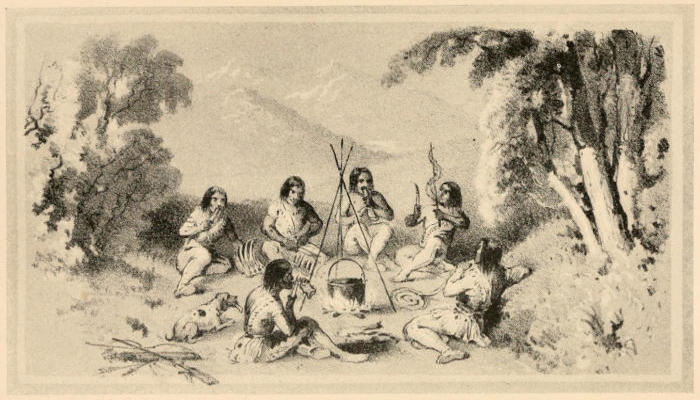
Hunters at the Buffalo Feast
I here beg the favor of a short digression from my
subject. Coal abounds east of the Rocky {160} Mountains,
on the borders of the Missouri and Yellow Rock, on
the Sascatshawin and Athabaska. Saltpetre is found in
abundance, and iron is not scarce in many parts of the
mountains. I have already spoken of lead in the country
of the “Koetenays,” the name of the river at the copper
mine in the north, indicates its riches; bars of this precious
metal are discovered among the rocks bordering the river.
Rock salt is found in powder, and very plentiful in the
Pays Serpent.[232]
The valley is picturesque and variegated; flocks of
sheep and goats contribute to beautify the scenery. We
find many tracks of the bears and buffaloes; on seeing
the latter my party became animated; for the buffaloes’
flesh is, without contradiction, the most delicate of these
regions. One is never tired of it. Hitherto, the animals
of the mountains had abundantly satisfied our necessities,
for the huntsmen killed no less than eighteen
pieces, without counting the fowl and fish which are so
plentiful in this country. The same evening the remainder
of our provisions was consumed, and a buffalo chase was
proposed for the following day. One of the sportsmen
set out early, and at breakfast time we perceived him
coming, with a round {161} fat cow; immediately the ribs,
tripes, etc., honored the fire with their presence. The rest
of the day was spent in seeking fresh provisions.
The 30th, we continued our route through the valley,
where a rivulet of clear water meanders. It is similar
to all the other valleys west of the mountains, agreeably
diversified with meadows, lakes, and forests—the valley
widens in proportion as one descends—the rocky banks
disappear—the mountains decrease, and appear insensibly
to commingle with one another. Some are covered with
forests even to their tops, others present cones, elevated
ramparts, covered with rich verdure.
The 4th October, after having traversed the great chain
of mountains nineteen days in pursuit of the Black-Feet,
we entered the vast plain, this ocean of prairies, inhabited
by a multitude of roving savages, buried in the deepest
superstition. The Black-Feet, Crows, Serpents, Arikaras,
Assiniboins of the plains, the Sheyennes, Camanches,
Sioux, Omahas, Ottos, Pawnees, Kants, Saucs, Ajouas,[233]
etc., etc., are without pastors! We hope that Divine
Providence has not deferred the epoch when the darkness
now overwhelming these immense regions will give
place to the beneficial light of {162} the gospel;—that
worthy and zealous pastors will come to guide in the way
of salvation these poor and unhappy children of the desert,
who, during so many ages, have groaned under the dominion
of the devil, and among whom the war-song and
the cry of carnage never ceased to resound. There, we
hope, will reign in their turn, peace and Christian charity,
and the fragrance of divine love and praise ascend to the
only true God.
The worthy Bishop of Juliopolis has established his
See on the Red river, a tributary of the Winnepeg, amidst
the possessions of the Anglo-Indians.[234] Already two of
his zealous missionaries, Rev. Messrs. Thibault and Bourassa,
have penetrated to the very foot of the Rocky
Mountains, whilst other indefatigable priests have been
employed, for many years, in extending the kingdom of
God in this immense diocess. The population of Red
River is about 5,500 souls, of whom 3,175 are Catholics.
There are 730 houses inhabited. I had the honor of receiving
a letter from the Rev. Mr. Thibault on my arrival
in this latitude. He says:
“From the month of March to September last, I have
labored among the mountain nations; they are well disposed
to embrace the {163} faith. I cannot give you a better
idea of these people than by comparing them to the Flatheads.
I have baptized more than five hundred children
and adults in the course of this mission. As soon as I
find the opportunity of a water conveyance, I shall continue
my labors among these good savages, and extend
my route as far as McKenzie’s river. A rich harvest
would be there found for many laborers in the sacred
ministry, for this nation is populous and occupies a vast
extent of country, without including several other nations
I visited this summer. ‘Come, then, to us,’ said they,
‘we, also, shall be happy to learn the joyful news you have
brought our brethren of the mountains; we are to be
pitied, not knowing the word of the Great Spirit; be, therefore,
charitable to us—come, teach us the way of salvation—we
will listen to it.’
“My fellow-laborer, Bourassa, set out in September,
to announce the Gospel to the Indians residing near the
river de la Paix.”[235]
From Lake St. Anne, or Manitou, the ordinary residence
of these two gentlemen, they extend their apostolic
course to the different tribes on the rivers Athabaska and
McKenzie, Peace river, and Slave lake.[236]
{164} Within the limits, as far as they have travelled,
are found the Black-Feet, Crees, Assiniboins of the forest,
of the mountains, Beaver Hunters, Flat-side Dogs, Slaves,
and Deer-Skins.[237] (It is by these names that the different
Indians are known among the whites and travellers.)
The great Indian district of the United States is (if
I may say so) the only one deprived of spiritual succor
and the means of salvation. It contains several hundred
thousand savages. This vast territory is bounded on the
north-west by the Anglo-Indian possessions—east by
the Western States—south by Texas and Mexico—west
by the Rocky Mountains. It contains many forts
or trading houses, in which the greater number of persons
employed are Canadian Catholics or French creoles. The
principal of these forts are, Fort des Corbeaux, or Alexander,
on the Yellow Stone, Fort la Ramee, on a branch
of the river Platte, Fort Osage, on the river of the
same name—Fort Pied-noir, or Lewis, at the mouth of
the river Maria, Fort Union near the mouth of the Yellow
Rock, Fort Berthold, Fort Mandan or Clark, near the
mouth of the Little Missouri, Fort Pierre, Fort Look-out
and Fort Vermillion at the mouth of this river, the other
trading {165} houses among the Pottowatomies of Council
Bluffs and of Belle-vue for the Ottos and Pawnees.
The great depository which furnishes these Forts and
receives all the peltry and buffalo hides, is kept at St.
Louis.[238]
Monseigneur Loras, Bishop of Dubuque, has sent two
priests among the Sioux, on the river St. Pierre, a tributary
of the Mississippi.[239]
The Society of Jesus has a mission among the Pottowatomies
on Sugar Creek, a tributary of the Osage river.[240]
The Ladies of the Sacred Heart have an establishment
here. During the summer of 1841, the late distinguished
Madame de Galitzin, provincial of the Order in America,
visited this section of the country for the purpose of
founding, among these rude savages, a house of education,
in which the hapless children of the desert now enjoy
the benefit of being instructed in the Christian faith, of
being formed to habits of industry and cleanliness, and
acquiring a knowledge of those branches of education
suited to their condition.—These two missions are located
near the frontiers of the States, and are the only ones
in this immense territory.
The upper Missouri, and all its branches as far as the
Rocky Mountains, are without spiritual assistance {166}.
Wherever the priest has passed in traversing the desert, he has
been received with open arms among the tribes that rove over
this country—alas! so long a time forgotten and neglected!
The evening of 4th October, I arrived at the Fort des
Montagnes, belonging to the Hon. Hudson Bay Company,
without having accomplished the object of my travels
and my desires, namely, meeting the Black-feet.[241] The
respectable and worthy commander of the Fort, Mr. Harriot,
an Englishman by birth, is among the most amiable
gentlemen I have ever had the pleasure of meeting. He
invited, and received into his hospitable Fort the poor
missionary, a Catholic and stranger, with politeness and
cordiality truly fraternal. These qualities characterize all
the gentlemen of the Hudson Bay Company, and although
Mr. Harriot is a Protestant, he encouraged me to visit the
Black-feet, who would soon arrive at the Fort, promising
me to use all his influence with these barbarians to obtain
me a friendly reception. He has resided many years
among them, nevertheless he did not conceal from me that
I should soon be exposed to great dangers. “We are in
the hands of God—may His holy will be done.”
{167} I am, with the most profound respect and esteem,
monseigneur, your very humble and obedient servant in
Jesus Christ,
P. J. De Smet, S. J.
Fort of the Mountains, October 30th, 1845.
Monseigneur,—A band of about twenty Crees, encamped
near the Fort, came to shake hands cordially with me
on my arrival. The joy my presence seemed to occasion
them, proved that I was not the first priest they had seen.
Moreover, the greater number wore medals and crosses.
They informed me that they too had been so fortunate
as to have a Black-Gown, (Rev. Mr. Thibault,) who taught
them to know and serve the Great Spirit—and baptized
all their little children, with the exception of three, who
were absent on the occasion. These children were brought
to me—I administered baptism to them, and at the
same time to one of my guides, a Koetenay. During
their stay at the Fort, I gave them instructions every
evening.
Two Crees, of the same band and family, father and
son, had been killed in a quarrel two {169} years since.
The presence of the offending party for the first time since
the perpetration of the murder, rekindled in the others
that spirit of rancor and revenge so natural to an Indian’s
breast, and there was every reason to apprehend fatal
consequences from the old feud.
With the approbation of Mr. Harriot, I assembled them
all in the Fort; the governor himself had the kindness
to be my interpreter. He made a long discourse on the
obligation and necessity of their coming to a sincere reconciliation;
the matter was discussed in form, each Indian
giving his opinion in turn, with a good sense and moderation
that surprised me. I had the pleasure and satisfaction
of seeing the calumet passed around the assembly.
This is the solemn pledge of peace—the token of Indian
brotherhood—the most formal declaration of the entire
forgetfulness and sincere pardon of an injury.
The Cree nation is considered very powerful, and numbers
more than six hundred wigwams. This tribe is one
of the most formidable enemies of the Black-Feet, and continually
encroaches upon the territory of its adversaries.
The preceding year they carried off more than six hundred
horses. The actual limit of the country {170} they traverse
extends from the bases of the Rocky Mountains, between
the two forks of the Sascatshawin, some distance beyond
the Red River. Their turbulent and warlike spirit, and
rapacity for plunder, especially for horses, are among
the great obstacles which retard the conversion of the
larger portion of this tribe.
The example of their brethren, who listen with docility
to the exhortations of their zealous and indefatigable missionary
will, we trust, produce fruit in due time, and be
imitated by the entire nation.
To give you an idea of their military discipline, and
of the profound superstition in which these unfortunate
people are still immersed, I will relate to you some of
their proceedings.
The Crees were meditating a deadly stroke upon the
Black-Feet, and for this purpose they collected all their
ready forces, amounting to more than eight hundred
warriors. Before setting out in quest of the enemy, every
species of juggling and witchcraft imaginable was resorted
to, in order to secure the success of the expedition. It was
decided that a young girl, with a bandage over her eyes,
should be placed at the head of the Indian army, and
thus blindfold, serve as a guide to the combatants. In
case {171} of success, the heroine was destined to become
the bride of the most valiant. According to the Oracle,
none but the great chief himself had the privilege of shoeing
or unshoeing her.
This concluded, they began their march, intoxicated
with confidence and presumption, following this extraordinary
guide over the hills and valleys, ravines, marshes,
and swamps. One day she would direct her steps towards
the north, the next to the south or west—the point of
the compass mattered naught—the Manitou of war
was supposed to guide her, and day after day the infatuated
Crees continued to follow the steps of the blindfolded
Indian. They had already penetrated far into the plain,
when they were discovered by a party of seven Black-feet.
The latter might easily have escaped under favor of the
night, but the Partisan, or Black-foot Chieftain, a man
of undaunted courage, determined to oppose this formidable
force. With the aid of their poniards they made
themselves a hollow, in which they took shelter.
The following morning, at day-break, the eight hundred
champions surrounded their feeble prey. The first who
pressed forward to dislodge them were driven back several
times, with the loss of seven men and fifteen wounded.
The failure of {172} ammunition at length put the Black-feet
at the mercy of the Crees, by whom they were cut
into pieces. The first engagement threw the victorious
party into consternation, for they too numbered seven
killed and fifteen wounded. They removed the bandage
from the young heroine’s eyes, and the Manitous whom
they had thought so propitious, being now judged unfavorable
to their warlike projects, the warriors hastily dispersed,
taking the nearest road back to their respective homes.
The Crees have rather a singular custom among them,
and one contrary to the practice of other nations. They
stain the faces of the warriors who fall in combat, clothe
them in their richest ornaments, and thus expose them
in places conspicuous to their enemies. They place near
them their guns, bows and arrows, to show that in their
death there was no cause for compassion; and this they
do purposely that they may be cut into pieces—an opportunity
which an enemy never suffers to escape, and which
a Cree warrior regards as the height of his wishes. Other
nations, on the contrary, carry off and conceal their dead,
to save them from the rapacity and insults of their enemies,
and to be cut into pieces, even after death, is {173} considered
a great dishonor among them.—The Crees and
Sauteux are allies, and considerably intermixed by reciprocal
marriages. The latter form the most numerous and
widely-diffused nation of these parts.—They are to be met
with from the confines of Lower Canada even to the foot
of the Rocky Mountains.[242]
This is also the nation of medicine, par excellence:—for
all pretend to be jugglers, and sell their medicines
and quackery at a high price. In consequence of this
attachment to their old, superstitious practices, and the
great profits they derive from them, the seed of the Divine
Word has hitherto fallen upon an unprofitable soil. An
adroit impostor who has been baptized, and who is, moreover,
a great medicine man among them, has contributed
not a little to keep his nation in an obstinate ignorance,
which makes them prefer the shades of paganism to the
beneficial light of the gospel. Falling one day into a
species of lethargy, it was thought that he had expired—but
recovering after a short time, he assembled his band,
and told them the following story:
“Immediately after my death I repaired to the heaven
of the white man, or Christians, where the Great Spirit
and Jesus Christ dwell, {174} but they refused to admit me
on account of my red skin. I then went to the country
where the souls of my ancestors are, and there, too, I was
refused admittance on account of my baptism. I am,
therefore, come back to this earth, to renounce the promises
I made in baptism and resume my medicine bag, hoping
to expiate my former error by my sincere attachment to
jugglery, and thus render myself once more worthy of the
beautiful and spacious plains of that happy and delightful
abode, where reigns everlasting spring, and numberless
flocks and herds afford an abundant and everlasting subsistence
to all the inhabitants of the Indian Elysium.”
This extravagant report which has been circulated
throughout the whole tribe and among the neighboring
people, has greatly contributed to attach them to their
old customs and superstitions,—and make them turn
a deaf ear to the instructions of their worthy missionary.
The Rev. Mr. Belcourt has, notwithstanding, succeeded
in converting a considerable number, whom he has persuaded
to renounce the illusions of their brethren, and
united in a village at St. Paul des Sauteux, where they
persevere fervently in all the practices of religion. The {175}
number of faithful, in this spot, increases every year.[243]
At length, on the 25th October, thirteen Black-Feet
arrived at the Fort. They saluted me with a politeness
truly à la sauvage, rough and cordial, at the same time.
The old chief embraced me quite tenderly when he learned
the object of my journey. He was distinguished from
his companions by his dress—being decorated from
head to foot with eagles’ plumes, and wearing a large
breast-plate in form of medallion, figured with blue, as
a mark of distinction. He was profuse in attention to
me, making me sit beside him whenever I went to visit
them in their apartment—shaking me affectionately by the
hand and amicably rubbing my cheeks with his scarlet-painted
nose. He cordially invited me to his country,
offering to be my guide and to introduce me to his
people. The difference of physiognomy existing between
the Indians inhabiting the plains east of the mountains
and those near the upper waters of the Columbia,
is as great as the stupendous rocks that separate them.
The latter are remarkable for their mildness, serenity
and affability, while cruelty, craft—the word blood, in
fine, may be read in every feature of the Black-Foot Indian.
{176} Scarcely could an innocent hand be found in the
whole nation. The Lord, however, is all powerful—“from
stones he can raise up children unto Abraham,”
and, full of confidence in the treasures of His holy grace
and mercies, I purpose to visit them. The essential point
and my greatest perplexity is, to find a good and faithful
interpreter; the only one now at the Fort is a suspicious
and dangerous man:[244] all his employers speak ill of him—he
makes fine promises. In the alternative of either
renouncing my project or being of some utility to those
poor, unfortunate Indians, I accept his services. May
he be faithful to his engagement!
I have the honor to be, monseigneur, your very humble
and very obedient servant in Jesus Christ,
P. J. De Smet, S. J.
Fort of the Mountains, October 30th, 1845.
The year 1845 will be a memorable epoch in the sad
annals of the Black-Feet nation. It has been a year of
disasters. In two skirmishes with the Flat-heads and
Kalispels, they lost twenty-one warriors. The Crees have
carried off a great number of their horses, and twenty-seven
scalps. The Crows have struck them a mortal
blow—fifty families, the entire band of the petite Robe,
were lately massacred, and one hundred and sixty women
and children have been led into captivity.[245]
What a dreadful state for these unfortunate beings.
In the first excitement, numbers of the captives were
sacrificed by the Crow squaws to the manes of their husbands,
brothers, fathers, or children. The survivors
were condemned to slavery. The smallpox shortly after
made its appearance in the conquerors’ camp, and spread
{178} rapidly from lodge to lodge. The Black-Feet had
suffered from this scourge a few years previous, and thousands
had fallen victims to it.
The Crows, therefore, interrogated their captives to
know by what means they had escaped death. A dark
spirit of vengeance seized the latter; they counselled cold
baths as the only efficacious remedy, to stop the progress
of the disease. The sick immediately plunged into the
water, and mothers went to the river to bathe their little
children. Some plunged into their graves; others gave
up their last sigh while endeavoring to reach the shore—and
disconsolate mothers returned to their cabins
with dead or expiring infants in their arms. Cries of
despair succeeded to the shouts of victory—desolation
and mourning replaced the fanatic, barbarous joy of
the Crows. Death visited every tent of the victorious
camp!
The tradition of man’s creation and future immortality
exists among most of the Indian tribes; I have had the
opportunity of visiting and questioning them on the
subject. Those who live by fishery, suppose their Heaven
to be full of lakes and rivers, abounding in fish, whose
enchanted shores and verdant islands produce fruits of
every kind.
{179} I encamped on the banks of two lakes to the
east of the Rocky Mountains, which the Black-Feet call
the lake of men and the lake of women. According to
their traditions, from the first of these issued a band of
young men, handsome and vigorous, but poor and naked.
From the second an equal number of ingenious and industrious
young women, who constructed and made themselves
clothing. They lived a long time separate and
unknown to each other, until the great Manitou Wizakeschak,
or the old man, (still invoked by the Black-Feet,)
visited them; he taught them to slay animals in the chase,
but they were yet ignorant of the art of dressing skins.
Wizakeschak conducted them to the dwelling of the young
women, who received their guests with dances and cries
of joy. Shoes, leggins, shirts, and robes, garnished with
porcupine quills, were presented them. Each young
woman selected her guest, and presented him with a dish
of seeds and roots; the men, desiring to contribute to
the entertainment, sought the chase, and returned loaded
with game. The women liked the meat, and admired
the strength, skill, and bravery of the hunters. The
men were equally delighted with the beauty of their
trappings, and admired the industry of the women. {180}
Both parties began to think they were necessary to each
other, and Wizakeschak presided at the solemn compact
in which it was agreed that the men should become the
protectors of the women, and provide all necessaries for
their support: whilst all other family cares should devolve
upon the women.
The Black-Feet squaws often bitterly complain of the
astonishing folly of their mothers in accepting such a
proposition; declaring, if the compact were yet to be
made, they would arrange it in a very different manner.
The Black-Foot heaven is a country composed of sandy
hills, which they call Espatchekie, whither the soul goes
after death, and where they will find again all the animals
they have killed, and all the horses they have stolen.
The buffalo, hind, and stag, abound there. In speaking
of the departed, a Black-Foot never says, such a one is
dead, but Espatchekie etape—to the Sand hills he is gone.
Fort Auguste, on the Saschatshawin, December 31st, 1846.
Monseigneur,—I arranged with the thirteen Black-Feet
of whom I spoke in my last, that {181} they should
precede me among their people, to pave the way, as it
were, and prepare their minds to receive me.—Everything
seemed propitious, and accordingly, on the 31st of
October, I took leave of the friendly Mr. Harriot. I was
accompanied by my interpreter, a young Metif of the Cree
nation, who had charge of the horses. Notwithstanding
his good resolutions, my interpreter did not long leave me
in doubt of his true character. The wolf cannot remain
concealed beneath the sheep’s clothing. He became sullen
and peevish, always choosing to halt in those places where
the poor beasts of burden could find nothing to eat, after
their long day’s journey. The farther we penetrated
into the desert, the more and more sulky he became. It
was impossible to draw from him a single pleasant word,
and his incoherent mutterings and allusions became subjects
of serious apprehension. Thus passed ten sorrowful
days; my last two nights had been nights of anxiety and
watching; when fortunately, I encountered a Canadian,
on whom I prevailed to remain with me some time. The
following day my interpreter disappeared. Although my
situation was extremely precarious in this dangerous desert,
without interpreter, without guide, {182} yet I could not
but feel relieved of a heavy burden by the departure of
this sullen and gloomy fellow. Had it not been for my
opportune meeting with the Canadian, it is probable I
should not have escaped his deep laid scheme against me.
Friends and travellers in the desert, beware of choosing
for your guide, or placing your dependence on a morose
Metif, especially if he has been for some time a resident
among the savages; for such men usually possess all the
faults of the white man joined to the cunning of the Indian.
I determined to continue my route in search of a Canadian
interpreter, whom we understood was some distance in
advance of us on the same road. For eight successive
days we wandered on in that labyrinth of valleys, but in
vain; although in the heart of their territory, neither the
Canadian nor the Black-Feet were to be found. Large
marauding parties of the Crees were beating the country
at that time, and it appeared evident from the tracks,
that they had carried everything before them. It snowed
without intermission during four days;—our poor horses
were nearly exhausted—my wallet contained nothing
but crumbs—the passage from the east to the western
{183} side of the mountains was become impracticable,
and I had no alternative, but to repair to one of the forts
of the Hudson Bay Company, and beg hospitality during
the inclement season.
The entire region in the vicinity of the first eastern
chain of the Rocky Mountains, serving as their base for
thirty or sixty miles, is extremely fertile, abounding in
forests, plains, prairies, lakes, streams, and mineral springs.
The rivers and streams are innumerable, and on every
side offer situations favorable for the construction of mills.
The northern and southern branches of the Sascatshawin
water the district I have traversed, for a distance of about
three hundred miles. Forests of pine, cypress, thorn,
poplar and aspen trees, as well as others of different kinds,
occupy a large portion of it, covering the declivities of
the mountains, and banks of the rivers.
These, ordinarily, take their rise in the highest chains,
whence they issue in every direction like so many veins.
The beds and sides of these rivers are pebbly, and their
courses rapid, but as they recede from the mountains
they widen, and the currents lose something of their impetuosity.
Their waters are usually very clear. In this
climate wens are not unfrequent. {184} The country
would be capable of supporting a large population, and
the soil is favorable for the produce of barley, corn, potatoes,
and beans, which grow here as well as in the more
southern countries.
Are these vast and innumerable fields of hay forever
destined to be consumed by fire, or perish in the autumnal
snows? How long shall these superb forests be the haunts
of wild beasts? And these inexhaustible quarries, these
abundant mines of coal, lead, sulphur, iron, copper, and
saltpetre—can it be that they are doomed to remain
for ever inactive? Not so—the day will come when
some laboring hand will give them value: a strong, active,
and enterprising people are destined to fill this spacious
void.—The wild beasts will, ere long, give place to our
domestic animals; flocks and herds will graze in the
beautiful meadows that border the numberless mountains,
hills, valleys, and plains of this extensive region. A large
portion of the surface of the country is covered with
artificial lakes, formed by the beavers. On our way,
we had frequently occasion to remark, with wonder and
admiration, the extent and height of their ingeniously
constructed dams and solid lodges. These are remains of
the admirable {185} little republics, concerning which so many
wonders have justly been recorded. Not more than half a
century ago, such was the number of beavers in this region,
that a good hunter could kill a hundred in a month’s space.
I reached Fort Augustus or Edmondton towards the
close of the year. Its respectable Commandant, the
worthy Mr. Rowan, received me with all the tenderness
of a father, and together with his inestimable family,
showed me every kindness and attention.[246] Never shall
I have it in my power to cancel the debt of gratitude I
owe them.—May heaven protect and repay them with
its choice blessings; such is the most sincere prayer of
a poor priest, who will ever remember them.
I must await a more favorable moment for visiting
the Black-Feet. The skirmishing parties appear to be
still scouring the country. The tidings which reach us
concerning them tell only of plunder and bloodshed.
Meanwhile, I have the honor of being, with profound
respect and esteem, Monseigneur, your very humble and
obedient servant in Jesus Christ,
P. J. [De] Smet, S. J.
Fort Jasper, April 16th, 1846.
Monseigneur,—Fort Edmondton or Auguste is the great
emporium of the Hudson Bay Company in the districts
of Upper Sascatshawin and Athabasca:[247] Forts Jasper,
Assiniboine, Little Slave Lake, on the river Athabasca,[248]
Forts des Montagnes, Pitt, Carrollton, Cumberland, on
the Sascatshawin, depend on it.[249] The respectable and
worthy Mr. Rowan, Governor of this immense district,
unites, to all the amiable and polite qualities of a perfect
gentleman, those of a sincere and hospitable friend; his
goodness and paternal tenderness render him a true patriarch
amidst his charming and numerous family. He
is esteemed and venerated by all the surrounding tribes,
and though advanced in age, he possesses extraordinary
activity.
The number of servants at Edmondton, including children,
is about eighty. They form a {187} well-regulated
family. Besides a large garden, a field of potatoes and
wheat, belonging to the establishment, the lakes, forests,
and plains of the neighborhood furnish provisions in
abundance. On my arrival at the Fort, the ice-house
contained thirty thousand white fish, each weighing four
pounds, and five hundred buffaloes, the ordinary amount
of the winter provisions. Such is the quantity of aquatic
birds in the season, that sportsmen often send to the Fort
carts full of fowls. Eggs are picked up by thousands in
the straw and reeds of the marshes.
The greater number of those employed being Catholics,
I found sufficient occupation. Every morning I catechized
the children, and gave an instruction; in the evening, after
the labors of the day, I recited the prayers for the honorable
Commander and his servants. I must acknowledge,
to the credit of the inhabitants of Edmondton, that their
assiduity and attention to religious duties, and the
kindness and respectful regard evinced for me, were a
source of great consolation during my sojourn of two
months among them. May God, who has granted them
so liberally and plentifully the dews of the earth, enrich
them likewise with those of Heaven; {188} such is the
most sincere wish and prayer of a friend who will never
forget them.
I visited Lake St. Anne, the ordinary residence of Messrs.
Thibault and Bourassa; the latter gentleman was absent.
The distance from the fort to the lake is about fifty miles.
I mentioned this interesting mission in my preceding
letters, and I will now say a word relative to the country.—The
surface of this region is flat for the most part,
undulating in some places—diversified with forests and
meadows, and lakes teeming with fish. In Lake St. Anne
alone were caught, last autumn, more than seventy thousand
white fish, the most delicious of the kind; they are
taken with the line at every season of the year.
Notwithstanding the rigor and duration of the winter
in this northern region, the earth in general appears fertile;
vegetation is so forward in the spring and summer, that
potatoes, wheat and barley, together with other vegetables
of Canada, come to maturity. Lake Saint Anne forms
one of a chain of lakes; I counted eleven of them, which
flow into the Sascatshawin by the small river Esturgeons,
or Sturgeon. Innumerable republics of beavers formerly
existed there; each lake, each marsh, each river, {189}
bears, even to this day, proofs of their labors. What I
here say of beavers is applicable to almost all the Hudson
territory. When the reindeer, buffalo, and moose
abounded, the Crees were then peaceful possessors;—animals
have disappeared, and with them the ancient
lords of the country. Scarcely do we meet with a solitary
hut—but now and then the tracks of some large animal.
Seventeen families of Metifs, descendants of English Canadians
and savages, have assembled and settled around
their missionaries. The Crees have gained the buffalo
plains, and they contend for them with the Black-Feet,
whose mortal foes they have become.
In proportion as the rigors of winter began to give place
to the cheering dawn of spring, simultaneously did my
pulse beat to approach near the mountain, there to await
a favorable opportunity to cross it, so that I might arrive
as early as possible at the mission of St. Ignatius.
The 12th of March, I bade farewell to the respectable
Rowan family, and to all the servants of the Fort. I was
accompanied by three brave Metifs, whom Mr. Thibault
was so kind as to procure me. At this season, the whole
country lies buried in snow, and voyages are {190} made
in sledges drawn by dogs. Our provisions and baggage
were conveyed in two of these sledges; the third, drawn
by four dogs, was reserved for me. I found this mode of
travelling quite a novelty; and on the glittering ice of
the rivers and lakes, it was particularly convenient and
agreeable. The third day we encamped near Lake de
l’Aigle Noir, which abounds in white fish; on the sixth,
we arrived at Fort Assiniboine,[250] built in a meadow on
the river Athabasca, where it is two hundred and thirty-three
fathoms broad, which breadth it seems to preserve
more or less until it leaves the Rocky Mountains, its current
is extremely rapid. In the spring it can be descended in
three days from Fort Jasper to Fort Assiniboine, a distance
of more than three hundred miles. With our sledges
we were nine days accomplishing the journey. The bed
of the river is studded with islands, which, by their various
positions and features, render the prospect very agreeable.
Its shores are covered with thick forests of pine intersecting
rocks and high hills which embellish and give a touch of
the picturesque to the general monotony of the desert.
The principal branches are the Pembina, which measures
four hundred and sixty-four {191} feet across—the
river des Avirons, one hundred and twenty-eight feet; the
river Des Gens Libres, the branch McCloud, and river
Baptist Berland, are about eighty fathoms wide at their
mouth. The rivers Du Vieux, du Milieu, des Prairies,
and des Roches, form beautiful currents.[251] Lake Jasper,
eight miles in length, is situated at the base of the first
great mountain chain. The fort of the same name, and
the second lake, are twenty miles higher, and in the heart
of the mountains.[252] The rivers Violin and Medicine on the
southern side, and the Assiniboine on the northern, must
be crossed to arrive there,[253] and to reach the height of
land at the du Committees Punch Bowl, we crossed the
rivers Maline, Gens de Colets, Miette and Trou, which
we ascended to its source.[254] The river Medicine mingles
its waters with those of the Sascatshawin; the Assiniboine
and Gens de Lolets with those of the Boucane, a
tributary of a la Paix.[255] The waters of the Miette,
have their source at the same height, with some branches
of the river Frazer, which crosses New Caledonia.[256]
Some years since, the valleys and high forests of Athabasca
were exclusively appropriated to the chase by the
Assiniboines of the forests: {192} the scarcity of game forced
them to quit their land—since their departure the animals
have increased in an astonishing manner. In various
places on the river, we saw ravages of the beavers which
I should have taken for recent encampments of savages,
so great a quantity of felled trees was there. Many wandering
families of the carrier tribe and Achiganes or Sock
Indians of New Caledonia,[257] compelled by hunger, have
quitted their country, traversed the last of the mountains,
and now cross the valleys of this region in quest of food.
They nourish themselves with roots, and whatever they
can catch, many of them have their teeth worn to the
gums by the earth and sand they swallow with their nourishment.
In winter they fare well: for then the moose,
elk and reindeer are plentiful. The reindeer feed on a
kind of white moss, and the paunch is considered delicious
when the food is half digested. By way of a dainty morsel,
the Indians pluck out the eyes of fish with the end of the
fingers and swallow them raw, likewise the tripes with
their whole contents, without further ceremony than
placing them an instant on the coals, from thence into
the omnibus or general reservoir, without even undergoing
the operation of the jaws.
{193} The Montagnees Indians[258] inhabit the lower part
of Athabasca, also the great lake of this name.[259] The
elk is very common, and the reindeer are found in large
bands; the chase of the latter is both easy and singular.
They regularly bend their course northward in autumn,
and return towards the south in the spring. The Indians
know their usual crossing-places over the lakes and rivers—and
when the herd (often many hundreds in number)
are in the water, and approach the opposite shore, the
huntsmen leave their concealment, jump into their light
canoes, and yell with all their strength to make them return
to the centre; there they harass them, continually driving
them from the shore, until the poor animals become exhausted;
then begins the work of carnage; they are killed
without difficulty by daggers and darts, and it rarely happens
that one effects his escape. They cover their huts and
dress themselves with the skins of the reindeer. Lakes
and marshes being so numerous in this country, swans,
geese, bustards, and ducks of various species, come hither
in thousands during the spring and autumn. The savages
travel over these marshy places in Rackets in quest of
eggs, on which they mostly subsist during this season.
Often squares of {194} several acres are found covered with
nests. White fish, carp, trout, and unknown fish, abound
in all these lakes and rivers.
Two missionaries, a Father of the order of Oblats of
Marseilles and a Canadian priest, are on the way, with
the intention of penetrating into the interior of the country.
The reception given to Mr. Thibault last summer by
the Montagnees, leaves little doubt of the happy results
of this praiseworthy and holy enterprise.[260] On the banks
of the Jasper, we met an old Iroquois called Louis Kwaragkwante,
or the travelling sun, accompanied by his family,
thirty-six in number. He has been forty years absent
from his country, during which he has never seen a priest—has
dwelt in the forest of Athabasca on Peace river
and subsisted by hunting and fishing. The good old
man was overwhelmed with joy, and the children experienced
a similar feeling with their father. I will
give you the old man’s words in English, on learning
that I was a priest: “How glad I am to have come here,
for I have not seen a priest for many years. To-day I
behold a priest, as I did in my own country-my heart
rejoices—wherever you go I shall follow you with my
children-all will hear the word of prayer-all will
have the happiness {195} to receive baptism.—Therefore
my heart rejoices and is happy.” The little Iroquois
camp immediately set out to follow me to Fort Jasper.
Most of them know their prayers in Iroquois. I remained
fifteen days at the Fort, instructing them in the duties
of religion—after Mass, on Sunday, all were regenerated
in the waters of baptism, and seven marriages renewed
and blessed. The number of baptized amounted to forty-four;
among whom was the lady of Mr. Frazer, (Superintendent
of the Fort), and four of his children and two
servants.[261]
I have the honor to be, with the most profound respect
and high regard, Monseigneur, your very humble and
obedient servant in Jesus Christ,
P. J. De Smet, S. J.
Foot of the Great Glaciere, at the Source of the Athabasca, May 6th, 1846.
Monseigneur—Provisions becoming scarce at the Fort,
at the moment when we had with us a considerable number
of Iroquois from the surrounding country, who were resolved
to remain until my departure, in order to assist
at the instructions, we should have found ourselves in an
embarrassing situation had not Mr. Frazer come to our
relief, by proposing that we should leave the Fort and
accompany himself and family to the Lake of Islands,
where we could subsist partly on fish.[262] As the distance
was not great, we accepted this invitation, and set out
to the number of fifty-four persons, and twenty dogs.
I count the latter, because we were as much obliged to
provide for them, as for ourselves. A little note of the
game killed by our hunters during the twenty-six days
of {197} our abode at this place, will perhaps afford you
some interest; at least, it will make you acquainted with
the animals of the country, and prove that the mountaineers
of Athabasca are blessed with good appetites. Animals
killed—twelve moose deer, two reindeer, thirty large
mountain sheep or big horn, two porcupines, two hundred
and ten hares, one beaver, two muskrats, twenty-four
bustards, one hundred and fifteen ducks, twenty-one
pheasants, one snipe, one eagle, one owl; add to this
from thirty to fifty fine white fish every day and twenty
trout, and then judge whether or not our people had
reason to complain; yet we heard them constantly saying;
“How hard living is here? The country is miserably
poor—we are obliged to fast.”
As the time approached at which I was to leave my
new children in Christ, they earnestly begged leave to
honor me, before my departure, with a little ceremony
to prove their attachment, and that their children might
always remember him who had first put them in the
way of life. Each one discharged his musket in the direction
of the highest mountain, a large rock jutting out in
the form of a sugar loaf, and with three loud hurrahs
gave it my name. {198} This mountain is more than
14,000 feet high, and is covered with perpetual snow.
On the 25th April, I bade farewell to my kind friend
Mr. Frazer, and his amiable children, who had treated
me with every mark of attention and kindness.
All the men in the camp insisted on honoring me with
an escort, and accompanied me a distance of ten miles.
Here we separated, each one affectionately pressed my
hand—mutual good wishes were exchanged—tears
flowed on both sides—and I was left with my companions
in one of those wild ravines where nothing meets the eye,
but ranges of gloomy mountains rising on all sides, like
so many impassable barriers.
Upper Athabasca is, unquestionably, the most elevated
part of North America. All its mountains are prodigious,
and their rocky and snow-capt summits seem to lose themselves
in the clouds. At this season, immense masses
of snow often become loosened and roll down the mountains’
sides with a terrific noise, that resounds throughout these
quiet solitudes like distant thunder—so irresistible is
the velocity of their descent, that they frequently carry with
them enormous fragments of rock, and force a {199} passage
through the dense forests which cover the base of the mountain.
At each hour, the noise of ten avalanches descending
at once, breaks upon the ear; on every side we see them
precipitated with a frightful rapidity.
From these mountains, the majestic river of the north,
the upper branch of the Sascatshawin, the two great forks
of the McKenzie, the Athabasca and Peace rivers, the
Columbia, and Frazer at the west, derive the greater part
of their waters.
In the neighborhood of the Miette river, we fell in with
one of those poor families of Porteurs or “Itoaten,” of
New Caledonia, of whom I spoke to you in a former
letter; they saw us from the summit of the mountain
that overlooks the valley through which we were passing,
and perceiving we were whites, hastened down to meet
us. They appeared overjoyed at seeing us, particularly
when they discovered that I was a Black-gown; they
crowded around me, and begged me to baptize them
with an earnestness that affected me to tears, though
I was able to grant this favor to only two of their smallest
children, the others required instruction, but there was
no interpreter. I exhorted them to return soon to their
own country, where they {200} would find a Black-gown
(Father Nobili) who would instruct them. They made
the sign of the cross, recited some prayers in their own
language, and sang several hymns with great apparent
devotion. The condition of these people seemed very
wretched; they had no clothes but a few rags and some
pieces of skins, and yet, notwithstanding their extreme
poverty, they laid at my feet the mountain sheep they
had just killed.
The history of a poor young woman, one of their number,
deserves to be recorded, as it affords a lively picture of
the dangers and afflictions to which these unfortunate
people are often exposed. When she was about fifteen
years of age, her father, mother, and brothers, together
with another family of her nation, were surprised in the
wood by a party of Assiniboine warriors, and massacred
without mercy. At the time of this horrid scene, the
young girl was in another part of the forest with her two
sisters, both younger than herself; they succeeded in concealing
themselves, and thus escaped falling into the hands
of the assassins. The hapless orphan wandered about
the desert for two years, without meeting any human
being, subsisting on roots, wild fruits, and porcupines.
{201} In winter she sheltered herself in the abandoned
den of a bear. The sisters left her at the end of the
first year, since which they have never been heard of.
At length, after three years, she was fortunately found
by a good Canadian, who took her home, provided her
with comfortable food and clothing, and six months after
restored her to her tribe.
We resumed our journey the following day, and arrived
about nightfall on the banks of the Athabaska, at the spot
called the “Great Crossing.” Here we deviated from the
course of that river, and entered the valley de la Fourche
du Trou.[263]
As we approached the highlands the snow became much
deeper. On the 1st of May, we reached the great Bature,
which has all the appearance of a lake just drained of its
waters. Here we pitched our tent to await the arrival
of the people from Columbia, who always pass by this
route on the way to Canada and York Factory. Not
far from the place of our encampment, we found a new
object of surprise and admiration. An immense mountain
of pure ice, 1,500 feet high, enclosed between two
enormous rocks. So great is the transparency of this
beautiful ice, that we can easily distinguish {202} objects
in it to the depth of more than six feet. One would say,
by its appearance, that in some sudden and extraordinary
swell of the river, immense icebergs had been forced
between these rocks, and had there piled themselves on
one another, so as to form this magnificent glacier. What
gives some color of probability to this conjecture is, that
on the other side of the glacier, there is a large lake of
considerable elevation. From the base of this gigantic
iceberg, the river Trou takes its rise.
The people of Columbia have just arrived. I must
therefore take this present opportunity, the only one I
shall have for a long time, of sending you my letters, and
before closing this, permit me again to recommend myself
and all my missions to your holy sacrifices and fervent
prayers.[264]
Meantime, I have the honor to be, with the most sincere
respect and esteem, Monseigneur, your very humble and
obedient servant in Jesus Christ,
P. J. De Smet, S. J.
Boat Encampment on the Columbia, May 10th, 1846.
Very Rev. and Dear Father Provincial:—By my last
letter to the distinguished Prelate of New-York, in which
I gave my different missionary excursions during 1845-46
among several tribes of the Rocky Mountains, you have
learned that I had arrived at the base of the Great Glacier,
the source of the river du Trou, which is a tributary of the
Athabaska, or Elk river. I will now give to your reverence
the continuation of my arduous and difficult journey across
the main chain of the Rocky Mountains, and down the
Columbia, on my return to my dear brethren in Oregon.
Towards the evening of the 6th of May, we discovered,
at the distance of about three miles, the approach of two
men in snow shoes, who soon joined us. They proved to
be the forerunners {204} of the English Company which,
in the spring of each year, go from Fort Vancouver to
York Factory, situated at the mouth of the river Nelson,
near the fifty-eighth degree north latitude.[265] In the morning
my little train was early ready; we proceeded, and
after a march of eight miles we fell in with the gentlemen
of the Hudson Bay Company. The time of our
reunion was short, but interesting and joyful. The great
melting of the snow had already begun, and we were
obliged to be on the alert to cross in due time, the now
swelling rapids and rivers. The news between travellers,
who meet in the mountains is quickly conveyed to one
another. The leaders of the company were my old
friends, Mr. Ermatinger, of the Honorable Hudson Bay
Company,[266] and two distinguished officers of the English
army, Captains Ward and Vavasseur, whom I had the
honor of entertaining last year at the Great Kalispel lake.
Capt. Ward is the gentleman who had the kindness to
take charge of my letters for the States and for Europe.
Fifteen Indians of the Kettle-Fall tribe accompanied
him. Many of them had scaled the mountains with one
hundred and fifty pounds weight upon their backs. The
worthy Capt. {205} Ward spoke many things in praise of
them. He admired their honesty and civility, and above
all, their sincere piety and great regularity in their religious
duties; every morning and evening, they were seen retiring
a short distance from the camp, to sing one or two hymns,
and join in common prayer. “I hope,” added the Captain,
“I shall never forget the example, which these poor, but
good savages, have given me. During the time that they
were with me, I was much struck by their becoming deportment,
and I have never seen more sincere piety than
they exhibited.”
The gentlemen of the English Company were now at
the end of their chief difficulties and troubles. They
gladly threw away their snow shoes to take horses for four
days; at Fort Jasper they were to enter skiffs, to go to Fort
Assiniboine, on the river Athabasca. For myself, I had to
try the snow shoes for the first time in my life; by means
of them, I had to ascend those frightful ramparts, the
barriers of snow, which separate the Atlantic world from
the Pacific Ocean. I have, in my previous letters, already
told you, that this is probably the most elevated
point of the Rocky Mountains, where five great rivers
derive their sources, {206} viz.: the north-branch of the
Sascatshawin, flowing into Lake Winnepeg, the Athabasca
and Peace rivers, uniting and flowing into Great Slave
Lake, which is discharged into the Northern Ocean, by
the Mackenzie, the most solitary of rivers. From the
bosom of these mountains the Columbia and Frazer rivers
derive water from a thousand fountains and streams.
We had now seventy miles to travel in snow shoes,
in order to reach the boat encampment on the banks of
the Columbia. We proposed to accomplish this in two
days and a half. The most worthy and excellent Messrs.
Rowan and Harriot, whose kindness at the Rocky Mountain
House and Fort Augustus I shall ever acknowledge, were
of opinion, that it was absolutely impossible for me to
accomplish the journey, on account of my heavy mould,
and they wished to dissuade me from attempting it. However,
I thought I could remedy the inconvenience of my
surplus stock, by a vigorous fast of thirty days, which
I cheerfully underwent. I found myself much lighter
indeed, and started off somewhat encouraged, over snow
sixteen feet deep. We went in single file—alternately
ascending and descending—sometimes across plains piled
up with avalanches—sometimes {207} over lakes and
rapids buried deeply under the snow—now, on the side
of a deep mountain—then across a forest of cypress
trees, of which we could only see the tops. I cannot tell
you the number of my summersets. I continually found
myself embarrassed by my snow shoes, or entangled in
some branch of a tree. When falling, I spread my arms
before me, as one naturally would do, to break the violence
of the fall; and upon deep snow the danger is not great,—though
I was often half buried, when I required the
assistance of my companions, which was always tendered
with great kindness and good humor.
We made thirty miles the first day, and then made
preparations to encamp. Some pine trees were cut down
and stripped of their branches, and these being laid on
the snow, furnished us with a bed, whilst a fire was
lighted on a floor of green logs. To sleep thus—under
the beautiful canopy of the starry heavens—in the midst
of lofty and steep mountains—among sweet murmuring
rills and roaring torrents—may appear strange to you,
and to all lovers of rooms, rendered comfortable by stoves
and feathers; but you may think differently after having
come and breathed the pure air of the {208} mountains,
where in return, coughs and colds are unknown. Come
and make the trial, and you will say that it is easy to
forget the fatigues of a long march, and find contentment
and joy even upon the spread branches of pines,
on which, after the Indian fashion, we extended ourselves
and slept, wrapped up in buffalo robes.
The next morning we commenced the descent of what
is called the Great Western Slope. This took us five
hours. The whole slope is covered with gigantic cedars,
and with pine trees of different species. Wo to the man,
who happens to have a heavy body, or to make a false
step. I say this from experience; for many times I found
myself twenty or thirty feet from the point of my departure—happy
indeed if, in the fall, I did not violently strike
my head against the trunk of some great tree.
At the foot of the mountain an obstacle of a new kind
presented itself. All the barriers of snow, the innumerable
banks, which had stopped the water of the streams,
lakes, and torrents, were broken up during the night, and
swelled considerably the Great Portage river.[267] It meanders
so remarkably in this straight valley, down which
we travelled for a day and a half, {209} that we were compelled
to cross the said river not less than forty times, with
the water frequently up to our shoulders. So great is
its impetuosity, that we were obliged mutually to support
ourselves, to prevent being carried away by the current.
We marched in our wet clothes during the rest of our
sad route. The long soaking, joined to my great fatigue,
swelled my limbs. All the nails of my feet came off, and
the blood stained my moccasins or Indian shoes. Four
times I found my strength gone, and I should certainly
have perished in that frightful region, if the courage and
strength of my companions had not roused and aided
me in my distress.
We saw May-poles all along the old encampments of
the Portage. Each traveller who passes there for the first
time, selects his own. A young Canadian, with much
kindness, dedicated one to me, which was at least one
hundred and twenty feet in height, and which reared its
lofty head above all the neighboring trees. Did I deserve
it? He stripped it of all its branches, only leaving at
the top a little crown; at the bottom my name and the
date of the transit were written. Moose, reindeer, and
mountain goats are frequently found in this region.
{210} We next passed through a thick and mountainous
forest, where hoary pines lay prostrate by thousands—and
where many a giant tree, in its full vigor, had been
levelled to the ground by the raging tempest. On issuing
from the forest, an extensive marsh presented itself, through
which we had to plod, up to the knees in mud and water;
this trouble was trifling compared to the past, and we
were still more encouraged at the sight of a beautiful and
verdant plain, where four reindeer were seen carousing,
bouncing, and jumping in the midst of plenty. No doubt
they, as well as ourselves, had issued forth from the snowy
and icy cliffs, and felt light-hearted and joyful at the
delightful prospect of mountain and plain at this season
of the year. On approaching, a dozen guns were at once
levelled against the innocent and timid creatures. I
was pleased to observe, by the wonderful rapidity with
which they used their legs, that no one had injured their
noble and beautiful frames.
Towards the middle of the day we arrived at the Boat
Encampment, on the bank of the Columbia, at the mouth
of the Portage river.[268] Those who have passed the Rocky
Mountains at fifty three degrees of north latitude, during
{211} the great melting of the snows, know whether or not
we merit the title of good travellers. It required all my
strength to accomplish it, and I confess that I would not
dare undertake it again.
After so many labors and dangers, we deserved a repast.
Happily, we found at the encampment all the ingredients
that were necessary for a feast—a bag of flour, a large
ham, part of a reindeer, cheese, sugar, and tea in abundance,
which the gentlemen of the English Company had
charitably left behind. While some were employed refitting
the barge, others prepared the dinner; and in about an
hour we found ourselves snugly seated and stretched out
around the kettles and roasts, laughing and joking about
the summersets on the mountains, and the accidents on
the Portage. I need not tell you, that they described me
as the most clumsy and awkward traveller in the band.
Three beautiful rivers unite at this place: the Columbia,
coming from the south-east—the Portage river,
from the north-east, and the Canoe river from the north-west.
We were surrounded by a great number of magnificent
mountains, covered with perpetual snow, and
rising from twelve to sixteen thousand feet {212} above
the level of the ocean. The Hooker and the Brown are
the highest, the latter measuring sixteen thousand feet.[269]
Very Rev. and dear Father Provincial, your humble
brother in Jesus Christ,
P. J. De Smet, S. J.
St. Paul’s Station, near Colville, May 29th, 1846.
Very Rev. and Dear Father Provincial—The Columbia
at the Boat Encampment is 3,600 feet above the level
of the sea. Having finished our meal, we launched the
barge and rapidly descended the river, which was now
swollen many feet above its usual level. Did not more
serious avocations call him away, an admirer of Nature
would willingly linger in a region like this. The volcanic
and basaltic islands—the range of picturesque mountains,
whose bases came to bathe in the river, whilst their
summits seemed to be struggling, in the giant efforts of
the avalanche, to throw off the winding-sheet of winter,
in order to give place to the new and beautiful verdure
of the month of May, with its smiling and varied flowers—the
thousand fountains which we could at one view
behold, {214} leaping out with soothing music from the
shelves of perpendicular rocks bordering the river—all
lent their aid to increase the beauty of the scenery of
Nature, which, in this region of the Columbia, seems to
have put forth all her energy to display her grandeur and
magnificence.
After some hours of descent we came to Martin’s rapid,
where a Canadian, so called, together with his son, found
a watery grave. Its roar is deafening, and the agitation
of the water resembles that of a raging sea-storm. The
whole bed of the river is here strewed with immense fragments
of rocks. Guided by an expert Iroquois pilot,
and aided with ten oars, the boat darted over its boisterous
surface, dancing-like and leaping from wave to wave,
with the rapidity of lightning.
At sunset we were at the Dalle of the Dead. (Dalle
is an old French word, meaning a trough, and the name
is given by the Canadian voyageurs to all contracted
running waters, hemmed in by walls of rocks.) Here,
in 1838, twelve unfortunate travellers were buried in the
river.[270] The waters are compressed between a range
of perpendicular rocks, presenting innumerable crags,
fissures and cliffs, through which the Columbia leaps
with irresistible impetuosity, {215} forming, as it dashes
along, frightful whirlpools, where every passing object
is swallowed and disappears. By means of two long
ropes we dropped down our boat through the Dalle, and
encamped for the night at its outlet.
On the 11th we continued our route at early dawn—the
mountain scenery was hidden from our view wrapped up
in dense mist and fog, which were seen ascending in dense
pillars, adding to the forming clouds above, till the whole
sky was overcast. Occasionally, as if to break upon the
unusual monotony, would a fallow or reindeer be observed
on the margin of the stream, or peeping with uplifted
ears from a thicket, as the strange sound of oars, or the
Canadian song, came stealing louder and louder upon
them in their quiet abode:—off they bounded, affrighted
at the sight of men, so hateful, it appears, to the wild and
timid creatures of the forest. In the evening we encamped
at the entrance of the Upper Lake.
This beautiful sheet of crystalline water, whilst the
rising sun was tinting the tops of a thousand hills around,
came most refreshing to the eye. It is about thirty miles
long, by four or five wide. Its borders are embellished
by overhanging precipices and majestic peaks, {216} which,
rearing their white heads above the clouds, look down
like venerable monarchs of the desert upon the great forests
of pines and cedar surrounding the lake. The two highest
peaks are called St. Peter and St. Paul.
Twenty Indian families, belonging to the station of St.
Peter, were found encamped on the borders of the lake.
I gladly accepted their invitation to visit them. It was
the meeting of a father with his children, after ten months
of absence and dangers. I dare say the joy was mutually
sincere. The greater part of the tribe had been converted
during the past year, at Kettle Falls. These families
were absent at that time. I passed, therefore, several
days among them, to instruct them in the duties and practices
of religion. They then received baptism, with all
the marks of sincere piety and gratitude. Gregory, the
name of their chief, who had not ceased to exhort his people
by word and example, had the happiness to receive baptism
in 1838, from the hands of the Rev. Mr., now Archbishop,
Blanchet. The worthy and respectable chief was now
at the height of his joy, in seeing at last all his children
brought under the standard of Jesus Christ. The tribe
of these lake Indians are a part of the Kettle {217} Fall
nation. They are very poor, and subsist principally on
fish and wild roots. As soon as we shall have more
means at our disposal, we will supply them with implements
of husbandry and with various seeds and roots,
which I have no doubt, will thrive well in their country;
this will be a great assistance to these destitute people.
The second lake is about six miles distant from the first.
It is of about the same length, but less wide. We passed
under a perpendicular rock, where we beheld an innumerable
number of arrows sticking out of the fissures.
The Indians, when they ascend the lake, have a custom of
lodging each an arrow into these crevices. The origin and
cause of the custom is unknown to me.[271]
The mouth of the river McGilvray or Flat-Bow, is near
the outlet of the Lower Lakes. It presents a beautiful
situation for the establishment of a future Reduction or
Mission, and I have already marked out a site for the
construction of a church. About twenty miles lower,
we passed the Flat-Head or Clark’s river, which contributes
largely to the Columbia. These two beautiful rivers
derive a great portion of their waters from the same chain
of the Rocky Mountains, from which a great number of
the {218} forks of the south branch of the Sascatshawin
and of the Missouri are supplied. For a distance of about
thirty miles from their junction with the Columbia, are
they obstructed by insurmountable falls and rapids.
Among the many lakes connected with the Flat-Head
river, three are very conspicuous, and measure from thirty
to forty miles in length, and from four to six in width.
The Flat-Head lake receives a broad and beautiful stream,
extending upwards of a hundred miles in a north-western
direction, through a most delightful valley, and is supplied
by considerable torrents, coming from a great cluster of
mountains, connected immediately with the main chain, in
which a great number of lakes lie imbedded. Clark’s
fork passed through Lake Kalispel.[272] Lake Roothaan is
situated in the Pend-d’oreille and Flat-Bow mountains, and
discharges itself by the Black-gown river into the Clark,
twenty miles below Kalispel Lake.[273] The St. Mary’s,
or Bitter-root river, from the south-east, is the greatest
tributary of Clark’s fork, and the chief residence of
the Flat-Heads. All these waters contain an abundance
of fish, especially trout. The geography of the head of
Clark’s Fork, is little known, as appears from the maps,
the south-east {219} branch or the Saint Mary’s river
being only a small tributary compared to the main stream,
coming from the north-west, and passing through the
great Flat-Head lake.
Our barge was in great danger in the Dalle, some miles
above Colville.[274] I had left it, to go on foot, to avoid
the dangerous passage. The young boatman, notwithstanding
my remonstrances, thought they could pass
in safety. A whirlpool suddenly arrested their course,
and threatened to bury them beneath its angry waters.
Their redoubled efforts proved ineffectual—I saw them
borne on with an irresistible force to the engulfing centre—the
bow of the boat descended already into the abyss and
filled! I was on my knees upon the rock which overhung
this frightful spectacle, surrounded by several Indians—we
implored the aid of Heaven in favor of our poor
comrades—they seemed to be evidently lost—when
the whirlpool filled, and threw them from its bosom, as
it reluctantly yielded up the prey which it had so tenaciously
held. We all gave heartfelt thanks to Almighty
God for having delivered them from a danger so imminent.
From the outlet of the Lower Lake of the Columbia
to Fort Colville, the aspect of the {220} country is highly
picturesque and interesting. The whole section, on both
sides of the river, is well supplied with rivulets and streams.
The soil is rather light, but it affords fine grazing; the
mountains are not high—the forests are open—the
bottom lands present here and there beautiful groves—the
surface of the soil yields an abundant and luxuriant
grass.
Towards the end of the month of May I arrived at
Fort Colville. I found the nation of Shuyelphi or Kettle
Fall already baptized by the Rev. Father Hoecken, who
had continued to instruct them after my departure in the
month of August of last year. They had built, to my
great surprise, a small frame church, so much the more
beautiful and agreeable to my eyes, as being their first
attempt at architecture, and the exclusive work of the
Indians. With a laudable pride they conducted me, as in
triumph, to the humble and new temple of the Lord, and
in favor of that good people, and for their perseverance in
the faith, I there offered the august Sacrifice of the Altar.
The arrival of the good Father Nobili at Colville filled
us with great joy and consolation. He had made missionary
excursions over the greatest portion of New Caledonia.
Everywhere {221} the Indian tribes received him with
open arms, and took great care to bring their little children
to be baptized. I add to this an extract from his letter,
which will give you an outline of his journey and the number
of baptisms he performed. Having made a retreat of
eight days in the Reduction of St. Ignatius, and after a
month of repose and preparation for a second expedition,
he returned with renewed zeal and fervor to his dear
Caledonians, accompanied by several laborers, and supplied
with a dozen horses, loaded with implements of
agriculture and carpentry.
As a token of my sincere gratitude, and to let you know
that we have friends and benefactors in Oregon, I must
here state to your Reverence, that Father Nobili and myself
were most hospitably entertained during our stay
at Fort Colville. The kindness of the Honorable Mr.
Lewes and family I shall never forget.[275] The attention
shown Father Nobili, in the trading posts of New Caledonia
is beyond all praise. Truly and deservedly has
Commodore Wilkes stated,[276] “That the liberality and
hospitality of all the gentlemen of the Honorable Hudson
Bay Company are proverbial.” Indeed, we experience
this and participate of it on all occasions.
{222} I remain, with profound respect and esteem,
Very Rev. and dear Father, your humble and obedient
servant,
P. J. De Smet, S. J.
Fort Colville, June 1st, 1846.
Rev. Father,—While I remained at Fort Vancouver,
I baptized upwards of sixty persons, during a dangerous
sickness which raged in the country. The majority of
those who received baptism, died with all the marks of
sincere conversion. On the 27th of July, I baptized nine
children at Fort Okinagane[277]—the children of the chief
of the Sioushwaps were of the number. He appeared full
of joy at seeing a Black-gown direct his course towards
their country. On the 29th I left Okinagane, and followed
the company. Every night I prayed with the whites
and Indians. On the road three old men came to me,
and earnestly begged me to “take pity on them, and prepare
them for heaven!” Having instructed them in the duties
and principles of religion, and the necessity of baptism,
I administered to them, and to forty-six {224} children
of the same tribe, what seemed to be the height of their
desires, the holy Sacrament of regeneration.
On the 11th of August, a tribe of Indians, residing about
the Upper Lake on Thompson’s River, came to meet me.[278]
They exhibited towards me all the marks of sincere and
filial attachment. They followed me several days to hear
my instructions, and only departed after having exacted a
promise that I would return in the course of the following
autumn or winter, and make known to them the glad
tidings of salvation.
At the Fort of the Sioushwaps, I received a visit from
all the chiefs, who congratulated me on my happy arrival
amongst them.[279] They raised a great cabin to serve
as a church, and as a place to teach them during my stay.
I baptized twelve of their children. I was obliged, when
the Salmon fishing commenced, to separate for some
months from these dear Indians, and continue my route
to New Caledonia.
I arrived at Fort Alexandria on the 25th.[280] All the
tribes I met manifested towards me the same emotions
of joy and friendship. To my surprise I found at the Fort
a frame church. I returned in the fall and remained
there a month, {225} engaged in all the exercises of our
holy ministry. The Canadians performed their religious
duties—I joined several in marriage, and administered
to many the Holy Communion. Twenty-four children
and forty-seven adults received baptism.
On the 2d of September, I ascended the river Frazer,
and after a dangerous trip, arrived, on the 12th, at Fort
George;[281] where the same joy and affection on the part
of the Indians attended me. Fifty Indians had come down
from the Rocky Mountains, and patiently awaited my
arrival for nineteen days, in order to have the consolation
of witnessing the ceremony of baptism. I baptized twelve
of their children, and twenty-seven others, of whom six
were adults advanced in age. I performed there the ceremonies
of the planting of the Cross.
On the 14th, the Feast of the Exaltation of the Holy
Cross, I ascended the river Nesqually, and on the 24th,
arrived at the Fort of Lake Stuart.[282] I spent eleven
days in giving instructions to the Indians, and had the
happiness of abolishing the custom of burning the dead,
and that of inflicting torments upon the bodies of the
surviving wives or husbands. They solemnly renounced
all their juggling and idolatries. {226} Their great medicine-hall,
where they used to practise their superstitious
rites, was changed into a church. It was blessed and
dedicated to God under the patronage of St. Francis
Xavier.[283] The planting of the Cross was solemnly performed
with all the ceremonies proper to such occasions.
Sixteen children and five old men received baptism.
The 24th Oct., I visited the village of the Chilcotins.[284]
This mission lasted twelve days, during which time I
baptized eighteen children and twenty-four adults, and
performed eight marriages. I blessed here the first cemetery,
and buried, with all the ceremonies of the ritual,
an Indian woman, the first converted to Christianity.
I next visited two other villages of the same tribe—in
the first I baptized twenty persons, of whom three were
adults. In the second, two chiefs with thirty of their
nation received baptism, and two were united in matrimony.
Polygamy prevailed everywhere, and everywhere
I succeeded in abolishing it. In a neighboring tribe I
baptized fifty-seven persons, of whom thirty-one were
adults. I also celebrated nine marriages.
After my return to the Sioushwaps, I baptized forty-one
persons, of whom eleven were adults. I visited five
more villages among the {227} neighboring tribes, amongst
whom I baptized about two hundred persons. I performed
the ceremony of the planting of the Cross, in eight different
places, and founded four frame churches which were
constructed by the savages.
On an average, each village or tribe consists of about
two hundred souls.
| In the neighborhood of Fort Alexandria the number of souls amounts to |
1255 |
| About Fort George, |
343 |
| In the neighborhood of Frazer’s Lake, |
258 |
| ” ” Stuart’s Lake, |
211 |
| ” ” McLeod’s Lake, |
80 |
| ” ” Fort Babine, |
1190 |
| ” ” Bear Lake,[285] |
801 |
| Total number of souls, |
4138 |
Population on Thompson’s river, or on the land of
the Sioushwaps or Atnass.[286]
| The number of Sioushwaps, so called, is |
583 |
| ” of Okinaganes, |
685 |
| Population on the North Branch, |
525 |
| ” on Lake Superior, |
322 |
| ” at the Fountain of Frazer Lake, |
1127 |
| Number of Knife Indians, |
1530 |
| Total number of souls, |
4772 |
I remain, reverend Father, yours, &c.,
J. Nobili, S. J.
Fort Walla-Walla, July 18th, 1846.
Very Rev. and Dear Father Provincial,—I accepted
the kind offer of Mr. Lewes, and took my seat in one of
the barges of the Hudson Bay Company, on its way to
Fort Vancouver. We stopped at Fort Okinagane, where
I administered baptism to forty-three persons, chiefly
children. Our passage was very pleasant and agreeable.
I have little to add to what I have already stated in my
preceding letters of last year, respecting our residence
at Saint Francis Xavier’s, and the other Catholic establishments
in the Willamette Valley and vicinity. St. James’
Church at Vancouver, St. John’s in Oregon City, St. Mary’s
at the Convent, and St. Francis Xavier’s chapel have all
been opened for divine service. The new church among
the Canadians, and Cathedral, were fast progressing.
The number of children in the Sisters’ school {229} had
greatly increased, and a change for the better already
taken place among the little metis girls confided to their
care. Sister Loyola, the Superior, appeared delighted
with their present conduct. Two Protestant families,
among the most respectable in Oregon, Dr. Long and
lady and Judge Burnet and family, were received into
the bosom of the Catholic Church, in Oregon City.[287]
Archbishop Blanchet and companions were anxiously
expected; may the Lord speed them, and grant them
a happy passage on the boisterous ocean—a route which,
it appears, they have selected in order to reach their destined
new homes. O, how large is the vineyard!—the
Island of Vancouver alone contains upwards of twenty
thousand Indians, ready to receive our missionaries—and
an extensive field awaits the laborers, among the
numerous nations of the north-west coast. The visits
paid to these various tribes, by the Black-gowns, and the
affection and kindness with which they are received by
the Indians, leave little doubt of the ultimate success of
their holy enterprise.
In order to return to the upper Missions, I started in
the beginning of July, from Fort Vancouver, two days
after the brigade of the Hudson Bay Company had left
it. An accident {230} by the way, fortunately not attended
with more serious consequences, here occurred to me.
A powder-horn exploded near me accidentally, scorching
me severely, and completely stripping the skin from my
nose, cheeks and lips—leaving me to all appearance,
after all my travels, a raw-faced mountaineer. I procured
an Indian canoe, well-mounted, and soon found
myself during a thunder storm, in the great gap of the
Cascade Mountains, through which the mighty Columbia
winds its way. The sublime and the romantic appear
to have made a grand effort for a magnificent display
in this spot. On both sides of the stream perpendicular
walls of rock rise in majestic boldness—small rills and
rivulets, innumerable crystalline streams pursue their
way; murmuring down on the steep declivities, they rush
and leap from cascade to cascade, after a thousand gambols,
adding, at last, their foaming tribute to the turbulent
and powerful stream. The imposing mass of waters
has here forced its way between a chain of volcanic, towering
mountains, advancing headlong with an irresistible
impetuosity, over rocky reefs, and prostrate ruins, for a
distance of about four miles; forming the dangerous, and
indeed the last remarkable obstruction—the {231} great
cascades of the Columbia. There is an interesting, and
very plausible Indian account of the formation of these
far-famed cascades, on which so much has been said and
written, so many conjectures regarding earth-slides, sinks,
or swells, caused by subterraneous volcanic agents. “Our
grandfathers,” said an Indian to me, “remember the
time when the waters passed here quietly, and without
obstruction, under a long range of towering and projecting
rocks, which, unable to bear their weight any longer,
crumbled down, thus stopping up and raising the bed
of the river; here it overflowed the great forests of cedar
and pine, which are still to be seen above the cascades.”
Indeed, the traveller beholds with astonishment, a great
number of huge trunks of trees, still standing upright
in water about twenty feet deep. No person, in my opinion,
can form a just idea of the cause that produced these remarkable
changes, without admitting the Indian narrative.
My baggage was soon conveyed to the upper end of
the portage. The distance from the cascades to the dalles
is about forty-five miles, and is without any obstacle. The
mountain scenery on both sides of the river, with its {232}
clusters of shrubs, cedars and pines, is truly delightful,
heightened occasionally by the sight of the snow-capped
Mounts Hood and St. Helena. A favorable breeze made us
unfurl two blankets for the want of sails, and as we were
gliding rapidly up the stream, we observed several islands
of volcanic formation, where the Indians deposit their
dead on scaffolds, or in little huts made of pieces of split
cedar, frequently covered with mats and boards; great
care is taken to hinder birds of prey, or the rapacious
wolves, with their hyena stomachs and plundering propensities,
from breaking in upon the abode of the dead.
The third day we arrived at the great dalles. Indians
flock thither from different quarters of the interior, to
attend, at this season of the year, to the salmon fisheries.
This is their glorious time for rejoicing, gambling, and
feasting; the long lent is passed; they have at last assembled
in the midst of abundance—all that the eye can
see, or the nose smell, is fish, and nothing but fish. Piles
of them are lying everywhere on the rocks, the Indian
huts abound with them, and the dogs are dragging and
fighting over the offal in all directions. Not less than
eight hundred Indians were present on this occasion.
{233} One who has seen them five years ago, poor and
almost naked, and who beholds them now, discovers with
a peculiar feeling of humor and delight, the entire change
in their external appearance, a complete metamorphosis,
as Ovid would say. Their dresses are of the most grotesque
character, regardless alike of their appropriateness
to sex or condition of life. A masquerade character, as
we understand it, will at least exhibit unity of design; but
this Indian masquerade sets all unities at defiance. A
stout, swarthy Indian, steps proudly by you, apparently
conscious of the dignity conferred on him by his new acquisitions—a
roundabout much too small for him, a pair
of tights with straps, with an intervening space showing
the absence of linen, form his body dress, while an old
fashioned lady’s night-cap with large frills, and if he be
rich enough, a sailor’s glazed cap carefully balanced above
it, constitute his head dress; a pair, and sometimes half
a pair of brogans, complete the ludicrous appearance of
this Indian dandy. Some appear parading thro’ the
camp in the full dress of a wagoner, others in a mixture
composed of the sailor’s, the wagoner’s, and the lawyer’s,
arranged according to fancy; but the favorite article of
ornamental {234} dress appears to be the night-cap with
its large frills; some again with only one article of dress.
I have seen an old Indian showing off a pair of boots to
the best advantage, as they formed the only article of
his wardrobe then on his person. Indian squaws are
seen attired in long calico gowns, little improved by the
copious addition of fish oil, with which the taste or negligence
of the present owners besmeared them; occasionally,
if they can afford it, to this is superadded a vest, a flannel
or great-coat. The dalles at present, form a kind of
masquerading thoroughfare, where emigrants and Indians
meet, it appears, for the purpose of affording mutual aid.
When the Oregon emigrants arrive here, they are generally
in want of provisions, horses, canoes, and guides—these
wants the Indians supply, receiving in exchange the old
travelling clothes of the doctors, lawyers, farmers, Germans,
Frenchmen, Spaniards, &c., that pass through the dalles
on their westward route. Hence the motley collection
of pants, coats, boots, of every form and size, comforters,
caps and hats of every fashion.
Here I overtook Messrs. Lewes and Manson,[288] who
kindly offered me a place in one of the barges of the Company,
which I gladly accepted—the transportation of their
boats and goods {235} had taken up a whole day. From
the great dalles to the upper sources of the Columbia,
great care and attention are to be had in its navigation, for
it presents a constant succession of rapids, falls, cascades,
and dalles. Men of great experience, are here employed
as pilots, and notwithstanding their skill and precaution,
no river probably on the globe, frequented as much, could
tell of more disastrous accidents.
At the dalles you enter a barren region, where drift
wood is brought into every encampment by the Indians,
for which they gladly receive a piece of tobacco in return.
In the absence of the savages, the tombs of the dead are
sometimes shamefully pillaged by civilized Christian travellers,
taking away the very boards that cover the dead
bodies, and thus leave them the prey of vultures and
crows.
Indians linger on the Columbia as long as a salmon
can be caught. Unconscious of the approaching winter,
they do not lay in sufficient stock of provisions, and till
late in the fall they may be seen picking up the dead and
dying fishes which float in great numbers on the surface.
In the immediate neighborhood of a camp the air is
infected with the scent of {236} salmon in a state of putrefaction;
they are suspended on trees, or on scaffolds,
and to this unwholesome and detestable food has the
improvident Indian recourse, when the days of his long
lent commence.
You can scarcely form an idea of the deplorable condition
of the poor petty tribes, scattered along the banks
of the Columbia, of which the numbers visibly diminish
from year to year. Imagine their dwellings, a few poor
huts, constructed of rush, bark, bushes, or of pine branches,
sometimes covered with skins or rags—around these
miserable habitations lie scattered in profusion the bones
of animals, and the offal of fishes of every tribe, amidst
accumulated filth of every description. In the interior, you
find roots piled up in a corner, skins hanging from cross
poles, and fish boiling over the fire, a few dying embers;
an axe to cut wood being seldom found among them. The
whole stock of kitchen utensils, drinking vessels, dishes,
etc., are comprised in something like a fish-kettle, made of
osier, and besmeared with gum—to boil this kettle stones
are heated red hot and thrown into it. But the mess cooked
in this way, can you guess what it is? No, not in twenty
trials—it is impossible to divine what {237} the ingredients
are that compose this outlandish soup!
But to pass from the material to the personal; what
strange figures! faces thickly covered with grease and
dirt—heads that have never felt a comb—hands! but
such hands! a veritable pair of “jack of all trades,” fulfilling
in rapid succession, the varied functions of the
comb, the pocket-handkerchief, the knife, fork, and spoon—while
eating, the process is loudly indicated by the
crackling and discordant sounds that issue from the nose,
mouth, throat, etc., a sight, the bare recollection of which
is enough to sicken any person. Thus you can form some
idea of their personal miseries—miseries, alas! that
faintly image another species infinitely more saddening;
for what shall I say in attempting to describe their moral
condition? There prevails among the greater part of
them, a kind of superstitious idolatry, (called medicine
or juggling), that pays homage to the vilest animals; a
degeneracy of morals which knows no stronger tie in conjugal
obligations, than the caprice of the moment—a
vehement, inordinate passion for gambling, that is prolonged
to the time of repose—a laziness which nothing
can induce them to shake off but the love of play, {238}
or the pressing claim of hunger—they are in fine, addicted
to the vilest habits of gluttony, dissimulation, etc. Such
is the wretched condition of the poor savage tribes, along
the Columbia. But amidst all this misery, there is fortunately
one redeeming feature, a constant desire to discover
some power superior to man; this disposition renders
them attentive to the least word that seems to convey
the slightest knowledge of a Supreme Being, and hence
the facility with which they believe anything that at all
resembles the Word of God.
Very reverend and dear Father, your humble and obedient
servant,
P. J. De Smet, S. J.
St. Ignatius, near the Kalispel Bay, July 26th, 1846.
Very Rev. and Dear Father Provincial,—The eighth
day after my departure from Fort Vancouver, I landed
safely at Walla Walla, with the goods destined for the
different missions. In a few days all was ready, and
having thanked the good and kind-hearted Mr. McBride,[289]
the Superintendent of the Fort, who had rendered me
every assistance in his power, we soon found ourselves
on the way to the mountains leading a band of pack mules
and horses over a sandy dry plain, covered with bunch
grass and wormwood. We made about sixteen miles
and encamped for the night, in a beautiful little meadow,
watered by the Walla Walla river, where we found abundance
of grass for our animals—these were soon unloaded
and left free to graze {240} at leisure; we next made
a fire, put on the camp-kettle, stretched the bed, consisting
of a buffalo-robe, and smoked together the friendly Indian
pipe, whilst supper was preparing. We found ourselves
at home and perfectly at ease in less than a quarter of an
hour. The evening was clear and beautiful—not a
cloud—our sleep, sound and refreshing, prepared us
for an early start at dawn of day. We had a day’s march,
with pack animals, over an undulating plain, before we
could reach the crossing of the Nez-percé or Lewis fork,[290]
whose source is in the angle of the Rocky and Snowy
Mountains, between the 42d and 44th degrees, near the
sources of the western Rio Colorado, the Platte, the Yellow
Stone, and the Missouri rivers: its western course till
it reaches the Blue Mountains, and hence its northern
direction till it joins the Columbia, together with its principal
tributaries, are sufficiently known to you, and have
been amply described already.
We found about a dozen Indian lodges called the
Palooses, a portion of the Sapetan or Nez-percé tribe.[291]
We procured from the Indians here some fresh salmon,
for which we made them ample return in powder and
lead. But as the grass was withered and scanty, and
the {241} pilfering dispositions of these Indians rather
doubtful, we resolved on proceeding eight or ten miles
farther, and encamped late in the evening on the Pavilion
river.[292] The Nez-percé and Spokane plain is at least
a thousand feet elevated above the bed of the river. It
is dry, stony, undulating, covered with bunch and nutritious
grass, with prickly pear and wormwood. The
basaltic and volcanic formations which extend through
the whole of this region, are really wonderful. We frequently
passed ponds and small lakes embedded between
walls of basaltic rocks—immense ranges of dark shining
pillars, as if forced from the bosom of the plain, extend
for some miles, resembling, not unfrequently, forts and
ancient ruined cities and castles. We encamped several
times near small but beautiful lakes, where ducks and
geese, with their young broods, were swimming in great
numbers. The Indians frequent these regions in search
of the bitter and camash roots, very abundant here. In
every one of their old encampments we observed great
quantities of prairie-turtle shells, a proof of their being
numerous and serving as food for the savages. Pheasants
or quails were very abundant—we daily killed what
we wanted for our meals.
{242} On the fifth day of our departure from Walla Walla,
we reached the Spokane river,[293] and found a good fording
for our animals. You will see with pleasure the chart
I have made of the head waters of this river, which, though
beautiful and interesting, is yet, like all the other rivers
in Oregon, almost an unbroken succession of rapids, falls,
and cascades, and of course ill-adapted in its present condition
to the purposes of navigation. The two upper
valleys of the Cœur d’Alene are beautiful, and of a rich
mould; they are watered by two deep forks, running into
the Cœur d’Alene lake, a fine sheet of water, of about
thirty miles in length by four or five broad, from which
the river Spokane derives its source. I called the two
upper forks the St. Joseph’s and the St. Ignatius. They
are formed by innumerable torrents, descending from
the Pointed-Heart mountains, a chain of the Rocky Mountains.[294]
The two upper valleys are about sixty or eighty
miles long, and four or eight miles broad. I counted
upwards of forty little lakes in them. The whole neighborhood
of the Spokane river affords very abundant
grazing, and in many sections is tolerably well timbered
with pines of different species.
{243} On leaving the river we ascended by a steep Indian
path. A few miles’ ride across a pine forest brings you
to a beautiful valley, leading to Colville, agreeably diversified
by plains and forests, hemmed in by high wooded
mountains, and by huge picturesque rocks towering their
lofty heads over all the rest. Fountains and rivulets
are here very numerous. After about thirty miles, we
arrived at the foot of the Kalispel Mountain, in the neighborhood
of St. Francis Regis, where already about seventy
metis or half-breeds have collected to settle permanently.
Several of them accompanied me across the mountain,
the height of which is about five thousand feet above the
level of the plain. Its access is very easy on the western
side; on the eastern, the narrow path winds its snake-like
course through a steep and dense forest.—After a
march of about eight hours we arrived at the beautiful
Kalispel Bay, on the margin of lake De Boey, almost
in sight of the Reduction of St. Ignatius.—My letter to
Mrs. P.,[295] which I insert here will make you acquainted
with the whole history of that mission.
I remain, with the profoundest respect and {244} esteem,
Very Rev. Father Provincial, your humble and obedient
servant,
P. J. De Smet, S. J.
A. M. D. G.
St. Ignatius, July 25th, 1846.
Madam,—I am, indeed, ashamed at not having been
able sooner to answer the letters which you had the kindness
to write me on the 2d of September and the 7th of
December, 1844. They reached the Rocky Mountains only
the year after, while I was engaged in a distant mission
among the Indians, so that I received them only in the
month of July, 1846. If it had been in my power to forward
you an answer before this moment, my heart assures
me that I would have done it without delay, for I must
tell you here, that the debt of gratitude which my poor
Indians and myself owe you is very great; and I felt impatient
to inform you, that we have already begun to pray
for you, for your dear and amiable children, and for your
intentions. I have given directions to the Indians of
these different tribes, viz., the Flat-Heads, the Pends
{245} d’Oreilles, and the Cœur d’Alenes, to recite, every
week, the Rosary for one of their great benefactresses,
meaning yourself. Now, you cannot but be aware, that,
among the Indians, the beads are recited in each family,
so that I am already assured, and I have the consolation
of saying to you, that many thousand pairs of beads have
already been offered up to God and his august mother for
you. Those good Indians—those children of the forest—so
dear to my heart, will continue to display their gratitude
till I tell them to cease, and that will not be very soon.
What confidence have I not in the prayers of those Indians,
whose merit is known only to God! Oh! if it is true that
the prayer of him who possesses the innocence, the simplicity,
and the faith of a child, pierces the clouds—is
all-powerful, and is certainly heard—then be assured
that in these new missions, in which the finger of God
has been so visibly manifested, these virtues reign preeminently,
and that the prayer of the Indian will also
be heard in your behalf! How happy should I be, my
dear, excellent Madam, could I give you to understand
how great, how sweet, how enrapturing is their devotion
to the august mother of God! The name of Mary, which
{246} pronounced in the Indian language, is something
so sweet and endearing, delights and charms them. The
hearts of these good children of the forest melt, and seem
to overflow, when they sing the praises of her whom they,
as well as we, call their mother. Oh! I feel confident,
knowing, as I do, their dispositions, that they have a distinguished
place in the heart of that Holy Virgin; and
that, through the intercession of Mary, invoked by so
many fervent souls, you will obtain from God whatever
you ask; for I am too well acquainted with your piety
to think that you would ask anything that was not calculated
to promote the glory of God, the sanctification
of your own soul, and that of your children.
Permit me, now, to say a few words concerning the
Indians and myself, since the time I had the honor of
conversing with you in B⸺, in the spring of 1843. On
the 6th of November of the following year, the Rev. Father
A. Hoecken came to meet me, accompanied by several
Indians of the tribe of Pends d’Oreilles of the Bay, among
whom I had determined, two years before, to open a
mission. They displayed every mark of friendship and
joy at my return among them; they conducted me in
triumph to their camp, {247} and received me there amidst
volleys of musketry and the sounding of trumpets. It
would be impossible to describe the feelings of my heart
at thus meeting with the first band of my dear neophytes
and children in God, and to represent to you the real joy
which animated them on this occasion. How much had
we not to communicate to each other! I gave them some
little and to them interesting details of the vast countries
through which I had travelled in order to promote the
interest and welfare of the Indians, since I bade them
farewell, that is, within fifteen months. I had crossed
the great American desert, and passed through so many
warlike, nomadical nations, extending from the Pacific
Ocean to the frontier of the State of Missouri. I had
travelled over the United States from New Orleans to
Boston—crossed the Atlantic—seen a great part of
Ireland and England—the whole of Belgium, Holland
and France. From Marseilles I had passed by Genoa,
the city of palaces, Leghorn, and Civitta Vecchia, to visit
the Capital of the Christian world. From Rome I had gone
to Anvers, and then, sailing round Cape Horn, touching
at Chili and Peru, and having twice crossed the Equator,
I had at length disembarked {248} at Fort Vancouver,
on the Columbia, and had the happiness to embrace, on
the 6th of November, my dear neophytes, who had prayed
so fervently for me, that, during all these long voyages,
by sea and land, passing through so many different climates,
and at all seasons of the year, I had not been troubled
either by sickness or any untoward accident. Glory to
God for so special a protection, and a thousand thanks to
the good Indians who, from the moment of my departure
until my return, had not ceased to invoke, morning and
evening, the blessing and assistance of Heaven on its
unworthy servant.
The details which the young missionary gave me respecting
their present dispositions, are too interesting to
be here omitted; and I give them in proof of the divine
grace over the hearts of this well-disposed people. All
that I had recommended to them in the visits I paid them
in 1841-42, had been strictly complied with. “The first
thing,” says Father Adrien Hoecken in a letter home,
“which struck me on my arrival among them, was a truly
brotherly love and perfect union, which animated the
whole tribe, and seemed to make {249} them but one
family. They manifest great love, obedience and respect
for their chiefs, and what is still more admirable, they
all, as the chiefs themselves declare, speak and desire but
one and the same thing. These chiefs are as much the
real fathers of their people as is a good Superior the
father of a religious community. The chiefs among the
Kalispels speak calmly, but never in vain; the instant
they intimate their wish to one of their followers, he
sets to work to accomplish it. Is any one involved in
difficulties—is he in want or sickness,—or does he wish
to undertake a journey, whether long or short—he
consults his chief, and shapes his conduct in accordance
with the advice he receives. Even with regard to marriage,
the Indians consult their chiefs, who sanction, or postpone
it, or disapprove of it, according as they deem it conducive,
or otherwise, to the happiness of the parties. The chief, in
quality of father, endeavors to provide for the support of
his people. It is he, consequently, who regulates hunting,
fishing, and the gathering of roots and fruit. All the
game and fish are brought to his lodge, and divided into
as many shares as there are families. The distribution
is made with rigid impartiality. The old, the infirm,
the {250} widow, all receive their share equally with the
hunter. Is not this something like the return of the
golden age—those happy times when every thing was
held in common and all had, as the apostle informs us,
but one heart and one soul? Complaints, murmurings
and backbiting are here unknown; blasphemy has never
been uttered by an Indian: there are not even words in
his language to express it.” On the arrival of the Black-gown,
the great chiefs explained to him, with patriarchal
simplicity, their manner of life. “We are ignorant,”
he added, “but now that we have the happiness to have
a Black-gown among us, we will listen to his voice and
obey it; whatever changes he may deem necessary to
make, we will cheerfully submit.”
The Black-gown confirmed and approved all the good
practices and customs he found established in this little
corner of the world, where, notwithstanding their poverty,
the Indians all seemed contented and happy. It is really
affecting to hear them speak of the darkness in which
they had been buried; and to see them now exulting in
the light of the gospel, and the knowledge of the Christian
virtues, which they cherish, and by which their hearts
seem to be inflamed. Their whole ambition consists
in listening {251} with docility to the word of God, and
in being able thoroughly to understand and recite their
prayers. Piety is what a young man seeks in her who
is to be his future wife—and what a young woman desires
to find in him who is to become her husband. In their
leisure hours they surround, and, if I may be allowed
the expression, besiege their missionary. To the day
they would add the night, if he could bear the fatigue,
in speaking of heavenly things. Pride and human respect,
are absolutely unknown to them. How often have we
not seen gray-headed old men and even chiefs, sit down
by the side of children ten or eleven years old, who would
teach them their prayers, and explain to them the figures of
the Catholic Ladder, with all the gravity becoming a teacher;
and give to the explanation, for one or two hours, all the
attention of obedient pupils. In seasons of scarcity, when
the fishing or hunting has failed, or in other misfortunes,
they manifest no signs of impatience. They are quiet
and resigned receiving them as punishments for their
sins; while their success they attribute to the bounty of
God, and render to Him all the glory of it.
The usual place of residence of the Kalispels—that
in which the Reduction of St. Ignatius is {252} now
established—is an extensive prairie, called the Bay of
the Kalispels, thirty or forty miles above the mouth
of Clark or Flat-Head River. A beautiful grotto exists
in the neighborhood of the mission, which I have named
the grotto of Manresa, in honor of our Holy Founder.
It is very large, and might, at a small expense, be fitted
up for a church. May the Indians gather in crowds into
this new Manresa, and after the example of their patron,
St. Ignatius, be penetrated with a feeling sense of heavenly
things, and inflamed with the love of God!
I shall always remember with pleasure the winter of
1844-45, which I had the happiness of spending among
these good Indians. The place for wintering was well
chosen, picturesque, agreeable, and convenient. The camp
was placed near a beautiful waterfall, caused by Clark
river’s being blocked up by an immense rock, through
which the waters, forcing narrow passages, precipitate
themselves. A dense and interminable forest protected
us from the north winds, and a countless number of dead
trees standing on all sides, furnished us with abundant
fuel for our fires during the inclement season. We were
encircled by ranges of lofty mountains, whose snow-clad
summits reflected {253} in the sun, their brightness on
all the surrounding country.
The place for wintering being determined, the first
care of the Indians was to erect the house of prayer. While
the men cut down saplings, the women brought bark and
mats to cover them. In two days this humble house of
the Lord was completed—humble and poor indeed, but
truly the house of prayer, to which pure, simple, innocent
souls repaired, to offer to the Great Spirit their vows,
and the tribute of their affections. Here the missionaries
continued with care and diligence, their instructions preparatory
to baptism. How consoling was it to see ourselves
surrounded by this fervent band, who had renounced
the chase of the buffalo—a pleasure so attracting to an
Indian—and had come from various parts of the country
to place themselves under our direction, in the well-founded
hope of being speedily regenerated in the saving
waters of baptism. They had already learned their prayers,
and all those things which it was necessary they should
practise. They applied with ardor to become acquainted
with the nature and obligations of the Sacrament of regeneration,
and the dispositions required for its worthy
reception.
{254} The great festival of Christmas, the day on which
the little band was to be added to the number of the true
children of God, will never be effaced from the memory
of our good Indians. The manner in which we celebrated
midnight mass, may give you an idea of our festival. The
signal for rising, which was to be given a few minutes
before midnight, was the firing of a pistol, announcing
to the Indians that the house of prayer would soon be
open. This was followed by a general discharge of guns,
in honor of the birth of the Infant Saviour, and three hundred
voices rose spontaneously from the midst of the forest,
and entoned in the language of the Pends d’Oreilles, the
beautiful canticle: “Du Dieu puissant tout annonce la
gloire.”—“The Almighty’s glory all things proclaim.”
In a moment a multitude of adorers were seen wending
their way to the humble temple of the Lord—resembling
indeed, the manger in which the Messiah was born. On
that night, which all at once became bright as day, they
experienced, I know not what, that which made them
exclaim aloud, “Oh God! I give Thee my heart.” Oh!
I trust that the happy impression which this unwonted
spectacle made upon their hearts, will never be effaced.
Of {255} what was our little church of the wilderness constructed?
I have already told you—of posts fresh cut
in the woods, covered over with mats and bark; these were
its only materials. On the eve, the church was embellished
with garlands and wreaths of green boughs; forming,
as it were, a frame for the images which represent the
affecting mysteries of Christmas night. The interior
was ornamented with pine branches. The altar was
neatly decorated, bespangled with stars of various brightness,
and covered with a profusion of ribbons—things
exceedingly attractive to the eye of an Indian. At midnight
I celebrated a solemn Mass, the Indians sang several
canticles suitable to the occasion. That peace announced
in the first verse of the Angelic hymn—“The Gloria,—Peace
on earth to men of good will,” was, I venture to say,
literally fulfilled to the Indians of the forest. A grand
banquet, according to Indian custom, followed the first
Mass. Some choice pieces of the animals slain in the
chase had been set apart for the occasion. I ordered
half a sack of flour, and a large boiler of sweetened coffee
to be added. The union, the contentment, the joy, and
charity, which pervaded {256} the whole assembly, might
well be compared to the agape of the primitive Christians.
After the second High Mass, all the adults, with the
chiefs at their head, presented themselves in the church
to receive baptism, the fulfilment of their longing desires.
The old man and woman whom I baptized two years
before, were sponsors for all. The men were placed on
the one side, according to the custom of Paraguay, and
the women on the other. I was assisted during the ceremony,
by Father Hoecken, their worthy and zealous
missionary. Everything was done in order and with
propriety. Permit me to repeat here that I should be
delighted could I but communicate to the zealous and
fervent, those pleasurable feelings—that overflowing of
the heart, which one experiences on such occasions. Here,
indeed, the Indian missionary enjoys his greatest consolations:
here he obtains his strength, his courage, his zeal
to labor to bring men to the knowledge of the true God,
in spite of the poverty, the privations of every description,
and the dangers with which he has to contend. Yes,
surely, even in this life is the promise of the Saviour fulfilled
with regard to him, “Ye shall receive {257} a hundred
fold.” The trifling things of the world he abandons,
are nothing to be compared with the blessings he finds
in the wilderness. The priest does not address in vain
to the Indians, those beautiful words of the Roman ritual;
“Receive this white garment, etc.,” “Receive this burning
taper, etc.” He may be certain that the greater number
of his catechumens will wear that spotless garment—will
preserve their baptismal innocence, to the hour of
their death. When I have afterwards asked them, if
they have not offended God? if their conscience does
not reproach them with some fault? how often have I
received this touching and consoling answer: “Oh, Father!
in baptism I renounced sin, I try to avoid sin, the very
thought of offending God, frightens me!” The ceremonies
of baptism were closed by a second instruction, and by
the distribution of beads which the Indians are accustomed
to say every evening in public.
About 3 o’clock in the afternoon, the solemn benediction
of the blessed sacrament was given for the first time, immediately
after which, upwards of fifty couples, many
of whom were eighty years old, came forward to renew
before the Church, their marriage promises. I could
not {258} help shedding tears of joy at witnessing this
truly primitive simplicity, and the love and affection with
which they pledged again their faith to each other. The
last instruction was then given, and thanks were returned
to God for all the blessings he had vouchsafed to shower
upon them, on this ever-memorable day. The recitation
of prayers and the chanting of hymns were heard in all
the lodges of the camp, till the night was far advanced.
Fathers Mengarini and Serbinati, (the last-mentioned
Father has since died), had the consolation to see the
whole tribe of the Flat-Heads, among whom they had
been laboring, approach the Holy Table on this day.
Twelve young Indians, taught by Father Mengarini, performed
with accuracy, several pieces of music during
the midnight Mass. Fathers Point and Joset had, also,
the consolation of admitting for the first time, nearly the
entire tribe of the Cœur d’Alenes, on this auspicious day,
to the Holy Communion. Father Point has given the
particulars of this first communion in a letter, which has
been published, and which you have, no doubt, read with
pleasure. The Christmas of 1844 was, therefore, a great
and glorious day in the Rocky Mountains.
{259} I will close this already lengthy letter with a few
words more concerning the Pends d’Oreilles of the Bay.
Early in the spring of 1845, began to build upon
the spot selected for the Reduction of St. Ignatius, and
to open fields. On Ascension day of the same year,
Father Hoecken administered baptism to upwards of
a hundred adults. At my last visit, which I paid them
in July last, they had already put up fourteen log houses,
besides a large barn, had the timber prepared for a church,
and had upwards of three hundred acres in grain, enclosed
by a substantial fence. The whole village, men,
women, and children, had worked most cheerfully. I
counted thirty head of horned cattle—the squaws had
learned to milk the cows and to churn; they had a few
hogs and some domestic fowls. The number of Christians
had doubled since Christmas, 1844.
A flour and saw mill, a few more ploughs, with other
agricultural implements, and carpenter’s tools, were much
wanted in the village of St. Ignatius. All is to be commenced
among these poor, good Indians, and to us they
look for means and supplies, which we readily grant as
far as we are able. Already was an appeal made to the
generous and charitable {260} Christians, and it is consoling
for me to say, that appeal found an echo in the
hearts of the friends of the Indians, which enabled us to
enlarge our missionary operations, and I may add, that
the grateful prayer of the Indians is daily ascending to
the throne of the Almighty, to implore the blessings of
Heaven on their benefactors. In 1845 and ’46, several
stations were formed, and the extensive mission of New
Caledonia was commenced.
I remain, with profound respect and esteem, madam,
your very humble and obedient servant,
P. J. De Smet, S. J.
Valley of St. Mary’s, Aug. 10, 1846.
Very Rev. and Dear Father Provincial,—On the
27th July, I bade farewell to Father Hoecken and his
interesting little flock, consisting of about five hundred
Indians. I was accompanied by two Kalispels, and some
of the Cœur d’Alenes, who came to meet me. We had
beautiful weather, and a path remarkably free from those
obstructions so annoying to travellers in the mountains.
Towards the middle of our day’s journey, we reached
a beautiful lake surrounded by hills, and a thick forest of
larch. I have named it the Lake de Nef, as a token of
gratitude towards one of the greatest benefactors of the
mission. It discharges itself through a narrow passage,
forming a beautiful rapid, called the Tournhout-torrent,[296]
at the termination {262} of which it joins its limpid
waters to those of the river Spokane.
Next day the sun rose majestically, and everything
gave promise of an agreeable day, but these fine appearances
were gradually lost behind a thick bank of ominous
clouds, which, shortly after overspreading the sky, poured
down such torrents of rain, that everything on us was
drenched as completely as if we had waded through a river.
At the foot of the great rapids, we crossed the river Spokane,[297]
and continued our route over an extensive plain,
agreeably interspersed with thick groves of pine, when
towards sunset we encamped close by a refreshing fountain.
A few words descriptive of our encampments during
wet weather, may not be out of place. The tent erected
in haste—saddles, bridles, baggage, etc., thrown into
some sheltered spot—large heaps of larch branches or
brushwood are cut down, and spread over the spot of
ground destined for our repose—provision of as much
dry wood as can be collected is now brought forth for
the whole night; on this occasion we made a fire large
enough to roast an ox. These preparations completed,
our meal (dinner and supper the same time) consisting
of flour, camash {263} roots, and some buffalo tallow,
is thrown into a large kettle nearly filled with water. The
great heat obliging the cook to stand at a respectable distance
from the fire, a long pole serves as a ladle to stir
about the contents until the mixture has acquired the
proper density, when a vigorous attack is made upon
it after a singular fashion indeed. On the present occasion
we were six in number, trusting to a single spoon, but
necessity soon supplied the deficiency. Two of the company
used pieces of bark; two others, strips of leather; and
the fifth, a small turtle-shell. Grace being said, a circle
is formed round the kettle, and the instruments plunge
and replunge into it with as much regularity and address,
as a number of smiths’ hammers plying at the anvils—a
few moments, and the contents of the large kettle are
gone, leaving not a vestige behind. We found this repast
delicious, thanks to our keen appetites. Making due
allowance for the tastes of others, “de gustibus enim nil
disputandum,” I confess I have never enjoyed a feast more
heartily, than such as I have now described, prepared
in the open air, after the Indian fashion. All the refined
inventions of the art culinary, as sauces, pickles, preserves,
pies, etc., designed to quicken {264} or restore weak appetites,
are here utterly useless. Loss of appetite, which
among the wealthy forms the reigning complaint, furnishing
abundant employment to apothecaries and doctors, is
here unheard of. If these patients would have the courage
to abandon for a time their high living, and traverse the
wilds of this region on horseback, breakfasting at day-break,
and dining at sunset, after a ride of forty miles,
I venture to predict that they will not need any refined
incitements to relish as I did a simple dish prepared by
the Indians. Having dried our blankets and said night
prayers, our repose was not less sound for having fared
so simply, or lain upon a rough couch of brushwood. We
started early the next morning, and about mid-day arrived
at the mission of the Sacred Heart, where I was received
with the greatest cordiality by Fathers Joset and Point,
with B. B. Magri and Lyons.[298] All the Cœur d’Alenes
of the neighborhood came to welcome me. The fervor
and piety of these poor Indians filled me with great joy
and consolation, especially when I considered how great
the change wrought in them since their conversion to
Christianity. The details of this conversion have, I believe,
been published by Father Point, and {265} by the
way, I may remark here, that some incidents connected
with my previous mission to this country, are inserted
in this letter. To these details I may add, that these
Indians previous to their conversion, were shunned by
the other tribes, on account, it is said, of their great power
in juggling and other idolatrous practices. Indeed, they
were addicted to superstitions the most absurd, blindly
offering adoration to the vilest beasts, and the most common
objects. Now, they are the first to scoff at these ridiculous
practices, adding at the same time, with much feeling
and veneration, “God has had pity on us—He has opened
our eyes—He is infinitely good to us.” A single instance
will serve to give you some idea of the objects of their
worship, and the facility with which they adopt their
manitous or divinities. They related to me, that the
first white man they saw in their country, wore a calico
shirt spotted all over with black and white, which to them
appeared like the smallpox, he also wore a white coverlet.
The Cœur d’Alenes imagined that the spotted shirt
was the great manitou himself—the great master of that
alarming disease, the smallpox—and that the white
coverlet was the great manitou of the snow; that if they
{266} could obtain possession of these, and pay them divine
honors, their nation would never afterwards be visited by
that dreadful scourge; and their winter hunts be rendered
successful by an abundant fall of snow. They accordingly
offered him in exchange for these, several of their best
horses. The bargain was eagerly closed by the white
man. The spotted shirt and the white coverlet became
thenceforward, objects of great veneration for many years.
On grand solemnities, the two manitous were carried in
procession to a lofty eminence, usually consecrated to
the performance of their superstitious rites. They were
then respectfully spread on the grass: the great medicine-pipe
offered to them, with as much veneration, as it is
customary with the Indians, in presenting it to the sun,
the fire, the earth, and the water. The whole band of
jugglers, or medicine-men, then entoned canticles of adoration
to them. The service was generally terminated
with a grand dance, in which the performers exhibited
the most hideous contortions and extravagant gestures,
accompanied with a most unearthly howling.
The term medicine is commonly employed by the whites,
to express whatever regards the {267} juggling, idolatrous
practices of the savages; probably, because the Indian
feeling his ignorance of the proper remedies in sickness,
and almost wholly dependent upon chance for his subsistence,
merely demands of his manitous some relief
in these distressing situations. This something that the
Indians call Power, is at times limited, say they, to the
procuring of only one object, as the cure of some disease.
Some other Power, again, is not so limited, it extends
to many objects, as success in hunting, fishing, waging
war, and avenging injuries. All this, however, varies
according to the degree of confidence reposed in it by
the individual, the number of his passions or the intensity
of his malice. Some of the Powers are looked upon even
by the savages themselves, as wicked in the extreme, the
sole object of such Powers is to do evil. Moreover it
is not at all times granted, even when those professing
to be most powerful medicine-men, earnestly desire it.
It comes only during sleep, in a fainting fit, during a loud
clap of thunder, or in the delirious excitement of some
passion; but never without some definite purpose, as to
foment dissensions, or exasperate to deeds of violence,
or to obtain some corporal advantage; favors which are
always {268} purchased at the expense of the soul. Much
exaggeration is, of course, clearly characteristic of those
misnamed effects of preternatural power. Most of those
that came under my notice, and which the Indians
attributed to preternatural agency, were the effects of
causes purely natural. Notwithstanding these deplorable
disorders of the soul, it is my greatest consolation to reflect,
that these superstitious practices, in consequence of
the many palpable contradictions they admit, become a
spiritual malady, the least difficult to cure.
On the 5th of August, I left the Mission of the “Sacred
Heart of Jesus,” accompanied by the Rev. Father Point.
Three Indian families, desirous of visiting St. Mary’s,
served us for guides. Our journey for some days, lay
along the serpentine course of the river St. Ignatius, in
the valley of the North. The soil of this valley is for the
most part rich, and well adapted to cultivation, but subject
to frequent inundations. Grain and potatos are here
cultivated by the Indians with great success. Father
Joset, assisted by the savages, has already enclosed and
prepared for cultivation, a large field, capable of affording
sustenance to several Indian families. Our hopes, then,
of seeing {269} these poor Indians furnished with a plentiful
supply of provisions, and their wandering habits thereby
checked, will with the blessing of God, be realized at no
very distant day. To attain the desirable object of uniting
them in villages, and thus forming them to habits of industry,
we need, however, more means than we possess at
present—we are very much in want of seeds of various
kinds, and of agricultural implements.
Before arriving at the snow-capped chain of mountains,
which separates the Cœur d’Alenes from the Flat-Heads,
we wound our way for two days, through forests almost
impenetrable and over immense beds of rock, always
following the course of the river, except where its tortuous
windings would lead us too circuitous a route.[299] So
tortuous indeed is its course here, that in less than eight
hours, we crossed it no less than forty-four times. The
majestic cedars that shade the gorge at this point are truly
prodigious, most of them measure from twenty to thirty
feet in circumference, with a proportionate height, and
so numerous, that as the rays of the sun cannot penetrate
the dense mass, perpetual night may be said, without
exaggeration, to reign here. I doubt whether the {270}
owl could have selected a more fitting abode, certainly
none so majestic or mysterious. The death-like silence
of this glen, broken only by the passing breeze, the occasional
visit of some wild animal, or the constant murmuring
of the rills from the rocky banks, impress the beholder
with feelings of a most unearthly yet pleasing nature.
With much difficulty and fatigue we forced a passage
through this dense mass of forest, stooping half the time
upon the neck of the horse, to avoid the low thorny
branches, so thickly crossed together, that one is inclined
at first sight, to abandon all hope of wedging his way
through them. Its termination brought us to the foot
of the great chain of mountains. It occupied us nearly
another day to ascend this by a narrow winding path,
which is shaded by one of the finest forests in Oregon.
Towards sunset we reached the top, where we pitched
our camp, within a few paces of one of those immense
snow masses, that perpetually shroud this lofty chain.
Here we enjoyed a most magnificent view—the horizon
for some hundred miles around presented a spectacle of
surpassing grandeur: as far as the eye could reach, a long
succession of mountains, towering cliffs, {271} and lofty
pinnacles, exhibited their dazzling snow-capped summits
to our astonished vision. The very silence of this vast
wilderness strikes the beholder with feelings of deep sublimity;
not even a breeze stirred to break the charm of
this enchanting view. I shall never forget the splendor
of the scene we witnessed, as the last rays of the setting
sun were throwing their full lustre upon the myriads of
pinnacles that ranged far away towards the distant horizon.
The descent on the eastern side of this mountain is less
abrupt, presenting slopes of rich verdure, adorned with
a great variety of plants and flowers. This descent also
occupied us an entire day. We next arrived at a forest, a
twin-sister, if I may be allowed the expression, of the one
I have just described. Here the river St. Francis Regis
meanders through innumerable hoary cedars, pine trees,
and an impenetrable thicket of bushes of every species.
With the happiest recollections, we finally encamped on
the banks of the St. Mary’s river, in the Flat-Head
valley—the nursery of our first missionary operations in
the Far West.[300]
In my next, I propose giving you some details of the
present condition of our first children in God, the good
and deserving Flat-Heads. {272} I recommend myself to
God in your prayers.
I remain, with profound respect and esteem, reverend
and dear Father, your very humble servant, and brother
in Christ,
P. J. De Smet, S. J.
Village of the Sacred Heart of Jesus, ⸺, 1845.
I learn by letters from Europe, that you take a lively
interest in our dear missions. From this, I conclude
that you will be very glad to learn some of those things
which are passing amongst us. I take the more pleasure,
because I can detail what my own eyes have witnessed,
and because I can give a new proof of a truth, which you
love to extend, viz., that it is to their devotion to the Sacred
Heart of Jesus, that the pastors of souls are indebted for
the consolations they enjoy: this will explain the wonders
of mercy of which they are witnesses.
You know already the history of the Flat-Heads; truly
their conversion is the result of a wonderful outflowing
of the riches of grace; but I do not hesitate to say, that
the conversion {274} of the Pointed-Hearts is a still more
striking indication of God’s love to man. What were
these savages less than a quarter of a century ago? They
had hearts so hard, that if their first visitors have undertaken
to give a true description of them, they could not
find an expression more just, than is the singular name
which they bear to this day. Their knowledge was so
limited, that, giving themselves up to the worship of animals
they had no idea of the true God nor of their soul,
much less of a future life; finally they were a race of men,
so degenerate that they had barely two or three notions of
the whole natural law, and almost all were strangers to
it in practice.
What a different aspect they now present! I will not
say that they are perfect: that would be an exaggeration
even in the eyes of persons little versed in the knowledge
of the human heart. Everybody knows, that people
who are converted, always retain something of their primitive
character, and that the defects of education are not
corrected except by a long course of years; but I say to
the glory of Him, who can change the hardest rocks into
children of Abraham, that, at this day, our Pointed-Hearts
are true believers.
{275} It is only two years since the cross was planted
on their soil, and all, with a very few exceptions, have
made their first communion.
About fifteen years ago, several missionaries begged
to be employed among the savages. A new doctrine
was soon spread among the Pointed-Hearts, telling them
that there is but one God, who has, beyond the earth we
see, two things which we do not see:—a place for the
good, and a place for the bad; that the Son of God, in all
respects like his Father, seeing all men running in the
bad road, came down from Heaven to put them in the
right way; but that in order to effect this, it was necessary
for him to die upon a cross. One evening, all the families,
who were dispersed in different directions, for fishing,
for hunting, and gathering roots, assembled upon the
ground of an old chief called Ignatius,[301] to see the author
of this news. Regardless of fatigue, they prolonged their
sitting to the silence of the night, and listened to all the
details of the glorious message.
God is great—Jesus Christ is good:—two truths the
admission of which seemed to be the result of the first
sitting: was this, indeed, the case? Not so much, perhaps,
as would have been desirable: for before the families
separated, {276} Heaven sent a scourge, which struck
with death a great number of them. At the moment it
raged with the greatest violence, one of the dying—since
named Stephen—heard a voice from above, which said:
“Cast down thy idols; adore Jesus Christ, and thou
shalt be cured.” The dying man believed the word,
and was cured. He went about the camp and related
what had taken place: all the sick who heard him imitated
his example, and recovered their health. I have
this fact from the mouth of the savage who heard the
voice from heaven, and the same has been confirmed
by eye-witnesses, who could say, “I, myself, have been
the object of that wonder, and my eyes have seen
the mountain at the foot of which the idols were cast
down.”
The savage takes little notice of an event which does
not strike him in a sensible manner; but what I have
related was marked by two such peculiar characters, that
it left traces in the memory of all. However, neither
constancy nor reflection is to be found in the savage.
After some years of fidelity to the impressions received,
the greater part returned to their former idolatry. This
retrograde movement was accelerated by the medicine-men—a
kind {277} of charlatans, who set themselves
up for physicians and prophets, and pretend to perform
wonderful things, especially, to cure the sick by their skill
and supernatural power. At the word of one of the chiefs,
who, probably, had not ceased to be an idolater, the men
convoked an assembly of those who were called believers,
in which it was resolved to return to their ancient practices;
and, from that moment, the animals of the country,
now become again divine, re-entered into possession of
their ancient honors. The mass of the tribe, had, indeed,
no confidence in them; but, either through fear of the
medicine-men, or by natural curiosity, they took part,
at least by their presence, in the sacrilegious worship paid
to them. Happily, choice souls were always among them
to intercede with Heaven for their deluded brethren; I
know many, who, from the time in which God was pleased
to manifest himself among them, have not the least faults
upon their consciences, with which to reproach themselves.
Such was pretty nearly the condition of the people
when Providence sent among them the Rev. Father De
Smet. His visit, the circumstances of which have been
related elsewhere, {278} disposed them so much in favor
of the Black-gowns, that it was determined I should be
sent to their aid. Three months after, that is, at the close
of the hunting expeditions of the autumn of 1842, I left
St. Mary’s to place the new converts under the protection
of the Sacred Heart of Jesus.
The same day I entered their territory, the first Friday
of November, I made with three chiefs who came to seek
me, the promised consecration, and on the first Friday
of December, in the midst of chants and prayers, the cross
was raised on the borders of a lake, where the poor savages
had united for fishing. Thanks be to God, we can say,
that the miraculous draught of St. Peter was spiritually
renewed. For they spoke no more of their assemblies
of impostors, their diabolical visions, nor superstitious
ceremonies, which had before been so common; and
most important of all, gambling, which had always occupied
a great portion of their time, was two weeks afterwards,
abandoned; the conjugal bond, which for centuries,
perhaps, had known among them neither unity nor indissolubility,
was brought back to its primitive character.
A beautiful sight was presented by the medicine-men themselves,
{279} who with their own hands, did justice to the
wretched instruments hell had used to deceive them.
During the long nights of that period, it will not be necessary
to tell how many sacrifices were made of feathers,
wolves’ tails, stags’ feet, deer’s hoofs, wooden images, &c.
Scarcely was the bad tree cut down and thrown into
the fire, than a blessing on their temporal affairs was united
to that of their spiritual. In one day three hundred deer
became the prey of the hunters.
The first days of spring, the reunion of the people at
the place agreed on for the construction of a village was
more numerous than the first. It was formed upon the
ancient plans in Paraguay, and each one, according to
his strength and industry, contributed towards its construction.
Trees were felled, roads opened, a church
erected, and the public fields were sown; and, thanks
to the piety of our savages, Holy Week, Easter, Ascension,
and Pentecost were celebrated with becoming solemnity.
In truth, things went so well, that the enemy of men, perceiving
his prey escape him, redoubled his efforts. We
experienced some loss in consequence of a storm; but
after a partial destruction, {280} the storm only resulted
in purifying the atmosphere.
Towards the end of October, 1844, one hundred families
of the Pointed-Hearts reunited in one village. The
sight of their little lodges around the house of God, brought
to mind the touching idea of the pelican in the desert.
Young and old united to make their first communion, or
renew it. Many had already acquired a certain degree of
instruction, but the greater portion, especially of the old,
were far from being sufficiently instructed; and the time
the Black-gown had to prepare them before the great
winter chase, was November and December, for the chase
could not be put off, it is essential to the life of a savage.
It was necessary, then, to hasten, and choose the shortest
method of instructing them.
Everybody knows the savage has the eye of a lynx,
and never forgets what he has once seen; therefore when
he attaches any idea to a sensible sign, he can always
recall it as soon as he sees the sign under his eyes; thus
they have a wonderful facility in speaking by signs, and
a great inclination to render their thoughts by images:
upon this faculty I based my system of instruction. I
made images, representing {281} what they ought to
believe. Some of these represented the faults and vices
they ought to shun, others the virtues they should practice.
After this, with a little stick in my hand, I explained
my representations, and tried to adapt myself to the
understanding of all.
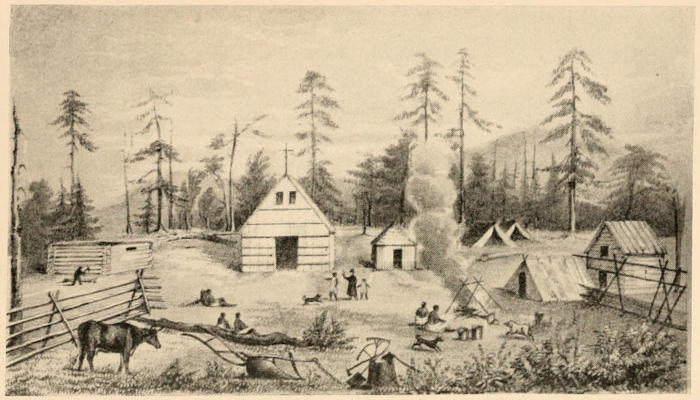
View of the new mission Establishment in 1846, among the Pointed-Hearts
(See Letter 21)
The success of this method surpassed my expectation:
for, having made the most intelligent repeat what I had
said, I had the pleasure to see that they lost nothing of
what was essential, and immediately I formed classes
for repetition. The first repetition was made immediately
after the instruction; the second in their lodges, the third
by the chiefs in their harangues, and the fourth at the
beginning of the next instruction.
The plan was insisted upon, and rapid progress made,
not only in their instruction, but also in their morals.
Those who exhorted joined to their exhortations the force
of private example, so that the mass of the people seemed
to be led on, by attraction.
From the 9th of September to the time in which I write—a
period of six months—not one single fault, which can
be called serious, so far as my knowledge extends, has
been committed in the village of the Sacred Heart of
Jesus; and a great many, who reproached themselves
{282} with light failings, cease not to make public confession
in terms of grief, which it would be desirable to
see the greater culprits exhibit at the tribunal of penance.
I have seen husbands come after their wives, and mothers
after their daughters, not to excuse the accusations which
they had made, but to acknowledge that their want of
patience and humility were the cause of the failings of
the others.
It is worthy of remark that [of] all the adults, who had
not yet received baptism, and all who united to prepare for
their first communion, not one was judged unworthy to
receive the sacraments. Their simplicity, piety, charity,
and especially their faith, were admirable. And truly
all these virtues were necessary for these good old men,
who, for the sake of learning their prayers, had to become
the scholars of their children, and for the children to enable
them to do violence to their natural vivacity, while they
slowly communicated to their old parents and grandparents,
a part of what they had learned; and the chiefs
would rise at the dawn of day, and sometimes in the
middle of the night, to exhort their people to weep over
their sins.
I have spoken of their faith. How pure and {283} above
all, how confiding it was! The first idea, necessary to
impress on their minds was, that the goodness of God is
not less great than his power, and they were so convinced
of it, that they begged God to perform miracles, as they
would beg their daily bread. They were told, that the
sacrament of extreme unction had the power not only
to purify the soul, but to restore health to the body; it
did not occur to them to doubt of the one more than of
the other.
They have great faith in the sign of the cross. They
are accustomed to make it at the beginning of their prayers,
and of all their principal actions. Not satisfied with
making it themselves, their children can scarcely pronounce
a word, before they teach them to articulate the
words of the sign of the cross. I saw a father and mother
bending over the cradle of an only son, who was about
to die. They made their best efforts to suggest to him
to make the sign of the cross, and the child having raised
his little hand to his forehead, made the consoling sign
and immediately expired.
A woman, sitting near the grave of her only daughter,
was conversing with her little boy, whom she had that
day presented at the baptismal font. “See,” said she,
“my child, how {284} happy it is to die after being baptized!
If you should die to-day, you would see again
our little Clementia.” And the pious mother exhibited
such a calmness in her tone of voice and countenance,
that she seemed to have a foretaste of the happy abode
of which she spoke.
Our infant church presented the picture of the purest
virtues, when the happy period for which she sighed was
approaching. The week preceding the celebration of
the Immaculate Conception of the blessed Virgin Mary,
was devoted to prepare the people for the reception of
holy communion. The time, of course, did not admit
of frequent instructions, long prayers and general confessions.
The good Father Joset gave instructions. Their
prayers were fervent, and experience had already taught
them the necessity of true sorrow for past sins, which
they exhibited in a lively manner at the confessional. I
used all the exertions I could to prepare those whose understandings
appeared more limited than the others; and
their piety, calmness and perseverance, have put to flight
all the fears which rested on my mind. The church was
small; it measured in length fifty feet, and in breadth
twenty-four. It was indeed, {285} poor, but from every part
of the wall and ceiling, were suspended rich festoons of
leaves. While the stars were still shining in the firmament,
the chant, Lauda Sion, was heard. But who sung
that divine canticle? The savages, who lately addressed
their prayers only to the animals of their mountains. Go
to the foot of the altar and see the new adorers, bowing
their heads before the Eternal One. The representation
of the Sacred Heart of Jesus and of the Cross on which
he expired, raised their thoughts to the abode of glory,
and caused them to center there all their affections. They
approached the altar to receive holy communion with
the greatest order and devotion. It was Father Joset
who had happiness to distribute to them the bread of
life, a happiness, so much the more felt, as he had just
arrived among them. Before they approached the holy
table, he addressed them a few words; but the tender
piety apparent in all at the moment of communicating,
made him fear to spoil the work of God by adding more
words of his own, and he left them to their own devotion.
We recited the usual prayers for the intentions of the
Church, and closed the morning services {286} by chanting
again the Lauda Sion. The high mass was celebrated
at ten o’clock.
In the evening took place the renovation of the promises
of baptism. The church was illuminated, at least as well
as our poverty would permit. The sacrament of baptism
was conferred on twelve adults. After a preparatory instruction,
instead of the ordinary formulas, which were a little
difficult to be translated into the Indian language, all of
them, to show their constant fidelity, recited three acts
of love to God. In hearing them, we remarked, that like
the prince of the Apostles, they replied to the three-fold
enquiry of their Saviour. The holy sacrament was exposed.
To the expression of unanimous and forcible love, their
looks of piety directed towards the altar, seemed to add:
O beauty! always ancient, always new! too late have
we loved thee; but we will love thee forever! The benediction
of the blessed sacrament followed, and closed that
great and beautiful day, which had been so rich in every
kind of spiritual gifts. It was with difficulty that these
good souls left the place, which had, that day, been the
witness of their prayers and promises. The Pointed-Hearts
exhibited by their prayers, their canticles, and {287} their
holy conversations, a foretaste of heavenly joys. They
often came to visit the Black-gowns. Some days, I was
surrounded by these visitors. They all waited in profound
silence, till I had finished my office. One of them
then chanted the first verse of Lauda Sion, in which all
the voices joined. Thus, it is a consoling truth, that, at
the extremities of the heathen world, as well as in the
centre of civilization, the church puts forth a united effort
for the conversion and salvation of mankind.
I am, devotedly yours, in Christ,
N. Point.
Flat-Head Camp, Yellowstone River, September 6th, 1846.
Rev. and Dear Father Provincial,—After an absence
of about eighteen months, employed in visiting the various
distant tribes, and extending among them the kingdom
of Christ, I returned to the nursery, so to speak, of our
Apostolic labors in the Rocky Mountains. Judge of the
delight I experienced, when I found the little log church,
we built five years ago, about to be replaced by another
which will bear comparison with those in civilized countries,
materials, everything ready to commence erecting it, the
moment they can procure some ropes to place the heavy
timbers on the foundation. Another agreeable surprise,
however, yet awaited me; a mill had been constructed,
destined to contribute largely to the increasing wants of
the surrounding country. It is contrived to discharge
{289} the two-fold charitable object of feeding the hungry
and sheltering the houseless. The flour mill grinds ten
or twelve bushels in a day; and the saw mill furnishes
an abundant supply of plank, posts, etc., for the public
and private building of the nation settled here.[302] Indeed,
the location stood much in need of so useful a concern.
The soil yields abundant crops of wheat, oats and potatos—the
rich prairie here is capable of supporting thousands
of cattle. Two large rivulets, now almost useless, can,
with a little labor, be made to irrigate the fields, gardens,
and orchards of the village. The stock at present on this
farm, consists of about forty head of cattle, a fast-increasing
herd of hogs and a prolific progeny of domestic fowl. In
addition to the mill, twelve log houses, of regular construction,
have been put up. Hence, you can form some
idea of the temporal advantages enjoyed by the Flat-heads
of St. Mary’s village.
St. Mary’s, or Bitter-Root valley, is one of the finest
in the mountains, presenting, throughout its whole extent of
about two hundred miles, numerous grazing, but few arable
tracts of land. Irrigation, either by natural or artificial
means, is absolutely necessary to the cultivation {290} of the
soil, in consequence of the long summer drought that prevails
in this region, commencing in April and ending only in
October. This difficulty, however, if the country should
be ever thickly settled, can be easily obviated, as the whole
region is well supplied with numerous streams and rivulets.
These remarks apply to the valleys contiguous to St. Mary’s,
the general aspect of them differing perhaps but slightly
in regard to the heights of the mountains, the colossal
dimensions of the rocks, or the vast extent of the plains.
After what has been said in my former letters in relation
to religion, little now remains that has a direct reference
to it; but you will learn with much pleasure, that the improvements
made in the Flat-head village, afford the
missionary stationed there great facilities for prosecuting
successfully the grand object of his desires, viz., the eternal
happiness of the poor benighted Indian tribes, placed
beyond the reach of his immediate influence. The village
is now the centre of attraction to all the neighboring, and
many of the distant tribes. The missionary always avails
himself of these occasional visits, to convey to them the
glad tidings of salvation. Among the recent visitors were,
{291} the great chief of the Snake Indians with his band
of warriors; the Banax and Nez-Percés, conducted by
several of their chiefs,—even several bands of Black-Feet;[303]
besides these, there were also, on their return
from the great hunt, almost the whole tribe of the Pends-d’Oreilles,
belonging to the station of St. Francis Borgia.
These last in particular, the greater part of whom I
baptized last year, may be said to rival the zeal of the
Flat-Heads in the practice of their religious duties.
After the festival of Easter, the abundant supply of provisions,
in the granaries and cellars of the village, enabled
the minister to invite all the visitors present to a feast,
consisting of potatos, parsnips, turnips, beets, beans,
peas, and a great variety of meats, of which the greater
portion of the guests had never before tasted. Among
the industrial products which are mainly owing to the
skill and assiduity of their present pastor, Father Mengarini,
I must not forget to mention a kind of sugar, extracted
from the potato.
Let us next turn to the improved condition of the people
themselves. Polygamy—or rather a connection, if possible,
still more loose—is now, thank God, entirely abolished
among our newly-converted {292} Indians; there is, consequently,
an evident increase of population. The reckless
abandonment of the helpless infant—the capricious discarding
of wife and children—the wanton effusion of
human blood—are no longer known amongst them.
Our feelings are not outraged by the brutal practice, heretofore
so commonly witnessed, of a father considering
a horse a fair exchange for his daughter; the justice of
allowing the young Indian maiden to choose her future
partner for life is now universally allowed;—the requisite
care of their offspring is regarded in its proper light, as
a Christian duty;—attention is paid to the wants of the
sick;—changes of treatment, with the remedies administered
according to our advice, have probably been the
means, under Providence, of rescuing many from premature
death. The long-cherished vindictive feelings
which so frequently led to depopulating wars, are now
supplanted by a Christian sense of justice, which, if unfortunately
compelled to take up arms, does so only to repel
unjust aggression or defend their inherent rights, but
always with the fullest confidence in the protecting arm
of Heaven.
Indeed their unbounded confidence in the God of battle,
is well rewarded; a truth which the {293} enemies of the
Flat-Heads invariably acknowledge. “The medicine of
the Black-gowns,” (an expression synonymous with the
true religion,) “is,” say they, “the strongest of all.” Did
time permit, I could adduce almost innumerable instances
to confirm the belief universally entertained here, that
Almighty God visibly protects them in the wars they are
compelled to wage with the hostile tribes. A few of these,
for the authenticity of which I can vouch, may suffice for
the present.
In 1840, when threatened by a formidable band of
Black-Feet, amounting to nearly eight hundred warriors,
the Flat-Heads and Pends-d’Oreilles, scarcely numbering
sixty, betook themselves to prayer, imploring the aid of
Heaven, which alone could save them in the unequal contest.
Confident of success, they rose from their knees in the
presence of their enemies, and engaged the overwhelming
odds against them. The battle lasted five days. The
Black-Feet were defeated, leaving eighty warriors dead
upon the field; while the Flat-Heads and Pends-d’Oreilles
sustained a loss of only one man; who, however, survived
the battle four months, and had the happiness of receiving
baptism the day before his death.
{294} In 1842, four Pends-d’Oreilles and a Pointed
Heart were met and immediately attacked by a party
of Black-Feet. At the first onset, the Black-Feet had
to deplore the loss of their chief. Aroused by the noise
of the musketry, the camp of the Pends-d’Oreilles rushed
to the assistance of their companions, and without losing
a single man, completely routed the enemy. Their escape
is the more remarkable, as rushing into the entrenchments
of the Black-Feet, they received a volley of shot poured
in upon them by the enemy.
The Flat-Heads were again attacked, during the winter
hunt of 1845, by a party of the Banax, which, though
outnumbering them nearly three times, they soon put
to flight, with the loss of three of the Banax party. The
Flat-Heads acknowledge that the Banax are the bravest
of their enemies; yet this did not deter them, though but
seven in number, from fighting a whole village of the latter,
that had rashly violated the rights of hospitality.
During the summer hunt of the same year, the united
camp of Flat-Heads and Pends-d’Oreilles, when threatened,
hesitated not a moment to engage with a band of Black-Feet
four times their number. The latter, fearing the
“medicine {295} of the Black-gowns,” skulked around their
enemies, avoiding an open fight. The former perceiving
this, pretended flight, in order to draw the Black-Feet
into the open plain: the snare succeeded; and the Flat-Heads
and Pends-d’Oreilles suddenly wheeling, attacked
and repulsed them with considerable loss, driving the enemy
before them in hot pursuit, as they would a herd of buffaloes.
Twenty-three Black-Feet warriors lay dead on the
field, after the engagement, while the Pends-d’Oreilles lost
but three, and the Flat-Heads only one.
I shall close these sketches of Indian warfare, so remarkably
evincing, as they do, the special protection of
Heaven, with an account of an engagement which, as it
was the occasion of my first interview with the Black-Feet,
and by its consequence contributed much towards my
favourable reception among them, will not, I trust, prove
entirely devoid of interest, if given a little more in detail.
In 1846, while engaged in one of these hunting excursions,
the camp of the Flat-Heads was reinforced by thirty lodges
of the Nez-percés, and a dozen lodges of the Black-Feet
at their own solicitation. The Flat-Heads encamped in
the neighbourhood of the Crows,[304] purposely to renew {296}
the terms of peace, if the latter felt so disposed. The
Crows, perceiving in the united camp, the Nez-Percés
and Black-Feet, with whom they were at war, and knowing
their own superiority both in numbers and bodily strength,
(they are the most robust of the Indian tribes) rushed
into it like a torrent, evidently more anxious to provoke
a contest than to make overtures of peace. The calm
remonstrances of the Flat-Heads, and the wise admonitions
of their own chief, were lost upon the now almost infuriated
mutinous band of the Crows.
If the threatened outbreak had occurred at that moment,
it is probable that the whole united camp would have
been massacred in the hand-fight, for which evidently
the Crows came prepared, with loaded guns and other
destructive weapons, while the Flat-Heads and the others
were totally unprovided. At this critical juncture, fortunately,
indeed I may say providentially, my interpreter
Gabriel, and a Pend-d’Oreille named Charles, forced
their way breathless into the disordered camp, and announced
the arrival of the Black-gown who had visited
them four years ago. The alarming scene they witnessed
was indeed what they had expected for as we travelled
to overtake the Flat-Head {297} camp at the place designed
for their interview with the Crows, we perceived from
the marks of their daily encampments, that some Black-Feet
and Pends-d’Oreilles were with the Flat-Heads;
we accordingly feared a collision would result from the
interview. I therefore despatched with all possible speed,
Gabriel and Charles, to announce my arrival. Well
did they execute the commission—they rode almost
at full gallop during a whole day and night, performing
in this short period a journey which occupied the camp
fourteen days. This intelligence roused the Crow chiefs
to an energetic exercise of their authority. They now
seized the first missiles at hand, and enforced the weight
of their arguments upon their mutinous subjects, as long
as there was left in the united camp the back of a Crow
on which to inflict punishment. This forced separation,
though it may have checked the present ebullition, could
not be of long duration. It needed but a spark to rekindle
their hostile dispositions into open war. The next day,
as if to provoke a rupture, the disaffected Crows stole
thirty horses from the Flat-Heads. Two innocent persons
were unfortunately charged with the crime, and punished.
The mistake being discovered, the amende honorable was
{298} made, but to no purpose. The Flat-Heads, aware
of their dangerous position, employed the interval in
fortifying their camp, stationing their women and children
in a place of safety, and arming themselves for the contest.
An immense cloud of dust in the neighborhood of the
Crow camp at ten o’clock, announced the expected attack.
On they came, with the impetuosity of an avalanche,
until within musket shot of the advanced guard of the
allied camp, who had just risen to their feet to listen to
a few words addressed them by their chief, Stiettietlotso,
and to meet the foe. “My friends,” said Moses, (the
name I gave him in baptism) “if it be the will of God,
we shall conquer—if it be not his will, let us humbly
submit to whatever it shall please his goodness to send
us. Some of us must expect to fall in this contest: if there
be any one here unprepared to die, let him retire; in the
meanwhile let us constantly keep Him in mind.” He
had scarcely finished speaking, when the fire of the enemy
was returned by his band, with such terrible effect as
to make them shift their mode of attack into another,
extremely fatiguing to their horses. After the battle had
raged for some time in this way, Victor, the grand chief of
the Flat-Heads,[305] {299} perceiving the embarrassed position
of the enemy, cried out: “Now, my men, mount your best
horses, and charge them.” The manœuvre was successful.
The Crows fled in great disorder, the Flat-Heads abandoning
the pursuit only at sun-down, when they had driven the
enemy two miles from their camp.
Fourteen warriors of the Crows fell in the engagement,
and nine were severely wounded, as we subsequently
learned from three Black-Feet prisoners, who availed
themselves of their capturers’ defeat to recover their liberty.
On the part of the allied camp, only one was killed, the
son of a Nez-Percé chief, who fell by the hand of a Crow
chief, in so cowardly a manner, that the indignation of the
allied camp was at once raised into immediate action—it
was in fact, the first shot fired and the first blood drawn
on either side; the boy was yet quite a child. Besides
this loss, though the engagement lasted for several hours,
only three were wounded, two of them so slightly that
by application of the remedies I brought with me, they
recovered in a short time; the third died a few days after
my arrival in the camp.
This defeat was the more mortifying to the Crows, as
they had been continually boasting {300} of their superior
prowess in war, and taunting their enemies with the most
insulting, opprobrious epithets. They had besides, forcibly
and most unjustly drawn on the engagement.
Indeed, I look upon the miraculous escape of our Christian
warriors, in this fierce contest, as further evidence of the
peculiar protection of Heaven; especially when I consider
the numerous instances of individual bravery, perhaps
I should say reckless daring, displayed on the part of
the allied camp. The son of a Flat-Head chief named
Raphael, quite a youth, burning to engage in the contest,
requested his father to let him have his best horse. To
this the father reluctantly consented, as the boy had been
rather weak from sickness. When mounted, off he bounded
like an arrow from the bow, and the superior mettle of
his steed soon brought him close upon the heels of a large
Crow chief, who, turning his head round to notice his
pursuer, pulled up his horse to punish the temerity of the
boy, at the same time bending to escape the arrow then
levelled at him. The boy must have shot the arrow with
enormous force, for it entered under the lower left rib, the
barb passing out under the right shoulder, leaving nothing
but the feathers to be seen where it entered. {301} The
chief fell dead. In an instant a volley was poured in
upon the boy—his horse fell perfectly riddled, with the
rider under him.—He was stunned by the fall, and lay
to all appearance dead. According to the custom of the
Indians, of inflicting a heavy blow upon the dead body
of their enemy, he received while in this position, a severe
stroke from each individual of the several bands of Crows
that passed him.—He was taken up half dead, by his
own tribe, when they passed in pursuit of the enemy. The
ardour and impetuosity of the young man belonging to
the Flat-Head camp amazed the oldest warriors present,
and formed the theme of universal admiration, as well
as the dread of their enemies. Even the women of the
Flat-Heads mingled in the fray. One, the mother of
seven children, conducted her own sons into the battlefield.
Having perceived that the horse of her eldest son
was breaking down in a single combat with a Crow, she
threw herself between the combatants, and with a knife
put the Crow to flight. Another, a young woman perceiving
that the quivers of her party were nearly exhausted,
coolly collected, amidst a shower of arrows, those that
lay scattered around her, and brought them to replenish
the {302} nearly exhausted store. The celebrated Mary
Quille, already distinguished in numerous battles, pursued,
with axe in hand, a Crow, and having failed to come up
with him, returned, saying: “I thought that these great
talkers were men. I was mistaken: it is not worth while
even for women to attempt to chase them.”
The little party of Black-Feet, animated by a spirit
of revenge, for the loss of half their tribe, massacred the
preceding year by the Crows, and probably influenced by a
feeling of their safety while they fought in company with
the Flat-Head Christians, did signal service in the combat.
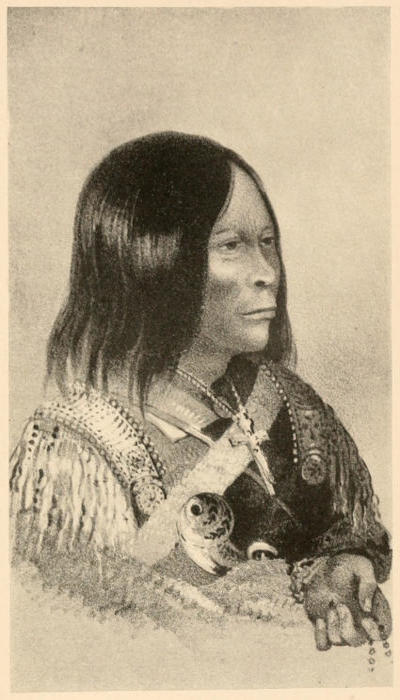
Insula or Red Feather (Michel),
Great Chief and Brave among the Flat-heads
In the meantime, Gabriel and Charles, fearing the
threatened outbreak, immediately started back to meet
me and hasten my arrival, my presence being considered
necessary to prevent the effusion of blood. I arrived
at the Flat-Head camp the day after the battle. I found
everything ready to repel a second attack, should that
be attempted. I immediately sent an express to the Crows,
to announce my arrival, and at the same time, to convey
to them the great desire I had to see them, especially
for the purpose of effecting a reconciliation between
the {303} contending parties. But it appeared that after
having buried their dead, they retreated precipitately;
so that no account of their destination could be had. My
express told me that there must have been excessive grief
in the camp of the Crows, as the usual marks of it could
be traced in every direction, such as the dissevered joints
of fingers, and the numerous stains of blood, caused by
the wounds which the parents of the deceased inflict upon
themselves on such occasions.
Shortly after my arrival, the Black-Feet came in a body
to my lodge, to express in a manner truly eloquent, their
admiration of the Flat-Heads, with whom in future they
desired to live on terms of the closest friendship. “To
their prayers,” said they, “must this extraordinary victory
be attributed. While the battle lasted, we saw their old
men, their women, and children, on their knees, imploring
the aid of Heaven; the Flat-Heads did not lose a single
man—one only fell, a young Nez-Percé, and another
mortally wounded. But the Nez-Percés did not pray.
We prayed morning and evening with the Flat-Heads,
and heard the instructions of the chiefs.” They then
begged of me in their own affecting way, to take pity on
them and be {304} charitable to them: they now determined
to hear the words of the Great Manitou of the whites, and
to follow the course which the Redeemer had marked
out on earth. Having addressed them on the nature
of the life they had proposed to adopt, they all without
exception presented their children for baptism, to the
number of eighty.
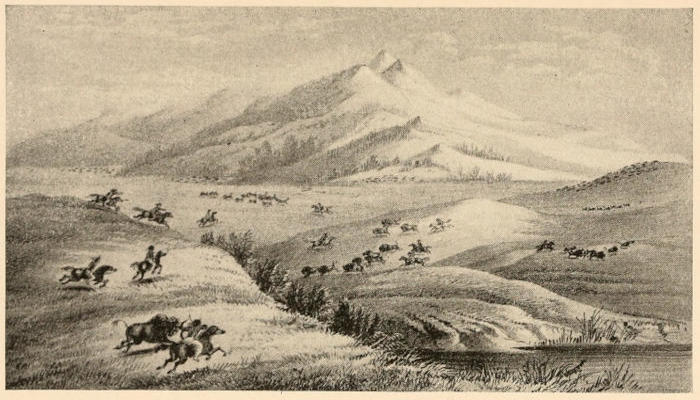
Great Buffalo Hunt—View of Muscle-Shell Mountains
(See Letter 24)
The day after this sacred ceremony, they called on me,
requesting to be allowed to express in their own way,
the excess of joy which they felt on account of this twofold
victory. On returning from the late field of battle,
the warriors, at the head of whom was a young chief,
chanted songs of triumph, accompanied with the beating
of drums; at each beat, they sent forth a wild and piercing
shout; then followed the song, and so on alternately;—wild
as the music was, it was not without harmony. It
continued thus, during almost the whole of our route.
We marched along the right bank of the Yellow-Stone
River, having on our left a chain of mountains resembling
those old portals to which history has given the name
of “ancient chivalry.”[306] We had scarcely arrived at the
encampment, when the Black-Feet commenced, under the
shade of a beautiful cluster of pines, their {305} arrangements
for a dance, insisting, at the same time, upon showing
the Black-gowns how highly they valued their presence
among them, and how gratified they would be to have
them witness this display. There was, indeed, nothing
in it that could give occasion to offended modesty to turn
aside and blush. I need not tell you it was not the polka,
the waltz, or anything resembling the dances of modern
civilized life. The women alone figure in it, old and
young; from the youngest child capable of walking, to
the oldest matron present. Among them I have seen
several old women upwards of eighty years, whose feeble
limbs required the aid of a staff in their movements through
the dance. Almost all appeared in the best costume of
the warriors, which, however, was worn over their own
dress, a sort of tunic they always wear, and which contributed
also not a little to the modesty of their appearance.
Some carried the arms that had done most execution in
battle, but the greater part held a green bough in the
hand. In proportion as the dresses increase in singularity,
the colors in variety, and the jingling of the bells
in sound, in the same degree is the effect upon the rude
spectator heightened. The whole figure is surmounted
by {306} a casket of plumes, which by the regular movements
of the individual is made to harmonize with the
song, and seems to add much gracefulness to the whole
scene. To lose nothing of so grand a spectacle, the
Indians mount their horses, or climb the neighboring
trees. The dance itself consists of a little jump, more
or less lively, according to the beat of the drum. This
is beaten only by the men, and all unite in the song. To
break the monotony, or lend some new interest to the
scene, occasionally a sudden, piercing scream is added.
If the dance languishes, haranguers and those most skilful
in grimaces, come to its aid. As in jumping the dancers
tend towards a common centre, it often happens that
the ranks become too close, then they fall back in good
order to form a large circle, and commence anew in better
style.
After the dance, followed the presentation of the calumet.
It is borne by the wife of the chief, accompanied by two
other women, on the breast of one of whom rests the head
of the pipe, and upon that of the other, the stem handsomely
adorned with feathers. The most distinguished personage
of the nation precedes the calumet bearers, and conducts
them around the circle of dancers. The object, probably
of the {307} last part of the ceremony, the termination
of the rejoicings, is to indicate, that the best fruit of the
victory they celebrate is the peace which follows. To
establish this peace upon a better foundation, is a thought
constantly uppermost in my mind. May God grant that
our efforts to plant the crop of peace among these wild
children of the forest, be not unavailing; I earnestly recommend
these poor souls to the prayers of the faithful.
Having thus, more fully perhaps than the limits of a
single letter would seem to justify, redeemed the promise
given in my last, of recounting some of the advantages,
spiritual and temporal, which the Flat-Heads enjoy, it
may now be proper to resume the course of events up
to the present date. On the 16th of August, we left St.
Mary’s by a mountain gap, called the “Devil’s gate,” a
name which it has probably received from the fact of its
forming the principal entrance of the marauding parties
of the Black-Feet.[307] We encamped the first night, at
the foot of the Black-Foot forks. Innumerable rivulets,
and several beautiful lakes contribute largely to this river.
Towards its head, to the north-east, there is an easy pass
for cars and wagons.[308] The valley we ascended, is watered
{308} by a beautiful stream called the Cart River. It
was through this valley we wound our way in former
days, with all our baggage, to the spot where St. Mary’s
now stands.[309] We crossed the mountains in the vicinity
of the Arrowstone fork, another easy pass, and descended
a tributary of the Jefferson as far as its outlet, through
rather a wild, broken, and mountainous country, with
here and there an extensive, open plain, the ordinary
resort of innumerable herds of buffalo.[310] The seventh
day found us encamped in the immense plain through
which the forks of the Missouri diverge, ascending to the
source at the very top of the main chain of the Rocky
Mountains.[311] In travelling through these wilds, great
care is to be had in order to avoid the sudden attack of
some of those straggling war-parties that infest this neighborhood
purposely to search for scalps, plunder, and the
fame of some daring exploit. We halted every evening
for a few hours, to take a bite, as the trapper would say,
and to give some food and rest to our animals. When
it was quite dark, we would kindle a brisk fire as if to
last until morning; then under cover of the night, proceed
on our journey for about ten miles, to some unsuspected
place, thus eluding {309} our enemies, should any have
followed in our track, or be lurking in the neighborhood,
awaiting the midnight hour to execute their murderous
designs. From the three forks we went easterly, crossing
by an easy pass the mountain chain which separates the
head waters of the Missouri from the Yellow-Stone River,
a distance of about forty miles.[312] We followed in the
track of the Flat-Head camp for several days, when I
sent Gabriel, my interpreter, with a Pend-d’Oreille Indian
in advance to discover what direction the camp had taken,
and to bring back speedy news regarding their movements;
and also to learn the dispositions of the Crows, whom I
designed to visit. Four days later I was met by a few Flat-Heads
on their way to find me, when I was apprised of
the treachery of the Crows, and the severe chastisement
they had so deservedly received. I travelled the whole
of that night, and arrived next day in the allied camp,
as I have already informed you. Having failed to obtain
the desired interview with the Crows, our attention will
be now turned towards the Black-Feet, with whose favorable
disposition to receive the gospel you are already
acquainted. The result of this determination will form
the subject of my next {310} letter. I recommend myself
to God in your prayers.
I remain, with sentiments of profound respect and esteem,
reverend, dear father, your very humble servant and brother
in Christ,
P. J. De Smet, S. J.
St. Louis University, January 1st, 1847.
Very Rev. and Dear Father Provincial,—You are
already acquainted with our determination to accompany
the Black-Feet in returning to their country. In the
sequel of this letter you will learn, with pleasure, how
far Almighty God has blessed our humble efforts in carrying
this resolution into effect. After the battle, described
in my letter from the Yellow-Stone camp, the Crows,
it appears, fled to the Wind River Mountains, determined,
however, to avenge themselves on the Black-Feet, whom
they now designed to follow into their own country.[313]
The latter, probably through fear of this assault, resolved
to remain with the Flat-Head camp, until it reached
the head waters of the Muscle-shell River. In leaving
the Yellow-Stone our direction lay towards the north,
{312} through a broken and undulating, dry and woodless
country, destitute of any water fit to drink—stagnant
pools of brackish water being the only kind found here
to satiate the thirst.[314] Only a few straggling bulls were
seen or killed, scarcely sufficient, indeed, to supply the
wants of our numerous camp. The great variety of matter
incidental to this journey with the united Indian camp,
will appear, perhaps, more satisfactory if given in the same
order in which it was entered in my diary; I therefore
present you with an extract from it:—
8th Sept., 1846. The elements of discord existing
between the Nez-Percés and Black-Feet, there is every
appearance of an open rupture. The Nez-Percés being
evidently in the wrong, the Flat-Heads, following our
example, endeavor to convince them of the impropriety
of their conduct; but to no purpose, the principal men
among them refusing, for the second time, to smoke the
calumet of peace.
9th. Towards night a touching incident occurred in
our lodge. A Nez-Percé chief, who declares himself
our friend, entered, accompanied by three Black-Feet,
a warrior, an interpreter, and a young man about twenty
years of age. This youth, when about one year old,
lost {313} both his parents; his mother, a captive among
the Black-Feet, died the first days of her captivity; his
father, whose country is far distant from the Black-Feet,
is altogether lost to him. The poor orphan became the
adopted child of a Black-Foot woman, who brought him
up as she would her own offspring. The adopted son grew
up, imbibing all the notions and customs of his new friends,
knowing no other relations than those around him. To-day,
the woman whom he believed to be his real mother,
declared to him that she was not; and that his father,
whom he had not seen since he was one year old, was
now sitting beside him. “Who is my father?” he anxiously
enquired. “There,” said the woman, pointing to the Nez-Percé
chief, who entered the lodge with him. The doubts
of the father were soon removed, as he hastily stripped
the youth’s garments from his back, and there discovered
the mark of a burn received in the parental lodge while
yet an infant. The sudden burst of feeling elicited from
these children of nature at this unexpected meeting, can
be better imagined than described. The chief has no
grown children, he is therefore the more eloquent in
endeavoring to persuade his son to return to his native
country, presenting him, at {314} the same time, with one
of the best and most beautiful of his steeds. I joined to
the entreaties of the father, the strongest motives I could
urge. The son, whose heart is divided between nature
and grace, begged to be allowed to bid farewell to the
companions and friends of his youth, who were now absent—he
could not, he declared, thus abruptly leave her who,
with motherly care and anxiety, had watched over him
so many years, and whom he had always so tenderly
loved, and looked upon as his mother. “Now that the
Black-gowns are with us,” he said, “I desire to be of the
happy number of those who are about to introduce them
to my friends, and to listen to the words of the Great
Spirit, whom they have come to announce. After that,
but not before, shall I follow my father.”
10th. The Nez-Percés announce their determination
of leaving the united camp. The Flat-Heads, who dread
more the presence of a friend capable of injuring their
souls, than that of an enemy who can only hurt the body,
are excessively rejoiced at this announcement. The Black-Feet
also are highly pleased to see them go. The separation
took place about 8 o’clock; but they had gone
only a short distance from the {315} camp, when, fearing
an attack from the Crows, they rejoined the main body,
determined to remain as long as the great hunt shall last.
To avoid the outbreak, evidently threatened by the ill-will
of the Nez-Percé, the Black-Feet have resolved to
leave the camp on the morrow. This day I baptized
a Nez-Percé, who had been shot in the late battle with
the Crows—he cannot survive much longer.
11th. Farewell to the Flat-Heads. All came to shake
hands with us, the grief of their hearts was depicted in
their countenances; we all perceived how deeply they
felt the separation. A great number of their cavaliers
accompany us for a considerable distance; six go as far
as our encampment, not less than twenty-five miles.
Our course lay through an extensive level plain, at
the very base of the Muscle-shell mountains.[315] These
rise abruptly from the plain around, resembling broken,
elevated islands in the midst of the ocean, and their tops
tufted with a heavy growth of cedar and pine. While
admiring the singular appearance of the scenery, my
attention is called off to a very distressing accident. An
old Indian is seen falling from his horse, receiving in the
fall a severe wound between his eyes; he remains senseless,
all efforts {316} to revive him are fruitless. It was the
old Black-Foot chief, Nicholas, whom I baptized five
years ago; he acted, ever since, the part of a most effective
missionary, in preparing the way for the introduction
of the gospel among his tribe.[316] To-day he entered what
he called his own country, chanting hymns of praise and
thanksgiving in the happy anticipation of soon presenting
us to his brethren. He dies! not even a sigh escapes him.
Oh, how profound are the designs of God. Happily
he leaves a son worthy of so excellent a sire. His attachment
to religion equals that of his father. Having resided
several years among the Flat-Heads, he has acquired a
perfect knowledge of their language—acting in the capacity
of interpreter, he has already rendered me considerable
assistance. Notwithstanding his great grief, he performs
the last sad offices near the tomb of his father with the
composure and firmness of a Christian. It is customary
among the Black-Feet to express their grief by wailings
and lacerations of the body, calculated only to afflict those
around, though intended by them as a mark of respect
towards the lamented dead. The son of Nicholas, himself
a chief and a great brave, knowing the Christian
practice, {317} passes the night in prayer, with his wife
and children, near the funeral couch of his father. His
friends and brother, Pegans[317] (pagan in name and in
fact), would now and then gather around him, kneeling
beside the mourner, pour forth, Christian-like, many a pious
ejaculation on behalf of their deceased chieftain. The
remains of the venerable chief were placed in the grave
by the hands of his own son, and over his tomb the
emblem of salvation was raised—the cross of the Saviour,
whose words were now for the first time announced to the
lonely tribes of this long-benighted wilderness. At the
very moment the last prayers of the funeral service were
uttered, “May he rest in peace,” a busy stir breaks the
death-like silence of the surrounding crowd of Indians.
A Flat-Head approached in full gallop, announcing the
pleasing intelligence that two Black-Feet had reached
their camp, and informed them that the tribe of Nicholas
was within two days march of us.
12th. The very evening of the day on which Nicholas
was interred, immense herds of buffalo are seen in the
neighborhood of the camp. All are preparing for the chase—hunters
throwing the lasso over their buffalo horses,
already prancing and capering for a race—all ready
to {318} start; but before they separate, they halt for a
moment, and, in imitation of the Flat-Heads, all are seen
on their knees to beg of Almighty God their daily bread;
when again mounted, off they bound at full speed, each
for one, two, or three fat cows, according to the strength
of his favorite steed. The supper was abundant in every
lodge, regiments of steaks were paraded before all the
fires. My fire was encircled with tongues, or other dainty
dishes reserved for the Black-gown; and all who visited
our lodge were of course invited to partake of the superabundant
supply. Among my visitors, one in particular
distinguished himself by his originality and good sense—his
words were accompanied with expressive signs,
which rendered his conversation very agreeable; he related
to me what he observed while in the Flat-Head camp:—“When
we first arrived,” said he, “we had abundance
of provisions with us, while the Flat-Heads and Nez-Percés
were fasting; we were visited, and all partook
of what we had. The Flat-Head differed from the Nez-Percés;
the former prayed before he ate, the latter did
not. On the Lord’s-day, the Flat-Heads remained quiet
in the lodges, they frequently prayed, and spoke to us
words of the Great Spirit to make us good; but {319}
the Nez-Percés, painted, and proud of their feathers,
were seen going here and there, more for evil than good,
without reserve, before our young people. But then
came the battle with the Crows, and the Nez-Percés, though
the least brave of us all, and the least exposed, have had
to weep over the loss of one of their men, and another
is dying of his wounds. This made me believe the words
I had heard the Flat-Head say, ‘that the Great Spirit
is good to the good, but that he can find the wicked at
pleasure to punish them as they may deserve.’”
The wonderful success of the Flat-Heads in the different
wars they have been compelled to wage, has confirmed
their enemies in the persuasion entertained for some
years, that the medicine of the Black-gowns is stronger
than their own. Two Indians of the Pegan camp have
just arrived, apprising us of their approach.
13th. Sunday.—We are obliged to move camp;—every
dry stick had been burned where we passed the
night, and the rain has rendered the only other substitute
for fuel, buffalo dung, unfit for use;—the rain which
was falling as we travelled, changed into sleet and hail.
After a long day’s march we encamp for the night, in a
beautiful cotton grove, on the margin of the Judith river.[318]
{320} The bad weather prevented the re-union of the
two camps; it will be so much the more remarkable, as
to-morrow will be the feast of the Exaltation of the Cross.
The chief enquires, if it would please us to see the Black-Feet
manifest their joy in their own way, that is, by
painting, singing and dancing; the answer was: “Do the
best you can to show your friends that you are pleased.”
We learn by an express, just arrived, that the Big Lake,
the great chief of the Pegans, harangued his people, exhorting
them to behave orderly, and to listen with attention
to all that the Fathers would say to them. He is accompanied
by the great Tail-Bearer, a kind of orator,
or aid-de-camp to the chief. His tail, composed of buffalo
and horse-hair, is about seven or eight feet long, and
instead of wearing it behind, according to the usual
fashion, it is fastened above his forehead, and there formed
into a spiral coil, resembling a rhinoceros’ horn. Such a
tail, among the Black-Feet, is a mark of great distinction
and bravery—in all probability, the longer the tail, the
braver the person.
14th. An agreeable disappointment. The Flat-Head
camp, from which we separated four days ago, is only
about ten miles from us. They sent an invitation to the
Big Lake, desiring, at the same time, to trade with him
on friendly {321} terms. Opinions are divided among
the people of the Big Lake. The chief is for postponing
the trade until the meeting with the Black-gowns takes
place; the Tail-Bearer gives the preference to trade. The
chief’s voice prevails. An Indian from the camp arrives
about ten o’clock, to herald their approach; all the horses
are immediately saddled, and the two Black-gowns, at
the head of a numerous band of cavaliers, forming one
extensive line, in single file, proceed through a beautiful
open plain, the air resounding with songs of triumphal
joy. We are soon in sight of each other—a loud discharge
from all the guns was the signal to dismount, when
the Big-Lake and Tail-Bearer, followed by the whole
tribe, walked up to give us a warm and affectionate shake
of the hand. Smoking came next; and after the friendly
pipe had passed from mouth to mouth, and had made
several rounds, they communicate to each other the news
since parting. I made to them my preparatory address,
to dispose their minds and hearts to listen with attention
to the word of God. To this appeal they responded with
a loud and cheerful expression of the satisfaction they
felt in listening to the Black-gown. We had scarcely
introduced our new friends into the {322} camp, before
the Flat-Heads and Nez-Percés were seen approaching.
Their meeting was still more joyful and cordial than the
one we had just witnessed among the people of the Big-Lake.
This is not astonishing, when you know them;
the savage is naturally reserved towards men he does
not know. The candid, open ways of acting which distinguish
our neophytes soon communicate themselves
to the Black-Feet, and before the sun went down, Black-Feet,
Flat-Heads, young and old, all show equal pleasure
to find us, on such an occasion, in the midst of them.
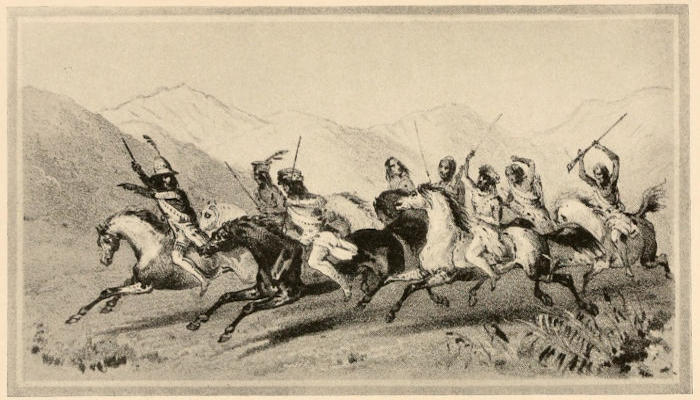
The Chief at the head of his Hunters
After evening prayers were said in the Black-Foot and
Flat-Head languages, I addressed to them a short discourse
on the happy re-union and peaceful disposition
that now existed between the two nations. What a
pleasing sight! What a consoling triumph for religion,
to behold those warriors, whose deep-scarred faces told of
the many bloody battles they had had together,—who
could never meet before but with feelings of deadly enmity,
thirsting for each other’s blood,—now bending the knee
before their common Father in prayer, as with one heart,
and listening with delight to the words of the peaceful
Redeemer. The chiefs and the principal {323} men of
both nations passed the evening in my lodge. Victor,
the great Flat-Head chief, gains the good-will of all—charms
everybody by the suavity and dignified simplicity
of his manners. He relates some of his exploits, not indeed
to appear conspicuous, as is evident from the modest
and simple way in which he speaks, but to make them
fully sensible of the protection which the Great Spirit
extends to those who are devoted to His holy cause. The
Black-Feet who were engaged in the late battle with the
Crows, confirm the statements of Victor, and recount
many edifying circumstances which they had witnessed
in the Flat-Head camp. The making of the sign of the
cross was highly extolled, as a certain sign of victory to
those who had already given their hearts to the true God.
It is truly to-day the Exaltation of the Holy Cross.
15th. The Octave of the Nativity of the Blessed Virgin.
The new disciples of the cross assist at a solemn Mass,
sung in the open plain, under the canopy of green boughs,
to beg for the blessings of God upon this wilderness and
its wandering tribes, and unite them in the bond of peace.
Flat-Heads, Nez-Percés, Pegans, Blood Indians, Gros-Ventres
and Black-Feet,[319] numbering {324} about two
thousand, all surround the altar of the living God, on
which “the clean oblation is offered,” in their behalf.
It is a thing unheard of, that among so many different
savage nations, hitherto so inimical to one another, unanimity
and joy, such as we now witness, should exist,—it
appears as if their ancient deadly feuds had been long
since buried in oblivion; and this is the more remarkable
in an Indian who, it is well known, cherishes feelings
of revenge for many years. How long will this last?
May Heaven strengthen their present good-will, and
grant them perseverance. Mention is already made
of baptizing all the Pegan children, but the ceremony
is postponed on account of the general rejoicing, and
the affairs of business that now occupy the camp.
16th. The engaging simplicity and cordiality of the
Flat-Head chiefs have gained them the affections of all
the principal men of the Black-Feet tribe,—conduct
the more remarkable, when contrasted with the turbulent
disposition of the Nez-Percés, who are kept in check only
by the presence of the Flat-Heads. At this second separation,
they came again to renew their affection towards
us. The Flat-Head chiefs remain last in the camp to
see everything pass off {325} orderly and amicably. In
the evening the Black-Feet assemble around our fire,
where the first canticle is composed in their language;
the subject of the composition is the consecration of their
persons to the “Supreme Ruler of all things.” Apistotokie
Nina, Pikanniai tokanakos akos pemmoki tzagkoma
Achziewa ziekamolos.
17th. Nothing very remarkable took place. We received
the visit of a war party of Blood Indians, the
most cruel among the Black-Feet. From them we learn
that their tribe will be delighted to receive a visit from
us,—that our persons are considered sacred among them,—that
we need apprehend no danger, and, to remove
all uneasiness on this head, that sixty of their children
had already received baptism at the hands of a Black-gown,[320]
whom they met on the Sascatshawin, and that
these children constantly wear the crosses and medals
which the Black-gown gave them.
18th. News in great variety. Two Gros-Ventres have
been killed by the Crows. Seven families of Pegans
have been followed by a numerous band of Crees, and
have probably been destroyed. A chief, just arrived,
informs us that Black-Feet of different tribes are assembling
in the neighborhood of Fort Lewis to receive {326}
their annual supplies, and that the traders who bring up the
goods are distant only three days’ journey, with three large
canoes (Mackinaw boats).[321] About two o’clock in the
afternoon the camp prepares for another great hunt.
19th. Baptism was this day conferred on upwards
of one hundred children and two old men, with all the
usual ceremonies. To enter into a full description of
these, calculated, as they are, to leave a deep and lasting
impression upon the minds of all present, would be but
a repetition of what has been already stated in my former
letters on the like occasions.
20th. Arrival of a great war party of Blood Indians.
They are returning from an expedition against the Crows,
having carried off twenty-seven horses belonging to the
latter. The leaders of this party, one a son, the other
a brother of the great chief, exhibit towards us particular
marks of friendship. The elder, who worshiped the sun
and moon, has long since ceased to invoke these deities—he
confirms the statement of the other party, that we shall
meet with a hearty welcome among his tribe. The Black-Feet
nation consists of about fourteen thousand souls,
divided into six tribes, to wit: the Pegans, the Surcees,
the Blood Indians, the Gros-Ventres {327} (descendants
of the Rapahos), the Black-Feet (proper), and the Little
Robes.[322] These last were almost entirely destroyed in
1845.
21st. A feast is given in my lodge to the new-comers.
It is preceded by the baptism of a Pegan, who had been
an old chief, but who, on account of age, resigned the
dignity of his title in favor of his brother. He possesses
the gift of speech in an eminent degree. He is daily here,
repeating and commenting on the instructions given by
us. He exercises over his flock a very happy influence,
and it is, doubtless, owing to his exertions that the Pegans
are the first among the Black-Feet tribe to manifest favorable
dispositions, and they will probably be the first also
to embrace and put in practice the saving truths of Christianity.
He presents, in his own person, a rare exception
among his people, and indeed the only instance I have
met with in my intercourse with the Indians, especially
in one of his age—of an Indian having lived with one
and the same wife, and with her also in perfect peace and
harmony. He received in baptism the united name of
Ignatius Xavier, the medal having that impress—which
he constantly wears, to remind him of the virtues which
distinguish those saints. Let us hope {328} that the first
graces bestowed on this tribe may soon produce fruits
of salvation to all.
22d. A day of great rejoicing—a dance. All the
Indian fineries are produced, all the war-caps, adorned
with eagle feathers, figure in the dance—a thousand
voices join in the song—the rejoicing prolonged till evening.
The common prayers have all been translated—already
several know what is to be believed. May the practice
of good soon take deep root in their hearts. Sata, our
interpreter, acts the part of an Apostle[323]—after each
interpretation, he resumes his discourse, and speaking
from the abundance of his heart, produces a powerful
effect upon his audience. The word Sata does not differ
in signification from Satan, and as the Indian generally
receives his name from the natural disposition he manifests,
we may safely conclude, when such a name is given
to a Black-Foot, that the grace of God has operated most
powerfully in converting this savage to what he is at present.
23d. Nothing remarkable happened, except a trial
given to faith of the new catechumens. A theft of two
horses was committed in the camp by a stranger, residing
among the Flat-Heads. Some individuals from the western
side of the {329} mountains, occasionally forget what they
should be; but a few isolated misdeeds, highly disapproved
of by the entire nation, show to the best advantage the
good spirit that animates the great mass of them. The
critical position of the robber serves in some degree as
an extenuation of his guilt. He had advanced a considerable
distance from the Flat-Head camp, on his way to join
us about the time we should reach the Black-Foot Indians;
when he was given to understand that his life was in great
danger from the war parties prowling in the rear. The
poor fellow did not feel much inclined to meet death in
this way, and his meagre horse not being very well able
to avoid the meeting, proprio motu he left his, in exchange
for two other horses, fully equal to the task of sweeping
him past the danger. These horses will, however, be
returned to the owner. This is not the first instance of
restitution among the Indians.
Sept. 24th. The missionaries, accompanied by a great
number of Indians, precede the camp on its way to Fort
Lewis, now only a few miles off. I am accosted by a little
Pegan chief, who invites me to smoke. He tells me that he
has come to the determination of settling at the Fort an
unfortunate personal difficulty between himself {330} and
another chief of the Blood Indian tribe. “I am going
to meet,” said he, “my mortal enemy, a Blood Indian
chieftain, renowned for his courage, but much more
for his wicked heart. He treacherously murdered a
Nez-Percé, while under my protection. I should be
dishonored forever if I did not avenge this shameful act,
and wash the stain from my nation in his blood. I shot
the murderer in his own lodge—he did not die—his
wound is healed—he awaits my arrival, resolved to kill
me. I dread him not, for I also am a chief. I have heard
your words, and other feelings have crept over my heart.
Black-gown, hear what I am about to do: I will present
to him the best horse of my band to cover his wound;
if he accepts it, well and good, if not, I must kill him.”
I offered myself as a mediator between them, before
any steps should be taken, and promised him a favorable
issue, according to the conviction of my own heart; for,
as I had never witnessed the spilling of one drop of human
blood, I felt assured that Almighty God would spare me
the painful sight on the present occasion. We continue
our route. The little chief and his Pegan friends prepare
their arrows and load their guns. When in sight of the
Fort, two {331} Black-Feet came running up towards us,
to tell the little chief that if he approached any further,
or any of his people, their lives would be in danger; and
they returned as they came, running to announce the
arrival of the Black-gowns. The bell of the Fort is sending
forth a solemn peal, to honor, as it subsequently appeared,
the arrival of the Black-gowns—a mark of respect generally
paid to a priest by its inmates, who are chiefly French
Canadians and Spaniards. Heedless of the admonition
we had received, we proceeded to the Fort in full gallop.
The gates were thrown open. We received a hearty welcome
from every white man in the Fort; the bourgeois
being absent, soon returned, to add by their kindness
and politeness to the warm reception we had already received
at the hands of their tenants.[324] The first compliments
over, two horses were saddled for Father Point
and myself, when we went over to an island formed by
the waters of the Missouri, where the murderer and his
band were encamped. The great neatness in the lodge
of the latter, to whom I had already sent word, showed
that it was prepared for our reception. We entered first,
followed by our Pegan friends; then came the Blood Indians,
and last of all the murderous {332} chief, with a countenance
far from serene—savage vengeance visibly lurking
in his breast. He shook hands only with the Black-gowns,
and sat down silent and surly. I explained to him the
object of my visit, and pleaded strongly for a reconciliation,
declaring, at the same time, that I would not leave his
lodge until I should see them reconciled. He listened
with much attention, made a very appropriate reply, and
in finishing, he exclaimed: “all is forgiven and forgotten.
How could my heart remain angry whilst I listened to thy
words?” Confidence was quickly restored in the assembly,
and his short but eloquent reply showed that there was
eloquence everywhere when the heart speaks. The little
chief who had first spoken of reconciliation ended his remarks
by an action that was really moving; stepping
up to the man who had been his mortal enemy, he tenderly
embraced him, and then, in addition to other gifts, presented
him with a beautifully-painted robe, wrought in
porcupine. The calumet of peace was cheerfully lighted,
and passed around several times. Conversation became
animated and friendly, and each one left the council-house
with a light and glad heart, more easily felt than
described. The chiefs who were present on this {333}
occasion were: Amakzikinne, or the Big Lake; Onistaistamik,
or White Bull; Masléistamik, or Bull-Crow; Aiketzo,
or Grande roulette; Sata, or the wicked; Akaniaki, or
the man who was beaten.
27th. Sunday, I offered up the Holy Sacrifice of the
Altar, followed by an instruction on the end of man, at
which all the inmates of Fort Lewis attended, together
with as many Black-Feet as the large room and passage
could contain. Many a tear escaped from the Canadian,
the Creole, and the Spaniard, at the remembrance, no
doubt, of the innocent and happy days they spent when
young, in attending regularly to their religious duties.
Many a pious resolution was lowly made on the present
occasion, and their strict attention and devout feelings
during divine service, showed that the germ of faith in them
still gave promise of fructifying, however far they may
have wandered from the strict line of Christian rectitude.
In the afternoon I administered, with all the ceremonies,
the sacrament of baptism to thirty children.
From what I have seen, I am firmly convinced of the
great good a missionary establishment would produce
among the Black-Feet. {334} Assuredly it is a work well
worthy the zeal of an apostle: to reclaim these savages
from their cruel and bloody wars; to wrest them from
the soul-destroying idolatry in which they are plunged,
for they are worshippers of the sun and moon: and to
teach them the consolatory truths of the Divine Redeemer
of mankind, to which they seemed to listen with the
utmost attention, and heartfelt satisfaction. Allow me the
reflection, the ultimate fate of these fierce and lonely
tribes is fixed at no distant date, unless looked to in time.
What will become of them? The buffalo-field is becoming
narrower from year to year, and each succeeding hunt finds
the Indians in closer contact. It is highly probable that
the Black-Feet plains, from the Sascatshawin to the Yellow-Stone,
will be the last resort of the wild animals twelve
years hence. Will these be sufficient to feed and clothe
the hundred thousand inhabitants of these western wilds?
The Crees, Black-Feet, Assiniboins, Crows, Snakes, Rickaries,
and Sioux, will then come together and fight their
bloody battles on these plains, and become themselves
extinct over the last buffalo-steak. Let those, who have
the power and the means, look to it in time. Let some
efforts be made to rescue them from the threatened {335}
destruction, lest, by guilty negligence, the last drop of aboriginous
blood indelibly stain the fair fame of the Spread
Eagle, under whose protecting wing they are said to live.
Justice makes the appeal.
After mature deliberation upon the various plans devised
for the contemplated establishment, it was deemed more
advisable that the Reverend Father Point should remain
with the Black-Feet, and continue the instructions; while
I should go to St. Louis and endeavor to procure the
means necessary to establish a permanent mission among
them. Accordingly, on the 28th, I took final leave of
my companions, of the kind and polite gentlemen of the
Fort, of all the Black-Feet then present, who ceased not,
during my stay among them, to give me the most marked
tokens of affectionate attachment. Our departure was
honored by the Fort with a discharge of the guns, and
amidst a thousand farewells we glided down the Missouri,
from a point 2850 miles above its mouth.
We left the Fort about noon, and encamped 25 miles
below, near Bird Island. Next day, while passing the
bluffs, on whose steep declivities numerous groups of the
big-horn were browsing, we stole a march upon an old
buck {336} that came to drink at the water’s edge—the
first of the many victims sacrificed to our necessities during
this long trip. After passing the Maria and Sandy rivers,
we reached the remarkable formation, the yellow sandstone
walls, on both sides of the Missouri, exhibiting most
fantastic shapes and fissures—urns, of various sizes
and forms—tables of every description—rostrums, surrounded
by mushrooms, pillars, forts, castles, and a multitude
of other figures, which, for the greater part of this,
and the whole of the following day, furnished to our almost
bewildered fancies ample scope for comparisons and
theories.[325] We passed, on the 8th of October, the great
Elk-horn steeple, near Porcupine Fork. I could not learn
what extraordinary event this remarkable tower was
intended to commemorate. Several thousand elk-horns
have been here piled up, which formerly constituted, I
have little doubt, the grand resort of numerous groups
of these animals.[326] On the 11th we arrived at Fort Union,
600 miles distant from Fort Lewis, this making about
50 miles a day. Here we met with a very warm reception.
We availed ourselves of the kind offer given to us of resting
a day at the Fort; while there I baptized five children.[327]
We left the Fort on the {337} 13th, with two companions.
Large herds of buffalo were seen on both sides of the river,
and bears, deer and elks appeared at every bend, so that
there is little danger of suffering from want at this season.
On the 16th our ardor to press forward, in spite of a strong
head-wind, was suddenly cooled by a side wind, which
upset the skiff and ourselves in four feet of water. We
were now satisfied that we had better wait for a more
favorable wind, and improve the time by drying our clothes.
We started quite refreshed in the afternoon, and made
up for the lost time by running sixty miles the next
day. On the 17th we met six lodges of Assiniboins; they
received us very kindly in their little camp,—gave us a
feast and abundance of provisions. The same day we
met eight Gros-Ventres, who were also exceedingly kind
to us, insisting on our accepting a lot of buffalo tongues.[328]
A favorable wind on the 18th, induced us to unfurl our
sail. We were thus enabled to run about ten miles an
hour, and early next day we reached Fort Berthold, where
we were kindly entertained by Mr. Brugere.[329] The Gros-Ventres
have a village here. I found but a few families;—one
of the chiefs invited me to a feast. On the 20th we
were hailed by several {338} bands of Indians, and kindly
received. We proceeded, and encamped for the night
near Knife river; but our fire discovered our encampment
to a band of Indians.[330] The discovery would have
been fatal to us, had I not been fortunately recognized
by them; for they came armed for destruction, and took
us by surprise. As soon as the two leaders knew who I
was, they embraced me affectionately; our alarm was
soon quieted, and we passed the evening very agreeably
in their company; a good smoke, a cup of well sweetened
coffee, a few humps and buffalo tongues, put them in
a very good humour. They made me a solemn promise,
that they would, in future, never molest a white man. They
were Arikaras. The next day we breakfasted at Fort
Madison, with the good and kind-hearted Mr. Des Autel.[331]
Shortly after leaving this Fort, we passed under a scalp
attached to the end of a long pole, which projected over
the river. This was probably an offering to the sun, to
obtain either fresh scalps or a good hunt. We were
hailed by a large village of Arikaras, encamped and fortified
on a point of land well timbered.[332] They treated us
with great kindness, earnestly pressing me to accept invitations
to several buffalo feasts; and as time did not
admit of such delay, {339} their liberality fell little short
of sinking the skiff, with the most dainty pieces of the hunt.
Though late, we proceeded on our journey, principally,
indeed, to avoid passing the night in feasting. Having
had very favorable weather during the five following days,
we reached, on the 26th, the encampment of Mr. Goule,
an agent in the service of the American Fur Company.[333]
I baptized several half-breed children at this place.
Availing ourselves of the favorable weather the four
following days, we kept on the river, drifting down every
night, so that early on the 30th, we arrived at Fort Pierre.
Mr. Picotte, of St. Louis, received us with the utmost
cordiality and politeness.[334] He forced me to remain
three days under his hospitable roof. This delay enabled
me to see a great number of Sioux, and baptize fifty-four
children. Meanwhile Mr. Picotte ordered a large and
convenient skiff to be made, and stored it with all sorts
of provisions. In all my travels, I have never met one
to surpass, perhaps to equal, the overflowing kindness
with which this gentleman confers a favor. I cannot
sufficiently express my gratitude to him. May God bless
and reward him. And, indeed, I must here add, as a token
of my {340} sincere gratitude, that in all the forts of the
American Fur Company, the charitable liberality and
kindness of the gentlemen were unbounded.
Late on the 3d November we renewed our journey, but
had not proceeded far when we found it necessary to
refit our skiff, which, being quite new, leaks considerably.
We landed at a large farm belonging to the company on
Fleury’s Island. We freely used the permission given
to us, and committed great havoc among the poultry.
On the 5th we breakfasted at Mr. Bouis’ Fort, where I
baptized thirteen half-breed children—the day was beautiful
and we made the whole of the Grande Detour.[335]
We arrived at Fort Look-Out, of which I found Mr. Campbell
in charge.[336] I baptized here sixteen half-breed children.
I was kindly received by a great number of Sioux. We
encamped nine miles lower down at a trading post held
by two Canadians, where I baptized four children. On the
10th we passed the entrance of Running-water river, a
fine stream with a strong current.[337] Two miles above its
mouth were encamped one hundred families of the unhappy
and much-abused Mormons—met several Sioux about
Great Island, where we encamped.[338] A favorable {341}
wind enabled us to reach Fort Vermilion on the 13th, four
hundred miles below Fort Pierre. I baptized seven half-breed
children. Mr. Hamilton liberally supplied us with
provisions.[339] On the 14th we saw a Mormon along the
beach, who fled at our approach. We met two Canadians
who had shot a fine turkey, which they gave me: in return
I presented them with some coffee and sugar, rare articles
in that country. A fine breeze brought us in sight of the
old Council Bluffs on the 18th.[340] The river has made
considerable changes since my former visit to this place;
entirely new beds have been formed. For several hundred
miles, all the forests along the south side of the river were
filled with cattle belonging to the Mormons. On the 18th
we passed the ancient trading post, Lisel de Cabanne’s—a
few miles below is the new temporary settlement
of the Mormons, about ten thousand in number.[341] I
was presented to their president, Mr. Young, a kind
and polite gentleman. He pressed me very earnestly
to remain a few days, an invitation which my limited time
did not permit me to accept.[342] The persecutions and
sufferings endured by this unhappy people, will one day
probably form a prominent part of the history {342}
of the Far-west. At sun-set we encamped at Mr. Sarpy’s
trading post,[343] among the upper Potawotomies, where
I met several of my old Indian friends, and among them
Potogojecs, one of their chiefs, whose Indian legend of
their religious traditions will form the subject of my next
letter.
20th. A beautiful day—we visited our old friends
in Bellevue, the good Mr. Papin[344] and others. We
passed the Papillion, the Mosquito, and the Platte rivers,
and encamped near Table Creek.[345]
On the 23d we arrived at St. Joseph’s, the highest town
in Missouri.[346] It is now in a most thriving and prosperous
condition; much improved indeed since I last saw it.
28th. We arrived at West-Port,[347] from which I proceeded
by stage to St. Louis, the termination of a trip
which occupied just two months. I recommend myself
to your prayers.
I remain, with sentiments of profound respect and
esteem, your obedient servant and brother in Christ.
P. J. De Smet, S. J.
St. Louis University, January 10, 1847.
Very Rev. and Dear Father Provincial,—Agreeably
to my promise, I send you the account given by the Potawotomies,
residing at Council Bluffs, respecting their
own origin, and the causes which gave rise to their “great
medicine,” and juggling, considered by them as of the
highest antiquity. Such superstitions, indeed, are found
to exist among all the tribes of the American continent,
differing only in the form and the accompanying ceremonies.
The Nanaboojoo of the Potawotomies, the Wieska of
the Objibbeways, the Wizakeshak of the Crees, the Sauteux
and the Black-Feet, the Etalapasse of the Tchinouks
on the coast of the Pacific, can, among these different tribes,
be traced up to the same personage.
{344} I send it verbatim, as it was communicated to me
by Potogojecs, one of the most intelligent chiefs of the
Potawotomie nation. Though fabulous, it is not entirely
devoid of interest; it should excite us to offer up our
prayers the more fervently to the Great Father of Light,
for these poor benighted children of the forest, and beg
of Him to send good and worthy laborers into this vast
vineyard. Having enquired of this chief what he thought
of the Great Spirit, of the Creator, and of the origin of his
religion, or great medicine, he replied as follows: “I will
give you a faithful account of what my tribe believes in these
matters. We have not, like you, books to transmit our
traditions to our children; it is the duty of the old men
of the nation to instruct the young people in whatever
relates to their belief, and their happiness.
“Many among us believe, that there are two Great
Spirits who govern the universe, but who are constantly
at war with each other. One is called the Kchemnito,
that is, the Great Spirit, the other Mchemnito, or the
Wicked Spirit. The first is goodness itself, and his beneficent
influence is felt everywhere; but the second is wickedness
personified, and does nothing but evil. Some believe
that they are equally {345} powerful, and, through fear
of the Wicked Spirit, offer to him their homage and
adoration. Others, again, are doubtful which of them
should be considered the more powerful, and accordingly
endeavor to propitiate both, by offering to each an
appropriate worship. The greater part, however, believe
as I do, that Kchemnito is the first principle, the first
great cause, and consequently ought to be all-powerful,
and to whom alone is due all worship and adoration; and
that Mchemnito ought to be despised and rejected!
“Kchemnito at first created a world, which he filled
with a race of beings having nothing but the appearance
of men—perverse, ungrateful, wicked dogs—that never
raised their eyes to heaven to implore the assistance of
the Great Spirit. Such ingratitude aroused him to anger,
and he plunged the world in a great lake, where they were
all drowned. His anger thus appeased, he withdrew
it from the waters, and created anew a beautiful young
man, who, however, appeared very sad, and being dissatisfied
with his solitary condition, grew weary of life. Kchemnito
took pity on him, and gave him, during sleep, a
sister, as a companion to cheer his loneliness. When
he awoke and saw {346} his sister he rejoiced exceedingly—his
melancholy instantly disappeared. They spent their
time in agreeable conversation and amusement, living
for many years together in a state of innocence and perfect
harmony, without the slightest incident to mar the happiness
of their peaceful solitude.
“The young man had a dream, for the first time, which
he communicated to his sister. ‘Five young men,’ said he,
‘will come this night, and rap at the door of the lodge—the
Great Spirit forbids you to laugh, to look at them,
or give an answer to any of the first four, but laugh, look,
and speak, when the fifth presents himself.’ She acted
according to his advice. When she heard the voice of
the fifth, she opened the door to him, laughing at the same
time very heartily; he entered immediately, and became
her husband. The first of the five strangers, called Sama,
(tobacco,) having received no answer, died of grief; the
three others, Wapekone, (pumpkin,) Eshketamok, (watermelon,)
and Kojees, (the bean,) shared the fate of their
companion. Taaman, (maize,) the bridegroom, buried
his four companions, and from their graves there sprung
up, shortly after, pumpkins, water-melons, beans, and
tobacco-plants {347} in sufficient abundance to supply
their wants during the whole year, and enable them to
smoke to the manitous, and in the council. From this
union are descended the American Indian nations.
“A great manitou came on earth, and chose a wife from
among the children of men. He had four sons at a birth;
the first born was called Nanaboojoo, the friend of the
human race, the mediator between man and the Great
Spirit; the second was named Chipiapoos, the man of
the dead, who presides over the country of the souls; the
third, Wabosso, as soon as he saw the light, fled towards
the north, where he was changed into a white rabbit, and
under that name is considered there as a great manitou;
the fourth was Chakekenapok, the man of flint, or fire-stone.
In coming into the world he caused the death
of his mother.
“Nanaboojoo, having arrived at the age of manhood,
resolved to avenge the death of his mother, (for among
us revenge is considered honorable); he pursued Chakekenapok
all over the globe. Whenever he could come
within reach of his brother, he fractured some member
of his body, and after several renconters, finally destroyed
him by tearing out his entrails. All {348} fragments
broken from the body of this man of stone then grew up
into large rocks; his entrails were changed into vines
of every species, and took deep root in all the forests; the
flint-stones scattered around the earth indicate where the
different combats took place. Before fire was introduced
among us, Nanaboojoo taught our ancestors how to form
hatchets, lances, and the points of arrows, in order to
assist us in killing our enemies in war, and animals for
our food. Nanaboojoo and his brother, Chipiapoos, lived
together retired from the rest of mankind, and were distinguished
from all other beings by their superior qualities
of body and mind. The manitous that dwell in the air,
as well as those who inhabit the earth and the waters,
envied the power of these brothers, and conspired to destroy
them. Nanaboojoo discovered and eluded their snares,
and warned Chipiapoos not to separate himself from
him a single moment. Notwithstanding this admonition,
Chipiapoos ventured alone one day upon Lake Michigan;
the manitous broke the ice, and he sank to the bottom,
where they hid the body. Nanaboojoo became inconsolable
when he missed his brother from his lodge; he
sought him everywhere in vain, he waged war against
all the manitous, {349} and precipitated an infinite number
of them into the deepest abyss. He then wept, disfigured
his person, and covered his head, as a sign of his grief,
during six years, pronouncing from time to time, in sad
and mournful tones, the name of the unhappy Chipiapoos.
“While this truce continued, the manitous consulted
upon the means best calculated to appease the anger of
Nanaboojoo, without, however, coming to any conclusion;
when four of the oldest and wisest, who had had no hand
in the death of Chipiapoos, offered to accomplish the
difficult task. They built a lodge close to that of Nanaboojoo,
prepared an excellent repast, and filled a calumet
with the most exquisite tobacco. They journeyed in
silence towards their redoubted enemy, each carrying
under his arm a bag, formed of the entire skin of some
animal, an otter, a lynx, or a beaver, well provided with
the most precious medicines, (to which, in their superstitious
practices, they attach a supernatural power).
With many kind expressions, they begged that he would
condescend to accompany them. He arose immediately,
uncovered his head, washed himself, and followed them.
When arrived at their lodge, they offered him a cup containing
a dose {350} of their medicine, preparatory to his
initiation. Nanaboojoo swallowed the contents at a single
draught, and found himself completely restored. They
then commenced their dances and their songs; they also
applied their medicine bags, which, after gently blowing
them at him, they would then cast on the ground; at each
fall of the medicine bag, Nanaboojoo perceived that his
melancholy, sadness, hatred, and anger disappeared, and
affections of an opposite nature took possession of his soul.
They all joined in the dance and song—they ate and
smoked together. Nanaboojoo thanked them for having
initiated him in the mysteries of their grand medicine.
“The manitous brought back the lost Chipiapoos, but
it was forbidden him to enter the lodge; he received,
through a chink, a burning coal, and was ordered to go
and preside over the region of souls, and there, for the
happiness of his uncles and aunts, that is, for all men
and women, who should repair thither, kindle with this
coal a fire which should never be extinguished.
“Nanaboojoo then re-descended upon earth, and, by
order of the Great Spirit, initiated all his family in the
mysteries of the grand medicine. {351} He procured
for each of them a bag well furnished with medicines,
giving them strict orders to perpetuate these ceremonies
among their descendants, adding at the same time, that
these practices, religiously observed, would cure their
maladies, procure them abundance in the chase, and give
them complete victory over their enemies. (All their
religion consists in these superstitious practices, dances
and songs; they have the most implicit faith in these strange
reveries.)
“Nanaboojoo is our principal intercessor with the
Great Spirit; he it was that obtained for us the creation
of animals for our food and raiment. He has caused
to grow those roots and herbs which are endowed with
the virtue of curing our maladies, and of enabling us,
in time of famine, to kill the wild animals. He has left
the care of them to Mesakkummikokwi, the great-grandmother
of the human race, and in order that we should
never invoke her in vain, it has been strictly enjoined
on the old woman never to quit the dwelling. Hence,
when an Indian makes the collection of roots and herbs
which are to serve him as medicines, he deposits, at the
same time, on the earth, a small {352} offering to Mesakkummikokwi.
During his different excursions over the
surface of the earth, Nanaboojoo killed all such animals
as were hurtful to us, as the mastodon, the mammoth,
etc. He has placed four beneficial spirits at the four
cardinal points of the earth, for the purpose of contributing
to the happiness of the human race. That of the north
procures for us ice and snow, in order to aid us in discovering
and following the wild animals. That of the
south gives us that which occasions the growth of our
pumpkins, melons, maize and tobacco. The spirit placed
at the west gives us rain, and that of the east gives us light,
and commands the sun to make his daily walks around
the globe. The thunder we hear is the voice of spirits,
having the form of large birds, which Nanaboojoo has
placed in the clouds. When they cry very loud we burn
some tobacco in our cabins, to make them a smoke-offering
and appease them.
“Nanaboojoo yet lives, resting himself after his labors,
upon an immense flake of ice, in the Great Lake, (the
North Sea). We fear that the whites will one day discover
his retreat, and drive him off, then the end of the world
is at {353} hand, for as soon as he puts foot on the earth,
the whole universe will take fire, and every living creature
will perish in the flames!”
In their festivities and religious assemblies, all their
songs turn upon some one or other of these fables. When
the chief had finished this history, I asked him whether
he had any faith in what he had just related. “Assuredly
I have, for I have had the happiness to see and entertain
three old men of my nation, who penetrated far into the
north, and were admitted into the presence of Nanaboojoo,
with whom they conversed a long time. He confirmed
all that I have recounted to you!”
Our savages believe that the souls of the dead, in their
journey to the great prairie of their ancestors, pass a rapid
current, over which the only bridge is a single tree, kept
constantly in violent agitation, managed, however, in such
a way, that the souls of perfect men pass it in safety, whilst
those of the wicked slip off the tree into the water and are
lost forever.
Such is the narration given to me by the Potawotomi chief,
comprising all the articles of the creed held by this tribe,
we can hardly fail to recognize in it, much obscured by
the accumulation of ages, the tradition of the universal
{354} deluge, of the creation of the universe, of Adam
and Eve; even some traces of the incarnation are found
in the birth of Nanaboojoo, he was descended of parents,
one of whom only, his mother, was of the human race;
he is, moreover, the intercessor between God and man.
I recommend myself to your prayers.
I remain, with sentiments of profound respect and esteem,
your obedient humble servant and brother in Christ,
P. J. De Smet, S. J.
Philadelphia, April 6th, 1847.
Mr. J. D. Bryant,
Dear Sir,—The nation of the Pawnees is divided into
four great tribes, which act in concert as one people.
They have their villages upon the river Platte, or Nebrasca,
and its tributaries, about 150 miles west of the Missouri
river. They are the same true children of the desert
as they have been these many ages.—They dress in the
skins of animals killed in the chase. They cultivate maize
and squashes, using the shoulder-blade of the buffalo as a
substitute for the plough and hoe. In the season of the
chase, a whole village, men, women, and children, abandon
their settlements and go in pursuit of the animals whose
flesh supplies them with food. Their huts, which they call
akkaros, are circular, and about 140 feet in circumference.
They are ingeniously formed by planting young trees {356}
at suitable distances apart, then bending and joining
their tops to a number of pillars or posts fixed circularly in
the centre of the enclosure. The trees are then covered
with bark, over which is thrown a layer of earth, nearly
a foot in thickness, and finally, a solid mass of green turf
completes the structure. These dwellings, thus completed,
resemble hillocks. A large aperture in the top serves to
admit the light and also to emit the smoke. They are
very warm in winter, and cool, but oftentimes very damp,
in summer. They are large enough to contain ten or a
dozen families.[348]
If, in the long journeys which they undertake in search
of game, any should be impeded, either by age or sickness,
their children or relations make a small hut of dried grass
to shelter them from the heat of the sun or from the
weather, leaving as much provision as they are able to
spare, and thus abandon them to their destiny. Nothing
is more touching than this constrained separation, caused
by absolute necessity—the tears and cries of the children
on the one hand, and the calm resignation of the
aged father or mother on the other. They often encourage
their children not to expose their own lives in
order to prolong their short remnant {357} of time.
They are anxious to depart on their long journey, and
to join their ancestors in the hunting-grounds of the
Great Spirit. If, some days after, they are successful
in the chase, they return as quickly as possible to render
assistance and consolation. These practices are common
to all the nomadic tribes of the mountains.
The Pawnees have nearly the same ideas concerning
the universal deluge as those which I have given of the
Potawotomies. In relation to the soul, they say, that
there is a resemblance in the body which does not die,
but detaches itself when the body expires. If a man has
been good during his life, kind to his parents, a good
hunter, a good warrior, his soul (sa ressemblance) is transported
into a land of delights, abundance, and pleasures.
If, on the contrary, a man has been wicked, hard-hearted,
cruel and indolent, his soul passes through narrow straits,
difficult and dangerous, into a country where all is confusion,
contrariety and unhappiness.
In their religious ceremonies, they dance, sing and
pray before a bird stuffed with all kinds of roots and herbs
used in their superstition. They have a fabulous tradition,
which teaches them that the morning star sent this bird
to their ancestors, {358} as its representative, with orders
to invoke it on all important occasions and to exhibit it in
times of sacrifice.[349] Before the invocation, they fill the
calumet with the sacred herb contained in the bird. They
then puff out the smoke towards the star, offer the prayers
and make their demands, dancing and singing, and celebrating
in verses the great power of the bird. They implore
its assistance and its favor, whether to obtain success
in hunting or in war, or to demand snow in order to make
the buffalo descend from the mountains, or to appease
the Great Spirit when a public calamity befalls the nation,
or a family, or even a single person. The Pawnees are
one of the few aboriginal tribes, which, descending from
the ancient Mexicans, are guilty of offering human sacrifices.[350]
In order to justify this barbarous practice, they
say that the morning star taught them by means of the
bird, that such sacrifices were agreeable to it, and would
bring down upon the nation the favor of the great Deliberator[351]
of the universe. They are firmly persuaded that
human sacrifices are most agreeable to the Great Spirit.
Hence, when the Pawnee takes a prisoner and wishes
{359} to render himself acceptable to Heaven, he devotes
it to the morning star. At the time of sacrifice, he delivers
the prisoner over into the hands of the jugglers; soon
after which, commence the ceremonies preparatory to the
offering. I was in the neighborhood when one of these
bloody sacrifices took place, and the particulars, which
I am about to relate, were reported to me by worthy eye-witnesses.
The victim in this horrid transaction was a young
Sioux girl, named Dakotha, aged 15 years, who had been
taken prisoner by the Pawnees about six months previous
to her immolation. During the months of her captivity,
Dakotha received from the Pawnees every mark of regard
which savages are capable of bestowing. She was an
honored guest at all the fêtes and festivities of the village;
and everywhere was treated, in appearance at least, rather
as a fond friend than as a prisoner. It is the custom thus
to prepare the victim, in order to conceal their infernal
design.
The month of April being the season for planting, is
on that account selected for the offering of their abominable
sacrifices. To this end, four of the principal
savages of the tribe assemble in the largest and most
beautiful {360} akkaro or hut, to deliberate with Tirawaat,
or the great Deliberator of the universe, concerning the
sacrifice of the victim. According to their belief, a
human offering is rewarded by him with an abundant
harvest. He fills the hunting-grounds convenient to their
villages with immense herds of buffaloes, deer and antelopes,
thus enabling them to kill their prey with more
facility and with less risk of coming in contact with other
warlike and hostile nations.
The oldest savage of the tribe presides at the feast given
on the occasion. Ten of the best singers and musicians,
each with his peculiar instrument, squat in the middle
of the akkaro. Four of them have dried calabashes in
their hands, from which the seeds have been extracted
and small pebbles placed in their stead, which being shaken
by the muscular arms of these gigantic savages, produce
a sound like falling hail. Four others beat their tekapiroutche—this
is a kind of drum of a most mournful and
deafening sound; it is made from the trunk of a tree and is
about three feet long and one-and-a-half broad, covered
at both ends with deer skin. The remaining two have
a kind of flute made of reeds, about two feet long and
one inch in diameter, instruments, such as were used by
{361} the ancient shepherds, and which give forth sounds
that may be heard at the distance of half a mile. They
fasten to each instrument a little tewaara, or medicine
bag, filled with roots and other materials, to which, in
their superstitious rites, they attach a supernatural power,
that renders their offering more agreeable to the Author
of life. Four sentinels, each armed with a lance, take
their position at the four cardinal points of the lodge,
to maintain order among the spectators and to prevent
the entrance of the women, young girls and children. The
guests are seated upon the ground or upon mats on the
right and left of the presiding juggler, turning around
from time to time in the most grotesque and ridiculous
dances. Imagine thirty swarthy savages, with their bodies
tattooed; their faces besmeared with paint—white, black,
made of soot and the scrapings of the kettles, yellow,
green and vermilion; and their long and dishevelled
hair clotted with mud or clay. Placing themselves in a
circle, they shriek, they leap, and give to their bodies,
their arms, their legs, and their heads a thousand hideous
contortions; while streams of perspiration, pouring down
their bodies, render the horrors of their appearance still
more dreadful, by {362} the confused commingling of the
colors with which they are smeared—now they crowd
together pell-mell, then separate, some to the right, some
to the left, one upon one foot, another upon two, while
others go on all-fours without order, and although without
appearance of measure, yet, in perfect harmony with
their drums, their calabashes and their flutes.
Near the centre of the hut, at about four feet from the
fire-place, are placed four large buffalo heads, dissected,
in order that they may take the augury. The presiding
juggler, the musicians and the dancers have their heads
covered with the down of the swan, which sticks to them
by means of honey, with which they smear their hair—a
practice common to all the tribes of North America
in their superstitious rites. The president or presiding
juggler alone is painted with red, the musicians, one half
red and the other half black, while all the others are daubed
with all colors, and in the most fantastic figures.
Each time that the music, the songs and the dances
are performed, the spectators observe the most profound
silence, and during the space of thirty minutes that the
extraordinary charivari continues, nothing is heard but
the chants, the cries, the howlings and the music. When
all {363} have figured in the dance, the presiding juggler
gives the signal to stop, crying out with all the force of
his lungs. Immediately all cease, each one takes his place,
and the auditory responds: “Néva! Néva! Néva!” it is
well, it is well, it is well! The dancers then fill the ancient
nawishkaro, or religious calumet, which is used only upon
occasions the most important. They offer it to the president,
who, striking with both his hands the long pipe,
adorned with pearls and worked with different figures,
goes and squats himself down by the fire-place. One
of the guards places a coal upon the mysterious calumet.
Having lighted it, he rises and gives a puff to each of the
musicians without once slacking his hold from the pipe.
He then turns towards the centre, and raising his eyes
towards heaven, he offers the calumet to the Master of
life, resting for a moment in majestic silence: then, offering
three puffs to heaven, he speaks these words: “O, Tirawaat!
Thou who beholdest all things, smoke with thy children,
and take pity on us.” He then offers the calumet to the
buffalo heads, their great manitous, salutes each of them
with two puffs, and then goes to empty the bowl of the
pipe in a wooden dish, prepared for that purpose, that
the sacred ashes {364} may be afterwards gathered and
preserved in a deer-skin pouch.[352]
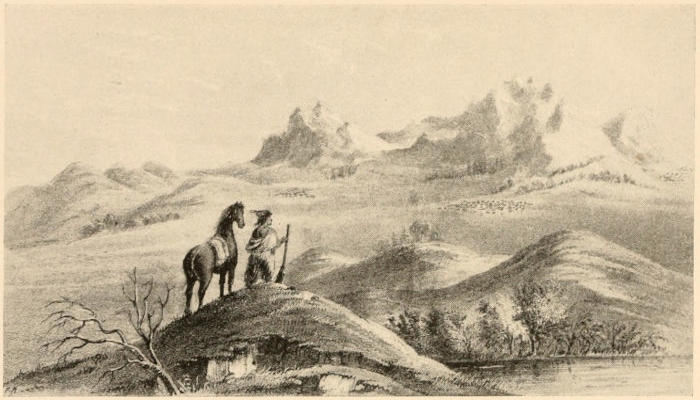
Buffalos discovered
After the dance, the master of ceremonies serves up
the repast to the guests, seated in a circle. The food
consists of dried buffalo meat and boiled maize, served
in wooden plates, filled to the brim. Each one is bound
to empty his plate, even should he expose himself to the
danger of death from indigestion. The president offers
a portion of the meat and maize to the Great Spirit, and
places it accordingly upon the ground, and he then makes
a similar offering to one of the buffalo heads, which is
supposed to be a party to the feast. At length, while
each one occupies himself with doing honor to his plate,
one of the chiefs of the band rises up and announces to
all the guests that the Master of life dances with him,
and that he accepts the calumet and the feasting. All
the band reply: “Néva! Néva! Néva!” This is the
first condemnation.
{365} The repast ended, they again dance, after which the
calumet is lighted the second time; and, as in the former
instance, is offered to the Master of life and to the buffalo
heads, upon which, the lodge again resounds with the
triple cry, “Néva!” This last dance condemns, without
appeal, the unfortunate victim whose immolation is invoked.
After all their grotesque dances, their cries, their chants
and their vociferations, the savages, preceded by the
musicians, go out of the lodge, to present the sacred calumet
to the buffalo heads placed on the tops of the lodges
of the village, each of which is ornamented with from
two to eight heads, preserved as the trophies of their skill
in the chase. At each puff the multitude raise a furious
cry, for now the whole village joins in the extraordinary
procession. They stop before the lodge of the Sioux
girl, and make the air resound with the horrible imprecations
against their enemies and against the unfortunate
and innocent victim, who represents them on the present
occasion. From this moment she is guarded by two
old satellites, whose office it is to beguile her from the least
suspicion that she is the victim for the coming sacrifice;
and whose duty it also is to entertain {366} her upon the
great feast, they prepare on the occasion in her honor,
and that she may be well fed in order to appear more
beautiful and fat, and thereby more agreeable to the Master
of life. This ends the first day of the ceremonies.
On the second day, two old female savages, with dishevelled
hair, their faces wrinkled and daubed with black and
red paint, their naked arms and legs tattooed, barefooted,
and with no other dress than a deer-skin petticoat, extending
down to the knee—in a word, two miserable-looking
beldams, capable of striking terror in any beholder,—issue
from their huts with pipes in their hands, ornamented with
the scalps which their husbands have taken from their
unhappy enemies. Passing through the village, they
dance around each akkaro, solemnly announcing, “that
the Sioux girl has been given to the Master of life by
wise and just men, that the offering is acceptable to him,
and that each one should prepare to celebrate the day
with festivity and mirth.” At this announcement, the
idlers and children of the village move about and shout
with joy. They then, still dancing, re-conduct the two
old squaws to their huts, before which they place their
pikes as trophies, and enter.—All then {367} return to
their own lodge, to partake of the feasts of their relatives.
About ten o’clock in the morning of the third day, all
the young women and girls of the village, armed with
hatchets, repair to the lodge of their young and unhappy
captive, and invite her to go into the forest with them
to cut wood.—The simple-hearted, confiding child, accepts
their malicious invitation with eagerness and joy, happy
to breathe once more the pure air.—They then give her
a hatchet, and the female troop advance towards the place
marked out in the dance, making the forest resound with
shouts of joy. Atipaat, an old squaw who conducted
them, designates, by a blow of the hatchet, the tree which
is to be cut down. Each then gives it one blow, after
which the victim approaches to complete the work. As
soon as she commences what seems to her but pastime,
the whole crowd of young furies surround her, howling
and dancing. Unconscious that the tree is to supply
the wood for her own sacrifice, the poor child pursues
her work as if a great honor had been reserved for her.—Atipaat,
the old woman, then fastens to her the ashki[353]
with which to draw the wood.
{368} The troop then lead the way towards the village,
dancing as they pass along, but giving the hapless victim
almost no assistance in dragging her load. An innumerable
multitude attend them to the place of sacrifice, and
receive them with loud acclamations. They there relieve
her of her burden and again place her in the hands of the
guards, who, with voices harsh and quivering, chant the
great deeds of their younger days and re-conduct her
to her lodge. In the meantime the whole band assist to
arrange the wood between two trees, after which they
immediately disperse.
On the morning of the fourth day, before sunrise, a
savage visits all the lodges to announce to each family,
in the name of the Master of life, that they must furnish
two billets of wood about three feet long for the sacrifice.
Then thirty warriors issue from their lodges, decked
in all sorts of accoutrements; their heads adorned with
deer and buffalo horns, with the tails of horses and the
plumes of the {369} eagle and heron, interwoven with
their scalp-locks, while the tails of wolves and wild cats
stream from various parts behind, as the wings of Mercury
are represented, with pendants hanging from their noses
and ears, so elongated by the weight of the ornaments
suspended to them, that they float about and strike against
their shoulders.—Glass beads, or necklaces of brass or
steel adorn their necks, while highly-ornamented deer-skin
leggins and curiously-painted buffalo-skins, negligently
thrown over their shoulders, complete their grotesque
habiliments. Thus accoutred they present themselves
at the hut of their captive, who is already adorned with
the most beautiful dress their fancy can devise, or the
materials at their command produce. Her head-dress
is composed of the feathers of the eagle and swan, and
descends behind in gracefully waving curves, even to the
ground. Her person is properly painted with red and
black lines. A frock of deer-skin descends to the knee,
while a beautiful pair of leggins extend from thence to the
ankle. A pair of moccasins garnished with porcupine
quills, pearl and glass beads, are on her feet. Pendants
hang from her ears and nose, a necklace ornaments her
neck, and bracelets her arms; {370} nothing was spared
that could add to her beauty.
Tranquillity and joy distinguishes her as she approaches
the grand feast, which she has been made to believe her
kind guardians have prepared to honor her. At the first
cry of the warriors, the poor child comes out of the hut
and walks at the head of her executioners, who follow
in single file. As they pass along they enter into all the
huts, where the most profound silence and the utmost
propriety reign. The Sioux girl walks around the fire-place,
her followers do the same, and, just as she leaves
the lodge, the principal squaw gives her two billets of
wood, which the unconscious victim gives in her turn
to each of the savages. In this manner, when she has
been made to collect all the wood to serve for her immolation,
she takes her place in the rear of the band, joyous and
content that she has had the happiness to contribute to
the pleasure of her executioners; after which they again
restore her to her two guards, to be presented with her
last repast, which consists of a large plate of maize.
All now wait in anxious expectation to witness the
last scene of the bloody drama. The whole village is in
commotion. Everywhere {371} the warriors, old and young,
may be seen preparing their murderous arrow, as upon
the eve of a battle. Some practice shooting at a mark;
the more barbarous, thirsting for the blood of their enemies,
encourage and instruct their children in the use
of the bow and arrow, and what part of the body they
ought to strike.—The young women and girls devote
themselves to clearing away the brushes and preparing
the place of sacrifice, after the accomplishment of which,
they employ themselves during the rest of that day and
night in polishing their necklaces, pendants and bracelets,
and all the other ornaments in which they wish to appear
at the great feast.
On the fifth day, an aid-de-camp of Lechartetewarouchte,
or the chief of sacrifice, ran through the village to
announce, in the name of his master, the necessity of
preparing the red and black paint, which is to serve for
the grand ceremony. It is vain to attempt to give you,
my dear sir, an adequate description of this personage,
either as regards his costume, his figure, or his manner;
it is everything that a savage can invent of the fantastic,
the ridiculous and the frightful, united in one person.
The collector of colors himself scarcely yields {372}
to his comrade in monstrosity. He has the appearance
of one, truly, just escaped from the infernal regions. His
body is painted black, which, contrasted with the whiteness
of his teeth and of his huge eyes, and with his hair
besmeared with white clay, and bristling like the mane of
a lion, gives him an aspect terrible and ferocious in the
extreme. At each heel is fastened the tail of a wolf, and
on his feet a pair of moccasins made of buffalo skin, with
the long shaggy hair on the outside. He passes through
the whole village with a measured step, holding a wooden
plate in each hand. He enters the huts successively,
and, as he approaches the fire-place, he cries aloud: “The
Master of life sends me here.” Immediately, a woman
comes and empties into one of his plates either some red
or some black paint, which she had prepared. Upon
the reception of which, he raises his eyes to heaven, and
with a loud voice says: “Regard the love of thy children,
O Tirawaat! However poor, all that they possess is thine,
and they give it to thee. Grant us an abundant harvest.
Fill our hunting-grounds with buffaloes, deer, stags and
antelopes. Make us powerful against our enemies, so that
we may again renew this great sacrifice.” {373} Each one
replies by the usual exclamation: “Néva! Néva! Néva!”
After the return of the collector of colors, and before
sunrise, the last scene commences. Men and women,
boys and girls, daub themselves in all the colors and forms
imaginable. They deck themselves in whatever they
possess which in their estimation is either beautiful or
precious—pearls, beads, porcelain collars, the claws
of the white bear, (this is in their view the most costly and
valuable decoration) bracelets and pendants; nothing is
forgotten on this occasion. They ornament their hair
with the feathers of the heron, and of the gray eagle, a
bird superstitiously venerated by them. Thus equipped
for their sortie, they listen attentively for the first signal
to the sacrifice.
While these preparations are in progress, the Tewaarouchte,
a religious band of distinguished warriors, known
in the procession by the down of swans upon their hair
or upon the tops of their heads, and by their naked bodies
painted in red and black lines, follow the braves of
the nation armed with their bows and arrows, which are
sedulously concealed beneath their buffalo robes. Thus
they approach the lodge where the unconscious victim
awaits, as she thinks, {374} the happy moment for the
festivities given in her honor, to commence. She is now
delivered into the hands of her executioners, dressed in the
beautiful costume of the previous day, with the addition of
a cord tied to each ankle. The poor child is all interest
and in a kind of impatience to participate in the grand
festivities. She smiles as she looks round upon the most
cruel and the most revengeful enemies of her race. Not
the slightest agitation, fear, or suspicion, is visible in her
manner. She walks with joy and confidence in the midst
of her executioners. Arrived at the fatal spot, a frightful
presentiment flashes across her mind. There is no one
of her own sex present. In vain do her eyes wander from
place to place, in order to find the evidences of a feast.
Why that solitary fire? And those three posts, which
she herself drew from the forest, and which she saw
fastened between two trees, and those swarthy figures of
the warriors, what can they mean? All, all indicate some
dreadful project. They order her to mount the three
posts. She hesitates, she trembles as an innocent lamb
prepared for the slaughter. She weeps most bitterly
and with a voice the most touching, such as must have
broken any other hearts than those of these {375} savage
men, she implores them not to kill her. With a persuasive
tone they endeavor to convince her that their intention
is not to injure her, but that the ceremonies in which
she participates are indispensable before the grand feast.
One of the most active of the savages unrolls the cords
tied to her wrists and assists her to mount to the post.
He passes the cords over the branches of the two trees,
between which the sacrifice is to be made.
These are rendered firm by the powerful arms of the
other savages, and her feet immediately fastened to the topmost
of the three posts, which she had unconsciously
cut and drawn to the fatal spot. On the instant all doubt
of their intentions vanishes from her mind. The savages
no longer conceal from her their frightful project. She
cries aloud, she weeps, she prays; but her supplications,
her tears and her prayers are alike drowned in the melée,
and cry of their horrible imprecations against her nation.
Upon her innocent and devoted head they concentrate
the full measure of their vengeance, of all the cruelties,
of all the crimes, of all the injustice and cruelty of the
Sioux, which may have taken place in their most cruel
and protracted {376} wars, and which from time immemorial
had been transmitted from father to son, as a precious
heritage of vengeance and resentment. In a manner
the most furious and most triumphant they exult with
leaping and howling, like wild beasts, around their trembling
victim. They then despoil her of all her ornaments
and of her dress, when the chief of the sacrifice approaches
and paints one-half of her body black and the other half
red, the colours of their victims. He then scorches her
armpits and sides with a pine-knot torch. After these
preparatory rites, he gives the signal to the whole tribe,
who make the air resound with the terrible war-cry of the
Sassaskwi. At this piercing cry, which freezes the heart
with terror, which paralyzes the timid and rouses the
ardor of the brave, which confounds the buffalo in his
course, and fills the bear with such fear as to take from
him all the power of resisting or fleeing from his enemies,
the savages, impatient and greedy for blood, issue from
their dark lodges. Like a terrific hurricane they rush
headlong to the fatal spot. Their cries, mingled with the
noise of their feet, resemble the roar of thunder, increasing
as the storm approaches. As a swarm of bees surround
their queen, these Pawnee savages {377} encompass the
Sioux child—their trembling victim. In the twinkling
of an eye, their bows are bent and their arrows adjusted
to the cords. The arrow of Lecharitetewarouchte,
or chief of the sacrifice, is the only one which is
barbed with iron. With this, it is his province to
pierce the heart of the innocent Dakotha. A profound
silence reigns for an instant among the ferocious band.
No sound breaks the awful stillness save the sobs and
piteous moans of the victim, who hangs trembling in the
air, while the chief of the sacrifice makes a last offering
of her to the Master of the universe. At that moment
he transfixes her through the heart—upon the instant
a thousand murderous arrows quiver in the body of the
poor child. Her whole body is one shapeless mass, riddled
with arrows as numerous as are the quills upon the back
of the porcupine.
While the howling and the dancing continue, the great
chief of the nation, mounting the three posts in triumph,
plucks the arrows from the dead body and casts them
into the fire. The iron-barbed arrow being the only one
preserved for future sacrifices. He then squeezes the
blood from the mangled flesh, upon the maize and other
seeds, which stand around in baskets ready {378} to be
planted; and then, as the last act of this cruel and bloody
sacrifice, he plucks the still palpitating heart from the
body, and, heaping the fiercest imprecations upon the enemies
of his race, devours it amidst the shouts and screams
of his people. The rite is finished. The haughty and
satisfied savages move away from the scene of their awful
tragedy; they pass the remainder of the day in feasts
and merriment. The murdered and deformed body
hangs where it was immolated, a prey to wolves and carnivorous
birds. I will end this painful tragedy, by giving
you an extract of a former letter.
“Such horrid cruelties could not but bring down the
wrath of Heaven upon their nation. As soon as the report
of the sacrifice reached the Sioux, they burned with the
desire to avenge their honor, and bound themselves by
oaths that they would not rest until they had killed as
many Pawnees as their innocent victim had bones or joints
in her body. More than a hundred Pawnees have at
length fallen under their tomahawks, and their oaths
have since been still more amply fulfilled in the massacre
of their wives and children.
“In view of so much cruelty, who could mistake the
agency of the arch enemy of mankind, {379} and who
could refuse to exert himself to bring these benighted
nations to the knowledge of the One only true Mediator
between God and man, and of the only true sacrifice
without which it is impossible to appease the Divine
justice?”
With sentiments of respect and esteem,
I remain, my dear sir, yours, &c.
Peter J. De Smet, S. J.
To-day, 17th August, we pitched our tents upon the
borders of a winding stream, in the heart of a wild, mountainous
country, whose deep ravines and gloomy caverns
are well suited for the dens of wild animals. Great as
our expectations were of finding here abundance of game,
they were not deceived. In less than an hour our hunters
killed as many as twelve bears. During the night, an
event of a far more serious nature occurred. The sudden
firing of a gun roused us from slumber. Every warrior
was on the alert; that shot could have proceeded from
no hand save that of a “Black-Foot!” We looked at
one another in silent anticipation. Who, then, had been
the sufferer? The painful question was quickly answered.
It was the {381} poor widow Camilla, one of the Sinpoil
tribe.[354] The ball had passed through her throat, and she
expired without a groan! Happily, her soul was ripe for
Heaven. From the period of her first communion, she
had never passed a Sunday without approaching the holy
table, nor was her baptismal robe sullied by the slightest
stain. The funeral obsequies were performed on the
banks of Yellow-Rock River,[355] because that spot was
better suited than any other to conceal her sepulchre from
the avaricious Black-Foot assassin. All things work together
for good to them that love God; this death, terrible,
indeed, in the sight of men, but precious in the eyes of
the Lord, became the source of a good work. The murdered
woman left two daughters, both very young; had
her life been spared, she would not, perhaps, have been
able to shield their innocence from the dangers to which
it would have been exposed; but, now, they were immediately
adopted by Ambrose, chief of the Flat-Heads, and
father of a numerous family; in his noble heart, charity,
piety, and confidence in God, go hand-in-hand with his
courage.
At the distance of a few gun-shots from Yellow-Rock,
the buffaloes made their appearance. {382} One of them
plunged into the river to avoid the death which threatened
him, swam rapidly down the current, then suddenly tacked
about to escape his pursuers; and, finally, exhausted
by his efforts, unable longer to contend with his fate,
came out of the river, and stretched himself upon the
turf at the entrance of our camp, where his presence
caused no other mischief than that of exciting the
mirth of the women and children.
Farther on, two bears were seen making their way
through the bushes. The young people, who were the
first to perceive them, announced their discovery by loud
yells. Immediately, a Black-Foot, a friend of the Flat-Heads,
sprang forward with the intention of giving the
first blow to the common enemy; but the sagacious animal,
anticipating his design, rushed from his lair, and fastened
his enormous claws on the uplifted arm of the young
Indian, whose situation would have been desperate, had
not a Flat-Head come to his assistance. A few days after,
another converted Black-Foot, finding himself in the same
circumstances, and wishing to show that he knew better
than his comrade how to kill bears, went {383} about it
in the same manner, and shared the same fate; a punishment
which his temerity richly deserved.
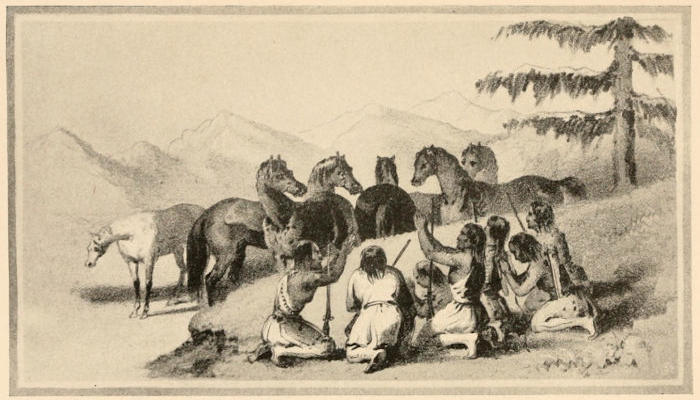
A Prayer for success in hunting.
Whilst we were encamped in this place, several chiefs
of the Corbeaux tribe came to visit the Flat-Heads, accompanied
by the flower of their young warriors. They
spoke with enthusiasm of the visit their nation had received
from a Black-gown in 1842, and expressed great desire
for the time to come when they, like the Flat-Heads,
would enjoy the privilege of having Black-gowns always
with them, to instruct them in heavenly things. They
still observe the superstitious practices of the calumet.
To render the odor of the pacific incense agreeable to
their gods, it is necessary that the tobacco and the herb
(skwiltz), the usual ingredients, should be mixed with
a small quantity of buffalo’s dung, and that the great pipe,
after having gone round the lodge, should re-commence
the circuit as soon as it arrives at the opening, without
which ceremony they imagine it would be useless to smoke
with their brethren, or incense, as they do, the heavens,
earth, four cardinal points, and medals of Washington
and Jackson.
Nothing but misfortunes could await them. {384}
Whilst they remained with us, we buried a Pend-d’Oreille
Indian, who had died shortly after baptism, strengthened
by all the sacraments of the church. This ceremony,
which was performed with more than ordinary pomp
in honor of the visitors, was concluded by the solemn
erection of the cross on the grave of the deceased. May
the remembrance of these last duties paid to a departed
child of the church, increase in the hearts of the Corbeaux
the desire of knowing Him, without the knowledge of
whom there is no salvation. The following day they
returned to their own camp.
The Pierced-Noses were now on their way to their
own country; the Flat-Heads, on the contrary, were still
in pursuit of game; for, although the season was far advanced,
they had not yet commenced to lay in their winter
provisions. Early the following morning, we struck our tents
and resumed our march. We had not proceeded far, when
our attention was attracted by a herd of buffaloes quietly
feeding in the beautiful valley at our feet. They were
so numerous, that each of the hunters killed several.
The slaughter of these animals was but the prelude of
that which was to take place on the following days. Our
hunters brought in {385} game in abundance. On one
occasion, they returned laden with the spoils of 344 fat
cows. We encamped in the very heart of the Black-Foot
territory, yet the howling of wolves and bears, calling one
another to their nocturnal repast, was the only sound
that disturbed our repose. The hunting season is a time
of rest for the missionary, of intimate union with his God,
of renovation for his soul! It was in this spirit I received,
with humble gratitude, the short but severe illness with
which I was visited at this period. I regarded it, likewise,
as sent me in punishment for the too natural pleasure
I felt in contemplating the strange and varied scenes by
which I was surrounded. During our encampment in
this spot, I had the consolation of baptizing ten adults.
An unexpected fall of snow warned us that it was time
to think of our return. The chief accordingly gave orders
for all to be in readiness to set out the following day.
The weather was clear, but intensely cold; and, suffering
as I still was, from the effects of my recent illness, I had
great difficulty in supporting its severity. We were, however,
soon cheered by milder days, and warmer sunshine.
Our young hunters were, once more, all animation. The
pleasures {386} of the chase were resumed as far as the
good order necessary for the homeward march would
permit. Even the children caught the general spirit,
and bounded off in pursuit of some smaller animal, which
the elated winner of the race never failed to bring back
on his shoulder.
We were now entering the defile where we had before
met with such brilliant success. At almost every step
we fell in with some straggler. At one time, an old
decrepit buffalo; at another, a fat cow, and sometimes
a playful calf, whose dam had already fallen a victim.
These animals were an easy prey, and their capture was
a new source of sport for the boys.
On the 28th I retired to the summit of a neighboring
mountain, to read the vespers of St. Michael. The atmosphere
was unusually serene; not a sound disturbed
the silence of nature. I gazed on the quiet beauty of
the scene, hushed, as it were, in the presence of God,
and my heart dilated at the thought of the thousands of
unconverted Indians, buried in the darkness of idolatry.
Full of these thoughts, I raised my eyes, and, excited as
my imagination was, it seemed to me that I beheld the
archangel, Michael, standing on the opposite mountain,
exclaiming, “Deluded nations! Who is {387} like unto
God?” The voice resounded through the forests—it
was echoed by the deep ravines. I fancied it was heard
and understood by the wild children of the woods; their
responding shouts rung in my ear. Yielding to the
enthusiasm of my feelings, I hastily quitted my elevated
position, and erected a wooden cross on the summit of
a neighboring eminence. Some days after, a hunter
discovered, near the half-consumed embers of an extinguished
fire, a similar cross, to which a banner was attached.
My first thought was, that it had been planted there by
some Catholic, who had lost his way in the forest, and
been devoured by the wolves. The Flat-Heads, however,
well acquainted with the practices of their ancient
foes, the Black-Feet, informed me that it was a custom
among them to erect these crosses to the moon, in order
to render her favorable to the robbery or chase, in which
they were about to engage. This information dispelled
the pleasing fancies in which I had indulged; and
painfully reminded me that the God-Saviour is yet
far from being adored in these wild abodes. May we
not hope that the time will yet come, when the banner
of the true cross will wave triumphant o’er this benighted
land!
{388} The obstacles which have hitherto prevented
the missionaries from penetrating into the Black-Feet
territory are now beginning to disappear, and there is
every prospect of our soon being able to commence the
glorious work of their conversion.
The next day we entered a mountain pass, where the
foot of man had seldom trodden, as was proved by the
fact, that fifteen beavers were taken in one night by three
hunters. After following for some time the circuitous
windings of the ravine, we came to an ascent so slippery,
that at every instant I was in anticipation of some sad
catastrophe. Presently a sumpter-horse missed his footing
and fell, rolling down the precipice. Who, that had seen
him fall from rock to rock, would ever have thought,
that in a few minutes he would be journeying on, laden
as before! Without uttering a single word, the guide
made her way through the deep snow to the spot where
the poor animal lay, unloaded him, raised him from the
ground, replaced his burden, and brought him back to
the rear of the troop.
We continued our route until sunset, along the mountain’s
summit; at length, after a forced march of ten
hours, we pitched our tents on a {389} beautiful island,
where we enjoyed both security and repose. Surrounded
by the waters of the Missouri, and abounding in rich
pastures, this charming spot seems, as it were, destined
by nature as a place of rest for the wearied traveller.
It would have been impossible to contemplate without
admiring the loveliness of the landscape. From the
southern coast of the river arose a ridge of mountains,
whose varied colors of blue, red, green, and yellow, gave
them a striking appearance; the effect of which was
heightened by a small stream, leaping from rock to rock,
in the form of a cascade, cooling the parched ground,
insinuating itself into the crevices of the rocks, and giving
birth to an infinite variety of creeping plants, and flowering
shrubs.—The island itself is beautiful beyond description.
The scenery is diversified by groups of the majestic buttonball,
which, in this country, is the giant of the vegetable
kingdom. It was under the shade of one of these noble
trees that our hunters prepared to celebrate the feast of
the Maternity. The sun’s last rays had long disappeared
beneath the horizon, ere all was ready for the evening
prayer. After which, notwithstanding the fatigues of
the day, a large {390} fire was kindled before my tent,
and the greater part of the night consecrated by these
fervent children of the woods, to the reconciliation of their
souls with God. The following day the Holy Sacrifice
was celebrated with as much solemnity as the circumstances
would permit. Of the ninety persons who then
approached the table of the Lord, there was not one, who,
since the departure from St. Mary’s, had not communicated
every month. Several had enjoyed that happiness
each week. During the evening office nothing particular
occurred. The eve of my departure the mothers brought
their young children to receive my blessing; and the chiefs
erected a cross in token of their gratitude for the favors
received during the hunting season. To this latter circumstance
the island is indebted for the beautiful name of
St. Croix.
The following day I bade farewell to my dear neophytes;
and, after joining in prayer with them for the last time,
I set out on my return to St. Mary’s.
N. Point, S. J.
BY REV. P. N. POINT
We shall see what gave occasion to these remarkable
words uttered by thirty-seven Black-Feet, who had fallen
into the hands of the Flat-Heads.
It is rare, at present, to find any Black-Feet, even among
the most vicious tribes, who are not convinced that the
Black-gowns desire their happiness.
The following observations clearly prove my proposition:
1, the kind reception they gave the Black Robe
who was taken by sixty of their warriors: 2, the attention
with which they listened to the Rev. Mr. Thibault, a
Canadian priest, who fell in with a large company of them
at Fort Augusta,[356] on the River Sascatshawin: 3, sending
back to St. Mary’s, a horse belonging to a Flat-Head
missionary; a circumstance {392} hitherto unheard of,
in the relations of the Black-Feet with the Flat-Heads;
4, the confidence which several have manifested in the
missionaries, on many remarkable occasions; 5, the smoking
of the calumet in the plain of the Great Valley, with a
small number of Flat-Heads whom they might have killed
without difficulty; 6, the amicable visits they have paid the
Flat-Heads by the persuasion of the hoary chief Nicholas,
(baptized,) and the habitual residence of several of the
tribe at the village of St. Mary’s; 7, the plunder of horses
is incomparably more rare than during the preceding
years; 8, the four years’ cessation of any serious attack;
though, formerly, not a hunting party passed without a
sanguinary battle with the Flat-Heads. In proof of this,
remember the sixty-five battles of old Paulin. If we add
to all this, the providential and admirable circumstance
which occurred during the chase, and which we purpose
relating, surely, it may be permitted to form the brightest
prospects relative to the religious conquest of this numerous
tribe; and I sincerely hope that an occurrence, which
lately took place at St. Mary’s, will contribute much to
realize my desires.
{393} The 2d or 3d February, during the night, the
dogs barked—a pistol-shot was heard—a mournful
silence ensues! A thief, doubtless, had been wounded.
The following morning, marks of blood could be traced
as far as the river, which led to the conclusion that the
robber had perished in the waves; but, three days since,
George Sapime, whilst duck-shooting, found the suffering
being among some bushes, so exhausted by loss of blood
that he could scarcely stand. George might easily have
despatched him on the spot, according to the savage custom;
but he thought it better to return to the village and take
counsel as to what seemed most expedient to be done with
the hapless desperado. At this intelligence, numbers
of Indians mount their horses and gallop off, full armed,
to the spot indicated. Whilst this was being transacted,
the incident was related to Father Mengarini. Pelchimo
and Ambrose, two really brave Flat-Heads,[357] who communicated
the intelligence, thought it base to kill a dying
man. The zealous missionary conceived an ardent desire
to secure the salvation of the culprit, by pouring on his
soul the saving waters of regeneration. Pelchimo, seconding
the good design, flies to the place, and arrives at the
very instant when the {394} pistols were cocked to terminate
the prisoner’s existence. “Stop!” vociferates the feeling
Pelchimo. At this word the execution is suspended,
and an hour after, the Black-Foot enemy and robber is
tended, in the chieftain’s lodge, with all the kindness that
could be lavished on a noble and much-loved sufferer.
Father Mengarini, after having dressed his wounds,
spoke to him of God, and his judgments: the sick man
answered, that it was the first time he had heard these
great truths. Such a reply, made the father cherish the
hope of saving his soul; and, also, of contributing, by means
of this man, to the designs of mercy, which, it seemed,
the Almighty God had towards this terrible nation.
“Brethren,” said he, addressing the assembled chiefs,
“during four years the Black-gowns have been among
you, and each day have they spoken to you of God. You
know well that His divine Son not only died on the cross
for all men, but even pardoned his enemies, and prayed
for his executioners, to teach us how we should act in the
like occasions. An enemy has fallen into your hands—remember,
he has a soul like yours, redeemed by the
blood of Jesus Christ, and destined to sing eternally
the divine mercy of your Saviour! {395} What shall be
done with this man? Is he to live, or must he die?”
“Let him live,” answered every tongue. Overjoyed to
find their hearts so replete with compassion, the Black-gown
was expressing his satisfaction to the assembled
tribe, when he was told that some obscure savages,
of a different tribe, were not of the same opinion as
the generous chieftains who surrounded him. This
information induced the father to take a different tone;
and addressing the murmurers, he thus spoke: “Brethren!
when we pardon a foe, we imitate the ordinary conduct
of God towards men. Who, among you, has not sinned
during his life? And how often has God forgiven you?
If, instead of forgetting your multiplied offences, the
Almighty had placed your souls in the power of your
infernal enemy, what would now be your fate? But no;
God has not treated you thus; he has sent his ministers
among you,—numbered you among his children, and
promised heaven to your fidelity and compassion for the
unfortunate; and who knows, if this signal favor may not
depend on the generosity you exercise towards your enemy?
The blood of Jesus Christ pleads for mercy in his behalf.
Already have your chiefs pronounced his pardon. Will
you imitate their {396} noble conduct? Ah! if you refuse,
take your knives and bury them in your enemy’s heart!
But, from that instant, call not God your Father; cease
saying to Him: ‘forgive us our trespasses as we forgive
those who trespass against us;’ for, our Common Father
might hear your prayer, but, it would be for your eternal
reprobation.” This brief but energetic appeal caused
such sensation throughout the auditory, that every one
approved the first decision. From that moment the entire
village of St. Mary’s, with the exception of a few malicious
hearts, shared in the generous sentiments of the Flat-Head
chiefs. Selpisto, a chieftain of the Pends-d’Oreilles,
happened to be, at this time, at St. Mary’s. He took the
Black-Foot under his protection, and when he recovered
from his wounds, loaned him a horse to return to his
country; and he even redoubled his attention at the moment
when he received the news that one of his sons had fallen
a sacrifice to the Black-Feet. When the youth was met
by his enemies, he was returning in triumph to St. Mary’s,
with the horses recently stolen from the village. His
bravery had forced the robbers to return them; this circumstance
rendered his loss a still greater affliction to his
family. The return of the Black-Foot, so {397} honorably
dismissed, and the relation he gave the tribe of the mercy
exercised towards him, caused his nation to look upon the
Flat-Heads in a different light. “I am very glad,” wrote
Father Mengarini, “that this affair terminated amicably.
I trust that the future will prove, that the Almighty, after
having exercised mercy towards this unfortunate sinner,
has also particular graces in reserve for this perfidious
and benighted nation, which I hope, is destined to receive
the light of the gospel. Should any fathers be named to
this mission, I should be too happy to be of their number.”
To whom are the Black-Feet indebted for a change
so consoling, both to religion and humanity? Next to
Almighty God, we may safely say, they owe it to the
admirable conduct of the Flat-Heads, especially since
the residence of the missionaries among the tribe. Some
remarkable instances of virtue were exhibited during
the hunting season.
On quitting St. Mary’s our pious neophytes added
some short invocations to their morning and evening
prayers; 1, to the Heart of Jesus, as protector of the men’s
confraternity; 2, to the blessed Virgin, patroness of the
women’s sodality; 3, to St. Michael, model of the brave;
{398} 4, to St. Raphael, the guide of travellers; 5, to St.
Hubert, the patron of hunters; 6, to St. Francis Xavier,
for the conversion of idolaters. We shall see, that these
pious aspirations were not addressed to Heaven in vain.
The eve preceding the anniversary of St. Francis
Xavier’s canonization, the missionary administered baptism
to a Black-Foot, whose example induced many others
to solicit the like favor. The reception of the holy sacraments
of penance and eucharist, was very frequent. There
were 430 confessions, (children included), 350 communions,
103 of which took place the last Sunday. Only
one person was left, in the camp; he having recently made
his first communion, did not renew it during the chase;
whereas, his companions approached two or three times,
and some, even more frequently. The pious practice of
saying the Angelus, reciting the Rosary, and singing canticles,
was maintained throughout the camp. The chiefs
displayed their zeal for every species of good; an unalterable
patience was the distinguishing virtue of all, and this
is saying much, if we consider the trials attending the
hunting season. Their resignation to the Divine will,
was strongly manifested. During twenty-four days they
had {399} been toiling onwards, undergoing much suffering
from a rigorous abstinence, when the news was spread
that a herd of buffaloes had been seen in the environs.
The Indians repaired thither, but it was to encounter a
keen disappointment. Thus, the poor Flat-Heads found
themselves constrained either to fast or seek food in the
country of the Black-Feet. As their horses were in a better
condition than those of the other tribes, they resolved to
risk the dangerous expedient. Four days they traversed
heights and floods: the weather was cold and snow lay
on the ground; no animals were to be seen. At last, on
Wednesday in Ember-week the missionary warned his little
flock that the moment was propitious for addressing Heaven
to implore the goods of earth; but, he added: “if you wish
the Divine bounty to shed on you His gifts, you must
promise not to abuse them.” His words were attended to
with deep emotion, and each savage, according to the Indian
expression, “Arranged his heart and began to pray.” The
next morning, (Thursday), herds of cattle were seen in
the neighborhood; and on Friday and Saturday so many
were killed that their great number encumbered the lodges.
Already was the camp on its homeward {400} march,
when, 12th March, the chief, reaching the top of a mountain
which commanded an extensive view of the plain, suddenly
stopped—and after gazing fixedly for some time,
discovered moving objects at the verge of the horizon.
At first, those around him imagined they saw buffaloes;
next, they fancied they could discover a herd of deer; the
final conclusion was, that an armed party of Black-Feet
rapidly approached them. What was to be done? Victor,
the chief, lost nothing of his usual presence of mind. He
calmly quitted the head of the camp, mounted his horse,
and making the animal perform a few evolutions, he was
instantly surrounded by the bravest of his band. Isaac
proposed prayer.—Victor exclaimed: “Let us wait until
the Black-Feet show themselves yonder.” Saying these
words, he pointed out a second mountain which concealed
us. Never had any position offered more advantages.
The Black-Feet were climbing the opposite side—they
were already fatigued. Between the mountain and the
chain which crowned the horizon extended an immense
plain, without either tree, ravine or river that could
offer them the least rampart. They were but thirty-seven
in number, newly exercised in arms, and on foot. The
Flat-Heads, on {401} the contrary, were on horseback,
numbered fifty, in the flower of age, all well armed and
conducted by chieftains whose shadow would put to flight
more enemies than were now approaching. Besides,
Victor was at their head; he who had never been conquered,
and what is more, not even wounded, though six different
times he had been encompassed by the Black-Feet. The
marked protection of Heaven had thus manifested itself
in his favor!
The enemy, then, could not escape them. All eyes were
strained towards the spot indicated by the chief, expecting
the approach of the foe. Victor judges that there is “periculum
in mora;” he casts a smiling look on the missionary,
raises his fire-arms, utters a yell, urges on his steed, and flies
to the combat, followed by the bravest of the land. Perceiving
their approach, the Black-Feet took to flight, casting
away all that embarrassed them; but beholding themselves
hemmed in on all sides, they endeavoured to rally; the
Flat-Heads hasten towards them; Victor’s horse having
been lately wounded, Fidele, Ambrose, Isaac, Ferdinand,
and Emanuel, passed their chief, and arrived first in front
of the enemy. Fidele spoke not; but his warrior name,
signifying Thunderbolt, sufficiently {402} declared his courage.
Ambrose announced him by that title, which causes
the Black-Feet to turn pale, and added, in a terrible
voice: “Fire not! If you fire you are dead men!” God
spoke by his lips. Instead of firing, one of the Black-Feet
threw down his gun, whilst several others extended
their arms, in a supplicating attitude. The brave Ambrose
refused not the pardon his enemies solicited; for true
courage will never bathe itself in the blood of a conquered
foe, who appeals for mercy, and whose conversion has
been begged of Heaven. The generous warrior willingly
extends his hand to the foe; and all, imitating his example,
show that clemency has conquered. At this happy moment,
when such Christian sentiments pervaded every heart, the
Black-gown advanced, and the conquered foes offered him
their hands, and, spreading a buffalo-skin on the snow,
invited him to seat himself, and receive the honors of the
calumet. Whilst the smoke of peace ascended towards
heaven, presents were offered, and received, on both sides.
The oldest of the Black-Feet band, seated on the left of
the missionary, presented him a pair of Indian moccasins,
and, strange to say, they were embroidered, with a blue
cross standing out conspicuously {403} from the surrounding
work. The poor idolater! did he, at that moment,
think of the “quam speciosi pedes?” Most probably
not; but, it is certain, he remarked the pleasure caused by
his present, and felt an assurance, from the manner in which
it was received, that, henceforward, all hearts would be
united.
The Flat-Head camp set out on their return. The thirty-seven
Black-Feet followed them. The thawing of the
snow rendered the roads exceedingly bad, and the kind-hearted
Flat-Heads, compassionating the fate of their new
friends, did all they could to help them on their journey.
Before separating, Victor conducted the principal Black-Feet
into the missionary’s lodge, that he might witness
their parting good friends; and, during half an hour, every
thing was said that could strengthen the new-formed
friendship between the tribes. The Black-Feet told us,
that for some time past they had been expecting a Black-gown,
and that, when he should come among them, he
would be well received; that, henceforth, they and the
Flat-Heads would live like brothers; “that the prayer
of the Flat-Heads should be theirs.” And, although
the sun had set, they assisted at prayers; after which,
{404} they exchanged some tokens of friendship, and left,
declaring that they were going to persuade their village
to act as they had done.
The 19th March, feast of St. Joseph, seven days after
the pardon so generously granted the Black-Feet, Heaven
bestowed on us the fruit of our forbearance in the amicable
visit of the grand chief of the “Petite Robe, Itchetles
Melakas—or the three crows.” All the chiefs smoked
with him under the missionary’s tent. Ambrose explained
to him the Catholic Tree; Victor invited him to pass the
night in his lodge. Such attention completely gained
his heart; and the next morning the Black-Foot communicated
to the missionary the resolution he had formed of
soliciting the admission of his twenty-eight lodges among
the Flat-Head tribe; and that he would repair to the village
of St. Mary’s for that purpose, towards the decline of the
present moon.
During the night of the 19th some of the Black-Feet,
belonging to a distant tribe, stole into the camp of the
Flat-Heads and carried off five horses; but one of the robbers
fell, pierced with balls, and two strokes of the knife.
It would be difficult to describe the horrors of that night!
the {405} savage yells, mingled with the sound of thunder,
and report of musketry. The miserable desperado,
by the lightning’s glare, could be perceived on the ground,
streaming torrents of blood from his wounds, and his
unhappy soul about to quit the agonizing body, to find
in eternity the chastisement due to its crimes. What
else could the minister of God do, in such a circumstance,
but pray the Father of Mercy to perform a miracle of
grace in favor of the criminal.
The Flat-Heads have abolished the barbarous custom
of reeking their vengeance on the mutilated body of their
enemy. They even carry their generosity so far, as to
give sepulture to all who die among them. The robber
owed his grave to the bravest of the Flat-Heads, the chief
of a numerous family, and the adopted father of two children,
whom the Black-Feet have rendered orphans.
The following day offered nothing remarkable, if I
except the many proofs of solid virtue displayed by the
camp. To afford them pleasure, the missionary amused
himself in his leisure hours tracing with a pen several
historical facts, drawn from their annals, and suited to
{406} their tastes; such as, march of the camp, divers
occupations, labors of the chase, feats of arms, singular
tragic scenes, religious ceremonies, &c., &c. It would
be difficult to relate the pleasure this little collection gave
them; and, what is still better, it contributed powerfully
to raise the authority of the chieftains in the estimation of
the young men, and to excite in them a noble emulation
in the practice of good; for experience has clearly proved,
both in civilized and uncivilized society, that this quality
is not only a stimulus to noble actions, but a greater preventive
of evil, than all chastisements united.
Human ingenuity is useful, but it can do little towards
the salvation of souls, if it be not joined to fervent prayer.
Every missionary should be convinced of this truth. Our
pious neophytes have experienced the efficacy of frequent
recourse to Heaven. Each day they had invoked the Sacred
Heart of Jesus, and the Holy Heart of Mary; and the first
Friday and Saturday of March proved the most successful
hunting days. We had invoked the patron of hunters,
and our chase was relatively fortunate. We had implored
the protection of the glorious St. Michael, and never did
our chiefs display greater valor {407} in the presence of
the enemy. We had entreated the Apostle of the Indies
to obtain the conversion of the Indians, and one party
of Black-Feet falls under our power, whilst the other
amicably visits us, and departs, exclaiming, “The prayer
of the Flat-Heads shall be ours.” In fine, we had taken
St. Raphael as our guide; our journey was long, fatiguing,
and perilous, nevertheless, no serious accident occurred,
though we often fell on the ice and rocks. Not a hunter
in our camp was there who did not remark this manifest
protection; and nearly all testified their gratitude to God
by a fervent communion.
On Passion Sunday one hundred and three approached
the holy table. The evening of so happy a day was
crowned by the erection of a cross, to which they gave
the name of Eugene, because the previous evening a quiver
of that excellent Flat-Head, and a letter written on a piece
of skin, after the Indian fashion, apprised us that he had
been massacred in the neighborhood by a party of Banax.
We then remembered, with consolation, that, on Ash
Wednesday, a few days before his death, he came to see
us, and during his stay received the holy communion.
{408} Thus, all seemed to concur, even this death, in
causing us to bless the Divine Bounty which ever watches
with paternal care, to supply the necessities of his confiding
children.
AD MAJOREM DEI GLORIAM
THE SIGN OF + THE CROSS
-
- Skwest kyle-e-ou, Ouls kezees, Ouls Saint Pagpagt.
- In the name of the Father, and of the Son, and of the Holy Ghost.
- Komieetzegail.
- May it be so.
- Kyle-e-ou Itchitchemask,
- Our Father of heaven,
- askwest kowâkshamenshem,
- may thy name be respected
- a-i-letzemilkou
- every where
- ye-elskyloog.
- on the earth.
- Entziezie telletzia spoe-oez.
- May thou be master of all hearts.
- Assintails ye-elstoloog etzageél
- May thy will be done on earth as it is
- Itchitchemask.
- in heaven.
- lokaitsiapetzinem.
- all our wants.
- Kowaeksméemillem
- Forgive us
- klotaiye kloistskwen
- the evil we have done
- kaitskolgwélem
- we forgive
- klotaye kloistskwen klielskyloeg
- the evil done unto us by others.
- koayalokshilem takaekskwentem
- Grant us thy help to avoid
- kowaeksgwéeltem klotaye.
- but deliver us from evil.
- Komieêtzegail.
- May it be so.
-
- Akikliai Stailoe, Akaltes, Saint Kilkiltlui.
- In the name of the Father, and of the Son, and of the Holy Ghost.
- Schaeykiakakaaike.
- May it be so.
- Katitoe naitle naite, akiklinais zedabitskinne wilkane.
- Our Father, who art in heaven, may thy name be great and honoured.
- Inshazetluité
- May thy will
- younoamake yekakaekinaitte
- be done on earth as it is in heaven.
- logenie niggenawaishne naiosaem miaitéke
- this day all our wants.
- Kekepaime nekoetjekoetleaitle ixzeai,
- Forgive us all the evil we have done,
- Iyakiakakaaike
- as we forgive
- iyazeaikinawash
- all the evil
- kokakipaimenaitle.
- done to us.
- Amatikezawês itchkestshimmekakkowêlle akatakzen.
- Strengthen us against all evil, and deliver us from it.
- Shaeykiakakaaike.
- May it be so.
-
- Tnchiachttoobe
- Our Father
- yaeoenshi ba-eninshi
- who art there let it
- Nitanwiadezi,
- thy kingdom
- oezoezandie innimbechain,
- this day the means of life,
- etchoengoebezie sinkimbishnitshaa
- doings as we look over those
- etchoengoebezie.
- evil unto us.
- etchoem goebishniet tchain,
- not fall into evil,
- napéen giettshioenn ingninnaegé.
- and drive off all evil from us.
-
- Eokosisit mina, ewiotawit mina, emiosit manito, owigowionik.
- Him who has a Son, him who has a Father, him who is the beautiful Spirit, in his name.
- Pitone Ekeesiikik.
- May it be so.
- Notanan kitsi kijikok epian
- Our Father in the great heaven being seated,
- pitone mewaitsikatek kiwigowin,
- may it be honoured thy name,
- pitone otitamomakad
- may it arrive
- kitibeitsikewin, ispits enatota kawigan kitsi kisikok,
- thy kingdom (reign) like thee being followed in the great heaven,
- pitone ekusi iji waskitaskamik.
- may it be the same on earth.
- Anots kakijikak
- Now in this day
- miinânipakweji
- give us our
- latwaw kigigake.
- in every day.
- Canisi kaiji kasenamawayakik
- As we have remitted to those
- ka ki matsitota koyankik
- who to us have done evil
- ekusi iji kasinamawinan
- so likewise remit unto us
- matsitotamank.
- have done evil.
- Pisiskeiminan kitsi eka matsi mamitoueitamank
- Be merciful to us that we fall not into evil,
- iekatenamawinan kamayatok.
- keep away from us all what is evil.
- Pitone Ekeesiikik.
- May it be so.
-
- Kikanâtzeniekasin ochkoeye tokakisint
- Of the Father in his name, of the Son, of the Holy Spirit.
- Kamoemanigtoep.
- May it be so.
- Kinanâ spoegsts tzittâpigpi,
- Our Father in heaven who art,
- kitzinnekazen kagkakomimokzin.
- thy name, may it be holy.
- neto kinyokizip.
- may it arrive.
- nejakapestoeta
- may it be done
- matogkwitapi.
- unto us grant.
- Istapikistomokit
- Forgive the evil
- komonetziewae nistowâ
- as we pardon the wrong we have received,
- tapi kestemoóg.
- against sin.
- Kamoemanigtoep.
- May it be so.
+ Tchibiatikonikewin—sign of the Cross.
-
- Olinosowinig Weosimit, ipi Wekwissimit, ipi menojuwepisit Mennito.
- In the name of the Father, and of the Son, and of the Holy Spirit.
Nosinan—our Father.
Nosinan Wakwik ebiyin ape kitchitwa kitchilwa wenitamag
kitinosowin, enakosiyin ape piyak kitewetako tipu wakwig, ape
tepwetakon chote kig. Ngom ekijikiwog michinag mamitchiyak
ponigetedwichinag kego kachi kichiinakineyi ponigeledwoiket
woye kego kachi kichiimidgin, kinamochinag wapatadiyak.
Chitchiikwan nenimochinag meyanek waotichkakoyakin.
Ape iw nomikug.
| ENGLISH. |
FLAT-HEAD. |
BLACK-FOOT. |
CREE. |
CREE. |
| Hair |
Komike |
Notakane |
Nistika-â |
1 Péak |
| Forehead |
Tchilchemaiche |
Nonissi |
Miskatek |
2 Nizo |
| Nose |
Spezâeks |
Nopisis |
Niskiwen |
3 Nisto |
| Mouth |
Spelimetzim |
Naoji |
Tapisken |
4 Nêou |
| Teeth |
Galaig |
Nogpikiêt |
Nepita |
5 Nianen |
| Tongue |
Taigoetzetze |
Naetzinni |
Daini |
6 Koutonazek |
| Cheeks |
Shilkzemoos |
Nozippinain |
Nanawai |
7 Têpeko |
| Ears |
Caine |
Nogtokie |
Nigtawake |
8 Enanéo |
| Chin |
Koiaipaits |
Nogpiskinny |
Gwaeskonêou |
9 Tégametata |
| Neck |
Tchesspin |
Nogkokinne |
Nikwayo |
10 Mitâtat |
| Arms |
Stitchewagen |
Notezisê |
Nespiton |
|
| Elbow |
Zintchenposka |
Nogkinnetsis |
Dossken |
ASSINIBOIN. |
| Shoulder |
Lintchemilkoy |
Nogkazikkiê |
Digtiman |
1 Kâtcheêt |
| Hand |
Tchails |
Nogkiziaiks |
Tzigtshie |
2 Num |
| Fingers |
Stagtig |
Tommakiotketzis |
Nemezittzischân |
3 Yamine |
| Belly |
Olin |
Nokoen |
|
4 Tonza |
| Backbone |
Zintshametchin |
Nogtazistkin |
|
5 Zapita |
| Thighs |
Zintzemoostche |
Noketokezinnen |
|
6 Shâgape |
| Knees |
Tcoemmekaisne |
Noketokeziss |
|
7 Shayoen |
| Legs |
Titchemaekshen |
Nieziekzinnen |
|
8 Shagnoge |
| Feet |
Tzotchin |
Nietzigzip |
|
9 Namtchoeank |
| Lips |
Speliêmetzin |
Notoinish |
Ndon |
10 Wi-ink Chemine |
| Eyes |
Stitchekoetkoltloest |
Nowaaps |
Niskisick |
|
- 1. Helenium
- 2. Sabbatia Angularis
- 3. Spigelia Marylandica
- 4. Geum Geniculatum
- 5. Rudbeckia Comentosa
- 6. Euchroma Coccinea
- 7. Astet Coccinnus
- 8. Ilex Ligustrifolia
- 9. Convallaria Stellata
- 10. Chrysanthunum Arcticum
- 11. Aronia Amifolia
- 12. Polymnia Uvedelia
- 13. Frasera Caroliniensis
- 14. Ophrys, Malaxis
- 15. Sedum Stenopetalum
- 16. Prunus Duerinckii
- 17. Cantua Aggregata
- 18. Rudbeckia Purpurea
- 19. Actinomeris Squarrosa
- 20. Cardamine Bellidifolia
- 21. Houstonia Longiflora
- 22. Melanthium Monoicum
- 23. Liatris Brachystachya
- 24. Rhexia Mariana
- 25. Claytonia Spathulata
- 26. Aquilegia Formosa
- 27. Campanula Divarica