In communicating the information contained in the following
chapters, in which I mean to treat especially of some
tribes of the aborigines of North America, I shall take it
for granted that the reader is acquainted with the interesting
and important particulars which have been given us by
Messrs. Edwin James, T. Say, and Schoolcraft. Dr. E.
James speaks especially of the origin of the North American
Indians, of their near affinity to each other; of the recently
broached hypothesis of their descent from the Israelites,
which he proves to be groundless, and which is contradicted
by the bodily conformation of the Indians, and also of the
injudicious and unjust treatment which they suffer from the
Anglo-Americans. According to him many of the Indian
nations would long since have been converted to the Christian
religion, and have settled in fixed abodes, like the Cherokees,
&c., if the earlier missionaries had better understood
the work on which they were sent. It is notorious that this
subject was treated, in early times, with the most unwarrantable
want of discretion, and positive ignorance; that the
greatest injustice was exercised towards the Indian population,
and that, even now, wrongs untold are heaped on
this much to be pitied and oppressed race. A large portion
of those nations has entirely disappeared, and the accounts
which have been preserved of them are extremely imperfect;
others are expelled from their native seats, mixed together
in small fragments of various tribes, half degenerated,
and consequently now affording but little that can interest
the inquirer. Such were the Indians whom Volney saw:
only to the west and north-west of the Mississippi may the
Indians be yet found in their original state. Before, however,
I speak of them in general, I will describe more in
detail a small tribe which has hitherto been very imperfectly
known.
The Mandans (called by the Canadians, les Mandals),[207]
by which name these Indians are generally known, though
it was originally given them by the Sioux, were formerly a
numerous people, who, according to the narrative of an aged
man, lately deceased, inhabited thirteen, and {335} perhaps
more villages.[208] They call themselves Numangkake (i. e.,
men), and if they wish to particularize their descent, they
add the name of the village whence they came originally.[209]
Some, for instance, call themselves Sipuske-Numangkake,
the men of the pheasant or prairie hens, from the village
Sipuska-Mihte, pheasant village; others, Mato-Numangkake,
the men of the bear, from the village Mato-Mihte, bear
village, &c. &c. Another general name of this people is
Mahna-Narra, the sulky, because they separated from the
rest of their nation, and went higher up the Missouri.
The early history of the Mandans is involved in obscurity;
their own traditions and legends will be discussed in the sequel,
when treating on their religious ideas. They affirm that
they descend originally from the more eastern nations, near
the sea-coast.[210] Though the above-named villages do not
all exist at this time, these Indians still call themselves by
their several names. They formerly dwelt near the Heart
River:[211] when Charbonneau arrived here at the end of the
last century, the two Mandan villages, which are still standing,
were about six or eight miles further down the Missouri.
The smallpox and the assaults of their enemies have so reduced
this people, that the whole number now reside in two
villages, in the vicinity of Fort Clarke. These two
villages are Mih-Tutta-Hang-Kush (the southern village),
about 300 paces above Fort Clarke, and on the same side of
the river, and Ruhptare,[212] about three miles higher up,
likewise on the same bank. The first had, at the time of
our visit, sixty-five huts, and contained about 150 warriors;
the other, thirty-eight huts and eighty-three warriors.
According to this, the tribe had not more than 230 or 240
warriors; and, on the whole, scarcely 900 or 1000 souls;
Dr. {336} Morse,[213] therefore, estimates the number of these
people rather too high, when he states it at 1250 souls.
The Mandans are a vigorous, well-made race of people,
rather above the middling stature, and very few of the men
could be called short. The tallest man now living was
Mahchsi-Karehde (the flying war eagle), who was five feet
ten inches two lines, Paris measure (above six feet English).
In general, however, they are not so tall as the Manitaries.
Many of them are robust, broad-shouldered, and muscular,
while others are slender and small limbed. Their physiognomy
is, in general, the same as that of most of the Missouri
Indians, but their noses are not so long and arched as those
of the Sioux, nor have they such high cheek bones. The
nose of the Mandans and Manitaries is not broad—sometimes
aquiline, or slightly curved, and often quite straight.
Their eyes are, in general, long and narrow, of a dark brown
colour; the inner angle is often rather lower in childhood,
but it is rarely so in maturer age. The mouth is broad,
large, rather prominent, and the lower jaw broad and angular.
No great difference occurs in the form of the skull:
in general I did not find the facial angle smaller than in
Europeans, yet there are some exceptions.[214] Their hair is
long, thick, lank, and black, but seldom as jet and glossy as
that of the Brazilians: that of children is often only dark
brown, especially at the tips; and Bradbury speaks of brown
hair among the Mandans. There are whole families among
them, as well as among the Blackfeet, whose hair is grey, or
black mixed with white, so that the whole head appears
grey.[215] The families of Sih-Chida and Mato-Chiha are
instances of this peculiarity. The latter chief was particularly
remarkable in this respect: his hair grew in distinct
locks of brown, black, silver grey, but mostly white, and his
eyebrows perfectly white, which had a strange effect in a
tall otherwise handsome man, between twenty and thirty
years of age. They encourage the growth of their hair,
and often lengthen it by artificial means. Their teeth, like
those of all the Missouri Indians, are particularly fine,
strong, firm, even, and as white as ivory. It is very seldom
that you see a defect or a tooth {337} wanting even
in old people, though, in the latter, they are often worn
very short, which is chiefly to be attributed to their
chewing hard, dry meat. The women are pretty robust
and sometimes tall, but, for the most part, they are
short and broad shouldered. They are but few who can be
called handsome as Indians, but there are many tolerable and
some pretty faces among them. It is usually said of the
Mandan women that they, in some respects, have a natural
conformation, such as Le Vaillant and Péron[216] ascribe to
the Hottentot women; but it seems to be owing, in the Mandan
women, less to nature than to artificial means.[217] The
children have frequently slender limbs, and very prominent
bellies. Deformed persons are very rare among the Mandans.
I, however, saw a very little dwarf with a long,
narrow face, and one man who squinted. Persons who
had lost the sight of one eye, or with a cataract, are by no
means uncommon. There were several deaf and dumb,
among whom two brothers and a sister were all born
with this defect. Some goîtres, or, rather, thick necks
among the women, are, doubtless, caused by too great
exertions in carrying burdens on their backs. Instances
where joints of the fingers are wanting are frequent, but
these come under the head of voluntary mutilations.
The colour of these Indians is a fine brown, sometimes
reddish, more or less dark, which might, sometimes, come
under the denomination of copper colour. In some it is
more of a greyish-brown, in others yellowish; after a thorough
ablution the skin of some of them appears almost white, and
even some colour in their cheeks.[218] They do not disfigure
their bodies, only they make some apertures in the outer
rim of the ear, in which they hang strings of beads, brass
or iron rings of different sizes, or shells, the last of which
they obtain from other Indian tribes. If they are questioned
respecting these shells, they answer that they were brought
from the sea. These Indians are vain, and in this respect
childish, like all savage nations. They are very fond of
ornament, and the young men have always a little looking-glass
suspended from their wrists. The traders sell these
looking-glasses in a pasteboard case, which, however, is immediately
changed for a solid wooden frame, and attached
to the wrist by a red ribbon or a leather strap. The looking-glasses
are framed in various ways; the rude frame is often
painted red, or with stripes of different colours, with footsteps
of bears or buffaloes carved on it. Nay, sometimes these
{338} frames are of a considerable size, divided at one end
like a boot-jack, and ornamented with brass nails, ribbons,
pieces of skin and feathers.[219] Some had very ingeniously
fastened this important appendage to their fan made of
an eagle's wing. The Indian dandy is constantly consulting
his mirror, and, if he has been travelling, especially in
the high winds so prevalent here, he immediately has
recourse to his looking-glass, and his disordered dress is
most carefully arranged.
It is remarkable that the men are far more vain than the
women, and the latter are obliged to be greatly inferior to
the lords of the creation in their attire and adornments. The
costume of the Mandans is rather simple: by far the greatest
attention is paid to the head-dress. Their hair is parted
transversely across the middle of the head, the front hair
combed smoothly down, and generally divided into three
flat bands, two of which hang down on the temples, and
are generally plaited. To these plaits they attach the
ornament already mentioned, which consists of two strips of
leather or cloth closely embroidered with white or azure
glass beads, and intertwined with brass wire, as represented
in the portrait of Pehriska-Ruhpa.[220] If the ground of this
ornament is red or blue, it is studded with white beads, and
if the ground is white the beads are blue. They put this
ornament in their hair and pull it over the temples; a long
string is fastened to the underpart, which reaches to the
waist, and is adorned with alternate rows of blue beads and
white dentalium shells. Between these two singularly
decorated plaits there is, in the centre of the forehead, a
smooth flat lock reaching to the nose, which is not ornamented,
but only tied with a red ribbon. The back hair
falls smoothly from the crown of the head to the waist,
and is divided into many tails, an inch and a half or two
inches broad, which are smeared with brownish or
red clay. When the hair is not naturally long enough
it is frequently lengthened with other human hair, often that
of enemies whom they have killed, which is fastened on with
rosin. At the back of the head they sometimes wear a long
stiff ornament in the shape of a ruler, three or four fingers
broad, made of small sticks entwined with wire, which is
fastened to the hair, and reaches down to the shoulders. It
is covered with porcupine quills, dyed of various colours, in
very neat patterns. At the upper end of this ornament an
eagle's feather is affixed horizontally, the quill end of which
is covered with red cloth, and the tip is ornamented with a
bunch of horse-hair dyed yellow. The lower white half of
the feather is frequently dyed red with vermilion, and the
quill covered with dyed porcupine quills.[221] When the Indians
are not in their best dress, when they are travelling,
or going to the chase, they fasten their long hair in a thick
bunch. {339} When, however, they are full dressed, they
put a variety of feathers in their hair, frequently a semicircle
of feathers of birds of prey, like radii, or sunbeams, or a
bunch of tail feathers of the raven placed in a similar manner.
Sometimes they have a thick tuft of owl's feathers, or small
rosettes made of broad raven's feathers, cut short, in the
centre of which is the tail of a bird of prey spread out like
a fan. These feather ornaments are frequently determined
according to the several bands or unions, of which I shall
speak in the sequel. They likewise wear the large horned
feather cap; this is a cap consisting of strips of white ermine,
with pieces of red cloth hanging down behind as far as the
calves of the legs, to which is attached an upright row of
black and white eagle's feathers, beginning at the head and
reaching to the whole length. Only distinguished warriors,
who have performed many exploits, may wear this head-dress.[222]
If they give away one or more of these head-dresses,
which they estimate very highly, they are immediately considered
men of great importance; the regular price of such
a cap is a good horse; for a single eagle's feather is always
valued at one or two dollars. On their buffalo robes they
often represent this feather cap, under the image of a
sun. Very celebrated and eminent warriors, when most
highly decorated, wear in their hair various pieces of wood,
as signals of their wounds and heroic deeds. Thus Mato-Topé[223]
had fastened transversely in his hair a wooden knife,
painted red, and about the length of a hand, because he
had killed a Chayenne chief with his knife; then six
wooden sticks, painted red, blue, and yellow, with a brass
nail at one end, indicating so many musket wounds which
he had received. For an arrow wound he fastened in his
hair the wing feather of a wild turkey; at the back of his
head he wore a large bunch of owl's feathers, dyed yellow,
with red tips, as the badge of the Meniss-Ochata (the dog
band). The half of his face was painted red, and the other
yellow; his body was painted reddish-brown, with narrow
stripes, which were produced by taking off the colour with
the tip of the finger wetted. On his arms, from the shoulder
downwards, he had seventeen yellow stripes, which indicated
his warlike deeds, and on his breast the figure of a hand, of a
yellow colour, as a sign that he had captured some prisoners.
A warrior so adorned takes more time for his toilette than
the most elegant Parisian belle. The colour with which they
paint their bodies is mixed with grease. When in mourning
they colour the face and hands white. The women and
children paint only their faces red, leaving the hair its natural
colour. The Mandans and Manitaries, and all the
Indians of the Upper Missouri, often wear the handsome
necklace made of the claws of the grizzly bear. These claws
are very large in the spring, frequently three inches long,
and the points are tinged of a white colour, which is much
esteemed; only the claws of the fore feet are used for necklaces,
which are fastened to a strip of otter skin, lined with
red cloth, and embroidered with glass beads, which hangs
down the back like a long tail. Such a {340} necklace is
seldom to be had for less than twelve dollars; and very often
the owners of them will not part with them on any terms.
The Mandans adorn themselves with many other kinds of
necklaces, such as strings of glass beads, scented roots, or fungi,
elks' teeth, for 100 or 150 of which they will, in exchange,
give a horse, or something equivalent. These Indians generally
wear no covering on the upper part of the body; the
leather shirt of the Assiniboins, Sioux, Crows, Blackfeet,
and other nations that live more to the north and north-west,
are seldom used among them; yet a few individuals have
obtained them from those Indians, either as presents, or by
barter. Even in the midst of winter, the Mandans wear
nothing on the upper part of the body, under their buffalo
robe.[224] They paint their bodies of a reddish-brown colour,
on some occasions with white clay; and frequently draw red
or black figures on their arms. The face is, for the most
part, painted all over with vermilion, or yellow, in which
latter case the circumference of the eyes and the chin are
red. There are, however, no set rules for painting, and it
depends on the taste of the Indian dandy; yet, still, a general
similarity is observed. The bands, in their dances,
and also after battles, and when they have performed some
exploit, follow the established rule. In ordinary festivals,
and dances, and whenever they wish to look particularly
fine, the young men paint themselves in every variety of way,
and each endeavours to find out some new mode. Should
he find another dandy painted just like himself, he immediately
retires and makes a change in the pattern, which may
happen three or four times during the festival. If they have
performed an exploit, the entire face is painted jet black.
Sometimes, though seldom, the Mandans adorn the wrist and
upper arm with polished steel bracelets, which they obtain
from the merchants; often they wear many brass rings on
their fingers, and are, on the whole, excessively fond of ornaments
and finery. The chief article of their dress is the
ample buffalo robe, called mahita, or mih-sha, which is often
very elaborate and valuable. In dry weather these buffalo
robes are worn with the hair inwards, and in rainy weather
with the hairy side outwards. They are tanned on the fleshy
side, and painted either white or reddish-brown, and ornamented
with a transverse band of blue or white glass beads,
and three large rosettes of the same beads, often of very
tasteful patterns, at regular intervals. The centre is frequently
red, surrounded with sky blue, embroidered with
white figures, or sometimes the reverse. The transverse
band is worked with variously dyed porcupine quills, and is
then narrower. This, however, is now old-fashioned, and was
worn before the coloured glass beads were obtained in such
numbers from the Whites. Other robes are painted with
a reddish-brown ground, and black figures, especially of
animals; others have a white ground, with representations
of their heroic deeds in black, or in gay colours, with the
wounds they received, the loss of blood, the killed, the prisoners,
the arms they have taken, the horses stolen (the number
of which is indicated by the number of horseshoes), in
black, red, green, or yellow figures, executed in their yet
rude style of painting. The {341} nations on the Missouri
are all in the habit of painting such robes; but the Pawnees,
Mandans, Manitaries, and Crows, are the most skilful in
this art.[225] Another mode of painting their robes is, to represent
the number of valuable presents they have made. By
these presents, which are often of great value, they acquire
reputation and respect among their countrymen. On such
robes we observed long red figures, with a black circle at
the termination, placed close to each other in transverse
rows; they represent whips, indicating the number of horses
given, because the whip belonging to the horse is always
bestowed with the animal. Red or dark blue transverse
figures indicate cloth or blankets given; parallel transverse
stripes represent fire-arms, the outlines of which are pretty
correctly drawn. The robe is frequently cut, at the bottom,
into narrow strips, like fringe, and ornamented on the sides
with tufts of human hair, and horse-hair dyed yellow and
green, and with glass beads. Formerly the Indians painted
these robes more carefully than they now do, and it was
possible to obtain one for five musket balls and some powder;
now they are far inferior, and eight or ten dollars is not
unfrequently paid for them. A robe handsomely painted
is equal in value to two not painted.
Their leggins are fastened with straps to their leathern
girdles, and are embroidered at the outer seam with stripes,
one or two inches in breadth, of porcupine quills, of beautiful
various colours, and often with blue and white beads, and
long leathern fringes, which form at the ankle a thick bunch,
which trails upon the ground. The leather of which their
leggins are made is, for the most part, stained of a reddish-brown,
or pale red, usually with clay, sometimes white, and
often marked below the knee with black transverse stripes.
They, as well as all the tribes of North America, use what
the English call a breechcloth (Nokka), which is a narrow
strip of woollen cloth, striped black and white, which passes
between the thighs under the girdle, before and behind,
where it hangs down. Their shoes, which are made of buck
skin, or buffalo leather, are generally plain, or very slightly
ornamented; but, in full dress, they are embroidered with
coloured rosettes, or strips of dyed porcupine quills or beads.
Those men who have performed exploits wear, round the
ankles, wolf's tail, or pieces of otter skin, which are lined
with red cloth, and trail on the ground. In the summer,
when the men are at home, and go about in state, they carry
the fan of eagle's feathers in their hands, which we have
before described. What the Anglo-Americans call "the
crow," which is worn by the warriors of the nations of the
Mississippi, and the Lower Missouri, is wholly unknown
among the tribes of the Upper Missouri, the Sioux, Assiniboins,
Crows, Mandans, Arikkaras, Manitaries, and Blackfeet.[226]
The boys are generally naked, and in winter merely have
a robe thrown over them; the girls are dressed in leather
in summer as well as winter. The women wear a long
leather {342} garment, with open sleeves, and a girdle round
the waist; the hem of this dress is often scolloped and fringed;
they ornament the wrists with iron rings, and tie strings of
glass beads round their necks, and sometimes in their ears.
Their leggins, called, by the Canadians, mitasse, are short,
reaching only from the ankle to the knee. Their shoes are
simple, and without any ornament.
Tattooing is in use among these people, but by no means
general. Most commonly only the left half of the breast
and the corresponding arm are marked with black parallel
stripes, and a few other figures. The lower arm and
some of the fingers are occasionally marked; the men do
not tattoo their faces, and they are far inferior in this art
to the New Zealanders and other nations of the South Seas.
Among the women such designs are sometimes seen, but
not frequently, and they are chiefly among the women's
band of the white buffalo cow. The point of the needle
is dyed a dark blue with the bark of the willow soaked in
water.
In Major Long's Travels to the Rocky Mountains it is
stated that the Crows rub their bodies with castoreum, on
account of its pleasant scent.[227] I must observe, however,
that the custom is not confined to one nation, but is practised
by the Mandans, Manitaries, Crows, and Blackfeet, and
most of the other tribes of the Upper Missouri. They mix
the castoreum with a red colour, and with it rub their face
and frequently their hair.
Having obtained a clear idea of the outward appearance
of these Indians, we will next consider their habitations,
villages, and domestic life. Their villages are assemblages
of clay huts, of greater or less extent, placed close to each
other, without regard to order. Mih-Tutta-Hang-Kush,
the largest of the Mandan villages, was about 150 or 200
paces in diameter, the second was much smaller. The circumference
forms an irregular circle, and was anciently
surrounded with strong posts, or palisades, which have,
however, gradually disappeared as the natives used them
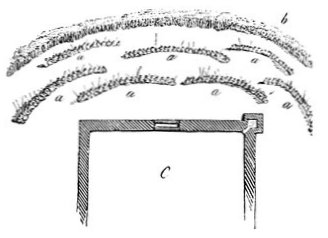
for fuel in the cold winters. At four places, at nearly equal
distances from each other, is a bastion built of clay, furnished
with loop-holes, and lined both within and without
with basket-work of willow branches. They form an angle,
and are open towards the village; the earth is filled in between
the basket-work; and it is said that these bulwarks,
which are now in a {343} state of decay, were erected for the
Indians by the Whites.[228] There is nothing of the kind at
Ruhptare. The huts, as I have before remarked, stand
close to each other, leaving, in the centre, an open circular
space, about sixty paces in diameter, in the centre of which
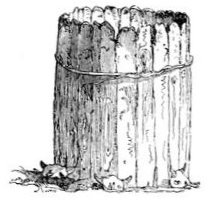
(among the Mandans) the ark of the first man is set up, of
which we shall speak in the sequel. It is a small cylinder,
open above, made of planks, about four or five feet high,
fixed in the ground, and bound with climbing plants, or
pliable boughs, to hold them together.[229]

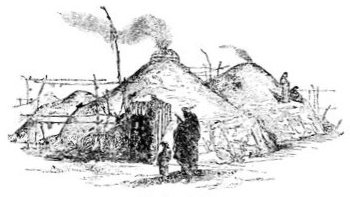
At the north end of this circular space is the medicine
lodge, in which festivals are celebrated, and certain customs
practised, which are connected with the religious notions
of this people, which we shall treat of in the sequel. At
the top of a high pole, a figure is here placed, made of skins,
with a wooden head, the face painted black, and wearing
a fur cap and feathers, which is intended to represent the
evil spirit, Ochkih-Hadda (corresponding with the devil),
or a wicked man, as they affirm, who once appeared among
them, had neither wife nor child, and vanished, and whom
they now stand greatly in dread of. Other grotesque figures,
made of skins and bundles of twigs, we saw hanging on
high poles, most of them being offerings to the deity. Among
the huts are many stages of several stories, supported by
poles, on which they dry the maize. The huts themselves are
of a circular form, slightly vaulted, having a sort of portico
entrance. When the inmates are absent the entrance is
shut up with twigs and thorns; and if they wish merely to
close the door they put up a skin stretched out on a frame,
which is shoved aside on entering. In the centre of the
roof is a square opening for the smoke to find vent, over
which is a circular sort of screen made of twigs, as a protection
against the wind and rain, and which, when necessary,
is covered with skins.[230]
The interior of the hut is spacious, tolerably light, and
clean. Four strong pillars towards the middle, with several
cross beams, support the roof. The inner circumference
of the hut is formed by eleven or fifteen thick posts,
four or five feet in height, between which other rather shorter
ones are placed close to each other. On these shorter posts,
which are all of an equal {344} height, are long rafters, inclining
to the centre; they are placed near each other, and
bear the roof. On the outside the huts are covered with a
kind of mat, made of osiers, joined together with bark, and
now the skeleton of the hut is finished. Over this hay is
spread, and the outer covering is of earth. The men and
women work together in erecting these huts, and the relations,
neighbours, and friends, assist them in the work.
The building of the huts, manufacturing of their arms,
hunting, and wars, and part of the labours of the harvest,
are the occupations of the men; every other kind of work
is left to the women, who, though in general well treated,
are obliged to perform all the really laborious work. The
women fetch fuel, in heavy loads, frequently from great
distances, carry water, and, in winter, blocks of ice into the
huts, cook, tan the skins, make all the clothing, lay out the
plantations, perform field labour, &c. &c. In the centre
of the hut a circular place is dug for the fire, over which the
kettle is suspended. This fire-place, or hearth, is often enclosed
with a ledge of stones. The fuel is laid, in moderately
thick pieces, on the external edge of the hearth, crossing
each other in the middle, when it is kindled, and the pieces
gradually pushed in as they burn away. The Indians are
not fond of large fires. The inmates sit round it, on low
seats, made of peeled osiers, covered with buffalo or bear
skin. Round the inner circumference of the hut lie or hang
the baggage, the furniture, and other property, in leather
bags, the painted parchment travelling bags, and the harness
of the horses; and on separate stages there are arms,
sledges, and snow-shoes, while meat and maize, piled up,
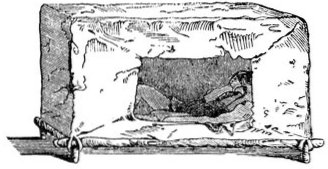
complete the motley assemblage.[231] The beds stand against
the wall of the hut; they consist of a large square case, made
of parchment or skins, with a square entrance, and are large
enough to hold several persons, who lie very conveniently
and warm on skins and blankets.[232]
In the winter huts they place, at the inside of the door,
a high screen of willow boughs, covered with hides, which
keeps off the draught of air from without, and especially
protects the fire.
The summer huts are very cool, and, generally speaking,
have no unpleasant smell. Mr. Say gives a very good description,
and a tolerably accurate print, of a Konza lodge,
or hut,[233] and, with {345} some slight differences, the mode
of building resembles, in the main, those of the Mandans,
Manitaries, and Arikkaras. Among these differences are
the mats which are fastened all round in the first hut, and
which I did not observe among the tribes that I visited.
The beds, too, are arranged in a different manner. The
Mandans and Manitaries are seen in their huts, sitting round
the fire, employed in all kinds of domestic labour. The man
has, generally, no clothing except the nokka, and is often
merely smoking, but the women are never idle. In winter,
that is, at the beginning or middle of November, these Indians
remove, with the greater part of their effects, to the
neighbouring forest, where their winter huts are situated.
These consist of precisely similar huts, of rather smaller
dimensions. Their departure from the summer huts is
determined by the weather, but, as before-said, is generally
about the middle of November; and their return, in the spring,
is usually about the latter end of February, or the beginning of
March, so that we may reckon that they may pass above eight
months in their summer quarters. Inside of the winter huts
is a particular compartment, where the horses are put in
the evening, and fed with maize. In the daytime they are
driven into the prairie, and feed in the bushes, on the bark
of poplars. There are, probably, above 300 horses in the
two Mandan villages; some of the people, indeed, do not
possess any, while others, again, have several. The Mandans
and Manitaries, like all the other Indians of this country,
sometimes make what are here called caches, or hiding-places,
in the vicinity of their villages. These caches are
holes, or magazines, underground, often so artfully contrived
that it is very difficult to discover them.[234] The Indians
frequently go from their winter to their summer village,
to fetch any articles they may happen to want, as they invariably
leave part of their property behind. When they
quit their huts for a longer period than usual, they load
their dogs with the baggage, which is drawn in small sledges,
made of a couple of thin, narrow boards, nine or ten feet
in length, fastened together with leather straps, and with
four cross-pieces, by way of giving them firmness. Leather
straps are attached in front, and drawn either by men or
dogs. The load is fastened to the sledge by straps.[235] When
the snow is deep, they use snow-shoes,[236] which are described
by Captain Franklin, only those of the Mandans are much
smaller, about two feet and a half long; whereas in the
north their length is from four to six feet. The Mandans
and Manitaries have not, by any means, so many dogs as
the Assiniboins, Crows, and Blackfeet. They are rarely
of the true wolf's colour, but generally black, or white, or
else spotted with black and white. Among the nations further
to the north-west they more nearly resemble the wolf,
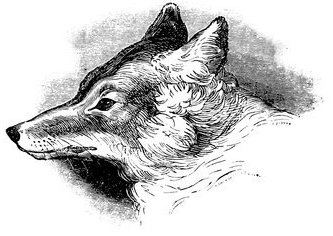
but here they are more like the prairie wolf (Canis latrans).[237]
We likewise found, among these animals, a brown race, descended
from European pointers, hence the genuine bark
of the dog is more frequently heard here, whereas among
the western nations they only howl. The Indian dogs are
worked very hard, have hard blows, and hard fare; in fact,
they are treated just as this fine animal is treated among
the Esquimaux.
{346} The Mandans are hospitable, and often invite their
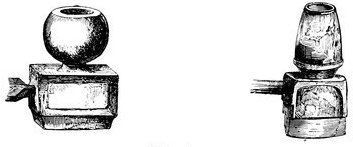
acquaintance to come and see them. Their pipes are made
of the red-stone, or of black clay. They obtain the red pipe-heads
chiefly from the Sioux; sometimes they have wooden
heads lined with stone; the tube is plain, long, round or
flat, on the whole, of the same shape as among the Sioux,
but they are not so fastidious about ornamenting their pipes
as other tribes. They smoke the leaves of the tobacco
plant, which is cultivated by them; the bark of the red willow
(Cornus sericea), which they obtain from the traders,
is sometimes mixed with the tobacco, or the latter with the
leaves of the bearberry (Arbutus uva ursi). The tobacco
of the Whites, unmixed, is too strong for the Indians, because
they draw the smoke into their lungs; hence they do not
willingly smoke cigars.
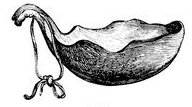
The meals of the Mandans are served in wooden dishes.
The spoons are generally large and deep; they are made of
the horn of the bighorn;[238] sometimes they are yellow, or
else they are shallow, made of black buffalo's horn. They
have a considerable variety of dishes. The Indians residing
in permanent villages have the advantage of the roving hunting
tribes, in that they not only hunt, but derive their chief
subsistence from their plantations, which afford them a degree
of security against distress. It is true, these Indians
sometimes suffer hunger when the buffalo herds keep at a
great distance, and their crops fail; but the distress can
never be so great among the Missouri Indians, as in the
tribes that live further northwards. The plants which they
cultivate are maize, beans, French beans, gourds, sunflowers,
and tobacco (Nicotiana quadrivalvis), of which I brought
home some seeds, which have flowered in several botanic
gardens.
Of maize there are several varieties of colour, to which
they give different names. The several varieties are:—1.
White maize. 2. Yellow maize. 3. Red maize. 4. Spotted
maize. 5. Black maize. 6. Sweet maize. 7. Very hard yellow
maize. 8. White, or red-striped maize. 9. Very tender
yellow maize.[239]
The beans are likewise of various sorts—small white
beans, black, red, and spotted beans. The gourds are—yellow,
black, striped, blue, long, and thick-shelled gourds.
The sunflower is a large helianthus, which seems perfectly
to resemble that cultivated in our gardens. It is planted
in rows between the maize. There are two or three varieties,
with red, and black, and one with smaller seeds. Very
nice cakes are made of these seeds. The tobacco {347} cultivated
by the Mandans, Manitaries, and Arikkaras, attains
a great height, and is suffered to grow up from the seeds,
without having any care whatever bestowed upon it. It
is not transplanted. When it is ripe the stalks are cut, dried,
and powdered; or the leaves, with the small branches, are
cut into little pieces. The taste and smell are disagreeable
to an European, resembling camomile rather than tobacco.
The plant is not now so much cultivated as formerly, being
superseded by the more pleasant tobacco of the Whites;
but the species is still preserved.[240] It is only on solemn occasions,
for instance, in negotiations for peace, that this
tobacco is still smoked; the seed is, therefore, preserved in
the medicine bag of the nation, that the plant may never
be lost. When they mean to smoke this tobacco, a small
quantity of fat is rubbed on it.
The cultivation of the maize and other fields, of which
each family prepares three, four, or five acres, takes place
in the month of May. Rows of small furrows are made,
into which the grains of maize are thrown singly, and covered
with earth. Three times in the summer the plants are
hoed, and the earth heaped up against them, that the moisture
may have better access to them. The harvest takes
place in October, when men, women, and children, each
lend a helping hand. At present the women use, in their
field labour, a broad iron hoe, with a crooked wooden handle,
which they obtain from the merchants. Charbonneau recollected
the time when they used the shoulder blade of the
buffalo for this purpose. The fields are never fenced, but
lie quite open and exposed.
The wild plants of the prairie are used by the Mandans,
and other people of the Upper Missouri; and to those before-mentioned,
I can only add the feverolles (Faba minor equina),
a fruit resembling the bean, which is said to grow in the
ground, but which I did not see; there are many other roots
in the prairie, which are used for food. The gourds are
eaten fresh as well as dry. The beans are seldom eaten of
one kind, but many sorts are mixed together. The maize
is boiled or roasted, then pounded, mixed with fat, and
made up into small cakes and baked. There are, of course,
many other ways of dressing it. The sweet maize has a very
pleasant taste, especially when it is in what is called the
milky state; it is then boiled, dried, and laid by for use.
All kinds of animals serve the Mandans for food; the
bear, when it is young and fat, the wolf, the fox, in short,
everything except the horse; the ermine is not eaten by
many; and of birds they dislike the turkey-buzzard, and
the raven, because they feed on the dead bodies deposited
on the stages. They have a great aversion from serpents,
but eat the turtle; the buffalo is the chief object of their
chase, as it supplies them with skins, meat, tallow, marrow-bones,
sinews, and many other necessaries. Next to the
buffalo the beaver is the most indispensable to them, since
it not only furnishes them with valuable skins, but supplies
them with delicate food, the fat tail, especially, being considered
quite a dainty morsel by the Indians. Pemmican,[241]
{348} which is so favourite a dish among the northern Indians,
is not much in use among the Mandans. Their only
drink is water, for they are unacquainted with the method
of preparing fermented liquors. They did not obtain any
spirits, either from the American Fur Company, or the
agents of Messrs. Soublette and Campbell; hence an intoxicated
person is scarcely ever seen. They are extremely
fond of sugar, and likewise of salt, which they procure from
their lakes, and, if the supply is insufficient, purchase from
the Whites. They are likewise fond of coffee and tea, well
sweetened. It has been affirmed, that several North American
nations, especially those which speak the Algonquin
language, are cannibals, and more particularly the Chippeways
and the Potawatomis; but I found no trace of this
unnatural custom among the Missouri nations.[242]
Two, and sometimes three, families usually live together
in an Indian hut, commonly the father, with his married
sons or sons-in-law. Polygamy is everywhere practised, and
the number of wives differs; however, they have very
seldom more than four, and, in general, only one.[243] The
women are very skilful in various kinds of work, particularly
in dyeing and painting the buffalo robes. They extract
a red colour from the roots of the savoyenne, or from
buffalo berries; yellow from a lichen of the Rocky Mountains;
black from helianthus, as well as from a black stone
or clay; blue and green they extract from European substances.
Among the Mandans, Manitaries, and Arikkaras,
the women, as Lewis and Clarke relate, manufacture beads
from coloured glass. They powder those which they have
obtained from the traders, and mould them into different
shapes.[244] This custom is, however, no longer common.
The dyeing of the skins, of which many travellers have
spoken, employs a great portion of the women's time. These
three nations understand the manufacture of earthen pots
and vessels, of various forms and sizes. The clay is of a
dark slate colour, and burns a yellowish-red, very similar
to what is seen in the burnt tops of the Missouri hills. This
clay is mixed with flint or granite, reduced to powder by
the action of fire. The workwoman forms the hollow inside
of the vessel by means of a round stone which she holds
in her hand, while she works and smooths the outside with
a piece of poplar bark. When the pot is made, it is filled
and surrounded with dry shavings, and then burnt, when
it is ready for use. They know nothing of glazing.[245] With
respect to their boats, the North Americans are far more
expert than the Brazilians, Patagonians, and other South
Americans, who live on the banks of rivers, and yet have
contrived no means to pass them. The Chippeways and
other northern nations have handsome vessels of birch bark;
the Esquimaux makes his kiack, which is curiously covered
with seal skin; and on the Missouri, especially among the
Mandans, there are boats of buffalo skin, which are represented
in the plates accompanying this work.[246] They are
very light, of a circular form, stretched on a frame of several
pieces of wood crossing each other, and may be carried on
the shoulder of a single individual.
If a young Indian desires to marry, and has obtained the
consent of the girl, he endeavours to procure that of her
father; when he is certain of this, he brings two, three, nay,
even eight or {349} ten horses, and fastens them to the hut
of the young woman, who gives them to her father. The
latter then takes other horses, and if he has them not himself,
his relations assist him, and these horses are fastened,
in return, to the hut of the intended son-in-law. In such
a case an estimate is previously made of the number of
horses possessed by the woman's relations, for all presents are
returned in equal number. The bride next boils some maize,
and daily carries a kettle or dish filled with it to the hut of
the bridegroom. After some time has elapsed, the young
man repairs to the hut of his bride, where he passes the night
with her, and the marriage is considered as complete. The
young couple often continue to reside in the hut of the father-in-law,
but they more frequently build a new hut for themselves;
sometimes, however, they afterwards separate. The
father-in-law is, subsequently, the principal person in the
hut; everything depends on him, and is done on his account,
and for him; if game is killed, the flesh is first presented
to him, &c.[247] There are often many children in these Indian
families; some had as many as ten; yet, on the whole,
the Indians have not so many children as the Whites, doubtless
because they keep them longer at the breast. They
are extremely fond of them, but the children are often weak
and sickly, in consequence, it is supposed, of the hard
labour which the women have to perform. I was universally
assured that the new-born children are of a reddish colour.
The births are, in general, extremely easy, and the mother
bathes in the river immediately afterwards, even if it is
frozen; in ten days the child is considered as safe, having got
over the most dangerous period. A person is paid to give
it the name chosen by the parents and relations. The child
is held up, then turned to all sides of the heavens, in the
direction of the course of the sun, and its name proclaimed.
They have cradles for their infants, consisting of a leather
bag, which is suspended by a strap to a cross beam in the
hut. These cradles of the Mandans are not so elegant and
beautifully worked as those which we saw among the Sioux
and Assiniboins. The children of these Indians are subject
to no kind of discipline whatever; they may do and say
whatever they please, and nobody finds fault with them.
Everything is done to excite a spirit of independence and
self-will in the boys; if the mother speaks to one of them,
he will very likely slap her face, or kick her, nay, sometimes
he will do the same to his father, who says, coolly, bowing
his head, this boy will one day become a famous warrior.
The men sometimes treat their wives very brutally; and it
has not unfrequently happened, that a woman, after such
treatment, has left the hut and hanged herself on a tree.
This lately happened in the case of an aged woman, whose
grown-up son had ill-treated her. She was missed, and
was afterwards found suspended from a tree. The women
have nothing to indemnify them for their incessant and
laborious work, not even good clothing, for this right of
the fair sex in Europe is claimed among the Indians by the
men. It is singular that these women, who are condemned
constantly to work like slaves, refuse to do any work whatever
if they marry a white man, and, the Whites being entirely
in the power of the Indians, and the relations of their
wives, they are obliged to submit to this. Sisters have
great {350} privileges among these Indians. All the horses
which a young man steals, or captures in war, belong to
them. If an Indian returns from an expedition on horseback,
and meets his sister, he will immediately alight, and
give her the horse; on the other hand, if he wishes to possess
some object of value belonging to his sister, for instance, a
dress, he goes and abruptly demands it, and immediately
receives it; even should it be the very dress she is wearing,
she will take it off at once, and give it to her brother.
Prudery is not a virtue of the Indian women; they have
often two, three, or more lovers: infidelity is not often punished.
There was only one woman among the Mandans,
a piece of whose nose was cut off, a circumstance which is
very common among the Blackfeet. If an Indian elopes
with a married woman, the husband whom she has abandoned
avenges himself by seizing the seducer's property, his
horses and other things of value, to which the latter must
quietly submit. Such a woman is never taken back. If
a man has the eldest daughter of a family for his wife, he
has a right to all her sisters. A chief business of the young
men among these Indian tribes is to try their fortune with
the young maidens and the women, and this, together with
their toilet, fills up the greater part of their time. They
do not meet with many coy beauties.[248] In the evening, and
generally till late at night, they roam about the villages, or
in the vicinity, or from one village to the other. They have
a singular mode of displaying their achievements in this
field, especially when they visit the women in their best
dresses. On these occasions they endeavour to gain credit
by the variety of their triumphs, and mark the number of
conquered beauties by bundles of peeled osier twigs, painted
red at the tips. These sticks are of two kinds. Most of
them are from two to three feet in length, others five or six
feet. The latter, being carried singly, are painted with white
and red rings alternately, which indicates the number of
conquests. The shorter sticks are only painted red at the
tips, and every stick indicates an exploit, the number of
which is often bound up into a pretty large bundle. Thick
fasces of this kind are carried about by the dandies in their
gallant excursions. Among the Mandans these sticks are
generally quite plain; among the Manitaries, on the contrary,
there is, usually, in the middle of the bundle, one
larger stick, at the end of which there is a tuft of black
feathers. These feathers indicate the favourite, and the
dandies tell everybody that she is the person for whom this
honour is intended.[249]
If these people have had familiar intercourse with a person
who wore the white buffalo robe, a piece of skin of that
colour is fastened to the stick; if she wore a red blanket, or
buffalo robe, a piece of red cloth is fastened to the stick.
This custom, which is well known among the Mandans and
Manitaries, has not, to my knowledge, been mentioned by
any traveller.
They have distinct names for the several degrees of relationship.
The father's brother is called father, and the
mother's sister, mother; cousins are called brothers and
sisters. The {351} mother-in-law never speaks to her son-in-law;
but if he comes home, and brings her the scalp of a
slain enemy, and his gun, she is at liberty, from that moment,
to converse with him.[250] This custom is found among the
Manitaries, who have, doubtless, borrowed it from the Mandans,
but not among the Crows and Arikkaras. Among
the Chippeways, and the Algonquins in general, the name
must not be changed; and persons with the same name must
not marry, but consider each other as brothers and sisters.
Among all the North American Indian nations there are
men dressed and treated like women, called by the Canadians,
Bardaches, of whom Mc Kenzie, Tanner, Langsdorff, and
others, have spoken;[251] but there was only one such among
the Mandans, and two or three among the Manitaries.
Volney, and some other writers, have spoken rather too
unfavourably of the moral character of the aborigines of
North America, and their domestic habits. According to
them, distrust and hostile feeling prevail among them, for
which reason they never leave their huts unarmed; but I
can bear witness that they are frequently seen in their villages,
as well as in the environs, without arms, and that it
is only at greater distances, and when they appear in state,
that they carry their weapons in their hands. I have never
observed any disputes among them, but, on the contrary,
much more unity and tranquillity than in civilized Europe.
It has often been asserted that the Indians are inferior in
intellectual capacity to the Whites; but this has been now
sufficiently refuted; and Harlan is not wrong in saying
that, among the races of men, of which Blumenbach reckons
five,[252] the American should be ranked immediately
after the Caucasian. If man, in all his varieties, has not
received from the Creator equally perfect faculties, I am,
at least, convinced that, in this respect, the Americans are
not inferior to the Whites. Many of the Mandans manifest
a great thirst for knowledge, and many desire to hear
something of objects of a higher order; and if they were
not so much attached to the prejudices inherited from their
ancestors, many of them might be very easily instructed.
The bad examples which they so often observe in the white
men, who roam about their country in quest of gain, are
not calculated to inspire them with much respect for our
race, or to improve their morality. And if they have not
been found inclined to the Christian religion, this is, certainly,
in some measure, the consequence of the bad conduct
of the Whites, who call themselves Christians, and are often
worse, and more immoral, than the most uncivilized of the
Indians. Many American and foreign works have taken
notice of the striking good sense and wit, the correct judgment
of the Indians, in all the occurrences of daily life, and
it would be mere repetition here to quote examples. One
is often at a loss to answer their questions, founded on correct
and natural judgment. The inactive mode of life natural to
the Indians, which disdains all laborious exertion, is a great
obstacle to their adopting a different system. But they are
not deficient in talent for drawing, music, &c., and this is
quite manifest at first sight. Several Mandans not only
took much pleasure in drawing, but had a decided talent
for it. The hieroglyphics are well known, which the Indians
employ {352} instead of writing; for instance, the figures
on their robes, the drawing of Mato-Topé, and the subjoined
Indian letter from a Mandan to a fur trader.[253]
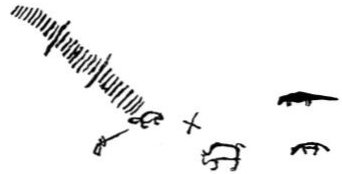
A Mandan letter, in hieroglyphics
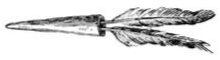
Child's dart, of stag-horn
The following is the explanation of the hieroglyphic figures
contained in it:
The cross signifies, "I will barter, or trade." Three animals
are drawn on the right hand of the cross: one is a
buffalo; the two others, a weasel (Mustela Canadensis),
and an otter. The writer offers, in exchange for the skins
of these animals (probably meaning that of a white buffalo),
the articles which he has drawn on the left side of the cross.
He has, in the first place, depicted a beaver very plainly,
behind which there is a gun; to the left of the beaver are
thirty strokes, each ten separated by a longer line; this means,
I will give thirty beaver skins and a gun for the skins of the
three animals on the right hand of the cross.
Many of them dispute, with great earnestness, on more
elevated subjects; thus, they inquired our ideas of the various
heavenly bodies, and of the origin of the universe, as
they, themselves, declare their own silly traditions to be
insufficient. Some, indeed, thought our ideas on these subjects
much more silly than their own. They laughed outright,
when we affirmed that the earth was round, and revolved
about the sun. Others, however, would not reject
our views, and were of opinion that, as the Whites could do
so much which was incomprehensible to them, it was possible
they might be right on this point also.
In all works that treat of these remarkable people, we
find recorded very energetic and well-digested speeches of
their chiefs. They frequently use very appropriate figures,
and often said bitter truths to their white oppressors. Dr.
Morse quotes some such phrases, used at the conclusion
of treaties of peace, or declarations of war, which express
much in a few words. Thus, in declarations of war: "The
blood of our wives and children smokes on the ground! The
bones of our warriors and old men are uncovered, and whiten
the earth! The tomahawk is raised!" And on the conclusion
of peace: "The bones of our warriors are buried!
the tomahawk is buried! the blood of our women and children
is covered! The path which leads to them must be
kept clean; no weeds may grow there. The chain which
binds us together must not become rusty." {353} Or, on
the contrary: "The chain begins to rust," &c. &c. Though
these people often manifest great energy of character, many
have committed suicide on account of disappointments in
love, or of wounded honour, of which Dr. Morse relates a
remarkable instance, where an Indian killed himself because
he was reproached with cowardice, after his mother had
suffered death for him. Many travellers speak of the extraordinary
memory of the Indians; several of them relate
the entire history of their people in a continuous narrative.
The Mandans and Manitaries are proud, and have a high
sense of honour. If a person expresses a wish to possess
some article belonging to them, he generally receives it as a
present, but a present of equal, or greater value, is always
looked for in return. They estimate all their effects at a very
high rate, ascribing to them an imaginary and far too great
value; and a trifling thing is often paid for with one or two
horses. Among the articles of great value is the skin of a
white buffalo cow. Fifteen florins are paid for a small ermine
skin; whereas, a wolf's skin may be purchased for a
small quantity of tobacco. One or two horses are frequently
given for a feather cap; a horse for 100 or 150 elks' teeth,
or for a handful of dentalium shells.[254] The men are much
given to indolence, when they cannot pursue their chief
avocations, hunting and war. In general, the Mandans and
Manitaries are not dangerous, and, though there are many
rude and savage men among them, they are, on the whole,
well-disposed towards the Whites: the former, especially,
manifest this, and have many good and trustworthy men
among them. Some of them are addicted to thieving, especially
the women and children; and it is said, that many of
the Manitaries, when they meet the Whites in the prairie,
though they do not kill them, as they used to do, generally
plunder them.
They have always free access to the forts of the trading
companies; and, as at Fort Clarke, there was no separate
apartment for the Indians, we were molested by them, during
the whole day, in every room; nay, they often took the place
of the owners, which, during the severe cold in the winter
time, was quite intolerable, as they stood in front of the fire,
with their large buffalo robes, and kept the warmth from
coming into the apartment. They require to be always
regaled, which is generally done, and it was estimated that
in one year they smoked 200 lbs. of tobacco at the expense
of the Company. A few among them, indeed, manifested
a much greater delicacy of feeling than the mass of them, and
left the dining-room when the dinner-hour approached; but
only a very small proportion possessed this correct sense
of propriety, for the others generally came just at our
dinner time; it is true they had but little meat in the winter
season, and fared but badly. Disputes and quarrels are
very rare among them; but duels are frequent; and revenge
for blood is still exercised.
Many of them are particularly cleanly in their persons,
and bathe daily, both in winter and summer; their hands,
however, are often smeared with colours and fat, nay, sometimes
the whole body is bedaubed. The women are, in
general, less cleanly, particularly their hands, {354} which
arises from their continual and severe labour. They generally
let their nails grow long.
The rude inhabitants of the prairies are extremely agile
and hardy; they bathe, in the depth of winter, in the half
frozen rivers, and wear no covering on the upper part of their
body under the buffalo robe; they are very expert swimmers,
even when quite young. I have already observed that all
these nations swim in the same manner as the Brazilian
Tapuyas, which is confirmed by other writers. They often
practise riding on horseback without a saddle, and very swift
horse-racing.[255] They are capital marksmen with the bow;
all their senses are remarkably acute.
Among the Mandans, and all the nations of the Upper
Missouri, as well as among most of the North American
tribes, there are certain bands or unions or companies, which
are distinguished from the others, and kept together by certain
external badges and laws.[256] They have three kinds
of war or signal pipes, which are hung round the neck, and
are among the badges of the unions, which divide the men
into six classes, according to their age. The first band or
union is composed of "the foolish dogs," or "the dogs whose
name is not known." They are young people from ten to
fifteen years of age, and wear a pipe made of the wing bone
of the wild goose, which is but small. When they dance,
three of them have a long broad piece of red cloth hanging
from the back of the neck to the ground. Like every distinct
class they have a particular song to accompany their
dance. Formerly old people likewise belonged to this band,
but then they never dared to retreat before the enemy; this
has since been changed to the present limited rule. If a
boy desires to enter the first band in order to become a man,
he goes to a member of it, addresses him by the appellation
of father, and endeavours to purchase the rank, the dance,
the song, and the war pipe belonging to it, for certain articles
of value, such as blankets, cloth, horses, powder, ball, and
the like, which the father pays for him. If this place is
sold to him he has a right to all the distinctions and privileges
of the band, and he who sold it thereby renounces all
claim to it, and endeavours to purchase admission to a higher
band. The dances of the several classes are in the main
very similar, but there is a particular song belonging to
each, and sometimes even a different step. The drum and
schischikué must likewise be purchased at the same time.
The latter, among this band, is spherical, with a handle,
and is made of leather.
The second class or band is that of the crows or ravens;
it consists of young men from twenty to twenty-five years of
age. Frequently young people are in none of the bands for
half a year or more. They then go to the band of the
crows, and say, "Father, I am poor, but I wish to purchase
from you." If the possessor agrees, they then
receive the raven's feathers, which the band wear on their
heads, a double war-pipe, consisting of two wing bones of
a goose joined together, a drum, schischikué, the song and
the dance. Each of these bands has a leader, called, {355}
by the Americans, head-man, who decides on the sale of
its rights and attributes. This head-man is chiefly applied
to when any one wishes for admission; a festival then takes
place in the medicine lodge, which is continued for forty
successive nights, of which I shall speak in the sequel.[257]
They dance, eat, and smoke there; the purchasers defray
the expenses, and give up their wives every night to
the sellers, till the fathers, as they are called, are satisfied,
and transfer their rights to the purchasers, with which the
festival concludes.
The third class or band is that of the soldiers, the most
eminent and esteemed warriors. In their dances they paint
the upper part of the face red, and the lower part black.
Their war pipe is large, and made of the wing bone of a
crane. Their badges are two long straight sticks bound
with otter skin, to which owl's feathers are appended.
When they go to war, they plant these sticks in the ground
in front of the enemy, and, this done, they dare not leave
them, not unlike the colours in a European army. They
have a similar stick ornamented with raven's feathers.[258]
They likewise have a dance and song peculiar to their band,
and must purchase their admission into higher classes. Their
schischikué or rattle is made of iron plate, in the form of a
small kettle, with a handle. They likewise possess two
tobacco pipes, which are used for smoking on special occasions.
Two men keep and carry with them these pipes.
All the higher classes may, at the same time, belong to the
band of the soldiers, who act as police officers; it is, however,
understood that all the members must be satisfied with
the purchase. If but one object to the sale, the bargain
cannot be concluded. It often happens that some individuals
do not immediately give their consent, in order to raise the
price and sell to more advantage afterwards. These soldiers,
as they are called, form a kind of committee, which
decides all the principal affairs, particularly general undertakings,
such as changes of their places of abode, buffalo
hunting, and the like. If the buffalo herds are in the vicinity,
they watch them, and do not suffer them to be disturbed
by individuals, till a general chase can be undertaken.
If, during this time, any one fires at a wolf or other animal,
the soldiers take away his gun, ill-use, and sometimes
beat him, to which he must submit; even the chiefs are not
spared on these occasions. The Whites living in the neighbourhood
are subject, during such a time, to the same laws,
and the soldiers have often taken their hatchets from the
woodcutters of the fort, or forbidden them to cut wood, that
the buffaloes might not be disturbed by the noise.
The fourth band, that of the dogs, wear in their dance a
large cap of coloured cloth, to which a great number of
raven's, magpie's, and owl's feathers is fastened, adorned
with dyed horse-hair and strips of ermine; they have a large
war pipe of the wing bone of a swan. Three of them have
the same strips of red cloth hanging down the back, as have
been mentioned, when speaking of the first band. The head
is generally adorned with a thick tuft of owl's, magpie's, and
raven's feathers hanging down behind, and often all the
three kinds of feathers are mixed together. {356} The
three men before-mentioned, who wear the strips of red cloth
(the dogs, properly so called), are obliged, if any one throws
a piece of meat into the ashes, or on the ground, saying,
"There, dog, eat," to fall upon it, and devour it raw, like
dogs or beasts of prey. The schischikué of this band is a
stick, a foot or a foot and a half long to which a number of
animals' hoofs are fastened. The costume of these three
dogs is shown in the portrait of Pehriska-Ruhpa.[259]
The fifth band is that of the buffaloes. In their dance
they wear the skin of the upper part of the head, the mane
of the buffalo, with its horns, on their heads; but two select
individuals, the bravest of all, who thenceforward never dare
to fly from the enemy, wear a perfect imitation of the buffalo's
head, with the horns, which they set on their heads,[260] and
in which there are holes left for the eyes, which are
surrounded with an iron or tin ring. This band alone has
a wooden war pipe, and in their union they have a woman,
who, during the dance, goes round with a dish of water,
to refresh the dancers, but she must give this water only
to the bravest, who wear the whole buffalo's head. She is
dressed, on these occasions, in a handsome new robe of
bighorn leather, and colours her face with vermilion. The men
have a piece of red cloth fastened behind, and a figure representing
a buffalo's tail; they also carry their arms in their
hands. The men with the buffaloes' heads always keep in
the dance at the outside of the group, imitate all the motions
and the voice of this animal, as it timidly and cautiously
retreats, looking around in all directions, &c.[261]
The sixth band is that of the black-tailed deer. It consists
of all the men above fifty years of age, who, however,
likewise dance. Two women belong to the band, who wait
on them at the dance, cook, carry water round to refresh
them, and the like. All the men of this band wear a garland
of the claws of the grizzly bear round their heads, and all
insignia of their warlike exploits about their bodies, such
as feathers on their heads, tufts of hair on their arms and
legs, scalps, painting, &c.[262]
All these bands, as well as the following dances, are bought
and sold, and, as has been already observed, on these occasions,
the buyer must give up his wife to the seller during
the festivity. But if a young man is still unmarried, he will
sometimes travel to a great distance to another village, to
ask a friend or companion for his wife, who accordingly
goes with him, and, on the evenings of the dance, gives up
his wives for him. A man often brings three or four, and
even more, wives, and gives them to his father, as he is
called, as soon as the dancing, eating, smoking, and the relating
of their exploits, are concluded. Thus one woman
after the other comes, as will be described in the account
of the buffalo medicines of the Manitaries, strikes, with her
hand, the arm of the man whom she will favour, and goes to
the entrance of the tent, where she waits till he follows her.
The man so invited often keeps his seat, and bows down his
head; the woman then goes home, brings articles of value, such
as guns, robes, blankets, &c., which she lays, piece by piece,
before him, till he is satisfied, stands up, and follows her.
{357} There are other dances which are bought and sold,
among which are a second dance of the third band, and the
dance of the half-shorn heads, which the lower class may
buy before they are old enough to belong to the third band.
The medicine feast, the insignia, and the dance belonging
to the half-shorn heads, will be described in the sequel. Another
dance is that of the old dogs. The band of the dogs
can buy it of the buffaloes before they can become buffaloes,
or purchase their admission to the fifth band. In the dance of
the old dogs they paint themselves white, the hands red and
black, and wear a girdle of the skin of the grizzly bear, and
a bunch of feathers hanging down at the back of the head.
What is called the hot dance is now danced at Ruhptare,
and by the Manitaries, who bought it from the Arikkaras.
It is executed by the little dogs, whose name is not known.
A large fire is kindled on the occasion, and a quantity of
live coals is scattered on the ground, about which the young
men dance, quite naked and barefooted. The hands, with
the lower part of the arms, and the feet and ankles, are
painted red. A kettle, with meat cut in small pieces, is hung
over the fire; and when the meat is done they plunge their
hands into the boiling water, take out the meat, and eat it,
at the risk of scalding themselves. The last comers are
the worst off, having to dip their hands the deepest into the
boiling water. During the dance they have in their hands
their weapons and the schischikué.
There is another dance which will be described in one of
the following chapters. The dance is accompanied with
the schischikué and drum, and is generally performed in a
circle: the dancers carry in their hands the bow-lance,[263]
which is adorned with feathers and bears' entrails.
The Mandan women are divided precisely in the same
manner as the men, into four classes, according to their age.
The youngest band is called "the band of the gun." They
wear in their hair some down feathers of the eagle, and have
their peculiar dance.
The next class into which they obtain admission by purchase
is "the river class." When they dance they wear an
eagle's feather, fastened to the fore part of the head with a
piece of white ribbon, which projects on the left side, and
is entwined round the quill with grass.
The third class consists of the women of the hay, who,
when they dance, put on their best clothes, and sing the
scalp song.
The fourth and last class is the band of the white cow.
They paint one eye with some colour according to their
taste, generally sky-blue. On the chin, this class, mostly
consisting of aged women, tattoo themselves with black lines;
round their heads they wear a broad piece of the skin of a
white buffalo cow, something like a hussar's cap, with a
tuft of feathers in it. A more {358} particular description
of the dress of this band is given in the sequel.[264]
These unions, or bands, give occasion to many festivities,
with singing, music, and dancing, but they have likewise
other dances and diversions. One of these is the scalp dance,
which may be more appropriately described among the usages
of war. Their musical amusements are very simple. The
mode of singing varies but little among all the American
Indians; it consists of broken, deep exclamations, often intercepted
by loud shouts, and is accompanied by a violent beating
of time on the drum, and the rattling of the schischikué.
Besides these two instruments, the Mandans have long
wooden pipes, at the lower end of which there is generally an
eagle's feather hanging by a string.[265] Other pipes are thicker,
about twenty inches long, and are perforated with holes;
in this respect they differ from the war pipe. They are
sometimes ornamented with pieces of skin, &c. These
are the only musical instruments of the Indians besides the
war pipes.[266]
The Indians have also many games; the game called billiards,
by the French Canadians, is played by two young
men, with long poles, which are often bound with leather,
and have various ornaments attached to them. On a long,
straight, level course, or a level path in or near the village,
they roll a hoop, three or four inches in diameter, covered
with leather, and throw the pole at it; and the success of
the game depends upon the pole passing through it. This
game is also practised among the Manitaries, and is described,
in Major Long's Travels to the Rocky Mountains,
as being played by the Pawnees, who, however, have hooked
sticks, which is not the case with the tribes here mentioned.[267]
The women are expert at playing with a large leathern
ball, which they let fall alternately on their foot and knee,
again throwing it up and catching it, and thus keeping it
in motion for a length of time without letting it fall to the
ground. Prizes are given, and they often play high. The
ball is often very neat and curiously covered with dyed porcupine
quills.[268] Card-playing has not yet reached these Indians,
though it is in use among the Osages and other tribes.
The children of the Mandans and Manitaries play with a
piece of stag's horn, in which a couple of feathers are inserted;
this is thrown forward, the piece of horn being foremost.[269]
About the middle of March, when the weather is fine, the
children and young men play with a hoop, in the interior
of which strips of leather are interwoven; its diameter is
about a foot. This hoop is either rolled or thrown, and
they thrust at it with a pointed stick; he who approaches
the centre most nearly is the winner.[270] {359} As soon as
the ice in the rivers breaks up, they run to the banks and
throw this interlaced hoop into the water. In the summer
time the Mandans and Manitaries often amuse themselves
with races in the prairie, for which they have the best opportunity
in the vicinity of their villages; twenty young men, or
more, often run at once, and on these occasions there is
always high betting. Some of them are very swift runners,
and can hold out a long time.
The Mandans and Manitaries are extremely superstitious,
and all their important actions are guided by such motives.
They have most strange ideas of surrounding nature, believe
in a multitude of different beings in the heavenly bodies;
offer sacrifices to them; invoke their assistance on every
occasion; howl, lament, fast, inflict on themselves cruel acts
of penance, to propitiate these spirits; and, above all, lay
very great stress upon dreams.[271] Some of their traditions
have a resemblance to the revelations of the Bible; for instance,
Noah's Ark and the Deluge, the history of Samson,
&c. The question here arises whether these particulars
have not been gradually introduced among them, from their
intercourse with Christians, and this seems highly probable.
If they have not yet embraced the Christian religion, it would,
however, appear that they have adopted some portions which
strike them as being either remarkable or interesting.[272] The
belief in a future life, or a better state of things after death,
exists among all the American nations; this is confirmed by
D'Orbigny (Voyages, tom. iii. p. 90), who justly blames Azara
for denying all religious ideas to the people of Paraguay.[273]
In order to obtain correct information respecting all their
traditions and ideas, we persuaded Dipauch[274] to enliven
our long winter evenings by his narratives, which he readily
agreed to do. He spoke with much seriousness and gravity,
and I had a most excellent interpreter in Mr. Kipp. I give
these narratives, which are often extremely silly, as they
were written down from his communications, though I must
beg my reader's patience and indulgence. It was not possible
to curtail them or to choose only the more interesting parts,
since all their traditions and legends have a certain connection,
and really possess some influence on the actual mode
of life of this people.
According to Dipauch, these Indians believe in several superior
beings, of whom the lord of life, Ohmahank-Numakshi,
is the first, the most exalted and the most powerful; who created
the earth, man, and every existing object.[275] They believe
that he has a tail, and appears sometimes {360} in the
form of an aged man, and, at others, in that of a young
man. The first man, Numank-Machana, holds the second
rank; he was created by the lord of life, but is likewise of
a divine nature. The lord of life gave him great power,
and they, therefore, worship and offer sacrifices to him. He
is nearly identical with Nanabush among the Chippeways,
or the people of the Algonquin language, who, according
to the notion of those tribes, acts as mediator
between the creator and the human race. Nanabush
and the creator frequently had disputes, and the Mandans
have similar legends. Omahank-Chika, the evil one of the
earth, is a malignant spirit, who has, likewise, much influence
over men, but who is not as powerful as the lord of life and
the first man. The fourth being is Rohanka-Tauïhanka,
who lives in the planet Venus, and it is he who protects mankind
on the earth; for without his care the race would have
been long since extinct. A fifth being, who, however, has
no power, is something like the wandering Jew, ever in motion,
and walking on the face of the earth in human form.
They call him the lying prairie wolf. Besides these there
is a sixth being, Ochkih-Hadda, whom it is difficult to class,
and of whom they have a tradition, that whoever dreams
of him is doomed soon to die. He appears to figure in their traditions
as a kind of devil, is said to have once come to their
villages, and taught them many things, but has not since
appeared. They are afraid of him, offer sacrifices to him,
and have in their villages a hideous figure representing him.[276]
They worship the sun, because they believe it to be the residence
of the lord of life. All their medicines or sacrifices
are offered chiefly to the sun, or rather to the lord of life,
as inhabiting it. In the moon, say they, lives the old woman
who never dies, and who wears a white band from the front
to the back of the head; sacrifices and offerings are likewise
made to her. They do not know who she is, but her power
is great. She has six children, three sons and three daughters,
who all live in certain stars. The eldest son is the day
(the first day of the creation), the second is the sun, in which
the lord of life has his abode. The third son is the night.
The eldest daughter is the star that rises in the east, the
morning star; and they call her, "the woman who wears
a plume." The second daughter, called "the striped
gourd," is a high star which revolves around the polar star;
and, lastly, the third daughter is the evening star which is
near to the setting sun.
The old woman in the moon desired to find a wife for
her son, and brought a girl, whom she desired to wait outside
the door. When the old woman sent out to fetch her,
they found in her place a toad; indignant at the exchange,
the toad was boiled in a vessel, that it might be destroyed.
But this could not be done, nor could it be eaten, and it
was, therefore, cursed, on which it remained always visible
as a spot in the moon. The narrator could not say whether
the sun was large or small, but, at all events, it was glowing
hot. The son married a woman whom they called "the
narrow-leaved wormwood." They had a son, of great promise,
who appeared destined to act an important part.
He was very skilful in making arrows, and versed in all kinds
of hunting and catching of animals. He shot birds for his
mother, though she had {361} forbidden him to kill the prairie
larks, yet he shot all his arrows at these birds, but he was
unable to kill any. Upon this, one of the birds said to him,
"Why will you kill me, since I am related to you?" He
dug up in the moon the pomme blanche (Psozalea esculenta),
for which his mother reproved him, because, through the
hole which he had dug, they could see the Manitari villages
in the earth beneath. And his mother said, "See, all those
men are our relations; I did not intend to descend to the
earth yet, but now we must go thither." The father once
ordered the son to shoot a buffalo for him, and to bring him
all the sinews of the animal; but the son twisted a rope with
part of those sinews, in order thereby to let himself down
to the earth. Accordingly he descended to the earth in the
vicinity of the Little Missouri, but his rope reached only to
the top of the trees. If he had had all the sinews of the
buffalo, his rope would have reached the ground, but now
remained suspended, and swung backwards and forwards.
A large stone was thrown at him from the moon, which stone
was in existence not very long since. The stone, however,
could not kill him, he being medicine, that is, charmed.
The Mandans believe that the thunder is produced by
the motion of the wings of a gigantic bird. When this bird
flies softly, as is usually the case, he is not heard, but when
he flaps his wings violently, he occasions a roaring noise.
This huge bird is said to have only two toes on each foot,
one behind and the other before. It lives in the mountains,
where it builds an immense nest, as big as Fort Clarke.
Its food consists of deer and other large animals, the horns
of which are heaped up round the nest. The glance of
its eyes produces lightning; it breaks through the clouds,
the canopy of heaven, and makes a way for the rain. The
isolated and peculiarly loud claps of thunder are produced
by a gigantic tortoise, which lives in the clouds. When the
lightning strikes, it is a sign of anger. They believe the
stars to be deceased men. When a child is born, a star
descends and appears on the earth in human form; after
death it reascends and appears again as a star in the
heavens.
The rainbow is a spirit accompanying the sun, and is especially
visible at its setting. Many affirm that the northern
lights are occasioned by a large assembly of the medicine
men and distinguished warriors of several nations in the
north, who boil their prisoners and slain enemies in immense
cauldrons. The Chippeways are said to call this
phenomenon "the dancing spirit," and the milky way, "the
path of the ghosts."
Dipauch related a history of the creation and the origin
of the Mandan tribe, in the following manner. Though
this narrative is equally silly and tiresome, I subjoin it, as
giving an idea of the intellectual condition of this people,
and the nature of their conversations.
Before the existence of the earth, the lord of life created
the first man, Numank-Machana, who moved on the waters,
and met with a diver or duck, which was alternately diving
and rising again. The man said to the bird, "You dive so
well, now dive deep and bring up some earth." {362} The
bird obeyed, and soon brought up some earth, which the
first man scattered upon the face of the waters, using some
incantations, commanding the earth to appear, and it appeared.
The land was naked; not a blade of grass was
growing on it; he wandered about and thought that he was
alone, when he suddenly met with a toad. "I thought I
was here alone," said he, "but you are here, and who are
you?" It did not answer. "I do not know you, but I must
give you a name. You are older than I am, for your skin
is rough and scaly; I must call you my grandmother, for
you are so very old." He went further and found a piece
of an earthen pot. "I thought I was here alone, but men
must have lived here before me." Thereupon he took the
potsherd and said, "I will give you also a name, and, as you
were here before me, I must, likewise, call you my grandmother."
On going further he met with a mouse: "It is
clear," said he to himself, "that I am not the first being; I
call you also my grandmother." A little further on he and
the lord of life met. "Oh, there is a man like myself," exclaimed
he, and went up to him. "How do you do, my son?"
said the man to Omahank-Numakshi; but he answered, "I
am not your son, but you are mine." The first man answered,
"I dispute this." But the lord of life answered, "You are
my son, and I will prove it; if you will not believe me, we will
sit down and plant our medicine sticks which we have in
our hands in the ground; he who first rises is the youngest,
and the son of the other." They sat down and looked at
each other for a long time, till, at length, the lord of life became
pale, his flesh dropped from his bones, on which the
first man exclaimed, "Now you are surely dead." Thus
they looked at each other for ten years, at the end of which
time, when the bare bones of the lord of life were in a decomposed
state, the first man rose, exclaiming, "Now he is
surely dead." He seized Omahank-Numakshi's stick, and
pulled it out of the ground; but at the same moment the lord
of life stood up, saying, "See here, I am your father, and
you are my son," and the first man called him his father.
As they were going on together, the lord of life said, "This
land is not well formed, we will make it better." At that
time the buffalo was already on the earth. The lord of life
called to the weasel, and ordered him to dive and bring up
grass, which was done. He then sent him again to fetch
wood, which he brought in like manner. He divided the
grass and the wood, giving one half to the first man. This
took place at the mouth of Heart River. The lord of life
then desired the first man to make the north bank of the
Missouri, while he himself made the south-west bank, which
is beautifully diversified with hills, valleys, forests, and
thickets. The man, on the contrary, made the whole
country flat, with a good deal of wood in the distance. They
then met again, and, when the lord of life had seen the
work of the first man, he shook his head and said, "You
have not done this well: all is level, so that it will be impossible
to surprise buffaloes or deer, and approach them
unperceived. Men will not be able to live there. They
will see each other in the plain at too great a distance, and
will be unable to avoid each other, consequently they will
destroy each other."
{363} He then took the first man to the other side of the
river, and said, "See here, I have made springs and streams
in sufficient abundance, and hills and valleys, and added all
kinds of animals and fine wood; here men will be able to
live by the chase, and feed on the flesh of those animals."
They then both proceeded to the mouth of the Natke-Passaha
(Heart River), in order, according to the directions of the
lord of life, to make medicine pipes. He himself made them
of ash, lined with stone. The man, on the contrary, made
his pipes of box-alder, a soft wood. They placed these pipes
together, and the lord of life said, "This shall be the heart,
the centre of the world; and this river shall be the Heart
River." Each of them had now his pipe in his hand, and
when they met any creature, the lord of life laid the pipe
down before it: on doing this to a buffalo, it said, "This is
not enough; there must be something to smoke in the pipe."
And the lord of life said, "Then do you get something to
smoke." On which the buffalo cleared a spot on the ground
with his fore foot, and said, "When the rutting time of the
buffaloes approaches, come here and you will find something
to smoke." The lord of life accordingly sent at the
time appointed to fetch tobacco, but it was not yet dry and
prepared; he therefore ordered the buffalo to be called, which
at once spread out the leaves and dried them; and the lord
of life smoked, and found the tobacco very good. The bull
then taught him to pull off and smoke the flowers and the
buds, for these are the best parts of the plant.
The lord of life and the first man were now resolved to
create the human race. They began their operations near
the bank of the Missouri; and, in order to promote the increase
of the species, they placed the part necessary for that
purpose in the forehead; but the frog came up out of the water,
and said, "How foolish you are!" and altered the situation of
the part. "What business have you to speak?" said the
lord of life, and struck the frog upon the back with his stick,
and since that time the frog has had a humped back. God
had made man, and told him he should increase and multiply,
but not live longer than a hundred years; since, otherwise,
there would not be room enough for all. The first man now
said to his father, "When buffaloes are hunted, the skins
of the animals killed must be immediately taken off to wear
as robes, the stomach must be emptied, and pemmican
made of the flesh." The lord of life, however, answered,
"This would not be advisable. Men would then quarrel
and destroy each other. Let them rather take the animals
home, and tan the hides, then they will have robes for their
own use, and for sale." And it appeared that the lord of
life was always right.
The first man was once on the banks of the Missouri,
when a dead buffalo cow, in the side of which the wolves had
eaten a hole, floated down the stream. A woman was on the
bank, who called to her daughter, "Make haste, pull off
your clothes, and bring the cow on shore." The first man
heard this, and brought the cow to the spot. The girl eat
some of the flesh, which the first man gave her, and became
pregnant. She was ashamed, and said to her mother, that
"she could not tell how she came into this state, as she had
had no intercourse with any man," and her mother was {364}
ashamed with her. The daughter was afterwards delivered
of a son, who grew with extraordinary rapidity, and soon
became a robust young man.[277] He was immediately the
first chief of his people—a great leader among men. The
first thing he did was to build a boat, which understood whatever
he said to it. He filled it with men, ordered it to cross
the river and come back, and in this manner he sent it over
several times. The new chief was of the nation of the Numakshi
(the Mandans). A saying was then current among
these people, that on the other side of the great water, or
the sea, there lived white men, who possessed wampum
shells. Bodies of fifteen or twenty men were frequently
sent thither, but they were all killed. Hereupon the chief
said, "I will send my boat thither, with eight men; this is
the right number." And the boat went, arrived at the right
place, and brought to the white men the red mouse hair
(beaver hair), which they highly valued. They were well
received, feasted in the dwellings, and materials for smoking
were given them. Each received buffalo skins filled with
wampum shells, and the boat returned quickly. The boat
then went, for the second time, with eleven men, and the
lord of life accompanied it. He had dressed himself in
mean apparel, and took with him a large hollow cane. On
their arrival they went into a village, but the first man remained
sitting near the boat, and dug a deep hole, over
which he seated himself. The inhabitants of the village
agreed to kill the strangers by overfeeding them, and, with
this view, gave them abundance of food. The first man,
to whom the overplus of the provisions was brought, let them
drop through his cane into the hole, and the white men were
astonished at the quantity of provisions consumed. They
then agreed to kill them by smoke; but the first man made
the smoke pass through his cane, and their plan was again
defeated. They now thought of killing them by means of
women, all of whom they left at their disposal.[278] As they
could not kill the strangers either by eating, smoking, or
women, they gave them as many wampum shells as they
could take in their boat, and sent them away. When the
children learnt that the boat understood what was said to
it, they ordered it to go down the river to the white people;
it obeyed, and was never afterwards seen.
The first man now said to the Numangkake that he should
leave them, and never return; that he was going to the west;
but that, in case of need, they might apply to him, and he
would assist them. They were living in a small village, on
Heart River, when their enemies surrounded them, and
threatened to destroy them. In this great distress they resolved
to apply to their protector; but how were they to get
to the first man? One man proposed to send a bird to him;
but birds could not fly so far. Another thought that
the eyesight must be able to reach him; but the prairie hills
were in the way. At last, a third said that thought would
undoubtedly be the best means of reaching the first man.
He wrapped himself in his robe and fell to the ground.
Soon afterwards he said, "I think!—I have thought!—I
return!" He threw off his {365} robe, and was in a profuse
perspiration all over. "The first man will quickly come,"
he exclaimed; and he was soon there, fell furiously on the
enemy, drove them away, and immediately vanished. Since
that time he has not been again seen.
The lord of life once told the first man, that if the Numangkake
should go over the river they would be devoured
by the wolves; on which they both crossed the river, and
killed all the old wolves. They ordered the young wolves
not to devour men in future, but to confine themselves to
buffaloes, deer, and other wild animals. They threw the old
wolves into the north ocean, where they became putrid, and
their hair swam on the surface of the water, from which the
white men originated. The lord of life also told the Numangkake,
that when they had boiled their maize they should
keep up only a small fire for the rest of the day; and this
they still do. When the fire would not burn, they were to
take the larger brands from below, and lay them on the top.
When the lord of life was a little below Heart River, in the
spring, when the first wild geese flew past, he told them to
wait, because he would fly with them, and assumed the form
of a goose. The Indians are accustomed to shout and halloo
when they see the flocks of geese, by which they are frightened,
and thrown into confusion. So it happened on this
occasion to the lord of life, and he fell to the ground. He
was carried into the hut of the chief, who sent for the youngest
woman to pluck the goose, but it bit her, and she gave it
to the oldest, who was likewise bitten; so that the lord of
life escaped. He then flew to the Manitaries. A young
woman, who refused to marry, was here whipped and beaten
by him. She went to the lower village, and complained that
God had punished her, because she would not marry. A
young man, who wished to have her for his wife, took the
dress of the lord of life, as she was resolved to marry none
but him. She now desired to know whether her lover was
really what he pretended to be, and with this view placed
some pointed stakes in the ground, on which he must
wound himself in the night, if he were not of a superior
nature. He came and wounded himself, on which she fell
on him, took away all his clothes and hid them, so that he
looked for a long time both for them and his weapons. When
day came, two long lines, like fishing lines, were hanging
down from the sun to the earth, and near to the place where
the girl was. A voice called to her, from above, to climb
up by the lines; that the clothes were no longer in the place
where she had hidden them; it was, therefore, the lord of
life who had appeared to her under the form of the young
man. The girl took hold of the lines, and the sun seemed
to come down. Several of her relations, and other men, pulled
the lines, but could not draw the sun down, while the lord
of life lay quietly in it. A very strong man, who was able
to pull up the largest trees by the roots, and cast them from
him, was not able to do anything on this occasion; the line
turned round his shoulders. "I can pull up the largest
trees," said he, "and my strength is greater than that of
all other men united, and yet I cannot break this small
line." To which the lord of life answered, "If you reach
and kill me, the human race will be destroyed from the face
of the earth."
{366} At the time that the first man had incensed the Whites
by his voracity, the latter made the water rise so high that
all the land was overflowed. On this, the first man advised
the ancestors of the Numangkake to build a wooden tower,
or fort, upon an eminence, assuring them that the water
would not rise higher than that point. They followed his
advice, and built the ark, on the lower side of Heart River,
on a large scale, and a part of the nation was preserved in
this building, while the remainder perished in the waves.
In remembrance of the kind care of the first man, they
placed in each of their villages a miniature model of this
ark, one of which still exists in the village of Mih-Tutta-Hang-Kush.
The waters afterwards subsided, and they still
celebrate the festival of Okippe in honour of this ark, of
which we shall have to speak in the sequel.[279]
Before the first great deluge, the Numangkake lived below
ground, but a band of them (the same of which we have
been speaking) took up their abode above ground at an earlier
period. They believe that there are four stories below ground
and as many above, and they now inhabit the fourth from
below. The band which first came above ground is called
by them Histoppa (those with the tattooed countenance),
and these, for the most part, perished in the great deluge.
Those who lived under ground one day perceived a light
over their heads, which made them desire to ascertain what
was above. They accordingly sent up a mouse, which looked
about, returned, and reported that the land above was similar
to that which they inhabited. They then sent up a certain
animal, called by them, Nahsi, about the size of a polecat,
and distinguishable by black stripes on its face and legs.
Perhaps this was the racoon, which is not now to be found
in this part of the country. This animal, when he came
back, said that it was much more pleasant above than below.
They, therefore, ordered the badger to dig a larger
opening, as the present issue was too small. After the badger
had performed his task, the black-tailed deer was ordered
to go up and enlarge the opening by means of his horns.
He ran about the whole day, ate service berries, and returned
in the evening. His tail was at that time white, but as this
deer returned at sunset, and the sun went down at the very
moment when his tail only was above ground, that was ever
afterwards black.
The Numangkake now resolved to go up. The great
chief, with his medicine and his schischikué in his hand, went
first. They climbed up, one after another, by the aid of a
branch of a vine; and when exactly half their number had
ascended, and a corpulent woman was halfway up the vine,
it broke, and the remainder of the nation fell to the ground.[280]
This happened in the neighbourhood of the sea-shore. Those
who had reached the surface went on till they came to the
Missouri, which they reached at White Earth River. They
then proceeded up the Missouri to Moreau's River.[281] At
that time they knew nothing of enemies. Once, when a
Mandan woman was scraping a hide, a Chayenne Indian
came and killed her. The Mandans followed the traces of
this new enemy till they came to a certain river, where they
all turned {367} back with the exception of two, the husband
and the brother of the woman who was killed. These two
men went on till they discovered the enemy, killed one of
them, and took his scalp with them. Before they got back to
their village they found some white clay which they had
never seen before, and took a portion of it with them. When
they came to their great chief, the first who had climbed up
the vine, and whose skull and schischikué they still preserve,
as a relic, in the medicine bag of the nation, they gave him
the white clay, with which he marked some lines on his schischikué.
The name of this chief was, at first, Mihti-Pihka
(the smoke of the village), but when he ascended to the surface
of the earth he called himself the Mihti-Shi (the robe
with the beautiful hair). When he had received the clay
and the scalp, he commanded all his people to shoot buffaloes,
but only bulls, and to make shields of the thickest part of
the hide, which they did. When this was done, they asked
the chief what were his next commands? To which he replied,
"Paint a drooping sunflower on this shield" (as a
sort of medicine, or amulet), on which the sister of the chief
said, "You are fools! paint a bean on it; for what is smoother
than a bean to ward off the arrows?"
The chief now introduced the establishment of the bands
or unions, and founded first that of "the foolish dogs." He
made four caps of crow's feathers, and commissioned the
Mandans to make a number of similar ones. He then gave
them the war pipe and song, and exhorted them to be always
valiant and cheerful, and never to retreat before the
point of the arrow. He also gave them the strips of red
cloth which hang down behind, and added that, if they would
follow his directions, they would always be esteemed as brave
and worthy men. The chief then made two of the bent
sticks covered with otter skins, and gave them the kana-kara-kachka,
and then two others adorned with raven's feathers,
which he also presented to them. The first represent the
sunflower, and the latter the maize. "These badges," said
he, "you are to carry before you when you go against the
enemy; plant them in the ground, and fight to the last man,
that is to say, never abandon them." He next founded the
band of "the little foolish dogs," and assembled many young
men, whom he ordered to paint their faces of a black colour,
and gave them a song of their own, with the war whoop at
the end, and said he would call them "the blackbirds." He
afterwards went to war with his people against the Chayennes.
They reached the enemy and laid all their robes in
a heap together. The chief wore a cap of lynx skin, and
had his medicine pipe on his arm. He did not join in the
action, but sat apart on the ground during the whole time
that it lasted. They fought almost the whole day, drove
the enemy into their village, and were then repulsed, which
happened three or four times, and one of the Numangkake
was killed. When the chief was informed of this, he ordered
them to go to the river and bring him a young poplar with
large leaves, which he planted in the ground near to the enemy,
and challenged the Chayennes to attack him; but they
answered, they would wait for his attack. As {368} he would
[not] commence the combat, the enemy shot at him, but their
arrows only grazed his arm and robe. He then held up the
poplar, which suddenly shot up to a colossal size, was thrown,
by a violent storm which arose, among the enemies, crushed
many of them, and obliged the Chayennes to retreat across
the Missouri.
The Numangkake now went up the Missouri to beyond
the Heart River, where a Mandan village had long stood.
An old man of their tribe was fishing at this place, when
four men appeared on the opposite bank. On his inquiring
who they were, they told him their names, and put the same
question to him, which he answered; and, having an ear
of maize with him, he fastened it to an arrow, and shot
it over to the strangers. Finding the maize very agreeable
to the taste, they called to him and said that, within
four nights, a great many men would come, for whom he
would do well to prepare plenty of food. They then returned
to their camp, and gave their countrymen an account
of the maize. They had likewise tasted the pomme blanche,
and several other vegetables, but considered the maize as
the best of all. The camp was accordingly broken up,
and they proceeded slowly onwards. The Numangkake expected
the strangers for four nights; they cooked and made
everything ready for their reception, but, as their visitors
did not make their appearance at the end of the fourth night,
they ate the provisions themselves. A year passed by, and
the strangers did not come; the second and the third year
likewise; at length, in the spring of the fourth year, all the
surrounding hills were covered with red men. Thus, instead
of four days, four years had elapsed. The new comers
crossed the river, and built a village near the Numangkake,
and the name of Manitaries was given, i. e., those who came
over the waters.[282]
The principal chief of each nation met, and had a conference
together. The Manitari chief asked the other whence
they procured so much red maize? To which he replied,
"When we fought with our enemies, and they killed our
wives and children in the maize fields, the maize grew up,
and was for the most part red." To which the Manitari
chief replied, "that he would assist them with his people
against their enemies." Already on the following day
many Chayennes came and killed a number of women
in the plantations; the united nations attacked them, killed
many during the whole day, and drove them back to a small
river which falls into the Missouri. The two allied nations
now remained united, but, being so numerous that the country
did not afford them sufficient subsistence, the Mandans
said to the Manitaries, "Remove higher up the Missouri:
this whole country belongs to us. There are the rivers Little
Missouri, Yellow Stone, and Knife River, on the banks of
which you can settle, but do not go beyond the latter river,
for it is only in this case that we shall remain good friends.
If you go too far we shall have disputes, make peace and
again disagree; but if you remain on this side there will be
constant friendship between us." The Manitaries removed
as proposed, but built {369} one of their villages on the other
side of Knife River, which frequently occasioned dissension
between them, and it is only within these fourteen years that
permanent peace and concord have existed between the two
people.
At the time when our narrator was a young man, the
Arikkaras were near and dangerous enemies to the Mandans.
They often fought with them as well as with the Sioux.
When one of the two allied nations fought alone, it was
almost always defeated, but when they were combined
they generally triumphed. The preceding long narrative
throws, as I have said, much light on the actual condition
of this people, and of their prevalent superstitious
customs.
At the time of their first alliance with the Manitaries, the
Mandans are said to have inhabited eight or nine villages
on the two banks of the Missouri, on the Heart River, and
higher upwards. Subsequently a great number of the Mandans
were carried off by the smallpox, and their enemies,
the Sioux, entirely destroyed their largest village, and massacred
the inhabitants. The remaining population then
collected in the two villages that still exist—Mih-Tutta-Hang-Kush
and Ruhptare.[283] Previously to the devastations
of the smallpox, the Sioux were not very dangerous enemies
to the Mandans, because they lived at too great a distance
from them, but the Chayennes and the Arikkaras were their
natural adversaries. I shall now proceed to treat of the religious
and superstitious practices which still prevail among
them.
These Indians are full of prejudice and superstition, and
connect all the natural phenomena with the before-mentioned
silly creations of their own imaginations. They undertake
nothing without first invoking their guardian spirit, or medicine,
who mostly appears to them in a dream. When they
wish to choose their medicine or guardian spirit, they fast
for three or four days, and even longer, retire to a solitary
spot, do penance, and even sacrifice joints of their fingers;
howl and cry to the lord of life, or to the first man, beseeching
him to point out their guardian spirit. They continue in
this excited state till they dream, and the first animal or other
object which appears to them is chosen for their guardian
spirit or medicine. Every man has his guardian spirit.[284]
There is, in the prairie, a large hill where they remain motionless
many days, lamenting and fasting; not far from this hill
is a cave, into which they creep at night. The choice and
adoration of their medicine are said to have been taught them
by the strange man or spirit who appeared in their villages
many years ago, and has not since been seen, and of whom
mention has already been made by the name of Ochkih-Hadda.
He is said also to have taught them the art of tattooing,
and to have instituted their medicine feasts. In all
natural phenomena, which are not of daily occurrence, they
see wonders, and indications of favourable or unfavourable
events. If the falling stars are numerous, or in a certain
direction, it is to them an indication of war, or of a great
mortality in the human race. They were not willing to have
their portraits painted, because they alleged that they should
soon die if their portraits came into other hands; {370} at
least they endeavoured to obtain the portrait of the painter
as an antidote. One of their chiefs never smoked out of a
stone pipe, but always used a wooden one. Mato-Topé
never partook of other people's tobacco, but always smoked
by himself, with the doors shut. They do not willingly show
their medicines or amulets, which are usually kept wrapped
up in a bundle or bag, and never opened except on important
occasions. They have particular medicine pipes, or, as the
English call them, medicine stems, which are uncovered and
used for smoking only on solemn occasions. Many make
such pipes according to their own taste; such, for instance, was
the pipe of Dipauch.[285] The bowl was nearly in the form of
a Turkish pipe, and was made of brownish-red clay; the
tube, which was rather short and thick, represented the lord
of life in human form, but which it required some stretch of
the imagination to discover. The nation preserves a celebrated
pipe of this kind as a sacred relic, which no stranger
is permitted to see. It has been in their possession since
remote ages, and they offered to show it to me for the value
of 100 dollars.[286] The Indians cannot obtain such pipes but
at a considerable expense: many of the necessary ornaments
are not to be procured among them, such as the upper bill
and the red crown of a species of woodpecker (Picus pileatus,
Linn.), a bird which is not found so high up the Missouri.
For the head of one of these woodpeckers, which was brought
from St. Louis, they gave a large handsome buffalo robe,
worth six or eight dollars. If a man possesses such a pipe,
he sometimes conceives the idea of adopting a medicine son.
The young man whom he is to choose appears to him in a
dream; it is, however, requisite that he should be of a good
family, or have performed some exploit. He acquaints him
with his intention, and, after having provided two similar
medicine pipes, he asks his newly-adopted son, whether he
is ready to undergo the ceremony of the pipes? The latter
frequently answers in the affirmative, and the time for the
ceremony is fixed: but, if he has not yet made up his mind,
it is deferred. The adoptive father then chooses two young
men, who practise the medicine dance together, with the two
pipes in their hands. The father often dances, in the morning,
on the roof of his hut, and instructs these two young
men. When the time arrives, and the adopted son is ready
for the ceremony, the father, with all his relations, and the
two young dancers, repairs to the hut of his newly-chosen
son, and brings him a present of maize, cloth, blankets, kettles,
and other valuable articles. The father takes his son by the
hand and makes him sit down, after which the company
dance round him, with the two pipes; they sing, accompanied
by the drum and schischikué, the two young dancers keeping
time to the music with their pipes. When the ceremony is
over, and the presents laid in one or two heaps, the relations
of the medicine son bring horses, cloth, blankets, and other
things of value, which the two parties reciprocally divide
between them. The father then again takes his son by the
hand, makes him rise from his seat, and dresses him in new
clothes from head to foot, and likewise paints his face according
to his fancy. The dress and pipe are henceforth his
property, and he is considered as a real son, who must support
and defend his father. {371} This custom exists among most
of the nations on the Missouri, and even among the Esquimaux
there is a somewhat similar usage.[287] If the adopted
son and father have not happened to meet for a long time,
they make presents to each other; the father gives the son a
new dress, and the latter presents him with a good horse.
Among all the Indian nations of North America, there is a
particular class of men, who are specially engaged in all
the above-mentioned ceremonies and medicines. They are,
also, the physicians, and are called, among the Mandans,
Numak-Choppenih, which signifies medicine man.[288]
The skin of a white buffalo cow is an important article,
and an eminent medicine in the opinion of the Mandans and
Manitaries. He who has never possessed one of them is not
respected. Suppose two men to be disputing about their
exploits, the one an old veteran warrior, who has slain many
enemies, the other, a young lad without experience; the latter
reproaches the other with never having possessed a white
buffalo cow hide, on which the old man droops his head, and
covers his face for shame. He who possesses such a hide
generally offers it to the lord of life, to whom he dedicates it,
or, which is equivalent, to the sun, or to the first man. He
collects, perhaps, in the course of a whole twelvemonth, various
articles of value, and then hangs them up all together
on a high pole in the open prairie, generally in the neighbourhood
of the burying-place, or in the village before his hut.
Distinguished men and chiefs of eminence are for the most
part poor, because, in order to gain reputation and influence,
they give away everything of value which they possess. A
large number of relatives is one of the chief means of acquiring
riches, for a young man who wishes to distinguish
himself, and to be liberal, does honour to the whole family,
who assist him to the utmost of their power. When one of
his relations has anything of value, the young man goes to
the owner to demand it, and not unfrequently takes it away
without ceremony. Sometimes he hangs his head in silence,
and then something of value is given him, a handsome dress,
a horse, &c. If he wishes to gain reputation and a claim
to distinction, it is necessary that he should make presents.
All the people in the village notice very accurately what
presents are made, and the donor has a right to display all
such presents painted on his robes, and in this manner to
hand down his reputation to posterity, as has been already
related. This and military glory are, in the eyes of these
men, the greatest virtues. They dare not draw a stroke too
much on their robes for the horses, guns, &c., which they have
given away, for the young men keep a most strict account
against each other, and universal ridicule would be the immediate
consequence of violating this rule. Among the distinctions
of any man, the white buffalo hide is the greatest.
He who has not been so fortunate as to kill a white buffalo
himself, which is generally the case, as these animals are
very rare, purchases a hide, often at a great distance from
home, and other nations bring them hither, being well aware
of the great value attached to them by the Mandans.[289] The
hide must be that of a young cow, not above two years old,
and be taken off complete and tanned, with the horns, {372}
nose, hoofs, and tail. The value of ten to fifteen horses is
given for it. A certain Mandan gave ten horses, a gun, some
kettles, and other articles, for such a hide. The white hide of
a bull or of an old cow is by no means so valuable. The white
hide of a young cow suffices for all the daughters of a family.
They do not wear it as a robe, like the Manitaries, or, at the
utmost, the wife, or one of the daughters of the family, wears
it once at some great festival, but never a second time. The
Mandans have particular ceremonies at the dedication of
the hide. As soon as they have obtained it they engage an
eminent medicine man, who must throw it over him; he then
walks round the village in the apparent direction of the sun's
course, and sings a medicine song. When the owner, after
collecting articles of value for three or four years, desires to
offer his treasure to the lord of life, or to the first man, he
rolls it up, after adding some wormwood or a head of maize,
and the skin then remains suspended on a high pole till it
rots away. At the time of my visit there was such an offering
at Mih-Tutta-Hang-Kush, near the stages for the dead
without the village. Sometimes, when the ceremony of dedication
is finished, the hide is cut into small strips, and the
members of the family wear parts of it tied over the head,
or across the forehead, when they are in full dress. If a
Mandan kills a young white buffalo cow, it is accounted to
him as more than an exploit, or having killed an enemy.
He does not cut up the animal himself, but employs another
man, to whom he gives a horse for his trouble. He alone
who has killed such an animal is allowed to wear a narrow
strip of the skin in his ears. The whole robe is not ornamented,
being esteemed superior to any other dress, however
fine. The traders have, sometimes, sold such hides to the
Indians, who gave them as many as sixty other robes in
exchange. Buffalo skins with white spots are likewise highly
valued by the Mandans; but there is a race of these animals
with very soft silky hair, which has a beautiful gold lustre
when in the sunshine: these are, likewise, highly prized, and
sold for ten or fifteen dollars, and, sometimes, for the value
of a horse. Besides the white buffalo skins which are offered
in sacrifice and hung on poles, there are, in the vicinity of
the villages of the Mandans and Manitaries, other strange
figures on high poles.[290] These figures are composed of skin,
grass, and twigs, which, it seems, represent the sun and
moon, perhaps, also, the lord of life, and the first man.
The Indians resort to them when they wish to petition for
anything, and sometimes howl and lament for days and
weeks together.
The Mandans have several medicine festivals, of which
the Okippe, or the penitential ceremony of the ark, is by far
the most remarkable. It is celebrated in the spring or summer,
and I regret to say that I cannot describe it as an eye-witness.
I am, however, enabled to give a circumstantial
description of it, word for word, as it was communicated
to me by men initiated in the mysteries of the nation.[291]
{373} Numank-Machana, the first man, ordered the Numangkake
to celebrate this medicine feast every year.[292]
When the village has fixed the time for this festivity, they
choose a man of distinction, in whom confidence can be
placed, who must put himself at the head, and direct the
solemnities. In the year 1834 Mato-Topé was chosen. He
is called Kani-Sachka. This man then causes the medicine
lodge to be prepared and cleaned before the appointed time,
and wood and other necessaries to be provided.
First day of the Okippe.—At sunset the Kani-Sachka
goes into the lodge, and begins the fast, which continues four
days. With him are six men, who are to strike what is called
the tortoise, a vessel or sack made of parchment, and filled
with water.[293] Three of the men must strike in the direction
of the river downwards, and three in the direction upwards.
They strike the tortoise during the whole night. Before
sunrise a man representing the Numank-Machana, or the
first man, arrives. He dresses himself in the medicine lodge
in the following manner: round his body he fastens a wolf's
skin, on his head, raven's feathers, in his arms he carries
the medicine pipe, and in his robe a portion of pemmican.
His face is painted red, and on the small of the back he binds
a piece of wood, to which the tail of a buffalo cow is fastened.
Dressed in this manner, he goes early in the morning of the
first day of the festival, and sings on the open space in the
centre. All kinds of valuable articles, such as guns, robes,
blankets, &c., are thrown towards him, of which he afterwards
takes possession,[294] while on his part he distributes
pemmican among the people. He then returns to the medicine
lodge, but is not at that time permitted to speak a word.
The most eminent men of the nation now come to the lodge,
address the first man as their uncle, and say, "Well, uncle,
how did you fare in the villages? How did you find them?
Were you well received?" To which he replies, "Very well,
nephew. I have not once lowered my pipe to the ground."
By which he means to say that he has received ample presents,
and offerings of all kinds have been hung upon his pipe.
He then says, "I have seen a great many buffaloes feeding
in the prairie and drinking at the river; they are very abundant
everywhere." These were the horses; but he means
to intimate that, by the medicine of this day, the buffaloes
will be attracted in great numbers. All those who intend
to submit their bodies to a penance or certain tortures, in
order to render themselves acceptable to the lord of life and
the first man, come to the medicine lodge early in the morning.
Their number is, of course, uncertain; sometimes
many present themselves, at other times only a few. They
are smeared all over with white clay, with no other covering
besides their robes, with the hairy side outwards, and drawn
over their heads, so that the face is covered, and they are
quite wrapped up in them. In the medicine lodge they lay
aside their robes. On the first day of the feast they go four
times, wrapped up as before described, and dance around
the ark, which stands in the centre of the open space. The
Kani-Sachka remains during all this time moaning and leaning
against the ark. All {374} this is done in the forenoon.
In the afternoon all is silent, and neither dance nor procession
takes place.
Second day of the Okippe.—On the second day,
early in the morning, eight men appear, who represent buffalo
bulls. They are naked, wearing only an apron of blue and
white striped woollen cloth. Their body is painted black in
front, with two red perpendicular stripes like the facings of
a military uniform, and with several white transverse stripes
looking like lace or bands. The fore arm and ankles are
alternately striped white and red. In their hands they carry
a fan of green willow twigs, and on their back a buffalo robe,
the head of which, with the long hair on the forehead, hangs
over the face. To the middle of the robe a single buffalo
horn is fastened, while at the head and loins green willow
branches are appended. The eight buffalo bulls put on
this fantastic dress in the lodge, and, when this is done,
march out two abreast in an inclined posture, extending their
robes with outspread hands, and holding the willow fans
upright. In this manner they dance up to the ark, where
they divide, four going to the left and four to the right round
the space. They again join opposite the medicine lodge,
and then return as before to the ark, where they continue to
dance. When they are opposite to each other they stand
upright and imitate the roaring of the buffalo. As soon as
this dance begins, the six tortoise strikers bring their instrument
from the centre of the lodge, and place it near the ark
in an easterly direction, striking it, and singing a certain
song which is said to be a prayer. The Kani-Sachka stands,
with his head bowed, leaning on the ark, directly opposite
the tortoise, and moans without ceasing. He is quite naked
except an apron of buffalo skin. His whole body is bedaubed
with yellow, and on his forehead he has a wreath of bleached
buffalo hair or wool hanging over the eyes. The eight buffalo
bulls form a ring and dance round him, covering him with
their robes; they dance in like manner to the tortoise, and
next go to the door of the medicine lodge, where they make
a kind of covered way with their robes, beneath which the
tortoise is conveyed into the lodge. The whole ceremony
is repeated eight times on this day, four times in the morning
and four times in the afternoon.[295]
Third day of the Okippe.—The same masks as yesterday
dance on this day twelve times, and are prohibited
from either eating or drinking. A number of other masks
join them. 1. Two men, dressed like women, who dance
in this costume, keeping by the side of the eight buffalo bulls.
They wear clothes of bighorn leather, women's leggins (mitasses),
the robes having the hair outwards. Their cheeks
are painted red, their chins tattooed, and their heads adorned
with glass beads, as is the custom among the women. 2. Two
other men represent a couple of swans; they are naked, carry
a swan's tail in their hand, are painted all over white, only
the nose, mouth (representing the bill), and the lower part
of the legs and feet, black. 3. A couple of rattlesnakes; the
back is painted with black transverse stripes, in imitation
of those {375} animals, the front of the body yellowish; a
black line is drawn from each eye down the cheeks, and in
each hand they carry a bunch of wormwood.[296] 4. One
man represents the evil spirit; he is conducted by two men
of the village to the river, where he is dressed and painted;
his entire body is painted black, and, as soon as this is done,
he is not permitted to speak a word. They put on his head
a cap, with a black cock's-comb; he likewise wears a mask,
with white wooden rings left for the opening round the eyes.
They then make for him large teeth of cotton yarn, paint
the sun upon his stomach, the crescent upon his back, and
on each joint of the arms and legs, a white circle; they then
put on a buffalo's tail, and place a small stick in his hand,
with a ball, made of skin, at the end, to which a scalp, painted
red on the under side, is fastened. The ball represents the
head of an enemy.[297] When this monster is completed, they
let him loose, and he runs, like one possessed, about the
prairie, comes into the village, gets upon the huts, one after
the other, and prys into every corner, while the inhabitants
throw out to him all kinds of valuable articles as presents.
As soon as he perceives this he turns towards the sun, and
intimates to it, by signs, how well he is treated, and that it
is foolish of it (the sun) to keep at so great a distance. He
goes about and looks on the people's heads for vermin, and,
if he finds any, he pretends to be very happy, and runs about
with great rapidity. The Indians are very much afraid of
the devil, for which reason this part cannot be assigned to
anybody; but he who wishes to perform it must offer himself.
My informant added that this medicine feast was once
celebrated on the banks of Heart River, where the Mandans
then resided, and the man who had undertaken this part
was conducted into the river. When his clothes were taken
off, in order to paint and dress him, he appeared very uneasy,
and required to be let loose; and when this was done he
seemed as one possessed by the evil spirit, and ran, with the
velocity of an arrow, on the hills and about the plain. His
two attendants were alarmed, and pursued him to the village,
but the new demon darted past them, leaped over the
high fence of the village, jumped down into the huts, and
again made his egress, and then ran to the river; this now
convinced them that he was possessed. It cost the inhabitants
much trouble to catch and wash him, but he trembled
like an aspen leaf, wrapped himself in his robe, and continued
in this condition for the remainder of his life without
ever speaking a word.[298]
While the devil is walking about, the other masks continue
dancing, and {376} act in conformity with their parts, endeavouring
to imitate the natural attitudes of the animals
they represent. 5. Two men, representing white-headed
eagles, are painted of a dark brown colour; the head, neck,
fore arm and hands, and the lower part of the legs, are white;
they carry a stick in their hands, and their business is to
pursue the antelopes. 6. Are two beavers; they wear the
robe with the hairy side outwards, have a piece of parchment,
resembling a beaver's tail, fastened to their girdle, and
are painted brown.[299] 7. Are two birds of prey; their shoulders
are blue, the breast yellowish and spotted; they have
feathers on their heads, and the feet of birds of prey in their
hands. 8. Are two or four bears (mato), wrapped in bears'
skins, with the head and claws, which cover their head and
their whole body; they generally walk in a stooping attitude
about the dancers, and growl like those animals. 9. Two
men represent the dried meat, which is cut in small strips.
They wear a cap of white hare skin; their body is painted
with zig-zag stripes; round the waist they have a girdle of
green boughs, and they dance with the others. 10. Forty
or fifty Indians of different ages perform the part of antelopes;
they are painted red on the back, the rest of the body and
limbs are white, the nose and mouth black; they carry small
sticks, and run about very swiftly. 11. Two men personate
the night; they are naked, painted quite black, with white
stars; on their backs they have the setting moon, and on
their breast the rising sun; they are not allowed to sit, during
the whole day, till the sun has set: they then sit down and
must not rise till the next morning.[300] 12. Are one or two
wolves; they are painted white, wear a wolf's skin, and pursue
the antelopes, which fly before them: if they catch one,
the bears come and take it from them and devour it. All
these animals imitate the originals to the best of their power.
13. Two prairie wolves; the tops of their heads are painted
white, their faces yellowish-brown; they wear dry herbs in
their hair, and carry in their hands a stick, painted with
reddish-brown stripes, and run in the prairie before the other
animals when they leave the village. Almost all these animals
are said to have different songs, with words, which the
uninitiated do not understand; they sometimes practise these
songs for a whole summer, and are frequently obliged to
pay a high price for instruction. Originally there were only
ten masks at this festival. The white-headed eagles, the
beavers, and the prairie wolves, are a modern addition, and
no part of the true ancient observances of it. When all these
animals come together they fight with each other, and perform
all sorts of antics. Every animal acts according to its natural
character; the beavers strike with their tails, making a loud
clapping noise; the buffaloes roll and wallow in the sand;
the bears strike with their paws, &c.
During all these masquerade dances, the penitents have
remained three entire days in the medicine lodge, where they
have fasted and thirsted, sitting perfectly still and quiet. On
the afternoon of that day, the persons of the ten masks also
meet in the medicine lodge, and all together then leave this
place. The penitents lie down on their bellies, in a circle
round the ark, at some distance from it; the masks dance
among them and over them, to the sound of {377} the schischikué.
Some already begin to suffer the tortures: they
give a gun, a blanket, or some other article of value, to an
eminent person, to inflict the tortures on them. During this
time the Kani-Sachka has been moaning, and leaning on
the ark. The tortures of the penitents now begin. In many
of them strips of skin and flesh are cut from the breast, or
the arms, and on the back, but in such a manner that they
remain fast at both ends. A strap is then passed under them,
and the sufferers are thrown over the declivity of the bank,
where they remain suspended in the air; others have a strap
drawn through the wound, to which the head of a buffalo
is fastened, and they are obliged to drag this heavy weight
about; others have themselves suspended by the muscles of
the back; others have joints of their fingers cut off; others,
again, are lifted up by the flesh, which is cut across the
stomach, or have some heavy body suspended to the muscles,
which have been cut and loosened, and other similar tortures.
Those who have been tortured on this day return directly
to their huts; but those who can bear to fast longer do not
submit themselves to the torture till the fourth day.
Fourth day of the Okippe.—All those who have endured
fasting for four days are now assembled in the medicine
lodge. Such as feel themselves faint beg that the dancing
may begin early. Accordingly, the masquerade, and the
dances performed yesterday, begin at daybreak. They dance
on this day sixteen times—eight times in the morning, and
eight times in the afternoon. The candidates for the torture
are out about two o'clock in the afternoon; and when
they have suffered to the utmost of their power, a large
circle is formed; two men, who have no part in the festival,
take one of the penitents between them, hold him
by the hand, and the whole circle moves round with the
greatest rapidity. The Kani-Sachka is likewise treated
in this manner. The famished and tortured penitents,
for the most part, soon fall down, and many faint away,
but no regard is paid to this; they are dragged and
pulled about as long as they can possibly bear it; they
are then let loose, and remain stretched on the ground as if
dead. The eight buffalo bulls now come forward to execute
their last dance. Meantime, Numank-Machana (the first
man) stands on one side of the place, and invites the inhabitants
to assemble. The men come on foot and on horseback,
with their bows and arrows: the arrows are adorned
with green leaves at the wooden points; and, when the eight
buffaloes have approached, dancing, the first man, and been
repulsed by him, they are shot at from all sides, fall, roll on
the ground, and then lie still as if dead. The first man then
invites the inhabitants to take the flesh of the buffaloes. The
latter, whose robes have already fallen off, rise, and retire
into the medicine lodge. Then the dancers divide into two
parties, extend their arms and legs, strike themselves on the
stomach, exclaiming that they feel themselves strong; some,
that they will kill enemies; others, that they will slay many
buffaloes, &c. They then retire, take food, and rest themselves,
and the festival is concluded.
The wounds that have been inflicted on this occasion are
now healed, but they remain visible {378} during the whole
life, like thick swollen weals.[301] This is to be observed in a
much higher degree among the Manitaries than among the
Mandans; the former seem to submit to much more severe
tortures. The buffalo skulls, which these Indians have
dragged about with much pain, are preserved in their huts,
where they are everywhere to be seen, to be handed down
from the father to the children. Many such heads are looked
upon by them as medicine; they are kept in the huts, and
sometimes the Indians stroke them over the nose, and set food
before them. In general, the buffalo is a medicine animal,
and more or less sacred.
Another very remarkable medicine festival is that for attracting
the herds of buffaloes, which is usually celebrated
in the autumn, or winter. I shall describe this festival, as
an eye-witness among the Manitaries, where it is observed
precisely in the same manner as among the Mandans. At
this festival they leave their wives to the older men, and
individual Indians do the same on certain occasions,
when they desire to ask good wishes for the attainment of
some object they have in view. A man, in such a case,
goes, with his pipe, and accompanied by his wife, who wears
no clothes except her buffalo robe, to another hut. The wife
carries a dish of boiled maize, which she sets down before a
third person, and the man does the same with his pipe. The
woman then passes the palm of her hand down the whole
arm of the person favoured in this manner, takes him by the
hand, and he must follow her to a retired spot, generally to
the forest surrounding the huts in the winter time; after
which she returns and repeats the same process, often with
eight or ten men. As soon as the man so favoured has resumed
his seat, the person who asks his good wishes presents
his pipe to him that he may smoke; whereupon he expresses
his best wishes for the success of the undertaking or project
in hand. By way of returning thanks, his arm is again
stroked.[302]
A third medicine feast is that described by Say, by the
name of the corn dance of the Manitaries. He is pretty
correct in his account of it, and it is used as well among
the Mandans as the Manitaries. It is a consecration of the
grain to be sown, and is called the corn dance feast of
the women.[303] The old woman who never dies sends, in the
spring, the water-fowl, swans, geese, and ducks, as symbols
of the kinds of grain cultivated by the Indians. The wild
goose signifies maize; the swan, the gourd; and the duck,
beans. It is the old woman that causes these plants to grow,
and, therefore, she sends these birds as her signs and representatives.
It is very seldom that eleven wild geese are
found together in the spring; but, if it happens, this is a
sign that the crop of maize will be remarkably fine. The
Indians keep a large quantity of dried flesh in readiness for
the time in the spring when the birds arrive, that they may
immediately celebrate the corn feast of the women. They
hang the meat, before the village, on long stages made of
poles, three or four rows, one above another, and this, with
various articles of value, is considered as an offering to the
old woman. The elderly females, as representatives of the
old woman who never dies, assemble on a certain day about
the stages, carrying a stick in their hands, to one {379} end
of which a head of maize is fastened. Sitting down in a
circle, they plant their sticks in the ground before them, and
then dance round the stages. Some old men beat the drum,
and rattle the schischikué. The maize is not wetted or
sprinkled, as many believe, but, on the contrary, it is supposed
that such a practice would be injurious. While the
old women are performing these ceremonies, the younger
ones come and put some dry pulverized meat into their
mouths, for which each of them receives, in return, a grain
of the consecrated maize, which she eats. Three or four
grains are put into their dish, and are afterwards carefully
mixed with the seed to be sown, in order to make it thrive
and yield an abundant crop. The dried flesh on the stages
is the perquisite of the aged females, as the representatives
of the old woman who never dies. During the ceremony,
it is not unusual for some men of the band of dogs to come
and pull a large piece of flesh from the poles and carry it off.
As members of this band, and being men of distinction, no
opposition can be offered.
A similar corn feast is repeated in the autumn, but at that
season it is held for the purpose of attracting the herds of
buffaloes, and of obtaining a large supply of meat. Each
woman then has not a stick with a head of maize, as in the
former instance, but a whole plant of that grain, pulled up
by the roots. They designate the maize as well as the birds,
which are the symbols of the fruits of the earth, by the name
of the old woman who never dies, and call upon them in the
autumn, saying—"Mother, have pity on us; do not send
the severe cold too soon, so that we may have a sufficient
supply of meat; do not permit all the game to go away, so
that we may have something for the winter."
In autumn, when the birds emigrate to the south, or, as
the Indians express it, return to the old woman, they believe
that they take with them the presents—especially the dried
flesh—that were hung up at the entrance of the village, for
the giver and protectress of the crop. They further imagine
that the old woman partakes of the flesh. Some poor females
among these Indians, who are not able to offer flesh
or any valuable gift, take a piece of parchment, in which
they wrap the foot of a buffalo, and suspend it to one of the
poles as their offering. The birds on their return, go to the
old woman, each bringing something from the Indians; but,
towards the end, one approaches, and says—"I have very
little to give you, for I have received only a very mean gift."
To this, the old woman, on receiving the buffalo's foot from
the poor women, or widows, says—"This is just what I love;
this poor offering is more dear to me than all the other
presents, however costly." Upon this she boils a piece of
the foot with some maize, and eats it with much satisfaction.
The old woman who never dies has very extensive plantations
of maize, the keepers of which are the great stag and
the white-tailed stag. She has, likewise, many blackbirds,
which help to guard her property. When she intends to
feed these keepers, she summons them, and they fall with
avidity upon the maize fields. As these plantations are very
large, she requires many {380} labourers, and the mouse, the
mole, and the before-mentioned stags, perform the work.
The birds, which fly from the sea-shore in the spring, represent
the old woman, who then travels to the north to visit
"the old man who never dies," and who always resides in
that quarter. She does not, however, stop there long, but
generally returns in three or four days. In former times,
the old woman's hut was near the little Missouri, where the
Indians often went to visit her. One day, twelve Manitaries
came to her, and she set before them a pot of maize, which
was so small, that it was not sufficient to satisfy even one;
but she invited them to eat, and, as soon as the pot was
empty, it was instantly refilled, and all the twelve men had
enough. This occurred several times while the old woman
resided in that spot.
Serpents, especially the rattlesnakes, are in a greater or
less degree "medicine" for these people, who kill them, and
cut off the rattles, which they regard as an effectual remedy
in many diseases.[304] They chew one of the joints, and wet
various parts of the body of the patient with the saliva. They
likewise believe in the existence of a colossal medicine serpent,
which lives in a lake three or four days' journey from
this place, and to which they make offerings. The following
is their tradition of this monster:—Two young men were
strolling along the bank of the river, and observed a cavern,
through which curiosity led them to go. On reaching the
further end, they were surprised at beholding a picturesque
country, wholly unknown to them, where numerous herds of
buffaloes were grazing. Suddenly, however, an immense
giant stood before them, who demanded—"Who are you,
you little people? I am afraid if I were to lay hold of you,
I should crush you!" He then lifted them in his hands very
carefully, and carried them into the village, which was inhabited
by giants like himself. Accompanied by the two Mandans,
they went out to hunt buffaloes. The giants killed
the buffaloes by throwing stones, but the Mandans destroyed
many with their arrows, which greatly delighted the giants.
At that time the giants were at war with the eagles, which
were very numerous, and which they slew by flinging stones.
The Mandans, however, shot them with arrows, so that they
speedily procured a large quantity of eagles' feathers. They
then took leave of the giants, and were permitted to depart
with all their valuable feathers. On their return they found
the cave blocked up by a colossal serpent. At first they were
at a loss how to make a passage, but they soon collected a
large pile of wood and burnt the monster. One of them
tasted the roasted flesh of the serpent, and, finding it palatable,
partook of more. They proceeded on their way, when the
head of the Mandan who had tasted the serpent's flesh began
to swell prodigiously, and an intolerable itching came
to his face. He begged his friend not to leave him, but to
take him home. On the second day he continued to swell,
increased in length, felt an irritation all over, and was soon
afterwards transformed into a serpent, upon which he begged
his companion to take him to the Missouri, which the latter
accomplished in three days. As soon as the serpent reached
the water, he dived, but speedily rose to the surface, and said,
"There are many like me below, but {381} they hate me,
therefore carry me to the long water, three days' journey
from the Missouri." This, too, was done, but the serpent
not liking his new abode, his comrade was obliged to carry
him to a second lake, called Histoppa-Numangka (the place
of the tattooed countenance), when the serpent was satisfied,
and resolved to remain. He commissioned the young man
to bring him four things, viz. a white wolf, a polecat, some
pounded maize, and eagles' tails: after this he was to go to
war four times, and kill an enemy in each combat. All this
accordingly took place. The serpent then added that he
would always remain in this lake, never die, be medicine,
and, when the Mandans desired anything, they might come
hither, do penance, or make offerings, that is to say, hang
robes, eagles' tails, and other articles of value, on poles on
the banks of the lake, which the Indians sometimes do even
to this day.
Another curiosity of a similar nature is the Medicine Stone,
which is mentioned by Lewis and Clarke, and which the
Manitaries likewise reverence.[305] This stone is between two
and three days' journey from the villages on Cannon-ball
River, and about 100 paces from its banks. I was assured
that it was on a tolerably high hill, and in the form of a flat
slab, probably of sand-stone. The stone is described as being
marked with impressions of the footsteps of men, and animals
of various descriptions, also of sledges with dogs. The Indians
use this stone as an oracle, and make offerings of value
to it, such as kettles, blankets, cloth, guns, knives, hatchets,
medicine pipes, &c., which are found deposited close to it.
The war parties of both nations, when they take the field,
generally go to this place, and consult the oracle as to the
issue of their enterprise. Lamenting and howling, they approach
the hill, smoke their medicine pipes, and pass the
night near the spot. On the following morning they copy
the figures on the stone upon a piece of parchment or skin,
which they take to the village, where the old men give the
interpretations. New figures are undoubtedly drawn from
time to time on this stone, near to which the celebrated ark,
in which part of the nation was saved in the great deluge,
formerly stood.
The Mandans have many other medicine establishments
in the vicinity of their villages, all of which are dedicated
to the superior powers. Mr. Bodmer has made very accurate
drawings of those near Mih-Tutta-Hang-Kush, one of which
consists of four poles placed in the form of a square; the
two foremost have a heap of earth and green turf thrown up
round them, and four buffalo skulls laid in a line between
them, while twenty-six human skulls are placed in a row
from one of the stakes at the back to the other; some of
these skulls are painted with a red stripe. Behind the whole
a couple of knives are stuck into the ground, and a bundle
of twigs is fastened at the top of the poles with a kind of
comb, or the teeth of a rake, painted red.[306] The Indians
repair to such places when they desire to make offerings or
put up petitions; they howl, lament, and make loud entreaties,
often for many days together, to the lord of life, which the
French Canadians call weeping, though no tears are shed.
A similar medicine establishment is represented,[307] where a
couple of human figures, very clumsily made of skins, {382}
were fixed upon poles, representing, as we were told, the sun
and moon, probably the lord of life and the old woman who
never dies. Wormwood, of which they generally fasten a
bunch to the poles, is a sacred medicine herb, to which they
ascribe various effects.
Dreams, as I have before said, afford the usual motives
for such actions, and for the penances which they impose
upon themselves, and they believe all that appears in their
dreams to be true. They were not yet acquainted with
fire-arms, when one of the Indians dreamt of a weapon with
which they could kill their enemies at a great distance, and
soon afterwards the white men brought them the first gun.
In the same manner they dreamt of horses before they obtained
any. Even the Whites who live among them are infected
with this belief in dreams, and other superstitions.
They frequently promise, on undertaking anything, the joint
of a finger, which they cut off at once, and keep in a handful
of wormwood; this I myself saw among the Blackfeet, where,
at that time, it was a sign of mourning. It is also done at
the time of the Okippe in May and June. Almost all the
Mandans and Manitaries have lost one or two joints of the
fingers, and several of them more. There are numerous
superstitious ideas and prejudices among these Indians.
Thus, they believe that a person to whom they wish ill must
die, if they make a figure of wood or clay, substituting for
the heart, a needle, an awl, or a porcupine quill, and bury
the image at the foot of one of their medicine poles. When
a child is born, the father must not bridle a horse, that is
to say, he is not to fasten the halter to the lower jaw, otherwise
the child would die in convulsions. If the wife be pregnant,
this circumstance is often the cause of much ill fortune
to the husband, and he is frequently unsuccessful in hunting.
If an Indian, in such cases, wounds a buffalo, without being
able to kill it quickly, he endeavours to carry the heart of a
buffalo home, and makes his wife discharge an arrow at it;
he then again feels confidence in his weapons, that they will
speedily kill. The Indians affirm that a pregnant woman is
very lucky at a game called billiards. Many consider it a
bad omen when a woman, while several Mandans are smoking
together, passes between them. If a woman is lying on
the ground between the men who are smoking, a piece of
wood is laid across her, to serve as a communication between
the men. The strongest man now living among the Mandans,
who has been the victor in several wrestling matches
with the Whites, always takes hold of his pipe by the head,
for, were he to touch it in another part, the blood would suddenly
rush from his nostrils. As soon as he bleeds in this
manner, he instantly empties his pipe, and throws the contents
into the fire, where it explodes like gunpowder, and
the bleeding immediately stops. Nobody, they say, can
touch this man's face, without at once bleeding at the nose
and mouth. A certain Indian affirms that, whenever another
offers him a pipe to smoke, out of civility, he immediately
has his mouth full of worms, handfuls of which
he throws into the fire. The medicine of another man
consists in making a snow-ball, which he rolls a long time
between his hands, so that it at length becomes hard, and
is converted into a white stone, which, when {383} struck,
emits fire. Many persons, even Whites, pretended they
had seen this, and it is utterly useless to attempt convincing
them to the contrary. The same man pretends that, during
a dance, he plucked white feathers from a certain small
bird, which he rolled between his hands, and formed of them,
in a short time, a similar white stone. Sometimes an Indian
takes it into his head to make his gun medicine, or to consecrate
it, which he does not dare afterwards to part with.
With this view he generally makes a yearly feast in the
spring. The crier (kettle-tender, or marmiton) must invite
a certain number of guests, and receive an equal number
of small sticks, which he delivers to them, as a sign of their
being invited; nay, now, European playing cards are actually
sent round for this purpose. The guests appear, lay
their guns aside, and take their places, on which the drum
and schischikué go round, and every guest sings, and plays
the drum and rattle. While this music is going on, they
eat the food which has been dressed, nor are they allowed
to leave any of it. The host then takes his gun, cuts a piece
of flesh, and with it rubs the barrel, and flings the meat
into the fire; this is repeated thrice. He then takes up
some of the water in which the meat was boiled, rubs the
whole length of the barrel with it, pours the rest of the broth
into the fire; and, lastly, takes fat, with which he rubs the
whole of his gun, and then throws the remainder into the
fire.
A great many Mandans and Manitaries believe that they
have wild animals in their body; one, for instance, affirmed
he had a buffalo calf, the kicking of which he often felt;
others said they had tortoises, frogs, lizards, birds, and so
forth. Among the Manitaries we saw medicine dances of
the women, where one pretended that she had a head of maize
in her body, which she cast out by dancing, and then ate,
after it had been mixed with wormwood. Another discharged
blood, but of this we shall speak in the sequel. Similar
feats are seen among the Mandans also. They likewise relate
a number of foolish stories of miraculous and supernatural
events. Thus, a girl refused to marry, and had no
intercourse with the other sex. One night, while she was
asleep, a man lay down by her side, on which she awoke,
and saw him go away in a white buffalo robe. As he returned
on the two succeeding nights, she resolved to mark
him, and stained her hand with red. He appeared, and she
gave him a blow, with her hand, on his back, not being able
to hold him. On the following day she examined all the
robes in the whole village, but could not find the mark of
her hand, till at length she discovered it on the back of a
large white dog. Some months after, as the Indians are
fully persuaded, she was delivered of seven young dogs.
The people consider owls as medicine birds, and pretend
to hold conversations with them, and to understand their
attitudes and voices; often, indeed, they keep these animals
alive in their huts, and look upon them as soothsayers. I
shall, subsequently, have occasion to speak of the manner
in which they catch all kinds of birds of prey, which feed
on the flesh of dead animals, particularly eagles, which they
sometimes preserve alive. They frequently look upon them
as medicine.
{384} Many instruments used by the Whites, especially
mathematical, are a great medicine, or charm, in their eyes,
because they do not comprehend the use of them. Thus,
the Indian women were frequently embarrassed when we
looked at them through a telescope, because they believed
that we had the power of penetrating their inmost thoughts,
and of discovering their past and future actions.
The division of time, especially that of the year into
months, is pretty conformable to nature; they count the
years by winters, and say so many winters have passed since
such an event. They are able to reckon the winters either
by numbers, or on their fingers, for their numerals are very
complete.
- The month of the seven cold days, answering to our
January.
- The pairing month—February.
- The month of weak eyes—March.
- The month of game. Some call it the month of the
wild geese. It is likewise often called the month of
the breaking-up of the ice—April.
- The month in which maize is sown, or the month of
flowers—May.
- The month of ripe service berries.
- The month of ripe cherries.
- The month of ripe plums.
- The month of ripe maize.
- The month of the falling leaves.
- The month in which the rivers freeze.
- The month of slight frost.[308]
Here and there other names are given to the months, but
the above are the most common.
The chief occupations of the Indians, besides adorning
and painting their persons, looking in the glass, smoking,
eating, and sleeping, are the chase and war, and these fill up
a great part of their time. The principal beast of chase
is the buffalo, or, rather, the buffalo cow. The men generally
go hunting in a body, on horseback, in order to be the
more secure against a superior force of their enemies. The
equipments of their horses are much like those of the Blackfeet,
and their saddle resembles the Hungarian; though, now,
they sometimes obtain saddles from the Whites, which they
line and ornament with red and blue cloth. In riding, they
never leave hold of their whip, the handle of which is made
of wood, and not of elk's horn, as among the more western
nations. They never wear spurs. In the summer time, if
the herds of buffaloes are dispersed to great distances in the
prairie, the chase, of course, requires more time and exertion;
but in winter, when they approach the Missouri, and seek
shelter in the woods, a great number are {385} often killed
in a short time.[309] On these hunting excursions the Indians
often spend eight or ten days; generally they return on foot,
while the horses are laden with the spoil.[310] The buffaloes
are usually shot with arrows, the hunters riding within ten
or twelve paces of them. If it is very cold, and the buffaloes
keep at a distance in the prairie (which happened in the
winter of 1833-34), they hunt but little, and would rather
suffer hunger, or live only on maize and beans, than use
any exertion; and when, towards spring, many drowned
buffaloes float down the river with the ice, the Indians swim
or leap with great dexterity over the flakes of ice, draw the
animals to land, and eat the half putrid flesh, without manifesting
any signs of disgust. It is remarkable how instantly
their famished dogs know and take advantage of the hunting
excursions of their masters. When the horses return
laden with the spoils of the chase, the children in the village
utter a cry of joy, of which the dogs seem perfectly to understand
the import, for they simultaneously set up a loud howl,
run towards the prairie, the scene of the chase, and partake,
with their relations, the wolves, of what the hunters have left
behind. When a hunter has killed an animal, he generally
eats the liver, the kidneys, and the marrow of the large thigh
bones, raw. If an Indian has procured some game he usually
shares it with others. The entrails and skin always belong
to the person who shot the animal. If an eminent man, who
has performed some exploit, comes up when the animal has
been just killed, and demands the tongue, or some other
good part, it cannot be refused him. Dogs are not employed
in hunting by the Mandans and Manitaries. They shoot
deer and elks in the forests, antelopes and bighorns in the
prairies, the Black Hills, and the neighbouring mountains.
They make parks, as they are called, to catch antelopes,
but not buffaloes. Brackenridge says, that the Indians drive
the antelopes into the water and kill them with clubs;[311]
but this can only have happened in isolated places when
some accident gave them the opportunity. The Manitaries
make these cabri parks more frequently than the Mandans.
They choose a valley, between two hills, which ends in a
steep declivity. On the summit of the hills, two converging
lines, one or two miles in length, are marked out with brushwood.
Below the declivity they erect a kind of fence, fifteen
or twenty paces in length, composed of poles, covered and
filled up with hay and brushwood. A number of horsemen
then drive the cabris between the ends of the lines marked
out by the brushwood, which are very distant from each other,
and ride rapidly towards them. The terrified animals hasten
down the hollow, and at length leap into the enclosure, where
they are killed with clubs, or taken alive.[312] There are not
many bears in this country; and the Indians are not fond
of hunting them, because it is often dangerous, and the flesh,
when roasted, is not very good. Brackenridge is mistaken
when he says, that these Indians always shout before they
enter the forest, in order to frighten the bears.[313] If they
did so they would, at the same time, frighten all other kinds
of animals, and we see at once, from this statement, that
that traveller was no sportsman.
{386} The wolf and the fox are sometimes shot with a
gun, as well as the white hare, in the winter time, or they
are caught in traps. They set for the wolves very strong
traps. The prairie wolf is not easily caught, being very cautious.
Foxes are caught in small traps, which are covered
with brushwood and buffaloes' skulls, to conceal them.
Many such traps are seen everywhere in the prairies, which
are surrounded with small stakes, that the animals may not
enter them sideways. Beavers are now caught, in great
numbers, in iron traps, which they procure from the Whites.
Small animals, such as the ermine, are caught with horse-hair
springes, set before their burrows. The manner in
which birds of prey are caught is said to be very remarkable.
The birdcatcher lies down at full length in a narrow pit made
on purpose, and exactly large enough to hold him. As soon
as he has lain down, the pit is covered with brushwood and
hay, pieces of meat are laid upon it, and a crow, or some
such bird, fastened to it. The eagle, or other bird of prey,
is said to descend, and to sit down, in order to eat, on which
the birdcatcher seizes it by the legs. I would not believe
this had not men worthy of credit given me their word for
it. In this manner they catch the eagle, called, by the English,
the war-eagle, and the golden eagle (Aquila chrysaetos),
the Quiliou, or oiseau de medicine, of the Canadians, which
I was not so fortunate as to meet with, and which they highly
value, as I have already stated.[314]
Next to the chase, war is the chief employment of the Indians,
and military glory the highest object of their ambition.
It is well known that Indian bravery is very different from
that of the Whites; for wilfully to expose themselves to the
enemy's fire would, in their eyes, not be bravery, but folly.
Cunning and stratagem give them the advantage over the
enemy; their strength lies in concealing their march, and
surprises at daybreak. He who kills many enemies without
sustaining any loss is the best warrior.
When a young man desires to establish his reputation in
the field, he fasts for four or seven days, as long as his strength
permits him, goes alone to the hills, complains and cries to
the lord of life, calls incessantly to the higher powers for
their aid, and only goes home, sometimes, in the evening,
to sleep. A dream suggests his medicine to him. If the
lord of life makes him dream of a piece of cherry-tree wood,
or of an animal, it is a good omen. The young men who
take the field with him have then confidence in his medicine.
If he can perform an exploit his reputation is established.
But whatever exploits he may perform, he acquires no respect
if he does not make valuable presents; and they say of
him, "He has indeed performed many exploits, but yet he
is as much to be pitied as those whom he has killed." A
man may have performed many exploits, and yet not be
allowed to wear tufts of hair on his clothes, unless he carries
a medicine pipe, and has been the leader of a war party.
When a young man, who has never performed an exploit,
is the first to kill an enemy on a warlike expedition, he paints
a spiral line round his arm, of whatever colour he pleases,
and he may then wear a whole wolf's tail at the ankle or
heel of one foot. If he has first killed and touched the {387}
enemy he paints a line running obliquely round the arms
and another crossing it in the opposite direction, with three
transverse stripes. On killing the second enemy he
paints his left leg (that is, the leggin) of a reddish-brown.
If he kills the second enemy before another is killed by his
comrades, he may wear two entire wolves' tails at his heels.
On his third exploit he paints two longitudinal stripes on
his arms, and three transverse stripes. This is the exploit
that is esteemed the highest; after the third exploit no more
marks are made. If he kills an enemy after others of the
party have done the same, he may wear on his heel one wolf's
tail, the tip of which is cut off. In every numerous war party
there are four leaders (partisans, karokkanakah), sometimes,
seven, but only four are reckoned as the real partisans; the
others are called bad partisans (karokkanakah-chakohosch,
literally, partisans galeux).[315] All partisans carry on their
backs a medicine pipe in a case, which other warriors dare
not have. To become a chief (Numakschi) a man must
have been a partisan, and then kill an enemy when he is not
a partisan. If he follows another partisan for the second time,
he must have first discovered the enemy, have killed one,
and then possessed the hide of a white buffalo cow complete,
with the horns, to pretend to the title of chief (Numakschi).
Dipauch, who related these particulars, had himself done
all these, and was an eminent man among his people, but
had never assumed that title. He had given five horses for
his white buffalo hide. All the warriors wear small war pipes
round their necks, which are often very elegantly ornamented
with porcupine quills.[316]
As soon as they advance to attack the enemy every one
sounds his pipe, and all together utter the war whoop, a shrill
cry, which they render tremulous by repeatedly and suddenly
striking the mouth with the hand. Those who fast and
dream, in order to perform an exploit, are entitled to wear
a wolf's skin. A warrior has a right to wear as many eagles'
feathers as he has performed exploits. All Indians, on their
military expeditions, erect, in the evening, a sort of fort, in
which they are, in some measure, secure against a sudden
attack. In Major Long's expedition to the Rocky Mountains,
it is stated, that they often make caches (hiding-places)
in these forts; but we did not observe any such on the Missouri.[317]
The Indians, on their expeditions, always set a
watch by night as soon as they are near the enemy, and often
send out scouts to considerable distances. At such a post
the Indians are very vigilant and active; after an engagement
they do not bury the dead, but, if they have not time
to carry them away, leave them on the spot where they fell.
The scalps, called, by the Canadians, les chevelures, are
often preserved for a long time stretched upon small hoops,
and the hair is afterwards used as an ornament to the dress
of the men. The skin of the scalp is generally painted red.
The Mandans, Manitaries, and Crows, never torture their
prisoners like the Pawnees and the eastern nations. When
a prisoner has arrived at the village, and eaten maize, he is
considered as one of their own nation, and no person ever
thinks of molesting him. Often, however, the women hasten
out to meet {388} the prisoners ere they reach the village, and
kill them; this is especially an act of revenge for their husbands
or sons who may have fallen in the battle.
When a young man desires to become a leader, or partisan,
he first gains, by gifts, the favour of the other young men,
and then dedicates a medicine pipe, which is a plain, unornamented
tube. This ceremony is accomplished by a four
days' fast, and supplications for assistance to the lord of life,
the first man, &c. &c., and other supernatural beings. He
then addresses the young men, and calls upon them to give
him their support in his undertakings. If a sufficient number
testify their readiness to accompany him in a warlike
expedition, and such an expedition is determined upon, they
dance and feast in the medicine lodge for several successive
nights, from whence, too, they generally march off by night.
The women never accompany these expeditions. On setting
out the men are badly clothed, and not painted. They
do not depart in a body, but, for the most part, singly, or
in small detached parties. At a certain distance from the
village they halt upon an isolated hill, open their medicine
bags, and, after the men have sat down in a circle, the partisan
produces his medicine pipe, which all present smoke; the
person who smokes last, then spreads his medicines on the
ground, or hangs them up, and from them foretells the fate
of the expedition. The Indians manifest much gravity and
decorum on solemn occasions like these.
When the warriors return from their expedition, the scalps
are carried on in advance, on high poles: if they have performed
any exploits, they paint their faces black; very frequently
the whole body is thus disfigured. The women and
children go out to meet them, and they enter the village performing
the scalp dance. This dance is then repeated four
successive nights in the medicine lodge, and is subsequently
danced in the open space, in the centre of the village. If the
campaign took place in the spring, it is danced, at intervals,
till the fall of the leaf in autumn; if in the autumn, it is
danced till spring, but should any of the nation be killed
in the interim all festivities immediately cease. In the scalp
dance the Indians paint themselves in various ways, form a
semicircle, advance, and retreat amid the din of singing, the
beating of the drum and schischikué. The wives of those
men who have obtained the scalps carry them on long rods.[318]
All the distinguished deeds performed by a war party are
placed to the account of the partisan. All the scalps that are
taken belong to him, and also the horses that they have
captured. He who has killed an enemy is a brave man,
and reckons one exploit; but the partisan rises the highest
on that account, even though he had not seen any of the
enemies who have been slain. When he returns home, the
old men and women meet, and sing the scalp song, on which
he must make them all presents of value. He gives away
all the captured horses, and valuable articles, and is afterwards
a poor man, but his reputation is great. Successful
partisans afterwards become chiefs, and are highly respected
by their nation. The Indian youths go to war when they
are only fourteen or fifteen years of age. Sometimes they
make excursions on horseback in the winter.
{389} The Mandans and Manitaries make excursions as
far as the Rocky Mountains, against their enemies, the Blackfeet,
and against the Chippeways, to the country of Pembina.[319]
Their other enemies are the Sioux, the Arikkaras,
the Assiniboins, and the Chayennes (spelt, by the English,
Shiennes). They are at peace with the Crows.
The weapons of the Mandans and Manitaries are, first,
the bow and arrow. The bows are made of elm or ash,
there being no other suitable kinds of wood in their country.
In form and size they resemble those of the other nations;
the string is made of the sinews of animals twisted. They
are frequently ornamented. A piece of red cloth, four or
five inches long, is wound round each end of the bow, and
adorned with glass beads, dyed porcupine quills, and strips
of white ermine. A tuft of horse-hair, dyed yellow, is usually
fastened to one end of the bow. Pehriska-Ruhpa has such
a weapon in his hand.[320] The quiver, to which the bow-case
is fastened, is made of panther or buffalo skin; in the
first case, with the hair outwards, the long tail hanging down,
and, as among the Blackfeet, lined with red cloth, and embroidered
in various figures with white beads. Their handsome
quivers are made of otter skin, which are much esteemed.
A very beautifully ornamented one, belonging to
the Crows, is represented.[321] Narrow strips of skin hang
down at both ends of the quiver. The arrows of the Mandans
and Manitaries are neatly made; the best wood is said
to be that of the service berry (Amelanchier sanguinea).
The arrows of all the Missouri nations are much alike,[322]
with long, triangular, very sharp, iron heads, which they themselves
make out of old iron: it is but slightly glued to the
shaft of the arrow, which is rather short, and generally remains
in the body of the wounded animal. They know
nothing of poisoning their arrows. The arrow-heads were
formerly made of sharp stones: when Charbonneau first
came to the Missouri, some made of flint were in use, and
in the villages they are still met with, and in all those parts
of the United States where the expelled or extirpated aborigines
formerly dwelt. We were told that, in the prairie,
near the Manitari villages, there is a sand hill, where the
wind has uncovered a great number of such stone arrow-heads.
Almost all the Mandans and Manitaries now have
guns, which they ornament with bits of red cloth, on the
brass rings of the ramrod, and at the butt-end {390} with
brass nails. Besides the ramrod belonging to the gun, the
Indians always carry another long ramrod in their hands,
which they generally use. The pouch is made of leather,
or cloth, often beautifully ornamented with beads, or porcupine
quills, and is hung on the back by a piece of skin,
or a broad strip of cloth of some lively colour. Their clubs
and tomahawks are of various kinds. Many have a thick
egg-shaped stone fastened to a handle, covered with leather,
or without leather.[323] Others have small iron tomahawks,[324]
but not tomahawks with pipes fixed to them. The large
club with the broad iron point[325] is called manha-okatanha,
or mauna-schicha. A simple, knotty, wooden club is called
mauna-panischa.[326]
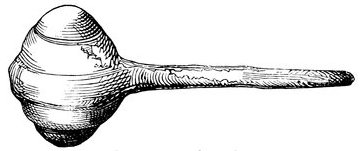
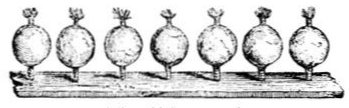
Arikkara bird-cage gourds
Many Mandans likewise carry lances, and I was told that
they had a remarkably handsome one, of which, however,
I did not obtain a sight. These Indians have shields, which
do not differ from those of the tribes already mentioned.
They all wear, in their girdle, behind, their large knife,
which is indispensable to them in hunting and in war. Some
use, for the handle of the knife, the lower jaw of a bear,
with the hair and teeth remaining.[327] The bow and arrows
are, even now, much esteemed by all the nations living on
the Missouri, while those that have been entirely driven
from that river (the Osages) greatly prefer the gun; the
former, therefore, are capital archers, which cannot be affirmed
of the Osages. The Mandans and Manitaries are
said to fight well in their manner, and there have been frequent
instances of individual bravery. One of their most
distinguished warriors, at this time, is Mato-Topé, of whom
we shall often have to speak in the sequel. He has killed
more than five chiefs of other nations. The father of
Mato-Topé, whose name was Suck-Schih (the handsome
child), behaved exactly {391} in the same manner as the
Manitari chief, Kokoahkis, mentioned by Say.[328] He went,
one evening, wrapped up in his robe, into a hut of the hostile
Arikkaras, as the young men of the village often do,
ate with his face covered, so that he was taken for a
young Arikkara; then laid himself down by the side of a
woman, and afterwards cut off a lock of her hair, with
which he retired. He might have killed the woman, as
Kokoahkis did, but refrained from doing so.
Wounds appear to be healed with remarkable ease. In
cases of arrow wounds, they like to force the arrow quite
through, that the iron head may not remain in the wound.
Men and women are often scalped, in battle, who afterwards
come to themselves, and are cured. Such a large wound
on the head is rubbed with fat; the medicine man fumigates
it, singing at the same time. Disorders are not uncommon
among the Indians. The Mandans and Manitaries often
suffer from diseases in the eyes; many are one-eyed, or have
a tunicle over one eye. In inflammation of the eye they have
a custom of scratching the inner eye with the leaf of a kind
of grass, resembling a saw, which causes them to bleed very
much, and this may often occasion the loss of the eye. Rheumatism,
coughs, and the like, are frequent, because they
go half naked in the severest cold, and plunge into ice water.
Much benefit is often derived from their steam-baths, in
a well closed hut, where a thick steam is produced by pouring
water on hot stones. They then immediately go into the
cold, roll themselves in the snow, or plunge into a river covered
with drifting ice, but do not return to a warm hut, as the
Russians do. Many Indians are said to have died on the
spot by trying this remedy. Some suffer from gout; but all
who survive these violent remedies are stronger and more
hardy. Another remedy is trampling on the whole body,
especially the stomach, as is practised also among the Brazilians.
This operation is performed with such violence, as
often to occasion hard swellings in the intestines, or ulcers,
especially in the liver. The steam-bath is used as a remedy
in all kinds of disorders. Vaccination, the application of
which met with no difficulties among several nations on the
great lakes, especially the Chippeways, is not yet practised
among the Mandans and Manitaries. Spitting of blood is
said to be frequent, but not pulmonary consumption. Gonorrhœa
is very common; they affirm that all venereal disorders
come to them from the Crows beyond the Rocky
Mountains. For such disorders they often seat themselves
over a heated pot, but very frequently burn themselves.
They cut open buboes, lengthwise, with a knife, and then
run for a couple of miles as fast as they can. The jaundice
is said not to occur among them. It appears that they are
not acquainted with emetics, but, if they feel anything wrong
in the stomach, they thrust a feather down the throat, and
thus produce vomiting. Their purgatives are obtained from
the vegetable kingdom. The poison-vine often produces
swellings, especially in children. As rattlesnakes are rare
in the vicinity of the villages, it is, of course, seldom that any
one is bitten by them; these Indians are said, however, to
have very good remedies against the bite. Frozen limbs are
rubbed with snow. {392} When blindness arises from the
dazzling brightness of the snow, which it very frequently
does in March, they bathe the eyes with a solution of gunpowder
and water. They often have recourse to bleeding,
which they perform with a sharp flint, or a knife. They
often apply to the Whites for medicine, and willingly follow
their prescriptions. These Indians have also various remedies
for their horses; thus, when a horse has the strangury,
they give it a piece of a wasp's nest.
When a Mandan or Manitari dies, they do not let the
corpse remain long in the village; but convey it to the distance
of 200 paces, and lay it on a narrow stage, about six feet
long, resting on four stakes about ten feet high, the body
being first laced up in buffalo robes and a blanket.[329] The
face, painted red, is turned towards the east. A number
of such stages are seen about their villages, and, although
they themselves say that this custom is injurious to the health
of the villages, they do not renounce it. On many of these
stages there are small boxes, containing the bodies of children
wrapped in cloth or skins. Ravens are usually seen sitting
on these stages, and the Indians dislike that bird, because
it feeds on the flesh of their relations. If you ask a Mandan
why they do not deposit their dead in the ground, he answers—"The
lord of life has, indeed, told us that we came from
the ground, and should return to it again; yet we have
lately begun to lay the bodies of the dead on stages, because
we love them, and would weep at the sight of them." They
believe that every person has several spirits dwelling in him;
one of these spirits is black, another brown, and another light-coloured,
the latter of which alone returns to the lord of life.
They think that after death they go to the south, to several villages
which are often visited by the gods; that the brave and
most eminent go to the village of the good, but the wicked
into a different one; that they there live in the same manner
as they do here, carry on occupations, eat the same food,
have wives, and enjoy the pleasures of the chase and war.
Those who are kind-hearted are supposed to make many
presents and do good, find everything in abundance, and
their existence there is dependent on their course of life while
in the world.[330] Some of the inhabitants of the Mandan villages
are said not to believe all these particulars, and suppose
that after death they will live in the sun or in a certain star.
They mourn for the dead a whole year; cut off their hair,
cover their body and head with white or grey clay, and often,
with a knife or sharp flint, make incisions in their arms and
legs in parallel lines, in their whole length, so that they are
covered with blood. For some days after death the relations
make a loud lament and bewailing. Often a relative, or
some other friend, covers the dead, as they express it: he
brings one or two woollen cloths, of a red, blue, white, or
green colour, and, as soon as the body is laid on the stage,
mounts upon the scaffolding, and conceals the body beneath
the covering. A friend who will do this is, in token of respect,
presented, by the family of the deceased, with a horse.
If it is known beforehand that a person intends doing this
honour to the dead, a horse is at once tied near the stage, and
the friend, having performed {393} this last office, unties the
animal and leads it away. If a Mandan or Manitari falls
in battle, and the news of his death reaches the family, who
are unable to recover the body, a buffalo skin is rolled up
and carried to the village. All those who desire to lament
the deceased assemble, and many articles of value are distributed
among them. The mourners cut off their hair,
wound themselves with knives, and make loud lamentations.
Joints of the fingers are not cut off here, as among the Blackfeet,
as a token of mourning, but as signs of penance and
offering to the lord of life and the first man.[331]
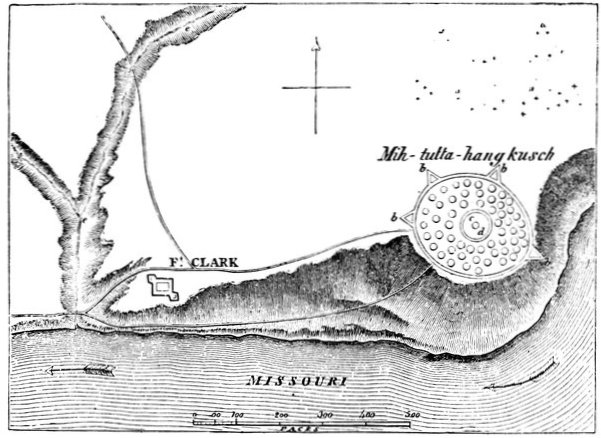
Map of neighborhood of Fort Clark
- a. Scaffolds for the dead, and poles with offerings. Plates 14 and 25 (see accompanying atlas, our volume xxv).
- b. The Mandan village—Mih-Tutta-Hang-Kush.
- c. The open space in the centre of the village.
- d. The ark of the first man.
- e. The stream in which the dishes are washed.
The English and French find the pronunciation of the
Mandan language extremely difficult; while to a German,
or a Dutchman, it is considerably easier, because it contains
very many gutturals, like ach, och, uch, in German. The
nasal sounds, on the contrary, are few, but they frequently
speak in a very indistinct way, having the mouth scarcely
opened. The vowels are often softened, and much depends
on the way in which the accent falls. The vowels a and u
are often only half pronounced, but occur very frequently.
I collected many words, as specimens of the language, and
wrote down phrases, and made an attempt to compile a
grammar of the Mandan language, but the completion of
it was, unfortunately, hindered by unfavourable circumstances.[332]
Several old persons assured me that they perfectly
remembered that, in their youth, many resemblances
between the Mandan and Manitari languages did not then
exist, which have since gradually crept in; the two languages
being then quite different, which, indeed, they are still, in
the main. As nations and allies, however, they have reciprocally
adopted many words and expressions, and hence
there is a better understanding among them now than heretofore,
and their intercourse is greatly facilitated. Time
will, undoubtedly, produce a still closer approximation.[333]
It is a remarkable fact, and proves how easily the separation
of single tribes, and even villages, of one and the same nation,
leads to changes in the language, and transitions into other
dialects. An example of this kind was presented in the two
Mandan villages, where many diversities of language had
already taken place. I collected several specimens of this
kind, and, to me, it was highly interesting. The Mandans
are more apt in learning foreign languages than many other
nations. Thus, the majority of them speak the Manitari
language, whereas but few of the latter understand the Mandan
language. Most of the American nations, at least, those
on the Missouri, are said to have no maledictory words or
terms of abuse; the Mandans have nothing of the kind but
the expression—"bad people." The article is wanting in
the Mandan language, and there is no distinction of gender,
except in addressing a man or a woman. For my observations
on the Mandan language, I am chiefly indebted to
the kindness and patience of Mr. Kipp, who had lived eleven
years among that people, had married an Indian wife, and
had attained a perfect knowledge of the language. The
Mandan names always have a signification, and are often
equivalent to whole sentences: all surrounding objects are
made use of in giving {394} names. I subjoin a few singular
specimens: "The bear which is a spirit;" "The bull which
is a spirit;" "I hear somebody coming;" "There are seven
of them married to old women," &c.
In conclusion I would say that some have affirmed that
they have found, in North America, Indians who spoke the
Gaelic language; this has been said of the Mandans; but
it has long been ascertained that this notion is unfounded,
as well as the assertion that the Mandans had a fairer complexion
than the other Indians.[334]