[PART III]
Excursion to the Summit of the Peak—Mineral Springs—Coquimbo
Owl—Encampment on the Arkansa.
At an early hour on the morning of the 13th, Lieutenant Swift,
accompanied by the guide, was despatched from camp, to measure a base
near the peak, and to make there a part of the observations requisite
for calculating its elevation. Dr. James, being furnished with four
men, two to be left at the foot of the mountain to take care of the
horses, and two to accompany him in the proposed ascent to the summit
of the peak, set off at the same time.
This detachment left the camp before sunrise, and taking the most
direct route across the plains, arrived at eleven o'clock at the base
of the mountain. Here Lieutenant Swift found a place suited to his
purpose; where, also, was a convenient spot for those who were to
ascend the mountain to leave their horses. At this place was a narrow,
woodless valley, dividing transversely several sandstone ridges, and
extending westward to the base of the peak.
After establishing their horse-camp, the detachment moved up the valley
on foot, arriving about noon at the boiling spring, where they dined on
a saddle of venison, and some bison ribs they had brought ready cooked
from camp.
The boiling spring is a large and beautiful fountain of water, cool
and transparent, and aërated with carbonic acid. It rises on the brink
of a small stream, which here descends from the mountain, at the point
where the bed of this stream divides the ridge of sandstone which
rests against the base of the first [213] granitic range. The water
of the spring deposits a copious concretion of carbonate of lime,2
which has accumulated on every side, until it has formed a large basin
overhanging the stream; above which it is raised several feet. This
basin is of a snowy whiteness, and large enough to contain three or
four hundred gallons, and is constantly overflowing.
The spring rises from the bottom of the basin, with a rumbling noise,
discharging about equal volumes of air and of water, probably about
fifty gallons per minute; the whole kept in constant agitation. The
water is beautifully transparent; and has the sparkling appearance, the
grateful taste, and the exhilarating effect, of the most highly aërated
artificial mineral waters.
Distant a few rods from this is another spring of the same kind, which
discharges no water, its basin remaining constantly full, and air only
escaping from it. We collected some of the air from both these springs
in a box we had carried for the reception of plants; but could not
perceive it to have the least smell, or the power of extinguishing
flame, which was tested, by plunging into it lighted splinters of dry
cedar.
The temperature of the water of the larger spring at noon was 63°, the
thermometer at the same time, in the shade, stood at 68°; immersed in
the small spring, at 67°. This difference in temperature is owing to
the difference of situation, the higher temperature of the small spring
depending entirely on its constant exposure to the rays of the sun, and
to its retaining the same portion of water; while that in the large
spring is constantly replaced by a new supply.3
After we had dined, and hung up some provisions in a large red
cedar-tree near the spring, intending it for a supply on our return,
we took leave of Lieutenant Swift, and began to ascend the mountain.
We carried with us each a small blanket, ten [214] or twelve pounds of
bison meat, three gills of parched corn meal, and a small kettle.
The sandstone extends westward from the springs, about three hundred
yards, rising rapidly upon the base of the mountain; it is of a deep
red colour, for the most part compact and fine, but sometimes embracing
angular fragments of petrosilex and other siliceous stones, with a few
organic impressions. The granite which succeeds to this is coarse, and
of a deep red colour; some loose fragments of gneiss were seen lying
about the surface, but none in place. The granite at the base of the
mountain contains a large proportion of felspar, of the rose-coloured
variety, in imperfect cubic crystals. The mass appears to be rapidly
disintegrating, under the operation of frost and other causes,
crumbling into small masses of half an ounce weight, or less.
The ascending party found the surface in many places covered with such
quantities of this loose and crumbled granite, rolling from under their
feet, as rendered the ascent extremely difficult. We now began to
credit the assertions of the guide, who had conducted us to the foot
of the peak, and there left us, with the assurance that the whole of
the mountain to its summit was covered with loose sand and gravel; so
that, though many attempts had been made by the Indians and by hunters
to ascend it, none had ever proved successful. We passed several of
these tracts, not without some apprehension for our lives; as there was
danger, when the foothold was once lost, of sliding down, and being
thrown over precipices. After labouring with extreme fatigue over
about two miles, in which several of these dangerous places occurred,
we halted at sunset in a small cluster of fir trees. We could not,
however, find a piece of even ground large enough to lie down upon,
and were under the necessity of securing ourselves from rolling into
the brook near which we encamped by means of a pole placed against two
trees. In this situation, we [215] passed an uneasy night; and though
the mercury fell only to 54°, felt some inconvenience from cold.
On the morning of the 14th, as soon as daylight appeared, having
suspended in a tree our blankets, all our provisions, except about
three pounds of bison's flesh, and whatever articles of clothing could
be dispensed with, we continued the ascent, hoping to be able to reach
the summit of the peak, and return to the same camp in the evening.
After passing about half a mile of rugged and difficult travelling,
like that of the preceding day, we crossed a deep chasm, opening
towards the bed of the small stream we had hitherto ascended; and
following the summit of the ridge between these, found the way less
difficult and dangerous.
Having passed a level tract of several acres covered with the aspen,
poplar, a few birches, and pines, we arrived at a small stream running
towards the south, nearly parallel to the base of the conic part of the
mountain which forms the summit of the peak. From this spot we could
distinctly see almost the whole of the peak: its lower half thinly clad
with pines, junipers, and other evergreen trees; the upper, a naked
conic pile of yellowish rocks, surmounted here and there with broad
patches of snow. But the summit appeared so distant, and the ascent
so steep, that we began to despair of accomplishing the ascent and
returning on the same day.
About the small stream before mentioned, we saw an undescribed
white-flowered species of caltha, some pediculariæ, the shrubby
cinque-foil (potentilla fruticosa, Ph.) and many alpine plants. At
this point a change is observed in the character of the rock, all that
which constitutes the peak beyond containing no mica. It is a compact,
fine-grained aggregate of quartz, felspar, and hornblende; the latter
in small proportion, and sometimes wholly wanting.
The day was bright, and the air nearly calm. As we ascended rapidly,
we could perceive a manifest [216] change of temperature; and before
we reached the outskirts of the timber, a little wind was felt from
the north-east. On this part of the mountain is frequently seen the
yellow-flowered stone-crop (sedum stenopetalum, Ph.), almost the only
herbaceous plant which occurs in the most closely wooded parts of the
mountain. We found the trees of a smaller size, and more scattered in
proportion to the elevation at which they grew; and arrived at about
twelve o'clock at the limit above which none are found. This is a
defined line, encircling the peak in a part which, when seen from the
plain, appeared near the summit; but when we arrived at it, a greater
part of the whole elevation of the mountain seemed still before us.
Above the timber the ascent is steeper, but less difficult than below;
the surface being so highly inclined, that the large masses, when
loosened, roll down, meeting no obstruction until they arrive at the
commencement of the timber. The red cedar, and the flexile pine,4
are the trees which appear at the greatest elevation. These are small,
having thick and extremely rigid trunks; and near the commencement of
the naked part of the mountain, they have neither limbs nor bark on
that side which is exposed to the descending masses of rocks. It may
appear a contradiction to assert, that trees have grown in a situation
so exposed as to be unable [to] produce or retain bark or limbs on
one side; yet of the fact that they are now standing and living in
such a situation there can be no doubt. It is, perhaps, probable the
timber may formerly have extended to a greater elevation on the sides
of this peak than at present, so that those trees which are now on the
outskirts of the forest were formerly protected by their more exposed
neighbours.
A few trees were seen above the commencement of snow; but these are
very small, and entirely procumbent, being sheltered in the crevices
and fissures of the rock. There are also the roots of trees to be seen
at [217] some distance above the part where any are now standing.
A little above the point where the timber disappears entirely,
commences a region of astonishing beauty, and of great interest on
account of its productions. The intervals of soil are sometimes
extensive, and covered with a carpet of low but brilliantly-flowering
alpine plants. Most of these have either matted procumbent stems, or
such as, including the flower, rarely rise more than an inch in height.
In many of them the flower is the most conspicuous and the largest part
of the plant, and in all the colouring is astonishingly brilliant.
A deep blue is the prevailing colour among these flowers; and the
pentstemon erianthera, the mountain columbine (aquilegia cœrulea),
and other plants common to less elevated districts, were much more
intensely coloured than in ordinary situations. It cannot be doubted,
that the peculiar brilliancy of colouring observed in alpine plants,
inhabiting near the utmost limits of phænogamous vegetation, depends
principally upon the intensity of the light transmitted from the bright
and unobscured atmosphere of those regions, and increased by reflection
from the immense impending masses of snow. May the deep cerulean tint
of the sky have an influence in producing the corresponding colour so
prevalent in the flowers of these alpine plants? At about two o'clock
we found ourselves so much exhausted as to render a halt necessary. Mr.
Wilson, who had accompanied us as a volunteer, had been left behind
some time since, and could not now be seen in any direction. As we felt
some anxiety on his account, we halted, and endeavoured to apprize
him of our situation; but repeated calls, and the discharging of the
rifleman's piece, produced no answer. We therefore determined to wait
some time to rest, and to eat the provision we had brought, hoping, in
the meantime, he would overtake us.
[218] We halted at a place about a mile above the edge of the timber.
The stream by which we were sitting we could perceive to fall
immediately from a large body of snow, which filled a deep ravine on
the south-eastern side of the peak. Below us, on the right, were two or
three extensive patches of snow; and ice could be seen everywhere in
the crevices of the rocks.
Here, as we were sitting at our dinner, we observed several small
animals, nearly of the size of the common gray squirrel; but shorter,
and more clumsily built. They were of a dark gray colour, inclining to
brown, with a short thick head, and erect rounded ears. In habits and
appearance, they resemble the prairie dog, and are believed to be a
species of the same genus. The mouth of their burrow is usually placed
under the projection of a rock; and near these the party afterwards saw
several of the little animals watching their approach, and uttering
all the time a shrill note, somewhat like that of the ground squirrel.
Several attempts were made to procure a specimen of this animal, but
always without success, as we had no guns but such as carried a heavy
ball.
After sitting about half an hour, we found ourselves somewhat
refreshed, but much benumbed with cold. We now found it would be
impossible to reach the summit of the mountain, and return to our camp
of the preceding night, during that part of the day which remained;
but as we could not persuade ourselves to turn back, after having so
nearly accomplished the ascent, we resolved to take our chance of
spending the night on whatever part of the mountain it might overtake
us. Wilson had not yet been seen; but as no time could be lost, we
resolved to go as soon as possible to the top of the peak, and look for
him on our return. We met, as we proceeded, such numbers of unknown and
interesting plants, as to occasion much delay in collecting; [219] and
were under the mortifying necessity of passing by numbers we saw in
situations difficult of access.
As we approached the summit, these became less frequent, and at length
ceased entirely. Few cryptogamous plants are seen about any part of
the mountain; and neither these nor any others occur frequently on the
top of the peak. There is an area of ten or fifteen acres forming the
summit, which is nearly level; and on this part scarce a lichen was to
be seen. It is covered to a great depth with large splintery fragments
of a rock entirely similar to that found at the base of the peak,
except perhaps a little more compact in its structure. By removing a
few of these fragments, they were found to rest upon a bed of ice,
which is of great thickness, and may, perhaps, be as permanent as the
rocks with which it occurs.
It was about 4 o'clock P. M. when the party arrived on the
summit. In our way we had attempted to cross a large field of snow,
which occupied a deep ravine, extending down about half a mile from
the top, on the south-eastern side of the peak. This was, however,
found impassable, being covered with a thin ice, not sufficiently
strong to bear the weight of a man. We had not been long on the summit
when we were rejoined by the man who had separated from us, near the
outskirts of the timber. He had turned aside and lain down to rest, and
afterwards pursued his journey by a different route.
From the summit of the peak, the view towards the north-west and
south-west is diversified with innumerable mountains, all white with
snow; and on some of the more distant it appears to extend down to
their bases. Immediately under our feet, on the west, lay the narrow
valley of the Arkansa, which we could trace running towards the
north-west, probably more than sixty miles.
On the north side of the peak was an immense [220] mass of snow
and ice. The ravine in which it lay terminated in a woodless and
apparently fertile valley, lying west of the first great ridge, and
extending far towards the north. This valley must undoubtedly contain
a considerable branch of the Platte. In a part of it, distant probably
thirty miles, the smoke of a large fire was distinctly seen, supposed
to indicate the encampment of a party of Indians.5
To the east lay the great plain, rising as it receded, until in the
distant horizon it appeared to mingle with the sky. A little want of
transparency in the atmosphere, added to the great elevation from which
we saw the plain, prevented our distinguishing the small inequalities
of the surface. The Arkansa, with several of its tributaries, and some
of the branches of the Platte, could be distinctly traced as on a map,
by the line of timber along their courses.
On the south the mountain is continued, having another summit,
(supposed to be that ascended by Captain Pike,) at the distance of
eight or ten miles. This, however, falls much below the high peak in
point of elevation, being wooded quite to its top. Between the two lies
a small lake, apparently a mile long, and half a mile wide, discharging
eastward into the Boiling-spring creek. A few miles farther towards the
south, the range containing these two peaks terminates abruptly.6
The weather was calm and clear while the detachment remained on the
peak; but we were surprised to observe the air in every direction
filled with such clouds of grasshoppers, as partially to obscure the
day. They had been seen in vast numbers about [221] all the higher
parts of the mountain, and many had fallen upon the snow and perished.
It is, perhaps, difficult to assign the cause which induces these
insects to ascend to those highly elevated regions of the atmosphere.
Possibly they may have undertaken migrations to some remote district;
but there appears not the least uniformity in the direction of their
movements.7 They extended upwards from the summit of the mountain
to the utmost limit of vision; and as the sun shown brightly, they
could be seen by the glittering of their wings, at a very considerable
distance.
About all the woodless parts of the mountain, and particularly on the
summit, numerous tracks were seen, resembling those of the common deer,
but most probably have been those of the animal called the big horn.
The skulls and horns of these animals we had repeatedly seen near the
licks and saline springs at the foot of the mountain, but they are
known to resort principally about the most elevated and inaccessible
places.
The party remained on the summit only about half an hour; in this time
the mercury fell to 42°, the thermometer hanging against the side of
a rock, which in all the early part of the day had been exposed to
the direct rays of the sun. At the encampment of the main body in the
plains, a corresponding thermometer stood in the middle of the day at
96°, and did not fall below 80° until a late hour in the evening.
Great uniformity was observed in the character of the rock about all
the upper part of the mountain. [222] It is a compact, indestructible
aggregate of quartz and felspar, with a little hornblende, in very
small particles. Its fracture is fine, granular, or even; and the
rock exhibits a tendency to divide when broken into long, somewhat
splintery fragments. It is of a yellowish brown colour, which does
not perceptibly change by long exposure to the air. It is undoubtedly
owing to the close texture and the impenetrable firmness of this rock
that so few lichens are found upon it. For the same reason it is little
subject to disintegration by the action of frost. It is not improbable
that the splintery fragments, which occur in such quantities on all the
higher parts of the peak, may owe their present form to the agency of
lightning. No other cause seems adequate to the production of so great
an effect.
Near the summit some large detached crystals of felspar, of a pea-green
colour, were collected; also large fragments of transparent, white and
smoky quartz, and an aggregate of opaque white quartz, with crystals of
hornblende.
At about five in the afternoon the party began to descend, and a little
before sunset arrived at the commencement of the timber; but before
we reached the small stream at the bottom of the first descent, we
perceived we had missed our way. It was now become so dark as to render
an attempt to proceed extremely hazardous; and as the only alternative,
we kindled a fire, and laid ourselves down upon the first spot of level
ground we could find. We had neither provisions nor blankets; and our
clothing was by no means suitable for passing the night in so bleak
and inhospitable a situation. We could not, however, proceed without
imminent danger from precipices; and by the aid of a good fire, and
no ordinary degree of fatigue, found ourselves able to sleep during a
greater part of the night.
15th. At day break on the following morning, the thermometer stood
at 38°. As we had few comforts to leave, we quitted our camp as soon
as [223] the light was sufficient to enable us to proceed. We had
travelled about three hours when we discovered a dense column of smoke
rising from a deep ravine on the left hand. As we concluded this
could be no other than the smoke of the encampment where we had left
our blankets and provisions, we descended directly towards it. The
fire had spread and burnt extensively among the leaves, dry grass,
and small timber, and was now raging over an extent of several acres.
This created some apprehension, lest the smoke might attract the
notice of any Indians who should be at that time in the neighbourhood,
and who might be tempted by the weakness of the party to offer some
molestation. But we soon discovered a less equivocal cause of regret in
the loss of our cache of provisions, blankets, clothing, &c. which
had not escaped the conflagration. Most of our baggage was destroyed;
but out of the ruins we collected a beggarly breakfast, which we ate,
notwithstanding its meanness, with sufficient appetite. We chose a
different route for the remaining part of the descent from the one
taken in going up, and by that means avoided a part of the difficulty
arising from the crumbled granite; but this was nearly compensated by
the increased numbers of yuccas and prickly pears.
We arrived a little after noon at the boiling spring, where we indulged
freely in the use of its highly aërated and exhilarating waters. In
the bottom of both these springs a great number of beads and other
small articles of Indian ornament were found, having unquestionably
been left there as sacrifices or presents to the springs, which are
regarded with a sort of veneration by the savages. Bijeau assured us he
had repeatedly taken beads and other ornaments from these springs, and
sold them to the same savages who had thrown them in.8
A large and much frequented road passes the springs, and enters the
mountains, running to the north of the high peak. It is travelled
principally [224] by the bisons, sometimes also by the Indians; who
penetrate here to the Columbia.9
The men who had been left at the horse-camp about a mile below the
springs, had killed several deer, and had a plentiful supply of
provisions. Here the detachment dined; then mounting our horses, we
proceeded towards the encampment of the main body, where we arrived
a little after dark, having completed our excursion within the time
prescribed.
Among the plants collected in this excursion, several appear to be
undescribed. Many of them are strictly alpine, being confined to the
higher parts of the mountain, above the commencement of snow.
Most of the timber which occurs on any part of the mountain is
evergreen, consisting of several species of abies, among which may be
enumerated the balsam fir (A. balsamea, Ph.); the hemlock, white, red,
and black spruce (A. canadensis, A. alba, A. rubra, and A. nigra); the
red cedar, and common juniper; and a few pines. One of these, which
appears to have been hitherto unnoticed in North America, has, like the
great white or Weymouth pine, five leaves in a fascicle; but in other
respects there is little resemblance between them. The leaves are short
and rather rigid; the sheaths which surround their bases short and
lacerated; the strobiles erect, composed of large unarmed scales, being
somewhat smaller than those of P. rigida, but similar in shape, and
exuding a great quantity of resin. The branches, which are covered with
leaves chiefly at the ends, are numerous and recurved, inclining to
form a dense and large top; they are also remarkably flexile, feeling
in the hand somewhat like those of the dirca palustris, L. From this
circumstance, the specific name, flexilis, has been proposed for this
tree; which is, in several respects, remarkably contrasted with the P.
rigida. It inhabits the arid plains subjacent to the Rocky Mountains,
and extends up their sides to the region of perpetual frost. The [225]
fruit of the pinus flexilis is eaten by the Indians and the French
hunters, as that of another species of the same genus is eaten by the
inhabitants of some parts of Europe.
The creek on which the party encamped during the three days occupied in
making the excursion above detailed, is called Boiling-spring creek,
having one of its principal sources in the beautiful spring already
described.10
It is
skirted with a narrow margin of cotton-wood and
willow trees; and its banks produce a small growth of rushes, on which
our horses subsisted principally, while we lay encamped here. This
plant, the common rush (equisetum hyemale, Ph.), found in every part of
the United States, is eaten with avidity by horses, and is often met
with in districts where little grass is to be had. When continued for a
considerable time its use proves deleterious.
The recent track of a grizzly bear was observed near the camp; and at
no great distance one of those animals was seen and shot at by one of
the hunters, but not killed.
In the timber along the creek, the sparrow-hawk, mocking-bird, robin,
red-head woodpecker, Lewis' woodpecker, dove, winter wren, towhe,
bunting, yellow-breasted chat, and several other birds were seen.
Orbicular lizards were found about this camp, and had been once or
twice before noticed near the base of the mountains.
A smoke, supposed to be that of an Indian encampment, was seen
rising from a part of the mountains, at a great distance towards the
north-west. It had been our constant practice, since we left the
Missouri, to have sentinels stationed about all our encampments, and
whenever we were not on the march by day, and until nine o'clock in the
evening; it was the duty of one of the three Frenchmen to reconnoitre
at a distance from camp, in every direction, and to report immediately
when any thing [226] should be discovered indicating that Indians were
in the vicinity. Precautions of this kind are necessary to prevent
surprisal, and invariably are practised by the Indians of the west,
both at their villages and on their march.
On the 14th, Lieutenant Swift returned to camp, having performed the
duties on which he was sent. A base was measured near the camp, and
observations taken for ascertaining the elevation of the peak.
Complete sets of observations for latitude and longitude were taken,
which gave 38° 18′ 19″ north, and 105° 39′ 44″ west from
Greenwich, or 28° 39′ 45″ from Washington, as the position of our
camp. The bearing of the Peak from this point is north 67° west, and
the distance about twenty-five miles.11
In all the prairie-dog villages we had passed small owls had been
observed moving briskly about, but they had hitherto eluded all our
attempts to take them. One was here caught, and on examination, found
to be the species denominated coquimbo, or burrowing owl, (strix
cunicularia.) This fellow-citizen of the prairie-dog, unlike its grave
and recluse congeners, is of a social disposition, and does not retire
from the light of the sun, but endures the strongest mid-day glare of
that luminary, and is in all respects a diurnal bird. It stands high
upon its legs, and flies with the rapidity of the hawk. The coquimbo
owl, both in Chili and St. Domingo, agreeably to the accounts of
Molina and Vieillot, digs large burrows for its habitations, and for
the purposes of incubation; the former author gives us to understand
that the burrow penetrates the earth to a considerable depth, whilst
Vieillot informs us that in St. Domingo, the depth is about two
feet.12
With us the owl never occurred but in the prairie-dog villages,
sometimes in a small flock much scattered, and often perched on
different hillocks, at a distance deceiving the eye with the appearance
of [227] the prairie-dog, itself, in an erect posture. They are not
shy, but readily admit the hunter within gun-shot; but on his too near
approach, a part or the whole of them rise upon the wing, uttering
a note very like that of the prairie-dogs, and alight at a short
distance, or continue their flight beyond the view.
The burrows into which we have seen the owl descend, resembled in all
respects those of the prairie-dog, leading us to suppose, either that
they were common, though, perhaps not friendly occupants of the same
burrow, or that the owl was the exclusive tenant of a burrow gained by
right of conquest. But it is at the same time possible, that, as in
Chili, the owl may excavate his own tenement.
From the remarkable coincidence of note between these two widely
distinct animals, we might take occasion to remark the probability of
the prairie-dog being an unintentional tutor to the young owl, did we
not know that this bird utters the same sounds in the West Indies,
where the prairie-dog is not known to exist.
It may be that more than a single species of diurnal owl has been
confounded under the name of cunicularia, as Vieillot states his bird
to be somewhat different from that of Molina; and we cannot but observe
that the eggs of the bird described by the latter are spotted with
yellow, whilst those of the former are immaculate.
As our specimens do not in all respects correspond with the
descriptions by the above-mentioned authors, of the Coquimbo owl, we
have thought proper to subjoin such particulars as seem necessary to be
noted, in addition to the description already given by those authors.
The general colour is a light burnt brown spotted with white; the
larger feathers five or six-banded with white, each band more or
less widely interrupted by the shaft, and their immediate margins
darker than the other portions of the feathers; the [228] tips of
these feathers are white or whitish; the exterior primary feather is
serrated, shorter than the three succeeding ones, and equal in length
to the fifth; the bill is tinged with yellow on the ridges of both
mandibles; the tarsi and feet distinctly granulated, the former naked
behind, furnished before, near the base, with dense, short feathers,
which, towards the toes, become less crowded, and assume the form of
single hairs; those on the toes are absolutely setaceous and scattered;
the lobes beneath the toes are large and granulated.
On the plains about our encampment, were numerous natural mounds,
greatly resembling some of the artificial works so common in the
central portions of the great valley of the Mississippi. About the
summits of these mounds, were numerous petrifactions, which were found
to be almost exclusively casts of bivalve shells approaching the genus
cytherea, and usually from one half to one and an half inches in width.
On the evening of the fifteenth, finding all our stock of meat injured
by too long keeping, four men were sent out on horseback to hunt. At
the distance of six miles from camp, they found a solitary bison,
which they killed, but concluding from its extreme leanness and the
ill-savour of the flesh, that the animal was diseased, they took no
part of it. On the following morning they returned, bringing nothing.
We were now reduced to the necessity of feeding on our scanty allowance
of a gill of parched maize per day to each man, this being the utmost
that our limited stores would afford.
On the 16th of July, we moved from our encampment on Boiling-spring
creek, in a south-western direction to the Arkansa. This ride of
twenty-eight miles, which we finished without having once dismounted
from our horses, occupied about twelve hours of a calm, sultry day, in
every respect like the preceding, in which the thermometer in the shade
had [229] ranged from 90 to 100°. Our route lay across a tract of low
but somewhat broken sandstone, of an uncommonly slaty structure. It
is fine-grained, with an argillaceous cement, and of a light gray or
yellowish white colour. It contains thin beds of bituminous clay-slate;
and we saw scattered on the surface some small crystals of selenite.
It is traversed by numerous deep ravines, in which at this time, not
a drop of water was to be found. The soil is scanty, and of incurable
barrenness. The texture of the rock is so loose and porous as to unfit
it for retaining any portion of the water which falls upon it in rains.
A few dwarfish cedars and pines are scattered over a surface consisting
of a loose dusty soil, intermixed with thin lamellar fragments of
sandstone, and nearly destitute of grass or herbage of any kind. Our
sufferings from thirst, heat, and fatigue, were excessive, and were
aggravated by the almost unlimited extent of the prospect before us,
which promised nothing but a continuation of the same dreary and
disgusting scenery. Late in the afternoon we arrived at the brink of
the precipice which divides the high plains from the valley of the
Arkansa; this is here narrow, and so deeply sunk in the horizontal
sandstone, that although there are trees of considerable size growing
along the river, they do not rise to the level of the surface of the
great plain, and from a little distance on either side, the valley
is entirely hid. There our thirst and impatience were for some time
tantalized with the view of the cool and verdant valley and copious
stream of the Arkansa, while we were searching up and down for a place
where we could descend the precipice.
We at length found a rugged ravine, down which we with some difficulty
wound our way to the base of the cliff, where lay a beautiful level
plain, having some scattered cotton-wood and willow trees, and
affording good pasture for our horses. Here we encamped, and the
remainder of the afternoon was [230] spent in making preparations
to despatch a small party up the Arkansa to the mountains on the
succeeding day.
A small doe was killed near camp, which, though extremely lean, proved
an important addition to our supply of provisions.
The place where we encamped was supposed to have been near where Pike's
block-house formerly stood, but we sought in vain for the traces of
anything resembling the work of a white man.13
A Detachment from the Exploring Party Ascend the Arkansa to the
Mountains—Bell's Springs—Descent of the Arkansa—Grizzly Bear.
On the morning of the 17th Captain Bell, with Dr. James and two men,
took their departure, proposing to ascend the Arkansa to the mountains.
They were furnished with provisions for two days, according to the
scanty allowance to which we were all reduced. The river valley was
found so narrow, and so obstructed by the timber and the windings
of the stream, as greatly to impede the travelling; we therefore
resolved to leave it, and pursue our journey in the open plain at a
distance from the river. The course of the Arkansa, for the first
twenty miles from the mountains, is but little south of east. It
enters the plain at the extremity of an extensive amphitheatre, formed
by the continued chain of the mountains on the west and north-west,
and by the projecting spur which contains the high peak on the east.
This semicircular area is about thirty miles in length from north
to south, and probably twenty wide at its southern extremity. The
mountains which bound it on the west are high, but at this time had
little snow on them. The surface of the area is an almost unvaried
plain, and is based upon the stratum of argillaceous sandstone. Near
the base of the mountain the same sandstone is observed, resting in
an inclined position against the primitive rocks. It forms a range
like that already mentioned, when speaking of the mountains at the
Platte, separated from the primitive by a narrow secluded valley. On
entering this valley we found [232] the recent trace of a large party
of Indians, travelling with skin lodges, who appeared to have passed
within a very short time. This trace we followed, until we found it
entered the mountains in the valley of a small stream which descends
to the Arkansa from the north-east. This we left on the east, and
traversing a rough and broken tract of sandstone hills, arrived, after
a toilsome day's journey of about thirty miles, at the spot where the
Arkansa leaves the mountains.
Here we found several springs, whose water is impregnated with muriate
of soda and other salts. They rise near each other, in a small marshy
tract of ground, occupying the narrow valley of the river, at the point
where it traverses the inclined sandstone ridge. Very little water
flows from them, and the evaporation of this has left a crystalline
incrustation, whitening the surface of the surrounding marsh. The
springs are small excavations, which may perhaps have been dug by the
Indians or by white hunters. They appear to remain constantly full;
they all contain muriate of soda, and the smell of sulphuretted hydrogen
is perceptible at considerable distance from them. They differ in
taste a little from each other, hence the account given of them by
the hunters, that one is sour, another sweet, a third bitter, and
so on. One contains so much fixed air as to give it some pungency,
but the water of all of them is unpalatable. The sweetish metallic
taste observed in the water of one or two, appears to depend on an
impregnation of sulphate of iron.
The sulphates of magnesia and soda will probably be found to exist
in these springs; if their water should hereafter be analysed, they
may also be found to possess some active medicinal properties. They
are seven in number, and have received the name of Bell's Springs, in
compliment to their discoverer. Though the country around them abounds
with bisons, deer, &c. they do not appear to be frequented, [233] as
most saline springs are, by these or other herbivorous animals.14
It was near sunset when Captain Bell and his party arrived at the
springs, and being much exhausted by their laborious march, they
immediately laid themselves down to rest under the open canopy,
deferring their examinations for the following morning.
The sandstone near the springs is hard, though rather coarse, and of a
dark gray or brownish yellow colour. In ascending the Arkansa on the
ensuing morning, we found the rock to become more inclined, and of a
redder colour, as we approached the primitive, until, at about half
a mile from the springs, it is succeeded by the almost perpendicular
gneiss rock, which appears here at the base of the first range of the
mountains. We have noticed that this particular spot is designated,
in the language of hunters, as "the place where the Arkansa comes
out of the mountains;" and it must be acknowledged, the expression
is not entirely inapplicable. The river pours with great impetuosity
and violence through a deep and narrow fissure in the gneiss rock,
which rises so abruptly on both sides to such a height, as to oppose
an impassable barrier to all further progress. According to the
delineation of Pike's route, upon the map which accompanies his work,
he must have entered the mountains at this place; but no corroboration
can be derived from his journal. It appears almost incredible that
he should have passed by this route, and have neglected to mention
the extreme difficulty which must have attended the undertaking. The
detached party returned to the encampment of the main body on the 18th.
The immediate valley of the Arkansa, near the mountains, is bounded
by high cliffs of inclined sandstone. At a short distance below these
disappear, and a sloping margin of alluvial earth extends on each side
to the distance of several miles. Somewhat farther down horizontal
sandstone appears, confining [234] the valley to a very narrow space,
and bounding it within perpendicular precipices on each side. Seven
miles from the mountains, on the left hand side of the Arkansa, is
a remarkable mass of sandstone rocks, resembling a large pile of
architectural ruins.
From this point the bearing of James's Peak15 was found to be due
north.
The Arkansa valley, between our encampment of the 16th and the
mountains, a distance of about thirty miles, has a meagre and gravelly
soil, sustaining a growth of small cotton-wood trees, rushes, and
coarse grass: above the rocky bluffs, on each side, spreads a dreary
expanse of almost naked sand, intermixed with clay enough to prevent
its drifting with the wind, but not enough to give it fertility. It is
arid and sterile, bearing only a few dwarfish cedars, and must for ever
remain desolate.
During the time of Captain Bell's absence on the excursion above
detailed, observations were made at camp for latitude, longitude, &c.,
and all the party were busy in their appropriate pursuits. Among the
animals taken here was the four-lined squirrel, (S. 4-vittatus, Say)
a very small and very handsome species, very similar in its dorsal
markings to the getulus, L.; but as far as we can judge from the
description and figures of the latter species by Buffon,16 our animal
is distinguished by its striped head, less rounded ears, and much less
bushy, and not striated and banded tail, and by its smaller size. The
getulus is also said to have no thumb wart.
It is an inhabitant of the Rocky Mountains about the sources of the
Arkansa and Platte. It does not seem to ascend trees by choice, but
nestles in holes and on edges of the rocks. We did not observe it to
have cheek-pouches.
Its nest is composed of a most extraordinary quantity of the burrs of
the xanthium branches, and other portions of the large upright cactus,
small [235] branches of pine-trees and other vegetable productions,
sufficient in some instances to fill the body of an ordinary cart. What
the object of so great, and apparently so superfluous an assemblage of
rubbish may be, we are at a loss to conjecture; we do not know what
peculiarly dangerous enemy it may be intended to exclude by so much
labour.
Their principal food, at least at this season, is the seeds of the
pine, which they readily extract from the cones.17
There is also another species18 inhabiting about the mountains,
where it was first observed by those distinguished travellers, Lewis
and Clarke, on their expedition to the Pacific Ocean. It is allied to
the Sc. striatus, and belongs to the same subgenus (tamias illig.)
but it is of a somewhat larger stature, entirely destitute of the
vertebral line, and is further distinguished by the lateral lines
commencing before the humerus, where they are broadest by the longer
nails of the anterior feet, and by the armature of the thumb tubercle.
It certainly cannot with propriety be regarded as a variety of the
striatus, and we are not aware that the latter species is subject to
vary to any remarkable degree in this country. But the species to
which, in the distribution of its colours, it is most closely allied,
is unquestionably the Sc. bilineatus of Geoffroy.19 A specimen is
preserved in the Philadelphia Museum.
The cliff swallow20 is here very frequent, as well as in all the
rocky country near the mountains. This species attaches its nest in
great numbers to the rocks in dry situations, under projecting ledges.
The nest is composed of mud, and is hemispherical, with the entrance
near the top somewhat resembling a chymist's retort, flattened on one
side, and with the neck broken off for the entrance. This entrance,
which is perfectly rounded sometimes, projects a little and turns
downward. It is an active bird, flying about the vicinity of the nest
in every direction, [236] like the barn swallow. In many of the nests
we found young hatched, and in others only eggs.
A fine species of serpent21 was brought into camp by one of the men.
It is new, and seems to be peculiar to this region.
A very beautiful species of emberiza22 was caught; it is rather
smaller than the indigo bunting, (emberiza cyanea) with a note entirely
dissimilar. It was observed to be much in the grass, rarely alighting
on bushes or trees.
We also captured a rattle-snake,23 which, like the tergeminus, we
have found to inhabit a barren soil, and to frequent the villages of
the arctomys of the prairie; but its range appeared to us confined
chiefly to the vicinity of the Rocky Mountains. Its rattle is
proportionally much larger than that of the species just mentioned,
and the head is destitute of large plates. It seems, by the number of
plates and scales, to be allied to the atracaudatus of Bosc and Daud,
but their description induces the conclusion that their species is
entirely white beneath.24 It is also allied to the crotalus durissus,
L. (C. rhombifer, Beaur.), but it is smaller, and the dorsal spots are
more rounded. A specimen is placed in the Philadelphia Museum.
The only specimens of organic reliquiæ from this vicinity, which
we have been so fortunate as to preserve, are very indistinct in
their characters, and are only impressions in the gray sandstone.
One of them appears to have been a phytoid millepore, and the other
a sub-equilateral bivalve, which may possibly have been a mactra. It
is suborbicular, and its surface is marked by concentric grooves or
undulations. At a previous encampment numerous fragments of shells, of
a dusky colour, occurred in the same variety of sandstone, and amongst
these is an entire valve of a small species of ostrea, of a shape
very like that of a pinna, and less than half an inch in length. We
have a specimen, from another [237] locality, of a very dark coloured
compact, and very fœtid impure limestone, containing still more
blackish fragments of bivalves, one of which presents the form of a
much arcuated mytillus? but as the back of the valve only is offered to
examination, it may be a chama, but it seems to be perfectly destitute
of sculpture.
Another specimen from the mountains near the Platte river, is a reddish
brick-coloured petrosiliceous mass, containing casts and impressions of
a grooved terebratula.
Hunters were kept out during the day on the 17th, but killed nothing.
At evening they were sent out on horseback, but did not return till
3 P. M. on the following day. They had descended the river
twelve miles, finding little game. They had killed one deer, one
old turkey with her young brood of six. This supply proved highly
acceptable as we had for some time been confined almost entirely to
our small daily allowance of corn meal. At the commencement of our
tour we had taken a small supply of sea-biscuit. At first these were
distributed one to each man three times per day, afterwards two, then
one for two, and then one for three days, till our stock of bread was
so nearly exhausted, that it was thought proper to reserve the little
that remained for the use of the sick, should any unfortunately require
it. We then began upon our parched maize, which proved an excellent
substitute for bread. This was issued at first at the rate of one
pint per day for four men, no distinction being made in this or any
other case between the officers and gentlemen of the party, and the
citizens and soldiers attached to it. When we arrived at the Arkansa,
about one-third part of our supply of this article was exhausted, and
no augmentation of the daily issues could be allowed, although our
supplies of meat had been for some time inadequate to the consumption
of the party.
[238] We had a little coffee, tea, and sugar, but these were reserved
as hospital stores; our three gallons of salt were expended. We now
depended entirely upon hunting for our subsistence, as we had done
for meat ever since we left the Pawnee villages, our pork having
been entirely consumed before we arrived at that place. We, however,
apprehended little want of meat after we should have left the
mountains, as we believed there would be plenty of bisons and other
game upon the plains over which we were to travel.
At 2 o'clock P. M. on the eighteenth, rain began to fall which
continued during the remainder of the day, and made it impossible for
us to complete the observations we had begun.
The Arkansa, from the mountains to the place of our encampment, has
an average breadth of about sixty yards, it is from three to five
feet deep, and the current rapid. At the mountains, the water was
transparent and pure, but soon after entering the plains it becomes
turbid and brackish.
July 19th. This morning we turned our backs upon the mountains, and
began to move down the Arkansa. It was not without a feeling of
something like regret, that we found our long contemplated visit to
these grand and interesting objects, was now at an end. One thousand
miles of dreary and monotonous plain lay between us, and the enjoyments
and indulgences of civilized countries. This we were to traverse in the
heat of summer, but the scarcity of game about the mountains rendered
our immediate departure necessary.
A large and beautiful animal25 of the lizard kind (belonging to the
genus ameiva) was noticed in this day's ride. It very much resembles
the lacerta ameiva, as figured and described by Lacepede,26 but the
tail is proportionably much longer. Its movements were so extremely
rapid that it was with much difficulty we were able to capture a few of
them.
[239] We had proceeded about eight or ten miles from our camp, when we
observed a very considerable change in the character both of the river
and its valley, the former becoming wider, less rapid, and filled with
numerous islands; the latter bounded by sloping sandhills, instead
of perpendicular precipices. Here the barren cedar-ridges, formerly
mentioned, are succeeded by still more desolate plains, with scarce
a green or a living thing upon them, except here and there a tuft of
grass, an orbicular lizard, basking on the scorching sand, a solitary
pimelia, a blaps, or a galeodes. Among the few stinted and withered
grapes, we distinguished a small cespitose species of agrestis, and
several others which are thought to be undescribed. Near the river,
and in spots of uncommon fertility, the unicorn plant, (martynia
proboscidea, Ph.) was growing in considerable perfection. This plant,
which is sometimes cultivated in the gardens, where it is known by the
name of cuckold's horns, is a native of the Platte and Arkansa, and
is occasionally seen in every part of the open country from St. Louis
westward to the mountains.
A little before noon, we crossed a small stream which was called Castle
Rock creek, from a remarkable pile of naked rocks, and halted for
dinner on the bank of the river.27
In the morning, Mr. Peale and two hunters had taken a different route
from the remainder of the party, hoping to meet with game. They arrived
at a small grove of timber, where it was thought deer might be found;
they therefore left their horses in care of one of the hunters, and
entered the wood on foot. The man had been left alone but a short
time, when he discovered a large grizzly bear (ursus horribilis, Ord.)
approaching rapidly towards him, and without staying to make any
inquiry into the intentions of the animal, mounted his horse and fled.
This animal is widely distinct from any known [240] species of bear,
by the essential character of the elongated anterior claws, and
rectilinear or slightly arcuated figure of its facial profile. In
general appearance it may be compared to the alpine bear, (U. arctus),
and particularly to the Norwegian variety. The claws, however, of these
appear to be of the usual form and not elongated, and the facial space
included between the eyes is deeply indented; they also differ in their
manners, and climb trees, which the grizzly bear is never known to do.
Lewis and Clarke frequently saw and killed these bears during their
celebrated expedition across the continent. They mention one which was
nine feet long from the nose to the tip of the tail. The forefoot of
another was nine inches across, its hind foot eleven and three quarter
inches long, exclusive of the talons, and seven inches wide. The talons
of a third were six and one-fourth inches long.
They will not always attack, even when wounded. "As they fired, he did
not attempt to attack, but fled with a most tremendous roar, and such
was its extraordinary tenacity of life, that although he had five balls
passed through his lungs, and five other wounds, he swam more than half
across the river to a sand-bar, and survived twenty minutes. He weighed
between five or six hundred pounds, at least, and measured eight feet
seven and a half inches from the nose to the extremity of the hind
feet."—Lewis and Clarke.
One lived two hours after having been shot through the centre of his
lungs, and whilst in this state, he prepared for himself a bed in the
earth two feet deep and five feet long, after running a mile and a
half. The fleece and skin were a heavy burden for two men, and the oil
amounted to eight gallons.
Another shot through the heart, ran at his usual pace nearly a quarter
of a mile, before he fell.
This species, they further inform us, in all its variations [241] of
colouring, is called hohhost by the Chopunnish Indians.28 These
travellers mention another species of bear, which seems to be related
to the alpine bear, and which is most probably a new species. It climbs
trees, and is known to the Chopunnish Indians by the name of Yackak.
They also inform us, that the copulating season occurs about the 15th
of June.29
The Indians of the Missouri sometimes go to war in small parties
against the grizzly bear, and trophies obtained from his body are
highly esteemed, and dignify the fortunate individual who obtains them.
We saw, on the necks of many of their warriors, necklaces, composed
of the long fore-claws separated from the foot, tastefully arranged
in a radiating manner; and one of the band of Pawnee warriors, that
encountered a detachment of our party near the Kanza village, was
ornamented with the entire skin of the fore-foot, with the claws
remaining upon it, suspended on his breast.
It is not a little remarkable that the grizzly bear, which was
mentioned at a very early period, by Lahontan,30 and subsequently
by several writers, is not, even at this day, established in the
zoological works as distinct species; that it is perfectly distinct
from any described species, our description will prove. From the
concurrent testimony of those who have seen the animal in its native
country, and who have had an opportunity of observing its manners, it
is, without doubt, the most daring and truly formidable animal that
exists in the United States. He frequently pursues and attacks hunters;
and no animal, whose swiftness or art is not superior to his own, can
evade him. He kills the bison, and drags the ponderous carcass to a
distance to devour at his leisure, as the calls of hunger may influence
him.
The grizzly bear is not exclusively carnivorous, as has by some persons
been imagined; but also, and perhaps in a still greater degree, derives
nourishment [242] from vegetables, both fruits and roots; the latter he
digs up by means of his long fore-claws.
That they formerly inhabited the Atlantic states, and that they were
then equally formidable to the Indians, we have some foundation for
belief in the tradition of the Delaware Indians, respecting the big
naked bear; the last one of which they believe formerly existed east of
the Hudson river, and which Mr. Heckewelder31 assures us, is often
arraigned by the Indians before the minds of their crying children, to
frighten them to quietness.
Governor Clinton, in the notes appended to his learned Introductory
Discourse,32 says, "Dixon, the Indian trader, told a friend of mine,
that this animal had been seen fourteen feet long; that notwithstanding
its ferocity, it has been sometimes domesticated; and that an Indian
belonging to a tribe on the head waters of the Mississippi, had one
in a reclaimed state, which he sportively directed to go into a canoe
belonging to another tribe of Indians then about returning from a
visit. The bear obeyed, and was struck by an Indian; being considered
one of the family, this was deemed an insult, was resented accordingly,
and produced a war between these nations."
A half-grown specimen was kept chained in the yard of the Missouri
fur-company, near Engineer Cantonment; last winter he was fed chiefly
on vegetable food, as it was observed that he became furious when too
plentifully supplied with animal fare. He was in continual motion
during the greater part of the day, pacing backwards and forwards to
the extent of his chain. His attendants ventured to play with him,
though always in a reserved manner, fearful of trusting him too far
or placing themselves absolutely within his grasp. He several times
broke loose from his chain; on which occasions he would manifest [243]
the utmost joy, running about the yard in every direction, rearing up
on his hind-feet, and capering about. I was present at one of these
exhibitions; the squaws and children belonging to the establishment
ran precipitately to their huts, and closed the doors. He appeared
much delighted with his temporary freedom; he ran to the dogs who were
straying about the yard, but they avoided him. In his round he came to
me; and rearing up, placed his paws on my breast. Wishing to rid myself
of so rough a playfellow, I turned him round; upon which he ran down
the bank of the river, plunged into the water, and swam about for some
time.
Mr. J. Dougherty has had several narrow escapes from the grizzly bear.
He was once hunting with a companion on one of the upper tributaries
to the Missouri: he heard the report of his companion's rifle; and
looking round, beheld him at a little distance, endeavouring to escape
from one of these bears, which he had wounded as it was advancing
on him. Mr. D., attentive only to the preservation of his friend,
immediately hastened to divert the attention and pursuit of the bear
to himself, and arrived within rifle-shot distance just in time to
effect his generous object. He lodged his ball in the animal, and was
obliged to fly in his turn; whilst his friend, relieved from imminent
danger, prepared for another onset, by charging his piece, with which
he again wounded the bear, and relieved Mr. D. from pursuit. In this
most hazardous encounter neither of them were injured, and the bear was
fortunately destroyed.
Several hunters were pursued by a grizzly bear that gained rapidly
upon them. A boy belonging to the party, who possessed less speed than
his companions, seeing the bear at his heels, fell with his face to
the soil; the bear reared up on his hind-feet over the boy, looked
down for a moment upon him, then bounded over him in pursuit of the
fugitives.
A hunter, just returned from a solitary excursion [244] to the Qui
Court river, informed me at Engineer cantonment, that going one morning
to examine his traps, he was pursued by a bear, and had merely time to
get into a small tree, when the bear passed beneath him; and without
halting, or even looking up, passed on at the same pace.
Another hunter received a blow from the fore-paw of one of these
animals, which carried away his eye and cheek-bone.
In proof of the great muscular power with which this animal is endowed,
a circumstance related to us by Mr. J. Dougherty may be stated. He shot
down a bison; and leaving the carcass to obtain assistance to butcher
it, he was surprised on his return to find that it had been dragged
entire, to a considerable distance, by one of these bears, and was now
lodged in a concavity of the earth, which the animal had scooped out
for its reception.
Notwithstanding the formidable character of this bear, we have not
made use of any precautions against their attacks; and although they
have been several times prowling about us in the night, they have not
evinced any disposition to attack us at that season.
They appear to be more readily intimidated by the voice, than by the
appearance of men.
Some grizzly bears were brought, when very young, from the country of
the Sioux by Lieutenant Pike, and were presented to the Philadelphia
Museum. They were kept several years in that splendid institution,
secured in a strong cage; during which time they gradually increased
in size, until at length they became dangerous from their strength and
unsubdued ferocity, and it was judged proper to prepare them for the
cabinet. From these specimens our description is chiefly taken.33
Natural Mounds—Kaskaia Indian and Squaw—Preparations for a
Division of the Party—Sandstones of the High Plains South of the
Arkansa—Fletz Trap Formation.
In the afternoon of the 19th of July we passed the mouth of the river
St. Charles, called by Pike the Third Fork, which enters the Arkansa
from the south-west. It is about twenty yards wide; and receives,
eight miles above its confluence, the Green Horn creek, a small stream
from the south-west. The Green Horn rises in the mountains, and passes
between the Spanish peaks into the plains. These two peaks had been
for several days visible, standing close to each other, and appearing
entirely insulated. If they are not completely so, the other parts
of the same range fall far below them in point of elevation. They
are of a sharp conic form, and their summits are white with snow at
midsummer.34
This day we travelled twenty-five miles, the general direction of
our course being a little south of east, and encamped at five P.
M. in a grassy point on the north side of the river. The soil of
the islands and the immediate valley of the river were found somewhat
more fertile than above. Immediately after encamping, the hunters were
sent out, who soon returned with two deers and a turkey.
In the evening the altitude of Antares was taken. Throughout the night
we were much annoyed by mosquitos, the first we had met for some weeks
in sufficient numbers to be troublesome.
July 20th. We left our encampment on the following morning at five, the
weather warm and fair. [246] Soon afterwards we passed the mouth of a
creek on the south side, which our guide informed us is called by the
Spaniards Wharf creek, probably from the circumstance of its washing
the base of numerous perpendicular precipices of moderate height, which
is said to be the case. It is the stream designated in Pike's map as
the Second Fork. A party of hunters in the employ of Choteau, who
were taken prisoners by the Spaniards in the month of May, 1817, were
conducted up this creek to the mountains, thence across the mountains
to Santa Fé.35
We observed this morning some traces of Indians, but none very recent.
On the preceding day we had passed the site of a large encampment,
where we saw several horse-pens well fenced.
Near the place where we halted to dine, a large herd of elk was seen;
but unfortunately they "took the wind of us," and disappeared, giving
us no opportunity to fire upon them.
Along the river bluffs we saw numerous conic mounds, resembling those
of artificial formation so frequently met with near the Ohio and
Mississippi rivers, but differing from them by their surface from
the apex to the base being terminated by a strait or concave instead
of a convex curve, which is usual in those of artificial origin. The
natural mounds of which we speak appear usually to contain a nucleus
of sandstone, which is sometimes laid bare at the summit or on the
sides, and sometimes entirely concealed by the accumulated débris
resting upon it, but often contains petrified remains of marine animals.
At the end of this day's ride of twenty-six miles, we found the river
valley more than a mile in width, and the distant hills or bluffs
which bound it low, and of gradual ascent. The boulders, pebbles, and
gravel so abundant near the base of the mountain, had been growing
gradually less frequent and diminishing in size, till they had now
almost entirely disappeared, their place being supplied by a fine [247]
sand intermixed with clay, which here composed the surface. The soil is
still marked with a character of extreme barrenness, the islands and
the immediate margin of the river bearing an inconsiderable growth of
cotton-wood and willows, but the great mass of the country being almost
destitute of vegetation of any kind. Hunters were sent out immediately
on encamping, and returned at dark, bringing a wild cat, an old turkey,
and five of her chickens.
A bird was taken, closely resembling in point of colouring a species
preserved in the Philadelphia Museum, under the name of ruby-crowned
flycatcher, said to be from the East Indies; but the bill differs in
being much less dilated. We can hardly think it a new species, yet
in the more common books we do not find any distinct description of
it. It is certainly allied to the tyrannus griseus and sulphuratus
of Vieillot; but in addition to other differential characters, it is
distinguished from the former by its yellow belly, and from the latter
by the simplicity of the colouring of the wing and tail feathers,
and the absence of bands on the side of the head; the bill also is
differently formed from that of either of those species, if we may
judge from Vieillot's figures.36
Friday, July 21st. We left our encampment at five A. M., and
having descended six or eight miles along the river, met an Indian and
squaw, who were, as they informed us, of the tribe called Kaskaia; by
the French, Bad-hearts. They were on horseback; and the squaw led a
third horse of uncommon beauty. They were on their way from the Arkansa
below to the mountains near the sources of the Platte, where their
nation sometimes resides. They informed us that the greater part of six
nations of Indians were encamped about nineteen days' journey below
us, on the Arkansa. These were the Kaskaias, Shiennes, Arrapahoes,
Kiawas, the Bald-heads, and a few Shoshones or Snakes. These nations,
the Kaskaia [248] informed us, had been for some time embodied, and
had been engaged in a warlike expedition against the Spaniards. They
had recently met a party of Spaniards on Red river, when a battle was
fought, in which the Spaniards were defeated with considerable loss.
We now understood the reason of a fact which had appeared a little
remarkable; namely, that we should have traversed so great an extent
of Indian country as we had done since leaving the Pawnees, without
meeting a single savage. The bands above enumerated are supposed to
comprise nearly the whole erratic population of the country about the
sources of the Platte and Arkansa; and they had all been absent from
their usual haunts on a predatory excursion against the Indians of New
Mexico.
At our request, the Kaskaia and his squaw returned with us several
miles, to point out a place suitable for fording the Arkansa, and
to give us any other information or assistance in their power to
communicate. Being made to understand that it was the design of some of
the party to visit the sources of Red river, he pretended to give us
information and advice upon that subject; also to direct us to a place
where we might find a mass of rock salt, which he described as existing
on one of the upper branches of Red river.
At ten o'clock we arrived at the ford, where we halted to make a
distribution of the baggage and other preparations requisite to the
proposed division of the party. Our Kaskaia visitor, with his handsome
and highly ornamented wife, encamped near us, erecting a little tent
covered with skins. They presented us some jerked bison meat, and
received in return some tobacco and other inconsiderable articles.
A small looking-glass, which was among the presents given him, he
immediately stripped of the frame and covering, and inserted it with
some ingenuity into a large billet of wood, on which he [249] began
to carve the figure of an alligator. Captain Bell bought of him the
horse they had led with them; and which, according to their account,
had recently been caught from among the wild horses of the prairie.
This made some new arrangement of their baggage necessary; and we were
surprised to witness the facility and despatch with which the squaw
constructed a new pack-saddle. She felled a small cotton-wood tree,
from which she cut two large forked sticks. These were soon reduced
to the proper dimensions, and adapted to the ends of two flat pieces
of wood about two feet in length, and designed to fit accurately to
the back of the horse, a longitudinal space of a few inches in width
being left between them to receive the ridge of the back. The whole
was fastened together without nails, pins, or mortices, by a strong
covering of dressed horse hide sewed on wet with fibres of deer's sinew.
The Indian informed us he was called "The Calf." He appeared
excessively fond of his squaw; and their caresses and endearments they
were at no pains to conceal. It was conjectured by our guide, and
afterwards ascertained by those who descended the Arkansa, that they
had married contrary to the laws and usages of their tribe, the woman
being already the wife of another man, and run away for concealment.
The small point of land on which we encamped has a sandy soil, and
is thinly covered with cotton-wood, intermixed with the aspen poplar
(P. tremula, Mx.) and a few willows. The undergrowth is scattered
and small, consisting principally of the amorpha fruticosa and a
syngenecious shrub, probably a vernonia. Along the base of the
mountains, and about this encampment, we had observed a small asclepias
not easily distinguished from a verticillata, but rarely rising more
than two or three inches from the ground. Here, we saw also the A.
longifolia and A. viridifolia of Punsh. The scanty [250] catalogue of
grassy and herbaceous plants found here comprises two sunflowers, (H.
giganteus, N. and an undescribed species,) the great bartonica, the
Mexican argemone, the cactus ferox, the andropogon furcatum, and A.
ciliatum, cyperus uncinatus, elymus striatus, and a few others. Soon
after arriving at this encampment, we commenced the separation of our
baggage, horses, &c. preparatory to the division of the party. It was
now proposed, pursuant to the plan already detailed, that one division
of the party, consisting of Mr. Say, Mr. Seymour, Lieut. Swift, the
three Frenchmen, Bijeau, Le Doux, and Julian, with five riflemen, the
greater part of the pack-horses, the heavy baggage, and the two dogs,
all under the direction of Captain Bell, should proceed directly down
the Arkansa by the most direct route to Fort Smith, there to await the
arrival of the other division; while Major Long, accompanied by Dr.
James, Mr. Peale, and seven men, should cross the Arkansa, and travel
southward in search of the sources of Red river.
While several of the party were engaged in making these preparations,
hunters were sent out; who were so far successful, that they soon
returned, bringing two deer, one antelope, and seven turkeys. The
opportunity of an unoccupied moment was taken to collect from Bijeau an
account of some part of the Rocky Mountains which we had not seen.
Joseph Bijeau, (or Bessonet, which is his hereditary name, the
former having been derived from a second marriage of his mother,)
had performed, in a very adequate and faithful manner, the services
of guide and interpreter from the Pawnee villages to this place. He
had formerly been resident in these western wilds, in the capacity of
hunter and trapper, during the greater part of six years.
He had traversed the country lying between the north fork of the Platte
and the Arkansa in almost every direction. His pursuits often led him
within the [251] Rocky Mountains, where the beaver are particularly
abundant. He appears possessed not only of considerable acuteness
of observation, but of a degree of candour and veracity which gives
credibility to his accounts and descriptions. To him we are indebted
for the following account of the country situated within the mountains.
The region lying west of the first range of the Rocky Mountains, and
between the sources of the Yellow Stone on the north, and Santa Fé
on the south, is made up of ridges of mountains, spurs and valleys.
The mountains are usually abrupt, often towering into inaccessible
peaks covered with perpetual snows. The interior ranges and spurs are
generally more elevated than the exterior; this conclusion is at least
naturally drawn from the fact, that they are covered with snow to a
greater extent below their summits. Although that point which we have
denominated James's Peak has been represented as higher than any other
part of the mountains within one hundred or one hundred and fifty
miles, we are inclined to believe it falls much below several other
peaks, and particularly that which was for many days observed by the
party when ascending the Platte.37
The valleys within the Rocky Mountains are, many of them, extensive,
being from ten to twenty or thirty miles in width, and are traversed
by many large and beautiful streams. In these valleys, which are
destitute of timber, the soil is frequently fertile and covered with
a rich growth of a white-flowered clover, upon which horses and other
animals feed with avidity. They have an undulating surface, and are
terminated on all sides by gentle slopes leading up to the base of the
circumjacent mountains. Timber may be had on the declivities of the
hills in sufficient quantity to subserve the purposes of settlement.
The soil is deep, well watered, and adapted to cultivation.
[252] The Indians who inhabit within the mountains are roving bands,
having no permanent places of residence, and subsisting entirely upon
the products of the chase. The people called Padoucas have been often
represented as residing in the district now under consideration; but
are not at this time to be found here, unless this name be synonymous
with that of the Bald-heads, or some other of the six nations already
enumerated.
On the morning of the 22d, one of two hunters who had been sent out
on the preceding day, but had not returned, came into camp to give
notice that a bison had been killed at the distance of eight miles
on the other side of the river; men were accordingly despatched with
pack-horses to bring in the meat. Astronomical observations were
resumed; and all the party were busily employed in the discharge
of their ordinary duties, or in preparations for the approaching
separation.38 A vocabulary of the Kaskaia language was filled up with
words obtained from the Calf, who still remained with us.
The New York bat (vespertilio noveboracensis) which occurs here, does
not vary in any degree from the general characters and appearance
of individuals of the Atlantic States. The specimen we obtained is
most unequivocally furnished with incisores in the superior jaw,
which by Pennant39 were denied to exist in the species of this
name. These teeth being small, and hardly rising to a level with a
line of the intervening callosity, might be readily overlooked by a
casual observer, who does not aid his vision by the use of the lens.
In adducing this fact, it must not be understood that we affirm the
existence of those teeth in individuals of this species generally; we
only refer to the single specimen before us.
[253] A small bat was shot this evening during the twilight, as it
flew rapidly in various directions over the surface of the creek. It
appears to be an immature specimen, as the molares are remarkably
long and acute: the canines are very much incurved, and the right
inferior one singularly bifid at tip, the divisions resembling short
bristles. This species is beyond a doubt distinct from the Carolina
bat, (V. Caroliniana, Geoff.) with which the ears are proportionably
equally elongated, and, as in that bat, a little ventricose on the
anterior edge, so as almost to extend over the eye; but the tragus
is much longer, narrower, and more acute, resembling that of the
V. emarginatus, Geoff. as well in form as in proportion to the
length of the ear. We call it V. subulatus, Say; and it may be thus
described,—ears longer than broad, nearly as long as the head; hairy
on the basal half; a little ventricose on the anterior edge, and
extending near to the eye; tragus elongated, subulate; the hair above
blackish at base, tip dull cinereous; the interfemoral membrane hairy
at base; the hairs unicoloured, and a few also scattered over its
surface and along its edge, as well as that of the brachial membrane;
hair beneath black, the tip yellowish-white; hind-feet rather long, a
few setæ extending over the nails; only a minute portion of the tail
protrudes beyond the membrane; total length, two inches and one-tenth;
tail, one and one-fifth.
This encampment was situated about eighteen miles above the confluence
of that tributary of the Arkansa called, in Pike's map, "The First
Fork;" and by our computation near one hundred miles from the base of
the mountain.40 James's Peak was still visible, bearing north, 68°
west; and the Spanish peaks, the westernmost of which bore south, 40°
west. The observations made here received the most minute and careful
attention. The moon was at this time too near the sun to admit of
taking her distance from that luminary, and too near Antares [254] for
an observation. The distance of Spica Virginus was too great, and the
star was too near the horizon; yet we trust accurate deductions may be
made from the distances which are given in the Appendix.41
On the evening of both days which our Kaskaia spent with us, we
observed him to commence soon after sunset a monotonous and somewhat
melancholy song, which he continued for near an hour. He gave us some
account of a battle which had lately been fought between the Tabba-boos
(Anglo-Americans) and the Spaniards, in which great guns had been used,
and when the Spaniards, though superior in number, had been beaten. He
appeared well acquainted with the use of fire-arms, and challenged one
of the party to a trial of skill in shooting at a mark with the rifle.
He had a fusee, kept very carefully in a case of leather, and carried,
when travelling, by his squaw. He was also armed with a bow and some
light arrows for hunting, which he carried constantly in his hand. He
took his leave of us on the morning of the 23d, having received several
presents, with which he appeared highly pleased.
The Arkansa, between this point and the mountains, has a rapid current,
whose velocity probably varies from five to six miles per hour. It may
be forded at many places in a moderate stage of water. The average
breadth of the river is from sixty to seventy-five yards; at many
places, however, it is much enlarged, including numerous islands. It
pursues a remarkably serpentine course within its valley, forming a
succession of points on both sides of the river; which, together with
the islands, are usually covered with cotton-wood. The bed of the river
is gravelly, or composed of waterworn stones, which diminish in size
as you recede from the mountains. The water is turbid, but in a less
remarkable degree than that of the Platte. The bed of the river has,
in many instances, changed its place; and the old [255] channel is
sometimes occupied by stagnant water, and sometimes by a small stream,
which is rendered transparent by passing through the sand and gravel,
forming the recently-raised bank of the river.
On the 24th the movements of the party were resumed. Major Long, with
the division destined to Red river, crossed the Arkansa at five A.
M. On arriving at the opposite bank three cheers were given, which
our late companions returned from the other side. We lost sight of them
as they were leaving the camp to descend the Arkansa.
The party, consisting of ten men, took with them six horses and eight
mules, most of them in good condition for travelling. A few had sore
backs, but one horse only was unfit for service.
Our course was a little to the east of south, nearly at right angles
to the direction of the Arkansa. It was our intention to cross to and
ascend the First Fork, a considerable stream, entering the Arkansa
eighteen miles below our last encampment. After leaving the river we
found the surface to rise gradually till, at the distance of six or
eight miles, it is broken by a few small gravelly ridges. These are
of little elevation; and their summits overlook an extensive waste of
sand, terminated towards the south and east only by the verge of the
sky, on the west and north-west by the snowy summits of the Spanish
mountains. As our way led across the general course of the stream, we
met with no water, except such as was still standing in puddles, which
had been filled by the last night's rain. Near one of these we halted
to dine. The thermometer, hanging in the shade of our tent, the most
perfect, and indeed the only shade we could find, stood at 100°. The
little water we could procure was thick with mud, and swarming with
the larva of mosquitos; but this we regretted the less, as we had no
cooking to perform. We dined upon jerked meat from our packs. Some
animals, seen at a distance, [256] were at first mistaken for bisons;
but were found, by the hunters sent in pursuit of them, to be horses,
and too wild and vigilant to be taken.
A species of cone-flower (rudbeckia tagetes)42 with an elongated
receptacle, and large red brown radial florets, was observed about the
margin of the stagnant pool near which we halted.
We also collected the linum rigidum, and a semi-procumbent species of
sida, which appears to be undescribed. It is a little larger than the
S. spinosa, to which it has some general resemblance.
The whole tract passed in this day's journey of twenty-seven miles,
is sterile and sandy. At sunset we were so fortunate as to meet with
another small pool of water, by which we pitched our tent, and kindled
a fire with the dung of the bison. Since leaving the Arkansa, we had
scarcely seen so much wood as, if collected, would have supplied us for
a single night.
We passed, in the course of the day, not less than four or five paths,
leading south-west, towards the Spanish settlements. Some of them
appeared to have been recently travelled by men with horses, such paths
being easily distinguished from those of bisons or wild horses.43
Our camp was near the head of a dry ravine, communicating to the
south-east, with a considerable stream, which we could distinguish
at the distance of eight or ten miles, by a few trees along its
course.44 Continuing our journey on the ensuing day, July 25th, we
soon found ourselves in a tract of country resembling that on the
Arkansa near the mountains. A similar horizontal slaty sandstone
occurs, forming the basis of the country. There is also here a coarse,
somewhat crystalline, variety, resembling that of St. Michael's in the
lead mine district, but exhibiting no trace of metallic ores. These
rocks are deeply channeled by the watercourses, sunk to a great depth,
but at this time containing but little, if any, [257] water. These
ravines are, the greater number of them, destitute of timber, except a
few cedars, attached here and there in the crevices of the rock. The
larger valleys, which contain streams of water, have a few cotton-wood
and willow trees. The box elder, the common elder, (sambucus
canadensis,) and one or two species of biburium are seen here.
It was perhaps owing to our having followed more carefully than they
deserved, the directions of the Calf, that we did not arrive as early
as we had expected, upon the stream we designed to ascend. In the
middle of the day on the 25th, we fell in with a small river, at the
distance of thirty-six miles from the point where we had left the
Arkansa. This we concluded could be no other than that tributary,
whose mouth is said to be distant eighteen miles from the same spot.
This stream, where we halted upon it to dine, is about ten yards wide
and three feet deep, but appeared at this time unusually swollen. Its
immediate valley is about three hundred yards in width, bounded on both
sides by perpendicular cliffs of sandstone, of near two hundred feet
elevation. A very large part of the area included between these, showed
convincing evidence, in the slime and rubbish with which its surface
was covered, of having been recently inundated. This stream, like all
others of similar magnitude, having their sources in high mountains, is
subject to great and sudden floods. A short time before we halted, our
two hunters, Verplank and Dougherty, were sent forward to hunt, and
joined us with a deer soon after we had encamped.
After dinner we moved on, ascending the creek above mentioned, whose
valley was sufficiently wide for a little distance, to afford us an
easy and unobstructed passage. The stream runs nearly from south to
north, in a deep, but narrow and tortuous valley, terminated on both
sides by lofty and perpendicular precipices of red sand rock. This
sandstone [258] appears entirely to resemble that before mentioned,
as occurring in an inclined position along the base of the mountains,
on the Arkansa and Boiling-spring creek. Here it is disposed in
horizontal strata of immense thickness; it varies in colour, from a
bright brick red to a dark, and is sometimes grey, yellow, or white.
It consists essentially of rounded particles of quartz and other
siliceous stones, varying in size from the finest sand to gravel stones
and large pebbles. Extensive beds of pudding-stone occur in every part
of it, but are abundant somewhat in proportion to the proximity of
the high primitive mountains. In the lower parts of the stratum these
beds of coarse conglomerate appear to have the constituent gravel and
pebble-stones more loosely cemented than in portions nearer to the
upper surface; wherever we have met with them in immediate contact
with the granite of the Rocky Mountains, they are nearly destitute of
cement, and of a colour approaching to white. This remark, it is highly
probable, may not be applicable to many extensive beds of pudding-stone
which lie near the base of the mountains. In the instances which
came under our notice, the absence of colour and the want of cement
may very probably have been accidental. The finer varieties of the
sandstone are often met with in the immediate neighbourhood of the
granite, and are of a compact structure, and an intense colour. Red
is the prevailing colour in every part of the stratum, but stripes
of yellow, grey, and white, are frequently interspersed. In hardness
and other sensible properties, it varies widely at different points.
In many instances it is entirely similar to the sandstone about New
Brunswick, in New Jersey, at Nyac, and along the Tappan bay, in New
York, and particularly that variety of it which is quarried at Nyac,
and extensively used in the cities of New York and Albany for building.
It contains a little mica in small scales; oxyde of iron predominates
in the cement, and the ore denominated [259] the brown oxyde, occurs in
it in seniform botryoidar and irregular masses.
A few miles above our mid-day encampment, we entered the valley of a
small creek, tributary from the south-east to the stream we had been
ascending; but this we found so narrow and so obstructed by fallen
masses of rock, and almost impenetrable thickets of alders and willows,
as to render our progress extremely tedious and painful. We were
several times induced to attempt passing along the bed of the stream,
but as the mud was in many places very deep, this was done at the cost
of the most violent and fatiguing exertions on the part of our horses,
and the risk to ourselves of being thrown with our baggage into the
stream. With the hope of finding an easier route across the hills, we
ascended with much difficulty a craggy and abrupt ravine, until we had
attained nearly the elevation of the precipitous ramparts which hemmed
in the narrow valley of the creek; but all we gained by this ascent
was the opportunity of looking down upon a few of our companions still
lingering below, diminished to the stature of dwarfs by the distance,
and by contrast with the rude and colossal features of the scene.
The surface of the country extending on both sides from the summit of
the precipices, consisted of abrupt conic piles, narrow ridges, and
shapeless fragments of naked rocks, more impassable than the valley
below. Counselled therefore by necessity, we resumed our former course,
ascending along the bed of the creek.45
Among other birds which occurred in this day's march, we noticed the
yellow-bellied fly catcher and the obscure wren.
One of the small striped ground-squirrels already noticed was killed,
and an individual belonging to another species,46 distinguished
by the extraordinary coarseness and flattened form of the fur, and
by three black lines on each side of the tail; these [260] lines at
their tips are of course united over the surface of the tail as in the
Barbary squirrel. It nestles in holds and crevices of the rocks, and
does not appear to ascend trees voluntarily.
It appears to inhabit principally about the naked parts of the
sandstone cliffs, or where there are only a few cedar bushes. In the
pouch of the specimens killed, we found the buds and leaves of a few
small plants, common among the rocks.
Following up the bed of the creek, we ascended by a gradual elevation
to the surface of the stratum of red sandstone. It is separated by a
somewhat distinct boundary from the finer and more compact grey variety
which rests upon it. This grey sandstone appears from the organic
relics it contains, as well as from its relative position, to have been
of more recent deposition than the red. Its prevailing colours are grey
or yellowish white; its stratifications distinct; and its cement often
argillaceous.
After entering upon this variety, we found the valley of the creek
less circuitous in direction, but narrower and more obstructed by
detached fragments than below. The impaling cliffs on each side were
also more uniformly perpendicular, putting it out of our power to
choose any other path than the rugged one before us. As with every
step of our advance upon this route, we were gaining a little in
point of elevation, we hoped by following it to reach at length its
termination in the high and open plain, which we had no doubt existed,
extending over the greater part of the surface of the country, wherever
the strata of sandstone were still unbroken. At five P. M.,
supposing we had arrived very near this much-wished-for spot, and
finding an indifferent supply of grass for our horses, we halted for
the night, having travelled fifteen miles.
July 26th. The water of the large stream we had crossed, and ascended
for some distance on the preceding [261] day, was turbid, and so
brackish as to be nauseous to the taste. The same was observed, though
in a less remarkable degree, of the little tributary we had followed up
to our encampment. After leaving the region of red sandstone, we found
the water to become perceptibly purer. In the districts occupied by
that rock, we have observed several copious springs, but not one whose
waters were without a very manifest impregnation of muriate of soda, or
other saline substances. In the gray or argillaceous sandstone springs
are less frequent, but the water is not so universally impure.
A beautiful dalea, two or three euphorbias, with several species of
eriogonum, were among the plants collected about this encampment.
Notwithstanding the barrenness of the soil and the aspect of desolation
which so widely prevails, we are often surprised by the occurrence of
splendid and interesting productions springing up under our feet, in
situations that seemed to promise nothing but the most cheerless and
unvaried sterility. Operating with unbounded energy in every situation,
adapting itself with wonderful versatility to all combinations of
circumstances; the principle of life extends its dominion over those
portions of nature which seem as if designed for the perpetual abode of
inorganic desolation, distributing some of its choicest gifts to the
most ungenial regions; fitting them by peculiarity of structure, for
the maintenance of life and vigour, in situations apparently the most
unfavoured.
At nine o'clock in the evening of the 25th, a fall of rain commenced;
we were now ten in company, with a single tent, large enough to cover
half the number. In order, however, to make the most equal distribution
of our several comforts, it was so arranged that about the half of each
man was sheltered under the tent, while the remainder was exposed to
the weather. This was effected by placing all our heads near together
in the centre of the tent, and [262] allowing our feet to project in
all directions, like the radii of a circle.
On the ensuing morning we commenced our ride at an early hour, being
encouraged still to pursue the course up the ravine, by a bison path,
which we believed would at length conduct us to the open plain. Our
progress was slow and laborious, and our narrow path so hemmed in
with perpendicular cliffs of sandstone, that our views were nearly as
confined, and the surrounding objects as unvaried as if we had been
making our way in a subterranean passage. Two black-tailed deer, with a
few squirrels, and some small birds, were all the animals seen in the
course of the day. Some enormous tracks of the grizzly bear, with the
recent signs of bisons, afforded sufficient proof that these animals,
though unseen, were near at hand.
Our courses were nearly south during the day, and the distance we
travelled, estimated on them, fifteen miles. The actual distance
passed must have been much greater, as our real course was extremely
circuitous, winding from right to left in conformity to the sinuosities
of the valley.
At 4 o'clock we arrived at the head of the stream which we had hitherto
ascended; as we were conscious that after leaving this, and emerging
into the open country, we could not expect to meet with water again
in a distance of several miles, it was resolved to halt here for the
night, and the hunters were sent out. Soon afterwards it began to
rain. At sun-set the hunters returned, having killed a female of the
black-tailed or mule deer. The flesh of this we found in tolerable
condition, and extremely grateful to our hungry party.
On the morning of the 27th, we rose at 3 o'clock, and hastened our
preparations for an early start. The morning was clear and calm, and
the copious dew which was beginning to exhale from the scanty herbage
of the valley, gave to the air a delightful [263] freshness. The
mercury, as on several of the preceding mornings, stood at about 55°.
At sun-rise we resumed our toilsome march, and before 10 o'clock, had
arrived at a part of the valley beyond which it was found impossible to
penetrate. The distance we had travelled would have been, in a direct
line, about three miles; in passing it we had followed no less than ten
different courses, running in all possible directions. This fatiguing
march had brought us to a point where the valley was so narrow, and so
obstructed with large detached rocks, as to be entirely impassable on
horseback. We were therefore under the necessity of halting, and as
the place afforded some grass, our horses were turned loose to feed,
while several persons were sent to discover, if possible, some passage
by which we might extricate ourselves from the ravine. One of them at
length returned, having found at the distance of a mile and a half
below, a pass where it was thought our horses could be led up the cliff.
On the preceding day we had commenced our accustomed march in a valley
bounded by perpendicular cliffs of red sandstone, having an elevation
of at least two hundred feet. As we ascended gradually along the bed
of the stream, we could perceive we were arriving near the surface of
this vast horizontal bed of sandrock, and at night we pitched our tent
at the very point where the red sandstone began to be overlaid in the
bed of the creek by a different variety. This second variety, the gray
sandstone, is a horizontal stratum, evidently of more than two hundred
feet in thickness. It is usually more compact and imperishable than the
red, its fragments remaining longer entire, and retaining the angles
and asperities of the surface, which in the other variety are soon
softened down by the rapid progress of disintegration.
It is easy to perceive that the sandstone formation, including the
two varieties above mentioned, [264] must be at this point of immense
thickness. Fifteen hundred feet is probably a very moderate estimate
for the aggregate elevation of some insulated, but extensive portions
of the gray sandstone, above that part of the valley at which the red
sandstone first appears. From this point downwards, the extent of the
latter variety may be very great, but no estimate can be formed which
would be in any measure entitled to confidence.
After we had dined we retraced our two last courses, and succeeded in
ascending the cliff at the place which one of the hunters had pointed
out, taking, without the least regret, our final leave of the "valley
of the souls in purgatory."47
From the brow of the perpendicular precipice, an ascending slope of a
few rods conducted us through scattering groves of junipers, to the
border of the open plain. Here the interminable expanse of the grassy
desert burst suddenly upon our view. The change was truly grateful.
Instead of a narrow crooked avenue, hedged in by impending cliffs and
frightful precipices, a boundless and varied landscape lay spread
before us. The broad valley of the Arkansa, studded with little groves
of timber, and terminated in the back ground by the shining summit of
James's Peak, and numerous spurs of the Rocky Mountains, with the snowy
pinnacles of the more distant ranges, limited our view on the right; on
our left, and before us, lay the extended plain, diversified with vast
conic mounds, and insulated table-like hills, while herds of bisons,
antelopes, and wild horses, gave life and cheerfulness to the scene.
A large undescribed species of the gaura is common [265] about the
banks of all the creeks we had seen since leaving the Arkansa. It
attains, ordinarily, the size of G. biennis, but is clearly distinct
both from that and all other North American species. It has a broader
leaf than any other of the genus met with in this country. The flowers
are small, of a purple colour, and incline to form a terminal spike.
The whole plant is covered with a dense silky pubescence, and is
remarkably soft to the touch. We propose to call it gaura mollis.
After travelling one mile and a half into the plain in a due south
course, we halted to take the bearings of several remarkable points.
Due east was a solitary and almost naked pile of rocks towering to a
great elevation above the surface of the plain. James's Peak bore north
71° west; the west Spanish Peak, south 87°. West magnetic variation,
13½ deg. east. As we proceeded, we were surprised to witness an
aspect of unwonted verdure and freshness in the grasses and other
plants of the plains, and in searching for the cause of this change,
we discovered we had arrived at a region differing both in point of
soil and geological features from any portion of the country we had
before seen. Several circumstances had induced us to conjecture that
rocks of the newest fletz trap formation, existed in some portions
of the secondary region along the eastern declivity of the Rocky
Mountains; but until this time we had met with no positive confirmation
of the opinion. We are glad to be at length relieved from the tiresome
sameness of the sand formation, and promised ourselves in the treasures
of a new and more fertile variety of soil, the acquisition of many
important plants.
At five P. M. we met with a little stagnant water, near
which we encamped, having travelled about ten miles nearly due south
from the point where we had left the valley of the creek. The hunters
went out on foot in pursuit of bisons, several herds being [266] in
sight; but returned at dark, having effected no more than to break the
shoulder of a young bull, who ran off, pursued by a gang of wolves.
Several of the party understanding the route the animal had taken, and
instigated in common with the wolves by the powerful incitement of
hunger, resolved to join the chase, and to dispute with their canine
competitors the possession of the prey. When they had nearly overtaken
the bison, they saw him several times thrown to the ground by the
wolves, and afterwards regaining his feet. They soon came near enough
to do execution with their pistols, and frightened away the wolves only
to make a speedier end of the harassed animal. It was now past nine
o'clock, but the starlight was sufficient to enable them to dress the
meat, with which they returned loaded to camp, and spent the greater
part of the night in regaling on the choice pieces.
Friday, July 28th. From an elevated point, about eight miles south
of our encampment of last evening, the high peak at the head of
the Arkansa was still visible when we passed this morning. From a
computation of our courses and distances we find we cannot, according
to our estimate, be less than one hundred and thirty miles distant
from its base; but the air at this time happened to be remarkably
clear, and our elevation above the common level of the plain
considerable. By referring to Pike's "Journal of a Voyage to the
Sources of the Arkansa," it will be seen that this peak is the most
prominent and conspicuous feature in a great extent of the surrounding
country. "It is indeed so remarkable as to be known to all the savage
nations for hundreds of miles around, and to be spoken of with
admiration by the Spaniards of New Mexico, and was the bounds of their
travels north-west. Indeed, in our wanderings in the mountains, it was
never out of sight, except when in a valley, from the 14th of November
to the 27th of January."48
[267] Notwithstanding this representation, and the fact that the peak
in question was seen by ourselves at the distance of one hundred
and thirty miles, we are inclined to the opinion, that in point of
elevation, it falls far below many portions of the interior ridges of
the mountains which are visible from its summit, and from the plains
of the Platte, and that it is by standing a little detached from the
principal group of the mountains, it acquires a great portion of the
imposing grandeur of its appearance.
In the forenoon of this day we passed some tracts of grey sandstone;
having, however, met with several inconsiderable conic hills belonging
to that interesting formation, called by the disciples of Werner,49
the fletz trap rocks. We perceived before us a striking change in
aspect and conformation of the surface. Instead of the wearisome
uniformity, the low and pointless ridges which mark the long tract
of horizontal sandstone we had passed, we had now the prospect
of a country varied by numerous continued ranges of lofty hills,
interspersed with insulated cone-like piles, and irregular masses of
every variety of magnitude and position. This scenery is not to be
compared in point of grandeur with the naked and towering majesty of
the great chain of the Andes, which we had lately left, but in its kind
it is of uncommon beauty. The hills, though often abrupt and high,
are sometimes smooth and grassy to their summits, having a surface,
unbroken by a single rock or tree, large enough to be seen at the
distance of a mile.
At noon we halted near the base of a hill of this description. It is
of green stone, and the sandrock on which it rests is disclosed at
the bottom of a ravine which commences near the foot of the hill.
This latter rock is of a slaty structure, and embraces narrow beds
of bituminous clay slate, which contains pieces of charcoal, or the
carbonised remains of vegetables, in every possible respect resembling
the charcoal [268] produced by the process of combustion in the open
air. In the ravines and over the surface of the soil we observed masses
of a light porous reddish-brown substance, greatly resembling that
which is so often seen floating down the Missouri, and has by some been
considered a product of pseudo-volcanic fires, said to exist on the
upper branches of that river.50 We also saw some porphyritic masses
with a basis of greenstone, containing crystals of felspar.
In the afternoon several magpies, shore larks, and cow buntings were
seen. One of the cow buntings followed us five or six miles, alighting
on the ground, near the foremost of our line, and within a few paces
of our horses' feet, where he stood gazing at the horses until all had
passed him, when he again flew forward to the front, repeating the same
movement many times in succession.
We had now arrived near that part of the country, where, according to
the information of the Kaskaia, we expected to find the remarkable
saline spring from which we were told the Indians often procured large
masses of salt. The Kaskaia had, by the aid of a map traced in the
sand, given us a minute account of the situation of the spring and of
the surrounding country, stating that the salt existed in masses at the
bottom of a basin-like cavity, which contained about four and a half
feet of reddish water. Thus far we had not found a single feature of
the country to correspond in the slightest degree to his descriptions,
and as we had been careful to follow the general direction of the
course he pointed out to us, it was probably his intention to deceive.
Our course, which was a little east of south, led us across several
extensive valleys, having a thin dark coloured soil, closely covered
with grasses, and strewed with fragments of greenstone. Descending
towards evening into a broad and deep valley, we [269] found ourselves
again immured between walls of grey sandstone, similar in elevation
and all other particulars to those which limit the valley of Purgatory
Creek. It was not until considerable search had been made, that we
discovered a place where it was possible to effect the descent, which
was at length accomplished, not without danger to the life and limbs of
ourselves and horses. The area of the valley was covered with a sandy
soil. Here we again saw the great cylindric cactus, the cucumis, and
other plants common to the sandy districts, but rarely found in the
scanty soils of the fletz trap formation. Pursuing our way along this
valley, we arrived towards evening at an inconsiderable stream51 of
transparent and nearly pure water, descending along a narrow channel
paved with black and shapeless masses of amygdaloidal and imperfectly
porphyritic greenstone. This was the first stream we had for a long
time seen traversing rocks of the secondary formation, whose waters
were free of an impregnation of muriate of soda and other salts.
From the very considerable magnitude of the valley, and the quantity
of water in the creek, it is reasonable to infer that its sources
were distant at least twenty miles to the west, and the purity and
transparency of its waters afford sufficient evidence that it flows
principally from a surface of trap rocks.
Having crossed the creek with some difficulty, we halted on its bank
to set up our tent, and prepare ourselves for a thunder shower, which
was already commencing. After the rain, the sky became clear, and the
sun, which was near setting, gilded with its radiance the dripping
foliage of a cluster of oaks and poplars, which stood near our tent.
The grassy plain, acquiring an unwonted verdure from the shower, and
gemmed with the reflection of innumerable pendant rain-drops, disclosed
here and there a conic pile, or a solitary fragment of black and porous
amygdaloid. The thinly-wooded banks of the creek [270] resounded to
the loud notes of the robin, and the more varied and melodious song
of the mocking-bird; the stern features of nature, which we had long
contemplated with a feeling almost of terror, seemed to relax into a
momentary smile to cheer us on our toilsome journey.
On the morning of the 29th, our course (S. 35° E.) brought us at the
distance of three miles from our camp, to the foot of the cliff which
separates the valley from the high plain. This mural barrier has an
elevation of about two hundred feet, and is impassable, except at
particular points, where it is broken by ravines. One of these we were
fortunate in finding, without being compelled to deviate greatly from
our course, and climbing its rugged declivity, we emerged upon the
broad expanse of the high plain. Turning with a sort of involuntary
motion towards the west, we again caught a view of the distant summits
of the Andes appearing on the verge of our horizon. The scene before
us was beautifully varied with smooth valleys, high conic hills,
and irregular knobs, scattered in every direction as far as the eye
could comprehend. Among these singular eminences nothing could be
perceived like a continuous unbroken range. Most of them stand entirely
isolated; others in groups and ranges, but all are distinct hills,
with unconnected bases. The surface of the country generally, and more
especially in the immediate vicinity of these hills, is strewed with
fragments of compact or porphyritic greenstone. These are, in some
places, accumulated in such quantities as render the passing extremely
difficult.
At half-past eleven, A. M., a violent storm, with high and
cold wind, came on from the north-east, and continued for two hours.
Soon after its commencement we halted to dine, but were unable to
find a spot affording wood until so much rain had fallen as to wet our
clothing and baggage. Fire was almost the only comfort we could now
command, our [271] provisions being so nearly exhausted, that about an
ounce of jerked bison meat was all that could be allowed each man for
his dinner.
The rain ceasing, we again resumed our journey, but had not proceeded
far when we were overtaken by a second storm from the north-east, still
more violent than the first, and attended with such pelting hail that
our horses refused to proceed in any direction except that of the wind,
so that rather than suffer ourselves to be carried off our course, we
were compelled to halt, and sit patiently upon our horses; opposing
our backs to the storm, we waited for its violence to abate. As soon
as the hail ceased we moved on, the water pouring in streams from our
mockasins and every part of our dress. The rain continued until dark,
when, being unable to find wood, and having no occasion for water, we
halted, and without the delay of cooking supper, or eating it, we set
up our tent, and piled ourselves together under it in the most social
manner possible. During the day the mercury had fallen from 70° to
47°, indicating a change of temperature, which was the more severely
felt, as we were hungry, wet, and much fatigued. As we had neither dry
clothing or blankets, we could find no other method of restoring the
warmth to our benumbed bodies than by placing them together in the
least possible compass. We spent a cheerless night, in the course of
which Mr. Peale experienced an alarming attack of a spasmodic affection
of the stomach, induced probably by cold and inanition. He was somewhat
relieved by the free use of opium and whiskey.
30th. We left our comfortless camp at an early hour on the ensuing
morning, and traversing a wide plain strewed with fragments of
greenstone, amygdaloid, and the vesicular substance already mentioned
as the pumice-stone of Bradbury, we arrived in the middle of the day in
the sight of a creek, which, like all the watercourses of this region,
[272] is situated at the bottom of a deep and almost inaccessible
valley. With the customary difficulty and danger, we at length found
our way down to the stream, and encamped.
We were much concerned, but by no means surprised, to discover that
our horses were rapidly failing under the severe services they were
now made to perform. We had been often compelled to encamp without a
sufficiency of grass, and the rocky travelling, to which we had for
some time accustomed them, was wearing out and destroying their hoofs.
Several were becoming lame, and all much exhausted and weakened.
Verplank, our faithful and indefatigable hunter, was so fortunate as to
kill a black-tailed deer at a distance from our course. A horse was,
however, sent for the remainder of the meat, Verplank having brought
the greater part of it on his shoulders; and we once more enjoyed the
luxury of a full meal.
In the course of the day we saw several antelopes, all more wild and
shy than those between the Pawnee villages and the Missouri. Also a few
wild horses, but it was easy to see that all the animals inhabiting
this portion of the country had been accustomed to be hunted. Few
traces of bison, either old or recent, were to be seen. From these
facts we inferred that we were now on the frontiers of some permanent
settlement, either of Spaniards or Indians.
Sufferings of the Party from Stormy Weather and Want of
Provisions—Indications of an Approach towards Settlements—Inscribed
Rock—Cervus Macrotis—Volcanic Origin of Amygdaloid.
The valley in which we halted, is narrow and bounded on both sides
by cliffs of greenstone, having manifestly a tendency to columnar or
polyhedral structure. It falls readily into large prismatic masses,
but obstinately resists that further progress of disintegration which
must take place before it can be removed by the water. For this reason
the valley is much obstructed by fallen masses retaining their angular
form, and little intermixed with soil. The common choke cherry, and the
yellow and black currants, are almost the only woody plants met with in
this valley.
The stream which may be supposed to exist in it for a part of the year
at least, but which was now dry, runs towards the south-east. Having
arrived at that part of the country which has by common consent been
represented to contain the sources of the Red river of Louisiana,
we were induced, by the general inclination of the surface of the
country and the direction of this creek, to consider it as one of those
sources; and accordingly resolved to descend along its course, hoping
it might soon conduct us to a country abounding in game, and presenting
fewer obstacles to our progress than that in which we now were. Our
sufferings from the want of provisions, and from the late storm, had
given us a little distaste for prolonging farther than was necessary
our journey towards the south-west. And our horses [274] failing so
rapidly, that we did not now believe they would hold out to bring us
to the settlements by the nearest and easiest route.52
The country between the sources of Purgatory creek and the stream on
which we were now encamped, is a wide and elevated formation of trap
rocks, resting upon horizontal sandstone. It has a loose and scanty
soil, in which sand, gravel, and rolled pebbles are rarely seen, except
in the vicinity of some parts where the sandstone appears to have been
uncovered by the action of currents of water. In traversing it we had
collected many new and interesting plants. Among these were a large
decumbent mentzelia, an unarmed rubus, with species of astragalus,
pentstemon, myosotis, helianthus, &c. Beside the common purslane, one
of the most frequent plants about the mountains, we had observed on
the Arkansa a smaller species, remarkably pilose about the axils of
the leaves, which are also narrower than in P. oleracea. A very small
cuscuta also occurs almost exclusively parasitic on the common purslane.
July 31st. In attempting to descend the creek from our last encampment,
we found the valley so obstructed with fragments of greenstone as to
be wholly impassable. We accordingly ascended into the plain; and
continuing along on the brink of the precipice, arrived in a few hours
at a point where the substratum of sandstone emerges to light at the
base of an inconsiderable hill. It is a fine gray sandstone, having
an argillaceous cement, and its lamina are so nearly horizontal,
that their inclination is not manifest to the eye. It is smooth and
fissile, and in every respect remarkably contrasted to the massive and
imperfectly columnar greenstone which it supports.
The greenstone of this district is not universally characterized by any
tinge of green in the colouring, but often, as in the instance of which
we are speaking, its colour is some shade of gray, varying from light
[275] gray to grayish black. The hornblende and felspar which enter
into its composition, are minutely and intimately blended. Its minute
structure is rarely, if ever distinctly crystalline; most frequently it
is compact, and the fracture nearly even.
The hunters were kept constantly forward of the party, and in the
course of the morning they killed a small fawn and a heron. At one
o'clock we arrived at the confluence of a creek tributary from the east
to the stream we were following, and descending into its valley by a
precipitous declivity of about four hundred feet, we encamped for the
remainder of the day. This valley is bounded by perpendicular cliffs of
sandstone, surmounted by extensive beds of greenstone. The fragments of
the latter have fallen down into the valley, and being less perishable
than the sandstone, they constitute the greater part of the débris
accumulated along the base of the cliffs.
The sand-rock, which in some places is exposed in perpendicular
precipices, is soft and friable, being very readily scratched with
the point of a knife, and has been rudely inscribed, probably by the
Indians, with emblematic figures commemorative of some past event.
Several of the figures intended to represent men are distinguished by
the sign of the cross inscribed near the head; some are represented
smoking, and some leading horses, from which we infer, that the
inscriptions are intended to commemorate some peaceful meeting of the
Indians with the Spaniards of N. Mexico for the purposes of trade,
when horses were either given as presents or bartered for other
articles. Some meeting of this kind has probably happened here at no
very distant period, as corn cobs were found near our encampment. From
this circumstance it would appear, that the distance to the Spanish
settlements cannot be very great.
Mr. Peale, who had been unwell since the cold storm of the 28th, now
found some relief in the [276] opening of an abscess which had formed
upon his jaw. As several of our horses had been lamed in descending
into the valley, and by the rough journey of the preceding day, it was
thought necessary to allow ourselves a day of rest. Since arriving in
the country inhabited by the hitherto undescribed animal called the
black-tailed or mule deer, we had been constantly attentive to the
important object of procuring a complete specimen for preservation and
description. Hitherto, though several had been killed, none had been
brought to camp possessing all the characters of the perfect animal.
Supposing we should soon pass beyond their range, a reward had been
offered to the hunter who should kill and bring to camp an entire and
full-grown buck.
Verplank killed one of this description, on the afternoon of the 1st
of August, near enough our camp to call for assistance, and bring it
in whole. They did not arrive until dark, and we had such pressing
necessity for the flesh of the animal, that we could not defer dressing
it until the next morning. The dimensions were accordingly taken, and
a drawing made by Mr. Peale, the requisite light being furnished by a
large fire. Verplank informed us, that in company with the buck which
he killed, were five does, two of the common red deer, (C. virginianus)
and three of the other kind.53
We observed about this camp, a yellow-flowering sensitive plant,
apparently a congener to the saw-brier, (schrankia uncinata) of the
Platte and Arkansa. Its leaves are twice pinnated, and manifestly
irritable. We also added to our collection, two new species of gaura,
smaller than G. mollis, which is also found here.
Several rattle-snakes were seen, and many orbicular lizards. These are
evidently of two different species, differing from each other in the
length of the spines and position of the nostrils. Scarce any two of
either species are precisely similar in colour, but the markings are
permanent. Both species possess, in a slight [277] degree, the power of
varying the shades of colour. We can find no conspicuous difference,
marking the different sexes in the species with long spines; the other
we have not had sufficient opportunity to examine.
Wednesday, August 2d. The rain which had fallen during great part
of the preceding day and night, had considerably raised the water in
the small creek on which we were encamped. At sunrise we collected
our horses and proceeded down the valley, the direction of our course
south, 30° east. At the distance of two or three miles we found the
valley much expanded in width, and observed a conspicuous change in the
sandstone precipices which bound it. This change is the occurrence of
a second variety of sand-rock, appearing along the base of the cliff,
and supporting the slaty argillaceous stratum already described. These
rocks have precisely the same position relative to each other, and
nearly the same aggregate elevation, as the two very similar varieties
observed in the valley of Purgatory creek; indeed, the conclusion that
they are the continuation of the same strata as appeared similarly
exposed in that valley, can scarcely be avoided. The lowermost, or red
sand-rock, is here very friable and coarse. Its prevailing colour is a
yellowish grey or light brown. It is often made up almost exclusively
of large rounded particles of white or transparent quartz, united
by a scanty cement, which usually contains lime, and sometimes, but
not always, oxide of iron. In some instances the cement seems to be
wanting. Its stratifications are very indistinct compared to those of
the gray sandstone, and like them disposed horizontally.
On entering the wider part of the valley, we perceived before us,
insulated in the middle of the plain, an immense circular elevation,
rising nearly to the level of the surface of the sandstone table,
and apparently inaccessible upon all sides. On its summit [278] is a
level area of several acres, bearing a few cedar bushes, probably the
habitation of birds only.
Leaving this, we passed three others in succession similar to it in
character, but more elevated and remarkable. Of one of them, Mr. Peale
has preserved a drawing. After passing the last of these, the hills
ceased abruptly, and we found ourselves once more entering a vast
unvaried plain of sand. The bed of the creek had become much wider,
but its water had disappeared. Meeting at length with a stagnant pool,
we halted to dine, but found the water more bitter and nauseous than
that of the ocean. As it could neither be used for cooking or to drink,
we made but a short halt, dining on a scanty allowance of roasted
venison, which we ate without bread, salt, water, or any thing else.
Some fragments of amygdaloid were strewed along the bed of the stream,
but we saw no more of that rock, or of the other members of the fletz
trap formation in place. They may extend far towards the south-west,
but of this we have no conclusive evidence. The aspect of these rocks,
particularly of the amygdaloid or toad stone, is so peculiar, and its
disposition so remarkably dissimilar to that of the sandstones with
which it is associated, that nothing seems more natural than that it
should be referred to a different origin.
In the midst of one of the violent storms we encountered in passing
this trap formation, we crossed the point of a long and inconsiderable
elevated ridge of amygdaloid, so singularly disposed as to suggest
to every one of the party the idea that the mass had once been in a
fluid state; and that, when in that state, it had formed a current,
descending along the bed of a narrow ravine, which it now occupied,
conforming to all the sinuosities and inequalities of the valley, as
a column of semifluid matter would do. Its substance was penetrated
with numerous vasicular cavities, which were observed to be elongated
in the direction of the ridge. Its colour is nearly [279] black, and
when two masses are rubbed together, they yield a smell somewhat like
the soot of a chimney. These appearances are so remarkable, that it
is not at all surprising these rocks should have been considered of
volcanic origin; and it is this supposition unquestionably from which
has originated the statement contained in the late map of the United
States by Mellish,54 that the district about the sources of Red river
is occupied by volcanic rocks; the information having probably been
derived from the accounts of hunters.
The valleys which penetrate into the sandstone supporting these
trap rocks, have usually a sandy soil, while that of the more
elevated portions, though inconsiderable in quantity, is not sandy
nor intermixed with pebbles or gravel. Among the few scattered and
scrubby trees met with in this district, are oaks, willows, and the
cotton-wood; also a most interesting shrub or small tree, rising
sometimes to the height of twelve or fourteen feet. It has dioecious
flowers, and produces a leguminous fruit, making in several particulars
a near approach to gladitschia; from which, however, it is sufficiently
distinguished by the form of the legume, which is long and nearly
cylindric, and by the seeds, which are enclosed in separate cells,
immersed in a saccharine pulp, but easily detached from the valves
of the legume. In these particulars it discovers an affinity to the
tamarind of the West Indies. The legume or pod, which is from six
to ten inches long, and near half an inch in diameter, contains a
considerable quantity of a sugar-like pulp, very grateful to the
taste when ripe. The leaves are pinnated, and the trunk beset with
spines, somewhat like the honey locust, but the spines are simple.
Our Spanish interpreter informs us, that it is found about Monterrey,
and other parts of the internal provinces, where it must have been
noticed by Humboldt, but we have not been able to have access to his
account of it. In the afternoon we travelled [280] thirteen miles,
descending along the valley in a south-east direction. We extended our
ride farther than we had wished, finding no suitable place to encamp.
After sunset we found a small puddle of stagnant water in the bed of
the creek, which, though extremely impure, was not as bitter as that
near which we halted in the middle of the day. Neither wood nor bison
dung could be found, so that being unable to kindle a fire, we were
compelled to rest satisfied with the eighth part of a sea biscuit each
for supper, that being the utmost our supplies would allow. In the
afternoon one of our hunters had killed a badger; this was all the game
we had, and this we were compelled to reserve until we could make a
fire to cook it.
Thursday, 3d. Little delay was occasioned by our preparations for
breakfast. The fourth part of a biscuit, which had been issued to each
man on the preceding evening, and which was to furnish both supper and
breakfast, would have required little time had all of it remained to
be eaten, which was not the case. We were becoming somewhat impatient
on account of thirst, having met with no water which we could drink
for near twenty-four hours; accordingly, getting upon our horses at an
early hour, we moved down the valley, passing an extensive tract, whose
soil is a loose red sand, intermixed with gravel and small pebbles,
and producing nothing but a few sunflowers and sand cherries, still
unripe. While we should remain upon a soil of this description, we
could scarcely expect to meet with water or wood, for both of which
we began to feel the most urgent necessity; and as the prospect of the
country before us promised no change, it is not surprising we should
have felt a degree of anxiety and alarm, which, added to our sufferings
from hunger and thirst, made our situation extremely unpleasant. We
had travelled great part of the day enveloped in a burning atmosphere,
sometimes letting fall upon [281] us the scorching particles of sand,
which had been raised by the wind, sometimes almost suffocating by its
entire stagnation, when we had the good fortune to meet with a pool
of stagnant water, which, though muddy and brackish, was not entirely
impotable, and afforded us a more welcome treat than it is in the power
of abundance to supply. Here was also a little wood, and our badger,
with the addition of a young owl, was very hastily cooked and eaten.
Numbers of cow buntings had been seen a little before we arrived at
this encampment, flying so familiarly about the horses that the men
killed several with their whips.
August 4th. We were still passing through a barren and desolate region,
affording no game, and nearly destitute of wood and water. Its soil
is evidently the detritus of a stratum of red sandstone and coarse
conglomeratic, which is still the basis and prevailing rock. It appears
to contain a considerable proportion of lime, and fragments of plaster
stone and selenite are often seen intermixed with it.
Our morning's ride of sixteen miles brought us to a place where the
water of the river emerges to view, rising to the surface of that bed
of sand beneath which it had been concealed for a distance of more
than one hundred miles. The stream is still very inconsiderable in
magnitude; the water brackish, and holds suspended so large a quantity
of red earth as to give it the colour of florid blood. The general
direction of its course inclining still towards the south-east, we were
now induced to believe it must be one of the most considerable of the
upper tributaries of Red river. A circumstance tending to confirm this
opinion was our falling in with a large and much frequented Indian
trace, crossing the creek from the west, and following down along the
east bank. This trace consisted of more than twenty parallel paths, and
bore sufficient marks of having been recently travelled, affording an
explanation of [282] the cause of the alarming scarcity of game we had
for some time experienced. We supposed it to be the road leading from
the Pawnee Piqua village on Red river to Santa Fé.55
Two shrubby species of cactus, smaller than the great cylindric prickly
pear noticed near the Rocky Mountains, occur in the sandy plains we
were now traversing. One of these, which is about four feet high,
and very much branched, has long and solitary spines, a small yellow
flower, and its fruit, which is about as large as the garden cherry,
is very pleasant to the taste. The fruit of the C. ferox, which was
also found here, was now ripe, being nearly as large as an egg, and of
a deep purple colour. The jatropha stimulosa, a congener to the manihot
or cassada of the West Indies, a cassia, an amorpha, and many new
plants, were here added to our collection.
The hunters were kept constantly out during the day, but nothing was
killed until evening, when Verplank brought in a young buck, which
enabled us to make a full meal, the first we had eaten for several days.
Game in this portion of the country is extremely scarce, and few traces
of bisons are to be seen; and as we were travelling along a frequented
road, we had some reason to fear this want of game might continue.
A few wild horses had been observed in the course of the day, and
towards evening one was seen following the party, but keeping at a
distance. At night, after our horses had been staked in the usual
manner, near our camp, we perceived him still lingering about, and at
length approaching the tent so closely, that we began to entertain some
hopes of capturing him alive. In attempting this we stationed a man
with a long-noosed rope in the top of a cotton-wood tree, under which
we tied a few of our horses; but this plan did not succeed.
[283] On the following morning [5th] one of our hunters fortunately
discovered the same horse standing asleep under the shade of a
tree, and having shot him, returned immediately to camp with the
intelligence. We had all suffered so severely from hunger, and our
present want of provisions was so great, that instead of questioning
whether we should eat the flesh of a horse, we congratulated ourselves
on the acquisition of so seasonable a supply. We felt a little regret
at killing so beautiful an animal, who had followed us several miles
on the day before, and had lingered with a sort of confidence about
our camp; but our scruples all yielded to the loud admonitions of
hunger. The [next] day being Sunday, and the plain about our camp
affording a supply of grass for our jaded horses, we resolved to remain
encamped, seizing the opportunity of making observations for latitude,
&c. The morning was calm and clear; the mercury at 69° Fah. For five
mornings preceding this it had been at 58°, and in the middle of each
day rose to above 90°. The moon was now too near the sun to admit of
observations by lunar distances; but the meridional altitude of the
sun's lower limb was taken with great care, and under circumstances
favourable to accuracy, gave 35° 16′ 19″ for the latitude of our
encampment.
The river bed in the front of our camp was found by admeasurement to
be sixty yards in width, twenty of which were naked sand-bar, the
remaining forty covered with water, having an average depth of about
ten inches. The current is moderate, the water intensely red, having
nearly the temperature and the saltness of new milk. It suspends a
great quantity of clay, derived from the cement of the sand-rock; but
notwithstanding its impurities, it is more grateful to the taste than
any we had met with since leaving the mountains, and though drank in
large quantities, produces no unpleasant effect.
[284] Some spots in the low plains had here considerable fertility,
depending probably, in some degree, upon the intermixture of a large
proportion of calcareous matter with the soil, resulting from the
disintegrated sand-rock. Though no extensive formation, a limestone
appears, yet the sandstone has, in many instances, a calcareous
cement; but is traversed by numerous veins, both of gypsum and
carbonate of lime.
The occurrence of the elm and the diospyros indicated a soil at least
approaching towards one adapted to the purposes of agriculture.
Among great numbers of interesting plants, we found here a gentian,
with a flower much larger than G. crinita, an orobanche (probably
the O. ludoviciana, N.) a new croton, an ipomopsis, and many others.
Notwithstanding the scarcity of game which we had so long felt, we
daily saw considerable numbers of antelopes, with some signs of bear,
deer, and turkies; but these animals had acquired all the vigilance
which results from the habit of being often hunted, and the entire want
of thick forests, and even of solitary trees or inequalities of the
surface, to conceal the approach of the hunter, rendered abortive most
of our attempts to take them.
The common partridge (perdix virginianus) was seen near this
encampment; also the dove, which had never disappeared entirely in all
the country we had passed.
Rising at the customary hour on the morning of the 7th, we perceived
that a part of our horses were missing. As we were apprehensive that
they had been stolen by Indians, a small party was immediately sent
to discover the route they had taken; pursuing along their path, the
men overtook them at the distance of two or three miles, as they were
straying on in search of pasture.
On leaving our camp, we endeavoured to regain the trace on which we had
for several days travelled; [285] but though we spent considerable time
in the search, and travelled several miles off our course, we were not
able to find it. This we had occasion to regret, as the surface of the
country is mostly of a loose sand, bearing turfs of wormwood and other
plants, rendering the travelling difficult where there is no road. In
order to shun the numerous ravines which now began to occur, we chose
our route at some distance from the bank of the river, where we found
the vallies deeper and more abrupt, though less frequent.
In the course of our morning's ride of twenty miles, we saw several
gangs of wild horses, and with these we distinguished numbers of colts
and some mules. In passing through a village of prairie dogs, of which
we saw great numbers, Mr. Peale killed a burrowing owl. The bird,
though killed instantly, had fallen into one of the marmot's burrows;
but had luckily lodged within the reach of the arm. On opening it, the
intestines were found filled with the fragments of grasshoppers' wings,
and the hard parts of other insects. We have never been able, from
examination, to discover any evidence that these owls prey upon the
marmots, whose villages they infest.
After proceeding near twenty miles, we directed our course towards the
river, which we kept at some distance on our left; arriving at it at
two o'clock, we encamped and sent out the hunters; as we had some hopes
of procuring a supply of provisions less repugnant to our prejudices
than horse-flesh; the hunters, however, as well as others of the party,
spent the remaining part of the afternoon in an unavailing search after
game.
The hills which bound the immediate valley of the river at this place,
have an elevation of from one to two hundred feet above the surface
of the water. They are usually covered with a deep sandy soil, but
disclose in their sides, points, and precipices of red sandstone,
containing large quantities of very beautiful selenite. The other
more common varieties [286] of sulphate of lime are also of frequent
occurrence, crystals of carbonate of lime are also met with in veins
traversing the sandstone.
The cenchrus tribuloides, a most annoying grass, which is common here,
supplies the place of the cactus ferox; and the troublesome stipas of
the Platte now become less abundant. The cenchrus bears its seed in
small spikelets, which consist of a number of rigid radiating spines.
These clusters of barbed thorns are detached at the slightest touch,
falling into our mockasins, adhering to our blankets and clothing, and
annoying us at every point. The cloth-bur (xanthium strumianum), which
had occurred in every part of our route, began now to ripen, and cast
off its muricated fruit, adding one more to the sources of constant
molestation.
A formidable centipede (scolopendra) was caught near the camp, and
brought in alive by one of the engagees. It was about eight inches in
length, and nearly three-fourths of an inch in breadth, being of a
flattened form, and of a dark brown colour. While kept alive, it showed
great viciousness of disposition, biting at every thing which came
within its reach. Its bite is said to be venomous.
On the morning of the 8th, we continued our journey, crossing and
recrossing the river several times. This we found necessary, as the
occurrence of steep and rocky ravines made it impossible to pass along
the bank, parallel to the course of the river, which here became
more meandering, winding about the points of rocky and impassable
promontories.
Few trees occur along this part of the valley; but grape vines were
becoming numerous, and some of them loaded with fruit. Among these,
we saw numerous signs of the black bear, and one of these animals was
this morning seen and shot at, but not killed. We also saw some recent
tracks of bison, reviving us with the hope of a return of the days of
plenty. We constantly met with the remains of Indian [287] encampments;
trees which had been felled with the tomahawk, and other evidences that
the country had been recently occupied by savages.
We passed in the afternoon to a more plain and fertile country than
that we had been for some days traversing. The river valley became
wide, and bounded on both sides by low and rounded hills instead of
abrupt and perpendicular precipices. The interior of the country is but
little elevated above the river, and its surface is nearly unbroken.
We crossed the beds of several creeks, apparently of large streams in
the wet season, but now entirely destitute of water. As yet we had not
a single tributary discharging any water into the river, nor had we
been able to discover any augmentation of the volume of water, which
appeared to have been derived from tributaries entering on the other
side. The channels of all the creeks hitherto observed, were beds of
sand without water. Several of these "dry rivers," which we passed
in the course of the day, have broad valleys, which, if we may judge
from a comparison with that we are descending, must have an extent of
more than one hundred miles, draining a wide expanse of country of the
surplus water in the rainy season, but remaining dry during great part
of the year. At five o'clock we encamped, having travelled twenty-six
miles due east. The hunters were immediately sent out, but returned
without game, having seen nothing.
A beautiful white-flowered gaura,56 had been for several days
observed along the bank of the river. It is undescribed, and has,
before flowering, a very distinct resemblance to common flax.
Kaskaia Hunting Party—Indian Encampment—Unfriendly Behaviour of
the Kaskaias—Some Account of their Persons and Manners—Salt
Plains—Cumancias.
Wednesday 9th. We breakfasted on the last of the horse, which, having
been killed on the 5th, and the weather since unusually warm, had
suffered from long keeping. We ate it cheerfully, only regretting that
we could not promise ourselves as good for dinner. All our party, who
are marksmen, were kept constantly out in search of game, but for
several days had met with no success in hunting.
In the morning our course was east, thirteen and a-half miles, at
the end of which we found a large spring of transparent and almost
pure water, where we halted to dine. Our sufferings from want of
provisions, and from the apprehension of still more distressing
extremities, were now so great, that we gave little attention to any
thing except hunting. Unfortunately for us the wind had been high
during the morning, and had blown from west to east, nearly in the
direction of our route, so that whatever animals might have been
in the way, had received early intimation of our approach. We were
glad to observe considerable numbers of wolves, jackals, and carrion
birds, as they afforded an almost certain indication of the proximity
of herds of bisons. The recent tracks of a herd of these animals had
been discovered, from which we learned that they had crossed the river
within a day or two, in a crowded and hurried manner, as if pursued by
hunters. In the afternoon we pursued on nearly the [289] same course,
and halted for the night at a late hour, much exhausted with fatigue,
hunger, and the heat of the day, the mercury at noon having stood at
96°. Distance twenty-eight miles.
At about 10 o'clock on the morning following, the hunters who had
preceded the party, discovered on the opposite side of the river a
solitary bison, of which they went immediately in pursuit. The party
had made their breakfast of about two ounces of sugar and some grapes
which had been found near the camp, and having been for several days
reduced to a scanty allowance of provisions, they encamped immediately,
and awaited with great anxiety the return of the hunters, who soon
joined us, bringing in the greater part of the carcass of the bison,
so extremely lean and ill-flavoured, that nothing but the most urgent
necessity could have induced us to taste it. It was indeed sufficiently
evident that the animal was diseased, and had lingered behind the herd
for want of strength to travel. Our situation, however, afforded us not
the power of choosing, and from the occurrence of this one, we were
induced to hope we should soon meet with others in better condition.
We had passed on the preceding day for the first time, a small creek
discharging some water into the river, and shortly afterwards the sandy
bed of another, sixty yards in width, with an extensive valley, but
having no water visible above the sand. This morning we also crossed
a tributary affording a little water, and a dry channel communicating
opposite to our encampment with the bed of the river, which is filled
with small stones, occasioning an inconsiderable fall. Throughout the
day the weather was extremely warm, and at sunrise on the following
morning, the mercury was standing at 71°.
We had not proceeded far on our way when we discovered on the opposite
side of the river a large party of Indians, approaching in an irregular
and interrupted line which extended more than a mile from [290] the
opposite bank. They had, as was evident, already discovered us, and
their outriders were seen plunging into the river at various points,
and several soon came up to shake hands with us. The foremost scarcely
allowed themselves time to finish this hasty ceremony of salutation,
when they rode to reconnoitre some points of bushes and patches of low
grape vines on our left, manifestly to ascertain if the whole strength
of our party was collected. The main body of the Indians crossed the
river more slowly, and as we halted on an elevation near the point
where they ascended the bank, the whole passed in review before us.
They were all on horseback, and the squaws and children, composing by
far the greatest part of the cavalcade, passed us without halting.
Every squaw appeared to have under her care a greater or less number
of horses, which were driven before her, some dragging lodge-poles,
some loaded with packs of meat, and some carrying children. We were
surprised to observe many small children too young to be able by their
own strength to sit upon a horse, lashed by their legs to the saddle,
and riding on in entire unconcern. As they passed the deepest part of
the river, many of the squaws stooped to fill their vessels with water.
These were of the most primitive kind, being formed, almost without
exception, of the stomach or bladder of a bison or other animal.
At length the chief, who was one of the last to cross the river,
came up, and shaking each of us by the hand, with some appearance of
cordiality, invited us to accompany him a short distance on his route,
to a place where his party would encamp for the remainder of the day
and the ensuing night. The chief was accompanied by an old man who
could speak a little Spanish, by which language we communicated with
him. He informed us his band were a part of the tribe of Kaskaias, or
Bad-hearts, as they are called by the French; that they had been on a
[291] hunting excursion to the sources of the Rio Brases and the Rio
Colorado of Texas,57 and were now on their way to meet the Spanish
traders at a point near the sources of the river we were descending.
They in their turn demanded who we were, whence and whither we were
travelling, and were apparently satisfied with our answers, though, as
afterwards appeared, they did not entirely credit what we had told them
of the purposes of our journey.
To our inquiries concerning the river they answered without hesitation,
that it was Red river; that at the distance of ten days' travelling in
the manner of Indians with their lodges, (about one hundred miles,)
we should meet with the permanent village of the Pawnee Piquas, that
a large band of Cumancias were hunting on the river below, whom we
should fall in with in two or three days. Having described to them the
route we had pursued, and the great and frequented road on which we
had travelled, they said, that when we were at the point where that
road first crosses the river, we were three days' ride from Santa Fé,
which was situated behind a low and distant range of hills, which we
remembered to have seen from that place.58
We hesitated a little to comply with the request of the chief, enforced
as it was with some insolence, that we would return and encamp with
his party. As, however, we wished to purchase horses and provisions,
and to make the best use of an opportunity to become acquainted with
the savages, we at length consented. The ground they chose for their
encampment was a beautiful open plain, having the river in front, and
a small creek on the left. We were somewhat surprised to witness the
sudden manner in which this plain became covered with their tall conic
lodges, rising "like an exhalation" in perfect silence and good order.
For our accommodation, a lodge was spread, enclosing as much space as
possible in a semicircular [292] area in such a manner that the skin
covering afforded a shade, which was all the shelter needed. In order
to enlarge this tent as much as possible, the covering was raised so
high upon the poles, that its lower margin did not extend to the ground
by a space of several feet. To remedy this
the squaws brought bushes from a neighbouring thicket, which they
placed around the base of the lodge in such a manner as effectually to
exclude the sunshine. We were sorry to find afterwards, that this had
been done not more from motives of hospitality, than to aid them in
their design of pilfering from our baggage.
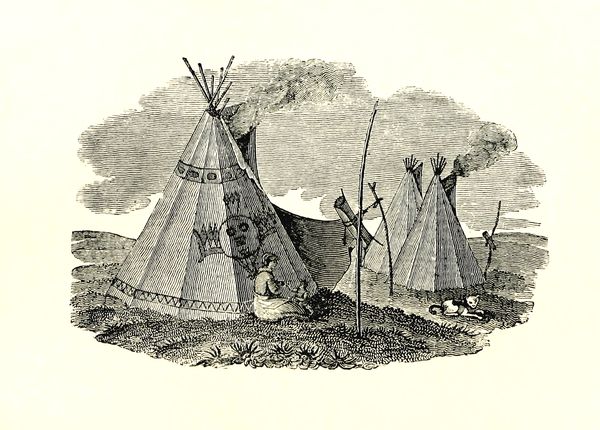
These skin lodges, the only habitations of the wandering savages, are
carried with them complete in all their marches. Those of the Kaskaias
differ in no respect from those we have already described, as used by
the Otoes and others of the Missouri Indians. The poles which are six
or eight to each lodge, are from twenty to thirty feet in length, and
are [293] dragged constantly about in all their movements, so that the
trace of a party with lodges is easily distinguished from that of a
war-party. When they halt to encamp, the women immediately set up these
poles; four of them being tied together by the smaller ends, the larger
resting on the ground, are placed so far apart as to include as much
space as the covering will surround. The remaining poles are added to
strengthen the work, and give it a circular form.
The covering is then made fast by one corner to the end of the last
pole which is to be raised, by which means it is spread upon the frame
with little difficulty. The structure, when completed, is in the form
of a sharp cone. At the summit is a small opening for window, chimney,
&c. out of which the lodge-poles project some distance, crossing each
other at the point where the four shortest are tied together. This tent
seems to be sufficient to protect its occupants from the rain; it must
however be greatly inferior in point of comfort, particularly in the
winter season, to the spacious mud cabins of the settled Indians.
The poles necessary for the construction of these movable dwellings,
are not to be found in any part of the country of the Kaskaias, but
are purchased from the Indians of the Missouri, or others inhabiting
countries more plentifully supplied with timber. We were informed by
Bijeau, that five of these poles are, among the Bad-hearts, equal in
value to a horse.
The chief of this band is called the Red Mouse. He is of a large
stature, is somewhat past the middle age of life, and no way deficient,
in his person and countenance, of those indications of strength,
cunning, and ferocity, which form so important a part of greatness in
the estimation of the Indians. Immediately after he had dismounted
from his horse, on the halting of his party, a small wooden dish was
brought [294] him, containing some water. He had received a wound some
time before, apparently from an arrow, which had passed through the
arm, glancing upon the humerus. Placing the dish on the ground before
him, he dipped his hand repeatedly in the water, then seizing a small
image of an alligator, profusely ornamented with white and blue beads,
he pressed it for some time with all the strength of his disabled arm.
This we saw him repeat a great number of times. The alligator appeared
to be the "great medicine," on which he relied for the cure of his
wound. No dressing or application of any kind was made immediately to
the affected part.
As soon as we had placed our baggage in the tent provided for us, we
commenced negotiations with Red Mouse, for the purchase of horses.
When the articles we proposed to barter were exhibited, he appeared
dissatisfied, supposing probably we had still others in reserve,
which he would be able by a little obstinacy to extort from us. He
accordingly insisted that more of the packs should be opened, and
undertook at last to extend his inquiries to our private baggage. This
we found it necessary to resist, and a little scuffle ensued, at which
many of the Indians, with a throng of women and children who surrounded
us, took fright and ran off with the utmost despatch. They appeared all
somewhat surprised and intimidated, and the few who remained in our
lodge entreated us not to be angry at the insolence they had shown,
saying we should frighten their women, and that they had mistaken
us for traders. We had good reasons for wishing not to carry our
resentment farther than was necessary, and accordingly relinquished the
attempt to trade with them; informing them at the same time that we
were hungry. Having received us in a friendly manner, we expected they
would, according to custom of most Indians, have shown their good-will,
by inviting us to a feast. We had, [295] therefore, waited with some
impatience for their good cheer so long, that hope began to fail us.
It will be recollected, we had for some days been almost in a starving
condition; and we perceived that the Indians had very plentiful
supplies of jerked meat. In compliance with our repeated requests, the
wife of the Red Mouse at length brought us a little half-boiled bison
meat, from which we had observed her to select the best pieces and give
them to the children. After we had eaten this, we returned the wooden
dish, on which it had been brought, at the same time asking her for
more. This second demand procured us a little more jerked meat, which
came, however, with such an ill grace, that as our hunger was somewhat
appeased, we resolved to ask them for no more.
Some one of the party having asked for water, the paunch of a bison
was brought, containing three or four quarts, from which we all
managed, though with some difficulty, to drink. Little care or labour
had been bestowed on the preparation of this primitive vessel. The
papillous coat which formed the internal surface of the stomach of
the animal, had not been removed, nor had it lost, from long use, its
original smell. The organ is suffered to retain its original form as
far as is consistent with the uses to which it is applied. One of
the orifices is brought nearly in contact with the other, where it
is retained by a stick passed through the margin; the depending part
is a sack sometimes large enough to contain six or eight gallons of
water. It may well be supposed practice is required to enable a person
to drink with ease and adroitness from one of these vessels; and the
Indians appeared somewhat amused at our awkward attempts, in which we
spilt more water in our bosoms, than was conveyed into our mouths.
When filled, these sacks cannot be set upon the ground without
suffering the loss of their contents. To remedy this, the Kaskaias
carry with them, as an [296] indispensable article of furniture, a sort
of tripod, consisting of three light poles, tied together at one end,
and sharpened at the other, by which they are driven into the ground,
and the water-sack is suspended between them. One of these was placed
near the entrance of almost every lodge in this encampment.
We had scarcely finished our scanty repast, when the wife of the Red
Mouse showing her trencher, to signify that we were her debtors, began
to beset us for presents; as we were, however, little pleased with
her hospitality, we treated her demands much as she had done ours. A
number of small articles were pilfered from us, and the Indians seemed
determined to show us little respect, until they perceived we were
putting our guns in order for immediate use; at this they expressed
some apprehension, and behaved afterwards with less rudeness.
There were thirty-two lodges, and probably about two hundred and fifty
souls, including men, women, and children. Among them we could number
only twenty-two armed men; and these kept constantly about us. They
were armed exclusively with bows and arrows, and, as we believed, had
some fear of us, though we were less than half their number. It was
probably owing to our perceiving, or at least appearing to perceive
this, that we escaped from them uninjured. They had many horses,
probably more than five hundred, and some of them very good.
Towards evening the chief withdrew from our lodge, when we observed his
squaw prepare some food for him, pounding the jerked meat to a powder
with a stone pestle, using a piece of skin instead of a mortar. When
reduced to very fine fragments, it is mixed with bison tallow; a little
water is added, and the whole boiled together. After he had finished
his meal, a council was held between all the men of the band. They met
behind the chief's lodge, and we were not greatly pleased to perceive,
that they [297] seemed anxious to conceal their meeting from us. At
night we determined to collect all our horses, and, placing them as
near as we could around our lodge, to watch them during the night; but,
upon examination, a few of them only could be found, the remainder,
as we believed, having been seized by the Indians. The crowd which
had been assembled about us during the day, dispersed as the evening
advanced, and at dark all became still in and about the encampment.
At this time the chief, whose lodge was near ours, standing at the
entrance of his dwelling, harangued with great vehemence, in a voice
sufficiently loud and clear to be heard by all his people, who had now
retired to their several lodges. As we had no interpreter of their
language, we could understand nothing of the import of his speech.
Every thing remained quiet during the night, and as soon as the day
dawned on the following morning, a loud harangue, similar to that in
the evening, was pronounced by the chief, and immediately afterwards
the whole camp was in motion. The lodges were taken down, the packs
placed upon the horses, and the whole body were in a short time ready
to move off. As several of our horses, our kettles, and other articles
of the greatest importance to us were missing, we were unwilling to
part from our hosts in the hasty and unceremonious manner they seemed
to intend. We accordingly summoned the old Indian interpreter, and made
our complaint and remonstrance to the chief. He told us our horses
had strayed from camp, and that several of his people were then out
searching for them, and made other excuses, evidently designed to gain
time until his band could move off. Perceiving we had no time to lose,
Major Long ordered horses and other articles, corresponding to those we
had lost, to be immediately seized. This prompt and well-timed measure
produced the desired effect. Their whole camp had been some time in
motion; the women [298] and children, with all their baggage, except
what we had detained, had moved to a considerable distance; and we
found ourselves, at this unpleasant state of the dispute, surrounded
by their whole armed force. We observed they had a greater number of
arrows in their hands than on the preceding day, and were not without
our fears, that they intended to carry the dispute respecting our
horses and kettles to greater lengths than we could wish. We were,
however, agreeably disappointed, to learn that all our lost property
had been found. It was accordingly restored to us, and we parted from
the Kaskaias as friends.
The time we spent with this band of savages was so short as to afford
little opportunity of becoming acquainted with their manners. Their
dress is nearly similar to that of the Pawnees, but consists more
exclusively of leather. The women, instead of the robe, wear a loose
sort of a frock without sleeves. It has an opening for the neck, just
large enough to admit the head, and descends from the shoulders,
hanging like a bag about the body, and reaching below the knees. When
eagerly engaged in their employments, this inconvenient article of
dress is thrown aside, and there remains the squabbish person of the
female savage, disfigured only by a small apron of leather worn round
the waist. The young females appear to be in some measure exempted from
the laborious services performed by the married women, and consequently
possess a degree of lightness and elasticity in their persons,
which they soon lose after they begin to bear children, and subject
themselves to the severe drudgeries of a married life. Their breasts
become so flaccid and pendulous, that we have seen them give suck to
their children, the mother and the child at the same time standing
erect upon the ground. This fact is sufficient to prove that they do
not, at least in some instances, wean their children at a very early
age.
[299] Like all savages, they suffer themselves to be covered with
filth and vermin, notwithstanding which some of the young ones are far
from disgusting in their appearance. They have well turned features,
aquiline noses, large and regular teeth, and eyes, which though
usually rather small, are clear and brilliant. Some of the men of
this band have larger and finer teeth than we remember to have seen
heretofore among savages. In the general structure of their features,
and the complexion of their skins, they resemble the Missouri tribes,
being of a clearer and brighter red than many of the eastern Indians.
In stature and in symmetry, and elegance of form, they are inferior to
the Otoes, Pawnees, and to most of the Missouri Indians who reside in
permanent villages. They seemed to have had little intercourse with
the whites, as some among them appeared to take great pleasure in
exhibiting to their friends the skin of our arms, which they requested
us to show for that purpose. It was probably by means of a mistake on
the part of one of the interpreters, that we received the intimation
that they had never heard before of such a people as that to which
we belonged. We saw among them few articles of foreign production;
these they had probably received from Spanish traders. In the whole
encampment we saw but one kettle, which belonged to the chief, and
their great eagerness to steal our tin cups and other similar articles,
sufficiently evinced that such things are scarce, and of great value
among them. They have some beads, most of which are bestowed in
ornamenting the dress of the children; also some pewter and brass
rings, worn principally by the women. They are acquainted with the use
of tobacco, and smoked with us according to the universal custom of the
Indians, but expressed by signs that they found the smoke of unmixed
tobacco too strong for them. One of their young men, who was in his
ordinary dress when we met the party, visited us soon after we had
encamped, [300] dressed in leggings and breech cloth, with a striped
worsted vest and a silver-headed bamboo, which he sported among us with
the air of a great traveller.
A child was shown us who spoke Spanish, and who was said to be
a prisoner from the Spanish settlements; he was not, however,
distinguished from the Kaskaias by any difference of colour or of
features. He spoke frequently of the Christians, which convinced us
that he had at least been among the half civilized Indians of New
Mexico, who have some acquaintance with the Spanish language, and have
been taught enough of the Christian religion to make use of the sign of
the cross.
This band of Kaskaias occupy the country about the sources of the
Platte, Arkansa, and Rio Del Norte, and extend their hunting excursions
to Red river and the sources of the Brases. The great numbers of images
of the alligator, which they wear either as ornaments or as amulets for
the cure or prevention of disease and misfortune, afford sufficient
proof of their extending their rambles to districts inhabited by
that reptile. These images are of carved wood covered with leather,
and profusely ornamented with beads. They are suspended about the
neck, and we saw several worn in this manner by the children as well
as by adults. It was observed likewise, that the rude frames to the
looking-glasses, carried by several of the men, were carved so as to
approximate towards the same form.
It is perhaps owing to their frequent exposure to the stormy and
variable atmosphere of the country about the Rocky Mountains, that
these Indians are subjected to numerous attacks of rheumatic and
scrofulous diseases. We saw one old woman with a distorted spine, who
had probably suffered, when young, from rickets. A young man, of a
fine athletic frame, had his neck covered with scrofulous ulcers. While
he was with us he was constantly endeavouring to conceal with his robe
this afflicting spectacle. He [301] remained but a short time among us,
and did not make his second appearance.
An old man came frequently with a diseased leg, informing us by signs,
that it had repeatedly formed large abscesses, which had discharged
much matter, and afterwards healed. His frequent applications seemed to
be made with the hope that we would do something for his relief. The
men of this band wear the hair long, and suffer it to hang negligently
about the shoulders. Some of them have a braid behind, which is
garnished with bits of red cloth, small pieces of tin, &c. and descends
nearly to the ground, being sometimes eked out with the hair of a
horse's tail. Among the old men were several who had suffered a number
of scattering hairs on the face to become of considerable length, a
violation of good manners, and a neglect of personal neatness, not
often met with among the Indians, and excusable only in the old.
In their conduct towards us, they were guilty of more rudeness and
incivility than we had been accustomed to meet with among the savages
of the Missouri. Soon after we had encamped with them, one of our party
who had brought along a roasted rib of a bison which had remained of
our breakfast, had produced this bone, and was engaged in eating from
it; an Indian who observed this came up, and without ceremony taking
the rib out of his hand, carefully scraped off and ate all the meat,
and returned the bone.
Though we saw much to admire among this people, we cannot but think
they are among some of the most degraded and miserable of the
uncivilized Indians on this side of the Rocky Mountains. Their
wandering and precarious manner of life, as well as the inhospitable
character of the country they inhabit, precludes the possibility of
advancement from the profoundest barbarism. As is common among other of
the western tribes, they were persevering in offering us their women,
but this appeared to be [302] done from mere beastliness and the hope
of reward, rather than from any motive of hospitality or a desire to
show us respect. We saw among them no article of food except the flesh
of the bison; their horses, their arms, lodges, and dogs, are their
only wealth.
In their marches they are all on horseback; the men are expert
horsemen, and evince great dexterity in throwing the rope, taking in
this way many of the wild horses which inhabit some parts of their
country. They hunt the bison on horseback with the bow and arrow,
being little acquainted with fire arms. One of them who had received a
valuable pistol from a member of our party, soon afterwards returned,
and wished to barter it for a knife. They begged for tobacco, but did
not inquire for whiskey; it is probable they have not yet acquired
a relish for intoxicating liquors. In their persons they are all
uncommonly filthy, and many of the women spent a great part of their
time in catching and eating the lice from the heads of their children.
At eight o'clock on the morning of the 12th of August we took our leave
of the Kaskaias, having recovered from them all the articles they had
stolen, except a few ropes, halters, and other small affairs, which not
being indispensably necessary to us, we chose to relinquish, rather
than submit to a longer delay among a people we had so much reason to
dislike.
They had shown a disposition so far from friendly towards us, that we
were surprised to have escaped without having found it necessary to use
our rifles among them; and as we thought it by no means improbable some
of their young men might follow us to steal our horses, we moved on
rather briskly, intending to travel as far in the course of the day as
we conveniently could.
The river valley spread considerably a little below the point where we
had encamped. In many places we found the surface a smooth and naked
bed of [303] sand; in others, covered by an incrustation of salt, like
a thin ice, and manifestly derived from the evaporation of water which
had flowed down from the red sandstone hills bounding the valley. These
hills were here of moderate elevation, the side towards the river being
usually abrupt and naked. The sandstone is fine, of a deep red colour,
indistinctly stratified and traversed in various directions by veins
filled principally with sulphate of lime.
We had seen among the Indians on the preceding day quantities of salt
in large but detached crystalline fragments, greatly resembling the
common coarse salt of commerce. It had evidently been collected from
some place like the one above mentioned, where it had been deposited
from solution in water. When we inquired the particular locality of
the Indians, they pointed to the south, and said it was found near the
sources of a river heading in that direction.
At the place of our evening encampment, we saw the red-necked avoset
(recurvirostra americana), the minute tern (sterna minuta), and
several other strand birds which we could not approach near enough
to distinguish the species. There is also a very evident similarity
between the plants found here and many of those growing in saline
soils along the sea coast. We saw here several species of atriplex,
chenopodium, salsola, kochia, and anabasis, all delighting in a saline
soil, and affording on analysis a greater proportion of soda than most
inland plants.
The day had been unusually warm. During all our mid-day halt,
protracted, on account of the sultriness of the weather, to an unusual
length, the mercury had remained at 100°, the thermometer being
suspended in the closest shade we could find. It is to be remarked,
however, that in almost every one of the numerous instances when the
mercurial column had indicated so high a temperature as in [304] the
one just mentioned, a fair exposure could not be had.
We often found it necessary to halt upon the open plain, where the
intensity of light and heat were much increased by the reflection
of the sun's rays from the sand. The temperature indicated by the
thermometer, suspended in the imperfect shade of our tent, or of a
small tree, was however somewhat lower than that to which our bodies
were exposed; and it will be believed our sufferings from this source
were great, both on our marches and while encamped in the middle of
the day. Our tent being too small to afford its imperfect shade to the
whole party, we sometimes suspended blankets, using, instead of poles,
our rifles and gunstocks, but the protection these could afford against
the scorching glare of a vertical sun, was found extremely inadequate.
At sunset we crossed what appears to be at some seasons of the year the
bed of a large river at least two hundred yards wide, but at this time
not a drop of water was found in it. It has a wide valley, and in every
respect but the occasional want of water, is a large stream. A little
beyond this we encamped for the night, having travelled twenty-eight
miles.
August 13th. The course of the river had now become considerably
serpentine, so that our route along its valley was of necessity
somewhat circuitous. Wishing to avoid the unnecessary travelling thus
occasioned, we turned off from the river and ascended the hills,
hoping to meet with an Indian trace leading across the country by the
most direct route. Our search was however unavailing, only affording
us an opportunity of examining a portion of the country remote from
the river. This we found much broken with irregular hills, abrupt
ravines, and deep valleys. At ten o'clock we met with a small stream
of water running towards the river we had left, and crossing it,
perceived the trace of a large party of mounted Indians which had
ascended [305] the creek within a few hours previous. We supposed they
must have been the band of Cumancias spoken of by the Bad-hearts;
and, notwithstanding some fears we have had reason to entertain, that
they would have treated us no better than the Kaskaias had done, we
considered ourselves unfortunate in not having met them. Much confusion
and uncertainty attends the limited information hitherto before the
public concerning the wandering bands of savages who occupy the
country between the frontiers of New Mexico and the United States.
Some who have spoken of these Indians, seem to have included several
of the erratic hordes already enumerated under the name of Hietans or
Cumancias. From their wandering mode of life, it unavoidably happens
that the same band is met by hunters and travellers in different
parts of the country at different times, consequently they receive
different appellations, and the estimate of their numbers becomes
much exaggerated. Of this band we have no other information to
communicate, than that they appeared, from the tracks of their horses
and lodge-poles, to have been rather more numerous than the party of
Bad-hearts we had lately met. A recent grave was discovered by one
of our hunters at no great distance from the river, in which it was
supposed one of this band had been buried. At one end of the grave
was erected a pole about ten feet in length, crossed near the top by
another two feet long. To the foot of this rude cross was tied a pair
of mockasins, newly soled and carefully prepared for the use of the
departed in that long journey on the road of the dead to which the
good wishes of some friend had accompanied him.
Where we halted at noon were some trees, and several of these were
covered with grape vines, loaded with ripe and delicious fruit. The
Osage plum was also common, and now beginning to ripen. The temperature
of the air inside of our tent, partially shaded by some small trees,
was sufficiently [306] high to keep the mercury at 105° Fah. from
twelve o'clock to three P. M. A suffocating stillness
prevailed in the air, and we could find no relief from the painful
glare of light and the intense heat which seemed about to reduce the
scanty vegetation to ashes.
In the afternoon a thick grove of timber was descried at a distance
below, and on the opposite side of the river. This cheering sight
was like the discovery of land to the mariner, reminding us of the
comparative comfort and plenty which we had learned to consider
inseparable from a forest country, and exciting in us the hope that
we should soon exchange our desolate and scorching sands for a more
hospitable and more favoured region. As this little grove of trees,
appearing to us like the commencement of an immense forest, gave us
reason to expect we should soon meet with some small game at least; Mr.
Peale, with one man, went forward to hunt. Soon after arriving at the
wood, they discovered a flock of turkeys, and the rifleman dismounting
to shoot, left his mule for a moment at liberty. The animal, taking a
sudden advantage of the opportunity, turned about, and made the best
of his way out of the wood, pursued by Mr. Peale. This chase continued
about five miles, and ended in putting the mule on the recent trace of
the party, which there was no reason to fear he could be induced to
quit, until he had rejoined his companions. Mr. P., who was exhausted
with the pursuit, followed on but slowly, and neglecting to follow
carefully the path of the party, he passed us, after we had turned
aside to encamp, still travelling on in the direction of our course. At
dark, believing we were still before him, and knowing we must encamp
near the river, he betook himself to the sand-bars, which were now
naked, occupying the greater part of what was sometimes the bed of the
stream. Along these he travelled, occasionally discharging a pistol,
and looking [307] about in constant expectation of seeing the blaze of
our evening fire, until the moon began to sink behind the hills, when
finding the light insufficient to enable him to continue his search, he
tied his horse to a tree, and laid down to await the return of daylight.
At camp, guns were discharged, as large a fire kindled as we could find
the means of making, and other measures taken to give notice of our
situation; and late in the evening, the man whose mule had been the
occasion of the accident, joined us, but was unable to give any account
of Mr. Peale or the mule, which had, however, arrived before him.
At seven o'clock on the morning following, Aug. 14th, Mr. P. returned
to us, having convinced himself, by a careful examination of the river
valley, that we were still above. He accordingly retraced his course,
until he discovered the smoke of our encampment. He had been much
harassed in the night by mosquitos; and bisons having recently occupied
the shade of the tree under which he slept, the place afforded as
little refreshment for the horse as for himself. Delaying a little to
allow him time to make amends for his long absence, we left our camp at
a later hour than usual; and moving along a wide and somewhat grassy
plain, halted to dine near an old Indian breast-work by the side of a
grove of cotton-wood trees, intermixed with a few small-leaved elms.
This breast-work is built like that described on the Platte, a few
days' march above the Pawnees. We have met with the remains of similar
works in almost every grove of trees, about the base of the mountains;
near some of them, we have noticed holes dug a few feet into the
ground, probably as caches or depositories of provisions; the earth
which was raised having been removed to a distance, or thrown into
the river, that it might not lead to the discovery of the concealed
articles. We have met with large excavations of this kind, having an
entrance comparatively small, and so placed as to be [308] easily
concealed; made by white hunters to hold their furs, and whatever else
they might wish to deposit in safe keeping.
The occurrence of the elm, the phytolacca, the cephalanthus, and other
plants not to be met with in a desert of sand, give us the pleasing
assurance of a change we have long been expecting to see in the aspect
of the country. The blue jay, the purple martin, a deer, and some
turkeys, were also seen near this encampment.
The bed of the river is here eight hundred yards wide, but the quantity
of water visible is much less than in some places above. The magnetic
variation ascertained at this camp was 12° 30′ east.
Sand Plains—Mississippi Hawk—Small-leaved Elm—Wild
Horses—Hail-storm—Climate—Bisons—Grapes—Red Sand
Formation—Gypsum.
August 15th. Extensive tracts of loose sand, so destitute of plants,
and so fine as to be driven with the wind, occur in every part of
the saline sandstone formation we had as yet seen. They are perhaps
invariably the detritus of the sand-rock, deposited in valleys and
depressions, where the rapidity of the abrading currents has been
checked by permanent obstacles. This loose sand differs in colour from
the sandstone, which is almost invariably red; the difference may,
however, have been produced simply by the operation of water suspending
and removing the light colouring matter, no longer retained by the
aggregation of the sandstone. These fields of sand have most frequently
an undulating surface, occasioned probably not less by the operation of
winds than by the currents of water; a few plum bushes, almost the only
woody plants found on them, wherever they take root, form points, about
which the sand accumulates, and in this manner permanent elevations are
produced. The yucca angustifolia and the shrubby cactus are here rarely
seen; the argemone and the night-flowering bartonia have not entirely
disappeared, but are not of frequent occurrence.
Our horses had broken loose, and a part of them strayed from camp. This
occasioned some unusual delay, and the morning was somewhat advanced
when we commenced our ride. The day was bright and cool, comparatively
so at least, the mercury in [310] the extreme heat rising to only 95°
in the shade of our tent, whereas on several of the preceding days, it
had stood at or above 100° in a fairer exposure. A light breeze sprung
up from the south-west, and continued during the remainder of the day.
Our course led us twice across the bed of the river, which we found one
thousand and four hundred paces in width; and without water, except
in a few small pools, where it was stagnant. This wide and shallow
bed is included between low banks, sometimes sloped gradually, and
sometimes, though rarely, perpendicular, and rising scarcely more than
four feet from the common level of the bottom of the channel. Drift
wood is occasionally seen without these banks, affording evidence that
they are at times not only full, but overflowed. If they are ever but
partially filled, it is easy to see that what, for a great part of the
year, is a naked sand beach, then becomes a broad and majestic river.
It must flow with a rapid current, and in floods; its waters cannot be
otherwise than of an intense red colour. The immediate valley of the
river had now become little less than two miles in width; and had, in
some places, a fertile soil. This happens wherever there occur spots
having little elevation above the bed of the river, and which have not
recently been covered with sand.
Several species of locust were extremely frequent here, filling the
air by day with their shrill and deafening cries, and feeding with
their bodies great numbers of that beautiful species of hawk, the falco
Mississipiensis of Wilson.59 It afforded us a constant amusement
to watch the motions of this greedy devourer in the pursuit of his
favourite prey, the locust. The insect being large, and not uncommonly
active, is easily taken; the hawk then pauses on the wing, suspending
himself in the air, while, with his talons and beak, he tears in pieces
and devours his prey.
We were also fortunate in capturing a tortoise, [311] resembling the
T. geographica of Le Sueur.60 The upper part of its shell was large
enough to contain near a quart of water, and was taken to supply the
place of one of our tin cups recently lost, while the animal itself was
committed to the mess kettle. Wolves, jackals, and vultures, occurred
in unusual numbers, and the carcasses of several bisons recently killed
had been seen. We could also distinguish the recent marks of a hunting
party of Indians, the tracks of horses and of men being still fresh
in the sand. At four P. M., several bisons were discovered
at a distance, and as we were in the greatest want of provisions, we
halted, and sent the hunters in pursuit; and being soon apprized of
their success, the requisite preparations were made for jerking the
meat. Near our camp was a scattering grove of small-leaved elms. This
tree (the U. alata, N.) is not known in the Eastern states; but it is
common in many parts of Tennessee, Missouri, and Arkansa. When found
in forests intermixed with other trees, it is usually of a smaller
size than the ulmus americana, and is distinguished from it by the
smallness of the leaves and the whiteness of the trunk. On the borders
of the open country, where large trees often occur entirely isolated,
the ulmus alata has proportionally a more dense and flattened top than
any other tree we have seen. When standing entirely alone, it rarely
attains an elevation of more than thirty or thirty-five feet; but its
top lying close to the ground, is spread over an area of sixty or
seventy feet in diameter, and is externally so close and smooth as to
resemble, when seen from a distance, a small grassy hillock.
Near our camp was a circular breast-work, constructed like those
already mentioned, and large enough to contain eighty or an hundred
men. We were not particularly pleased at meeting these works so
frequently as we had done of late, as they indicate the country
where they are found, to be one [312] particularly exposed to the
depredations of Indian war-parties.
August 16. The greater part of the flesh of the bison killed on the
preceding evening had been dried and smoked in the course of the night,
so that we had now no fear of suffering immediately from hunger, having
as much jerked meat as was sufficient to last several days.
The sky continued clear, but the wind was high, and the drifting of the
sand occasioned much annoyance. The heat of the atmosphere became more
intolerable, on account of the showers of burning sand, driven against
us with such force as to penetrate every part of our dress, and proving
so afflictive to our eyes, that it was with the utmost difficulty we
could see to guide our horses. The sand is carried from the bed of the
river, which is here a naked beach of more than half a mile wide, and
piled in immense drifts along the bank. Some of these heaps we have
seen covering all but a small portion of the upper branches of what
appeared like large trees. Notwithstanding we were now three hundred
miles distant from the sources of the river, we found very little
water; and that being stagnant, and so much frequented by bisons and
other animals, was so loathsome both to sight and smell, that nothing
but the most uncontrollable thirst could have induced us to taste it.
At a short distance below the place of our encampment, we passed the
confluence of a considerable creek entering from the south-west. Though
like all the streams of this thirsty region, its waters were entirely
hid in the sand; yet it is evidently the bed of a large tributary, and
from its direction, we conclude it can be no other than the one on
which the Kaskaias informed us they had encamped the night before we
met them. Its name, if it have any, among the Indians or Spaniards, we
have not yet learned.61
We had, for some days, observed a few wild horses, [313] and they, as
well as the bisons, were now becoming numerous. In the habits of the
wild horse, we find little unlike what is seen in the domestic animal,
though he becomes the most timorous and watchful of the inhabitants of
the wilderness. They show a similar attachment to each other's society,
though the males are occasionally found at a distance from the herds.
It would appear, from the paths we have seen, that they sometimes
perform long journeys, and it may be worthy of remark, that along these
paths are frequently found very large piles of horse-dung, of different
ages, affording sufficient evidence that this animal, in a wild state,
has, in common with some others, an inclination to drop his excrement
where another has done so before him. This propensity is sometimes
faintly discovered in the domestic horse.
As we were about to halt for dinner, a bison who had lingered near our
path was killed; but the flesh was found in too ill a condition to be
eaten, as is the case with all the bulls at this season.
Soon after we had mounted our horses in the afternoon, a violent
thunder-storm came on from the north-west; hail fell in such
quantities, as to cover the surface of the ground, and some of the
hail-stones which we examined, were near an inch in diameter. Falling
with a strong wind, these heavy masses struck upon our bodies with
great violence; our horses, as they had done on a similar occasion
before, refused to move, except before the wind. Some of the mules
turned off from our course, and had run more than half a mile before
they could be overtaken. For ourselves, we found some protection, by
wrapping our blankets loosely around our bodies, and waited for the
cessation of the storm, not without calling to mind some instances on
record of hail-stones which have destroyed the lives of men and animals.
It is not improbable, that a climate of a portion of country within
the range of the immediate influence [314] of the Rocky Mountains,
may be more subject to hail-storms in summer, than any other parts
of North America in the same latitude. The radiation of heat from
so extensive a surface of naked sand, lying along the base of this
vast range of snowy mountains, must produce great local inequalities
of temperature. The diminished pressure of the atmosphere, and the
consequent rapidity of evaporation, in these elevated regions, may
also be supposed to have an important influence on the weather. We
have not spent sufficient time in the country, near the eastern range
of the Rocky Mountains, to enable us to speak with confidence of the
character of its climate. It is, however, sufficiently manifest, that
in summer it must be extremely variable, as we have found it; the
thermometer often indicating an increase of near fifty degrees of
temperature between sunrise and the middle of the day. These rapid
alternations of heat and cold must be supposed to mark a climate little
favourable to health, though we may safely assert that this portion of
the country is exempt from the operation of those causes which produce
so deleterious an atmosphere in the lower and more fertile portions
of the Mississippi basin. If the wide plains of the Platte, the Upper
Arkansa, and the Red river of Louisiana should ever become the seat
of a permanent civilized population, the diseases most incident to
such a population will probably be fevers, attended with pulmonary and
pleuritic inflammations, rheumatism, scrofula, and consumption.62 It
is true, that few, if any, instances of pulmonary consumption occur
among the Indians of this region; the same remark is probably as true
of the original native population of New York and New England.
Though much rain fell during this storm, it was so rapidly absorbed by
the soil, that but little running water was to be seen. The bed of the
river was found smooth and unobstructed, and afforded us for several
days the most convenient path for travelling. As we [315] descended,
we found it expand in some places to a width of near two miles. Bisons
became astonishingly numerous; and in the middle of the day countless
thousands of them were seen coming in from every quarter to the
stagnant pools which filled the most depressed places in the channel of
the river. The water of these was of course too filthy to be used in
cooking our meat, and though sometimes compelled to drink it, we found
little alleviation to our thirst. At our encampments, we were able to
supply ourselves with water of a better quality by digging in the
sand, where we scarce ever failed to meet with a supply at a few feet
from the surface.
On the 17th,63 we halted in the middle of the day to hunt, as,
although we had killed several bisons on our marches of the preceding
days, none of them had been found in good condition. The flesh of
the bulls, in the months of August and September, is poor and ill
flavoured; but these are much more easily killed than the cows, being
less vigilant, and sometimes suffering themselves to be overtaken by
the hunter, without attempting to escape. As the herds of cows were
now seen in great numbers, we halted, while the hunters went out and
killed several. Our camp was placed on the south-west side of the
river, under a low bluff, which separates the half-wooded valley from
the open and elevated plains. The small elms along this valley were
bending under the weight of innumerable grape vines, now loaded with
ripe fruit, the purple clusters crowded in such profusion as almost to
give a colouring to the landscape. On the opposite side of the river
was a range of low sand hills, fringed with vines, rising not more than
a foot or eighteen inches from the surface. On examination, we found
these hillocks had been produced exclusively by the agency of the grape
vines, arresting the sand as it was borne along by the wind, until such
quantities had been accumulated as to bury every part of the plant,
except the end of the branches. Many of these were so loaded with [316]
fruit, as to present nothing to the eye but a series of clusters, so
closely arranged as to conceal every part of the stem. The fruit of
these vines is incomparably finer than that of any other native or
exotic which we have met with in the United States. The burying of
the greater part of the trunk, with its larger branches, produces the
effect of pruning, inasmuch as it prevents the unfolding of leaves
and flowers on the parts below the surface, while the protruded ends
of the branches enjoy an increased degree of light and heat from the
reflection of the sand. It is owing, undoubtedly, to these causes, that
the grapes in question are so far superior to the fruit of same vine in
ordinary circumstances. The treatment here employed by nature, to bring
to perfection the fruit of the vine may be imitated; but without the
same peculiarities of soil and exposure, and with difficulty be carried
to the same magnificent extent. Here are hundreds of acres, covered
with a movable surface of sand, and abounding in vines, which, left to
the agency of the sun and the winds, are, by their operation, placed
in more favourable circumstances than it is in the power of man, to so
great an extent, to afford. We indulged ourselves to excess, if excess
could be committed in the use of such delicious and salutary fruit, and
invited by the cleanness of the sand, and a refreshing shade, we threw
ourselves down, and slept away, with unusual zest, a few of the hours
of a summer afternoon.
Our hunters had been as successful as could be wished, and at evening
we assembled around a full feast of "marrow-bones;" a treat whose
value must for ever remain unknown to those who have not tried the
adventurous life of the hunter. We were often surprised to witness in
ourselves a proof of the facility with which a part at least of the
habits of the savage could be adopted. Having been in several instances
compelled to practise a tedious abstinence, the return of plenty found
us well disposed to make amends for these temporary privations; and we
lingered, [317] almost involuntarily, at every meal, as if determined
not only to supply the deficiency of the past, but to secure such ample
supplies as would enable us to defy the future.
The grapes and plums, so abundant in this portion of the country, are
eaten by turkies and black bears, and the plums by wolves or jackals,
as we conclude, from observing plumstones in the excrement of one of
those animals. It is difficult to conceive whence such numbers of
predatory animals and birds, as exist in every part of the country
where the bisons are present, can derive sufficient supplies for the
sustenance of life; and it is indeed sufficiently evident, their
existence is but a protraction of the sufferings of famine.
The great flowering hibiscus is here a conspicuous and highly
ornamental plant among the scattering trees in the low grounds. The
occurrence of the black walnut, for the first time since we left
the Missouri, indicates a soil somewhat adapted to the purposes of
agriculture. Portions of the river valley, which are not covered with
loose sands, have a red soil, resulting from the disintegration of
the prevailing rocks (red sandstone and gypsum) intermixed with clay,
and are covered with a dense growth of fine and nutritious grasses.
Extensive tracts of the great woodless plain, at a distance from the
river, appear to be based upon a more compact variety of sandstone,
which is usually of a dark gray colour, and less pervious to water
than the red. For this reason some copious springs are found upon it,
and a soil by no means destitute of fertility, yielding sustenance
to inconceivable numbers of herbivorous animals, and through them to
innumerable birds and beasts of prey. It must be supposed, however,
that the herds of bisons daily seen about the river, range over a
much greater extent of country than was comprised within our limited
views. The want of water in many places may compel them to resort [318]
frequently to the river in dry weather; though at other times they may
be dispersed in the high plains.
August 18th. In speaking of a country whose geography is so little
known as that of the region S. W. of the Arkansa, we feel very sensibly
the want of ascertained and fixed points of reference. Were we to
designate the locality of a mineral, or any other interesting object,
as found twenty or thirty days' journey from the Rocky Mountains,
we should do nearly all in our power; yet this sort of information
would probably be thought vague and useless. The smaller rivers of
this region have as yet received no names from white hunters; if they
have names among the Indians, these are unknown to us. There are no
mountains, hills, or other remarkable objects to serve as points of
departure, nearer than the Rocky Mountains and the Arkansa. The river
itself, which we supposed to be the Red river of Natchitoches, is a
permanent landmark; but it is a line and not a point; and aids us
only in one direction, in our attempts to designate locality. The map
accompanying this work was projected in conformity to the results of
numerous astronomical observations for latitude and longitude; but many
of these observations were made at places which are not, and at present
cannot be known by any names we might attempt to fix upon them.64
More extensive and minute examination than we have been able to bestow
might establish something like a sectional division, founded on the
distribution of certain remarkable plants. The great cylindric cactus,
the ligneous rooted cucumis, the small-leaved elm, might be used in
such an attempt; but it is easy to see that the advantages resulting
from it, would be for the most part imaginary.
Discussions of this sort have been much insisted on of late, and may
be important as aiding in the geography of climates and soils, but can
afford little assistance to topography.
[319] The geognostic features of the region under consideration, afford
some foundation for a natural division, but this division must be so
extremely general as to afford little satisfaction. We could only
distinguish the red sandstone, the argillaceous sandstone, and the trap
districts, and though each of these have distinctive characters not
easy to be mistaken, they are so irregular in form and position, as to
be in no degree adapted to aid in the description and identifying of
particular places. On the contrary, it is to be regretted there are no
established points to which we might refer, in communicating what we
have observed of the position of these formations, and indicating the
particular localities of some of the valuable minerals they contain.
The red sandstone, apparently the most extensive of the rocky
formations of this region, has, wherever it occurs, indications of the
presence of muriate of soda, and almost as commonly discloses veins and
beds of sulphate of lime. The substance last mentioned had been growing
more and more abundant since we left the region of the trap rocks at
the sources of the river. It was now so frequent as to be conspicuous
in all the exposed portions of the sand-rock, and was often seen from a
distance of several miles. It occurs under various forms, sometimes we
meet with the most beautiful selenite, disposed in broad reticulating
veins, traversing the sandstone; the granular and fibrous varieties,
whose snowy whiteness contrasts strongly with the deep red and brown
of the sandstone, are sometimes seen in thin horizontal lamina, or
scattered about the surface, sometimes included in larger masses of
the common amorphous plaister-stone. This last is usually of a colour
approaching to white, but the exposed surfaces are more or less tinged
with the colouring matter of the sand-rock, and all the varieties are
so soft as to disintegrate rapidly when exposed to the air. Recent
surfaces show no ferruginous tinge; [320] or rather, we would say, this
colour does not appear to have been contemporaneous to the formation
of the sulphate of lime, but derived from the cement of the sandstone,
and to have penetrated no farther than it has been carried by the
impetration of water.
We left our encampment at 5 o'clock, the morning fair; thermometer at
62°. Our courses regulated entirely by the direction of the river,
were north fifty-five east, eleven miles; then north, ten east, seven
miles; in all eighteen miles before dinner.65 The average direction
of our courses for some days had been rather to the north, than south
of east. This did not coincide entirely with our previous ideas of
the direction of Red river, and much less of the Faux Ouachitta, or
False Washita,66 which being the largest of the upper branches of
the Red river from the north, we believed, might be the stream we were
descending. From observations taken at several points along the river
we had ascertained, that we must travel three or four days' journey
to the south, in order to arrive at the parallel of the confluence of
the Kiamesha with the Red river,67 and we were constantly expecting
a change in the direction of our courses. The confident assurance of
the Kaskaias, that we were on the Red river, and but a few days march
above the village of the Pawnee Piquas, tended to quiet the suspicions
we began to feel on this subject. We had now travelled, since meeting
the Indians, a greater distance than we could suppose they had intended
to indicate by the admeasurement of ten "lodge days," but we were
conscious our communications with them had been made through inadequate
interpreters, and it was not without reason, we began to fear we might
have received erroneous impressions. In the afternoon, however, the
river inclined more [321] to the direction we wished to travel, and
we had several courses to the south of east. At sunset we pitched our
tent on the north side of the river, and dug a well in the sand, which
afforded a sufficient supply of wholesome, though brackish, water.
Throughout the night the roaring of immense herds of bisons, and
the solemn notes of the hooting owl were heard, intermixed with the
desolate cries of the jackal and the screech-owl. The mulberry, and the
guilandina, growing near our camp, with many of the plants and birds we
had been accustomed to see in the frontier settlements of the United
States, reminded us of the comforts of home and the cheering scenes
of civilized society, giving us at the same time the assurance that we
were about to arrive at the point where we should take leave of the
desert.
Saturday, August 19th. The mercury at sunrise stood at 71°. The morning
was calm, and the sky tinged with that intense and beautiful blue which
marks many of our summer skies, and is seen with greater pleasure by
those who know that home or a good tavern is near, than by such as
have no prospect of shelter save what a tent or a blanket can afford.
We were now looking with much impatience for something to indicate
an approach towards the village of the Pawnee Piqua, but instead of
this the traces of Indians seemed to become less and less frequent.
Notwithstanding the astonishing numbers of bison, deer, antelopes,
and other animals, the country is less strewed with bones than almost
any we have seen; affording an evidence that it is not a favourite
hunting ground of any tribe of Indians. The animals also appear wholly
unaccustomed to the sight of men. The bisons and wolves move slowly off
to the right and left, leaving a lane for the party to pass, but those
on the windward side often linger for a long time, almost within the
reach of our rifles, regarding us with little appearance of alarm. We
had now nothing to suffer either from the apprehension [322] or reality
of hunger, and could have been content that the distance between
ourselves and the settlements should have been much greater than we
supposed it to be.
In the afternoon, finding the course of the river again bending
towards the north, and becoming more and more circuitous, we turned
off on the right hand side, and choosing an east course, travelled
across the hills, not doubting but we should soon arrive again at the
river. We found the country at a distance from the bed of the river,
somewhat elevated and broken, but upon climbing some of the highest
hills, we again saw the landscape of the unbounded and unvaried grassy
plain spread out before us. All the inequalities of the surface have
evidently been produced by the excavating operation of currents of
water, and they are consequently most considerable near the channels of
the large streams. This remark is applicable to the vallies of all the
large rivers in the central portions of the great horizontal formation
west of the Alleghanies. We find accordingly, that on the Ohio, the
Missouri, the Platte, the Konzas, and many of the rivers tributary to
the Mississippi, the surface becomes broken in proportion as we proceed
from the interior towards the bed of the river, and all the hills bear
convincing evidence that they have received their existence and their
form from the action of the currents of water which have removed the
soil and other matters formerly occupying the vallies and elevating the
whole surface of the country nearly to a common level. Regarding in
this view the extensive vallies of the Mississippi and its tributaries,
we naturally inquire how great a length of time must have been spent
in the production of such an effect, the cause operating as it now
does. It is scarcely necessary to remark, that where tributaries of
the rivers in question are bounded on both sides, as they often are,
by perpendicular cliffs of sandstone or limestone [323] in horizontal
strata, the seams and markings on one side correspond with those on
the other, indicating the stratifications to have been originally
continuous.
A ride of a few miles in a direction passing obliquely from the
river, brought us to a point which overlooked a large extent of the
surrounding country. From this we could distinguish the winding
course of a small stream, uniting numerous tributaries from the
ridge we occupied, and pursuing its course towards the south-east,
along a narrow and well-wooded valley. The dense and verdant foliage
of the poplars and elms contrasted strongly with the bright red of
the sandstone cliffs, which rose on both sides, far surpassing the
elevation of the tallest trees, and disclosing here and there masses
of sulphate of lime of a snowy whiteness.68 Looking back upon the
broad valley of the river we had left, the eye rested upon insulated
portions of the sandy bed disclosed by the inflections of its course
or the opening of ravines, and resembling pools of blood, rather than
wastes of sand. We had been so long accustomed to the red sands, that
the intensity of the colouring ceased to excite any attention until a
distant view afforded us the opportunity of contrasting it with the
general aspect of the country.
The elevated plains we found covered with a plenteous but close-fed
crop of grasses, and occupied by extensive marmot villages. The red
soil is usually fine and little intermixed with gravel and pebbles, but
too sandy to retain moisture enough for the purposes of agriculture.
The luxuriance and fineness of the grasses, as well as the astonishing
number and good condition of the herbivorous animals of this region,
clearly indicate its value for the purposes of pasturage. There can
be little doubt that more valuable and productive grasses than the
native species can with little trouble be introduced. This may easily
be effected by burning the prairies at a proper season of the year, and
sowing the seeds [324] of any of the more hardy cultivated gramina.
Some of the perennial plants common in the prairies will undoubtedly
be found difficult to exterminate, their strong roots penetrating to a
great depth and enveloping the rudiments of new shoots placed beyond
the reach of a fire on the surface. The soil of the more fertile plains
is penetrated with such numbers of these as to present more resistance
to the plough than the oldest cultivated pastures.
We had continued our march until near sunset, expecting constantly to
come in view of the river, which we were persuaded must soon make a
great bend to the south, but perceiving the night would overtake us
in the plains, we began to search for a place to encamp. The bison
paths in this country are as frequent and almost as conspicuous as
the roads in the most populous parts of the United States. These
converge from all directions to the places where water is to be found,
and by following their guidance we were soon led to a spot where was
found a small spring dripping from the side of a cliff of sandstone.
The water collected in a little basin at the foot of the cliff, and
flowing a few rods down a narrow ravine, disappeared in the sand.
Having established our camp, we travelled down this ravine, searching
for plants, while any daylight remained. The rocks were beautifully
exposed, but exhibited no appearance unlike what we had been accustomed
to see along the river—the red indistinctly stratified sand-rock,
spotted and veined with plaster-stone and selenite. About the shelvings
and crevices of the rocks, the slender corolla of the œnothera
macrocarpa, and the purple blossoms of the pentstemon bradburis, lay
withering together, while the fading leaves and the ripening fruit
seemed to proclaim the summer near its end.
On the morning following we resumed our march, altering our course from
S. E. to N. E. The want of water in the hills compelled us again to
seek the river. Falling in with a large bison path, which we [325] knew
would conduct us by the easiest and most direct route, we travelled
about fifteen miles, and encamped at noon on the bank of the river. In
returning to the low grounds, we passed some grassy pastures, carpeted
with the densest and finest verdure, and sprinkled with herds of deer,
antelopes, and bisons. In some places the ground was covered with a
purple mat of the aculeate leaves and branches of a procumbent eryngo;
here rose the tall and graceful head of the centaurea speciosa,69
there, in more retiring beauty, crept a humble dalea, or an ascending
petalostemum.
As we approached the river, we discovered a fine herd of bisons, in
the grove where we intended to place our camp, some lying down in the
shade, others standing in the pool of water, which extended along under
the bank. Dismounting from our horses, and approaching under cover
of the bushes, we shot two of the fattest, but before we had time to
reload our pieces, after the second fire, we perceived a bull running
towards us, evidently with the design to make battle; we, however, gave
him the slip, by escaping into the thick bushes, and he turned off to
follow the retiring herd.
It is only in the seasons of their loves, that any danger is to be
apprehended from the strength and ferocity of the bison. At all other
times, whether wounded or not, their efforts are to the last directed
solely towards an escape from their pursuers; and at this time it does
not appear that their rage is provoked, particularly by an attack upon
themselves, but their unusual intrepidity is directed indiscriminately
against all suspicious intruders.
We had now for some days been excessively annoyed with large swarms
of blowing-flies, which had prevented our carrying fresh game along
with us for more than a single day. It had been our custom at meals,
to place our boiled or roasted bison-meat on the grass or the broken
boughs of a tree, in the middle [326] of our circle; but this practice
we now found it inexpedient to continue, as, before we could finish
our repast, our table often became white with the eggs deposited by
these flies. We were commonly induced to dispense with our roast meats,
unless we chose to superintend the cooking ourselves, and afterwards
to devote the exertions of one hand to keep away the flies, while with
the other we helped ourselves to what we wished to eat. Our more common
practice was to confine ourselves to the single dish of hunter's soup,
suffering the meat to remain immersed in the kettle until we were ready
to transfer it to our mouths.
Gnats had been rather frequent, and we began to feel once more the
persecutions of the ticks, the most tormenting of the insects of this
country.
The little pool near our tent afforded all the water that could be
found within a very considerable distance. The bisons came in from
every direction to drink, and we almost regretted that our presence
frighted away the suffering animals with their thirst unslaked.
August 21st. The day was warm and somewhat rainy. Soon after leaving
our camp we saw three black bears, and killed one of them. This is the
first animal of the kind we have eaten since we left the Missouri; and
the flesh, though now not in the best condition, we found deserving the
high encomiums commonly lavished upon it. Experienced hunters prefer it
to the bison, and indeed to almost every thing except the tail of the
beaver.
Black bears had been frequent in the country passed since the 15th. At
this season they feed principally upon grapes, plums, the berries of
the cornus alba, and C. circinata, and the acorns of a small scrubby
oak, common about the sand hills.
They are also fond of the flesh of animals; and it is not uncommon to
see them disputing with the wolves and buzzards, for their share of
the carcasses [327] of bisons and other animals, which have been left
by the hunters or have died of disease. Grapes had evidently been very
abundant here, but had been devoured, and the vines torn in pieces by
the bears and turkies.
In the middle of the day we found the heat more oppressive, with
the mercury at 96°, than we had known it in many instances when the
thermometer had indicated a higher temperature by six or eight degrees.
This sultry calm, was, however, soon succeeded by thunder-showers,
attended with their ordinary effects upon the atmosphere. In the
afternoon the country we passed was swarming with innumerable herds
of bison, wild horses, deer, elk, &c. while great numbers of minute
sand-pipers, yellow-shanked snipes, killdeer plovers, (charadrius
vociferus,) and telltale godwits about the river, seemed to indicate
the vicinity of larger bodies of water than we had been accustomed of
late to see. During the afternoon and the night there was a continual
and rapid alternation of bright calm and cloudless skies, with sudden
and violent thunder-storms. Our horizon was a little obscured on
both sides by the hills and the scattered trees which skirted along
the sides of the valley. As we looked out of our tent to observe the
progress of the night, we found sometimes a pitchy darkness veiling
every object; at others, by the clear light of the stars and the
constant flashing from some unseen cloud, we could distinguish all the
features of the surrounding scene: our horses grazing quietly about our
tent, and the famished jackal prowling near, to seize the fragments
of our plentiful supper. The thunder was almost incessant, but its
low and distant mutterings were at times so blended with the roaring
of the bisons, that more experienced ears than ours might have found
a difficulty in distinguishing between them. At a late hour in the
night some disturbance was perceived among the horses, occasioned by
a herd of wild horses, who had [328] come in, and struck up a hasty
acquaintance with their enslaved fellow brutes.
As it was near daylight, we forbore to do any thing to frighten away
the intruders, hoping, as soon as the light should be sufficient, to
have an opportunity to prove our skill in the operation of "creasing."
A method sometimes adopted by hunters for taking the wild horses,
is to shoot the animal through the neck, using the requisite care
not to injure the spine. There is a particular part of the neck
through which a horse may receive a rifle ball without sustaining
any permanent injury; the blow is, however, sufficient to produce a
temporary suspension of the powers of life, during which the animal is
easily taken: this is called creasing, and requires for its successful
performance a very considerable degree of skill and precision in the
use of the rifle. A valuable but rather refractory mule belonging to
our party, escaped from the cantonment near Council Bluffs, a few
days before we left that place. He was pursued by two men through the
prairies of the Papillon, across the Elk Horn, and finally to the
Platte, where, as they saw no prospect of taking him by other means,
they resolved upon creasing. The ball, however, swerved an inch or two
from its aim, and broke the neck of the animal.
Inconveniences Resulting from Want of Water—Wood Ticks—Plants—Loss
of One of the Party—Honey Bees—Forests—Gray Sandstone—Indications
of Coal—Limestone.
August 22d. So much rain had fallen during the night, that, soon after
commencing our morning march, we enjoyed the novel and pleasing sight
of a running stream of water. It had been only two weeks since the
disappearance of running water in the river above, but during this time
we had suffered much from thirst, and had been constantly tantalized
with the expectation of arriving at the spot where the river should
emerge from the sand. By our computation of distances we had travelled
more than one hundred and fifty miles along the bed of this river
without having once found it to contain running water. We had passed
the mouths of many large tributaries, but they, like the river itself,
were beds of naked sand. The narrative of Lewis and Clarke has been
thought deserving of ridicule, on account of the frequent mention of
"dry rivers;" but if not rivers, what are these extensive drains, [2]
carrying off the occasional surplus of water from large districts, to
be called? It is to be remembered also, that all the more considerable
of them are constantly conveying away, silent and unseen, in the
bottom of their deep beds, streams of water of no trifling magnitude.
This is probably the case with all such as have their sources in the
primitive country of the Rocky Mountains, likewise with those which
traverse any great extent of the floetz trap district, as both of these
formations afford a more abundant supply of water than the sandstone
tracts.
In the afternoon we saw a dense column of smoke rising suddenly from
the summit of a hill at some distance, on the right hand side of
the river. As at the moment the air happened to be calm, the smoke
rose perpendicularly in a defined mass, and after continuing for a
few minutes, ceased suddenly. Having recently observed the signs of
Indians, we took this as a confirmation of our suspicions, that an
encampment or a village was not far distant. We have observed that
parties of Indians, whether stationary or on their marches, are never
without videttes, kept constantly at a distance from the main body,
for the purpose of giving timely notice of the approach of enemies.
Several methods of telegraphic communication are in use among them,
one of which is this, of raising a sudden smoke; and for this purpose
they are said to keep in constant readiness a supply of combustibles.
During the remainder of this and the day following we were in constant
expectation of falling in with Indians. Towards evening, on the 23d,
we saw an unusual number of horses, probably four or five hundred,
standing among the scattered trees along the river bottom. We saw them
while more than a mile distant; and from the dispersed manner of their
feeding, and the great intermixture of colours among them, we concluded
they must be the horses belonging to a band of Indians. We accordingly
halted, and put our guns in order for [3] immediate use; then,
approaching cautiously, arrived within a few rods of the nearest before
we discovered them to be wild horses. They took fright, and dispersing
in several directions, disappeared almost instantly.
At eleven P. M. the double meridian altitude of the moon's
lower limb, observed for latitude, was 72° 18′ 15″, index error
0° 8′ 0″. For the two last days our average course had inclined
considerably to the south; the water, visible in the river, had
increased rapidly in quantity, and the apparent magnitude of the stream
was nearly equal to what it had been four hundred miles above.
August 24. Our supply of parched corn meal was now entirely exhausted.
Since separating from our companions on the Arkansa, we had confined
ourselves to the fifth part of a pint each per day, and the
discontinuance of this small allowance was at first sensibly felt. We
however became gradually accustomed to the hunter's life in its utmost
simplicity, eating our bison or bear meat without salt or condiments of
any kind, and substituting turkey or venison, both of which we had in
the greatest plenty, for bread. The few hungry weeks we had spent about
the sources of the river had taught us how to dispense with superfluous
luxuries, so the demands of nature could be satisfied.
The inconvenience we felt from another source was more serious. All
our clothing had become so dirty as to be offensive both to sight
and smell. Uniting in our own persons the professions of traveller,
hostler, butcher, and cook, sleeping on the ground by night, and being
almost incessantly on the march by day; it is not to be supposed we
could give as much attention to personal neatness as might be wished.
Notwithstanding this, we had kept ourselves in comfortable condition
as long as we had met with water in which to wash our clothes. This
had not now been the case for some weeks. The sand of the river [4]
bed approaches in character so near to a fluid, that it is in vain to
search for or to attempt to produce any considerable inequalities on
its surface. The utmost we had been able to accomplish, when we had
found it necessary to dig for water, was to scoop a wide and shallow
excavation, in the bottom of which a few gills would collect, but in
so small a quantity, that not more than a pint could be dipped up at a
time; and since the water had appeared above the sand, it was rare to
find it more than an inch or two in depth, and so turbid as to be unfit
for use. The excessive heat of the weather aggravated the inconvenience
resulting from the want of clean clothing, and we were not without
fears that our health might suffer.
The common post oak, the white oak, and several other species, with
gymnocladus or coffee-bean tree, the cercis and the black walnut,
indicate here a soil of very considerable fertility; and game is so
abundant, that we have it at any time in our power to kill as many
bison, bear, deer, and turkies as we may wish, and it is not without
some difficulty we can restrain the hunters from destroying more than
sufficient to supply our wants. Our game to-day has been two bears,
three deers, one turkey, a large white wolf, and a hare. Plums and
grapes are very abundant, affording food to innumerable bears and
turkies.
August 25. Our eventless journey affords little to record, unless we
were to set down the names of the trees we pass, and of the plants and
animals which occur to our notice. Our horses have become so exhausted
by the great fatigues of the trip, that we find it necessary to
content ourselves with a slower progress than formerly. According to
our expectations when we first commenced the descent of this river, we
should ere this time have arrived near the settlements; these, however,
we can plainly perceive, are still far distant. The country we are
traversing has [5] a soil of sufficient fertility to support a dense
population; but the want of springs and streams of water must long
oppose a serious obstacle to its occupation by permanent residents. A
little water is to be seen in the river, but that is stagnant, the rise
occasioned by the late rains having subsided.71
Leaving our camp at an early hour, we moved down the valley towards
the south-east, passing some large and beautiful groves of timber. The
fox squirrel, which we had not seen since we left the Missouri, the
cardinal and summer red bird, the forked-tail tyrant, and the pileated
wood-pecker, with other birds and animals belonging to a woody country,
now became frequent. The ravens, common in all the open plains, began
to give place to crows, now first noticed. Thickets of oak, elm, and
nyssa, began to occur on the hills, and the fertile soil of the low
plains to be covered with a dense growth of ambrosia, helianthus, and
other heavy weeds. As we were riding forward, at a small distance from
the river, two noble bucks and a fawn happened to cross our path, a
few rods in front of the party. As the wind blew from them to us, they
could not take our scent, and turned to gaze at us without the least
appearance of alarm. The leader was shot down by one of the party,
when his companion and the fawn, instead of taking fright, came nearer
to us, and stood within pistol-shot, closely watching our movements,
while the hunters were butchering the one we had killed. This unusual
degree of tameness we could discover more or less in all the animals of
this region; and it seems to indicate that man, the enemy and destroyer
of all things, is less known here than in any portions of the country
we have passed. In some parts of our route we have seen the antelopes
take fright when we were more than a mile to the windward of them,
when they could have received no intimation from us only by sight, yet
it does not appear that their powers of [6] vision are in any degree
superior to those of most other ruminant animals.
Sunday, August 27th. We were able to select for this day's rest a
delightful situation at the confluence of a small creek from the south.
The wide valley of the river here presented a pleasing alternation of
heavy forests, with small but luxuriant meadows, affording a profuse
supply of grass for our horses. The broad hills, swelling gently one
above another as they recede from the river, are diversified with
nearly the same intermixture of field and forest as in the most highly
cultivated portions of the eastern states. Herds of bisons, wild
horses, elk and deer, are seen quietly grazing in these extensive and
fertile pastures; the habitations and the works of man alone seem
wanting to complete the picture of rural abundance.
We found, however, the annoyance of innumerable multitudes of minute,
almost invisible, wood ticks, a sufficient counterpart to the
advantages of our situation. These insects, unlike the mosquitoes,
gnats, and sand flies, are not to be turned aside by a gust of wind
or an atmosphere surcharged with smoke, nor does the closest dress of
leather afford any protection from their persecutions. The traveller
no sooner sets foot among them, than they commence in countless
thousands their silent and unseen march; ascending along the feet
and legs, they insinuate themselves into every article of dress, and
fasten, unperceived, their fangs upon every part of the body. The bite
is not felt until the insect has had time to bury the whole of his
head, and in the case of the most minute and most troublesome species,
nearly his whole body, under the skin, where he fastens himself with
such tenacity, that he will sooner suffer his head and body to be
dragged apart than relinquish his hold. It would perhaps be advisable,
when they are once thoroughly planted, to suffer them to remain
unmolested, [7] as the head and claws left under the skin produce more
irritation than the living animal; but they excite such intolerable
itching, that the finger nails are sure very soon to do all finger
nails can do for their destruction. The wound, which was at first
almost imperceptible, swells and inflames gradually, and being enlarged
by rubbing and scratching, at length discharges a serous fluid, and
finally suppurates to such an extent as to carry off the offending
substance. If the insect is suffered to remain unmolested, he protracts
his feast for some weeks, when he is found to have grown of enormous
size, and to have assumed nearly the colour of the skin on which he has
been feeding; his limbs do not enlarge, but are almost buried in the
mass accumulated on his back, which extending forward bears against
the skin, and at last pushes the insect from his hold. Nothing is to
be hoped from becoming accustomed to the bite of these wood ticks. On
the contrary, by long exposure to their venomous influence, the skin
acquires a morbid irritability, which increases in proportion to the
frequency and continuance of the evil, until at length the bite of a
single tick is sufficient to produce a large and painful phlegmon. This
may not be the case with every one; it was so with us.
The burning and smarting of the skin prompted us to bathe and wash
whenever we met with water; but we had not long continued this
practice, when we perceived it only to augment our sufferings by
increasing the irritation it was meant to allay.72
It is not on men alone that these blood-thirsty insects fasten
themselves. Horses, dogs, and many wild animals are subject to their
attacks. On the necks of horses they are observed to attain a very
large size. It is, nevertheless, sufficiently evident that, like
mosquitoes and other bloodsucking insects, by far the greater number of
wood ticks must spend their lives without ever establishing themselves
as parasites on any animal, and even without a single [8] opportunity
of gratifying that thirst for blood which, as they can exist and
perform all the common functions of their life without its agency,
would seem to have been given them merely for the annoyance of all who
may fall in their way.
Among many other plants, common to the low and fertile parts of the
United States, we observed the acalypha, and the splendid lobelia
cardinalis, also the cardiospermum halicacabum, sometimes cultivated
in the gardens, and said to be a native of the East Indies. It is a
delicate climbing vine, conspicuous by its large inflated capsules.
The acacia (robinia pseudoacacia), the honey locust, and the ohio
æsculus are among the forest trees, but are confined to the low
grounds. The common black haw (viburnum lentago), the persimmon or
date plum, and a vitis unknown to us, occur frequently, and are all
loaded with unripe fruit. The mistletoe, whose range of elevation
and latitude seems to correspond very nearly with that of the miegia
and the cypress, occurs here parasitic on the branches of elms. In
the sandy soils of the hills, the formidable satropha stimulosa is
sometimes so frequent as to render the walking difficult; it is covered
with long and slender prickles, capable of inflicting a painful and
lasting wound, which is said to prove ruinous to the feet of the blacks
in the West Indies. The cacti and the bartonias had now disappeared,
as also the yucca, the argemone, and most of the plants which had
been conspicuous in the country about the mountains. The phytolacca
decandria, an almost certain indication of a fertile soil, the diodia
tetragonia, a monarda, and several new plants, were collected in an
excursion from our encampment. The red sandrock is disclosed in the
sides of the hills, but appears less frequently and contains less
gypsum than above, though it still retains the same peculiar marks,
distinguishing it as the depository of fossil salt; extensive beds of
red argillaceous soil occur, and are almost [9] invariably accompanied
by saline efflorescences or incrustations. We search in vain, both in
the rocks and the soils, for the remains of animals; and it is rare
in this salt formation to meet with the traces of organic substances
of any kind. The rock itself, though fine and compact, disintegrates
rapidly, producing a soil which contains so much alumine as to
remain long suspended in water, tinging with its peculiar colour all
the rivers of this region. It has been remarked, that the southern
tributaries of the Arkansa, particularly the Canadian, the Ne-gracka,
and the Ne-sew-ke-tonga, discharge red waters at the time of high
freshets, in such quantity as to give a colouring to the Arkansa
all the way to its confluence with the Mississippi; from this it is
inferred that those rivers have their sources in a region of red
sandstone, whose north-eastern limit is not very far removed from the
bed of the Arkansa.73 We attempted to take sets of equal altitudes,
but failed on account of a trifling inaccuracy in our watch; the
variation of the magnetic needle was found to be the same as on the
25th, namely 11° 30′ east.
Our hunters had been sent out in quest of game, as, notwithstanding the
plenty we had enjoyed, and the great number of animals we had killed,
we found it impossible, on account of the heat of the weather, and the
frequency of the blowing flies, to keep a supply of meat for more than
one day. At evening they returned, having killed a large black bear;
the animal finding himself wounded, had turned with great fury upon the
hunter, who, being alone, was compelled to seek his safety by climbing
into a tree. It is well known that the black bear will sometimes turn
upon his pursuers, and this it is probable is more frequently the case
at this season than at any other, as they are now unincumbered with
that profusion of fat, which for a part of the year renders them clumsy
and inactive, and the males are moreover [10] excited by that uncommon
ferocity which belongs to the season of their loves.
August 28th. The weather during the night had been stormy, a
thunder-shower from the north-west on the preceding evening had been
succeeded by rain and high winds; the morning was cool, the thermometer
at 64°.
We had observed, that the sand-drifts, extending along all that part
of the river we had passed in the three last weeks, were piled almost
exclusively along the northern bank. The country we were now passing
is too fertile, and too closely covered with vegetation, to admit the
drifting of the sand, except from the uncovered bed of the river; yet
along the northern side of the valley we frequently saw naked piles of
sand, which had been wafted to considerable distance by the winds. From
the position of these sand-banks, as well as from our experience, we
were induced to believe, that the high winds of this region are mostly
from the south, at least during the dry season.
We left our encampment at half-past five in the morning, and followed
the river; the aggregate of our courses for the day was about east,
and the distance twenty-one miles. Our last course led us out of the
river valley, and for a few miles lay across the open plain. Here we
passed a large and uncommonly beautiful village of the prairie marmots,
covering an area of about a mile square, having a smooth surface, and
sloping almost imperceptibly towards the east. The grass which covers
this plain is fine, thick, and close fed. As we approached the village,
it happened to be covered with a herd of some thousands of bisons;
on the left were a number of wild horses, and immediately before us
twenty or thirty antelopes, and about half as many deer. As it was near
sunset the light fell obliquely upon the grass, giving an additional
brilliancy to its dark verdure. [11] The little inhabitants of the
village were seen running playfully about in all directions, and as we
approached they perched themselves on their burrows, and proclaimed
their terror in the customary note of alarm. A scene of this kind
comprises most of what is beautiful and interesting to the passing
traveller in the wide unvaried plains of the Missouri and Arkansa.
In the course of the day we passed two large creeks, one entering from
the south, the other from the north; also several springs on the south
side at the base of a rocky hill, rising abruptly from the bed of the
river; but notwithstanding all these tributary supplies, no running
water appeared above the sands of the river bed.
We passed great numbers of carcasses of bisons recently slaughtered,
and the air was darkened by flights of carrion birds, among which
we distinguished the obscene vulture aura, and the vulture atrata,
the black vulture of the Southern States. From the great number of
carcasses and skeletons, we were induced to believe ourselves on the
hunting ground of some nation of Indians, and our expectations of
seeing the Pawnees of Red river began to revive. Our hunters killed two
fine bucks, both in uncommonly good condition for the season. The fat
on the ribs of either of them was more than an inch thick. They were
both changing their hair to what is called the blue, which at this
season is a sure indication that the animal is in good condition.
August 29th. Finding the valley of the river somewhat contracted in
width and extremely circuitous, we ascended into the open country on
the north side, and made our way across the hills, taking a course a
little south of east. At the distance of a mile or two from the river
we enjoyed a delightful view of the elevated country, beautifully
varied with gentle hills, broad vallies, fertile pastures, and
extensive woodlands. The soil we found superior, the timber more
abundant than that of any region we had passed since [12] we left
the Missouri. Extensive forests appeared in the distant horizon, and
the prairies in every direction intersected by creeks and ravines,
distinguished by lines of trees. The surface of the country is
undulating, very similar to that of Grand river and the lower part of
the Missouri, but the soil is more fertile. The first elevations rise
from forty to fifty feet above the bed of the river, and these are
succeeded by others, ascending by an almost imperceptible slope towards
the interior. Among the trees on the uplands are the black cherry, the
linden, and the honey locust, all affording indications of a fertile
soil.
A little before we halted to dine, Adams, our interpreter of Spanish,
having dropped some article of baggage, returned on the track for the
purpose of recovering it; and as he did not join us again, we concluded
he must have missed his way.
At evening we returned to the valley of the river, and placed our camp
under a small cotton-wood tree, upon one of whose branches a swarm of
bees were hanging. These useful insects reminded us of the comforts
and luxuries of a life among men, and at the same time gave us the
assurance that we were drawing near the abodes of civilization. Bees,
it is said by the hunters and the Indians, are rarely if ever seen more
than two hundred and fifty or three hundred miles in advance of the
white settlements.
On receiving the first intimation of the absence of Adams, who had
been following in the rear of the party, a man was sent back to search
for and bring him to our encampment; but as he could not be found, we
concluded he had missed our trail, and probably gone forward. We were
confirmed in this belief when, on the following morning, we discovered
the track of a solitary mule which had passed down along the bed of the
river. This we accordingly followed, not doubting but Adams must soon
perceive he had passed us, and would wait until we should overtake him.
[13] The loose soft sands of the river-bed yielding to our horses feet,
made the travelling extremely laborious; and the intense reflection
of the rays of the sun almost deprived us of the use of our eyes. Mr.
Peale's horse soon became unable to proceed at an equal pace with
the remainder of the party; but as no suitable place for encampment
appeared, he dismounted, and by great exertions was able to urge his
animal along in the rear. The travelling in the bed of the river
became so extremely inconvenient, that we resolved upon attempting
to penetrate the thick woods of the bottom, and ascend to the open
plains. We found, however, the woods so thick, and so interlined with
scandent species of smilax cissus, and other climbing vines, as greatly
to retard our progress, and we were soon induced to wish ourselves
again upon the naked sands. Notwithstanding the annoyance they gave us,
we took a pleasure in observing the three American species of cissus
growing almost side by side. The cissus quinquefolia,74 the common
woodbine, cultivated as an ornament about yards and summer-houses,
grows here to an enormous size, and, as well as the cissus hederacea,
seems to prefer climbing on elms. The remaining species, the cissus
bipinnata, is a smaller plant, and, though much branched, is rarely
scandent. All of them abound in ripe fruit, which, notwithstanding its
external resemblance and its close affinity to the grape, is nauseous
to the taste, and does not appear to be sought with avidity even by
the bears. In ascending the hills, we found them based upon a variety
of sandstone, unlike the red rock of the salt formation, to which we
had been so long accustomed. With this change a corresponding change
takes place in the conformation of the surface and the general aspect
of the country. The hills are higher and more abrupt, the forests more
extensive, the streams of water more copious [14] and more serpentine
in their direction; in other words, we here begin to recognize the
features of a mountainous region. The sandstone which appears in the
beds of the streams, and the sides of the hills, is coarse and hard,
of a dark gray colour, and a horizontally laminated structure. It is
deeply covered with a soil of considerable fertility, sustaining heavy
forests of oak. Among these trees the upland white oak is common, but
is of rather diminutive size, and often hollow. In a tree of this
description we observed, as we passed, the habitation of a swarm of
bees, and as it was not convenient at that time to stop, we fixed a
mark upon it, and proceeded to make the best of our way towards the
river. On descending the hills, we found the valley of the river much
contracted in width, and the bed itself occupying less space by half
than where we had left it above.
On the following day the party remained encamped to take observations,
and afford an opportunity for rest to the horses. Some of the men went
back about six miles to the bee-tree we had passed on the preceding
day, and brought in a small quantity of honey enclosed in the skin of
a deer recently killed. About our camp we examined several lodges of
sandstone, of the coarse dark grey variety above mentioned; in some
instances we found it nearly approaching in character the glittering
crystalline variety of the lead mines, but we sought in vain for an
opportunity to observe the manner of its connexion with red sandstone.
As we were now at the western base of that interesting group of hills,
to which we have attempted to give the name of the almost extinct
tribe of the Ozarks,75 and as we believed ourselves near the extreme
southern bend of the river we were descending, we thought it important
to ascertain our latitude and longitude by as complete sets of
observations as was in our power to make; and this the favourable [15]
position of the moon enabled us to do in the most satisfactory manner.
The results will be seen on the map.
During the extreme heat of the day the mercury stood at 99° in a fair
exposure. This extraordinary degree of heat may have been in some
degree connected with the stagnation of the air between the hills, and
possibly with the reverberation of the sun's rays from the naked sands;
but the instrument was one of an approved character, and was exposed in
the deep shade of an extensive grove of trees.
As yet no running water appeared in the river; but as the pools were
large, and some of them little frequented by the bisons, we were no
longer under the necessity of digging.
September 1st. The sycamore, the æsculus, the mistletoe, and the
paroquet,76 are conspicuous objects in the deep and heavy forests of
the Ohio and Mississippi; with these we now found ourselves surrounded.
Bisons were comparatively scarce along this part of the river, but
whether this was owing to the near approach of inhabited countries,
or to the great extent and almost impenetrable density of the forests
on each side of the river, we were unable to determine; at night we
still heard the growling of the herds in the distant prairies, and
occasionally saw bisons in small bodies crossing the river.
The Kaskaia Indians had told us, that before we arrived at the village
of the Pawnee Piquas, we should pass a range of blue hills. These we
concluded could be no other than hills whose sides were covered with
forests, like those we were now passing, and accordingly we watched
with some anxiety for the appearance of something which should indicate
the vicinity of an Indian village. As we pursued our way along the
serpentine bed of the river, the valley became narrower, the hills
more elevated, and as we crossed the rocky points of their bases,
we could not [16] but observe that the sandstone was of a different
character from any we had before seen. It contains more mica than that
of the Alleghanies, or that of the secondary hills along the base of
the Rocky Mountains; it glitters conspicuously, like mica-slate when
seen in the sunshine; and this, as we found by examination, does not
depend entirely on the great proportion of mica it contains, but also
in some degree upon the crystalline surfaces of the minute particles.
Its cement is often argillaceous, and this, as well as the impressions
of some organic relics77 we observed in it, induced us to expect the
occurrence of coal-beds.
On ascending the hills from the place of our midday encampment,
we found this sandstone at an elevation of about two hundred feet
(according to our estimate) from the bed of the river, succeeded by
a stratum of limestone of the common compact blue variety, abounding
in casts of anomias, entrochi, &c. This rests horizontally upon
the summits of the hills, and disintegrating less rapidly than the
sandstone which forms their bases, it is sometimes left projecting in
such a manner as to render access impossible. Climbing to the summit
of some of the hills near the river, we had the view towards the south
and east of a wild and mountainous region, covered with forests, where,
among the brighter verdure of the oak, the nyssa, and the castanea
pumila, we distinguished the darker shade of the juniper, and others of
the coniferæ.
A little before arriving at the place of our evening encampment, we
observed the track of a man who had passed on foot, and with bare feet,
down the river. This we were confident could be no other than the track
of our lost interpreter Adams. What accident could have deprived him
of his mule we [17] were at a loss to conjecture. We found it equally
difficult to account for his pushing forward with such perseverance,
when he must have had every reason to believe we were behind him.
September 2d. The morning was fair, and we had commenced our journey
by sunrise. At a little distance below our encampment, we passed the
mouth of a large tributary from the south. It was about sixty yards
wide, and appeared to contain a considerable quantity of water, which
was absorbed in the sands immediately at its junction with the larger
stream.78 About the mouth of this creek we saw the remains of several
gar-fish (esox osseus); this fish is protected by a skin so flinty and
incorruptible, as to be invulnerable to the attacks of birds and beasts
of prey; and even when the internal soft parts have been dissolved
and removed by the progress of putrefaction, the bony cuticle retains
its original shape, like that of the trunk and limbs of the canoe
birch, after the wood has rotted away. The gar is usually found in
deep water, lying concealed in the places where small fish resort, and
seizing them between his elongated jaws, which are armed with numerous
small and sharp teeth. This fish, though not held in high estimation
as an article of food, is little inferior, as we have often found by
experiment, to the boasted sturgeon of the Hudson. Its unsightly aspect
produces a prejudice against it; and in countries of such abundance
as those watered by the Mississippi and its tributaries, a creature
so disgusting in appearance and of so unpromising a name is rarely
eaten. We had passed the creek above mentioned about a mile, when we
discovered a little column of smoke ascending among some scattered oaks
on the right hand bank of the river; approaching the spot, we perceived
our lost interpreter, who had parted from us five days previous,
sitting a few feet in advance of his fire. When we discovered him,
his appearance was peculiarly striking, and indicative of the deepest
despondency. [18] He had kindled a fire upon a little rocky eminence
projecting to the verge of the river, and seated himself near it on
the ground, with his face turned up the river, as if in expectation
of relief from that quarter. His elbows rested upon his knees, and his
hands supported his head. Having sat in long expectation of seeing us,
he had fallen asleep; and on being waked, it was some minutes before he
recovered entire self-possession and consciousness. His long sunburnt
hair hung loosely about a face it could scarcely be said to shade, and
on which famine and terror had imprinted a frightful expression of
ghastliness. Perhaps some consciousness of having acted an imprudent
and reprehensible part, prevented any demonstrations of joy he might
otherwise have shown at sight of us. Under the apprehension that
accidents of this kind might occur, it had repeatedly been enjoined
upon all of the party, never to lose sight of the main body when on
the march. But on this occasion no regard was paid to this necessary
regulation.
From his statement we learned, that after separating from us, on
the morning of the 29th August, he had returned a mile or two to
search for his canteen; but not finding it, in his hurry to rejoin
the party, he had missed the trail, and presently found himself
bewildered. Taking the bed of the river as his guide, he urged on his
mule, without allowing it time to rest or to feed, till, on the third
day, it refused to proceed, and was left. He then took his baggage,
musket, &c. and pushed forward on foot, evidently with the hope of
arriving at the Pawnee village, but by the end of the day found his
strength so exhausted that he could go no farther, and was compelled
to encamp. Having expended his ammunition in unsuccessful attempts to
shoot turkies, he had been trying to make a substitute for fish-hooks
by bending up some needles; but this project he had not brought to
perfection, and assured us he had not tasted food since the breakfast
of the 29th, a period of more than five days.
[19] The small-leaved and the white elm,79 the nettle-tree or
hackberry, the cotton-wood, mulberry, black walnut, pecan, ash,
sycamore, and indeed most of the trees common to the low grounds of
the Mississippi, are intermixed here to form the dense forests of the
river valley, while, in the more scattered woods of the highlands, the
prevailing growth is oak, with some species of nyssa, the dyospiros,
and a few other small trees. At evening a large flock of white pelicans
passed us on their way up the river.
On the morning of the 3d, not having been able to select a suitable
place for a Sunday encampment, we moved on, searching for a supply of
grass, that we might halt for the day. The hunters preceded the party,
and meeting with a herd of bisons and good pasturage in the same place,
they killed a bull of a most gigantic stature, and waited until the
remainder of the party came up, and encamped near the carcass. We have
often regretted that we had not taken the dimensions of this animal, as
it appeared to surpass in size any we had before killed, and greatly to
exceed the ordinary stature of the bison.
Having arranged our camp, and done in the way of washing, dressing, &c.
the little in our power to do, we made an excursion into the adjoining
forest to collect plants, and to search for honey, which, from the
great number of bees we had seen, we were conscious must be abundant.
Since leaving the open country, we had remarked a very great change
in the vegetation. The dense shade, and perhaps the somewhat confined
air of the forest, are unfavourable to the growth of many of those
grasses, and those robust perennials, which seem to delight in the
arid soils and the scorching winds of the sandy deserts. The sensitive
(cassia nictitans), the favourite food of the bees, some species of
hedysarum, and a few [20] other legumina, are, however, common to both
regions.
Our search for bee-trees was unsuccessful; but in our way we saw great
numbers of gray squirrels, and killed a fat buck, one of whose quarters
we found a heavy load to carry a mile or two to our camp.
A considerable part of the day we spent in unavailing contest with
the ticks. The torment of their stings increased upon us if we were a
moment idle, or attempted to rest ourselves under the shadow of a tree.
We considered ourselves peculiarly fortunate when we could find the
shade of a tree extending some distance on to the naked sands of the
river-bed, for then the ticks were less numerous. In the middle of the
day the mercury again rose to 97°, and the blowing flies swarmed in
such numbers about our blankets and clothing as to allow us no rest.
About the pools near our camp we saw the little white egret; the snowy
heron had been common for some days. Great numbers of cranes, ducks,
pelicans, and other aquatic birds, induced us to believe that larger
bodies of water than we had recently seen must be near.
Bears and wolves were still frequent; among the latter we observed
a black one of a small size, which we believed to be specifically
different from any one of those we had seen above. All our attempts to
capture this watchful animal were without success. Since entering the
region of forests, we had found the number of small animals, birds,
and insects considerably increased. An enormous black hairy spider,
resembling the mygale avicularia of South America, was often seen;
and it was not without shuddering that we sometimes perceived this
formidable insect looking out from his hole within a few feet of the
spot on which we had thrown ourselves down to rest.
[21] On the 4th we met with nothing interesting except the appearance
of running water in the bed of the river. Since the 13th of the
preceding month, we had travelled constantly along the river, and in
all the distance passed in that time, which could not have been less
than five hundred miles, we had seen running water in the river in one
or two instances only, and in those it had evidently been occasioned by
recent rains, and had extended but a mile or two, when it disappeared.
Osage Orange—Birds—Falls of the Canadian—Green Argillaceous
Sandstone—Northern and Southern Tributaries of the
Canadian—Cotton-wood—Arrival at the Arkansa—Cane
Brakes—Cherokees—Belle Point.
September 5th. The region we were now traversing is one of great
fertility, and we had daily occasion to regret that our visit to it had
not been made earlier in the season. Many unknown plants were observed,
but their flowering season having passed, the fruit of many of them
had ripened and fallen. We were deprived of the means of ascertaining
the name and place of such as had been heretofore described, and of
describing such as were new. We had, however, the satisfaction to
recognize some interesting productions, among which we may enumerate
a very beautiful species of bignonia, and the bow-wood or osage
orange.80 The rocky hills abound in trees of a small size, and the
cedars are sometimes so numerous, as to give their peculiar and gloomy
colouring to the landscape. We listened as we rode forward to the note
of a bird, new to some of us, and bearing a singular resemblance to the
noise of a child's toy trumpet; this we soon found to be the cry of
the great ivory-billed wood-pecker (picus principalis), the largest of
the North American species, and confined to the warmer parts. The picus
pileatus we had seen on the 25th of August, more than one hundred miles
above, and this with the picus erythrocephalus were now common. Turkies
were very numerous. The paroquet, chuck-wills-widow, wood-robin,
mocking bird, and many other small birds, filled the woods with life
and music. [23] The bald eagle, the turkey buzzard, and black vulture,
raven and crow, were seen swarming like the blowing flies about any
spot where a bison, an elk, or a deer had fallen a prey to the hunter.
About the river were large flocks of pelicans, with numbers of snowy
herons, and the beautiful ardea egretta.
Soon after we had commenced our morning ride, we heard the report of
a gun at the distance of a mile, as we thought, on our left; this was
distinctly heard by several of the party, and induced us to believe
that white hunters were in the neighbourhood. We had recently seen
great numbers of elk, and killed one or two, which we had found in bad
condition.
September 6th. Numerous ridges of rocky hills traverse the country
from north-east to south-west, crossing the direction of the river
obliquely. They are of a sandstone, which bears sufficient evidence of
belonging to a coal formation. At the spot where we halted to dine, one
of these ranges, crossing the river, produces an inconsiderable fall.
As the whole width of the channel is paved with a compact horizontal
sandstone, we believed all the water of the river must be forced into
view, and were a little surprised to find the quantity something less
than it had been almost six hundred miles above in the same stream.
It would appear, that all the water which falls in rains or flows
from springs in an extent of country larger than Pennsylvania, is not
sufficient to supply the evaporation of so extensive a surface of naked
and heated sands.
If the river of which we speak should at any season of the year contain
water enough for the purposes of navigation, it is probable the fall
occasioned by the rocky traverse above mentioned will be sufficient
to prevent the passage upwards. The point is a remarkable one, as
being the locality of a rare and beautiful variety of sandstone.
The rock which appears in the bed of the river is a compact slaty
[24] sandstone, of a deep green colour, resembling some varieties of
chloritic slate.
Whether the colour depends upon epidote, chlorite, or some other
substance, we were not able to determine. The sandstone is micaceous,
but the particles of mica, as well as those of the other integrant
minerals, are very minutely divided. The same rock, as we found by
tracing it to some distance, becomes of a light grey colour, and
contains extensive beds of bituminous clay-slate. Its stratifications
are so little inclined, that their dip cannot be estimated by the eye.
This point, though scarce deserving the name of a cataract, is so
marked by the occurrence of a peculiar bed of rocks crossing the
river, and by the rapid descent of the current, that it may be readily
recognized by any who shall pass that way hereafter. In this view we
attach some importance to it, as the only spot in a distance of six
hundred miles we can hope to identify by description. In ascending,
when the traveller arrives at this point, he has little to expect
beyond, but sandy wastes and thirsty inhospitable steppes. The skirts
of the hilly and wooded region extend to a distance of fifty or sixty
miles above, but even this district is indifferently supplied with
water. Beyond commences the wide sandy desert, stretching westward to
the base of the Rocky Mountains. We have little apprehension of giving
too unfavourable an account of this portion of the country. Though
the soil is in some places fertile, the want of timber, of navigable
streams, and of water for the necessities of life, render it an unfit
residence for any but a nomade population. The traveller who shall at
any time have traversed its desolate sands, will, we think, join us in
the wish that this region may for ever remain the unmolested haunt of
the native hunter, the bison, and the jackall.81
One mile below this point (which we call the Falls or the Canadian,
rather for the sake of a name than [25] as considering it worthy to be
thus designated), is the entrance, from the south, of a river fifty
yards wide. Its banks are lined with tall forests of cotton-wood and
sycamore, and its bottoms are wide and fertile. Its bed is less choked
with sand than that of the river to which it is tributary. Six or eight
miles farther down, and on the other side, is the confluence of the
Great North Fork, discharging at least three times as much water as we
found at the falls above mentioned. It is about eighty yards wide. The
beds of both these tributaries are covered with water from shore to
shore, but they have gentle currents, and are not deep, and neither of
them have in any considerable degree that red tinge which characterizes
the Canadian. We have already mentioned that what we consider the
sources of the North Fork are situated in the floetz trap country,
nearly opposite those of the Purgatory Creek of the Arkansa.82 Of
one of its northern tributaries we have received some information from
the recent work of Mr. Nuttall, who crossed it in his journey to the
Great Salt river of Arkansa in 1819.83 "Still proceeding," says he,
"a little to the north of west, about ten miles further, we came to
a considerable rivulet of clear and still water, deep enough to swim
our horses. This stream was called the Little North Fork (or Branch)
of the Canadian, and emptied into the main North Fork of the same
river, nearly 200 miles distant, including its meanders, which had been
ascended by the trappers of beaver." From his account it appears that
the banks of this stream are wooded, and that the "superincumbent rock"
is a sandstone, not of the red formation, but probably belonging to a
coal district.
Its water, like that of the Arkansa, and its northern tributaries, when
not swelled by rains, is of a greenish [26] colour. This colouring is
sometimes so intense in the rivers of this region as to suggest the
idea that the water is filled with minute confervas or other floating
plants, but when we see it by transmitted light, as when a portion of
it is held in a glass vessel, the colour disappears.
Three and a half miles below the confluence of the North Fork is a
remarkable rock, standing isolated in the middle of the river, like the
Grand Tower in the Mississippi. It is about twenty-five feet high, and
fifty or sixty in diameter, and its sides so perpendicular as to render
the summit inaccessible. It appears to have been broken from a high
promontory of gray sandstone overhanging the river on the north side.
Not being able to find grass for pasture, we rode later than usual,
and were finally compelled to encamp on a sandy beach, which afforded
nothing but rushes for our horses.
September 8th. The quantity of water in the river had now become so
considerable as to impede our descent along the bed; but the valley was
narrow, and so filled with close and entangled forests, and the uplands
so broken and rugged, that no other path appeared to remain for us.
We therefore continued to make our way, though with great difficulty,
and found our horses much incommoded by being kept almost constantly
in the water, as we were compelled to do to cross from the point of a
sand-bar on one side the river, to the next on the other. Quicksands
also occurred, and in places where we least expected it, our horses and
ourselves were thrown to the earth without a moment's notice. These
sudden falls, occasioned by sinking in the sand, and the subsequent
exertion necessary to extricate themselves, proved extremely harassing
to our jaded horses, and we had reason to fear that these faithful
servants would fail us almost at the end of our journey.
[27] Above the falls, the width of the river, that is of the space
included between its two banks, varies from three hundred yards to
two miles; below it is uniformly narrower, scarce exceeding four
hundred yards. The beaches are sloping, and often covered with young
cotton-wood or willow trees. In the Missouri, Mississippi, and to some
extent in the Arkansa and its tributaries, the islands, sand-bars, and
even the banks, are constantly shifting place. In the progress of
these changes, the young willows and cotton-wood trees which spring
up wherever a naked beach is exposed, may be supposed to have some
agency, by confining the soil with their roots, and arresting the
dirt and rubbish in times of high water. On the Missouri, the first
growth which springs up in these places, is so commonly the willow,
that the expressions "willow-bar" and "willow-island" have passed into
the language of the boatmen, and communicate the definite idea of a
bar, or an island recently risen from the water. These willows become
intermixed with the cotton-wood, and these trees are often almost
the exclusive occupants of extensive portions of the low grounds.
The foliage of the most common species of willow (S. angustata) is
of a light green colour, and, when seen under certain angles, of a
silvery gray, contrasting beautifully with the intense and vivid
green of cotton-wood.84 Within a few yards of the spot where we
halted to dine, we were so fortunate as to find a small log canoe made
fast on shore. From its appearance we were assured it had been some
months deserted by its rightful owner; and from the necessity of our
situation, thought ourselves justified in seizing and converting it to
our use. Our pack-horses had become much weakened, and reduced by long
fatigue; and in crossing the river, as we had often to do, we felt that
our collections, the only valuable part of our baggage, were constantly
exposed to the risk of being wetted. We accordingly made prize of the
[28] canoe, and putting on board our packs and heavy baggage, manned
it with two men, designing that they should navigate it down to the
settlements. Aside from this canoe, we discovered in the adjoining
woods the remains of an old camp, which we perceived had been occupied
by white men, and saw other convincing proofs that we were coming near
some inhabited country.
We halted at evening in a small prairie on the north side of the river,
the first we had seen for some time. The difficulties of navigation,
arising from the shallowness of the water, prevented the arrival of the
canoe and baggage until a late hour. The men had been compelled to wade
a great part of the way, and drag the canoe over the sand.
September 9th. We had proceeded a mile or two from our encampment, when
we discovered a herd of twenty or thirty elk, some standing in the
water, and some lying upon the sand-beach, at no great distance before
us. The hunters went forward, and singling out one of the finest bucks,
fired upon him, at which the whole herd plunged into the thicket, and
disappeared instantly. We had, however, too much confidence in the
skill of the hunter to doubt but his shot had been fatal, and several
of the party dismounting, pursued the herd into the woods, where they
soon overtook the wounded buck. The noble animal, finding his pursuers
at his heels, turned upon the foremost, who saved himself by springing
into a thicket which the elk could not penetrate, but in which he soon
became entangled by his enormous antlers, and fell an easy victim.
His head was enveloped in such a quantity of cissus smilax and other
twining vines, that scarce the tips of his horns could be seen; thus
blind-folded, he stood until most of those who had followed into the
woods had discharged their pieces, and did not finally yield up his
life until he was stabbed to the heart with a knife. He was found
in excellent condition, having more than two inches [29] of fat on
the brisket. The meat was carried to the river, and deposited on a
projecting point of rocks, with a note addressed to the men who were
behind with the canoe, directing them to add this supply of provisions
to their cargo.
At this point, and again at an inconsiderable distance below, a soft
green slaty sandstone forms the bed of the river, and occasions a
succession of rapids. At noon an observation by the meridian altitude
of the sun's lower limb gave us 35° 30′, as an approximation to
our latitude. This was much greater than we had anticipated from the
position assigned to Red river on the maps, and tending to confirm the
unpleasant fears we had entertained of having mistaken some tributary
of the Arkansa for the Red river.
Thick and extensive cane brakes occurred on both sides of the river,
and though the bottoms were wide and covered with heavy forests,
we could see at intervals the distant sandstone hills, with their
scattered forests of cedar and oak.
September 10th. We left our camp at the usual hour, and after riding
eight or ten miles, arrived at the confluence of our supposed Red
river with another of a much greater size, which we at once perceived
to be the Arkansa. Our disappointment and chagrin at discovering the
mistake we had so long laboured under, was little alleviated by the
consciousness that the season was so far advanced, our horses and our
means so far exhausted, as to place it beyond our power to return and
attempt the discovery of the sources of the Red river. We had been
misled by some little reliance on the maps, and the current statements
concerning the position of the upper branches of Red river, and more
particularly by the confident assurance we had received from the
Kaskaia Indians, whom we did not suspect of a wish to deceive us in
an affair of such indifference to them. Knowing there was a degree
of ambiguity and confusion in the nomenclature of the rivers, we had
insisted [30] particularly on being informed, whether the river we were
descending was the one on which the Pawnee Piquas had their permanent
residence, and this we were repeatedly assured was the case. Several
other circumstances, which have been already mentioned, led us to the
commission of this unfortunate mistake.
According to our estimate of distances on our courses, it is seven
hundred and ninety-six and a half miles from the point where we first
struck the Canadian to its confluence with the Arkansa. If we make
a reasonable allowance for the meanders of the river, and for the
extension of its upper branches some distance to the west of the place
where we commenced our descent, the entire length of the Canadian will
appear to be about one thousand miles.85 Our journey upon it had
occupied a space of seven weeks, travelling with the utmost diligence
the strength of our horses would permit.
On arriving at the Arkansa, we waited a short time for our canoe, in
which we crossed our heavy baggage, and then swimming our horses,
we ascended the bank in search of a place to encamp, but soon found
ourselves surrounded by a dense almost impenetrable cane brake, where
no vestige of a path could be found. In this dilemma, no alternative
remained, but to force our way forward by the most laborious exertions.
The canes were of large size, and stood so close together that a horse
could not move forward the length of his body without breaking by
main force a great number of them. Making our way with excessive toil
among these gigantic gramina, our party might be said to resemble a
company of rats traversing a sturdy field of grass. The cane stalks,
after being trod to the earth, often inflicted, in virtue of their
elasticity, blows as severe as they were unexpected. It is not to
be supposed our horses alone felt the inconvenience of this sort of
travelling. We received frequent blows and bruises on all parts of our
[31] bodies, had our sweaty faces and hands scratched by the rough
leaves of the cane, and oftentimes, as our attention was otherwise
directed, we caught with our feet and dragged across our shins the
flexible and spiny stalks of the green briar.
This most harassing ride we commenced at eleven in the morning, and
continued without a moment's intermission till sunset, when finding we
were not about to extricate ourselves, we returned near a mile and a
half on our track, to a spot where we had passed a piece of open woods
large enough to spread our blankets on. Here we laid ourselves down at
dark, much exhausted by our day's journey.
Our fatigue was sufficient to overcome the irritation of the ticks, and
we slept soundly until about midnight, when we were awakened by the
commencement of a heavy fall of rain, from which, as we had not been
able to set up our tent, we had no shelter.
On the following morning, after several hours spent in most laborious
travelling, like that of the preceding day, we found ourselves emerging
from the river bottom, and, to our great satisfaction, exchanging the
cane brakes for open woods. At the foot of the hill lay a deep morass,
covered with the nelumbo and other aquatic plants. It had probably
been the former bed of the Arkansa. Observing water in some part of it,
several of the party attempted to penetrate to it to drink, but the
quaking bog was found so deep and soft as to be wholly impassable.
After ascending the hills we pursued our course nearly due north,
through open woods of oak and nyssa, until we reached the prairie,
and soon after discovered a large and frequented path, which we knew
could be no other than that leading to Fort Smith. On emerging from the
low grounds we had no longer the prospect of boundless and monotonous
plains. We were in a region of mountains and forests, [32] interspersed
with open plains, but these were of limited extent.
September 12th. We resumed our journey at sunrise. The weather was
cool, and the morning fair. The wide and densely-wooded valley of the
Arkansa lay on our route. The course of the river was marked by a long
and undulating line of mist, brightening in the beams of the rising
sun; beyond rose the blue summits of the Point Sucre and Cavaniol
mountains, "in the clear light above the dews of morn." Though the
region about us had all the characters of a mountain district, we
could discover little uniformity in the direction of the ranges. The
Cavaniol and Point Sucre mountains are situated on opposite sides of
the Poteau, above the confluence of James's Fork, and are parts of low
ridges running from S. W. to N. E. On the north side of the Arkansa is
a ridge of considerable elevation, nearly parallel in direction to the
aggregate course of the river.86
In the path we were travelling we observed tracks indicating that men
on horseback had recently passed, and in the course of the morning
we met a party of six or eight Indians, who informed us they were of
the Cherokee nation; that we should be able to arrive at the military
post at Belle Point on the following morning. They were on horseback,
carrying guns, kettles, and other articles suited to a hunting
excursion, which it was their purpose to make in the territory of the
Osages; one or two of them had on round hats; all had calico shirts,
or some other article of foreign fabric, as part of their dress; and
all had a mean and squalid appearance, indicating that they had been
in habits of frequent intercourse with the whites. They were unable to
speak or understand our language, but communicated with considerable
ease by means of signs.87
At eleven o'clock we halted, and as our provisions were nearly
exhausted, most of the party went out to [33] hunt, but were not
fortunate in meeting game. We found, however, some papaw trees with
ripe fruit of an uncommon size and delicious flavor, with which we were
able to allay our hunger. The papaw tree attains a much larger size,
and the fruit arrives at greater perfection, in the low grounds of the
Arkansa, than on the Missouri, Ohio, and Upper Mississippi, where it is
also common. The papaws fall to the ground as soon as fully ripe, and
are eagerly sought after by the bears, raccoons, oppossum, &c.
In the afternoon one of our mules failed so far that the undivided
attention and the most active exertions of two men were required to
keep him moving at the rate of a slow walk. This made it necessary we
should encamp, and we accordingly selected a spot in a fine open grove
of oaks, where we pitched our tent. Among other interesting plants
we collected here the beautiful vexillaria88 virginica of Eaton,
which has the largest flower of any of the legumina of the United
States, as is remarked by Mr. Nuttall. We saw also the menispermum
lyoni, hieracium marianum, rhexia virginica. As we encamped at an
early hour, the party dispersed in several directions in search of
game. Nothing was found except a swarm of bees, affording as much
honey as we chose to eat for supper. While engaged in felling the tree
we heard guns discharged at a distance, and by sending persons to
examine, learned they were those of a party of men accompanying Mr.
Robert Glen on his way from Fort Smith to the trading-house at the
mouth of the Verdigrise.89 In the evening we received a visit from
Mr. G., whose camp was distant only about a mile from ours. He was the
first white man not of our own party whom we had seen since the 6th
of [34] the preceding June. From him we received a highly acceptable
present of coffee, biscuits, a bottle of spirits, &c.; also the welcome
intelligence that Captain Bell, with his division of the exploring
party, had arrived at Fort Smith some days previous.
Early on the 13th we took up our march in a heavy fall of rain, which
continued until we arrived at the little plantation opposite Belle
Point. Here we emerged from the deep silence and twilight gloom of
the forest, and found ourselves once more surrounded by the works of
men. The plantation consisted of a single enclosure, covered with a
thick crop of maize, intermixed with gigantic stalks of the phytolacca
decandria and ricinus palma christi; forming a forest of animal plants,
which seemed almost to vie with miegias and annonas occupying the
adjacent portions of the river bottoms. As we followed the winding
pathway past the little cottage, at the corner of the field we were
saluted by several large dogs, who sprang up from the surrounding
weeds. Urged by our impatience to see human faces, we called out to
the people in the cottage to direct us to Belle Point, although we
knew the path could not be mistaken, and that we were not ten rods
from the ferry. Notwithstanding our inquiries might have been thought
impertinent, we were very civilly answered by a young woman, who came
to the door, and attempted to silence the clamours of the dogs. We were
not surprised to find our uncouth appearance a matter of astonishment
both to dogs and men.
On arriving at the beach opposite Fort Smith, and making known our
arrival by the discharge of a pistol, we perceived the inhabitants of
the garrison and our former companions coming down to the ferry to give
us welcome; and being soon carried over, we met from Major Bradford
and Captain Ballard a most cordial and flattering reception.90
Captain Bell, with Mr. Say, Mr. Seymour, and Lieutenant Swift, having
experienced numerous casualties, and achieved [35] various adventures,
having suffered much from hunger, and more from the perfidy of some
of their soldiers, had arrived on the 9th, and were all in good
health. The loss most severely felt was that of the manuscript notes
of Mr. Say and Lieutenant Swift. Measures for the apprehension of
the deserters and the recovery of these important papers were taken
immediately, and a reward of two hundred dollars offered. Mr. Glen
had kindly volunteered his assistance and his influence to engage the
Osages in the pursuit. But these efforts were unavailing.
We arrived at Fort Smith at about nine o'clock, and were soon
afterwards invited to a bountifully furnished breakfast-table at Major
Bradford's. Our attentive host knowing the caution necessary to be used
by men in our situation, restrained us from a too unbounded indulgence
in the use of bread, sweet potatoes, and other articles of diet to
which we had been long unaccustomed. The experience of a few days
taught us that it would have been fortunate for us if we had given more
implicit heed to his caution.
The site of Fort Smith was selected by Major Long in the fall of
1817, and called Belle Point, in allusion to its peculiar beauty. It
occupies a point of elevated land immediately below the junction of
the Arkansa and the Poteau, a small tributary from the south-west.
Agreeably to the orders of General Smith,91 then commanding the ninth
military department, a plan of the proposed work was submitted to Major
Bradford, at that time and since commandant at the post, under whose
superintendance the works have been in part completed, not without some
deviation from the original plan. The buildings now form two sides
of a hollow square, terminated by strong block-houses at the opposite
angles, and fronting towards the river.
The hill which forms the basis of the fort is a dark gray micaceous
sandstone in horizontal laminæ, and is elevated about thirty feet above
the water. The [36] country back of the fort has an undulating surface,
and rises gradually as it recedes, being covered with heavy forests
of oak, tulip tree, sassafras, &c. Towards the south and south-east,
at no great distance, rise the summits of the mountainous range
already mentioned. The Sugar-loaf and Cavaniol mountains (the former
being one of a group of these similar conic summits), are visible
from some points near Fort Smith. The Poteau, so called by the French
from the word signifying a post or station, rises sixty or seventy
miles south of Belle Point, opposite to the sources of the Kiamesha,
a branch of Red river. Nearly the whole of its course is through a
hilly or mountainous region, but it is one so sparingly supplied with
water, that the Poteau, within two miles of its confluence with the
Arkansa, is in the dry season no more than a trifling brook. In an
excursion which we made from Fort Smith, we ascended the Poteau about
a mile and a half, where we observed an extensive bed of bituminous
clay-slate, indicating the neighbourhood of coal. Tracing this slate
to the south and east, we found it to pass under a very considerable
sandstone hill. Several circumstances induce us to believe that it is
also underlayed by a sandstone similar to that at the fort. Attentive
examination will show that these rocks have a slight inclination
towards the east; and if the bituminous slate in question had been
underlayed by compact limestone, as has been conjectured,92 it is
highly probable this rock would have emerged near where the sandstone
appears at Belle Point. We make this remark because, although we have
often seen both limestone and bituminous clay-slate in various parts of
the Arkansa territory, it has never been our fortune to meet with them
in connexion. A few rods above this bed of bituminous slate we crossed
the Poteau almost at a single step, and without wetting the soles
[37] of our mockasins, so inconsiderable was the quantity of water
it contained. The point between the confluence of the Poteau and the
Arkansa is low and fertile bottom land, and, like that on the opposite
side of the river, covered with dense and heavy forests of cotton-wood,
sycamore, and ash, intermixed with extensive and impenetrable cane
brakes. In these low grounds the beautiful papaw tree, whose luscious
fruit was now ripe, occurs in great abundance. It rises to the height
of thirty or forty feet, and its trunk is sometimes not less than a
foot in diameter.
Grape vines, several scandent species of smilax and cissus, and a
most singular vine allied to menispermum, are so intermixed with the
sturdy under growth as to render the woods almost impassable. Paths have
been opened by the people of the garrison where they have been found
necessary by cutting away the canes and small trees; but they may be
said to resemble subterranean passages, to which the rays of the sun
never penetrate. We found the air in these, and indeed in every part of
heavy forests, stagnant, and so loaded with the effluvia of decaying
vegetable substances as to be immediately oppressive to the lungs.
After spending an hour or two in an atmosphere of this kind, we found
ourselves perceptibly affected with languor and dizziness.
The gardens at Fort Smith afforded green corn, melons, sweet potatoes,
and other esculent vegetables, which to us had for a long time been
untasted luxuries. It is probable we did not exercise sufficient
caution in recommencing the use of these articles, as we soon found our
health beginning to become impaired. We had been a long time confined
to a meat diet, without bread or condiments of any kind, and were
not surprised to find ourselves affected by so great and so sudden
a change. It may be worth while to remark, that we had been so long
unaccustomed to the use of salt, that the sweat of our faces had lost
all perceptible saltness, and that the ordinary [38] dishes which were
brought to our mess-table at the Fort appeared unpalatable, on account
of being too highly seasoned.
In a region of extensive river alluvion, supporting, like that of
the Arkansa, boundless forests, impervious to the winds, and the
rays of the sun, it is not surprising that a state of the atmosphere
should exist unfavourable to health; intermitting, remitting, and
continued bilious fevers prevail during the summer and autumn, and
in many instances terminate fatally. Among recent settlers, the
want of the most common comforts, of the advice and attendance of
skilful physicians, and, above all, the want of cleanliness, and the
destructive habits of intemperance, are causes operating powerfully
to produce and aggravate these diseases. The settlements about Fort
Smith were sickly, and we saw numbers with that peculiar sallowness
of complexion which accompanies those chronic derangements of the
functions of the liver, so often the consequence of bilious fevers.
It is obvious, that the causes of the acknowledged sickliness of the
recent settlements in the south and west, are in a great measure local
and unconnected with the climate; by the increase of settlements, and
the progress of cultivation, they will be in part removed.
Fort Smith is garrisoned by one company of riflemen, under the command
of Major Bradford. Among other important designs contemplated in the
establishment of this post, one was to prevent the encroachments of
the white settlers upon the lands still held by the Indians. Some of
the most fertile portions of the Arkansa territory are those about the
Verdigrise, Skin Bayou, Illinois, Six Bulls, &c.;93 in which some
unauthorised settlements were heretofore made, but have recently been
abandoned, in compliance with the requirements of the commandant at
Fort Smith.94